Mini Game Corner: Predator 2 (Mega Drive)

Released: 1992
Developer: Teeny Weeny Games
Also Available For: Game Gear and Master System

A Brief Background:
Predator (McTiernan, 1987) was birthed from a simple concept: Rocky Balboa (Sylvester Stallone) versus aliens! However, it soon evolved into a B-movie with a budget that became a critical and commercial hit. Predator was accompanied by a middling and bizarre sidescrolling shooter that was a far cry from the celebrated action brawlers and crossover shooters it would later inspire. Although development of the under-rated Predator 2 (Hopkins, 1990) took some time and resulted in a less profitable, but more critically lauded, movie that not only developed a cult following but was also followed by a videogame adaptation. There were actually two Predator 2 videogames: the first came in 1990 and was a frustrating rail shooter released for Amiga, Atari ST, DOS, and other platforms, and the second was this semi-isometric shooter which released exclusively for SEGA’s consoles. Though largely regarded as merely an average shooter, Predator 2 made it into my Mega Drive library and was the last solo Predator videogame for twelve years. Although the fan-created “Predator Day” clashes with “Superman Day”, I still like to celebrate the Predator franchise around this time so this seems like a good excuse to see what this videogame has to offer.

The Review:
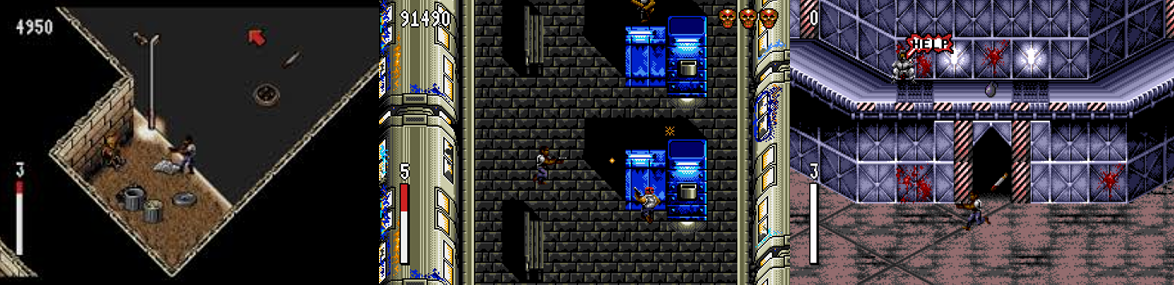
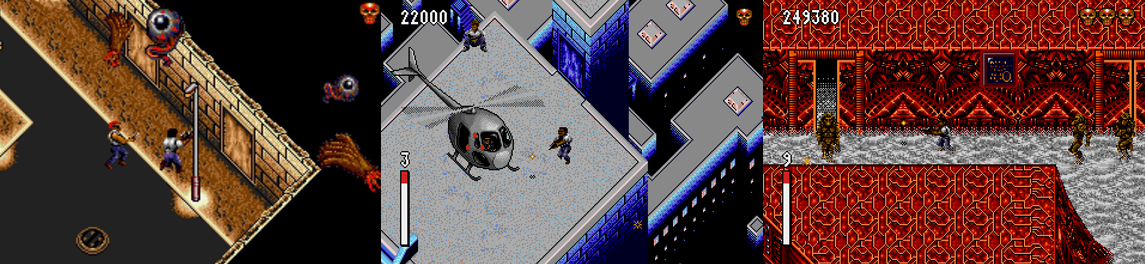
I’m doing things a little differently for this review of the Mega Drive adaptation of Predator 2; it’s mainly getting a shorter review because it’s not a very lengthy game so I don’t see the point in dragging things out that much, but I was also able to finish it so I want to discuss it and give it a proper rating. Predator 2 is primarily a semi-isometric arcade-style shooter that looks and plays a lot like the amazing Smash TV (Williams, 1990), with some levels in Predator 2 even adopting more of a top-down perspective. Like the movie, the game follows the efforts of hardened Lieutenant Mike Harrigan in quelling the violent gangs of Los Angeles and you basically do this by blasting everything and everyone in sight. This is accomplished by tapping or holding A to fire your current weapon; you can use B to lock Mike in place to open fire on specific targets, but I found it much more beneficial to keep moving as there are a lot of respawning enemies in Predator 2’s maps. C selects a different weapon and there’s a decent range to pick from apart from your default rifle, which has unlimited ammo: you can grab a scattergun for a spread shot, a ridiculously powerful sawed-off shotgun, grenades, and eventually make use of the Predator’s own weapons, such as a circling smart disc, a spear, and a net to pin enemies to walls or push them back. All of these additional weapons have limited ammo so, despite them being quite prominent, they’re best saved for when you need to destroy taxis, large trucks, or battle the Predators.

Blast through city scum and rescue hostages before the Predator can strike!

Predator 2 sees you shooting your way across seven levels, all ripped right out of the movie; your main objective is to rescue a certain number of hostages, with a helpful onscreen arrow and cries for help pointing you in the right direction, before the Predator can kill them with its plasma cannon. You’ll know when one’s in immediate danger as you’ll see the familiar red dots of the Predator’s aiming reticule appear onscreen. A red skull icon will also pop up to show when a hostage has been killed and the game’s difficulty is directly tied to how many hostages can be lost before your mission fails as well as how many shots the flak jacket power-up protects you from. On “Easy”, four hostages can be lost and Mike can take eight hits; on “Normal”, its three and six, and on “Hard” it’s one and four, meaning the game can get pretty challenging on harder difficulties as enemies constantly spawn into the map and locations can get a bit maze-like at times. Although there isn’t a timer in the strictest sense, there kind of is; you’re in a race against the Predator to find those hostages and, after you have freed them all (which isn’t tracked in any way; you’ll only know when you’ve succeeded, failed, and how many have died, not how many are left), you need to hurry to the exit before the Predator one-shots you with its cannon. Every enemy you gun down drops a variety of drug-related paraphernalia (such as bags of cocaine, syringes, and pill bottles) that you can pick up for points. Although this is in keeping with the movie, I was still a bit surprised to see drugs make it into a home console game! You can also grab the aforementioned flak jacket to reduce damage taken and restore your health and a first aid kit for an extra life, but it’s game over with no continues once all your lives are exhausted. Thankfully, the game is super generous with its checkpoints; if you rescue all the hostages and then die, for example, you don’t have to find them all again. After clearing each level, you’ll also get a password that you can use to continue at a later date and there are also passwords to award infinite health (though the Predator can still kill you) and other perks.

Although its difficulty is often unfair, Predator 2‘s environments are surprisingly detailed.

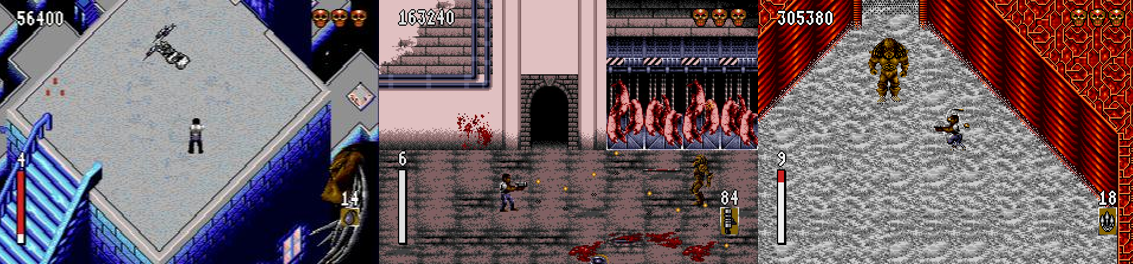
Although the character and enemy sprites aren’t very detailed and have very little animation (most enemies just walk into you to damage you), the environments are surprisingly complex. Enemies pop up from manholes, come through doors, and Predators decloak in each environment, which sometimes bars your progress with taxis that need to be destroyed and barriers that’ll only lower when you’ve rescued enough hostages. I really enjoyed level 2, 4, and 7, which have you exploring the city rooftops, subway, and the Predator ship, respectively. There’s some fun, quasi-3D effects happening on the rooftops and a lot of depth given to the skyscrapers by the isometric perspective; enemies pour out of heavily-graffitied subway trains in the subway and the Predator will even take shots at you from atop the trains; and the spaceship is unexpectedly faithful to the movie in its details with its mist-covered floor, alien architecture, and even trophy walls featuring the Predator’s previous victories. I think I disliked the levels that take place on the streets and in the slaughterhouse the most; the streets can get very repetitive and it’s surprisingly easy to get lost with the limited perspective and wide-open areas. The slaughterhouse, while suitably gory and full of hanging carcasses, was quite frustrating as it’s a very large map with multiple vertical levels so it can be a bit hectic trying to rescue all of those hostages. As much as I enjoyed the visuals of Predator 2, which also features an impressive thermal image of Los Angeles on the title screen and some pixelated movie stills before each level, the sound was really jarring; the game is full of this strangely upbeat music that really doesn’t fit with the franchise (though it does keep your adrenaline pumping). There’s also no in-game story text and the ending is really anti-climactic, but I liked how a big image of the Predator appears in the foreground at times to let you know to hurry to the exit. The game over screen features the Predator standing on a rooftop holding a skull and spine (presumably Mike’s), and Mike explodes into bloody chunks if he gets blasted by the Predator’s cannon so, overall, the game was visually impressive considering how simple it can be.

The Predator hounds you throughout the game but beating it gives you access to its weapons.

The streets are littered with the scum of society; punks are everywhere and will attack you with their bare hands and baseball bats or shoot from a far. Enemies also ride around on motorcycles and in taxi cars or blockade your progress and the exit in large trucks. These latter often serve as mini bosses: three enemies will constantly pop out from the cab and trailer of the truck to blast at you and it can take quite a few shots to blow these trucks up, though you do get a hefty supply of drugs to add to your score as a reward. Enemy choppers also fly overhead and shoot at you and can be found on the ground to fulfil very much the same role, similar to the taxi cabs that you’ll have to destroy to reach power-ups, hostages, or exits, but the sheer number of enemies that swarm the screen can compound these encounters. You’ll also encounter the Predator as a boss on numerous occasions; the first time you battle it, its at the end of the subway and from a top-down perspective. The Predator crackles with electricity when hit, fires bolts from its shoulder cannon, and pins you against the far wall with its net but you’ll be rewarded with its smart disc upon defeating it. In level 5, the Predator appears multiple times to block your progress; this time, you fight from a side-on perspective and it also uses its smart disc, which rotates around almost as a damaging shield. In level 7, Predators act as the primary enemy aboard the alien ship; they’ll decloak, blast at you, toss out multiple nets, throw their spears, and have smart discs circling about the place but will run off or cloak after a few hits. You’ll also have to watch out for wall cannons and the ship’s labyrinthine layout, but if you’re able to rescue all twenty-five hostages and survive the gauntlet of enemies and projectiles, you’ll get into a final showdown with a bigger, unmasked Predator. This also takes place from a top-down perspective and isn’t really any different from previous battles except that the Predator ungainly plods about and managed to kill me even with the infinite health cheat activated! Once defeated, you’re told to escape the ship before it takes off but this simply plays out in a cutscene; you then enter your high score and that’s it, game over, move on.

The Summary:
If it wasn’t clear in my review, I played through Predator 2 with the infinite life cheat activated, which admittedly accounts for how quickly and easily I was able to beat it. However, even with this cheat enabled, you need to have some level of speed and skill to find all those hostages and you’re still capable of dying, but even with it on and a brief playthrough with it off I can see how unfairly difficult Predator 2 can be. The sheer influx of enemies and how quickly they can drain your life bar is astounding, quite frankly. This maybe wouldn’t be so bad if rescuing hostages restored some health or if you had infinite continues, but that’s not the case so you really need to be quick, have a firm understanding of each location, and conserve your more powerful ammunition just to power through the gaggle of baddies much less take on the super strong (and ridiculously cheap) Predator. However, I really enjoyed this game; it was short and simple and a bit mindless, but the environments are surprisingly detailed and fun to run around in and its enjoyable to blast druggies into bloody chunks and outrun the Predator’s reticule. I do think that the game needed a little bit more to it, though; perhaps some racing levels or some kind of bonus stage, maybe a two-player mode where a friend plays alongside you as Mike’s partner, Detective Danny Archuleta, or definitely including Special Agent Peter Keyes in an antagonistic role. Still, this was a harmless enough experience; it works as an action-orientated shoot-‘em-up and I enjoyed the tension of having to outrace the Predator to its targets. However, it gets very messy and cheap with enemies and health-draining hazards very quickly so I can understand why some would be put off by it, but take my advice and slap on the infinite health cheat and this is a decent way to spend about half an hour of your time.

My Rating:

Rating: 3 out of 5.

Pretty Good

Have you ever played the Mega Driver version of Predator 2? What did you think to the game’s perspective and action-oriented gameplay? Did you struggle with the game’s difficulty, or did you enjoy the challenge out avoiding the Predator and rescuing all the hostages? Which Predator game is your favourite? How are you celebrating the action/horror franchise this month? Whatever your thoughts on Predator 2, please feel free to leave a comment below or on my social media and go check out my other Predator content.

Mini Game Corner: RoboCop 3 (Mega Drive)

Released: 1993
Developer: Digital Image Design
Also Available For: Amiga, Atari ST, Commodore 64, DOS, Game Gear, Master System, Nintendo Entertainment System (NES), Super Entertainment System (SNES), ZX Spectrum

A Brief Background:
Director Paul Verhoeven’s RoboCop (1987) proved profitable enough to earn a sequel, one that was unfairly met with mixed reviews. Both RoboCop and RoboCop 2 (Kershner, 1990) were accompanied by videogame adaptations courtesy of Ocean Software, a British developer known for adapting film and television franchises, and Data East. While RoboCop 3 (Dekker, 1993) was a critical and commercial bomb, it also received a handful of tie-in videogames. Unlike the other versions of the game, which were again published by Ocean Software, the Mega Drive version was developed by Digital Image Design, who had only one game under their belt at the time. RoboCop 3’s delayed production also meant that many played the game before seeing the movie. Not that it mattered since Orion Pictures kept the specifics of RoboCop 3’s plot a secret, so the developers had to make educated guesses based on rumours and production stills, leading to them wasting weeks of time creating motorcycle sequences that weren’t included in the movie. Although the Amiga and ZX Spectrum versions of the game have been praised for their cinematic atmosphere and gameplay mechanics, the SNES and Mega Drive versions were criticised for their unfair difficulty, uninspired environments, and crude graphics, and the game was ultimately labelled as being one of the worst videogame outings for the famous cyborg cop.

First Impressions:
Similar to the first two RoboCop arcade games, RoboCop 3 is a sidescrolling shooter with some minor platforming mechanics. Players must lug RoboCop’s notoriously bulky ass across six levels filled with street punks and robotic enemies all looking to turn him into scrap metal. Like all the best Mega Drive games, RoboCop 3 allows you to set your life count (between one and three), the amount of continues you have (between none and two), and the game’s difficult (Easy, Medium, or Hard; I opted to try out the Easy mode for this play session), but there are there’s no option to disable the in-game timer. By default, A allows you to switch between RoboCop’s different weapons (acquired from item drops during gameplay), B fires his current weapon, and C allows him to jump. These controls didn’t work for me so I took advantage of the customisation options to change them to something that actually makes sense: A to fire, B to jump, and C to change weapons. I should also note that you can hold the fire button to continuously shoot, but this will burn through your ammo pretty quickly (when you run out completely, you’re left relying on RoboCop’s weak-ass punches until you grab some ammo), and you can also shoot upwards, diagonally, and while crouching and jumping. Although the options also include a music and sound effects test, the iconic RoboCop theme is missing and, in its place, are a series of generic, cyberpunk-style rock tunes.

RoboCop is beset by tough enemies and tricky platforming sections that his bulky frame struggles with.

Although we’re treated to a big, detailed graphic of RoboCop and the RoboCop 3 logo, there’s no story graphics or even text here; we’re simply dropped right onto the streets of Detroit, which actually makes a pretty good first impression. You can see the city in the background, RoboCop’s police cruiser, dilapidated buildings (with eviction notices slapped onto them), flickering lampposts, and even signs advertising the impending arrival of Delta City. RoboCop also looks pretty good, far better than the generic and uninspiring enemies he faces, though he has no idle poses and remains an unwieldy and bulky character. You’ll need to make use of the various crates piled about to take cover and avoid incoming fire, but enemies can simply walk and shoot right through them and it’s almost impossible to avoid taking a bullet or rocket to the face as RoboCop is so chunky, meaning you’re liable to see him downed in a dramatic explosion if you’re not careful. RoboCop can pick up a couple of additional ammo types as he goes, including a helpful three-way shot and a powerful laser (that even alters his sprite to include his new gun arm attachment from the movie), and replenish his health using rare pick-ups, but you’ll have to be careful of stage hazards. Falling wrecking balls and bottomless pits are abound and RoboCop’s platforming skills leave a lot to be desired. There’s only one checkpoint in the stage, meaning you have to be really on the ball hopping to small moving platforms and taking out the bullet-sponge tanks and drones that patrol the streets and skies above.

My Progression:
I’d heard RoboCop 3 was a difficult game but I didn’t really have many expectations; I vaguely remember playing an polygonal, first-person shooter version of the game on the Amiga (I think…) and enjoying the arcade versions of the previous two adaptations, but there’s one advantage to playing games like those: emulation generally allows you infinite chances to succeed. Mega Drive games don’t always have this luxury and RoboCop 3 is one of those titles where the only cheat available is a level skip, so I decided to go into it with as much of a pure experience as I could and ended up getting quickly frustrated. I really don’t understand why developers had such a problem making RoboCop videogames back in the day; Contra (Konami, 1985) would’ve been a good source of inspiration, hell they could’ve just copied from Turrican (Factor 5/Various, 1990) and been on the right track. Instead, we got these awkward, aggravating platforming/shooter mash-ups that just didn’t work with a character as ungainly as RoboCop. RoboCop Versus The Terminator (Virgin Games USA/Various, 1994) remains the best of the bunch so far and even that game plods along thanks to how unwieldy RoboCop can be. Here, he has no chance against the barrage of enemies (with more appearing on harder difficulties) and you can’t afford to waste too much time as there’s a damn timer ticking down overhead!

Some vague movie references and a top-down shooting section help bolster the mediocre gameplay.

So, no, I didn’t even get past the first stage. With a great deal of patience and abuse of save states, I reached the first boss with full health and armed with RoboCop’s three-way shot and laser, but I stood little chance against the wave-upon-wave of rocket launcher-toting baddies since they attacked from both sides and RoboCop’s crouch is next to useless for avoiding incoming fire. I’ll admit that I kind of rushed a bit and lost patience with the game a lot faster than normal just because of how cheap some of the platforming and challenges were, but I had to tap out in the end as I just couldn’t be bothered to fight my way back to that part. It’s a bit of a shame as the game looks pretty decent; there’s a lovely, detailed graphic of RoboCop on fire and the Enforcement Droid-209 (ED-209) when you die (that even includes a voice sample) and there’s some visual promise to the game, and playthroughs of the game show that it can easily be beaten in less than fifteen minutes if you’re able to stick with it. Looking ahead, there’s more voice samples (all of them from the first movie) and RoboCop fights up and across rooftops, battles waves of Rehab mercenaries alongside a reprogrammed ED-209 (Nikko Halloran even pops in for a cameo), acquires a flame burst, and even encounters a gigantic robotic Satan in a parking garage! Other movie locations include the church (where RoboCop must find keys to open doors and fight the agile robot ninja Otomo in the sewers) and the Omni-Consumer Productions (OCP) tower, where players must defeat two Otomos to finish the game and finally earn some story text. The gameplay is even broken up by some fun-looking, bullet hell overhead shooter sections where RoboCop flies above the city streets in his jetpack blasting at demonic-looking robots and drones, but I honestly can’t be bothered to fire up this drek of a game to try and play them.

I admit that I probably didn’t give RoboCop 3 a fair shake of the stick. Since a boxed, complete version of the game can fetch quite a high price, I settled for emulating the game, but I couldn’t be bothered to hook a second controller up to my Raspberry Pi to input the level select code and I kept accidentally overwriting my save state, so I grew very frustrated with the game myself very quickly. But as I say, even when I reached the first enemy swarm that masqueraded as a boss battle, I couldn’t beat it even with full health, though I’d wager that I might be able to get a little further now that I know what to expect from the game. However, I have no desire to; there are far better similar games on the Mega Drive, the RoboCop arcade games are a much better use of your time, and there’s no way you’d ever pick this game over RoboCop Versus The Terminator. But maybe my opinion doesn’t count as I gave up too quickly. Maybe you actually enjoyed this game. Maybe there are some positives that I missed, or I just didn’t connect with it like you did. If so, I’d love to hear about it. tell me your experiences of RoboCop 3, or RoboCop games in general, in the comments and go check out my other RoboCop reviews across the site!

Mini Game Corner: Alien³ (Mega Drive)

Released: October 1992
Developer: Probe Software
Also Available For: Amiga, Commodore 64, Game Boy, Game Gear, Master System, Nintendo Entertainment System (NES), Sega Genesis, Super Nintendo Entertainment System (SNES)

A Brief Background:
Over the years, the Alien franchise (Various, 1979 to present) has had a long and complicated history with videogame adaptations; from pixelated garbage to first-person shooters, real-time strategies and crossover titles, to survival/horror experiences. Just as director James Cameron more than met the challenge of following up on Ridley Scott’s financially successful and highly influential Alien (ibid, 1976), so too did Konami produce a popular arcade port of Aliens (Cameron, 1984) that is widely regarded as one of the best games in the franchise. Unfortunately, Konami lost the Aliens license by the time the divisive third film hit cinemas; fraught with production issues, delays, and script troubles, Alien³ (Fincher, 1992) might not have been as critically or commercially successful as its predecessors, but in time it became a cult favourite for many fans and it spawned two videogame adaptations: this multi-platform run-and-gun adventure and an arcade-exclusive rail shooter the following year. Unlike its contentious source material, Alien³ was quite well received at the time; reviews praised the presentation and fidelity to the movie, as well as its arcade-style gameplay though some did struggle with the troublesome controls and music.

First Impressions:
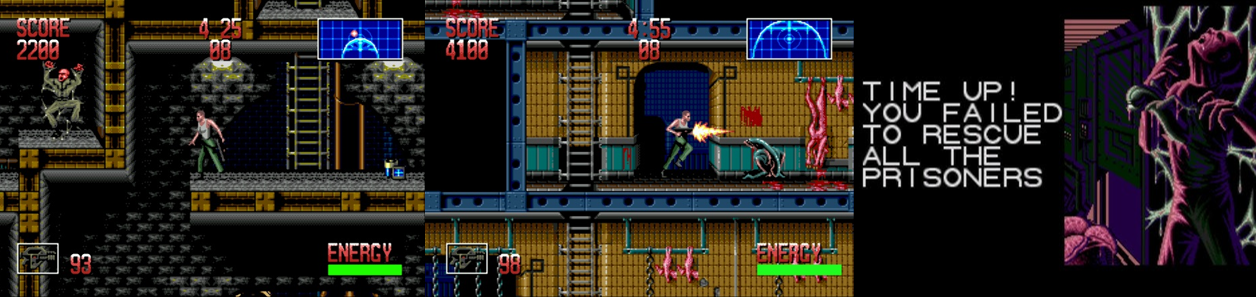
At first glance, Alien³ seems to share many similarities with the Aliens (Konami, 1990) arcade game; the visuals, especially the sprites, onscreen text, and environments, are strikingly similar and Ripley even wields many of the weapons featured in that game. However, the moment you actually start playing the game, you realise that it’s an entirely different beast, one that has a bit of an identity crisis. For starters, as mentioned, Ripley is armed to the teeth; she’s got the iconic Aliens pulse rifle, a flamethrower, a grenade launcher, and regular grenades, making her decidedly more formidable than she was in the source material, where the entire point was that she and the inmates had to come up with out the box solutions to deal with the resident Xenomorph. Secondly, and most crucially, the game isn’t just a mindless run-and-gun; instead, you’re given a strict time limit to complete a specific objective in each stage and reach the exit, and the game’s locations take on a far less linear, much more labyrinthine structure that closely mirrors the panic and claustrophobia of the movie. Ripley is tasked with rescuing inmates and destroying the Xenomorph infestation, objectives that are somewhat aided by the onscreen Aliens-style motion tracker and the various vents and ladders that help her to get around each location.

Although heavily armed, Ripley’s greatest challenges are the timer and maze-like levels.

Alien³ utilises a simple control scheme, but one I had to shuffle about a bit; by default, A switches your weapon, B jumps, and C fires, but I swapped fire to A and switch to C as that was more comfortable for me. You can pick between one and nine continues, but these are actually how many lives you have, and whether you want to play on Easy, Normal, or Hard mode. I chose nine lives and the Easy difficulty and still found the game to be quite challenging; the timer is a constant headache, meaning you need a lot of trial and error to find the optimal route around each stage, something that is hampered by dead ends, hazards (such as fans and my pet hate, fall damage), and the Xenomorphs. Aliens will crawl out of the ground and along the ceilings and walls, dropping on you and charging at you, though you thankfully don’t have to worry about them constantly respawning or acid damage. Later, Facehuggers apparently also show up and you have to shake them off with the directional pad, though I never saw any in my playthrough. You’ll occasionally have to make some blind jumps to avoid slippery slopes or make use of moving platforms to reach new areas, as well as activating consoles to open doors (or simply blowing them open with a grenade). If you fail to rescue all of the prisoners in time, a gory scene plays out showing them, and Ripley, succumbing to their Chestbursters, and you’ll have to replay the entire stage from the start all over again, which is a real pain in the ass.

My Progression:
As I said, Alien³ has a bit of an identity crisis. Judging by Ripley’s weaponry and the way the Aliens are presented, it seems like the developers wanted to make something more akin to the action-orientated Aliens but were stuck adapting the most recent movie. The game impresses quite well with its arcade-style graphics; Fury 161 is recreated nicely, including a wasteland up top and different layers within, and Ripley has a basic alternative pose when left idle. Each stage is preceded by a drooling Alien face and the music is quite jaunty, which is at odds with the bleak source material but helps keep you engaged in the action. Sadly, the gameplay and steep difficulty curve are where Alien³ falls apart; the time limit is way too tight and health and ammo pickups are so scarce that it’s a chore just getting through even the first stage. I was just about able to tank my way through to the third stage, where the layout just became too confusing to continue and I was forced to quit.

Sadly, the game’s difficulty, stringent timer, and lack of passwords make progression a chore.

This wouldn’t be a problem if Alien³ incorporated a password system, but it doesn’t; there are cheats out there, but I couldn’t get any of them to work so I’m not sure if I’ll ever progress further into the game, especially as you can’t seem to earn extra lives or continues. Looking ahead, the game sees Ripley venturing into the blood-stained medical wing, a cargo area and butchery also feature, and the game even includes an Alien nest that is, again, visually ripped straight out of Aliens. Xenomorph eggs pop out Facehuggers, slime drools from above, and various ridge-headed versions of the Xenomorph act as “Level Guardians”, spitting acid, jumping about the place, making use of higher platforms, and players will need to fend off two at once in a large industrial area in order to get their final score tally and earn the extremely lacklustre text ending in with Ripley simply leaves the prison without any repercussions. I’m surprised that the developers resisted the urge to have Ripley fight an Alien Queen, as is often standard for Alien videogames, though these boss battles seem to increase in difficulty simply because the area you battle them in increases in size, giving them more places to hide and surprise you with some acid projectiles from behind the prominent foreground images.

Alien³ is a  strange entry in the franchise to adapt into a videogame, and it seems like the developers shared this philosophy; there’s a reason why the game has more in common, in terms of action and gameplay, with the Aliens arcade game than the actual movie on which it’s based and that’s the fact that Alien³  would work much better as a point-and-click adventure or a survival-horror style title, two genres that probably wouldn’t have been successful at the time or on the Mega Drive. It’s not a bad game, really, it’s just the difficulty curve is way too steep; either the game needed a password system or the timer needed to go, but without either it’s a real test of your skill and patience to get anywhere beyond the first few stages. I liked the level of detail, even though things were a bit stiff and janky at times (Ripley sometimes struggled to go down ladders), and the use of gore when you inevitably mess up. The lack of enemy variety was a bit of an issue, though; Alien games, especially  around this time, tended to go a bit bonkers with Alien variants but Alien³ plays things way too safe. In the end, it was a largely forgettable and disappointing experience for me, especially as it could’ve been so much more if the Aliens arcade game had simply been ported instead. Still, maybe I just suck; maybe you actually really enjoyed this game. Maybe you had no issue rescuing all the prisoners and navigating the maze-like levels. Or, maybe, you prefer a different Alien³  videogame, or a different Alien game entirely. Whatever your thoughts and feedback, feel free to drop a comment below or on my social media and be sure to check out my other Alien content on the site.

Mini Game Corner [Sci-Fanuary]: Judge Dredd (Mega Drive)


January sees the celebration of two notable dates in science-fiction history, with January 2 christened “National Science Fiction Day” to coincide with the birth date of the world renowned sci-fi writer Isaac Asimov, and HAL 9000, the sophisticated artificial intelligence of Arthur C. Clarke’s seminal 2001: A Space Odyssey (1968), being created on 12 January. This year, however, I’ve been spending every Thursday of January celebrating sci-fi’s toughest lawman, Judge Joseph Dredd!


Released: 16 June 1995
Developer: Probe Software
Also Available For: Game Boy, Game Gear, PC/MS-DOS, and Super Nintendo Entertainment System (SNES)

A Brief Background:
Still published to this day, British science-fiction comic book 2000 AD first appeared in February 1977 and, in March of that same year, introduced readers to the uncompromising lawman of the future, Judge Joseph Dredd. Created of John Wagner, Carlos Ezquerra, and Pat Mills, Dredd became one of the most popular and iconic British comic book characters of all time. Accordingly, the character has expanded beyond the comic book panels and into the realms of videogames on more than on occasion; his first videogame outing was a largely repetitive platform shooter, a concept expanded upon by its bigger, more graphically impressive Amiga follow-up. Dredd’s relationship with videogames is largely considered to be hit and miss but, when the time finally came for the character to make the jump to the silver screen, an adaptation was put into development. While the movie would become a notorious box office bomb, developers Probe Software sought to be as faithful to the production as possible by digitising the film sets to be featured as locations in the game, however their efforts resulted in mixed-to-negative reviews across the board. While some reviews praised the gameplay and fidelity to the source material, others criticised the difficulty and lack of variety, and the game failed to make a lasting impression regardless of which system it was played.

First Impressions:
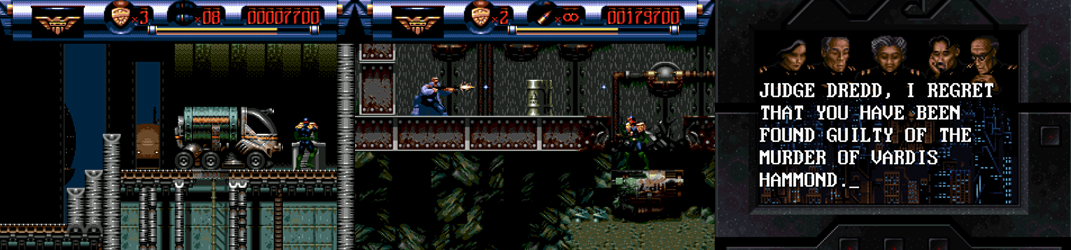
Judge Dredd is a 2D, sidescrolling run-and-gun that, for the most part, emulates the plot and visual aesthetic of the bombastic movie. Players assume the role of Judge Dredd (whose sprite more resembles his comic book counterpart than Sylvester Stallone’s look from the film) and play through twelve stages taking out street punks, mutants, and even Dredd’s fellow Judges just like in the movie. Players are given three lives to start with and can collect more by picking up extra life icons, and each stage has a primary a secondary objective, both of which are relayed to the player using sprite art modelled from scenes of the film and traditional text. Primary objectives range from destroying ammo supplies, locating Dredd’s mentor, Judge Fargo, reaching the council in the Hall of Justice, and defeating specific enemies. Secondary objectives appear to be option, but you must complete the primary objective in order to exit the current stage, something which can prove problematic given how maze-like and strangely designed many of the game’s stages are.

Though often cluttered, the game certainly makes an effort to marry the visuals of the film and comic book.

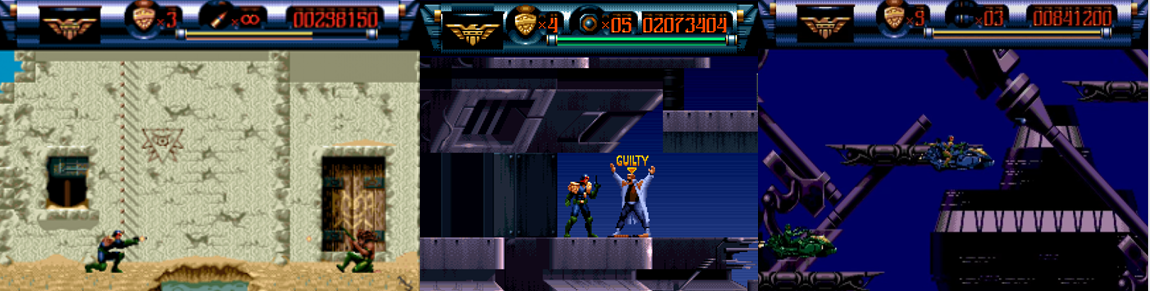
Judge Dredd is armed with his trust Lawgiver; tapping or holding the A button will see Dredd fire a variety of shots, from unlimited regular bullets to heat-seekers, grenades, and missiles, and you can even hold down the button to fire uninterrupted. Dredd can also sprint by tapping the directional pad (D-pad), and shoot while running, jumping, and crouching, and in all directions (including diagonally!) Although some objectives tell you not to shoot certain enemies, you’re free to be as trigger happy as you like; however, you’ll score more points if you use Dredd’s melee skills (A up close or X if you have a six-button controller) to disarm and arrest perps when “GUILTY” appears over their head. Dredd can jump with B and even fly about for a few seconds if you find an Anti-Grav Belt; you’ll be doing a fair amount of platforming but Dredd can’t jump very high so you’ll often need to make use of ladders, monkey along overhead lines, or even a running jump to reach new areas. Dredd can also crawl about, push some objects, and access terminals to see his current mission progression and health and ammo stats or lock doors in certain stages. Dredd controls quite well but is a bit clunky; pressing up will scroll the screen, which can be disorientating, and there’s a few too many frames of animation at times, meaning there is often a delay between button presses. Dredd is quite sturdy but can replenish his health with small and large hearts, pick up additional ammo, or even grab a temporary forcefield and invincibility to help even the odds.

There’s some variety on display in the different Dredd’s objectives and gameplay mechanics.

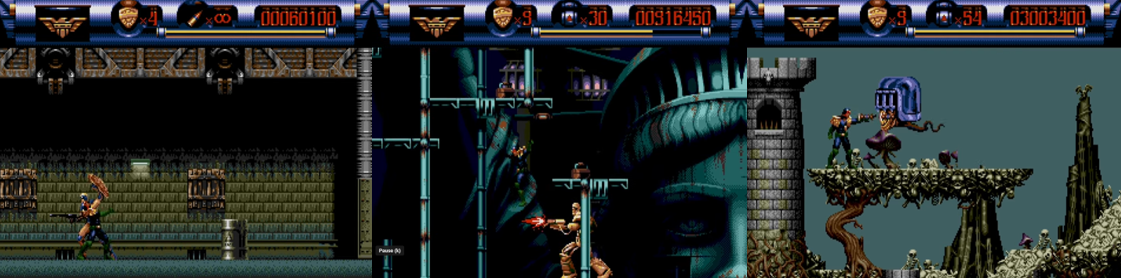
After completing each stage, you’re given a score tally and a password to help you skip ahead; while there don’t appear to be any useful passwords for this version of the game, such as infinite health or ammo, it is a handy feature to pick up where you left off or try out different missions. In my case, this is almost mandatory; it took quit a bit of trial and error to complete even the first stage as you can get stuck in an area with no way back. While Dredd will nip up on the spot after being killed, it’s quite easy to get stuck as ladders and hazards aren’t always immediately visible, and while you can duck and shoot most enemies, you’ll be majorly outclassed by the wild mutants in the Cursed Earth and the Atomic, Bacterial, and Chemical Warriors (A.B.C. Warriors) you’re tasked with destroying later on. The game certainly looks good; sprites are a bit small but Dredd has some fun idle animations, such as twirling his gun and cleaning his badge (there’s even a little squeak-squeak sound effect), and there’s some splashes of blood when you off enemies. The environments are visually very faithful to the movie, including trucks, futuristic skyscrapers, and the Statue of Liberty as in the film, but can be cluttered and a little too large for their own good. Gameplay is somewhat broken up by one stage that has you flying through the skies on your Lawmaster while fending off pursuing Judges (Herman Fergusson/Fergee fires at the rear while Dredd fires ahead) and by the fact that some enemies will be possessed by the four Dark Judges; you’ll know when they are as they’ll have an aura about them and a spirit will fly out that you can catch for bonus points if you have some Boing ammo.

My Progression:
Judge Dredd is a surprisingly tough game; at first, it reminded me of classic run-and-guns like Turrican (Factor 5, et al, 1990) or Duke Nukem (Apogee Software, 1991), especially with the placement of the heads-up display and dystopian, sci-fi setting. Seconds into the first stage, I hit a literal wall and had to think for a minute as the ladder I needed was so difficult to see and things only got more confusing from there; vents randomly damage you, trash falls from above, and you can’t even step in a small puddle of water in the Cursed Earth without taking damage. Just destroying the ammo crates in the first stage is a chore as they can only be destroyed by your explosive weapons and you need to explore the stage in a specific way so you don’t miss any and get stuck. Rather than running past terminals in Aspen, you need to access them to initiate the lockdown procedure, and enemies can take a few shots before they go down even before the clunky A.B.C. Warriors enter the picture. It appears that most stages end with a boss battle, too; the first is a guy who looked a lot like DC Comic’s James Harper/Guardian and who constantly blocks your shots with his shield while firing at you with a machine gun, tossing Molotov Cocktails, launching an almost unavoidable energy wave, or bashing your head in when you get close. You can use nearby barrels for cover but he absorbs shots like a sponge and the timing required to jump and duck under his shots meant that I couldn’t actually beat him!

Sadly, the game’s difficulty meant I couldn’t get very far and I wasn’t motivated to skip ahead much further.

Using a password, I jumped to stage two and fared much better n the Aspen Penal Colony. There’s some neat effects on the waters of the sewer area and I was actually able to beat the stage the boss, a brute with a big club who rides an elevator that he tries to crush you with, tosses grenades and Molotov cocktails, and smacks you silly up close. It was a slog, but I did beat him, but I couldn’t get past the Cursed Earth for the life of me. Here, the mutated inhabitants live in the ruins of society and Judge Hunters patrol the wooden walkways, but the leaps of faith and confusing level layout got the better of me. I skipped ahead to the Hall of Justice and that wasn’t a problem, nor was the chase on the Lawmaster, but the A.B.C. Warriors stomping about on the construction site around the Statue of Liberty were enough to have me calling it quits. They’re immune to your regular shot, so you’ll need a healthy supply of missiles or other explosives, but their missiles and the stage’s bottomless pits were the last straw for me. it was a bit of a shame as the game’s layout and objectives actually got easier the deeper I got and, from what I can see, there’s a bit of a post-game that looks right up my alley. After dealing with Dredd’s psycho clone brother, Rico, players head to Deadworld, an alternative dimension where all life was deemed a crime, to do battle with Dredd’s reaper-like spectral counterpart, Judge Death! I could’ve used passwords to jump ahead to this point but I decided that enough was enough, but I am impressed that a videogame adaptation from this time actually expanded on the film; the game does a decent job of following the movie’s narrative but infuses it with more elements from the source material, including my favourite Dredd antagonists, the Dark Judges, which is pretty rare for a game of this era in my experience.

I wasn’t really sure what to expect from Judge Dredd; videogame adaptations of movies tended to be more hit than miss back in the 16-bit games, at least in my experience, but sadly there were some issues here that kept me from really enjoying the experience. Visually, the game is both impressive, bland, and confusing all at the same time; the horizon and backgrounds aren’t always very detailed but the foregrounds are almost too detailed, making things a bit cluttered and messy at times. Dredd looks great and plays okay, but I find it amusing that the developers included the ability to arrest people when Dredd is far more likely to just sentence criminals to death for even more infractions. Since the game doesn’t really penalise you if you kill everyone, I recommend taking a traditional run-and-gun approach, especially as you’ll be distracted by vague objectives and the maze-like areas. Overall, it was a mediocre experience, one that I struggled to get through thanks to the difficulty spike and clunky presentation. It’s a shame as I feel the concept could have legs if it was more like Contra (Konami, 1986) or Metal Slug (Nazca Corporation, 1996) and leaned more into arcade-style action rather than tedious exploration. Still, maybe I’m being too harsh? Maybe you actually enjoyed the gameplay on offer here? Perhaps you prefer one of the movie’s other ports or a different Judge Dredd game entirely? Either way, I’d love to hear about it so leave a comment below or on my social media and be sure to check out my other Judge Dredd content.

Game Corner [Asterix Anniversary]: Asterix and the Great Rescue (Mega Drive)


Asterix the Gaul (and his best friend Obelix) first debuted on 29 October 1959 as a serial in the French/Belgium magazine Pilote. Since then, the plucky Gauls have gone on to have many adventures in comic books, videogames, and feature-length productions and Asterix himself has become a popular and enduring character in his native France and beyond as his stories have been translated into over a hundred languages across the world.


Released: November 1993
Developer: Core Design
Also Available For: Game Gear and Master System

The Background:
It didn’t take very long at all for the French comic book series Asterix to make the jump from the comics and into other media; the first Asterix book was adapted into a feature-length animation in 1967 and both animated and live-action Asterix films have been pretty consistent over the years. Similarly, there have been a number of Asterix videogames; the first of these was released for the Atari 2600 in 1983 and one of my absolute favourites was Konami’s arcade game from 1992. Growing up, I had a lot of fun playing Astérix (SEGA, 1991) on the Master System, a colourful and entertaining little platformer that I’ve yet to finish ever thirty years later, and figured that the Mega Drive title would be a good investment. Asterix and the Great Rescue was developed by Core Design, the team behind the classic SEGA title Chuck Rock (Core Design, 1991), and was met with mixed reviews upon release. With today also being the birthday of the SEGA Mega Drive, I figured it was the perfect time to put this game in and see how it holds up compared to its 8-bit counterpart.

The Plot:
The year is 50 BC. Gaul is entirely occupied by the Romans. Well, not entirely… One small village of indomitable Gauls still holds out against the invaders and life is not easy for the Roman legionnaires thanks to the Gauls’ magic potion, which gives them superhuman strength. Like in many Asterix videogames, the Romans kidnap the village druid, Getafix, to stunt the village’s supply of magic potion so their bravest warriors, Asterix and Obelix, set out to rescue Getafix and teach those crazy Romans a lesson.

Gameplay:
Asterix and the Great Rescue is a 2D, sidescrolling action platformer in which one player gets to pick between Asterix and Obelix before each journey across six Levels to rescue the druid Getafix from the Romans. Disappointingly, unlike in the majority of Asterix videogames, there’s very little actual difference between Asterix and Obelix; both characters move at the same plodding speed, have the same amount of health, jump at the same height, and have exactly the same special abilities. Indeed, the only discernable difference I could identify is that Obelix’s hit box is larger (due to his characteristic girth) but it’s not like Asterix’s is that much smaller. You can customise the game’s controls from the main “Options” menu but the default setup is functional as is. Players can jump with A, attack with a punch with B, and use a “Special Weapon” with C. Pressing up on the directional pad (D-pad) in conjunction with C allows you to pick from four different Special Weapons while pressing down on the D-pad allows you to crouch and crawl to avoid incoming projectiles.

Rooms can be short but also painfully frustrating at times.

Sadly, considering the characters’ and comics’ focus on madcap fighting, combat is extremely disappointing and limited here; there are no jumping attacks, your punches have a pathetically short range, and the only additional combat option available to you is that you can hold down B to perform a series of rapid punches while moving to take out groups of enemies faster. Asterix and the Great Rescue is constructed in a strangely confusing way; there are six Levels, each split into four “Huts” and each Hut has up to three “Rooms”. The wording is very confusing as you’re not necessarily inside of a hut or a room as you might think but what it actually boils down to is six levels, four worlds, and up to four zones in each world and I guess the developers thought it would be “fun” to supplant this usual videogame terminology with terms from the comic book. While six Levels might not seem a lot, the game is actually surprisingly long; the Rooms are generally short sprints asking little more from you than to travel to the right, bashing enemies, and reaching the goal (“magic elixir” for Asterix and a roast boar for Obelix) but you’ll also be tasked with finding keys, performing some tricky jumps, or navigating some confusing areas.

Your biggest obstacles are the time limit, hit boxes, and obtuse nature of the gameplay.

Your greatest enemy in each Room will be the time limit; every Room has a time limit that is anywhere from less than a minute to two minutes of game time and, if you fail to reach the goal before the time runs out, you’ll lose a life and have to restart from the beginning of the Room. There’s very little room for error in some of these Rooms and, if you mess up or take too long, then that’s just too damn bad as there are no checkpoints. Thankfully, you can acquire extra lives by earning enough points or stumbling upon a beating heart pickup. You start each game with three lives and three credits and, when you lose all of your lives, you’ll be given the option to cash in a credit and continue from the start of the last Room you played but, if you use up your credits, it’s game over. After clearing each Level, you get a password to jump to later in the game, which is helpful, but the damage you sustain throughout the game carries over to each Room, which is extremely frustrating, and you’ll find an abundance of bottomless pits as you progress, which mean instant death.

Gameplay is very inconsistent, being ridiculously easy one minute and frustratingly difficult the next.

Gameplay in Asterix and the Great Rescue is extremely inconsistent and frustrating; generally you just have to fight your way to the goal but other times you have to dodge bursts of fire, press switches to progress further, dodge falling blocks or incoming boulders, or hop around moving or temporary platforms to get through the Room. This can be extremely frustrating as some enemies are too small to hit, others take multiple hits to defeat, and it’s not always clear what you have to do in order to progress; all too often, platforms will suddenly drop underneath you, animals or bridges will collapse after carrying you across gaps, and you’ll need pixel-perfect timing to reach far away platforms. You’ll also need to hop across lava pits, make a number of blind jumps, contend with murky water that slows you down, teleport across Rooms using special statues, or use a series of bubbles, springs, and catapults to travel higher and further. Spikes, thorns, spiked balls, flames, and rotating platforms all compound matters, making avoiding damage extremely difficult even when playing on “Easy” mode, where enemies are less frequent and aggressive. Thankfully, there’s no knockback from taking damage but my experience was that my character would simply keel over and die more often than not since their hit box is so big that it’s extremely difficult to avoid being hit (especially when you get dropped literally right into the path of oncoming enemies in some Rooms).

Graphics and Sound:
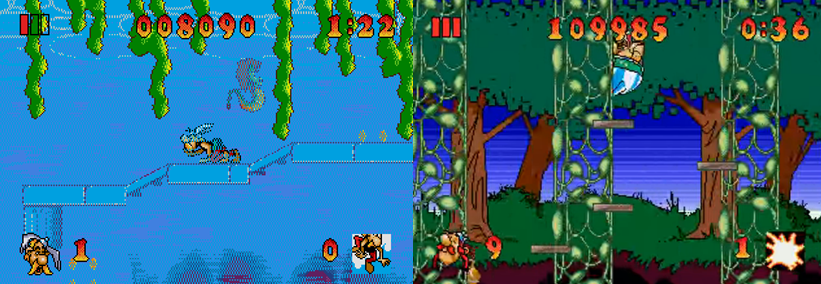
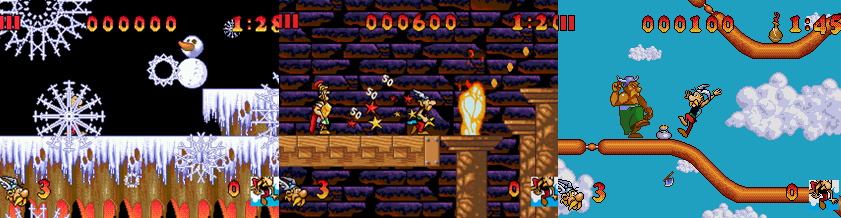
Asterix and the Great Rescue has a lot of promise but doesn’t quite manage to deliver in terms of its graphics. Sprites are colourful and faithful to the comics, for example, but not especially big or full of animation frames; there are no idle animations, for instance, and neither Asterix, Obelix, or their enemies exude the same charming humour as they do in the comics or even the Master System game. Environments can similarly be very hit and miss; the Gaulish village is beautiful to behold but little more than a tutorial to learn the basic controls. Occasionally, you’ll see familiar Asterix characters like Unhygienix in the background but he’s wildly out of proportion compared to the avatar’s sprites. Other times, the background will be quite sparse (a simple night sky) or somewhat detailed but then it’ll also look really crude (especially in the Forest and Rome levels). There are a lot of different environments to explore, however. You’ll travel from the Gauls’ village, cross the dock, enter a Roman camp, explore a dense forest and jump through the treetops and past gigantic spider’s webs, battle through dungeons in Germany, hop across clouds and birds and wander around stages made out of Frankfurters, pass through an ice Room (with some impressive snowflake effects falling over the screen) on the way to a Roman galley, and finally jump and fight through water ruins, an ornate garden, a lavish banquet hall, and the coliseum in Rome.

Levels are quite varied and can be quite bit but they’re hampered by the constant ticking clock.

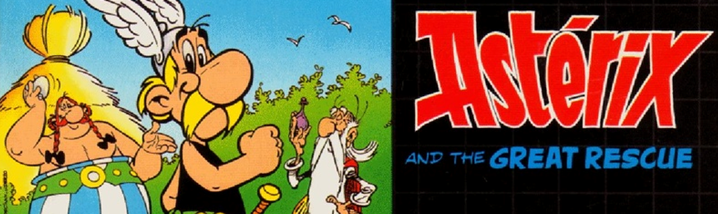
All of these are locations that will be familiar to any Asterix fan but, for most videogame players, will seem very by-the-numbers for the average platformer and full of clichés such as weighted switches, temporary platforms, and rising or moving platforms. A lot of the time it can be difficult to tell where you need to go as you can sometimes pass through certain walls but not others, despite them both looking the same, and you’ll need to experiment with your Special Weapons in order to progress (if you have enough time left to figure that out, of course). I did experience a bit of slow down at times, which is quite ludicrous as there’s rarely a lot happening on screen, and some graphical hiccups here and there. The music is quite jazzy, however; it’s not especially varied but it’s decent enough, and certainly far better than the game’s sound effects. The game’s story is told through text and a recreation of the map of the invaded Gaul, all of which will be more than familiar to any Asterix reader. Though the game’s title screen leaves a lot to be desire, each Level is proceeded by a pretty nice still picture of the famous duo but you’ll have to wait for the final screen on the game for anything resembling any kind of impressive sprite art and even then it’s basically just a partially animated still.

Enemies and Bosses:
As any self-respecting Asterix fan might expect, your primary enemies in this game will be the Romans. Roman soldiers charge at you with spears, march along in groups wielding swords, toss spears at you from above, and gold-armoured Centurions will also show up to try and skewer you as you progress. These are all pulled straight from the comics and even include Roman’s hiding in tree disguises; most of them will go down in just one hit but the more rotund and golden Romans will take two to three hits. You’ll also have to content with woodland critters scurrying and flying your way, axe-throwing Germans, German maidens who explode when you get too near, mermaids and sea creatures, archers whose arrows stay on screen way too long, Romans trying to jab you from beneath with their swords, spiders and other bugs, dogs, and even hatchlings trying to take a bit out of your ass. By far the worst obstacle is the mule-kicking horses who will send you flying clear across the screen; I swear you need as much luck as you do skill to time your jumps past those assholes!

It makes sense to be fighting Romans but Cacofonix is a strange choice for a boss

Each Level culminates in a boss battle, the first of which is, oddly, against the village bard Cacofonix (I know he’s an annoyance in the comics but to make him a boss seems a bit extreme). Cacofonix stands in one spot atop his tree hut and spits musical notes at you from his lyre and can only be damaged by hopping on top of one of village chief Vitalstatistix’s shield bearers and tossing rotten fish at him. It takes a lot of hits to finally put the bard down so, again, your biggest enemy here is the time limit as it’s pretty easy to avoid his musical notes by standing in the right spots. The second boss fight sees a Roman encampment firing rocks at you; these must be hit back over and over again until the camp finally surrenders to your might. After this, a Roman soldier awaits you on a log and will instantly force you to your death unless you mash A, B, and right as fast as possible to knock him off instead but, of course, the game never tells you any of this so it is easy to simply fail time and time again.

After besting many enemies, the last two Levels culminate in battles against large, voracious animals!

The final Room of Germany has you desperately outracing a rising sea of red and taking out enemies as you make your way up to a goal which, again, is more a test of your skill and patience with the game’s controls than any sort of actual combat. On the Roman Galley, you’ll be attacked by a gigantic alligator (or is it a crocodile?); simply hop up onto the platforms to avoid the creature’s snapping jaws and then jump down to smack him in the head but watch out for his massive hit box clipping your avatar. The finale sees Julius Caesar set two vicious tigers against you in the Coliseum; these will randomly pop in and out of archways under Caesar’s view box and must be smacked whenever they appear and hopped over to avoid damage. Like all of the game’s bosses, though, this is simply a test of patience and landing hits before you get a time out and the bosses are, by far, the least challenging aspect of the game.

Power-Ups and Bonuses:
There are numerous items to pick up and collect in Asterix and the Great Rescue; you’ll find gold coins, bags of coins, and Roman helmets, all of which will add to your score and bring you one step closer to an extra life. You can also replenish your health either partially or fully by collecting pieces of roast chicken or a chalice, respectively, and you can grab a sickle for a brief period of invincibility or a bomb to enter “Mega Attitude Mode”, which increases your speed and strength so you can blast through enemies and obstacles.

Special Weapons are useful but limited and you won’t always have to to backtrack for more ammo.

The main thing to keep an eye out for, though, are the gourds that you’ll find scattered throughout each Room. These will give you ammo for your Special Weapons and will respawn when you move the screen a little bit. Your Special Weapons are essential to your progress but it’s not always abundantly clear where or when you have to use them (such as the first screen of Rome where you’re seemingly trapped but actually have to blast a wall that doesn’t appear to be destructible). The Fireball adds a ranged attack to your arsenal and can be used to destroy certain blocks, hit targets, or deactivate certain traps; the Ice Block (which is actually a cloud) creates a temporary platform to allow you to reach higher areas or cross spike or lava pits safely (if you can get the angle of the throw right…); the Disguise covers you in a series of vines and flowers so that enemies will walk right past you; and Levitation allows you to (chunkily) float about using the D-pad to avoid spikes and reach higher or further areas. 

Additional Features:
There’s not really much else on offer in Asterix and the Great Rescue beyond the single-player experience; there’s no two-player simultaneous play, meaning that the only way for two players to play is to take it in turns, and no real benefit to playing as either of the two main characters. You can tackle the game on a harder difficulty setting and try to get your name at the top of the high score table but the game is so tough anyway that I wouldn’t recommend it. There aren’t even any decent cheats for the game as the password system is simply for jumping to the game’s levels so you’ll probably be done with this game after one playthrough or session.

The Summary:
Boy, was I disappointed with Asterix and the Great Rescue. Once again, I as met with a 16-bit iteration of a videogame that pales in comparison to its bright, humourous, and fun 8-bit counterpart; you know it’s bad when even the Master System’s game gives Asterix and Obelix different abilities and playstyles and has more gameplay variety. Honestly, I can’t even say that this game looks good as, compared to other games of a similar genre that came out at the same time, Asterix and the Great Rescue looks and sounds like 1989 Mega Drive title rather than a 1993 release. Clunky, awkward controls, a rubbish combat system, confusing and frustrating gameplay, and just a complete lack of entertainment and engagement make Asterix and the Great Rescue an extremely disappointing title that saves itself from a one-star review simply because I am a big fan of the comics and characters but, honestly, I wouldn’t recommend anyone actually bother playing this letdown of a game.

My Rating:

Rating: 2 out of 5.

Could Be Better

What did you think to Asterix and the Great Rescue? How do you think it compares to other Asterix videogames and games of its genre? Did you enjoy the title and feel I’m being too harsh on it or do you agree that it was a frustrating and disappointing mess of a game? Which character, book, or movie is your favourite? How are you celebrating Asterix and Obelix’s anniversary, and the release of the Mega Drive, this year? Whatever your thoughts on Asterix, feel free to leave a comment below or on my social media.

Game Corner: Streets of Rage 3 (Xbox 360)

Released: 30 May 2012
Originally Released: 17 March 1994
Developer: M2
Original Developers: Ancient and SEGA
Also Available For: GameCube, Mega Drive, Nintendo Wii, PC, PlayStation 2, PlayStation 3, PlayStation 4, PlayStation 5, SEGA Mega Drive Mini 2, Steam, Xbox One, Xbox Series S/X

The Background:
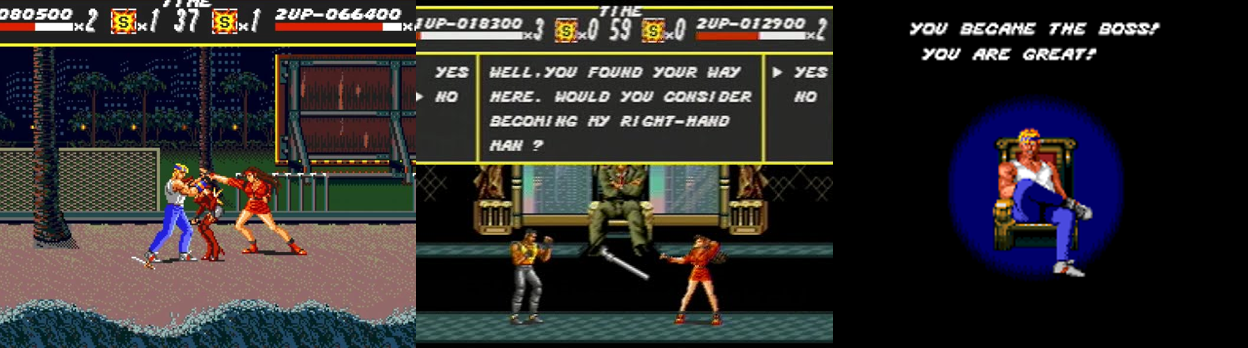
Since sidescrolling beat-‘em-ups were popular in both arcades and home consoles back in the day thanks to the likes of Double Dragon (Technōs Japan, 1987) and Final Fight (Capcom, 1989), Noriyoshi Ohba and his small team of developers were smart to create the Bare Knuckle Streets of Rage series (SEGA, 1991 to 1994), which was initially exclusive to SEGA’s home consoles. Streets of Rage (ibid, 1991) was incredibly popular and highly praised, and the sequel was even more lauded for its many graphical and gameplay improvements. A bigger, even more improved third entry soon followed; originally, Streets of Rage 3 included motorcycle stages, which can still be played through hacking, and the game featured far more regional differences than its predecessors, including a reworked plot, recoloured sprites, less provocative enemy sprites, and the entire removal of a potentially offensive miniboss. Despite these alterations, Streets of Rage 3 was as highly praised as its predecessors; while the graphics and gameplay were seen as the best in the series so far, reviews did criticise the soundtrack, difficulty, and the stale nature of the franchise despite the new features. While we wouldn’t see another game for nearly thirty years, Streets of Rage 3 was re-released and ported to other consoles over the years before it, and its predecessors, were brought to the Xbox 360 as part of the SEGA Vintage Collection, with this version including modern quality of life perks like save files, a replay feature, and other bonus content.

The Plot:
Following his two previous defeats, Mr. X establishes the RoboCy Corporation and begins creating robots to replace important city officials and then has his criminal syndicate place bombs all over Wood Oak City! Eager to get revenge against Mr. X for turning him into a cyborg, Doctor Gilbert Zan contacts former police officers Axel Stone and Blaze Fielding and their young ally, Eddie “Skate” Hunter, and joins them in bringing down the syndicate once and for all!

Gameplay:
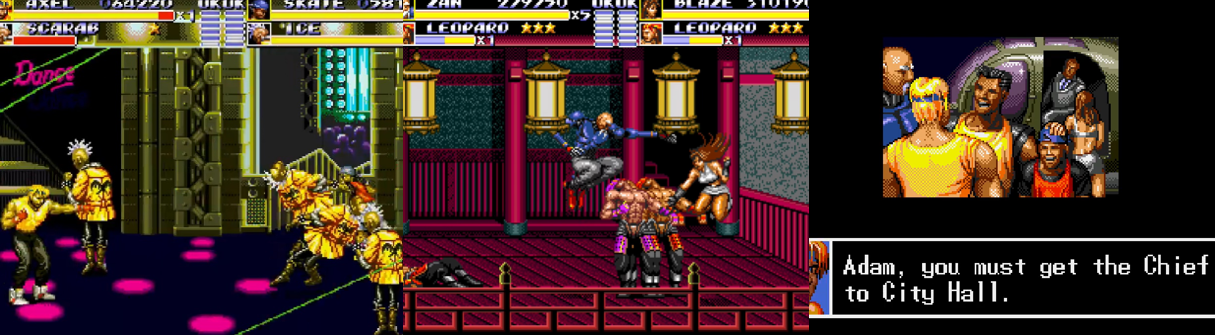
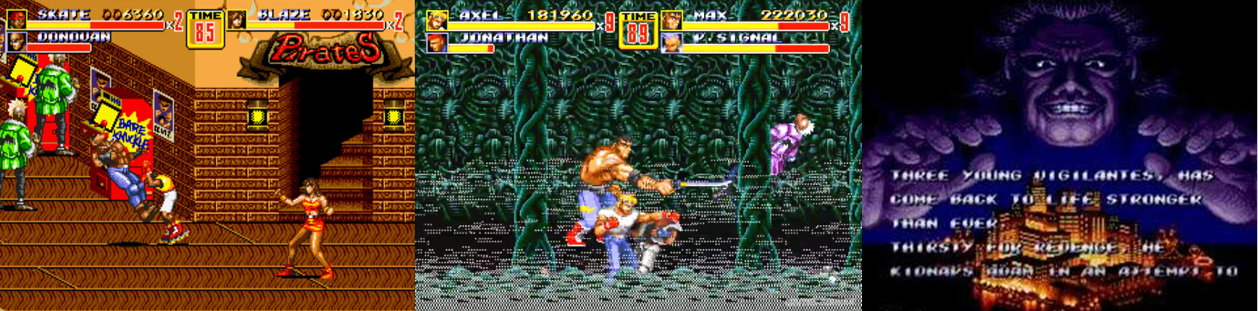
In keeping with the style of the series so far, Streets of Rage 3 is a sidescrolling 2D beat-‘em-up that lets players pick from one (or two, if you’re playing with a friend) of four playable characters and hit the mean streets of Wood Oak City one more time to take out a whole new batch of thugs across seven levels (referred to in-game as “Stages”). Just like last time, the game supports two-player co-op and a friend can jump in at any time, but there are now only three difficulty settings to pick from (“Easy”, “Normal”, and “Hard”). Not only that, but you won’t get to experience the full game if you play on “Easy” as the game will end at Stage 5 in this mode, meaning you need to play on at least “Normal” to have a shot at completing the whole game and even then this mode is notable harder than in the Japanese release. You can still manually set your stock of lives from the “Options” menu, however, and switch to another character after exhausting all of your lives and continues (of which you have three on “Normal”). Unlike the last two games, Streets of Rage 3 drops the time limit (with the exception of Stage 6 and the final boss), and the game is bigger and more fluid than ever. The control scheme, while fundamentally the same, has been expanded to include six-button control options, and is once again fully customisable in both the in-game menu and SEGA Vintage Collection settings. By default, A launches a combination of punches and kicks (and this can be set to rapid fire mode so you can simply hold down the button to pummel enemies), B lets you jump to hit one of three jumping attacks, and X unleashes one of two special moves to clear away groups of enemies at the cost of some health.

Characters are faster and more versatile than ever thanks to increased range of movement and combat options.

You can still perform a rear attack with A and B together (or assigning this to X, like I did) for better crowd control. You can also assign an “X Attack” (which appears to be a single, powerful attack from your combo) and you can still grab, pummel, toss, and slam enemies when you get close to them (and they can still do this to you, and can even perform co-op attacks and steal health items!) Streets of Rage 3 shakes up the roster once more; although Adam Hunter is still unplayable, he does make appearances in the game’s cutscenes, and lumbering oaf Max Thunder has been replaced by the cybernetic Zan. Axel, Blaze, Zan, and Skate continue to share the same basic attacks and controls and each again boast different skills according to five attributes (Power, Technique, Speed, Jump, and Reach). You can also see their height and weight listed in the character select screen, though I don’t think this really affects how the characters play; the other attributes certainly do, though, with Axel again being more of an all-rounder, Skate being the smallest, weakest, and fastest, and Zan having the best reach and able to zoom around on his rocket shoes but at the cost of having a shit jump and turning weapons into projectile attacks. As in the last game, each character is further separated by their different special attacks; Axel can still perform his flaming “Bare Knuckle” uppercut and spinning flaming fist, but Zan can electrocute enemies on contact and you can quickly pummel enemies with Blaze and Skate’s faster (but weaker) attacks. This time around, though, the game features a rechargeable meter; when full, your special attacks will be at their most powerful and won’t cost you any energy, and you’ll also gain a star under your life bar after accumulating high enough scores that will further power-up your special attacks. Every character can now not only dash ahead and perform a running attack (which also benefits from the star power-ups) but they can also vertically dodge out of the way with double taps of up or down, which is extremely handy when dealing with large groups of enemies.

Gameplay is given some much-needed, if frustrating, variety thanks to some timed sections.

If you’ve played either of the previous games (or any sidescrolling beat-‘em-up) then you’ll be acutely aware that your primary goal is to travel from the left side of the screen to the right dispatching enemies and smashing crates and such for objects and power-ups. Like the last game, each Stage is made up of multiple screens and areas, with transitions taking place to show characters smashing through doors or the time of day changing, and you’ll still be able to earn extra lives by adding to your score tally (with bonus points continuing to be awarded at the end of each Stage). Stages don’t seem as long as the last game, however, though each screen is longer, if that makes sense? You seem to spend more time in less screens, basically, and the game seems a little tougher this time around; I only found one 1-Up pick-up in my entire “Normal” mode playthrough and the sheer amount and variety of enemies onscreen can get a little frustrating. Enemies continue to be “shy” and linger offscreen, while also dropping down from the sky, emerging from the shadows, leaping from storage containers, hopping in from speedboats, and popping out from behind bushes to attack you, and it’s much easier to get surrounded by goons this time around. Not only that, but Streets of Rage 3 features the return of stage hazards; bottomless pits make a return in Stage 3 (though, thankfully, they’re not an instant-kill trap this time), barrels drop down from above, wind pushes you back, rising (and horizontal) platforms and elevator sections see you trapped with wave-upon-wave of enemies or tossing them to their doom, conveyor belts make movement and combat sluggish in Stage 7, and you’ll even have to dodge snare traps and laser turrets (though these can damage enemies, too). There’s actually a bit of gameplay variety thrown in here, too; not only do some Stages see you going to the left for a change, but you’ll need to smash through cinder blocks while fending off a digger machine in Stage 3, dodge hazards that fly at you along underground railroad tracks in Stage 4, and face a time limit in Stage 6. This is easily the most complex Stage in the game; you have fifty in-game seconds to clear out enemies, using an elevator to visit different floors, and destroy two control consoles before a lethal gas is emitted. If you take too long, the gas will not only whittle down your health, but cause the death of the captive police chief, Ivan Petrov, which will change the game’s ending accordingly.

Graphics and Sound:
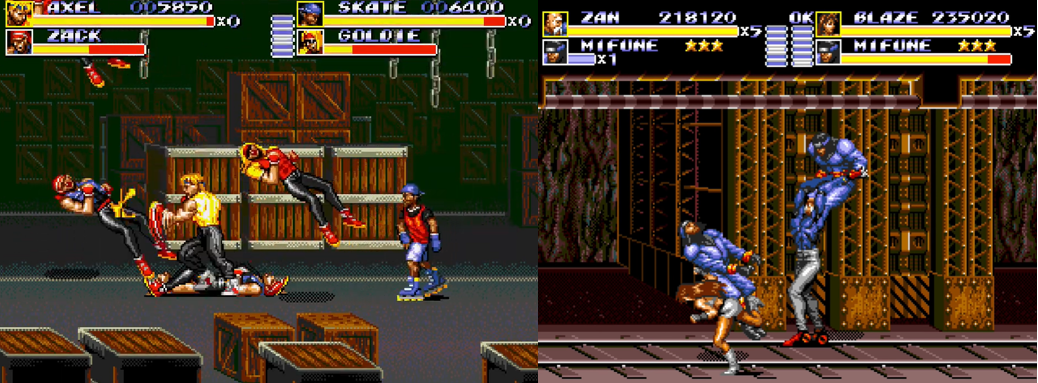
I have to say that, while I enjoyed some of the tracks featured in Streets of Rage 3, the soundtrack is probably the weakest in the trilogy; Stages are punctuated by a thumping, techno beat that is just as likely to be catchy as it is a mess of garbled noise. The links to The Revenge of Shinobi (SEGA, 1989) continue to be found within the game, as well; while the cutscenes finally feature a unique font for the game, Revenge of Shinobi font, sound effects, and melodies are still found throughout (though, at this point, they’re probably more associated with this series of games so I can forgive it). The game’s presentation is better than ever; sprites are larger and more detailed (with Axel, Blaze, and Skate sporting new colour palettes) and enemies are more varied; while skin-heads, dominatrixes, and denim-clad goons still dog your progress, a whole bunch of new enemies are featured, each sporting a name and a health bar. Some even boast a life count of their own, which generally gives you a better indication of how tough the enemy is and how many tiers their health meter has, and weapons also sport their own health meters now and will break after consecutive use.

While the music’s a bit of a mess, the visual presentation and variety is the best in the trilogy.

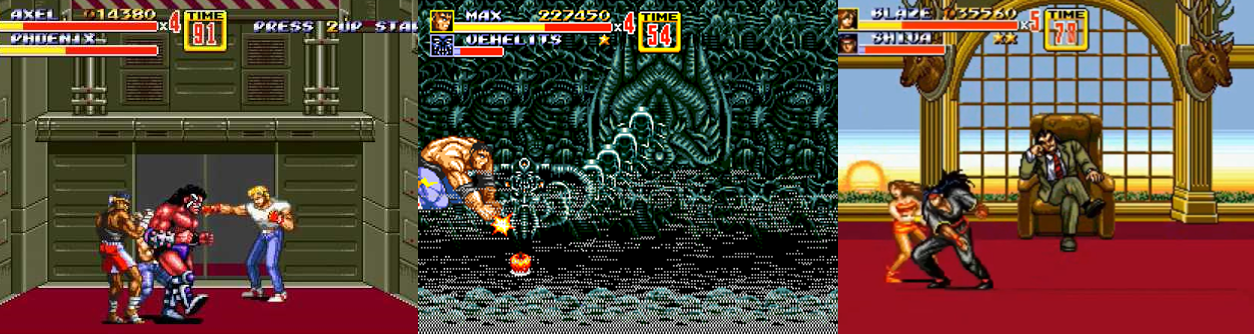
The environments are the biggest, most varied, and most detailed in the series yet, however. Little touches like chains shaking when you slam enemies to the ground, day turning to dusk, cats peeking out from bins, and wind blowing lanterns and rubbish about really help to make every Stage feel alive. There’s always a lot to catch your eye on the screen, from bushes rustling to indicate the arrival of a hidden enemy, to a bustling nightclub awash in strobe lights and dancing enemies, to glasses tumbling from bars, an aquarium in the background of the Stage 2 boss fight, and even an elaborate Japanese temple in Stage 5. Stage 5 also features a recreation of the final stage of the last game, once again having you fend off enemies in a rising elevator to Mr. X’s throne room, only this time it’s at night and the fight is notably different from the last two Mr. X boss battles and the big man himself is later revealed to be a brain in a jar within an underground laboratory! Everything is so much more detailed and varied this time around, which makes for an experience that finally captures the arcade-style aesthetic the series was going for with the first game, and this is even more evident in the heavier emphasis on story. Not only is there an introductory and ending cutscene, but cutscenes will also take place during and after certain Stages, with dialogue boxes appearing onscreen and different endings being shown depending on how you beat the final Stages of the game.

Enemies and Bosses:
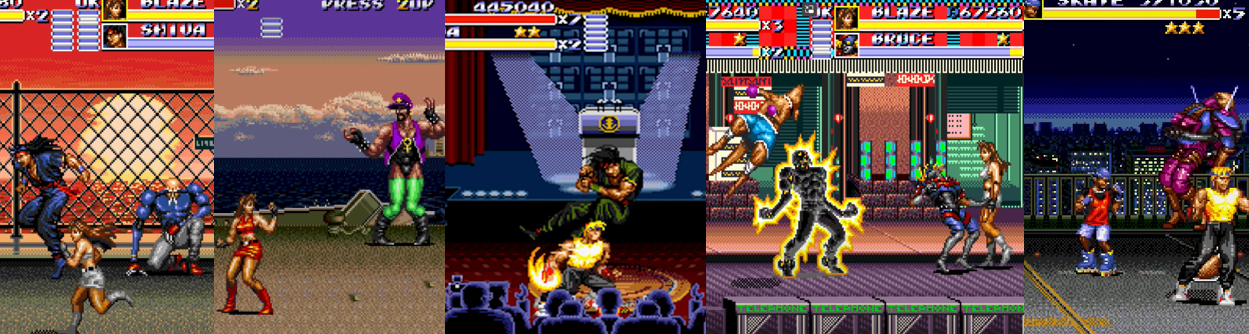
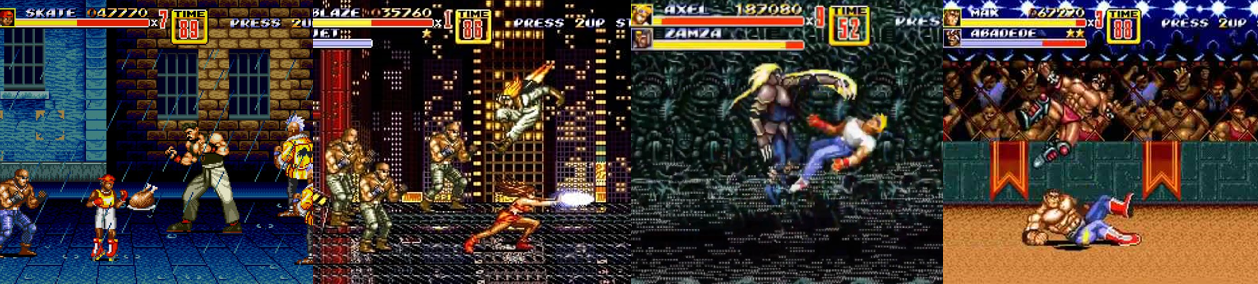
Although long-time players of the series will be more than familiar with the vast majority of the enemies encountered in Streets of Rage 3, palette swapped variants are much more commonplace and they appear alongside some new additions to Mr. X’s syndicate. Denim-clam thugs, yellow-jacketed punks, skinheads, dominatrixes, bikers, and ninjas all make a return to charge at you with knives, slide at your shins, uppercut you out of the air, crack their whips at you, charge at you on their bikes, and flip about tossing throwing stars at you. Newcomers to the series are “Goldie” (a street thug not unlike Axel who can guard against your attacks), “Soozie” (a punk girl similar to Blaze who can pummel you with slaps and leaps at you with flying kicks), and “Zack” (a bandana-wearing goon who likes to grab you from behind). Rotund firebreathers and belly floppers like Ben Ben also make a comeback (and once again cause you damage when you try to slam them), but you’ll also contend with gun-packing Assassin Agents, jetpack-wearing Rockets, martial arts experts like Tiger, and even robotic, frog-like enemies who hop about, dash at you, fire projectiles at you, or explode and send shrapnel across the screen.

Shiva’s importance depends on which difficulty and region you’re in, though you’ll see a lot of recycled bosses.

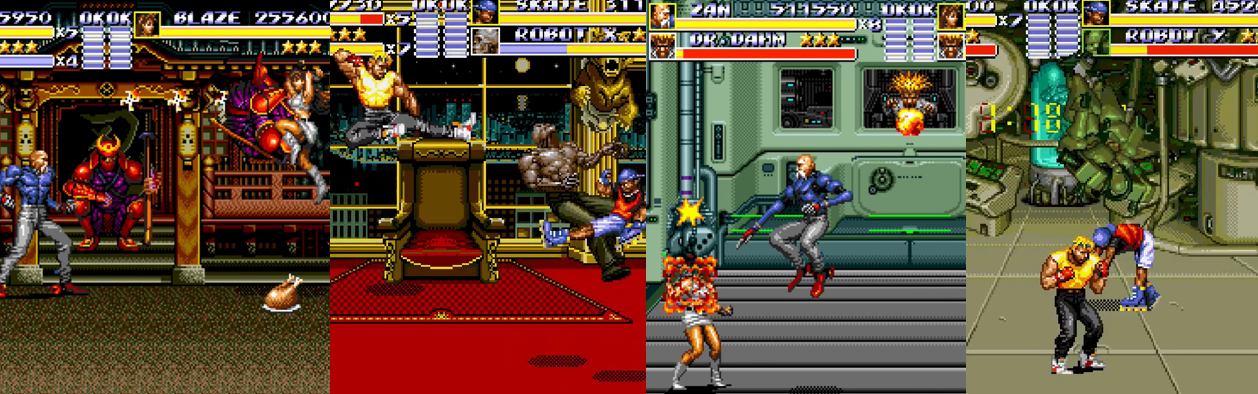
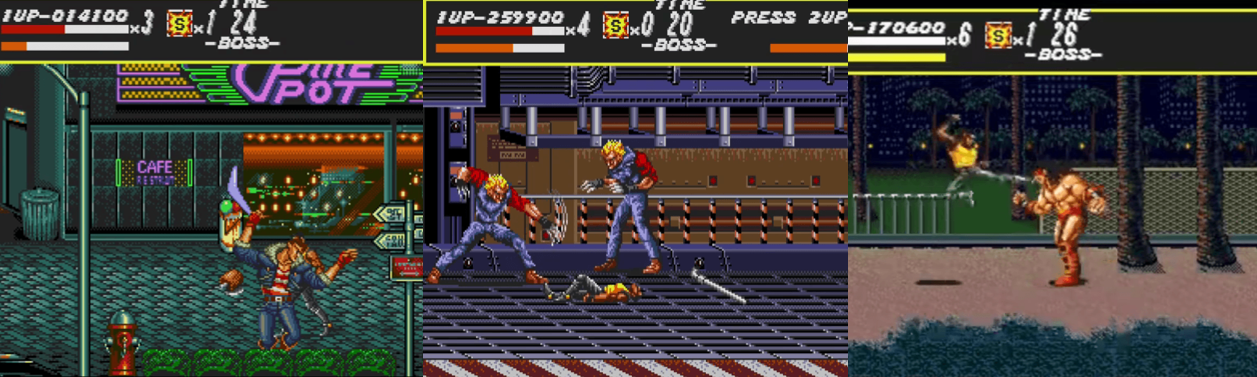
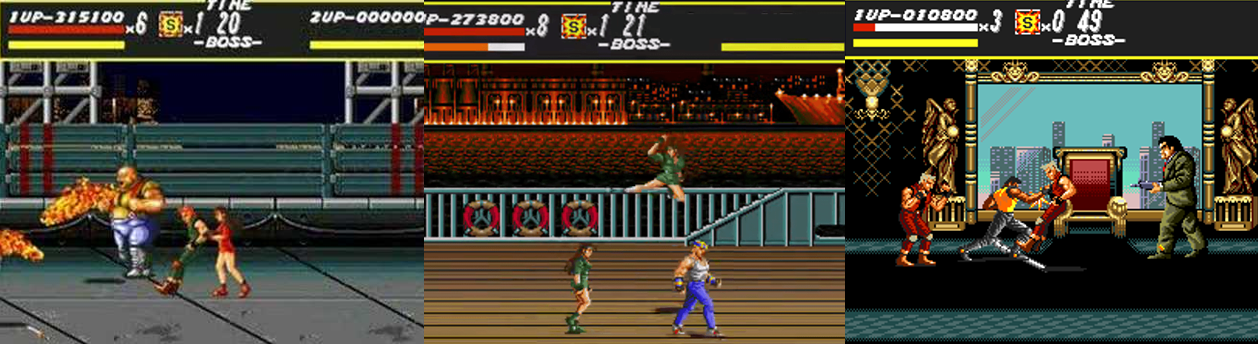
Streets of Rage 3 dramatically reduces the amount of sub-bosses you’ll have to face compared to the last game, with only two cropping up this time around; instead, certain regular enemies will receive a palette swap and an extended life bar to act as tougher mid-Stage enemies. Bosses will rarely be accompanied by an endless slew of thugs as well, which is definitely a plus, but three of them are recycled from Streets of Rage II and you’ll notice this right away when you reach the end of Stage 1 and face off with Shiva. Downgraded from a penultimate boss to the first boss of the game, Shiva isn’t quite as difficult as in the last game but still poses a challenge as he’s got a nasty leaping kick that can catch you off-guard after you knock him down. You won’t actually face Shiva in the Japanese version of the game, though; instead, you fight Ash, a stereotypically gay character who slaps you around, dances about, and can slam you to the ground. Both Shiva and Ash can be unlocked as playable characters after defeating them and holding B until the next Stage starts, but only Shiva actually makes a reappearance in the worst ending of the game where he serves as the final boss and is given a significant power boost alongside a new attire. Similarly, you can unlock the boxing kangaroo Roo if you take out his abusive handler, Bruce, in the sub-boss fight of Stage 2, after which you’ll battle the female tag team of Mona and Lisa once more who again prove to be slippery and annoying opponents as they continuously backflip away from your attacks and leap at you with kicks. Another returning boss is Jet, though he’s given a new look; he’s accompanied by Rockets, all of whom share his ability to swoop down at you and grab and slam you, but only Jet can blast you with flames from his thrusters. While you can land combo attacks on these guys, and grab and slam them, it’s still difficult to judge which plane they are on thanks to them constantly hovering about.

There are some tough bosses to contend with so it helps to play with a friend to dish out the damage.

New bosses do appear in Streets of Rage 3, however. At the end of Stage 3, you’ll battle an exact copy of Axel; this duplicate has all of Axel’s abilities and special attacks, but changes colour and bursts into flames as you land hits and is eventually revealed to be a robot imposter upon defeat. One of the hardest bosses is Yamato, an armour-clad samurai who is actually three bosses in one. Each samurai will take it in turns to attack you, slashing across the screen with their katana, duplicating themselves, and performing a diagonal dash attack that can be hard to dodge. When you finally confront Mr. X, the game initially frames the confrontation as being exactly like in the last game but, after dispatching his goons, he’s also revealed to be a robot duplicate. Robot X dashes across the screen on rocket boots, fires at you from a wrist-mounted gun, and even shoots homing missiles at you! You’ll then encounter weaker versions of this boss as regular enemies in Stage 7, which also sees a unique boss battle as you’re placed on a vertical conveyer belt that constantly forces you towards an electrical barrier while Dr. Dahm tries to crush and electrocute you with his mechanical claw arm. While it can be tricky to land hits on this, and time your attacks to avoid being shocked, it’s nothing compared to the final encounter with Mr. X, in which his disembodied brain controls the heavily-armoured Robot Y. This hulking foe is made all the more threatening by its maniac attack patterns; it spins around the place, barely fazed by your attacks, and sports a four-tiered life bar and missiles. Not only can it shrug off your attacks and deliver big damage with its basic strikes, the bastard can even grab you out of the air and deliver a huge slam that can easily drain half your life bar. You’re also given just three in-game minutes to defeat it and get the game’s best ending, making for easily the most challenging boss battle not just in this game but in the entire trilogy.

Power-Ups and Bonuses:
As ever, you’ll find a whole bunch of destructible objects in the game’s Stages for you to smash to uncover apples and roast dinners to restore your health, bags of cash and gold bars to add to your high score, and weapons to use against your enemies. Weapons are a little more diverse this time around, but also notably different; not only do they each have a life bar of their own, as stated, but some are single-use only. Knives, for example, are now thrown by default, as are grenades, though you can throw every weapon with the press of a button. You can grab kunai blades, wooden planks, lead pipes, baseball bats, and swords to attack your enemies, but be warned as enemies can also acquire (and throw) these weapons, and even steal your health items if you’re not fast enough!

Additional Features:
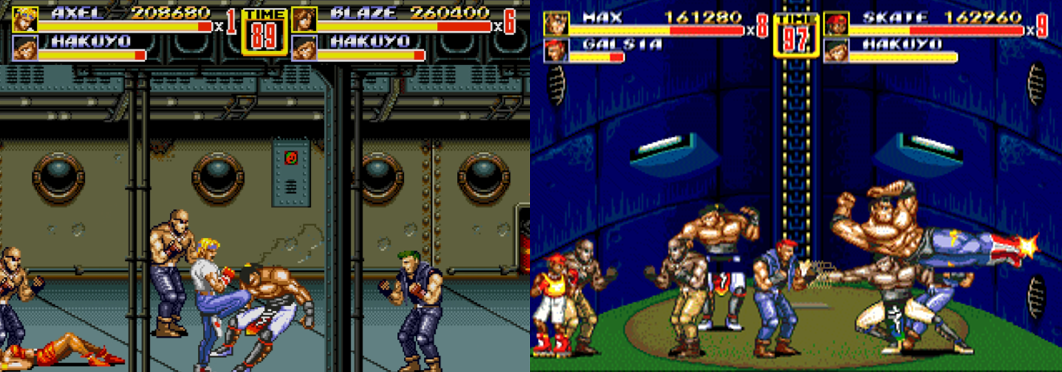
There are four Achievements to earn in Streets of Rage 3, and two additional Achievements as part of playing all three games in the SEGA Vintage Collection. The four specific to this game require you to defeat the robot Axel as Axel, free Roo, save the Chief as Zan, and max out your special attack by acquiring three stars. As in the other two games, each of these (with the exception of the latter) are achieved by playing alone and there are no Achievements for playing alongside a friend, or finishing the game as each character, which remains a disappointment. Streets of Rage 3 has a number of endings that are dictated by your progress in the last two Stages and which difficulty you play; you won’t get Achievements for seeing all of these endings, though, and are required to just beat the game (and the other two) to earn 100G. The “Duel” mode from Streets of Rage II returns; now called “Battle”, this mode lets two players to go head-to-head as one of the four playable characters in a one-on-one fight (but, again, there are no Achievements tied to this). This version of the game comes with the same customisation options as the others, so you can set wallpapers, scan lines, and smoothing, listen to the soundtrack on the jukebox, switch between the Japanese, European, and North American versions of the game, save replays, and use save states to make things easier on yourself. Alongside the usual local and online co-op returns, you can still set a high score on the leaderboard and take on the “Trial” mode, which has you battling towards a high score on different difficulty stages against a time limit or extracting the Chief as fast as possible, with the lives you lose adding to your timer.

The Summary:
The question permeating all these reviews of the Streets of Rage games is: Which is better? Streets of Rage or Final Fight? While the first game fell quite short of matching its arcade counterpart, Streets of Rage II was much closer, and Streets of Rage 3 is right up there with some of the best arcade beat-‘em-ups. Everything about the game is bigger and better than the last two, expanding upon the gameplay and presentation to offer the best Streets of Rage experience yet. Reintegrating elements from the first game, such as stage hazards, and expanding upon the gameplay by removing the time limit but offering some variety in tense sequences that see you fending off a digger or desperately fighting to save the Chief really add to the overall experience and make things less monotonous. On the flip side, and what keeps Streets of Rage 3 from earning my coveted fifth star, the music isn’t as good as in the previous games and the difficulty spike is very noticeably, making for some frustrating moments as enemies have bigger health bars and the time offered to you to complete tasks is so tight that it’s easy to fail and be left with one of the bad endings. The gameplay mechanics have never been better, however; the additional of the power gauge for specials, new control options, and impressively detailed sprite work and backgrounds make the game slick to control and endlessly visually interesting, but the recycled boss battles are a shame, especially considering how much detail was packed into every Stage. Overall, I’d say Streets of Rage 3 is easily the best of the original trilogy, and would recommend it as the go-to title to play and own; bigger, better, with more variety, some fun bonus characters, and different endings to work towards, the only thing holding it back from five stars are a few minor missteps that can make it a little too challenging an experience.

My Rating:

Rating: 4 out of 5.

Great Stuff

Did you enjoy Streets of Rage 3? How do you think it compares to the original, its sequels, and other beat-‘em-ups? Did you enjoy Zan’s inclusion or did you stick to a character you were more comfortable with? What did you think to the energy gauge and the recycled bosses from the last games? Have you ever gotten the game’s best ending? Which beat-‘em-up game or franchise is your favourite and why and what is it you enjoy about the genre? To share your memories of Streets of Rage 3, leave a reply below or comment on my social media and be sure to check out my reviews of another classic beat-‘em-up titles.

Game Corner: Streets of Rage II (Xbox 360)

Released: 30 May 2012
Originally Released: 20 December 1992
Developer: M2
Original Developers: Ancient, H.I.C, MNM Software, SEGA, and Shout! Designworks
Also Available For: Arcade, Dreamcast, GameCube, Game Gear, Master System, Mega Drive, Mobile, Nintendo 3DS, Nintendo Switch, Nintendo Wii, PC, PlayStation 2, PlayStation 3, PlayStation 4, PlayStation 5, Xbox One, Xbox Series S/X

The Background:
Sidescrolling beat-‘em-ups were a popular genre in both arcades and home consoles back in the mid-nineties thanks to games like Double Dragon (Technōs Japan, 1987), Final Fight (Capcom, 1989), and Teenage Mutant Ninja Turtles IV: Turtles in Time (Konami, 1992). Noriyoshi Ohba and his small team of developers drew inspiration from this genre to create the first Bare Knuckle Streets of Rage (SEGA, 1991) title, which initially released exclusively on SEGA’s home consoles. Given that Streets of Rage was incredibly popular and highly praised, a sequel was released only a year later; to incorporate new features and improvements over the original release, the developers improved the Mega Drive’s cartridge specifications to allow for larger, more detailed sprites and increased enemy swarms. Ayano Koshiro designed and coded the new characters, their moves, and tweaked the gameplay experience to make things faster, more dynamic, and more capable of competing against Capcom’s brawlers on Nintendo’s consoles. All this work paid off as Streets of Rage II was one of the top five best-selling Mega Drive games upon release and was met with widespread critical acclaim; reviews praised the improvements and combat, Yuzo Koshiro’s soundtrack, and the gameplay in general was universally celebrated. After being re-released and ported numerous times over the years, all three Streets of Rage games came to the Xbox 360 as part of the SEGA Vintage Collection, with this version including additional modern quality of life elements such as save files, a replay feature, and bonus content.

The Plot:
One year after saving Wood Oak City from Mr. X’s crime syndicate, former police officers Axel Stone and Blaze Fielding join forces with professional wrestler Max Thunder and Eddie “Skate” Hunter, the younger brother of their comrade, Adam Hunter, when Mr. X makes a sudden return and kidnaps Adam!

Gameplay:
Like its predecessor, Streets of Rage II is a 2D, sidescrolling beat-‘em-up in which players pick from one of four playable characters and return to the mean streets of Wood Oak City to clear out a new batch of thugs across eight levels (now referred to as “Stages”). As before, you can choose to tackle this either alone or alongside a second player, who can jump in at any time, and can again pick from four difficulty settings (ranging from “Easy” to “Hardest”). This time around, you can manually set the amount of lives you have from the “Options” menu and, after losing all of your lives and continues (of which you have three on “Normal”), you can enter your initials on the high score board and then switch to a different character to continue playing as if you want. Each Stage is played against a generous time limit that is extended by clearing enemies from the screen, or if you lose a life. Compared to the last game, Streets of Rage II is much bigger, faster, and more responsive, with additional animations, combos, attack options and unique gameplay mechanics both shared and exclusive to the four playable characters. Once again, you have a simple three button control system that can be fully customised both in the in-game menu and using the SEGA Vintage Collection settings to allow for a rapid fire attack option. By default, A sees you attack with either a punch or a kick, B lets you jump to land one of two jumping attacks, and X lets you pull off one of two special moves to clear away groups of enemies at the cost of some health. You can switch up these buttons as you like in the main menu, and you can now pull off a rear attack by either pressing A and B together or by assigning this attack to another button (I used X) and pull off either a dash or a forward lunge attack by double tapping the directional pad and pressing attack. When you get up close to enemies, you’ll also grab them, allowing you to either pummel them, toss them behind you (and into other enemies), or slam them to the ground for big damage. Anything you can do, your enemies can do too, however, so you’ll need to make sure to avoid them grabbing and throwing you, overwhelming you from all sides, or sliding or charging at you. Although Axel, Blaze, Max, and Skate all share the same basic attacks and controls, each now has five different attributes that changes the way they play as they have more or less focus on Power, Technique, Speed, Jump, and Stamina. This means that Skate is the fastest but weakest character and Max is the most powerful but the slowest, and this extends to their attack options. For example, Axel can perform his “Grand Upper” to somewhat dash ahead, Blaze unleashes a short range fireball and Skate literally dashes ahead in a diving cannonball attack while Max does a limited shoulder charge and slide attack, so you really feel a difference when playing as each character as you trade off speed and jump height for attack power or defence.

The four playable characters all control a little differently and have unique special attacks.

Special attacks are much more varied this time around as well; rather than every character simply calling in backup, each one has a different health-sapping move to deal big damage to multiple enemies. One is performed by a simple press of the special attack button and the other is performed in conjunction with a directional input and, since they drain your health, you won’t have to worry about picking up specific power-ups to replenish them, though your health bar does drains down to the point where you can’t pull them off. This introduces a new layer of strategy to combat as you now must weigh the risk and reward of the abilities of your chosen character while also factoring in whether it’s better to lose a little health pulling off a special or risk losing more health by holding back and getting pummelled by enemies. As ever in these types of games, your goal is to travel from the left side of the screen and to the right and wade through enemies; however, this time around the screen occasionally scrolls diagonally downwards and upwards. Stages are also much longer and generally comprised of at least three areas, meaning when you reach the final part you’ll usually battle a sub-boss and then enter a building or a new area to take on more enemies, making each Stage (and, consequently, the game) much longer. Taking out enemies and grabbing pick-ups still awards you points, and you’re once again awarded bonus points at the end of each Stage depending on how much time and life you have left, which will eventually award you with an extra life. By default, each character is pretty durable, though some are tougher than others, and I found that raking up extra lives was much easier this time around. More enemies, and more varied combinations of enemies, fill each screen at any one time but the game feels less cheap than the last one and the new combat animations and mechanics make crowd control a lot easier. It also helps that onscreen hazards are now at a minimum; there are no death pits to fall down, no crushing weights or flames to worry about. While some enemies will toss grenades at you from the background, pop up from sewer holes, or leap in from offscreen, the only real onscreen hazard you come across are some conveyor belts. Enemies remain shy and like to linger just offscreen, which can be annoying when you’re trying to progress further, and some destructible objects do tend to explode, but these can also damage enemies as well, which is very helpful. Streets of Rage II also has not one, not two, but three elevator sections, none of which allow you to toss your foes off the side, and when you view your high scores you’ll be able to see stats like which Stage you got to and how many K.O.s you scored (which I assume is enemies beaten but it could also be the amount of lives you lost).

Graphics and Sound:
Streets of Rage II continues the tradition of the series by filling every Stage with a catchy, thumping soundtrack that really helps to make the monotonous gameplay fun since you’re just humming away as you go to town on waves of enemies. You still get a congratulatory melody after finishing a Stage, boss themes, and scream, grunt, and groan; it’s always obvious when you’ve grabbed an item or earned an extra life thanks to an audible jingle but, while many of the sounds and music are more elaborate and impressive than the first game, many are still recycled from The Revenge of Shinobi (SEGA, 1989). The overall presentation is much improved, however; the heads-up display is now no longer confined to an ugly black box at the top of the screen, meaning the locations are bigger and much more detailed; enemies now have (ridiculous) names and life bars of varying lengths (with sub-bosses and bosses having two- or three-tiered life bars), and there’s generally a lot more life in the sprites and environments.

The game is bigger and far more visually interesting than before, with an equally kick-ass soundtrack.

The sprites are much bigger and more detailed than before; their idle animations still generally amount to just breathing heavily and waiting for the next punch-up, but Skate glides along on his rollerblades in a very slick way and everything just has a little more polish this time around, which is only bolstered by a few new animation frames when grabbing and beating on enemies or performing your character’s combos. The story is once again told through text but the font is much clearer and longer, still images are used to recap the ending of Streets of Rage and show the ending sequence for this game, and Stages are way more varied than before thanks to going on longer. You’ll see lampposts and chain link fences in the foreground, cars and different views of the city in the background, fog and rain effects, smash your way through a bar and an arcade (where enemies are playing Bare Knuckle machines), explore a pier and fairground (where enemies sleep on bunches, a rollercoaster can be seen, and you end up in something ripped from the mind of H. R. Giger and a pirate ship), and battle your way into the SEGA Stadium where the green becomes a descending elevator section, You’ll cross a bridge held up by huge girders, traverse conveyer belts in a factory, battle through the foyer of Mr. X’s newest elaborate skyscraper, and even end up in a gladiator pit and in the back of a moving van where enemies and audiences cheer on your foes as they try to beat the life out of you. It’s all much bigger and more visually impressive, even though many of the Stages are reminiscent of the last game; little touches like fighting along the beach from the other perspective than in Streets of Rage (so now the sea is behind you) and progressing from the interior of a rocking ship up to the deck really show how the game is taking everything that worked in the first and improving upon it for a deeper, more visually engaging and exciting gameplay experience.

Enemies and Bosses:
While you’ll recognise the vast majority of the enemies you’ll encounter throughout Streets of Rage II from the last game, they now have names and life bars and palette swapped versions of them crop up right from the first Stage, which helps to make them seem more varied than they actually are. The denim-clad thugs and yellow-jacketed punks return, still charging at you with knives, sliding at your shins, or trying to throw you across the screen but they’re now joined by bald bastards who uppercut you out of the air at the worst possible moments. While the whip-cracking dominatrixes return, the martial artists have been replaced by Muay Thai kickboxers and ninjas who can guard against your attacks, flip about the place, and toss throwing stars your way, respectively. Bikers make their first appearance here, charging and leaping at you on their motorcycles, though you can kick them off and take them out with their own exploding bikes; their grenades will also damage other enemies, and you’ll now drop whatever weapon you’re carrying when you grapple with an enemy (and ninjas can even catch ones you throw at them!)

Sub-bosses and bosses return as regular enemies, except for the Vehelits and formidable Shiva.

As Stages are now longer, you’ll now have to contend with a number of sub-bosses as well as end of Stage bosses. As before, all of these reappear in later Stages as recoloured and renamed regular enemies, though slightly weaker and with some variations. The first sub-boss is Jack, a large punk with a flaming Mohawk and garbed in a ripped denim shirt and jeans. This guy’s packing knives, which he’ll stab or throw at you, but you can also pick them up and use them against him and any other enemies coming for you, which is handy when he reappears in his recoloured forms. Dominatrixes like Elektra often attack in pairs and are given extra attack range with their whips, which can also be electrified, but I found them pretty easy to take out before they could do any real damage. Hakuyo and his variants are muscular martial artists who literally drop in with flying kicks and jump attacks, while Big Ben is a returning, rotund enemy from the last game who will plod around trying to set you alight with his fire breath or try and crush you with a big belly flop (but, this time, you are able to throw and slam him without being hurt). One of the more unique sub-bosses is Vehelits, an animatronic alien head that pans across the screen to send you flying and is one of only three enemies you’ll fight just the one time in the entire game, which is fine as all the other sub-bosses and bosses crop up again in the later Stages. After running an enemy gauntlet, you’ll once again confront Mr. X; this time, rather than offer you the chance to join him, he orders his personal bodyguard, martial artist Shiva, to soften you up. Shiva is the closest you’ll get to a boss who is as versatile as you; he attacks with flying and sliding kicks, guarding against your attacks, and flying at you with flaming cartwheel kicks. While he cuts an intimidating figure, he’s actually not as hard as some of the game’s other sub-bosses, however.

While the first two bosses aren’t too difficult, things get tricky once Zamza and Abadede appear.

After fighting through the bar and into a rainswept alley, you’ll take on Barbon, the musclebound proprietor of the establishment you just wrecked who (alongside a bevvy of regular goons) throws spinning kicks, tosses you across the screen, guards against your attacks, and kicks you out of mid-air. When he reappears later, he’s actually one of the easier enemies, especially compared to Stage 2’s boss, Jet. This jetpack-wearing asshole constantly hovers overheard, swooping down or across the screen or grabbing you and sending you crashing to the ground. It can be a little tricky to land a hit on him, much less a combo, as it’s not always easy to judge what “level” of the background he’s on, which can make him a hell of an annoyance when he reappears as a regular enemy. Still, he’s a walk in the park compared to Zamza; this Blanka-like asshole attacks with clawed talons, spinning and jumping all over the place and flying at you with a cannonball attack, swiping you out of the air with a twirling uppercut, or delivering a massive German Suplex up close. His appearance on Stage 8 as “Nail” was a particular headache for me, and actually harder than the last bosses of the game since he’s so hard to keep track of and land decent hits on. In the gladiator pit, you’ll have a rematch with hulking wrestler Abadede; this Ultimate Warrior rip-off has expanded his repertoire to include an uppercut, a lariat strike, a flying body splash, a muscle flex that can send you flying, a big back suplex, and will even strike you with a wrench when he grabs you.

While the final boss is basically the same as before, there’s some interesting (if annoying) battles prior to this.

After fighting your way onto the deck of Stage 5’s ship, you’ll go toe-to-toe with the bulbous Rocky Bear; this guy’s also no joke as he hops about on his tiptoes, pummelling you with punches when he grabs you and easily cancelling your combos with a lunging fist, or comes flying at you with a butt stomp! He’s also accompanied by “Balloon”, a Big Ben variant, and he can be a real pain in the ass as you have to try your luck with a leaping kick, break free of his grab with your special, and dodge out of the way to do some real damage with a combo. Things get a little lazy at the end of Stage 6, however, as you have to fight a variant of Zamza and Jet (known as “Souther” and Stealth”) rather than a unique boss battle, though Stage 7 makes up for this with the tag team combo of robots Particle and Molecule. These cycloptic automatons jump about the place to avoid your attacks, swing their retractable mace-like appendages at you, and even fire projectiles from their eyes but they’re not especially difficult to deal with even when they immediately appear as regular enemies at the start of Stage 8. After dispatching Shiva, you’ll finally face off against Mr. X; unfortunately, this is basically exactly the same as in the last game as Mr. X wanders about trying to brain you with the butt of his rifle (which, to be fair, lands as a combination of hits this time) and haphazardly spraying bullets across the screen. Goons will file in to distract you, but they can also be hurt by Mr. X’s bullets, and as long as you focus on attacking him you’ll come out on top easily enough. I’m actually surprised the developers didn’t have an alternative version of Shiva (or Shiva himself) attack you in this final bout as it’s a pretty simple final fight, and the game is actually much fairer (on “Normal”, at least) than the last one, so it’s not inconceivable that you could get through this without too much difficulty, which is surprising considering how tough and cheap Zamza can be.

Power-Ups and Bonuses:
There are still plenty of destructible objects scattered around the various Stages for you to smash to uncover goodies; apples and roast dinners will restore some or all of your health, the occasional 1-up will grant you an extra life, and bags of cash and gold bars to add to your high score. This is also the main way (outside of disarming enemies) that you’ll acquire a melee weapon; interestingly, there’s only one new weapon in the game (the kunai blade dropped by the ninjas) and some (like the glass bottles) are actually missing. On the plus side, every character swings the metal pipe differently and weapons can be throw at the press of a button to become projectiles but, if you get hit and drop them enough, they still eventually disappear and you may also struggle to attack if you’re standing over a weapon as your character will try to pick it up instead of defending themselves. Since your special move is tired to your health bar, there’s no item to pick up to replenish your stock; you can perform each character’s unique special move as long as you have enough health, and there’s actually a reason to play as different characters this time since they control a little differently and have unique special attacks.

Additional Features:
There are two Achievements on offer in Streets of Rage II, and three additional Achievements as part of playing all three games in the SEGA Vintage Collection. The two specific to this game require you to defeat Zamza on Stage 3 as Skate and Abadede on Stage 4; there are no Achievements for playing with a friend, or for finishing the game as each character, which is a bit disappointing. Unlike the first game, Streets of Rage II only has one ending, further reducing the replay incentive somewhat, but it does come with a new game mode. “Duel” allows two players to go head-to-head as one of the four playable characters in a one-on-one fight; you can select a Stage to battle on, and whether or not special moves are active, but again there are no Achievements tied to this extra mode and no other characters to play as. This version of the game comes with the same customisation options as the last game, allowing you to set wallpapers, scan lines, and smoothing, listen to the soundtrack on the jukebox, switch between the Japanese, European, and North American versions of the game (which again amount only to cosmetic differences), save replays, and make use of save states to the game to make it dramatically easier. Local and online co-op also return, as do leaderboards and the “Trial” mode, which has you battling towards a high score on four different difficulty stages against a time limit or going against Zamza’s “Horror House Challenge”.

The Summary:
I concluded my review of Streets of Rage by saying that I would probably pick Final Fight over it since, while it was a great game and a good attempt at an arcade-style beat-‘em-up, it didn’t quite match up to the level of Final Fight. With Streets of Rage II, the call is much harder to make; with larger, more detailed and visually appealing graphics, new characters with unique ways of controlling and special moves, and longer and more diverse Stages, Streets of Rage II is clearly bigger and better than its predecessor in every way. The core gameplay remains the same, but everything is faster, slicker, and meatier than before; there’s so much more to see and combat is way more fun and the cheapness of the original’s difficulty curve has been toned down quite a bit. While you can argue that this makes Streets of Rage II easier, I’m okay with that; when it comes to arcade beat-‘em-ups, I want a simple pick-up-and-play experience that can be challenging but not unfair or frustrating, and Streets of Rage II was a great time from start to finish. It was a shame to see some weapons missing, some Stage themes repeated from the last game, and that there weren’t more Achievements added to this version of the game, but there’s no denying that Streets of Rage II is vastly superior to the first game in every way. It almost feels like the first game was a proof of concept for the engine and the mechanics as Streets of Rage II just refined everything into an experience that’s far closer to what one would expect from an arcade title, so I would definitely choose to pick this one over the first one and happily compare it to Final Fight in terms of quality and enjoyment.

My Rating:

Rating: 4 out of 5.

Great Stuff

What did you think to Streets of Rage II? How do you think it compares to the original, its sequels, and other beat-‘em-ups? Which of the four characters was your go-to and were you a fan of the new ones introduced here? What did you think to the longer Stages and additional sub-bosses? Have you ever beaten this game on the hardest difficulty setting? Which beat-‘em-up game or franchise is your favourite and why and what is it you enjoy about the genre? To share your memories of Streets of Rage II, sign up to leave a reply below or comment on my social media and be sure to check out my other reviews of the series!

Game Corner: Streets of Rage (Xbox 360)

Released: 30 May 2012
Originally Released: 2 August 1991
Developer: M2
Original Developer: SEGA
Also Available For: Arcade, GameCube, Game Gear, Master System, Mega Drive, Mobile, Nintendo 3DS, Nintendo Wii, PC, PlayStation 2, PlayStation 3, PlayStation 4, PlayStation 5, Sega CD, Xbox One, Xbox Series S/X

The Background:
Back in the mid-nineties, sidescrolling beat-‘em-ups were a popular fixture in arcades, and demanded little more than players hold right and mash buttons to take down waves of generic enemies and continually part with their hard-earned pocket money. Beat-‘em-ups were also prominent on home consoles thanks to the ports of Final Fight (Capcom, 1989) and Teenage Mutant Ninja Turtles IV: Turtles in Time (Konami, 1992), so it made sense for SEGA to develop the beat-‘em-up series, Bare Knuckle Streets of Rage (SEGA, 1991 to 1994). Essentially a rip-off of the Final Fight series, Streets of Rage was the brainchild of Noriyoshi Ohba and Hiroshi Momota and stood out from others in its genre by foregoing the arcades entirely. Having previously helmed The Revenge of Shinobi (SEGA, 1989), Ohba drew from Double Dragon (Technōs Japan, 1987) and Starsky & Hutch (1975 to 1979) to compete with the likes of Final Fight and he and his nine other developers managed to pull the first title in the series together in just six months. Streets of Rage was incredibly popular upon release; critics praised the colourful graphics, two-player gameplay, and range of attacks offered to players and Yozo Koshiro’s soundtrack was equally lauded. Having been re-released in various compilations over the years, Streets of Rage and its sequels made it to the Xbox 360 as part of the SEGA Vintage Collection, with this version including additional modern quality of life elements such as save files, a replay feature, and bonus content.

The Plot:
The once a peaceful and prosperous Wood Oak City has fallen into the hands of a crime syndicate led by the mysterious Mr. X. The Syndicate has absorbed the city’s government and even has the police department in their pocket, causing crime and violence to run rampant. Police officers Adam Hunter, Axel Stone, and Blaze Fielding decide to take matters into their own hands and take to the streets as vigilantes to put a stop to the Syndicate.

Gameplay:
Streets of Rage is a 2D, sidescrolling beat-‘em-up in which players pick from one of three playable characters and battle swarms of thugs on the mean streets of Wood Oak City across eight stages (referred to as “Rounds”). You can do this either alone or alongside a second player, and the game has four difficulty settings ranging from “Easy” to “Hardest” which dictates the amount of lives and continues you have and the aggressiveness of the game’s enemies. Each Round carries a time limit that can only be extended by clearing the current wave of enemies from the screen; if you fail to do this, you’ll get a time over and lose a life, but will respawn on the same screen with the time replenished. While the game has a slow, almost plodding pace and movement can be equally sluggish, you’re given a surprising range of attack options considering you only really need to press one button to attack. By default, A throws a punch, B lets you jump, and X calls in police backup to fire a screen-clearing missile from their squad car. You can switch up these buttons to your heart’s desire in the main menu, and even activate a rapid fire option so you simply hold down your chosen attack button to make mincemeat of enemies, but the only way you can move and attack at the same time is to pull off a flying kick. There are no dash or dash attack options here but, open getting close to enemies, you can stun them with a nifty combo, grab and pummel them, hop around behind them to pull off a slam or German Suplex, and toss them across the screen and into other enemies, down holes, or send them crashing through destructible objects. Enemies can also grab and throw you, however you can fend off their buddies when they’re holding you still and eventually throw them off if you hit the buttons fast enough.

While each character controls the same, they have different attributes to make their gameplay unique.

While Adam, Axel, and Blaze all essentially play the same, each has different attributes that changes the way they play; Adam is slower, for example, while Axel has a shorter jump and Blaze has a weaker attack but is much faster and dramatically speeds up the pace of the game, so it definitely changes the way you play depending on which character you pick. With the exception of two Rounds, your only goal is to travel from the left side of the screen and to the right, taking out larger and more varied groups of enemies as you progress. Defeating enemies and snagging pick-ups will award you points; you’ll also earn bonus points at the end of each Round depending on how much time and life you have left, and you’ll gain an extra life once you reach a certain increment in your score. While you’re quite durable, it’s easy to get overwhelmed and lose a life; if you do, you’ll respawn right where you died with your specials and time replenished and even send all onscreen foes flying as a bonus, but you can’t afford to get too cocky as it’s pretty easy to burn through lives, especially on later Rounds and bosses, and then have to rely on your small stock of continues. Streets of Rage’s challenge definitely increases the further you progress; enemies become more aggressive and numerous but are also quite shy and linger just offscreen to really run down the timer. You’ll also have to deal with instant-death holes, conveyor belts, and crashing hazards, though these can all be used against your enemies as well. As is the tradition in any sidescrolling beat-’em-up worth its salt, you’ll also have to contend with a vertical elevator stage in which a small platform will rise up the outside of a skyscraper and wave upon wave of enemies will shuffle in from different floors or drop from above, though you can easily make short work of them by tossing them over the side.

Graphics and Sound:
Streets of Rage features a very catchy, thumping beat of a soundtrack that really helps to make the monotony of its beat-‘em-up gameplay more appealing. Boss battles at accompanied by an ominous theme song and a congratulatory little melody plays upon completion of a Round. Characters will scream, grunt, and groan as they attack, are hurt, or die and you always know when you’ve picked up an item or earned an extra life or special thanks to an audible jingle. If you’ve played The Revenge of Shinobi before, however, you may recognise that the game’s font, heads-up display, and many of the sound effects are ripped from that game, which I always felt cheapened Streets of Rage a bit since no other Mega Drive game I’d played at the time did this unless it was a sequel or part of a franchise.

While many sounds are recycled, the game has a thumpin’ soundtrack and some impressive visuals.

Sprite work is pretty impressive here; the three protagonists and their enemies are a little small, but you can adjust the screen size in the options to make them a bit bigger (though this does pixelate them) and, when left alone, they have very minor idle animations to give them some personality. While the main story narrative is told only through text, the ending features some nice detailed sprite panels showing the trio emerging victorious, and you’re even presented with a dialogue box in the final Round of the game. Where the game really shines, though, are its locations; from the streets to the beach, a factory, and Mr. X’s penthouse suite, the environments are all very detailed and full of little things to see and graphical effects, such as enemies emerging behind shutter doors, rain, windswept rubbish, statues, and the looming lights of the city at various distances in the background. Foreground elements such as lampposts, cars, and the raging sea pop out at you, and you even end up on a boat at one point that rocks up and down from the current.

Enemies and Bosses:
Unlike other beat-‘em-ups of the time, enemies don’t display their names or individual life bars when attacked; life bars are reserved only for the game’s bosses, but it won’t take more than a few hits to take out the low-level scum you encounter in the first few stages. These are made up of denim-clad thugs who sometimes wield knives, yellow-jacketed punks who grab and throw you, and karate-kick throwing martial artists who hop about the place. Very quickly, you’ll encounter more aggressive, palette-swapped versions of these enemies who carry other melee weapons, can deal more damage, and seem to recover faster after being knocked down. You’ll also come across whip-cracking dominatrixes, jugglers who dance around the screen using fire-bombs and axes as makeshift shields and projectiles (that you can, thankfully, hit with your attacks) and even buffet carts that come hurtling at you from off-screen.

Large, hard-hitting bosses await at the end of the Rounds and even reappear as regular enemies.

Seven Rounds means seven bosses to contend with but you won’t be facing any of them just once as all of them will reappear as regular enemies in later Rounds, though without life bars. The first you’ll encounter is Antonio, a large man wearing denim and carrying a razor-sharp boomerang; Antonio will linger just off-screen, circle around the area, and either toss his boomerang your way or deliver a hefty kick when up close but is undeniably the easiest of the bosses despite being the first formidable enemy of the game. The second boss, Souther, is much more difficult and starts a trend of the bosses being accompanied by a gaggle of thugs to distract and annoy you. Souther sports two sets of metal claws for hands and drifts around the screen swiping at you or unleashing a fast-paced barrage of slashes that can easily tear through your life bar, so it’s best to try and stay on the move and anticipate where he’ll be so you can pummel him with your grapple attacks. The hulking Abadede awaits you at the end of Round 3; this Ultimate Warrior rip-off lumbers in from off screen with a charge or devastating uppercut but, despite his size and strength, can easily be taken down by quickly hitting jumping kicks rather than trying to match fists with him.

Bosses are soon accompanied by a swarm of thugs to really put a crimp in your day.

At the end of Round 4’s bridge, you’ll have your first encounter with Bongo, a rotund fire-breathing man who homes in on you to try and set you ablaze. While it can be difficult to avoid his flaming breath, you also need to avoid trying to throw or suplex this guy as, in a fantastic piece of attention to detail, you’ll end up taking damage and being crushed from his hefty weight. After battling through the boat and fending off recoloured versions of Abadede, you’ll have to fight two bosses at once: Mona and Lisa, easily the laziest bosses in the game as they appear to simply be palette swaps of Blaze. These gals are also extremely slippery devils as they’ll flip all over the place, try and throw kicks at your head, and send you flying with judo throws, so it can be really tricky just trying to land a hit on them in the first place. Two Southers await you at the end of Round 6 and, while you won’t face any bosses in Round 7, you do have to endure a gauntlet of enemies on the elevator and all of the previous bosses hounding you throughout Round 8. Round 8 concludes with a showdown with Mr. X; beforehand, he’ll offer you the chance to join his cause. If you answer “Yes” in two-player mode but your friend answers “No”, you’ll have to battle each other to determine who gets to take him on. The battle against Mr. X is fraught with a never-ending slew of thugs; the big boss himself wanders back and forth, spraying bullets across the screen and trying to brain you with the butt of his rifle, but actually isn’t too tricky to take out (on “Normal” mode, at least) despite Round 8 not allowing you to use specials.

Power-Ups and Bonuses:
Be sure to smash everything you see in each Round, from phone booths to tyre stacks and wooden crates, as these will yield apples or roast dinners that will restore some or all of your health. Very occasionally, you’ll find a 1-up or an extra special hidden in these too, or a bag of cash and gold bars to add to your high score and edge you closer to an extra life. These destructible elements, and enemies, can also hold a variety of melee weapons, from knives to pipes and baseball bats, to stun grenades, all of which can help turn the tide in your favour by adding extra range to your attacks and hitting multiple enemies at once. You can throw knives and the grenades, limiting their usefulness, but weapons won’t break upon use; if you get hit and drop them enough times, however, they will eventually disappear from the screen and, if you miss anything, you can’t go back and get it so just grab it when you see it or it’s safe to do so (which can be easier said than done, especially if a couple of weapons or pick-ups are staked next to each other). Finally, although there are three characters to select, each with their own attacks and gameplay variants, there’s only one special move which, while useful, is a little disappointing.

Additional Features:
There are four Achievements to earn in Streets of Rage, and two additional Achievements as part of playing all three games in the SEGA Vintage Collection. While two of these require separate playthroughs as Adam and Blaze alone, there are unfortunately no Achievements for playing as each character or alongside a friend, and the other two amount to simply tossing an enemy and recovering from a throw, which is a bit disappointing consider the game as multiple endings and opportunities for fun Achievements, such as crushing an enemy with a stage hazard or tossing a certain number to their deaths. This version of the game also comes with a variety of display options that allow you to set wallpapers, scan lines, and smoothing in addition to customising the controls to your liking. There’s also a jukebox that lets you listen to the game’s rockin’ beats, the ability to switch between the Japanese, European, and North American versions of the game (which seem to amount to cosmetic differences and little else, certainly no extra Achievements), and adds save states and replays to the game to make it dramatically easier. Probably the most significant additional feature is the “Trial” mode, which tasks you with achieving a high score on four different difficulty stages against a time limit or lasting out against enemies on the elevator Round (though, again, there are no Achievements to be gained from this). Finally, you can play with a friend locally and online, and the game includes at least two endings, one where you defeat Mr. X without question and a bad ending where you usurp him and become the new crime boss.

The Summary:
I do enjoy me a good sidescrolling beat-‘em-up and there’s a lot to like in Streets of Rage. Without a doubt the game, and the series, is one of the Mega Drive’s most prominent titles, and yet the series is often forgotten about these days and SEGA have been uncharacteristically reserved about churning out sequels and spin-offs or even featuring Streets of Rage characters in their other titles. If I had to pick between Streets of Rage and Final Fight, however, I’d pick the latter; for a console-exclusive beat-‘em-up the game does really well, but the sprites aren’t as big and detailed and the gameplay isn’t as fluid as an arcade title. The lack of a dash function and unique specials for each character are issues as well, as is the troublesome difficulty curve, though many of the game’s more tedious aspects were obviously refined in the sequels. As a first entry, it’s pretty basic and recycling music and sound effects from The Revenge of Shinobi doesn’t really help the game stand out too much but it’s certainly not an unplayable piece of trash. This version of the game greatly improves the original experience with save states and other bonus options, though it’s disappointing that more Achievements weren’t incorporated into it to add to the replay value. Overall, this is a pretty fun little beat-‘em-up with a surprising amount of attacks, some funky music, and some decent sprite work on offer though it can’t be denied that Streets of Rage was effortlessly eclipsed by its sequel/s.

My Rating:

Rating: 3 out of 5.

Pretty Good

Are you a fan of the original Streets of Rage? How do you think it compares to the sequels and other beat-‘em-ups? Which of the three characters was your go-to and which of the sequels was your favourite? Did you enjoy the additional features added to this version of the game and would you like to see more from the series in the future? Which beat-‘em-up game or franchise is your favourite and why and what is it you enjoy about the genre? To share your thoughts on Streets of Rage, sign up to leave a reply below or comment on my social media and be sure to check out my other retrogame reviews!

Mini Game Corner: Indiana Jones and the Last Crusade: The Action Game (Mega Drive)

This review has been supported by Chiara Cooper.
If you’d like to support the site, you can do so at my Ko-Fi page.

Released: November 1992
Developer: Tiertex Design Studios
Also Available For: Amiga, Amstrad CPC, Atari ST, C64, DOS, Game Boy, Game Gear, MSX, Master System, Nintendo Entertainment System (NES), ZX Spectrum

A Brief Background:
In 1981, legendary director Steven Spielberg joined forces with George Lucas and Harrison Ford to bring the first Indiana Jones film to cinema screens; inspired by both old serial films and the James Bond franchise, the three crafted an action/adventure film that was so critically and commercially successful that it kicked off one of cinema’s most beloved franchises, helped launch Harrison Ford to superstardom, and fundamentally changed the cinema rating system. Naturally, given the franchise’s success, the Indiana Jones films and character have been adapted into books, comics, and videogames; the first Indiana Jones videogame was a simple 8-bit adventure for the Atari but it was the third film, Indiana Jones and the Last Crusade (Spielberg, 1989) that received the most love back in the day, with three titles released across multiple platforms between 1989 and 1991. This particular game was the more action-orientated version and was met with divisive reviews that praised the presentation but criticised the content, combat, and difficulty of the game.

First Impressions:
Indiana Jones and the Last Crusade: The Action Game (boy, is that ever a mouthful!) is a 2D, sidescrolling action/adventure game in which players assume the role of the titular archaeologist and adventurer. The controls couldn’t be simpler; by default, you press A to punch, B to attack or swing with your whip, and C to jump, but you can customise these inputs as you desire. Indy can also duck and crawl through tunnels, attacking as he goes, climb up and down ropes (lashing out with his whip to take out enemies), and can swing from certain objects simply by whipping near them. Although Indy doesn’t seem to utilise his pistol, his whip can be used to take out enemies from afar, but the more you use it, the weaker it becomes, as indicated by the whip icons decreasing with each button press. Luckily, you can replenish this by finding whip pick-ups in suitcases and you can still use the whip even after exhausting your supply. Indy’s mission is to travel across a number of levels (referred to as “Scenes”) from the movie, exploring hazardous environments and reaching the exit before the timer runs out. Players can pick between “Easy” and “Hard” difficulty modes and are given two lives and two credits on Easy mode, which you’ll quickly realise is nowhere near enough to help you get through his unforgiving title. Literally everything around you is out to get you; Indy will even lose health if he jumps and hits his head on the ceiling, to say nothing of the falling stalactites, boulders, and armed enemies looking to quickly drain his health and leave him little more than his trademark hat.

Don’t be fooled by the graphics or your love of the franchise: this game is absolutely merciless!

Gameplay is given a little bit of variety thanks to the gimmicks found in each Scene; you’ll get to jump in a minecart in the caves, for example, but will need quick reactions to hop from one cart to another, and to a rope, to avoid plummeting to your death. The second Scene sees you running across train carriages jumping over telegraph poles, ducking through tunnels, and avoiding giraffe heads and snake pits as you desperately try to progress without falling. You can also grab flaming torches to light up dark areas, but you’ll need to watch out for spikes that instantly kill you, bursts of flame from the ceiling, and make precarious jumps up a castle wall in rain-swept Venice. Enemies are all largely generic and look the same in each Scene and can punch and shoot at you, though they’re easily defeated in a few hits. Unfortunately, Indy’s punch is pathetically short and you’re more likely to take damage engaging with them, so it’s best to just avoid combat or use your whip wherever possible, though none of that will save you from the game’s many instant death traps or the fact that you take damage from jumping! Water, snake pits, train tracks, and skeletons will instantly kill Indy, meaning there is very little margin for error, and you’ll not only have to deal with some merciless knockback but often need split second reactions to dodge damaging (or instant death) traps after besting each Scene’s boss. Indy can find goblets to replenish his health and sand timers to increase the time, but you’re constantly walking on eggshells as so much can either hurt you or out-right kill you that it makes playing the game a frustrating chore and Indy, one of cinema’s toughest action heroes, weak as a kitten.

My Progression:
Technically, I couldn’t even get past the first Scene; I inched my way onwards only to fall victim either to accumulated damage or an instant death trap, made all the worse by how large and unforgiving Indy’s hit box is. Thus, I used the one and only cheat for the game, which is a level select code; this not only lets you pick the Scene to start on, but the starting point as well (the game is filled with hidden checkpoints), which is very handy for seeing later areas of the game or battling bosses. I fought the first three bosses, the first being a strongman with a huge piece of wood that he swings at you to knock you to the instant death water and smashes on the ground to cause rocks to fall on you, the second being a bulbous fire-breather whose flames you need to quickly duck or jump over while frantically whipping him, and the third a Native American who shoots high and low arrows at you, but I shut the game off shortly after besting this boss.

I was really hoping for a challenging, but fun, action/adventure title and instead what I got was a torturous and ridiculously difficult title that no doubt had many kids pulling their hair out back in the day. When you struggle, or can’t, get past the first level, to me that’s the sign of a bad game and Indiana Jones and the Last Crusade: The Action Game reeks of being cobbled together to cash-in on the movie by having kids rent it over and over just to get past the first damn level! It’s a shame as there’s a lot to like here. Graphically, the game looks really well; Indy doesn’t really have an idle animation, but he looks and controls pretty well, and games environments are all nicely detailed. The sound is pretty good too, with a decent rendition of the iconic Indiana Jones theme, but the game is just too difficult to really enjoy. It’s a shame as I’m a big fan of the franchise and was hoping this would be a decent little action platformer, but it kicked my ass the moment I pressed the jump button under a low ceiling and Indy is just way too fragile for the game to be as enjoyable as I would like. But maybe I just suck. Maybe you’ve beaten this game multiple times, or really enjoy it. Or maybe you prefer a different Indiana Jones videogame. Whatever your thoughts or experiences on the subject, sign up to share them below or leave a comment on my social media.

Mini Game Corner: Indy – Indiana Jones and the Last Crusade: The Action Game (Master System)

This review has been supported by Chiara Cooper.
If you’d like to support the site, you can do so at my Ko-Fi page.

Released: February 1992
Developer: Tiertex Design Studios
Also Available For: Amiga, Amstrad CPC, Atari ST, C64, DOS, Game Boy, Game Gear, MSX, Mega Drive, Nintendo Entertainment System (NES), ZX Spectrum

A Brief Background:
1981 saw legendary director Steven Spielberg join forces with George Lucas and Harrison Ford to bring the first Indiana Jones film to cinema screens; inspired by the serial films of yesteryear and the James Bond franchise, the three crafted an action/adventure film that was so critically and commercially lauded that it marked the beginning of one of cinema’s most beloved franchises, propelled Harrison Ford to superstardom, and fundamentally changed the cinema rating system. Since the franchise was so successful, Indiana Jones has been adapted into books, comics, and videogames, with the first being an 8-bit adventure for the Atari. It was the third film, Indiana Jones and the Last Crusade (Spielberg, 1989), that received the most love back in the day, however, as three titles were released across numerous platforms between 1989 and 1991. This particular game was the technically inferior version of its 16-bt counterpart that scored rather well at the time thanks to its colourful graphics and gameplay, but was also criticised for its difficulty and collision detection.

First Impressions:
Indy – Indiana Jones and the Last Crusade: The Action Game (yep, somehow the developers found a way to make the title even longer!) is a 2D, sidescrolling action/adventure game that puts you in control of the famous archaeologist and adventurer. Since the Master System only uses two buttons, you wouldn’t believe how simple the controls are in this version: Button 1 allows you to punch, crack your whip, and swing while Button 2 allows you to jump. These buttons can’t be switched around, but Indy can duck down to avoid incoming bullets and punches and attacks from below, and climb up and down ropes simply by jumping to them. It doesn’t appear that Indy can use a gun of his own this time around, and his whip is limited significantly here; you need to pick up a whip icon to even use it, and you only get a few swings before you lose it until you get the next power-up. As in the bigger 16-bit title, Indy must journey through six levels (referred to as “Scenes”) that recreate environments and situations from the movie, but there are no difficulty settings here; instead, you start with six lives and three credits and face a super tight time limit to clear each Scene, gaining additional time by picking up hourglasses and aiming to accrue a high score and some precious extra lives. As in the Mega Drive game, Indy has a daunting uphill battle ahead of him as he’s practically made of glass; not only does he take fall damage, but hitting the ceiling will drain his health, and he’ll crumble to his knees in seconds from dodgy hit detection and instant death hazards such as water.

Don’t let the impressive visuals fool you, this game is tough as balls!

While the game recreates the train scene from the film and eventually sees you scaling a castle and airship as in the film, you’re unlikely to see this as it’s more than a chore to progress any further the first few screens of the first Scene. While the game delivers a fair attempt at recreating the iconic Indiana Jones theme for the title screen, levels are completely silent save for the sounds of attacks and your continuous death, though the graphics are surprisingly impressive. Sprites aren’t exactly the most expressive but they’re colourful and quite detailed; Indy grabs his hat when he jumps, wooden platforms crumble beneath his feet, and the environments contain a decent amount of detail for a Master System title. The first Scene is primarily based around traversing the caves using ropes; you’ll need to hop to them (avoiding hitting your head, of course) and shimmy down, avoiding gun fire, and then precariously jump across lethal water to progress. As in the Mega Drive version, there are a number of hidden checkpoints in the Scenes, and you’ll even restart from these after continuing after losing all of your lives, but the constant injury you’ll take form everything around you and the ludicrously tight timer make just playing the game one of the most difficult experiences I’ve ever had the misfortune of suffering through.

My Progression:
While I couldn’t get past the first Scene in the Mega Drive game, I was at least able to give it a decent shot; here, though, there was absolutely no hope. Indy’s six lives will disappear in a blink of an eye and, before you know it, you’ll be staring at the game over screen again and again having made little progression. There aren’t even any cheat codes to help you jump ahead to other Scenes, either, so I have absolutely no idea how anyone is ever supposed to see anything other than the first Scene as the game absolutely bricks you right out the gate. Looking ahead at the game (which can apparently be beaten in about ten minutes…), it seems like you’ll face a lot of the same challenges as in the 16-bit title, including avoiding Native Americans on a circus train, fireballs and skeleton pits, even trickier jumping and swinging up the caste’s stone walls, and be faced with avoiding buzz saws and bottomless pits in a pseudo-isometric rendition of the Temple of the Sun. Although you’ll collect artefacts from the movie, there are absolutely no bosses to contend with this time around, making for an extremely frustrating and lacklustre experience, I would imagine.

After the struggle I went through with the Mega Drive version of this game, I didn’t exactly expect much from Indy – Indiana Jones and the Last Crusade: The Action Game; I guess part of me was hoping that it would be easier, since it would obviously be a scaled down version of its 16-bit counterpart, and it certainly offers a lot less than that version of the game but ramps up the difficulty to a ridiculous degree. The longplay I watched to get a sense of the rest of the game made it look so easy but this really was a kick in the balls to play, and I imagine would have really disappointed kids who rented (or, heaven forbid, bought) it back in the day. Indy is so fragile that the game may as well have one-hit kills, the sound is basically non-existent, and all the impressive visuals in the world can’t make up for the fact that this game is basically unplayable and not enjoyable in the slightest. I’m curious, though: what did you think to this version of the game? Did you prefer it to the Mega Drive version? What’s your favourite Indiana Jones videogame? Whatever your thoughts or experiences on these games, share them below or leave a comment on my social media.