Back Issues [A-Day]: The Avengers #1


Having introduced comic readers to a whole host of colourful characters, in September of 1963 the legendary duo of Stan Lee and Jack Kirby brought together six of Earth’s mightiest heroes to form the Avengers. A super team like no other, with a constantly rotating roster, the Avengers has become the premier team of Marvel Comics and, thanks to the team and its individual members forming the backbone of the Marvel Cinematic Universe, have become an unbelievably popular and successful franchise in their own right.
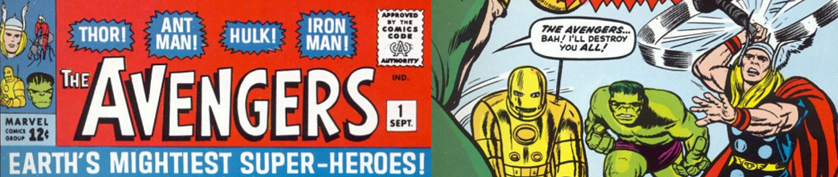
Story Title: The Coming of the Avengers!
Published: September 1963
Writer: Stan Lee
Artist: Jack Kirby

The Background:
In 1960, DC Comics brought together their most popular and powerful characters to form the Justice League of America. Never ones to let the competition get a leg up on them, and having seen successful with the Fantastic Four and the debut of the X-Men in that very same month, Marvel Comics head honcho Martin Goodman asked Stan Lee to create a similar team of superheroes. Helpfully, Lee and a number of his most famous collaborators had already established a number of colourful characters to bring together: Tony Stark/Iron Man, Doctor Bruce Banner/The Hulk, Doctor Donald Blake/Thor Odinson, and Doctor Hank Pym/Ant-Man and Janet van Dyne/The Wasp. Since the debut issue, the Avengers have been a consistent and influential presence in Marvel Comics; the roster constantly shifted and changed, with the Hulk leaving the team in the second issue and Lee memorably dusting off the long-retired character of Steve Rogers/Captain America in issue four. Since then, the team has expanded and changed many times, seen spin-offs and splinter groups, been disassembled and reassembled, and taken part in all manner of massive cosmic events in the decades since their introduction.

The Review:
“The Coming of the Avengers” begins with Thor’s brother, Loki Laufeyson, the God of Mischief, imprisoned on the “dreaded Isle of Silence” in the mythical realm of Asgard. This is, of course, back when Loki was a despicable, irredemable villain whose previous mad schemes for power and conquest were thwarted by his brother; consequently, Loki is incensed at being exiled to the barren wasteland by Odin Allfather and plots a devious scheme for revenge.
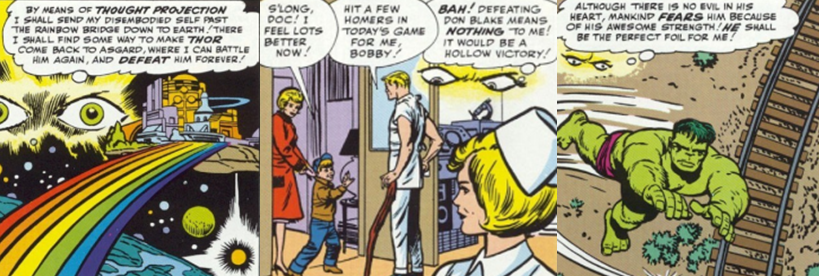
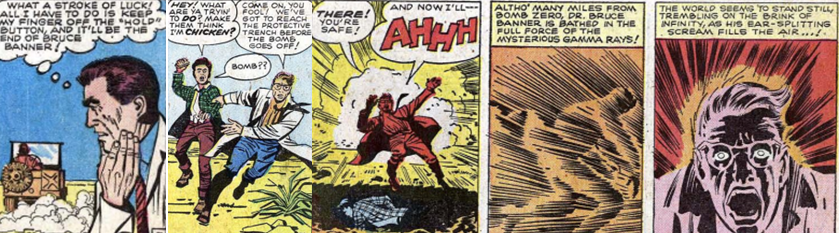
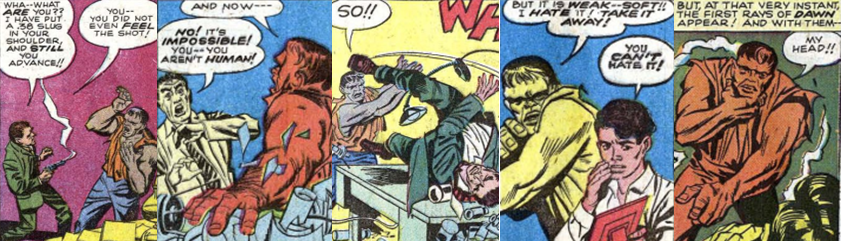
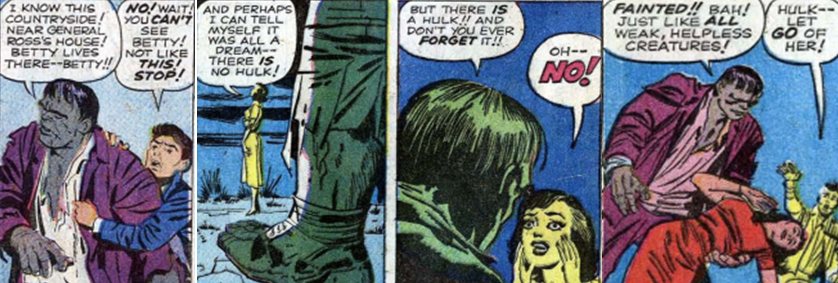
Loki burns with a desire to destroy Thor, not Blake, and sees the Hulk as his chance to do so!

Though his physical self is trapped, Loki is able to use his vast magical abilities to project his disembodied self across the length of he dimension-spanning Bifrost and down to Earth, the planet Thor loves so dearly. He spies in on Donald Blake but dismisses him as a lame and insignificant mortal; he is acutely aware that Blake and Thor are one and the same but desires victory over Thor, not his crippled mortal shell. After many long hours, Loki comes upon the Incredible Hulk and is instantly intrigued by the creature’s brute strength and disdain for humanity. Thanks to Loki’s manipulations, the Hulk is blamed by the media when a train almost derails (despite the fact that the Hulk went out of his way to keep the train on track after Loki’s tricked him into damaging the tracks). Concerned for the well-being of his friend, Rick Jones desperately attempts to contact the Fantastic Four for help but Loki intercepts the broadcast and successfully coerces Blake to transform into Thor.
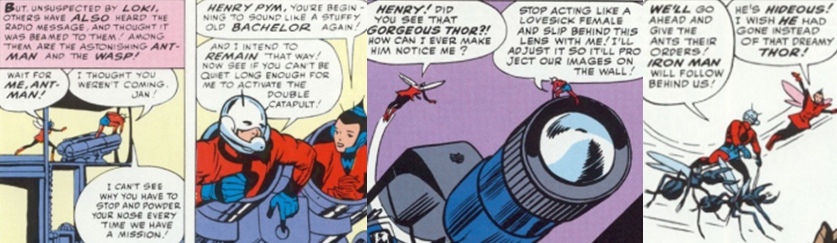
Words almost can’t express how much I despise Janet’s characterisation in these early comics!

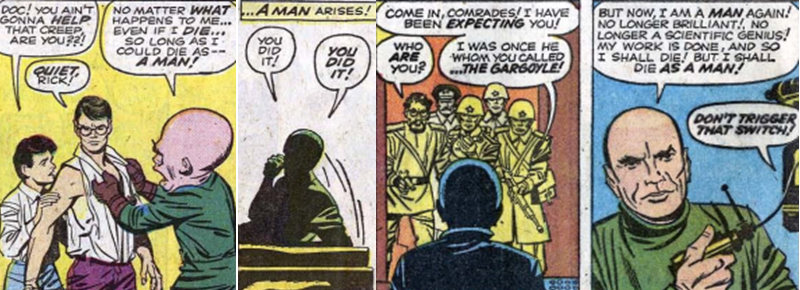
However, Rick’s broadcast is also intercepted by Ant-Man and the Wasp and Tony Stark, who eagerly leap into action to stop what they perceive to be one of the Hulk’s trademark rampages. Though he’s now decked out in his slightly more streamlined gold plated armour (which can also charge through solar power), Stark is still entirely reliant upon his iron plated chest device to keep him alive but, nevertheless, he’s eager to test the strength of his armour against the Hulk’s much-vaulted power. The Fantastic Four eventually pick up the transmission regardless of Loki’s interference but are unable to assist since they’re already busy on another case but Rick and his fellow “Teen Bridge” are star-struck when Thor, Iron Man, Ant-Man, and the Wasp all show up to answer their summons. This is probably as good a time as any to talk about how much I loathe Janet van Dyne, especially in her earlier appearances in the sixties and seventies! She’s such a ditzy, scatterbrained little tart; all she ever does is think about her hair, make-up, and appearance and constantly fawn over other men right in front of her partner/husband, Hank. Sure, Hank is generally much more focused on his work, the mission, or being professional and is largely neglectful and ignorant of Janet but that doesn’t excuse her God-awful characterisation. Similar to Susan Storm/Invisible Girl, Jean Grey/Marvel Girl, and many of Marvel’s supporting female characters at the time, Janet is constantly patronised and spoken down to by men but, unlike many of them, she actually deserves such harsh treatment since she’s more of a glorified model or brainless celebrity than a capable superheroine, much less an individual worthy of their respect since all she wants to do is drool over Thor’s muscles!
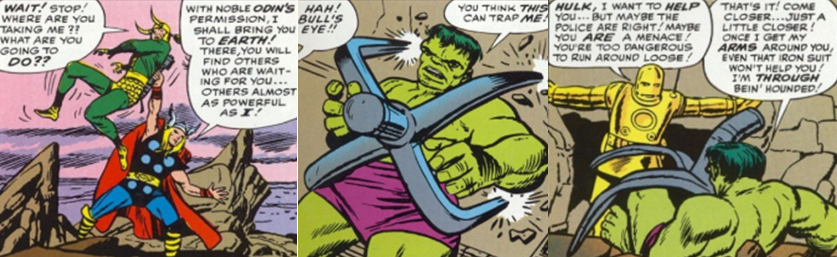
Loki is apprehended but the battle between Iron Man and the Hulk continues to rage!

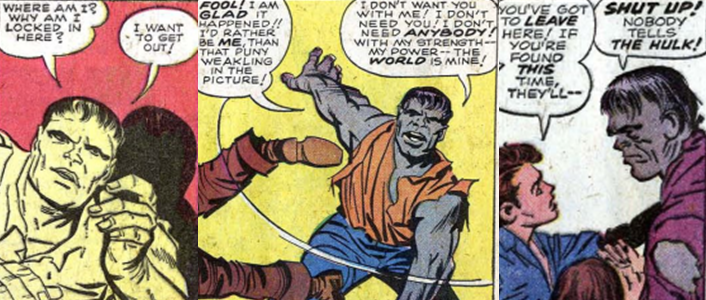
Anyway, having inadvertently brought together some of Earth’s mightiest heroes, Loki changes tactics and uses his powers to trick Thor into thinking the Hulk is right outside their door! Acting without thought or logic, Thor immediately heads out to battle the Green Goliath and immediately heads to Asgard when he realises that the “Hulk” is merely one of Loki’s visions…just as Loki planned all along! Meanwhile, the Hulk, now free from Loki’s control, has…disguised himself as Mechano the Mechanical Man and hidden himself away at a circus? Thanks to Ant-Man’s uncanny helmet, which allows him to control and communicate with ants, Pym is able to first locate the Hulk and then use countless numbers of ants to cause a cave-in beneath the beast’s feet. Unimpressed and irritated, the Hulk easily bursts free of the trap and reacts with anger when Ant-Man attempts first to calm him and then to trap him. As in his debut appearance, the Hulk is far more than the mindless, rampaging beast he is generally known as; he’s eloquent and intelligent, using words like “masquerade” and being smart enough to disguise himself as a circus performer and use weapons to blow the Wasp out of the air and render her helpless. The Hulk is kept from crushed the Wasp into a fine paste by the timely arrival of Iron Man; after Iron Man’s attempts to lure the Hulk into a trap fail, he gives chase but the Hulk is wily enough to allow Iron Man to pass harmless overheard so that he (as in the Hulk) can deliver a crippling blow to Stark’s “propulsion battery”. Over in Asgard, Odin grants Thor permission to travel to the Isle of Silence to confront Loki and he has to overcome numerous traps and hazards conjured by Loki’s black magic along the way. Thor perseveres and shatters Loki’s magical barrier using his enchanted hammer, Mjölnir, in his mission to “avenge” Loki’s foul deed. However, Thor is kept from attacking Loki first by the sudden arrival of a monstrous troll, a nature of the isle, and then by Loki’s deceitful illusions.
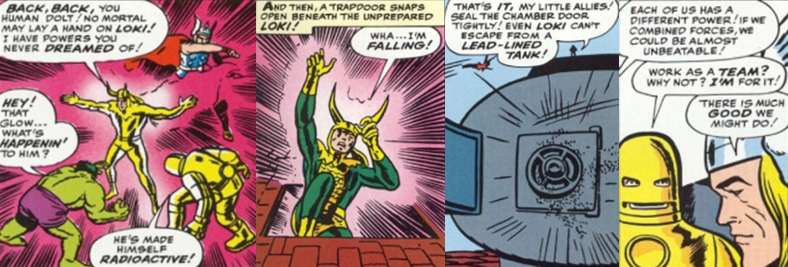
Loki is defeated with ridiculous ease and a new super team is born!

Regardless, Thor triumphs again by summoning lightning to drive the creature away and then dispels Loki’s duplicates with an implausible twirling of his hammer. Though Thor has Loki in his grasp and intends to bring him to Earth to answer for his deception, there’s still the little problem of the Hulk to contend with; Iron Man, having repaired his battery, continues his pursuit of the Hulk to an automobile factory, where the Hulk is able to endure and outwit Iron Man’s attempts to subdue him. Thor interrupts the battle and reveals that Loki was behind everything; Hulk’s desire to make Loki pay for framing him is momentarily avoided when Loki breaks free of Thor’s grasp and prepares to resume his battle with his hated brother…only for a hoard of ants to open a trapdoor beneath his feet and cause him to fall into an lead-lined chamber. With the threat ended, Ant-Man suggests that the six of them join forces as a team, which the others (including the Hulk, despite everything he went through during the issue) readily agree to and it is the Wasp who suggests the team’s name: The Avengers!

The Summary:
“The Coming of the Avengers!” is a breath of fresh air after the year I’ve had looking back at early origin stories and comic books; even compared to standalone stories of the time, it’s refreshing to not have the plot be endlessly bogged down with recaps of the characters’ origins and to not have every other piece of dialogue by a description of that character’s ability. Characters do still have an annoying tendency to monologue and describe what they’re doing as they’re doing it but it’s a far more action-packed issue than some other comics I’ve read this year, that’s for sure.
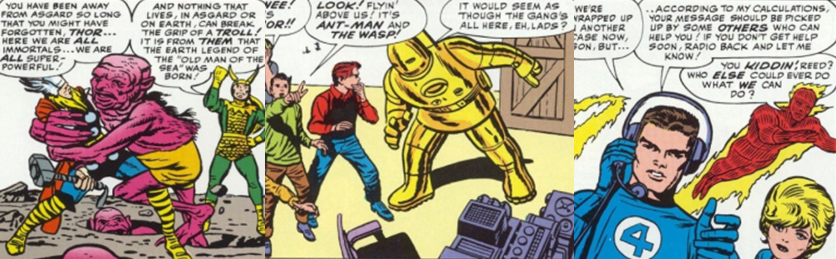
The brisk pace means some characters get more focus than others but there’s still time for cameos…

If you’re a newcomer to Marvel, this is obviously a bit of a disadvantage since you’d have no idea who any of these characters are; the only characters who really get any extended backstory and focus are Thor and Loki, which is only natural considering it is Loki who drives the main plot of the issue. However, we never see an appearance from the Hulk’ alter ego (Banner isn’t even mentioned in the issue), Ant-Man and the Wasp are never seen outside of their costumed identities, and the comic even has time to waste panels on a cameo by the Fantastic Four. The intention, however, is pretty clear: Rick’s first thought is to call the Fantastic Four since there are only a couple of superhero teams in existence at that time and the implication is that Loki is a threat worthy of the Fantastic Four’s involvement, which thus makes the Avengers appear just as capable and formidable by proxy. Not that the Avengers really need any help in that regard; each character has already had numerous chances to shine and show how capable they are in their solo issues but what better way to showcase that to its fullest than by pitting them against the Hulk, the most powerful mortal in Marvel Comics at the time?
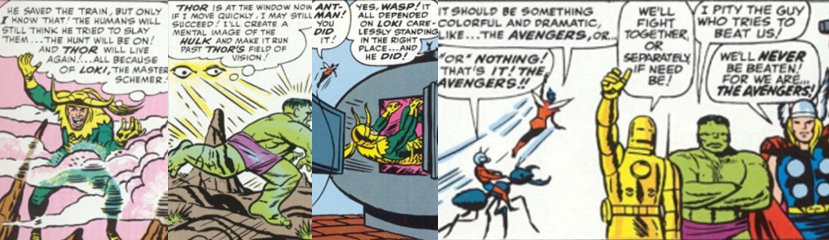
For all his power and scheming, Loki is incredibly ineffectual and his plan massively backfires!

Iron Man, especially, is eager to pit his skills and augmented strength against the Hulk’s (who sadly never gets to tussle with Thor to see which of the two truly is mightier) and it’s certainly unique seeing Ant-Man and the Wasp futilely try to subdue the beast with traps and trickery. It’s not a perfect story by any means; I could talk for days about Janet’s characterisation and she basically does nothing except buzz around, pine after Thor, and name the team and Loki never thinks to use his powers to send the Hulk into a mindless rampage to help tip the balance in his favour. Indeed, though Loki’s powers are vast and have the potential to be extremely dangerous, he’s pretty ineffectual as Thor easily fights off his illusions, he’s anti-climatically defeated by Ant-Man and the Wasp (of all people), and all he succeeds in doing is uniting Earth’s Mightiest Heroes as a team. He might have had more success if he’d tried to manipulate them into fighting each other or used his powers to better effect but, as an excuse to bring together six of Marvel’s most formidable superheroes into a super team, “The Coming of the Avengers!” succeeds far more than it fails…it just needed to be a bit longer and have a bit more interaction between the characters.

My Rating:

Rating: 3 out of 5.

Pretty Good

How do you feel about “The Coming of the Avengers!”? Do you feel it was an effective introduction to Marvel’s newest and greatest team or do you, perhaps, find it a little weak and light on content? Which of the original line-up is your favourite? What did you think to the Wasp’s characterisation and the treatment of females during this time? Which version of the team is your favourite or who would you like to see on an Avengers roster one day? Do you think the singular threat of Loki was suitable enough justification for bringing together these heroes or would you have preferred a bigger threat? How are you celebrating the debut of the Avengers today and what are some of your favourite Avengers storylines, characters, or adaptations? Feel free to share your thoughts and opinions on the Avengers in the comments below.


Game Corner [Spidey Month]: Spider-Man (Mega Drive)


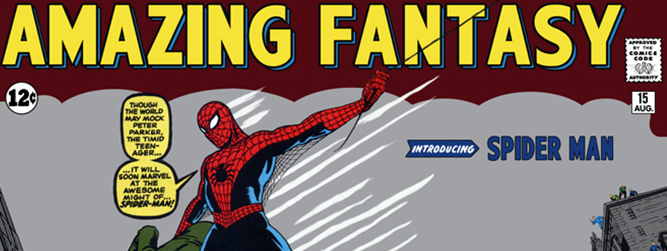
Easily Marvel Comics’ most recognisable and popular superhero, unsuspecting teenage nerd Peter Parker was first bitten by a radioactive spider and learned the true meaning of power and responsibility in Amazing Fantasy #15, which was first published in August 1962. Since then, the Amazing Spider-Man has featured in numerous cartoons, live-action movies, videogames, action figures, and countless comic book titles and, in celebration of his debut and his very own day of celebration, I’ve been dedicating every Wednesday to talk about everyone’s favourite web-head!


Released: 1991
Developer: Technopop
Also Available For: Game Gear, Master System, and Mega-CD

The Background:
Shortly after debuting in the pages of Amazing Fantasy, Peter Parker/Spider-Man graduated to his own solo title and quickly became Marvel’s most popular comic book character. Accordingly, Spider-Man was one of the first of Marvel’s superheroes to make the jump to videogames. In the early nineties, SEGA held the licensing rights to produce home console games based on Marvel Comics characters and one of the first, and most popular, of these was Spider-Man (also known as Spider-Man vs. The Kingpin), a game I first played on the Master System before switching to the 16-bit version after being won over by the superior graphics.

The Plot:
Wilson Fisk, the Kingpin of Crime, has planted a nuclear bomb in New York City that is set to explode in twenty-four hours, distributed the keys to disarming the bomb to some of Spider-Man’s most lethal foes, and has even framed Spidey for the crime! And, as if all that wasn’t bad enough, Eddie Brock/Venom is stalking the city, further stacking the odds against the web-slinger.

Gameplay:
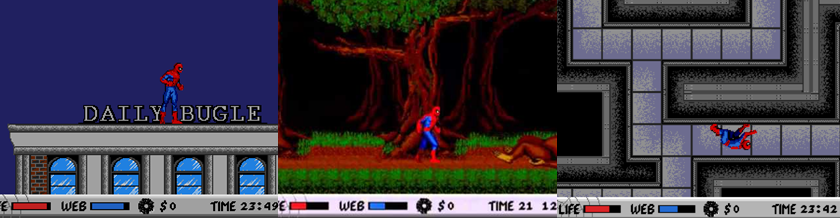
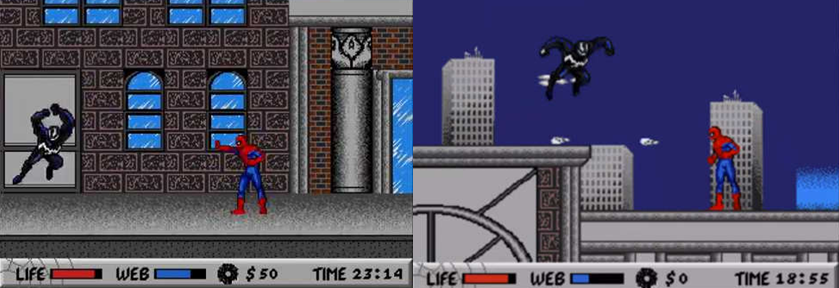
Spider-Man is a 2D, sidescrolling action/platformer with an emphasis on exploration and combat; given the nature of the plot, players have just twenty-four in-game hours to complete the game. Dawdle too long in the game’s locations and you’ll doom the entire city to destruction, which places a real anxiety into the gameplay which is, sadly, not reflected in the game’s mechanics.

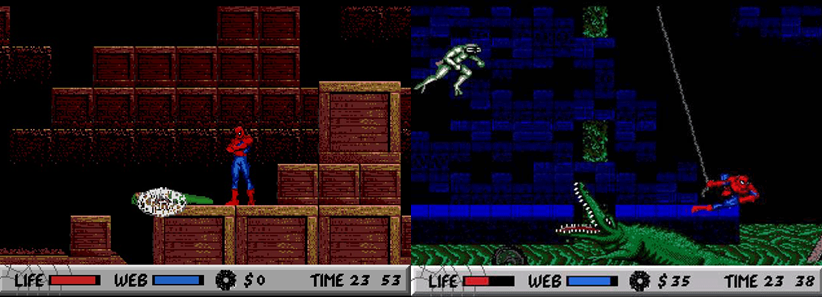
Spidey’s webbing allows him to take out crooks and quickly traverse levels.

Obviously, you take control of Spider-Man, a clunky, stilted, and awkward character who displays all of Spidey’s trademark abilities: he can punch out goons with B, jump with C (be sure to hold the button for a higher jump), and cling to walls, ceilings, and backgrounds by pressing jump twice. He can also shoot webbing with A, which is perfect for taking out goons from a distance or up high as you can diagonally direct Spidey’s web; while you can’t shoot upwards, you can shoot a web out while jumping to swing along horizontally but, while this is great for covering large distances quickly, it’s not so great for the many instances of vertical movement.

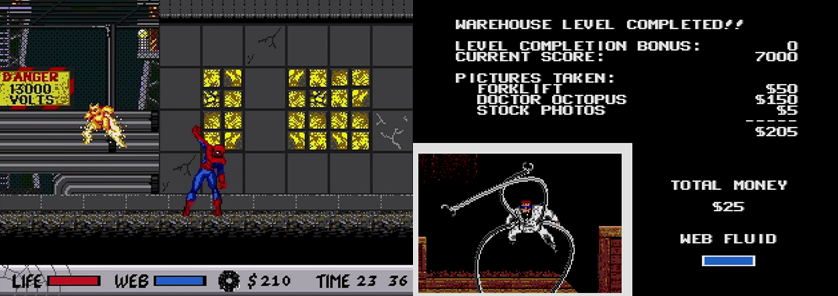
Spidey’s webbing is super useful but you’ll need to earn cash from selling photos to refill it.

From the pause menu, you can select between two webs: a sticky web projectile and a web shield to help protect Spidey from damage. However, Spidey has a finite supply of webbing and, when he runs out, you’ll have to rely on your punches and jump kicks. After retrieving Parker’s camera from the Daily Bugle though, you can select his camera from the pause menu and take pictures of goons and bosses to earn cash and refill your webbing, but you only have a limited number of shots available so it’s best to save these for getting pictures of Spidey’s more recognisable enemies.

Control is sluggish and awkward, meaning Spidey lacks his trademark grace and agility.

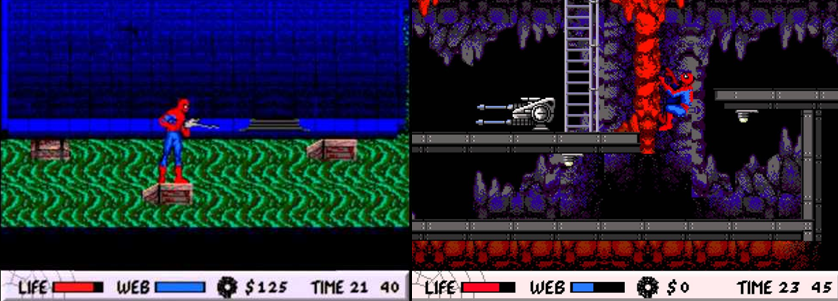
Control is a major issue in Spider-Man; Spidey is slow moving, his punch doesn’t have a lot of reach, and not only is his hit box quite large but so are the ones of his enemies. You can get around this a bit with his webbing, jump kick, and crouching kick but, more often than not, you’ll clip through enemies and fly backwards when hit with attacks. However, the most frustrating thing about Spider-Man, and the game in general, is how janky the jumping and wall-climbing mechanics are; some levels, such as the city streets, easily allow you to climb walls in the backgrounds but others, like the caverns, don’t. In the warehouse and sewers, you’ll need to climb up vertical walls and ceilings to get through air vents and tunnels and navigate past crates and such, but you need to keep C held down to stay attached to the surface. Nowhere is the control more annoying than in the caverns level, a cramped and maze-like environment that restricts your movement and requires you to perform some tricky web-swings and jumps to progress, which can be frustrating to pull off as Spidey prefers to either just drop off ledges or bump his head on ceilings (or just get shot when he finally makes the jump).

Graphics and Sound:
Spider-Man is a bright and relatively detailed videogame; it was, however, an early release for the Mega Drive so it’s not exactly making the most of the 16-bit machine’s “blast processing” power. Spider-Man and his recognisable villains all look pretty good, especially Venom and Doctor Otto Octavius/Doctor Octopus, but the regular goons and enemies leave a lot to be desired.

While sprites are colourful and detailed enough, the levels are noticeably lacking in detail.

Where the game’s graphics really fall flat, though, are in the environments; New York City looks pretty good and you can clamber up the sides of buildings, stop a random street mugging, and even encounter J. Jonah Jameson on the streets but the warehouse isn’t exactly exciting or impressive. Central Park is quite dynamic, with benches, trees, water fountains, and an intractable fire hydrant but, like all of the game’s locations, it’s surprising barren in the background and lacking in depth. The power station tries to make up for this but ends up being more of a mess of greys and yellows, though there are, occasionally, some interesting elements to some levels (debris floating in the polluted sewer water, for example).

A variety of cutscene styles are employed to tell the game’s story, though the music is pretty poor.

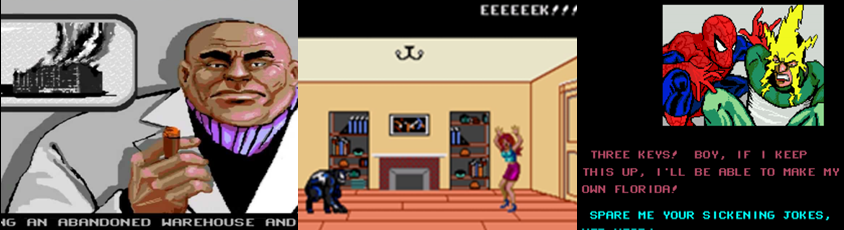
Spider-Man’s story is told through the use of various different types of cutscenes: one is simply the Kingpin making spurious claims through news reports, another is simply the Spider-Man sprite walking in a black void while text scrolls on screen, another uses comic book-like panels and text to show Spidey interrogating his foes, and another use in-game sprites and a bit of text. As you might expect, the comic book panels and sprite-based cutscenes are much more interesting to look at but, even for an early Mega Drive title, they’re very basic. The music is even worse, being bland and uninspiring and, overall, the graphics, music, and presentation were actually better on the Master System, which also featured additional characters and features.

Enemies and Bosses:
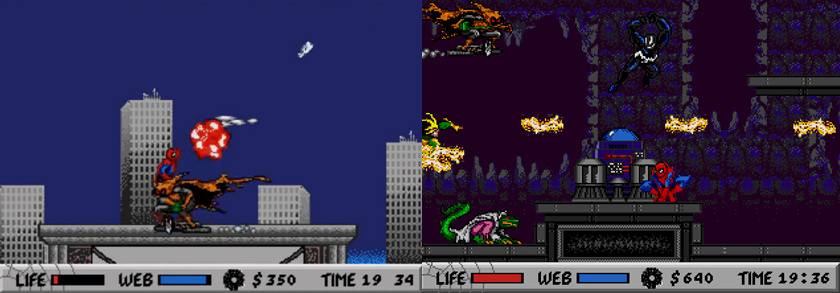
While racing to confront his rogue’s gallery, Spidey comes up against a handful of hired goons; these guys will shoot at you with handguns from a distance and try to knife you when you get up close and, later, switch to using sniper rifles. You’ll also come up against such cliché enemies as bats, snakes, dogs, and rats and, in the first mission, will be attacked be one of New York’s finest as well. Levels also feature more formidable and elaborate enemies as well as alligators and “Mutant Jumpers” await you in the sewer, electrified bats fly at you at the power station, laser-firing turrets and ED-209-like robots patrol the caverns, and a giant ape will randomly show up in Central Park!

Ducking and using your webbing is the key to besting both Doc Ock and the Lizard.

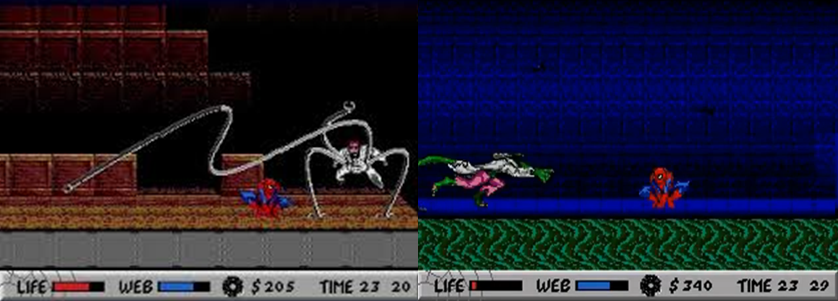
The only way to disarm the Kingpin’s bomb is to retrieve five keys from some of Spidey’s most notorious foes; you’ll know when a boss or more powerful foe is near because Spidey’s spider-sense will go off and the music will change. The first you’ll battle (once getting past a rampant forklift truck) is Doc Ock, who awaits you in a dank warehouse and attacks you with his trademark arms. In the Master System version, you could web up his arms to hold his attacks at bay but, here, I found that didn’t seem to work so I just crouched under his attacks to get closer and attacked him that way. In the sewers, you’ll encounter Doctor Curt Connors/The Lizard, who scrambles about the place and whips at you with his tail; however, he also has a tendency to just crouch there looking scary so it’s pretty easy to fire webs at him and jump kick him into submission.

You’ll need to watch out for, and use, the environment to defeat Electro and the Sandman.

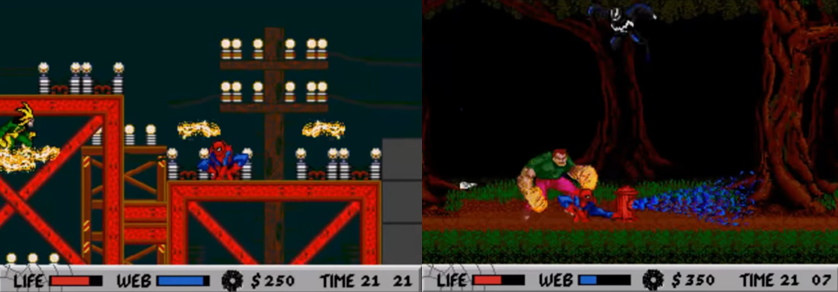
As you navigate through the power plant, you’ll be attacked by annoying bolts of electricity that, as you might expect, come from Max Dillon/Electro; Electro flies about the place on a cloud of lightning and shoots thunderbolts at you but his true threat comes from his ability to electrify the girders that you’ll no doubt be standing on so…make sure you’re not on them when that happens! Easily the most unique of the game’s bosses, though, is Flint Marko/The Sandman, who emerges from a sandpit in Central park, turns into sand to avoid your attacks, and attacks with extendable arms and by shooting sand-fists your way. He’s also invulnerable to your attacks so you need to turn around and web-swing back to the start of the level and use the fire hydrant to douse him in water and put an end to him.

Venom shows up more than once to constantly dog your progress and cause you grief.

One of the game’s more persistent bosses is Venom; Venom often shows up at the worst possible moments, such as during other boss fights and at the beginning of the street level (where you’ll also have to watch out for Jameson, who berates you and hurts you if you get too close). Each time you fight Venom, they bound overheard, fire webs at you, and punch you in the face but, generally, the best method of attack is to let them jump over your head, fire your own webs, and punch them whenever they come close. These fights get more difficult as the game progresses thanks to the presence of other enemies and bosses but, in the caverns, I found Venom got a bit stuck on a ledge just out of reach so I could just finish the level without fighting them.

After defeating Hobgoblin, you’ll battle basically every boss at once to get to the bomb!

The main enemy of the city level, though, is Jason Macendale, Jr/Hobgoblin, who flies around the rooftops of the city on his goblin glider and tosses a bunch of explosive pumpkin bombs down at you. Luckily, your diagonal webbing can make short work of Hobgoblin but his threat is magnified when you reach the Kingpin’s bomb, which is protected by all the bosses you’ve fought so far (with the odd exception of Doc Ock). Thus, you must battle the Lizard, Electro, Venom, and the Hobgoblin all at once, which is an impressive sight but extremely chaotic. It’s best to try and focus on one at a time, if possible, and take out guys like Hobgoblin and Electro because they can cause major headaches from the air.

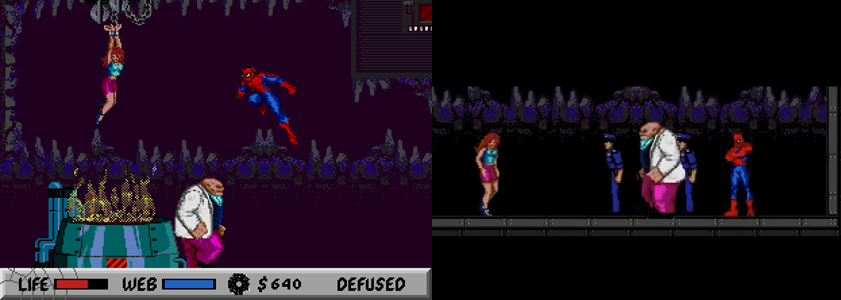
If you’re able to keep M.J. from dying, you can batter the Kingpin into submission to win the day.

After defeating them all, you must select each of the five keys you’ve collected from the pause menu and insert them into the bomb in the correct order; each time you put a key in wrong, you’ll lose a chunk of time but, as long as you get it right and avoid a game over, you’ll be spared the constantly timer counting down. Next, you can pick up some health from the air vents and go one-on-one with a very squat and hunchback-looking Kingpin. This is easily the game’s toughest boss fight as the Kingpin deals massive damage with his big, meaty fists and it’s hard to tell when you’ve actually hit him. To make matters worse, Peter’s wife, Mary Jane Watson-Parker (who was kidnapped by Venom earlier in the game) is suspended over a fiery pit and you must web her chains to keep her from being lowered to her death. This is really tricky to do because your target is just off-screen and it’s hard to get the angle right to web her chains, to say nothing of the Kingpin’s persistent attacks. If M.J. is lowered into the pit, then it’s an instant game over…which is always fun.

Power-Ups and Bonuses:
Scattered throughout many of the game’s levels, you’ll find little Spider-Man icons which, when collected, will refill your health. From the pause menu, you’ll also see a little head icon; this is Peter’s head and selecting it will instantly teleport you to Peter’s apartment, where his health bar will slowly refill at the cost of your precious time. This is somewhat pointless as, when you return to the game, you have to start the level from the beginning again but you may have to sacrifice time for health in the game’s tougher moments since you only get one life to finish the game. You can continue if you fail but, again, this will cost you precious time. Otherwise, that’s it; the only way to refill your webbing is to take pictures of Spidey’s famous foes and there are no temporary power-ups or abilities available throughout the game.

Additional Features:
From the main “Options” menu, you can select from four different difficulty settings: Practice, Easy, Normal, and Nightmare. Be warned, however, as while these will, obviously  make the game easier or harder depending on your choice, you can’t progress beyond the sewers if you play on “Easy”. From the same menu, you can also set your stamina level and the amount of web cartridges you carry, which can be beneficial to keeping you alive and in the fight on the game’s more challenging levels. Sadly, that’s technically as far as it goes; in the Master System version, you could perform a trick to have Spidey wear his black suit and even play a cheeky mini game but you can’t to that here so the only other benefit available to you are the cheats. While in the “Options” menu, place your cursor on the “Difficulty” option and hold Start on controller two; hold A, B, and C and controller one and press up/right and you’ll see a !!! icon appear in the menu. Once you start the game, if you pause the action and press A, you’ll completely refill your webbing; B will refill your health, C will grant you a few seconds of invincibility, and pressing A, B, and C will skip you ahead to the next level. This is useful to progress you through the game but means nothing if you screw up with the bomb or in the final battle as you’ll still fail the game if you don’t defuse the weapon or keep M.J. safe.

The Summary:
I really enjoyed the Master System version of Spider-Man; I never finished it in the years when I owned it and stupidly sold it some time ago but it was bright and entertaining with some detailed sprites and backgrounds. As a result, I was really excited to play the Mega Drive version of the game, having been won over by screenshots of the game’s superior graphics. However, graphical superiority doesn’t actually translate into a better game; yes, Spidey and his villains look great but the game is a slow, plodding, awkward experience. Climbing walls and navigating through the game’s unfortunately cramped areas is a pain, the lack of viable health power-ups and extra web abilities is disappointing, and the challenge on offer is artificially high and ridiculously unfair at times. It’s a shame as it wouldn’t take much to make the game a bit more enjoyable; upping Spidey’s speed a bit and giving him a vertical web shot would have been a big help but, in the end, it’s a decent enough title but there are definitely better Spider-Man games to play on the 16-bit consoles.

My Rating:

Rating: 2 out of 5.

Could Be Better

Have you ever played the Mega Drive version of Spider-Man? If so, what did you think to it? How do you feel it holds up compared to the other versions of the game? How did you find the game’s controls and mechanics? Which of the bosses was your favourite? Did you ever defuse the Kingpin’s bomb and save M.J. or did you fail at the last hurdle? Which Spider-Man videogame is your favourite? Whatever your thoughts, feel free to leave a comment down below.
Movie Night [Spidey Month]: Spider-Man: Into the Spider-Verse


Easily Marvel Comics’ most recognisable and popular superhero, unsuspecting teenage nerd Peter Parker was first bitten by a radioactive spider and learned the true meaning of power and responsibility in Amazing Fantasy #15, which was first published in August 1962. Since then, the Amazing Spider-Man has featured in numerous cartoons, live-action movies, videogames, action figures, and countless comic book titles and, in celebration of his debut and his very own day of celebration, I’ve been dedicating every Wednesday to talk about everyone’s favourite web-head!


Released: 14 December 2018
Director:
Bob Persichetti, Peter Ramsey, and Rodney Rothman
Distributor:
Sony Pictures Releasing
Budget:
$90 million
Stars:
Shameik Moore, Jake Johnson, Hailee Steinfeld, Mahershala Ali, John Mulaney, Kimiko Glenn, Nicolas Cage, and Liev Schreiber

The Plot:
After being bitten by a radioactive spider and gaining the proportionate strength and agility of the arachnid, Miles Morales (Moore) finds himself caught up in an elaborate plot by Wilson Fisk/The Kingpin (Schreiber) to cross dimensions. In the process, Miles is mentored by, and joins forces with, other incarnations of Spider-Man from across the multiverse while stull struggling to carve out his own identity in the role.

The Background:
In 2011, writer Brian Michael Bendis decided to kill off Peter Parker/Spider-Man and replace him with a younger character in the pages of Ultimate Spider-Man (2000 to 2011), Miles Morales, an African American youth of Puerto Rican descent, a decision which created much controversy at the time. Miles, however, soon became a popular character and appeared not just in cartoons and other merchandise but also the mainstream Marvel continuity (“Earth-616”). After the poor reception of The Amazing Spider-Man 2 (Webb, 2014) led to Spider-Man finally being incorporated into the Marvel Cinematic Universe (MCU), Sony were determined to continue producing Spider-Man films and spin-offs separate from the MCU. Writers Phil Lord and Rodney Rothman chose to focus their efforts on Miles since he hadn’t yet featured in a film and, to further separate the project, it included not only Spider-People from across the multiverse but also a distinct and intricate animation style that was as vital to the story as the music and dialogue. Spider-Man: Into the Spider-Verse received unanimous praise upon release and made over $375 million at the box office, won numerous awards, and is highly regarded as one of the best and most unique Spider-Man movies ever made. Its massive success meant that both a sequel and a spin-off were soon announced and no doubt contributed heavily to Miles’ continued popularity.

The Review:
First and foremost, Spider-Man: Into the Spider-Verse is Miles Morales’ story, even amidst all the chaos and multiverse madness permeating the plot; unlike the traditional Peter Parker, Miles’ parents are still alive and, while he struggles to adjust to boarding school and to make new friends, he’s nowhere near the social outcast Peter is often portrayed as during his teenage years. A big fan of music (though he is amusingly poor at reciting lyrics) and with an artistic flair, Miles is a slightly rebellious and resentful youth who struggles to live up to the expectations of his father, Jefferson Davis (Brian Tyree Henry), a police officer who regards Spider-Man (Chris Pine) as a menace and delights in embarrassing his son at his new school with typical dad humour. A somewhat streetwise kid who was a popular figure at his old school, Miles is largely an outsider at his more officious and pretentious boarding school; he’s uncomfortable in the mandatory uniform, feels like he doesn’t really fit in, and is intentionally trying to sabotage his future there so he can go back to his old school and his old friends. Believing that his father doesn’t really understand him or his dreams, Miles has a far closer relationship with his uncle, Aaron Davis (Ali), who encourages his penchant for street art and actually takes the time to connect with him on a more peer-to-peer level. To Jefferson’s chagrin, Miles idolises his uncle, who indirectly leads to him gaining his spider powers.

Miles’ struggles with his spider powers are directly paralleled to the onset of puberty.

Already somewhat uncomfortable in his new environment, Miles’ newfound spider powers (which are explicitly compared to the onset of puberty) only increase his agitation; he struggles to adapt to and master his abilities, gaining a far louder and more noticeable internal monologue and accidentally attaching himself to Gwen Stacy’s (Steinfeld) hair in an awkward attempt to flirt with her. Interestingly, Miles’ exploration of his abilities is a source of as much entertainment and amusement as it is an integral part of Miles’ character development; throughout the film, Miles struggles to master his powers, which seem to trigger unconsciously or involuntarily, and a massive part of Into the Spider-Verse revolves around Miles living up to the lofty expectations now placed upon him by his amazing new abilities.

In Miles’ world, Peter is a competent, renowned, and experienced superhero.

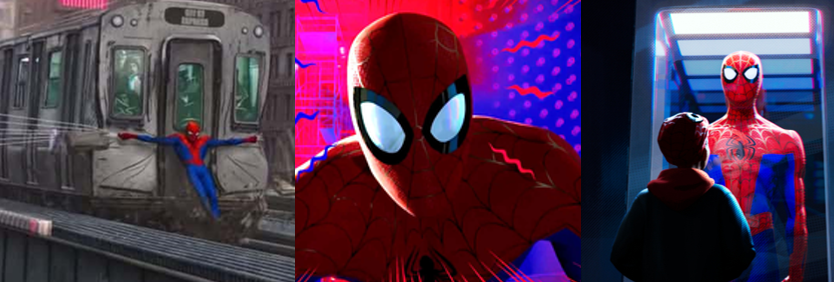
Miles lives in an alternative world that isn’t quite Earth-616 or the Ultimate universe; it’s one that draws inspiration from all over Spider-Man’s various adaptations and interpretations but one where Spider-Man is a renowned and experienced superhero. Carrying himself with the confidence of a veteran of many battles, life lessons, successes, and failures, this Spider-Man is, honestly, uncharacteristically competent in a lot of ways (he’s still married to Mary Jane Watson (Zoë Kravitz), has the full support of his beloved Aunt May Parker (Lily Tomlin), and even has a Spider-Cave full of different Spider-Suits, for God’s sake). During an intense battle with the monstrous and demonic Norman Osborn/Green Goblin (Jorma Taccone) and the slick and efficient Prowler, Peter is shocked to meet Miles, someone who shares his abilities, and vows to train him and give him the opportunities he never had when he was first starting out, such is his commitment to using great power with great responsibility.

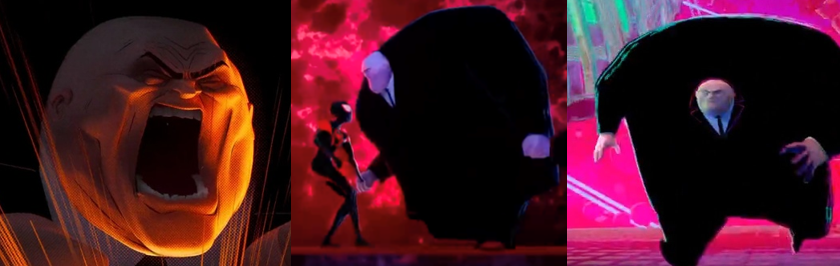
Kingpin may look ridiculous but he’s a formidable threat who killed Peter with his bare hands!

Sadly, and unexpectedly, Peter is killed right before Miles’ eyes by the Kingpin; Fisk, who blames Spider-Man for exposing his criminal deeds to the world and thus driving away his wife and son, has built a gigantic Super-Collider which he plans to use to rip a hole between dimensions and retrieve his family from another time and place. When Peter costs him this opportunity, Fisk beats him to death in a brutal and surprising scene and spends the remainder of the movie desperately trying to track down and reacquire the USB flash drive that allows the collider to work. Like Green Goblin, Fisk is a comically exaggerated version of himself, even compared to the creative flair of some comic book artists, but as preposterously absurd as Kingpin looks, his threat has, arguably, never been more tangible and brutal than in Into the Spider-Verse. Exuding unmatched power, wealth, and authority, he commands some of Spider-Man’s most notorious foes with a cold menace and is more than happy to get his hands dirty in his desperate attempt to be reunited with his family.

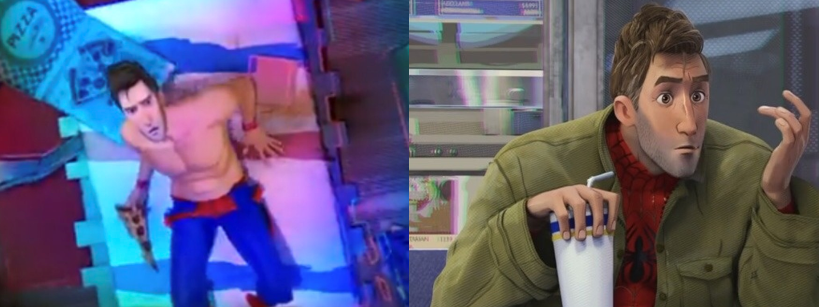
Peter B is an out of shape, world-weary version of Spider-Man who’s far from his prime.

Shaken by Peter’s death, and overwhelmed by the immense responsibility now in his hands, Miles is shocked to meet an alternative version of Peter, Peter B. Parker (Johnson), who arrived during the brief period that the Super-Collider was active. Unlike his counterpart from Miles’ world, Peter B is an out of shape, jaded, wreck of a man who has lost his way, and everything near to him, and yet, despite his crushing losses, obvious depression, and having grown weary of the power and responsibility that comes from being Spider-Man, Peter B still continues to be Spider-Man and does his best to tutor Miles in coming to grips with his powers. He’s obviously not as effective or competent a mentor than his counterpart promised to be but he does what he can regardless and is fully willing to put his life on the line to allow his fellow Spider-People to return home.

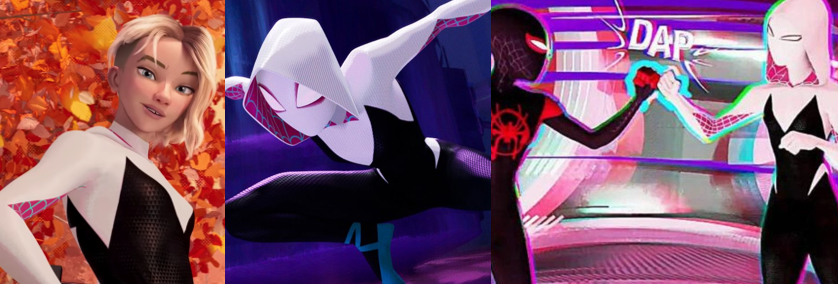
Thanks to her friendship with Miles, Gwen learns to open herself up to others once again.

Speaking of which, Miles is also joined by a whole host of unexpected Spider-People; the first one he meets is Spider-Woman, Gwen Stacy, although he is unaware of her true identity at the time. A vastly different version of the traditional Gwen, Spider-Woman gained her powers in Peter’s place in her world and is a tough, sarcastic character who, while having a soft spot for Miles, is reluctant to open herself up to him, or anyone else, for fear of losing them. In a film arguably crowded by Spider-People, Gwen stands out by being one of the more recognisable and fleshed out characters and is, basically, a tertiary protagonist as her growing friendship with Miles is a major part of her (and his) character development. Sadly, the same can’t really be said about the rest of the Spider-Crew; Peni Parker/SP//dr (Glenn) is perhaps the least developed and expendable of the group. While she is rendered in an outstanding anime aesthetic and has a heart-warming bond with her spider mech, she’s largely inconsequential to the story and could have been spliced out with any other version of Spider-Man. Spider-Noir (Cage) and Peter Porker/Spider-Ham (Mulaney) manage to stand out a little better thanks to being rendered in monochrome and talking like a thirties gangster or being a literal cartoon character, respectively, but we don’t really learn a great deal about them and they’re mainly there to emphasise that every universe has a Spider-Man and that Spidey’s legacy and ideals are carried by a variety of characters all throughout time and space, which all directly ties into Miles’ character arc of growing into, and finally accepting, his role as Spider-Man.

The Nitty-Gritty:
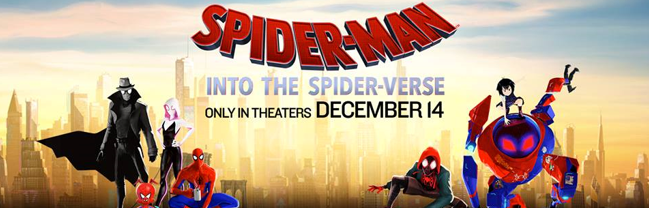
Spider-Man: Into the Spider-Verse immediately sets itself apart from other Spider-Man movies not just by focusing on Miles as its main character and its cross-dimensional subplot but also by virtue of being an animated movie. Truthfully, animation suits Spider-Man down to the ground as, often, some of the more exhilarating sequences in Spider-Man movies are the computer-generated fight scenes and web-slinging moments and Into the Spider-Verse definitely uses its medium to its full advantage, featuring a unique aesthetic, comic book-like sound effects for emphasis, and even varying the frame rate to emphasise the differences between the various Spider-People and Miles’ comparative inexperienced compared to them. Humour is an important element of the film; Into the Spider-Verse is full of amusing lines, sight gags, and comedic moments that come naturally and are incredibly amusing thanks to some effortless and believable line delivery from the likes of Moore, Pine, and Johnson (Spider-Man’s quips during tough situations and battles are a notable highlight). Characters have an easy banter and sass to them that allows even the least developed of them to appear far more nuanced in the short space of time they have to shine and humour is emphasised through Miles’ inexperience with his powers, wry commentary on his increasingly chaotic situation, and the frantic nature of the action scenes and character beats.

Action and fights are colourful and frantic, ensuring no two fights are the same.

Speaking of action, Into the Spider-Verse is crammed full of some of the most impressive, intense, and frenzied action scenes in any Spider-Man movie; the freedom offered by relying on animation allows for some of the most diverse and varied web-slinging as each Spider-Person swings, fights, and moves differently. The use of music and onomatopoeia emphasises the action, which is fast-paced, memorable, and impactful thanks to the film showcasing a wide variety of Spider-Man’s rogues gallery, which includes the likes of the Green Goblin, Lonnie Lincoln/Tombstone (Marvin “Krondon” Jones III), and Mac Gargan/The Scorpion (Joaquín Cosio).

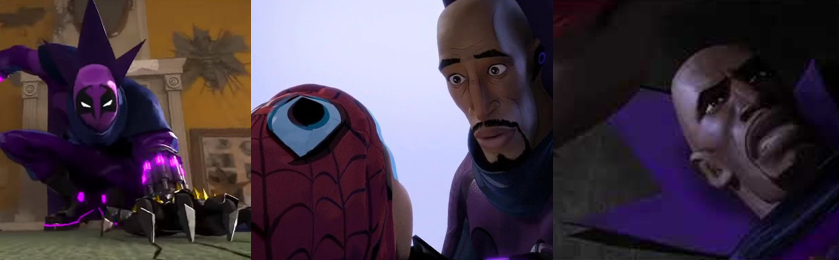
Though a vicious mercenary, Aaron’s hesitation to kill Miles costs him his life.

Apart from Fisk, though, the most prominent villains of the film are Doctor Olivia Octavius/Doctor Octopus (Kathryn Hahn) and the Prowler; while Doc Ock is a sadistic and formidable, half-crazed scientist, it is the Prowler who has the most emotional significance to both the plot and to Miles. Constantly accompanied by an ominous, animalistic theme, the Prowler is portrayed as Fisk’s top mercenary; a brutal and vicious, cat-like fighter in a sophisticated suit of armour, Prowler stops at nothing to hunt down Fisk’s missing USB drive. Miles is absolutely devastated to find that the one person he thought he could rely on in the whole world, his Uncle Aaron, turns out to be the Prowler and even more crushed when, upon discovering Miles’ identity, Aaron chooses to spare his nephew and is executed by the Kingpin as a result and dies in Miles’ arms while urging him to continue on as a hero.

Miles finally embraces his role as Spider-Man, defeats Kingpin, and returns his new friends home.

In the end, against all the odds and his own doubts and inexperience, Miles customises one of Peter’s suits (crafting an absolutely bad-ass variant in the process) and fully embraces his role as Spider-Man to confront the Kingpin and put an end to his destructive scheme. It’s a real coming of age moment for Miles, who previously could only look up in awe at Spider-Man’s legacy, and allows him to not only finally live up to the lofty expectations placed upon him by his father and the various Spider-People but also repair his relationship with his father (and his father’s opinion of Spider-Man) through his actions. With the Spider-People returned home, Miles becomes the one true Spider-Man of his world, gaining lifelong friends and a renewed sense of responsibility, confidence, and identity in the process. It’s a strikingly effective story largely thanks to how relatable and complex Miles is portrayed throughout the film, being a rebellious and well-meaning kid who is simply struggling to find his place in an ever-changing world.

The Summary:
If I’m being completely honest, I’m not really a fan of how often a street-level superhero like Spider-Man gets caught up in multiversal misadventures and meets alternative versions of himself; just like how I’m often a bit perturbed by how often Bruce Wayne/Batman has to put up with the same events, I feel like Spider-Man works better as a more grounded hero who only occasionally dabbles in cosmic-level events. To that end, I feel like Into the Spider-Verse would have been just as appealing to me, if not more so, had the multiverse elements been dropped; Peter B could have just been the version of Spider-Man in Miles’ world, Gwen could have been the same or swapped out with Cindy Moon/Silk, and the other Spider-People could have been replaced by, say, Ben Reilly or Kaine Parker and the idea of a multiverse of Spider-Man could maybe have been saved for the next movie. However, having said that, that doesn’t mean I’m not a huge fan of Into the Spider-Verse as it is; make no mistakes about it, this is a fantastic movie from start to finish, with an extremely appealing aesthetic identity and some absolutely fantastic action. It also carries a very emotional heart to its story, which is one of identity, legacy, and expectation; a coming of age story that follows a young, emotional kid who is struggling to live up to the role his mentors expect of him, Into the Spider-Verse says a lot about not only the nature of Spider-Man but also the struggles of youth and puberty. I’m glad Into the Spider-Verse did so well and I’m genuinely looking forward to the sequel delivering more of the same high-octane action and heartfelt emotion, visual flair, as well as introducing more Spider-People and, hopefully, expanding upon the brief cameo from one of my favourite Spider-Man, Miguel O’Hara/Spider-Man 2099 (Oscar Isaac).

My Rating:

Rating: 5 out of 5.

Fantastic

What are your thoughts on Spider-Man: Into the Spider-Verse? Where does it rank among the various other Spider-Man movies for you and what did you think of the artistic style and focus on Miles Morales and the other Spider-People? Which of the alternative Spider-Man was your favourite? Would you have liked to see one, or more, get a bigger role and if so, which one? What other alterative version of Spider-Man would you like to see show up in the sequel? Are you a fan of Spider-Man always having adventures with alternate versions of himself or would you prefer to see him tackling more street-level threats? Are you a fan of Miles, and what did you think to Peter’s death both in Ultimate Spider-Man and in Into the Spider-Verse? Whatever your opinion on Into the Spider-Verse, go ahead and drop a reply down in the comments and be sure to check back in next Wednesday as Spider-Man Month continues!

Screen Time [Spidey Month]: Spider-Man (1977 Pilot)


Easily Marvel Comics’ most recognisable and popular superhero, unsuspecting teenage nerd Peter Parker was first bitten by a radioactive spider and learned the true meaning of power and responsibility in Amazing Fantasy #15, which was first published in August 1962. Since then, the Amazing Spider-Man has featured in numerous cartoons, live-action movies, videogames, action figures, and countless comic book titles and, in celebration of his debut and his very own day of celebration, I’ve been dedicating every Wednesday to talk about everyone’s favourite web-head!


Air Date: 14 September 1977
Network: CBS
Stars: Nicholas Hammond, Lisa Eilbacher, Thayer David, David White, and Michael Pataki

The Background:
Following his debut in the pages of Amazing Fantasy #5, Spider-Man soon graduated to his own solo comic series and, by the mid-1970s, had become an icon of mainstream pop culture thanks to numerous merchandise and adaptations in other media such as the 1960s cartoon. It was during this time that CBS bought the rights to produce a live-action show for prime-time television; however, rather than debuting as an episodic series, The Amazing Spider-Man first aired as a feature-length episode that served as a back-door pilot. The pilot actually received a theatrical release outside of the United States, though I only remember seeing it on TV here in the United Kingdom once as a kid; regardless, the pilot was a success and led to the commission of a thirteen episode series that aired between 1977 and 1979.

Spider-Man’s feature-length pilot led to a thirteen episode TV series.

Despite drawing favourable ratings during its airing, CBS were reluctant to continue the show as it was expensive to produce and underperformed with older audiences. As a result, the show was eventually cancelled and has never seen a re-release outside of a few VHS tapes back in the day. Although the series was lacking in any of Spider-Man’s recognisable rogues gallery, it’s rumoured that there were tentative plans to produce a crossover with the long-running Incredible Hulk series (1977 to 1982) but these, obviously, never came through. Today, the series is largely forgotten, having been long overshadowed by Spider-Man’s big budget live-action ventures but Peter’s likeness in the 1994 cartoon always reminded me of Hammond’s.

The Plot:
When freelance photographer Peter Parker (Hammond) is bitten by a radioactive spider and gains the proportionate strength, speed, and agility of a spider, he adopts a crime-fighting persona dubbed Spider-Man to oppose the aspirations of the malicious Edward Byron (David), who plans to hold the city to ransom with his mind control technology.

The Review:
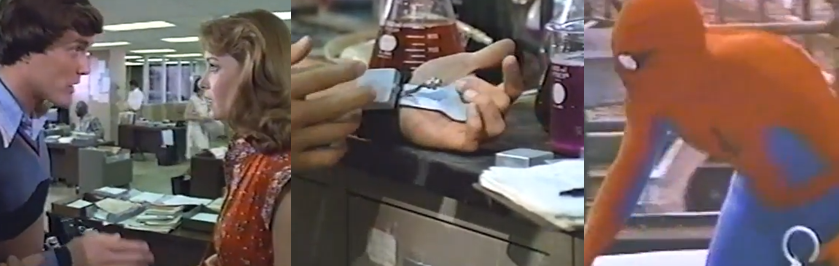
After the introductory titles (which features both a glimpse of the spectacular stunt work that the pilot and series was known for and the show’s super funky seventies theme music), Spider-Man immediately introduces the central antagonistic force of the plot as a doctor and a lawyer are inexplicably compelled to walk out in the middle of their jobs and perform a bank robbery, with the only thing relating the two being mysterious pins attached to their suits.

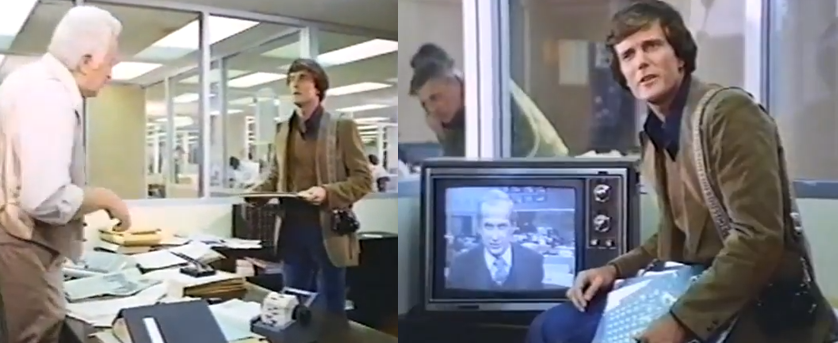
Peter struggles to sell photos to, or get assignments from, the grouchy Jameson.

Next, we’re introduced to Peter Parker, a freelance photographer who suffers from allergies and is attempting to work his way through college by selling photographs to J. Jonah Jameson (White), to little avail. While Jameson is far less as explosive and grouchy than his usual iterations, he’s still volatile and a natural cynic at heart, especially when faced with the seeming randomness of the opening crime and the subsequent threat for further crimes to follow.

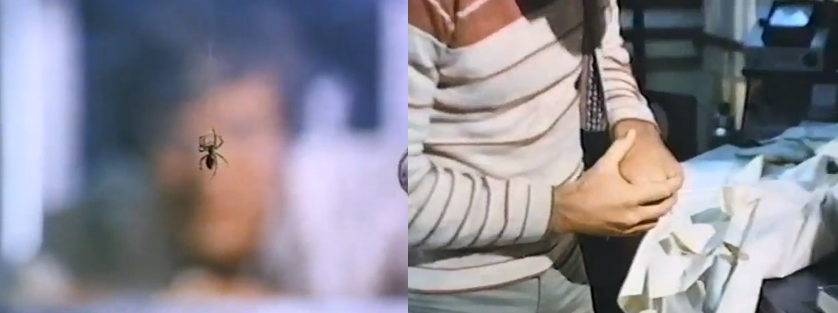
A lone spider is bathed in radiation during one of Peter’s experiments…

While Peter can’t catch a break with Jameson and is thus constantly low on cash, he’s intrigued by the threat of mass mind control that has been levied against the city and has far more luck in the field of science. Peter works in a laboratory alongside his friend and fellow student Dave (Larry Anderson) and the two of them are conducting experiments on radiation. However, while dealing with some radioactive waste, a lone spider is bathed in over 400 rads’ worth of radiation and, in its last desperate act, bites Peter’s hand.

Peter is exhilarated to find he can cling to walls and surfaces just like a spider!

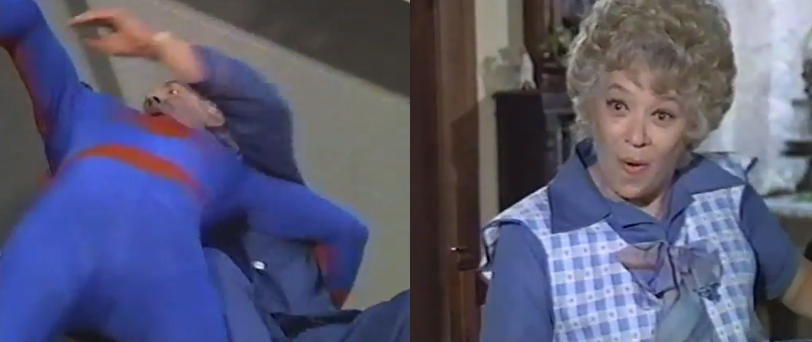
I’m not entirely certain but I think this is the first time the spider bite was indirectly caused through Peter’s own actions and it’s an interesting change. Rather than going through any kind of adjustment period or troublesome transformation, Peter experiences the effects of the spider bite almost instantaneously, being aware of incoming danger thanks to his spider-sense and racing up a wall with ease and on pure instinct. It’s not until later, after a particularly gruelling night’s sleep, that Peter pieces together the fantastic event and realises that he has been genetically altered; this leads to a montage in which he explores the lengths of his new abilities on the outside of his Aunt May’s (Jeff Donnell) through the use of camera trickery.

After being dubbed “Spider-Man”, Peter throws together a costume to sell pictures to Jameson.

It’s not a great effect, and certainly nothing on the practical wire work seen later in the pilot, but it’s certainly ambitious for the time. Peter first puts his powers to good use while clambering up a wall in the city, which is startling enough to stop a purse snatcher (Barry Cutler) in his tracks. This leads to eyewitnesses dubbing him “Spider-Man”, which piques Jameson’s interest and, in that moment, gives Peter the inspiration to construct a colourful outfit and persona befitting of such a name and to explain Spider-Man’s logistics and capabilities to the pessimistic Jameson (and, in the process, the audience). While Peter acts on instinct to stop a criminal, his primary motivation for becoming Spider-Man is to sell Jameson pictures; there’s no Uncle Ben or lessons about power and responsibility here (which, I’m sure, today’s Spider-Man “fans” would throw a fit over!), just a regular kid trying to do the right thing and make some money out of little more than an ingrained sense of right or wrong.

Captain Barbara’s cantankerous, gruff demeanour was a real highlight for me.

In the course of the pilot, Peter runs afoul of the temperamental Captain Barbara (Pataki), a grouchy, cantankerous, and suspicious police captain who is kind of like the Jack McGee (Jack Colvin) of the show; perhaps because of his jaded nature, he is almost immediately suspicious of Peter and becomes even more so when Peter continues to show up at the scenes of the inexplicable crimes. Barbara is equally unimpressed with Spider-Man’s debut, believing (with little reason) that the wall-crawler is somehow involved in the mysterious events and voicing many of the more aggressive objections to the vigilante that are usually attributed to Jameson, who is skeptical of Spider-Man but never exhibits the hatred normally associated with the character.

Peter and Judy attend one of Byron’s aggressive seminars on the futility of life.

When covering the aftermath of another of the incidents in which Professor Noah Tyler (Ivor Francis) randomly committed a robbery and then crashed head-first into a wall, Peter meets his daughter, Judy (Lisa Eilbacher). Judy confides in Peter that her father has been attending a special group to teach people the “true meaning of themselves” through unusually aggressive lectures. This group, which is more like a cult or twisted church, is led by the pilot’s big bad, Edward Byron; Byron uses specialised radio signals to compel his victims to commit their crimes and is basically able to force anyone wearing one of his pins and subjected to his mind control device to follow his explicit instructions. Specifically, Byron has them commit robberies and then kill themselves and his end goal is extortion, as he threatens to kill several citizens unless he’s paid a ransom of $50 million. Byron exhibits a disdain for those in his group, and humanity in general, and believes himself to be above them both in terms of intelligence and stature; for all his grandiose speeches, though, he’s little more than a madman who wishes to exert and abuse his power and technology purely to satiate his greed.

Peter’s far from the hapless nerd from the comics and his ingenuity is heavily emphasised.

While Peter has some bad luck in the pilot, it’s generally more around trying to make money off the pugnacious Jameson and he’s far from the hapless, down on his luck nerd he is often pigeon-holed as. Instead, he’s a relatively well-adjusted young man who bonds with Judy extremely quickly and a central theme of the pilot is Peter’s intelligence and scientific acumen. Not only does he put together an impressive costume for himself but he quickly cobbles together his patented web-shooters and not only stumbles upon Byron’s hypnotic signal with his microwave emitter but also puts together a gadget to led him to the source of the signal.

Stuntman Fred Waugh took over once Peter donned the suit to perform the pilot’s dangerous stunts.

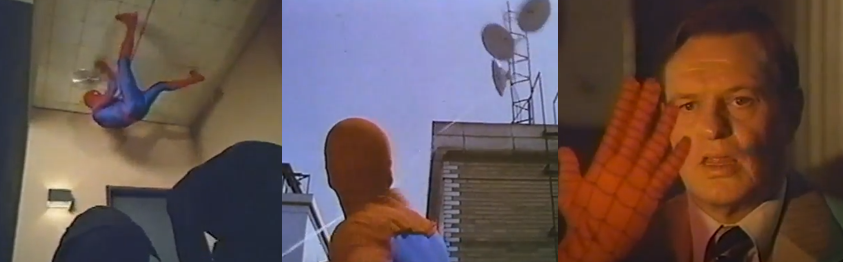
When in the costume, Spider-Man duties mostly fall to stuntman Fred Waugh, who adopts an agile grace and insectile posture that, possibly, was a conscious decision on Waugh’s part to emphasise the physicality of the character. The pilot features a number of complex and incredibly dangerous stunts achieved through the use of wire work, cables, rigging, and rotating sets; though you can make out some of the wires here and there, that doesn’t take away from the ambition of those involved and it’s because of this practical approach that, for the first time, we get to see a live-action Spider-Man literally climbing up the sides of buildings, leaping to ceilings and walls, and swinging across rooftops (something, even now, which is more likely to be achieved through CGI than traditional filmmaking techniques).

Spidey’s intelligence wins the day as much as his incredible strength and agility.

While these instances showcase Spider-Man’s agility, a protracted fight scene between the web-head and Byron’s three mind-controlled goons does a decent job of showing how formidable Spider-Man is (and, in a follow-up confrontation, his amazing recuperative powers); it’s not an especially thrilling fight scene as it’s a very slow and co-ordinated affair but, nevertheless, he’s easily able to outmanoeuvre and overpower the three. This also gets paid off at the conclusion of the pilot in one of my favourite scenes where Spidey, in the quest to bring Bryon to justice, makes friends with the three. Indeed, in the end, it’s not strength or agility that wins the day but a combination of luck (Peter’s control pin gets dislodged from his jacket) and intelligence as he not only discovers but also decodes Byron’s hypnotic microwave technology. This allows Spider-Man to tear down Byron’s control antenna and turn his technology against him, rendering him little more than a mindless puppet to face Barbara’s not-inconsiderable-wrath.

The Summary:
I’m well aware that I’ve used the word “ambitious” a lot in this write-up but it’s the best word I can think of to describe Spider-Man; it’s impressive how much the filmmakers were able to pull off given the limitations of the seventies and I would argue that, despite a lack of recognisable characters and villains, Spider-Man is actually a far more accurate adaptation of the source material, in many ways, than The Incredible Hulk. They’re both relatively grounded and far more realistic takes on Marvel’s colourful heroes but Spider-Man features far more innovative special effects to bring the character to life.

Despite the lack of Uncle Ben and May’s reduced role, Peter still uses his abilities responsibly.

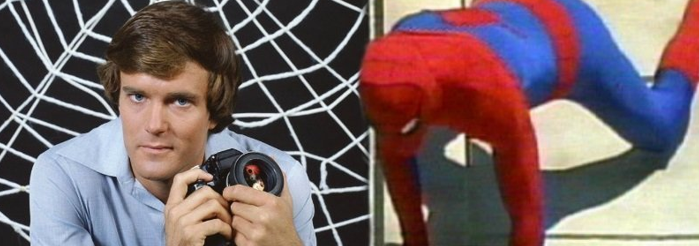
I have to say, even now, that the Spider-Man costume is pretty impressive; it’s kind of like an all-in-one body suit but the colours are suitably bright and vibrant and I love the simplicity of the design, which includes reflective lenses and, in time, mechanical web-shooters of Peter’s own design that allows him to swing between buildings and stop crooks with a variety of webbing. It’s rarely, if ever, Hammond in the suit but the plus side to that is that Spider-Man is pretty much always wearing his mask and fully capable of performing the pilot’s complex and ambitious stunts and fight scenes. Thanks to the alterations to the character’s origin, Uncle Ben is no longer a factor (he’s not even mentioned or even hinted at) and Aunt May has a much smaller, inconsequential role where she’s a doting matriarch rather than a decrepit, fragile figure (something subsequent live-action movies would emulate). Regardless, Peter is still compelled to use his powers for good (…and to make a little money at the same time) simply because he’s a good kid; he may lack the tragedy and pure motivation often associated with the character but he’s nonetheless as determined to help others.

I’ve got a lot of nostalgia for the pilot and I’ve love to see the show made more accessible.

Neither the Amazing Spider-Man or Incredible Hulk TV shows were on when I was a kid so the only exposure I had to either was in their feature-length spin-offs and, for the longest time, Spider-Man was about as good as you could get for a live-action adaptation of the character. I remember preferring the subsequent features that were produced some time after this and were comprised of combined episodes of the show but, revisiting this pilot episode after a good twenty years was an entertaining experience, to say the least. Sure, many of the effects haven’t aged too well and it’s disappointing that it doesn’t adhere more closely to the source material but I am very forgiving of this pilot and have a real fondness for it, and Hammond’s portrayal of the character, so I can only hope that, one day, the entire series gets a much-needed release on DVD so more people can experience this early and ambitious take on the character.

My Rating:

Rating: 3 out of 5.

Pretty Good

Have you ever seen Spider-Man or the Amazing Spider-Man TV show? What did you think of them at the time and how do you think they hold up today? What did you think to the show’s costume, stunt effects, and Hammond’s performance as Parker? Were you a fan of original characters like Captain Barbara and Edward Byron or would you have preferred to see more comic-accurate characters and villains in the show? Would you like to see a release of the series on home media or Disney+ or do you think it’s best to leave the show to obscurity? Whatever your thoughts on the seventies Spider-Man adaptation, go ahead and leave a comment below and be sure to check in again next Wednesday for more Spider-Man content!

Back Issues [Thor’s Day]: Journey into Mystery #83


In August 1962, Stan Lee, Larry Lieber, and Jack Kirby introduced readers of Marvel Comics (specifically Journey into Mystery) to Thor Odinson, God of Thunder and mightiest of the Asgardian deities. Through associations with Marvel’s premier super team, the Avengers, and a number of cosmic, mythological adventures, Thor has gone on to become another of Marvel’s most successful and versatile characters, with appearances in cartoons, videogames, and a number of incredibly profitable live-action movies. Being as it’s the first Thursday (or “Thor’s Day”) of the month, what better way to celebrate the God of Thunder than to take a look back at his debut appearance!


Story Title: Thor the Mighty! and the Stone Men from Saturn! (also comprised of “Part 2: The Power of Thor!” and Part 3: Thor the Mighty Strikes Back!”)
Published: August 1962
Writers: Stan Lee, Larry Lieber, and Jack Kirby
Artist: Jack Kirby

The Background:
Following the creation of Doctor Bruce Banner/The Incredible Hulk, legendary Marvel writer, editor, and creator Stan Lee was inspired by Norse mythology and legends to create an even more powerful superheroic character, one who was more than human…a literal God among men! In collaboration with Larry Lieber and the renowned Jack Kirby, Lee crafted a version of the character quite different from those that had appeared before, one who debuted in Journey into Mystery and effectively took over that title until eventually replacing it with a self-titled comic in 1970. Thor would go on to become a founding member of Marvel’s premier super team, the Avengers, and his stories became increasingly elaborate and over the top, with the character undergoing numerous changes throughout the years whilst also taking on more of the mythological aspects of his inspiration. Adopting flamboyant, archaic speech patterns and wielding the indestructible, all-powerful, magical hammer Mjölnir, I’ve always enjoyed Thor’s aesthetic and unique qualities and he’s one of my favourite characters in the Marvel Cinematic Universe but his comics can be a little impenetrable for me due to their dense and complex nature.

The Review:
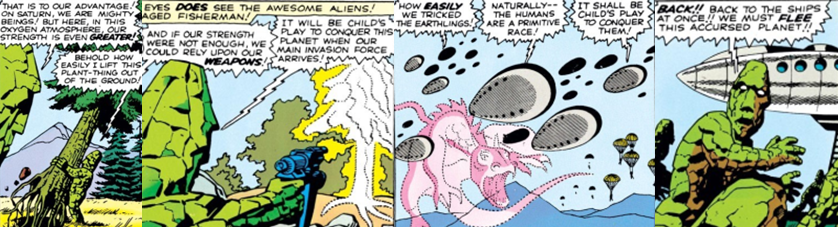
“Thor the Mighty! and the Stone Men from Saturn!” introduces us to Doctor Donald Blake, a frail and lame figure who walks with a cane and is vacationing in Norway at exactly the same time as the titular Stone Men from Saturn arrive on Earth. Like Clark Kent/Superman, the Stone Men find that Earth’s vastly different atmosphere affords them incredible superhuman strength in addition to the relative invulnerability of their stone bodies. As if that wasn’t enough, the Stone Men are also packing advanced weaponry that can vaporise objects in a flash of light, as witnessed by a stunned old man. Though the aged fisherman’s stories of stone creatures from outer space are met with ridicule and mockery by the local villagers, it catches the attention of the curious Blake, who heads out to the coastal region to investigate and soon stumbles upon the Stone Men! Unfortunately, Blake steps on a twig and gives away his presence and, thanks to his unexplained lame leg and losing his walking stick after a trip, has no hope of escaping from the aliens.

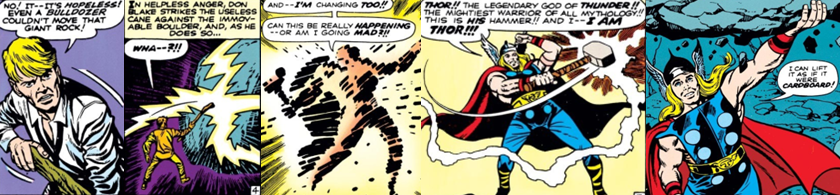
Blake discovers an enchanted cane and is imbued with the power of the mighty Thor!

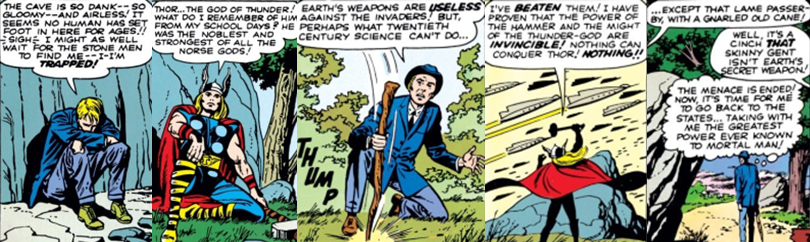
Blake finds refuge in a nearby cave but is disheartened to find that it’s a literal dead end; trapped, he begins to despair but is awestruck when a hidden stone wall suddenly opens and leads him to a secret chamber that houses a “gnarled wooden stick”. Ever the innovator, Blake attempts to use the cane as a lever but is unsuccessful and, in helpless anger, strikes the cane against the boulder which blocks his only viable exit. In a flash of blinding light, Blake and the cane are magically transformed into a heavily muscular, elaborately garbed form and an enchanted hammer, respectively. Overwhelmed by the power courses through his body, the figure observes the hammer’s iconic inscription (“Whosoever holds this hammer, if he be worthy, shall possess the power of… Thor”) and quickly realises that the hammer is Mjölnir, the weapon of the mythological God of Thunder, and that he is now Thor!

Much time is spent explaining Thor’s powers in a way that interrupts what little plot there is.

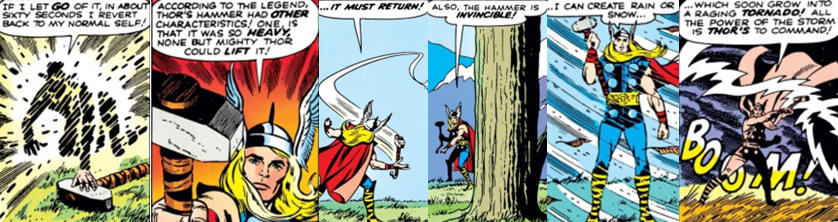
Now possessing the power of a God, Thor easily lifts the boulder that was blocking his exit and, now safe and free from his prison, ponders the mystery of his newfound power. You’ll notice that, when he’s Thor, Blake retains his speech patterns and personality rather than switching places with the Norse God or having his personality fundamentally altered by the transformation; it’s basically a Billy Batson/Shazam situation where he magically transforms but retains his personality. Using what little he knows of Thor from Norse mythology, Thor walks us through the “rules” of the character’s early days: Blake transforms into Thor when he touches the hammer but, if he is separated from it for more than sixty seconds, he magically reverts back to Blake. In addition, Mjölnir is magically enchanted so that only he can wield it, it always returns to his hand after being thrown, and is functionally indestructible. Finally, by stamping the hammer on the ground twice, Thor can conjure storms or rain or snow and whip up a raging tornado, all of which can be dispelled with three hits of the hammer on the ground.

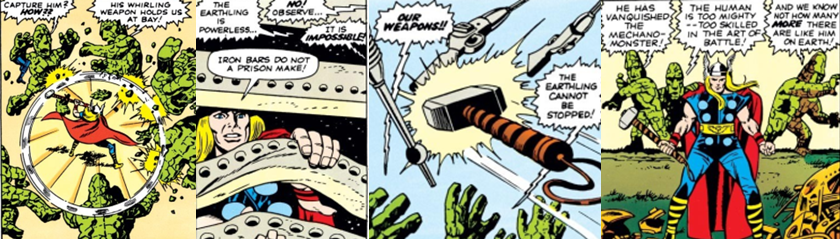
Despite the Stone Men’s threat, they are absolutely no match for Thor, who bests them with ease!

Before Blake can warn the world of the presence of the Stone Men, the aliens unleash a “three-dimensional picture” (basically a holographic projection) of a fearsome dragon to scare off incoming armed aircraft and shield themselves and their ship from reprisals and attacks with their advanced forcefield. Blake observes this with horror and, resolved to oppose the invading alien forces, he showcases one of his most iconic abilities: by swinging around Mjölnir as fast as possible, he can fly through the air and cover vast distances by hurling the hammer but holding on to the handle. It’s not quite flying and not quite the Hulk’s massive leaps but it’s something unique that no other hero can replicate. Astounded by Thor’s abilities, the Stone Men attempt to capture him but Thor is easily able to fend them off, break free of their prison, and use Mjölnir to disarm the aliens. In response, the Stone Men unleash their “Mechano-Monster”, a robot enforcer of theirs that is immediately and anti-climatically smashed to junk with one swing of Thor’s hammer. This is enough to scare off the Stone Men, who immediately flee alongside their entire fleet to avoid having to battle Thor and, possibly, more like him. The issue ends with the military dumbfounded as to what drove off the alien invaders and Blake resolving to head back to the United States with his newfound power.

The Summary:
“Thor the Mighty! and the Stone Men from Saturn!” is an absolutely bat-shit crazy story; much like the Hulk’s debut, Thor’s first appearance isn’t a typical superhero story, being more a tale of random alien invasion that just so happens to feature a guy stumbling upon a magical weapon. The Stone Men get a lot of time in the comic but we’re not really told much about them; they simply arrive as a superior alien force and prepare to use their advanced weaponry and augmented physical abilities to dominate the planet.

The Stone Men seem to be a formidable threat but are easily scared off by Thor’s power.

Yet, despite how formidable they seem to be, they’re actually some of the most ineffectual villains I’ve ever seen; they utilise holographic technology and laser weapons and have an entire fleet of ships ready to attack but they’re no match for Mjölnir, Thor tears through their weapons like they’re paper, and their ace in the hole, the Mechano-Monster is an absolute joke. Of course, the Stone Men would later be retconned into the Kronans and one of their race, Korg, would become an important ally of the Hulk many years later.

We don’t learn much about Blake but he’s morally pure enough to put Thor’s power to good use.

Perhaps because of the presence of the aliens, we don’t really get to learn anything about Donald Blake; it’s not said what kind of doctor he is, why he chose Norway for his vacation, or what caused his lame leg. All we really learn about him is that he appreciates the beauty and ambiance of Norway and that he’s curious enough to investigate the claims of aliens nearby. When he’s on the run and hiding from the Stone Men, Blake fall into despair and is all but ready to accept what he sees as his inevitable death until he stumbles upon the power of Thor. Once he becomes Thor, he immediately proves why the hammer deemed him so worthy as he leaps into action to oppose the aliens but, again, we don’t really get a sense of why Blake is so morally inclined towards using his awesome power for the benefit of mankind. Obviously, as with many debuts of superheroes, much of Thor’s backstory and motivation would be revealed in time but, even with that in mind, “Thor the Mighty! and the Stone Men from Saturn!” is surprisingly light on characterisation for its debuting protagonist; even Tony Stark/Iron Man got a brief mention of his carefree ways before his life-changing transformation but Blake, instead, is a bit of a blank slate compared to Lee’s previous heroes.

My Rating:

Rating: 1 out of 5.

Terrible

What are your thoughts on Thor’s debut appearance? Do you like that Marvel constantly tried to mix up all their new superheroes and characters with vastly different origins and backstories? What did you think to the Stone Men and the pacing of the story? What is your favourite character, arc, or era in Thor’s long publication history and where does Thor rank for you against Marvel’s other superheroes? How are you celebrating Thor’s debut this month, if at all? I’d love to hear your thoughts on Thor in the comments below so be sure to drop a line down there.

Game Corner [Spidey Month]: Spider-Man: The Video Game (Arcade)


Easily Marvel Comics’ most recognisable and popular superhero, unsuspecting teenage nerd Peter Parker was first bitten by a radioactive spider and learned the true meaning of power and responsibility in Amazing Fantasy #15, which was first published in August 1962. Since then, the Amazing Spider-Man has featured in numerous cartoons, live-action movies, videogames, action figures, and countless comic book titles and, in celebration of his debut and his very own day of celebration, I’ve been dedicating every Wednesday to talk about everyone’s favourite web-head!


Released: 1991
Developer: SEGA

The Background:
Having achieved success with the creation of the Fantastic Four, Marvel Comics editor and head writer, the immortal Stan Lee, was searching for another title to match the success of Marvel’s first family. Inspired by a spider climbing up a wall, influenced by pulp vigilante the Spider, eager to capitalise on the surge in teenage demand for comic books, and working alongside artist Steve Ditko, Lee conceived of Spider-Man and was granted permission to feature the teenage superhero in the final issue of Amazing Fantasy. Marvel publisher Martin Goodman was shocked to find that Amazing Fantasy #15 was one of the publication’s highest-selling comics and a solo Spider-Man series soon followed, with Spidey quickly becoming Marvel’s most popular comic book character. Since then, Spider-Man has seen success in numerous other media; in 1967, he featured in a self-titled animated series, he famously appeared as a guest character on The Electric Company (1971 to 1977) and starred in his own live-action series in 1978, and heavily influenced my childhood through the fantastic Spider-Man cartoon (1994 to 1998) before eventually featuring in a number of live-action films. Furthermore, Spider-Man has also featured in numerous videogames, the first of which was the aggravating Spider-Man (Parker Brothers, 1982) for the Atari 2600. Before debuting in arcades, the majority of Spidey’s videogame efforts were sidescrolling action/platformers but this was the early nineties and button-mashing beat-‘em-ups were all the rage thanks to titles like Double Dragon (Technōs Japan, 1987), Final Fight (Capcom, 1989), and The Simpsons (Konami, 1991) so Spidey’s arcade debut naturally came in the form of a sidescrolling beat-‘em-up.

The Plot:
Wilson Fisk, the Kingpin of Crime in New York City, has sent his minions out into the city to retrieve a mystical artefact and only Spider-Man and his allies (Prince Namor McKenzie/The Sub-Mariner, Clint Barton/Hawkeye, and Felicia Hardy/Black Cat) can hope to defeat some of Spidey’s most powerful and iconic villains and oppose the Kingpin’s plans for domination.

Gameplay:
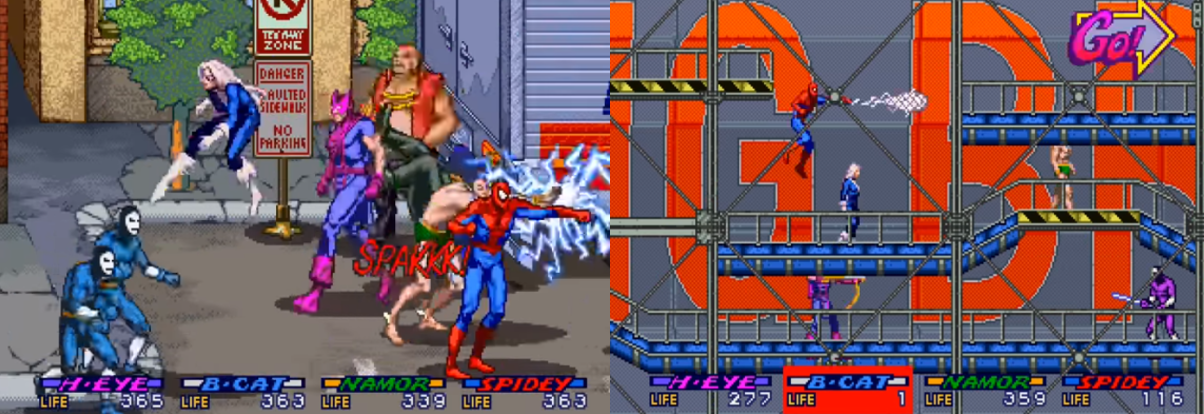
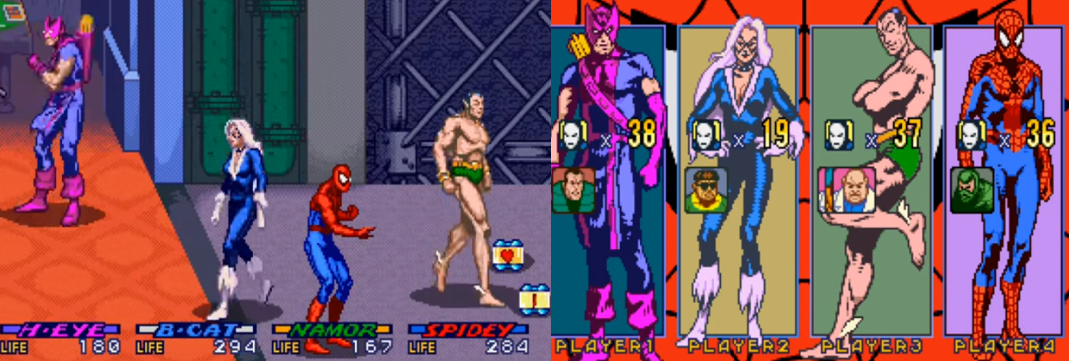
Spider-Man: The Video Game is a fairly standard sidescrolling beat-‘em-up in which players can pick from one of four characters (Spider-Man (obviously), Sub-Mariner, Hawkeye, and Black Cat) and make their way from the left side of the screen to the right beating up wave-upon-wave of nameless thugs. The game allows any player to select any character and allows for up to four players to play simultaneously, which is always an appreciated feature of such titles.

Each character is sluggish and gameplay is shaken up by some ugly platforming sections.

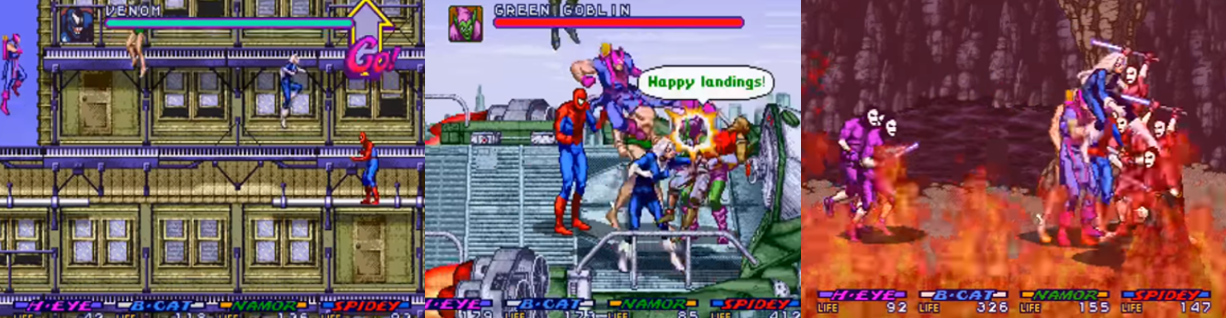
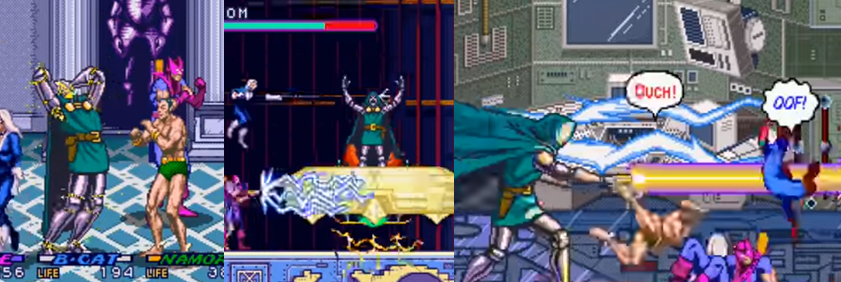
Upon selecting your character, you’re dropped into the streets of New York and quickly learn that the game is quite limited in terms of the moves available to you. Each character controls in exactly the same way, with a few subtle differences: Spidey and Black Cat can swing from webs/lines to attack enemies (if you can pull off the attack, which kind of requires a very specific combination of jumping and attacking) and each has a slightly different jumping attack (Namor dives fist-first down into enemies, for example) and melee attacks (Black Cat is much more about the fancy kicks than Hawkeye). While you can perform a signature special attack (shooting webs or arrows, for example) at the cost of some health points, each character is just as sluggish and apathetic as the next thanks to a lack of a dash function. However, after beating up a few thugs and taking out a sub-boss, the game suddenly shifts to an entirely different perspective; the camera zooms out and the game becomes more of an action/platformer as your character must scale a vertical and horizontal map taking out more goons as they go. In this zoomed out mode, your characters are no longer able to perform melee attacks and must rely on their projectile attacks: Spidey shoots webs, Hawkeye shoots arrows, Black Cat attacks with a grapple hook, and Namor….shoots lightning…? Spidey and Black Cat can also scale and climb walls to navigate these areas faster and Hawkeye and Namor can hang on to overhead platforms to shoot at enemies but it’s a bit weird that you’re not given full access to each character’s abilities in this mode.

Your health drains constantly and players are rated after each stage.

Unlike many videogames and beat-‘em-ups, inserting coins not only allows you to continue from death but also boosts your health, which is represented by a series of numbers under your character’s name. Your health numbers also double as a time limit as they’re constantly ticking down and this is quite a unique and clever way to get kids to waste their hard-earned pocket money as, while you can find health (in the form of hearts) strewn around the game’s stages at various points, you’ll quickly be pummelled into submission by the game’s enemies and forced to drop more coins to pump up your health and continue on a little further. Sadly, in a marketplace crowded by fantastic beat-‘em-ups, Spider-Man: The Video game fails to stand out in a lot of ways; you can attack and destroy parts of the environment but there’s not much motivation to do this as there are no weapons to find and use and no items to pick up to increase your score. Your score isn’t even displayed onscreen as you play, for God’s sake, which is really unusual, despite the fact that your progress is rated at the end of each stage. Instead, the game’s primary selling point appears to be exclusively the Spider-Man brand and the odd inclusion of action/platforming sections.

Graphics and Sound:
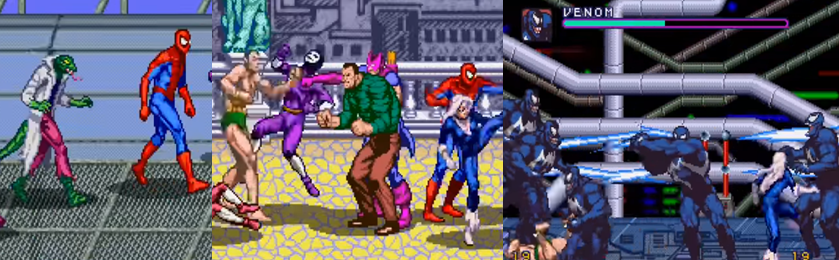
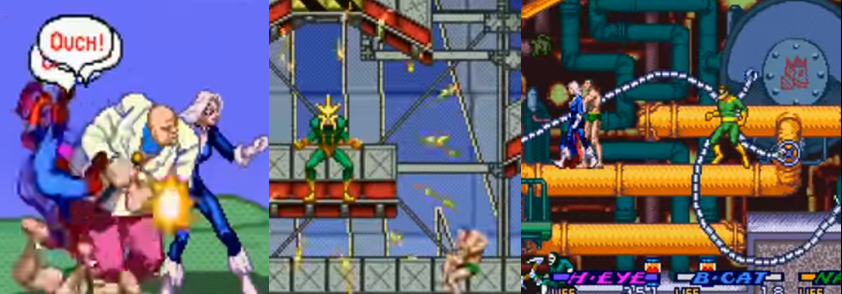
For the most part, Spider-Man: The Video Game looks serviceable enough; sprites are large and colourful but, like the backgrounds, are a little lacking in variety and detail. None of the playable characters have an idle animation, which lets the game down somewhat, and Spider-Man, especially, just looks bored and depressed as he plods around at a sluggish speed. When the game zooms out for its platforming sections, sprites take on a largely pixelated appearance but the backgrounds become much bigger and more detailed. Stages initially seem quite short as you come up against your first sub-boss in almost no time at all and, after defeating them, you’re tasked with climbing up to the rooftops of New York’s skyscrapers and the stages really open up.

Platforming sections expand the game, with “Latvelia” being the most visually interesting.

As you attack enemies, and are attacked, big comic book-style sound effects appear onscreen (as is pretty standard for comic book beat-‘em-ups) but I found sprites go a bit transparent when they pass over other sprites and graphics (though this could be due to emulation issues rather than a flaw of the title itself). The game does feature some limited voice acting but, despite featuring a female voice (who just loves to cry out “Spider-Man!” every time you insert a coin), no female voice work accompanies Black Cat. This isn’t necessarily a bad thing as the male voice acting is the same for every character and hardly of a high standard and when you realise that Namor and Black Cat’s attacks are accompanied by some really weird sound effects that make them sound like they’re drowning or a robot, respectively. As you might expect, comic book-style cutscenes tell the game’s story; these take the form of still images with some accompanying text (though these don’t change depending on your character and mostly just feature Spidey by himself) and in-game cutscenes with some fitting word balloons. Finally, while the game’s stages are fairly standard (the streets, the rooftops, flying through the skies, construction sites and the like), they don’t really stand out much until you crash-land into the hellscape of “Latvelia” and the game suddenly busts out some decent fire effects. Finally, the game’s music, while interesting and serviceable enough, doesn’t really feel very unique to the Spider-Man brand or compared to other beat-‘em-ups.

Enemies and Bosses:
The majority of the enemies you’ll encounter throughout your journey are literally nameless, faceless goons; weird kabuki-mask-wearing, purple-spandex-clad thugs are the order of the day here but they are soon joined by such cliché beat-‘em-up enemies as martial artists (who can duck your attacks), rotund enemies (who can belly flop you), and robots (which shoot projectiles). Spider-Man: The Video Game honestly doesn’t have much going for it in terms of enemy variety; you’ll fight the same enemies over and over and only encounter some weird and memorable foes with you reach “Latvelia” and encounter some weird ape-like monstrosities. However, Spider-Man: The Video Game is absolutely loaded with some of Spidey’s most iconic villains; after only a couple of minutes into the first stage, you’ll encounter Mac Gargan/Scorpion and, just as you’re getting into that fight, a massive containment unit opens up and Eddie Brock/Venom emerges.

You’ll face Spidey’s most iconic foes while swarms of enemies pile in on the action!

Although Scorpion soon runs off after a few hits, you’ll have to endure a handicap situation for a while as enemies spawn in, Venom teleports around the arena and chokes you with their goo, and Scorpion attacks you relentlessly. Once you whittle down Venom’s health, they use a mysterious artefact to grow to monstrous size and you’ll have to chase them to the rooftops for another encounter. This becomes the basic set-up for the majority of the game’s sub-bosses and bosses; you’ll fight them at one point and then have to give chase and battle them again in a slightly different situation after navigating the game’s zoomed out sections. You’ll battle Dr. Curt Connors/The Lizard (who has a nasty tendency to chomp down on your crotch), Flint Marko/Sandman, and Venom in a pretty standard beat-‘em-up format where you’ll be confined to an arena and have to fend off waves of additional enemies. Each boss reappears for a rematch later in the game but the strategy remains largely the same; keep your distance and land attacks while dispatching their support and things only really get hairy when Venom spawns a bunch of symbiote clones to fight alongside them!

While Kingpin is a marginal threat, Electro and Doc Ock really get the shaft!

Boss battles are mixed up a bit when you take on Norman Osborn/Green Goblin and Jason Macendale/Hobgoblin; while you’ll battle the Green Goblin on the ground, dodging his weird glowing hand attack, these two bosses stand out by taking to their iconic gliders and rushing at you from the air while tossing pumpkin bombs at you. These can be troublesome encounters as it’s difficult to judge where the Goblins are positioned to land your attacks or to successfully hit them with your jump attacks. Plus, when you battle Hobgoblin, you’re limited to your zoom-out attacks and will have to blast him with your projectiles and destroy large cannons to make things easier. You’ll also do battle with the Kingpin in a standard beat-‘em-up encounter; Kingpin’s attacks are limited to headbutts, swipes, and a shoulder barge, making him little more than an inconvenience than a formidable boss fight even in his second phase. Still, at least he actually gets a proper boss fight; Max Dillon/Electro and perhaps Spidey’s most famous foe, Dr. Otto Octavius/Doctor Octopus are relegated to mere semi-sub-bosses who randomly appear as you’re navigating the game’s later platform stages and they’re little more than a joke as you can easily damage boost through their attacks and pummel them into submission.

Doctor Doom is the game’s final boss and takes numerous forms.

After defeating the Kingpin, though, Dr. Victor Von Doom/Doctor Doom randomly appears to claim the mysterious artefact and reveal himself to be the game’s true big bad. When you reach Doom’s Castle, you’ll have to dodge mines and battle through the game’s previous sub-bosses and bosses to confront Doctor Doom…only to find you’ve battled a Doombot all along! However, when you finally do get your hands on the real Doctor Doom, the fight is still little more than a standard affair once you take out Doom’s nifty floating battle craft: Doom is fast and slippery but doesn’t attack with magical bolts until the final confrontation and even then he’s not much more of a threat than the likes of the Sandman or the Lizard.

Power-Ups and Bonuses:
As mentioned, there’s pretty much nothing on offer to spice up your gameplay in Spider-Man: The Video Game. You can’t pick up and use weapons or power-ups and the only thing for you to pick up is hearts to increase your health, making gameplay decidedly more repetitive and monotonous compared to other beat-‘em-ups.

Additional Features:
Again, there’s basically nothing here (as is pretty much the standard for most arcade games). However, the fact that you can select any character to play as and play with up to four players, each who accumulate their own separate score at the end of each stage, does add some replay value (if you have friends to play with, of course…)

The Summary:
Spider-Man: The Video Game is a decent enough beat-‘em-up; it’s bright and colourful and includes all of Spider-Man’s most iconic villains but it doesn’t really offer a whole hell of a lot when it comes to gameplay or variety. Beat-‘em-ups are generally quite monotonous as a rule but they usually compensate for this with kick-ass music, detailed sprites, and some cool weapons and super moves; Spider-Man: The Video Game has none of these attributes, meaning it’s a step behind other arcade titles released at the same time and even ones released years prior. The game’s unique selling point of having action/platforming sections incorporated into the usual beat-‘em-up formula is interesting but its execution is flawed thanks to the graphics taking a hit. Throw in an odd assortment of playable characters (I get why Black Cat is there but why are Namor and Hawkeye here?), some repetitive boss battles, and disappointing use of some of Spidey’s more visually striking foes and you have a gameplay experience that is fun enough (and probably better alongside friends) but hardly worth choosing over the likes of Final Fight or even Double Dragon. Put it this way: X-Men (Konami, 1992) released the very next year and is everything Spider-Man: The Video Game wishes it could be; hell, even Captain America and the Avengers (Data East, 1991) offers more in terms of gameplay variety and character abilities despite being graphically less impressive and that’s really saying something.

My Rating:

Rating: 2 out of 5.

Could Be Better

Did you ever play Spider-Man: The Video Game out in the wild? Which character did you pick, or get lumbered with, and which did you think was the best or the worst? What did you think of the game’s unique incorporation of platforming elements and the way it handled Spidey’s villains? Which characters do you think would have been more suitable to play in place of Namor and Hawkeye? Which Spider-Man videogame, or arcade beat-’em-up, is your favourite? Whatever you think, feel free to drop a comment below and be sure to check out my other Spider-Man content.

Back Issues [Spider-Man Day]: Amazing Fantasy #15


Easily Marvel Comics’ most recognisable and popular superhero, unsuspecting teenage nerd Peter Parker was first bitten by a radioactive spider and learned the true meaning of power and responsibility in Amazing Fantasy #15, which was first published in August 1962. Since then, the Amazing Spider-Man has featured in numerous cartoons, live-action movies, videogames, action figures, and countless comic book titles and, in celebration of his debut and his very own day of celebration, I’ll be dedicating every Wednesday of August to talk about everyone’s favourite web-head!


Story Title: Spider-Man!
Published: August 1962
Writer: Stan Lee
Artist: Steve Ditko

The Background:
The year was 1962 and Marvel Comics had seen incredible success with the Fantastic Four; wishing to capitalise on this, Marvel editor and head writer Stan Lee wanted to create a teenaged superhero for his younger readers to identify with. After being inspired by a fly climbing his office wall, Lee experimented with different insect names before settling on Spider-Man (eventually placing emphasis on the hyphen to avoid associations with Clark Kent/Superman) and, after being dissatisfied with Jack Kirby’s interpretation of his new young superhero, Lee turned to artist Steve Ditko to finalise Spider-Man’s costume and accessories.

Spider-Man was an incredible success and has gone on to become a mainstream pop culture icon.

Stan Lee purposely set out to make Spider-Man a troubled young teenager rather than a flawless character or the sidekick to an older hero, one who was constantly struggling with relatable issues such as money, love, and the health of his family. Despite the success of the Fantastic Four, Stan Lee also still needed the approval of Marvel publisher Martin Goodman, who disliked the character and the concept and only allowed Lee to feature Spider-Man in Amazing Fantasy as the comic was scheduled to be cancelled with its fifteenth issue. Despite this, Amazing Fantasy #15 proved to be one of the company’s best selling titles and the character’s popularity led to him not only getting his own solo title, The Amazing Spider-Man, in 1963 barely a year after his debut but also catapulting Spider-Man into mainstream popularity that endures to this day.

The Review:
“Spider-Man!” immediately begins with Stan Lee’s peerless narration setting up just how different the concept is and the art delivers on this promise by introducing us to Peter Parker, a bespectacled teenager who is the subject of much abuse and ridicule from his peers who ostracise him and see him as nothing more than a bookworm and a wallflower.

Peter has a loving home life and excels in his studies but is relentlessly teased at school.

Peter lives with his aged and doting Uncle Ben and Aunt May, who shower him with love and affection, and excels in his studies, particularly in science (which his aunt and uncle actively encourage), but is incredibly shy and awkward around his fellow students. When he ineptly attempts to ask Sally out, she rudely rebuffs him and his efforts to impress her, and the others, with an invitation to a science exhibit are drowned out by the braying taunting and arrogance of Flash Thompson, the most popular guy in school.

The dying radioactive spider bites Peter’s hand and he immediately feels its effects.

Though upset at the mockery of his classmates, Peter joins a number of other attendees in witnessing a demonstration of the latest in cutting edge atomic science, specifically the mysterious power of radioactive rays. As the head scientist begins the experiment, though, an unassuming spider, unseen and unnoticed by all, is bathed in a full blast of radiation and, with its dying breath, bites the back of Peter’s hand and immediately sends him a bit queasy (to the mockery of those in attendance because it’s not just teenagers who take the piss out of poor old Peter!)

Peter is startled to discover he has all the strength and abilities of a spider!

Distracted by the sudden charge of energy that flows through his body, Peter narrowly avoids being run down in the street but leaping up a nearby building! Astounded, Peter finds he can cling to the wall as easily as…well, a spider…and that he can crush a steel pipe as though it were mere paper! As if that wasn’t enough, he suddenly has superhuman dexterity and balance, which allows him to easily and fearlessly traverse a cable as effortlessly as a spider would crawl along a web.

Proto-Spidey easily overpowers and humiliates Crusher Hogan.

Excited at his newfound powers, Peter does the first thing anyone would in this situation and throws on a makeshift disguise to test his abilities in the ring against Crusher Hogan (and earn a cushy $100 in the process). Though initially dismissive of the proto-Spider-Man’s slight physical stature, Hogan is almost immediately left flustered and humbled when Peter effortlessly dodges his attack, hoists him up, and holds him precariously over the ring.

Peter puts his skills to use creating a spider-themed costume and accessories.

After the match, as Peter is counting his winnings, a television producer approaches him with an offer to appear on Ed Sullivan’s show. Overwhelmed at his incredible abilities and enthusiastic at appearing on television, Peter sets to work designing a colourful costume for himself; it’s not made clear why he choose red and black/blue but it certainly makes for a colourful, striking appearance. As if Peter’s sewing skills weren’t impressive enough, he also uses his scientific aptitude to construct a pair of mechanical web-shooters so that he can fire off webs just like a spider. Honestly, as much as I like Peter’s practical web-shooters, I always felt like the organic web-shooters made much more sense rather than him being “imparted” with the knowledge of how to make his own web-shooters because…you know, he gets a spider’s strength, speed, agility, well-clinging, and a version of their multiple eyes with the spider-sense but he can’t naturally produce webs?

Spider-Man revels in his newfound fame and refuses to stop a thief from escaping.

Anyway, Spider-Man makes his big television debut, wowing the audience with his many abilities; he becomes an immediate headline sensation and is suddenly inundated with offers for interviews, photo shoots, and even movies (imagine that!) However, as he is making his way back to the changing room, a security guard is in the process of chasing down a thief; Spider-Man allows the thief to escape unhindered to the elevator, rightfully but crucially stating that it’s not his job to stop criminals since he’s a performer, not a cop!

Peter is horrified to find his uncle dead and angrily confronts the man responsible.

Peter revels in his newfound fame but, one fateful evening (not that same evening, it’s interesting to note), he returns home to be told the news that his beloved Uncle Ben has been shot and killed by a house burglar! Overcome with grief and a burning desire for revenge, Peter races to his bedroom and pulls on his Spider-Man costume to confront the burglar after the cops tell him (Peter) where he’s holed up. Thanks to his web-slinging abilities, Spider-Man easily crosses town to reach the warehouse where the thief is hiding out and gets the drop on him.

Peter learns a harsh and humbling lesson to use his great powers selflessly.

Of course, Spider-Man is easily able to corner the thief, disable his gun with his webs, and knock him out with one right hook. However, Peter is devastated when he sees the face of his uncle’s killer and recognises him as the same thief he refused to stop a few days earlier! Peter leaves the thief in the custody of the police and wanders off into the night, distraught with grief and guilt at his selfish ways and learning, as the narrator sombrely informs us, the harsh lesson that “With great power there must also come — great responsibility!”

The Summary:
“Spider-Man!” is a brilliant, almost timeless tale; of course, it’s obviously full of allusions and references to the time period it was created in but none of these elements really overwhelm the general pace, direction, and themes of the story. Spider-Man was the first superhero to be a normal, everyday, awkward teenager; shunned by his peers for being a bookworm, he’s far outside of the popular social circle yet, though he’s clearly affected and upset by the teasing he constantly endures, he never falls into angst or despair and, instead, revels in the love and affection his adoring aunt and uncle constantly show him.

After years of being bullied for being a wallflower, Peter revels in his newfound fame.

Upon being granted his amazing spider abilities, Peter is immediately fascinated and excited and jumps at the chance to flex his newfound muscles in the ring. Finally, after years of persecution for being a wallflower, he has the power to topple even large, muscular wrestlers like Crusher Hogan and quickly becomes a television sensation. It’s clear that Peter is both overwhelmed and enthusiastic by the fame (and, presumably, brief fortune) his celebrity status brings him; there’s a sense that all these opportunists and media moguls are simply using Spider-Man and taking advantage of him but Peter is too distracted by the applause and adulation to even care.

Spidey’s dramatic origin is easily one of the most iconic and memorable in all of comics.

So overcome by this admiration and fame is Peter that his selfish actions cause him to make one fateful error in letting a seemingly harmless thief escape punishment and, of course, pays for it when that same thief kills his beloved Uncle Ben. The sight of Peter staring at the face of his uncle’s killer and realising that he (Peter) could have easily stopped him is a haunting and enduring image, as is the valuable life lesson that would go on to not only define Spider-Man’s superhero career but also become largely synonymous with the character. This origin, one born out of pure, unadulterated grief, is perhaps second only to the traumatic murder of Thomas and Martha Wayne in its significance, iconography, and impact on both the character and the comics and subsequent media he appeared in and ensures that Spider-Man’s dramatic debut is both memorable and relatable since Peter’s actions, though selfish, were completely understandable and natural. He didn’t get his powers and immediately become a crimefighter; he used them for fortune and glory and who among us can say we wouldn’t do the same?

My Rating:

Rating: 4 out of 5.

Great Stuff

What are your thoughts on Spider-Man’s iconic debut? Were you a fan of the character at the time or were you introduced to him through some other means and, if so, what were they? How would you rank Spider-Man’s traumatic origin story and how important would you say it is to the character and the comics industry as a whole? What is your favourite Spider-Man storyline, costume, or character and why? Do you prefer mechanical or organic web-shooters? Why do you think Peter chose red and black/blue for his costume? How are you celebrating Spider-Man Day today? Whatever your thoughts on Spider-Man, leave a comment below and be sure to stick around for Spider-Man Month starting this Wednesday!

Movie Night: Black Widow

Released: 9 July 2021
Director: Cate Shortland
Distributor:
Walt Disney Studios Motion Pictures
Budget:
$200 million
Stars:
Scarlett Johansson, Florence Pugh, David Harbour, Olga Kurylenko, Ray Winstone, and Rachel Weisz

The Plot:
On the run after the events of Captain America: Civil War (The Russo Brothers, 2016), Natasha Romanoff/Black Widow (Johansson) reunites with her estranged sister, Yelena Belova (Pugh), and discovers a conspiracy tied to her chequered past as a Russian spy.

The Background:
Created by the legendary Stan Lee, Don Rico, and Don Heck, the Soviet super spy Natalia “Natasha” Romanova/Black Widow first appeared as a recurring villainous in Marvel Comics’ Tales of Suspense series, where she frequently clashed with Tony Stark/Iron Man. After running across Clint Barton/Hawkeye, however, she eventually shook off the brainwashing she had been subjected to and defected to the United States, becoming a hero and an Avenger in the process. Over the years, the character has become a popular staple of Marvel’s publications and a strong feminist icon who has made numerous appearances in other Marvel media and made her first live-action appearance in the Marvel Cinematic Universe (MCU) in Iron Man 2 (Favreau, 2010). Development of a standalone Black Widow movie, however, was fraught with issues; the film was initially in development back in 2004 and MCU producer Kevin Feige considered exploring the character further in 2014 as the MCU was in full swing. Despite the character being killed off in Avengers: Endgame (The Russo Brothers, 2019), and the sexist machinations of Marvel Entertainment CEO Ike Perlmutter, and repeated delays due to the COVID-19 pandemic, Black Widow finally got a solo film that sought to explore her complex past in 2021. Black Widow was released to a modest (if not disappointing) box office compared to other MCU movies, potentially because of the aforementioned pandemic; the reviews were generally positive, with many praising the film’s action and presentation, though some criticised the film’s derivative nature and how long it took for Black Widow to receive her time in the spotlight.

The Review:
Black Widow aims to address a lingering issue with the character since her introduction into he MCU, and that is her lack of a detailed backstory. Unlike other MCU heavy-weights, Black Widow’s past has only been vaguely hinted at and is shrouded in mystery. However, as much as I feel the character deserves her time in the spotlight (and honestly should have had her past with other side characters explored in some one-shots years ago), I always found this to be part of the character’s mystique. Not knowing the specifics of her time in Budapest and only vaguely hearing hints of her past (“Drakov’s daughter”, “I got red in my ledger”, “Daughter of Ivan”) made her seem like a very mysterious character who had done some terrible, almost unspeakable things and was trying to atone for them. Thankfully, Black Widow retains much of the character’s mysterious aura while still shedding some much-needed light on her past. As a girl (Ever Anderson) was raised in Ohio alongside her sister, Yelena (Violet McGraw), by her parents, Alexei Shostakov (Harbour) and Melina Vostokoff (Weisz). However, her childhood was nothing more than an elaborate deep cover infiltration by the Soviets and, after Alexei acquires the crucial data her was sent to retrieve, the girls are suddenly ripped from their happy, suburban life and forced into serving the State in the “Red Room”. There, they are sterilised and trained relentlessly to become the perfect weapons, each of them moving and operating identical to the other and, with them at his beck and call, General Dreykov (Winstone) is able to topple governments and societies alike with the merest order.

Black Widow places Nat in a vulnerable position where she’s left alone and forced to confront her past.

The film then jumps ahead to shortly after the end of Civil war; after eluding Secretary of State Thaddeus “Thunderbolt” Ross (William Hurt) and being branded a fugitive, Natasha contacts one of her few remaining allows, Rick Mason (O-T Fagbenle), to help her escape from Strategic Homeland Intervention, Enforcement, and Logistics Division (S.H.I.E.L.D.), her former allies who are now relentlessly hunting her down. having lost her surrogate family (the Avengers), Natasha defaults to her cold, KGB training and is fully prepared to live off the grid and with few ties as possible; she is in a very vulnerable and fight-or-flight position at the start of the film and there’s a very real sense that she feels angry at herself for having grown so accustomed to working with, and trusting, others. She is rattled when she discovers that Dreykov is still alive and that the Red Room is still active, especially after the horrific acts she had to do to bring them down to join S.H.I.E.L.D. and is even more uncomfortable at having to travel back to Budapest and dig up the long-dead ghosts of her past since all she’s tried to do is forget about and atone for her time in the KGB.

Natasha reunites with Yelena, who wishes to free the other Widows from Dreykov’s control.

In the years since Natasha’s defection to the United States, Yelena was subjected to something more than just the psychological conditioning that turned Natasha into a ruthless assassin. Yelena, like her fellow Black Widows, was instead also subjected to a mind-control agent of Dreykov’s design that renders them little more than mindless puppets to carry out his every whim. However, after she is accidentally exposed to a chemical antidote, Yelena regains her senses and begins a campaign to free her fellow sisters from Dreykov’s control. As they were trained in exactly the same manner, Yelena is, in many ways, an exact mirror of Natasha; they move the same, fight the same, and have the same penchant for killing but the difference is that Yelena is noticeably more blunt and bitter since, unlike her “big sister”, she has been trapped in the role of an assassin without any hope of reprieve. Free for the first time in her life, Yelena is still a somewhat excitable and naïve child to many of life’s normality’s but is a formidable foe in battle; indeed, one of the objectives of Black Widow is to sell us on the idea that Yelena is every bit as good as Natasha while also being a distinct and likeable character in her own right. It succeeds in this regard by having her be evenly matched (and even best) Natasha when they fight and through Pugh’s natural charisma and adorable line delivery, which manages to be both blunt and endearing at the same time.

Alexei is a goofy blowhard who is desperate to relive his glory days as the Red Guardian.

Angered to learn that Dreykov is still alive after she risked everything, including sacrificing his young daughter Antonia (Ryan Kiera Armstrong), to kill him and defect to the U.S., Natasha reluctantly teams up with her “little sister” to find the Red Room (which is notorious for being impossible to trace) and bring it, and Dreykov, down once and for all. To do this, they decide to free Alexei from the prison he has been rotting in for over twenty years; having been exposed to a variation of the same super-soldier serum that birthed Captain America (Chris Evans), Alexi had a colourful career as the Red Guardian at some point but is now an out of shape blowhard who loves to drone on about his glory days (even if they don’t necessarily fit in with reality). Honestly, Alexei is one of he many highlights of the film; I have a real affinity for David Harbour and he embodies the role of his big, bear of a man perfectly, able to convey both genuine emotion and also a great deal of laughs with his bombastic nature and exaggerated (or inappropriate) stories of his time as a superhero.

Dreykov sends his best agent, the silent mimic known as Taskmaster, to hunt Nat and Yelena.

The three of them reluctantly reunite with Melina and learn the horrifying truth behind Drewkov’s operation; through an intricate system of mind control, he is able to command his Black Widows and has kidnapped, indoctrinated, and disposed of countless young girls over the years in order to maintain his position of power. Since Yelena has the only sample of the antidote, Dreykov sends his top operative, the silent and intimidating Taskmaster, to track her and the others down and acquire it by any means necessary. Taskmaster is quite the menacing foe, despite being uncharacteristically silent; a natural mimic, he is able to copy and replicate the physical abilities of anyone he watches and also predict and counter incoming attacks thanks to his intimidating skull helmet feeding him constant data. Wielding a sword, shield, bow and arrows, and even talons reminiscent of T’Challa/Black Panther (Chadwick Boseman), Taskmaster is incredibly adaptable and able to mimic Natasha’s most famous moves on the spot as well as possessing all of the fighting aptitudes of the Avengers, making for a relentless and threatening enemy that is made all the more intimidating through the fact that he doesn’t say a word the entire time.

The Nitty-Gritty:
Going into Black Widow, I’d heard comments that the same was playing it “too safe”; that is was basically a rehash of Captain America: The Winter Soldier (Russo and Russo, 2014) and I can totally understand those observations. Personally, though, I found this to be a good thing; it’s not the first time the MCU has returned to a more grounded story after a big, cosmic event and hearkening back to one of the MCU’s most entertaining and successful films isn’t a bad thing, in my opinion. Indeed, I imagine when watching the MCU films in order, Black Widow will fit in pretty perfectly as an epilogue to Civil War. Nowhere are the similarities to The Winter Soldier more apparent than in the presence of those annoyingly large location subtitles, the film’s gritty and hard-hitting action, and the character of Taskmaster. Taskmaster’s presentation, demeanour, and even his theme are all highly reminiscent of the titular Winter Soldier (Sebastian Stan) from that film. Like the Winter Soldier, he has a tendency to ram and shoot at cars, performs a number of nifty knife tricks, and is an inexorable force who appears sparingly throughout the film but makes an impact every time he does.

Black Widow is bolstered by some gritty, hard-hitting, and over-the-top action and fight sequences.

Taskmaster’s story is noticeably different from his comic book counterpart, however, in that “he” isn’t a “he” at all; when I first saw the trailers, I (like many, I’m sure) was fully expecting Melina to be under the skull mask and, while the revelation of Taskmaster’s true identity has a great impact on Natasha, I can’t help but feel like that would have been just as meaningful a reveal and a far better use of Rachel Weisz. The remainder of the film’s action scenes are also instantly familiar to anyone who’s seen The Winter Soldier. Well framed and full of ever-escalating action, fight scenes are as brutal as they are beautiful and entertaining to see (even if Natasha, especially, walks away from multiple situations that should have killed her outright). Natasha and Yelena’s reunion is marked by a fierce bit of melee combat that instantly sells Yelena as Natasha’s equal; their daring helicopter rescue of Alexi was a thrilling sequence as Alexi causes a chaotic prison break and the three are forced to escape from an incoming avalanche; and their final assault against the Red Room is made visually interesting and distinct by the fact that the facility is floating up in the clouds. This results in an explosive and over-the-top finale very similar to when the Helicarriers rained from the sky in The Winter Soldier but, again, I’m convinced that these parallels were a conscious decision and the film certainly doesn’t suffer from them and, I feel, is distinct enough to hold its own.

Essentially, the story is about Nat reconnecting with her family and herself.

 A central theme of the film is family. Natasha hides her heartbreak and sorrow at losing her surrogate family behind a cold bravado and resists letting Yelena, Alexi, and Melina into her heart and life as much as she can. We know that this isn’t the entire truth, though, since we’ve heard her talk fondly of her affection for the Avengers are her job as  S.H.I.E.L.D. agent and we see at the start of the film how much she cares for Yelena. Natasha insists that her childhood and this hitherto-unknown family unit was all a fake and meant nothing to her and her attitude seemingly reflected by Alexi, who was frustrated at being stuck in a “boring” undercover assignment and desperately wanted to get back into his costume to fight Captain America again. However, just as Alexi felt true feelings of love and fondness for his “daughters”, so too is Natasha unable to deny that she feels a kinship and responsibility towards not just Yelena but all of Dreykov’s Black Widows. Her urge to finish the job and kill the man who ruined her life is motivated not just by her personal need for revenge but also a deep-rooted desire to free the girls under his control and ensure that no others are ever violated in the same way. Along the way, she reconnects with her first family and comes to realise that she isn’t as alone as she once though, setting her on the path towards reuniting with her disparate Avengers comrades.

The Summary:
I’ll admit that I wasn’t exactly that thrilled at the prospect of a solo Black Widow film, especially one that came out after she had died in the MCU timeline. I definitely feel like she, and other key S.H.I.E.L.D. personnel should have featured in a one-shot or television movie or even, yeah, a feature-length film a few years ago or had her story folded in with the likes of Clint Barton/Hawkeye (Jeremy Renner) to appease the more sexist executives at Disney. Still, as the saying goes: Better late than never. Black Widow was an enjoyable romp with some impressive action and fight scenes, some fun humour and heartwarmingly poignant moments. It was great seeing Natasha in a more vulnerable position and to explore her backstory and character in more detail and the film introduces some entertaining and colourful new characters to the MCU, with Yelena and Alexei stealing the show at every opportunity. It seems as though Marvel Studios are pushing forward with a big shake-up in their films and line-up and I fully expect to see these two, at least, play a major role in the coming years.

My Rating:

Rating: 4 out of 5.

Great Stuff

Have you seen Black Widow? If so, what did you think to it? Did you like the new character sit introduced and the exploration into Natasha’s past? What did you think to Taskmaster and how the film adapted the character? Do you agree that Black Widow should have had her own solo film a lot sooner or do you think the film was in a good position as a cool down after Avengers: Endgame? Would you like to see more films focusing on this character? Whatever you thought about Black Widow, drop a comment down below.

Movie Night: X-Men: The Last Stand

Released: May 2006
Director: Brett Ratner
Distributor: 20th Century Fox
Budget: $210 million
Stars: Hugh Jackman, Halle Berry, Famke Janssen, Ian McKellen, Kelsey Grammer, Shawn Ashmore, Ellen Page, Aaron Stanford, Patrick Stewart, Rebecca Romijn, Vinnie Jones, Anna Paquin, and James Marsden

The Plot:
The Mutant community is divided when a major pharmaceutical company announces the development of a “cure” that will permanently suppress the Mutant X-Gene. As Erik Lehnsherr/Magneto (McKellen) uses the controversy to step up his war against mankind, Jean Grey (Janssen) inexplicably returns from the dead, her powers having grown exponentially and threatening the lives of humans and Mutants alike.

The Background:
Since Stan Lee and long-time collaborator Jack Kirby created the X-Men in 1963, Mutants have featured prominently in Marvel Comics; unlike most of Marvel’s superheroes, the X-Men (and Mutants in general) are met with near-constant hostility as they stand in for oppressed minorities everywhere. The X-Men grew to greater mainstream prominence thanks to the influential animated series from the nineties, the success of which led to 20th Century Fox purchasing the film rights and producing two well-regarded X-Men films in the early 2000s. The production of X-Men: The Last Stand, however, was far more complex than its predecessors; former director Bryan Singer unexpectedly walked away from the franchise, taking X-Men 2 (Singer, 2003) screenwriters Dan Harris and Michael Dougherty with him in order to make the divisive Superman Returns (ibid, 2006). Many replacements were considered, including Joss Whedon, and the main cast’s contracts were hastily extended before Fox settled on director Matthew Vaughn, who assembled most of the remaining cast. However, family issues and the pressure of Fox’s tight film schedule led to Vaughn exiting the project and Brett Ratner replacing him at the last minute. With limited knowledge of the source material, Ratner trusted the film’s writers, who drew inspiration from the iconic “Dark Phoenix Saga” (Claremont, et al, 1980) and Whedon’s 2004 “Gifted” arc. The sudden mix-up of directors, writers, and creative minds led to X-Men: The Last Stand being far less universally praised compared to its predecessors; despite being regarded as a financial success, the film received mixed to average reviews and is often regarded as a low point for the franchise.

The Review:
Unlike the last two X-Men movies, X-Men: The Last Stand opens with two slightly less exciting scenes; the first is an early example of de-aging effects that we are seeing being incorporated, and perfected, more and more these days. To be fair, the effects actually hold up really well here; both Professor Charles Xavier (Stewart) and the future Magneto look a good twenty-or-so years younger and it’s a great little scene that shows a snapshot of their friendship and relationship that has only been hinted at before and finally fleshes out Jean Grey’s character more than we’ve had in the films so far.

Angel looks impressive but has little impact on the film’s many plots.

The other opening scene introduces us to Warren Worthington III (Cayden Boyd), the Mutant son of corporate mogul Warren Worthington II (Michael Murphy), who is desperately trying to file down the angel’s wings that are sprouting from his back. This scene does a lot to show the shame and fear and desperation many Mutant children feel when they discover that they are Mutants and these emotions play a vital role in one of the film’s central narratives. You would think that the grown-up Warren (Ben Foster) would thus play just as big a role given his prominence in the film’s opening but…no. Unlike Kurt Wagner/Nightcrawler (who is inexplicably absent and not mentioned in this film due to actor Alan Cumming disliking the make-up process), Warren (also known as “Angel” in the comics, where he was a founding member of the X-Men) barely factors into the film at all, disappearing for most of it and serving only to inspire the X-Men to continue Xavier’s dream later in the film (and save his Dad, I guess).

The exhilerating reintroduction of the X-Men is little more than a holographic simulation.

After the opening credits (which thrust Hugh Jackman and Halle Berry’s names to the forefront), though, the film kicks things up a notch by introducing us to the new X-Men team in the midst of what is clearly a Sentinel attack heavily inspired by the seminal “Days of Future Past” (Claremont, et al, 1981) storyline. Ororo Munroe/Storm (Berry) is now the team’s field leader, Logan/Wolverine (Jackman) is the reluctant tag-along, and the core X-Men are comprised of the X-Kids from the previous film: Marie D’Ancanto/Rogue (Paquin), Bobby Drake/Iceman (Ashmore), and Peter Rasputin/Colossus (Daniel Cudmore) finally receive their X-suits and are joined by Kitty Pryde/Shadowcat (Page). Sadly, however, as fantastic this scene is, it is quickly revealed to be nothing more than an elaborate Danger Room simulation. The post-apocalyptic, Sentinel-ruled future of this storyline would be realised far better nearly ten years later but this snapshot is sadly about as exciting as X-Men: The Last Stand gets for some time. Very quickly, we realise that despite the presence of a President (Josef Sommer) who is sympathetic to their cause, and a Mutant, Henry “Hank” McCoy/Beast (Grammer), installed as the Secretary of Mutant Affairs, all is not well at Xavier’s School for the Gifted. Scott Summers/Cyclops (Marsden) is a broken man after the death of his wife, Jean Grey, and no longer fit to lead the X-Men; haunted by memories of Jean and his pain, he abandons the school and returns to Alkali Lake only to discover Jean mysteriously resurrected.

Jean’s Phoenix powers are impressive and destructive…when they’re actually on show.

Despite a heartfelt reunion, their time together is violently cut short and, thanks to a bloated cast and Marsden choosing to join Singer in Superman Returns, Cyclops is disrespectfully killed off…off screen. Yep, in a movie where one of the central storylines is the famed “Dark Phoenix Saga”, the crux of which heavily involved the relationship and love between Cyclops and Jean, the writers chose to kill Cyclops off. Sadly, it would take numerous X-Men sequels and spin-offs to try and patch together Cyclops’ characterisation and prominence and, even then, his character still feels hollow and shafted compared to other X-characters. On the plus side, Jean’s character is suddenly massively fleshed out; Xavier reveals that Jean is a “Class Five” Mutant (…yeah, this film randomly introduces power classes for Mutants but doesn’t really explain them very well) and that her powers are so strong that he had to suppress them so that she wouldn’t be consumed by them. This lead to Jean developing a sadistic, purely instinctual, predatory personality known as the “Phoenix”, which is the personality we largely see throughout this film. The Phoenix drives Jean to indulge her lust for Wolverine, abandon Xavier’s school and his teachings, and even fall under the manipulative sway of Magneto but, honestly, she largely spends a good chunk of the film’s third half just standing around moodily until she is cajoled into unleashing her full power.

Wolverine has now evolved into a full-time member and leader of the X-Men.

Jean’s extensive characterisation also changes our perspective of Xavier; up until now, he’s has been seen as this benevolent, kind-hearted teacher but both Phoenix and Magneto reveal that Xavier has a dark side to his methods as well. Wolverine is visibly disgusted that Xavier would seek to control Jean but, ultimately, Xavier sacrifices his life to try and calm Jean’s emotions and keep her from letting her powers overwhelm her. The death of Xavier hits hard and, if Cyclops’ death didn’t raise the stakes, Xavier’s really does; even Wolverine is heartbroken at the loss of his mentor and it shakes the team so much that they consider closing the school for good. Speaking of Wolverine, this film sees his story arc from the last two movies reach its natural conclusion; originally a loner, he came to reject his past and hedge his bets with the X-Men and, by the end of X-Men: The Last Stand, has become a full-time member of the team, the school, and basically the co-field leader of the team alongside Storm. To get to that point, though, he has to struggle with the knowledge that he will be forced to kill Jean, whom he is in love with, in order to save her and keep her from going nuts. Storm is uncharacteristically quick to jump to this conclusion but Wolverine spends the majority of the film believing that Jean can be redeemed; it is only when the Phoenix starts disintegrating friend and foe alike that he resolves to save her by ending her threat once and for all.

Magneto holds nothing back in waging his war against humanity and their cure.

Magneto’s arc in this film is super interesting to me; in the previous films, you could empathise with his motives due to his backstory but, by X-Men: The Last Stand, Magneto has transformed into everything he hates. Gathering an army of angry young Mutants and rallying them against the so-called “cure”, Magneto becomes little more than a xenophobic, hypocritical dictator, delivering speeches clothed in black and red and with disturbingly Nazi-like mannerisms. It’s fascinating to watch him become so consumed by his prejudices that he loses sight of how far into the dark he has fallen; yet, even when he is disagreeing with Xavier’s motives to the point of escalating conflict, he still has immense respect for his former friend and is visibly shaken by his death. Ultimately, Magneto finds himself reduced to a mere human and horrified by the Phoenix’s true powers and left despondent and alone…though thankfully, conveniently, stupidly luckily the cure is, apparently, not as permanent as Worthington claims despite being harvested from a Mutant whose power is to suppress other Mutants’ powers. The side plot of the cure feels like it would have been enough of a plot for the entire film as the film seems to struggle a bit with focusing on the cure plot and the Phoenix plot, with both dipping in and out of importance as the scene requires. Rogue, frustrated at not being able to touch others without hurting them, is ultimately driven to take the cure despite the fact that she seemed far more comfortable with her powers in the second film. Other than Rogue, though, no other characters seem even remotely interested in the cure; McCoy is overwhelmed and in awe of Jimmy/Leech’s (Cameron Bright) abilities and Storm is vehemently against the idea of “curing” mutation but the real conflict about the cure is personified through the rabid, faceless masses. Even Magneto explicitly uses the existence of a cure more as a reason to declare war on humanity and it honestly feels like any kind of excuse would have been enough to set him off.

The Nitty-Gritty
X-Men (Singer, 2000) struggled a bit with balancing its screen time between its large cast and, while X-Men 2 did a decent job of fleshing out Wolverine and the X-Kids, it too struggled a bit with having so many main characters and X-Men: The Last Stand has even more characters to wedge into its limited runtime. As a result, returning characters like John Allerdyce/Pyro (Stanford) and Raven Darkhölme/Mystique (Stamos), are largely the same as in the last movie but reduced to angry henchman and angry captive-turned-turncoat, respectively.

Once again, the film is bloated with far too many characters for its runtime.

Though upgraded to a member of the X-Men, Colossus is painfully underused; he has exactly one line and exists solely to be this big, handsome, muscular guy with the cool ability to turn into metal and throw Wolverine when he demands it. Even though Kitty is given more characterisation, her sub-plot with Iceman really could have been expanded to include Colossus; like, have Kitty and Colossus be in a relationship and have Rogue be jealous of their closeness just as she is of the relationship between Iceman and Kitty in the film. But, no; instead, Colossus is just…there, some guy on the team we know nothing about who looks cool but is basically a blank canvas. Beast fares slightly better thanks, largely, to Kelsey Grammer’s charisma and dulcet tones; he’s also used far more prominently and, through him, we get a sense of Xavier’s history teaching X-Men we’ve never seen before to help flesh out this world even more. Unfortunately, the film just doesn’t know when to stop as Magneto recruits a whole bunch of new acolytes, most of whom boil down to a one-note character and a cool look or power. Cain Marko/Juggernaut (Jones) stands out the most thanks to Jones’ attempts at characterisation and his meme-inspired delivery but he’s not even a shadow of the character from the comics. James Madrox/Multiple Man (Eric Dane) exists for one fake-out scene, Callisto (Dania Ramirez) is little more than a smarmy bitch for Storm to fight, and Psylocke (Meiling Melançon), Arclight (Omahyra Mota), and Kid Omega (Ken Leung) are just there because they look cool, are recognisable characters, and Magneto needs “pawns” to sacrifice but they’re barely given names much less any kind of backstory. The film does excel at times, though; the score is exceptional, far more memorable than those from the previous films, and the majority of the film’s effects hold up pretty well.

Though a terrifying force, the Phoenix is nothing compared to what she was in the comics.

Chief amongst these scenes are those involving Magneto’s vast powers; first, he flips cars and armoured trunks around with simple flicks of his hands and a quiet confidence and then, later, he wrenches the Golden Gate Bridge from its moorings and brings it crashing down on Alcatraz Island, the site of the cure’s production. It’s an impressive scene that is topped only by the explosive and destructive unleashing of the Phoenix’s true powers; enraged, Jean begins destroying and disintegrating everything around her, causing debris, water, and fire to fly into the air and threatening the safety of everyone on the island. Of course, only Wolverine, with his superhuman healing factor, can withstand Jean’s powers long enough to end her threat and, while I disagree that Jean’s peerless power wouldn’t be able to vaporise Wolverine as easily as she does everything and everyone else, it does lead to a few cool shots where we see Wolverine’s Adamantium-coated skeleton beneath his seared flesh.

The Summary:
X-Men: The Last Stand is a loud, confusing mess of a film in many ways. It’s tonally all over the place, being bleak and serious one minute and then comedic at others. The two central plots are both big enough to have films of their own and distilling the entire Dark Phoenix story into one movie, especially one that isn’t even devoted to it, obviously means that this storyline suffers as a result. Yet, to be fair, it does kind of work in the context and world that Singer created in his previous two movies. Unfortunately, though, there’s just way too much going on at once and far too many characters crammed into the film’s runtime. Behind the scenes issues clearly affected the film’s production, necessitating the killing off of many characters and the hasty introduction of new ones who are given little to do and even less characterisation. It’s not as bad as I remember it being, to be fair, and it does annoy me that subsequent X-Men films went out of their way to erase or undo many/all of its events rather than find ways to build upon or write around them but it is, undeniably, a poor way to end what was, at the time, shaping up to be an otherwise strong trilogy of movies.

My Rating:

Rating: 2 out of 5.

Could Be Better

What are your thoughts on X-Men: The Last Stand? Where do you rank it against the other X-Men films? Which of the many, many new characters do you like the most? Were you annoyed at how the film treated Cyclops and the “Dark Phoenix Saga”? How would you have done the film differently? Whatever you think about X-Men: The Last Stand, and X-Men in general, feel free to leave a comment below.
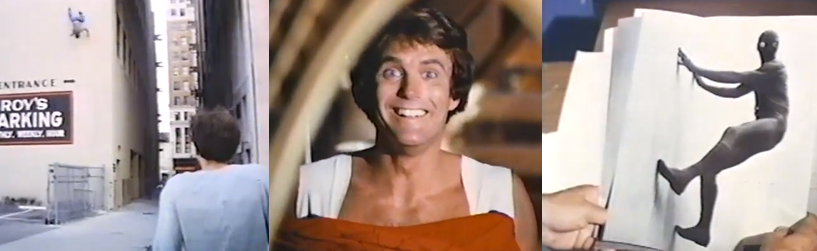
Back Issues [HulkaMAYnia]: The Incredible Hulk #1


Since his explosive debut in 1962, Stan Lee and Jack Kirby’s gamma-irradiated Jade Giant has been one of their most recognisable and successful characters thanks, in large part, to the Incredible Hulk television show (1977 to 1982) catapulting the Hulk into a mainstream, pop culture icon. Hulk has been no slouch in the comics either, being a founding member of the Avengers, joining teams like the Defenders, and has gone through numerous changes over the years that have added extra depth to the green-skinned behemoth and made him one of their most versatile and enduring characters.
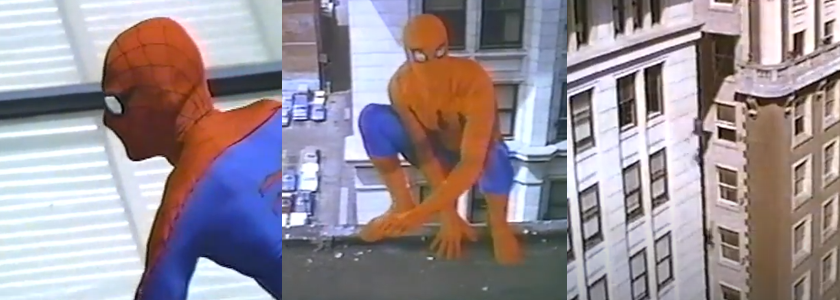

Story Title: The Hulk (includes “Part 1: The Coming of the Hulk”, “Part 2 : The Hulk Strikes!”, “Part 3: The Search for the Hulk”, “Part 4: Enter…The Gargoyle!”, and “Part 5: The Hulk Triumphant!”
Published: May 1962
Writer: Stan Lee
Artist: Jack Kirby

The Background:
The Incredible Hulk (and his human alter ego, Doctor Robert Bruce Banner), was, of course, the creation of Marvel Comics legends Stan Lee and Jack Kirby. Inspired by a story of a hysterical mother exhibiting superhuman strength to rescue her trapped child, in addition to classic movie monsters such as Frankenstein’s Monster and the duel personalities of Doctor Jekyll and Mister Hyde, Lee and Kirby sought to create a tortured, monstrous figure that was a reaction to the mysterious of science and radiation and the foils of war. Famously, of course, the Hulk made his debut as a stone-grey figure who emerged at the onset of night; when printing errors saw the character rendered in different hues, Lee (who also often mistakenly referred to Bruce Banner as “Bob Banner”) decided to switch the character to his now-signature green (though red would have been far more appropriate considering it, like the Hulk, is associated with rage). Despite The Incredible Hulk being cancelled after only a year and a half, the character returned to a self-titled comic and a position of prominence with Marvel readers thanks to subsequent expansions of his lore and character and, of course, his inclusion in numerous team ups, issues of Tales to Astonish, and the popularity of the TV show and his other animated appearances.

The Review:
The issue begins in the middle of the desert where stands the Gamma Bomb (or “G-Bomb”), the “most awesome weapon ever created by man”; the genius behind the G-Bomb, Dr. Bruce Banner, waits anxiously in the concrete bunker some miles away. Banner’s nerves aren’t helped by the criticism of his fellow scientist, Igor, or the blustering presence of General “Thunderbolt” Ross. Ross isn’t happy at the delays Banner has caused the operation, or his men, and openly scoffs at Banner’s concerns and apprehension concerning the vague (yet nonetheless awesome) power the weapon holds. Igor, meanwhile, is incensed that Banner hasn’t shared the secrets of the G-Bomb with him or their peers, even more so when Banner reveals that no one has double-checked his formulas and calculations.

Thanks to Igor and Rick, Banner is bathed in the full force of the mysterious gamma rays!

Banner’s preference towards secrecy and privacy backfires on him, however, as Igor, eager to take all the credit for Banner’s work, allows the G-Bomb countdown to continue after Bruce heroically races out into the testing area to save the life of a teenage kid, Rick Jones, who has slipped past the guards. Banner shields Rick in a nearby trench but, thanks to Igor, the genius scientist is caught in the full blast of the exploding G-Bomb! Hours later, he awakens, still screaming, having miraculously survived the explosion and apparently suffering no ill effects from the awesome gamma rays. Rick, humbled and eternally grateful to Banner for saving his life, sticks around and watches in awe as, when night falls, Banner undergoes a startling transformation into a grey-skinned behemoth!

The Hulk’s rampage is stopped right before he can do serious harm to Rick.

Rather than the mindless, rampaging beast known for his trademark cry of “Hulk smash!” this first incarnation of the Hulk (as the panic-stricken soldiers coin the beast) is a disconcertingly articulate and lumbering creature. His first thought is escape, smashing first through the concrete wall of the base and then trashing an oncoming jeep with ease before disappearing into the night as Rick frantically gives chase. While the soldiers back at base are gob-smacked at what they witnessed, they nevertheless mount an armed search party to track down the beast, whom they believe has kidnapped or killed Dr. Banner. The Hulk, meanwhile, is driven by pure instinct to retrieve Banner’s gamma formula but stumbles upon Igor attempting to steal it for himself! To Igor’s horror, the Hulk is completely unfazed by a “.38 slug in [his] shoulder]”, crushes Igor’s pistol in one meaty hand, and tosses Igor across the room effortlessly. Upon hearing Banner’s name, the Hulk is disgusted and annoyed, believing Banner to be “weak — soft!!”, and then violently rejects Rick’s desire to help him. Indeed, the Hulk advances on Rick, seemingly looking to kill him, and is only stopped by the sudden and unexpected rising of the sun, which sees the Hulk revert to Banner before Rick’s horrified and fascinated eyes.

The stress of his newfound curse begins to take its toll on Banner…

When General Ross and the Military Police show up searching for the Hulk, they immediately begin pointing fingers at everyone! Igor is detained as they believe he is in league with the Hulk and Banner (who sports a minor shoulder injury from Igor’s bullet) is questioned as a suspect. Luckily, plenty of eyewitnesses are on hand to attest to the Hulk’s monstrous appearance, though their accounts of the creature vary wildly. Amidst the confusion, Banner is comforted by Ross’s daughter, Betty, who previously defended him in front of her father. Perhaps out of pity, perhaps out of kindness, perhaps even out of an attractive, Betty offers her help and support to Banner, whom she believes is still suffering from the effects of the G-Bomb, to say nothing of the subsequent stress of recent events. After she leaves, Banner laments his cruel fate, despairing that, when the sun sets, he will once again become the Hulk and lose his rational mind to a monstrous creature.

News of the Hulk’s strength reaches the Gargoyle, the Soviet’s ghastly grotesque.

Locked up in a prison cell, Igor (actually a spy for the Russians) is able to use a handy-dandy hidden “sub-miniature transistor short wave sending set” (translation: a small radio) hidden in his thumbnail to send a message to his Soviet comrades. The Russians take Igor’s message of the Hulk to the Gargoyle, “the most feared man in all of Asia”, a hideous little…gargoyle…of a man who is so feared that no one dares give him the message in person. Angered at the thought of a creature able to match his power, the Gargoyle immediately has himself literally launched over to America to confront the Hulk.

The Hulk is disgusted at Betty’s fragility…

In a desperate attempt to keep the Hulk from hurting others, Banner and Rick drive out of the base and into the desert but, on the way, the transformation occurs and their jeep is wrecked. Rick is shaken by the crash but the Hulk is unfazed and immediately, instinctively, heads towards Betty at General Ross’s house. Betty, who is irrationally overcome with feelings of concern and affection for Banner, attempts to clear her head and encounters the Hulk just outside her house, fainting in his arms to the grey goliath’s disgust. However, unbeknown to the Hulk and Rick, they have been followed by the Gargoyle, who promptly shoots the charging man-monster and his young companion with a special pistol that instantly makes them obedient to his every command.

Banner uses his intellect to cure the Gargoyle, who sacrifices himself to ensure their escape.

Utilising the help of similar slaves, the Gargoyle manages to escape with his prey back behind the Iron Curtain and is positively giddy at the thought of dissecting the Hulk and claiming his power for his own…and equally distraught to find that the Hulk has reverted back to Banner during the trip. Now no longer showing the effects of the Gargoyle’s weapon, Banner and Rick are astonished to witness the Gargoyle break into tears when he realises that the Hulk and Banner are one and the same. Distraught at his ghastly appearance, the Gargoyle wishes only to be a normal man again, just like Banner, whatever the cost. Banner, who has “seen cases” like the Gargoyle’s before, believes he can use “radiation” to grant the creature’s wishes and is, surprisingly, successful. Now a man once more, the Gargoyle allows his captives to return to America safely while he stays behind and sacrifices himself to destroy the Russian outpost

The Summary:
Well, honestly, I have to say that I am surprised; I was expecting the Hulk’s debut appearance to be primarily about him coming into conflict with the military but, instead, the story takes a dramatic and odd sharp left turn with the introduction of the Gargoyle.

The Hulk is surprisingly articulate and subdued compared to his later, more mindless portrayals.

“Unexpected” is perhaps the best world to describe The Incredible Hulk #1 since neither the Hulk or the Gargoyle are portrayed as mere mindless monsters. Instead, the Hulk is childlike, lumbering, and quick to anger but a far cry from the volatile creature he is now known to be. His feats of strength are extremely subdued compared to the literal world breaking exploits he would later indulge in and he’s also surprisingly articulate and cunning, acting on instinct but not simply yelling and screaming near-incoherently at his pursuers.

The Gargoyle, like the Hulk, is not what he seems on the surface.

The Gargoyle, meanwhile, appears to be this deformed, monstrous Red Menace and, indeed, it is implied that he is one of the Soviet’s most formidable weapons. Yet the knowledge that Banner and the Hulk are one and the same reveals his true nature as a tortured, pitiable creature who is lashing out because of his monstrous appearance. The Hulk, meanwhile, lashes out to escape and out of pure instinct thanks to the remnants of Banner’s memories and consciousness rather than out of pure malice and, while Banner is seemingly unable to help himself (though, to be fair, he hasn’t even tried yet) he is able to cure the Gargoyle through questionable means and allow him to die as a man.

Many of the Hulk’s troupes are established in this debut issue despite the story’s odd turn.

The issue, obviously, establishes many of the troupes that would come to be associated with the Hulk for decades: Banner is tormented by his condition, lamenting his fate and completely giving into despair and acceptance of his newfound curse. The Hulk wishes only to be left alone and to revel in his strength and power over the likes of “Puny Banner!” Betty is at once fascinated by Banner and terrified of the Hulk, with no one besides Rick having knowledge of his dual nature, and Ross, having discovered Betty still woozy from her fainting spell and babbling about the Hulk, vows to hunt down and destroy the creature without mercy. Little of this is really developed all that much in this first issue thanks to the sudden shift in tone and focus to the Gargoyle but the seeds are definitely planted and it certainly stands out as more of a monster/horror story than a traditional superhero tale, which may have been why the Hulk struggled to connect with Marvel readers for some time as they were, perhaps, expecting bright, costumed adventurers rather than a persecuted man-monster.

My Rating:

Rating: 3 out of 5.

Pretty Good

How did you find the Hulk’s debut story? Did you read it when it was first published and, if so, did the Hulk leave much of an impression on you or were you expecting something different from Marvel? What did you think to the Hulk as a character, especially compared to how he would be portrayed in subsequent years? Do you like the original grey-skinned Hulk or do you prefer the traditional green colouring? What is your favourite Hulk story, character, or piece of media? How are you celebrating the Hulk’s debut today? Whatever your thoughts on the Hulk, go ahead and leave a comment below.