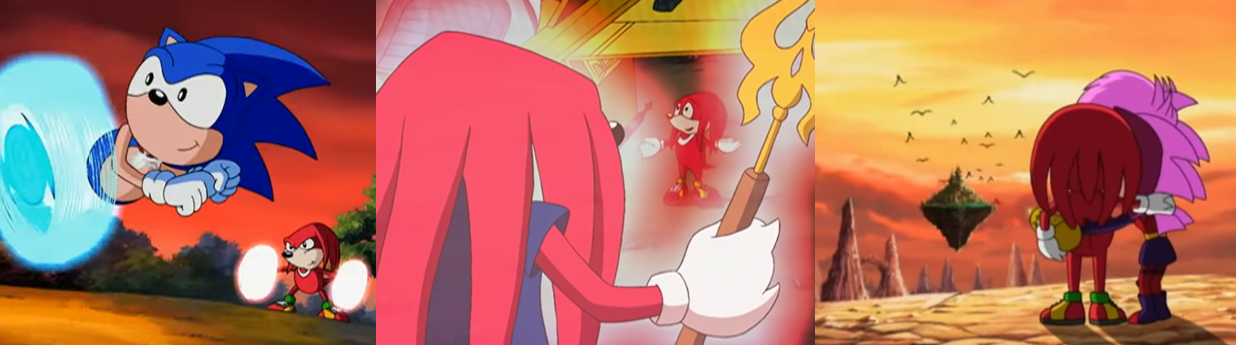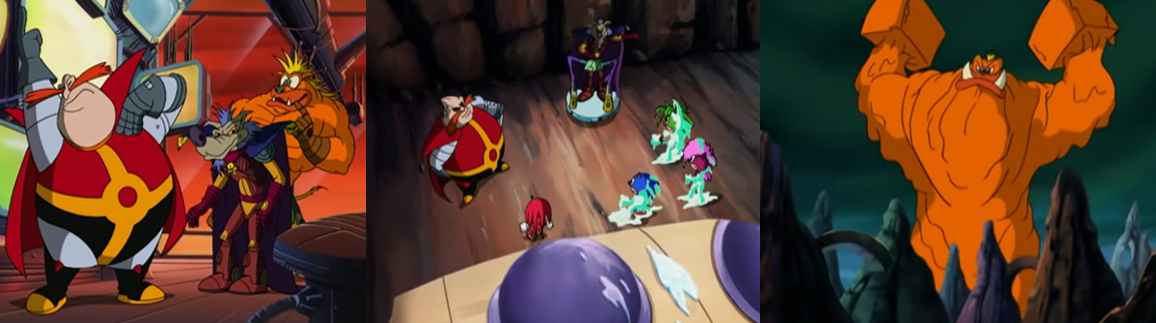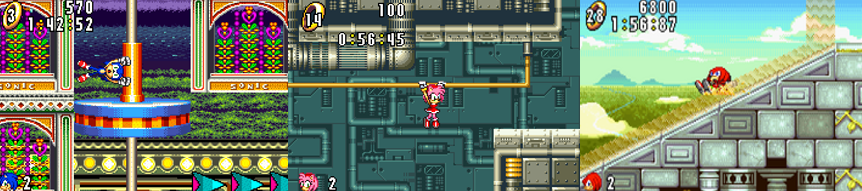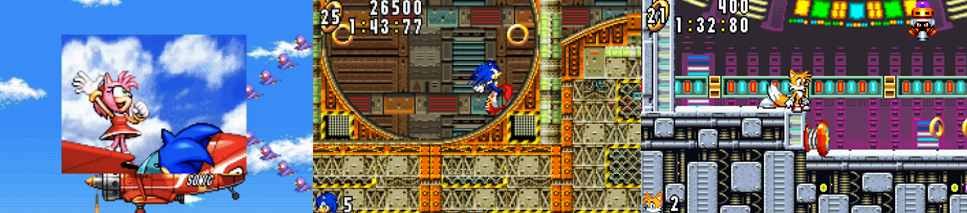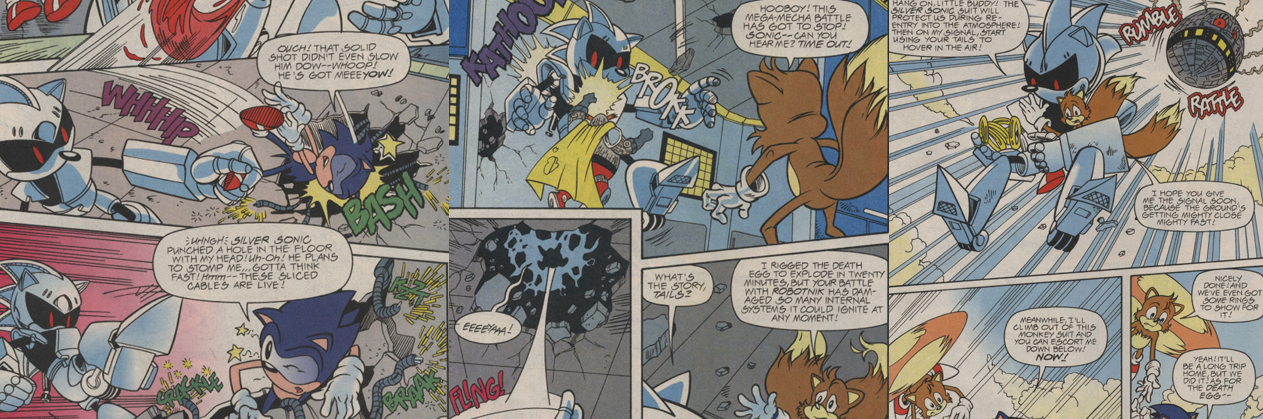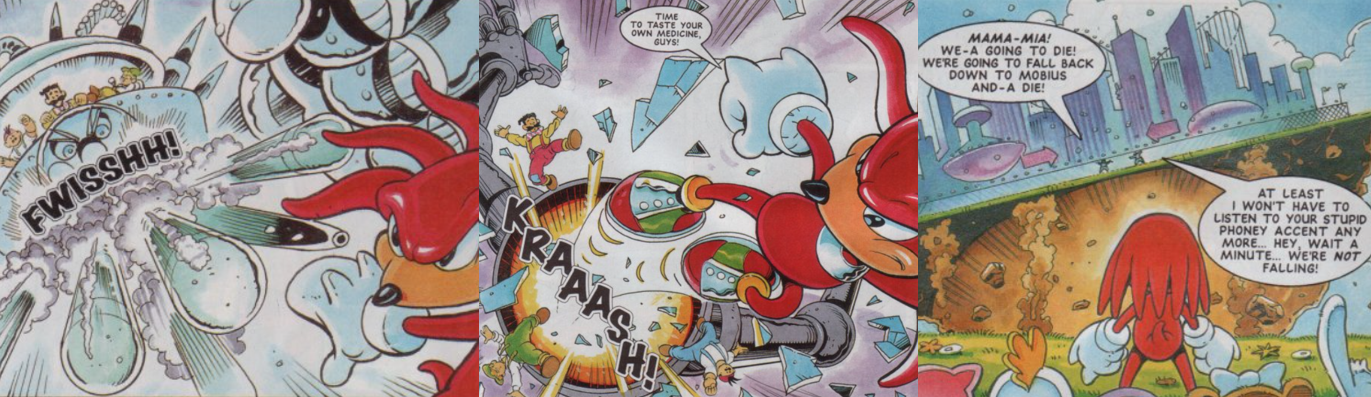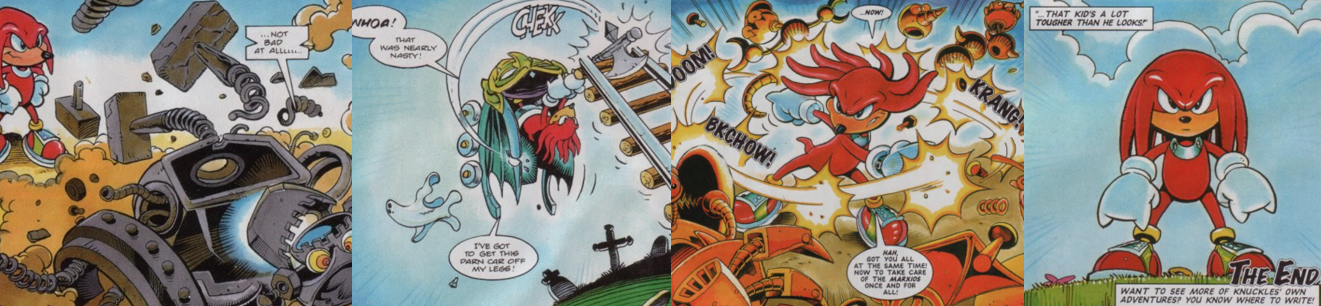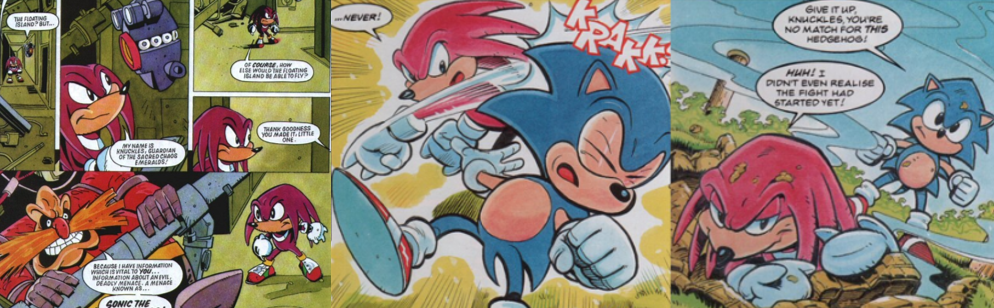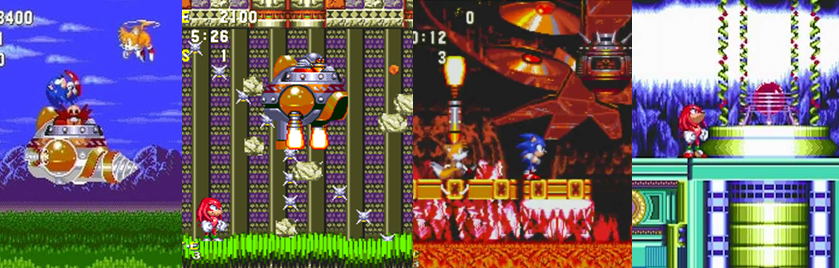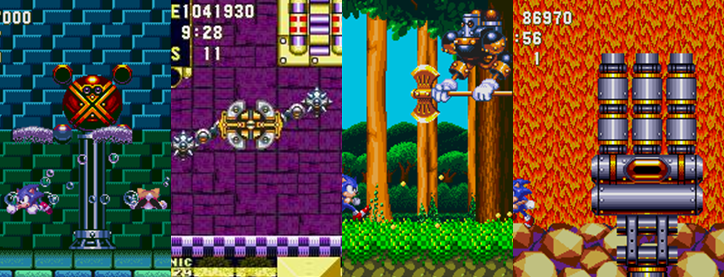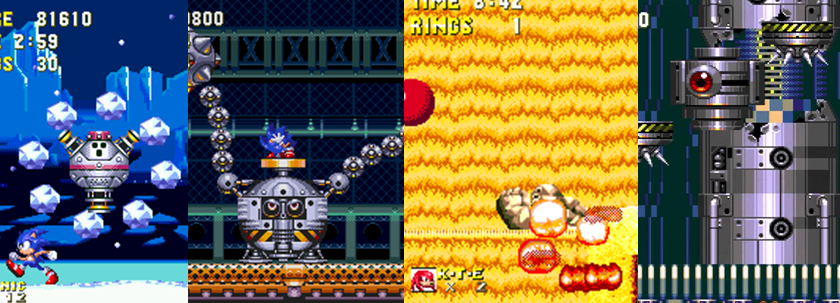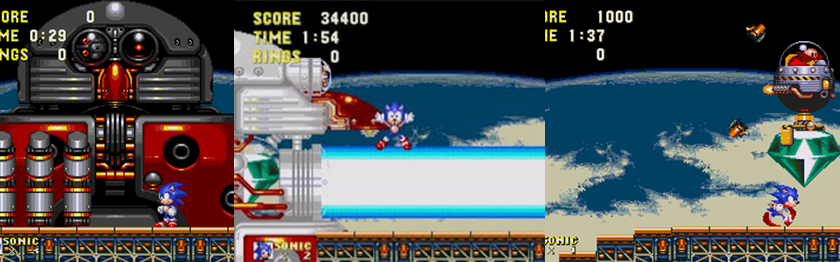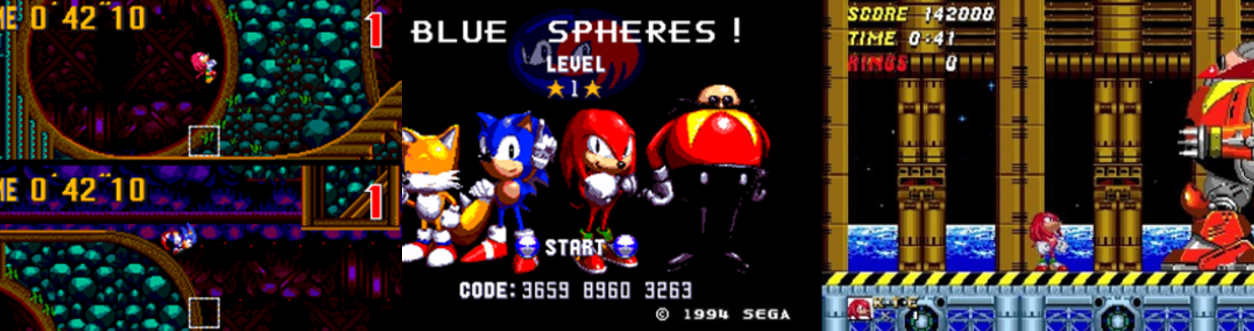
With the release of Sonic the Hedgehog 3(SEGA Technical Institute, 1994), gamers were introduced to Knuckles the Echidna. This mischievous, dreadlocked antagonist was created by Takashi Yuda and his debut was made all the more impressive by virtue of the fact that Sonic 3 was too big to fit on one cartridge, which meant that Knuckles was the first of Sonic’s supporting characters to co-star in a main series videogame when Sonic & Knuckles (ibid) was released on this very day in 1994.
Story Title: “Carnival Night Conspiracy” (Parts 1 to 6) Published: 12 November 1994 to 21 January 1995 Writers: Nigel Kitching Artist: Richard Elson
The Background: After Sonic the Hedgehog rocketed to mainstream success and helped SEGA to usurp Nintendo to capture the allure of the videogame industry, SEGA capitalised on Sonic’s popularity not just with videogames but also a slew of merchandise, including cartoons and comic books. About six months after Archie Comics began publishing a weird amalgamation of the Adventures of Sonic the Hedgehog (1993 to 1996) and Sonic the Hedgehog/SatAM (1993 to 1994) cartoons, United Kingdom publisher Fleetway Editions Limited brought us “Britain’s Official SEGA Comic”, Sonic the Comic (StC), a fortnightly comic book that I collected diligently until its unfortunate end. While StC pulled much of its lore from the now defunct Mobius and Doctor Ovi Kintobor storyline that was popular outside of Japan at the time, StC quickly veered away from the source material to recast Sonic the a mean-spirited leader of a gang of Freedom Fighters made up of both recognisable characters and anthropomorphic characters adapted from the videogames. Like the Archie comics, StC often included someloose adaptations of the videogames that adapted the source material to fit with its noticeably different lore. After his introduction in a multi-part story loosely based on Sonic 3, Knuckles almost immediately graduated to his own back-up stories in the pages of StC. While these initially tied up some loose ends from that story and cherry-picked ideas from Sonic 3 & Knuckles, they soon evolved into their own beast entirely to expand on Knuckles’s vague backstory and craft a version of the character entirely unique to any seen in other Sonic media.
The Review: Although “Carnival Night Conspiracy” is Knuckles’ first solo story arc in StC, it wasn’t actually his first solo story; the Guardian of the Floating Island first appeared in a short story in a StC summer special, which basically showed how he met Dr. Robotnik and served as a tantalising prelude to his first multi-part appearance in the main Sonic the Hedgehog strip. “Carnival Night Conspiracy” takes place directly after that; thanks to Dr. Robotnik being unable to hide his true nature for too long, Knuckles soon realised that the egg-shaped dictator he had aligned himself with was actually plotting to merge the twelve Chaos Emeralds into six and absorb their powers. Fortunately, Knuckles was able to use the power of the elusive Grey Emerald (also known as the “Control Emerald”, kind of a precursor to the Master Emerald and something commonly found in Sonic lore at the time) to stop Dr. Robotnik. He then aided Sonic and the other Freedom Fighters to repent for exposing their secret base and, after a massive battle, left on frosty terms in one of Dr. Robotnik’s Egg-O-Matics. This is where we find Knuckles at the start of the story, making his way back to the Floating Island (as it was known then; “Angel Island” wouldn’t become its name until 1999), only to have his ride suddenly explode thanks to a self-destruct mechanism triggered by Dr. Robotnik. Thankfully, Knuckles wasn’t too far from his floating island home and bails out, using his unique ability to glide to reach safety. However, from the clouds above the island he spots a bustlingly casino city, one well-guarded by Dr. Robotnik’s Troopers and just one of many outposts and bases the mad scientist secretly constructed on the island without Knuckles’ knowledge. Insulted and peeved by this, Knuckles burrows his way into the heart of the city, confused by the bright lights and the purpose of the casinos and restaurants and unaware that he’s being watched until he’s confronted by a massive construction robot.
Knuckles reluctantly allows the Marxio’s to stay after being won over by their thrilling ride.
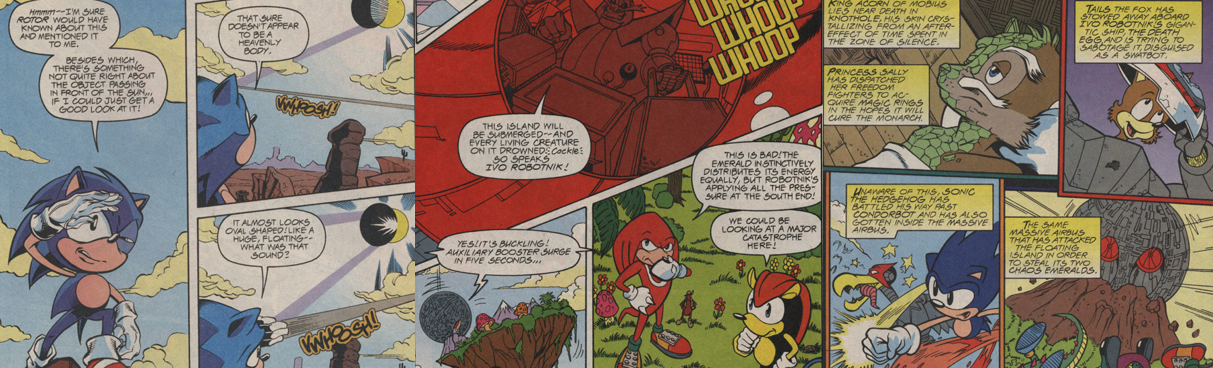
However, it’s no match for Knuckles’ super strength and he easily trashes it in one hit, but his heckles are only raised further when he barely avoids a sniper shot! Clambering up to confront his shooter, Knuckles is met by Carnival Night City’s owners and operators, the swindling conniving trio known as the Marxio Brothers. Led by the cigar-smoking Grouchio and made up of underpaid dogsbody Chicio and the mute Harpio, the Marxio Brothers are a composite of the comedians the Marx Brothers and the Super Mario Brothers and first appeared in StCsome years prior where they were in charge of the similarly-themed Casino Night Zone. Although he initially demands that they pack up and leave, Knuckles is won over by Grouchio’s silver tongue and the smarmy salesman pitches that their casino will help Knuckles spruce up his island for when his lost people eventually return and easily explains away Dr. Robotnik’s Troopers as being security guards they purchased. Naturally, Knuckles is sceptical, but still somewhat naïve to the wider world and awestruck by the technology and allure of modern Mobius, so he allows the Marxio’s to give him a tour and take a ride on a high-speed rollercoaster, completely unaware that the trio do actually work for Dr. Robotnik. Strapped tightly into the Hell House Ride, Knuckles enjoys the thrill of the rollercoaster and admires the amount of effort the Marxio’s went to make the ride dangerous and exciting, using his super strength to smash through any hazards that come his way and being so won over by the fun and exhilaration offered that he agrees to let the slimy conmen stay on the Floating Island. Overjoyed, Grouchio makes Knuckles a partner in their endeavour, granting him a luxurious office (to the echidna’s chagrin) and the title of “Marketing Consultant” ahead of them opening the park to the public.
Knuckles smashes the Marxio’s craft and then forcibly removes them from the island!
However, when Knuckles leaves to take care of Dr. Robotnik’s Launch Base Zone, the Marxio’s pursue him in their three-seater craft and Chicio accidentally lets slip that the egg-shaped dictator is bankrolling their entre endeavour. Though frustrated by his brother’s stupidity, Grouchio has no qualms about transforming their craft into a heavily-armed combat mech and unleashing its full might against Knuckles, who is summarily beaten into unconsciousness. However, right as the first guest arrive on the Floating Island and Grouchio is regaling Dr. Robotnik with their victory and promises of fortune, Knuckles recovers and redoubles his efforts, easily dodging their missiles and massive mechanical fists and tearing the craft apart with a superpowered uppercut. To stave off Knuckles’ wrath, Chicio redeems himself by calling in and hoard of Badniks and Grouchio wows the park’s guests by spinning the resulting destruction as a performance celebrating Knuckles’ victory over Dr. Robotnik. Unable to destroy the Carnival Night City with so many innocent lives at risk, Knuckles allows the Badniks to close in on him so he can destroy them all in one fell sweep and comes up with a simple, direct, and effective solution to his problem. By striking a fault line with one massive punch, Knuckles just breaks the entire Carnival Night Zone off the Floating Island! Thankfully, this severed chunk of rock contains just enough residual power from the Chaos Emeralds to allow it to slowly drop to Mobius below rather than plummeting down and killing the three, and it crashes before the startled eyes of a young boy who was unable to make the trip. With his mission complete, Knuckles orders the startled guests to vacate his island and stoically prepares to rid the Floating Island of every trace of Dr. Robotnik.
The Summary: I was super excited about Knuckles at the time; I was so stoked for Sonic 3’s release and absolutely captivated by this grinning, mysterious, antagonistic red echidna (often referred to as a “spiked monkey” in magazines). When he first appeared in the StC summer special, I couldn’t wait to see when he would make his StC debut and it seemed to take ages for him to show up, but boy was it worth it at the time! Then, after proving a formidable foe and a reluctant ally, Knuckles got his own back-up feature in StC beginning with this story and they quickly became my second favourite strip of the comic after Sonic’s. Nowhere is it more evident that “Carnival Night Conspiracy” was meant to be seen as an important feature, one second only to Sonic’s strips, than in the presence of artist Richard Elson, easily the comic’s most talented hand, who had illustrated Sonic’s stories for years and this definitely helps to bolster the tale as being important to the ongoing Sonic 3 adaptation in the comic at the time.
The story went a long way to establishing Knuckles as a bad-ass loner.
Knuckles retains much of his characterisation from his debut appearance; he’s hot-headed, proud, and incredibly naïve, easily awestruck by the ways of the surface world and manipulated by others. He is a little more guarded here thanks to being burned by Dr. Robotnik, but not so much that he doesn’t just forcibly eject the Marxio’s or that he can’t be won over by a rollercoaster ride. His focus is on safeguarding his home, however, and eradicating Dr. Robotnik’s influence from its surface; when the Marxio’s get in the way of that, and his reluctant hospitality, Knuckles doesn’t hesitate to fight back and trash their machine, but he’s not so single-minded in his vendetta as to endanger anyone’s lives. The Marxio’s have always been joke villains in StC but they work here as Dr. Robotnik’s proxies; Knuckles was never the airheaded, gullible fool in StC but many of the comic’s villains did manipulate and betray his trust, though the situation was a little different each time and he generally seemed to learn from each encounter. The primary thrust of this story, though, is to establish that Knuckles is a hot-headed loner who wants to live in peace and solitude on his island and that he’s an extremely tough physical specimen, able to glide, scale walls, and smash an entire chunk off his island with his incredibly strength. Lacking Sonic’s grating arrogance and proclivity for quips, Knuckles comes across as a bad-ass recluse who isn’t to be trifled with and who will unleash an incomparable wrath on anyone who threatens his home or tries to take advantage of him.
My Rating:
⭐⭐⭐
Rating: 3 out of 5.
Pretty Good
Have you ever read “Carnival Night Conspiracy”? Did you pick the issues up when they were first released and, if so, what did you think about Knuckles’ first spin-off? What did you think to Fleetway’s introduction and characterisation of Knuckles and the way they handled his backstory? Were you a fan of the Marxio Brothers? What did you think to Knuckles’ early crusade against Dr. Robotnik? Which of Fleetway’s Knuckles stories and/or characters was your favourite and why? Are you celebrating Knuckles’ big day today? Whatever you think about Sonic the Comic, and especially Knuckles, leave a comment down below or let me know by commenting on my social media.
Story Title: “Guardian of the Chaos Emeralds“ Published: 18 June 1994 Writer and Artist: Nigel Kitching
Story Titles: “Enter Knuckles” (Part 1 and 2), “Power of the Chaos Emeralds“ (Part 1 and 2), and “Robotnik’s Revenge” (Part 1 and 2) Published: 20 August 1994 to 29 October 1994 Writer: Nigel Kitching Artist: Richard Elson
The Background: After allowing SEGA to knock Nintendo from the top of the videogame industry, the company almost immediately set about transforming Sonic’s popularity into mainstream success through a slew of ancillary media and merchandise, most notably cartoon sand comic books. About six months after the first of Sonic’s Archie Comics adventures, United Kingdom publisher Fleetway Editions Limited began their own series with “Britain’s Official SEGA Comic”, Sonic the Comic (StC), a fortnightly publication that I collected diligently until its unfortunate end. Heavily influenced by the now defunct Mobius and Doctor Ovi Kintobor storyline that was popular outside of Japan, StC quickly veered away from the source material to portray Sonic the a mean-spirited leader of a gang of Freedom Fighters comprised of both videogame characters and anthropomorphic characters adapted from the videogames. Like the Archie comics, StC included some very loose adaptations of the videogames that were often truncated or heavily altered to fit with its noticeably different lore. Their adaptation of Sonic the Hedgehog 3 & Knuckles (SEGA Technical Institute. 1993; 1994) was no different, though it was framed as a lengthy ongoing storyline told over several issues. Additionally, though he was first teased in a one-off story in the 1994 Sonic Summer Special, these stories also stand as some of the most prominent storylines as they introduced Knuckles the Echidna to the comic, a character who would be at the forefront of his own solo series within StC and some of StC’s most important stories.
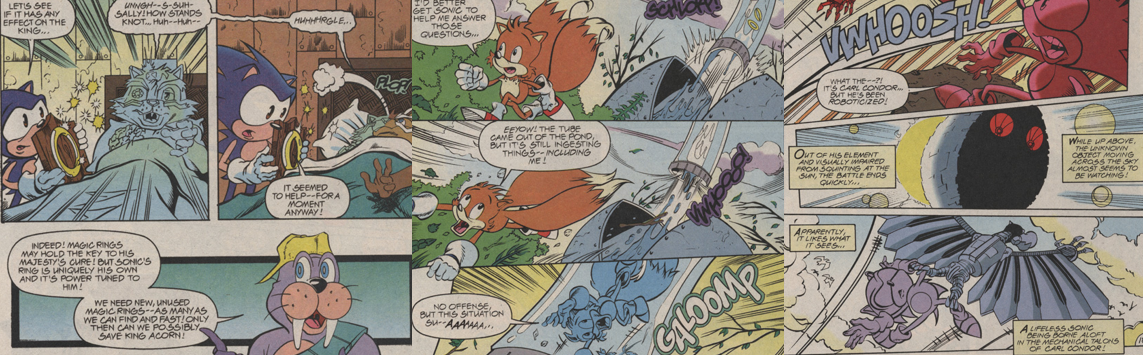
The Review: Sonic the Comic readers first met Knuckles in Sonic: The Summer Special, the first of many bumper publications from Fleetway that contained additional stories and content not seen in the main issues. In his first appearance, Knuckles looked notably different, appearing squatter and more of a plum colour than his traditional red. Still, “Guardian of the Chaos Emeralds” introduces the legend of what was then called the Floating Island, a mysterious island floating above the clouds and which is so rarely glimpsed by those below that it’s thought to be a myth. However, this myth is actually true and the island, held aloft by the power of the Chaos Emeralds, is home to Knuckles, the last of the Echidna people, who is duty bound to safeguard the island while waiting for his people to return. One day, a meteor comes crashing down in the Ice Cap Zone, caching Knuckles’ attention. Knuckles easily travels the distance using a zoom tube and finds it’s not a meteor, but a large spherical craft. Knuckles is stunned when a remote probe emerges and, though cautious, ventures inside to help the “humble inventor” trapped within. Finding the interior to be a mess, Knuckles follows the probe, whose operator expresses surprise to learn they’ve crashed on the Floating Island and that Knuckles has all the Chaos Emeralds there with him. This is all the information the devious Doctor Ivo Robotnik needs to warn the naïve guardian of a pending threat from Sonic the Hedgehog, and therefore dupe Knuckles into aligning with him. A few months later, concerned over Dr. Robotnik’s disappearance after the Death Egg II fell from orbit, Sonic and the Freedom Fighters scoff at the notion that it landed on the mythical Floating Island. Sonic, already irritated at having to go on what he sees as a wild goose chase, is thus stunned when he and Miles “Tails” Prower find the Floating Island based on Kintobor’s hypothesis. Sonic and Tails land in a loose approximation of the Marble Garden Zone and are instantly attacked by an arrow-spitting totem pole, just one of many hazards and traps littering the mythical island. Thankfully, the sarcastic Sonic is saved from falling to his death by the much-abused Tails, and even demonstrates a secret new ability of his, a forcefield he creates by vibrating the air molecules in front of him at super speed.
Sonic meets his match in Knuckles, but ends the fight by finally capturing Dr. Robotnik!
The presence of a Badnik is all the proof Sonic needs that Dr. Robotnik is on the island, but the egg-shaped tyrant makes a physical appearance at the story’s end and Sonic learns the hard way that his hated enemy as a new ally: Knuckles, guardian of the Floating Island and last of the echidnas, who lays Sonic out with a single punch. Sonic recovers pretty quickly but learns that Dr. Robotnik has duped the isolated echidna into thinking that Sonic and Tails are petty thieves and despots looking to steal his island’s Chaos Emeralds; naïve and trusting that Dr. Robotnik is a kind-hearted soul, Knuckles has pledged to defend his island and its Chaos Emeralds, and a fight ensues. While Sonic has the speed advantage, Knuckles exhibits extraordinary superhuman (superanthro?) strength, walloping Sonic over the head and causing a significant tremor by punching the ground. When Sonic sends Knuckles flying with a whirlwind-like Spin Attack, the echidna surprises him by tunnelling under the dirt and the two battle so fiercely while underground that the landscape cracks apart. Sonic gains the upper hand but, although he’s taken a beating, Knuckles is still more raring for more; however, Sonic manages to outsmart his new rival by thinking of the big picture and has Tails literally capture Dr. Robotnik in a net and fly them away from the island.
Dr. Robotnik reveals his true nature, but his lofty ambitions are immediately undone by Knuckles.
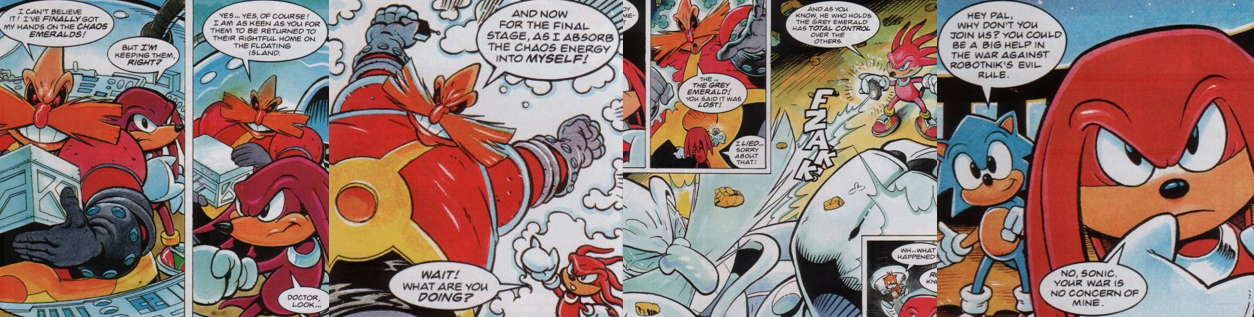
Although Sonic exudes his usual brash arrogance, he admits to himself the Knuckles was tougher than he looked, and his troubles with the misguided echidna are soon revisited when Knuckles burrows into Dr. Robotnik’s cell at Sonic’s space thanks to a homing device the mad scientist implanted at the base of Knuckles’ skull! Dr. Robotnik takes Porker Lewis hostage and demands that Sonic hand over the six Chaos Emeralds in his possession; left with little choice, Sonic reluctantly hands over the gems and tries to appeal to Knuckles, but to no avail, so he and Tails quickly pursue the duo back to the Floating Island to retrieve the jewels. Sonic and Knuckles get back into it, but while Sonic is able to pummel the dreadlocked echidna, he’s at a disadvantage due to Knuckles’ knowledge of the island and all its secrets; Sonic feigns being crushed by two giant stone hands in order to get a better idea of Dr. Robotnik’s endgame, much to Tails’s chagrin, and the two follow their enemies to the Temple of Chaos. These stone runes seem to be acting as a temporary stand-in for the Hidden Palace Zone, and are home to the Floating Island’s six Chaos Emeralds; Knuckles is delighted to have the twelve Chaos Emeralds finally reunited after being split apart untold aeons ago, explaining how there are two sets of Chaos Emeralds in StC lore. However, at this point, the Chaos Emeralds are emerald cut and resemble the 2D sprites from the first two Sonic games rather than the diamond cut design of Sonic 3 and more commonly associated with them, and the Master Emerald is noticeably missing. Instead, the “Control Emerald” is the long-lost Grey Emerald, but Dr. Robotnik utilises a device of his own creation to replicate the Grey Emerald’s power, merge the twelve gems back into six, and then surprise Knuckles by absorbing the Emerald’s energy into himself! Nigh-invincible and grown to gigantic proportions, Dr. Robotnik easily turns Tails to glass and reveals his true nature as a manipulative, malicious dictator with designs of using the Chaos Energy to dominate and destroy everything in his path. However, Knuckles easily turns the tables by revealing not only that he’s not as gullible as Dr. Robotnik thought but also that he’s been in possession of the Grey Emerald all along; he easily saps the Chaos Energy from the would-be God, restoring Tails in the process, and teleports him away from the Floating Island, ending his threat before it can really begin.
Knuckles comes to Sonic’s aid to atone for leading Dr. Robotnik to his secret base.
With the truth revealed to Knuckles, Sonic offers him a place among the Freedom Fighters, but he refuses; not only is Sonic’s war none of his business, but he’s patiently waiting for his people to return from the stars, and the three part was amicably…but far from friends. Although Dr. Robotnik’s dreams of Godhood have been dashed, he poses an even more significant threat than ever as he now knows the location of Sonic’s hidden base and he launches an all-out assault against the Freedom Fighters with a legion of his Badniks and piloting the “Squeeze Tag Machine” (basically the Big Arms from Sonic 3). Tails and Amy have already abandoned the base, but Sonic and Johnny Lightfoot are forced to engage with Dr. Robotnik to buy Porker the time to download Kintobor’s program to the Golden Ring he came from to preserve his personality. The maniacal megalomaniac isn’t messing around this time, though, and the Squeeze Tag Machine proves too tough for even Sonic’s patented Spin Attack, but he’s able to buy them just enough time by burying the machine under a cave-in. While this is going on, Knuckles is working his way across the Floating Island, removing every trace of Dr. Robotnik’s influence; his first target is the Death Egg II, which is under repair at the tyrant’s man-made Launch Base Zone and under the supervision of the doctor’s slimy little assistant, Grimer. Knuckles coerces Grimer into delivering a false message of his death, simply to make a dramatic last-minute save right as Dr. Robotnik is closing in for the kill; with his incredible strength, he smashes open the Squeeze Tag Machine and allows Sonic to deliver the final blow, but there’s still the issue of the doctor’s Badnik army. Knuckles busts them out into the open and the two begrudgingly join forces to fend them off, trading barbs and making a competition out of the combat. Although they clearly have no love for each other, there’s no denying that Sonic and Knuckles make a formidable team and (with some help from Johnny) and it isn’t long before they’re surrounded by a mess of broken mechanical parts. However, this is enough of a distraction for Dr. Robotnik to make a hasty retreat, and the status quo for Sonic and his friends has forever changed as they’re forced to go on the run, and in disguise, as “Bob Beaky’s Travelling Circus”. As for Knuckles, he commandeers one of Dr. Robotnik’s Egg-O-Matic’s and returns to his island for his first solo run, parting on amicable but strained terms with his newfound rival.
The Summary: I was super hyped for Knuckles’ big debut in StC; the character had really captured my imagination and fascination at the time and I was eagerly anticipating his first story arc after his brief introductory story. Thankfully, StC definitely delivered in these stories; thanks to the unparalleled art of Richard Elson, Knuckles is at his absolute best here, appearing intimidating and confident and strong and he never comes across as a gullible, sheltered fool. Instead, he’s simply misguided; he has no reason not to trust Dr. Robotnik and is focused only on protecting his island and reuniting the Chaos Emeralds. Sure, it’s a bit weird how his chest fur is imagined as a necklace, but the character brings probably the most physical challenge to Sonic since Metallix. Though outmatched by Sonic’s speed, Knuckles more than holds his own with his superior strength, durability, and unrivalled knowledge of the Floating Island and all its secrets. He also ends up proving himself to be a wily and honourable warrior, deceiving Dr. Robotnik about the Grey Emerald and even helping Sonic out despite having no interest in the troubles of the surface world.
Very few locations and elements from the source material make it into the story.
It’s a shame, then, that the story really doesn’t explore the Floating Island all that much; the only location the story visits from the game is the Marble Garden Zone and the Temple of Chaos (which doesn’t appear in the game) and, as always, simply cherry-picks elements from the games such as Badniks, hazards, and Dr. Robotnik’s battle craft. However, it’s important to note that Knuckles’ story didn’t end here; far from it, in fact. Through his own solo run, and a subsequent story arc, we would see much more of the Floating Island and adaptations of Sandopolis Zone, Carnival Night Zone, and Sky Sanctuary Zone in a loose adaptation of Sonic & Knuckles that served as a conclusion to this arc. Here, though, there’s very little pulled from the source material and more of the story takes place in the Emerald Hill Zone thanks to the amount of time spent in Sonic’s base. Despite this, Knuckles’ big debut did shake things up in StC for quite some time; Sonic and his friends no longer had a hidden base to operate out of, and had gained a tentative ally in the reclusive echidna, who would reluctantly help Sonic out in future stories as well as have both solo adventures and team-based stories with the Chaotix Crew.
Richard Elson’s art, and the fights between Sonic and Knuckles, are the best parts of this story arc.
Overall, this is a fun story that is given a lot of time to breathe across its six issues, and yet is still primarily more focused on adding to the original lore of the comics rather than delivering a faithful adaptation of Sonic 3. I often wonder just how much material, context, and gameplay the writers and artists of these comics were given access to as there’s rarely an attempt to directly represent the events of the videogames, or maybe it was simply just easier to spend the time introducing and familiarising readers to this new, bad-ass character rather than dwell on the specifics. The general thrust of Sonic 3 is (Dr. Robotnik tricks Knuckles in The Summer Special, steals the Chaos Emeralds, and has Sonic fight Knuckles while he works to repair his Death Egg) but the lack of representation from the Zones is disappointing. It would’ve been nice, for example, if Sonic and Knuckles had had their rematch in Angel Island Zone rather than crash-landing in Marble Garden Zone, and the paper-thin explanation for Sonic’s new forcefield ability seemed forced to me (I don’t recall this ability ever appearing again in the comics, either). Ignoring Knuckles’ off-model appearance in The Summer Special, the best part of this story arc are the fights between Sonic and Knuckles, which are wonderfully brought to life by the amazing Richard Elson. Sonic’s biting wit and abusive attitude are a fantastic counterpart to the proud Knuckles, and this arc really expanded the world of StC into new arenas thanks to the mystery and lore surrounding the last guardian and his Floating Island and went a long way to bringing the comic a little more in line with the source material.
My Rating:
⭐⭐⭐
Rating: 3 out of 5.
Pretty Good
Have you ever read Knuckles’ debut story arc from Sonic the Comic? If so, what did you think of it and which of the six parts was your favourite? Did you enjoy the artwork and Sonic’s abrasive attitude? What did you think to the way certain aspects of Sonic 3 were adapted into StC’s lore and would you have preferred a more faithful rendition? Which of Knuckles’ StC stories was your favourite and what did you think to the changes they made to his character and backstory? How are you celebrating the anniversary of Sonic 3’s release today? Please feel free to share your memories of StC and Sonic 3 & Knuckles below by signing up, or on my social media.
With the release of Sonic the Hedgehog 3(SEGA Technical Institute, 1994), gamers were introduced to Knuckles the Echidna. This mischievous, dreadlocked antagonist was created by Takashi Yuda and his debut was made all the more impressive by virtue of the fact that Sonic 3 was too big to fit on one cartridge, which meant that Knuckles was the first of Sonic’s supporting characters to co-star in a main series videogame when Sonic & Knuckles (ibid) was released on this very day in 1994.
Released: April 1995 Developer: SEGA
The Background: Following the release of Sonic 3 and Sonic & Knuckles, SEGA looked to be unstoppable with their Sonic franchise; the latter title was a huge game for SEGA, backed by an impressive marketing campaign, and the franchise had sold over $1 billion in total revenue by 1994. With the Mega Drive nearing the end of its life cycle, and the videogame industry on the cusp of entering a new generation of 3D gaming, SEGA attempted to prolong the Mega Drive’s lifespan and appeal with a series of expensive add-ons like the Mega-CD and the Mega Drive 32X. Like the Mega-CD, however, the 32X was doomed to failure primarily because SEGA were planning on releasing an entirely new console, the SEGA Saturn, just a few months later and gamers just couldn’t afford the clunky peripheral. With the benefit of hindsight, I truly believe that SEGA would have fared much better had they simply continued with the Mega-CD, producing a combination Mega Drive/CD console and releasing all 32X and Saturn games on this platform rather than wasting time, effort, and money on expensive add-ons. Regardless, one title that sticks out to me from the 32X library is Knuckles’ Chaotix; initially designed as Sonic Crackers, the game’s big mechanic was that players controlled two characters simultaneously and were joined by a special, elastic “Combi Ring”. The game, which was Knuckles’ one and only solo title, also saw the return and redesign of obscure Sonic character Mighty the Armadillo and Vector the Crocodile into fully playable characters. However, thanks primarily to the failure of the 32X, the title has largely been doomed to obscurity and SEGA’s continued refusal to port or re-release the game to modern consoles means that the only way to play the game is by using emulators or spending extortionate prices.
The Plot: Doctor Eggman discovers the seven Chaos Rings on Carnival Island and attacks alongside Metal Sonic. When Knuckles investigates, he rescues Espio the Chameleon from Dr. Eggman’s Combi Confiner and joins forces with Espio’s cohorts (Mighty, Vector, and Charmy Bee – the titular Chaotix) to put a stop to Dr. Eggman’s schemes using the power of the Combi Ring.
Gameplay: As is to be expected of a classic Sonic the Hedgehog title, Knuckles’ Chaotix is a 2D, sidescrolling action/platformer that is heavily geared towards speed but, in a change of pace, actually has far more emphasis on vertical platforming and progression that any of its predecessors. The game takes place in Newtronic High Zone and is comprised of six stages referred to as “Attractions”; each Attraction is made up of five levels (called “Acts”) rather than the usual two or three, and each of these pushes you to run up loops and walls or jump to higher areas in order to reach the end goal. In another change of pace, the game immediately begins with a practice area, in which you play as Knuckles. After scaring away Dr. Eggman, Knuckles rescues Espio from the mad scientist and players can choose to play through a quick tutorial to familiarise themselves with Knuckles’ Chaotix’s new mechanics.
Knuckles and his new friends are inexplicably tethered together for some clunky gameplay.
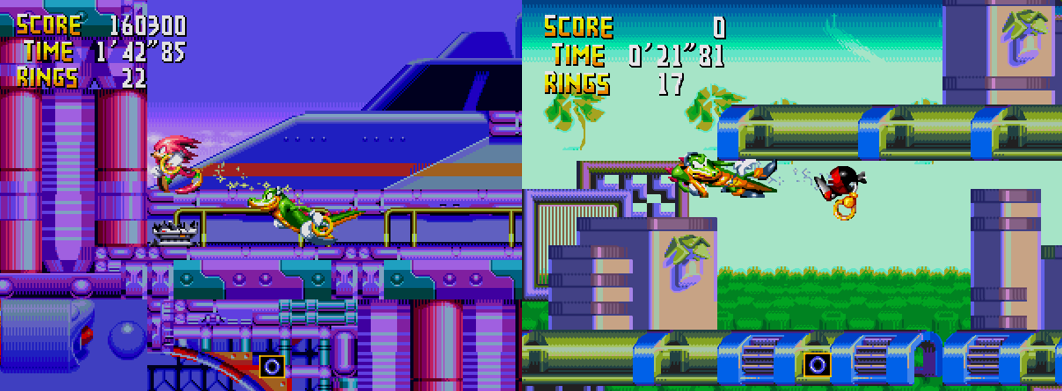
All of the basic controls of a classic Sonic remain intact and as you’d expect; players can run, jump, and perform a Spin Dash to speed ahead with all but three of the available characters, and you’ll find that each playable character has their own unique qualities. Knuckles, for example, can glide and climb walls as in his previous appearances; Espio spins like a top instead of Spin Dashing and can cling to walls but cannot climb them; Vector is the biggest character and so has a greater chance of hitting Badniks or taking damage but he can also perform a double jump or mid-air dash; Mighty is basically a thinly veiled stand-in for Sonic and can perform a wall jump; and Charmy is the smallest and fastest character and constantly flies about but at the cost of severely reduced visibility. Players can also be impeded by Heavy and Bomb, two Badniks who cannot Spin Dash or climb walls, explode on contact or severely weigh you down, and you’ll have to leave it up to a mixture of fate and luck as to which character you get as your partner as the main Scenario Quest forces you to pick one at random using the “Combi-Catcher”, a mechanical claw game like you see at seaside amusements. Of course, the unique selling point of Knuckles’ Chaotix is the frankly bizarre decision to tether two characters together using the Combi-Ring. This means that there are always two characters on screen at once, and you can choose to play either with a computer-controlled partner or with a human friend. Players can call their partner to them at any time with the A button or hold down B to “hold” their partner in place to activate switches; when they stand in place, you can also build up a head of steam to blast ahead, which is honestly more beneficial than the Spin Dash in this game. This also allows you to grab your partner and fling them at switches, Badniks, bosses, or up to higher areas; however, it can be extremely clunky trying to slingshot your way up to where your partner is, and more often than not you end up hanging in place or ricocheting about like a pinball just trying to progress upwards. Furthermore, calling your partner back costs you Golden Rings, the lifeforce of the series, and you can even drop the Ring counter into negative numbers as a result of this.
You’ll must master (or bungle) the Combi-Ring and make use of gimmicks to progress ever upwards.
While each character is very visually interesting in their own right and the idea of working together to progress is an interesting one, tethering the characters together is extremely restrictive in practise; the majority of the time, your biggest struggle won’t be with the game’s Badniks or the tedious nature of the gameplay, it’ll be with trying to navigate the environment using this clunky, awkward mechanic and getting frustrated when you finally get where you need to be only to drop down a second later. Indeed, the level of difficulty in Knuckles’ Chaotix is extremely low compared to the games that came before it; the life system and checkpoints are now gone, there are no bottomless pits or bodies of water to worry about falling or drowning in, and you don’t even need to worry too much about being hit without any Rings as you’ll either lose your partner for a short time or be booted out to the main hub world to try again. Like Sonic 3, the game comes with a save system that allows you to have three saved games, though the only way you can replay the game’s Attractions is to play through the Training Mode. This mode also allows you to set your playable character and partner, which is more freedom than the main Scenario Quest offers, but the most tedious aspects of Knuckles’ Chaotix come from how unnecessarily long and annoying some of its gameplay elements are. While the Attractions are a visual eye fest there’s not much to distinguish each Act from the other within a set stage (I swear some of them have exactly the same layouts bar some very minor changes), there’s next to no hazards or Badniks to worry about, and you don’t even really need to worry all that much about the time limit.
Most stages are painfully barren and linear, but there are some instances of variety.
Instead, the game is built around randomness; it’s pot luck that you’ll pick a decent partner (I recommend a Knuckles/Espio team, personally) and as to which Attraction you’ll play. Between each stage, you’re returned to the hub world and must hit a bumper to randomly select your next area, meaning that you’re literally bouncing all over the place and will most likely play the game’s Attractions out of order. This may go a long way to explaining the uniformity and ease of the game’s stages, however, as it wouldn’t be fair to be randomly dropped into a tough stage before you’re ready, but it does make playing through the Scenario Quest quite a long old slog. While the basics of the gameplay are very much familiar to anyone who’s played a Sonic game before, Knuckles’ Chaotix feels very slow and sluggish at times and you won’t really find much here you haven’t seen both. Sure, there’s a few more switches and a bit of variety in the likes of Marina Madness and Amazing Arena (you can hop on a rising/falling ship in the background in the former and must light up each Act to get a successful clear in the latter) but, for the most part, you’re just running up walls, hopping over spiked balls, bouncing off springs and bumpers, and scaling upwards (always upwards) on platforms and elevators. The Acts do eventually appear to become more dangerous as you progress, but by then it’s too little too late and I can’t help but feel that things would have been much better if there had just been three Acts per Attraction and then a final area to play through before battling the final boss.
Graphics and Sound: If there’s one area where Knuckles’ Chaotix excels, it’s the presentation; the game is undeniably gorgeous to look at, and easily the most vibrant and colourful Sonic title of its era. Each of the playable characters (with the exception of Heavy and Bomb) has an idle animation unique to them (Knuckles twirls his Combi-Ring in boredom, Espio cycles through different colours, Vector jams to his music, Mighty impatiently taps his foot like Sonic, and Charmy looks at you incredulously) and are some of the finest sprite work in the series. It’s such a shame, then, that Charmy is so goddamn small; obviously, he’s a bee and is supposed to be tiny but half the time you can barely see him, which is almost as disappointing as Mighty being a simple sprite swap of Sonic. Still, Espio and Vector look fantastic; each has unique and quirky running and jumping animations, and Knuckles’ sprites have been completely overhauled to make him more detailed and expressive than ever.
Sprites and environments are extremely colourful and detailed, sometimes to a fault.
Sadly, the game is let down by how bland and uninteresting its level design is. Knuckles’ Chaotix is very similar to Sonic the Hedgehog CD(SEGA, 1993) in a lot of ways but primarily in how confusing and clumsy its stages are laid out; when Badniks do appear, it seems completely at random, and the few hazards you come across are so oddly placed that it’s easy to run head-first into them. Stages are also extremely cluttered at times; there’s often too much colour, too much sensory overload, and it makes everything blend together or difficult to look at, which really doesn’t help when you’re trying to figure out where the hell you’re supposed to be going. The game’s Attractions play things extremely safe with the likes of Botanic Base being a lush forest, Speed Slider being an amusement park, and Techno Tower being Dr. Eggman’s industrial blemish on the natural environment, much like the classic Green Hill, Star Light, and Scrap Brain Zones. The aforementioned Marina Madness and Amazing Arena thus stand out even more thanks to the their unique gameplay mechanics and presentation, and the game does get extra points for featuring different colour palettes for each Act to indicate a different time of day (morning, noon, evening, and night), though this really doesn’t help to stave off the recycled nature of each Act.
Sprite manipulation, isometric graphics, and some funky effects hint to the 32X’s potential.
Also like Sonic CD, Knuckles’ Chaotix makes an impact with one of the best of the classic Sonic’s soundtracks; there are so many jaunty, catchy tunes peppered throughout this game that it really helps to take your mind off how empty the stages are and how monotonous the gameplay can be. Since it’s running on 32-bit hardware, the game also features a great deal of isometric 3D graphics; Dr. Eggman shields himself being a polygonal diamond, some lifts and bosses are built out of the same graphics, and you’ll find the bonus and Special Stages also contain a fair bit of this technique (and suffer from jerkiness, slowdown, and perspective issues as a result). There’s also a big emphasis on sprite manipulation; characters can grow or shrink with monitors, and bosses, Badniks, and sprites will fill up or fly into the screen. Unlike Sonic CD, however, the game doesn’t feature any anime cutscenes; in fact, even sprite-based cutscenes are few and far between here, relegated to the opening and before the final boss, and although the bosses are proceeded by a short cutscene, the game prefers to just show a partially animated image of the main cast for the title screen and credits. This is a bit of a shame, really; I wasn’t expecting full blown animated sequences but both Sonic 3 and Sonic CD featured more sprite-based cutscenes than Knuckles’ Chaotix, so the game ends up feel quite rushed and a bit of a step back.
Enemies and Bosses: Dr. Eggman hasn’t really tried to reinvent the wheel in Knuckles’ Chaotix and is still using his tried-and-tested robotic creations, the Badniks, to hinder your progress. Unlike in the majority of other 2D Sonic titles, destroying Badniks doesn’t free a cute little woodland critter; instead, an uncollectible Dark Ring will drop out and disappear soon after, meaning that the few times Badniks do appear you’re robbed of any sense of satisfaction from destroying them. These Badniks are some of the oddest in the classic series, resembling a mish-mash of insects, tanks, and other creatures and mostly just floating around here and there. The only real standouts for me were Burboom and Blitz; Burboom can catch your partner and hold them captive and Blitz target you with homing missiles that fly across the immediate area to hurt you. While in Amazing Arena, you’ll also have battle a sub-boss, which is a massive mechanical version of Dr. Eggman that stretches its fists at you. The only way to damage it is to toss your partner into the head, which routinely floats back and forth at the top of the screen; although you can simply wait it out and the boss will deactivate, you won’t get the benefit of the Ring Monitors defeating it bestows upon you.
Bosses can be either stupidly simply or needlessly frustrating thanks to the Combi-Ring mechanic.
Since you’ll play the game’s Attractions at random, the main five bosses can be fought in any order, and you’ll probably tackle them at different times each time you play through the game. It’s also worth noting that you must play each Attraction’s entire fifth Act to reach the boss, and if you fail you’ll be kicked back to the hub world and have to play through the whole Act all over again, which can make these battles very tedious. I fought the Botanic Base boss first; in this fight, Dr. Eggman holds your partner in a mechanical claw and shields his craft with electrical currents, meaning you’re left frantically trying to figure out how to bounce around using the bumper and ram into the craft. After that, I took on the Amazing Arena boss, which sees Dr. Eggman spawn in Badniks using a projector screen and protecting himself with a sphere. Simply fend off the Badniks, avoid his mace-like arms, and toss your partner up into him to take him out. I then fought the Marina Madness boss, which sees Dr. Eggman hide behind a polygonal shield and then protect his craft with slivers of it, not unlike the Metropolis Zone boss, forcing you to time your attacks to avoid damage. The Speed Slider boss is one of the trickiest in the game as Dr. Eggman essentially commands a huge, dangerous carousel; the floor constantly moves you towards the spiked cups that rotate around the main machine, so you have to fight against the inertia, avoid the spikes, and ram the blue spherical weak spot of his machine. Contrasting this is the Techno Tower boss, which is easily the game’s simplest boss by far; despite the lasers and the swinging arms of Dr. Eggman’s rotund mech, I was able to batter the red sphere that is its weak spot in no time at all thanks to simply taking advantage of invincibility frames.
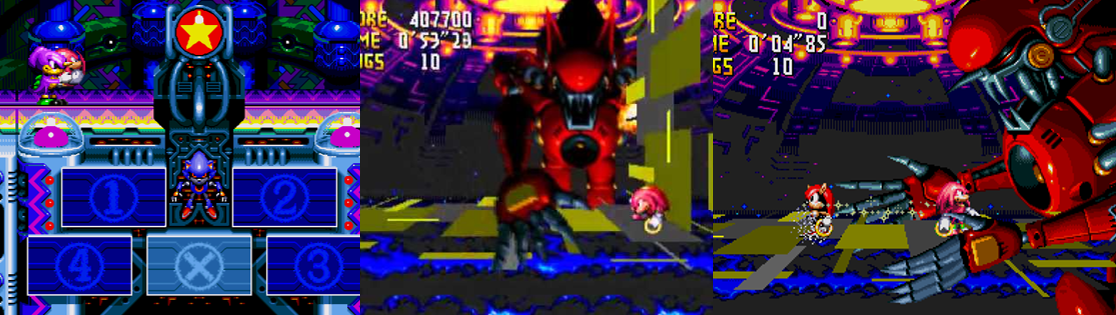
Metal Sonic transforms into a massive mechanical monstrosity for the finale.
Once you have defeated all five of the main bosses, you’re returned to the hub world, where Metal Sonic takes over the stage select machine. Just as you need to hit a bumper to select a stage, so to do you have to hit the bumper to try and deal damage to Metal Sonic; if the indicator lands on the X, one of the other numbered panels will be destroyed and the hub world will become more and more damaged. However, if you land on one of the numbered panels, you’ll have to dodge one of four different attacks as Metal Sonic tries to force you into spiked walls, rains missiles down on you, sends buzzsaws across the floor, and tries to hit you with bouncing tentacles. You’ll need to avoid these as you can only take two hits in this boss battle due to the lack of Rings; the first hit will cost you your partner, and you’ll need to wait for him to respawn or you’ll be kicked back to the hub world and have to start over. With Metal Sonic heavily damaged, Dr. Eggman repairs and powers it up with a huge Dark Ring, transforming it into the massive, monstrous “Metal Sonic Kai”. This is a three-stage boss battle in an enclosed, cyberspace-like arena, where you’re afforded ten Rings and must avoid its huge claw arm to strike its chest, then Spin Dash into its remaining arm while it hovers in the background, and then avoid its massive near-screen-filling chest beam to finish it off in a pretty simple, but surprisingly impressive, final battle.
Power-Ups and Bonuses: Pretty much all of the classic Sonic power-ups are available to you in Knuckles Chaotix; while there are no Elemental Shields or extra life monitors, you can grab ten Rings, a speed up, a one-hit shield, and an invincibility from the different monitors you can find in each Act. There are some new power-ups here as well, though: you can briefly switch your playable character (or switch your partner to a different one depending on whose face is on the monitor when you smash it) and either grow to plough through the few enemies onscreen or shrink to find your jump and abilities painfully stunted for a short time. Perhaps the most useful item is the Combi-Ring Monitor, which stays with you until you’re hit; then, when you are hit, one large Ring is thrown from you rather than all of them scattering around and collecting that one Ring restores all of your Rings. Another interesting twist is that your partner can also collect and be affected by the monitors, meaning they could be invincible, big, small, or protected by a shield while you are not.
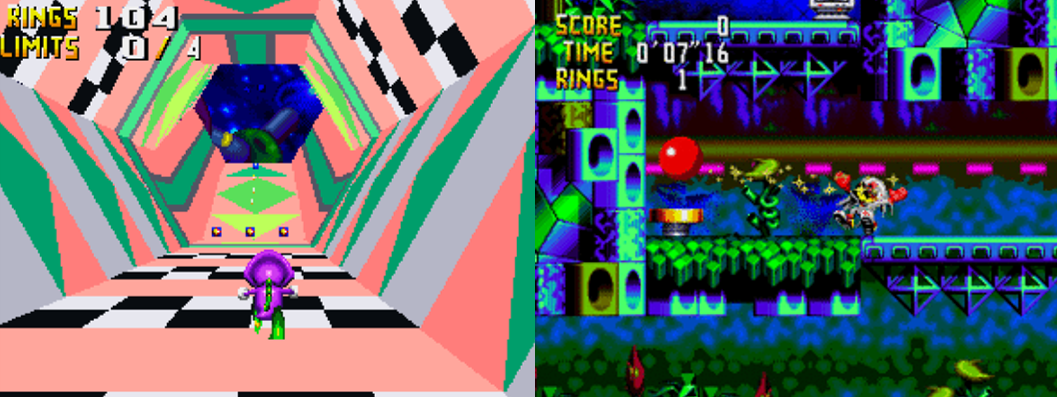
Additional Features: As you might expect, finishing any Act except the ones containing a boss while holding fifty Rings or more spawns a Big Ring. Entering it takes you (or your partner, if they enter or are thrown into it) to an isometric Special Stage where you continuously lap the environment until you have collected enough Blue Spheres to proceed. Collecting Rings will afford you more time to do this, and you must dodge buzzsaws and spiked balls and the myriad of gaps in the floor in order to reach your goal. While these aren’t necessarily the worst Special Stages I’ve ever played, they can be extremely difficult; it’s very hard to see what’s coming ahead of you or to anticipate which “lane” you need to be in to find a Blue Sphere, and all too easy to slip to failure. On the plus side, there are only six Special Stages; you’ll be awarded one of the six coloured Chaos Rings upon completion and will be treated to a slightly different end credits screen that adds Sonic and Miles “Tails” Prower to the cast and avoids Metal Sonic Kai wrecking havoc.
Snag the six Chaos Rings for the good ending, or mess about with the game’s debug mode.
Unfortunately, there are no Super transformations or additional bonuses; however, if you enter a Special Stage after collecting all the Chaos Rings, you’ll simply challenge them again in an even more headache-inducing wireframe mode. If you’re holding twenty Rings or more, you may encounter Big Rings hidden within the Acts; these transport you to a bonus stage that sees you constantly falling and trying to hit blocks for points and Rings. However, your Rings are constantly being drained in this stage, making it more of a hinderance than a benefit. Outside of the regular game, you’ll find a sound select and “colour test” in the main menu; messing around with this allows you to activate a debug mode, have Amy Rose appear in the sound test, activate a stage and character select, and even play as a glitched version of Knuckles. Since the only way you can play Knuckles’ Chaotix is to emulate it, you can obviously also make liberal use of the save state features included in most emulators to make the game a bit less annoying to play through.
The Summary: Knuckles’ Chaotix is such an oddity to me. The entire game feels like a barely finished proof of concept, with empty environments and clunky mechanics that all needed to be addressed before the game was completed, and yet it’s such a lush and stunningly well-presented package that I find it all the more disappointing how lacklustre the actual gameplay and content are. Rather than trying to emulate the size, scope, and variety of Sonic 3, Knuckles’ Chaotix takes a step backwards for a far more linear and mundane experience and hedges all its bets on the unique Combi-Ring mechanic and the random, amusement park-like structure of the main campaign. Sadly, neither are all that much fun to play; five Acts per stage would be a lot to get through even in a traditionally paced Sonic title but the lack of enemies and variety are a real issue, despite how pretty the game looks. It’s a shame as the character designs are really unique and it could have been a really good continuation of the classic Sonic series, but it’s just lacking in a lot of ways that make it inferior to Sonic 3. The bosses aren’t too bad, especially the final battle, but the Special Stages are extremely disorientating and I can’t imagine the game is very enjoyable in two-player. At the same time, though, I’d love to see this get a remaster or a port to modern consoles with a few quality-of-life fixes, and it boggles my mind that we haven’t seen it re-released in all this time, but I can decisively say that you’re really not missing out on much by skipping over this one.
My Rating:
⭐⭐
Rating: 2 out of 5.
Could Be Better
Have you ever played Knuckles’ Chaotix? If so, did you play it on the original hardware or, like me, did you discover it through emulation? What did you think to the Combi-Ring mechanic, and which combination of characters was your favourite? Were you a fan of the random aspects of the game and the five-Act structure? Did you ever collect all the Chaos Rings and what did you think to the Special Stages? How are you celebrating Knuckles’ big day today? Sign up to leave your thoughts on Knuckles’ Chaotix down below or drop a comment on my social media, and check back in for more Sonic content a little later in the year.
Released: 8 April 2022 Director: Jeff Fowler Distributor: Paramount Pictures Budget: $110 million Stars: Ben Schwartz, Jim Carrey, Colleen O’Shaughnessey, Idris Elba, James Marsden, Tika Sumpter, and Tom Butler
The Plot: After banishing Doctor Ivo Robotnik (Carrey) to a mushroom planet, Sonic the Hedgehog (Schwartz) is determined to defend Green Hills. However, when Dr. Robotnik returns alongside Knuckles the Echidna (Elba) in search of the mysterious Master Emerald, Sonic must join forces with Miles “Tails” Prower (O’Shaughnessey) to find the emerald before it’s too late.
The Background: As a principal figurehead in the escalating Console War between Nintendo and SEGA, Sonic has seen his fair share of adaptations, starring in numerous comic books and animated ventures over the years, with each one altering his appearance and backstory and making him one of the most iconic and, yet, convoluted videogame mascots.Development of a Sonic the Hedgehog movie can be traced back to 1993, when the character dominated television screens with his numerous animated adventures, but, thanks to numerous legal and creative issues, the best Sonic had to settle for was the gorgeous original video animation (OVA), Sonic the Hedgehog: The Movie (Ikegami, 1996). However, after Paramount Pictures acquired the rights to the franchise, development of a live-action/CGI hybrid movie finally entered production in earnest; fans, and audiences the world over, were horrified when the first teaser released, however, and the studio scrambled to redesign Sonic into something a little less nightmare-inducing. Surprisingly, Sonic the Hedgehog (Fowler, 2020) bucked the trend of most videogame adaptations by being critically and commercially successful, and a sequel was soon pushed into development. Also surprisingly, star Jim Carrey expressed interest and excitement in returning to the role and portraying a more physically accurate version of Dr. Robotnik, and the cast was bolstered not only by expanding upon Tails’ brief cameo at the end of the first movie but also by the genius decision to cast Idris Elba as Knuckles and introduce more elements from the videogames that were missing from the first film. Sonic the Hedgehog 2 was met with fairly positive reviews that praised the action and humour but criticised the runtime and pacing. The film also grossed over $400 million worldwide, fully justifying both a third movie, and a Knuckles-centricspin-off, despite Carrey announcing his retirement from acting.
The Review: Like many, I’m sure, I was very surprised by how good Sonic the Hedgehog turned out. Considering I felt (and, to be fair, still feel) like an all-CGI movie would’ve been a better, less restrictive, and cheaper option (with Carrey the only human character and donning a fat suit), it was a pretty fun road trip adventure that did a decent job of capturing the spirit of the videogames while also presenting a new take on SEGA’s super-fast mascot. All of the fan service definitely helped, as well; while I had the post-credits scene spoiled for me, I was very happy to see an echidna tribe cameo at the start of the film and felt like the film did just enough to establish its premise to build upon its lore in sequels.
Sonic is determined to use his powers for good, which makes him somewhat reckless and impulsive.
Sonic the Hedgehog 2 finds Sonic in a much more stable and confident position than where he started in the first film; where he was once a lonely outcast, hiding out and barely really understanding his incredible supersonic speed, he’s now a happy and energetic bundle of spines thanks to being taken in by Tom (Marsden) and Maddie Wachowski (Sumpter). Pumped up from discovering his superspeed can allow him to do incredible things, Sonic has been trying to make a name for himself as a superhero in nearby Seattle, however his enthusiasm has a tendency to make him reckless; rather than simply allow local law enforcement to handle such occurrences as bank robberies and high-speed chases, Sonic feels obligated to step in and help out, which generally results in cartoonish chaos due to his immaturity. Though Tom tries to explain to Sonic that his powers will be useful in time, and that his moment to shine as a hero is inevitable, he also stresses that Sonic is still just a kid and needs to let that moment come naturally rather than force it. Thankfully, Sonic doesn’t outright reject his friend’s advice, but he does feel a duty to make Longclaw’s (Donna Jay Fulks) sacrifice worthwhile and to make her proud by using his powers to help others and protect his newfound friends. While they were a central aspect of the first film, Tom and Maddie really don’t get all that much to do here; they treat Sonic as a combination of a pet, a friend, and a surrogate son and the three have an adorable family unit going on, which is nice to see. There’s no dissension between them, even though they may despair of Sonic’s recklessness and immaturity at times, but they don’t really factor all that much into the plot beyond Tom being a loyal, if goofy, friend and Maddie being a supportive influence.
While the human characters are pushed aside, Sonic gains a new friend in Tails.
I can’t say that I’m massively disappointed by this, as I’d much rather these films focus on the videogame characters, but it does lead to some odd pacing moments. The big gag of the film is that Maddie’s sister, Rachel (Natasha Rothwell), still doesn’t care for Tom and doesn’t want him ruining her wedding. Unfortunately for Rachel, Tom accidentally swaps out her wedding ring for one of Sonic’s Golden Rings, causing her wedding to be ruined by a snowstorm, and then there’s a noticeable lag in the second act as Rachel and Maddie team up to help rescue Sonic from Commander Walters (Butler) of the Guardian of United Nations (G.U.N.) and confront her would-be husband, Randall (Shemar Moore), in scenes that really interrupt the pace of the film. Thankfully, Tails is on hand to add to Sonic’s circle of friends; here portrayed as a young mechanic from another world who is awestruck by Sonic’s speed and bravery, Tails travels to Green Hills to warn Sonic of Dr. Robotnik’s return and gets swept up in his globe-trotting adventure to find the Master Emerald. A skilled inventor, Tails lacks confidence in a fight and is plagued by self-doubt after a lifetime of bullying for his extra tail, which allows him to fly by spinning his tails like helicopter blades. However, his self-esteem is boosted by Sonic’s mere presence as he pushes Tails to accompany him to Siberia, encourages him to compete in a protracted and lengthy dance-off, and is impressed at the young fox’s inventions, which include a translator, a laser pistol, and a hologram projector. Tails arrives at just the right time as, while Sonic has found a stable family unit with Tom and Maddie, he still doesn’t really have any real friends, much less anthropomorphic kin such as himself; having observed Sonic for some time using his machines, Tails is eager to just be around him and is overjoyed when they form a fast friendship due to the pressing nature of the current crisis. Tails gives Sonic the chance to pay forward the kindness Tom showed him in the last film, but his attempts to show Tails Earth customs tend to lead to cartoonish pratfalls or are cut short by Dr. Robotnik’s repeated attacks. However, Sonic quickly takes a liking to Tails and sees him as a little brother, of sorts; he’s distraught when Tails his hurt because of his recklessness and fully prepared to put himself on the line to keep his new friend from being hurt again, but comes to trust in him, and their unlikely ally, for the finale, which requires a team effort rather than Sonic shouldering the burden alone.
Dr. Robotnik returns more wacko than ever, and joined by the aggressive and prideful Knuckles!
While Tails’s intentions are noble, he sadly arrives too late to warn Sonic of Dr. Robotnik’s return, or the presence of Knuckles, a super-strong echidna from a long-dead tribe who is as prideful as he is aggressive. Having been marooned on the Mushroom Planet for nearly a year, Dr. Robotnik has gone even more wacko than he was before; embracing his baldness and his wild moustache, he spent his days trying to brew tea from the native foliage and constructing a machine to attract the attention of other lifeforms using one of Sonic’s quills. This led Knuckles to him, and the mad scientist was easily able to foster an alliance with the headstrong echidna by leading him to Sonic, whom Knuckles blames for the death of his father and his tribe since his people never returned from their mission to retrieve the Master Emerald’s location from Longclaw. Exhibiting physical abilities similar to Sonic’s Knuckles brings a raw, primal power that, coupled with his naïvety and pride, make him a formidable foe. Thanks to Knuckles’s blind vendetta against Sonic, Dr. Robotnik s able to reunite with Agent Stone (Lee Majdoub), reassume control of his machines, and begin a quest to locate the Master Emerald to not only get revenge against Sonic but to subjugate the entire world to his mad desires since the Master Emerald has to power to turn wishes into reality. Jim Carrey is clearly having the time of his life as Dr. Robotnik, meaning he devours every scene he’s in and is a constant highlight of the movie, but this does come with some detriments; some scenes of him going off the rails drag on a little, I felt like Agent Stone was a waste of screen time, and it’s still disappointing that he’s not wearing a fat suit. Knuckles, however, was a fantastic inclusion; he has a real weight to him, and his habit of taking everything literally reminded me of Drax the Destroyer (Dave Bautista) and made for some fun moments. Rather than being a complete moron as in some depictions, Knuckles is a misguided and sheltered warrior who’s burdened by his losses and is trying to fulfil his destiny, just like Sonic, and this means he has some heart and poignancy alongside being a hostile meathead.
The Nitty-Gritty: The first movie was all about telling a heartfelt story about the power of friendship, and helping Sonic to move past his traumatic childhood and become an accepted part of Tom and Maddie’s life. Here, the central theme of the movie is destiny; Sonic is in a rush to realise his true calling and to make Longclaw proud, just as Knuckles is so blinded by his duty to retrieve the Master Emerald that it makes him susceptible to Dr. Robotnik’s obvious manipulations. Despite his recklessness, Sonic’s heroic nature allows him to recognise when his friends (Tom, mostly) are trying to help him rather than push them away, and, while he’s determined to oppose Dr. Robotnik and fend off Knuckles, he eventually reaches a point where he can see that Knuckles has been manipulated by the mad doctor and so focuses on trying to keep the Master Emerald out of Robotnik’s hands rather than waste time fighting Knuckles. Fans of the Sonic franchise will find Sonic the Hedgehog 2 as littered with Easter Eggs and reference as the first film: Tom’s ring tone is the iconic Sonic theme, Agent Stone uses a brewery called Mean Bean as cover, and there more than a few visual cues taken from Sonic Adventure (Sonic Team, 1998) such as Sonic snowboarding away from an avalanche, the Seattle sewers exploding in water geysers, and Sonic striking a pose ripped straight from the Dreamcast cover art. While I remain somewhat disappointed that these films don’t take place in a fantasy, full-CGI world, these references help to alleviate that and the addition of Knuckles only helps to infuse further visual cues from the games. The hidden temple is almost exactly like the Echidna architecture seen in Sonic Adventure, and the interior is heavily inspired by the traps, water, and layout of Labyrinth Zone.
After going head-to-dread, Sonic and Knuckles team up to put a stop to Robotnik’s mad schemes.
The battles between Sonic and Knuckles are easily the film’s biggest highlight, though; exhibiting superhuman strength, Knuckles can both keep up with Sonic’s speed, leap vast distances, and easily overpower him with a single punch, crackling with red energy, Knuckles can scale walls, catch Sonic’s spinning form in mid-air, and unleash a flurry of punches without breaking a sweat, and his incredible strength is matched only by his no-nonsense attitude as he doesn’t hesitate to smash first and ask questions later. Dr. Robotnik returns in full force with his army of drones; however, while some resemble Buzz Bombers, his traditional Badniks continue to be absent from the films. He does pilot a far more faithful Egg-O-Matic pod this time around, though, and Carrey is constantly wriggling his fingers and striking wild poses as he directs and controls his machines to unleash laser blasts and a barrage of missiles at every turn. Dr. Robotnik’s true goal, however, is to seize the all-powerful Master Emerald for himself; thanks to hacking Sonic’s phone, and his network of satellites, Dr. Robotnik is easily able to track Sonic’s movements after Longclaw’s map leads them (somewhat inexplicably, it has to be said) to a compass that will reveal the Master Emerald’s hidden temple. Stealing it and braving the temple’s many death traps using his machines, Dr. Robotnik turns on Knuckles and transforms into a literal God after laying his hands on the Master Emerald. His first thought is to unleash his newfound Chaos powers upon Green Hills, and it’s only after Sonic offers Knuckles a chance at redemption (and a hand of friendship) that any kind of hope of stopping Dr. Robotnik’s nigh-limitless powers becomes possible. After assembling a gigantic mechanical exoskeleton in his visage, Dr. Robotnik lays waste to Green Hills, and Sonic, Tails, and Knuckles are forced to work together to stop him. with Tails having commandeered a biplane for their use, the three brave the onslaught of missiles and the mechanical monstrosity’s stomping feet to get close to Dr. Robotnik and lure him away from the populace by using Sonic as bait. Their combined efforts allow Knuckles to land a blow on the mad doctor, knocking the Master Emerald from his body, but he remains a clear and present danger thanks to assuming command of his robot using traditional controls. This leaves Sonic, Tom, and Maddie in mortal danger but, thanks to absorbing the powers of the seven Chaos Emeralds released from the Master Emerald, Sonic becomes empowered with a golden energy that allows him to easily lay waste to Dr. Robotnik’s mech and, apparently, end his threat once and for all. In the aftermath, Sonic willingly and humbly gives up his God-like powers and he and his new friends set about making a new life for themselves with Tom and Maddie, unaware that a mysterious new foe lurks in the shadows…
The Summary: There’s no doubt that Sonic the Hedgehog 2 goes out of its way to be bigger and better than its predecessor; the film is full of gags, exhilarating action, and fun sequences that shine all the more from the CGI models being far more detailed and expressive than before. While there are times when the film slows down to pad out its runtime with dance-offs and lingering on Jim Carrey’s madcap ab-libbing, it still does a brilliant job of being a fun adventure film, even if it’s primarily targeted at a younger audience. The addition of Tails and Knuckles really bolstered the scope of this new take on Sonic’s world; while I would’ve preferred the films just went all-in right from the start with a CGI movie that has all these characters existing in a fantasy world like in the games, I appreciate the little references and the way these films hint at there being more behind these characters. The addition of two more anthropomorphic characters also helps to shift the focus more onto these unique and colourful characters; while this means the humans are pushed to aside and reduced to supporting roles of comic relief, I’m okay with this as it means more time for Tails and Knuckles to shine. And shine they do thanks to some intense action and fight sequences which, while breaking all the laws of physics, make for the film’s most exhilarating moments. While Sonic, Tails, and Knuckles still stand out as being overly cartoony and the film missed a film tricks by not including more musical cues from the videogames, this was a really fun escalation of everything we saw in the film and did a really good job of capturing the spirit of the source material and splicing it into this new interpretation of the world’s most famous hedgehog.
My Rating:
⭐⭐⭐⭐
Rating: 4 out of 5.
Great Stuff
Did you enjoy Sonic the Hedgehog 2? How do you feel it holds up compared to the first film? Did you enjoy the addition of Tails and Knuckles to the film and what did you think to Knuckles’s portrayal? What did you think to Jim Carrey’s more unhinged performance this time around? Are you disappointed that he wasn’t in a fat suit and which of the many references to the videogames was your favourite Easter Egg? Where do you see the films going from here and are there any Sonic games or characters you’d like to see make an appearance in the future? To share your thoughts on Sonic the Hedgehog 2, sign up to reply below or leave a comment on my social media, and be sure to check back in for more Sonic content in the near future!
With the release of Sonic the Hedgehog 3(SEGA Technical Institute, 1994), gamers were introduced to Knuckles the Echidna. This mischievous, dreadlocked antagonist was created by Takashi Yuda and his debut was made all the more impressive by virtue of the fact that Sonic 3 was too big to fit on one cartridge, which meant that Knuckles was the first of Sonic’s supporting characters to co-star in a main series videogame when Sonic & Knuckles (ibid) was released on this very day in 1994.
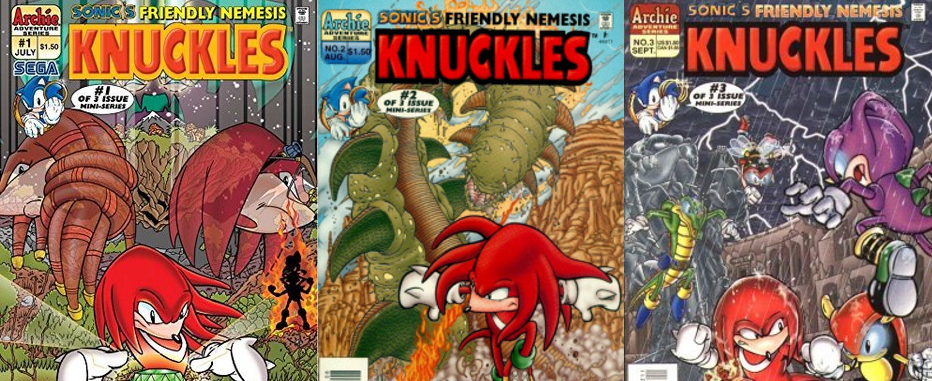
Writers: Mike Kanterovich and Ken Penders – Artist: Art Mawhinney
Story Title: “Rites of Passage, Part One” Published: May 1996
Story Title: “Rites of Passage, Part Two” Published: June 1996
Story Title: “Rites of Passage, Part Three” Published: July 1996
The Background: When Sonic the Hedgehog blasted onto the videogame scene in 1991, he was an immediate hit thanks to his debut title being bundled with the Mega Drive and SEGA’s aggressive marketing campaign. His popularity exploded with Sonic the Hedgehog 2(SEGA Technical Institute, 1992), however, and Sonic merchandise was suddenly everywhere: not only did he feature in the Macy’s Day Parade and in cartoons but he also starred in a number of comic books. Following the initial four-part miniseries which mashed together narrative elements of Sonic’s cartoon adventures, Archie Comics began regular publication of what would become the longest-running videogame comic book ever. In time, to capitalise on Sonic’s continued popularity, a number of spin-off comics were produced, with one of the most prominent being the Knuckles the Echidna sister series. What began as a simple enough three issue miniseries soon expanded into a convoluted lore that eventually became the subject of a bitter lawsuit between Archie and writer/artist Ken Penders that forever changed the way subsequent Sonic comic books were handled.
The Review: Sonic’s Friendly Nemesis: Knuckles begins by first promoting the “mystery of Archimedes” and then giving a very brief rundown on Archie’s take on Knuckles, the downfall of the Echidna society, and his floating home. In these early appearances, Angel Island was known by the Western name of Floating Island and, in Archie Comics especially, was held aloft through the power of just the one Chaos Emerald (and not even the Master Emerald at this point) and incredibly advanced technology. With the Echidna’s long gone, nature has reclaimed much of the island, leaving it in disarray and causing long-forgotten secrets to be buried. Knuckles pays a visit to Mount Fate in search of his missing friends, Mighty the Armadillo, Vector the Crocodile, Espio the Chameleon, and Charmy Bee (collectively known as the Chaotix), who he strongly suspects are being held captive there by the mysterious Archimedes. Archimedes has been making Knuckles’ life a bit of a misery in recent issues and stories, taunting him with riddles about his past, and led Knux to discover that, generations ago, the Echidna brothers Edmund and Dimitri tried to use the Chaos Emerald to return Floating Island to Mobius and, in the process, Dimitri became the evil entity later identified as Enerjak, the “Harbinger of Chaos”. The entire experience caused the Echidnas to renounce technology in all its forms and bury their secrets away beneath Mount Fate and, when Knux arrives, he finds that the chamber is well guarded by a number of electronic lasers, booby traps, and other obstacles specifically designed to keep out (or kill) any intruders.
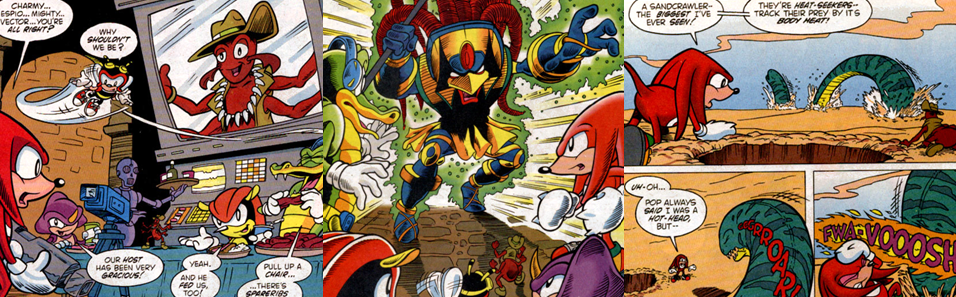
Knuckles’reunion with Chaotix is cut short by the sudden appearance of the all-powerful Enerjak.
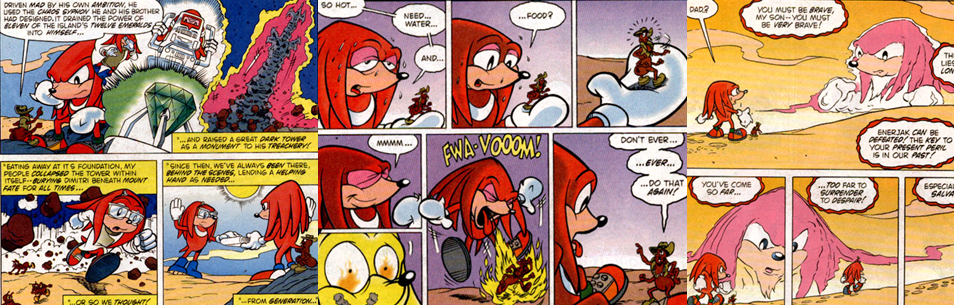
As Knuckles explores his surroundings, he arms himself with a concussive blaster (because that’s what I always think when I think of Knuckles: guns!) and forces his way into the grand observatory at the heart of the temple…only to find that his friends are being treated to a glorious spread as guests of Archimedes, who is revealed to be a weird-looking anthropomorphic fire-ant (yeah…I don’t know, either). Considering all of the games, subterfuge, and questionable behaviour shown by Archimedes, Knuckles is understandably enraged and demands answers but any hostilities between the two are interrupted by the arrival of Enerjak, who broke free from his prison when Knuckles triggered Mount Fate’s traps. Although Knuckles dismisses the Pharaoh-esque madman as a fraud, Enerjak boasts the incredible, unmatched power of eleven Chaos Emeralds (Archie Comics had an almost incalculable number of the gems at the time) and proves his power (and to be more than a match for the combined might of Knuckles, Chaotix, and Archimedes) by overpowering them all, taking Chaotix captive, and blasting Knuckles and Archimedes to the blazing hot desert of the Sandopolis Zone. As the two begin the bleak, day-long journey across the outback, they are attacked by a giant sandcrawler. However, the beast is easily defeated and turned into late-night kebabs for the two when Archimedes uses himself as bait (and his ability to teleport) to trick it into colliding head-first with a stack of rocks. Afterwards, Archimedes regales Knuckles (and bores the shit out of me…) with the story of how his people watched as the Echidnas harnessed the power of many Chaos Emeralds to move the entire city of Echidnapolis out of the path of an incoming comet (why they didn’t just evacuate is beyond me) thanks to the fire-ants performing the “ground-breaking ceremony” to effectively birth Floating Island. Archimedes then recounts, in a little bit more detail, how Dimitri later fashioned the “Chaos Siphon” to absorb the power of eleven Chaos Emeralds and ended up burying himself in the process.
Stuck in the boiling desert, Knux is subjected to endless exposition and visions of his father.
Since then, generation after generation of Echidnas were named Guardian of the Chaos Emerald and the fire-ants watched over them, testing them with a rite of passage to ensure that they would be read to combat threats such as Enerjak. While Knux and Archimedes resolve to work together to face Enerjak, they still need to cross the boiling desert; in his desperate hunger, Knux amusingly tries to eat Archimedes and ends up getting his mouth burned as a result. Later, while succumbing to the heat, Knuckles has a vision of his long-dead father, Locke, who does his best Mufasa (James Earl Jones) impersonation and gives him not only the resolve to continue onwards but also a cryptic clue as to how to defeat Enerjak: “The key to your present peril is in our past!” After reinvigorating himself at a mysterious oasis, Knuckles and Archimedes forge onwards towards Nekronopolis, a mighty city erected by Enerjak’s vast Chaos powers. The city, which Enerjak has built as a dark and corrupt reflection of Echidnaopolis, is home to an army of disposable mechanical minions (known as “Mecha-Nauts”) and Enerjak’s imposing citadel. Knuckles decides that the best approach is to tackle the Mecha-Nauts head on, which earns him Archimedes’ disapproval until he reveals that it was part of a plan to lure the machines to a gate so that he could crush them all (or, at least, a lot of them) in one move. However, while they manage to get into the citadel with a minimum of fuss, inside he is confronted by the Chaotix, who have been brainwashed by Enerjak’s magic and attack the two on his command. The fight (which includes a timely reference to The Mask (Russell, 1994) and even, surprisingly, The Shadow (Mulcahy, 1994), two films that both released in the year prior to this issue) goes poorly for the Chaotix; despite them having the numbers advantage, Knuckles and Archimedes are able to hold them off, forcing Enerjak to intervene and render them both unconscious using his powers (kind of making controlling the Chaotix a waste of time…) With Knuckles and Archimedes helpless against Enerjak’s powers, the would-be tyrant recaps his origins again just in case we didn’t realise how he came to be what he is.
Enerjak’s power may be awesome but the fight ends unresolved.
Despite acknowledging that the Guardian and his newfound fire-ant companion are the only two who could possibly oppose him, Enerjak prefers to boast and monologue rather than destroy them while he has the perfect opportunity. Indeed, Knux goads him into releasing them from his energy field, which gives Archimedes the opportunity to contact his fellow fire-ants. While Knuckles creates a distraction by taunting Enerjak and absorbing the brunt of his anger, Archimedes is able to teleport them out of danger so that Knux can (literally) get the drop on him and, though stunned to learn that he is Knuckles’ great-uncle, Enerjak attacks with a ferocity that is only matched by his augmented strength. Still, the two are relatively evenly matched, potentially because Knuckles has successfully goaded Enerjak into a straight-up fist fight and continues to chastise his great-uncle for his selfish ways and lack of honour. Their fight is cut short when Enerjak’s citadel suddenly transforms into a rocket and blasts into space; Knuckles and Archimedes escape thanks to the efforts of the fire-ants and Chaotix are freed from their pointless mind control. In the aftermath, despite Knuckles not really learning anything from him or really acting in a way that’s that impressive, Archimedes gives Knux his respect. Although Enerjak escaped to live to fight another day, the group is victorious and decide not to worry too much about the mysterious happenings that they experienced along the way (such as the oasis disappearing and the aforementioned rocket) but the story concludes with the revelation (to us) that Locke is actually alive and actively monitoring and assisting Knuckles from a hidden, high-tech bunker.
The Summary: Jesus, what a slog. I’ll be the first to admit that Knuckles is my absolute favourite Sonic the Hedgehog character and I remember being so excited when he debuted in Sonic the Comic (1993 to 2002) and to learn that he was a prominent feature in the Archie comics, which were seen as kind of a continuation/parallel to Sonic the Hedgehog/SatAM (1993 to 1994). Knuckles the Echidna was one of the longest-running spin-off of the Archie Sonic comics, which is a testament to the character’s appeal and popularity, but every time I read his solo run I can’t help but be astounded at how boring and preposterous it is. I don’t usually lark to harp on about this sort of thing but my God is the art terrible in these issues! The covers, drawn by the always amazing Patrick “Spaz” Spaziante, are the best part of the artwork in this miniseries as, while Knuckles generally looks kind of okay, a lot of the characters just look really weird and disproportionate. I can kind of understand it as the majority of the Chaotix are really weird character designs already but Archimedes and the rest of the fire-ants just look ugly, man. Environments are very bland and nonsensical as well and all three issues suffer from the same artistic inconsistency that plagued the Archie Sonic comics for about fifty issues or so. There are, however, some impressive moments in the issues, though. In the rare instances where Knuckles is gliding or in action, he looks suitably bold and striking and, while Enerjak’s design is a bit “busy”, he looks pretty distinct and intimidating and I love how he has all this Egyptian-inspired apparel on his armour. Thanks to having absorbed the powers of eleven Chaos Emeralds, he can fly, wields Chaos energy, and is able to render targets under his control or unconscious and seems to have enhanced durability and strength, and can even erect a fully-functional city and robot minions in just a few panels.
Enerjak has a striking design and is certainly powerful but this was a poor outing for him.
Yet, the exact limits of his powers remains a mystery; he is regarded as a bogeyman-type figure by Archimedes and, as we learn, the reason why the Echidnas eventually renounced technology and he’s certainly a maniacal force but the story ends before we really get to delve into exactly what he wants. And that’s interesting because Sonic’s Friendly Nemesis: Knuckles is about 75% dialogue and exposition. Look, I get it; you can’t assume that people who read issue two or three will have read issue one but every issue starts with a bit of swirling text recapping the previous issue’s events so I really don’t think it was necessary to recap the (literal) rise and fall of Echidna society or Enerjak’s origin three Goddamn times! Sure, have Archimedes explain the fire-ant perspective on it all and introduce the idea of Dimitri there and yeah, Enerjak could share his perspective as well, but they’re largely the same and it just felt like needless filler. Add to that the fact that neither Knuckles nor Archimedes ever shuts up and constantly narrates his every thought and action and you have a story that is more a chore than a thrill to get through, which is a shame as I find Enerjak to be a compelling villain and his slug-fest with Knuckles was gearing up to be something good. It doesn’t help that Archie constantly shoe-horned the Chaotix into Knuckles’ stories, bloating the cast to kind of make it like an alternative to Sonic and the Knothole Freedom Fighters and, considering how useless the Chaotix were in this miniseries, it might’ve been better to omit them entirely and focus solely on Knuckles (and Archimedes, I guess, even though I am not a fan of the character) and his efforts to prove himself a worthy Guardian and oppose Enerjak’s ambitions.
My Rating:
⭐⭐
Rating: 2 out of 5.
Could Be Better
Have you ever read Sonic’s Friendly Nemesis: Knuckles? Did you pick the issues up when they were first released and, if so, what did you think about Knuckles’ first spin-off? What did you think to Archie’s introduction and characterisation of Knuckles and the increasingly-complex depiction of the Echidna society? Were you a fan of Archimedes and Enerjak? Did you like the Chaotix being Knuckles’ running buddies? Which of Archie’s Knuckles stories and/or characters was your favourite and why? Are you celebrating Knuckles’ big day today? Whatever you think about Archie’s Sonic comics, and especially Knuckles, leave a comment down below and let me know.
Released: 10 June 2009 / 9 September 2009 Originally Released: 2 February 1994 / 18 October 1994 Developer: Sonic Team Original Developer: SEGA Technical Institute Also Available For: Gamecube, Mega Drive, Nintendo DS, Nintendo Wii, PC, PlayStation 2, PlayStation 3, PlayStation 4, PlayStation Portable, SEGA Saturn, Xbox, Xbox 360
The Background: Sonic the Hedgehog 2 was a blockbuster hit for SEGA; thanks to the title selling over 400,000 units in its first week alone (and over six million during the Mega Drive’s lifespan), SEGA was able to catch up to Nintendo in the “Console Wars” of the mid-nineties, raising their stake in the home console market by 40%. Anticipation was high for the release of the third Sonic game, which saw development split between two teams: a Japanese team and an American team, with Yuji Naka, Hirokazu Yasuhara, and Roger Hector at the heart of the game’s development. Sonic 3 introduced a new antagonist character for our heroes; numerous designs were submitted before the team settled on Takashi Yuda’s concept of a super strong red echidna eventually dubbed “Knuckles”. However, thanks to a combination of a strict deadline to release in time for a major McDonald’s marketing campaign, and Naka’s wish for the game to vastly expand upon the gameplay, mechanics, and lore of the previous two games, Sonic 3 proved to be too big for a single 34-megabite cartridge so the decision was made to split the game in two to hit their projected release date. While this proved to be an expensive decision for us gamers, both Sonic 3 and Sonic & Knuckles became two of the Mega Drive’s best-selling titles, with both games selling over one million copies in the United States. Both games received critical acclaim praising both the graphics and Sonic & Knuckles’ innovative “Lock-On” technology. Sadly though, the game (particularly Sonic 3) has run into some legal troubles over the years, mainly regarding Sonic 3’s soundtrack, which meant not only was a combination cartridge of the two games cancelled but a remaster for mobile devices was shot down and Sonic 3 (and, consequently, Sonic 3 & Knuckles) is frequently missing from modern-day compilations.
The Plot: Doctor Eggman’s Death Egg space station has crash-landed on the mythical floating Angel Island, home to the Master Emerald and Knuckles, the sole surviving member of the legendary echidna race. Eggman has tricked the gullible and hot-tempered Knuckles into thinking Sonic and Miles “Tails” Prower wish to steal the Master Emerald, making recovering the seven Chaos Emeralds and putting a stop to Eggman’s diabolical schemes twice as hard for our dynamic duo!
Gameplay: As you might expect, both Sonic 3 and Sonic & Knuckles are 2D, sidescrolling action/platformers in which you travel across a total of twelve stages (known as “Zones”): six in Sonic 3 and six more in Sonic & Knuckles. Just like in Sonic 2, the majority of the game’s Zones are split into two “Acts” but, in a twist, you’ll now have to battle a boss at the end of each Act (with the second Act typically featuring a showdown against Eggman in one of his deadly contraptions). Just as Sonic 2 took everything about its predecessor and improved upon it considerably, so too does Sonic 3 & Knuckles expand upon the options available to you; Zones are now bigger than ever, featuring numerous different paths and mechanics all geared towards having you blast through faster than ever before. Even better, the games are designed with each character’s specific abilities in mind; each character can run, jump, roll into a ball, and blast away in a Spin Dash but they all have different unique abilities as well, meaning that some paths are only available to Knuckles, for example, or some areas can only be reached using Tails’ unique (if limited) flying and swimming mechanics.
Each character has their own abilitiesto help them take different paths in Zones.
Sonic 3 & Knuckles still keeps its controls simple, though, and each of these different abilities is easily activated simply by pressing a button twice; press A twice as Sonic and you’ll be surrounded by his “Insta-Shield” (a brief flash of lightning that can protect Sonic from projectiles and extend the reach of his spin attack to cause damage). Press A twice as Tails and you’ll be able to fly or swim by then rapidly tapping the same button; Tails can even carry Sonic up to new areas but he does get tired rather quickly so, while this is useful for skipping large portions of the game’s Zones, it does have its drawbacks. Knuckles, meanwhile, is probably the most versatile character; he can glide, climb up walls, and bash through certain walls to reach entirely new areas (and bosses) that are unique to him. He is, however, the game’s “hard mode” as he is noticably slower than his two counterparts and his jump is much shorter. As in Sonic 2, the game gives you the option of selecting how to play, this time from its innovative and unique save state menu; while you’re limited to choosing between either Sonic or Knuckles in Sonic & Knuckles, Sonic 3 (and Sonic 3 & Knuckles) allows you to pick between Sonic, Tails, Knuckles, or Sonic and Tails (who, thankfully, is far more useful this time around thanks to his expanded moveset and the game’s new Special Stages). As always, though, you can collect Golden Rings to protect you from harm, earning extra lives for every one hundred and activating Starposts to create a checkpoint and enter the new Bonus Stages if you’re holding a certain number of Rings.
Every Zone is packed with gimmicks but none were more infamous than Carnival Night’s barrel!
Speed is a far greater aspect of Sonic 3 & Knuckles; while the first game heavily promoted how fast and powerful it was, it really wasn’t until Sonic 3 & Knuckles that Sonic Team actually delivered on that promise. Zones are massive, filled with slopes, loops, springs, and all kinds of nifty, unique new mechanics to rocket you forwards. You’ll jump from crumbling (or disappearing) platforms, swing from vines, rush down waterways, bash through walls, teleport across the Zone, and be transported through the air through a number of fast-paced and exciting new mechanics. Each Zone has a unique gimmick to it that is implemented in a far more impressive and engaging manner: Angel Island Zone catches fire halfway through, Marble Garden Zone sees you using pulleys and spinning tops to navigate vertically and desperately trying to outrun the collapsing environment, Sandopolis Zone features a variety of new sand-based mechanics before having you frantically search out for light switches to scare off ghosts, and Sky Sanctuary Zone has you teleporting around, jumping from crumbling platforms, and bouncing from fluffy clouds. Every Zone is densely packed with features and innovative gimmicks, far more than any previous Sonic title, and perhaps none so infamous as Carnival Night Zone’s notorious barrel. I won’t be arrogant enough to say that this barrel wasn’t an obstacle for me back in the day but I don’t have nearly as many bad memories of it as some do; through trial and error, I think I slipped past it easily enough but the solution is simplicity in itself: simply stand still and press up and down alternatively until it lowers enough for you to continue on.
Zones are huge, with multiple paths and areas exclusive to certain characters.
Although the games do have a far greater emphasis on speed, there are still a few slower sections and small puzzles for you figure out; generally, these are as simple as pressing a switch to lower water, reverse gravity, or open doors but, other times, you’ll be blocked off by unbreakable walls or tossed to new areas by Knuckles. There’s always another way around in Sonic 3 & Knuckles, though, no matter who you’re playing as or what you’re up against; balloons allow you to bounce yourself to higher areas in Carnival Night Zone, for example, and you can cause sand to fill the pyramid tomb of Sandopolis Zone Act 2 to progress further (though be careful as you’re just as likely to get crushed if you dawdle). Additionally, you have some returning concerns to be aware of, such as spikes, bottomless pits, and drowning if you linger underwater too long without a shield or grabbing an air bubble. Gameplay is fast and full of variety thanks to the dense nature of the Zones and their many gimmicks but there are a few aspects from Sonic 2 that don’t make the cut, unfortunately; Sonic’s biplane, the Tornado, only shows up in cutscenes, for example. However, things do get mixed up considerably when you reach Lava Reef Zone; not only is this Zone a mixture of lava-based hazards and a crystal-infested cave, it also wildly differs depending on which character you play as. Sonic and Tails will have to play through two Acts, culminating in the reactivation of the Death Egg and a tense battle against Eggman, before proceeding on to the long-awaited Hidden Palace Zone to go head-to-dread against Knuckles. Play as Knuckles, though, and you’ll face no boss in Lava Reef and Hidden Palace is little more of a transitional Zone to take you to Sky Sanctuary Zone, where Knuckles’ game culminates in a final showdown with Mecha Sonic.
There are some bugs and glitches that can see characters reach areas they shouldn’t.
Indeed, the narrative of Sonic 3 & Knuckles differs depending on which game you play; if you play the combined game, the story is far more cohesive, tracking Sonic and Tails across Angel Island, battling Eggman, dealing with (and eventually allying with) Knuckles, and finally returning Angel Island to the sky. Knuckles’ story, though, takes place after the end of the game no matter which version you play; this means his Zones are presented slightly differently, with the background changing to show the island is in the sky, and he faces a vengeful Eggrobo and the aforementioned Mecha Sonic rather than Dr. Eggman. This, in addition to the myriad of different paths Knuckles’ abilities afford him, means that playing as Knuckles offers a slightly different experience in a variety of ways since you won’t face the same obstacles as Sonic and Tails (or you will, but in different ways). Obviously, no game is perfect and Sonic 3 & Knuckles is no exception; occasionally, you’ll go so fast that you’ll out-run the camera, potentially falling victim to one of Eggman’s “secret traps” (or, more accurately, running into a kill zone or causing the game to soft-lock). You can also use glitches and manipulate the game to have characters enter areas they normally can’t but, personally, I never really ran into anything like this in a normal playthrough. Thanks to Sonic 3 and Sonic 3 & Knuckles’ unique save feature, you were able to have multiple save states back in the day, which made completing the game and collecting the Chaos Emeralds easier than ever as you could just jump into any Zone whenever you liked. This feature was, unfortunately, missing in Sonic & Knuckles, which did make that game a bit more difficult back in the day as you would have to complete it in one sitting, but, while the Xbox Live version of the game doesn’t recreate the expansive save state features of Sonic 3 & Knuckles, you do get three save slots for each game to, at least, reduce Sonic & Knuckles’ difficulty a bit.
Graphics and Sound: For my money, Sonic 3 & Knuckles is not only the best 2D Sonic game of its time but also the best looking and sounding; Zones are absolutely huge and full of life and little elements to really make them stand out. No two Acts of any Zone are the same as the environment will change (sometimes subtly, sometimes explicitly) between Acts: Angel Island Zone bursts into flame, Mushroom Hill Zone changes seasons, Ice Cap Zone switches from a mountain top to a frozen sea, the Death Egg looms in the background of Launch Base Zone Act 1, takes off in Act 2, and sits ominously in Lava Reef Zone Act 2 (notably it is missing when playing as Knuckles since his story takes place after Sonic and Tails’s), and Death Egg Zone has been ungraded from a mere elaborate corridor to a twisting, mechanical nightmare of futuristic paths and technology and gravity-shifting mechanics.
Sonic 3 & Knuckles‘ level variety is second to none!
No doubt about it, Sonic 3 & Knuckles features some of my favourite Zones ever; from the aforementioned Marble Garden Zone to Ice Cap Zone, with its unique and breathtaking snowboarding sequence, to the bouncy goodness of Mushroom Hill and the exciting dread of Lava Reef Zone. Even Zones that are more annoying, like Hydrocity Zone, are fun to play through since they look great, are fast-paced, and are filled with interesting gimmicks to keep you moving forward. The game expands and improves upon numerous mechanics from its predecessors, too; while Wing Fortress Zone was decent enough in Sonic 2, Flying Battery Zone takes everything that worked in that Zone and expands upon it, making it feel much more alive and engaging. While Carnival Night Zone isn’t quite as iconic as Casino Night Zone, I actually prefer it for its music, presentation, changing landscape, and better implementation of gimmicks. It’s not like the “casino” theme was completely abandoned either as it shows up, merged expertly with the rotating Special Stage mechanic of the first game, in one of the game’s two all-new Bonus Stages.
Cutscenes and Act/Zone transitionstell the game’s story and help connect its world.
Additionally, Sonic 3 & Knuckles has, hands down, my favourite Special Stage design ever. Gone are the annoying, rotating mazes and cumbersome half-pipes of its predecessors, replaced with an eye-catching spherical design that has you collecting Blue Spheres, avoiding Red Spheres, and, despite some noticeable slowdown and the Stages increasing in speed and difficulty the more you play, these Stages are, by far, the easiest of the classic 2D Sonic titles, which only increases their appeal to me. Probably the best thing about Sonic 3 & Knuckles is its heavy inclusion of cutscenes, all of which perfectly convey the game’s simple (but far more detailed) story through the simple use of pantomime and music. The game opens immediately after the ending of Sonic 2, with Super Sonic flying alongside the Tornado and crashing head-first into Knuckles, who swipes the Chaos Emeralds and runs off with a chuckle. Knuckles reappears at numerous points throughout Sonic and Tails’ story to cause them havoc, activating switches and traps to cause them to fall or be blasted into the next Zone. Even when he’s not present, there is usually a means for the characters to progress to the next Zone, which really makes it feel as though the games (and the island) are linked together in a cohesive way. Not only that but, when you clear Act 1, the next Act immediately loads from that spot without cutting away, giving a sense of the scale of the game’s Zones.
Sonic 3 & Knuckles has probably the best soundtrack of the classic 2D titles.
Characters and sprites are more detailed than ever; Sonic is easily the most noticeably different, now far pudgier and sporting adorably oversized hands and feet, but each has their own idle animation to encourage you to get back to the game and the game’s Badniks and bosses are some of the most impressive and detailed yet, with each taking full advantage of their unique environment. And then there’s the soundtrack; originally composed by famed pop star Michael Jackson, the soundtrack was hastily reworked after SEGA cut their ties to Jackson but similarities between the games tracks and Jackson songs can still be identified. Regardless, both Sonic 3 and Sonic & Knuckles have fantastic soundtracks, full of energy and unique themes not only for the Zones and bosses but also for Knuckles. Sadly, Sonic 3 & Knuckles utilises Sonic & Knuckles’ soundtrack rather than Sonic 3’s (which is superior, in my opinion), and the game’s music is often altered when it is ported for other systems, but that doesn’t stop it from being easily the best and most memorable of all the classic 2D Sonic games.
Enemies and Bosses: As always, you’ll have to contend with Eggman’s Badniks; although still quite cute to look at, these Badniks look more dangerous than ever but are, in actual fact, no more aggressive or dangerous than in previous games. Their placement is much improved over Sonic 2 and their level of difficulty both escalates and drops as you progress due to the nature of Sonic 3 & Knuckles being two games spliced together.
Badniks and hazards are more deadly than ever, often using the environment against you.
This means that you’ll be merrily bouncing off of Rhinobots in Angel Island Zone, dodging Turbo Spiker’s rocket-powered spike in Hydrocity Zone, and timing your attacks to bust open Pointdexter when playing through Sonic 3 and then back to smashing open relatively harmless enemies like Butterdroid and Madmole once you land in Mushroom Hill Zone before you frantically try to smash apart Toxomister before its Ring-draining cloud chokes you to death. As if that isn’t enough, many Badniks and hazards use your enivonment against you; Cluckoid blows a wind to keep you back (often trapping you in a nearby sticky vine in the process), hazards can freeze you into a block of ice, Rock’n can only be damage with a Spin Dash attack, and Chainspikes will try to impale you on their razor sharp chains. Additionally, you’ll also encounter ghosts in Sandopolis Zone that grow increasingly aggressive as the lights dim darker and can only be dissipated by turning the lights up full. Helpfully, though, the game’s many shields (and Sonic’s Insta-Shield) can not only repel enemy projectiles but you’ll also be able to use Spiker’s spikes as a spring to bounce away from danger.
To mix things up a bit, you’ll have to face a mini boss at the end of every first Act.
In a change of pace from the previous two games, you’ll also have to battle a mini boss at the end of every first Act before you can reach the goal post and clear the Act. These range from a hovering, flame-spewing tank to a tree-chopping robot and a sentient animal capsule. Perhaps having learned something from the unique bosses of Sonic the Hedgehog CD(SEGA, 1993), these mini bosses (and the game’s main bosses) require a little more thought that just ramming head-first into them; Hydrocity Zone’s mini boss, for example, rockets around the arena and sucks you up in a whirlpool and can only be damaged when its rockets stop spinning, and Launch Base Zone has you take on two mini bosses at once, each one attacking you (and protecting itself) with a mace-like chain that only speeds up with its partner is destroyed.
Mini bosses generally require a bit more strategy than just “jump and attack”.
Similarly, if you try to blindly attack Sandopolis Zone’s golem, you’ll just get hurt, so you need to attack its head and force it into quicksand to dispose of it, and you’ll find the only way to destroy Flying Battery Zone’s mini boss is to trick it into attacking itself. Probably the game’s most troublesome mini boss (at least, for me) is the mechanical Cyclops you battle in Death Egg Zone; essentially an upgraded version of the Wing Fortress Zone boss, this mini boss has you ramming a giant eye, watching out for explosive spikes, and avoiding spinning spiked platforms while it tries to fry you with is deadly laser.
After he eludes you in Launch Base Zone, you finally confront Knuckles in Hidden Palace Zone.
When playing as Sonic and Tails, you’ll also have to contend with Knuckles; however, Knuckles only appears in cutscenes to cause you grief and you won’t actually get to go blow-for-blow against him until you reach Hidden Palace Zone. Here, Knuckles with glide, Spin Dash, and jump at you much like the battle against Mecha Sonic from Sonic 2. Simply jump on Knuckles’ head or smack him out of the air a few times and he’ll soon be beaten; afterwards, he is enraged to find Eggman has stolen his coveted Master Emerald and, though, wounded, assists you in reaching Sky Sanctuary Zone. Finally, you have the prerequisite showdowns with Dr. Eggman himself; again, though, Knuckles never actually battles Dr. Eggman; barring glitches, Knuckles will, instead, battle against an Eggrobo but, with a couple of exceptions, battles the same bosses as Sonic and Tails. Eggman isn’t messing around this time; rather than try to smack you with a wrecking ball or run you over in the first battle, Eggman will hide behind a waterfall in Angel Island Zone, blasting at you with flame cannons and generally hovering over a bottomless pit.
The direct approach rarely works in this game as Eggman isn’t playing around this time.
After that, you’ll have to mix up your attack strategies a bit, using whirlpools and explosions in the water to ram into Eggman’s craft in Hydrocity, flying around the screen (or dodging spiked chains) to ram into Eggman’s drill machine in Marble Garden Zone, trying not to get sucked into an electrical field in Carnival Night Zone, watching out for blasts of chilled air in Ice Cap Zone, and dodging massive weighted balls in Launch Base Zone. Eggman’s flame machine returns in Mushroom Hill Zone, this time in a chase boss battle that sees you avoiding spiked hazards and jet blasts in what was, probably, the inspiration for the boss battles of Sonic Advance 2 (Dimps/Sonic Team, 2002). Dr. Eggman’s contraptions are even more formidable as you play through Sonic & Knuckles: he swings around at you in Flying Battery Zone, trying to fry and skewer you at the same time; hides behind a massive laser-spouting golem in Sandopolis Zone; and is completely protected from your standard attacks in my favourite regular boss battle of the base game, the Lava Reef Zone boss. Here, you have to jump from platform to platform, avoiding spiked bombs and trying not to fall into lava as Eggman tries to tip you towards him. The Flame Shield really helps in this battle as it allows you to stand on the lava and just hop over the bombs until they send Eggman packing.
Eggman hops into his deadliest Death Egg Robot yet for the penultimate battle!
When playing Sonic 3, you’ll face something of a gauntlet in Act 2 as you’ll have to battle Eggman in Launch Base Zone, knock the smirk of Knuckles’ face in a cutscene, before facing Eggman in two separate contraptions on the outskirts of the Death Egg. The first machine is pretty simple (dodge his lasers and ram him when the little electric ball isn’t blocking your attack) but the second is one of my favourite boss battles of 2D Sonic (with a kick-ass, ominous track to boot). This sees Eggman jump into his “Big Arm” Egg-O-Matic and fly across the screen trying to land on you, grab you, and pound the Rings (or life) out of you. He also flies along the bottom of the screen trying to skewer you with his spikes and the only way to damage him is with a well-timed jump to his cockpit but, once you do, the Death Egg will crash again (this time in the Lava Reef Zone’s volcano) and you can move on to the Sonic & Knuckles portion of the game. Note that when Knuckles faces this boss, it’s in the actual Launch Base Zone as, in his story, the Death Egg is completely absent from the Zone since it’s already been destroyed. When playing as Sonic and Tails, you’ll travel to the Death Egg Zone and battle Eggman in a far bigger, more intimidating and dangerous version of his Death Egg Robot mech. This is, essentially, a three-stage boss battle; first, you have to avoid being squashed by its fingers, destroying them one (or two, if you time your jumps right) at a time. Once its fingers are destroyed, it chases you from the left side of the screen, destroying the platform you’re on and trying to fry you with flames from its nostrils. You’ll have to jump over these flames and smack it in the nose to expose its Master Emerald power core (and weak spot); however, Eggman also charges a screen-filling laser blast from the Master Emerald that you’ll have to watch out for and you’re constantly at risk of falling or slipping to your death.
Although Sonic and Tails battle him three times, it’s up to Knuckles to put down Mecha Sonic.
Once you’ve landed the final hit, be sure to angle your jump back to the platform; now, you have to chase after Eggman as he flees with the Master Emerald, ramming him as you go until he is defeated while desperately trying to not bounce or fall as the platform crumbles behind you. If you’re playing as Knuckles, though, you won’t get to experience this battle or the game’s final Zone; instead, you face Mecha Sonic in Sky Sanctuary Zone. Mecha Sonic acts as Sonic and Tails’s mini boss in Sky Sanctuary Zone, appearing three times; in the first, he’s in Eggman’s wrecking ball machine from the first game, then he jumps into the Metropolis Zone bubble machine from Sonic 2, before essentially recreating the battle against his namesake from Sonic 2. Knuckles, though, has to face a powered-up Mecha Sonic, who absorbs power from the Master Emerald to turn into Super Metal Sonic; faster, invulnerable, and blasting both large energy bolts and weird ring-things at you, Super Mecha Sonic can only be damaged when he reverts to his base form, which gives you a small (very small) window to ram him once (maybe twice) before he powers back up.
Grab all of the game’s Emeralds to pursue Eggman through the atmosphere as Super/Hyper Sonic!
Collect all seven Chaos Emeralds in Sonic & Knuckles (or all seven plus the seven Super Emeralds in Sonic 3 & Knuckles), and you’ll get access to the game’s true final Zone, the Doomsday Zone. Here, Super/Hyper Sonic must fly through the asteroid-littered atmosphere in pursuit of Eggman, who fires missiles and bullets at you, all while racing against the clock as your Rings are continuously drained in these forms. Luckily, Rings are scattered throughout the atmosphere and you can dash ahead by pressing A but it can be very tricky to manoeuvre as not only are asteroids blocking your path, Eggman’s bullets and missiles can send you flying back a ways and Eggman can only initially be damaged by causing his homing missiles to crash into his cockpit. Once you’ve done this enough times, he’ll escape in his Death Egg Robo mech and be finally vulnerable to your head-on attacks but, again, you have to be careful to not let asteroids and projectiles slow you down and be sure to grab any Rings you see or else you’ll fall to your death in seconds.
Power-Ups and Bonuses: As is the tradition in Sonic titles, numerous computer monitors are scattered throughout the game’s Zones. Smashing these monitors will award you with such rewards as ten extra Rings, an extra life, a speed up, or an invincibility but don’t go blindly rushing in to break every monitor you see as there are special new Eggman monitors which, when broken, will damage you.
While all the characters can grab the elemental shields, only Sonic can utilise their full potential.
Sonic 3 & Knuckles mixes things up with the inclusion of three elemental shields; the Water Shield (which keep you from drowning), the Flame Shield (which protects you from flames and lava), and the Lightning Shield (which attracts Rings to you and protects you from electrical hazards). In an interesting piece of realism, the latter two shields will be lost if you jump into water and, while all three characters can acquire these shields, only Sonic can get the most out of them. Grabbing each one as Sonic replaces his Insta-Shield with a new ability (the bounce, flame burst, and double-jump, respectively) which more than makes up for his inability to fly, climb, or swim.
Additional Features: While both Sonic 3 and Sonic & Knuckles come with a handful of Achievements to earn, you sadly don’t get to earn any additional Achievements for playing Sonic 3 & Knuckles. Still, these Achievements are pretty standard fare for the Xbox Sonic ports, featuring such requirements as finishing the game, reaching certain Zones, collecting one (and all) of the Chaos Emeralds, or collecting a certain number of Rings. Thankfully, there are no timed Achievements this time so you don’t have to worry about finishing the game in under an hour or beating certain Zones in a certain time, but this does make getting all of each game’s Achievements incredibly easy As is the tradition, each character can access the game’s Special Stages to try and earn one of the Chaos Emeralds.
Every character gets a flashy Chaos power-up this time around.
You may be tempted to leap into the sparkling halo found when you pass a Starpost with certain Rings but this simply brings you to one of three Bonus stages (where you can earn extra Rings, lives, shields, continues, and bump up your score); instead, hidden throughout the game’s Zones are a number of Giant Rings. Once you find one of these Rings and jump into it, you’ll have to collect every single Blue Sphere to earn a Chaos Emerald. These Blue Sphere Special Stages speed up the longer you’re inside them to make things more difficult and increase in difficulty as you progress, throwing more maze-like constructions in your way and peppering your path with instant-fail Red Spheres. Still, there’s no time limit to worry about and Tails doesn’t cause you any trouble like he did in Sonic 2; plus, there’s only a few Special Stages where a wrong move can cause you hassle and, thanks to the game’s save state feature (in all versions of the games), you can easily return to one of the earlier Zones and retry for a Chaos Emerald as often as you need. Because of this, Special Stages are only really difficult when playing the base Sonic & Knuckles as Sonic since there was no save feature in the original version and, even now, it’s harder to find the elusive Giant Rings with Sonic’s more grounded moveset. Once you collect all seven Chaos Emeralds, both Sonic and Knuckles can transform into Super Sonic or Super Knuckles after collecting fifty Rings and jumping. This will make them invincible and super fast but will drain their Rings over time (and, of course, they can still drown, be crushed, or fall to their deaths). Once you clear Launch Base Zone, you’ll be stripped of your Chaos Emeralds and will have to power them up into Super Emeralds by clearing seven more Special Stages. This allows Sonic and Knuckles to become Hyper Sonic and Hyper Knuckles and allows Tails to become Super Tails. In these forms, characters are even faster and have additional abilities (Hyper Sonic also glows like a rainbow and can dash ahead, Hyper Knuckles can shake the screen to destroy Badniks by gliding into walls, and Super Tails is surrounded by similarly-powered-up Flickies that home in on enemies and bosses to deal additional damage).
Compete in the game’s somewhat-improved multiplayer mode or access addition features with the”Lock-On” feature.
Sonic 3 also comes with a multiplayer component that allows a second player to play as Tails alongside Sonic, as in Sonic 2, or two players to go head-to-head as Sonic, Tails, or Knuckles in the game’s split screen mode. While this is nowhere near as awful as Sonic 2’s thanks to the screen not being stretched to ugly proportions, it is very zoomed out and Knuckles is missing his moveset, though you are able to play through five unique Zones in three different match types (Grand Prix, Match Race, and Time Attack). Sadly, though, this mode (and a playable Tails) is absent from Sonic & Knuckles. As mentioned before, the Xbox Live version of these games doesn’t allow for the original save feature but it does come with three save states for each game and access to online leaderboards. Owning both Sonic 3 and Sonic & Knuckles not only allows you to play Sonic 3 & Knuckles but also gives you access to the “Blue Sphere” mini game to take on a near-infinite number of the game’s Special Stages and, best of all, if you also purchase Sonic 2, you’ll be able to play as Knuckles in that game too.
The Summary: I love Sonic 2, don’t get me wrong, but Sonic 3 is worlds better in every single way and Sonic 3 & Knuckles is just about as perfect a 2D Sonic game as you can get. Certainly, for me, this combined title is the quintessential 2D Sonic title, with only Sonic Mania Plus(PagodaWest Games/Headcannon, 2018) coming close to matching the scope and entertainment offered by Sonic 3 & Knuckles. With massive Zones, loads of gimmicks and tweaks that pretty much perfected Sonic’s gameplay, a fantastic soundtrack, some of the most detailed and animated graphics of the 16-bit era, and a simple but wonderfully well told story, Sonic 3 & Knuckles is the complete package for any self-respecting Sonic fan. Blisteringly fast, with loads of replay value and additional features to keep you coming back for more, the only thing keeping Sonic 3 & Knuckles from being infallible is SEGA’s inability to release a proper remaster of the title for a new generation of players.
My Rating:
⭐⭐⭐⭐⭐
Rating: 5 out of 5.
Fantastic
How do you feel about Sonic 3 & Knuckles? Which of the two games did you prefer? What did you think about Sonic & Knuckles’ “Lock-On” technology? Where do you rank the games against Sonic’s other 2D titles? Perhaps you prefer a different 2D Sonic game; if so, which is it and why? How did you feel about Knuckles upon his debut, the new Super forms introduced in this game, and would you have liked to have played as Sonic and Knuckles or Tails and Knuckles? Would you like to see a remaster of the title? How are you celebrating the anniversary of Sonic 3’s release today? Whatever your thoughts, please feel free to share them and your memories of Sonic 3 & Knuckles below.
The Background: It was 2011 and SEGA were eager to celebrate the 20th anniversary of their iconic videogame mascot; after years of disconnect and complex additions to what had begun as a simple, one-button videogame, it’s fair to say that there was some…confusion regarding Sonic’s past, canon, and timeline. SEGA initially opted for a soft reboot, of sorts, with Sonic Adventure (Sonic Team, 1998), which clearly depicted Sonic and his cast of characters redesigned into a slightly older, more anime-inspired aesthetics in a world similar to ours, inhabited by both humans and anthropomorphic characters, and with a tenuous connection to the previous videogames. However, very quickly, this fell apart a bit as Sonic videogames became both incredibly dense and complex or laughably simple, especially in their narratives. After years of fans wanting a return to the traditional, 2D gameplay of the past, Sonic Team opted for a title that would combine not only the tried-and-true 2D gameplay of the past with the fast-paced 3D gameplay of what was, at the time, the present but also bring together two different generations of Sonic for the first time.
The Plot: While celebrating Sonic’s birthday, Sonic and his friends are scattered through time by Doctor Eggman’s ferocious, mysterious beast, the Time Eater. Teaming up with a past version of himself, Sonic races through from his past to rescue his friends, retrieve the Chaos Emeralds, and put a stop to the Time Eater’s rampage.
Gameplay and Power-Ups: Sonic Generations takes the fast-paced, “Boost”-centric formula of Sonic Unleashed and Sonic Colours and further refines it, offering both 3D and 2.5D, high-speed action stages as players race through some of the most iconic stages (or “Zones”) in Sonic’s history. While Sonic remains the only playable character, there are now two of him: the “Classic” Sonic (who plays exclusively in 2.5D) and the “Modern” Sonic (who plays in 3D and 2.5D). There are nine Zones to playthrough in Sonic Generations, each with two levels (or “Acts”): Act One is exclusive to Classic Sonic and Act Two is tackled by Modern Sonic. Although you’ll pot a timer in the to-left of the screen, there are no time outs here’ instead, you get a letter grade a points for finishing Acts as fast as possible. You’ll want to stick to the higher paths, where available, and utilise rails, pulleys, and other shortcuts to cut down your time, but you’re basically guaranteed an “S” rank if you finish an Act without losing a life. Unsurprisingly, Golden Rings are your life source, protecting you from most attacks and granting an extra life for every increment of 100 you collect. Golden Rings also fuel Modern Sonic’s “Boost” gauge (which is also filled by performing tricks off ramps and bashing Badniks), allowing him to blast ahead at high-speeds and plough through any enemies and destructible objects in his way. While both Sonics have unique gameplay mechanics, they share some common controls: you jump with A or X, pressing it again in mid-air to attack nearby enemies or hit targets with Sonic’s Homing Attack. While this is exclusive to Modern Sonic, you can unlock the ability (or “Skill”) for Classic Sonic, too, and it becomes mandatory in the 3DS version. B sees you crouching to fit through small gaps, Y activates any Skills you have equipped, and the Right Trigger either blasts Modern Sonic off or quickly performs Classic Sonic’s Spin Dash. When Boosting, you can hold the Left and Right Triggers to drift and use the Left and Right Bumpers to quick step. As Modern Sonic, you can press B in mid-air to perform a stomp, wall jump off specific surfaces, and dash along a line of Rings by pressing Y.
Both Sonics have distinctive playstyles, though gimmicks are recycled and shared between both.
These controls are largely mirrored on the Nintendo 3DS, with players jumping and using the Homing Attack with A or B and Boosting with Y, though there’s no quick Spin Dash for Classic Sonic. Classic Sonic’s taught the Homing Attack early on, though he doesn’t really need it and ends up playing as a slower, clunkier version of his counterpart. While it might seem like Modern Sonic has more tricks at his disposal, each Sonic can be assigned Skills, unlocked by collecting Red Star Rings, completing additional Challenges, and spending points in the Skill Shop. Each Skill has a point value, and you can assign as many as you like to each Sonic until you hit the point cap of 100. A bunch of these are shared between both Sonics, giving each the ability to begin an Act with ten Rings, granting an additional extra life, giving them more movement options when underwater, and eliminating the recovery time after taking a hit. Classic Sonic can equip one of the elemental shields from Sonic the Hedgehog 3(SEGA Technical Institute, 1994), gaining a bounce, flame burst, and double jump and being able to breathe underwater, resist flames, and attract Rings, respectively. He can also equip the “Twin Spin Attack” (or “Insta-Shield”) from Sonic 3, start with a temporary invincibility, extend the Spin Dash, turn enemies into Rings, and even hop on a skateboard. Some of these abilities are available in Zones as well, such as the speed up and invincibility and skateboard, though you’re more likely to smash Ring monitors. Modern Sonic can also be assigned Skills to allow him to blast off at the start of an Act, perform faster Homing Attacks and wall jumps, and increase the length of his Boost gauge. When playing Planet Wisp or Tropical Resort, you’ll utilise the returning Wisps, with Classic Sonic using the Pink Wisp and Red Wisp to race across walls and ceilings and turn gears or burst through the sky and Modern Sonic rocketing up Dr. Eggman’s factory and smashing through barriers or ricocheting about with the Cyan Laser. Acts also contain the usual gimmicks and hazards, such as springs, spikes, flame bursts, ramps, and rails. You can jump through boost rings to blast through the air, fly off ramps to perform tricks and fill your Boost gauge, repeatedly hit bouncy springs to get higher, and even run on those awful Marble Garden Zone platforms to reach higher areas in Sky Sanctuary. When underwater, you’ll need air bubbles to keep from drowning; when leaping to platforms, you must watch for bottomless pits; and you’ll often press switches to activate or move platforms and blocks.
Sonic’s greatest hits and misses are revisited in each Zone and Challenge.
Interestingly, the Nintendo 3DS’s bottom screen is only used to track your progress in an Act, display the boss’s health bar, and to navigate the sparse hub world. Sonic Generations takes place in a simple hub world called “White Space”, a disappointingly barren void where stages from Sonic’s past have been dumped by the Time Eater. These are arranged in three areas corresponding to an era of Sonic’s history and guarded by a Boss Battle. To progress through the game’s brief and simple story, you must complete each Act to partially restore colour and life to the White Space, then acquire a Chaos Emerald from a Rival and Boss Battle. By and large, the game’s Acts aren’t particularly challenging, though there are some unfair bottomless pits and each Sonic seems to have lead in their sneakers, which can make precision platforming slippery and frustratingly difficult. The difficulty comes in the lengthy and haphazard variety of gameplay mechanics seen in the later, modern levels; unsurprisingly, Crisis City stands out as one of the game’s more frustrating stages thanks to the fire traps, lava pits, bottomless pits, and that Goddamn flaming tornado! The Nintendo 3DS version sees you flying through Mushroom Hill using propeller plants, bouncing around Casino Night, and racing from a destructive orca in Emerald Coast, though the additional Challenges are missing from the Xbox 360 version. Here, after clearing each area, you’ll unlock five additional Challenges for each Sonic; you’re required to clear at least one of these for each Zone to gain a Boss Key, battle the boss, and progress to the next area. These Challenges are considerably varied and can be anything from racing against a ghostly doppelgänger to finding Chao, to completing a stage with only one Ring. Sometimes, you’ll also race against, or team up with, one of Sonic’s friends; you’ll use Mile “Tails” Prower to hover over obstacles and gaps, knock musical notes back to Vector the Crocodile, and clear walls of flame with Blaze the Cat, for example. While you may call upon Sonic’s friends with Y in these Challenges, you’ll never control any character other than the two Sonics, which is quite disappointing. These Challenges can be frustrating but clearing them is the only way to completely restore each area and also unlock additional Skills, artwork, music, and character profiles in the Collection Room.
Presentation: Graphically, Sonic Generations is still one of the brightest, most vibrant Sonic 3D titles ever made. Classic Sonic, especially, looks and animates really well and every stage is packed full of life, colour, and little details that will be recognisable to any Sonic fan. Both Sonics have idle poses and celebrate or lament their letter grade after each Act, though, strangely, Classic Sonic is completely mute. This means that Modern Sonic gets all he puns and one-liners and voice clips, while Classic Sonic simply pantomimes his feelings and relies on Classic Tails to talk for him. Sonic’s friends appear as non-playable characters (NPCs) in White Space, offering encouragement and hints after being restored to guide you towards Red Star Rings. White Space is very annoying for such a simple hub world, with the game forcing you to take boost pads, loops, and springs to reach Challenges (though you can cycle through Acts, at least). I’m glad the game isn’t bogged down by a huge open world, but White Space feels very cheap and half-assed at times, despite some fun Easter Eggs. Sonic Generations takes the original 2D and 3D environments and gives them an eye-catching visual makeover, though the screen’s a bit too zoomed in at times for Classic Sonic and it’s easy to just blast off into the void as Modern Sonic. Perhaps the pinnacle of Sonic Generations’ graphical achievement, though, is in the fantastically updated battle against Perfect Chaos, who has been turned from a choppy, flappy-mouthed monstrosity into a genuinely terrifying, bio-organic creature. However, when playing the Xbox 360, I did notice some blurriness to the images, some frame rate issues, and the game crashed on me three or four times, which was odd. It’s obviously graphically superior to the 3DS version, which offers the same headache as all 3DS titles and is extremely basic at times. You cans ee this in Mushroom Hill, which looks strangely bland, the cutscenes (which are simple 3D models with dialogue boxes), and the reduced Zone count.
A generational adventure that lovingly recreates Sonic’s classic stages.
Each of the game’s Zones are beautifully rendered and expanded upon with gameplay gimmicks from other games and even little extra things, like a celebration taking place in Rooftop Run and getting to visit Hidden Palace in Sky Sanctuary. While there are some obvious choices (Green Hill and Chemical Plant have since been overused to death), there are some odd inclusions, like Speed Highway from Sonic Adventure (I would have picked maybe Ice Cap or Red Mountain), and some disappointments, like Seaside Hill from Sonic Heroes (Sonic Team USA, 2003). I’m honestly surprised that Sonic Team didn’t include Casino Park instead, though I would’ve liked to see them mix it up with Egg Fleet or Frog Forest. There’s some real depth to the environments, with Chemical Plant’s factory exploding in the background, the Death Egg rising in Sky Sanctuary, and desolation as far as the eye can see in Crisis City. Things can be a bit cluttered at times and it’s not always clear which winding path you can take and which is part of the background, but I loved how faithfully Sonic Generations recreated each area and the little twists they toss in. Classic Sonic’s Seaside Hill is largely underwater, for example; the infamous truck wrecks the environment and rockets after you across walls in City Escape; and Dr. Eggman airship hounding you in Rooftop Run. The Nintendo 3DS version oddly adapts Zones from Sonic’s main console games rather than his handheld ventures, with the exception of Water Palace (and, I guess, Tropical resort), which was an odd choice and results in some janky, bland stages that are actually inferior to their Nintendo DS predecessors since the action’s limited to one screen. The Xbox 360 version features some really well done CG cutscenes; it’s just a shame that the game’s story is so criminally short that we don’t see more of these. When you free Sonic’s friends, they’ll make a comment while Sonic just stands there like a tool rather than properly interact with them. As for sound, Sonic Generations has you covered! Every area features a unique, remixed version of its original track and each Act has a different version to differentiate the two. On the Xbox 360, you can also unlock additional music tracks, including some great remixes by the likes of Cash Cash and Crush 40, and play these on any Stage, allowing for a lot of variety in the music you hear as you play.
Enemies and Bosses: Given that it features stages from three eras of Sonic’s history, Sonic Generations also includes many recognisable Badniks and enemies from each time period being represented. You’ll smash apart the likes of Moto Bugs, Buzz Bombers, Crabmeats, Spinys, and Egg Robos from the classic games, with Egg Robos sporting missile barrages and giant Badniks even chasing you at certain points. Moving into the modern era, you’ll bop Eggpawns, Cop Speeders, robots from the Guardian Unit of Nations (G.U.N.), and flaming Iblis creatures. While most slow and easy to attack, they can still surprise you with bolts of energy or other attacks, such as the construction Egg Pawns on Planet Wisp tossing their pickaxes. Enemies are largely there to be bothersome, with the cannons surrounding Rooftop Run’s clock tower being particularly aggravating and the Egg Pawns in the barrel store being notably cheeky. Enemies also act as “bridges” between platforms, rails, and other areas, allowing you to Homing Attack or bop them to reach higher paths, cross lava, or avoid spike pits. The Nintendo 3DS version features a handful of unique enemies due to its different Zone selections, such as those mushroom-tossing moles, axe-wielding Egg Pawns, and even a massive Egg pawn that wrecks the ruins of Water Palace. Spikes are annoyingly commonplace, often waiting right where you land, as are crushing hazards, moving blocks, flame bursts, and missiles from the walls and ceilings. You’re chased by a gigantic truck in City Escape, one that now sports giant buzzsaws, have debris flung at you by a flaming tornado in Crisis City (which also whisks away the environment and the end goal for Classic Sonic!), and must watch for crumbling platforms when bouncy from clouds in Sky Sanctuary. Spiked obstacles also appear on rails, mines litter the ground, and you must quick step left and right to avoid being blasted by Dr. Eggman’s drones and airship. While warning signs alert you to bottomless pits, it’s very easy to plummet down them when moving so fast, or to clip through the environment, and Sonic can be quite slippery, which doesn’t help when trying to make trickier jumps.
Iconic bosses get a massive upgrade, adding extra gimmicks and attacks to their arsenals.
Six classic bosses return and are remixed in each version of Sonic Generations. On the Xbox 360, Classic Sonic first fights the Death Egg Robot on a narrow platform, dodging its extending, drill-like arms and running under it when it jumps to ram its butt. The fight the switches to a recreation of the Death Egg Zone and the mech exclusively attacks from the background, forcing you to lure it to attack bombs with its arms so you can run up and ram its head. The fight with Perfect Chaos is now a whole stage as you dodge its tentacles and jump on crumbling platforms to reach it, hitting springs and pulleys and blasting across the water on boost pads to race up its body. Perfect Chaos spawns twisters, fires energy beams, and unleashes its massive mouth laser, before erupting water geysers. This forces you to precariously hop to platforms, battling the awkward camera to land the final blow. The Egg Dragoon sees you blasting through a circular tunnel avoiding its freeze bolts and missiles and hopping to rails to ram the cockpit. When on a 2.5D plane, you must hang back and jump over shots then quickly wall jump up its arms, avoiding a downward shot, before diving after the falling mech, avoiding its drill arms to target its body. On the Nintendo 3DS, you battle one of my favourite bosses, the Big Arms, now avoiding its arm slams and palm slaps, then, oddly, battle the Biolizard. This is an annoying fight as you must awkwardly run from its gaping mouth or thrashing tail, grinding up to its core, avoiding high and low shots and bouncing off orbs to smack its core. Finally, you battle the Egg Emperor in an autorunner, desperately avoiding its energy waves, dodging its charge, and taking out the cannons to smack his big, stupid face.
Best Sonic’s rivals to power-up and battle the aggravating Time Eater with two Super Sonics!
You’ll also compete against some of Sonic’s rivals in both versions, with the Xbox 360 fights yielding Chaos Emeralds. You’ll once again race across Stardust Speedway against Metal Sonic, hopping over its torpedo dash and avoiding its lasers and the debris it tosses at you to give it a smack. You’ll across the walkways of the Space Colony ARK against Shadow the Hedgehog, chasing down purple energy orbs to power-up and blast meteorites at him in a battle that’s ridiculously easy if you can speed after him fast enough. Finally, you return to Crisis City to battle Silver the Hedgehog, avoiding his telekinetic waves and targeting the debris he flings at you to wallop him, before scrambling over a huge wave of junk and racing towards the camera to finish him off. This rival fights are significantly downplayed on the Nintendo 3DS as you don’t fight Silver and both are reduced to races, with you hopping over obstacles and slowing Metal Sonic or Shadow with some lucky shots and desperately trying to avoid Shadow’s boost and Chaos Spear. Unfortunately, Sonic Generations and its bosses arefurther let down by the final battle with the Time Eater. Despite an impressive, ominous score, the unique design of both the creature and the bizarre vortex you battle it in. Despite the joy of seeing Classic and Modern Sonic turn Super Sonic to battle two versions of Dr. Eggman, this fight is a confusing mess. You hold down RT to charge head-first through a time/space distortion, dodging pieces of the Zones and the Time Eater’s arms and lasers, to ram its core. You can press Y to switch to the outside of the vortex and press X to fire the other Sonic to destroy incoming projectiles, all while Sonic’s friends constantly shout “advice”. You can barely see Golden Rings until they’ve flown past you, you have no idea if you’re holding or mashing buttons, and defeating this monstrosity is much easier on the Nintendo 3DS. You battle it on a 2.5D plane, with no attacks at your disposal and simply dodging its lasers and arm swipe until its core is exposed, then race towards it on a 3D plane. This can be tricky as it’s not easy to dodge its hand claps and it’s easy to run out of Rings, but at least you’re not bombarded by repetitive voice clips, and you can land hits a lot easier.
Additional Features: There are forty-nine Achievements to earn in Sonic Generations, with one popping every time you clear both Acts in each area and defeat a rival and boss. Every Act as at least one Achievement tied to it (normally something involving going a specific route and collecting a specific Red Star Ring before completing the stage), you’ll get Achievements for performing tricks, acquiring Skills, and unlocking all collectibles. Every Act has five Red Star Rings to find, with each one unlocking artwork, music, and other extras; you’ll also get an Achievement if you find them all. As you complete Acts, Challenges, and collect Red Star Rings, you’ll unlock additional music tracks, cutscenes, artwork, and little character trophies that can all be viewed in a little gallery/museum at the far left of White Space. If you explore the Green Hill hub, you’ll find a SEGA Mega Drive and, for 7777 points, you can purchase a Mega Drive controller to play a port of the original Sonic the Hedgehog(Sonic Team, 1991)! You can also challenge the rivals and bosses on “Hard” mode (though there’s no Achievement for this), upload your fastest times to an online leaderboard, and play a pinball table themed on Casino Night Zone if you snagged the DLC. On the Xbox 360, you acquire the seven Chaos Emeralds by playing the main story, unlocking Super Sonic for the finale and as a 100-point Skill for both Sonics, but play Special Stages on the Nintendo 3DS. These are modelled after Sonic Heroes’ pipes, with you collecting orbs to power-up your boost and avoiding spiked mines in super easy challenges. You can also download additional missions using the handheld’s “StreetPass” feature, play an online versus mode (that appears to be a head-to-head race), customise a profile card, and play a time attack mode, though the Nintendo 3DS lacks the Skills and Red Star Rings of its counterpart.
The Summary: When I first played Sonic Generations on the PlayStation 3, I remember it being a fantastic experience; it was fun, fast paced, and chock full of nostalgia and little bits of fan service. Aside from the final boss, I had a blast breezing through everything the game had to offer and lamented the lack of follow-up downloadable content from Sonic Team, hence my excitement for the later remaster. I was therefore super exited to revisit Sonic Generations on the Xbox 360 and snag the Nintendo 3DS version, only to be put off by how zoomed in the camera was for the 2.5D sections. Nevertheless, I ploughed ahead, happy to be revisiting this slice of nostalgia and, very quickly, found myself quite frustrated by a lot of little things. The sheer uselessness of the regular jump both Sonics have, their tendency to spontaneously slip off platforms, the frustrating nature of a lot of the Challenges and, of course, the massive letdown of the final boss. All these years later and I’m still disappointed that the story wasn’t a bit more grandiose given that this was a celebration of Sonic’s 20th anniversary. White Space feels so empty and lifeless, the lack of other playable characters and extra stages was disappointing, and the barebones nature of the title makes it feels cheap and rushed at times. The Nintendo 3DS version is even more barebones, lacking so many features, characters, and even having a reduced Zone count, with the only consolation being simplistic Special Stags. Not adapting Zones from Sonic’s handheld past was a huge mistake, the Zones we do get are largely empty, and both Sonics play too similar for the game to compete with Sonic’s Nintendo DS library. Yet, by and large, Sonic Generations is still an enjoyable experience. I fear this playthrough may have been soured by me rushed through it as quickly as possible rather than taking my time and losing myself to the nostalgia. If you can do that, there’s a lot to like here from a visual and aural perspective, as well as the game being a fun, if all too brief, break-neck action romp through some of Sonic’s most iconic areas.
Nintendo 3DS Rating:
Xbox 360 Rating:
⭐⭐
Rating: 2 out of 5.
⭐⭐⭐
Rating: 3 out of 5.
Could Be Better
Pretty Good
What did you think of Sonic Generations? Do you think it still holds up or, like me, do think that it was lacking in content and features? What did you think to the Zones featured in the game and the remixed boss battles? Were you disappointed by the lack of other playable characters? Which Challenge was the hardest for you and why was it Vector’s? What was your favourite Classic and/or Modern Sonic videogame? Share your thoughts in the comments, support me on Ko-Fi, and go check out my other Sonic content.