Game Corner: Marvel: Ultimate Alliance 3: The Black Order (Nintendo Switch)

Released: 19 July 2019
Developer: Team Ninja

The Background:
For decades, few videogame publishers were as synonymous with Marvel Comics as Activision, who produced adaptations Marvel’s most popular properties. While some were better than others, Activision’s efforts were largely praised, especially after they partnered with Raven Software on the X-Men Legends games (2004; 2005). Activision and Raven Software expanded their scope to the rest of the Marvel universe with Marvel: Ultimate Alliance (2006), a largely successful team-based brawer praised for improving upon its predecessors. Though now delisted, it was followed by a sequel three years later, courtesy of Vicarious Visions, which tweaked the gameplay with team-based attacks to encourage experimentation. Though Marvel: Ultimate Alliance 2 (2009) was praised for its branching storyline, the stripped down roleplaying mechanics were criticised. While it was also delisted in 2020, fans were clamouring for a follow-up and, just ten years later, Team Ninja stepped in to work alongside Marvel in reviving the franchise. Seeking to place additional emphasis on combat, the developers explored the cosmic scope of the Marvel universe by including the Infinity Stones and lesser-known characters and chose to make the title a Nintendo Switch exclusive after developing a close relationship with Nintendo. Although Marvel: Ultimate Alliance 3: The Black Order was the sixth best-selling game in its first week and was later bolstered by extensive downloadable content (DLC), it was met with mixed reviews that praised the colourful action but criticised its lack of innovation.

The Plot:
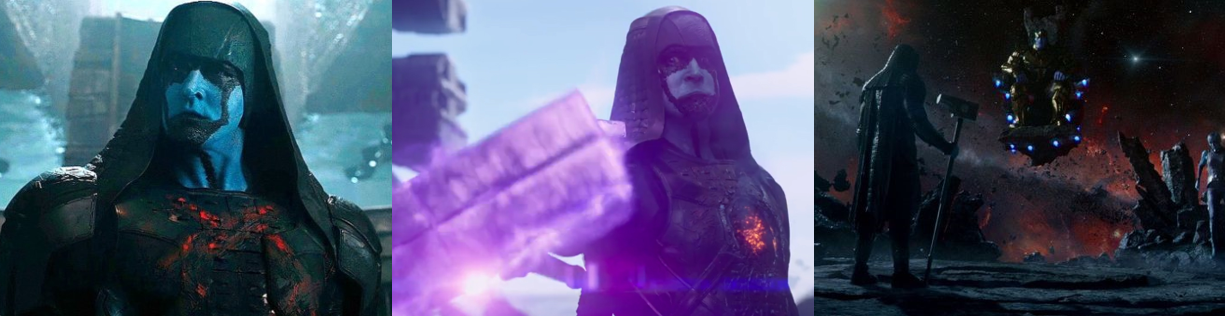
While battling Nebula and Ronan the Accuser, the Guardians of the Galaxy stumble upon a plot by the mad titan, Thanos, to collect the six Infinity Stones. Although they scatter the Stones, Thanos’s acolytes, the Black Order, pursue the gems, prompting an alliance of Earth’s mightiest heroes to retrieve them first.

Gameplay and Power-Ups:
Like its predecessors, Marvel: Ultimate Alliance 3: The Black Order is a team-based action role-playing game in which players assemble a squad of four heroes from across the Marvel universe to battle various nefarious baddies, primarily the titular Black Order, who are hunting the six all-powerful Infinity Stones on behalf of their master, Thanos. The game offers five save slots, two initial difficulty levels, and a base roster of thirty-six playable characters, with many being encountered as you play through the story and joining your alliance either after fighting alongside you or being freed from some kind of mind control. Marvel: Ultimate Alliance 3 offers three controller configurations, thankfully none of which involve motion controls, and allows you to toggle overlays, notifications, tips, and other onscreen elements from the “Settings” menu. These include altering the camera placement, which enables a lock-on feature by pressing in the right stick, though the camera generally remains more focused on whichever character you’re controlling rather than offering a bird’s eye view as in the last two games. Although you can fight alongside friends either locally or online, you switch between your teammates with the directional pad (D-pad) when playing alone and your computer-controlled partners are very useful in a fight, attacking, enabling team attacks, and reviving defeated characters without any input from you. Pressing A sees you interact with the environment to activate consoles, pick up or move certain objects, and talk to other characters. You jump with B, executing a double jump, swinging from webs, or flying depending on which character you’re playing as, and throw light attacks with X and heavy attacks with Y. These can be strung together to perform basic combos and you can also perform a mid-air attack and throw objects (like bombs and missiles) by pressing Y. You block incoming attacks by holding the Z trigger and tap it to dodge, and collect glowing red orbs from defeated enemies or smashed crates to restore health, blue orbs to refill your Energy Point (EP) gauge, and credits to spend on upgrades.
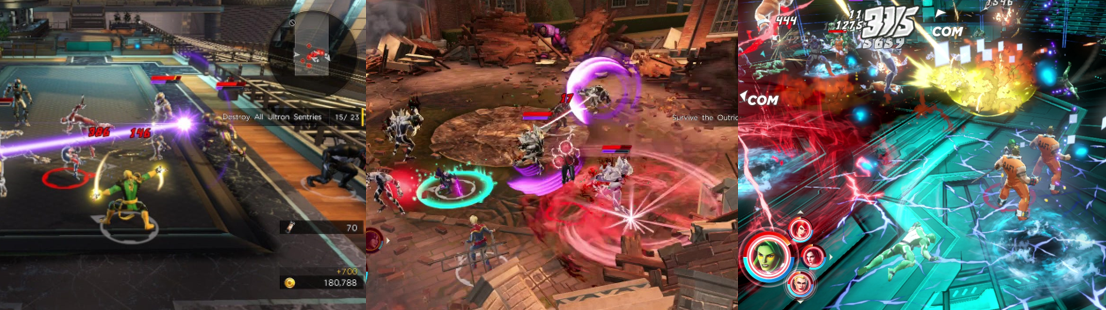
Combat is thick, fast, chaotic, and constant thanks to loads of enemies and character abilities.

As in the last two games, each character has specific abilities tied to their superpowers or superhero traits. You activate these by holding the Right trigger and selecting an icon using the D-pad; using Abilities drains your EP, however, and each Ability comes with a different cost. However, these attacks allow you to stun, stagger or deal elemental damage to enemies using Peter Parker/Spider-Man’s webs, Thor Odinson’s lightning, and Doctor Robert Bruce Banner/The Hulk’s incredible strength. Many characters have projectile attacks in their arsenal, such as Wade Wilson/Deadpool firing guns and Scott “Slim” Summers/Cyclops blasting his eye beams, while others cause splash damage or specific buffs, like Piotr Rasputin/Colossus being able to reflect projectiles and Wanda Maximoff/The Scarlet Witch healing her allies. Some, like James “Logan” Howlett/Wolverine, have passive abilities that allow them to automatically regenerate health as they walk around; others, like Johnny Blaze/Ghost Rider and Ororo Munroe/Storm, specifically deal in elemental damage. Character’s Abilities can also be mixed and matched by holding ZR and pressing one of the face buttons (or pressing A when prompted); this sees two characters attack in a combo for additional damage. As you dish out and take damage, you’ll also build the Extreme (EX) Gauge). Once full, you can press L and R up to three times to have two to four of your teammates perform a devastating combination attack that’s great against bosses. While the various cannon fodder you fight are easily dispatched, larger commanders and bosses need their “stun” meter drained before you can really put a beating on them and others (and certain treasure chests) require specific combination attacks to breach their shields. Defeating enemies sees your characters gain experience points (XP) to level-up, increasing their statistics (attack, defence, etc), though you can also use the various Orbs you find to manually level-up. Each character’s special Abilities can also be further enhanced using Ability Orbs and credits, reducing the EP cost and increasing their damage, among other benefits. You can also earn “Team Bonuses” depending on your team selection: pick a group of X-Men, for example, and your strength or resistance stat will increase, while picking characters of royalty ups your maximum energy stat.
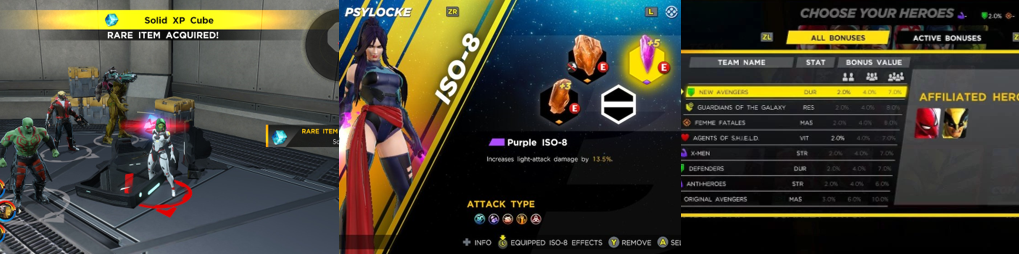
Search for chests to gain currency and other expendables to upgrade and buff your alliance.

Although you can’t equip gear to your characters, the boss battle against the Destroyer armour sees you temporarily empowered by Asgardian magic and you can eventually equip your team with “ISO-8” crystals, coloured stones that enhance their attack power, resistance to elements, or critical hit ratio, among others. You can further upgrade these with credits and ISO-8 capsules, though some of the rarer ones will also debuff you (for example, your attack my increase but your defence will decrease accordingly). You’ll also inevitably gain access to the Strategic Hazard Intervention Espionage Logistics Directorate (S.H.I.E.L.D.) Lab, which acts as the game’s skill tree. By spending credits and Enhancement Points (EP), you can further increase your team’s overall attack, defence, resistance, vitality, and such and even unlock additional ISO-8 slots (with more being earned by levelling-up). You can also enter the S.H.I.E.L.D. Depot from the main menu to purchase additional costumes and social icons by spending S.H.I.E.L.D. Tokens. Marvel: Ultimate Alliance 3 is pretty forgiving (on the “Friendly” difficulty, at least), with multiple checkpoints in each area. When you activate a S.H.I.E.L.D. checkpoint, your team is fully healed, and you can swap or enhance them if you wish. If a teammate is defeated, you can hold A to revive them, but I wouldn’t recommend it unless you absolutely have to. Not only are revives limited, but downed characters will eventually return to full health even before you reach a checkpoint so it’s not worth risking another character taking damage by healing a partner. Exploration generally leads you to treasure chests or special walls that require a special combination attack to open, or to a “Rift” challenge that takes you away from the main game to tackle a special challenge (usually a boss rematch or enemy gauntlet) for extra rewards. Your path is incredibly linear most of the time, hence why there’s no map, and the game’s primary focus is on chaotic combat and visually manic team-based attacks. Unlike in the last two games, you can no longer grapple or throw enemies (though you can still send them flying off certain platforms) and there are no character-specific team-up moves, meaning the action can quickly get quite tiresome.
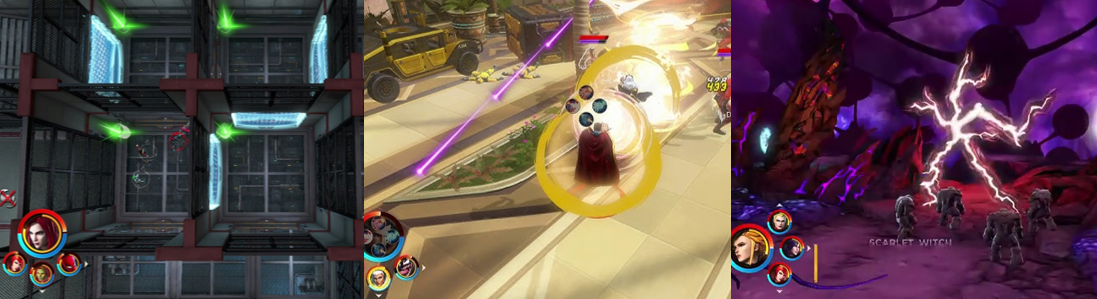
Sadly, puzzles are practically non-existent, with only Rifts offering additional challenges.

Because of its focus on hectic combat, there’s even less room for puzzles than there is for exploration in Marvel: Ultimate Alliance 3. Puzzles boil down to activating a console to open a door or making a platform move and that’s it. Sometimes, you’ll hold A to move a block and avoid lasers or cannons, but mostly you’ll be timing jumps between said lasers to progress and simply hurling missiles at those cannons. Sometimes, you’ll rotate statues or press switches to progress; others, you’ll be avoiding toxic ooze in Hel or solving door puzzles at the Raft or in Avengers Tower. After hopping across the rooftops of New York City, you’ll infiltrate the heavily fortified fortress of the Hand, dealing with ninjas that drop from the sky and hidden arrow hazards. When in Wakanda, Advanced Idea Mechanics (A.I.M.) corrupt T’Challa/The Black Panther’s defences, leading to an exasperating section where you must avoid snipers and being roasted by a giant panther statue’s energy blast. When transported to the Dark Dimension, you must use portals to reach new areas and defeat waves of demonic enemies to lower magical barriers and progress. Some attacks also screw up your controls or temporarily freeze you; some enemies are best defeated by tossing explosives at them; and many missions have an additional character fighting alongside you who’s often unlocked afterwards. However, a lot of the additional features of the previous games are missing; you can talk to other characters, but there are no dialogue options or character-specific interactions. There are no trivia quizzes, no optional side missions beyond the Rifts, and no character specific challenges to unlock extra stuff for each character. There aren’t even hub areas, in the traditional sense, with characters just appearing around S.H.I.E.L.D. checkpoints at times, though you can destroy a fair bit of the environment, and some encounters have you fleeing towards the camera as bosses chase you or present you with unwinnable battles.

Presentation:
Whereas the last two games primarily based their aesthetics on the comics books, especially the Ultimate comic line, Marvel: Ultimate Alliance 3 adheres very closely to the Marvel Cinematic Universe (MCU), especially in the visuals of its locations. I was hard pressed, for example, to tell the difference between Asgard here and the Asgard to the MCU, with both the golden city and the rainbow bridge, the Bifrost, appearing almost exactly as they’re depicted in the films. The same is true for Wakanda, the Dark Dimension, and Knowhere, all of which are virtually indistinguishable from how they appear in the MCU. There are some differences, of course: Taneleer Tivan/The Collector’s museum, for example, uses coloured cube cages and Wakanda leans much more into traditional architecture than the pseudo-futuristic science of the films (likely because Black Panther (Coogler, 2018) released a year before this game was made). Xavier’s School for the Gifted is lifted almost exactly from the 20th Century Fox X-Men movies (Various, 2000 to 2020), however, including a hedge maze, 1:1 Cerebro room, and basketball court that doubles as a landing pad for the Blackbird. While the Dark Dimension and the cosmic mind trip that is Sanctuary also heavily borrow from the bizarre cosmic imagery of the MCU, the Raft and Avengers Tower are much more akin to their comic book counterparts, though they’re comparatively bland locations, lacking fun areas like the Danger Room or Wakanda’s Necropolis (though you do pass through Anthony “Tony” Stark/Iron Man’s Hall of Armours in the tower). Although you only make a brief stop in Attilan to try and get help from the Inhumans, the architecture is far more visually interesting than that awful television show, seemingly being comprised of Celestial technology, and I enjoyed the ominous gothic presentation of Hel, with its restless Viking warriors and damaging sludge. Unfortunately, Marvel: Ultimate Alliance 3 continues the trend of having disappointingly bland and forgettable music, opting for generic themes for each location, event, and character that are lost amidst the constant fighting.
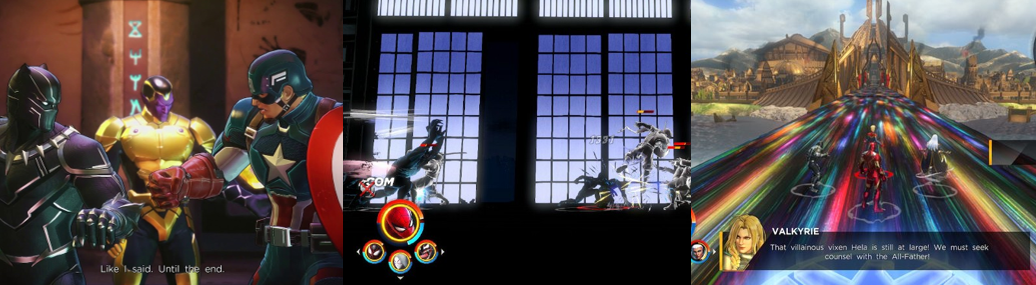
A visually impressive brawler that takes obvious inspiration from the MCU films.

The game also opts for an almost cel-shaded, action figure-like aesthetic for its colourful cast of characters. While many again both look and sound like their MCU counterparts, there are some exceptions: Peter Quill/Star-Lord, for example, looks nothing like Chris Pratt and the X-Men are far closer to the comic books than Fox’s films. Despite you assembling a custom team of heroes, cutscenes depict either everyone or characters specific to the location you’re in (the corrupted Doctor Stephen Strange in the Dark Dimension, for example) as they’re better suited to advance the plot against the local baddies. With the game shifting to a more third-person perspective, you’re closer than ever to the action and can see more of the environment than in the previous games. However, this comes with some drawbacks: mainly, there are far less opportunities or incentives to explore. Second, environments are painfully linear, with dead ends or locked doors barring your progress. Third, and most frustrating, is the camera, which easily loses track of your opponent/s and often lumbers you with wireframe representations when the foreground blocks the view. Thankfully, you won’t be falling down pits and rarely have to worry about onscreen hazards, but it can be aggravating trying to figure out which platforms and crates can be jumped on and which can’t. Marvel: Ultimate Alliance 3 offers a diverse cast of characters, each with their own idle poses and quips, though these do inevitably repeat. The game’s also surprisingly light on Easter Eggs: you’ll spot Deadpool singing away as he makes tacos in the X-Mansion, but not much else, and there are no optional missions or choices to encourage replaying missions. It’s a far cry from the first game, where there was always something to collect or an additional character to help out. Instead, it’s basically all combat, all the time in Marvel: Ultimate Alliance 3. Luckily, the game looks pretty good (everything’s very colourful and true to its inspirations) and performs really well, though there are some long load screens and it is annoying being forced to continue your game every time you challenge a Rift.

Enemies and Bosses:
All the usual suspects appear here as disposable cannon fodder for you to endlessly beat up, with many of the game’s goons sharing traits across the various locations. You’ll encounter Kree, Ultron Drones, agents of A.I.M., and Doombats who all pack various energy blasters. Ultron’s clones are the worst for this, relentlessly firing energy blasts and crashing through windows. The Raft’s unscrupulous prisoners attack in large groups, as do the restless Viking warriors who populate Hel, tossing axes from afar and luring you into toxic goop. Gargoyle-like Fire Demons also dwell here, offering a greater challenge with their swoop attack and fire breath, not unlike the monstrous Outriders and Mindless Ones who make up Thanos and the dread Dormammu’s forces, respectively. Alpha Primitives, Hydra goons, and towering Sentinels also appear, with the latter firing huge energy blasts from the palms and best attacked by throwing their explosive energy cores back at them. No matter where you are and what enemies you fight, more powerful commanders will also appear. Larger, tougher, and sporting a stun meter, these commanders should be your top priority as they’ll charge across the screen, cause shockwaves, and generally offer a far greater challenge even when you’re at a higher level. These minions often fight alongside their masters, generally so you can recover some health and EP to better damage the bosses, and will endlessly spawn in one of the additional modes unless you destroy their teleporters. Some of the game’s challenges or story-based missions charge you with defeating a certain number of enemies to progress. Other times, bosses appear in these waves, and you must occasionally flee or purposely lose some fights. This happens when Cain Marko/The Juggernaut comes tearing through the X-Mansion, for example, and in early encounters with the Black Order, who cannot be beaten or will chase you, raining lightning or other attacks from the sky and across the ground.
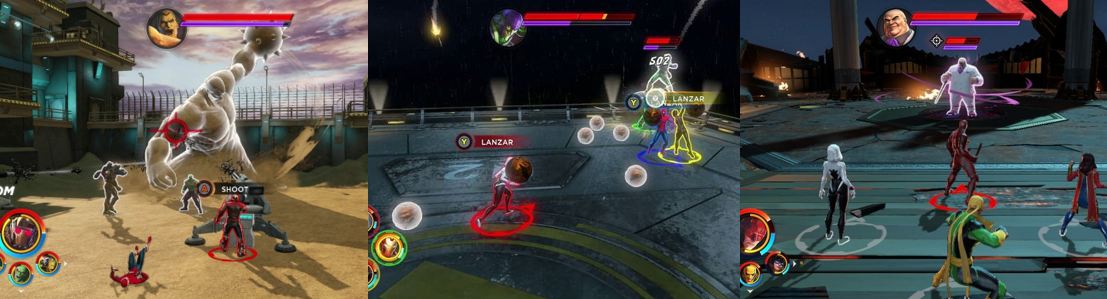
Few bosses require more than just hit-and-run tactics, even when augmented by an Infinity Stone.

There are loads of bosses to fight in Marvel: Ultimate Alliance 3, with some returning from the previous games, some teaming up, some having a couple of phases, and all boiling down to whittling down their stun bar, unleashing an EX attack and/or your most powerful Abilities, and avoiding damage until you can repeat this. The first ones you’ll face are Nebula and Ronan the Accuser, who often appear as a duo in optional challenges. Nebula is faster and more nimble, wielding blades where Ronan uses a massive warhammer. Both set a standard all bosses follow, which is that they’ll use either a jumping slam or an explosion of energy (or both) to send you flying. While quelling the riot in the Raft, you’ll encounter a version of the Sinister Six, with some unique variations to each battle. Flint Marko/The Sandman, for example, flings waves of sand and erupts his big sand fist from the ground as a large sand creature. You must use A to mount the nearby cannons and unload on him to chip away at his stun meter. Maxwell “Max” Dillon fights alongside Eddie Brock/Venom, raining lighting and electrocuting you with bursts of electricity, before he’s eaten by Venom and starts busting out electrically-enhanced symbiote powers. Venom joins the team after this fight and is tested against Quentin Beck, who first brainwashes Mile Morales/Spider-Man, Gwen Stacy/Spider-Woman, and Kamala Khan/Ms. Marvel to fight you and then unleashes a poisonous mist, teleports about, and confuses you with duplicates, Doctor Otto Octavious/Dr. Octopus is fought in a two-stage fight where you must first avoid his tentacles and scurry charge and then attack each arm to stun him. Finally, you’ll battle Norman Osborn/The Green Goblin for the Time Stone. The Green Goblin swoops overhead and lingers slightly out of reach, peppering the arena with his pumpkin bombs, charging at you, and freezing time to bombard you. He’s noticeably weak to his pumpkin bombs, however, so try and toss them at him before they explode in your face! After battling into the Hand’s fortress, you must first free Elektra Natchios from the Hand’s influence and then face Lester/Bullseye and Wilson Fisk/The Kingpin in separate fights. You must take out the ninjas feeding Elektra power, avoid Bulleye’s spread of razor sharp and explosive cards, and dodge the furniture and massive energy beam thrown by the Power Stone-enhanced Kingpin. The Kingpin also charges like a rhino, leaps at you to cause shockwaves, and even rips up stone columns to use as melee weapons!
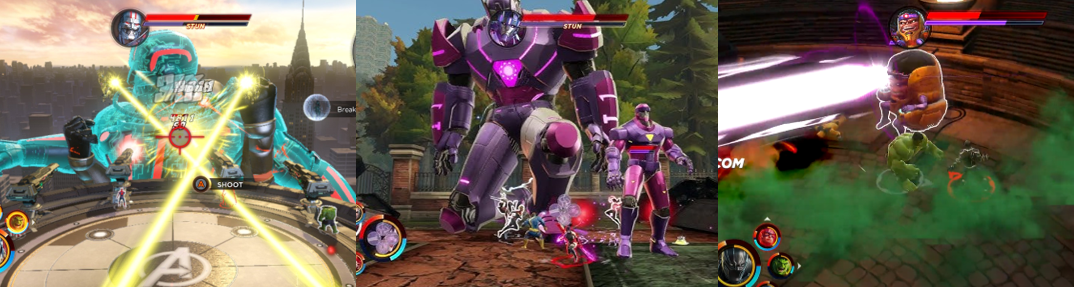
Gigantic bosses and the quirkier villains help mix-up the otherwise tedious combat.

Avengers Tower is then attacked by Ultron and his drones, who assist him in battle. Not that he needs it as the Mind Stone allows Ultron to mess up your controls, to say nothing of his signature face and palm beams. Ultron then grows to gigantic proportions, sweeping the area with his eyebeams before Clint Barton/Hawkeye intervenes and Ultron merges with Ultimo. This is the first giant boss battle in the game and sees you blasting Ultimo with cannons and avoiding his massive swipes. The Infinity Sentinel is comparatively smaller, but no less dangerous thanks to its own face beam and missiles. Though you can damage it with Sentinel cores, it’s finished in a cutscene by Erik “Magnus” Lehnsherr/Magneto, who then tosses debris and throws you off balance with magnetic pulses while Juggernaut pummels you and Raven Darkholme/Mystique tosses daggers. After surviving Mystique’s Danger Room trials, you face Magneto, now even tougher thanks to the Power Stone, before being chased away and banished to the Dark Dimension by the Black Order. There, you battle past Loki Laufeyson (who boasts elemental attacks and duplication tricks) to eventually face the dread Dormammu, who wields the Reality Stone and is the second giant boss. You must subdue his minions and avoid his flame bursts, whittling down his magical barrier either directly or be destroying three nearby orbs, all while dodging his giant fists and ground spikes. The brief fight with Maximus Boltagon is far easier, even though the mad Inhuman carries a massive energy cannon and you must take cover in Thane’s energy bubble to avoid Maximus’s barrage of lasers. Ulysses Klaue/Klaw awaits in Wakanda and his sound-based energy blasts and waves must be overcome to rescue and recruit James Buchanan “Bucky” Barnes/The Winter Soldier. You then fight past A.I.M. to confront their master, George Tarleton/Mental Organism Designed Only for Killing (MODOK), who uses the Soul Stone to turn the Dora Milaje against you and attacks with a slew of appendages, from buzzsaw arms, poison gas, failing tentacles, and his signature forehead blast.
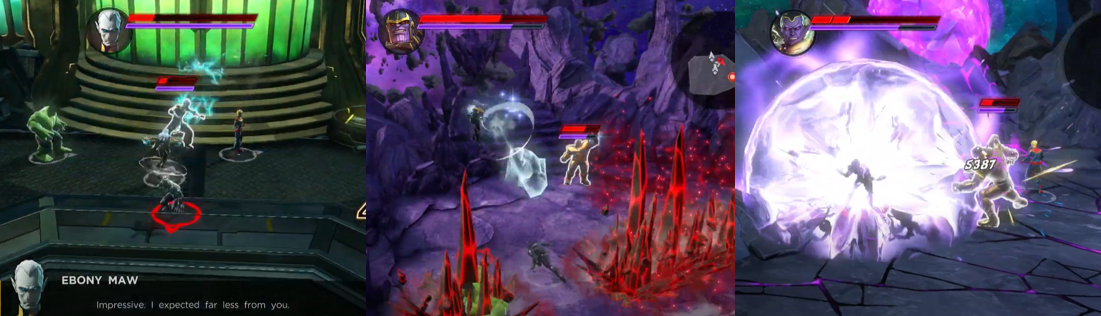
Battles with the empowered Black Order, Thanos, and Thane offer some of the most enjoyable challenges.

Though your goal in Hel is to confront Hela, you’ll actually battle the fire demon, Surtur, in another giant boss battle. This was a bit of a difficulty spike for me as Surtur’s flaming sword has a long reach and he causes the ground to erupt in flames, to say nothing of stun locking you with repeat sword strikes! Best him and Hela sets Johann Schmidt/The Red Skull on you, with the Nazi madman firing a powerful revolver and sapping your health with his “Dust of Death”. Hela gives the Red Skull a boost, protecting him with a shield and allowing him to fire a Bifrost-like laser, before placing his consciousness into the Destroyer armour. Though bolstered by Hydra forces and boasting a sweeping face beam, you can get a power-up from glowing crystals to overcome this destructive force. Finally, you venture to Knowhere and must run the Black Order gauntlet to retrieve the Infinity Stones, with checkpoints between each fight. Ebony Maw is first, firing a spread of projectiles and rocks and using the Soul Stone to create portals to trip you up. Supergiant tosses dark spheres and a golden homing shot that messes up your controls, though you can toss explosive cores from her minions to deal big damage. Cull Obsidian infuses his battleaxe with the Power Stone, sending out waves of purple energy and massive purple shockwaves, though he’s far slower and also susceptible to the nearby bombs. Corvus Glaive is much faster, landing multiple hits with his lance and using the Reality Stone to spring spikes form the ground and conjure duplicates who fill the arena with energy waves that can stun lock you. Finally, Proxima Midnight takes her fellow’s teleportation trick to the next level with the Space Stone and fills the arena with lightning bolts and strikes. All these powers are then recycled when you face Thanos, who gathers the six Infinity Stones into the Infinity Gauntlet to rain meteors, teleport, mess up your controls, freeze time, and fire his signature eyebeams. Thanos then joins you to battle Thane, who usurps him and boasts similar powers, though also upgraded by the Infinity Armour. Thane exhibits superhuman speed, traps you in a cube, fills the arena with portals and flames, and explodes in fury, though both battles were fun challenges rather than impossible tasks.

Additional Features:
Unlike in the previous two games, you won’t be finding data logs, action figures, or meeting certain requirements to unlock new attacks or costumes. You just fight over and over, earning whatever you need to unlock, buy, or upgrade whatever you wish and finding some concept art in treasure chests. A far harder (but more rewarding) “Superior” difficulty unlocks upon clearing the game alongside an additional “Nightmare” mode, accessible via the “Curse of the Vampire” campaign. You also unlock Thanos and can freely replay any mission on any difficulty (though you must start a new save to play on “Superior”) to grind and enhance your characters and ISO-8. Dimensional Rifts transport you to special challenges (not unlike the S.H.I.E.L.D. Simulator discs from the first game) that are often rematches with bosses or gauntlet challenges, though far tougher and gifting better rewards if you succeed. There are also three additional modes; however, though you can play a taster of each, you must purchase the expansion pass to fully unlock them. “Curse of the Vampire” adds vampiric enemies to the main story in “Nightmare” mode and offers a “Gauntlet” mode where you battle waves of enemies and bosses against both a time limit and a range of debuffs (including limited health restoration and draining EP). You can also tackle an “Endless” mode that’s pretty self-explanatory, and unlock additional characters like Frank Castle/The Punisher and Eric Brooks/Bladeif you buy the DLC. “Rise of the Phoenix” sees you form a four-person team and go head-to-head with a friend or the computer in three-round Danger Room scenarios. These see you tackling bosses again or wiping out hordes of enemies, awarding additional buffs and effects if you meet certain criteria (such as using any Ability or Synergy attack four times). You can only tackle the first challenge without the DLC, so I didn’t get very far, but this could be a fun distraction for those looking to test their skills against a friend. “Shadow of Doom” adds an epilogue story campaign that sees you return to Wakanda to oppose Doctor Victor Von Doom’s invasion. Dr. Doom’s Doombots endlessly spawn unless you destroy their teleporters, and you even battle the arrogant dictator in the recycled Necropolis, with him teleporting, firing lasers form his palms, and having his health restored by his Doombots. You’ll add Marvel’s First Family to your roster (alongside an alternative Thanos and other characters) by buying the expansion pass and battle Annihilus, a gigantic Celestial, and even “God Emperor” Doom!
The Summary:
I quite enjoyed the first two Ultimate Alliance games. They were mindless and largely repetitive, but I liked the large cast of characters and all the different references and locations from the comic books. Still, I put off Marvel: Ultimate Alliance 3: The Black Order for some time, mainly because I was annoyed by it being a Nintendo Switch exclusive; however it turned out to be a decent enough brawler. Despite the different development team, a few tweaks, and an apparent disconnection from the previous games, Marvel: Ultimate Alliance 3 offers a lot of the same gameplay and enjoyment as its predecessors, which is great for long-time fans of the franchise. Unfortunately, it doesn’t improve on these elements in a meaningful way and actually removes some content that I found enjoyable from the last two. There are no optional missions, for example, no alternative endings, no choices, and no character-specific challenges beyond fighting and levelling-up. I found this made the tedious combat even more aggravating after a while as I wasn’t being rewarded with gear or costumes or anything other than stat boosts. Even the skill tree was limited since you must grind to acquire enough credits and expendables to enhance your team, and I found the ISO-8 mode to be more confusing than engaging. The game also does little to improve the boss battles. Very few were very innovative or required more of you than to strike fast, avoid shockwaves and projectiles, and unleash your Extreme attack. The giant bosses were more of a challenge and I liked the final fight against Thanos and Thane, but I was hoping for a bit more complexity, especially given the possibilities offered by the Infinity Stones. There is a fun selection of characters, but they don’t offer much more than what we saw in the last two games and actually offer less as there are no character-specific team-up moves. While I enjoyed the visual influence from the MCU and the variety, I feel like Marvel: Ultimate Alliance 3 played things a little too safe by relying so heavily on combat and not mixing up the gameplay with a few other puzzles and challenges. Overall, it’s a good enough game and a worthy entry in the series, but it’s a shame that the developers didn’t try to be a bit more innovative and offer some more incentive to keep slogging away in endless fights.

My Rating:

Rating: 3 out of 5.

Pretty Good

Did you enjoy Marvel: Ultimate Alliance 3: The Black Order? How do you think it holds up against the previous two games? Which characters did you choose for your team? Were you disappointed that the combat was so similar to the last two games and the bosses so repetitive? Did you ever conquer all the Rift challenges? What did you think to the MCU influences and the final battle with Thanos and Thane? Did you ever play through the DLC? Would you like to see another Ultimate Alliance game? Whatever your thoughts, leave a comment below, support me on Ko-Fi, and go check out my other superhero content across the site.


Screen Time [Sci-Fanuary]: I Am Groot (Season One and Two)


January sees the celebration of two notable dates in science-fiction history, with January 2 christened “National Science Fiction Day” to coincide with the birth of world renowned sci-fi writer Isaac Asimov. HAL 9000, the sophisticated artificial intelligence of Arthur C. Clarke’s seminal 2001: A Space Odyssey (1968), was also created on 12 January. Accordingly, I am dedicating January to celebrating sci-fi in all its forms.


Season One and Two

Air Dates: 10 August 2022 and 6 September 2023
Director: Kirsten Lepore
Network: Disney+
Stars: Vin Diesel, Trevor Devall, James Gunn, Fred Tatasciore, Bradley Cooper, and Jeffrey Wright

The Background:
Created by Stan Lee and Larry Lieber, the original version of Groot was a far cry from the loveable tree-monster who won the hearts of audiences in Marvel Studios’ Guardians of the Galaxy films (Gunn, 2014 to 2023). Vin Diesel’s surprisingly nuanced performance made the character a household name and Marvel wisely capitalized on the cute appeal of Baby Groot with a series of animated shorts to bolster Disney’s new streaming platform. Seeking to hearken back to a simpler time in Disney animation, when short-form storytelling didn’t rely on much dialogue, director and head writer Kirsten Lepore was inspired by her son when exploring Groot’s childhood. She also met with Guardians of the Galaxy director James Gunn to explore Groot’s mischievous characterisation. Though Gunn questioned the canonicity of the shorts, Lepore was open to producing more episodes since she and Marvel Studios had plenty more ideas to pull from. Despite the character’s limited vocabulary, Vin Diesel returned to record new “I am Groot” lines and Bradley Cooper even recorded a cameo as Rocket Raccoon. The second series revisited ideas pitched for the first and featured a cameo by Jeffrey Wright as Uatu the Watcher that injected some comedy into the otherwise stoic overseer. The show also recycled the Baby Groot CGI model created by Luma Pictures and Lepore took inspiration from the original Star Wars trilogy (Various, 1977 to 1983) when suggesting designs for Baby Groot’s supporting cast. When it first streamed, I Am Groot was the third highest streaming series in America and both seasons were widely praised for its adorable main character, quirky humour, and playful nature.

The Plot:
Baby Groot (Diesel) takes the spotlight in a series of shorts exploring his adventures growing up, getting into trouble among the stars, and deciding the fate of the entire multiverse!

The Review:
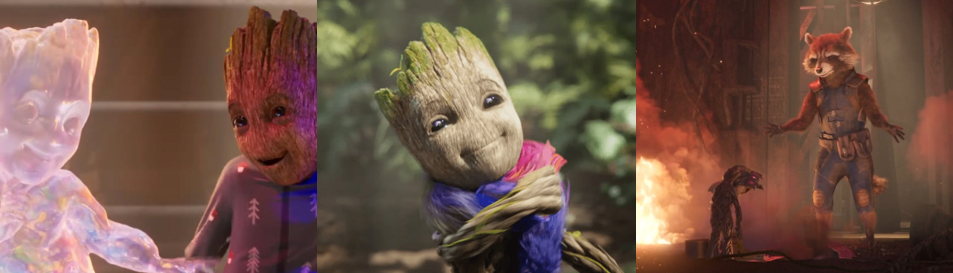
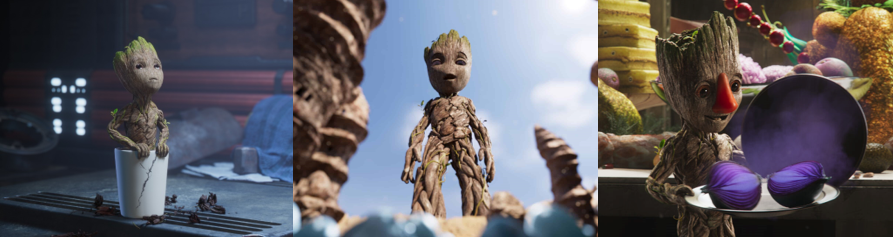
I Am Groot is a CGI animated series of shorts made for little kids. Each episode last about five minutes and features very little dialogue, consisting primarily of Baby Groot’s many different inflections of “I am Groot”. Therefore, they don’t take too much time to watch and it’s easier and fairer to just lump both seasons together into one review. Series one begins some time after Baby Groot first sprung to life in his little plant pot on the Eclector. He’s just a sapling but he still needs care and attention, which is provided to him by a couple of automated robots, who routinely water and tend to him. However, he’s growing so quickly that he cracks his pot, causing the robots to replace him with a sturdier bonsai plant. Naturally, Baby Groot isn’t impressed with this and attacks his replacement, causing both their pots to break from a fall. Luckily, Baby Groot survives and finds he’s got legs, allowing him to take his first steps and get into more mischief. He even makes it up to the bonsai plant by befriending it afterwards, and this caring side to Baby Groot is revisited a couple of times in the show. For example, Groot discovers a colony of ant-sized Grunds living under a rock on an alien world in “The Little Guy”. While Baby Groot initially enjoys toying with them as a God-like figure, he’s stunned when they showcase advanced technology and bombard him with laser fire! While protecting himself in the foetal position, the terrified Baby Groot accidentally farts out a leaf, much to the delight of the Grunds, who immediately devour the offering. Inspired, Baby Groot quickly forgets the attack and gathers up armfuls of leaves to feed the colony, only to accidentally step on them and back away nonchalantly (though the Grunds are actually fine). Similarly, in series two’s “Are You My Groot?”, Baby Groot adopts a strange alien bird, playing with it and feeding it his snacks. Groot’s fondness for the bird and enjoyment of being a surrogate parent are juxtaposed by his annoyance with the bird’s clingy nature and constant pooping. However, Baby Groot still sheds a tear when the bird finds its siblings and flies off with its bulbous, equally quirky mother.

Baby Groot both causes and finds mischief, though always in the spirit of good-natured fun.

In “Groot’s Pursuit”, Baby Groot’s awoken by a mysterious clanging and bravely investigates, hoping to get a good night’s sleep. Though his initial search turns up nothing, he fails to notice a mysterious liquid goop from a broken vial until he’s surprised by the Iwua (Devall), a shape-shifting alien who’s just as mischievous as Groot. Indeed, the Iwua impersonates Groot, leading to a dance-off that Groot thoroughly enjoys until the Iwua first criticises his technique and then reveals its true form, leading to Groot tricking the creature into an airlock and ejecting it into space. In “Groot Takes a Bath”, Baby Groot enjoys some relaxation time in a mud bath, only to find the mud causes his leaves to sprout wildly. Though initially horrified, Groot returns to the mud bath again and again as he grooms himself different hairstyles, outfits, and looks, each time saddened to find the leaves wilt within moments. Eventually, he uses up all the mud, leaving him saddened. When a local bird laughs at his misfortune, glad to see the cheeky little baby tree get his comeuppance after his fun kept the bird awake, Groot improvises and trims the bird’s feather to fashion himself a stylish scarf. Series one ends with Groot’s literal “Magnum Opus”, a meticulously crafted drawing of him and his friends and family, the Guardians of the Galaxy, as they appeared during his emotional sacrifice at the end of the first film. Baby Groot’s so determined to bring the piece to life that he scours the ship for items, including a clipping from Rocket Racoon’s (Cooper) tail and samples from the ship’s fuel cells. This creates a glittery explosion that not only finalises his titular masterpiece but also tears a hole in the Eclector, one Baby Groot adeptly begins sealing with duct tape when Rocket comes to investigate all the noise. Though alarmed that Groot has caused the ship to both flood and catch fire, Rocket’s outrage is quickly quashed when he sees the picture, which warms his heart even as he’s sucked into the hole and rescued by Baby Groot’s extendable arms.

At times, Baby Groot’s hijinks put both him and the entire universe in danger.

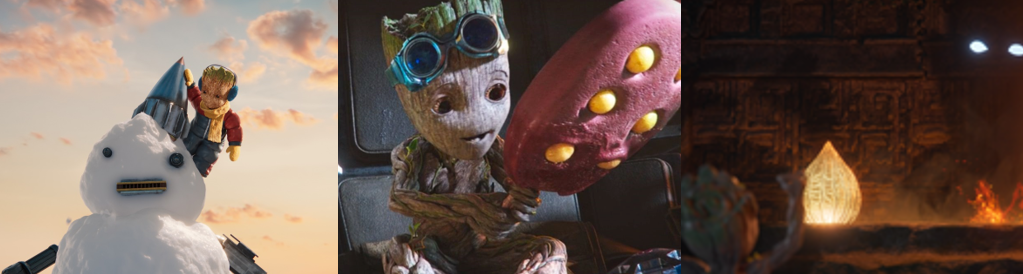
While searching for new batteries for his videogame controller, Baby Groot pulls himself from his pit of snacks and roots around in Rocket’s treasure trove of stolen items, eventually slapping a prosthetic nose to his face and gaining a sense of smell. Amazed, he explores these new sensations but quickly ditches the appendage when he returns to his filth with his batteries and is disgusted by the stench. Though he’s tempted to grab a brush and clean the place up, Baby Groot decides it’s better to just toss the nose away and get back to his game, content to sit in the mess. In “Groot’s Snow Day”, Baby Groot explores a snowy planet and builds a snowman. Deciding his frosty friend would look better with a few modifications, he ransacks the Milano and stuffs the snowman with cybernetic enhancements, unwittingly bringing it to life. The robotic snowman immediately attacks with its lasers and heads to the ship, intent on spreading further destruction, though Groot seemingly destroys it by launching a well-timed snowball at a compromised engine part lodged in its head. Groot then searches high and low for some credits to get himself a sweet treat from a passing ice cream ship, awestruck by its flashing lights and assortment of frozen goodies. After many pratfalls, Baby Groot finally gathers some coins and is left despondent when the ship moves on. Desperate, he commandeers a space capsule and gives chase, ultimately crashing through the ice cream ship and gifting him as many treats as he could want. Finally, the Watcher (Wright) observes and narrates Baby Groot’s exploration of an ancient tomb said to contain a sacred seed that will bring peace and prosperity to the universe. Despite the Watcher’s best efforts, Baby Groot continually puts himself in danger and gets distracted from his quest, preferring to desecrate the tomb and take a nap. By the time he finally spots the seed, Groot’s more interested in retrieving his ball, causing the seed to be consumed by lava and the temple to crumble. However, the Watcher consoles himself with the understanding that the prophecy was a metaphor and that Groot, emerging from the rubble with fresh leaves sprouting, was the “seed” that would rise from the temple.  

The Summary:
I had a good time with I Am Groot. Obviously, your expectations need to be quite low considering it’s primarily aimed at kids, but I enjoyed Baby Groot’s pratfalls and adventures. As ever, Vin Disel does a great job of making “I am Groot” convey so many different meanings. Baby Groot expresses curiosity, sadness, anger, and even affirms his own identity with these three words, showing caring, mischievous, lazy, and poignant aspects of his personality. The entire show is shot from Groot’s perspective (not literally, of course; I mean at his level), not unlike the classic Tom and Jerry cartoons (1940 to present). We never see any of the other Guardians of the Galaxy save for an obscured cameo of Drax the Destroyer in the shower and Rocket’s heart-warming appearance in “Magnum Opus”, though the crew are obviously around as someone’s flying the ship and visiting all these worlds. It might’ve been fun to hear some of the crew shouting or talking off-camera, reacting to Groot’s antics or just giving a bit more life to the ship, but the framing purposely keeps things at Baby Groot’s level to suggest that he gets up to all these adventures on the regular, largely without anyone noticing. As a sapling, Baby Groot is still understanding himself and the universe; he can stretch his limbs at will but is surprised when he sprouts leaves, for example. He learns as he goes, like any child would, and takes pleasure in simple things, like relaxing in a mud bath or eating ice cream. He still enjoys a dance and gets shirty when the Iwua offers him tips and we see the origin of what would become a teenage obsession with videogames as he sits in a fetid pit chomping on snacks and ignoring his personal hygiene.

Unbeknownst to his family, Baby Groot is getting into all kinds of mischief.

Baby Groot also shows a passion for creativity and construction; he cobbles together all sorts of random items to spruce up his picture and (literally, if unexpectedly) bring his snowman to life. These talents seem to be borrowed from Rocket, who’s forever scrounging away parts and putting together outrageous devices, and it shows that Groot is influenced by his adopted family. This also fosters a caring side to him; he’s driven to feed both the Grunds and the weird little bird that imprints on him and is genuinely upset when he thinks he’s crushed them and his adopted baby returns to its kin. A highly volatile and emotional little sapling, Baby Groot lives a life of extremes; he’s super excited to see the ice cream ship pass by, grows increasingly frustrated at failing to find any coins, and is so desperate to get a treat that he collides with the ship at full speed! If you listen to the all-seeing, all-knowing Watcher, you’d be fooled into thinking that Groot is some prophesised hero destined to usher in a golden age for the universe. However, he’s just a cheeky little tree-boy who enjoys playing his games, bouncing his ball, and doodling, even if his work accidentally endangers his family or defiles an ancient tomb. The Watcher is convinced that the seed is pivotal to the safety and security of the universe and comically aghast when Baby Groot fails to recognise this, and is ultimately forced to reinterpret the prophecy since, like Rocket, the Watcher cannot stay mad at the adorable little sapling. Ultimately, I Am Groot is worth checking out if you’re a fan of Groot and the Guardians of the Galaxy, but obviously will have more appeal to little kids, who will no doubt relate to and enjoy Baby Groot’s mischievous antics. It’s fun getting a sense of what these characters do when no one’s looking and how they interact with the world around them, and Baby Groot is a cute little bugger you can’t help but fawn over. The show’s not going to give the Minions anything to worry about any time soon, but it’s a fun enough distraction to have on in the background as a break from Marvel’s increasingly high stakes action and there’s no shame in that.

My Rating:

Rating: 3 out of 5.

I Am Groot

I am Groot? I am Groot, I am Groot? I am Groot, I am Groot, I am Groot? I am Groot? I am Groot? I am Groot? I am Groot, I am Groot? I am Groot, I am Groot, I am Groot? I am Groot? I am Groot?

Back Issues [Sci-Fanuary]: Tales to Astonish #13


January celebrates two notable dates in science-fiction history, “National Science Fiction Day” on January 2 and Arthur C. Clarke’s HAL 9000’s birthday on January 12. Accordingly, I’m dedicating January to celebrating sci-fi with an event I call “Sci-Fanuary”.


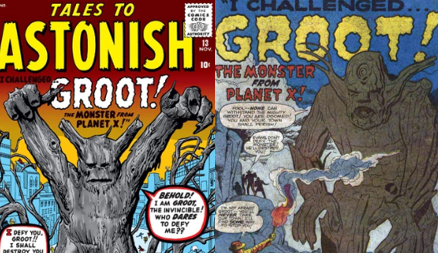
Story Title: “I Challenged… Groot! The Monster from Planet X!”
Published: 27 June 1960 (cover-dated: November 1960) 
Writers: Stan Lee and Larry Lieber
Artist: Jack Kirby 

The Background:
Nowadays, the lovable tree-monster Groot is all-but a household name thanks to his celebrated appearances in the Marvel Cinematic Universe (MCU), courtesy of Vin Diesel’s surprisingly complex performance considering the character simply says “I am Groot” over and over. While Groot is best known as a key member of the Guardians of the Galaxy, his first appearance was in a decidedly less heroic role. Debuting in Tales to Astonish, a science-fiction anthology series perhaps best known for introducing readers to Doctor Hank Pym/Ant-Man, this far more eloquent portrayal of Groot sought to capture and study humankind. This version of Groot later joined the Howling Commandos, a paranormal strike team working under the Strategic Hazard Intervention Espionage Logistics Directorate (S.H.I.E.L.D.) He was largely supplanted by a different member of his species, also called Groot, who first appeared in the Annihilation: Conquest event (Various, 2007 to 2008) before joining the Guardians of the Galaxy and being the inspiration for the MCU’s version of the character.

The Review:
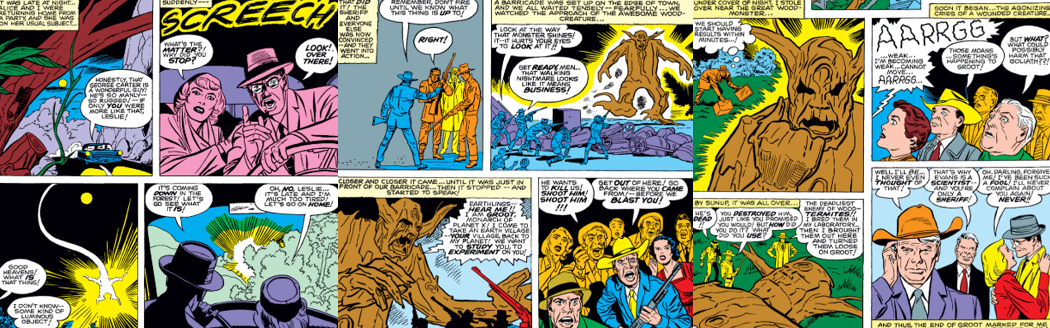
The story of how one brave man stood up to the hulking tree-monster from Planet X, Groot, begins late one night as married couple Leslie and Alice Evans return home from a trip to the cinema. Their mundane drive through the night is interrupted when Leslie spots a brilliant luminous object falling from the heavens and crashlanding in a nearby forest. While he’s eager to check it out, Alice easily convinces him to ignore it and take her home because she’s “tired” (*wink-wink, nudge-nudge*). However, being a curious biologist, Leslie can’t help himself and goes to investigate off-panel, bringing a sample of the mysterious object to his laboratory for study. One day, Alice comes charging into the lab claiming that two of their trees (as well as some of their neighbour’s trees) are missing. Though he brushes the phenomenon off as a cheap prank, Leslie’s sure that what he saw in the forest is somehow connect and heads over there. However, when he arrives, Leslie’s astonished to find the glowing object emitting a powerful light and to witness a gigantic wooden giant, a living tree, commanding and controlling wooden objects to fly to him and add to his monstrous stature. Panicked, Leslie naturally rushes into town to warn the sheriff. Luckily, one of the lawman’s men is on hand to report that the creature is heading to town and, before long, a barricade is erected and armed men are confronting the giant.

Unassuming biologist Leslie holds the key to defeating the monstrous, tree-like Groot.

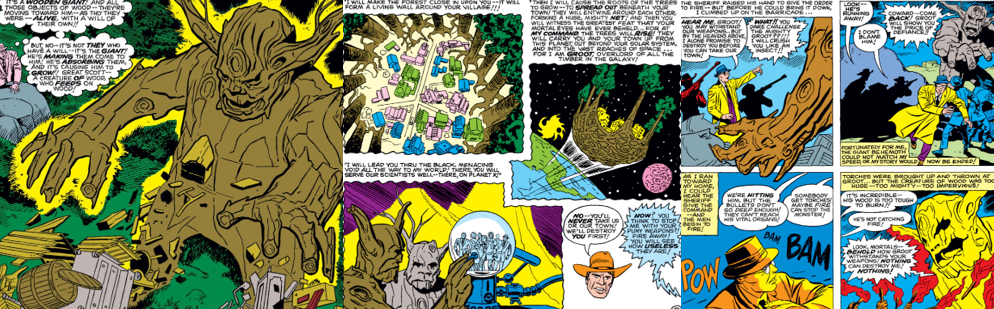
Surprisingly, the titan halts its march and addresses the townsfolk, introducing itself as Groot, monarch of Planet X, and his intentions to take the entire village back to his home world to study the Earthlings. Terrified, the townsfolk prepare to defend themselves, only for Groot to mentally command the surrounding trees to encircle the town. Its intention is that the trees will bury beneath the town’s very foundations to form a giant net that will whisk the town and all its inhabitants into space, presumably somehow sustaining them for their journey back to Groot’s world. There, he proclaims he and his kind will conduct research on them; the exact specifics aren’t clear, but the threat is enough to rile up the townsfolk. Unfortunately for them, Groot easily shrugs off their small arms fire; however, Leslie bravely steps up and claims to know the key to stopping Groot’s plot. Yet, when he immediately runs off, his peers and even mighty Groot believe him to be a coward. Since the town’s bullets and even flaming torches cannot penetrate Groot’s thick hide, there’s nothing to stop the creature enacting his plan, and even Alice chastises Leslie’s apparently cowardice back at his lab. However, she and the others are amazed when Leslie rushes back to Groot and deposits two boxes to the ground. To their shock and relief, Groot is painfully felled and killed by “the deadliest enemy of wood”, termites! With the towering goliath slain, the town is in Leslie’s debt, stunned at such a simple solution, and even Alice sees her man in a new light by the end.

The Summary:
Well, this was a bit of schlock, B-movie-level fun! The entire setup is like something ripped straight out of a Roger Corman flick and the execution is on the same level as an ambitious monster movie from the 1950s. Our main protagonist is not some muscle-headed jock or even a cop; he’s just a simple biologist, one whose wife constantly chastises him for not being a “real man”. He’s much happier with his lab equipment and studying animals and fauna, it seems, and motivated by scientific curiosity first and foremost. Leslie wants to investigate the crash site simply to see what wonders fell from beyond our world and is driven to distraction studying a sample of the glowing material. It’s not made clear what he’s looking at or what it really does; I assume it’s a small piece of what would become Groot, but the story glosses over what Leslie’s research uncovers. It might’ve been good to setup the ending in these panels; have Leslie’s study of Groot reveal the key to defeating the monstrous giant rather than randomly having Leslie pull termites from his ass. While Alice doesn’t get much to do but react to stuff and criticise her sapling husband, the town sheriff and inhabitants are certainly gung-ho. Thankfully, we’re spared any lengthy scenes of Leslie being branded a madman and the cops and townsfolk are soon grabbing guns and torches to defend themselves against Groot. However, like Alice, they see action and gusto as the true mark of bravery. Thus, they throw insults and judgement at Leslie when he seemingly flees in fear and are confused and perplexed when their weapons and moxie are nothing compared to a few termites.

The mighty Groot has come to enslave, not conquer, but poses a significant threat.

Naturally, Groot is the main reason to read this bizarre story from Marvel’s golden age. The build up towards the creature’s big reveal is both brief and tense. Due to the limited page count, there’s only so much the writers can do, but I liked that the town’s trees went missing as a foreshadowing of Groot’s reveal. Those more familiar with the heroic Groot may be shocked by this creature’s more grotesque appearance. Groot is a towering, tree-like alien who adopts a menacing stance at all times. Interestingly, though, Groot is seemingly a scientist, like Leslie. It’s there to capture and study the town, not conquer the Earth, and makes no aggressive moves towards the humans even as they fire upon it. I mean sure, it wants to wrap the town up in a ridiculous cage of trees and branches, whisk them away to Planet X, and perform God-knows-what on them in its lab, but it’s not rampaging through town, squashing people beneath its trunk-like feet, or otherwise attacking them. Yet, Groot is framed as being “unconquerable” due to its incredible size and strength. However, it’s notable that the townsfolk only have small arms and flaming torches on hand; we have no idea how heavier ordinance would’ve fared against Groot. Of course, we have no need to discover this since Groot is easily and painfully taken down and killed by a group of termites. This simple solution is straight out of The War of the Worlds (Wells, 1898; Pal, 1953) and shows how man’s ingenuity is our greatest asset, rather than brute force. A peculiar and whimsical science-fiction tale clearly inspired by 1950s B-movies, “I Challenged… Groot! The Monster from Planet X!” is notable for its early depiction of what would become one of Marvel’s most endearing characters and short enough to provide a brief bit of entertainment, but you’re not really missing much if you’ve skipped this one and I wouldn’t say it’s really worth seeking out unless you’re really curious about Groot’s understated first appearance.

My Rating:

Rating: 2 out of 5.

Could Be Better

Have you ever read “I Challenged… Groot! The Monster from Planet X!”? If so, what did you think to it? Did you enjoy the B-movie feel of the story? What did you think to Groot, its design and motivations? Were you amused by the way Leslie managed to destroy the creature? Would you like to see Marvel bring back sci-fi anthologies like Tales to Astonish? What are some of your favourite Groot stories and moments? Feel free to share your thoughts on Groot in the comments and go check out my other sci-fi content on the site.
Movie Night: Guardians of the Galaxy Vol. 3

Released: 5 May 2023
Director: James Gunn
Distributor: Walt Disney Studios Motion Pictures
Budget: $250 million
Stars: Chris Pratt, Bradley Cooper/Sean Gunn, Chukwudi Iwuji, Zoe Saldaña, Karen Gillan, Vin Diesel, Dave Bautista, and Will Poulter

The Plot:
Still reeling from the death of Gamora (Saldaña) and the subsequent return of a past version of her, the Guardians of the Galaxy are attacked by superpowered bounty hunter Adam Warlock (Poulter). With Rocket (Cooper/Gunn) critically injured, Peter Quill/Star-Lord (Pratt) leads the Guardians in discovering their friend’s horrifying origins, which brings them into direct conflict with the deranged High Evolutionary (Iwuji).

The Background:
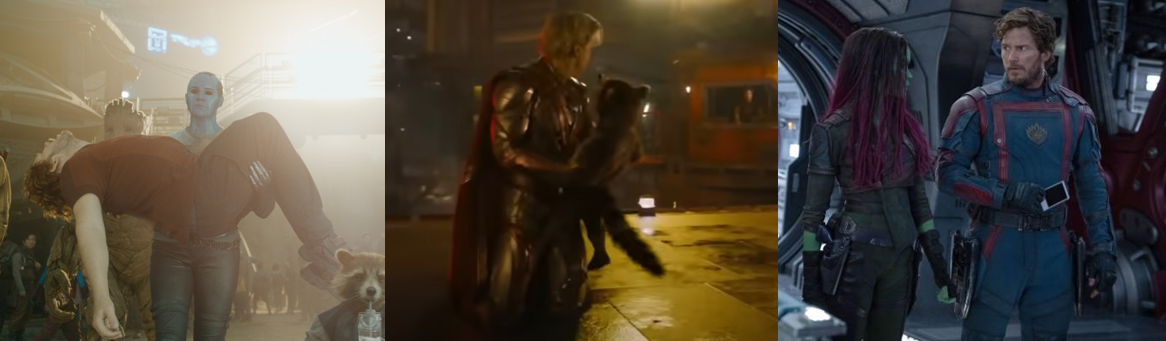
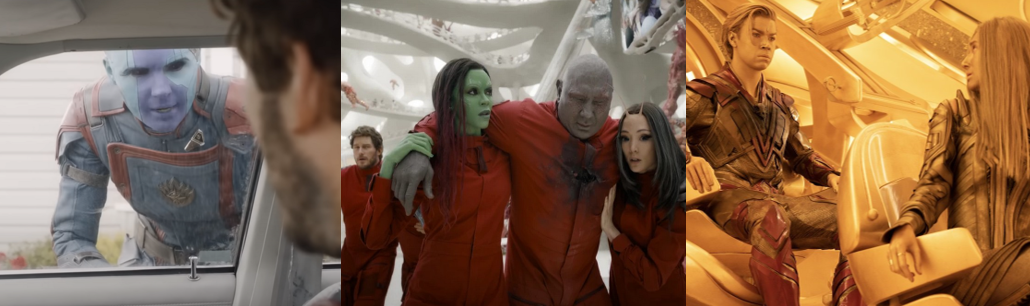
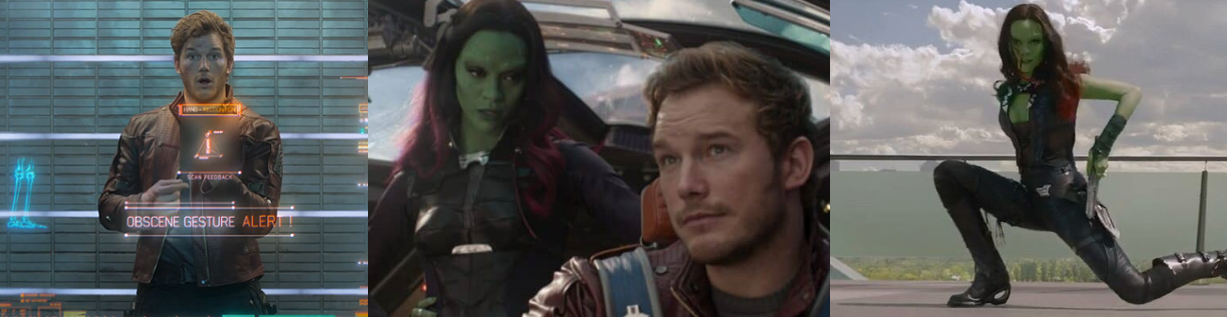
Although they’re one of Marvel’s more obscure properties and have undergone numerous changes over the years, the Guardians of the Galaxy turned out to be a massive financial success when they made their live-action debut in the Marvel Cinematic Universe (MCU) with Guardians of the Galaxy (Gunn, 2014). To capitalise on this, and to promote the team as being as integral to the MCU as the Avengers, the cast and crew returned for Guardians of the Galaxy Vol. 2 (ibid, 2017), which proved to be an even bigger financial success than the first film despite being met with mixed reviews. Despite having had plans for a trilogy right from the start, director James Gunn seemed to flip-flop on whether he’d return for a third movie; however, after completing a script and entering pre-production, his involvement was placed in serious jeopardy when he was fired after a series of offensive tweets made the headlines. Gunn publicly apologised for the tweets and fans and cast members rushed to his defense, and he was eventually brought back to helm the project later that year. However, much had changed in those few months; stars Dave Bautista and Zoe Saldaña expressed a desire to retire from their roles and Gunn was later named as the creative force behind a reboot of the rival DC Comics cinematic universe, not to mention Gunn’s displeasure at Gamora’s unexpected death in Avengers: Infinity War (Russo and Russo, 2018). Still, he worked around these issues and was even allowed to film a short, holiday-themed passion project surrounding these characters and craft an emotional finale for the franchise. While visual effects naturally played a large part in the third film, Gunn also strived to include more practical effects to bring the surreal locations and creatures to life; though he was largely kept in the dark about the character until shooting began, Will Poulter was cast as Adam Warlock to kick-start further explorations of the character in later MCU films, while Chukwudi Iwuji was cast as the High Evolutionary, beating out fellow cosmic villain Annihulus to create the MCU’s cruellest villain to date. Guardians of the Galaxy Vol. 3 eventually made nearly $850 million at the box office and was met with positive reviews; critics lauded the film as the best MCU movie in recent memory for its emotional and visually imaginative presentation, though it was also criticised for its depiction of animal cruelty and for its surprisingly brutal tone.

The Review:
As much as I enjoyed Guardians of the Galaxy (and I really did; it’s surprising how well it works as this bizarre, sci-fi/action romp, especially as it introduces a whole team of characters and explores a side of the MCU that’s so divorced from some of its more grounded action), it took me a few views to appreciate Guardians of the Galaxy Vol. 2. I was expecting bigger and better, only to find it was a more character-driven film that explored the dysfunctional family dynamic of the titular team; once I realised this, subsequent viewings allowed me to appreciate it more, especially the growth of the complex love/hate relationship between Gamora and her semi-psychotic, cyborg sister, Nebula (Gillan). Fate saw the Guardians of the Galaxy play a pivotal role in Avengers: Infinity War, one that actually ended up dooming half the life in all the universe for five years or so, but Avengers: Endgame (Russo and Russo, 2018) ended with the suggestion that the team would find new life searching the galaxy for a time-displaced Gamora alongside Thor Odinson (Chris Hemsworth). Unfortunately, this “Asgardians of the Galaxy” team didn’t really come to pass beyond a brief inclusion in Thor: Love & Thunder (Waititi, 2022); I do feel like there’s a bigger story to tell there with those characters, however, and hope that we get some kind of animated short or interlude that explored the adventures they got up to between films. Instead, Guardians of the Galaxy Vol. 3 picks up not long after the end of their Christmas special; the team operates out of Knowhere, the severed head of a Celestial that houses an entire community under their protection, and they’re still trying to wrap their heads around the fact that the Gamora they knew is dead, yet another version of her is still out there in the galaxy. This is particularly difficult for Quill, who has turned to alcohol and depression not just because he’s lost the love of his life, but because of a deep-rooted feeling of abandonment and pain as everyone he’s ever known and cared about has died. His surrogate family, the Guardians of the Galaxy, are on hand to care for him and support him, but they’re individually too maladjusted to properly communicate their feelings too him.

When Rocket’s life is endangered, the team embarks on a quest that sees Quill confronting his fears.

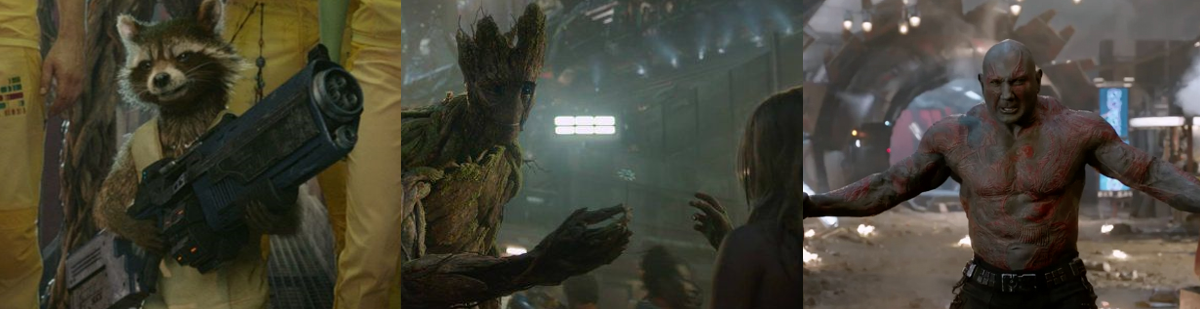
Drax the Destroyer (Bautista) is far too literally a thick-headed, living tree Groot (Diesel) is far too simplistic, and abrasive Rocket much too aggressive. Nebula, however, offers a surprising amount of support, caring for him in a way we’ve never seen before since she’s now come to regard the Guardians as her family and truly cares about them, even if her traumatic past makes it difficult for her to express emotions beyond violence. Quill takes some solace in his empathetic half-sister Mantis (Pom Klementieff), but her naïve optimism and observation that Quill has family waiting for him on Earth also do little to ease his pain. Luckily for Quill, the team is attacked by Adam Warlock, the child-like superhuman champion of the golden-skinned Sovereign; I say “luckily” as this brings the team together to fend off Warlock’s attack and defend Knowhere, a task they struggle to accomplish given his power, resulting in Rocket being critically injured. Faced with the stark reality that his self-professed best friend may die, an enraged Quill refuses to accept this and resolves to seek out Orgocorp, a highly advanced scientific research centre, in order to deactivate the kill switch attached to Rocket’s heart and keeping them from helping him. This sees them crossing paths with Gamora since Nebula arranges for Gamora and her Ravager allies to help the team infiltrate Orgocorp. This again forces Quill to be faced with the harsh truth that this Gamora isn’t the one he knew and loved; even Drax points out that she’s “dead to them” since this Gamora never hooked up with the team and has none of the memories or attachments to them. While this is a pretty simple prospect, even for the otherwise simple-minded Star-Lord, the film spends a lot of time reinforcing that he and the others don’t really understand what’s going on with Gamora; often, they talk about how she “doesn’t remember” them and Quill futilely tries to jog memories that just aren’t there and takes every opportunity to tell anyone within earshot about their complicated history, needlessly hammering home that this isn’t the same Gamora from the previous Guardians films. I understand it in a way; a big part of the film is Quill having to come to terms with death and loss, but it starts to get a little grating when he constantly harps on about it to everyone in earshot. This Gamora is much more cold-hearted and harsh compared to her counterpart; she has more in common with how Nebula used to be and there’s an interesting reframing of their narrative here as Nebula states that Gamora was “always like this” and Gamora is shown to have this dark, violent side to her that casts as more of an anti-hero. She begrudgingly helps the Guardians at Orgocorp but despairs of their ineptitude, constant bickering, and Quill’s insistence that he knows anything about her. She softens towards them over the course of the film after seeing how hard they fight to help Rocket and protect others, but nevertheless remains her own distinct character, separate from them, and it’s a testament to the film that it doesn’t just repeat the same will they/won’t they character between her and Quill from the first film.

Though aggravated by each other, the Guardians strive to help even their misguided enemies.

As for the rest of the team, Drax is mostly relegated to being the comic relief and mindless muscle of the group; his stoic demeanour allows him to process Gamora’s loss in a more productive way than Quill, but it’s clear that he misses her in his own way, too. He continues to have an attachment to Mantis and the film does explore how, despite her objections to the contrary, she uses her empathic abilities to manipulate him in ways that he’s not aware of. For example, she defends Drax’s infantile nature to Nebula, who lashes out at both of them for their incompetence, and he seems genuinely upset to learn that Mantis thinks he’s stupid (even though she loves him regardless) so she simply has him forget hearing that. despite Nebula’s anger at the two for endangering the group on countless occasions, Mantis and Drax prove their quality in the final act of the film where Mantis is able to tame the ravenous Abilisks and Drax is able to calm and communicate to the children held in the High Evolutionary’s ship since he not only unexpectedly speaks their language but also is a natural father. This theme of underestimating those around you is a prominent one in the film; even Kraglin (Sean Gunn) embodies this since he continues to struggle with mastering Yondu Udonta’s (Michael Rooker) arrow and proves invaluable in aiding the rescue effort at the end of the film, but it’s most prominently seen in Adam Warlock’s character arc. Having been born prematurely, Warlock is little more than a child in a man’s body; he’s been created as a perfect being, a living weapon to enact the will of his mother, the Sovereign High Priestess Ayesha (Elizabeth Debicki). While my knowledge of Warlock is somewhat limited, I was surprised to see him characterised as a childlike fool, but he undergoes a surprising journey in the film; he feels regret after incinerating space creature Blurp’s owner after a misunderstanding and adopts the cute little critter, then briefly abandons his crusade against the Guardians in an unsuccessful attempt to save his mother when the High Evolutionary callously obliterates her along with his “Counter-Earth”, and becomes an unexpected ally of the team by the film’s conclusion since his former enemies make efforts to save his life rather than leaving him to perish.

For his callous and cruel experiments, the High Evolutionary is easily the MCU’s most detestable villain.

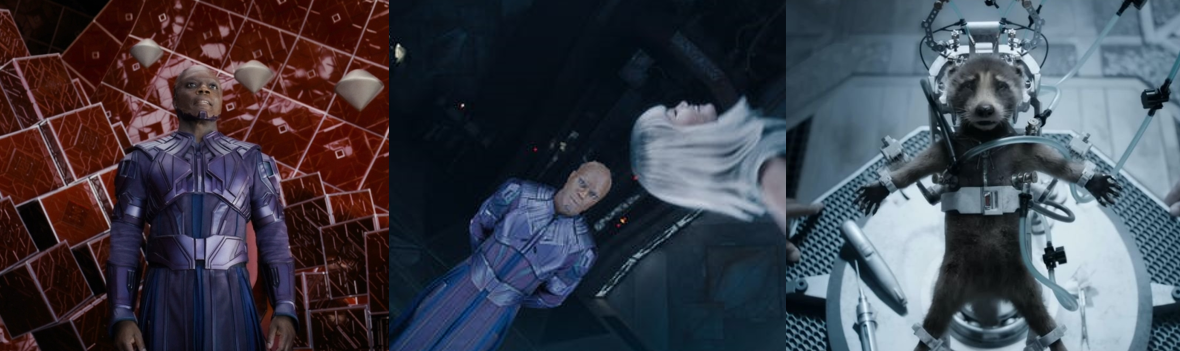
For me, the High Evolutionary ends up being easily the most reprehensible villain in all of the MCU so far. While he still doesn’t get a huge amount of screen time or backstory and the exact nature of his gravity-based powers is a little vague, this is a villain who has absolutely no redeeming qualities; we’re given no reason to sympathise with him or to understand his perception of the galaxy, and this is perfectly acceptable given his heinous actions! The High Evolutionary is a maniacal despot obsessed with “perfection”; he sees the flaws in life and God’s plan and uses his superior intellect and scientific acumen to step in to correct these flaws. His ultimate goal isn’t conquest or destruction, it’s to create the “perfect” society, which has led to him being regarded as a God by many of his creations, like the Sovereign. However, while the Sovereign are basically the embodiment of beauty and perfection, the High Evolutionary is never satisfied and the majority of his experiments are geared towards creating anthropomorphic beings and semi-cybernetic monstrosities! These live out normal lives on an exact replica of Earth, yet while he was able to suppress their natural animalistic urges and craft a society that’s a mirror of ours, he wasn’t able to create a utopia, so he habitually exterminates his creations like a child bored of a toy. While this ritualistic genocide and the High Evolutionary’s unstable, erratic God complex are bad enough, what makes him so irredeemable and reprehensible compared to other MCU villains are his callous experiments on animals. Animal cruelty is at the forefront of Guardians of the Galaxy Vol. 3 as Rocket, near death, experiences a series of flashbacks to his time as one of High Evolutionary’s test subjects. A strangely curious raccoon, he was subjected to horrific procedures that grafted mechanical parts to his body and increased his intelligence and awareness, all under the pretence that he and his fellow prototype anthropomorphs would have a place in the “new world”. However, when Rocket’s intelligence exceeded the High Evolutionary’s for a split second, the madman ordered Rocket dissected and the execution of his friends, leading to the terrified and heartbroken creature to enact a daring escape that left him traumatised and the High Evolutionary gruesomely disfigured.

The Nitty-Gritty:
Like the last two Guardians of the Galaxy movies, music plays an important role in this film, both diegetically and non- diegetically; Quill is almost irrationally protective of the Zune gifted to him by his father-figure, Yondu, which Rocket borrows without asking to find solace in the songs contained within it. Almost all of the film’s action and fight scenes are accompanied by music tracks, as is James Gunn’s signature at the point, but they weren’t as memorable for me and seemed to be a little more random rather than sticking to one era or genre of music. However, the film is very much a culmination of the character arcs began in the first one; there’s always been a question hanging over Quill about why he never returned to Earth when he clearly has the means to do so, and it’s always come down to fear disguised as lust for adventure in space. Earth is where his mother died and he has no desire to return there, especially as his memory of that day is skewed to paint his grandfather, Jason (Gregg Henry), as having pushed him away, when the reality was they were all grieving their loss. Drax, whose life was upended when his family was killed, quickly found a new purpose with his surrogate family and struggles with the idea that the team parts ways by the finale, only to rediscover his true calling not as a destroyer, but a father. Even Mantis unexpectedly decides to forge her own path after years of just doing what she’s told, Nebula grows from this unyielding, murderous assassin into a caring (if blunt) matriarch whose priorities now extend to all of Knowhere, and the film’s events eventually lead Quill to realise that this Gamora is forging her own path with the Ravagers.

The film explores Rocket’s tragic and horrific backstory in gruesome detail.

However, while Rocket spends most of this film at death’s door on an operating table, this is Rocket’s film through and through. The team is united in going to any lengths, even infiltrating the notoriously heavily guarded headquarters of Orgocorp, challenging the might of the immensely powerful High Evolutionary, and killing anyone who gets in their way, to help their friend even if it costs them their own lives. We’re treated to some incredibly emotional flashbacks that show Rocket’s time as a simple test subject, one of many of the High Evolutionary’s efforts to increase the intelligence of animals and anthropomorphise them into the “perfect” society. Rocket shares his cage with three other sentiment animals, each one horrifically mutilated by cybernetic enhancements: otter Lylla (Linda Cardellini), who Rocket becomes particularly attached to, simple minded walrus Teefs (Asim Chaudhry), and hyperactive rabbit Floor (Mikaela Hoover). Despite their gruesome appearances and the traumatic experiments they’ve been subjected to, the four are generally in good spirits; they genuinely believe that the High Evolutionary is improving them and that they’ll have a place in his new world, and Rocket impresses of them all with his unprecedented ingenuity and aptitude for mechanics that allows the High Evolutionary to perfect his technology. In their dank, cramped cage, the four dream of having a home under the sky, of flying away together and being free, and it’s absolutely devastating when the High Evolutionary violently chastises Rocket for having the gall to outthink him…even though his goal is for his creations to have independent thoughts! Insulted and enraged, he cruelly rejects Rocket and his friends and orders them to be killed, forcing Rocket to affect a daring escape using a cobbled-together key card. Sadly, the High Evolutionary anticipated this and personally shoots Lylla in cold blood right before Rocket’s eyes, driving him into an animalistic rage that leaves the High Evolutionary’s face gruesomely mangled, his friends dead in the chaos, and Rocket a deeply traumatised and embittered abomination of science. It really is an abolsutely harrowing backstory, one that was hinted at in the first film but really paints the High Evolutionary as a despicable villain, an egotistical hypocrite who simply toys with animals for his own sense of gratification and it’s extremely satisfying to see the Guardians come together to beat the piss out of him in the finale.

The Guardians unite with allies old and new to end the High Evolutionary’s heinous plot.

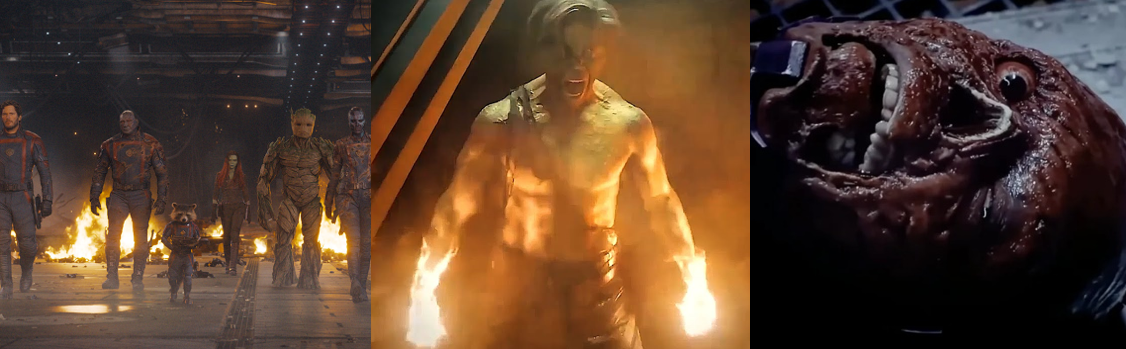
Indeed, there are some stunning cosmic scenes in Guardians of the Galaxy Vol. 3; some really fun practical and special effects help to bring an even more bizarre flavour to the MCU (though I did feel like the scene at Orgocorp dragged on a bit too long), especially when they visit Counter-Earth and encounter all these weird anthropomorphic creatures. At first, I thought that safeguarding this world against the High Evolutionary’s reprisals would be the focus of the finale and the driving force behind galvanising the team but, no…the High Evolutionary just destroys the planet on a whim, murdered its countless misshapen inhabitants, and prepares to populate a new world with his latest creations. However, despite having rejected Rocket in the past, he’s come to see that Rocket is the only one of his creations that showed true, independent ingenuity rather than following pre-programmed patterns, so he becomes obsessed with reacquiring the specimen, to the point where even his loyal followers turn against him and he’s forced to kill them without a second thought to get what he wants. To counter the High Evolutionary’s cybernetic army and immense ship, the Guardians call in Kraglin to bring Knowhere to them for a massive final showdown, once that sees all of the Guardians lay waste to an entire corridor of the High Evolutionary’s soldiers before attacking the main man himself. As mentioned, it was deeply satisfying to see him take a beating and be left for dead, literally unmasked and a quivering, deposed wreck on the floor, though it did somewhat diminish his threat since he was previously seen as nigh-untouchable. With the High Evolutionary’s ship going down in flames, Rocket begs his friends to help save not just the children but the innocent animals held captive in his cages, a campaign that appears to leave Quill dead in the frozen vacuum of space! Luckily for him, Warlock comes to his aid, but I feel this should’ve happened before Quill’s body froze solid and was disturbingly bloated as he’s clearly dead or would be left severely injured from exposure. Instead, he survives…in fact, everyone does, which I was really surprised by; there’s a moment where it seems like Nebula might die piloting the High Evolutionary’s ship, Drax is almost killed in the Orgocorp battle, Groot is left a severed head by Warlock, and obviously Rocket’s life hangs in the balance throughout the entire film but, surprisingly, they all survive by the film’s end. However, they’re not left unchanged; Quill finally returns to Earth, Drax and Nebula pledge themselves to safeguarding Knowhere, Mantis goes off on a journey of self-discovery, and Rocket, Groot, Kraglin, Warlock, and one of the children they rescue form a new Guardians of the Galaxy team after bidding a heartfelt farewell to each other to bring their story to a definitive (if open-ended) close.

The Summary:
There was definitely a sense of foreboding heading into Guardians of the Galaxy Vol. 3; knowing that many of the actors and even the director were openly stating that they were done with the MCU and seeing the way the trailers were purposely produced to suggest that one of more of the titular characters would meet their end in the film, I was extremely taken aback to find that they all survived to the end, and were better for it after their adventures together. As disturbing as it is to endure the horrendous treatment Rocket and his fellow animals suffer at the hands of the High Evolutionary, it gave the film an emotional weight that’s often missing from MCU movies and really presented the High Evolutionary as an absolutely despicable person with no redeeming qualities. He was a maniacal character, obsessed with perfection but ruled by a cruel, vindictive childishness that saw him callously disregard everything, even his own creations, if they don’t immediately meet his expectations. This was a fantastic counter for the dysfunctional Guardians to throw themselves up against and unite to oppose; they’re all flawed, both collectively and individually, but still strive to do the right thing and protect people, even their enemies or horrifying abominations of science and torture. As is always the case with these films, the core conceit revolved around the family dynamic of the team; they’re really struggling with the whole Gamora situation and willingly risk their lives to help Rocket, who’s tragic backstory perfectly juxtaposes with the present-day action. While I would’ve liked to see a bit more involvement from Adam warlock beyond yelling and being a strange, overpowered man-child, it’s clear that he’s being setup for bigger things going forward and I think there’s a definite sense that we’ll see these characters again in some way, shape, or form later down the line. Phase Four of the MCU was a little hit and miss but Guardians of the Galaxy Vol. 3 is a terrific return to form; funny, action-paced, and filled with emotion that’ll have even the most soulless detractor teary-eyed, this was a fantastic swansong for the team and tied up their stories in a very fulfilling and moving way.  

My Rating:

Rating: 4 out of 5.

Great Stuff

Did you enjoy Guardians of the Galaxy Vol. 3? Were you surprised that it included the debut of the MCU’s first f-bomb? What did you think to Adam Warlock’s portrayal, and would you have liked to see more of him? Did you enjoy the focus on Rocket’s backstory and were you moved by his traumatic origins? Were you surprised that the team made it out alive? What did you think to the new depiction of Gamora? Where do you see the team going from here? I’d love to know your opinion on Guardians of the Galaxy Vol. 3, so go ahead and leave your thoughts below or on my social media, and be sure to check out my other Guardians of the Galaxy content.

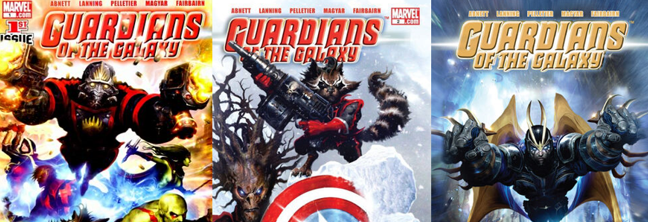
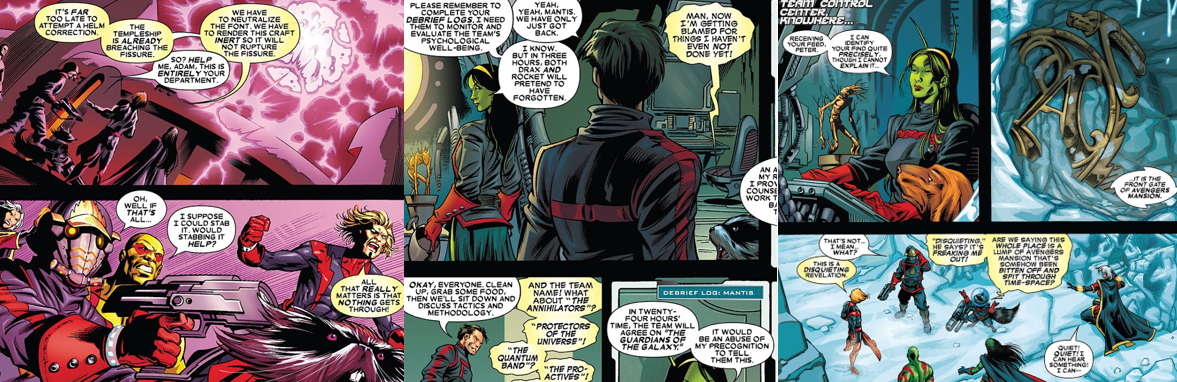
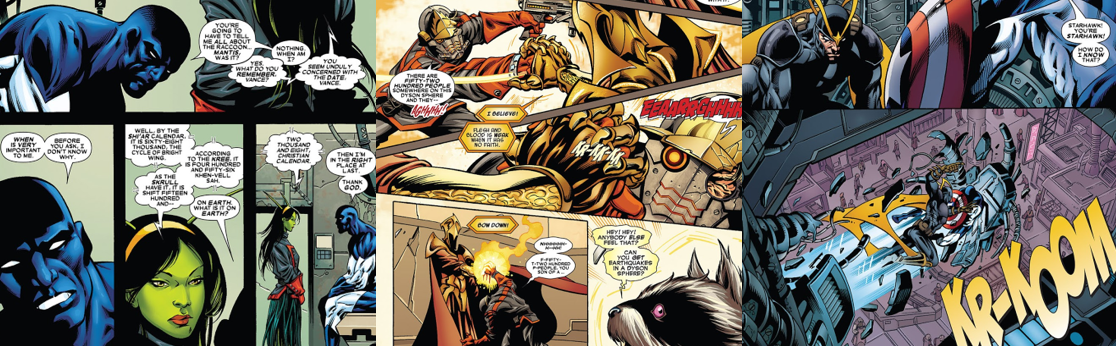
Back Issues: Guardians of the Galaxy (2008) #1-3

Writers: Dan Abnett and Andy Lanning – Artist: Paul Pelletier

Story Title: “Somebody’s Got To Do It”
Published: 14 May 2008 (cover-dated July 2008)

Story Title: “Legacy”
Published: 18 June 2008 (cover-dated August 2008)

Story Title: “Beyond Belief”
Published: 10 July 2008 (cover-dated September 2008)

The Background:
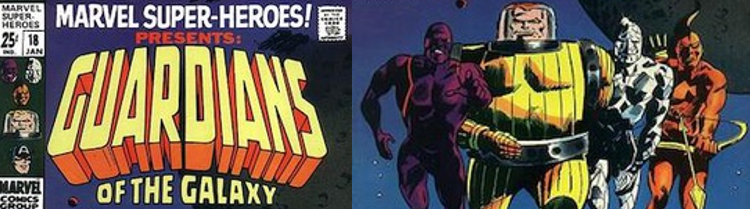
Today, Marvel Comics’ Guardians of the Galaxy are well-known as a group of reprobates-turned-heroes thanks to their inclusion in the Marvel Cinematic Universe (MCU), however I think it’s fair to say that the team (and the concept) was relatively obscure compared to other Marvel heavy-hitters like the Avengers and Peter Parker/Spider-Man before the release of Guardians of the Galaxy (Gunn, 2014). As I have already explored, the cosmic team was initially very different when they debuted in the pages of Marvel Super Heroes! #18 (Drake, et al, 1969) and, despite strong sales of the team’s debut issue, the Guardians of the Galaxy remained dormant for about five years and also underwent many alterations as they graduated to their own self-titled series. Between 2006 and 2007, Marvel Comics published a cosmic crossover series titled Annihilation (Giffen, et al), a sprawling storyline in which Annihilus spread destruction throughout the galaxy with his “Annihilation Wave”, an event heralded for proving such epics could occur without Marvel’s flagship characters at the helm. From August 2007 and June 2008, Dan Abnett and Andy Lanning spearheaded a follow-up miniseries, Annihilation: Conquest, out of which was formed a new line-up of Guardians that served as direct inspiration for the MCU’s movies and subsequent multimedia iterations of the team.

The Review:
In place of the usual text boxes, the story is intercut with log debriefings from the Guardians as they reflect on their mission, and therefore jumps about between a few different time periods, which makes a step-by-step recap a little difficult so, instead, I’ll try and go mostly in chronological order. Two weeks ago, Star-Lord, Phyla-Vell/Quasar, and the last surviving member of the Nova Corps, Richard Rider/Nova, were discussing the power vacuum in the galaxy after back-to-back destructive conflicts with Annihilus and the Phalanx. Both battles caught them completely off-guard so, rather than establish a peacekeeping force like the Nova Corps, Star-Lord suggests assembling an “ass-kicking force” that can pre-emptively tackle threats before they can escalate. The first person Star-Lord recruits is Rocket Raccoon, primarily for his “military smarts” and also because he’s “the best tactical mind [he] ever met”. Although Star-Lord tries to grease the wheels by tanking Rocket up with alcohol, he didn’t need to do this, or pile on the compliments; recognising the guilt Star-Lord carries after unwittingly causing the Phalanx’s invasion, Rocket agrees to help but only if Peter quits giving himself a hard time over it, especially as they won the day in the end. Quasar then paid a visit to the grieving Drax the Destroyer whose daughter, Heather Douglas/Moondragon, perished in a previous battle against Ultron. Filled with regret over never having a “regular” relationship with her and having lost his purpose now that he has slain Thanos, Drax considers himself a liability to others because of his thirst for death, but Quasar offers him purpose and direction as part of Star-Lord’s team. Nova then went to recruit Gamora, who was incensed at the suggestion, and that Nova never tried to get her into bed following their victory over the Phalanx. However, despite her stubbornness, Gamora is won over not just by the prospect of a booty call with Rider but also by his compelling argument that she’s tired of being an emotionless killer and desires something more out of life. Together, the group turn to Adam Warlock/Him for further support; troubled by the recent incursions, which have weakened space and time so badly that fissures into extradimensional universes are threatening to spill God knows what into the galaxy and tear it apart, Warlock agrees to join them in order to ensure the stability and continuation of life across our universe.

The fledgling Guardians come together to defend the galaxy from interdimensional incursions.

The fledgling Guardians soon came into a violent conflict with the Universal Church of Truth, a group of zealots who, in an alternate timeline, worshiped Warlock like a God. There were some teething problems throughout this battle; Star-Lord struggled to pull these volatile egos together, leading to Warlock, Gamora, and Drax heading to the control deck to tackle the root of the problem. The Church’s templeship is powered by “faith”, specifically faith in life (which Warlock notes is ironic as the Church’s plan will destroy life rather than grant it) and, once they realise their sacred ship is in danger, the Church’s founders, the Crusaders, promptly teleport away, leaving their devout followers behind, much to the disgust of Warlock, Gamora, and Drax. By the time the others reach the control deck, their options are limited as the templeship is already breaching a fissure; to make matters worse, a gigantic, disgusting eldritch abomination comes through the breach. However, Quasar and the others are able to hold it back to buy Rocket time to destroy the control deck with a grenade; the remaining energy is absorbed by Warlock and Quasar and the threat is summarily ended. They promptly teleport victorious (though Rocket claims the bulk of the victory for himself) to Knowhere, an interdimensional crossroads on the outer edge of time-space that allows them to rapidly transport anywhere using their “passport” bracelets and which happens to be housed inside the severed head of a Celestial! Knowhere is maintained by a group of strange alien lifeforms and overseen by Cosmo the Spacedog, a telekinetic Russian-born hound who has a rivalry with Rocket, acts as their chief of security, and has been busy getting Knowhere up and running for their services. Knowhere is also home to a thriving alien society, including a marketplace and economic system, and to the steadily growing sapling that was once Groot and Brandt/Mantis, an empath who has the unenviable job of maintaining the psychological well-being of the team and facilitating their disparate personalities. However, her precognitive abilities also alert her to an impending betrayal from within, though she’s unable to inform them of this as it could threaten the delicate balance of the timeline. No sooner are the Guardians back at Knowhere that Warlock detects another fissure on the ice asteroid of 5G Hydronis, a place where time and space are being torn apart and where, upon melting away some of the ice, the Guardians are stunned to find the Avengers Mansion contained within!

As the team struggles against the Cardinals, the time-displaced Vance fights off a mysterious attacker.

Before they can properly process the implications of this, they’re attacked by more Lovecraftian beasts, this time giant, slobbering worms that burst up from the ice and ensnare them. Luckily, Major Vance Astro/Major Victory of the original Guardians of the Galaxy happened to be frozen on the planetoid and briefly helps the struggling team before promptly collapsing in a fit of confusion and exhaustion. Star-Lord and Rocket hold off the creatures to cover Drax and Gamora as they tend to Vance, then the group promptly teleports out of there as Warlock and Quasar destroy the asteroid and its monstrous inhabitants. Star-Lord sees providence in Vance’s appearance, especially the symbolism of the shield he carries and the importance both it and Captain Steve Rogers/Captain America had on the legacy of the Avengers. Still encased in his protective suit and apparently dislodged from the time stream, Vance suffers from crippling amnesia and can only remember some vague importance about being at exactly this time period. Mantis tends to Vance to try and acclimatise him to the time period and help him recover his lost memories; though Rocket, inspired by Vance’s story, is more concerned with pestering the team into adopting the Guardians of the Galaxy name. After picking up another fissure, the team head to a seemingly abandoned Dyson Sphere – a literal sun encased within an artificial shell – where they are attacked by Raker and his knightly Cardinals. Sent by the Matriarch of the Church to seek retribution and garbed in gleaming golden armour, the Cardinals are powered by the prayers of their faithful, proving a formidable threat since they are capable of doing anything as long as they believe it, including conjuring weapons and shields of golden energy. Offended by Warlock’s magic and with no time for the team’s heathenistic explanations, the Cardinals make short work of the group simply by believing they have the means to overpower them, meaning they not only break Star-Lord’s hand but also run the mighty Adam Warlock through with a sword. As the Guardians struggle against the self-righteous Cardinals, Vance is suddenly attacked by the time-displaced Stakar of the House of Ogord/Starhawk, who takes even Mantis off-guard thanks to being completely invisible to her mental powers. Starhawk attacks the confused Vance with very familiar claw-like appendages and their battle rages through Knowhere, destroying six of their teleportation batteries, before he teleports out without a single word and leaving the perplexed Vance to incur the wrath of Cosmo for all the damage he caused in the fight.

Gamora’s selfless actions galvanise the team, but the threat of betrayal hangs in the air…

Having accomplished their mission, the Cardinals return to their homeworld; however, many are also dissolved when the Dyson Sphere’s population rises against them; reduced to a corrosive bio-mass after their genetic experiments opened a fissure in their very DNA, the inhabitants have become a tortured, grotesque hive mind. Already beyond salvation, absorbing the Cardinals only accelerates their instability and threatens to open a more destructive fissure. As Gamora tends to Star-Lord’s wounds, he shares with the group his plan to lift the shield that protects the surface from the sun’s rays, a strategy that will fry the entire Dyson Sphere and its out of control inhabitants in one swift move. The idea works and the bio-mass is summarily set ablaze, but Peter’s plan to teleport to safety is scuppered thanks to the damage caused by Vance and Starhawk. With the protective dome fading quickly, Drax and Star-Lord both volunteer to restore it; unfortunately, Quasar’s power is taxed to the limited just trying to keep them safe, so Gamora opts to handle it herself. Thanks to her healing factor, and the limited protection offered by Quasar, Gamora is able to reach the controls and restore the dome and, though she survives the ordeal, she’s left chargrilled and mutilated by the heat of the supernova. Still, her teammates are impressed by her bravery and her actions galvanise the team yet, despite their victory, Warlock remains disturbed not just by the fact that He was unable to save that advanced civilisation but also by the motives behind the Universal Church of Truth’s attack. An epilogue reveals that the Matriarch sent Raker to engage the Guardians not to “purify” them for their interference in their plans, but to verify that Warlock is actually the real deal as it’s revealed she has His protective cocoon resting in her palace, indicating the presence of an imposter.

The Summary:
The story’s action is peppered with log entries from the individual Guardians that offers insight into their character and commentary on their actions; Star-Lord is cautiously optimistic about his new team despite their inelegant solutions to problems, Quasar had her doubts that the mismatched team of egos could pull it together despite Star-Lord’s determination, Rocket expressed regret at being talked into joining such an outfit and venturing into the dangerous depths of space, Warlock has His doubts but recognises the value of the Guardians given the short lifespan of the cosmos, and Drax bluntly refuses to elaborate on his many experiences with death. Gamora is easily the most vocal about her scepticism; almost every line she has questions their purpose and direction, to the point where even Drax, who was equally sceptical about his value to such a group, calls her out on her lack of team spirit when she boasts of her healing factor to the less-fortunate Quasar. This makes her selfless act to endure the searing heat of the sun’s flames all the more impressive and goes to great lengths to earn her the respect and admiration from her teammates. One of the things I loved about the MCU interpretation of the Guardians of the Galaxy is their dysfunctional dynamic; they banter with and aggravate each other, to the point where they generally spend more time arguing than co-operating, which lends to their charm. Those aspects are alive and well here; in the heat of battle, the team are more focused on coming up with a name for themselves than fending off their enemies; Warlock, who’s had some experience in leading teams, is the first one to point this out and even Star-Lord, for all his enthusiasm, begins to question his decisions when their distractions send him hurtling out of a window.

The banter snark, and dysfunctional family dynamic are all appealing elements to this team.

There’s some concern, mostly from Gamora, regarding Warlock’s nature; His talk of altering the timeline and general demeanour have Gamora questioning how much He’s changed since she last saw Him. It’s clear that Warlock has changed recently and knows far more than what He’s letting on to His teammates; His philosophy seems to be to simply tackle an issue before it can escalate and explain the why of the matter later since it’s inconsequential against the need for action. As much as I love Dave Bautista’s portrayal of Drax as this loveable meathead, this version of Drax is far more coherent and sensible, though he is a bit of a blunt instrument; he’s aggravated by Warlock’s complex explanations, Quasar’s constant questions, and sees little point in cooking when they have perfectly good bars at Knowhere. While the others are intrigued by the puzzle of Vance Astro, Drax couldn’t care less about the former Avenger, not least because fighting alongside Earth’s Mightiest Heroes directly led to his daughter’s death. Indeed, as much as the Destroyer would rather just get to the point (and the fighting), Drax is just as apt to make quips about Warlock’s out of date hairstyle as Rocket, resulting in a more well-rounded character than his MCU counterpart, for sure, but one far less entertaining, in my opinion. Rocket’s characterisation should be pretty familiar with fans of the MCU, however; he’s a trigger-happy, snarky little rodent who cares for Groot and begrudgingly follows Star-Lord’s lead presumably because he has nothing better to do. Star-Lord may lack the multiple pop culture references of his MCU counterpart but much of his character is familiar as well; this is actually a very different version of the character to how he was first introduced, where he was a little more bland and less prone to self-deprecation and quipping. Here, he’s desperately trying to atone for his actions in unleashing the Phalanx and is determined to make this team work, despite how inelegant their approach is. Though unsettled by the symmetry of Vance’s appearance to Captain America’s own dethawing years ago, Peter is excited at the idea of the group rallying around the iconography of the shield, though he remains completely unaware of a possible traitor in their midst since Mantis refuses to divulge this information just yet.

These new Guardians impress thanks to some fun dialogue, visually exciting action, and lingering mysteries.

It’s nice to read something a little more modern from Marvel Comics; there’s something to be said for the simplicity of older tales, which are generally far less complex in their narratives and easier to digest in a single readthrough, but the dialogue and, especially, the art are far more appealing in modern tales, at least to me. While they share a colour scheme in their vaguely-matching uniforms, the Guardians are all very distinct personalities and characters despite their similarities: for example, Star-Lord and Rocket have no powers, relying on their helmet, weapons, and gadgets to win the day but are clearly unique since one is a talking raccoon! Gamora and Drax are also somewhat similar, being battle-hungry killers looking for a greater purpose, but Gamora has her healing factor, cynicism, and promiscuousness and Drax carries his guilt and an almost self-destructive thirst for combat. Quasar and Warlock also have some similarities in that they’re both, essentially, cosmic wizards but Quasar’s powers are limited in a way Warlock’s aren’t; Warlock is also seen as the expert in the time/space fissures and clearly the heavy-hitter of the group, yet He’s still vulnerable and requires the aid of His teammates to combat these threats. I liked the appearance of Vance Astro, too, as a link to the original Guardians of the Galaxy and a mystery for the team to solve over subsequent issues; Knowhere also functions as a very visually interesting and fun homebase for the team, not least because of Cosmo and it being the head of a Celestial, and the story arc was brimming with personality and mystery. The Universal Church of Truth are very intriguing villains; essentially a gaggle of cosmic zealots who wield incredible power simply through faith, they betray their own cause through their destructive ways and have spread death and discord rather than life and hope. The Cardinals, especially, prove a fearsome threat; there’s a suggestion that they could’ve easily killed the Guardians were it not for the bio-mass suddenly attacking them and the nature of their mission, which again adds to the appeal of the team: they’re already flawed and volatile personalities but they’re not infallible and even the almighty Adam Warlock can be killed, which makes them very relatable as a dysfunctional family that’s more human that their appearances may suggest. All in all, I really enjoyed this three-issue arc for the fledgling Guardians of the Galaxy and would absolutely want to read more from this run based on the strength of these issues alone and how impactful this period was to their live-action interpretation.

My Rating:

Rating: 4 out of 5.

Great Stuff

What did you think to this new incarnation of the Guardians of the Galaxy? Which member of the team was your favourite? What did you think to Universal Church of Truth and the threat posed by the Cardinals? Did you enjoy the banter and team dynamic between the group? What did you think to the mystery surrounding Vance Astro’s appearance? Which version of the team is your favourite and why? Are you a fan of the Guardians of the Galaxy comics and, if so, did you like the MCU’s interpretations of the characters and concepts? Be sure to share your thoughts on the Guardians of the Galaxy in the comments below and on my social media, and check out my other Guardians of the Galaxy-related content on the site.

Movie Night [Sci-Fanuary]: Guardians of the Galaxy Vol. 2


January sees the celebration of two notable dates in science-fiction history, with January 2 christened “National Science Fiction Day” to coincide with the birth date of the world renowned sci-fi writer Isaac Asimov, and HAL 9000, the sophisticated artificial intelligence of Arthur C. Clarke’s seminal 2001: A Space Odyssey (1968), being created on 12 January. Accordingly, I’m spending every Sunday of January celebrating sci-fi in all its forms.


Released: 5 May 2017
Director: James Gunn
Distributor: Walt Disney Studios Motion Pictures
Budget: $200 million
Stars: Chris Pratt, Zoe Saldaña, Dave Bautista, Vin Diesel, Bradley Cooper, Karen Gillan, Kurt Russell, and Michael Rooker

The Plot:
After angering the Sovereign, the Guardians of the Galaxy are saved by Ego (Russell), a Celestial being who takes the form of a sentient planet. Claiming to be Peter Quill/Star-Lord’s (Pratt) true father, Ego promises to open Quill’s mind to the vast power and knowledge of the universe, but Quill’s adopted father-figure, Yondu Udonta (Rooker), reveals a far more sinister motive behind Ego’s seemingly benign nature.
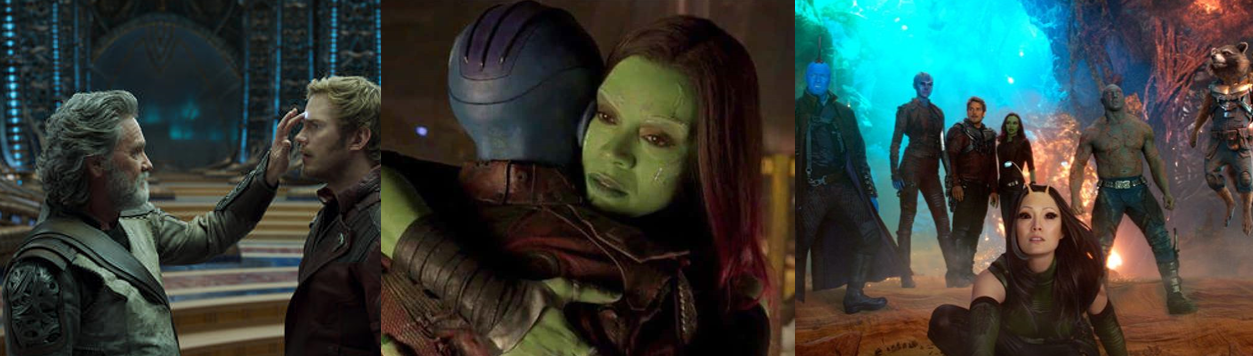
The Background:
Despite being one of Marvel’s more obscure properties, and having undergone many changes over the years, the Guardians of the Galaxy proved to be a massive financial success after making their live-action debut in the Marvel Cinematic Universe (MCU). Since the property was deemed to have strong franchise potential, and to even become as integral to the MCU as the Avengers, it’s perhaps unsurprising that the director and cast of the first film were soon revealed to be returning for a sequel. While determined to expand on the cast and lore of the first film, Gunn was mindful about overloading the sequel with a slew of new characters; Gunn went solo on the film’s story, which he planned to focus on exploring a new version of Star-Lord’s heritage, and was afforded a great deal of creative control regarding the direction of the story and its place in the wider MCU. Gunn also continued to push the importance of practical effects and set wherever possible, especially as the film would make far more liberal use of computer-generated effects to bring Ego (one of the most complex CGI creations ever) to life. Guardians of the Galaxy Vol. 2’s box office gross of over $863 million surpassed that of its predecessor, but reviews were generally more mixed; while the film was praised for being visually impressive and telling a surprisingly touching story, the pace and tone received some criticism. Still, the film cemented the team’s importance to the MCU and its success easily justified not only a third move but also a holiday-themed special.
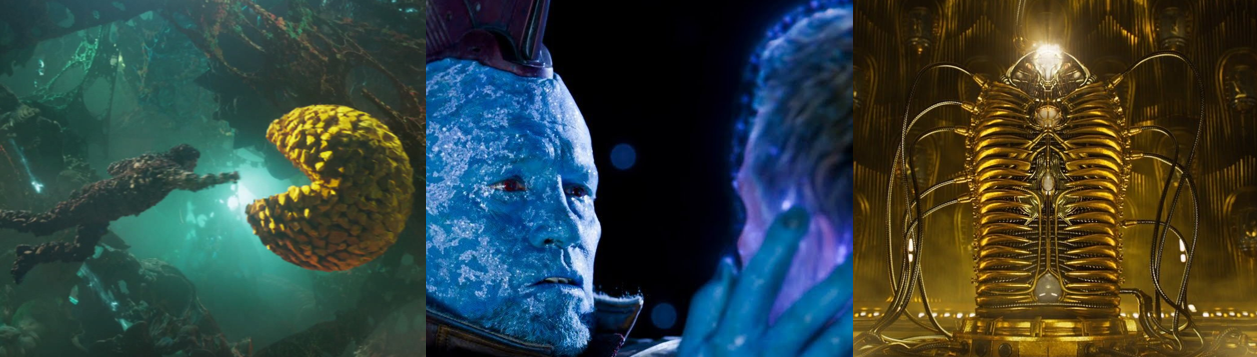
The Review:
I was pleasantly surprised by Guardians of the Galaxy; despite knowing next to nothing about the team or the concept heading into it when it first came out, the trailers and marketing had won me over and appealed to my love of science-fiction romps and bizarre comedic superhero adventuring. The film was a real breath of fresh air for the MCU at a time when things were just starting to really gear up towards full-on cosmic shenanigans and it remains one of my favourite entries not just in Phase Two, but in the entire franchise. So, to say my anticipation was high for the sequel would be an understatement; once again Marvel had outdone themselves by somehow getting Kurt Russell onboard and just the idea that they would even consider doing a concept like Ego, a literal sentiment planet, really told you all you needed to know about the scope of the MCU going forward: nothing was off limits, not even the most bizarre cosmic element of the source material.

The team may function a lot better now but they’re still a dysfunctional and argumentative bunch.

Some time has passed since the events of the first film, and the Guardians of the Galaxy have become somewhat renowned as a freelance peacekeeping force, of source and are happy to help those in need…for a price. Thanks to having saved the galaxy, they can afford to charge higher rates for their services, but it’s undeniable that they’re a much more well-oiled team than the band of misfits and outcasts we saw in the last film. The family dynamic has been dialled up to eleven, with Quill and Gamora (Saldaña) acting as the parental figures of the group, Drax the Destroyer (Bautista) and Rocket Raccoon (Cooper/Sean Gunn) acting as petulant teenagers, and Baby Groot (Diesel) as the curious and mischievous child. However, while they have clearly grown as a team and a surrogate family, the Guardians remain flawed and troublesome characters: hired by the Sovereign to destroy the inter-dimensional Abilisk, the team struggle to get their shit together and attack the beast between bickering with each other over their priorities and weapon choices and expressing concern for Baby Groot, whom they are all fiercely protective of. Although far from his larger, more capable self from the first film, Baby Groot proves instrumental in helping Rocket escape from the Ravagers, but is primarily here to cute appeal and comic relief; young and childish, he has trouble understanding things sometimes, which leads to a number of amusing instances where he struggles to retrieve items or follow instructions.

Rocket angers the Sovereign and pushes away his friends with his abrasive attitude, something Yondu can relate to.

As before, the one member of the team with the most sense remains Gamora, who is the only one capable and clear-headed enough to deliver the killing blow to the Abilisk. To be fair, Quill was the one who recognised that the creature had a pre-existing wound on its neck for Gamora to exploit, but Drax’s best plan was to foolishly try and attack the beast from the inside. While their methods are often haphazard and lacking in finesse, they get the job done and it’s Quill who takes point in speaking for the team to Ayesha (Elizabeth Debicki), the enigmatic and alluring High Priestess of the Sovereign race. While Quill flirts with Ayesha and attempts to keep relations with the proud race amicable, they incur her wrath when Rocket steals a bag full of their incredible rare and Anulax Batteries; of all the members of the team, it’s Rocket who struggles the most to let go of his selfish and underhanded ways, which brings him into continued conflict with the team and Quill’s leadership. A grouchy and antagonistic character, he actively pushes people away, even those closest to him, to avoid being hurt by them; he finds an unlikely confidante in Yondu Udonta (Rooker), an embittered space pirate who has spent his life doing the same thing and urges Rocket to recognise that he has people who actually care about him and help repair his relationship with Quill and his misfit family.

An ages-old Celestial, Ego wishes to spread his influence across the galaxy to consume all life.

Overwhelmed by the Sovereign fleet, the Guardians are mere moments away from being blown to smithereens thanks to Quill and Rocket wasting time and energy bickering over their piloting skills. Although they are saved by the timely intervention of Ego, the Milano is crippled, but Quill finds something he has long been missing in his life: his father. A sentient planet, Ego reveals himself to be an ages-old Celestial, a being who has known nothing but loneliness for the longest time; his only companion is Mantis (Pom Klementieff), a naïve and sheltered character who strikes up an odd relationship with Drax and uses her empathic powers to help Ego sleep…and to ease his conscience. Thanks to some extremely impressive de-aging effects and a facial double (Aaron Schwartz), the film opens with Kurt Russell appearing in his prime years back in the eighties to woo Meredith Quill (Laura Haddock) and sows the seeds (literally and figuratively) for Ego’s true plot to spread his consciousness across the entire galaxy using seeds planted on distant worlds. To do this, he needed to sire a part-Celestial heir but was continuously met with failure; the bodies of his rejected children are literally piled up and hidden away on his planet, and his joy at finding Quill can harness his cosmic powers soon turns to anger when his son chooses to turn that very power against him to oppose his dreams of galaxy-wide conversion.

The Guardians face threats from all sides as enemies old and new conspire to enact their revenge.

The Sovereign turn Nebula’s semi-cybernetic stepsister, Nebula (Gillan), over to the Guardians. Nebula’s hatred and resentment of Gamora has only grown between films; as children, their adopted father, Thanos (Josh Brolin), had them fight for supremacy over and over, and Gamora won every single time, reaping in Thanos’s praise while Nebula was replaced a piece at a time with mechanical parts. Gamora is happy to return Nebula to Xandar to collect her bounty and rid herself of her brutal stepsister once and for all, but Nebula is driven by rage and bitterness and takes every opportunity she can get to break free and hunt her sister down. This leads her to forming a brief, mutually beneficial alliance with the Sovereign and Taserface (Chris Sullivan), a mutilated member of Yondu’s crew who might be a laughable threat with a ridiculous name but he incites a mutiny and flushes those who stand against him and his followers out into space. This only further complicates matters for Yondu, who raised Quill as a space pirate and thief after learning of Ego’s true nature and intentions for the young Quill, but his part in child trafficking left him and his crew dishonoured and ostracised from the wider Ravager community by prominent Ravager figurehead Stakar Ogord (Sylvester Stallone). Betrayed by many of his crew, Yondu is forced to team up with Rocket to enact a merciless revenge with his fancy tricky arrow and rush to Quill’s aid when Ego’s true intentions are revealed, and an intense and brutal battle between Nebula and Gamora sees the two sisters reaching a mutual understanding and gaining the Guardians an additional unlikely ally for the finale.

The Nitty-Gritty:
As before, music and pop culture play an important part not just in Guardians of the Galaxy Vol. 2’s soundtrack but in defining Quill’s character, especially in relation to his mother. The flashback at the start of the film shows how Ego assumed the form of an irresistible 1980s rogue: he’s got the mullet, the car, and the tunes to go along with it and easily wins over Meredith with his good looks and silver tongue. Ego’s undeniable charisma and ability to manipulate his form are made more explicit when he pours vocal honey into Quill’s ears with stories of his love for Meredith and even assumes the form of his childhood hero, David Hasselhoff (Himself), showing that Ego knows exactly how to manipulate people by playing to (and preying on) their likes, hopes, and dreams. Quill’s love for music stems from his mother, who put together mixtapes for him that he listens to endlessly on his Walkman and onboard the Milano; so great is his love for music that Rocket even prioritises setting up a loud speaker for them to listen to Quill’s tune during their battle with the Abilisk and Quills still firmly drawing his pop culture reference from his childhood and the seventies and eighties. Just as these elements help him to remember and feel closer to his mother (and bond him closer with his newfound family), so too do they help to quickly build up a trust between him and his father when Ego expresses a liking for the same music and pop culture that was so integral to Quill’s childhood.

Space combat and action might be fleeting but are beautifully brought to life with some stunning visuals.

I remember being a little disappointed by Guardians of the Galaxy Vol. 2 when I first saw it as I was expecting the film to be bigger and better than the first but, similar to Avengers: Age of Ultron (Whedon, 2015), it struck me as being just as enjoyable as the original, which actually knocked my rating of it. I have no problem with it telling a story more focused on the tea dynamic and exploring these characters further, I just hadn’t expected it when I first saw it, so I definitely appreciated it more on repeat viewings. However, there is still a decent amount of onscreen action and visual spectacle to keep viewers entertained: the Sovereign are a minor antagonistic force in the film existing mainly to drive the plot forwards and get our heroes to Ego, but they have a unique armada comprised of thousands (maybe even millions) of remote drones that are piloted very much like arcade machines and lead to some frantic space battles and an intense chase through a “quantum asteroid field” that’s like the asteroid chase from Star Wars: Episode V: The Empire Strikes Back (Kershner, 1980) on steroids! The hexagonal jump points help to add to the mysterious nature of the galaxy and result in an amusing scene where Rocket and Yondu are warped in bizarre ways by multiple jumps, and Ego pilots a sleek, egg-like ship that is unlike any other in the galaxy, but the true visual spectacle of the film is realised when the characters arrive on Ego’s planet. A lush, verdant alien world home to some bizarre, vegetation and an elaborate palace housing Ego’s memories and plans, Ego’s world is just like him: beautiful and alluring at first glance but hiding a dark secret beneath the surface that comes to fruition when Ego’s very face warps the planet’s crust.

Family is even more pivotal this time around as bonds are reforged or rejected in favour of true family.

The dysfunctional family dynamic between the titular team is a pivotal element of the sequel; although they’re far more trusting and accepting of each other, they still wind each other up and get on each other’s nerves. While much of this is embodied by Rocket, Drax’s blunt and literal perspective doesn’t help matters much and Quill is continuously distracted by his attraction to Gamora. Despite Drax’s assertions that Gamora isn’t interested in him in that way, she’s incredibly supportive of Quill and is touched by his stories of his childhood pining for a father who wasn’t there, which confuses and angers him when she suspects that something isn’t quite right about Ego’s planet and raises questions about what counts as true family, blood or those you are closest to. Naturally, the question of Quill’s parentage is a huge plot point of the film; after being left as a blatant dangling plot thread and piece of sequel bait in the first film, Guardians of the Galaxy Vol. 2 goes to great lengths to establish that Quill isn’t fully human, like his comic book counterpart, and is instead part-Celestial thanks to being one of Ego’s many progeny seeded across the galaxy. This afford him many fantastic abilities when present on Ego’s plant form, and potentially opens up the vats secrets of the universe to him, but his human nature and the nurturing of his mother, his oddball family, and his father figure, Yondu, prove to be strong enough influences on Quill’s morals and character and force him to reject Ego. Quill is further driven to this decision when Ego drops the bombshell that it was he who caused Meredith’s fatal brain tumour, thus dooming her and pushing Quill into an enraged defiance that sees him pull out all the stops to oppose Ego’s plan to terraform the worlds he’s seeded.

Ego is destroyed at great cost but an even greater threat looms in the Guardians’ future…

This means not only turning down the ability to construct greater things, and even life, using Ego’s cosmic power but also the virtual immortality offered by Ego’s planet; disappointed by sentient life across the galaxy, Ego realised that his destiny wasn’t to simply walk among men, but to dominate and consume them through “The Expansion”. His façade as a loveable, charismatic figure quickly gives way to a cold-hearted, self-centred parasite befitting of his name and capable of great love (for he truly loved Meredith and was tempted to give up his enterprise for her) but also intense anger. Fully capable of manipulating every element of his planet-form to his will, Ego is a monstrous, nigh-unstoppable God-like being comprised of pure energy but capable of bending matter as he sees fit to protect his brain at the core of his planet. Thanks to being part-Celestial, Quill is also able to manipulate the planet to a degree, leading to a visually impressive sequence where Rocket drills through Ego’s crust using lasers and Quill constructs a massive version of Pac-Man to go head-to-head with his father. With the Sovereign closing in and adding to the melee, Mantis strains her powers to the limit to put Ego to sleep while Rocket cobbles together a bomb to destroy Ego’s core. Although the threat is ended and Gamora and Nebula finally reconcile (and Quill and Gamora finally admit their true feelings to each other), Quill forever loses his immortality and Celestial powers…and also his true father when Yondu sacrifices himself to save Quill from Ego’s destruction and the vacuum of space for a surprisingly emotional and heart-breaking finale. However, Yondu is finally honoured by the Ravagers in death, and Kraglin Obfonteri (Sean Gunn) assumes command of his arrow and his crew; while the Guardians find dealing with a moody adolescent Groot to be a challenge in the post-credits scene, they remain unaware that Ayesha has vowed to destroy them by breeding a perfect instrument of destruction dubbed “Adam”.

The Summary:
It’s definitely true that Guardians of the Galaxy Vol. 2 holds up much better with each subsequent viewing; in many ways, it’s more of the same from the last film, but with a far greater focus on the characterisations of the titular team and the dysfunctional family dynamic they have. While it doesn’t necessarily match or expand upon the space-faring action and excitement of the first film, and may disappoint some viewers in that respect, the grounded, more personal story told here is a poignant and affecting one. Seeing Quill struggle with his heritage, his feelings for Gamora, and to hold the team together is what makes these outlandish characters so surprisingly relatable, and the banter and relationship between each member of the team is some of the most entertaining produced by the MCU. What we have here is a film that peels back the layers of one of the most obscure properties in Marvel, and the MCU, and makes even their most alien members human and vulnerable; expanding on Yondu’s character and showing how complex Rocket is as a character was a surprising highlight, as was the heart-breaking final reconciliation between Yondu and Quill. There’s plenty of amusing elements throughout the film thanks to Drax’s blunt nature and Baby Groot’s childish antics, and Kurt Russell seems to be having the time of his life being part of his big-budget production. The cosmic scope of the MCU was expanded even further with the introduction of the Celestials and laying the groundwork for the future dynamic and troubles coming to the Guardians and, while I don’t rate it as highly as the first film, that’s not to say that there isn’t a great deal to enjoy here and I’d say it’s well worth your time, especially for those who might not have been convinced by the Guardians’ characterisation in the last film and wanted to get to know these characters better.

My Rating:

Rating: 3 out of 5.

Pretty Good

What did you think to Guardians of the Galaxy Vol. 2? Were you disappointed that the film wasn’t as action-packed as the first or did you enjoy the more character-focused story? What did you think to the added emphasis on the team as a dysfunctional family? Which of the new characters introduced was your favourite? What did you think to Ego’s plot and the changes made to his character? Would you have liked to see Quill retain his cosmic powers or did you dislike that he was made part-Celestial? Which members of the team would you like to see included in the MCU later down the line? I’d love to know your opinion on Guardians of the Galaxy Vol. 2, so sign up to share them below or leave a comment on my social media, and be sure to check in next Sunday as Sci-Fi Sunday continues!

Movie Night [Sci-Fanuary]: Guardians of the Galaxy


January sees the celebration of two notable dates in science-fiction history, with January 2 christened “National Science Fiction Day” to coincide with the birth date of the world renowned sci-fi writer Isaac Asimov, and HAL 9000, the sophisticated artificial intelligence of Arthur C. Clarke’s seminal 2001: A Space Odyssey (1968), being created on 12 January. Accordingly, I have decided to spend every Sunday of January celebrating sci-fi in all its forms.


Released: 1 August 2014
Director: James Gunn
Distributor: Walt Disney Studios Motion Pictures
Budget: $232.3 million
Stars: Chris Pratt, Zoe Saldaña, Dave Bautista, Vin Diesel, Bradley Cooper, Lee Pace, and Michael Rooker

The Plot:
Abducted from Earth as a small child, Peter Quill (Pratt) grows up to become the intergalactic rogue known as “Star-Lord”. However, after stealing a mysterious orb, Quill finds himself relentlessly pursued by the war-hungry Ronan the Accuser (Pace) and forced to team up with a rag-tag group of misfits and criminals in order to oppose the Kree warlord’s plans to devastate a peace-keeping world.

The Background:
While I’m sure that the Guardians of the Galaxy had their fair share of fans before they made their debut in the Marvel Cinematic Universe (MCU), I think it’s fair to say that the intergalactic superhero team were one of Marvel’s more obscure properties, especially compared to heavy-hitters like the Avengers. Writer Arnold Drake and the immortal Stan Lee changed Roy Thomas’s concept of super-guerrillas fighting Russians and Red China into an interplanetary team of misfits, and the team was resurrected and given their much more recognisable line-up over the years, and MCU head honcho Kevin Feige first name-dropped an adaptation of the team in 2010 as part of the MCU’s continued expansion towards more cosmic adventures. Director James Gunn won out to helm the film, which whole-heartedly embraced even the most ridiculous characters and concepts from the team’s history; the film embraced its ensemble line-up and utilised both practical and computer-generated effects to brings its bizarre characters to life. Gunn also emphasised the importance of featuring large, practical sets and bolstered the film’s humour and themes through a referential soundtrack. Guardians of the Galaxy was a phenomenal success, grossing over $772 million at the box office and proving that even Marvel’s most obscure creations could be a box office success. The film was met with an overwhelmingly positive reception; critics praised the banter and comedy, the quirky uniqueness of the film, and for bringing something new to the genre. Others were a little more critical of the film’s pace and comedic elements, but Guardians of the Galaxy’s box office success more than justified subsequent sequels and spin-offs and the Guardians of the Galaxy quickly became a popular and integral part of the larger MCU.

The Review:
My knowledge of the Guardians of the Galaxy was basically non-existent when the film was first announced and released. In all my years of reading Marvel Comics, I had never once encountered the team beyond reading the issue where they encountered Cuchulain the Irish Wolfhound as part of my undergraduate studies and happening to read a story where Doctor Bruce Banner/The Hulk fought an early version of Groot. Thus, when I first heard of the film and saw the trailers, I was a little confused but intrigued by the concept, which reminded me of the kind of space-faring snark and adventure I’d enjoyed in Serenity (Whedon, 2005) and Star Trek (Abrams, 2009), and willing to go along with this risky venture of bringing such an obscure Marvel property to life. Although the film is unquestionably an ensemble piece and introduces many bizarre characters to the MCU, Guardians of the Galaxy is anchored by Peter Quill,  a vain and self-centred space adventurer who, as a boy (Wyatt Oleff), was forced to watch his beloved mother (Laura Haddock) suffer and ultimately succumb to a cancerous tumour. Unable to bare the loss, he ran out of the hospital in his grief and was unexpectedly abducted by Quill Yondu Udonta (Rooker) of the Ravagers on the order of his mysterious father, whom his mother descried in her delirium as an “angel”. Rather than be delivered to his father, Quill was raised by Yondu as a surrogate son and taught the ways of the space pirates, growing up to become a thief and modelling himself after the film stars of his youth, such as Patrick Swayze and Harrison Ford.

Quill wishes to be as notorious as Gamora, a bad-ass warrior known as the daughter of Thanos.

However, Quill is not as notorious throughout the galaxy as he likes to think, despite having a bunch of gadgets and tech at his disposal (such as his blaster, gravity grenades, personal space helmet and rocket boots, and even his own ship, the Milano). While Quill may be a loser with delusions of grandeur, his greatest ability is convincing others to listen to his words and come together against a common goal; even though he doesn’t always have a plan (or even a percentage of a plan), he’s able to talk his newfound allies into setting aside their differences first in the name of survival and profit, and then to defend Xandar from destruction. Gamora (Saldaña) begins the film as a minion of Ronan the Accuser (Pace), on loan to him from her adopted father, the Mad Titan, Thanos (Josh Brolin/Sean Gunn), much like her cybernetic stepsister Nebula (Karen Gillan). There’s a rivalry and animosity between the two that extends beyond simply trying to impress their father; while Gamora is a renowned and notorious warrior, she secretly plots against her father, who destroyed her people and turned her into a living weapon simply for his own amusement. She is a non-nonsense, laser-focused individual who is riled up by Quill’s inane banter and  buffoonery, but comes to find a surrogate family with her oddball team mates; as much as she hates Thanos and desires to kill him, she has a real love and pity for her Nebula, who has become cold and merciless and driven by hatred and resentment since Thanos always favoured Gamora, which inevitably leads to dramatic conflict between the two. Gamora is eventually convinced to trust Quill when he puts himself at risk not only by summoning Yondu for aid but by braving the cold, suffocating vacuum of space to save her, which also goes a long way to proving his selflessness and worthiness as a hero (however unlikely) to his newfound teammates.

Rocket, Groot, and Drax become reluctant allies after being convinced by Quill’s quick-thinking.

Rocket Racoon (Cooper/Sean Gunn) and Groot (Diesel/Krystian Godlewski) are already branded as criminals at the start of the film, but operate as independent bounty hunters who are simply trying to et rich by bringing in marks and run across Quill and Gamora while staking out Xandar for bounties. Though Rocket appears to be the brains of the operation, Groot is far from a mindless creature, despite only ever uttering “I am Groot!”; Groot is insightful, curious, and compassionate and surprisingly gentle for such a lumbering brute, and adds to the film’s humour and heart thanks to his childish nature. Rocket also has a surprising amount of depth to his character; essentially a snarky, embittered raccoon-like creature, he was subjected to horrific experiments and takes a perverse pleasure in sticking it to those in positions of authority. After being arrested by the Nova Corps and locked up in the Kyln, these four are reluctantly forced to work together since all of the other inmates immediately target them because of their association with Gamora and her association with Ronan and Thanos. No other inmate has more of a vendetta against Ronan than Drax the Destroyer (Bautista), a musclebound warrior whose family were slaughtered by Ronan for sport and who longs to kill Gamora as recompense. Drax, who comes from a race of people that take everything literally and cannot understand metaphors, is convinced to spare Gamora by the fast-talking Quill so that they can join forces to lure Ronan out and kill him. Although reluctant to team up, Drax is won over by Quill’s reputation and Rocket’s plucky adaptability, but is so focused on having his revenge against Ronan that he puts his newfound teammates at risk by summoning Ronan to Knowhere, only to be summarily humiliated in single combat with his hated foe.

Despite his potential to be a decent recurring villain, Ronan is a disappointingly forgettable antagonist.

Each of the film’s protagonists has either a personal vendetta against, or comes into conflict with, Ronan, a Kree warrior branded a terrorist as he refuses to abide by the peace treaty between his people and Xandar, home of the Nova Corps. A maniacal zealot who wishes nothing less than the power to strip Xandar of all life, he makes a deal with Thanos, to retrieve the Orb for him in return for Thanos unleashing his might against Xandar, however he’s sadly another largely lacklustre villain; even killing the Other (Alexis Denisof) and making demands of Thanos does little to impress and he’s simply a large, malevolent force for the team to rally against. He does have some notable moments, however, such as delivering a massive beatdown to Drax and laying claiming the Power Stone that lies within the Orb, thus granting him incredible, nigh-unlimited power. Unfortunately, there’s really not much to go on with him; his fanatical vendetta against Xandar make him largely unsympathetic, he does a lot of posturing for someone so feared and revered by other characters, and is easily distracted by Quill’s hilarious dance moves and undone by the titular Guardians sharing the power of the Power Stone between them and atomising him. It’s a shame, really, as I feel like Ronan could have been a decent enough recurring villain, or even a reluctant ally, of the Guardians in subsequent films (or repurposed into one of Thanos’s Black Order), but instead he’s simply built up as this unstoppable bad-ass and then done away with before he can really earn that reputation.

A number of supporting character actors bolster the film’s scope, or steal the show with their antics.

The film is bolstered by a number of supporting characters, with Yondu being the clear standout; Quill’s mentor and, essentially, adopted father, there is an animosity between the two as Yondu believes Quill is ungrateful that he wasn’t eaten by the rest of the Ravagers and Quill believes that Yondu only kept him around because he was small enough to help steal stuff. However, there relationship softens over the course of the film and Yondu goes from placing a bounty on Quill’s head and wanting him dead to helping him push back Ronan’s forces, which is good news for Quill as Yondu can command a specialised arrow with just a few piercing whistles and cut down enemies in the blink of an eye. As home to the peacekeeping Nova Corps, Xandar offers some additional faces to the film’s line up, including the exasperated Nova Prime, Irani Rael (Glenn Close), who is frustrated at Ronan’s continued attacks against her people and the reluctance of the Kree to intervene, and Nova Corpsmen such as Rhomann Dey (John C. Reilly) and Denarian Garthan Saal (Quill Serafinowicz), who are both impressed and judgemental of the titular team’s notoriety and become reluctant allies of theirs for the finale. Another additional highlight of the film is the enigmatic Taneleer Tivan/The Collector (Benicio del Toro), a peculiar gatherer of oddities and knowledge who reveals the Orb’s true nature as housing an Infinity Stone and pushing the Guardians into leaving it in the care of the Nova Corps rather than selling it or allowing Ronan to lay claim to it.

The Nitty-Gritty:
All young Quill had to cope with his mother’s failing health was his music; she would compile mix tapes for him that he would listen to repeatedly to help distract him from reality and, after being kidnapped by Yondu, he was (somehow) able to keep his Walkman and tapes working by retrofitting space technology. Quill is so attached to the Walkman and his music that he delays his escape from the Klyn to retrieve it, much to Drax’s chagrin, and he finds solace in the music of Blue Suede, Redbone, and Marvin Gaye. Obviously attracted to Gamora, Quill briefly begins to win her over by letting her share his music, and he has spent his entire adult life putting off unwrapping his mother’s final gift to him, which turns out to be a new mixtape full of even more classic tracks from the seventies and the eighties.

Guardians massively expanded the scope and intricacies of the MCU’s galaxy.

Being the MCU’s first adventure to be fully set in the deepest depths of space, Guardians of the Galaxy continues to impress with is visual presentation; from the sets, props, and special effects, everything has such depth and variety to it. Xandar is slick and advanced, clean and with the best resources available, while Knowhere is a desolate, lived-in hellhole full of scum and villainy. The Milano is a beat-up mess not a million miles away from the Millennium Falcon (although it doesn’t look like the Falcon), while Ronan’s ship, the Dark Aster, is a dark and ominous vessel carving its way trough the galaxy. The Ravagers are a bunch of degenerates holed up on a huge, filthy ship and made up of a variety of representable races, and the differences between their ship and the advanced forces of the Nova Corps is vast. However, it takes the combined efforts of these unlikely allies to defend Xandar and push back Ronan using a combination of space combat, a massive energy shield that amounts to a suicide run, and breaching the Dark Aster in an unsuccessful attempt to kill Ronan. I really enjoy the visual style of the film, which quickly shows in a very short period of time that the MCU’s galaxy is full of history, technology, and races that we’ve still only begun to scratch the surface of. Knowhere is carved from the severed head of a Celestial, the Collector’s museum is stuffed full of trinkets and captives from across the vastness of space and Marvel lore, and there’s a real sense that we could see another twenty films set in MCU space and still not really understand everything about it.

Family is at the heart of Guardians as its misfits and outcasts find a purpose in the universe.

One of the most prominent themes that separates Guardians of the Galaxy from other films in the MCU is the sense of family; unlike other films in the MCU, Guardians of the Galaxy was given the unenviable task of introducing a whole team of new heroes all in one film and, while many of them are analogous to their Avengers counterparts, they manage to stand out from them thanks to their individual personalities and quirks. Quill is desperate to make a name for himself as notorious outlaw Star-Lord; until now, he’s being trying to do that by stealing shit and being a disreputable rogue, but he finds his true calling as a reluctant space hero and saviour by the film’s end and finally gets his wish when Korath (Djimon Hounsou) uses his codename. Quill is also carrying a tremendous amount of guilt over never getting to say goodbye to his mother and has been running from his past ever since; while he seems to have no wish to return to Earth and find a new family in the Guardians, he clings on to the pop culture of his childhood, and it’s his love for his mother that gives him the strength to endure the Power Stone’s power in the finale. The familial themes continue with Gamora and Nebula, stepsisters who have a bitter rivalry but are reluctant to admit how much they both have in common: bother were used and abused by Thanos and both wish to see him dead, but Nebula is too blinded by her hatred and resentment to consider working alongside her sister. Drax is completely motivated by love for his lost family, whose deaths haunt him and dictate both his vendetta against Ronan and his eventual acceptance of his newfound friends.

Despite heavy losses, Ronan is defeated and the galaxy is left in the capable (?) hands of its new guardians.

This band of misfits, degenerates, and losers finally finds something worth fighting for thanks to their common goals and interests, forced to work together for survival, their interests quickly turn from profit and revenge to putting their lives on the line for a greater good when they pledge to defend Xandar from Ronan and keep the Power Stone out of his grasp. Alongside the Ravagers and the Nova Corps, the newly christened Guardians of the Galaxy fend off the likes of Korath and Ronan’s Necrocraft in a co-ordinated attempt to kill Ronan. Unfortunately, Ronan embeds the Power Stone into his Warhammer, obliterating Saal and many of the Nova Corps and easily shrugging off Rocket’s specially made missile. Outmatched by the empowered Ronan, the Guardians are only granted a reprieve when Rocket punches a whole in the Dark Aster sending it crashing down to Xandar, and they’re only saved by the selfless and poignant sacrifice of Groot, who shields his newfound family using his own body. Thanks to the Power Stone, Ronan also survives the crash, but is so busy making speeches that he probably would have ben undone even without Quill’s distracting him with his dance moves. With Ronan’s Warhammer destroyed, Quill lays claim to the Power Stone, but its sheer destructive power threatens to teat him apart; memories of his mother give him the strength to hold back the damage and link hands with his newfound friends, who share the burden of the Infinity Stone’s power and allow them to triumph over Ronan. For their efforts, Quill makes amends with Yondu (despite again cheating him out of the Orb’s bounty, and Yondu taking with him the truth of Quill’s true parentage). The Nova Corps repair the Milano and wipe away the Guardians’ criminal records, and the head out into the galaxy to cause more mischief.

The Summary:
I am continuously impressed by Guardians of the Galaxy; I was pleasantly surprised the first time I saw it and, even now, it stands out as one of the most unique and entertaining entries in the MCU. Essentially a space adventure, the film has a visual style and humour that really helps it stand out from other films in the MCU. The film does a fantastic job of extending the scope of the MCU beyond Earth and really showing how much variety, lore, and different technology, races, and conflicts exist out in the depths of space. Tying everything together is, of course, the titular team themselves; reminiscent of their Avengers counterparts (a man out of time, a warrior female, a snarky mechanic, a monstrous brute, and an oddball meathead), the Guardians shine trough their unique characteristics and the sense of loss that drives them. Each has a past, with many of them having committed unspeakable crimes prior to the film, and is motivated by a desire to find a sense of belonging, put to rest their demons, and discover their purpose in the wide, dangerous galaxy. Of course, to begin with, none of them would ever really admit to this and they’re more motivated by profit or revenge, but being forced together turns out to be the best thing for this band of misfits and assholes as they’re able to put their egos, pride, and selfish desires to come together for a greater good. It’s not easy debuting an ensemble team in one film, but Guardians of the Galaxy is fantastically paced and gives everyone a chance to shine; even supporting characters like Yondu and Nebula get a decent amount to do and, while Ronan is squandered as a villain, the overall package shines just as brightly now as it did when I first saw it and I remember coming away from Guardians of the Galaxy extremely excited for the future of the MCU, which looked to be near-limitless at the time.

My Rating:

Rating: 5 out of 5.

Fantastic

Are you a fan of Guardians of the Galaxy? Which of the characters was your favourite? Were you disappointed that the film didn’t feature the original version of the team, or a different line-up? What did you think to the MCU expanding its scope deep into space and with such an obscure property? Were you also disappointed with Ronan, or does he rank quite high in your list of MCU villains? What did you think to the hints towards the full scope of the Infinity Stones and the wider MCU peppered throughout the film? Did you enjoy the changes the film made to characters like Drax and the Nova Corps? Which members of the team would you like to see included in the MCU later down the line? I’d love to hear your thoughts on Guardians of the Galaxy, so please sign up to share them down below or leave a comment on my social media, and be sure to check in next Sunday for my review of the sequel as Sci-Fi Sunday continues!

Back Issues [Sci-Fanuary]: Marvel Super-Heroes! #18


January sees the celebration of two notable dates in science-fiction history, with January 2 christened “National Science Fiction Day” to coincide with the birth date of the world renowned sci-fi writer Isaac Asimov, and HAL 9000, the sophisticated artificial intelligence of Arthur C. Clarke’s seminal 2001: A Space Odyssey (1968), being created on 12 January. Accordingly, I’ll be spending every Sunday of January celebrating sci-fi in all its forms.


Story Title: “Guardians of the Galaxy! Earth Shall Overcome!”
Published: January 1969
Writer: Arnold Drake
Artist: Gene Colan

The Background:
Nowadays, Marvel Comics’ Guardians of the Galaxy are quite a well-known team of reprobates thanks to their inclusion in the Marvel Cinematic Universe (MCU); when Guardians of the Galaxy (Gunn, 2014) was produced, it’s fair to say that the team (and the concept) was relatively obscure compared to other Marvel heavy-hitters like the Avengers and Peter Parker/Spider-Man. Fans of the films and the MCU may be surprised to learn that the cosmic team was quite different when they first debuted in the pages of Marvel Super-Heroes!, a Marvel spin-off title that told standalone side-stories and was responsible for debuting many of the publications supporting characters. The concept began life as an idea by writer and editor Roy Thomas about super-guerrillas fighting against Russians and Red Chinese that was altered into an interplanetary situation by writer Arnold Drake and the legendary Stan Lee. Despite strong sales of the team’s debut issue, the Guardians of the Galaxy remained dormant for about five years; eventually, though, the team earned their own solo series and underwent numerous alterations over the years before evolving into something resembling the team dynamic reflected in the MCU and it all began with this bizarre space adventure about a team of misfits from the year 3007.

The Review:
As mentioned at the end there, our story opens in the far-off future of 3007 to find the Earth, and dozens of other planets, united as the United Lands of Earth Federation (U.L.E.). However, conflict is still rife throughout the various star systems of the galaxy and it is into this squall that we are introduced to Charlie-27, a stout, semi-cybernetic inhabitant of Jupiter who is finally returning home after six months of “solitary space-militia duty”. Expecting a big parade for returning as a conquering hero, Charlie-27 is confused to find the immediate area deserted and lifeless except for a contingent of the nefarious Badoon, a reptilian race of warmongers who have overrun the entire planet and captured its inhabitants, including Charlie-27’s father. After disposing of a couple of Badoon using his massive bulk, Charlie-27 follows a prison transport and finds his fellow Jovians are being forced to mine “high-intensity Harkovite”, a substance that will cause them all to die of radiation poisoning within five days.

The crystal-bodied Martinex helps Charlie-27 escapes the Badoon forces who have over-run Pluto.

Realising that it is suicide to take on the invading Badoon forces alone, Charlie-27 desperately dives into a teleporter and randomly arrives on Pluto hoping to recruit an army to aid his cause and finding the ice-planet equally empty of life an, d overrun by the Badoon. Set upon by a Saturn Hound-Hawk, Charlie-27 is rescued by Martinex, a Pluvian man comprised entirely of a crystal-like substance. Though Maritinex harbours resentment to people like Charlie-27, who refer to him and his kind by the derogatory term “Rock Head” despite both races being descended from Earthman, Martinex catches the Jovian up with event son Pluto and uses a radio transmitter to cause a distraction that allows them to take a Tele-Train to Earth. Like Jupiter and Pluto, however, Earth has been enslaved by the Badoon; Drang, the Badoon supreme commander, is overjoyed to find his men has captured Major Vance Astro, the so-called “Thousand-Year-Old Man” who was the first Earthman to visit the stars. Curious to learn his story, Drang subjects Astro to a painful Memory Probe that quickly recaps how he came to be in the year 3007: back in 1988, Earth had established a small Moon colony and had started making excursions to Mars and Vance volunteered to be cryogenically frozen for a thousand years in a bid to explore beyond the reach of Earth’s solar system. Awakening a thousand years later, Vance was forced to remain forever garbed in a copper foil wrapping lest his centuries of slumber catch up to him and found his trip was ultimately futile as humanity learned to travel faster than light in the intervening years.

After a brief misunderstanding, the four misfits join forces against the Badoon as the Guardians of the Galaxy.

Thanks to his unique knowledge and experiences, Vance is spared the Badoon’s usual slave disk and seemingly agrees to aid Drang’s dreams of conquest. However, when Drang puts Vance’s loyalty to the test by having him execute his comrade, Yondu Udonta, Vance reveals it was all a ploy to reunite his blue-skinned friend with his special bow-and-arrow, which Yondu is able to control using whistles to take out Drang’s forces and allow them to escape. Vance and Yondu immediately run into Charlie-27 and Martinex, with each duo mistaking the other for an enemy; a fight between the two teams breaks out, in which Martinex showcases his ability to freeze air molecules and Vance reveals that he has (somehow…) acquired psychic powers, but they are soon interrupted by their actual enemy, the Badoon. United against a common foe, the group dispatch the Badoon guards and teleport themselves to New New York, determined to find the rumoured free colony and free the Earth from Badoon enslavement as the Guardians of the Galaxy.

The Summary:
When I went to see Guardians of the Galaxy, I was intrigued by the presentation of the film, which gave off vibes of Firefly (2002)/Serenity (Whedon, 2005) and the J. J. Abrams Star Trek films (2009; 2013), I knew absolutely nothing about the characters, the team, or the concept beyond a very rudimentary familiarity with the likes of Drax the Destroyer, Gamora, and Nebula thanks to having read The Infinity Gauntlet (Starlin, et al, 1991). No doubt to capitalise on the release and success of the first film, Marvel released a collection of Guardians of the Galaxy stories as part of their “Marvel Platinum” range of graphic novels and this is primarily where my experience of the comic book versions of the team comes from. Reading the Guardians’ debut issue is a bit jarring for anyone who is a fan of their MCU counterparts; the only character that carries over to the films is Yondu, here characterised as little more than a simpleton rather than the leader of a band of space pirates. There’s no Peter Quill/Star-Lord, no Drax, Rocket Raccoon, or Groot and rather than being a band of well-meaning reprobates, the original Guardians of the Galaxy are a rag-tag collection of oddballs united by a common cause.

This is a very different team of Guardians than you may be used to…

Each of the Guardians is the last of their kind either due to slavery or the slow passage of time and are very bold, independent characters…with the exception of Yondu, who is denied any kind of in-depth backstory and whose character is reduced to a couple of throw-away lines from Vance. Aesthetically, ‘Guardians of the Galaxy! Earth Shall Overcome!” is a bit of a mess; taking place in the far future, we find that colonisation has extended far into our solar system and rendered even gas giants like Jupiter entirely habitable but evolution has also caused Earthlings to adapt in radical ways to survive in their new environments. A lot of the backgrounds and the comic’s more cosmic-trappings are very reminiscent of the works of Jack Kirby but, while this is very fitting, it does make for quite a cluttered and messy presentation. The issue has its work cut out for it by introducing four brand-new characters in about thirty pages of story, something I find early Marvel Comics often struggled with, and while there are some interesting elements to each character (Charlie-27 seems to be going for a self-entitled righteousness, Martinex hints at possibly being racially targeted, Yondu is a monosyllabic grunt, and Vance has his whole, very rushed, “man out of time” thing going on), I can’t really say that I was massively blown away by either their characterisation or their abilities (which are, for the most part, vaguely defined).

The Badoon are a major invasion force for the fledgling Guardians to unite against.

I’m not massively familiar with the Badoon; from what I can tell, this story wasn’t their first appearance but they really don’t seem to be that much different from other monstrous, semi-humanoid galactic conquers like the Free and the Skrull (despite, obviously not having shape-shifting powers). As a villainous force to unite against, they’re relatively unremarkable; while we can assume that they’re a formidable force since they have completely enslaved Jupiter, Pluto, and the Earth, Drang’s forces crumble like paper whenever they engage with the Guardians. Still, they have the numbers advantage, which is a great way to show that even a veteran like Charlie-27 knows when to fight and when to flee, and it’s pretty clear that the main aim of this issue was to bring together these misfits to continue telling stories of their struggle against the Badoon in subsequent issues. Still, as interesting as it is to see how the Guardians first came about the Yondu’s wildly different initial characterisation, there’s not really a whole hell of a lot to really say about this first Guardians tale; this isn’t the team that’s been popularised in the decades since, inevitably the writing and presentation is a product of its time, and the art isn’t particularly engaging or eye-catching (or even good, at times) so this is more of a quaint look at the Guardians’ humble beginnings rather than a bombastic showcase of what the team is truly capable of and probably has more appeal to die-hard fans of Marvel’s cosmic stories than the more casual Guardians readers like myself.

My Rating:

Rating: 3 out of 5.

Pretty Good

Have you ever read the Guardians of the Galaxy’s debut story? If so, what did you think to it, especially compared to the various interactions of the team that have come since? What did you think to the idea of setting the story in the year 3007 and of the Badoon having conquered the solar system? Which of the original four characters was your favourite? Which version of the team is your favourite and why? Are you a fan of the Guardians of the Galaxy comics and, if so, did you like the MCU’s interpretations of the characters and concepts? Would you like to see the original team get a larger focus in the MCU someday? Share your thoughts on the Guardians of the Galaxy in the comments below and check in again next Sunday for more sci-fi content.

Screen Time: The Guardians of the Galaxy Holiday Special

Air Date: 25 November 2022
Director:
James Gunn
Network:
Disney+
Stars: Chris Pratt, Dave Bautista, Vin Diesel, Bradley Cooper, Pom Klementieff, Sean Gunn, and Kevin Bacon

The Background:
Although one of Marvel’s more obscure properties, and having undergone many alterations over the years, the Guardians of the Galaxy proved to be a massive financial success when they made their live-action debut in the Marvel Cinematic Universe (MCU). With the property deemed to have strong franchise potential and integral to the MCU, a sequel was inevitably produced and went on to surpass the box office of the first film despite criticisms regarding its pace and tone. Although director James Gunn had plans for a third film, the team’s future was briefly thrown into doubt when Disney and Gunn parted ways after learning of some controversial tweets and comments he made in the past. After addressing and apologising for his comments, and following an outpouring of support from fans and stars alike, Gunn returned to Disney/Marvel and developed of the third film started up once more. Gunn and his stars also signed on to produce this holiday special for Disney+, which he planned to serve as an epilogue for Phase Four of the MCU after having worked on the concept for some years. Following delays due to COVID-19, the special finally released on Disney+ in December 2022 and was met with positive reviews; critics praised the heartfelt homage to Christmas specials of old and the light-hearted comedy on offer, though some questioned the motivation behind the special and the inclusion of Kevin Bacon despite Gunn stating that it would set up some key events for the team’s third movie.

The Plot:
With Peter Quill/Star-Lord (Pratt) still reeling from the death of Gamora (Zoe Saldaña) and the presence of her alternative self from a separate timeline, Mantis (Klementieff) and Drax the Destroyer (Bautista) head to Earth to bring Peter the greatest Christmas gift they can think of: his childhood icon, Kevin Bacon!

The Review:
The special opens with Kraglin Obfonteri (Gunn) shedding some light on young Peter’s (Luke Klein) childhood amongst the Ravagers to Mantis, Drax, and Nebula (Karen Gillan). As a boy, Peter was still very sentimental towards Earth (largely referred to as “Terra” out in the depths of space) and tried to teach Yondu Udonta (Michael Rooker) about its ways and traditions. Yondu, however, wasn’t just unimpressed at the idea of Christmas; he was enraged by it and forever ruined the festivities with his volatile temper. While Mantis is heart-broken at the story, Drax, in his usual boisterous fashion, finds Peter’s traumatic upbringing incredibly amusing, something even Nebula admonishes him for. The special does answer a lingering question I had about Taneleer Tivan/The Collector (Benicio del Toro), last seen as an illusion cast by the Mad Titan, Thanos (Josh Brolin), and presumed dead but he’s apparently still alive since he sold the entirety of Knowhere to the Guardians between movies. Because of this, the team has been too busy fixing the place up and restoring some kind of order and has been unable to indulge in festivities or even search for the elusive, alternative Gamora. Feeling a sense of obligation towards Peter, who’s revealed to be her half-brother since they’re both children of Ego the Living Planet (Kurt Russell), Mantis is spurred to give Peter the Christmas he missed out on as a child. Confiding in Drax, the only one who knows her secret, Mantis is elated when the muscled-bound buffoon suggests bringing Peter’s childhood hero to him as the ultimate Christmas gift and head to Earth to kidnap Kevin Bacon! Although their arrival initially causes a stir due to Drax forgetting to activate the ship’s cloaking device, the two easily blend in amidst the glitz, excess, and cosplayers of Hollywood, unwittingly earning themselves a decent wad of cash in the process as enthusiastic tourists clamour for selfies with their pair.

To cheer Peter up, Mantis and Drax head to Earth to kidnap Kevin Bacon!

After blowing all their dough on shots and revels, Mantis uses her empathic abilities to obtain a map to Kevin Bacon’s house, where the EE spokesman is relaxing in his spacious Hollywood home and awaiting the return of his family. Although he politely sends the two away when they come calling, they’re easily able to barge into his house and a frantic chase throughout Bacon’s abode ensues, with Mantis hopping from wall to wall like her namesake and things escalating when Bacon desperately asks the local cops for help, which thankfully ends without any bloodshed. This sequence also showcases Mantis’s fighting skill as she easily takes down the armed cops and renders them unconscious with her powers, showing that she’s more than just the team’s emotional, compassionate conscious. These same powers are used to quell Bacon’s fears and, at the lightest touch and softest suggestion, he become enthusiastic about accompanying the two and helping them deck their ship out with Christmas decorations. However, once he’s heading out into the big black and sharing stories of his career, Bacon unknowingly lets slip that he’s simply an actor rather than some world-renowned superhero, much to the disgust of Mantis and Drax, so Mantis coerces Bacon into believing he truly is a hero so as not to ruin Peter’s Christmas once more. Bacon then believes himself to be a World War Two soldier, adopting a…well, “Australian” accent would be generous…then briefly pretending to be Bruce Wayne/Batman before Mantis demands that he be himself but not “suck”. Thankfully, Bacon is just happy to be out in space and takes it all in his stride, and Peter is astounded to find that all of Knowhere has been decorated with Christmas lights, songs, decorations, and even a snow blower. Though touched by their efforts, Peter’s joy turns to horror when he discovers that his friends have kidnapped his childhood hero, regardless of how excited Kevin Bacon is to be there to celebrate Christmas with them. After demanding that Bacon be returned to normal, the actor’s enthusiasm turns to terror; however, after learning of how influential his career was to Peter’s life, Bacon has a change of heart and decides to stick around and help out.

The Summary:  
Naturally, given the title and when it released, Christmas is a central theme of The Guardians of the Galaxy Holiday Special; it’s bookended by the God-awful “Fairytale of New York” song by The Pogues, the traditional Marvel Studios logo is overlaid by soft snow fall and Christmas lights, and the special opens with an animated flashback showing young Peter’s failed attempts to explain the sentiment behind Christmas to Yondu. He’s not the only one in the depths of space who struggles with the concept; Bzermikitokolok (Rhett Miller) and his band (The Old 97’s) to interpret the season through song recast Santa Claus as a superpowered master burglar who shoots missiles and has a flamethrower, much to Peter’s dismay. Drax and Mantis are equally dumbfounded by Earth’s traditions but soon enjoy the taste of Earth liquor, the excitement of a bar, and delight in the festive decorations littered across Kevin Bacon’s lawn. Those who delight in the action-packed adventures of the Guardians may be disappointed to learn that the Holiday Special is much more of a character-driven pieces; Groot (Diesel) is little more than a cameo (and looks a lot like a man in a suit, an effect I approve of) and the special primarily follows Drax and Mantis, which is pretty delightful as these two don’t always get much to do and it’s cute to see them bicker and Mantis ultimately gifting him with an inflatable elf he had grown fond of on their journey. Also, the special shows that the team is now aided in their efforts by Cosmo the Spacedog (Maria Bakalova), a sentient dog that developed psionic powers after being shot into space by the Soviet Union and who has a strained relationship with Rocket Raccoon (Cooper), though she responds much better to doggy treats than criticism.

Ultimately Kevin Bacon brings the spirit of Christmas to Peter and the other Guardians.

Although Kevin Bacon is terrified by Mantis and Drax, and rightfully so, fearing at first an invasion of his home, then an attempt on his life by overly enthusiastic cosplayers, and finally overwhelmed by being surrounded by strange alien lifeforms, his excitement at being out in the galaxy comes through thanks to Mantis’s spell. Despite his fear, however, he is touched by Kraglin’s story of how much his movie roles impacted Peter’s life and he decides to stick around Knowhere for a bit, singing a song and helping to teach them about the true meaning of Christmas. While Bacon’s explains the virtues of family and goodwill so associated with the season, Peter encourages the others to open their gifts: Groot is delighted by his Game Boy and even Nebula gets into the spirit by gifting Rocket James Buchanan “Bucky” Barnes’ (Sebastian Stan) prosthetic arm! Thus, Kevin Bacon parts with the team on friendly terms, and even promises to be back for Easter, having brightened Peter’s life considerably with his generosity. Equally moved by the team’s effort, Peter reveals to Mantis that Yondu quickly came around to the spirit of Christmas after being amused by Peter’s gift (the first of many small toys for his control panel( and that he even gifted Peter his trademark blasters in return. Mantis’s revelation, however, trumps even that present and Peter is thrilled to learn that he has a sister, ending the special on a sweet note about family and goodwill and all that heart-warming Christmas spirit.

My Rating:

Rating: 3 out of 5.

Pretty Good

Did you enjoy The Guardians of the Galaxy Holiday Special? What did you think to the focus on Drax and Mantis and their efforts to cheer Peter up with a most unusual present? Did you enjoy Kevin Bacon’s role as a clueless, well-meaning celebrity? Would you have liked to see a little more action in it or were you happy with the traditional Christmas message it delivered? Where do you see the team going in the future? What’s your favourite Christmas special? Whatever your thoughts, feel free to share them below or on my social media.

Screen Time [Multiverse Madness]: What If…? (Season One)


In September 1961, DC Comics published “Flash of Two Worlds” (Fox, et al), a landmark story that brought together two generations of the Flash: the Golden Age Jay Garrick and the Silver Age Barry Allen thanks to the concept of the multiverse, an infinite number of parallel universes that allowed any and all stories and characters to co-exist and interact. Marvel Comics would also adopt this concept and, to celebrate the release of Doctor Strange in the Multiverse of Madness (Raimi, 2022) this month, I’ve been both celebrating the Master of the Mystic Arts and exploring the Marvel Cinematic Universe’s (MCU) equivalent of the multiverse every Sunday of May.


Air Date: 11 August 2021 to 6 October 2021
Network: Disney+
Stars: Hayley Atwell, Chadwick Boseman, Samuel L. Jackson, Benedict Cumberbatch, Mark Ruffalo, Michael B. Jordan, Chris Hemsworth, Ross Marquand, and Jeffrey Wright

The Background:
As a big comic book fan, it’s been absolutely amazing seeing the MCU become a multimedia juggernaut and some of Marvel Comics’ most beloved characters and concepts come to life on screen. Although Marvel Studios dabbled in television ventures with the likes of Agents of S.H.I.E.L.D. (2013 to 2020) and their Netflix shows, they really doubled down on TV productions for the MCU’s fourth phase to produce content for their parent company’s streaming service, Disney+. With MCU head honcho Kevin Feige behind them, the Disney+ shows aimed to maintain and expand the ongoing continuity of the MCU, but I don’t think anyone could have predicted that Marvel Studios would delve so deeply into the multiverse that we’d seen an adaptation of What If…? What If…? began life as a semi-consistent series of hypothetical, often light-hearted (or downright dark), stories that presented Marvel heroes and storylines with subtle (or major) changes. The Disney+ show followed this format and recontextualised the premise as an animated anthology series that would explore what the MCU would be like if characters or events had unfolded differently. The show’s animation was headed by Stephan Franck and sported a cel-shaded design that emphasised hyper-realism; as the MCU was officially exploring the concept of the multiverse, episodes could be part of the franchise’s overall canon and many recognisable faces, names, and voices returned to put a new spin on their iconic roles; however, although voice recording was able to continue remotely during the COVID-19 pandemic, this production sadly marked the final performance of the late Chadwick Boseman as T’Challa/Black Panther. What If…? was received extremely well and the series was praised as a love-letter to the fans; despite some reservations about the format and presentation, reviews were primarily positive and spin-offs were quickly announced as either being in production or on the cards. Crucially, the multiversal scope of the series would be revisited in the live-action MCU films and characters and concepts from the show even seem set to cross over into the main MCU canon going forward.

The Plot:
From beyond the multiverse, the cosmic being known as Uatu the Watcher (Wright) observes as the events of the MCU unfold differently, resulting in Peggy Carter (Atwell) becoming Captain Carter, Doctor Stephen Strange (Cumberbatch) becoming a force for evil, a zombie infection running rampant, and T’Challa (Boseman) becoming Star-Lord. However, when a version of Ultron (Marquand) acquires the Infinity Stones and threatens the entire multiverse, the Watcher must break his oath of non-interference to assemble a heroic force capable of fending off this threat.

The Review:
Because of the nature of the series, I think it’d be much better to look at each individual episode, what they do and how they work by themselves, and then talk about some overall themes and give my opinion on the entire concept down in the summary. The first season of What If…? is a nine-episode series of animated adventures that examine familiar characters and events in the MCU but change things about in subtle, or major, ways to create entirely new stories as part of the MCU multiverse. These alternate realities are observed by the enigmatic Watcher, a cosmic being bound only to observe and never directly interfere, and who acts as the narrator of the show. The Watcher’s opening narration explains the basics of the multiverse; as we were told in Avengers: Endgame (Russo and Russo, 2019), time and reality in the MCU is not a single, linear, fixed path. Instead, multiple timelines and alternate universes exist, with the deviations occurring from different decisions being made at key moments in time, however big or small. In this regard, time is less like a line and more like a river, with an infinite number of paths trailing off all over the place, and the Watcher acts as our impassive guide to this vast multiverse. The Watcher also serves as our narrator, quickly catching us up on the events preceding the episode and explaining when, where, and how each divergent timeline was created; however, he has taken a solemn vow to never interfere in the events he witnesses, no matter how gruesome or extreme they are.

Peggy takes Steve’s place and is forced to make the ultimate sacrifice to stop Hydra’s interdimensional beast.

The series kicks off with “What If…Captain Carter Were the First Avenger?” (Andrews, 2021), essentially a retelling of Captain America: The First Avenger (Johnston, 2011). Unlike in the original timeline, Strategic Scientific Reserve (SSR) Agent Peggy Carter chooses to stay and watch on the ground as skinny, ill-bodied Private Steve Rogers (Josh Keaton) prepares to become a super soldier. However, when the Nazi sleeper agent attacks the experiment this time around, Peggy manages to keep him from escaping with a sample of the serum but Steve is wounded, so Peggy ignores the orders of her commanding officer, John Flynn (Bradley Whitford), and voluntarily becomes enhanced to the peak of human physical conditioning before the experiment is lost forever. Promoted to head of the SSR, Flynn is outraged at the result; disgusted that the super soldier serum was wasted on a woman, he refuses to allow Peggy to actively participate in the war, much less on the front line, out of sheer prejudice, much to her chagrin and fury. As before, Hydra figurehead Johann Schmidt/The Red Skull (Marquand) seeks to usurp Adolf Hitler and claim victory for himself with the mysterious and all-powerful Tesseract. Flynn, however, is unimpressed by the threat and unwilling to risk even one man, let alone an entire platoon, on recovering the cube; luckily, inventor Howard Stark (Dominic Cooper) believes so strongly in the Tesseract’s threat that he furnishes Peggy with a striking Union Jack-style costume and a familiar Vibranium shield so that she can single-handedly recover the Tesseract from Schmidt’s Hydra colleague, Doctor Arnim Zola (Toby Jones), decimating an entire convoy of Hydra’s soldiers with efficiency and glee and earning herself an official promotion to “Captain Carter”. Although he lost his best shot at fighting alongside his friend, Sergeant James Buchanan “Bucky” Barnes (Sebastian Stan), Steve is fully supportive of Peggy’s newfound strength and abilities and only too glad to pilot Stark’s Tesseract-powered “Hydra Stomper” armour. However, following an action-packed montage, Steve is apparently lost during a familiar assault on an armoured train; though grief-stricken, Peggy forces information out of Zola and leads an all-out assault against the Red Skull’s fortress, where they find Steve alive but are too late to stop the Red Skull from opening a dimensional rift with the Tesseract. The tentacles of a gigantic, interdimensional, Lovecraftian creature breach the portal, killing Schmidt and threatening all life on Earth; Peggy and Steve fend off the beast as Stark tries to shut down the portal, but Captain Carter is forced to sacrifice herself to the unknown by physically forcing the creature through the rift. The story then skips ahead to find the Tesseract being reactivated, spitting Peggy and the remains of the beast’s tentacles out into a Strategic Homeland Intervention, Enforcement, and Logistics Division (S.H.I.E.L.D.) facility where she meets Director Nick Fury (Jackson) and Agent Clint Barton/Hawkeye (Jeremy Renner) and learns the bittersweet news that the Allied Forces won the war but she is now seventy years in the future, and thus forever cut off from her friends and loved ones.

T’Challa is a galaxy-renowned force for good who has a positive influence on even the Mad Titan!

While the first episode arguably played things a little safe, we really see the potential of a What If…? series with the second episode, “What If…T’Challa Became a Star-Lord?” (Andrews, 2021), which wildly deviates from the story of Guardians of the Galaxy (Gunn, 2014). Young T’Challa (Maddix Robinson) longed to explore beyond Wakanda but was shielded from the chaotic outside world by his beloved and overprotective father, T’Chaka (John Kani), only to be abducted due to a mistake by Yondu Udonta’s (Michael Rooker) subordinates. Surprisingly, he was excited at embarking on adventures throughout the cosmos with the Ravagers and, while T’Challa doesn’t possess the Black Panther’s near-superhuman abilities, he sports all of Peter Quill’s (Brian T. Delaney) gadgets in addition to his Wakandan fighting prowess. His greatest assets, however, are his charisma, diplomacy, and reputation as a Robin Hood-type figure. Indeed, T’Challa is far more competent, notorious, and respected than his mainstream MCU counterpart; not only does Korath the Pursuer (Djimon Hounsou) know who he is, he views sparring with Star-Lord as the greatest honour and willingly joins his crew. T’Challa’s positive influence means the Ravagers put their skills towards helping others rather than for personal reward, thus sparing Drax the Destroyer’s (Fred Tatasciore) family and even convincing Thanos (Josh Brolin) that his destructive aspirations weren’t the answer to the galaxy’s problems! Touched by T’Challa’s mission to save others after the presumed destruction of Wakanda, Nebula (Karen Gillan), now a far less violent and far more beautiful woman, proposes a heist to steal the Embers of Genesis, a cosmic dust capable of ending galactic hunger, from Taneleer Tivan/The Collector (Benicio del Toro). While sneaking around the Collector’s museum, T’Challa finds a Wakandan spacecraft and is angered to find that Yondu lied to him about Wakanda in order to help him realise his true calling as an adventurer. The two reconcile in the best way possible: by teaming up to fight with this much more formidable version of the Collector, who is enhanced by weapons, technology, and items retrieved from some of the MCU’s most powerful and prominent individuals and races. Thanks to their teamwork, the Collector is disarmed and left at the mercy of his captives, and T’Challa forgives Yondu’s deception before reuniting with T’Chaka and his people in Wakanda, bringing his two families together in celebration over their mutual friend. Across the world, however, a greater threat awaits when Ego (Kurt Russell) comes looking for his son, here a mere Dairy Queen employee.

Pym is revealed as the culprit but, after he’s apprehended, Loki usurps his threat and conquers the world!

“What If…the World Lost Its Mightiest Heroes?” (Andrews, 2021) takes us back to the middle of Iron Man 2 (Favreau, 2010) and Nick Fury and Natasha Romanoff/Black Widow’s (Lake Bell) latest effort to recruit Tony Stark/Iron Man (Mick Wingert) to the Avengers Initiative. Fury is horrified when his attempt to stave off Stark’s palladium poisoning apparently has the unexpected side effect of killing the would-be Avenger; this tragedy is quickly followed by Thor Odinson (Hemsworth) being accidentally killed by Hawkeye’s errant arrow and the archer later being found dead while locked in an impenetrable S.H.I.E.L.D. cell. Fury suspects that his recruits are being targeted by an unknown party, and charges Natasha to escape Brock Rumlow’s (Frank Grillo) custody and make contact with Doctor Betty Ross (Stephanie Panisello). Though initially distrustful of Natasha due to her association with those who’ve hounded her friend, colleague, and former lover, Doctor Bruce Banner/The Hulk (Ruffalo), Betty is convinced to take a closer look at the injector used on Stark and theorises that a microscopic projectile fired from the needle killed the superhero. Hungry for blood after learning of Hawkeye’s death, Natasha agrees with Fury’s theory that their killer is targeting Avengers recruits; unfortunately, General Thaddeus “Thunderbolt” Ross (Mike McGill) arrives looking to arrest Banner and sparks his transformation into the rampaging Hulk as in his solo film. However, the seemingly immortal Green Goliath also falls victim to the mysterious killer when he violently explodes from the inside out, and things escalate even further when Loki Laufeyson (Tom Hiddleston) arrives looking to avenge Thor’s death. Fury manages to buy himself one day to solve Thor’s murder on the promise of delivering the culprit to the God of Mischief and, when Natasha finds that a dead agent’s credentials were used to access S.H.I.E.L.D.’s database, she’s brutally beaten to death by an unseen assailant, and only able to tell Fury that all the deaths are relating to “hope”. This, however, is enough to piece together the perpetrator’s true identity: Doctor Hank Pym (Michael Douglas), who targeted Fury’s recruits in the guise of the size-altering Yellowjacket after his daughter, Hope van Dyne (Evangeline Lilly), died while working for S.H.I.E.L.D. A broken, bitter, twisted old man, Pym blames Fury and has become a deranged killer due to his grief and anger. However, Pym and his tech are outmatched when Fury is revealed to be Loki in disguise but, after Pym is defeated and taken into Asgardian custody, Loki double-crosses Fury and declares himself ruler of humanity. To combat this threat, Fury gets back to work assembling his super team, starting with calling Carol Danvers/Captain Marvel (Alexandra Daniels) back to Earth and uncovering Captain America’s frozen body.

A grief-stricken Dr. Strange finds he cannot save his love no matter how much he alters the past.

The show shifts over to the world of magic and mysticism for “What If…Doctor Strange Lost His Heart Instead of His Hands?” (Andrews, 2021), which presents a world where Dr. Strange and Doctor Christine Palmer (Rachel McAdams) are still a couple in a loving relationship. Fully supportive and enamoured by Dr. Strange, Christine encourages his ego and his skills as a surgeon, but sadly her influence doesn’t extend to his driving skills. However, in this world, Dr. Strange is relatively unharmed from the car crash that took his MCU counterpart’s hands but is left grief-stricken when Christine dies as a result of his negligence. In a bid to fill the void in his life, and his heart, Strange travels the world and, once again, ends up studying the mystic arts at Kamar-Taj under the tutelage of the Ancient One (Tilda Swinton). Like his mainstream counterpart, Strange becomes the Master of the Mystic Arts after the Ancient One’s death and successfully bargains with the Dread Dormammu (Cumberbatch), but remains preoccupied with the mistakes of his past and the promises offered by the Eye of Agamotto’s time-bending abilities. Haunted by memories of happier times with Christine, Strange ignores the warnings of the Ancient One and his manservant, Wong (Benedict Wong), and uses the Eye to place his current consciousness into the body of his past self. Unfortunately, the tragedy still occurs no matter how safely he drives, which route he takes, or even his refusal to go to the award speech as Christine dies again and again whether he’s there or what he does. Dr. Strange’s anguish at being unable to save Christine isn’t helped by the Ancient One’s explanation that her death cannot be averted as it would create a potentially universe-destroying time paradox (if Strange prevents her death, he won’t become a sorcerer and be able to go back and save her).

Strange Supreme saves Christine, but only briefly and at the cost everything that ever is or was in his reality.

Refusing to believe that Christine is fated to die, and angered at the Ancient One’s refusal to help him break this “absolute point” in time, Dr. Strange uses the Eye to flee from the confrontation and consult the ancient tomes of the Lost Library of Cagliostro. There, he meets O’Bengh (Ike Amadi) and learns that one can potentially gain the power he requires by absorbing magical beings; thus, Dr. Strange conjures a variety of demonic, Lovecraftian, and magical creatures (including gnomes, familiars, dragons, and even the octopus-like creature Captain Carter fought). When they won’t willingly share their power, he resolves to forcibly take it, and quickly becomes obsessed with gaining more and more magical power from these entities over the course of centauries to become “Strange Supreme”. As he does so, he grows increasingly monstrous and takes on more of their attributes, but is shocked to learn from O’Bengh that he’ll never be powerful enough to achieve his dreams due to the Ancient One using magic from the Dark Dimension to split him in two and create two concurrent timelines. His other half, who took Wong’s advice and moved on from Christine’s death, is charged by an echo of the Ancient One to oppose his dark doppelgänger before his ambition erases all of reality. When Strange Supreme’s attempts to coerce his other half into joining his cause are rejected, a magical battle ensues that spans multiple dimensions. Despite Wong’s protective spells and Strange’s efforts to talk down his dark half, Strange Supreme’s centauries of basking in the powers of countless magical beings makes him the superior and he’s ultimately able to absorb his missing half. Finally whole again, Strange Supreme succeeds in undoing Christine’s death but is transformed into a demonic being by the effort this requires; understandably, she is horrified by his nightmarish appearance, and he’s left helpless to stop the time paradox from devouring all of his reality. Desperate to preserve the world, he begs the Watcher for help but he refuses to get involved, despite wishing to punish Strange Supreme’s reckless arrogance, and the once Sorcerer Supreme is left alone, despondent, and remorseful in the tiniest pocket of reality with nothing but his grief and regret for company.

Banner is horrified to find the world, and many of its heroes, infected by a zombie virus.

One popular, recurring storyline in Marvel Comics in recent years has been the Marvel Zombies spin-off (Various, 2005 to present) that tells of a devastating zombie plague overwhelming the Marvel universe (and beyond). A version of this reality is explored in “What If…Zombies?!” (Andrews, 2021), which finds the Hulk crash-landing into the Sanctum Sanctorum as in Avengers: Infinity War (Russo and Russo, 2018) only to find it, and the streets of New York City, deserted. When Iron Man, Dr. Strange, and Wong arrive to take care of Ebony Maw (Tom Vaughan-Lawlor) and Cull Obsidian (Terry Notary), Banner’s elation soon turns to horror when the three are revealed to be vicious, flesh-eating zombies who tear Thanos’s children to shreds, instantly infecting them in the process, and Banner is only saved from the same fate thanks to the timely intervention of Dr. Strange’s Cloak of Levitation, a swarm of ants commanded by Hope van Dyne/The Wasp, and Peter Parker/Spider-Man (Hudson Thames). Spider-Man’s amusing orientation video shows that the MCU’s zombies largely confirm to the “rules” commonly associated with their kind; they’re decomposing corpses with a voracious hunger who turn others with a single bite and can only be killed by removing the head or destroying the brain. However, they’re not as mindless or shambling as traditional zombies; they’re intelligent enough to co-ordinate their attacks and utilise tech like the Iron Man armour and magic like the Sling Rings. In a change of pace, the Watcher reveals a definite origin for the zombie outbreak by relating how Janet van Dyne (Michelle Pfeiffer) became infected with the virus while stuck in the Quantum Realm; when she bit Hank Pym, he brought the virus back with him and the entire world was quickly overrun once the Avengers were turned.

The survivors narrowly escape Zombie Wanda, completely unaware of a greater threat waiting in Wakanda.

Banner joins up with the few uninfected survivors and learns from Okoye (Danai Gurira) of a possible cure at Camp Lehigh, New Jersey; the group travel to the Grand Central Station, where they’re attacked by zombified versions of Sam Wilson/The Falcon (Anthony Mackie), Hawkeye, and Captain America. Although they lose Harold “Happy” Hogan (Jon Favreau), the group is able to get the train working and fend off the zombies thanks to Okoye and the Wasp. However, the train is attacked by Zombie Cap, who infects Sharon Carter (Emily VanCamp) and forces Bucky to end his undead existence, retrieving his shield in the process, but Hope is also infected from a small cut she receives after disposing of Sharon. Although Peter tries to remain optimistic that she’ll be cured before she can turn, Hope sacrifices herself to atone for her part in causing the outbreak by carrying the group through a horde of zombies and dropping them off at Camp Lehigh. There, they find the zombies refuse to breach the camp thanks to the presence of the Mind Stone in the Vision’s (Paul Bettany) head; he and the severed head of Scott Lang (Paul Rudd) reveal that the Mind Stone’s properties can reverse the zombie virus, and the group is excited to spread the cure throughout the world from Wakanda. However, Banner learns that they’re not the first to respond to the Vision’s beacon, and Bucky is horrified to find that the Vision has been feeding parts of other survivors (including T’Challa) to a zombified version of Wanda Maximoff (Elizabeth Olsen) since she’s proven resistant to the Mind Stone and he’s been unable to kill her due to his love for her. When Wanda breaks free and proves uncontrollable due to her powers and hunger, the Vision rips the Mind Stone out of his head to atone for his actions and the group’s escape is covered by Bucky and the Hulk, who finally emerges from Banner’s psyche and is able to resist the zombie’s bite and hold back Wanda so the others can take off. The one-legged T’Challa, beheaded Lang, and shellshocked Peter console themselves with the knowledge that they’ll be able to save the world once they reach Wakanda, completely unaware that the nation has already succumbed to the infection and is under the rule of a zombified Thanos and his partially-completed Infinity Gauntlet!

Killmonger rescues Stark and becomes his most trusted confidante to kill his way to his birthright.

We then go back to where the MCU all started in “What If…Killmonger Rescued Tony Stark?” (Andrews, 2021), which recreates the opening moments of Iron Man (Favreau, 2008) with one key difference: right as Tony Stark is about to be injured by one of his own missiles, he’s saved by N’Jadaka/Erik Stevens/Killmonger (Jordan), who fends off the Ten Rings soldiers looking to kidnap Stark and thus means that the genius, billionaire philanthropist never learns the humility or courage that led to him becoming Iron Man. Instead, he remains a conceited, arrogant, self-serving glory hound who believes that he needs to build bigger, better weapons to protect America’s interests. To that end, he drafts in Killmonger, who wastes no time in publicly outing Obadiah Stane (Kiff VandenHeuvel) as the man who bankrolled the Ten Rings’ attack on Stark, and Stark is so grateful to his saviour that he quickly promotes Killmonger to his new Chief Operations Officer, alienating Virginia “Pepper” Potts (Beth Hoyt) in the process. Killmonger swiftly becomes Stark’s closest friend and confidante and, together, they create robot drones, the “Liberators”, based on Killmonger’s fandom for anime. Killmonger pushes Stark to use Vibranium as a power source for the Liberators, and Stark sends in Colonel James “Rhodey” Rhodes (Don Cheadle) to steal some from Ulysses Klaue (Andy Serkis). However, the Black Panther attacks the meeting to recover stolen Vibranium, only for Killmonger to reveal his true intentions and kill T’Challa with one of Stark’s weapons. He chastises Rhodey for wearing the uniform of his oppressors and kills him with the Black Panther’s claw to make it seem like they killed each other; thanks to Just A Rather Very Intelligent System (J.A.R.V.I.S.; Bettany), however, Killmonger’s actions are revealed to Stark. Stark tries to avenge his friend’s murder using a Liberator, but Killmonger easily bests the drone and kills Stark with a Dora Milaje spear, which escalates the tensions between the United States and Wakanda into all-out war. General Ross assumes control of Stark’s assets and the Liberators are pushed into mass production; Killmonger then kills Klaue in order to deceive the Wakandans, then seizes control of the Liberators to lead his people in “defeating” the invading army. His victory and battle prowess wins over his uncle, T’Chaka, and earns him the mantle of the Black Panther; however, T’Challa’s astral warnings of Killmonger’s impending defeat are left a distinct possibility not only due to Ross’s obsession with continuing the war but also when Pepper and Shuri (Ozioma Akagha) agree to work together to expose Killmonger’s deception.

This Thor just wants to party, but his good time is spoiled by Captain Marvel and Jane blabbing to Frigga.

“What If…Thor Were an Only Child?” (Andrews, 2021) lightens things up a bit by retelling the events of Thor (Branagh, 2011); in this version of the story, in the absence of a brother to grow up alongside, Thor is little more than a lackadaisical, party-loving frat-boy who, despite still being worthy of Mjölnir, is far more interested in wasting time revelling with his friends than following his mother, Frigga’s (Josette Eales), instructions to behave or becoming a bore like his father, Odin Allfather (Anthony Hopkins). To avoid the all-seeing gaze of Heimdall (Idris Elba), Thor and his drinking buddies head the Midgard, the most backwater, insignificant world in all the Nine Realms, and invite guests from all over to join them in a massive, nonstop party. Tracking the cosmic disturbance and fearful of an alien invasion, Doctor Jane Foster (Natalie Portman) investigates and is both disturbed to find that Thor’s parties are so out of control that they can kill planets and won over by the Thunder God’s otherworldly charm. Jane and her intern, Darcy Lewis (Kat Dennings), join the party, quickly being swept up in all the intergalactic chaos and merriment on display; Darcy even marries Howard the Duck (Seth Green), and Jane and Thor get matching tattoos, but soon wake up to massive hangovers and the arrival of S.H.I.E.L.D. Acting Director Maria Hill (Cobie Smulders) is deeply concerned that Thor is leaving a trail of destruction as he takes his party on the road, and calls in Captain Marvel to assist with the perceived threat. Thor’s reunion with fellow party animal Prince Loki of Jotunheim is interrupted by Captain Marvel’s arrival; Thor brushes off her demands that he leaves, and a fight ensues that sees the two battle all across the globe. Despite Thor’s petulant, childish nature, the two are seemingly equally matched in terms of power and durability, but Carol’s forced to hold back her full power to avoid damaging the world or endangering lives. Since Jane disagrees with attacking or eliminating Thor since she’s so enamoured by him, she uses her tech to contact Heimdall and literally tells on Thor to Frigga. As Hill prepares an all-out nuclear strike against Thor, he’s terrified by Frigga’s impending arrival and begs his guests to help him clean up all evidence of their shenanigans. Despite Thor’s best, most frantic efforts to put right all the anarchy he and his friends had caused, she sees through his deception; however, rather than being mad at Jane for selling him out, he thanks her for teaching him a lesson in humility and asks her out…only for he, and the Watcher, to be stunned by the sudden appearance of an alternate version of Ultron!

This alternate version of Ultron is such a threat to the multiverse that the Watcher is forced to intervene.

This cliff-hanger is explained in the following episode, “What If…Ultron Won?” (Andrews, 2021), which presents a post-apocalyptic world where Black Widow and Hawkeye are the only Avengers left to oppose the all-powerful Ultron. In this world, Hawkeye not only sports his ridiculous mohawk and a mechanical right arm, but Ultron successfully fulfilled its goal to cause an extinction-level event by claiming the Vision’s body as its own, killing Iron Man, Cap, and Thor, and launching a worldwide nuclear attack that decimated humanity. When Thanos arrived looking to retrieve the Mind Stone, Ultron split him in two with one shot and claimed the Infinity Stones for itself, becoming a God-like being capable of laying waste to entire worlds and Realms with its endless supply of drones. Asgard, Ego, Xandar, and countless others all fall before Ultron’s power and even Captain Marvel is unable to oppose it; having eradicated the vast majority of life across the universe and ascended to a higher pane of existence, Ultron not only sees but also hears the Watcher. Although the Watcher previously considered intervening in Dr. Strange’s story, he held true to his vow of non-interference since he deals in a cosmic balance beyond the lives of mere mortals, even ones as powerful as the Master of the Mystic Arts. However, Ultron’s threat is so terrifying even to this cosmic observer that the Watcher is sorely tempted to assist Natasha and Clint in their efforts to coerce Zola’s artificial intelligence into helping them. The Watcher is pleased when their perseverance pays off but, although Zola is able to possess one of Ultron’s drones, he cannot shut down Ultron’s hive mind as Ultron is outside of the known universe, meaning Clint is forced to sacrifice himself so that Natasha and Zola can escape. The Watcher is aghast when Ultron not only does the impossible and breaches his cosmic observatory but is also able to match even the Watcher’s cosmic power. Their battle sees them literally smashing the dimensional barriers into numerous alternate realities and sees Ultron devour a whole universe and force the Watcher to flee. While Ultron prepares to lay waste to the entire multiverse, the Watcher is forced to turn to Strange Supreme for help in opposing Ultron’s threat.

The Guardians of the Multiverse join forces to end Ultron’s threat.

This story, and the entire show, comes to a head in the final episode, “What If…the Watcher Broke His Oath?” (Andrews, 2021), which sees the Watcher recruiting Captain Carter, T’Challa Star-Lord, Killmonger, Party Thor, and a previously unseen version of Gamora (Cynthia McWilliams) to join Strange Supreme as the Guardians of the Multiverse. He enlists each of them right as they’re in the middle of tying up loose ends from their respective episodes and emphasises that every one of them is needed to protect something even bigger than their individual lives or concerns. Captain Carter immediately recognises the gravity of the situation, while Strange Supreme sees this as his chance at true redemption, and, despite the odds, they all tentatively agree to work together to combat Ultron, steal his Soul Stone, and destroy it using Gamora’s “Infinity Crusher” device. While Strange Supreme struggles to contain the dark magics within his body, Gamora is troubled by Killmonger’s obsession with Ultron’s technology, and Thor accidentally attracts Ultron’s attention, but the group is thankfully shielded by Strange Supreme’s protection spell. Following Captain Carter’s lead, the Guardians are able to launch a co-ordinated attack that allows T’Challa to swipe the Soul Stone; when Ultron makes short work of Zombie Wanda and follows the Guardians to its home reality, it gets summarily pummelled by the Guardians’ repeated attacks and Strange Supreme’s ability to counteract both Ultron’s Time Stone and match its enlarged form with his monstrous magic. Although they’re stunned to find the Infinity Crusher ineffectual because it and the Infinity Stones are from different realities, Ultron’s threat is ended when Captain Carter helps Natasha avenge Clint and fire an arrow containing Zola’s consciousness into Ultron’s armour, erasing its sentience once and for all. In the aftermath, Killmonger claims Ultron’s armour and proposes using the Infinity Stones to “fix” their universes; when they refuse, he attempts to destroy them and they’re saved by a Zola-controlled Vision, who tries to take the Infinity Stones for himself. Before they can properly get into a potentially devastating battle over the gems, Strange Supreme freezes them in time and seals them within a pocket dimension, ending their threat once and for all. The Watcher trusts Strange Supreme with watching over the two, and returns everyone to their proper place and time; since Natasha’s world was left lifeless by Ultron, the Watcher sends her to help Nick Fury overthrow Loki, and then alters his vow of impassive observation to a pledge to protect the multiverse when needed.

The Summary:
At first, I wasn’t too sold on What If…?’s animation style; the slick, computerised cel-shaded look has never been a favourite of mine, but I was quickly won over by it due to how closely each character and episode mirrors their live-action counterparts. Everything from the recreation of certain shots, to the musical cues, to the costumes and likenesses perfectly emulates the source material each episode is based on, meaning we get the brown-hued colour scheme of World War Two for Captain Carter, the barrage of bizarre cosmic colours for Star-Lord, and the industrial, high-tech grey of Stark and S.H.I.E.L.D. facilities. Although some notable names from the MCU didn’t return to lend their voices to their iconic characters, What If…? employs the services of some incredibly gifted soundalikes and even goes the extra mile in presenting a version of Bruce Banner that resembles both Edward Norton and Mark Ruffalo, which is fitting considering we encounter this character between his solo film and his first big MCU crossover. Animation also means that What If…? is theoretically able to do absolutely anything it desires, regardless of budget, and is limited only be the imagination of the animators; thus, while things are a little on the safe side with slightly different retelling of Captain America: The First Avenger, Thor, and other MCU films, it’s not long before we’re seeing massive Lovecraftian creatures, a whole host of Marvel heroes interacting in ways we’ve not really seen before, an additional taste of the cosmic madness of the universe (and multiverse), and a wide variety of both horrifying and oddball concepts to really test the waters of what the MCU is capable of going forward.

Captain Carter and T’Challa Star-Lord are just as competent, if not more so, as their MCU counterparts.

I really liked that, despite their reversed roles, Peggy and Steve still have a mutual attraction based on mutual respect and their respective struggles; Peggy faces an uphill battle due to being a woman in a male-orientated world (and war) that constantly weighs her down even after she’s enhanced by the super soldier serum, and of course Steve has been overlooked and undervalued his entire life due to his gaunt frame and sickly nature. While everyone else is either incredulous due to her being a woman or impressed by her fighting prowess because she is a woman, and she must prove her worth through her deeds to win them over, Steve admires the person that she is and her fighting spirit; he’s the only one that doesn’t judge her for her gender and who doesn’t need convincing that she’s the right person for the job and is only too grateful to be an active combatant alongside her in the Hydra Stomper. Peggy is also quite different in the role; like Steve, she attacks it with a sense of duty and honour, but she also takes far more joy in her newfound abilities. There’s a sense that she’s finally able to let loose, that she’s been given the physical gifts to realise her full potential, and she literally dives head-first into making the most of that opportunity. T’Challa’s characterisation as a galaxy-wide force for good is a fitting tribute to the late Chadwick Boseman; unlike Peter Quill, T’Challa is a well-respected and competent space mercenary, and I loved the running gag that he’s somehow able to convince even the most maladjusted individuals to give up their villainous or tyrannical ways simply through presenting a convincing argument. Korath is only too willing to change sides simply out of his worship of Star-Lord, and his crew follow his lead into doing good deeds simply because he was such a positive influence on them. Unfortunately, he’s not able to have the same influence on the Collector, who’s not only blinded by his position in this universe, but also driven by his inherent greed and given a major power boost thanks to his artefacts. However, while threats still remain in this timeline, on the surface it seems to be a far more peaceful and united universe simply thanks to T’Challa’s positive influence on others.

What If…? isn’t afraid to get very dark and show twisted or corrupted versions of these popular characters.

Things take a turn to the dark side once the Avengers (especially Stark) start getting killed off; What If…? is a self-contained show within the larger MCU multiverse, meaning literally anything can happen to anyone, and seeing the franchise’s core six heroes be so brutally murdered really hammers that home. It also gives Hank Pym, someone introduced later into the MCU, a chance to be a more prominent player in this sandbox; seeing him active in the MCU’s first phase is a great way of fleshing out the world in a unique way, especially as he’s become a murdering psychopath. This is a Pym whose neuroses and paranoia have been pushed to breaking point, which deftly showcases just how much of a threat a guy with Pym’s intellect and technology can be to even the most superhuman individuals. Of course, the epitome of dark character turns is the tragic tale of Strange Supreme; it’s absolutely heart-breaking to see Dr. Strange left so desperate and despondent by Christine’s loss that he fell deeper and deeper to the darkness. His frustration and anguish at being unable to change the past see him become obsessed with gaining more and more power, to the point where he is fixated only on being reunited with his love. This makes him blind to all pleas, even those of his uncorrupted counterpart, and it isn’t until all of reality is about to be erased forever that he realises the error of his ways. Sadly, by then, it’s much too late for him to undo anything; Christine once again dies in his arms and everything that ever was is unravelled due to his time paradox; even the Watcher judges his heinous actions, and the once mighty Strange Supreme is left alone and repentant in the tiniest slither of reality. It’s a poignant and gut-wrenching take on the snarky, stubborn, and arrogant Sorcerer Supreme, one that shows just how dangerous a threat he could be if he lost his strong moral compass, and it’s a testament to the show that the character remained a tragic and relatable figure right up until the end rather than simply being a malevolent antagonist.

What If…? showed characters are their grimmest and worst and also at their most carefree.

Easily the darkest tale is the inclusion of zombies; never before has the MCU veered so closely towards traditional horror and I really appreciated the bleak, gory change of pace. It was fantastic seeing the MCU’s most powerful characters reduced to animalistic ghouls, forcing the few survivors to battle their lifelong friends and making painful sacrifices to ensure the safety of others against overwhelming odds. This was also a prime opportunity to show a new side to the Vision; him luring in survivors just to feed his love is a haunting glimpse at the darker side of his cold, calculating logic. We’ve seen such behaviour, this overpowering sense of denial, in zombie films before and, here, it served as a gruesome reminder of just how close to the brink this alternate reality is to total collapse. This continued in Killmonger’s welcome reappearance, with his alternate tale basically showing what could have happened if he had succeeded in his goals of reclaiming his Wakandan birthright; Killmonger was always one of the MCU’s more driven and dangerous antagonists and his episode showed just how truly vindictive and sadistic he really was. He had no qualms about deceiving or using anyone and any resource at his disposal, and even incited an all-out war just so that he could get himself into a position of trust and power, which serves as a stark reminder to just how ruthless a villain he really was. The party-loving version of Thor is the polar opposite; Party Thor cares little for battle or being a king and just wants to enjoy himself. He revels in being the centre of attention and throwing the biggest, most outrageous parties in all the Nine Realms and is lauded amongst his guests as being the wildest party animal around. Thor is a consummate free spirit and a friend to all; alien races, Gods, and recognisable beings from all across the cosmos cheer his name and share in his revelry, making for some of the most light-hearted and amusing moments in the entire series as Surtur (Clancy Brown) tries it on with Lady Liberty and Frost Giants deface Mount Rushmore. This episode also leads to one of the best fist fights in the series as Thor and Captain Marvel trade blows, but he delights in the fight as much as he does in enjoying himself with mead, and only the disapproval of his mother finally shakes Thor from his apathy and pushes him to make amends for his reckless merriment.

The Watcher is forced to take action for the first time in his long life in order to defend the multiverse.

Of course, things come to a suitably dramatic and action-packed conclusion with the final two episodes, which finally force the Watcher into action. Up until then, the watcher existed outside of the normal universe, powerful and cosmic enough to remain completely undetected, but Ultron’s sentience and force grows to such an extent that it’s able to sense the Watcher, breach his observatory, and begin a maniacal campaign to conquer and destroy the entire multiverse. Untold aeons of quietly observing the multiverse haven’t exactly dampened the Watcher’s power cosmic, but in the face to Ultron’s might, enhanced by the six Infinity Stones, the enigmatic onlooker is forced to do the one thing he has never done and ask for help, calling upon the characters he has been observing and asking them to intervene where he cannot. Seeing these wildly different versions of these characters interacting was a blast; they arguably got on the same page much faster than the regular Avengers (which is no doubt due to the short length of the episodes) and were able to launch a united attack on Ultron as a result. Indeed, Ultron kind of got a bit shafted in the last episode; it went from going toe-to-toe with a cosmic being to getting battered about by a handful of mortals and Godlings simply because the Guardians were able to keep the pressure on and keep Ultron from activating the Infinity Stones. Realistically, Ultron could’ve just “snapped” them all away, but then that wouldn’t be anywhere near as exhilarating for a final battle now, would it? Seeing Killmonger claim the gems and just the idea of what his twisted imagination would use them for was a cool moment, as was the idea that he might someday escape his trap to threaten the multiverse again, and just about the only issue I had with that last episode was the random inclusion of a Gamora when they could’ve maybe employed Zombie Wanda instead. Overall, though, I thoroughly enjoyed this series; the presentation, the humour, the fun twists on established characters, and the bizarre stories were all really fun and engaging and I can’t wait to see more from this as the MCU continues to expand into more and ore obscure concepts.

My Rating:

Rating: 5 out of 5.

Fantastic

Did you enjoy What If…?? Which episode was your favourite, and which of the alternate characters did you like the most? Did you enjoy the Watcher’s inclusion and characterisation? What did you think to all the cameos and the animation style? Did you enjoy seeing Ultron as an all-powerful force and what did you think to its battle with the Watcher? Were you also disappointed that Gamora didn’t get her own episode? Are you a fan of the What If…? comics and, if so, which was your favourite? What other hypothetical scenarios would you like to see explored in a future season? Whatever your thoughts on What If…?, sign up to drop a comment down below and check back next Sunday for the final instalment of Multiverse Madness.