
So, for no better reason than “Mar.10” resembling Mario’s name, March 10th is widely regarded as being “Mario Day”, a day to celebrate Nintendo’s portly plumber, an overalls-wearing mascot who literally changed the videogame industry forever and shaped the home console market of the nineties.

Released: 11 July 2003
Originally Released: 23 October 1988
Developer: Nintendo R&D2
Original Developer: Nintendo R&D4
Also Available For: Nintendo Entertainment System (NES), Nintendo Switch Online, Nintendo Wii, Nintendo Wii U, Playchoice-10, Super Nintendo Entertainment System (SNES) Classic Edition, SNES
The Background:
Following the infamous videogame crash after an influx of numerous overpriced consoles and mediocre titles, Nintendo were propelled to the forefront of the dying market by the unprecedented success of Super Mario Bros. (Nintendo EAD, 1985). Surprisingly, considering the game’s success and popularity, development of its sequel became one of the most bizarre stories in all of gaming. Since the difficulty of Super Mario Bros. 2 (Nintendo R&D4, 1986) caused concern for Nintendo of America, whimsical Mario clone Yume Kōjō: Doki Doki Panic was retooled into an official Super Mario Bros. sequel and, despite its vast differences, became a highly praised best-seller. After briefly toying with employing an isometric perspective for the third game, developer Shigeru Miyamoto sought to both return to Mario’s roots and vastly expand upon his world and repertoire through new power-ups and a gaggle of new mini bosses based both on his staff and famous classical musicians. A shortage of ROM chips saw the release of Super Mario Bros. 3 significantly delayed; however, Nintendo used this time to employ a unique marketing strategy by licensing their products to be included in the kids adventure film The Wizard (Holland, 1989), with Super Mario Bros. 3 featured as a centrepiece. This resulted not only in many watching The Wizard just to get a glimpse of Mario’s latest adventure but also in the game becoming a best-seller for the NES and being universally praised upon release. Super Mario Bros. 3 was so influential and celebrated that it formed the basis of a new Super Mario Bros. cartoon and the game has received several ports, including a 16-bit remaster for the SNES as part of Super Mario All-Stars (Nintendo EAD, 1993). This version of the game served as the basis for the later Game Boy Advance port, which was the fourth in the Super Mario Advance series of re-releases for the popular handheld. Featuring updated graphics and vocal performances from Mario voice actor Charles Martinet, Super Mario Advance 4 was also compatible with the short-lived e-Reader add-on (unless you lived in Europe) and the game was met with equally positive reviews that lauded the recreation of Mario’s classic gameplay and the expansion of his world and abilities, despite the smaller screen resolution and lack of additional content.
The Plot:
When the Koopalings, the children of the Koopa King Bowser, conquer each of the seven kingdoms of the Mushroom World by stealing magical wands from their kings, it’s up to the Super Mario Bros. to travel to each kingdom, retrieve the stolen wands, and confront Bowser his own realm, the Dark Land.
Gameplay:
As is generally the case for a classic 2D Super Mario videogame, Super Mario Bros. 3 is a 2D, sidescrolling action/platformer in which players must make their way through eight Worlds, each containing up ten Levels, running, jumping, and hopping from blocks and fantastical enemies to reach an end goal, this time in the form of a square that, when hit, will award an item card (collecting three of the same will award an extra life). This version of the game offers three save files and you can pick two ways to play, either as Mario alone or as Mario and Luigi, with you swapping between characters after losing a life or from the overworld map, and even being able to lend extra lives to the other player if they’ve run out. The controls are as simple as you could want from this type of game: A is for jumping and B is for running. However, holding A will see you jump higher and further, holding B for an extended time sees you build up the P Meter and break out into a sprint to cover greater distances (or even fly with certain power-ups), and you can also pick up blocks and certain enemies with B, similar to Super Mario Bros. 2, which can be tossed at other enemies or used to blow up or break through blocked walls. Pressing down will not only see you crouch to avoid projectiles but also allows you to slide down slopes to take out enemies or fit through small gaps when running, though I found it’s usually easier to use the character’s smaller base form to accomplish this. While both Mario and Luigi have the same capabilities, there are differences; Luigi is taller and has a little flutter jump to make him a superior jumper, but he’s also much slipperier to control and that’s really saying a lot considering how poor Mario’s traction is in this game!
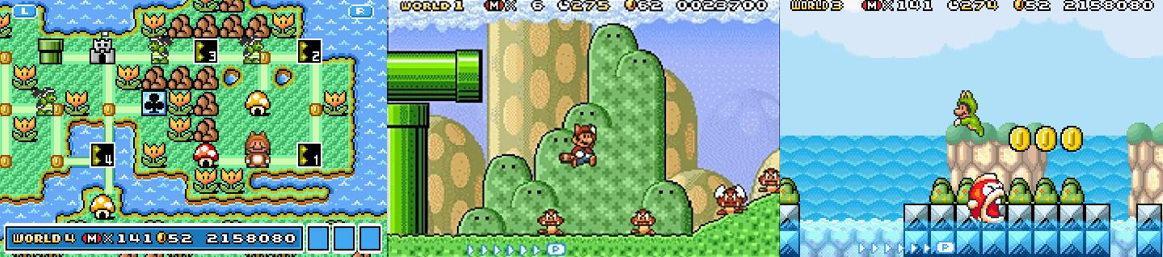
Although it’s a shame to go from playing as four characters to just two, Super Mario Bros. 3 makes up for this by being absolutely massive! Each World has its own distinctive overworld, with different layouts, animations, and music accompanying them; you move across the map to access each Level or a Toad House to play a mini game, but you can also use pipes to warp around to different areas, access shortcuts, and take on optional battles against the likes of the Hammer Bros. for additional power-ups. While you’re not free to go wherever you like, there are options to skip Levels using these power-ups and other shortcuts, though you won’t get a “Perfect Clear” if you don’t conquer each Level and Fortress contained in each World. Levels are presented as short obstacle courses that gradually test your patience, platforming skills, and deductive reasoning; things start out simple enough, with you jumping to blocks, over gaps, and warping about using pipes against a variable time limit, knocking off enemies to increase your score and earn extra lives, but things quickly become very tricky once the hazards and requirements start to ramp up. Falling or temporary platforms, moving platforms, and projectile spitting enemies are commonplace here, as are respawning enemies, nigh-invincible enemies (unless you have a block or power-up handy), and you’ll often find yourself either trapped in a tight corner or sent plummeting to your death thanks to various hidden blocks popping up at the worst possible times! Sometimes, you’ll hit a block and a power-up will pop out; mostly, you’ll get Coins, but other times a climbable vine will lead to a secret power-up room, a P-Switch to grab some Coins, or the Level’s exit. Other times, you need to hop to erratic moving platforms, bounce off flying enemies for an extra boost, toss Bob-ombs to break through walls, or even grab a series of Starmen to make yourself invincible and bypass spikes, snapping piranhas, and flame bursts. Each World ends with you battling across the Koopaling’s Airships, dodging Bullet Bills, cannonballs, hopping across bolts, and avoiding jet flames as the screen bounces and tilts about. In World 8, you’ll also have to hop across tanks in a horizontal scroller, dodging many of the same obstacles, which naturally represent some of the hardest and most aggravating challenges in the game.
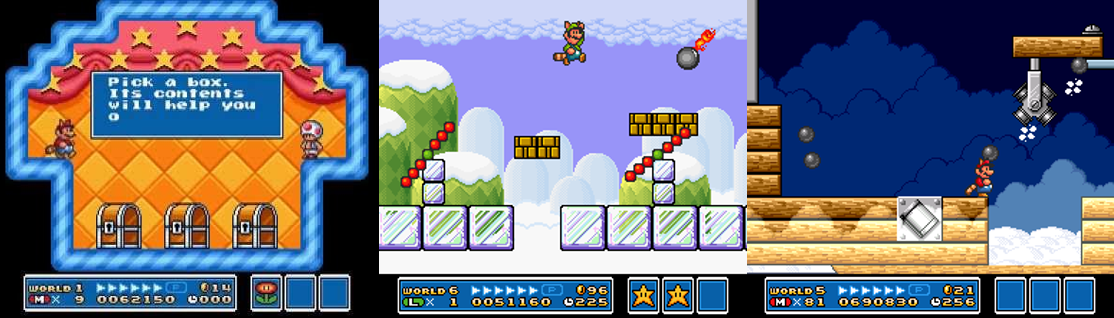
While many of the game’s hazards and enemies will inevitably repeat, they are often used in creative and more difficult ways later in the game, from simple stuff like mixing different enemies into the Levels to more annoying inclusions, like constantly respawning enemies or platforms coming to life beneath your feet, or having to bounce perfectly off music note blocks and run across falling platforms. You’ll sometimes have to swim underwater, tapping A or making use of the Mario’s new Frog Suit power-up to more efficiently bypass Cheep-Cheeps and Bloopers; other times, the Levels autoscroll horizontally, vertically, and diagonally, putting your reaction times and platform skills to the test. There are also a number of looping mazes, often involving pipes or the lava-infested Fortresses, with some having exits so obscure that you’ll have no choice but to consult a guide (World 6-5, for example, traps you in an endless loop and forces you to awkwardly fly up a specific part of the stage using the Raccoon Suit while holding a Koopa shell to break through some blocks and reach the exit, none of which is very intuitive). As if the small platforms, singular blocks, and broken bridges aren’t bad enough, you’ll also have to contend with projectiles, blocks coming to life, timid ghosts who chase you when your back is turned, bottomless pits, instant-death lava, temporary moving platforms that you must jump on to change their direction to progress upwards, suffocating quicksand, leaps of faith, and treacherous platforming nightmares up in the clouds. Thankfully, you have infinite continues; when you lose all your lives, you can continue on with a fresh stock, though your score resets to zero. You’re prompted to save your game after clearing every Fortress and Airship, though you can manually create a temporary save at any time from the pause menu if you need to take a break. Gameplay is mixed at the Toad Houses, where you play various mini games for power-ups and extra lives; these reset after you lose all your lives and continue your game but can be really tricky. One sees you having to stop sliding tiles at just the right time, which I found all-but impossible; one sees you turning over cards to find doubles; the other has you picking from three chests; or you can fight a couple of Hammer Bros. to earn a chest containing a random power-up.
Graphics and Sound:
This version of Super Mario Bros. 3 may very well be the best, visually speaking; while some changes were inevitably made to accommodate for the Game Boy Advance’s hardware and software specifications, the presentation is absolutely top-notch. The game pops with vibrant colours at all times, with some fun visuals in the backgrounds (such as big green hills, pyramids, clouds, and Bowser portraits), and a lot of visual variety even when some Levels recycle assets from others (the Fortresses, Airships, and most underwater Levels are the most obvious examples). Palm trees, icy platforms and slippery, snowy landscapes, unstable or incomplete bridges over water filled with ravenous fish or bubbling lava, and block- or cloud-based environments are commonplace, as you’d expect, but you can also venture underground into dank caves, crystalline mines, and sewage systems filled with a network of pipes and a wraparound screen feature similar to the original Mario Bros. (Nintendo R&D1, 1983). World 4 was one of my favourites as everything is gigantic here, including the pipes and enemies, turning even regular Koopas into monstrous foes, but I quite enjoyed the jaunts into the desert areas, even with that maniacal sun chasing after me! World 6 was one of my least favourites as everything’s covered in snow and ice, making a slippery game a hundred times more difficult to play, and the pipe mazes of World 7 also caused quite a headache. Things get suitably ominous in World 8, a lava-filled hellscape full of tanks, submarines, and airships; even the overworld is affected, restricting your vision until you clear certain Levels, and dropping you into darkened deserts and deep jungles filled with tricky platforming sections.

One added benefit to being on the Game Boy Advance is the inclusion of voice samples; Mario and Luigi will shout with joy and wail in pain whenever they snag a power-up or lose a life, respectively, and the game is bolstered by some of the catchiest tunes in the entire franchise. While many of these are recycled across the game’s many Worlds, they never fail to be infectious and keep things whimsical, even when you’re tearing your hair out because you somehow slipped off a platform or weren’t quite pixel-perfect enough to make a jump. A couple of cutscenes also help punctuate the action; dialogue boxes have the Toads pleading for help when you reach each World’s castle and see the state of their king (there’s even a Yoshi cameo at one point); you’ll see the brothers hop onto the Airships and fall from the sky in triumph after securing each magic wand, and Princess Peach (and, later, Bowser) leaves letters for you containing words of encouragement and rare power-ups (or, in Bowser’s case, a final challenge). If you manage to get to the secret warp zone, you can skip ahead to different Worlds, which alters the order you play the game and also results in different cutscenes playing (such as seeing the Koopalings invade a castle beforehand) if you, for example, skip right to the final confrontation before besting the other Worlds. World 3 also has you control a little raft to get to different Levels and Toad Houses, World 2 contains pyramids for you to scale and conquer, and World 8 is littered with tanks and dangerous optional squares that pit you against some of the game’s toughest foes while hopping across a lava pit using precarious platforms! Although neither character has any idle animations, they can transform into a variety of super fun different forms with their different power-ups and everything runs very smoothly. This version of the game even includes a brand new opening cutscene, styled like a pantomime, in which Peach begs for help after the Koopalings attack, and you’ll even spot her screaming for help when battling your way through World 8.
Enemies and Bosses:
Unlike Super Mario Bros. 2, which featured entirely new and fantastical enemies, Super Mario Bros. 3 features the return of many of Bowser’s most recognisable minions: Goombas, Koopa Troopas, Bloopers, Bullet Bills, Cheep-Cheeps, Spinys, Piranha Plants, and the ever-annoying Lakitus are constant hazards across each of the game’s eight Worlds. Spinys will drop from the ceiling and dash at you, Koopas will re-emerge from their shells if you hold them too long, and both them and the Goombas can be seen fluttering around with wings this time. The Hammer Bros. also return, usually guarding the end of Level goal or as mini boss challenges on the overworld; boomerang and fire-flinging variants also crop up, as do larger Sledge Bros., who can stun you with a ground slam. The only enemy to return from Super Mario Bros. 2 is the Bob-ombs, who will be endlessly spat out of cannons or spawn into areas where you need to use them to break certain blocks, and Super Mario Bros. 3 sees the debut of Mario staples such as the Thwomps (massive, angry blocks that try to crush you), Boos (shy ghosts who freeze when you’re facing them), Big Bertha (a massive Cheep-Cheep who’ll swallow you whole if you get too close), Chain Chomps (ravenous Pac-Man-like mouths attached to chains), and Dry Bones (skeletal Koopas that reassemble after being jumped on). You’ll also have to try and dodge the annoying wrenches tossed by the endlessly respawning Rocky Wrenches on the Airship Levels, be aware of spikes and blocks tossed by smaller enemies, hop across gaps on giant cannonballs, quickly jump over laser-spitting Bowser Statues, and run for your life when the Angry Sun swoops out of the sky!

While you can challenge the Hammer Bros. and their variants by landing on them on the overworld, it is possible to skip these confrontations; when you battle them, it’s highly advisable that you have the Fire Flower power-up, which makes short work of their constant stream of projectiles, and defeating them can net you a nifty rare power-up and make traversing the overworld a little easier. These mini bosses might be optional, but if you’re going for 100% completion then you’ll definitely have to battle one at the end of World 8-Tanks and you’ll need to go head-to-head with Bowser’s primary henchman, Boom Boom, on numerous occasions. Boom Boom awaits at the end of every Fortress in the game and acts as a mini boss throughout World 8; generally, getting to him is tougher than the battle itself as Boom Boom waits at the end of lava-, fireball-, Thwomp-, and hazard-filled obstacle courses that can really test your endurance. Boom Boom himself is fought in an enclosed arena, sometimes with mid-air blocks that act as obstacles, sometimes with an icy floor to send you sliding right into him, and sometimes he takes to the sky with wings and dive bombs you. In each fight, the strategy is the same: Boom Boom will wander back and forth, occasionally leaping at you with his spiked shell or diving at you from the sky, and you must hop on his head three times (or blast him three times with a power-up) to be victorious. If you’re playing the Nintendo Switch version, or the Japanese version of this game with the e-Reaper feature, you’ll also battle two Boom Booms at once on the World-e map, but I have to say that fighting this guy over and over, sometimes up to four times for each World, quickly grew as tedious as the multiple encounters with Birdo in Super Mario Bros. 2 and it’s a real shame that more variety wasn’t included here (like giving Boom Boom different power-ups or having more hazards in the arena).

Sadly, this disappointment also extends to the Koopaling you encounter at the conclusion of each Airship. Each Koopaling wields a magic wand that fires a projectile into the cramped arena and jumps around, often retreating into their spiked shell to protect themselves, and can be defeated in three hits. While Wendy O. Koopa and Iggy Koopa can jump a little higher than others, which can mess up your attack strategy, Roy and Ludwig von Koopa can stun you by creating earthquakes, which leaves you vulnerable to their slow magic projectiles. Wendy and Lemmy Koopa are probably the most unique and memorable of the seven as Wendy fills the screen with candy rings that bounce all over the place and Lemmy rolls about on a magical ball firing smaller balls that can hurt you or be used as platforms to avoid his erratic rolling and bop him on the head. Again, though, while each of the Koopalings looks different and has slightly different attack patterns, they’re all basically the same; if you can reach them with a Fire Flower or Hammer Suit then you’re laughing, but the hardest thing about most of them is that you have the suffer through the entire Airship course all over again if you die fighting them. Their father, Bowser, appears only as the final boss of the game; after enduring some of the game’s hardest Levels, defeating more Boom Booms and dodging a whole host of enemies and hazards, you’ll reach Bowser’s Castle, a maze-like shrine to the Koopa King with branching and looping paths and lava pits. Bowser himself spits fireballs at you that you must duck or jump over and will leap into the air to crush you with a butt stomp; simply dash underneath him and cause him to destroy some of the blocks. Do this three times in the same area (or manage to blast him with enough projectiles) and he’ll plummet to his doom, leaving you to free Princess Peach and restore the peace to the land. You’ll also battle him twice more in World-e, with one battle being functionally the same and the second being made harder by the presence of unbreakable blocks included on the floor.
Power-Ups and Bonuses:
After being disappointed by the lack of power-ups in Super Mario Bros. 3, I’m happy to say the Super Mario Bros. 3 goes above and beyond with its power-ups! Staples such as the 1-Up Mushroom, Super Mushroom, and Fire Flower return, granting an extra life, an extra hit, and the ability to throw fireballs, respectively, alongside Coins that grant extra lives when 100 are collected and the Starman, which grants brief invincibility. Super Mario Bros. 3 also debuts some brand new power-ups that have since become franchise staples, such as the warp whistle and cloud that will teleport you across the overworld, Blue Coins (though they have no additional value), hammers to break overworld blocks, and a music box to send enemies to sleep in this same area. Mario and Luigi also have some new forms here, such as the Frog Suit (which allows greater movement when underwater at the cost of impeding land movement), the Hammer Suit (which lets you toss a bunch of hammers and protect yourself from projectiles and the cost of sliding down hills), and by far my favourite Mario power-ups: the Super Leaf and Tanooki Suit. These grant you cute little raccoon ears and a tail (or a full raccoon suit, respectively) that lets you attack with a tail swipe, flutter jump by tapping A, and fly through the sky after building up enough speed. Pressing down and B while wearing the Tanooki Suit also transforms you into a statue to avoid damage from enemies and projectiles, and you can fly indefinitely when awarded with a P-Wing, easily allowing you to soar over the game’s more troublesome sections. There’s also an additional, somewhat secret power-up in the game; if you defeat a the shoe-wearing Goombas in World 5-3 in just the right way, you can hop into the shoe and safely pass over spikes and defeat spiked enemies, all while retaining any other power-ups you already have.
Additional Features:
There are eight Worlds to explore in Super Mario Bros. 3, but that doesn’t mean you have to conquer every Level or Fortress found in each. The warp whistle and Lakitu’s Cloud items will let you skip entire Worlds and Levels if you wish, though you won’t be greeted with a “perfect” completion screen and the score on the save file menu won’t be at its maximum until you beat every Level in the game. There are numerous extra lands and shortcuts to find on the overworld that lead to Toad Houses where you can play mini games for extra power-ups, but some just lead to dead ends unless you beat Levels to unlock the gates or use a hammer item to smash the rock blocking your path. The NES and SNES versions of the game see players compete head-to-head to see who will challenge a Level, but this is entirely absent from this game as a traditional two-player mode is omitted. As mentioned, there is a whole extra World to explore included here, one that includes power-us, collectibles, and features from previous and subsequent Super Mario games, but it’s locked out from the European version of the game so the only way you can play World-e is to either import the game, cards, and e-reader or just play the re-release on Nintendo Switch Online. However, this version does still include a 16-bit remake of Mario Bros. that you can select from the main menu. This version of the game can be played with others and features all-new backgrounds, assets, and music; new POW Blocks, the Super Mario Bros. 2 power squat jump, and quality of life features have also been included, but there are no mirror mode, harder difficulty, or other unlockables included in this version of Super Mario Bros. 3.
The Summary:
I knew what I was getting into when I chose to play this version of Super Mario Bros. 3; I didn’t actually have to play the Game Boy Advance version as I could’ve made things a lot easier on myself and played the Nintendo Switch Online or SNES Mini version but I decided that I wanted to experience the game on real hardware, especially as I just so happened to own the Game Boy Advance cart. In the end, I was conflicted: on one hand, this is a massively enjoyable platformer, with some of my favourite tunes and power-ups and containing a sprawling, surprisingly varied gameworld. Super Mario Bros. 3 definitely set a new standard for the franchise, which would pretty much always include an overworld, multiple power-ups, shortcuts, and battles against the Koopalings. Levels are short, action-packed obstacle courses that will really test your skills as a player; there are a lot of opportunities to snag new power-ups, different ways to tackle each Level depending on what you have in your inventory, and I the overall presentation is whimsical and fanciful. However, on the other hand, Super Mario Bros. 3 can be hard as balls sometimes! Now, granted, I’m not the most accomplished 2D Mario player; I often struggle with the precision platforming, abundance of death pits and instant-death traps, and Mario’s notorious lack of traction, but I was frequently left frustrated with Super Mario Bros. 3’s repetitive and uninspired bosses, almost unfair level of challenge, and the unintuitive methods required to beat certain Levels. For a game as big as this is, it’s really a shame that so much gets recycled; I don’t understand why every World ends with an Airship when assets for a Tank and Submarine-based variant exist in World 8 and could’ve mixed things up a bit. I don’t get why every Fortress has to include a fight against Boom Boom when we could’ve fought a Sledge Bro or Big Bertha or given him some different power-ups. And the final battle against Bowser was pretty underwhelming, to the point where I was expecting a second phase and genuinely surprised when the ending cutscene played. In the end, this is easily the best of the NES Mario games; it’s large and packed full of stuff to do, but is mired by a difficulty curve that is just a little too frustrating for me at times (though probably well within the skills of a more accomplished Mario gamer).
My Rating:
Pretty Good
Did you enjoy Super Mario Bros. 3? Which version of the game is your favourite and which console did you first play it on? Were you disappointed that there weren’t more characters to play as or did you feel like the new power-ups made up for this? Did you also struggle with the traction and platforming challenges on offer here? Were you disappointed by the repetitive stage design and bosses or did the sheer size of the game balance this out? Which power-up or World was your favourite, and did you ever play through World-e? How are you celebrating Mario’s birthday this year? Whatever your thoughts on Super Mario Bros. 3, feel free to share them below or drop a comment on my social media and be sure to check out my other Mario content across the site!




























 Dr. K's Waiting Room
You must be logged in to post a comment.