Game Corner [Sonic Month]: Sonic the Hedgehog (2013; Nintendo 3DS)


Sonic the Hedgehog was first introduced to gamers worldwide on 23 June 1991 and, since then, has become not only SEGA’s most enduring and popular character but also a beloved videogame icon and, in keeping with tradition, I will be dedicating an entire month’s worth of content to SEGA’s supersonic mascot.


GameCorner

Released: 13 June 2013
Originally Released: 25 October 1991
Developer: SEGA
Original Developer: Ancient
Also Available For: GameCube, Game Gear, Master System, Nintendo Wii, PC, PlayStation 2, Xbox

The Background:
I did a deep dive into Sonic’s complex and deliberate history in my review of his incredibly popular debut title for the Mega Drive; however, in October of the same year of Sonic’s 16-bit debut, SEGA also released an 8-bit version of the influential Mario-beater. The Master System version of Sonic was my introduction to the character as it came built-into my Master System II console; originally developed by Ancient specifically for the Game Gear, the Yuzo Koshiiro-lead team were also commissioned to make a version for its bigger brother. Since it was impossible to port the 16-bit game, Ancient started from scratch to craft a similar but fundamentally altered version of its 16-bit counterpart. Reviews were positive and, when the game was subsequently re-released onto the 3DS Virtual Console, it was again positively received and has been considered one of the best titles on SEGA’s 8-bit systems.

The Plot:
South Island is under siege! The maniacal Doctor Eggman (widely known as “Robotnik” during this time) has captured the island’s animals and polluted the landscape in his search for the six legendary Chaos Emeralds and only one super-fast, super-cool hedgehog can stop him!

Gameplay:
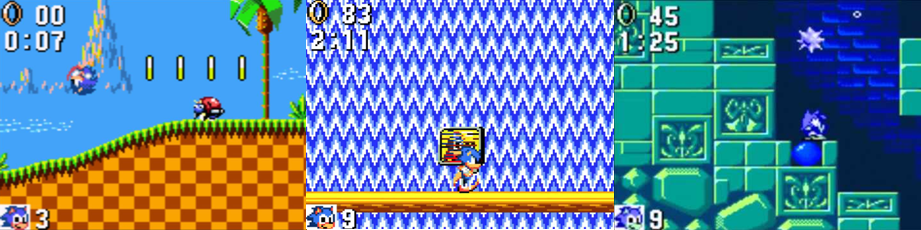
Just like the 16-bit version, Sonic the Hedgehog is a 2D, sidescrolling action/platformer in which players are placed into the red-and-white trainers of the titular blue hedgehog. Sonic is tasked with racing and navigating through six stages (known as “Zones”), with three levels (called “Acts”) each and, in each Zone’s third Act, Sonic will encounter Dr. Eggman and have to battle him to free a bunch of woodland critters from captivity. Sonic’s repertoire is exactly the same as in the game’s 16-bit cousin; moving Sonic in a direction for long enough will see him break from a walk, to a trot, to a super-fast run that turns his legs into a blur of motion. By pressing any button, Sonic will jump and become a ball of whirling blue spikes; this “Super Sonic Spin Attack” is your sole form of attack and can also be performed by pressing down on the directional-pad (D-Pad) while running to smash into Badniks. Pressing up and down on the D-Pad while standing still will allow you to vertically scroll the screen and pressing down when on a steep slope and jumping at the very end will see Sonic fly through the air and travel far across the Act at times. Otherwise, that’s it; there’s no Spin Dash or anything like that.

The game’s much more focused on platforming rather than speed and runs noticeably slower at times.

Consequently, the game remains a much slower experience than the advertising would have you believe. Thanks to the limitations of the 8-bit hardware, this version of Sonic is missing the iconic loop-de-loops that helped Sonic gain speed in the 16-bit version and replaces them (here and there) with the aforementioned ramps and a far more vertically-orientated approach. This means that the game is, at its core, a pure platformer and you’ll be jumping over (many) spiked and bottomless pits, hopping to platforms (moving, stationary, and temporary), and making your way up and across to reach the Goal Sign. While Sonic can still collect Golden Rings to protect himself from harm and death, he is again hampered by the system’s limitations. When hit, Sonic will appear to lose only one Ring but will actually drop all of his Rings and cannot pick them up again, which can easily lead to you getting killed on the very next hit. There are additional limitations on the heads-up display (HUD): if you collect over ninety-nine Rings, you’ll earn an extra life but also reset the Ring counter. Your life display is also capped at nine during gameplay but you can collect extra lives and they do show up on the score tally screen. Speaking of which, yes, you do accumulate points by smashing Badniks and finishing Acts quickly but you only see this score at the end of an Act. You are also still racing against a time limit but the game’s Acts are, for the most part, much shorter than in the 16-bit version so it’s not really much of a factor. Additionally, rather than including Signposts as checkpoints, 8-bit Sonic uses Arrow Monitors, which are worth hunting down if things are getting tough and, even better, your shield will carry across between Acts this time around.

In addition to three new Zones, the game also has its own gimmicks to keep you on your toes.

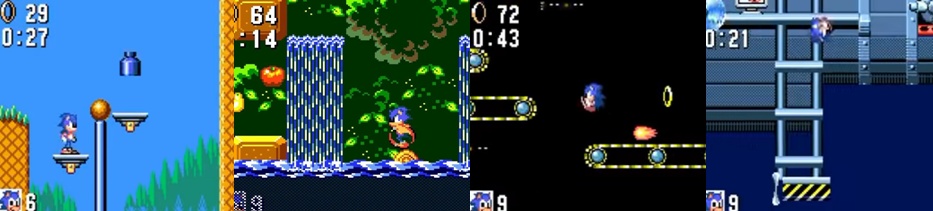
As far as gameplay goes, though, 8-bit Sonic certainly mixes things up in many ways that separate it from 16-bit Sonic. Acts have different mechanics in them, such as warning signs before death pits, weight-based springboards, rapids, rolling logs to run on, and teleporters. It also includes three game-exclusive Zones: Bridge, Jungle, and Sky Base. Bridge focuses on horizontal platforming across an instant-death body of water and has you running across collapsing bridges while Jungle is focused more on vertical platforming. Both Zones include an autoscrolling section in Act 2, with Bridge Zone forcing you to the right and Jungle Zone forcing you up, which can be a pain as once the screen scrolls up to meet you, falling down will result in instant death. You once again have to find your way through Labyrinth Zone, now much more of a chore to play as it’s not only a fittingly maze-like Zone but the game noticeably slows right down whenever Sonic is in water or too much is happening onscreen. Scrap Brain, while similar to the 16-bit game, is also made noticeably different by the presence of a confusing teleporter loop in the second Act that sees you hitting switches to open certain doors, dodging numerous hazards, and going through the right tunnels and teleporters to reach the end. By the time you reach the game’s final Zone, Sky Base, the difficulty noticeably ramps up a bit; Act 1 is alive with hazards thanks to an impressive thunderstorm raging in the background and sending electrical currents running across the screen and the presence of numerous cannons. Act 2 takes place up in the sky with you suspended over a perpetual death pit and forcing you to hop across propeller platforms and dodge even bigger cannons all without the benefit of your precious Rings.

Graphics and Sound:
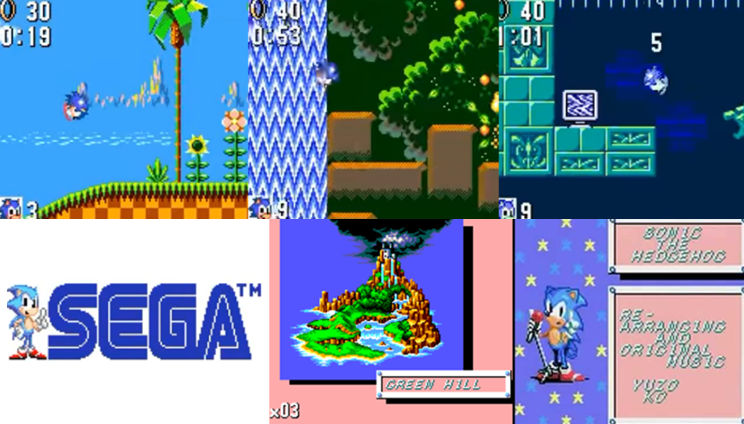
Even now, Sonic the Hedgehog remains one of the most impressive titles on SEGA’s 8-bit systems. Since the 3DS version is a port of the Game Gear version, it’s not quite the same as I remember it. Sonic’s sprite is noticeably different compared to the Master System one and actually resembles Greg Martin’s artwork thanks to his frowning eye. When left idle, he still taps his foot impatiently and pulls off some amusing expressions when killed, skidding, or gobbling air bubbles in Labyrinth Zone, though obviously the game’s zones aren’t going to be as vibrant and detailed as in the 16-bit version. Indeed, you’ll notice right away that the backgrounds are quite sparse and lack the same depth and level of detail as on the Mega Drive but there’s still quite a lot going on in each Zone; flowers blossom and dance in Green Hill Zone, water rushes by beneath Bridge Zone, and waterfalls and vines are all over the place in Jungle Zone.

Zones are certainly shorter and more sparse but the game is surprisingly colourful and lively.

Labyrinth Zone also still has a lot of detail on the foreground elements and you still need to swallow air bubbles to breathe (though the iconic drowning music has been replaced by a simple ticking countdown); while Scrap Brain Zone remains a mechanical Hell, Sky Base is probably the most visually impressive Zone in the game thanks to its dark, foreboding first Act and the impressive scale of the second Act. One of the best additions to the game is the presence of a map before each Act; this shows your progression through South Island, displays the name of the Zone you’re about to play, and even shows Dr. Eggman hovering in to attack you, the level of pollution in the air, and Dr. Eggman’s Sky Base looming overhead. The game even has a much more elaborate introduction before the title screen and the music is even more impressive; again, largely different from the 16-bit version with the exception of the opening jingle and Green Hill Zone, the game is full of jaunty, catchy little chip tunes, with Bridge Zone, the game’s incredible Scrap Brain Zone track, and Sky Base Zone’s tracks being notable standouts for me. When you finish the game, you’ll also be treated to a large, partially-animated sprite of Sonic with a microphone while one of my favourite ending medleys plays over the credits.

Enemies and Bosses:
Even though 8-bit Sonic includes some new Zones, the Badniks remain exactly the same as in the 16-bit version; you’ll still bop on Motobugs, get blasted at by Buzz Bombers, surprised by Newtrons, and nipped at by Chompers. Some Badniks, like Bat Brain and Roller, are missing, however, and you won’t be seeing any fluffy little creatures hopping to freedom when you smash the ‘bots with your Spin Attack. Your main hazards will be the high abundance of spike pits, spike traps, and bottomless pits; spears will also try to skewer you in Labyrinth Zone, flame jets and electrical hazards try to fry you in Scrap Brain Zone, and platforms will constantly collapse beneath your feet.

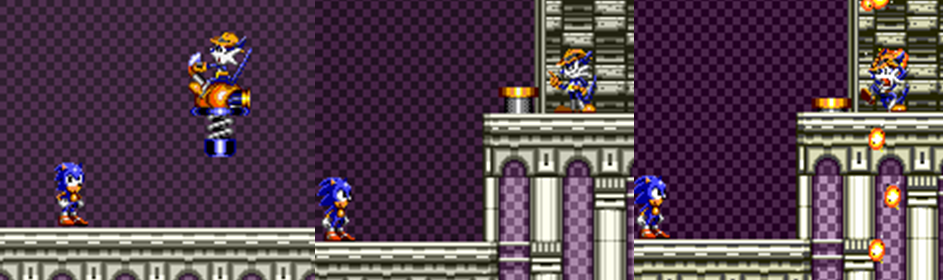
Dr. Eggman attacks from overheard or underneath but is easy to send packing.

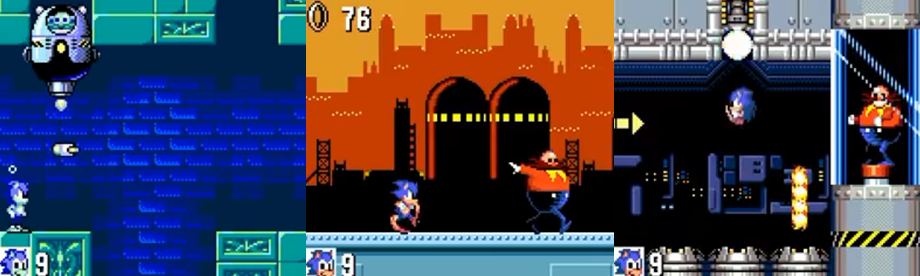
As in the 16-bit version, Sonic will battle Dr. Eggman in Act 3 of each Zone. Unlike in that game, Act 3 contains no Rings, some platforming hazards to navigate through, and a single extra life monitor hidden within it to help you out. Every boss in the game is also completely different from those seen in the Mega Drive version; in Green Hill Zone, Dr. Eggman simply flies overhead a few times (accompanied by a jaunty little boss theme), lowers slowly to the ground, and tries to ram into you but, thanks to the smaller screen size of the Game Gear, it’s pathetically easy to do him in as he flies overheard on the first pass. In Bridge Zone, Dr. Eggman switches to a submersible craft and pops up randomly between bridges to fire three shots at you; this actually differs from the Master System version, which sees you battling Dr. Eggman between two grassy platforms, and can be difficult as it’s very easy to fall through Dr. Eggman on his invincibility frames and lose a life. In Jungle Zone, Dr. Eggman again hovers overheard but this time you’re limited to a curved vine platform and he drops a rolling bomb at you but, just like in Green Hill Zone, it’s way too easy to just mess him up on his first pass.

While he flees from you in Scrap Brain, Dr. Eggman puts up a decent fight in Labyrinth and Sky Base Zone.

Things appear to get more troublesome in Labyrinth Zone; unlike in the 16-bit version, you actually do fight Dr. Eggman here but it’s underwater and in a small arena with a bottomless pit to worry about. While there’s helpfully (if strangely) no danger of you drowning in this battle, you do have to watch out for Dr. Eggman’s rockets and projectiles but, while it can be tricky to jump over the pit thanks to how slow the game runs underwater, this isn’t that much of a chore to get through. In Scrap Brain Zone, you won’t actually fight Dr. Eggman; instead, you have to solve a tricky puzzle and then chase him to his teleporter and you’ll go one-on-one with him in the next Zone in a battle far more grandiose than on the Mega Drive. In Sky Base Act 3, Dr. Eggman hides within a glass tube and hops on a switch, which sends jets of flame randomly up from the floor or a ball of death to fly at you. Thankfully, it’s pretty simple to hop over both of these and bash into him. After he flees, a short cutscene pays that shows Sonic delivering the final blow via teleporter, defeating Dr. Eggman at last.

Power-Ups and Bonuses:
Sonic the Hedgehog includes all of the same power-ups as its Mega Drive cousin. You’ll find a number of monitors scattered throughout each Zone that will award you with ten extra Rings, a protective shield, or mark your progress so you can respawn later in the Zone if you die. Interestingly, the game features far more extra life monitors than it does speed-up shoes or invincibility monitors; indeed, I only encountered maybe two of these in my playthrough, to the point where I thought they weren’t even in the game.

Additional Features:
The 3DS version of 8-bit Sonic is one of the best ways to play the game thanks to not only being a portable title like the original Game Gear version, but also the inclusion of save states. While you can only create one save slot, this does make it dramatically easier to keep track of your progress and help you hunt down the game’s six Chaos Emeralds.

Bounce around Special Stages all you want but you need to hunt through Zones for Chaos Emeralds.

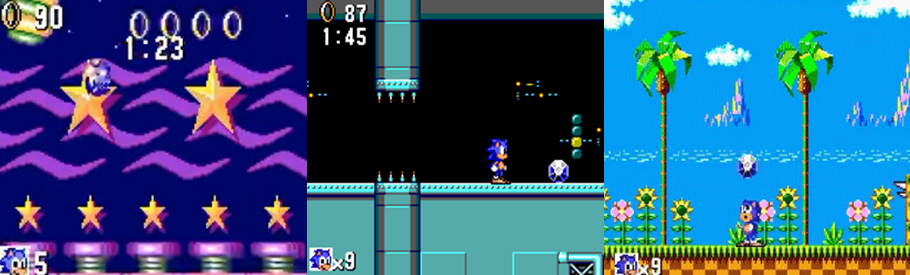
One of the things I always loved about 8-bit Sonic was its approach to Chaos Emeralds; if you finish an Act with fifty Rings or more, you’ll get to play a Special Stage. In this game, these are timed bonus stages full of bumpers and springs (basically functioning as the game’s version of Spring Yard Zone) and Rings. Here, you can bounce all over the place to stock up on lives or break Continue Monitors to gain an extra continue but you won’t find Chaos Emeralds in these stages. Instead, Chaos Emeralds are hidden within the game’s Zones. Finding them is sometimes pretty simple, such as just taking a certain path while underground in Green Hill or running on a log at the bottom of Jungle Zone, but can also be sneakily hidden behind death traps. To reach the Emerald in Bridge Zone, for example, you have to jump from a falling section of a bridge before you fall to your death and Scrap Brain’s Chaos Emerald is reached by falling down a specific pit that looks just like any other bottomless pit. Nabbing them all rewards you with a hefty score bonus and the game’s true ending, which sees South Island freed of Dr. Eggman’s influence.

The Summary:
Even though I grew up playing the Master System version of this game, which is graphically slightly superior, I still have an immense amount of nostalgia and fondness for the 8-bit version of Sonic the Hedgehog. The game is bright, fun, and endlessly charming and packs quite a lot in for an 8-bit title; one of the things I still really enjoy about it is that it’s not just a scaled down version of the 16-bit game. Instead, 8-bit Sonic features new Zones, new gimmicks, and changes up the way the game is played; having you hunt for Chaos Emeralds in the game’s Acts is a great way to tie into the game’s larger focus on platforming and exploration and I always kind of saw this and the 16-bit version as two parts of a greater whole that complimented each other beautifully. Colourful and featuring some extremely catchy tunes, 8-bit Sonic is both easier and slightly harder than its more popular counterpart; there are some glitches here and there (Sonic’s collision detection is a bit wonky and I found myself bounced into oblivion in the Special Stages more than once), there seems to be far more unfair death pits and traps, and the game runs much slower, especially when there’s a lot happening onscreen. Still, these issues are minor and, in many ways (again, most likely because of nostalgia) I actually prefer this game to the 16-bit version but, in my wholly biased opinion, it’s definitely at least on par with Sonic’s bigger, better Mega Drive outing.

My Rating:

Rating: 3 out of 5.

Pretty Good

What did you think about Sonic’s 8-bit debut? How do you think it compares to the 16-bit version and Sonic’s other 8-bit outings? Did your Master System come with Sonic built-in or did you buy it separately? What did you think to the Chaos Emeralds being hidden in the game’s Zones rather than in Special Stages? Did you own the original Game Gear version and what did you think to this 3DS port? How are you celebrating Sonic’s birthday this year? Whatever you think, feel free to share your thoughts and memories regarding Sonic below or on my social media.

Mini Game Corner: Land of Illusion Starring Mickey Mouse (Master System)

LandOfIllusionLogo

Released: June 1993
Developer: SEGA
Also Available For: Game Gear

A Brief Background:
Back in the nineties, licensed videogames hadn’t quite earned the reputation that they have these days. Anyone who had played one of the many videogame adaptations of Disney movies and properties, particularly on SEGA’s Mega Drive or the Super Nintendo, would generally be in for a good time and treated to big, colourful, well-animated graphics and tight, fun gameplay. One of the most prolific of Disney’s characters to be licensed out to videogames was their enduring mascot, Mickey Mouse. A couple of years after Castle of Illusion Starring Mickey Mouse (SEGA AM7, 1990) and World of Illusion Starring Mickey Mouse and Donald Duck (ibid, 1992) released for Mega Drive, a similar (though, apparently, unrelated) title was released for SEGA’s 8-bit consoles, the Master System and the Game Gear handheld.

The Review:
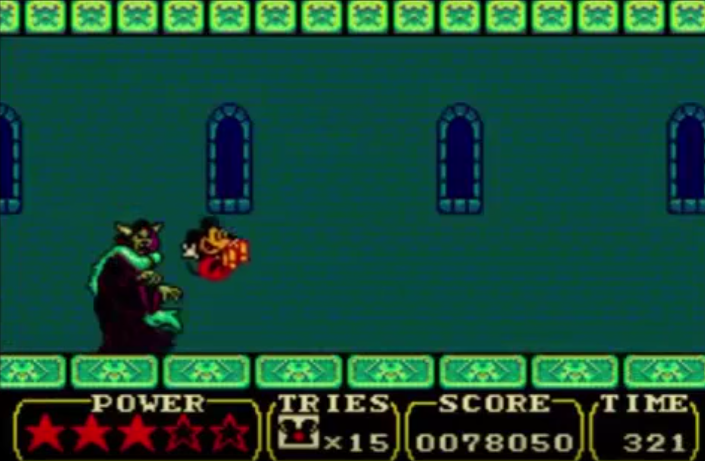
Land of Illusion is a pretty standard 2D, sidescrolling action/platformer in very much the same vein as previous Disney titles released around that time. Players take control of the affable Mickey Mouse and journey through fourteen stages, dispatching enemies using Mickey’s rump, sliding down slopes, or by throwing objects at them. Mickey controls at a steady, grounded pace; he doesn’t slip and slide around, making precision platforming a much easier task than other platformers of the time. He begins the game with two stars in his Power Gauge, meaning he can take two hits before he must try again from either the beginning of the stage or from the last checkpoint he passed. Players can refill Mickey’s health by smashing blocks and other objects to uncover cake; if you search hard enough, you’ll also find a bonus star in each stage, which will add another star to Mickey’s Power Gauge and thus allow him to take more hits. Mickey can also collect coins, which will add to his score tally; defeating enemies and bosses also adds to this tally and he’ll earn an extra try for every 10,000 points. Mickey must sometimes take to water to navigate through a stage; in these areas, players will have to watch Mickey’s air meter, as he’ll lose a life if it runs out. There’s a few simple push-and-pull-based puzzles that Mickey must also solve by opening blocked areas or turning environments upside down and, occasionally, he’ll need to find a key in order to progress.

LandOfIllusionAttacks
Stomp on enemies with Mickey’s butt or chuck a rock at them.

Players must also complete each stage within a time limit (as was the style at the time) but, as Mickey progresses through the game’s story and stages, he frees some familiar-looking faces and is gifted various items that aid his quest; the Magic Flute allows players to replay any stage they’ve previously completed (which can be essential for tracking down other items and extra energy you’ve missed), a Shrinking Potion (which allows Mickey to fit through small tunnels, doors, and spaces), a Rope to climb certain walls, Cloud Shoes to walk on clouds, and a Magic Bean to grow a beanstalk and reach the Phantom’s castle. As mentioned, you can increase Mickey’s health with cake and collect stars to increase Mickey’s Power Gauge but that’s about it. There’s no invincibility, speed ups, or special abilities here. Instead, you can grab Mickey Ears or hit 10,000 points for an extra try and will use the game’s mandatory times to progress further. However, while you can shrink through gaps with the Shrinking Potion, your attacks are useless and being able to jump on clouds doesn’t really help at all except when climbing the magic beanstalk. Otherwise, there’s nothing extra here; the game has one ending, no unlockable or extra characters, and the only incentive to play it again is to beat your last high score.

LandOfIllusionStages
Though simple, stages are bright and colourful.

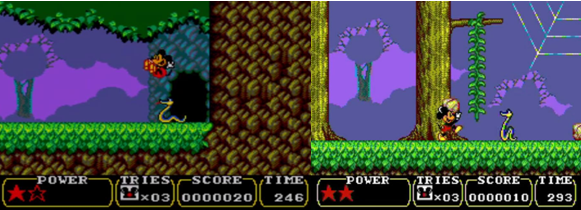
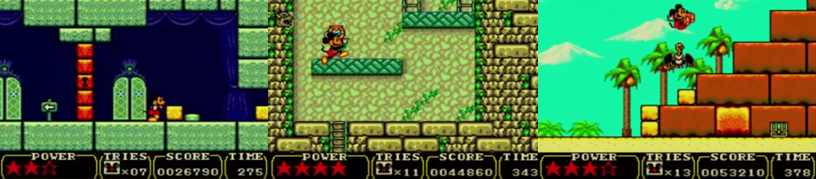
While nowhere near its 16-bit counterparts in terms of graphics or sound quality, Land of Illusion is still quite a charming little 8-bit title. The Master System was never known for having particularly exciting backgrounds or environments, so all of the artistic effort seems to have gone into making the sprites (particularly Mickey) as bright, colourful, and animated as possible. You’ll travel to some pretty standard areas in Land of Illusion (a forest, a desert, a couple of castles…) but each one is distinct in its design and features slightly different gameplay mechanics. You might have to let a tornado of leaves carry Mickey over spikes to safety, for example, or have to outrun a wall of spikes or cross poisonous water or lava. The Master System renders these environments simply enough but it’s surprising how vivid and engaging they are for such an under-powered console. Similarly, the game obviously doesn’t match the bright, poppy tunes or sound quality of its bigger brother but the soundtrack nevertheless does a serviceable job; there’s some catchy little tunes, all of which are perfectly in keeping with Mickey’s cute-and-cuddly aesthetic. Enemies here are as generic as they come; you’ll butt-bounce off the likes of spiders, wasps, snakes, and floating skulls. Some present more of a challenge than others, however, shielding themselves from harm, reforming after being hit, or being invulnerable to Mickey’s butt-bounce.

LandOfIllusionPhantom
Wait for an opening and then hit him with your butt!

You’ll battle some big bosses while playing Land of Illusion but none will really pose much of a challenge (…I really struggled with the giant crab, though, thanks to how slow Mickey moves underwater). You’ll dodge their attacks, maybe toss one of a limited number of blocks at their head, or wait for an opportunity to bounce off their heads with Mickey’s butt. The final boss, the Phantom, is slightly more complex as you must first traverse his booby-trapped castle and then dodge his energy balls (just crouch right in front of him) and jump over his whirlwind attack before he’ll pause long enough for you to smack him. He’ll mix it up by jumping to the ceiling, forcing you to throw blocks at him, but it’s over within seconds, especially if you’ve completely powered up Mickey’s Power Gauge.

LandOfIllusionConclusion

The Summary:
While a mere shadow if its 16-bit counterparts, Land of Illusion does a decent job at entertaining; there’s no bottomless pits or cheap deaths, plenty of opportunities to explore, and some charming graphics and tunes on offer. Gameplay is about as simple as it gets, which is to be expected given the Master System’s simple two button setup; as mentioned, you might have to backtrack to previous levels to get items to progress further if you missed them, and you will find a challenge in the game’s final level but, with infinite continues as standard and a leisurely pace to its gameplay, Land of Illusion is a fun enough little jaunt to keep you distracted for a couple of hours.

My Rating:

Rating: 3 out of 5.

Pretty Good

Did you ever play Land of Illusion? What were your favourite, or most frustrating, Disney videogames from back in the day? Would you like to see a HD compilation of Mickey’s 16- and 8-bit titles? Go ahead and take to the comments to share your thoughts and memories.

Game Corner: Sonic the Hedgehog: Triple Trouble (Nintendo 3DS)

GameCorner
SonicTripleTroubleLogo

Released: March 2012
Originally Released: November 1994
Developer: M2
Original Developer: Aspect
Also Available For: Game Gear, Gamecube, and PlayStation 2

The Background:
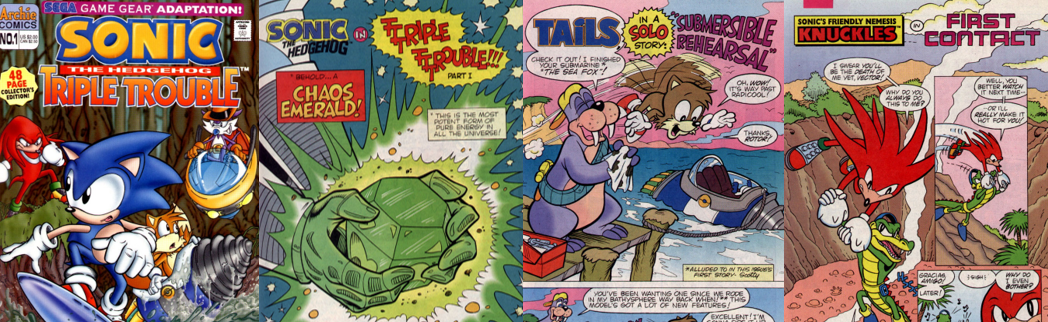
A lot of people forget that, alongside Sonic the Hedgehog’s iconic and much-lauded Mega Drive titles, SEGA also released a fair few Sonic videogames for their 8-bit consoles. The 8-bit versions of Sonic the Hedgehog (Ancient, 1991) and Sonic the Hedgehog 2 (Aspect, 1992) differed considerably from the 16-bit counterparts, featuring entirely different Zones, gameplay gimmicks, and features. While Sonic 2 had almost nothing in common with its bigger, better brother, Sonic the Hedgehog Chaos (ibid, 1993) represented Aspect’s first real attempt at a completely original Sonic title. Released in Japan as Sonic & Tails, Sonic Chaos was a major step up from the first 8-bit Sonic, featuring a playable version of Miles “Tails” Prower, bigger and better graphics, and many other upgrades that left its 8-bit predecessors in the dust. After SEGA switched their focus entirely to the Mega Drive, the Master System was abandoned entirely and all subsequent 8-bit Sonic titles were released exclusively on the Game Gear, SEGA’s underrated handheld console. This was also where Sonic & Tails 2, launched outside of Japan as Sonic the Hedgehog: Triple Trouble, found its home; while clearly inspired by Sonic the Hedgehog 3 (SEGA Technical Institute, 1994), Sonic & Knuckles (SEGA, 1994), and Sonic the Hedgehog CD (ibid, 1993), Triple Trouble again told a largely original story and represented the pinnacle of Sonic’s foray into 8-bit platforming.

The Plot:
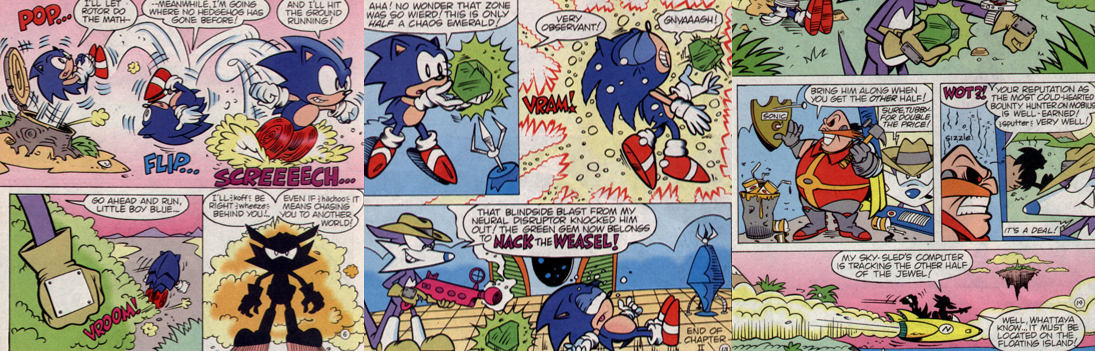
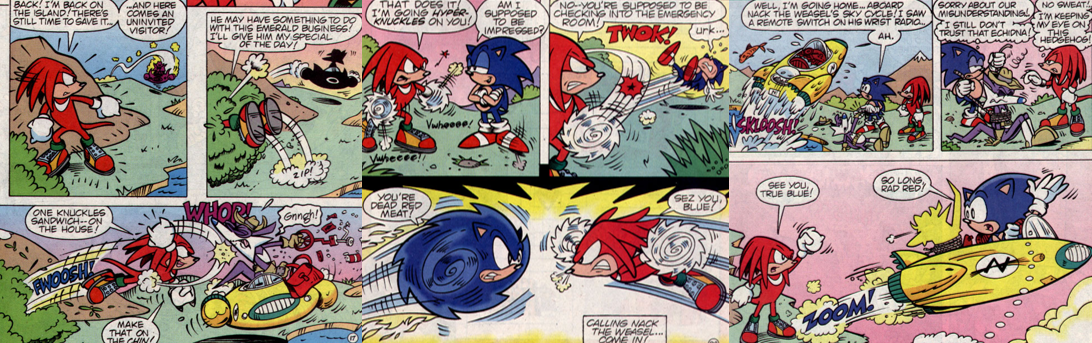
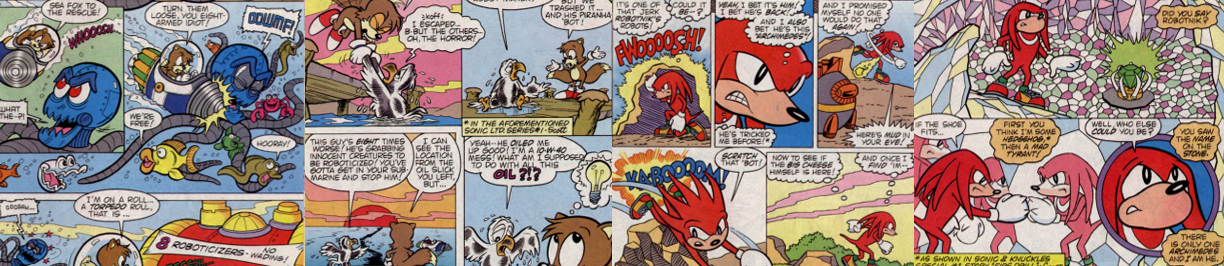
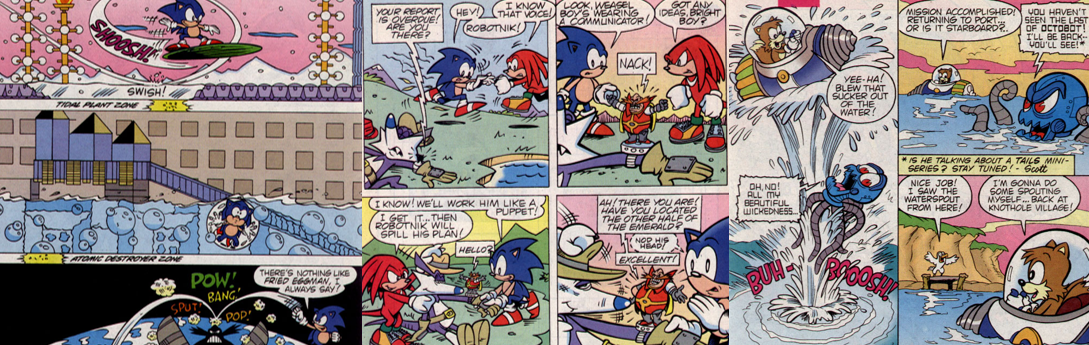
The diabolical Doctor Eggman scatters the Chaos Emeralds across the world but secures one for himself and tricks Sonic’s friendly rival, Knuckles the Echidna, into tracking the remaining gems. However, Nack the Weasel (known as Fang the Sniper in Japan) is hording the Emeralds inside the Special Stages, resulting in Sonic and Tails facing all three in their quest to recover the Chaos Emeralds.

Gameplay:
Like its predecessors, Triple Trouble is a sidescrolling, 2D platformer based on speed. Of all the 8-bit Sonic titles, this is easily the biggest and the fastest; players can choose to play as either Sonic or Tails and journey through the game’s six Zones and each plays a little differently.

Run or fly through Zones as Sonic or Tails and tackle a variety of Special Stages.

Both characters can run, jump, and spin as normal and enter a Spindash by pressing down and A; pressing up and A as Sonic allows him to perform the Strike Dash, a version of the Peel-Out, to blast ahead at full speed. Tails, however, flies instead of performing a Strike Dash and, unlike in Sonic Chaos, Tails can actually access the Special Stages and collect the Chaos Emeralds. Speaking of which, like all 8-bit Sonic titles, Triple Trouble features a unique way of accessing the Special Stages; players must first collect fifty Golden Rings, locate and smash open a Chaos Emerald monitor, then enter the sparkling warp to challenge Nack for a Chaos Emerald. Like Sonic Chaos, each Special Stage offers a different challenge, including bouncing around collecting Rings, piloting the Tornado bi-plane, or navigating a maze.

SonicTripleTroubleNack
Nack acts like a tough guy but is really a pushover.

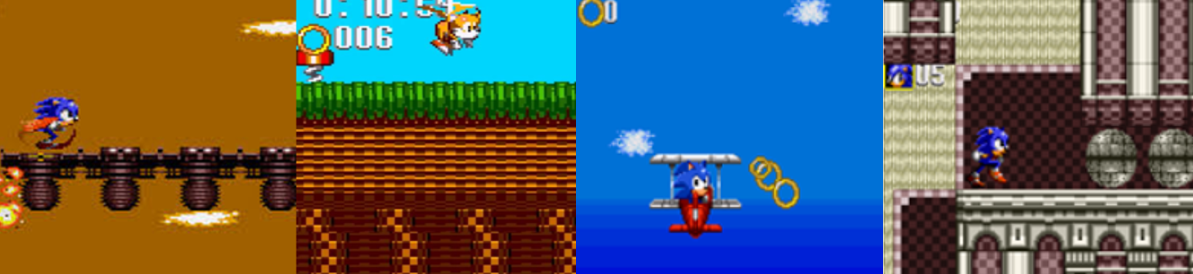
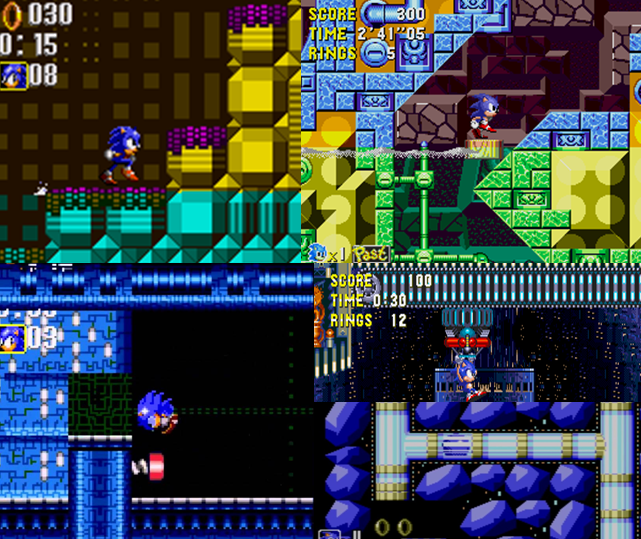
At the end of each Special Stage, they then battle against Nack, who shows up sporadically throughout Triple Trouble to cause Sonic or Tails headaches, similar to Knuckles in Sonic 3. Despite his cool and unique character design, Nack is more a buffoon and an annoyance than an actual challenge, however. Triple Trouble’s Zones borrow heavily from other Sonic titles and yet still manage to stay relatively unique; Tidal Plant Zone has more than a passing resemblance to Sonic CD’s Tidal Tempest, for example, and Atomic Destroyer Zone is like a combination of Sonic & Knuckles’ Death Egg Zone and 8-bit Sonic 2’s Scrambled Egg Zone thanks to its abundance of maze-like tubes. Oddly, Triple Trouble features a large number, and dependence upon, springs; the first Zone, Great Turquoise Zone, is chock full of them (they’re on the trees, the ground, and even the Badniks!) and one of the main things you’ll find yourself doing when playing Triple Trouble is bouncing around on springs and other bouncy hazards, fighting with the stiff controls to get Sonic or Tails back on track. Being that it’s an 8-bit title, Triple Trouble lacks some of the polish of its 16-bit counterparts but, saying that, its 8-bit predecessors felt a bit easier to handle. Here, Sonic jutters along, refusing to change direction mid-air, and feels sluggish and weighed down, making precise platforming difficult. This is a bit of an issue when trying to explore Zones for those elusive Chaos Emerald monitors and when tackling the Special Stages but, for a simple pick-up-and-play title, isn’t a major handicap, especially as there’s not much in the way of bottomless pits or cheap deaths.

Graphics and Sound:
As mentioned before, Triple Trouble is probably the best looking 8-bit Sonic title. The sprites are large and full of character and the Zones and environments are bright and lively. Of all the 8-bit Sonic titles, this comes the closest to matching its 16-bit counterparts, particularly by evoking the same sense of fun and adventure found in Sonic 3.

SonicTripleTroubleZones
You may recognise Triple Trouble‘s aesthetic.

What lets the game down, however, is the sound. As it was originally developed for the Game Gear, sounds are muddy and distorted, as though they’re playing underwater. The game’s music is catchy enough and fits perfectly but collecting Rings or smashing Badniks lacks the usual oomph I expect from a Sonic title.

Enemies and Bosses:
Triple Trouble features the usual mechanised enemies we’ve all come to expect from a Sonic title, especially one from his heyday; Badniks range from robotic snails with springs on their shells to exploding penguins. Most are easily destroyed by simply spinning into them but there’s a fair few Badniks here that cannot be destroyed, which prove especially annoying when you run face-first into them and then stutter down to a lower level thanks to the game’s janky knock-back feature.

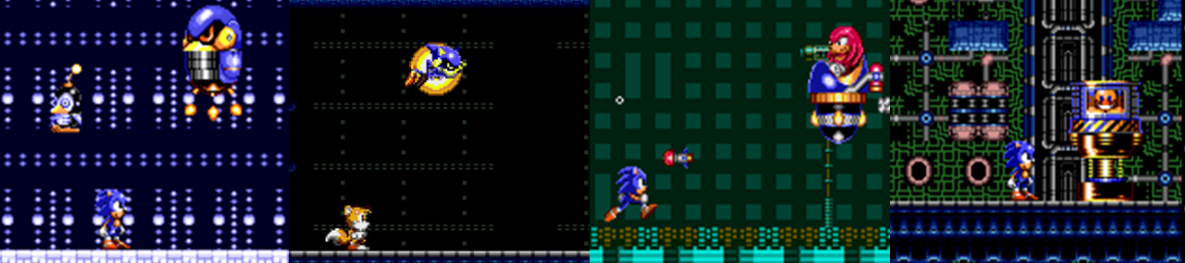
Bosses aren’t lacking in variety, although Dr. Eggman ends up being a bit of a pushover.

Like in the 8-bit Sonic 2 and Sonic Chaos, bosses consist, for the most part, of giant Badniks (such as a giant flying turtles and a bomb-spewing, rocket-powered penguin). However, Sonic and Tails also have to battle Knuckles, who fires bombs and rockets from a cute little vehicle, Nack (who bounces around in a funky spring-loaded contraption), Metal Sonic (in a variation of the iconic battle from Sonic CD), and, of course, Doctor Eggman. Sonic or Tails won’t battle Eggman until the game’s finale, however. This boss battle has three stages but there isn’t much to it; you simply ram his machine until it explodes and transitions to the next phase and, in the final stage (which is eerily reminiscent of the final bosses from the first two 8-bit Sonic titles), you dodge some lightning and smash him as he cycles around a tube.

Power-Ups and Bonuses:
Like all Sonic titles, Sonic and Tails can smash monitors to aid their progress; they can get an extra ten Rings, a speed boost from the Power Sneakers, an invincibility, hit a checkpoint, or gain extra lives as standard but can also access some additional items.

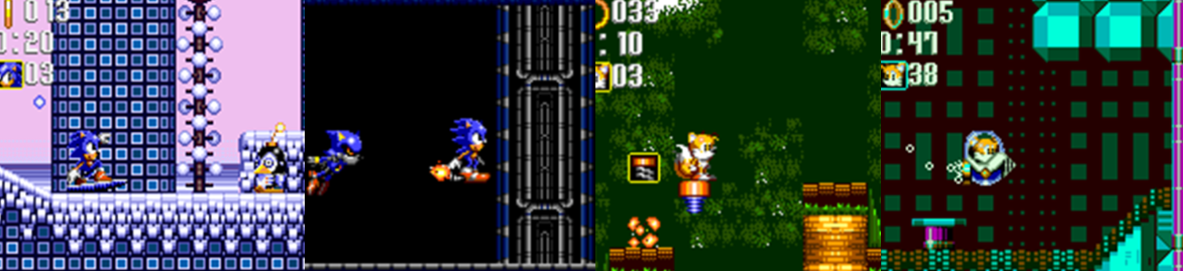
Triple Trouble has some fun, unique power-ups, including Tails’s cute little submarine!

There’s a snowboard that lets Sonic cut through the Robotnik Winter Zone with ease, Propeller Shoes that allow him to navigate underwater, Rocket Shoes to allow him to burn through the sky, and a Pogo Spring because…there aren’t enough springs in the game already. These last two popped up in Sonic Chaos as well but it’s nice to see them return here and it’s a welcome change to the usual shield power-ups. Sonic doesn’t get all the toys, though, as Tails can jump into the Sea Fox to navigate through Tidal Plant Zone without the need for air bubbles. Since he doesn’t need to Rocket Shoes, he can also grab the Hyper Heli-Tails to increase the duration of his flying ability. Additionally, players won’t lose all of their Rings when hit; instead, they’ll only lose thirty Rings, which makes playing through Triple Trouble much easier compared to the first to 8-bit Sonic titles where Sonic couldn’t even collect the Rings he lost.

Additional Features:
There isn’t much else in Triple Trouble; obviously, as with the majority of Sonic titles, the ultimate goal is to collect all of the Chaos Emeralds to receive the game’s best ending but this doesn’t offer any reward other than not being told to “Try again”. There’s no Super Sonic here, no two player mode, and you cannot unlock Knuckles or anything like that. It’s a very simple, one-player experience with the minimum of effort being asked of you. The Virtual Console version, however, offers a few extra features; you can create a save point (which is quite handy if you need to stop playing but you only get one save), change the aspect ratio of the display, and fiddle about with a few other minor settings but that’s about it. For such an ambitious 8-bit Sonic title, it remains as bare bones as all 8-bit Sonic videogames were back in the day.

SonicTripleTroubleSummary

The Summary:
Sonic the Hedgehog: Triple Trouble is decent enough, for the most part; Zones are bright, vibrant, and easy to blast through, Sonic has never looked better in 8-bit, and there’s a decent amount of variety and challenge on offer. However, for as much as Triple Trouble outpaces its 8-bit predecessors, it’s still an 8-bit title; the controls are clunky and unresponsive, the knock-back from damage is a pain in the ass, and sound effects are distorted. Similar to the Game Gear version of Sonic 2, the screen is zoomed in quite a bit as well, which means you’re never quite sure what you’re running into. Overall, I enjoyed the game; it was probably the best 8-bit Sonic game of the bunch, but it’s still far from perfect. I loved Nack and how he was worked into the game, even if he was, technically, just a rip off of Knuckles, and it’s a shame that he hasn’t been brought back in a similarly high profile role. Honestly, I’d love to see this game get a proper, Sonic Mania (PagodaWest Games/Headcannon, 2017) style remake (alongside, or as part of, it’s other 8-bit brothers) but it seems like SEGA and Sonic Team and happy to let their 8-bit/handheld Sonic titles fade into obscurity, which is a shame really.

My Rating:

Rating: 3 out of 5.

Pretty Good

What were your experiences with Triple Trouble? Do you also long for Nack’s return to the franchise? What did you think of Sonic’s other 8-bit outings? Drop a line in the comments to let me know.