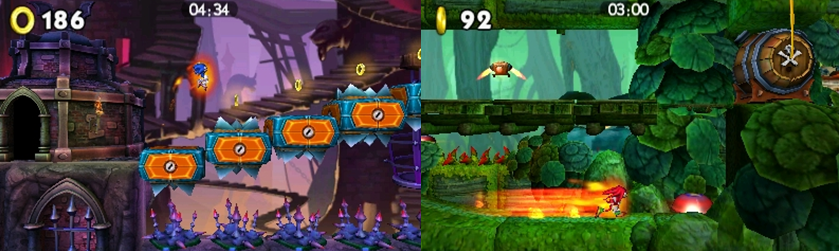
Game Corner [Sonic Month]: Sonic Colours: Ultimate (Xbox Series X)


Sonic the Hedgehog was first introduced to gamers worldwide on 23 June 1991 and, since then, has become not only SEGA’s most enduring and popular character but also a beloved videogame icon and, in keeping with tradition, I have been dedicating an entire month’s worth of content to SEGA’s supersonic mascot.


GameCorner

Released: 7 September 2021
Originally Released: 11 November 2010
Developer: Blind Squirrel Games
Original Developer: Sonic Team
Also Available For: Nintendo Switch, PlayStation 4, PlayStation 5, Xbox One, Xbox Series S (Remaster); Nintendo Wii and Nintendo DS (Original Release)

The Background:
Despite what people would have you to believe, Sonic the Hedgehog (Sonic Team, 2006) was an absolute travesty and one of the lowest points in the franchise. Sonic Team pulled out all the stops to make up for that dismal failure with Sonic Unleashed (ibid, 2008), which was a commercial success thanks to the speed and exhileration offered by Sonic’s gameplay despite the inclusion of the lengthy and maligned “Werehog” stages. Development of a follow-up title began soon after the release of Sonic Unleashed, and producer Takashi Iizuka aimed to not only create an equal balance between speed and platforming but to appeal to a wider, more casual audience by making Sonic the sole playable character. In lieu of Sonic’s extended cast, the developers introduced the “Wisps” to act as temporary power-ups that expanded on Sonic’s moveset, and took inspiration from Disneyland for the game’s amusement park setting. Originally released for the Nintendo Wii and DS, Sonic Colours was well-received for its gorgeous graphics, exciting gameplay, and was considered to be one of the best entries in the franchise despite some criticisms of the game’s difficulty. After years of being exclusive to Nintendo’s machines, Blind Squirrel Games were drafted to produce a remaster of the title for modern consoles to coincide with Sonic’s 30th anniversary, which included a number of graphical and gameplay updates to the original title. Unfortunately, Sonic Colours: Ultimate was mired by numerous reports of bugs and glitches, especially on the Nintendo Switch version, though the charm and fun of the original was still noted to be present.

The Plot:
After Doctor Eggman builds a gigantic interstellar amusement park in orbit seemingly as penance for his evil deeds, Sonic and Miles “Tails” Prower investigate and quickly discover that the evil genius has enslaved several worlds and an alien species known as Wisps in order to harness their energy for a mind-control laser that will allow him to take over the world.

Gameplay:
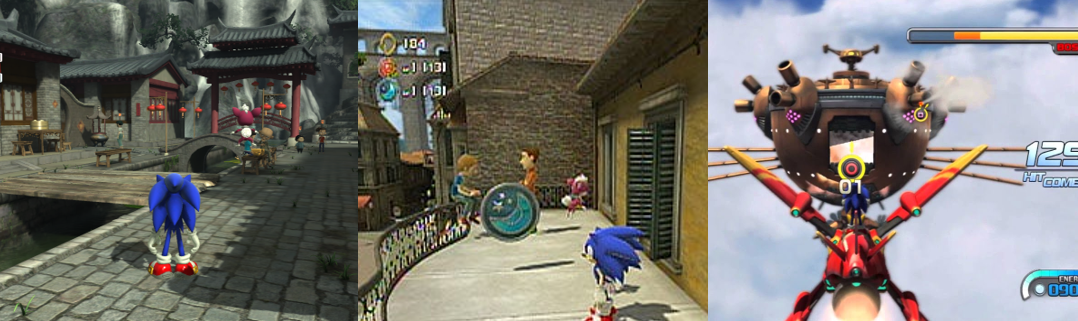
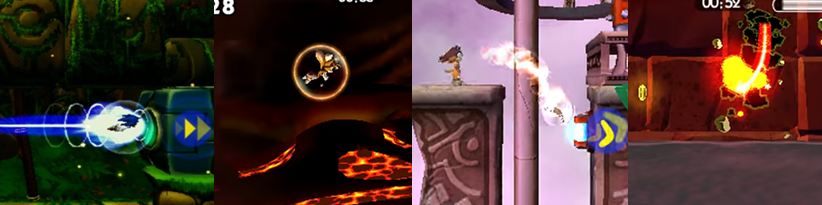
If you’ve played Sonic Unleashed, or most of the main console Sonic games that came after that title, you’ll be instantly familiar with how Sonic Colours: Ultimate looks, feels, and plays. Like its predecessor, the game is a 3D action/platformer that also switches to a 2.5D perspective and has a heavy emphasis on speed, some extremely minor puzzles (mostly just sliding under walls, hopping over pits and steps, activating switches, and kicking away blocks) and a bit of exploration as you’ll need to search about to find optional items for additional unlocks. Unlike Sonic Unleashed, Sonic is the sole playable character here; there aren’t even sections where you get to control the Tornado, and hub worlds have been excised entirely and replaced with a world map, of sorts, where you can select the planets you visit and which level (referred to as “Act”) you want to play on the world. Sonic’s controls remain largely unchanged from before, however; you can still boost ahead by pressing and holding B, though your boost is limited to a meter than can only be filled by collecting Wisps and can no longer be extended or upgraded using experience points. A allows you to jump and holding it will let you jump higher while pressing it in mid-air gives you a very limited double jump. You can also press A during a jump to fire Sonic at enemies, objects, and springs with his iconic Homing Attack, or press X while jumping to perform a stomp to destroy enemies or break through certain blocks.

While you can blast through 3D sections and hop around in 2.5D, control is often taken away from you.

Quite often, Sonic will be placed in an auto-running segment where he has to quick-step to the left and right to dodge walls, hazards, or smack away Motobugs; sadly, this function is limited to the left analogue stick rather than being mapped to the shoulder buttons, which can make avoiding laser beams or obstacles a little tricky. Sonic can also perform a wall jump to reach higher areas, grind on rails, bounce off springs and balloons and other objects to progress, and players can repeatedly tap A after jumping or passing through a rainbow ring to perform tricks and reach new areas. While the 3D sections emphasise boosting and high-speed action, and often take control out of your hands and require you to do little more than quick-step or jump out of the way of hazards, the 2.5D sections focus on platforming; you’ll jump across gaps, to platforms (both stationary and moving), and use wind tunnels to reach higher paths, which typically hold more rewards and are a faster route to the Goal Ring. As in pretty much every Sonic videogame, Gold Rings are your life support; Sonic will be able to take a hit from enemies and obstacles as long as he’s carrying at least one Ring, and he can reacquire them when hit and suck them towards him while boosting. Sonic can pass through checkpoints to respawn if he falls into a death pit or gets hit without any Rings; however, while the life system has technically been done away with, this isn’t strictly true as you can be saved from a fall by grabbing a Tails pick-up, which will see Tails airlift you back to solid ground without having to go back to a checkpoint.
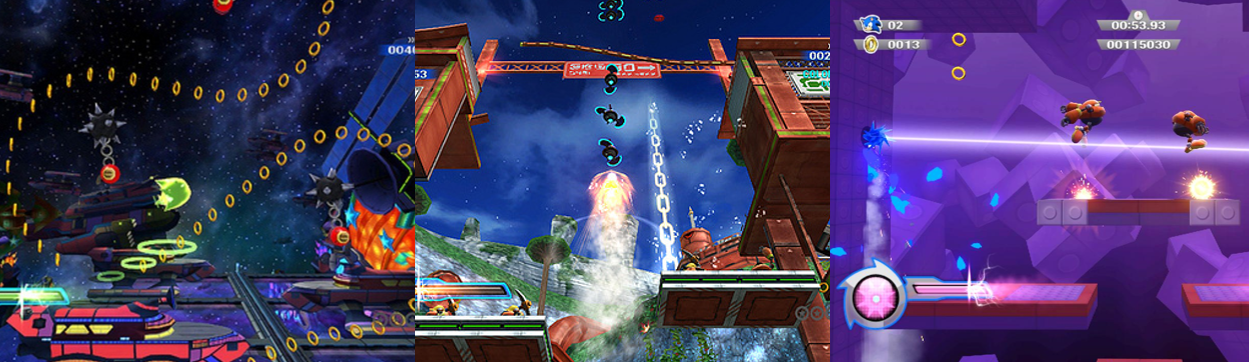
Sonic can grab Wisps to gain temporary power-ups and new forms that allow him to reach new areas.

As mentioned, Sonic is the only character you get to play as; Tails is relegated to a supporting role and only appears in cutscenes or as a new power-up, and you don’t even get to experience a different style of gameplay with a brawling transformation as in the last game. What you get instead are the Wisps, a series of alien lifeforms that you progressively gain access to as you play through the story. When you pick up a Wisp power-up, you can activate it with the Right Bumper and transform Sonic for a brief period of time, which will greatly expand your moveset and options for exploration and attack. The Cyan Wisp allows you to dart through enemies or bounce off surfaces and between jewels as a laser burst, the Orange Wisp turns you into a rocket and blasts you vertically upwards and allows you to float across distances, and the Yellow Wisp turns you into a drill so you can burrow through the dirt or swim through water (though you have to keep topping up the power meter or you’ll risk getting trapped in the dirt and dying). The Green Wisp allows you to hover by holding A and perform a Light Speed Dash across rows of Rings by pressing B, the Blue Wisp briefly turns you into a cube and changes blue rings into solid cubes so you can progress further, the Purple Wisp turns you into a voracious, frenzied monster that eats anything in its path, and the Pink Wisp lets you cling to any surface using spikes and perform Sonic’s signature Spin Dash to blast along at high speeds. New to the game is the Jade Wisp, which turns you into a floating ghost and allows you to teleport across distances, but the Wisp powers are incredibly limited because your power meter is so small and they essentially act as very brief power-ups to mix things up and let you blast through enemies or reach new areas and, for me, are a poor substitute for playing as Tails or Knuckles the Echidna.

Stages are nice and varied, if a bit short, and there’s a slight difficulty curve in the final area.

I played the original Wii release of Sonic Colours, and still own the Nintendo DS version of the game, but it’s been a while since I sat down with it. I don’t remember it being too difficult to play through, though, and the game is littered with hint orbs, tutorials, and warning signs to help hold your hand if you’re struggling. Luckily, you can turn these off at the main menu, which I’d highly recommend, but the game is mainly just a high-speed action adventure that forces you to get through a bit of platforming here and there to get to the next exciting sequence. Gameplay is pretty standard across the board but there are notable things to mix up each of the game’s worlds; there’s pulleys and switches and temporary stairs in Tropical Resort, popcorn to blast through and huge missiles to dodge in Sweet Mountain, and neon pathways to race across in Starlight Carnival. You’ll be quick-stepping across girders on Planet Wisp, punching your way through the gloopy water maze of Aquarium Park by rapidly tapping A and swallowing air bubbles to stay alive, and hopping between high-speed rollercoasters and Homing Attacking asteroids and springs in Asteroid Coaster. You’ll also encounter sections where gravity is reversed or skewed, parts where you need to continuously bounce on a moving spring to cross a death pit, and watch for huge blocks that will force you off the screen and to your death if you stay in their path. Overall, though, the difficulty is noticeably toned down from Sonic Unleashed; Acts are far shorter and designed to be played in fun, short bursts and there are copious checkpoints and Tails power-ups to keep you going.

Graphics and Sound:
Sonic Colours was always a very vivid and graphically impressive title, especially for a Wii game, and Sonic Colours: Ultimate is no different. Everything really pops here; the colours, the textures, and the environments are all really vibrant and there’s lots to see in the background and foreground. If anything, the game’s environments are a little too busy at times and it can be a bit disorientating and distracting trying to focus on what you’re doing, where Sonic is, and what can or can’t hurt you in each of the game’s unique areas. Sonic, however, continues to look fantastic; as ever, he comes with some amusing idle animations and it’s fun seeing him transform into his different forms. The switch between 3D and 2.5D continues to be a little clunky when you’re blasting through Acts and I can’t help but feel like things might have been easier if certain Acts were dedicated to each perspective rather than switching between them, but the camera is never an obstacle and platforming sections are never too tricky beyond getting your jump high and timed well enough.

The worlds are varied, vibrant, and full of life but sometimes a little too busy and colourful.

The entire game takes place in Dr. Eggman’s Interstellar Amusement Park, and there’s a definite feeling of being strapped in for a high-speed, high-excitement rollercoaster of an experience. This is literally the case in areas like Asteroid Coaster, where you ride a dragon-themed rollercoaster hopping between seats over the vast cosmic void, and Skylight Carnival, where you race along cyber pathways as huge neon spaceships loom nearby. Tropical Resort is probably the least interesting area of the game, which is somewhat fitting as it’s basically the entrance to the amusement park, and even that is made visually interesting with all the bright signs and rails and little details like potted plants and benches. Planet Wisp is the closest you get to actually having your feet on natural, solid ground and is a fantastic mixture of nature, foliage, and a huge construction site. Sweet Mountain is easily the game’s most bizarre area and is comprised of cakes, sweets, and desserts amidst a missile factory; blasting through popcorn and using rotating sweets to fly above doughnut plants makes this a very surreal but memorable level. There’s also a real scope added to the environments in Aquarium Park, which essentially takes place within a gigantic aquarium and sees you exploring a vast underwater area and locations heavily borrowing from Japanese temples and aesthetics.
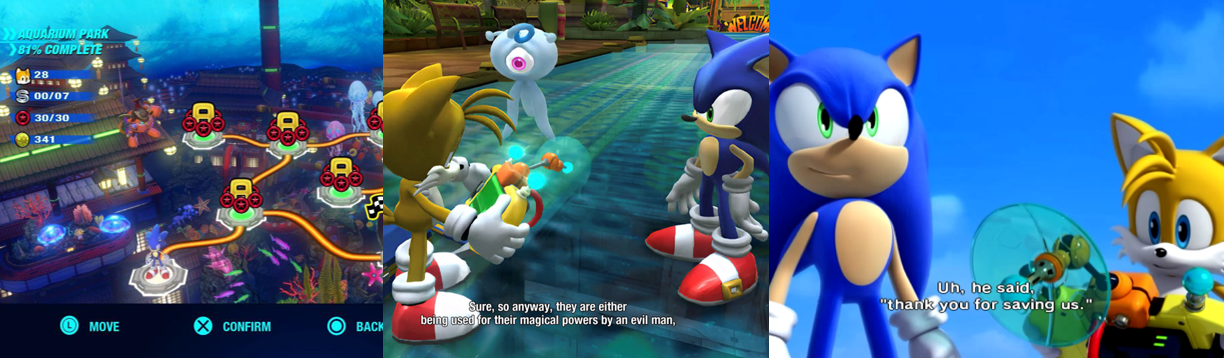
While the lack of hub worlds is disappointing, the graphics and presentation are top-notch.

The game’s final area, Terminal Velocity, is simply a race down the huge connecting tube that keeps Dr. Eggman’s amusement part anchored to the planet, and conjures up memories of the final areas in Sonic and Shadow the Hedgehog’s stories in Sonic Adventure 2 (Sonic Team USA, 2001), and you’ll find a number of pretty basic, almost textureless obstacles courses waiting for you in Game Land. Unfortunately, the game does take a bit of a step backwards as hub worlds are gone entirely, replaced by a world map where you select which planet/location to visit and then pick an Act to play, meaning that the game’s focus is far less on story and exploration outside of the in-Act collectibles. Cutscenes are really well done, however, maintaining the same charming cartoony aesthetic from Sonic Unleashed and featuring some fun, if cringy, jokes and one-liners from Sonic and banter between him and Tails, and Dr. Eggman. Sonic Colours saw Roger Craig Smith take over the role of Sonic, and he’s a far better and more enjoyable voice than Jason Griffith, who I could never stand in the role. Mike Pollock continues to shine as the blustering Dr. Eggman, who’s now joined by Orbot and Cubot for some bungling shenanigans, and the game’s soundtrack is catchy and enjoyable enough. Sonic Colours: Ultimate allows players to select different language options for the dialogue and subtitles, and even switch between the original and the remixed soundtrack, but there’s some jaunty tunes on offer here from Cash Cash and composer Tomoya Ohtani to keep the energy levels high when blasting through enemies.

Enemies and Bosses:
In his quest to free the Wisps from Dr. Eggman, Sonic comes up against many familiar robotic enemies courtesy of the rotund mad scientist; these include Badniks like Motobug, Spiny, Jawz, and Buzzer, and Dr. Eggman’s more military focused creations, like the Egg Pawns and Spinners. Destroying these robots will free the Wisps trapped within, powering up your boost meter and allowing you to plough through them without worry, and you can easily cross chasms and progress further by chaining Homing Attacks of groups of enemies. Probably the most persistent and annoying enemies are Dr. Eggman’s chaser robots, the Aero-Chaser and the Big Chaser. These flying robots will hover in front or behind you, firing lasers and taking swipes at you as you desperately side-step out of the way, and can be a real hassle where you’re also fending off Motobugs or racing towards the camera at high speed with limited visibility. You’ll also face a sub-boss in Asteroid Coaster in the form of a gigantic robotic eye within a shifting gravitational field and protected by some spiked balls; you’ll need to hop between the spiked balls when the gravity field expands outwards to ram into it three times and put Dr. Eggman’s production facility out of commission.

Although the six bosses are fun, it’s a bit disappointing that they’re recycled and reskinned.

Dr. Eggman has ensnared six worlds to build his amusement park; six worlds means six bosses to face as you play through the story but don’t get too excited as it’s really three bosses that you simply battle twice, with the difficulty increased for the second bout. The first boss you’ll battle is Rotatatron, a massive Ferris wheel-type robot that has you dodging its huge claws, hopping between platforms, and ramming its big ol’ face while avoiding its buzz saws. This boss returns again on Planet Wisp, albeit reskinned as the Refreshinator and now protected by spinning circles and laser beams, but you can make these bosses (and all the game’s bosses) even easier to bring down by grabbing the Wisps found in the boss arena and dealing additional damage with their power-ups. Captain Jelly awaits you in Sweet Mountain, requiring you to Homing Attack across some cannonballs on the deck of his airship and hit a switch to force him out into the open. You then need to watch for his little minions and attack him when he stops to taunt you after hopping about, and Admiral Jelly is very much the same scenario except this battle takes place underwater and sees you luring homing missiles to the switch and chasing after the boss using the Drill Wisp. You’ll also have to contend with Frigate Orcan and Frigate Skullian, which are boss battles that take place on an endless running path and see you dodging bullets, spiked balls, asteroids, and lasers to chase each ship down and rapidly Homing Attack different parts of it to deal damage.

Go head-to-head against Metal Sonic and end Dr. Eggman’s plot using the Wisp’s full power.

Collect enough Red Star Rings and you’ll unlock a new feature to this version of the game as Metal Sonic challenges you to a “Rival Rush”, which is basically a race through one Act of each area; while this sounds exhilarating and fun, it’s actually one of the hardest parts of the game as Metal Sonic is ridiculously quick, easily catches up and overtakes you, and you have to finish the race in one perfect run to succeed. Once you’ve destroyed all of Dr. Eggman’s bosses, however, you’ll finally face the egg-shaped madman himself in his Nega-Wisp Armour. This battle is also on an endless running path and sees you dodging various attacks themed after the game’s Wisp power-ups; you’ll need to side-step past cubes, jump over spikes, and avoid ricocheting lasers, amongst other attacks, while desperately grabbing Rings, then deliver a series of Homing Attacks to damage Dr. Eggman’s craft. You can also hit him with a boost attack and, after dealing enough damage, Wisps will be released and Dr. Eggman’s attacks will become more aggressive, faster, harder to dodge, and he’ll even combine Wisp attacks to really make things frantic and frustrating. Once you’ve freed all the Wisps, though, you can press RB and perform a Homing Attack to finish Dr. Eggman off with with the “Final Colour Blaster”; then it’s simply a case of racing to safety as the umbilical cord breaks away around you and you’ll have saved the Wisps and defeated Dr. Eggman once more.

Power-Ups and Bonuses:
Unlike the vast majority of Sonic videogames, there are none of the traditional power-ups on offer here; you can collect Rings either one at a time or in increments of ten, but there are no shields, speed-ups, or invincibility power-ups to find during the game. Instead, you need to collect Wisps to fill your boost meter or provide a temporary power-up that lets you burrow through the ground, blast across surfaces, or zip through enemies in a blast of vivid colour. Each of these is timed and lasts only as long as your meter and, often, you’ll need to collect subsequent Wisp capsules to solve puzzles, reveal collectibles, or progress further but, other times, the Wisps will not respawn and you’ll be left with only one shot to bounce between jewels. Although you don’t earn or collect extra lives, you can collect the new Tails power-up to save yourself from a fall, which is essentially the same thing, but this is merely to save you a bit of time as it avoids you having to restart from a checkpoint.

Additional Features:
There are forty-six Achievements to earn in Sonic Colours: Ultimate, with the majority of them being awarded for completing each of the game’s worlds. You’ll also pop some G for defeating a certain number of enemies in certain ways, achieving an S-rank, destroying the score tally at the end of each Act, and playing/waiting through the game’s obnoxiously long end credits. Achievements can also be earned for defeating bosses in two hits instead of three using the Wisps or getting an S-rank against them, collecting every Red Star Ring, and for getting S-ranks on every single Act in the game for 100% completion.
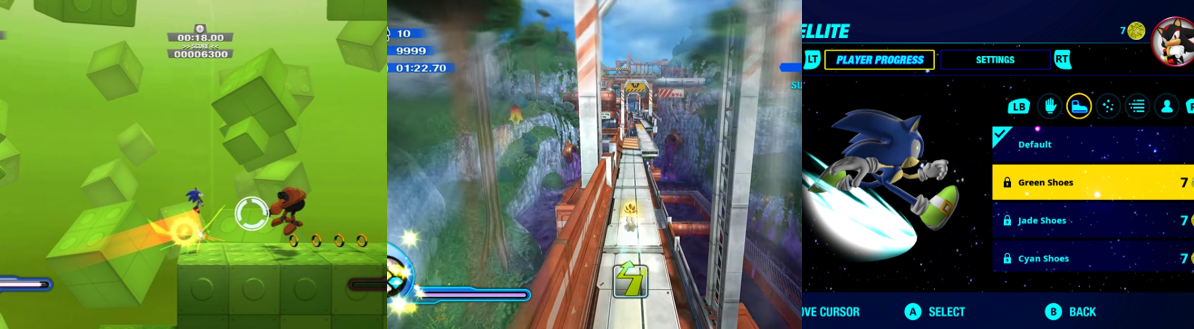
Take on additional challenges, find the Red Star Rings, become Super Sonic, and customise Sonic’s gear!

Five Red Star Rings are hidden in each Act; the game helpfully keeps track of how many you’ve collected and in which order, which makes searching them out a little easier, and collecting them unlocks additional challenges in Game Land. Game Land sees you take control of a recoloured Sonic robot and completing short tasks that basically amount to platforming and gameplay challenges; there are no lives or time limits here, so it’s a good way to kill some time, and you can even play against a friend in this mode. You’ll need all 180 Red Star Rings to unlock every Act in this mode, however, and to collect the seven Chaos Emeralds to play as Super Sonic. You can challenge yourself further by taking on the Egg Shuttle, which forces you to play every single Act of the game on a handful of lives, and you can also collect Park Tokens in each Act or from besting Metal Sonic to purchase skins that change Sonic’s gloves, shoes, aura, boost effect, and your gamer icon. Unfortunately, this is an extremely limited mode and doesn’t allow you to apply other skins to Sonic, but you can acquire components to have him resemble his Hollywood counterpart, so that’s something.

The Summary:
I remember really enjoying Sonic Colours when I first played it on the Wii; sure, I haven’t revisited it since finishing it years ago, but that’s more due to my dislike of the Wii than of the game. When it was announced to be coming to modern consoles at last, I was more than happy to get my hands on it again, bad press and bugs be damned. Personally, I consider Sonic Colours to be one of the most fun entries in Sonic’s modern era for its focus on action and it’s a blast to play in short bursts, with a difficulty curve that’s perfectly manageable until you hit Terminal Velocity (and that’s just because I struggled with timing my quick-steps). I never encountered any graphical or gameplay glitches on my playthrough, and the only negative I had about the presentation was some lag in the menus and the lack of any kind of additional cutscenes when encountering Metal Sonic. As enjoyable as the game is, though, it is a bit of a step back; using world maps and menus in place of hub worlds is a bit of a disappointment and, while the Wisp power-ups are great, it annoys me how prominent they are here and have become since as an excuse to not include a playable Tails or Knuckles. It also can’t be denied that the game is a bit too easy at times; I enjoy how every other Act is basically like a little challenge for you, but it’s laborious having to collect every single Red Star Ring, the lack of skins or in-depth customisation is a missed opportunity, and the recycling of the game’s few bosses is really disappointing. Still, it’s a super fun time for the few hours it’ll take you to blast through it and absolutely gorgeous to look at and listen to; Sonic Colours: Ultimate shows the potential a big, triple-A Sonic game has but could have benefitted from just a few more tweaks and additional modes and such to make the package all the sweeter.

My Rating:

Rating: 3 out of 5.

Pretty Good

What do you think to Sonic Colours: Ultimate? How do you think it compares to the original Wii version and what did you think to the new features included? Did you enjoy the focus on short, action-packed gameplay or did you feel the game was a bit too simplified? What did you think to the Wisps and which of these power-ups was your favourite? Would you have liked to see other characters included to play or race against? Which of the game’s stages or bosses was your favourite and why? Sign up to leave your thoughts on Sonic Colours: Ultimate down below, and be sure to check back in for more Sonic content later in the year!


Game Corner [Sonic Month]: Sonic the Hedgehog (2013; Nintendo 3DS)


Sonic the Hedgehog was first introduced to gamers worldwide on 23 June 1991 and, since then, has become not only SEGA’s most enduring and popular character but also a beloved videogame icon and, in keeping with tradition, I will be dedicating an entire month’s worth of content to SEGA’s supersonic mascot.


GameCorner

Released: 13 June 2013
Originally Released: 25 October 1991
Developer: SEGA
Original Developer: Ancient
Also Available For: GameCube, Game Gear, Master System, Nintendo Wii, PC, PlayStation 2, Xbox

The Background:
I did a deep dive into Sonic’s complex and deliberate history in my review of his incredibly popular debut title for the Mega Drive; however, in October of the same year of Sonic’s 16-bit debut, SEGA also released an 8-bit version of the influential Mario-beater. The Master System version of Sonic was my introduction to the character as it came built-into my Master System II console; originally developed by Ancient specifically for the Game Gear, the Yuzo Koshiiro-lead team were also commissioned to make a version for its bigger brother. Since it was impossible to port the 16-bit game, Ancient started from scratch to craft a similar but fundamentally altered version of its 16-bit counterpart. Reviews were positive and, when the game was subsequently re-released onto the 3DS Virtual Console, it was again positively received and has been considered one of the best titles on SEGA’s 8-bit systems.

The Plot:
South Island is under siege! The maniacal Doctor Eggman (widely known as “Robotnik” during this time) has captured the island’s animals and polluted the landscape in his search for the six legendary Chaos Emeralds and only one super-fast, super-cool hedgehog can stop him!
Gameplay:
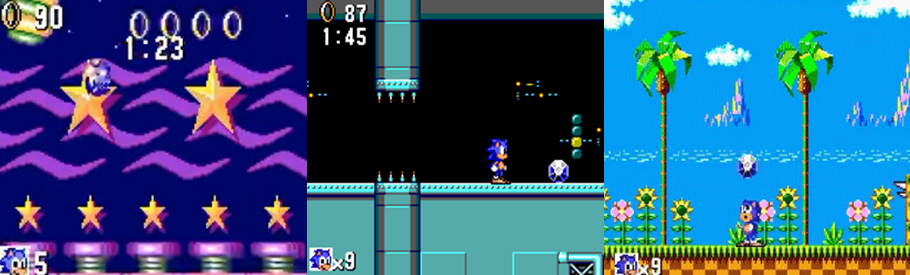
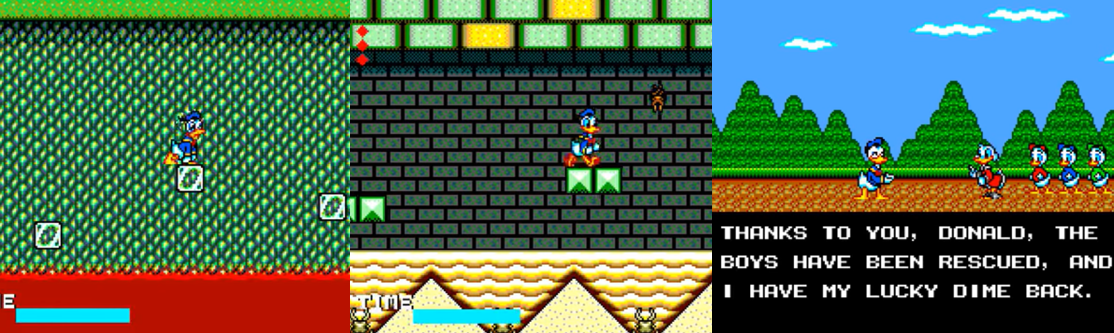
Just like the 16-bit version, Sonic the Hedgehog is a 2D, sidescrolling action/platformer in which players are placed into the red-and-white trainers of the titular blue hedgehog. Sonic is tasked with racing and navigating through six stages (known as “Zones”), with three levels (called “Acts”) each and, in each Zone’s third Act, Sonic will encounter Dr. Eggman and have to battle him to free a bunch of woodland critters from captivity. Sonic’s repertoire is exactly the same as in the game’s 16-bit cousin; moving Sonic in a direction for long enough will see him break from a walk, to a trot, to a super-fast run that turns his legs into a blur of motion. By pressing any button, Sonic will jump and become a ball of whirling blue spikes; this “Super Sonic Spin Attack” is your sole form of attack and can also be performed by pressing down on the directional-pad (D-Pad) while running to smash into Badniks. Pressing up and down on the D-Pad while standing still will allow you to vertically scroll the screen and pressing down when on a steep slope and jumping at the very end will see Sonic fly through the air and travel far across the Act at times. Otherwise, that’s it; there’s no Spin Dash or anything like that.

The game’s much more focused on platforming rather than speed and runs noticeably slower at times.

Consequently, the game remains a much slower experience than the advertising would have you believe. Thanks to the limitations of the 8-bit hardware, this version of Sonic is missing the iconic loop-de-loops that helped Sonic gain speed in the 16-bit version and replaces them (here and there) with the aforementioned ramps and a far more vertically-orientated approach. This means that the game is, at its core, a pure platformer and you’ll be jumping over (many) spiked and bottomless pits, hopping to platforms (moving, stationary, and temporary), and making your way up and across to reach the Goal Sign. While Sonic can still collect Golden Rings to protect himself from harm and death, he is again hampered by the system’s limitations. When hit, Sonic will appear to lose only one Ring but will actually drop all of his Rings and cannot pick them up again, which can easily lead to you getting killed on the very next hit. There are additional limitations on the heads-up display (HUD): if you collect over ninety-nine Rings, you’ll earn an extra life but also reset the Ring counter. Your life display is also capped at nine during gameplay but you can collect extra lives and they do show up on the score tally screen. Speaking of which, yes, you do accumulate points by smashing Badniks and finishing Acts quickly but you only see this score at the end of an Act. You are also still racing against a time limit but the game’s Acts are, for the most part, much shorter than in the 16-bit version so it’s not really much of a factor. Additionally, rather than including Signposts as checkpoints, 8-bit Sonic uses Arrow Monitors, which are worth hunting down if things are getting tough and, even better, your shield will carry across between Acts this time around.

In addition to three new Zones, the game also has its own gimmicks to keep you on your toes.

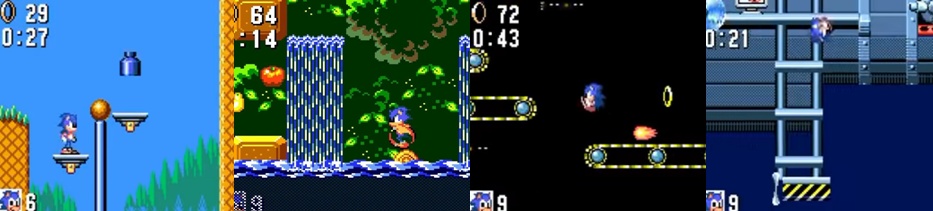
As far as gameplay goes, though, 8-bit Sonic certainly mixes things up in many ways that separate it from 16-bit Sonic. Acts have different mechanics in them, such as warning signs before death pits, weight-based springboards, rapids, rolling logs to run on, and teleporters. It also includes three game-exclusive Zones: Bridge, Jungle, and Sky Base. Bridge focuses on horizontal platforming across an instant-death body of water and has you running across collapsing bridges while Jungle is focused more on vertical platforming. Both Zones include an autoscrolling section in Act 2, with Bridge Zone forcing you to the right and Jungle Zone forcing you up, which can be a pain as once the screen scrolls up to meet you, falling down will result in instant death. You once again have to find your way through Labyrinth Zone, now much more of a chore to play as it’s not only a fittingly maze-like Zone but the game noticeably slows right down whenever Sonic is in water or too much is happening onscreen. Scrap Brain, while similar to the 16-bit game, is also made noticeably different by the presence of a confusing teleporter loop in the second Act that sees you hitting switches to open certain doors, dodging numerous hazards, and going through the right tunnels and teleporters to reach the end. By the time you reach the game’s final Zone, Sky Base, the difficulty noticeably ramps up a bit; Act 1 is alive with hazards thanks to an impressive thunderstorm raging in the background and sending electrical currents running across the screen and the presence of numerous cannons. Act 2 takes place up in the sky with you suspended over a perpetual death pit and forcing you to hop across propeller platforms and dodge even bigger cannons all without the benefit of your precious Rings.

Graphics and Sound:
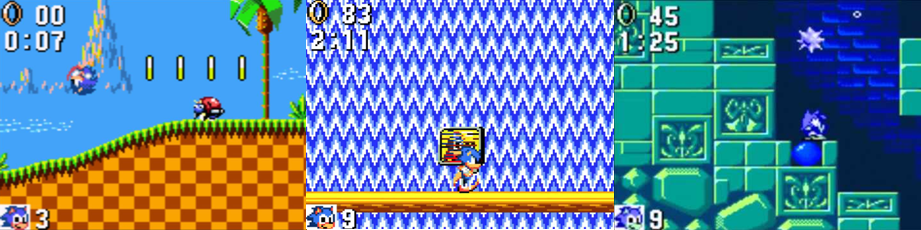
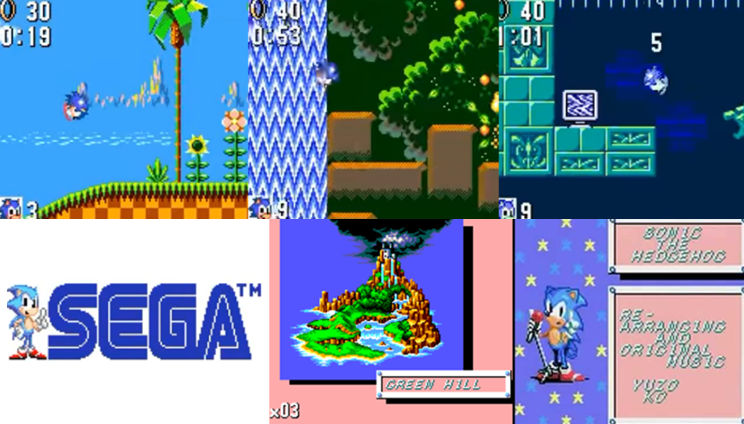
Even now, Sonic the Hedgehog remains one of the most impressive titles on SEGA’s 8-bit systems. Since the 3DS version is a port of the Game Gear version, it’s not quite the same as I remember it. Sonic’s sprite is noticeably different compared to the Master System one and actually resembles Greg Martin’s artwork thanks to his frowning eye. When left idle, he still taps his foot impatiently and pulls off some amusing expressions when killed, skidding, or gobbling air bubbles in Labyrinth Zone, though obviously the game’s zones aren’t going to be as vibrant and detailed as in the 16-bit version. Indeed, you’ll notice right away that the backgrounds are quite sparse and lack the same depth and level of detail as on the Mega Drive but there’s still quite a lot going on in each Zone; flowers blossom and dance in Green Hill Zone, water rushes by beneath Bridge Zone, and waterfalls and vines are all over the place in Jungle Zone.

Zones are certainly shorter and more sparse but the game is surprisingly colourful and lively.

Labyrinth Zone also still has a lot of detail on the foreground elements and you still need to swallow air bubbles to breathe (though the iconic drowning music has been replaced by a simple ticking countdown); while Scrap Brain Zone remains a mechanical Hell, Sky Base is probably the most visually impressive Zone in the game thanks to its dark, foreboding first Act and the impressive scale of the second Act. One of the best additions to the game is the presence of a map before each Act; this shows your progression through South Island, displays the name of the Zone you’re about to play, and even shows Dr. Eggman hovering in to attack you, the level of pollution in the air, and Dr. Eggman’s Sky Base looming overhead. The game even has a much more elaborate introduction before the title screen and the music is even more impressive; again, largely different from the 16-bit version with the exception of the opening jingle and Green Hill Zone, the game is full of jaunty, catchy little chip tunes, with Bridge Zone, the game’s incredible Scrap Brain Zone track, and Sky Base Zone’s tracks being notable standouts for me. When you finish the game, you’ll also be treated to a large, partially-animated sprite of Sonic with a microphone while one of my favourite ending medleys plays over the credits.

Enemies and Bosses:
Even though 8-bit Sonic includes some new Zones, the Badniks remain exactly the same as in the 16-bit version; you’ll still bop on Motobugs, get blasted at by Buzz Bombers, surprised by Newtrons, and nipped at by Chompers. Some Badniks, like Bat Brain and Roller, are missing, however, and you won’t be seeing any fluffy little creatures hopping to freedom when you smash the ‘bots with your Spin Attack. Your main hazards will be the high abundance of spike pits, spike traps, and bottomless pits; spears will also try to skewer you in Labyrinth Zone, flame jets and electrical hazards try to fry you in Scrap Brain Zone, and platforms will constantly collapse beneath your feet.

Dr. Eggman attacks from overheard or underneath but is easy to send packing.

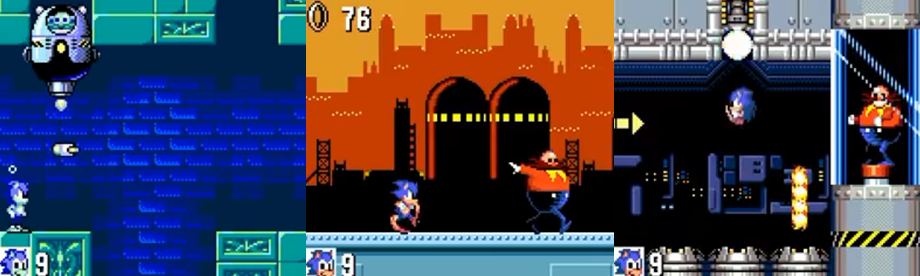
As in the 16-bit version, Sonic will battle Dr. Eggman in Act 3 of each Zone. Unlike in that game, Act 3 contains no Rings, some platforming hazards to navigate through, and a single extra life monitor hidden within it to help you out. Every boss in the game is also completely different from those seen in the Mega Drive version; in Green Hill Zone, Dr. Eggman simply flies overhead a few times (accompanied by a jaunty little boss theme), lowers slowly to the ground, and tries to ram into you but, thanks to the smaller screen size of the Game Gear, it’s pathetically easy to do him in as he flies overheard on the first pass. In Bridge Zone, Dr. Eggman switches to a submersible craft and pops up randomly between bridges to fire three shots at you; this actually differs from the Master System version, which sees you battling Dr. Eggman between two grassy platforms, and can be difficult as it’s very easy to fall through Dr. Eggman on his invincibility frames and lose a life. In Jungle Zone, Dr. Eggman again hovers overheard but this time you’re limited to a curved vine platform and he drops a rolling bomb at you but, just like in Green Hill Zone, it’s way too easy to just mess him up on his first pass.

While he flees from you in Scrap Brain, Dr. Eggman puts up a decent fight in Labyrinth and Sky Base Zone.

Things appear to get more troublesome in Labyrinth Zone; unlike in the 16-bit version, you actually do fight Dr. Eggman here but it’s underwater and in a small arena with a bottomless pit to worry about. While there’s helpfully (if strangely) no danger of you drowning in this battle, you do have to watch out for Dr. Eggman’s rockets and projectiles but, while it can be tricky to jump over the pit thanks to how slow the game runs underwater, this isn’t that much of a chore to get through. In Scrap Brain Zone, you won’t actually fight Dr. Eggman; instead, you have to solve a tricky puzzle and then chase him to his teleporter and you’ll go one-on-one with him in the next Zone in a battle far more grandiose than on the Mega Drive. In Sky Base Act 3, Dr. Eggman hides within a glass tube and hops on a switch, which sends jets of flame randomly up from the floor or a ball of death to fly at you. Thankfully, it’s pretty simple to hop over both of these and bash into him. After he flees, a short cutscene pays that shows Sonic delivering the final blow via teleporter, defeating Dr. Eggman at last.

Power-Ups and Bonuses:
Sonic the Hedgehog includes all of the same power-ups as its Mega Drive cousin. You’ll find a number of monitors scattered throughout each Zone that will award you with ten extra Rings, a protective shield, or mark your progress so you can respawn later in the Zone if you die. Interestingly, the game features far more extra life monitors than it does speed-up shoes or invincibility monitors; indeed, I only encountered maybe two of these in my playthrough, to the point where I thought they weren’t even in the game.

Additional Features:
The 3DS version of 8-bit Sonic is one of the best ways to play the game thanks to not only being a portable title like the original Game Gear version, but also the inclusion of save states. While you can only create one save slot, this does make it dramatically easier to keep track of your progress and help you hunt down the game’s six Chaos Emeralds.

Bounce around Special Stages all you want but you need to hunt through Zones for Chaos Emeralds.

One of the things I always loved about 8-bit Sonic was its approach to Chaos Emeralds; if you finish an Act with fifty Rings or more, you’ll get to play a Special Stage. In this game, these are timed bonus stages full of bumpers and springs (basically functioning as the game’s version of Spring Yard Zone) and Rings. Here, you can bounce all over the place to stock up on lives or break Continue Monitors to gain an extra continue but you won’t find Chaos Emeralds in these stages. Instead, Chaos Emeralds are hidden within the game’s Zones. Finding them is sometimes pretty simple, such as just taking a certain path while underground in Green Hill or running on a log at the bottom of Jungle Zone, but can also be sneakily hidden behind death traps. To reach the Emerald in Bridge Zone, for example, you have to jump from a falling section of a bridge before you fall to your death and Scrap Brain’s Chaos Emerald is reached by falling down a specific pit that looks just like any other bottomless pit. Nabbing them all rewards you with a hefty score bonus and the game’s true ending, which sees South Island freed of Dr. Eggman’s influence.

The Summary:
Even though I grew up playing the Master System version of this game, which is graphically slightly superior, I still have an immense amount of nostalgia and fondness for the 8-bit version of Sonic the Hedgehog. The game is bright, fun, and endlessly charming and packs quite a lot in for an 8-bit title; one of the things I still really enjoy about it is that it’s not just a scaled down version of the 16-bit game. Instead, 8-bit Sonic features new Zones, new gimmicks, and changes up the way the game is played; having you hunt for Chaos Emeralds in the game’s Acts is a great way to tie into the game’s larger focus on platforming and exploration and I always kind of saw this and the 16-bit version as two parts of a greater whole that complimented each other beautifully. Colourful and featuring some extremely catchy tunes, 8-bit Sonic is both easier and slightly harder than its more popular counterpart; there are some glitches here and there (Sonic’s collision detection is a bit wonky and I found myself bounced into oblivion in the Special Stages more than once), there seems to be far more unfair death pits and traps, and the game runs much slower, especially when there’s a lot happening onscreen. Still, these issues are minor and, in many ways (again, most likely because of nostalgia) I actually prefer this game to the 16-bit version but, in my wholly biased opinion, it’s definitely at least on par with Sonic’s bigger, better Mega Drive outing.

My Rating:

Rating: 3 out of 5.

Pretty Good

What did you think about Sonic’s 8-bit debut? How do you think it compares to the 16-bit version and Sonic’s other 8-bit outings? Did your Master System come with Sonic built-in or did you buy it separately? What did you think to the Chaos Emeralds being hidden in the game’s Zones rather than in Special Stages? Did you own the original Game Gear version and what did you think to this 3DS port? How are you celebrating Sonic’s birthday this year? Whatever you think, feel free to share your thoughts and memories regarding Sonic below or on my social media.

Game Corner [Sonic Month]: Sonic Unleashed (Xbox 360)


Sonic the Hedgehog was first introduced to gamers worldwide on 23 June 1991 and, since then, has become not only SEGA’s most enduring and popular character but also a beloved videogame icon and, in keeping with tradition, I will be dedicating an entire month’s worth of content to SEGA’s supersonic mascot.


GameCorner

Released: 18 November 2008
Developer: Sonic Team
Also Available For: Mobile, Nintendo Wii, PlayStation 2, PlayStation 3, PlayStation 4 and PlayStation 5 (via PlayStation Network/Now), Xbox Series S/X, Xbox One (Backwards Compatible)

The Background:
These days, people would have you to believe that Sonic the Hedgehog (ibid, 2006) is an under-rated classic and worthy of your time and attention. Don’t listen to them. Play it if you must but make no mistake about it, take it from a life-long Sonic fan: Sonic ’06 is an absolutely dreadful experience. Great cutscenes and music, yes, but the gameplay (the core of any videogame) is diabolically bad and there’s a reason that the game was not only received terribly and is almost universally seen as one of the lowest points in the franchise…it’s because it’s a travesty of a videogame. Following that game’s dismal release and reception, Sonic Team scrambled to make good on their next mainline Sonic title, which started out as a semi-continuation of the Sonic Adventure games (ibid/Sonic Team USA, 1999 to 2002) but soon took on a life of its own and began the annoying trend of having Sonic be the only playable character. Sonic Unleashed saw the development of many new lighting, graphical, and gameplay mechanics for the series, chief amongst them the “Hedgehog Engine”, which allowed Sonic to boost ahead at breakneck speeds without losing graphical fidelity, while also incorporating 2.5D  perspectives to hearken back to the series’ roots. The game was somewhat controversial for also including brawling combat in the form of the “Werehog” in stages that were criticised for their length and tedium. Regardless, Sonic Unleashed was just the shot in the arm the franchise desperately needed after Sonic ’06; the game was a commercial success and critics lauded the speed and exhilaration offered by Sonic’s gameplay.

The Plot:
Sonic fails to thwart Doctor Eggman’s latest scheme and the mad scientist fires a giant laser cannon at the planet, blasting chunks of the surface to the atmosphere and awakening the ancient beast “Dark Gaia”. Though outpouring of evil energy causes Sonic to transform into the animalistic Werehog at night, he resolves to travel across the world, accompanied by an amnesic sprite nicknamed Chip and his old friends Miles “Tails” Prower and Amy Rose, to restore the power of the seven legendary Chaos Emeralds and undo the damage caused to the planet.

Gameplay:
Sonic Unleashed is a 3D action/platformer that switches to both a 2.5D perspective and a third-person brawler during your progression through the main story. Very similar to Sonic Adventure (Sonic Team, 1998), Sonic navigates a variety of hub worlds across the globe, talking with non-playable characters (NPCs) and performing a number of challenges and side quests in his quest to activate the seven Gaia temples (and the Chaos Emeralds) to restore the splintered planet.

Sonic boosts, grinds, and blasts his way through stages at breakneck speeds!

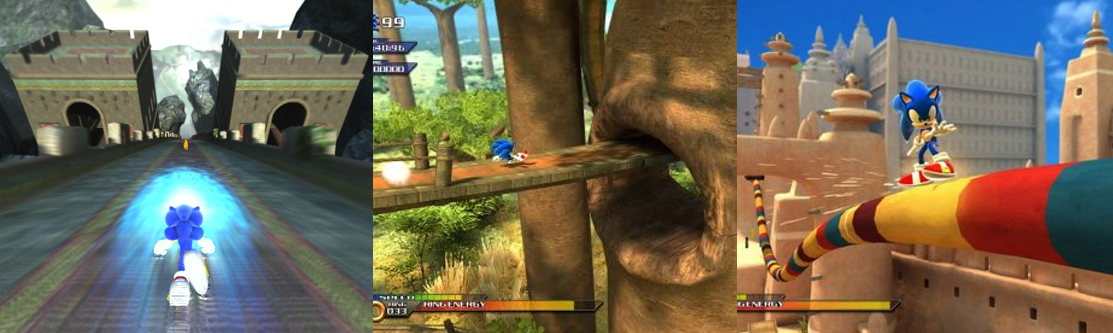
Players are put into the high-speed shoes of Sonic the Hedgehog; Sonic can jump with A (which you can tap for a hop and hold for a higher jump) and attack enemies either with his regular jump or by pressing X when in the air to perform his patented Homing Attack. An aiming reticule directs you towards the nearest target and you can chain together successive Homing Attacks to hit springs or cross gaps over bottomless pits to progress. Sonic can also crawl and slide (and perform a sweep kick) with a press of the B button; this doesn’t come up often but it’s essential for getting you through small spaces when running at high speeds. This is the big gameplay mechanic for Sonic in Sonic Unleashed. Similar to the God-awful “Mach Speed” sections of Sonic ’06, pressing and holding X while running will send Sonic boosting ahead at breakneck speeds. When boosting, you can charge right through enemies without fear and will also suck up any nearby Golden Rings, which are essential for maintaining your boost as they power the mechanic. While this can cause you to fly right off the edge of stages later in the game and can cause the game to spaz out on occasion when Sonic’s speed increases, you can perform quick-steps with the Left and Right Bumper to dart through narrow alleyways and such, and perform quick turns to stay on course on tight curves. Overall, the boost mechanic is exhilarating fun and it’s brilliant to fly through stages at full speed, crashing through enemies and bouncing and grinding your way towards the Goal Ring.

Fight, swing, and platform your way through slower, trickier stages as the Werehog.

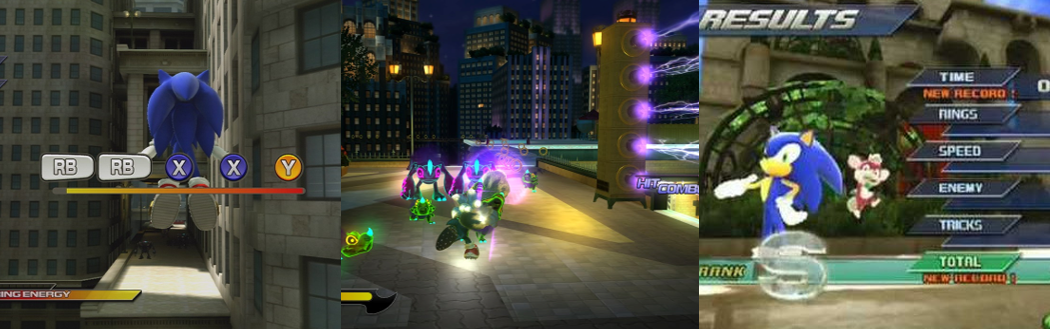
Of course, you can also play as the much slower “Werehog” in the game’s night-time stages; Sonic Unleashed has a rudimentary day and night mechanic where, by attacking hourglasses in the hub worlds, passing time on the main map screen, or as dictated by the story, day will turn to night, transforming Sonic into this monstrous little brawler. Clearly taking inspirations from popular hack-and-slash titles, Sonic Team made the Werehog distinct by having him attack with his elongated limbs and perform grapples to take down his opponents. While the controls remain mostly the same, there are some differences: you can now perform a double jump with A and the X and Y buttons allow you to pull off different strikes and combos. Holding the Right Trigger allows you to dash on all fours (and can extend your jump) while LB puts up one of a limited number of shields to protect you from attacks. Pressing B lets you grab onto objects and ledges to save yourself from falls, grab objects to throw at enemies, or grapple enemies to pull of quick-time events (QTEs) to deliver massive damage. As the Werehog attacks enemies or smashes barrels and such, you’ll build up your “Unleash Meter”. Once it’s full, or hits the minimum marker, you can press RB to “unleash” the Werehog’s true power, which will dramatically enhance his strikes and speed to help you clear out groups of enemies or larger foes. The Werehog’s stages are far longer than Sonic’s and also involve a bit of puzzle solving (usually mashing B to pull switches or open doors or bringing gems to special alters to progress further) and some very tricky platforming. This involves a combination of jumping to and from platforms, grabbing to poles, and balancing on narrow beams, all of which can be extremely difficult as the game’s camera often makes it hard to judge the distance between your targets, button inputs can be a bit slow and clunky, and a lot of the platforms you’ll be grabbing and jumping to will either be moving, collapsing, slippery, or damaging in some way, which can lead to a lot of annoying deaths.

Perform QTE tricks and defeat enemies with style to get EXP and a sweet S rank.

As is the standard for Sonic titles, Sonic is protected from damage by Golden Rings. This time around, when Sonic is hurt, he won’t lose all of his Rings and, when playing as the Werehog, you have a more traditional health bar that is replenish by the Rings. Collecting one-hundred Rings awards you with an extra life, which you will also find scattered here and there around stages (usually right before a dangerous area), and you pass through checkpoints to allow you to continue from later in the stage should you die. Deaths can be quite frequent as Sonic gets a bit slippery at times and it’s pretty easy to blast off out of bounds or over the edge and to your death, and you can also fall to your death in hub worlds! When you complete a stage, though, you’ll be given a grade based on how fast you finished and how any tricks you performed as Sonic (by jumping through special hoops and performing QTEs), among other things. This, and defeating enemies, will provide you with experience points (EXP) that you can use to power-up Sonic’s base speed and Ring Energy, and the Werehog’s strength, Unleash Meter, maximum life, and learn new combos and attacks.

There are many hub worlds and Medals to collect but I could’ve done with more Tornado sections.

Out in the hub world, you can spend your Rings on food and other items and must perform a few tasks to open up stages. The main way you’ll access new areas, though, is by finding Sun and Moon Medals. I’ve heard many complain that this slows the game down as you have to replay stages or hunt around to find them just to progress but, honestly, I have never experienced this problem. There is a bit of backtracking and replaying of earlier stages required, though, as you sometimes need to farm for extra lives and need to hop from one location to another, playing stages out of order in order to access the next boss or area as part of the story. Gameplay is given a bit more variety when you acquire a camera that you can use to battle Gaia Beasts that have possessed NPCs and through the inclusion of auto-scrolling shooting sections in which Sonic mans the armaments of the Tornado while Tails flies him towards their next destination. Unlike in Sonic Adventure, this involves pressing the right buttons when they flash up on screen and alternate between mashing LB and RB to refill your power meter if you press the wrong button or are hit. Also, these sections only appear twice in the game, which is a shame as they’re quite fun, though you can replay them (and any other stage of boss) from the main world menu.

Graphics and Sound:
Even now, Sonic Unleashed looks absolutely fantastic; the game has a crisp, colourful presentation and everything really pops when onscreen, especially compared to how drab and muted Sonic ’06 was. Sonic looks fun and full of energy and has a number of idle animations in both his base and Werehog form; Sonic is also constantly accompanied by Chip, who acts as an annoying guide, and is voiced by Jason Griffith who was always my least favourite voice actor for the character. The rest of the Sonic X (2003 to 2004; 2005 to 2006) voice cast are fine, with Mike Pollock absolutely nailing Dr. Eggman, but I always found Jason to be so lifeless and boring as Sonic, though the game does stand out by briefly having Sonic’s usual confidence shaken by his monstrous appearance. Graphically, though, the game is gorgeous; Sonic, the Werehog, Tails, and Amy all look vibrant and full of life and fit perfectly with the game’s Pixar-like aesthetic for the NPCs. Rather than have the NPCs be realistic-looking humans like in Sonic Adventure, Sonic Unleashed’s are exaggerated, cartoony characters with large eyes, noses, and larger-than-life properties that help them to be visually interesting even when they mainly just wander around in short animation cycles, stand in one place, or communicate using text boxes and gibberish. The most prominent human NPC is the kindly Professor Pickle, who offers advice and exposition regarding Dark Gaia and has a penchant for cucumber sandwiches and souvenirs.

Stages are gorgeous and varied and full of unique elements, gimmicks, and jaunty music.

The game’s hub worlds and stages are all based on different societies and cultures of the real world. Apotos is based on Greece, Spagonia on Italy, Mazuri on Africa, Holosoka on Antarctica, Chun-Nan on China, Shamar on Egypt, Empire City on New York City, and Adabat seems to be based on the likes of Hawaii. This means that every area feels distinctive and unique, mainly thanks to having different seasons, hub worlds of various sizes that all look and feel different, and are populated by different NPCs. This translates into the playable stages as well as you’ll blast through the air, grind on rails, and plough through alleyways, race up winding paths, and fall through the sky in a variety of colourful and action-packed environments. When playing as Sonic, you’ll naturally often blast past your environment without really noticing little details here and there but, when the game switches to its 2.5D view or you tackle the Werehog stages, these subtleties are brought to life wonderfully. This means you can see markets, animals, and entire cities in the background, discover alternative paths by jumping through boost rings or hopping up walls and rails, and run up and along pathways at breakneck speeds while dodging axes, laser traps, and blasting through enemies. Stages become increasingly bigger and more complex as the game progresses, with you hopping from collapsing ice floats and using a killer whale and a bobsleigh to progress in Cool Edge, grabbing onto rockets and hopping to spinning platforms in Dragon Road, and running across water and through ruins making tight, dangerous turns in Jungle Joyride.

The game’s high-quality cutscenes are incredible and the best in the series at that point.

As beautiful and detailed as the game’s stages are, though, Sonic Unleashed goes above and beyond with its high-quality cinematics. While these are a notable highlight of Sonic ’06, even the cutscenes that use the in-game graphics are a joy to watch here as Sonic and Chip bond and overcome numerous obstacles on their journey. When the cinematics kick in, Sonic and his world are rendered magnificently and it honestly baffles me that Sonic Team never used this style of animation to produce a CGI feature film. These sequences, and the graphics in general, are only bolstered by the game’s jaunty, uplifting, and varied soundtrack; the game’s main theme, “Endless Possibility” by Bowling For Soup’s Jaret Reddick, is a catchy little punk-rock piece that captures the high-spirited adventure aspects of the game while the ominous Gaia themes help sell the threat and menace of the monstrous Dark Gaia. Even better is the fact that the day-time Savannah Citadel stage uses a remix of the ending credits theme from the 8-bit Sonic the Hedgehog (Ancient, 1991), which was especially pleasing to me since I am a big fan of that game and it was the first Sonic title I ever played.

Enemies and Bosses:
As you blast through Sonic’s stages at full speed, you come across a number of Dr. Eggman’s robots; mainly comprised of Egg Fighters, these robots will throw slow punches or swing swords at you and defend themselves with shields. Later, they’ll bounce you back with springs, blast at you with laser bolts or homing missiles, and attack with electrified swords but, for the most part, they’re largely disposable pawns that you can bash through with your Homing Attack or boost. You’ll also use the small robots (who sometimes blast at you or defend themselves with electrical shields) to get across gaps and have to watch out for spikes, Eggman-branded springs that often push you into spikes, crushing platforms, and other environmental hazards that can mess up your run. Although Sonic also has to fight Dark Gaia’s minions, you’ll mainly battle against these as the Werehog. Gaia’s creatures take a variety of forms, from small, annoying little critters to the larger, more commonplace “Nightmare” variants. These guys will attack as a group with their own punches and combos and even defend themselves from your attacks by putting their guard up. You’ll also have to contend with Dark Masters, wizard-like enemies who can fire elemental blasts at you or replenish the health of other Gaia creatures, and the ever-annoying Killer Bees, who always seem to hover just out of reach and dive at you with their stingers. The Werehog also has to battle the much larger Big Mothers and Titans, often while dealing with many other enemies at the same time; the Big Mother will endlessly spawn smaller Gaia creatures and its rotund belly allows it to absorb a great deal of punishment.

Sadly, as fun as they are, the boss battles against Dr. Eggman are all very similar.

The Titans are much worse, attacking with giant clubs and causing shockwaves to cover the immediate area, they can blast you into a stun (which you must desperately mash A to get out of) or even off rooftops and to your death with a ridiculous amount of ease. For both enemies, I recommend expending your Unleash Meter and using the Werehog’s QTE combos/grapples to take them down quickly. Just as there are two distinct playstyles in Sonic Unleashed, there are also two types of boss battles; those against Dr. Eggman and his latest contraption and those against Dark Gaia’s gigantic guardians. The battles against Dr. Eggman, however, are largely similar in each instance; when you battle the Egg Beetle, Egg Devil Ray, and Egg Lancer, you’ll be continuously running around an endlessly-looping track, collecting Rings to boost towards Dr. Eggman and ram into his cockpit. Each machine sports a variety of lasers, missiles, and bombs and tries to fry and bombard you with its armaments and you’ll have to use the quick-step and the advantages of the 2.5D sections to dodge these hazards. The battles do get more difficult as they, and the game, progresses, though; I recommend avoiding using the Homing Attack when running across walls or ceilings as you can sometimes drop to your death and you’ll also have to complete a QTE when hopping from wall-to-wall to land hits on the Egg Lancer. Dr. Eggman also erects protective shields and drops flaming hazards into the arena and also challenges you in the Tornado sections in the Egg Cauldron, though here it’s simply a case of hitting the right buttons to destroy his missiles and damage his weak spot. The Werehog’s boss battles are much more varied and interesting by comparison. When battling the Dark Gaia Phoenix, you need to throw barrels of water at it to douse its flames while avoid its flaming shockwaves and feather barrage. The Dark Moray is protected by a shield that can only be lowered by attacking the eel heads around the base of the arena, then you have to freeze the beast (while also avoiding being frozen yourself) to attack its glowing weak spot.

After conquering the gruelling Eggmanland, you’ll battle Dr. Eggman’s most dangerous machine yet!

The Dark Guardian is similar to a Titan, but a bit smaller, and must be stunned long enough for you to push blocks over to a switch to weaken it. In all three cases, the bosses become tougher and increase the rate of their attacks as the fight progresses and you’ll be tasked with performing a series of QTEs in order to deal massive damage and put them down. Thus, the length and difficulty of these fights depends greatly on how good you are at QTEs as, if you fail, you’ll have to go through all the motions to get to that point again, which can be annoying. Speaking of annoying, while the game is generally a lot of fun with only a few frustrating moments, Sonic Unleashed really kicks you in the balls when it presents you with its final stage, Eggmanland. A giant amusement park literally filled with traps, hazards, bottomless pits, and every kind of enemy and obstacle you’ve encountered so far, this stage is a true test of anyone’s mettle as you’re forced to switch between Sonic and the Werehog and take on a series of incredibly challenging platforming and combat tasks in order to progress. Easily the longest and most difficult stage in the game (or any Sonic game for that matter), Eggmanland can take up to an hour to get through and will have you tearing your hair out at its finicky platforming and frustrating sections. Once you finally get through his chore of a stage, though, you’ll have to battle Dr. Eggman one last time in his most interesting and dangerous contraption yet, the Egg Dragoon. You battle this as the Werehog and run around a small platform in freefall while avoiding Dr. Eggman’s shots and taking out his robots to attack the glowing green core on the machine’s tail. Once you do enough damage, you have to pull off another QTE sequence and then the fight moves to the next stage, which involves more aggressive attacks from Dr. Eggman and less windows of opportunity to strike. Still, it doesn’t seem as though you can fall off the platform you’re on and your attacks still do damage even when Dr. Eggman is guarding himself so just keep pressing your attack and make sure you don’t fail the QTEs and this boss is nowhere near as intimidating as it first appears.

Plot the unwieldy Gaia Colossus then battle the tricky controls and camera to finish Dark Gaia.

Although Dr. Eggman is defeated, Dark Gaia rises from the planet’s core so Chip, finally remembering his true purposes as Light Gaia, causes all of the Gaia Temples to come together as the titanic Gaia Colossus and engage with his dark counterpart one-on-one. To do this, you need to hold X to boost the slow, clunky ass of the Dark Colossus towards the beast, guarding against or desperately trying to punch the flaming boulders it sends your way. When Dark Gaia charges up its big energy beam, try to move out of the way but for God’s sake put your guard up as it can instantly drain all of your health otherwise! Once you get close enough, you’ll have to perform another QTE and then you’ll switch to Sonic and be given a few seconds to race past Dark Gaia’s deadly tentacles and energy blasts and bash it in the eye (again, after completing a QTE). This must then be repeated twice more, with Dark Gaia’s attacks and ferocity growing each time; thankfully, your health is restored for each phase of the battle and you don’t have to restart right from the beginning if you die but this is still one of the more frustrating parts of the game. Dark Gaia isn’t so easily defeated, though, and mutates into the gruesome Perfect Dark Gaia. Of course, Sonic uses the Chaos Emeralds to transform into Super Sonic for the final battle of the game. Unlike other Super Sonic levels, you don’t have to worry about a time limit as your Rings aren’t depleted over time. Instead, you must fly/boost towards Perfect Dark Gaia, who has encased itself in an impenetrable shield, collecting Rings to fill up your health bar and dodging asteroids. While the Gaia Colossus distracts the creature, Super Sonic must fly around the shield avoiding obstacles, flaming meteors, and that same massive energy beam to attack the snake-lake tentacles that poke out sporadically through the barrier. This is easier said than done, though, as it’s really hard to see where you’re going or target the heads (there’s no aiming reticule this time); there are also no extra Rings to get and it’s ridiculously easy to get hit by Perfect Dark Gaia’s attacks or ram into an asteroid and deplete your health bar. Once you do finally destroy all of the heads, you’ll of course have to complete one last massive QTE sequence but, as long as you hit the right buttons and mash them into oblivion, you’ll finally destroy the beast and return the planet to normal.

Power-Ups and Bonuses:
Unlike many Sonic videogames, there aren’t actually that many in-game power-ups on offer in Sonic Unleashed. Gone are the speed-up shoes, invincibility, and protective bubbles, replaced by simple Golden Rings and a few extra lives floating about the place. The Werehog is able to pick up power-ups that will instantly fill his health and/or Unleash Meter, power-up his attacks, increase his shield count, or bath him in a protective aura, though, which makes it worth your while to smash crates and doors in search of them. In addition to increasing Sonic and the Werehog’s abilities with EXP, Sonic can also purchase a variety of foods that, when he eats them, will award him additional EXP (they can also be fed to Chip to increase his bond with Sonic, though this has no impact on the actual gameplay). Furthermore, like in Sonic Adventure, you can acquire additional abilities by finding special shoes in the hub worlds; the Stomping Shoes allow Sonic to perform a stomp to bash downwards through glass and blocks and onto enemies with a press of B in the air, the Light Speed Shoes let you dash along rows of Rings, the Wall Jump Shoes allow you to jump vertically up walls to reach new areas, and the Air Boost Shoes let you blast through the air by pressing X while jumping in order to cover large distances quickly.

Additional Features:
There are fifty Achievements to earn in Sonic Unleashed; six of these are awarded simply by playing through the story and restoring the planet to normal but you’ll naturally also earn others through regular gameplay as you get Achievements for increasing Sonic and the Werehog’s abilities and finishing stages with an S ranking. Sadly, considering the vast potential for fun and quirky Achievements, most of Sonic Unleashed’s are quite by-the-numbers; finish a Tornado section without missing a shot, talk to every NPC all over the world, collect half of (and every) the Sun and Moon Medals, and use the different shoes and you’ll snag some G but by far the most challenging Achievement sees you having to complete the various “Hot Dog” challenges in each area. The various Hog Dog Vendors will let you take on a series of challenges for the cost of a few Rings; these have you collecting a certain number of Rings, defeating a certain number of enemies, or finishing stages in a certain time limit but these aren’t like challenges in some Sonic games as you still have to finish the entire stage even once you complete the objective, By far the most difficult of these tasks you with completing Eggmanland in just forty-five minutes, which is all-but-impossible given that you’re guaranteed to die at least once during this stage and dying in these challenges means having to restart from the beginning. In the hub worlds, and scattered throughout the stages, you’ll find CDs, books, and videotapes that allow you to view the game’s cutscenes, artwork, characters, and listen to music in Professor Pickle’s laboratory. To do this, though, you’ll need to buy certain furniture from the game’s various shops, where you can also purchase some of these items and souvenirs to gift to the Professor. Other NPCs will give you side quests, such as finding lost children or clearing out enemies, or even challenge you with answering quizzes to help mix things up a bit. Finally, you can take on perilous obstacle course-like additional stages in each area and these can be expanded upon with some downloadable content that truly test your speed and reaction times.

The Summary:
Sonic Unleashed was exactly the breath of fresh, exhilarating air the franchise needed at the time; after Sonic ’06 proved to be such a broken, glitchy, disappointing mess of a game, it’s no exaggeration to say that even I had started to lose faith in Sonic Team. Thanks to the Hedgehog Engine, which allowed for crisp, vibrant visuals and high-speed action to be the order of the day, Sonic Unleashed was an incredibly fun and exciting gameplay experience that was an absolute blast to play through again. At the time, Sonic had never looked or played better and the game’s many varied locations and fantastic music and graphics really went a long way toward making up for the awfulness of Sonic ’06. And then there’s the Werehog stages. Truthfully, I didn’t really mind these all that much; yes, they could get overly long and annoying and very repetitive but they did help to break up the gameplay a bit. I think if maybe they had been a bit shorter (and fairer), and if Sonic Team had scrapped the Sun and Moon medals, these stages might have been received a bit better (or if the Werehog had been scrapped completely and replaced with, say, Knuckles the Echidna!) If there’s one area that truly lets the game down, though, it’s the entire finale. Eggmanland is an absolute ball-breaker to get through and is less a test of the skills you’ve built up throughout the game and more a test of your sanity and patience. Similarly, while I enjoyed the Egg Dragoon fight and playing as Super Sonic, the final battles against Dark Gaia and its perfect form were a clunky, frustrating end to an otherwise solid gaming experience. Thankfully, once you clear the game, you never have to endure these sections again unless you’re a sadist and can focus on replaying the games other, more entertaining sections instead.

My Rating:

Rating: 4 out of 5.

Great Stuff

Are you a fan of Sonic Unleashed? Did you enjoy the boost-based mechanics introduced in the game or did you feel they made it too simple? What did you think to the Werehog and its gameplay sections and would you have preferred to see Knuckles used instead? What did you think to the story and Dark Gaia as the main antagonist? Which of the game’s stages or bosses was your favourite and why? Whatever your thoughts on Sonic Unleashed, sign up leave a comment below and be sure to check back in for more Sonic content.

Game Corner [Sonic Month]: Sonic Boom: Fire & Ice (Nintendo 3DS)


Sonic the Hedgehog was first introduced to gamers worldwide on 23 June 1991 and, since then, has become not only SEGA’s most enduring and popular character but also a beloved videogame icon and, in keeping with tradition, I will be dedicating an entire month’s worth of content to SEGA’s supersonic mascot.


GameCorner

Released: 27 September 2016
Developer: Sanzaru Games

The Background:
As I mentioned in my review of Sonic Boom: Shattered Crystal (ibid, 2014), Sonic is no stranger to reinvention and adaptation; even before the release of Sonic the Hedgehog (Sonic Team, 1991), Sonic’s appearance and backstory were notably different from the Japanese designs and long-term Sonic fans saw the character interpreted as a slapstick Freedom Fighter, a rock star prince, and an angst-ridden superhero across numerous cartoons and comic books, to say nothing of the anime-inspired makeover he received in Sonic Adventure (ibid, 1998). Yet one of the more controversial redesigns for the character (aside from the initial design for the live-action movie) came when SEGA commissioned the production of a computer-animated series, Sonic Boom (2014 to 2017). For me, these new designs actually made a lot of sense (aside from the sports tape) and I think SEGA should have started over with a complete franchise reboot with these designs. Unfortunately, concerns over this new direction and the negative reception of the Wii U spin-off title significantly soured the impact of this new series. Although not nearly as derided as its Wii U counterpart, Shattered Crystal still considered to be a disappointment so the announcement of a sequel came as something of a surprise for me. Even more surprising to many was the fact that the developers’ claims to have learned from their mistakes actually paid off, resulting in Fire & Ice receiving a far more positive reception from critics and fans alike.

The Plot:
After discovering an element known as “Ragnium”, Doctor Eggman harnesses its powers to create robots fast enough to outrun Sonic and his friends and pollute the environment to his liking. With the planet suffering from a series of earthquakes, and opposed by Eggman’s newest creation, D-Fekt, Sonic and his friends race to put an end to Eggman’s schemes using their newly-acquired powers of fire and ice.

Gameplay:
Like its predecessor, Sonic Boom: Fire & Ice is a 2.5D action/adventure platformer that involves a fair amount of exploration and character switching. Interestingly, though, there is nowhere near as much of this as in the previous game; because the map (helpfully displayed on the lower screen) shows the entirety of every stage, exploration is easier than ever and, since Sonic Tokens are no longer a thing and the game simply unlocks automatically as you clear each stage, there’s far less emphasis on backtracking and replaying previous stages. You’ll have to do it if you’re going for 100% completion but, this time around, the rewards for this are tied to additional gameplay options rather than story progression so you’re free to blast through stages as just Sonic if you want.

All the characters return with a handful of new abilities and a new playable character in the form of Amy Rose.

Just like in the last game, you can only play as Sonic at the start but you’ll unlock the other playable characters (Miles “Tails” Prower, Sticks the Badger, Knuckles the Echidna, and Amy Rose) as you complete stages and advance through the story. Once again, you can switch between each character on the fly using either the directional pad or the touch screen, and all of their basic abilities carry over from the last game (they can all jump, use the Homing Attack, sprint along, and swing around using the “Enerbeam”). Their unique character abilities also remain intact but with a few added extras: when performing Knuckles’ dig move or Sticks’ boomerang throw, you no longer have to worry about a meter running down so you’re free to use them as much as you like and Tails’ Sea Fox sections have been moved to a dedicated spot on the overworld map.

Switch between fire and ice to create and destroy platforms and progress through stages.

Otherwise, things are very much the same but slightly tweaked: Sonic can still perform the Spin Dash and air boost and Tails can still hover along air currents but he now fires a reflecting laser rather than tossing bombs and Knuckles can also now perform a flying punch attack. The addition of Amy to the playable roster adds her patented Piko-Piko Hammer to your arsenal, which is primarily used to lower or move platforms and blocks with a tap of the X button. New to the game, though, are the random powers of fire and ice each character possesses; with a press of either L or R, you’ll switch between a fire and ice aura, each of which allows you to traverse stages in different ways. Switching to ice, for example, allows you to run across bodies of water by turning them into temporary ice blocks and using fire allows you to melt through ice; Tails’ laser can also be powered up with these elemental powers to reflect off surfaces and clear obstacles and, as the game progresses, you’ll be tasked with quickly switching between ice and fire to complete stages. As always, Golden Rings will protect you from damage and the continued absence of a traditional life system means that you’ll simply lose Rings if you fall down bottomless pits or enter water. As long as you passed by a checkpoint, you’ll respawn in the stage you were in if you fall or get hit without any Rings, once again meaning that the game is far easier than most traditional Sonic titles.

Challenge Rooms and Dragon Rings add a bit of variety to the stages and award you with collectibles.

Sadly, while much of the game is improved (or, at least, streamlined) over its predecessor, the controls are still a bit unintuitive (at least for me) since the developers made sure to use every single button available on the 3DS this time around. Thankfully, though, stages are no longer locked out by Sonic Tokens; instead, the overworld map (which is now much bigger than before and features more stages per island than the last game) opens up as you complete each stage. You can even fast travel to a specific stage and island from the main overworld screen, which is very helpful, but this fast travel screen doesn’t tell you anything other than the stage names so you’ll need to know where you missed any collectibles when using it. When playing stages, you no longer have to worry about being slingshot all over the place by Enerbeam points; instead, traditional springs and grinding rails are the order of the day, making the game far more linear. While this is great for blasting through it, it does mean you’ll have to replay each stage from the start if you missed any of the collectibles rather than being able to backtrack within the stage as before. Again, the average game speed is quite slow, meaning you have to hold Y to sprint ahead and control is frequently taken out of your hands by loops, speed boosts, and auto-running sections. Every stage also includes a “Challenge Room” that is hidden a little bit out of the way; enter it and you’ll be tasked with completing a short obstacle course of sorts and navigating through a few hazards to grab a Trading Card. Also, you’ll find “Dragon Rings” in each stage; grab one and ten more will spawn along a path for you to collect within a time limit to earn a piece of Ragnium.

Alongside returning Sea Fox and racing sections, the new hovercraft and tunnel races add some variety.

Trading Cards and Ragnium are essential if you’re going for 100% completion as they can be used to unlock courses and Bot Racers on Thunder Island. This new gameplay element is presented alongside the aforementioned returning Sea Fox sections; now found on the main overworld map, they are much bigger and have more hazards and requirements than before but the controls remain the same (tap the screen to activate the sonar and see hazards and collectibles and fire missiles with X). This time around, though, once you’ve blasted the Trading Card, the stage will end automatically and you can try to finish them (and every stage) faster for a Ragnium shard. The racing stages also make a return, though this time they take place in a three lap format and pit you against Eggman’s Bot Racers rather than traditional Sonic rivals. Again, you’ll need to switch between fire and ice and use rails, stomps, and the Homing Attack to win and these races are often quite tricky as the computer controlled Bot is easily able to overtake or match pace with you. Also returning are the Worm Tunnel stages from the last game but without the worms and themed after ice and fire instead; while you still boost along down an auto-run tunnel and switch lanes to avoid bombs, this time you’ll need to switch to ice to run across frozen surfaces and fire to blast through ice blocks and will have to avoid more obstacles and race against much tighter time limits than before. A new bonus stage is also included, however, which sees you piloting Tails’ hovercraft in a vertical shooter of sorts. You can boost ahead by holding R and shoot missiles at icebergs with X but also have to watch out for whirlpools and mines, collecting clocks to extend your time and trying to reach the goal to earn another Trading Card before you’re destroyed or run out of time.

Graphics and Sound:
Graphically, not much has really changed from the last game; in fact, everything basically looks and sounds and plays exactly the same except with a stronger emphasis on ice and fire scattered throughout each stage. The camera is still positioned in this awkward way where your character and enemies are big enough but you don’t necessarily get fair warning of any hazards that might be in your way but, again, the game’s slower pace does somewhat compensate for this. As before, the game’s overworld is divided into islands; this time, there are seven, with six being home to the playable action stages where you’ll progress the story and the seventh being home exclusively to your upgrades and Bot Racers.

Some islands feature a bit more life and unique aesthetic and mechanics but they’re few and far between.

Thanks to the emphasis on ice and ice, you can expect to see a lot of elemental hazards and themes used throughout each stage, which again largely stick to the usual platforming clichés such as forests, deserts, and volcanoes but each island does try to add some variety in its bonus stages (such as the race missions, for example, which take place in a much more industrial, mechanical environment and the tunnels, which are all in caverns). Just like the last game, though, stages often appear largely barren and lifeless even though they’re generally much brighter and more varied in their appearance. You’ll notice that there is an abundance of spikes this time around and far more rails to grind and springs to hit than there are Enerbeam swing points this time around, which contributes to the game trying to be a bit more like a traditional Sonic title, and islands like Cutthroat Cove and Gothic Gardens try to bring some visual flair to the proceedings by including skeletal remains, haunted graveyard-like aesthetics, and having you explode barrels with your fire ability but, again, stage variety mainly comes down to a reskin of the same mechanics, meaning that the game can get quite boring quite quickly even with the added mechanics.

Thankfully, not only does the game utilise CG cutscenes for its story but Dr. Eggman is back as the central antagonist.

Thankfully, Fire & Ice ditches the boring speech bubbles and partially-animated cutscenes of its predecessor and doubles down on the CG cutscenes. Any time there’s a new story element or the plot progresses, a fully animated and fully voiced cutscene is used to show this progression and, even better, these look and feel exactly like an episode of the cartoon, containing all of the same wacky banter and hijinx you expect from these characters. These cutscenes, and the game in general, are bolstered further by the presence of the bombastic Dr. Eggman, whose absence really sucked a lot of the life out of the last game, though, again, I can’t say that I was blown away by much of the music, with is serviceable enough, at best.

Enemies and Bosses:
Although Dr. Eggman returns as the primary antagonist, many of the robots you’ll encounter are just as uninspired as in the last game; again, they don’t release little woodland critters upon destruction and generally appear sporadically throughout stages to act as destructible platforms to higher areas or brief hazards to shed you of your Rings. You can still use the Enerbeam to relieve them of their shields and many of them will respawn when you leave the screen to be used again but, for the most part, they’re nowhere near as memorable or quirky as Eggman’s usual Badniks.

Switch between the different characters to dodge Unga Bunga’s hands and avoid sticky tar.

However, this time around Fire & Ice actually includes boss battles! Four of them, in fact, with each one featuring an auto tag mechanic that has you (as Sonic) switching out with another of your team mates during the battle (unlike the last game, which ditched your teammates altogether for its one boss battle). Each boss is a massive mechanical monstrosity piloted by D-Fekt in his desperate attempt to win his master’s affections by destroying Sonic and his friends and requires a bit more strategy than just bouncing into a cockpit to bring down. The first boss, Unga Bunga, sees Sonic and Amy team up against a giant series of totem poles that tries to smash you with its flaming hands. Once you’ve dodged out of the way and scored with the Homing Attack enough times as Sonic, Amy will tag in and needs to use her fire hammer to melt the ice blocks to that Sonic can alternate between fire and ice to climb the totem pole and attack the boss’s head. Honestly, the hardest part about this fight for me was the brief moment of stupidity where I didn’t realise that Amy needed to be in fire mode to destroy the ice blocks; once you crack that, though, it’s simply a case of having the right element equipped to attack its head. The second boss has Sonic and Tails take turns battling a giant golem-like robot that drops sticky blobs of tar into the arena; if you get stuck in the tar, you’ll have to mash B to free yourself before the boss attacks with its claw-like tentacles. When these fly across the arena, hop up and use the Homing Attack as Sonic to deal damage and then, as Tails, you’ll have to use the air vents on each side of the arena to hover between the floating bubbles and avoid dropping into the damaging tar that floods to floor until the golem collapses and opens itself up for another Homing Attack. You can also use Tails’ laser blaster to clear out the tar bubbles, which is handy to know was the hazards, speed, and aggression of the bosses attacks increase as the fight progresses, making this a bit more frustrating than the first boss simply because of the limited nature of Tails’ hover.

Disposing of the spider’s mines can be quite tricky, but the final boss is the easiest of the game’s bosses.

Next, Sonic and Knuckles team up against a huge spider cobbled together from nearby junk; the spider likes to try and ram into you in its first phase, though you can take advantage of the nearby temporary platforms to avoid it and hit it with a Homing Attack (but watch out for the lingering acid residue it leaves in its wake). After the first portion of its health bar has been drained (this is the only boss in the game with three health bars, oddly enough), it’ll spit web balls at you that you must hit back at it with a well-timed Homing Attack. Finally, you’re forced to burrow into the ground with Knuckles; the spider releases a number of mines into the dirt that will explode if you don’t burrow around them in a circle with the right element equipped to send them back at the boss, which I found to be one of the more frustrating parts of this boss as it can be a bit difficult to make a circle in the restrictive area you’re trapped in. Finally, after enduring the hardest race, Worm Tunnel, Sea Fox, and hovercraft stages in the game, you’ll have a final showdown with D-Fekt on the volcanic island of Ragna Rock. This time, Sonic teams up with Sticks and must either dodge the falling boulders or use Sticks’ boomerang (in conjunction with your elemental abilities) to destroy them as they rain from the sky while also jumping over the flaming shockwaves they leave as they land. When the two-headed dragon’s tail appears onscreen, quickly hit it with a Homing Attack with the right element equipped to deal damage and, before you know it, this disappointing final boss will be done and you’ll be victorious.

Power-Ups and Bonuses:
Like its predecessor, Fire & Ice is sadly missing many of the power-ups you might expect from a Sonic title and actually has even less on offer to help you out than Shattered Crystal as you can only find shield capsules in stages rather than ones containing additional Rings. On the flip side, though, the game is also much easier in a lot of ways since the stages may have increased but they’re also much shorter and, again, there’s little to no danger of dying and even less emphasis on collecting Rings as you don’t need to do this to earn collectibles this time around. Similar to the last game, though, each stage features a number of collectibles for you to find either by finishing the stage, completing Challenge Rooms, or exploring using the character’s unique abilities.

Trade your Ragnium for upgrades and Bots or collect hammers to equip reskins for Amy’s signature mallet.

Once you have collected enough Trading Cards, you can bring them to Knuckles at Tails’ Workshop on the overworld to complete a variation of the first game’s jigsaw mini games and unlock additional courses for your Bot Racers. You can also find junk in each stage that you must deliver to Sticks’ Burrow, similar to the crystal shards from the first game, in order to unlock a special Bot Racer. Every time you complete a stage, defeat enemies, or fulfil certain objectives, you’ll earn a piece of Ragnium; with enough of these, you can purchase additional Bot Racers and the same upgrades from the last game (an instant shield at your first checkpoint, a Ring attractor, and the ability to destroy enemies with the spring function) however these came at a much higher cost than in the last game. Finally, you’ll also be able to find hammers in each stage; collect enough of these and you’ll unlock different hammer skins for Amy that serve no function as far as I can tell other than looking different.

Additional Features:
Sadly, there’s far less on offer in Fire & Ice for 100% completion than in Shattered Crystal; you don’t need to collect every piece of Ragnium to finish the game, it doesn’t take much to find all the junk, hammers, and Trading Cards, and the rewards for finding these collectibles are minimal, at best. While you can still visit Sonic’s Shack to view cutscenes, listen to music, and read a bonus comic, the toy shop is gone so you can’t even view character models any more and you don’t even unlock a lame party like in the last game. Instead, the bulk of the game’s additional features are focused entirely around Bot Racing; you can purchase new Bot Racers on Thunder Island and use the 3DS’ wireless connectivity to race against other players across a variety of courses but I don’t know anyone else who has a copy of the game so this was completely wasted on me and I never got to experience it.

The Summary:
If you’ve played Sonic Boom: Shattered Crystal then there’s not much new on offer in Sonic Boom: Fire & Ice; the game looks and plays pretty much exactly the same just with a fire and ice mechanic tacked on with very little explanation and to add a slight wrinkle to the formula from the last game. Fire & Ice is both easier but artificially longer than Shattered Crystal thanks to the stages being better spread across the overworld, meaning it’s much easier to play in short bursts, and the story is much funnier and feels more authentic thanks to the inclusion of Dr. Eggman. However, while the team-based mechanic is better emphasised in the inclusion of actual boss battles, I found myself switching characters far less than in the first game; Knuckles, especially, is massively underutilised in the game and it’s perfectly viable to just stick with Sonic and still succeed without much issue. Separating the different gameplay mechanics like the Sea Fox into their own stages helps to make things a bit more manageable and provide a bit of variety to the gameplay and not locking progression behind arbitrary tokens make the game less of a chore to play, to be sure. However, much of the replayability is similarly arbitrary as Amy’s hammers are largely cosmetic and there’s far less reward for your efforts after finishing the game and collecting everything unless you’re able to connect to another player. It’s definitely better than the first game thanks to your abilities not being tied to a damaging meter and the improvements to the story and progression but it’s still a far cry from a classic Sonic title. I appreciate all the little improvements and additions but, in the end, it fails to really be any better or worse than its predecessor even with the improved cutscenes and more action-orientated gameplay.

My Rating:

Rating: 2 out of 5.

Could Be Better

What did you think to Sonic Boom: Fire & Ice? Do you think the game was an improvement over its predecessor or were you just as unimpressed with its offerings? Were you happy to see Amy Rose added to the playable roster and which of the characters was your favourite to play as? What did you think to the Sonic Boom cartoon, redesigns, and the introduction of Sticks? Would like to see more Sonic Boom content from SEGA or do you think it’s best to move on from that experiment? Whatever your thoughts on Sonic Boom: Fire & Ice, good or bad, leave a comment below and check back in next Saturday for more Sonic content.

Game Corner [Donald Duck Day]: The Lucky Dime Caper Starring Donald Duck (Master System)


DonaldDuckDay

It’s June 9th, which means that it’s National Donald Duck Day! Disney’s foul-tempered fowl first debuted in The Wise Little Hen (Jackson, 1934) way, way back on 9 June 1934 and has since become one of the multimedia conglomerate’s most enduring and popular characters, featuring in a variety of cartoons, videogames, and other merchandise.


GameCorner

Released: October 1991
Developer: SEGA (AM7)
Also Available For: Game Gear

The Background:
Back in the nineties, it was tough to find better licensed videogames than those produced by Disney; bright, colourful platformers featuring their popular characters and adaptations of their film franchises are highly regarded as some of the best 8- and 16-bit action/platformers on Nintendo and SEGA’s home consoles. While their mascot, Mickey Mouse, obviously featured in the majority of these titles, Donald Duck had his fair share of pixelated adventures over the years as well. The Lucky Dime Caper was technically very similar to Castle of Illusion Starring Mickey Mouse (ibid, 1990) with a few notable alterations; first was that Donald was afforded a melee and ranged attack and, second, was that he was exploring a version of the real world rather than fantasy lands. The Lucky Dime Caper was also one of the very first videogames I ever played and owned for the Master System; over the years, I have never managed to finish it so I’m very excited to be returning to it for Donald’s big day!

The Plot:
One day, while showing his prized “Number One Dime” to his nephews, Huey, Dewy, and Louie, Scrooge McDuck is attacked by the evil Magica De Spell, who steals the lucky dime and kidnaps his nephews! Donald hops into his bi-plane and journeys across the world to rescue his nephews, recover the Number One Dime, and put a stop to Magica’s evil aspirations of amassing her own vast fortune.

Gameplay:
If you’ve played Castle of Illusion Starring Mickey Mouse, you’ll be immediately familiar with the gameplay and controls in The Lucky Dime Caper Starring Donald Duck; there are no options available to you to change up the game’s difficulty or controls and, following a brief and impressive little introduction video, you’re taken to a world map and given the option to play one of three stages right off the bat. Whichever one you pick, you’ll be placed in the sailor hat and outfit of Disney’s foul-tempered fowl. Donald has a fairly fast standard walking speed, which is nice; he doesn’t race along but it’s also not like he has lead in his non-existent shoes, either. He can jump on enemies to defeat them, which is always a plus, and can hop up to higher levels by holding the 2 button when bouncing off enemies or certain platforms. Donald can also jump onto vines to swing over gaps, though it can be a little clunky to detach him once you’re over to the other side. Donald’s default method of attack is to swing a hefty mallet, which you can bust out with a press of the 1 button; pretty much every enemy dies after one hit and Donald can even smash enemies while in mid-air and can duck to avoid incoming projectiles (though many of these can be jumped on as well).

Swim, collect keys, and dodge blocks over spike pits all while a timer decreases for added pressure.

The game is divided into seven stages, and every single stage has a number of different areas with the except of Stage 1, which consists of a simple trek through the woods to rescue Louie; other stages end at the entrance to a cave or other interior area, which Donald either automatically enters or will open with either a key or a press of up on the directional pad. Although a number of bottomless pits are present in numerous areas, Donald can enter certain bodies of water and swim by furiously tapping the 2 button; luckily, this really doesn’t come up very often as Donald is completely vulnerable while swimming and has no method of fighting back. Donald is mildly durable; when hit my an enemy or spikes, Donald will lose whatever weapon he’s currently holding, leaving him vulnerable, and he’ll lose a life if he’s then hit a second time. As you battle your way through each stage, you’ll also be up against a constant timer; a bar decreases as you progress, turning from blue to yellow to red as you go, and you’ll lose a life if it completely drains. However, the bar regenerates to full when you leave one screen to the next in the longer stages and none of the game’s stages are long enough to drain it unless you just leave the game idle. Donald also carries his current weapon to each stage and even after dying, and he is even blessed with an infinite number of continues; however, you’ll have to restart the stage right from the beginning if you use a continue, as opposed to when you lose a life, which sees you return to the start of the last area you were in.

A number of environmental hazards and spikes will test your platforming skills.

I mentioned keys earlier; this is about as complicated as the game’s stages will get, for the most part. Occasionally, you’ll come across a locked door and will need to progress a little further along to collect a key, and then backtrack to open that door. When in the Pyramids stage, you’ll be able to press up to open doors somewhat hidden in the background tiles, and Magica’s Castle includes a bit of a maze element where you can end up looping around the castle and having to trek back through it again to actually progress. In the Great American Forest, you’ll need to ride on a turtle to cross bodies of water, run down steep slopes making tricky last second jumps over enemies and blocks in the Andes Mountains as well as hopping over a spike pit while avoiding floating blocks that try to smack you out of the air, and avoid fireballs raining down from a volcano in the background of the Tropical Isles. A blizzard will push you onwards, and backwards, across the slippery ground in the South Pole stage (though you can use this to clear longer gaps), and you’ll be forced to duck under and make precarious jumps over spiked walls and ceilings in Magica’s Castle while avoiding a whole mess of obstacles just to reach an anticlimactic showdown with the evil witch.

Graphics and Sound:
The Lucky Dime Caper is a bright, vibrant, colourful little platformer for your favourite 8-bit home console. Donald pops out from the backgrounds and is instantly recognisable no matter what stage he’s in or what types of enemies are onscreen, and exhibits a great deal of character in his every movement. He bops along to the cheery in-game music, throws a tantrum when left idle, pants with heat exhaustion when inside the volcano, and shivers when in the South Pole. Sadly, the same can’t be said for his enemies, which are generally very basic, and I did have one instance where the music cut out after my invincibility status ended.

Stages are varied, if a bit cliché, but the use of sprites and animations all add to the game’s charm.

The same can also be said for the stages you’ll journey through; initially, you are presented with just three stages but, once you rescue Huey, Dewy, and Louie, you’ll have to take on three more stages to track down Magica and the lucky dime. It’s cool that you can freely select your stage from the map screen as some stages are trickier than others, but the stages fall into the same platformer clichés such as woods, deserts, and snow levels. While you’ll typically travel from the left side of the screen to the right, Magica’s Castle has you taking upper paths using moving platforms and you’ll drop down into water in the Great American Forest stage. Generally, though, the game is very colourful and surprisingly detailed; it’s all obviously a bit basic compared to 16-bit titles but there are little things to see in the backgrounds, such as a volcano and ice floats and so forth, and the music is very jaunty and cheerful. There is some slowdown here and there when there’s a lot of sprites on the screen, and a noticeable loading time to spawn in the stage boss, but generally the game is quite quick and stable. In addition to the opening and closing cutscenes, you’ll see big partially animated sprites at the end of each stage where Donald chats with his nephews or interrogates Magica’s lieutenants, in addition to using the in-game sprites to show him rescuing his nephews from their cages.

Enemies and Bosses:
I mentioned above that the game’s enemies are very basic and it’s true; you’ll battle killer mushrooms, bees, and spiders, club-wielding Mexicans, mummies, bats, and fire-spitting statues, yetis, bone-throwing skeletons, scorpions, and ghosts. Most of these can be defeated in one hit, while others (like the spiders) take two or can’t actually be defeated (like Magica’s skeletons and falling paintings); spikes will dog your progress later in the game and have quite a large hit box (they can even damage and kill you when you’re invincible), lava droplets will cause temporary ice blocks to disappear and drop you into lava, and you’ll also get stuck in rooms where the ceiling threatens to crush you until you open all of the Treasure Boxes contained within.

Of the first three bosses, only the vicious lion provides anything close to a challenge.

At the end of every stage, you’ll have to take on a boss to rescue one of Donald’s nephews or get information from Magica’s lieutenants. When rescuing Louie, you’ll battle a big bear with a bee’s nest on its head; simply jump over him when he rushes at you and whack him with your hammer or toss a frisbee at him and he’ll go down in just a few hits without any real difficulty. Dewey is held captive by a vicious lion that charges at you in a blur; you can use the nearby platforms to avoid this attack but you’ll also need to jump over him when he hops at you. Thankfully, he stops to taunt quite often, leaving him wide open to attack, though he’s noticeably a little trickier than the bear, at least. Finally, you’ll need to take out a couple of possessed statues and an odd floating head to rescue Huey; this boss is actually easier than the bear in a lot of ways as all you have to do is stay to the far left or right of the screen to avoid the boulders they throw and then jump up and smash each statue, before whacking the head as it pinballs around the arena in a slow and predictable pattern.

When armed with the frisbee, Magica’s crow underlings are easily bested.

Once they’re saved, you’ll need to visit three more stages to retrieve their lucky dimes from Magica’s lieutenants, each of which is a large black crow. The Tropical Isles crow flies around above you dropping bombs as it passes, but you can simply stay on the middle platform and either whack it as it flies by or toss frisbees at it without ever being hit. The Pyramids boss can be a little more frustrating; this crow flies around dropping musical notes and a big snake will rise up to spit fireballs at you. If you have the hammer (or no weapons at all), you’ll need to use the snake to get high enough to hit the boss but you’ll need to watch out for the snake’s tongue attack as well, but the boss is a complete joke if you have the frisbee as you can simply toss them upwards to hit it and all you’ll have to do is dodge the projectiles. Finally, at the end of the South Pole, another crow will drop an ice block into an enclosed arena and then try to take a dive at you. However, you can destroy his ice block and simply attack the bird as it lowers itself down to drop another, making it ridiculously easy to defeat once you get into a routine.

Getting through Magica’s Castle is far more difficult than actually battling her.

The final battle against Magica herself is equally just as simple; she positions herself up on a ledge and out of the way and conjures a bunch of different magical attacks to rain down into the arena. However, all you have to do is attack the crystal ball in the middle of the arena and she’ll be defeated; a weapon will help with this but you can just as easily jump on the crystal ball a few times and that’s it. I don’t think I got hit a single time during this battle, meaning that some of the previous bosses were actually harder than the game’s final boss! However, Magica’s Castle is easily the game’s trickiest and most frustrating stage; not only do you have to work out which route actually allows you to progress, you also have to get around the respawning enemies and make pixel-perfect jumps and ducks to avoid spikes and progress through the stage, which can be very annoying.

Power-Ups and Bonuses:
There are a number of random items for Donald to collect as he defeats enemies in each stage; although time is against you, you can easily backtrack ever so slightly to respawn enemies and farm items if you need to, which makes stocking up on extra lives or gaining an invincibility pretty simple and key to progressing through Magica’s Castle, which can get very unfair near the end.

Donald can grab a few items to power himself up and launch a ranged attack.

As mentioned, Donald’s default weapon is a mallet but you can also grab a frisbee that allows you to perform a ranged attack; you can also press up and 1 to fire a frisbee upwards, which makes fighting the three crows a complete joke. You’ll also grab two gems for a score bonus if you like racking up a high score, extra lives, and Star items. Each Star will increase the speed of Donald’s attack but will also make him invincible for a very brief period of time once you collect five of them (though don’t get cocky as you can inexplicably still be hurt by spikes while invincible).

Additional Features:
There’s nothing, I’m afraid to say. The game doesn’t even have any credits when you beat it, so the main incentive to go back to it is to try and earn a better high score or simply to replay a fun, colourful platformer. There is apparently a push-button cheat to grant Donald infinite lives on the continue screen but I couldn’t get this to work, and you can play the stages in a different order on each playthrough if you like, but it won’t change anything significant about the game.

The Summary:
The Lucky Dime Caper Starring Donald Duck has been a staple of my Master System library for about thirty years; I played it over and over as a kid but could never complete it. I don’t really remember if I ever actually managed to make it through one of the three stages after rescuing Donald’s nephews, so I was very excited to come back to it and actually finish it for this review. Considering the game has infinite continues, I must have just gotten frustrated with some of the game’s harder sections and not stopped to stock up on extra lives, which doesn’t take very long to do and makes it a simple test of patience and memorisation to get past those trickier sections. The game is bright, cheery, and full of character; Donald controls really well and has a nice range of attacks, the music and Donald’s animations are terrific, and the stages and bosses are pretty decent in terms of the level of challenge on offer. It’s not really doing anything other platformers, especially those produced by Disney, weren’t doing at the time but there’s enough here to keep you busy for about an hour and a half and it remains a fun and colourful little platformer for SEGA’s 8-bit system.

My Rating:

Rating: 4 out of 5.

Great Stuff

What did you think of The Lucky Dime Caper Starring Donald Duck? Where do you rate the game compared to other Disney titles of that era? Which of the game’s stages and bosses was the most difficult for you? What game/s did you struggle to finish as a kid and have to revisit years later? How are you celebrating National Donald Duck Day? Whatever you think about The Lucky Dime Caper, Donald Duck, or Disney in general, sign up to drop a comment below or let me know on my social media, and have a great Donald Duck Day!

Game Corner [Sonic Month]: Sonic Boom: Shattered Crystal (Nintendo 3DS)


Sonic the Hedgehog was first introduced to gamers worldwide on 23 June 1991 and, since then, has become not only SEGA’s most enduring and popular character but also a beloved videogame icon and, in keeping with tradition, I will be dedicating an entire month’s worth of content to SEGA’s supersonic mascot.


GameCorner

Released: 11 November 2014
Developer: Sanzaru Games

The Background:
Sonic the Hedgehog is no stranger to reinvention and adaptation; as I’ve already detailed, Sonic’s design and backstory were dramatically different outside of Japan, where he was more of a snarky rock star as opposed to a Freedom Fighter who was once friends with the kindly Professor Ovi Kintobor. Sonic’s design was further altered for his jump to 3D, where he was redesigned as a more aerodynamic, anime character and many long-term Sonic fans have seen Sonic’s lore go through numerous changes so it’s honestly strange to me that there was such a negative backlash when Sonic and his friends were redesigned once more for SEGA’s CGI Sonic series, Sonic Boom (2014 to 2017). While the over abundance of sports tape was a bit strange, I was actually very much onboard with the redesigns at the time and fully believe that SEGA should have wiped the slate clean and started over with a fresh, new take on the franchise. Unfortunately, as great as the Sonic Boom cartoon was, the accompanying videogames irrevocably damaged the spin-off’s appeal; the Wii U title, Sonic Boom: Rise of Lyric (Big Red Button, 2014) was notoriously glitchy and is generally regarded as one of the worst games in the franchise. The 3DS counterpart, however, was developed by a completely different team and, while Shattered Crystal was met with criticism for its lacklustre, repetitive gameplay, it was still received slightly more favourably than Rise of Lyric.

The Plot:
In a prequel to the Sonic Boom cartoon, Sonic and his friends race to rescue Amy Rose from the clutches of the malevolent, serpentine cyborg Lyric, the recently awakened Last Ancient who seeks to claim the fragmented Lost Crystal and, with it, the power to dominate the world!

Gameplay:
Sonic Boom: Shattered Crystal is a 2.5D action/adventure platform title with a heavy emphasis on exploration, character switching, and both finding collectibles and finishing stages as quickly as possible. If you don’t mind the headaches and eye strain, you can adjust the 3DS’s slider to activate the 3D effect, which adds a decent amount of depth and causes the colourful graphics to pop out nicely enough but I prefer to have this turned off to avoid being distracted by this effect. Like in Sonic Adventure (Sonic Team, 1998), when you first start the game you can only play as Sonic and will unlock the other playable characters (Miles “Tails” Prower, Sticks the Badger, and Knuckles the Echidna) as you complete stages and advance through the story. Each character can be switched to on the fly using either the directional pad or the touch screen, allowing you to quickly swap between the different characters and their unique abilities quickly enough, but all characters share some basic abilities. They can all jump with B, Homing Attack nearby enemies, springs, and other objects by pressing B again in mid-air, sprint by holding Y (basically the same as the Boost function that has become a staple of Sonic games), perform a stomp by pressing down and X in mid-air, and bust out the “Enerbeam” by pressing A to swing from certain platforms and remove shields from enemies.

Each character can use their unique abilities to traverse stages and reach new areas and secrets.

Each character also has their own unique mechanics to help you explore the game’s locations: Sonic can perform the Spin Dash when on the group and a vertical and horizontal air dash by pressing up, left, or right and X in mid-air to smash through blue blocks, and Tails can hover by holding B in mid-air (which he can use to ride air currents but this isn’t the same as his usual flying mechanic as he’ll quickly descend downwards as soon as you start hovering), toss bombs with X, and use his submarine, the Sea Fox, in certain areas. Sticks’ main gimmick is her boomerang, which you can throw with X to activate switches, collect Golden Rings and items, or defeat enemies; you can even hold X to manually guide her boomerang for as long as the onscreen meter lasts but you’ll have to be very precise when trying to guide it through narrow passageways. Finally, there’s Knuckles, who disappointingly can’t glide or climb walls anymore but he can punch with X and burrow through specific parts of the environment to reach new areas and items; however, if his meter runs out when you’re burrowing, you’ll be deposited back where you started and take damage so be sure to hold Y to burrow faster, avoid any mines, and pop out of the ground before you lose all of your Rings! Speaking of which, as always, Golden Rings will protect you from damage and can be found…sporadically….across each of the game’s locations. Unlike pretty much every single Sonic game, though, Shattered Crystal doesn’t have a standard life system; collecting one hundred Rings will earn you a Token but doesn’t grant you an extra life and, if you fall down one of the many bottomless pits or fall into water, you’ll be deposited back to the last piece of solid ground you were on and take damage rather than dying. If you get hurt without any Rings, you’ll simply respawn at the last checkpoint you passed (or at the start of the stage) and can continue on, all of which makes the game significantly easier than most Sonic games as you never have to worry about running out of lives. This is helpful as I found myself struggling a bit with the controls; for some reason, I just didn’t find them very intuitive and it seemed like the developers went out of their way to use all of the buttons (except for L and R) when they really didn’t need to.

The map is a bit limited and areas are often locked out until you collect enough Sonic Badges.

I mentioned Tokens just now and you can earn these in every stage by finishing with a hundred Rings and/or within a specific time limit. If you take too long to finish a stage, you’ll simply miss out on the Token rather than having to restart, which is helpful, but Tokens are a mere distraction rather than an incentive to play as they’re simply used to purchase “Toys” from a shop and to add to your overall completion percentage. Each stage also hides a number of Crystal shards and Blueprints, both of which also unlock additional, extraneous features, but the main reason you’ll want to find these and finish stages is that they award “Sonic Badges” (kind of like the Emblems in Sonic Adventure) which are necessary to unlock stages. If you don’t collect enough, you’ll have to go back and replay previous stages and explore a bit more to find these items and earn a Sonic badge in order to progress the story, which is a bit like Sonic Unleashed’s (ibid, 2008) Sun and Moon Medals (though I never had any instances in that game where I was locked out of stages like I was here). Thus, the best thing to do is to take your time and explore every stage as thoroughly as possible and then replay it afterwards to go for the fastest time since the Sonic Badges are actually needed to progress. Stages in Shattered Crystal are unlike anything I’ve seen in a Sonic game before; you enter them from a limited overworld map (from which you can also access Tails’ Workshop and the aforementioned shop and travel to other islands to take on more stages) and, rather than being divided into or labelled as “Zones” or “Acts”, you’re simply presented with a large, multi-layered stage to explore.

Gameplay is spiced up a bit by some submarine, auto-run, and racing sections.

The game runs at a pretty slow speed for the most part; you have to hold Y to move faster and there are an abundance of automatic boost sections where you can literally take your hands off the 3DS since your input is not required, but speed is not the objective of this Sonic game. Instead, you need to explore high and low using each character’s abilities to find all the hidden times. Sometimes, you’ll need to grind on some rails and quickly chain together Homing Attacks or ride air currents and swing across gaps on the fly to reach these items, while others you just use the touch screen to slingshot your way to different parts of the stage to find them and work you way towards the exit. Gameplay is mixed up a little bit in the Sea Fox sections, which see you controlling the submarine in a series of underwater caves lined with mines. By touching the touch screen, you’ll activate the radar and get a brief look at the layout of the area and you can fire missiles with X to destroy mines and rocks that block your progress but be sure to keep an eye on the meter and avoid getting hit as this will cost you time (though you can, and absolutely should, collect the clocks scattered around the area to refill this meter). Each of the game’s islands also includes an auto-running section where, you (as Sonic) must race along a tunnel very similar to the Special Stages from Sonic the Hedgehog 2 (SEGA Technical Institute, 1992), avoiding electrified barriers, switching lanes, Boosting through walls, collecting Rings, and using the Enerbeam to grapple onto overhead lines. If you fail to grapple at the right time or hit a barrier, you have to start from the beginning again and you can’t switch lanes while Boosting or jumping, which is extremely annoying, but, while these sections get faster and trickier as the game progresses, they’re pretty simple to complete on one or two (maybe three) tries. Similarly, you’ll also be asked to race against certain characters (including criminally underused cameos from Shadow the Hedgehog and Metal Sonic) in sidescrolling races that remind me of those from the Sonic Rivals games (Backbone Entertainment/Sega Studio USA, 2006 to 2007) except you can’t attack your rival like in those games.

Graphics and Sound:
Sonic Boom: Shattered Crystal looks serviceable enough, for the most part; the graphics seem a little distorted at times but, to be fair, I find that to be a common issue with the 3DS. The camera is maybe zoomed out a little too much, though, or in this weird, awkward position where you can’t really see enough of what’s ahead to make the split-second jumps or actions required of you. It’s also, at times, a little difficult to see what’s part of the environment and what can hurt you; I found this especially troublesome in the Ancient City stages, where it wasn’t immediately clear that pools of water or waterfalls could damage you.

The game’s a mixture of the usual clichés but they can be quite colourful and make decent use of the 3D effects.

The game is split into six islands, each with up to three stages to play. Each island is modelled after such age old gaming clichés as a beach, a canyon, or a volcano and is distinguished by little more than a slight change in the overworld design and layout of the levels. As you progress, you’ll notice more breaks in the grinding rails, for example, or more air currents and switches, or a mixture of these and other mechanics to put everything you’ve learned along the way to the test. By the time you reach the final island, Air Fortress, the game finally ditches the hint balloons and leaves you to figure out for yourself to switch to Tails at the last second or has you desperately trying to hit switches with Sticks as platforms appear and disappear beneath your feet. Sadly, there really isn’t all the much to make each island unique; the aforementioned temporary platforms and rails look the same no matter which island you’re on and it’s rare that stages get a chance to be much more than a skin swap.

Sadly, the game relies too much on speech bubbles to tell its story rather than CG cutscenes.

The Scrapyard and Robot Facility give it a go by introducing a grimy, industrial aesthetic and substituting spikes for jet flames, but you’ll see these elements repeated in the Volcanic Caverns and Air Fortress, which takes away from their distinctiveness. Some stages, like the Ancient Ruins, remind me a little of similar “Ruins” stages from other Sonic titles, which is a nice call-back if nothing else. The game’s story is told using both CG cutscenes in the style of the Sonic Boom cartoon and partially animated sequences where characters talk using speech balloons that are often way too big for the words they are saying. Voice clips are also used in these sections, and during gameplay, and the writing is about on point for the show, being an amusing mixture of bickering, confidence, and absurdity amongst the main four characters. As for music, I can’t really say I was massively impressed with what Shattered Crystal had to offer; it was catchy and fitting enough but nothing too special and the sound effects were the same recycled tunes we’ve heard over and over again from recent Sonic releases.

Enemies and Bosses:
In a rare change of pace for a Sonic title, Shattered Crystal does not feature the traditional Badnik enemies we’ve all come to know and love; indeed, Dr. Eggman himself appears only in one, very brief scene and he and his robot army are, instead, supplanted by Lyric and his…robot army. Lyric’s robots are very similar to the Badniks of old, firing projectiles your way and generally being a nuisance, but lack a lot of the character and charm of Sonic’s usual enemies. Occasionally, you’ll have to use the Enerbeam to relieve an enemy of its shield or maybe switch to Tails or Sticks to attack from a distance but, for the most part, robots exist simply to be an annoyance or act as an alternative route to new areas and goodies, often respawning in order to fulfil this function, and aren’t even made satisfying to smash since no little woodland critters are released upon their destruction. In another change of pace for not just a Sonic game but videogames in general, Shattered Crystal doesn’t actually have any boss battles except for the final bout against Lyric. Instead, you’ll race down the Worm Tunnels as a giant mechanic worm tears up the environment around you; the worm itself, however, cannot harm you and all you really need to do is stay alive through quick lane switching to win.

Lyric, the only boss in the game, is a joke and easily beaten with the bare minimum of skill.

In fact, the closest thing the game has to traditional boss battles before the finale are the racing sections, which have Sonic race against Sticks, Shadow, and Metal Sonic towards a goal, hopping from springs, rails, swinging over gaps and dashing through objects as you go. These can be a bit challenging as your rival is often only a few steps behind you so it’s best to try and take the higher path wherever possible and keep your thumb pressed to the Y button to sprint ahead. Once you reach the Air Fortress, you’ll have to battle Lyric in a three stage boss battle that is broken up by similar race sections; Sonic’s friends are all captured, completely neutering the game’s core mechanic and theme of teamwork, and you must chase after them between Lyric’s phases. When you battle Lyric, it’s on a progressively smaller and dangerous platform; if you fall or are knocked off, you’ll respawn back on it but it’ll cost you Rings or possibly kill you if you don’t have any Rings left. Lyric’s attacks increase in speed and ferocity as the battle progresses and you’re given less time to counterattack but, fundamentally, the core strategy remains the same and ridiculously easy throughout the fight: avoid his vertical and horizontal lasers, dodge the missiles (grabbing any Rings as they appear), and Homing Attack his tentacles to dispel his energy shield and Homing Attack his cockpit (which you can also attack when he fires his horizontal laser).

Power-Ups and Bonuses:
Just as it’s disappointingly light on boss battles, Shattered Crystal is equally light on power-ups; you’ll find capsules containing Rings and a protective shield in the stages but that’s all. There is no speed up shoes or invincibility monitors here, no Special Stages to play or Chaos Emeralds to collect for a power-up, and characters are limited to their specific abilities, with no option to upgrade them or learn new ones.

Explore to find Blueprints, which can be assembled to earn upgrades and make the game even easier.

If you collect all of the Blueprints in each stage, though, you’ll be able to build an upgrade at Tails’ Workshop by completing a simple jigsaw puzzle mini game. These allow you to upgrade the map up to three times to highlight secrets and nearby bonuses, grant you an instant shield at your first checkpoint, cause Rings to be attracted to you, halve the amount of Rings you lose when taking damage, and instantly destroy enemies with the Enerbeam or whilst sprinting (effectively turning this function into the actual Boost function).

Additional Features:
Shattered Crystal makes every effort to encourage you to explore every stage with each character in order to find all of the Crystal shards and Blueprints and to meet the criteria to win every Token in the game (which you can also earn by working out with Knuckles every twenty-four hours). Sadly, as mentioned, these Tokens are pretty useless; if you want to get 100% and see all the toys the game has on offer, it’s not a bad incentive to keep playing but it’s not that great either as the toys basically amount to character models of the characters and enemies and not much else.

Read a comic, collect some toys, and watch the characters dance. All honestly really rubbish bonus features.

Thankfully, you don’t need to find all of the Crystal shards to finish the game but, thanks to the map upgrades, it’s very easy to find them all; when you find them, you can restore the titular shattered crystal at Sticks’s Burrow and, once it’s fully restored, you’ll get the grand prize of a Purple Token and a special toy of the main characters. If you then collect all of the Sonic Badges, you can unlock Amy’s House and are treated to an amusing (if awkward) scene of the five main characters dancing to a bit of disco music and…that’s it. You can’t unlock Amy as a playable character, don’t unlock any additional forms or skins, and the only reason you’d really want to go back and find everything is so that your save file reads 100%. You can also visit Sonic’s Shack to watch the game’s cutscenes and read a bonus comic, and use the 3DS’ Streetpass function and to connect to the Wii U but I have no idea what these functions do, if anything.

The Summary:
I’d heard nothing but negative feedback regarding Sonic Boom: Shattered Crystal; this didn’t necessarily put me off the game as, being a die-hard Sonic fan, I’m happy to play any and all Sonic titles and make my own opinions but I had put this game off for way too long and was happy to finally bite the bullet and experience it for myself. Overall, I have to say that it’s nowhere near as bad as I was led to believe; it’s not great, certainly, and is a very different type of Sonic game but it’s pretty simple to play and complete and was fun enough as a brief distraction. Having said that, though, it’s a tough game to recommend; it’s annoying that you can’t destroy enemies by jumping on them (you have to use the Homing Attack or character’s abilities) and it’s very tedious to lock out your progression with the Sonic Badges and force you to replay other stages just to progress the story. Similarly, even with all the map upgrades, you still need to explore every stage to the fullest as Blueprints and Crystals will only appear when they’re nearby and the lack of a real reward for finding everything is a big letdown. Still, there’s enough here to distract you (especially younger players) for a day or two and it’s not bad as an action/adventure platformer if you keep your expectations low.

My Rating:

Rating: 2 out of 5.

Could Be Better

What did you think about Sonic Boom: Shattered Crystal? Did you enjoy the game or were you put off by the emphasis on exploration instead of speed and action? What did you think to the different characters and which was your favourite to play as? Were you disappointed with the game and, if so, what were some of the flaws that put you off it? What did you think to the Sonic Boom cartoon, redesigns, and the introduction of Sticks? Would you have liked to see SEGA replace the existing Sonic designs with those from Sonic Boom and apply them to more traditional Sonic games? Whatever your thoughts on Sonic Boom: Shattered Crystal, good or bad, leave a comment below and be sure to check out my review of the sequel.

Game Corner: The Simpsons Game (Xbox 360)

Released: 30 October 2007
Developer: EA Redwood Shores
Also Available For: Nintendo DS, Nintendo Wii, PlayStation 2, PlayStation 3, PlayStation Portable

The Background:
The Simpsons was created by Matt Groening as a series of short cartoons created for The Tracey Ullman Show; jumping at the chance to produce an alternative to the “mainstream trash” that was currently airing, Groening’s yellow-skinned creations soon became a multimedia sensation as “Bartmania” swept the nation. The Simpsons featured in every piece of merchandise imaginable, from action figures and comics to videogames, though the franchise doesn’t have the best reputation when it comes to videogame adaptations. For years, Konami’s 1991 arcade game was the stand out but Electronic Arts (EA) sought to change that by working closely with Groening and notable Simpsons writers on a new Simpsons videogame, which was written as a parody of popular videogame tropes and incorporated a cel-shaded graphical style to recreate the aesthetic of the show. The game received a mixed reception; some praised the game’s humour and appeal for die-hard Simpsons fans but others took issue with the game’s mundane combat and puzzles. While EA initially planned to produce a sequel, it was ultimately cancelled and The Simpsons eventually ended up moving to mobile gaming, but, since today is Whacking Day, I figured it would be a good excuse to revisit this title and see how it holds up today.

The Plot:
In a self-referential plot, the Simpsons family (Homer, Marge, Bart, Lisa, and Maggie) discover that they are part of a videogame world when they acquire a game guide that grants them the superpowers necessary to not only star in what they hope will be a successful videogame for a change but also defend their town from attacks by aliens and explore videogame worlds in a quest to confront their creator, Matt Groening.

Gameplay:
The Simpsons Game is a third-person action game in which players explore a relatively faithful three-dimensional recreation of Springfield, which acts as something of a hub world where you can access the game’s story-based missions as well as enter certain houses, view collectibles, change costumes, and find collectibles. At any one time, you’ll control two of the titular family members; you can switch between them using the directional pad (D-Pad) and swap them out for other combinations at a number of bus stops dotted around the city. If you have a friend, you can play in split-screen co-op but, for the most part, the computer does a decent enough job of following you around, attacking enemies, and pressing switches as needed (and if they don’t, you can just swap over to the other character using the D-Pad).

Homer puts his weight to good use while Marge nags others into doing her bidding.

The game’s basic controls are the same for every character with the exception of Maggie: X punches (press three times and hit Y for a pretty basic “Power Combo”), Y allows you to interact with the environment to pull levers, press buttons, and talk to non-playable characters (NPCs), and A sees your character jump (press again in mid-air for a double jump). You can also hold down the Left Trigger to target enemies or objects, bring up your current objectives with the ‘Back’ button, and will automatically cling to certain ledges when you jump or fall down near them. However, each Simpsons character has different Special Attacks performed by both pressing and holding the B button and use of certain intractable objects and the Left and Right Triggers. Homer can stun enemies with a burb, transform into a massive Homer Ball that lets him blast along at high speeds and slam into enemies and destructible objects by jumping and pressing X, use air canisters to become the light-weight Helium Homer and float about with A or blast ahead in a burst of gas for a short period of time, and later transform into a gelatinous form that lets him toss gummi projectiles. Marge uses her megaphone to recruit nearby NPCs, whom she can direct to attack enemies, destroy targets, or clean up the environment. She can also send Maggie into special vents; Maggie is controlled through a first-person perspective and simply crawls around until you find a button or object to fire her dummy at with Y.

While Bart fires pellets and glides, Lisa blasts enemies with her sax and the Hand of Buddha.

Bart comes armed with his slingshot, which fires a number of different projectiles that change depending on your environment; Bart’s ammo, like all of the character’s Special Attacks, is limited only by your Power Meter, which automatically refills over time and can be refilled by defeating enemies or collecting dropped power-ups like food or flowers. Bart can also turn into Bartman and glide for short periods by holding RT, ride air currents in the same way, climb up vines and certain surfaces, and grapple to special hooks to reach new areas sand solve puzzles. Lisa can stun nearby enemies with a blast of her saxophone or compel them to fight on her behalf. By interacting with Buddha Statues, she can also control the Hand of Buddha to lift and drop objects, freeze, flick, and electrocute enemies, all of which is essential for creating bridges, solving puzzles, and completing story-based objectives.

The game features a few puzzles but only a handful amount to more than switches and buttons.

The Simpsons Game is made up of sixteen missions, labelled “Episodes”, indicated by beams of light around Springfield. Springfield is quite large and full of things to distract yourself with, such as collectibles and recreations of iconic locations from the show, such as the school and Kwik-E-Mart, with your opportunities for exploration opening up as you progress and unlock more of the Simpsons’ abilities. While the game only features a map on one particular mission, the levels are so linear that you won’t really need one and you can utilise a fast travel system to quickly get around Springfield if you need to. The Simpsons are relatively durable; your character’s health will slowly refill if you avoid damage for a short time and you can revive your fallen partner by pressing Y near their downed body. A series of checkpoints and auto saves help to keep you going when you inevitably slip off a ledge thanks to the game’s janky camera, which can get a bit stuck and troubled when you’re not in a wide, open area. Combat is quite monotonous, for the most part as your character’s attack range is quite short and your fighting ability is basically limited to that one combo (though each character pulls it off a little differently). Combat is made more interesting by the different Special Attacks, allowing you to pick enemies off at a distance with Bart, have Marge direct her mob to overwhelm foes, or blast them away with the Hand of Buddha, and it’s generally kept to short, sharp bursts. The remainder of the game is made up of some awkward platforming (as mentioned, it’s pretty easy to slip off ledges and jumping across platforms can be a bit tricky as your jump doesn’t take you very far and they can be difficult to judge) and some pretty simply puzzles. These mainly consist of pulling a lever, standing on pressure pads (often with both characters), and pressing buttons as well as using your Special Abilities to reach one of these intractable objects.

Gameplay is given some variety by parodying other, more successful videogames.

Occasionally, you’ll have to battle against a time limit, fending off enemies and activating switches to reach new areas, and more often than not you’ll be using your Special Attacks to progress through levels; this amounts to shooting targets, moving stuff about with the Hand of Buddha, or having Marge direct a mob towards specific targets. Invariably, gameplay is broken up with a few sections that are clear references to classic videogames; these see you hopping from logs and crocodiles across a river, fending off waves of aliens, and keeping ice cream trucks safe in clear tributes to Frogger (Konami, 1981), Space Invaders (Taito, 1978), and Missile Command (Atari, Inc., 1980). You’ll also be platforming across conveyor belts, dodging wood cutting machinery, and be joined by a recognisable NPC in a couple of missions who’ll help you fend off killer dolphins and aliens. It isn’t really until the penultimate Episode of the game that you’ll see some proper variety in the gameplay, however: here, you play through four missions parodying more modern titles, such as Medal of Honor (DreamWorks Interactive, 1999) and Grand Theft Auto: San Andreas (Rockstar North, 2004), gaining new abilities and outfits in the process. This sees you defending a town of fantasy creatures from a two-headed dragon and navigating through both a top-down and third-person dungeon in a parody of fantasy role-playing games (RPGs), collecting flags, defending a jeep from turrets and mines, and using C4 to scale a battleship, traversing a Japanese land of fire and ice that resembles both Ōkami (Clover Studio, 2006) and Pokémon (Game Freak/Various, 1996 to present), and battling through a rundown neighbourhood of pimps and hoes. Essentially, however, you’ll encounter the same puzzles and obstacles repeated over and over but in different environments and with slightly different enemies, which is just enough to keep things relatively interesting despite how troublesome the combat and platforming can be.

Graphics and Sound:
Thanks to incorporating a cel-shaded graphical style, The Simpsons Game holds up relatively well; Springfield is easily the game’s most impressive environment, being unquestionably the largest and most accurate videogame interpretation of the famous fictional town, but it is quite barren. Sure, NPCs wander around and spout lines at you and it’ll be invaded by aliens later in the game, but you can only enter a handful of the most recognisable buildings and houses and there aren’t any side quests to occupy your time beyond hunting down each character’s collectibles.

Many of the environments are decent recreations of memorable Simpsons episodes and locations.

Environments continue to shine in each of the game’s Episodes; these will load in new areas of the city that are self-contained levels separate from the overworld and are full of awesome call-backs to popular videogame franchises. These are most evident in the videogame factory, which contains parodies of Super Mario and Sonic the Hedgehog and enemies lampooning the Madden NFL (EA Tiburon/Various, 1988 to present) and Street Fighter (Capcom/Various, 1987 to present) franchises, and the aforementioned fantasy mission that parodies both EverQuest (Verant Interactive/989 Studios, 1999) and the Legend of Zelda (Nintendo EAD/Various, 1985 to present) franchise. You’ll also visit a number of recognisable locations from the Simpsons cartoon, such as the pier, the Land of Chocolate, Mayor “Diamond” Joe Quimby’s building and office, the Springfield Natural History Museum, and the game features a couple of Episodes based on specific “Treehouse of Horror” episodes.

The in-game cutscenes and 3D models pale in comparison to the top-notch 2D animation.

For the most part, the in-game graphics are perfectly suited to rendering these environments and the character models. Everything is very bright and light on detail, similar to the cartoon, playable characters all have idle animations and plenty to say, and the game does its best to recreate the aesthetic style of the show at every opportunity. Unfortunately, the game also features a number of traditionally animated cutscenes that stand out in stark contrast to the ugly cel-shaded, 3D models that can look distorted and disturbing when characters talk and interact using the in-game graphics. Why the developers didn’t simply use 2D animation for all the cutscenes is beyond me but ugly 3D models are expected when creating a videogame based on a traditionally 2D medium. The game somewhat makes up for this by featuring an abundance of voice acting from the entire Simpsons cast; while you’ll recognise a lot of jokes recycled from the cartoon and quickly grow tired of the same exclamations and catchphrases being spouted again and again, the game’s writing and humour is generally on-point for the show and I was mostly satisfied with the game’s overall presentation.

Enemies and Bosses:
You’ll battle against a wide variety of enemies in The Simpsons Game. Well, I use the term “variety” loosely because while you’ll face lumberjacks, thinly veiled parodies of Ryu, gun-toting Scratchys, aliens wielding boards with nails in them, and killer dolphins, they generally all fall into the same predictable categories. This means that battling sumo wrestlers who resemble Comic Book Guy is very similar to fending off Groening’s army of lawyers as, beyond a handful of unique attacks for some enemies, enemies can generally be categorised as melee attackers and ranged attackers. Typically, enemies will spawn in from a central point (a porto-potty or pimpmobile, for example) and you’ll need to destroy these spawning points to clear enemies out of the area and you’ll have to battle all of the game’s enemies when you reach the game’s final mission. Easily the most annoying enemies come before this, however, as Matt Groening spawns in an infinite number of Benders and Doctor Zoidbergs to hassle you as you try and bring him down.

The game’s larger bosses require a bit of team work to bring down.

Each Episode ends in either a boss battle or something akin to it; while fighting through the Springfield Natural History Museum, you’ll run across bullies Jimbo, Dolph, and Kearny and you’ll need to take each of the three out by shooting targets to drop them or chase them away and then glide and platform across planets in the planetarium to finish off Jimbo all while dodging blasts from their laser guns. You’ll also need to blast Homer through a renaissance fayre and smash up a recreation of the Statue of Liberty to win his eating contest and use the Hand of Buddha to rescue Lenny and Carl from a giant woodchipper as Lisa and Bart. When in the “Game Engine” Episode, you’ll have to platform your way through a factory of parodies to battle a satire of Donkey Kong; the giant ape tosses explosive barrels at you and sends an infinite number of minions your way who you’ll need to flick back at him with the Hand of Buddha when he steps forward on his stage. Perhaps the most well-known boss is Lard Lad, a gigantic doughnut mascot come to life who rampages through a construction site blasting at you with his eye lasers and who sends swarms of evil Krusty dolls your way. To take Lard Lad down, you must distract him with Homer so that Bart can get around behind him and blast at the three targets on his back and butt, which briefly opens up panels you can glide to in order to rip out his wires and send him crashing to the ground.

While some bosses require a bit of strategy, Mr. Burns folds faster than Superman on laundry day.

Rather than have to battle with recurring antagonist Sideshow Bob, Bart’s would-be-murderer is restricted to, and defeated in, a cutscene, leaving you to fend off aliens in that Space Invaders homage I mentioned above and alongside Cletus the Slack-Jawed Yokel when inside their mothership. You’ll also have to contend with Snorky, leader of the killer dolphins, who stands far out of reach in the Springfield aquarium; luckily, you can send him tumbling into the water beneath him with Bart’s slingshot and then drop an electrifying jellyfish into the water three times to defeat him as the Sea Captain helps you fend off his minions. In the EverQuest parody, you’ll have to battle a two-headed dragon baring Selma and Patty’s faces; the first time you encounter this, she’s flying around a village and setting fire to houses. You need to have Marge direct her mob to put out the fires and then have Homer bash into the dragon when she hovers between one of the village’s bridges and then have the mob attack her when she’s downed. After fighting through the dungeon, you’ll battle her again in a homage to single-screen arcade games like Mario Bros. (Nintendo R&D1, 1983) that sees you bashing into her using Helium Homer while fending off the Orc Moes she spawns with her eggs. In the Medal of Honor parody stage, you’ll get to punch out multiple versions of César and Ugolin, sailor-garbed versions of Waylon Smithers, and destroy turrets before finally facing off with Private Charles Montgomery Burns…which boils down to you simply landing your combo and knocking him out.

After a fun turn-based boss and an aggravating battle with Groening, it all boils down to a rhythm game.

Things get interesting when Homer and Lisa travel to a Japanese land and have to defeat and capture three Sparklemon to awaken Mister Sparkle by battling against three very familiar looking monsters controlled by Jimbo, Sherri and Terri, and Ralph Wiggum in traditional turn-based RPG battles that are reminiscent of both Pokémon and the Final Fantasy franchise (Square Enix/Various, 1987 to present). Although Homer and Lisa’s attack options are limited, each Sparklemon has a weakness to a specific attack so it doesn’t take much to defeat the three and, similarly, thanks to the Space Invaders-like mini game from earlier, it’s not too taxing to bring down Poochie in the “Grand Theft Scratchy” mission; simply use the Hand of Buddha to drop explosive barrels on his minions before they destroy the ice cream trucks and then have Marge direct her mob to destroy Poochie’s stage. By far the most annoying and frustrating boss is the penultimate battle against Matt Groening himself; first, you must wade through an army of high-priced lawyers to storm his grandiose mansion and then he spawns an endless swarm of Benders and Dr. Zoidbergs all while pits of molten gold sap your health and Groening tosses projectiles at you. To defeat him, you need to use Ball Homer to hit him when he’s exposed and you’ll need to have Bart glide and climb up to levers to get him into position. Finally, the grand dining table will angle up into a launching pad for you to blast up as Ball Homer to bring Groening down but the game doesn’t end there. With Springfield still under attack, the family heads to Heaven itself and has to battle every single enemy they’ve faced in the game’s previous missions and even William Shakespeare and Thomas Jefferson. While Shakespeare is easily defeated using Bart’s halos, Jefferson duplicates into smaller versions of himself when hit and can instantly kill you and your partners with his key attack, making him a troublesome foe. God himself is a complete cakewalk though; rather than require you to utilise the skills you’ve built up over the game, this final boss is a simple parody of music rhythm games like Guitar Hero (Harmonix, 2005) that has you pressing the D-Pad at the right moments to defeat him and is a bit of an anti-climatic final trial.

Power-Ups and Bonuses:
As you defeat enemies, they’ll drop power, food, ammo, and other items to refill your health and Power Meter. You can also smash crates and other objects to help with this and, if you find all of the collectibles in each Episode, you’ll extend your health bar, which is a nice incentive to explore your environments. Although I didn’t play alongside a human partner, it doesn’t seem as though there are any co-op attacks you can use and the extent of your co-operation boils down to you fending off enemies or activating certain switches with your different Special Attacks.

Each character can grab a power-up to become temporarily stronger and invincible.

Each character acquires additional Special Attacks as you progress for the story but you’ll simply be gifted the remainder of them by Professor Frink after you rescue your low-pixel counterparts. Each character also has a power-up they can collect that will temporarily make them invincible and boost their attack power by transforming them further. Bart becomes Robo-Bart and shoots lasers from his eyes, Lisa and Marge become Clobber Girl and Cop Marge, respectively, which makes them super strong, and Homer eats a Guatemalan Insanity Pepper to become a burning version of Ball Homer.

Additional Features:
The Simpsons Game comes with forty-four Achievements for you to earn; unfortunately, virtually none of these are tied to anything more than completing the game’s Episodes and beating the various time challenges. You’ll get a 5G Achievement just for starting the game, and a 0G Achievement when you die ten times, but there aren’t any fun ones like visiting Moe’s Tavern as Homer or the school as Bart or anything like that.

Clichés, collectibles, and time challenges add to the game’s replay value.

Every single character has a number of collectibles to collect; these are strewn across the length and breadth of the Springfield overworld and hidden in each Episode and it’ll often require your Special Attacks and abilities to hunt them down. Collecting them all extends your health bar, as mentioned, but also unlocks trophies to display in the Simpson’s house, unlocks alternate attires, and will net you Achievements. You’ll also encounter videogame clichés, seemingly at random, which will add to your overall completion score but hunting down everything will definitely require a guide and a lot of patience. You can replay any mission from the main menu at any time to hunt down anything you’ve missed and you’ll also get to take on a number of time challenges for a series of 5G Achievements. These are a bit more than just finishing an Episode quickly, as well, and have you rescuing NPCs, fending off enemies, playing some of the mini games, or performing other tasks against a time limit which all helps to add a little variety to the game.

The Summary:
I remember being largely underwhelmed and frustrated when I first played The Simpsons Game on the PlayStation 3; a janky camera, dodgy controls, and lack of Trophies hurt my experience with the game but revisiting it for this playthrough on the Xbox 360 was a far more enjoyable affair. It’s a flawed game, for sure, but not quite as bad as most videogame adaptations tend to be; for one thing, it seems as though some time and effort was put into the game, particularly in its writing and presentation, and the parodies of popular and classic videogames made for some amusing moments. It’s fun exploring Springfield, interacting with recognisable Simpsons characters, and playing through new versions of classic episodes from the cartoon and the family’s different abilities are generally quite fun, if aggravating at times (though a lot of these issues can probably be solved by having a human partner to play alongside, which would cut down the back and forth and solve puzzles faster). Sadly, the ugly cel-shaded cutscenes let the game down somewhat, as does the repetitive and uninspired combat, puzzles, and platforming; it also feels like the developers played it a bit safe by doing a metatextual plot and Springfield is a little too barren at times. Still, it’s a decent enough title if you can find it at a decent price and probably the best Simpsons videogame for its attempt at variety and more fitting use of the license.

My Rating:

Rating: 3 out of 5.

Pretty Good

Are you a fan of The Simpsons Game? Which of the playable characters was your favourite? What did you think to the recreation of Springfield and recycling of elements from the show? How do you feel the game holds up today and what did you think to the way it parodied other videogames? What is your favourite Simpsons game? Do you have a favourite character, episode, or moment from the show? How are you celebrating Whacking Day today? Whatever your thoughts on the world’s most famous yellow family, feel free to leave a comment below and be sure to check back in for more Simpsons content!

Game Corner [Dragon Ball Day]: Dragonball Z: Battle of Z


DragonBallDay

When the Great Demon King Piccolo was released upon the world, he broadcasted a message on television declaring May 9th as “Piccolo Day”…and promptly celebrated by announcing his ownership over the planet. Since then, May 9th has been officially recognised as “Goku Day” but, to make things simpler, I’m using this as a good excuse to celebrate all things Dragon Ball,


Released: 23 January 2014
Developer: Bandai Namco Games
Also Available For: PlayStation 3 and PlayStation Vita

The Background:
Akira Toriyama’s Dragon Ball franchise, particularly Dragonball Z, has a long history with videogame adaptations; the first Dragonball Z videogame released for the Family Computer (Famicom) back in 1990 and, since then, a range of different titles based on the long-running manga and its popular anime counterpart have been released, generally in the form of tournament fighters or one-on-one beat-‘em-ups that retell the events of the anime over and over again. In 2009, Bandai Namco acquired the rights to the franchise and, since then, got into a bit of a routine of releasing new Dragon Ball titles on an annual basis. With Dragonball Z set to make a long-awaited return with the first feature-length production in seventeen years, Dragonball Z: Battle of Gods (Hosoda, 2013), the publishers produced a new Dragonball Z game to coincide with the film’s release, one that focused on team-based combat rather than one-on-one fights or role-playing mechanics. Dragonball Z: Battle of Z received mixed reviews upon release, however, with criticisms levelled at the game’s repetitive and unreliable combat mechanics and artificially augmented difficulty.

The Plot:
Through a series of battles, ranging from one to four characters at a time, Dragonball Z: Battle of Z retells famous events from the long history of the Dragonball Z franchise, from the arrival of the Saiyans, to the Z Fighters’ battles against Frieza, the Androids, Perfect Cell, and Majin Buu, and even select fights from the many non-canon movies and alternative timelines, culminating in battles against the franchise’s biggest names, enemies, and characters and a showdown with the God of Destruction himself, Beerus.

Gameplay:
I’ve played a handful of Dragonball Z  videogames in the past; I remember really enjoying Dragonball Z: Budokai Tenkaichi 3 (Spike, 2007) and have been putting off picking up Dragon Ball FighterZ (Arc System Works, 2018) for ages as I’m waiting to see if it gets re-released with all the downloadable content (DLC) included. As a result, and being a big Dragonball Z fan, I was intrigued when I was gifted Dragonball Z: Battle of Z but instantly a bit perturbed when I discovered that the game was a team-based fighter. Call me a traditionalist but I really don’t enjoy team-based fighters; I find it just artificially drags out the gameplay and the fights because you’re forced to fight two or more fighters in every round, meaning more chances to lose and more frustrations. I just don’t get why games that utilise this feature can’t just have the option to disable it and let players fight one-on-one. Interestingly, you can do this in Battle of Z but it’s really not recommended as you’re generally fighting a slew of enemies at once so you’ll need all the backup you can get.

Rush at your opponent and smash them into the air to pull off a Meteor Chain combo.

Controls and fighting in Battle of Z are surprisingly complicated for a fighting game; you can attack your enemy with Y, fire a ki blast with B, and use X and A to ascend and descend, respectively. You can target an enemy with RB (remember to do this or else you’ll have a hard time actually landing a hit on your opponent), cycle through available targets with the right analogue stick, and dash towards your intended target (and, usually, head-first into their attacks) by holding A or X. Holding LB will see your character put up their guard to minimise the effects of incoming attacks (though, annoyingly, there is no counter attack system in place), and you can press LT and RT simultaneously to unleash your character’s signature attacks when they have enough ki energy. You can also perform a side step and dodge with LB and the left analogue stick and hit your opponent with a “Strike Impact” blow that allows you to chase after them and bash them around the environment and build up a “Meteor Chain” combo with your teammates.

Fill up the Genki Gauge to unleash your character’s most devastating Ultimate Move.

As you attack your opponents, you’ll build up the “Genki Gauge” as well as your ki energy. When your ki energy is full enough, you’ll be able to pull off more powerful ki attacks such as Son Goku’s Kamehameha, Vegeta’s Garlick Gun, or Majin Buu’s Chocolate Beam. However, wasting your ki on normal ki blasts and your character’s other special attacks can make it harder for you to pull off these more powerful attacks and, if the bar is completely drained, you’ll be left stunned and vulnerable as you wait for it to refill. If you manage to completely fill up the Genki Gauge, though (and if you’re playing as the right character), you’ll be able to pull off an Ultimate Move, such as Goku’s Spirit Bomb or Super Saiyan 2 Son Gohan’s Father-Son Kamehameha blast. In some battles, the only way to win is to pull off these Ultimate Moves and fights are specifically structured in these cases to allow you to perform them but you’ll still have to work to build up the gauge. Occasionally, you’ll be asked to rapidly tap B to “share your energy” from the Genki Gauge, which seems to restore the ki energy of you and your fighters but, honestly, I must have missed the actual point of this as it just seemed like a waste of time, especially when you’re forced to switch your team out in the next mission more often than not. Of course, a major feature of Battle of Z is its team-based mechanic; before each mission, you’re asked to assemble a team of four fighters (comprised of you and three computer-controlled players or you and fellow human players if you’re connected to the internet) but, unfortunately, you’re rarely ever given free reign to pick your team as the characters you can select are restricted to the Saga you’re playing. For example, in the Saiyan Saga, you won’t be able to play as characters from the Cell Saga and you won’t be able to play as the Androids when taking on the Buu Saga.

Assemble a diverse team of fighters and issue commands on the fly to best your opponents.

You can, however, assemble a team of multiple duplicate fighters, which can be helpful for the game’s tougher missions. Each fighter has a different speciality and, thus, each behaves and controls a little differently: Melee Types excel in up-close melee attacks; Ki Blast Types deal greater damage with their ki attacks and can fire three blasts at a time instead of just one; Interfere Types specialise in distracting and disrupting enemy movements; and Support Types will prioritise healing, reviving, and restoring you and your teammates in battle. During a fight, you can issue basic commands to your team using the directional pad (D-Pad) to instruct them to fight at full power, join forces with you against an opponent, go on the defensive, or hang back and leave the fighting to you (not really recommended and I never found a time when this was preferable). If you co-ordinate with your teammates, you can chain together Meteor Strikes to bash a target all over the place and even perform a “Synchro Rush” combo where you and your allies will pummel a chosen target with a combo of strikes. You can also target your allies and restore their health, ki, or revive them if they’re fallen but I found it much easier to concentrate on the offensive and leave the reviving to my teammates. When you head into a battle, you share a limited number of retries with your team mates; when your health is drained, your allies have ten seconds to revive you before you lose a try and, if all tries are exhausted by you and your teammates falling too often, the battle ends. It’s essential, then, to keep an eye on how many tries you have left as, quite often, battles can abruptly end without warning simply because your allies have fallen once too often. You’re also constantly battling against a time limit (usually about ten minutes), which makes every fight a constant struggle and a chore to get through, especially when you’re faced with wave upon wave of seemingly endless enemies.

Battles are hetic and leave you pummelled relentlessly, which can be extremely frustrating.

Like pretty much every single Dragonball Z videogame, Battle of Z takes you through an (extremely) truncated retelling of the entire Dragonball Z saga using a strict mission-based structure, with a few bonus missions tossed in that adapt some of the feature films or present hypothetical scenarios. If you’re not that familiar with Dragonball Z then you might get a little lost as the story is told in brief snippets and character interactions before each fight and split across different missions; if you simply play the main missions, you’ll only experience events from one perspective and will have to switch to playing as the villains to experience the full story. On the one hand, this is a pretty decent way of getting you accustomed to a variety of different fighters but, on the other, it makes the story mode very fragmented and has you constantly switching out your load outs and setups as you’re forced to assemble new teams each time. Personally, I found it much easier to stick to one fighter (usually Super Saiyan Goku, Super Vegeta, or Full Power Frieza) and have three computer-controlled allies who all specialised in healing (such as Android #18 or Jeice) to avoid being pummelled into oblivion within the first few seconds battle. Since you’re forced to make a team of four for every fight, Dragonball Z’s story is tweaked to accommodate characters who weren’t present at certain events. Other times, you’re forced to battle against waves of opponents or certain foes (such as Raditz) who are inexplicably joined by disposable grunts who relentlessly bombard you with ki blasts. Every time you win (or, at least, complete) a fight, you’re given a ranking, earn a number of Battle Points (BP), and acquire cards and items. Unlike most Dragonball Z fighting games, Battle of Z opts for a quasi-open world presentation which allows you to freely fly and dash around a large environment ripped right from the anime from a third-person perspective. Unfortunately, the camera, physics, and controls are often as detrimental to your success as the often overwhelming difficulty of your opponents and you’ll be struggling with the janky camera as much as trying to land blows on your chosen target. If you forget to lock on to a target, you’ll simply swipe at thin air and, often, you’ll be battered by ki blasts from all angles or attacked from behind and, in the time it takes you to switch targets, you’ll probably end up knocked out on the ground like a chump. Helpfully, you can view your character’s abilities, your mission objectives, and the difficulty level of each mission from the pause menu and can simply manually retry if you are close to failure, which you may have to do a few times as, while the game starts off pretty simple, it quickly ups the difficulty level. It doesn’t help that downed enemies don’t seem to lose health when you attack them and you can never assemble a team of your favourite characters as you often need to have specific characters of Support Types on your team in order to succeed.

Graphics and Sound:
As is the case for pretty much every single Dragonball Z videogame, Battle of Z emulates the style and fast-paced, kinetic energy of the anime by employing a cel-shaded aesthetic. This is fitting but nothing you’ve not really seen before in other Dragonball Z games or similar fighters and results in character models looking pretty much spot on, if a little static and lifeless at times as they tend to just stand there or strike a dramatic pose while spouting abridged lines from the anime. Battle of Z expands on its roster by having each character’s different forms and transformations take up a character slot; as a result, you won’t be powering up or transforming mid-battle like the characters do in the anime and, instead, must select these forms from the character select screen. This means that we miss out on the iconic visual of the characters surrounded by crackling auras and powering up (outside of cutscenes, at least) but the game does a pretty good job of recreating the big, explosive special attacks from the anime…when you actually have enough ki to pull them off, that is. Still, it’s pretty cool to finally bust out attacks like Evil Buu’s Assault Rain, Super Vegito’s Spirit Sword, and Super Saiyan Broly’s Burst Eraser.

Environments may be accurate to the anime and partially destructible but they’re also quite barren.

Environments are just as faithfully recreated, almost to a fault; you’ll battle out in the countryside, in the middle of cities, out in the desert, and on iconic planets such as Namek and the Supreme Kai’s world. Unfortunately, while much of the environments are destructible (if you manage to smash your opponents into them properly), they’re largely barren and lifeless and often only varied by such exciting elements as different times of day. They’re also quite large, which is helpful if you’re trying to take a break from being relentlessly attacked and means that the onscreen radar actually comes in useful at times, but also means that it’s very easy for you to be attacked from afar due to lack of cover and results in you flying head-first into attacks as you desperately try to dash across the open plains to reach your target.

After an incredible anime opening, the game relies on its in-game graphics to give a little context to its fights.

As I mentioned, the game’s story takes a bit of a backseat; the in-game graphics are used to relay a condensed version of Dragonball Z’s sagas and movies through a few brief interactions between your team and their enemies. This can result in some different lines and interactions if you have different characters from the Saga present, and unique interactions between characters like Goku and Bardock, and all of the voice actors from the anime return to recreate and redub their lines from the anime. The game also recreates the music from the anime, including a remix of the iconic theme song, ‘Cha-La Head-Cha-La’, over an impressive anime opening sequence created specifically for the game that is, honestly, one of the more entertaining moments of Battle of Z.

Enemies and Bosses:
Since Battle of Z recreates the events of the anime and a handful of the feature-length movies, you’ll be tasked with tackling all of the series’ most iconic villains and characters as you play through the different missions with certain specific characters. Along the way, you’ll also have to contend with waves of disposable enemies who either come at you over and over again, support the more formidable characters, or respawn after being defeated. This means you’ll face numerous palette swapped variants of the Saibamen, Frieza’s grunts, Cell Jnr’s, and facing off against Z Fighters like Piccolo, Yamcha, and Tien Shinhan who often come in to tip the odds against you right when it seems like you’re on the cusp of victory.

The Saiyans arrive on Earth to cause trouble and wreck havoc in their Great Ape forms.

In the Saiyan Saga, you’ll have to battle Raditz, Nappa, and Vegeta in a variety of different formations; the first time you face Raditz, you’ll first have to dispose of a wave of Saibamen, which can leave you quite drained and underprepared for the actual battle against Goku’s brother. After recreating Gohan’s training against Piccolo out in the wastelands, you’ll then have to take on Nappa, first accompanied by Saibamen and then joined by the main antagonist of this Saga, Vegeta. Vegeta’s ultimate threat comes when he transforms into his gigantic Great Ape form, which you can stun by targeting its limbs while trying to dodge his massive mouth laser and crushing grip. Honestly, though, the most annoying enemies in this Saga are Nappa (who constantly targeted me with relentless melee attacks) and Vegeta (who fires a non-stop barrage of ki blasts when you’re trying to fend off his cohorts). When playing as the villains, you’ll have to take on the Z Fighters as the perspective shifts to you mainly battling against Goku; you’ll also have to take on Gohan’s Great Ape form, which is far more rampant than Vegeta’s and likes to toss boulders right at your head.

To finish off Frieza, you’ll have to also battle against a tight time limit and deal with his rapid teleporting.

In the Frieza Saga, you’ll mostly be confined to the planet Namek in various stages of disarray; Frieza’s soldiers are a constant headache all throughout this Saga and make battling the Ginyu Force much more annoying than it needs to be. The Ginyu’s are also far more versatile and frustrating than their Saiyan counterparts as Guido will freeze you in place with his telekinetic powers, Recoome will constantly fly at you with melee attacks much like Nappa, and things only get more annoying when the entire Ginyu Force comes at you in waves. Thankfully, Captain Ginyu doesn’t bust out his annoying change form mechanic (or, at least, he didn’t in my playthrough) so you don’t have to worry about him taking over your body or being forced to play as him but it’s quite a shock to find the Ginyu Force being so formidable when they’re generally depicted as being incompetent nincompoops. Once you get past the Ginyu Force, you’ll have to battle against Frieza’s various forms as Namek disintegrates around you. While his first form is a walk in the park, his second form allows him to shield himself with a protective aura and, as if that wasn’t bad enough, you’ll be forced to take on his third form in the same mission, making it more of a gauntlet. Another mission has Frieza zap your team to half health and asks you to either defeat him or survive for three minutes before he reaches his full power form, which you’re given just five minutes to defeat him. This makes this fight needlessly frustrating as Frieza is an absolute bitch and teleports all over the place while blasting at you with devastating ki attacks but it does work to your advantage in the villain story where you get to play as Frieza and battle against Super Saiyan Goku. Another alternative mission in the Frieza Saga has you battling all of Frieza’s forms at once which, honestly, I found easier than battling the damn Ginyu Force!

After besting the Androids, you’ll face your toughest challenge yet in the form of Perfect Cell.

In the Android Saga, you’ll first have to spar against the other Z Fighters before tackling Future Trunks and then confront Android #19 and Doctor Gero; unlike in some Dragonball Z videogames, and the anime, the androids are susceptible to your ki attacks rather than absorbing them and you’re also given a bit of a break as you don’t have to defeat Dr. Gero when he decides to run from the battle. Android #18 and #19 are more formidable, primarily because of how good #18’s healing abilities are, but they’re easy to target individually since they’re not supported by endless swarms of goons. Once the Cell Saga starts, you can actually have Cell attack the Androids on your behalf as the mission briefing is to destroy Cell’s different forms and the only real benefit to taking out all your enemies is the acquisition of additional BP. Cell isn’t much of a threat in his Imperfect form but he loves to spam Solar Flare to evade your attacks and his threat dramatically increases when you’re forced to battle Android #16 and #17, then them and Semi-Perfect Cell, and then fight Perfect Cell all in the same mission! This, however, is nothing compared to the sudden brick wall of Mission 26, which sees you annihilated by aggressive and frustrating Cell Jnr’s before being wrecked by Perfect Cell once more. The only way I could clear this mission was to have my three teammates be Teen Gohan so that I could be consistently and reliably healed and revived during the fight, which was particularly annoying to me as I wanted to use a team of Super Saiyans. Things only get more challenging in the villain and alternative missions, which have you battling against Perfect Cell as the Androids or fighting as Perfect Cell against Super Saiyan 2 Gohan (alongside Super Saiyan Vegeta, Super Saiyan Trunks, and Android #16, of course).

Buu becomes a significant threat once he assumes his powerful, maniacal Kid Buu form.

Things get a little less frustrating in the Buu saga, which sees you battling the likes of Dabura (who can turn you to stone with his spit) and, of course, Majin Buu’s various different forms as well as Majin Vegeta (who loves to block your attacks and is, fittingly, super aggressive). In these missions, Buu will also attack your enemies so it can be useful to hang back and let him weaken them on your behalf while conserving your ki energy but you’ll also have to battle Evil Buu right after defeating regular Buu, which can be quite the chore. The shit really hits the fan when you face off against Kid Buu, a maniacal and hyper aggressive enemy who is super fast and super tough, dashing and teleporting all over the place, blocking your attacks, and attacking with his stretchy limbs, furious ki combos, and even gaining invincibility frames and taking refuge behind the environment to really drag out the battle. When playing on the villain’s story, you’ll also be tasked with defeating or surviving for three minutes against Super Saiyan 3 Goku and a particularly gruelling gauntlet that sees you battling Son Goten and Kid Trunks individually, fused as Gotenks, their Super Saiyan 3 form, and Piccolo all in the same mission within the Hyperbolic Time Chamber.

Fight hard enough and you’ll unlock missions based on the feature-length movies and specials.

As mentioned, you’ll also recreate some of the most recognisable fights from the feature films; this means battling the Androids as Future Trunks, taking on Bardock (who has his own Great Ape and Super Saiyan forms), and fighting against the likes of Cooler (a battle that I found impossible to clear because of how tough and annoying his goons were), Hirudegarn, Meta-Cooler (which are essentially the same as battling the Great Apes but made far more frustrating), and Broly. As you might expect, Broly represents one of the game’s most challenging battles as he’s not only accompanied by constantly-respawning Saibamen but he also powers up to his Super Saiyan and Legendary Super Saiyan forms. Additionally, there are a number of alternative battles on offer that see you fighting against all of Vegeta and Goku’s family, all of the Saiyans in waves where they power up to their strongest forms, the entire Ginyu Force followed by all of Frieza’s forms and Cooler, and, eventually, a battle against Beerus (and against Super Saiyan Vegito as Beerus) in an adaptation of the Battle of Gods feature film. Unfortunately, to reach this (and unlock all of the game’s fights), you must complete and clear every single mission in the game, which is an incredibly tall order and one unfortunately, beyond my ability as I tapped out some time after losing to Super Saiyan 3 Gotenks.

Power-Ups and Bonuses:
When you select characters, you can customise their palette and power them up with cards and items. These are often earned, or unlocked, by clearing missions but are primarily purchased in the in-game shop using your BP. Cards can be used to increase your character’s melee attack power, defence, ki blast attack power, and have their natural abilities increase or cause their attacks to have detrimental effects on their targets. You can also earn Premium Points (PP) by meeting certain conditions or earning SS ranks in missions. PP can be spent in the Premium Shop and allow you to acquire more powerful items (most of which can only be used once before you have to buy another one and cards). These will buff your character and team’s stats, increasing them under certain conditions or draining health or ki from your enemies, speeding up your ability to level up and earning you more BP, or restoring you to full health upon defeat using Senzu Beans. Since you’ll be switching your teams out quite often, it’s best to make use of the auto customise options, which allow you to assign the most powerful cards to your characters (or which remain after equipping cards) at the push of a button.

Additional Features:
There are forty-nine Achievements on offer in Battle of Z; a lot of these are awarded simply for clearing each of the available story routes, though this becomes increasingly challenging as you tackle the alternate story missions. Others are tied to performing Ultimate Moves, clearing every mission, earning certain cards, playing as every character, or meeting certain conditions in the game’s online mode. You can team up with other players online to take on the game’s missions in co-op mode, battle against each other in a standard four-on-four fight, fight to attain the highest score, or race to acquire the seven Dragon Balls scattered throughout the environment. Sadly, the game doesn’t include couch co-op or offline multiplayer, so I never got to experience any of these modes as the servers don’t appear to still be active (or, if they are, players are few and far between these days). There’s a decent amount of replayability on offer through the many different story mode missions on offer; clearing missions unlocks parallel, adjacent, and subsequent missions that see you playing as different characters or taking on characters from the feature films. However, as these are some of the more frustrating and difficult missions in the game, it can be very tedious and challenging to clear every mission and unlock all the game’s playable characters (many of which can only be attained by clearing certain missions with the highest rank). You can also purchase some additional DLC in the form of extra fighters and forms, such as a Naruto (1999 to 2014) inspired outfit for Goku, Super Saiyan Bardock, and Super Saiyan Vegito.

The Summary:
Dragonball Z: Battle of Z certainly looks and sounds pretty good; its cel-shaded aesthetic closely mirrors the look of the anime and it’s great to hear the voice cast come back and re-record their lines for some new interactions in certain situations. It provides a slightly different spin on the usual formula through its use of team-based fighting mechanics, meaning that it’s a little different from most videogame adaptations of the anime but, essentially, if you’ve played any Dragonball Z videogame, there’s not really anything new here narratively speaking and it’s the same retreading of the Sagas we’ve seen numerous times before. What lets Battle of Z down, though, is the steep difficulty curve and the reliance on these team-based mechanics. Your teammates are often not really good for much more than distracting your enemies and will drain your retries if you don’t heal them up; it’s equally annoying that you can’t form your own, personalised team right off the bat and have to compromise or cheese the more challenging missions by loading up on Support Type characters. The game’s focus on a heavily condensed version of the story also hurts it as you simply jump from fight to fight and mission to mission with very little context and have to hop between the different story routes to get the full story, which is a bit annoying. In the end, it was fun at times but infuriating for the most part as missions were a chore to clear, the requirements to unlock everything were ridiculously unfair at times, and I can’t say that I’d recommend this one over other more traditional, 2.5D/tournament-based Dragonball Z videogames.

My Rating:

Rating: 2 out of 5.

Could Be Better

Have you ever played Dragonball Z: Battle of Z? If so, were you a fan and how would you rate it compared to other Dragonball Z videogames? Are you a fan of team-based fighters? Who was your go-to team in this game? What did you think to Battle of Z’s recreation of the anime and the slight twists it took with the different missions? What is your favourite Dragon Ball videogame and how are you celebrating Dragon Ball day today? Whatever your thoughts on Battle of Z, or Dragon Ball in general, leave a comment below.

Game Corner [Robin Month]: Young Justice: Legacy (Xbox 360)


In April of 1940, about a year after the debut of arguably their most popular character, Bruce Wayne/Batman, DC Comics debuted “the sensational find of [that year]”, Dick Grayson/Robin. Since then, Batman’s pixie-boots-wearing partner has changed outfits and a number of different characters have assumed the mantle as the Dynamic Duo of Batman and Robin have become an iconic staple of DC Comics. Considering my fondness for the character and those who assumed the mantle over the years, what better way to celebrate this dynamic debut than to dedicate every Monday of April to celebrating the character?


Released: 19 November 2013
Developer: Freedom Factory Studios
Also Available For: Nintendo 3DS, PC, and PlayStation 3

The Background:
After debuting in the pages of The Brave and the Bold #54 in 1964, the Teen Titans had a relatively consistent presence throughout the 1960s and 1970s and acted as a way for DC Comics to appeal to younger audiences. The team arguably achieved their greatest mainstream success when writer Marv Wolfman and George Pérez breathed new life into the concept by introducing many characters who are now synonymous with the team but I actually became a fan of the group after reading the adventures of their later contemporaries, Young Justice. Although functionally similar to the Teen Titans, Young Justice brought together the then-modern incarnations of their predecessors, who had long since grown up and assumed other identities. Created by Todd Dezago, Todd Nauck, and Lary Stucker the team operated between 1998 and 2003 before disbanding (most likely so that DC Comics could captalise on the success of the Teen Titans cartoon (2003 to 2006)) before reuniting in 2019. Some four years after Teen Titans ended, the Young Justice concept was evoked for a new DC animated series that ran from 2010 to 2013 before finally receiving a long-awaited revival in 2020. Young Justice’s critical acclaim and popularity also led to the development of this videogame adaptation; unfortunately, the game suffered delays, ports to other consoles were cancelled, and it released to mainly negative reviews.

The Plot:
Taking place in the five-year gap between season one and season two of the cartoon, Young Justice sees the titular team joining forces against the combined might of “The Light”, a cabal of supervillains with intentions to take over (or destroy) the world.

Gameplay:
Young Justice: Legacy is a team-based beat-‘em-up with very light puzzle elements that sees players form a team of three (why it isn’t four is beyond me…) characters from a roster of twelve and fight their way through fifteen missions. If you don’t have one or two friends to play alongside, you can switch between the three characters with a press of left or right on the directional pad and, when you’re not playing as them, the computer will take over and batter any nearby enemies with a reasonable amount of competence. When selecting a team for the game’s main campaign, you’re unable to alter the story-based team leader, which can mean that you’re stuck with a character you don’t really like and limits the customisation options available to you, but that doesn’t really matter as, essentially, every single character plays the same way. Tapping X performs a light attack while pressing Y performs a heavy attack (you can also hold Y to charge this up) and you can mix up these button presses to perform a few clunky combos (although it has to be said that you can easily just run past the vast majority of the game’s enemies and not get bogged down in the monotonous combat). You can jump with A and certain characters can fly (more of a hover) with a subsequent press of A, perform an awkward dash with B that can help you move a little faster or dodge incoming attacks, hold the Left Trigger to block, and pick up and throw objects with B and X, respectively.

Combat is laborious and characters don’t really feel that different from each other.

Each character has four superpowers available to use; these are performed by holding the Right Trigger and pressing either X, Y, A , or B and can be performed as long as the blue bar on the heads-up display is full. This bar fills up over time and you’re able to pull off such ranged attacks as tossing Batarangs, shooting arrows, throwing fireballs, and blasting enemies with water, area blast attacks that may stun or knock back enemies, cast a healing spell or boost your attack, defence, and energy consumption, or freeze enemies, compel them to attack their allies, or turn your character briefly invisible. As you defeat enemies, you’ll build up your character’s “Hero Boost” meter; once it’s full, you can pull off a Hero Boost than defeats or heavily damages all onscreen enemies by holding RT and pressing the Right Bumper or build up all three characters’ bars and unleash a massive “Squad Boost” attack by holding RT and pressing the Left Bumper. Sadly, every character has the same Hero Boost attack and animation, which really limits the distinctiveness of each character beyond their individual superpowers. Combat in Young Justice: Legacy is mind-numbingly simple; as you run through painfully linear environments, you’ll be set upon by a near-endless supply of goons, all of whom might look a bit different area to area but basically attack in the same ways and can be put down with a bit of mindless button-mashing (or, as I said, avoided completely in some instances).

Combat is broken up by simple puzzles and a few tedious tasks.

Opportunities for exploration are limited; sometimes you can (and have to) smash through rock walls to access secret areas that lead to some collectibles or control panels and such but you won’t really find multiple paths through stages or areas that can only be accessed by certain characters and/or team combinations. The game also tries to mix things up with some extremely simple puzzles; these generally involve smashing something, usually a generator, activating a console to open a door, or pushing something big to activate bridges, open doors, or reach new areas. Stages are super linear but there’s a helpful mini map on screen at all times to point you in the right direction and you can look up your current objectives with a press of the ‘Back’ button but, while missions are split into three sub-missions at a time, the game’s monotony is made all the more frustrating by a serious lack of checkpoints. While you can’t pick anything up to refill your health, it will automatically refill once all onscreen enemies have been defeated and, if an ally is knocked out, you can revive them by pressing B. You can select from two difficulty settings (Normal and Hard) which, obviously make the game’s enemies a bit tougher and what-not but it can be extremely aggravating to get knee-deep into a mission only to have your health drained to nothing by instant-kill laser traps. Some stages are full of environmental hazards like this, such as flames and spikes from the floor and large statues that come to life as you progress through rooms. Other missions also prove unnecessarily frustrating, such as forcing you to clear out all onscreen enemies in a time limit (bizarrely without an onscreen timer to gauge your progress), rescue hostages, defend John Stewart/Green Lantern while health-sapping debris and waves of enemies attack you, avoid enemy-spawning search lights, smash engines or generators while avoiding missile-shooting turrets, or push forklift trucks to avoid being taken out by snipers.

Graphics and Sound:
I should stress here that I haven’t ever seen the cartoon that Young Justice: Legacy is based on but the game opts to use a variation of cel-shaded graphics to recreate the look of its source material and, for the most part, this works…unless you’re watching the game’s cutscenes. When playing the game, thanks to the skewed, top-down perspective, the lack of detail and rigidity of the character models isn’t as noticeable since you’re so focused on combat and the perspective is quite zoomed out but, when the game tells its story, characters are all very flat and kind of resemble lifeless puppets more often than not. While the main characters look fine for what they need to be, the enemies aren’t so great; you’ll fight the same goons and robots over and over, which all gets very monotonous very quickly.

Character models are okay but environments and cutscenes are a bit bland and stilted.

Environments are surprisingly big considering how linear and empty they are; there’s usually a lot of open room to manoeuvre and you’re rarely forced to fight down boring, narrow grey corridors. You’ll visit places like Siberia, Santa Prisca, Gotham City, and battle on LexCorp hovercrafts, all of which provide a decent amount of visual variety to the game. It’s just a shame, then, that there’s very little opportunity to explore; you can go off the beaten path but will often find only a dead end or useless boxes to smash, and there’s no opportunities to platform or utilise specific character powers outside of combat. At one point, Edward Nygma/The Riddler challenges you to solve a light-based puzzle in a neon-drenched sewer system-made-funhouse, which is quite a unique area, but there’s really not that much on display here to keep you that engaged, which only adds to the game’s repetitiveness. The music and sound effects are equally bland but, while the game appears to utilise the same voice cast from the cartoon, this is actually to its detriment; characters will spout the same quips and lines over and over again and I was about ready to snap the disc in half after hearing Dick Grayson/Nightwing moan about being “whelmed” all the damn time!

Enemies and Bosses:
A slew of generic goons will dog your progress in every mission. After playing through the first stage, you’ll basically have encountered every enemy the game has to offer as they simply get swapped out with different character models in each mission. You’ll battle teleporting, sword-wielding members of the League of Shadows, a variety of robots (Spider Bots and larger, more humanoid robots being the most common), Bane and David Hyde/Black Manta’s mercenaries, and the Riddler’s baton and shotgun-wielding goons throughout the game’s story. Things get interesting in the game’s final missions, where you’ll battle a larger mech, fight against mummies, and come up against gigantic statues that deal massive damage and get jumped by an assortment of enemies in enclosed areas.

Cheshire and Sportsmaster require a hit-and-run strategy to whittle down.

Each mission culminates in a boss fight against at least one member of the supervillain cabal known as The Light; the first mission ends with you battling Jade Nguyen/Cheshire, who teleports around the arena in a puff of smoke and throws projectiles your way but, while she’s the toughest enemy you’ll have faced at that point, she leaves herself wide open for an attack when she pauses to setup an explosive device and isn’t too difficult to whittle down as long as you keep moving, attacking, and reviving as necessary. This strategy basically applies to every boss but will become abundantly clear when you battle the second boss, Lawrence “Crusher” Crock/Sportsmaster. Sportsmaster is accompanied by a seemingly endless supply of goons, all of whom cause a massive headache when you’re trying to dodge Sprotsmaster’s health-sapping spinning and charge attacks. Thankfully, though, these enemies are finite and, if you quickly take them all out, you can focus on battling Sportsmaster using hit-and-run and ranged attacks.

Many of the bosses cannot be attacked directly and must be stunned first.

In Siberia, you’ll fight Crystal Frost/Killer Frost as Spider Bots attack you; Frost can’t be attacked head-on as she hides atop an ice column and blasts ice attacks at you, so you need to destroy her platform to knock her down and then beat on her before she can build a new one. Cameron Mahkent/Icicle Jr. takes over the ice-based duties for the next boss battle, where he teams up with Sportsmaster. You can utilise the same tactics to take out Sportsmaster and it’s best to focus on one enemy at a time; Icicle Jr. is different from Killer Frost in that he can freeze you and encases himself in an ice sphere that refills his health. After defeating them, you’re faced with a harrowing mission where you must battle through rooms of annoying enemies with no checkpoints and no refillable health as Clark Kent/Superman holds back an incoming avalanche, which was one of the most aggravating parts of the game on my first playthrough. Afterwards, in Santa Prisca, you’ll battle against Bane who, again, requires a little more strategy; when pumped full of Venom, Bane is invincible and you need to lure him into charging the nearby columns to stun him. He also busts out a big ground pound attack and can bash your brains in if you get too close for too long, so again it’s best to hit and run and use ranged attacks to whittle him down.

While you can bypass Black Manta, Psimon and Riddler require a more hands-on approach.

Next up, you’ll have a tough battle where you must disable Black Manta’s submarine; the game doesn’t make it massively clear how you do this but basically you have to fight off Black Manta’s goons and push these red bars near the large generators to overload his sub, all while avoiding his instant-kill lasers by taking advantage of the big metal shields that rotate around the arena. After that, you’ll fight Black Manta himself; make sure you avoid his massive eye beams but don’t worry about fighting him or his goons as you can simply attack and destroy the shield generators to end the fight that way. While at Haly’s Circus, you’ll have to fight through waves of enemies in a mini gauntlet before battling with Doctor Simon Jones/Psimon, who spawns in mirror versions of your team (who seem to randomly stun and defeat you without really landing any attacks) and then rains massive red energy lasers into the arena but if you simply mash the attack button, he’ll go down pretty easily. Finally, you’ll have to do battle with the Riddler, who randomly spawns bombs, poison gas, goons, and other hazards into the arena. To defeat the Riddler, simply ignore everything and attack and destroy the panels on his big circus-wheel-thing in perhaps the game’s easiest (if tedious) boss battle.

The final boss battle just goes on and on and even contains a game-breaking glitch!

The game ends with a gruelling and aggravating multi-stage fight against Klarion Bleak/Klarion the Witch Boy, Mark Desmond/Blockbuster, and the eldritch beast known as Tiamat. While Klarion and Blockbuster aren’t too difficult to best (simply lure Blockbuster into Klarion’s meteor attack to stun him and then beat on him until he goes down), the fight against Tiamat feels like it’s never-ending! In the first phase, he blasts the arena with water attacks that will basically kill you in one or two hits and he can only be damaged when he dips down into the water. In the second phase, he shoots a massive mouth laser at you and tries to swipe and squash you with his claws and fists; after avoiding his attacks, pummel the limb with everything you have until his health is drained. In Tiamat’s final phase, he flies about above you and comes crashing to the ground, unleashing a devastating series of attacks that will leave you “whelmed” in seconds. The only way to damage him is to attack the minions that spawn into the arena; after defeating two, you’ll build up your Hero Boost and you must unleash your Squad Boost to damage Tiamat, and then attack him immediately afterwards to whittle him down even more. This is easily the most frustrating boss battle in the entire game because of how tough Tiamat is; make sure to bring a healer like Zantanna Zatara or M’Gann M’orzz/Miss Martian or else you’re gonna have a bad time but be warned as there’s an almost-game-breaking glitch in this fight that can see the enemies stop spawning in, leaving you unable to finish the fight and forcing you to quit the game and try again but, thankfully, there are save points between each phase of this finale.

Power-Ups and Bonuses:
As you defeat enemies, you’ll gain experience points (XP) that will cause you to level-up; each character has different statistics that affect how much health, power, and energy that have and levelling-up allows you to increase the power and range of each character’s superpowers. You can also find crates in stages and earn “Hero Points”, which can be spent on Wayne Industries upgrades, two of which can be equipped to each character after being purchased and will increase your melee or weapon attacks, energy consumption, and a host of other stats. Thankfully, these Hero Points seem to be shared amongst every character; so, if you have ten Hero Points, you can spend them upgrading Tim Drake/Robin’s superpowers and then switch out to Kaldur’ahm/Aqualad and spend the same ten Hero Points upgrading him, too. Sadly, though, there are no pick-ups on offer; yes, you can pick up and throw boxes and barrels and such, but you can’t pick up weapons or power-ups during gameplay, making smashing all those boxes pretty pointless.

Additional Features:
Young Justice: Legacy comes with forty-eight Achievements for you to earn; many of these pop simply by playing the main campaign and defeating a certain number of enemies, the game’s bosses, and finishing the game on Normal or Hard. You can also snag some G by destroying crates, finding collectibles, or playing the game in co-up but there are also some stage-specific Achievements, such as avoiding searchlights in the Gotham City docks and solving a puzzle in a certain way. Every stage in the game has a few collectibles to find; these include dioramas, additional costumes for the game’s characters, and journals left behind by Roy Harper/Red Arrow. Playing through the campaign on Normal and Hard will see you unlocking additional characters, which is always nice, and there are four additional characters available to purchase as downloadable content if you like the sort of thing. Also on offer are an array of challenges; while these can only be played in single-player, these will pit you against ten waves of enemies that progress in difficulty, or have you battling against a time limit and you’ll unlock additional challenges and stages by playing the story mode. You can also view character biographies, concept art, and take part in a quiz that will test your knowledge of the cartoon to earn points.

The Summary:
I wasn’t expecting much from Young Justice: Legacy except some mindless, arcade-style beat-‘em-up action; I’ve played team-based, top-down fighters like this before and been perfectly satisfied with them but I have to say that this game is just a repetitive, tedious, aggravating experience from start to finish. There’s a decent amount of characters on offer and some of them have more appeal than others, but they all essentially play exactly the same way. Since they lack character-specific super moves, you may as well just pick anyone and it’s ridiculous how you can just run past enemies to progress or simply look away from the screen and mash the X button to win. There’s very little actual skill or intelligence needed for this game, which would be fine if it was actually fun but it really isn’t; it’s dull and down-right infuriating at times, with some bland bosses, linear and empty stages, and very little incentive to replay the game beyond mopping up any missed Achievements.

My Rating:

Rating: 1 out of 5.

Terrible

Have you ever played Young Justice: Legacy? If so, what did you think to it? What character and team combination was your favourite? What did you think to the combat and gameplay and which of the game’s missions and bosses was your favourite? Were you a fan of the cartoon and, if so, do you think the game did a good job of recreating the action and energy of the show? Would you like to see more videogames based on Young Justice and/or the Teen Titans? Feel free to share your thoughts on Young Justice: Legacy, and Young Justice, down in the comments.

Game Corner [Crossover Crisis]: Injustice: Gods Among Us (Xbox 360)


In April 1985, the first issue of the ground-breaking Crisis on Infinite Earths (Wolfman, et al, 1986) released and saw the temporary destruction of the “Multiverse”. To celebrate this momentous event, I’m discussing multiversal crossovers all throughout April in an event I dubbed “Crossover Crisis”.


Released: 16 April 2013
Developer: NetherRealm Studios
Also Available For: Arcade, Mobile, PC, PlayStation 3, PlayStation 4, PlayStation 5, PlayStation Vita, Xbox One and Xbox Series One X/S (Backwards Compatible), Wii U

The Background:
When it was first released, Mortal Kombat (Midway, 1992) was a phenomenal success for Midway because of its focus on gore and violence, and it offered some real competition for Street Fighter II: The World Warrior (Capcom, 1991) in arcades and on home consoles. For a time, the series seemed unstoppable during the 2D era of gaming but struggled to find a footing in the emerging 3D fighter arena and Mortal Kombat seemed to be in jeopardy after Midway went bankrupt in 2010. The main reason for this was the poor reception of Mortal Kombat vs. DC Universe (Midway Games, 2008), the first collaboration between Midway’s Mortal Kombat and the DC Comics characters owned by Warner Bros. Interactive, which was hampered by age-related restrictions. Luckily, Warner Bros. Interactive stepped in and the team, now rebranded to NetherRealm Studios, immediately set about getting their violent franchise back on track; Mortal Kombat (NetherRealm Studios, 2011) was subsequently very well-received for its “back to basics” approach and, bolstered by the reboot’s success and eager to take advantage of the vast library of characters of their parent company, NetherRealm Studios sought to expand upon the game’s mechanics with a new, all-DC brawler. Although the game wasn’t as bloody and violent as its sister series, Injustice: Gods Among Us was a massive critical and commercial success that was followed up by not only a bunch of additional fighters and skins added as downloadable content (DLC) but also a sequel in 2017 and a critically-acclaimed comic book series.

The Plot:
In an alternate reality, Clark Kent/Superman has become a tyrant and established a new world order after the Joker tricked him into killing Lois Lane before destroying Metropolis with a nuclear bomb. In an effort to stop him, Bruce Wayne/Batman summons counterparts of the Justice League’s members from another universe to join his insurgency and end the totalitarian regime that threatens to subjugate the entire world.

Gameplay:
Just like Mortal Kombat, Injustice: Gods Among Us is a 2.5D fighting game; however, this time you’re able to select one of twenty-four characters from the DC Universe and battle it out in the game’s single-player story mode, one-on-one against another player or computer-controlled opponent (both on- and offline), tackle numerous arcade-style ladders, or take on character-specific missions in Scientific and Technological Advanced Research Laboratories (S.T.A.R. Labs) training scenarios. Just as you’d expect from a Mortal Kombat videogame, Injustice’s fights take place in a best-of-three format (although there are no longer announcements or screen text between each round) and against a time limit, though you can alter these settings (and many others, such as the game’s difficulty) to your heart’s desire in the game’s options to suit your playstyle. If you’ve played the Mortal Kombat reboot then you’ll be immediately familiar with this game’s fighting mechanics and controls, although there are subtle differences: X, Y, and A are assigned to light, medium, and heavy strikes, for example, and may be either punches, kicks, or weapon-based melee attacks depending on which character you’re playing as. You can still grapple and throw your opponent with the Left Bumper (or X and Y and a directional input), dash towards or away from the opponent with a double tap of the directional pad (D-Pad), but now you must hold back on the D-Pad while standing or crouching to block, which can make blocking a bit trickier as sometimes you’ll simply walk or dash backwards when trying to block. If your opponent is crouch-blocking, you can land an attack by pressing towards and A for an Overhead Attack, and string together light, medium, and heavy attacks with directional inputs and your various special moves to pull off quick and easy combos.

Attack with strikes, grapples, and combos to pummel a number of DC’s most recognisable characters.

As is the standard for NetherRealm Studios’ releases these days, you can practise the game’s controls and mechanics as often as you like and take part in a very user-friendly tutorial to learn the basics of the game’s simple, but increasingly complex, fighting mechanics. You can also view your character’s moves, combos, special attacks, and “Character Power” from the pause menu at any time, allowing you to also see a range of information (such as where and how to pull of certain moves, the damage they inflict, and frame data). Each character has a range of special attacks that are unique to them; these mostly consist of certain projectiles or grapples and strikes but can also include various buffs for your character or to slow down your opponent. Each character also has a specific Character Power that is performed by pressing B; this sees Batman summon and attack with a swarm of bats, Oliver Queen/Green Arrow fire different trick arrows at his opponent, Doctor Harleen Quinzel/Harley Quinn gain various random buffs, and allows characters like Diana Prince/Wonder Woman and Rachel Roth/Raven to switch between different fighting styles and thus access different special attacks. While some Character Powers have a cool-down period, others don’t, but they can also be detrimental to you; for example, Slade Wilson/Deathstroke can briefly give his shots perfect aim but, once the Character Power is expended, he’ll miss every shot until it refills. Another new addition to the game is the annoying “Wager” system; when the Super Meter is filled up by two bars, you can press towards and RT when blocking an attack to play a quick mini game where you and your opponent select how much of your Super Meter to gamble. If you win, you’ll regain some health; if you lose, the opponent regains health; and if you tie then you both lose. Personally, if find these “Clash Breakers” even more annoying than the usual “Breakers” seen in the modern Mortal Kombat games as I never win them and they generally just unnecessarily prolong a fight (and, even worse, there’s no option to turn them off).

Different characters attack and interact in different ways according to their strengths.

In a bridge between the differing character movesets of Mortal Kombat and the “Variation” mechanic seen in Mortal Kombat X (NetherRealm Studios, 2013), Injustice features a limited “Class” system whereby characters are split into two camps: Gadget- or Power-class characters. Gadget characters are generally smaller, faster, and rely on various tricks and weapons in fights while Power-class characters are typically bigger, often slower, and rely more on brute strength. One of the main ways you’ll notice the difference between playing as, say, Barry Allen/The Flash and Cyrus Gold/Solomon Grundy is that they interact with the game’s fighting stages in different ways. As in Mortal Kombat X, you can press the Right Bumper when indicated to use (or attack your opponent with) various environmental hazards, such as firing missiles at them or knocking them into the background. But, whereas Superman will wrench a car out of the air and slam it on his opponent, someone like Dick Grayson/Nightwing will rig the same car to explode or somersault off the environment to get behind their foe rather than try to crush them with a wall. As you might naturally expect, there are no Fatalities or gruesome finishing moves in Injustice (not even “Heroic Brutalities”). However, when your Super Meter is full, you can still press LT and RT together to pull off a devastating Super Move; while you won’t see bones breaking and organs shattering like in Mortal Kombat’s X-Ray Moves, it’s still pretty fun to see Hal Jordan/Green Lantern transport his opponent to Oa to pummel them with his constructs, Ares shower his foe with arrows and stamp on them while grown to gigantic proportions, Arthur Curry/Aquaman force his enemy into the jaws of a ferocious shark, and Bane demolish his opposition with a series of throws and grapples, culminating in his iconic backbreaker.

In addition to powerful Super moves, you can bash your foe into new areas using stage transitions.

Another way the game separates itself from Mortal Kombat is stage transitions; when near the far edge of certain stages, you can hold back and A to wallop your opponent through the wall or off into the background where they’ll be smashed up, down, or across to an entirely new area of the stage which often allows more stage interactions and new stage transitions available for your use. You might wonder exactly how someone like Louise Lincoln/Killer Frost can survive being blasting through the brick walls of Wayne Manor or go toe-to-toe with the likes of Doomsday but the game’s entertaining story mode explains that, on this alternative world, the tyrant-like Superman has developed special pills that bestow superhuman strength and dexterity to his generals. As is also the standard in NetherRealm’s titles, the story mode is broken down into twelve character-specific chapters, which is again a great way to experience a wide variety of the game’s roster (though Batman does feature as a playable character in two chapters, which seems a bit lazy). You can replay any chapter and fight you’ve cleared at any time, which is great, and skip through the cutscenes after they’ve loaded a bit, and the story mode isn’t all constant fighting either as you’re asked to pull off a handful of quick-time events (QTEs) at various points, such as blasting cars with Superman’s heat vision. The story is a fairly standard multiverse tale of the main canon heroes fighting against their corrupted or misled counterparts but it’s pretty fun and easy to blast through in no time at all.

Fight to earn XP and level-up, unlock additional perks and modes, and take on a series of challenges.

Every time you win a fight, you’ll earn experience points (XP) that will eventually level-up your character profile. This, and performing a certain number of specific attacks, playing through the story mode, and tackling the game’s other modes and mechanics, unlocks icons and backgrounds for your profile card as well as additional skins in certain circumstances. You’ll also be awarded “Armour Keys” and “Access Cards” to spend in the “Archives”, which allows you to unlock concept art, music, more skins, and certain boosts that will increase how much XP you earn, to name just one example. Like in Mortal Kombat, you can also take on ten opponents in arcade ladders in the “Battle” mode; these range from the basic tournament-style ladder to specific challenges against heroes, villains, or battling while poisoned, injured, or with certain buffs (such as a constantly full Super Meter or health falling from the sky). We’d see a similar system be incorporated into the “Towers” modes in later Mortal Kombat games and similar scenarios exist here, such as a survival mode, battling two opponents, or being forced to fight against the computer set to the hardest difficulty.

Graphics and Sound:
Like its violent sister-series, Injustice looks fantastic; there’s almost no difference between the high-quality story mode cutscenes and the in-fight graphics (which, again, makes it all the more frustrating that NetherRealm Studios insist on having character’s endings represented by partially-animated artwork and voiceovers), though it has to be said that the graphics are much more palatable when in a violent fight. I say this purely because I am not a big fan of some of Injustice’s character designs: The Flash looks a bit too “busy”, for example, and Batman’s suit (and cowl, especially) look really janky to me, though I love the representation of Green Lantern and Thaal Sinestro.

In addition to various intros, outros, and Wager dialogue, characters also take on battle damage.

Each character gets a nice little fitting intro and outro for each fight and, between rounds, will perform and quip a variety of taunts to the opponent. In a nice little touch, different character skins get different intros and outros; when playing as the evil Superman, for example, he enters and exits the fight differently to his more heroic counterpart. When playing as different skins, like John Stewart or Hank Henshaw/Cyborg Superman, you’ll also be treated to slightly different dialogue and animations, which is a much-appreciated touch on the developer’s part. Although there aren’t any character-specific interactions in the intros, there are during the Wager cutscenes and, even better, both characters and the arenas will accrue battle damage as the fight progresses! This means that you’ll not only see Selina Kyle/Catwoman’s cat suit rip and her skin be blemished by bruises and blood but arenas will degenerate or change around you the more damage you dish out, which can also allow different intractable options to become available to you.

Stages include a range of recognisable DC locations and take damage as you fight.

Speaking of the stages, Injustice really goes above and beyond to make the best use of the DC license; while it’s a little disappointing to see Arkham Asylum and Wayne Manor feature twice in the game, they are made distinctive by having Joker-ised and night-time variants, respectively (and also being clearly modelled after, and featuring cameos by, the Batman: Arkham (Rocksteady Studios/Various, 2009 to 2015) videogames and villains). Additionally, the use of stage transitions really helps to add a whole new dimension to combat, with some stages featuring more than others (or even none at all), to help ensure that every fight can be a little different. Stages also feature a bevy of other little cameos and DC references, such as the Fortress of Solitude being clearly modelled after Superman (Donner, 1978) while also featuring a portal to the Phantom Zone and a cameo from Starro the Conqueror. Similarly, J’onn J’onnz/Martian Manhunter floats in the background of the Watchtower space station, Floyd Lawton/Deadshot is just hanging out at Stryker’s prison, and Amazons are preparing a boat to launch on Themyscira. Every single stage has a number of intractable elements and changes as you fight, cause damage, or smash foes around, with Gotham City being my favourite as you can battle on the roof with the Bat-Signal and then down to the grimy streets below and then blast your foe back up to the roof using a nearby truck!

Enemies and Bosses:
Injustice helpfully separates its character-selection screen into heroes (on the left) and villains (on the right) but, despite their different alignments (and that their loyalties change due to the multiverse shenanigans of the story), every single one of them will be an enemy of yours at some point as you play through the story, Battles, S.T.A.R. Labs missions, and on- or offline. Consequently, it’s worth keeping track of which character suits your playstyle as some have easier combos and special moves to pull off compared to others, or more useful Super Moves and Character Powers.

Play as, and against, the game’s characters to learn their strengths, weaknesses, and skills.

Additionally, the Class system should also be factored in; Lex Luthor, Doomsday, and Solomon Gundy may be powerful and capable of gaining armour to tank through attacks but they’re also a lot slower on their feet and with their jumps. Superman and Shiera Hall/Hawkgirl are much faster Power-class characters but can also have their own drawbacks at times depending on your playstyle (Superman’s Character Power, for example, simply powers up his attacks rather than being a more offensive move like, say, Areas being able to conjure massive magical weapons). Personally, I tend to lean more towards Gadget-based characters, like Nightwing (who can switch between using quick batons or a longer bo staff to attack) or Green Arrow (whose arrows and bow allow for both ranged attacks and blindingly fast melee attacks).

Take on the corrupted Superman and banish him to the Phantom Zone for his crimes!

Unlike Mortal Kombat, Injustice doesn’t really feature any secret or hidden fights or unplayable sub-bosses or boss characters; the story mode and basic arcade ladder culminates in a battle against the corrupted Superman that is a far fairer and more competitive fight compared to the finales of NetherRealm’s recent Mortal Kombat games. While Superman is definitely a bit more of an aggressive foe, even on the game’s easiest difficulty, he doesn’t gain inexplicable armour, can be stunned, and doesn’t deal ungodly amounts of damage or spam his attacks like a cheap bitch. Additionally, he doesn’t transform into some monstrous final form and, instead, the final battle is a far better use of the skills you’ve built up through regular gameplay rather than forcing you to resort to cheap tactics and tricks.

Power-Ups and Bonuses:
Because it lacks a “Test Your Luck” mode and “Kombat Kodes” for multiplayer fights, there aren’t really any in-game power-ups available to you outside of the various status effects seen in the Battle mode. As before, though, some characters can gain in-game buffs with their special attacks and Character Powers: Lex Luthor, for example, can erect a shield, Doomsday can cover himself in impenetrable armour for a brief period, and Solomon Grundy slows time down and drains his opponent’s health with his swamp gas. However, you’ll earn yourself additional XP if you mix up your fighting style and take advantage of stage interactions and transitions, which will allow you to unlock further customisation options for your profile card, and you can also earn additional skins and rewards by playing and linking up to the mobile version of the game.

Additional Features:
There are fifty Achievements up for grabs in Injustice, with three of which being directly tied to the story mode (50- and 100% completion and succeeding at all of the QTE mini games). Others are tied to the game’s online modes, levelling-up to specific levels, customising your profile card, and finishing Classic Battle with one (and every) character. There are also some character-specific Achievements on offer, including performing every character’s Super Move or a ten-hit combat and winning a fight using only arrows as Green Arrow, or landing at least twelve shots without missing as Deathstroke. Batman is the only character to have two specific Achievements tied to him, though, as you’ll get some G for winning a match using all of his special moves and his Super Moves and for defeating every villain as him. Another standard of NetherRealm Studios is their addition of further skins and characters through DLC; you can get skins to play as John Stewart, Cyborg Superman, and the Flashpoint (Johns, et al, 2011) Batman, among others, and they’re all easily applicable when selecting a character (no need for extraneous “Gear” here).

Injustice included some surprising DLC fighters; even Scorpion showed up!

While the game’s DLC characters have no additional Achievements tied to them, Injustice included some fun and interesting extra fighters; Lobo, General Dru-Zod (who also sports his Man of Steel (Snyder, 2013) look as a skin), Barbara Gordon/Batgirl, Zatanna Zatara, and the Martian Manhunter were all great choices to add to the roster and it was nice to see NetherRealm Studios exercise a little restraint and not overload the DLC with additional Batman characters. By far the most exciting DLC fighter was the inclusion of Scorpion, who sports a Jim Lee redesign and began a trend of DC and Mortal Kombat characters appearing in each other’s games. When you’ve had enough of the story mode and regular battle options, you can take the fight online in a series of matches; here; you can participate in ranked and unranked fights and “King of the Hill” tournaments where you watch other players fight until it’s your turn and bet on who’s going to win. The S.T.A.R. Labs missions will also keep us offline, solo players occupied for some time; these are expanded upon when you download the DLC fighters, which is much appreciated and, similar to Mortal Kombat’s “Challenge Tower” mode, basically serve as extended tutorials for each of the game’s characters. You’ll take on ten character-specific missions, with each one getting a little bit of text and maybe a picture to set the context of the mission, and these range from performing certain combos or attacks, winning fights, or completing tricky challenges (such as guiding Catwoman’s cat through laser trip wires, avoiding damage or debris, or racing against Superman).

The Summary:
Injustice: Gods Among Us is a far better marriage of Mortal Kombat and DC Comics than Mortal Kombat vs. DC Universe and a fantastic expansion of the gameplay mechanics and features NetherRealm Studios revitalised their violent fighting game series with in Mortal Kombat (2009). While Injustice is obviously not as gory or violent as its sister-series, that doesn’t make it any less fun and it’s still a very brutal fighter; the Super Moves, especially, and certain character’s outros (such as the Joker’s) are definitely in the Mortal Kombat mould. With gorgeous in-game graphics, a fantastic amount of variety thanks to all of the character’s different special attacks and gameplay mechanics and the stage transitions, and a simple to learn, easy to master fighting system, Injustice is an extremely enjoyable game for anyone who’s a fan of either franchise or fighting games in general. The story is a breeze to get through (thought it is essentially every basic multiverse story ever told in comics) and nicely varied with some QTE sequences; the S.T.A.R. Labs missions and different arcade ladders are much more enjoyable and challenging than in its sister-series and there are plenty of character options, variety, and unlockables to keep you busy. Best of all, the game isn’t bogged down by endless grinding to unlock Gear, skins, or other perks and is a much more user-friendly and accessible fighting game, and overall experience, than its sequel.

My Rating:

Rating: 4 out of 5.

Great Stuff

Were you a fan of Injustice: Gods Among Us? What did you think to it as a blend of Mortal Kombat and DC Comics? What were your thoughts on the game’s story and its depiction of a parallel world terrorised by a corrupted Superman? Which of the game’s fighters was your favourite and why? Did you buy the base game and all the DLC packs separately or did you pick up the Ultimate Edition when it released later? What did you think to the additional DLC characters and skins? Were there any characters or features missing from the game for you? Which DC Comics videogame, movie, comic, or other piece of media is your favourite? Are you a fan of multiverse stories and crossovers? Whatever you think about Injustice, leave a comment down below and be sure to check back in next Wednesday for more Crossover Crisis content!