In 1981, Shigeru Miyamoto and his team at Nintendo R&D1 created Donkey Kong, an arcade title that introduced gamers to two of Nintendo’s most recognisable characters: Mario and Donkey Kong. To celebrate everyone’s favourite King Kongknock-off, I’m dedicating a few days this week to gaming’s most famous ape!
Released: 7 March 2025 Originally Released: 14 Jun 1994 Developer: Nintendo EAD / Pax Softnica Also Available For: Game Boy and Nintendo 3DS (Virtual Console)
A Brief Background: Back in 1981, Nintendo were in a tight spot after their plans to expand into North America with Radar Scope (Nintendo R&D2/Ikegami Tsushinki, 1980) failed. President Hiroshi Yamauchi thus tasked young designer Shigeru Miyamoto to create a new arcade cabinet to turn things around and, when plans to adapt the popular comic strip character Popeye fell through, Miyamoto took inspiration fromBeauty and the Beast (Barbot de Villeneuve, 1740) and King Kong (Cooper and Schoedsack, 1933) to create Donkey Kong (Nintendo R&D1/Ikegami Tsushinki, 1981). A critical and financial success, Donkey Kong not only introduced to world to a prototype of Nintendo’s plumber mascot and ensured a foothold for Nintendo in the United States, it also kick-started a slew of ports and sequels. Perhaps the most notable conversion of the title was this version for Nintendo’s popular handheld, the Game Boy. Unlike the version released for the Game Boy’s home console counterpart,this Donkey Kong was more of a puzzle platformer and greatly expanded upon the core gameplay and mechanics of the original, solidifying Mario’s character following his successful solo ventures and bringing more eyes to Nintendo’s Super Game Boy peripheral. Widely praised and highly ranked amongst Donkey Kong’s solo ventures, Donkey Kong inspired a spiritual successor in 2004 and finally saw life outside of the retrogaming scene when it was released digital via Nintendo’s online services in 2011 and 2025.
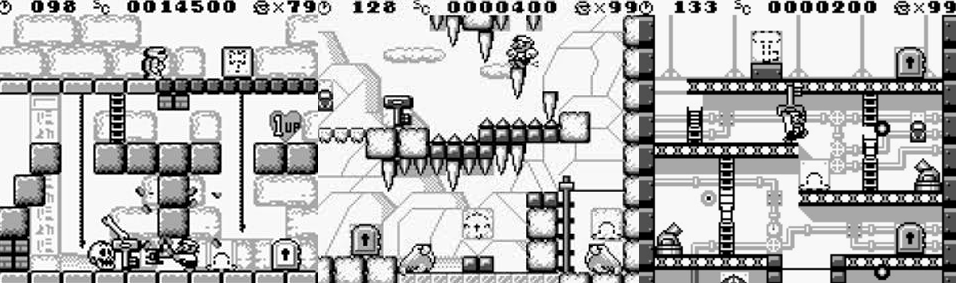
The Review: Although this version of Donkey Kong (referred to on the title screen as Game Boy Donkey Kong and widely known as Donkey Kong ’94) is a fundamentally different and expanded version of the original arcade game, it’s still technically quite simple and not varied enough in some aspects to warrant my usual full review. Upon first starting the game, players pick from three save files and immediately get underway playing an adaptation of the arcade hit, guiding a distinctly Mario-looking Mario across girders, through a pie factory, and removing rivets to reach the cantankerous ape, who escapes with Pauline each time. After clearing the first four stages, however, Donkey Kong scarpers across nine additional stages, each with anywhere from eight to fifteen levels, and the game completely changes from a simple platformer to a puzzle platformer. Luckily, Mario’s abilities have been expanded to accommodate this. His jump is far better now, allowing you to hop between platforms and across gaps and even survive falls from short to medium heights, largely eliminating the aggravating fall deaths from the original game. By crouching and pressing A, Mario performs a handstand to protect himself from Donkey Kong’s barrels and other hazards and then performs a somersault jump by pressing A again to hop to higher ground. Mario can also pull off a back flip if you quickly press the directional pad (D-pad) in the opposite direction alongside A, which is great for hopping over enemies or out of tight corners, as well as crouch to fit through narrow gaps. By pressing B on barrels and certain enemies, Mario picks these up and throws them, though you’ll primarily use this to retrieve the many keys hidden across the game’s stages. Finally, Mario can still grab his trusty hammer to take out enemies, though he can’t jump while using it. The game also includes the Super Hammer, which destroys certain blocks, and Mario can toss both weapons and quickly retrieve them to solve puzzles.
Smash blocks with your hammer and utilise various platforming skills to get the key to the door.
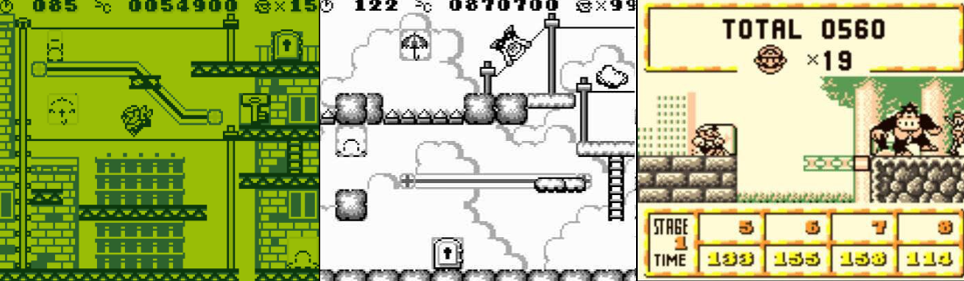
Many stages feature ladders and ropes you must climb. Sometimes these ladders rise and fall to make you time you climb, sometimes there are ropes, vines, or chains or you must carefully grab nearby vines, avoiding any enemies or a potentially fatal plummet like in Donkey Kong Jr.(Nintendo R&D1, 1982). There are also wires to spin on by holding up on the D-pad, which will fling you into the air or across the stage, though you must watch for insta-kill hazards like electrical sparks and spikes. Mario can also swim by tapping A, collect extra lives from 1-Up Hearts hidden in stages, and hop over enemies or retrieve Pauline’s lost items for bonus points. Finding all three of these and clearing a level takes you to a bonus game, where you must stop a slot machine or number icons to earn additional lives. Finally, players pull levers to open doors, activate or change the direction of moving platforms, and switch the direction of conveyer platforms, as well as utilise timed item blocks to aid their traversal. You can grab a ladder to quickly reach higher platforms, create a temporary bridge to toss the key to, and spawn a spring to bounce upwards, with some stages requiring multiple item blocks to clear them, avoid a deadly fall, or get the key to higher ground. You must retrieve the key and carry it to the door before the timer expires, taking care not to toss it into pits or water or leave it idle as it’ll vanish. Sometimes, the door is invisible, requiring you to pay attention during the intro cutscene; other times, it’s deep underwater or protected by hazards. While you can toss the key to defeat some enemies, you can’t carry it up ladders so you must use the item blocks, conveyors, platforms, and levers to get the key where you need it to go. While the challenge of getting the key to the door starts quite simple, with you simply avoiding some enemies or hazards, it quickly becomes complicated as the game throws deep chasms, hazardous mazes, and brain teasing puzzles that’ll have you checking a guide or using trial and error. The Nintendo Switch’s save state and rewind feature is a godsend here as it can be tricky figuring out what to do, though often the solution is very simple and you can even ride some enemies to cross gaps and such.
The game’s challenge is bolstered by some impressive visuals for the handheld.
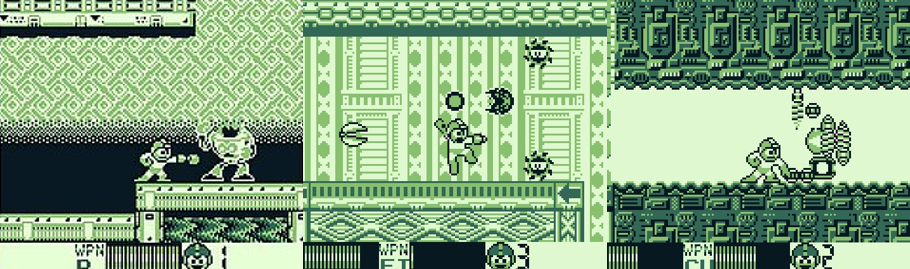
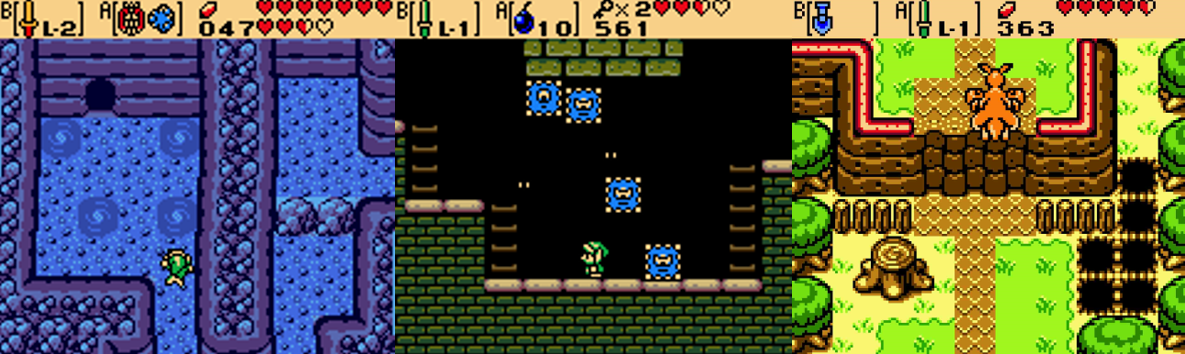
It’s pretty amazing how visually engaging this version of Donkey Kong is compared to the original, and the other home console ports, especially considering the Game Boy’s limitations. Mario, Donkey Kong, and Pauline are all rendered very accurately, with the latter two having some fun animations. I enjoyed seeing Donkey Kong squeeze his butt through doors and the cute little chase animations that play between stages, and Mario has some amusing death animations here. He’ll be squashed flat as a pancake, incinerated, face plant and be left twitching or simply crash to the ground and die, which all adds to the visual charm. Add to that some fun and impressive animated sprite art and in-game cutscenes and you have a game that blows its counterparts away, as long as you don’t focus too hard on the backgrounds and sound. While the backgrounds are varied and you end up exploring a deep jungle, slipping around on a frozen iceberg, swimming through water, exploring a hazardous city, and climbing Donkey Kong’s fortified tower, they’re obviously very limited due. The game performs really well, though, with no real slowdown or sprite flickering, and makes good use of its assets by scrolling the screen in larger areas. It’s also surprisingly long and challenging, with some stages featuring so many levels that it can get quite taxing, though the music is naturally limited and quite repetitious. Each stage introduces new gimmicks, or turns old ones on their head, though, to have you riding Thwomp blocks, clinging to Monchee tails, avoiding Poison Mushrooms, riding platforms, creating bridges over gaps, battling against strong winds, and contending with the cheeky Donkey Kong Jr. as he pulls levers to mess up your progress.
Donkey Kong and his cheeky sprog regularly challenge your platforming skills.
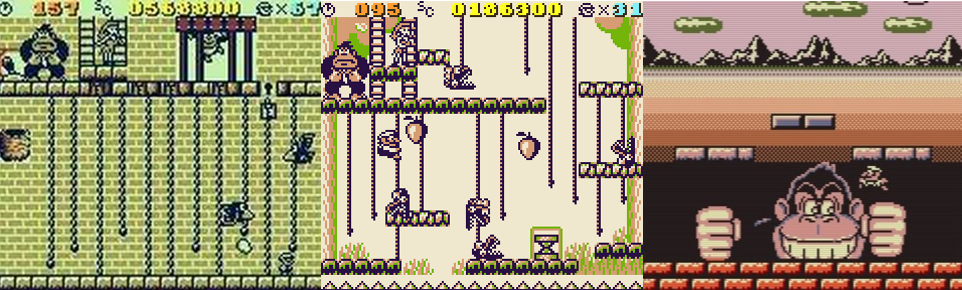
Each stage is filled with puzzles, hazards, and enemies, some of which aid you since you can walk on or get a boost from them, but most of which will immediately kill you. Some resemble recognisable Mario enemies like Piranha Plants, Cheep-Cheeps, and Bloopers, others return from the original Donkey Kong games, like the flammable oil and egg-dropping birds, while others are quirky newcomers ranging from waddling penguins and aggressive crabs to spiky porcupines, deep sea divers, and various oddball anthropomorphs who patrol each platform. Every fourth level pits you against the titular Donkey Kong and forces you to hop up platforms, avoiding his projectiles, and either get to Pauline or toss a barrel at him three times. Sometimes, the action takes place over a bottomless pit, a body of water, or a bed or spikes. Other times, you hop to conveyor belts, ride platforms, or race across disappearing block platforms. Sometimes, you pull levers to reverse the direction of these gimmicks; others, these same levers open doors for you to reach Pauline. Often, Donkey Kong Jr. blocks your path or undoes your progress until you eventually trap him in a cage and take him out of the equation in Stage 9. Donkey Kong is largely stationary but sometimes jumps and causes debris to rain down, or also pull levers to annoy you. He throws barrels that must be picked up and thrown at him, oil barrels that you must jump over, boulders and springs that you can hop on to climb higher, and Poison Mushrooms to shrink you. Reaching and battling him is generally easier than tackling the obstacle courses that precede him, but things can get tricky when enemies spit projectiles or Donkey Kong smashes barrels to spawn Poison Mushrooms. When you reach the finale of Stage 9, you must again climb chains to push keys into holes and send Donkey Kong plummeting, only to be surprised by a three-stage final boss against a gigantic Donkey Kong! In this final bout, you must avoid his crushing fists and hop to higher ground, using your handstand to tip over barrels to toss at his big, stupid face. His fists also slam together and erratically smash the ground to mix things up, but as long as you stay high and in a handstand, you can mostly avoid his attacks and any damage.
The Summary: I spent a long time regretting not getting this version of Donkey Kong when the Nintendo 3DS Virtual Console was active. I’d heard a lot of good things about it and was attracted to how it expanded upon the core gameplay of the admittedly limited original, though even I was surprised by just how much is packed into this little game! I find it amazing that Nintendo chose to create this expanded version for their less powerful handheld and not their industry changing home console, though it’s quite the technical marvel for the Game Boy. I loved how animated Mario and Donkey Kong were, how much variety was packed into every stage, and the clever way the developers reused and retooled each gimmick in challenging ways. Make no mistake, this Donkey Kong is a thinking man’s platformer and some of the stages really had me baffled about how to get the key to the door. The gameplay loop did become tiresome after a while, though, even with the fun cutscenes and throwaway bonus stages, especially in stages with an obscene number of levels. It was also disappointing that the battles against Donkey Kong and his sprog didn’t deviate too wildly from the original arcade game, especially as the developers could’ve snuck in some autoscrolling chasers to mix up the formula. I enjoyed Mario’s new moves and the item blocks, which had to be placed strategically to solve some puzzles, and the tension of racing to the key before it or your items disappeared. Some levels were more unfair than others, require multiple reloads, but this was a fun way to pass the time and a great expansion on the original title. While the Game Boy Donkey Kong did get a little too tiresome at times for me to rate it any higher, it’s still the best version of the original game, though it’s a shame the Nintendo Switch doesn’t allow for the Super Game Boy colour palette to be utilised.
My Rating:
⭐⭐⭐
Rating: 3 out of 5.
Pretty Good
Did you ever own Donkey Kong for the Game Boy back in the day? How do you think it compares to the original arcade version? Did you enjoy the challenge on offer or do you agree that it gets a bit tedious after a while? What did you think to the puzzle/platformer gameplay and Mario’s expanded moveset? Did you ever clear every stage in the game? Which Donkey Kong videogame is your favourite and why? How are you celebrating Donkey Kong’s anniversary this year? Whatever your thoughts on Donkey Kong, feel free to leave a comment below, support me on Ko-Fi, and check out my other Mario and Donkey Kong content.
Released: 22 November 2023 Originally Released: November 1994 (SNES), February 1995 (Game Boy) Developer: Carbon Engine Original Developers Ocean Software Also Available For: Game Boy, Nintendo Switch, PlayStation 4, PlayStation 5, Super Nintendo Entertainment System (SNES), Xbox One, Xbox Series S
The Plot: When BioSyn (or a power outage) cause trouble on Isla Nubar, the island site of Jurassic Park, palaeontologist Doctor Alan Grant either goes it alone or teams up with tactical sergeant Michael Wolfskin to subdue the genetically engineered dinosaurs and escape alive.
Gameplay and Power-Ups: Jurassic Park 2: The Chaos Continues is a sidescrolling shoot-‘em-up that acts as a non-canon continuation of the original movie and its videogame adaptations. While the SNES version is more obviously framed as a return to Isla Nubar thanks to the presence of Biosyn, both can be seen as re-dos of the movie and its videogames since they don’t stray too far from the gameplay mechanics previously seen. While only the SNES version offers different difficulty modes, both see you jumping with A (defying gravity with a higher jump the longer you press the button in the Game Boy version) and shooting with X. Y and B also shoot in the Game Boy version and both versions allow you to rapid fire by holding the button, though this will charge your cattle prod in the SNES version and deplete most of your ammo here, too, save for your weakest lethal weapon and cattle prod. In the Game Boy version, you can switch to grenades by pressing the ‘View’ button; you can’t move and throw them but you have an unlimited supply. You switch weapons with the Left and Right Bumpers in the SNES version, LB cycles through lethal ammo types (such as a machine gun and shotgun spread) while RB cycles through non-lethal options, like tranquilizer darts. All enemies disappear regardless of which ammo you use but there’s a counter that ticks down when you kill any dinosaur that’s not a Velociraptor or what could loosely be described as a boss. Kill too many dinosaurs and your game ends, so be sure to cycle back and forth between lethal and non-lethal options. This crutch isn’t present in the Game Boy version; it’s an all-out platform shooter as Dr. Grant blasts dinosaurs with his unlimited shotgun! Both games also allow you to crouch and shoot, shoot while jumping, and shoot upwards and diagonally, though you must collect ammo in the SNES version by pressing down on the ammo item. This is also how you’ll collect the rare first-aid kits lying about Isla Nublar. These, and the odd 1-up, are automatically collected in the Game Boy version, which also incorporates a scoring system, though only the SNES version allows for a two-player co-op mode.
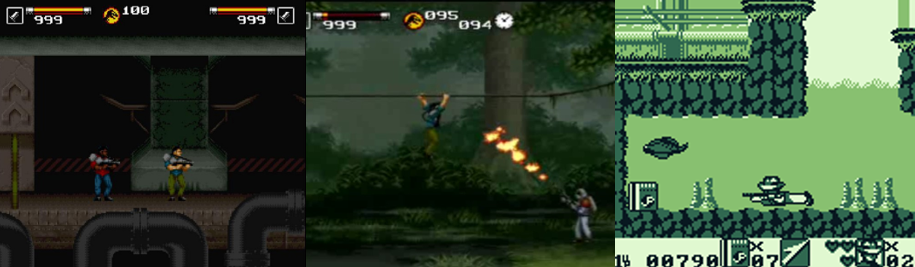
Blast your way past dinosaurs, grabbing vines, racing a timer, and collecting key cards to progress.
While the Game Boy version uses a lives system, you only get one shot to beat the SNES version. If you’re killed, you restart the mission from the beginning, with no checkpoints or continues or passwords to help. Although the Game Boy version follows a linear narrative, tasking players with guiding Dr. Grant through four stages (called “Zones”) with two levels and a boss battle each, the SNES version lets you freely pick a mission. Each mission has two screens of action and ends in an “Emergency” mission, where you must run around the maze-like environment disarming bombs, tracking down a spy, powering up a generator, and similar tasks against a very tight time limit. The labyrinthine nature of the levels doesn’t help with this. You’ll climb up ladders and jump between them, desperately pressing up and down (when you can even see the arrows!) to enter doors or change screens, with no idea of where you’re going or where you’ve been. These timed missions were some of the worst parts of the SNES version as the enemies respawn when you switch screens and the human enemies can be particularly aggravating, meaning it’s very easy to get lost and then be pummelled to death by grenades. While some of the Game Boy version’s Zones have multiple paths, reached by either hopping up branches or platforms or taking moving platforms, the levels are understandably much smaller and far more linear. Sometimes, you’ll venture underwater, tapping A to swim and attacking prehistoric fish with your harpoon; others, you’ll jump between conveyor belts or over spiked pits. Thankfully, these and other pits aren’t typically insta-death hazards in either version, though your character takes fall damage in 16-bit and must deal with a rather large hit box in monochrome. While you use overhead vines and poles to cross gaps in the SNES version, you can’t move and shoot when up there. Conversely, the Game Boy version requires you to search for a set number of JP Magnetic Cards. The exit will only open when you find them all, as indicated on the heads-up display, so you may need to backtrack to find them. Most of them are just out in the open; others fall from the sky. Zone 3-2 has you searching for 54 cards, but they’re helpfully collected in groups so it’s not as intimidating as it first seems.
Don’t be fooled by the decent visuals: both games are tough and aggravating in different ways.
Stage hazards are also a concern in both versions. Flame bursts, loose electrical wires, steam vents, miniature exploding volcanoes, and falling boulders can sap your health if you’re not careful. Platforming is more of a priority in the Game Boy version and much simpler thanks to the chunky sprites and Dr. Grant’s floaty jump. On the SNES, it’s easy to fall through the environment, miss ladders, and drop into lava thanks to the annoying enemy hoards. You must navigate a volcanic maze to place a bomb then out-run the explosion, locate a wounded ally, shoot switches, and defend Gallimimus in the SNES version. When faced with a time limit, you’re better off eschewing non-lethal ammo and avoiding enemies wherever possible, especially if you’re not consulting a guide to navigate the looping mazes. The Game Boy version offers two bonus areas where you’re pursued by a Tyrannosaurs rex. It’s instant death if the T. rex touches you, so you must waddle away from her, hopping to platforms and structures and collecting the JP Magnetic Cards for an extra life. You’ll also be back on the rapids in the Game Boy version, where the water instantly kills you if you fall while jumping to wooden bridges but is no concern when you’re on a raft and blasting prehistoric fish. While you do race away from a T. rex at one point in the SNES version and the game also culminates in a vehicle section, this latter mechanic only appears if you’re playing on “Medium” or higher. This means that you’re stuck in a continuous loop of run-and-gun action and frantic races against the clock, desperately hoping the poisonous gas doesn’t sap your remaining health or you don’t miss any power supplies. At one point, you’re destroying giant fans to avoid being skewered; in another mission, you’re scaling a cliffside to repair an antenna. Other times, the ground crumbles beneath your feet, mines explode when you least expect it, or you must destroy boulders to progress, all while frantically hoping you haven’t doubled-back on yourself!
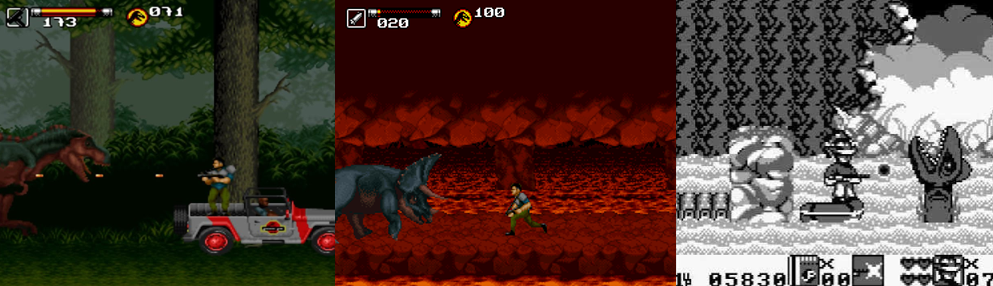
Presentation: It’ll be no secret that the SNES version wins in this regard. However, the Game Boy version is pretty impressive considering the hardware, especially compared to the previous Jurassic Park game on the system. It begins with a nice pixel-art recreation of the big gates, the first Zone features Dr. Grant’s vehicle in the background, and there’s some decent sprite art introducing each Zone. Dr. Grant is a big, surprisingly animated sprite. While this means he has a large hit box, I enjoyed seeing him pump his shotgun with every shot and look around warily when left idle. Sadly, only the bosses match Dr. Grant’s quality in the Game Boy version, with regular enemies appearing disappointingly gaunt and basic. While the Game Boy version’s backgrounds and environments are obviously much more basic, they do a decent job of recreating the visuals from the film. I recognised the electrical fences, towers, and dinosaur paddocks and it was at least easy to see where I was and what I was doing. The SNES version nicely trumps the Mega Drive’s two sidescrolling run-and-gun efforts, featuring dense jungles, a touch of parallax scrolling in the valley, and more appealing sprite work. While the art direction does make Dr. Grant completely unrecognisable and I’m not sure what the purpose of mapping a dramatic pose to the Y button was, he has a lot of fun animations, particularly when climbing ladders or crossing vines. The dinosaurs also fare a lot better, making it even more of a shame that there isn’t a large variety of them and we simply get palette swaps of ‘raptors for the most part. While neither game uses the iconic Jurassic Park score, the Game Boy version includes some awesome arcade-style music and the SNES incorporates the dinosaur’s roars and noises from the movie. The bigger ones, like the T. rex and Triceratops, are also beautifully detailed (if off colour). The Game Boy version does okay when bringing to life larger dinosaurs for its boss battles, but its T. rex is incredibly ugly and its ‘raptors are strangely stretched.
While the SNES’s visuals are impressive, the Game Boy does pretty well despite its limitations.
While larger dinosaurs simply blink out of existence or explode in the SNES version, they feature defeated poses in the Game Boy version, which is a fun touch, alongside a health bar so you can actually tell that you’re hitting them, which is a real issue on the SNES. Unfortunately, both games suffer when it comes to their environments. Sticking very close to the same ideas as the previous 8- and 16-bit games, both versions see you exploring the jungle (with various parts of the park, such as the gigantic electric fences, in the background), caves, a valley, and various InGen facilities. These are painfully generic in both games but even more so in the Game Boy version, where the hardware can’t do much beyond render some giant trees. There are some unique aspects to this game, such as algae-infested waters and the aforementioned rapids, but even this latter inclusion is similar to what we saw in the previous games (including hungry Brachiosaurs). While the SNES obviously benefits from greater processing power, sporting none of the admittedly rare sprite flickering seen in its handheld counterpart, it does force you to venture through the same jungle environment again and again. The interior locations are also recycled far too often, becoming indistinguishable from each other no matter how many pipes and vats and generators the developers sneak in. I like the incubators and Jurassic Park signage seen in the backgrounds, and that we get to revisit the Gallimimus valley. However, this is a strictly on-foot section and lacks the fast-paced action of the same area in Jurassic Park: Rampage Edition (BlueSky Software, 1994). I’m not sure why every Jurassic Park game has to feature a volcano, but this might be the worse one yet. The lava seems very disconnected, and it lacks the detail of the misty jungle. The cliffsides were okay, especially when they sported snow and you could see into the horizon, but they were very samey, just like the interiors, with little indication of where you need to go. The SNES version is bolstered by an animated introduction that also features voice acting, though this detail is strangely missing from the ending.
Enemies and Bosses: As I mentioned above, neither version of Jurassic Park 2 impresses with its dinosaur selection. Dilophosaurus returns as a common enemy, standing stationary and spitting in all directions, while giant wasps, Pterodactylus, Dimorphodon, and Pteranodon fill the skies across each game. The Pteranodons are particularly aggravating on the SNES, endlessly spawning around the cliffsides, while their larger mothers simply flap around near their nests posing little threat. While you can take out the Gallimimus on the SNES, you’re meant to avoid them and off BioSyn’s soldiers to save the creatures. While Compsognathus are a constant headache on the SNES, you’ll find weird-looking Archaeopteryx, Hypsilophodon, and Parasaurolophus on the Game Boy, with the former jumping at you for extra annoyance. The underwater sections see you blasting prehistoric fish, trilobites, and anemone while baby Triceratops occasionally appear on land. On the SNES, you’re primarily faced with Velociraptors and Oviraptors, which leap at you and often attack in groups. Coming in different colours and proving quite durable, the ‘raptors fiercely defend their nest, but I found it best to jump over them and keep the fire button held down. The SNES version features exclusive human enemies to contend with. Not only will workers toss wrenches at you, scientists whip out pistols, and suited BioSyn executives dog your progress, their soldiers will be a greater threat than the dinosaurs most times. While the basic grunts just run about or stand in place, others can shoot in all directions or toss grenades, which are a bitch to avoid! Their bazooka soldiers are easily dispatched by crouching and shooting, a tactic that will serve you well against their flamethrower units. However, these bastards have a long reach and can roast you when you’re on ladders or hanging from pipes, meaning it’s always a pain in the ass when humans show up.
Sadly, the SNES version favours human boss battles over dinosaur threats.
While BioSyn’s armoured troops only pack a pistol, they can move, fire in all directions, and crouch and shoot, which can be annoying. You’ll also have to battle a larger enemy commander twice; this muscle-bound boss packs a flamethrower/machine gun combo and tanks even your best shots. Your best bet is to lure him in, blast him with your strongest shots, and back away, chasing him when he retreats. BioSyn’s attack chopper carpet bombs the Gallimimus valley, eventually swinging a dinosaur cage at you and peppering the screen with bullets and bombs. If you’re playing on “Medium” or higher, you’ll attack BioSyn’s bomber from an Ingen helicopter, firing in different directions with the face buttons and targeting the plane’s mini gun and launchers. True to its name, the bomber drops bombs but also fires homing shots, two projectiles that are extremely hard to avoid since your chopper is such a large, unwieldy target. The SNES version mainly throws bigger or more aggressive regular dinosaurs at you as pseudo-bosses, such as the Triceratops that guards the final explosive and must be lured in to charge and fend off, preferably with your shotgun. The T. rex chases you at one point, with you only able to force her back with your shots and jump to safety at the end. If you play on at least “Medium”, you’ll battle the T. rex in a fight to the death. Though big and slow and limited to a simple bite, it takes a shit load of your strongest shots to put her down. She chases you to a precipice, which will sap your health if you drop, and you’re also battling a tight timer. You must switch to your strongest shot and target her head, either by jumping or shooting diagonally, forcing her back to create space and jumping away to avoid being eaten. Since the T. rex doesn’t register damage, you’ll only know you’ve won when she explodes (naturally), which took me a fair few tries.
The Game Boy version’s bosses may be simple, but they’re big and at least they’re there!
The Game Boy version features far more traditional boss battles, with you battling a larger dinosaur at the end of each Zone. The first boss you face is a mummy Triceratops that stomps back and forth across the screen. You must dive into one of the nearby holes, duck down, and toss grenades at her. When the platform in the hole rises, you must dash to the other one to continue the assault, easily avoiding damage for the most part if you keep your head down. The Pteranodon is a bit more of a threat. This giant, bat-like dinosaur swoops down from either side of the top of the screen, dropping a boulder that’s a pain to avoid unless you race to the opposite side of the screen. Her smaller minions will attack after, though they’re easily taken out as you’ve been blasting them since Zone 1-1. The Game Boy version does offer one unique boss battle, one that takes place underwater and sees you attacked by a “Cephalosaure”. This giant, spike-headed squid darts in like an arrow from each corner of the screen, proving a large target that can be difficult to avoid because of the awkward swimming controls. Smaller, snail-like enemies will swim down after each pass but this is quite easy to hit, especially if you stay away from the centre of the screen. Oddly, the Velociraptor is fought between Zone 4-1 and 4-2, charging, hopping, or prancing in from either side of the screen. You can use the small block platforms to jump over them and they’ll try and bite you up close, but they’re not too difficult to avoid. On two occasions, you’ll be pursued by the T. rex, which cannot be killed and will instantly kill you if you so much as graze her. You must run from her, hopping between wooden scaffolding and taking out Compys, but you get to face her one-on-one in a painfully bland final battle. The T. rex stomps back and forth, occasionally charging, and takes a bite out of you up close. Dimorphodon come in to distract you, but this is actually your opening to pummel away at the T. rex’s head until she collapses in defeat.
Additional Features: While the Game Boy version is the only one with a score system and final score, there is no high score table and the SNES version is the only one with a two-player mode and different difficulty options. Both games end with lacklustre congratulatory text, but you’ll only battle the T. rex and BioSyn’s bomber by playing the SNES version of at least “Medium”. The Jurassic Park: Classic Game Collection includes fun extras like each game’s soundtrack, different filters and borders, and the life-saving rewind and save state feature that greatly eases the pain of the SNES version’s difficulty. This version of the collection also has fourteen Achievements for you to earn, with two earned for these games, specifically. You’ll get an Achievement for beating the SNES version on any difficulty, and another for being it on “Hard”, so I advise just playing on “Hard” to snag them both. You got one Achievement on the Game Boy version for defeating the Velociraptors and another for clearing the game, which is a touch disappointing as there’s no incentive to shoot every enemy or play with a friend.
The Summary: I was optimistic about Jurassic Park 2: The Chaos Continues, especially the SNES version, as it was developed after five other videogame adaptations of the movie so surely the developers would’ve learned a few things about what works and what doesn’t. Technically, that is true as the game focuses much more on run-and-gun action, allowing you to blast dinosaurs and humans to your heart’s content while also encouraging you to merely stun most dinosaurs to maintain some semblance of preservation for the resurrected creatures. Visually, the game may be the best looking of the 16-bit Jurassic Park titles, but for some of the lacklustre backgrounds and the lack of originality in the locations. The gameplay loop does get frustrating very quickly, however. Even before mentioning the aggravating timed sections, including looping doors and paths without a map or any clear indication of where you need to go was a baffling and frustrating decision. Combined with the timed sections and you only getting one chance to beat the mission, this makes for a shameless handicap to force kids obsessed with the blockbuster movie to rent the game again and again. While the Game Boy version is more basic, smaller, and very less visually impressive, the music is fantastic and the simpler shoot-’em-up gameplay was far more appealing. I quite enjoyed searching for the JP Magnetic Cards and blasting the butt-ugly dinosaurs, though the hit boxes and mediocre levels did let it down, especially as the sprite work on the boss was pretty impressive. While there is a lot to like in each game, and some technical improvements that make them better than their predecessors, I think Jurassic Park 2 still misses the mark no matter which version you play. Neither offer anything new, especially compared to their predecessors or other similar games, and again just make me wish we’d had one ultimate 16-bit Jurassic Park release that had combined all the best elements from each game instead of leaving us with average tie-in games where we have to cherry pick the best parts.
Game Boy Rating:
⭐⭐
Rating: 2 out of 5.
Could Be Better
SNES Rating:
⭐⭐⭐
Rating: 3 out of 5.
Pretty Good
What did you think to the Nintendo-exclusive Jurassic Park sequels? How do you think they compare to each other, and the previous Jurassic Park titles? Which of the two was your favourite and were you glad that they were ported to modern consoles? Were you also annoyed by the SNES version’s maze-like environments and the large hit boxes in the Game Boy version? What did you think to the Game Boy version’s bosses and the timed missions of the SNES version? Which Jurassic-inspired videogame is your favourite? How are you celebrating Dinosaur Day this year? Whatever your thoughts on these Jurassic Park videogame sequels, or dinosaurs in general, leave them below, support me on Ko-Fi, and check out my other dinosaur content!
January celebrates two notable dates in science-fiction history, “National Science Fiction Day” on January 2 and Arthur C. Clarke’s HAL 9000’s birthday on January 12. Accordingly, I’m dedicating January to celebrating sci-fi with an event I call “Sci-Fanuary”.
Released: 7 June 2024 Originally Released: 22 July 1994 Developer: Minakuchi Engineering Also Available For: Game Boy and Nintendo 3DS
A Brief Background: Notorious for its high level of difficulty, Mega Man(Capcom, 1987) represented Capcom’s shift away from the arcade scene and into the burgeoning home console market, eventually establishing a franchise that expanded to the Game Boy in 1991. Capcom outsourced development to Minakuchi Engineering, whom they reunited with for the Blue Bomber’s subsequenthandheldventures after a brief collaboration with Thinking Rabbit left series artist Keiji Inafune allegedly disappointed by their efforts. Mega Man V was the last of these efforts, and was said to have taken the longest to develop of the Game Boy titles. Furthermore, Infaune struggled to create new designs for the game, particularly the debuting “Stardroids” and Mega Man’s newest robotic companion, Tango. Mega Man V was also one of the first games developed specifically to connect with the Super Game Boy peripheral, allowing players to experience the game in full colour on their televisions. Seen as one of the system’s most ambitious titles, Mega Man V is largely regarded as one of the best in the franchise’s handheld library, demonstrating better graphics, mechanics, and narrative elements. Although this didn’t lead to a collection of the portable Mega Man games, these were all eventually ported to Nintendo’s online shops and services.
The Review: Mega Man V retains the core gameplay mechanics of its predecessors and main console titles, charging players with battling through four initial stages and powering the fighting robot Mega Man up before heading into space to take on four additional stages and Robot Masters. Consequently, the controls remain unchanged (with one exception): B or X fires the Mega Buster, which can be charged to unleash a stronger shot. This time, Mega Man flings out his fist thanks to his creator, Doctor Thomas Light, upgrading his abilities since his usual charged shot won’t work against the game’s new Stardroids. However, the “Mega Arm” is functionally the same as the old charged shot except it deals additional when it flies back to Mega Man and it can be upgraded to snag items and pass through walls. B is for jumping, with Mega Man jumping higher when underwater or in outer space, and down and B performs a slide that’s useful for avoiding hazards and attacks. There’s no longer a recoil to the charged shot, which is a bit of a shame, but you’ll still collect P-Chips to trade in for upgrades at Dr. Light’s lab between stages. These allow you to buy those upgrades for the Mega Arm, refill some or all your weapon energy, replenish your health, or purchase a 1-up or E- and S-Tanks to refill your health and energy on the go. Enemies drop most of these items upon defeat, though your chances of getting them are again more restricted since they also drop P-Chips (which are mostly useless with the Switch’s rewind and save state features). These goodies may also be found in stages by taking alternative paths and destroying certain walls, and Mega Man’s little friend Eddie and mysterious brother Proto Man occasionally gift items. Mega Man’s robotic bird companion Beat is absent, so you won’t have to worry about collecting any letters, though four crystals are hidden in the later stages that will grant you the Power Generator, which halves the usage cost of your Special Weapons. Finally, if you exhaust all your lives and use a continue, you’ll gain the Turbo Accelerator for your Mega Arm to help you out.
Mega Man V mixes things up with some unique bosses, weapons, and items.
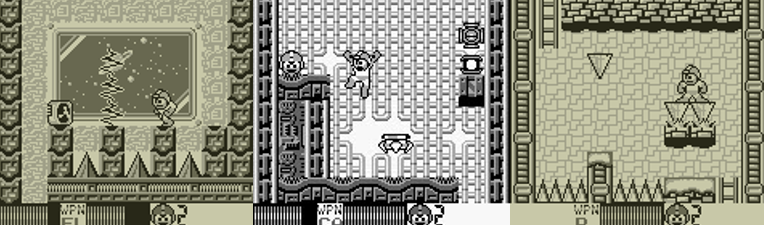
Brace yourself for a shock but…Mega Man V features all-new Robot Masters and Special Weapons! Yes, for the first time in Mega Man’s handheld career, the stages and bosses are all new (save for some inspirations from previous games). Like previous Robot Masters, Terra’s Stardroids are weak to specific Special Weapons, making the game more difficult depending on the order you challenge them. They’re all fought in enclosed arenas, as usual (though Mega Man V gives you more room to manoeuvre than the previous Game Boy games) and all fought again during the endgame. I started with Mercury, a Stardroid with liquid metal properties who transforms into blobs but who you can put down with the regular Mega Arm (or, later, Salt Water). Mercury grants you the Grab Buster, which leeches health from your target, though the Mega Arm alone was enough to take down Neptune, who simply hops about like a frog. Weak to Photon Missile and Electric Shock, Neptune bestows you with the Salt Water shot which, while slow, damages enemies with splash damage (a common mechanic in this game). Salt Water also gives you the edge over Mars, who fires the slow but very powerful Photon Missiles and even lays mines across the floor. Like the Crash Bomber, you must time Photon Missile shots to defeat Venus, who mostly just stomps about but gets some serious airtime when he’s filling the screen with explosive bubbles. The Bubble Bomb is one of the more useful Special Weapons thanks to it travelling upwards, making it perfect against Pluto when he pounces to the ceiling, and Jupiter since he’s always hovering overhead. Jupiter fires a concentrated beam of electricity and is invulnerable in this state, a weapon you can use to fry enemies up close. Saturn was next; a big target, he tosses a ring, slides at you, and sucks you in with his Black Hole attack, which Mega Man uses with explosive effect. Defeating Pluto nets you the Break Dash, which sees you charging across the screen to barge through enemies and walls. It’s also great against Uranus, who you fight in close quarters. Defeating him grants you the Deep Digger which, like the Super Arms, lets you toss certain blocks.
New mechanics and hazards make this the most unique of Mega Man’s portable games.
You’ll also obtain an additional Special Weapon by defeating Terra; the Spark Chaser is like the Gemini Laser in that it ricochets about and is best saved for the game’s true final boss. Beat may be gone but Rush is still here; unfortunately, you get Rush Coil and Rush Jet quite late in the game and they’re nowhere near as useful as before. Mega Man V finally addresses Rush’s potential by having you fly about in a sidescrolling shooter to approach and then blast into Doctor Albert Wily’s newest space station. Mega Man also gets a new robotic companion right from the start of the game. Tango is summoned with a charge attack and will spin about the screen to attack anything in range, though I honestly had little use for this and kept longing for the Rush Coil to reach out of reach goodies. While you’ll find many familiar hazards in this game, such as bottomless or spike-ladened pits, insta-kill spikes, moving and disappearing platforms, and rising tides, there are a fair few different obstacles to overcome. Mega Man spends some time either out in space or dealing with gravity mechanics inside, not unlike his encounter with Gravity Man. The floor threatens to crush you rather than the ceiling coming down, and you’ll do your fair share of tricky platforming up in the clouds. Water rushes at you and pipes vent steam, rocket-powered blocks drive you towards ceiling spikes, snow and ice make platforms slippery, and rocks and girders drop from above. Except for Metall’s new annoying shield and sniper variants, all the enemies in Mega Man V are new. There are robotic apes that hop up and down and toss bananas, bubble-shooting crabs that push you to your doom, fan-like owls, walking bombs, spiked turtles, and armoured foes who are invulnerable when charging. Many attacks feature splash damage, which is an additional hazard, though Mega Man V handles slowdown and screen tearing much better than its predecessors. Mega Man will also battle some bigger mini bosses, including an attack helicopter, a giant cannon, and a Sphinx-like wall that constantly threatens to drop you onto insta-kill spikes.
New bosses exhibit a lot of character and offer a new challenge.
Battling past the first four Stardroids sees you confront Terra in a strangely deserted base. Here, he sics an upgraded Yellow Devil, the “Dark Moon”, on you. While his body parts are still tricky to avoid, the battle is the same as in Mega Man in that you must time shots of the Photon Missile to hit his eye and the hardest thing about this fight is all the waiting around to land hits. Defeating the second set of Stardroids sees Terra finally face you in battle for “[mettling]” with his plans. Terra teleports about, fires his Spark Chase, and can briefly freeze you but, for all his hype, he’s easily defeated with the Deep Digger. Mega Man and Rush then blast at the exterior of Dr. Wily’s space station (something that’s tricky to do as you can only attack its laser-firing mouth) before Mega Man battles through a gruelling torture chamber within and encounters the four previous “Mega Man Killers”. While each is weak to one of Mega Man’s new Special Weapons, the fights are unchanged: you still fire at Enker when he holds his sword aloft, still target Punk’s head as he pogos about, still jump over or slide under Punk’s buzzsaw-like attack, and must still avoid Ballade’s Ballade Cracker. Still, it was nice to face them again and I liked the added touch of seeing copies of each held captive in the stage. With them defeated, you’ll take on Dr. Wily’s newest, biggest mech in a four-stage battle. The first two see you avoiding giant robotic fists, blasting its wrist eyes with the Grab Buster and avoiding its homing missiles. Next, you’ll find the Brain Crusher impervious to all your attacks. Instead, you must avoid its missiles and destroy the Pikashus before their gravity attacks drive you into the ceiling spikes, then fire at the walking bombs it spits out to deal damage. You’re then forced into a tight, spiked corridor and must hop over Dr. Wily’s ground shots and pummel his glass dome to finally put him down. However, in desperation he awakens the ultimate Stardroid doomsday weapon, Sunstar, who frequently destroys the ground and forces you to drop to lower areas. Weak to the Spark Chaser, Sunstar boasts a particularly devesting arm cannon, fires scattered shots and tiny sparks, and spins at you like a buzzsaw.
The Summary: Well, it took five games, but the developers finally gave Game Boy players something unique to get their teeth into. Mega Man V is the first of the handheld titles not to shamelessly recycle and reuses bosses, stages, and weapons from the previous games. Instead, it presents an all-new (if familiar) narrative pitting Mega Man against the planet-themed Stardroids and giving you new Special Weapons to play with. Unfortunately, as ever, I had little use for these outside of boss battles; you can use them to make stages easier, but I got along just fine with the Mega Arm. Similarly, it’s a shame Tango wasn’t used more; like, he could’ve let you climb certain walls and perhaps fulfilled the Grab Buster mechanic. However, I was glad to finally see a sidescrolling shooting stage implemented with Rush (including a boss battle, no less) and Dr. Light’s items were much more useful, giving me an incentive to collect at least some P-Chips. There’s a greater emphasis on story in Mega Man V, with many sprite-based cutscenes and dialogue boxes, which are bolstered by the best pixel art in the portable series. Unfortunately, while stages are more detailed than ever, there wasn’t much variety or logic to them. Like, Mercury could’ve been any other underwater base stage, Saturn had an Aztec theme, and Jupiter went with electricity instead of raging storms. Venus and Mars mixed things up with their weird, tumour-like enemies and spinning gears, respectively, but I feel the developers could’ve done a lot more with the space theme. Still, I really enjoyed Mega Man V, particularly the rematches with the Mega Man Killers and the new antagonists. Terra and Sunstar were a nice change of pace and even Dr. Wily’s presented a bit differently in his boss battles. Mega Man V is what we should’ve seen from some of the Blue Bomber’s previous handheld titles; familiar elements in a new setting. This, it feels less like you’re playing a downgraded version of the home console games and more like a unique experienced tailored to the Game Boy.
My Rating:
⭐⭐⭐⭐
Rating: 4 out of 5.
Great Stuff
Did you own Mega Man V back in the day? Were to happy to finally see some original content for the Game Boy? What did you think to Terra and the Stardroids? Were you disappointed that the developers didn’t do more with the planet theming? Which of the new Special Weapons was your favourite? How would you rank Mega Man’s portable adventures? What are your plans for celebrating the science-fiction genre this month? Whatever opinions on Mega ManV you have, leave them below and be sure to check out my other Mega Man reviews!
January celebrates two notable dates in science-fiction history, “National Science Fiction Day” on January 2 and Arthur C. Clarke’s HAL 9000’s birthday on January 12. Accordingly, I’m dedicating January to celebrating sci-fi in an event I call “Sci-Fanuary”.
Released: 7 June 2024 Originally Released: 29 October 1993 Developer: Minakuchi Engineering Also Available For: Game Boy and Nintendo 3DS
A Brief Background: After Mega Man(Capcom, 1987) allowed Capcom to stake a claim in the revitalised home console market, the franchise became a Nintendo staple known for its challenging difficulty. Capcom expanded their reach to the Game Boy in 1991 by outsourcing the franchise, resulting in the highly regardedMega Man: Dr. Wily’s Revenge (Minakuchi Engineering, 1991). When the quickly produced sequeldivided critics, series artist Keiji Inafune allegedly blamed the inexperience of developers Thinking Rabbit, leading to Capcom collaborating with Minakuchi Engineering once again for the for a third, betterregarded effort. For Mega Man IV, the developers again borrowed elements from the main console games, mixing and matching them into a bite-sized title that was largely praised for pushing the limits of the Game Boy and better emulating the main series titles. Unfortunately, like its predecessors, Mega Man IV was stuck as a Game Boy exclusive for many years as a collection of these games was cancelled, though this eventually changed when they were all ported to Nintendo’s online shops and services.
The Review: Mega Man IV continues the time-honoured tradition of the Blue Bomber’s handheld adventures by recycling and remixing elements from the franchise’s release on the Nintendo Entertainment System (NES), namely Mega Man 4(Capcom, 1991) and Mega Man 5(ibid, 1992). In many ways, these portable titles are delivering what I came to hope from the mainline series in that they’re combining elements of two games into one, and a common complaint I had about Mega Man’s console games was how redundant some of them are since the changes were so minimal. Without a doubt, Mega Man IV is the closest to the console games so far in terms of presentation, length, and gameplay mechanics. The basic setup is all here: Mega Man runs-and-guns through four initial stages, defeating Robot Masters to gain their Special Weapons, then battles through four additional stages in his quest to defeat Doctor Albert Wily. B and X fire your Mega Buster or currently equipped Special Weapon. Holding down the button charges a shot with either the Mega Buster or Pharoah Shot, with the added wrinkle that Mega Man’s basic charged shot now has a little recoil you’ll need to account for. B jumps, with Mega Man being lighter when underwater, and down and B slides beneath jumping enemies, projectiles, and through narrow tunnels. While enemies will still drop health and weapon energy, and the occasional 1-up, and you can still collect these and energy filling E-Tanks in stages, Mega Man IV introduces a new collectible. During your adventure, you’ll collect P-Chips; collect enough of these and, between stages, you can visit Doctor Thomas Light and purchase various single-use power-ups. You can fully refill Mega Man’s health or weapon energy, gain a 1-up, store an E-Tank (or purchase a small one to trade in for a large one), and refill one or all your weapons. Personally, I found this a bit tedious; the P-Chips simply meant more grinding for health or energy and the power-ups weren’t really worth the extra effort of collecting them.
A new shop mechanic adds additional power-ups to the formula but they’re not that special.
Mega Man’s robotic companions return in Mega Man IV, though Rush sadly doesn’t get much play. Rush Coil is primarily used to reach higher platforms containing goodies or the odd alternative path, while Rush Jet didn’t really factor into the game until I reached Dr. Wily’s space station and needed to fly over some insta-kill spikes. Beat also returns, with him summoned when you collect four letters to spell his name from the first four stages. I was actually able to accomplish this this time around, meaning I made use of Beat to chip away at the latest “Mega Man Killer”, Ballade. Eddie also pops up to offer you helpful power-ups and you can even take alternative paths to find Proto Man, who’s standing near some helpful pick-ups. Finally, you must collect the WILY letters from the second set of stages to access Dr. Wily’s newest stronghold, and you’ll gain a brand-new Special Weapon, Ballade Cracker, which tosses an explosive in all directions and is very handy when escaping Dr. Wily’s exploding base and battling the mad scientist. Otherwise, Mega Man’s Special Weapons are the same as in Mega Man 4 and Mega Man 5: you douse flames and hit all enemies with Rain Flush, freeze enemies (and Pharaoh Man) in their tracks with Bright Flasher, fire diagonally or charge an overhead energy ball with Pharaoh Shot, and toss a quick returning Ring Boomerang. Defeating the second set of Robot Masters adds the slow, explosive Crystal Eye, the bouncy explosive Napalm Bomb, the twirling Power Stone, and the sliding Charge Kick to your arsenal. As ever, these Special Weapons are best saved for use against specific Robot Masters and bosses, but they’re also useful for attacking aerial or tougher enemies and destroying certain walls. Though Rush Marine isn’t present, you can jump to propeller platforms to cross spike beds and ride slow moving, insta-kill drills to cross gaps.
Mega Man IV is the closest the portable games have gotten to recreating their NES counterparts.
Mega Man IV does a commendable job of recreating the stages from its NES counterparts and features more story than of the previous handheld Mega Man games. Dr. Light appears, as do frequent text boxes, and big pixel art is the order of the day; you even get a quick demonstration of Mega Man’s new abilities and a new stage introduction. Unfortunately, slowdown and sprite flickering are still a problem, particularly when using the Power Stone. Enemies constantly respawn and bottomless pits and various spikes are everywhere, but Mega Man IV feels fairer than the last game. The perspective hasn’t changed and sprites, though detailed, are still too big (like some hit boxes), but the difficulty was way more accessible for me this time around. Many gimmicks from the console games are faithfully recreated here, such as the light gimmick from Bright Man’s stage (where you must destroy Dompans or activate switches to light up the area), the quicksand from Pharaoh Man’s stage, and the zipping platforms from Ring Man’s stage. Crystal Man’s stage is full of glittering crystalline trappings and spikes, Napalm Man’s stage features destructible blocks and collapsible walkways, and Charge Man’s stage again takes place in and on top of a train, with the screen juddering to simulate the train’s movement. Magnetic hazards await prior to Ballade and you’ll blast at missiles across the deck of Dr. Wily’s ship before venturing inside, where a very detailed mechanical hellscape awaits you. Mega Man IV really pushes the Game Boy to the limit, featuring blinking lights, numerous medium-to-large enemy sprites, and a far more detailed enemy roll call at the end that shows Mega Man battling each Robot Master. The sprite-based cutscenes are entertaining to see on the handheld and the larger pixel art is impressive, it’s just a shame the hardware is still struggling to render everything that’s happening. Luckily, the rewind and save state feature can help you out, and the game still includes a password feature (which has also received a new coat of paint).
Dr. Wily’s newest creation and biggest mech yet make up for the recycled Robot Masters.
There’s far greater enemy variety in Mega Man IV, which faithfully recreates some of Mega Man 4 and Mega Man 5’s most recognisable foes. Crystal and Gunner Joes will dog you, Mummira’s appear from hidden doors and toss their heads, Metall’s drive little choo-choos or split into miniature versions of themselves, and tiger-like Sumatran pounce at you. Coccos sit in place and spawn little chicks, bombs and rocks are tossed at you, and four familiar, giant mini bosses also return. The large snail Escaroo again tosses bombs and its vulnerable eyes at you, the hippo-like Kabatoncue stays high up out of reach and spits homing missiles (it’s best to use Pharaoh Shot rather than waste time bringing him to the ground), a giant Metall shoots at you from a massive cannon (easily destroyed by hopping on the gun barrel and blasting his eyes), and you’ll want to use Bright Flasher to expose Whopper’s weak spot. The Robot Masters are much easier in this game thanks to the arenas being a little bigger, meaning you’re less likely to take damage from their massive hit boxes. Charge Man was an exception as he was tricky to jump over, but guys like Toad Man and Pharaoh Man are a joke thanks to the former just hopping around and the latter being powerless against Bright Flasher. You’ll fight Ballade twice, with his second form being a bit tougher, but he’s a big target for your charged shot. Dr. Wily’s base is protected by a large energy cannon and mechanised bridge, with the latter firing some of the Robot Masters’ attacks, as well as eyeball-like drones and the traditional rematch against the eight Robot Masters. Dr. Wily attacks in a machine so vast it is the background; he’ll punch you or slam the ground, causing debris to fall, and fire a shot from his central core. Simply avoid these hazards and time your Power Stone to knock out this first stage, then his bird-like cockpit lowers and fires electrical blasts from its antenna. In this phase, you must toss Ballade Cracker into the mech’s mouth and unload with the Mega Buster when it tries to crush you. Finally, Dr. Wily pulls the old disappearing trick in his UFO but with a twist; he drops bombs that’ll destroy sections of the ground, and you’ll need to chase after him, relentlessly tossing the Ballade Cracker until he’s begging for mercy!
The Summary: Well, it’s taken four games, but the developers finally brought something that closely mirrors Mega Man’s console outings to the Game Boy. Mega Man IV is a clear step up, visually, from its predecessors; the added focus on story and sprite- and pixel-based cutscenes alone speak to that. It’s also a lot bigger than its predecessors; the main content is about the same length, but the stages definitely feel longer and more challenging. Yet, the challenge is notably fairer than normal and the game’s way more forgiving than Mega Man III. I liked the little touches, like the recoil from Mega Man’s charged shot and the optional paths, which included cameos from Proto Man. While the developers haven’t played around with the format too much, the action was a lot smoother and less aggravating than before, with less cheap deaths and enemy and hazard placements, to the point where I was actually enjoying myself rather than tearing my hair out with the rewind function. It’s still a tough game and I still question how anyone completed it back in the day, but the margin for error is much wider this time around. This is best seen in the Robot Masters; while still big targets and difficult to avoid, I didn’t feel as much pressure to go in with full health and it felt satisfying offing them rather than a chore. The P-Chip system was a bit weird and unnecessary; Dr. Light doesn’t sell anything you can’t get with a bit of exploration ot pre-boss grinding and the mechanic just reduces the drop rate of health and energy. Like, why not purchase Proto Man’s shield or a passive item that instantly respawned you when you fall down a pit, or a rapid-fire power-up? Similarly, it’s a shame Rush was sidelined and that the Ballade Cracker was little more than a secondary explosive. Still, I liked the sidescrolling chaser sections where you have to outrun the exploding environment and the faithful recreation of some of Mega Man 4 and Mega Man 5’s more recognisable enemies and mechanics. It was still a short, shallow, and tricky experience, but Mega Man IV is much closer to the level of quality I’d expect from the series and therefore where your handheld Mega Man journey should start, in my opinion.
My Rating:
⭐⭐⭐
Rating: 3 out of 5.
Pretty Good
Was Mega Man IV a part of your Game Boy library growing up? Do you agree that it’s one of the better portable Mega Man adventures? Were you disappointed by the Ballade Cracker? Did you ever collect all the letters and utilize Beat? Which Robot Master was your favourite to fight? Do you have a favourite portable Mega Man game? How are you celebrating the science-fiction genre this month? Whatever opinions on Mega ManIV, leave them below and be sure to check out my other Mega Man reviews!
January celebrates two notable dates in science-fiction history, “National Science Fiction Day” on January 2 and Arthur C. Clarke’s HAL 9000’s birthday on January 12. Accordingly, I’m dedicating January to celebrating sci-fi with an event I call “Sci-Fanuary”.
Released: 7 June 2024 Originally Released: 11 December 1992 Developer: Minakuchi Engineering Also Available For: Game Boy and Nintendo 3DS
A Brief Background: Mega Man(Capcom, 1987) successfully saw Capcom graduate to the growing home console market and. by 1992, the Blue Bomber was a Nintendo staple thanks, in part, to the challenge offered by his titles. In 1991, Capcom outsourced the development of Mega Man’s Game Boy debut to Minakuchi Engineering, resulting in the highly regardedMega Man: Dr. Wily’s Revenge. Though it borrowed elements from Mega Man’s main console outings, the portable adventure was followed by a 1991 sequelso divisive even series artist Keiji Inafune allegedly believed the inexperience of developers Thinking Rabbit was to blame. Thus, Capcom reunited with Minakuchi Engineering for a third handheld title, one that was noted to have produced something much more akin to the mainline games. In keeping with its predecessors, reviews are somewhat mixed (despite notable improvements), especially concerning the limitations of the hardware and the recycling of elements over creating something truly unique to the series. While a collection of the Blue Bomber’s portable adventures was cancelled, Mega Man games continued to appear on the Game Boy and were later ported to Nintendo’s online shops and services.
The Review: Mega Man III takes its inspirations from Mega Man 3(Capcom, 1990) and Mega Man 4(ibid, 1994), maintaining many of the same gameplay mechanics as the previous two handheld adventures and deviating very little from the established formula. When you first start the game, you must battle past four stages and defeat the Robot Masters waiting at the end. As you’d expect from a Mega Man title, each Robot Master has a specific weakness so it’s best to tackle them in a certain order. I’d recommend this more than usual because Mega Man III is particularly unforgiving, even for a Mega Man game. The restricted screen space of the Game Boy and the large sprites and hit boxes remain a constant headache, but I also found the game to be full of far more insta-kill hazards (bottomless pits and various spikes) than usual, and that enemies were far less likely to drop health and weapon power-ups. By default, Mega Man is armed with his signature arm cannon, which you fire with B or X. For the first time in the handheld series, you can charge up a shot by holding either of these buttons and this is far more useful here for cutting through the constantly respawning enemies. B lets you jump and pressing down and B lets you slide under enemies and projectiles (a feat trickier than it sounds thanks to their large hit boxes), through tunnels, and under ceiling spikes. You can replay any stage until you reach Doctor Albert Wily’s new sea fortress and the game comes with the usual password feature, though the Nintendo Switch’s save states and rewind features make this redundant. They were, however, far more essential here than usual as the game is littered with enemies and hazards, with airborne robots, projectiles, and temporary platforms screwing up your jumps and dropping you to your doom.
A visual boost doesn’t relieve the aggravation of an outrageous difficulty spike.
Players of Mega Man 3 and Mega Man 4 will instantly recognise the stages on offer here, and Mega Man III does a commendable job of recreating its 8-bit counterparts. One positive I can definitely say is that the developers were becoming more familiar with the Game Boy’s limited hardware and adding more depth and detail to the backgrounds and foregrounds. Snake Man’s stage, for example, boasts rippling snake platforms and fireball-spitting turrets; Gemini Man’s stage features a catchy tune and a beautiful crystalline aesthetic; and Shadow Man’s stage begins set before a rushing waterfall. Each Robot Master is fought in a claustrophobic, enclosed arena that makes it near-impossible to avoid taking damage. Thus, it’s recommended you “farm” nearby enemies to bump up your health and weapon energy. Each one drops a Special Weapon that’ll defeat another, and they all function exactly as in their home console counterparts. The Search Snake sends little snakes slithering across the floor and up walls, the Gemini Laser ricochets about, the Shadow Blade can be directed, and the Spark Shot fires a powerful electrical blast. Battling the Robot Masters is compounded by the atrocious slowdown and sprite flickering at work here that crops up in stages with larger enemies, such as Jumbigs, Pickelman Dadas, and frustrating Skeleton Joes (who reassemble far too quickly for my liking). As before, besting the first four Robot Masters sees you taking on four additional ones in four more stages. You’ll battle through Dust Man’s junkyard, avoiding being sucked up by him, and acquire his slow but explosive Dust Crusher, navigate Skull Man’s boneyard stage and hop around his Skull Barrier to gain a temporary shield, test your platforming skills in Dive Man’s flooded damn and grab his useful homing Dive Missiles, and blast through Drill Man’s mine to fire the Drill Bomb, which can also be remote detonated.
The restrictive screen size is compounded by unforgiving stage designs and large bosses.
Dr. Wily’s personal defences are somewhat lacking this time around; you’ll battle the Giant Suzy twice, a fight I found extremely aggravating thanks to being stuck in a narrow corridor and the erratic robot attacking at random each time I rewound. Dr. Wily puts a lot of faith in his new “Mega Man Killer”, Punk, who makes a dramatic entrance and attacks by spinning at you like a buzzsaw and firing similarly themed projectiles. He’s not too tricky but also varies his high and low attacks, making him an unpredictable foe who I’m not how you’d defeat with the rewind feature. Dr. Wily attacks in a ridiculously large machine that hops about and fires diagonal missiles in its first phase. Thankfully, you can avoid damage completely by staying at the far left of the screen, but it can only be damaged with a well-timed, fully charged blast of your Mega Buster to its pupils (not the eyes; the pupils!) In its second phase, it stays still and spits out bouncy spheres at reflect your attacks. You must position yourself between them and chuck the Screw Crusher at the cockpit to reduce Dr. Wily to tears and destroy his base. Stages are the usual affair here, featuring many repurposed gimmicks such as ladders (with and without damaging clamps), vertical shafts (with and without spikes), lightbulbs that must be destroyed to light up dark areas, disappearing and reappearing blocks, long gaps that must either by leapt across or crossed using Rush Jet, higher areas you can only reach with Rush Coil, and a tense gimmick where the ceiling tries to crush you and you must blast blocks to reach safety. Dive Man’s stage was a standout for me thanks to the large Moby enemies and the rising/falling water gimmick recreated from Mega Man 4. Skull Man’s stage was also great because of the giant bones and skull theming, and I especially liked the swaying trees in Snake Man’s stage. Unfortunately, Mega Man III had a hell of a sharp difficulty curve, with some stages assaulting you with offscreen enemies right at the start. Tricky jumps, timed explosive platforms, and Hammer Joes were all placed in the worst locations and the margin for error is so frustratingly low thanks to the tiny screen size and the ridiculously large sprites (as impressive as they are).
The Summary: I’m not against a challenge as long as it’s fair and fun. In this day and age, with quality-of-life features like save states and rewinds, it seems hypocritical to complain about a game’s difficulty. But Mega Man III is quite possibly one of the cheapest games I’ve ever played. It’s easily up there as one of the hardest Mega Man games I’ve experienced, and not in a fun way. The number of times I had to rewind or reload a save state tells me that I probably wouldn’t even clear a single stage if I was playing “legitimately”. Three games into the Blue Bomber’s portable career and the developers still haven’t figured out to just zoom out a bit, or reduce the size of their fun, expressive sprites. Sure, they’re way more detailed and impressive than the home console sprites, but they take up far too much screen space. It was almost impossible to avoid taking damage, especially with the brutal slowdown and sprite flickering slowing the game to a snail’s pace. Enemies respawn way too quickly, flying and jumping at you in the smallest of spaces and eating away your health in the blink of an eye. Sure, you can find the odd E-Tank to refill it, but that’s not going to help you when a couple of enemies appear at just the right position to batter you into an explosion of pixels. The Special Weapons were more useless than ever; considering their energy drains so quickly, you don’t want to waste them on anything but the Robot Masters so you’re stuck charging your Mega Buster. The Robot Masters were more unfair than ever, clogging up the screen and peppering you with their signature shots; Gemini Man was the worst thanks to him duplicating, firing a regular shot, and bouncing his Gemini Laser around. The Game Boy just couldn’t handle all that and your movements and attacks so the battle was an aggravating one. Sure, the sprite art in the ending and between stages is impressive, as is the soundtrack and the impressive recreation of the home console games. But the Game Boy just can’t handle everything happening onscreen and Mega Man III suffers because of it. The difficulty spike is immediate no matter which stage you pick and playing this game was a chore as a result, making it one of my worst experiences with the franchise so far.
My Rating:
⭐⭐
Rating: 2 out of 5.
Could Be Better
Did you find Mega Man III a challenge and a half? Do you think the Game Boy’s screen size was too small for the action? Were you disappointed by the lack of other bosses? What did you think to Punk and Dr. Wily’s obnoxiously large final machine? Which of Mega Man’s handheld games is your favourite? How are you celebrating the science-fiction genre this month? Whatever your thoughts on Mega ManIII, share them below and be sure to check out my other Mega Man reviews!
January celebrates two notable dates in science-fiction history, “National Science Fiction Day” on January 2 and Arthur C. Clarke’s HAL 9000’s birthday on January 12. Accordingly, I’m dedicating January to celebrating sci-fi in an event I call “Sci-Fanuary”.
Released: 7 June 2024 Originally Released: 20 December 1991 Developer: Thinking Rabbit Also Available For: Game Boy, Nintendo 3DS, Nintendo Wii, Nintendo Wii U
A Brief Background: Capcom developed Mega Man(Capcom, 1987) to establish their name in the renewed home console market, landing themselves a popularfranchise known for its excessive difficulty. By 1991, Mega Man was a staple of the Nintendo Entertainment System (NES) thanks to its many sequels and, with the developers busy withMega Man 4(1994), Capcom outsourced Mega Man’s first Game Boy title and earned themselves another well regardedsuccess despite Mega Man: Dr. Wily’s Revenge(Minakuchi Engineering, 1991) recycling many elements from Mega Man’s NES titles. Capcom then doubled down and outsourced the franchise to another developer to release a second Game Boy title later that same year, a decision series artist Keiji Inafune apparently believed caused Mega Man II to differ somewhat from other games in the series. Despite a later compilation of Mega Man’s Game Boy adventures being cancelled, this lukewarm remix of a game represented another of the Blue Bomber’s lengthy outings on the Game Boy and has subsequently been ported to Nintendo’s online shops and services.
The Review: It’s interesting learning that Keiji Inafune believed Thinking Rabbit’s inexperience with the franchise led to Mega Man II feeling “different” from the other Mega Man titles as, for me, the game plays, looks, sounds, and feels exactly like a Mega Man game and is as different from Mega Man: Dr. Wily’s Revenge as Mega Man 3(Capcom, 1990) is to Mega Man 2(ibid, 1988). For example, Mega Man II is still a 2D, sidescrolling action/platformer; players can still pick one of four initial stages; and you’ll face a Robot Master (recycled from Mega Man 2) to acquire their signature Special Weapon. Not only that but the game’s controls are exactly the same as those of Dr. Wily’s Revenge, with A allowing you to jump, B or X firing your currently equipped weapon, and + bringing up the pause menu where you can equip a different Special Weapon or use an E-Tank (making their Game Boy debut) to restore your health. Health is again restored by picking up or finding restorative orbs, extra lives are gained from 1-Ups, and your Special Weapons can be recharged by collecting Weapon Energy pods. In addition to Mega Man 3’s password system also returning, Mega Man can now slide through narrow tunnels, beneath enemies and projectiles, and through gaps by pressing down and A. As in Mega Man 3, this feature is useful only in certain stages and circumstances and not explored much beyond taking different forks in paths or perhaps reaching hidden goodies. The same is true of certain ladders, which lead to power-ups or hazards depending on which path you take, though your slides often have to factor in drills, spikes, and potential pitfalls. As ever, you can circumvent much of the game’s difficulty with the Nintendo Switch’s rewind and save state features, though you still have to battle the knockback and large hit boxes that dogged Dr. Wily’s Revenge.
Mega Man’s repertoire has been expanded to include more of his NES abilities.
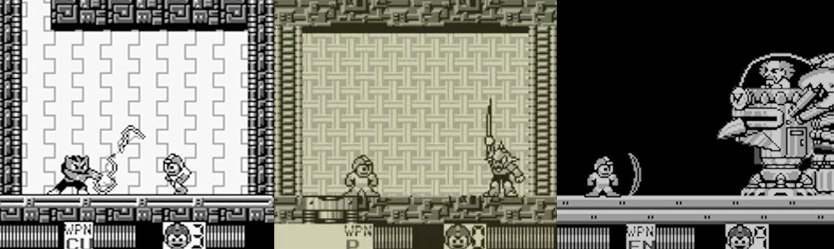
Anyone who’s played Mega Man 2 will recognise the four initial Robot Masters, their stages, their attack patterns, and their Special Weapons and battling them is no different to that game except the arena and screen is much smaller so it’s a lot harder to dodge their attacks. As always, you’re better off tackling each in a specific order to obliterate them with whichever Special Weapon is most effective against them, meaning I tackled Metal Man first to grab his Metal Blade, which cut down Wood Man despite his large Leaf Shield and leaf barrage, which in turn clogged up Air Man (despite his mini tornados filling the arena), which of course gave me the edge over “Clash Man”. This latter was probably the toughest fight as “Clash Man” doesn’t just jump around and damage you with his giant hit box like the others; he also drops a delayed explosive charge that can be tricky to dodge. Defeating Metal Man, Air Man, and “Clash Man” awards the three Rush “items” that debuted in Mega Man 2. These allow you to spring up to higher platforms, fly over bottomless spits or spike beds, or easily cut through underwater areas with Mega Man’s robotic canine, Rush. While these turn the game into a short sidescrolling shooter, you must keep an eye on your energy meter or you’re like to be sent plummeting mid-flight. After besting the first four stages, you’re transported to four more levels from Doctor Albert Wily’s space station, with these themed around stages and bosses from Mega Man 3. You’ll face Needle Man, Magnet Man, Hard Man, and Top Man, with each being exactly the same as in their NES title and bestowing the same Special Weapons (which, honestly, I only found useful for defeating their counterparts). Finally, you’ll battle Quint, an upgraded and corrupted future version of Mega Man who bounces around on Sakugarne, a pogo-stick-like item that is surprisingly useful against the final boss.
Stages are longer, more detailed, and more accurately reflect their NES counterparts.
The difference between Dr. Wily’s Revenge and Mega Man II isn’t readily apparent from the title screen alone, despite the noticeably jauntier music, but does become more obvious once you get into the game. Stages are longer and far more detailed, with gears, cogs, and a mess of drill-like platforms adorning Metal Man’s stage (alongside those conveyer belt-like platforms from Mega Man 2). Wood Man’s stage features a surprisingly detailed forest and tree trunk interior, Air Man’s stage is in the clouds and features girders and Mega Man 2’s “Goblin” platforms, and “Clash Man” resides in an ugly mess of pipes. As in the last game, Mega Man flies into space to confront Dr. Wily, though there’s now an additional cutscene where he drops you into a trap and you’re teleported to four additional stages rather than battling through different levels of Dr. Wily’s base. Needle Man’s stage has a large city in the background and essentially takes place on a construction site, while Magnet Man’s is also in the sky, with clouds obscuring enemies and you crossing gaps using the Mag Fly enemies. Hard Man’s stage is much more basic, being simple steel platforms and a plain background, while Top Man’s reminded me of a botanical garden with its glass tubes containing leaves. This latter stage, and Wood Man’s, contain underwater sections where you’re better off using Rush Marine than risk the floaty jumps. Disappearing/reappearing platforms make a return, as do insta-kill spikes, and you’ll be taking out Kaminari Goros to ride their cloud platforms across gaps. Large vertical shafts, different ladder designs (now with transparency), cannons, blind drops, and those rail-based platforms from Mega Man 2 all make appearances. When you explore Dr. Wily’s base, it sports a bizarre clock aesthetic and multiple narrow shafts and tunnels, while the ending cutscene again mirrors Dr. Wily’s Revenge by being in space and featuring a roll call of the game’s bad guys. Speaking of which, Mega Man II features far more enemy variety, recycling baddies from Mega Man 2 and 3 but I’ll take that over the handful of lame enemies seen in Dr. Wily’s Revenge.
Recycled Robot Masters are joined by a new foe and Dr. Wily’s newest three-stage weapon.
While Mega Man II performs much better than its predecessor and sports a greater number of large enemy sprites, there are still many moments where the game suffers from slowdown, screen tearing, and sprite flickering. It feels like a far bigger game thanks to you being transported to additional stages rather than straight to boss battles in Dr. Wily’s space station, though it still suffers from a lack of originality in its level design and a failure to better incorporate the various Special Weapons into each stage beyond using Rush Marine or Rush Jet to bypass certain obstacles. Drills, clamps, respawning enemies, rushing robot chickens, mechanical apes, and robots with fans in them dog your progress as much as totem poles, robotic birds, and giant mechanical cats. Bola-throwing Joes, spiked hedgehogs, and large spiked weights all make appearances alongside the usual bottomless pits, with some enemies positioned in ways that require your Special Weapons (though you’ll need all your energy for the Robot Masters). This game’s newest “Mega Man Killer” is Quint, but he’s a pretty lame penultimate boss despite his lack of a health bar. You simply slide under his pogo jump, watch for the rocks he kicks up, and blast him in the head. His Sakugarne is pretty difficult to control, but you can use it to land a lot of hits on Dr. Wily in the final confrontation, since his only weak spot is his cockpit. Dr. Wily battles you in three craft, flying between them in his little UFO vehicle, with the first being a mech walker that fires bouncy bombs and a low needle shot. Defeating that sees him switch to a tank-like vehicle and gain a cannon shot, while the third phase has him in a stationary dragon-like mech that drops missiles, rains enemy robots onto you, and tries to smash you with its extendable skull. If you’ve collected a bunch of E-Tanks, these battles are tough but mostly do-able. It helps that there’s not loads of projectiles and slowdown to deal with, though the rewind feature is obviously your saving grace.
The Summary: Mega Man II represents a bit of a step up from Dr. Wily’s Revenge, but not much. It’s literally the same as the differences between Mega Man 2 and Mega Man 3, with Mega Man II adding only one brand new weapon to your arsenal (the Sakugarne), though it does recycle Special Weapons and the Rush abilities from those two NES titles. Sadly, they’re not utilised all that much; again, I can forgive this given the restrictions and limited hardware of the Game Boy, but it would still be nice if the game had found some way to incorporate Rush more prominently. Although the Game Boy still struggles to render all the action, Mega Man II performs far better than its predecessor, is much bigger, and features far more detailed environments. Some of them might be an eyesore but it’s still impressive given the hardware, and I always enjoy seeing it render large enemy sprites (even if they are immobile). The enemy variety was also much appreciated and a big step up from the last game, even if they are all recycled, and the music was pretty catchy, too. The hit boxes remain a frustrating obstacle, but Mega Man II seemed more forgiving in this regard, though more challenging overall with its longer stages, greater hazards, and the inclusion of four additional stages prior to the additional Robot Masters. In many ways, it’s simply a repeat of the last game but with more to look at and accomplish, which is enough to bump the score up ever-so-slightly, but there’s still a lot of room for improvement for it to match-up to its NES counterparts.
My Rating:
⭐⭐⭐
Rating: 3 out of 5.
Pretty Good
Did you own Mega Man II back in the day? How do you feel it compares to Mega Man: Dr. Wily’s Revenge? Which order did you challenge the Robot Masters? Were you disappointed by Quint? What did you think to the inclusion of four additional stages in Dr. Wily’s space station? Which portable Mega Man game is your favourite? How are you celebrating the science-fiction genre this month? Whatever opinions on Mega ManII, leave them below and be sure to check out my other Mega Man reviews!
January celebrates two notable dates in science-fiction history, “National Science Fiction Day” on January 2 and Arthur C. Clarke’s HAL 9000’s birthday on January 12. Accordingly, I’m dedicating January to celebrating sci-fi in an event I call “Sci-Fanuary”.
Released: 7 June 2024 Originally Released: 26 July 1991 Developer: Minakuchi Engineering Also Available For: Game Boy, Nintendo 3DS, Nintendo Wii, Nintendo Wii U
A Brief Background: Mega Man(Capcom, 1987) represented Capcom’s bid to make their big debut in the growing home console market. Known as “Rockman” in Japan, Mega Man was a bighit despite its excessive difficulty and, by 1991, the Blue Bomber had (eventually) become a Nintendo staple with a handful of sequels. While Capcom were busy working on Mega Man 4(1994) for the Nintendo Entertainment System (NES), they outsourced the development of Mega Man’s Game Boy debut to Minakuchi Engineering, though long-time series artist and producer Keiji Inafune contributed by designing the newest Robot Master, Enker. Though limited by the Game Boy hardware, Mega Man: Dr. Wily’s Revenge was highly regarded at the time. Reviews praised its faithful recreation of the NES gameplay, though its difficulty and recycling of previous elements was criticised. Although a compilation of Mega Man’s subsequent Game Boy adventures was cancelled, the Blue Bomber had a healthy career on the Game Boy and his handheld adventures were later ported to Nintendo’s online shops and services.
The Review: Mega Man: Dr. Wily’s Revenge is a 2D, sidescrolling action/platformer in which players control the fighting robot Mega Man and run-and-gun their way across four initial stages, each themed around a returning Robot Master from Mega Man. Being a Game Boy title, the controls are as simple as you would expect: you control Mega Man with the directional pad, jump with A, and fire his currently equipped weapon with either X or B. You can pause the game and select a Special Weapon using the + button, though the Special Weapons Mega Man obtains drain an energy meter, which must be refilled by collecting Weapon Energy pods that are either dropped by the constantly respawning enemies or found in each stage. You can also find the odd 1-Up for an extra life and refills for your health bar, both of which are sorely needed as Dr. Wily’s Revenge is one challenging game. While Mega Man can take a fair few hits, hit boxes are large thanks to the Game Boy’s small screen and the surprisingly big sprites. Mega Man also gets knocked back when hit and you’ll constantly have to watch for insta-kill hazards like spikes, lava, and bottomless pits. Thankfully, the password system introduced in Mega Man 3 (Capcom, 1990) appears here and you can abuse the Nintendo Switch’s save state and rewind feature to your heart’s content, though it’s sometimes easier to lose a life and respawn from a checkpoint with full health than risk battling a boss with critically low health.
Mega Man uses recycled abilities to take on some familiar faces in a semi-new adventure.
If you’ve played the original Mega Man, you’ll be very familiar with the Special Weapons on offer here. You’ll get the Thunder Beam, Ice Slasher, Fire Storm, and Rolling Cutter from the four primary Robot Masters, with the Thunder Beam firing horizontally and vertically, Ice Slasher firing frigid arrows that temporarily freeze enemies, Fire Storm blasting a fireball and creating a brief shield, and the Rolling Cutter tossing a boomerang-like projectile. You can challenge the four Robot Masters in any order but, as each has a specific weakness, it’s better to go after them with the right Special Weapon on hand as you’re stuck in a claustrophobic arena and dodging their attacks is incredibly difficult thanks to those big hit boxes. Once you’ve gotten the fourth Special Weapon, you’ll also get the “Carry” weapon, which creates a temporary floating platform and is key to reach out of the way areas or crossing spike beds or bottomless pits. When battling through Dr. Wily’s fortress, you’ll encounter four Robot Masters lifted from Mega Man 2(Capcom, 1988) and gain four additional Special Weapons that again function exactly the same as before. The Time Stopper freezes all enemies until your meter drains and leaves you unable to attack, the Quick Boomerang tosses a few small boomerangs in quick succession, the Bubble Lead fires slow but powerful bubbles, and the Atomic Fire shoots flaming spheres that you can charge by holding X or B. Finally, defeating Enker earns you the Mirror Buster, which reflects projectiles if and when you can get the timing right. There is no slide ability here, no Rush, and very few opportunities to use your weapons in stages beyond using the Atomic Fire to destroy optional blocks in Dr. Wily’s stages.
Stages are surprisingly detailed, though the hardware struggles at times.
Despite being a Game Boy title and thus devoid of any colour, Dr. Wily’s Revenge surprised me in how detailed it is. There’s no intro or story to speak of, but the title screen is surprisingly vivid and all the sprites are big and cartoonish. Mega Man even blinks when left idle and the backgrounds are surprisingly not just plain voids, with you scrambling around on rooftops against a backdrop of clouds at times. You’ll clamber up ladders (sadly lacking transparency), hop to moving or temporary platforms, and dodge hazards such as blowing fans, electrical currents, plumes of fire, and the ever-annoying spikes. Each stage gives a sense of a theme, with Elec Man’s stage kind of being like a power plant, Ice Man’s being covered in snow that slows your movements and ice that sends you skidding to your doom, Fire Man’s stage featuring wooden ladders and rivers of flashing lava, and Cut Man’s stage being packed with girders and little buzzsaw enemies. Enemy variety is a little lacking; Metall and Sniper Joe are here, alongside little propeller enemies, loads of lame +-shaped robots, sentient scissor blades, and little birds that drop eggs full of smaller minions. Larger enemies like the Big Eyes and Hotheads act like mini bosses, slowing the action to a crawl and causing the sprites to flicker and the engine to struggle to render everything onscreen, and you must blast the Lightning Lords to ride their cloud mounts through the skies of Elec Man’s stage. Enemies respawn and can be “farmed” for goodies, but some (looking at you, Big Eye) are difficult to defeat without expending your Special Weapon energy. You’ll want to be fully powered up when you tackle the Robot Masters as, again, the game slows to a crawl once they start jumping or flying about and firing their projectiles, and the hit boxes are so big that it’s almost impossible to defeat them without taking at least a little damage, even with the right Special Weapon equipped.
Once you’ve bested the returning bosses, you’ll face Dr. Wily’s newest, cheap-ass creations.
Visually, the game does a decent job of recreating its NES counterparts. Sure, stages aren’t as colourful or varied and Mega Man’s sprite doesn’t change when he has Special Weapons equipped, but the same vertical shafts are here, many of the same gimmicks and mechanics are present, and the music holds up just as well as Mega Man 2’s. Larger sprite art is used to show Mega Man’s arsenal being upgraded, in-game graphics recreate Dr. Wily’s escape to his fortress and his humiliating defeat, and we still get a fun roll call during the credits. Naturally, beating the four stages isn’t enough and you’ll need to fight your way through Dr. Wily’s fortress, a mish-mash of every enemy, hazard, and gimmick seen before, including ice blocks that melt when you stand on them, flame bursts across the ground, and tricky platforming sessions (though now against the fun background of a space station!) Some of these hazards are used in tandem, such as fans pushing you back as you hop to platforms over a spike pit, or electrical bursts appearing in spiked shafts, or forcing you into shoot-outs with Sniper Joe on precarious platforms. After besting Enker (who can absorb and redirect your shots but its otherwise pretty easy to beat; literally just keep shooting and dodging), you’ll take on Dr. Wily’s newest death machine. This large, bird-like mech is completely stationary but initially spits buzzsaws that you must jump over or run under to attack with the Fire Storm. The second phase is much harder as Dr. Wily fires a semi-homing claw appendage and super-fast high and low projectiles. You need to find the space to avoid taking damage and use frame-perfect timing to reflect his shots with the Mirror Buster to win the day here, which can be very frustrating since everything is so hard to avoid given the restricted screen space.
The Summary: I was surprised by Mega Man: Dr. Wily’s Revenge. Given the restrictions and limited hardware of the Game Boy, I didn’t expect the game to look or sound as good as it did. The sprites and environments are nice and chunky and detailed, technically surpassing the first two NES titles in many ways, and the game does a great job of recreating the gameplay and gimmicks of its home console cousins. Mega Man controls exactly as I’d expect and the gameplay loop is the same, but distilled into a portable package. Yet, I give the game props for having you face different Robot Masters in the endgame rather than simply repeating the previous four boss battles. Unfortunately, the limitations do hold this game back. Screens are largely empty, with only a handful of sprites and hazards seen at any one time, because the Game Boy just cannot render it all. This leads to some of the worst slow down and screen tearing I’ve ever seen as sprites fade out of existence and the game struggles to chug along. I can somewhat forgive the recycling of elements from Mega Man and Mega Man 2 and commend the developers for recontextualising them in a new adventure but, at the same time, why not just port the first two games since you’re not doing anything really new with the concept? The game is also atrociously difficult, and not just because the hit boxes are so large. I have no idea how anyone beat this back in the day without rewind and save states because it was pretty tough to beat even with those features. Unfair and needlessly difficult at times thanks to the hardware limitations, Dr. Wily’s Revenge is a fair crack at offering a portable Mega Man adventure but ultimately has too much working against it to be as enjoyable as I’d like.
My Rating:
⭐⭐
Rating: 2 out of 5.
Could Be Better
Was Mega Man: Dr. Wily’s Revenge in your Game Boy library back in the day or did you first play it on Nintendo Switch? Which order did you tackle the game’s Robot Masters? Were you disappointed that the bosses and Special Weapons were recycled from the NES games? What did you think to the difficulty of the game? Which portable Mega Man game is your favourite? How are you celebrating all things science-fiction this month? Whatever your thoughts and memories of Mega Man, feel free to leave them below and go check out my other Mega Man reviews!
On 21 February 1986, The Legend of Zelda(Nintendo EAD, 1986) was first released in Japan. The creation of legendary game designer Shigeru Miyamoto and Takashi Tezuka, The Legend of Zelda launched one of Nintendo’s most popular franchises. This year, I’m dedicating every Wednesday to Nintendo’s most famous silent protagonist, Link and his vast and enduring fantasy world of sword and sorcery.
Released: 27 July 2023 Originally Released: 27 February 2001 Developer: Nintendo Original Developer: Flagship Also Available For: Game Boy Color, Nintendo 3DS (Virtual Console)
The Background: My very first introduction to the Legend of Zelda series (Nintendo EAD/Various, 1986) was The Legend of Zelda: Link’s Awakening(ibid, 1993) on the original Game Boy, which began life as an unsanctioned side project of programmer Kazuaki Morita and became a critically acclaimedbest-seller for the system, a success that Nintendo duplicated with its Game Boy Color upgrade in 1998. Link’s Awakening was followed by two relatively obscure and hard to come byZelda titles that initially came from Yoshiki Okamoto’s desire to remake the original game for the Game Boy Color. Zelda creator Shigeru Miyamoto suggested making a trilogy of interconnected games that would directly communicate with each other through the use of shared assets and passwords, but the logistical challenge of this forced the developers to scale the project down to two games. The technical limitations of the Game Boy Color also caused the developers significant issues, but they were bought more time to refine the concept when the release of the Game Boy Advance was pushed back, giving them that chance to incorporate elements from the 3D Zelda titles. The games sold over 3.96 million copies, making them a commercial success, and they were met with rave reviews that praised their visuals and the replay value offered by the password system. However, many gamers (like myself) were unable to legitimately play the games for an affordable price for some seventeen years, when they were finally added to the Nintendo 3DS Virtual Console, but a whole new generation of gamers were able to experience these often-forgotten games when they were added to the Nintendo Switch Online service in 2023.
The Plot: In Oracle of Ages, Link finds himself in Labrynna and charged with rescuing Nayru, the Oracle of Ages, from the evil clutches of Veran by travelling through time to collect the eight Essences of Time. In Oracle of Seasons, Link must rescue Din, the Oracle of Seasons, from the evil Onox, questing for the eight Essences of Nature and battling wild elements. Defeating these evil forces brings Link into a final confrontation with Twinrova, who wish to sacrifice Princess Zelda to resurrect the dark lord Ganon!
Gameplay: If you’ve played the original Link’s Awakening, or any of the top-down Zelda titles, then the Oracles games will be immediately familiar to you. You’re given three save slots, the ability to rename your character, and dropped into one of two fantasy worlds, Labrynna or Holodrum, and tasked with questing to retrieve eight mystical items to rescue each game’s Oracle and restore the lands from evil. Since these were Game Boy Color titles, the Oracles games operate on a very simple two-button setup; players can enter the inventory menu by pressing ‘Start’ and equip two items, one to A and one to B, to use to defeat enemies, solve puzzles, and open new paths. Primarily, this will be your sword and shield; Link can attack in four directions or charge up his trademark Spin Attack to attack in a circle and can defend himself from incoming attacks by holding down the shield button. As you progress through both games, you’ll acquire these weapons, and other items either by finding them in one of the dungeons, buying them from one of the many shops, or being gifted them by a friendly non-playable character (NPC). Initially, you can’t access anything, not even the pause menu, and you later must equip two specific items in conjunction to get past obstacles, such as using the Pegasus Seeds and Roc’s Feather to clear longer gaps.
Link must channel the seasons and time itself to save these chaotic lands.
Link’s journey takes him all over each land and both are filled with enemies and hazards; some are easily overcome with your basic sword, others require more tactical use of your weapons (such as directing the Magical Boomerang to hit switches or dropping bombs to blow open cracks in walls), and it’s worth attacking most enemies, cutting grass, and digging up dirt to unearth hearts, Rupees, and ammo to keep yourself well stocked. Link begins with three hearts (or four, it seems, in a “Linked Game”) and can replenish them with hearts or extend his life bar by finding Heart Containers, but you’ll need Rupees and Ore Chunks to purchase items from shops. All of this is very familiar to any Zelda fan, exposing hidden paths and even switching to a sidescroller perspective in certain areas, but there are a couple of gimmicks that make each game stand out. First, each game contains two overworld maps; in Oracle of Ages, you’ll travel hundreds of years into the past and in Oracle of Seasons you’ll travel back and forth to the underground realm of Subrosia. Travelling to the past alters the landscape somewhat, allowing you to access new areas by warping to dead ends in one era, and changing events in the past will affect the future as well. In addition, Link’s swimming abilities are greatly expanded upon in Ages; you’ll get to dive deep underwater and explore coral-filled areas to progress, and not just in the overworld, where you’ll visit Zora’s Domain, but in dungeons, too. In comparison, Subrosia is a more fragmented landscape; here, you’ll find your way blocked by rivers of magma, the environment beset by exploding volcanos, and inhabited by cloaked, dwarf-like people obsessed with ore and mining. Subrosia is also home to the Temple of Seasons, which you gain additional access to as you conquer dungeons and acquire new gear, which in turn powers up the Rod of Seasons and allows you to change the seasons in Holodrum.
In addition to underwater and sidescrolling sections, Link has animal friends to help him out.
You’ll find tree stumps all around Holodrum and, from these, you can wield the Rod of Seasons to cycle between spring, summer, autumn, and winter, with each season altering the landscape in some way. Winter sees snow pile up, for example creating higher paths and snow piles that need digging up; autumn sees mushrooms bloom, allowing you to pick them up to access new paths, spring activates flowers that boost you to higher levels, and summer sees climbable vines appear on the overworld. You’ll often need to switch seasons regularly to access different areas and then backtrack to reach a new path, and the seasons change sporadically as you explore, creating new obstacles and requiring you to switch weapons. Eventually, Link also gains the ability to fast travel around the map with Warp Seeds, to swim and dive in water, and to call an animal companion to help get past specific obstacles, though you won’t be using magic in either game. In Ages, time travel is initially quite limited as you need to use the Harp of Ages at specific points, but eventually you gain the ability to freely travel back and forth through time to solve puzzles, complete fetch quests, and access new dungeons and regions. Almost every task in Ages is some kind of convoluted puzzle or fetch quest requiring you to talk to numerous NPCs and travel between eras multiple times just to access a Dungeon Key. Easily the most frustrating example of this is when Link visits Tokay Island and has all his equipment stolen by the lizard-like Tokay; you’ll need to track each piece down one at a time and use them, in conjunction with time travel shenanigans (such as pushing seeds next to walls so the sprout into climbable vines), to retrieve everything so you can continue on your quest.
Puzzles are a huge aspect of Ages, including some annoying coloured-based puzzles.
Like Link’s Awakening, Link is tasked with visiting eight dungeons in each game to acquire new items, conquer the bosses within, and claim the eight mystical objects needed to confront each game’s big bad. Although Ages focuses more on puzzles and Seasons is more action-orientated, many familiar Zelda puzzles are found in each game. You’ll be stepping on or pushing pots or statues onto switches, defeating groups of enemies, pushing blocks (either in a specific way or onto certain tiles), lighting torches, and taking stairs or dropping through holes to access new areas, open doors, or acquire keys to progress further. Like in Link’s Awakening, you’ll use sidescrolling sections to hop to moving blocks, Thwomps, climb ladders, or swim past Cheep Cheeps, though both games place great emphasis on mine carts; you’ll ride these to new areas in the dungeons, hitting switches to change their direction or lighting torches as you speed past. Each dungeon hides a Compass and Map to help you navigate and you’ll unlock a warp point after defeating the mini boss, which is useful when you have to backtrack to find or use keys and items. In Seasons, many puzzles are solved by using Link’s Magnetic Gloves to move magnetic balls and hover over gaps on small rotating diamonds, or by dropping blocks down to lower levels, or activating bridges across gaps and you’ll need to be quick on your feet or to hide behind your shield when the floor suddenly collapses or comes to life to attack you. Occasionally, you’ll lose traction in icy areas, navigate maze-like woods, play hide and seek, and be sent to take out fortified areas or rescue animal companions to reach new areas to say nothing of dodging fireballs, floor spikes, crushing weights, and rolling logs. While puzzles appear in Seasons, they’re far more prominent in Ages, with the most infamous being those involving pushing a coloured cube in a specific way so it lands on the right coloured tile, or using the Cane of Somaria to create a block to press multiple switches at once, or rearranging statues. You’ll enter rooms where you need to step on all the tiles in a specific path to access keys, or jump to coloured tiles to make them all match up, or defeat coloured Gels when the room is a specific colour. Sometimes you’ll need to navigate invisible paths (where the Cane of Somaria again comes in handy), bomb walls or blocks in mazes, navigate past bladed obstacles or arrows, and even change the dungeon layout entirely, though oddly the time travel and season gimmicks rarely play a part within the dungeons.
Graphics and Sound: Both Oracles games heavily reuse assets from Link’s Awakening, recycling sprites, environmental details, and certain gimmicks and presenting them in new ways. This could be seen as a negative but something about the presentation makes the games pop in a way that outdoes its predecessor; maybe it’s that the games were purposely built for the Game Boy Color or the influence from The Legend of Zelda: Ocarina of Time (Nintendo EAD, 1998), which sees familiar tunes and species from that game (particularly the Gorons and Zoras) integrated on the small screen. NPCs are much livelier and more integrated into the plot as well; engagements with them carry over between games, changing your interactions with them, and you’ll find all sorts of fun NPCs on offer in both games, from a hyperactive child, to talking animals, to lovesick anthropomorphic trees, lost souls, and skeletal pirates. Each game may visually resemble the other and Link’s Awakening but they’re noticeably different; the changing seasons mean you effectively have four different overworld maps in Seasons and the past of Ages is far less vibrant and more a work in progress, with each time period (and Holodrum and Subrosia) having their own overworld themes or variations on the classic Zelda theme. Link directly changes each area in various ways, from altering the seasons to unlocking gates, flooding areas with water or lava, to allowing a pirate ship stuck between worlds to venture from the sands of Subrosia to the docks of Holodrum. Travelling through time lets you explore ancient Labrynna, where towns are still being built, Queen Ambi and her palace are prominent, and the towering and dangerous Restoration Wall leads to the decimated Symmetry Village, a location you directly improve by travelling through time.
The anime aesthetic and visual borrowings from the 3D games add to the colourful variety.
One area where both games shine is the incorporation of large sprite art for various cutscenes, such as the opening and when Link meets the Oracles. These are rendered in an anime style that recalls the artwork of The Legend of Zelda: A Link to the Past(Nintendo EAD, 1991) and are partially animated. These are used sparingly, however, and the in-game sprites are once again relied on to convey the bulk of each game’s story, with dialogue boxes and input from the Maku Tree (or consultation with an Owl Statue or some chatty birds) guiding you or offering hints. Perhaps as a consequence, the games include some new and updated sprites; while Link is largely unchanged and many of the enemies are recycled from Link’s Awakening, NPCs are more varied than ever and there are some large and detailed boss sprites. The overworld greatly benefits from this newfound attention to detail; Goron City, Zora’s Domain, and the various towns and castles are bustling and varied, with both games including fun elements from Ocarina of Time (like Jabu-Jabu) alongside guessing games, target practise, and aggravating dancing mini games (which are especially prominent in Ages). Sadly, the same can’t be said about the dungeons; many are largely interchangeable and contain the same recycled elements, though they naturally get bigger, more maze-like, and more complex to reflect a rise in difficulty. These means that, while some have different colour palettes and may feature greater emphasis on water, gaps, or other hazards, there’s not much to differentiate them as you’ll see the same gimmicks recycled, though they are used in ways that continually tax you. Of the two, Oracle of Ages has the better, more varied dungeons; Jabu-Jabu’s Belly is largely flooded, requiring you to dive to access new areas, Crown Dungeon makes better use of the coloured block gimmick, and generally there is a lot more to do in Ages’ dungeons, even though this can be frustrating as you need to do a lot of wandering around, backtracking, and trial and error to access keys and doors.
Enemies and Bosses: As near as I can tell, every enemy in the Oracles games is recycled from Link’s Awakening with the exception of the Lynel, a tough centaur-like wolf that deals as much damage as it can absorb. Otherwise, you’ll be encountering various Moblins and Darknuts (who wield spears, swords, and spiked maces), Octoroks, shield-eating Like Likes, snake-like Ropes, bat-like Keese, and electrifying Buzz Blobs. Some will attack when you cut down grass or fall from the sky, like the Floor- and Wallmasters that spawn in to drag you back to a dungeon entrance or the ghost-like Ghinis that haunt various graveyards. Anti-Fairies will bounce around, similar to Bubbles, chipping away at your hearts; Arm-Mimics copy your every move, mummy-like Gibdos shrug off your shots, Wizzrobes constantly teleport in and out shooting energy waves at you, the Mini Masks must be attacked from behind (or have their metal masks removed), and you’ll need to take cover behind the environment to avoid being blasted by Beamos statues and be quick on your feet to outrun the many small and large blade traps. Some enemies are hiding in plain sight, such as the Old Men who will rob you, the wandering witch who steals items from you if you bump into her, or the guards fastidiously overseeing Queen Ambi’s grounds. While enemies are shared across both games, a couple are unique to each; you’ll only encounter Candleheads in Ages and Magnites in Seasons, for example, though this element could’ve been expanded upon to give each game their own unique enemies.
When bosses aren’t being recycled from previous games, they require your various sub weapons.
Each game features nine mini bosses, with two being shared between the games; the Great Moblin and Vire, who you’ll have to battle in a fortified keep and the Ancient Ruins, respectively. While Vire attacks exactly as in Link’s Awakening, flying about and shooting coloured projectiles and splitting into smaller parts and only being vulnerable when charging, the Great Moblin is fought after avoiding his fortress cannons with your animal companion then tossing his own bombs back at him. Some of Ages’ mini bosses will be readily familiar to players of Link’s Awakening as Smasher and the Angler Fish return, and even the Giant Ghini can be traced back to that game, though their attack patterns are altered; you still need to throw Smasher’s balls back at it but they now disappear after a short time, the Angler Fish is fought on the ground (though still from a side-on perspective) and has additional bubble attacks, and the Giant Ghini is now a more formidable foe accompanied by smaller minions and capable of charging you. Ages also has three unique mini bosses; Subterror is a mole-like monster you dig up with your shovel, the Armos Warrior is a giant Armos whose shield can only be destroyed by tossing its huge sword back at it, and the Blue Stalfos is a Grim Reaper-like foe whose energy balls must be reflected back at it. Another returning boss from Link’s Awakening is Façade, who’s fought twice in Seasons but defeated in the same way as ever (simply bomb its face when it appears on the ground and watch for falling rocks). Seasons also has you fight the Brother Goriyas (who toss a boomerang between each other), three Omuais (who you must yank out of the water to attack), the Agahnim-like Agunima (who, like Agahnim, splits into copies and fires magical bolts at you and can only be defeated when all the torches are lit), the sabretoothed ball of teeth known as Syger (who’s only weak spot is the red ball on his tail), the two mischievous Poe Sisters, and the elemental spirit Frypolar, who can only be defeated by tossing its own icicle constructs back at it.
Returning bosses are given new life and made more dangerous than ever,
There are also eight primary bosses in each game, with a final boss to be conquered at the end. Although each game has unique bosses, six of Seasons’ bosses return from the first Legend of Zelda game. Aquamentus, Dodongo, Gohma, Digdogger, Manhandla, and Gleeok all return here, with Manhandla and Gleeok being two of the toughest. Manhandla can only be damaged by attacking its beak-like mouths when they’re open; unfortunately, this is also when they spit projectiles, and its attacks only increase as each “head” is knocked off, exposing its vulnerable insides. The two-headed dragon Gleeok again remains stationary and spits fireballs from its heads, one of which will fly about after being severed, but it’s actually easier to battle than in the original game. Mothula returns from A Link to the Past, with a similar attack strategy of circling the room and firing at you; though the moving floor is gone, you’ll need to watch for holes and jump over gaps to attack Mothula when it lands. This means that Seasons’ sole unique boss is the Medusa Head, which teleports about, turns you to stone, and fires a massive laser beam from its eyes but is easily stunned with your Pegasus Seeds. Aquamentus still spits fireballs, but now also has a charge attack; you must first force the Dodongo to swallow a bomb and then toss it onto the spikes surrounding the arena with the Power Bracelet; you’ll need to avoid being grabbed and tossed by Gohma’s claw, sever it, and then shoot its eye; and finally make use of the spiked magnetic ball to smash Digdogger and its mini doubles into the ground.
Unique perspectives and methods are required to topple many of the game’s tougher bosses.
In comparison, Ages’ bosses are exclusive to that game, which helps to make it more unique, though some are reminiscent of previous Zelda bosses (Ramrock, for example, resembles King Bongo Bongo, though you defeat it by timing bomb throws into its giant stone hands). The first boss you’ll face is Pumpkin Head, who wanders around shooting a spread of fireballs; his only weak spot is his torso, which you attacked to grab and toss his jack-o’-lantern head to reveal its true form. The Head Thwomp is pretty unique as it’s fought from the side-on perspective and sees Link hopping around avoiding projectiles and falling rocks and dropping bombs into the boss’s head to make its expression change to red, causing damage and dropping hearts or bombs. The Shadow Hag also requires a unique strategy to defeat; she splits into multiple shadow forms and protects herself with moths, meaning you must fire a seed so it ricochets back into her. Eyesoar also requires the use of one of Link’s other weapons to damage; it protects itself with smaller eyes and relentlessly moves towards Link, so you need to clear them away and snag it with your Switch Hook to stun it and whack it with your sword. Smog is probably Ages’ most aggravating boss; it is fought in four rounds, each with a different arrangement of blocks, and its smaller form charges around tossing fireballs. You need to strategically place blocks with the Cane of Somaria to get the smaller parts to converge into one, which you can then attack, which each stage getting more difficult as Smog adds lightning attacks to its arsenal. The Octogon constantly swims around Link spitting projectiles at him; you need to angle your seed shooter to attack its weak spot on the back, and dive underwater to smack it with your sword, which can get quite chaotic. You’ll need to use these same seeds when battling the Veran-possessed Queen Ambi as this is the only way to drive Veran’s spirit from her body so you can stun her with the Switch Hook and attack with your sword. The Switch Hook’s upgraded form, the Long Hook, is also the only way you’ll defeat Palsmarine, two jellyfish-like enemies who can only be damaged by causing them to run into each other’s attacks.
As if the monstrous final bosses weren’t bad enough, a deranged version of Ganon also appears.
Once you’ve collected the eight mystical artifacts in each game, you break the spell keeping you from the big bads. In Ages, you battle the evil witch Veran at the Black Tower, a maze-like castle filled with Lynels and Wizzrobes, and whose battle consists of two phases. First, Veran summons Dark Links to distract you, dashes about, and throws a variety of fireballs. Once defeated, she transforms into three monstrous forms: a large beetle that crashes to the ground to temporarily cause acidic hazards to appear, a large bee that quickly flies around and slows your movements with its barrage of stingers, and a horrific spider that stuns and slams you with its web. These forms are random (I never actually saw the bee form) and require different strategies, such as attacking the beetle’s face, firing a seed at the bee, and tossing bombs at the spider. In Seasons, the antagonist is the formidable, heavily armoured General Onox whose castle is a labyrinth filled with some of the game’s toughest enemies and a rematch with Façade. When you reach Onox, he first swings and hurls a massive, spiked mace, causes boulders to rain down, and stuns you with whirlwinds and the only way to damage him is with your Spin Attack and swipe the Rod of Seasons when he uses Din to shield himself. Afterwards, you drop down a hole and face Onox’s dragon form! You need to avoid his flaming projectiles and being squashed by his claws and hop onto his hands to slash at the crystal on his head, which can be tricky if you cheese your jump. If you’ve cleared a Linked Game, you’ll be dropped into the Room of Rites to rescue Princess Zelda. This means battling Koume and Kotake, first separately (reflecting their elemental attacks back at each other) and then in their fused state as Twinrova (which conjures flaming pits or turns the floor to ice and must be stunned with Mystery Seeds) not unlike in Ocarina of Time. Defeat the witches and they’ll sacrifice themselves to resurrect Ganon, forcing you to fight an unhinged version of the Gerudo King in a battle not unlike A Link to the Past. Ganon teleports around the room and unleashes some devastating attacks, such as a charged swipe of his trident, stunning you with a ground-quaking drop, or charging up a huge energy ball. Ganon can only be damaged with a Spin Attack so you need to unleash it and quickly jump or dash away to avoid being hit, the timing of which can be tricky but I actually found this an easier bout than in A Link to the Past as there’s less to worry about onscreen.
Power-Ups and Bonuses: One aspect not carried over from Link’s Awakening are the temporary power-up Acorns; Link also won’t be getting new tunics either, which is a shame, but in their place is the Ring system. As you explore, you’ll find Gasha Seeds that can be planted in soil patches; these blossom into acorns that gift you Rings, or you can find them in chests or buy them from shops. Take them to Vasu the jeweller to appraise them for 20 Rupees and you can equip a Ring to enable certain effects, such as doubling your attack power, sensing secrets, increasing your throw distance, and even turning Link into an Octorok! Some Rings have negative effects as well, such as upping your attack power at the cost of you taking more damage, or no effect at all and simply being keepsakes. You can eventually hold multiple Rings in your Ring Box, but you can only equip one at a time so it’s best to think about what benefits you might need in the long-term. Another new aspect are the animal companions; Ricky the boxing kangaroo, Moosh the flying bear, and Dimitri the friendly Dodongo will help you throughout your quest, ploughing through hazards, flying you over gaps, and scaling waterfalls, respectively, when you call for their help but you’ll eventually have to settle on one as your primary companion, which is then reflected in the Linked Game.
Link’s new weapons and companions provide new ways to traverse and solve puzzles.
Another new aspect here is that Link utilises a slingshot or a seed shooter rather than his traditional bow and arrows; the slingshot can fire a variety of seeds, from Ember Seeds to Mystery Seeds. The slingshot can even be upgraded to fire three shots at once, a luxury not afforded to the seed shooter (though you can aim your shots to ricochet to their target). Link’s seeds are very useful as well; the Gale Seeds allow him to warp, and the Pegasus Seed awkwardly take the place of the Pegasus Boots, allowing Link to run fast for a short period of time. Otherwise, weapons and items are very familiar; Link can toss bombs or a boomerang, pick up rocks with the Power Bracelet, and jump gaps with the Roc’s Feather. Many of his weapons can be upgraded, such as Link’s sword powering up to shoot a beam when he’s at full health and his shield deflecting incoming attacks, but two of the most useful upgrades are Age’s upgraded Mermaid Suit, which lets you dive and attack underwater, and Seasons’ upgraded Roc’s Cape, which lets you glide over gaps. Ages’ Cane of Somaria is required to press multiple switches at once to solve puzzles, as is the Switch and Long Hook, which let you switch places with diamonds, jars, and other objects to clear gaps, defeat or damage certain enemies, and press switches. Link will also make good use of the Harp of Ages and Rod of Seasons to travel through time and change up the seasons on the overworld, respectively, and playing a Linked Game allows you to access additional weapons, such as homing Bombchus, the Biggoron’s Sword, and the Mirror Shield.
Additional Features: As ever, Link can extend his health by collecting Heart Containers; you’ll be granted an extension for every four you find or after beating a dungeon boss, allowing you to extend Link’s health to sixteen hearts. Link’s weapons can also be upgraded, though some are optional and require you to explore or perform certain tasks. As you explore the overworlds, you’ll come across hidden caves containing Rupees or fairy fountains to replenish your health, and find Maku Seeds which must be planted to acquire new Rings. Both games include a lengthy trading sequence where you exchange key items between NPCs, fleshing out the world, your relationships with the characters, and earning the Noble Sword in the process. Almost every area requires some kind of fetch quest in Ages, such as finding Mystery Seeds to meet Queen Ambi to get the bombs you need to enter the Wing Dungeon, travelling back and forth between time to placate the Gorons, or acquiring a sea chart and talking to Tingle to reach Crescent Island. There are some stronger golden variants of enemies to find and defeat in Seasons that will net you the powerful Red Ring, and you can transfer elements from one game to another after completing them and earning a password. This begins a Linked Game, where you start with four hearts instead of three and with a weapon in your inventory; certain NPC interactions will change, the Hero’s Cave will be considerably more challenging and reward special Rings, Rings and other special items can also be transferred via passwords, and each game includes additional features (such as a familiar 2D rescue of Princess Zelda in Ages and a rematch with the Great Moblin in Seasons) that are only accessible this way and thus encourage multiple playthroughs.
Various side quests and a unique link feature expand the games.
Once you’ve cleared one game and then completed a Linked Game, you can experience the “Hero’s Game” to experience the other game as intended and also access the true final challenge of both games. If you play each game normally, you’ll receive a code to use in the other game; playing a Linked Game sees NPCs reference your heroics and actions from the other game, as well as providing you with additional passwords you can use to access extra items and bonuses. If you play a Linked Game through to the end, you’ll automatically be taken to the Room of Rites to battle Twinrova and Ganon; defeating them gifts you the “Hero’s Secret”, which essentially allows you to play the original, unlinked version of the other game but with more hearts and being able to transfer over your Rings. It’s a pretty unique feature and invites multiple playthroughs, though it does lock some traditional Zelda elements (such as the Mirror Shield and Master Sword) off from you as these can only be accessed with the codes. Back in the day, you could automatically play a Linked Game using a Game Boy link cable; the Nintendo Switch Online version doesn’t currently allow you to jump straight into a Linked Game, but you can choose between the NTSC and PAL versions (though I’m not sure what the difference is between the two) and make use of save states and the rewind feature to make the experience a lot less difficult.
The Summary: For the longest time, the Oracles games were inaccessible to me; as prices soared and I upgraded past the original Game Boy, they became unplayable outside of emulation until they were finally released digitally. I’ve played through both before on the Nintendo 3DS but that was ages ago and I’ve hesitated to revisit them due to the playtime needed to properly experience both, and that’s a mistake on my part as they really are some fun, challenging, and vibrant Zelda adventures. While it’s fun warping between different time periods in Ages, I feel this mechanic wasn’t as prominent as it could’ve been; rarely do your actions in the past impact the future (these events are more noticeable in cutscenes) and I would’ve liked to see more visual differences between the past and present, like a decimated present that gets fixed as you visit the past. In comparison, I really enjoyed the season mechanic in Seasons; being able to manually cause snow or a blazing summer is fun and opens new opportunities for exploration, even if it’s not utilised outside of the overworld. I do have some gripes, but they’re mainly due to limitations of the hardware; for example, it’s annoying having to equip the Power Bracelet every time you need to use it and as good as the map is when you’re warping, it’s not always clear where you’re going. Although the weapons and items aren’t much to shout about and the bland dungeons disappointed me, I enjoyed how much the overworld popped and the boss battles presented; I liked all the returning battles, but the original ones were even better, but I quickly became frustrated with Ages’ focus on repeating puzzles and forcing you to run all over the place for the most mundane tasks. Although the linking system is a little clunky and it’s a shame we didn’t get a third game (and I feel a modern remake would be better served packing all two-and-a-bit games together), I liked the increased emphasis on interactions with NPCs and the incorporation of the animal companions, however brief they are. Including aspects from Ocarina of Time was also a great idea, and the epilogue offered by the Linked Game made for a satisfying conclusion, though again I think more could’ve been done with this feature. In the end, this was like one big Zelda experience spread over two titles…mainly because that’s exactly what it was! Seasons was more my speed overall, but there were elements I liked from Ages like the more varied overworld. Play both back-to-back for the complete experience and you can’t go wrong, though it can’t be denied that there’s a little lacking from each due to them having different mechanics and equipment.
My Rating:
⭐⭐⭐⭐
Rating: 4 out of 5.
Great Stuff
Have you ever played the Oracles games? Which one did you prefer? Did you like that they incorporated elements from the 3D Zelda titles? What did you think to the different overworlds and gameplay mechanics? Did you prefer travelling through time or altering nature? What did you think to the recycled bosses from previous Zelda games? Did you ever link both games and see the true ending? Would you like to see these games remade like Link’s Awakening was? How are you celebrating The Legend of Zelda this month? Leave your thoughts and comments below or on my social made and go read some of my other Zelda reviews on the site!
So, for no better reason than “Mar.10” resembling Mario’s name, March 10th is widely regarded as being “Mario Day”, a day to celebrate Nintendo’s portly plumber, an overalls-wearing mascot who literally changed the videogame industry forever and shaped the home console market of the nineties.

Released: 27 January 2014 Originally Released: 10 May 1999 Developer: Nintendo Original Developer: Nintendo R&D4 Also Available For: Game Boy Color
The Background: After his debut in Donkey Kong(Nintendo R&D2/Ikegami Tsushinki, 1983) and graduating to his own arcade title alongside his brother, Luigi, Shigeru Miyamoto’s Mario took the world by storm with Super Mario Bros. The game was extremely popular, selling over 40 million copies and was pivotal to Nintendo saving the videogames industry from destitution. The game is also no stranger to being ported to other systems; it was a 16-bit makeover for Super Mario All-Stars (Nintendo EAD, 1993) and re-released on the Nintendo Wii to commemorate its twenty-fifth anniversary but, before that, though, Super Mario Bros. was ported to the Game Boy Color in this version of the game. Although Super Mario Bros. Deluxe suffered from a smaller screen size due to its new portable format, the game featured a few new features, such as additional animated elements, challenge modes, compatibility with the Game Boy Printer, and bonus levels, all of which saw it ranked as one of the greatest Game Boy games of all time and it was highly praised for its additional features. The game later made it onto the Nintendo 3DS Virtual Library, and gamers were even able to receive a free copy by registering their Nintendo Network ID, which further bolstered the game with the 3DS save state features and finally gave me my best opportunity to play through this classic title after years of struggling with Mario’s classic 2D efforts.
The Plot: The Mushroom Kingdom has been invaded by Bowser, King of the Koopas, and this wacky army, the Koopa Troopas. After transforming the citizens into inanimate objects and kidnapping Princess Toadstool, Mario and Luigi set out to liberate the Mushroom Kingdom and rescue the princess from his clutches!
Gameplay: As an updated port of perhaps gaming’s most famous 2D, sidescrolling platformer,Super Mario Bros. Deluxe looks, sounds, and plays exactly the same as Super Mario Bros. except you have reduced visibility due to the screen size and the scrolling is a little janky at times. This basically means that the left side of the screen catches up to you pretty fast, which can be an issue as you can’t freely backtrack in the level (or “World”) so it can cause you to plummet to your death if you’re not careful, and it’s not always immediately clear what dangers or goodies are above or below you, meaning you need to use the directional pad to shunt the screen up and down for a better look but, otherwise, the controls and presentation are exactly what you’d expect from Nintendo’s breakout title. You’re played into the overalls or Mario (or Luigi, if you press the Select button prior to entering a World), who can run by holding B or Y and jump by pressing A. Mario will cain extra height and distance if you hold down the jump button and jump from a run, and jumping on enemies is his primary way of dispatching them. While Mario’s physics are pretty tight and responsive, he can be slippery and awkward at times, especially when bouncing off springs, but Luigi is even worse since he has far less traction and a less manageable, higher jump.
Run and hop around squashing baddies, clearing gaps, and swimming through treacherous waters.
As ever, your goal is to move from the left side of the screen to the right and reach a goal flag within a time limit; this timer is pretty generous and it’s only on later Worlds where the game throws repeating paths at you that it can get a bit tricky reaching the end in time. Mario hops about, bouncing off enemies and hitting blocks to progress, but also has to clear longer gaps with the aid of a spring or moving, weighted, or temporary platforms or smaller ones by running over them. Throughout the Mushroom Kingdom, you’ll find a number of pipes; some of these can be entered to reach secret areas, usually full of Coins, and provide you with a shortcut, but you can also go out of bounds sometimes and find a Warp Zone to skip ahead to a later World. For the most part, you’ll be exploring the block-and-gap-landed Mushroom Kingdom, with only a few different obstacles (either “stairs” or blocks, more gaps, or long stretches of land with enemies to bump off) distinguishing them, but you’ll also venture into underground areas somewhat reminiscent of caves (which tend to be a bit more claustrophobic had have more elevator platforms) and also underwater a couple of times. Here, you’re completely defenceless without a Fire Flower or Super Star and must rapidly tap A to swim ahead; you don’t need to worry about air, which is helpful, but there does seem to be sections where you’re pulled down towards the bottom of the screen (and your death). Although there’s a score counter in the game, it’s more for bragging rights than anything else and doesn’t seem to award you extra lives, though these are awarded for consecutively defeating enemies. Furthermore, while there are no mid-World checkpoints, you can save and end your game at any time from the pause menu and you’re given three save files to play with, and the game keeps track of your lives and completion progress on the new (albeit limited) overworld screen.
Graphics and Sound: Super Mario Bros. Deluxe appears to be an exact recreation of the original title, so it’s Super Mario Bros. as you know and love it and in all its 8-bit glory, though there are a few graphical additions to the water and lava to make them more lively. This means, of course, that animation frames are low, and the presentation is quite basic, but the game is still a colourful and pretty ambitious title, with Mario and Luigi’s sprites being the obvious standout. Sure, they have no idle animations, but they can grow and shrink and change colour from power-ups, do a little slide/turnaround pose when you quickly change direction, perform a breaststroke underwater, and have a little death animation when you stupidly run into an oncoming Koopa shell. Enemies receive even less animation but remain memorable simply because they’re so quirky and weird; mean little mushrooms, hammer tossing turtles, and pouting fish fill the screen, with all of them popping out from the backgrounds thanks to their unique colour palettes, and there’s never a question of not being able to see where you’re going or what you’re doing (as long as it’s not too high up or below you).
Some minor improvements and new additions bolster the classic 8-bit graphics.
The game also seems to pop a little more and run a little smoother, potentially because of the better hardware, and all the classic Super Mario Bros. tunes are here to settle in your ear for the rest of the day. There’s no many, granted, with only a handful of different tunes playing in the game’s different areas, but they’re all chirpy and catchy and help keep everything very whimsical. Sadly, there’s really not much variety in the Worlds; the Mushroom Kingdom stages sometimes have more pipes or blocks or platforms, or slightly different hills or even mushroom platforms at some point, but the closest they get to actually looking any different are the rare occasions when they receive a minor palette swap to simulate night or have brick castle walls in the background. The underwater levels are very visually appealing with their bubbles and seaweed, but are few and far between, same as the underground sections, but the game does impress with its end of World melody and jingle (a little flagpole raises and fireworks go off when you clear Worlds) and in the lava-filled stone castles you must conquer to clear each World. There’s no in-game story offered at all, but a Toad will tell you that the princess is in another castle at the end of every World and there’s fun little animations of the castle crumbling on the new overworld screens, so that’s a nice touch.
Enemies and Bosses: Naturally, all the enemies you’ve come to know and love from Super Mario titles appear and made their debut in this title. The first enemy you’ll come across are the Goomas (pretty unthreatening sentient mushrooms that wander about and can be flattened with your jump) and the Koopa Troopas. These come in two colours (red and green) and a flying variant that can either catch you off-guard in mid-air or act as a temporary jump boost. When you defeat a Koopa Troopa, you can hit their shell to send it flying into other enemies for a score and life bonus but be careful as it’s just as likely to ricochet back at you. You can do the same to the Buzzy Beetles, but these guys are smaller, harder to hit, and are immune to your fireballs. Also of great annoyance are the piranha plants to pop out from pipes, usually when you least expect it, the squid-like Bloopers (who erratically swim about underwater), and Cheap Cheaps (who often dive up out of the water as you run over bridges).
You’ll dodge many enemies and fake Bowsers in you quest to take out the real Koopa King.
By far the worst regular enemies you’ll encounter, though, are Lakitu and the Hammer Bros. Lakitu hovers overhead (just out of reach) and drops Spinys across the stage , though you can take both of these out if you have a Fire Flower. The Hammer Bros usually attack in twos and from higher ground, tossing hammers in a tight arc that can be tough to jump over and even tougher to land with your jump as the window where they’re vulnerable is incredibly small. As for bosses, there’s technically only one in the entire game but you must battle him eight times and each time you have to endure a lava-filled obstacle course and/or pick the correct path to reach him, and this is, of course, Bowser. While seven of the eight Bowsers are actually his minions in disguise, each one attacks just like the real thing; perched over a bridge, Bowser moves back and forth, hops up and down, and spits fireballs at you. Some castles include a moving platform overhead for you to use to get behind him, and the fights become tougher as the amount of projectiles he spits increases, he adds a load of hammers to his arsenal, and Lava Bubbles will pop up from the magma below. However, the strategy to defeating Bowser remains the same every time: either blast at him repeatedly with a Fire Flower until he’s done in, or hop over him (or pass through him after taking a hit) and jump on the axe to remove the bridge beneath him and send him to the lava below.
Power-Ups and Bonuses: Coins are scattered all throughout the Mushroom Kingdom. Collecting these adds to your score tally and will net you an extra life once you get one-hundred of them, after which the counter resets to zero. Your Coin counter carries over between Worlds and you’ll often find bunches of them hidden away beneath pipes or along higher paths. You can also grab a 1-Up Mushroom for an extra life as well, or a Super Mushroom to grow bigger and become Super Mario/Luigi. This lets you take a hit without dying and allows you to smash certain blocks by hitting them from beneath, which can uncover secret routes. A Fire Flower lets you throw bouncing fireballs with the B button, which is great for taking out most enemies (and Bowser) from a safe distance, but you’ll revert to you basic, smaller form if you take a hit in either of these states. Finally, there’s the Super Star, which grants you a brief period of invincibility from all onscreen hazards except bottomless pits and lava pools; consecutively defeating enemies in this state will net you extra points and, eventually, an extra life.
Additional Features: One of the primary reasons I was actually able to finish the game this time around was due to the additional features offered by the Nintendo 3DS, most notably the save state feature, which lets you create a save point wherever you want so you can recover from mistakes much faster and easier, though the base game includes a number of additional features, too. Although you initially can’t backtrack to previous Worlds, you’ll be able to select which World to revisit on your save file after clearing the game. This also unlocks a new, far more challenging adventure, which you can play by selecting the star option when loading your save file. This replaces all Goombas with Buzzy Beetles, speeds up the enemy’s walking speed, reduces the size of elevator lifts, adds more fire bars, and removes the power-ups from the game. New Super Mario Bros. Deluxe also includes a ‘Challenge’ mode that sees you exploring the game’s Worlds once again, this time in search of Red Coins and Yoshi Eggs to unlock content in the game’s Toy Box.
The game’s additional modes and unlockables add a great deal of challenge and replay value.
Once you accumulate 100,000 points in the main game, you unlock ‘You VS. Boo’, a race against a Boo across rejigged Worlds hitting new blocks to clear the way so you can get ahead of the ghost, which can naturally pass through walls. Once you beat the Boo, it’ll get replaced by faster and faster different coloured variants to test your high score. When you earn 300,000 points in the main game, you’ll unlock Super Mario Bros. for Super Players (indicated by the Luigi face now on the main title screen), which is a remake of Super Mario Bros.: The Lost Levels (Nintendo EAD, 1986). This game gives you only one save slot and provides thirteen new, much tougher Worlds, a new item in the injury- (or death-) dealing Poison Mushroom, alongside palette swaps of enemies and a wind that makes jumping even trickier. You can also partake in a ‘VS Game’, which is a two-player challenge mode that’s exactly the same as ‘You VS Boo’ but pits you against another human player, a Toy Box that offers a variety of toys for you to unlock and use, and a Fortune Teller mini game that awards you extra lives on a new save file. Every time you defeat each of the eight castles, a Toad will be added to the Mystery Room which will show you animations or artwork to print out on the Game Boy Printer, you’ll receive medals for clearing the different game modes, and there’s even a calendar included if you want to keep track of the days of the week.
The Summary: I’ve carried the shame of never having beaten Super Mario Bros. for most of my life; to be fair, I didn’t own any of Nintendo’s home consoles until the Nintendo 64 so I didn’t really play any Super Mario titles that weren’t on the Game Boy or played through emulators, and my attempt to play it on the Nintendo Wii was largely just me messing about rather than actually sitting down and trying to finish it. Knowing that the Nintendo 3DS Virtual Console wasn’t long for this world, I jumped at the chance to get Super Mario Bros. Deluxe while I could can give it a go and finally achieved that long-elusive goal of finishing this classic platformer, and I was mostly happy with the results. The game is fun, bright, and full of a steady challenge; while it can be too simple at some times and a little frustrating at others with its obstacle placement, it’s fun hopping about and using the skills you’ve mastered over the course of the game to dash past and jump around the later Worlds. While there’s not a lot of variety to the Worlds and the graphics are very basic, I can excuse that since it was an 8-bit title from the mid-eighties and it still holds up as an entertaining little adventure to keep you busy for a long afternoon. While it’s a shame that a version of Mario Bros. (Nintendo R&D1, 1983) included as well, I won’t hold that against it as the additional features added to this game, including mini games, The Lost Levels, and extra challenges, really make Super Mario Bros. Deluxe the definitive 8-bit version of Nintendo’s classic platformer.
My Rating:
⭐⭐⭐
Rating: 3 out of 5.
Pretty Good
Did you enjoy Super Mario Bros. Deluxe? What did you think to the additions made to the game and how do you feel it compares to the original videogame? Did you play Super Mario Bros. as a child and, if so, what are some of your memories of the game? Did you ever find all the Warp Zones and complete the new challenges introduced in this version of the game? Which of the classic Super Mario titles is your favourite? Are there any retro videogames you didn’t complete until later in like? Whatever your thoughts on Super Mario Bros. Deluxe, feel free to leave a comment below by signing up or drop your thoughts on my social media, and be sure to check back for more Mario content this March!
Released: 7 March 2012 Originally Released: 4 December October 1997 Developer: Konami Original Developer: Konami Computer Entertainment Also Available For: Game Boy
A Brief Background: In the hierarchy of videogame characters, you would be forgiven if you’ve never heard of Goemon, the spiky-haired protagonist of Konami’s Ganbare Goemon series of adventure games. Loosely based on the legendary Robin Hood figure of Ishikawa Goemon, Goemon was first introduced to gamers back in 1986 as “Mr. Goemon” and was best known outside of Japan for his critically acclaimed Super Nintendo Entertainment System (SNES) title, The Legend of the Mystical Ninja (Konami, 1991). While the world was waiting with baited breath for the release of The Legend of Zelda: Ocarina of Time(Nintendo EAD, 1998), 3D adventure fans were treated to Goemon’s bizarre Nintendo 64 jaunt, Mystical Ninja Starring Goemon (Konami Computer Entertainment Osaka, 1997), my first exposure to the character and the franchise and still one of my favourite N64 games of all time. Mystical Ninja was accompanied by this release for the original Game Boy, a divisive adventure title that was criticised for its high difficulty and for being a poor knock-off of The Legend of Zelda(Nintendo R&D4, 1986). Regardless, Mystical Ninja made its was to the 3DS Virtual Console in 2012 and, based on my enjoyment with the N64 title and desire to play something akin to the SNES game, I snapped it up before the service was shut down.
First Impressions: Mystical Ninja Starring Goemon is a top-down action/adventure game far more in the style of The Legend of Zelda than its sidescrolling SNES predecessor and third-person N64 jaunt. The game’s story is split into chapters, with story text, dialogue boxes, and map screens depicting the efforts of Goemon, Ebisumaru, and Sasuke to rescue their friend Yae from the malevolent Black Ship Gang. Before each chapter, you can pick from one of the three protagonists, who all essentially control the same way and have the same abilities; each character has a weapon to attack with by pressing B and can jump by pressing A, though each has slightly different attributes. Goemon is an all-rounder, for example, while Ebisumaru’s jump isn’t quite as good as Sasuke’s. Like Link, you character will fire a projectile from their weapon when at full health, though you still have access to a projectile in the form of a limited supply of shurikens, which you can switch to by pressing ‘Select’ and each character has a different range to their shot. The pause screen brings up a rudimentary grid-like map that gives you some idea of where you are, where you’ve been, and where you need to go, though the game is pretty linear and it’s not especially difficult to find your way around. Each chapter starts you out in a town of some sort, one either ruined by enemies or that’s a port for the Black Ship Gang, and you can explore, chat to non-playable characters (NPCs) for some vague hints and lore, and visit shops and inns to replenish your health and ammo. This is the only way to refill your strength gauge outside of collecting Crystal of Life items from chests, which add an extra hit point to your bar and, as you only get one life and the game’s passwords make you start from the beginning of the chapter, this can make for an incredibly difficult gameplay experience.
Limited graphics and gameplay options make this a disappointing Game Boy title.
You’ll wander through the town, taking out enemies (who don’t drop anything useful and respawn when you return, making backtracking a chore), and finding stairs down to underground passages, ant hills, castles, and through the Black Ship Gang’s ship. Exploration generally amounts to finding chests that contain a life or weapon power-up, extra shurikens, and coins to spend, but you’ll occasionally find shops and inns in here too and you’ll pretty much always be tasked with finding an NPC with a story-specific item (bamboo, a bomb, the symbol of the Black Ship Gang) that you need to progress further. Graphically, the game really isn’t anything to shout about; considering we were seven years into the Game Boy’s life span by this point and we’d seen an incredibly detailed and layered adventure game in the form of The Legend of Zelda: Link’s Awakening (Nintendo EAD, 1993) about four years prior, it’s hard to not judge Mystical Ninja, which more resembles Super Mario Land(Nintendo R&D1, 1989) than Link’s Awakening. The sound is pretty good, but the sprites are small, lacking in detail, and the environments all become very samey very quickly. Add in the fact that some locations are veritable mazes and include hazards like pits, water, and lava that take a whole chunk off your health and send you back to the beginning and you have a game that just looks dated and lacks all of the visual charm I associate with the Mystical Ninja franchise. By taking advantage of the 3DS’s save state system, you don’t really need to explore all that much as you can just reload if you make a mistake, but that won’t help you when you come across the various mini games that accompany the game’s bosses!
My Progression: Mystical Ninja’s enemies aren’t really all the difficult to get past; you’ve got samurais, ghosts, giant ants, bats, and pirates scattered throughout but also some trickier enemies, like teleporting ninjas, ink-spitting squids, and these weird…I dunno…golems? Walking tree-things? Most enemies can be defeated in one hit, but some take more, and it can be tricky lining up your shot or blow because of the game’s rigid grid system and the character’s weapons not having a wide arc like Link’s sword. The hardest thing about the enemies, though, is that they all respawn when you return to where they were meaning that it’s usually easier and faster to just jump around and avoid them, especially as you don’t get any health or coins or anything for beating them. Some areas include mini bosses, like a sumo, a flying queen ant, a hook-handed pirate captain, and a large octopus, but most of these are pretty easy to pummel into defeat from afar. When you explore Skeleton Island, defeating the club-wielding ogre-things opens up a new part of the area to explore and brings you one step closer to the final boss, but it’s actually highly unlikely you’ll even get past the first boss without using the password system. My playthrough was going pretty well; I was disappointed by the graphics, lack of power-ups, and the inability to switch characters on the fly, but the game wasn’t too much of a challenge to figure out. I beat the sumo, got the bamboo, and used it to cross the water to a castle, where I eventually reached this rocket boss…thing.
Sadly, while bosses are easy to beat, the mini games that accompany them are hard as balls!
It was a little sporadic but I managed to defeat it but Baron Skull, leader of the Black Ship Gang, challenges you to a 100-meter race afterwards that is, frankly, impossible. You need to tap A as fast as possible to beat him but, no matter how fast I was, I couldn’t even get close so, technically, my run ended there. I used the password to jump to the next chapter, though, to see what else was on offer; here, you battle this big stone boss in a cave that constantly throws boulders and its extending arms at you and, when you beat it, you have another impossible tapping game to complete, this time a tug of war! I couldn’t beat that either, so I jumped to chapter three; here, you need to answer five out of ten questions right in a timed quiz to board the Black Ship Gang’s ship, which isn’t too hard, and the big octopus has you quickly select which lantern doesn’t match to finish the chapter, so I was actually able to beat this one! Things properly broke down in chapter four, where you cross a bridge to another ship and are challenged to a number of mini games; the first isn’t too bad (especially with save states) and simply has you matching pairs of cards, but the second was, again, impossible as no matter how hard I tried I couldn’t get all of the images to match the main picture. I skipped ahead to the final chapter, where you easily defeat Baron Skull’s ogres and rescue Yae, then hop over some lava and battle him to the finish in a first-person mech fight. This sees you summoning the giant robot Impact (though you only see him from inside his cockpit) and punching Baron Skull when he pops up, following the helpful arrows to prepare your attack. Unfortunately, you can’t block or fire projectiles and I couldn’t even see what or when Baron Skull was firing at me, and this is a multi-stage fight, with Baron Skull getting faster and harder to hit, so this was where I officially gave up.
To say I was disappointed by Mystical Ninja Starring Goemon would be a massive understatement. Obviously, I wasn’t expecting it to be anything like the Nintendo 64 game of the same name that’d so massively captured my attention and imagination, but something more akin to the SNES game or even more in line with Link’s Awakening would’ve been fine. I was expecting the game to be hard because it was a long and involved role-playing adventure game that had you going from town to town, exploring dungeons and castles, and acquiring new weapons and items…not because of nigh-impossible button mashing mini games with absolutely no margin for error! The game is stupidly simple 99% of the time, coming across as a kiddified version of the original Legend of Zelda and barely presenting much of a challenge as long as you remember where you’ve gone in the maze-like areas. The bosses are pretty simple to beat as well, but those mini games, while quirky and in keeping with the series’ bizarre sense of humour, are such a brick wall that I honestly have no idea how you’d get past even the first one! Add to that the dated the graphics, the lack of variety between the playable characters, and the disappointingly bland locations and you are basically left with a forgettable Game Boy experience that I can’t say I’ll be motivated to try and finish any time soon. But maybe you think I’m being too harsh? Maybe you’ve beaten this game without issue? If so, I’d love to hear about it, and your thoughts on the Ganbare Goemon series, down in the comments or on my social media.