Game Corner: Marvel: Ultimate Alliance 3: The Black Order (Nintendo Switch)

Released: 19 July 2019
Developer: Team Ninja

The Background:
For decades, few videogame publishers were as synonymous with Marvel Comics as Activision, who produced adaptations Marvel’s most popular properties. While some were better than others, Activision’s efforts were largely praised, especially after they partnered with Raven Software on the X-Men Legends games (2004; 2005). Activision and Raven Software expanded their scope to the rest of the Marvel universe with Marvel: Ultimate Alliance (2006), a largely successful team-based brawer praised for improving upon its predecessors. Though now delisted, it was followed by a sequel three years later, courtesy of Vicarious Visions, which tweaked the gameplay with team-based attacks to encourage experimentation. Though Marvel: Ultimate Alliance 2 (2009) was praised for its branching storyline, the stripped down roleplaying mechanics were criticised. While it was also delisted in 2020, fans were clamouring for a follow-up and, just ten years later, Team Ninja stepped in to work alongside Marvel in reviving the franchise. Seeking to place additional emphasis on combat, the developers explored the cosmic scope of the Marvel universe by including the Infinity Stones and lesser-known characters and chose to make the title a Nintendo Switch exclusive after developing a close relationship with Nintendo. Although Marvel: Ultimate Alliance 3: The Black Order was the sixth best-selling game in its first week and was later bolstered by extensive downloadable content (DLC), it was met with mixed reviews that praised the colourful action but criticised its lack of innovation.

The Plot:
While battling Nebula and Ronan the Accuser, the Guardians of the Galaxy stumble upon a plot by the mad titan, Thanos, to collect the six Infinity Stones. Although they scatter the Stones, Thanos’s acolytes, the Black Order, pursue the gems, prompting an alliance of Earth’s mightiest heroes to retrieve them first.

Gameplay and Power-Ups:
Like its predecessors, Marvel: Ultimate Alliance 3: The Black Order is a team-based action role-playing game in which players assemble a squad of four heroes from across the Marvel universe to battle various nefarious baddies, primarily the titular Black Order, who are hunting the six all-powerful Infinity Stones on behalf of their master, Thanos. The game offers five save slots, two initial difficulty levels, and a base roster of thirty-six playable characters, with many being encountered as you play through the story and joining your alliance either after fighting alongside you or being freed from some kind of mind control. Marvel: Ultimate Alliance 3 offers three controller configurations, thankfully none of which involve motion controls, and allows you to toggle overlays, notifications, tips, and other onscreen elements from the “Settings” menu. These include altering the camera placement, which enables a lock-on feature by pressing in the right stick, though the camera generally remains more focused on whichever character you’re controlling rather than offering a bird’s eye view as in the last two games. Although you can fight alongside friends either locally or online, you switch between your teammates with the directional pad (D-pad) when playing alone and your computer-controlled partners are very useful in a fight, attacking, enabling team attacks, and reviving defeated characters without any input from you. Pressing A sees you interact with the environment to activate consoles, pick up or move certain objects, and talk to other characters. You jump with B, executing a double jump, swinging from webs, or flying depending on which character you’re playing as, and throw light attacks with X and heavy attacks with Y. These can be strung together to perform basic combos and you can also perform a mid-air attack and throw objects (like bombs and missiles) by pressing Y. You block incoming attacks by holding the Z trigger and tap it to dodge, and collect glowing red orbs from defeated enemies or smashed crates to restore health, blue orbs to refill your Energy Point (EP) gauge, and credits to spend on upgrades.
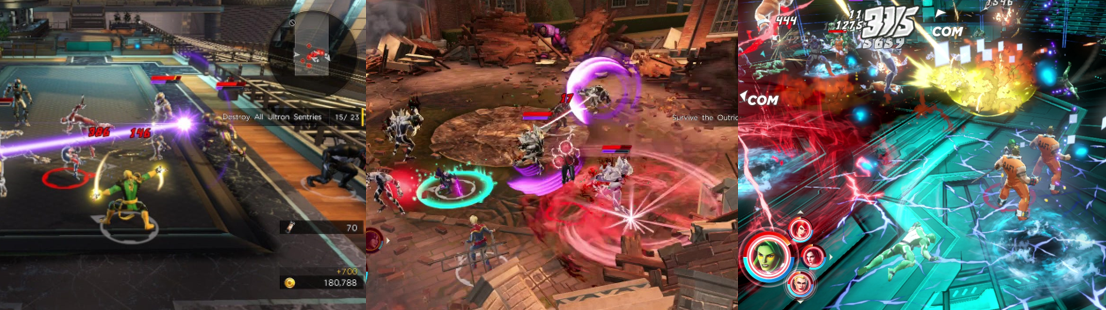
Combat is thick, fast, chaotic, and constant thanks to loads of enemies and character abilities.

As in the last two games, each character has specific abilities tied to their superpowers or superhero traits. You activate these by holding the Right trigger and selecting an icon using the D-pad; using Abilities drains your EP, however, and each Ability comes with a different cost. However, these attacks allow you to stun, stagger or deal elemental damage to enemies using Peter Parker/Spider-Man’s webs, Thor Odinson’s lightning, and Doctor Robert Bruce Banner/The Hulk’s incredible strength. Many characters have projectile attacks in their arsenal, such as Wade Wilson/Deadpool firing guns and Scott “Slim” Summers/Cyclops blasting his eye beams, while others cause splash damage or specific buffs, like Piotr Rasputin/Colossus being able to reflect projectiles and Wanda Maximoff/The Scarlet Witch healing her allies. Some, like James “Logan” Howlett/Wolverine, have passive abilities that allow them to automatically regenerate health as they walk around; others, like Johnny Blaze/Ghost Rider and Ororo Munroe/Storm, specifically deal in elemental damage. Character’s Abilities can also be mixed and matched by holding ZR and pressing one of the face buttons (or pressing A when prompted); this sees two characters attack in a combo for additional damage. As you dish out and take damage, you’ll also build the Extreme (EX) Gauge). Once full, you can press L and R up to three times to have two to four of your teammates perform a devastating combination attack that’s great against bosses. While the various cannon fodder you fight are easily dispatched, larger commanders and bosses need their “stun” meter drained before you can really put a beating on them and others (and certain treasure chests) require specific combination attacks to breach their shields. Defeating enemies sees your characters gain experience points (XP) to level-up, increasing their statistics (attack, defence, etc), though you can also use the various Orbs you find to manually level-up. Each character’s special Abilities can also be further enhanced using Ability Orbs and credits, reducing the EP cost and increasing their damage, among other benefits. You can also earn “Team Bonuses” depending on your team selection: pick a group of X-Men, for example, and your strength or resistance stat will increase, while picking characters of royalty ups your maximum energy stat.
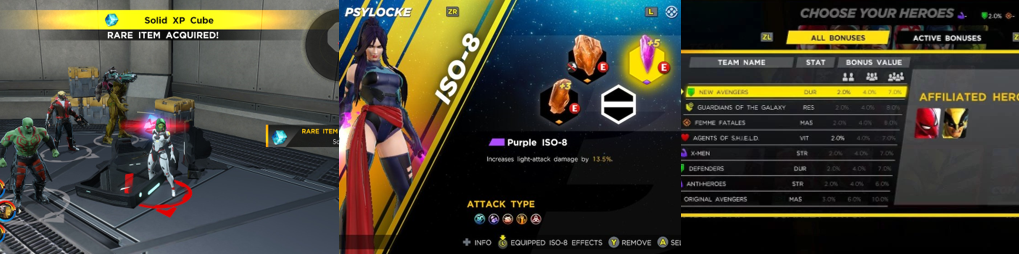
Search for chests to gain currency and other expendables to upgrade and buff your alliance.

Although you can’t equip gear to your characters, the boss battle against the Destroyer armour sees you temporarily empowered by Asgardian magic and you can eventually equip your team with “ISO-8” crystals, coloured stones that enhance their attack power, resistance to elements, or critical hit ratio, among others. You can further upgrade these with credits and ISO-8 capsules, though some of the rarer ones will also debuff you (for example, your attack my increase but your defence will decrease accordingly). You’ll also inevitably gain access to the Strategic Hazard Intervention Espionage Logistics Directorate (S.H.I.E.L.D.) Lab, which acts as the game’s skill tree. By spending credits and Enhancement Points (EP), you can further increase your team’s overall attack, defence, resistance, vitality, and such and even unlock additional ISO-8 slots (with more being earned by levelling-up). You can also enter the S.H.I.E.L.D. Depot from the main menu to purchase additional costumes and social icons by spending S.H.I.E.L.D. Tokens. Marvel: Ultimate Alliance 3 is pretty forgiving (on the “Friendly” difficulty, at least), with multiple checkpoints in each area. When you activate a S.H.I.E.L.D. checkpoint, your team is fully healed, and you can swap or enhance them if you wish. If a teammate is defeated, you can hold A to revive them, but I wouldn’t recommend it unless you absolutely have to. Not only are revives limited, but downed characters will eventually return to full health even before you reach a checkpoint so it’s not worth risking another character taking damage by healing a partner. Exploration generally leads you to treasure chests or special walls that require a special combination attack to open, or to a “Rift” challenge that takes you away from the main game to tackle a special challenge (usually a boss rematch or enemy gauntlet) for extra rewards. Your path is incredibly linear most of the time, hence why there’s no map, and the game’s primary focus is on chaotic combat and visually manic team-based attacks. Unlike in the last two games, you can no longer grapple or throw enemies (though you can still send them flying off certain platforms) and there are no character-specific team-up moves, meaning the action can quickly get quite tiresome.
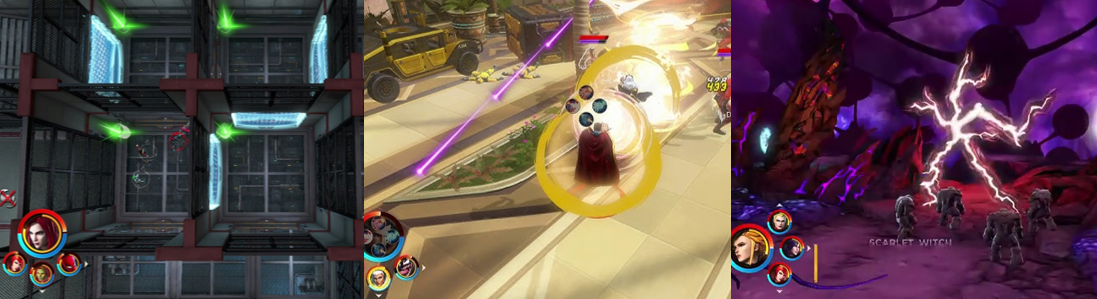
Sadly, puzzles are practically non-existent, with only Rifts offering additional challenges.

Because of its focus on hectic combat, there’s even less room for puzzles than there is for exploration in Marvel: Ultimate Alliance 3. Puzzles boil down to activating a console to open a door or making a platform move and that’s it. Sometimes, you’ll hold A to move a block and avoid lasers or cannons, but mostly you’ll be timing jumps between said lasers to progress and simply hurling missiles at those cannons. Sometimes, you’ll rotate statues or press switches to progress; others, you’ll be avoiding toxic ooze in Hel or solving door puzzles at the Raft or in Avengers Tower. After hopping across the rooftops of New York City, you’ll infiltrate the heavily fortified fortress of the Hand, dealing with ninjas that drop from the sky and hidden arrow hazards. When in Wakanda, Advanced Idea Mechanics (A.I.M.) corrupt T’Challa/The Black Panther’s defences, leading to an exasperating section where you must avoid snipers and being roasted by a giant panther statue’s energy blast. When transported to the Dark Dimension, you must use portals to reach new areas and defeat waves of demonic enemies to lower magical barriers and progress. Some attacks also screw up your controls or temporarily freeze you; some enemies are best defeated by tossing explosives at them; and many missions have an additional character fighting alongside you who’s often unlocked afterwards. However, a lot of the additional features of the previous games are missing; you can talk to other characters, but there are no dialogue options or character-specific interactions. There are no trivia quizzes, no optional side missions beyond the Rifts, and no character specific challenges to unlock extra stuff for each character. There aren’t even hub areas, in the traditional sense, with characters just appearing around S.H.I.E.L.D. checkpoints at times, though you can destroy a fair bit of the environment, and some encounters have you fleeing towards the camera as bosses chase you or present you with unwinnable battles.

Presentation:
Whereas the last two games primarily based their aesthetics on the comics books, especially the Ultimate comic line, Marvel: Ultimate Alliance 3 adheres very closely to the Marvel Cinematic Universe (MCU), especially in the visuals of its locations. I was hard pressed, for example, to tell the difference between Asgard here and the Asgard to the MCU, with both the golden city and the rainbow bridge, the Bifrost, appearing almost exactly as they’re depicted in the films. The same is true for Wakanda, the Dark Dimension, and Knowhere, all of which are virtually indistinguishable from how they appear in the MCU. There are some differences, of course: Taneleer Tivan/The Collector’s museum, for example, uses coloured cube cages and Wakanda leans much more into traditional architecture than the pseudo-futuristic science of the films (likely because Black Panther (Coogler, 2018) released a year before this game was made). Xavier’s School for the Gifted is lifted almost exactly from the 20th Century Fox X-Men movies (Various, 2000 to 2020), however, including a hedge maze, 1:1 Cerebro room, and basketball court that doubles as a landing pad for the Blackbird. While the Dark Dimension and the cosmic mind trip that is Sanctuary also heavily borrow from the bizarre cosmic imagery of the MCU, the Raft and Avengers Tower are much more akin to their comic book counterparts, though they’re comparatively bland locations, lacking fun areas like the Danger Room or Wakanda’s Necropolis (though you do pass through Anthony “Tony” Stark/Iron Man’s Hall of Armours in the tower). Although you only make a brief stop in Attilan to try and get help from the Inhumans, the architecture is far more visually interesting than that awful television show, seemingly being comprised of Celestial technology, and I enjoyed the ominous gothic presentation of Hel, with its restless Viking warriors and damaging sludge. Unfortunately, Marvel: Ultimate Alliance 3 continues the trend of having disappointingly bland and forgettable music, opting for generic themes for each location, event, and character that are lost amidst the constant fighting.
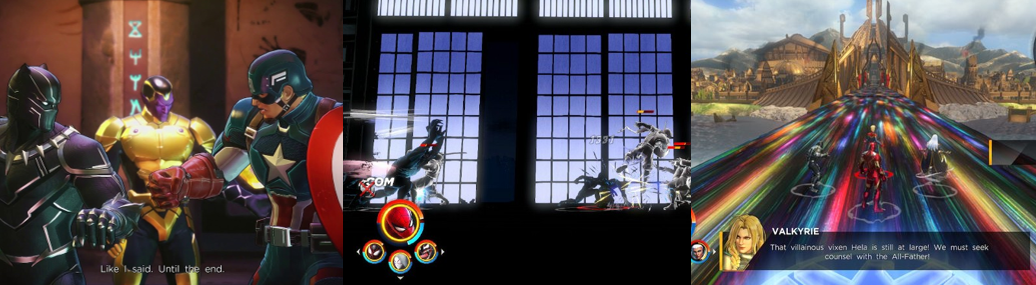
A visually impressive brawler that takes obvious inspiration from the MCU films.

The game also opts for an almost cel-shaded, action figure-like aesthetic for its colourful cast of characters. While many again both look and sound like their MCU counterparts, there are some exceptions: Peter Quill/Star-Lord, for example, looks nothing like Chris Pratt and the X-Men are far closer to the comic books than Fox’s films. Despite you assembling a custom team of heroes, cutscenes depict either everyone or characters specific to the location you’re in (the corrupted Doctor Stephen Strange in the Dark Dimension, for example) as they’re better suited to advance the plot against the local baddies. With the game shifting to a more third-person perspective, you’re closer than ever to the action and can see more of the environment than in the previous games. However, this comes with some drawbacks: mainly, there are far less opportunities or incentives to explore. Second, environments are painfully linear, with dead ends or locked doors barring your progress. Third, and most frustrating, is the camera, which easily loses track of your opponent/s and often lumbers you with wireframe representations when the foreground blocks the view. Thankfully, you won’t be falling down pits and rarely have to worry about onscreen hazards, but it can be aggravating trying to figure out which platforms and crates can be jumped on and which can’t. Marvel: Ultimate Alliance 3 offers a diverse cast of characters, each with their own idle poses and quips, though these do inevitably repeat. The game’s also surprisingly light on Easter Eggs: you’ll spot Deadpool singing away as he makes tacos in the X-Mansion, but not much else, and there are no optional missions or choices to encourage replaying missions. It’s a far cry from the first game, where there was always something to collect or an additional character to help out. Instead, it’s basically all combat, all the time in Marvel: Ultimate Alliance 3. Luckily, the game looks pretty good (everything’s very colourful and true to its inspirations) and performs really well, though there are some long load screens and it is annoying being forced to continue your game every time you challenge a Rift.

Enemies and Bosses:
All the usual suspects appear here as disposable cannon fodder for you to endlessly beat up, with many of the game’s goons sharing traits across the various locations. You’ll encounter Kree, Ultron Drones, agents of A.I.M., and Doombats who all pack various energy blasters. Ultron’s clones are the worst for this, relentlessly firing energy blasts and crashing through windows. The Raft’s unscrupulous prisoners attack in large groups, as do the restless Viking warriors who populate Hel, tossing axes from afar and luring you into toxic goop. Gargoyle-like Fire Demons also dwell here, offering a greater challenge with their swoop attack and fire breath, not unlike the monstrous Outriders and Mindless Ones who make up Thanos and the dread Dormammu’s forces, respectively. Alpha Primitives, Hydra goons, and towering Sentinels also appear, with the latter firing huge energy blasts from the palms and best attacked by throwing their explosive energy cores back at them. No matter where you are and what enemies you fight, more powerful commanders will also appear. Larger, tougher, and sporting a stun meter, these commanders should be your top priority as they’ll charge across the screen, cause shockwaves, and generally offer a far greater challenge even when you’re at a higher level. These minions often fight alongside their masters, generally so you can recover some health and EP to better damage the bosses, and will endlessly spawn in one of the additional modes unless you destroy their teleporters. Some of the game’s challenges or story-based missions charge you with defeating a certain number of enemies to progress. Other times, bosses appear in these waves, and you must occasionally flee or purposely lose some fights. This happens when Cain Marko/The Juggernaut comes tearing through the X-Mansion, for example, and in early encounters with the Black Order, who cannot be beaten or will chase you, raining lightning or other attacks from the sky and across the ground.
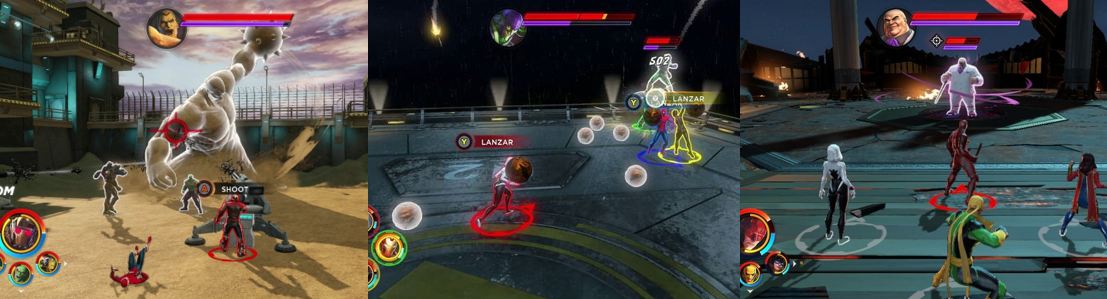
Few bosses require more than just hit-and-run tactics, even when augmented by an Infinity Stone.

There are loads of bosses to fight in Marvel: Ultimate Alliance 3, with some returning from the previous games, some teaming up, some having a couple of phases, and all boiling down to whittling down their stun bar, unleashing an EX attack and/or your most powerful Abilities, and avoiding damage until you can repeat this. The first ones you’ll face are Nebula and Ronan the Accuser, who often appear as a duo in optional challenges. Nebula is faster and more nimble, wielding blades where Ronan uses a massive warhammer. Both set a standard all bosses follow, which is that they’ll use either a jumping slam or an explosion of energy (or both) to send you flying. While quelling the riot in the Raft, you’ll encounter a version of the Sinister Six, with some unique variations to each battle. Flint Marko/The Sandman, for example, flings waves of sand and erupts his big sand fist from the ground as a large sand creature. You must use A to mount the nearby cannons and unload on him to chip away at his stun meter. Maxwell “Max” Dillon fights alongside Eddie Brock/Venom, raining lighting and electrocuting you with bursts of electricity, before he’s eaten by Venom and starts busting out electrically-enhanced symbiote powers. Venom joins the team after this fight and is tested against Quentin Beck, who first brainwashes Mile Morales/Spider-Man, Gwen Stacy/Spider-Woman, and Kamala Khan/Ms. Marvel to fight you and then unleashes a poisonous mist, teleports about, and confuses you with duplicates, Doctor Otto Octavious/Dr. Octopus is fought in a two-stage fight where you must first avoid his tentacles and scurry charge and then attack each arm to stun him. Finally, you’ll battle Norman Osborn/The Green Goblin for the Time Stone. The Green Goblin swoops overhead and lingers slightly out of reach, peppering the arena with his pumpkin bombs, charging at you, and freezing time to bombard you. He’s noticeably weak to his pumpkin bombs, however, so try and toss them at him before they explode in your face! After battling into the Hand’s fortress, you must first free Elektra Natchios from the Hand’s influence and then face Lester/Bullseye and Wilson Fisk/The Kingpin in separate fights. You must take out the ninjas feeding Elektra power, avoid Bulleye’s spread of razor sharp and explosive cards, and dodge the furniture and massive energy beam thrown by the Power Stone-enhanced Kingpin. The Kingpin also charges like a rhino, leaps at you to cause shockwaves, and even rips up stone columns to use as melee weapons!
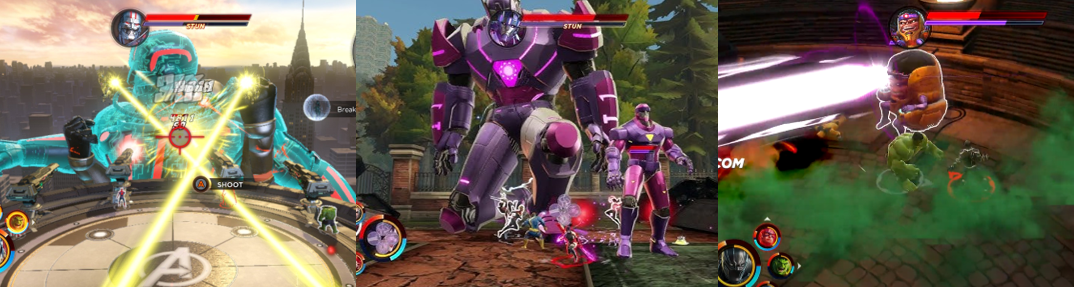
Gigantic bosses and the quirkier villains help mix-up the otherwise tedious combat.

Avengers Tower is then attacked by Ultron and his drones, who assist him in battle. Not that he needs it as the Mind Stone allows Ultron to mess up your controls, to say nothing of his signature face and palm beams. Ultron then grows to gigantic proportions, sweeping the area with his eyebeams before Clint Barton/Hawkeye intervenes and Ultron merges with Ultimo. This is the first giant boss battle in the game and sees you blasting Ultimo with cannons and avoiding his massive swipes. The Infinity Sentinel is comparatively smaller, but no less dangerous thanks to its own face beam and missiles. Though you can damage it with Sentinel cores, it’s finished in a cutscene by Erik “Magnus” Lehnsherr/Magneto, who then tosses debris and throws you off balance with magnetic pulses while Juggernaut pummels you and Raven Darkholme/Mystique tosses daggers. After surviving Mystique’s Danger Room trials, you face Magneto, now even tougher thanks to the Power Stone, before being chased away and banished to the Dark Dimension by the Black Order. There, you battle past Loki Laufeyson (who boasts elemental attacks and duplication tricks) to eventually face the dread Dormammu, who wields the Reality Stone and is the second giant boss. You must subdue his minions and avoid his flame bursts, whittling down his magical barrier either directly or be destroying three nearby orbs, all while dodging his giant fists and ground spikes. The brief fight with Maximus Boltagon is far easier, even though the mad Inhuman carries a massive energy cannon and you must take cover in Thane’s energy bubble to avoid Maximus’s barrage of lasers. Ulysses Klaue/Klaw awaits in Wakanda and his sound-based energy blasts and waves must be overcome to rescue and recruit James Buchanan “Bucky” Barnes/The Winter Soldier. You then fight past A.I.M. to confront their master, George Tarleton/Mental Organism Designed Only for Killing (MODOK), who uses the Soul Stone to turn the Dora Milaje against you and attacks with a slew of appendages, from buzzsaw arms, poison gas, failing tentacles, and his signature forehead blast.
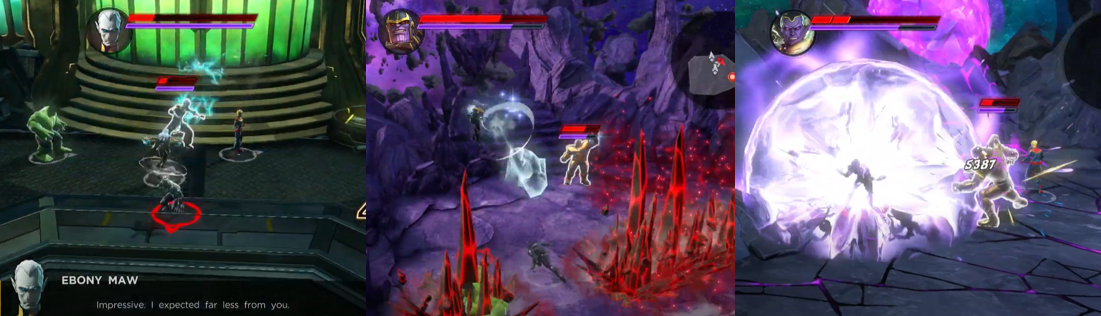
Battles with the empowered Black Order, Thanos, and Thane offer some of the most enjoyable challenges.

Though your goal in Hel is to confront Hela, you’ll actually battle the fire demon, Surtur, in another giant boss battle. This was a bit of a difficulty spike for me as Surtur’s flaming sword has a long reach and he causes the ground to erupt in flames, to say nothing of stun locking you with repeat sword strikes! Best him and Hela sets Johann Schmidt/The Red Skull on you, with the Nazi madman firing a powerful revolver and sapping your health with his “Dust of Death”. Hela gives the Red Skull a boost, protecting him with a shield and allowing him to fire a Bifrost-like laser, before placing his consciousness into the Destroyer armour. Though bolstered by Hydra forces and boasting a sweeping face beam, you can get a power-up from glowing crystals to overcome this destructive force. Finally, you venture to Knowhere and must run the Black Order gauntlet to retrieve the Infinity Stones, with checkpoints between each fight. Ebony Maw is first, firing a spread of projectiles and rocks and using the Soul Stone to create portals to trip you up. Supergiant tosses dark spheres and a golden homing shot that messes up your controls, though you can toss explosive cores from her minions to deal big damage. Cull Obsidian infuses his battleaxe with the Power Stone, sending out waves of purple energy and massive purple shockwaves, though he’s far slower and also susceptible to the nearby bombs. Corvus Glaive is much faster, landing multiple hits with his lance and using the Reality Stone to spring spikes form the ground and conjure duplicates who fill the arena with energy waves that can stun lock you. Finally, Proxima Midnight takes her fellow’s teleportation trick to the next level with the Space Stone and fills the arena with lightning bolts and strikes. All these powers are then recycled when you face Thanos, who gathers the six Infinity Stones into the Infinity Gauntlet to rain meteors, teleport, mess up your controls, freeze time, and fire his signature eyebeams. Thanos then joins you to battle Thane, who usurps him and boasts similar powers, though also upgraded by the Infinity Armour. Thane exhibits superhuman speed, traps you in a cube, fills the arena with portals and flames, and explodes in fury, though both battles were fun challenges rather than impossible tasks.

Additional Features:
Unlike in the previous two games, you won’t be finding data logs, action figures, or meeting certain requirements to unlock new attacks or costumes. You just fight over and over, earning whatever you need to unlock, buy, or upgrade whatever you wish and finding some concept art in treasure chests. A far harder (but more rewarding) “Superior” difficulty unlocks upon clearing the game alongside an additional “Nightmare” mode, accessible via the “Curse of the Vampire” campaign. You also unlock Thanos and can freely replay any mission on any difficulty (though you must start a new save to play on “Superior”) to grind and enhance your characters and ISO-8. Dimensional Rifts transport you to special challenges (not unlike the S.H.I.E.L.D. Simulator discs from the first game) that are often rematches with bosses or gauntlet challenges, though far tougher and gifting better rewards if you succeed. There are also three additional modes; however, though you can play a taster of each, you must purchase the expansion pass to fully unlock them. “Curse of the Vampire” adds vampiric enemies to the main story in “Nightmare” mode and offers a “Gauntlet” mode where you battle waves of enemies and bosses against both a time limit and a range of debuffs (including limited health restoration and draining EP). You can also tackle an “Endless” mode that’s pretty self-explanatory, and unlock additional characters like Frank Castle/The Punisher and Eric Brooks/Bladeif you buy the DLC. “Rise of the Phoenix” sees you form a four-person team and go head-to-head with a friend or the computer in three-round Danger Room scenarios. These see you tackling bosses again or wiping out hordes of enemies, awarding additional buffs and effects if you meet certain criteria (such as using any Ability or Synergy attack four times). You can only tackle the first challenge without the DLC, so I didn’t get very far, but this could be a fun distraction for those looking to test their skills against a friend. “Shadow of Doom” adds an epilogue story campaign that sees you return to Wakanda to oppose Doctor Victor Von Doom’s invasion. Dr. Doom’s Doombots endlessly spawn unless you destroy their teleporters, and you even battle the arrogant dictator in the recycled Necropolis, with him teleporting, firing lasers form his palms, and having his health restored by his Doombots. You’ll add Marvel’s First Family to your roster (alongside an alternative Thanos and other characters) by buying the expansion pass and battle Annihilus, a gigantic Celestial, and even “God Emperor” Doom!
The Summary:
I quite enjoyed the first two Ultimate Alliance games. They were mindless and largely repetitive, but I liked the large cast of characters and all the different references and locations from the comic books. Still, I put off Marvel: Ultimate Alliance 3: The Black Order for some time, mainly because I was annoyed by it being a Nintendo Switch exclusive; however it turned out to be a decent enough brawler. Despite the different development team, a few tweaks, and an apparent disconnection from the previous games, Marvel: Ultimate Alliance 3 offers a lot of the same gameplay and enjoyment as its predecessors, which is great for long-time fans of the franchise. Unfortunately, it doesn’t improve on these elements in a meaningful way and actually removes some content that I found enjoyable from the last two. There are no optional missions, for example, no alternative endings, no choices, and no character-specific challenges beyond fighting and levelling-up. I found this made the tedious combat even more aggravating after a while as I wasn’t being rewarded with gear or costumes or anything other than stat boosts. Even the skill tree was limited since you must grind to acquire enough credits and expendables to enhance your team, and I found the ISO-8 mode to be more confusing than engaging. The game also does little to improve the boss battles. Very few were very innovative or required more of you than to strike fast, avoid shockwaves and projectiles, and unleash your Extreme attack. The giant bosses were more of a challenge and I liked the final fight against Thanos and Thane, but I was hoping for a bit more complexity, especially given the possibilities offered by the Infinity Stones. There is a fun selection of characters, but they don’t offer much more than what we saw in the last two games and actually offer less as there are no character-specific team-up moves. While I enjoyed the visual influence from the MCU and the variety, I feel like Marvel: Ultimate Alliance 3 played things a little too safe by relying so heavily on combat and not mixing up the gameplay with a few other puzzles and challenges. Overall, it’s a good enough game and a worthy entry in the series, but it’s a shame that the developers didn’t try to be a bit more innovative and offer some more incentive to keep slogging away in endless fights.

My Rating:

Rating: 3 out of 5.

Pretty Good

Did you enjoy Marvel: Ultimate Alliance 3: The Black Order? How do you think it holds up against the previous two games? Which characters did you choose for your team? Were you disappointed that the combat was so similar to the last two games and the bosses so repetitive? Did you ever conquer all the Rift challenges? What did you think to the MCU influences and the final battle with Thanos and Thane? Did you ever play through the DLC? Would you like to see another Ultimate Alliance game? Whatever your thoughts, leave a comment below, support me on Ko-Fi, and go check out my other superhero content across the site.

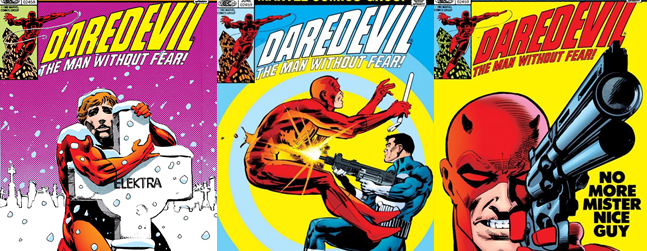
Back Issues [Dare-DAY-vil]: Daredevil #182-184


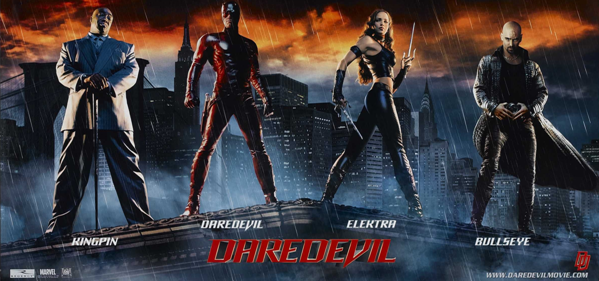
Blind lawyer Matt Murdock debuted in Daredevil #1 in April 1964 and was co-created by writer/editor Stan Lee and artist Bill Everett, with input from the legendary Jack Kirby. While perhaps not as mainstream as characters like Peter Parker/Spider-Man, Daredevil has become one of Marvel Comics’ greatest creations and has starred in a questionably-received 2003 big-screen adaptation and a critically-successful Netflix series.


Writers: Frank Miller and Roger McKenzie Artist: Frank Miller

Story Title: “She’s Alive”
Published: 26 January 1982 (cover-dated: May 1982)

Story Title: “Child’s Play”
Published: 23 February 1982 (cover-dated: June 1982)

Story Title: “Good Guys Wear Red!”
Published: 23 March 1982 (cover-dated: July 1982)

The Background:
The 1960s were a golden age for Marvel Comics, when Stan Lee teamed with the likes of Steve Ditko and Jack Kirby to create some of their most recognisable superheroes. On 1 April 1964, Stan Lee and artist Bill Everett introduced their most challenging hero yet, Matt Murdock/Daredevil, who became a popular and enduring character thank to the efforts of writer/artist Frank Miller, who spearheaded some of Daredevil’s most memorable stories. It was during Miller’s run that Daredevil first crossed paths with Frank Castle/The Punisher, a Vietnam veteran-turned-mercenary vigilante who first appeared in Amazing Fantasy #15. Inspired by The Executioner (Pendleton, et al, 1969 to present), designed by Gerry Conway, and named by Stan Lee, the Punisher was a natural foil for the more righteous and law abiding Daredevil. The two have clashed, begrudgingly teamed up, and debated their different philosophies numerous times in the years since they first met. Their memorable rivalry even made it to the silver screen when the two clashed on the streets and in the courtroom during Daredevil’s second season (Various, 2016).

The Review:
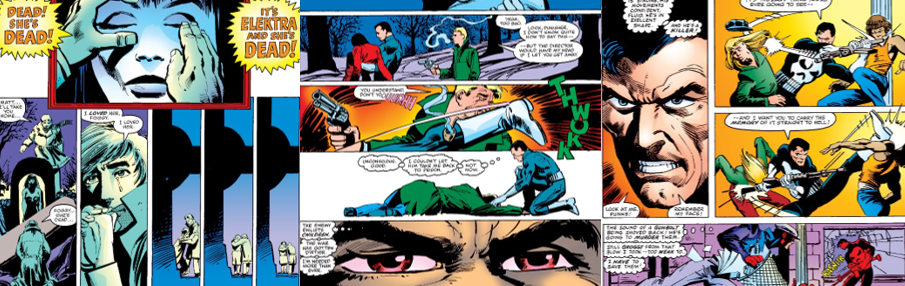
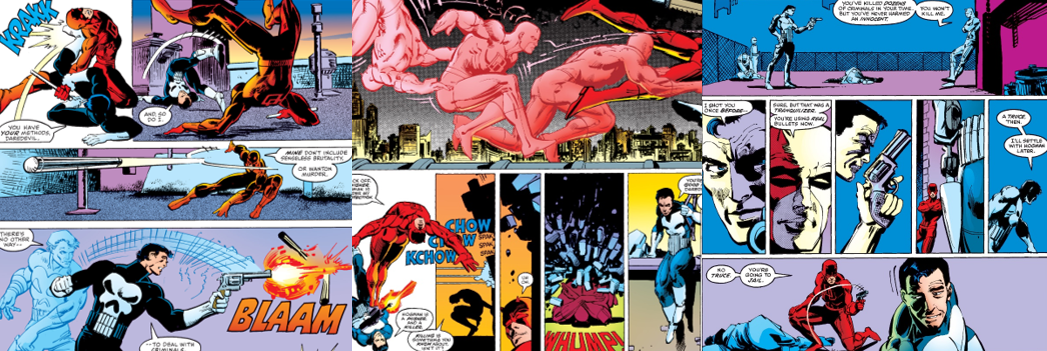
Our story begins with Matt Murdock still reeling from the recent murder of his lover, Elektra Natchios, at the hands of the sadistic mercenary, Lester/Bullseye. Despite having cradled Elektra in his arms, felt her last heartbeat, heard her death rattle, and attended her funeral, Matt awakens from a nightmare convinced that she’s somehow still alive. Overwhelmed by guilt at having not done more to steer Elektra away from the ninja organisation, the Hand, and the dark path that led to her becoming an assassin, and sure that those same ninjas taught her a way to fake her death, Matt pulls on his costume and heads out into the snow swept night to get some answers. This takes him to a “grimy underworld saloon”, where Daredevil kicks the shit out of the patrons, easily dodging their blows and bullets, and accosts one of them into revealing that Wilson Fisk/The Kingpin is holding a summit of the city’s top mobsters at midnight. Sure that the Kingpin must be trying to sell Elektra’s services, Daredevil returns to his civilian identity and has his secretary, Rebecca “Becky” Blake, go through the coroner’s report on Elektra’s body. Despite the evidence stating quite clearly that Elektra suffered mortal wounds, Matt’s convinced that the body could’ve been swapped and is so blinded by his obsession with proving that his former lover is still alive that he gives his current love interest, Heather Glenn, the cold shoulder. Indeed, it’s only when his best friend and law partner, Franklin “Foggy” Nelson, chews him out that Matt begins to question his state of mind. Across the city, in Ryker’s Island penitentiary, Frank Castle is locked up alongside the city’s scumbags. When the Punisher puts Joe Carson/Injun Joe in the infirmary, a few of his boys accost him in the showers and, despite being outnumbered by the armed assailants, the Punisher easily overpowers and kills the three. Though indifferent to his actions, the Punisher is intrigued when an emissary of the “agency” offers to get him out of prison so he can covertly intercept a shipment of narcotics, and promptly escapes via helicopter.

Matt’s obsession over Elektra’s death is compounded when the Punisher goes on a killing spree.

Thus, the Punisher heads to Long Island and lays in wait for the shipment. Thanks to his trip wires, tear gas, and skill with a shotgun and assault rifle, the Punisher wipes out the goons, even gunning one down after he surrenders since “war [doesn’t] take prisoners”. However, the Punisher is distraught to learn his victim was merely a child; laying out the G-man, the Punisher vows to continue his war on crime, especially if evil is corrupting children. Daredevil easily dispatches the Kingpin’s goons and confronts the rotund crime boss regarding Elektra, confusing Fisk with his accusations and eventually leaving after the Kingpin calls his bluff, confirming that Matt hasn’t completely gone off the deep end just yet. Foggy’s concerns are only exacerbated when he’s awoken in the middle of the night to learn that Matt coerced a city judge into signing an exhumation order for Elektra’s body! By the time Foggy gets to the cemetery, Matt has already frantically, feverishly dug up Elektra’s grave, only to confirm with his very hands that his lover is, in fact, dead and causing him to break down in tears in his friend’s arms. Still reeling from this moment, Matt is horrified when a young schoolgirl suddenly freaks out in the middle of a Civics class he’s attending and, convinced that snakes are crawling over her skin, throws herself out the window! Switching to Daredevil, Matt races the girl’s broken body to the hospital, only for her to succumb to her injuries thanks to the “Angel Dust” in her system. Daredevil learns from the doctor that the girl is the latest in a long line of child victims of drugs, with phencyclidine being the most common and most dangerous as it causes many horrible side effects, including psychosis, and lingers in the system for years. Donning a simple disguise (over his costume, no less), Daredevil hits the streets to try and get a lead on Peter Grunter/Hogman, one of the lead pushers of the drug, only to be attacked by drugged-up kids. Although Daredevil pulls his punches, sympathetic to their plight, he’s stunned when the Punisher appears, murders one of them with a knife, and prepares to execute the others in cold blood.

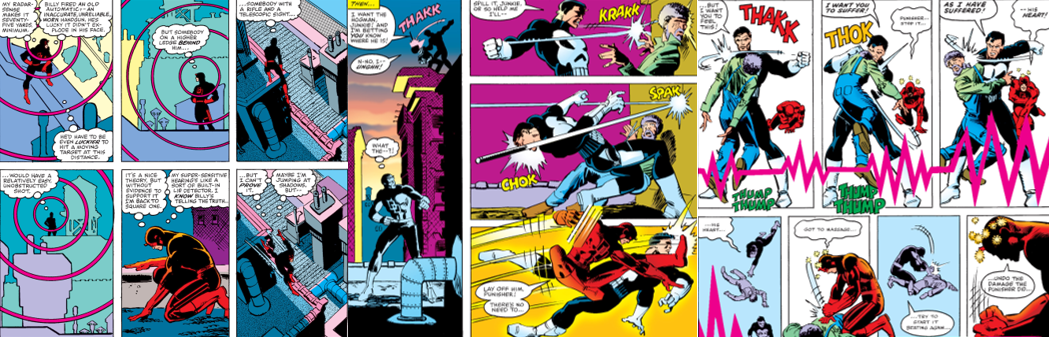
While working to prove a boy’s innocence, Daredevil clashes with the hard-nosed Punisher.

Although Daredevil keeps the Punisher from carrying out the kill, and the Punisher expresses respect for ol’ hornhead, the two are stunned when another shooter guns down one of Daredevil’s attackers. While the Punisher is indifferent, Daredevil is aghast to discover the shooter is William “Billy” O’Koren, the brother of the girl who was driven to suicide. Matt pledges to represent Billy in court, sure that he’s innocent, a hunch he all-but confirms when he returns to the crime scene. The Punisher also suspects that a more competent sniper made the shot, despite a lack of tangible evidence. Daredevil gets some intel on the Punisher from Ben Urich (who’s aware of Matt’s dual identity), who warns him against going toe-to-toe with the Punisher since he’s a well-trained, cold-blooded killer. As luck (or fate) would have it, the Punisher just so happens to be beating up a junkie on a nearby rooftop, so Daredevil intervenes, disgusted by Castle’s brutal methods, which the Punisher defends as the only way to permanently deal with criminals. While Daredevil’s quick to fight, the Punisher suggests they team up to eliminate their common enemy and, when Daredevil adamantly refuses, he spares his foe a quick death by shooting Daredevil with a tranquilizer dart. Severely weakened from the shot, Daredevil’s powerless to stop the Punisher beating his victim so badly that he suffers a heart attack. Luckily, Daredevil’s quick bout of CPR sees the junkie cling to life and point him towards a restaurant, where Daredevil finds the elusive Hogman. When Hogman’s cohorts refuse to back him up, the drug peddler is apprehended by Daredevil and the Punisher’s victim recovers to testify in court, absolving Billy of any wrongdoing, though Matt’s stunned when his super senses reveal that Hogman is also innocent of murdering his partner.

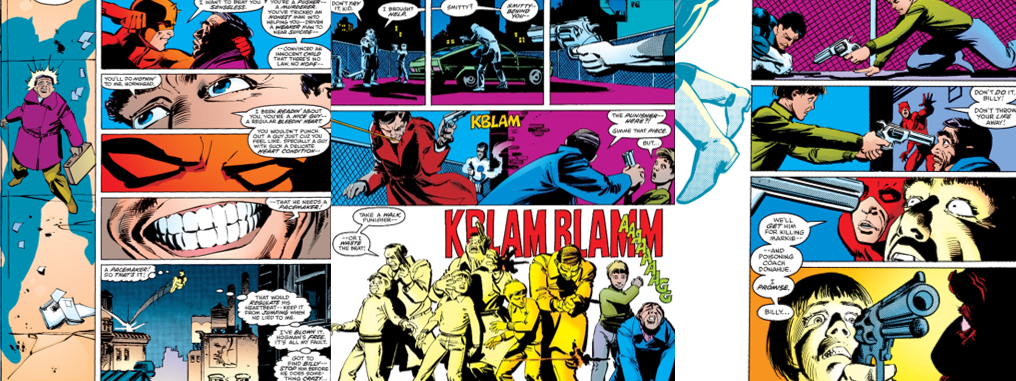
A mistake by Daredevil sees him and the Punisher battling for a boy’s soul.

After winning Heather back with a marriage proposal, Matt volunteers to represent Hogman and prove his innocence. Sure that Matt can absolve him of the crime, the arrogant Hogman stuffs his face with pasta, unaware that the stoic Punisher has taken up a sniping position on a rooftop across the street. Luckily, Daredevil is on hand to keep his client safe but, when the Punisher’s shot buries him under a pile of bricks, Daredevil again fails to apprehend the murderous vigilante. Although Matt claims to have evidence to prove that Hogman is being used as a convenient patsy by the true culprit, Billy’s coach, Patrick Donahue, he doesn’t get solid confirmation until Donahue calls him to discuss the whole operation in private. The call costs Matt dearly as he ends up giving Heather the brush off and it leads to Matt being attacked by the rabid Donahue, who’s been driven to a crazed frenzy by his own drugs! Despite the coach’s augmented strength, Matt uses his agility to put him in a choke hold and subdue him, theorising that a third party juiced Donahue up. In court, Matt successfully absolves Hogman of his crime, only to learn afterwards that the scumbag is not only guilty, but gleefully causes his returning customers to overdose to amuse himself. When Daredevil confronts Hogman, threatening to beat him to a pulp, Matt realises he’s been played for a fool as Hogman’s pacemaker screwed up his radar sense. When Billy decides to take the law into his own hands, Daredevil races to intervene, only for the Punisher to show up and subdue Hogman with some well-placed shots. Daredevil stops him from delivering the killing shot and calls the Punisher’s bluff, fully aware that he’s purposely missing and would never knowing kill an innocent person. Although the Punisher again offers a truce, he’s stunned when Daredevil subdues him with a gunshot, leaving Matt free to appeal to Billy’s better nature. His pleas get through and Billy testifies against Hogman, leaving the drug baron facing serious jail time and Matt emphasising the importance of following the law to the impressionable pre-teen.

The Summary:
I’ve talked about this before, but I’m really not a big fan of Frank Miller’s art. He’s nowhere near as bad here as he is in his efforts for DC Comics and his independent publications, but he really does draw some of the ugliest faces I’ve ever seen. His use of shadows and lighting are extraordinary, however, and he draws a very dynamic and intimidating Daredevil, something bolstered by the start darkness of night. In Miller’s hands, New York City and Hell’s Kitchen are a dark, ominous place that feels very dangerous. Violence stalks the streets, but this is taken to the next level here as Hogman sells drugs to kids, using Coach Donahue as a gofer and selling to kids at a Catholic school. Happy to cause overdoses and kill anyone who tries to speak out against him, even if they’re his partners, Hogman thinks nothing of abusing the law system and little children to come out on top. He’s practically giddy when Matt clears him of murder, only to immediately reveal that he’s “guilty as sin”, and Matt’s left humiliated since he was convinced of the villain’s innocence thanks to Hogman’s pacemaker. Matt’s a bit all over the place in these issues, reeling from Elektra’s murder and as desperate to prove that she’s alive as he is to defend Billy and keep the neighbourhood kids free from drugs. Grief hits Matt like a brick wall, causing him to descend into denial and desperation, only to be mocked by the likes of the Kingpin, push away those closest to him, and ultimately go to extreme lengths to prove his theory…only to find that Elektra is well and truly dead. This revelation seemingly snaps Matt from his malady as he’s back to normal in the very next issue and doesn’t mention Elektra again, instead turning his focus towards Hogman, the kids he abuses, and the Punisher.

Sadly, Daredevil and the Punisher don’t clash enough, physically or ideologically, for my tastes.

The Punisher pretty much steals the show here. Still portrayed as a ruthless vigilante killer, he’s largely indifferent to the world around him, as though sleepwalking through life and unconcerned about the machinations of those who would seek to release him onto the streets. Castle couldn’t care less about the scumbags he kills and only shows a shred of remorse when he’s forced to gun down a kid. Even then, rather than dwell on how his actions have cost a misguided youth their life, the Punisher refocuses his energy on taking out those responsible for putting the boy in that position in the first place. Interestingly, the Punisher has no desire to fight Daredevil; indeed, he not only purposely misses his shots but shows a great deal of respect for ol’ hornhead. The Punisher repeatedly offers to form a partnership with Daredevil, believing they’re kindred spirits who fight for the same thing against a common enemy, only to be rebuffed each time. While the Punisher is respectful towards Daredevil, Matt attacks Castle without hesitation, disgusted by his disregard for the law and the lives of his victims. It’s an interesting dichotomy since Matt, as a vigilante, is breaking the laws he so diligently serves in his civilian guise so it’s a touch hypocritical for him to lecture the Punisher on his vigilante ways. Of course, the real difference between the two is that the Punisher kills his victims whereas daredevil just beats them up and has them arrested so they can stand trial, a system the Punisher openly mocks for being flawed and broken. While Daredevil valiantly fights to defend all lives and everyone’s rights, even those of scumbags like Hogman, the Punisher takes a more direct approach, putting the two at natural odds. Unfortunately, this isn’t explored that well here; their fights are very brief, their different ideologies barely touched upon, and much of the potential of their first meeting is secondary to the main plot concerning Hogman. Therefore, these issues are important for being the first meeting between these two characters but there are far better clashes between the two out there, such as Garth Ennis’s iconic story from the early 2000s.

My Rating:

Rating: 4 out of 5.

Great Stuff

What did you think to the first meeting of Daredevil and the Punisher? Do you agree that the story didn’t quite live up to its potential? What did you think to the differences between Daredevil and the Punisher, particularly in their methods? How impactful did you find the main plot concerning kids and drugs? What are some of your favourite Daredevil and Punisher moments and how are you celebrating the Man Without Fear this month? I’d love to know your thoughts so feel free to share them in the comments below, support me on Ko-Fi, and be sure to check out my other Daredevil and Punisher content.

Back Issues: Secret Invasion

Published: June 2008 to January 2009
Writer: Brian Michael Bendis
Artists: Leinil Francis Yu

The Background:
In January 1962, legendary duo Stan Lee and Jack Kirby introduced Marvel Comics readers to the Skrulls, a race of warmongering shape-shifters who have long hounded Marvel’s heroes, particularly the Fantastic Four, by assuming their identities and powers. Experimented on by the all-mighty Celestials and launching aggressive campaigns against both the Earth and their hated enemies, the Kree, the Skrulls have been at the forefront of numerous Marvel stories over the years in addition to featuring as villains in various videogames and animated ventures before making their live-action debut, in a decidedly different manner, in Captain Marvel (Boden, 2019). Perhaps one of their most prominent storylines was the Secret Invasion arc that ran through these eight issues and multiple tie-ins and spin-offs; the brainchild of writer Brian Michael Bendis, Secret Invasion had not only been hinted at for some time and was heavily advertised as a means of changed up the perception of legacy Marvel characters and even return some to mainstream publication. Reviews of the storyline were mixed, with some noting that it was an anti-climatic Marvel event and others praising the marketing and artwork while criticising the religious undertones and spotty dialogue. Still, an adaptation of the story made its way into the Avengers: Earth’s Mightiest Heroes cartoon (2010 to 2012) and it also formed the basis of a six-episode, live-action series of the same name on Disney+.

The Review:
This eight-issue event series begins “years ago” after the destruction of the Skrull throneworld, a cataclysmic, prophesied event that leads the few survivors back to their queen, Veranke, who kicks the story’s narrative in motion by seeding Skrull agents throughout our world. It took years for this to be uncovered, and it was revealed in dramatic fashion when it turned out that the resurrected assassin Elektra Natchios was a Skrull in disguise, a revelation that alerted Tony Stark/Iron Man (then the conceited and self-righteous director of the Strategic Hazard Intervention Espionage Logistics Directorate (S.H.I.E.L.D.) following the game-changing events of Civil War (Millar, et al, 2006 to 2007)) to the depths of the Skrull’s infiltration. Recognising that even his armour’s sensors can’t be trusted to identity friend from foe, Stark drafts in his allies – Doctor Reed Richards/Mister Fantastic and Doctor Henry “Hank” Pym/Yellowjacket – to perform an autopsy in an attempt to figure out how the Skrull was able to remain completely undetected to technology, magic, and Mutant probing. Conveniently enough, a Skrull ship chooses this exact moment to come crashing into Earth’s atmosphere and make landfall in the Savage Land, taking Iron Man away from the operating room so he can investigate. Concerned that this could be the full-scale invasion they fear, Jessica Drew/Spider-Woman calls in the renegade “New” Avengers (those who refused to sign up to the ludicrous Superhero Registration Act in Civil War), which leads to Luke Cage/Power Man, Peter Parker/Spider-Man, James “Logan” Howlett/Wolverine, Danny Rand/Iron Fist, Clint Barton/Ronin, and Maya Lopez/Echo subduing Black Widow/Natasha Romanova and stealing her Quinjet to beat Iron Man and his government-sanction Mighty Avengers – Iron Man, Spider-Woman, Black Widow, Carol Danvers/Ms. Marvel, Janet van Dyne/The Wasp, Ares, Simon Williams/Wonder Man, and Robert “Bob” Reynolds/The Sentry – to the crash site. Both sets of Avengers are aware of the potential Skrull threat, which drives an even greater wedge between them as not only are the Secret Avengers being actively hunted by their former comrades, but they can’t even trust each other to be who they say they are.
While the Skrulls cripple Earth’s defenses, the fractured Avengers battle their classic counterparts.
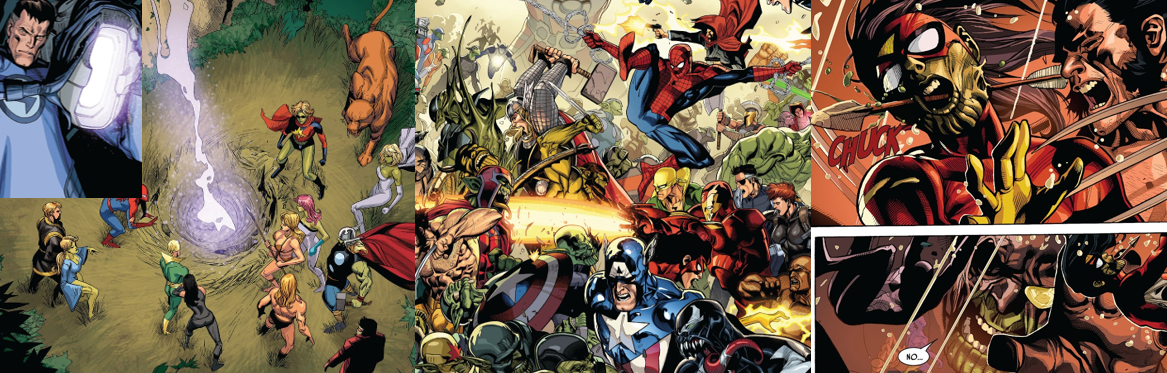
After being brought down by one of the Savage Land’s rampaging dinosaurs, the New Avengers prepare to open up the crashed ship, but they’re intercepted by the Mighty Avengers, with Iron Man immediately trying to arrest them and Luke Cage obviously telling him and his jumped-up thugs to go kick rocks. Iron Man’s attempt to keep the rogue superheroes from overstepping the mark are scuppered when Timothy “Dum Dum” Dugan and his trusted butler, Edwin Jarvis, unexpectedly sabotage not only the orbiting the Sentient World Observation and Response Department’s (S.W.O.R.D.) satellite base but also Stark’s armour and S.H.I.E.L.D.’s Helicarriers and bases, effectively disabling the armoured Avenger and crippling the superhero community’s resources and communications. Additionally, maximum security prisons the Raft and the Cube are suddenly hit by mass breakouts and Mar-Vell/Captain Marvel and Susan Storm/Invisible Woman disable the villainous Thunderbolts and the rest of the Fantastic Four, with each of these supposed heroes flashing ominous eyes and assuring their victims that “He loves [them]”. Meanwhile, a Skrull armada bares down on Earth and Mr. Fantastic finds himself reduced to an elasticated mess right as he figures out the key behind the Skrull’s newfound undetectability, the victim of a shot from Pym, who’s revealed to also be the Skrull Citri Noll! Momentarily setting aside their differences to get Tony Stark to aid, the two Avengers groups are startled when a slew of classic-styled, currently deceased or long-changed superheroes emerge from the Skrull ship; Captain Steve Rogers/Captain America, the Vision, Thor Odinson, Doctor Jean Grey/Phoenix, Doctor Henry “Hank” McCoy/The Beast, Wanda Maximoff/Scarlet Witch, Jessica Jones/Jewel, Emma Frost/The White Queen, and Barbara “Bobbi” Morse/Mockingbird appear alongside classic versions of Spider-Man, Power Man, Wonder Man, Iron Man, Hawkeye, Ms. Marvel, Wolverine, and the Invisible Woman. Naturally, a tense showdown ensues in which both groups assume the other are Skrulls in disguise; guys like Wolverine, Spider-Man, Emma Frost, and the Vision struggle to get any kind of reading on their counterparts beyond sensing their distrust while Ronin is stunned to see his former flame, Mockingbird, alive and well but, despite Ares trying to convince his allies that it’s a trap, tensions boil over and an all-out brawl kicks off!

As more characters enter the fray, internal distrust is as rife as the escalating war with the Skrulls.

With Stark in agony from the alien virus that’s crippled his armour, Ms. Marvel flies him to safety as the others duke it out; the two Spider-Men trade quips and punches, the Vision uses the Sentry’s fear of his destructive and malevolent alter ego, the Void, to disable his God-like power, and Ronin steals his counterpart’s weapons to subdue their attackers but the arrival of a raging Tyrannosaurus rex disrupts the fracas. Trampled to death by the dinosaur, the classic Spider-Man and Hawkeye are revealed to be Skrulls, and Wolverine intuits that the Skrulls are setting them against each other to wipe out any resistance to their invasion plan. However, when he tries to eviscerate Mockingbird, Ronin intervenes and questions her; she’s adamant that she’s not a Skrull and even reveals personal information that only she and Clint would know, which is enough to convince him to trust her. This offers Luke Cage the hope that the Cap and Iron Man aboard the ship are the real deal, which would certainly explain Stark’s recent manic behaviour and allow the recently deceased Cap to still be alive, but Wolverine’s far from convinced. Meanwhile, back in New York City, a portal opens up and a whole slew of Avengers-inspired Super-Skrulls attack; there’s Skrulls combining the powers of various X-Men, a Fantastic Four Super-Skrull, one that’s a mixture of Spider-Man villains, and even an Illuminati hybrid, meaning the Young Avengers – Eli Bradley/Patriot, Dorrek VIII/Hulkling, Billy Kaplan/Wiccan, Tommy Shepherd/Speed, Kate Bishop/Hawkeye, and their mentor, the Vision – are completely overwhelmed despite Hulkling’s efforts to talk down their attackers with his royal status. Thankfully, they receive some back-up in the timely arrival of fledgling superheroes, the Initiative – Joseph Green/Gauntlet, Rachel Leighton/Diamondback, Cassandra “Cassie” Lang/Stature, David Alleyne/Prodigy, Anthony Masters/Taskmaster, Geldoff/Proton, Z’Reg/Crusader, Jimmy Santini/Batwing, Fahnbullah Eddy/Gorilla Girl, Wallace Jackson/Red 9, Delilah Dearborn/Geiger, Melee, Andrea Roarke/Sunstreak, and Alexander Ellis/Annex. Though the Skrull forces prove ruthlessly formidable, and the Vision is lost in the battle, even more help arrives when the Secret Warriors – Colonel Nick Fury, Yo-Yo Rodriguez/Slingshot, Daisy Johnson/Quake, Alexander Aaron/Phobos, J.T. Slade/Hellfire, Jerry Sledge/Stonewall, and Sebastian Druid/Druid – add yet more names and the bodies to the chaotic artwork and conflict.

Heroes and villains set aside their differences to take the fight to the invading Skrull army.

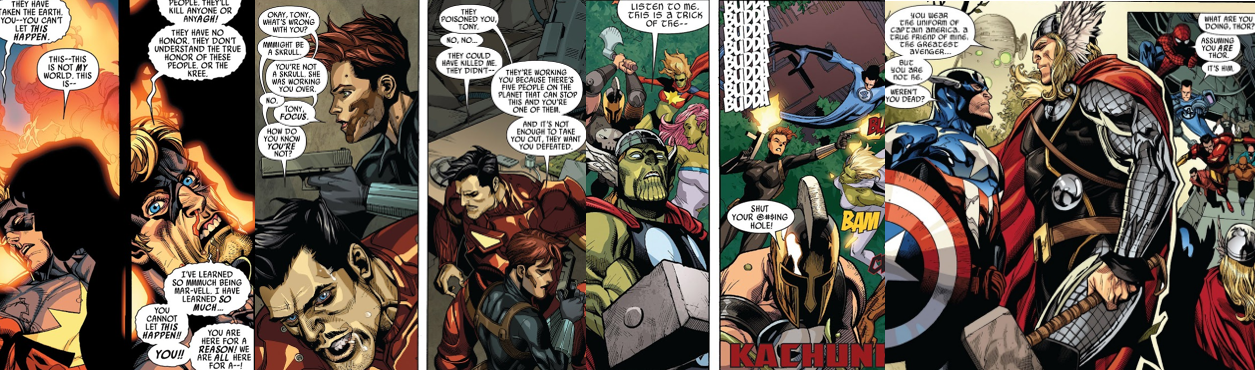
The Skrull threat is doubled thanks to the distrust between the world’s heroes, with even Nick Fury abandoning Ms. Marvel because of her alien DNA. Meanwhile, as a weakened Stark desperately attempts to repair his armour, Spider-Woman reveals herself to be the Skrull Queen, Veranke, and tries to convince him that he’s a Skrull agent so deep undercover that he’s forgotten his true nature. Before her poison (both literal and figurative) can take hold, Black Widow causes her to flee and Stark reveals that the key to victory lies with Mr. Fantastic, who’s currently being tortured aboard a Skull ship. Thankfully, S.W.O.R.D. director Abigail Brand bluffs her way onto the ship and flushes the Skrull into space to rescue him; Reed then fashions a device that exposes the Skrulls’ real forms, arriving just in time to stop another conflict in the Savage Land and revealing not only that the classic Emma Frost, Invisible Woman, Thor, Ms. Marvel, and Jessica Jones are Skrulls but that Mockingbird is as well, enraging Clint. The real Thor transports everyone to New York for a final confrontation, which even the Watcher, Uatu, shows up to observe and also sees Parker Robbins/The Hood’s criminal syndicate and Doctor Norman Osborn’s Thunderbolts pitch in with the nearly-incomprehensible brawl. While Mr. Fantastic and Iron Man try to take out Veranke (still disguised as Spider-Woman) to demoralise the Skrulls, the Wasp targets Citri Noll, who apes Pym’s Giant-Man form, though it’s Stature and the assassin Bullseye who end up taking him out. Iron Man is forced to withdraw so he can sort out his messed-up armour, Fury’s forces save Mr. Fantastic from being torn apart by multiple Skrulls posing as the Invisible Woman, the real Jessica Jones joins the fray, and Kate Bishop ends up gravely injured amidst the chaos. Although Wolverine tries to take out Veranke, the bio-electrical powers she stole from Spider-Woman keep him at bay, meaning it’s an arrow through the face courtesy of the vengeful Ronin that ultimately subdues her.

Although the Skrulls are defeated, the general distrust in Stark allows Osborn to seize power!

With Veranke compromised, Citri Noll activates a device that causes Janet to enlarge uncontrollably and unleash a chemical agent designed to kill humanity and Skrulls alike. With no other choice available, Thor whips up a hurricane with his magical hammer, one so powerful that is destroys the enlarged Janet and dissipates the weird black spots that threaten everyone’s lives. Although Wolverine seeks to make Veranke pay for Janet’s death, it’s Norman Osborn who gets the kill shot, then Iron Man finally gets his shit together and leads an all-out assault on the remaining Skrull ships, with the now disillusioned and leaderless armada being easy pickings. Iron Man also frees everyone the Skrulls impersonated since the shape-shifters conveniently needed the original versions alive in order to make the deception more convincing, meaning Elektra and Mockingbird return to “life”, Reed is finally reunited with his family, and the true versions of the likes of Spider-Woman re-join society. Unfortunately, this also means that Jessica Jones left her and Luke’s baby, Danielle Cage, in the care of the Skrull-Jarvis, a plot thread left unresolved in this story. Although recent tensions are eased in the aftermath and ensuing celebration, there’s an unshakable sense of hesitation given how long the Skrulls had been a part of Earth’s society and superhero community; Thor also condemns Stark’s recent actions and refuses to associate with him. Thanks to having publicly executed Veranke, Osborn is able to manipulate the President of the United States into equally losing faith in Stark, his methods, and his technology; the President thus ousts Stark as director of S.H.I.E.L.D. and names Osborn as the new overseer of any and all superhuman and defensive measures under a new organisation, H.A.M.M.E.R., unaware that this is exactly the opportunity the scheming madman and his Cabal of allies (Emma Frost, Doctor Victor Von Doom/Dr. Doom, The Hood, Prince Namor McKenzie/The Sub-Mariner, and Lady Loki) were waiting for.

The Summary:
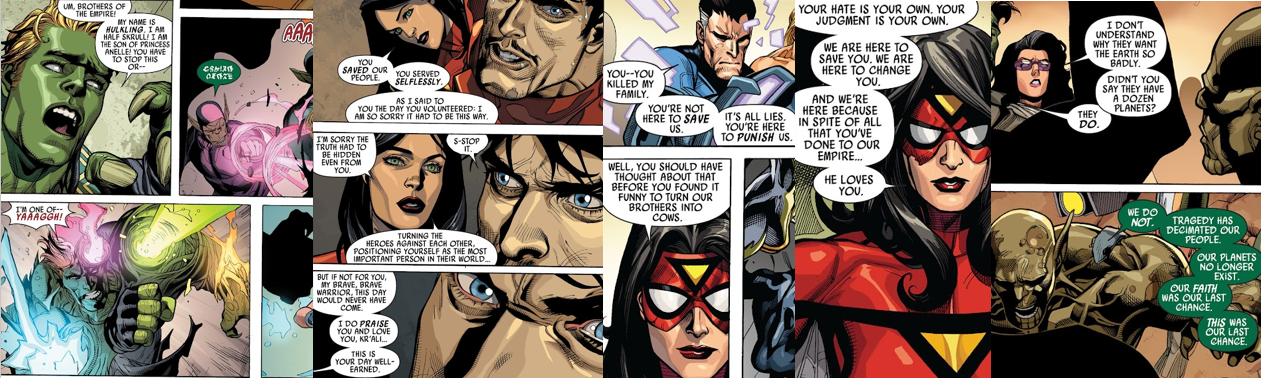
Now, I am by no means an expert on the Skrulls; I know of them, primarily as an antagonistic, shape-shifting race of aliens who are almost constantly at war with the Kree and getting into scuffles with the Fantastic Four, but they’re generally on the periphery of most Marvel stories I’ve read. Secret Invasion is probably, to date, their most prominent story, at least in my experience, and it definitely adds some nuance to them that I didn’t expect. Normally, I see them as a warmongering race who live to conquer through both subterfuge and force but, here, they’re motivated by a fanatical devotion to their God (the “He” they keep referring to) and their invasion is seen almost as divine intervention. The Skrulls swamp television screens with their pseudo-religious propaganda, hijacking every telecommunications device across the globe and assuming the guise of various political figures, celebrities, and superpowered monarchs like Erik Lehnsherr/Magneto and Dr. Doom, and insist that they’re there to bring glory to our world and that their might cannot be opposed. Given the strength of their invasion and that their Super-Skrulls have mimicked the combined powers of many of Marvel’s heroes, it’s perhaps not surprising that Marvel’s ridiculously fickle citizens embrace their alien overlords, though this scene showcases that the Skrulls aren’t simply defending themselves or there to usher in a new age for mankind as they claim and are hell-bent on conquering the planet.

Having lost everything, the Skrulls throw themselves at Earth with fanatical desperation.

This campaign is spearheaded by their queen, Veranke, a figure of worship for the Skrulls and who has placed herself on the frontline, earning the trust of Tony Stark by posing as Spider-Woman and becoming privy to many of Earth’s defences. Stark even reflects on his role in the invasion and the shame he feels about not recognising the threat sooner in a show of guilt that was somewhat uncharacteristic of him at this time; this is a man who was so blinded by his belief that superhumans needed to register with the government that he actively fought and imprisoned his fellow heroes and abandoned many of them, and his morals, in favour of an uncompromising, borderline fascist mentality that only led to further conflict and resentment Indeed, Veranke revels in the irony of having twisted Earth’s technology and heroes towards her agenda, something she was easily able to do thanks to Stark being so dead-set about forcing or punishing his peers to register their true identities and powers. However, as much as Veranke likes to preach that hers is a Holy mission, she’s actually equally motivated out of revenge, specifically against Mr. Fantastic and the Fantastic Four after they tricked a contingent of Skrulls into believing they were cows decades prior. Since the Skrull home world has been lost and their once-prosperous empire lies in ruins, the Skrulls follow her without question and throw everything they have at Earth; they’re even willing to give their lives in the process, and in a last-ditch effort of mutually assured destruction, only to be defeated and left dejected. Veranke’s death leaves the Skrulls directionless and all their once-formidable might is as nothing; those that survive are left demoralised as they saw this as their last chance at survival and glory. Thus, Veranke’s quest for vengeance and conquest leaves her people devastated and more worse off than ever as a sizable portion of their armada is destroyed and the last thing they had in all the universe, their faith, is also shattered by their defeat.

The Skrulls are so deeply entrenched that the already frayed heroes are strained to breaking point.

I’m generally not a fan of imposter storylines; it’s a tired cliché and one that quickly outstays its welcome, but it actually works quite well in Secret Invasion. Many of the Skrulls seem to be completely unaware of their true nature; the Mockingbird-Skrull believes that she’s the real deal right up until the end and is begging Clint to listen to her even as he attacks her in a rage. This is also true of Captain Marvel, who believed so strongly that he was the deceased former hero that he couldn’t bring himself to kill and was convinced by Norman Osborn, of all people, to turn on his race; he even died begging the Kree warrior Noh-Varr/Marvel Boy to carry on the fight in his stead, so complete was his conditioning. It’s not revealed exactly how the Skrulls have the memories they do but it’s one of the big reasons why so many of them went undetected; however, many of the Skrulls posing as classic Avengers continued to believe they were the real deal after their true nature was revealed rather than immediately attacking the heroes in service of their God, which definitely paints much of this conflict in a morally grey area. The Skrulls pick the perfect time to strike the Earth; its heroes are divided and at war with each other and easy to manipulate, and seeing the return of dead heroes like Captain America, Mockingbird, and Captain Marvel, as well as the original version of Iron Man, only fuelled the flames of conflict between them thanks to Stark’s actions during Civil War leading to many deaths, including Captain America’s. It would’ve been so easy to explain away Stark’s recent actions as being the work of the Skrulls but, interestingly, that doesn’t turn out to be the case and, similarly, Cap’s death isn’t immediately undone with the presence of his classic counterpart. Instead, we’re left with a world where Stark is still shouldering the burden of his actions and where Cap’s mantle has been taken up by his friend, James Buchanan “Bucky” Barnes; there are no quick-fixes in this story to explain away the events of Civil War and there isn’t really a sense that bridges have been mended by the end of it as distrust is still rife and the status quo remains unchanged.

A decent story with some interesting wrinkles but a bit overstuffed and manic at times.

Ultimately, I quite enjoyed this story; it’s hard to read as an eight-issue standalone as you need some knowledge of prior Marvel events, especially Civil War, and it’s clear that there’s a lot of additional story and conflict in supplementary collections and books, but the narrative works just as well if you only read these eight issues. I enjoyed seeing the Mighty and New Avengers be forced to set aside their differences when faced with their classic counterparts and the reveals of which characters were Skrulls, even if none of the major players were aliens in disguise. The quasi-religious bent to the Skrull invasion was an interesting twist, as was them siphoning and combining the powers of Marvel heroes into an army of Super-Skrulls, and the art was pretty consistent and easy to follow throughout. Unfortunately, the biggest issue I had with Secret Invasion was the sheer number of characters jammed into it; it was hard to keep track of it all at times and it’s obvious that teams like the Young Avengers, Thunderbolts, and Secret Warriors all had bigger parts to play in spin-off stories, but I think they could’ve been downplayed a little here. There’s a Skrull-Galactus with absolutely no context or consequence to the story and even Uatu shows up, which is generally a short-hand to indicate that the events are of cosmic importance but, again, it doesn’t actually factor into the story in a meaningful way. Stark spends most of the arc out of action thanks to the Skrull virus messing up his armour, which is great for leaving him vulnerable and in pain and unable to participate in the wider conflict but then he just shows up in an older armour with a throwaway line for the finale. Similarly, Thor just pops in out of nowhere, formally prominent characters like Wolverine and Spider-Man get lost in the shuffle, and late appearances from Jessica Jones and Norman Osborn are simply there to set up the next big Marvel events and stories. Overall, it was pretty enjoyable and not as much of a mess as some Marvel events, but the action got a little too chaotic at times and there were too many characters wedged into these issues, which I think would’ve been far stronger if they’d focused on, say, eight or ten main characters and then just showcased the others in supplementary materials.

My Rating:

Rating: 3 out of 5.

Pretty Good

Did you enjoy Secret Invasion? Were you shocked to find out which characters were Skrulls in disguise? Were you hoping that some of the classic Avengers would turn out to be the real heroes? Which of the teams featured was your favourite? Did you think there were too many teams and characters in the story and which of the spin-off books did you enjoy? What did you think to Veranke, the pseudo-religious slant to the Skrulls, and the Skrull invasion? Were you also frustrated by Tony Stark’s characterisation during this time, or did you enjoy seeing Marvel’s heroes in dispute? What are some of your favourite Skrull-centric stories? Whatever your thoughts on Secret Invasion, feel free to share them below or leave your thoughts on my social media.

Back Issues [Dare-DAY-vil]: Daredevil #181


Blind lawyer Matt Murdock first made his debut in Daredevil #1 in April of 1964 and was co-created by writer/editor Stan Lee and artist Bill Everett, with input from the legendary Jack Kirby. While perhaps not as mainstream as characters like Peter Parker/Spider-Man, Daredevil has become one of Marvel Comics’ greatest creations and has featured in a number of ancillary media and merchandise, included a questionably-received big-screen adaptation in 2003 and a critically-successful Netflix series. Still, he’s one of my favourite Marvel characters so today is a great excuse to pay homage to the “Devil of Hell’s Kitchen”.


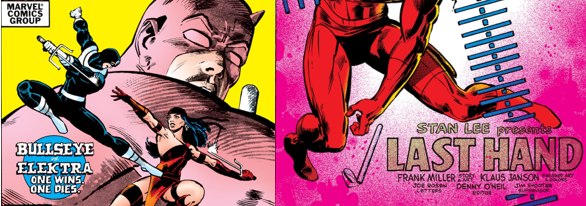
Story Title: “Last Hand”
Published: 29 December 1981 (cover-dated April 1982)
Writer: Frank Miller
Artists: Frank Miller and Klaus Janson

The Background:
The 1960s were a golden age for Marvel Comics as Stan Lee teamed with legendary names like Steve Ditko and Jack Kirby to create some of comicdoms most iconic superheroes. Stan Lee and artist Bill Everett created their most challenging hero yet when Matt Murdock/Daredevil debuted on 1 April 1964, and the Man Without Fear would go on to be one of Marvel’s most popular and enduring characters thanks, in no small part, to the efforts of writer/artist Frank Miller. The then up-and-coming Miller joined the book in 1979 with issue 159 and soon took over writing duties as well as pencils; responsible not just for the creation of Elektra Natchios but penning some of Daredevil’s most influential stories. Easily one of his most memorable stories was told in this special, double-sized issue in which he made the shocking decision to kill off Elektra at the hands of Marv Wolfman and John Romita Sr’s Bullseye. Although Elektra would be resurrected (and killed again) in later years, this doesn’t change the impact of her first death and Miller’s storyline was so pivotal to Daredevil’s character that this storyline was adapted in both the live-action film and the Netflix series.

The Review:
“Last Hand” opens with Benjamin Pondexter, the assassin known as Bullseye, stewing in a prison sell on Ryker’s Island and fantasising about blowing Daredevil’s brains out; after being humiliated by the Man Without Fear time and again, Bullseye is no longer satisfied with a clean, simple kill and desires to make him suffer, to break him, to hear him scream in agony. Bullseye’s hatred is palpable and made only worse by the fact that Daredevil could have left him to die in a subway but actually saved his life, demeaning him even further in his own eyes and those of his fellow inmates. While training his body in anticipation for his eventually rematch with Daredevil, Bullseye is crippled by one of his agonising headaches; although the brain tumour he once suffered with has been fixed, he suffers from debilitating migraines and is dependent upon pills to stave off the pain, which is just one more thing he blames ol’ hornhead for. During one of his few moments of reprieve out in the yard, the shackled Bullseye has a tense confrontation with Frank Castle/The Punisher, who is currently locked up as well, who delights in taunting Bullseye with the knowledge that Wilson Fisk/The Kingpin has replaced him with a new assassin-for-hire.

Bullseye, driven by hatred for Daredevil, escapes from Ryker’s after learning he’s been replaced by Elektra!

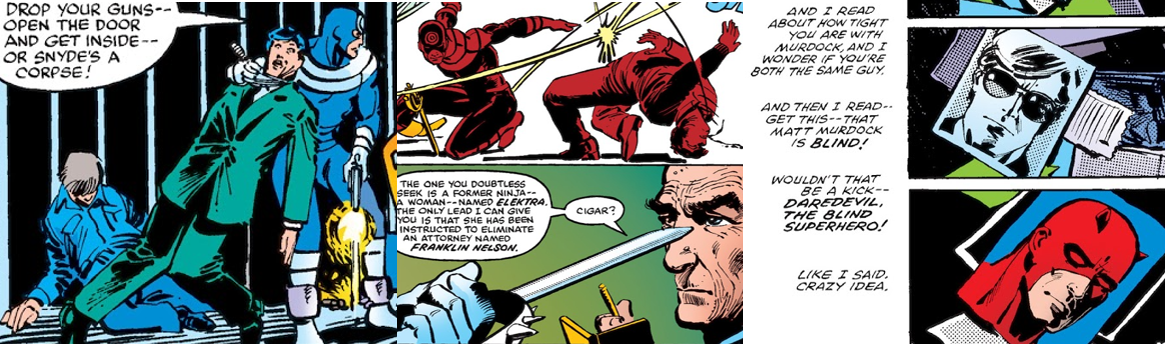
Enraged by this, and driven to have his revenge against Daredevil, he accepts an effort to appear as a guest on Good Evening, New York; however, when he feigns a headache, he temporarily blinds an armed police officer by spitting the pill in his face and causes the cop to shoot his shackles with an errant shot, thus freeing him from his shackles. Bullseye wastes no time grabbing the downed officer’s gun, gunning down his guards, and taking host Thomas Snyde as a hostage. Bullseye shoots his way out into the yard and, incredibly, is able to throw off a sniper and commander their helicopter using little more than a pistol and a microphone cord! Although he’s eager to track down Daredevil and get his revenge, Bullseye first heads over the Eric Slaughter’s hideout for a lead on the assassin who replaced him; there, he learns that the old man’s freelance organisation is preferable to Bullseye’s more erratic and dangerous ways, and promptly beats the crap out of two of Slaughter’s men. Impressed, the old man willingly gives information the name he requires: former ninja Elektra, who has been instructed to assassinate Matt Murdock’s best friend, Franklin “Foggy” Nelson. Bullseye’s reputation is such that Slaughter fears him almost as much as, if not more than, the Kingpin and lends him the services of his men. They put together a file on Murdock and Nelson for Bullseye and he is amused to the point of hysterics at the similarities between Murdock’s pictures and Daredevil, finding the idea of a blind superhero to be hilarious.

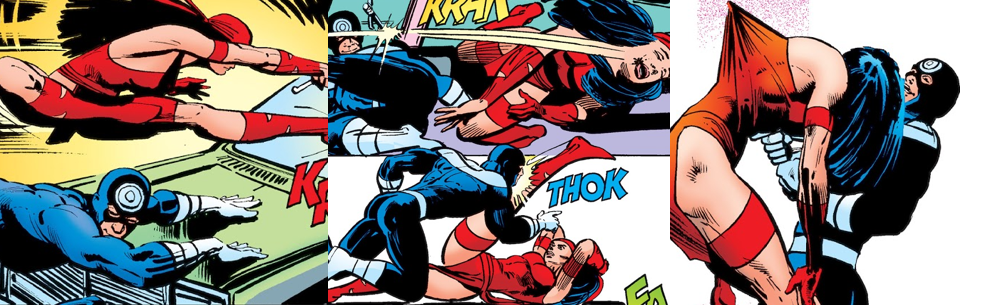
Bullseye and Elektra’s brutal fight ends with her skewered on her own sai!

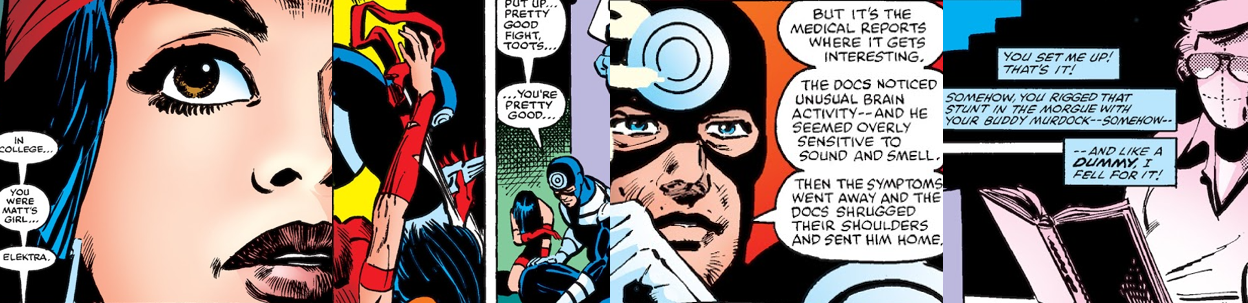
Bullseye begins following Murdock, watching him perform in court and being sickened by his good nature and humanitarianism; he literally slaps a bug on Nelson’s back so he can listen in on them and slices a taxi cab driver’s throat in order to obtain some wheels to follow Foggy’s cab. Quite conveniently, Foggy’s cab has been commandeered as well: by Elektra! Foggy just about pisses his pants when Elektra pulls over and prepares to execute him with her sai, but he saves himself when he realises that he recognises her as a girl Matt hooked up with when they were back in college. Although she falters in her duty because of her memories of her whirlwind romance with Matt, Elektra’s senses are attuned enough to hear Bullseye approach her with a pistol and she instantly springs into action: she disarms him with a leaping kick and catches him off-guard with her speed, strength, and skill. Their fight spills into a parking lot, and Bullseye uses his knowledge of ninja training to turn the tide against Elektra, matching her blow for blow but ultimately gaining the definitive upper hand when he tosses one of his razor sharp playing cards at Elektra’s throat, cutting her open and leaving her completely helpless as he grabs her and stabs her in the stomach with one of her own sais! Mortally wounded and bleeding out, Elektra staggers through the crowded streets to Matt’s flat, where she dies in his arms. Bullseye can’t help but be present when Matt and Foggy are called in to identify Elektra’s body and learn her cause of death; he heard Foggy mention that Elektra used to be “Matt’s girl” and is curious when Matt seems to stiffen up upon hearing his voice, as though he recognises him, and proves beyond a shadow of a doubt that his suspicion that Matt is secretly Daredevil is true by throwing a scalpel at Murdock’s head only for the blind lawyer to block it with his walking stick.

Bullseye ends up crippled but no less determined to one day further torment his foe.

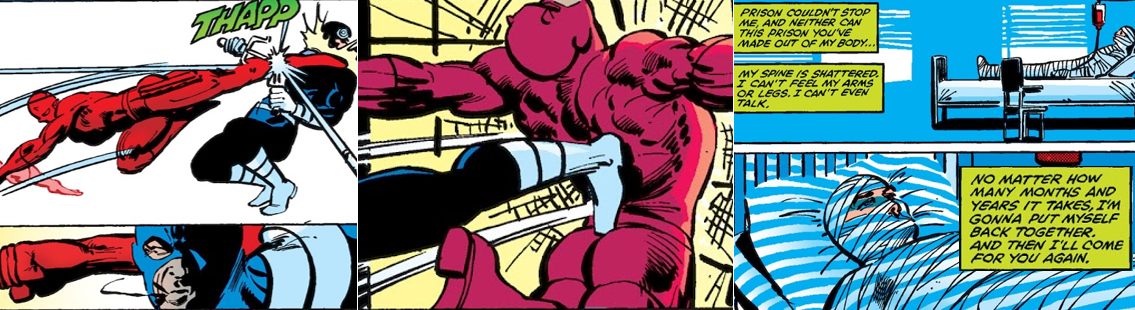
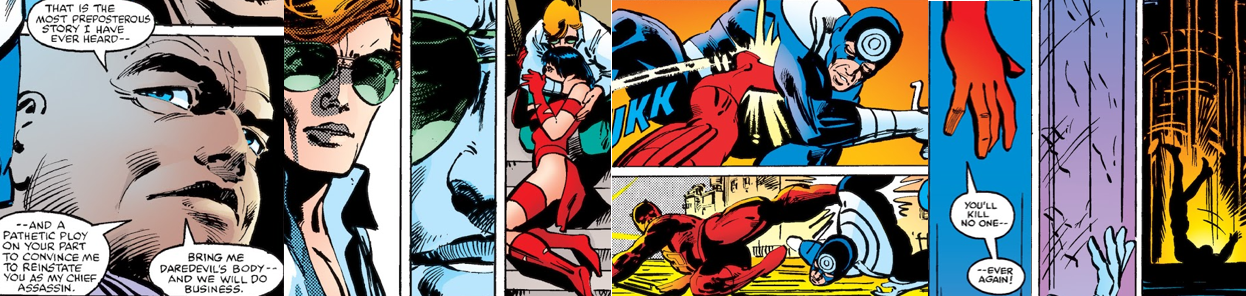
Armed with this knowledge, Bullseye brings this revelation to the Kingpin, supporting his hypothesis with medical evidence, but Fisk finds the very idea of a blind man being Daredevil preposterous. He does, however, assign Bullseye the task of killing Daredevil and bringing him his body, so the assassin heads to Murdock’s apartment to finally have his revenge…only to be blindsided by Daredevil! Unbeknownst to Bullseye, Matt has set up a decoy of himself, which is enough to throw off Bullseye’s confidence in his hypothesis, but he’s no less eager to get into it with his hated rival. Bullseye lures Daredevil to the rooftop and adds a psychological edge to their fight by wielding Elektra’s sais; their brutal clash sees them plummet through a skylight, battle across an elevated train track, and finally come to blows on a precarious wire over the city street. Since he doesn’t have Daredevil’s superhuman balance, Bullseye slips and falls and is enraged when his foe catches him; determined not to suffer another humiliation at Daredevil’s hands, Bullseye prepares to stab his enemy with a sai but, surprisingly, Daredevil drops the assassin to the street below with the intention of ending his murderous ways. However, given that Bullseye has narrated the entire issue, you may have guessed that the fall doesn’t actually kill Bullseye; although even the Kingpin believes him to be dead, Bullseye lies fully bandage in a hotel room with a shattered spine and unable to move his limbs. However, he takes solace in having hurt Daredevil, both by killing Elektra and breaking his friend Matt Murdock’s heart, and in his hatred. Though he cannot move or speak, his hatred is as strong as ever, if not stronger, and he vows to find his way back and continue hurt Daredevil until he’s finally dead.

The Summary:
“Last Hand” is certainly a unique Daredevil tale for a few reasons: first and foremost, it’s told entirely from Bullseye’s perspective. Right from the first panel, we’re let in on the twisted, hate-filled internal monologue of one of Daredevil’s most notorious foes and he’s portrayed as a sick, remorseless, calculating villain throughout. Taking a perverse pleasure in toying with and killing his victims, Bullseye is dangerous and lethal with even the most harmless of everyday objects; while his hatred towards Daredevil is great, this never clouds his judgement or ability; instead, he’s surprisingly observant and conniving, able to deduce that Matt and Daredevil are one and the same to the point where he absolutely nails everything about the Man Without Fear’s origin to the smallest detail, only to be met with scorn from the Kingpin and successfully duped into disregarding his theory thanks to Matt’s trick. Interestingly, though, Bullseye’s crippling headaches don’t factor into the story at all once he’s out of Ryker’s; you’d think that maybe this is what would cause his downfall in the end, but this plot point is completely forgotten once he’s garbed in his familiar outfit and back on the streets, as though finally returning to action cured his debilitating pains.

This is Bullseye’s story, and he not only changes Matt’s life forever but almost figures out his dual identity!

Another way this story stands out is just how little Daredevil actually appears in it; when we do seem him, it’s either through Bullseye’s memories or as a quick flash over to Murdock’s daily routine as a parallel to Bullseye’s time in prison. Thanks to Bullseye’s constant narration, Daredevil is seen as a stoic and grim vigilante, a far cy from his wise-cracking debut, one who is as focused and formidable at fighting as Bullseye. When we do see Matt and Foggy, they’re painted as “saps”; the kind of do-gooders who sicken Bullseye and he only takes an interest in them because they can lead him to his replacement and when he suspects that Matt is Daredevil. We learn very little explicit information about how Elektra’s death impacts Matt; since we are never privy to Matt’s thoughts beyond the few words he says in the story, the entirety of his emotions is told through the artwork. This is strikingly effective, as entire fight sequences and panels pass without any text, and Matt’s morose pain and rage are expertly conveyed in his no-nonsense approach to engaging with Bullseye. It’s also quite interesting seeing the Kingpin outright dismiss the idea of blind Matt Murdock being Daredevil; in time, Fisk would learn that this was actually true and set in motion an aggressive campaign to physically and mentally destroy his foe, but it’s amusing to see just how close he (and Bullseye) came to the truth only for it to be sacked off as being patently ridiculous. Sadly, we don’t really get much insight into Elektra here; like Daredevil, she’s a person of few words, and all of her emotion and turmoil is told through her facial expressions and her fight sequences, which paint her not just as a conflicted and formidable individual but, ultimately, as a victim of Bullseye’s sadistic lusts.

Bullseye pushes Matt to the limit, and sets him on motion towards a dark and destruction path.

Finally, the issue stands out by having a major character being so brutally killed off. There’s a case to be made that Elektra, a trained ninja assassin from birth, should have been able to best Bullseye in their fight but I think the story does a decent job of putting them on equal ground thanks to the emotional blow of suddenly being reminded of Matt and Bullseye’s trick cards. The panel of Bullseye skewering Elektra will forever be iconic, no matter how many times she returns from the dead, and seeing he stumble across town to be with Matt in her final moments was truly heart-breaking. It’s clear from Matt’s stoic expressions that he’s in great pain at her loss, and seeing him launch into an all-out assault when Bullseye brandishes his former lover’s weapons conveys just how personal this fight is for Daredevil. Indeed, it drives him to critically injuring Bullseye; Daredevil’s promise that Bullseye’ll “kill no one – ever again!” could be taken two ways, I believe: either Matt intended for the fall to kill the assassin, or he aimed to cripple him as the final panels show him to be. Either way, it’s a pretty dark place for Daredevil to go and shows just how sour and morally questionable his life as Daredevil can be at times. Overall, this is definitely a pivotal story in Daredevil’s long history and well worth a read for fans of the character, or those who want to explore him further, but maybe it suffers a little from not seeing things form Matt’s perspective; obviously, subsequent issues would delve into this in great detail but it might have been interesting to switch back and forth between Bullseye and Daredevil’s inner thoughts just to get a sense of what’s going though Daredevil’s mind.

My Rating:

Rating: 3 out of 5.

Pretty Good

Have you ever read “Last Hand”? Were you a fan of Elektra and, if so, what did you think to her death in this issue? What did you think of the story being told entirely from Bullseye’s perspective? Did you enjoy the fights in the story or do you think Elektra was given the shaft? Would have liked to see Daredevil’s thoughts in more detail? What do you think of Daredevil as a character and which storyline of his do you think is the best, or the worst? How are you celebrating Daredevil’s debut this year? Whatever you think about Daredevil, sign up to drop your thoughts below or leave a comment on my social media.

Movie Night: Daredevil: Director’s Cut


Blind lawyer Matt Murdock first made his debut in Daredevil #1 in April of 1964 and was co-created by writer/editor Stan Lee and artist Bill Everett, with input from the legendary Jack Kirby. While perhaps not as mainstream as characters like Peter Parker/Spider-Man, Daredevil has become one of Marvel Comics’ greatest creations and has featured in a number of ancillary media and merchandise, included a questionably-received big-screen adaptation in 2003 and this critically-successful Netflix series.


Released: 30 November 2004
Originally Released: 14 February 2003
Director: Mark Steven Johnson
Distributor: 20th Century Fox
Budget: $78 million
Stars: Ben Affleck, Jennifer Garner, Michael Clarke Duncan, Colin Farrell, Jon Favreau, and Joe Pantoliano

The Plot:
After being blinded by radioactive waste as a child and discovering his other senses are superhumanly keen as a result, Matt Murdock (Affleck) works as a lawyer by day and devil-garbed vigilante by night. While falling in love with the mysterious and beautiful Elektra Natchios (Garner), Daredevil draws the ire of Wilson Fisk/The Kingpin (Duncan), who hires the assassin Bullseye (Farrell) to rid him of Daredevil’s interference once and for all.

The Background:
Following his creation in 1964, Daredevil has been no stranger to multimedia ventures; while Angela Bowie’s 1974 proposal for a television movie was never produced, the character made his live-action debut in The Trial of the Incredible Hulk (Bixby, 1989), portrayed by Rex Smith, and made occasional appearances in various Marvel cartoons, particularly in the nineties, and a live-action movie was in the works since as far back as 1997 but could never quite get off the ground thanks to Marvel Comics’ legal issues at that time. Development finally gained traction in 2000, with 20th Century Fox (who would also find success with another of Marvel’s properties, the X-Men, around this time) distributing the film and Mark Steven Johnson signed on to both write and direct. Taking inspiration from the “Guardian Devil” (Smith, et al, 1998 and 1999) storyline and Frank Miller’s celebrated work with on the character, Daredevil was poised to be one of the darker, grittier superhero films of its time. Despite turning a sizeable profit, making nearly $180 million in worldwide gross (and having a rocking soundtrack that propelled one of my favourite bands, Evanescence, into mainstream popularity), Daredevil was less-than-favourably received upon release, with even star Ben Affleck speaking out against the film after its release (despite all the positive comments he had made to market the film…) The “Director’s Cut” of the film (which restored an entire sub-plot, swear words, and was far more violent) released about a year later, is generally regarded by many (including myself) to be the definitive version of the film, however, though the critical and commercial failure of spin-off Elektra (Bowman, 2005) and Affleck’s refusal to revisit the role put an end to any hopes for a sequel and Daredevil would not reappear in live-action until Marvel Studios regained the rights to the character about ten years later.

The Review:
Daredevil was released at a time when superhero movies were just really starting to hit their stride; they weren’t the multimedia juggernaut they are today thanks to the efforts of Marvel Studios and Disney so, while there were many highly regarded and influential superhero films released in the early 2000s, not all of them were guaranteed smash hits and even the ones that were haven’t exactly aged well (or have been done better) since then. As a result, most superhero films tended to feature a major focus on the character’s origin, a lot of fast-paced and frenetic action scenes, and a plot that moved at a relatively brisk pace to cover a lot of ground as quickly as possible. They, like many other action films of the time, were also heavily influenced by (or blatantly ripping off) The Matrix (The Wachowski Brothers, 1999) so black leather, “wire-fu”, and CGI were plentiful during this time and, of all the superhero movies released in the early 2000s, perhaps nowhere are all these now-cliché elements more apparent than in Daredevil.

Daredevil is framed by a flashback to Matt’s childhood to tell his origin story.

Daredevil begins in medias res with the titular vigilante wounded, seemingly fleeing from the police, and seeking sanctuary at Father Everett’s (Derrick O’Connor) church. As he lays incapacitated and hurt, Murdock begins to narrate his childhood and life up until that point under the illusion that his life is flashing before his eyes as he dies; this flashback-heavy first portion of the film separated Daredevil from its contemporaries as, while the Spider-Man films (Raimi, 2002 to 2007) featured a bit of narration from the main character, most superhero films started at the beginning and progressed from there, with us following the hero along his journey and learning alongside him/them. This technique, though, means that we experience Daredevil from a uniquely different perspective, that being through the haunted, tumultuous memories of its main character.

Jack discourages Matt from fighting and wants him to grow up to be a success.

We’re thus introduced to Murdock first as a battered and injured vigilante and then, very quickly as a young kid (Scott Terra) from Hell’s Kitchen who is constantly harassed by a gang of local youths. These bullies like to rag on young Matt because his father, Jack Murdock (David Keith), is not only an over-the-hill, washed up prize-fighter who once fought under the name “The Devil” and wore a devil-themed robe to the ring but has now taken to working as an enforcer for Fallon (Mark Margolis), a local mob boss. Matt, maintaining a staunch belief in his father’s glory days, accolades, and abilities, stands up to such bullies and trash talk and takes a beating as a result, much to the dismay of his father. Jack, however, wants more from Matt and discourages him from fighting, wishing instead for Matt to devote himself to his studies and to make something of himself and it is clear from their brief scenes together that the two have a very strong relationship, one built on mutual trust, respect, and dependency. Jack is determined to have Matt grow up unafraid, to be the best version of himself, and to not be a “bum like [him]” but this goes so far that he is too ashamed and too despondent to admit that he really has been forced to rough people up on Fallon’s behalf in order to provide for his family. The very next scene shows Matt witnessing this and, distraught and heartbroken, he flees from the sight only to end up narrowly avoiding a collision and being blinded by a biohazardous waste product as a result.

Blinded by toxic waste, Matt’s remaining senses are enhanced to near-superhuman levels.

Similar to Spider-Man, an elaborate CGI sequence shows us the effect this has on Matt’s DNA and, when he awakens in hospital, he is immediately bombarded with sensory overload as, while he has been rendered permanently blind, his remaining senses (particularly his hearing, which gets the most attention) have been augmented to near-superhuman levels. Unlike in the character’s debut appearance, where Matt barely flinched at being blinded, very little time was spent dwelling on how he or his father felt about it, and where Matt never once struggled to adapt to his new abilities, Daredevil adds a few wrinkles to this turn of events. Firstly, because Matt’s accident happened as a direct result of him running away from his father, Jack feels a tremendous amount of guilt and shame about the accident; secondly, Matt is overwhelmed to the point of terror at his newfound abilities and struggles to get them under control. However, the two have such a strong bond, love, and dependence upon each other that Matt doesn’t bare a grudge and the two resolve to redouble their efforts to overcome their limitations, with Jack getting back into training and back into the ring and Matt continuing his studies using Braille and discovering that his echolocation provides him with a version of sight. In experimenting with his newfound abilities, he loses all sense of fear as he easily traverses rooftops and overwhelms his tormentors (who “dare” him to fight them) with little more than his walking stick and his dexterity. Of course, Daredevil is still a superhero story and what superhero origin is complete without a dash of tragedy? It turns out that Fallon has engineered Jack’s comeback and threatens both him and Matt to coerce Jack into taking a dive in his next fight; with his son in the crowd and refusing to compromise his principals, Jack refuses and wins through heart, determination, and brute strength/force of will. However, Fallon’s goons jump Jack after the fight and beat him to a pulp before an unseen third assailant delivers the finishing blow, beating Jack to death and leaving a red rose on his bloodied corpse.

Matt plays the role of “unassuming blind man” well but suffers the consequences of his double life.

Tragically, Matt hears it all and is absolutely heartbroken when he comes across his father’s beaten and bloody body. He resolves to keep his promise to his father to help those that others wouldn’t and seek justice one way or another, with the film glossing over his time in college and law school and jumping ahead several years to find him fully grown into Ben Affleck. The older Murdock is a haunted, heavily conflicted individual; in order to block out the constant barrage of noises, he sleeps in a sensory deprivation tank and regularly chews a number of pills and painkillers to dull the constant pain from the many wounds he has suffered in his nightly jaunts. The effects of his double life can be immediately seen not only in his weary expression but also the multitude of scars, bruises, and injuries his body exhibits; though Matt’s abilities make him faster and stronger than the average man, he’s still human and we constantly see him suffering blows and injuries during his activities as Daredevil, taking hard shots to the ribs and even losing a tooth during the film’s first big action scene. I’m no fan of Affleck (largely because of the way he crapped all over this movie after professing to be such a big fan of the comics during its marketing) but he’s actually really great as Murdock; the special contact lenses he wears are only a small part of selling him as a blind man as Affleck assumes a slightly skewed posture and thousand-yard stare, always positioning himself in such a way that you can tell he’s lacking his sight. Additionally, Murdock uses Braille to identify his belongings, and even folds his notes in certain ways to recognise them (though it’s not entirely clear if he needs to do this, since we know he doesn’t, or if it’s all part of playing up his persona as a simple blind man), all of which go a long way to showcasing how a blind man might life his life.

Matt is a brutal and resmorseless vigilante when he dons his Daredevil garb.

Affleck is also able to showcase a multitude of emotions with a surprising amount of nuance; Murdock is a pragmatic, yet passionate, bastion of the innocent in the court room, has a fantastically realised love/hate relationship with his friend and colleague Franklin “Foggy” Nelson (Favreau), and transforms into this violent, sardonic, brutal vigilante when donning the incredible blood-red leather outfit of Daredevil. It’s clear that Murdock is a man of many conflicting emotions and suppressed rage and that Daredevil is his outlet for those sensations; he takes deep offense to those who flaunt or break the law or who are under the clear influence of the mysterious Kingpin of Crime and takes it upon himself to bring such individuals to justice. His methods to achieve this are vicious and violent, involving the unrelenting beating of any law breakers and even more direct and indirect murder as he moves fast enough to avoid bullets that other thugs then take and not only willingly knocks Jose Quesada (Paul Ben-Victor), an obvious rapist and all-round bad person, to a gruesome death by train but even takes the time to mock him before his grisly dismemberment.

Favreau is great as the loveable, if goofy, Foggy Nelson.

Clearly a tortured, haunted individual, Matt keeps others at arm’s length and actively sabotages his relationships because of his unwavering commitment to bringing criminals to justice as Daredevil and his unresolved issues. Foggy makes this abundantly clear as he calls Matt out on his bullshit time and time again while still being in quiet awe of Matt’s adaptability, dedication towards helping those in need even when they receive very little payment (or payment in fluke or sports gear, which makes for an amusing running gag), and his capability in the court room. Their relationship is a real highlight of the film, with the two sharing banter, matching wits, pulling pranks on each other, and even using Matt’s disability to wind up strangers or to win the sympathy of the jury. Any time these two are onscreen together, it’s a joy to see; Favreau is instantly charming and likeable as the goofy Foggy and, while he was always able to stand out by questioning Matt’s approach to the women in his life, the Director’s Cut expands Foggy’s role and gives him a character arc where he is able to resolve Dante Jackson’s (Coolio) case and help lead the authorities to the Kingpin.

Duncan exudes an arresting aura and jumps from eloquent calm to unbridled rage!

Speaking of Wilson Fisk/The Kingpin…how amazing was Michael Clarke Duncan? The man had such a charisma and a presence not only because of his massive frame but also his charming smile and deep, dulcet tones. Though traditionally a white character, Duncan is a perfect fit for the role and exudes power, charisma, and a commanding respect from the moment he is introduced in the film garbed in a flashy suit and puffing away on a chunky cigar. Though the character was an eloquent and calculating individual in the theatrical cut, the Director’s Cut goes even further in establishing Fisk’s threat when he is seen viciously bludgeoning two of his underlings (one with his massive cane and the other by first throttling and then breaking his neck), which makes it all the more ominous when he later lays a seemingly innocent hand on the shoulder of Nikolas Natchios (Erick Avari) and gets his large hands on Daredevil in the film’s conclusion. The added runtime afforded by the Director’s Cut also adds further nuance to Fisk’s character; on the one hand, you could argue that we don’t really learn much about him and that he’s every typical, one-note criminal mastermind but, on the other, you can really see a number of layers to Duncan’s performance. Like Murdock, Fisk is keeping his raw, animalistic urges and primal rage at bay with a suit (literally a business suit); he explodes in a burst of rage and pure, unbridled power then immediately calms and composes himself and is so eager to put his abilities to the test against Daredevil for the climatic final fight that he all but invites the vigilante in to take him on man-to-man. Cold, calculating, but also articulate and oozing menace, Duncan portrays Fisk as a man at war with his clearly street-smart upbringing and the sophistication required of his role. Indeed, while he takes immense pleasure in the suffering of others, he also maintains that none of his actions have ever been personal; it’s with a glimpse of regret, maybe even sorrow, that he admits to Daredevil that his entire criminal enterprise has only ever been “business” and nothing more. Fisk’s “business” finds itself somewhat compromised not only by Daredevil but also the continued attempts by reporter Ben Urich (Pantoliano), whose speciality is urban legends, to expose the Kingpin. Fisk solves that problem by hiring Bullseye, a charming, animalistic, cold-hearted, sadistic, masochistic hitman, to kill Natchios. Unlike Murdock and Fisk, we learn very little about Bullseye save that he is a ridiculously good shot who talks little, kills on a whim, and has a flair for the dramatic. Like Fisk, Bullseye enjoys killing but takes a perverse pleasure out of it rather than revelling in his power like Fisk does; he’s also incredibly egocentric and takes it personally when Daredevil causes him to miss a shot, happily accepting an extended contract to take out both Daredevil and Natchios’ daughter, Elektra.

Matt and Elektra flirt but sparring in a playground. It’s not awkward at all…

Of the three main characters in the film, it’s Elektra who I feel brings the weakest performance; I’m not really a fan of Jennifer Garner and find her to be a bit of a blank slate who is sleepwalking through the film. She phones it in well enough to portray Elektra as a strong, independent, and forceful character when she needs to be but her romance with Matt is incredibly rushed and convenient. He basically becomes infatuated by her on scent alone and they have an absolutely cringe-worthy flight/flirt in a neighbourhood playground that seems more like Matt stalking and forcing himself upon her than a genuine attraction. However, she respects Matt’s ability to perform heavily choreographed wire-fu enough to give him her name and the time of day. To be fair, Elektra is a fairly layered character; she hates being under the constant supervision of her father and her bodyguards and wants her independence yet is incredibly devoted to him and her family. She is feisty and strong-willed but also lonely and you get the sense that her relationship with Matt is the first time she’s really been able to open up to someone. After her father is killed, though, she turns into a cold, venge-seeking individual, blanking out Matt’s pleas to turn away from vengeance and showcasing her formidable martial arts and sai-based combat skills in preparation to take out the man she believes responsible for her father’s death: Daredevil. All-in-all, Daredevil’s cast is pretty solid, ranging from top notch to mediocre performances that do a serviceable job given the film’s run time. And there is a lot happening in this film, especially in the extended Director’s Cut, yet the film’s pace is relatively speedy all throughout, glossing over such things as how Matt was able to construct his suit, multi-purpose cane, and the “Devil-Cave” compartments of his apartment and often padding out action scenes or stunts with some very dodgy CGI. I remember the effects not being that bad at the time but they really haven’t aged well now, with the CGI Daredevil, especially, looking particularly rubbery and cartoony as he ludicrously jumps from building to building or battles Bullseye up a ridiculously large church organ. The film is at its best when the action and fight scenes are simple, raw, and gritty, such as the one-on-one action between Daredevil and Elektra, Bullseye, and, especially, Fisk. Perhaps because of the success of Spider-Man, though, and definitely because of the popularity of The Matrix, Daredevil seeks to portray not just Daredevil but also Elektra and Bullseye as being capable of performing incredible, physics-bending stunts. While this is somewhat fitting for Daredevil, who is generally about as agile and adept as Spider-Man in the comics, it definitely feels like the film would have benefitted from downplaying the more nonsensical stunts and focusing on more dark and gritty action and fights.

The Nitty-Gritty:
In contrast to the beliefs of some, one of the best things about Daredevil, for me, has always been its soundtrack; sure, either the score or a host of licensed tracks are usually playing over every scene in the film but Daredevil boasts some rocking tunes and uses them to really help establish the mood or the character onscreen at the time. Murdock drowns out the sounds of the city with some Seether, for example; Nickleback’s “Learn the Hard Way” plays while Daredevil kicks the crap out of Quesada and his goons (who all need to “learn the hard way” that their actions have consequences), Fisk is introduced to the sounds of N.E.R.D.’s “Lapdance”, the appropriately-named “Man Without Fear” by Drowning Pool and Rob Zombie brings a manic energy to Bullseye’s elaborate motorcycle chase against Natchios, and, of course, the iconic “Bring Me to Life” and “My Immortal” by Evanscence feature prominently to set the stage for Elektra’s grief and her thirst for vengeance. Honestly, I don’t give a damn how much music is in the film because when a film’s soundtrack is as bad-ass as this one, all you can really do is sit back and rock out!

The film is full of explicit religious imagery.

Fittingly, Daredevil is also rife not only with references to some of the character’s most influential writers (John Romita, David Mack, Joe Quesada, Brian Michael Bendis all get name dropped, Frank Miller and Stan Lee pop up for brief cameos, and, most egregiously of all, Kevin Smith has the gall to appear as a coroner named “Jack Kirby”) but also with religious imagery; the opening of the film provides a perfect excuse to recreate that iconic shot of Daredevil clinging to a cross atop a church, Matt is only able to control his newfound abilities by focusing on the ringing of a church bell, the Director’s Cut features a handful of quasi-dream sequences where Matt is visited by a Nun (actually his deceased mother), Daredevil subdues Bullseye by causing a sniper’s bullet to pierce his hands in the style of the stigmata, and Matt frequently finds solace in Father Everett’s church. In the theatrical cut, Everett was the only other person who knew of Matt’s dual identity and he strived to turn Matt towards a more righteous path; here, this role is largely the same but slightly different as the film focuses more on Matt’s dark path and the violence of his life. We’re led to believe that this comes to a head when he spares the Kingpin but, arguably, Fisk deserved to die more than any of Matt’s other victims. Instead, Matt is happy (or, at least, willing) to kill small fry like rapists in the opening but not the primary crime lord of New York simply to serve a wonky character arc and to set up sequel bait.

Matt is haunted by his past, his pain, his anger, and his struggle to reconcile his emotions.

One thing the Director’s Cut really brings to light is just how conflicted and full of anger Matt is; his violent double life is clearly at odds with his Catholic upbringing and is taking its toll on him, as expertly seen by a new scene where Matt is literally haunted by the screams and suffering of those he cannot help in the city. He lashes out at criminals when under the mask and takes his anger and frustration out on both them and his Devil-Cave when he is unable to save Natchios and, unlike in his original debut, Matt is a flawed and fundamentally broken character; he struggles with his newfound abilities at first and his quips are more like cruel taunts than light-hearted whimsy. There’s a sense that he does what he does out of a sense of duty to his father and because of his abilities but it’s also pretty clear that he’s using Daredevil to exert all of his emotions and rage; when he sees a child cower in fear of him, he is stunned and desperately tries to convince himself that he’s “not the bad guy”. Finding little solace in Father Everett’s talk of faith, Matt struggles to reconcile his actions and inner turmoil and he is noticeably tetchy and short with Foggy the next day as a result. This all goes to great lengths to explain why he was unable to get through to Elektra at the funeral since Matt is hardly a bastion of virtue. How can he hope to convince someone not to seek vengeance when he does it every night?

It might look impracticable and uncomfortable but Daredevil’s suit is straight up bad-ass!

Another thing I always enjoyed about Daredevil was its dark and gritty aesthetic and the costume design; when taking to the streets as Daredevil, Murdock dons a thick, uncomfortable-looking but super bad-ass leather outfit that is a fantastic blood-red and is one of the few live-action superhero suits to actually use lens over the eyes. The practicality of this suit might be in question but it sure looks awesome (…when it isn’t rendered in shitty CGI), though I do find myself questioning how Matt was able to make it and the many duplicates hanging in his Devil-Cave. Matt also, of course, wields his multi-purpose cane (seriously, it’s a baton, nunchaku, a grappling hook, and even an axe!) but I find it hard to believe he could do both to such a high standard and exactly how does Matt manage to change into Daredevil in the middle of the city? There’s no way he’s wearing that suit under his clothes and he can’t be that close to his apartment all the time so either it’s a convenience for the sake of keeping the film’s frenetic pace going or Matt has stashed spare costumes all over the city!

Despite all her abilities, Elektra is no match for Bullseye…

Bullseye and Elektra don’t fare quite as well as Daredevil on the costume front, unfortunately, with both opting for black leather and relatively simple attire despite Bullseye demanding a “fuckin’ costume” from Fisk. Still, Bullseye makes up for it with a preposterous bullseye scar on his forehead and an absolutely gorgeous Matrix-style trenchcoat that he even uses to disorientate and distract Elektra during their fight. This whole sequence is a bit of a let down, to be honest; earlier, in their civilian clothing, we saw Elektra and Matt go toe-to-toe and that they were largely evenly matched until Elektra got the better of him. Considering Matt’s augmented strength and reflexes, this is a pretty impressive feat and, overwhelmed by hatred and her desire for revenge and helped by the fact that Matt refuses to fight her, we see Elektra again able to best Daredevil in a fight, incapacitating him with a stab to the shoulder that, for all intents and purposes, leaves Daredevil seemingly near death! After discovering the truth about her father’s murder, though, she immediately redirects her anger towards Bullseye, a man we have seen exhibit absolutely not fighting prowess up until that point, and is summarily overwhelmed! Seriously, I get that Bullseye is agile and all about the misdirection and the perfect shots but he toys with Elektra all through their fight and kills her without barely breaking a sweat!

Daredevil and Kingpin settle their differences in a good, old-fashioned fist fight!

Daredevil’s fight against Bullseye isn’t much better as not only are they depicted as being physical equals (though at least Daredevil has the excuse of being badly wounded), the fight is hindered by the worst instances of CGI in the film that sees them leaping and hopping up about the place like in a videogame, Daredevil catching all of Bullseye’s shurikens with swift movements of his club, and Bullseye expertly snagging every single shard of broken stained glass and tossing them at Daredevil (who avoids them all with a superb series of well-timed backflips). It really hasn’t aged too well and is ridiculously over the top for what should have been a simple, brutal affair. Thankfully, the climactic fight between Daredevil and Kingpin makes up for this even more in the Director’s Cut; in the original version, this fight is depressingly short but, here, it’s noticeably longer and stands out from the rest of the film by beginning with the simple, raw sounds of the two adversaries kicking the crap out of each other. Thanks to his immense strength and Daredevil’s wounds, Fisk is able to subdue Daredevil with a concussion-induced blow to the head and a rib-breaking toss into a concrete pillar; like the bullies of Matt’s youth, Fisk is incredibly amused to find that his rival is “the blind lawyer from Hell’s Kitchen” but finds himself on the back foot when Matt uses the sprinkler system to focus his radar sense and brutally bring the Kingpin to his knees. Driven to the floor in pain and at Matt’s mercy, Fisk is spared and handed over to the police despite promising that he’ll get out, and tell others of Daredevil’s identity. Matt, however, is unfazed, believing that no one would believe Fisk’s story and vows to be ready for Fisk when he gets out, setting the stage for a rematch and an escalating conflict that, sadly, we never saw. Like when Matt threw Bullseye out of the church window and to what should have been his death (he survived but was left in a full body cast so I guess that makes it okay…?), this is treated as a heroic, character-defining moment as Matt finally choose the higher, more noble and heroic path…despite the fact that he’s killed before, both directly and indirectly, and leaving Fisk alive is arguably more dangerous to both him and the city.

The Summary:
While many of the CGI shots and fight/action scenes haven’t aged too well, there’s actually a lot to like here; Daredevil’s suit is incredible and, while the costumes are very Matrix-y (as are the fights), they still work and allow each character to stand out from each other. The cast (with the exception of Elektra) is also really strong; Affleck may have talked shit about the role but he’s really good, shaking off a lot of his boy scout persona and really selling the idea that he’s a blind man and an emotionally tormented sole trying to do good through violent actions and getting lost down a dark path, and Duncan is phenomenal as the Kingpin. He has a real weighty presence, exuding power and intimidation but also layering the character with subtle nuances; it’s like he’s constantly keeping his anger and brutality in check through the veil of civilisation and decorum and is itching to let his emotions loose. Daredevil allows Matt to do this but Fisk has few opportunities to do it; the only one not hiding behind some kind of a mask is Bullseye, who is unapologetically sadistic through and through The soundtrack is also incredible; sure, music and songs fill nearly every scene but the hard rock, metal, and nu-metal tracks are a welcome inclusion for me. It’s not perfect; the plot is kind of all over the place, even in the Director’s Cut, and full of conveniences and contrivances but it does a really good job of establishing this world and it’s a shame we never got to see this cast all come back for at least one more film. Seriously, we got two mediocre Fantastic 4 movies (Story, 2005 and 2007) but we couldn’t get a sequel to Daredevil? As much as I loved the Netflix series, I still think that’s a real shame since the intention was clearly to do something akin to “Born Again” (Miller, et al, 1986) in the follow-up.

My Rating:

Rating: 3 out of 5.

Pretty Good

What did you think about Daredevil: Director’s Cut? How do you think it compares to the theatrical version? What did you think to Ben Affleck in the title role, and the film’s cast in general? Did you enjoy the film’s soundtrack or did you find the constant influx of songs distracting? How well do you think the film holds up compared to its modern equivalents? Perhaps you prefer the Netflix series (I mean, who doesn’t, right?); if so, why and what are some of your favourite moments from that? Do you have a favourite Daredevil character or storyline you’d like to see adapted into live-action? Whatever your thoughts on daredevil, feel free to leave a comment down below.