Movie Night: Blade: Trinity

Released: 8 December 2004
Director: David S. Goyer
Distributor: New Line Cinema
Budget: $65 million
Stars: Wesley Snipes, Dominic Purcell, Jessica Biel, Ryan Reynolds, Parker Posey, and Triple H

The Plot:
After being exposed and vilified by a vampire ruse, half-human, half-vampire vampire hunter Blade (Snipes) reluctantly teams with the upstart “Nightstalkers” against the resurrected Count Dracula/Drake (Purcell).

The Background:
The brainchild of Marv Wolfman and Gene Colan, Eric Brooks/Blade (an obscure and culturally problematic vampire hunter) first appeared in The Tomb of Dracula decades before a radically different version essentially birthed the modern superhero genre. Following years of development and rewrites, Blade (Norrington, 1998) was a critical and commercial hit that was followed by a divisive (if profitable) sequel about three years later. Plans for a third film were made before Blade II (Del Toro, 2002) was released, with writer David S. Goyer tapped to pen the film and Oliver Hirschbiegel initially in talks to direct. When those plans fell apart, Goyer took the big job after receiving advice from previous Blade directors Stephen Norrington and Guillermo Del Toro. Ryan Reynolds signed on, with Goyer tentatively hoping for a spin-off for his wise-cracking character, though the shoot was reportedly tense when star Wesley Snipes fell out with Goyer, refusing to talk to him or even follow basic directions. Though co-star Patton Oswalt spoke negatively of the experience, Snipes later claimed these reports were over dramatised and an elaborate ruse. Although it grossed slightly more than the first film, Blade: Trinity was widely panned for being a nonsensical mess lacking the style and substance of its predecessors and for having one of the worst onscreen renditions of Dracula. Though plans for a crossover with the Underworld franchise (Various, 2003 to 2016), the character lived on in a short-lived TV show and Snipes even reprised the role in the Marvel Cinematic Universe ahead of a complete reboot.

The Review:
Things start out normal for everyone’s favourite dhampir as he knocks off vampires and operates out of a repurposed garage/warehouse much like in the first movie. Blade is oddly baffled when a victim shrugs off silver, despite claiming to have killed 1182 Familiars, and being easily fooled by fake fangs despite his heightened senses. This costs him when bystanders witness him killing a man in cold blood and Danica Talos (Parker Posey) releases the footage, painting Blade as a psychopathic murderer and exposing him to the Federal Bureau of Investigation (F.B.I.), specifically Agent Ray Cumberland (James Remar). While Blade’s mentor and father figure, Abraham Whistler (Kris Kristofferson) returns, he’s little more than a cameo who encourages Blade to rely on others and dramatically sacrifices himself holding off Cumberland’s strike team. The normally stoic dhampir is once again anguished by the loss, which further undermines his unnecessary return in Blade II. Much of Blade’s exchanges with Whistler set up his central character arc, namely his reluctance to rely on others or accept help (which is also a bit odd considering he worked with others, and even a vampire crack squad, before and Blade II painted him as a natural leader). Though Blade openly scoffs at the idea of having friends or relying on others, Drake’s threat forces him to fall in with the Nightstalkers, who Whistler secretly organised to aid him (despite them not appearing the last time Whistler died).
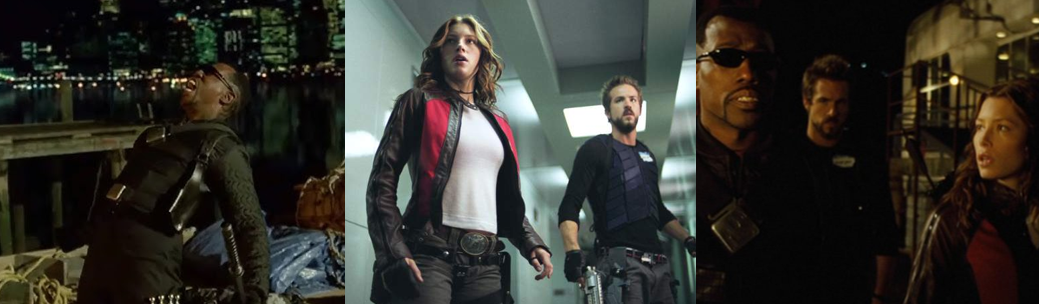
Devastated by Whistler’s loss, Blade reluctantly teams with a group of upstart vampire hunters.

The Nightstalkers are an eclectic bunch of young upstarts who immediately rub Blade the wrong way, with wise-cracking Hannibal King (Reynolds) particularly grating on Blade’s nerves due to his motor mouth. Despite Blade’s very aggressive and unapologetic scepticism, though, the Nightstalkers sport state of the art tech and weapons, such as Abigail “Abby” Whistler’s (Biel) ultraviolet bow and Sommerfield’s (Natasha Lyonne) “Daystar” pathogen to wipe out the vampire species (which is doubly impressive considering she’s blind). Abby and Hannibal join Blade as the titular “trinity”, leaving Blade stunned to learn that Whistler had a secret daughter. While we never learn how close she and her father were, it’s clear she’s as haunted by her past and driven by revenge like Whistler, who wanted to destroy all vampires for torturing and killing his family. While Blade reluctantly becomes a key figure in the Nightstalkers, he also becomes a mentor for Abby, teaching her to “use” her pain and anger at the death of her friends to better aid her in battle, though she impresses with her speed and deftness and her ability to fight while listening to music. Hannibal’s fast talking, smarmy attitude clashes with Blade’s reserved personality, leading to the dhampir all-but dismissing King despite him formally being Danica’s plaything. This gives him all the motivation for hating vampires and wanting to wipe them out, something Blade can definitely relate to, though he remains adamant that the Nightstalkers need an attitude adjustment and some proper, experienced leadership. Hannibal may be a shit-talker, but he’s both extremely cut and loyal, insulting sadistic brute Jarko Grimwood’s (Triple H) manhood and bravely defying Danica, but he’s terrified of being turned back into a vampire and forced to feed his loved ones.
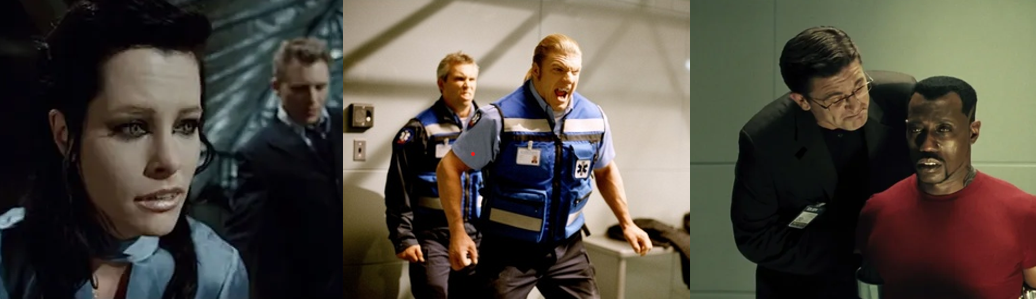
Parker Posey drags every scene down with her atrocious line delivery and ham acting.

Blade: Trinity shows a new side to vampire society as Familiars wage a public relations war against Blade and control the local police, placing Blade in an unwinnable and desperate situation. Danica leads her brother, Asher (Callum Keith Rennie), and Jarko, in reviving Dracula in hopes of cementing their race’s dominance. In a film full of missteps and poor ideas, Parker Posey has to be one of the worst. While she seems to be having fun and is certainly chewing the scenery with her over the top performance, she’s literally painful to watch and drags the already questionable script further down with her atrocious delivery and childish tantrums. While Triple H doesn’t fare much better, he at least has an imposing presence and some funny character quirks, such as his love for a Reaper-like Pomeranian and his heated rivalry with Blade and Hannibal, matching his brawn and smart mouth against both. While the vampires are clearly well funded and have many resources, even setting up literal blood banks to sustain them when they take over, they seem far less organised and capable, with Danica so desperately unearthing Dracula to blood can transform her race into dhampirs. Danica and Jarko hate Blade and Hannibal with a passion, the former because he’s systematically wiping out their race and the latter because he’s a smart ass who routinely insults them even when suffering brutal torture. Having previously turned and tortured Hannibal and presumably had numerous run-ins with him, Danica delights in seeing him suffer but seems to have some respect for Blade and is especially envious of his ability to walk in daylight. While Drake quickly acts in his own interests, exploring the city and toying with Blade on his own terms, Danica seems okay with this (not that she can stand against Dracula’s power) since she’s convinced Drake will turn the tide for her entire race.
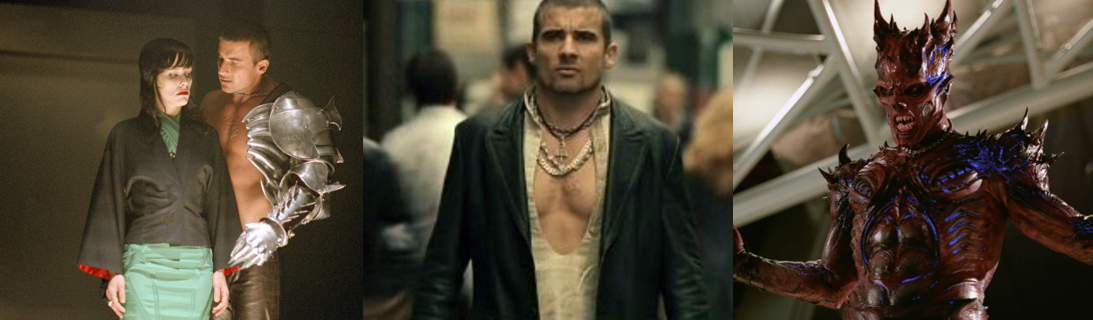
Despite his impressive demonic form, Drake may be one of the worst filmic Dracula’s ever seen.

Echoing the same sense of superiority as the Pure Bloods of the previous films, Drake is said to be the first vampire, a demonic entity who’s never had to evolve who was a feared Sumerian warrior before entering a long period of hibernation after becoming disgusted by the world. However, as much as I enjoy Dominic Purcell’s work, he’s a poor fit for the role. With his stocky physique and robotic delivery, he’s very much the opposite of the Dracula legend as told by Hannibal, to say nothing of the classically trained actors who usual embody the part. While Blade: Trinity repeatedly downplays the movies and popular depictions of Dracula, Drake is fast enough to avoid bullets, exhibits superhuman strength, and is an accomplished shapeshifter. Drake strangely mimics Whistler to attack the Nightstalkers and is initially depicted as a monstrous, armoured demon overcome by “The Thirst”, a look that’s honestly more menacing and unique than his bog standard “Everyman” guise. Before he takes the lame-ass name “Drake”, Dracula is disgusted by Danica and modern-day vampires, rightly seeing them as “shadows” of their former glory. However, Drake’s convinced to begrudgingly aid them to test himself against Blade, whom he sees as the future of the vampire race and a formidable opponent. Drake is mesmerised by the modern world, it’s glorification of vampires, and how decadent and soft humanity and vampires have become. Unlike Blade, who resists the bloodlust of the Thirst, Drake gives into it at every opportunity, using it to further augment his abilities and freely feeding upon his victims to fuel his strength. Said to have the purest blood of all vampires, Sommerfield theorises that Drake holds the key to eliminating all vampires with Daystar just as Danica hopes Blade’s blood will ensure vampire survival. Thus, Blade and Drake are positioned as opposites and equals, though Dracula only ever appears as such when in his impressive, sadly little seen demonic form (which, interestingly, also sports Reaper-like fangs).

The Nitty-Gritty:
Knowing how chaotic and troubled Blade: Trinity’s production was, it’s hard not to read more into Blade’s disgust at the Nightstalkers, whom he sees as “amateurs”. Indeed, he shows more animosity towards them than he does the Blood Pack, though this may be because Whistler never told him of the “sleeper cells” he prepared to aid Blade. While the Nightstalkers are more capable than Blade gives them credit, they lack his years of experience and unique insight into fighting vampires, though they recognise this and see him as essential to the cause. It’s equally true that they’re slightly less impressive than their comic book counterparts, with Hannibal King, especially, being quite different as it was originally him, not Blade, who was a dhampir. I don’t mind this change much, mainly because I barely know Hannibal and the changes made to Blade only benefitted the character, but I can’t help but be unimpressed by Dracula, who lacks gravitas and finesse and comes across as just another formidable vampire threat for Blade. Blade: Trinity leans more into humour than its predecessors, particular through Ryan Reynolds’ obvious riffing. While I enjoy his humour and delivery, it’s constantly framed as inappropriate and awkward as no one, not even Abby, acknowledges his quips regarding Danica’s vagina fangs, pop-culture references, or Blade’s grim façade. While it’s clear Hannibal is using humour as a coping mechanism, he’s portrayed as a hyperactive little kid whom Abby keeps in check like a big-sister. Abby’s thus devastated when Drake slaughters her friends and kidnaps Somerfield’s young daughter, Zoe (Ginger “Haili” Page), channelling her grief and rage to emulate Blade’s stoic demeanour despite Zoe showing no fear even when Drake tries to intimidate her with blasphemy.
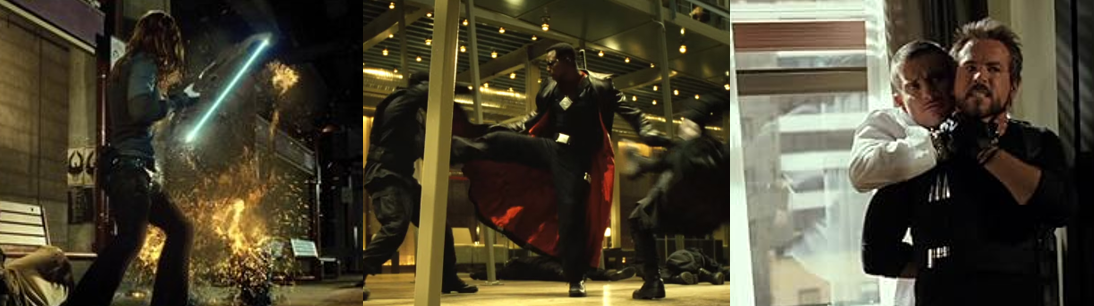
Fights are still very impressive, with Abby especially taking the spotlight with her archery skills.

Blade has some new toys here, including a fun silver-lined roped dagger and a new delivery system for his serum, alongside his usual muscle car, trademark sword, and gun. However, it’s the Nightstalkers who get all the cool gear, such as Abby sporting a silver danger in her boot, lugging around a high-tech bow that sports an ultraviolet laser and lets her shoot around corners, and a wrist-mounted dagger. While Hannibal largely relies on pistols and his smart mouth, he also busts out ultraviolent grenades and Hedges (Patton Oswalt), the Nightstalkers’ resident armourer, develops an “electronic pistol” that fires explosive silver rounds and a high-impact shotgun (similar to those used by the Blood Pack) that fires anything from stakes to heat-seeking mini rockets. While these are rarely used, and Wesley Snipes may appear more lethargic and stoic than usual, Blade continues to ooze charisma and shine in fight scenes, executing kicks and throws with a slick precision to showcase Blade’s raw power whenever the Thirst takes hold. Overall, fights are easy to follow and vampires still explode into cinders and ashes when killed. There are some fun montages of Blade, Hannibal, and Abby knocking around Familiars to get a lead on Drake and Blade frantically chases Drake through the city, leading to a tense rooftop showdown where Drake endangers a baby simply to parlay with the feared Daywalker. When Sommerfield’s research leads Blade and Abby to a vampire “blood bank”, revealing they keep braindead vagrants as a food source, they return to find Zoe and the injured Hannibal kidnapped and the other Nightstalkers dead, with Drake using the two as bait. This leads not just to the now traditional montage of Blade suiting up and preparing for battle and Abby compiling a suitable playlist, but also to Abby working through her grief by preparing her bow and practising her impressive archery skills.
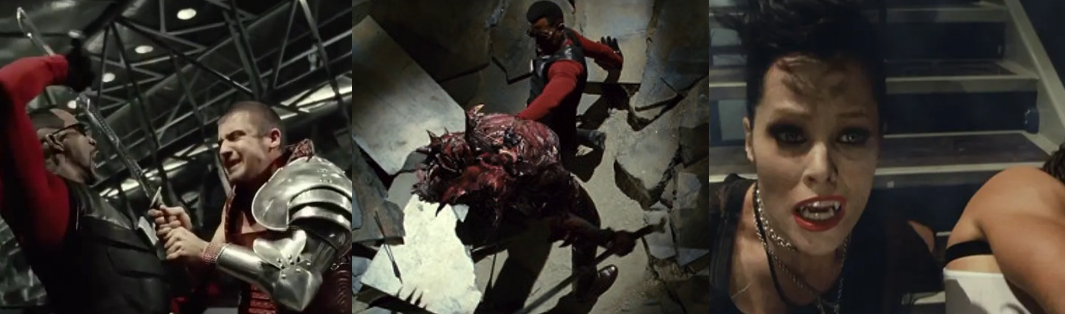
Though victorious after an intense sword fight, Blade’s war is apparently far from over…

Sommerfield leaves a message asking Abby to take care of Zoe and discussing the Daystar prototype, though warns that it must be injected into Drake to work and could potentially kill Blade alongside the other vampires. Regardless, Blade and Abby take the virus (helpfully forged to be fired as an arrow) and follow Hannibal’s tracker, spreading silver dust through the facility’s air conditioning to weaken the vampires ahead of a full-frontal assault. While Blade and Abby fend off Danica’s disposable goons with their karate and toys to rescue Zoe, Hannibal struggles against the hulking Jarko while Blade gets into a swordfight with Drake, now garbed in ceremonial armour. For all the shit I’ve talked about this Dracula, this sword fight is actually really cool (despite some dodgy CGI sequences where Drake defies gravity) and nicely spliced alongside Hannibal and Jarko’s more brutal smackdown, which ends with an exhausted and overwhelmed Hannibal stuffing an explosive ultraviolet round into Jarko’s mouth and blowing him inside out. Although relishing matching swords with Blade, Drake assumes his demonic form to overpower Blade, leaving him prone for a bloody end. While Drake has the wherewithal to catch Abby’s arrow, a second shot stuns him long enough for Blade to inject the Daystar virus, which immediately reacts with Dracula’s blood to reduce all remaining vampires in the building (including Danica) to choking, rotting corpses. In his final moments, Drake commends Blade and praises him as the future of his species, using the last of his power to mimic Blade’s form to spare him future persecution. Though the wounded dhampir’s recovered by his allies, Hannibal’s final narration delivers an anticlimactic and open-ended coda that sees Blade continuing his war, suggesting that Daystar will take some time to eradicate the vampire threat.
The Summary:
While Blade: Trinity is nowhere near as bad as many would have to believe and is still a sleek, sexy, kick-ass vampire action movie, there’s no denying the drop in quality from the previous two films. While the action is as hard hitting and bloody as ever, there are some unmistakable flaws, like Blade’s stupidity regarding Familiars, the glossed over explanation of Abby’s birth, and the overreliance of Ryan Reynolds’ smart mouth humour. While I do enjoy him here, your enjoyment of Blade: Trinity may depend on if you can stomach his wise-ass jokes, which are oddly framed as awkward and childish. Personally, I much preferred Hannibal King to Abby, who showed little personality until Sommerfield’s brutal death, with the film bizarrely avoiding emphasing her heritage, how that affects Blade, and his role as a mentor to her. While the film is as stylish as its predecessors and competently presented in the same visual style, with fun, well-choreographed, and well edited fight scenes, I do question the casting of Parker Posey. She’s just awful here, hamming up every line and looking spaced out in every scene. Triple H’s physical performance was impressive, leading to a decent David vs. Goliath fight between him and Hannibal and I did like his animosity towards Hannibal, which was in stark contrast to Blade’s stoic dismissal. For me, Blade: Trinity drops the ball with its depiction of Dracula. Robbed of his aristocracy and screen presence, Drake appears as just another vampire thug unless he’s in his impressive demon form. Dominic Purcell just doesn’t have the gravitas for the role, and I would’ve much preferred he took Danica’s place, and a classically trained actor was cast as Dracula to give him a better aura of menace and refinement. Additionally, Blade: Trinity does do a disservice to the title character by having Abby, Hannibal, and the Nightstalkers eat into his screen time to set up a spinoff we never got. In the end, I think Blade: Trinity is a decent film to throw on in the background and is unfairly saddled with a negative reputation. It’s not as good as the last two and has far more flaws, but it’s decent enough, though I appreciate how many see it as disappointing end for the character.

My Rating:

Rating: 3 out of 5.

Pretty Good

Are you a fan of Blade: Trinity? How do you think it compares to the previous Blade movies? What did you think to the Nightstalkers? Did you enjoy Hannibal’s lewd sense of humour and do you agree that the film dropped the ball with Abby’s potential? Were you disappointed by Dracula’s lukewarm portrayal and did you also find Parker Posey a grating inclusion? What would you like to see from Blade in future movies? Whatever your thoughts on Blade: Trinity, share them below, check out my other Blade reviews, and donate to my Ko-Fi to suggest more Blade content.

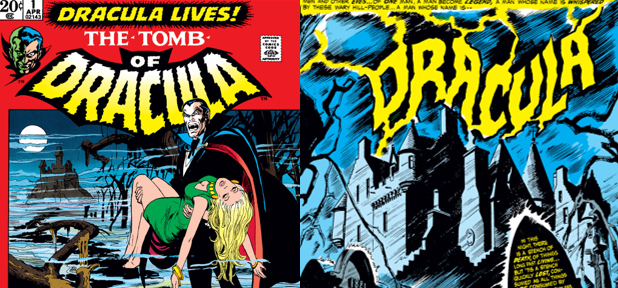
Back Issues: The Tomb of Dracula #1

Story Title: “Dracula”
Published: 16 November 1971 (cover dated: April 1972)
Writer: Gerry Conway
Artist: Gene Colan

The Background:
Inspired by famous butchers like Vlad II/Vlad Dracula/Vlad the Impaler, Count Dracula first appeared all the way back in 1897 courtesy of author Bram Stoker’s classic Gothic novel, which became the great-great-grandfather of what we now know as the vampire mythology. An instant classic, Dracula was adapted many times over the years as plays, movies, videogames, and even comic books. Indeed, when publishers like Marvel Comics were finally allowed to print stories involving vampires and other supernatural creatures, writers like Gerry Conway and artist gene Colon selected the infamous Count to spearhead the Tomb of Dracula series. Heavily inspired by classic Hammer Horror films, The Tomb of Dracula saw numerous writers and artists come and go as it struggled to find its identity and is perhaps best known for introducing Eric Brooks/Blade to Marvel readers. Still, Dracula went on to clash with many Marvel heroes, especially those who were involved with the supernatural. Dracula worked alongside the Avengers to fend off the Dread Dormammu, spawned a Nazi vampire, established a vampire colony on the Moon, and even matched wits with various cosmic beings. Perhaps surprisingly, Dracula also appeared in many Marvel cartoons but was most infamously brought to life by Dominic Purcell in the much-maligned Blade: Trinity (Goyer, 2004).

The Review:
Marvel’s version of the enigmatic Count was first introduced, fittingly enough, against the backdrop of a storm swept Transylvania, where Count Dracula’s mighty, gothic castle stands ominously on a hilltop. Despite the torrential weather and poor visibility, Frank Drake and his girlfriend, Jeanie Ovington, brave the storm alongside Clifton Graves, Frank’s cantankerous long-time friend who chastises Drake’s decision to fly from London just to sell the castle, which he recently inherited. While the three lament their misfortunes, hopelessly lost, residents of the nearby village discuss Frank’s impending arrival. While Fritz Burgeister predicts only sorrow will come from continuing to mess with the long-abandoned castle, a local barmaid hopes that Frank will bring some much-needed tourism and revenue to their sleepy Romani town. Just then, the three stumble into the Baron’s Inn seeking transportation to Castle Dracula from Fritz. However, Fritz refuses to take them to the castle and is adamant that none of the townsfolk would volunteer to replace him. While Clifton scoffs that the locals believe the wild tales spun by Bram Stoker, one of the patrons, Otto, volunteers to take them…for a small fee. Naturally, this is by horse and carriage and, on the way, Otto shares tales of how Dracula’s legend is debatable for, while such a man possibly existed, none can be sure if he were actually a vampire as Stoker claimed. Regardless, fear of the Count and his kin drives many of the locals to bar their windows, leave wolf’s-bane at their doors, and wear crucifixes to ward off any evil spirits. While Otto claims to be an exception in this regard, he’s no fool and refuses to take them right to the castle door, forcing the three to walk the rest of the way and costing Clifton his last ten bucks for the pleasure.

Broke Frank Drake is forced to visit his alluring, Gothic ancestral home to recoup his losses.

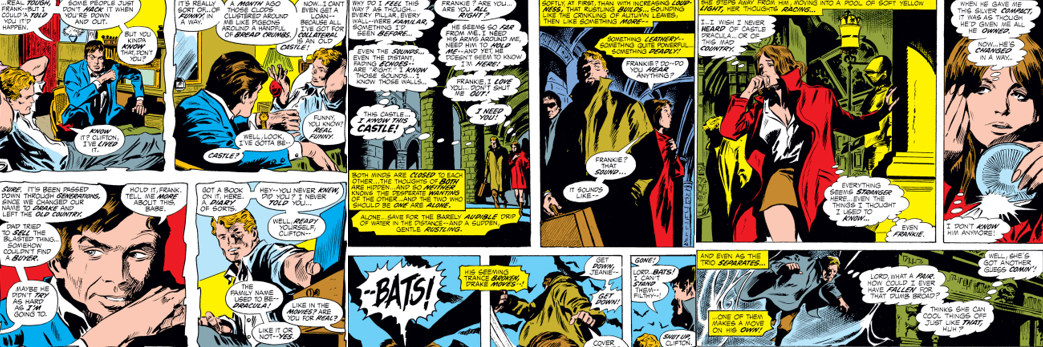
While Frank’s distracted by the grandeur of Castle Dracula, Clifton tries to put the moves on Jeanie. However, while they used to be a thing, she ended it months ago and is sick of his refusal to accept that she’s moved on. Frank, however, is lost in memories of how he stupidly blew his father’s fortune, how Jeanie stuck by him despite his money woes, and him being refused financial aid from banks and friends alike. While sharing his woes with Clifton, Frank mentions how all he has left is an old castle, one passed down through his family line and which his family has struggled to sell. This is where we learn that Frank is a descendant of Dracula’s and that it was actually Clifton’s idea to capitalise on his lineage by turning the castle into a tourist attraction. While reading through a family journal (strongly implied to be Stoker’s novel, reinterpreted as a historical document), Frank felt the stirring of “some ancestral memory” and was captivated by the descriptions of Dracula. The book also told of his ancestor’s shame and fear of being associated with the Count and of how Abraham van Helsing (referred to as “van Helfing”) seemingly destroyed the vampire lord by driving a wooden stake through his heart. Haunted by the text, Frank nevertheless agreed to head to Transylvania with Clifton and Jeanie in hopes of turning the castle into a museum though, as he stands in the shadow of the gothic structure, Frank can’t help but be unnerved by the strange feelings of home and destiny exuded by the dark building. As they tour the interior, Frank’s odd behaviour worries Jeanie, who’s startled when a cloud of bats suddenly swarms them. Although Frank fends them off, Jeanie’s left traumatised and wanting to leave, noting that Frank’s changed and is no longer the sweet man who gifted her a silver compact mirror.

The enigmatic count mesmerises Jeanie, corrupting her despite Frank’s best efforts.

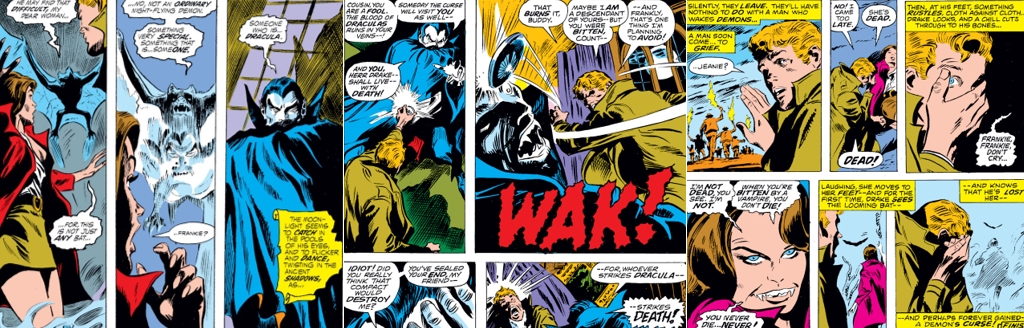
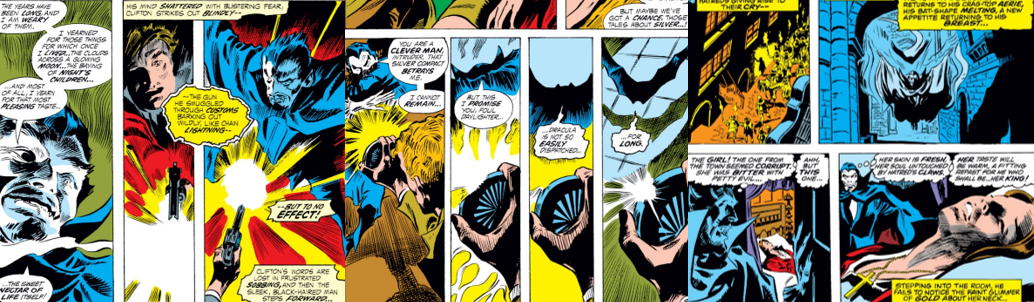
Determined to force Jeanie back into his arms and screw his friend over, Clifton takes off and ends up tumbling into a dungeon. There, he discovers a narrow stone stairway leading to an ancient tomb, where Dracula’s coffin rests. Seeing only dollar signs, Clifton draws a gun and arrogantly opens the crypt, discovering the skeletal corpse of Dracula, stake and all, lying within. Excited, Clifton removes the stake and sets out to kill Frank so he can reap all the rewards, unaware that this act causes Dracula to reconstitute and rise again! Weary and famished from his long slumber, the eloquent Count pounces upon Clifton, shrugging off his gun shot and tossing him into a deeper dungeon for safekeeping. Entranced by the sound of others, especially a woman, Dracula heads to the upper floors in his bat form, frightening Jeanie and then horrifying both her and Frank when he reveals his true self. Thanks to his silver tongue and hypnotic eyes, Dracula easily sways Jeanie to leave Frank’s side, so he knocks her out with a right hook to keep her safe (!) and sends Dracula fleeing by flashing her silver compact. As Frank rushes Jeanie upstairs (since she’s somehow “close to dying!”), Dracula flies to the village and feeds upon the barmaid, turning the locals into an angry mob when they rightly assume that Frank and the others disturbed the legendary vampire. Returning to his castle, Dracula spies on the unconscious Jeanie and, though tempted by her purity and innocence, is again denied another meal by the glittering crucifix around her neck. Frank takes credit for this and confronts his ancestor, warding the vampire off with the compact’s mirror, enraging Dracula and casing him to strike his cousin, knocking him out. Although Dracula compels Jeanie to remove her crucifix, the angry mob sets the castle alight and Frank recovers in time to flash the compact once more, forcing Dracula to flee. Unfortunately, Frank was too late to stop Jeanie being bitten and she awakens as a vampire, mocking his grief and fleeing into the misty night.

The Summary:
This had a bit of potential, but didn’t fully deliver on its premise. I quite like the idea that Dracula is treated as folklore, a retelling of factual events whose veracity is disputed. For the Transylvanian locals, Castle Dracula is all-too real and the fear of the vampire lord within is strong enough to stir up superstitions and debate between them. While none of them dispute that Dracula did exist, some aren’t convinced he was a vampire and yet many take precautions nevertheless because…why tempt fate? Fritz takes these concerns very seriously, presumptuously speaking for his fellow villagers and claiming that no one will help Frank and the others. This isn’t quite true as Otto’s assistance can be bought, though even he’ll only go so far despite boasting of his disbelief of such superstitious nonsense. Whether they believe it or not, Castle Dracula stands as an ominous monument. Its very presence evokes fear and it’s become a symbol of all their superstitions, though ironically may hold the key to bring some much-needed revenue to the struggling villagers as it could lure in tourists. The ill-fated barmaid is almost as excited by this prospect as the opportunistic Clifton, who maliciously manipulates Frank into buying into his family’s account of the Count and profiting off his inheritance, with no understanding of what truly lurks within Castle Dracula. He’s perfectly happy to use his friend, openly complaining and criticising him and gaslighting Frank into believing the troubles they’ve suffered from the trip are his fault, all with the aim of profiting both financial and by regaining Jeanie’s affections. While she has no time for Clifton (and even Frank quickly loses patience), Clifton refuses to take no for an answer and is even prepared to off Frank just so that he can weasel his way back into Jeanie’s bed, a selfish ambition that blinds him and makes him easy prey for the rejuvenated vampire lord.

Despite his visual appeal, Dracula is strangely weak and fails to match his filmic counterparts.

Yes, Dracula is very real here. Clearly modelled after Christopher Lee’s iconic portrayal from Dracula: Prince of Darkness (Fisher, 1966), the Count is a tall, alluring figure with hypnotic eyes and even more hypnotic voice. A gothic figure of ancient legend, he’s ripped straight from Bram Stoker’s novel and sports many of the same tropes and weaknesses. He can transform into a bat, mesmerise his prey, feeds on their blood, and is warded off by wolf’s-bane, silver, crucifixes, and mirrors. The Drake journal reveals that their bloodline largely distanced themselves from Dracula out of fear and tells how an old vampire hunter finally slayed the creature, revealing that Dracula can be killed with a wooden stake (though this doesn’t come into play, except to revitalise the fiend). Immune to Clifton’s bullets, Dracula’s scared off by Jeanie’s convenient silver combat mirror and heads into town to feed, though seems displeased by the barmaid’s blood and desires purer, sweeter blood. Thus, he targets Jeanie, a caring spouse who worries about Frank’s distracted state and fends off Clifton’s advances, though she crumbles like paper whenever bats appear, much less Dracula. Dracula seems a bit weak here, which is understandable since he just woke up, but it’s weird that his strike didn’t kill Frank. The story’s also incomprehensible at times; Frank seems to think Jeanie’s in danger of dying after simply passing out and she gets bitten between panels, which wasn’t very clear. In the end, this was an alright story with some unique visuals. I like the gothic depiction of Castle Dracula and the torrential rain, and Dracula’s very Lee-esque appearance and unique, haunting way of talking. However, it was quite a repetitive story (Frank relied on that silver compact way too much) that didn’t fully deliver on all its plot threads (Clifton being a prime example). I can only hope that future issues of The Tomb of Dracula characterised the titular Count as less of a weakling as this wasn’t a great showing for him here, even if he did get the last laugh by turning Jeanie.

My Rating:

Rating: 2 out of 5.

Could Be Better

What did you think to Count Dracula’s debut story? Were you disappointed by how weak he was depicted? What did you think to Frank Drake and the depiction of Dracula’s legend? Did you ever read The Tomb of Dracula books and, if so, did you enjoy them? What are some of your favourite Dracula moments from Marvel Comics? Have you ever read Stoker’s novel, and what are some of your favourite vampire stories? No matter what you think, good or bad, feel free to share your thoughts below, show me some love on Ko-Fi, and check out my other Dracula content.
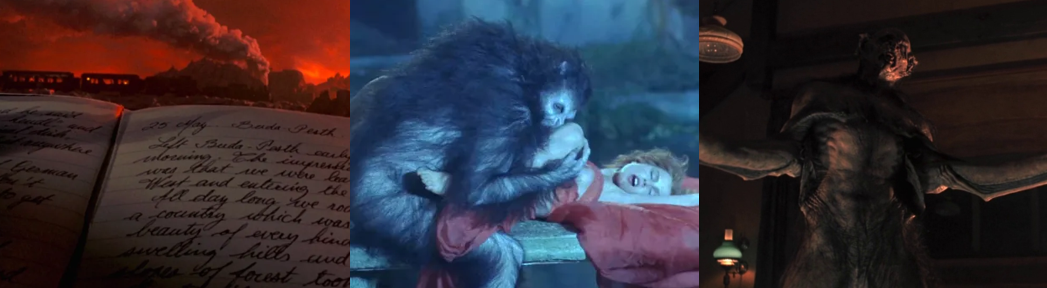
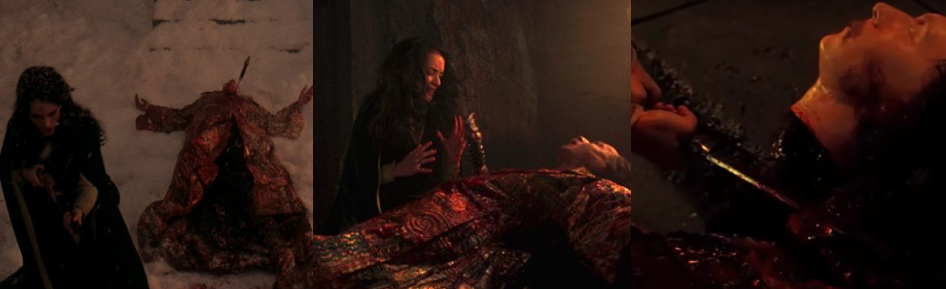
Movie Night: Bram Stoker’s Dracula

Released: 13 December 1992
Director: Francis Ford Coppola
Distributor: Columbia Pictures
Budget: $40 million
Stars: Gary Oldman, Winona Ryder, Keanu Reeves, Richard E. Grant, Billy Campbell, and Anthony Hopkins

The Plot:
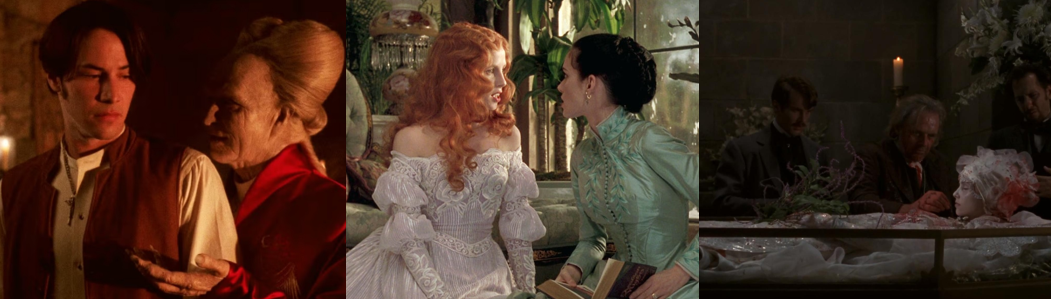
Having renounced God after the suicide of his love, ruthless vampire Count Vlad Dracula (Oldman) travels to London to seduce her lookalike, Mina Harker (Ryder), indulging his bloodlust and inspiring a rag-tag band of would-be vampire killers to stand against him.

The Background:
Inspired by Irish folklore and age-old vampire myths, Bram Stoker’s Lord of Vampires undeniably popularised the vampire as we know it today and inspired many critical and academic discussions. About thirty years after the book was published, World War I infantryman Bela Lugosi first embodied the role of Dracula for a stage production, eventually transitioning to the silver screen for Tod Browning’s horror classic before the legendary Christopher Lee made the role his own in 1958. After decades of reinterpretations and filmic appearances, Dracula lived again in 1992 thanks to the efforts of star Winona Ryder, who brought James V. Hart’s screenplay to director Francis Ford Coppola as a project for them both. Attracted to the haunting, disturbing sensual nature of the material, Coppola agreed and Gary Oldman jumped at the chance to work with the prolific director, who spared no expensive crafting the film’s ornate costumes. Veteran production artist Mentor Huebner and even comic book writer and artist Mike Mignola worked on the film’s extensive storyboards while hair and makeup designer Michèle Burke crafted Oldman’s signature look. After Christian Slater turned down the Jonathan Harker role, Keanu Reeves stepped in, though his hard work to convey a British accent drew much criticism. Oldman apparently lost himself in the sexuality and intensity of the role so completely that fell out with Ryder for a while and Coppola’s eccentric demands drew some criticism at the time. Finally, Coppola also insisted on utilising practical, in-camera, and old-school special effects technique utilising forced perspectives, miniature effects, and matte paintings. Opening at number one at the US box office and with a final gross of over $215 million, the award winning Bram Stoker’s Dracula was largely praised as a visual masterpiece. While many criticised some of the performances and its overly dramatic elements, just as many praised it as a tragic, alluring mixture of romance and horror, lauding Oldman’s performance and the tangible nature of its presentation.

The Review:
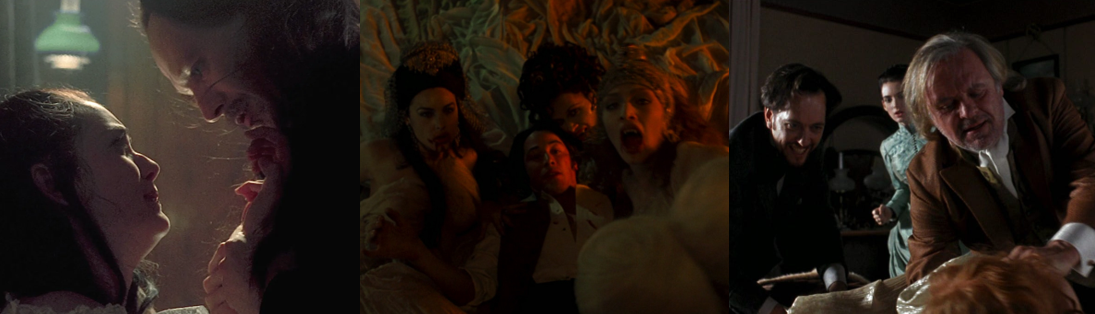
Bram Stoker’s Dracula mixes folklore, fiction, and history to present the titular Lord of Vampires as having started life as a Vlad III Drăculea, a warrior for the Romanian Orthodox Church, a commander and soldier so ruthless and bloodthirsty that he single-handedly slaughtered many in the Ottoman Empire and impaled their bodies and heads on pikes as a way to destroy their moral. Back in 1492, Dracula’s campaign against the Turks was seen as a righteous one, fought to defend his church in the name of almighty God, who Dracula praised and devoted himself to above all else save his beloved wife, Elisabeta (Ryder). However, while Dracula was successful in slaughtering his enemies, Elisabeta took her life after receiving false reports of his death, unable to face living life without her husband. Upon discovering this, and learning that Elisabeta’s suicide had damned her soul, Dracula cursed and renounced God, desecrating the chapel and drinking a strange blood spewing from its altar. In the process, Dracula became the first vampire, an undead thing with powers over the elements (he conjures great storms and winds), dominion over the “children of the night” (wolves, rats, and such), and the ability to transform into a monstrous bat-like form, mist, and rats. Contrary to most popular depictions, Dracula is merely weakened by sunlight, though he does draw strength from the cursed soil of his homeland, Transylvania, and renew himself by drinking the blood of his victims. Yet, Dracula spends four centuries isolated in his decrepit, ominous castle on the outskirts of a nearby village with only his lustful, ravenous concubines (Florina Kendrick, Michaela Bercu, and Monica Bellucci) for company, presumably terrorising and feeding upon the locals whenever the thirst or fancy takes over. When the film jumps ahead to 1897, however, visits to Transylvanian to liaise with the mysterious Count have driven solicitor R. M. Renfield (Tom Waits) insane, leaving him in the care of Doctor Jack Seward (Grant), who’s both disgusted and amazed by Renfield’s hunger for flies and mad rantings about his “master”.

When Dracula pays a visit to London, he terrorises the aristocracy with his perverse lusts.

Since Dracula wishes to purchase properties around London and represents a substantial investment, Renfield’s duties are passed to fresh-faced, well-spoken, and somewhat frigid solicitor Jonathan Harker (Reeves). Though his fiancée, Wilhelmina “Mina” Murray, is saddened to hear he will be gone for some time, eager to consummate their marriage, she recognises that this is a big opportunity for Harker and takes solace in his frequent correspondence. Though well-mannered and good-natured, Harker is unnerved by Transylvania, where wolves freely wander, darkness looms ominously, and his client is prone to bizarre outbursts. Dracula treats Harker as a guest, welcoming and feeding him and expressing his desire to be amongst civilisation once more, but is erratic and eccentric, lamenting his cursed family bloodline, driven to a frenzy by the sight and smell of blood, and generally testing Harker’s civil nature. While I love Keanu Reeves, he is dreadful in this role, delivering perhaps the worst British accent I’ve ever heard and appearing lost and confused. This is a case where it might’ve been better to let him use his natural accent, if only to make his line readings less awkward, but that wouldn’t have helped with his awful haircut/wig and robotic tone. Harker’s effectively held prisoner in Dracula’s castle, feasted upon by his brides for at least a month before he finds the willpower and courage to escape and being left severely traumatised. While pining for her love, Mina takes solace in the courtship of her dear friend, the promiscuous Lucy Westenra (Sadie Frost), giggling over sex acts while Lucy flits between her suitors, Dr. Seward, wealthy Lord Arthur Holmwood (Cary Elwes), and gunslinger Quincey P. Morris (Campbell). Though she settles on Holmwood (presumably for the financial security, accustomed as she is to such a lifestyle), the other two continue to hang around and curry her favour, forming first a dysfunctional friendship and then a rag-tag group of vampire hunters when the peculiar Professor Abraham Van Helsing (Hopkins) alerts them to the vampire’s threat.

While Mina succumbs to Dracula’s charm and Harker’s tortured, Van Helsing offers his expertise.

Betrayed by his faith, Dracula is presented as a far more tragic and sympathetic figure. Upon seeing Mina’s photograph, Dracula alters his plans for London to include seeing his reincarnated love, mercilessly slaughtering the crew of the Demeter to restore his youth. Unlike other adaptations of Dracula, where he integrates into London society and socialises with Dr. Seward and the others, Dracula is a largely enigmatic figure once he reaches Ol’ Blighty. Appearing as a peculiar foreign prince, Dracula stalks Mina through the streets, using his hypnotic and persuasive powers to entrance her and slowly unearth her forgotten memories of their past life and love. Though initially rude towards him, Mina comes to be captivated by Dracula and begins a love affair in Jonathan’s absence, naturally unaware that her handsome prince has been feeding upon Lucy in the night as a wolf-beast. However, when she receives word of Jonathan’s condition, Mina goes to him, encouraged by her sick friend, to rekindle their love and get married, though it’s obvious that her feelings have changed and that her thoughts constantly drift to her passionate and mysterious prince. When Lucy’s condition worsens and defies Dr. Seward’s expertise, he calls Van Helsing for aid, only for the outlandishly blunt priest to conclude that she’s been targeted by Nosferatu, a subject he’s well versed on. Although Van Helsing tries to stave off the infection with a questionable blood transfusion, Mina’s beset by a fever, constantly wandering off in a daze, and undergoes radical personality changes, resembling Dracula’s ever-horny, ever-hungry brides and quickly making believers out of Lucy’s bemused suitors.

Dracula is depicted as a demonic, yet ferociously tragic and aggressively sexual romantic figure.

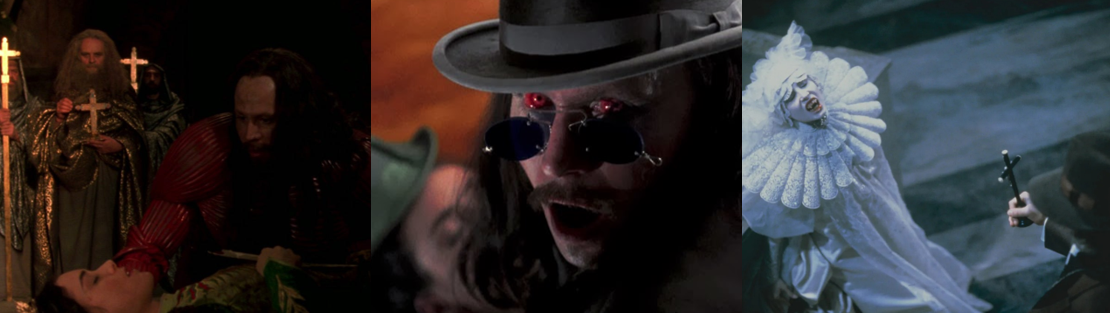
Jonathan’s return to London confirms Van Helsing’s worst fears, that Dracula himself is amongst them, and he leads the fledgling vampire to hunters to “where the basturd sleeps” so they can destroy Dracula’s cursed soil. However, Dracula is agonised when Mina breaks off their tryst, conjuring violent winds and fully transforming Mina into a vampire out of spite. This process sees her rise as an undead seductress with the same unnerving taste for children as Dracula’s concubines. While Dr. Seward, Quincey, and Holmwood falter against Lucy’s monstrously sexual transformation, Van Helsing leads the charge, wielding a holy cross and easily placing Lucy into a vulnerable slumber so she can be staked and decapitated. While Jonathan is startled about how blasé Van Helsing is about this, he eagerly joins their cause to deal a measure of revenge against Dracula, who murders Renfield for running his mouth to Mina before appearing before her, all pretence dropped. Although Mina is horrified and angered to learn that her lover murdered her best friend, she cannot deny her feelings for him or the strength of her vague memories and begs to be with him, forever. While elated to hear this and desperate to inflict his curse upon her to be reunited with his lost love, Dracula hesitates at the last second, unable to bring himself to watch her suffer from eternal torment as he has. However, horny little minx that she is, Mina refuses to listen and gladly, hungrily drinks his blood in an explicitly sexual act that sees her undergo a similar transformation to Mina. This means that she constantly interferes with the hunters’ attempts to intercept and destroy Dracula when he flees to Transylvania, attempting to seduce Van Helsing and even holding her husband at bay with a rifle to defend her dying love, having willingly sacrificed her humanity for some real passion in her life.

The Nitty-Gritty:
Since I haven’t read the original book, I’m not really qualified to comment on how accurate an adaptation Bram Stoker’s Dracula is. However, from what I’ve heard, it’s one of the most faithful retellings and I did like that the film incorporated voice overs and diary entries to mimic the book’s epistolary nature. Dracula is undeniably a vastly different character to other, more popular depictions, appearing as a once proud and seemingly noble (if ruthless) soldier who slaughtered armies in the name of his God. He cherished Elisabeta more than anything in the world and felt betrayed when the church turned on him after his many years of faithful service, renouncing God since he’d forever be denied his love even in death due to her damning her soul through suicide. His quest to London thus becomes a desperate desire to reunite with Elisabeta, who’s seemingly been reincarnated in Mina, and he wastes no time in captivating and wooing her. Whereas Jonathan is reluctant to give in to carnal desires, Dracula is an extremely passionate man whose romantic way with words entrance Mina as much as his hypnotic gaze and the shadows of her former life. While he’s overjoyed to reunite with his love, Dracula hesitates to subject her to his curse, knowing it cannot be undone and will lead to eternal earthly damnation for them both. Interestingly, he doesn’t spare this same concern for his other concubines or show mercy to the children he regularly feasts on, but these are apparently secondary concerns for the lovelorn Mina, who’s so desperate to get laid that she gleefully renounces her humanity. And make no mistake about it, Bram Stoker’s Dracula is the horniest, sexiest adaptation of the text you’ll ever see! Lucy is super horny for all her suitors, Dracula’s many attacks are framed as blatantly sexual acts, the vampire brides all exude succubus energy, and then there’s the scene where Mina drinks Dracula’s blood and he reacts with orgasmic pleasure!

Despite some impressive visuals, the monster designs are questionable, at best.

Bram Stoker’s Dracula may also be the most visually impressive version of the book. It’s clear that the filmmakers spared no expensive on the elaborate costumes and sets, with the woman, especially, being strapped into extravagant gowns and the men all dressed in their finest regalia. While I dig Dracula’s beehive hairdo and opulent robes, I do question the design of his blood red armour, which seems awfully devilish for a man of God and also looks far too much like heavy leather for my tastes. The film uses practical effects and traditional optical trickery to fantastic effect to overlay miniatures with backgrounds and diary entries and project Dracula’s gaze into the storm clouds. The film is surprisingly sparing with the gore, but it makes quite an impression when it does appear, with arterial spray drenching drapes, Lucy spewing up blood when Van Helsing shoves a cross in her face, and heads flying after being severed by the vampire hunters. Dracula has quite a few forms here, though some are better than others. His aged, withered appearance is one of my favourites, though his youthful guise makes the girls wet and his unnerving mist proves suitably deadly to the rabid Renfield. Sadly, Dracula’s monstrous forms leave a lot to be desired, his man-bat form is the superior of the two, but even this looks awkward and uncomfortable, especially as his arms are literally bent-back wings. His wolf-man form is even worse, however, appearing very fake and shaggy looking, with only the facial prosthetics and his unsettling sexual attack saving it from being ludicrous. Dracula’s decaying appearing in the finale is far more striking, as is his mysterious horseman and the techniques used to show him and his concubines moving with unnatural grace. Unfortunately, little of this keeps the film from being an absolute slog to sit through. At just over two hours long, Bram Stoker’s Dracula sure does drag things out, inflating its runtime with bizarre editing choices and unnecessary cutaways and perhaps sticking a little too close to the text for its own good.

Thankfully, the entranced Mina ends Dracula’s torment, and mine, by ending this dull movie.

Thanks to Jonathan, Van Helsing and the others destroy all but one of Dracula’s boxes of earth. When his seduction of Mina is interrupted, Dracula’s forced to flee to Transylvania in his last box, his powers fading and his appearance quickly degenerating, to regain his strength. Van Helsing leads his group in intercepting Dracula, bizarrely taking Mina with them despite her being less of a liability in London. While Harker and the others try to cut off the gypsy slaves transporting Dracula’s carriage, Van Helsing and Mina head directly for his castle, with the eccentric vampire expert desperately fending off the brides with his flaming torch and subduing Mina with a communion wafer when they try to seduce and bite him. When the brides kill their horses, Van Helsing takes a swift revenge and claims their heads before joining up with the others at Dracula’s castle. Although Quincey is fatally stabbed in the hectic fracas, he does stab the decaying Dracula through the heart and Harker gets a measure of revenge by slitting the Count’s throat. However, Mina stops them from finishing off the monstrous abomination and Harker and Van Helsing reluctantly allow her to get Dracula into the chapel where he once turned his back on God. There, the demonic Dracula shares a kiss with his beloved and is amazed when the chapel undergoes a supernatural restoration; the candles ignite and the cross he disgraced repairs itself, restoring Dracula to his youth. However, he’s still mortally wounded and, with his dying breath, Dracula begs Mina to bring him peace. Although she’s heartbroken, Mina agrees to end his suffering and stake shim through the heart before decapitating him, undoing the curse inflicted upon her and seemingly allowing Dracula to reunite with Elisabeta in the afterlife.

The Summary:
I’m going to be honest and say I’ve never liked Bram Stoker’s Dracula. I never watch it because I remember it being a long, boring, overly stylised affair with some atrocious performances. And that isn’t just a knock against Keanu Reeves, either, as Winona Ryder and Sadie Frost are just as bad with their accents and delivery. Hell, even Gary Oldman and Anthony Hopkins are hamming it up, though I at least give them credit for bringing a Shakespearean gravitas to this tediously dull movie. While I’m sure Bram Stoker’s Dracula is exceedingly faithful to the book, there’s something to be said for condensing the text when making an adaptation. For example, did we really need Dr. Seward, Holmwood, and Quincey all in the film? I feel it would’ve been far simpler to combine them into Dr. Seward for the sake of brevity. Additionally, we spend way too long in Dracula’s castle with him, Harker, and the brides. Like, I get it; Dracula’s manipulated Harker and imprisoned him there, but this sequence goes on for what feels like an age and yet the Demeter scenes are a glorified montage? I did like how tragic and human Dracula is, with him depicted as a disgraced former believer who’s spent centuries yearning for his lost love and yet hesitates to afflict her with his curse as it’s been such a tortured unlife for him. Paradoxically, Dracula is still a monstrous fiend who feasts upon innocent souls (and children) to prolong his life and make others suffer for his own amusement. While the film is undeniably beautiful and the old-school filmmaking techniques are appreciated, giving the film a tangible quality that makes it seem like a big-budget stage play, Dracula’s monstrous forms leave a lot to be desired. His man-bat form is a major disappointment and the man-wolf effects are laughable, though it is intriguing how sexually aggressive the film is, explicitly depicted Dracula’s attacks as sexual misdeeds. It may be the most faithful adaptation of Stoker’s text, but Bram Stoker’s Dracula is just too tedious for me to rate much higher. I dreaded revisiting it for this review and hoped my opinion would’ve changed, but it’s just as dull and painful to sit through as ever, despite its strong visuals and atmosphere.

My Rating:

Rating: 2 out of 5.

Could Be Better

Are you a fan of Bram Stoker’s Dracula? If you’ve read the book, how faithful is this adaptation and would you say it stuck too close to the text in some areas? Do you agree that the film is too long or were you captivated by the gothic atmosphere? What did you think to Gary Oldman’s performance and Keanu Reeves’s atrocious accent? Which adaptation of Dracula is your favourite and how are you celebrating Halloween this year? Tell me I’m wrong about Bram Stoker’s Dracula in the comments, read my other horror reviews, and donate to my Ko-Fi if you want to see more Dracula content.
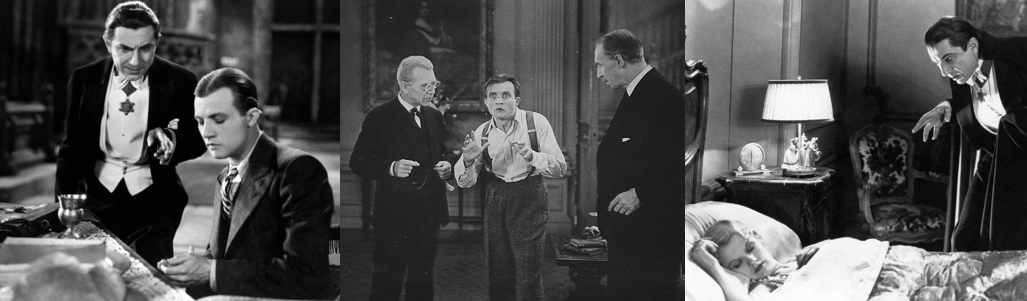
Movie Night: Dracula (1931)

Released: 14 February 1931
Director: Tod Browning
Distributor: Universal Pictures
Budget: $341,191
Stars: Bela Lugosi, Helen Chandler, David Manners, Dwight Frye, and Edward Van Sloan

The Plot:
When R.M. Renfield (Frye) travels to Transylvania to oversee the purchase of a London abbey to the enigmatic Count Dracula (Lugosi), he unwittingly facilitates the malicious vampire lord’s trip to London, where he terrorises beautiful maiden Mina Harker (Chandler).

The Background:
In 1897, the literary world was introduced to Count Dracula, Lord of Vampires, courtesy of Irish author Bram Stoker. Inspired by Irish folklore and long-standing vampire myths, Dracula undeniably popularised many characteristics of vampires that are still used to this day. Dracula also inspired many critical and academic discussions regarding its narrative and subtext, becoming a literary classic, and was said to be a big hit at the time, despite its controversial content. About thirty years later, Dracula was adapted for the stage, with former World War I infantryman Bela Lugosi first assuming the role that would make (and haunt) his career. Though the production was a hit, Lugosi wasn’t the first choice for the role when Universal Pictures began producing a feature film adaptation and only got the part after accepting a significantly lower salary. Although Browning’s film was the first official film adaptation of Stoker’s novel, Nosferatu: A Symphony of Horror (Murnau, 1922) owed its existence to Dracula, to the point that Stoker’s widow sued the filmmakers and ordered all copies to be destroyed. After acquiring the rights to the property, Universal Pictures funded what was said to be a disorganised shoot, with Lugosi alienating some cast members and Dracula stage veteran Edward Van Sloan expressing displeasure with the film. Despite some apprehension surrounding the film, Dracula was bolstered by reports of audience members fainting and it was well received by critics. Of course, nowadays, Dracula is regarded as a classic of the silver screen, with Lugosi’s portrayal being the quintessential standard of all subsequent screen Draculas. Its success not only led to additional big-screen outings for the count and a slew of horror releases from Universal Pictures, but also defined the titular character for generations.
The Review:
I think it’s important to preface this review by saying that I’ve never gotten around to reading Stoker’s Dracula. My experience with the Lord of Vampires is all based on movies and other media rather than books, so I can’t speak to Dracula’s status as an adaptation. If I had to guess, it seems it’s more an adaptation of the original stage production than the epistolary text, but I’m sure a lot of the most prominent elements of the book are represented here. Dracula is initially the story of Renfield, a painfully polite and well-to-do Englishman who travels to a morbidly superstitious town in Transylvania to oversee the sale of Carfax Abbey. Respectful and courteous to the locals, Renfield insists on meeting a midnight carriage, as arranged by his client, Count Dracula, only to be warned off by villagers. In a lengthy, awkward opening scene with many obvious insert shots, the locals react with horror at Renfield’s plan to meet Count Dracula and insist he carry a crucifix to ward off the vampires they believe live in the ominous, gothic castle. Undeterred by superstition and enthusiastic about closing the deal, Renfield maintains his composure even when Dracula’s carriage driver vanishes, his luggage is left behind, and the enigmatic count appears to pass through an enormous spider’s web. Renfield enjoys Dracula’s hospitality, complimenting his home despite it being quite dilapidated and eagerly partaking of his food and wine, only to be duped by the charismatic vampire, who easily hypnotises him with his alluring glare and then samples his blood to turn Renfield from a chirpy and pleasant solicitor into a grinning, cackling nutjob with a taste for insects and an unwavering devotion to his “master”. With Renfield’s help, Dracula not only legally secures Carfax Abbey, but also loads crates of his home soil onto the Vesta, ensuring he can maintain his full strength on the journey to London and while hobnobbing about the city as an eccentric aristocrat.

Vampire lord Dracula corrupts Renfield and heads to London to target an innocent young lady.

Once Dracula enslaves Renfield, the film juggles between the alluring count and Doctor John Seward (Herbert Bunston) and his inner circle. A renowned physician, Dr. Seward operates the sanatorium that sits alongside Carfax Abbey and where Renfield is committed after being discovered as the crazed sole survivor of the Vesta. Dr. Seward lives with his beautiful daughter, Mina, who’s engaged to his protégé, Jonathan Harker (Manners) and best friends with Lucy Weston (Frances Dade). The four are rarely seen apart, enjoying the opera together when they’re first introduced to Count Dracula, who shuns Harker and takes a shine to Lucy. Captivated by the count’s charisma, Lucy jokes to Mina of her attraction to him but quickly becomes his next victim when he enters her room and feast on her blood. Despite Dr. Seward’s best efforts, Lucy dies and Mina is left devastated, haunted by terrifying nightmares of wolves and bats. As Renfield keeps mysteriously leaving his cell, perplexing bumbling attendant Martin (Charles K. Gerrard), and ranting about all kinds of nonsense, Dr. Seward has his colleague, polymath Professor Abraham Van Helsing (Van Sloan), analyse the madman’s blood. Van Helsing concludes that Renfield has been bitten by a vampire and constantly exposits folklore about Nosferatu, who assume various animal forms, drink blood, and cast no reflection. While Harker is sceptical, Mina takes them to heart and they’re seemingly proven true when Renfield reacts violently to wolfsbane, a vampire repellent. During a tense meeting with Dracula, Van Helsing reveals that the count has no reflection and deduces that he’s their vampire, though Dr. Seward and the others are only convinced to do something other than just stand around discussing the threat after Dracula easily coaxes Mina into the garden for another suck session, eventually leading Van Helsing to give her wolfsbane for her protection.

Despite his allure and incredible powers, Dracula is surprisingly vulnerable if you know his weaknesses.

Of course, the main draw of Dracula is the titular count, played masterfully by the magnetic Bela Lugosi. A charming, gracious man with a silver tongue, Dracula oozes charisma but is as unnerving as he is appealing thanks to his raspy accent and peculiar behaviour. Dracula relishes the sound of wolves, the sight and taste of blood, and particularly enjoys getting close to his quarry, captivating with his steely gaze and wooing with his words. Van Helsing instantly distrusts Dracula and they have some tense face-offs, with the professor’s willpower resisting the count’s hypnotism and his knowledge of vampires giving the protagonists the edge. Since Dracula is vulnerable to sunlight and needs Transylvanian soil to maintain his strength, he rests in a coffin of dirt during the day but easily enters Dr. Seward’s residence by becoming the fakest bat you’ve ever seen. Dracula showcases superhuman strength but his greatest assets are his charming personality and alluring gaze, though his brides (Cornelia Thaw, Dorothy Tree, and Geraldine Dvorak) flinch at his command and he clearly instils fear in the locals. This fear isn’t felt by Dr. Seward and the others since they see him as a polite, if eccentric, foreign count, and isn’t felt by Van Helsing, who’s clearly wise to the vampire’s tricks. Unfortunately, many of these are kept offscreen, merely told by Harker and Renfield, because of the limitations of the time. I was also a bit unclear about what Dracula’s endgame was. He buys Carfax Abbey and targets Dr. Seward and his wards, but I’m not sure why? I guess to spread his wings beyond his stuffy old castle but it’s not clear why he targets Mina beyond enjoying torturing Harker and turning something innocent into an abomination, as he did Renfield, who spends the film conflicted and wrestling with his loyalties and his wish to die without blood on his hands. Lugosi plays the role so well that it’s easy to forget these criticisms, but it was frustrating seeing everyone just standing around or him just glaring at people or randomly being inserted into shots to show him lurking on the grounds.

The Nitty-Gritty:
I usually cut black and white films a lot of slack. It was a different time with many limitations compared to today, where almost anything is possible in cinema. Therefore, I can forgive the obvious sets and painted backgrounds, and the slight imperfections in the camera movements and film quality. This extends to the few special effects, such as cutting to Renfield’s reaction rather than showing Dracula pass through the web, having Harker describe the wolf running across their grounds, and Renfield’s mad rant about the “thousands … millions!” of rats promised to him by his master. Dracula’s bat form is silly, for sure, but the effort put into Lugosi’s costume and lighting his eyes is impressive, even if his close-ups often feel awkward and out of place. Dracula gets ambitious by using a passable model ship for the Vesta’s trip (though some water effects over Lugosi would’ve helped sell the sequence) but strangely relies on voice overs to describe the massacre Dracula leaves on the ship. I did like how theatrical the whole production was, which isn’t surprising considering the time period and Lugosi’s experience portraying the role on stage, with the actors (especially Dwight Frye) largely overacting and chewing the scenery. I do feel Dracula suffers from a lack of music, though, as the film basically has no soundtrack and some scenes would’ve greatly benefitted from some ominous tunes. Dracula, especially, needed a haunting theme accompanying him and some ambient music would’ve really helped to liven up the film’s many dull exposition scenes.

Dracula’s brief and confusing rampage is easily ended when Van Helsing stakes him in his sleep…

Despite Van Helsing’s best efforts, Mina falls under Dracula’s spell, confessing to Harker that she’s becoming a creature of the night and breaking off their engagement. While Van Helsing is unflinching against Dracula’s threats, Mina’s maid (Joan Standing) is easily coerced into removing the wolfsbane from the entranced girl and spiriting her away. Luckily for her, Harker and Van Helsing spot Renfield fleeing to Carfax Abbey (although, honestly, where else would Dracula be?) and they pursue the crazed lunatic. This leads to a tragic end for Renfield as Dracula is incensed that his witless minion has betrayed his location (though…again…that should be the first place anyone would look!) and, despite Renfield begging to be tortured or punished, the sad fool is nonchalantly tossed down a flight of stairs to his death. While you might expect a tense showdown between Dracula and Harker, or perhaps a battle of wits between the count and Van Helsing, with the two perhaps buying time to expose Dracula to the rising sun and turn him to ash, the finale is far more disappointing. Dracula flees into Carfax Abbey with Mina in his arms and Harker and Van Helsing muddle about in search of him, knowing full well that he must rest in his coffin to avoid the rising sun. Van Helsing also knows that the only way to kill a vampire is with a wooden stake through the heart, so he improvises such an implement from the dilapidated abbey and the two stumble upon a coffin. While Mina isn’t inside, Dracula is, already fast sleep despite mere minutes passing, allowing Van Helsing to easily stake him to death with no resistance or the count’s death even being shown onscreen. Harker then finds Mina, who conveniently returns to normal, and the film abruptly and anticlimactically ends with the firm belief that Count Dracula has been destroyed forever.

The Summary:
Dracula’s never really been a favourite of mine. Out of all the classic gothic horror novels and all the Universal Monsters films, I can think of at least three others I’d rather watch or read than this one. Dracula lives and dies by the allure of its main star, the enigmatic Bela Lugosi, who brings an unmistakable gravitas to the role (and the screen) every time he appears. The man embodied the role so perfectly that it set the standard not just for future portrayals of Dracula, but most vampire characters (especially their leaders). Charming, sophisticated, and with a glare that can chill to the bone, Lugosi’s Dracula commands the screen and effortlessly woos all around him. Except, of course, for Van Helsing, played with stoic confidence by Edward Van Sloan as the natural foil to the malicious count. Honestly, I wish we’d gotten more interactions between these two in a battle of wits and wills as Van Helsing employed his vast knowledge to reveal Dracula’s true nature. Instead, we get a lot of sitting and standing around as characters describe stuff I would’ve loved to see, reiterate the plot or discuss vampire lore, or wonder what’s to do in their quirky, oh-so-British way. Dracula is visually impressive at times, especially the Castle Dracula set, though obviously its effects and techniques are painfully dated these days. The film touches upon the fear of the unknown, of being preyed upon by a conniving and manipulative, lustful predator, and Dracula’s tortured immortality but never fully commits. Similarly, the film’s ending seems to be very different and far less grandiose than the book’s, which definitely hurts it as it just…ends, leaving you unfulfilled. Ultimately, no one (least of all me) is denying the cultural significance of Dracula, but I absolutely feel it’s lacking in ways other Universal Monsters movies aren’t. Watch it to witness history but don’t expect much to hold your attention, especially if Lugosi isn’t on the screen.

My Rating:

Rating: 2 out of 5.

Could Be Better

Are you a fan of the 1931 big-screen adaptation of Dracula? If you’ve read the book, what did you think to the changes it made and the elements it brought to life? Do you agree that the film drags in the middle or were you as captivated by the narrative as Mina was by Dracula? What did you think to Bela Lugosi’s performance and would you agree that he’s the standard all Draculas should be compared to? Which adaptation of Dracula, or Universal Monsters movie, is your favourite? How are you celebrating Halloween this year? Let me know your thoughts on Dracula down in the comments, go read my other horror reviews, and donate to my Ko-Fi if you want to see more Dracula content.
Back Issues: The Tomb of Dracula #10

Story Title: “His Name Is… Blade!”
Published:
17 April 1973 (cover date: July 1973)
Writer:
Marv Wolfman
Artist:
Gene Colan

The Background:
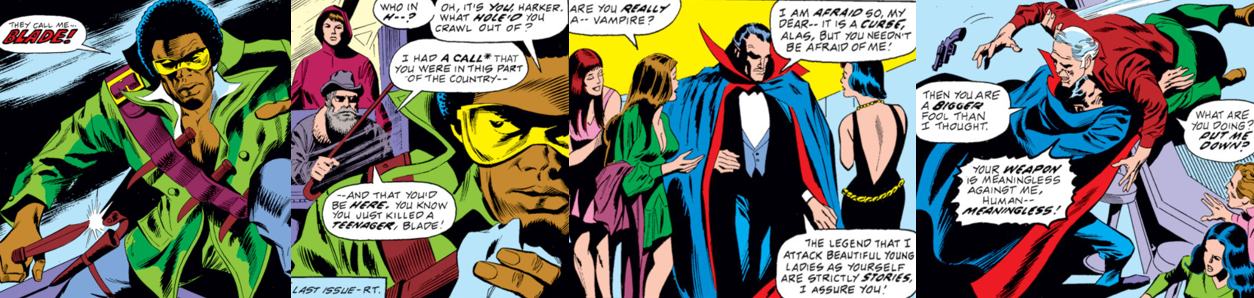
Eric Brooks/Blade was the creation of Marv Wolfman and Gene Colan; inspired by numerous black actors and sporting a 1970s “Blaxploitation” appearance, Blade was only able to come about after comic creators were finally allowed to publish stories involving vampires and other supernatural creatures. One of the first ways Marvel took advantage of this was with the Tomb of Dracula series, in which vampire hunters like Blade would battle against the titular Count and other supernatural creatures. Although heavily inspired by classic Hammer Horror films, The Tomb of Dracula initially struggled with its creative direction as different writers and artists came and went from the book, until Wolfman and Colan joined the publication and turned things around with their close collaboration. Initially a jive talking, very human vampire hunter, Blade was little more than a bit-player in the grand Marvel tapestry, although he did have associations with groups like the Nightstalkers and the Midnight Sons. Despite this, the rights to the character were bought by New World Pictures in 1992, and the later success and popularity of Blade (Norrington, 1998) saw the character transformed into a stoic, bad-ass dhampir to match his live-action counterpart, and the character has gone on to be an integral part of many supernatural and horror stories within Marvel Comics due to this surge of interest.

The Review:
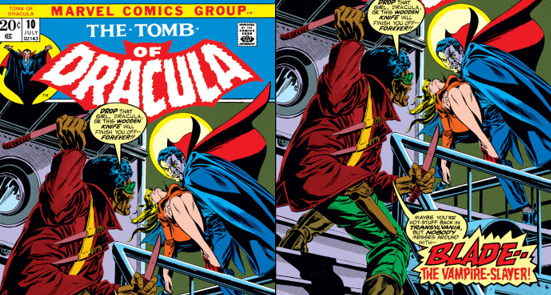
“His Name Is…Blade!” opens on the dark, quiet docks in what I assume is London (or, at least, somewhere in England judging by the dialogue of the characters) where two youths are planning to stow away aboard a ship and elope to the United States when they’re suddenly attacked by three bloodthirsty vampires! These fanged, bat-like creatures exhibit many of the common tropes we associated with nosferatu: they can freely shift between a bat and a humanoid appearance, have monstrous faces, and are driven to suck the blood from their prey. In this case, however, the three aren’t there to feed; instead, they seek to turn the terrified youths into two more of Dracula’s cursed minions, implying a level of mysticism and possession from the process of being bitten. Although their victims haven’t the strength or hope of fighting off their attacks, these dark intentions are interrupted by the arrival of Blade – the Vampire Killer! Now, this isn’t the trenchcoat-clad, armour-wearing, sword-wielding half-human bad-ass you may be familiar with from the movie. Instead, Blade is garbed in a garish green coat similar to an Army jacket, an outrageous yellow visor, sports a maroon bandolier filled with stakes, and is rocking a suitably stereotypical afro hairdo. To say he cuts an intimidating figure would be a lie, frankly; instead, he just looks like a hobo with a vision problem, and yet his reputation as a vampire slayer proceeds him and the vampires state that Dracula has given them orders to kill him. Blade strikes with a speed, precision, and brutal efficiency that comes not from sporting the physical strength of his hated foe but from years of hunting and killing vampires, easily staking two of his foes with a specially carved teak-bladed knife with minimal effort. The third vampire, startled by the vampire killer’s proficiency, tries to flee in his man-bat form, only for Blade to leap onto him and end his vile undead life.

While Blade mercilessly hunts vampires, Dracula attacks a luxury cruise ship.

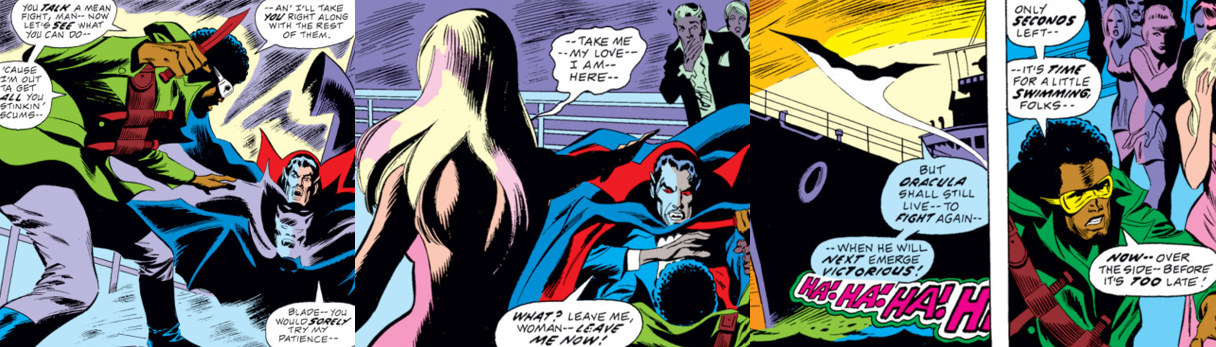
Upon death, the vampires slowly return to their human form, betraying this particular victim as a youth unwittingly transformed against his will; Blade cares little for this, however, and simply coldly remarks that the only good vampire is a dead vampire. His callous attitude earns him the ire of Quincy Harker, a wheelchair-bound old man and one of the world’s foremost experts on vampires. Harker admonishes Blade’s lack of vision; his crusade to simply slaughter every vampire he comes across is interfering with the bigger picture of tracking down and executing Dracula, thus making his undead minions “easy prey”. Blade, however, is unimpressed; he gives Harker the brush off and vows to continue hunting vampires without the old man’s aid, throwing some jive his way for good measure because…you know, the seventies! The story then jumps over to the ocean liner Michele where wealthy socialite Gabriel Trulaine is throwing a lavish party for his similarly decadent friends and absolutely wows his guests by having the Count Dracula himself unveiled as a special attraction for the soiree. Although Dracula (or “Vlad” as he insists Gabriel’s beautiful companion calls him) downplays the stories and rumours of his gruesome ways, assuring the awestruck guests that vampirism is a “disease” like “blood poisoning” and not the affliction popularised in the media, it’s all merely a ruse to gain power over, and favour with, the wealthy and influential and thus extend his reach into industrial, politics, and society. He’s easily able to charm Gabriel’s bimbo with a few choice words and feed upon her blood, before swatting the Michele’s captain and seizing control of the vessel. Dracula then reveals the true extent of his awesome power, which allows him to turn to smoke and control the wills of others; when one of the guests tries to fight back, Dracula simply laughs in the face of his pistol and tosses him overboard before turning on the others and preparing to work his evil magic.

Despite his superior strength, Dracula simply abandons the fight at the first inconvenience.

Fortunately, Blade intercepts the vessel; considering Harker made such a song and dance about Blade’s actions costing them another lead on Dracula, it’s a bit odd and completely unexplained how he was able to track the Michele, but he easily boards the craft and prepares to battle with Dracula. Amusingly, Gabriel’s guests do a lot of the work for him; Dracula demands that they submit to his requests willingly lest he turn them into the living dead and one devote Christian amongst them leads the charge against the Lord of Vampires, stunning him with a Holy Cross and allowing the others to pin him down. Of course, Dracula’s not so easily bested, evaporating into mist and easily escaping harm, but he flies into a rage when Blade arrives as the Count wishes to avenge the vampires lost at the slayer’s hands. Naturally, Dracula is the physically superior of the two, but Blade is tenacious and full of spunk and only enrages the Vampire King with his mocking quips. Still, as wily and nimble as Blade is, Dracula’s shape-shifting abilities and superhuman strength soon see him gain the upper hand; however, right as he’s about to bite into Blade’s neck, Gabriel’s woman, entranced by Dracula’s bite, interrupts him. This is apparently enough to wreck Dracula’s entire plan and he decides to just fly away in his bat form and leave them all to die from the explosives he had the captain place on the ship, despite the fact he could easily massacre them all with his superior strength. With only seconds left, Blade forces everyone off the Michele and into the cold waters below and is left drifting in the sea with Dracula’s mocking laughter in his ears and the promise of a further confrontation later down the line.

The Summary:
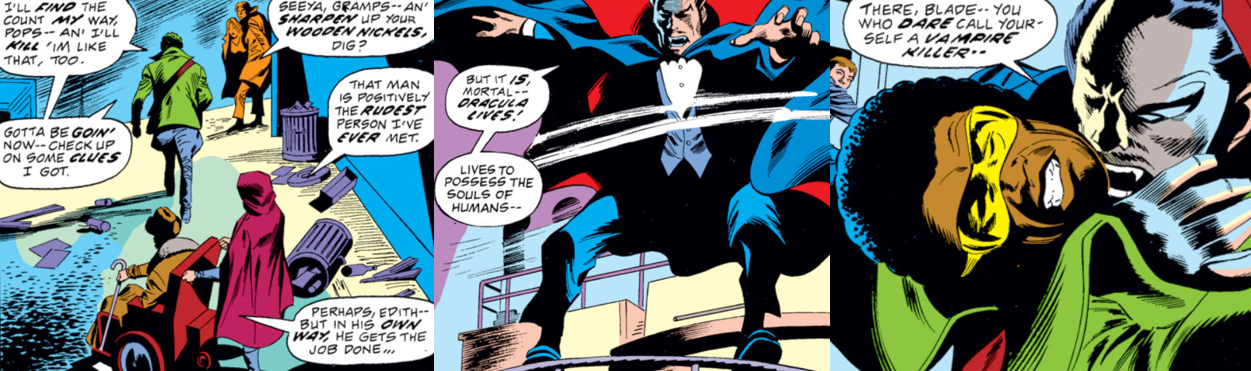
Well, this was…certainly something. I’ve never read The Tomb of Dracula or anything with either him or Blade in it before (not even Stoker’s original novel), so I went into this without any real expectations and still came out of it quite disappointed. The art work is pretty good, at times; Blade and Dracula fare the best out of anyone, with the Lord of Vampires appearing just like he does in all the classic Dracula films and popular depictions, though I can’t say I care for Blade’s appearance here one bit. I don’t really get it; like, what’s with the weird goggles? Why’s his jacket so plain and dull? Later, he dons a wetsuit of sorts to board the Michele, which is a far better look, but he quickly changes into his shitty jacket and glasses and I just don’t really get how he was supposed to look cool or interesting in the slightest in this getup. The other vampires we see come off pretty well; I liked how they shifted from bats to man-bats to monstrous humans and to mist and such, though there’s an understandable lack of blood and the vampires are disappointingly easy to kill, dying from a simply stab from Blade’s special knife that isn’t even in their hearts half the time.

It’s hard to believe Blade became such a sensation after this awfully weak debut story.

The dialogue leaves a lot to be desired, too. This is yet another instance where the story is dated by the misconceptions and stereotypes of the time, with Blade talking in hip jive slang and acting like he just walked off the set of Shaft (Parks, 1971) and Dracula endlessly monologuing and referring to himself in the third person, as was the style of many Marvel villains. This is an odd choice considering he has an underling present, Clifford Graves, to converse with, but Graves is merely a pawn of the Lord of Vampires, one for Dracula to chastise at every opportunity and leave for dead at the story’s end. I’m not sure I really get the premise of The Tomb of Dracula; were readers really just following a sadistic and bloodthirsty vampire on a serious of adventures as he preyed on the innocent and lusted for power? Seems an odd concept to me, one without much legs, and I can’t say that I’m interested in reading other stories from the comic after this one. Hell, I’m not even interested in Blade all that much after this; there’s some intrigue introduced here, with Harker despairing of Blade’s methods (despite how effective he is at killing vampires) and the suggestion that he’s this rogue element in the vampire slaying community, but he just looks and sounds and acts so corny and ridiculous that it’s hard to take him seriously. He’s tenacious, I’ll give him that, and dedicated to killing all vampires without hesitation or remorse, and exhibits some physical prowess, but it’s a pretty weak debut story, if you ask me. Dracula’s plot to manipulate the wealthy and the powerful was completely nonsensical (why didn’t he just turn them with his powers? Why go through all that charade? Why’d he fuckin’ leave when he could’ve killed them all?!) and hardly inspires me to see what else he got up to, and overall I have to say that I’m glad that the movies changed Blade’s character so much if this is what we had to deal with.

My Rating:

Rating: 1 out of 5.

Terrible

What did you think to Blade’s debut story? Did the character interest you at the time or, like me, were you introduced to him through the movies? Did you ever read The Tomb of Dracula books and, if so, what did you think to them? What are some of your favourite Blade moments from the comics? Have you ever read Stoker’s novel, and what are some of your favourite vampire stories? No matter what you think, good or bad, feel free to share your thoughts below and be sure to check out my review of Blade’s game-changing movie!

Game Corner: Kid Dracula (Xbox One)

KidDraculaLogo

Released: May 2019
Originally Released: October 1990
Developer: Konami Digital Entertainment/Konami Industry Co. Ltd
Original Developer: Konami
Also Available For: Game Boy, Nintendo Entertainment System (NES), Nintendo Switch, PC, and PlayStation 4

The Background:
Well, this is it; over the past few weeks, I have been reviewing each of the titles of the Castlevania Anniversary Collection and we’re finally at the end with perhaps the most obscure title in the collection. By 1990, Konami was pretty much knee-deep into establishing Castlevania as a successful franchise; Castlevania III: Dracula’s Curse (ibid, 1989) had released the previous year and both Castlevania II: Belmont’s Revenge (ibid, 1991) and Super Castlevania IV (ibid) were due to come out in the following year. So, naturally, this was the perfect time for a chibi­-style, super-cute parody platformer starring Dracula’s son. No, not Alucard (or, at least, not explicitly…); this title would, instead, be a spin-off starring the titular “Kid Dracula”, a mischievous little imp with a super-deformed, cartoony aesthetic. His self-titled games released exclusively in Japan until the release of the Castlevania Anniversary Collection, which included the original NES version for the first time, in English, but was Kid Dracula worth the wait or is it just another example of a wacky Japanese title that never should have seen the light of day in the West?

The Plot:
After waking from a long sleep, the self-proclaimed “Demon King”, Kid Dracula, is challenged by the demon Galamoth. Arming himself with his father’s cape, Kid Dracula sets out to destroy Galamoth and his minions and retake his throne as the Demon King.

Gameplay:
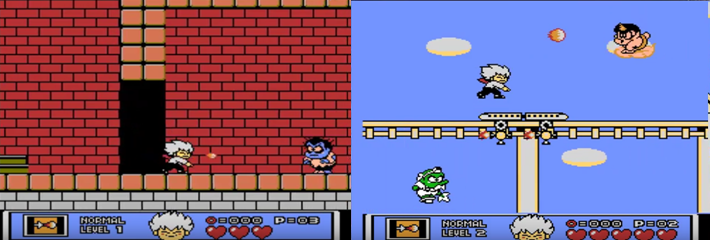
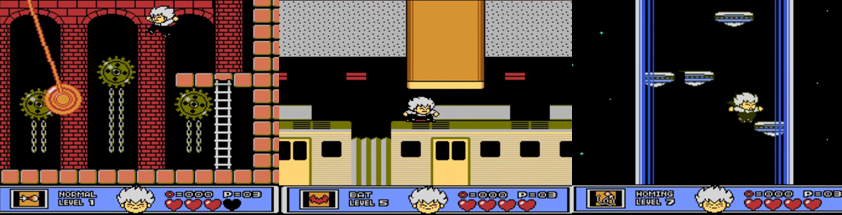
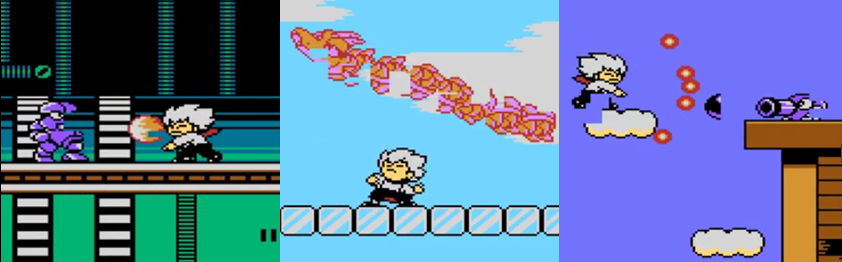
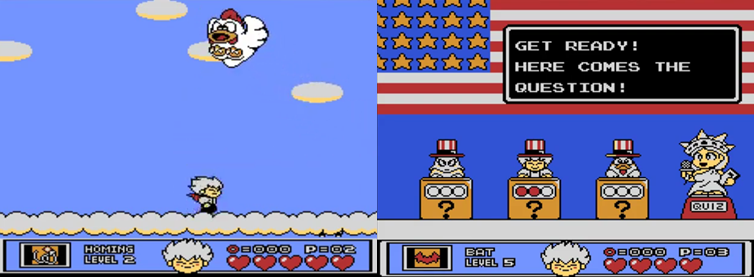
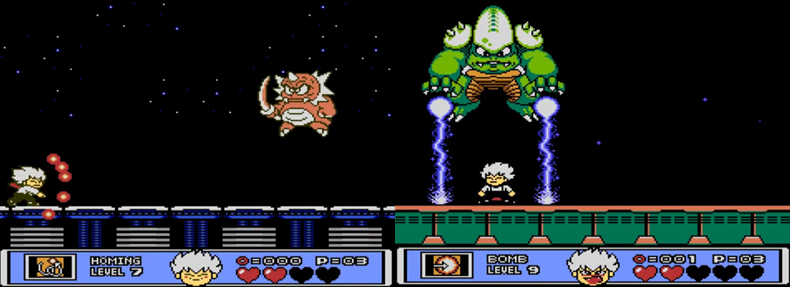
Kid Dracula is a 2D, sidescrolling action/platformer that, in a change of pace, has players take on the role of Dracula’s son, Kid Dracula (also called “Lil’ Drac” and, presumably (given their similarities), a super-deformed version of Alucard), and journeying across a number of levels defeating Galamoth’s minions. Rather than using a whip, Kid Dracula attacks with a fireball-like projectile, just like his Dad. You can blast enemies in the direction you’re facing, shoot upwards, and shoot downwards while jumping, making Kid Dracula a relatively versatile character. You can also hold down the attack button to charge up a shot, which will allow you to collect Medals that you can use to play one of the game’s four mini games at the end of each level. Rather than collecting the traditional Castlevania sub-weapons, you’ll acquire new attacks after defeating each of the game’s bosses; you can switch between them by pressing the “Select” button to assist both in disposing of enemies and your traversal through the game’s nine brisk levels, though there is a significant delay in switching between attacks and there’s no option to mix and match them.

KidDraculaAttack
Take out enemies with a fireball or charged shot.

Unlike the protagonists of other Castlevania games in the Castlevania Anniversary Collection, Kid Dracula is a floaty, slippery little devil but no less sluggish in his movements. When you jump, Kid Dracula gets some serious height (even more so when jumping underwater) and floats his way downwards slow enough for you to make sudden course corrections to avoid instant-death spikes or attack enemies. However, he also comes to a dead stop when jogging, meaning it’s pretty easy to slip off platforms to your death, especially in the ice world, which has some of the worst slippery ice physics I’ve ever encountered. Kid Dracula’s health is represented by hearts; you start the game in Dracula’s Castle and with three hearts but very quickly upgrade to four and, eventually, five, by picking up bigger heart containers. Regular hearts will replenish Kid Dracula’s health and he can earn as many extra lives as he needs by playing the mini games at the end of each level.

KidDraculaGimicks
Each level has its own gimmicks and hazards, ranging from the simple to the frustrating.

Kid Dracula features a fair amount of level variety and gimmicks; in level one, you’re tasked with escaping Dracula’s Castle, a journey that takes you from the throne room (traditionally the end of most Castlevania games) and through the obligatory clock tower. It’s a very vertical opening level but the game quickly switches it up in level two, which sees you hopping over clouds across a bottomless pit of death and riding a track. A significant portion of level three is underwater and, after jumping around on rooftops in level five, you’ll end up riding a subway train, dodging low-hanging ceilings and fighting off monsters as the level auto-scrolls you forwards. Generally, Kid Dracula balances these different gimmicks pretty well but you’ll be faced with the same issues that have plagued all of the Castlevania games in the Castlevania Anniversary Collection: wonky physics, tricky jumps, and knockback from damage. As a result, a lot of Kid Dracula’s levels can be more frustrating than enjoyable and the game can be a bit of a chore to get through thanks to some dodgy enemy placement and instant-death traps; in level six (a desert), you have to jump around falling spiked blocks (just brushing the edge of these instant-death spikes will kill you), are chased by a giant boulder that will kill you the moment it touches you, have to out run a collapsing spiked ceiling, and then have to battle the boss on floating hands, meaning that one hit will send you plummeting to your death.

Graphics and Sound:
Kid Dracula has an amusingly charming little art style; it’s hyper deformed, turning Castlevania’s traditionally gothic and horrific aesthetic into a chibi, over-exaggerated, cartoony style that is pure Japan through and through. Kid Dracula himself stands out at all times thanks to his massive head and cute little face but each of his enemies hold their own as cutesy-fied monsters that seem more adorable than threatening. It’s a good job that the sprites are so large and cartoony and expressive as the game’s backgrounds leave a lot to be desired. It all kind of falls apart after you leave Dracula’s Castle, which is when Kid Dracula throws such cliché level designs as a pyramid, an ice level, and a city at you.

KidDraculaGraphics2
Kid Dracula suffers greatly from slowdown and sprite flickering.

Though there are some interesting level designs outside of the first level (the second level being set in the clouds and the airship are quite interesting), a lot of the backgrounds are criminally plain and uninteresting at times which you would think would allow Kid Dracula to run quite smoothly but you would be wrong. Instead, Kid Dracula suffers from the worst slowdown and sprite flickering in the Castlevania Anniversary Collection so far…and I’m struggling to see why. It’s not as if the game is overly complicated or full of that many moving elements but you’ll stutter and jitter about during critical moments, slipping to your doom or making fatal errors when fighting the game’s various bosses because the game slows to a crawl and the sprites start bugging out on you. Thankfully, the game has a whimsical soundtrack and loud, cartoony sound effects, all of which add to Kid Dracula’s quirky nature, but none of which can help reduce the frustration the slowdown and sprite flickering brings to the title.

Enemies and Bosses:
Kid Dracula has to battle a whole host of wacky enemies in his debut game; level one features all of the staples you’d expect from a Castlevania title (bats, zombies, spear-throwing knights, and Frankenstein’s Monster) but, from level two onwards, you’ll come up against such enemies as a broomstick-riding witch, cloud-riding imps who throw lightning bolts at you, Olympic swimmers, axe-wielding maniacs who wear hockey masks, aeroplane-throwing apes, and even aliens dropped from flying saucers. Each of these is rendered in the same exaggerated, cartoony style as the kid himself, which can often undermine the very real threat they pose to your health. Sure, the skeletons in Kid Dracula look funny but they can still be a pain in the ass when they throw their heads at you, and the enemies still respawn once you leave the screen. Luckily, most can be put down with one of Kid Dracula’s regular fireballs and those that are trickier can be done in with either his charged shot or Bomb technique.

KidDraculaBosses
Most bosses are ridiculously easy but Lady Liberty challenges you to a quiz!

As for bosses…well, you fight a giant chicken at one point so what does that tell you? The first boss is a little ghost who runs off and gets his bigger brother after you’ve damaged him enough and most of these encounters are a pretty simple affair where you just dodge their attacks or run underneath them and blast them with your more powerful attacks until they are defeated. However, when you reach the end of level five, you’ll encounter Lady Liberty who challenges you to a quiz rather than battling you, which is an amusing twist. Things get a bit trickier with level six’s sphinx head boss; you have to jump precariously from its disembodied hands and avoid the bubbles it shoots out all while floating over a bottomless pit that spells instant death. Once you reach level nine, you’ll have to run a gauntlet of sub-bosses including an massively annoying, teleporting dragon who can only be damaged in a small window of opportunity by your Ice Shot and a giant mechanical drill and is so big that it’s difficult to defeat it without taking at least one hit.

KidDraculaBosses3
Neither Galamoth presents much of a threat.

Eventually, you’ll go one-on-one with Galamoth himself not once but twice; the first time, you battle “Demon Lord Galamoth” at the end of level seven and he attacks with both a sword (easily jumped over) and a stream of fire (easily ducked). The second time, you battle “King Galamoth” at the end of level nine but, despite being the game’s final boss, he’s not much of a threat. He’s completely immune to all damage except in the small window where he opens his mouth to drop a fireball on your head; just stay between the lighting bolts he shoots down and keep as far left (or right) as you can and be sure to fire a charged (or Bomb) shot upwards before you miss your window and you’ll be back as the King of all Demons in no time.

Power-Ups and Bonuses:
Every time you defeat a boss, Kid Dracula learns a new technique; you can learn the Homing Shot (which fires a spread of projectiles that home in on enemies, but isn’t particularly strong), a Bomb Shot (which deals explosive damage and one-shots every regular enemy), and an Ice Shot (which, apparently, freezes enemies in place but I only ever used it against the aforementioned dragon boss). Kid Dracula also learns two useful techniques to help him progress further through levels and past hazardous obstacles; the first is the Bat transformation, which turns you into a bat, and the second is the “Up Up Down Down” technique that allows you to walk on ceilings. Both of these only last for five seconds so you have to be quick when using them and, while you can fire a standard projectile when on ceilings, pressing the attack button when you’re a bat instantly turns you back into Kid Dracula (and, generally, sends you falling to your death). It’s also worth noting that you’ll lose the bat transformation if you hit a wall and won’t be able to perform it at all if you’re standing too close to a wall, and it’s pretty difficult to control Kid Dracula when he’s in this form, so it’s best to have a route figured out before attempting this transformation. At the end of each level, you are asked to pick a route and, depending on how Kid Dracula makes his way downwards, will play one of four mini games: Roulette, Cancan, Garapon, and Jab ‘N Pop. In each, you must pay to play with your Medals, so it’s advisable to hit as many enemies as you can with your charge shot so you can collect a lot of Medals, and can win extra lives if your luck is in. These mini games aren’t especially difficult, just based more on chance than skill, and the instructions for their play can be a bit vague; I still don’t really get how Roulette works and I just tended to randomly select stuff and hope for the best and still walked away with at least one extra life each time.

Additional Features:
Like other Castlevania games, Kid Dracula features a password system that allows you to return to (or jump to) any of the game’s nine levels whenever you want. The Castlevania Anniversary Collection also awards you an Achievement after you clear the game, allows you to make liberal use of the save state feature, and apply different frames and display options to customise the game’s appearance to your liking as standard.
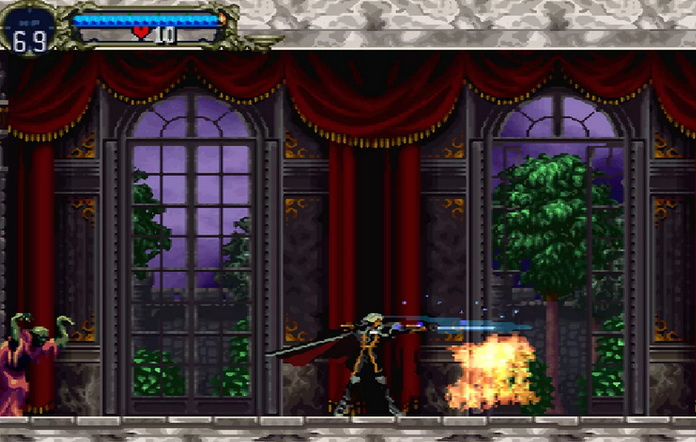
The Summary:
Kid Dracula is a quirky, amusing little title; the way the characters talk in cutscenes is charming and the game is clearly meant to be a fun little spin-off of the traditionally dark, broody, and gothic Castlevania series and I can appreciate its humour and artistic direction. Indeed, it’s hard to deny that the sprites look great; everything has this hyper deformed, chibi-aesthetic to it and it’s like playing a peculiar Japanese anime rather than a horrific battle against bloodstained monstrosities. Yet all the humour and artistic charm in the world can’t change the fact that Kid Dracula is a laborious experience; the controls are slippery, the level layouts frustrating, and the slow down and sprite flickering absolutely maddening. Maybe I’m just burned out on the series by this point, especially the issues that dogged the 8-bit Castlevania’s (and many other titles, to be fair), but I feel like Kid Dracula really doesn’t have any excuse to struggle as hard as it does to run at an appropriate speed and level of quality due to its more simplistic nature.

My Rating:

Rating: 2 out of 5.

Could Be Better

What are your feelings about Kid Dracula? Do you feel it was a worthy attempt at expanding the franchise or do you think it was maybe a bit too “out there” as a concept? What other Castlevania characters would you like to see get their own spin-off? Are there any other genres you think Castlevania could try to fit in to, like racing or a first-person shooter? Whatever your thoughts on Kid Dracula, or Castlevania in general, feel free to leave a comment below and check out my other Castlevania reviews.

Game Corner: Castlevania: Symphony of the Night (Xbox 360)

GameCorner
CastlevaniaLogo

One of the things I love about Xbox Game Pass is that it allows me to play videogames I’ve either always wanted to play, haven’t played in a long time and can just farm for Achievements, or games I’ve always wanted to play, like Castlevania: Symphony of the Night (Konami Computer Entertainment Tokyo, 1997). Now, I’m not an especially well-versed player of the Castlevania series (Konami, 1986 to present); I’ve only ever owned one game in the franchise, the abysmal Castlevania (Konami Computer Entertainment Kobe, 1999) for the Nintendo 64, and I’ve only ever completed one title in the franchise, Super Castlevania IV (Konami, 1991), courtesy of the Super SNES Classic Edition. This, as I may have mentioned a few times before, is mainly due to growing up without the income necessary to allow me to own both a Nintendo and a SEGA console; however, I have been a fan of the franchise regardless and have always wanted to play more games from the series. After having a great time with Bloodstained: Curse of the Moon (Inti Creates, 2018), a fantastically well-crafted homage to the Castlevania franchise, I jumped at the chance to give Symphony of the Night a spin.

CastlevaniaStory
Alucard is on a mission to confront his father.

As I understand it, Symphony of the Night is a direct sequel to Castlevania: Rondo of Blood (Konami, 1993) and the game opens with the final events of its predecessor, with acclaimed vampire hunter Richter Belmont taking on and defeating Count Dracula. Despite this supposedly forcing Dracula into a one-hundred-year slumber, the Count’s castle, Castlevania, reappears four years later and, with Richter missing, Dracula’s dhampir son, Alucard (who had previously battled his father in Castlevania III: Dracula’s Curse (ibid, 1989), alongside Richter’s ancestor, Trevor Belmont), heads into the monster-infested castle to destroy his father. I remember Super Castlevania IV being a fun little romp; you explore a vibrant gothic landscape, upgrade your whip with easily-found power-ups, and battle enemies and bosses that naturally increase in difficulty. Symphony of the Night, however, is a steep learning curve to the uninitiated; it doesn’t take long to get a handle on the basics but you really need to be paying attention to your surroundings and what every weapon and skill does so you can proceed further and further into Castlevania. The voice acting is classic cheese but the music is atmospheric and fitting to the environment; more importantly, the gameplay and controls are tight and responsive. There are very few cheap deaths in this game; no bottomless pits or instant kill traps here. If you get killed, it’s probably your own damn fault as you waded in unprepared or took on a boss or swarm of enemies with low health or the wrong items equipped, making the game a test of your actual gaming skills rather than an exercise in frustration.

CastlevaniaForms
Alucard can become a bat, wolf, or mist to reach new areas.

Alucard begins the game fully powered up and ready to take on the forces of evil but quickly encounters Dracula’s chief underling, the Grim Reaper, who strips Alucard of all his items and reduces the player down to simple punches. Alucard breaks from the franchise’s tradition of featuring a whip-wielding protagonist and, instead, favours a sword and shield, which can be equipped to different hands (and buttons), though other weapons (including rods, which are similar to the whip) and items can be acquired and equipped as Alucard makes his way through Castlevania. Alucard can also pick up sub-weapons by breaking pots, vases, lamps, and other items; these range from throwing knives, to Holy Water, to protective Bibles, and even fancy lightning. Alucard can only hold one sub-weapon at a time, though, but, whenever he picks up a new sub-weapon, his existing sub-weapon drops to the floor for a short time so you can pick it back up if you don’t fancy trading out. Also similar to other Castlevania titles, Alucard can pick up money, hearts (which, in a move I’ve never understood, allow him to use his sub-weapon rather than replenish his health) and restore his health by picking up pot roasts and potions. Power-ups to increase Alucard’s health and heart count can also be found scattered throughout Castlevania, as can better weapons and equipment, though these are often protected by bosses or hidden away in areas that will require Alucard to obtain other abilities or transformations. Being a dhampir, Alucard has some nifty abilities that other series characters were probably lacking; he can dash away from enemies with a press of a button (but not forwards, which is a bit annoying), cast magic, double jump, breath underwater, and transform into a wolf, bat, or mist to reach new areas. However, most of these abilities will need to be found by use of copious amounts of back-tracking; for example, you may spot a new area up on the ceiling that you cannot reach with Alucard’s standard jump, so you’ll have to acquire the bat or mist transformation to get up there and explore new areas.
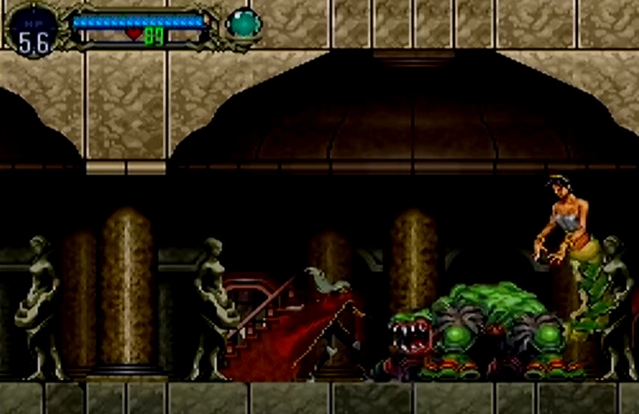
CastlevaniaEnemies.PNG
Be prepared to face some messed-up enemies…

Symphony of the Night features a lot of RPG elements to its action-orientated gameplay; defeating enemies and bosses gains Alucard experience points and, with enough points, he will level up and his stats (attack, defence, and so forth) will improve. In addition to equipping weapons and shields to do more damage or reduce enemy attacks, Alucard can also equip armour, jewellery, and other items to boost his stats or for other perks. Item management is key here as some weapons require two hands to wield, some deal or defend against specific element attacks and will thus be better suited to certain bosses, and some weapon and shield combinations confer Alucard with very helpful buffs (such as the shield delivering massive damage while simultaneously restoring Alucard’s health). Alongside saving (which can only be done in designated save rooms scattered through Castlevania), exploring Castlevania is a chore in itself; the castle is massive, stretching vertically and horizontally, and the game never holds your hand once in trying to navigate through its maze-like rooms. You can visit a librarian to purchase items and a map but you’ll still need to visit every room and squeeze through every nook and cranny if you want to find the best items, skills, and weapons. As Alucard explores Castlevania, he encounters many nightmarish foes, from zombies and skeletons to monstrous gargoyles, possessed books, and broom-riding witches, all of which can pose a significant threat as the player must equip a healing item in place of a weapon in order to use it and such items are scarce.

CastlevaniaBosses
Symphony of the Night has some massive boss battles.

Luckily, Alucard can also acquire familiars who will follow him around and provide assistance; the faerie will heal Alucard without the need to assign an item (though it can be easy to burn through your inventory this way) and the demon will attack enemies and press switches you cannot reach. These are extremely useful but also quite limited; it might be because I wasn’t quite sure how to use the familiars but it seemed like they wouldn’t attack every enemy or heal me as often as I would like, making them a little unreliable. Alucard also has to face some massive bosses, including a minotaur, a mummy, and a succubus, the gigantic, lightning-wielding Galamoth, and even evil doppelgängers of himself and characters from Castlevania III. Some of the bosses, like the Gaibon, Slogra, and Werewolf, even appear later in the game as regular enemies (though Alucard should be strong enough to wipe the floor with them by that point) and the majority of the boss battles require some level of strategy in order to get around their attack patterns.

CastlevaniaRichter.PNG
Richter’s turned to the dark side…or has he?

While exploring Castlevania, Alucard comes across Maria Renard, who is searching the castle for Richter; however, when Alucard finds Richter, he is revealed to be plotting Dracula’s return in order to give his life meaning. The battle against Richter can quickly go sideways unless Alucard obtains the Holy Glasses from Maria (which can only be found by getting the Gold and Silver Rings from opposite ends of the castle and using a sub-weapon to activate a clock…because of course); the glasses allow the player to see a mysterious orb controlling Richter and destroying this will free him from the evil influence of the wizard Shaft. Shaft then taunts Alucard and goads him into following him further and it was at this point that I prepared myself for the final confrontation…only to be transported to an exact replica of Castlevania…only upside-down and filled with tougher enemies! The Reverse Castle caught me completely off-guard and added maybe another weekend to my playthrough; it seemed as though every time I seemed to be making progress and getting closer to the end, Symphony of the Night threw another curve ball at me that expanded the map and the narrative further and the Reverse Castle was no exception. It was simultaneously exhilarating and frustrating, especially as the Reverse Castle’s enemies often appear in large groups and strange combinations that force the player to flee more often than not.

CastlevaniaRichter2.PNG
Play as Richter for a more traditional Castlevania experience.

Alucard must battle five sub-bosses in the Reverse Castle to acquire Dracula’s body parts, which is the only way to unlock the final confrontation against both Shaft and the Count himself. However, the Reverse Castle is also home to some false sub-bosses, who instead drop power-ups for Alucard that you will need in order to succeed. If, like me, you missed a bunch of ability power-ups and transformations before entering the Reverse Castle, you’ll also have to backtrack to the standard castle in order to be able to swim in the upside-down water or damage enemies with your mist attack, two skills that are essential to safely navigating the Reverse Castle. In terms of replay value, Symphony of the Night features a huge map to explore and the chances are high that, even when you reach the final battle with Dracula, you won’t have explored all 200.6% of the game. If you’re playing the Xbox 360 version, there are obviously a few Achievements to get along the way (the 200.6% thing is one of them) and you can even play as Richter if you enter “RICHTER” as your player name, which makes the game both harder and more like Super Castlevania IV as you now control a whip-wielding vampire hunter. There’s also a bestiary to complete by encountering every enemy and boss in the game but the game favours extending its playtime considerably through the Reverse Castle, rather than any significant post-game features.

CastlevaniaDracula.PNG
Dracula presents a tough challenge…unless you know what you’re doing.

In the end, I really enjoyed Symphony of the Night; it was tough but in a way that challenged me to be a better player. It’s annoying that Alucard’s shield doesn’t seem to block every enemy attack and that he can’t dash forwards but these are minor complaints (honestly, I hardly ever even used the shield so it’s a mute point, really). The music is great, the graphics, sprites, and backgrounds are all really well-drawn and heavily detailed, and the gameplay mechanics are solid. The RPG elements are just right for me; you don’t have to do a lot of arduous bullshit to upgrade specific stats or whatever. Alucard simply gets stronger and stronger as he levels-up and equipping the right items and equipment will buff him up further. As only the second Castlevania title I’ve ever played from start to finish, Symphony of the Night was a great experience and actually has me hungering for more from Konami’s franchise. Luckily, they have me covered as the Castlevania Anniversary Collection (ibid, 2019) is now available on Xbox One so I guess I know what I’ll be aiming to take on next…

My Rating:

Rating: 4 out of 5.

Great Stuff