Movie Night [Superman Month]: Superman


In 2013, DC Comics declared the 12th of June as “Superman Day”, a day for fans of the Man of Steel the world over to celebrate Clark Kent/Kal-El/Superman, the superpowered virtue of “Truth, Justice, and the American Way” who is widely regarded as the first ever costumed superhero. This year, I’ll be spending every Sunday of June celebrating the Man of Steel as I expand Superman Day to “Superman Month“.

Released: 14 December 1978
Director: Richard Donner
Distributor:
Warner Bros. / Columbia–EMI–Warner Distributors
Budget:
$55 million
Stars:
Christopher Reeve, Gene Hackman, Margot Kidder, Valerie Perrine, and Marlon Brando

The Plot:
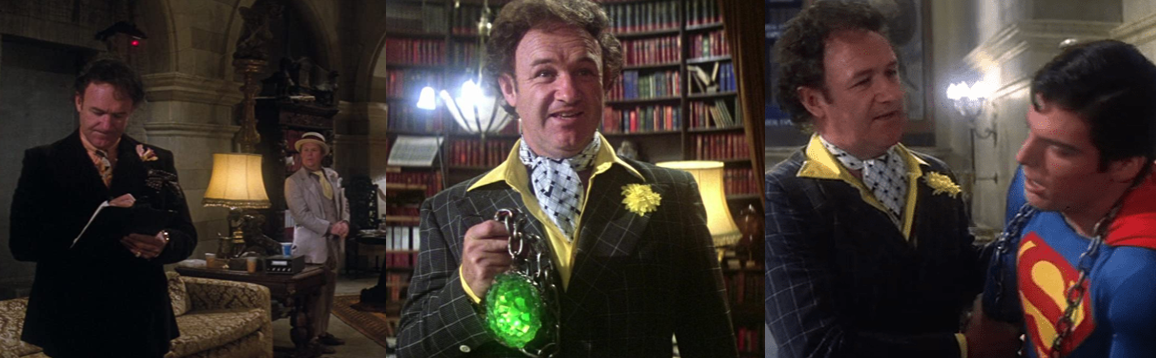
In the dying moments of the planet Krypton, scientist Jor-El (Brando) rockets his son away to Earth. After learning of his alien origins and discovering the limits of the fantastic superhuman powers afforded him by Earth’s yellow sun, the now-adult Clark Kent (Reeve) assumes the costume identity of “Superman” while disguising himself as a mild-mannered reporter. However, he faces his greatest test when genius criminal mastermind Lex Luthor (Hackman) hatches a plot to cause devastating earthquakes west of the San Andreas Fault.

The Background:
In the years since his dramatic debut, Superman quickly became the subject of numerous adaptations and his 1940 radio drama even introduced many aspects that became synonymous with the character. The idea of a feature-length Superman film was first conceived of by producer Ilya Salkind in 1973; entering into a partnership with his father, Alexander, and Pierre Spengler, the filmmakers were able to convince Warner Bros. to produce a two-film adaptation of the character and paid screenwriter Mario Puzo (of Godfather (ibid, 1969/Coppola, 1972) fame) $600,000 to write the screenplay. Steven Spielberg was courted to direct but was unable to commit and, while Guy Hamilton was attached to the project, the producers eventually settled on Richard Donner, who immediately ditched the campy tone of Puzo’s 400-plus-page script. The first actor signed to the film was Marlon Brando (who had some pretty funny ideas about Jor-El’s appearance and characterisation and had a lackadaisical attitude towards the film) and Oscar winner Gene Hackman soon followed, with the two receiving top billing. Many notable names were considered for the title role before relative-unknown Christopher Reeve was cast after a laborious casting process. Having bulked up for the role, Reeve’s experience as a pilot paid off when performing the film’s complex flying sequences, which were achieved through a combination of green screens, wire work, and other camera tricks while the striking Kryptonian suits were the result of a happy accident with a reflective material. Very quickly, the film’s budget ballooned and filming began to over-run, causing tensions between Donner and the producers; Richard Lester was brought on board as a mediator and work on the sequel halted to concentrate on the first film. After several delays, Superman (also marketed as Superman: The Movie) released to rave reviews and was an incredible financial success, making over $300 million. Although the producers continued production of the sequel immediately, the damage was done and Donner did not return, necessitating a series of expensive reshoots and raising the ire of many of the film’s actors. Still, the first film was an incredible achievement, massively influential on Superman’s comic books, and was eventually preserved in the United States Library of Congress National Film Registry.

The Review:
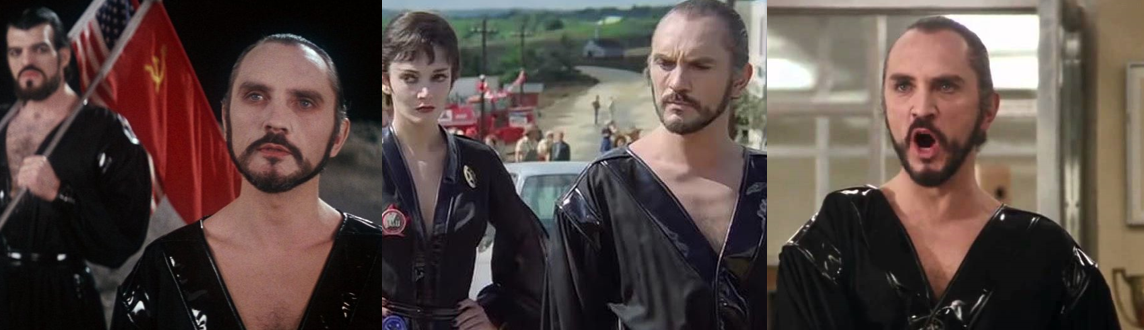
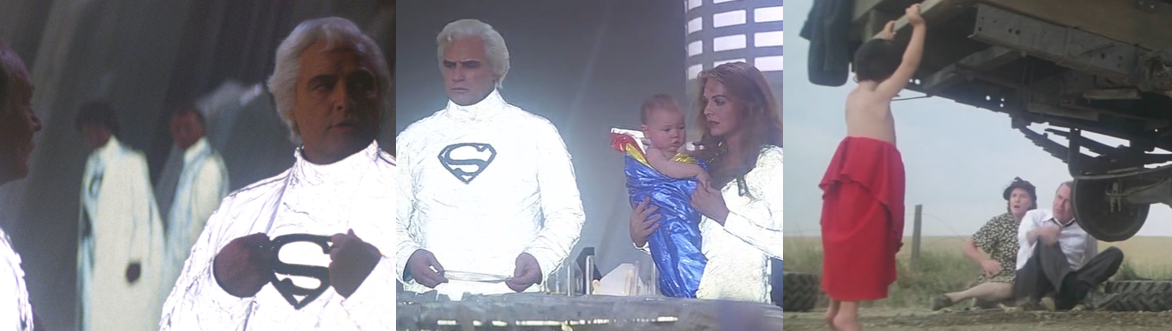
Superman begins, as most Superman origin stories do, on the far away world of Krypton (or “Krypt’n”, if you’re Marlon Brando), a technologically advanced civilisation that inhabits a largely barren, crystalline world. In a fantastic seed for the sequel, Jor-El sentences three seditious criminals – Non (Jack O’Halloran), Ursa (Sarah Douglas), and their leader, General Zod (Terence Stamp) – to the mysterious “Phantom Zone” for their treasonous and destructive efforts to usurp the Kryptonian council and subjugate the world to Zod’s will. Defiant to the last, Zod vows to avenge himself upon Jor-El and his heirs, no matter how long it takes and against all odds, before the three are cast into the strange mirror prison. Following this, Jor-El is unable to convince the council that Krypton is doomed to be destroyed by its red giant sun within thirty days; indeed, despite being a highly respected and rational member of the council, Jor-El’s claims are so adamantly refuted that he is threatened with being labelled a terrorist himself.

Unable to save his planet, Jor-El sends his infant son to Earth, where he gains awesome powers.

Apparently despondent (it’s hard to tell with Brando…), Jor-El resigns himself to ensuring the survival of his young son, Kal-El; his wife, Lara (Susannah York), laments that their son will forever be an outcast amongst the “primitives” of Earth but Jor-El remains confident that the powers bestowed upon Kal-El by Earth’s yellow sun will make him a symbol of hope and afford him physical advantages beyond all known understanding. As Krypton shatters around them, the baby is rocketed away and, guided by his father’s voice, slowly grows into an infant within his escape craft; Jor-El, who encoded all of his knowledge and wisdom into the crystalline form of the ship, stresses that his son is “forbidden” to interfere in Earth’s history and instead let his example inspire others. In time, many thousands of years after Krypton’s destruction, the ship crash lands on Earth and is stumbled upon by kindly, elderly couple Jonathan (Glenn Ford) and Martha Kent (Phyllis Thaxter) who are awestruck by the child’s super strength and, despite Jonathan’s concerns, take him in as their own.

After losing his adopted father, Clark learns the extent of his powers and reveals himself to the world.

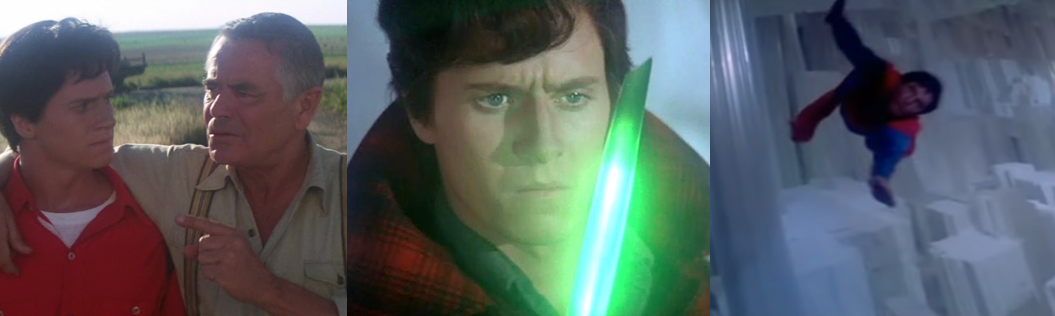
About fifteen years later, the boy has grown into well-meaning teenager Clark Kent (Jeff East, with Christopher Reeve dubbing his voice); though Clark is frustrated that he has to hide his physical capabilities from the world, Jonathan stresses that the boy was sent to them (and the world) for a greater reason than to simply score touchdowns or show off to the other kids. As he just wants to make his parents proud, Clark takes his father’s advice to heart but is left utterly heartbroken when Jonathan suffers a fatal heart attack. At his graveside, a devastated Clark laments that his awesome powers were ultimately useless in saving his father and thus learns a valuable lesson about the limits of his superhuman abilities. Drawn to the remains of his ship (which the Kents kept hidden in their barn), Clark discovers a glowing green crystal that leads him far north, all the way to the Arctic, where the crystal births a piece of his home planet on Earth. In this Fortress of Solitude, Clark communes with the spirit of his father, who lives on as a glorified artificial intelligence, and spends a further twelve years absorbing all of Jor-El’s knowledge and teachings of his newfound abilities. After his training is completed, Clark emerges as Christopher Reeve and garbed in a bright Kryptonian costume and ready to share his abilities with the world as Superman.

Clark poses as a mild-mannered reporter, which allows Superman to captivate Lois.

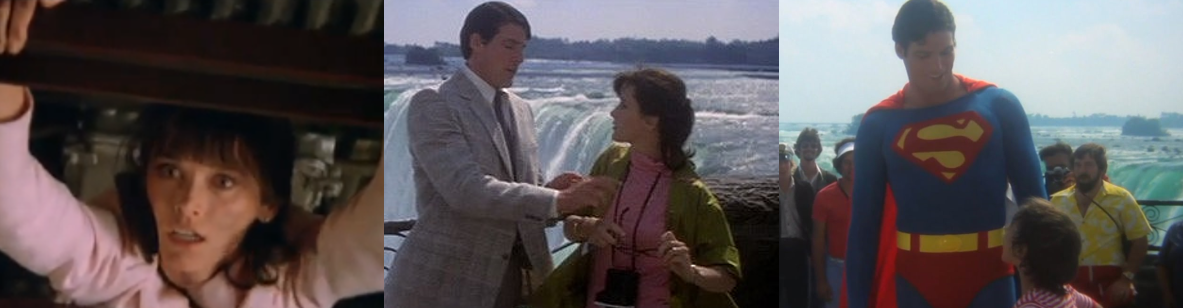
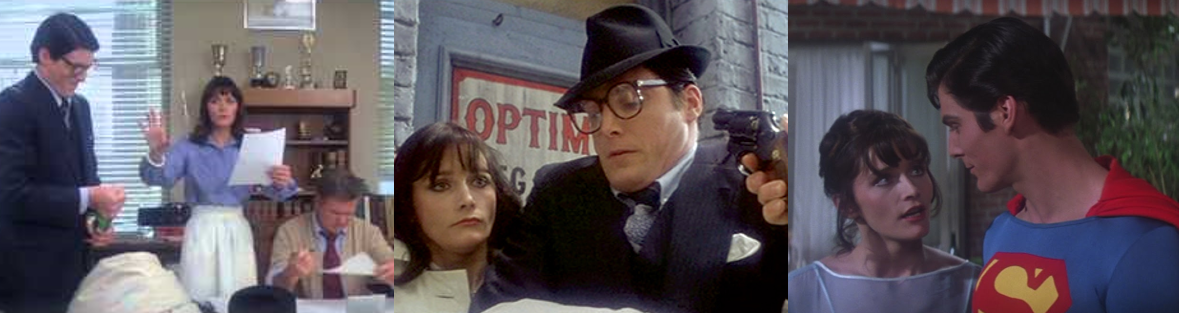
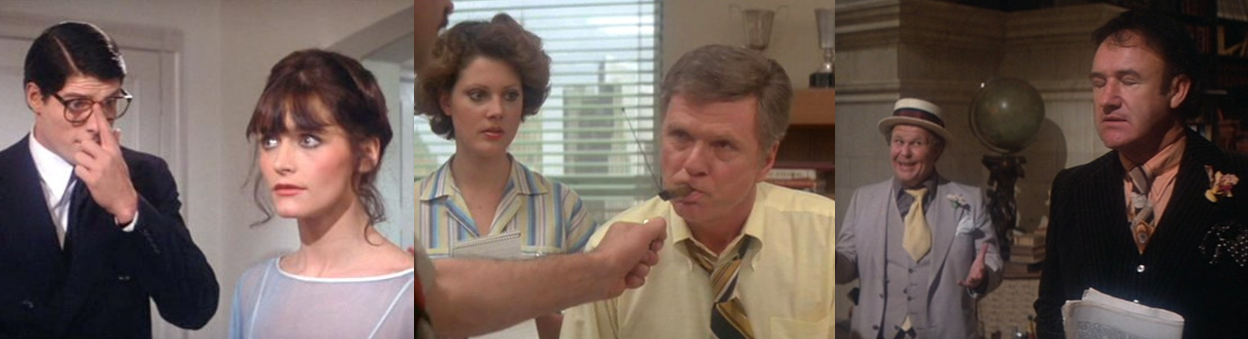
Clark sets himself up as a reporter at the Daily Planet (apparently it’s as easy as being able to type incredibly fast and being overly polite), meeting hot-tempered editor-in-chief Perry White (Jackie Cooper), enthusiastic young photographer Jimmy Olsen (Marc McClure), and feisty reporter Lois Lane (Kidder). Despite her inability to spell, Lois is a lively and fearless journalist and, consequently, she both despairs of Clark’s overly friendly nature and sees him as a bit of a dorky milksop and finds her curiosity sparked by some of his oddities. In comparison, Lois is immediately captivated by Superman when he not only catches her in mid-air as she’s plummeting to her death but also snags the helicopter she was falling from. Enamoured by his mystery, confidence, and the seemingly limitless superhuman abilities he possesses, her normally controlled and forthright demeanour is shattered and she’s left absolutely awestruck during (and following) her exclusive interview with the Man of Steel (where she names him and he also, curiously, divulges a number of secrets about himself that later come back to bite him in the ass).  

The maniacal Lex Luthor plots to destroy Superman in his quest to profit from real estate.

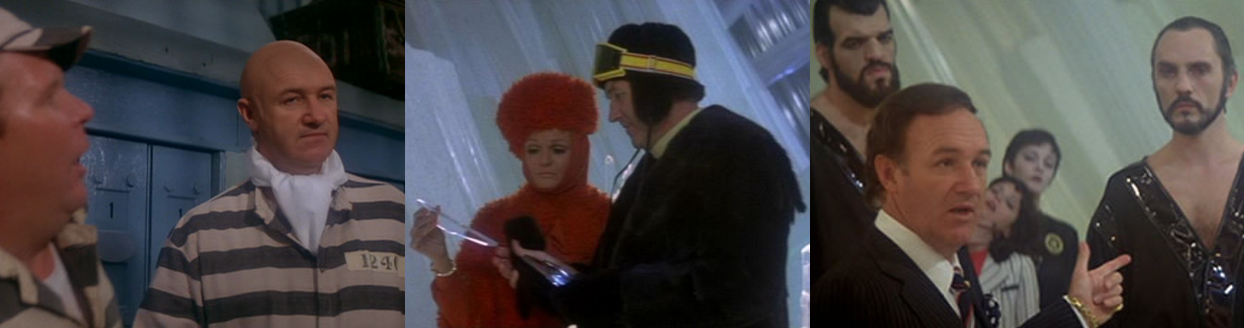
The villain of the piece, the enthralling Lex Luthor, has set up an impressive hideout beneath the city streets; there, protected by a series of cameras and deadly booby traps, he surrounds himself with the dim-witted Otis (Ned Beatty) and sexy but cynical Eve Teschmacher (Valerie Perrine). Egotistical and arrogant in his intellect, Luthor sees himself as the world’s greatest criminal mind and is busy planning the crime of the century, which involves the acquisition of seemingly worthless land and profiting from it by causing a cataclysmic flood, endangering and ending countless lives in the process. Luthor immediately surmises that Superman is not of this Earth and relishes the opportunity to pit himself against the Man of Steel, and to both prove his intellectual superiority over him and destroy the very virtues that Superman stands for, seeing the Man of Steel as the ultimate challenge for his self-proclaimed criminal genius.

The Nitty-Gritty:
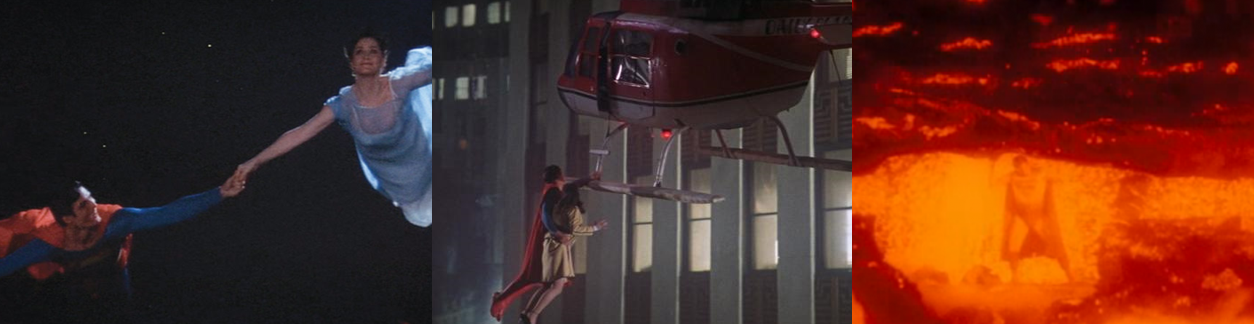
Of course, you can’t really talk about Superman without mentioning John Williams’ bombastic and immediately iconic “Superman” theme that is rendered in full glory over the opening credits. While this theme has become so synonymous with the character that no composer or filmmaker since has come close to crafting a more suitable melody for the Man of Steel, I continue to be baffled by the absolutely cringe-worthy “Can You Read my Mind?” sequence. Like, I get it; it’s supposed to be this big romantic moment between the Lois and Superman and to showcase the film’s wirework, but it stands out like a sore thumb and is all kinds of different flavours of cheese.

While Reeve set the standard for Clark/Superman, other performances are a bit hit and miss.

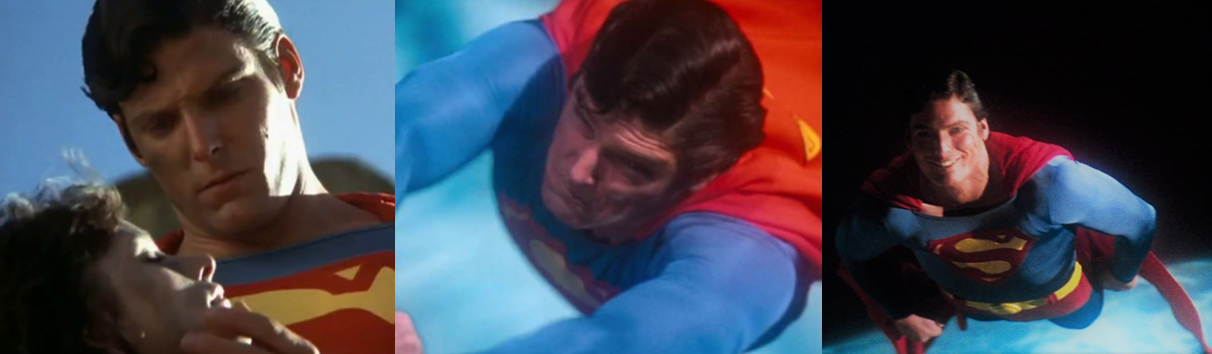
If I’m being brutally honest, the film’s performances are a bit hit and miss; despite being a relative unknown, Reeve provides the quintessential portrayal of Superman and simply exudes confidence and sociability as Superman while masking his true nature as loveable, bumbling fool. Indeed, by simply straightening his posture and slightly altering his voice, Reeve effortlessly depicts the simple differences between his two persona and his performance so explicitly set the standard for the character that it continues to be emulated to this day. Once the story shifts to Metropolis, the film becomes a much more vivid and over-the-top production that emphasises buffoonery and comic book camp; nobody embodies this more than the bumbling Otis, who is mostly here for comic relief, but there’s also the suggestion that Luthor socialises with cretins simply to have someone to lord over. While Beatty and Cooper seem to have stepped out of a pantomime for their roles as the goofy Otis and bombastic Mr. White, respectively, Hackman brings a certain gravitas to the film that perfectly walks a fine line between camp and severe. Hackman seems to be enjoying himself in the role and commands every scene and room that he’s in; though he lacks Luthor’s bald head, he sports a variety of wigs and exudes a sadistic menace in his willingness to kill millions of innocent people in his quest for power, profit, and to have his matchless intelligence recognised by the world.

While some effects don’t hold up well, they’re all very ambitious and impressive for the time.

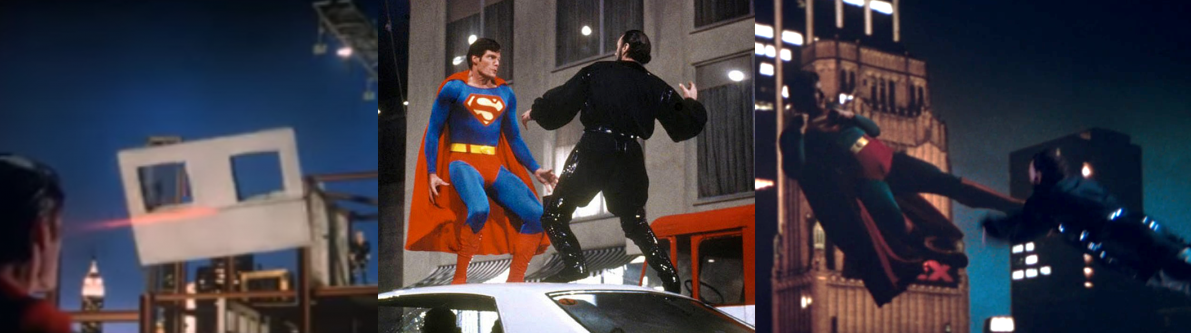
Obviously, you have to expect that some of the effects aren’t as impressive and haven’t aged as well as others, as ambitious as they are; the Arctic is clearly a set like something out of Star Trek (1966 to 1969) and I can only assume that Krypton is so barren and lifeless because it was cheaper and easier (though it also makes it cold and alien and a stark contrast to our lush world). The young Clark’s running effect and a number of the rear-projection and miniature shots leave a lot to be desired and almost every skyline appears to simply be a gigantic matte painting as the film is heavily reliant upon impressive sets the likes of which are akin to a James Bond film. While Clark’s super fast changes to Superman and his little spin down into Luthor’s lair aren’t that great, easily the weakest effects come in the conclusion as the San Andreas Fault is ruptured and painstakingly crafted models are washed away by water and dirt before Superman circles the globe at superspeed. To be fair, though, the film’s effects are still incredibly impressive; the helicopter sequence is an ambitious and remarkable composite of miniatures, rear-projection, and live-action wire work that makes for a suitable debut for the Man of Steel and, overall, the film has largely stood the test of time thanks to its practical effects and undeniable charm. As you might expect, Superman’s powers and abilities are the highlight of the film; Superman’s invulnerability, super strength, and superspeed are all accounted for and realised well enough and Superman’s first night on duty provides a great showcase of what he is capable of. No job is too big or too small for Superman, who does everything from rescuing a cat from a tree to apprehending jewel thieves as they clamber up the outside of buildings using sucker pads.

Superman comes up with a unique solution to save the day.

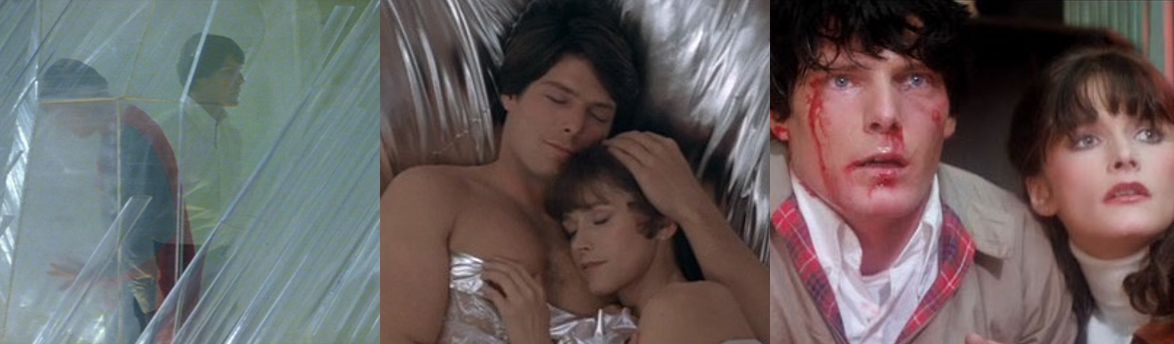
Naturally, it’s the flying sequences that are the true spectacle of the film; even now, the rear-projection holds up pretty well in these scenes but what really sells it is Reeve’s dynamic and believably movements. Reeve banks and turns with an elegant grace and really sells the illusion that we’re seeing a man fly and makes even the most ridiculous aspects of the film (from the 100% comic-accurate suit to using his own body to repair a broken train track to repairing the San Andreas Fault by ploughing through questionable-looking magma) seem entirely plausible thanks to his charming smile and undeniable charisma. Of course, when talking about Superman, you have address the ending. Thanks to acquiring a chunk of Kryptonite, Luthor is able to weaken and cause incredible agony to Superman and it is only thanks to Ms. Teschmacher’s change of heart that he’s able to recoup his strength and intercept Luthor’s missiles. However, while he’s able to stop one, he’s unable to keep the other from striking the San Andreas Fault and is so busy repairing the damage it causes that he’s unable to save Lois from being crushed to death by debris. Devastated and overcome with grief, Superman flies into the upper atmosphere and defies his birth father’s warnings of interfering in human history to favour his adopted father’s advice and is able to literally turn back time by reversing the rotation of the planet. This undoes all of the damage caused by Luthor’s missiles and prevents Lois’s death but remains the most ludicrous aspect of the entire movie and just ends up raising all kinds of questions like…wouldn’t there be two Superman? Why doesn’t he just turn back time all the time? Ultimately, it’s just one of those crazy, over-powered feats that we’ve come to expect from older versions of Superman and I guess it works to show that Superman is capable of overcoming even his limits by pushing hard enough (plus, Reeve’s anguished cry does make for an incredibly intense scene).

The Summary:
I honestly went into Superman ready to give it a lower score of two stars; it’s never really been my favourite superhero, or Superman, film as it’s just got a little too much cheese and cringe in it for my tastes. There’s an undeniable level of camp at work in the film that makes it very cartoony and over-the-top in places, to say nothing of long, oddly paced inclusions that seem decidedly at odds with the rest of the film. However, all of these elements are in perfect balance with the film’s more dramatic and spectacular sequences; this is a film that is, primarily, a showcase of ambitious and trend-setting cinematic techniques as much as it is perhaps the most influential interpretation of Superman ever seen outside of the comic books. While not every effect has aged too well, the majority have stood the test of time remarkably well and there’s just the right balance of goofy comedy, heart-warming charm, and exciting spectacle that simply scream “Superman”, a character who is often characterised as being the world’s biggest Boy Scout and embodying timeless (if slightly antiquated) ideals. There’s no denying that Superman is an absolute classic; while I cannot sanction Marlon Brando’s attitude and I may not be a fan of some of Donner’s choices (Luthor being a real estate maniac, the barren depiction of Krypton, and the time travel ending are all cons of the film for me), Superman remains a delightful and enjoyable little slice of camp goodness that is worth it for Reeve’s incredible and career-making turn in the title role if nothing else.

My Rating:

Rating: 3 out of 5.

Pretty Good

Are you a fan of Superman? What did you think to Christopher Reeve’s portrayal of the character and were you a fan of Lex Luthor’s interpretation in the film? How influential was Donner’s film on your perception of Superman and are there any aspects you would prefer to see films and media move away from? What did you think to the film’s campier elements and were you a fan of the ending? What is your favourite Superman story, character, or piece of media? How are you planning to celebrate Superman Day next week? Whatever you think, feel free to share your opinion and thoughts on Superman in the comments below.


Game Corner [Robin Month]: Young Justice: Legacy (Xbox 360)


In April of 1940, about a year after the debut of arguably their most popular character, Bruce Wayne/Batman, DC Comics debuted “the sensational find of [that year]”, Dick Grayson/Robin. Since then, Batman’s pixie-boots-wearing partner has changed outfits and a number of different characters have assumed the mantle as the Dynamic Duo of Batman and Robin have become an iconic staple of DC Comics. Considering my fondness for the character and those who assumed the mantle over the years, what better way to celebrate this dynamic debut than to dedicate every Monday of April to celebrating the character?


Released: 19 November 2013
Developer: Freedom Factory Studios
Also Available For: Nintendo 3DS, PC, and PlayStation 3

The Background:
After debuting in the pages of The Brave and the Bold #54 in 1964, the Teen Titans had a relatively consistent presence throughout the 1960s and 1970s and acted as a way for DC Comics to appeal to younger audiences. The team arguably achieved their greatest mainstream success when writer Marv Wolfman and George Pérez breathed new life into the concept by introducing many characters who are now synonymous with the team but I actually became a fan of the group after reading the adventures of their later contemporaries, Young Justice. Although functionally similar to the Teen Titans, Young Justice brought together the then-modern incarnations of their predecessors, who had long since grown up and assumed other identities. Created by Todd Dezago, Todd Nauck, and Lary Stucker the team operated between 1998 and 2003 before disbanding (most likely so that DC Comics could captalise on the success of the Teen Titans cartoon (2003 to 2006)) before reuniting in 2019. Some four years after Teen Titans ended, the Young Justice concept was evoked for a new DC animated series that ran from 2010 to 2013 before finally receiving a long-awaited revival in 2020. Young Justice’s critical acclaim and popularity also led to the development of this videogame adaptation; unfortunately, the game suffered delays, ports to other consoles were cancelled, and it released to mainly negative reviews.

The Plot:
Taking place in the five-year gap between season one and season two of the cartoon, Young Justice sees the titular team joining forces against the combined might of “The Light”, a cabal of supervillains with intentions to take over (or destroy) the world.

Gameplay:
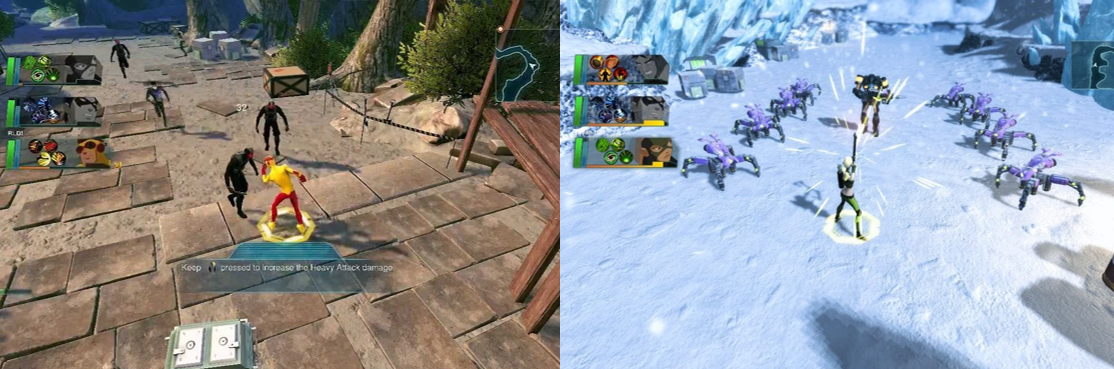
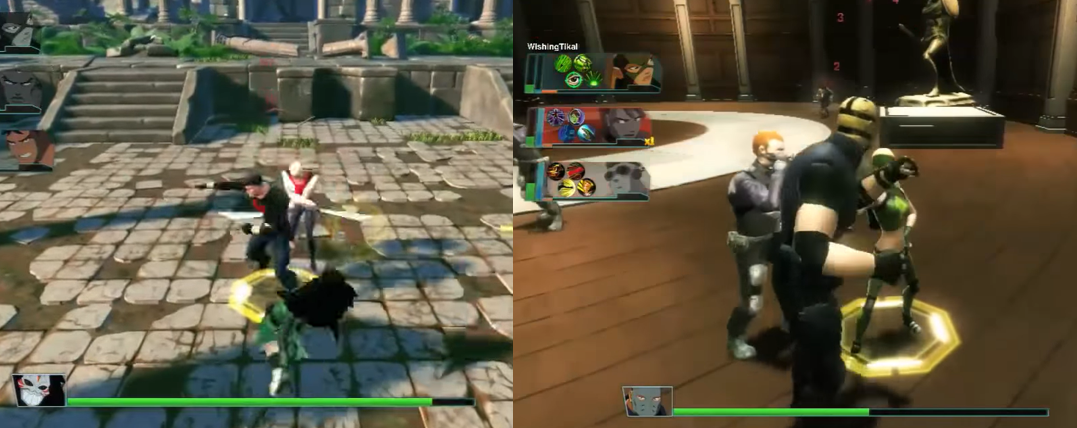
Young Justice: Legacy is a team-based beat-‘em-up with very light puzzle elements that sees players form a team of three (why it isn’t four is beyond me…) characters from a roster of twelve and fight their way through fifteen missions. If you don’t have one or two friends to play alongside, you can switch between the three characters with a press of left or right on the directional pad and, when you’re not playing as them, the computer will take over and batter any nearby enemies with a reasonable amount of competence. When selecting a team for the game’s main campaign, you’re unable to alter the story-based team leader, which can mean that you’re stuck with a character you don’t really like and limits the customisation options available to you, but that doesn’t really matter as, essentially, every single character plays the same way. Tapping X performs a light attack while pressing Y performs a heavy attack (you can also hold Y to charge this up) and you can mix up these button presses to perform a few clunky combos (although it has to be said that you can easily just run past the vast majority of the game’s enemies and not get bogged down in the monotonous combat). You can jump with A and certain characters can fly (more of a hover) with a subsequent press of A, perform an awkward dash with B that can help you move a little faster or dodge incoming attacks, hold the Left Trigger to block, and pick up and throw objects with B and X, respectively.

Combat is laborious and characters don’t really feel that different from each other.

Each character has four superpowers available to use; these are performed by holding the Right Trigger and pressing either X, Y, A , or B and can be performed as long as the blue bar on the heads-up display is full. This bar fills up over time and you’re able to pull off such ranged attacks as tossing Batarangs, shooting arrows, throwing fireballs, and blasting enemies with water, area blast attacks that may stun or knock back enemies, cast a healing spell or boost your attack, defence, and energy consumption, or freeze enemies, compel them to attack their allies, or turn your character briefly invisible. As you defeat enemies, you’ll build up your character’s “Hero Boost” meter; once it’s full, you can pull off a Hero Boost than defeats or heavily damages all onscreen enemies by holding RT and pressing the Right Bumper or build up all three characters’ bars and unleash a massive “Squad Boost” attack by holding RT and pressing the Left Bumper. Sadly, every character has the same Hero Boost attack and animation, which really limits the distinctiveness of each character beyond their individual superpowers. Combat in Young Justice: Legacy is mind-numbingly simple; as you run through painfully linear environments, you’ll be set upon by a near-endless supply of goons, all of whom might look a bit different area to area but basically attack in the same ways and can be put down with a bit of mindless button-mashing (or, as I said, avoided completely in some instances).

Combat is broken up by simple puzzles and a few tedious tasks.

Opportunities for exploration are limited; sometimes you can (and have to) smash through rock walls to access secret areas that lead to some collectibles or control panels and such but you won’t really find multiple paths through stages or areas that can only be accessed by certain characters and/or team combinations. The game also tries to mix things up with some extremely simple puzzles; these generally involve smashing something, usually a generator, activating a console to open a door, or pushing something big to activate bridges, open doors, or reach new areas. Stages are super linear but there’s a helpful mini map on screen at all times to point you in the right direction and you can look up your current objectives with a press of the ‘Back’ button but, while missions are split into three sub-missions at a time, the game’s monotony is made all the more frustrating by a serious lack of checkpoints. While you can’t pick anything up to refill your health, it will automatically refill once all onscreen enemies have been defeated and, if an ally is knocked out, you can revive them by pressing B. You can select from two difficulty settings (Normal and Hard) which, obviously make the game’s enemies a bit tougher and what-not but it can be extremely aggravating to get knee-deep into a mission only to have your health drained to nothing by instant-kill laser traps. Some stages are full of environmental hazards like this, such as flames and spikes from the floor and large statues that come to life as you progress through rooms. Other missions also prove unnecessarily frustrating, such as forcing you to clear out all onscreen enemies in a time limit (bizarrely without an onscreen timer to gauge your progress), rescue hostages, defend John Stewart/Green Lantern while health-sapping debris and waves of enemies attack you, avoid enemy-spawning search lights, smash engines or generators while avoiding missile-shooting turrets, or push forklift trucks to avoid being taken out by snipers.

Graphics and Sound:
I should stress here that I haven’t ever seen the cartoon that Young Justice: Legacy is based on but the game opts to use a variation of cel-shaded graphics to recreate the look of its source material and, for the most part, this works…unless you’re watching the game’s cutscenes. When playing the game, thanks to the skewed, top-down perspective, the lack of detail and rigidity of the character models isn’t as noticeable since you’re so focused on combat and the perspective is quite zoomed out but, when the game tells its story, characters are all very flat and kind of resemble lifeless puppets more often than not. While the main characters look fine for what they need to be, the enemies aren’t so great; you’ll fight the same goons and robots over and over, which all gets very monotonous very quickly.

Character models are okay but environments and cutscenes are a bit bland and stilted.

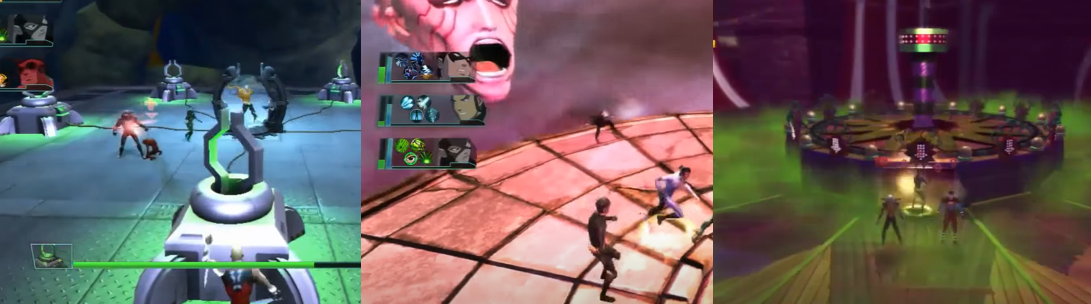
Environments are surprisingly big considering how linear and empty they are; there’s usually a lot of open room to manoeuvre and you’re rarely forced to fight down boring, narrow grey corridors. You’ll visit places like Siberia, Santa Prisca, Gotham City, and battle on LexCorp hovercrafts, all of which provide a decent amount of visual variety to the game. It’s just a shame, then, that there’s very little opportunity to explore; you can go off the beaten path but will often find only a dead end or useless boxes to smash, and there’s no opportunities to platform or utilise specific character powers outside of combat. At one point, Edward Nygma/The Riddler challenges you to solve a light-based puzzle in a neon-drenched sewer system-made-funhouse, which is quite a unique area, but there’s really not that much on display here to keep you that engaged, which only adds to the game’s repetitiveness. The music and sound effects are equally bland but, while the game appears to utilise the same voice cast from the cartoon, this is actually to its detriment; characters will spout the same quips and lines over and over again and I was about ready to snap the disc in half after hearing Dick Grayson/Nightwing moan about being “whelmed” all the damn time!

Enemies and Bosses:
A slew of generic goons will dog your progress in every mission. After playing through the first stage, you’ll basically have encountered every enemy the game has to offer as they simply get swapped out with different character models in each mission. You’ll battle teleporting, sword-wielding members of the League of Shadows, a variety of robots (Spider Bots and larger, more humanoid robots being the most common), Bane and David Hyde/Black Manta’s mercenaries, and the Riddler’s baton and shotgun-wielding goons throughout the game’s story. Things get interesting in the game’s final missions, where you’ll battle a larger mech, fight against mummies, and come up against gigantic statues that deal massive damage and get jumped by an assortment of enemies in enclosed areas.

Cheshire and Sportsmaster require a hit-and-run strategy to whittle down.

Each mission culminates in a boss fight against at least one member of the supervillain cabal known as The Light; the first mission ends with you battling Jade Nguyen/Cheshire, who teleports around the arena in a puff of smoke and throws projectiles your way but, while she’s the toughest enemy you’ll have faced at that point, she leaves herself wide open for an attack when she pauses to setup an explosive device and isn’t too difficult to whittle down as long as you keep moving, attacking, and reviving as necessary. This strategy basically applies to every boss but will become abundantly clear when you battle the second boss, Lawrence “Crusher” Crock/Sportsmaster. Sportsmaster is accompanied by a seemingly endless supply of goons, all of whom cause a massive headache when you’re trying to dodge Sprotsmaster’s health-sapping spinning and charge attacks. Thankfully, though, these enemies are finite and, if you quickly take them all out, you can focus on battling Sportsmaster using hit-and-run and ranged attacks.

Many of the bosses cannot be attacked directly and must be stunned first.

In Siberia, you’ll fight Crystal Frost/Killer Frost as Spider Bots attack you; Frost can’t be attacked head-on as she hides atop an ice column and blasts ice attacks at you, so you need to destroy her platform to knock her down and then beat on her before she can build a new one. Cameron Mahkent/Icicle Jr. takes over the ice-based duties for the next boss battle, where he teams up with Sportsmaster. You can utilise the same tactics to take out Sportsmaster and it’s best to focus on one enemy at a time; Icicle Jr. is different from Killer Frost in that he can freeze you and encases himself in an ice sphere that refills his health. After defeating them, you’re faced with a harrowing mission where you must battle through rooms of annoying enemies with no checkpoints and no refillable health as Clark Kent/Superman holds back an incoming avalanche, which was one of the most aggravating parts of the game on my first playthrough. Afterwards, in Santa Prisca, you’ll battle against Bane who, again, requires a little more strategy; when pumped full of Venom, Bane is invincible and you need to lure him into charging the nearby columns to stun him. He also busts out a big ground pound attack and can bash your brains in if you get too close for too long, so again it’s best to hit and run and use ranged attacks to whittle him down.

While you can bypass Black Manta, Psimon and Riddler require a more hands-on approach.

Next up, you’ll have a tough battle where you must disable Black Manta’s submarine; the game doesn’t make it massively clear how you do this but basically you have to fight off Black Manta’s goons and push these red bars near the large generators to overload his sub, all while avoiding his instant-kill lasers by taking advantage of the big metal shields that rotate around the arena. After that, you’ll fight Black Manta himself; make sure you avoid his massive eye beams but don’t worry about fighting him or his goons as you can simply attack and destroy the shield generators to end the fight that way. While at Haly’s Circus, you’ll have to fight through waves of enemies in a mini gauntlet before battling with Doctor Simon Jones/Psimon, who spawns in mirror versions of your team (who seem to randomly stun and defeat you without really landing any attacks) and then rains massive red energy lasers into the arena but if you simply mash the attack button, he’ll go down pretty easily. Finally, you’ll have to do battle with the Riddler, who randomly spawns bombs, poison gas, goons, and other hazards into the arena. To defeat the Riddler, simply ignore everything and attack and destroy the panels on his big circus-wheel-thing in perhaps the game’s easiest (if tedious) boss battle.

The final boss battle just goes on and on and even contains a game-breaking glitch!

The game ends with a gruelling and aggravating multi-stage fight against Klarion Bleak/Klarion the Witch Boy, Mark Desmond/Blockbuster, and the eldritch beast known as Tiamat. While Klarion and Blockbuster aren’t too difficult to best (simply lure Blockbuster into Klarion’s meteor attack to stun him and then beat on him until he goes down), the fight against Tiamat feels like it’s never-ending! In the first phase, he blasts the arena with water attacks that will basically kill you in one or two hits and he can only be damaged when he dips down into the water. In the second phase, he shoots a massive mouth laser at you and tries to swipe and squash you with his claws and fists; after avoiding his attacks, pummel the limb with everything you have until his health is drained. In Tiamat’s final phase, he flies about above you and comes crashing to the ground, unleashing a devastating series of attacks that will leave you “whelmed” in seconds. The only way to damage him is to attack the minions that spawn into the arena; after defeating two, you’ll build up your Hero Boost and you must unleash your Squad Boost to damage Tiamat, and then attack him immediately afterwards to whittle him down even more. This is easily the most frustrating boss battle in the entire game because of how tough Tiamat is; make sure to bring a healer like Zantanna Zatara or M’Gann M’orzz/Miss Martian or else you’re gonna have a bad time but be warned as there’s an almost-game-breaking glitch in this fight that can see the enemies stop spawning in, leaving you unable to finish the fight and forcing you to quit the game and try again but, thankfully, there are save points between each phase of this finale.

Power-Ups and Bonuses:
As you defeat enemies, you’ll gain experience points (XP) that will cause you to level-up; each character has different statistics that affect how much health, power, and energy that have and levelling-up allows you to increase the power and range of each character’s superpowers. You can also find crates in stages and earn “Hero Points”, which can be spent on Wayne Industries upgrades, two of which can be equipped to each character after being purchased and will increase your melee or weapon attacks, energy consumption, and a host of other stats. Thankfully, these Hero Points seem to be shared amongst every character; so, if you have ten Hero Points, you can spend them upgrading Tim Drake/Robin’s superpowers and then switch out to Kaldur’ahm/Aqualad and spend the same ten Hero Points upgrading him, too. Sadly, though, there are no pick-ups on offer; yes, you can pick up and throw boxes and barrels and such, but you can’t pick up weapons or power-ups during gameplay, making smashing all those boxes pretty pointless.

Additional Features:
Young Justice: Legacy comes with forty-eight Achievements for you to earn; many of these pop simply by playing the main campaign and defeating a certain number of enemies, the game’s bosses, and finishing the game on Normal or Hard. You can also snag some G by destroying crates, finding collectibles, or playing the game in co-up but there are also some stage-specific Achievements, such as avoiding searchlights in the Gotham City docks and solving a puzzle in a certain way. Every stage in the game has a few collectibles to find; these include dioramas, additional costumes for the game’s characters, and journals left behind by Roy Harper/Red Arrow. Playing through the campaign on Normal and Hard will see you unlocking additional characters, which is always nice, and there are four additional characters available to purchase as downloadable content if you like the sort of thing. Also on offer are an array of challenges; while these can only be played in single-player, these will pit you against ten waves of enemies that progress in difficulty, or have you battling against a time limit and you’ll unlock additional challenges and stages by playing the story mode. You can also view character biographies, concept art, and take part in a quiz that will test your knowledge of the cartoon to earn points.

The Summary:
I wasn’t expecting much from Young Justice: Legacy except some mindless, arcade-style beat-‘em-up action; I’ve played team-based, top-down fighters like this before and been perfectly satisfied with them but I have to say that this game is just a repetitive, tedious, aggravating experience from start to finish. There’s a decent amount of characters on offer and some of them have more appeal than others, but they all essentially play exactly the same way. Since they lack character-specific super moves, you may as well just pick anyone and it’s ridiculous how you can just run past enemies to progress or simply look away from the screen and mash the X button to win. There’s very little actual skill or intelligence needed for this game, which would be fine if it was actually fun but it really isn’t; it’s dull and down-right infuriating at times, with some bland bosses, linear and empty stages, and very little incentive to replay the game beyond mopping up any missed Achievements.

My Rating:

Rating: 1 out of 5.

Terrible

Have you ever played Young Justice: Legacy? If so, what did you think to it? What character and team combination was your favourite? What did you think to the combat and gameplay and which of the game’s missions and bosses was your favourite? Were you a fan of the cartoon and, if so, do you think the game did a good job of recreating the action and energy of the show? Would you like to see more videogames based on Young Justice and/or the Teen Titans? Feel free to share your thoughts on Young Justice: Legacy, and Young Justice, down in the comments.

Back Issues [Crossover Crisis]: The Uncanny X-Men and The New Teen Titans


In April 1985, the first issue of the ground-breaking Crisis on Infinite Earths (Wolfman, et al, 1986) released and saw the temporary destruction of the “Multiverse”. To celebrate this momentous event, I’m discussing multiversal crossovers all throughout April in an event I dubbed “Crossover Crisis”.


Story Title: “Apokolips… Now!”
Published: January 1982
Writer: Chris Claremont
Artist: Walt Simonson

The Background:
As I’ve mentioned on a couple of occasions, DC Comics and Marvel Comics have had a surprisingly collaborative and amicable relationship over the years that has led to some inter-company friendships, homages, and co-publications between the two comic book giants. By 1982, both Marvel’s Uncanny X-Men and DC’s Teen Titans were seeing a resurgence in popularity thanks to both teams featuring an exciting new creative and character line-up. Over in Marvel Comics, writer Chris Claremont had revitalised Marvel’s Mutant team by introducing a group of diverse and multi-cultural new characters while the New Teen Titans, under the pen of Marv Wolfman, had been aged up and also included some of the title’s most synonymous characters. With so many similarities between the two teams, and considering the success of the two titles were selling at the time, a crossover between the two was a smart business move for both parties.

The Review:
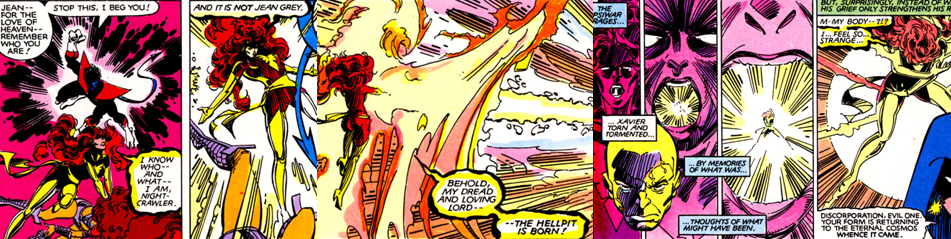
“Apokolips… Now!” begins at the Source Wall, an impossibly large stone wall that represents the edge of the known universe and which is comprised of the legendary Promethean Giants, who were turned to stone for trying to breach the boundaries of the cosmos. There, we find Metron, the generally impartial intellectual of the New Gods, conversing with all-mighty Darkseid, who gifts him with the “Omega-Phase Helmet”, a highly advanced crown that allows Metron’s Mobius Chair to achieve the impossible and penetrate the great stone wall in order for them both to achieve their heart’s desire (Metron for knowledge and Darkseid for power).

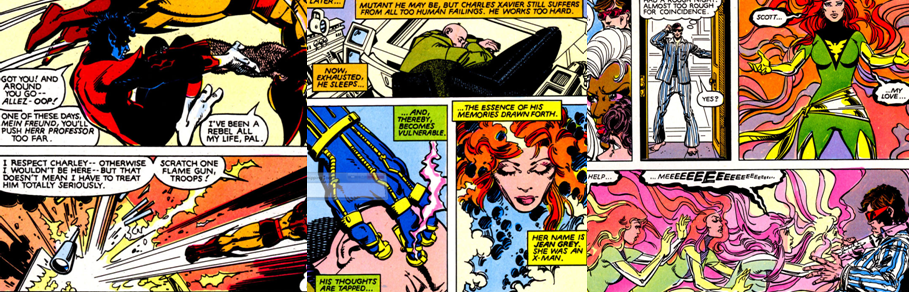
A normal day at the X-Mansion is interrupted by a vision of Jean.

The story then jumps to Westchester, New York where Professor Xavier’s X-Men are engaging in a training session within the Danger Room, an exercise that grates on Logan/Wolverine’s patience despite his respect for the professor. After impressing Xavier with their teamwork, the Mutants retire for dinner and the story takes the opportunity to catch us up not only with the current X-Men roster and their powers (the aforementioned Wolverine, Scott Summers/Cyclops, Ororo Munroe/Storm, Piotr “Peter” Rasputin/Colossus, Kurt Wagner/Nightcrawler, and Kitty Pryde/Shadowcat) but also the tragic rise and downfall of Jean Grey, who attained incredible cosmic powers as the Phoenix that eventually corrupted and consumed her. The X-Men’s memories of Jean are extracted by Darkseid and the Phoenix briefly assumes a corporeal form where she begs for help from Cyclops much like Barry Allen/The Flash did in Crisis on Infinite Earths.

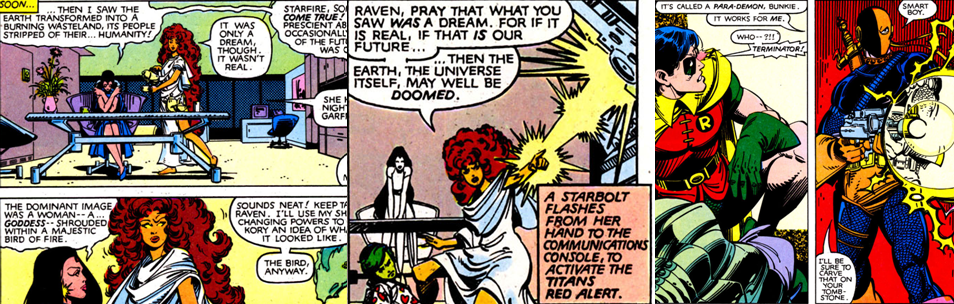
Raven and Starfire are spooked by Phoenix while Robin is jumped by Deathstroke!

Meanwhile, over at Titans Tower (yes, in this story, the Marvel and DC universes again exist in a shared world rather than being separate, parallel worlds), Rachel Roth/Raven of the New Teen Titans finds her dreams interrupted by a prophetic nightmare of a woman, taking the shape of a flaming bird, destroying their world. When Garfield Logan/Changeling assumes the form of a similar bird, Koriand’r/Starfire randomly loses control of herself and attacks him; well aware of the threat that the Phoenix poses, Starfire summons the remaining members of the team (Wally West/Kid Flash, Donna Troy/Wonder Girl, and Victor Stone/Cyborg) away from their procrastinations, personal lives, and crimefighting antics to bring them up to speed on the Phoenix’s destructive power. Dick Grayson/Robin, however, is kept from joining his team mates when he butts heads with one of Darkseid’s Parademons only to be attacked by Slade Wilson/Deathstroke the Terminator, who not only reveals that he’s in cahoots with Darkseid but is easily able to knock Robin unconscious thanks to his superior physical and mental abilities. The X-Men discover that Jean’s parents and other areas across the world have also witnessed visions of Jean and mysterious incidents all linked to Jean’s past. After locating Robin, Starfire relates Phoenix’s legend as the “chaos-bringer” and a cataclysmic force; although Robin points out that cosmic threats are a little out of their league, and the more pressing issue of Deathstroke’s current plot, he promises Starfire that they’ll do everything they can to track down and stop Phoenix. The story then introduces us to Ravok the Ravager, another of Darkseid’s henchmen who he recruits as part of his plot to siphon the Phoenix’s vast cosmic powers.

Both the X-Men and Teen Titans are captured with a ridiculous amount of ease.

Weary from pushing himself too far, Xavier enters a deep sleep and barely has enough time to defend himself when Starfire bursts into the X-Mansion and attacks him in a rage. Xavier’s unparalleled psychic powers are subdued by a combination of Cyborg’s ultrasonic blasts and Raven’s dark “Soul-Self”, however Robin is disturbed and irritated at his team’s recklessness in breaking into the mansion and attacking Xavier without provocation. His reprimanding is interrupted by the arrival of Ravok and his Shock Commandos, who storm the mansion looking for the X-Men but quickly adapt to defeat and kidnap all of the Teen Titans but Changeling, who follows along undetected. While investigating New Mexico, the X-Men comes across Deathstroke and one of Darkseid’s “Psi-phons”; although they easily destroy the Psi-phon and are able to fend off the Parademons, Deathstroke quickly recovers from Wolverine’s initial attack to take each of the Mutants out with a “fear ray” that grounds Storm, a “toxi-grenade” that renders Shadowcat, Nightcrawler, and even Wolverine unconscious while a Parademon blasts Cyclops, and overpowers even Colossus’ hulking metallic form. Deathstroke and Ravok bring their captives to all-mighty Darkseid, who waits at the Source Wall and immediately sees through Changeling’s deception to subdue him, and then kills Ravok for his ineptitude with his destructive “Omega Beams”.

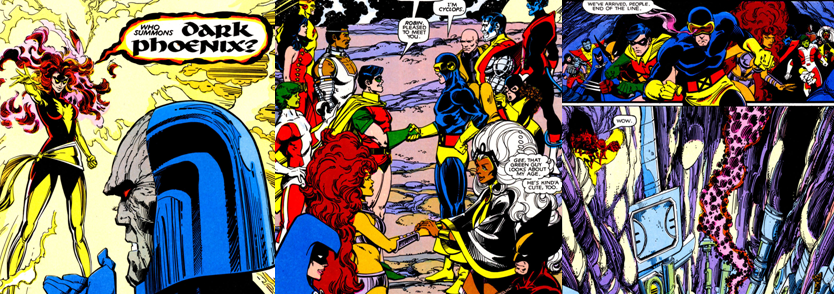
Darkseid summons Dark Phoenix but the heroes quickly join forces to confront the New God.

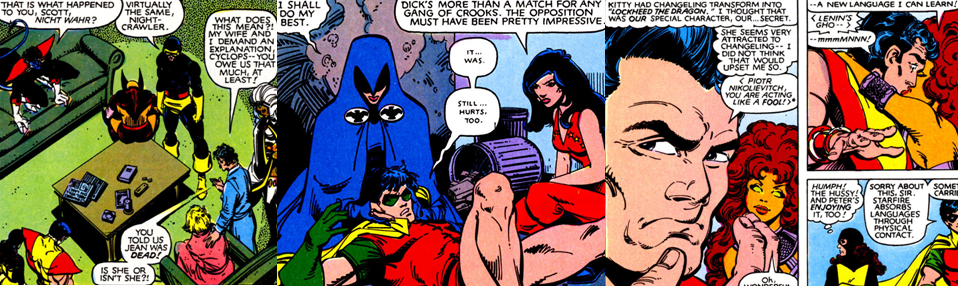
Darkseid secures his captives to a gigantic machine, the “Psychon-Wave”, which painfully and forcefully draws upon their superhuman powers and the Mutants’ memories of Jean, concentrating them on the breach in the Source Wall to bring Dark Phoenix back to life. He then regales the inquisitive Changeling with the reason for this plot (basically, he wants to use the Phoenix to transform the Earth into a new Apokolips that will allow him to conquer first New Genesis and then the length and breadth of reality itself). Hungry for destruction, Phoenix willingly accompanies Darkseid through a Boom Tube to begin this plot but, quite ludicrously, the heroes’ restraints disappear when Darkseid departs! Freed from captivity, the Teen Titans and the X-Men immediately agree to work together to stop Darkseid and Phoenix despite Wolverine not being happy about working with kids. While Shadowcat tries to flirt with Changeling and Kid Flash comments on the diversity of the X-Men, Cyborg, Xavier, Starfire, and Cyclops locate and acquire the Mobius Chair, which Shadowcat and Changeling accidentally activate to provide them with a means of escape. Tensions are stirred when Colossus sees Shadowcat flirting with Changeling and when Starfire kisses Colossus in order to learn Russian, but the team are soon carried back to New York in order to fulfil Cyclops’ solemn vow to make Darkseid pay for violating Jean’s memory and peace. They follow Phoenix’s unique psychic trail to a series of underground tunnels beneath the city where they are attacked by Deathstroke’s Parademons once more. Rather than waste time in a pointless battle, Robin and Cyclops give the order to collapse the tunnel and blast an escape route for their two teams, which conveniently brings them out right at Darkseid’s main base.

Dark Phoenix threatens the Earth’s safety so is subjected to a psychic attack.

Impressed at the tenacity of his foes, Darkseid dispatches Deathstroke and Dark Phoenix to hold the two groups off while he complete his work; although Starfire attacks Dark Phoenix in a fury, her starbolts succeed only in further empowering the corrupted Jean, who vehemently resists Nightcrawler’s attempts to reason with her and equally overwhelms even Raven’s Soul-Self. Dark Phoenix then powers up Darkseid’s “Hellpit” and Darkseid boasts about how this will transform Earth into Apokolips within mere minutes. Interestingly, he actually offers the X-Men and the Teen Titans the opportunity to yield and join his cause, which isn’t something I’ve ever seen Darkseid do before, but Shadowcat and Changeling opt instead to use their powers to try and disrupt and destroy the technology powering the Hellpit. For their insubordination, Darkseid commands Dark Phoenix to destroy them but they are saved at the last second by the combined power of Raven, Xavier, and the Mobius Chair. After Cyclops subdues Deathstroke and Robin spirits Shadowcat and Changeling out of danger, Dark Phoenix is bombarded by a psychic assault that simultaneously drains her rage and hatred and overwhelms her with love and affection.

Darkseid is defeated when the Phoenix Force is unleashed against him.

Drained, and close to unravelling, Dark Phoenix is easily goaded into reabsorbing the blast she fired at the Earth to sustain herself. When Darkseid moves to intervene, he is assaulted first by Kid Flash and then the combined forces of Cyborg, Wonder Girl, Colossus, and Starfire, who force his Omega Beams back into his eyes and therefore keep him from stopping Dark Phoenix from empowering herself and thus sparing the Earth. However, still at risk from being consumed by her raging power, Phoenix heeds Darkseid’s advice to focus her energies through a physical form and bonds herself to Cyclops. This, however, proves to be her undoing as Cyclops channels her powers with his undying devotion to his lost love and then turns the full Phoenix Force against Darkseid. The chaotic, flaming energy blasts itself, and Darkseid, across the vast cosmos of the universe to return to the Source Wall and thus imprison the New God within the Wall alongside the doomed giants of yore. Victorious, the two teams revel in how close they came to being destroyed and how fantastic their triumph was, while Scott finds some solace in Storm’s suggestion that Jean’s good soul ultimately saved them in the end. Finally, Metron returns to his chair and bids farewell to the imprisoned Darkseid, commenting that everything has returned as it once was as is to be expected.

The Summary:
“Apokolips…Now!” is quite the chaotic story; considering how many characters it has to juggle, it’s honestly surprising how coherent the story ends up being. If there’s one thing that always puts me off about team-based comics, especially X-Men and the Teen Titans, it’s the sheer abundance of characters and lore a single issue has to deal with so to mash the two together is no mean feat. The result is that no one single character from either team really gets any focus; indeed, many of the characters have next to nothing to do and the focus is, instead, on the meeting of the two teams rather than a bunch of separate interactions between them.

There are a lot of characters who don’t always get time to shine and whose interactions are limited.

This is best seen in the fact that neither Robin or Cyclops get much of a chance to act as a field leader; Nightcrawler is basically a non-factor, and Wonder Girl may as well not be there. Sure, most of the characters are assumed to be busy in fisticuffs with the Parademons and the Shock Commandos but we don’t really get to see much of this. Indeed, we’re even denied a proper fight involving Deathstroke; he takes out Robin with a ridiculous amount of ease, subdues all of the X-Men largely single-handedly, and his fight with Wolverine all takes place off-panel! These days, I like to believe that you’d never see that happen given how prominent Deathstroke and Wolverine are but, in this, Deathstroke is little more than one of Darkseid’s minions who gets taken out pretty quickly to continue the focus on Dark Phoenix. Indeed, Jean’s presence gets more play here than a lot of the other characters; her death was still relatively new at the time and hadn’t been driven into the ground yet so her reappearance is a particularly emotional moment for the X-Men, particularly Cyclops. However, while it’s pretty cool to see Dark Phoenix enamoured with Darkseid and willing to commit global destruction on his behalf, it’s not really enough to elevate this story for me.

While the art is great, the story is just okay and wastes a lot of potential.

I’m not entirely sure where Metron went or what happened to him when he breached the Source Wall and Darkseid’s plot basically boils down to every other plan he has (he’s either seeking out the Anti-Life Equation or trying to conquer the universe, it seems) and, again, he really doesn’t do all that much. This isn’t entirely out of character for Darkseid, who typically allows his underlings to do his work for him, but it’s kind of weird to see him team up with Deathstroke. Like…did Darkseid pay Slade off? I can’t help but feel Trigon might have been a more suitable villain for the New God to ally with. Overall, it’s a pretty decent tale; we don’t get to see the X-Men and the Teen Titans facing off against each other (the closest we get to that is when the Teen Titans attack a weakened Xavier), which is a shame, but it’s fun seeing the teams co-operate. There’s a little tension in the brief Colossus/Shadowcat/Changeling “love triangle” but that’s about all the dissention we get; I would have liked to see how Robin and Cyclop’s leadership styles differ and more interactions from Kid Flash, Wolverine, Wonder Girl, and Storm. Instead, the comic is all about the spectacle of seeing these different comic publisher’s heroes and villains interact in as unspectacular a way as possible. A fun adventure, to be sure, but maybe a little too “safe” and it could very easily be any one of a hundred other X-Men or Teen Titan stories with a few tweaks…but at least the artwork is good.

My Rating:

Rating: 2 out of 5.

Could Be Better

Have you ever read The Uncanny X-Men and the New Teen Titans? If so, what did you think to it? Do you own a copy of the original comic or do you remember reading it when it was first published? Were you disappointed that the two teams didn’t come to blows or were you happy to see them just working together with no issues? Would you have preferred to see different characters in each team’s line-ups? What did you think to Darkseid’s plan and the return of Dark Phoenix? Would you like to see the X-Men interact with Marvel heroes again in the future and, if so, what stories would you like to see? Whatever your thoughts on The Uncanny X-Men and the New Teen Titans, and comic book crossovers of this kind, drop a comment down below and check back next Wednesday for the final instalment of Crossover Crisis.

Movie Night [Robin Month]: Teen Titans: The Judas Contract


In April of 1940, about a year after the debut of arguably their most popular character, Bruce Wayne/Batman, DC Comics debuted “the sensational find of [that year]”, Dick Grayson/Robin. Since then, Batman’s pixie-boots-wearing partner has changed outfits and a number of different characters have assumed the mantle as the Dynamic Duo of Batman and Robin have become an iconic staple of DC Comics. Considering my fondness for the character and those who assumed the mantle over the years, what better way to celebrate this dynamic debut debut than to dedicate every Sunday of April to celebrating the character?


Released: 4 April 2017
Director: Sam Liu
Distributor: Warner Home Video
Budget: Unknown
Stars: Sean Maher, Kari Wahlgren, Stuart Allan, Christina Ricci, Gregg Henry, and Miguel Ferrer

The Plot:
Dick Grayson/Nightwing (Maher) rejoins his old team mates, the Teen Titans, who are now training a new generation of costumed heroes. Alongside their newest recruit, Tara Markov/Terra (Ricci), the Titans work to end the maniacal aspirations of Sebastian Blood/Brother Blood (Henry). However, things escalate when Blood hires mercenary Slade Wilson/Deathstroke (Ferrer) to kill the Titans and the team are faced not only with Slade’s burning desire for revenge against them but also a very real threat from within their ranks.

The Background:
The Teen Titans first came together in the pages of The Brave and the Bold #54 in 1964, some four years after the debut of their adult counterparts, the Justice League of America. The team was comprised entirely of the teenage sidekicks of DC Comic’s adult superheroes, potentially to appeal to younger audiences. The team had a relatively consistent presence throughout the 1960s and 1970s but was given new life when writer Marv Wolfman and George Pérez, who introduced characters like Victor Stone/Cyborg and Princess Koriand’r/Starfire who would become synonymous with the team for years to come. One of the team’s most celebrated stories was “The Judas Contract” (Wolfman, et al, 1984) in which they were betrayed by one of their own thanks to the machinations of the vindictive Deathstroke. An animated adaptation had been in the works for some time but, after a few false starts, finally came to life as part of the DC Universe Animated Original Movies series. The film, which was the third in this new animated continuity of films and iconic actor Miguel Ferrer’s last role before his untimely death, made over $3,250,000 in home video sales and was modestly received compared to what had come before it.

The Review:
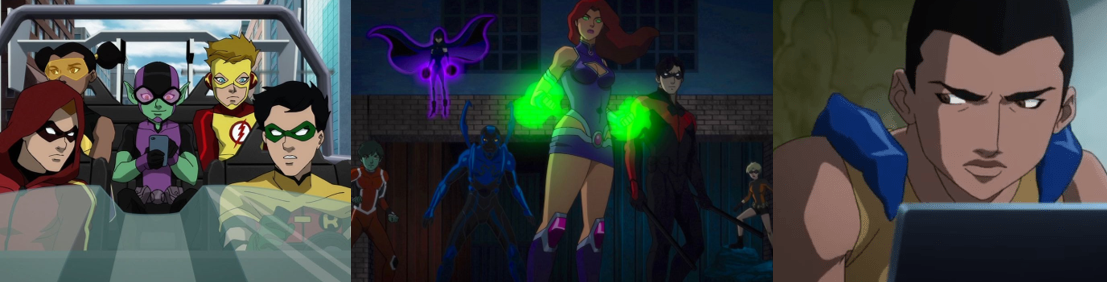
The film begins with the original incarnation of the Teen Titans – comprised of Dick Grayson/Robin (Maher), Wally West/Kid Flash (Jason Spisak), Roy Harper/Speedy (Crispin Freeman), Garfield Logan/Beast Boy (Brandon Soo Hoo), and Karen Beecher/Bumblebee (Masasa Moyo) – meeting Starfire (Wahlgren) for the first time. If you’ve watched the awesome Teen Titans (2003 to 2006) cartoon before then many of the Titans’ characterisations will be instantly familiar: Robin is the composed leader, Beast Boy is the comic relief, Kid Flash is impatient, and so forth. This version of Starfire, while still being somewhat naïve and innocent, is far less childish compared to her counterpart; however, she nevertheless forms an immediate bond with the team after learning to communicate through kissing.

After a random flashback, we rejoin the Teen Titans adjusting to their new team dynamic.

We then jump ahead to “NOW” to find Brother Blood and his lover and right-hand, Mother Mayhem (Meg Foster), packing up their most recent Hive base. Choosing to ignore Deathstroke’s warning, the cult are caught completely off-guard when the Titans – now made up of Nightwing, Starfire, Beast Boy, Rachel Roth/Raven (Taissa Farmiga), Jaime Reyes/Blue Beetle (Jake T. Austin), Damian Wayne/Robin (Allan), and newcomer Terra – break into the facility using Terra’s power over earth and rock. Nightwing, who has only recently rejoined the team, finds it difficult adjusting to the new dynamic, which places Starfire as the field commander, but his experience and combat strategies are nevertheless appreciated by Starfire and his older teammates. There is, however, some discord within the team; not only are Nightwing and Starfire a little distracted by their intimate relationship outside of the team but she doubts her place as the team’s leader (despite Robin approving of her) and Robin constantly clashes with Blue Beetle over the unpredictability of Jaime’s alien Scarab suit. Still, the team takes out Blood’s goons and reconvenes at Titan Towers, where their teamwork and interpersonal relationships are developed a little more. Damian continues to have a somewhat disconnected and abrasive personality and remains fully committed to his role as Robin (he’s the only member to never appear outside of his costume during the film) and, interestingly, the film makes a subtle allusion to unpredictability of the Scarab to puberty during Jaime’s video call with his parents (Maria Canals-Barrera and David Zayas, respectively) and his interactions with a young girl he is attracted to that helps to highlight how, despite their superpowers or physical abilities, the Teen Titans remain just that: troubled teenagers trying to find their place in the world.

Blood is a twisted zealot who hires Deathstroke to capture the Titans and fuel his desires for Godhood.

Brother Blood is a ruthless zealot of a man; having organised Hive into a cult-like following, he believes that he has the gift of foresight and is fully willing to kill any who blasphemes against his beliefs. Regularly bathing in the blood of his enemies to maintain his youth and vigour and with a penchant for hanging out in graveyards, Blood has constructed an elaborate machine that is powered by the lifeforce of those connected to it that he plans to use to absorb the Titans’ superpowers and abilities to become a demigod. To that end, he hires Deathstroke to deliver the Titans to him, a task he takes great pleasure in given his past history with Damian and has prepared for by augmenting his already-impressive physical abilities by regularly bathing in a Lazarus Pit.

Deathstroke manipulates Terra into infiltrating the Titans to get revenge on Robin.

Terra constantly feels underappreciated by the team and perturbed by Beast Boy’s constant attentions and remains dismissive and bitter towards their personalities, hobbies, or issues. Aggressive and snappy, Terra has little interest in helping others in a way that doesn’t involve busting heads with her powers and is weary of the team’s constant attempts to reach and befriend her. Tormented by memories of her life in Markovia, where she was beaten and hounded and accused of being a witch, Terra has grown angry at and resentful towards humanity and has no interest in serving it for the greater good. Thus, she willingly infiltrates the team on Deathstroke’s behalf and allows him to capture Damian for Blood. Terra is absolutely besotted with Deathstroke after he saved her life in Markovia prior to the start of the film; devoted to him, she sees him as more than a mentor and father-figure and constantly attempts to seduce him in some truly awkward scenes that have her dressed in an overly provocative outfit. Although he rebukes her advances, he nevertheless commands her complicit behaviour by promising that they’ll be a couple and take command of the League of Assassins once the contract is fulfilled. Thus, begrudgingly, she returns to Titans Tower, now equipped with an audio/visual link up to Deathstroke, to continue her subterfuge. Though her anti-social personality begins to crack when she sees just how appreciative they are of her and she even shares a kiss with Beast Boy, she nevertheless lures each of the Titans into a series of traps that lead to them all being captured by Deathstroke and placed in Blood’s machine.

The Nitty-Gritty:
Teen Titans: The Judas Contract shares the same quasi-anime, stilted animation as other DC Universe Animated Original Movies. Still, the animation and visual presentation is made more appealing due to the aesthetic distinctiveness of each of the Titans and their individual powers. Raven, for example, exudes dark, ethereal magic while Beast Boy cycles between a variety of amusing animal forms as part of his somewhat awkward and hyperactive personality. Unfortunately for me, many of the Team’s appearances are taken from their New 52 designs, meaning that Nightwing is wearing his awful red suit; however, Deathstroke more than makes up for this with his bad-ass outfit that is only made all the more intimidating thanks to Ferrer’s distinctive gravely tones. The voice acting, in general, is really good, actually; Stuart Allan is particularly great at capturing Damian’s dickish attitude, I’ve always had a soft spot for Christina Ricci (and it’s great to see her voicing Terra rather than someone more cliché, like Raven), and (though I’m not really his biggest fan) the film even includes a brief cameo by Kevin Smith.

Terra’s abrasive attitude cracks but she remains loyal to Slade … right up until he betrays her.

Having the reveal of Terra’s dual nature quite early into the film makes for a great bit of suspense as we see her emotionally and physically manipulate each of the Titans into Deathstroke’s traps. The relationship between Terra and Slade has always been an unnerving and disgusting one full of appalling sexual subtext and this remains largely prevalent in the film as Deathstroke manipulates Terra’s motions in order to craft her into the perfect double agent. Even though Damian, with his unique insight into both Deathstroke and the League of Assassins, attempts to reach her, Terra is ruled by her bitterness and anger and is thus completely blindsided when Deathstroke betrays her in order to fully deliver on his contract with Blood.

Ultimately, Terra shows her true colours and sacrifices herself to stop Blood and Deathstroke.

In the finale, Nightwing frees his friends thanks to faking his death at Deathstroke’s hands and interrupting the party. Still, Blood is able to absorbs most of the Titans’ powers, which transforms him into a demonic creature and makes him more than a match for Starfire, Beast Boy, Raven, and Blue Beetle while Nightwing and Robin attack Deathstroke head-on in easily the film’s most impressive fight scene. Despite his near-unstoppable new powers, the Titans are only able to overcome Blood when Raven unleashes the full extent of her supernatural powers to strip him of his abilities and render him helpless, though Mother Mayhem kills Blood before he can be brought into the Titans’ custody. At the same time Terra, enraged at Deathstroke’s betrayal, mercilessly attacks and kills him with her incredible powers by bringing the entire area down him. Unable to live with her betrayal and pain, she then destroys the entire temple, taking herself along with it in recompense for her actions but, while Beast Boy is left heartbroken, the team honour their former comrade as a Teen Titan to the end.

The Summary:
As an adaptation of the source material, Teen Titans: The Judas Contract does the best that it can in its limited time; obviously, the story has been changed a little, the team is almost completely different, and even Deathstroke’s motivations are very different compared to in the original story but a lot of this is to be expected from the adaptation process. The film’s main concern seems to be with telling another story in the  DC Universe Animated Original Movies series; however, while it might be beneficial to have seen Justice League vs. Teen Titans (Liu, 2016) for a bit of additional context, it works pretty well as a standalone story. I do question why the film went to the effort of including a prelude where an almost completely different version of the team first meets Starfire as this doesn’t really tie into the main story (maybe it would’ve been better to have the older team be comprised of grown-up versions of the characters seen in the prelude) and I also feel like the story might have been better served by removing Brother Blood completely and instead focusing on Deathstroke and his vendetta against the Titans as the primary antagonist. Still, it’s a decent enough animated venture and adaptation of the seminal storyline, with some engaging action and intriguing character beats and some great vocal work from Allan, Ricci, and the late, great Miguel Ferrer especially.

My Rating:

Rating: 3 out of 5.

Pretty Good

Did you enjoy Teen Titans: The Judas Contract? Were you a fan of the changes that the film made to the story and the new team line-up? Have you ever read the original comic book the film is based on and, if so, where does it rank for you amongst other Teen Titans stories? Who is your favourite Robin and how are you celebrating the Boy Wonder’s debut this month? Whatever your thoughts on this film, Teen Titans, and Robin, leave a comment below and thanks for joining me for Robin Month!

Back Issues [Crossover Crisis]: Batman vs. The Incredible Hulk


In April 1985, the first issue of the ground-breaking Crisis on Infinite Earths (Wolfman, et al, 1986) released and saw the temporary destruction of the “Multiverse”. To celebrate this momentous event, I’m discussing multiversal crossovers all throughout April in an event I dubbed “Crossover Crisis”.


Story Title: “The Monster and the Madman”
Published: September 1981
Writer: Len Wein
Artist: José Luis García-López

The Background:
Although the two companies both publish stories of colourful, superpowered heroes in a cut-throat industry, the relationship between DC Comics and Marvel Comics has been surprisingly collaborative and amicable over the years (especially compared to many of the toxic “fans” who argue on social media every day…) Sure, there’s been lawsuits and underhanded tactics from both companies, but not only were the legendary Stan Lee and the disreputable sham Bob Kane actually good friends but both companies borrowed from and inspired each other and they’ve even collaborated on many joint publications in the past. Having already pitted Clark Kent/Superman against Peter Parker/Spider-Man in Superman vs. The Amazing Spider-Man: The Battle of the Century (Conway, et al, 1976), DC and Marvel brought these two characters together again in 1981. That same year, the two companies also produced a sixty-four-page “Treasury Edition” comic book that pitted Bruce Wayne/Batman against Doctor Bruce Banner/The Hulk. At the time, graphic novels were nowhere near as commonplace as they are today and both characters were experienced a way of renewed mainstream interest off the back of a popular television series and moving away from the camp aesthetic of the 1960s, respectively. Like many of these early DC/Marvel crossovers, Batman vs. The Incredible Hulk can fetch a pretty high price these days, and it also wouldn’t be the last time that their paths crossed in one form or another.

The Review:
One of the most reliable constants of many comic books, especially back in the 1960s through to the mid-1990s, was that many stories derail or pad out their narrative with a recap of their character’s origins and background. This seems to mostly happen to Spider-Man, who often interrupts whatever problem he’s having in the issue to recap his iconic origin and, don’t get me wrong, I get why this happens (you can’t expect every reader to be familiar with your characters, after all) but I much prefer it when comics simply have a bit of text before the story to catch readers up. Batman vs. The Incredible Hulk opts for this latter option and is all the better for it; before the story starts, we get a one page, two-column spread the recaps how Bruce Wayne saw his parents shot and trained his body and mind to become Batman and how Dr. Banner was bombarded with Gamma radiation and subsequently transforms into the rampaging Hulk whenever stressed or angry. Like Superman vs. Spider-Man, Batman vs. The Incredible Hulk begins with a prologue that establishes the villains of the story; the first is more of an abstract introduction as people all over Gotham City suffer from horrific and disturbing nightmares while the second is far more tangible as is shows that the Joker is back in town and has joined forces with a disembodied voice for nefarious reasons. The story then shifts to find Banner, under the pseudonym of “David Banks”, working a menial job for Wayne Research in order to get close to their “experimental Gamma-Gun”, and who is the only person to act fast enough to slip into a radiation suit and avoid the Joker’s debilitating laughing gas when the Harlequin of Hate and his goons show up to steal that same device!

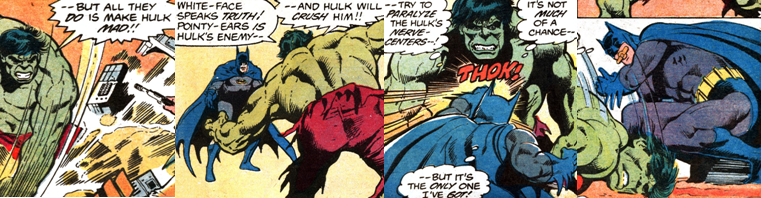
Outmatched against the Hulk’s sheer power, Batman out-thinks the brute to take him down.

When Banner moves to raise the alarm, he is tackled and beaten by Joker’s thugs which, of course, causes him to transform into the Hulk! Quickly realising that their firepower is absolutely useless against the creature, the Joker orders his men to grab the Gamma-Gun and flee but their escape is impeded by the sudden arrival of the Batman! Unfortunately for Batman, the Joker immediately takes advantage of the Hulk’s child-like demeanour to convince the Green Goliath that Batman is his enemy and thus the two engage in fist fight! Batman initially holds back from confusing and potentially further antagonising the Hulk but finds his attempts to paralyse his foe by striking his nerve centres fruitless. Unable to harm the Hulk, Batman tries to keep his distance and out-think the creature and almost gets his spine snapped as a result! Batman is finally able to subdue the Hulk, however, by forcing him to breathe in a big lungful of his special Bat-gas but, though the Hulk is finally toppled, the Joker escapes with the Gamma-Gun. Batman returns to the facility as Bruce Wayne and immediately enlists the services of the grief-stricken Banner in the construction of a replacement Gamma-Gun.

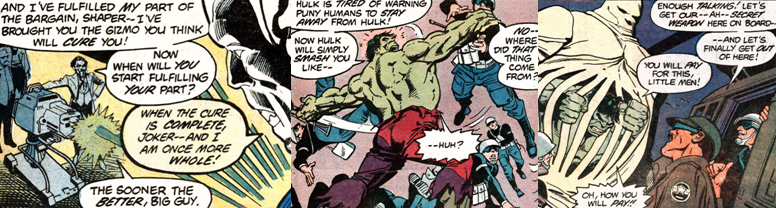
The Joker and the Shaper conspire to capture the help using fake soldiers.

Back at the docks, the Joker activates the Gamma-Gun and allows his newfound friend, the Shaper of Worlds, to partially manifest in the real world and give us all a run-down on his origin as a parasite who feeds upon the dreams of others and bring them to life. He’s struck a bargain with the Joker (whose insane mind makes him “unique in all the universe”) to help restore the Shaper’s failing abilities, though exactly what the Joker is getting out of this deal is left unclear (and it is heavily implied that the Shaper scares even the Joker!) While Batman hits up Gotham’s underworld in search of the Joker, Banner finds the stress of his assignment putting him on edge. Although he’s briefly calmed down by a cup of Alfred Pennyworth’s tea, he continues to push himself without food or proper rest. Thus, when the Joker’s men arrive disguised as military officials charged with arresting Banner, it isn’t long before he turns green once again. When a specially-designed taser-rifle fails to have the desired effect on the Hulk, a massive blob-like creature enters the fray. Despite the Hulk’s increasing rage and best attempts, the creature is effectively able to absorb and contain the Hulk and spirit him away and Batman arrives in time only to hear Commissioner Jim Gordon receiving confirmation from General Thaddeus “Thunderbolt” Ross that the soldiers were fakes. Back at the Joker’s warehouse, the Hulk goes on a rampage when he hears the Clown Prince of Crime’s plan to revert him to Banner in order to make adjustments to the Gamma-Gun; despite the Shaper’s best efforts to quell the beast’s rage, both he and the Hulk are tormented by disturbing nightmares that leave the two physically and emotionally drained. Bored by the conflict, the Hulk flees but the Shaper comes to the conclusion that the crippling pain and madness his condition brings him can be cured not by the Gamma-Gun…but by the Hulk himself thanks to his unique Gamma properties and orders the Joker to recapture the beast. To facilitate this, the Joker explains the bind he’s in to Batman and enlists his aid, which soon leads to a second confrontation between the two characters. Bored of Batman and being constantly hounded by “puny humans”, the Hulk chooses to flee but a fight soon inevitably breaks out.

Despite his vast cosmic powers, Batman is able to trick the Joker into leaving himself vulnerable.

Once again, Batman chooses to fight smarter rather than harder, rolling with and doing everything he can to avoid or survive the Hulk’s attacks while trying to talk sense into the increasingly-enraged Hulk. Batman’s tricks result in the Hulk demolishing the building the two were fighting in and once again fleeing in order to be left in peace. Batman is finally able to get through to the Hulk by posing as a harmless old blind man and offering the creature his friendship, which calms the Hulk enough to the point where he willingly goes along with the Joker to confront the Shaper. However, angered that the Joker is willing to let the Hulk face this foe alone, Batman slaps his archenemy down and finally joins forces with the Jade Giant to battle a legion of their enemies brought to life by the Shaper’s powers. Finally on the same page, the two are easily able to overcome the living nightmares and fight their way to the Shaper, who holds them at bay with an impenetrable barrier. Angered at the idea of anything being stronger than he is, the Hulk charges ahead at full speed and exhausts his Gamma energy, reverting to Banner and curing the Shaper. Despite Batman’s pleas, the Shaper honours the bargain he made with the Joker and, having been cured, bestows the Joker with “limitless, infinite power”. Effectively acting as a genie for the Joker, the Shaper makes all of the Joker’s wishes come true, transforming him into a God-like jester who unleashes chaos and madness throughout Gotham City and uses his reality-warping powers to shape the city, its people, and even Batman however he sees fit. When the Shaper refuses to renege on his word, Banner transforms back into the Hulk and finds himself transported to the Joker’s increasingly mental world. Batman goads the Joker into pushing his powers to the limit by criticising his creativity and lack of imagination; although this results in things becoming even more warped and abstract, it also has the intended side effect of overwhelming the Joker, leaving him wide open for a knockout punch. In the aftermath, the Shaper takes his leave, the Joker is confined to Arkham Asylum once again, and Batman allows Banner to slip away in order to find the peace he so desperately desires.

The Summary:
Given that I grew up mainly reading DC and Marvel Comics and annuals published in the seventies and eighties, Batman vs. The Incredible Hulk’s presentation is immediately recognisable to me and these are the quintessential representations of these characters at that time, in my opinion. Batman is much more of a stoic tactician and a fair-minded vigilante than a grim, overly paranoid avenger of the night and the Hulk speaks with a child-like demeanour and, while he just wants to be left alone, is more than ready to throw hands when provoked. Thanks to the Hulk’s unpredictable and explosive demeanour, Batman vs. The Incredible Hulk features a couple of fights between the two characters that are instantly believable. It’s not the first time that someone/a villain has manipulated the Hulk into trusting them or going nuts on a specific target and Batman is smart enough to not try and match the Hulk blow for blow. Instead, their fights are more about Batman trying to outmanoeuvre his foe, trying to reason with him, and using his physical skills and gadgets to stay out of the Hulk’s reach and to subdue him. It’s definitely a battle of brains versus brawn, which isn’t unusual when characters fight the Hulk but it’s definitely a spectacle seeing Batman trying to take on such an overwhelming foe. Superman versus the Hulk obviously makes more sense on paper but I don’t think it would have resulted in as interesting a story and probably would have descended into a slugfest instead.

Batman and Hulk tangle more than once in a brain vs. brawn bouts.

I’m not familiar with the Shaper of Worlds but the story does a pretty good job of establishing his powers and what he wants; desperate to cure the crippling pain and madness caused by his fading abilities, he enters into a partnership with the Joker to use Gamma radiation to stabilise him. It’s unusual to see the Joker acting out of fear or subordinate to another but his characterisation remains completely on point and he never seems to be a diminished threat. Instead, he remains in control and a tangible menace throughout; he’s smart enough to manipulate the Hulk and even convince Batman to help him, and then obtains God-like power and goes berserk bending and twisting reality, forcing Batman to think of ways to outsmart him, which is always fun to see. Overall, it was quite a decent crossover between the two. The Hulk typically doesn’t have one set location so setting the entire story in Gotham City was a good idea; seeing Banner and Wayne (and Alfred) interact was a nice little inclusion and something missing from Superman vs. The Amazing Spider-Man. While neither character’s supporting cast have very much to do, it was nice to see Gordon show up (and to have him communicate with Ross) and having the Shaper conjure up nightmarish visions of both character’s foes was pretty awesome, especially when the Hulk reacted to Batman’s enemies with disinterested rage. There could have been more interactions between Batman and the Hulk; entire pages and chapters go past without the two interacting at all, either in or out of costume/form, which is in contrast to Superman vs. The Amazing Spider-Man but I think this was done to keep the story from descending into a series of one-sided fights. After all, there’s only so many ways you can show Batman avoiding being pummelled by the Hulk before it gets repetitive, and we do get to see interesting character combinations and interactions (and a pretty decent Batman story featuring the Hulk) as a result.

My Rating:

Rating: 3 out of 5.

Pretty Good

Have you ever read Batman vs. The Incredible Hulk? If so, what did you think to it? Do you own a copy of the original comic or do you remember reading it when it was first published? Were you surprised that Batman was pitted against the Hulk? Do you think he should have met a different Marvel character instead? What did you think to the team-up between the Joker and the Shaper and the Joker’s acquisition of phenomenal cosmic powers? Would you like to see DC and Marvel collaborate again in the future and, if so, what stories would you like to see? Whatever your thoughts on Batman vs. The Incredible Hulk, and comic book crossovers of this kind, drop a comment down below and check out my other Crossover Crisis reviews!

Movie Night [Robin Month]: Batman: Under the Red Hood


In April of 1940, about a year after the debut of arguably their most popular character, Bruce Wayne/Batman, DC Comics debuted “the sensational find of [that year]”, Dick Grayson/Robin. Since then, Batman’s pixie-boots-wearing partner has changed outfits and a number of different characters have assumed the mantle as the Dynamic Duo of Batman and Robin have become an iconic staple of DC Comics. Considering my fondness for the character and those who assumed the mantle over the years, what better way to celebrate this dynamic debut than to dedicate every Sunday of April to celebrating the character?


Released: 27 July 2010
Director: Brandon Vietti
Distributor: Warner Home Video
Budget: Unknown
Stars: Bruce Greenwood, Jensen Ackles, John DiMaggio, Wade Williams, and Jason Isaacs

The Plot:
Gotham City’s underworld is terrorised by a murderous vigilante known only as “The Red Hood” (Ackles). In investigating this new threat, Batman (Greenwood) is forced to face the greatest failure of his career as old wounds reopen and old, once buried memories come into the light.

The Background:
As I detailed in my review of A Death in the Family (Starlin, et al, 1988), readers were first introduced to Jason Todd in March 1963. With the original Robin, Dick Grayson, having grown up and gone away to college, Jason was initially almost indistinguishable from his predecessor until he was given an “edge” by writer Jim Starlin following the Crisis on Infinite Earths (Wolfman, et al, 1985 to 1986). Readers didn’t take kindly to the new Robin and, in a moment that went on to define Batman for years to come, DC Comics made the decision to kill the character off in the aforementioned Death in the Family storyline. For over fifteen years, Jason Todd stayed dead and his death haunted Batman; his monument in the Batcave served as a constant reminder of Batman’s greatest failure and he was long considered one of only a handful of comic cook characters who would stay dead. The character made a surprise return during the “Hush” storyline (Loeb, et al, 2002 to 2003) before being officially brought back to life (through cosmic, reality-bending shenanigans, of course) in the “Under the Hood” arc (Winick, et al, 2004 to 2005; 2005 to 2006). Jason’s resurrection was generally positively received and he has gone on to become a popular anti-hero as the Red Hood and, 2010, Winick came onboard to write the animated adaptation of his influential storyline. Batman: Under the Red Hood was the eighth animated feature of the DC Universe Animated Original Movies line-up, which aimed to be more mature than the DC Animated Universe popularised by Bruce Tim and Paul Dini. Batman: Under the Red Hood was one of the most successful of DC’s animated ventures, making over $12 million in sales and being critically applauded; a follow-up even surprisingly landed in 2020 in the form of an interactive animated feature that was also quite well received.

The Review:
I never really had any strong feelings for or against Jason Todd as I read comic books so sporadically as a kid that, by the time I even read A Death in the Family, Dick Grayson had already become Nightwing and Tim Drake was already the third Robin so, if I didn’t like what happened to him, it was too late to be mad about it. I do feel, though, like the idea of bringing him back was great…on paper….but that DC Comics screwed it up in execution. Personally, I think Jason should have been Hush all along as his outfit in Hush was way better than the Red Hood look and, considering DC kind of retconned that Jason was present during Hush anyway, I think this would have made a lot more sense. Plus, it took DC a long time to find a way to mention Jason’s dramatic return without having to reference the reality-breaking shenanigans of Infinite Crisis (Johns et al, 2005 to 2006) and, in that regard, if feels like Under the Red Hood tells a far simpler and much more coherent version of events surrounding Jason’s resurrection thanks to the benefit of hindsight.

Still haunted by Jason’s death, Batman hears of a new player muscling into Gotham’s underworld.

Under the Red Hood opens with its interpretation of the events of A Death in the Family; in this adaptation, Ra’s al Ghul (Isaacs) allied with the Joker (DiMaggio) in his latest bid to disrupt Europe’s economy. He realises the error in his judgement all-too-late as the Joker captured Jason Todd/Robin (Vincent Martella) and was busy amusing himself by taunting Robin and mercilessly beating him with a crowbar. Although Jason remained defiant, even with a collapsed lung and having been beaten half to death, he was helpless against the Harlequin of Hate. Despite Jason struggles with all his failing might to hold out for Batman, who raced to aid his young partner, he was killed when the warehouse that he was trapped in explodes (again, take note: Jason is killed by the explosion and not by the crowbar!) The film then jumps ahead five years to find Gotham’s criminal figureheads lured into a meeting and confronted by the mysterious Red Hood. Red Hood delights in taunting the criminals and muscles his way into the operation, promising to protect them from both Batman and Roman Sionis/Black Mask (Williams) on the proviso that they don’t peddle their wares on young kids and proves himself a credible threat by presenting a bag full of the severed heads of their lieutenants. Meanwhile, Batman continues to operate within the city; however, his experiences with Jason have left him more of a loner than ever, to the point where he even out-right refuses Nightwing’s (Harris) help in taking down Amazo (Fred Tatasciore), a superpowered android with all of the powers of the Justice League. Nightwing, of course, completely disregards this and helps anyway and, in the process, the two learn of the Red Hood’s bid to muscle the Black Mask out of power and control Gotham’s underworld.

The Red Hood makes an enemy of both Batman and Black Mask through his violent actions.

When the Red Hood kills the thugs transporting Amazo, Batman gives chase in the Batwing but loses him in the Axis Chemical Plant (though not before having a flashback to his first encounter with the Joker, who, at that time, was hidden under the guise of the original Red Hood). Back at the Batcave, Batman and Nightwing analyse the footage of the biker-gear-clad vigilante and note that, since he arrived in town, crime has fallen significantly. Suspecting that the Joker may be behind the new Red Hood, they head to Arkham Asylum to interrogate the Clown Prince of Crime, who denies any involvement in his activities but takes the opportunity to rile Batman up over failing to save the former Robin. Meanwhile, the Red Hood’s activities have angered Black Mask, the ruling mob boss of Gotham City. In this incarnation, Black Mask is similar to Johann Schmidt/The Red Skull in that, rather than wearing a mask or a helmet, his head is literally a charred black skull. Apart from that, he’s a bombastic, maniacal gangster who viciously beats anyone who dares to stare at his gruesome appearance. His efforts to kill the Red Hood meet in failure as he is closely monitoring Black Mask’s meetings and movements so that he can steal his weapons and merchandise. Thankfully, Batman has also been monitoring Black Mask, correctly guessing that the Red Hood would hijack his latest shipment, and as a result comes face-to-face with Gotham’s newest vigilante once more after an exhilarating chase through a construction site, across the city rooftops, and even across the city’s famously impractical blimps.

Revived by the Lazarus Pit, Jason enacts a plan of revenge against the Joker.

Thanks to the Red Hood’s impressive skills, physical aptitude, and apparent knowledge of Batman’s weapons and tactics (all of which Nightwing, and even Batman, admit to being amazed by), this proves to be a trap as Batman and Nightwing are lured into an explosion that leaves Dick’s leg injured. Both of them marvel at the Red Hood’s physical abilities and skills and knowledge of Batman’s tactics but Batman is stunned when he reviews the playback of their encounter and hears the Red Hood calling him “Bruce”. Black Mask steps up his campaign against the Red Hood, beating, threatening, and killing all of those who have sold out to him and hiring mech-wearing mercenaries to hunt him down, but Batman interrupts the fracas and takes the mercs out alongside Red Hood. Although Batman is disgusted when the Red Hood uses lethal force to kill one of the mercenaries, he nevertheless attempts to offer Red Hood help but the helmet-clad vigilante angrily refuses, believing that his willingness to kill is making an actual difference as opposed to Batman’s more merciful ways. By analysing the Red Hood’s blood, Batman confirms, without a doubt, that he is Jason Todd resurrected. Realising that only one man could possibly have been responsible for Jason’s return to life, Bruce angrily confronts Ra’s and learns about what happened all those years ago: remorseful for allowing the Joker to kill Bruce’s young partner, Ra’s recovered Jason’s body (leaving a dummy in his grave) and revived him by submerging him in the restorative Lazarus Pit.

The Nitty-Gritty:
Aesthetically, Under the Red Hood greatly resembles many of DC’s other animated efforts; characters aren’t quite as exaggerated or cartoony as they are in the DCAU but are still quite stiff and rigid. Luckily, this allows the film’s many chase and fight sequences to shine even more, but it does make prolonged scenes of dialogue and exposition to appear a bit inflexible. The voice cast, however, is pretty stellar; Bruce Greenwood makes for a gravelly and intimidating Batman, even if he is imitating the iconic Kevin Conway somewhat, and the film does a pretty good job of showcasing the impact Jason’s death had on him and his rage at allowing himself to be so easily duped by Ra’s’ deception. John DiMaggio makes for a serious and menacing Joker who appears to be evoking both Mark Hamill and Heath Ledger’s take on the character, and Neil Patrick Harris makes for a great Nightwing as well and makes an impression despite being taken out of the film before long (although it’s a bit odd that common thugs know about his past as Robin) but it’s Jensen Ackles’ wit and biting tongue as the Red Hood and Wade William’s explosive portrayal of Black Mask that are the highlights of the feature for me.

Jason goes from carefree youth to violent and unhinged vigilante as he grows and changes.

The film is peppered with flashbacks to Batman’s time working alongside Jason; during the boy’s (Alexander Martella) first year as Robin, he was an excitable, carefree Boy Wonder who Batman first met as he was in the process of stealing the tyres off the Batmobile and delighted in being Batman’s brightly-coloured, hyper-chatty crimefighting partner. As he grew into a teen, however, he became and angry and bitter young man who constantly defied Batman’s orders and brutalised criminals without mercy. His dip in the Lazarus Pit saw him awaken from death half-crazed and unstable and set him on the path towards becoming a murderous vigilante and making both Batman, and the Joker, pay for their actions. Driven to the edge by the Red Hood’s disruptive actions, and the vigilante’s direct assault on his offices with a rocket launcher, Black Mask arranges for the Joker to be smuggled out of Arkham and sets him loose to kill the Red Hood on his behalf. This, however, was exactly what the Red Hood wanted as it allows him to get his hands on the man who murdered him and deliver a measure of payback with a crowbar.

Batman refuses to compromise his moral integrity and remains haunted by his failures.

Luring Batman to Crime Alley, the Red Hood finally reveals his face to his former mentor and demands to know why the Joker is still alive after everything he’s done but especially for taking Jason away from Bruce. He makes a damn good point, one that has been endlessly debated, and states that he can forgive everything Bruce has done and that he’s not talking about mass murder of every two-bit thug or supervillain, but he cannot forgive (or understand why) the fact that Batman hasn’t killed the Joker in recompense for his years of slaughter and for killing him (as in Jason). After a brutal fist fight between the two, Batman apologises but states that he could never kill anyone, not even the Joker, because it would be “too easy” and lead to him becoming just as bad as the criminals he hunts on a nightly basis. Enraged and distraught, Jason demands that Batman shoot him before he executes the Joker; when Batman adamantly refuses to betray his morals, Jason triggers an explosion and disappears once again. In the aftermath, Bruce refuses to have Jason’s monument removed from the Batcave as he never wants to forget how badly he failed young Jason and turned him from a cheery youth and into a damaged, violent killer.  

The Summary:
Batman: Under the Red Hood is an incredibly bleak and sombre examination of Batman’s greatest failure; one thing I always liked about Jason being dead was how this incident weighed heavily on Batman’s mind and that a constant reminder sat in the Batcave for years so that he (and the reader) would never forget those dramatic events. When Jason returns to life as a violent and unhinged vigilante and twists Batman’s teachings and moral codes into a spiteful vendetta, Batman is forced to confront his failure, and his past, head-on and the film does an excellent job of not only adapting the source material it is based on but also adding to it and, in many ways, improving it. Having Ra’s be the one responsible for Jason’s resurrection as opposed to an alternative version of Superman punching reality just makes so much more sense and seeing Jason snark, shoot, and muscle his way into Black Mask’s dealings was really great thanks to Ackles’ portrayal of the character. I also enjoyed the flashbacks to Jason’s youth and even the Joker’s origin, which helped add some additional context to those who may be unfamiliar with these elements, and overall the film is a great example of the unwavering commitment Batman has to his “no-kill” rule and the impact that has on his never-ending war against crime.

My Rating:

Rating: 4 out of 5.

Great Stuff

Are you a fan of Batman: Under the Red Hood? How do you feel it works as an adaptation of A Death in the Family and Under the Hood and did you enjoy the changes that the film made to the story and Jason’s resurrection? What did you think to the voice cast, particularly Greenwood, DiMaggio, and Ackles? Were you a fan of Jason Todd when he was Robin, or do you prefer his anti-hero persona? Would you like to see elements of this story make their way into a live-action Batman movie someday? Who is your favourite Robin and how are you celebrating the Boy Wonder’s debut this month?  Whatever your thoughts on this film, Jason Todd, and Robin, leave a comment below and check back next Monday as Robin Month continues!

Game Corner [Crossover Crisis]: Injustice: Gods Among Us (Xbox 360)


In April 1985, the first issue of the ground-breaking Crisis on Infinite Earths (Wolfman, et al, 1986) released and saw the temporary destruction of the “Multiverse”. To celebrate this momentous event, I’m discussing multiversal crossovers all throughout April in an event I dubbed “Crossover Crisis”.


Released: 16 April 2013
Developer: NetherRealm Studios
Also Available For: Arcade, Mobile, PC, PlayStation 3, PlayStation 4, PlayStation 5, PlayStation Vita, Xbox One and Xbox Series One X/S (Backwards Compatible), Wii U

The Background:
When it was first released, Mortal Kombat (Midway, 1992) was a phenomenal success for Midway because of its focus on gore and violence, and it offered some real competition for Street Fighter II: The World Warrior (Capcom, 1991) in arcades and on home consoles. For a time, the series seemed unstoppable during the 2D era of gaming but struggled to find a footing in the emerging 3D fighter arena and Mortal Kombat seemed to be in jeopardy after Midway went bankrupt in 2010. The main reason for this was the poor reception of Mortal Kombat vs. DC Universe (Midway Games, 2008), the first collaboration between Midway’s Mortal Kombat and the DC Comics characters owned by Warner Bros. Interactive, which was hampered by age-related restrictions. Luckily, Warner Bros. Interactive stepped in and the team, now rebranded to NetherRealm Studios, immediately set about getting their violent franchise back on track; Mortal Kombat (NetherRealm Studios, 2011) was subsequently very well-received for its “back to basics” approach and, bolstered by the reboot’s success and eager to take advantage of the vast library of characters of their parent company, NetherRealm Studios sought to expand upon the game’s mechanics with a new, all-DC brawler. Although the game wasn’t as bloody and violent as its sister series, Injustice: Gods Among Us was a massive critical and commercial success that was followed up by not only a bunch of additional fighters and skins added as downloadable content (DLC) but also a sequel in 2017 and a critically-acclaimed comic book series.

The Plot:
In an alternate reality, Clark Kent/Superman has become a tyrant and established a new world order after the Joker tricked him into killing Lois Lane before destroying Metropolis with a nuclear bomb. In an effort to stop him, Bruce Wayne/Batman summons counterparts of the Justice League’s members from another universe to join his insurgency and end the totalitarian regime that threatens to subjugate the entire world.

Gameplay:
Just like Mortal Kombat, Injustice: Gods Among Us is a 2.5D fighting game; however, this time you’re able to select one of twenty-four characters from the DC Universe and battle it out in the game’s single-player story mode, one-on-one against another player or computer-controlled opponent (both on- and offline), tackle numerous arcade-style ladders, or take on character-specific missions in Scientific and Technological Advanced Research Laboratories (S.T.A.R. Labs) training scenarios. Just as you’d expect from a Mortal Kombat videogame, Injustice’s fights take place in a best-of-three format (although there are no longer announcements or screen text between each round) and against a time limit, though you can alter these settings (and many others, such as the game’s difficulty) to your heart’s desire in the game’s options to suit your playstyle. If you’ve played the Mortal Kombat reboot then you’ll be immediately familiar with this game’s fighting mechanics and controls, although there are subtle differences: X, Y, and A are assigned to light, medium, and heavy strikes, for example, and may be either punches, kicks, or weapon-based melee attacks depending on which character you’re playing as. You can still grapple and throw your opponent with the Left Bumper (or X and Y and a directional input), dash towards or away from the opponent with a double tap of the directional pad (D-Pad), but now you must hold back on the D-Pad while standing or crouching to block, which can make blocking a bit trickier as sometimes you’ll simply walk or dash backwards when trying to block. If your opponent is crouch-blocking, you can land an attack by pressing towards and A for an Overhead Attack, and string together light, medium, and heavy attacks with directional inputs and your various special moves to pull off quick and easy combos.

Attack with strikes, grapples, and combos to pummel a number of DC’s most recognisable characters.

As is the standard for NetherRealm Studios’ releases these days, you can practise the game’s controls and mechanics as often as you like and take part in a very user-friendly tutorial to learn the basics of the game’s simple, but increasingly complex, fighting mechanics. You can also view your character’s moves, combos, special attacks, and “Character Power” from the pause menu at any time, allowing you to also see a range of information (such as where and how to pull of certain moves, the damage they inflict, and frame data). Each character has a range of special attacks that are unique to them; these mostly consist of certain projectiles or grapples and strikes but can also include various buffs for your character or to slow down your opponent. Each character also has a specific Character Power that is performed by pressing B; this sees Batman summon and attack with a swarm of bats, Oliver Queen/Green Arrow fire different trick arrows at his opponent, Doctor Harleen Quinzel/Harley Quinn gain various random buffs, and allows characters like Diana Prince/Wonder Woman and Rachel Roth/Raven to switch between different fighting styles and thus access different special attacks. While some Character Powers have a cool-down period, others don’t, but they can also be detrimental to you; for example, Slade Wilson/Deathstroke can briefly give his shots perfect aim but, once the Character Power is expended, he’ll miss every shot until it refills. Another new addition to the game is the annoying “Wager” system; when the Super Meter is filled up by two bars, you can press towards and RT when blocking an attack to play a quick mini game where you and your opponent select how much of your Super Meter to gamble. If you win, you’ll regain some health; if you lose, the opponent regains health; and if you tie then you both lose. Personally, if find these “Clash Breakers” even more annoying than the usual “Breakers” seen in the modern Mortal Kombat games as I never win them and they generally just unnecessarily prolong a fight (and, even worse, there’s no option to turn them off).

Different characters attack and interact in different ways according to their strengths.

In a bridge between the differing character movesets of Mortal Kombat and the “Variation” mechanic seen in Mortal Kombat X (NetherRealm Studios, 2013), Injustice features a limited “Class” system whereby characters are split into two camps: Gadget- or Power-class characters. Gadget characters are generally smaller, faster, and rely on various tricks and weapons in fights while Power-class characters are typically bigger, often slower, and rely more on brute strength. One of the main ways you’ll notice the difference between playing as, say, Barry Allen/The Flash and Cyrus Gold/Solomon Grundy is that they interact with the game’s fighting stages in different ways. As in Mortal Kombat X, you can press the Right Bumper when indicated to use (or attack your opponent with) various environmental hazards, such as firing missiles at them or knocking them into the background. But, whereas Superman will wrench a car out of the air and slam it on his opponent, someone like Dick Grayson/Nightwing will rig the same car to explode or somersault off the environment to get behind their foe rather than try to crush them with a wall. As you might naturally expect, there are no Fatalities or gruesome finishing moves in Injustice (not even “Heroic Brutalities”). However, when your Super Meter is full, you can still press LT and RT together to pull off a devastating Super Move; while you won’t see bones breaking and organs shattering like in Mortal Kombat’s X-Ray Moves, it’s still pretty fun to see Hal Jordan/Green Lantern transport his opponent to Oa to pummel them with his constructs, Ares shower his foe with arrows and stamp on them while grown to gigantic proportions, Arthur Curry/Aquaman force his enemy into the jaws of a ferocious shark, and Bane demolish his opposition with a series of throws and grapples, culminating in his iconic backbreaker.

In addition to powerful Super moves, you can bash your foe into new areas using stage transitions.

Another way the game separates itself from Mortal Kombat is stage transitions; when near the far edge of certain stages, you can hold back and A to wallop your opponent through the wall or off into the background where they’ll be smashed up, down, or across to an entirely new area of the stage which often allows more stage interactions and new stage transitions available for your use. You might wonder exactly how someone like Louise Lincoln/Killer Frost can survive being blasting through the brick walls of Wayne Manor or go toe-to-toe with the likes of Doomsday but the game’s entertaining story mode explains that, on this alternative world, the tyrant-like Superman has developed special pills that bestow superhuman strength and dexterity to his generals. As is also the standard in NetherRealm’s titles, the story mode is broken down into twelve character-specific chapters, which is again a great way to experience a wide variety of the game’s roster (though Batman does feature as a playable character in two chapters, which seems a bit lazy). You can replay any chapter and fight you’ve cleared at any time, which is great, and skip through the cutscenes after they’ve loaded a bit, and the story mode isn’t all constant fighting either as you’re asked to pull off a handful of quick-time events (QTEs) at various points, such as blasting cars with Superman’s heat vision. The story is a fairly standard multiverse tale of the main canon heroes fighting against their corrupted or misled counterparts but it’s pretty fun and easy to blast through in no time at all.

Fight to earn XP and level-up, unlock additional perks and modes, and take on a series of challenges.

Every time you win a fight, you’ll earn experience points (XP) that will eventually level-up your character profile. This, and performing a certain number of specific attacks, playing through the story mode, and tackling the game’s other modes and mechanics, unlocks icons and backgrounds for your profile card as well as additional skins in certain circumstances. You’ll also be awarded “Armour Keys” and “Access Cards” to spend in the “Archives”, which allows you to unlock concept art, music, more skins, and certain boosts that will increase how much XP you earn, to name just one example. Like in Mortal Kombat, you can also take on ten opponents in arcade ladders in the “Battle” mode; these range from the basic tournament-style ladder to specific challenges against heroes, villains, or battling while poisoned, injured, or with certain buffs (such as a constantly full Super Meter or health falling from the sky). We’d see a similar system be incorporated into the “Towers” modes in later Mortal Kombat games and similar scenarios exist here, such as a survival mode, battling two opponents, or being forced to fight against the computer set to the hardest difficulty.

Graphics and Sound:
Like its violent sister-series, Injustice looks fantastic; there’s almost no difference between the high-quality story mode cutscenes and the in-fight graphics (which, again, makes it all the more frustrating that NetherRealm Studios insist on having character’s endings represented by partially-animated artwork and voiceovers), though it has to be said that the graphics are much more palatable when in a violent fight. I say this purely because I am not a big fan of some of Injustice’s character designs: The Flash looks a bit too “busy”, for example, and Batman’s suit (and cowl, especially) look really janky to me, though I love the representation of Green Lantern and Thaal Sinestro.

In addition to various intros, outros, and Wager dialogue, characters also take on battle damage.

Each character gets a nice little fitting intro and outro for each fight and, between rounds, will perform and quip a variety of taunts to the opponent. In a nice little touch, different character skins get different intros and outros; when playing as the evil Superman, for example, he enters and exits the fight differently to his more heroic counterpart. When playing as different skins, like John Stewart or Hank Henshaw/Cyborg Superman, you’ll also be treated to slightly different dialogue and animations, which is a much-appreciated touch on the developer’s part. Although there aren’t any character-specific interactions in the intros, there are during the Wager cutscenes and, even better, both characters and the arenas will accrue battle damage as the fight progresses! This means that you’ll not only see Selina Kyle/Catwoman’s cat suit rip and her skin be blemished by bruises and blood but arenas will degenerate or change around you the more damage you dish out, which can also allow different intractable options to become available to you.

Stages include a range of recognisable DC locations and take damage as you fight.

Speaking of the stages, Injustice really goes above and beyond to make the best use of the DC license; while it’s a little disappointing to see Arkham Asylum and Wayne Manor feature twice in the game, they are made distinctive by having Joker-ised and night-time variants, respectively (and also being clearly modelled after, and featuring cameos by, the Batman: Arkham (Rocksteady Studios/Various, 2009 to 2015) videogames and villains). Additionally, the use of stage transitions really helps to add a whole new dimension to combat, with some stages featuring more than others (or even none at all), to help ensure that every fight can be a little different. Stages also feature a bevy of other little cameos and DC references, such as the Fortress of Solitude being clearly modelled after Superman (Donner, 1978) while also featuring a portal to the Phantom Zone and a cameo from Starro the Conqueror. Similarly, J’onn J’onnz/Martian Manhunter floats in the background of the Watchtower space station, Floyd Lawton/Deadshot is just hanging out at Stryker’s prison, and Amazons are preparing a boat to launch on Themyscira. Every single stage has a number of intractable elements and changes as you fight, cause damage, or smash foes around, with Gotham City being my favourite as you can battle on the roof with the Bat-Signal and then down to the grimy streets below and then blast your foe back up to the roof using a nearby truck!

Enemies and Bosses:
Injustice helpfully separates its character-selection screen into heroes (on the left) and villains (on the right) but, despite their different alignments (and that their loyalties change due to the multiverse shenanigans of the story), every single one of them will be an enemy of yours at some point as you play through the story, Battles, S.T.A.R. Labs missions, and on- or offline. Consequently, it’s worth keeping track of which character suits your playstyle as some have easier combos and special moves to pull off compared to others, or more useful Super Moves and Character Powers.

Play as, and against, the game’s characters to learn their strengths, weaknesses, and skills.

Additionally, the Class system should also be factored in; Lex Luthor, Doomsday, and Solomon Gundy may be powerful and capable of gaining armour to tank through attacks but they’re also a lot slower on their feet and with their jumps. Superman and Shiera Hall/Hawkgirl are much faster Power-class characters but can also have their own drawbacks at times depending on your playstyle (Superman’s Character Power, for example, simply powers up his attacks rather than being a more offensive move like, say, Areas being able to conjure massive magical weapons). Personally, I tend to lean more towards Gadget-based characters, like Nightwing (who can switch between using quick batons or a longer bo staff to attack) or Green Arrow (whose arrows and bow allow for both ranged attacks and blindingly fast melee attacks).

Take on the corrupted Superman and banish him to the Phantom Zone for his crimes!

Unlike Mortal Kombat, Injustice doesn’t really feature any secret or hidden fights or unplayable sub-bosses or boss characters; the story mode and basic arcade ladder culminates in a battle against the corrupted Superman that is a far fairer and more competitive fight compared to the finales of NetherRealm’s recent Mortal Kombat games. While Superman is definitely a bit more of an aggressive foe, even on the game’s easiest difficulty, he doesn’t gain inexplicable armour, can be stunned, and doesn’t deal ungodly amounts of damage or spam his attacks like a cheap bitch. Additionally, he doesn’t transform into some monstrous final form and, instead, the final battle is a far better use of the skills you’ve built up through regular gameplay rather than forcing you to resort to cheap tactics and tricks.

Power-Ups and Bonuses:
Because it lacks a “Test Your Luck” mode and “Kombat Kodes” for multiplayer fights, there aren’t really any in-game power-ups available to you outside of the various status effects seen in the Battle mode. As before, though, some characters can gain in-game buffs with their special attacks and Character Powers: Lex Luthor, for example, can erect a shield, Doomsday can cover himself in impenetrable armour for a brief period, and Solomon Grundy slows time down and drains his opponent’s health with his swamp gas. However, you’ll earn yourself additional XP if you mix up your fighting style and take advantage of stage interactions and transitions, which will allow you to unlock further customisation options for your profile card, and you can also earn additional skins and rewards by playing and linking up to the mobile version of the game.

Additional Features:
There are fifty Achievements up for grabs in Injustice, with three of which being directly tied to the story mode (50- and 100% completion and succeeding at all of the QTE mini games). Others are tied to the game’s online modes, levelling-up to specific levels, customising your profile card, and finishing Classic Battle with one (and every) character. There are also some character-specific Achievements on offer, including performing every character’s Super Move or a ten-hit combat and winning a fight using only arrows as Green Arrow, or landing at least twelve shots without missing as Deathstroke. Batman is the only character to have two specific Achievements tied to him, though, as you’ll get some G for winning a match using all of his special moves and his Super Moves and for defeating every villain as him. Another standard of NetherRealm Studios is their addition of further skins and characters through DLC; you can get skins to play as John Stewart, Cyborg Superman, and the Flashpoint (Johns, et al, 2011) Batman, among others, and they’re all easily applicable when selecting a character (no need for extraneous “Gear” here).

Injustice included some surprising DLC fighters; even Scorpion showed up!

While the game’s DLC characters have no additional Achievements tied to them, Injustice included some fun and interesting extra fighters; Lobo, General Dru-Zod (who also sports his Man of Steel (Snyder, 2013) look as a skin), Barbara Gordon/Batgirl, Zatanna Zatara, and the Martian Manhunter were all great choices to add to the roster and it was nice to see NetherRealm Studios exercise a little restraint and not overload the DLC with additional Batman characters. By far the most exciting DLC fighter was the inclusion of Scorpion, who sports a Jim Lee redesign and began a trend of DC and Mortal Kombat characters appearing in each other’s games. When you’ve had enough of the story mode and regular battle options, you can take the fight online in a series of matches; here; you can participate in ranked and unranked fights and “King of the Hill” tournaments where you watch other players fight until it’s your turn and bet on who’s going to win. The S.T.A.R. Labs missions will also keep us offline, solo players occupied for some time; these are expanded upon when you download the DLC fighters, which is much appreciated and, similar to Mortal Kombat’s “Challenge Tower” mode, basically serve as extended tutorials for each of the game’s characters. You’ll take on ten character-specific missions, with each one getting a little bit of text and maybe a picture to set the context of the mission, and these range from performing certain combos or attacks, winning fights, or completing tricky challenges (such as guiding Catwoman’s cat through laser trip wires, avoiding damage or debris, or racing against Superman).

The Summary:
Injustice: Gods Among Us is a far better marriage of Mortal Kombat and DC Comics than Mortal Kombat vs. DC Universe and a fantastic expansion of the gameplay mechanics and features NetherRealm Studios revitalised their violent fighting game series with in Mortal Kombat (2009). While Injustice is obviously not as gory or violent as its sister-series, that doesn’t make it any less fun and it’s still a very brutal fighter; the Super Moves, especially, and certain character’s outros (such as the Joker’s) are definitely in the Mortal Kombat mould. With gorgeous in-game graphics, a fantastic amount of variety thanks to all of the character’s different special attacks and gameplay mechanics and the stage transitions, and a simple to learn, easy to master fighting system, Injustice is an extremely enjoyable game for anyone who’s a fan of either franchise or fighting games in general. The story is a breeze to get through (thought it is essentially every basic multiverse story ever told in comics) and nicely varied with some QTE sequences; the S.T.A.R. Labs missions and different arcade ladders are much more enjoyable and challenging than in its sister-series and there are plenty of character options, variety, and unlockables to keep you busy. Best of all, the game isn’t bogged down by endless grinding to unlock Gear, skins, or other perks and is a much more user-friendly and accessible fighting game, and overall experience, than its sequel.

My Rating:

Rating: 4 out of 5.

Great Stuff

Were you a fan of Injustice: Gods Among Us? What did you think to it as a blend of Mortal Kombat and DC Comics? What were your thoughts on the game’s story and its depiction of a parallel world terrorised by a corrupted Superman? Which of the game’s fighters was your favourite and why? Did you buy the base game and all the DLC packs separately or did you pick up the Ultimate Edition when it released later? What did you think to the additional DLC characters and skins? Were there any characters or features missing from the game for you? Which DC Comics videogame, movie, comic, or other piece of media is your favourite? Are you a fan of multiverse stories and crossovers? Whatever you think about Injustice, leave a comment down below and be sure to check back in next Wednesday for more Crossover Crisis content!

Back Issues [Robin Month]: Batman #426-429


In April 1940, about a year after the debut of Bruce Wayne/Batman, DC Comics introduced “the sensational find of [that year]”, Dick Grayson/Robin. Since then, many have assumed the mantle and the Dynamic Duo have become an iconic staple of DC Comics.


Story Title: “A Death in the Family”
Published: September 1988 to November 1988
Writer: Jim Starlin
Artist: Jim Aparo

The Background:
Having been a regular part of Batman’s adventures since his debut, Dick Grayson eventually grew from a “Boy Wonder” and into a “Teen Wonder” as part of the Teen Titans; to continue the Batman and Robin dynamic, writer Gerry Conway and artist Bob Newton created Jason Todd to, quite literally, fill Grayson’s boots as the new Robin. Originally having a background and personality that was almost an exact copy of Grayson’s, Jason’s backstory and demeanour were dramatically altered by writer Jim Starlin following the Crisis on Infinite Earths (Wolfman, et al, 1985 to 1986). Now a rebellious, impulsive brat from the streets with a volatile temper, readers came to dislike the new Robin and it was writer Jim Starlin who first proposed the idea of killing the character off. Dennis O’Neil decided to run a telephone campaign where the fans themselves would decide whether Jason lived or died following a brutal encounter with the Joker. Starlin and artist Jim Aparo crafted the story and produced two potential outcomes, one where Jason lived and one where he died but, despite some controversy, the results were heavily in favour of the young Robin’s demise. Jason’s death was a pivotal moment in Batman’s career; he kept a monument in the Batcave as a constant reminder of his greatest failure, mentally and physically struggled with the boy’s death even after Tim Drake took on the Robin mantle, and for fifteen years Jason was one of only a handful of comic cook characters whose death actually stuck.

The Review:
A Death in the Family begins by immediately emphasising that the dynamic between Batman and Robin has gotten a bit out of whack lately thanks to Jason’s reckless and impulsive attitude. After spending three weeks tracking down a kiddie-porn ring and cutting Commissioner Jim Gordon and the Gotham City police department in on the bust, Jason decides to go off script and attack the thugs head-on. Once they have subduing the pornographers, Batman chews Jason out since not only did his actions mean that Gordon missed out on the bust but they also lead to him (as in Jason) almost being shot in the back.

Jaosn’s reckless ways lead to him being grounded right when the Joker escapes from Arkham!

Although enraged at the time, Batman is left stunned at Jason’s cavalier attitude towards their job and, once back at Wayne Manor, confides in his butler and long-time confidante, Alfred Pennyworth, about Jason’s recent chaotic actions. Alfred suggests that Jason is still struggling to come to terms with the deaths of his parents and that being Robin is probably not the most productive way to work through his grief, a suggestion that Bruce begrudgingly agrees with. Jason, however, is angered at them talking about him behind his back and even more outraged when Bruce grounds him from being Robin and tries to get him to talk about his parents. As if that wasn’t bad enough, Batman is called out to Arkham Asylum (during the day, no less), where Gordon informs him that the Joker was able to get into the janitor’s storage room, mix up a version of his lethal laughing gas, kill a bunch of guards, and escape. Both Batman and Gordon are determined to use every resource available to track Joker down after he crippled Gordon’s niece, Barbara, in Batman: The Killing Joke (Moore, et al, 1988). Joker, however, is fully aware of the heat hanging over him and has a big plan to dismantle a cruise missile he has stored away in a warehouse and sell it off to terrorists and buy his way into politics.

Jason’s solo venture to find his real mother coincides with Batman’s search for the Joker.

Still fuming, Jason wanders around Gotham City and ends up at his old home near Crime Alley. This provides the story with the perfect opportunity to recap how Jason’s mother, Catherine, died of a “disease” when he was young and his father, two-bit criminal Willis Todd, ended up being murdered by his boss, Harvey Dent/Two-Face, leaving Jason in the care of an orphanage. Quite coincidentally, Mrs. Walker, a friend of Catherine’s, recognises Jason and provides him with a box of his personal effects, much to his stunned amazement. However, when looking through these documents, he discovers that Catherine wasn’t his real mother; thanks to the Batcave, Jason narrows down his mother’s true identity to one of three people and, believing that neither Bruce or Alfred would approve or support his endeavour, steals Bruce’s credit cards and heads out to track his true mother down. Although obviously wishing to chase after Jason, Batman is forced to continue tracking down the Joker after discovering the madman’s plot; this leads him to Lebanon, but he is constantly one step behind the Harlequin of Hate. Thankfully, though, Batman’s investigation and Jason’s search for his mother align when they come across each other in Beirut. Despite being angered at the boy’s impulsive actions, Batman is pleased to be working alongside his young partner once more and, together, the two are able to disrupt the Joker’s sale of his missile, something made all the easier when the missile explodes on its launcher and takes the Joker’s money with it. On the downside, the Joker escapes and Sharmin Rosen, an Israeli agent who helps the Dynamic Duo, turns out to not have ever sired a child, though Batman vows to help Jason track down the other two names on his list.

Shiva turns out to be a dead end and Sheila, Jason’s true mother, is in league with the Joker!

However, when they track down Shiva Woosan, they find that she has been kidnapped by Shite terrorists. Thankfully, Batman and Robin are able to infiltrate the Shite camp, where Shiva is revealed to be the deadly assassin and martial artist Lady Shiva and responsible for training the terrorists. A brutal fist-fight ensues between the Dark Knight and Shiva but Batman get the upper hand thanks to Jason choosing to help his mentor in subduing her. After destroying the camp, though, Jason is once again left disheartened when (after being subjected to sodium pentothal), Shiva reveals that has also never had a baby. This leaves Sheila Haywood, the last name on Jason’s list, who turns out to actually be Jason’s birth mother. While Jason is overjoyed to be reunited with his mother, he’s horrified when it turns out that she’s being blackmailed into helping the Joker get his hands on some medical supplies to help with his financial woes. This time, Jason does go to Bruce for help and Batman explicitly orders Jason to stay behind while he intercepts the supply trucks tainted by the Joker’s laughing gas. True to form, Jason doesn’t listen; he reveals his duel identity to his mother and she immediately sells him out to the Joker.

Superman is sent to keep Batman from avenging his partner’s death at the Joker’s hands.

While Batman disrupts the Joker’s plot, he’s left relying on one of the supply trucks to get him back to Jason since he loses his little Bat-mini-copter. As a result, Jason is left entirely at the Joker’s mercy and subjected to a brutal beating; he smacks Jason with his pistol, kicks him in the face, has henchmen put a beating on him, and then beats him to a bloody pulp with a crowbar! Note that the Joker does not beat Jason to death with the crowbar; he “merely” bludgeons him into a broken, bloody mess. Indeed, Jason is still cognizant enough to free his mother when the Joker betrays her but the two are caught in a massive explosion when the bomb the Joker left in the warehouse with them explodes. Batman arrives just in time to witness the explosion and, despite hoping against hope and knowing better, is devastated to find that not only has Sheila perished in the blast but so has Jason. Again, while it is a bit unbelievable that Jason’s body isn’t strewn over the wreckage in bloody chunks, it is the bomb that killed Jason; not the crowbar! Anyway, Bruce immediately sets about coming up with a suitable cover story for how and why Sheila and Jason were there and laying him to rest. However, Bruce refuses Alfred’s offer to contact Dick Grayson to help track down the Joker but Batman’s desire to bring the Joker to justice for his actions are complicated by the arrival of Clark Kent/Superman. Although sympathetic to Bruce’s plight, Superman reveals that he has been explicitly asked by the State Department to stop Batman’s vendetta since the Joker has been made he new Iranian ambassador and has thus been granted diplomatic immunity from all prior crimes!

Batman goes out looking for blood and remains unsatisfied with the Joker’s apparent end.

Unimpressed, Bruce ignores Superman’s warnings, and those of the United States government, and prepares for a final showdown. He (as Batman) makes one final attempt to appeal to the Joker’s decency and sanity but that obviously fails, and he spends a great deal of his inner monologue postulating on the mysterious connection between him and his enemy. Here, we learn that Bruce regrets not killing the Joker years ago, lamenting that he let Joker’s clear insanity stay his hand, but he can no longer justify allowing him to live any longer. Equal parts driven by rage and a moral obligation to spare the world (and other children) the Joker’s wrath, Bruce sets aside his usually strict moral code and commits himself to killing the Joker…or dying in the attempt. When Batman’s suspicions about the Joker’s true intentions at being a United Nations ambassador come to fruition, Superman is luckily on hand to put a stop to his attempt to gas everyone but, thanks to panic caused by his explosive back-up plan, the Clown Prince of Crime is able to escape to his helicopter on the roof. Batman, fuelled by a desire for revenge, pursues his enemy and, in the fracas, both are shot by one of the Joker’s henchman. Though Batman is only wounded, the Joker takes a slug in the chest and, with the helicopter in a death spiral, Batman bids his archenemy adieu and dives to safety. However, he remains unsatisfied when the helicopter crashes since he knows that no-one, not even Superman, will be able to recover a body to confirm the kill.

The Summary:
A Death in the Family is the quintessential Batman for me. Never mind your Frank Miller’s and Scott Snyder’s; I grew up with the likes of Jim Starlin and the simple, agile elegance of Jim Aparo. Although I’ve never been a fan of Batman’s blue-and-grey suit with yellow oval, it is still an iconic and timeless look for the character and Starlin’s characterisation of the Dark Knight is pretty much spot-on. Under his pen, he’s not just some grim, stoic avenger of the night; he’s a trusted ally of Jim Gordon’s, a respectable partner of the G.C.P.D., a stern (yet, crucially, fair) mentor, and a master detective. Indeed, as adept and skilled as Batman’s physical prowess was during this time (and in this story), it’s his intellect that is often given just as much time to shine, which really help to redefine the character as a more intellectual superhero. Still, that’s not to say that Batman doesn’t get his fair share of action in this story. Both he and Robin get more than enough chances to shine; Starlin is sure to characterise the two as being a well-oiled unit even when Jason’s explosive temperament causes him to go off the rails. Batman is depicted as being cool, calm, and collected even when facing multiple armed foes and having to account for Jason’s volatile nature. While the everyday, run of the mill goons Batman fights don’t pose that much of a challenge to him, the story still goes to lengths to emphasise the physical skill, co-ordination, and special awareness Batman has to do what he does and it thus makes even more of an impact when Lady Shiva is able to match him blow-for-blow and deal some decent damage to Batman. Indeed, while Batman is characterised as being a master at what he does, he is by no means infallible; not only does his rage drive him into a wholly justified murderous vendetta by the story’s end but he also suffers a few significant physical injuries, including a bullet wound to his arm.

Jason’s reckless nature eventually leads to his brutal death.

Of course, a focal point to this story is Jason. While far from the insolent little prick he’s often characterised as being in flashbacks these days, Jason is still an emotionally-charged liability. He’s an angst-ridden teenager, one struggling to deal with the worst tragedy of his life and given free reign to unload his anger and resentment on Gotham’s underworld. While Dick was a daredevil and a risk-taker due to his background in the circus, Jason is just reckless and leaps into battle without a plan or a care for his own safety or the intricacies of Batman’s operation. Enraged at being shut out from his responsibilities as Robin, Jason finds renewed purpose in his search for his true mother; this helps mend the fences between him and Bruce, who of course sympathises with his young partner’s plight and genuinely wishes to help him in any way he can. Bruce agonises over having to pursue the Joker instead of Jason and this only adds to the grief and guilt he feels weighing upon him when he arrives all too late to save his headstrong partner from a gruesome fate. This is an interesting story for the Joker; like Batman, Joker went through a period of time where he was either absent from DC Comics or significantly altered but his threat really ramped up after Dennis O’Neil came onto the main Batman book. Now a calculating, vindictive, and incredibly intelligent villain, the Joker’s usual madcap nature is supplanted by a desperate need to quickly build up his finances and assume a position of real power through a political career. This backfires on him when he is arrogant enough to think he can assemble and reassemble a cruise missile, costing him his cash in the process, but also drives him to spiking medical supplies and trying to gas the United Nations while being protected from reprisals by diplomatic immunity.

Jason is beaten to a pulp with a crowbar and dies in a desperate attempt to save his mother.

This is a story very much driven by the Joker’s psychopathic and callous ways but not necessarily overwhelmed by him; it remains a dramatic tale of Batman struggling to help his unpredictable partner that culminates in a showdown with the Joker rather than him becoming the sole focus of the story like in a lot of later Batman/Joker stories. Of course, you can’t really talk about A Death in the Family without mentioning the brutal and sadistic torture and death of Jason Todd. One of the things I like about the story is that, as much of a little ass as Jason is, you can totally see where he’s coming from; he’s young, hurting, and lashing out in blind anger. His demeanour shifts from being reckless with his safety to trying to find his birth mother once he finds out that she’s still alive and there’s a definite sense that he just wants to have that gaping hole in his heart filled, which is again obviously something Batman can very much relate to. This is emphasised to the fullest when Jason, beaten and clearly dying, uses the last of his strength to try and save his mother from the blast that kills them despite the fact that she betrayed him to the Joker. In the end, he died every bit the hero Batman raised him to be and is fully deserving of Bruce’s adulation in death. Indeed, while Jason was talented and gifted, he wasn’t quite the all-rounder that Dick was and nowhere near the suitable protégé Tim Drake would prove to be and yet, in making the ultimate sacrifice, he gave himself to Bruce’s cause in a way beyond his other partners and it was fascinating seeing Bruce slowly self-destruct in subsequent stories because of his guilt over Jason’s death, and seeing the incident being brought up every so often to remind him of his greatest failure.

My Rating:

Rating: 4 out of 5.

Great Stuff

Have you ever read A Death in the Family? What did you think to DC’s decision to kill Jason off? Were you a fan of the character back then or did you think he was an annoying little brat who deserved what he got? What did you think to the characterisation of Batman during this time? Were you a fan of the Joker’s inclusion in this story, and did you like the wrinkle of Superman being brought in to keep Batman in check? Did you realise that Jason died by a bomb and not the crowbar? Whatever your thoughts on A Death in the Family, and Jason Todd, leave a comment below and stick around for more Robin content this month.

Movie Night: The Batman

Released: 4 March 2022
Director: Matt Reeves
Distributor:
Warner Bros. Pictures
Budget: $100 million
Stars:
Robert Pattinson, Zoë Kravitz, Paul Dano, Jeffrey Wright, Colin Farrell, and Andy Serkis

The Plot:
During his second year of fighting crime, traumatised billionaire Bruce Wayne (Pattinson) struggles to balance rage with righteousness as he investigates a disturbing mystery that has terrorised Gotham City. During his pursuit of the sadistic Edward Nashton/The Riddler (Dano), the Batman is forced to make new, unlikely allies to bring the corrupt to justice.

The Background:
Ever since his debut in Detective Comics, the Batman has been a popular staple of DC Comics and no stranger to adaptation. The Caped Crusader and his faithful sidekick, Dick Grayson/Robin, first appeared in live-action in a black-and-white serial back in 1943, but it was his outrageously vibrant adventures in the sixties that arguably catapulted the grim vigilante into a cultural icon. Writers such as Frank Miller helped to return Batman to his darker roots, and his mainstream perception was changed forever thanks to the grim and gritty Batman (Burton, 1989); though the character would revisit his campier roots in the late–nineties, auteur Christopher Nolan and method actor Christian Bale brought the Dark Knight back on track with an extremely successful and influential trilogy of Batman films that grounded the theatrical vigilante in a hyperreality. However, following the outrageous success of the Marvel Cinematic Universe, Warner Bros. were eager to establish their own interconnected cinematic universe; Man of Steel (Snyder, 2013) was to be their first step in this process; however, a series of missteps and underhanded decisions saw the studio backpedal and re-evaluate their strategy to make the bizarre decision to tell standalone stories alongside interconnected films. Initially, The Batman was to be solo project for Ben Affleck; however, the actor left the project after becoming disinterested in the character, production, and Warner’s treatment of director Zack Snyder. Director and lifelong Batman fan Matt Reeves replaced Affleck as director and reworked the script to focus on Batman’s second year of crimefighting and crafting a neo-noir story the focused on the character’s rage and detective skills. Former teen heartthrob-turned-method actor Robert Pattinson replaced Affleck and immediately tackled the role with a grim enthusiasm to undergo a physical and mental transformation and was encouraged by Bale to ignore criticism regarding his casting. Colin Farrell underwent an even more extreme transformation to play a new version of crime boss Oswald Cobblepott/The Penquin, and the film was clearly established as being separate from the existing DC live-action continuity. Reeves strived to incorporate horror elements and a stylistic noir tone to his film, and costume designer Jacqueline Durran drew inspiration from multiple Batman stories and interpretations to create a homemade look for the Batsuit. After being delayed due to the COVID-19  pandemic, The Batman made over $772 million at the box office and was met with near-unanimous praise. Critics lauded the film’s ambiance and gritty noir feel, Pattinson’s grim performance was celebrated, and it was largely heralded as being one of the most gripping and compelling superhero films to date. Even before the film was released, the cast and crew revealed that The Batman was intended to be the first of a new trilogy of films and it was followed by a spin-off television show focusing on the Penguin.

The Review:
Like many, I was somewhat sceptical going into The Batman, but probably for very different reasons; as much as I disagree with many of the choices made in the DCEU, and the direction Snyder took the films, at least we were finally getting DC movies where these wonderful characters actually co-existing and interacted. Now, though, Warner Bros. seem to think that it’s perfectly acceptable and understandable to have different variations of Batman onscreen at the same time, which is a far cry from the infamous “Bat Embargo” they usually place on their property. While I can just about get my head around this, I wonder how many in the casual audience will get that this Batman and this new world isn’t part of the DCEU as we know it, and is unrelated to the Ben Affleck and Michael Keaton Batmen that are in that universe. Personally, I feel things would’ve been much simpler if Warner Bros. had pushed for a new Batman solo film after Man of Steel, or simply recast Affleck with another grizzled veteran and retooled their script. However, I had no doubts about Robert Pattinson; he’s successfully reinvented himself as a high calibre actor and, at this point, I’m resigned to just hoping that these DC movies will be enjoyable in their bubbles and trying to ignore the absolute mess of the DC multiverse.

The film explores little of Bruce’s backstory and instead picks up with him in a dark mental state.

Similar to Batman and Batman v Superman: Dawn of Justice (Snyder, 2016), The Batman begins with Bruce having been active as Gotham City’s bat-themed vigilante for some time. Specifically, he’s in his second year of crimefighting and is already relatively well established as a vigilante; many in the Gotham City Police Department (GCPD) and positions of authority are aware of him and do not approve of his methods, but the city’s such a corrupt and rotting cesspool that there’s really not much of an effort being made to bring him in. Unlike pretty much every single interpretation of the Batman, however, we are spared a recreation of the night Bruce’s parents are killed; their deaths are still mentioned, and are a pivotal part of the plot, Bruce’s motivation, and the city, but the film very much takes inspiration from Spider-Man: Homecoming (Watts, 2017) and assumes that the audience will have a working knowledge of who Batman is and how he came to be. Obviously, for myself and a lot of us, this is the case, but if you’re new to the Batman than you might struggle a little bit with understanding exactly why Bruce was driven to such extremes. The film, in many ways, is framed as though you’ve picked up a random issue of DC Comics; it drops you right into this hellhole of a city and forces you along this intense investigation with a haunted young man who stalks the streets night after night. one thing I really enjoyed was the use of Bruce’s voiceover and the depiction of him keeping track of his nightly activities in a journal, two things which are common staples of the character in the comics and really help to reinforce the film’s seventies-inspired crime noir feel, though Pattinson’s narration dies down for the majority of the film, so that one explicit window into his mindset is shut off from us and the film instead becomes a masterful exercise in subtlety and body language. This is a very different Batman from the ones that have come before, one that is both new and familiar in a lot of ways; like Michael Keaton, he rarely speaks and, when he does, it’s in a hushed whisper. Like Christian Bale, he clearly put his Batsuit together and is still finding his way as Gotham’s protector, and he has a physical intensity not unlike Ben Affleck but fuelled by a rage so intense that it’s almost surprising to find he has such a strong moral code against guns and killing. This Batman is also firmly grounded in the real world, perhaps even more so than Bale’s; it’s suggested that, rather than travelling the world to learn crimefighting and solving methods, he was trained to fight by his faithful butler, Alfred Pennyworth (Serkis), but he also demonstrates an extremely keen mind.

Apart from Gordon, Batman’s relationship with the GCPD is as strained as Bruce’s with Alfred.

More than any other Batman, this Batman is a detective; he works closely with Lieutenant Jim Gordon (Wright), who vouches for him, allows him access to crime scenes, and even calls for him using a makeshift signal atop a seemingly abandoned skyscraper. Batman’s relationship with Gordon is easily the closest ever seen on film; the two have a clear trust and respect for each other, and feel that the system is so broken that they have no choice but to turn to the other (one an extreme vigilante, the other one of the city’s few honest cops). Despite the disapproval of his peers and superiors, Gordon constantly stresses that the Batman is their ally and he even colludes with the brooding vigilante to help him escape police custody. Gordon is depicted as a jaded and bleak individual who’s clearly seen too much death and corruption in Gotham and is near the end of his tether, yet he continues to fight on for justice. We don’t explicitly learn much about his personal life outside of work, but it was pretty great to see the two literally teaming up to investigate clues and having a relationship that’s much more equal than in other interpretations. On the flip side, we really don’t get many interactions between Bruce and Alfred. Clearly inspired by Batman: Earth One (Johns, et al, 2012 to 2021) and more than a little reminiscent of Sean Pertwee’s take on the character, Alfred clearly fully supports Bruce’s endeavours as Batman but, like other versions of the character, is dismayed to find that Bruce’s nightly jaunts have all but consumed his life. Indeed, this is truer here than of any other Batman; Bruce Wayne is merely a brooding shell of a man, one who is rarely seen in public and has made no efforts to put his wealth towards improving the city, and Alfred is dismayed that the young billionaire is letting his family’s legacy go to waste in favour of pummelling thugs as Batman. Having said that, though, Alfred assists in looking into the Riddler’s ciphers and helps Bruce to figure out clues to the madman’s next victims, and Bruce is delivered an unexpected blow when his last remaining member, whom he has long shunned, is critically injured after the Riddler targets Bruce Wayne. Bruce’s anger at this turns to feelings of betrayal, and finally appreciation for his elderly butler, after he learns that his father, Thomas Wayne (Luke Roberts), got caught up in Gotham’s underworld during his mayoral campaign.

Batman’s investigation leads to him crossing paths with numerous shady characters and tentative allies.

Similar to some modern Batman storylines, and Joker (Phillips, 2019), Thomas Wayne’s normally morally upstanding reputation is called into question after he is duty-bound to save mob boss Carmine Falcone’s (John Turturro) life and then to turn to the gangster to help keep a scandal under wraps. Though Bruce initially believes that Alfred has lied to him about this and that his father was as corrupt as the city’s system, he’s grief-stricken to learn that Falcone took extreme measures simply to have leverage over Thomas and that his parents were killed as a result. A prominent discussion point in the media, this Batman has taken the concept of inspiring fear into criminals and dialled it up to eleven; brutal and intimidating, he stalks his prey from the shadows and then engages with them, unarmed, with little regard for his own safety. He’ll take on gangs of thugs in the subway as readily as barging into the Iceberg Lounge to get answers from Oz Cobb/The Penguin (an absolutely unrecognisable Colin Farrell), and utilises minimal gadgets beyond his tough and durable Batsuit, grapnel gun, and somewhat unrealistic contact lenses (which record everything he sees and hears). It’s in the Iceberg Lounge that he first crosses paths with Selina Kyle (Kravitz) who, in just one of many homages to Batman: Year One (Miller, et al, 1985), is a working girl, barmaid, and frequent arm candy for some of Gotham’s seedier individuals. Selina is drawn to donning a figure-hugging catsuit in order to retrieve the passport of her friend and lover, Annika Koslov (Hana Hrzic), which one of the Riddler’s victims had taken to keep her quiet about her knowledge of Falcone’s illicit activities, and she ends up forming a rocky alliance with the Batman in order to track Annika down when she goes missing. Similar to Anne Hathaway’s take on the character, Kravitz never actually uses the pseudonym Catwoman, but she is depicted as a slick, cat-loving opportunist who is more than capable of fending for herself in a fight. Her vendetta against Falcone is deeply personal; she feels he owes her a shit-load of money after what he did to her mother and is so driven to making him pay for his actions that she’s willing to kill. This causes tension between her and Batman, who cannot abide the senseless taking of lives.

This version of the Riddler is a twisted psycho looking to expose Gotham’s corrupt system.

Speaking of which, Gotham City, already a powder keg of anarchy and crime, is gripped with fear when the absolutely terrifying and psychotic Riddler begins targeting prominent members of the city government and posting viral messages and threats in a bid to expose how corrupt the city’s system is. Garbed in a hunting jacket and masking his face behind a gruesome visage, the Riddler takes more than a little inspiration from the real-life Zodiac Killer to create a version of the character that is far beyond anything I’ve ever seen before. The closest analogy I could draw was with the Riddler seen in the Batman: Arkham videogames (Various, 2009 to present) and a mixture of “John Doe” (Kevin Spacey) from Seven (Fincher, 1995) and John Kramer/Jigsaw from the Saw franchise (Various, 2004 to 2021), which honestly was exactly what I was hoping for for this film considering how heavily inspired the city and the presentation is by Seven. The Riddler is an unhinged psychopath who stalks his victims from afar and either bludgeons them to death or rigs them up to ghastly death traps to be eaten alive by rats or serve as a veritable suicide bomber. His televised threats are an incoherent and frightening example of a mind twisted and snapped, and his tendency towards leaving riddles and ciphers bamboozles the GCPD and hints at a deeper corruption within Gotham. The Riddler specifically addresses these puzzles to the Batman and comes to see the Dark Knight as his intellectual equal; in actual fact, the Riddler is so warped that he believes the Batman is his partner, an accomplice who can perform the physical tasks he (as in the Riddler) is incapable of. His plot to expose Gotham even goes as far as to not only target Bruce Wayne but to flooding the city and recruiting a number of likeminded lookalikes to assassinate mayoral candidate Bella Reál (Jayme Lawson).

The Nitty-Gritty:
Although it starts in a very subdued manner, The Batman quickly escalates into an intense and gritty noir-style thriller that showcases a side to the Batman that we’ve really never seen before. Accompanied by a dark, haunting orchestral score from Michael Giacchino, this Batman is drawn into the Riddler’s twisted plot and spends the majority of the film attempting to figure out what the madman is doing and who his next target is. Perhaps more than any other Batman before him, Bruce has become obsessed, utterly lost, in his vigilante persona. He can no longer differentiate between day and night, sleepwalks through life as Bruce Wayne, and even pushes Alfred away all in service of his fixation on trying to salvage what’s left of Gotham City from the criminals and the corrupt. Consequently, this really isn’t a movie where you learn much, if anything, about Bruce Wayne. The differentiation between his private, personal, and vigilante life is practically non-existent and Pattinson spends almost the entire movie in the cape and cowl of the Batman. Furthermore, although he’s referred to as “The Batman” by the Riddler and the media, Batman actually believes himself to be vengeance personified, to the point where the Penguin and Selina both frequently refer to him as “Vengeance”, which is all part of the character’s larger story arc where he realises that he is actually making an impact in the city not just as an instrument of fear and revenge but also as a symbol of hope. The Batman may very well be the most visually interesting and stylistically aesthetic Batman movie ever made. Every shot is like a work of art, with the camera frequently utilising odd angles and long, lingering shots to really sell the atmosphere of Gotham City and the character of the Batman.

This is a very back-to-basics approach to the character, and his suit and gadgets reflect that.

Gotham is shot almost entirely at night and in the rain; it is a moody, gritty, and dangerous city that feels like it’s on the brink of total collapse at all times. It feels very much like the cesspit seen in Joker and the grimy streets of Batman Begins’ (Nolan, 2005) Narrows but, again, dialled up to eleven. There are some shots of the city at sunrise and sunset, but there’s hardly any scenes that take place in the daytime, all of which really helps to make Gotham feel like an absolute hellhole and really helps sell the idea that Batman is facing an uphill battle. Previously, Batman Begins delivered easily the most grounded and realistic take on the title character ever seen, but The Batman takes that even further. Many aspects recall director Darren Aronfosky’s God-awful pitch from back in the day, but these elements have thankfully been tweaked with clear inspirations from Year One, Earth One, and Batman: Zero Year (Snyder, 2013 to 2014) that show Bruce operating out of a subway beneath Wayne Tower rather than a more conventional Batcave or Wayne Manor and largely bereft of his usual gadgets and unparalleled efficiency. Even two years into his career, this Batman remains a flawed character. Though extremely intelligent, driven, and observant, his body is riddled with bruises and scars and he takes quite a beating during the film’s vicious fight scenes. Although we don’t get a step-by-step insight into Bruce’s trauma and transformation into the Batman, much of this is wonderfully conveyed through Pattinson’s body language and demeanour; he is clearly a haunted, broken man filled with rage and desperate to protect others from the pain that has all-but crippled him. More than any other Batman, he says an awful lot just with a glare of his eyes and his mere presence is enough to leave roomfuls of people, even those already familiar with him, speechless. This is only aided by his absolutely fantastic Batsuit; clearly cobbled together by himself, presumably using some of the resources afforded by his wealth, his Batsuit is as realistically believable as the rest of the film. Comprised of an armoured outer shell and a variety of practical gadgets such as his trusty grapple line (hidden in his wrist) and a gliding suit built into his cape. Batman’s use of gadgets is refreshingly limited. He uses the vague bat-shaped symbol on his chest as a cutting tool and has a taser function built into his gauntlets, but he isn’t busting out high-tech equipment at every opportunity and is largely reliant upon a torch and his grapple line. Taking inspiration from the likes of Gotham by Gaslight (Augustyn, et al, 1989) and Batman: Arkham Origins (WB Games Montréal, 2013), this Batsuit is surprisingly flexible and durable; Batman regularly tanks gunshots but can flip and swing about with ease, making him an agile and dangerous enemy to Gotham’s criminals. The only part of it I didn’t really like was the cowl, which seemed a bit too leathery and like it wouldn’t really protect him from headshots, but the suit is constantly shot in a way that makes it fearsome and impressive to behold.

Batman’s monstrous car and grim determination lead him towards a suitably dramatic finale.

Though Batman utilises a motorcycle for much of the film, he does bust out an absolutely mental rendition of the Batmobile. Essentially a supped-up muscle car with a jet engine on the back, the Batmobile is like a roaring beast that tears through the rain-slick streets in a thrilling chase to run down the Penguin and a far cry from the overly tech-laden Batmobiles of the past. Also impressive are the make-up effects used to literally transform Colin Farrell into the bulbous, grotesque Penguin. Portrayed as an underling of Falcone and proprietor of the Iceberg Lounge, the Penguin is a gruesome gangster who aspires to usurp Falcone’s position as Gotham’s top crime boss. As much as I would’ve liked to see someone like Ray Winstone take on the iconic role, Farrell absolutely steals the show in every scene he’s in, portraying the Penguin as a sleazy and manic mobster who seems to relish Gotham’s descent into freakish anarchy. Although not seen without his mask until quite late into the film, Paul Dano makes for a terrifying take on the Riddler. This isn’t Frank Gorshin’s madcap camp or Jim Carrey’s zany buffoonery, this is a Riddler who is dangerous and sadistic and empowered by his anonymity. Like Bruce, he has completely lost himself to his masked persona and addicted to the rush of breaking and taunting others, and is so far gone that he wants to literally wash away Gotham’s sins by flooding the city. This results in a finale where Batman is effectively powerless to stop the Riddler’s mad scheme and, instead, transforms into a symbol of hope for the terrified and endangered citizens. Although he gets plenty of opportunities to smash up the Riddler’s lookalikes, it’s his heroic actions in leading trapped civilians to safety that marks the turning point for Batman’s character, and potentially will result in him further refining his approach and mindset in a sequel. Although sequel bait is kept largely to a minimum and the focus is clearly on making an intense standalone film, The Batman definitely leaves the door open for continuations. The plot only scratches the surface of the corruption and degradation that threatens Gotha, there’s little hints and references towards the Court of Owls and even Doctor Thomas Elliot/Hush. The filmmakers also couldn’t help but include a brief, somewhat obscured cameo by Barry Keoghan as a maniacal Arkham inmate who proposed a team-up with the incarcerated Riddler.

The Summary:
As I said, there were doubts heading into The Batman simply because I’m tired of seeing Batman and other DC superheroes existing in self-contained worlds and am eager to see them interacting with each other. However, from the moment the first trailer dropped, I could tell that this was going to be a very different Batman movie from anything we’d seen before, and it certainly was that! “Intense” is the best word I can use to describe this film, which is so dark and gritty and so full of rage and brooding bleakness that you’d bee forgiven you’d walked into a crime thriller like Seven. This, however, is exactly what I’ve been waiting to see from Batman; a back-to-basics detective story. The Batman is met with suspicion, isn’t surrounded by high-tech gadgets, and is simply a broken man trying to fight an uphill battle against crime and corruption. Robert Pattinson brought an intensity to the role that rivals that of Christian Bale, clocking up so much time in the suit and maintaining a ferocity in and out of the cowl that paints Bruce Wayne in a very different light. While newcomers to Batman may be left wanting to know more about Bruce (it’s not even stated why he chooses the iconography of a bat here), a lifelong Bat-fan such as myself really appreciated that we just jumped head-first into the story and largely stuck with the Dark Knight throughout the story. The greater screen time afforded to Jim Gordon was very much appreciated, and more than maybe up for Alfred’s comparatively smaller role, and I loved how grimy and desolate the city was. The portrayal of the Penguin and, especially, the Riddler was fantastic; both actors really threw themselves into the roles. They challenged the assumed perception of the characters, transforming the Riddler into a calculating, sadistic psychopath and really bringing an intellectual challenge to the Batman. With so much room left to explore, I can’t wait to return to this gloomy new Bat-world and see what else can be done with this version of the character, which easily makes it to the number two spot for me (I still have to give the number one spot to Christian Bale for delivering an overall unmatched performance as Bruce/Batman).

My Rating:

Rating: 5 out of 5.

Fantastic

What did you think to The Batman:? How do you feel it compared to other live-action versions of the character? Were you impressed with Robert Pattinson’s performance or are you too short-sighted to give up on your precious Ben Affleck? What did you think to the Batsuit, his car, gadgets, and setup? Did you enjoy the reinterpretation of the Riddler and Colin Farrell’s transformation into the Penguin? What did you think to the mystery, the noir-style presentation, and the inclusion of Catwoman? Which villains or story arcs would you like to see utilised in potential sequels? Whatever your thoughts on The Batman, or Batman in general, please sign up to leave a comment below and be sure to check out my other Batman content.

Back Issues: Batman: Year One

Story Titles: “Chapter One: Who I Am – How I Come to Be”, “Chapter Two: War Is Declared”, “Chapter Three: Black Dawn”, and “Chapter Four: Friend in Need”
Published: February 1987 to May 1987
Writer: Frank Miller
Artist: David Mazzucchelli

The Background:
Capitalising on the success of Clark Kent/Superman’s debut, artist Bob Kane drew up a design for a new masked crimefighter, the “Bat-Man”. Thanks to the tireless and long-suppressed work of artist Bill Finger, the Bat-Man was transformed into the figure who would become a mainstream cultural icon. Over the many years since his debut, however, Batman underwent significant changes and alterations to his character and supporting cast; he gained a kid sidekick to appear more appealing to younger readers and was transformed into a much softer, more fantastical character. Indeed, although writers like Dennis O’Neil helped to rectify this in the 1970s, it’s safe to say that Batman’s image had been tainted somewhat by the glorious camp (and incredibly popular) 1960s television show. After wiping their continuity mostly clean in the Crisis on Infinite Earths (Wolfman, et al, 1985 to 1986), DC Comics sought to retell the origins of many of their most popular characters, with Batman being chief among them. Following his mainstream success with his work on Daredevil, writer and artist Frank Miller signed a contract with DC Comics that led not only to his seminal Batman: The Dark Knight Returns (Miller, et al, 1986) but also a revamped origin for the Dark Knight. Assured he would be given full creative control, Miller expanded upon Batman’s original story to craft one of the most lauded and well-regarded Batman stories that would go on to influence numerous Batman films, stories, and interpretations for years to come.

The Review:
Batman: Year One is as much a story about James “Jim” Gordon as it is about Bruce Wayne’s first appearance as the Batman. The story is split between the two men and their separate narratives, with each having their own distinct text boxes, perspectives, and experiences within Gotham City. This helps to show the parallels between the two and how they are both driven to extremes due to the city’s bleak, depressing, and corrupt nature and we see their differing perspectives right off the bat (no pun intended) with their respective arrivals in the city in January. Lieutenant Gordon, who has just transferred to Gotham and whose wife Barbara (not that Barbara) is currently pregnant with their first child, laments the state of the city, which he experiences first-hand by mistakenly arriving by train. Twenty-five-year-old Bruce, however, thinks the exact opposite; he wishes that he’d arrived by train to “see the enemy” rather than by air, where the city almost looks civilised. While Bruce is mobbed by reporters desperate for the story of his twelve year absence from Gotham, Gordon is met at the train station by the hulking Detective Arnold Flass, who assures him that “cops got it made in Gotham”.

Both Bruce and Gordon struggle with the harsh nature of Gotham City.

While Gordon grits his teeth through his first meeting with the detestable Commissioner Gillian Loeb, Bruce returns to his familial home, Wayne Manor, and his faithful butler, Alfred Pennyworth. Bruce spends the next month or so mentally preparing himself for the task ahead of him; physically, he’s well-trained and highly capable, able to smash through bricks and topple a tree with a single kick, but he feels something is missing for his plans for Gotham. Gordon, however, is immediately introduced to the ugly side of Gotham’s police force as Flass randomly assaults a group of youths for no good reason at all. Gordon keeps his opinions to himself but takes care to study Flass’ movements and physical capabilities for later, but soon finds himself under suspicion as Flass disagrees with his morals. Having brought this to Loeb’s attention, Flass is given permission to put a beating on Gordon in an effort to teach him how important it is to “fit in” in Gotham. Although Gordon has a military background, it has, in his words, “been a while” and, while he puts up a good fight, he takes a bit of a beating from a few masked assailants wielding baseball bats. Riled up, Gordon heads over to Flass’ favourite bar and runs his drunk-ass off the road. Tossing his gun aside, Gordon offers Flass a baseball bat as a “handicap” and sets about taking the big man to school. Beaten and left naked and cuffed in the snow, Gordon feels confident that he has taught Flass not to mess with him again.

Bruce’s first night goes pretty bad, leading to him assuming a frightening persona.

Coincidentally enough, this occurs on the very first night that Bruce attempts to strike back at the city’s criminal underworld; disguising his identity with some make-up and a fake scar, he goes out looking for trouble in the Red Light District and ends up taking a beating of his own. Stabbed in the leg, mauled by a cat-like prostitute, and shot by some of Gotham’s finest, Bruce manages to escape police custody and, with his last ounce of strength, stumble back to Wayne Manor. Bleeding out, he contemplates his failures and begs his deceased father, Doctor Thomas Wayne, for guidance on how to do better and to strike fear into the hearts of criminals. Tormented at having witnessed the brutal and random deaths of his parents as a small boy, he resolves to let himself die unless he can find the answer and, at that moment, a gigantic bat crashes through the window of his study. Just like that, Bruce has his answer and vows to “become a bat”. By April, Gordon has built up something of a reputation as a soft touch, which brings him into direct opposition with Sergeant Branden of Special Weapons and Tactics (S.W.A.T.) and the support of the press (which makes reprimanding him extremely difficult for Loeb). Gordon’s mounting aggravation and depression at bringing his wife and pregnant child to such a cesspit is interrupted by reports of a “giant bat” in the city as, across town, the Batman makes his dramatic first appearance. Thanks to his fearsome appearance and an animalistic growl, Batman is able to frighten a group of thieves a little too well as one of them topples over the edge of the balcony they’re on. So determined is Batman to keep the perp from falling to his death that he puts himself at risk to save the guy’s life and only manages to come out of it relatively unscathed due to his adaptability, strength, sheer for of will, and (as he chastises himself) a great deal of luck.

Batman threatens the city’s mobsters but runs afoul of the trigger-happy police.

To ensure that the criminals and corrupt know that they are living on borrowed time, Batman makes a dramatic show of himself at a dinner function hosted by noted mob boss Carmine “The Roman” Falcone and attended by corrupt commission Loeb. News of the Batman, of course, reaches the Gotham police department; Flass is just one of the officers to have encountered the vigilante, who is widely regarded as a horrific, winged demon. Ordered by Loeb to bring Batman in, Gordon’s efforts are met with failure; staged muggings go without incident and Falcone is left humiliated in his own chambers, and not just because of Batman’s wily prowess as Assistant District Attorney Harvey Dent has entered into a secret alliance with the Dark Knight. Batman and Gordon’s paths finally cross when the two both risk their lives to save a homeless woman from being run down by a truck. Despite Batman’s heroic actions, Gordon orders his men to take the vigilante alive; however, Batman receives a bullet to the leg and is quickly left trapped and wounded thanks to Branden laying waste to the building he’s hiding in. The spreading fires destroy Batman’s utility belt and leave him with only his wits and ninja training to survive, which are more than enough to pick off the S.W.A.T. team one by one despite his leg wound. Cornered and running out of tricks, however, Batman is barely able to avoid another round of gunfire but manages to elude capture by attracting a flock of bats all the way from Wayne Manor that cover his escape, leave many of the cops and bystanders in hospital, and go a long way to adding to the Batman’s dramatic mystique.

Gordon’s efforts to uncover Batman’s identity lead him into a passionate affair.

Humiliated by this incident, Gordon increases his efforts in trying to decipher the Batman’s true identity. Initially suspicious of Dent, it is Detective Sarah Essen who nudges his attentions towards Bruce Wayne because of his wealth and traumatic childhood. Over the course of the last few months and pages, the two have grown extremely close since Gordon is spending more and more time at work and trying to shield Barbara from the atrocities in Gotham. This leads to a passionate affair between the two that Gordon immediately hates himself for; his guilt is matched only by his confusion regarding Batman, who is clearly taking the law into his own hands and yet may very well be the most righteous and incorruptible person in the city. Bruce, however, is able to throw Gordon’s suspicions off by playing up the role of a wealthy, bored socialite but, after Batman’s efforts see Flass incarcerated for taking part in a massive drug operation, Loeb threatens to expose the Lieutenant’s affair to his wife.

Bruce saves Gordon’s son and gains a valuable ally in the process.

Although he already ended the affair, Gordon decides to admit to his wrongdoings to his wife in order to begin repairing his marriage (something also aided by the birth of their son, James Junior) and to dispel any leverage the corrupt have over him. Batman’s world, however, becomes a little more complicated when the prostitute he countered on his first night, Selina Kyle, decides to craft a costumed identity of her own and begins targeting Falcone’s operation as Catwoman. After Catwoman scars his face, Falcone (who believes that the two are in cahoots) orders his men to kidnap James Jnr. Gordon arrives too late to save his son but is able to keep Barbara from harm; however, he also shoots and wounds Bruce (who is disguised in a motorcycle jacket and helmet) in the process. The two of them chase after Falcone’s goon and a fight breaks out on the bridge; overpowered by the thug, Gordon is helpless to keep his baby boy from falling to the cold, shallow water below. Luckily, Bruce dives after the boy and saves him, earning Gordon’s respect and gratitude. In the aftermath, Loeb is forced to resign after Flass spills the beans on all his dirty dealings and Sarah moves away to New York. As for Gordon, he and Barbara agree to attend marriage counselling, he is in line for a promotion to Captain, and he has found himself a friend to help tackle a manic named “The Joker” who has poisoned the city’s reservoir.
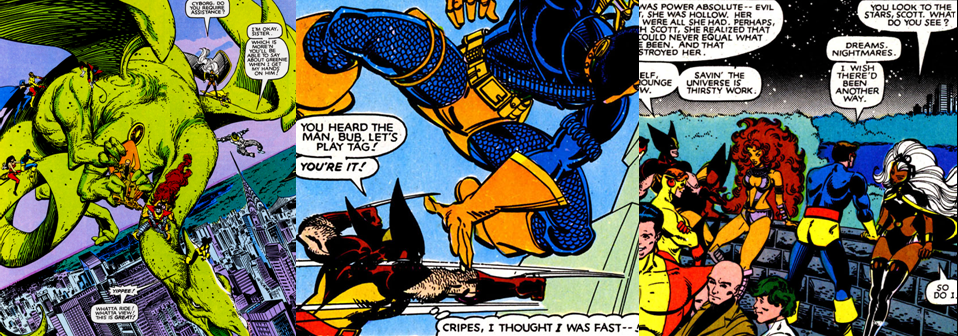
The Summary:
Of all the Batman stories crafted by Frank Miller, Batman: Year One is still my favourite. It’s a gritty, bleak, grounded reinterpretation of Batman’s origin and first year in Gotham City and paints him as a regular man (albeit one well trained and with more wealth than you or I) who isn’t yet the hyper-prepared, experienced vigilante with a network of allies and resources. The artwork is simple but gorgeous, with everything taking on a wash of waterpaint-like noir that emphasises deep shadows and harsh lights and has the majority of the story taking place in the dank, depressing darkness of night. One of the main reasons I dislike The Dark Knight Returns (and other Batman stories by Miller) is the dialogue (and the artwork). Miller has a very…shall we say “distinctive” way of having characters talk and likes to kind of just spit words and odd statements at the reader. For the most part, Year One is relatively light on these “Miller-isms” but they do still show up here and there (mostly when Batman is eluding or attacking people). Thankfully, Alfred’s trademark dry wit makes up for this and seeing Bruce act like an complete cad to throw off Gordon’s suspicions was absolutely fantastic.

Year One is focused much more on Gordon’s perspective of the city and its vigilante.

It’s interesting that Batman: Year One is such an effective Batman story considering it’s much more of a Jim Gordon story. We learn very little about Bruce, his background, or his training and, instead, focus more on Gordon and his struggles to adjust to and cope with life in the city. Everything we learn about Gotham and the state of its police force comes from Gordon, a flawed man who has made mistakes and is trying to hold onto his morals but struggles in the face of near-endless corruption and his own temptations towards Sarah. Bruce’s tragic origin is recounted very briefly and much of his training and motivation is delivered through exposition or his thought boxes, which take on a cursive slant that can be difficult to make out at times. Still, it provides a fascinating glimpse into Bruce’s early struggles to find the means by which to fight crime in the city and the preparation that goes into his various traps and assuming the guise of the Batman. At its core, Batman: Year One is a story of struggle and trust; both Gordon and Bruce struggle to find their place in Gotham and figure out how to conduct themselves and their mission in a city that is constantly fighting back against them and both of them feel alone in this endeavour. It isn’t until their paths cross and they see how selfless the other is that they both begin to consider changing their position; while guys like Branden just want to shoot Batman dead no questions asked, Gordon would prefer to see him brought in alive to get to the root of his mystery and Bruce realises that he needs the good-natured  lieutenant onside if he is ever to be effective as Batman and avoid getting shot on a nightly basis.

As it’s Batman’s first year, he’s a far more inexperienced and flawed character than usual.

This comes to a head in the finale where, rather than Batman saving Gordon’s son, it is Bruce in a questionable disguise. Indeed, the artwork and dialogue makes it intentionally vague as to whether or not Gordon truly recognises his boy’s saviour or not and, in the end, he decides it doesn’t matter who the Batman is as he has learned to think of him as a friend in a lawless city. As a tale of Batman’s earliest days in action, it’s hard to get much better than Year One. Personally, I love Batman stories that show him to be vulnerable and flawed and we definitely see a lot of that here as he’s constantly being stabbed and shot and hurt and forced into tight corners. This is a Batman who is lacking many of the bells and whistles of his later career; there’s not really a Batcave, no Bat-Signal or Batmobile, and a limited array of Bat-themed gadgets, all of which means that Batman has to use his wits and adaptability a lot more than his fancy high-tech toys which, again, I also find incredibly appealing. The portrayal of Batman’s influence is equally great; most treat the idea of a giant bat-garbed vigilante as ridiculous until they come face-to-face with him and then they are scared witless and this goes a long way to painting the Batman as this urban myth amongst the just and unjust alike.

My Rating:

Rating: 5 out of 5.

Fantastic

Have you ever read Batman: Year One? What did you think of Frank Miller’s reinvention of Batman? Are you a fan of Miller’s work, especially on Batman? What did you think to Year One’s focus on Jim Gordon and the depiction of a Batman without all his bells and whistles? What was your first experience of Batman and how are you celebrating his debut this month? Whatever your thoughts, sign up to drop them below and be sure to check in next Saturday for my review of Batman’s newest big-screen outing!