This review has been supported by Chiara Cooper. If you’d like to support the site, you can do so at my Ko-Fi page.

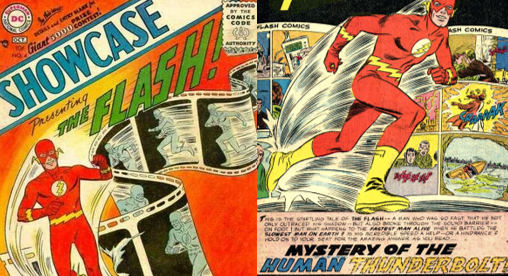
Story Title: “Mystery of the Human Thunderbolt!” Published: October 1956 Writer: Robert Kanigher Artist: Carmine Infantino
The Background: In 1940, writer Gardner Fox and artist Harry Lampert introduced readers to Jay Garrick, a college student granted superhuman speed after inhaling “hard water vapours”, and thus the very first superhero to use the name “The Flash” was born. The Flash not only became a charter member of the Justice Society of America but also graduated to his own solo book a year after his debut; however, All-Flash was cancelled after thirty-two issues when the onset of the Second World War saw superheroes decline in popularity. In the seven years that passed after Jay’s last publication hit comic book stands, a lot had changed; the rights to the Flash were now held by DC Comics, who set about reinventing “Golden Age” superheroes like the Flash and Alan Scott/Green Lantern. Thus, in 1956, readers of Showcase #4 were introduced to an all-new version of the Scarlet Speedster; created by writer Robert Kanigher and artist Carmine Infantino, forensic chemist Barry Allen heralded not only the “Silver Age” of comics but also the concept of the multiverse as it was later revealed that Jay existed on a parallel version of Earth. Barry quickly became one of the most popular and iconic incarnations of the Flash mantle, being a founding member of the Justice League of America and cementing his legacy after sacrificing his life in the Crisis on Infinite Earths epic (Wolfman, et al, 1985 to 1986). Although Barry’s demise lasted longer than most superhero deaths, he was eventually brought back in the ridiculously confusing Final Crisis event (Morrison, et al, 2008 to 2009) and his popularity and influence has seen him in a starring role in two live-action television shows, feature prominently in DC cartoons and videogames, and also seen him brought to life on the big screen as part of the largely disastrous DC Extended Universe.
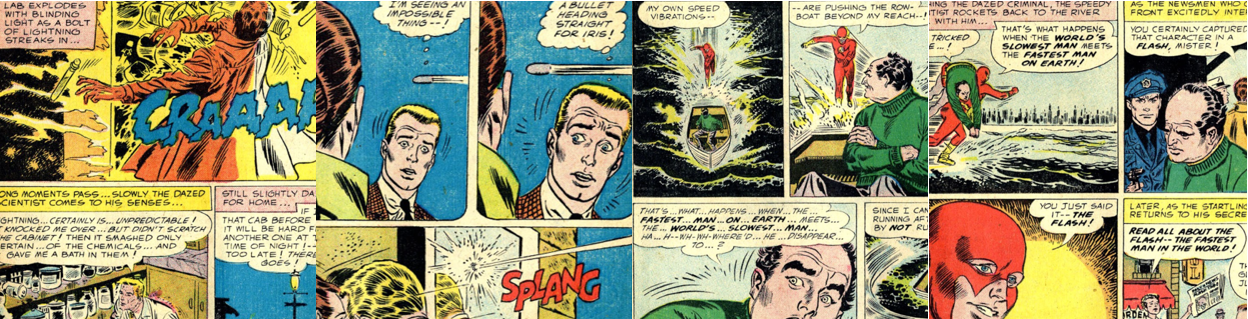
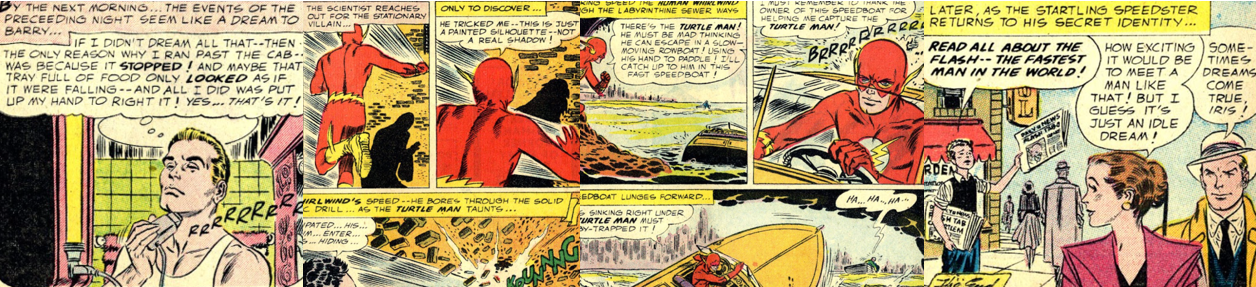
The Review: Our story begins with a crisis at a radar station on the East Coast; two military personnel are startled after picking up a strange object travelling faster than anything ever recorded before it sends their equipment haywire. To explain this phenomenon, the story flashes back a short time to Central City on a night when the city was ravaged by a tumultuous lightning storm. Here, in the police laboratory, we meet scientist Barry Allen, who marvels over stories of the Jay Garrick version of the Flash, who at this point exists only in comic books in a slice of metatext. As he returns to his mysterious experiment (which, apparently, requires the use of “every chemical known to science”), a bolt of lightning causes him to be doused in chemicals, leaving him wet and dazed but otherwise unharmed. Shaken, Barry leaves but is too late to hail a cab so tries to chase one down, only to find himself flying along at super speed! Believing his near-death experience has caused him to imagine things, Barry stops at a diner to catch his breath and is startled to find that he can now perceive time in slow motion, moving so fast that a clumsy waitress cannot comprehend what happened, but he still believes he’s suffering from shock so he goes home to rest. By the morning, he’s used some wonky logic to explain everything away but, when he meets Iris West for a date (receiving a talking down for his poor timekeeping), his super speed kicks in again just as a stray bullet threatens her life! Acting quickly, he tackles Iris out of harm’s way, earning him her gratitude, and finally realises that his molecular structure has been altered by the accident to turn him into the fastest man on Earth. Inspired by the adventures of Jay Garrick, Barry…somehow…crafts himself a sleek, form-fitting costume that can condense into a ring on his finger and makes his debut as the Flash to answer a burglar alarm at the city’s central bank.
After gaining superhuman speed, Barry Allen tracks down the sloth-like villain the Turtle Man.
Thanks to his superhuman speed, the Flash can effortlessly race down the sides of buildings and across town so fast that he breaks the sound barrier, thus explaining the disruption monitored at the start of the story. At the bank, The Flash finds nothing has been stolen; questioning the holdup victims, he learns that the perpetrator was “The Turtle Man”, a villain known as the slowest man on Earth, and somehow intuits that the thief left the job half finished to complete it later on. This odd logic is compounded when the Flash is easily fooled by a silhouette painted on a brick wall, like he’s Wile E. Coyote, and goes crashing through a wall while trying to apprehend the Turtle Man. Somehow, despite the fact that the Flash just appeared and no one even knows about him, Barry believes the villain is “using [his] speed […] as a weapon […] against [him]” and stays on his guard as he follows the Turtle Man’s trail through a sewer and to the river. The Turtle Man certainly lives up to his name; not only does he talk in laborious sentences, but he also chooses a rowboat for his getaway, yet he is also smart enough to boobytrap a speedboat to keep the Flash from pursing him. Thankfully, the laws of physics mean nothing to the Scarlet Speedster and he races across he water’s surface, but he’s unable to apprehend the villain because his movements only push the rowboat further away. Instead, the Flash circles the rowboat at superspeed, trapping it in a vortex and easily capturing the sloth-like crook. The cops and press are awestruck by the feat and the Flash becomes the talk of the town; even Iris swoons over the super-speedy hero completely unaware that she’s already dating the Scarlet Speedster.
The Summary: Well, I’m not gonna lie…this was a bit of a disappointment. These older comic book tales always tend to be very brief and simplistic but I found Barry’s debut story to be particularly bland considering how colourful and versatile the Flash and his powers can be. I liked that Barry didn’t immediately realise what’d happened after the lightning strike but it takes him so long to figure out what happened that he comes across as a bit of a dunce. His misadventures do give a taste of what he’s now capable of, showing that he can accelerate to inhuman speeds, defy gravity and physics, and even perceive time differently, but it’s handled very clunkily and not in an especially engaging or entertaining way. Barry’s clothes don’t catch fire from the friction, which would’ve been a fun visual, and he’s far too quick to explain away what’s happening with weak logic. Once he does figure things out, he’s somehow able to create this amazing suit that shrinks down into a ring, something I always thought came along later in his career but isn’t even explained with a wishy-washy trope like “unstable molecules”.
An unfortunately dull story with a foolish hero and a ridiculous villain that fails to impress.
The Turtle Man isn’t exactly a visually interesting or threatening first villain, either. I get the idea of pitting the world’s slowest man against the world’s fastest man as a kind of thematic parallel but it doesn’t really work because…why the hell would the world’s slowest man pose a threat to the Flash, of all people?! And…he doesn’t. He briefly bamboozles the Flash by fleeing the crime scene, causes him to run into a wall and sink, both of which are minor inconveniences at best, and is easily apprehended without really taxing the Flash’s powers or intelligence anywhere near their limit. It feels as though this story needed a few more pages; there are other standalone Flash stories in this issue but I would’ve used the extra pages to establish the Flash in the city before he encounters the Turtle Man as the villain is…somehow…aware of the Scarlet Speedster and relishing in their conflict despite him just making his debut! In the end, it’s a kind of fun, wacky tale but a bit of an inauspicious debut for one of DC Comics’ most popular heroes; a lot of the groundwork is here and there’s some fun art showcasing the Flash’s super speed and such but it’s ultimately a bit lacklustre and too simplistic for me to be the definitive origin story for the character.
My Rating:
⭐⭐
Rating: 2 out of 5.
Could Be Better
What did you think about Barry Allen’s debut as the Flash? Were you impressed by it at the time or were you left a little fulfilled, like me? What did you think to the new Flash and how do you think he compared to Jay Garrick? Did you also find it odd that Barry took so long to figure out what was going on? What did you think to the Turtle Man and his threat to the Flash? Which Flash or speedster is your favourite and what are some of your favourite Barry Allen moments? Feel free to share your thoughts on the Flash below and be sure to check out my other Flash-related content!
In 2013, DC Comics declared the 12th of June as “Superman Day”, a day for fans of the Man of Steel the world over to celebrate Clark Kent/Kal-El/Superman, the superpowered virtue of “Truth, Justice, and the American Way” who is widely regarded as the first ever costumed superhero. This year, I’m spending every Monday of June celebrating the Man of Steel as I expand Superman Day to “Superman Month“.
This review has been supported by Chiara Cooper. If you’d like to support the site, you can do so at my Ko-Fi page.
Released: 28 June 2006 Director: Bryan Singer Distributor: Warner Bros. Pictures Budget: $270 million Stars: Brandon Routh, Kate Bosworth, Parker Posey, Tristan Lake Leabu, James Marsden, and Kevin Spacey
The Plot: Returning to Earth after five years in deep space investigating the remains of his home planet, Krypton, Clark Kent/Superman (Routh) returns to find former flame Lois Lane (Bosworth) married and with a young son. However, as he struggles to acclimatise to a world that may no longer need him, criminal mastermind Lex Luthor (Spacey) steals Kryptonian technology and enacts a diabolical plot avenge himself on the Man of Steel.
The Background: Those that have read my reviews will know that my opinions of the four live-action Superman feature films produced between 1978 and 1987 are somewhat dismissive. There are elements from each of them that I enjoy, and obviously I enjoy Christopher Reeve’s iconic portrayal of the title character, but overall I feel they haven’t really aged well at all and often hold back reinterpretations of the character. After Superman IV: The Quest for Peace (Furie, 1987) turned out to be a dismal financial and critical failure, Superman was persona non grata from cinema screens for nearly twenty years. Oh, sure, he had a few live-action and animated shows to tide him over and some pretty big comic book events in the intervening years but Warner Bros. struggled to get a new feature film off the ground. After attempts by the likes of writer/director Kevin Smith and Tim Burton failed to materialise and cost the studio millions in production costs, director Bryan Singer conceived of and pitched the general idea of Superman Returnsduring filming of X2: X-Men 2/X-Men United(Singer, 2003). Wishing to recapture the magic of Richard Donner’s original film, Singer cast relative unknown Brandon Routh in the title role because of his many similarities to the late Christopher Reeve, acquired permission to repurpose Marlon Brando’s footage from the first twoSuperman movies, and envisioned the film as a continuation of Donner’s films. Superman Returns was supposed to be a pretty big deal for DC Comics, Warner Bros. and Superman in general but, while the film’s $391.1 million gross meant that it was a financial success, the film was met with mixed reviews and even Bryan Singer later expressed regret with the direction and marketing of the film. Although it was followed by a videogame tie-in, this response sank plans for a sequel and Superman wouldn’t return to cinema screens for another seven years, though Routh did return to the role as an aged version of Superman in “Crisis on Infinite Earths: Part Two” (Belsey, 2019).
The Review: Superhero cinema was in an interesting place in the early 2000s; the X-Men (Singer; Ratner, 2000 to 2006) and Spider-Man (Raimi, 2002 to 2007) trilogies were proving to be big box office hits, but the Marvel Cinematic Universe was a mere pipedream at that point despite the growing influx of adaptations produced year after year. While Marvel adaptations were undoubtably popular and successful, and had proven that the genre could be critically and commercial successful, it was Batman Begins (Nolan, 2005) that arguably turned the most heads when it came to bringing prestige to the genre. Ignoring its camp, cartoony predecessor in favour of a dark, serious take on the character and bolstered by a reputable cast, Batman Begins took the source material seriously and so anticipation was quite high when Superman Returns was announced as the character had similarly stagnated since his last ridiculous onscreen appearance. In a move I found surprising considering I grew up with the Post-Crisis John Byrne version of the Man of Steel, who was (initially) quite different from his more ludicrous Golden and Silver Age counterpart, Superman Returns opted not to reboot the character like in Batman Begins, but to position itself as a continuation of Richard Donner’s films, one that ignored (or presumably ignored) all of the sequels after the first film save for some tenuous links to Superman II (Lester, 1980) and sought to bring Christopher Reeves’ iconic version of the Man of Steel into a post-9/11 world following a lengthy absence.
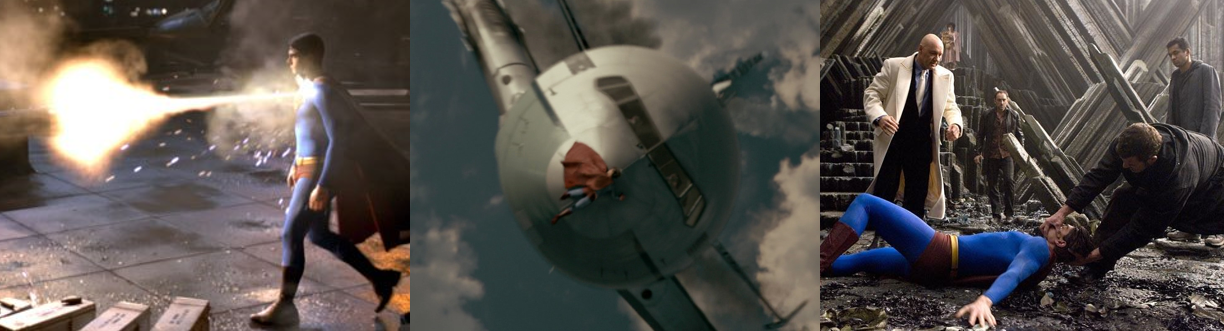
Superman returns from a five year absence to find the world has moved on without him.
This, for me, meant that the film started on rocky ground right from the off; as much as I enjoyed Donner’s original version of Superman, I never understood the decision to resurrect that character rather than reboot it from scratch. After all, it’s not as if Batman Begins was a prequel to Batman (Burton, 1989) so it just seemed like a shameless cash-in on the iconography and success of Donner’s influential first film. The film’s premise is that, after becoming the world’s foremost superpowered protector and opposing the mad schemes of Lex Luthor, Superman abandoned the world to its own devices when astronomers discovered Krypton’s remains many light-years away. Even in a repurposed Kryptonian spacecraft, the trip there and back takes Superman five years and, obviously, results only in Superman finding the shattered remains of his home world. So, right away there’s a lot of questions here: why did Superman feel compelled to go and see this when he knew from the words of his long-dead father, Jor-El (Marlon Brando), that Krypton was destroyed? What was he hoping to gain from this? There’s a sense that he wanted closure but…why? He seemed perfectly happy to accept that Krypton was dead and that the Earth was his true home, so suddenly taking off like that really doesn’t make any sense at all, especially considering Superman and Superman II made such a big deal about his attachments and importance to humanity. When Superman returns, the world has largely moved on without him; not only that, Lex Luthor has spent the intervening years showing elderly Gertrude Vanderworth (Noel Neill) “pleasures that [she’s] never felt” in order to con her out of her vast wealth and return himself to a position of power and prominence. Clark’s own elderly mother, Martha Kent (Eva Marie Saint) is still alive, however, and has been covering for his lengthy absence by sending regular letters and postcards to his Daily Planet colleagues while maintaining his old childhood farm home in Smallville and stockpiling newspapers and reports so he can catch up on what he missed.
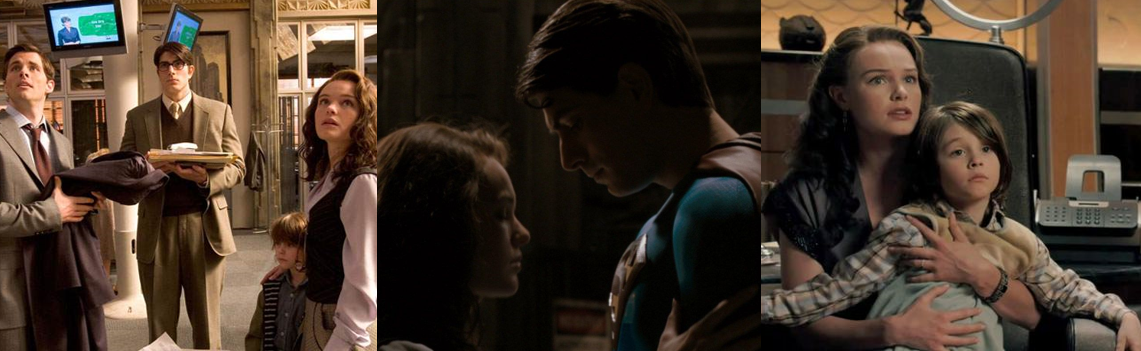
Clark is stunned to find Lois has settled down with a family and feels a resentment towards Superman.
Superman’s absence had two very important side effects for both his personal life and the entire world; first was that intrepid reporter Lois Lane won a Pulitzer Prize for her article “Why the World Doesn’t Need Superman” and has established a family of her own with fiancé Richard White (Marsden) and son Jason (Leabu) and the second is that Luthor was even able to get out of prison in the first place. Thanks to his disregard for due process and missing a vital court appearance, Superman was indirectly responsible for Luthor being remanded into Gertrude’s custody and released back into the civilised world, and his abandonment of his duties and responsibilities is only part of the reason why Lois acts so cold towards him. She learned to live without him, as did the rest of the world but, while everyone else applauds his long-awaited return, she is resentful of him because she feels he abandoned her as much as anything (or anyone) else. Richard is the pilot nephew of Daily Planet editor Perry White (the masterful, and completely wasted Frank Langella) and his characterisation seems to boil down to him being a nice guy who’s supportive of his wife, loves his child, and is jealous of Superman and Lois’s obvious fascination with him. Otherwise, he’s just kind of there and only really comes into prominence when questioning Lois’s previous relationship with Superman and in the climax, when his convenient piloting skills help rescue Superman for his big finale, and I can’t help but feel like Marsden made a mistake abandoning his role as Scott Summers/Cyclops in the X-Men films for such an inconsequential role. As for Lois, she’s noticeably different from the Margot Kidder version in many ways, but no less daring and inquisitive; she continually puts herself right at the forefront of big stories, even if it means she’s placed in mortal danger, and has her world (and her heart) turned upside down when Superman returns. As ever, she barely even registers that Clark is back and is instead constantly distracted by Superman, to the point where she confronts him directly. Thankfully, the two don’t end up going for a long, awkward flight with a cheesy song this time around, and she warms towards him after learning of his reasons for leaving.
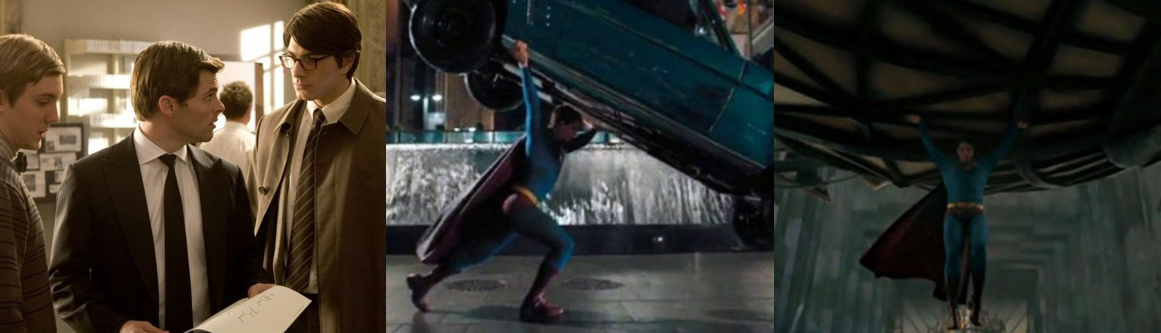
Despite his personal drama, Clark continues his façade as a bungling reporter and saving lives as Superman.
Upon returning to Earth, Clark immediately jumps back into his old life; he returns to work at the Daily Planet and continues putting on the act of a good-natured, bungling reporter to contrast with the confidant and heroic Superman. Considering he was a relative unknown, and such a fresh-faced young actor at the time, Brandon Routh does a masterful job of not only resembling the late, great Christopher Reeves but adopting many of the same mannerisms he showcased as both Clark and Superman. He certainly looks the part, and fills out the suit well, and I buy that he’s a slight variation of this character, but there’s something a little off about him. It’s possibly because Routh was given the monumental task of being the first big-screen Superman in twenty years and also emulating Reeves’ performance; any actor has big shoes to fill when taking on Superman, but only Routh had to literally be Reeves’ version of the character. Consequently, comparisons between the two are not only inevitable but actively encouraged by the film’s presentation as a sequel to Donner’s film, which I feel unfairly reflects on Routh’s performance here. He gives it a good shot and certainly embodies many of the moral and physical ideals of the character, but he was lumbered not just was continuing Reeves’ performance but also a diabolical script that called for him to morosely stalk his former flame and cast him in an uncomfortable light as an unreliable, overly sombre, and disappointingly stoic Superman. Routh has few moments to showcase the character’s friendlier, more trusting characteristics and this is a shame as he had a wonderful smile and exudes charisma in these moments, but Superman is so weighed down with doubts and regrets and drama that it really sucks all the life and fun out of the character (and the film). Even Clark’s bungling nature can’t really salvage these moments, again mainly because his comic book counterpart had also evolved quite a great deal since the seventies. Instead, what we’re left with is a throwback to an outdated version of the character and a sullen version of the Man of Steel who’s so distracted by his personal issues that he doesn’t realise Luthor is a threat until it’s almost too late, which is odd considering that the film makes a big deal of showing that Superman is deeply affected by the planet’s cries for a saviour and yet he somehow doesn’t pick up on Luthor’s latest plot.
Luthor flips between cold, calculating menace to unhinged mania seemingly at random.
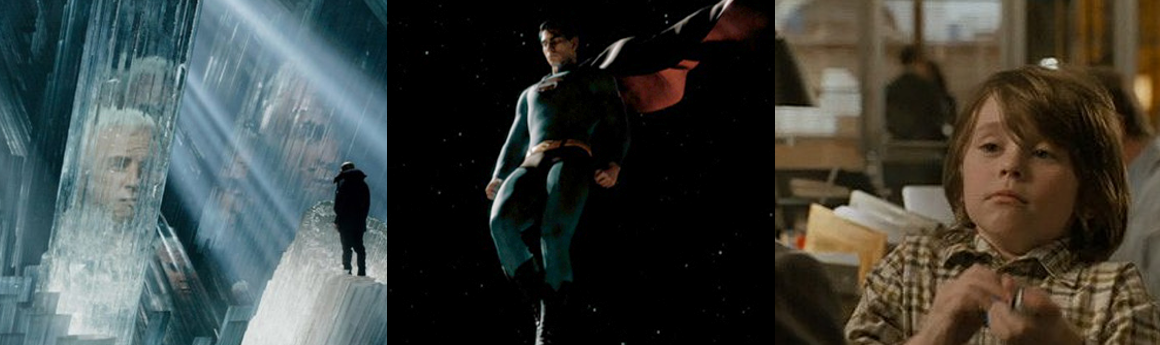
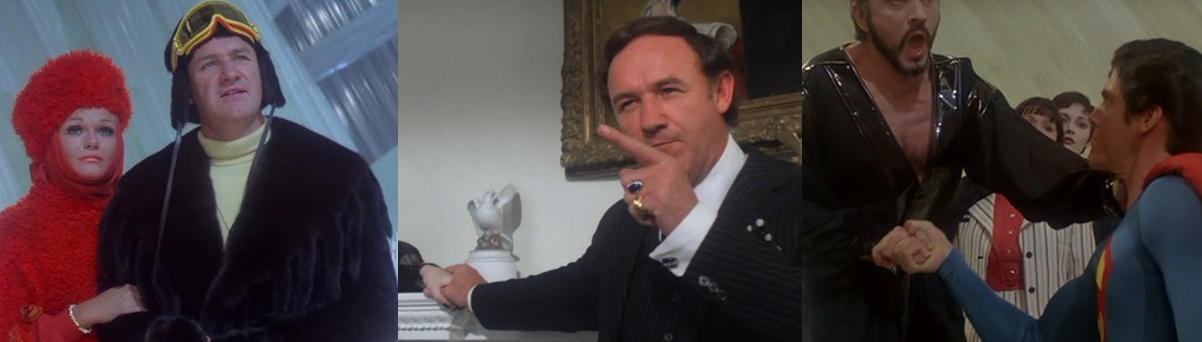
Luthor’s grand plan this time around is, essentially, similar to that of his predecessor; namely, the acquisition of profit from real estate. Quite why this continued to be a concern for the self-professed greatest criminal mind ever to walk to Earth is beyond me, but this Luthor is noticeably more bitter and twisted than Gene Hackman’s take on the character. Finally sporting his trademark bald head and wielding Gertrude’s vast wealth, Luthor sets himself up on her fancy yacht and surrounds himself with idiotic underlings simply because he was forced to make questionable allies to survive his time in prison. Thanks to the events of Superman II, Luthor directs his crew to the Fortress of Solitude and refamiliarises himself with Jor-El and Krypton’s technology; specifically, Luthor learns of the Kryptonian crystals’ ability to expand and create landmasses, which he plans to use to create a whole new continent in the Northern Atlantic Ocean that will supplant the mainland United States, killing millions of people in the process. Aided by Kitty Kowalski (Posey), who’s essentially exactly the same character as Eve Teschmacher (Valerie Perrine), Luthor is only too eager to avenge himself on the Man of Steel when he makes his dramatic return to the spotlight and has Kitty distract Superman so that he (as in Luthor) can reacquire the chunk of Kryptonite he used in the first film in order to make his new landmass fatal to his hated enemy. While Hackman gloriously ate up the scenery in the previous films, Spacey absolutely devours it here with a wild and manic performance that shifts from cold, calculating menace to unhinged hysteria at the flip of a coin. It’s uncomfortable to praise any Kevin Spacey performance these days but he really was a pretty fantastic Lex Luthor; while I would much rather see either the mad scientist or corrupt businessman version of the character, Luthor is an enigmatic and cold-hearted villain who relishes the opportunity to bring Superman to his knees and bring about the deaths of countless innocents simply to fuel his ego and lust for power.
The Nitty-Gritty: Perhaps the most prominent thematic inclusion here is the question of whether or not the world even needs a Superman; the world has continued on without him, and even gotten used to his absence, and both Clark and even Lois question whether he even has a place there anymore. Although Lois’s career was boosted by her anti-Superman article, Superman returns to action, saving people and solving problems the world over, because all he can hear is a world crying out for a saviour. I’m really not sure why this is such a recurring theme in Superman movies; Zack Snyder wasted a huge chunk of Batman v Superman: Dawn of Justice(ibid, 2016) asking similar questions and it really bothers me for some reason. I haven’t read every single Superman comic book or story ever made but I’ve rarely ever come across this plot point in the source material and, while it raises interesting questions regarding the need for a God-like superhero, I can’t help but feel like it drags the already dull plot down quite a bit. Furthermore, it personally doesn’t sit well with me that the film is so closely tied to Donner’s original film; Superman’s supposed to have been gone for five years, from approximately 1980, but everyone seems younger than they were before, and the only character who even remotely seems to evoke their counterpart is Superman. As much as I enjoy Donner’s iconography, tying them together was a big mistake in my book; Superman had changed so much in the comics by this point that this felt like a massive step back and seemed way too “safe” of an option. The film wisely reuses John Williams’ iconic score, but not often enough; it’s most prominently heard in the opening credits (which are a direct homage to the original film) and Superman’s handful of action scenes. Even dusting off unused footage of Marlon Brando doesn’t help matters as the film’s weirdly stuck in the past and yet also supposed to be set in the then-modern day, which results in a confused presentation as it’s unclear which version of Superman II Superman Returns is set after, and it even confusingly seems to suggest that it’s a only direct sequel to the first film!
Superman Returns is full of heavy themes but paints Superman in an uncomfortable light.
Of course, the film is also rife with themes of responsibility and parenthood. Superman is, sadly, framed very poorly here; not only did he abandon his adopted home world on a whim, he never considered the legal fallout of Luthor’s arrest and thus was absent for a critical moment in his adjudication. Even worse is the fact that Superman is characterised almost like an obsessed stalker; he uses his super hearing to eavesdrop on Lois’s conversations both at work and in the office, his super vision to watch her at home as she makes a poor effort of hiding her emotions at Superman’s return, and he generally comes across as being unable to let go of the past. Lois hides her desire for Superman behind a mask of contempt and self-reliance; she defies Perry’s order to cover Superman in favour of the blackout caused by Luthor’s experiments but continually circles back to her feelings of abandonment by her long-time crush. Even distracting herself with her sickly child doesn’t help as she’s clearly as besotted with the Man of Steel as ever, just weighed down with her responsibilities as a mother and her career. Clark is stunned to find that Lois has settled down and had a child, and unethically uses his powers to gain insight into her emotional state, which is as uncomfortable as it sounds. Still burdened by Jor-El’s decree that he be a beacon of hope for all of humanity rather than devote himself to any one person, Superman is nonetheless overjoyed to find that Jason is his son. Unfortunately, this revelation is painfully telegraphed despite the boy’s asthma and fragility, and just serves to make Superman look even worse since the implication is that he had a one night stand with Lois and then took off and left her to raise his illegitimate child alone, forcing her to turn to another man in the process. I’m not massively against the idea of Superman being a father; it’s now been the status quo in DC Comics for some time and the film takes the time to have Superman recontextualise Jor-El’s words about the son becoming the father in a heartfelt moment but, sadly, there really isn’t all that much time spent exploring what being a father means to Superman, which could have been much more interesting than watching him spy on his ex from afar.
The suit is as divisive as the lack of action as Superman is left struggling to find his way in the world.
One area where the film excels, and surprisingly still holds up, are the special effects; the Fortress of Solitude is particularly striking here and scenes of Superman flying and showcasing his physical strength are slick and presented as a visual spectacle, which is only fitting. I’m a little torn on the suit, though; overall, it looks good, appearing to be a modern take on the classic outfit, but the colour palette is very subdued and dark. The symbol is way too small; the cape fits weird and is too thick and leathery and lacks the symbol on the back (a common occurrence in modern Superman films), and it somehow looks plainer than Reeves’. And yet, Routh fills it out wonderfully with his toned physique and the film definitely aims to make every shot of him a piece of art, even including a marvellous homage to the iconic cover of Action Comics #1. As awesome as Superman’s calm confrontation with a maniacal gunman is, the plane rescue is the film’s big, memorable action piece; as others have said, it’s great how Superman has to deal with the physics of the crisis, slowing and guiding the plane to a safe landing, but sadly the film doesn’t ever even try to top this. Superman barely uses any of his additional powers; he only uses his heat vision and super breath once, and he doesn’t even throw a punch! I get that Donner’s Superman wasn’t exactly an action-packed spectacle, but times have changed since then; Superman Returns came out after The Matrix Revolutions (Wachowski Brothers, 2003), which gave a tantalising glimpse into what a new Superman might be like with its epic final fight scene that pitted two superpowered characters against each other in the skies. Sadly, Superman Returns opts not to include a superpowered foe for Superman or any kind of physical danger; instead, it’s firmly focused on exploring the drama of his return, the interpersonal conflict of his character, and his struggles to find his place in a world that has moved on from him, none of which is particularly interesting or even fitting for the character.
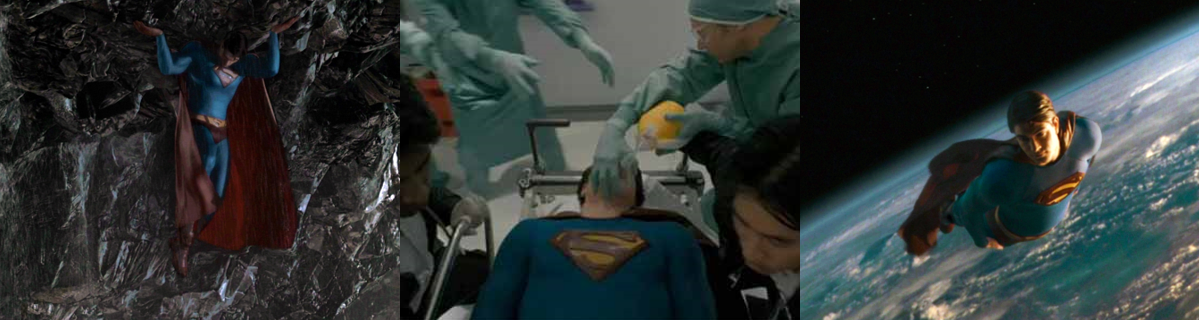
Superman musters the strength to stop Luthor’s plot, recovers from death, and returns to duty.
All of this distracts Superman’s focus for the majority of the film, as does solving problems both big and small all over the world. Despite being knocked sideways by Superman’s return, Lois continues to follow her hunch on the blackout, which leads her directly to Lex Luthor and at ground zero for his latest maniacal scheme. Reunited, and with a showdown with his old foe impending, Luthor descends into complete lunacy because of his unwavering arrogance at being able to outthink the Man of Steel. Not only has Luthor kept a shard of Kryptonite for himself, he’s infused his alien landmass with the substance, thus rendering Superman weakened for this inevitable confrontation. In a surprisingly harrowing scene, Luthor’s henchman brutalise Superman and Luthor vindictively stabs him, critically injuring the Man of Steel and requiring Lois and Richard’s aid to pull him from danger. However, despite his injuries, Superman bathes in the healing energies of the sun to muster the strength to lift the entire Kryptonian landmass from the ocean and fling it into space. Quite how he was able to do this is also beyond me; even after being boosted by the yellow sunlight, he’s still handling what amounts to pure Kryptonite, the very substance which just moments earlier had left him helpless to fend off Luthor’s attack. To be fair, the effort is draining for Superman; here, Singer abandons all subtlety and absolutely wallops audiences over the head with the Christ allegory as Superman not only literally falls to Earth in a crucifix pose but also dies to save us and rises some time later. I get that the “Death of Superman” (Jurgens, et al, 1992 to 1993) was a monumental story for the character but, again, I really don’t get this obsession with “killing” off the character, which was a recurring suggestion in the many unproduced drafts before this film and, again, resurfaced in Batman v Superman, where it was equally rushed and unwarranted. Here, Superman just gets better after a few days in hospital, finally takes the moral high ground and leaves Lois and her family the hell alone while promising that Jason will continue his legacy and the legacy of Krypton, and does his trademark lap of the planet before vanishing from cinema screens for another seven years.
The Summary: Even now, with the benefit of hindsight, it’s hard to regard Superman Returns as anything other than a massive disappointment and missed opportunity. Warner Bros. had the perfect opportunity to reboot the character, or otherwise reintroduce him, to a fresh new audience eager to jump on the next big-budget superhero film but instead pandered to an aged and dated version of the character simply to cash-in on nostalgia for Christopher Reeves’ influential portrayal and to piggyback off the success of Richard Donner’s original film. Admittedly, a lot of my dislike for this film comes from my desire to move away from such outdated representations of the Man of Steel and to do something new and more akin to his Post-Crisis characterisation, and my general dislike for much of the themes and presentation of those original films. Batman got a clean slate a few years prior so it’s astounding to me that Superman didn’t get the same treatment; even more mind-boggling is the suggestion that Brandon Routh and Christian Bale would’ve crossed paths in a potential crossover movie, which would’ve just been insane to imagine as you’d be effectively pitting the same Superman who reversed time against the most grounded and realistic Batman we’d seen at that point in time. Ultimately, it’s a real shame as there’s a lot to like in Superman Returns; the film is shot beautifully, challenges Superman in interesting ways, and features some great performances. Routh was placed in an unenviable position and delivered a pretty decent performance as the Man of Steel, but I think maybe it was a little too much too soon for him; he definitely commanded the role much better when he returned to it years later, though, so I like to think he might’ve been even more impressive if Superman Returns had gotten a sequel. Sadly, though, there’s just not enough here to really sustain things; Superman’s characterisation is uncomfortably off and the film just drags all the way through. Lex Luthor showcases some maniacal cruelty when he finally gets to put a beating on Superman, but this disturbing scene really belongs in a better film and Superman Returns ends up being a big missed opportunity to have the world’s greatest superhero return to the big screen in a meaningful way in favour of simply cashing in on the nostalgia for a film that was incredibly influential, yes, but an outdated representation of the character by this point.
My Rating:
⭐⭐
Rating: 2 out of 5.
Could Be Better
Are you a fan of SupermanReturns? What did you think to Brandon Routh’s portrayal of the character and his efforts to evoke Christopher Reeve? Were you also disappointed that the film was a continuation of Donner’s effort or did you enjoy the links to the classic Superman films? What did you think to Lex Luthor’s plot and the focus on interpersonal drama rather than action? What is your favourite Superman story, character, or piece of media? How are you celebrating Superman Day today? Whatever your thoughts on Superman Returns, feel free to share them below and be sure to check out my other Superman content.
In 2013, DC Comics declared the 12th of June as “Superman Day”, a day for fans of the Man of Steel the world over to celebrate Clark Kent/Kal-El/Superman, the superpowered virtue of “Truth, Justice, and the American Way” who is widely regarded as the first ever costumed superhero. This year, I’m spending every Monday of June celebrating the Man of Steel as I expand Superman Day to “Superman Month“.
This review has been supported by Chiara Cooper. If you’d like to support the site, you can do so at my Ko-Fi page.
Released: 28 November 2006 Originally Released: 9 April 1981 Director: Richard Donner Distributor: Warner Bros. Budget: $54 million Stars: Christopher Reeve, Margot Kidder, Terence Stamp, Sarah Douglas, Jack O’Halloran, and Gene Hackman
The Plot: Having thwarted Lex Luthor’s (Hackman) maniacal plans, Clark Kent/Superman (Reeve) faces a new challenge when intrepid reporter Lois Lane (Kidder) deduces his secret identity. While Clark prepares to give up his incredible powers to be with Lois, General Zod (Stamp) and his cohorts escape from the Phantom Zone and terrorise the planet, forcing Clark to choose between his happiness and his responsibilities to mankind.
The Background: As detailed previously, producers Ilya and Alexander Salkind and Pierre Spengler convinced Warner Bros. to produce a two-part Superman adaptation back in the late seventies. However, the production of Superman (Donner, 1978) was fraught with financial and creative issues; director Richard Donner frequently clashed with the producers and Richard Lester was brought in as a mediator to allow the filmmakers to focus on the first film, which was a financial and critical success. Despite having shot 75% of the sequel, Donner was ultimately replaced by Richard Lester, a decision that irked star Gene Hackman so much that he refused to return for the necessary reshoots; Lester shot an entirely new opening for Superman II in addition to making numerous changes to emphasise slapstick silliness. Star Christopher Reeve returned after negotiating a better deal for himself but Marlon Brando was excised completely due to his unrealistic financial demands. Despite all the behind the scenes turmoil, Superman II was a critical and commercial success but fans campaigned for years to see Donner’s original vision restored. Donner was understandably reluctant to return to the film but came onboard after Warner Bros’ reached a deal with Brando’s estate as part of the production for Superman Returns(Singer, 2008). Working from the original negatives, Donner oversaw the assembly of a version that best represented his original vision for the film, and even incorporated screen test footage for additional scenes to fundamentally alter the tone and context of the theatrical cut. Following a limited theatrical release, Superman II: The Richard Donner Cut released on home media and was received far better than its theatrical counterpart; the film was praised as a love-letter to the fans and a superior version of the film, while some found the re-cut jarring and little more than a curio.
The Review: As a kid, Superman II was easily my favourite of the original four Superman movies; it was far more of a spectacle than its slower, more deliberate predecessor and hadn’t yet devolved into outright buffoonery or ridiculousness like its successors. However, I don’t recall having any knowledge that so much material had been cut from the film until around about the time that Superman Returns released; suddenly, some of the odd decisions in Superman II made a bit more sense, though I was actually fine with the first film’s focus being on Jor-El (Marlon Brando) and the second one having more emphasis on Lara (Susannah York) and, as we’ve seen countless times, Superman exhibited loads of bizarre additional superpowers back in the Golden and Silver Age so why not a memory wiping kiss? Still, my philosophy is generally that a great film can only be made better by an extended or director’s cut (usually…) so I was eager to see what the original version of Superman II would turn out like. After a disclaimer alerting viewers that the film contains test footage, and a touching dedication to Christopher Reeve, The Richard Donner Cut opens very similarly to the theatrical cut; however, the scene of General Zod, Ursa (Douglas), and Non (O’Halloran) breaking into one of the Kryptonian council’s crystal chambers and destroying one of their crystals has been excised and we’re instead treated to a reused scene from Superman that re-establishes that Jor-El acted as the trio’s chief prosecutor. Because of this, Zod holds Jor-El directly responsible for their imprisonment in the Phantom Zone and swears that the Kryptonian scientist, and his heirs, will bow down before him.
Lois is so sure that Clark is Superman that she puts her, and his, life at risk to force him to reveal the truth.
After Superman diverted Luthor’s missiles and put an end to his maniacal plot to set off the San Andreas Fault, daring reporter Lois Lane receives the front-page exclusive on the story and is praised by her boss, Perry White (Jackie Cooper). When budding Daily Planet photographer Jimmy Olsen (Marc McClure) offhandedly points out that Clark Kent and Superman are never around at the same time, the gears start turning in Lois’s head and, after crudely drawing a pair of spectacles and a hat on a picture of Superman, she begins to suspect that her timid co-worker isn’t all that he seems. Similar to the theatrical cut, Lois is so sure that she’s figured out Superman’s true identity that she literally puts her life on the line; however, rather than leaping into Niagara Falls, she takes the much more sensible option of leaping out the window of a high-rise office building to force Clark into action, though he’s again able to subtlety use his powers to slow and cushion her fall, thus throwing her off the scent. Interestingly, in this version of the film, it’s made much more explicit that Clark is trying to romance Lois; I honestly never really got the impression that he was actively pursuing her in the original film or its sequel, but here he gives an impassioned, stammering plea that she stop comparing him to Superman and accept him for who he really is, but she’s so adamant that her theory is correct that she fires a gun at Clark to force him to reveal his true self to her. Just like in the Richard Lester version, Superman wastes no time in spiriting Lois off to the Fortress of Solitude so that they can have some privacy; this time, though, they consummate their relationship before Clark decides to give up his powers. Much to the despair of his father’s holographic spirit, Clark chooses his love for Lois over his duties to humankind, and the new footage of Brando really emphasises that Clark’s calling is to serve a higher purpose, one far beyond any one person, even himself. Jor-El even goes so far as to call Clark selfish, and shoot a glaring condemnation at Lois as Clark bathes in the red sunlight that renders him human, and vulnerable. The context of this narrative element remains largely the same, and just as confusing; for me, it always seemed to exist simply as a dramatic device to add additional grief to Clark, and was mostly lost on me since Clark and Lois were a married couple in DC Comics in the mid-nineties when I was watching the theatrical cut so it never made much sense to me that Clark would have to pick one life or the other.
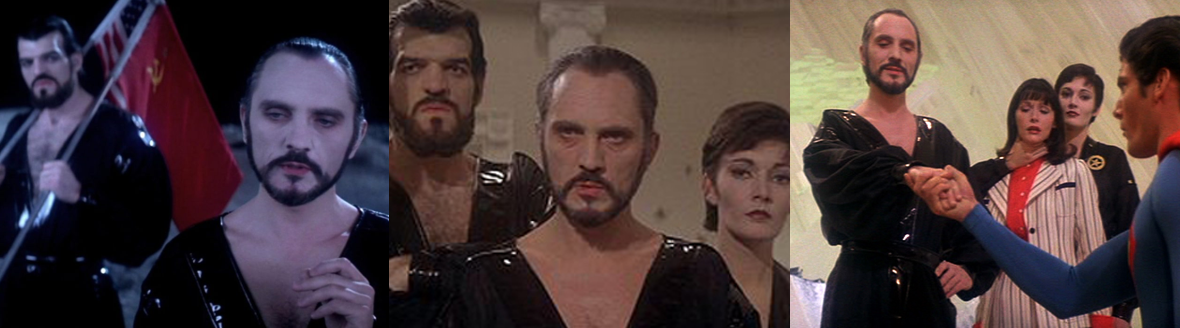
Backed by his loyal followers, General Zod is hungry to rule, and avenge himself on Jor-El and his progeny.
Like before, Clark almost immediately comes to regret this decision not just when he has the crap kicked out of him by abrasive trucker Rocky (Pepper Martin) but when Zod calls out Superman on live television from the White House, forcing the depowered Kryptonian to make the dangerous trek back to the Fortress of Solitude and humbly beg his father for forgiveness. Having been condemned to a lifetime of imprisonment in the Phantom Zone, Zod has sworn vengeance against Jor-El and his bloodline; a megalomaniacal despot who feels it’s his birthright to rule over others, Zod stewed in the Phantom Zone, alongside his followers, for the better part of thirty years, his anger and lust for power and revenge only growing more potent as they drifted the endless void of space. Luckily for them, the Phantom Zone spirals towards Earth and the three are freed from an explosion caused by one of Luthor’s missiles, which Superman diverted to save countless lives on Earth. Upon release, the three are immediately bestowed with the same powers as Superman since, in this original film continuity, Kryptonians require no time at all to gain the superhuman befits of Earth’s yellow sun. The three explore their powers, maliciously killing three astronauts without a second’s thought, with Zod’s followers unquestionably following his enigmatic leadership and every command; Ursa remains fixated by patches, badges, and symbols and a loyal advocate of her General, while Non is still little more than a childish brute easily distracted by flashing lights. Just as Zod quickly tires of the ease with which he destroys a small town in Houston, Texas, the renegade Kryptonian grows equally bored after assuming control of the United States, and the entire world, following his attack on the White House; he is reinvigorated, however, when Lex Luthor tells him that Kal-El, the son of his hated jailer, is on Earth and finds new motivation in breaking his hated enemy’s progeny to prove, once and for all, his physical and mental superiority of his long-dead foe.
Luthor schemes to avenge himself on Superman by manipulating the Kryptonian villains.
As in the theatrical cut, Lex Luthor (finally sporting his signature bald head) is locked up in a common prison with his bungling henchman, Otis (Ned Beatty), who indirectly assists Luthor in realising that Superman has a secret up north. Despite the fact that Luthor’s previous plot threatened to kill her beloved mother, Eve Teschmacher (Valerie Perrine) returns to assist Luthor’s escape from prison with a hot-air balloon (though Otis is left behind in the attempt), and the two again discover the Fortress of Solitude amidst the frozen wastes. There, the irritable and self-conceited criminal mastermind communicates with a holographic representation of Jor-El and learns about the three Kryptonian criminals and is immediately giddy at the prospect of adding their might and lust for chaos to his own devious ends. Although Zod and the others are already master of all they survey, Luthor is able to win them over with his knowledge of Jor-El and the revelation that the mysterious “Superman” who they’ve heard of is actually their foe’s son, and the criminal mastermind is quickly able to earn their trust in return for sovereignty over Australia (and, later, Cuba). Luthor is so consumed with avenging his loss to Superman in the first film that he manipulates the Kryptonians into attacking the Daily Planet and threatening Lois in order to draw Superman out, but quickly comes to realise that the three are far too dangerous and violent to be properly trusted, much less controlled. Superman is, of course, able to exploit Luthor’s deceptive nature to get the better of his superpowered foes and, in this version of the film, makes the odd decision to destroy the Fortress of Solitude to keep Luthor from invading his privacy again…despite the fact that he turns back time and thus undoes this act.
The Nitty-Gritty: Although John Williams was unable to return to work on this new cut, Donner reused much of his work on Superman to largely replace Ken Thorne’s original score. Some characters also lose their original dubbing (notably Luthor, since Hackman’s original lines and scenes have been restored, and Non, who’s childish squeals are replaced by more monstrous roars). It’s interesting to learn that Richard Donner wasn’t responsible for so many of the scenes that I consider to be integral to the narrative of Superman II. Without actually witnessing a sample of what made three antagonists so reprehensible on their native Krypton, we’re left simply with Jor-El’s vague descriptions of their heinous ways and acts. Simplicity such as this is rife in The Richard Donner Cut, which shows that the three saw Krypton’s destruction from their prison and even spotted the infant Kal-El’s birthing chamber as they spiralled throughout the galaxy; furthermore, the entirely new opening sequence of Lois’s escapades in Paris is completely replaced with footage from Superman’s efforts to stop Luthor’s missiles intercut with scenes of the three tumbling towards Earth. Similar to the theatrical cut, this makes Superman the unwitting saviour of the criminals but directly ties their accidental escape from the Phantom Zone into the events of the first film, thus indirectly making Luthor responsible for their freedom as well.
Jor-El disapproves of Clark’s decision, and then sacrifices himself to re-power his son to full strength.
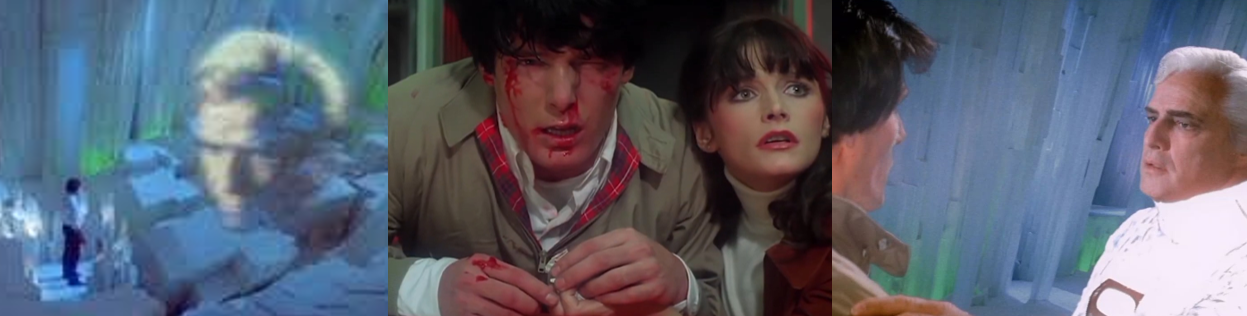
Conspicuous in their inclusion is the use of test footage of Reeves and Kidder for scenes in Niagara Falls where Lois tries to help Clark be more assertive and self-confident and then shoots at Clark to prove he’s Superman! While the revelation that she was firing blanks makes this a little less disturbing, and it’s a little jarring that Reeves’ hair and glasses change throughout, it’s a much more effective way to force his dramatic unmasking than him simply tripping on a bear-skin rug. Naturally, it’s Brando who’s the most notable reinsertion into the film. Oddly, Brando’s restored footage is rendered in wildly inconsistent ways, appearing both translucent and in an odd, distorted, holographic effect, and his presence completely removes Lara from the film’s narrative to continue the father/son themes and relationship from the first film. While I liked that Superman II gave Lara the chance to be there for her son, here it’s Jor-El who Clark again turns to regarding his love for Lois and the conflict he faces between choosing her or his responsibilities to the world. Jor-El pleads (with about as much enthusiasm as Brando can muster, which is to say not much at all) with Clark to reconsider giving up his destiny, and grieves at having to forever disappear in order to restore Clark’s powers. Although Clark is obviously devastated at having let down his father, and the thought of losing his last remaining link to a family and people he never knew, Jor-El’s sacrifice allows Superman to return to the service of truth, justice, and the American Way and this sequence also gives us the only physical onscreen interaction between Reeves and Brando, fulfilling the Kryptonian prophecy that “The son becomes the father, and the father becomes the son”. Although General Zod still displays the odd ability to levitate objects, many of the bizarre superpowers showcased by the Kryptonians are thankfully missing from this version of the film, meaning we don’t have to suffer through Superman’s weird plastic S-shield attack he did in the theatrical cut or the characters randomly duplicating and teleporting throughout the Fortress of Solitude. On the downside, this means we miss out on the scene of the three rapidly defacing Mount Rushmore, which is replaced by a brief shot of them destroying the Washington Monument, but the trio’s assault on the White House is far more violent and brutal, and even includes an amusing scene where Zod gleefully fires an assault rifle.
The ending is wildly different, with Superman again reversing time to undo Zod’s destruction.
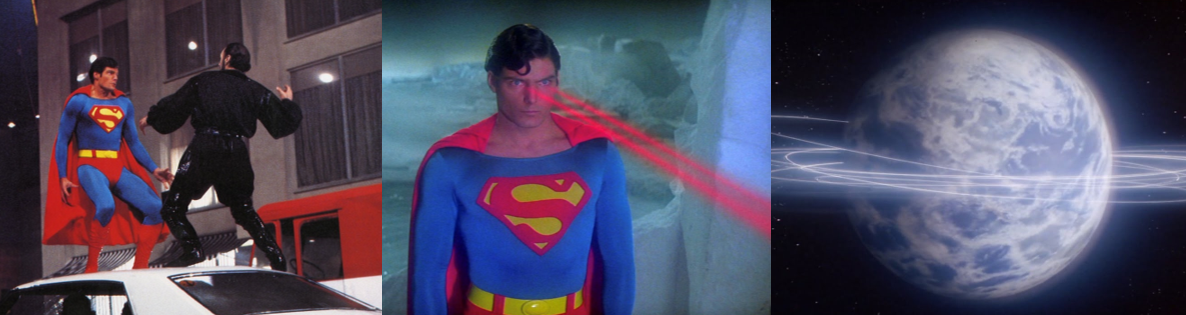
Following their attack on the Daily Planet (which is far less impactful without Thorne’s score, and even replaces the iconic “General, would you care to step outside?” line), Superman again battles his three foes in the skies and streets of Metropolis. You’ll notice a few additional shots here, which are sadly let down by the fact that this project clearly didn’t have much of a budget as the shot composition is even more obviously dodgy than it was in the original film, which was already extremely ambitious in its superpowered brawl. All of the slapstick nonsense is missing from this scene, replaced with a foreboding menace as Superman matches his foes blow for blow until he’s forced to flee to the Fortress of Solitude to keep the three from causing further damage and harm to the city and its inhabitants. Rather than engaging in a battle of strength and skill in the Fortress, Superman uses his wits to outsmart the maniacal Zod; Zod demands that Superman submits to him, becoming his slave for eternity, in exchange for the lives of others and, thanks to Luthor’s deceitful nature, Superman is again able to turn Luthor’s edict of “mind over muscle” against his enemies to render them powerless using the Fortress’s red sunlight. Superman and Lois dispose of the three using lethal means, but the moral quandary of these actions is arguably rendered mute when Superman once again reverses the rotation of the planet to turn back time. This returns Luthor to prison, and the three Kryptonians to the Phantom Zone, but also undoes the relationship he forged with Lois over the course of the film; ultimately, the result is the same, that Superman couldn’t bring himself to put Lois through the pain of knowing the truth and chose to continue living a lie. As I understand it, the original idea was to have the time travel element only in this film, which really makes you wonder how Superman would have undone Lois’s death in the last film, but either way it’s just as much of a cheap trick as the memory-wiping kiss and kind of shows Superman to be a bit of a hypocrite as he takes these extreme actions but doesn’t really learn anything from it as he goes right back to awkwardly flirting with Lois as the bungling Clark Kent (and even pays Rocky back for the beating he gave him earlier, despite the fact that this didn’t actually happen).
The Summary: I think the main question anyone wants to know about Superman II: The Richard Donner Cut is: is it better than the theatrical version? And, I guess, it technically is; the removal of the more slapstick scenes and continuing the themes from the first movie makes it more cohesive and helps it to act as a more fitting follow-up, but I can’t honestly say that it really trumps the original in a fundamental way. This isn’t an extended version of the film, but rather an alternative cut, one that is the closest we’ll ever get to what Donner originally intended and, had we seen this (or something very much like it), we probably would have had a better overall experience that felt likes two parts of a greater whole but I really can’t say that there’s any scenes or inclusions here that make the film objectively better. A lot of this is due to my nostalgia for the original, which I’m very fond of, and my bias against Brando and his abrasive, difficult attitude which impacted his performance as Jor-El and tainted my perception of him. It’s definitely very poignant to see Jor-El reinserted into the film, and his inclusion offers a little more explanation about how Superman regains his powers, but I liked seeing Lara comfort her son in the sequel and was happy with the implication that the green crystal simply restored Superman offscreen. I’m glad that some of the weirder elements are gone, but there isn’t too much in their place to make up for their removal. I enjoy the extra scenes involving Zod and his crew, but the ending is just as head-scratching as in the theatrical cut (seriously, why destroy the Fortress if you’re going to turn back time?!), so, for me, you can just kind of flip a coin and watch either version and pretty much get the same story, just with a few different scenes and contexts between the two.
My Rating:
⭐⭐⭐
Rating: 3 out of 5.
Pretty Good
What are your thoughts on Richard Donner’s version of Superman II? Did you feel like it’s superior to the theatrical cut or were you put off by the newly inserted scenes? What did you think to the alterations made by re-inserting Marlon Brando’s lost footage? Were you a fan of the altered ending? What is your favourite Superman story, character, or piece of media? How are you planning to celebrate Superman Day this month? Whatever you think, feel free to sign up to share your opinion below or leave a comment on my social media.
In April of 1940, about a year after the debut of arguably their most popular character, Bruce Wayne/Batman, DC Comics debuted “the sensational find of [that year]”, Dick Grayson/Robin. Since then, Batman’s pixie-boots-wearing partner has changed outfits and a number of different characters have assumed the mantle as the Dynamic Duo of Batman and Robin have become an iconic staple of DC Comics. Considering my fondness for the character and those who assumed the mantle over the years, what better way to celebrate this dynamic debut than to dedicate every Thursday of April to celebrating the character?
Released: 21 October 2022 Developer: WB Games Montréal Also Available For: PC, PlayStation 5, Xbox Series S
The Background: In 2008, Eidos Interactive and Rocksteady Studios delivered one of the greatest superhero videogames of the modern era, Batman: Arkham Asylum, which proved to not only be a critical and commercial success after years of Batman games of varying quality but also kick-started an incredibly successful and well-regarded series of videogames. Batman: Arkham City (ibid, 2011) proved to be bigger and better and, despite criticisms of its driving sections, the final game in the series, Batman: Arkham Knight(ibid, 2015), was still met with largely favourable reviews. After the success of Arkham City, Warner Bros. Interactive Entertainment turned to WB Games Montréal to develop a prequel and give Rocksteady Studios time to produce their expansive and impressive finale. Although Batman: Arkham Origins(ibid, 2013) is often considered the black sheep of the franchise, I found it to be just as enjoyable as Arkham City and it still sold incredibly well and it even laid the foundation for a spin-off focusing on the Suicide Squad. Indeed, in August 2020, it was announced that Rocksteady would be returning to their popular spin-off franchise for a Suicide Squad title but, at the same time, WB Games Montréal were also revealed to be working on their own Bat-centric title, one that wasn’t connected to the Arkham series but still owed a lot to it in terms of its presentation and gameplay. Unlike the Arkham games, Gotham Knights was to be a multiplayer, open-world adventure set after the Dark Knight’s death and focusing on his four protégés; the game was built to incorporate role-playing elements and online functionality to allow players to co-operate in combat and missions. However, also unlike its spiritual predecessors, Gotham Knights was met with mixed reviews; while the customisation and visuals were praised, the combat and focus on grinding was criticised; the lack of variety offered by mission objectives and dull mechanics were also a negative, though the focus on character relationships was praised.
The Plot: Batman is dead, killed in battle with Rā’s al Ghūl. In his place, his four protégés – Dick Grayson/Nightwing, Tim Drake/Robin, Barbara Gordon/Batgirl, and Jason Todd/Red Hood – must work together to combat the escalating crime sweeping the city, fill the void left by the Dark Knight, and investigate a mysterious secret cabal known as the Court of Owls.
Gameplay: Gotham Knights is a third-person action game that takes place in an open-world environment, includes a great deal of role-playing game (RPG) elements, and allows players to pick between one of the four titular Gotham Knights and take on a variety of missions across different nights in Gotham City. Although each of the Gotham Knights has their own pros, cons, and special abilities, they all share the same control scheme, which, like many things in the game, is similar to that of the Batman: Arkham series but also a little different. You attack enemies with X; tapping the button will unleash a small combo that quickly gets a little repetitive and holding X charges up an attack for extra damage and to break through the enemy’s guard or shields. A is use to open doors, squeeze through gaps, interact with the environment, and to hop over obstacles using the game’s dysfunctional parkour mechanic; as you run around (accomplish by pressing in the left analogue stick), you can tap A to hop over gaps or up to higher levels, but the only time you can actually jump is after grappling to a ledge (accomplished by tapping the Left Bumper). Press Y sees you toss out a ranged attack, either with Batarangs or Red Hood’s apparently non-lethal pistols, and you can also hold Y to knock back and stun enemies with a wider ranged attack. B allows you to evade; there is no counter system like in the Batman: Arkham games but you can hop over and under incoming attacks and out of the way of gunfire (helpfully indicated by danger lines) and, if timed correctly, pull off a counter by tapping X after a dodge. Like the combat, it’s not as slick or intuitive as in the Batman: Arkham games, which again is something that comes up a lot here, but it does a decent enough job.
Each character has their own unique skills and abilities to fight crime in a Gotham without Batman.
The Left Trigger allows you to precision aim your projectile to attack specific enemies or interactable elements, such as exploding barrels, electrical boxes, or chains to create platforms; the Right Trigger lets you grab enemies after you’ve whittled their health down enough, allowing you to finish them off with a strike attack with X, interrogate them to fulfil mission objectives with Y, or toss them at other enemies (or off a rooftop!) with B. The Right Bumper brings up the onscreen “Ability” menu; as you pummel enemies and perform well-timed evades, a meter will build up that allows you to perform your character’s unique attacks, such as a flurry of strikes, unleashing an elemental attack, calling in a drone for a short time, or sending out a bunch of little nanobots. Some of these will boost your attack, other will create a hologram to distract enemies. Similar to the Batman: Arkham games, you can also crouch by pressing in the right stick and take to higher perches to scope out large groups of enemies; this allows you to pull off silent takedowns or ambush takedowns if you want to make a little more noise, disable any security cameras or turrets, and use the environment to instil fear in your enemies and cause them to hesitate. While there are no “Predator” sequences, the spirit of this mode is still alive here; you’re often encouraged to take a stealthy approach, something Robin is especially good at, but you can just as easily tackle most situations head-on since the Gotham Knights are much better at resisting and avoiding gunfire. Additionally, your health will no longer be restored after taking out enemies; instead, you carry a limited umber of health packs, which you can use by pressing right on the directional pad (D-pad); enemies will sometimes drop health packs when defeated so look out for these and, if you’re defeated, you’ll respawn but will have lost a chunk of the bootie you picked up in the mission. At first, the Gotham Knights seem a bit limited compared to their caped mentor; each has their own individual strengths, with Nightwing being more acrobatic and Red Hood a powerhouse brawler, for example, but none of them are capable of gliding, at least not at first. You’ll need to complete a series of side missions with each character, ranging from stopping the randomly-generated “procedural crimes” around the city, interacting with non-playable characters (NPCs) like Alfred Pennyworth and Renee Montoya, to eventually unlock each character’s unique traversal method (known as “Heroic Travel”). Nightwing gets a jet-powered glider, which is a bit clunky to control; Robin taps into the Justice League’s satellite’s to teleport short distances, Red Hood harnesses the power of the Lazarus Pit to pull off a mid-air leap, and Batgirl gets a conventional glide.
Race through the streets on the Batcycle and use the shadows and your detective skills to complete missions.
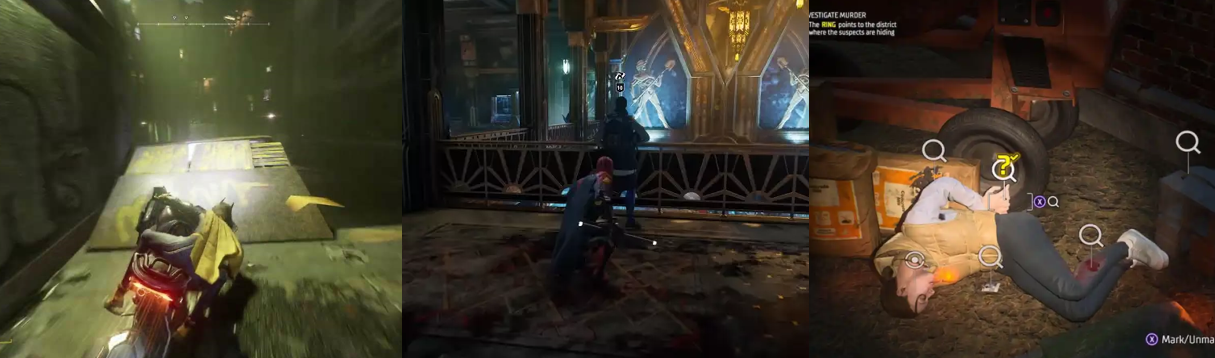
All of these are performed with RT and you’re encouraged to practice and master them using time trials scattered across the city, but I found them a bit unwieldy so I relied mostly on the grapple, which can be chained together to quickly cross horizontal and vertical distances, and the Batcycle. Summoned by pressing up on the D-pad, the Batcycle is a fast and nimble way to get around the impressively crowded city streets; RT accelerates, LT brakes, reverses, and lets you perform a drift, Y sees you perform your ranged attack (though you can plough through pedestrians and enemies as well), A performs a wheelie for a ramp boost, and you can even rocket off the Batcyle with LB. The Batcycle is much more fun than Arkham Knight’s Batmobile and Gotham Knight’s handy and familiar compass and waypoint system mean it’s easy to blast your way to each objective, but you can also unlock various fast travel points across the map by taking out drones as a story objective to make things even faster. Between missions, you’ll return to the Belfry to rest up, advance the story, interact with characters, and upgrade your gear but you can also quick launch missions from here, which will spawn you in a unique and enclosed section of the city to take on one of Batman’s rogues in a specific environment, such as Arkham Asylum or the city dam. Another holdover from the Batman: Arkham games is the ability to scan the environment; pressing or holding down on the D-pad lets you perform an AR Scan, which highlights interactable elements, allows you to tag specific enemies, and is essential for examining crime scenes. Here, you scan dead bodies, lab equipment, and other key areas for clues; sometimes you need to identify a specific item, other times you need to link two together, and you’re often given the option of quick-solving the puzzle if you take too long. It’s a decent system as you’re spending half the game in what’s essentially a wire-frame mode like in the Batman: Arkham games, but it can lead to you feeling obligated to AR Scan every nook and cranny for potential items of interest. When playing Gotham Knights, you have the option of focusing on the main story or taking care of numerous side missions, however this is often actually integral to completing the main story or upgrading your characters. Consequently, while you could glide past most of the random crimes and enemies in the Batman: Arkham games, that’s not the case here; playing on the “Normal” difficulty is quite a challenge, practically forcing you to engage with every premeditated crime and side mission to get stronger, so I definitely recommend playing on an easier difficulty to make things less repetitive. And things can get very repetitive: crimes range from punks trying to bring into cars or escaping police custody, to performing bank heists, hacking into terminals, attacking armoured cars, and even racing away down the streets. You’ll be retrieving organs from organ traffickers or Modchips from goons, defending your allies and other NPCs from attacks, tracking down pieces of Basil Karlo/Clayface, disrupting Doctor Harleen Quinzel/Harkey Quinn’s latest scam, and sneaking into areas through vents to take out enemies.
While you’ll be repeatedly stopping the same crimes, some missions are more memorable than others.
These missions repeat over and over, with stronger and more diverse groups of enemies being mixed in, but with very little deviation; sometimes you can gain bonus rewards if you stay undetected or take out enemies in certain ways or avoid damage, other times there’s a loot crate for you to collect, but mostly you’ll be swinging in to do the same tasks over and over, which can get repetitive very quickly. The main story is where the meat is at. While you often have to complete some side missions to advance it, such as repeatedly infiltrating Oswald Cobblepott/The Penguin’s Iceberg Lounge, disrupting enemy strongholds, rescue hostage strapped to bombs, avoid attracting the attention of the distrustful and trigger happy Gotham City Police Department, and exploring some of Gotham’s most notorious locations, such as Blackgate Prison and even the cavernous tunnels beneath the city. There’s generally a good balance of action, stealth, and puzzle solving when on mission; you might have to sneak into an area and quietly take out goons, but you can also bust heads if you feel like it and are strong enough to pull it off. Puzzle solving becomes more prominent as the plot thickens and the Court of Owls and League of Shadows get involved; you’ll be finding Owl’s Nests all over the city, interacting with hidden doors and taking on the zombie-like Talons to clear them out, as well as infiltrating a masquerade ball and staying undetected as you listen in on the Court’s conversations and examine various parts of stately homes for hidden doors. The Court like to test your mettle in a series of elaborate death traps; you’ll have to avoid instant-fail traps like bursts of flame and spinning blades while on a conveyor belt, for example, muddle through the dark caves and even the wreckage of the Batcave, and at one point are drugged and forced to endure a maze full of spike traps and tricky platforming while the game distorts around you. There are a lot of mazes, elevator shafts, and simple to tricky puzzles to solve, these latter being difficult mainly because the things you need to find are so small. Again, things can get very difficult and very frustrating very quickly on higher difficulties, where you absolutely must tackle every and any crime happening around the city to level- and power-up but, on easier settings, things are much more enjoyable, if still a bit repetitive. While you can upgrade and modify your gear at any time, you can only switch characters in the Belfry, which will end that night’s patrol. The city map reloads, with any incomplete missions still active, and it pays to swap characters between missions to unlock all their abilities and mix things up, and also because some are better suited for certain missions than others.
Graphics and Sound: Gotham Knights absolutely impresses in its visual presentation; Gotham City is bigger than ever, divided into different sections, many of which will be familiar to players of the Batman: Arkham games, and the city is awash in ominous darkness, glows with light, and often covered with rain. All the familiar locales you’d expect are here: Blackgate Prison, Arkham Asylum, GCPD headquarters, and the like, alongside chemical plants, docks, cemeteries, towering skyscrapers, dingy alleyways, and gothic cathedrals. Many areas include little references to other Batman villains and stories, which is fun to see, or house plaques and other scannable points of interest for you to interact with. Unlike the Batman: Arkham games, Gotham Knights’ overworld is fully populated not just with criminals, but pedestrians and traffic! Gothamites can be saved from attacks, run into with your bike, and will offer commentary when they see you, which really helps the city to feel alive for the first time. As ever, the thugs come in all shapes and sizes and are loyal to different gangs but also offer some amusing commentary when you stalk and batter them. Posters, scannable graffiti, and a variety of warehouses are also on offer; thugs will take over Robinson Park, break into banks, and cause disruption in the streets all around you, all of which helps make this the most lively, dangerous, and accurate Gotham City of any Batman game despite how repetitive some elements can be.
The game looks great and has lots of customisation options but is a bit unstable at times.
Gotham Knights is a very story-driven game, so it’s good to see that there’s basically no distinction between cutscenes and in-game graphics; if you customise your character a certain way, they will appear like that in every cutscene, and dialogue and interactions differ depending on which character you play as (and, presumably, how many of you are playing at once). While I’m not a fan of all the costume choices on offer, they do look impressive and the game only struggles whenever your character wears a cape; sometimes the cape physics go a little janky. While combat is noticeably stripped down compared to the Batman: Arkham games and much more reliant on special abilities, it is fun, especially when you level-up and/or lower the difficulty, but the game struggles to maintain a consistent framerate at times. More than once I experienced dramatic and game-breaking slowdown, with the action stuttering or the game out-right crashing at least five times in my playthrough, which I really don’t expect from an Xbox Series X game. Things can also get quite cluttered very quickly, especially when completing the organ harvesting missions; it was never clear to me where I was supposed to take the organ, meaning I’d often run out of time and would have to clear away other active missions before trying again with a clearer compass. Still, the interactions between the Gotham Knights are one of the best parts of the game; they’re united in their grief but still act like siblings at times, making jabs at each other and learning to live and move on together, which was great to see. More often than not, when you switch characters, you’ll be able to interact with parts of the Belfry to learn more about each character, in addition to completing missions for your allies out in the field, all of which allows you and the characters to grow into their roles as Gotham’s protectors.
Gotham is more alive than ever but the game really shines when the environments are visually altered.
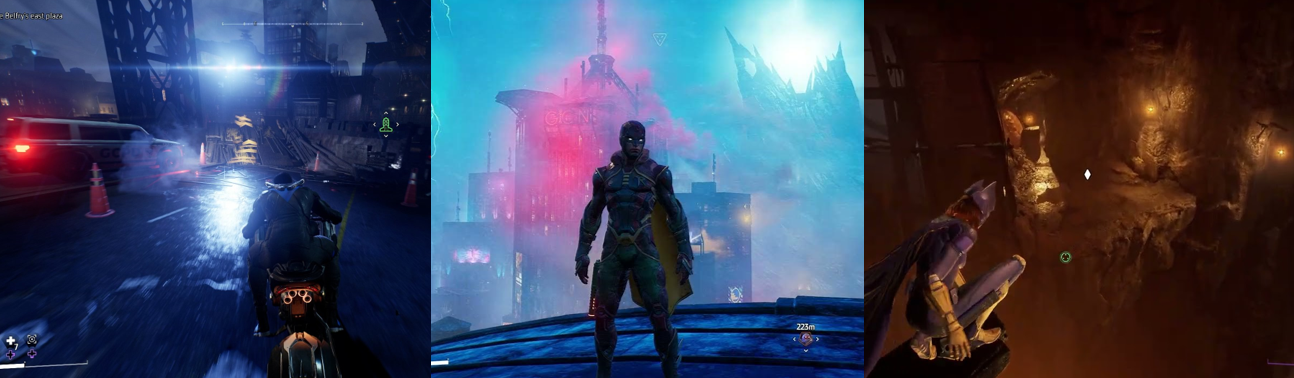
Gotham City is an expansive open-world map full of overground trains, built on top of the Court of Owls’ grimy tunnels, and filled with colourful characters. However, certain missions will restrict you to a specific game area, an isolated and reskinned version of the map tailored to that villain, and this is where things really get visually interesting. When confront Doctor Victor Fries/Mr. Freeze at the Elliot Center and Blackgate Prison, Gotham is ravaged by a vicious snowstorm; ice and snow are everywhere, with innocents caught in the crossfire, and it really helps set the mood for the battles against Mr. Freeze. Similarly, you’ll explore the gothic and ransacked remains of Arkham Asylum, enter the Gotham General Hospital after it’s received a makeover by Harley Quinn, and even venture into the ruins of the Batcave, giant dinosaur and penny and all, as you track down the Court of Owls. While it’s often difficult to see in these areas and they’re fraught with danger, they help to mix up the gameplay and the visuals and the enemies you encounter, from Mr. Freeze’s Regulators to the sword-wielding League of Shadows, then start to appear on the overworld, and in stronger forms, to help keep things a little interesting even as you complete the same tasks over and over. It’s fun just barrelling through the streets or taking to the rooftops, stopping crimes along the way to your next objective and stumbling across side quests as you go; there are various items to examine or interact with, generally for exposition or to aid you in combat, and lots to see and do in terms of customisation, though I found the menus a little finnicky to navigate at times.
Enemies and Bosses: As in the Batman: Arkham games, Gotham City is ravaged by a contingent of criminals, all of whom are loyal to one gang or another. You’ll encounter “Freaks”, street punks who follow Harley’s lead, the Regulators, who wield tech and often use Mr. Freeze’s toys, be attacked out of the blue by the League of Assassin’s ninjas and stir up the Court of Owl’s zombie-like Talons in their nests. Enemies come in different types, from regular grunts to ones with weapons (Molotov cocktails, rifles, freeze or electrical weapons, and even annoying drones), and bigger enemies who have shields or can tank your hits. Each gang has these different types of enemies so, if you fight three different types of Regulators, you’ll encounter similar versions when fighting the Freaks, though they do look different. The bigger Freaks have large metal shields and sometimes maces, for example, whereas the larger Talons wear ceremonial armour and carry axes and the larger Regulators can create an electrifying area attack. Generally, they all go down quite easily once you get the hang of combat; you can dodge out of the way of their attacks and gunfire, which also seems to damage enemies, and take advantage of any interactable elements to stun or defeat them, but things can get quite hectic as enemies mix and match and you take on waves of them to complete objectives or defend endangered Gothamites. You’ll also have to avoid the GCPD; police officers are often in the streets or will arrive at crime scenes after you’ve cleared out enemies; they won’t hesitate to shoot or chase you and you won’t gain experience points (XP) from taking them out, so it’s better to just avoid them.
Thankfully, Man-Bat is on hand to offer a bit of spice after pummeling Harley and her freakish thugs.
You’ll encounter each type of enemy in a dedicated fight as the story progresses, essentially making them almost like mini bosses. Tackling the larger enemies is good practice for the battle against Harley Quinn’s goons, Basher and Blazer; one is obviously a large brute and the other is smaller and likes to toss flaming bombs at you, all while other goons attack you and a series of bombs activate in an enclosed space that you need to disarm before the timer runs out. By this point, you’ll have encountered similar enemies to these two more than once, and many others after ape their strategy, so it’s not exactly hard to break through Basher’s guard with a heavy strike and pummel him while dodging Blazer’s projectiles and smacking him up too, but make sure to take care of the bombs as soon as possible. Harkey Quinn herself (now using the alias Dr. Q) is also fought later in the game after you disrupt her operation and confront her in the vandalised hospital. Harley’s a nimble little minx, deftly cartwheeling about while swinging first her giant hammer and then a sledgehammer infused with electricity. Harley also tosses playing cards are you and sends her goons against you, but you can take advantage of the environment to deal damage to her as long as you can dodge her manic swings and land a good combo once the window of opportunity opens up. Later in the game, after spending a great deal of time investigating Doctor Kirk Langstrom’s death and research, you’ll not only engage with the various Talons of the Court of Owls, who can poison you and are so quick that you need to stun them with a heavy ranged attack, but you’ll also battle a number of Man-Bats across the city. Though they look scary and vicious and can blast you away with scream, swipe at you, and will pin you down to gorge on you, these monstrous freaks are actually quite a pushover, especially by that point as you’re pretty well powered up, and can easily be beaten into submission.
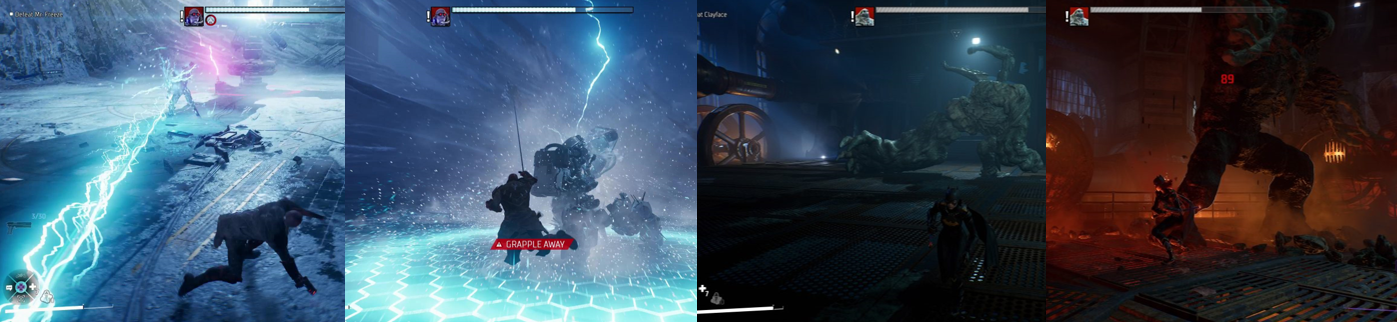
Mr. Freeze and Clayface represent two of the most frustrating and unfair encounters in the game.
However, before that, you’ll endure two of the most frustrating and game-breaking bosses battles I’ve ever experienced. The first is Mr. Freeze, who initially tries to freeze the city with a big machine that deals damage when you get too close. Mr. Freeze stomps about firing missiles at you and his freezing gun, both of which can freeze you on the spot or cause painful ice spikes to sprout from the ground. Mr. Freeze also has a habit of flying about the place, drops down with a slam, and swipes at you when you’re up close. After you deal a bit of damage, he retreats to the machine and it sends out freezing bolts that you have to frantically dodge and he unleashes blasts from a shoulder cannon. This is the first boss fight of the game and is honestly one of the worst experiences of my life; Mr. Freeze is an absolute tank, with your attacks barely fazing him, so you absolutely must have ice resistance and fire damage equipped, be at a higher level, or lower the game’s difficulty because this is an absolute chore of a fight otherwise. It only gets worse in the second bout; this time, Mr. Freeze has escaped Blackgate Prison inside a giant spider-like mech! He stomps about the place, causing a freezing effect, and bombards you with missiles from afar, so you’ll constantly be running and dodging and frantically attacking his legs to get a good shot on his cockpit. The fight then shifts to a frozen platform on the sea, where you need to quickly grapple up top to avoid being flash-frozen, some goons join the fray, and everything becomes even more frustrating and tedious. Clayface is just as bad; after tracking down his clones around the city and taking them out in a massive melee, you battle him in the sewers and your attacks barely do a dent without the right modifications; in my first encounter, he could one-shot me with his annoying grab attack and I was only able survive and beat him by lowering the game’s difficulty. Successfully avoid his swipes and grabs and you’ll have to outrace his liquid form and clay tendrils in the sewer tunnels, which can result in some unfair instant failures if you’re not careful, before fighting him one last time in a furnace. Here, he sprouts extra arms and become much more aggressive but things are significantly easier if you’re equipped right, correctly powered up, or playing on easier difficulties. Still, these boss battles were a pain in the ass, with unfair checkpoints and a startling difficulty spike that almost had me rage quitting!
Ultimately, you’re forced to battle a resurrected Bruce and a malicious Talia to safeguard Gotham.
These bosses are possibly so annoying and difficult because Gotham Knights really doesn’t feature many boss battles at all. The game is padded out by multiple encounters with Mr. Freeze and Clayface, meaning that you only interact with the Penguin rather than fighting him and have to settle for Man-Bats and tougher enemies as your main obstacle as the final portion sees you fending off Talons and the League of Assassins in the catacombs beneath the city. Here, Talia al Ghūl, predictably betrays you and sets a volatile, resurrect Bruce Wayne against you. Bruce is actually quite a fun boss but not too dissimilar from most of the enemies you’ve fought up to that point; you have to dodge his flurry of blows, break through his guard, and deal enough damage to drive him to his knees so you can tap A to appeal to his better nature. When this works, Talia engages you directly in a two-stage boss fight that takes place around a Lazarus Pit (that ironically hurts you if you step into it). Talia is swift and attacks like lightning, teleporting around the arena and striking with her sword, so you’ll need to be tapping that B button like a madman (or precisely, to pull of perfect dodges and counters) and landing combos wherever you can. She also fires arrows at you in a spread and a charged attack, and switches to an even faster and more aggressive spear for the final phase, which includes a big jumping strike that leaves her open to damage. While the fight is needlessly drawn out since your window or opportunity is so short, both Talia and Bruce are far less of a headache than Mr. Freeze or Clayface since they don’t just absorb your blows, you should be much stronger by then, and the fights are more diverse with more opportunities to land hits.
Power-Ups and Bonuses: Even on the easier difficulty settings, you’ll want to engage with as many premeditated crimes and side missions as possible to earn the XP you need to level up, the AP you need to upgrade your special abilities. Gotham Knights incorporates a loot system; defeated enemies, chests, and mission rewards will include a whole bunch of scrap, “Modchips”, and other rewards that you can use to customise, craft, and enhance your gameplay experience. You’ll get different colours and parts for your suits and the Batcycle and the more you collect, the more you can craft to create better equipment. You can also unlock “Transmogs” (basically skins) to be applied over the game’s suits if you like (which I preferred; you miss out on being able to customise each part of the suit, but you also get to wear a strong outfit and avoid some of the game’s uglier designs). Mod chips can be applied (and up to four fused together) to your suit, melee, and ranged weapon for additional buffs, such as increasing your health, durability, and attack power, adding elemental attacks and resistance to your character, and other benefits that I honestly didn’t look too deep into as it was a bit of a cluttered and confusing system. I simply crafted and created the strongest elements I could and went from there, but you’ll definitely need to think about adding fire attacks and ice resistance to your character when taking on Mr. Freeze, for example. As you defeat enemies and complete mission objectives, you’ll also earn XP; earn enough XP and you’ll level-up, increasing your stats and awarding you Ability Points (AP) that can be spent upgrading each character’s unique skills. This is where you’ll unlock their more powerful abilities, but you’ll also be able to buff their damage output, gain a respawn for Batgirl, increase their stealthiness, and other useful perks that make gameplay more enjoyable. However, while each character levels-up at the same rate (if you only play as Nightwing, the other characters will level-up when he does and you’ll be able to use the same AP to upgrade them, making things less of a grind), there is a level cap; once you hit Level 30, you’re done and can’t earn any more AP until you overwrite your game save with New Game+, which ups the level cap to 40. The Gotham Knight’s headquarters, the Belfry, also changes as you progress through the story; more interactable elements are added and it becomes more homely and fit for purpose as you progress, just as your abilities become more honed from battle.
Additional Features: Gotham Knights boasts forty-eight Achievements, at least eight of which are essentially unmissable as they’re awarded for clearing the story’s case files and taking out Batman’s leftover rogues. Achievements are also earned from defeating certain enemies, preventing crimes across the city, crafting certain gear, and fully upgrading each character. Unlike the Batman: Arkham games, there aren’t any riddles to worry about here; you can scan landmarks across the city, and graffiti, and find Bruce’s discarded Batarangs for more rewards and Achievements, but these are surprisingly difficult to find and thus not much fun to search for, as well as mysterious symbols strewn all over the place that I could never quite figure out. You’ll unlock audio files, comic book covers, information about the city, and details on all of the enemies, bosses, and allies you encounter as you do so, in addition to earning some Achievements, but there’s a lot less on offer compared to the Batman: Arkham games as the focus is more on the multitude of side missions. Gotham Knights has four difficulty settings but no Achievements tied to them so I absolutely recommend playing on “Very Easy” to help balance the more repetitive and frustrating aspects of the game. Clearing it unlocks New Game+, which overwrites your save file, increases enemy difficulty, and carries over your upgrades and unlockables, but it irked me that it meant losing my save file to play it. There is a lot of gear to find and craft, though a lot of it is superfluous; I don’t get why you’d wear a suit or use gear that’s weaker compared to others, so some of the customisation is lost there as I simply favoured the strongest setup and then applied a Transmog. The Batcycle can also be customised, to a degree, and this Deluxe Edition of the game comes with some additional gear and skins for it and the characters, though you’re not missing out on much if you just get the standard version. You can also play the arcade version of Spy Hunter (Bally Midway, 1983) in the Belfry, where you can battle even tougher versions of the bosses if you’re a sadist or take on training missions to learn new skills, but they’re nothing compared to the combat challenges of the Batman: Arkham games. Finally, Gotham Knights can be played in multiplayer; two players can play alongside each other and even team up to perform team attacks, and up to four players can take on challenges in “Heroic Assault” mode, though there are no Achievements tied to these features either, which is weird considering it’s a pretty big part of the game.
The Summary: I’m sorry that my review has constantly made reference and comparisons to the Batman: Arkham games but it’s frankly unavoidable given how much of Gotham Knights’ gameplay and visuals takes from that series. in many ways, I feel the game could’ve easily been a continuation of Rocksteady’s franchise with just a few minor tweaks here and there, but it is unfair to make such comparisons as, for all its visual and gameplay similarities, it’s a very different game. Gotham Knights is a long, story-driven action experience; the focus on these characters continuing on after Batman’s death is very intriguing and I really enjoyed their interactions and camaraderie, as well as their individual playstyles. I thought I would favour Nightwing as my go-to character but all of them had their pros and I enjoyed swapping in and out and customising their costumes and gear. Gotham City has never looked better and it’s amazing to see it alive not just with crime, but civilians as well; it’s a massive city that can be daunting to traverse, especially with so much going on at any given time, but you’re given plenty of tools to navigate and address those issues. Unfortunately, the game is severely let down by its repetition and frustration; even on “Normal”, the game is unfairly and unnecessarily grind-heavy, especially considering the level cap. Bosses are an exercise in frustration without being properly prepared, making it less a game a skill and more a game of tenacity, and few of them were fun to play against. The instability of the game was also a factor; I was shocked by how often the game stuttered, glitched, or out-right crashed on me, forcing me to restart missions or even give up at certain points until things sorted themselves out. There are a lot of mechanics here that may appeal to RPG players, but they’re a bit complicated, cluttered, and annoying for me; I get that the point is that you’re learning and growing alongside the Gotham Knights and that’s conveyed very well, but it’s just tedious doing the same tasks over and over and cobbling together new gear that’s instantly rendered superfluous by better gear. In the end, it’s a decent game and I did enjoy it; it might be better (or worse) playing alongside a friend and there’s a decent amount on offer, but I can’t say I’ll be deleting my game save to tackle New Game+ any time soon.
My Rating:
⭐⭐⭐
Rating: 3 out of 5.
Pretty Good
What did you think to Gotham Knights? How would you rate it against the Batman: Arkham games and do you think that’s a fair comparison? Which of the four playable characters was your favourite and why? Did you also struggle against the game’s bosses and difficulty spike? What did you think to the combat and RPG elements of the game? Did you enjoy crafting and customising your characters? What did you think to the relationship between the Gotham Knights? Did you ever play the game online and, if so, how did it hold up? Which of Batman’s sidekicks is your favourite and how are you celebrating the Boy Wonder this month? To share your thoughts on Gotham Knights, leave a comment below or on my social media.
In April of 1940, about a year after the debut of arguably their most popular character, Bruce Wayne/Batman, DC Comics debuted “the sensational find of [that year]”, Dick Grayson/Robin. Since then, Batman’s pixie-boots-wearing partner has changed outfits and a number of different characters have assumed the mantle as the Dynamic Duo of Batman and Robin have become an iconic staple of DC Comics. Considering my fondness for the character and those who assumed the mantle over the years, what better way to celebrate this dynamic debut than to dedicate every Thursday of April to celebrating the character?
Released: 27 July 2018 Director: Peter Rida Michail and Aaron Horvath Distributor: Warner Bros. Pictures Budget: $10 million Stars: Scott Menville, Hynden Walch, Khary Payton, Tara Strong, Greg Cipes, Will Arnett, Kristen Bell, and Nicolas Cage
The Plot: Determined to be a Hollywood star, Dick Grayson/Robin (Menville) will go to any lengths to impress director Jade Wilson (Bell) to notice him and his team! With a few madcap ideas and musical numbers, the Teen Titans try to take the limelight, but when Slade Wilson/Deathstroke the Terminator (Arnett) messes with their plans, the Teen Titans will have to become true superheroes to save the world!
The Background: About four years after the debut of the Justice League of America (JLA), their teen sidekicks came together to form the Teen Titans, presumably to appeal to younger readers. The team were a relatively consistent presence throughout the 1960s and 1970s but writer Marv Wolfman and George Pérez breathed new life into the concept with characters like Victor Stone/Cyborg and Princess Koriand’r/Starfire, who became synonymous with the team. No strangers to adaptation, the Teen Titans have seen some success in animated ventures; Teen Titans (2003 to 2006) was widely regarded as a popular spin-off of the incredibly well-regarded animated series pioneered by Bruce Timm and Paul Dini. Many long-term fans were therefore put off when the show was retooled into a more kid-friendly aesthetic with the slapstick Teen Titans Go! (2013 to 2022), though many praised the show for its bizarre nature and light-hearted humour. Additionally, the show was popular enough to spawn this feature-length production; universally praised for its metatextual comedy, its gleeful destruction of superhero tropes, and its unhinged comedy, Teen Titans Go! To the Movies also gave finally star Nicolas Cage the chance to portray Clark Kent/Superman after missing out on a live-action appearance in the nineties. With a box office gross of $52.1 million, the film was followed by a reasonably well received straight-to-DVD crossover between the Go! Titans and their more serious predecessors, as well as a couple of other similar features of varyingquality.
The Review: So, like a lot of kids my age, I watched a fair amount of Bruce Timm and Paul Dini’s DC cartoons back in the day; even into my late teenage years, I was enjoying Justice League Unlimited (2004 to 2006), and I really enjoyed the original Teen Titans cartoon. Although never explicitly stated to be a part of the same fictional universe, I always liked to think that Teen Titans was a spin-off from the main DC Animated Universe and I loved how it gave a bit of a gritty edge and a commanding presence to one of my favourite characters, Robin, and allowed him to be in the spotlight in a world where he’s oftengiven the shaft in live-action movies. I’d be lying if seeing Teen Titans Go! for the first time wasn’t a little off-putting for me in this regard; however, it was clearly aimed at a younger audience and I found it to be quite funny the few times I did watch it, the same as Batman: The Brave and the Bold (2008 to 2011), which showcased a more light-hearted version of the Dark Knight but in a fun and action-packed way. There is room for both interpretations of these characters, as much as I prefer the darker interpretations as they’re truer to the original spirit of Batman and his world, and it’s not as if there weren’t other animated ventures that showcased this side of the likes of Batman and Robin, so it was still pretty exciting when a feature-length presentation was announced, especially as it aimed to poke fun at Warner Bros.’ tumultuous history with cashing in on their DC Comics franchises.
The happy-go-lucky Titans are distraught to learn the public and their peers see them as bumbling fools.
Things get off to a loud and action-packed start as Jump City is attacked by the megalomaniacal supervillain known as Balloon Man (Greg Davies), a ludicrous character who is quite literally a gigantic, anthropomorphic balloon who can easily smash his way into a bank and squeeze through small gaps by expanding and contracting his bulbous body. Although Jump City’s police are no match for the inflated villain, the Teen Titans soon arrive to help out; what follows is a fight scene, set to an electric guitar remix of the Teen Titans Go! main theme, that helps to establish the characters and abilities of the titular team for those who are unfamiliar. Robin is the leader, jumping head-first into the fight and partially tearing Balloon Man’s hide with his shuriken; Cyborg (Payton) is the enthusiastic muscle, able to transform his body into all kinds of heavy ordinance; Starfire (Walch) is a naïve, childlike misfit from another world who wields incredible cosmic power but is easily distracted by cute things; Rachel Roth/Raven (Strong) is the dark, stoic enchantress capable of manipulating others and creating constructs out of a black magical energy; and Garfield “Gar” Logan/Beast Boy (Cipes) is the team’s goofball shape-shifter, who delights in monkeying around and transforming into a range of green-hued animals (including becoming a porcupine to pierce Balloon Man’s butt for an extended fart gag). So consumed by their own hype are the team that they completely miss that the Justice League – Superman (Cage), Diana Prince/Wonder Woman (Halsey), and Jon Stewart/Green Lantern (Lil Yachty) – take out Balloon Man and are saddened to learn that both the public, and the superhero community, see them as a team of goofballs rather than “real” superheroes worthy of their own movies. Despite the fact that people “don’t talk” about Green Lantern’s movie, Superman advises the team that they’ll never be seen as anything other than a joke unless they shape up and start acting like real heroes rather than goofing off for food and dance numbers. Despite the evidence lobbied against them, Robin is adamant that he and his friends are not only world-renowned heroes but worthy of their own movie; it’s been his lifelong dream to have his own movie franchise, after all, and he’s determined to prove that he’s worthy of this accolade.
Robin’s so determined to get his own movie that he briefly messes up with the timeline.
Unfortunately, he and his friends are aghast to learn that they’re not on the list to attend the premiere of Batman’s (Jimmy Kimmel) newest film, and even more insulted when the Challengers of the Unknown, of all people, are more known than they are. Thanks to Raven’s ability to teleport them using her extradimensional portals, the team are able to gate crash the screening and steal the Challengers’ seats, introducing them to beloved superhero movie director Jade Wilson. Robin is dejected to see first-hand that he’s not only not slated to appear in a movie, but that the entire superhero community laughs him off as simply a sidekick and a nobody. After dispelling Robin’s depression with a musical number, the team head to Warner Bros. Studios in Hollywood, determined to demand that they get their own movie from Jade. Unfortunately, she’s not interested in the prospect of a solo Robin movie and states that she would only consider it if there were no other superheroes in the world, a dismissive comment that gives him the outrageous idea to travel through time to prevent the world’s superheroes from ever coming into being using their time cycles (because their regular time machine is too “boring”). Thus, the team prevents Krypton’s destruction (using disco-synth, no less), stealing Wonder Woman’s magical lasso when she’s just a girl, cause Arthur Curry/Aquaman (Eric Bauza) to get caught up in trash and drown as a baby, prevent four turtles from coming into contact with radioactive ooze, and redirect Thomas, Martha, and young Bruce Wayne (Kal-El Cage) from going down Crime Alley. As you might expect, this results in the world being overrun by supervillains in the present day and therefore no superhero movies being produced, so the Teen Titans immediately travel back to undo their efforts…resulting in them being directly responsible for Krypton’s destruction and gleefully pushing Thomas and Martha Wayne to their deaths with a smile and a thumbs-up!
Slade’s master plan to control the world brings him into conflict with the Teen Titans.
Since rewriting the space/time continuum did nothing to improve their standing in the superhero community, the Teen Titans resolve to prove themselves the old-fashioned way. Earlier, the others suggested to Robin that they’re not taken seriously because they lack a cool archnemesis with an ominous name and they attempt to address this by confronting Deathstroke (as ever referred to simply as “Slade”) as he steals “the perfect plot device”, the Ditronium Crystal, from Scientific and Technological Advanced Research Laboratories (S.T.A.R. Labs). A bombastic villain who mocks the Teen Titans pose and easily tricks them with simple illusions and distractions, Slade is nonetheless fully capable of holding the team off using only his skill, weapons, and vast array of gadgets. Still, by taking themselves seriously, the team is able to retrieve the crystal on their second encounter, but Slade easily escapes by preying on Robin’s ego and painting himself as his archnemesis. Incensed at their interference, Slade vows to divide the team to take away their greatest advantage, something made considerably easier when jade summons the team to Warner Bros. Studios, impressed by their fight, to start shooting their movie. However, when the others embarrass him by repeatedly pooping in a prop toilet, attacking their co-star and subduing Superman with Kryptonite, causing havoc, and almost destroying her Digitally Ordering Online Movies Streaming Directly At You (D.O.O.M.S.D.A.Y.) Device (Phil Morris), Robin angrily ditches his friends in order to have his own solo movie and shake the stigma of their idiocy from his character. Heartbroken at his decision, especially after they supported his dream all throughout the movie, the team leave him to indulge his greatest fantasies on the set of his very own movie, finally bringing him the adulation he has craved for so long, though all the digital enhancements and action sequences in the world can’t make up for the loss of his friends.
The Nitty-Gritty: I gather there are a lot of people who dislike the art and animation style of shows like Teen Titans Go!; many comparisons are made to the likes of Steven Universe (2013 to 2019), though I’m not sure why that’s a bad thing as, while I’ve never watched it, I always thought the show was quite popular. Again, it’s potentially because of the nostalgia and love for Timm and Dini’s traditionally dark and moody visual style, and the anime influences seen in the original Teen Titans, but I thought the change in visual direction was a great way to immediately show that Teen Titans Go! is aimed at a completely different audience to its predecessor, and enjoyed the presentation because it, like some of the line-towing humour, reminded me of TheRen & Stimpy Show (1991 to 1996; 2003). Jump City is a bright maze of skyscrapers and beaches, its inhabitants all sport comically oversized heads and cartoonish proportions, and much of the allure of the movie’s visual style comes from the short, sharp movements characters make that remind me of traditional animation techniques such those using construction paper. The movie’s tongue-in-cheek approach is also evident right from the start, as DC’s heroes are chibi-fied in the opening credits to fit with the show’s more exaggerated art style; the movie even appears to ape the traditional Marvel Studios opening by rapidly flicking through pages of Teen Titans comics, only to subvert expectations and show that it’s simply a seagull flicking through a comic book! In this cartoonish world, the DC superheroes are such huge celebrities that they have their own merchandise and movie franchises, just like in the real world, with even the grim Dark Knight playing up to the paparazzi at the premiere of his new film, Batman Again, and heroes like Kara Zor-El/Supergirl (Meredith Salenger) and even Doctor Raymond “Ray” Palmer/The Atom (Patton Oswold) being treated as Hollywood starlets.
The movie is jam packed with references, cameos, and fun musical numbers.
This is taken to the nth level when we see just how many superheroes are being given feature-films and the lengths to which Hollywood is going to milk Batman’s popularity with movies about his loyal butler, Alfred Pennyworth, his high-tech vehicle, the Batmobile, and even his utility belt! Although a hilarious gag at the time, and with some basis in truth given how much Batman content had been produced by 2018, this lands even harder now considering Alfred received his own live-action television series and we even got a Cars-like (Various, 2006 to 2022) Batmobile cartoon! Even the D.O.O.M.S.D.A.Y. Device is a precursor to the stranglehold over the genre that Marvel Studios would get with the onset of Disney+, making the film scarily ahead of its time in its metacommentary. The film also stands out with its fourth-wall-breaking humour; this includes jabs not only at existing DC properties, but also gags like the Teen Titans mistaken Slade for Wade W. Wilson/Deadpool, a parody of the iconic opening of The Lion King (Allers and Minkoff, 1994), references to one of my favourite cartoons, Animaniacs (1993 to 1998; 2020 to present), Superman(Donner, 1978) and the Tim Burton Batman movies (1989; 1992), and the Back to the Futuretrilogy (Zemeckis, 1985 to 1990), a gratuitous and self-referential cameo by Stan Lee himself, a fantastic jab at the whole “Martha!” debacle during the filming of Batman vs. Superman: Part II by having the two come to blows because their fathers have different names, and having Robin’s team mates embarrass him when they kick the crap out of Shia LaBeouf (James Arnold Taylor). Musical numbers also play a huge role here; we get our first taste of this when Balloon Man insults and shocks the group by claiming not to know who they are (he thinks they’re “lesser members” of the Justice League of the Guardians of the Galaxy), leading to them performing a rap number running down their names, powers, and a bit of their background (“GO!”). Unfortunately, they get so wrapped up in their singing and dancing that they’re completely upstaged by the Justice League. Struggling with his sense of self-worth and disheartened at being mocked by everyone, even the team’s adorable hand-crafted movie fails to cheer Robin up; it takes an amusingly generic “upbeat, inspirational song” to reignite Robin’s spark and renew his enthusiasm (“Upbeat Inspirational Song About Life”). Additionally, Robin’s able to describe his perfect solo superhero through song, resulting in a montage and homages to Batman: The Dark Knight Returns (Miller, et al, 1986), Batman: The Animated Series (1992 to 1995) specifically designed to emphasise Robin’s competency, cute butt, and totally adult hands (“My Superhero Movie”). When the Teen Titans travel through time to take out their competition, the sequence is brilliantly set to A-ha’s “Take On Me” and Huey Lewis and the News’s “Back in Time”, they play Krypton’s crystals like a DJ deck to prevent the decidedly Donner-esque planet from exploding, and Cyborg, Starfire, Raven, and Beast Boy get themselves kicked out of their own movie by pulling pranks all over the Warner Bros. Studio (“Shenanigans”).
In the end, the Titans come together to defeat Slade and earn the respect of their superhero peers.
Robin is so caught up in finally getting his time in the spotlight, away from the shadow of the Batman and the goofiness of his teammates, that he doesn’t even question Jade’s motivations or inputting the code to the vault as part of his movie’s finale. All too late, he realises that he’s been tricked into opening the actual vault and that Jade has been Slade in disguise all along in a surprising, and amusing, twist. Thanks to his manipulations as Jade, Slade has effectively subdued the Justice League by distracting them with their movies, leaving him free to steal the Ditronium Crystal, insert it into the D.O.O.M.S.D.A.Y. Device, and control the minds of the world’s populace as part of a diabolical scheme for world domination. Thanks to his baby hands and Bat-gadgets, Robin is able to escape the exploding Titans Tower; seeing his home and his friends’ possessions go up in smoke makes him realise how selfish and foolish he’s been but his friends enthusiastically return to his side to aid him in stopping the broadcast of Robin: The Movie to prevent Slade’s plans from coming to fruition. After unmasking Slade before their superhero peers, the Teen Titans are forced to battle the Justice League when Slade uses the D.O.O.M.S.D.A.Y. Device to turn them into his mindless slaves; thanks to a golf cart and Raven’s portal abilities, they’re able to take the Justice League out of the equation but, when Robin engages Slade in a one-on-one fight, Robin’s unable to resist watching footage of his film and is compelled to attack his friends. Robin’s brought to his senses when forced to watch the remainder of the homemade film the Titans made for him, reuniting the team in friendship just in time to battle Slade’s ridiculously oversized robot! Although Slade mocks them and boasts at his invincibility, Robin realises that their greatest asset is their goofball antics and they’re able to take out Slade’s robot using another of their dope songs (“GO! (Battle Remix)”) and an overwhelming combination of their unique powers and abilities. With the world freed from Slade’s control, the Ditronium Crystal destroyed, and Slade defeated, the Teen Titans finally earn the approval and respect of their peers, though Robin’s denied the chance to deliver a meaningful speech as everyone else insists that the movie’s over.
The Summary: Teen Titans Go! To the Movies is a ridiculously over the top, slapstick romp in this exaggerated and cartoonish spin-off of the darker DC Animated Universe. Everything from the visuals, the gags, and the action is designed to appeal to younger audiences, ones who will delight at the instances of toilet humour and the fun music numbers, yet there’s a fair amount here for older audiences to enjoy as well. From cameos, references to other movies and DC properties, and some surprisingly dark inclusions that might go over the heads of little kids but had my spitting out my drink at times. The overriding narrative of the Teen Titans trying to earn respect for being superheroes is done pretty well, and wisely focuses on Robin’s obsession with being seen as more than a sidekick and worthy of his own movie, though the film doesn’t dwell too much on the wedge this causes between him and his friends. Similarly, the time travel side plot was primarily there as a gag, a funny one to be sure but one immediately undone to focus on the campaign against Slade. I would’ve liked to see the Teen Titans realise their worth in a world without the other superheroes, but it was fun seeing Slade mock them and wipe the floor with them and be revealed to have been disguised as Jade all along. While there isn’t much here for the other Teen Titans to do beyond be goofy, say their catchphrases, and sing and fight alongside Robin, the metacommentary on the influx of superhero movies was amusing and I found myself thoroughgoingly entertained through the film. I always enjoy it when animated movies sprinkle their narratives with little Easter Eggs for adults to enjoy and Teen Titans Go! To the Movies certainly succeeds in this regard, and with including some genuinely funny gags that keep the energy high, resulting in a very enjoyable animated romp.
My Rating:
⭐⭐⭐⭐
Rating: 4 out of 5.
Great Stuff
Did you enjoy Teen Titans Go! To the Movies? Were you a fan of the cartoon or did the move towards slapstick put you off? Which member of the team was your favourite and what did you think to Robin’s desire to be taken seriously as a superhero? Did you enjoy the musical numbers and the sprinklings of dark humour laced throughout? What s your favourite incarnation of the Teen Titans? Who is your favourite Robin and how are you celebrating the Boy Wonder’s debut this month? Whatever your thoughts on this film, Teen Titans, and Robin, leave a comment either below or on my social media.
In April of 1940, about a year after the debut of arguably their most popular character, Bruce Wayne/Batman, DC Comics debuted “the sensational find of [that year]”, Dick Grayson/Robin. Since then, Batman’s pixie-boots-wearing partner has changed outfits and a number of different characters have assumed the mantle as the Dynamic Duo of Batman and Robin have become an iconic staple of DC Comics. Considering my fondness for the character and those who assumed the mantle over the years, what better way to celebrate this dynamic debut than to dedicate every Thursday of April to celebrating the character?
Story Title: “The Thousand-and-One Dooms of Mr. Twister” Published: July 1964 Writer: Bob Haney Artist: Bruno Premiani
The Background: All Star Comics (1940/1941) brought together the Justice Society of America (JSA) for the first time, birthing the first ever superhero team in comics. While the JSA’s roster expanded and changed over the years, they were rebranded entirely in the late 1950s when editor Julius Schwartz tasked writer Gardner Fox with breathing new life into the team as the Justice Leagueof America (JLA). The JLA brought together eight of DC’s heavy-hitters and their origin issue became one of DC Comic’s best-selling titles; a mere four years later, DC would assemble a new team, one that specifically targeted their younger readers by bringing together the sidekicks of three DC Comics’ most powerful superheroes. Under the leadership of Dick Grayson/Robin, the trio would later be expanded considerable and come to be known as the Teen Titans, with runs by the likes of Marv Wolfman and George Pérez being notably influential, and the team has seen success in both animated and live-action ventures.
The Review: Our story begins in the town hall of Hatton Corners, where an “unusual” public meeting is taking place; specifically, Mayor Corliss is leading the charge against the disruptive and workshy youth of the day by calling for a curfew to help solve the town’s teenage problem. At the same time, in a dilapidated barn across town, the Mayor’s son, Eddie, is rallying the town’s teenagers, threatening that they’ll go “on strike” if they don’t get their new clubhouse, and both mobs are vehemently against the other. Robin, colourful partner and ward to Bruce Wayne/Batman, is on the side of Hatton Corners’ youths; while the Batman believes that the kids are acting like spoiled brats, Robin believes the kids’ voices need to be heard and accepts their invitation to join the Hatton Corners Teen Club (with Batman’s permission, in an amusing bit of irony). Barry Allen/The Flash is equally disturbed by the teenagers’ unruly attitude but his young partner, Wally West/Kid Flash, believes that adults have forgotten what it’s like to be a teenager and also agrees to join the club (again, with his mentor’s permission). The Hatton Corners Teen Club is so adamant about recruiting teenage heroes to their cause that they’re even able to extend an invitation (via an eel carrying a note in a bottle…) to Gar/Aqualad at the bottom of the ocean! Although Arthur Curry/Aquaman believes that kids shouldn’t dispute with their elders and warns Aqualad that he can’t survive out of the water for longer than an hour, he also allows his youthful companion to attend, and the three arrive at the club astonished not only to see each other there but also to find the barn demolished and deserted.
Mr. Twister kidnaps the rebellious youths of HattonCorners and delivers a bizarre threat.
The trio go to Mayor Corliss for answers and he shows them a note form Eddie that reveals he and his fellow “cats” decided to “skip” until the adults “get hip” and build them a new clubhouse. While the Mayor and the town’s other adults believe it’s a ruse to get attention, Robin believes the note is phony since it didn’t use a more appropriate word for “music” (like “jive”); realising that the town’s elders won’t be of any help, the Boy Wonder takes charge and tasks Kid Flash with scouting around the area and Aqualand with checking out the surrounding waters for any sign of a clue. Robin stays in town and is thus on hand to help get the townsfolk to safety when a twister suddenly comes barrelling into Hatton Corners; despite his best efforts to resist the wind, Robin is tossed into the tornado and faces certain death courtesy of Bromwell Stikk/Mister Twister. Thankfully, Kid Flash is able to use his incredible speed to brave the winds and bring Robin to safety, but the young speedster is knocked for a loop when he tries to confront Mr. Twister and gets a blast from his odd staff. Mr. Twister takes credit for the missing children and threatens Mayor Corliss that the youths won’t be returned unless he bows to his demands; in the unspecified amount of time that follows, the townsfolk express regret at how quiet and lifeless it is without the kids, much to the trio’s disgust (though we never see the reactions from any parents except for the Mayor, who seems more bothered about Mr. Twister’s return than the loss of his son).
Mr. Twister’s threat to the kids is all-too-real, necessitating the intervention of Kid Flash.
Mayor Corliss sheds some light on what Mr. twister’s beef is; back in colonial days, Bromwell’s ancestor, Jacob, allowed settlers to build Hatton Corners on his land in return for him and his descendants being paid one passenger feather a year or forfeit one of their youths. Since the demand was so ludicrous, the town’s founders never honoured the agreement and, when Bromwell showed up looking claim on the unpaid debt, he was laughed out of the Mayor’s office and vowed revenge. With passenger pigeons having gone extinct in the intervening years, Robin decides to do a little detective work to find the missing kids and discovers records of “unidentified flying objects” heading southwest to…Goat Island…the same night the teenagers vanished. Aqualad arranges them some transport to the island on the back of a manta ray; along the way, he and Kid Flash get into a bit of a dispute over the appeals of the sea and super speed and Kid Flash even questions Robin’s tendency to bark orders considering his lack of superpowers. Still, they arrive at the island and find the missing teens being put to work by Mr. Twister to build a massive stone tower in his honour. Although Eddie tries to fight back by…throwing a rope at their captor…his efforts are easily subdued thanks to Mr. Twister’s staff and he (as in Eddie) and his fellow teens are suddenly longing for the safety and security of their town and its adults. Mr. Twister leaves to run an errand and threatens them with punishment if his tower isn’t completed by the time he gets back; while Robin goes to uncover the source of the villain’s powers, Kid Flash uses his superspeed to build the tower in no time at all, thereby sparing the youths the wrath of their kidnapper.
Despite being touted as invincible, Mr. Twister is defeated with a ridiculous amount of ease.
Back on the mainland, Robin discovers Mr. Twister using “long lost Indian medicine” to empower his staff; when he’s discovered, Robin leaps into action, tossing sand in the villain’s face and landing an uppercut to his jaw. However, his eagerness backfires; as long as Mr. Twister is in possession of his staff, his body automatically repels any force used against it. Mr. Twister uses a tornado to dump Robin back into town with a further threat to destroy the town unless his debt is paid, but the Boy Wonder is clueless how they can meet the villain’s demands or oppose the power of his staff. Jealous of the adulation Kid Flash receives from the town’s kids, Aqualand returns to the ocean to revitalise his strength and discovers that Goat Island is…somehow…held aloft by an extremely narrow piece of earth under the sea. Using his command over marine life, Aqualad has a bunch of whales literally transport the island out of Mr. Twister’s grasp, bamboozling the villain and earning him the admiration of the kids. Although the teenagers are safely returned to town, Mr. Twister makes good on his threat by conjuring a cloud of dust to bury the town; however, Kid Flash is easily able to disperse it with his superspeed. When Mr. Twister tries to flood the town in torrential rain, Aqualad is able to drain the water by commanding a narwhal to bore a hole into the ground but, when the villain rains literal fire upon the town, Kid Flash and Aqualad are incapacitated by bolts from his staff and the town is slowly consumed by fire (…despite the fact it was just half-submerged under water). Robin pulls his friends to safety and hops into a fire engine; he climbs up the fire ladder and is able to disarm the villain with a ridiculous amount of ease simply by tossing his Bat-Rope and because Mr. Twister was apparently unable to get a clean shot…even though he hit Kid Flash mere moments earlier! Anyway, Mr. Twister is depowered and apprehended, the trio put out the fire, the adults agree to build the teenagers their clubhouse, and everyone celebrates their newfound appreciation of each other.
The Summary: Holy God! I was expecting this to be pretty bad but, somehow, the first team-up of the proto-Teen Titans managed to exceed my wildest dreams. I’ve said many times how much I dislike the dialogue and characterisations of teenagers and women of this era of comics, so it’s no surprise that I wasn’t best impressed by all the lame attempts to be “cool” by shoehorning in language and anti-adult attitudes all over the story. I liked that the story kind of acknowledged this when Robin noticed the note was clearly written by an adult; it’s ironic as this story, and all other teenage characters, was written by adults trying to capture the speech and beliefs of the younger generation and it just comes across as awkward and out of touch. The whole “teenagers against adults” thing is pretty overplayed throughout comics, especially in the pages of Teen Titans and its successors, but it’s paper thin here; we’re never seen what the Hatton Corners teenagers do that’s deserving of a curfew and the kids only rally against the adults because they won’t build them a clubhouse. There’s no discussion about the relationship between Mayor Corliss and Eddie, no reaction from any parents, and the kids immediately start praising the ground the adults walk on when they’re forced into slavery by Mr. Twister.
Although portrayed as a threat, Mr. Twister’s motives are paper thin and he’s easily defeated.
Speaking of whom…what the fuck is this villain? He’s the descendant of some landowner who made a bonkers agreement that was immediately welched on and yet he somehow stumbled upon some poorly defined “Indian” magic to empower his staff and gain control of the elements. I mean, I’ve seen some pretty wacky villains in comics in my time, but Mr. Twister takes the cake! He’s literally willing to kidnap a whole bunch of kids, force them to build him a monument, and destroy the entire town, killing all of its inhabitants, unless he’s given a bunch of feathers! He makes the pompous Mayor Corliss look reasonable by that measurement, but the worst part is that he’s portrayed as a credible threat! And that’s a really weird thing for me to complain about as I’m normally bemoaning the fact that the villains of these team-ups aren’t enough of a threat, but Mr. Twister makes mincemeat of both Kid Flash and Aqualad with his staff’s power and could’ve easily killed Robin when he had him unconscious but chose not to for no bloody reason! And yet, despite his vast power, the heroes have to triumph so the story pulls some of the most ludicrous explanations out of its ass to facilitate that; Goat Island is held aloft by a thin perch of earth? A goddamn narwhal? And the fact that Mr. Twister can “kayo” the two superpowered teens but can’t hit Robin because he’s climbing a ladder?!
Thanks to Kid Flash and Aqualad’s bickering, it’s easy for Robin to stand out and take charge.
The whole story is just a complete mess of a fever dream. The three teenage heroes are brought together in the most contrived way possible and, for all their high and mighty talk of the troubles of the youth moment, only go to Hatton Corners when their mentors give them the go-ahead! The dynamic between the three isn’t very developed, but there’s definitely potential here; the rivalry between Kid Flash and Aqualad doesn’t get a lot of play but it was kind of fun seeing them out-doing each other to impress the girls and bickering about their respective powers. If there’s a standout of this story, it’s Robin; he takes command of the three easily and naturally and they listen to him without question (save for one inconsequential remark from Kid Flash). As the far more logical and level-headed of the three, it’s fitting that Robin discovers where the kids have been taken and the source of Mr. Twisters power, and the remarks about his lack of superpowers mean he was obviously going to be the one to topple the villain…I just wish it had been in a more impressive fashion. In the end, “The Thousand-and-One Dooms of Mr. Twister” is indicative of the storytelling of its era; it might seem unfair to hold that against it, but I’m going to. There are certainly far better Teen Titans origin tales out there and you’re really not missing all that much if you skip this one unless you’re a big fan of outdated slang, outmoded opinions on both age groups, and nonsensical storytelling.
My Rating:
⭐
Rating: 1 out of 5.
Terrible
Have you ever read “The Thousand-and-One Dooms of Mr. Twister”? If so, what did you think to it? Do you own a copy of the original comic or do you remember reading it when it was first published? What did you think to the first team-up of Robin, Kid Flash, and Aqualad? Were you also put off by the outdated slang and attitudes or did you enjoy these aspects? What did you think to Mr. Twister, his motivations and powers, and the way he was defeated? What are some of your favourite Teen Titans stories? Whatever your thoughts onthe Teen Titans, and Robin, drop a comment down below and check back next Thursday for more Robin content.
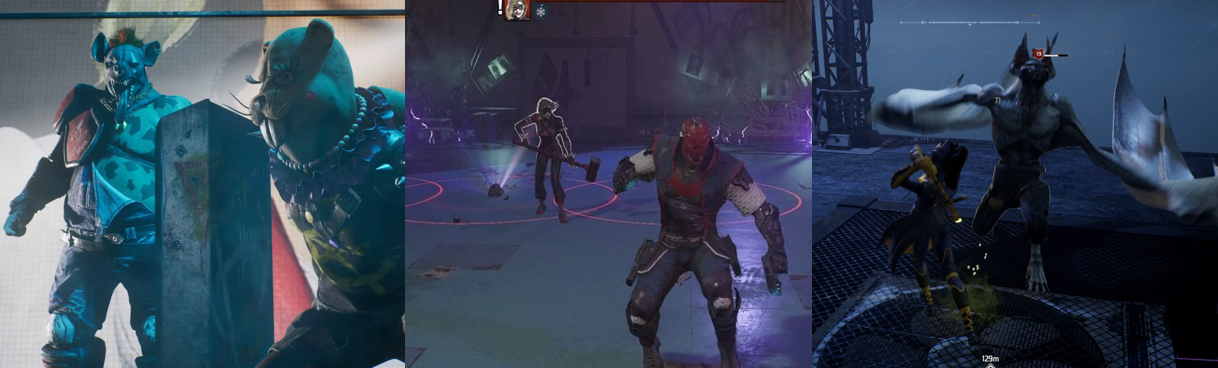
In April 1985, the first issue of the ground-breaking Crisis on Infinite Earths(Wolfman, et al, 1986) released and saw the temporary destruction of the “Multiverse”. To celebrate this momentous event, I’m discussing multiversal crossovers all throughout April in an event I dubbed “Crossover Crisis”.
Story Title: “Disordered Minds” Published: September 1995 Writer: J.M. DeMatteis Artist: Mark Bagley
The Review: Our story begins with Peter Parker wrestling with the guilt and shame of being partially responsible for the death of his beloved Uncle Ben. In a nightmarish revisitation of the fateful night when Dennis Carradine broke into the Parker home and gunned down Ben, Peter (as Spider-Man) is on hand to strike with a furious vengeance, viewing the gunman as some maniacal monster who simply laughs at his murderous actions so hard that he eventually turns into the Joker! Peter awakens in horror, eased through the aftermath of this oft-recurring nightmare by his beautiful and busty wife, Mary Jane Watson-Parker. As ever in times of emotional crisis, Peter takes to web-slinging to help clear his head and ventures out into the night reaffirming his commitment to using his powers responsibility in order to live up to the examples set by his doting aunt and uncle. Coincidentally enough, that very same night, Bruce Wayne is also reliving the night that his parents died, gunned down in an alley in a senseless act of violence. Similar to Peter, Bruce’s dream sees him (as Batman) leaping into action, hatred for the inhumane monster boiling in his veins, and awakens to find himself, as ever, alone in his vast mansion with only his heartache and faithful butler and father-figure, Alfred Pennyworth. However, while he appreciates Alfred’s concern and loyalty, he heads out into the night as Batman without a word, determined to ensure that none should suffer as he did from random acts of violence. With our characters and their motivations firmly established, the story jumps over to the Ravencroft Institute, where Spider-Man is accompanying Doctor Ashley Kafka for a visit to the imprisoned Cletus Kasady/Carnage, who’s being held in a specially-constructed cell that keeps his violent symbiote at bay presumably using heat. The purpose of this is similar to the opening panels as Kasady simply taunts Dr. Kafka with a summary of his abusive and disturbing childhood, some of which may be true and some of which may just be another aspect of his twisted personality since Kasady is obsessed with murder, mayhem, and (quite fittingly) carnage.
Batman is less than thrilled when Spidey swings in to helpafter Carnage breaks free.
Carnage surprises both of them by breaking out of his cage, claiming himself to be a “walking impossibility” beyond logic and reason, but luckily Spider-Man and a security force led by Colonel John Jameson are on hand to subdue the serial killer with their fists and microwave guns, respectively, though newcomer Cassandra Briar proposes a far more permanent (if radical) solution to Kasady’s frequent maniacal outbursts. Utilising a “bio-technic cure” for Kasady’s insanity, Briar has a computer chip installed in his cerebral cortex, which promises to render him for more docile and stable, though Dr. Kafka likens it to the equivalent of a modern-day lobotomy and Spidey remains doubtful that it’ll stick since he’s more than familiar with Kasady’s volatile nature. Similarly, over in Gotham City, Batman puts a stop to the Joker’s latest scheme to infect millions of people with a deadly virus transmitted through bats and returns the Harlequin of Hate to Arkham Asylum (though he’s disgusted when the Joker lands a bite on him during their scuffle). There, Briar proudly shows off how meek and timid Kasady has become from her controversial treatment and uses this success as all the justification she needs to implant a similar chip into the Joker’s head, thus becoming a media sensation for rendering two of the country’s most violent and sadistic supervillains “as harmless as a puppy”. Determined to ride these successes to a wider rollout of her “miracle cure” and receive Presidential approval to eradicate psychopaths everywhere, Briar receives the shock of her life when the Carnage symbiote suddenly bursts out of Kasady’s body after shorting out her chip, taking both her and the terrified and submissive Joker hostage. Thankfully, the Batman is on hand (having disguised himself as a guard) to confront the demented killer, but his usual tactic of goading a villain into discarding their hostages in favour of him fails to work since Carnage has no interest in prioritising Batman over anyone else. Luckily, Spider-Man makes a surprise appearance to whisk Briar out of the maniac’s clawed grip and the two masked heroes take the fight to Carnage, despite Batman’s assertion that he doesn’t need the help.
While the villains’ alliance is short-lived, Batman is soon recruiting Spidey’s help in dealing with Carnage.
Regardless, the two briefly knock Carnage off balance, but he’s able to slip away by firing shards of his symbiote at the nearby cops and strangling the others with his bloody tendrils, creating an effective distraction to cover his escape. Naturally, Batman is less than thrilled to see Spider-Man encroaching on his turf, both out of a desire to keep the web-slinger from getting hurt due to his unfamiliarity with the city’s unique dangers and because he doesn’t need or want his help or him getting in the way, though Spidey naturally ignores this warning. In comparison, Carnage admits to an admiration for the Joker’s “homicidal genius [and] shameless depravity” and uses a small fragment of his suit to short out the chip and return the Clown Prince of Crime to what asses for normal. Although initially confused, frustrated, and angered at the Joker’s babbling and insolence, Carnage quickly gleefully rejoices in the Joker’s commitment to the absurd meaningless of anarchy. However, their partnership is short-lived. When the Joker takes Carnage to his secret, fairground-themed hideout to retrieve the remainder of his virus, joyfully expositing his plan to douse hundreds of Joker-themed jack-in-the-boxes with the toxin and distribute them to kids, Carnage is disgusted since it would take too long for the bodies to start piling up and he delights in getting his hands bloody from up-close-and-personal slaughter. The two come to blows over their differing methods and mentalities, with the Joker easily slipping away through a hidden trapdoor and even attempting to kill Carnage by blowing up his lair. In contrast after Batman contemplates Carnage’s unique brand of madness and sadistic nature in the Batcave and Spider-Man sees first-hand how different things are in Gotham when nobody bats an eyelid when a random civilian is screaming bloody murder in the streets, our heroes finally come together when Batman not only picks Spider-Man up in the Batmobile but even apologises for giving him the brush off.
Though pushed to their limits, Batman and Spider-Man are ultimately victoriousand part as allies.
Though he has no time for Spider-Man’s quips and jokes, Batman recognises that he has unique insight into Carnage, and the two are able to track him to the wreckage of the Joker’s lair, where they find what appears to be his dead body but is, in fact, a decoy Carnage set up to trick the Joker. Delighted to have the Batman in his coils instead, Carnage plans to publicly execute Batman on top of Gotham Towers and, while comparing Carnage to Death itself, which passed him by back in Crime Alley, Batman orders Spider-Man to stop Carnage despite the threat to his life. However, it’s the Joker who actually intervenes in the tense showdown; claiming ownership over the Batman and determined to drop his virus on the four of them, killing all of them and everyone else in the city simply to spite Carnage, Kasady’s briefest flicker of fear is all the opening Batman needs to break free from his grip and leap into action. Spider-Man easily webs up the threat and, despite it taking the combined might of Spider-Man and Eddie Brock/Venom and many others in the past, the Batman is easily able to pummel Carnage into unconsciousness since, for all his powers and bloodlust, he’s simply another sloppy punk and a “scared little boy”. With Carnage subdued, Spider-Man chases down the Joker with an uncharacteristic rage; easily manhandling the Clown Prince of Crime, Spider-Man is barely able to stop himself from killing the Joker since he’s too great a threat, too dedicated to violence and chaos, to be left alive. While his better nature prevails and he ultimately spares the Joker, Spidey does deliver a knock-out punch to the cackling villain, finally bringing the story’s combined threat to an end. As if seeing Spider-Man pushed to the point of killing wasn’t surprising enough, Spidey is unusually quiet in his final confrontation with the Batman; weary from the night’s events, the two choose not to ruin the moment with words and instead part ways with a hearty handshake having found a common ground and a mutual respect through their conduct and escapades.
The Summary: “Disordered Minds” is an interesting approach to take for an intercompany crossover. You might think with characters as wildly different as Spider-Man and Batman that the focus would be on their different methods; if Dick Grayson/Nightwing is an athletic chatterbox and the various Robins are brightly-coloured distractions to throw criminals off from Batman’s darker, more measured approach, then Spider-Man should drive the Dark Knight absolutely batty (heh!) with his constant chatter, quips, and annoying tendencies. Instead, there’s actually not much in the way of banter between the two; Spider-Man mouths off a little in the Batmobile, but that’s about it and the rest of their interactions basically boil down to Batman telling Spidey to fuck off and Spider-Man sticking around because of his innate sense of responsibility. This is a bit of a shame as I would’ve liked to see their contrasting personalities and methods more on show beyond “Gotham’s not what you’re used to sod off!” and “Boy, you’re grim” but the story does have to two united in their shared grief. Both carry a tremendous amount of survivor’s guilt, though for different reasons; Bruce was too young to do anything about his parents’ murder whereas Peter chose not to use his powers responsibly, so both are on the same path towards safeguarding others to ease their guilt and pain but have very different outlooks on the world. This comes up multiple times, with Spider-Man raging against the chaos and violence around him and Batman lashing out at “Death” and determined to rally against it however he can.
While the writing is a bit dodgy and there’s some wasted potential, the art work in phenomenal.
The art is where the story really shines; Mark Bagley is one of the top Spider-Man artists and, thanks to his work on the character and his various run-ins with symbiotes before, has more than proven himself capable of delivering a dynamic and visually exciting Spider-Man and menacing and dangerous Carnage. His Batman and Joker fare really well too, naturally, and the art is absolutely stunning all throughout even if the writing fails it somewhat. We spend no less than eleven pages recapping the origins of Spider-Man, Batman, and Carnage, which is probably great for newcomers but somewhat unnecessary for long-term readers when, normally, a simple text box sums it all up nicely. Thankfully, all of this is rendered in an interesting way through the use of nightmares and Carnage’s dramatic escape from custody, but the writing stumbles a bit mid-way through, too, since Cassandra Briar basically disappears after being rescued despite so much time being spent on her computer chip cure. I feel like a simple story about Kasady or the Joker being transferred across the country might’ve been a much simpler and faster way to get things moving since the chip is easily destroyed by Carnage and doesn’t factor into the plot beyond being a contrived way to get him and the Joker to cross paths. There’s also not a huge amount of interaction between Batman and Spider-Man; they don’t physically fight (which is unusual at the best of times but even more so for a crossover like this), join forces pretty quickly after Batman stops being irrationally stubborn, and it doesn’t really take much at all for them to defeat the villainous duo despite Carnage being so powerful that Spider-Man alone usually struggles to defeat him. there’s a promise of a twisted partnership between Carnage and the Joker but it’s almost immediately squandered simply because Carnage gets impatient, which is in keeping with his character but basically means the villains don’t actually do anything besides compliment each other, scuffle a bit, and then get taken out by the heroes. All in all, this was relatively entertaining and interesting first meeting between my two favourite comic book heroes but it didn’t quite deliver on its potential, despite the fantastic art work and some fun moments.
My Rating:
⭐⭐⭐
Rating: 3 out of 5.
Pretty Good
Have you ever read Spider-Man and Batman? If so, what did you think to it? Do you own a copy of the original comic or do you remember reading it when it was first published? Were you surprised that there wasn’t more time spent on contrasting the different methods and personalities of the two heroes? What did you think to the brief team-up between the Joker and Carnage the ease that they were defeated? Would you like to see DC and Marvel collaborate again in the future and, if so, what stories would you like to see? Whatever your thoughts onSpider-Man and Batman, and comic book crossovers of this kind, share them below and check out my other Crossover Crisis events!
In April of 1940, about a year after the debut of arguably their most popular character, Bruce Wayne/Batman, DC Comics debuted “the sensational find of [that year]”, Dick Grayson/Robin. Since then, Batman’s pixie-boots-wearing partner has changed outfits and a number of different characters have assumed the mantle as the Dynamic Duo of Batman and Robin have become an iconic staple of DC Comics. Considering my fondness for the character and those who assumed the mantle over the years, what better way to celebrate this dynamic debut than to dedicate every Thursday of April to celebrating the character?
Released: 1996 Developer: Probe Entertainment / Iguana Entertainment / Iguana Entertainment UK Also Available For: Arcade, MS-DOS, and SEGA Saturn
A Brief Background: It’s easy to forget now but Batman Forever(Schumacher, 1995) was a pretty big deal for Warner Bros. back in the day; not only had they sunk $100 million into the film but they were desperate to appease those who were outraged with the dark, macabre content of Batman Returns (Burton, 1992) and craft a film that would be more appealing for the sponsors. While it garnered a mixed critical response, Batman Forever made over $330 at the box office and was accompanied by a slew of merchandise and ancillary products. Like its predecessors, Batman Forever also received a tie-in videogame that marked Acclaim’s first foray into the arcade scene. However, the 2.5D beat-‘em-up was met with mostly mixed reviews but still fared better than Acclaim’s other home console adaptation of the movie.
First Impressions: If there’s three things you can always count on with me, it’s that I’m a big fan of arcade titles, sidescrolling beat-‘em-ups, and Batman. Although I didn’t grow up with a Super Nintendo Entertainment System (SNES), emulators have allowed me to have a great deal of fun with Batman Returns (Konami, 1993), which was a cracking licensed videogame simply because it aped the formula of genre staples like Final Fight(Capcom, 1989) and X-Men(Konami, 1992). While Batman Forever had an extremely dismal and almost unplayable sidescrolling adventure game released on Mega Drive and SNES, arcades were blessed with this far more enjoyable and fitting videogame, which thankfully came to the PlayStation so I was able to snap it up (and at a pretty good price, too, all things considered). Batman Forever: The Arcade Game can be played on three different difficulty settings (Easy, Normal, or Hard), with enemies increasing in number and toughness on the harder difficulty settings, and allows you to assign yourself up to seven continues. You begin the game with three lives and, once you’ve lost all three, you can enter a high score and switch your character to return to the action once more. In terms of controls, Batman Forever is as simple as it gets: one button punches, one kicks, and one jumps and that’s it. you can customise these in the options menu and choose to play as either Batman or Robin (or both together, if you have a friend), before jumping into the game proper. There doesn’t appear to be any technical differences between the two, but they do have different animations and Robin seems to be a bit faster on his feet, but that could just my psychosomatic on my part. Right away, you’re treated to a pretty impressive in-game cutscene as Batman and/or Robin heads to the streets of Gotham City in the Batmobile, and the first thing you’ll notice is how impressive and ambitious the graphics are. The game utilises pre-rendered, 2.5D backgrounds that, while murky and a bit washed out, are immediately evocative of many of the neon-drenched, bizarre locations seen in the film, such as the graffiti-and-litter-strewn streets, Edward Nygma/The Riddler’s big gala (with partially animated guests in the background), and Harvey Dent/Two-Face’s lair among others. The playing field allows you to wander into the background, with sprites scaling accordingly, though they do lose a fair amount of graphical fidelity, becoming even more pixelated and ugly as you move about.
While the game is cluttered and chaotic, it’s full of action and fun ways to beat up thugs.
Sprites in general look decent enough; they appear to be digitised, similar to the early Mortal Kombat games (Midway/Various, 1992 to 1996), and Batman and Robin have a glistening sheen to them that makes them look like action figures. Batman looks a little goofy, with his massive chest symbol, but Robin looks pretty good; the thugs you encounter, however, are swarms of Two-Face’s goons, robots modelled after the Riddler’s fortune teller machine, and other generic beat-‘em-up mooks, none of whom have a life bar. The sheer number of enemies is pretty impressive and overwhelming, however. It doesn’t take much for you to get pummelled to death as enemies swarm around you and trap you in an unblockable beatdown, and enemies will fire guns, toss grenades, drive motorcycles and cars at you as well as spring out from the scenery. To make matters worse, Two-Face occasionally pops in, riding a wrecking ball or shooting rockets at you from the foreground, though there are times where you can swing and grapple parts of the environment to barge trough enemies. Combat is a pretty simple affair, with you mashing punch and kick to string together combos, tossing and jump-kicking enemies as you’d expect, but the game makes a big deal out swamping you with various power-ups. As you take out enemies, little Bat Symbols scatter everywhere which power-up your “Combo Meter” as well as a variety of gadgets and pick-ups: Bat-Signals, Two-Face Ying-Yangs, and Riddler Symbols appear frequently, bestowing either gadgets or temporary buffs and debuffs. When you grab a gadget, like the Batarang, grapple gun, taser, or Bat Bola, your regular attack is replaced with a projectile; the grapple gun is particularly useful for landing up to 150 hit combos on enemies and sees you swinging and flailing all over the screen, while the Batarangs can quickly rack up points and the taser and bola can stun enemies for a short time. You can also pull off a screen-clearing attack, summon bats to protect and attack enemies, and toss a stun grenade, and all of these attacks will increase in power and change their appearance as your meter builds higher. However, this can make the combat and action extremely chaotic as the screen is constantly filled with enemies, items, and your almost incomprehensible attacks, making for a very frantic and confusing experience.
My Progression: As you fight your way through the game, you can pick up and throw objects, grab the odd bit of health to sustain yourself, and will be blessed or cursed with power-ups such as invisibility, duplication, invulnerability, and shrinking you (or your enemies), among others. After clearing a stage, your score is tallied up; the more enemies you defeat and the more gadgets and such you use, the better your score and rewards. You can then pick from these rewards to start the next stage with a gadget or power-up advantage; some are merely cosmetic, like “VR Mode”, which sees enemies burst into green computer coding upon defeat, while others increase your combo by default, allowing you to build your meter faster. There are no save points, password, or checkpoints in the game, however; once you exhaust all of your continues, the game is over and you’ll need to start from the beginning, which is always a pretty shitty thing to do in a home conversion of an arcade game since its purpose isn’t to relieve you of your pocket money. All I’m saying is at least have the option to earn more lives or continues, or limit your continues on the harder difficulties and have them disabled entirely on Easy mode.
Unfortunately, I wasn’t able to save Gotham from the villains’ mad schemes…this time…
Naturally, you’ll have to battle a few bosses over the course of your playthrough, however not as many as you might think. The game is structured more to have you battle wave upon wave of the same goons over and over until you reach the end of a stage, where a boss may be waiting for you, but it’s not always the case. I didn’t fight a boss until the second stage, for example, which pits you against three slightly tougher goons: Nick, Blade, and Flex, each of which fires at you with an Uzi, tosses grenades, or throws knives at you and can block your attacks (something you’re incapable of doing). You’ll know when you’re facing a boss as they actually have a life bar and the screen flashes dramatically after you defeat them, and these three weren’t all that difficult but, again, it’s easy to get caught in a crossfire and just whittled down to nothing in no time at all. At the end of an alleyway, you’ll fight Tassel (who seems to be the neon-painted, clown-like goon who hassled Dick in the film), who’s joined by a couple of gun-and-grenade-toting henchmen and shows off a bit of flippy, martial arts skill. After battling through goons on a rooftop, you’ll be confronted by a helicopter and a seemingly endless supply of enemies; simply fend them off, dodging the chopper’s machine gun fire, and press attack to toss projectiles when prompted. Two-Face will continually pop up to fire rockets at you in the subway and at the gala, and two of the Riddler’s robots will attack you with their extendable arms to cover their escape. These then become regular enemies in a construction site full of explosive barrels, where you’ll battle Feather and Stew, with Feather proving pretty tough thanks to being very handy with his bo staff. My run came to a disappointing end in Two-Face’s lair, however, where his beautiful bodyguards, Sugar and Spice, absolutely wrecked me with their fast attacks, which pummelled me from both sides without any chance of fighting back, treating to me to a rather bland game over screen (in the Batman: The Animated Series (1992 to 1999) font, no less) informing me of my failure to save Gotham City.
I was having a pretty good time with Batman Forever: The Arcade Game once I got past the visual and sensory overload. The game includes a renditions of Elliot Goldenthal’s score and some brief sound bites from the movie, but the sheer number of enemies and chaos happening onscreen at any one time can be a little overwhelming. The game looks fairly decent, even though things can get a bit ugly and distorted at times, but the depth of combat is a little odd compared to other beat-‘em-ups; the gadgets and various pick-ups mean there’s always something happening and you can rack up big combos, but it also feels like a lot of control is being taken away from you as Batman and Robin leap into action with these big, elaborate movements at the touch of a button. Unfortunately, neither are particularly durable; your health bar can be whittled down to nothing in the blink of an eye and you’ll burn through your lives and continues in no time, with no passwords or cheat codes to make things easier for you. It’s probably do-able, maybe in two-player mode, and I’m sure I’ll return to it again as I do enjoy a bit of sidescrolling, beat-‘em-up action, but lumbering you with limited continues for a home console release always irks me and there’s not really anything to unlock or to discover outside of the main campaign, which continues basically no story and very few cutscenes (and even these are limited to the in-game graphics, impressive as they can be). I’d like to know if you’ve ever played this one, either in the arcade or at home, and how well you fared against Gotham’s colourful swarms of criminals? Which character did you prefer, and what did you think to all the gadgets and power-ups? Which licensed Batman game is your favourite? Who is your favourite Robin and how are you celebrating the Boy Wonder’s debut this month? Whatever your thoughts on this game, and Robin in general, sign up to leave them below or share your thoughts on my social media, and check back soon for more Robin content!
In April 1985, the first issue of the ground-breaking Crisis on Infinite Earths(Wolfman, et al, 1986) released and saw the temporary destruction of the “Multiverse”. To celebrate this momentous event, I’m discussing multiversal crossovers all throughout April in an event I dubbed “Crossover Crisis”.
Released: 16 November 2008 Developer: Midway Games Also Available For: PlayStation 3
The Background: Mortal Kombat (Midway, 1992) stood out from the competition at the time with its focus on gore and violence and unique digitised graphics; the game was a massive success for Midway and the first real competition for Street Fighter II: The World Warrior(Capcom, 1991) in arcades and on home consoles. However, while the franchise went from strength to strength during the 2D era of gaming, Mortal Kombat struggled to find a footing in the emerging 3D fighter arena, leading to the developers desperately trying to be innovative and appealing in an increasingly competitive business. SinceCapcom had seen some success with crossovers with Marvel Comics and other fighting game developers, Mortal Kombat co-developer Ed Boon scrapped plans for a back-to-basics reboot of his violent fighting series in favour of a crossover with DC Comics. While incorporating popular DC characters like Bruce Wayne/Batman and Clark Kent/Superman had the potential to broaden Mortal Kombat’s mainstream appeal, the license carried many restrictions for the developers; Mortal Kombat vs. DC Universe was hampered by a “Teen” rating, which substantially neutered the series’ trademark violence. This, as much as anything, greatly contributed to the game’s mediocre reception; while some found the title surprisingly enjoyable, despite its bonkers premise, others found the gameplay and variety frustratingly tedious. Although the game received a “Kollector’s Edition” release, this was Midway Games’ last project before they went bankrupt and plans for downloadable content were subsequently scrapped. Thankfully, this wasn’t the final nail in the coffin for the franchise; the association with DC’ s parent company, Warner Bros, saw Midway being purchased by Warner and restructured into NetherRealm Studios, and the ultra violent was not only soon back on track but the new studio also eventually found success with the DC license in a separate series of fighting games.
The Plot: After Raiden and Superman repel invasions from both their worlds simultaneously in their separate universes, villains, Shao Kahn and Darkseid are unexpectedly merged into “Dark Kahn” and the two universes to begin merging, with catastrophic events. With characters from both universes wildly fluctuating in power, representatives from both worlds come together to stop the merger by any means necessary.
Gameplay: Mirroring the style and presentation of its mainline series, Mortal Kombat vs. DC Universe is a 2.5D fighting game in which players pick from a roster initially comprised of twenty fighters of iconic characters from both franchise’s and battle through the game’s single-player story mode, fight one-on-one against another player or computer-controlled opponent, battle their way through an arcade ladder, or take on a series of increasingly difficult combo challenges. By default, fights take place in a best-of-three format and against a time limit but you can alter these settings (and many others, including the game’s difficulty and the use of blood) in the game’s main options menu to speed up gameplay or make it more accessible to you. Rather than employing different fighting styles and weapon combat like its predecessors, or properly incorporate different variations like in the later games, Mortal Kombat vs. DC Universe takes a very barebones approach to combat and gameplay options: controls are fully customisable but, by default, you can throw with X or Y, kicks with A or B, toss them aside with a generic throw with Left Bumper, block incoming attacks by holding the Right Trigger, dash towards (but not away from) your opponent, jump in or crouch down to attack or avoid incoming attacks, and string together combos by quickly pressing the attack buttons alongside directional inputs. The game includes a practice mode to help you get to grips with this, and a “Kombo Challenge” feature that helps you practice the game’s tricky combo system, but you can bring up your fighter’s moves at any time by pausing the game. It has to be said that combat is quite a hurdle here; you’ll sometimes jump or dash when you don’t mean to, even when using the directional pad, jumping punches can be very floaty and often miss, and the game seems weighted in the CPU’s favour even when playing on the easiest setting as they have no difficulty pulling off some of the ridiculous combos on offer here.
Unleash your Rage, pummel opponents in Free-Fall, or smash them through walls.
Each fighter can pull off a number of unique special moves with simple button and directional inputs (back, back, X, for example, or left, down, B); while these can be stringed together with combos, they can’t be enhanced like in subsequent games as your “Rage Meter” only allows you to pull of the ever-annoying breakers to interrupt combos and attacks when filled to the first tier and activate the game’s “Rage Mode” by pressing RT and LT at the same time. This will put you into “Rage” mode, which powers up your attacks and coats you in a glowing armour that weakens the damage you receive, shrugs off projectiles, and keeps you from being stunned or knocked over. This doesn’t last for very long but it can easily make short work of your opponent, and activating it will even see you unleash a burst of energy that knocks your foe away, so properly timing the burning of your Rage Meter can snatch victory from the jaws of defeat. The game also features a few unique gameplay mechanics: if you grab your opponent with the Right Bumper , you’ll activate “Klose Combat” mode, which sees you pummelling or breaking your opponent’s limbs with successive presses of the face buttons. They (and you) can counter these attacks by pressing the right button at the right time, and these quasi-quick-time events (QTEs) also crop up in the “Free-Fall Kombat” and stage transition moments. In some stages, you can send your opponent plummeting down to a new part of the arena; while in free fall, you can mash different face buttons to deal damage and finish them off with RB, but they’ll turn the tide against you if they hit the right buttons. Similarly, some stages allow you to charge your opponent through a way, whereupon you’re asked to “Test Your Might!” in a tug-of-way style button mashing sequence that inflicts more damage the more of the bar you manage to fill. These mechanics can be fun ways to spice up the somewhat lacklustre in-game combat and definitely open up the otherwise bland and empty arenas a bit more since you can literally smash your opponent to new areas, but they’re a far cry from the stage transitions seen in the Injustice series (NetherRealm Studios, 2013 to present).
While you can get up close and personal with foes, the dull finishing moves will leave you disappointed.
Sadly, that’s about it for in-game options; some stages very destructible elements you can smash into, and all of the game’s characters sport special moves befitting of them (Sub-Zero’s ice blast, for example, and Bruce Wayne/Batman’s Batarangs) but, since the game is hampered by a lower rating, there is very little blood and none of the gore you’d expect from a Mortal Kombat. That’s not to say that Fatalities aren’t present, however, they’re just…what’s the word..?…oh yes! Shit. Unlike in subsequent games, you can’t view your character’s finisher inputs from the pause screen, which makes finishing your opponent a real chore, but very few of these moves are even worth your time pulling off. All of the Mortal Kombat characters can execute two Fatalities that will see them murder their opponent in the most PG way imaginable; while some leave the opponent an exceptionally dry and clean skeleton, most boil down to you simply stabbing, shooting, or crushing them with very little bloodshed. The more morally pure DC superheroes will opt to finish their opponent with one of two “Heroic Brutalities”, though many of these would no doubt leave the foe severely crippled or dead since we see the likes of Clark Kent/Superman driving them into the ground and Barry Allen/The Flash pummelling them at superspeed. Unlike in previous (and subsequent) Mortal Kombat videogames, there are no mini games to distract you and is no in-game currency to earn, no player profile or fighter card to customise, and no Krypt to explore to send your coins. There aren’t even alternate skins for the fighters beyond a very minor palette swap when choosing the same character, and the best the game offers is allowing you to view bios, character models, and endings in the “Extras” menu, all of which makes for a very stripped down title even compared to its predecessor, Mortal Kombat: Armageddon (Midway Games, 2006).
While there’s not much to the arcade mode, the story mode is decent enough, if limited and tedious.
This also means that there are no challenge towers or option combat modes like “Test Your Luck” or tag-team combat to spice up multi-player gameplay; you can play locally or online (well, I assume you can’t do this latter any more) in ranked and “King of the Hill” style matches but the arcade ladder is a standard, ten-fight challenge where the extent of the game’s variety is offering you the choice between facing all Mortal Kombat or all DC Universe opponents or a mixture of the two. Mortal Kombat vs. DC Universe does, however, feature a single-player story mode but, strangely, it only allows you to play as up to eight characters from either side. After picking either the Mortal Kombat or DC Universe story, you’ll take control of a specific character and battle anywhere from three to five opponents as part of the campaign. This remains a great way to familiarise players with the vast majority of the game’s fighters and their unique combos and special moves, but you cannot perform finishing moves when playing the story mode. Although you can’t skip any of the cutscenes, or jump to specific chapters and fights after completion, you can save and quit…which is definitely something, though the game’s difficulty can become frustrating as the computer-controlled characters love to block your attacks, uppercut you out of nowhere, and jump-kick you out of the air, and can seemingly juggle you in an inescapable combo at will! Unlike in later NetherRealm Studios games, the story mode is as basic as it gets; the only time it actually tries anything remotely different is during Major Jackson “Jax” Briggs’ chapter as you’re forced to battle Diana Prince/Wonder Woman without your machine gun, which means you’re robbed of on of your ranged attacks. If you’re defeated, you have ten in-game seconds to choose between continuing and quitting, which is true of the arcade and two-player bouts as well. Unfortunately, winning or losing in two-player mode simply dumps you back to the fighter select screen and, as far as I could tell, there isn’t even a way to select your stage let alone input Kombat Kodes or activate anything interesting to make the fights less of a chore.
Graphics and Sound: Mortal Kombat vs. DC Universe looks pretty good, for the most part; the character models are very similar to those seen in Mortal Kombat(NetherRealm Studios, 2011), meaning they hold up about as well, but some suffer more than others. Women, for example, look particularly off; sure, it’s great seeing Selina Kyle/Catwoman’s amply cleavage and Lieutenant Sonya Blade’s nipples poking through her top, but they’re all impossibly sexualised and their hair is very blocky and static. Unlike later NetherRealm Studios offerings, character’s don’t have unique intros or dialogue with each other before a fight; the camera simply pans the arena and zooms in to find the combatants ready to go and, while they do have little animations between rounds, these don’t seem particularly unique to any fighter. Post-fight animations are a little more unique, but there’s a definite lack of variety and character in each fighter which reminds me of the cut-and-paste job seen in Mortal Kombat: Armageddon (with the exception of the Joker, who dances and prances all over the place at every opportunity). On the plus side, characters do take battle damage; you’ll see their clothes rip, blood and bruises form on skin, and even uncover Scorpion’s skull as inflict damage on your opponent, which is fun, but the lack of any alternate attires or skins is a major tick in the “Con” column for this barebones title.
Stages are quite bland, but character models and cutscenes are okay, save forthe poor endings.
There are some other notable little details on offer, however; when you toss Kano’s dagger at an opponent, it’ll stay stuck in their chest for a bit, you can sheath and unsheathe Baraka’s arm-claws with a press of B, you’ll see Sub-Zero’s icy breath, and there’s even a reference to Star Trek II: The Wrath of Khan (Meyer, 1982) thrown in for good measure. Another thing in Mortal Kombat vs. DC Universe’s favour, however, is that the CGI cutscenes are basically indistinguishable from the in-fight graphics; while the character models might be a little less detailed than in later games and have that action figure sheen that is common in this generation of games, it’s still impressive that there’s little distinction between the two, though the voice acting leaves a lot to be desired (the DC Animated Universe this is not!) and there’s very little to inspire you in the soundtrack, either. Similarly, stages are quite a let-down; the majority of them have this half-and-half theme going on where the DC Universe is split or merging with that of Outworld, NetherRealm, or Earthrealm but, even with that, there’s hardly anything to see or do and the stages are disappointingly bland and empty considering how big they are and the fat that you can navigate them in a 3D space. The likes of Oa, Themyscira, and the Fortress of Solitude probably stand out the most and have a few things to see in the background, but there’s a distinct and disappointing lack of Easter Eggs and visually interesting stages. Probably the most interesting one is the asteroid stage that sees you transitioning above and below thanks to the messed up gravity, but the game continues to bug me with presenting all these passable CGI cutscenes and relegating the arcade mode endings to a series of still pictures with narration.
Enemies and Bosses: Since this is a fighting game, every character will inevitably be your enemy at some point so it can be useful to get an idea of what each one is capable of by playing through the story mode and completing their arcade ladders. However, there isn’t really too much to distinguish each character; you’ think the Flash would be faster and slippery to control compared to Liu Kang but he really isn’t and, while Jax and Billy Batson/Captain Marvel may utilise powerful grabs, they don’t feel any slower than someone like Kano or Hal Jordan/Green Lantern. Every character has a few simple combos that it’s best to learn so you can leap in, mash X three times or X, X, Y and then hit a special move or a throw to deal some decent damage, and they’re obviously made a bit more unique by their individual special moves. Characters will invariably have a projectile or some kind of range attack, a rush or grapple of some kind, and sometimes even disorientating gadgets like flash or smoke grenades. Some have more special moves on offer than others; Shang Tsung, for example, can toss flaming skulls across the screen and from above, suck his opponent’s health to fill his own, swap places (but not bodies) with them, and pull off a slide while other characters, like Batman, Sub-Zero, and the Joker, have parry moves in their arsenal that can interrupt attacks. Some characters are also a little more versatile than others; Superman can suck enemies in for a big punch, rush at them and smack them out of the air, fry them with his heat vision, freeze them with his breath, and perform flying attacks while Lex Luthor relies on his mech suit to fire missiles and blast away from danger. It’s when playing or fighting against the Mortal Kombat characters that long-time series fans will be at their most familiar: Liu Kang tosses his trademark fireballs and flying kicks, Jax grabs his foe and causes shockwaves, Kane launches himself like a cannonball, Scorpion throws his trademark spear, and Kitana uses her fans and dashes about in the air to be her usual annoying self.
Overcome the largely interchangeable fighters to chip away at the monstrous despots.
The lack of powered-up attacks, unique throws, and the generic effects of Rage Mode mean that you really don’t have to tailor your fighting style all that much against different opponents; Raiden’s abilities don’t really make him all that different from Slade Wilson/Deathstroke as both can be jumped over, ducked under, and attacked even if one has a dash and teleport and the other relies more on ranged attacks. You also won’t have to worry about any secret fighters cropping up in the arcade ladder; what you see is basically what you get but you do have to watch for characters like Sonya stringing together their multi-kick attacks in a cheap-ass combo. The exception to this comes in the form of the game’s big bad, Dark Kahn, who basically just looks like a slightly tweaked version of Blaze from Mortal Kombat: Armageddon and fights with a combination of moves from Shao Kahn and Darkseid. Dark Kahn awaits at the end of the story mode and arcade tower and is easily the biggest challenge you’ll face outside of the harder difficulties and opponents getting cheaper and more aggressive. A lumbering, monstrous foe, Dark Kahn can absorb a great deal of damage, gains armour and invincibility frames, and can drain your health bar to nothing in just a few basic swipes to say nothing of his energy barrier, shoulder charge, rising knee, and Warhammer attacks. Your best bet against him is to soften him up with ranged attacks and projectiles and stay moving; hop in, land a combo, and follow it up with a jump kick and then back away to avoid him stringing together his devastating moves in an inescapable barrage. The same is true of Shao Kahn and Darkseid, who act as sub-bosses in the arcade ladder; individually, they’re almost as formidable as their merged form, with both able to stun you with their hammer, fry you with their eye lasers, and smash you into the ground with a leaping attack. While you can’t play as Dark Kahn or perform your finishing moves on him, you can perform your finishing moves against Shao Kahn and Darkseid but, while both of these characters are unlocked after finishing the story mode (and, confusingly, pressing RB on the character select screen rather than adding them to the roster), neither of them have Fatalities of their own. Ultimately, while these three aren’t as impossible or as cheap as other Mortal Kombat bosses and sub-bosses, none of them really challenge your combat skills beyond relying on hit-and-run and spam tactics much like the previous two Mortal Kombat videogames that just ended with this hulking beast that could wreck you if given a chance rather than something that actually requires a bit more skill.
Power-Ups and Bonuses: There’s absolutely nothing on offer in this regard in Mortal Kombat vs. DC Universe beyond the individual character’s special moves; this game is severely lacking even for a one-on-one fighter as there are no codes or options to spice up gameplay, no weapons to grab, barely anything to interact with in stages, and characters don’t even get buffs or anything with their special moves the closest they get is teleporting, surrounding themselves in a damaging aura for a bit, or tossing bombs or grenades either close, mid-range, or far away.
Additional Features: There are fifty Achievements on offer in Mortal Kombat vs. DC Universe; many of these are obtained simply by playing through the story mode, with Achievements popping after certain chapters and completing each (and both) stories. Simpler ones are acquired by performing a ten-hit combat, initiating Klose- and Free-Fall Kombat, and performing one Fatality or Heroic Brutality. Things get a little more complicated and frustrating when you try to perform all of these moments as a handful of them require you to press up, which makes you jump and interrupts the sequence, and in trying to get the 5G Achievements from completing each character’s Kombo Challenge otherwise, you’ll get Achievements for finishing the arcade ladder with all characters and competing in online fights, which are probably impossible to get these days. These involved standard fare that you might expect, as mentioned, and you can fight locally, but beyond unlocking every character’s ending and trying to finish their Kombo Challenges, there really isn’t anything else on offer here once you’ve finished the story mode and a few arcade ladders. There’s no concept art, character models, or extras to unlock, no gear or skins or arenas to unlock, and no downloadable fighters on offer, making for an extremely barebones and lacklustre fighting title that struggles to compete against others in the genre or even its predecessors.
The Summary: There was a lot of promise in the concept of Mortal Kombat vs. DC Universe; after the success that Capcom had with their ventures with Marvel Comics, this could’ve been a great springboard to a more mainstream audience. Sadly the game is let-down at almost every turn: everything from the music to the visuals and the depths of the combat is just lacking, to say nothing of the additional features and options for replayability. It’s interesting revisiting this after playing Mortal Kombat ’11 since that game was supposed to be the franchise’s back-to-basics approach but it’s hard to get more barebones than Mortal Kombat vs. DC Universe. Even some of the 2D games had little extras, mini games or cheats or options to tweak the gameplay, but there’s absolutely nothing here, not even alternate skins for the fighters! The story mode is okay; it’s a paper thin excuse to mash these worlds together but it works, but I have no idea why it’s not a twenty-chapter mode that lets you play as each character from both sides. I’m actually a bit lenient on the lacklustre finishing moves; I get that the game couldn’t show spines being ripped out and flash being melted, but I think a little more effort could’ve gone into these and I really don’t like the term “Heroic Brutality”. The Free-Fall Kombat, Klose Kombat, and stage transitions are somewhat interesting, but the stages are so bland and empty that they’re completely wasted here. similarly, the lack of individuality to these colourful characters and the generic nature of their special moves and the Rage Mode really make this probably the most mediocre game in the entire franchise. Ultimately, this feels like a rushed, budget title that was hampered by pressing deadlines and financial pressure and a complete waste of the DC license. If you can get it cheap, give it a try and nab some easy Achievements, but otherwise you’re better off playing NetherRealm’s later games as this is just such a throwaway disappointment of a game.
My Rating:
⭐
Rating: 1 out of 5.
Terrible
What did you think to Mortal Kombat vs DC Universe? Were you disappointed by its use of the DC license? What were your thoughts on the game’s story and its depiction of these worlds merging? Which of the game’s fighters was your favourite and why? What did you think to the Free-Fall and Klose Kombat features? Were you disappointed by the lack of special features and the Rage Mode mechanic? Which characters or features would you have liked to see added to the game? Which Mortal Kombat and/or DC Comics videogame, movie, comic, or other piece of media is your favourite? Are you a fan of multiverse stories and crossovers? Whatever you think about Mortal Kombat vs DC Universe, eave a comment down below and be sure to check back in next Tuesday for more Crossover Crisis content!
Story Title: “The Origin of Captain Marvel, Jr.” Published: December 1941 Writer: Ed Herron Artists: C.C. Beck and Mac Raboy
The Background: After National Comics (the precursor to DC Comics) saw incredible success with their flagship superheroes, Clark Kent/Superman and Bruce Wayne/Batman, Fawcett Publications desired to get in on the fad with their own colourful superheroes. While the initial plan was for a team of heroes, each with the powers of Greco-Roman Gods, Ralph Daigh made the executive decision to combine them into one superpowered entity to directly oppose Superman. This magical superhero originally went by “Captain Thunder” and debuted in a comic published as both Flash Comics and Thrill Comics, however trademark issues saw Pete Costanza rechristening him as “Captain Marvelous”, which soon became Captain Marvel, and the character was a big success for the publisher. It wouldn’t be long before the initial concept of a team of magically-empowered heroes soon came to pass with the creation of the the Lieutenant Marvels; soon, though, Captain Marvel was sharing his powers with a colourful extended family, including his bungling uncle and a talking tiger, of all things, butit all began with a young boy named Freddy Freeman. It was editor Ed Herron who wanted Captain Marvel to have a teenage sidekick, and Freddy was purposefully written to shout his idol’s name every time he transformed to remind kids to buy Fawcett’s comics. Unlike Captain Marvel, Captain Marvel Jr. remained a teenager even when transformed and is rendered a cripple in his mortal form, making him slightly more reliant on his superpowers. Captain Marvel Jr. has forged a pretty decent legacy for himself, serving on teams such as the Outsiders and the Teen Titans. He even once graduated (albeit all-too-briefly) into the role of Captain Marvel, was one of many inspirations for Elvis Presley, made a handful of appearances in DC’s animated ventures, and was portrayed by Jack Dylan Grazer and Adam Brody in the critical and financial success that was Shazam!(Sandberg, 2019)
The Review: The big story of “The Origin of Captain Marvel, Jr.” is the reign of terror being perpetrated by Master Comics’ Albrecht Krieger/Captain Nazi, a supercriminal whose powers are apparently comparable to those of Bill Batson/Captain Marvel and who has been “cutting a path of sabotage and destruction” ever since he “[smashed] his way in” from Master Comics. Plucky boy reporter Billy is in the middle of informing the audience (both inter- and metatextual) of Captain Marvel’s previous entanglements with the superpowered Nazi when his broadcast is interrupted by Sterling Morris, the head of Whiz radio station, who dashes in in a panic because Captain Nazi is at their sending station! In the time between Captain Marvel’s debut appearance and this story, it appears that Morris has been clued in on Billy’s dual identity as Billy transforms into Captain Marvel with his magic word (“Shazam!”) right in front of his boss. That’s not the only think that’s changed, though, as Captain Marvel can now fly at supersonic speeds, which means he’s able to dash over to the sending station in a flash and, once there, he finds that Captain Nazi is delivering an ominous threat over the airwaves to every superpowered do-gooder out there.
Captain Marvel struggles to get his hands on the sadistic Captain Nazi.
In a bid to disrupt Captain Nazi’s hate-mongering message, Billy’s fearless co-worker, Whitey Murphy, climbs up the broadcast tower, only to, of course, immediately be victimised by the garishly-clad and unnecessarily theatrical villain. As Captain Marvel flies up to rescue Whitey, Captain Nazi hurls his hostage right at the Big Red Cheese like a projectile, but luckily the white-haired newshound is only stunned (even though, realistically, he should’ve been mushed to paste as it’s not like Captain Marvel actually caught him…) Despite Whitey’s conviction and Captain Marvel’s resolve to make his rival pay, Captain Navi is long gone by the time our hero gets his ass back up there and, after a brief search, decides to simply wait for the villain to show himself again. After a couple of days without any sight or sound of the “One-Man-Blitz”, Billy can only speculate about when or where Captain Nazi will strike next, which just so happens to be at the activation ceremony of a new hydroelectric dam, an event that Billy (oddly dressed in blue for one panel…) just happens to be covering. Captain Nazi sabotages the turbines, causing them to rage out of control, and Captain Marvel finally manages to confront the maniac, who shows no fear and is unimpressed with his rival’s threats because he knows that Captain Marvel won’t waste time fighting him when hundreds of lives and millions of dollars are at stake. With the speed of Mercury, Captain Marvel bursts into dam and uses the mighty strength of Zeus to grind the out of control turbines to a halt; he even apologises for the damage he caused in the process, though the Major is more than grateful for the lives the Big Red Cheese saved. Although Captain Nazi managed to escape again, he strikes once more during a test flight for a new secret fighter plane and, wouldn’t you know it, Billy’s on scene again when Captain Nazi starts throttling the pilot and putting the plane in a death dive!
Captain Nazi’s heinous actions give birth to another member of the Marvel Family.
This time, Captain Marvel is able to correct the plane’s descent, levelling it out and causing Captain Nazi to black out from the sudden force. Finally getting his hands on the One-Man-Blitz, Captain Marvel sends his unconscious foe flying with a powerful uppercut. Unfortunately, Captain Nazi lands in the nearby bay and is hauled out by a kindly old man who’s out fishing with his grandson, Frederick “Freddy” Freeman. The old man’s kindness is repaid with a superpowered bitch slap that sends him tumbling into the water, fatally it turns out; when Freddy tries to attack Captain Nazi in a fight of rage, he too is smacked aside like a gnat. Thankfully, Freddy’s unconscious body is found by Captain Marvel, who spirits him to a hospital, barging right through the wall when a doctor denies him entry! After an indeterminate amount of time waiting to hear about Freddy’s condition, Billy is horrified to learn that the lad’s back is broken and that he’s expected to either be a cripple for the rest of his life or to pass away during the night. Perhaps feeling responsible for Freddy’s gruesome fate (and rightfully so), Billy steals him away in the middle of the night (despite the fact that his manhandling of Freddy would probably exacerbate the boy’s condition…) and takes him, via the strange subway train, to the ancient cavern of the wizard Shazam. Conjuring the spirit of the ages-old sorcerer, Billy begs the wizard to intervene and help save Freddy’s life and, while he can’t undo what Captain Nazi has done, the old sage bids Billy to speak his magic word and, when Freddy sets his eyes on the Mightiest Man in the World and speaks his name, he’s transformed into a similarly-clad teenage superhero. Restored to full health and gifted with the same powers as Captain Marvel (the wisdom of Solomon, the strength of Hercules, the stamina of Atlas, the power of Zeus, the courage of Achilles, and the speed of Mercury), Freddy is dubbed Captain Marvel, Jr and (between panels) made privy to Billy’s secret identity. Although Freddy’s human form is still stunted by a crippled leg, Captain Marvel charges his young ward with joining him in the battle against evil and offers to send him over to Master Comics to confront and defeat Captain Nazi once and for all.
The Summary: “The Origin of Captain Marvel, Jr.” was part of a crossover event that depicted the efforts of Captain Nazi to cause chaos and destruction all across Fawcett’s publications. As a result, the story really doesn’t delve too deeply into Captain Nazi’s name, origin, or even his powers; he’s apparently able to fly and is definitely depicted as having superhuman strength and resilience, but the limits of his abilities or how he came to be are not answered in this story. I feel that’s a moot point, though, as a supervillain carrying the name “Captain Nazi” really doesn’t need much clarifying. He’s the superpowered arm of the Third Reich, vehemently opposed to good and justice in all its forms and intent on proving the superiority of the Axis Powers using his superior strength. However, this does fall apart a little bit throughout this particular story; Captain Nazi takes control of the airwaves (something that seems to be a running theme in Captain Marvel’s comics….) to deliver empty threats and his plan to destroy the dam is easily thwarted. It might’ve been better if he’d destroyed the radio tower, killing some innocents, and then burst open the dam himself, rather than sending the turbines out of control; his attempt to down the test plane also lacked some agency to me, but there’s no doubt that he’s a violent and unhinged psychopath. Captain Nazi killed at least two people in this story, almost killed a third, and threatened countless lives at the dam, but then again he did also black out after a shift in gravity so…
The garish Captain Nazi tests Captain Marvel’s mettle and sees him joined by a teenaged partner.
Once again, the artwork is pretty stellar in this story. There’s a simplicity to C.C. Beck and Mac Raboy’s style that, again, falters with backgrounds (especially Shazam’s cave) but shines in characters and their Max Fleischer-esque facial expressions. Captain Nazi might not be blessed with the most intimidating outfit (a pitch-black Schutzstaffel uniform with blood-red accents would’ve been far better in my opinion) but Captain Marvel has improved a lot from his debut; now showcasing his mighty speed and strength, he’s a well-known and beloved superhero. The “wisdom of Solomon” appears to extend to him sounding more like an adult when transformed, referring to Freddy as a “youngster” and echoing the trustworthiness of Superman, though he’s still a bit impulsive and reckless. This is best reflected in him just punting Captain Nazi away without thought to the damage he could cause, which directly impacts poor Freddy. It’s bad enough that Freddy doesn’t actually get a name in this story, but he has to watch his grandfather be murdered before his eyes and is then left at death’s door or facing a life as an invalid. Thankfully, he’s renewed by Shazam’s magic, transforming into a blue facsimile of Captain Marvel and ready to get a measure of revenge against Captain Nazi. Captain Marvel, Jr has always been a bit of an oddity to me; it’s not explained why he remains a teenager when transformed (I’d assume it’s because he only has a portion of Shazam’s powers, or received them second-hand, but the story explicitly states that he has “all the powers [Captain Marvel] has”) and this kind of flies in the face of the wish fulfilment that’s central to Captain Marvel (say a magic word and a small child, the target audience, becomes an all-powerful, adult superman). I guess it speaks to a different kind of wish fulfilment, though; the youngers reading the comics want to emulate their heroes so it makes sense to have teenaged superheroes, and Freddy’s lame leg adds a level of representation that’s rare for comics from this era. Overall, this is an enjoyable enough story; it’s more like a series of madcap vignettes as Captain Marvel tries to defeat the sadistic Captain Nazi and the appearance of Captain Marvel, Jr comes far too late for it to properly have as much impact as it could but it’s very colourful and we get to see a Nazi scumbag get punched in the face!
My Rating:
⭐⭐⭐
Rating: 3 out of 5.
Pretty Good
What did you think to Captain Marvel, Jr’s debut story? Did you like the idea of boy/man superhero Captain Marvel having a teen sidekick? What did you think to Captain Nazi as a villain and the evil acts he perpetrated in this story, and the crossover? Which of the Captain Marvel family is your favourite? What are some of your favourite Captain Marvel, Jr stories and moments? Whatever your thoughts Captain Marvel and the Marvel Family, feel free to leave them below or drop a comment on my social media.
You must be logged in to post a comment.