Back Issues [Robin Month]: The Brave and the Bold #54


In April of 1940, about a year after the debut of arguably their most popular character, Bruce Wayne/Batman, DC Comics debuted “the sensational find of [that year]”, Dick Grayson/Robin. Since then, Batman’s pixie-boots-wearing partner has changed outfits and a number of different characters have assumed the mantle as the Dynamic Duo of Batman and Robin have become an iconic staple of DC Comics. Considering my fondness for the character and those who assumed the mantle over the years, what better way to celebrate this dynamic debut than to dedicate every Thursday of April to celebrating the character?


Story Title: “The Thousand-and-One Dooms of Mr. Twister”
Published: July 1964
Writer: Bob Haney
Artist: Bruno Premiani

The Background:
All Star Comics (1940/1941) brought together the Justice Society of America (JSA) for the first time, birthing the first ever superhero team in comics. While the JSA’s roster expanded and changed over the years, they were rebranded entirely in the late 1950s when editor Julius Schwartz tasked writer Gardner Fox with breathing new life into the team as the Justice League of America (JLA). The JLA brought together eight of DC’s heavy-hitters and their origin issue became one of DC Comic’s best-selling titles; a mere four years later, DC would assemble a new team, one that specifically targeted their younger readers by bringing together the sidekicks of three DC Comics’ most powerful superheroes. Under the leadership of Dick Grayson/Robin, the trio would later be expanded considerable and come to be known as the Teen Titans, with runs by the likes of Marv Wolfman and George Pérez being notably influential, and the team has seen success in both animated and live-action ventures.

The Review:
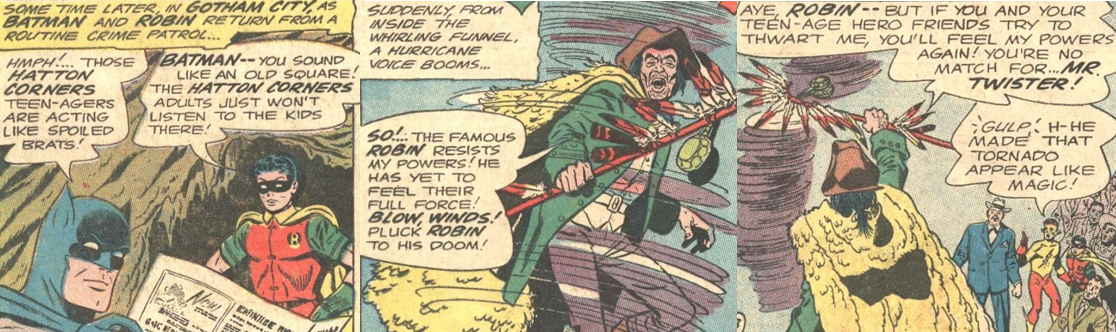
Our story begins in the town hall of Hatton Corners, where an “unusual” public meeting is taking place; specifically, Mayor Corliss is leading the charge against the disruptive and workshy youth of the day by calling for a curfew to help solve the town’s teenage problem. At the same time, in a dilapidated barn across town, the Mayor’s son, Eddie, is rallying the town’s teenagers, threatening that they’ll go “on strike” if they don’t get their new clubhouse, and both mobs are vehemently against the other. Robin, colourful partner and ward to Bruce Wayne/Batman, is on the side of Hatton Corners’ youths; while the Batman believes that the kids are acting like spoiled brats, Robin believes the kids’ voices need to be heard and accepts their invitation to join the Hatton Corners Teen Club (with Batman’s permission, in an amusing bit of irony). Barry Allen/The Flash is equally disturbed by the teenagers’ unruly attitude but his young partner, Wally West/Kid Flash, believes that adults have forgotten what it’s like to be a teenager and also agrees to join the club (again, with his mentor’s permission). The Hatton Corners Teen Club is so adamant about recruiting teenage heroes to their cause that they’re even able to extend an invitation (via an eel carrying a note in a bottle…) to Gar/Aqualad at the bottom of the ocean! Although Arthur Curry/Aquaman believes that kids shouldn’t dispute with their elders and warns Aqualad that he can’t survive out of the water for longer than an hour, he also allows his youthful companion to attend, and the three arrive at the club astonished not only to see each other there but also to find the barn demolished and deserted.

Mr. Twister kidnaps the rebellious youths of Hatton Corners and delivers a bizarre threat.

The trio go to Mayor Corliss for answers and he shows them a note form Eddie that reveals he and his fellow “cats” decided to “skip” until the adults “get hip” and build them a new clubhouse. While the Mayor and the town’s other adults believe it’s a ruse to get attention, Robin believes the note is phony since it didn’t use a more appropriate word for “music” (like “jive”); realising that the town’s elders won’t be of any help, the Boy Wonder takes charge and tasks Kid Flash with scouting around the area and Aqualand with checking out the surrounding waters for any sign of a clue. Robin stays in town and is thus on hand to help get the townsfolk to safety when a twister suddenly comes barrelling into Hatton Corners; despite his best efforts to resist the wind, Robin is tossed into the tornado and faces certain death courtesy of Bromwell Stikk/Mister Twister. Thankfully, Kid Flash is able to use his incredible speed to brave the winds and bring Robin to safety, but the young speedster is knocked for a loop when he tries to confront Mr. Twister and gets a blast from his odd staff. Mr. Twister takes credit for the missing children and threatens Mayor Corliss that the youths won’t be returned unless he bows to his demands; in the unspecified amount of time that follows, the townsfolk express regret at how quiet and lifeless it is without the kids, much to the trio’s disgust (though we never see the reactions from any parents except for the Mayor, who seems more bothered about Mr. Twister’s return than the loss of his son).

Mr. Twister’s threat to the kids is all-too-real, necessitating the intervention of Kid Flash.

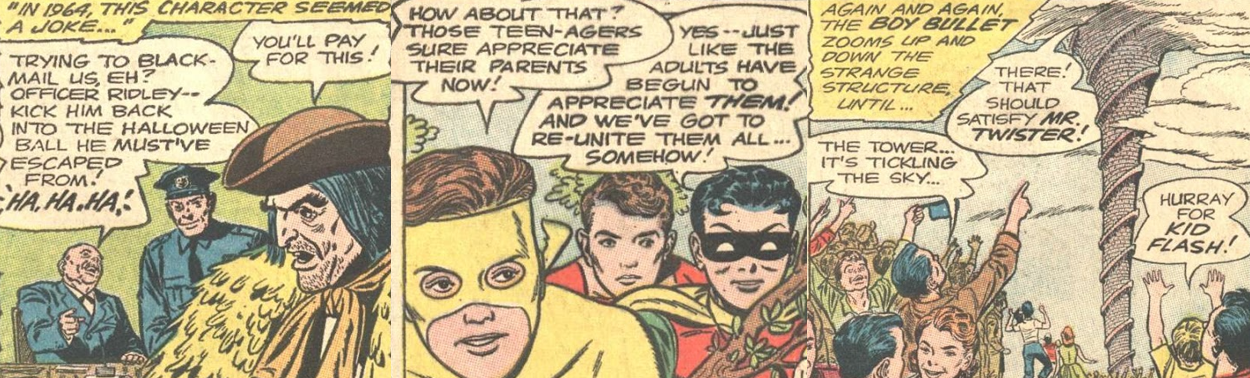
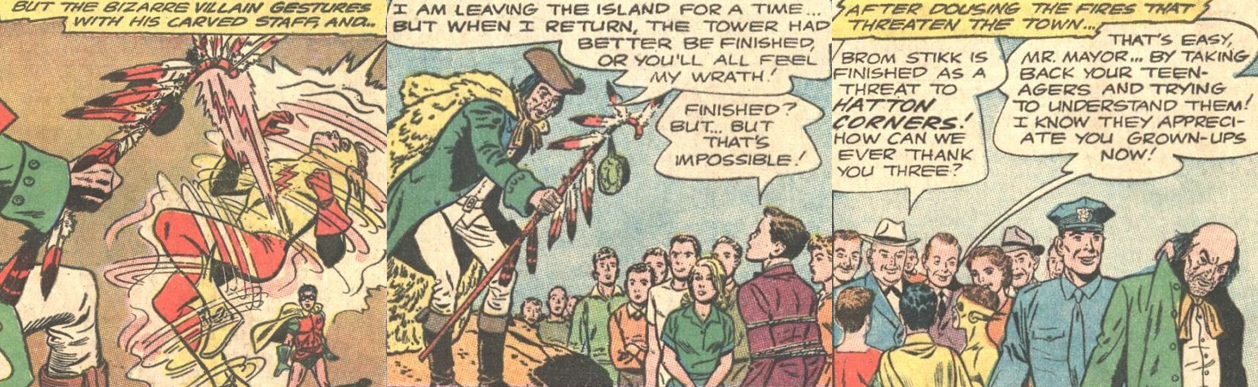
Mayor Corliss sheds some light on what Mr. twister’s beef is; back in colonial days, Bromwell’s ancestor, Jacob, allowed settlers to build Hatton Corners on his land in return for him and his descendants being paid one passenger feather a year or forfeit one of their youths. Since the demand was so ludicrous, the town’s founders never honoured the agreement and, when Bromwell showed up looking claim on the unpaid debt, he was laughed out of the Mayor’s office and vowed revenge. With passenger pigeons having gone extinct in the intervening years, Robin decides to do a little detective work to find the missing kids and discovers records of “unidentified flying objects” heading southwest to…Goat Island…the same night the teenagers vanished. Aqualad arranges them some transport to the island on the back of a manta ray; along the way, he and Kid Flash get into a bit of a dispute over the appeals of the sea and super speed and Kid Flash even questions Robin’s tendency to bark orders considering his lack of superpowers. Still, they arrive at the island and find the missing teens being put to work by Mr. Twister to build a massive stone tower in his honour. Although Eddie tries to fight back by…throwing a rope at their captor…his efforts are easily subdued thanks to Mr. Twister’s staff and he (as in Eddie) and his fellow teens are suddenly longing for the safety and security of their town and its adults. Mr. Twister leaves to run an errand and threatens them with punishment if his tower isn’t completed by the time he gets back; while Robin goes to uncover the source of the villain’s powers, Kid Flash uses his superspeed to build the tower in no time at all, thereby sparing the youths the wrath of their kidnapper.

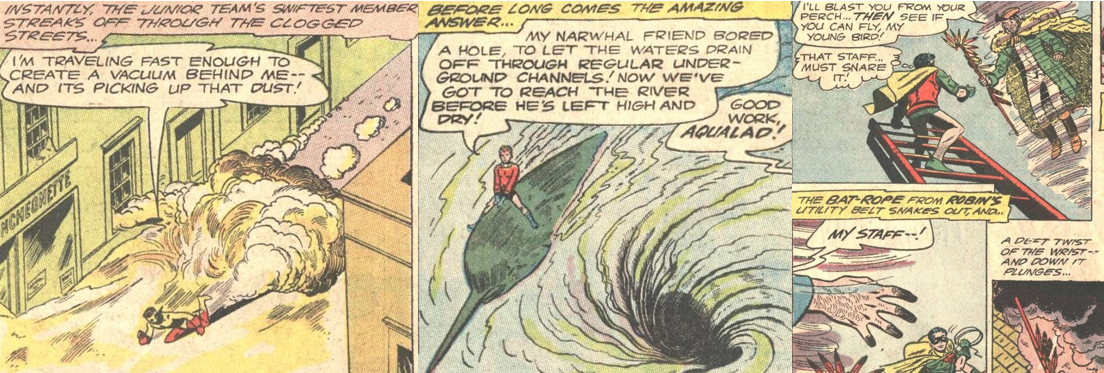
Despite being touted as invincible, Mr. Twister is defeated with a ridiculous amount of ease.

Back on the mainland, Robin discovers Mr. Twister using “long lost Indian medicine” to empower his staff; when he’s discovered, Robin leaps into action, tossing sand in the villain’s face and landing an uppercut to his jaw. However, his eagerness backfires; as long as Mr. Twister is in possession of his staff, his body automatically repels any force used against it. Mr. Twister uses a tornado to dump Robin back into town with a further threat to destroy the town unless his debt is paid, but the Boy Wonder is clueless how they can meet the villain’s demands or oppose the power of his staff. Jealous of the adulation Kid Flash receives from the town’s kids, Aqualand returns to the ocean to revitalise his strength and discovers that Goat Island is…somehow…held aloft by an extremely narrow piece of earth under the sea. Using his command over marine life, Aqualad has a bunch of whales literally transport the island out of Mr. Twister’s grasp, bamboozling the villain and earning him the admiration of the kids. Although the teenagers are safely returned to town, Mr. Twister makes good on his threat by conjuring a cloud of dust to bury the town; however, Kid Flash is easily able to disperse it with his superspeed. When Mr. Twister tries to flood the town in torrential rain, Aqualad is able to drain the water by commanding a narwhal to bore a hole into the ground but, when the villain rains literal fire upon the town, Kid Flash and Aqualad are incapacitated by bolts from his staff and the town is slowly consumed by fire (…despite the fact it was just half-submerged under water). Robin pulls his friends to safety and hops into a fire engine; he climbs up the fire ladder and is able to disarm the villain with a ridiculous amount of ease simply by tossing his Bat-Rope and because Mr. Twister was apparently unable to get a clean shot…even though he hit Kid Flash mere moments earlier! Anyway, Mr. Twister is depowered and apprehended, the trio put out the fire, the adults agree to build the teenagers their clubhouse, and everyone celebrates their newfound appreciation of each other.

The Summary:
Holy God! I was expecting this to be pretty bad but, somehow, the first team-up of the proto-Teen Titans managed to exceed my wildest dreams. I’ve said many times how much I dislike the dialogue and characterisations of teenagers and women of this era of comics, so it’s no surprise that I wasn’t best impressed by all the lame attempts to be “cool” by shoehorning in language and anti-adult attitudes all over the story. I liked that the story kind of acknowledged this when Robin noticed the note was clearly written by an adult; it’s ironic as this story, and all other teenage characters, was written by adults trying to capture the speech and beliefs of the younger generation and it just comes across as awkward and out of touch. The whole “teenagers against adults” thing is pretty overplayed throughout comics, especially in the pages of Teen Titans and its successors, but it’s paper thin here; we’re never seen what the Hatton Corners teenagers do that’s deserving of a curfew and the kids only rally against the adults because they won’t build them a clubhouse. There’s no discussion about the relationship between Mayor Corliss and Eddie, no reaction from any parents, and the kids immediately start praising the ground the adults walk on when they’re forced into slavery by Mr. Twister.

Although portrayed as a threat, Mr. Twister’s motives are paper thin and he’s easily defeated.

Speaking of whom…what the fuck is this villain? He’s the descendant of some landowner who made a bonkers agreement that was immediately welched on and yet he somehow stumbled upon some poorly defined “Indian” magic to empower his staff and gain control of the elements. I mean, I’ve seen some pretty wacky villains in comics in my time, but Mr. Twister takes the cake! He’s literally willing to kidnap a whole bunch of kids, force them to build him a monument, and destroy the entire town, killing all of its inhabitants, unless he’s given a bunch of feathers! He makes the pompous Mayor Corliss look reasonable by that measurement, but the worst part is that he’s portrayed as a credible threat! And that’s a really weird thing for me to complain about as I’m normally bemoaning the fact that the villains of these team-ups aren’t enough of a threat, but Mr. Twister makes mincemeat of both Kid Flash and Aqualad with his staff’s power and could’ve easily killed Robin when he had him unconscious but chose not to for no bloody reason! And yet, despite his vast power, the heroes have to triumph so the story pulls some of the most ludicrous explanations out of its ass to facilitate that; Goat Island is held aloft by a thin perch of earth? A goddamn narwhal? And the fact that Mr. Twister can “kayo” the two superpowered teens but can’t hit Robin because he’s climbing a ladder?!

Thanks to Kid Flash and Aqualad’s bickering, it’s easy for Robin to stand out and take charge.

The whole story is just a complete mess of a fever dream. The three teenage heroes are brought together in the most contrived way possible and, for all their high and mighty talk of the troubles of the youth moment, only go to Hatton Corners when their mentors give them the go-ahead! The dynamic between the three isn’t very developed, but there’s definitely potential here; the rivalry between Kid Flash and Aqualad doesn’t get a lot of play but it was kind of fun seeing them out-doing each other to impress the girls and bickering about their respective powers. If there’s a standout of this story, it’s Robin; he takes command of the three easily and naturally and they listen to him without question (save for one inconsequential remark from Kid Flash). As the far more logical and level-headed of the three, it’s fitting that Robin discovers where the kids have been taken and the source of Mr. Twisters power, and the remarks about his lack of superpowers mean he was obviously going to be the one to topple the villain…I just wish it had been in a more impressive fashion. In the end, “The Thousand-and-One Dooms of Mr. Twister” is indicative of the storytelling of its era; it might seem unfair to hold that against it, but I’m going to. There are certainly far better Teen Titans origin tales out there and you’re really not missing all that much if you skip this one unless you’re a big fan of outdated slang, outmoded opinions on both age groups, and nonsensical storytelling.

My Rating:

Rating: 1 out of 5.

Terrible

Have you ever read “The Thousand-and-One Dooms of Mr. Twister”? If so, what did you think to it? Do you own a copy of the original comic or do you remember reading it when it was first published? What did you think to the first team-up of Robin, Kid Flash, and Aqualad? Were you also put off by the outdated slang and attitudes or did you enjoy these aspects? What did you think to Mr. Twister, his motivations and powers, and the way he was defeated? What are some of your favourite Teen Titans stories? Whatever your thoughts on the Teen Titans, and Robin, drop a comment down below and check back next Thursday for more Robin content.
Back Issues [Crossover Crisis]: Spider-Man and Batman


In April 1985, the first issue of the ground-breaking Crisis on Infinite Earths (Wolfman, et al, 1986) released and saw the temporary destruction of the “Multiverse”. To celebrate this momentous event, I’m discussing multiversal crossovers all throughout April in an event I dubbed “Crossover Crisis”.


Story Title: “Disordered Minds”
Published: September 1995
Writer: J.M. DeMatteis
Artist: Mark Bagley

The Background:
You might be surprised to learn, considering they’re in direct competition with each other, that DC Comics and Marvel Comics have had a reasonably collaborative and amicable relationship over the years. Obviously, there’s been lawsuits and underhanded tactics from both, but not only were legendary Stan Lee and disreputable sham Bob Kane close friends but both comic giants borrowed from and inspired each other and they’ve even collaborated on many joint publications in the past. Having already had Clark Kent/Superman and Peter Parker/Spider-Man come to blows in Superman vs. The Amazing Spider-Man: The Battle of the Century (Conway, et al, 1976) and Bruce Wayne/Batman test his mettle against Doctor Bruce Banner/The Hulk in Batman vs. The Incredible Hulk (Wein, et al, 1981), DC and Marvel brought together their two most popular characters for the first time in this 1995 one-shot adventure. As is the case with many of these DC/Marvel crossovers, Spider-Man and Batman can fetch a pretty high price for collectors, and it also wouldn’t be the last time that the web-slinger and the Dark Knight crossed in one form or another.

The Review:
Our story begins with Peter Parker wrestling with the guilt and shame of being partially responsible for the death of his beloved Uncle Ben. In a nightmarish revisitation of the fateful night when Dennis Carradine broke into the Parker home and gunned down Ben, Peter (as Spider-Man) is on hand to strike with a furious vengeance, viewing the gunman as some maniacal monster who simply laughs at his murderous actions so hard that he eventually turns into the Joker! Peter awakens in horror, eased through the aftermath of this oft-recurring nightmare by his beautiful and busty wife, Mary Jane Watson-Parker. As ever in times of emotional crisis, Peter takes to web-slinging to help clear his head and ventures out into the night reaffirming his commitment to using his powers responsibility in order to live up to the examples set by his doting aunt and uncle. Coincidentally enough, that very same night, Bruce Wayne is also reliving the night that his parents died, gunned down in an alley in a senseless act of violence. Similar to Peter, Bruce’s dream sees him (as Batman) leaping into action, hatred for the inhumane monster boiling in his veins, and awakens to find himself, as ever, alone in his vast mansion with only his heartache and faithful butler and father-figure, Alfred Pennyworth. However, while he appreciates Alfred’s concern and loyalty, he heads out into the night as Batman without a word, determined to ensure that none should suffer as he did from random acts of violence. With our characters and their motivations firmly established, the story jumps over to the Ravencroft Institute, where Spider-Man is accompanying Doctor Ashley Kafka for a visit to the imprisoned Cletus Kasady/Carnage, who’s being held in a specially-constructed cell that keeps his violent symbiote at bay presumably using heat. The purpose of this is similar to the opening panels as Kasady simply taunts Dr. Kafka with a summary of his abusive and disturbing childhood, some of which may be true and some of which may just be another aspect of his twisted personality since Kasady is obsessed with murder, mayhem, and (quite fittingly) carnage.

Batman is less than thrilled when Spidey swings in to help after Carnage breaks free.

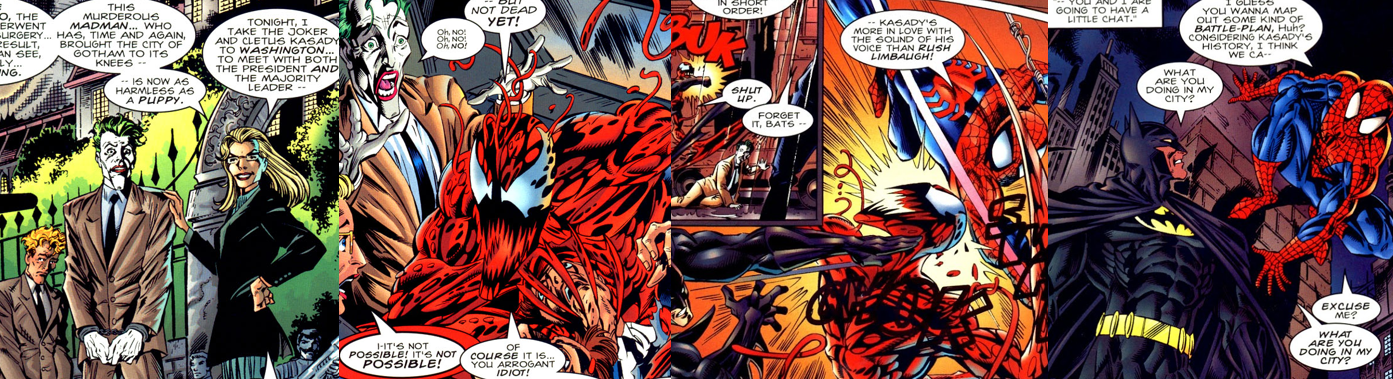
Carnage surprises both of them by breaking out of his cage, claiming himself to be a “walking impossibility” beyond logic and reason, but luckily Spider-Man and a security force led by Colonel John Jameson are on hand to subdue the serial killer with their fists and microwave guns, respectively, though newcomer Cassandra Briar proposes a far more permanent (if radical) solution to Kasady’s frequent maniacal outbursts. Utilising a “bio-technic cure” for Kasady’s insanity, Briar has a computer chip installed in his cerebral cortex, which promises to render him for more docile and stable, though Dr. Kafka likens it to the equivalent of a modern-day lobotomy and Spidey remains doubtful that it’ll stick since he’s more than familiar with Kasady’s volatile nature. Similarly, over in Gotham City, Batman puts a stop to the Joker’s latest scheme to infect millions of people with a deadly virus transmitted through bats and returns the Harlequin of Hate to Arkham Asylum (though he’s disgusted when the Joker lands a bite on him during their scuffle). There, Briar proudly shows off how meek and timid Kasady has become from her controversial treatment and uses this success as all the justification she needs to implant a similar chip into the Joker’s head, thus becoming a media sensation for rendering two of the country’s most violent and sadistic supervillains “as harmless as a puppy”. Determined to ride these successes to a wider rollout of her “miracle cure” and receive Presidential approval to eradicate psychopaths everywhere, Briar receives the shock of her life when the Carnage symbiote suddenly bursts out of Kasady’s body after shorting out her chip, taking both her and the terrified and submissive Joker hostage. Thankfully, the Batman is on hand (having disguised himself as a guard) to confront the demented killer, but his usual tactic of goading a villain into discarding their hostages in favour of him fails to work since Carnage has no interest in prioritising Batman over anyone else. Luckily, Spider-Man makes a surprise appearance to whisk Briar out of the maniac’s clawed grip and the two masked heroes take the fight to Carnage, despite Batman’s assertion that he doesn’t need the help.

While the villains’ alliance is short-lived, Batman is soon recruiting Spidey’s help in dealing with Carnage.

Regardless, the two briefly knock Carnage off balance, but he’s able to slip away by firing shards of his symbiote at the nearby cops and strangling the others with his bloody tendrils, creating an effective distraction to cover his escape. Naturally, Batman is less than thrilled to see Spider-Man encroaching on his turf, both out of a desire to keep the web-slinger from getting hurt due to his unfamiliarity with the city’s unique dangers and because he doesn’t need or want his help or him getting in the way, though Spidey naturally ignores this warning. In comparison, Carnage admits to an admiration for the Joker’s “homicidal genius [and] shameless depravity” and uses a small fragment of his suit to short out the chip and return the Clown Prince of Crime to what asses for normal. Although initially confused, frustrated, and angered at the Joker’s babbling and insolence, Carnage quickly gleefully rejoices in the Joker’s commitment to the absurd meaningless of anarchy. However, their partnership is short-lived. When the Joker takes Carnage to his secret, fairground-themed hideout to retrieve the remainder of his virus, joyfully expositing his plan to douse hundreds of Joker-themed jack-in-the-boxes with the toxin and distribute them to kids, Carnage is disgusted since it would take too long for the bodies to start piling up and he delights in getting his hands bloody from up-close-and-personal slaughter. The two come to blows over their differing methods and mentalities, with the Joker easily slipping away through a hidden trapdoor and even attempting to kill Carnage by blowing up his lair. In contrast after Batman contemplates Carnage’s unique brand of madness and sadistic nature in the Batcave and Spider-Man sees first-hand how different things are in Gotham when nobody bats an eyelid when a random civilian is screaming bloody murder in the streets, our heroes finally come together when Batman not only picks Spider-Man up in the Batmobile but even apologises for giving him the brush off.

Though pushed to their limits, Batman and Spider-Man are ultimately victorious and part as allies.

Though he has no time for Spider-Man’s quips and jokes, Batman recognises that he has unique insight into Carnage, and the two are able to track him to the wreckage of the Joker’s lair, where they find what appears to be his dead body but is, in fact, a decoy Carnage set up to trick the Joker. Delighted to have the Batman in his coils instead, Carnage plans to publicly execute Batman on top of Gotham Towers and, while comparing Carnage to Death itself, which passed him by back in Crime Alley, Batman orders Spider-Man to stop Carnage despite the threat to his life. However, it’s the Joker who actually intervenes in the tense showdown; claiming ownership over the Batman and determined to drop his virus on the four of them, killing all of them and everyone else in the city simply to spite Carnage, Kasady’s briefest flicker of fear is all the opening Batman needs to break free from his grip and leap into action. Spider-Man easily webs up the threat and, despite it taking the combined might of Spider-Man and Eddie Brock/Venom and many others in the past, the Batman is easily able to pummel Carnage into unconsciousness since, for all his powers and bloodlust, he’s simply another sloppy punk and a “scared little boy”. With Carnage subdued, Spider-Man chases down the Joker with an uncharacteristic rage; easily manhandling the Clown Prince of Crime, Spider-Man is barely able to stop himself from killing the Joker since he’s too great a threat, too dedicated to violence and chaos, to be left alive. While his better nature prevails and he ultimately spares the Joker, Spidey does deliver a knock-out punch to the cackling villain, finally bringing the story’s combined threat to an end. As if seeing Spider-Man pushed to the point of killing wasn’t surprising enough, Spidey is unusually quiet in his final confrontation with the Batman; weary from the night’s events, the two choose not to ruin the moment with words and instead part ways with a hearty handshake having found a common ground and a mutual respect through their conduct and escapades.

The Summary:
“Disordered Minds” is an interesting approach to take for an intercompany crossover. You might think with characters as wildly different as Spider-Man and Batman that the focus would be on their different methods; if Dick Grayson/Nightwing is an athletic chatterbox and the various Robins are brightly-coloured distractions to throw criminals off from Batman’s darker, more measured approach, then Spider-Man should drive the Dark Knight absolutely batty (heh!) with his constant chatter, quips, and annoying tendencies. Instead, there’s actually not much in the way of banter between the two; Spider-Man mouths off a little in the Batmobile, but that’s about it and the rest of their interactions basically boil down to Batman telling Spidey to fuck off and Spider-Man sticking around because of his innate sense of responsibility. This is a bit of a shame as I would’ve liked to see their contrasting personalities and methods more on show beyond “Gotham’s not what you’re used to sod off!” and “Boy, you’re grim” but the story does have to two united in their shared grief. Both carry a tremendous amount of survivor’s guilt, though for different reasons; Bruce was too young to do anything about his parents’ murder whereas Peter chose not to use his powers responsibly, so both are on the same path towards safeguarding others to ease their guilt and pain but have very different outlooks on the world. This comes up multiple times, with Spider-Man raging against the chaos and violence around him and Batman lashing out at “Death” and determined to rally against it however he can.

While the writing is a bit dodgy and there’s some wasted potential, the art work in phenomenal.

The art is where the story really shines; Mark Bagley is one of the top Spider-Man artists and, thanks to his work on the character and his various run-ins with symbiotes before, has more than proven himself capable of delivering a dynamic and visually exciting Spider-Man and menacing and dangerous Carnage. His Batman and Joker fare really well too, naturally, and the art is absolutely stunning all throughout even if the writing fails it somewhat. We spend no less than eleven pages recapping the origins of Spider-Man, Batman, and Carnage, which is probably great for newcomers but somewhat unnecessary for long-term readers when, normally, a simple text box sums it all up nicely. Thankfully, all of this is rendered in an interesting way through the use of nightmares and Carnage’s dramatic escape from custody, but the writing stumbles a bit mid-way through, too, since Cassandra Briar basically disappears after being rescued despite so much time being spent on her computer chip cure. I feel like a simple story about Kasady or the Joker being transferred across the country might’ve been a much simpler and faster way to get things moving since the chip is easily destroyed by Carnage and doesn’t factor into the plot beyond being a contrived way to get him and the Joker to cross paths. There’s also not a huge amount of interaction between Batman and Spider-Man; they don’t physically fight (which is unusual at the best of times but even more so for a crossover like this), join forces pretty quickly after Batman stops being irrationally stubborn, and it doesn’t really take much at all for them to defeat the villainous duo despite Carnage being so powerful that Spider-Man alone usually struggles to defeat him. there’s a promise of a twisted partnership between Carnage and the Joker but it’s almost immediately squandered simply because Carnage gets impatient, which is in keeping with his character but basically means the villains don’t actually do anything besides compliment each other, scuffle a bit, and then get taken out by the heroes. All in all, this was relatively entertaining and interesting first meeting between my two favourite comic book heroes but it didn’t quite deliver on its potential, despite the fantastic art work and some fun moments.

My Rating:

Rating: 3 out of 5.

Pretty Good

Have you ever read Spider-Man and Batman? If so, what did you think to it? Do you own a copy of the original comic or do you remember reading it when it was first published? Were you surprised that there wasn’t more time spent on contrasting the different methods and personalities of the two heroes? What did you think to the brief team-up between the Joker and Carnage the ease that they were defeated? Would you like to see DC and Marvel collaborate again in the future and, if so, what stories would you like to see? Whatever your thoughts on Spider-Man and Batman, and comic book crossovers of this kind, share them below and check out my other Crossover Crisis events!

Mini Game Corner [Robin Month]: Batman Forever: The Arcade Game (PlayStation)


In April of 1940, about a year after the debut of arguably their most popular character, Bruce Wayne/Batman, DC Comics debuted “the sensational find of [that year]”, Dick Grayson/Robin. Since then, Batman’s pixie-boots-wearing partner has changed outfits and a number of different characters have assumed the mantle as the Dynamic Duo of Batman and Robin have become an iconic staple of DC Comics. Considering my fondness for the character and those who assumed the mantle over the years, what better way to celebrate this dynamic debut than to dedicate every Thursday of April to celebrating the character?


Released: 1996
Developer: Probe Entertainment / Iguana Entertainment / Iguana Entertainment UK
Also Available For: Arcade, MS-DOS, and SEGA Saturn

A Brief Background:
It’s easy to forget now but Batman Forever (Schumacher, 1995) was a pretty big deal for Warner Bros. back in the day; not only had they sunk $100 million into the film but they were desperate to appease those who were outraged with the dark, macabre content of Batman Returns (Burton, 1992) and craft a film that would be more appealing for the sponsors. While it garnered a mixed critical response, Batman Forever made over $330 at the box office and was accompanied by a slew of merchandise and ancillary products. Like its predecessors, Batman Forever also received a tie-in videogame that marked Acclaim’s first foray into the arcade scene. However, the 2.5D beat-‘em-up was met with mostly mixed reviews but still fared better than Acclaim’s other home console adaptation of the movie.

First Impressions:
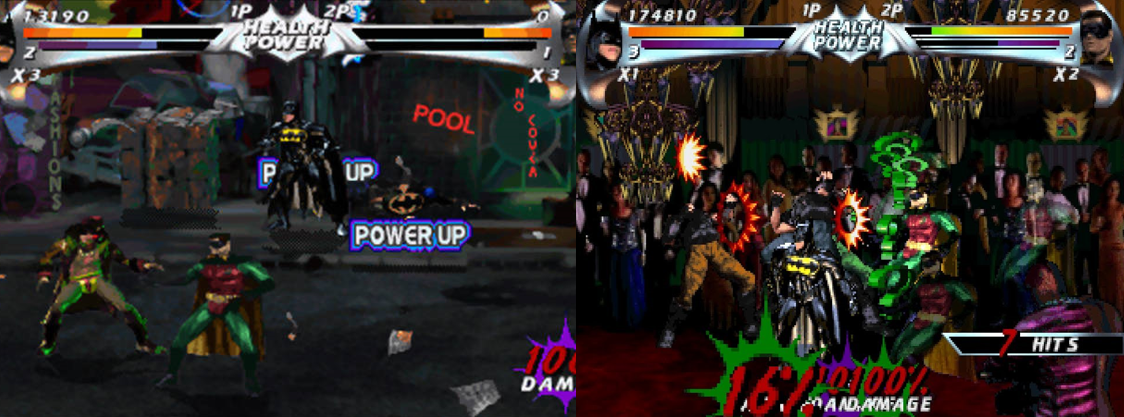
If there’s three things you can always count on with me, it’s that I’m a big fan of arcade titles, sidescrolling beat-‘em-ups, and Batman. Although I didn’t grow up with a Super Nintendo Entertainment System (SNES), emulators have allowed me to have a great deal of fun with Batman Returns (Konami, 1993), which was a cracking licensed videogame simply because it aped the formula of genre staples like Final Fight (Capcom, 1989) and X-Men (Konami, 1992). While Batman Forever had an extremely dismal and almost unplayable sidescrolling adventure game released on Mega Drive and SNES, arcades were blessed with this far more enjoyable and fitting videogame, which thankfully came to the PlayStation so I was able to snap it up (and at a pretty good price, too, all things considered). Batman Forever: The Arcade Game can be played on three different difficulty settings (Easy, Normal, or Hard), with enemies increasing in number and toughness on the harder difficulty settings, and allows you to assign yourself up to seven continues. You begin the game with three lives and, once you’ve lost all three, you can enter a high score and switch your character to return to the action once more. In terms of controls, Batman Forever is as simple as it gets: one button punches, one kicks, and one jumps and that’s it. you can customise these in the options menu and choose to play as either Batman or Robin (or both together, if you have a friend), before jumping into the game proper. There doesn’t appear to be any technical differences between the two, but they do have different animations and Robin seems to be a bit faster on his feet, but that could just my psychosomatic on my part. Right away, you’re treated to a pretty impressive in-game cutscene as Batman and/or Robin heads to the streets of Gotham City in the Batmobile, and the first thing you’ll notice is how impressive and ambitious the graphics are. The game utilises pre-rendered, 2.5D backgrounds that, while murky and a bit washed out, are immediately evocative of many of the neon-drenched, bizarre locations seen in the film, such as the graffiti-and-litter-strewn streets, Edward Nygma/The Riddler’s big gala (with partially animated guests in the background), and Harvey Dent/Two-Face’s lair among others. The playing field allows you to wander into the background, with sprites scaling accordingly, though they do lose a fair amount of graphical fidelity, becoming even more pixelated and ugly as you move about.

While the game is cluttered and chaotic, it’s full of action and fun ways to beat up thugs.

Sprites in general look decent enough; they appear to be digitised, similar to the early Mortal Kombat games (Midway/Various, 1992 to 1996), and Batman and Robin have a glistening sheen to them that makes them look like action figures. Batman looks a little goofy, with his massive chest symbol, but Robin looks pretty good; the thugs you encounter, however, are swarms of Two-Face’s goons, robots modelled after the Riddler’s fortune teller machine, and other generic beat-‘em-up mooks, none of whom have a life bar. The sheer number of enemies is pretty impressive and overwhelming, however. It doesn’t take much for you to get pummelled to death as enemies swarm around you and trap you in an unblockable beatdown, and enemies will fire guns, toss grenades, drive motorcycles and cars at you as well as spring out from the scenery. To make matters worse, Two-Face occasionally pops in, riding a wrecking ball or shooting rockets at you from the foreground, though there are times where you can swing and grapple parts of the environment to barge trough enemies. Combat is a pretty simple affair, with you mashing punch and kick to string together combos, tossing and jump-kicking enemies as you’d expect, but the game makes a big deal out swamping you with various power-ups. As you take out enemies, little Bat Symbols scatter everywhere which power-up your “Combo Meter” as well as a variety of gadgets and pick-ups: Bat-Signals, Two-Face Ying-Yangs, and Riddler Symbols appear frequently, bestowing either gadgets or temporary buffs and debuffs. When you grab a gadget, like the Batarang, grapple gun, taser, or Bat Bola, your regular attack is replaced with a projectile; the grapple gun is particularly useful for landing up to 150 hit combos on enemies and sees you swinging and flailing all over the screen, while the Batarangs can quickly rack up points and the taser and bola can stun enemies for a short time. You can also pull off a screen-clearing attack, summon bats to protect and attack enemies, and toss a stun grenade, and all of these attacks will increase in power and change their appearance as your meter builds higher. However, this can make the combat and action extremely chaotic as the screen is constantly filled with enemies, items, and your almost incomprehensible attacks, making for a very frantic and confusing experience.

My Progression:
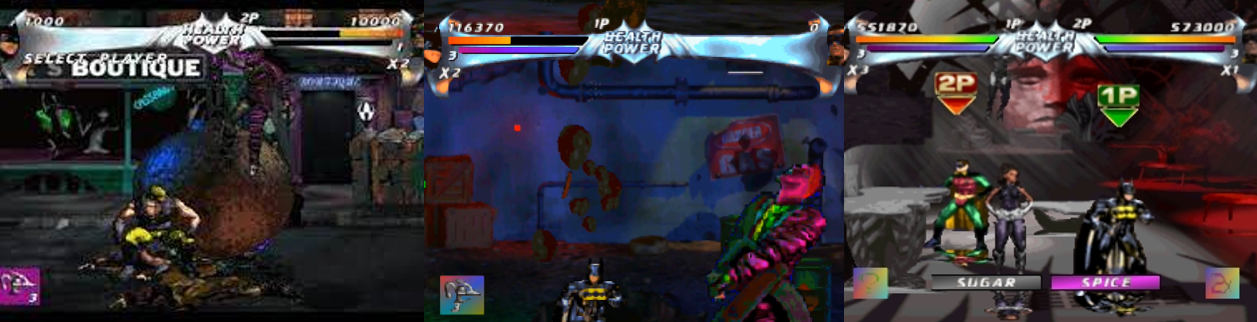
As you fight your way through the game, you can pick up and throw objects, grab the odd bit of health to sustain yourself, and will be blessed or cursed with power-ups such as invisibility, duplication, invulnerability, and shrinking you (or your enemies), among others. After clearing a stage, your score is tallied up; the more enemies you defeat and the more gadgets and such you use, the better your score and rewards. You can then pick from these rewards to start the next stage with a gadget or power-up advantage; some are merely cosmetic, like “VR Mode”, which sees enemies burst into green computer coding upon defeat, while others increase your combo by default, allowing you to build your meter faster. There are no save points, password, or checkpoints in the game, however; once you exhaust all of your continues, the game is over and you’ll need to start from the beginning, which is always a pretty shitty thing to do in a home conversion of an arcade game since its purpose isn’t to relieve you of your pocket money. All I’m saying is at least have the option to earn more lives or continues, or limit your continues on the harder difficulties and have them disabled entirely on Easy mode.

Unfortunately, I wasn’t able to save Gotham from the villains’ mad schemes…this time…

Naturally, you’ll have to battle a few bosses over the course of your playthrough, however not as many as you might think. The game is structured more to have you battle wave upon wave of the same goons over and over until you reach the end of a stage, where a boss may be waiting for you, but it’s not always the case. I didn’t fight a boss until the second stage, for example, which pits you against three slightly tougher goons: Nick, Blade, and Flex, each of which fires at you with an Uzi, tosses grenades, or throws knives at you and can block your attacks (something you’re incapable of doing). You’ll know when you’re facing a boss as they actually have a life bar and the screen flashes dramatically after you defeat them, and these three weren’t all that difficult but, again, it’s easy to get caught in a crossfire and just whittled down to nothing in no time at all. At the end of an alleyway, you’ll fight Tassel (who seems to be the neon-painted, clown-like goon who hassled Dick in the film), who’s joined by a couple of gun-and-grenade-toting henchmen and shows off a bit of flippy, martial arts skill. After battling through goons on a rooftop, you’ll be confronted by a helicopter and a seemingly endless supply of enemies; simply fend them off, dodging the chopper’s machine gun fire, and press attack to toss projectiles when prompted. Two-Face will continually pop up to fire rockets at you in the subway and at the gala, and two of the Riddler’s robots will attack you with their extendable arms to cover their escape. These then become regular enemies in a construction site full of explosive barrels, where you’ll battle Feather and Stew, with Feather proving pretty tough thanks to being very handy with his bo staff. My run came to a disappointing end in Two-Face’s lair, however, where his beautiful bodyguards, Sugar and Spice, absolutely wrecked me with their fast attacks, which pummelled me from both sides without any chance of fighting back, treating to me to a rather bland game over screen (in the Batman: The Animated Series (1992 to 1999) font, no less) informing me of my failure to save Gotham City.

I was having a pretty good time with Batman Forever: The Arcade Game once I got past the visual and sensory overload. The game includes a renditions of Elliot Goldenthal’s score and some brief sound bites from the movie, but the sheer number of enemies and chaos happening onscreen at any one time can be a little overwhelming. The game looks fairly decent, even though things can get a bit ugly and distorted at times, but the depth of combat is a little odd compared to other beat-‘em-ups; the gadgets and various pick-ups mean there’s always something happening and you can rack up big combos, but it also feels like a lot of control is being taken away from you as Batman and Robin leap into action with these big, elaborate movements at the touch of a button. Unfortunately, neither are particularly durable; your health bar can be whittled down to nothing in the blink of an eye and you’ll burn through your lives and continues in no time, with no passwords or cheat codes to make things easier for you. It’s probably do-able, maybe in two-player mode, and I’m sure I’ll return to it again as I do enjoy a bit of sidescrolling, beat-‘em-up action, but lumbering you with limited continues for a home console release always irks me and there’s not really anything to unlock or to discover outside of the main campaign, which continues basically no story and very few cutscenes (and even these are limited to the in-game graphics, impressive as they can be). I’d like to know if you’ve ever played this one, either in the arcade or at home, and how well you fared against Gotham’s colourful swarms of criminals? Which character did you prefer, and what did you think to all the gadgets and power-ups? Which licensed Batman game is your favourite? Who is your favourite Robin and how are you celebrating the Boy Wonder’s debut this month?  Whatever your thoughts on this game, and Robin in general, sign up to leave them below or share your thoughts on my social media, and check back soon for more Robin content!

Game Corner [Crossover Crisis]: Mortal Kombat vs. DC Universe (Xbox 360)


In April 1985, the first issue of the ground-breaking Crisis on Infinite Earths (Wolfman, et al, 1986) released and saw the temporary destruction of the “Multiverse”. To celebrate this momentous event, I’m discussing multiversal crossovers all throughout April in an event I dubbed “Crossover Crisis”.


Released: 16 November 2008
Developer: Midway Games
Also Available For: PlayStation 3

The Background:
Mortal Kombat (Midway, 1992) stood out from the competition at the time with its focus on gore and violence and unique digitised graphics; the game was a massive success for Midway and the first real competition for Street Fighter II: The World Warrior (Capcom, 1991) in arcades and on home consoles. However, while the franchise went from strength to strength during the 2D era of gaming, Mortal Kombat struggled to find a footing in the emerging 3D fighter arena, leading to the developers desperately trying to be innovative and appealing in an increasingly competitive business. Since Capcom had seen some success with crossovers with Marvel Comics and other fighting game developers, Mortal Kombat co-developer Ed Boon scrapped plans for a back-to-basics reboot of his violent fighting series in favour of a crossover with DC Comics. While incorporating popular DC characters like Bruce Wayne/Batman and Clark Kent/Superman had the potential to broaden Mortal Kombat’s mainstream appeal, the license carried many restrictions for the developers; Mortal Kombat vs. DC Universe was hampered by a “Teen” rating, which substantially neutered the series’ trademark violence. This, as much as anything, greatly contributed to the game’s mediocre reception; while some found the title surprisingly enjoyable, despite its bonkers premise, others found the gameplay and variety frustratingly tedious. Although the game received a “Kollector’s Edition” release, this was Midway Games’ last project before they went bankrupt and plans for downloadable content were subsequently scrapped. Thankfully, this wasn’t the final nail in the coffin for the franchise; the association with DC’ s parent company, Warner Bros, saw Midway being purchased by Warner and restructured into NetherRealm Studios, and the ultra violent was not only soon back on track but the new studio also eventually found success with the DC license in a separate series of fighting games.

The Plot:
After Raiden and Superman repel invasions from both their worlds simultaneously in their separate universes, villains, Shao Kahn and Darkseid are unexpectedly merged into “Dark Kahn” and the two universes to begin merging, with catastrophic events. With characters from both universes wildly fluctuating in power, representatives from both worlds come together to stop the merger by any means necessary.

Gameplay:
Mirroring the style and presentation of its mainline series, Mortal Kombat vs. DC Universe is a 2.5D fighting game in which players pick from a roster initially comprised of twenty fighters of iconic characters from both franchise’s and battle through the game’s single-player story mode, fight one-on-one against another player or computer-controlled opponent, battle their way through an arcade ladder, or take on a series of increasingly difficult combo challenges. By default, fights take place in a best-of-three format and against a time limit but you can alter these settings (and many others, including the game’s difficulty and the use of blood) in the game’s main options menu to speed up gameplay or make it more accessible to you. Rather than employing different fighting styles and weapon combat like its predecessors, or properly incorporate different variations like in the later games, Mortal Kombat vs. DC Universe takes a very barebones approach to combat and gameplay options: controls are fully customisable but, by default, you can throw with X or Y, kicks with A or B, toss them aside with a generic throw with Left Bumper, block incoming attacks by holding the Right Trigger, dash towards (but not away from) your opponent, jump in or crouch down to attack or avoid incoming attacks, and string together combos by quickly pressing the attack buttons alongside directional inputs. The game includes a practice mode to help you get to grips with this, and a “Kombo Challenge” feature that helps you practice the game’s tricky combo system, but you can bring up your fighter’s moves at any time by pausing the game. It has to be said that combat is quite a hurdle here; you’ll sometimes jump or dash when you don’t mean to, even when using the directional pad, jumping punches can be very floaty and often miss, and the game seems weighted in the CPU’s favour even when playing on the easiest setting as they have no difficulty pulling off some of the ridiculous combos on offer here.

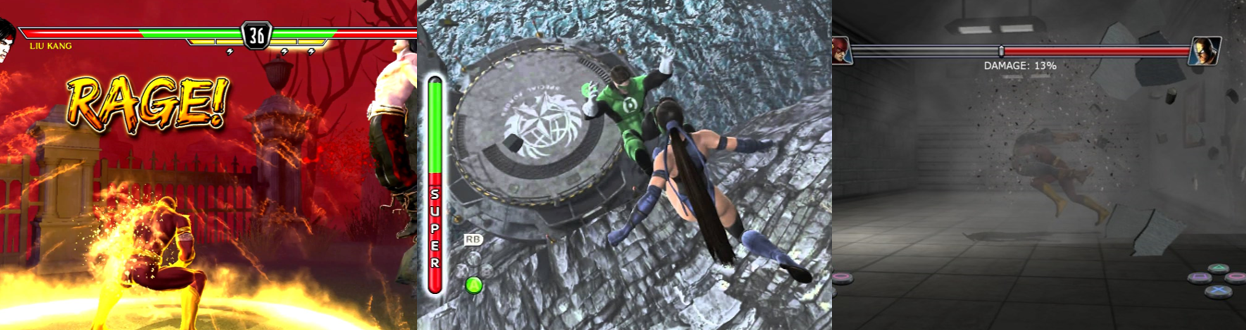
Unleash your Rage, pummel opponents in Free-Fall, or smash them through walls.

Each fighter can pull off a number of unique special moves with simple button and directional inputs (back, back, X, for example, or left, down, B); while these can be stringed together with combos, they can’t be enhanced like in subsequent games as your “Rage Meter” only allows you to pull of the ever-annoying breakers to interrupt combos and attacks when filled to the first tier and activate the game’s “Rage Mode” by pressing RT and LT at the same time. This will put you into “Rage” mode, which powers up your attacks and coats you in a glowing armour that weakens the damage you receive, shrugs off projectiles, and keeps you from being stunned or knocked over. This doesn’t last for very long but it can easily make short work of your opponent, and activating it will even see you unleash a burst of energy that knocks your foe away, so properly timing the burning of your Rage Meter can snatch victory from the jaws of defeat. The game also features a few unique gameplay mechanics: if you grab your opponent with the Right Bumper , you’ll activate “Klose Combat” mode, which sees you pummelling or breaking your opponent’s limbs with successive presses of the face buttons. They (and you) can counter these attacks by pressing the right button at the right time, and these quasi-quick-time events (QTEs) also crop up in the “Free-Fall Kombat” and stage transition moments. In some stages, you can send your opponent plummeting down to a new part of the arena; while in free fall, you can mash different face buttons to deal damage and finish them off with RB, but they’ll turn the tide against you if they hit the right buttons. Similarly, some stages allow you to charge your opponent through a way, whereupon you’re asked to “Test Your Might!” in a tug-of-way style button mashing sequence that inflicts more damage the more of the bar you manage to fill. These mechanics can be fun ways to spice up the somewhat lacklustre in-game combat and definitely open up the otherwise bland and empty arenas a bit more since you can literally smash your opponent to new areas, but they’re a far cry from the stage transitions seen in the Injustice series (NetherRealm Studios, 2013 to present).

While you can get up close and personal with foes, the dull finishing moves will leave you disappointed.

Sadly, that’s about it for in-game options; some stages very destructible elements you can smash into, and all of the game’s characters sport special moves befitting of them (Sub-Zero’s ice blast, for example, and Bruce Wayne/Batman’s Batarangs) but, since the game is hampered by a lower rating, there is very little blood and none of the gore you’d expect from a Mortal Kombat. That’s not to say that Fatalities aren’t present, however, they’re just…what’s the word..?…oh yes! Shit. Unlike in subsequent games, you can’t view your character’s finisher inputs from the pause screen, which makes finishing your opponent a real chore, but very few of these moves are even worth your time pulling off. All of the Mortal Kombat characters can execute two Fatalities that will see them murder their opponent in the most PG way imaginable; while some leave the opponent an exceptionally dry and clean skeleton, most boil down to you simply stabbing, shooting, or crushing them with very little bloodshed. The more morally pure DC superheroes will opt to finish their opponent with one of two “Heroic Brutalities”, though many of these would no doubt leave the foe severely crippled or dead since we see the likes of Clark Kent/Superman driving them into the ground and Barry Allen/The Flash pummelling them at superspeed. Unlike in previous (and subsequent) Mortal Kombat videogames, there are no mini games to distract you and is no in-game currency to earn, no player profile or fighter card to customise, and no Krypt to explore to send your coins. There aren’t even alternate skins for the fighters beyond a very minor palette swap when choosing the same character, and the best the game offers is allowing you to view bios, character models, and endings in the “Extras” menu, all of which makes for a very stripped down title even compared to its predecessor, Mortal Kombat: Armageddon (Midway Games, 2006).

While there’s not much to the arcade mode, the story mode is decent enough, if limited and tedious.

This also means that there are no challenge towers or option combat modes like “Test Your Luck” or tag-team combat to spice up multi-player gameplay; you can play locally or online (well, I assume you can’t do this latter any more) in ranked and “King of the Hill” style matches but the arcade ladder is a standard, ten-fight challenge where the extent of the game’s variety is offering you the choice between facing all Mortal Kombat or all DC Universe opponents or a mixture of the two. Mortal Kombat vs. DC Universe does, however, feature a single-player story mode but, strangely, it only allows you to play as up to eight characters from either side. After picking either the Mortal Kombat or DC Universe story, you’ll take control of a specific character and battle anywhere from three to five opponents as part of the campaign. This remains a great way to familiarise players with the vast majority of the game’s fighters and their unique combos and special moves, but you cannot perform finishing moves when playing the story mode. Although you can’t skip any of the cutscenes, or jump to specific chapters and fights after completion, you can save and quit…which is definitely something, though the game’s difficulty can become frustrating as the computer-controlled characters love to block your attacks, uppercut you out of nowhere, and jump-kick you out of the air, and can seemingly juggle you in an inescapable combo at will! Unlike in later NetherRealm Studios games, the story mode is as basic as it gets; the only time it actually tries anything remotely different is during Major Jackson “Jax” Briggs’ chapter as you’re forced to battle Diana Prince/Wonder Woman without your machine gun, which means you’re robbed of on of your ranged attacks. If you’re defeated, you have ten in-game seconds to choose between continuing and quitting, which is true of the arcade and two-player bouts as well. Unfortunately, winning or losing in two-player mode simply dumps you back to the fighter select screen and, as far as I could tell, there isn’t even a way to select your stage let alone input Kombat Kodes or activate anything interesting to make the fights less of a chore.

Graphics and Sound:
Mortal Kombat vs. DC Universe looks pretty good, for the most part; the character models are very similar to those seen in Mortal Kombat (NetherRealm Studios, 2011), meaning they hold up about as well, but some suffer more than others. Women, for example, look particularly off; sure, it’s great seeing Selina Kyle/Catwoman’s amply cleavage and Lieutenant Sonya Blade’s nipples poking through her top, but they’re all impossibly sexualised and their hair is very blocky and static. Unlike later NetherRealm Studios offerings, character’s don’t have unique intros or dialogue with each other before a fight; the camera simply pans the arena and zooms in to find the combatants ready to go and, while they do have little animations between rounds, these don’t seem particularly unique to any fighter. Post-fight animations are a little more unique, but there’s a definite lack of variety and character in each fighter which reminds me of the cut-and-paste job seen in Mortal Kombat: Armageddon (with the exception of the Joker, who dances and prances all over the place at every opportunity). On the plus side, characters do take battle damage; you’ll see their clothes rip, blood and bruises form on skin, and even uncover Scorpion’s skull as inflict damage on your opponent, which is fun, but the lack of any alternate attires or skins is a major tick in the “Con” column for this barebones title.

Stages are quite bland, but character models and cutscenes are okay, save for the poor endings.

There are some other notable little details on offer, however; when you toss Kano’s dagger at an opponent, it’ll stay stuck in their chest for a bit, you can sheath and unsheathe Baraka’s arm-claws with a press of B, you’ll see Sub-Zero’s icy breath, and there’s even a reference to Star Trek II: The Wrath of Khan (Meyer, 1982) thrown in for good measure. Another thing in Mortal Kombat vs. DC Universe’s favour, however, is that the CGI cutscenes are basically indistinguishable from the in-fight graphics; while the character models might be a little less detailed than in later games and have that action figure sheen that is common in this generation of games, it’s still impressive that there’s little distinction between the two, though the voice acting leaves a lot to be desired (the DC Animated Universe this is not!) and there’s very little to inspire you in the soundtrack, either. Similarly, stages are quite a let-down; the majority of them have this half-and-half theme going on where the DC Universe is split or merging with that of Outworld, NetherRealm, or Earthrealm but, even with that, there’s hardly anything to see or do and the stages are disappointingly bland and empty considering how big they are and the fat that you can navigate them in a 3D space. The likes of Oa, Themyscira, and the Fortress of Solitude probably stand out the most and have a few things to see in the background, but there’s a distinct and disappointing lack of Easter Eggs and visually interesting stages. Probably the most interesting one is the asteroid stage that sees you transitioning above and below thanks to the messed up gravity, but the game continues to bug me with presenting all these passable CGI cutscenes and relegating the arcade mode endings to a series of still pictures with narration.

Enemies and Bosses:
Since this is a fighting game, every character will inevitably be your enemy at some point so it can be useful to get an idea of what each one is capable of by playing through the story mode and completing their arcade ladders. However, there isn’t really too much to distinguish each character; you’ think the Flash would be faster and slippery to control compared to Liu Kang but he really isn’t and, while Jax and Billy Batson/Captain Marvel may utilise powerful grabs, they don’t feel any slower than someone like Kano or Hal Jordan/Green Lantern. Every character has a few simple combos that it’s best to learn so you can leap in, mash X three times or X, X, Y and then hit a special move or a throw to deal some decent damage, and they’re obviously made a bit more unique by their individual special moves. Characters will invariably have a projectile or some kind of range attack, a rush or grapple of some kind, and sometimes even disorientating gadgets like flash or smoke grenades. Some have more special moves on offer than others; Shang Tsung, for example, can toss flaming skulls across the screen and from above, suck his opponent’s health to fill his own, swap places (but not bodies) with them, and pull off a slide while other characters, like Batman, Sub-Zero, and the Joker, have parry moves in their arsenal that can interrupt attacks. Some characters are also a little more versatile than others; Superman can suck enemies in for a big punch, rush at them and smack them out of the air, fry them with his heat vision, freeze them with his breath, and perform flying attacks while Lex Luthor relies on his mech suit to fire missiles and blast away from danger. It’s when playing or fighting against the Mortal Kombat characters that long-time series fans will be at their most familiar: Liu Kang tosses his trademark fireballs and flying kicks, Jax grabs his foe and causes shockwaves, Kane launches himself like a cannonball, Scorpion throws his trademark spear, and Kitana uses her fans and dashes about in the air to be her usual annoying self.

Overcome the largely interchangeable fighters to chip away at the monstrous despots.

The lack of powered-up attacks, unique throws, and the generic effects of Rage Mode mean that you really don’t have to tailor your fighting style all that much against different opponents; Raiden’s abilities don’t really make him all that different from Slade Wilson/Deathstroke as both can be jumped over, ducked under, and attacked even if one has a dash and teleport and the other relies more on ranged attacks. You also won’t have to worry about any secret fighters cropping up in the arcade ladder; what you see is basically what you get but you do have to watch for characters like Sonya stringing together their multi-kick attacks in a cheap-ass combo. The exception to this comes in the form of the game’s big bad, Dark Kahn, who basically just looks like a slightly tweaked version of Blaze from Mortal Kombat: Armageddon and fights with a combination of moves from Shao Kahn and Darkseid. Dark Kahn awaits at the end of the story mode and arcade tower and is easily the biggest challenge you’ll face outside of the harder difficulties and opponents getting cheaper and more aggressive. A lumbering, monstrous foe, Dark Kahn can absorb a great deal of damage, gains armour and invincibility frames, and can drain your health bar to nothing in just a few basic swipes to say nothing of his energy barrier, shoulder charge, rising knee, and Warhammer attacks. Your best bet against him is to soften him up with ranged attacks and projectiles and stay moving; hop in, land a combo, and follow it up with a jump kick and then back away to avoid him stringing together his devastating moves in an inescapable barrage. The same is true of Shao Kahn and Darkseid, who act as sub-bosses in the arcade ladder; individually, they’re almost as formidable as their merged form, with both able to stun you with their hammer, fry you with their eye lasers, and smash you into the ground with a leaping attack. While you can’t play as Dark Kahn or perform your finishing moves on him, you can perform your finishing moves against Shao Kahn and Darkseid but, while both of these characters are unlocked after finishing the story mode (and, confusingly, pressing RB on the character select screen rather than adding them to the roster), neither of them have Fatalities of their own. Ultimately, while these three aren’t as impossible or as cheap as other Mortal Kombat bosses and sub-bosses, none of them really challenge your combat skills beyond relying on hit-and-run and spam tactics much like the previous two Mortal Kombat videogames that just ended with this hulking beast that could wreck you if given a chance rather than something that actually requires a bit more skill.

Power-Ups and Bonuses:
There’s absolutely nothing on offer in this regard in Mortal Kombat vs. DC Universe beyond the individual character’s special moves; this game is severely lacking even for a one-on-one fighter as there are no codes or options to spice up gameplay, no weapons to grab, barely anything to interact with in stages, and characters don’t even get buffs or anything with their special moves the closest they get is teleporting, surrounding themselves in a damaging aura for a bit, or tossing bombs or grenades either close, mid-range, or far away.

Additional Features:
There are fifty Achievements on offer in Mortal Kombat vs. DC Universe; many of these are obtained simply by playing through the story mode, with Achievements popping after certain chapters and completing each (and both) stories. Simpler ones are acquired by performing a ten-hit combat, initiating Klose- and Free-Fall Kombat, and performing one Fatality or Heroic Brutality. Things get a little more complicated and frustrating when you try to perform all of these moments as a handful of them require you to press up, which makes you jump and interrupts the sequence, and in trying to get the 5G Achievements from completing each character’s Kombo Challenge otherwise, you’ll get Achievements for finishing the arcade ladder with all characters and competing in online fights, which are probably impossible to get these days. These involved standard fare that you might expect, as mentioned, and you can fight locally, but beyond unlocking every character’s ending and trying to finish their Kombo Challenges, there really isn’t anything else on offer here once you’ve finished the story mode and a few arcade ladders. There’s no concept art, character models, or extras to unlock, no gear or skins or arenas to unlock, and no downloadable fighters on offer, making for an extremely barebones and lacklustre fighting title that struggles to compete against others in the genre or even its predecessors.

The Summary:  
There was a lot of promise in the concept of Mortal Kombat vs. DC Universe; after the success that Capcom had with their ventures with Marvel Comics, this could’ve been a great springboard to a more mainstream audience. Sadly the game is let-down at almost every turn: everything from the music to the visuals and the depths of the combat is just lacking, to say nothing of the additional features and options for replayability. It’s interesting revisiting this after playing Mortal Kombat ’11 since that game was supposed to be the franchise’s back-to-basics approach but it’s hard to get more barebones than Mortal Kombat vs. DC Universe. Even some of the 2D games had little extras, mini games or cheats or options to tweak the gameplay, but there’s absolutely nothing here, not even alternate skins for the fighters! The story mode is okay; it’s a paper thin excuse to mash these worlds together but it works, but I have no idea why it’s not a twenty-chapter mode that lets you play as each character from both sides. I’m actually a bit lenient on the lacklustre finishing moves; I get that the game couldn’t show spines being ripped out and flash being melted, but I think a little more effort could’ve gone into these and I really don’t like the term “Heroic Brutality”. The Free-Fall Kombat, Klose Kombat, and stage transitions are somewhat interesting, but the stages are so bland and empty that they’re completely wasted here. similarly, the lack of individuality to these colourful characters and the generic nature of their special moves and the Rage Mode really make this probably the most mediocre game in the entire franchise. Ultimately, this feels like a rushed, budget title that was hampered by pressing deadlines and financial pressure and a complete waste of the DC license. If you can get it cheap, give it a try and nab some easy Achievements, but otherwise you’re better off playing NetherRealm’s later games as this is just such a throwaway disappointment of a game.

My Rating:

Rating: 1 out of 5.

Terrible

What did you think to Mortal Kombat vs DC Universe? Were you disappointed by its use of the DC license? What were your thoughts on the game’s story and its depiction of these worlds merging? Which of the game’s fighters was your favourite and why? What did you think to the Free-Fall and Klose Kombat features? Were you disappointed by the lack of special features and the Rage Mode mechanic? Which characters or features would you have liked to see added to the game? Which Mortal Kombat and/or DC Comics videogame, movie, comic, or other piece of media is your favourite? Are you a fan of multiverse stories and crossovers? Whatever you think about Mortal Kombat vs DC Universe, eave a comment down below and be sure to check back in next Tuesday for more Crossover Crisis content!

Back Issues: Whiz Comics #25

Story Title: “The Origin of Captain Marvel, Jr.”
Published:
December 1941
Writer: Ed Herron
Artists: C.C. Beck and Mac Raboy

The Background:
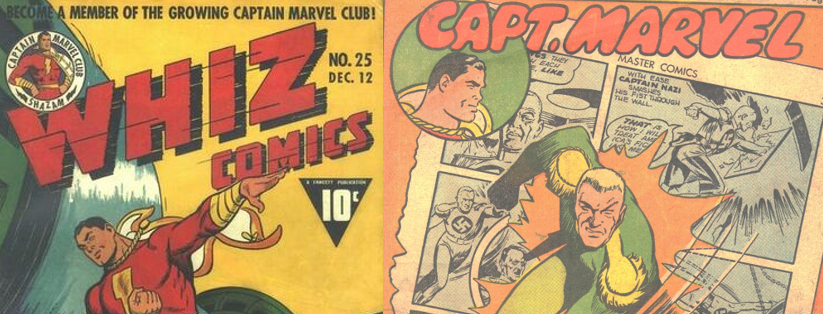
After National Comics (the precursor to DC Comics) saw incredible success with their flagship superheroes, Clark Kent/Superman and Bruce Wayne/Batman, Fawcett Publications desired to get in on the fad with their own colourful superheroes. While the initial plan was for a team of heroes, each with the powers of Greco-Roman Gods, Ralph Daigh made the executive decision to combine them into one superpowered entity to directly oppose Superman. This magical superhero originally went by “Captain Thunder” and debuted in a comic published as both Flash Comics and Thrill Comics, however trademark issues saw Pete Costanza rechristening him as “Captain Marvelous”, which soon became Captain Marvel, and the character was a big success for the publisher. It wouldn’t be long before the initial concept of a team of magically-empowered heroes soon came to pass with the creation of the the Lieutenant Marvels; soon, though, Captain Marvel was sharing his powers with a colourful extended family, including his bungling uncle and a talking tiger, of all things, butit all began with a young boy named Freddy Freeman. It was editor Ed Herron who wanted Captain Marvel to have a teenage sidekick, and Freddy was purposefully written to shout his idol’s name every time he transformed to remind kids to buy Fawcett’s comics. Unlike Captain Marvel, Captain Marvel Jr. remained a teenager even when transformed and is rendered a cripple in his mortal form, making him slightly more reliant on his superpowers. Captain Marvel Jr. has forged a pretty decent legacy for himself, serving on teams such as the Outsiders and the Teen Titans. He even once graduated (albeit all-too-briefly) into the role of Captain Marvel, was one of many inspirations for Elvis Presley, made a handful of appearances in DC’s animated ventures, and was portrayed by Jack Dylan Grazer and Adam Brody in the critical and financial success that was Shazam! (Sandberg, 2019)

The Review:
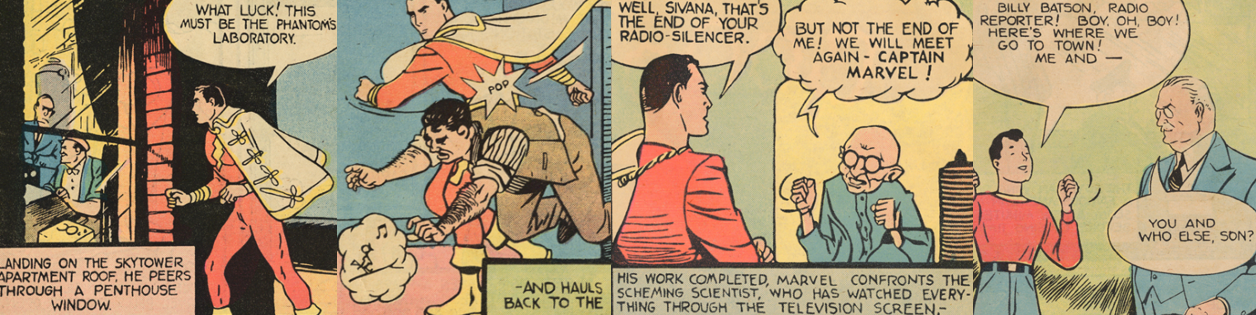
The big story of “The Origin of Captain Marvel, Jr.” is the reign of terror being perpetrated by Master Comics’ Albrecht Krieger/Captain Nazi, a supercriminal whose powers are apparently comparable to those of Bill Batson/Captain Marvel and who has been “cutting a path of sabotage and destruction” ever since he “[smashed] his way in” from Master Comics. Plucky boy reporter Billy is in the middle of informing the audience (both inter- and metatextual) of Captain Marvel’s previous entanglements with the superpowered Nazi when his broadcast is interrupted by Sterling Morris, the head of Whiz radio station, who dashes in in a panic because Captain Nazi is at their sending station! In the time between Captain Marvel’s debut appearance and this story, it appears that Morris has been clued in on Billy’s dual identity as Billy transforms into Captain Marvel with his magic word (“Shazam!”) right in front of his boss. That’s not the only think that’s changed, though, as Captain Marvel can now fly at supersonic speeds, which means he’s able to dash over to the sending station in a flash and, once there, he finds that Captain Nazi is delivering an ominous threat over the airwaves to every superpowered do-gooder out there.

Captain Marvel struggles to get his hands on the sadistic Captain Nazi.

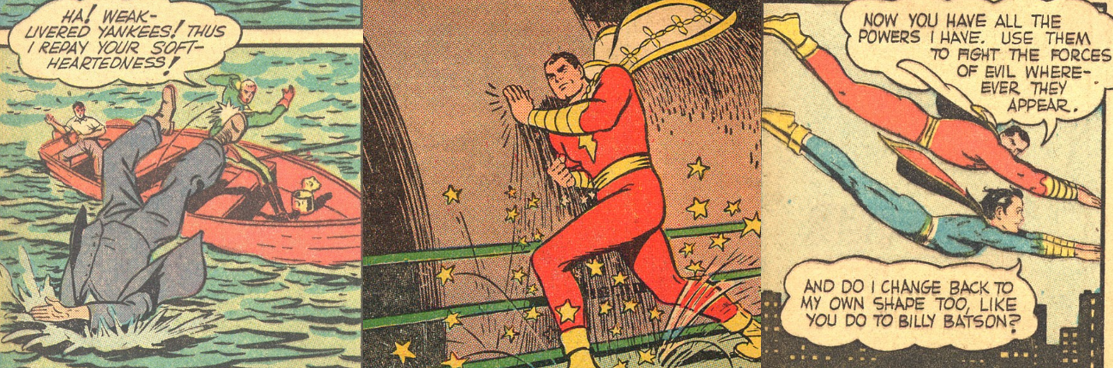
In a bid to disrupt Captain Nazi’s hate-mongering message, Billy’s fearless co-worker, Whitey Murphy, climbs up the broadcast tower, only to, of course, immediately be victimised by the garishly-clad and unnecessarily theatrical villain. As Captain Marvel flies up to rescue Whitey, Captain Nazi hurls his hostage right at the Big Red Cheese like a projectile, but luckily the white-haired newshound is only stunned (even though, realistically, he should’ve been mushed to paste as it’s not like Captain Marvel actually caught him…) Despite Whitey’s conviction and Captain Marvel’s resolve to make his rival pay, Captain Navi is long gone by the time our hero gets his ass back up there and, after a brief search, decides to simply wait for the villain to show himself again. After a couple of days without any sight or sound of the “One-Man-Blitz”, Billy can only speculate about when or where Captain Nazi will strike next, which just so happens to be at the activation ceremony of a new hydroelectric dam, an event that Billy (oddly dressed in blue for one panel…) just happens to be covering. Captain Nazi sabotages the turbines, causing them to rage out of control, and Captain Marvel finally manages to confront the maniac, who shows no fear and is unimpressed with his rival’s threats because he knows that Captain Marvel won’t waste time fighting him when hundreds of lives and millions of dollars are at stake. With the speed of Mercury, Captain Marvel bursts into dam and uses the mighty strength of Zeus to grind the out of control turbines to a halt; he even apologises for the damage he caused in the process, though the Major is more than grateful for the lives the Big Red Cheese saved. Although Captain Nazi managed to escape again, he strikes once more during a test flight for a new secret fighter plane and, wouldn’t you know it, Billy’s on scene again when Captain Nazi starts throttling the pilot and putting the plane in a death dive!

Captain Nazi’s heinous actions give birth to another member of the Marvel Family.

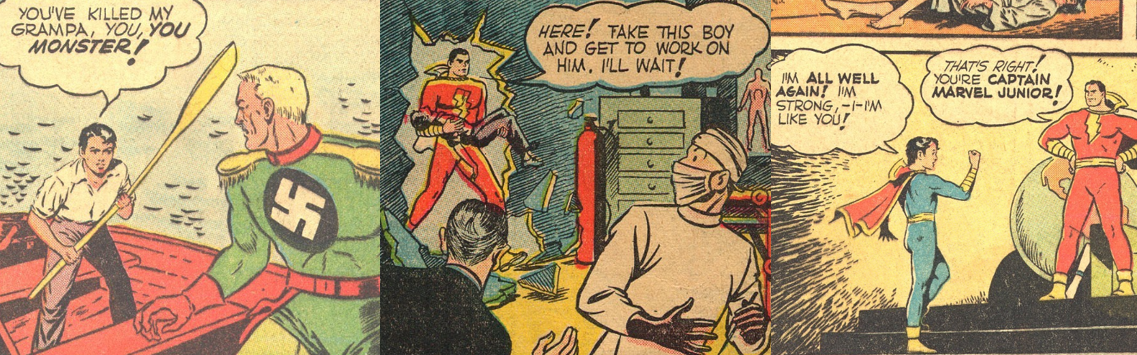
This time, Captain Marvel is able to correct the plane’s descent, levelling it out and causing Captain Nazi to black out from the sudden force. Finally getting his hands on the One-Man-Blitz, Captain Marvel sends his unconscious foe flying with a powerful uppercut. Unfortunately, Captain Nazi lands in the nearby bay and is hauled out by a kindly old man who’s out fishing with his grandson, Frederick “Freddy” Freeman. The old man’s kindness is repaid with a superpowered bitch slap that sends him tumbling into the water, fatally it turns out; when Freddy tries to attack Captain Nazi in a fight of rage, he too is smacked aside like a gnat. Thankfully, Freddy’s unconscious body is found by Captain Marvel, who spirits him to a hospital, barging right through the wall when a doctor denies him entry! After an indeterminate amount of time waiting to hear about Freddy’s condition, Billy is horrified to learn that the lad’s back is broken and that he’s expected to either be a cripple for the rest of his life or to pass away during the night. Perhaps feeling responsible for Freddy’s gruesome fate (and rightfully so), Billy steals him away in the middle of the night (despite the fact that his manhandling of Freddy would probably exacerbate the boy’s condition…) and takes him, via the strange subway train, to the ancient cavern of the wizard Shazam. Conjuring the spirit of the ages-old sorcerer, Billy begs the wizard to intervene and help save Freddy’s life and, while he can’t undo what Captain Nazi has done, the old sage bids Billy to speak his magic word and, when Freddy sets his eyes on the Mightiest Man in the World and speaks his name, he’s transformed into a similarly-clad teenage superhero. Restored to full health and gifted with the same powers as Captain Marvel (the wisdom of Solomon, the strength of Hercules, the stamina of Atlas, the power of Zeus, the courage of Achilles, and the speed of Mercury), Freddy is dubbed Captain Marvel, Jr and (between panels) made privy to Billy’s secret identity. Although Freddy’s human form is still stunted by a crippled leg, Captain Marvel charges his young ward with joining him in the battle against evil and offers to send him over to Master Comics to confront and defeat Captain Nazi once and for all.

The Summary:
“The Origin of Captain Marvel, Jr.” was part of a crossover event that depicted the efforts of Captain Nazi to cause chaos and destruction all across Fawcett’s publications. As a result, the story really doesn’t delve too deeply into Captain Nazi’s name, origin, or even his powers; he’s apparently able to fly and is definitely depicted as having superhuman strength and resilience, but the limits of his abilities or how he came to be are not answered in this story. I feel that’s a moot point, though, as a supervillain carrying the name “Captain Nazi” really doesn’t need much clarifying. He’s the superpowered arm of the Third Reich, vehemently opposed to good and justice in all its forms and intent on proving the superiority of the Axis Powers using his superior strength. However, this does fall apart a little bit throughout this particular story; Captain Nazi takes control of the airwaves (something that seems to be a running theme in Captain Marvel’s comics….) to deliver empty threats and his plan to destroy the dam is easily thwarted. It might’ve been better if he’d destroyed the radio tower, killing some innocents, and then burst open the dam himself, rather than sending the turbines out of control; his attempt to down the test plane also lacked some agency to me, but there’s no doubt that he’s a violent and unhinged psychopath. Captain Nazi killed at least two people in this story, almost killed a third, and threatened countless lives at the dam, but then again he did also black out after a shift in gravity so…

The garish Captain Nazi tests Captain Marvel’s mettle and sees him joined by a teenaged partner.

Once again, the artwork is pretty stellar in this story. There’s a simplicity to C.C. Beck and Mac Raboy’s style that, again, falters with backgrounds (especially Shazam’s cave) but shines in characters and their Max Fleischer-esque facial expressions. Captain Nazi might not be blessed with the most intimidating outfit (a pitch-black Schutzstaffel uniform with blood-red accents would’ve been far better in my opinion) but Captain Marvel has improved a lot from his debut; now showcasing his mighty speed and strength, he’s a well-known and beloved superhero. The “wisdom of Solomon” appears to extend to him sounding more like an adult when transformed, referring to Freddy as a “youngster” and echoing the trustworthiness of Superman, though he’s still a bit impulsive and reckless. This is best reflected in him just punting Captain Nazi away without thought to the damage he could cause, which directly impacts poor Freddy. It’s bad enough that Freddy doesn’t actually get a name in this story, but he has to watch his grandfather be murdered before his eyes and is then left at death’s door or facing a life as an invalid. Thankfully, he’s renewed by Shazam’s magic, transforming into a blue facsimile of Captain Marvel and ready to get a measure of revenge against Captain Nazi. Captain Marvel, Jr has always been a bit of an oddity to me; it’s not explained why he remains a teenager when transformed (I’d assume it’s because he only has a portion of Shazam’s powers, or received them second-hand, but the story explicitly states that he has “all the powers [Captain Marvel] has”) and this kind of flies in the face of the wish fulfilment that’s central to Captain Marvel (say a magic word and a small child, the target audience, becomes an all-powerful, adult superman). I guess it speaks to a different kind of wish fulfilment, though; the youngers reading the comics want to emulate their heroes so it makes sense to have teenaged superheroes, and Freddy’s lame leg adds a level of representation that’s rare for comics from this era. Overall, this is an enjoyable enough story; it’s more like a series of madcap vignettes as Captain Marvel tries to defeat the sadistic Captain Nazi and the appearance of Captain Marvel, Jr comes far too late for it to properly have as much impact as it could but it’s very colourful and we get to see a Nazi scumbag get punched in the face!

My Rating:

Rating: 3 out of 5.

Pretty Good

What did you think to Captain Marvel, Jr’s debut story? Did you like the idea of boy/man superhero Captain Marvel having a teen sidekick? What did you think to Captain Nazi as a villain and the evil acts he perpetrated in this story, and the crossover? Which of the Captain Marvel family is your favourite? What are some of your favourite Captain Marvel, Jr stories and moments? Whatever your thoughts Captain Marvel and the Marvel Family, feel free to leave them below or drop a comment on my social media.

Back Issues: Whiz Comics #2

Story Title: “Introducing Captain Marvel!” (or simply just “Capt. Marvel!”)
Published:
February 1940
Writer: Bill Parker
Artists: C.C. Beck

The Background:
After DC Comics (then known as National Comics) saw incredible success with their benchmark superheroes, Clark Kent/Superman and Bruce Wayne/Batman, the comic book industry was ripe for a whole slew of new costumed heroes to take the stage. Not wanting to miss out on the action, Fawcett Publications set about establishing their own colourful superheroes, each sporting the powers of Greco-Roman Gods, but it was Ralph Daigh who decided to combine them into one superpowered entity to directly oppose Superman, which he initially dubbed “Captain Thunder”. Taken by the concept, both writer Bill Parker and artist C.C. Beck saw the concept as a chance to tell a story that hearkened back to the folk-tales and myths of old. Initially, Captain Thunder debuted in the pages of a comic published as both Flash Comics and Thrill Comics but, when trademark issues arose concerning all of these names, artist Pete Costanza suggested the alternative name of “Captain Marvelous”, soon shortened to Captain Marvel, and the Big Red Cheese proved to be a massive success when his debut issue sold over 500,000 copies. Sadly, legal issues would continue to dog the character even after Fawcett was absorbed into DC Comics and Captain Marvel started rubbing shoulders with the Man of Steel and the Justice League, creating some confusion about the character’s name since Marvel Comics had since established their own Captain Marvel, leading to the Big Red Cheese often being dubbed “Shazam” instead. Whatever you want to call him, Captain Marvel has quite the legacy; he’s shared his powers with a colourful extended family (including a bumbling uncle and a talking tiger!), clashed with Superman and been involved in some of DC’s biggest crossover and Crisis events, and his phenomenal success on the big screen in 2019 led to not only a sequel and a spin-off but a newfound surge in popularity for the magical man/boy superhero.

The Review:
Our story begins with a youngster in a bright red jumper and jeans hanging around outside the city subway trying to sell newspapers. He’s approached by a mysterious man in a black overcoat and fedora and we learn that, despite his clean-cut appearance, the boy is homeless and sleeps in the subway to stay warm. The mystery man bids the lad to follow him into a danky subway tunnel and, naïve as he is, the boy goes along; there, he boards a strangely garish-looking subway car and thinks absolutely nothing of it when he’s transported to an ominous subterranean cavern. Seriously, the boy barely says a word and seems perfectly happy to be whisked away by this darkly-garbed figure to the bowls of the city. His youthful trust (or stupidity, you decide) leads to him entering a vast underground hall where crude, cartoonish carvings of the Seven Deadly Enemies of Man (Pride, Envy, Greed, Hatred, Selfishness, Laziness, and Injustice) adorn the walls of the cavern, which is lit only by flaming torches and home to an enigmatic, heavily bearded old man who sits on a huge marble throne. The old man (who bares more than a passing resemblance to God) introduces himself as Shazam and demonstrates his all-knowing demeanour by identifying the boy as Billy Batson. Even more incredibly, upon speaking his name, Shazam causes a bolt of lighting to fill the cave and the names of six Gods and their attributes to magically appear on the wall behind him: Solomon (wisdom), Hercules (strength), Atlas (stamina), Zeus (power), Achilles (courage), and Mercury (speed).

Naïve Billy is taken to meet Shazam and transformed into a superhuman being!

Shazam explains that he has utilised the powers of these Gods to defend the Earth from the forces of evil for three-thousand years; in that time, he claims to have “seen everything – known everything” and, rather than using his incredible magic to prove this, falls back on a “historama” – a “super-television screen capable of depicting past, present and future events” – to show how Shazam watched as Billy was driven from his childhood home after the death of his parents by his wicked uncle, who sought to get his grubby hands on the money and bonds Billy was willed by his father. This is, apparently, enough of an explanation as to why Shazam brought Billy to his mysterious cave; after battling injustice and cruelty for centuries, Shazam is looking for a successor to carry on his work as “the strongest and mightiest man in the world”, Captain Marvel. Upon speaking the old man’s name, Billy is transformed by a magical lightning bolt into a tall, physically powerful adult male in a bright red costume and fancy side-cape and unquestionably pledges to continue Shazam’s legacy. After Captain Marvel speaks the magic word once more, however, Shazam appears to be crushed under a massive granite block that’s randomly suspended over his head. Okay… Anyway, in a flash of lightning, Billy’s back to his normal self and outside the subway with his newspapers, and left thinking that it was all a dream. The next morning, a couple of no-good gangsters buy one of Billy’s papers to read up on their boss’s handiwork: a madman known as “The Phantom Scientist” has threatened the United States radio system and is demanding $50,000,000 for…something. Suspecting the two, Billy follows the gangsters to “the swanky Skytower apartments” but is turned away by a pushy doorman. He then tries to get word to the radio “head”, Sterling Morris, by dashing into his office after the receptionist tries to shoo him away. Unfortunately, Morris dismisses Billy’s story as hogwash simply because the gangsters are holed up at somewhere as reputable the Skytower apartments.

Captain Marvel disrupts Sivana’s plan and earns his child alter ego a job as a radio reporter.

Undeterred, Billy vows to find the Phantom’s laboratory and even manages to convince Morris to award him a job as a radio announcer if he succeeds in this goal. Since he can’t enter Skytower apartments directly, he takes the elevator to the rooftop of the nearby office building and, deciding that he didn’t dream up his extraordinary encounter the other night after all, transforms to Captain Marvel with his magic word. Captain Marvel easily clears the gap between the two buildings with a mighty leap (like Superman in his first appearance, the Big Red Cheese can’t fly yet) and, in an astounding piece of luck, finds himself right outside of the Phantom’s laboratory. Inside, he learns of the Phantom’s true identity: he’s Sivana, a balding, gnarled little man who operates through a number of hired goons and plans to put an end to any and all radio broadcasts at midnight unless his hefty ransom is paid. Having seen enough, Captain Marvel bursts in, hurling one of Sivana’s men into his complex “radio-silencer” machine, smashing it to smithereens. The other man flees to a private elevator but to no avail; Captain Marvel rips the door from its hinges and then hauls the elevator up with his incredible strength, laying the goon out with a wallop to the back of his head. With the mooks tied up, Captain Marvel addresses Sivana directly using the mad scientist’s gigantic television screen, with both vowing to confront each other again…though only Captain Marvel delivers a death threat to the odd little madman. With Sivana’s plan thwarted, Captain Marvel turns back to Billy and calls Morris over; though perplexed, Morris is suitably impressed by Billy’s actions and the plucky boy earns himself a job as a radio reporter, while also vowing to continue fighting the good fight as Captain Marvel!

The Summary:
I’ve not read much of Captain Marvel. I think the only solo stuff of his I’ve read prior to this was the initial Power of Shazam (Ordway, et al, 1995 to 1999) run. Other than that, he’s rarely cropped up in other DC stories and crossovers I’ve read, but I’ve always wanted to read a little more from the character as I find him pretty interesting as a source of wish fulfilment. What kid hasn’t wanted to become a superhero, after all, and the idea of a homeless little boy suddenly being able to transform into a literal superman has a great deal of appeal. As ever with Captain Marvel’s stories, the art is of a slightly different calibre to his contemporaries, favouring a more whimsical and cartoonish style that, for all the colour and pop-art appeal, really falls flat when it comes to portraying backgrounds and environments. Shazam’s cave, for example, is quite poorly rendered compared to the other, more realistic locations. C.C. Beck shines in rendering facial expressions, his work being very reminiscent of pulp stories and characters like Samuel Bradley/Sam Bradley, and he even brings to like quasi-science-fiction elements like Sivana’s technology in adorable detail that is perfectly in keeping with the technology of the time, but just a touch more fanciful but not in a way that’s needlessly overdesigned like some of Jack Kirby’s work.

Captain Marvel impresses, despite some narrative hiccups in his debut story.

Narratively, Captain Marvel’s debut is a bit wonky, however. We don’t really get to learn much about Billy beyond what Shazam shows us with his “historama” and it’s really odd that he so willingly went along with the dark stranger. Who even was that, anyway? He just disappeared once they got to Shazam’s cave and there was no real explanation behind him. I think having it be Shazam himself might’ve been a little better, but it kind of made Billy look like a naïve fool. His reaction to meeting Shazam is also very one-sided in the old man’s favour; Billy questions none of it, instantly accepts his new mission, and yet doesn’t even explore his superpowers since he dismisses it all as a dream. He has some pep to him, I’ll give him that, in the way he barges in to see Morris and hoodwinks the guy into giving him a job, but there’s not much to Billy and no personality shift between the boy and his superpowered alter ego. Captain Marvel himself looks great, but we don’t really see many of his powers on show; he does a leap, tosses some goons around, and that’s it, so he’s hardly on par with Superman in terms of abilities in the context of this issue. Sivana’s plot was also a bit low-key; I mean, disrupting radio stations for money? Is that really the best he can come up with? Overall, though, I did enjoy it, even if the narrative is a bit scattered and questionable; I definitely think subsequent retellings and revisions have made Captain Marvel’s origin and personality more interesting and diverse, though.

My Rating:

Rating: 3 out of 5.

Pretty Good

Were you a fan of Captain Marvel’s debut story? What did you think Billy’s presentation and the depiction of his first meeting with Shazam? Were you impressed by Captain Marvel’s powers and costume? What did you think to Sivana’s threat? Which of the Captain Marvel family is your favourite? What are some of your favourite Captain Marvel stories and moments? Whatever your thoughts Captain Marvel, feel free to leave them below or drop a comment on my social media.

Game Corner [JLA Day]: Justice League Heroes (PlayStation 2)


To celebrate the release of Justice League (Snyder/Whedon, 2017), DC Comics named November 18 “Justice League Day”. Setting aside all the drama surrounding that movie, this provides a perfect excuse to spotlight DC’s premier superhero team, which set the standard for super teams in comics by bringing together DC’s most powerful heroes.


Released: 22 November 2006
Developer: Snowblind Studios
Also Available For: Nintendo DS, PlayStation Portable, and Xbox

The Background:
After coming together in November 1959, the Justice League of America (JLA) quickly became one of DC Comic’s best-selling titles. This shouldn’t be entirely surprising considering the team came to be comprised of DC’s most popular characters: Clark Kent/Superman, Bruce Wayne/Batman, Diana Prince/Wonder Woman, Hal Jordan/Green Lantern, Arthur Curry/Aquaman, Barry Allan/The Flash, and J’onn J’onzz (also known as “John Jones”)/Martian Manhunter. The team saw many members come and go over the years but was a constant staple of DC’s library of comic books and soon expanded into other media. Interestingly, the Justice League’s success hasn’t always resulted in the best videogames, though, meaning developers Snowblind Studios faced a bit of an uphill battle right from the start when creating Justice League Heroes. Built out of a modified engine of their critically acclaimed title Baldur’s Gate: Dark Alliance (ibid, 2001), the developers ending up removing features from that game and engine to focus on extending the length of Justice League Heroes, which has more than a few similarities to Marvel: Ultimate Alliance (Raven Software/Barking Lizards Technologies, 2006), which released about a month earlier. Reviews of the game were mixed across platforms, though, and the game was generally regarded as a bit of a mediocre and mindless beat-‘em-up.

The Plot:
The Earth is under attack from the robot forces of Brainiac, who has coerced many of the world’s most notorious supervillains into helping him consolidate the power afforded to him by a mysterious box from the stars. In response, the world’s greatest heroes, the Justice League, leap into action and team up to oppose Brainiac’s plot in a globe-trotting adventure that requires all of their individual abilities and skills.

Gameplay:
Justice League Heroes is a top-down action brawler in which you (and either another player or a computer-controlled partner) battle through a number of recognisable locations from the DC universe as various members of the Justice League. The game’s story is split into a number of missions that see two members of the Justice League teaming up at any one time; a second, human player can join the game at any point from the pause menu, a solo player can freely switch between the two heroes at will by pressing up on the directional pad (D-pad), and you’ll also be tasked with assembling one or more custom teams of two characters later in the story but you’ll never get the opportunity to switch out characters completely or replay missions with different characters. Gameplay in Justice League Heroes revolves almost entirely around beating up endless hoards of robots and aliens and solving some very light puzzles; characters can jump with a press of the Triangle button (and double jump or fly/glide with subsequent presses depending on who you’re playing as), attack with strong and fast attacks with Circle and X, respectively, and can grab enemies or objects with Square and block incoming attacks by holding R1. By entering different button presses (X, X, O, for example), players can pull off simple combo attacks to take out enemies but there are, sadly, no team up attacks to be found here.

The Justice League’s various superpowers are at your disposal and can be upgraded to be more effective.

While every character controls the same except for their ability to fly or glide, each one is made slightly different from the other through their individual superpowers. By pressing L1 and either Triangle, Square, Circle, or X, players can pull off their character’s signature super moves as long as they have enough energy stored up. This allows you to blast enemies with Superman’s heat vision, for example, or turn them into rabbits with Zatanna Zatara’s magic, or smash them with John Stewart/Green Lantern’s massive sledgehammer. Pressing L1 and R1 will see each character (with some exceptions) pull off a more powerful  super special attack which, again, varies per character; Superman, for example, will become stronger while Batman unleashes a swarm of bats to damage foes and Martian Manhunter briefly becomes intangible and invisible. They’re all pretty useful and different enough in their own way, with most characters having a projectile of some sort, a move to boost their attack or speed, or being able to stun or otherwise incapacitate enemies and you’ll sometimes (very rarely) need to use a specific character’s superpowers to bypass obstacles in order to progress. When playing alone, you can also issue simple commands to your partner using the D-pad; this allows you to increase the aggressiveness of their attack or have them focus on defence, which can be useful when teamed with Zatanna as she’s able to heal all team members.

Rescue civilians, activate consoles, and destroy targets to progress amidst the mindless brawling.

Overall, I found the computer to be surprisingly useful and competent; if your partner gets downed, however, you’ll have to rush in to revive them but the game automatically revives any downed characters when you reach one of its numerous checkpoints and enemies will often drop health-restoring orbs to keep you ticking over. Furthermore, if you’re able to attack enemies without taking damage, you’ll build up your “Heroic Meter”, which will increase your damage output until you get hit, and you can alter the difficulty of the game and its enemies by selecting different difficulty settings from the main menu. Despite the game being extremely linear, the developers included a helpful mini map, which you can expand by pressing in the right analogue stick. This isn’t always necessary but, as many of the environments are rather drab, grey, similar, and somewhat labyrinthine at times, it’s a welcome addition to keep you on track even during the game’s shorter and more straightforward missions. Unfortunately, the top-down view can be rather restrictive at times; many areas are filled with debris or obstructions and it always seems like you can only see just enough of the area, which can lead to enemies catching you off guard or hiding behind parts of the environment with no way to see them as they don’t show up on the map. It’s not all mindless brawling, either; occasionally, you’ll be tasked with rescuing a number of civilians or hostages, faced with a time limit, or directed to activate consoles to lower barriers in order to progress. As alluded to earlier, these very rarely require you to use the Flash’s superspeed or the Martian Manhunter’s intangibility to get past obstacles and stop fans, lower energy barriers, or deactivate Kryptonite hazards so that you can progress further. Sometimes you’ll also need to destroy a wall or use a character’s flight to progress across rooftops and, in the final portion of the game, you’ll not only have to protect Superman as he smashes through Darkseid’s fortress but you’ll also be faced with an extremely frustrating and confusing teleport puzzle that was the only time I had to actively look up a solution online.

Graphics and Sound:
Thanks to its zoomed out, top-down perspective, Justice League Heroes is, largely, able to get away with hiding any inconsistencies and defects in its in-game character models. Since you never really see your characters up close, the developers can have them talk and drop hints and quips without really needing to animate their mouths and the simple beat-‘em-up action of the game means that characters just need to look somewhat decent when they throw punches, grab cars, or blast out energy beams. And, for the most part, they do; there’s some neat little touches here and there (like Martian Manhunter being able to transform into his true, more monstrous form and the Flash being accompanied by a speed force double and lightning) and characters are always talking so you know when you need to drop or combine Boosts or have a vague idea of how the story is progressing.

Sadly, the game’s environments and enemies tend to be quite dark, bland, and boring.

Sadly, enemies and environments don’t always live up to the colourful and eye-catching depiction of the titular Justice League. It takes a long time for you to battle anything other than Brainiac’s generic robots or explore areas beyond the wrecked streets of Metropolis or the cold, grey corridors of Scientific and Technological Advanced Research Laboratories (S.T.A.R. Labs) and the like. Eventually, though, you do venture into more visually unique environments like the subways, a honeycomb and sap-encrusted hive, the ruins of J’onn’s civilisation on Mars, Gorilla City, a Lovecraftian dimension populated by strange rock creatures and living tentacles, and a version of Apokolips created on Earth but there’s very little variety offered in terms of the enemies or puzzles and hazards you face as you progress. No matter where you are, it’s the same thing every time: defeat all enemies, maybe activate a console, and reach the end of the stage.

Even Ron Perlman can’t salvage the blurry, rubbery graphics of the game’s cinematics.

The bulk of the game’s story (which is about as generic as you can get for a Justice League videogame) is conveyed through CG cutscenes featuring the traditional rubbery-looking graphics you’d expect from a PlayStation 2 game. I did notice some slowdown when there was a lot happening onscreen and, in terms of music and sound, the game is very unimpressive; the voice cast isn’t even the same one as in the popular Justice League animated series (2001 to 2006) and, while I love me some Ron Perlman, he just sounds bored whenever his Batman speaks (I’m also not really a fan of how often Batman is shown in broad daylight).

Enemies and Bosses:
As I’ve mentioned a bit already, you’ll wade through numerous disposable enemies in your mission to stop Brainiac and his lieutenants but none of them are particularly interesting. You’ll battle robots of varying sizes, humanoid wasps, White Martians on the surface of Mars, Gorilla Grodd’s gorilla forces, and Parademons but, once you’ve fought one lot of enemies, you’ve fought them all as they all feature regular foot soldiers who shoot at you and both flying and bigger variants that can take a bit more punishment. Honestly, the only enemies I even remotely found interesting were the weird crab and toad-like enemies you face later in the game and the instances where you battle Brainiac’s skull robots and failed clones of Doomsday because they at least looked a little different.

Many of the game’s bosses require you to fend off minions or destroy or activate consoles to attack them.
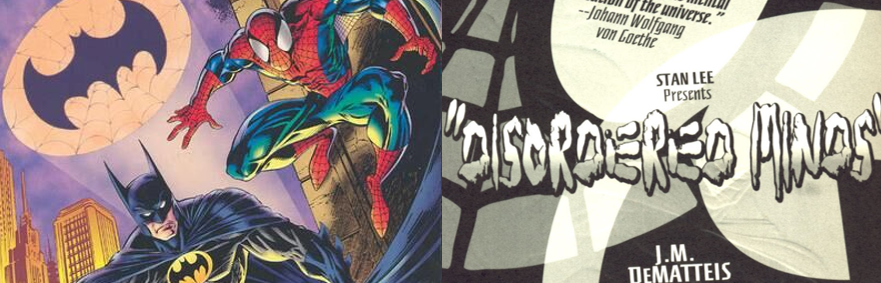
Before you can defeat Brainiac, you’ll have to battle a number of bosses; some of these are simply bigger, more dangerous versions of enemies you’ve already fought or Brainiac’s more deadly robots and duplicates. You’ll battle a Brainiac duplicate in S.T.A.R. Labs, for example, but this fight isn’t just about throwing punches. Instead, you have to activate consoles to lower barriers and rescue the scientists against a time limit all while “Brainiac” fires lasers and energy blasts at you. You’ll also encounter some of the more obscure villains from DC Comics’ gallery; Queen Bee has established a hive in the Metropolis subway and is transforming civilians into monstrous insect hybrids and, when you confront her in her throne room, she shields herself from your attacks and rains missiles into the arena that make the floor sticky. She’s only vulnerable when she leaves her throne but your window of opportunity to attack her is hampered somewhat by her minions, her energy blasts, and her tendency to dart across the screen like a madwoman. You’ll also butt heads with the Key, of all people. Like with Brainiac’s duplicate, you have to rescue some scientists against a time limit during this battle but the Key proves to be a particularly elusive and versatile enemy as he teleports around the place and causes hazards to blast out from his dimensional portals.

Grodd and Brainiac use their powers, technology, and minions to keep you at bay.

Similarly, when fighting Doctor Louise Lincoln/Killer Frost, you’re given one minute and forty seconds to destroy three missiles (and five seconds to get away from each before they explode) in addition to battling her and her icy minions. Killer Frost can conjure grunts, form ice shields, and blast at you with ice and icicles, all of which can make battling her quite tricky and annoying as your attentions are constantly divided. After reaching the core of a pyramid-like structure on Mars, Superman and the Martian Manhunter have to battle the White Martian leader; this guy is also accompanied by disposable White Martian grunts and you’re tasked with activating four nearby power nodes to defeat him. Things get noticeably more interesting when the Justice League splits into teams; while one team flies through the upper atmosphere destroying generators on invading spacecraft, another destroys power turbines in Gorilla City and gets into a confrontation with Gorilla Grodd. Grodd primarily uses his staff to attack and is joined not only by an inexhaustible supply of gorilla minions but also a series of energy-firing turrets so it’s probably best to try and keep your distance and stay on the move to emerge victorious in this fight. After battling their own security system in their Watchtower space station, the Justice League then faces off with a larger, more powerful Doomsday clone that, unlike pretty much every other boss in the game, boils down to a question of who can attack hardest and fastest rather than distracting you with tricks and puzzles.

Of course Darkseid turns out to be the true final boss of the game!

Eventually, you’ll breach Brainiac’s main base and be forced to battle his three robot guardians before you confront him; Brainiac is completely protected by an energy shield and is only vulnerable when he rises from his throne and only for a brief window of time. He also likes to teleport you to the far end of the arena, where you’re forced to destroy the generators that power his barriers and take out some minions just to get back up to him, so it’s more a question of patience than anything. As you might have guessed, the moment you defeat Brainiac he is immediately usurped by Darkseid, who teleports you away to a hellish dimension and then converts Earth into a new Apokolips. You’ll need to assemble two teams of four to confront Darkseid, who stomps around his throne room creating shockwaves and plumes of fire along the ground and blasting at you with his powerful Omega Beams. Being an all-powerful New God, his health also regenerates over time, meaning you’ll have to keep pummelling him again and again in order to keep him down. This was, honestly, a bit of a confusing fight; you can grab the “Apokolips Hypercube” nearby, which seems to weaken him and make him vulnerable to your attacks but I also found myself running around with it in my hands and not doing any damage to Darkseid at all and then he just suddenly succumbed to my attacks and was defeated.

Power-Ups and Bonuses:
In almost every area in the game, you’ll find objects that you can grab and use as weapons; some of these are limited to the specifics of your character, though, meaning that you won’t be lifting cars over your head as, say, Oliver Queen/Green Arrow, for example. Still, you can grab post boxes and parking meters and cars and such to bash over enemy’s heads, which adds a bit of variety to the otherwise relentless combat. You can also pick up temporary power-ups throughout each environment to give yourself and your team mate a bit of a power boost so it can be worth exploring a little bit and smashing destructible objects wherever you see them.

Level-up to increase your stats power-up your attacks with Skill Points and Boosts.

The game also features some light role-playing elements; as you defeat enemies, you’ll gain experience points (EXP) and level-up once you’ve earned enough EXP. This will increase your stats and abilities but you also earn Skill Points that you can spend upgrading your character’s superpowers up to five different ranks to increase their effectiveness and duration. Additionally, enemies will also drop various “Boosts” that you can equip at any time; you can also combine Boosts together to create new, more powerful Boosts and equipping these will also boost your superpowers, increase your damage output or defence, or increase the range and duration of your attacks.

Additional Features:
Although the game is extremely linear, there are often some rewards to be found through exploration; generally, these will just be stockpiles of health, energy, or Boosts but you’ll also find be civilians in danger who need rescuing who will drop “Justice League Shields”. Shields can also be found by destroying parts of the environment and you can spend these on skins and additional characters. While you can select any of the unlockable costumes at any time, they won’t actually load until you reach the next checkpoint/area and you can only select to play as the unlocked characters when the game allows you to pick a team of your own. The skins available are quite impressive, though; while not every character gets a skin, some offer bonus boosts to your stats and there’s some fan favourites available here, like Superman’s black suit, Batman’s traditional blue and grey suit, and the Jay Garrick version of the Flash. You can also unlock the likes of Green Arrow, Aquaman (sporting his water hand), Helena Bertinelli/The Huntress, and what I assume is the Kendra Saunders version of Hawkgirl.

Unlock additional characters, costumes, and modes by finding Shields and completing the game.

You’ll notice, however, that neither Huntress, Aquaman, or Hawkgirl have an L1+R1 special move, though I’m not entirely sure why. You can also unlock Hal Jordan and Kyle Rayner but, despite these two being separate characters, they control exactly the same as John Stewart, which is a little disappointing; none of the unlockable characters have alternate costumes either, which is a bit of a missed opportunity in my book. Initially, you can select from Easy, Normal, or Hard difficulties but you’ll unlock two more difficulty levels (Elite and Superhero, on which most enemies will kill you in one hit) and be given the option of starting the game over from the beginning with all of the upgrades and EXP you amassed during your run upon completing the game. Sadly, there’s no option to free play any mission with any character, no versus mode, and no option to play online or with more than one other player but there are a number of cheats that you can activate from the pause menu to give yourself invincibility, infinite energy, all upgrades, and a bunch of Shields to quickly unlock all of the game’s skins and characters.

The Summary:
Justice League Heroes isn’t going to really offer you anything you can’t get from any other mindless beat-‘em-up; the stages and enemy designs can be very bland and boring and there really isn’t much asked of you other than to mash the same buttons over and over and activate a few consoles. Still, as a fan of beat-‘em-ups and brawlers, I found Justice League Heroes to be a pretty decent way of spending an afternoon; there’s a lot of characters available to you and I like that the story mixes the teams up quite often and allows you to put together your own teams, and the game is probably even more enjoyable with a friend to play with. There could have been more options and unlockables available (such as free play mode, maybe some challenges, and a boss rush), the music and graphics can stutter a bit, and the game is awash with dark, boring, grey locations, but, as a repetitive brawler featuring the Justice League, it’s decent enough, though probably not very appealing to those that aren’t fans of the source material and characters.

My Rating:

Rating: 2 out of 5.

Could Be Better

Have you ever played Justice League Heroes? If so, what did you think to it? Were you disappointed by the game’s presentation, selection of villains, and the inability to freely pick characters on the go? Which of the available characters was your favourite and preferred duo? What genre do you think would work for a future Justice League videogame? What version of the Justice League is your favourite and are there any DC superheroes you’d like to see added to the team someday? How are you celebrating Justice League Day this year? Whatever your thoughts on Justice League Heroes, and the Justice League in general, feel free to drop a comment below.

Movie Night: Black Adam

Released: 21 October 2022
Director: Jaume Collet-Serra
Distributor:
Warner Bros. Pictures
Budget: $195 to 200 million
Stars:
Dwayne Johnson, Marwan Kenzari, Sarah Shahi, Bodhi Sabongui, Aldis Hodge, Noah Centineo, Quintessa Swindell, and Pierce Brosnan

The Plot:
After nearly five thousand years of imprisonment, Teth-Adam (Johnson), an ancient magical champion said to have liberated Kahndaq, is unleashed into modern times. His brutal form of justice attracts the attention of the Justice Society of America (JSA), who try to stop his rampage and bring him into custody whilee investigating a centuries-old evil force whose power matches that of Teth-Adam.

The Background:
Following the incredible success of Clark Kent/Superman and Bruce Wayne/Batman, Fawcett Publications looked to get in on the superhero craze. While the initial plan was for a team of heroes, Ralph Daigh combined them into one superpowered entity to directly oppose Superman. Originally dubbed “Captain Thunder”, trademark issues led to artist Pete Costanza suggesting the name “Captain Marvelous”, soon shortened to Captain Marvel, and the character proved a big success. Captain Marvel soon became a franchise all unto himself after sharing his powers with a colourful extended family and, about six years after his debut, he and his Marvel Family met their dark opposite in the form of Black Adam, a corrupted version of the Big Red Cheese. Although Black Adam only appeared once in Fawcett’s original run, he saw a new lease of life after the publisher was absorbed into DC Comics, becoming a complex anti-hero often as reprehensible as the villains he opposed. Ranked as one of comics most interesting anti-heroes, Black Adam has featured in animated ventures but this live-action adaptation has spent nearly twenty years in Development Hell. Dwayne “The Rock” Johnson has been attached to the role since the project first stumbled to life in 2006 and, given Johnson’s prominence in Hollywood, the decision was made early on to keep Black Adam separated from Shazam! (Sandberg, 2019) in order to best capitalise on his star power before an inevitable confrontation with Billy Batson/Shazam (Asher Angel/Zachary Levi). Initial plans to feature Black Adam in The Suicide Squad (Gunn, 2021) were scrapped in favour of pitting him against the JSA. Johnson was keen to play up the character’s no-nonsense nature and went all-in with marketing Black Adam as a game-changer in the DC Extended Universe. After numerous delays due to the COVID-19 pandemic, Black Adam finally released to mixed reviews; the film did pretty well with a $393.5 million box office but, while many praised The Rock’s performance and the implications Black Adam has on the future of the DC Extended Universe (DCEU), others took issue with the film’s conflated plot and pacing, though all involved (and especially Johnson) were adamant that Black Adam represented a new phase of the DCEU.

The Review:
What a strange, long, and winding road this film has been on; it’s been in production for so long that I was starting to wonder if it would ever come out, especially after the character failed to appear in Shazam! I kinda get why he didn’t; it’s possible that the Rock’s star power would’ve dwarfed that movie’s heart-warming, handholding introduction to this side of the DCEU and people always complain that superhero films rely on the dark doppelgänger trope too much, which I get, but I think the contrast between Black Adam and Captain Marvel helps to elevate the latter into a more wholesome hero. Black Adam also would’ve been a great fit for either of the Suicide Squad films, especially the God-awful first one, but I do understand the idea of capitalising on the Rock’s star power to give him his own feature film, even if I don’t fully agree with it or his insistence on hyping up a clash between him and Superman (Henry Cavill) rather than him and Shazam, which would be my first choice, but maybe all three could meet up in a future movie, that would be a happy compromise. I am pretty familiar with Black Adam, though; I’ve read a bunch of his stories, especially during his time on the JSA, and really dig his no-nonsense attitude and the complex relationship he has with Captain Marvel, which is aways one clash of ideals away from degenerating into all-out war. I also really hope that the Rock is committed enough to the role that he sticks around for a bit; obviously, Dwayne Johnson is a massive Hollywood star and is in high demand so I do wonder about his longevity in the DCEU, especially considering how quickly Ben Affleck burned out (and I was worried that he would when he was cast), but he’s pursued the role for a good ten years and really threw himself into the marketing so I’m hoping he gets to reappear a few more times, though I do somewhat disagree with the idea of rebuilding the DCEU entirely around a character like Black Adam instead of, say, Superman. Black Adam gets off to a shaky start, with a ten-to-fifteen-minute opening and narration that rushes through the titular anti-hero’s origins in ancient Kahndaq and sets up the McGuffin that much of the film’s plot revolves around. Centuries ago, a tyrant named Ahk-Ton (Kenzari) enslaved Kahndaq and forced its people to dig for a rare and incredibly powerful mineral known as “Eternium”, the only material powerful enough to force the Crown of Sabbac, an item powerful by six demonic entities from what can only be described as Hell.

Awakened in modern times, Teth-Adam’s violent ways earn him the adulation of the oppressed Kahndaq.

Kahndaq’s spirit was well and truly broken but one boy, Hurut (Jalon Christian), dared to try and inspire an uprising. For this, he was sentenced to public execution but, at the last second, was spirited away to the Rock of Eternity and infused with the stamina of Shu, the speed of Horus, the strength of Amon, the wisdom of Zehuti, the power of Aten, and the courage of Mehen by the Council of Wizards. The legend becomes sketchy after the defeat of Ahk-Ton, but Kahndaq has revered their Champion ever since, with great statues erected celebrating their saviour; in modern day Kahndaq, their symbolism has all but faded thanks to the oppression of Intergang, a mercenary military force that has imposed martial law throughout the city and is seeking to strip it of all its natural resources. With Kahndaq virtually a police state, young Amon Tomaz (Sabongui) echoes the rebellious spirit of Hurut in his desire to fight back against their oppressors, but his mother, Adrianna (Shahi), is more concerned with keeping him safe from reprisals and tracking down the legendary and forgotten Crown of Sabbac to keep it out of Intergang’s hands. Here efforts lead her, her bumbling technician brother Karim (Mo Amer), and Ishmael Gregor (Kenzari) to a mountain where they successfully recover the crown but, after being accosted by Intergang’s forces, Adrianna speaks the magical word of Shazam to awaken the Champion from his long slumber. Thus, Teth-Adam arrives, garbed in a form-fitting black suit and sporting both the Wizard’s (Djimon Hounsou) lightning symbol and a hooded cape and immediately dispatches the Intergang thugs without mercy or quarter. His superhuman speed, strength, and command over lightning make him virtually indestructible to all man-made weapons; his skin is only pierced by Eternium, and his powers even allow him to cauterise and recover from wounds in moments. Bulletproof and capable of reducing a man to a chargrilled skeleton or a pile of ashes with a single bolt of lightning, Teth-Adam lays wastes to the armed thugs but, in the chaos, notably makes the effort to save Adrianna from being crushed by a falling boulder. A stoic, grim-faced man, Teth-Adam tears through Intergang with ease, mocking their “weak magic”, catching bullets, and swatting aside missiles like they were nothing. When he’s injured by an Eternium blast, Adrianna and Karim take him back to their flat to recuperate; there, he quickly learns English (how is never explained but I’ll assume it was through the wisdom of Zehuti) and is accosted by Amon, who very much fills a similar role to Frederick “Freddy” Freeman (Jack Dylan Grazer) in Shazam; he’s an absolute superhero nut, with posters and comics and action figures of all of DC’s heroes plastered around his bedroom, and enthusiastically runs down the gamut of Teth-Adam’s powers and tries to teach him to embrace his role as a superhero, somewhat similar to young John Connor’s (Eddie Furlong) relationship with the Terminator (Arnold Schwarzenegger). However, Teth-Adam has about as much interest in being a hero as he does using doors or being polite; he simply floats and flies around, barging through walls, spouting his dogma regarding lethal force to Amon, and rejecting claims that he’s Kahndaq’s fabled Champion. Despite this, he does have something of a moral code; when Intergang arrive looking for the crown and put Amon in danger, Teth-Adam continues his merciless slaughter, amusingly struggling to deliver the-ass one-liner Amon taught him as he kills people too quickly for such traditions and attracting the attention of Amanda Waller (Viola Davis).

Black Adam’s rampage brings him into conflict with the morally-righteous Justice Society.

Oddly, Waller’s first port of call isn’t the Suicide Squad or the Justice League, but Carter Hall/Hawkman (Hodge) of the JSA; it seems Waller has been reconfigured into a character more akin to Nick Fury (Samuel L. Jackson), someone who recruits and directs a variety of metahumans, which I find is an ill-fitting role for her and I would’ve preferred to see her interaction with Hawkman tweaked or removed entirely and saved her appearance for when they bring the depowered Teth-Adam into custody later in the film. Regardless, Hawkman recruits his old friend and team mate Hector Hall/Doctor Fate (Brosnan) and two rookie metahumans, Albert “Al” Rothstein/Atom Smasher (Centineo) and Maxine Hunkel/Cyclone (Swindell), to intercept and subdue Teth-Adam in Kahndaq. I really like the inclusion of the JSA here; it’s fitting, given that Black Adam spent some time with the team in the comics, and helps to open up the DC Universe to new heroes and stories, while also not overshadowing Teth-Adam with more recognisable heroes. Unfortunately, we don’t learn a great deal about them; Atom Smasher and Cyclone are relatively one-dimensional, despite a budding attraction, Al’s need to consume food to maintain his size-changing abilities and desire to live up to his uncle’s (Henry Winkler) legacy and a brief mention of Cyclone’s traumatic background. Similarly, there’s a history and a strong bond between Hawkman and the mysterious Dr. Fate that is only briefly touched upon; we learn nothing about their origins, the nature of their powers, or even their limits. Dr. Fate is able to see visions of the future through his magical, alien helmet and conjures doubles of himself, mystical barriers, and crystalline weapons and Hawkman clearly has some form of superhuman durability since he can go toe-to-toe with Teth-Adam, as well as sporting his trademark wings and mace, but Black Adam doesn’t waste any time digging into the depths of the JSA’s background. Instead, they’re there as a peacekeeping force, one who strive to set an example to the world and their peers by upholding justice and sparing lives, rather than taking them. This not only contrasts with Teth-Adam’s more totalitarian methods and leads to many a conflict, both physical and philosophical, with the team (especially the proud and hot-headed Hawkman) but also raises the ire of Adrianna and Kahndaq. After decades of oppression and being left to fend for themselves, she and her fellow countrymen reject the JSA’s involvement and holier-than-thou attitude, especially as Hawkman’s temper and Atom Smasher’s inexperience leads to more damage to their country. Indeed, Kahndaq openly cheers for Teth-Adam, revering him as their Champion and approving of his more direct, lethal measures, a feeling Adrianna also shares despite her wishes to spare Amon from inflicting violence upon others. Teth-Adam is doing what needs to be done and actually fighting back against the likes of Intergang, whereas the JSA and the wider world simply ignored Kahndaq’s problems, thus casting the JSA in an interestingly villainous role as they go to great lengths to try and end Teth-Adam’s rampage before his rage gets out of control.

Despite their technology, and being possessed by a demonic force, Intergang is little threat to Teth-Adam.

Their justification comes from having access to ancient texts that detail that Teth-Adam isn’t as righteous as Kahndaq believes; it turns out that, while Hurut was celebrated as Kahndaq’s Champion (Uli Latukefu), Teth-Adam and his wife, Shiruta (Odelya Halevi), paid the price with their lives. When Hurut shared his powers with his father to spare his life, he left himself vulnerable and was killed by Ahk-Ton’s assassins, driving Teth-Adam into a murderous rage so severe that the Wizard was forced to imprison him to contain his power and anger. Now unleashed into the world, the JSA bsaelieves that it’s only a matter of time before history repeats itself and, when Hawkman’s attempts to instil qualities of mercy into Teth-Adam fail (despite almost all of DC’s superheroes having a notable body count), the JSA attempt to force him into submission or to speak his magic word so he can be delivered into Waller’s custody. Ultimately, it’s Teth-Adam’s rage that sees him willing return to his mortal form (Benjamin Patterson) and be taken into custody after he accidentally injures Amon with his powers. With Teth-Adam left in suspended animation and unable to speak his magic word, the JSA believe they’ve accomplished their mission but a greater threat emerges from their conflict with Intergang. While Intergang aren’t really much to shout about, being simply a military force to intimidates Kahndaq’s citizenship, they do inexplicably wield Eternium weapons and hoverbikes, though none of this really matter sin the face of Teth-Adam’s awesome power. They’re the very definition of nameless, faceless, disposable goons for Teth-Adam to tear through; I quickly lost count of how many he turns to ash and bones and the film makes his toying with their lives into a bit of a gag. Intergang also disappear for the film’s final act, their threat and control over Kahndaq forgotten in favour of the power of the Crown of Sabbac, a power that Ishmael craves so badly that he not only aligned with Intergang, but betrayed Adrianna, shot Karim (though, thankfully, he doesn’t kill him as Karim is one of the film’s comedic highlights), and purposely put Amon in danger all to claim the crown for himself and to make Teth-Adam so bad that he would kill him. Sadly, for all the gravitas Pierce Brosnan brings to the film and the awesome, charismatic presence of The Rock, Ishmael ends up being a pretty weak villain; I literally forgot he was even in it for big chunks of the movie, and you can see his heel turn coming a mile away. His transformation into a literal devil for the finale isn’t exactly inspiring either, and his final confrontation with Teth-Adam is very similar to the ending of Shazam!, though the primary focus of Black Adam is on exploring Teth-Adam’s morality and methods and this is a very interesting and entertaining aspect of the film so I can ignore the lame villain, though I do think the film would’ve benefitted from someone like Arnold Vosloo in the role instead.

The Nitty-Gritty:
It’s these themes of morality that form the heart of Black Adam; having witnessed the enslavement and subjugation of his people, the death of his beloved wife and child, and the hypocrisy of the Wizard and the Gods, Teth-Adam has been left a cold, emotionless, rage-filled force of nature. This is a very different role for The Rock, one that downplays his usual affable nature in favour of a more stoic demeanour, one that showcases a different side of his charisma. He still has a presence and a biting wit, but it’s one seeped in rage and tragedy; initially, Teth-Adam was a mere powerless slave, one who tried to keep his son from speaking of rebellion, but he was driven into a fury after losing everything and has no qualms about lashing out at those who seek to harm or oppress others. His no-nonsense morality most notably conflicts with Hawkman, who believes heroes shouldn’t kill and tries to emphasise the benefits of sparing lives as it allows one to learn information about their enemy or objective. Teth-Adam is much more direct; even when he begrudgingly teams up with the JSA to rescue Amon, he just flies off and storms Ahk-Ton’s ruins, completely ignoring Hawkman’s plan of attack, an approach that works perfectly well for him as he’s functionally invulnerable. There are some interesting dichotomies at work in Black Adam; Hawkman coms across as a bit of a hypocrite because, while he’s all about saving lives, he does put people in danger with his insistence on beating Teth-Adam into submission and there’s a grey question mark hovering over the JSA’s moral high ground since they only came to Kahndaq’s aid once a superhuman presence emerged there. Similarly, Teth-Adam never harms or kills innocent people; he might claim to have no interest or care for the lives of mortals, but he repeatedly goes out of his way to help Adrianna and Amon and only kills Intergang’s mercenaries, something that the people of Kahndaq naturally cheer for as they just want to be free of their oppressors.

The film looks amazing and is full of fun action scenes, despite some dodgy CGI shots.

Visually, Black Adam is quite the spectacle; the whole movie is shot beautifully, and the costume design is absolutely on-point. The Rock looks like a walking mountain of ashen black in his comic-accurate costume and even the always-ridiculous Hawkman ends up being realised very well onscreen, though I could’ve done without the nanotechnology that allows his helmet to magically form over his head and his wings to fold away. Dr. Fate looks magnificent, if a little rubbery at times since he’s a mostly CGI creation, but the effects fall apart a little when bringing the gigantic Atom Smasher and the wind-bending Cyclone to life; I applaud the filmmakers for choosing such effects-heavy characters but I do think the film might’ve benefitted from picking less visually demanding characters since Atom Smasher doesn’t really get a lot of play (and is portrayed as a bit of a buffoon) and Cyclone just dances around in slow motion whipping up projectiles and dirt. There’s a surprising amount of slow motion here, almost Zack Snyder levels of the effect, as Black Adam goes out of its way to emphasise Teth-Adam’s incredible superhuman speed; for the most part, it works, though some parts that are clearly supposed to be dramatic can come off as a little hokey thanks to The Rock’s grimacing or screaming face lunging at the camera in su-u-per sl-lo-ow mo-tion. Mostly, though, the effects are pretty good; the sequence where the JSA’s futuristic place takes off is a bit over the top and the final form of Sabbac is disappointingly underwhelming, but Teth-Adam’s many fight scenes against Intergang and the JSA work really well. Similar to some surprisingly violent scenes in Shazam!, there’s a level of violence in Black Adam that nicely skirts the limits of what’s acceptable for a 12A film; while there’s no gore or blood splattering everywhere, Teth-Adam rams grenades in people’s mouths, causes aircraft to collide in mid-air, and indiscriminately blasts at his enemies with his lightning and comically sends them flying into the sea or across the screen. Charbroiled skeletons, ashes, and even severed limbs are all over the film as Teth-Adam tears through his opponents without remorse, culminating in a pretty gruesome end for Sabbac when Teth-Adam rips him in two, spilling not blood but molten lava.

While Teth-Adam ultimately chooses to defend the world, the question of his morality is left up in the air…

All throughout the movie, Dr. Fate is haunted by a vision of the future in which the world is reduced to a burning cinder, presumably because of Teth-Adam’s rage, and his good friend Hawkman is killed in conflict. When Teth-Adam finally surrenders and his threat is naturalised, Dr. Fate is disturbed to find his vision remains unchanged; this is because they were too slow to realise that Ishmael’s plan all along was to die at Teth-Adam’s hands so he could meet the six demons of Sabbac in Hell and become their demonic champion. Imbued with their demonic power, Ishmael returns to life as Sabbac, a literal horned demon with a pentagram carved into his chest and with designs of claiming his birth right as Kahndaq’s true ruler (since he’s the last living descendant of Ahk-Ton). Thanks to the demons’ powers, Sabbac sports all the same abilities as Teth-Adam but wielding fire instead of lightning; Ishmael’s humanity is completely consumed by this underwhelming CGI form, which has little motivation other than death and destruction. Although they’re able to battle Teth-Adam and even Sabbac on equal ground thanks to their superhuman powers, the JSA are no match for either of them; in a bid to change the future and save his friend’s life, Dr. Fate willingly meets Sabbac head on and sacrifices himself to free Teth-Adam from his confinement and convince him to live up to Hurut’s example by becoming the world’s saviour. What follows is a pretty intense brawl between Sabbac and Teth-Adam; since both are capable of hurting the other, and yet are also equally matched, there’s a degree of uncertainty about the battle but, thanks to Dr. Fate’s words, Teth-Adam learns to co-operate with the JSA, setting aside his differences with Hawkman long enough for the latter to use Dr. Fate’s helmet to distract Sabbac and allow Teth-Adam to deliver not only his one-liner but a killing blow to the raging demon. In the aftermath, a begrudging respect between Teth-Adam and the JSA is acknowledged, though Hawkman warns him not to step out of line, and Teth-Adam adamantly rejects Kahndaq’s throne and vows to instead be the country’s protector. A mid-credits scene then sees Amanda Waller also warning Teth-Adam, now rechristened as “Black Adam”, against stepping out of Kahndaq; she even calls in a favour and sends Superman to have a chat with him, returning not only Henry Cavill to the DC Universe but also John Williams’ iconic theme, and setting the stage for a showdown between the two that would never happen.

The Summary:
Truthfully, I was unsure about Black Adam; I still maintain that it’s a little self-indulgent to give him his own solo movie simply because of The Rock’s star power and he’s a strange character to rebuild the mess that is the DCEU around since there’s only so much you can do with him. However, I am a big fan of the character, and The Rock, and was excited by the trailers and the hype surrounding the film, and to see the JSA and Pierce Brosnan in a superhero film. Despite a troublesome start, which rushes through what seems like a whole movie’s worth of story, Black Adam soon found its groove and settled into an enjoyable action romp designed to showcase a meaner side of The Rock, who is clearly enjoying himself in revelling in Teth-Adam’s power. I enjoyed the complexity of Teth-Adam’s character; he’s burdened by loss and rage and not only feels like he has no place in the world but also that he’s unworthy of his powers since his first instinct is the hurt and kill others. The entire film is geared around showing him that he can just as easily b the saviour of humanity, but there’s still a question about his motivations by the finale; he seems content to remain in Kahndaq as its defender, but there’s literally nothing stopping him going out and enforcing his will in the wider world. The JSA came off really well; while we don’t learn much about them and I think I would’ve preferred Atom Smasher and Cyclone to be a little more experienced, they added some visual variety to the fight sequences and nicely opened up the DCEU to new superpowered characters, as well as helping to set an example for the violent anti-hero. While the villains weren’t much of a threat, or very interesting even when turned into a literal demon, but I can overlook that (and some of the wonkier CGI) because of The Rock’s undeniable charisma. The jury’s out on what’s next for Black Adam and how his presence will really affect the hierarchy of the DC Universe, but this was an entertaining spectacle that I enjoyed far more than I expected to.

My Rating:

Rating: 3 out of 5.

Pretty Good

Did you enjoy Black Adam? Do you think the character deserved his own solo movie, one that skipped over his relationship with Shazam? What did you think to The Rock’s portrayal of the character, his violent tendencies, and the realisation of his powers and costume? Were you also disappointed by the villains? What did you think to the JSA? Would you have liked to learn more about them, and which member of the team was your favourite? What did you think to Henry Cavill’s long-awaited return to the DCEU and where do you think Black Adam will go next? Whatever your opinions on Black Adam, feel free to share your thoughts down below or leave a comment on my social media.

Back Issues: Marvel Family Comics #1

Story Title: “The Mighty Marvels Join Forces!”
Published:
December 1945
Writer: Otto Binder
Artists: C.C. Beck

The Background:
Following the incredible success of Clark Kent/Superman and Bruce Wayne/Batman over in National Comics (the precursor to DC Comics), Fawcett Publications desired their own colourful superheroes to get in on the new craze. While the initial plan was for a team of heroes, each sporting the powers of Greco-Roman Gods, Ralph Daigh made the executive decision to combine them into one superpowered entity to directly oppose Superman. Originally dubbed “Captain Thunder” and debuting in a comic published as both Flash Comics and Thrill Comics, trademark issues led to artist Pete Costanza suggesting the alternative name of “Captain Marvelous”, soon shortened to Captain Marvel, and the character was a big success for the publisher. Captain Marvel soon became a franchise all unto himself thanks to sharing his powers with a colourful extended family and, about six years after his debut, he and his Marvel Family met their dark opposite in the form of Teth-Adam/Black Adam, who had the same magical as the Big Red Cheese but was corrupted by greed and power. In his original form, Black Adam only appeared once in Fawcett’s original run but saw a new lease of life after the publisher was absorbed into DC Comics; under the direction of the likes of Jerry Ordway, Geoff Johns, and Peter J. Tomasi, Black Adam became a complex and aggressive anti-hero, one who was at times as reprehensible as the villains he opposed, and who was capable of great love and loyalty but also nigh-unstoppable wrath. Ranked as one of the most interesting anti-heroes in comicdom, Black Adam has also featured in many of DC’s animated ventures and, after nearly twenty years of Development Hell, finally set to make his live-action debut in 2022 with Dwayne “The Rock” Johnson in the role.

The Review:
By the time of this story, Captain Marvel had already shared his awesome powers (which grant him the wisdom of Solomon, the strength of Hercules, the stamina of Atlas, the power of Zeus, the courage of Achilles and the speed of Mercury whenever he shouts the magic word “Shazam!”) with his crippled friend, Freddie Freeman, his long-lost sister, Mary Bromfield to create a superhero family with them as the similarly powered and attired Captain Marvel Jr. and Mary Marvel alongside former con artist Dudley H. Dudley as the non-powered Uncle Marvel. As the story progresses, we’re treated to a recap of how this is possible but it’s basically thanks to the blessing of the Wizard, himself also called Shazam, who resides in a magical realm known as the Rock of Eternity. Billy’s first encounter with the Wizard literally amounted to him being summoned there, being bestowed with God-like powers, and then being directed by the Wizard’s spirit to put those powers to good use as Earth’s Mightiest Mortal. After saving Freddie’s life, Billy brought him to the Wizard and he was similarly empowered, while Mary was just able to transform simply because she shared Billy’s bloodline and the trio accepted Uncle Marvel as an honorary member/mascot because he means well despite his lack of superpowers. Quite how the Wizard is able to carve Captain Marvel’s continued adventures despite being a ghost is beyond me, but the mysterious old mystic also carries the burden of failure from his first champion, whom he called Mighty Adam before he turned to evil, was rechristened Black Adam, and banished to “the farthest star” for his crimes.

Black Adam returns for revenge after being exiled for thousands of years.

Before that can come back to bite Captain Marvel in the ass, though, our story switches over to the Big Red Cheese’s youthful alter ego, star child newscaster Billy Batson, who’s sent to the “astronomical observatory” to investigate reports of an unidentified object that’s hurtling its way towards Earth. While viewing the object (which is apparently traveling at the speed of light, which seems like something you wouldn’t be able to tell with a telescope such as this), Billy is forced to transform into Captain Marvel to save the astronomers life when his damaged telescope threatens to crush him. Freddie then returns the favour by saving Billy from being run over by a couple when they’re distracted by something flying overheard, which turns out to be the sinister Black Adam. Garbed in a black version of Captain Marvel’s costume (sans the cape) and sporting a widow’s peak and a permanent scowl, Black Adam has returned to Earth after five-thousand years of space travel hell-bent on conquering the planet. He wastes no time in causing an affray, blocking traffic, swiping aside cops, proving impervious to gunfire, and even breaking a cop’s back over his knee before Captain Marvel Jr. intercepts him. though momentarily amazed by the flying boy’s appearance, both Black Adam and Captain Marvel Jr. are stunned to find their powers are equally matched; when Captain Marvel joins the fray, his punch does stagger Black Adam but that’s about it as the three are equally matched in terms of power. Shocked to find that he’s no longer the most powerful man on Earth, Black Adam chooses to lose himself in the passing crowd so he can rethink his strategy and, after witnessing the two Marvels transform back and head to the Wizard for council, follows the two to get the revenge he has craved for centuries.

Despite all his great power, Black Adam is easily tricked into a defeat.

The Wizard’s spirit is distraught to learn of Black Adam’s return and regretfully tells them the story of how, five-thousand years ago, he bestowed the power of the Gods upon Teth-Adam and charged him with fighting the evils of the world as Might Adam. However, the Wizard chose poorly; the power immediately corrupted Mighty Adam, easily allowing him to overpower the Pharaoh’s guards and then snap his neck to claim himself ruler of Egypt! Mighty Adam’s reign was ridiculously short-lived, however, as the Wizard immediately showed up, dubbed him Black Adam, and banished him from Earth. It took the Wizard five-thousand years to figure out that his mistake was empowering a man, rather than a pure-hearted child, and he also underestimated Black Adam’s ability to breathe and fly through space, meaning it now falls to the Marvels to undo the Wizard’s mistakes. Unfortunately for the boys, Black Adam strikes at that very moment, choosing to bound and gag them and then plan to kill them to stick it to the Wizard (again, kind of daft as he could’ve just killed them on the spot but then we wouldn’t have a story, I guess…). However, after learning of Billy and Freddie’s disappearance, Mary and Dudley decide to ask the Wizard for help and arrive just in time to help fight with Black Adam; although Uncle Marvel is no match for Black Adam, he does untie the boys while Mary tries to fight him but Black Adam remains unfazed even when all three of them attack him at once! In the end, though, it’s Uncle Marvel who saves the day; after the Wizard relates that the only way to stop Black Adam is to force him to say his magic word, Uncle Marvel’s buffoonery is enough to trick Black Adam into doing so! Captain Marvel then delivers a good wallop to Teth-Adam’s face and the Marvels look on as the would-be tyrant’s body withers and decays before their eyes, apparently ending Black Adam’s threat once and for all.

The Summary:
One of the big appealing factors of Captain Marvel’s comics from this time was the artwork; C.C. Beck employs a cartoony, almost “rubber hose” style aesthetic that really helps the art and characters to pop out almost as much as their brightly coloured costumes, though the backgrounds and level of detail are noticeably lacking. This isn’t unusual for comic books of this time, but it is quite noticeable here, especially in the Rock of Eternity, which is an especially bland and lifeless environment save for the ridiculous depictions of the Seven Deadly Sins and the crude explanation of Shazam’s powers carved into the wall. Interestingly, if you’ve never read a Captain Marvel story before, “The Mighty Marvels Join Forces!” is actually a good place to start as the story wastes quite a bit of time recapping Billy, Freddie, and Mary’s origins when it could have been showcasing the villain of the piece a little more.

As brutal as Black Adam is, he doesn’t really get to do much and is defeated very easily.

Black Adam is built up reasonably well; right from the beginning, it’s clear that the Wizard carries a great deal of shame and regret for having made a mistake in empowering Teth-Adam and his looming threat remains in the background amidst such hijinks as a collapsing telescope and inattentive driver. Once he arrives, he certainly makes a visual impression; I always like it when a villain or anti-hero wears a dark version of a hero’s costume and the black really works for Black Adam. Unfortunately, he doesn’t really do all that much; he just kind stands around, laughing and mocking any attempts to harm him and easily manhandling any mortals who stand in his way. He does, however, show a mean streak that was actually rather shocking, even considering how morally ambiguous comics could be back then; Black Adam snaps a guy’s spine and breaks a guy’s neck, which is pretty brutal considering he uses his bare hands, but sadly that’s about as far as his actions go. He’s banished by the Wizard as soon as he seizes the throne and there isn’t really a proper fight between him and the Marvels since none of them can really harm or even faze the other, meaning he has to be duped into depowering himself, which seems like something even the arrogant and haughty Black Adam just wouldn’t fall for. I guess it works as a comedic twist of fate to have the bungling Uncle Marvel stumble upon the solution, but I also feel like there could’ve been a better way to neutralise Black Adam’s threat.

My Rating:

Rating: 2 out of 5.

Could Be Better

Were you a fan of Black Adam’s debut story? What did you think to the way he was portrayed, and defeated? Do you agree that the story was unnecessarily padded? Which of the Captain Marvel family is your favourite? What are some of your favourite Black Adam stories and moments? Are you excited for Black Adam’s live-action debut? Whatever your thoughts on Black Adam and Captain Marvel, feel free to leave them below or drop a comment on my social media.

Back Issues [Brightest Day]: Green Lantern #48-50


Although February 2014 was dubbed “Green Lantern Day” (because, by the American calendar, the date read as “2814”, the sector of space assigned to Earth in DC Comics), the significance of this date has passed as the years have changed. Instead, I’m choosing to celebrate the debut of perhaps the most popular iteration of the character, Hal Jordan, who first appeared in October of 1959.


Writer: Ron Marz – Artists: Bill Willingham, Fred Haynes, and Darryl Banks

Story Title: “Emerald Twilight, Part One: The Past”
Published: January 1994

Story Title: “Emerald Twilight, Part Two: The Present”
Published: February 1994

Story Title: “Emerald Twilight, Part Three: The Future”
Published: March 1994

The Background:
The character of Green Lantern, in the form of Alan Scott, first appeared in All-American Publications’ (a precursor of DC Comics) All-American Comics #16 in July 1940. In 1959, DC Comics editor Julius Schwartz enlisted writer John Broome and artist Gil Kane to reinvent the character as Hal Jordan and, in the process, created countless other Green Lanterns through the establishment of an intergalactic police force. Although Jordan became one of DC Comics’ most prominent superheroes, the company decided to make some major changes to the character in the mid-nineties, a period of time often referred to as the “Dark Age” of comics that saw stories such as “The Death of Superman” (Jurgens, et al, 1992 to 1993) make headline news and Bruce Wayne/Batman left crippled at the hands of a superhuman foe. Although Batman later recovered and Clark Kent/Superman soon returned to life, Hal Jordan’s home town of Coast City was destroyed during the Man of Steel’s resurrection, leaving Hal devastated and driving him to near madness in his attempt to rebuild his home. The story’s primary purpose was to depict Hal’s downfall into a maniacal, reality-destroying villain known as Parallax and to introduce a new, young, sexy Green Lantern (my favourite of the Emerald Warriors, Kyle Rayner). Eventually, of course, DC backpedalled on this decision and went out of their way to redeem the “greatest Green Lantern” but, for a while there, things were definitely exciting and different in DC Comics as they introduced new legacy characters and fundamentally altered their predecessors in startling ways.

The Review:
“Emerald Twilight” begins pretty much immediately after the conclusion of the “Return of Superman” story arc (Stern, et al, 1993) with an injured and emotionally shattered Hal Jordan kneeling amidst the still-smouldering crater that is all that remains of his hometown, Coast City. Burdened by his grief at arriving too late to stop Mongul and Hank Henshaw/Cyborg-Superman from obliterating the city, Hal uses the vast powers of his power ring to heal his broken arm and conjure a construct of his father, Martin, for a bit of a heart-to-heart. Primarily, Hal wants to address his resentment towards his late father for favouring his older, more successful brothers and never telling Hal that he was proud of him and all he had accomplished. However, as Martin is simply a manifestation of Hal’s memories of him, and his guilt and unresolved issues, Martin simply tells Hall that he just never measured up to his brothers, guilt-trips him for not being there for Coast City, and then forces Hal to relive the traumatic experience of watching him die in a plane crash. A construct of Hal’s mother, Jessica, then arrives to comfort her son, pointing out Martin’s many faults as a husband and a father and encouraging Hal to hold on to the happier memories and move on from the pain and loss. Despite her encouragement, however, Hal isn’t satisfied with just having memories; they’re not enough to quell his guilt or his anger or his pain and, in his vehement refusal to let go of his anguish, he focuses his willpower in a wholly selfish way.

Grief-stricken, his anguish turned to rage, Hal carves a path of destruction to confront the Guardians.

Hal uses his willpower to create a living, breathing, emerald-hued recreation of Coast City, including all of its buildings and inhabitants. The temptation to right those wrongs, to “be a God”, is overwhelming and even brings back a manifestation of his first love, Jennifer. Reminiscing about the past and what could have been between them, Hal laments how he screwed up his relationship with Jennifer even after she helped him through the trauma of his father’s death. Jennifer, however, assures Hal that she was happy after him, settled in Coast City, and that the end came quickly for her and the others; she also says that “nobody blames [Hal]” and that they’re just happy that he’s keeping their memories alive. Jennifer walks Hal to his childhood home, where he again meets the “ghost” of his father; Martin echoes Jennifer’s sentiments, stating that every appreciates that he’s “restored” Coast City, but falters when he is about to finally say the words Hal is longing to hear (that he’s proud of him) and promptly vanishes, along with the entire Coast City illusion, when Hal’s ring exhausts its charge. Hal’s anger and bitterness at being denied his desire, and the limits of his power ring, are soon interrupted when one of the Guardians of the Universe manifests before him. The Guardian reprimands Hal for using his power ring for personal gain and violating the rules and regulations of the Green Lantern Corps, and demands that he return to Oa for disciplinary action. Hal, however, lashes out in anger absorbs the residual energy from the Guardian’s projection to give himself a charge and, blasts off to Oa to confront his masters, appearing as little more than a green shooting star to lovers Kyle Rayner and Alex DeWitt. Overcome by his grief, and incensed at the losses and injustice he feels, Hal blasts his way through space and is met by opposition from his fellow Corpsmen, Ke’Haan of Varva and Laira of Jayd, two Lanterns who, while experienced, are no match for Hal’s experience and newfound rage.

Hal’s crusade sees him cutting down some of his most trusted comrades.

Furious at being used as a puppet by the Guardians for so long, Hal incapacitates the two and steals their power rings, leaving them for dead in the void of space and adding more power to his arsenal. While the Guardians of the Universe are concerned at Hal’s trail of destruction, they have faith that the entirety of their Corps, and their near-limitless power, will be enough to stop him; after all, he’s just one rogue Lantern, right? Well Tomar Tu learns the hard way that Hal is not so easily subdued; although he tries to shackle Hal using a parasite not unlike the Black Mercy creature, Hal’s willpower is so strong, and his rage so out of control, that he easily overpowers his former comrade and friend. Jack T. Chance meets a similar end as, while he is far more willing to fight dirty, his inexperience leaves him adrift in space like so many other Corpsmen. Hal is even forced to battle Boodikka, a warrior female he personally recruited into the Corps, but the loyalty of his brothers and sisters now sickens Hal and he’s so obsessed with making them pay for their hubris that he slices Boodikka’s hand off to claim her ring as his own. One by one, both on-panel and off, Hal bests the Guardian’s Lanterns and, with each victory, he becomes increasingly brutal. Upon reaching Oa, Hal is met by the Corps drill instructor, the surly Kilowog, easily the proudest and most loyal member of the Green Lantern Corps. However, while he lasts longer than any of the other Green Lanterns, Kilowog also falls before Hal’s newfound might and rage.

Sinestro is sent to stop Hal, leading to an epic clash between the two with their roles almost reversed.

Even the stoic Guardians, so self-righteous in their power and position, begin to fear Hal’s crusade and, in their desperation, turn to Ganthet’s final solution to Hal’s rampage: releasing the renegade Green Lantern, Thaal Sinestro, from his captivity within the Central Power Battery. And so it is that Hal is pitted against his former mentor, the very man who he stood up to when Sinestro perverted the power and privilege of the power ring for his own ends. The irony is not lost on Sinestro, who finds himself as the last hope of his former masters, beings he has almost as much reason to despise as Hal, and delights in Hal’s torment. Sinestro manages to goad Hal into relinquishing all of his stolen power rings and battling him on equal ground, something Hal is only too happy to agree to just so that Sinestro has no doubt that he was finally, truly, bested by his superior. Eager to have his revenge against Hal for having him imprisoned, Sinestro presses his attack but Hal matches him blow for blow, theorising that the Guardians must have lost their minds to turn to someone as vindictive as Sinestro and seeing his rival’s return as the final proof of the Guardians’ hypocrisy and fallibility. Sinestro taunts Hal by telling him that, years ago, the Guardians asked him, their greatest warrior, to mould Hal into his image but, despite being flattered by their trust, he never thought that Hal would be able to live up to those expectations. When they come to a penultimate clash, Sinestro is almost admiring of Hal’s newfound bloodlust, but maintains that the difference between the two has always been that Hal is unwilling to kill, whereas Sinestro is only held back from killing by the promise of his freedom to subdue Hal non-lethally.

Hal kills Sinestro, and the entire Corps, becoming Parallax and leaving Kyle as the sole Green Lantern.

Ultimately, their battle descends into a wild brawl; as the Guardians impassively watch on, Hal mercilessly beats Sinestro to a pulp. Hal claims victory, having finally bested his long-time rival with his bare hands, but Sinestro continues to taunt him, claiming that he has lost himself in his brutality. Hal’s response? To break Sinestro’s neck, finally killing him and crossing that forbidden line. His attempt to absorb the full power of the Central Power Battery is interrupted by Kilowog, who makes one last desperate plea for Hal to stop before he strips all of the Corpsmen of their powers and leaves them in mortal danger, but Hal simply cannot look past his grief, his pain, and his lust to obtain the power to correct those mistakes. In an instant, he reduces Kilowog to a charred skeleton, tearfully discards his power ring, and has one last heated confrontation with the Guardians before entering the Central Power Battery. As he absorbs the Central Power Battery into himself, the Guardians channel all of their remaining powers into one last power ring; Hal emerges, forever changed, crushing his power ring and fleeing to the stars to begin enacting his grand plan for the universe, and only Ganthet is left alive. He teleports to Earth and stumbles upon struggling artist Kyle Rayner, seemingly at random, and bequeaths him the last power ring, birthing an all-new Green Lantern, the last in the entire universe, in the process.

The Summary:
It’s definitely not recommended to go into “Emerald Twilight” without at least some understanding of Hal Jordan, or having read some of the “Return of Superman” arc, but it’s not absolutely necessary. The text boxes and dialogue help to bring you up to speed with how Hal got his power ring, his reputation, and how Coast City was destroyed, but it definitely adds even more emotional weight to the story if it’s not your first exposure to the character. Compared to “The Death of Superman” and “Knightfall” (Dixon, et al, 1993 to 1994), it’s also a much shorter and far more condensed story. Hal literally ploughs through seemingly the entire Green Lantern Corps (or most of them) off-panel or in a few panels in the middle chapter of the story, and much of Hal’s downfall is set up subtly in previous issues and stories rather than being this big, headline event. That’s not to say that “Emerald Twilight” didn’t shake things up, though, but it definitely acts as more of an epilogue to “The Return of Superman” rather than an event of equal proportions. I fully believe that, if this story was done today, it would probably be a six to twelve-issue miniseries that also included Hal fighting his Justice League teammates as well.

Hal wishes only to have what he has lost and is devastated when he is denied even that.

The more intimate nature of the story actually helps it to stand out in some ways, though. The focus here is on Hal’s grief and despair; he’s a man who has literally lost everything, his hometown and all his loved ones, and has been driven right to the edge and it all happened seemingly on a whim. There was no way he could have known what Mongul and Cyborg-Superman were planning, and he was in no position to stop them, so all he’s left with his survivor’s guilt coupled with his unresolved issues with his father. This is beautifully realised in Hal’s desperate attempts to hear his father say he’s proud of him, but being denied even that simple luxury because of his grief screwing with his constructs and the limitations of his power ring. Martin’s appearance here works doubly as a representation of Hal’s own insecurities; he can’t say he’s proud of Hal because Hal knows he would never say that, and even the small comforts brought by his mother and former lover offer Hal no peace or solace. The closest he comes to being happy is when he recreates Coast City; even though it’s clearly an illusion, a facsimile created by his ring, he’d much rather live in that fantasy world than have to endure with the painful and brutal reality that he’s lost everything.

Hal’s brutality forces the Guardians to release Sinestro, culminating in violent final confrontation.

Consequently, it’s entirely understandable that he lashes out at the Guardians when they come along to reprimand him. After giving his body and soul to the ideals of the Green Lantern Corps, he is denied having what he truly desires, and his grief turns to rage; this anger is directed purely at the hypocritical and self-righteous Guardians but also extends to the ideals Hal once embodied, meaning he has to fight off his own kind in order to confront his masters. Believed to be the greatest Green Lantern ever, Hal’s indomitable willpower is only augmented by his rage; this, coupled with his experience and the added power of more and more stolen power rings, make him a dangerous and formidable foe who threatens the lives of even the near-God-like Guardians. At first, Hal has no desire to fight his fellow Lanterns; he constantly rants about the Guardians’ manipulative and deceitful ways and tries to convince the others to side with him, but they’re as blinded by their loyalties as he is by his anguish and the result is a lot of Green Lanterns being left beaten, helpless, or maimed simply to fuel Hal’s newfound crusade. This culminates in easily the best part of the comic, beyond Hal’s descent into gibbering madness, the long-awaited final battle between Hal Jordan and Sinestro. This brutal fight is a fantastically realised clash that is just dripping with irony and fate. When he was just an upstart rookie, Hal saw that Sinestro was abusing his power and opposed him, forever tarnishing the reputation of the once-mightiest Green Lantern and, for years, the two were cast as moral and ethical opposites. Sinestro hungered for power and longed to rule through force and fear, and was more than willing to kill or maim those who opposed him, whereas Hal was the very embodiment of the righteous justice and heroism of the Green Lantern Corps. Now, the tables have turned; Hal is the rogue, power-mad Green Lantern and Sinestro is the last line of defence, and I find that so much more interesting than just watching Superman being beaten to death by a mindless monster. Even better is that Sinestro still underestimates Hal; he is arrogant in his belief that, despite Hal’s recent brush with darkness, he is still the same good-natured and moral individual deep down and therefore doesn’t have it within him to kill, and this proves to be Sinestro’s downfall.

“Emerald Twilight” changed Green Lantern’s status quo for a time and marked a turning point for DC.

Hal’s crossing of that line and descent into a tragic villain was so unexpected at the time. The state of DC Comics was radically upended in the early-to-mid-nineties and Hal’s transformation into the reality-warping Parallax soon became a big part of that as he sought to rewrite time itself in a desperate attempt to set right all the tragedies and mishaps that had befallen himself and his friends. Parallax was quite the intriguing villain in that he fully believed what he was doing was right, and for the greater good, and couldn’t understand why his friends kept opposing him as he had no wish to harm them. This also spelt the end for the Green Lantern Corps as we knew them…for a time. Kyle Rayner became the sole Green Lantern for a while, and was afforded slightly different abilities (he didn’t need to charge his ring and had no weakness to yellow) as well as a cool new costume, which really helped breath new life into the character and comic. DC never quite let Hal go, though, and soon enough they started to undo pretty much everything that had happened here: many of Hal’s victims were shown to have survived or were resurrected, Sinestro was revealed to have been a construct all along, and Hal both sacrificed himself to save the world and became the Spectre before being reborn, alongside the entire Green Lantern Corps, with all of his actions and time as Parallax revealed to have been due to the manipulations of a malevolent space bug. Yet, at the time, this was the status quo: The Green Lantern Corps were dead, Hal was a crazed lunatic, and we had a fun new Green Lantern, and it all kicked off here. It’s maybe not as long or as in-depth as other Dark Age tales from this time, but “Emerald Twilight” is still a significant chapter in the character’s life and well worth checking out if you fancy seeing a hero take a dramatic and tragic turn to the dark side.

My Rating:

Rating: 4 out of 5.

Great Stuff

Are you a fan of “Emerald Twilight”? If you read the story when it first published, what did you think to the dramatic change in Hal’s status quo and were you happy about it? Do you think that the story should have been expanded into a few more issues or did you prefer the more concise format? What did you think to Hal’s turn to the dark side? Do you think it was justified, and were you disappointed at how easily he dispatched the other Green Lanterns? What did you think to Hal’s turn as Parallax and were you a fan of Kyle Rayner? Did you enjoy the Dark Age of comics or were you happy to see the status quo restored? Which Green Lantern character, villain, or story is your favourite and why? How are you celebrating this pseudo-Green Lantern day today? Whatever you think about “Emerald Twilight”, and Green Lantern in general, sign up to leave your thoughts below or drop a comment on my social media.