
When Sonic the Hedgehog 3 (SEGA Technical Institute, 1994) released on this day in 1994, gamers were introduced to Knuckles the Echidna. Takashi Yuda’s mischievous, dreadlocked antagonist is my favourite of Sonic’s supporting cast so excuse me while I celebrate his debut throughout February.
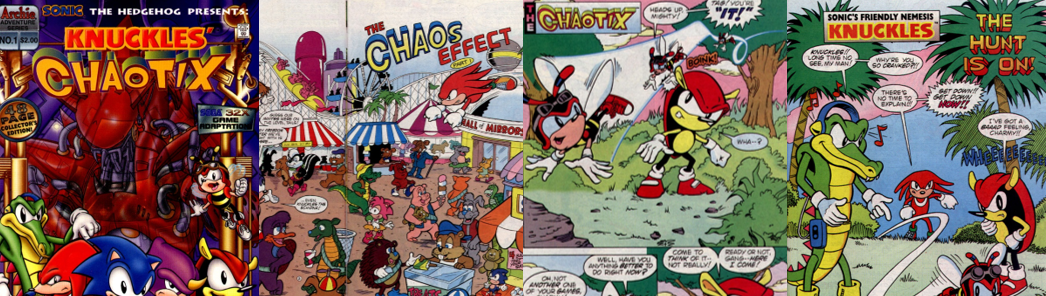
Story Title: “The Chaos Effect” (Part 1 to 3)
Writers: Mike Kanterovich and Ken Penders
Artist: Art Mawhinney
Story Title: “Tag! You’re It!”
Writer: Ken Penders
Artist: Harvey Mercadoocasio
Story Title: “The Hunt is On!”
Writer: Ken Penders
Artist: Ken Penders
Quick Facts:
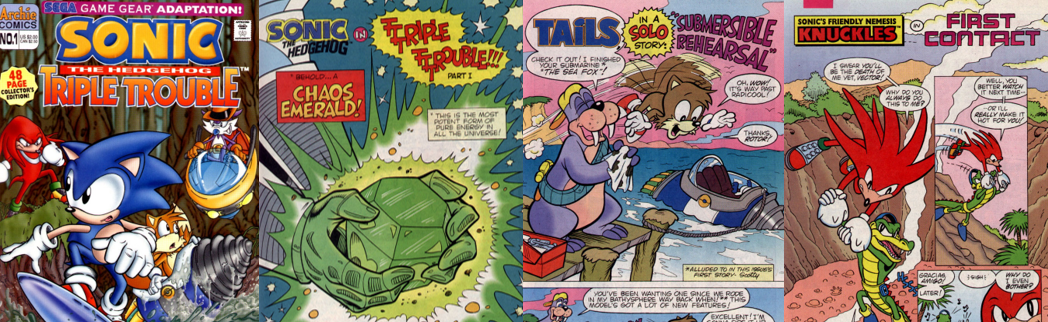
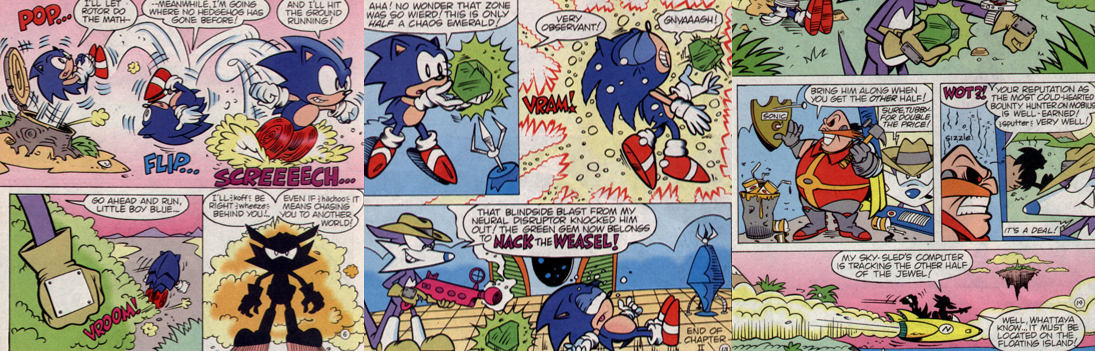
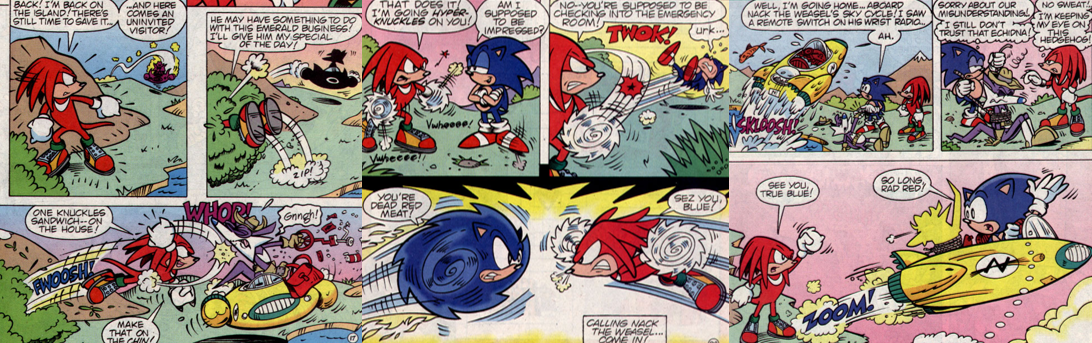
After publishing a four-part miniseries, Archie Comics spearheaded the longest-running videogame comic book and expanded their reach with a popular Knuckles the Echidna companion series. Prior to that first three-issue series, Archie detailed how Knuckles met his Chaotix running buddies in this loose adaptation of the rare and obscure Knuckles’ Chaotix (SEGA, 1995) and they were by his side even when overly complicated lore and a lawsuit changed Archie’s Sonic comic books forever.
The Review:
“The Chaos Effect” sees the Knothole Freedom Fighters (reckless point man hog Sonic the Hedgehog and his enthusiastic, two-tailed buddy Miles “Tails” Prower, fearless leader Princess Sally Acorn, tech guru Rotor the Walrus, the partially roboticized Bunny Rabbot, and officious Antoine D’Coolette) invited to what was then known as the Floating Island, a near-mythical hovering peninsula held aloft by a Chaos Emerald and known to dislike intruders. When Sonic and his friends arrive, they find a fully decked out carnival theme park populated by their fellow Freedom Fighters (including Sonic’s number one fan, Amy Rose, and his rival, Geoffrey St. John). Surprised that the island’s guardian, super strong loner Knuckles, would invite them much less host such an extravagant attraction, Sonic and the others are introduced to the brains behind the carnival: Renfield T. Rodent, who invites them to try out the Hall of Mirrors. Inside, while the others are startled (or amazed) by their warped reflections, Sonic’s suspicions about the whole thing immediately turn out to be true when the Freedom Fighters are trapped within the mirrors! Knuckles’ shock is doubled when Doctor Ivo Robotnik, the cruel-hearted despot who has conquered and polluted most of Mobius, reveals the entire thing was an elaborate trap to dispose of his hated enemies. When Knuckles attacks, he finds the light has stripped him of his natural abilities and that Dr. Robotnik spared him so Knuckles could witness the madman’s ultimate victory.
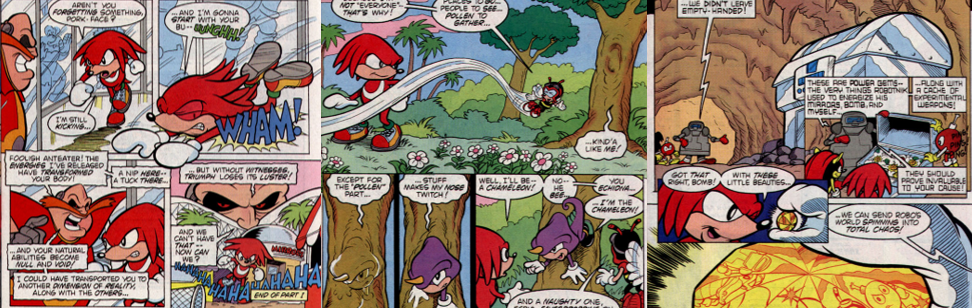
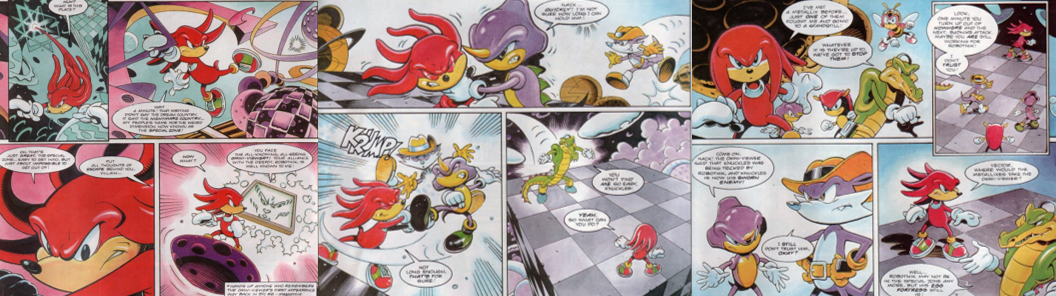
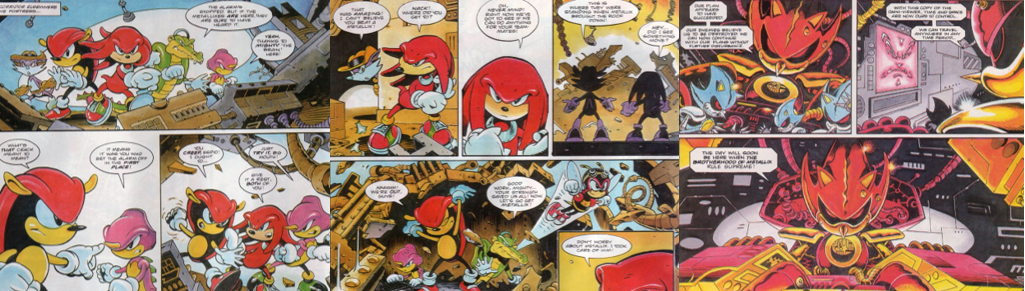
With his dreadlocks pruned and his fists lacking spikes, the handicapped Knuckles ponders how he’s going to save his allies, only for a hyperactive little honeybee, Charmy Bee, to suddenly fly by and offer some advice. Both are startled when Espio the Chameleon reveals he’s been hanging out, while invisible, in the forest and all three ready themselves for a fight when a ruckus storms their way. When this turns out to be music loving, wannabe rap star Vector the Crocodile, Espio relieves him of his headphones before being knocked on his ass, along with the others, when powerhouse Mighty the Armadillo bursts through the mountainside. Although Knuckles is suspicious to see that Mighty is accompanied by two robots, Heavy and Bomb (strangely sporting very different appearances to their videogame counterparts), the duo explain that the “power gems” installed into them by Dr. Robotnik allowed them to develop sentience and a conscience. When they learned of Dr. Robotnik’s carnival-themed plot, they came to help, bringing a cache of power gems and experimental weapons to disrupt Dr. Robotnik’s mad scheme. Encouraged, Knuckles sets to work rescuing the Freedom Fighters and Dr. Robotnik is alarmed when his theme park attractions and rides suddenly activate. As they’re all powered by separated control mechanisms, the semi-cybernetic tyrant correctly surmises that Knuckles must’ve had help to bring them all online. However, Dr. Robotnik quickly adapts and uses his “material transport system” (because “teleporter” would be too simple, I guess) to bring in some reinforcements.
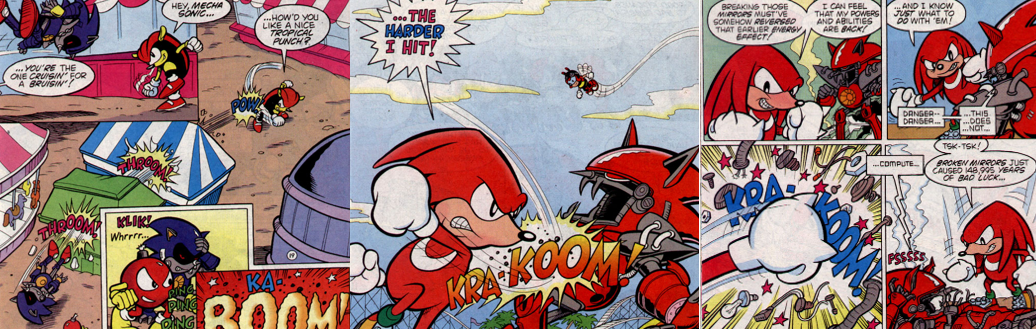
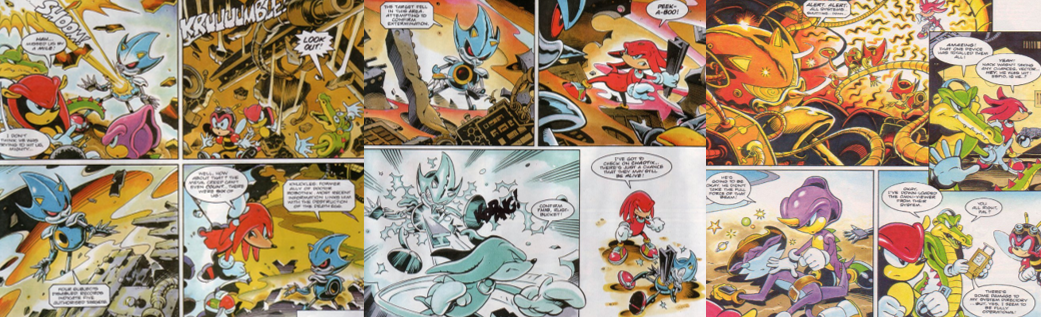
This comes in the form of Metal Mecha Sonic, Sonic’s deadly, robotic doppelgänger. Greatly enhanced since its last deployment, the ever-loyal Mecha Sonic is sent after Knuckles and his new allies and immediately locates them in the heart of the carnival. Immediately taking charge, Knuckles commands they attack preemptively, which sees Charmy Bee fly around Mecha Sonic to little effect and Espio turning invisible to lure the super-fast robot into crashing into a building. Utilising a ring-like tether wielded by Vector, Knuckles dives at his foe, only for Mecha Sonic to switch to infra-red (seems tactically dangerous in the daytime, but whatever…) and snag the energy beam connecting the two rings. However, Vector apparently uses the mysterious rings to teleport or switch places with Knuckles (the art isn’t very clear…) and toss Mecha Sonic towards Mighty, who sends it crashing through a few buildings. While still recovering, Mecha Sonic is surprised when Bomb explodes next to him, only to shrug it off and grow to immense size thanks to a power gem. To face this Kaiju-sized, red tinted goliath, Knuckles utilises one of Heavy’s power gem’s to also become a giant, battling Mecha Sonic Kai on equal ground. Dr. Robotnik’s fears about the volatile nature of the power gems comes to fruition when Knuckles smacks Mecha Sonic Kai into the Hall of Mirrors, freeing the Freedom Fighters and restoring Knuckles. Rather than ponder why he didn’t smash the mirrors when he was in there (could’ve just tossed a rock or something…), Knuckles smashes Mecha Sonic Kai to pieces with his renewed strength. However, Dr. Robotnik makes a hasty exit on a rocket-powered rollercoaster, leaving Renfield to take the fall. Although Sonic encourages Knuckles and his “chaotic” new friends to form a super-team, they all comically disagree and refuse to entertain such an idea.
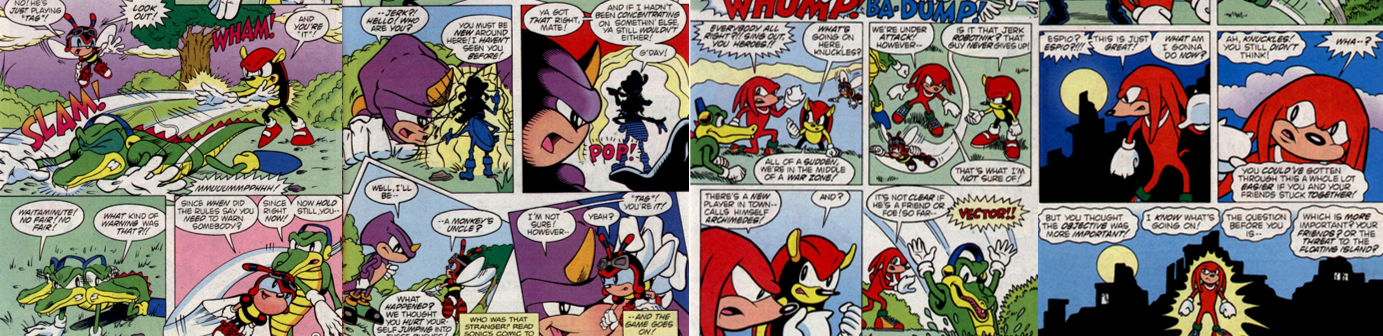
This not-team then appear in the special’s two back-up stories. The first sees Charmy Bee kick off a game of “tag” between the group. While Mighty’s initially reluctant, he quickly participates by shoving Vector into a pool since he doesn’t have anything better to do. Vector’s frustration doubles when Charmy Bee deftly avoids him and Mighty knocks over a tree to fend him off. While hopping aside, Vector trips over the sleeping, invisible Espio, who he quickly tags before racing off. Annoyed, Espio tries to pounce upon Vector, only to crash and burn and briefly meet a mysterious fire ant who quickly disappears in a puff of smoke. When Charmy Bee flutters by to check on Espio, he unwittingly leaves himself open for a tag and the story ends with the game said to continue. “The Hunt is On!” continues Knuckles’ issues with the elusive and mysterious Archimedes, a hitherto-disembodied voice who’s been testing the guardian’s abilities (and patience) over the past few months. The story begins with Knuckles frantically running from an explosive barrage and stumbling upon Charmy Bee, Mighty, and Vector, who are confused by the attack. While gathering his wits, Vector stumbles down a hole and, when the others try to get him out, they’re suddenly attacked by more explosive orbs, which put Charmy Bee down for the count. Knuckles and Mighty are joined by Espio, who’s amazed that Knuckles spotted him during all the commotion. While Knuckles discusses Archimedes with a confused Espio, Mighty is suddenly attacked by a strange robot on treadmills. Relishing a “challenge worthy of [his] matchless strength”, Mighty battles his mechanical attacker, with the two beating each other into submission. Knuckles urges Espio to find the puppet master behind these events, only for a shadowy figure to quietly abduct Espio (since he’s not a ninja yet). When Knuckles notices his friend is gone, Archimedes challenges him to decide whether his friends are more important to him than safeguarding the Floating Island. This ends the story on a cliffhanger that would finally be resolved in Knuckles’ first miniseries the following year.
Final Thoughts:
Archie Comics strikes again with another meandering, borderline insulting 48-page special that has little to do with the source material and wastes its pages on forgettable backup stories and the asinine Archimedes sub-plot Ken Penders was pushing. As ever, the art in the main story is passable and mirrors the popular cartoon on which the comics were partially based, though things appear much more rushed than usual here, with many characters being bloated and off-model. Things are far worse in the backup stories, with Knuckles appearing like liquid at many points and Charmy Bee seemingly growing and shrinking between panels. “The Chaos Factor” is further hampered by Knuckles magically being physically altered by Dr. Robotnik’s technology (removing his dreads, spikes, and super strength) and the introduction of colourful new characters. It’s bizarre to me that Heavy and Bomb look so widely different; I wonder if Archie had seen any screenshots or artwork of the two when writing this special? Regardless, Art Mawhinney seems to be struggling with the Chaotix, which I kind of understand as they’re more complicated designs than Sonic’s regular crew. Vector and Espio, especially, appear warped throughout and the group’s characterisation is painfully one-dimension. Charmy Bee is playful, Espio turns invisible, Mighty is super strong, and Vector likes music. That’s about all we get here, apart from the random inclusion of the tether rings (which appear without explanation and are only used once, just like in Fleetway’s Knuckles’ Chaotix adaptation). On the plus side, the story seems to insinuate that the Chaotix live on the Floating Island (Espio and Charmy Bee seem to know each other) and the group expands Knuckles’ character, taking him from a loner who protects his residents as part of his duties to a team leader rallying his troops.
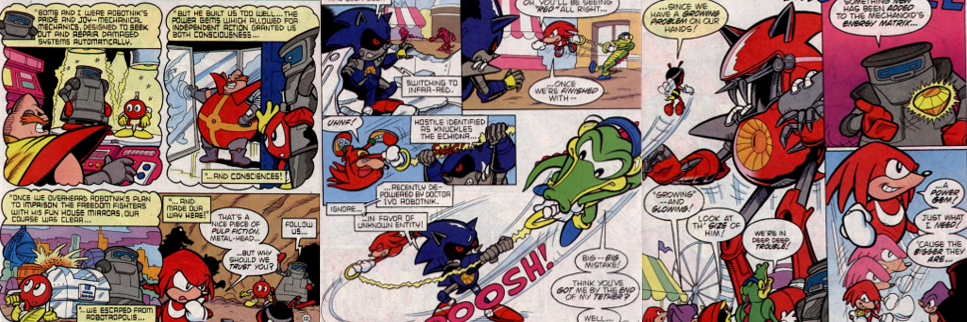
That’s about where the praise for Knuckles’ Chaotix ends, though. Like many of Archie’s videogame adaptations, the story is a disservice to the source material, taking place entirely in and around the amusement part that acts as the hub world in the game. This barely resembles Newtrogic High Zone, however, and is much closer to Carnival Night Zone or a standard amusement park. Rather than capturing Espio, Dr. Robotnik captures (presumably all) the Freedom Fighters with bizarre mirror technology that’s easily undone by breaking the mirrors (though Knuckles is apparently powerless to do this at first). The story does include Mecha Sonic, which is cool, and I quite liked its fight with Knuckles and the Chaotix as it was a good way to show their powers and test their mettle. Sadly, the group don’t overcome Mecha Sonic Kai with the “real superpower of teamwork”. Instead, Knuckles just grows to gargantuan size and fights Mecha Sonic Kai, somehow toppling the monstrous machine despite him lacking his super strength. None of the stories feature the Zones (or “Attractions”) from the videogame which is, again, a massive disappointment. Why not spend the entire 48-pages following Knuckles as he fights through a few locations (like Botanic Base and Speed Slider) slowly learning to co-operate and accept the Chaotix before reaching Dr. Robotnik’s secret base in Techno Tower? Or, at the very least, produce two, far better backup stories set in locations like Marina Madness or Amazing Arena, perhaps including some of the Badniks and bosses from the game. Instead, once again, it seems Archie Comics only had access to a few screenshots and the basic details of the game, meaning the cover art is the best thing about this let-down of a special that’s only notably for half-assing the introduction of the Chaotix.
My Rating:
Terrible
Did you enjoy the Chaotix’s debut Archie’s Sonic comics? Were you also disappointed by how badly represented Knuckles’ Chaotix was? Did you enjoy the fight between the enlarged Knuckles and Mecha Sonic Kai or would you have preferred to see the team tackle the titanic terror? Whare some of your favourite Chaotix adventures and moments from the Archie comics? How are you celebrating Knuckles this month? Whatever you think about Archie’s Sonic comics, and especially Knuckles and the Chaotix, comment below, support me on Ko-Fi, and check out my other Knuckles content!











 Dr. K's Waiting Room
You must be logged in to post a comment.