Game Corner: Marvel: Ultimate Alliance 3: The Black Order (Nintendo Switch)

Released: 19 July 2019
Developer: Team Ninja

The Background:
For decades, few videogame publishers were as synonymous with Marvel Comics as Activision, who produced adaptations Marvel’s most popular properties. While some were better than others, Activision’s efforts were largely praised, especially after they partnered with Raven Software on the X-Men Legends games (2004; 2005). Activision and Raven Software expanded their scope to the rest of the Marvel universe with Marvel: Ultimate Alliance (2006), a largely successful team-based brawer praised for improving upon its predecessors. Though now delisted, it was followed by a sequel three years later, courtesy of Vicarious Visions, which tweaked the gameplay with team-based attacks to encourage experimentation. Though Marvel: Ultimate Alliance 2 (2009) was praised for its branching storyline, the stripped down roleplaying mechanics were criticised. While it was also delisted in 2020, fans were clamouring for a follow-up and, just ten years later, Team Ninja stepped in to work alongside Marvel in reviving the franchise. Seeking to place additional emphasis on combat, the developers explored the cosmic scope of the Marvel universe by including the Infinity Stones and lesser-known characters and chose to make the title a Nintendo Switch exclusive after developing a close relationship with Nintendo. Although Marvel: Ultimate Alliance 3: The Black Order was the sixth best-selling game in its first week and was later bolstered by extensive downloadable content (DLC), it was met with mixed reviews that praised the colourful action but criticised its lack of innovation.

The Plot:
While battling Nebula and Ronan the Accuser, the Guardians of the Galaxy stumble upon a plot by the mad titan, Thanos, to collect the six Infinity Stones. Although they scatter the Stones, Thanos’s acolytes, the Black Order, pursue the gems, prompting an alliance of Earth’s mightiest heroes to retrieve them first.

Gameplay and Power-Ups:
Like its predecessors, Marvel: Ultimate Alliance 3: The Black Order is a team-based action role-playing game in which players assemble a squad of four heroes from across the Marvel universe to battle various nefarious baddies, primarily the titular Black Order, who are hunting the six all-powerful Infinity Stones on behalf of their master, Thanos. The game offers five save slots, two initial difficulty levels, and a base roster of thirty-six playable characters, with many being encountered as you play through the story and joining your alliance either after fighting alongside you or being freed from some kind of mind control. Marvel: Ultimate Alliance 3 offers three controller configurations, thankfully none of which involve motion controls, and allows you to toggle overlays, notifications, tips, and other onscreen elements from the “Settings” menu. These include altering the camera placement, which enables a lock-on feature by pressing in the right stick, though the camera generally remains more focused on whichever character you’re controlling rather than offering a bird’s eye view as in the last two games. Although you can fight alongside friends either locally or online, you switch between your teammates with the directional pad (D-pad) when playing alone and your computer-controlled partners are very useful in a fight, attacking, enabling team attacks, and reviving defeated characters without any input from you. Pressing A sees you interact with the environment to activate consoles, pick up or move certain objects, and talk to other characters. You jump with B, executing a double jump, swinging from webs, or flying depending on which character you’re playing as, and throw light attacks with X and heavy attacks with Y. These can be strung together to perform basic combos and you can also perform a mid-air attack and throw objects (like bombs and missiles) by pressing Y. You block incoming attacks by holding the Z trigger and tap it to dodge, and collect glowing red orbs from defeated enemies or smashed crates to restore health, blue orbs to refill your Energy Point (EP) gauge, and credits to spend on upgrades.
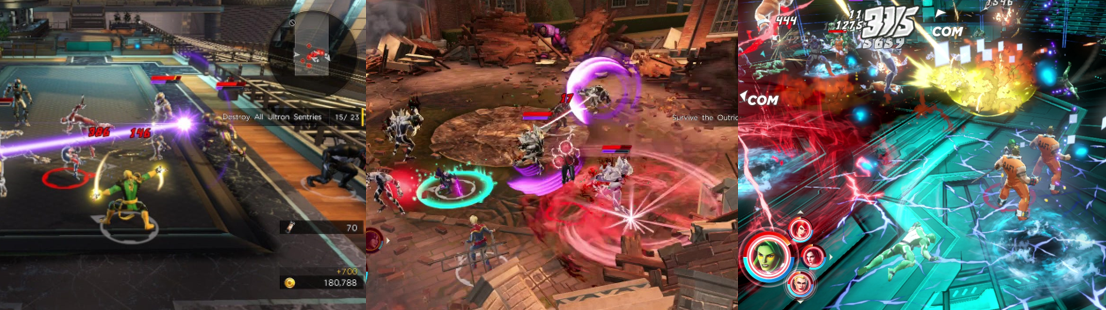
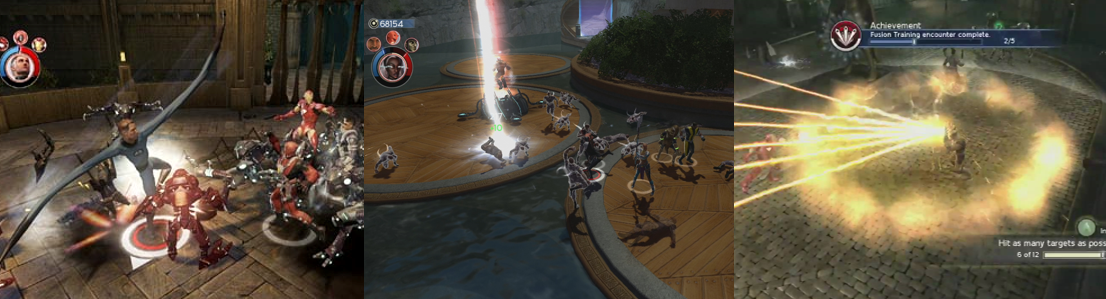
Combat is thick, fast, chaotic, and constant thanks to loads of enemies and character abilities.

As in the last two games, each character has specific abilities tied to their superpowers or superhero traits. You activate these by holding the Right trigger and selecting an icon using the D-pad; using Abilities drains your EP, however, and each Ability comes with a different cost. However, these attacks allow you to stun, stagger or deal elemental damage to enemies using Peter Parker/Spider-Man’s webs, Thor Odinson’s lightning, and Doctor Robert Bruce Banner/The Hulk’s incredible strength. Many characters have projectile attacks in their arsenal, such as Wade Wilson/Deadpool firing guns and Scott “Slim” Summers/Cyclops blasting his eye beams, while others cause splash damage or specific buffs, like Piotr Rasputin/Colossus being able to reflect projectiles and Wanda Maximoff/The Scarlet Witch healing her allies. Some, like James “Logan” Howlett/Wolverine, have passive abilities that allow them to automatically regenerate health as they walk around; others, like Johnny Blaze/Ghost Rider and Ororo Munroe/Storm, specifically deal in elemental damage. Character’s Abilities can also be mixed and matched by holding ZR and pressing one of the face buttons (or pressing A when prompted); this sees two characters attack in a combo for additional damage. As you dish out and take damage, you’ll also build the Extreme (EX) Gauge). Once full, you can press L and R up to three times to have two to four of your teammates perform a devastating combination attack that’s great against bosses. While the various cannon fodder you fight are easily dispatched, larger commanders and bosses need their “stun” meter drained before you can really put a beating on them and others (and certain treasure chests) require specific combination attacks to breach their shields. Defeating enemies sees your characters gain experience points (XP) to level-up, increasing their statistics (attack, defence, etc), though you can also use the various Orbs you find to manually level-up. Each character’s special Abilities can also be further enhanced using Ability Orbs and credits, reducing the EP cost and increasing their damage, among other benefits. You can also earn “Team Bonuses” depending on your team selection: pick a group of X-Men, for example, and your strength or resistance stat will increase, while picking characters of royalty ups your maximum energy stat.
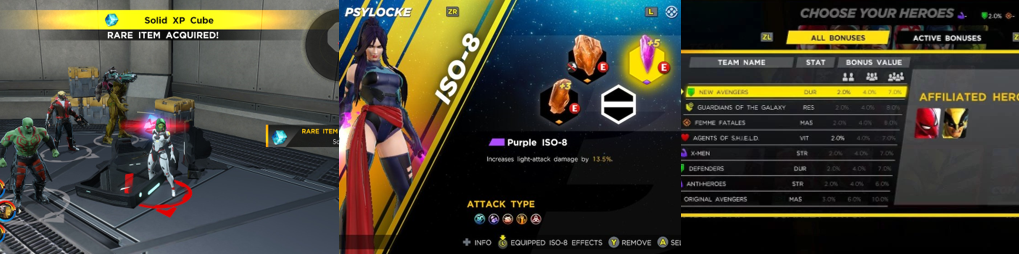
Search for chests to gain currency and other expendables to upgrade and buff your alliance.

Although you can’t equip gear to your characters, the boss battle against the Destroyer armour sees you temporarily empowered by Asgardian magic and you can eventually equip your team with “ISO-8” crystals, coloured stones that enhance their attack power, resistance to elements, or critical hit ratio, among others. You can further upgrade these with credits and ISO-8 capsules, though some of the rarer ones will also debuff you (for example, your attack my increase but your defence will decrease accordingly). You’ll also inevitably gain access to the Strategic Hazard Intervention Espionage Logistics Directorate (S.H.I.E.L.D.) Lab, which acts as the game’s skill tree. By spending credits and Enhancement Points (EP), you can further increase your team’s overall attack, defence, resistance, vitality, and such and even unlock additional ISO-8 slots (with more being earned by levelling-up). You can also enter the S.H.I.E.L.D. Depot from the main menu to purchase additional costumes and social icons by spending S.H.I.E.L.D. Tokens. Marvel: Ultimate Alliance 3 is pretty forgiving (on the “Friendly” difficulty, at least), with multiple checkpoints in each area. When you activate a S.H.I.E.L.D. checkpoint, your team is fully healed, and you can swap or enhance them if you wish. If a teammate is defeated, you can hold A to revive them, but I wouldn’t recommend it unless you absolutely have to. Not only are revives limited, but downed characters will eventually return to full health even before you reach a checkpoint so it’s not worth risking another character taking damage by healing a partner. Exploration generally leads you to treasure chests or special walls that require a special combination attack to open, or to a “Rift” challenge that takes you away from the main game to tackle a special challenge (usually a boss rematch or enemy gauntlet) for extra rewards. Your path is incredibly linear most of the time, hence why there’s no map, and the game’s primary focus is on chaotic combat and visually manic team-based attacks. Unlike in the last two games, you can no longer grapple or throw enemies (though you can still send them flying off certain platforms) and there are no character-specific team-up moves, meaning the action can quickly get quite tiresome.
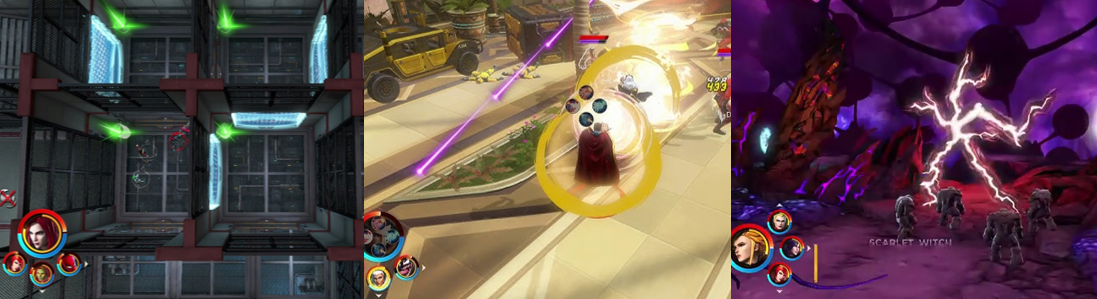
Sadly, puzzles are practically non-existent, with only Rifts offering additional challenges.

Because of its focus on hectic combat, there’s even less room for puzzles than there is for exploration in Marvel: Ultimate Alliance 3. Puzzles boil down to activating a console to open a door or making a platform move and that’s it. Sometimes, you’ll hold A to move a block and avoid lasers or cannons, but mostly you’ll be timing jumps between said lasers to progress and simply hurling missiles at those cannons. Sometimes, you’ll rotate statues or press switches to progress; others, you’ll be avoiding toxic ooze in Hel or solving door puzzles at the Raft or in Avengers Tower. After hopping across the rooftops of New York City, you’ll infiltrate the heavily fortified fortress of the Hand, dealing with ninjas that drop from the sky and hidden arrow hazards. When in Wakanda, Advanced Idea Mechanics (A.I.M.) corrupt T’Challa/The Black Panther’s defences, leading to an exasperating section where you must avoid snipers and being roasted by a giant panther statue’s energy blast. When transported to the Dark Dimension, you must use portals to reach new areas and defeat waves of demonic enemies to lower magical barriers and progress. Some attacks also screw up your controls or temporarily freeze you; some enemies are best defeated by tossing explosives at them; and many missions have an additional character fighting alongside you who’s often unlocked afterwards. However, a lot of the additional features of the previous games are missing; you can talk to other characters, but there are no dialogue options or character-specific interactions. There are no trivia quizzes, no optional side missions beyond the Rifts, and no character specific challenges to unlock extra stuff for each character. There aren’t even hub areas, in the traditional sense, with characters just appearing around S.H.I.E.L.D. checkpoints at times, though you can destroy a fair bit of the environment, and some encounters have you fleeing towards the camera as bosses chase you or present you with unwinnable battles.

Presentation:
Whereas the last two games primarily based their aesthetics on the comics books, especially the Ultimate comic line, Marvel: Ultimate Alliance 3 adheres very closely to the Marvel Cinematic Universe (MCU), especially in the visuals of its locations. I was hard pressed, for example, to tell the difference between Asgard here and the Asgard to the MCU, with both the golden city and the rainbow bridge, the Bifrost, appearing almost exactly as they’re depicted in the films. The same is true for Wakanda, the Dark Dimension, and Knowhere, all of which are virtually indistinguishable from how they appear in the MCU. There are some differences, of course: Taneleer Tivan/The Collector’s museum, for example, uses coloured cube cages and Wakanda leans much more into traditional architecture than the pseudo-futuristic science of the films (likely because Black Panther (Coogler, 2018) released a year before this game was made). Xavier’s School for the Gifted is lifted almost exactly from the 20th Century Fox X-Men movies (Various, 2000 to 2020), however, including a hedge maze, 1:1 Cerebro room, and basketball court that doubles as a landing pad for the Blackbird. While the Dark Dimension and the cosmic mind trip that is Sanctuary also heavily borrow from the bizarre cosmic imagery of the MCU, the Raft and Avengers Tower are much more akin to their comic book counterparts, though they’re comparatively bland locations, lacking fun areas like the Danger Room or Wakanda’s Necropolis (though you do pass through Anthony “Tony” Stark/Iron Man’s Hall of Armours in the tower). Although you only make a brief stop in Attilan to try and get help from the Inhumans, the architecture is far more visually interesting than that awful television show, seemingly being comprised of Celestial technology, and I enjoyed the ominous gothic presentation of Hel, with its restless Viking warriors and damaging sludge. Unfortunately, Marvel: Ultimate Alliance 3 continues the trend of having disappointingly bland and forgettable music, opting for generic themes for each location, event, and character that are lost amidst the constant fighting.
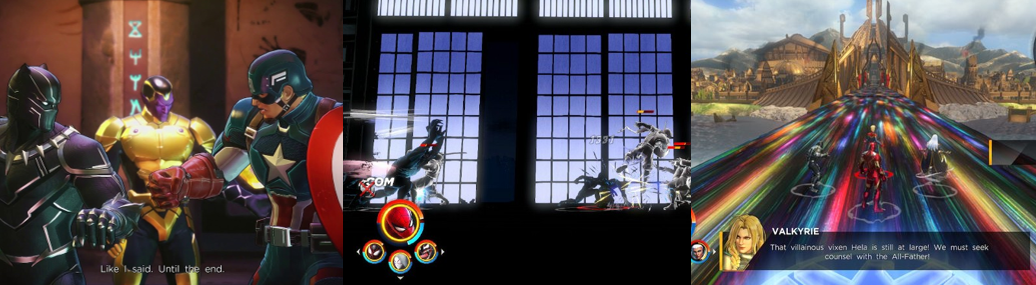
A visually impressive brawler that takes obvious inspiration from the MCU films.

The game also opts for an almost cel-shaded, action figure-like aesthetic for its colourful cast of characters. While many again both look and sound like their MCU counterparts, there are some exceptions: Peter Quill/Star-Lord, for example, looks nothing like Chris Pratt and the X-Men are far closer to the comic books than Fox’s films. Despite you assembling a custom team of heroes, cutscenes depict either everyone or characters specific to the location you’re in (the corrupted Doctor Stephen Strange in the Dark Dimension, for example) as they’re better suited to advance the plot against the local baddies. With the game shifting to a more third-person perspective, you’re closer than ever to the action and can see more of the environment than in the previous games. However, this comes with some drawbacks: mainly, there are far less opportunities or incentives to explore. Second, environments are painfully linear, with dead ends or locked doors barring your progress. Third, and most frustrating, is the camera, which easily loses track of your opponent/s and often lumbers you with wireframe representations when the foreground blocks the view. Thankfully, you won’t be falling down pits and rarely have to worry about onscreen hazards, but it can be aggravating trying to figure out which platforms and crates can be jumped on and which can’t. Marvel: Ultimate Alliance 3 offers a diverse cast of characters, each with their own idle poses and quips, though these do inevitably repeat. The game’s also surprisingly light on Easter Eggs: you’ll spot Deadpool singing away as he makes tacos in the X-Mansion, but not much else, and there are no optional missions or choices to encourage replaying missions. It’s a far cry from the first game, where there was always something to collect or an additional character to help out. Instead, it’s basically all combat, all the time in Marvel: Ultimate Alliance 3. Luckily, the game looks pretty good (everything’s very colourful and true to its inspirations) and performs really well, though there are some long load screens and it is annoying being forced to continue your game every time you challenge a Rift.

Enemies and Bosses:
All the usual suspects appear here as disposable cannon fodder for you to endlessly beat up, with many of the game’s goons sharing traits across the various locations. You’ll encounter Kree, Ultron Drones, agents of A.I.M., and Doombats who all pack various energy blasters. Ultron’s clones are the worst for this, relentlessly firing energy blasts and crashing through windows. The Raft’s unscrupulous prisoners attack in large groups, as do the restless Viking warriors who populate Hel, tossing axes from afar and luring you into toxic goop. Gargoyle-like Fire Demons also dwell here, offering a greater challenge with their swoop attack and fire breath, not unlike the monstrous Outriders and Mindless Ones who make up Thanos and the dread Dormammu’s forces, respectively. Alpha Primitives, Hydra goons, and towering Sentinels also appear, with the latter firing huge energy blasts from the palms and best attacked by throwing their explosive energy cores back at them. No matter where you are and what enemies you fight, more powerful commanders will also appear. Larger, tougher, and sporting a stun meter, these commanders should be your top priority as they’ll charge across the screen, cause shockwaves, and generally offer a far greater challenge even when you’re at a higher level. These minions often fight alongside their masters, generally so you can recover some health and EP to better damage the bosses, and will endlessly spawn in one of the additional modes unless you destroy their teleporters. Some of the game’s challenges or story-based missions charge you with defeating a certain number of enemies to progress. Other times, bosses appear in these waves, and you must occasionally flee or purposely lose some fights. This happens when Cain Marko/The Juggernaut comes tearing through the X-Mansion, for example, and in early encounters with the Black Order, who cannot be beaten or will chase you, raining lightning or other attacks from the sky and across the ground.
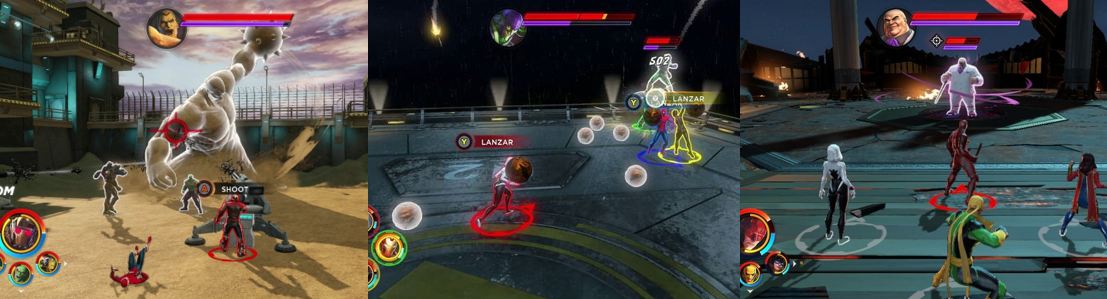
Few bosses require more than just hit-and-run tactics, even when augmented by an Infinity Stone.

There are loads of bosses to fight in Marvel: Ultimate Alliance 3, with some returning from the previous games, some teaming up, some having a couple of phases, and all boiling down to whittling down their stun bar, unleashing an EX attack and/or your most powerful Abilities, and avoiding damage until you can repeat this. The first ones you’ll face are Nebula and Ronan the Accuser, who often appear as a duo in optional challenges. Nebula is faster and more nimble, wielding blades where Ronan uses a massive warhammer. Both set a standard all bosses follow, which is that they’ll use either a jumping slam or an explosion of energy (or both) to send you flying. While quelling the riot in the Raft, you’ll encounter a version of the Sinister Six, with some unique variations to each battle. Flint Marko/The Sandman, for example, flings waves of sand and erupts his big sand fist from the ground as a large sand creature. You must use A to mount the nearby cannons and unload on him to chip away at his stun meter. Maxwell “Max” Dillon fights alongside Eddie Brock/Venom, raining lighting and electrocuting you with bursts of electricity, before he’s eaten by Venom and starts busting out electrically-enhanced symbiote powers. Venom joins the team after this fight and is tested against Quentin Beck, who first brainwashes Mile Morales/Spider-Man, Gwen Stacy/Spider-Woman, and Kamala Khan/Ms. Marvel to fight you and then unleashes a poisonous mist, teleports about, and confuses you with duplicates, Doctor Otto Octavious/Dr. Octopus is fought in a two-stage fight where you must first avoid his tentacles and scurry charge and then attack each arm to stun him. Finally, you’ll battle Norman Osborn/The Green Goblin for the Time Stone. The Green Goblin swoops overhead and lingers slightly out of reach, peppering the arena with his pumpkin bombs, charging at you, and freezing time to bombard you. He’s noticeably weak to his pumpkin bombs, however, so try and toss them at him before they explode in your face! After battling into the Hand’s fortress, you must first free Elektra Natchios from the Hand’s influence and then face Lester/Bullseye and Wilson Fisk/The Kingpin in separate fights. You must take out the ninjas feeding Elektra power, avoid Bulleye’s spread of razor sharp and explosive cards, and dodge the furniture and massive energy beam thrown by the Power Stone-enhanced Kingpin. The Kingpin also charges like a rhino, leaps at you to cause shockwaves, and even rips up stone columns to use as melee weapons!
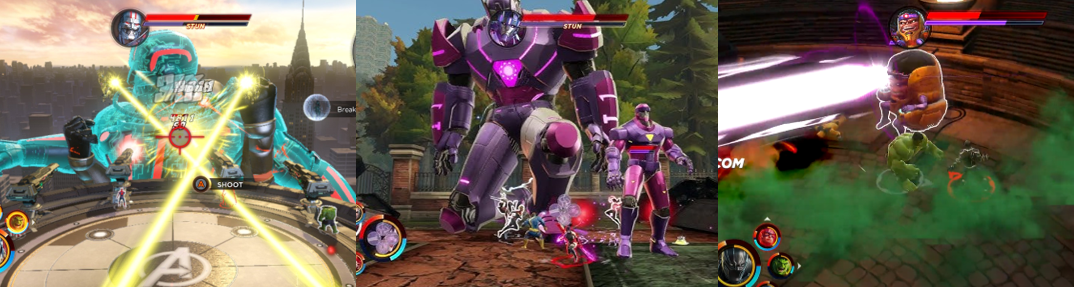
Gigantic bosses and the quirkier villains help mix-up the otherwise tedious combat.

Avengers Tower is then attacked by Ultron and his drones, who assist him in battle. Not that he needs it as the Mind Stone allows Ultron to mess up your controls, to say nothing of his signature face and palm beams. Ultron then grows to gigantic proportions, sweeping the area with his eyebeams before Clint Barton/Hawkeye intervenes and Ultron merges with Ultimo. This is the first giant boss battle in the game and sees you blasting Ultimo with cannons and avoiding his massive swipes. The Infinity Sentinel is comparatively smaller, but no less dangerous thanks to its own face beam and missiles. Though you can damage it with Sentinel cores, it’s finished in a cutscene by Erik “Magnus” Lehnsherr/Magneto, who then tosses debris and throws you off balance with magnetic pulses while Juggernaut pummels you and Raven Darkholme/Mystique tosses daggers. After surviving Mystique’s Danger Room trials, you face Magneto, now even tougher thanks to the Power Stone, before being chased away and banished to the Dark Dimension by the Black Order. There, you battle past Loki Laufeyson (who boasts elemental attacks and duplication tricks) to eventually face the dread Dormammu, who wields the Reality Stone and is the second giant boss. You must subdue his minions and avoid his flame bursts, whittling down his magical barrier either directly or be destroying three nearby orbs, all while dodging his giant fists and ground spikes. The brief fight with Maximus Boltagon is far easier, even though the mad Inhuman carries a massive energy cannon and you must take cover in Thane’s energy bubble to avoid Maximus’s barrage of lasers. Ulysses Klaue/Klaw awaits in Wakanda and his sound-based energy blasts and waves must be overcome to rescue and recruit James Buchanan “Bucky” Barnes/The Winter Soldier. You then fight past A.I.M. to confront their master, George Tarleton/Mental Organism Designed Only for Killing (MODOK), who uses the Soul Stone to turn the Dora Milaje against you and attacks with a slew of appendages, from buzzsaw arms, poison gas, failing tentacles, and his signature forehead blast.
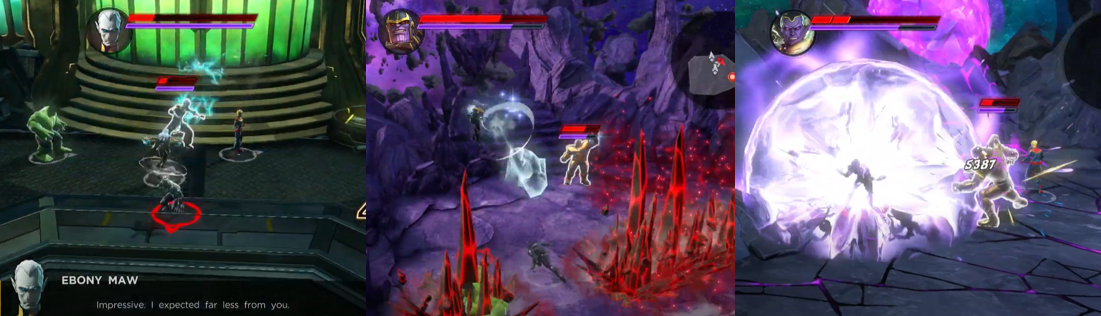
Battles with the empowered Black Order, Thanos, and Thane offer some of the most enjoyable challenges.

Though your goal in Hel is to confront Hela, you’ll actually battle the fire demon, Surtur, in another giant boss battle. This was a bit of a difficulty spike for me as Surtur’s flaming sword has a long reach and he causes the ground to erupt in flames, to say nothing of stun locking you with repeat sword strikes! Best him and Hela sets Johann Schmidt/The Red Skull on you, with the Nazi madman firing a powerful revolver and sapping your health with his “Dust of Death”. Hela gives the Red Skull a boost, protecting him with a shield and allowing him to fire a Bifrost-like laser, before placing his consciousness into the Destroyer armour. Though bolstered by Hydra forces and boasting a sweeping face beam, you can get a power-up from glowing crystals to overcome this destructive force. Finally, you venture to Knowhere and must run the Black Order gauntlet to retrieve the Infinity Stones, with checkpoints between each fight. Ebony Maw is first, firing a spread of projectiles and rocks and using the Soul Stone to create portals to trip you up. Supergiant tosses dark spheres and a golden homing shot that messes up your controls, though you can toss explosive cores from her minions to deal big damage. Cull Obsidian infuses his battleaxe with the Power Stone, sending out waves of purple energy and massive purple shockwaves, though he’s far slower and also susceptible to the nearby bombs. Corvus Glaive is much faster, landing multiple hits with his lance and using the Reality Stone to spring spikes form the ground and conjure duplicates who fill the arena with energy waves that can stun lock you. Finally, Proxima Midnight takes her fellow’s teleportation trick to the next level with the Space Stone and fills the arena with lightning bolts and strikes. All these powers are then recycled when you face Thanos, who gathers the six Infinity Stones into the Infinity Gauntlet to rain meteors, teleport, mess up your controls, freeze time, and fire his signature eyebeams. Thanos then joins you to battle Thane, who usurps him and boasts similar powers, though also upgraded by the Infinity Armour. Thane exhibits superhuman speed, traps you in a cube, fills the arena with portals and flames, and explodes in fury, though both battles were fun challenges rather than impossible tasks.

Additional Features:
Unlike in the previous two games, you won’t be finding data logs, action figures, or meeting certain requirements to unlock new attacks or costumes. You just fight over and over, earning whatever you need to unlock, buy, or upgrade whatever you wish and finding some concept art in treasure chests. A far harder (but more rewarding) “Superior” difficulty unlocks upon clearing the game alongside an additional “Nightmare” mode, accessible via the “Curse of the Vampire” campaign. You also unlock Thanos and can freely replay any mission on any difficulty (though you must start a new save to play on “Superior”) to grind and enhance your characters and ISO-8. Dimensional Rifts transport you to special challenges (not unlike the S.H.I.E.L.D. Simulator discs from the first game) that are often rematches with bosses or gauntlet challenges, though far tougher and gifting better rewards if you succeed. There are also three additional modes; however, though you can play a taster of each, you must purchase the expansion pass to fully unlock them. “Curse of the Vampire” adds vampiric enemies to the main story in “Nightmare” mode and offers a “Gauntlet” mode where you battle waves of enemies and bosses against both a time limit and a range of debuffs (including limited health restoration and draining EP). You can also tackle an “Endless” mode that’s pretty self-explanatory, and unlock additional characters like Frank Castle/The Punisher and Eric Brooks/Bladeif you buy the DLC. “Rise of the Phoenix” sees you form a four-person team and go head-to-head with a friend or the computer in three-round Danger Room scenarios. These see you tackling bosses again or wiping out hordes of enemies, awarding additional buffs and effects if you meet certain criteria (such as using any Ability or Synergy attack four times). You can only tackle the first challenge without the DLC, so I didn’t get very far, but this could be a fun distraction for those looking to test their skills against a friend. “Shadow of Doom” adds an epilogue story campaign that sees you return to Wakanda to oppose Doctor Victor Von Doom’s invasion. Dr. Doom’s Doombots endlessly spawn unless you destroy their teleporters, and you even battle the arrogant dictator in the recycled Necropolis, with him teleporting, firing lasers form his palms, and having his health restored by his Doombots. You’ll add Marvel’s First Family to your roster (alongside an alternative Thanos and other characters) by buying the expansion pass and battle Annihilus, a gigantic Celestial, and even “God Emperor” Doom!
The Summary:
I quite enjoyed the first two Ultimate Alliance games. They were mindless and largely repetitive, but I liked the large cast of characters and all the different references and locations from the comic books. Still, I put off Marvel: Ultimate Alliance 3: The Black Order for some time, mainly because I was annoyed by it being a Nintendo Switch exclusive; however it turned out to be a decent enough brawler. Despite the different development team, a few tweaks, and an apparent disconnection from the previous games, Marvel: Ultimate Alliance 3 offers a lot of the same gameplay and enjoyment as its predecessors, which is great for long-time fans of the franchise. Unfortunately, it doesn’t improve on these elements in a meaningful way and actually removes some content that I found enjoyable from the last two. There are no optional missions, for example, no alternative endings, no choices, and no character-specific challenges beyond fighting and levelling-up. I found this made the tedious combat even more aggravating after a while as I wasn’t being rewarded with gear or costumes or anything other than stat boosts. Even the skill tree was limited since you must grind to acquire enough credits and expendables to enhance your team, and I found the ISO-8 mode to be more confusing than engaging. The game also does little to improve the boss battles. Very few were very innovative or required more of you than to strike fast, avoid shockwaves and projectiles, and unleash your Extreme attack. The giant bosses were more of a challenge and I liked the final fight against Thanos and Thane, but I was hoping for a bit more complexity, especially given the possibilities offered by the Infinity Stones. There is a fun selection of characters, but they don’t offer much more than what we saw in the last two games and actually offer less as there are no character-specific team-up moves. While I enjoyed the visual influence from the MCU and the variety, I feel like Marvel: Ultimate Alliance 3 played things a little too safe by relying so heavily on combat and not mixing up the gameplay with a few other puzzles and challenges. Overall, it’s a good enough game and a worthy entry in the series, but it’s a shame that the developers didn’t try to be a bit more innovative and offer some more incentive to keep slogging away in endless fights.

My Rating:

Rating: 3 out of 5.

Pretty Good

Did you enjoy Marvel: Ultimate Alliance 3: The Black Order? How do you think it holds up against the previous two games? Which characters did you choose for your team? Were you disappointed that the combat was so similar to the last two games and the bosses so repetitive? Did you ever conquer all the Rift challenges? What did you think to the MCU influences and the final battle with Thanos and Thane? Did you ever play through the DLC? Would you like to see another Ultimate Alliance game? Whatever your thoughts, leave a comment below, support me on Ko-Fi, and go check out my other superhero content across the site.

Back Issues: Captain America 22-25

Story Title: “The Tomorrow Soldier” (Part 1 to Conclusion)
Published: 2 July 2014 (cover-dated: September 2014) to 1 October 2014 (cover-dated: December 2014)
Writer: Rick Remender
Artists: Carlos Pacheco and Stuart Immonen

The Background:
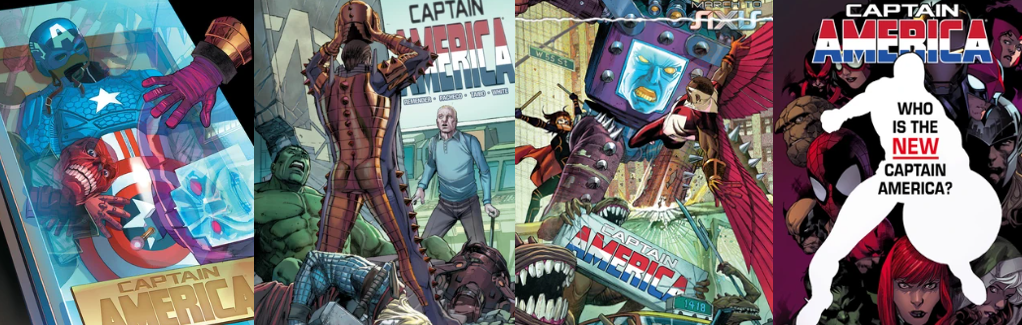
By 1941, Nazi Germany had decimated Denmark and Norway and World War Two was fully underway and, after some initial resistance, the United States joined the War against the “Axis powers” of Germany, Japan, and Italy. Patriotism and national pride was high, especially in America, during those dark days, making it the perfect time for Joe Simon and the legendary Jack Kirby to debut Captain Steve Rogers/Captain America and his kid sidekick, James Buchanan Barnes/Bucky, to encourage support of the war effort. Once the War was over, superheroes saw a decline and Captain America’s solo publication was cancelled in 1954. However, Cap got a second chance when he joined the Avengers as a “man out of time”, battling iconic villains like Johann Shmidt/The Red Skull and even opposing his fellow superheroes during a “Civil War”. After surrendering to the authorities, Cap was seemingly killed and his troubled sidekick, better known as the Winter Soldier, took up the mantle until Steve’s inevitable resurrection. However, in 2014, cybernetic supervillain Arnim Zola’s machinations saw Cap drained of the super soldier serum and rapidly aged into an old man! Thus the battle was on the see who would become the new Star-Spangled Avenger, a battle eventually won by Cap’s long-time ally, Sam Wilson/The Falcon, to much undue controversy, Created by Stan Lee and Gene Colon in 1969, the Falcon was the first Black American superhero in mainstream comic books and was specifically created to challenge social perceptions. After a lengthy career as a bit-player in Marvel Comics, Sam made headlines with his promotion, a story arc that achieved mainstream recognition due to Anthony Mackie’s celebrated portrayal of the character in the Marvel Cinematic Universe.

The Review:
Sam Wilson’s assumption of the Captain America mantle didn’t come easy, nor without drama. In the leadup to this story, Cap was kidnapped by Arnim Zola and spirited away to Dimension Z, where the mad scientist plotted to drain his super soldier serum to create a race of genetic super-beings! Cap broke free but was trapped in Dimension Z for ten years, during which time he raised Zola’s son, Ian, as his own. Though Cap eventually escaped with Jet Zola/Jet Black, Zola’s daughter, both Ian and Cap’s lover, Agent 13/Sharon Carter, were lost. Cap then spent some time working with Sam to mould Jet Black into a hero but, in a battle with former Strategic Homeland Intervention, Enforcement, and Logistics Division (S.H.I.E.L.D.) agent-turned-madman, Ran Shen/Iron Nail, Cap’s super soldier serum was neutralised and he quickly aged into frail, infirm old man! Our story picks up with Steve sequestered at Avengers Mansion, stewing over sensationalist news reports demanding accountability for Captain America and S.H.I.E.L.D.’s dangerous and destructive antics. Steve’s offered council by S.H.I.E.L.D. director maria Hill and the decidedly Samuel L. Jackson-esque Nick Fury Jr., who assure him that he saved countless lives taking down Iron Nail. Unfortunately, his shield has been left too radioactive to be returned to him and Steve’s aghast when he’s told S.H.I.E.L.D. won’t be destroying Gungnir, the weaponised, Transformer-like Helicarrier Iron Nail hijacked and threatened the United States with. Steve is so angered that he starts to wonder if the reports of corruption within the government and S.H.I.E.L.D. aren’t valid, though Fury simply explains that contingencies such as Gungnir are vital to protect innocent civilians and keep the public from being overly reliant on costumed heroes, especial as the Avengers’ roster has dwindled lately.

When Armin Zola’s mutates invade, the Avengers gain an unlikely ally in Steve’s adopted son!

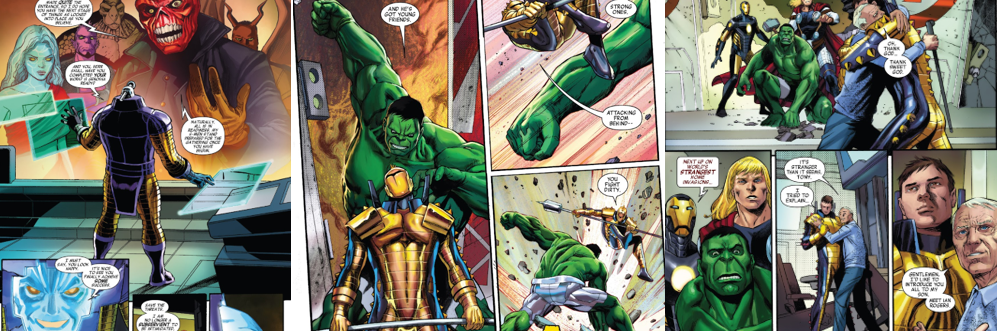
Over on the upper west side, Sam Wilson wakes up to a hell of a hangover and to find he spent the night with Jet Black! Though he’s not exactly thrilled at having crossed that line, he seems won over by her affections, but their tender moment (and the awkwardness) is interrupted when Jet spots a commotion outside. It turns out that her father, Armin Zola, is so eager for revenge that he rips open a hole in the fabric of reality and his monstrous, “hyperevolved mutates” come pouring into Central Park, followed closely by a mysterious man garbed in a spiked battle suit. Zola quickly contacts the Red Skull to co-ordinate their newest efforts in overthrowing the decadent West, asserting himself as a menacing force in his own right and seemingly earning the Red Skull’s respect with his army of mutates. While Anthony “Tony” Stark/Iron Man and Doctor Robert Bruce Banner/The Incredible Hulk work to find some way of restoring Steve’s superhuman condition, they (along with Thor Odinson and Steve himself) are alerted to the crisis via the mansion’s monitors. Steve immediately recognises the threat as Zola; Stark is incredulous but quickly convinced of the danger when the armoured mutate comes crashing through the wall. Luckily, the Hulk is around to face the stranger (with Banner having more control over the Hulk at this point). Naturally, Iron Man adopts a snarky “shoot first, ask questions later” philosophy, leading to an explosive confrontation as he and Thor try to keep the masked intruder from reaching Steve. However, the masked man easily avoids their attacks and even gets the better of Thor, running rings around them, only to be astonished by Steve’s frail condition. This distraction allows the Hulk needs to strike; ironically, though the stranger deftly evades the Green Goliath, Steve easily subdues the masked man. However, Steve is stunned when the intruder unmasks to reveal himself as Ian Ziola, now Ian Rogers, Steve’s adopted son, who was regenerated from death by one of Zola’s “bio-mass [tanks]”.

Zola manipulates events to coerce his daughter, whom the Falcon rushes to defend.

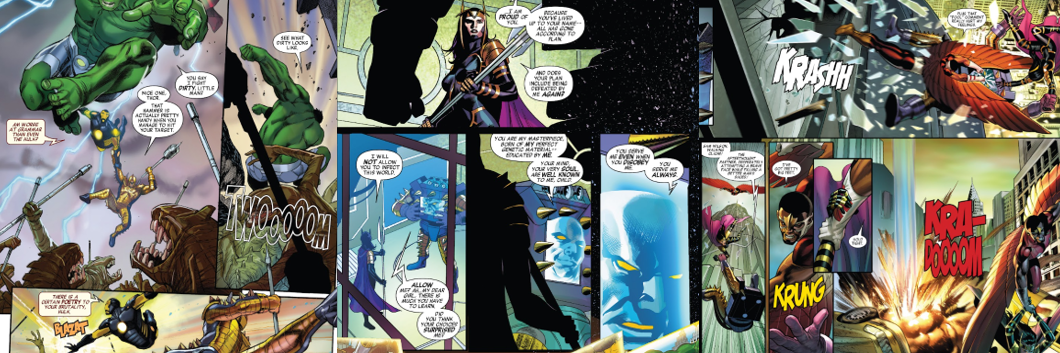
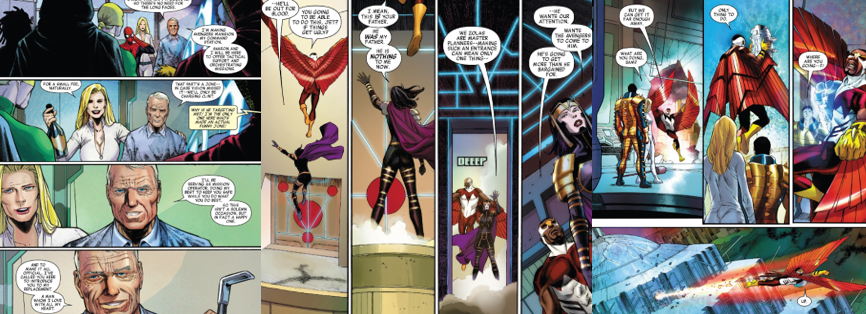
Overjoyed to see Ian alive and that he’s come to help, Steve proudly introduces him to his fellow Avengers but distraught to learn that Ian’s been fighting Zola alone for the last ten years. Steve then gets a call from the Falcon, who relays the extent of Zola’s attack: thanks to the city’s birds, Sam has seen the monsters rapidly spread throughout New York City. Jet Black then reveals she knows a way into her father’s fortified tower that may help them to stop the invasion and calls upon the Avengers to go along with her father’s plan, which is to face him head-on, to provide a suitable distraction. The Avengers readily accept, taking the fight to the ravenous, near-mindless hoards alongside their new ally, and are initially unimpressed by Zola’s forces. However, they’re soon confronted by Zola’s “hyper-mutates”, warped, monstrous copies of the Avengers that call themselves the “Unvengers”! Meanwhile, Jet Black and the Falcon easily infiltrate Zola’s tower, affirming that her allegiances lie anywhere but with her crazed father and insisting on using her position as the madman’s daughter to throw off his mutate guards. The plan works and they advance through the tower, only to find Sharon held hostage in a pitiful cell! After learning about Sharon’s predicament from Sam, Steve immediately asks Ian to leave the fight to the Avengers and go rescue her; though Sharon warns that such an act was all foreseen by Zola. When Jet confronts her father in his control room, he all-but guarantees the Red Skull that he can win her over to their side, claiming everything she’s done – even her betrayal – was also all part of his manipulative will. The Falcon breaks up the tense family reunion, tackling Zola out the window and sending him crashing to the streets below. Zola recovers near-instantly, however, his patience with his “perfect child” wearing thin, but the Falcon immediately intercepts him in mid-air.

Though the Avengers turn on Jet, Sam survives to take up the Captain America mantle.

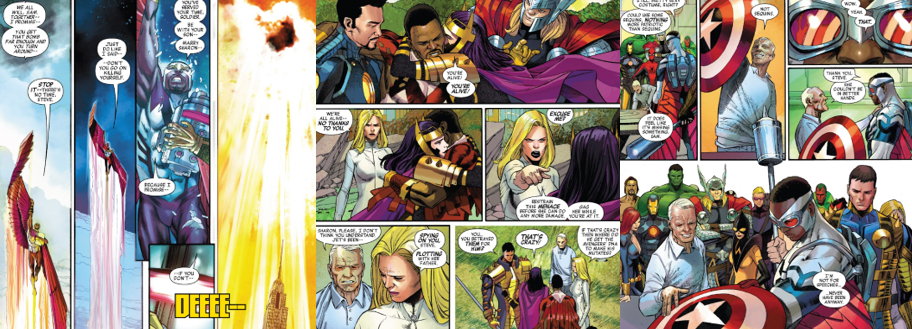
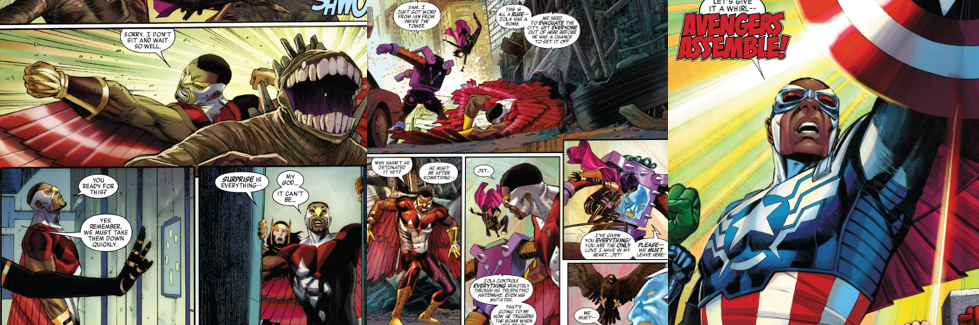
Raging at Zola for his ill treatment of Jet, the Falcon fights valiantly even as Zola smashes a bus onto the mis-matched hero. When Jet rushes to his aid and Zola sees how much she cares for the Falcon, Zola vows to murder him to rid her of such weaknesses all while hypocritically declaring his undying love for her! Thanks to Sharon, Steve warns the Falcon that Zola plans to blow up Avengers Tower, though Sam inadvertently kickstarts the detonation when he has Redwing remove Zola’s “telepathic broadcast doohickey”! When the Unvengers keep Iron Man from helping and Ian and Sharon are unable to disarm it, the Falcon bravely and selflessly grabs the bomb and flies high into the sky, bidding an emotional farewell to Steve and urging him and Sharon to enjoy their retirement with Ian before the bomb explodes in his arms. A horrified Steve thinks back to when he and Sam first met, the adversity he fought through, and how hard he worked to be a hero without any superpowers, fancy gadgets, or special serum as Iron Man sombrely retrieves the Falcon’s surprisingly intact body. Though Zola pleads with Jet Black to return to Dimension Z where she can be safe from the Red Skull’s looming threat, she angrily rebukes him. Sharon, Steve, and the Avengers gather in quiet mourning, only to be astonished when he comes to and reveals that Stark made him some Adamantium wings, which absorbed most of the blast! Though everyone’s overjoyed by this, Sharon blames Jet for Zola’s attack and accuses her of being a double agent. To Jet’s dismay, even Sam has his doubts and, when the Avengers try to restrain her to investigate, she angrily rushes to Zola’s tower, believing her father was right that her new allies couldn’t be trusted. One week later, seemingly every superhero around gathers at Avengers Mansion, where Steve announces his retirement from superheroics due to his condition (though he and Sharon plan to aid the Avengers with tactical support). He also reveals that Sam is the new Captain America and proudly hands him his shield, entrusting one of his oldest friends with his legacy, which Sam humbly accepts with a cry of “Avengers Assemble!

The Summary:
This was a difficult story to just jump into without context. A lot of modern comics are like that, with one series of mini arcs leading to the next, all of it part of a bigger picture. I get it and I accept it and I know there’s some onus on the reader to maybe get some background before diving in feet-first. However, since I’m mostly going on some background reading and what the “Previously…” recap is telling me, there were a few characters and events that I wasn’t very familiar with. Jet Black and Ian Rogers were two main examples; I knew Steve aged into an old man around this time, but I didn’t realise he took a son and a protégé as well. Consequently, Ian’s big reveal didn’t impact me as much as other, more invested readers but I think Rick Remender did a great job of conveying Steve’s shock and joy at seeing his son alive and well. I loved that Steve proudly introduced him to his surrogate family, the Avengers, and that Ian wasn’t some bitter, twisted soul looking to kill his adopted father. Instead, we got a young man who’s actually happy to see and fight alongside his father for a change, something very rare in comics. Ian meshes well with the Avengers, sporting a smart mouth and a capable agility despite his years of fighting against his maniacal father and living in a nightmarish alternate dimension. Similarly, I didn’t have much of a connection with Jet Black but I think the story did a good job of showing her as a character just trying to find her way. I liked her blossoming relationship with Sam (even if his reaction at waking up with her was a little odd) and that she willingly and selflessly opposes her father once he arrives. She does nothing except lash out against Zola, rebuking his offers and voicing her hatred of him even as he tries to win her over with his silver tongue. And, for all her efforts and hard work and personal turmoil, Jet is met with suspicion and accusations from even her own brother. Thus, she’s driven from her newfound allies and retreats back to Zola, devastated to learn that he was right and that she would never be accepted as one of them all because Sharon blew her lid and Sam barely even vouched for Jet’s trustworthiness.

For a story meant to be Sam’s crowning moment, he was strangely portrayed throughout.

Indeed, I hope subsequent issues delved into Sam’s feelings regarding this. He barely says anything when Sharon accuses Jet and gets only one panel where he seems conflicted or upset by what he sees as a betrayal. It’s a weird way to end the conflict, especially considering everyone was just mourning Sam’s loss and celebrating his survival. Sam’s selfless actions and his commitment to justice despite lacking any superpowers are the qualities that make him suitable to take up the Captain America mantle, yet this feels somewhat tarnished since he didn’t showcase any loyalty to Jet or any conviction in defending her. He stood there, stunned, and let everyone run their mouths, which doesn’t scream “Captain America” to me. In fact, this is a bit of an odd story to introduce Sam as Cap in general, really. For most of the issues, he’s not really doing anything except flying around and reporting intel to the Avengers. Sure, this is useful from a tactical standpoint but the mutates were swarming everywhere; I’m pretty sure the Avengers would’ve spotted them without him. The Falcon does take the fight directly to Zola, infiltrating his tower with Jet Black, and he does valiantly fight the cybernetic madman despite clearly being outmatched. During this fight, the Falcon also sticks up for Jet in a way he fails to do once the conflict is resolved and his fighting spirit is certainly commendable, but I feel like any hero would’ve fought just as hard in his stead. The Falcon making the sacrifice play is a great shorthand for the mentality needed to be Captain America but, again, it feels a touch hollow. Like, Iron Man was just about to take care of the bomb before he got interrupted and Sam probably wouldn’t have had to make that call if he hadn’t yanked out Zola’s broadcast device. It just felt a bit rushed and out of nowhere to me and I can’t help but wonder if maybe it would’ve been better to play things a little closer to the ground. Like, have Zola threaten to kill a group of civilians and have Sam shield them with his wings and seemingly be beaten to death, or something like that. Just something a little less random and a bit more in-line with his status as a more grounded, “human” superhero.

I liked that Steve passed on the mantle but the story felt oddly rushed at times.

On the plus side, Carlos Pacheco and Stuart Immonen do good artwork. I liked Iron Man’s darker armour and Ian’s totally nineties emo armour (I mistook him for Robbie Baldwin/Penance at first), though Jet Black felt a bit overdesigned. Similarly, while Sam’s Falcon outfit is a vast improvement over his debut costume, I can’t say I’m a big fan of his Falcon/Captain America hybrid suit. He reckons it’s “sexy” but it looks a bit of a mess to me, with miss-matching colours and a far too “busy” design. Maybe if his chest emblem was just the star, which was an extension of his weird-looking cowl, I’d like it more. I dunno, it just looks uncomfortable to wear and a pain in the ass to draw. I quite enjoyed the passing of the torch, though, in concept. I like seeing Steve rendering incapable of continuing as Captain America and retiring to a more sedentary life, though I do think Bucky is a better choice to take up the mantle. I get the idea that Captain America is a symbol of what a normal man can strive to be, but Steve was at least partially superhuman thanks to the super soldier serum. Then again, considering the Falcon survived having a bus dropped on his head, it’s safe to assume he’s more durably than Joe Public. I really like seeing all the other heroes immediately accept and endorse Sam; there was no question or objection, and he slipped into the role effortlessly. However, I feel he didn’t play a big enough role in this conflict. He fought Zola, sure, but to a standstill and didn’t defeat him; he just stopped his plan, and he lost his girl in the process. It’s a weirdly, tonally confused story for me and a strange way to usher in a new Captain America, though I was left curious to explore how Sam adapted to the role and the fallout from this adventure.

My Rating:

Rating: 3 out of 5.

Pretty Good

What did you think to Sam’s promotion to Captain America? Do you agree that this was a strange story to make that change or did you like the way it went down? What did you think to Sam’s suit, and do you like seeing him in the role? Were you disappointed that the Unvengers didn’t do more, and that Sam didn’t try harder to defend Jet Black? What are some of your favourite moments from Sam’s time as Captain America? Use the comment section below to share your thoughts and go read my other Marvel and Captain America content on the site.

Game Corner [National Superhero Day]: Marvel: Ultimate Alliance 2 (Xbox 360)


In 1995, Marvel Comics created “National Superhero Day” and, in the process, provided comics and superhero fans the world over with a great excuse to celebrate their favourite characters and publications.


Released: 15 September 2009
Developer: Vicarious Visions
Also Available For: Nintendo DS, Nintendo Wii, PC, PlayStation 2, PlayStation 3, PlayStation 4, PlayStation Portable (PSP), Xbox One

The Background:
Few videogame publishers are as closely associated with Marvel Comics than Activision, who have been spearheading adaptations of some of Marvel’s most popular characters since 2000. Of course, these weren’t all smash hits but some of their titles are counted as being among the best outings for the likes of Peter Parker/Spider-Man and the X-Men. In 2004, Activision teamed with Raven Software and achieved big success with X-Men Legends, a team-based brawler that mixed role-playing elements and co-op gameplay, and its sequel, so the two expanded to incorporate the larger Marvel universe with Marvel: Ultimate Alliance (Raven Software, 2006), a sadly delisted title that was met with generally favourable reviews. For the sequel, Activision turned to Vicarious Visions, who developed the game engine for the first game, and tweaked the gameplay to focus on team-based “Fusion” attacks to encourage players to experiment with different character combinations. Rather than tell an original story like the first game, or deliver on the many optional endings for Marvel: Ultimate Alliance, the sequel drew inspiration from the controversial “Civil War” story arc (Millar, et al, 2006 to 2007) that saw Marvel’s heroes divided over a governmental registration act, though the game was met with positive reviews. The action-packed gameplay and branching storyline were particularly praised, though some decried the stripped down roleplaying mechanics; the game was also delisted in 2020 and it would take just under ten years for another developer to produce a third entry.

The Plot:
After a series of devastating attacks on the United States, the American government passes the Superhero Registration Act (SRA), forcing all super-powered individuals to act under official regulation, to reduce the chaos that results from their battles. The superhero community is left divided; Tony Stark/Iron Man and his followers champion the Act while Steve Rogers/Captain America and his oppose it, but the two warring factions soon find themselves battling a new enemy that threatens global peace. 

Gameplay:
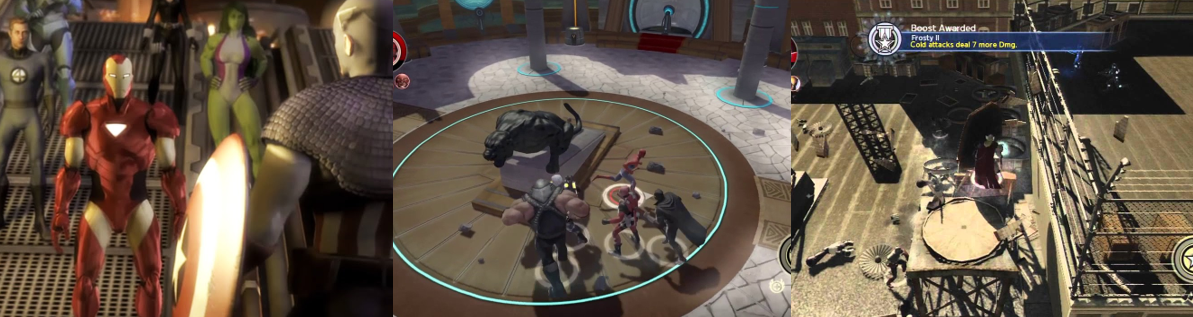
Like its predecessor, Marvel: Ultimate Alliance 2 is a team-based brawler with limited roleplaying mechanics, exploration options, and puzzle elements. Players can (eventually) assemble a team of four from a roster of around twenty-five characters, many of which return from the last game alongside some newcomers, though your options are limited by story-mandated restrictions and the decision you make partway through to side with the Pro-Registration side or the Anti-Registration side. Regardless of which character you pick, your basic combat and control mechanics remain the same: tapping A executes a light attack while B throws a heavy attack; you can hold B to charge up a stronger strike and mix these together to form basic combos, such as a pop-up attack to break an opponent’s guard. X lets you activate doors and consoles, grab anything from crates to cars to toss at enemies, pull shields off foes and even grab enemies to pummel or throw them to their doom. Y lets you jump; press an attack button in mid-air and you’ll crash to the ground with a slam and press Y again for a double jump or to web-sling, fly, or dart along on a glider or ice bridge depending on who you’re playing as. The Left Bumper allows you to block incoming attacks or dodge out of the way by wiggling the left stick at the same time; there are also times when you’ll need to hit LB to deflect incoming projectiles. The Right Bumper allows you to heal yourself or your allies or revive a fallen comrade as long as you have a Heal Token in stock; these are found scattered across each location, usually spawning in during boss encounters or after defeating enemies, and you can hold up to two at a time.

Characters boast new superpowers and can combine abilities in devastating Fusion attacks.

Although up to four players can play Marvel: Ultimate Alliance 2 simultaneously; you can also play alone with some competent A.I. companions and freely switch to another character using the directional pad when playing solo. You can press in the right stick for a handy arrow to point you to your next objective or bring up the game map from the pause menu. Each character as a life and stamina bar; the former is filled when you collect red Health Orbs or level-up and the latter fills automatically, and each character also comes equipped with their own Super Powers, which you activate by holding the Right Trigger and pressing A, B, X, or Y. Many of these are shared across characters, but with a unique flare to each; Spider-Man can web enemies towards him, for example, while Matt Murdock/Daredevil homes in with his grapple cane, but both can lash at foes with their whip-like weapons. Most characters tend to have a ranged attack (Johnny Storm/The Human Torch’s flaming projectiles, Iron Man’s Repulsor blasts, Ororo Munroe/Storm’s lightning strikes, etc) and a clearing attack (Doctor Bruce Banner/The Hulk’s ground pound, Doctor Reed Richards/Mister Fantastic’s tornado spin, and Remy LeBeau/Gambit’s kinetically-charged card barrage, etc), but some also have abilities that buff either their attacks or their team (Doctor Jean Grey/Phoenix can automatically revive characters or add fire damage to her attacks, Danny Rand/Iron Fist’s “Healing Hand” technique heals him, and Captain America can temporarily reduce the damage he takes, for example). Not only can these be improved by earning experience points (XP) and levelling-up and spending “Ability Points” (AP) in the character menu, but you can now combine powers for powerful “Fusion” abilities. As you dish out damage, you’ll build up the Fusion Meter and you can store up to two Fusion Stars at once and combine powers by holding the Left Trigger and pressing either A, B, X, or Y to team up with one of your allies. This produces various effects depending on the combination but, again, many of them are very similar and only made unique by the way the characters team up. For example, you can perform the iconic “Fastball Special” by combining James “Logan” Howlett/Wolverine, Daredevil, Iron Fist, and Mr. Fantastic with bruisers like the Hulk, Ben Grimm/The Thing, or Mac Gargan/Venom. Venom, Hulk, and the Thing can also do a dual stomping attack and you’ll be able to suck enemies in with tornados from the likes of Storm and Thor Odinson while adding elemental attacks to these twisters with the Human Torch and Phoenix.

Puzzles and objectives are simpler than ever and dialogue trees give the illusion of dramatic discord.

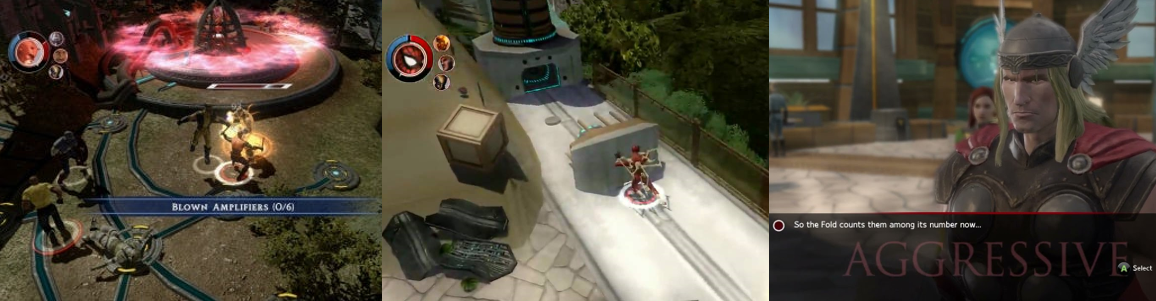
No matter the combination of characters, you’ll be prompted to tap A to increase the radius, target specific enemies, or hit successive foes to score extra points and unlock additional abilities and buffs for your characters. Tapping or holding X is also the most common way you’ll be solving the game’s puzzles; generally, you’re tasked with clearing out all nearby enemies and then activating a console or door with X, but sometimes you’ll need to push or pull amplifiers and giant batteries to power up (or down) generators or pass through barriers, rip off control panels, or destroy projectors. Other objectives include destroying anti-aircraft guns, defeating certain enemies, activating consoles in the correct order, and moving stone columns around to unlock doorways and paths, and some missions also contain optional objectives (such as destroying weapon stockpiles or teleporter pads) that net you additional rewards. Additionally, while you’re often told over your comms that you need to act quickly, only certain objectives actually carry a time limit (you’re given less than six minutes to defeat certain bosses, dispose of bombs, or escape collapsing facilities, for example) and you’re often given options to pick from in dialogue trees that will earn you buffs for being “aggressive”, “diplomatic”, or “defensive”. However, as near as I can tell, this doesn’t really alter the story or your character relationships like picking between Pro- and Anti-Reg, which will restrict the characters available to you and alter both the bosses and mission objectives you’re given (protecting or destroying a Strategic Hazard Intervention Espionage Logistics Directorate (S.H.I.E.L.D.) convoy, for example, or raiding or defending a S.H.I.E.L.D. base). Other missions will see you joined by an additional fifth character (technically not a non-playable character as many, like Captain America and Nick Fury, are playable) who will provide support; however, you can’t select them during gameplay, and you’ll still be met with failure if all four of your team are knocked out.

Graphics and Sound:  
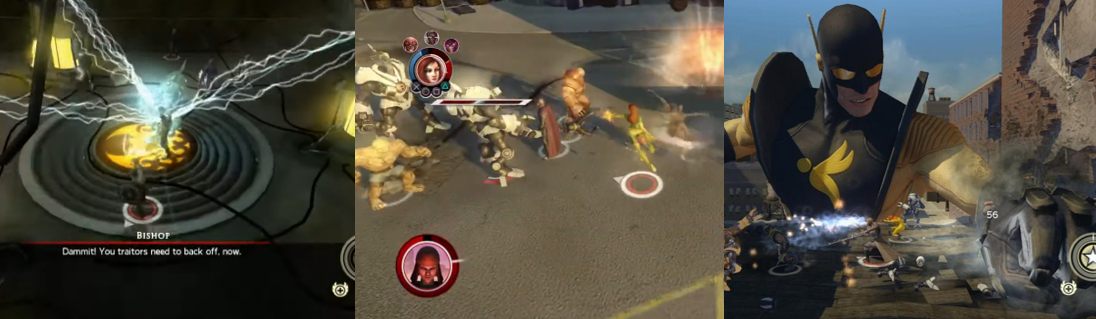
There’s been a decent graphical upgrade between Marvel: Ultimate Alliance and its sequel, namely in the sense that the game is far less dark than before and environments are a little more varied, though the same issues with things becoming repetitive and visually dull persist despite how many additional destructible elements have been added. The game starts in Latveria and sees you infiltrating both the castle town, with its many statues of dictator Doctor Victor Von Doom, and Dr. Doom’s main castle, a location that featured in the last game and is now far more linear and less confusing. This is true of all of Marvel: Ultimate Alliance 2’s locations; it’s very rare that’ll you’ll need to explore off the beaten track, mazes and repeating areas are pretty much non-existent, and everything is much more straightforward this time around, which is great in the sense that levels tended to drag on a bit and be frustrating in the first game but disappointing as you don’t have much to do in, say, Wakanda, except follow a straight path taking out enemies and gun placements and simply walking past the waterfalls, jungles, and tribal trappings in the background. Additionally, Marvel: Ultimate Alliance 2 is way less fantastical; there are no trips to Atlantis, Asgard, or Hell here and, instead, you have to make do with such inspiring locations as…downtown, the rooftops of Hell’s Kitchen, train tracks, and high-tech facilities. Some, like Phineas Mason/The Tinkerer’s lab, T’Challa/The Black Panther’s throne room, and the Negative Zone prison are actually visually very interesting but, for the most part, this is a far more grounded affair, and the game loses a lot of its madcap appeal as a result since the focus is on the more grounded struggles of the Civil War.

While the characters and cutscenes look good, the game is noticeably less visually interesting than its predecessor.

This disappointment is also felt in the game’s soundtrack, which once again opts for very generic, military-esque tunes and rock-inspired beats that serve only to make the mindless gameplay all the more tedious. The voice acting and cutscenes are a lot better this time around; there’s still an obvious graphical difference between pre-rendered cutscenes and in-game graphics, but there’s more focus on character interactions and debating the merits of the SRA. Characters will continue to offer commentary during gameplay, with Wade W. Wilson/Deadpool regularly breaking the fourth wall and characters alerting you when they’re on low health, plus you sometimes get bonuses and additional dialogue if you have certain characters speak to each other. Character models seem better this time around, though; the animations used to bring their powers to life feel more unique and tailored to each hero, though it is disappointing (though, at the same time, understandable) that the same Fusion animations are recycled for certain team-ups. Once again, you’ll be operating out of various hub worlds, like Stark Tower and the White Star base, where you can chat to other characters and find collectibles, and performing certain deeds during gameplay will net you extra costumes (though, sadly, each character only has one this time around). Unfortunately, though, you won’t be treated to as many bizarre and wacky Easter Eggs or endings as before; you only really get one game-changing choice to make here, meaning there are only two endings to see, which is a shame as I really enjoyed all the different consequences of your actions in the first game and how it led to more replay value, whereas here you’re limited to picking Pro- or Anti-Reg.

Enemies and Bosses:
A slew of disposable goons will be set against you throughout Marvel: Ultimate Alliance 2, from Dr. Doom’s soldiers and robots to S.H.I.E.L.D. forces and the nanite-controlled minions of “The Fold”, a rogue A.I. that springs up in the game’s final act to reunite the warring superheroes. Regardless of who you’re fighting, you’ll come across the same recycled enemy tropes again and again: gun-toting soldiers, grunts with shields, ones who block your attack or inflict elemental statuses on you (such as burning, electrocution, and poisoning), and larger mechs. Helicopters will need to be taken out by tossing their grenades back at them, enemies will fire missiles and rockets at you; some have swords, some need to be stunned with your charged attack, some are shielded, and some toss explosive barrels your way. You’ll also have to watch for flame-spitting turrets, laser guns imbedded in walls, loose wires, and flaming hazards that’ll need a dose of coolant (or Bobby Drake/Iceman’s ice powers) to get past. It all gets very repetitive very quickly; the basic enemies aren’t much of a threat to you with your various powers and abilities but can quickly whittle your health down as they start mixing and matched and increasing in number, with more enemies onscreen than the last game and many of them being called in to boost or interrupt the many mini and main boss battles that you’ll have to contend with throughout the story. Like the last game, a who’s-who of Marvel’s most obscure and memorable villains are encountered throughout the game’s three acts, many of which crop up again, often in tandem with other villains.

The Tinkerer, Lucia von Bardas, and the damn Titanium Man represent a dramatic difficulty spike.

The first supervillain you’ll face is Max Dillon/Electro, who teleports around a church in a burst of electricity, performs an electrical blast attack, and can recharge his powers at the capacitors dotted throughout the area. After that, you’ll come up against Bentley Wittman/The Wizard and Steven Hudak/The Scorcher, with the former capable of erecting a shield and the latter roasting you with flame blasts, but your first real boss battle is against the Tinkerer. The Tinkerer stomps about in a large, spider-like tank mech that fires homing missiles, stamps the ground and sets it aflame, and sweeps that area with a laser blast. He’s also supported by an endless swarm of robotic minions, but you can use these to build up your Fusion Meter to target the Tinkerer’s legs and turn his mech into scrap metal. The Shocker/Herman Schultz’s stunning pulses must then be endured to rescue Carol Danvers/Ms. Marvel, then you’ll have your first of many encounters with the scythe-handed Eric Williams/Grim Reaper, one of the most recurring mini bosses who’s actually pretty tough thanks to his fast speed and quick, targeted slashes. Electro, the Scorcher, the Shocker, and the Wizard all reappear during the chaotic battle against cyborg Lucia von Bardas, which takes place on the deck of a ship. You’ll need to avoid her blasts and destroy the four cannons in each corner of the deck, which is easier said than done as Lucia defends three of them with flaming jets and you’ll have to contend with her supervillain bodyguards. Lucia also rains bombs from the sky, protects herself (and her minions) with energy shields, regularly hovers out of reach, and compounds the entire fight with a time limit. In the last part of the game’s first act, which takes part in Washington, D.C., you’ll have to do battle with Deadpool (who teleports about and riddles you with uzi bullets) and hit a bit of a brick wall when you go up against the mysterious Titanium Man. At first this isn’t so hard (he sends you flying, slows you with a pulse, and showers you with a laser spread) but things get much tougher in the second phase, where he turns invisible, is bolstered by minions and floating cannons, sends out loads of annoying vortexes, and there are no checkpoints during this battle, making it all the more frustrating.

While Bishop and Deathstrike can be aggravating, the Yellowjacket boss fight was actually pretty fun.

After this, you’ll be forced to pick a side and this alters the characters you pick and fight against; I went with Anti-Registration (because, frankly, the was the right choice all along) so I’ll primarily talk about those bosses. First up is a scuffle with Natalia Romanova/The Black Widow, who keeps you at bay with her pistols, cartwheel kicks, and grenades, and your first battle with Colonel James Rhodes/War Machine, who’s basically a mirror of Iron Man and attacks with a rocket-powered punch and missiles, though both are pretty easy fights here, especially compared to the one against Lucas Bishop. Your energy attacks will actually heal the grenade-toting Bishop, so try to focus on physical attacks, but you’ll deal the greatest damage against him if you attack and destroy the terminals he plugs himself into. This actually gets pretty tricky as you have to hit three power terminals to cause feedback, then hit four nodes on other terminals to stop him regaining health, and finally hit all six nodes when he draws energy from the middle of the terminals, all while avoiding his rushes and shockwave attacks. In comparison, Melissa Gold/Songbird is a bit of a joke since all you have to worry about are her pink sonic waves, but the difficulty ramps up again when you butt heads with Yuriko Oyama/Lady Deathstrike, who attacks with her Adamantium claws like a whirling dervish. Though the Thing saves your ass, you’ll have to contend with S.H.I.E.L.D.’s soldiers and robots in the second phase; Deathstrike will repair these mechs, so it pays to quickly take them out, but that’s not easy thanks to her speed and aggression. Thankfully, this is followed by a fun and visually interesting fight against Doctor Henry “Hank” Pym/Yellowjacket, who pounds and slaps at you in his gigantic form; you need to attack his massive fists to build up your Fusion Meter and stun him, only then can you unleash a Fusion attack to deal big damage to him, though you’ll have to watch for his double-fist slam and the minions who swarm the rooftops. When in the unstable chemical plant, you’ll have a quick run-ins with Bullseye (who I had no issues with despite his triple-shot projectile), Simon Williams/Wonder Man (who’s also not too hard despite teleporting about the place and sporting powerful melee attacks), and even an unexpected alliance between Jennifer Walters/She-Hulk and Mark Raxton/Molten Man that sees you avoiding the former’s jumping slams and the latter’s flame bursts.

You’ll face different bosses depending on which side you choose, which also impacts the game’s difficulty.

You’ll also contend with a more formidable version of War Machine and have a brief fight with Iron Man (who’s basically the same as War Machine but with fancier laser attacks) before he tags in Mr. Fantastic (who’s actually a bit of a pain thanks to his stretchy limbs bursting up from the floor and his tornado spin). Iron Man and Mr. Fantastic prove quite the double team when you battle them together; even with Captain America on hand to help and with victory coming by defeating Iron Man alone, this can be a tough fight as Mr. Fantastic sometimes glitches and perpetually spins in place and Iron Man flies around the arena sending energy projectiles your way. Finally, you’ll need to help Nick Fury dispose of some bombs while fending off a joint attack from Doctor Norman Osborn/The Green Goblin and Venom; the former flies around dropping grenades or tosses pumpkin bombs in your face while the latter attacks with their tendrils and even webs up the bomb disposal vent and commandeers the Goblin’s glider! On the Pro-Reg side, you’ll have to quell Eli Bradley/Patriot after your betrayal, fend off Jessica Drew/Spider-Woman rather than Black Widow and Hercules instead of Wonder Man, as well as tangle with Nathanial Summers/Cable, who proves highly resistant to damage, constantly teleports about the place, and forces you to rely on your standard attacks and super powers since there are no minions to help build up your Fusion Meter. Ritchie Gilmore/Prodigy, Angelica Jones/Firestar, Tandy Bowen/Dagger, Piotr Rasputin/Colossus, and Jamie Madrox/Multiple Man also crop up, with the latter being quite the obstacle if you don’t have the right teammates, while Tom Foster/Goliath takes Yellowjacket’s place. Instead of fighting War Machine, Mr. Fantastic, and Iron Man, you’ll take on Iron Fist, Luke Cage/Power Man, and Captain America, with this latter fight complicated by plumes of fire and the Cage and Cap being able to pull off Fusion attacks!

After battling numerous foes, you’ll need all your powers to defeat the nanite-infused Nick Fury.

Before you enter the Negative Zone prison,  Commander Maria Hill hands over a key card without issue and Robbie Baldwin/Penance is subdued and recruited after a brief fight. Terrance Sorenson/Equinox proved much tougher thanks to the nearby turrets and his health-draining elemental attacks, and you’ll battle the nanite-infected Grim Reaper, Bullseye, and Molten Man to rescue Luke Cage and Firestar. To escape the prison with the nanite samples, you’ll take on the combined might of David Cannon/Whirlwind, Karla Sofen/Moonstone, and Rachel Leighton/Diamondback; though Captain America and Iron Man help out, this can be a frustrating fight as Whirlwind is constantly spinning about and minions are always spawning in but focusing on one mini boss can help mitigate the danger. While in Wakanda, you’ll fight off Alexander Summers/Havok (whose concussive powers are bolstered by nearby vibrational pillars), the combined threat of Hulk-clone Rick Jones/A-Bomb and Vance Astrovik/Justice (who shields his nanite ally), and once again deal with the duo of Green Goblin and Venom, this time in the Black Panther’s throne room and with a wider, more versatile space for them to avoid your attacks (though having a flame-orientated character or buffs will help against Venom). Wonder Man and Spider-Woman guard the entrance to the Fold’s Iceland base, with both proving tougher than before, while She-Hulk, Firestar, Colossus, and Whirlwind await inside guarding amplifiers. You’ll also battle the Tinkerer again here; this time, he’s almost constantly shielded by the Fold’s enhanced elites, who you’ll need to destroy in order to deal damage to the mad inventor, though the sheer influx of enemies can make this a gruelling prospect. Finally, after battling on a rising elevator and reaching the top of the Fold’s amplifier tower, you’ll fight the nanite-infected Nick Fury. Using a coloured holographic projection, Fury emulates the powers of other characters and bosses to constantly keep you on your toes; he strikes with lightning, sends out energy pulses, rapidly moves and teleports all over the place, creates duplicates, absorbs and projects energy, blasts out a stream of light, and causes the ground to erupt in flames. Although a frustrating and long-winded bout, this was actually easier than some other bosses; switch characters to whoever’s closest, unleash your rapidly-filling Fusion Meter, and remember to deflect his projectiles when prompted and you should emerge victorious without having to expend a single revive, which is more than I can say for the damn Titanium Man!

Power-Ups and Bonuses:
As mentioned, combat yields XP that levels you and your team up; all characters level-up regardless of whether you use them or not, but levelling-up alone isn’t enough to power-up your team. You need to spend AP boosting their four superpowers and all four will only be unlocked by levelling-up; thankfully, AP is easily earned by beating enemies, rapidly tapping A during Fusion attacks, and smashing crates and other onscreen destructibles. Each character also has “Passive” abilities that can be upgraded in the character menu; many of these are locked to a specific side, so you’ll never have full access to all abilities in a single playthrough, and they provide buffs such as raising your chances of landing a critical hit, allowing more frequent use of your powers, regenerating health, reducing damage, and increasing the stamina you gain. Defeating mini bosses and bosses also rewards you with medals that provide additional “Boosts”; you can manually or automatically equip up to three of these at a time to increase your health, teamwork, resistance to or ability to inflict elemental attacks, and other similar bonuses. It also pays to utilise your comic book knowledge; if you make a team comprised entirely of X-Men or the Fantastic Four, for example, you’ll get an additional boost to aid you. Finally, extra rewards are on offer for performing three “Heroic Deeds” per character; these range from defeating fifty enemies, performing specific Fusion attacks, or using certain superpowers and will unlock a new costume or ability for each character, as well as being a fun aside.

Additional Features:
There are fifty Achievements to snag in Marvel: Ultimate Alliance 2, with sixteen being tied to the story mode alone, though you’ll need to do two playthroughs and experience both the Pro- and Anti-Reg missions to earn them all. You’ll also earn Achievements for completing missions in co-op mode, clearing the game on “Legendary” difficulty, performing ten Fusions with a friend, earning high scores from Fusions, unlocking costumes, collecting boosts, and finding the various dossiers and audio logs scattered throughout the game. You’ll unlock additional characters not just through the story mode, but also by collecting Asgardian Ruins, pieces of the M’kraan Crystal, and Gamma Regulators; some characters’ alternate costumes also act as skins, such as General Thaddeus “Thunderbolt” Ross/Red Hulk and Eddie Brock/Venom. You’ll also find simulator discs scattered about that once again let you take on special simulator missions from the game’s hub worlds, can put your Marvel knowledge to the test in various trivia games for more XP, and will be given the option of starting a new game, with all your unlocks and stats, but at the cost of your existing save file. There is no option to replay previous missions as far as I can tell so you’ll need to start over if you missed anything. I’d also advise making use of the manual save function as often as possible, especially before you pick a side so you don’t have to start right from the beginning to see the other side of the story. If you were lucky enough to own this game before it got delisted, you can also expand the roster with some downloadable characters, like Cletus Kasady/Carnage and Erik Lehnsherr/Magneto, though this feature is obviously unavailable these days; additionally, other versions of Marvel: Ultimate Alliance 2 include console-specific characters, like Eric Brooks/Blade.

The Summary:
I was always hesitant about getting into Marvel: Ultimate Alliance 2, simply because of my hatred for the diabolical Civil War storyline. Even with that bias to one side, I wasn’t impressed that the sequel stripped back the story and scope of the franchise so much; the first game arguably tried to do a bit too much and touch base with a bunch of different locations and characters in the Marvel universe, but at least it embraced the bonkers spirit of the source material and wasn’t as blinkered as the sequel. I really missed the unpredictability at the first game; here, the only replay value is in picking a different side, especially as all characters are available to you in the finale, so all you’re really left with is the new-fangled Fusion mechanic. Sadly, this isn’t as good as the game makes it out to be; once you’ve seen a handful of them, you’ve basically seen them all and they weren’t as impressive as I had hoped. I also wasn’t a big fan of some of the character choices and the lack of extra skins, though overall I think I preferred the gameplay and combat; it’s still mindless and tedious and gets old really quickly, but at least the different superpowers felt a little more dynamic this time. While I have no complaints about the game’s linearity since it made it faster to play, it is a shame that exploration has been cut way back this time around and that many of the level-up and customisation mechanics have been stripped down. Once again, the game’s biggest issue is cramming so much into it; it’s great for a Marvel fan but it does impact the enjoyment and memorability of the mini bosses since a lot of them are just the same thing over and over with the same tactics used to overcome them. Overall, I feel Marvel: Ultimate Alliance 2 is no better or worse than the first game: I miss the different gameplay mechanics and visual variety of the first game, but the sequel feels a bit more refined and focused; I don’t like how grounded and restricted it is, but the graphics and ability options are a step up. I think the best thing to do (if you can afford it) is have both and play them back to back for a complete experience but if I honestly had to pick which one was better, I’d go with the first one since I’m much more inclined to play it and see what wacky endings I can earn rather than seeing the SRA repealed or lessened by the end of this game.

My Rating:

Rating: 3 out of 5.

Pretty Good

Have you ever played Marvel: Ultimate Alliance 2? If so, how do you think it compares to the first game? Which side did you pick and who made it into your team? What did you think to the new Fusion mechanic and the changes to the roster? Were you disappointed that the boss battles were still mostly tedious exercises and that the scope was scaled so far back? Did you ever complete all the Heroic Deeds and simulator missions? How are you celebrating National Superhero Day today? Whatever your thoughts, leave a comment below or on my social media, and be sure to check out my other superhero and comic book content across the site!

Movie Night: The Marvels

Released: 10 November 2023
Director: Nia DaCosta
Distributor: Walt Disney Studios Motion Pictures
Budget: $270 million
Stars: Brie Larson, Teyonah Parris, Iman Vellani, Zawe Ashton, and Samuel L. Jackson 

The Plot:
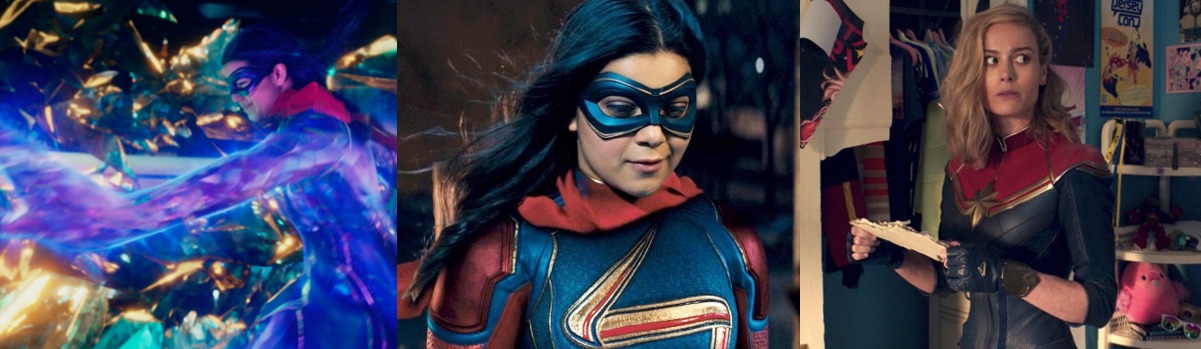
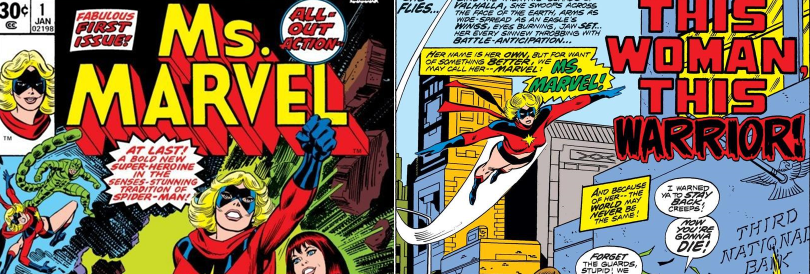
Whilst investigating a universal threat as a favour to Nick Fury (Jackson), Captain Carol Danvers/Captain Marvel (Larson) discovers an anomaly in the fabric of space and time caused by venge-seeking Kree commander Dar-Benn (Ashton). Coincidentally interacting with the anomaly at the same time as Captain Monica Rambeau (Parris) and Kamala Khan/Ms. Marvel (Vellani) use their own cosmic powers, Danvers finds herself switching places with the two heroes and forced to join forces with them to prevent Dar-Benn from destroying the people dearest to her. 

The Background:
After a 1953 lawsuit regarding Fawcett Comics’ Billy Batson/Captain Marvel, Marvel Comics got to trademark and publish their own “Captain Marvel” stories. While Stan Lee and Gene Colan’s Kree warrior is mostly remembered for his death from cancer in 1982, Mar-Vell was followed by a numerous successors, including Carol Danvers, who overcame online trolls with her critical and commercial debut. Talk of a sequel began before Captain Marvel’s (Boden and Fleck, 2019) release, with star Brie Larson wishing to see Kamala Khan/Ms. Marvel included and MCU head honcho Kevin Feige stating that Marvel Studios had some exciting ideas for a follow-up. After Larson cameoed in adjacent spin-off Ms. Marvel (Various, 2022), which introduced Kamala to the MCU, and Teyonah Parris portrayed a grown-up and superpowered Monica Rambeau in WandaVision (Shakman, 2021), the stage was set for a team-up of the cosmically-empowered heroines, especially after director Nia DaCosta was announced to be helming the sequel and exploring new perspectives on these characters. When other MCU productions caused changes to the script, the filmmakers shifted to focus on the dynamic between the three main characters, with numerous special effects studios contributing to the film’s cosmic scope. Following several delays, The Marvels finally released to polarising reviews; many criticised the surreal moments and rushed narrative and branded it as the worst MCU film to date, while others praised the performances (specifically Iman Vellani) and its fun, kinetic action sequences, Still, as of this writing, The Marvels has barely cleared $165 million at the box office, had the lowest opening weekend of any MCU movie, and is on track to be a box office bomb, leaving the future for these characters murky.

The Review:
I really enjoyed Captain Marvel. At the time, I was fully expecting the film to dictate the next phase of Marvel movies, positioning Captain Marvel as a powerful force in the MCU and establishing the shape-shifting Skrulls as an ongoing threat to these colourful characters. Sadly, however, that didn’t really happen; the movie subverted expectations and cast the Skrulls in a sympathetic light and attempts to make them more antagonistic were questionable, at best. Indeed, the Skrulls barely feature in The Marvels except for a brief sub-plot where Dar-Benn arrives on Tarnax, where they have established a refugee colony under the leadership of Emperor Dro’ge (Gary Lewis), under the guise of a peace treaty simply to create an unstable jump point that strips Tarnax of its atmosphere and forces the Skrulls from their world once more. Despite Captain Marvel having helped settle the colony, and the assistance of her and her new allies in evacuating much of Tarnax and arranging safe refuge with King Valkyrie (Tessa Thompson), Emperor Dro’ge is seen to have lost faith in Captain Marvel, primarily because he believes she ruined a chance for the Skrulls to return to prosperity in the Kree Empire and resents her for inviting conflict. Captain Marbel also ended with the promise of Carol avenging herself against her warmongering Kree superiors, a plot point that sadly sets a precedent for The Marvels as it’s simply rushed through, brushed aside, and barely explored, especially considering Carol’s destruction of the now-comic-accurate Supreme Intelligence is the catalyst not just for the slow destruction of the Kree home world, Hala, but also Dar-Benn’s entire vendetta against Captain Marvel. It’s a shame as I would’ve liked to see Carol fighting to free her adopted people from the manipulation and influence of the Supreme Intelligence, but it feels as though there was a Captain Marvel 2 we never got that actually told this story, including a rematch with Yon-Rogg (Jude Law) and her former Starforce allies, as all of this is relegated to a quick flashback and a brief scene where Carol awkwardly expresses guilt over setting the paper-thin plot of this movie in motion. 

Carol and Monica finally reunite, brush past their issues, and join forces.

So, what are we left with instead? Well, Captain Marvel has effectively lost herself to her work; she’s so busy investigating and confronting cosmic threats and trying to atone for essentially dooming Hala to destruction that she’s largely closed herself off to others. The only person she regularly talks to is Fury and the closest thing she has to a friend is the cat-like Flerken, Goose (Nemo and Tango); her shame at being labelled the murderous “Annihilator” has kept her away from Earth and her surrogate niece, Monica, earning her the new-empowered Captain’s resentment. Though haunted by the gaps in her memory and anxious about opening herself up to others, Carol is nonetheless excited to reunite with the grown-up Monica, even more so when she sees that Monica’s not only gained light-based powers of her own that allow her to become intangible, fire bursts of energy, and (eventually) fly, but also followed in and surpassed the footsteps of her mother, Captain Maria Rambeau (Lashana Lynch) by joining Fury’s Strategic Aerospace Biophysics and Exolinguistic Response (S.A.B.E.R.) crew. New to, and resistant towards, the superhero game (she actively resists being labelled with a code-name), Monica struggles to reconcile her conflicting emotions towards her Aunt Carol; on the one hand, she’s glad to be with her again but, on the other, she begrudges Carol for leaving her to face her mother’s death and life after the Blip alone. Still, Monica acquits herself well in this fast-paced cosmic adventure; her powers may be strangely defined, but she takes a commanding role in the threesome and quickly embraces and enjoys teaming up with Carol and Kamala. Because Captain Marvel has definitely been shown to be one of the (if not the most) powerful characters in the MCU, it can be difficult to imagine her struggling against any enemy or ever requiring a team, even though we saw that she is far from an infallible, unstoppable one-woman army in Avengers: Endgame (Russo and Russo, 2019).  

Kamala is the adorable heart and soul of the film and awestruck by her hero.

Still, The Marvels gets around Carol’s incredible and unmatched power through a unique and enjoyable body-swapping mechanic. Thanks to Dar-Benn’s actions and the similarities in their cosmic, light-based powers, Carol, Monica, and Kamala switch places whenever they use their powers in unison; this causes a great deal of distress for the young Ms. Marvel, who suddenly finds herself dumped halfway across the galaxy and fighting Kree warriors and her family – overbearing Muneeba Khan (Zenobia Shroff), astonished Yusuf Khan (Mohan Kapur), and exasperated Aamir Khan (Saagar Shaikh) – threatened by those same forces. Still, Kamala is the shining light in this film; her adorable, infectious enthusiasm is a joy to see and she’s genuinely excited to meet, and team up with, her lifelong hero. When there’s tension between Carol and Monica, Kamala acts as the intermediary, dishing out sympathy, excitement, and hugs despite how in over her head she is. Since Dar-Benn possesses the other mystical bangle, Kamala becomes a target for the fanatical Kree, who wishes to have both so that she can enact the full extent of her diabolical plan, and Kamala is determined to prove herself to Carol, Monica, Fury, and her family. However, as thrilling as it is for Kamala to bond with Carol and Monica (and they do develop a true, charming sisterhood over a few montages), she also learns how dangerous and bleak the superhero life is. Carol’s actions are not always virtuous and she’s forced to make hard choices as often as she is to visit planets like Aladna, where the inhabitants can only communicate through song and dance, though the experience galvanises Kamala’s spirit and inspires her to seek out other young heroes to form a team of their own. Fury was also quite enjoyable here; although he doesn’t work alongside Carol in the same way as the first film, The Marvels repositions him as the principal figurehead for Earth/galaxy relations and he takes an active role in guiding the Marvels and evacuating S.A.B.E.R.’s inhabitants using a clowder of Flerkens in another of the film’s strangely bizarre sequences. 

The vengeful Dar-Benn is a disappointingly bland and forgettable villain.

While the relationship between the Marvels is naturally at the forefront here, and is easily the best element of the film, other aspects are underdeveloped and rushed; The Marvels is the shortest MCU movie to date and really ploughs through all its characterisations and plot, which means things like Monica’s relationship towards Carol and Carol’s shame at her actions are touched upon and then quickly cast aside. However, the real casualty of the film’s brisk pace is the lead villain. Essentially just Ronan the Accuser (Lee Pace) again, Dar-Benn even wields Ronan’s mallet-like staff (which strangely still glows and demonstrates the same properties it did when it had the Power Stone in it), which just lends further credibility to my argument that Ronan should’ve been a recurring threat in the MCU. Dar-Benn sadly ends up as a throwback to villains like Ronan and Malekith (Christopher Eccleston), underdeveloped, one-dimensional bad guys who do “bad guy stuff” simply because the movie needs a bad guy. Dar-Benn’s vendetta is based on Carol destroying the Supreme Intelligence, an act that…somehow…had cataclysmic ramifications for Hala, including destroying its atmosphere, oceans, and even its sun, driving Dar-Benn to use the vaguely-defined bangle to rip open holes in space and time to suck these resources from Carol’s adopted worlds in what is, essentially, the villainous plot from Spaceballs (Brooks, 1987). A driven, fanatical patriot, Dar-Benn is a hero by her people and poses a significant threat to the Marvels thanks to her bangle absorbing their blasts, the power of her mallet, and the confusion caused by them switching bodies, but is ultimately overwhelmed without much trouble and destroyed by her own obsession. She’s sadly far from a memorable villain, despite her posing a legitimate threat to the universe, and is just another aspect of the film that’s not given enough time to flourish onscreen; it’s a real shame as I thought we were past the age of unforgettable, wasted villains in comic book movies but here’s The Marvels to prove me wrong and harken back to lacklustre movies like Fantastic 4: Rise of the Silver Surfer (Story, 2007). 

The Nitty-Gritty:
There are some themes at work in The Marvels, but they’re severely rushed and take a backseat to keeping the narrative and the action moving ever forwards. It’s as though the film is afraid to linger too long on complex emotions and characterisations, or like a good hour or so of the plot was excised in favour of wacky nonsense that bogs down the otherwise intriguing relationship between the Marvels. Monica resents Carol for leaving her and prioritising work over her friends and family, something we learn is as much because of Carol’s humiliation at dooming Hala to destruction as it is because of her duties to the cosmos. Carol believed she was liberating the Kree when she destroyed the Supreme Intelligence but was horrified by the consequences of her actions, which see the Kree brand her as the feared “Annihilator” and target her allies in recompense. While fangirl Kamala is overjoyed to meet and fight alongside her idol, she quickly learns how dangerous the superhero life is when she’s placed in constant danger (much to the concern of her family) and sees that, sometimes, heroes can’t save everyone. Her enthusiasm remains boundless, however, and she’s very much the heart that binds the Marvels together and makes their training montages and interactions even more enjoyable, but The Marvels is handicapped by some truly bizarre sequences. They trio travel to Aladna to warn of Dar-Benn’s threat, a planet where Carol is revered as a princess and married to the forgettable Prince Yan (Park Seo-joon), and where the inhabitants communicate through singing and dancing, forcing a really surreal musical number into the film that feels more at home in Taiki Waititi’s Thor movies (2017; 2022).  

Some fun action mechanics and impressive visuals can’t atone for the film’s more surreal moments,

The Marvels may also alienate those who haven’t seen the Ms. Marvel Disney+ series. Although Kamala and her family are introduced to unaware viewers, they still kind of appear from nowhere for the uninitiated, not unlike the mentions of Westview in Doctor Strange in the Multiverse of Madness (Raimi, 2022). I firmly believe we’re at a point where MCU fans are digesting every product the MCU puts out, so there probably aren’t many people who are confused when the Disney+ shows are referenced or appear in the movies, but this could escalate into a bigger problem in the future. Still, the inclusion of Ms. Marvel adds to the film’s frantic action sequences; it’s fun seeing the three stumble about, suddenly deposited in different locations and having to quickly adapt to save themselves, and others, as the situation dictates. Through some fun montages and learning to communicate, the Marvels overcome the issue of their body swapping to form a cohesive unit that both allows them to overwhelm Dar-Benn and keeps the ultra-powerful Captain Marvel from simply ending every threat by herself. Cosmic, space-based action is kept to a minimum this time around, with most of the special effects reserved for planetary destruction and depicting rips in the fabric of reality. I will say, though, that Ms. Marvel’s powers look a little iffy at times, though the film’s costumes make up for this, with Carol sporting some snug, sexy uniforms and Kamala getting a nice upgrade that sees her gain a whip-like scarf, though I didn’t care for Monica rejecting adopting a code name and tearing off the disco-wings of her Aladna outfit as, again, I thought we were past the age of mocking superhero tropes. 

The Marvels work together to defeat Dar-Bonn, but Monica sacrifices her freedom to save the galaxy,

So, Dar-Benn’s revenge sees her scour the universe for the sister bangle to Kamala’s heirloom; when combined with Ronan’s staff, this allows her to create unstable jump points that suck air, water, and the sun from worlds that are close to Carol, with the goal of restoring the Kree home world and delivering a decisive blow to Carol. Although she has an army of loyal soldiers at her back, this doesn’t really factor into Dar-Benn’s plan and the Kree exist primarily as cannon fodder for the Marvels to beat up as they save lives and try to confront the head of the snake. This confrontation takes place, naturally, on Dar-Benn’s command ship as she arrives to suck the life out of Earth’s sun and sees the Marvels working in unison to overwhelm their foe, ultimately (and inadvertently) mortally wounding her. Carol echoes Kamala’s compassion for the fallen Kree and, on Monica’s suggestion, offers to reignite Hala’s sun to atone for her actions, which Dar-Benn seems to agree to but she ultimately can’t let go of her vendetta and destroys herself after creating a massive tear in the fabric of reality. Luckily, the Marvels surmise that Carol and Kamala can recreate the energy used to create this tear and use it to empower Monica so she can close it, an action that must be performed from inside the rift and ultimately results in Monica seemingly sacrificing herself to save the universe. Changed by the experiences, Carol decides to spend more time on Earth to wait for Monica’s inevitable return, and Kamala heads out to start her own superhero team, with Fury spearheading the repairs to S.A.B.E.R. to monitor future intergalactic threats. Of course, Monica isn’t dead as a mid-credits scene shows her waking up in a hospital, overjoyed and overwhelmed to find her mother at her side. However, this is a variant of Monica’s mother, one who has adopted the Captain Marvel powers and codename of Binary and works alongside Doctor Henry “Hank” McCoy/Beast (Kelsey Grammer) at the X-Mansion. This was a fun stinger since recent MCU products have laid the groundwork for the X-Men and I enjoyed the inspiration from the nineties’ cartoon, but Beast was an unsightly CGI creation and I remain incredulous to Marvel’s resistance towards recasting new actors as the X-Men, and the idea that Mutants need to step through a tear in reality to exist in the MCU. 

The Summary:
I had high hopes for The Marvels; I really enjoyed Captain Marvel, and Ms. Marvel, and was interested to see Carol and Kamala meet onscreen, and explore the relationship between Carol and Monica. These aspects were, thankfully, exceedingly well realised; the three had some great chemistry, obviously had fun working together, and formed a fun sisterhood that perfectly balanced their different characters and experiences (and inexperiences, in some cases). I don’t normally like body swap narratives (and, in truth, it started to wear out its welcome here in the early going) but, for the most part, it was a fun inclusion; it was a unique way to nerf Captain Marvel’s vast cosmic powers and show her the benefits of working with others, and to repair the rift between her and Monica and induct Ms. Marvel into the wider superhero community. Sadly, that’s about where my praise for The Marvels ends; Dar-Benn is in the running for weakest MCU villain of all time, the plot was slapdash and simple, and any nuance or intrigue laced into the narrative was breezed through to get to the next wacky sequence. It honestly felt like major cuts were made, or we missed an entire movie, and I didn’t care for the half-assed characterisation of Dar-Benn or the mockery of superhero tropes, which are both negative elements of the genre that I thought we had moved on from. On the one hand, I liked that the film didn’t outstay its welcome and had a brisk pace, but I think the overall plot and characterisations (outside of the titular trio) suffered because of it. This is definitely a miss-fire for me, ultimately coming across as a film that exists for the sake of existing and setting up future MCU products rather than delivering a solid follow-up worthy of the principal cast.  

My Rating:

Rating: 3 out of 5.

Pretty Good

Did you enjoy The Marvels? What did you think to the dynamic between the trio and which of the three is your favourite? Did you like the film’s brisk pace, or do you agree that certain elements were rushed? Were you also disappointed in Dar-Benn? Are you also annoyed that the X-Men are being introduced as part of the multiverse? Would you like to see the Marvels join forces in a future MCU movie? Whatever your thoughts on The Marvels, leave a comment down below.

Screen Time: Ms. Marvel

Air Date: 8 June 2022 to 13 July 2022
Network: Disney+
Stars: Iman Vellani, Zenobia Shroff, Matt Lintz, Nimra Bucha, Aramis Knight, and Mohan Kapur

The Background:
In 1939, Fawcett Comics introduced readers to the magically-empowered boy-turned-superman Billy Batson/Captain Marvel; however, a 1953 lawsuit forced them to cease publication of their Captain Marvel comics and allowed Marvel Comics to trademark the name for themselves. While Stan Lee and Gene Colan’s Mar-Vell ended up being more famous for his death from cancer, his mantle was continued by a number of successors, most notably Carol Danvers. However, before she took name Captain Marvel, Carol went by Ms. Marvel, an identity later adopted by young Kamala Khan, an Inhuman Muslim girl who idolised Carol. Created by Sana Amanat, Stephen Wacker, G. Willow Wilson, Adrian Alphona, and Jamie McKelvie, Kamala’s adopting the Ms. Marvel mantle and subsequent solo series marked the first time a Muslim character headlined a Marvel publication and she drew significant praise from the Muslim community and for representing a marginalised youth demographic. After Captain Marvel (Boden and Fleck, 2019) proved a critical and commercial hit, star Brie Larson expressed interest in including Kamala in the MCU, something Marvel Studios were keen to do considering the character’s diversity and mainstream popularity. Development of a six-episode series for streaming service Disney+ began in 2019, with the writers keen to stay true to the source material (despite some alterations to Kamala’s powers) and tell both a coming-of-age story for the fledgling heroine and explore aspects of the Muslim faith and traditions through Kamala’s whimsical perspective. Newcomer Iman Vellani won the title role and her outfits and costumes, which are infused with cultural trappings, were designed by Arjun Bhasin; the showrunners also took great pains to ensure cultural authenticity throughout the entire process. Despite complications from the COVID-19 pandemic, Ms. Marvel released in weekly instalments on Disney+ and the first three episodes received a cinematic release in Pakistan. Although suffering from short-sighted hatemongering, the show was met with overwhelmingly positive feedback; reviews praised the blend of quirky humour with its authentic representation of Pakistani-American culture, Vellani’s performance, and the depiction of her new powers, and Ms. Marvel was heralded as a turning point for the MCU and mainstream representation of the Muslim faith. Although there has been no mention of a second season as of this writing, Kamala and her family featured prominently in the The Marvels (DaCosta, 2023), ensuring that the character has a future in the MCU in one form or another.

The Plot:
Sixteen-year-old Kamala Khan (Vellani) idolises Captain Carol Danvers/Captain Marvel (Brie Larson) but her strict Muslim mother, Muneeba Khan (Zenobia Shroff), disapproves of her constant daydreaming. Already struggling to fit in at school and juggling the minefield of a teenage social life, Kamala’s world is changed forever when she acquires cosmic powers from a family heirloom and discovers a mystical background to her family lineage.

The Review:
So, first of all I think it’s only fair to say that I know practically nothing about Ms. Marvel; if she’s appeared in some of the crossover events I’vr read, it was usually in a minor, supporting role and just about all I know about her is that she’s a Muslim girl with stretchy powers and has become quite popular in recent years. I say this only to establish that I went into Ms. Marvel without any kind of expectations, thus I didn’t really care that they altered her powers and, as I understand it, her origin into an amalgamation of her comic book counterpart, perennial sidekick Rick Jones and the Nega-Bands, and even a splash of the various Green Lanterns from DC Comics. I think it was probably a good idea; it ties into the mystical slant to the MCU’s cosmic side, separates her from Doctor Reed Richards/Mister Fantastic, and makes her powers a little more visually diverse. Kamala is probably the most relatable and grounded MCU protagonist yet; a young high schooler who’s just trying to find her way in the world, she’s an avid fan of the Avengers, specifically Captain Marvel, and makes fun animated videos about them and the battle against Thanos (Josh Brolin). Thanks to Scott Lang/Ant-Man’s (Paul Rudd) podcast interviews, she and the rest of the world have a pretty good idea of what happened in this battle but, despite the effort she puts into her videos, she only has two subscribers, barely any views, and a lot of her comments are just spam…which I can totally relate to! Kamala represents the MCU’s core audience in many ways; youngsters who have grown up with these films and characters and want to emulate them, decorate their rooms in superhero paraphernalia, and eagerly attend conventions so they can dress up as their heroes and be around likeminded, hardcore fans. Kamala is so excited about AvengerCon that she and best friend Bruno Carrelli (Lintz) cobble together an impressive costume for the event and she’s amazed in the finale when her father, Yusuf (Nimra Bucha Kapur), tells her that her name can be translated to mean “marvel”, which only makes her idolisation of Danvers even stronger.

Kamala idolises Captain Marvel and is absolutely adorable but has a strained relationship with her mother.

If there’s a word to describe Kamala, it’s “adorable”! She’s a little shy and introverted and other kids and even teachers are dismissive and rude to her, but she’s not exactly harassed like in a lot of high schools. Her powers do give her a newfound confidence that sees her become more assertive and engaging but she remains a bit clumsy and accident prone and is constantly reprimanded by her mother, Muneeba, and her try-hard principal (Jordan Firstman) about her constant doodling and daydreaming. Like all teens, she’s at a crossroads in life and is always being told that she needs to think about her future; her belief that girls should be able to make their own choices, to go out into the world and discover themselves, is met with stern disapproval by her mother since she firmly believes that Muslim women need to get married, put down roots, and start a family rather than drift away into fantasy, something Kamala can’t help but do as she has such an overactive imagination. Her relationship with Muneeba throughout is thus strained throughout; while she accepts Bruno and her older brother, Aamir (Saagar Shaikh) can seemingly do no wrong, Muneeba has high expectations of Kamala and isn’t impressed that she wants to “go to a party…at night” while dressed in a tight costume. To Yusuf’s chagrin, Muneeba initially openly admits that she doesn’t trust Kamala and she is constantly frustrated by her stubbornness. Kamala does truly love her parents, and wants to make them proud, but she also wants to pursue her dreams; this results in her causing them pain and shame when she lashes out at Muneeba’s insistence that Yusuf accompany her to AvengerCon and when she’s forced to disrupt Aamir’s wedding to safeguard her family and friends later in the series.

Muneeba’s strict nature stems from her relationship with Sana but she comes to accept and encourage Kamala.

Muneeba is quite the contradiction a lot of the time; she’ll defend Kamala and be warm and loving towards her one minute, and then chip away at her self confidence and desires the next. Because of this, Kamala has a much closer relationship with her elderly grandmother, Sana (Samina Ahmad), who is a dreamer just like her. Aamir and Kamala were raised on stories of how young Sana (Zion Usman) was forced from her home during a period of social unrest known as “The Partition”, which saw India divided up following years of British oppression. Separated from her mother, Aisha (Mehwish Hayat), and her father, Hasan (Fawad Khan), Sana was led back to her father by a mysterious trail of stars, but Muneeba was driven to leave her homeland after Sana’s tall tales brought her nothing but persecution and shame. Muneeba hasn’t had the easiest life, to be fair; she shares with Kamala how difficult it was after the Partition and how she found solace in the United States through the local mosque, their community, and, most importantly, her family. Indeed, there’s no question that she doesn’t love and care for Kamala; both her and Yusuf just want the young girl to be safe and to not be ogled over and Muneeba is clearly distraught when Kamala disappears in Karachi while investigation Sana’s past. Having long denied that magic that is a part of their heritage, the show eventually brings Muneeba closer to her daughter and her mother; when Kamala’s powers are revealed to her, she accepts her and even provides her with an upgraded costume, with Yusuf christening her “Ms. Marvel” in the finale and the two encouraging her to use her powers for good while still whittling over her wellbeing because parents gotta parent.

After initially struggling with her powers, Kamala masters them as she embraces her past and true self.

Kamala’s powers are activated by a mysterious bangle sent to her by Sana; this bangle is one of at least two and was discovered back in the 1940s on the dead body of an unidentified blue humanoid by a group of interdimensional travellers known as the Clandestine. When Kamala wears it, she’s bathed in a strange cosmic energy and beset by visions of her grandmother’s escape from India, which eventually lead her to the Clandestines and discovering that she shares their bloodline as a Djinn, a mythological race of people from the Noor dimension who have been interpreted as both angels and demons in folklore. Alongside Bruno, Kamala tries to get to grips with her powers, which don’t come with super strength, speed, or dexterity but do allow her to form hard light constructs that, after many pratfalls, she’s able to run and jump on, form shields with, cover herself in a protect crystalline armour of sorts, and occasionally “embiggen” herself to give her stretchy limbs like her comic book counterpart. Visually, these powers manifest quite well but the CGI is a bit wonky and cartoony at times; it could be argued that this ties into her artistic side but that’s a bit of a stretch (no pun intended). Unsurprisingly, considering the young cast, Kamala’s unstable powers flare up as a metaphor for puberty at one point; she flees to the toilets when her nose glows (like with a spot) and her other best friend, Nakia Bahadir (Yasmeen Fletcher), offers her a period pad when she misreads the situation. Despite having no formal training, Kamala generally holds her own in a tight spot; when attacked by Kareem/Red Dagger (Aramis Knight), she’s at a disadvantage due to his superior acrobatic and fighting skill but still defends herself, at least on instinct. When the Djinn try to force her to co-operate with their plot and gate-crash Aamir’s wedding, Kamala fends them off mostly through instinct and panic and is only able to focus her powers when Bruno is injured in the fracas. Indeed, Kamala’s powers quickly exacerbate her struggles to find her place in the world; often misunderstood at home and an outsider at both school and the mosque, she doesn’t always feel like she belongs and this means her powers are often dangerous to those around her, which only makes her question herself further. It’s only after literally reliving Sana’s past and reconciling with her mother, and accepting her newfound heritage, that Kamala is able to master her powers for the finale and win the support and appreciation of her community.

Damage Control, particularly Deever, are now fully framed as a prejudiced and antagonistic force.

However, because of her public demonstrations of power, Kamala attracts some undue attention. She’s immediately identified as a potential threat by the Department of Damage Control (DODC), which is now firmly an antagonistic government agency in the MCU that uses Stark Tech to track down and isolate or imprison potentially dangerous superpowered people. Here, they’re primarily represented by agents P. Cleary (Arian Moayed) and Sadie Deever (Alysia Reiner); however, it’s Deever who takes the most explicitly antagonistic role as she immediately targets the local Muslim community, disrespecting their culture and traditions at every turn, and then uses armed forces to barricade and openly attack Kamala and her friends at school. When Cleary realises the bad press this will bring them thanks to Kamala having her former friend turned avid supporter Zoe Zimmer (Laurel Marsden) livestream the incident, he orders Deever to withdraw but she refuses to listen and even advocates for lethal force simply because the confused and unstable Kamran (Rish Shah) refuses to get down on the ground when ordered. There’s definitely a sense that Deever fully believes she’s doing the right thing and protecting lives from dangerous individuals but she also makes many subtle prejudice comments that edge her closer to the black and out of the grey. Damage Control have no qualms about subduing their targets, interrogating and threatening vulnerable high schoolers, and locking prisoners in supermax prisons, which is literally the opposite of what the organisation was founded for and their trigger-happy agents are clearly positioned as an allegory for the racial prejudice and gung-ho nature of America’s police department throughout history, but particularly in recent years.

Najma’s obsession has driven her to violence and leads her to sacrifice herself to atone for her actions.

Kamala also attracts the attention of the Clandestines, Djinn who were trapped on our world decades ago and have been trying to return to the Noor dimension ever since. Their leader, Najma (Bucha), reveals to Kamala that they’ve existed on Earth for hundreds of years, maintaining their youth and vigour thanks to the Noor, an extradimensional energy from their dimension and which is channelled by the bangle. Initially, Najma adopts a warm and friendly demeanour as she asks for Kamala’s help in returning them home and Kamala believes helping them would make up for the mistakes she’s made since receiving her powers, but Najma quickly becomes far more sinister as she leads the Clandestine in forcibly acquiring the bangle. Kamala is stunned by this, even after Bruno’s initial research suggests that helping the Djinn could result in an explosive catastrophe and is even more shocked when an impromptu trip to the 1940s reveals just how malicious Najma can be. When Aisha fell in love with Hasan and chose a life amongst humanity, she hid the bangle from her fellow Djinn to keep them from destroying the world by breaching the Veil of Noor and thus consuming the Earth with the Noor dimension’s destructive energy. For her defiance, Aisha was fatally stabbed by Najma and the Clandestines have been searching for the bangle ever since; when they recognise its power in Kamala, Najma sends her son, Kamran, to befriend her so they can acquire it, but they’re so obsessed with returning home that they quickly turn to violence to achieve their goals. When Kamala returns from the past, she unwittingly breaches the Veil, resulting in a rift between dimensions that vaporises on contact and grows increasingly destructive. Although Kamala isn’t able to talk Aisha out of approaching the rift, she is able to convince her to close it; her sacrifice saves the world and sees Kamran endowed with powers comparable to Kamala’s for the finale, which sees him struggling with both them and his emotions.

The Summary:  
Honestly, I have very little knowledge of Muslim religion or the history of India and Pakistan; it’s not something that’s ever really come up in my life and, while I’m aware that it’s a very rich and spiritual faith, my exposure to it is understandably limited since that’s not my culture. However, it’s naturally a central aspect of Ms Marvel and is presented in a very engaging and digestible way. It helps that Kamala is struggling to find her place in the world; she’s just as uncomfortable and awkward at school as she is at mosque (where women are literally separated from the men by a partition), around her “aunties”, and when being dressed up for Aamir’s wedding. Born and raised in New Jersey, she’s very much a modern American girl; she likes superheroes and YouTube and isn’t exactly an expert in her culture and heritage like her elders. Consequently, it makes sense for people to relate some of the tradition and folklore of her people to her, so it never comes across as blatant exposition. When in Karachi, Kamala is awestruck by the colours, the bustling crowds, and how different it is from the graffitied streets of her neighbourhood, where her culture is primarily kept alive in homes, the mosque, or annual Eid Al-Adha celebrations. A lot of the Muslim faith and culture is reflected through Nakia’s small side story; she chooses to wear a hijab as part of her identity but also actively advocates for more equality for her gender by running for the Mosque Board, a pursuit she accomplishes with Kamala’s encouragement. One thing I particularly liked was that, despite how strict Muneeba is, she fully accepts Bruno; she regularly texts him about Kamala’s life, much to her embarrassment and, since he doesn’t have a family, he’s kind of been adopted by Kamala’s, to the point where he’s invited to join them for Eid and helps sort out their tech issues.

Kamala certainly isn’t short on allies and potential boyfriends as she uncovers the truth about her heritage.

This culture is also represented by Sheikh Abdullah (Laith Nakli), a relatively down to earth religious figurehead who cares for everyone in their community despite holding on to the tradition of separating the genders to preserve their modesty. Still, he unknowingly offers Kamala some useful advice when she struggles with how to use her powers and greets the constantly disrespectful Deever with ridicule when she shows up at his mosque looking for Kamran, stalling her and allowing Kamala, Bruno, and Kamran to slip out garbed in the sheikh’s flimsy disguises, and also imploring Kamran not to hurt others just because they hurt him. The partnership between Bruno and Kamran is one of desperation; Bruno clearly has a crush on his long-time friend Kamala and is slighted when she takes an instant like to the fit and mysterious new kid, Kamran, who drives a fancy car and is into the same music and movies as she. It doesn’t help that Kamran constantly calls him “Brian”, which is a genuine mistake on his part, but Bruno remains loyal to Kamala even though he feels hurt. Ultimately, this quasi-love triangle resolves itself since Bruno eventually accepts an unprecedented opportunity to put his near-genius technological skill to good use at to the California Institute of Technology (Caltech) and Kamran is forced to flee the country after his very public display of power in the finale. While in Karachi, Kamala also connects with Kareem, an adept vigilante who is the latest in a long line of scarfed vigilantes dedicated to defending the world from threats like the Clandestines. A mysterious organisation operating out of an elaborate temple hidden behind a restaurant, the Red Daggers are far better equipped and adept than Kamala and help her to further home her powers through training as well as filling in some gaps about the Djinn, and opening her eyes to their true threat. As adorkable as Kamala and Bruno’s friendship is, her banter with Kareem is just as entertaining and the two have real chemistry; in fact, Kamala has great chemistry with all her supporting cast, winning over Zoe with her heroic nature and even quickly patching up a falling out with Nakia after failing to tell her about her powers.

Kamala’s coming-of-age story is wonderfully told and allows her personality to shine through her cosmic powers.

At its heart, Ms. Marvel is a coming-of-age story. Kamala is an wide-eyed, enthusiastic dreamer who isn’t quite ready to take her first steps into adulthood but is on the cusp of facing some big changes in her life as she inevitably gets older. When low or bored, Kamala daydreams Captain Marvel and the Avengers as construction paper cartoons, which distracts her from reality; these animation techniques are also frequently employed to bring her imagination, elaborate plans, and even her text messages to life, which really gives the show a distinct visual style. When she gets her powers, Kamala’s first instinct is to help people and emulate her heroes, something she struggles with due to her inexperience and her youth and the damage she causes impacts her self-confidence almost as much as Muneeba constantly trying to keep her head out of the clouds. This, as much as the budget, is why her constructs are rarely more elaborate than shields and platforms but, when Muneeba accepts her and helps complete her superhero outfit, she’s able to do so much more with her powers, from “embiggening” her entire body to containing Kareem’s raging powers with a cocoon of her own. Kareem reacts to his powers with fear and panic and, having lost his mother and finding himself hounded by Damage Control, lashes out despite Kamala and her friends trying to protect him. His anger and instability make him extremely dangerous and everything Kamala feared she was after just a few mistakes but also provide Ms. Marvel with the perfect opportunity to put her newfound confidence to the test and defend Kareem from himself and others. This earns her the respect and protection of her grateful community, who shield her and allow her to escape just as she does for Kareem, whom she talks down and arranges safe passage to Karachi so he can come to terms with his powers and potentially use them for good, as she has learned to. The result of this is that the once unsure and awkward girl who stood unconvinced in her cosplay outfit now stands tall and proud in a comic-accurate outfit and ready to truly live up to the standards of her heroes by defending her community.

Ultimately, Kamala embraces her powers and identity and is set for a much bigger adventure!

I really enjoyed Ms. Marvel. I was honestly worried that I wouldn’t really connect with it since I’m not exactly the target audiences but it’s a really fun and charming coming-of-age story with an absolutely adorable main character. I loved Kamala’s awkward enthusiasm and her attempts to strive for her own independence while still being respectful to her elders and really connected with her strife; what teenager hasn’t felt their parents are holding them back, after all? I appreciated that she wasn’t a pouty, moody teen and that she always strived to make amends with those she’d hurt and that she was driven to do the right thing after being inspired by Captain Marvel. The Djinn aspects were an interesting adaptation of Indian folklore; while Najma is the only Clandestine who really matters, she’s quite a compelling antagonist since she just wants to return home and is willing to kill and even sacrifice our entire world to achieve that. There’s still a fair amount of mystery surrounding them and the bangle; although we learn a bit about the Noor and the Djinn, it’s not revealed why the bangle was in a Ten Rings temple, what the creature was that was holding it, and the series ends on a massive cliff-hanger as Kamala spontaneously trades places with Captain Marvel to set up their feature-length team up. Not only that but Bruno’s investigation into Kamala’s powers reveals that she’s different from her family and potentially her fellow Djinn because her DNA contains a “mutation”, effectively making her the MCU’s first acknowledged mainstream Mutant, clearly laying the foundations for bigger things in the character’s future. Most importantly, though, none of this overshadows Ms. Marvel’s main plot; it’s a visually unique series that flies by despite most episodes being nearly an hour long and I really enjoyed all the quirky and colourful characters, their lovable interactions with Kamala, and the acknowledgement of the hardships her people have gone through in the past. What it lacks in action it more than makes up for with entertaining dialogue and character beats and establishing a new corner of the MCU, one both grounded and cosmic in its scope and which further broadens the diversity of this ever-growing superhero universe in compelling and interesting ways.

My Rating:

Rating: 4 out of 5.

Great Stuff

Did you enjoy Ms. Marvel? What did you think to Kamala; did you find her adorable or did you think she was annoying? Did you enjoy her interactions with her family and friends and her doubts about her powers and place in the world? Were you annoyed that they altered her powers and origins and what did you think to the Djinn and their plot to return home? Did you like Kamala’s final costume, the revelation that she’s a Mutant, and Damage Control being cast as villains? Do you think the series did a good job of representing Indian culture and folklore or did that alienate you? What are some of your favourite Ms. Marvel stories and moments and are you excited to see her in future MCU projects? Feel free to leave your thoughts about Ms. Marvel in the comments and be sure to check out my other Captain Marvel content!

Back Issues: Ms. Marvel #1 (1976)

Story Title: “This Woman, This Warrior!”
Published: 5 October 1976 (cover-dated January 1977)
Writer: Gerry Conway
Artist: John Buscema

The Background:
In 1953, DC Comics sued Fawcett Comics for breach of copyright over a claim that their superpowered champion, Billy Batson/Captain Marvel, was too similar to Clark Kent/Superman, and Fawcett ceased publishing Captain Marvel comics. The trademark to the name “Captain Marvel” subsequently lapsed and, fittingly, Marvel Comics snapped it up for themselves in 1967 and began putting out regular Captain Marvel titles to retain the copyright. Originally debuting as a superpowered Kree warrior named Mar-Vell, Captain Marvel was created by Stan Lee and Gene Colan and would swap place with perennial sidekick Rock Jones using the cosmic “Nega-bands”. Mar-Vells stories werent much of a priority at Marvel, however, and, when sales flagged, Jim Starlin famously penned one of the more impactful (and surprisingly permanent) comic book deaths by having the character die from cancer in 1982. To maintain their copyright, Marvel had Mar-Vells legacy live on through a number of successors; one of whom, Carol Danvers, was a supporting character in Mar-Vells life before gaining her own superpowers. It would be over four decades before Carol assumed the mantle of Captain Marvel, however; instead, she spent a chunk of her superhero career known as Ms. Marvel, during which time she joined the Avengers and was involved in a pretty disgusting sexual assault story amongst other storylines. Widely considered to be one of Marvels top-tier female superheroes, Carol has since cemented her legacy by being portrayed as the de facto Captain Marvel in cartoons, videogames, and the unstoppable juggernaut that is the Marvel Cinematic Universe.

The Review:
Ms. Marvel swoops into action right from the word “Go!” in her “Fabulous First Issue!”, coming onto the scene of a particularly violent bank robbery occurring in broad daylight. The thieves, who are all wearing stockings over their heads, dismiss Ms. Marvel as merely “Some dame in a costume!” but soon realise she’s so much more than that; not only can she fly with ease and grace but she’s more than capable of punching out one of the crooks and making mincemeat of their getaway car by lifting it over her head and smashing it to the ground. The remaining thief tries to get the drop on her, but Ms. Marvel’s handy-dandy “seventh sense” warns her of the danger and allows her to knock the mook out with a huge haymaker. However, thieves weren’t acting alone; instead, they were muscle for the unstable superpowered villain Mac Gargan/The Scorpion, who easily takes care of the bank’s one inept guard with his formidable tail and sneaks out the back with his loot. Although the gaggle of bystanders are initially awestruck by Ms. Marvel, they soon showcase their fickle and cynical nature and, when the cops arrive to arrest the crooks, they immediately try to run in Ms. Marvel as well, though she’s easily able to evade them by taking to the air. The story then jumps over to the offices of the Daily Bugle, where cantankerous editor J. Jonah Jameson catches wind of Ms. Marvel and hits upon the idea of writing an expose on her for a new female-orientated magazine he’s creatively titled Woman.

Ms. Marvel and Carol Danvers immediately assert themselves, while Scorpion seeks to avenge himself.

He pitches the idea to Carol Danvers, though his motives are geared more towards degrading women with articles about diets and fashion and continuing his slander of superheroes with stories on New York City’s latest colourful crimefighter. Carol agrees and forcefully negotiates a weekly pay cheque of $30,000 (which seems high for a weekly salary so I assume this is actually her annual earnings); she also refuses to go along with his plan for the magazine, thereby showing more backbone than long-suffering photographer Peter Parker/Spider-Man ever would. Speaking of which, Peter just happens to be passing by with his girlfriend, Mary Jane Watson/M. J., who’s a fan of Carol’s work and stops to bend her ear. Carol takes M. J. back to her apartment, but she suffers a bout of nausea shortly after stating that she left behind her job as a security consultant at Cape Kennedy after failing to capture Captain Marvel. Meanwhile, the Scorpion makes it across town to the hidden, booby-trapped laboratory of his latest client, Professor Kerwin Korman, a former armourer for villainous groups like Hydra, who hands Gargan the keys to his lab and all its technology in return for the cash he stole. The Scorpion goes and knocks Jameson out cold in the middle of the day as part of his lifelong mission to avenge himself against his former employer since it was Jameson who trapped Gargan in his elaborate scorpion-themed armour. Although alerted to Jameson’s kidnapping by her seventh sense (which apparently extends to some form of clairvoyance), Ms. Marvel is too late to save him, so she flies over to the Daily Bugle to focus her vaguely-defined mental powers. Although the police and staff interrupt her, she gets a mental image of where the Scorpion has taken Jameson but is left rattled by the familiarity of the newspaper offices and when asked for her name.

Ms. Marvel is victorious, but both she and Carol remain unaware of their dual life.

Ms. Marvel heads over to the brownstone she saw in her mind’s eye, where the Scorpion begins lowering Jameson into a vat of acid as recompense for ruining his life. Pushing aside her concerns and her unprovoked belief that she’s a Kree warrior, Ms. Marvel overcomes Korman’s high-tech defensive systems. Facing certain death, Jameson momentarily sets aside his anti-superhero bias to beg for his life, and the ensuring brawl with the Scorpion triggers Ms. Marvel’s memories of Captain Marvel and the Kree race. The Scorpion refuses to believe Ms. Marvel’s claims and angrily lashes out, believing that she’s trying to intimidate him with a false alien lineage and durability, but her powers cannot be denied. In the melee, she not only easily manhandles the villain but also exposits how she’s suffering from amnesia and blackouts and cannot explain her past, powers, or origin, though she exhibits the strength necessary to hurl the Scorpion into his own acid and send him fleeing. Relieved at making the connection between her powers and costume to Captain Marvel, Ms. Marvel amusingly refuses to free the grouchy Jameson and takes the name Ms. Marvel for herself. Slighted, Jameson orders Carol to write a slanderous exposé on the costumed avenger; she agrees, but slyly, and heads to her fancy new office to mull over the situation. There, she ponders the blackout spells she’s been having, the significance of the name Ms. Marvel, and the mystery that is her own life, showing absolutely no knowledge of the fact that they are one and the same.

The Summary:
I was a little hesitant going into “This Woman, This Warrior!”; if there’s one thing that irks me about reviewing comic books from back in this era, it’s the characterisation and treatment of women, who are generally seen as lovelorn bimbos or dismissed as being insignificant compared to their masculine overlords. Thankfully, the story primarily has such sexist attitudes strictly restricted to derogatory remarks from anti-social crooks and the always condescending blowhard J. Jonah Jameson. Still, while his views of women may be way off the mark, at least he has the foresight to even publish a female-centric magazine and hire a woman to edit the publication, especially as he could easily just do the job himself and print whatever drivel he wanted. The aim of this story is clearly to establish that Ms. Marvel isn’t some air-headed dame; she exhibits flight, super strength, and a weird sixth sense-like ability that means she easily overpowers a regular man and tanks even the Scorpion’s best shots, so there’s no question that she’s to be taken lightly. Even more importantly, both she and her alter ego are portrayed as strong, independent, and successful women; Carol has a nice apartment, is backed by an impressive reputation, and not only negotiates an amazing salary for herself but is awarded a swanky office to go with her position.

The story went in a different direction that has you wondering what’s going on with Carol…

The only weakness either character shows is the nagging concerns about their blackouts and memory loss. Indeed, I wasn’t expecting that the story would portray the two as being unaware of their dual identity or background, which created a bit of intrigue even though the story makes it pretty obvious that the two are one and the same. I imagine anyone who had been keeping up with Captain Marvel’s adventures would find it odd that Carol had undergone such a personality shift, but also that they’d be able to piece together that her references to the Kree, her powers, and her costume clearly have been inherited from or at least have something to do with Mar-Vell. It’s the distraction of her amnesia and confusion regarding Mar-Vell that allow the Scorpion to briefly get the upper hand in their fight, thereby forcing Ms. Marvel to get her shit together to win the day. It would’ve been so easy to just have Spider-Man come swinging in to save her but, instead, we get a pretty decent moment of affirmation and self-realisation as Ms. Marvel is empowered by her legacy and uses that conviction to overpower the Scorpion. The Scorpion is generally a bit of a low-level threat but he has enough personality, presence, and backstory to work well here; he’s always trying to get back at Jameson and previous stories have showcased that he’s quite physically formidable and this familiarity makes it all the more impressive when Ms. Marvel beats him. in the end, “This Woman, This Warrior!” was an interesting story; clearly the truth behind what happened to Carol and gave her the powers and memories of Captain Marvel is revealed in a later story but there was enough here to keep me engaged and I gained a deeper insight and appreciation for the live-action adaptations of the character by reading this story.

My Rating:

Rating: 3 out of 5.

Pretty Good

What did you think to Ms. Marvel’s debut story? Did you read it when it was first published and, if so, what was your reaction to Carol’s newfound abilities? What did you think to Ms. Marvel’s portrayal and powers? Did her defeat of the Scorpion impress you or would you have preferred to see her tangle with a different foe? Which Captain Marvel is your favourite and what are some of your favourite Captain Marvel stories? Whatever your thoughts on Captain Marvel, go ahead and share them below or leave a comment on my social media and be sure to check out my other Captain Marvel content!

Back Issues: Secret Invasion

Published: June 2008 to January 2009
Writer: Brian Michael Bendis
Artists: Leinil Francis Yu

The Background:
In January 1962, legendary duo Stan Lee and Jack Kirby introduced Marvel Comics readers to the Skrulls, a race of warmongering shape-shifters who have long hounded Marvel’s heroes, particularly the Fantastic Four, by assuming their identities and powers. Experimented on by the all-mighty Celestials and launching aggressive campaigns against both the Earth and their hated enemies, the Kree, the Skrulls have been at the forefront of numerous Marvel stories over the years in addition to featuring as villains in various videogames and animated ventures before making their live-action debut, in a decidedly different manner, in Captain Marvel (Boden, 2019). Perhaps one of their most prominent storylines was the Secret Invasion arc that ran through these eight issues and multiple tie-ins and spin-offs; the brainchild of writer Brian Michael Bendis, Secret Invasion had not only been hinted at for some time and was heavily advertised as a means of changed up the perception of legacy Marvel characters and even return some to mainstream publication. Reviews of the storyline were mixed, with some noting that it was an anti-climatic Marvel event and others praising the marketing and artwork while criticising the religious undertones and spotty dialogue. Still, an adaptation of the story made its way into the Avengers: Earth’s Mightiest Heroes cartoon (2010 to 2012) and it also formed the basis of a six-episode, live-action series of the same name on Disney+.

The Review:
This eight-issue event series begins “years ago” after the destruction of the Skrull throneworld, a cataclysmic, prophesied event that leads the few survivors back to their queen, Veranke, who kicks the story’s narrative in motion by seeding Skrull agents throughout our world. It took years for this to be uncovered, and it was revealed in dramatic fashion when it turned out that the resurrected assassin Elektra Natchios was a Skrull in disguise, a revelation that alerted Tony Stark/Iron Man (then the conceited and self-righteous director of the Strategic Hazard Intervention Espionage Logistics Directorate (S.H.I.E.L.D.) following the game-changing events of Civil War (Millar, et al, 2006 to 2007)) to the depths of the Skrull’s infiltration. Recognising that even his armour’s sensors can’t be trusted to identity friend from foe, Stark drafts in his allies – Doctor Reed Richards/Mister Fantastic and Doctor Henry “Hank” Pym/Yellowjacket – to perform an autopsy in an attempt to figure out how the Skrull was able to remain completely undetected to technology, magic, and Mutant probing. Conveniently enough, a Skrull ship chooses this exact moment to come crashing into Earth’s atmosphere and make landfall in the Savage Land, taking Iron Man away from the operating room so he can investigate. Concerned that this could be the full-scale invasion they fear, Jessica Drew/Spider-Woman calls in the renegade “New” Avengers (those who refused to sign up to the ludicrous Superhero Registration Act in Civil War), which leads to Luke Cage/Power Man, Peter Parker/Spider-Man, James “Logan” Howlett/Wolverine, Danny Rand/Iron Fist, Clint Barton/Ronin, and Maya Lopez/Echo subduing Black Widow/Natasha Romanova and stealing her Quinjet to beat Iron Man and his government-sanction Mighty Avengers – Iron Man, Spider-Woman, Black Widow, Carol Danvers/Ms. Marvel, Janet van Dyne/The Wasp, Ares, Simon Williams/Wonder Man, and Robert “Bob” Reynolds/The Sentry – to the crash site. Both sets of Avengers are aware of the potential Skrull threat, which drives an even greater wedge between them as not only are the Secret Avengers being actively hunted by their former comrades, but they can’t even trust each other to be who they say they are.

While the Skrulls cripple Earth’s defenses, the fractured Avengers battle their classic counterparts.

After being brought down by one of the Savage Land’s rampaging dinosaurs, the New Avengers prepare to open up the crashed ship, but they’re intercepted by the Mighty Avengers, with Iron Man immediately trying to arrest them and Luke Cage obviously telling him and his jumped-up thugs to go kick rocks. Iron Man’s attempt to keep the rogue superheroes from overstepping the mark are scuppered when Timothy “Dum Dum” Dugan and his trusted butler, Edwin Jarvis, unexpectedly sabotage not only the orbiting the Sentient World Observation and Response Department’s (S.W.O.R.D.) satellite base but also Stark’s armour and S.H.I.E.L.D.’s Helicarriers and bases, effectively disabling the armoured Avenger and crippling the superhero community’s resources and communications. Additionally, maximum security prisons the Raft and the Cube are suddenly hit by mass breakouts and Mar-Vell/Captain Marvel and Susan Storm/Invisible Woman disable the villainous Thunderbolts and the rest of the Fantastic Four, with each of these supposed heroes flashing ominous eyes and assuring their victims that “He loves [them]”. Meanwhile, a Skrull armada bares down on Earth and Mr. Fantastic finds himself reduced to an elasticated mess right as he figures out the key behind the Skrull’s newfound undetectability, the victim of a shot from Pym, who’s revealed to also be the Skrull Citri Noll! Momentarily setting aside their differences to get Tony Stark to aid, the two Avengers groups are startled when a slew of classic-styled, currently deceased or long-changed superheroes emerge from the Skrull ship; Captain Steve Rogers/Captain America, the Vision, Thor Odinson, Doctor Jean Grey/Phoenix, Doctor Henry “Hank” McCoy/The Beast, Wanda Maximoff/Scarlet Witch, Jessica Jones/Jewel, Emma Frost/The White Queen, and Barbara “Bobbi” Morse/Mockingbird appear alongside classic versions of Spider-Man, Power Man, Wonder Man, Iron Man, Hawkeye, Ms. Marvel, Wolverine, and the Invisible Woman. Naturally, a tense showdown ensues in which both groups assume the other are Skrulls in disguise; guys like Wolverine, Spider-Man, Emma Frost, and the Vision struggle to get any kind of reading on their counterparts beyond sensing their distrust while Ronin is stunned to see his former flame, Mockingbird, alive and well but, despite Ares trying to convince his allies that it’s a trap, tensions boil over and an all-out brawl kicks off!

As more characters enter the fray, internal distrust is as rife as the escalating war with the Skrulls.

With Stark in agony from the alien virus that’s crippled his armour, Ms. Marvel flies him to safety as the others duke it out; the two Spider-Men trade quips and punches, the Vision uses the Sentry’s fear of his destructive and malevolent alter ego, the Void, to disable his God-like power, and Ronin steals his counterpart’s weapons to subdue their attackers but the arrival of a raging Tyrannosaurus rex disrupts the fracas. Trampled to death by the dinosaur, the classic Spider-Man and Hawkeye are revealed to be Skrulls, and Wolverine intuits that the Skrulls are setting them against each other to wipe out any resistance to their invasion plan. However, when he tries to eviscerate Mockingbird, Ronin intervenes and questions her; she’s adamant that she’s not a Skrull and even reveals personal information that only she and Clint would know, which is enough to convince him to trust her. This offers Luke Cage the hope that the Cap and Iron Man aboard the ship are the real deal, which would certainly explain Stark’s recent manic behaviour and allow the recently deceased Cap to still be alive, but Wolverine’s far from convinced. Meanwhile, back in New York City, a portal opens up and a whole slew of Avengers-inspired Super-Skrulls attack; there’s Skrulls combining the powers of various X-Men, a Fantastic Four Super-Skrull, one that’s a mixture of Spider-Man villains, and even an Illuminati hybrid, meaning the Young Avengers – Eli Bradley/Patriot, Dorrek VIII/Hulkling, Billy Kaplan/Wiccan, Tommy Shepherd/Speed, Kate Bishop/Hawkeye, and their mentor, the Vision – are completely overwhelmed despite Hulkling’s efforts to talk down their attackers with his royal status. Thankfully, they receive some back-up in the timely arrival of fledgling superheroes, the Initiative – Joseph Green/Gauntlet, Rachel Leighton/Diamondback, Cassandra “Cassie” Lang/Stature, David Alleyne/Prodigy, Anthony Masters/Taskmaster, Geldoff/Proton, Z’Reg/Crusader, Jimmy Santini/Batwing, Fahnbullah Eddy/Gorilla Girl, Wallace Jackson/Red 9, Delilah Dearborn/Geiger, Melee, Andrea Roarke/Sunstreak, and Alexander Ellis/Annex. Though the Skrull forces prove ruthlessly formidable, and the Vision is lost in the battle, even more help arrives when the Secret Warriors – Colonel Nick Fury, Yo-Yo Rodriguez/Slingshot, Daisy Johnson/Quake, Alexander Aaron/Phobos, J.T. Slade/Hellfire, Jerry Sledge/Stonewall, and Sebastian Druid/Druid – add yet more names and the bodies to the chaotic artwork and conflict.

Heroes and villains set aside their differences to take the fight to the invading Skrull army.

The Skrull threat is doubled thanks to the distrust between the world’s heroes, with even Nick Fury abandoning Ms. Marvel because of her alien DNA. Meanwhile, as a weakened Stark desperately attempts to repair his armour, Spider-Woman reveals herself to be the Skrull Queen, Veranke, and tries to convince him that he’s a Skrull agent so deep undercover that he’s forgotten his true nature. Before her poison (both literal and figurative) can take hold, Black Widow causes her to flee and Stark reveals that the key to victory lies with Mr. Fantastic, who’s currently being tortured aboard a Skull ship. Thankfully, S.W.O.R.D. director Abigail Brand bluffs her way onto the ship and flushes the Skrull into space to rescue him; Reed then fashions a device that exposes the Skrulls’ real forms, arriving just in time to stop another conflict in the Savage Land and revealing not only that the classic Emma Frost, Invisible Woman, Thor, Ms. Marvel, and Jessica Jones are Skrulls but that Mockingbird is as well, enraging Clint. The real Thor transports everyone to New York for a final confrontation, which even the Watcher, Uatu, shows up to observe and also sees Parker Robbins/The Hood’s criminal syndicate and Doctor Norman Osborn’s Thunderbolts pitch in with the nearly-incomprehensible brawl. While Mr. Fantastic and Iron Man try to take out Veranke (still disguised as Spider-Woman) to demoralise the Skrulls, the Wasp targets Citri Noll, who apes Pym’s Giant-Man form, though it’s Stature and the assassin Bullseye who end up taking him out. Iron Man is forced to withdraw so he can sort out his messed-up armour, Fury’s forces save Mr. Fantastic from being torn apart by multiple Skrulls posing as the Invisible Woman, the real Jessica Jones joins the fray, and Kate Bishop ends up gravely injured amidst the chaos. Although Wolverine tries to take out Veranke, the bio-electrical powers she stole from Spider-Woman keep him at bay, meaning it’s an arrow through the face courtesy of the vengeful Ronin that ultimately subdues her.

Although the Skrulls are defeated, the general distrust in Stark allows Osborn to seize power!

With Veranke compromised, Citri Noll activates a device that causes Janet to enlarge uncontrollably and unleash a chemical agent designed to kill humanity and Skrulls alike. With no other choice available, Thor whips up a hurricane with his magical hammer, one so powerful that is destroys the enlarged Janet and dissipates the weird black spots that threaten everyone’s lives. Although Wolverine seeks to make Veranke pay for Janet’s death, it’s Norman Osborn who gets the kill shot, then Iron Man finally gets his shit together and leads an all-out assault on the remaining Skrull ships, with the now disillusioned and leaderless armada being easy pickings. Iron Man also frees everyone the Skrulls impersonated since the shape-shifters conveniently needed the original versions alive in order to make the deception more convincing, meaning Elektra and Mockingbird return to “life”, Reed is finally reunited with his family, and the true versions of the likes of Spider-Woman re-join society. Unfortunately, this also means that Jessica Jones left her and Luke’s baby, Danielle Cage, in the care of the Skrull-Jarvis, a plot thread left unresolved in this story. Although recent tensions are eased in the aftermath and ensuing celebration, there’s an unshakable sense of hesitation given how long the Skrulls had been a part of Earth’s society and superhero community; Thor also condemns Stark’s recent actions and refuses to associate with him. Thanks to having publicly executed Veranke, Osborn is able to manipulate the President of the United States into equally losing faith in Stark, his methods, and his technology; the President thus ousts Stark as director of S.H.I.E.L.D. and names Osborn as the new overseer of any and all superhuman and defensive measures under a new organisation, H.A.M.M.E.R., unaware that this is exactly the opportunity the scheming madman and his Cabal of allies (Emma Frost, Doctor Victor Von Doom/Dr. Doom, The Hood, Prince Namor McKenzie/The Sub-Mariner, and Lady Loki) were waiting for.

The Summary:
Now, I am by no means an expert on the Skrulls; I know of them, primarily as an antagonistic, shape-shifting race of aliens who are almost constantly at war with the Kree and getting into scuffles with the Fantastic Four, but they’re generally on the periphery of most Marvel stories I’ve read. Secret Invasion is probably, to date, their most prominent story, at least in my experience, and it definitely adds some nuance to them that I didn’t expect. Normally, I see them as a warmongering race who live to conquer through both subterfuge and force but, here, they’re motivated by a fanatical devotion to their God (the “He” they keep referring to) and their invasion is seen almost as divine intervention. The Skrulls swamp television screens with their pseudo-religious propaganda, hijacking every telecommunications device across the globe and assuming the guise of various political figures, celebrities, and superpowered monarchs like Erik Lehnsherr/Magneto and Dr. Doom, and insist that they’re there to bring glory to our world and that their might cannot be opposed. Given the strength of their invasion and that their Super-Skrulls have mimicked the combined powers of many of Marvel’s heroes, it’s perhaps not surprising that Marvel’s ridiculously fickle citizens embrace their alien overlords, though this scene showcases that the Skrulls aren’t simply defending themselves or there to usher in a new age for mankind as they claim and are hell-bent on conquering the planet.

Having lost everything, the Skrulls throw themselves at Earth with fanatical desperation.

This campaign is spearheaded by their queen, Veranke, a figure of worship for the Skrulls and who has placed herself on the frontline, earning the trust of Tony Stark by posing as Spider-Woman and becoming privy to many of Earth’s defences. Stark even reflects on his role in the invasion and the shame he feels about not recognising the threat sooner in a show of guilt that was somewhat uncharacteristic of him at this time; this is a man who was so blinded by his belief that superhumans needed to register with the government that he actively fought and imprisoned his fellow heroes and abandoned many of them, and his morals, in favour of an uncompromising, borderline fascist mentality that only led to further conflict and resentment Indeed, Veranke revels in the irony of having twisted Earth’s technology and heroes towards her agenda, something she was easily able to do thanks to Stark being so dead-set about forcing or punishing his peers to register their true identities and powers. However, as much as Veranke likes to preach that hers is a Holy mission, she’s actually equally motivated out of revenge, specifically against Mr. Fantastic and the Fantastic Four after they tricked a contingent of Skrulls into believing they were cows decades prior. Since the Skrull home world has been lost and their once-prosperous empire lies in ruins, the Skrulls follow her without question and throw everything they have at Earth; they’re even willing to give their lives in the process, and in a last-ditch effort of mutually assured destruction, only to be defeated and left dejected. Veranke’s death leaves the Skrulls directionless and all their once-formidable might is as nothing; those that survive are left demoralised as they saw this as their last chance at survival and glory. Thus, Veranke’s quest for vengeance and conquest leaves her people devastated and more worse off than ever as a sizable portion of their armada is destroyed and the last thing they had in all the universe, their faith, is also shattered by their defeat.

The Skrulls are so deeply entrenched that the already frayed heroes are strained to breaking point.

I’m generally not a fan of imposter storylines; it’s a tired cliché and one that quickly outstays its welcome, but it actually works quite well in Secret Invasion. Many of the Skrulls seem to be completely unaware of their true nature; the Mockingbird-Skrull believes that she’s the real deal right up until the end and is begging Clint to listen to her even as he attacks her in a rage. This is also true of Captain Marvel, who believed so strongly that he was the deceased former hero that he couldn’t bring himself to kill and was convinced by Norman Osborn, of all people, to turn on his race; he even died begging the Kree warrior Noh-Varr/Marvel Boy to carry on the fight in his stead, so complete was his conditioning. It’s not revealed exactly how the Skrulls have the memories they do but it’s one of the big reasons why so many of them went undetected; however, many of the Skrulls posing as classic Avengers continued to believe they were the real deal after their true nature was revealed rather than immediately attacking the heroes in service of their God, which definitely paints much of this conflict in a morally grey area. The Skrulls pick the perfect time to strike the Earth; its heroes are divided and at war with each other and easy to manipulate, and seeing the return of dead heroes like Captain America, Mockingbird, and Captain Marvel, as well as the original version of Iron Man, only fuelled the flames of conflict between them thanks to Stark’s actions during Civil War leading to many deaths, including Captain America’s. It would’ve been so easy to explain away Stark’s recent actions as being the work of the Skrulls but, interestingly, that doesn’t turn out to be the case and, similarly, Cap’s death isn’t immediately undone with the presence of his classic counterpart. Instead, we’re left with a world where Stark is still shouldering the burden of his actions and where Cap’s mantle has been taken up by his friend, James Buchanan “Bucky” Barnes; there are no quick-fixes in this story to explain away the events of Civil War and there isn’t really a sense that bridges have been mended by the end of it as distrust is still rife and the status quo remains unchanged.

A decent story with some interesting wrinkles but a bit overstuffed and manic at times.

Ultimately, I quite enjoyed this story; it’s hard to read as an eight-issue standalone as you need some knowledge of prior Marvel events, especially Civil War, and it’s clear that there’s a lot of additional story and conflict in supplementary collections and books, but the narrative works just as well if you only read these eight issues. I enjoyed seeing the Mighty and New Avengers be forced to set aside their differences when faced with their classic counterparts and the reveals of which characters were Skrulls, even if none of the major players were aliens in disguise. The quasi-religious bent to the Skrull invasion was an interesting twist, as was them siphoning and combining the powers of Marvel heroes into an army of Super-Skrulls, and the art was pretty consistent and easy to follow throughout. Unfortunately, the biggest issue I had with Secret Invasion was the sheer number of characters jammed into it; it was hard to keep track of it all at times and it’s obvious that teams like the Young Avengers, Thunderbolts, and Secret Warriors all had bigger parts to play in spin-off stories, but I think they could’ve been downplayed a little here. There’s a Skrull-Galactus with absolutely no context or consequence to the story and even Uatu shows up, which is generally a short-hand to indicate that the events are of cosmic importance but, again, it doesn’t actually factor into the story in a meaningful way. Stark spends most of the arc out of action thanks to the Skrull virus messing up his armour, which is great for leaving him vulnerable and in pain and unable to participate in the wider conflict but then he just shows up in an older armour with a throwaway line for the finale. Similarly, Thor just pops in out of nowhere, formally prominent characters like Wolverine and Spider-Man get lost in the shuffle, and late appearances from Jessica Jones and Norman Osborn are simply there to set up the next big Marvel events and stories. Overall, it was pretty enjoyable and not as much of a mess as some Marvel events, but the action got a little too chaotic at times and there were too many characters wedged into these issues, which I think would’ve been far stronger if they’d focused on, say, eight or ten main characters and then just showcased the others in supplementary materials.

My Rating:

Rating: 3 out of 5.

Pretty Good

Did you enjoy Secret Invasion? Were you shocked to find out which characters were Skrulls in disguise? Were you hoping that some of the classic Avengers would turn out to be the real heroes? Which of the teams featured was your favourite? Did you think there were too many teams and characters in the story and which of the spin-off books did you enjoy? What did you think to Veranke, the pseudo-religious slant to the Skrulls, and the Skrull invasion? Were you also frustrated by Tony Stark’s characterisation during this time, or did you enjoy seeing Marvel’s heroes in dispute? What are some of your favourite Skrull-centric stories? Whatever your thoughts on Secret Invasion, feel free to share them below or leave your thoughts on my social media.

Movie Night: Avengers: Endgame

Released: April 2019
Director: Anthony Russo and Joe Russo
Distributor: Walt Disney Studios Motion Pictures
Budget: $356 million
Stars: Robert Downey Jr., Chris Evans, Mark Ruffalo, Chris Hemsworth, Scarlett Johansson, Jeremy Renner, Don Cheadle, Paul Rudd, Karen Gillan, Bradley Cooper, and Josh Brolin

The Plot:
Three weeks after the Mad Titan, Thanos (Brolin), acquired the six Infinity Stones and snapped his fingers, the Avengers are desperate to set the world right after watching their friends (and half the universe’s population) disintegrate from reality. When Tony Stark/Iron Man (Downey Jr.) and Nebula (Gillan) return to Earth and Scott Lang/Ant-Man (Rudd) returns from the Quantum Realm, the Avengers pull together every resource available to bring Thanos to justice.

The Background:
After decades of superhero films existing in self-contained bubbles, Iron Man (Favreau, 2008) set the stage for the incredible success of Avengers Assemble/The Avengers (Whedon, 2012) and the MCU becoming an unstoppable multimedia juggernaut. The MCU’s flagship characters then reunited in Avengers: Age of Ultron (ibid, 2015), which received mixed reviews despite being a box office success. Marvel embarked on their most ambitious venture yet, a two-part Avengers film heavily inspired by from the classic Infinity Gauntlet (Starlin, et al, 1991) story arc. Avengers: Infinity War (Russo and Russo, 2018) was an astronomical financial success, critically and commercially, and filming of the follow-up began immediately. With the title initially kept under wraps, a multitude of complex CGI shots and visuals from numerous effects studios were employed for this the biggest and most emotionally MCU movie yet. Rumours ran rampant about the production, which was kept tightly under wraps, even down to the marketing campaign. This paid off gang busters when Avengers: Endgame released and briefly became the highest-grossing movie of all time with a worldwide box office gross of just shy of $2.800 billion! Like its predecessor, Avengers: Endgame was met with universal acclaim; critics lauded the emotional journey of the film, the performances and character arcs, and the climatic conclusion to the first ten years of the MCU. The release of Avengers: Endgame heralded a new direction for the MCU, one that dealt with the fallout of the film and expanded the MCU into new directions with new characters, though some have questioned whether the MCU can ever match the hype and success of this period.

The Review:
Avengers: Infinity War was certainly a hell of an experience. Even I wasn’t sure if it would actually go through with Thanos snapping his fingers, and the emotional fallout from that bleak, dramatic ending had everyone reeling and speculation running rampant about how this would be resolved. I was under the impression that this would come through an exploration of Doctor Stephen Strange’s (Benedict Cumberbatch) willingness to give up the Time Stone. I was expecting we’d see him lead a team of heroes trapped within the Soul Dimension (an aspect that isn’t explored or even raised here) in tandem with the heroes spared by the Snap (or “Blip” as it would later be termed). When the first rumours of time travel appeared, speculation only increased as fans scrambled to explain why this would be necessary, but Endgame establishes early on that Thanos’s second act after achieving his goal was to destroy the Infinity Stones to ensure his victory. Ultimately, I was quite satisfied with the narrative Endgame provided. I always thought that it was fitting that the original six Avengers were spared erasure to help bring things full circle, but I’m still surprised that the film not only jumped ahead five years to show a world devastated by change and loss but that the MCU chose not to undo this. It probably would’ve cleared up a lot of issues and constant explanations and references to the Blip if Endgame had seen Doctor Bruce Banner/The Hulk (Ruffalo) use the Infinity Gauntlet to wind time back, restored the lives lost but also keeping the lives gained in the process. Or if Tony had perhaps willingly sacrificed his young daughter, Morgan (Lexi Rabe), for the sake of the entire universe. But I think it definitely indicated a massive change in the status quo of the MCU…even if things got back to normally pretty quickly, all things considered.

Haunted by defeat, Tony’s priorities shift towards safeguarding his daughter by any means necessary.

Endgame immediately explores the devastating fallout of the Avengers’ defeat and foreshadows its dramatic and emotional finale by finding Tony drift in space alongside Nebula. Although she’s still stoic and aggressive, it’s clear Nebula is deeply affected by the loss of her sister, Gamora (Zoe Saldaña), and her reluctant adopted family, the Guardians of the Galaxy. While Nebula naturally bottles these feelings up, Tony sees his end coming. Realistic and ready to die after being worn down by his survivor’s guilt and desperate need to defend the Earth at all costs, he records a farewell message to Virginia “Pepper” Potts (Gwyneth Paltrow) and prepares to meet his end….only for them to be rescued and returned to Earth by Captain Carol Danvers/Captain Marvel (Brie Larson). However, returning to Earth brings little solace for Tony; deeply traumatised at witnessing his protégé, Peter Parker/Spider-Man (Tom Holland), disintegrate before his eyes (to say nothing of his other teammates and the crushing weight of defeat), Tony lashes out at former ally Captain Steve Rogers/Captain America (Evans) and refuses to join the expedition to confront Thanos, having lost the will to fight. Not that it would’ve made much difference given that Thanos guarantees his actions cannot be undone, but Tony instead chooses to focus on his family. In the five year gap, he has a daughter and settles down with Pepper, his priorities shifting from the lives of everyone else to the lives of his family. Thus, when Cap, Scott, and Natasha Romanoff/Black Widow (Johansson) come calling looking for Tony’s scientific input on their bonkers “time heist” idea, Tony initially scoffs at the suggestion, though he has let go of his animosity towards Steve in the interim. Still, ever the scientist, Tony can’t help but be intrigued and, upon running a few simulations based on Scott’s Quantum Realm data, quickly devises a means to navigate the dimensional vortex and effectively allow travel through time and space. Realising that they now have a very real shot at regaining the Infinity Stones and undoing Thanos’s devastating actions, Tony agrees to re-form the Avengers and don his iconic armour once more but on the very specific proviso that Morgan’s safety and existence is ensured. It’s a dramatic culmination of Tony’s character arc; he went from a selfish, womanising arms manufacturer to a snarky, egotistical superhero, to risking losing everything to safeguard the Earth from otherworldly threats, to literally sacrificing himself to not only bring back those lost, but ensure his daughter grows up in a world that hasn’t been crippled by loss.

Cap’s fighting spirit galvanises the team and sees him standing against incredible odds.

While Tony falls into despair and then devotes himself to his family to cope with the tragedy, Cap is initially adamant to make Thanos pay for his actions. When Carol and Rocket Racoon (Cooper) pinpoint Thanos’s location, Cap’s first thought is, appropriately, to avenge their losses. Unfortunately, Cap’s forced to face a heavy reality: there’s no way to undo what’s happened so, instead, he devotes himself to offering counselling and trying to help everyday folk pick up the pieces of their lives. With most of the world’s governments apparently gone, Natasha and the remnants of the Avengers apparently still fight to maintain order across the world, but there’s a clear sense that they’re just desperately holding on to what little they have left. However, Scott offers them hope through a clunky form of time travel. Despite outlandish science being outside his wheelhouse, Cap eagerly reassembles the Avengers and galvanises them to travel back to key moments in their past to reacquire the Infinity Stones and set things right. Steve teams with Tony, Scott, and Banner and revisits the battle for New York. Although Banner convinces the Ancient One (Tilda Swinton) to lend them the Time Stone, they’re unable to secure the Space Stone when Loki Laufeyson (Tom Hiddleston) steals it, forcing Cap and Tony to pay a further visit to 1970 to restock on Pym Particles and reacquire the Space Stone. Here, not only does Tony finally reconcile with his father, Howard Stark (John Slattery), in an amusing and poignant way, but Cap finally lays eyes on his old flame, Peggy Carter (Hayley Atwell) for the first time in a hundred years. Cap is devastated when the team returns to find Natasha was lost in the pursuit of the Soul Stone, but continues to soldier on with the plan, focusing solely on the restoration of the world. Despite this being far from a traditional fight, Cap stands against nature – and time – itself, betting everything on the slim chance that they can succeed. Although clearly burdened by defeat, he continues fighting and encourages everyone around him to do the same no matter how bleak the odds. This is, of course, explicitly demonstrated in the climactic finale. When the younger Thanos violently attacks the Avengers and lays waste to his allies, Cap grits his teeth and stands tall in in the face of what appears to be an inevitable end and his faith is rewarded not only in the dramatic arrival of his much-needed backup and proving himself worthy to wield Mjölnir, but in finally walking away from the fight and have a life of his own.

Hulk is smart now, while Thor has succumbed to self-despair and desperately seeks redemption.

Two characters fundamentally altered between Infinity War and Endgame are the Hulk and Thor Odinson (Hemsworth). While I do agree that it’s a shame we never get to see Banner and the Hulk finally reconcile their differences and come together as one united entity (a “Smart Hulk”, if you will) and I definitely would’ve preferred to see this in the finale of Infinity War as originally intended (though tweaked with the united Banner/Hulk being portrayed as grey), I’m satisfied with the explanation we got and both film are already so stuffed with characters and plots that it could have bogged things down. Now a far calmer and intelligent being, the Hulk sees his brutish ways as “gratuitous” and instead puts his mind to work trying to figure out time travel in Tony’s absence. He’s primarily here as exposition and a bit of comedy relief but I liked how everyone just accepted his new normal, that he proved pivotal in reversing the Blip by being the only one strong and capable enough to handle the destructive power of the Infinity Stones (retroactively suggesting that the Hulk was fated to exist for that very reason), and he’s a key factor in convincing Thor to rejoin the Avengers. No one shoulders the burden of failure more than Thor; this once proud and arrogant warrior is reduced to a depressed, out of shape, drunken king of New Asgard all because he failed to land a killing blow on Thanos. Even decapitating Thanos brings him little catharsis as it changes nothing, and Thor clearly struggles with both survivor’s guilt and costing the lives of untold billions. He sees the time heist at a shot at redemption, a personal mission to prove that he’s still worthy of being the Mighty Thor, but is largely seen as a hinderance since he’s so wracked by grief and guilt that he struggles to keep his emotions in check. It’s only after a pep talk from his beloved mother, Frigga (Rene Russo), and the knowledge that he can still wield Mjölnir, that bolsters his self-worth, though Thor is so desperate to undo his mistake that he practically begs to bring everyone back with Tony’s gauntlet, despite the fact that the effort would probably kill him. Ultimately, Thor’s redemption comes in the most fitting way: on the battlefield. I liked how Thor doesn’t snap back to being a super-buff warrior in the finale; I think it was important to show that he was still carrying the burden of his failures even as he cut down foes with both Mjölnir and Stormbreaker, and there’s a definite sense that he rediscovers himself in battle with Thanos and through the loyal support of his friends and allies.

Each of the Avengers has an emotional and personal stake in the desperate time heist.

Although they either didn’t get too much to do or missed out entirely on the events of Infinity War, Endgame allows fellow Avengers Natasha, Ant-Man, Clint Barton/Hawkeye (Renner), and Colonel James “Rhodey” Rhodes/War Machine (Cheadle) play key roles in the time heist. Indeed, without Scott (and that one-in-a-billion rat), the Avengers would never have reacquired the Infinity Stones since it was only his knowledge and insight into the Quantum Realm that allowed Tony to crack time travel. Scott continues to be in awe of working alongside his idols, but even his chirpy demeanour is tested by the Blip. He arrives in a world where millions have perished and his daughter, Cassie (Emma Fuhrmann), is now a teenager but he remains as optimistic as ever about their chances of success, even if you can tell that he’s clinging to hope as desperately as the others. The same can’t be said of Hawkeye; after witnessing his wife and children disintegrate before his eyes, Barton spends the next five years going on a killing spree, murdering crime bosses and those he deems unworthy of being spared with a cold-blooded precision as “Ronin”. Although he’s clearly scarred by his losses, his loyalty to Natasha sees him join the time heist in a last-ditch effort to restore the world, but his character has been given an obvious edge. Now sporting a frankly ridiculous mohawk and an array of tattoos, Hawkeye is more than willing to sacrifice his life for the Soul Stone when directed by the enigmatic Johann Schmidt/The Red Skull/The Stonekeeper (Ross Marquand). What follows is a test of the two’s loyalty and friendship and a desperate and emotional battle to save the other while restoring countless lives. The two literally fight to give up their lives for the Soul Stone, willing to die for their friends and family, but ultimately Barton is left carrying the burden of Natasha’s selfless sacrifice and finding a way to live with his dark deeds. Rhodey finds himself teamed up with Nebula; as reliant upon his armour as she is on her cybernetics, the two find some surprising common ground and working with the Avengers definitely helps to soften both her and Rocket and make them more open to co-operation. Their jaunt to retrieve the Power Stone from Peter Quill/Star-Lord (Chris Pratt) has dire consequences, however, when a past version of Thanos is alerted to their presence. This not only sees Nebula face off against her less morally inclined past self and brings a past version of Gamora into the main timeline, but sees Thanos renew his campaign for the Infinity Stones using knowledge of the future!

Despite being killed, Thanos comes across time to plague the heroes once again.

Indeed, Endgame is largely unique among MCU films in that the battle is already lost at the start and the heroes are mostly fighting against intangible foes: grief, loss, guilt, and time being chief among them. While Carol leads them in confronting Thanos at the start, he’s no longer a threat and doesn’t even try to fight them. Injured from his actions and content with his victory, he simply mocks their attempts at revenge and meets his end victorious. While in New York, Cap, Scott, Banner, and Tony are mainly tasked with avoiding their past selves in true Back to the Future Part II (Zemeckis, 1989) fashion, though Cap does have a brief scuffle with his past self that sees even him exasperated by his can-do attitude. The Stonekeeper could be classified as a threat but he’s simply a messenger for the Soul Stone; the real threat comes from having to sacrifice a loved one to acquire the Stone, similar to the Ancient One’s warnings that the Avengers must return the Infinity Stones or risk the destruction and collapse of other, alternate timelines. However, when that past version of Thanos learns of his fate and orders the evil version of Nebula to travel to the future, the Avengers’ compound decimated by Thanos’s ship, Sanctuary II, the return of his monstrous army and his “children”, the Black Order, and Thanos himself back on Earth with victory within his grasp. I’ve seen it suggested that there’s less emotional catharsis in seeing the Avengers battle this version of Thanos since he technically isn’t the one who wronged them, but I don’t think this really matters all that much. There’s little difference between the two Titans except one died knowing he had achieved his goal and the other was determined to expedite his goal after learning of his victory. Perhaps because of this foresight, Thanos is far more aggressive and less honourable than his counterpart. Rather than offering to spare those he respects or aiming to wipe out half of life so that people can learn to appreciate what they have, Thanos now aims to completely rewrite history in his image. To that end, this Thanos takes to the battlefield in a way his counterpart avoided. Garbed in gleaming armour and wielding a massive double-bladed sword, Thanos is positioned as the ultimate threat, regardless of which timeline he’s from, since the Avengers know full well how destructive he is. Indeed, Thanos’ threat truly shines in the finale, where he not only goes toe-to-toe with Cap, Iron Man, and Thor but also shows his wiles and raw strength by matching blows with Captain Marvel, fuelled the entire time by his obsession for victory and unrivalled power.

The Nitty-Gritty:
As mentioned, grief, loss, and time are key themes in Avengers: Endgame. While the film doesn’t linger or go into massive amounts of depth exploring how the Blip has affected the world, it effectively conveys the desolation and loss through some eerily silent aerial shots, Cassie’s overgrown and dishevelled neighbourhood, the monument erected to those lost, and through the way each character deals with their failure. At the time, it definitely shook things up to jump ahead to a world left in ruins by Thanos, and even though even I will admit that the potential of this was largely undone and sadly played for laughs in subsequent films, it really works in the context of this movie to hammer home just how devastated everyone is, which in turn drives their mission to defy the laws of physics and set things right. Endgame makes sure to lay the rules for time travel out as plainly as possible. Thanks to Scott and Tony, characters can navigate the Quantum Realm and travel to the past using Pym Particles, but anything they do in the past will not change the present because time isn’t a straight line, but a multiverse of different pathways. Yet, removing the Infinity Stones will cause the collapse of those branches, meaning the Avengers have a moral obligation to return them when they’re done. Like most time travel stories, it’s not perfect and has some holes in it but I think it works to sell the idea that you can’t just go back in time and kill Thanos to set things right. Banner very emphatically explains that time just doesn’t work that way and it’s a great way to place importance of the “main” timeline and add some additional tension to the heist since they risk other timelines while saving theirs.

Endgame explores new levels of these characters and then goes all-out with an action-packed finale.

In many ways, Endgame is a far more grounded, subdued character study compared to Infinity War. Thus, bombastic, action-packed scenes give way to exploring the emotional fallout from the Blip and how each character has been changed by their defeat. That isn’t to say that action and big CGI sequences aren’t here, though; it’s just more a fight for redemption and against those intangibles I mentioned than against a singular foe, for the most part. You would never know it but the Avengers’ time suits are all entirely CGI; their stark white and uniformity unites the team in a way we haven’t seen before and allows them to safely navigate the chaotic Quantum Realm and avoid being physically altered by the timestream like Scott is during Banner’s test run. While in the past, the team revisit the Battle of New York, now expanded to show that the Ancient One and the Sanctum Santorum were also fending off the Chitari and what happened after the Avengers defeated Loki, where Cap uses his knowledge of Hydra’s infiltration of the Strategic Homeland Intervention, Enforcement and Logistics Division (S.H.I.E.L.D.) to his advantage. This, and their later trip to 1970, allows for some fun cameos from Alexander Pierce (Robert Redford), Brock Rumlow (Frank Grillo), and even a de-aged Doctor Henry “Hank” Pym/Ant-Man (Michael Douglas), complete with retro helmet. The rest of the time heist is spent revisiting key moments from previous MCU films, recreating and reframing certain events from a new perspective, before the massive climactic battle at the end. One thing I enjoyed about the time heists, and the film in general, was seeing characters like Rocket and Nebula interact with the Avengers and become part of the team. In the spirit of pooling all available resources, Natasha directs a joint effort of every remaining superhero to try and maintain order, but her focus is squarely on the Earth. The rest of the universe is dealt with by Captain Marvel, who sadly misses out on joining the time heist but more than makes up for it with her dramatic entrance during the finale. Since she’s the most powerful hero in MCU, she easily wipes out Sanctuary II and ploughs through the aliens before going one-on-one with the Mad Titan himself. Although a bit arrogant in her abilities, Carol more than backs this up with her incredible power. Indeed, it’s shown that she probably could’ve wrestled the Infinity Gauntlet from Thanos had he not had the wherewithal to use the Stone’s individual powers to fend her off, meaning that even Captain Marvel’s might required the support of her teammates to wrestle the gauntlet from the Mad Titan.

Cap’s resolve is bolstered by the emotional and dramatic return of his restored allies.

The remnants of the Avengers come together with a simple goal: to retrieve the Infinity Stones from the past, insert them into a nanotech gauntlet, and undo the Snap with a snap of their fingers. Although Thor pleads to perform this, the Hulk is the only one capable of surviving the act, and the film really sells the reveal of his success as a strange anti-climatic event…at first. Cap, Iron Man, and Thor are too busy fighting for their lives against Thanos and his army to focus on much else. Each one has a personal and emotional stake in the battle and each one falls to Thanos’s power, regardless of how hard they fight. Thor, especially, leaps head-first into the bout and ends up at the mercy of Thanos, desperately calling to Mjölnir…only for the hammer to fly into Cap’s waiting hand! Seeing Cap wield Mjölnir and attack Thanos with renewed vigour drew a rare cheer from the audience when I saw Endgame and is easily one of the most memorable moments in the entire MCU, but it’s quickly followed by one of the most emotional. Left as the last man standing and ready to go down fighting, Cap is suddenly stopped when he hears his friend, Sam Wilson/The Falcon (Anthony Mackie) in his ear. Relief and emotion sweep through Cap as he beholds a series of magic portals. Through them step his allies, friends, and teammates old and new, restored and ready to fight. It’s a sweeping, cinematic, incredibly powerful sequence jam-packed with cameos, from the Ravagers to Howard the Duck (Seth Green), and little moments, like Scott reuniting with Hope van Dyne/The Wasp (Evangeline Lilly), Wanda Maximoff (Elizabeth Olsen) angrily confronting and nearly killing Thanos, Star-Lord’s ill-fated reunion with Gamora, Tony unashamedly embracing Spider-Man, and a fun scene where the various female heroes of the MCU come together to clear a path for Captain Marvel. This climatic battle is an absolute wet dream for any Marvel fan. It’s the literal culmination of a ten-year journey for the MCU and I always spot different things each time I watch it, but the entire battle is made even sweeter by Cap finally uttering that rallying war cry: “Avengers Assemble!” While I would argue that we definitely should’ve heard this before this moment, this doesn’t take away from how powerful that moment was or just how amazing it was (and still is) to hear it and see all the MCU’s heroes battling alongside each other.

Tony’s sacrifice defeats Thanos and clears the path for a new generation of heroes.

Despite all these heroes, and Captain Marvel’s last second save, Thanos proves true to his word; no matter what’s thrown at him, he seizes the gauntlet and appears to be truly “inevitable”. However, just as he’s about to snap his fingers again, Iron Man leaps in for one last attack and steals the Stones away from Thanos! His body wracked with cosmic energy, struggling to contain the immense power, Stark utters his famous line once more – “I am Iron Man!” – and obliterates Thanos’s army with a snap of his fingers. Thanos, startled to see his army disintegrate around him, can only watch on and slump down with quiet defeat, accepting his end as nobly as possible. Sadly, this victory is bittersweet as the effort fries Tony’s body and mind and leaves him a babbling, near-lifeless wreck. Peter, Rhodey, and Pepper gather around him to say their goodbyes and Pepper tearfully gives him permission to finally rest, and death finally catches up to Tony amidst his friends and family. While I would’ve loved to see the scene where his comrades all take a knee kept in the film, the emotional weight of Tony’s sombre funeral delivers as strong a message. Everyone that was close to him gathers in quiet gratitude and respect to honour his sacrifice and take comfort in each other, and it’s a hell of a way to close the book on the character that kickstarted the emotional rollercoaster that is the MCU. Of course, it doesn’t end there; as the heroes go their separate ways and prepare for their next steps, Cap steps back into the Quantum Realm to make good on Banner’s promise to return the Infinity Stones. After sharing a heartfelt farewell to his old friend, James Buchanan “Bucky” Barnes/The Winter Soldier (Sebastian Stan), it initially seems like Steve has gotten lost in the timestream. However, Bucky and Sam spot a old man (Evans/ Patrick Gorman) sitting nearby who’s revealed to be Cap, age finally having caught up with him, who chose to take a leaf out of Tony’s book and settle down with Peggy. He gifts his shield and Captain America identity to Sam and reflects happily on his life, finally at peace with the world. While there’s a lot of debate and disagreement about the specifics of this, I really don’t care. Whether Cap lived in an alternate time or the main timeline, it makes no difference and the entire point was to finally give him some peace and happiness, which I think is conveyed beautifully, and to pass the torch to a new generation of heroes.

The Summary:
It’s amazing to think how massive Avengers Assemble was and how incredibly the MCU built upon it with Avengers: Infinity War. It’s so rare to see a film franchise have such longevity and build such intrigue for its next entry, but the buzz surrounding Avengers: Endgame was so real that I was practically frothing at the mouth to see how the story would be wrapped up. Rather than going bigger and more explosive, Avengers: Endgame focuses on the original six Avengers and the remnants of their group and explores new depths to their characters. Each is affected by their defeat in different ways and embodies that failure in ways that make them so much more vulnerable and relatable. I loved how they all came together, united in grief and in their determination to put things right, “whatever it takes”, and how the time heist gave us fresh new interactions between them. Sure, time travel is a bit of a cliché solution and some of its aspects are a bit wonky under close supervision, but I’m okay with that as the purpose was to celebrate what came before and sow the seeds for the MCU’s future, which was set to be very different based on the new status quo established here. Honestly, Avengers: Endgame is worth a watch for the emotional and action-packed finale alone. Even now, it never fails to give me goosebumps and bring a tear to my eye since it’s such a fantastic culmination of everything that came before and a satisfying, if bittersweet, end to these beloved characters. Avengers: Endgame could have easily collapsed under its own narrative, the weight of expectation, and the high standards set by its predecessor and the MCU in general. Instead, with a poignant heart at its core, riveting action, and some genuinely moving moments amidst its big action set pieces, Avengers: Endgame is a fantastic endnote for the first ten/eleven years of Marvel movies.

My Rating:

Rating: 5 out of 5.

Fantastic

What did you think to Avengers: Endgame? Were you satisfied with how it wrapped up the ending of Infinity War or would you have liked to see it take a different direction? What did you think to the five-year time jump and the way this was handled in subsequent films? Did you like the depiction of time travel here? What was your reaction when those portals opened, when Cap picked up Mjölnir, and to Tony’s dramatic death? Have you been happy with the MCU film we’ve seen since Endgame or do you think it peaked here? What are some of your favourite Avengers stories, characters, and villains? Whatever your thoughts about Avengers: Endgame, and the Avengers in general, leave a comment below or on my social media and be sure to check out my other Marvel content across the site.
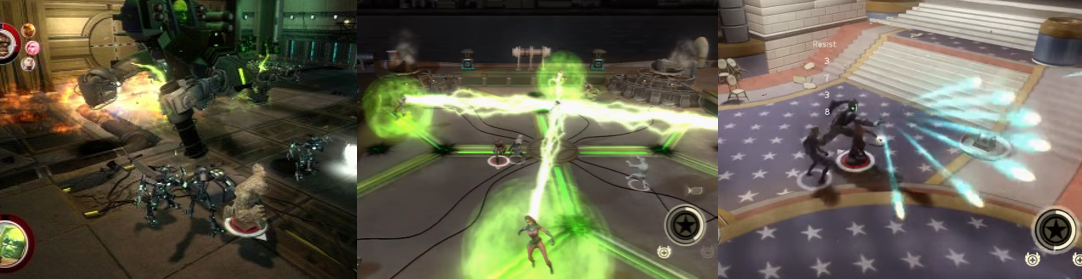
Movie Night: Captain Marvel

Released: 8 March 2019
Director: Anna Boden and Ryan Fleck
Distributor: Walt Disney Studios Motion Pictures
Budget: $152 to 175 million
Stars: Brie Larson, Samuel L. Jackson, Ben Mendelsohn, Jude Law, Lashana Lynch, and Annette Bening

The Plot:
It’s the mid-nineties in the MCU and, across the galaxy, Kree super soldier Vers (Larson) is embroiled in a war against the shape-shifting Skrulls. When the Skrull campaign brings Vers to Earth, she encounters a young Nick Fury (Jackson) and embarks on a journey to recover a mysterious light-speed craft that also reveals the truth about her past as an Air Force pilot.

The Background:
Thanks to a 1953 lawsuit over Fawcett Comics’ superpowered champion, Billy Batson/Captain Marvel, Marvel Comics acquired the trademark to the name “Captain Marvel” in 1967. Originally a superpowered Kree warrior, Stan Lee and Gene Colan’s often-underused Mar-Vell famously died from cancer in 1982 and was followed by a number of successors, with easily the most prominent being Carol Danvers, who become a top-tier female superhero. Although development of a Carol Danvers-led Captain Marvel script can be traced back to 2013, and she very nearly made it into Avengers: Age of Ultron (Whedon, 2015), the critical and commercial success of Wonder Woman (Jenkins, 2017) undoubtedly influenced Kevin Feiges desire to produce a strong, female-led superhero film for the MCU. After a number of challenges regarding her powers, delays, and potential meddling from some less-than-progressive executives, Brie Larson was joined by directors Anna Boden and Ryan Fleck and the film finally got underway. The script made alterations to the character to avoid comparisons to the Green Lantern Corps and present a different type of origin story. Since Carol was pushed as the MCUs most powerful character, and we live in a disappointingly intolerant world, Larson faced an undue and sickening amount of backlash, though all involved were determined to present Carol as someone who draws strength from her femininity. With Samuel L. Jackson also cast, complex de-aging techniques were used to render him twenty-five years younger in place of a body double, and the film was dedicated to the legendary Stan Lee, who died during production. Despite the best efforts of misguided haters to scupper the film, Captain Marvels $1.128 billion made it a big hit at the box office; reviews also largely praised the film, particularly Larsons performance and the blend of nuance, action, and emotion in the narrative. Captain Marvel went on to make an impression in Avengers: Endgame (Russo and Russo, 2019) and cameoed in adjacent spin-off series Ms. Marvel (Various, 2022) before returning to screens in a sequel.
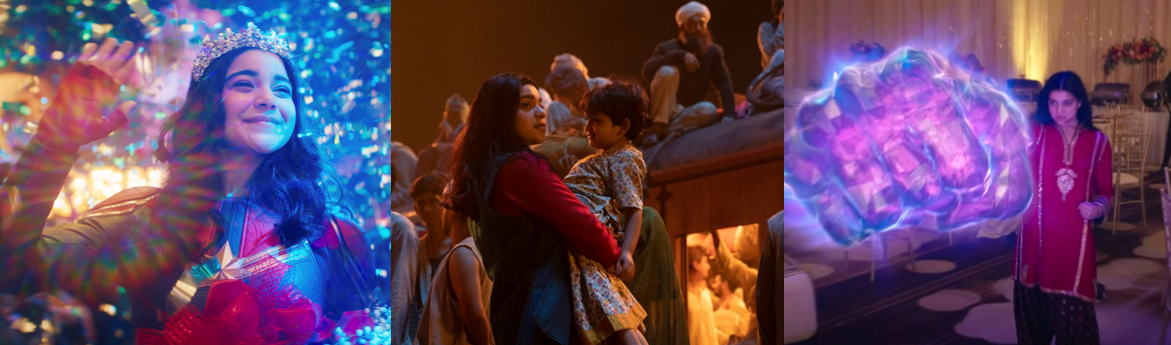
The Review:
Captain Marvel is another of Marvel’s colourful characters who I know very little about; Mar-Vell was long dead by the time I started reading comics and I believe the mantle was in the hands of Monica Rambeau when I got into the medium. Still, I was somewhat aware of Mar-Vell and his time sharing a body with perennial sidekick Rick Jones, and I knew of Carol Danvers as she was occasionally mentioned as being in a coma (or something similar) following an encounter with the X-Man Anna Marie/Rogue, but I wasn’t very familiar with the character prior to the announcement of Captain Marvel. This wasn’t much of a problem for me as I was interested to see a powerful female hero introduced in her own solo movie and I had expected that the film would set the stage for bigger things in the MCU since we were right on the cusp of Avengers: Infinity War (Russo and Russo, 2018) at the time and Marvel’s then-recent acquisition of 20th Century Fox had my imagination running wild over the possibilities of introducing the shape-shifting Skrulls to the MCU. I can fully understand the argument that Natasha Romanoff/Black Widow (Scarlett Johansson) should’ve led the first female-orientated superhero film in the MCU given that she was already an established Avenger by 2019; hell, I would’ve liked to see a film centred around her, Clint Barton/Hawkeye (Jeremy Renner), Nick Fury, and Agent Phil Coulson (Clark Gregg) that explored into their pasts and the formation of the Strategic Homeland Intervention, Enforcement, and Logistics Division (S.H.I.E.L.D.), especially after the events of Captain America: The Winter Soldier (Russo and Russo, 2014). Sadly, it took some time for Black Widow to get her own solo film, but I didn’t mind Captain Marvel beating her to that accolade as she was framed as being a game-changer in the MCU hierarchy and it made some narrative sense given how the MCU was pushing towards cosmic adventures in Phase Two and Three.

Having devoted her life to the Kree cause, Vers is stunned to discover her origins as an Air Force pilot.

Captain Marvel starts with Carol out in the galaxy with no memory of her true identity and already a formidable superpowered warrior. Believing herself to be a Kree soldier named “Vers”, she sees herself as a peacekeeping hero in an increasingly chaotic universe and wouldn’t question her past if she didn’t possess a broken dog tag that gave her her name or dream of a life she doesn’t remember. This uncertainty about her true past and nature makes her powers dangerous and unpredictable; under the tutelage of Yon-Rogg (Law) of Starforce, she is pushed to overcome her weaknesses and be a stoic, unflinching soldier. Vers and Yon-Rogg have a mutual respect for one another and enjoy regular sparring sessions, but he’s riled by her cavalier attitude; she would rather make flippant remarks and wind him up than learn to control her strange energy-based powers, a formidable ability she believes was bestowed upon her by the Kree but one that Yon-Rogg feels she is overly reliant on and which she’s told can be removed from her at any time. Despite the volatile nature of her powers, her impulsive nature, and her offhand attitude towards authority, Vers is a key member of Starforce; led by Yon-Rogg and commanded by the Supreme Intelligence (Bening) – the artificial intelligence that governs Kree society – the team is comprised of sniper Minn-Erva (Gemma Chan), marksman Att-Lass (Algenis Pérez Soto), powerhouse Bron-Char (Rune Temte), and swordsman Korath (Djimon Hounsou). While Ronan the Accuser (Lee Pace) is seen as more of a blunt instrument, bombing targets from afar with his mighty fleet, Starforce goes in at ground level for high-risk infiltration missions. Vers’ dedication to her team and the Kree is without question until she’s captured by Skrull soldiers and subjected to their mind probe, which provides glimpses of an entire life on Earth in which Carol fought to earn her rightful place in the sky as an Air Force pilot. Although initially believing that the Skrulls have implanted false memories into her head, she’s nonetheless left stranded on Earth after escaping their ship and forced to join forces with a young Nick Fury to locate an experimental light-speed engine and its creator, Doctor Wendy Lawson (Bening), a recurring figure in Vers’ dreams, before the Skrulls. Along the way, Vers is stunned to discover that her dreams are memories of her former life on Earth, one that was suppressed by the Kree, and is devastated to learn that the dogma she’s devoted her life to has all been based on a lie.

It’s great seeing Fury take his first steps towards defending the Earth, despite his goofiness.

It’s great to see Coulson back in the MCU; while I appreciated that his death was a significant emotional trigger to galvanise the Avengers, I always felt like he’d been offed too soon, but equally disliked that his death was undone in Agents of S.H.I.E.L.D. (2013 to 2020), even if that show is now considered non-canon. Coulson doesn’t have a huge role here; he’s simply a fledgling S.H.I.E.L.D. agent still earning Fury’s trust and is mostly relegated to comedy relief, but it was nice to see him and get a sense of how he entered Fury’s inner circle. When the Skrulls attempt to order S.H.I.E.L.D. agents to take in Fury dead or alive for colluding with Vers, Coulson immediately senses something isn’t right and chooses loyalty over orders, something which no doubt Fury kept in mind in the years since. It’s even better to delve into Fury’s past; rather than being the all-knowing director of S.H.I.E.L.D., Fury is an active field agent whose perception of the world is upended by Vers, who confirms the presence of alien life (and antagonists) and thus sets Fury on the path to preparing Earth’s defences. A pragmatic and proactive individual, Fury is careful about who he trusts but stands against injustice in all forms; naturally, he’s dismissive of Vers’ claims of an alien invasion since he’s never encountered aliens or superheroes before but he dedicates himself to assisting the Skrull refugees once the truth is uncovered. This mission takes him not only across the country but into space, giving Fury a crash-course in advanced technology and introducing him to the vast and dangerous cosmic threats out in the galaxy through artifacts like the Tesseract. However, as great as it is to see a younger, far less jaded Nick Fury in action, he’s a bit too much of a goof at times. I’m happy for him to go ga-ga over a cute kitty cat, for example, but randomly singing, laughing, and joking seems contrary to his character and I can only assume that he saw some serious shit between this movie and The Avengers/Avengers Assemble (Whedon, 2012). Also, yes, I was a little disappointed that Fury lost his eye from an errant scratch from Goose (Reggie, Archie, Rizzo, and Gonzo), this weird cat-alien “Flerken” that swallows objects whole using tentacles, rather than this injury either being left a mystery or attributed to something a little less comedic.

Although framed as the villains, the Skrulls are simply trying to escape the oppression of the Kree.

Thanks to the Kree, Vers (and the audience) believes that the shape-shifting Skrulls are the film’s antagonists; depicted as terrorists who can assume the form of anyone they see, they can only mimic ( or “sim”) the most recent memories of their hosts, raising Fury’s suspicions about S.H.I.E.L.D. director R. Keller (Mendelsohn). Their invasive probing of Vers details they plan to acquire Dr. Lawson’s light-speed drive to aid in their warring ways, but it turns out that Talos (ibid) and his wife, Soren (Sharon Blynn), are actually refugees who were being aided by Dr. Lawson (actually renegade Kree scientist Mar-Vell), who wished to spirit them to safety after the destruction of their home world at the hands of her race. As Keller, Talos adopts a very strait-laced and bureaucratic demeanour but, in his true Skrull form, he’s much more laidback and speaks with an Australian twang that makes him an affable personality. There’s a tragedy to Talos, who simply wants to be reunited with his people and escape the conflict, and he’s depicted as a simple man driven to extremes in order to free his people, though the blood on his hands is nothing compared to the oppressive nature of the Kree. After being subjected to the Skrull mind probe and finding herself stranded on Earth, Vers’ dreams manifest in real life as her memories bubble to the surface and, seeing a link between her dreams and Project: Pegasus, Vers and Fury head to Louisiana to meet with Captain Maria Rambeau (Lynch), the last person who saw Dr. Lawson alive. Vers is stunned when Maria and her young daughter, Monica (Akira Akbar), recognise her as their old friend, Captain Carol Danvers, an Air Force pilot presumed dead six years ago. Despite being shocked at her wingman’s return, Maria and Monica fill in some of the gaps in Carol’s memory, revealing she was a test pilot for Dr. Lawson, a woman she greatly admired (hence why the Carol sees her when she communes with the Supreme Intelligence). Carol’s entire life philosophy turns on its head when Talos and Soren play black box audio of her plane being shot down, revealing she was charged by Dr. Lawson to carry on her work and ended up being supercharged when she tried to keep the energy core out of Yon-Rogg’s hands. Although robbed of his prize, he chose to take the amnesiac Carol as compensation and indoctrinate her into the Kree way of life in order to manipulate her powers to expand their ruthless campaign against the Skrulls.

The Nitty-Gritty:
Captain Marvel balances a few different genres really well; it starts as a space-epic and, whenever cosmic elements arise, very closely echoes the look and feel of the Guardians of the Galaxy films (Gunn, 2014 to 2023); when Vers crash-lands on Earth and teams up with Fury, it becomes a road trip, buddy-cop take on Thor (Branagh, 2011) as Vers is a super powerful fish-out-of-water. Also, this is a nostalgia trip back to an era very close to my heart, the good old nineties; as such, period accurate fashion, arcade machines, and many references to the Grunge music scene are commonplace. These elements are sometimes a bit in your face (Vers crashes into a Blockbuster, walks around in a Nine Inch Nails t-shirt, and struggles to navigate the thankfully long forgotten realm of dial-up internet) but, generally, they act simply as a backdrop and framing device. Using the nineties is a nice change of pace as well, since all the nostalgia seems to revolve around the eighties these days, and explores a previously unknown time in the wider MCU. For the most part, all these elements come together really well; despite all the negativity I read about Larson and her being a stoic, unemotional robot in the trailers, Vers is actually a very emotive and charming character who makes jokes and quips at the expense of her teammates (and to the frustration of Yon-Rogg) and has a very dry sense of humour most of the time. Larson also expresses Carol’s conflicting emotions about her past and the revelations she uncovers really well, turning sadness and guilt into focused anger. Honestly, I shouldn’t even have to be commenting on this, as trailers are just that…trailers, they show only glimpses of a movie and the characters so to judge Larson completely on the trailers is laughable, especially considering there are plenty of trailers in the MCU that show characters just frowning or being stoic and serious.

The manipulations of the Kree turn Carol from their greatest asset into a formidable threat.

Although I enjoyed seeing the return of Korath and Ronan, their characters don’t get much screen time and I do feel like the film missed a trick by not swapping Bron-Char out for Ronan to expand his character and his prejudices more. I’m not massively upset about this as the focus is on Carol rather than Starforce, but again it feels like they could’ve just had Vers, Yon-Rogg, and Korath be an elite three-person team and had more time to develop their characters instead of pushing four of them to the side. On the plus side, I was very surprised by how well the Skrulls came off, especially as their characterisation is very different from the source material; although they can still shape-shift and are clearly capable of defending themselves, the Skrulls are recast as oppressed and clearly innocent parties in the Kree/Skrull war. Although this initially seemed to lessen the Skrull threat in the MCU, we’ve since seen that antagonistic Skrulls do exist so, while my prediction that they would be an ongoing threat throughout Phase Four wasn’t quite on the money, they’re still portrayed as a surprisingly nuanced race. I’m no Jude Law fan but he did pretty well in this role; he played the smarmy, self-assured leader of Starforce very well and I enjoyed the playful chemistry between him and Vers, which borders on respect, attraction, and frustration due to her impulsive nature and his more pragmatic sensibilities. Carol’s relationship with Fury is somewhat similar; she enjoys toying with him and boasting of the Kree’s reputation as “noble warrior heroes” but he’s so intrigued by aliens that he willingly joins her in her investigation into Project: Pegasus despite the constant injury to his left eye. Similarly, Vers chooses to rescue Fury when the Skrulls target him despite Yon-Rogg’s orders, thus establishing a trust between the two that sees her return to Earth to answer his emergency call and her first concern being his welfare.

Whether on Earth or in space, the film is bolstered by some impressive action and effects.

Although much of the action takes place on Earth, Captain Marvel is full of impressive visual and practical effects; Starforce (and Captain Marvel) reap the benefits of this through some fantastic costume design, which translates Captain Marvel’s outfit to the big screen in immaculate detail and even includes some nods to her other colour schemes when she decides to abandon her Kree colours. Although the Flerken’s effects are a little dodgy, the perfect balance between practical and visual effects bring the Skrulls to life and transform the actors into distinctly different characters, and the progression of de-aging technology is frankly astounding even now (even if Jackson’s age is betrayed during his more active moments). Between the road trip and detective work, there are some pretty solid action sequences; thanks to Goose’s true nature as a weird Lovecraftian alien-monster and Maria’s piloting skills, Carol’s allies are able to contribute to the finale, which sees Fury acknowledge Talos as a friend and ally and Maria take on Minn-Erva in an awesome dogfight sequence that takes more than a little inspiration from Independence Day (Emmerich, 1996). The opening sequence on the foggy world of Torfa shows how ruthless Starforce are when engaging the Skrulls and perfectly establishes the latter’s ability to mimic the appearances of others, and we even get to see just how capable and tenacious Vers is when she resists the Skrull mind probe and fights them off even with her hands and feet bound. Indeed, it should be no surprise that the titular heroine benefits the most from the action sequences; not only does Carol done a fantastically comic accurate suit but she’s capable of some amazing feats with her cosmic powers, which allow her to fire energy blasts, fly, and make her superhumanly durable. Her tenacity for chasing down her enemies is one of her most defining characteristics; highly suspicious of all since she’s been conditioned to believe the Skrulls are her mortal enemy, she has no compunction about attacking old women in broad daylight, leading to a fun action sequence on a train. Even before Carol obtained her unparalleled cosmic powers, she was a skilled enough pilot to engage with a Kree starship but, once she unlocks her true power, Carol makes short work of her former teammates with her concussive energy blasts and cuts through Ronan’s entire armada like it was nothing, effectively establishing her as one of the most powerful superhuman forces in the MCU.

After discovering her true potential, Carol goes full Super Saiyan and vows to protect the galaxy.

After having her memory jogged by the black box recording, Carol leads Talos to the cloaked ship in Earth orbit and it’s discovered that the energy core that allowed Mar-Vell to create her light-speed energy is none other than the Tesseract. More importantly, Talos is finally reunited with his wife and child but their lives, and those of the other Skrull refugees, are immediately threatened by Yon-Rogg and Carol’s former Starforce teammates. Thanks to an inhibitor chip suppressing her cosmic powers, Carol’s forced into a confrontation with the Supreme Intelligence where the xenophobic brutality of the Kree is exposed for her to witness, and to fight against. The Supreme Intelligence’s attempts to break Carol’s spirit only galvanises her when she realises that every time she ever got knocked down, she got back up for more, and this fighting spirit spurs her to reclaim her human name, break her bonds, destroy her inhibitor chip, and finally realise the full extent of her powers, which sees her adopt a golden hue almost akin to a Super Saiyan. Having witnessed the awesome extent of Carol’s true power, Yon-Rogg attempts to goad her into battling him on equal ground but, in a fantastic subversion of expectations, she simply knocks his ass down and refuses to rise to the bait. Finally reconciling her past with her present, Carol ships Yon-Rogg back to the Kree home world and vows not only to end their warring ways but also to find the Skrulls a new home away from further conflict. Before heading out into the galaxy, Carol bids farewell to Maria and Monica and hands Fury the modified pager device seen at the end of Avengers: Infinity War, for use “in emergencies only”. His eye opened to impending cosmic threats, Fury begins outlining defensive measures for the world, dubbing it the “Avenger Initiative” after Carol’s call-sign, which brings the MCU full circle and emphasises Carol’s influence in the wider MCU. As for post-credits scenes, the first is a mid-credits scene in which Carol drops in on the survivors from Avengers: Infinity War and the second is a relatively lacklustre sequence in which Goose coughs up the Tesseract on Fury’s desk.

The Summary:
There was a lot of toxic backlash surrounding Captain Marvel when it first released; I’m not entirely sure what the perception of Brie Larson and her performance is now as it’s been a while since we’ve seen her in the MCU, but I was pleasantly surprised with how her solo film turned out. As a mixture of the first Guardians of the Galaxy and Thor, Captain Marvel separated itself not just by introducing a strong, new female hero into the MCU but in its nineties setting and shedding new light on Fury and Coulson’s early S.H.I.E.L.D. days. I thought Brie Larson was great; she played Vers as an arrogant and proud warrior and contrasted this wonderfully with Carol’s more conflicted but no less determined humanity and I enjoyed her interactions with her supporting cast, which showed her to be a very nuanced character fully capable of cracking jokes, smiling, and applying herself in a fight. Obviously, Captain Marvel is framed primarily as a female-led film with a feminist agenda about females being powerful and independent but it wasn’t as in your face as some haters would have you believe; Vers is mostly portrayed as an equal among men, especially on Earth, and is only ever seen as less due to her inability to control her powers and emotions. This is primarily beaten into her by Yon-Rogg, a character who isn’t exactly a bastion of emotion and righteousness, and gives her an oppressive male force to rally against but it’s telling that the Supreme Intelligence takes the form of a strong, manipulative, and ruthless woman, with both attempting to force Carol into bending to their will by trying to degrade and control her. I enjoyed that Captain Marvel framed itself fun buddy-cop movie with science-fiction influences and action sequences but also that it told a relatable story of a strong-willed female overcoming the odds and standing up against injustice, whether it’s against her or a race of shape-changing refugees or pits her against one of the galaxy’s most formidable armadas and I really hope Marvel double-down on Carol’s importance to the hierarchy of the MCU, especially on the cosmic side of things.

My Rating:

Rating: 4 out of 5.

Great Stuff

Did you enjoy Captain Marvel? What did you think to Brie Larson’s performance and Carol’s characterisation in the film? Were you surprised that the Skrulls were changed to be a less antagonistic threat? Did you see Yon-Rogg’s heel turn coming? What did you think to Carol’s power level and seeing her go full Super Saiyan at the end? Would you have liked to see a little more from Ronan and Starforce? Were you disappointed by the way Fury lost his eye and what did you think to the film’s de-aging effects? To share your thoughts on Captain Marvel, whatever they may be, drop them below or leave a comment on my social media and be sure to check out my other Captain Marvel content.