Screen Time [Multiverse Madness]: What If…? (Season One)


In September 1961, DC Comics published “Flash of Two Worlds” (Fox, et al), a landmark story that brought together two generations of the Flash: the Golden Age Jay Garrick and the Silver Age Barry Allen thanks to the concept of the multiverse, an infinite number of parallel universes that allowed any and all stories and characters to co-exist and interact. Marvel Comics would also adopt this concept and, to celebrate the release of Doctor Strange in the Multiverse of Madness (Raimi, 2022) this month, I’ve been both celebrating the Master of the Mystic Arts and exploring the Marvel Cinematic Universe’s (MCU) equivalent of the multiverse every Sunday of May.


Air Date: 11 August 2021 to 6 October 2021
Network: Disney+
Stars: Hayley Atwell, Chadwick Boseman, Samuel L. Jackson, Benedict Cumberbatch, Mark Ruffalo, Michael B. Jordan, Chris Hemsworth, Ross Marquand, and Jeffrey Wright

The Background:
As a big comic book fan, it’s been absolutely amazing seeing the MCU become a multimedia juggernaut and some of Marvel Comics’ most beloved characters and concepts come to life on screen. Although Marvel Studios dabbled in television ventures with the likes of Agents of S.H.I.E.L.D. (2013 to 2020) and their Netflix shows, they really doubled down on TV productions for the MCU’s fourth phase to produce content for their parent company’s streaming service, Disney+. With MCU head honcho Kevin Feige behind them, the Disney+ shows aimed to maintain and expand the ongoing continuity of the MCU, but I don’t think anyone could have predicted that Marvel Studios would delve so deeply into the multiverse that we’d seen an adaptation of What If…? What If…? began life as a semi-consistent series of hypothetical, often light-hearted (or downright dark), stories that presented Marvel heroes and storylines with subtle (or major) changes. The Disney+ show followed this format and recontextualised the premise as an animated anthology series that would explore what the MCU would be like if characters or events had unfolded differently. The show’s animation was headed by Stephan Franck and sported a cel-shaded design that emphasised hyper-realism; as the MCU was officially exploring the concept of the multiverse, episodes could be part of the franchise’s overall canon and many recognisable faces, names, and voices returned to put a new spin on their iconic roles; however, although voice recording was able to continue remotely during the COVID-19 pandemic, this production sadly marked the final performance of the late Chadwick Boseman as T’Challa/Black Panther. What If…? was received extremely well and the series was praised as a love-letter to the fans; despite some reservations about the format and presentation, reviews were primarily positive and spin-offs were quickly announced as either being in production or on the cards. Crucially, the multiversal scope of the series would be revisited in the live-action MCU films and characters and concepts from the show even seem set to cross over into the main MCU canon going forward.

The Plot:
From beyond the multiverse, the cosmic being known as Uatu the Watcher (Wright) observes as the events of the MCU unfold differently, resulting in Peggy Carter (Atwell) becoming Captain Carter, Doctor Stephen Strange (Cumberbatch) becoming a force for evil, a zombie infection running rampant, and T’Challa (Boseman) becoming Star-Lord. However, when a version of Ultron (Marquand) acquires the Infinity Stones and threatens the entire multiverse, the Watcher must break his oath of non-interference to assemble a heroic force capable of fending off this threat.

The Review:
Because of the nature of the series, I think it’d be much better to look at each individual episode, what they do and how they work by themselves, and then talk about some overall themes and give my opinion on the entire concept down in the summary. The first season of What If…? is a nine-episode series of animated adventures that examine familiar characters and events in the MCU but change things about in subtle, or major, ways to create entirely new stories as part of the MCU multiverse. These alternate realities are observed by the enigmatic Watcher, a cosmic being bound only to observe and never directly interfere, and who acts as the narrator of the show. The Watcher’s opening narration explains the basics of the multiverse; as we were told in Avengers: Endgame (Russo and Russo, 2019), time and reality in the MCU is not a single, linear, fixed path. Instead, multiple timelines and alternate universes exist, with the deviations occurring from different decisions being made at key moments in time, however big or small. In this regard, time is less like a line and more like a river, with an infinite number of paths trailing off all over the place, and the Watcher acts as our impassive guide to this vast multiverse. The Watcher also serves as our narrator, quickly catching us up on the events preceding the episode and explaining when, where, and how each divergent timeline was created; however, he has taken a solemn vow to never interfere in the events he witnesses, no matter how gruesome or extreme they are.

Peggy takes Steve’s place and is forced to make the ultimate sacrifice to stop Hydra’s interdimensional beast.

The series kicks off with “What If…Captain Carter Were the First Avenger?” (Andrews, 2021), essentially a retelling of Captain America: The First Avenger (Johnston, 2011). Unlike in the original timeline, Strategic Scientific Reserve (SSR) Agent Peggy Carter chooses to stay and watch on the ground as skinny, ill-bodied Private Steve Rogers (Josh Keaton) prepares to become a super soldier. However, when the Nazi sleeper agent attacks the experiment this time around, Peggy manages to keep him from escaping with a sample of the serum but Steve is wounded, so Peggy ignores the orders of her commanding officer, John Flynn (Bradley Whitford), and voluntarily becomes enhanced to the peak of human physical conditioning before the experiment is lost forever. Promoted to head of the SSR, Flynn is outraged at the result; disgusted that the super soldier serum was wasted on a woman, he refuses to allow Peggy to actively participate in the war, much less on the front line, out of sheer prejudice, much to her chagrin and fury. As before, Hydra figurehead Johann Schmidt/The Red Skull (Marquand) seeks to usurp Adolf Hitler and claim victory for himself with the mysterious and all-powerful Tesseract. Flynn, however, is unimpressed by the threat and unwilling to risk even one man, let alone an entire platoon, on recovering the cube; luckily, inventor Howard Stark (Dominic Cooper) believes so strongly in the Tesseract’s threat that he furnishes Peggy with a striking Union Jack-style costume and a familiar Vibranium shield so that she can single-handedly recover the Tesseract from Schmidt’s Hydra colleague, Doctor Arnim Zola (Toby Jones), decimating an entire convoy of Hydra’s soldiers with efficiency and glee and earning herself an official promotion to “Captain Carter”. Although he lost his best shot at fighting alongside his friend, Sergeant James Buchanan “Bucky” Barnes (Sebastian Stan), Steve is fully supportive of Peggy’s newfound strength and abilities and only too glad to pilot Stark’s Tesseract-powered “Hydra Stomper” armour. However, following an action-packed montage, Steve is apparently lost during a familiar assault on an armoured train; though grief-stricken, Peggy forces information out of Zola and leads an all-out assault against the Red Skull’s fortress, where they find Steve alive but are too late to stop the Red Skull from opening a dimensional rift with the Tesseract. The tentacles of a gigantic, interdimensional, Lovecraftian creature breach the portal, killing Schmidt and threatening all life on Earth; Peggy and Steve fend off the beast as Stark tries to shut down the portal, but Captain Carter is forced to sacrifice herself to the unknown by physically forcing the creature through the rift. The story then skips ahead to find the Tesseract being reactivated, spitting Peggy and the remains of the beast’s tentacles out into a Strategic Homeland Intervention, Enforcement, and Logistics Division (S.H.I.E.L.D.) facility where she meets Director Nick Fury (Jackson) and Agent Clint Barton/Hawkeye (Jeremy Renner) and learns the bittersweet news that the Allied Forces won the war but she is now seventy years in the future, and thus forever cut off from her friends and loved ones.
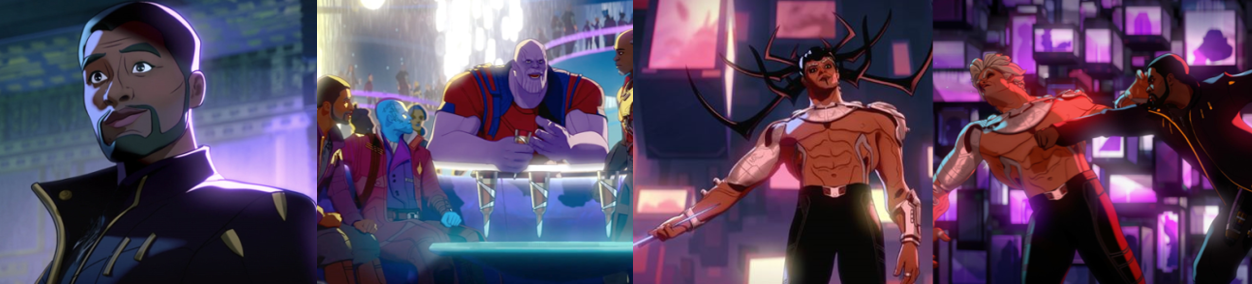
T’Challa is a galaxy-renowned force for good who has a positive influence on even the Mad Titan!

While the first episode arguably played things a little safe, we really see the potential of a What If…? series with the second episode, “What If…T’Challa Became a Star-Lord?” (Andrews, 2021), which wildly deviates from the story of Guardians of the Galaxy (Gunn, 2014). Young T’Challa (Maddix Robinson) longed to explore beyond Wakanda but was shielded from the chaotic outside world by his beloved and overprotective father, T’Chaka (John Kani), only to be abducted due to a mistake by Yondu Udonta’s (Michael Rooker) subordinates. Surprisingly, he was excited at embarking on adventures throughout the cosmos with the Ravagers and, while T’Challa doesn’t possess the Black Panther’s near-superhuman abilities, he sports all of Peter Quill’s (Brian T. Delaney) gadgets in addition to his Wakandan fighting prowess. His greatest assets, however, are his charisma, diplomacy, and reputation as a Robin Hood-type figure. Indeed, T’Challa is far more competent, notorious, and respected than his mainstream MCU counterpart; not only does Korath the Pursuer (Djimon Hounsou) know who he is, he views sparring with Star-Lord as the greatest honour and willingly joins his crew. T’Challa’s positive influence means the Ravagers put their skills towards helping others rather than for personal reward, thus sparing Drax the Destroyer’s (Fred Tatasciore) family and even convincing Thanos (Josh Brolin) that his destructive aspirations weren’t the answer to the galaxy’s problems! Touched by T’Challa’s mission to save others after the presumed destruction of Wakanda, Nebula (Karen Gillan), now a far less violent and far more beautiful woman, proposes a heist to steal the Embers of Genesis, a cosmic dust capable of ending galactic hunger, from Taneleer Tivan/The Collector (Benicio del Toro). While sneaking around the Collector’s museum, T’Challa finds a Wakandan spacecraft and is angered to find that Yondu lied to him about Wakanda in order to help him realise his true calling as an adventurer. The two reconcile in the best way possible: by teaming up to fight with this much more formidable version of the Collector, who is enhanced by weapons, technology, and items retrieved from some of the MCU’s most powerful and prominent individuals and races. Thanks to their teamwork, the Collector is disarmed and left at the mercy of his captives, and T’Challa forgives Yondu’s deception before reuniting with T’Chaka and his people in Wakanda, bringing his two families together in celebration over their mutual friend. Across the world, however, a greater threat awaits when Ego (Kurt Russell) comes looking for his son, here a mere Dairy Queen employee.
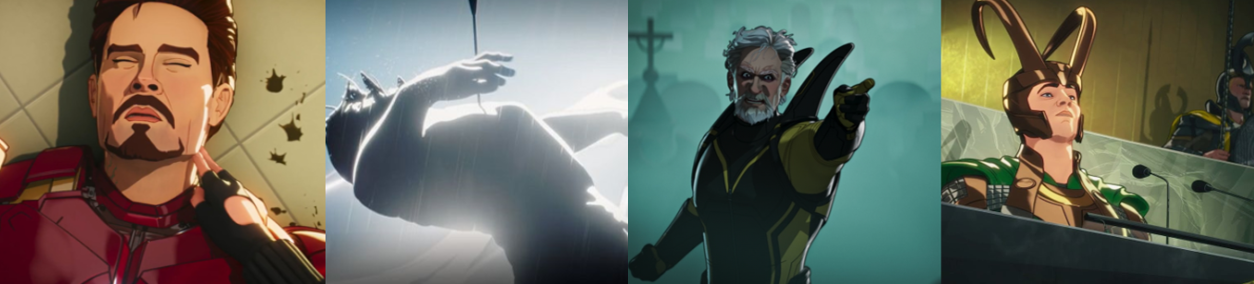
Pym is revealed as the culprit but, after he’s apprehended, Loki usurps his threat and conquers the world!

“What If…the World Lost Its Mightiest Heroes?” (Andrews, 2021) takes us back to the middle of Iron Man 2 (Favreau, 2010) and Nick Fury and Natasha Romanoff/Black Widow’s (Lake Bell) latest effort to recruit Tony Stark/Iron Man (Mick Wingert) to the Avengers Initiative. Fury is horrified when his attempt to stave off Stark’s palladium poisoning apparently has the unexpected side effect of killing the would-be Avenger; this tragedy is quickly followed by Thor Odinson (Hemsworth) being accidentally killed by Hawkeye’s errant arrow and the archer later being found dead while locked in an impenetrable S.H.I.E.L.D. cell. Fury suspects that his recruits are being targeted by an unknown party, and charges Natasha to escape Brock Rumlow’s (Frank Grillo) custody and make contact with Doctor Betty Ross (Stephanie Panisello). Though initially distrustful of Natasha due to her association with those who’ve hounded her friend, colleague, and former lover, Doctor Bruce Banner/The Hulk (Ruffalo), Betty is convinced to take a closer look at the injector used on Stark and theorises that a microscopic projectile fired from the needle killed the superhero. Hungry for blood after learning of Hawkeye’s death, Natasha agrees with Fury’s theory that their killer is targeting Avengers recruits; unfortunately, General Thaddeus “Thunderbolt” Ross (Mike McGill) arrives looking to arrest Banner and sparks his transformation into the rampaging Hulk as in his solo film. However, the seemingly immortal Green Goliath also falls victim to the mysterious killer when he violently explodes from the inside out, and things escalate even further when Loki Laufeyson (Tom Hiddleston) arrives looking to avenge Thor’s death. Fury manages to buy himself one day to solve Thor’s murder on the promise of delivering the culprit to the God of Mischief and, when Natasha finds that a dead agent’s credentials were used to access S.H.I.E.L.D.’s database, she’s brutally beaten to death by an unseen assailant, and only able to tell Fury that all the deaths are relating to “hope”. This, however, is enough to piece together the perpetrator’s true identity: Doctor Hank Pym (Michael Douglas), who targeted Fury’s recruits in the guise of the size-altering Yellowjacket after his daughter, Hope van Dyne (Evangeline Lilly), died while working for S.H.I.E.L.D. A broken, bitter, twisted old man, Pym blames Fury and has become a deranged killer due to his grief and anger. However, Pym and his tech are outmatched when Fury is revealed to be Loki in disguise but, after Pym is defeated and taken into Asgardian custody, Loki double-crosses Fury and declares himself ruler of humanity. To combat this threat, Fury gets back to work assembling his super team, starting with calling Carol Danvers/Captain Marvel (Alexandra Daniels) back to Earth and uncovering Captain America’s frozen body.

A grief-stricken Dr. Strange finds he cannot save his love no matter how much he alters the past.

The show shifts over to the world of magic and mysticism for “What If…Doctor Strange Lost His Heart Instead of His Hands?” (Andrews, 2021), which presents a world where Dr. Strange and Doctor Christine Palmer (Rachel McAdams) are still a couple in a loving relationship. Fully supportive and enamoured by Dr. Strange, Christine encourages his ego and his skills as a surgeon, but sadly her influence doesn’t extend to his driving skills. However, in this world, Dr. Strange is relatively unharmed from the car crash that took his MCU counterpart’s hands but is left grief-stricken when Christine dies as a result of his negligence. In a bid to fill the void in his life, and his heart, Strange travels the world and, once again, ends up studying the mystic arts at Kamar-Taj under the tutelage of the Ancient One (Tilda Swinton). Like his mainstream counterpart, Strange becomes the Master of the Mystic Arts after the Ancient One’s death and successfully bargains with the Dread Dormammu (Cumberbatch), but remains preoccupied with the mistakes of his past and the promises offered by the Eye of Agamotto’s time-bending abilities. Haunted by memories of happier times with Christine, Strange ignores the warnings of the Ancient One and his manservant, Wong (Benedict Wong), and uses the Eye to place his current consciousness into the body of his past self. Unfortunately, the tragedy still occurs no matter how safely he drives, which route he takes, or even his refusal to go to the award speech as Christine dies again and again whether he’s there or what he does. Dr. Strange’s anguish at being unable to save Christine isn’t helped by the Ancient One’s explanation that her death cannot be averted as it would create a potentially universe-destroying time paradox (if Strange prevents her death, he won’t become a sorcerer and be able to go back and save her).

Strange Supreme saves Christine, but only briefly and at the cost everything that ever is or was in his reality.

Refusing to believe that Christine is fated to die, and angered at the Ancient One’s refusal to help him break this “absolute point” in time, Dr. Strange uses the Eye to flee from the confrontation and consult the ancient tomes of the Lost Library of Cagliostro. There, he meets O’Bengh (Ike Amadi) and learns that one can potentially gain the power he requires by absorbing magical beings; thus, Dr. Strange conjures a variety of demonic, Lovecraftian, and magical creatures (including gnomes, familiars, dragons, and even the octopus-like creature Captain Carter fought). When they won’t willingly share their power, he resolves to forcibly take it, and quickly becomes obsessed with gaining more and more magical power from these entities over the course of centauries to become “Strange Supreme”. As he does so, he grows increasingly monstrous and takes on more of their attributes, but is shocked to learn from O’Bengh that he’ll never be powerful enough to achieve his dreams due to the Ancient One using magic from the Dark Dimension to split him in two and create two concurrent timelines. His other half, who took Wong’s advice and moved on from Christine’s death, is charged by an echo of the Ancient One to oppose his dark doppelgänger before his ambition erases all of reality. When Strange Supreme’s attempts to coerce his other half into joining his cause are rejected, a magical battle ensues that spans multiple dimensions. Despite Wong’s protective spells and Strange’s efforts to talk down his dark half, Strange Supreme’s centauries of basking in the powers of countless magical beings makes him the superior and he’s ultimately able to absorb his missing half. Finally whole again, Strange Supreme succeeds in undoing Christine’s death but is transformed into a demonic being by the effort this requires; understandably, she is horrified by his nightmarish appearance, and he’s left helpless to stop the time paradox from devouring all of his reality. Desperate to preserve the world, he begs the Watcher for help but he refuses to get involved, despite wishing to punish Strange Supreme’s reckless arrogance, and the once Sorcerer Supreme is left alone, despondent, and remorseful in the tiniest pocket of reality with nothing but his grief and regret for company.

Banner is horrified to find the world, and many of its heroes, infected by a zombie virus.

One popular, recurring storyline in Marvel Comics in recent years has been the Marvel Zombies spin-off (Various, 2005 to present) that tells of a devastating zombie plague overwhelming the Marvel universe (and beyond). A version of this reality is explored in “What If…Zombies?!” (Andrews, 2021), which finds the Hulk crash-landing into the Sanctum Sanctorum as in Avengers: Infinity War (Russo and Russo, 2018) only to find it, and the streets of New York City, deserted. When Iron Man, Dr. Strange, and Wong arrive to take care of Ebony Maw (Tom Vaughan-Lawlor) and Cull Obsidian (Terry Notary), Banner’s elation soon turns to horror when the three are revealed to be vicious, flesh-eating zombies who tear Thanos’s children to shreds, instantly infecting them in the process, and Banner is only saved from the same fate thanks to the timely intervention of Dr. Strange’s Cloak of Levitation, a swarm of ants commanded by Hope van Dyne/The Wasp, and Peter Parker/Spider-Man (Hudson Thames). Spider-Man’s amusing orientation video shows that the MCU’s zombies largely confirm to the “rules” commonly associated with their kind; they’re decomposing corpses with a voracious hunger who turn others with a single bite and can only be killed by removing the head or destroying the brain. However, they’re not as mindless or shambling as traditional zombies; they’re intelligent enough to co-ordinate their attacks and utilise tech like the Iron Man armour and magic like the Sling Rings. In a change of pace, the Watcher reveals a definite origin for the zombie outbreak by relating how Janet van Dyne (Michelle Pfeiffer) became infected with the virus while stuck in the Quantum Realm; when she bit Hank Pym, he brought the virus back with him and the entire world was quickly overrun once the Avengers were turned.
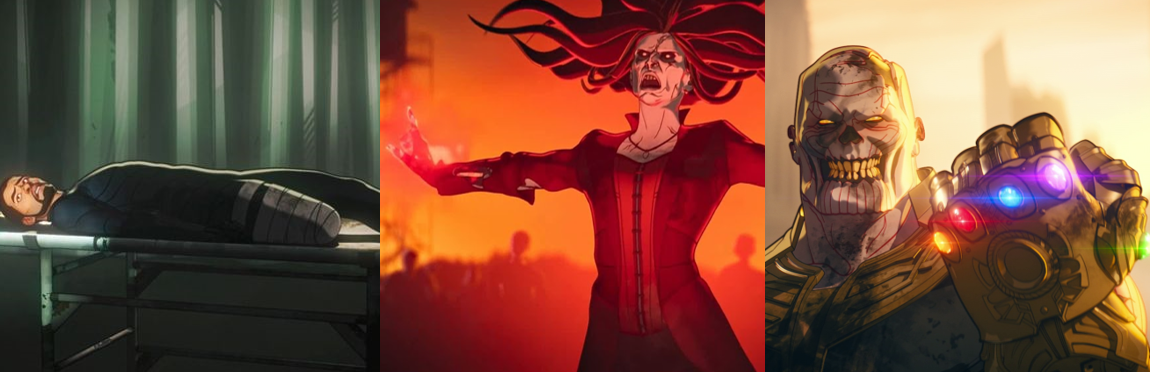
The survivors narrowly escape Zombie Wanda, completely unaware of a greater threat waiting in Wakanda.

Banner joins up with the few uninfected survivors and learns from Okoye (Danai Gurira) of a possible cure at Camp Lehigh, New Jersey; the group travel to the Grand Central Station, where they’re attacked by zombified versions of Sam Wilson/The Falcon (Anthony Mackie), Hawkeye, and Captain America. Although they lose Harold “Happy” Hogan (Jon Favreau), the group is able to get the train working and fend off the zombies thanks to Okoye and the Wasp. However, the train is attacked by Zombie Cap, who infects Sharon Carter (Emily VanCamp) and forces Bucky to end his undead existence, retrieving his shield in the process, but Hope is also infected from a small cut she receives after disposing of Sharon. Although Peter tries to remain optimistic that she’ll be cured before she can turn, Hope sacrifices herself to atone for her part in causing the outbreak by carrying the group through a horde of zombies and dropping them off at Camp Lehigh. There, they find the zombies refuse to breach the camp thanks to the presence of the Mind Stone in the Vision’s (Paul Bettany) head; he and the severed head of Scott Lang (Paul Rudd) reveal that the Mind Stone’s properties can reverse the zombie virus, and the group is excited to spread the cure throughout the world from Wakanda. However, Banner learns that they’re not the first to respond to the Vision’s beacon, and Bucky is horrified to find that the Vision has been feeding parts of other survivors (including T’Challa) to a zombified version of Wanda Maximoff (Elizabeth Olsen) since she’s proven resistant to the Mind Stone and he’s been unable to kill her due to his love for her. When Wanda breaks free and proves uncontrollable due to her powers and hunger, the Vision rips the Mind Stone out of his head to atone for his actions and the group’s escape is covered by Bucky and the Hulk, who finally emerges from Banner’s psyche and is able to resist the zombie’s bite and hold back Wanda so the others can take off. The one-legged T’Challa, beheaded Lang, and shellshocked Peter console themselves with the knowledge that they’ll be able to save the world once they reach Wakanda, completely unaware that the nation has already succumbed to the infection and is under the rule of a zombified Thanos and his partially-completed Infinity Gauntlet!

Killmonger rescues Stark and becomes his most trusted confidante to kill his way to his birthright.

We then go back to where the MCU all started in “What If…Killmonger Rescued Tony Stark?” (Andrews, 2021), which recreates the opening moments of Iron Man (Favreau, 2008) with one key difference: right as Tony Stark is about to be injured by one of his own missiles, he’s saved by N’Jadaka/Erik Stevens/Killmonger (Jordan), who fends off the Ten Rings soldiers looking to kidnap Stark and thus means that the genius, billionaire philanthropist never learns the humility or courage that led to him becoming Iron Man. Instead, he remains a conceited, arrogant, self-serving glory hound who believes that he needs to build bigger, better weapons to protect America’s interests. To that end, he drafts in Killmonger, who wastes no time in publicly outing Obadiah Stane (Kiff VandenHeuvel) as the man who bankrolled the Ten Rings’ attack on Stark, and Stark is so grateful to his saviour that he quickly promotes Killmonger to his new Chief Operations Officer, alienating Virginia “Pepper” Potts (Beth Hoyt) in the process. Killmonger swiftly becomes Stark’s closest friend and confidante and, together, they create robot drones, the “Liberators”, based on Killmonger’s fandom for anime. Killmonger pushes Stark to use Vibranium as a power source for the Liberators, and Stark sends in Colonel James “Rhodey” Rhodes (Don Cheadle) to steal some from Ulysses Klaue (Andy Serkis). However, the Black Panther attacks the meeting to recover stolen Vibranium, only for Killmonger to reveal his true intentions and kill T’Challa with one of Stark’s weapons. He chastises Rhodey for wearing the uniform of his oppressors and kills him with the Black Panther’s claw to make it seem like they killed each other; thanks to Just A Rather Very Intelligent System (J.A.R.V.I.S.; Bettany), however, Killmonger’s actions are revealed to Stark. Stark tries to avenge his friend’s murder using a Liberator, but Killmonger easily bests the drone and kills Stark with a Dora Milaje spear, which escalates the tensions between the United States and Wakanda into all-out war. General Ross assumes control of Stark’s assets and the Liberators are pushed into mass production; Killmonger then kills Klaue in order to deceive the Wakandans, then seizes control of the Liberators to lead his people in “defeating” the invading army. His victory and battle prowess wins over his uncle, T’Chaka, and earns him the mantle of the Black Panther; however, T’Challa’s astral warnings of Killmonger’s impending defeat are left a distinct possibility not only due to Ross’s obsession with continuing the war but also when Pepper and Shuri (Ozioma Akagha) agree to work together to expose Killmonger’s deception.
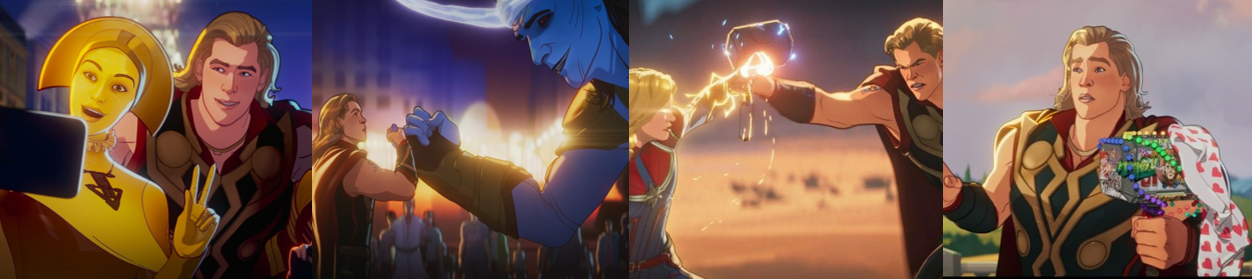
This Thor just wants to party, but his good time is spoiled by Captain Marvel and Jane blabbing to Frigga.

“What If…Thor Were an Only Child?” (Andrews, 2021) lightens things up a bit by retelling the events of Thor (Branagh, 2011); in this version of the story, in the absence of a brother to grow up alongside, Thor is little more than a lackadaisical, party-loving frat-boy who, despite still being worthy of Mjölnir, is far more interested in wasting time revelling with his friends than following his mother, Frigga’s (Josette Eales), instructions to behave or becoming a bore like his father, Odin Allfather (Anthony Hopkins). To avoid the all-seeing gaze of Heimdall (Idris Elba), Thor and his drinking buddies head the Midgard, the most backwater, insignificant world in all the Nine Realms, and invite guests from all over to join them in a massive, nonstop party. Tracking the cosmic disturbance and fearful of an alien invasion, Doctor Jane Foster (Natalie Portman) investigates and is both disturbed to find that Thor’s parties are so out of control that they can kill planets and won over by the Thunder God’s otherworldly charm. Jane and her intern, Darcy Lewis (Kat Dennings), join the party, quickly being swept up in all the intergalactic chaos and merriment on display; Darcy even marries Howard the Duck (Seth Green), and Jane and Thor get matching tattoos, but soon wake up to massive hangovers and the arrival of S.H.I.E.L.D. Acting Director Maria Hill (Cobie Smulders) is deeply concerned that Thor is leaving a trail of destruction as he takes his party on the road, and calls in Captain Marvel to assist with the perceived threat. Thor’s reunion with fellow party animal Prince Loki of Jotunheim is interrupted by Captain Marvel’s arrival; Thor brushes off her demands that he leaves, and a fight ensues that sees the two battle all across the globe. Despite Thor’s petulant, childish nature, the two are seemingly equally matched in terms of power and durability, but Carol’s forced to hold back her full power to avoid damaging the world or endangering lives. Since Jane disagrees with attacking or eliminating Thor since she’s so enamoured by him, she uses her tech to contact Heimdall and literally tells on Thor to Frigga. As Hill prepares an all-out nuclear strike against Thor, he’s terrified by Frigga’s impending arrival and begs his guests to help him clean up all evidence of their shenanigans. Despite Thor’s best, most frantic efforts to put right all the anarchy he and his friends had caused, she sees through his deception; however, rather than being mad at Jane for selling him out, he thanks her for teaching him a lesson in humility and asks her out…only for he, and the Watcher, to be stunned by the sudden appearance of an alternate version of Ultron!
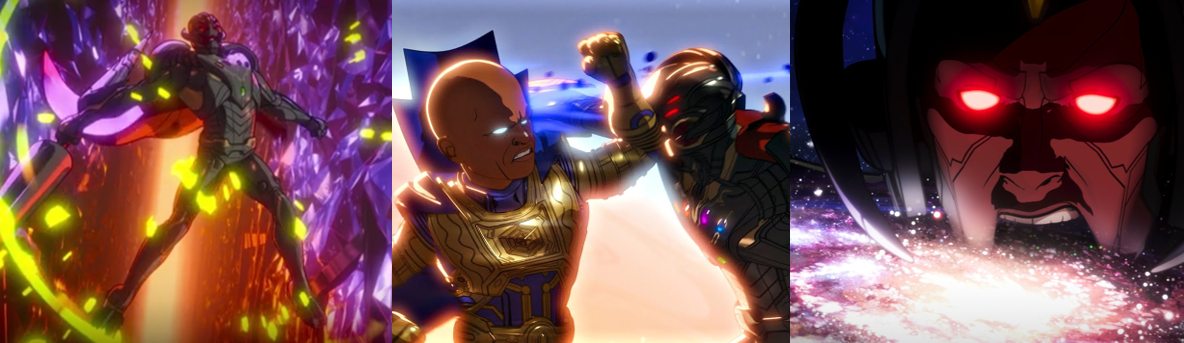
This alternate version of Ultron is such a threat to the multiverse that the Watcher is forced to intervene.

This cliff-hanger is explained in the following episode, “What If…Ultron Won?” (Andrews, 2021), which presents a post-apocalyptic world where Black Widow and Hawkeye are the only Avengers left to oppose the all-powerful Ultron. In this world, Hawkeye not only sports his ridiculous mohawk and a mechanical right arm, but Ultron successfully fulfilled its goal to cause an extinction-level event by claiming the Vision’s body as its own, killing Iron Man, Cap, and Thor, and launching a worldwide nuclear attack that decimated humanity. When Thanos arrived looking to retrieve the Mind Stone, Ultron split him in two with one shot and claimed the Infinity Stones for itself, becoming a God-like being capable of laying waste to entire worlds and Realms with its endless supply of drones. Asgard, Ego, Xandar, and countless others all fall before Ultron’s power and even Captain Marvel is unable to oppose it; having eradicated the vast majority of life across the universe and ascended to a higher pane of existence, Ultron not only sees but also hears the Watcher. Although the Watcher previously considered intervening in Dr. Strange’s story, he held true to his vow of non-interference since he deals in a cosmic balance beyond the lives of mere mortals, even ones as powerful as the Master of the Mystic Arts. However, Ultron’s threat is so terrifying even to this cosmic observer that the Watcher is sorely tempted to assist Natasha and Clint in their efforts to coerce Zola’s artificial intelligence into helping them. The Watcher is pleased when their perseverance pays off but, although Zola is able to possess one of Ultron’s drones, he cannot shut down Ultron’s hive mind as Ultron is outside of the known universe, meaning Clint is forced to sacrifice himself so that Natasha and Zola can escape. The Watcher is aghast when Ultron not only does the impossible and breaches his cosmic observatory but is also able to match even the Watcher’s cosmic power. Their battle sees them literally smashing the dimensional barriers into numerous alternate realities and sees Ultron devour a whole universe and force the Watcher to flee. While Ultron prepares to lay waste to the entire multiverse, the Watcher is forced to turn to Strange Supreme for help in opposing Ultron’s threat.

The Guardians of the Multiverse join forces to end Ultron’s threat.

This story, and the entire show, comes to a head in the final episode, “What If…the Watcher Broke His Oath?” (Andrews, 2021), which sees the Watcher recruiting Captain Carter, T’Challa Star-Lord, Killmonger, Party Thor, and a previously unseen version of Gamora (Cynthia McWilliams) to join Strange Supreme as the Guardians of the Multiverse. He enlists each of them right as they’re in the middle of tying up loose ends from their respective episodes and emphasises that every one of them is needed to protect something even bigger than their individual lives or concerns. Captain Carter immediately recognises the gravity of the situation, while Strange Supreme sees this as his chance at true redemption, and, despite the odds, they all tentatively agree to work together to combat Ultron, steal his Soul Stone, and destroy it using Gamora’s “Infinity Crusher” device. While Strange Supreme struggles to contain the dark magics within his body, Gamora is troubled by Killmonger’s obsession with Ultron’s technology, and Thor accidentally attracts Ultron’s attention, but the group is thankfully shielded by Strange Supreme’s protection spell. Following Captain Carter’s lead, the Guardians are able to launch a co-ordinated attack that allows T’Challa to swipe the Soul Stone; when Ultron makes short work of Zombie Wanda and follows the Guardians to its home reality, it gets summarily pummelled by the Guardians’ repeated attacks and Strange Supreme’s ability to counteract both Ultron’s Time Stone and match its enlarged form with his monstrous magic. Although they’re stunned to find the Infinity Crusher ineffectual because it and the Infinity Stones are from different realities, Ultron’s threat is ended when Captain Carter helps Natasha avenge Clint and fire an arrow containing Zola’s consciousness into Ultron’s armour, erasing its sentience once and for all. In the aftermath, Killmonger claims Ultron’s armour and proposes using the Infinity Stones to “fix” their universes; when they refuse, he attempts to destroy them and they’re saved by a Zola-controlled Vision, who tries to take the Infinity Stones for himself. Before they can properly get into a potentially devastating battle over the gems, Strange Supreme freezes them in time and seals them within a pocket dimension, ending their threat once and for all. The Watcher trusts Strange Supreme with watching over the two, and returns everyone to their proper place and time; since Natasha’s world was left lifeless by Ultron, the Watcher sends her to help Nick Fury overthrow Loki, and then alters his vow of impassive observation to a pledge to protect the multiverse when needed.

The Summary:
At first, I wasn’t too sold on What If…?’s animation style; the slick, computerised cel-shaded look has never been a favourite of mine, but I was quickly won over by it due to how closely each character and episode mirrors their live-action counterparts. Everything from the recreation of certain shots, to the musical cues, to the costumes and likenesses perfectly emulates the source material each episode is based on, meaning we get the brown-hued colour scheme of World War Two for Captain Carter, the barrage of bizarre cosmic colours for Star-Lord, and the industrial, high-tech grey of Stark and S.H.I.E.L.D. facilities. Although some notable names from the MCU didn’t return to lend their voices to their iconic characters, What If…? employs the services of some incredibly gifted soundalikes and even goes the extra mile in presenting a version of Bruce Banner that resembles both Edward Norton and Mark Ruffalo, which is fitting considering we encounter this character between his solo film and his first big MCU crossover. Animation also means that What If…? is theoretically able to do absolutely anything it desires, regardless of budget, and is limited only be the imagination of the animators; thus, while things are a little on the safe side with slightly different retelling of Captain America: The First Avenger, Thor, and other MCU films, it’s not long before we’re seeing massive Lovecraftian creatures, a whole host of Marvel heroes interacting in ways we’ve not really seen before, an additional taste of the cosmic madness of the universe (and multiverse), and a wide variety of both horrifying and oddball concepts to really test the waters of what the MCU is capable of going forward.
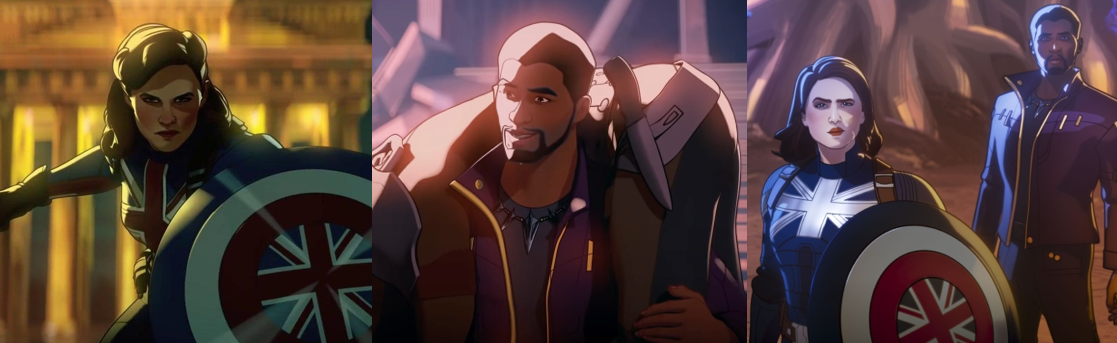
Captain Carter and T’Challa Star-Lord are just as competent, if not more so, as their MCU counterparts.

I really liked that, despite their reversed roles, Peggy and Steve still have a mutual attraction based on mutual respect and their respective struggles; Peggy faces an uphill battle due to being a woman in a male-orientated world (and war) that constantly weighs her down even after she’s enhanced by the super soldier serum, and of course Steve has been overlooked and undervalued his entire life due to his gaunt frame and sickly nature. While everyone else is either incredulous due to her being a woman or impressed by her fighting prowess because she is a woman, and she must prove her worth through her deeds to win them over, Steve admires the person that she is and her fighting spirit; he’s the only one that doesn’t judge her for her gender and who doesn’t need convincing that she’s the right person for the job and is only too grateful to be an active combatant alongside her in the Hydra Stomper. Peggy is also quite different in the role; like Steve, she attacks it with a sense of duty and honour, but she also takes far more joy in her newfound abilities. There’s a sense that she’s finally able to let loose, that she’s been given the physical gifts to realise her full potential, and she literally dives head-first into making the most of that opportunity. T’Challa’s characterisation as a galaxy-wide force for good is a fitting tribute to the late Chadwick Boseman; unlike Peter Quill, T’Challa is a well-respected and competent space mercenary, and I loved the running gag that he’s somehow able to convince even the most maladjusted individuals to give up their villainous or tyrannical ways simply through presenting a convincing argument. Korath is only too willing to change sides simply out of his worship of Star-Lord, and his crew follow his lead into doing good deeds simply because he was such a positive influence on them. Unfortunately, he’s not able to have the same influence on the Collector, who’s not only blinded by his position in this universe, but also driven by his inherent greed and given a major power boost thanks to his artefacts. However, while threats still remain in this timeline, on the surface it seems to be a far more peaceful and united universe simply thanks to T’Challa’s positive influence on others.
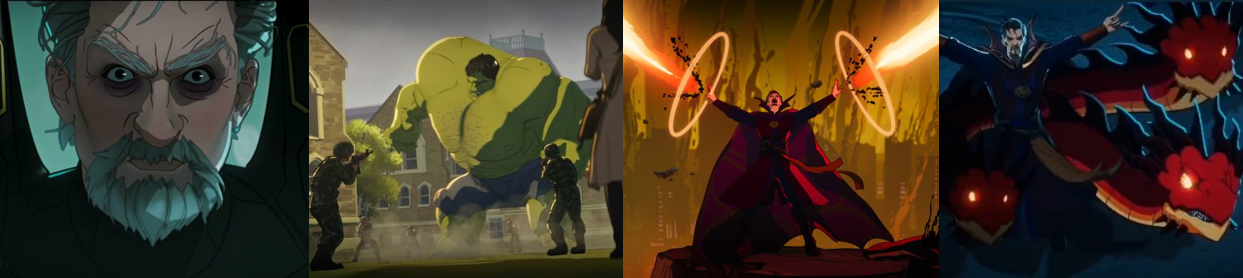
What If…? isn’t afraid to get very dark and show twisted or corrupted versions of these popular characters.

Things take a turn to the dark side once the Avengers (especially Stark) start getting killed off; What If…? is a self-contained show within the larger MCU multiverse, meaning literally anything can happen to anyone, and seeing the franchise’s core six heroes be so brutally murdered really hammers that home. It also gives Hank Pym, someone introduced later into the MCU, a chance to be a more prominent player in this sandbox; seeing him active in the MCU’s first phase is a great way of fleshing out the world in a unique way, especially as he’s become a murdering psychopath. This is a Pym whose neuroses and paranoia have been pushed to breaking point, which deftly showcases just how much of a threat a guy with Pym’s intellect and technology can be to even the most superhuman individuals. Of course, the epitome of dark character turns is the tragic tale of Strange Supreme; it’s absolutely heart-breaking to see Dr. Strange left so desperate and despondent by Christine’s loss that he fell deeper and deeper to the darkness. His frustration and anguish at being unable to change the past see him become obsessed with gaining more and more power, to the point where he is fixated only on being reunited with his love. This makes him blind to all pleas, even those of his uncorrupted counterpart, and it isn’t until all of reality is about to be erased forever that he realises the error of his ways. Sadly, by then, it’s much too late for him to undo anything; Christine once again dies in his arms and everything that ever was is unravelled due to his time paradox; even the Watcher judges his heinous actions, and the once mighty Strange Supreme is left alone and repentant in the tiniest slither of reality. It’s a poignant and gut-wrenching take on the snarky, stubborn, and arrogant Sorcerer Supreme, one that shows just how dangerous a threat he could be if he lost his strong moral compass, and it’s a testament to the show that the character remained a tragic and relatable figure right up until the end rather than simply being a malevolent antagonist.
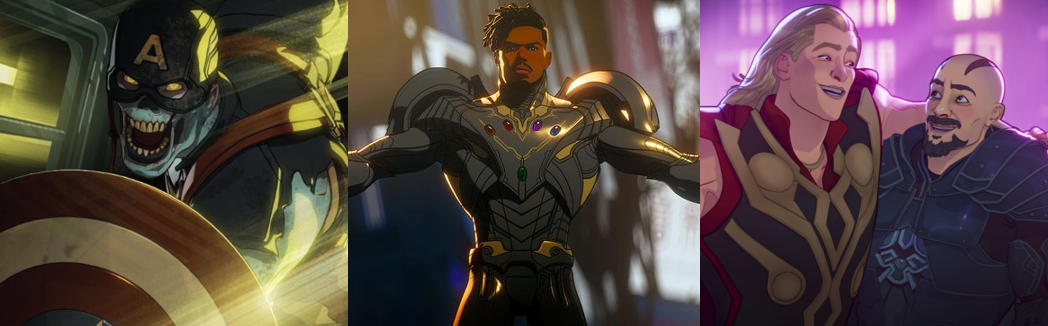
What If…? showed characters are their grimmest and worst and also at their most carefree.

Easily the darkest tale is the inclusion of zombies; never before has the MCU veered so closely towards traditional horror and I really appreciated the bleak, gory change of pace. It was fantastic seeing the MCU’s most powerful characters reduced to animalistic ghouls, forcing the few survivors to battle their lifelong friends and making painful sacrifices to ensure the safety of others against overwhelming odds. This was also a prime opportunity to show a new side to the Vision; him luring in survivors just to feed his love is a haunting glimpse at the darker side of his cold, calculating logic. We’ve seen such behaviour, this overpowering sense of denial, in zombie films before and, here, it served as a gruesome reminder of just how close to the brink this alternate reality is to total collapse. This continued in Killmonger’s welcome reappearance, with his alternate tale basically showing what could have happened if he had succeeded in his goals of reclaiming his Wakandan birthright; Killmonger was always one of the MCU’s more driven and dangerous antagonists and his episode showed just how truly vindictive and sadistic he really was. He had no qualms about deceiving or using anyone and any resource at his disposal, and even incited an all-out war just so that he could get himself into a position of trust and power, which serves as a stark reminder to just how ruthless a villain he really was. The party-loving version of Thor is the polar opposite; Party Thor cares little for battle or being a king and just wants to enjoy himself. He revels in being the centre of attention and throwing the biggest, most outrageous parties in all the Nine Realms and is lauded amongst his guests as being the wildest party animal around. Thor is a consummate free spirit and a friend to all; alien races, Gods, and recognisable beings from all across the cosmos cheer his name and share in his revelry, making for some of the most light-hearted and amusing moments in the entire series as Surtur (Clancy Brown) tries it on with Lady Liberty and Frost Giants deface Mount Rushmore. This episode also leads to one of the best fist fights in the series as Thor and Captain Marvel trade blows, but he delights in the fight as much as he does in enjoying himself with mead, and only the disapproval of his mother finally shakes Thor from his apathy and pushes him to make amends for his reckless merriment.
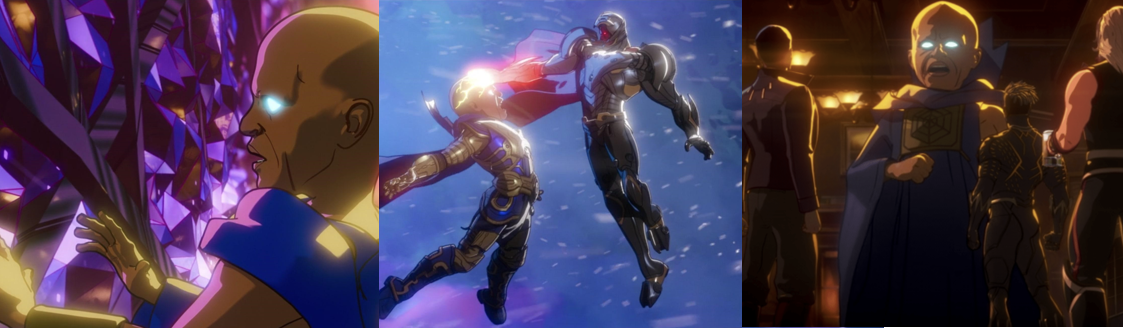
The Watcher is forced to take action for the first time in his long life in order to defend the multiverse.

Of course, things come to a suitably dramatic and action-packed conclusion with the final two episodes, which finally force the Watcher into action. Up until then, the watcher existed outside of the normal universe, powerful and cosmic enough to remain completely undetected, but Ultron’s sentience and force grows to such an extent that it’s able to sense the Watcher, breach his observatory, and begin a maniacal campaign to conquer and destroy the entire multiverse. Untold aeons of quietly observing the multiverse haven’t exactly dampened the Watcher’s power cosmic, but in the face to Ultron’s might, enhanced by the six Infinity Stones, the enigmatic onlooker is forced to do the one thing he has never done and ask for help, calling upon the characters he has been observing and asking them to intervene where he cannot. Seeing these wildly different versions of these characters interacting was a blast; they arguably got on the same page much faster than the regular Avengers (which is no doubt due to the short length of the episodes) and were able to launch a united attack on Ultron as a result. Indeed, Ultron kind of got a bit shafted in the last episode; it went from going toe-to-toe with a cosmic being to getting battered about by a handful of mortals and Godlings simply because the Guardians were able to keep the pressure on and keep Ultron from activating the Infinity Stones. Realistically, Ultron could’ve just “snapped” them all away, but then that wouldn’t be anywhere near as exhilarating for a final battle now, would it? Seeing Killmonger claim the gems and just the idea of what his twisted imagination would use them for was a cool moment, as was the idea that he might someday escape his trap to threaten the multiverse again, and just about the only issue I had with that last episode was the random inclusion of a Gamora when they could’ve maybe employed Zombie Wanda instead. Overall, though, I thoroughly enjoyed this series; the presentation, the humour, the fun twists on established characters, and the bizarre stories were all really fun and engaging and I can’t wait to see more from this as the MCU continues to expand into more and ore obscure concepts.

My Rating:

Rating: 5 out of 5.

Fantastic

Did you enjoy What If…?? Which episode was your favourite, and which of the alternate characters did you like the most? Did you enjoy the Watcher’s inclusion and characterisation? What did you think to all the cameos and the animation style? Did you enjoy seeing Ultron as an all-powerful force and what did you think to its battle with the Watcher? Were you also disappointed that Gamora didn’t get her own episode? Are you a fan of the What If…? comics and, if so, which was your favourite? What other hypothetical scenarios would you like to see explored in a future season? Whatever your thoughts on What If…?, sign up to drop a comment down below and check back next Sunday for the final instalment of Multiverse Madness.


Talking Movies: What If…? Thanos and the Masters of Evil

Talking Movies

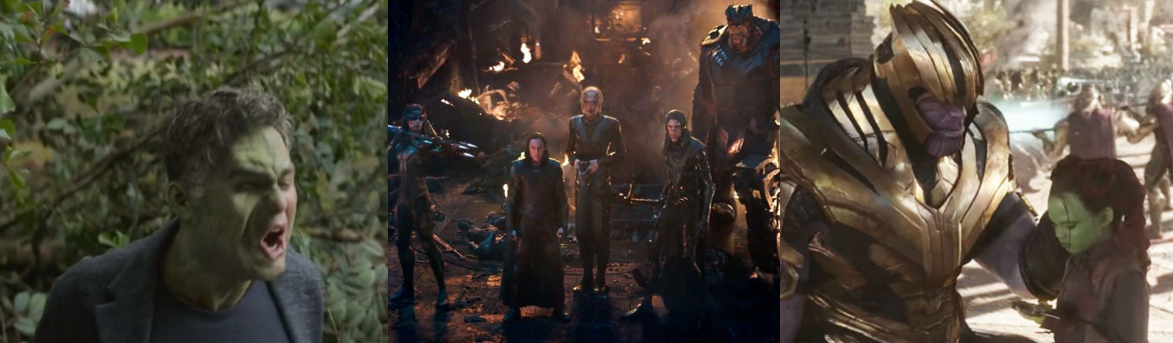
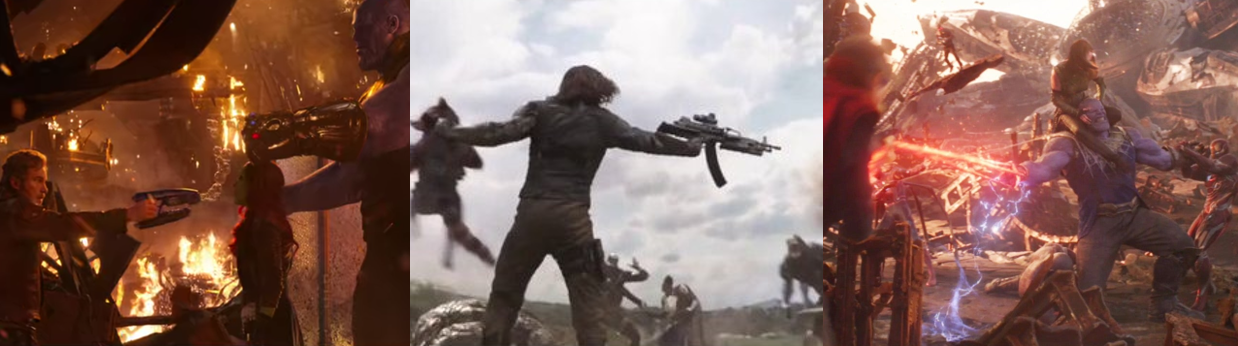
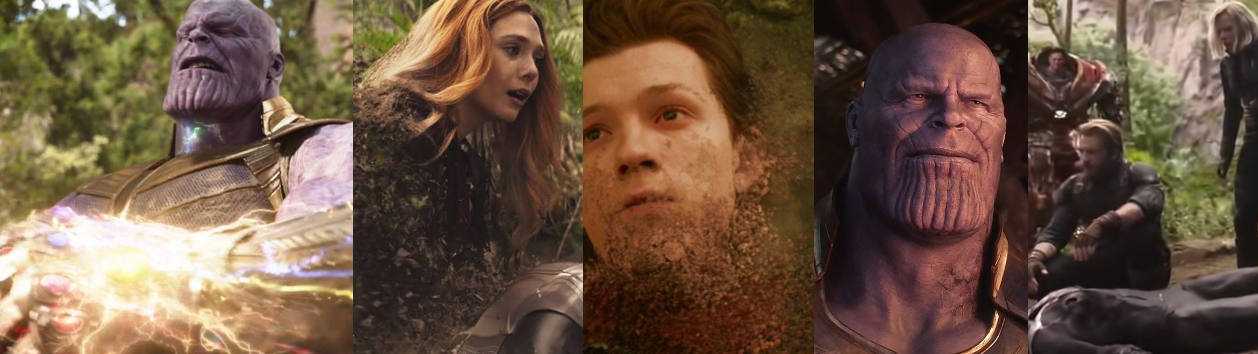
In Avengers: Infinity War (Russo and Russo, 2018) the Mad Titan, Thanos (Josh Brolin), finally made a significant appearance in the Marvel Cinematic Universe (MCU). When the idea of a two-film saga based on the Infinity Gauntlet comic book (Starlin, et al, 1991) was first announced, I, like many others, had many theories about what was going to happen, who was going to live and die, and how everything was )going to go down. For example, before Thor: Ragnarok (Waititi, 2017), I was certain that Thanos’ big entrance was going to immediately establish his threat by hanging him storm into Asgard kill Odin Allfather (Anthony Hopkins), and claim the Tesseract (and, obviously, the Space Stone it help). After all, how better to establish this big bad villain than by having him kill a God?

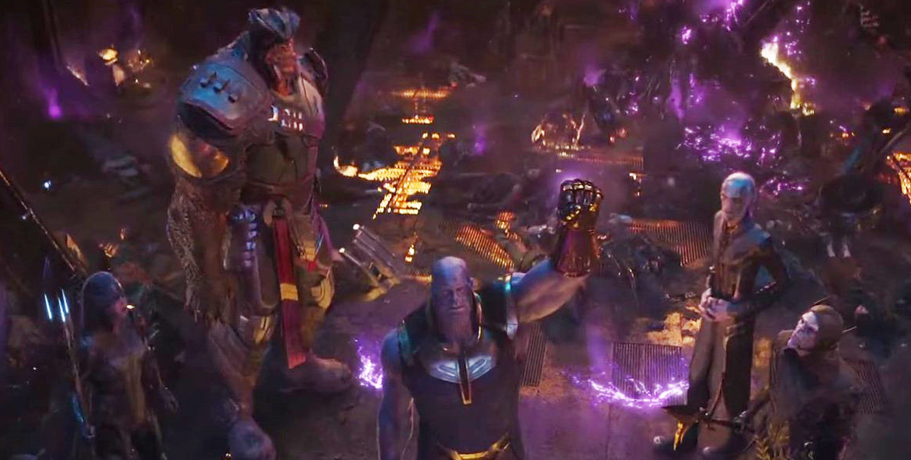
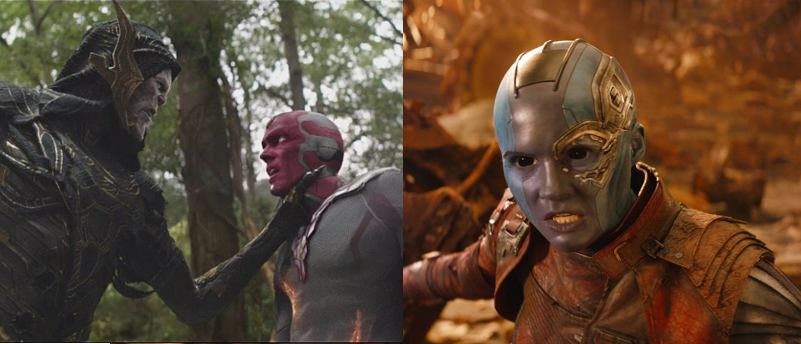
Thanos’ Black Order made their MCU debut in Avengers: Infinity War.

Instead, of course, Thanos wrecked Thor Odinson’s (Chris Hemsworth) ship and slaughtered half of the Asgardians onboard. Still an impressive feat, to be sure, but one that focused more on Thanos’ grandeur and pretentious philosophy rather than his actual physical strength thanks to the bulk of the work being undertaken by his underlings, the “Children of Thanos”. Headed by Ebony Maw (Tom Vaughan-Lawlor), Cull Obsidian (Terry Notary), Proxima Midnight (Carrie Coon/Monique Ganderton), and Corvus Glaive (Michael James Shaw), the Children of Thanos didn’t actually appear in The Infinity Gauntlet and are, instead, relatively recent additions to Thanos’ ranks who first appeared (as the “Black Order”) in Infinity (Hickman, et al, 2013). In the film, we don’t really learn much about these guys at all except that they enforce Thanos’ will with unquestioning loyalty and that he trusts them to help him gather the remaining Infinity Stones and, while they certainly look visually interesting, they’re mostly disposable bad guys for the Avengers to fight in place of Thanos.

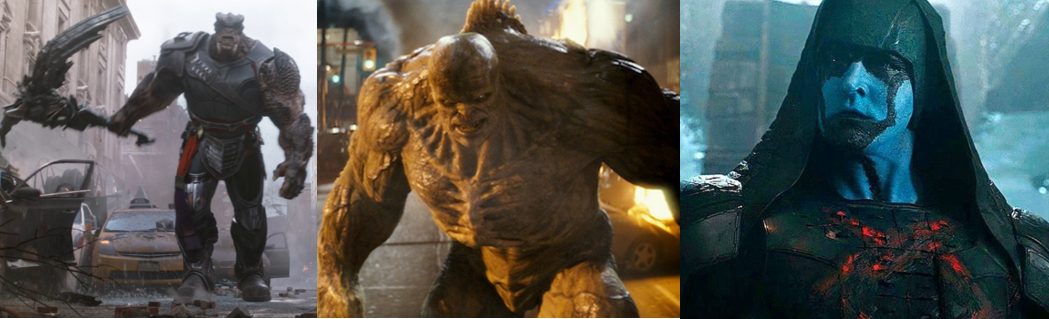
While Abomination is a good choice, I definitely think Ronan could’ve taken Cull’s place.

Now, I’ve never read Infinity; I have no emotional attachment to the Black Order or any of the characters and, as a result, they were merely nothing more than henchman to me and I only really recall one of them being referred to be name (“I take it the Maw is dead?”) While I enjoyed their inclusion in the film, I can’t help but feel like they could have been dropped and supplanted with some other, more recognisable MCU villains had some other films and events happened just a little differently. For example, take Cull Obsidian; he’s Thanos’ muscle who basically does nothing and is largely inconsequential. What if, instead of killing Ronan the Accuser (Lee Pace) in Guardians of the Galaxy (Gunn, 2014), Ronan had been soundly defeated and humbled and, having seen the extent of Thanos’ power (he did destroy Xandar (offscreen), which was what Ronan wanted, after all, and would be enough to bring Ronan to heel, I would wager), he pledged himself fully to Thanos’ cause to get revenge against the Guardians of the Galaxy? I’m not massively familiar with Ronan but it seems to me like it was a bit of a miss-step to kill him off when he could have fulfilled a role in Thanos’ little gang at the very least, if not remain as a recurring antagonist for the Guardians. Another potential replacement for Corvus would be Emil Blonsky/Abomination (Tim Roth) who, at the time, had been conspicuous by his absence from the MCU. However, arguably, it wouldn’t make as much sense for Thanos to recruit the Abomination as he’s not exactly floating around in the depths of space for him to encounter.

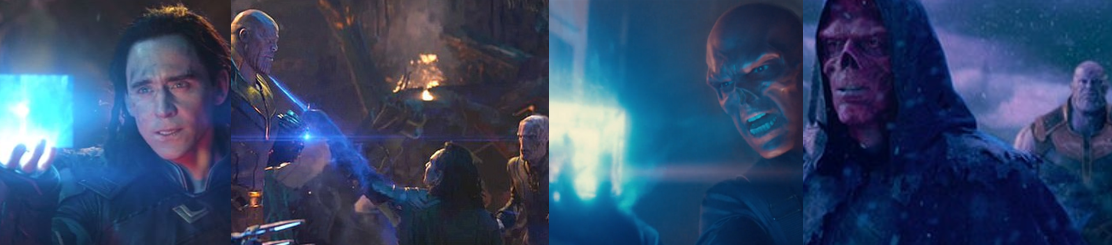
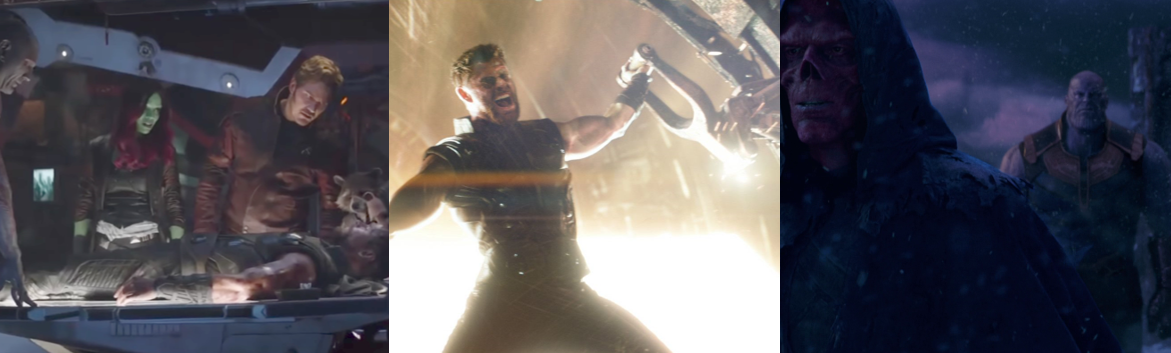
What if Loki or the Red Skull had aligned themselves with Thanos in place of Ebony Maw…?

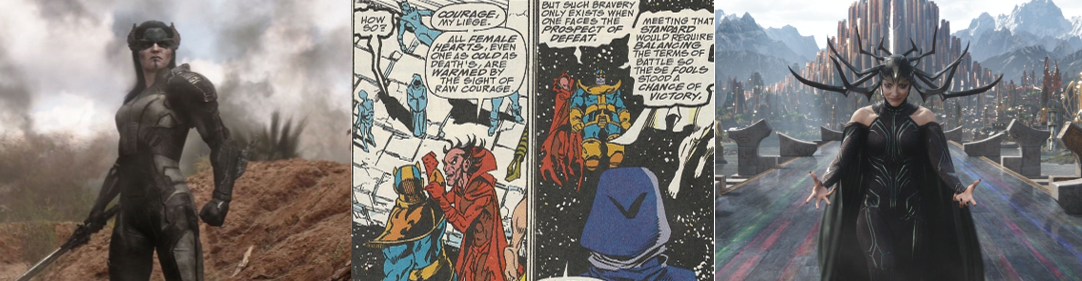
Intrigue was equally high in the build-up to The Avengers/Avengers Assemble (Whedon, 2012); I was hoping to see a version of the Masters of Evil, with Loki Laufeyson (Tom Hiddleston) joining forces with Johann Schmidt/The Red Skull (Hugo Weaving) – who was clearly transported away from Earth by the Bifrost at the end of Captain America: The First Avenger (Johnston, 2011 – and either the Abomination or Doctor Samuel Sterns/The Leader (Tim Blake Nelson) once they got to Earth. While I was happy with the first Avengers team-up we got, I do feel this was another missed opportunity that we never saw this anti-Avengers team-up. Consequently, I feel like we could have swapped out Ebony Maw for either of these characters; in The Infinity Gauntly, Thanos was advised by Mephisto, a role many expected Loki to play in Infinity War given his mischievous and devious nature. Naturally, of course, you could argue that this wouldn’t really fit with Loki’s character arc by that point but remember how he feigned loyalty to Thanos and then tried to stab him in the neck? Well, imagine that but throughout a large portion of the movie. Loki pledges fealty, willingly hand shim the Tesseract, and spends the remainder of the film waiting for the perfect moment to strike and then he’s killed for his efforts. Obviously, the Red Skull finally showed up in Avengers: Endgame (Russo and Russo, 2019) in a slightly different role as the Stonekeeper (Ross Marquand), but again…what if the Red Skull had replaced Ebony Maw? How much more interesting and impactful would it have been to see the Red Skull empowered by Thanos and making a triumphant return as Thanos’ chief torturer? Sure, if his death was the same then you could argue that he would’ve been “wasted” or been killed off too easily but I still feel like this would have been a better use of the character than as the keeper of the Soul Stone (a role that could’ve been filled by character’s envisioning the Stonekeeper as someone close to them, perhaps?)

With some tweaks, nebula could have taken Corvus’ role as Thanos’ chief assassin.

Corvus Glaive is a trickier one to “replace” in this hypothetical alternate world, however I have one  suggestion: Nebula (Karen Gillan). Now, similar to Loki joining Thanos, this would require quite a few changes to Nebula’s character arc; in Guardians of the Galaxy Vol. 2 (Gunn, 2017), she finally buried the hatchet with her “sister”, Gamora (Zoey Saldana) and it was great seeing her grow as a character, put aside her hatred, and learn how to work alongside the Guardians and the Avengers. In The Infinity Gauntlet, Nebula spends most of her time as a mindless zombie thanks to Thanos’ wrath but plays a vital role in his downfall by stealing the Gauntlet for herself (and promptly being driven mad by its power). By tweaking her character arc, or having it so that Thanos either intimidates or reprograms her into subservice, you could replace Corvus with a more prominent and recognisable character and still find ways to weave her existing arc into the story. Like, what if, after Guardians of the Galaxy Vol 2, Nebula is forced into Thanos to serve him (maybe he threatens to kill Gamora/the Guardians or promises to “repair” her once he’s assemble the Gauntlet) in Corvus’ place; she could still have been ripped apart and tortured to force Gamora into revealing the Soul Stone’s location and would have even more motivation to turn against her “father” since he would have lied to and manipulated her once again.

If Hela wasn’t going to take Death’s place, she could’ve replaced Proxima Midnight.

Another character who I, like many, expected to play a prominent role in Infinity War was Hela Odindottir (Cate Blanchett), a character who a lot of people expected would take the role of Lady Death as the object of Thanos’ affections. Of course, this didn’t turn out to be true as Hela was killed in Thor: Ragnarok and Thanos’ motivations were changed from worshipping Death to wanting to bring a sense of balance to the galaxy. Still, how awesome would it have been if Hela had taken Proxima Midnight’s place in the Dark Order? If killing the Allfather didn’t show you that Thanos was a bad-ass, bringing the Goddess of Death to heel totally would have and could have made for a much more memorable female villain for the finale in Wakanda. Again, there’s the question of her being killed off but what better way to help showcase Wanda Maximoff’s (Elizabeth Olsen) sheer power than by having her shred a Goddess to pieces? Or you could rewrite her death to maybe come at the hands of her brother, Thor, and his new weapon, Stormbreaker, to sell the awesomeness of the weapon.

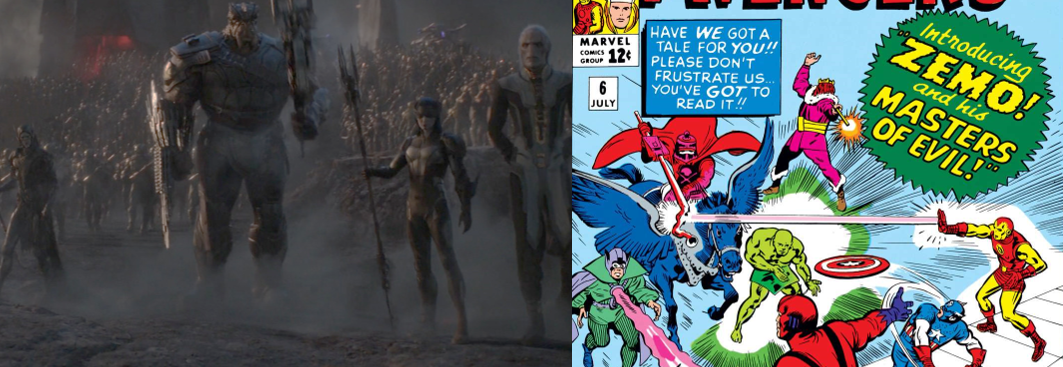
As cool as the Black Order were, would a version of the Masters of Evil have been better…?

Ultimately, I was more than happy with Avengers: Infinity War, Endgame, and the MCU’s portrayal of Thanos overall. His underlings were find cannon fodder for the film and helped to serve as extensions of the Mad Titan’s will but I do feel it would have been even more awesome to see these more recognisable villains swayed to Thanos’ cause so that we could see them interact with their rivals, and other heroes, in new and interesting ways. Sure, many have cropped up again since then and the potential of a Masters of Evil in the MCU is still there, I just think that maybe these huge movies could have been made even bigger if things had been slightly changed to accommodate these more familiar characters. Do you agree or disagree? Maybe you’re a big fan of the Black Order from the comics? Perhaps you’d have like to see a different route taken? Do you even want to see the Masters of Evil in the MCU? Either way, feel free to sound off in the comments below.

Movie Night [National Superhero Day]: Avengers Assemble


In 1995, Marvel Comics created “National Superhero Day” and, in the process, provided comics and superhero fans the world over with a great excuse to celebrate their favourite characters and publications.


Released: 4 May 2012
Director: Joss Whedon
Distributor: Walt Disney Studios Motion Pictures
Budget: $220 million
Stars: Robert Downey Jr, Chris Evans, Mark Ruffalo, Chris Hemsworth, Scarlett Johansson, Jeremy Renner, Tom Hiddleston, Clark Gregg, Stellan Skarsgård, and Samuel L. Jackson

The Plot:
When Loki Laufeyson (Hiddleston) arrives on Earth wielding a mind-controlling spear and in search of the Tesseract, Nick Fury (Jackson), director of the Strategic Homeland Intervention, Enforcement and Logistics Division (S.H.I.E.L.D.) activates the “Avenger Initiative”. Tony Stark/Iron Man (Downey Jr), Steve Rogers/Captain America (Evans), Doctor Bruce Banner/The Hulk (Ruffalo), Thor Odinson (Hemsworth), Natasha Romanoff/Black Widow (Johansson), and Clint Barton/Hawkeye (Renner) are called into service and must find a way to co-exist before they can combat this otherworldly threat.

The Background:
The development of an Avengers film began in 2003 with an outrageous plan to release a series of solo films for each character before having them all meet up, similar to how the Avengers formed in the comics back in 1963 courtesy of Martin Goodman, Stan Lee, Jack Kirby, and Dick Ayers. It was an unprecedented move, one which saw fledging studio Marvel Studios roll the dice on lower-tier heroes such as Iron Man and win big time with a slew of massively successful and popular superhero films, each one hinting towards a much larger, shared cinematic universe. When the time came for Earth’s Mightiest Heroes to finally meet onscreen, Marvel Studios turned to Joss Whedon to rewrite the script and direct the film and included Iron Man (Favreau, 2008) and Iron Man 2 (ibid, 2010) director Jon Favreau as an executive producer. After some differences of opinion, Marvel Studios chief Kevin Feige chose to recast Edward Norton in the role of Banner/Hulk and easily the biggest superhero film of all time was officially underway. The Avengers (known as Avengers Assemble here in the United Kingdom) was an absolutely phenomenal success, making over $1.500 billion at the box office, receiving rave reviews, and kicking off the extraordinary blockbuster success we know of today as the Marvel Cinematic Universe (MCU).

The Review:
Avengers Assemble was the first time we had ever seen superheroes come together in a big screen, big budget movie. Before the MCU, before Iron Man, superheroes always existed in isolated bubbles and never interacted and, as a big fan of the interconnected world of the comics (not just in Marvel but in DC Comics and pretty much ever comic publication), I was excited to see these characters come together onscreen for the first-time and will always lean towards an interconnected, shared continuity. It was a risky venture taking admittedly B to D-tier characters like Iron Man and Captain America and shaping a series of movies around them but Avengers Assemble totally justified that risk, allowing these volatile egos and characters to share the same screen and mixing fantasy, science-fiction, magic, and technology all together in one action-packed adventure.

Loki comes to invade Earth and realise his grandiose desires for power and servitude.

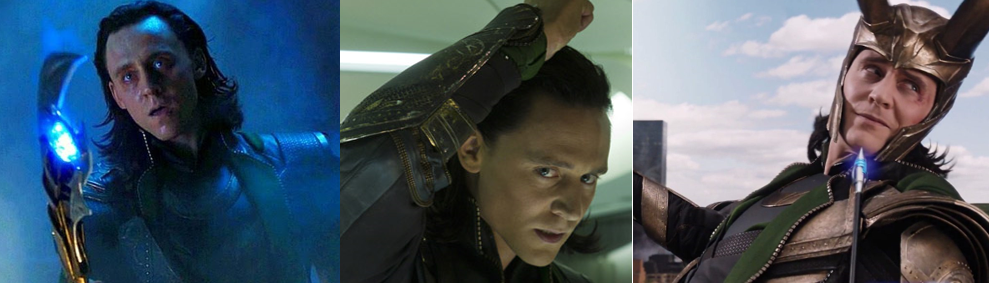
Loki’s threat is immediately established when he suddenly arrives on Earth and makes short work of Fury’s men and then uses his spear to take control of Professor Erik Selvig (Stellan Skarsgård) and Barton. Though only a singular villain, one whom Thor has been able to best in combat before, Loki is a significant threat to the world since he is, effectively, a God and he has the entire Chitauri army at his command. Before the Chitauri arrive, though, Loki is formidable enough to justify bringing in Iron Man (despite Fury’s earlier reservations) and Cap since Thor wasn’t supposed to be able to get back to Earth. When Thor does arrive, his mission to capture Loki and bring him back to Asgard is hampered by Earth politics (since Fury wants to hold Loki accountable for the death and destruction he’s already caused) and as a result Loki manages to manipulate the fledgling Avengers into bickering and fighting with each other rather than him, allowing him to take possession of the Tesseract and bring the Chitauri to Earth. While he avoids active, physical combat, Loki is a daunting opponent when he does engage in battle, able to go toe-to-toe with Thor (thanks, largely, to Thor holding back out of love for his brother), easily catching Hawkeye’s arrow, and tossing Stark out of a window with just one hand. His downfall comes not only through the unification of the Avengers but is spelt out by Stark, who monologues about how, win or lose, they would hunt down and hold Loki personally responsible to ensure that he never truly wins, and, of course, more explicitly through the sudden and hilarious beat down he receives at the hands of the Hulk.

It’s a rough experience for Cap, who has awoken to a world that has radically changed.

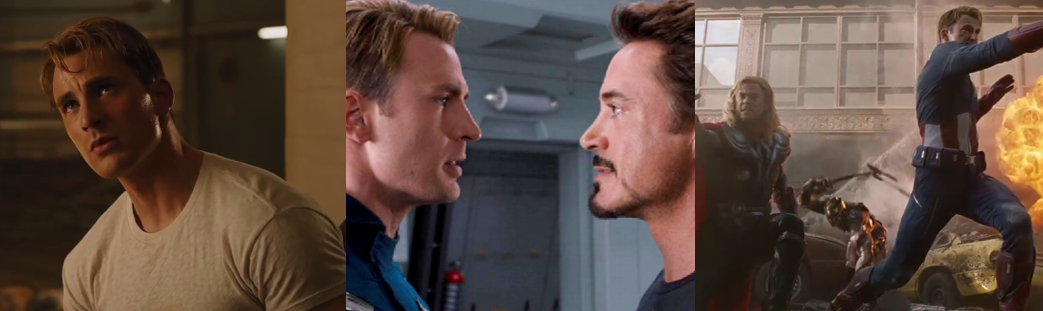
Essentially, the film is a significant chapter in Cap’s story; since Captain America: The First Avenger (Johnston, 2011) ended with Cap being dethawed in the modern day, this was only the second time we had seen him in action; unfortunately, because of the nature of the film, Cap’s reintegration into society is largely glossed over and, rather than being dwelled upon, is replaced with Cap wishing to be given a mission, a focus, a reason to fight in the modern world. As a result, he unquestioningly follows Fury’s directions primarily out of instinct, duty, and a need to have a reason to go on in a world that has largely passed him by; he clashes with Stark’s rebellious attitude, believing that they should follow orders like soldiers, but is convinced enough to investigate further and is disgusted to find Fury in possession of Chitauri technology and with contingencies in place to combat the Avengers since they have the potential to be a threat to humanity. Cap is all business when in battle, instinctively taking command and exuding leadership even though he is the most out of touch and out of place of all the characters; his initial antagonism with Stark is eventually put aside to lead the team during the Chitauri invasion and Cap fights to the bitter end even when he is vastly overpowered by the alien forces, taking the most damage of any of his team mates (including the “weaker” members like Natasha and Barton).

Stark joins the team with his own agenda but eventually comes to respect and defer to his peers.

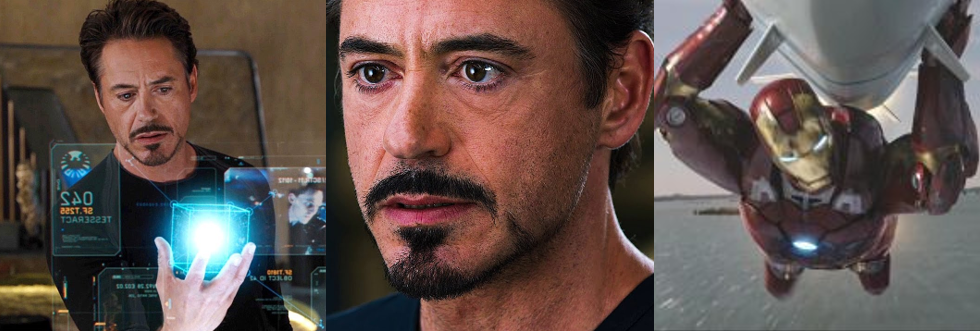
Stark is just as stubborn and snarky as ever; he’s clearly insulted by Agent Phil Colson (Gregg) and Fury’s decision to relegate him to a “consulting” role in the Avengers Initiate despite his claims to not want to be part of the team and believes himself to be the only one smart and capable enough of combating Loki’s impending threat. He comes aboard with the program purely out of a selfish desire to lord himself over Fury and the other Avengers and to learn more of S.H.I.E.L.D.s secrets, using them to call Fury out on his hypocrisy, and constantly goading his team mates (particularly Banner) into being themselves and rejecting Fury’s orders and control. While the prevailing arc for the entire team is learning to work together, Stark personifies this as he is the most antagonistic and reluctant to work as a team; he’s the most affected by Coulson’s death due to him knowing the agent the best, his experiences witnessing death and suffering first-hand in Iron Man, and his inability to properly cope with death and loss. Coulson’s death galvanises Stark, turning his incredulity to vengeance and giving him the motivation to not only put aside his ego to work with the team but also acknowledge Cap’s superior leadership skills.

The naturally apprehensive Banner has attained a measure of tenuous control over the Hulk.

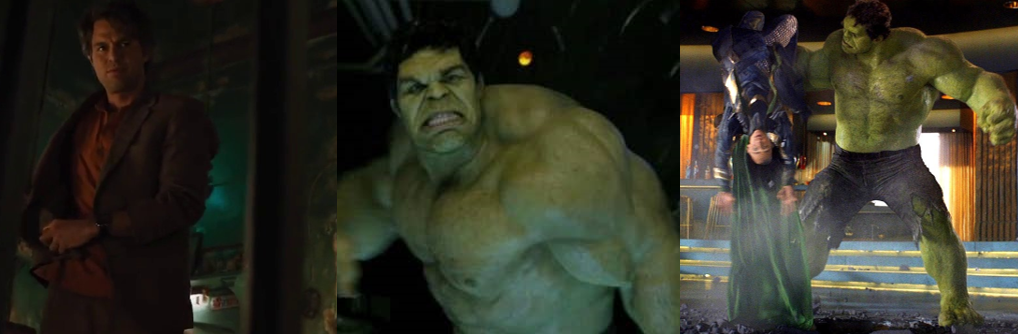
Banner appears very differently to where we left him in The Incredible Hulk (Leterrier, 2008); fearing the unpredictability and ferocious nature of the Hulk, he has stayed in hiding, suppressing the Hulk with some success, but is unable to deny his innate wish to help others in need with his scientific and medical expertise. Banner has managed to keep the Hulk at bay not only through a risky and unique technique (he’s “always angry”, indicating that he constantly keeps his emotions at a level where the Hulk is satiated but doesn’t actually emerge) and a vehement refusal to acknowledge or speak the Hulk’s name. Banner is convinced to help advise on Loki’s spear by Natasha’s beauty and simply her asking him nicely, rather than forcing him to comply, but, while he is clearly excited to be working with S.H.I.E.L.D. and the Tesseract and forms a fast, budding friendship with Stark (with Stark goading Banner and acting like an annoying brother to him), he quickly comes to realise that Fury’s intentions aren’t entirely noble and questions the validity and ability of a team that is little more than a “timebomb” of ego and emotions. When the Hulk is forcibly unleashed as part of Loki’s plan, he is unbridled rage and fury, lashing out at everything and everyone around him in a mindless rage since the transformation was against Banner’s will. Later, during the Battle of New York, Banner initiates the transformation willingly and the Hulk is much more…maybe not “docile” but let’s say willing to cooperate, taking Cap’s orders and specifically targeting to Chitauri threat while protecting and aiding his teammates. A measure of Banner’s influence and the Hulk’s intelligence is seen as the Hulk makes the effort to save Iron Man from his fatal fall and his dismissive grunt of “Puny God!” after beating the piss out of Loki.

Thor’s complex relationship with Loki is a pivotal plot point throughout the film.

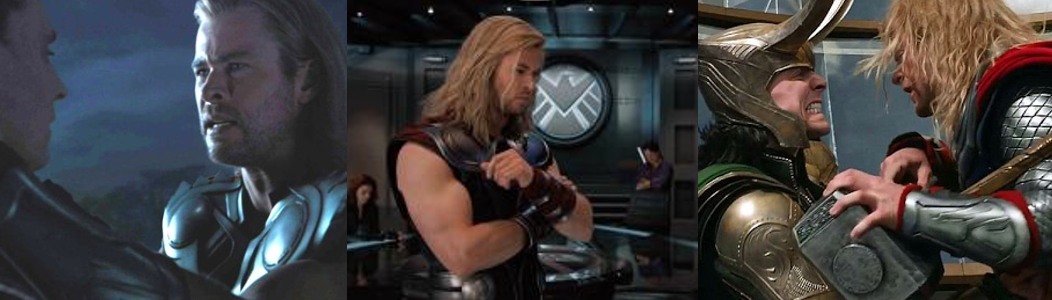
Thor’s arrival on Earth comes out of nowhere and is quickly waved away with a brief line about “dark energy”; personally, I never liked this or understood why the filmmakers had the Bifrost be destroyed in Thor (Branagh, 2011) when they knew very well that Thor would be back in Avengers Assemble but it is what it is and Thor is there. Thor is handicapped by his emotions towards his brother; he is elated and heartbroken to see Loki alive after believing him dead and just wants his brother to abandon his crusade and come home. Loki, however, is too full of jealously, rage, and resentment and constantly taunts, defies, and dismisses his brother, who finds himself unable to simply wade in, muscles bulging, and retrieve Loki thanks to opposition from Iron Man, Cap, and Fury and the greater issue concerning the Tesseract. Thor offers knowledge of another world, another level of understanding, that is unique amongst his teammates and spends much of the film believing his brother still has good in him and wishing to return him home. After Loki kills Coulson before Thor’s eyes and tries to kill him with a trap intended for the Hulk, Thor reluctantly gears up and enters the fray, so determined to stop his brother’s mad schemes that he’s willing to fight alongside the Avengers and submit to Cap’s orders since he, like Cap, is a stranger in this world and still learning how to navigate modern, human society.

Natasha remains a mystery despite the showcase of her skills and hints towards her past.

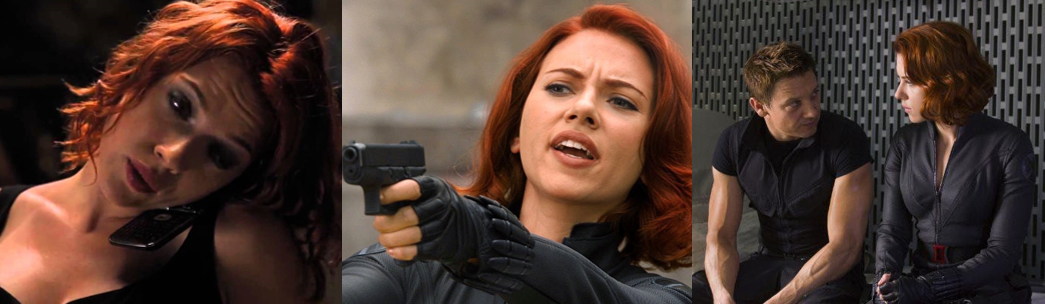
Natasha is still relatively new in this film since audiences only saw a fraction of her true character and abilities in Iron Man 2 so it’s good that she gets a solo action scene at the start of the film to showcase her physical and manipulative abilities. We learn bits and pieces of her character and backstory through her interactions with Banner, Loki, and Barton but she remains very much a mystery even by the end of the film. This would, of course, continue over the years since Black Widow was one of the last of the original Avengers to get a solo film, meaning an air of mystery constantly surrounds her, but much of her arc is focused on her relationship with Barton (which is one of duty, gratitude, and mutual, platonic respect) and her commitment to Fury and S.H.I.E.L.D. Like Cap, she follows orders unquestioningly but it also feels like she has her own agenda and reasons for going along with S.H.I.E.L.D.; while she, like Barton, is one of the weakest links in the Avengers, she’s still capable enough to hold her own against the Chitauri…for a time, at least.

Though he spends the majority of the film under Loki’s spell, Barton proves a formidable opponent.

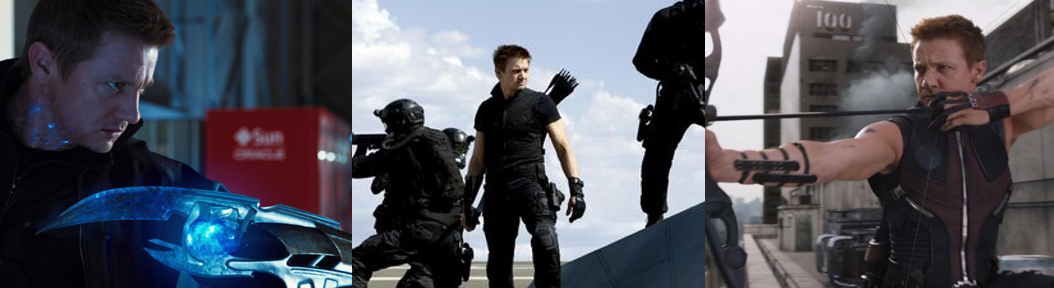
Barton, who is only referred to as Hawkeye once in the film, spends most of the movie under Loki’s command (though this does harken back to his comic book beginnings as a villain); as a result, all we know about him is the few bits and pieces Natasha reveals about their relationship and their background. However, we do get to see him in action on more than one occasion; he’s a crack shot, almost to superhuman levels, and is able to bring down an entire Helicarrier with a single, well-placed arrow. He is an essential soldier in Loki’s army, offering him insight into Fury’s operation and resources, but is also able to provide the Avengers with key information regarding Loki after Natasha literally knocks some sense into him. He proves himself capable enough in the finale by providing much needed and peerless cover from a high vantage point, from which he is able to take out multiple Chitauri with a few well-aimed shots. He’s easily the least developed of all the characters thanks to the role he plays in the film but it works for the plot and means we’re left wanting to know more about him and his backstory. Fury plays a much larger role in this film than in the previous MCU movies since he’s a pivotal supporting character rather than a mere cameo; he believes that Loki represents a very real threat to humanity but also believes wholeheartedly in the concept of heroes and the ability of the Avengers Initiative to combat Loki’s threat.

Coulson is the glue that connects Fury’s Avengers and his death galvanises the team into action.

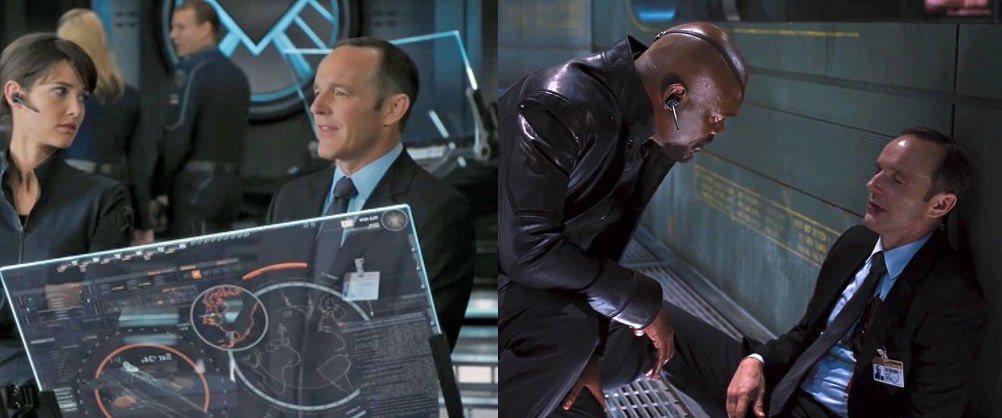
Fury opposes the World Security Council when they dismiss the Avengers as a legitimate solution and when they order a nuclear strike on New York which, along with his own brand of snark and dry wit, makes him a rebellious and layered character in his own right. However, he’s also a secretive and manipulative individual, constantly telling everyone only as much as they need to know and a handful of half-truths (as Stark says: “Fury’s secrets have secrets!”) and believes in having contingencies against any and all possible threats, both foreign and domestic. While he doesn’t fight alongside the Avengers in the final battle, he’s crucial to their formation and is a charismatic and alluring figurehead for their group. Sadly, this was as prominent as Fury would be for some time, with him quickly going back to being either a cameo or supporting character over the years, which is a shame as it’s always great to see Samuel L. Jackson in the role and interacting with these characters. Similarly, Coulson also gets much more screen time and development this time around; still acting as Fury’s go-to and the liaison between S.H.I.E.L.D. and the Avengers, Coulson (whose first name is revealed to be “Phil” rather than just “Agent”) is the relatable man among Gods, the common thread that links all of these volatile personalities together. Initially, all they really have in common beyond their heroic tendencies is their relationship with Coulson, with Stark having the closest link to him and Coulson being especially in awe of Cap, his hero and idol, and Coulson’s death is both sudden and heartbreakingly brutal. It’s a fantastic moment that serves to galvanise and motivate the them and, as much as I’ve enjoyed some episodes and seasons of Agents of S.H.I.E.L.D. (2013 to 2020), it did annoy me that his dramatic death was undone so soon after the film’s release. Thankfully, the MCU movies don’t acknowledge Coulson’s resurrection so his tragic death remains the principal motivating factor behind the coming together of Earth’s Mightiest Heroes.

The Nitty-Gritty:
Considering the large cast of bombastic, unique characters and actors, Avengers Assemble is fantastically well paced; sure, Natasha and, especially, Barton don’t get anywhere near as much screen time or development as established guys like Cap or Stark but they get several character defining moments and character beats that help to keep them relevant and integral to the plot. The film isn’t full of non-stop action but it never feels slow or like it’s wasting time; any time there isn’t some kind of physical conflict, there’s a conflict of character, beliefs, or ideologies as each of the characters interacts with each other in different ways. The central conflict in the film is between the individual Avengers as much as it is with Loki as each one must learn how to interact and co-operate with the other, which leads to some friction between Rogers and Stark, disdain from the God-like Thor, and distrust from the understandably agitated Banner. This all comes to a head in one of the film’s most intense moments where the fledgling Avengers argue over Fury’s manipulations, the threat each of them oppose, and their conflicting egos in a scene that is easily as powerful as any of the film’s fight scenes. Here, each character talks and argues over each other; lots of fingers are pointed, egos are bruised, and accusations are made thanks to the influence of Loki’s spear, which exacerbates their most negative aspects and fuels the distrust and tension between the group. It’s an amazingly realised scene, with lots of dynamic camera work on offer and allows the characters to vent their frustrations and concerns about each other, the mission, and the inevitable escalation of conflict that threatens Earth now that it has experienced otherworldly threats and, in it, these conflicting personalities actually grow stronger as a result of their brutal honesty.

Seeing these colourful and volatile individuals interact is every fan’s dream come true!

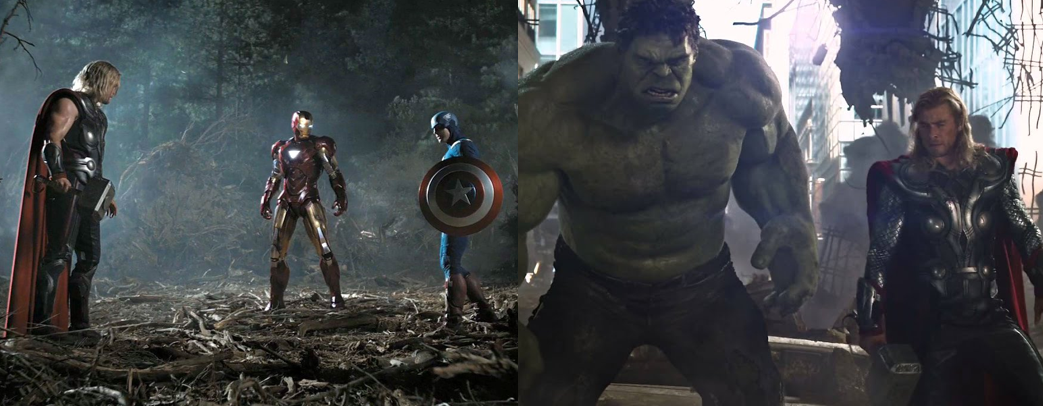
However, amidst this, there are also numerous amusing little moments that help to add to the film’s levity and develop each character: Rogers handing Fury a $10 bill after being awe-struck by the Helicarrier, Stark pointing out that one of the S.H.I.E.L.D. agents is playing Galaga (Namco, 1981), Thor’s humiliation regarding Loki’s actions and heritage, and Banner’s flashes of anger all help to make the characters real and relatable. One of the best examples of this is Cap’s confrontation with Loki in which he, despite being “out of time”, recognises Loki’s evil and potential threat and openly opposes him just as he did a similar dictator in World War Two and engages him in combat despite Loki’s clear physical advantage over him. Cap’s whole character is that he continues to fight no matter the odds and that is continuously seen in Avengers Assemble as, even when outclassed or outnumbered, he continues to get back up and go on with the fight until it’s done, one way or another, and fails to give in to intimidation from concepts beyond his time such as Gods, aliens, and advanced technology. Their interactions with each other are equally impressive, with the heroes just as likely to come to blows as they are to work together; this means we get to see these bright, colourful costumed characters fighting with each other as much as alongside each other. Iron Man fights with Thor, Cap joins in to make it a triple threat, Black Widow fights with Hawkeye, and Thor memorably goes toe-to-toe with the Hulk to set up a friendly rivalry that would be fantastically revisited in Thor: Ragnarok (Waititi, 2017). It’s a staple of superhero team-ups that the heroes simply must fight at least once and Avengers Assemble delivers on this in spades; we’ve watched each of these characters in their own films, or be involved in other MCU films, over the years so to see them match wits, trade blows, and fight together is a true fanboy’s delight.

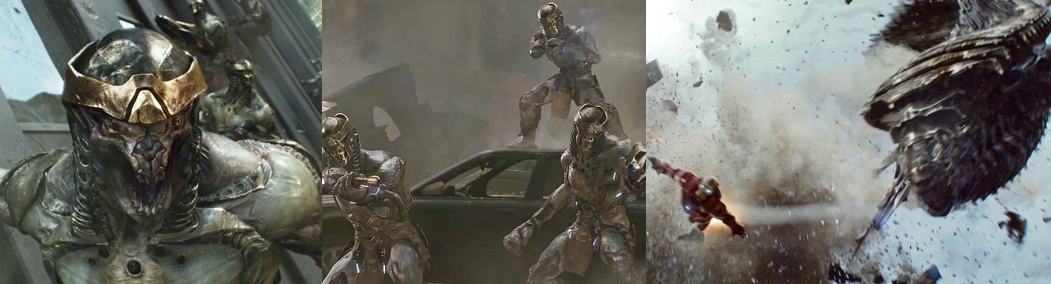
The Chitauri are, admittedly, underwhelming antagonists but they serve their purpose.

The finale is little more than a battle against mindless, indistinguishable alien hoards who, conveniently, operate in a hive mind and are “easily” shut down by Stark tossing a nuclear weapon at their mothership. I honestly expected a version of the Masters of Evil for the first Avengers movie, with Loki joining forces with Johann Schmidt/The Red Skull (Hugo Weaving) outside of the Realms and then teaming up with Emil Blonsky/The Abomination (Tim Roth) and/or Samuel Sterns/The Leader (Tim Blake Nelson) once they reach Earth for a smaller scale, six on six style team vs. team movie and, in some ways, it is a bit disappointing that the Avengers only went up against one villain and an army of drones but it really works in the film since the entire point of the movie is to bring these volatile characters together. The actual antagonist could have be anyone or anything and it wouldn’t really matter but it being Loki works wonders thanks to Tom Hiddleston’s iconic performance; he’s truly a snake in the grass, a wily, manipulative, vindictive villain who is intelligent and cruel enough to match wits with each of the Avengers both physically and vocally and the only previous villain I could see being able to do anywhere hear as good a job would be Hugo Weaving.

The Avengers win the day but a greater, far more powerful threat looms in the background…

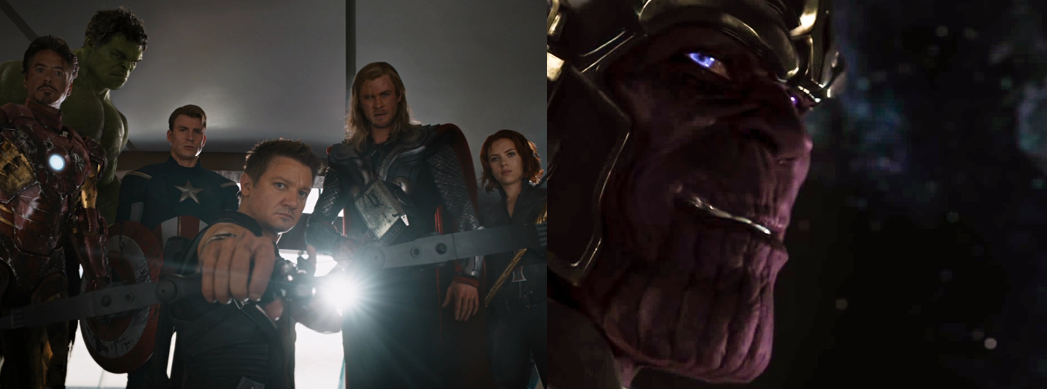
One issue I have though is that, as much as I loved the “Avengers Assemble!” scene we eventually got, I still don’t get why we couldn’t have heard that iconic cry during that awesome panning shot of the team standing back-to-back. I think we definitely could have heard this cry in each of the team-up films and appearances of the group and it wouldn’t have taken away from that impactful scene; if anything, it would have added to it since it would be a rallying cry for the reunited heroes. Still, the Battle for New York is amazing in its scope; the Chitauri may be interchangeable alien drones but they are relentless. The Avengers are able to combat them and easily defeat them but their numbers are legion and, apparently, inexhaustible and it isn’t long before they are overwhelmed even with the might of Thor and the Hulk. The Chitauri’s larger reinforcements and advanced weaponry and sheer numbers mean that it is simply a matter of time before the Avengers, for all their power, are overwhelmed and Loki is successful, meaning that the Avengers’ main concern is holding the line and keeping the invasion at bay while their team mates confront Loki and cut off the source of the invasion. All throughout the film, Loki converses with “The Other” (Alexis Denisof) and is clearly being given power and resources from an unseen third party, revealed at the very end of the film to be none other than Thanos (Damion Poitier). At the time, we could never have anticipated the extent to Thanos’s threat and importance to the MCU but the bringing together of cosmic characters like Asgardians and threats like the Chitauri and Thanos only hinted at how large and varied the MCU was destined to become.

The Summary:
Avengers Assemble is still one of the biggest and most entertaining movies in the MCU and, perhaps, ever made. Of all the movies in the MCU’s first phase, it’s easily my favourite and, for me, set the standard not just for subsequent MCU team-up movies but for every film in the MCU going forward. No longer were these characters going to exist in their own isolated bubble; they would interact with their fellow characters, reference the larger world we finally saw in all its glory, and be part of something much bigger and greater than a series of self-contained films. For me, this is the greatest appeal of the MCU; before Iron Man, superhero films were always solo affairs and we never saw heroes interact with each other. Thanks to the MCU, all of that changed and, finally, the movies came to resemble the comics by having a shared universe that has a tight continuity and an actual tangible, long-term plan. The film is alive with character moments, an amusing dry wit, and action-packed sequences but, as thrilling as the bombastic fight scenes can be, it’s all the little interactions and interpersonal conflicts that really make this film so entertaining and appealing to me even to this day.

My Rating:

Rating: 5 out of 5.

Fantastic

What are your thoughts on Avengers Assemble? How do you feel it holds up now that the MCU has become this massive, multimedia juggernaut? Were you disappointed that the film focused solely on the one villain and side-lined Hawkeye with a mind control sub-plot or were you satisfied with Hiddleston’s performance and the interpersonal conflicts between the characters? Which of the Avengers is your favourite and which of the comic’s characters are you excited to learn more about or see join the team? Which of the MCU movies, shows, or characters is your favourite and why? How are you celebrating National Superhero Day today? Whatever your thoughts, leave a comment below and be sure to stick around for more superhero and comic book content throughout the year.

Game Corner: Captain America and the Avengers (Arcade)

Released: 1991
Developer: Data East
Also Available For: Game Boy, Game Gear, Mega Drive, Nintendo Entertainment System (NES), Super Nintendo Entertainment System (SNES)

The Background:
First created in 1940 by Joe Simon and Jack Kirby, Steve Rogers/Captain America was an icon of the Second World War, embodying America’s obsession with patriotism and pride by taking the fight directly to the Axis Forces. Superhero comics went on a bit of a decline after the war and Captain America wouldn’t return to prominence until 1964, when he was famously revived to join Marvel Comics’ all-star team, the Avengers. Since then, the character has been largely synonymous with Earth’s Mightiest Mortals, often acting as the team’s moral compass and leader. In 1991, both comics and arcades were undergoing something of a renaissance; Marvel published the influential Infinity Gauntlet (Starlin, et al, 1991) during this time and sidescrolling beat-‘em-ups like Final Fight (Capcom, 1989) and The Simpsons (Konami, 1991) were proving popular coin munchers. It is perhaps these factors that led to Data East developing a four-player beat-‘em-up game centred around Marvel’s popular super team, a game that is often forgotten because of genre-defining titles like X-Men (Konami, 1992) and a title I first played on the SEGA Mega Drive in all its inauspicious glory.

The Plot:
Johann Schmidt/The Red Skull has assembled an army of the world’s most dangerous supervillains in order to take over the world using a gigantic, Moon-based laser! Answering the call to action and adventure are Captain America, Tony Stark/Iron Man, Clint Barton/Hawkeye, and the Vision – the Avengers – who are the only ones capable of putting a stop to the Red Skull’s nefarious plans for world domination!

Gameplay:
Captain America and the Avengers is a 2D, sidescrolling beat-‘em-up in which you, and another player if you have a friend, control one of the four Avengers and mindlessly pummel a bunch of robots, cyborgs, and iconic Marvel bad guys across five different stages (referred to as “Scenes”). No matter which character you choose to play as, the game pretty much plays exactly the same with only some minor aesthetic differences separating the characters.

Each Avenger has their own special attack but, otherwise, controls exactly the same.

Despite this, though, I found Cap the most enjoyable character to play as, with Iron Man a close second. The controls are as simple as you could want: you can beat down your enemies with some simple punches and kicks, charge through them with a dash attack, block by holding down the punch button, and perform two different jumping attacks depending on how high you’re jumping. You can also grab and throw enemies (and objects) and unleash a unique ranged attack by pressing down the attack and jump button simultaneously: Captain America hurls his mighty shield, Iron Man fires his repulsor rays, Hawkeye fires arrows, and Vision fires laser blasts from his forehead. I found there to be a bit of a delay in activating these special attacks, however, which can leave you vulnerable but at least they don’t drain your health. Speaking of which, your health is measured in hundreds; you begin each Scene/life with 100 health but can increase it by grabbed the rarely-seen small blue orbs or the power-ups dropped by other Avengers like Prince Namor McKenzie/The Sub-Mariner and Pietro Maximoff/Quicksilver.

Autoscrolling shooting sections help to add some variety to the gameplay.

You can also increase your health, all the way up to “Max”, by entering coins to keep you alive and kicking, effectively sacrificing your pocket money and extra lives for more health. Thankfully, emulation means you don’t need to worry about wasting your hard-earned pocket money so you never have to worry about running out of lives or health. Unlike a lot of arcade games, Captain America and the Avengers doesn’t feature a time limit; however, if you stand around idle for too long, an explosion randomly drains your health until you either die or get moving, which is a cruel but unique inclusion. It’s not all mindless right-to-left fighting, either; Scene 2, Scene 3, and Scene 5 feature autoscrolling shooting sections that take place in the skies of a wrecked city, deep underwater, and in the cold vastness of outer space. If you’re playing as Cap or Hawkeye, you’ll get to pilot a Sky-Cycle in the first of these stages, but for the others you’ll throw on some scuba gear and a rudimentary space suit. Either way, you must blast enemies with your ranged attack (which is now just a simple button press), avoiding their projectiles and holding down punch to block. These sections are only short but they held to mix things up a bit and, when it comes to sidescrolling beat-‘em-ups, variety is hard to find so it’s appreciated.

Graphics and Sound:
I remember Captain America and the Avengers looking very unimpressive on the Mega Drive, with small sprites in large areas and lacking a lot of the detail and quality of other games of the time. In that regard, the arcade game is better since the sprites are much bigger and more distinct and detailed but you’ll notice that they’re not as large, colourful, or intricate as those seen in games like X-Men, for example. Still, it does a decent enough job; the camera is zoomed out quite far compared to other beat-‘em-ups, though, giving you a much larger battlefield which would be a positive but, while areas can get swamped with enemies and do feature interactive elements (mainly barrels and other objects to throw or explode), they are quite empty and there’s little benefit to exploring or attacking your surroundings.

The game is colourful and varied but not as impressive as others in its genre.

You will find some interesting elements, though, such as enemies bursting out of windows and the background, an Avengers mural, burning cars, wrecked buildings, and both a sprawling city in the background and water rushing beneath you as you fly, with comic book sound effects punctuating the onscreen violence. As you might expect, comic book-like panels and text are used to convey the bulk of the story; each character is given a brief demonstration of their in-game abilities and a biography, which is a nice touch, and the game is peppered with some in-game cutscenes that feature dialogue between the Avengers and their enemies. These are some of the most ludicrous examples of mistranslation ever, which hilarious exchanges such as “Seeeeee my powerrr!”, “Where is the laser?”/“Ask the police!”, “You can’t escape!”/“You will be the one escaping!”, and “Why should it goes well!?” It’s cheesy and ridiculous in a “Welcome to die!!” kind of way that adds some unintentional entertainment value to the game, which also features a suitably heroic soundtrack; you’ll hear the main theme quite a bit, since it kicks in once bosses are close to defeat, and while it’s nothing special it’s very catchy and rousing and gives the game a stirring, stimulating gallant feel.

Enemies and Bosses:
For the most part, you’ll battle seemingly endless wave upon wave of robots or cybernetic enemies; the most common of these incessantly shoot at you with lasers, sometimes while jumping, while others carry shields or can grab and hold you with retractable arms. You’ll also battle enemies that hover in jetpacks, bigger, more muscle-bound variants that squeeze the life out of you with a bear hug, and hopping bug-like robots. Underwater, enemies will fire harpoons at you while you try to dodge mines and, in the air, they’ll circle around firing lasers in a simple formation. Most of these are destroyed in just a few hits, and both increase in number and become tougher to defeat as you progress, exploding upon defeat, making me believe them to be cyborgs and mechanical rather than flesh and blood.

In Scene 1, you’ll battle some minor Marvel foes after they rob a bank.

One thing Captain America and the Avengers does really well, though, is its expansive use of Marvel’s rouges gallery; in each Scene, you’ll have to contend with a main boss and a series of sub-bosses, many of whom will be recognisable to fans of the source material (and even the movies, to a degree). In Scene 1, you’ll have to contend with the duo of Arthur Parks/The Living Laser and Ulysses Klaw/Klaw mid-way through the stage as they cover David Cannon/Whirlwind’s escape following a bank robbery. Laser and Klaw are best faced with a partner since they hop around the screen, blasting lasers and projectiles at you, but, like all of the game’s sub-bosses and bosses, can be easily pummelled solo as well. When you do go toe-to-toe with Whirlwind, it’s dead easy to just wail away on him, with his only threat being his ability to transform into a literal whirlwind to dash about the screen and whip up nearby objects to rain them down on you.

After disposing of a Sentinel, you’ll fight the Grim Reaper, though the Wizard or the Mech. Taco are a threat.

Scene 2 sees you having to relentlessly blast away at a Hydra aircraft on your way to the wrecked city and a confrontation with the gigantic, screen-filling “Giant Robot” (clearly a Sentinel). The Sentinel is a slow, plodding sub-boss who tries to smack you out of the sky, fires lasers, and grabs you in its near-endless supply of robot hands. After blowing it to pieces, you’ll battle through the ruins of the city and into a confrontation with Eric Williams/The Grim Reaper, one of the game’s tougher bosses. Grim Reaper can block your projectile attack with his spinning scythe, rush across the screen with lightning speed to slash and strike you, hover in the air, and fires explosive projectiles as the fight progresses. In Scene 3, you’ll battle Bentley Wittman/The Wizard on the deck of a wrecked battleship; the Wizard favours diving punches, throwing discs, and quick-firing laser bolts but is, otherwise, a minor inconvenience at best. After exploring the depths of the ocean, you’ll encounter a giant mechanical octopus referred to as “Mech. Taco”; this is functionally the same fight as against the Sentinel, requiring you to avoid the Taco’s tentacles, swim beneath its lasers, and simply fire at it relentlessly until it explodes.

Even some of Marvel’s most recognisable villains end up being a bit of a pushover.

After emerging victorious, you’ll battle through a submarine and into a confrontation with the Mandarin; the Mandarin is a bit of a trickster, floating around the arena, rocketing into the air, firing at you with lasers, encasing you in ice, and even duplicating himself for double the threat. The Mandarin can command his duplicate to charge at you, send you flying with his floaty movements, and loves to bash you senseless when he gets up close. Like all the other bosses, though, he might have a lot of flair but he’s got a glass jaw and it’s easy to land a few combos and whittle his health down in seconds. Scene 4 sees you infiltrating the Red Skull’s Moon base, where you’ll have to contend with Cain Marko/Juggernaut (who is, ironically, actually smaller than the game’s bruiser enemies…). Juggy likes to roll around the arena in a ball, land big uppercuts, charge at you with a shoulder barge, and trying to cave your skull in with a big double axehandle smash. Oddly, the most difficult thing about fighting him isn’t his much-vaulted strength but actually his speed, since he cannot be damaged in his ball form and likes to speed around the arena like a whippet. After defeating Juggernaut, you’ll eventually battle Ultron, who fires electrical beams from his face, dashes across the screen in a fireball-like form, fires lasers blasts from his hands, pummels you with punches, and causes lasers to rain down across the arena once his health gets low. It’s not an especially difficult fight but, thanks to Ultron’s array of abilities and speedy, damage-dealing moves, it’s comparable to the ones against the Grim Reaper and the Mandarin in that it can be frustrating navigating through Ultron’s attacks but, once you get some hits in, he goes down as easily as any other boss.

Surprisingly, Crossbones is pretty tough, but the final confrontation with the Red Skull couldn’t be simpler.

Having destroyed the Red Skull’s giant laser in Scene 5, you’ll again battle two sub-bosses at once; in this case, “Control” (who is possibly supposed to be Basil Sandhurst/The Controller). This fight is made more troublesome by the buzzsaws that travel across the grid on the ground but is still easier than the first fight against the Living Laser and Klaw since Control just tries to grab you and land flying kicks. Once they’re dealt with, your penultimate boss is against Brock Rumlow/Crossbones, of all people. Not gonna lie but Crossbones is a bit disappointing as a penultimate boss in terms of his character and stature but he’s no pushover; Crossbones leaps, bounds, and tumbles across the arena leaving a shadow in his wake and raining explosive mines (which home in on you) down around you. He also pulls out a pistol to fire at you from a distance and isn’t afraid to either rush at you with his trusty knife or toss the blade your way in rapid succession. Because of his speed and relentless attacks, Crossbones is no pushover but you can tip the tide in your favour by throwing his explosives back at him. Once you corner the Red Skull (who is seen smoking a cigarette in his introduction idle animation!), you’ll go head-to-head with the Nazi superman in a good, old-fashioned slugfest. If you’re wondering where the cliché elevator stage is, it’s right here in this simple fight that turns out to be a trap! Once you drain the Red Skull’s health, he grows into a massive mechanical form and it’s revealed you’ve been fighting a decoy all along. The real Red Skull watches, safely protected within a glass tube, as you battle the formidable “Mech. Skull”, which boasts such devastating attacks as twin gatling guns, energy bolts, massive melee attacks, rockets, a big slam attack, and can summon whirlwinds to mess you up. Still, it’s a big, largely stationary target so it’s pretty simple to get close to it to avoid the majority of its attacks and just pummel away until it explodes, seemingly taking out the Red Skull with it and destroying the Red Skull’s entire Moon base in the process.
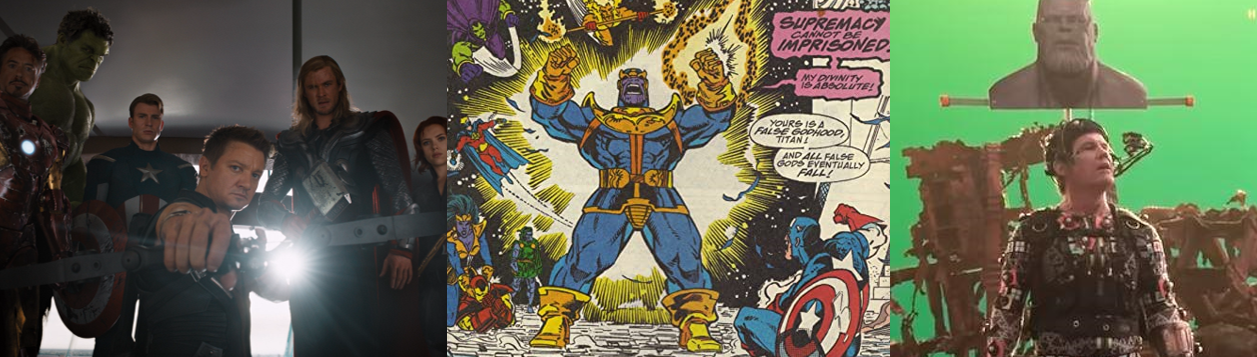
Power-Ups and Bonuses:
Unlike most sidescrolling beat-‘em-ups, there aren’t many power-ups to be found in Captain America and the Avengers. Very rarely, in the autoscrolling stages, you’ll find small blue orbs to restore your health and there are a variety of objects to pick up and throw but there are none of the traditional health power-ups, invincibilities, or melee weapons to be found. At certain, predefined points in a lot of Scenes, another Avenger will make a brief cameo and toss out a big health-restoring power-up, which is a fun inclusion. In the autoscrolling sections, you can also pick up a “W” icon and gain the help of Janet van Dyne/Wasp, who encircles your character and can be shot forwards to deal additional damage for a limited time. It’s a shame that more of the other non-playable Avengers don’t aid you in the same way (though Namor does provide some brief assistance in Scene 3).

Additional Features:
It’s an old arcade beat-‘em-up so, of course, there’s really nothing else on offer here except for obtaining or beating the high score or playing alongside a friend. Apparently, some versions of the arcade cabinet supported four-player co-op, which seems like a missed opportunity, but I do know that the consoles versions included different difficulty settings and a “Training” mode that allows you to pit each playable character against each other in a pale imitation of games like Street Fighter II: The World Warrior (Capcom, 1991).

The Summary:
If you’re looking for a classic, sidescrolling arcade beat-‘em-up, you can do a lot better than Captain America and the Avengers. It’s a decent way to waste about half an hour or so and is big, colourful, mindless fun but there are far better arcade beat-‘em-ups out there, whether carrying the Marvel license or not. The game is fun with a second player and for the completely off-the-wall voice acting and dialogue but it’s very empty and basic, even for an early-nineties beat-‘em-up title. I will say, though, having previously owned the Mega Drive version, that the arcade version of the game is the superior of the two so I would recommend playing this version over any of the others…and then jump back into X-Men right after.

My Rating:

Rating: 2 out of 5.

Could Be Better

Have you ever played Captain America and the Avengers? If so, which version did you play and which do you feel was the superior iteration? Which of the four Avengers was your go-to character and which of the unplayable Avengers would you have liked to see made playable characters? What did you think to the game’s many sub-bosses and bosses and cheesy, terribly translated dialogue? Have you got a favourite arcade beat-‘em-up or Marvel videogame; if so, what is it? Either way, I’d love to hear your thoughts so drop a comment below.

Back Issues: Captain America Comics #1

Story Titles: “Case No.1. Meet Captain America”, “Captain America and The Riddle of the Red Skull”, and other untitled stories
Published: March 1941
Writer: Joe Simon
Artist: Jack Kirby

The Background:
By 1941, World War Two was in full swing; Nazi Germany had overtaken Denmark and Norway in April 1940 and, after a period of resistance to joining the war effort, the United States entered the fray during 1941, providing much needed support against the combined “Axis powers” of Germany, Japan, and Italy. As a result of the ever-escalating conflict, patriotism and national pride was high, especially in America, and it was at this turbulent time that Joe Simon and the legendary Jack Kirby first debuted Steve Rogers/Captain America and his kid sidekick, James Buchanan Barnes/Bucky, two characters who would not only take the fight directly to the enemies of America and the free world but also encourage readers to support the war effort by any means necessary.

The Review:
Captain America Comics #1 is a bumper forty-five page debut issue for the First Avenger that features four short stories (and even a two-page text story with only a couple of accompanying drawings and panels) but only two of these stories have actual titles. The first, “Case No.1. Meet Captain America”, details the origin of the titular star-spangled Avenger; the War is in full swing and, while America faces real threat from the vast Axis armies overseas, they also face the threat of sabotage, treason, and terrorist bombings on their home turf thanks to the actions of the “Fifth Column”, spies and traitors from the Axis forces who perpetrated such heinous attacks. To combat this threat, the President of the United States has J. Arthur Grover of the Federal Bureau of Investigation (F.B.I.) take two high-ranking military officers to “a sinister-looking Curio Shop” in a “shabby tenement district” in Washington, D.C. that is actually the front for a highly sophisticated laboratory. There, they join other attendees in witnessing a frail, young man who was deemed unfit for active service be miraculously transformed into a man in peak mental and physical condition by Professor Reinstein’s mysterious serum.

Frail Steve Rogers is transformed into the peak of human physical ability!

Reinstein thus dubs the young man “Captain America” and explains to his awestruck audience that he is to be the first in a “corps of super-agents” who will actively oppose spies and saboteurs on America’s home turf. Unfortunately, one of the men in attendance is one of these spies (so much for the military’s stringent background checks…); with only a few frantic shots, the spy kills both Reinstein and Grover and destroys the only remaining vial of the super-soldier serum! Luckily, Captain America is able to subdue the spy, driving him to stumble into a bank of laboratory equipment and causing him to be summarily electrocuted to death. Sadly, though, the damage is done; with Reinstein dead, the serum destroyed, and the laboratory trashed, America’s hopes of building an army of super solders are dashed. Undeterred, Cap enlists in the army as Private Steve Rogers whilst also battling enemies of American soil as Captain America. Cap’s heroic antics catch the awe and imagination of his regiment’s mascot, young Bucky Barnes. Bucky is both stunned and exhilarated to stumble onto the fact that Steve is his patriotic hero, literally walking in as Steve is halfway through changing into his Captain America costume in perhaps the most anticlimactic and convenient of accidents. If you thought that was contrived and ridiculous though, Steve decides that the only logical course of action is for Bucky to join him as his partner. And so, donning a brightly-coloured outfit, a domino mask, and the laziest codename ever (Bucky goes by “Bucky”…), Captain America and his woefully-inexperienced sidekick pledge themselves to opposing the Axis powers in all their forms.

Cap and Bucky subdue the Nazi goons and put a stop to their nefarious plot.

They continue this fight in the issue’s next story, which goes untitled; in this story, a stage performer known as Sando has his diminutive, hunchbacked accomplice Omar stun audiences with predictions of the future, all of which detail terrorist attacks or destructive events. Although Bucky believes the two to be fakes, Cap is convinced when Omar’s prediction of the destruction of a nearby bridge comes true and the two suit up to confront the two stage performers. Cap doesn’t pull any punches, aggressively questioning Sando and then laying him out with a punch while Omar makes a quick getaway. I wouldn’t mind but the two haven’t even done anything yet or been proven to be responsible! Luckily Conveniently, Cap’s war-time paranoia turns out to be true as, when he races after Omar, he finds both Bucky and a beautiful reporter named Betty Ross (no relation, I’m sure) being held hostage at gunpoint by Sando and Omar, who are revealed to be working in league with Hitler’s spies to cause disasters across the country. Unimpressed, Cap and Bucky make short work of the Fuehrer’s goons, with Bucky swiftly tackling one and tossing the bomb he planned to use to kill them all out of the window before disappearing into the night. The issue’s third story also goes untitled and introduces a crazed Nazi who is known only as Rathcone but who comes to brand himself “The Dictator”. A malformed, goblin-like man, Rathcone has his own plans for world conquest and favours crafting little chess pieces that resemble his opposition, announcing his intentions to kill a target over the radio, and then employing a number of Nazi agents to carry out the deed. Captain America and Bucky seek Rathcone out after the self-styled Dictator makes good on his promise to kill Admiral Perkins; the witnesses to the gruesome visage of Perkins’ execution are whipped into a frenzy and baying for blood but Cap and Bucky waste no time in tracking down the assassin responsible for the murder.

Honestly, Steve, your constant snark to your superior officers isn’t helping the situation!

Despite Cap questioning (presumably in jest) Bucky’s ability to handle “a man’s job”, Bucky successfully tackles the killer and Cap is all set to force information out of him when an unseen assailant kills the man. This is also the first instance of Cap using his shield to…well, shield himself from gunfire, however neither he nor his kid partner are able to find the shooter. Next, Rathcone targets General Ellsworth; coincidentally (and conveniently) enough, Rogers and Bucky are ordered to report for “special duties” at Ellsworth’s hut, which means that they are the first to discover the General dead at his table! The media, of course, has a field day and Rathcone is so enthused by the two murders he has orchestrated that he begins to set his sights on the lofty goal of invasion; but first, he plots to remove Cap and Bucky from his chess board by…having his goons lure them into a trap that Bucky walks right into. Returning to his tent and finding that Bucky has gone off alone, Steve pulls on the stars and stripes and sets out to rescue him, making short work of Rathcone’s muscleman, Herr Strangler, in the process.
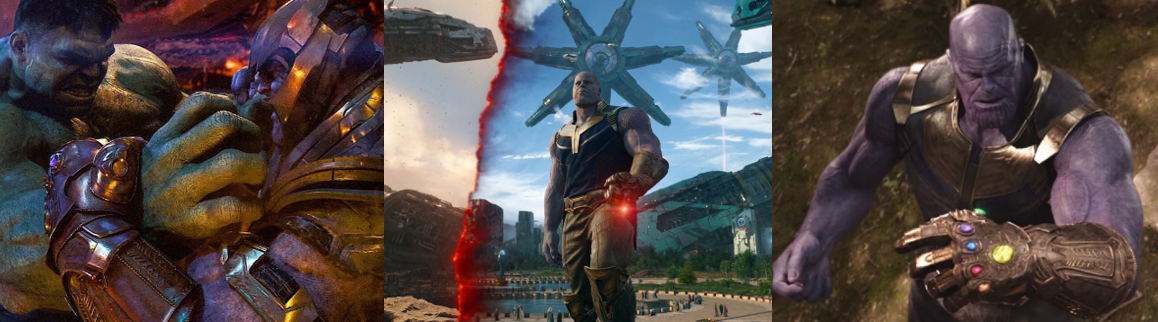
Rathcone captures Bucky but wastes time monologuing so Cap lays him out.

Rathcone, however, holds Cap at gunpoint and, typically, wastes his best chance to off the two masked men by explaining his master plan, which gives Cap the chance to lay him out with a good, old-fashioned punch to the jaw. After freeing Bucky, the two are set upon by Rathcone’s goons, with Bucky again requiring Cap’s assistance when two Nazis pin him down and try to stab him (I mean, it’s almost as if Cap has partnered up with a child with no training or physical acumen of any kind…). Although Rathcone recovers, tries to make a break for it, and even attempts to fight Cap off by smashing a chair over the Avenger’s head, Cap easily puts him down for the count and they uncover detailed documents of the self-styled Dictator’s plans to put an end to his scheming. The issue concludes with the first ever appearance of the Red Skull, Cap’s Nazi counterpart who would go on to be his most iconic, and enduring, archenemy. Though the Red Skull is typically the codename of Johann Schmidt, in his debut story it’s actually the persona adopted by George Maxon, a seemingly innocuous American businessman who has turned traitor and is working for the Nazis. Like Rathcone, the Red Skull’s modus operandi is to target influential military personnel in order to weaken America’s will and capabilities; he does this by stalking them, attacking them, and getting them in a choke hold all while chanting “Look at me! Look at death!” to, apparently, will his victims to death with a death gaze. So notorious is the Red Skull that he’s become something of an urban legend amongst the military personnel but, when Major Croy is found dead, the latest victim of the Red Skull, Cap takes it upon himself to investigate.
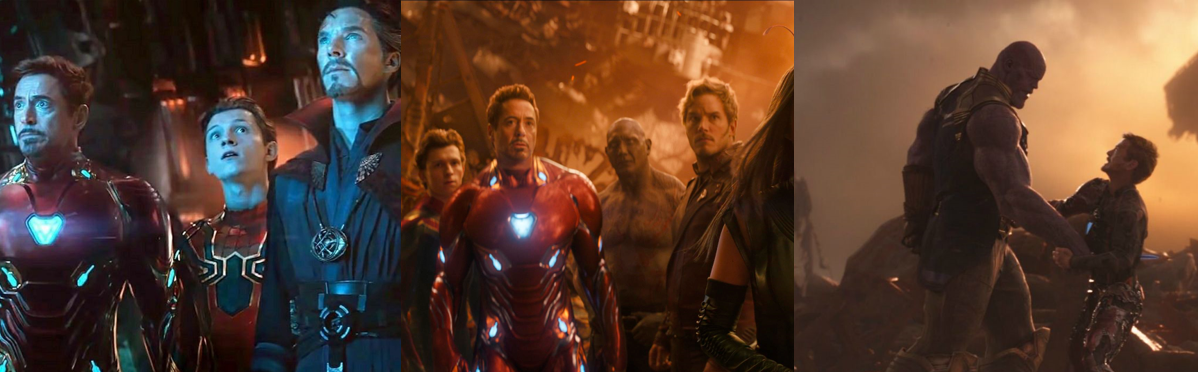
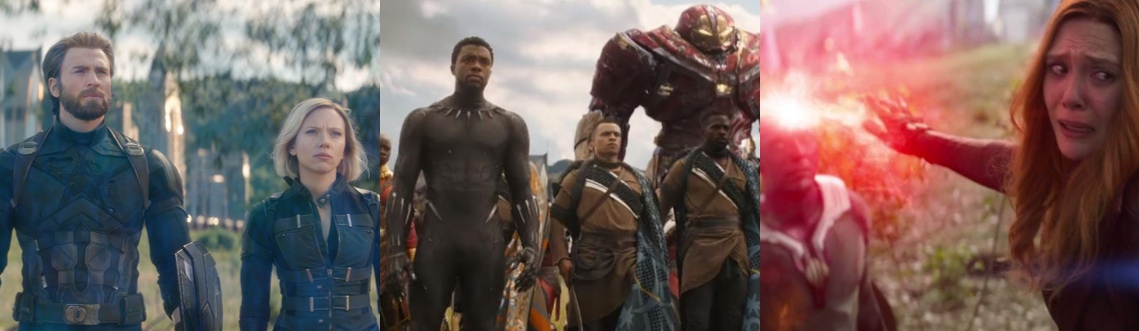
The Red Skull’s ability to apparently will his victims to death gives Cap reason enough to go solo…

Annoyed at being left behind (to be fair, I don’t blame Cap for this but, at the same time, it is extremely random (and, again, convenient) that he decided not to bring Bucky along this time…), Bucky decides to conduct his own investigation and (…somehow) stumbles upon the Red Skull’s secret lair where he is outlying his plan to overthrow the American government by “[looting] the First National Bank” because nothing says “Superhuman Nazi Terrorist” like a bit of old-fashioned bank robbery! Thanks to some shoddy masonry, Bucky falls into the villain’s lair as he moves to warn Cap of the Red Skull’s plan and, once again, finds himself being held as a hostage; this time around, though, Bucky’s slightly more feisty and doesn’t let himself get captured without a fight but, wouldn’t you know it, Cap also found the Red Skull’s lair and arrives just in time to bash up his goons, though the Red Skull manages to slip away. The next day, Steve, Bucky, and their squad are introduced to Mister Maxon who has come to join them in watching his new plane take a test flight. However, the plane catches fire in mid-flight and plummets to the ground in a fireball. Steve is disgusted that Maxon only cares about the loss of the plan rather than the men who were in it and is reprimanded by his superior officer as a result but vows to investigate further as Captain America.

Despite a brief setback, Cap is finally able to take out the Red Skull.

Later that evening, the Red Skull strikes again, literally crossing General Manor off his hit list, but is distracted from escaping into the night by the General’s wife. Though this allows Cap to get the drop on the Red Skull, he is knocked out cold when the nefarious Nazi smashes a chair over his head (which is odd as Cap shrugged off a similar shot easily enough earlier in the comic…). Luckily, Bucky flies in and rescues Cap from the Red Skull’s death gaze and, upon regaining consciousness, Cap fells his foe with a punch so hard that it shatters the Red Skull’s head! It turns out, of course, that the Red Skull was wearing a “false-face” and that Maxon had used the guise of the Red Skull, and a hypodermic needle filled with poison, to terrorise and murder his victims. Quite why he felt the need to make such a dramatic affair of it all with his “look at death” spiel is beyond me; it’s not like any of his killings took place in public or had any witnesses, after all.Anyway, Maxon makes one last, desperate lunge for Bucky and, in the fracas, rolls over onto his own needle and dies! Interestingly, Bucky questions why Cap didn’t try to intervene and he simply replies: “I’m not talking, Bucky”. Regardless, with the Red Skull dead, Cap and Bucky flee into the night, returning to their tent for some much-needed rest (Steve loves to puff away on his pipe after a good bit of manslaughter…), and ready for more adventures as Captain America and Bucky!

The Summary:
Captain America Comics #1 is little more than what you might expect it to be; a bright, colourful piece of patriotic propaganda featuring a superhero literally wrapped in Ol’ Glory herself and tackling foreign enemies on American soil. It’s a brief, action-packed affair full of contrivances, conveniences, and long out-dated dialogue and virtues, but it’s a product of its time so you kind of have to expect that. You’ll notice, of course, that Captain America uses a completely different shield in his debut appearance; Cap wields a diamond-shaped shield in these stories, one far less versati le and iconic as the discus-shaped shield he would acquire in the very next issue and generally favour over the next eighty-odd years. As a result, there’s very little shield-based action or combat in this issue; Cap only uses it as a shield once, never throws it, and the rest of the time it’s more of a prop than anything else as Cap prefers to use his fists to settle his foes.

Cap’s exact strengths and limitations are quite vaguely defined in his debut appearance.

Speaking of which, Cap’s a bit of a blunt instrument here; in contrast to the majority of superhero origin stories, literally no time at all is spent showcasing Rogers’ training or physical abilities (and even less is spent on Bucky’s) and Cap’s exact strengths and limitations are extremely vague. He’s described as hitting hard and fast and can clearly take a good deal of punishment, and yet he can be stopped in his tracks by a gun, knocked out cold, and never displays any of the near-superhuman levels of strength we’ve come to associate with the character. Stylistically, the comic is obviously designed to make monsters out of the Axis powers, specifically Nazis and their ilk. Both Rathcone and the Red Skull take on grotesque visages and appearances, appearing more like demons than humans, and their underlings are depicted as slimy, cowardly traitors or muscle-bound henchmen who all blindly follow the Fuehrer’s commands even to their deaths. The idea is pretty simple: America is the bastion of all that is good and just, with their army made up of red-blooded men and patriots who are giving it all for their country, and the Axis powers are misshapen, demonic, nefarious devils who revel in spreading death and terror. In that regard, Captain America Comics #1 does its job extremely well but, overall, I can only really recommend it for containing Cap’s iconic origin story and the first appearance of the Red Skull.

My Rating:

Rating: 3 out of 5.

Pretty Good

Have you ever read Captain America Comics #1? If so, what did you think of it and the early adventures of Captain America and Bucky? What was your first exposure to Captain America and where do you rank him against other superheroes, Marvel or otherwise? What story or character of his is your favourite and why? How are you celebrating Captain America’s star-spangled debut today? Whatever your thoughts, drop a comment below and check out my other Captain America content!

10 FTW: Comic Book Crossovers We Need To See

If there’s one thing comic books allow, it’s the grandiose crossover between characters. Ever since Barry Allen met Jay Garrick all the way back in 1961 and introduced the idea of multiple parallel universes, comic book characters have existed in both isolated shared universes and travelled across a near infinite multiverse. However, while it’s relatively common to see Bruce Wayne/Batman and Clark Kent/Superman interact with the Justice League or the Teen Titans, or to have Peter Parker/Spider-Man randomly join forces with the Fantastic Four or the X-Men, we’ve also seen the characters of DC and Marvel Comics interact with each other. We’ve seen Superman and Batman both cross paths with Spider-Man, the X-Men team with the New Teen Titans, and both publishers’ greatest heroes go head-to-head in the epic DC Versus Marvel Comics (Marz and David, et al, 1996) crossover.

10FTWCrossoversWeird
There have been some weird crossovers in comics.

In addition, Dark Horse Comics snapped up multiple science-fiction and horror film franchises, giving us crossovers such as RoboCop Versus The Terminator (Miller, et al, 1992) and a whole slew of Aliens vs. Predator (Various, 1989 to present) comics. It doesn’t end there, either; we’ve seen Batman cross paths with Judge Dredd on multiple times and Frank Castle/The Punisher team up with not only Eminem but also pop up in Archie Comics, and it was thanks to such comic book crossovers that we finally got to see the three-way mash-up between Freddy Kruger, Jason Voorhees, and Ash Williams! Yet, as many and varied and seemingly limitless as these crossovers can be, it seems like we’ve missed out on a few seemingly-obvious crossovers. Maybe it’s because of licensing issues or the fact that DC and Marvel Comics don’t tend to do a lot of business together lately, but, either way, I figured I’d talk about ten crossovers I’d love to see in comic books.

10FTWCrossoversJSWM
10 Justice Society/Watchmen

After DC Comics finally put an end to the largely-awful New 52 run, they teased Alan Moore’s seminal work, Watchmen (ibid, et al, 1986 to 1987), becoming part of DC canon when Edward Blake/The Comedian’s iconic smiley-face button turned up in the Batcave. Cue the extremely delayed publication schedule of Doomsday Clock (Johns, et al, 2017 to 2019), a storyline that revealed that Doctor Jon Osterman/Doctor Manhattan had been influencing DC canon for decades. While this, obviously, brought the characters of Watchmen (or, at least, versions of them) into conflict with Superman, Batman, and other versions of the Justice League, it’s the older, more seasoned members of the Justice Society of America (JSA) I’d like to see have extended interactions with the Crimebusters. The JSA were at their peak around the time of World War Two, meaning they are decidedly more optimistic and pragmatic about their approach to crimefighting. The Crimebusters, meanwhile, existed in a largely dystopian version of the 1980s that was pretty bleak and constantly on the verge of another World War, meaning this team up could produce an interesting clash of styles and philosophies that would probably be more in keeping with Moore’s more reflective text rather than an all-out brawl. Plus, who doesn’t want to see who would win a battle between Jim Corrigan/The Spectre and Doctor Manhattan?

10FTWCrossoversPulp
9 Pulp Heroes United

Before Batman and Superman, there were the pulp heroes of the 1930s to 1950s. Names like the Phantom, the Shadow, the Spirit, the Rocketeer, and Green Hornet may have faded from mainstream relevance in recent years, but they live on thanks to publications from Dynamite Comics and crossovers with DC Comics. Speaking of Dynamite Comics, they came very close to this crossover with their Masks (Various, 2014 to 2016) series, which saw the Shadow teaming up with the Green Hornet and Kato, a version of Zorro, and the Spider but this crossover has so much potential to really pay homage to the heroes of yesteryear. Ideally, such a comprehensive team up would be similar to The League of Extraordinary Gentlemen (Moore, et al, 1999 to 2019) in its scope and legacy; hell, I’d even have the Phantom, the Shadow, the Spirit, the Rocketeer, Green Hornet and Kato, Zorro, Doc Savage, the Lone Ranger and Tonto, and the rest of their ilk butting heads with the Martians from The War of the Worlds (Wells, 1897) at the turn of the century. A proper sepia-toned, steampunk-filled piece that sees these wildly different pulp heroes begrudgingly working together to save the world could be a great way to thrust these overlooked classic heroes back into the spotlight.

10FTWCrossoversRHWS
8 Red Hood/Winter Soldier

If the comic industry was like it was back in the mid-nineties, we would surely have already seen this crossover, which is as obvious and as fitting as the team up between the Punisher and Jean-Paul Valley/Azrael during his brief tenure as Batman. Speaking of which, a team up between Jason Todd/Red Hood and the Punisher is just as enticing but, in terms of thematically complimentary characters, you’re hard pressed to find two more fitting that Jason Todd and Bucky Barnes. Both characters were well-known sidekicks to greater heroes whose deaths shaped, influenced, and affected their mentors for years, and both even returned to life as violent, broken anti-heroes around the same time.

10FTWCrossoversJTBB
Jason and Bucky’s deaths weighed heavily on Bat and Cap for years.

Yet, while Bucky has gone on to not only redeem himself and assume the mantle of Captain America (and is largely far more mainstream thanks to his prominent inclusion in the Marvel Cinematic Universe), Jason Todd has floundered a little bit. It didn’t help that Jason’s resurrection was directly tied to DC’s latest reality-shattering Crisis for years (even though there have since been far less convoluted explanations, and he really should have been Hush all along) but, even ignoring that, Jason’s place is skewed as one minute he’s a sadistic killer, then he’s a violent anti-hero, then he’s wearing the Bat embalm and is an accepted (however begrudgingly) member of the Bat Family. However, both characters have carved a name out for themselves as being willing to go to any lengths to punish the guilty; each has blood on their hands, a butt load of emotional and personal issues, and a degree of augmented strength, speed, and skill thanks to their training or resurrection. While both are similar, Bucky is far more likely to be the bigger man and take the more moral ground, which would be more than enough to emphasise the differences between the two (provided Jason feels like being more antagonistic in this theoretical crossover).

10FTWCrossoversRCJD3
7 Judge Dredd/RoboCop

It’s no secret that RoboCop exists almost solely because of Judge Dredd; without 2000 A.D.’s no-nonsense lawman, we’d likely never have seen the excellently gore-and-satire-filled sci-fi action that is RoboCop (Verhoeven, 1987). While Batman has had more than a few run-ins with Judge Dredd, Detroit’s resident cyborg supercop has yet to meet his cinematic counterpart. The story is so simple is basically writes itself; you could have RoboCop awakened from suspended animation or reactivated after decades of being offline in the war-ravaged dystopia of Mega City One and briefly come into conflict with Dredd. I’d wager that RoboCop would be the more likely of the two to be more morally inclined; RoboCop generally operates based on very specific, law-abiding directives (or, depending on the version, his own conscience) that justify violence in service of protecting the innocent. Dredd, meanwhile, is just as likely to arrest victims of crimes as those who perpetrate them and is generally more an example of totalitarianism and uncompromising brutality in the name of the “law!” Yet, just as Dredd and Batman were able to work together despite coming to blows over their methods and philosophies, these two would make quite the formidable team once they’d ironed out their differences…though RoboCop may need an upgrade or two to survive in the future.

10FTWCrossoversDPTM
6 Deadpool/The Mask

DC Comics have had many crossovers with Dark Horse over the years, resulting in numerous interactions between DC’s finest and the Xenomorphs, Predators, and Terminators. Similarly, both companies worked together on a number of crossovers revolving around the violent, big-headed cartoon anti-hero “the Mask”. It stands to reason, then, that if the Joker acquiring the magical mask and gaining its powers is a natural fit, a crossover between the near limitless power of the mask and everyone’s favourite fourth-wall breaking Mutant, Wade Wilson/Deadpool, would be just as fitting. Both characters are known for their over-the-top, cartoony violence, springing weapons out of thin air, directly addressing the reader, and busting heads with a maniacal glee. Hell, DC and Dark Horse had Lobo team up with “Big-Head” and even acquire the mask in another crossover and, given Lobo’s similarities to Deadpool, it wouldn’t bee too hard to imagine a crossover between these two being little more than a non-stop bloodbath as they tried in vain to damage each other, before Deadpool inevitably acquires the mask for himself and, in all likelihood, reduces all of conscious reality to a cheesy puff.

10FTWCrossoversRvTvAvP
5 RoboCop vs. Terminator vs. Aliens vs. Predator

Speaking of Dark Horse Comics, they really have brought us some great crossovers over the years; RoboCop Versus The Terminator and Aliens vs. Predator were natural stories to present in comics, videogames, and toys that were (arguably) too big for movies. They also merged three of these franchises together in Aliens versus Predator versus The Terminator (Schultz, et al, 20000), though that story was more a sequel to Alien: Resurrection (Jeunet, 1997) and a continuation of the Aliens vs. Predator comics than anything to do with the Terminator (Various, 1984 to 2019) films. Instead, this four-way crossover would give Dark Horse a chance to take the time-hopping, action-packed story of RoboCop Versus The Terminator and merge it with their complex Aliens vs. Predator comics. RoboCop would probably be best served as the central character of the story; a member of the human resistance could travel back in time to try and eliminate RoboCop, only to run into a T-800 right as Predators come to clean up a Xenomorph outbreak in Detroit. A time dilation could transport them to the war-ravaged future, where RoboCop could team up with a reprogrammed T-800 (or John Connor) against the aliens, or perhaps the future war would be changed by the reverse-engineering or Predator technology. There’s a lot of potential in this crossover but, for me, it only really works if you include RoboCop. Without him, you end up with a poorly-executed concept like Aliens versus Predator versus The Terminator, which really didn’t utilise the Terminator franchise enough. But imagine a Terminator/Xenomorph (or Predator) hybrid exchanging plasma blasts with a Predator-tech-upgraded RoboCop and tell me that doesn’t sound cool!

10FTWCrossoversHBJC
4 Hellboy/Constantine

We’re scaling back a bit with this one. Honestly, I am very surprised we’ve never seen these two team up before, especially considering the amicable relationship DC and Dark Horse Comics have had over the years. Hell, we did get a brief team up between Hellboy and Batman but, arguably, this is the far more fitting choice. In this concept, I would go with the idea that John Constantine and Hellboy co-exist in the same world and have them cross paths when investigating the same supernatural threat or mystery. Obviously, they’d have to fight before teaming up (or, perhaps, they’d just rub each other the wrong way after being forced to team up), but can you imagine the quips and taunts and insults Constantine would have for Hellboy all throughout this crossover? Toss in guys like Swamp Thing and Etrigan, or even the Justice League Dark and the rest of Hellboy’s buddies (and absolutely have Mike Mignola provide his distinctive art style to the piece alongside co-authoring the story with either Grant Morrison or Neil Gaiman) and you could have a very dark, moody, and entertaining paranormal crossover.

10FTWCrossoversBGSG
3 Batgirl/Spider-Gwen

This one is more of a light-hearted pick but there’s nothing wrong with a bit of unapologetic fun amidst all the big action set pieces and violent action. After her debut in the “Spider-Verse” (Slott, et al, 2014 to 2015) storyline and prominent inclusion in Spider-Man: Into the Spider-Verse (Persichetti, Ramsey, and Rothman, 2018), this alternative version of Gwen Stacy has gained quite the fan following over the years and has become firmly entrenched in Marvel canon as Ghost-Spider. Meanwhile, since the New 52, DC have returned Barbara Gordon to the role of Batgirl; this wasn’t without some controversy as, for years, Barbara had operated just fine as a paraplegic and the Batgirl mantle had been assumed by other, far more suitable candidates. Yet, DC have continued unabated, largely changing Barbara from a smart and capable tech and information wizard, to a far more catty, athletic, and socially-conscious young lady. Despite this, this has the potential to be a really fun crossover between these two; while Babs should really be the older and more mature of the two, they’re both around the same age these days (somewhere between fifteen and twenty-one, depending on DC and Marvel’s sliding timelines), meaning there would be a lot of common ground between the two. No doubt they would have plenty to say about each other’s costumes, hair, and ex boyfriends (throw Nightwing in there and have that cause a bit of tension between the two) and I would even have them team up against C-list villains, like the Vulture, Chameleon, Shocker, Mad Hatter, or Killer Moth, just to keep the focus on fast-paced, witty action rather than getting all sour and bleak.

10FTWCrossoversSM2099BB
2 Spider-Man 2099/Batman Beyond

I know what you’re thinking: Shouldn’t this be a crossover between Batman Beyond (1999 to 2001) and Spider-Man Unlimited (1999 to 2001), considering both cartoons aired at the same time and both characters wore similar, futuristic costumes? Well, you might be right, but Spider-Man Unlimited really should have been based on the initial Spider-Man 2099 (Various, 1992 to 1996) comics as that cartoon is largely remembered for being a poor follow-up to the superior Spider-Man (1994 to 1998) animated series and for featuring a pretty neat new costume for Spidey. Instead, I’d go with Spidey’s futuristic counterpart, Miguel O’Hara, who is more famous for operating in an alternative future of Marvel Comics. Again, the easiest way for him to interact with Terry McGinnis would be to have them exist in the same world but there’s a bit of an issue with that: Batman Beyond was set in 2039 when Terry was sixteen. The Justice League Unlimited (2004 to 2006) episode “Epilogue” (Riba, 2005) jumps to fifteen years later and Terry is a thirty-one-year-old Batman but the story would probably need some kind of time travel plot to bring these characters together at their peak.

10FTWCrossoversSM2099BB2
Both characters come from similar futuristic worlds.

Luckily, neither character is no stranger to time-hopping adventures; perhaps the best way to do this would be to have two similar villains in each world experimenting with time/reality-bending technology and cause a dilation that threatens to merge both timelines unless Miguel and Terry can stop them. I’d even have them both swap places; have Miguel wake up one morning in Neo-Gotham, running into the aged, grouchy Bruce Wayne (Kevin Conroy) and battling some of Terry’s foes, while Terry randomly finds himself dumped in Nueva York and running afoul of Alchemax. After two issues of them exploring each other’s world, the third issue would be the obligatory fight between the two before they agree to team up for the fourth and final issue and sort out the problem. Both characters’ futuristic costumes have very similar traits and exist in visually interesting futuristic worlds, making a potential clash and eventual team up between them an exciting prospect for the art work and banter alone.

10FTWCrossoversDetective
1 Batman/The Crow

Easily the top choice for me, and the genesis of this list, I literally cannot shake how perfect a crossover between Batman and Eric Draven/The Crow would be. Neither are strangers to inter-company crossovers but, while the Crow has had to settle for teaming up with the likes of Razor, The X-Files (1993 to 2018), and Hack/Slash (Seeley/Various, et al, 2014 to 2018), Batman has met Al Simmons/Spawn, Spider-Man, Judge Dredd, and even Elmer Fudd and the Teenage Mutant Ninja Turtles. Yet, this crossover provides the opportunity to get Batman back to the gritty, noir-inspired style of stories like The Long Halloween (Loeb, et al, 1996 to 1997) utilising an art style that is part Dave McKean and part James O’Barr. As for the plot, I’d have Eric return to his undead life once again after it is revealed that there was another figure pulling the strings of Top Dollar’s gang. This would, of course, bring Eric to Gotham City, where he’d start killing members of this extended gang of thugs with his usual brand of violence and poetic justice. Naturally, this would lead him into conflict with Batman but, rather than the two descending into a poorly written, childish brawl as in Spawn/Batman (Miller and McFarlane, 1994), it would probably be better to focus on Batman’s detective skills as he investigates Eric’s murder, those behind the murder, and Eric’s violent actions on the streets of Gotham. In fact, I probably would only have the two interact right at the conclusion of the story, just as Eric is about to kill his final target; they could have a discussion on morality and the meaning of justice but, ultimately, Eric would fulfil his mission and return to the grave regardless of Batman’s protestations, leaving Batman to ponder the line between justice and vengeance.

10FTWCrossoversEnd

What comic book crossover would you like to see? Which comic book crossover has been your favourite, or most reviled? Whatever you think about comic book crossovers, leave a comment below.

Screen Time: That ’70s Marvel Cinematic Universe

Superheroes may dominate television screens these days, but it all started back in the seventies. Long before the Marvel Cinematic Universe (MCU) took cinemas by storm and drummed up enough cash to sink a small cruise liner, Marvel Comics had ventured into live-action adaptations of their comics books by licensing their properties to studios like CBS and Universal Television. This produced the iconic Incredible Hulk (1977 to 1982) television show that firmly entrenched the Green Goliath in the cultural consciousness and produced tropes that became synonymous with the character for years to come.

You wouldn’t like him when he’s angry…

However, The Incredible Hulk wasn’t the only live-action adaptation of a Marvel Comics property to be produced in the seventies; in fact, there were so many productions (or, at least, so many Marvel characters) around this time that a version of the MCU can be seen to have existed long before Iron Man (Favreau, 2008) graced cinema screens. So, today, I’m going to take a quick look back at some of these productions and have a chat about the MCU we very nearly saw come together back in the days of Pink Floyd, frayed jeans, and mullets…

70sMarvel

As I mentioned, The Incredible Hulk kicked all of this off; starring Bill Bixby as Dr. David Bruce Banner, the show depicted a scientist recklessly experimenting on himself with gamma radiation in a bid to unlock the hidden strength and potential of the human body. When he absorbs too much gamma radiation, moments of stress and anger cause him to transform into the green, bestial Hulk (Lou Ferrigno), a creature of limited intelligence, immense rage, and incredible strength.

70sMarvelMcGee
McGee relentlessly hounded Banner.

Believed dead at the Hulk’s hands, Banner is forced to wander around the country in search of a cure, helping those in need with both his intelligence and the strength of the Hulk when pushed too far, all while being relentlessly pursued by reporter Jack McGee (Jack Colvin). The show was famous for coining the phrase: “Don’t make me angry. You wouldn’t like me when I’m angry”, which has since become so synonymous with the character that it has appeared in most Hulk adaptations. Equally popular was both Bixby’s portrayal of Banner as a wandering nomad, desperate to cure himself of his alter ego and return to normal life, and Ferrigno’s portrayal of the Hulk (a role that Arnold Schwarzenegger auditioned for and that originally went to mammoth actor Richard Kiel).

70sMarvelFerrigno2
Ferrigno always had a place in Hulk adaptations.

Ferrigno has since become so associated with his role as the Hulk that he went on to not only voice the character in the animated Incredible Hulk (1996 to 1997) television series but also collaborated with Mark Ruffalo in voicing the Hulk in the MCU and cameoed in both Hulk (Lee, 2003) and The Incredible Hulk (Leterrier, 2008), a movie that was heavily influenced by the ‘70s television show. If there’s any downside to the show, and Ferrigno’s performance, it’s that they both popularised the notion that the Hulk is a feral, growling creature rather than a semi-to-impressively articulate individual. While Stan Lee himself may have signed off on this at the time (“I had the Hulk talking like this: “Hulk crush! Hulk get him!” […] that would have sounded so silly if he spoke that way in a television show” (Lee, quoted in Greenberg, 2014: 19 to 26)), I feel this was more a case of Lee signing off on anything for the licensing revenue. This portrayal even carried over into the MCU, where the Hulk was capable of rudimentary speech (one or two growling lines here and there) but did not properly articulate until Thor: Ragnarok (Waititi, 2017); to compare, Bradley Cooper was snarking up cinema screens as Rocket Raccoon in Guardians of the Galaxy (Gunn, 2014) before Hulk was allowed to properly talk.

The Incredible Hulk returned with a bang.

In any case, The Incredible Hulk ran for eighty episodes before finally coming to an end on 12 May 1982. Banner’s adventures, however, continued in the made-for-television film The Incredible Hulk Returns (Corea, 1988). While the TV show shied away from including any Marvel characters aside from Banner and the Hulk, much less his fellow Marvel cohorts, The Incredible Hulk Returns featured two of the most unlikely inclusions you could imagine given the show’s relatively rounded approach to its source material. After successfully suppressing the Hulk for two years, Banner’s idyllic life is turned upside down when an old student of his, Donald Blake (Steve Levitt), seeks him out. Right as Banner is on the cusp of finalising a potential cure in the Gamma Transponder machine, Blake reveals that he discovered an enchanted hammer in Norway that, upon his command, releases the mighty immortal warrior Thor (Eric Kramer) from Valhalla.

70sMarvelHulkThor
I honestly can’t tell the difference…

When Thor upsets Banner, he briefly battles with the Hulk and damages Banner’s the Gamma Transponder, but the two (three, I guess) are forced to work together to stop criminals from stealing Banner’s research and harming his life interest, Dr. Margaret Shaw (Lee Purcell). In the end, while Shaw is rescued, Banner is forced to destroy a vital component to the Gamma Transponder and, with the Hulk’s presence catching McGee’s attention, promptly returns to the road to seek out a new cure for himself. When I was a kid, I never got the chance to watch The Incredible Hulk, so one of my first exposures to it was with The Incredible Hulk Returns, which I found to be hugely enjoyable largely because of the thrill of seeing the Hulk in live-action and the banter between Blake and Thor. Rather than transforming into Thor, as in the comics, Blake instead brings Thor forth with the hammer and is charged with guiding him in life and in the fulfilment of a number of heroic deeds so he can take his place at Odin’s side in Valhalla. It’s absolutely mental, especially as a continuation of the TV show, but Kramer is so much fun as the loud-mouthy, arrogant, meat-headed Thor that you can’t help but smile when he’s onscreen, especially when he’s drinking and fighting in a bar or battling with (and alongside) the Hulk.

Banner forms a kinship with Daredevil.

I said I never really watched the show but, in truth, my first ever exposure to the Bixby and Ferrigno team was the follow-up movie, The Trial of the Incredible Hulk (Bixby, 1989), in which Banner, now a desolate soul who’s lost all hope, wanders into a city and, after disrupting a mugging on an underground train, is wrongfully imprisoned. As luck would have it, his appointed attorney is none other than Matt Murdock (Rex Smith), a blind lawyer who also patrols the streets at night as the black-clad vigilante Daredevil. Murdock is pursuing evidence against Wilson Fisk (John Rhys-Davies), an entrepreneur whom Murdock (rightfully) believes is a dangerous crime boss. While Banner is content to stay safely locked up in jail, the idea of being put on trial causes him to Hulk out and, eventually, team up with Murdock/Daredevil in bringing Fisk to justice.

John Rhys-Davies was great as Fisk.

The Trial of the Incredible Hulk is notable for a couple of reasons; it features Stan Lee’s first-ever live-action cameo in a Marvel production, it heavily adapts elements of Frank Miller’s iconic run on the Daredevil comics, and the titular trial only actually takes place in a nightmare Banner has while imprisoned. Nevertheless, Rhys-Davies is exceptional as Fisk; he’s never referred to as the Kingpin onscreen but that doesn’t stop him being a cool, calculating puppet master of a villain; his eventual escape (in a God-damn rocket ship!) is a loose end that was never tied up as the final TV movie, The Death of the Incredible Hulk (Bixby, 1990), chose to bring an end to the Incredible Hulk series and did not feature any additional Marvel characters.

Hammond was a decent Peter Parker…and he had a great stunt double.

Hulk wasn’t the only one to get his own live-action TV show though; after the feature-length pilot, Spider-Man (Swackhamer, 1977), proved popular, Marvel’s web-head got his own thirteen episode series in the form of The Amazing Spider-Man (1977 to 1979). In addition, episodes of the show were edited (“cobbled”, is probably a better word) together into two made-for-television movies, Spider-Man Strikes Back (Statlof, 1978) and Spider-Man: The Dragon’s Challenge (ibid, 1981), both of which (along with the pilot) are the only exposure to this show I’ve had. The Amazing Spider-Man starred Nicholas Hammond as Peter Parker (with the show’s stunt co-ordinator, Fred Waugh, taking the role of Spider-Man, which was pretty obvious given their wildly contrasting size and builds) and, if you thought that this show took more from the source material than The Incredible Hulk then you’re going to be woefully disappointed.

70sMarvelSpiderFights
I mean…they did the best the could…

Jonah Jameson (played by both David White and Robert F. Simon) featured quite prominently but Robbie Robertson (Hilly Hicks) and Peter’s Aunt May (Jeff Donnell) only appeared in the pilot episode and, though Spidey tussled with hypnotists, terrorists, and gangs, he never once butted heads with any of his colourful rogues gallery. Spidey (and Parker) also initially ran afoul of Police Captain Barbera (played with gruff, loveable glee by Michael Pataki), but this character was sadly dropped for the show’s second season. The Amazing Spider-Man was an ambitious project, especially for the seventies; Spider-Man is a character who requires a lot of effects and stunt work to pull off correctly and is arguably far more dependent on modern computer effects than the likes of even the Hulk. As a result, while the show featured an incredibly faithful recreation of Spidey’s origin, costume, and web shooters and did its best to portray Spidey’s wall-crawling and web-slinging through wires, pulleys, and other camera tricks, the show always came across as being far more absurd than its Universal counterpart.

70sMarvelDrStrange
For whatever reason, Doctor Strange got a movie too.

There was more to come from Universal Television, however, as they also produced a Dr. Strange (DeGuere, 1978) made-for-television movie that featured Peter Hooten in the title role (I guess Tom Selleck was unavailable…) and Jessica Walter as Morgan Le Fay. This one’s especially obscure and many have probably never heard of or seen it; it actually got a DVD re-release in 2016, coincidentally around the same time as Doctor Strange (Derrickson, 2016) was released in cinemas. Interestingly, Stephen Strange is portrayed as a psychiatrist rather than a physician and stumbles into his destiny as the Sorcerer Supreme when Le Fay possesses one of his patients, Clea Lake (Eddie Benton). The movie also featured other recognisable faces from the source material, such as Wong (Clyde Kusatsu) and the Ancient One (Michael Ansara), which is already a bit of a leg up on the Hulk and Spider-Man outings. What scuppered Dr. Strange, though, was, again, the fact that it was produced at a time when special effects simply were not up to the task of doing the character justice. It also didn’t help that the film was criticised for being overly long and boring and lacking any real urgency. In all honesty, there really isn’t much to see here that’s worth you rushing out to watch except the novelty of seeing a C-list character like Strange get a live-action movie well before his time.

70sMarvelCapBikeKITT
Yeah, I don’t think K.I.T.T. had anything to worry about…

CBS also had one another Marvel character to offer the seventies; Captain America (Holcomb, 1979) brought the star-spangled Avenger to life on television screens and…dear Lord, is this a sight to behold! Reb Brown starred as Steve Rogers, a former marine-turned-artist living in the present day whose patriotic father was known as “Captain America”. After he’s nearly killed by an attempt on his life, he’s inexplicably chosen to be administered with the super-serum F.L.A.G. (Full Latent Ability Gain), which turns him into a superhuman. He then decks himself out in a horrendous version of the Captain America costume and takes to the streets on a modified super-cycle so massively over-the-top with gadgets and features than even K.I.T.T. would blush! Luckily, by the end and the sequel, Captain America II: Death Too Soon (Nagy, 1979), Rogers adopts a more faithful version of the costume and uses his abilities to oppose the plans of General Miguel (inexplicably played by Christopher Lee!), who desires to create a dangerous chemical. I’m actually far more familiar with the equally-lambasted Captain America (Pyun, 1990), which is still a guilt pleasure of mine. Nevertheless, both films were released on DVD and, while Dr. Strange was lost to the mists of time and obscurity, these films appear to have at least partially influenced the MCU as Cap (Chris Evans) does favour a motorcycle (but, to be fair, so did the comics Cap…).

70sMarvelDaredevilThor
I would’ve watched a show with either of these two in.

Both The Incredible Hulk Returns and The Trial of the Incredible Hulk introduced Thor and Daredevil with the intention of setting them up for spin-off shows of their own but, for a variety of reasons, this never came to be and that’s a bit of a shame. Smith is no Charlie Cox but, while his Murdock was quite dull and boring, he gave a pretty good turn as Daredevil and it would probably have been easier and far cheaper to produce a Daredevil TV show than a Hulk or even Thor one. Similarly, I love the portrayal of Thor in Trial; sure, he doesn’t look or act anything like his Marvel Comics counterpart, but it could have been pretty fun to see him tossing fools around, getting into bar fights, and learning lessons in humility on an episodic basis. One thing that is equally unfortunate about all this is that the inclusion of Thor and Daredevil really took a lot of the focus off of Banner and the Hulk; sure, in the show, he was often a supporting player in a bigger story and other character’s lives, but these movies devoted so much of their runtime to pushing and establishing their new characters that it’s easy to forget that Banner and Hulk are even in them. The Death of the Incredible Hulk rectified this, but at the cost of killing both characters off in what was, while emotional (as a child, anyway), probably the lamest way imaginable.

70sMarvelTeamUp
All these guys co-existed at about the same time…

Unfortunately, there hasn’t been much love shown to The Amazing Spider-Man over the years; it’s never been released on home media outside of a few VHS tapes and, while Hammond appears to have been the basis for Parker’s design in the Spider-Man (1994 to 1998) animated series, he’s never returned to the character or the franchise again, not even for a quick cameo or a voice role (though I’m hoping the sequel to Spider-Man: Into the Spider-Verse (Persichetti, Ramsey, and Rothman, 2018) will rectify that). Interestingly enough, there were apparently talks in 1984 to produce a movie that would see Spider-Man cross paths with Banner and the Hulk, with Spidey even donning the black costume during the film. There were, apparently, also talks of an additional made-for-television Hulk movie, The Revenge of the Incredible Hulk, which would have seen Banner (somehow) revived and forced to recreate the accident that turned him into the Hulk (or be reborn as the Hulk with Banner’s intellect, depending on what you read) but neither of these ideas ever came to fruition and were ultimately halted when Bixby sadly died in 1993.

70sMarvelMagic
Magic linked these shows together, however tenuously.

However, none of this changes the fact that, sometime around 1978 to 1979, there were all these Marvel characters running around on television screens at about the same time, all produced by two studios and, in some cases, airing on the same networks. What this effectively means, then, is that it’s easy to imagine an alternative world where negotiations never broke down and the shows and movies proved popular enough for Spider-Man to crossover with the Hulk and, by extension, interact with Thor and Daredevil. So, what if…? What if there were a threat so big, so far beyond petty street crooks and one-note villains that these heroes would be forced to band together? Dr. Strange was heavily steeping in magic and mysticism, which was already (however unfitting) be proven to be a part of The Incredible Hulk’s world; hell, even The Amazing Spider-Man dabbled in the paranormal at times.

70sMarvelFiskVigilantes
It’s easy to image these guys existing in the same place and time.

Perhaps the threat would involve Fisk waging a war against Daredevil and all costumed heroes? The city is never named in The Incredible Hulk Returns but it could easily be New York City, the same New York City that Spider-Man swings around in. Perhaps this would be a chance to do a supervillain team-up, of sorts, between Fisk and Le Fay or to introduce other classic Marvel villains, such as Loki and the Red Skull. I would have loved to have worked Nick Fury (David Hasselhoff) into this imaginary Marvel team-up but it’s difficult to do that seeing as Bixby died in 1993 and Nick Fury: Agent of S.H.I.E.L.D. (Hardy, 1998) didn’t release until 1998 but what if…? What if Bixby hadn’t suffered from cancer, or had beaten the disease and Banner had been resurrected in The Revenge of the Incredible Hulk? Perhaps we would have seen a version of the Professor Hulk or Grey Hulk personas, one that merged the brawn and the strength together, and Fury could have banded these heroes together to fight a common enemy.

70sMarvelSpideyDaredevil
Spidey and Daredevil often work well together.

Personally, though, I would have preferred to see Banner and Hulk as they were portrayed in the television series; Bixby would have been the veteran actor who held this team up together and I would have limited his Hulk outs to two or three occurrences. Have him be the team’s moral compass, the hesitant advisor who learns to reconcile with his enraged alter ego through working with the other heroes. Murdock, as the older of the two, could have also acted as a kind of mentor to Spider-Man as the two are often portrayed as friends in the comics and have a lot in common with their “everyman” approach to super heroism. While the effects would not have allowed us to properly see the two swing across the New York rooftops, I think they could have cobbled together enough to produce some semi-decent, maybe even slightly acrobatic, fight scenes between the two.

70sMarvelCapCompare
These guys are worlds apart.

You’d obviously think that Captain America would be the natural leader of this group but, remember, this isn’t the war-tested superhero we all know and love and I am not proposing an Avengers movie; Brown’s Cap is more of a secret agent, an enhanced super soldier who hasn’t nearly a fraction of the combat experience that Cap is usually known for. Because of that, I’d imagine him as the public face of the group and (in the absence of S.H.I.E.LD.), a source of the group’s intelligence resources. Perhaps Cap prefers to work alone and he has to learn to work with a group, rather than tackling everything head-on.

Thor still had a lot to learn about humility.

Instead, I’d have Doctor Strange be the de facto leader of the team by virtue of his age and power as the Sorcerer Supreme. His arc, perhaps, would have revolved around him needing to shift his focus from the bigger picture to factoring in the smaller issues that his peers face on a daily basis, effectively making himself both a public figure of the superhero community and improving his interpersonal skills. And then there’s Thor (and Blake, of course); Thor would be the group’s hot-headed jock, the guy who runs in, hammer swinging, trying to fix every problem with brute strength. This team up would be the perfect opportunity to teach Thor proper humility, to accept that he must work alongside mortals and lead by example rather than being a blundering buffoon. While he learned some of this in The Incredible Hulk Returns, it was clear that there was more to tell with his story and, perhaps, this team up and his learning of humility would be the final heroic act that would earn him his place in Valhalla, allowing Blake to, however sorrowfully, begin his life anew.

70sMarvelConclusion

In the end, for as hokey and cringe-worthy as a lot of these seventies Marvel shows were, it does disappoint me that we never got, at least, to see Spider-Man, Hulk, and Banner crossover onscreen. There was a lot to like about each of these, from the impressively realised costumes to the heart-felt emotion, to even the woeful action scenes and I would honestly have loved to see all of these characters come together to battle a common enemy. What do you think about Marvel’s television show and movies from the seventies? Do you have fond memories of The Incredible Hulk? Do you also wish that The Amazing Spider-Man would get a release on DVD? Perhaps you hated the monotony and ridiculousness of these shows. Whatever your opinion, leave a comment below and get in touch.

Movie Night: Avengers: Endgame

Released: April 2019
Director: Anthony Russo and Joe Russo
Distributor: Walt Disney Studios Motion Pictures
Budget: $356 million
Stars: Robert Downey Jr., Chris Evans, Mark Ruffalo, Chris Hemsworth, Scarlett Johansson, Jeremy Renner, Don Cheadle, Paul Rudd, Karen Gillan, Bradley Cooper, and Josh Brolin

The Plot:
Three weeks after the Mad Titan, Thanos (Brolin), acquired the six Infinity Stones and snapped his fingers, the Avengers are desperate to set the world right after watching their friends (and half the universe’s population) disintegrate from reality. When Tony Stark/Iron Man (Downey Jr.) and Nebula (Gillan) return to Earth and Scott Lang/Ant-Man (Rudd) returns from the Quantum Realm, the Avengers pull together every resource available to bring Thanos to justice.

The Background:
After decades of superhero films existing in self-contained bubbles, Iron Man (Favreau, 2008) set the stage for the incredible success of Avengers Assemble/The Avengers (Whedon, 2012) and the MCU becoming an unstoppable multimedia juggernaut. The MCU’s flagship characters then reunited in Avengers: Age of Ultron (ibid, 2015), which received mixed reviews despite being a box office success. Marvel embarked on their most ambitious venture yet, a two-part Avengers film heavily inspired by from the classic Infinity Gauntlet (Starlin, et al, 1991) story arc. Avengers: Infinity War (Russo and Russo, 2018) was an astronomical financial success, critically and commercially, and filming of the follow-up began immediately. With the title initially kept under wraps, a multitude of complex CGI shots and visuals from numerous effects studios were employed for this the biggest and most emotionally MCU movie yet. Rumours ran rampant about the production, which was kept tightly under wraps, even down to the marketing campaign. This paid off gang busters when Avengers: Endgame released and briefly became the highest-grossing movie of all time with a worldwide box office gross of just shy of $2.800 billion! Like its predecessor, Avengers: Endgame was met with universal acclaim; critics lauded the emotional journey of the film, the performances and character arcs, and the climatic conclusion to the first ten years of the MCU. The release of Avengers: Endgame heralded a new direction for the MCU, one that dealt with the fallout of the film and expanded the MCU into new directions with new characters, though some have questioned whether the MCU can ever match the hype and success of this period.

The Review:
Avengers: Infinity War was certainly a hell of an experience. Even I wasn’t sure if it would actually go through with Thanos snapping his fingers, and the emotional fallout from that bleak, dramatic ending had everyone reeling and speculation running rampant about how this would be resolved. I was under the impression that this would come through an exploration of Doctor Stephen Strange’s (Benedict Cumberbatch) willingness to give up the Time Stone. I was expecting we’d see him lead a team of heroes trapped within the Soul Dimension (an aspect that isn’t explored or even raised here) in tandem with the heroes spared by the Snap (or “Blip” as it would later be termed). When the first rumours of time travel appeared, speculation only increased as fans scrambled to explain why this would be necessary, but Endgame establishes early on that Thanos’s second act after achieving his goal was to destroy the Infinity Stones to ensure his victory. Ultimately, I was quite satisfied with the narrative Endgame provided. I always thought that it was fitting that the original six Avengers were spared erasure to help bring things full circle, but I’m still surprised that the film not only jumped ahead five years to show a world devastated by change and loss but that the MCU chose not to undo this. It probably would’ve cleared up a lot of issues and constant explanations and references to the Blip if Endgame had seen Doctor Bruce Banner/The Hulk (Ruffalo) use the Infinity Gauntlet to wind time back, restored the lives lost but also keeping the lives gained in the process. Or if Tony had perhaps willingly sacrificed his young daughter, Morgan (Lexi Rabe), for the sake of the entire universe. But I think it definitely indicated a massive change in the status quo of the MCU…even if things got back to normally pretty quickly, all things considered.

Haunted by defeat, Tony’s priorities shift towards safeguarding his daughter by any means necessary.

Endgame immediately explores the devastating fallout of the Avengers’ defeat and foreshadows its dramatic and emotional finale by finding Tony drift in space alongside Nebula. Although she’s still stoic and aggressive, it’s clear Nebula is deeply affected by the loss of her sister, Gamora (Zoe Saldaña), and her reluctant adopted family, the Guardians of the Galaxy. While Nebula naturally bottles these feelings up, Tony sees his end coming. Realistic and ready to die after being worn down by his survivor’s guilt and desperate need to defend the Earth at all costs, he records a farewell message to Virginia “Pepper” Potts (Gwyneth Paltrow) and prepares to meet his end….only for them to be rescued and returned to Earth by Captain Carol Danvers/Captain Marvel (Brie Larson). However, returning to Earth brings little solace for Tony; deeply traumatised at witnessing his protégé, Peter Parker/Spider-Man (Tom Holland), disintegrate before his eyes (to say nothing of his other teammates and the crushing weight of defeat), Tony lashes out at former ally Captain Steve Rogers/Captain America (Evans) and refuses to join the expedition to confront Thanos, having lost the will to fight. Not that it would’ve made much difference given that Thanos guarantees his actions cannot be undone, but Tony instead chooses to focus on his family. In the five year gap, he has a daughter and settles down with Pepper, his priorities shifting from the lives of everyone else to the lives of his family. Thus, when Cap, Scott, and Natasha Romanoff/Black Widow (Johansson) come calling looking for Tony’s scientific input on their bonkers “time heist” idea, Tony initially scoffs at the suggestion, though he has let go of his animosity towards Steve in the interim. Still, ever the scientist, Tony can’t help but be intrigued and, upon running a few simulations based on Scott’s Quantum Realm data, quickly devises a means to navigate the dimensional vortex and effectively allow travel through time and space. Realising that they now have a very real shot at regaining the Infinity Stones and undoing Thanos’s devastating actions, Tony agrees to re-form the Avengers and don his iconic armour once more but on the very specific proviso that Morgan’s safety and existence is ensured. It’s a dramatic culmination of Tony’s character arc; he went from a selfish, womanising arms manufacturer to a snarky, egotistical superhero, to risking losing everything to safeguard the Earth from otherworldly threats, to literally sacrificing himself to not only bring back those lost, but ensure his daughter grows up in a world that hasn’t been crippled by loss.

Cap’s fighting spirit galvanises the team and sees him standing against incredible odds.

While Tony falls into despair and then devotes himself to his family to cope with the tragedy, Cap is initially adamant to make Thanos pay for his actions. When Carol and Rocket Racoon (Cooper) pinpoint Thanos’s location, Cap’s first thought is, appropriately, to avenge their losses. Unfortunately, Cap’s forced to face a heavy reality: there’s no way to undo what’s happened so, instead, he devotes himself to offering counselling and trying to help everyday folk pick up the pieces of their lives. With most of the world’s governments apparently gone, Natasha and the remnants of the Avengers apparently still fight to maintain order across the world, but there’s a clear sense that they’re just desperately holding on to what little they have left. However, Scott offers them hope through a clunky form of time travel. Despite outlandish science being outside his wheelhouse, Cap eagerly reassembles the Avengers and galvanises them to travel back to key moments in their past to reacquire the Infinity Stones and set things right. Steve teams with Tony, Scott, and Banner and revisits the battle for New York. Although Banner convinces the Ancient One (Tilda Swinton) to lend them the Time Stone, they’re unable to secure the Space Stone when Loki Laufeyson (Tom Hiddleston) steals it, forcing Cap and Tony to pay a further visit to 1970 to restock on Pym Particles and reacquire the Space Stone. Here, not only does Tony finally reconcile with his father, Howard Stark (John Slattery), in an amusing and poignant way, but Cap finally lays eyes on his old flame, Peggy Carter (Hayley Atwell) for the first time in a hundred years. Cap is devastated when the team returns to find Natasha was lost in the pursuit of the Soul Stone, but continues to soldier on with the plan, focusing solely on the restoration of the world. Despite this being far from a traditional fight, Cap stands against nature – and time – itself, betting everything on the slim chance that they can succeed. Although clearly burdened by defeat, he continues fighting and encourages everyone around him to do the same no matter how bleak the odds. This is, of course, explicitly demonstrated in the climactic finale. When the younger Thanos violently attacks the Avengers and lays waste to his allies, Cap grits his teeth and stands tall in in the face of what appears to be an inevitable end and his faith is rewarded not only in the dramatic arrival of his much-needed backup and proving himself worthy to wield Mjölnir, but in finally walking away from the fight and have a life of his own.

Hulk is smart now, while Thor has succumbed to self-despair and desperately seeks redemption.

Two characters fundamentally altered between Infinity War and Endgame are the Hulk and Thor Odinson (Hemsworth). While I do agree that it’s a shame we never get to see Banner and the Hulk finally reconcile their differences and come together as one united entity (a “Smart Hulk”, if you will) and I definitely would’ve preferred to see this in the finale of Infinity War as originally intended (though tweaked with the united Banner/Hulk being portrayed as grey), I’m satisfied with the explanation we got and both film are already so stuffed with characters and plots that it could have bogged things down. Now a far calmer and intelligent being, the Hulk sees his brutish ways as “gratuitous” and instead puts his mind to work trying to figure out time travel in Tony’s absence. He’s primarily here as exposition and a bit of comedy relief but I liked how everyone just accepted his new normal, that he proved pivotal in reversing the Blip by being the only one strong and capable enough to handle the destructive power of the Infinity Stones (retroactively suggesting that the Hulk was fated to exist for that very reason), and he’s a key factor in convincing Thor to rejoin the Avengers. No one shoulders the burden of failure more than Thor; this once proud and arrogant warrior is reduced to a depressed, out of shape, drunken king of New Asgard all because he failed to land a killing blow on Thanos. Even decapitating Thanos brings him little catharsis as it changes nothing, and Thor clearly struggles with both survivor’s guilt and costing the lives of untold billions. He sees the time heist at a shot at redemption, a personal mission to prove that he’s still worthy of being the Mighty Thor, but is largely seen as a hinderance since he’s so wracked by grief and guilt that he struggles to keep his emotions in check. It’s only after a pep talk from his beloved mother, Frigga (Rene Russo), and the knowledge that he can still wield Mjölnir, that bolsters his self-worth, though Thor is so desperate to undo his mistake that he practically begs to bring everyone back with Tony’s gauntlet, despite the fact that the effort would probably kill him. Ultimately, Thor’s redemption comes in the most fitting way: on the battlefield. I liked how Thor doesn’t snap back to being a super-buff warrior in the finale; I think it was important to show that he was still carrying the burden of his failures even as he cut down foes with both Mjölnir and Stormbreaker, and there’s a definite sense that he rediscovers himself in battle with Thanos and through the loyal support of his friends and allies.

Each of the Avengers has an emotional and personal stake in the desperate time heist.

Although they either didn’t get too much to do or missed out entirely on the events of Infinity War, Endgame allows fellow Avengers Natasha, Ant-Man, Clint Barton/Hawkeye (Renner), and Colonel James “Rhodey” Rhodes/War Machine (Cheadle) play key roles in the time heist. Indeed, without Scott (and that one-in-a-billion rat), the Avengers would never have reacquired the Infinity Stones since it was only his knowledge and insight into the Quantum Realm that allowed Tony to crack time travel. Scott continues to be in awe of working alongside his idols, but even his chirpy demeanour is tested by the Blip. He arrives in a world where millions have perished and his daughter, Cassie (Emma Fuhrmann), is now a teenager but he remains as optimistic as ever about their chances of success, even if you can tell that he’s clinging to hope as desperately as the others. The same can’t be said of Hawkeye; after witnessing his wife and children disintegrate before his eyes, Barton spends the next five years going on a killing spree, murdering crime bosses and those he deems unworthy of being spared with a cold-blooded precision as “Ronin”. Although he’s clearly scarred by his losses, his loyalty to Natasha sees him join the time heist in a last-ditch effort to restore the world, but his character has been given an obvious edge. Now sporting a frankly ridiculous mohawk and an array of tattoos, Hawkeye is more than willing to sacrifice his life for the Soul Stone when directed by the enigmatic Johann Schmidt/The Red Skull/The Stonekeeper (Ross Marquand). What follows is a test of the two’s loyalty and friendship and a desperate and emotional battle to save the other while restoring countless lives. The two literally fight to give up their lives for the Soul Stone, willing to die for their friends and family, but ultimately Barton is left carrying the burden of Natasha’s selfless sacrifice and finding a way to live with his dark deeds. Rhodey finds himself teamed up with Nebula; as reliant upon his armour as she is on her cybernetics, the two find some surprising common ground and working with the Avengers definitely helps to soften both her and Rocket and make them more open to co-operation. Their jaunt to retrieve the Power Stone from Peter Quill/Star-Lord (Chris Pratt) has dire consequences, however, when a past version of Thanos is alerted to their presence. This not only sees Nebula face off against her less morally inclined past self and brings a past version of Gamora into the main timeline, but sees Thanos renew his campaign for the Infinity Stones using knowledge of the future!

Despite being killed, Thanos comes across time to plague the heroes once again.

Indeed, Endgame is largely unique among MCU films in that the battle is already lost at the start and the heroes are mostly fighting against intangible foes: grief, loss, guilt, and time being chief among them. While Carol leads them in confronting Thanos at the start, he’s no longer a threat and doesn’t even try to fight them. Injured from his actions and content with his victory, he simply mocks their attempts at revenge and meets his end victorious. While in New York, Cap, Scott, Banner, and Tony are mainly tasked with avoiding their past selves in true Back to the Future Part II (Zemeckis, 1989) fashion, though Cap does have a brief scuffle with his past self that sees even him exasperated by his can-do attitude. The Stonekeeper could be classified as a threat but he’s simply a messenger for the Soul Stone; the real threat comes from having to sacrifice a loved one to acquire the Stone, similar to the Ancient One’s warnings that the Avengers must return the Infinity Stones or risk the destruction and collapse of other, alternate timelines. However, when that past version of Thanos learns of his fate and orders the evil version of Nebula to travel to the future, the Avengers’ compound decimated by Thanos’s ship, Sanctuary II, the return of his monstrous army and his “children”, the Black Order, and Thanos himself back on Earth with victory within his grasp. I’ve seen it suggested that there’s less emotional catharsis in seeing the Avengers battle this version of Thanos since he technically isn’t the one who wronged them, but I don’t think this really matters all that much. There’s little difference between the two Titans except one died knowing he had achieved his goal and the other was determined to expedite his goal after learning of his victory. Perhaps because of this foresight, Thanos is far more aggressive and less honourable than his counterpart. Rather than offering to spare those he respects or aiming to wipe out half of life so that people can learn to appreciate what they have, Thanos now aims to completely rewrite history in his image. To that end, this Thanos takes to the battlefield in a way his counterpart avoided. Garbed in gleaming armour and wielding a massive double-bladed sword, Thanos is positioned as the ultimate threat, regardless of which timeline he’s from, since the Avengers know full well how destructive he is. Indeed, Thanos’ threat truly shines in the finale, where he not only goes toe-to-toe with Cap, Iron Man, and Thor but also shows his wiles and raw strength by matching blows with Captain Marvel, fuelled the entire time by his obsession for victory and unrivalled power.

The Nitty-Gritty:
As mentioned, grief, loss, and time are key themes in Avengers: Endgame. While the film doesn’t linger or go into massive amounts of depth exploring how the Blip has affected the world, it effectively conveys the desolation and loss through some eerily silent aerial shots, Cassie’s overgrown and dishevelled neighbourhood, the monument erected to those lost, and through the way each character deals with their failure. At the time, it definitely shook things up to jump ahead to a world left in ruins by Thanos, and even though even I will admit that the potential of this was largely undone and sadly played for laughs in subsequent films, it really works in the context of this movie to hammer home just how devastated everyone is, which in turn drives their mission to defy the laws of physics and set things right. Endgame makes sure to lay the rules for time travel out as plainly as possible. Thanks to Scott and Tony, characters can navigate the Quantum Realm and travel to the past using Pym Particles, but anything they do in the past will not change the present because time isn’t a straight line, but a multiverse of different pathways. Yet, removing the Infinity Stones will cause the collapse of those branches, meaning the Avengers have a moral obligation to return them when they’re done. Like most time travel stories, it’s not perfect and has some holes in it but I think it works to sell the idea that you can’t just go back in time and kill Thanos to set things right. Banner very emphatically explains that time just doesn’t work that way and it’s a great way to place importance of the “main” timeline and add some additional tension to the heist since they risk other timelines while saving theirs.

Endgame explores new levels of these characters and then goes all-out with an action-packed finale.

In many ways, Endgame is a far more grounded, subdued character study compared to Infinity War. Thus, bombastic, action-packed scenes give way to exploring the emotional fallout from the Blip and how each character has been changed by their defeat. That isn’t to say that action and big CGI sequences aren’t here, though; it’s just more a fight for redemption and against those intangibles I mentioned than against a singular foe, for the most part. You would never know it but the Avengers’ time suits are all entirely CGI; their stark white and uniformity unites the team in a way we haven’t seen before and allows them to safely navigate the chaotic Quantum Realm and avoid being physically altered by the timestream like Scott is during Banner’s test run. While in the past, the team revisit the Battle of New York, now expanded to show that the Ancient One and the Sanctum Santorum were also fending off the Chitari and what happened after the Avengers defeated Loki, where Cap uses his knowledge of Hydra’s infiltration of the Strategic Homeland Intervention, Enforcement and Logistics Division (S.H.I.E.L.D.) to his advantage. This, and their later trip to 1970, allows for some fun cameos from Alexander Pierce (Robert Redford), Brock Rumlow (Frank Grillo), and even a de-aged Doctor Henry “Hank” Pym/Ant-Man (Michael Douglas), complete with retro helmet. The rest of the time heist is spent revisiting key moments from previous MCU films, recreating and reframing certain events from a new perspective, before the massive climactic battle at the end. One thing I enjoyed about the time heists, and the film in general, was seeing characters like Rocket and Nebula interact with the Avengers and become part of the team. In the spirit of pooling all available resources, Natasha directs a joint effort of every remaining superhero to try and maintain order, but her focus is squarely on the Earth. The rest of the universe is dealt with by Captain Marvel, who sadly misses out on joining the time heist but more than makes up for it with her dramatic entrance during the finale. Since she’s the most powerful hero in MCU, she easily wipes out Sanctuary II and ploughs through the aliens before going one-on-one with the Mad Titan himself. Although a bit arrogant in her abilities, Carol more than backs this up with her incredible power. Indeed, it’s shown that she probably could’ve wrestled the Infinity Gauntlet from Thanos had he not had the wherewithal to use the Stone’s individual powers to fend her off, meaning that even Captain Marvel’s might required the support of her teammates to wrestle the gauntlet from the Mad Titan.

Cap’s resolve is bolstered by the emotional and dramatic return of his restored allies.

The remnants of the Avengers come together with a simple goal: to retrieve the Infinity Stones from the past, insert them into a nanotech gauntlet, and undo the Snap with a snap of their fingers. Although Thor pleads to perform this, the Hulk is the only one capable of surviving the act, and the film really sells the reveal of his success as a strange anti-climatic event…at first. Cap, Iron Man, and Thor are too busy fighting for their lives against Thanos and his army to focus on much else. Each one has a personal and emotional stake in the battle and each one falls to Thanos’s power, regardless of how hard they fight. Thor, especially, leaps head-first into the bout and ends up at the mercy of Thanos, desperately calling to Mjölnir…only for the hammer to fly into Cap’s waiting hand! Seeing Cap wield Mjölnir and attack Thanos with renewed vigour drew a rare cheer from the audience when I saw Endgame and is easily one of the most memorable moments in the entire MCU, but it’s quickly followed by one of the most emotional. Left as the last man standing and ready to go down fighting, Cap is suddenly stopped when he hears his friend, Sam Wilson/The Falcon (Anthony Mackie) in his ear. Relief and emotion sweep through Cap as he beholds a series of magic portals. Through them step his allies, friends, and teammates old and new, restored and ready to fight. It’s a sweeping, cinematic, incredibly powerful sequence jam-packed with cameos, from the Ravagers to Howard the Duck (Seth Green), and little moments, like Scott reuniting with Hope van Dyne/The Wasp (Evangeline Lilly), Wanda Maximoff (Elizabeth Olsen) angrily confronting and nearly killing Thanos, Star-Lord’s ill-fated reunion with Gamora, Tony unashamedly embracing Spider-Man, and a fun scene where the various female heroes of the MCU come together to clear a path for Captain Marvel. This climatic battle is an absolute wet dream for any Marvel fan. It’s the literal culmination of a ten-year journey for the MCU and I always spot different things each time I watch it, but the entire battle is made even sweeter by Cap finally uttering that rallying war cry: “Avengers Assemble!” While I would argue that we definitely should’ve heard this before this moment, this doesn’t take away from how powerful that moment was or just how amazing it was (and still is) to hear it and see all the MCU’s heroes battling alongside each other.

Tony’s sacrifice defeats Thanos and clears the path for a new generation of heroes.

Despite all these heroes, and Captain Marvel’s last second save, Thanos proves true to his word; no matter what’s thrown at him, he seizes the gauntlet and appears to be truly “inevitable”. However, just as he’s about to snap his fingers again, Iron Man leaps in for one last attack and steals the Stones away from Thanos! His body wracked with cosmic energy, struggling to contain the immense power, Stark utters his famous line once more – “I am Iron Man!” – and obliterates Thanos’s army with a snap of his fingers. Thanos, startled to see his army disintegrate around him, can only watch on and slump down with quiet defeat, accepting his end as nobly as possible. Sadly, this victory is bittersweet as the effort fries Tony’s body and mind and leaves him a babbling, near-lifeless wreck. Peter, Rhodey, and Pepper gather around him to say their goodbyes and Pepper tearfully gives him permission to finally rest, and death finally catches up to Tony amidst his friends and family. While I would’ve loved to see the scene where his comrades all take a knee kept in the film, the emotional weight of Tony’s sombre funeral delivers as strong a message. Everyone that was close to him gathers in quiet gratitude and respect to honour his sacrifice and take comfort in each other, and it’s a hell of a way to close the book on the character that kickstarted the emotional rollercoaster that is the MCU. Of course, it doesn’t end there; as the heroes go their separate ways and prepare for their next steps, Cap steps back into the Quantum Realm to make good on Banner’s promise to return the Infinity Stones. After sharing a heartfelt farewell to his old friend, James Buchanan “Bucky” Barnes/The Winter Soldier (Sebastian Stan), it initially seems like Steve has gotten lost in the timestream. However, Bucky and Sam spot a old man (Evans/ Patrick Gorman) sitting nearby who’s revealed to be Cap, age finally having caught up with him, who chose to take a leaf out of Tony’s book and settle down with Peggy. He gifts his shield and Captain America identity to Sam and reflects happily on his life, finally at peace with the world. While there’s a lot of debate and disagreement about the specifics of this, I really don’t care. Whether Cap lived in an alternate time or the main timeline, it makes no difference and the entire point was to finally give him some peace and happiness, which I think is conveyed beautifully, and to pass the torch to a new generation of heroes.

The Summary:
It’s amazing to think how massive Avengers Assemble was and how incredibly the MCU built upon it with Avengers: Infinity War. It’s so rare to see a film franchise have such longevity and build such intrigue for its next entry, but the buzz surrounding Avengers: Endgame was so real that I was practically frothing at the mouth to see how the story would be wrapped up. Rather than going bigger and more explosive, Avengers: Endgame focuses on the original six Avengers and the remnants of their group and explores new depths to their characters. Each is affected by their defeat in different ways and embodies that failure in ways that make them so much more vulnerable and relatable. I loved how they all came together, united in grief and in their determination to put things right, “whatever it takes”, and how the time heist gave us fresh new interactions between them. Sure, time travel is a bit of a cliché solution and some of its aspects are a bit wonky under close supervision, but I’m okay with that as the purpose was to celebrate what came before and sow the seeds for the MCU’s future, which was set to be very different based on the new status quo established here. Honestly, Avengers: Endgame is worth a watch for the emotional and action-packed finale alone. Even now, it never fails to give me goosebumps and bring a tear to my eye since it’s such a fantastic culmination of everything that came before and a satisfying, if bittersweet, end to these beloved characters. Avengers: Endgame could have easily collapsed under its own narrative, the weight of expectation, and the high standards set by its predecessor and the MCU in general. Instead, with a poignant heart at its core, riveting action, and some genuinely moving moments amidst its big action set pieces, Avengers: Endgame is a fantastic endnote for the first ten/eleven years of Marvel movies.

My Rating:

Rating: 5 out of 5.

Fantastic

What did you think to Avengers: Endgame? Were you satisfied with how it wrapped up the ending of Infinity War or would you have liked to see it take a different direction? What did you think to the five-year time jump and the way this was handled in subsequent films? Did you like the depiction of time travel here? What was your reaction when those portals opened, when Cap picked up Mjölnir, and to Tony’s dramatic death? Have you been happy with the MCU film we’ve seen since Endgame or do you think it peaked here? What are some of your favourite Avengers stories, characters, and villains? Whatever your thoughts about Avengers: Endgame, and the Avengers in general, leave a comment below or on my social media and be sure to check out my other Marvel content across the site.

Movie Night: Avengers: Infinity War

AvengersInfinityWarLogo

Released: 27 April 2018
Director: Anthony Russo and Joe Russo
Distributor: Walt Disney Studios Motion Pictures
Budget: $325 to 400 million
Stars: Josh Brolin, Robert Downey Jr., Chris Evans, Chris Hemsworth, Mark Ruffalo, Chris Pratt, Scarlett Johansson, Benedict Cumberbatch, Tom Holland, Chadwick Boseman, Paul Bettany, Elizabeth Olsen, and Zoe Saldaña

The Plot:
Thanos (Brolin) carves a path of self-righteous destruction across the universe in search of six all-powerful cosmic gems that will allow him to erase half of all sentient life with a snap of his fingers. Though fractured from recent events, the Avengers scramble to oppose the Mad Titan’s plot, and join forces with the Guardians of the Galaxy to seek out and protect the remining Infinity Stones and acquire the means to combat Thanos and his vast army.

The Background:
“There was an idea […] to bring together a group of remarkable people to see if they could become something more. To see if they could work together when we needed them to, to fight the battles that we never could”. For decades, superhero films existed in self-contained bubbles; sure, there would be sly hints towards other heroes, but costumed avengers primarily fought alone on the big screen. That all changed with Iron Man (Favreau, 2008), the first tentative step towards the largest interconnected series of movies ever created, but the unprecedented success of Avengers Assemble/The Avengers (Whedon, 2012) saw the MCU make massive strides towards becoming an unstoppable multimedia juggernaut. After success with characters both known and obscure, the MCU’s flagship characters came together once more; although Avengers: Age of Ultron (ibid, 2015) saw writer/director Joss Wheden part ways with the studio and critical reception was mixed compared to the first film, Age of Ultron still grossed $1,404 billion at the box office and Marvel pushed forward with their biggest venture yet, a two-part Avengers film shot back-to-back by established MCU directors Anthony and Joe Russo. Although Whedon initially had no plans for Thanos when he included the Mad Titan in a post-credits scene at the end of Avengers Assemble, Marvel head honcho Kevin Feige quickly began planting the seeds for Thanos’s quest for the mysterious Infinity Stones throughout the MCU for this massive production, which drew significant inspiration from the memorable Infinity Gauntlet (Starlin, et al, 1991) and Infinity (Hickman, et al, 2013) stories.

Multiple characters, comic inspiration, and complex CGI brought to life the MCU’s biggest film to date.

After explaining away a blink-and-miss it inconsistency regarding the all-power Infinity Gauntlet, writers Christopher Markus and Stephen McFeely set to work deciding which characters they would use, in which combinations, and gearing the first movie towards a series of unique interactions and set pieces. The Russos worked closely with other MCU directors, like James Gunn, to ensure that the tone and characterisation of the individual films could be retained, although characters from the popular Netflix shows unfortunately did not appear in the massive line-up. Central to the film was, of course, Thanos himself; though his obsession with Lady Death was removed from his motivation, Thanos was cast as the hero of the film and brought to life as a complex digital character thanks to the work of Digital Domain. Featuring nearly every character in the MCU and spanning the galaxy, Avengers: Infinity War boasted over 253 shots from animation studio Framestore alone, to say nothing of 200 digital shots of Thanos produced by Weta Digital, and over 3000 overall digital shots from a variety of studios to bring to life the Russo’s ambitious and complex plan for the unprecedented team-up. Avengers: Infinity War was the very definition of hype, with the first trailer alone becoming the most viewed trailer of the time; this, naturally, translated into astronomical financial success as the film made nearly $2.050 billion at the box office and became the fourth-highest-grossing film of all time. Reviews gushed over the film’s perfect balance between drama, action, and humour, the characterisation of Thanos, and the sudden gut-punch of its ending. After a year of agonising hype, speculation, and anticipation, the story continued in Avengers: Endgame (Russo and Russo, 2019), which was actually more critically and commercially successful and the MCU continued on into its fourth phase with more momentum than ever before.

The Review:
If you’d told me all those years ago when Tony Stark/Iron Man (Downey Jr.) graduated from a C-list Marvel hero to the face of the largest, most successful superhero franchise ever conceived, that we’d see him not only team up with some of Marvel’s most iconic superheroes but also end up rocketing into space to fight alongside obscure characters like the Guardians of the Galaxy and punching a massive purple alien in the face to safeguard half of all sentient life from the misuse of six cosmic space gems…well, I would’ve called you mad. Superhero films just didn’t do this sort of thing; they were always “grounded”, based in some kind of reality, even when they dealt with cosmic subject matter. And they never, ever interconnected. The closest we ever got were some sly references, or teams of characters who already existed together, but we never got to see an interconnected universe like in the comics. And, quite frankly, I couldn’t be happier. Go and pick up The Amazing Spider-Man Annual #1 (Lee, et al, 1964) and see how many gratuitous cameos are wedged into the Sinister Six’s first appearance alone! Marvel, DC, hell almost every comic publisher has a shared universe of heroes and, as much as I’ve enjoyed the solo superhero movie efforts of the last forty-odd years of my life, I couldn’t be happier that the MCU actually has the balls, and the skill, to pull of such a vast, interconnected series of movies that is both respectful of the source material rather than ashamed by it and offers a fresh, new take on these beloved characters.

Thanos, and his mad desire to bring a twisted “balance” to the universe, is the focus of the movie.

However, with all that said, Avengers: Infinity War isn’t about Iron Man; it’s not the story of the titular Avengers, or a celebration of Earth’s Mightiest Heroes coming together to oppose a maniacal despot. No, this is the story of Thanos, the hulking, conquering Mad Titan himself. Previously cameoing at the end of the last two Avengers films, and popping up in Guardians of the Galaxy (Gunn, 2014), Thanos was more of an ominous, looming force throughout the galaxy. Unless you’d read the comics, you probably had no idea why he was such a big deal but Infinity War establishes his threat immediately by having him ransack the Statesman alongside his “children”, the Black Order, in search of the Space Stone. In the build up to this film, I always assumed Thanos would be introduced by slaughtering Odin Allfather (Anthony Hopkins); after all, what better way to establish the biggest bad in the MCU than having him kill an actual God? However, since Odin is already dead, Infinity War establishes Thanos’s power by having him already be in possession of not only the Infinity Gauntlet, but also the Power Stone, having sacked Xandar off-screen. Thanos then has his henchman kill half of the remaining Asgardians, puts a sound beating on Doctor Bruce Banner/The Hulk (Ruffalo), and chokes the life out of beloved anti-hero Loki Laufeyson (Tom Hiddleston). Unlike in the comics, were Thanos was driven by a desperate desire to win the affection of Mistress Death, the MCU Thanos has a twisted take on the destructive and wasteful nature of the universe; since his warnings failed to save his home world, Thanos made it his life’s mission to purge half of all life on every world so that billions more will be saved in the long run. After realising that the six Infinity Stones can make his dreams come true with a literal snap of his fingers, Thanos sets his minions out into the cosmos to acquire them while he tracks down his adopted daughter, Gamora (Saldaña), the only person who knows the location of the Soul Stone.

Blasted into space, Iron Man is determined to bring the fight to Thanos before he can threaten the Earth.

Since Thanos brings death in his wake, the arrival of his minions, Ebony Maw (Tom Vaughan-Lawlor) and Cull Obsidian (Terry Notary), on Earth naturally causes quite a stir. Forewarned of Thanos’s impending arrival by the shellshocked Banner, Doctor Steven Strange (Cumberbatch) and Wong (Benedict Wong) quickly recruit Stark to help them prepare a defence. Despite having retired (…again…) from the superhero life and ready to start a family with Virginia “Pepper” Potts (Gwyneth Paltrow) Stark doesn’t hesitate to show off his brand new nanotech armour and stand against the alien invaders, though his arrogance and recklessness causes him to quickly butt heads with Dr. Strange. Still in possession of the Time Stone, housed within the Eye of Agamotto, Dr. Strange is as focused on the big picture as Thanos, in many ways; while Stark wants to commandeer the alien spacecraft and bring the fight to Thanos in a pre-emptive strike, Dr. Strange is more concerned with keeping the Time Stone from being misused and, despite his Hippocratic Oath, is fully prepared to let Stark and even Peter Parker/Spider-Man (Holland) die if it means protecting the greater good from the Time Stone. Having sensed the Black Order’s arrival, Spider-Man jumps in to help with his usual blend of heroism, enthusiasm, and desire to impress his mentor, but soon ends up blasting through the cosmos in an alien vessel and garbed in his “Iron Spider” outfit. Although Stark is pissed that Spidey tagged along for the ride, he dubs him an Avenger (much to Peter’s immense pride) and prepares his make-shift allies for the coming battle. While Dr. Strange is right that Stark is bolstered by his overinflated ego and sense of superiority, Stark’s reasoning for wanting to confront Thanos is fully understandable considering that he’s been taking the direct (if reckless) approach ever since he escaped from that cave. Traumatised by his brief glimpse of the vast danger that awaits in the universe, Stark wishes to protect the world in a suit of armour and has constantly been working to find ways to prepare the planet for greater threats. His methods, however, have been highly questionable; not only did they lead to the creation of Ultron (James Spader), but his willingness to sign the Sokovia Accords directly led to the disassembling of the Avengers right when they’re needed the most, and yet he’s determined to power through and to prove he was right by ending Thanos’s threat before it can begin.

Cap and Natasha turn to Wakanda for help, but Wanda’s forced to make the ultimate sacrifice.

Since the Avengers are splintered, Steve Rogers/Captain America (Evans) has been on the run; having grown out a delicious beard and donning a modified version of his famous suit, one that casts him more as a nomad than a representative of the United States or Earth’s Mightiest Heroes, Steve and Natasha Romanoff/Black Widow (Johansson) have been forced off the grid to avoid being arrested by Senator Thaddeus “Thunderbolt” Ross (William Hurt) for opposing the Accords. His main concern at the start of the film is locating Wanda Maximoff (Olsen) and the Vision (Bettany), who took off for some alone time and ended up being viciously attacked by Proxima Midnight (Carrie Coon) and Corvus Glaive (Michael James Shaw) of the Black Order; since the Vision has the Mind Stone imbedded in his forehead, he receives the brunt of the attack and is left in critical condition, leaving Steve no choice but to take him to Wakanda so that Shuri (Letitia Wright) can help separate him from the stone. There, they’re reunited with T’Challa/Black Panther (Boseman) and James Buchanan “Bucky” Barnes/The Winter Soldier (Sebastian Stan), who offer them safe refuge and some much-needed allies for the coming battle. Thanks to Wakanda’s advanced technology, the heroes are effectively shielded from Thanos’s army, but his alien monstrosities are relentless and think nothing of tearing through the energy shield even as it shreds them to pieces, forcing Cap to lead a battle into war once more. Despite being on bad terms with Stark, Cap’s dedication to his friends and the safety of the world remains his top priority; he’s largely clueless to the magnitude of the greater threat at hand, and yet doesn’t hesitate to oppose Thanos when he comes to claim the remaining Infinity Stones, literally throwing himself in front of his friends to try and buy them time. Sadly, it’s Wanda who suffers the most; despite Shuri’s best efforts, the heroes run out of time and Wanda’s forced to use her unmatched powers, born from the Reality Stone, to destroy her lover to keep the Mind Stone out of Thanos’s hands…only for the Mad Titan to turn back time, wrench it from the Vision’s head, and force Wanda to see her beloved rendered inert before her eyes.

Rocket and Groot aid Thor in creating a new weapon, while Gamora is captured by her mad foster father.

Thanos is able to accomplish this goal despite the best efforts of the MCU’s greatest heroes thanks to an ill-timed emotional outburst from Peter Quill/Star-Lord (Pratt). Touring the galaxy alongside his friends and fellow Guardians, Gamora, Drax the Destroyer (Dave Bautista), Rocket Raccoon (Bradley Cooper), Groot (Vin Diesel), and Mantis (Pom Klementieff), Quill’s masculinity is tested when the group stumble upon the beaten body of Thor Odinson (Hemsworth) out in the endless void. Already traumatised after the death of his father and the destruction of his home world, Thor buries his grief and anguish beneath a determination to re-arm himself with a Thanos-killing weapon courtesy of weaponsmith Eitri (Peter Dinklage) at Nidavellir, a titanic forge orbiting a dying star. After furnishing him with an artificial eye, Rocket tries to console Thor, whose losses have been absolutely devastating, but, though the God of Thunder brushes off any concerns for his welfare with his usual bravado and is determined to kill Thanos as recompense for his actions, it’s clear that Thor is wracked by denial and despair at the loss of his brother and people. He finds new allies with the Guardians, despite Peter feeling threatened by him, and Rocket and Groot help him to reignite Nidavellir’s forge to craft his new weapon, Stormbreaker, a mighty axe capable of summoning the Bifrost and unbound by Odin’s enchantment. Meanwhile, Gamora, shaken by how close her adopted father is to completing his life’s goal, begs Peter to kill her if it comes to it to keep the Soul Stone out of Thanos’s hands. Although he’s reluctant, he actually shows a willingness to go through with this, only to be thwarted when Thanos manipulates reality in his favour. Gamora’s repeated attempts to kill herself and defy Thanos are similarly deflected by the Mad Titan, who forces her to divulge her knowledge to spare her sister, Nebula (Karen Gillan), from a macabre torture. This sees Gamora accompany Thanos to Vormir, where the ethereal presence of “The Stonekeeper” (Johann Schmidt/The Red Skull (Ross Marquand) making a much-welcome return to the MCU) details that the stone can only be claimed if one sacrifices someone they love. While Gamora is initially amused by this, believing Thanos is too twisted to ever love anything, she (and audiences everywhere) is soon aghast to find that Thanos truly did love his adopted daughter, and thus he casts her to her death on the rocks below to get one step closer to achieving his goal. The knowledge of her lover’s death drives Peter into a rage, ruining the carefully laid out plan he and the others concocted to subdue Thanos with a multi-stage attack and Mantis’s sleep-inducing abilities. However, while many may rage at Peter for being so stupid and costing them their best chance at removing Thanos from the source of his power, his outburst is fully understandable given how deeply he cared for Gamora, and ultimately plays into his overall characterisation as a flawed human being rather than some infallible hero.

The Nitty-Gritty:
Since Avengers: Infinity War features so many characters, you might think that some are more developed than others, but that’s not really the case here. Thanks to the core cast featuring in their own movies and team ups prior to this, Infinity War easily jumps right into the central conflict without having to worry too much about establishing origins or motivations. While this is great for long-time followers of the MCU, newcomers might be a bit bewildered but if this was your first MCU film then that’s really on you more than anything else. While not every character gets a significant sub-plot or side mission, they still find some way to make an impression, even it’s something as simple as being funny or having an action scene. Despite having his own vendetta against Thanos, Drax is basically a non-factor in the entire proceedings; his one attempt to kill the murderer of his family leaves him crippled by the power of the Reality Stone, but he makes up for this with some hilarious moments such as his attempts to be “invisible” and his ridiculous “Why is Gamora?!” line. As ever with an MCU production, it’s the little things that make the most impression; things like Spider-Man not being able to remember everyone’s names, Star-Lord flipping Thanos the bird, and Eitri and Thor’s “Only if I die” exchange are great moments of levity and characterisation, especially in a film where the stakes are so high. The Russos do a fantastic job of recreating the look and feel of each separate character and franchise so it all feels seamless. While some seemed confused as to why Thor needed to create a new weapon after harnessing his lightening powers in Thor: Ragnarok (Waititi, 2017), the point is to have something tangible to focus his energies through, to craft a weapon specifically to negate the Infinity Stones and kill Thanos, and to give Thor a goal to work towards so he can feel useful and not give in to his utter despair. On the flip side, it’s true that we never really get (or got) much time to invest in the Wanda/Vision romance; their connection is undoubtable and a pivotal part of the film, but we very much pick up with them trying to figure it out rather than discovering it.

While there’s not much Hulk action and the Black Order are a bit random, we do learn a lot about Thanos.

Similarly, there’s a sub-plot regarding the Hulk’s refusal to emerge after his thrashing at Thanos’s hands; while this is amusingly played as an allegory for sexual performance, it’s never actually stated why Hulk won’t come out. It’s assumed that he’s scared and humbled, but we’re told (outside of the movies, so it doesn’t really count) that the Hulk was just sick of fighting Banner’s battles. Personally, I do feel the excised scenes of the Hulk bursting from the Hulkbuster armour would’ve only added to the action-packed finale (and I would’ve loved if he’d been the Grey Hulk as well), so Hulk fans might be a little disappointed by how small a role the Jade Giant plays in the proceedings. Additionally, we really don’t learn anything about the Black Order except their absolutely loyal to Thanos and pretty sadistic villains in their own right; introduced and offed over the course of this film, the foursome is really only here to act as Thanos’s proxies, and I still think it would’ve been cool if guys like Ronan the Accuser (Lee Pace) and even Loki had filled these roles. Still, it’s honestly nothing short of a miracle that Infinity War manages to juggle all its characters and interweaving plot lines so well; I’ve seen team-based movies that have struggled with less than half the amount of content of this film, though it helps that the MCU has a competent plan, enthusiastic directors and actors, and so many films behind it to lay all the foundations. Some characters are notable in their absence, like Clint Barton/Hawkeye (Jeremy Renner) and Scott Lang/Ant-Man (Paul Rudd), but these characters got their due in the follow-up so it all works out. Infinity War had easily the highest stakes of any MCU film at the time, with the fate of literally half the universe in the balance, and the whole film is framed as a frantic chase to prepare for, and stop, Thanos from reaching his goal. Fittingly, we do learn quite a bit about Thanos; easily the most complex and layered villain in the entire MCU at that point, Thanos believes himself the hero of the story. He longs to save billions of lives and to balance the universe through the culling of millions and is more than willing to kill anyone who stands in the way of that goal, but also shows respect, compassion, and genuine affection for both his foes and his adopted family. Through Thanos, we also learn a bit more about Gamora and Nebula’s chaotic and violent upbringing, and the film definitely goes out of its way to present Thanos as both a maniacal despot bent on genocide and a reasonable, well-meaning individual who actually has some solid arguments…even if he goes about enacting his plot in the most diabolical way imaginable.

The film’s visual style is absolutely top notch and bolstered by loads of fun, unique action and interactions.

The scope of Avengers: Infinity War is simply off the charts. The narrative is constantly jumping between the outer reaches of space and here on Earth, and characters travel to several different, visually interesting worlds and locations during the course of the film. Many of these are established places in the MCU, like Wakanda and Knowhere, but even these locations are given a new perspective thanks to Thanos’s influence; the sight of his monstrosities tearing across the Wakandan plains makes for one hell of an epic shot and fight sequence with a grander scale than anything we’d seen in the MCU up to that point. Indeed, the CGI and visual effects are fantastic all throughout Infinity War, with Thanos being the obvious standout. A fully realised, flesh and blood character, his creation is so intricate that you’d barely even realise he was a computer creation so detailed are his physical quirks and emotive qualities. While the CGI on Iron Man’s nanosuit is a little spotty, and Spider-Man’s mask vanishes a little too smoothly for me, all the visual effects are undeniably top-notch on both characters, and it’s frankly astounding that everything looks and feels like it’s actually real despite how much of it is all digitally created. Thanks to the Reality Stone, Thanos is free to bend reality and physics to his will, reducing Drax and Mantis to cubes and ribbons with a thought, leaving Taneleer Tivan/The Collector’s (Benicio del Toro) museum a flaming shambles, and even projecting a lush, verdant recreation of Titan to parallel the desolate wasteland it has become since his people ignored his warnings. This sets the stage for the climatic battle between Thanos and Iron Man’s makeshift team, in which Dr. Strange puzzles the Mad Titan with his incantations and the maniacal despot implodes a moon and curls its fragments at his foes! There’s so much happening in each of these battles that you can spot new things every time you watch the film, and every character gets a little something to do, whether it’s Spidey frantically webbing up his new friends as they’re tossed about, Bucky spinning Rocket around so they can blast at Thanos’s creatures, or Colonel James “Rhodey” Rhodes/War Machine (Don Cheadle) carpet bombing the invading army around the Wakandan perimeter.

In a shocking twist, Thanos succeeds in his goal and snaps away half of all life in the universe!

Obviously, the thing that separates Infinity War from the rest of the MCU (and most comic book movies) is the fact that the villain actually wins in the end. Stark and the others were able to keep him off balance long enough to largely avoid him using the Infinity Gauntlet, but Star-Lord’s outburst costs them the chance to get the gauntlet off him and results in the team being soundly defeated. Skewered and left gravely wounded, Iron Man is unable to keep Dr. Strange from bargaining for their lives with the Time Stone; while it seems as though this goes against his earlier declaration to sacrifice them in favour of the stone, it’s actually all part of a larger endgame as Dr. Strange had looked into the future and found only one outcome where the heroes were victorious out of billions of possible scenarios, and that outcome was predicated on Thanos being victorious. Thus, armed with the collective powers of Reality, Time, Power, Space, and Soul, Thanos is easily able to teleport to Wakanda, swat aside Cap’s fledgling opposition, and tear the final Infinity Stone from the Vision’s head. Thankfully, Thor is on hand to enact his revenge, driving Stormbreaker right into Thanos’s chest and seemingly saving the day but, sadly, he didn’t go for the head and, just like in the comics, Thanos snaps his fingers and the worst possible scenario plays out before our eyes. All noise, whether ambient or otherwise, is sucked from the film and we’re forced to watch as these iconic characters literally turn to dust before our very eyes! Bucky, Groot (hell, all of the Guardians except Rocket and Nebula!), Sam Wilson/The Falcon (Anthony Mackie), and even Black Panther disintegrate into nothingness but easily the most harrowing loss is that of the young Spider-Man. Clinging to his existence with a tenacious desperation, he fades away in the arms of his stunned mentor, and Stark is left hurt and injured with the weight of his monumental failure. Similarly, those left alive are barely able to comprehend the scope of what has happened and end the film in a dazed confusion, the realisation that they have lost (and lost badly) just sinking in. Even now, many years removed, this remains a haunting and deeply impactful ending; never before had the MCU witnessed such instant and total failure and the shock of seeing some of its most iconic characters simply sniffed out with but a thought remains a disturbing visual to end on. As for our “hero”, Thanos makes good on his promise to retire following his victory, happy in the knowledge that the universe will be better off with half its population dead, and unaware that a small glimmer of hope for those left has been signalled to assist.

The Summary:
As someone who had waited his entire life to see a group superheroes finally come together in one movie, to share an interconnected universe just like in the comics, and to interact with each other in unique and fun ways, I was super excited for Avengers Assemble. I remember watching the MCU unfold back in the day and still not quite being able to believe that this was actually happening, and then being blown away when it actually did and the MCU exploded into a massive success. Now, take all that and multiply it by a hundred and you have Avengers: Infinity War! Not once would I have ever guessed that we’d see Thanos, or an adaptation of The Infinity Gauntlet, make it to cinema screens. Hell, I was surprised the Avengers came together to fight Loki and the Chitauri rather than a gaggle of their solo villains, and the idea of this tyrannical dictator carving a path of destruction throughout the universe (not just Earth), besting the MCU’s strongest characters and even succeeding in his diabolical goal was just unprecedented. And even if I could have guessed that we’d see that, I never would have imagined that such a villain would be presented as a complex and, yes, relatable character. Even setting aside the MCU’s “villain problem”, it really wasn’t the normal thing to frame a superhero film’s bad guy as the lead character, one with lofty dreams and understandable motivations, especially one created entirely out of CGI! The idea was laughable, but damn…Marvel Studios did it; and not only did they do it, but they absolutely smashed it! Avengers: Infinity War was a near-perfect culmination of the MCU’s long ten-year journey. All those solo films, team ups, the risks taken on obscure characters all paid off in the biggest superhero crossover ever conceived at the time. An astonishing blend of action, humour, heart, and visual effects flawlessly captured the look, feel, atmosphere, and characterisations of these different franchises and they all felt perfectly at home co-existing in this vast fictional universe. I say “near-perfect” only because Angers: Infinity War isn’t one movie; it’s two. I don’t say this as a detriment, though; what I mean is, Infinity War is bumped up to perfection when viewed alongside Avengers: Endgame, which completes the story in a way that fundamentally changed the landscape of the MCU going forward. It all started here, though, with the Avengers’ greatest failure, an ending that never fails to leave an impression in its raw morbidity that just leaves you salivating to throw in the next film and see this tragedy undone through the noblest of sacrifices. And yet, Avengers: Infinity War still works incredibly well when viewed by itself; it’s packed with spectacle and more superhero action than you could ever imagine and is a fitting love letter not just to fans of these movies, but lifelong comic book fans such as myself who dreamt of the day when the sprawling, interconnected tales we grew up with would make it to the big screen.

My Rating:

Rating: 5 out of 5.

Fantastic

What did you think to Avengers: Infinity War? Were you impressed by the scope and spectacle of the film or were there a few too many characters for your liking? Were you disappointed that the Hulk didn’t play a larger role in the film and which characters were missing from the film for you? What did you think to Thanos, his revised motivations, and his depiction in the film? Were you annoyed that Star-Lord cost the heroes their best chance at stopping Thanos? How did the ending affect you at the time, and how do you think it holds up today in hindsight? What did you think to it as an adaptation of The Infinity Gauntlet? How are you celebrating the debut of the Avengers today and what are some of your favourite Avengers storylines, characters, or adaptations? Feel free to share your thoughts and opinions on the Avengers in the comments below.