This review has been supported by Chiara Cooper.
If you’d like to support the site, you can do so at my Ko-Fi page.
Story Title: “Flashpoint” (comprised of “Chapter One” to “Chapter Five”)
Published: July 2011 to October 2011
Writer: Geoff Johns
Artist: Andy Kubert
The Background:
Robert Kanigher and artist Carmine Infantino introduced readers to Barry Allen/The Flash in Showcase #4 (1956) and heralded the “Silver Age” of comics; this new incarnation of the Scarlet Speedster may have taken the place of his predecessor, Jay Garrick, but it wasn’t too long before the two were coming face-to-face thanks to the concept of the multiverse. Barry fast became one of the most popular and iconic characters to carry the Flash mantle, and his death in Crisis on Infinite Earths (Wolfman, et al, 1985 to 1986) was long-regarded as one of the few permanent fixtures in comics. However, in the ridiculously confusing Final Crisis event (Morrison, et al, 2008 to 2009), DC finally brought Barry back and reinstated him as the Flash, a decision that irked (and continues to irk) many fans of his replacement, Wally West. Though Barry was returned to a world that had largely passed him by, a series of retcons enabled him to slip back into his old role; however, despite having already torn apart and rebuilt the multiverse just five years prior in Infinite Crisis (Johns, et al, 2005 to 2006), writer Geoff Johns decided to shake up the DC Universe with this five-issue event, which was bolstered by a number of tie-in stories. Flashpoint saw massive changes to DC’s timeline, characters, and continuity; it directly led to one of my least-favourite eras of the comics, The New 52, and both compressed, altered, and confused many of DC’s storylines. The story proved quite influential, however; not only was it partially referenced in The Flash (2014 to present), it was also adapted into a well-received direct-to-DVD animated feature, and served as significant inspiration for the Flash’s big-screen solo film.
The Review:
Flashpoint begins and is punctuated by narration from Professor Zoom, Eobard Thawne/The Reverse-Flash, Barry Allen’s long-time nemesis who has a warped hero worship of the Flash that compels him to cause the Fastest Man Alive nothing but pain and misery in a twisted attempt to make him a better hero. A series of little flashbacks establish Barry’s close relationship with his mother early on; he adored Nora as a child and the mystery of her strange and brutal death haunted him even into his adult life, where he became a forensic scientist. Once he was struck by that errant lightning bolt and gained his superspeed, the Flash found a happiness that was missing from his life: friends and colleagues in the Justice League, love with his own wife, Iris West, and a family of fellow speedsters. However, all of that randomly changes for Barry when he’s roused from sleep at the Central City Police Department to find that Central City is under the protection of a questionable hero, Leonard Snart/Citizen Cold, the Flash’s rogues gallery doesn’t exist and, to Barry’s horror, he no longer has his superspeed or identity as the Flash.
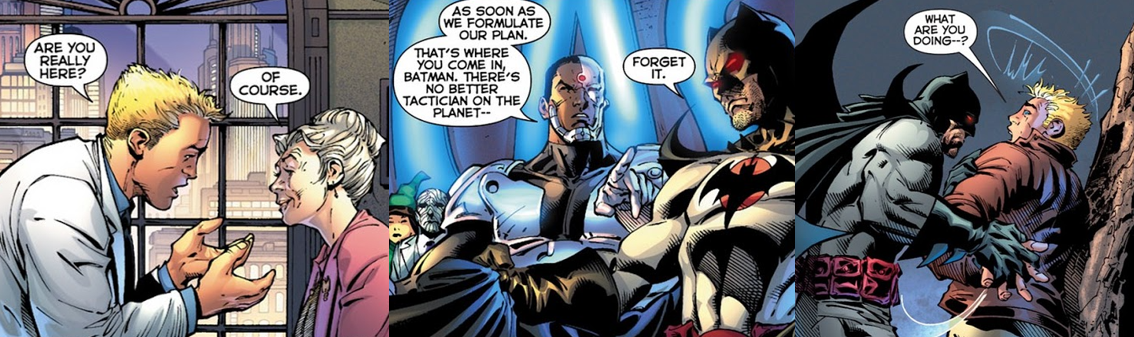
If that wasn’t bad enough, Iris is in a loving relationship with another man; however, on the plus side, Nora Allen is still alive but, while Barry is overjoyed at being reunited with his beloved mother, his analytical mind immediately sets to work trying to figure out what’s happened to the world; he still remembers heroes like Clark Kent/Superman and the Justice League, but neither of these aspects appear to exist anymore…with one exception: Batman. The story jumps over to Gotham City, now a bustling metropolis with neon billboards promoting “Wayne Resorts and Casinos” and haunted by a far darker and more violent version of the Caped Crusader. While this Batman is far more callous than his mainline counterpart, and perfectly happy with tossing costumed baddies to their deaths, he’s just as driven to hunting down the Joker, and especially motivated as the Harlequin of Hate has kidnapped Mayor Harvey Dent’s twins. His investigation is interrupted by Victor Stone/Cyborg who, rather than judging Batman’s violent methods, invites him to align with a motley crew of alternative heroes and villains in order to oppose Arthur Curry/Aquaman and Diana Prince/Wonder Woman, whose warring nations threaten to destroy the world in their conflict. Batman, however, is uninterested in joining their cause since none of them stand a chance at fighting the Atlanteans and the Amazons, and his disinterest causes many of Cyborg’s followers to cut out as well, leaving the man-machine despondent. Confused and desperate for answers, Barry is forced to endure the frustration of traffic jams in order to travel to Gotham City to ask Bruce Wayne for help. However, when he arrives at Wayne Manor, he finds Alfred Pennyworth missing, the stately home in disarray, and is shocked to discover that this Batman isn’t Bruce…but his father, Doctor Thomas Wayne!
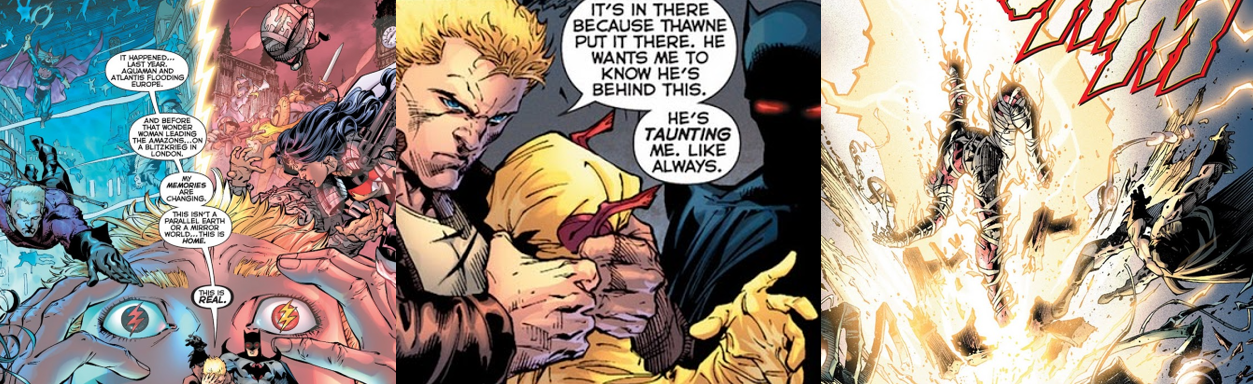
In this world, it was young Bruce who died that night in Crime Alley, turning Thomas into a brutal and sadistic bat-themed vigilante. Believing Barry to be delusional, and angered at his knowledge of Bruce, Thomas breaks Barry’s finger and puts a beating on him, unimpressed with his claims to be the Fastest Man Alive. The conflict with Thomas not only assaults Barry’s body, but also his mind as his memories start to change to align with this new world, one caught in the middle of a war between Atlantis and Themyscira that has devastated large parts of the world. One year previously, the hostile Aquaman and his half-brother Orm Marius/Ocean Master flooded much of Western Europe and, before that, Wonder Woman and her Amazons attacked and conquered London, re-christening it New Themyscira. Barry finds his Flash ring in the Batcave but is shocked to find Thawne’s Reverse-Flash uniform in there instead of his Flash costume and theorises that the maniacal time-traveller must be behind the changes to the timeline. Although initially sceptical of Barry’s story, Thomas is intrigued by Barry’s tragic and twisted history with Thawne, who purposely travelled back in time to cause him anguish by killing his mother and hounding his superhero career, and spurred to help him since restoring the timeline will mean that Bruce never gets murdered. However, the only way they can hope to achieve this is to restore Barry’s superspeed before he forgets everything about the previous timeline, but his initial attempt to recreate the accident that doused him with chemicals and saw him struck by lightning leaves him a charred and scarred mess. Although left in agonising pain from third degree burns over seventy-five percent of his body, Barry is adamant about trying again, with an even bigger bolt of lightning, before his new memories completely override everything he used to be and know. Thomas, of course, thinks he’s a madman for risking his life in such a desperate attempt, but the second bolt of lightning does the trick and Barry’s superspeed and connection to the Speed Force is restored, which has the added effect of speeding up his recovery time. Barry whips himself up a fresh new Flash costume and sets to work trying to figure out what else has changed in this new timeline and who else is available to help; he explains the dangers and mechanics of time travel to a cynical Thomas, that Thawne is afforded additional abilities thanks to his “Negative” Speed Force and has no compunction about screwing up the timeline, which can have serious consequences even if only small changes are made.
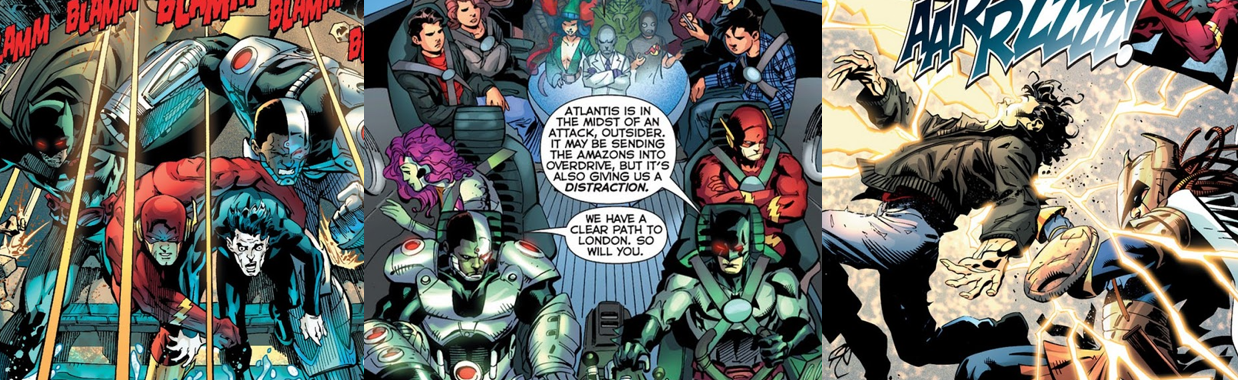
Believing that Thawne purposely orchestrated this new timeline to take the world’s greatest superheroes out of action, Barry discovers that the Kryptonian rocket carrying the infant Superman crashed into Metropolis and killed thirty-five thousand people, and Thomas agrees to be Cyborg’s strategist in exchange for access to classified government information on the rocket that only Victor can supply. Thomas has absolutely no problem with deceiving Cyborg since, if they’re successful, time will be forever changed and none of their strife will have happened or mattered, which is perfectly fine with this jaded, semi-suicidal version of Batman. Cyborg leads the two to a secret underground facility beneath Metropolis, the home of “Project: Superman”, which they sneak into and discover the skeletal remains of a Kryptonian canine and an emaciated, terrified Kal-El who has been routinely tortured, experimented on, and kept out of the sun’s rays his entire life. Batman is less than impressed with Barry’s so-called “saviour”, who has little to no control over his powers and deserts them the moment that General Sam Lane’s soldiers close in. Thankfully, they’re saved by Emily Sung/Element Woman, who chemically incapacitates the soldiers, but Barry continues to be plagued by the physical pain and seizures his new memories cause him; these show a life where his mother was constantly by his side encouraging him, even after his father’s tragic heart attack, and a version of Barry who continuously struggled to find a woman to settle down with. After Colonel Steve Trevor fails to liberate reporter Lois Lane from New Themyscira, the United States President is left with no choice but to employ the full might of the U. S. military, which results in Hal Jordan (who never received the Green Lantern ring in this world and resents the world’s superheroes for not getting involved in the greater conflict) being shot down and killed by the Amazon’s invisible jets. With the entire world on the brink of all-out war, and the United Kingdom threatened by a devastating tidal wave, Barry berates Thomas for writing his world off; arguing that, at any moment, Barry could completely forget Bruce and the former timeline, Barry encourages Cyborg to make contact with the superhero community to defend the world and, although their ace in the hole, “Superman”, has literally flown the coop, they’re joined by Billy Batson and his adopted family, who are collectively known as Captain Thunder in this world. Such is the allure of Batman’s urban legend that all it takes is his involvement and leadership to unite the world’s superheroes in interceding in the battle between Aquaman and Wonder Woman, however they’re betrayed by June Moon/The Enchantress, who forcibly transforms Captain Thunder back into his mortal form so that Diana can run him through with her sword.
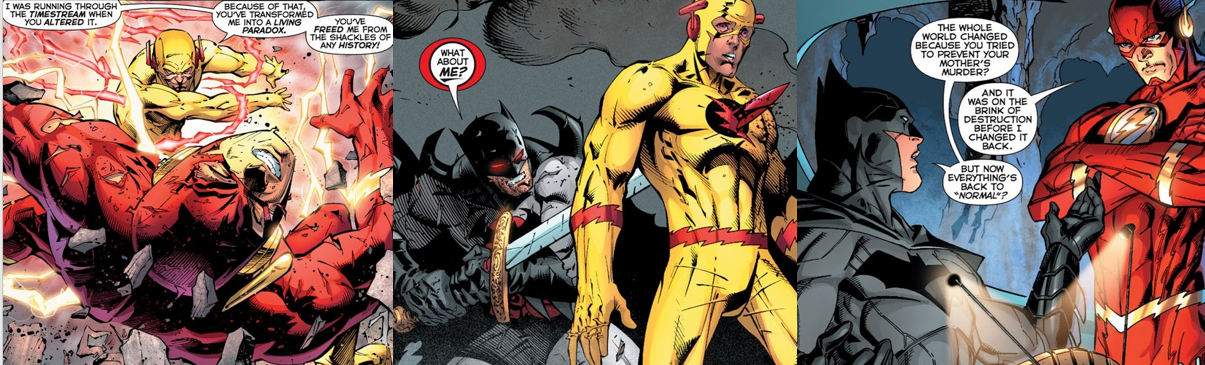
It’s here, in the midst of a brutal war with the fate of this alternative world in the balance, that the Reverse-Flash finally makes his physically appearance. Naturally, a vicious fist fight breaks out between the two, but Barry is devastated to learn that it was he who caused this dark new timeline and not Thawne. Thawne “[resets Barry’s] internal vibrations” to reveal that Barry was so distraught after learning that Thawne killed his mother that he pushed himself further than he’d ever gone before, travelled back in time, and called upon the entire power of the Speed Force to prevent that event from ever happening. The result was a fracturing of the timeline in wild and unpredictable ways, and also that Thawne has been “removed from the timeline” so that, no matter what happens in the past, present, or future, he will continue to exist to plague his foe. This means that Thawne no longer has to rely on Barry being alive to ensure his creation in the far future, and nothing Barry does will prevent Thawne from existing. However, just as it seems like Thawne has achieved his ultimate victory, Batman stabs Thawne through the back and kills him, admonishing him for turning his back on the battlefield. Even though Superman makes a dramatic reappearance to join the fight, the war escalates uncontrollably; Atlantis plans to sink the United Kingdom and Enchantress mortally wounds Batman, who begs Barry to set things right. Reluctant to leave the world to its fate, Barry first stops by to talk to his mother, who encourages him to do the right thing since he’s literally sacrificed billions of lives and made the world a complete hellhole just to save her life. Heartbroken, but galvanised by her blessing, Barry intercepts his past self and knocks him from the Cosmic Treadmill but, when he returns to the time stream, Barry finds that there are three separate, competing timelines and a mysterious, hooded woman warns that time has been splintered and that only Barry can help merge them back into one unified timeline. When Barry awakens at his desk, the world appears to be back to normal; the first thing he does is race to the Batcave to talk with Bruce, who is once again Batman and who, surprisingly, reassurances Barry that he’s only human and couldn’t have known that saving his mother would have screwed the world up so badly. In an interesting twist, Barry retains his memories of the “Flashpoint” universe, and leaves Bruce in tears when he delivers him a letter rom his father. However, Barry fails to notice a few changes that have occurred as a result of his time meddling; not only is his Flash suit different, but so is the Batsuit, and all of the world’s heroes have been altered into their God-awful “New 52” forms, but the extent of Barry’s actions wouldn’t be revealed for some time and, for all intents and purposes, this is now the “real world”.
The Summary:
If there’s one reason to read Flashpoint, it’s the gorgeous artwork by Andy Kubert; stylistically similar to Jim Lee and John Romita Jr., Kubert really emphasises the kinetic energy of his characters, which is perfect for the Flash, while still balancing the many secondary characters in a way that’s bold and striking and crafting a far darker and more fearsome rendition of Batman. Each issue is accompanied by supplementary materials about this changed world, such as a world map that shows who controls which territory and where these new groups of alternative characters operate, and line art showing Kubert’s process. Sadly, though, just reading the main five issues doesn’t give you the entire story of Flashpoint; like pretty much every big Crisis and crossover event these days, Flashpoint was accompanied by four one-shots, two preludes, and no less than seven additional tie-in titles that further explored this alternative world and these far darker, less hopeful characters. I haven’t actually read any of these as I never felt compelled to explore it further as I subscribed to Thomas Wayne’s philosophy that it really doesn’t matter what happened to him, Aquaman, Hal Jordan, or any of the other characters changed by Barry’s actions as the timeline is reset at the end of the story. That and I really can’t afford to by the omnibus edition that collects all these issues, I don’t want any of the tie-ins taking up space on my shelves, and I really don’t care for the story enough to want to read any more about it.
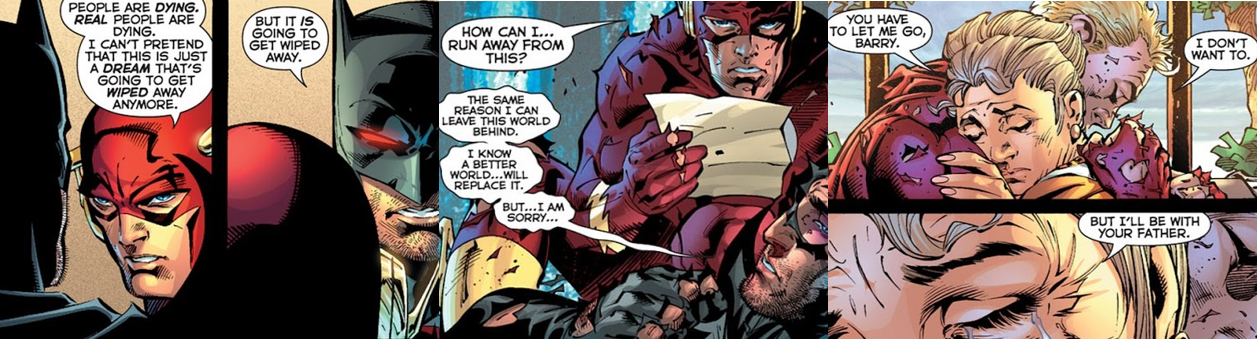
This really isn’t a great story, or look, for Barry Allen. For someone like me, who grew up reading Wally West’s adventures as the Flash, it was already quite the insult to have him so readily supplanted by his predecessor, but to write a story where Barry’s so selfish that he screws up the entire timeline and, not only that, hesitates to set things right because he can’t stand to lose his mother? Yeah, that’s not a great look. And I get it; he’s grieving and in pain and not thinking rationally, but it’s especially odd that Bruce reassures him that he (as in Bruce) probably would’ve done the same thing…despite the fact that he turned down the chance to see the world and timeline reorganised in his favour in Infinite Crisis. The message seems to be that we have to sympathise with Barry but, while he’s obviously suffered a terrible loss at the hands of one of his worst enemies, it kind of seems like Geoff Johns wrote this twist simply because it’d be too predictable to have Thawne be behind the changes to the timeline. On the plus side, Barry certainly suffers for his selfishness; he’s nearly killed by the lightning bolts he attracts to himself and endures an unimaginable amount of agony from their impact, which is the least he deserves to go through. It’s interesting, though, as Barry feels morally obligated (or, perhaps, guilty enough) to help save this world and even has the gall to lecture Thomas Wayne about condemning the world to die. He even hesitates to undo his actions and is desperate to find a way to save his mother and the world at the same time, but finally being convinced to do, y’know, the right thing and prioritise the greater good and he doesn’t even do that right as it births the New 52 world.
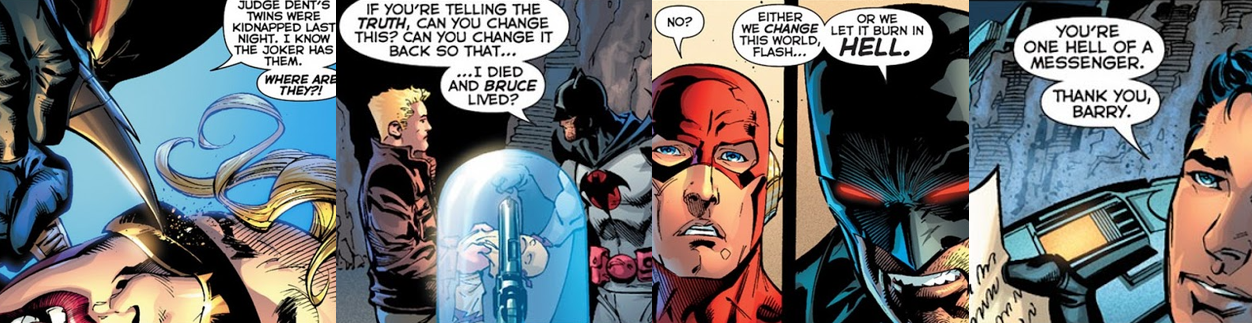
Flashpoint’s nightmare timeline is very different from the mainline DC Universe; it’s full of conflict, loss, and despair. A world constantly on the brink of war, under threat by two warring superpowered nations, and suffering without the world’s greatest superhero. This is a world where the public has lost faith in costumed heroes since they’re reluctant to stand against the forces of Atlantis and Themyscira and many of them have either been killed, maimed, or forced to make unlikely alliances and rely on subterfuge to survive and try to take a stand. However, the allure of Batman’s reputation remains as strong as ever; while Cyborg doesn’t approve of Batman’s violent methods, he knows that the Resistance will only really commit to fighting if Batman is onboard and goes out of his way to try and recruit the Dark Knight in order to spark some small sliver of hope. Thomas Wayne, naturally, steals the show here; his darker costume and demeanour show an alternative version of Batman who’s much older and far more cynical than Bruce Wayne. It’s consistently hinted that Thomas Wayne is in such a dark place that he’s not only completely given up on the world, but he also doesn’t really care whether he lives or dies. For him, nothing really matters anymore as not only was his entire world ripped away from him when he watched his son die before his eyes, but everything could be wiped out at a moment’s notice. He is compelled to help Barry, despite his cynicism, not to save his world, but to undo it entirely, fulfilling both of these goals, and really makes an impression with his surly demeanour, willingness to kill, and glowing red eyes. Sadly, despite appearing to die here and this timeline being erased, Thomas Wayne’s Batman would return later down the line and actually oppose his son as yet another dark analogue to the Caped Crusader, but I have to admit that he was one of the few highlights of this Crisis.

Overall, I really don’t care for this story specifically because it spelt the end for the DC Universe as I knew it and the beginning of my least favourite time in DC Comics, the New 52 run. I just didn’t understand the need to even do this and reset things in such an extreme way when Infinite Crisis had already done that not too long before this was published. As a self-contained, throwaway Flash tale that taught Barry a serious lesson about dealing with his grief, it could’ve worked; hell, even as a longer story the stretched over a few of the Flash titles and shook up the status quo for the Flash might have been more enjoyable, but it falls pretty flat as a reality-warping Crisis event because it’s a mere five issues and is lacking the expansive scope of these events. For me, it just doesn’t work since it paints Barry in such a poor light, and it feels completely pointless to dip into any of the tie-in stories since this was obviously never going to last as a timeline. I absolutely feel this could have worked much better if the Reverse-Flash had been the mastermind behind it and had cropped up a bit more in these five issues; this could’ve been a great showcase to show how depraved and twisted he is and could have presented a nightmare timeline where he’s the hero and the Flash is a villain, but he shows up far too late in the story to really make much of an impression and, despite boasting that he’s effectively immortal, is dispatched pretty easily by Batman and his trusty sword. In hindsight, now that the New 52 has finally been undone, Flashpoint isn’t as bad as it was when I first read it and was struggling to cope with all the rubbish decisions made in that era, but it’s still easily skipped over, I think. Just the idea that Barry, who lectures Thomas on how dangerous haphazard time travel can be, would make such a poor, selfish decision without thought to the consequences really doesn’t warm me to his character and, in many ways, makes him as reprehensible as Hal Jordan was back when he was Parallax. These are the actions of a misguided villain, not a sympathetic hero, and all the heart-warming letters from dead fathers and grief over lost mothers in the world can’t save this utter dreck of a story.
My Rating:
Could Be Better
Are you a fan of Flashpoint? If so, what did you like about it? If you read the tie-in stories, which ones were your favourite and what did you think to this alternative timeline? Were you a fan of DC’s decision to reset their continuity again? What did you think to Barry’s decision to save his mother? Did you sympathise with him or did it paint him in a bad light? Were you a fan of Thomas Wayne’s Batman? Which Flash or speedster is your favourite? What’s your favourite Flash story? Which of DC’s infinite parallel worlds is your favourite? Feel free to sign up and share your thoughts on Flashpoint below or drop a comment on my social media.





























 Dr. K's Waiting Room
You must be logged in to post a comment.