Back Issues: Detective Comics #475/476

Writer: Steve Englehart – Artist: Marshall Rogers 

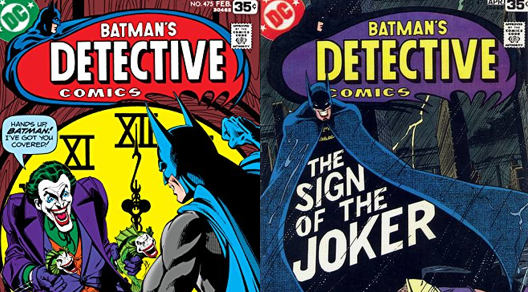
Story Title: “The Laughing Fish!”
Published: February 1978 

Story Title: “Sign of the Joker!”
Published: April 1978 

The Background:
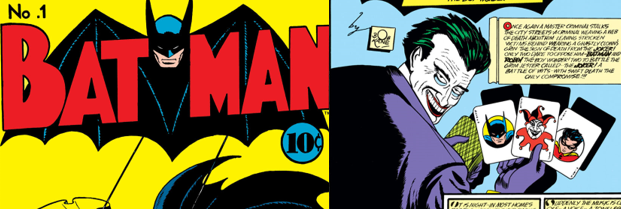
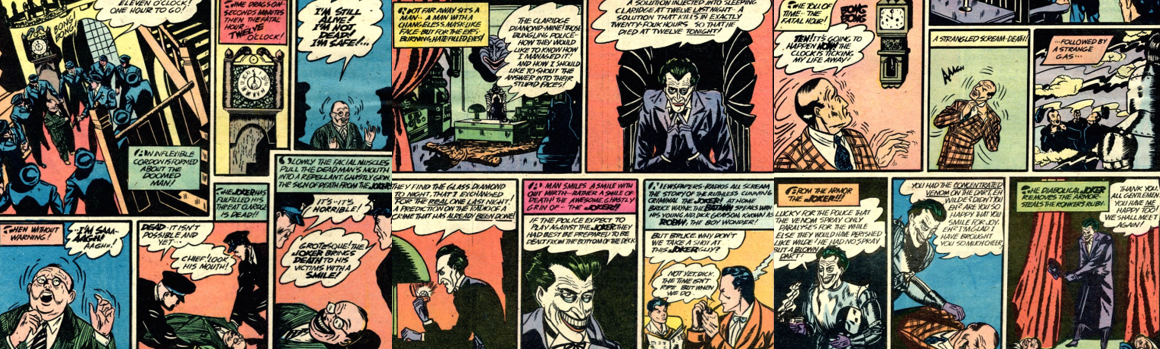
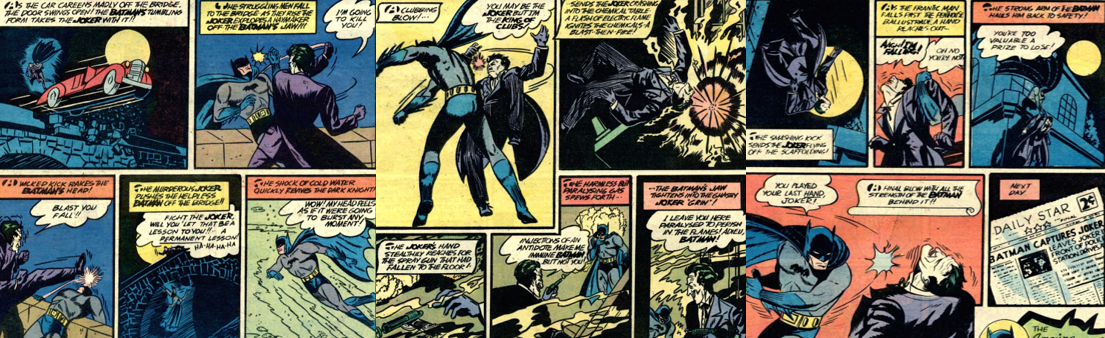
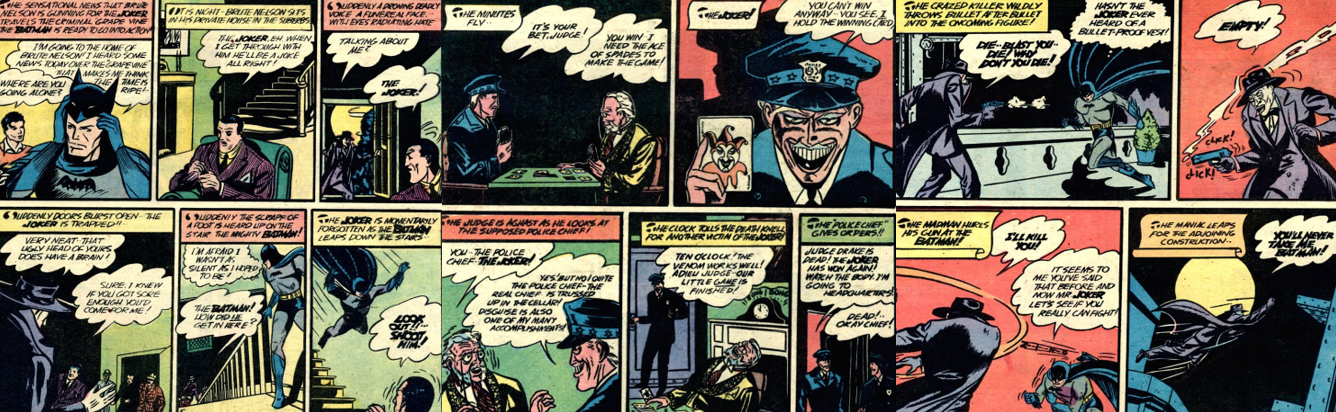
After achieving success with Clark Kent/Superman, National Comics Publications tasked Bob Kane with creating a masked crimefighter to add to their superhero portfolio and, thanks to Bill Finger, the “Bat-Man” went on to become a mainstream cultural icon. Over the decades, the Batman has gone toe-to-toe some of comics’ most recognisable supervillains, though his greatest nemesis is unquestionably the self-styled Clown Prince of Crime, the Joker. Bob Kane, Bill Finger, and Jerry Robinson all claimed to have created the Harlequin of Hate, but it’s widely agreed that the Joker’s trademark visage was heavily influenced by The Man Who Laughs (Leni, 1928). A last-second decision from then-editor Whitney Ellsworth saw the Joker survive his first encounter with the Batman, though the character faded from the spotlight under the direction of editor Julius SchwartzDennis O’Neil and Neal Adams reinvigorated the Joker in the 1970s and 1980s with stories such as this classic two-parter that is such a pivotal Joker story that it was adapted for the hugely popular Batman: The Animated Series (1992 to 1995). The stories played a huge part not just in giving the Joker back his edge, but in reviving the character to terrorise Gotham City for years to come as the Batman’s number one antagonist. 

The Review:
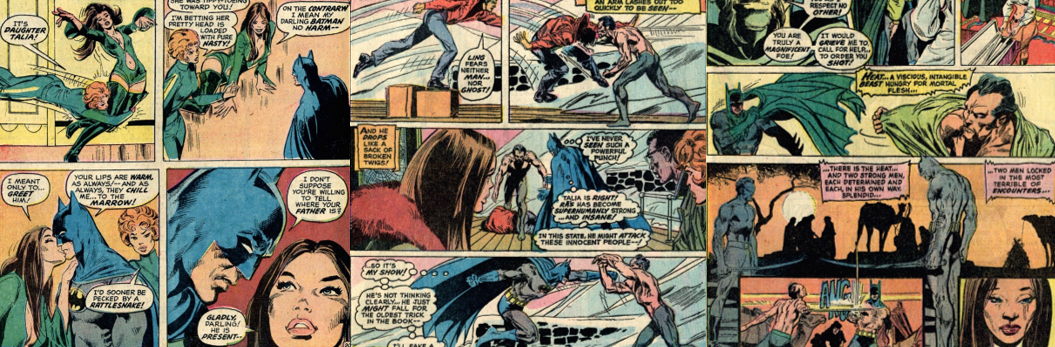
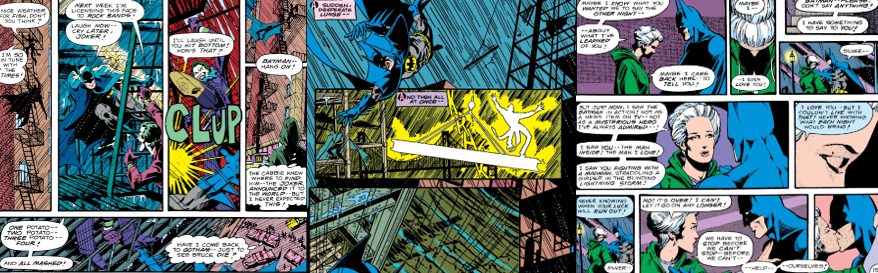
This classic two-part Batman story begins, appropriately enough, in the murky dead of night with the Batman prowling across the rooftops of Gotham City, preparing for the greatest confrontation of his vigilante career. At this point in time, billionaire philanthropist Bruce Wayne had been dated wealthy socialite Silver St. Cloud, a gorgeous platinum-haired woman who quickly captured Bruce’s heart. They became so close that Bruce suspected that Silver had figured out his dual identity, so he swings by her apartment in the guise of the Dark Knight to confirm his suspicions. Although Bruce is convinced that Silver is aware of the truth, she denies that she has anything to confess to the Batman and her demeanour convinces him that there’s a shred of doubt in his assumptions. Realising that it’d be foolish of him to simply unmask in front of her if there’s even a one percent chance he’s wrong, the Batman bids her goodnight and leaves, only for Silver’s resolve to falter once he’s gone. Wracked by her knowledge of Bruce’s dual life, Silver makes the difficult decision to take a hiatus from both men, and Gotham City, to get her head straight. The Batman is still mulling over his complicated love life and the dichotomy between his two identities when he’s aroused by local fishermen, who frantically show him that all the fish they’ve caught have been horrifically mutilated to carry the Joker’s signature smile, perplexing both them and the Dark Knight. 

Batman’s personal issues are compounded by the Joker’s latest insane threat.

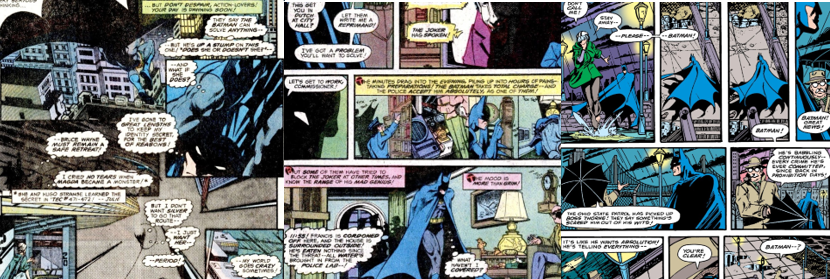
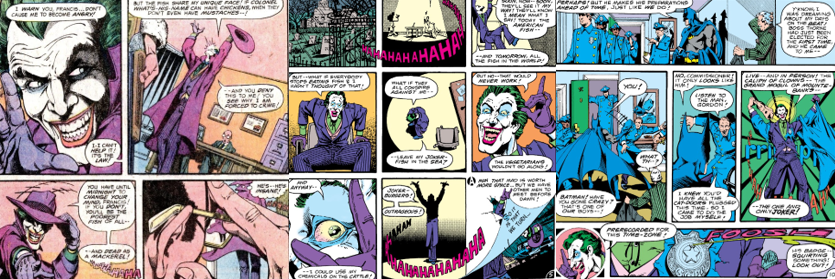
The phenomenon isn’t limited to Gotham City; over the next few days, reports of “laughing fish” come in from all across the country, shocking the nation. However, it’s G. Carl Francis who gets the biggest shock when the Joker himself, and his goons, storm into his office and demand that he helps to copyright the laughing fish so that the Joker can profit from every one sold. Unfortunately, Francis is duty-bound to inform the Clown Prince of Crime that fish can’t be copyrighted as they’re a natural resource, angering the Joker and causing him to threaten Francis to find a loophole before midnight or face his wrath. The Joker then pays a visit to crime boss Rupert Thorn, who’s already on edge after being seemingly haunted by the ghost of Professor Hugo Strange, whom he murdered tree issues prior. Since Thorn was one of many villains who tried to purchase the knowledge of Batman’s identity from Strange, the Joker warns him to stop trying to expose his rival’s identity as the Joker is eager to match his wits against the Dark Knight and believes unmasking him would rob his game of all its fun. With Thorn left slipping into insanity, Commissioner James “Jim” Gordon calls in the Batman to help with the threat against Francis’s life. After the Joker makes a televised promise to murder Francis, Batman meticulously checks the apartment and places him under lockdown, though he remains frustrated by the Joker’s madcap nature and unpredictable insanity. Still, the Batman acts swiftly when a mysterious gas suddenly floods the apartment. Be fixes a breathing apparatus to Francis’s face, but to no avail; Francis collapses, dead, his face twisted into the hideous smile of the Joker. Although Jim is confused since the gas didn’t harm anyone else, the Batman correctly surmises that the Joker must’ve secretly poisoned Francis at their meeting so the gas would have a lethal effect. 

The Joker outwits Batman, as Silver and Thorn struggle with their literal (and figurative) ghosts.

The Joker boasts of his victory through another pirate broadcast and vows to kill another bureaucrat if his legal claim on the fish isn’t approved by 3am, and the issue ends with the Batman aggravated and Silver skipping town courtesy of Rupert Thorn. The story continues in the next issue, with Batman, Jim, and Officer O’Hara keeping a vigil on the Joker’s next target, Thomas Jackson, lamenting that state laws prohibit them from simply executing the Joker since he’s clinically insane. Despite their best efforts, Jackson’s cat wanders in with a Joker fish in his mouth, which drives him to bite and instantly kill the Batman, leaving him with the pale grin of the Joker! However, Batman had actually switched places with Jackson using a clever disguise, but the cat recognised and attacked his master regardless. After the Joker mocks them through his broadcast, the frustrated Batman flees into the stormy night, momentarily spying Strange’s ghost and stumbling upon a vapor analysis meter. The story briefly jumps over to the Joker’s lair, where he somewhat breaks the fourth wall to chuckle at his wit and having bamboozled his foe, and even plots expanding his food-related antics to other products. Another detour delves into Silver’s troubled mind; she’s overwhelmed by her knowledge, unwilling to destroy the mystery of the Batman but pining for her lost love, while Thorn wrestles with the stress caused by his visions. When the radio mentions Batman, the two get into a heated debate about his presence and Thorn angrily ejects Silver from the car, leaving her by the side of the road. While she quickly finds another ride, Thorn is terrified when Strange’s ghost flies at him from the night and seemingly throttles him to death! 

Batman’s victory is tainted by ambiguity and personal heartache for the Dark Knight,

At dawn, the Batman and Jim prepare for the Joker’s next attack, but Jim is horrified when the vapour analyser drives Batman to suddenly attack one of his officers, who’s quickly revealed to be the Joker in disguise! Though rumbled, the Joker keeps the Dark Knight at bay with an acid-spitting flower and makes a hasty retreat using the fire escape. Arriving in town via a cab, Silver pulls up just in time to witness the Batman in action as he ventures into the rainswept night to apprehend his foe, surprisingly caught off-guard by an errant kick and almost tumbling to the street below. While the Joker gleefully taunts his rival, the Batman ponders his own mental instability since he’s the only one crazy enough to chase after the grinning madman, and their chase takes them to the city rooftops. The two come face-to-face atop a construction site, where the Batman is forced to take a desperate plunge to avoid getting a face full of acid, and the Joker is hit by lightning while laughing on a hanging girder. The Batman watches the Joker plunge into the raging river below and frantically checks for any sign of his foe, but it appears the Joker has finally perished. Batman is then stunned when Silver approaches him, confessing not only her love for him but also that that same love caused her great pain when she watched him in battle and realised that he could die at any moment. Unable to shoulder the loss of the man she loves, or expose his true identity, she tearfully begs him to leave her alone and runs off into the night, leaving him stoic and heartbroken. Even Jim’s news that Thorn was picked up, terrified out of his mind and spilling the beans on all his criminal activities, brings Batman little comfort and he simply swings off as a new dawn rises, his victory bittersweet and emotional. 

The Summary:
These two stories are representative of the kind of Batman stories I grew up with. I had a handful of Batman annuals as a kid, which contained assorted stories from the 1970s and 1980s and featured names like Steve Englehart and Denny O’Neil prominently. Consequently, I have a real fondness for the gritty, dark, neo-pulp art style on show here. Gotham City is seeped in gothic darkness and flooded by incessant rain, making it grimy and claustrophobic and uncomfortable to behold, and characters are rendered with a stark realism. Although I’m not the biggest fan of Batman’s blue-and-grey ensemble, he cuts an intimidating figure here and it’s fun seeing him operate so openly with Jim and others. He’s still regarded as a bit of an urban myth, but also respected as an informed mind and necessary evil to help combat threats such as the Joker. His presence in Gotham City is the subject of much debate at this time. Thanks to Thorn’s influence, the people and council have started to question the Batman’s necessity and his impact on the city, aspects which come to be reflected in Silver’s conflict regarding her knowledge of his identity. Though these stories are all I really know of her, I like Silver and it’s not often Batman gets a love interest who knows of his dual life. I enjoyed the emotional conflict between them both, where they both knew the other knew but didn’t dare say it aloud for what it would entail, and it brings a real humanity to Batman when she has to reluctantly end their relationship to spare herself greater pain and perpetuate his myth. 

Batman’s detective skills and limits are tested by the Joker and his complicated love life.

One aspect I really like about this time in Batman history is how much his detective skills are emphasised. Jim calls the Batman in as an advisor and immediately sets to work meticulously safeguarded each victim’s apartment, checking every inch for possible threats and desperately trying to prepare for every eventuality. Although his thoughts are shown to be completely focused on the task at hand, I think it’s pretty clear his frustration with the Joker’s antics is exacerbated by his personal issues with Silver. The Batman laments time and again that the Joker is nigh-impossible to predict as he just does whatever he wants for seemingly no reason, meaning Batman’s preparation and planning are meaningless as the Joker outwits him each time. Even swapping places with Jackson doesn’t help the Batman, and it’s only by utilising the analyser left for him by Strange’s ghost (or some other unknown ally) that Batman exposes the Joker’s disguise before he kills his last victim. The battle between the Batman and the Joker is depicted as a war of attrition, a game of one-upmanship, rather than a physical confrontation (at least, until the end). Like in his first appearance, the Joker hijacks television broadcasts to make threats and taunt his foe, and employs disguises and subterfuge to bamboozle even the World’s Greatest Detective. One thing I especially enjoyed here was that Bruce Wayne doesn’t appear in these stories. His personal life is of great concern to Batman, but he stays in costume throughout both issues, emphasising his unwavering focus on protecting the Joker’s victims and apprehending him. Another interesting aspect is, like in his first appearance, the Joker surprisingly holds his own against Batman thanks to being a slippery devil and surprising him with his acid flower, wild kicks, and daredevil nature. 

A fantastic return to form for the Joker that emphasises his insanity and menace.

Indeed, this is a fantastic return to form for the Joker after years of being a buffoonish clown or being absent from DC Comics. Drawn as what I would define as the quintessential depiction of the character (tall, gangly, in a purple suit, coat, and fedora, and sporting an elongated jaw), the Joker is a cackling maniac whose newest plot is to spread fear and profit from his laughing fish. His scheme is ludicrous in its simplicity; he’s tainted the water supply with his Joker toxin, killing the fish, poisoning their meat, and leaving them with his signature cheshire grin, all with the intention of profiting from their sale! Obviously, these demands are preposterous but the Joker won’t take no for an answer and mercilessly targets and kills the bureaucrats he believes are denying him his intellectual rights. As mentioned, the story takes hefty influence from the Joker’s first appearance and is, in many ways, an expansion and remake of that first story. The Joker is an elusive, diabolical, and maniacal figure who tests the Batman’s mind as much as his resolve. However, the Joker is also prideful and overzealous. He enjoys toying with Batman so much that he threatens Thorn to stop trying to unmask the vigilante and arrives, in person and in disguise, to finish the job by the end, a decision that proves to be his downfall. However, there’s a clear suggestion that the Joker doesn’t care; he doesn’t care about winning, losing, living, dying, or being locked up. He simply enjoys jousting with Batman and takes glee in their conflict, and the death and terror he spreads, fully aware that the Batman’s moral code keeps him from cross that line. In the end, these are two essential Joker stories; they highlight his outrageous nature, his chilling menace, and his versatility as one of the Batman’s most enduring foes. It’s also a great showcase for the Dark Knight; not only of his detective skills and standing amongst his peers but also the complicated dichotomy of his dual identity. In a nutshell, I’d say this two-parter is a must-read Batman tale, as is most of this run since this really was a great time in the Batman’s publication history. 

My Rating:

Rating: 4 out of 5.

Great Stuff

What did you think to the Joker’s plot to profit off his laughing fish? Did you enjoy this era of Batman’s history? Are you a fan of more cerebral challenges for the Dark Knight or do you prefer it when he’s beating villains up? What did you think to the subplots involving Silver St. Cloud and Rupert Thorn? Do you consider these two stories essential reading for any Batman and Joker fans? What are some other Joker stories you enjoy? Whatever your thoughts, leave a comment below or and be sure to check out my other Batman and Joker content across the site. 

Movie Night [Bat-Month]: The Dark Knight


In the decades since his first dramatic appearance in the pages of Detective Comics, Bruce Wayne/Batman has become a mainstream, worldwide, pop culture icon. The brainchild of writer Bob Kane, Batman was brought to life by artist Bill Finger and has been a popular staple of DC Comics and countless movies, videogames, and cartoons over the years. “Batman Day” fell on 21 September this year so I’ve been spending every Saturday celebrating comic’s grim and broody vigilante.


Released: 18 July 2008
Director: Christopher Nolan
Distributor: Warner Bros. Pictures
Budget: $185 million
Stars: Christian Bale, Heath Ledger, Aaron Eckhart, Maggie Gyllenhaal, Gary Oldman, Morgan Freeman and Michael Caine

The Plot:
After his dramatic debut as “The Batman”, billionaire vigilante Bruce Wayne (Bale) is cracking down on organised crime within Gotham City. However, his mettle is tested by the clown-faced anarchistic “The Joker” (Ledger), who seeks to disrupt social order and corrupt upstanding district attorney Harvey Dent (Eckhart).

The Background:
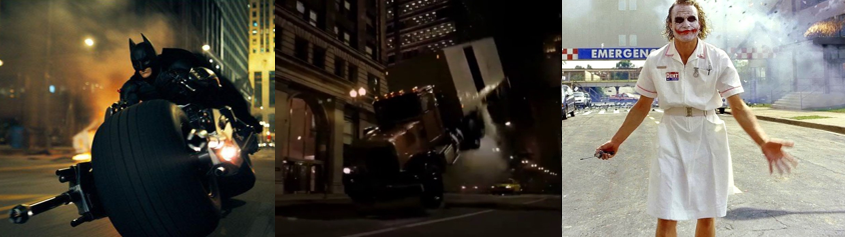
After Joel Schumacher effectively killed the live-action Batman franchise with his dismally received camp adventures, Warner Bros.’ desperate attempts to get a new movie finally paid dividends when visionary writer/director Christopher Nolan, writer David S. Goyer, and star Christian Bale explored Batman’s origins in the highly regarded reboot Batman Begins (Nolan, 2005). Despite teasing the Joker at the finale, Nolan was initially unsure if a sequel would be greenlit but worked closely with Goyer and his brother, Christopher Nolan, to develop a suitable follow-up once Warner Bros. prioritised a sequel. The filmmakers took inspiration from seminal Batman stories like The Long Halloween (Loeb, et al, 1996 to 1997) and some of cinema’s most memorable movie villains to bring their versions of the Joker and Harvey Dent to life. Despite Jack Nicholson’s memorable performance as the character, Nolan confidently cast against type after being impressed by Heath Ledger, who mentally and physically threw himself into the role. In keeping with his preference for practical effects, Nolan signed off on the construction of a fully-working Batcycle, redesigned the Batsuit to be more flexible, blew up a building for real, and flipped an 18-wheeler truck using a massive piston! Sadly, the editing process proved particularly difficult after Ledger unexpectedly died from an accidental overdose; the film was summarily dedicated to him. Following an aggressive viral marketing campaign, The Dark Knight enjoyed a record-setting $1 billion+ box office and was met with widespread critical acclaim. It is widely considered one of the best and most influential comic book movies ever made, praised for its performances and socially relevant narrative, with many praising Ledger’s portrayal of the Joker which won him a posthumous Oscar. Immediately regarding as the best Batman movie of all time and recognised as setting a new standard for comic book movies, The Dark Knight’s success more than justified the production of a third and final (and far more divisive) entry some four years later.

The Review:
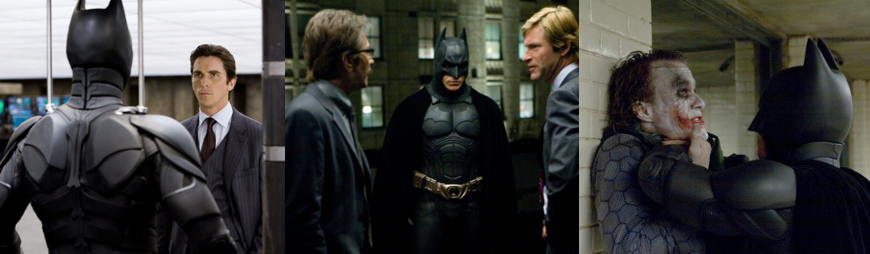
After the disaster that was Batman & Robin (Schumacher, 1997), I think it’s safe to say that everyone thought Batman’s feature film career was dead in the water. For me, that’s why Batman Begins was such an exciting and enjoyable experience. Finally, after decades of Batman being either a goof or a psychopath, we got a live-action film that really nailed the heart and drive of the character. The extended and in-depth exploration of Bruce’s psyche, determination, and training to become “more than just a man” really put him at the forefront of the piece and allowed the most accurate depiction of the Dark Knight ever seen in cinema at that point as Bale deftly shifted between numerous subtle personas. With Batman Begins’ conclusion masterfully teasing the Joker, expectations were high for the sequel, but reactions to Ledger’s casting were mixed at the time due to his reputation as a “pretty boy”. To address this, Nolan opens his film with an intense and engaging bank heist, filmed entirely in IMAX, in which the mysterious Joker showcases his hands-on, manipulative abilities by arranging for his clown-faced goons to knock off a mob bank and off each other once their specific tasks are completely, allowing him to easily slip away in the chaos. It’s been about a year or so since the last film and Batman now appears at crime scenes to liaise with Lieutenant James “Jim” Gordon (Oldman), much to the chagrin of cops like rookie detective Anna Ramirez (Monique Gabriela Curnen) because of his vigilante status and the corruption that continues to infest the Gotham City Police Department (GCPD). However, neither Batman or Gordon initially place much stock in the Joker’s continued threat since their focus is solely on taking down the last vestiges of organised crime in the city, represented by mob bosses Salvatore “Sal” Maroni (Eric Roberts), Gambol (Michael Jai White), and “The Chechen” (Ritchie Coster), a decision that’s entirely logical bit which comes back to bite them in due time.

Batman’s war on crime is thrown into chaos by the maniacal Joker.

Bruce has been extremely busy in the time between films. Although he’s forced to operate out of a penthouse and highly equipped bunker in the city as he waits for Wayne Manor to be rebuilt, he’s established quite the reputation both in and out of his cowl. As Bruce Wayne, he’s the bored, party-going philanthropist who’s just as likely to abscond with a bunch of actresses to an isolated yacht as he is to fall asleep in board meetings. Although Bruce is seen by many as an aloof, reckless, and embarrassing billionaire, this persona effectively keeps anyone from questioning his nightly jaunts and he’s still savvy enough to fund and promote any programs or individuals who are committed to bringing Gotham City back to glory, such as Harvey Dent. As Batman, Bruce’s reputation is even stronger; criminals are now so afraid of the Dark Knight that they think twice about being on the streets when the Bat-Signal is in the sky and mobsters hold their meetings during the daytime. Although the Batman is still something of an urban legend, many in the city have been inspired to dress up as him and take the law into their own hands, something Bruce is disturbed to see since it results in a bunch of out of shape blokes with itchy trigger fingers wearing “hockey pads”. Still, Batman’s presence has had a positive impact on the city. He and Gordon collude to tackle the city’s mob, eventually entering a shaky alliance with Dent to apprehend mob banker Lau (Chin Hau) and make mass arrests, and Batman even detains Doctor Jonathan Crane/The Scarecrow (Cillian Murphy) in during the opening, finally taking the maniac’s drugs off the streets. However, night after night fighting crime and getting into fist, fire, and dog fights takes a toll on Bruce. His faithful butler and father figure, Alfred Pennyworth (Caine), continues to offer wry commentary and deep concern for his master’s welfare but Bruce is determined to clean up the streets and make the city safe before even considering giving up his crusade.

The loss of Rachel takes a heavy toll on Gotham’s “White Night” and drives him to murder.

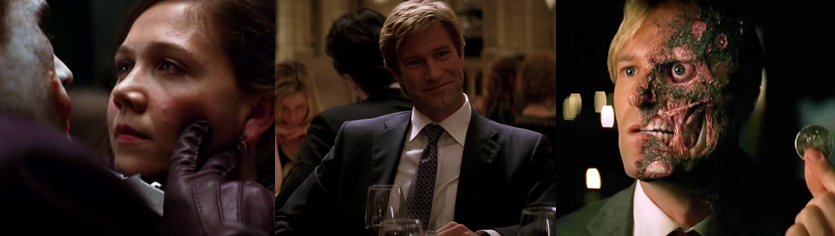
However, Batman’s positive impact, the arrest of hundreds of mobsters, and the public’s approval of Dent give Bruce pause to reconsider his path. Since the last film, Bruce has been keeping a close eye on childhood friend and crush (and assistant district attorney) Rachel Dawes (Gyllenhaal), who works closely with Dent to prosecute the criminals and the corrupt. Thanks to Gyllenhaal being a far superior actress to her predecessor, Rachel has much more gusto this time around. She exudes a confidence and determination that was lacking in Katie Holmes’ performance and allows her to not only appear effective when interrogating Lau but also sees her fighting back against the Joker when he targets her at Bruce’s fundraiser for Dent. Although Bruce is clearly rattled by how close Dent and Rachel have become (the two are shown to be in a relationship) and somewhat condescending towards Dent’s marketing campaign, he’s as impressed by the D.A.’s conviction as the rest of the city. Dent is a square-jawed patriot who makes a buzz in the court room with his no-nonsense approach towards criminals and inspires the wealthy and the destitute alike with his commitment to justice. Dent is also an avid supporter of the Batman and determined to do whatever it takes to keep the city streets clean, even if just for six months, but he’s not as squeaky-clean as everyone believes. Gordon is sceptical of Dent due to his past in Internal Affairs, while Dent is highly critical of the corruption within the GCPD, but the two form an efficient trio alongside the Batman when they agree to pool their resources to bring Lau back from Hong Kong. Dent proves to be a surprisingly complex man. He believes so strongly in the iconography of the Batman and in not giving in to the Joker’s demands, no matter how many lives are at stake, that he publicly outs himself as the Dark Knight to keep the myth alive but also proves that he’s not above threatening criminals at gunpoint, showcasing an unexpectedly erratic side to his character. This is only exacerbated when Dent and Rachel are targeted by the Joker and Batman is forced to choose which one to save. Naturally, he picks Rachel but both he and Dent are horrified to learn that this was a double-cross that leaves Dent hideously scarred and despondent, his faith in both justice and the caped vigilante shattered and replaced by a cruel devotion to “chance”.

Bruce’s allies believe in the Batman and play a hands-on role in aiding and advising him.

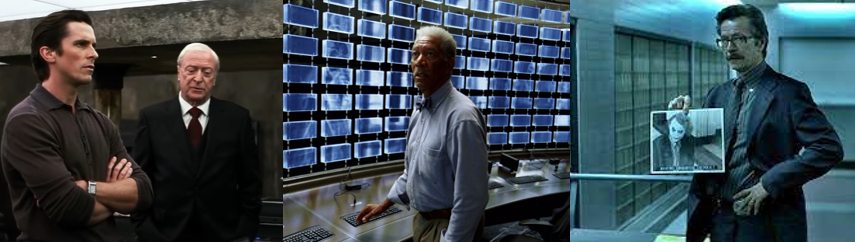
As before, Bruce is supported in all things by Alfred, who acts as a field surgeon, conscience, and advisor to his duties both in and out of the Batsuit. We learn a little bit more about Alfred in this film through his entertaining exchanges with Bruce, in which the two share a banter that is both amusing and heart-warming. Alfred spent some time in the Peace Corps in Burma, indicating he’s seen combat and has a military background, and his insight into chaotic aberrations such as the Joker are almost on par with Bruce’s years of training to learn the criminal mind. Initially, Bruce dismisses Alfred’s insight, however, refusing to believe that the Joker is anything more than a thug with a gimmick, but is forced to admit that he’s underestimated his foe when the Joker pushes him to breaking point with his killing spree. Interestingly, Alfred actually encourages Bruce not to give in to the Joker’s demands, to “endure” the slings and arrows so as to maintain the Batman’s incorruptible persona, and also secretly shields Bruce from the knowledge that Rachel ultimately chose Harvey over him to spare his surrogate son further pain. As before, Bruce is provided with new toys and even a sleek new suit by Wayne Enterprises Chief Executive Officer Lucius Fox (Freeman), who now exhibits a working knowledge of Bruce’s dual identity despite both never outright saying it. Fox plays a pivotal role not just in helping Bruce apprehend Lau but also in throwing off the suspicions of Coleman Reese (Joshua Harto) when his number crunching exposes Batman’s identity, and in the creation of a fantastical device that allows Batman to pinpoint the Joker’s location by hacking every cell phone in the city. Though Fox threatens to resign if the device isn’t destroyed because of the dangerous invasion of privacy it offers, his loyalty is rewarded when Batman rigs the machine to self-destruct once the Joker has been located. Finally, we have Gordon, who publicly disavows any knowledge of Batman but regularly colludes with him to fight the mob. Gordon’s role is also crucial to the film as he is seemingly killed protecting mayor Anthony Garci (Néstor Carbonell), only for this to be revealed as an elaborate plan by him and Batman to capture the Joker, a gamble that sees Gordon promoted to police commissioner after the Harlequin of Hate assassinates commissioner Gillian Loeb (Colin McFarlane). Although horrified by the Joker’s murderous antics, Gordon’s riding quite the high when he, Dent, and Batman finally get their hands on the city’s mob, but his hubris comes back to bite him when Dent specifically targets him as failing to protect Rachel since Gordon’s forced to work with corrupted cops and a wayward vigilante.

Ledger delivers a star-making performance as the chaotic and unhinged Joker.

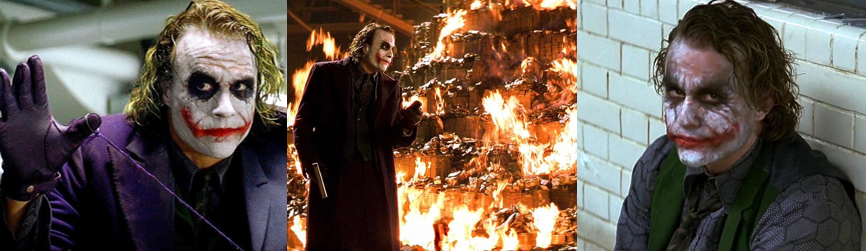
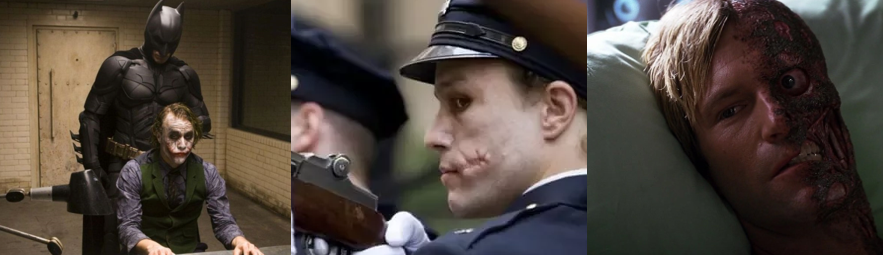
And then there’s the Joker, played with an unnerving, scene-stealing performance by the late Heath Ledger. Unlike in Batman (Burton, 1989) where the Joker was provided with a hefty original backstory, this Joker is a complete enigma. A self-styled “agent of chaos” who proudly showcases both his gruesome facial scars and boasts that he’s simply “a dog chasing cars”, the Joker is as manipulative and psychotic as he is unpredictable and hypocritical. With no identification or fingerprints, the Joker is like a ghost. When he’s introduced, it’s like he’s been conjured by the city itself to challenge Batman’s presence and there’s no definitive explanation for who he is and why he does what he does. Indeed, much like popular depictions of his comic book counterpart, the Joker himself offers conflicting versions of his origin, scars, and motivations. The film suggests he’s been “rippin’ off mob bosses” for some time, he’s shown to have an intense hatred towards city officials and authority figures, and he even openly mocks the city’s mob bosses, threatening and murdering them with a gleeful menace. Although he favours knives over guns since they’re “more personal”, he’s proficient with firearms and, especially, explosives, hinting at a military background but, in true Joker fashion, his origins are completely irrelevant as he “just wants to watch the world burn”. Initially, the Joker encourages the mob to pay him to kill the Batman so they can run rampant over the city but he becomes infatuated by the Dark Knight’s incorruptible nature and refusal to kill. Thus, his motivation switches to opposing Batman’s ideology by corrupting the city’s “White Knight”, Harvey Dent, and breaking the will of the city by exposing their heroes as flawed human beings, demanding that the Batman publicly unmask and forcing both criminals and civilians to make life or death choices to test their mortality. In combat, the Joker is wild, dangerous, and apparently suicidal. He laughs manically in life-threatening situations, practically begs Batman to run him down, and is more than willing to die if it means forcing Batman to breaking point. Although his greatest strength is his unhinged imagination (he absolutely does have a plan, despite his claims, and carries them out with an almost supernatural foresight), the Joker gets the best of even the Batman thanks to appropriating mobsters for his own use and surprising Batman with his tenacity. But his true goal isn’t to simply fight Batman to the death but to instead cripple Gotham City by proving that anyone can turn to psychotic madness after one bad day, necessitating extreme actions from both Batman and Gordon to ensure that Dent’s reputation remains untarnished.

The Nitty-Gritty:
The Dark Knight represents how ingrained Batman’s iconography has become not just in the fictional world, but in ours. Just the fact that we got a Batman movie that omitted the character’s name entirely shows how synonymous this description is with the character, and it takes on a double meaning here since Batman is depicted (and, by the end, explicitly referred to) as a “Dark Knight”, a necessary evil to keep Gotham in check, since a “White Knight” has little chance of surviving the crime and corruption that infests the city. Indeed, Bruce is actively considering hanging up the cape and cowl when he sees how effective and unanimously beloved Dent is. Dent is the hero Gotham deserves without a masked persona, giving Bruce a sliver of hope that he can make good on his promise to be with Rachel once the city no longer needs Batman, but he vastly underestimates the destructive influence of the Joker, who perfectly encapsulates Gordon’s previous concerns about “escalation” through his unique brand of anarchy. The Joker is depicted as a man even Bruce “doesn’t understand”, someone beyond reason, intimidation, and bribery, and we see this when he shows no fear when interrogated by Batman and simply cackles with glee when the Dark Knight unloads on him since the Joker always has an ace up his sleeve (both literally and figuratively). Thus, the film very much focuses on the “battle for Gotham’s soul”, with the Joker shifting his motivation towards opposing and destroying not just the city officials and authority figures, but Batman himself since he’s the ultimate symbol of incorruptibility, to the point where he and his allies allow five people to die rather than reveal his identity because the Batman has become such an iconic force for justice within the city.

Some impressive practical effects and stunts make the film instantly memorable.

Speaking of Gotham, we’re shown a much different side of the city this time around. We’re firmly topside amongst the towering, glistening skyscrapers rather than in the dingy alleys of the Narrows, which is thematically relevant since the Joker is targeting the upper-class façade of the city but does rob it of a lot of its bleak, gothic identity. The Dark Knight also continues Batman’s crusade not against the street-level crime that killed his parents, but organised crime. He, Gordon, and Dent believe cutting the head off the proverbial snake will kill the body, and this is reflected after their big arrest that sees the lower-level scum facing at least six months in jail, giving the city breathing time to recover. However, this has the knock-on effect of reducing Batman’s street-level crimefighting to near zero since he’s more focused on nailing the likes of Maroni and the Joker and less on stopping random muggings and such. This isn’t necessarily a bad thing because, sadly, there’s little to no improvement in the fight scenes here. Nolan again opts for a close quarters, frenetic depiction of Batman’s fighting that does paint him as a brutal and efficient animal but robs us of seeing what he’s truly capable of. On the plus side, The Dark Knight explores Bruce’s detective skills; while it’s a bit confusing how he recreates fingerprints from bullet casings and he’s constantly one step behind the Joker, I liked how he colluded with Gordon and Dent to apprehend the mob and he’s given some fancy new toys to help him in these endeavours. The most prominent remains the tank-like Tumbler but, when this is destroyed by the Joker, Batman spends the remainder of the film blasting through the city streets on the sleek, bad-ass “Batpod”, a motorcycle-like vehicle that performs all kinds of unlikely turns and tricks with its near-spherical wheels, When extraditing Lau from his office building, Batman makes impressive use of his cape to soar through the skyline and then uses a “skyhook” to yank himself and his quarry out of there, just one of many impressive practical effects utilised in the film, with two more being the Joker’s insane truck flip and the fully practical, full-scale hospital explosion.

While I don’t like the new Batsuit, the Joker and Two-Face look especially impressive.

As mentioned, Batman gets a new suit this time around once he realises that he’s “carrying too much weight” and needs more flexibility. Sadly, I’m not a fan of the new suit; it allows full head movement and is less bulky, sure, but the Bat-symbol is too small, it’s unnecessarily “busy”, and just seems incredibly impractical to put on. It’s also far less durable; separation of the plates means Batman’s more vulnerable, which levels the playing field in his fight with the Joker, and the whole suit just looks too plastic-y and ugly for me. On the plus side, the Joker looks amazing; this might be my favourite depiction of the Joker and he looks ripped right out of a Lee Bermejo comic. While he still sports a permanent grin thanks to his facial scares, his clown make-up is haphazard and intimidating, specifically applied to resemble “war paint” and even degrades to reflect his insanity. His suit is also absolutely perfect, and I love how it’s filled with “knives and lint” and little booby traps, like grenades and such. The Joker also assumes various disguises, included dressing up as one of his own henchmen in a callback to the 1960s TV show, masquerading as a police offer at Commissioner Loeb’s funeral, and, most disturbingly of all, dressing up as a nurse to have a heart to heart with Dent! This is where the film really surprised me; obviously I half-expected Dent to become Two-Face (or “Harvey Two-Face” as films insist on labelling him…) but I never expected Nolan to go so comic-accurate with the depiction of Dent’s burns. Two-Face is absolutely gruesome to behold and the perfect example of how CGI can be used sparingly to enhance practical effects. You can see tendons, muscle, and charred flesh as Dent talks and he really does look like the comic come to life, almost to a fault as I find it difficult to believe that he’s talking so coherently and functioning so efficiently despite refusing pain medication. Similarly, I think we could’ve had a few more scenes exploring Dent’s dark side and his “lucky coin” before his scarring. His descent into vengeance and anarchy seems purely motivated by grief, perceived betrayal, and anger at having “lost everything” rather than having always had a dark side deep within him. Sure, there’s one scene where this is hinted at but it’s not what it seems; Dent never leaves anything up to chance since his coin is double-sided, meaning the odds are always in his favour. Accordingly, he was never actually going to hurt anyone, though this is twisted when he goes on a killing spree as Two-Face as he shoots his enemies dead based on the flip of that same coin.  

Crushed by Rachel and Dent’s deaths, Batman sacrifices his reputation to keep hope alive in Gotham.

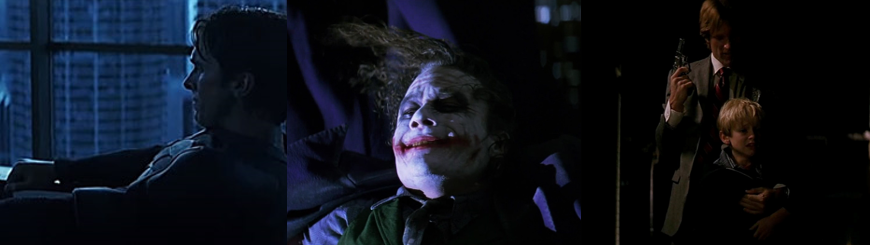
Another element that doesn’t sit right with me is how everyone (and I do mean everyone) is aware of Batman’s code against killing. Maroni and the Joker challenge him on his “one rule” and Batman openly champions it at every turn, severely diminishing his threat somewhat and presenting a familiarity with him that irks me for some reason. A huge part of the Joker’s final plan is predicated on the notion that even “civilised people” will kill to survive. He even rigs the game in his favour to prove this point and is so determined to tarnish the Batman’s heroic visage that he plummets to his death with a maniacal laugh. However, Batman saves him at the last second and the two have an unnerving conversation about their duality and intertwined fates. This is made doubly uncomfortable not just because of Bale’s strained Bat-voice but knowing that they would never tangle again due to Ledger’s untimely death, and part of me wonders if it might’ve been better to insert an edit that shows the Joker willing die after giving his speech. When I first saw The Dark Knight in the cinema, I was so engrossed in the Batman’s fight against the Joker that I completely forgot about Two-Face and, as much as I enjoy the entire film and the finale, I wonder if it might’ve been better to incorporate Two-Face’s actions into the third film and cap things off here. Regardless, both Dent and Bruce are devastated when Rachel is brutally murdered by the Joker. This helps tip Dent over the edge and to kill those who’ve wronged him, but he forces Gordon to choose which of his family should be killed to teach him a lesson in pain and loss. When Batman arrives to confront Two-Face, both he and Gordon desperately try to appeal to Dent’s better nature and fail. Disillusioned and broken, Two-Face disregards Gordon’s pleas and prepares to kill his son (Nathan Gamble), forcing Batman to tackle him to his death. Glossing over the fact that Batman just killed a man (I guess, technically, it was the fall), Batman decides to heed Alfred’s advice and maintain Dent’s reputation by assuming responsibility for Two-Face’s murders. Though reluctant, Gordon realises that it’s the only way to keep people from losing faith in the justice system and begrudgingly agrees to paint Batman as a murderer, ending the movie with Batman a wanted fugitive who willing endures any punishment, mental, spiritual, or physical to ensure peace in Gotham.

The Summary:
I absolutely loved Batman Begins when it first came out. It was the dark, gritty, comic-accurate Batman I’d been hoping for for years and I was really excited to see where Bale and Nolan took the character in the sequel. To say that The Dark Knight exceeded expectations would be an understatement. The film is an absolute masterpiece not just of comic book cinema, but of the thriller genre. Bale continues to deftly embody the conflicting personalities and introspective drive and determination that fuels Batman’s crusade, and his Batman continues to be the definitive version of the character for me, despite the dodgy fight scenes and my dislike for the new suit. At its core, The Dark Knight works as an intense thriller depicting the fundamental conflict between justice and anarchy, logic and sanity, and truly elevated the genre to a new level by taking elaborate and colourful concepts like a clown-themed terrorist and a guy with half his faced burned off and treating them seriously. Naturally, Heath Ledger steals the show here; we may never see a better performance of the Joker and you can see that he’s as lost in the role as Bale is as Batman. Ledger’s manic energy and subtle touches really create a feeling of dread, mystery, and unpredictability to the villain, and it remains a tragedy that he didn’t live on to have more dramatic roles like this. Add to that the impressive practical effects, sweeping cinematic score and visuals, and the engaging discussion regarding Batman and his influence on the city and its criminal element and you have, for my money, one of the finest Batman movies ever put to cinema. The film masterfully pulls from some of Batman, Joker, and Two-Face’s most iconic and engaging stories to present an emotional and gripping tale of adversity for the Dark Knight. The film absolutely set the standard for both Batman and comic book movies going forward and, while the third film might have stumbled in concluding the story so wonderfully established here, it doesn’t diminish the timeless appeal of The Dark Knight in the slightest.

My Rating:

Rating: 5 out of 5.

Fantastic

Did you enjoy The Dark Knight? Where would you rank it against the other Batman movies? What did you think to Heath Ledger’s portrayal of the Joker? Were you a fan of the new Batsuit or do you also find it a bit too busy? What did you think to the effects and stunt work used in the film? Were you also surprised by how gruesome Two-Face’s scars were? Did you agree that Bruce had to maintain his identity, or do you think you should’ve come forward sooner? How did you celebrate Batman Day this year and what is your favourite Batman movie? Whatever your thoughts The Dark Knight, or Batman in general, share them below or leave a comment on my social media.

Movie Night [Bat-Month]: Batman: Mask of the Phantasm


In the decades since his first dramatic appearance in the pages of Detective Comics, Bruce Wayne/Batman has become a mainstream, worldwide, pop culture icon. The brainchild of writer Bob Kane, Batman was brought to life by artist Bill Finger and has been a popular staple of DC Comics and countless movies, videogames, and cartoons over the years. So, as today is “Batman Day”, I figured this was a perfect excuse to spend every Saturday celebrating comic’s grim and broody vigilante.

Released: 25 December 1993
Director: Eric Radomski and Bruce Timm
Distributor: Warner Bros.
Budget: $6 million
Stars: Kevin Conroy, Dana Delany, Hart Bochner, Bob Hastings, Efrem Zimbalist Jr., and Mark Hamill

The Plot:
Early into his crimefighting career as the Batman, Bruce Wayne (Conroy) finds mobsters being slain by a mysterious and vicious, Grim Reaper-esque vigilante “The Phantasm” (Stacy Keach). In trying to uncover the Phantasm’s identity, Batman reconnects with his lost love, Andrea Beaumont (Delany), and uncovers a terrible connection between the two.

The Background:
Artist Bob Kane may have dreamed up the idea of a new masked crimefighter to capitalise on the success of Clark Kent/Superman’s debut, but it was the long-suppressed efforts of artist Bill Finger that the “Bat-Man” became such an iconic figure. Decades later, the likes of Dennis O’Neil sought to correct the Batman’s image following the gloriously camp (and incredibly popular) 1960s television show, but the release and relative success of Batman (Burton, 1989) and Batman Returns (ibid, 1992) saw renewed interest in the character. Consequently, Bruce Timm, Paul Dini, and Eric Radomski spearheaded a new animated series influenced by both films that became one of the most beloved and influential cartoons of its era. Batman: The Animated Series aired eighty-five episodes between September 1992 and 1995 before being succeeded by twenty-four episodes of The New Batman Adventures (known as The Adventures of Batman & Robin in the United Kingdom) between 1997 and 1999, but its initial success convinced Warner Bros. to task Alan Burnett with writing a full-length animated feature. Heavily influenced by Batman: Year Two (Barr, et al, 1987), the film was set to feature a Grim Reaper-like counterpart to Batman while also acting as something of an origin story for both the Dark Knight and his long-standing nemesis, the Joker. Filming was completed within eight months, and Warner Bros. made the last-minute decision to release it theatrically. Although this negatively impacted its box office return, Batman: Mask of the Phantasm made up for this in home media sales and is widely regarded as one of the best superhero films ever made. Critics praised the presentation and score, the slick animation, and its mature themes, and it remains one of the quintessential adaptations of the character for many Batman fans.

The Review:
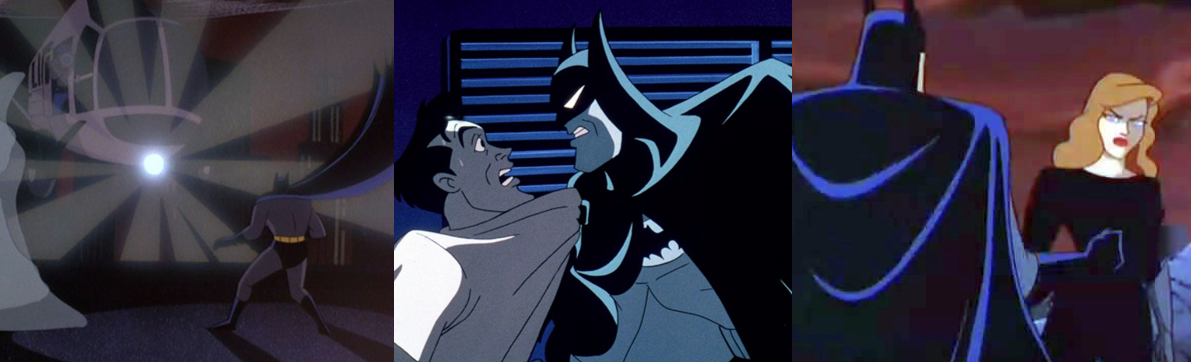
I watched Batman: The Animated Series as a kid, alongside a host of other popular cartoons at the time, but my memories aren’t massively clear. This is a general statement of my childhood in this regard, and I think it’s because I usually slept in at the weekends and didn’t get up until after a lot of the big cartoons had already been on, then I’d spend the rest of my time eating, playing videogames, or watching the same video cassettes over and over. Still, Batman: The Animated Series definitely made an impression on me. It was dark, surprisingly violent, and probably the most readily available incarnation of Batman since it didn’t involve buying any books or comics, so it was massively exciting when this animated feature aired on television for the first time or you saw the VHS available for purchase. The film begins in present day Gotham City, where Batman has established himself as a nocturnal vigilante but is still early enough in his career to large be considered an urban myth. As a result, Chuckie Sol (Dick Miller) has no qualms about conducting his business in the dead of night, which naturally means his money laundering deal is interrupted by the Batman. Although Chuckie slips away with his counterfeit money, he’s intercepted by a mysterious, Grim Reaper-like figure we now know as the Phantasm and so intimidated by the spectre that he drives out of the parking lot to a violent death.

The mystery of the Phantasm puts Batman in the frame, but their true identity may surprise you!

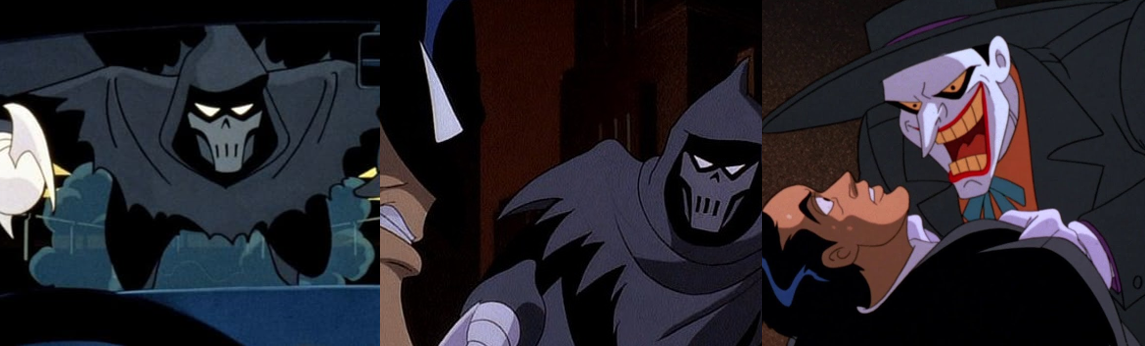
Thanks to the Phantasm, and the testimony of bystanders, Batman is fingered for Chuckie Sol’s death and councilman Arthur Reeves (Bochner) wastes no time publicly declaring Batman a violent vigilante who needs to be brought to justice. When Commissioner Jim Gordon (Hastings) remains adamant that sensationalist claims that Batman has snapped and gone on a killing spree are against Batman’s very nature and washes his hands of the entire debacle, Reeves personally leads numerous unsuccessful attempts to apprehend the Dark Knight. Batman is more concerned with analysing a piece of Chuckie’s windshield, which is stained by chemical residue from the Phantasm’s smoke, and investigating the graveyard where Buzz Bronski (John P. Ryan) was killed. Batman: Mask of the Phantasm does a wonderful job of depicting Batman’s detective skills and it’s a nice change of pace from all the thrilling action, chase, and fight sequences to follow his investigation into the murders. Additionally, there are two pressing mysteries in the feature: the identity of the titular Phantasm and the connection between the mobsters left dead in their wake. Of course, these end up overlapping but there’s a decent attempt to throw some red herrings our way. Reeves, Andrea’s father Carl (Keach), and Andrea are all potential suspects but it’s the latter who turns out to be behind the cloak and hand-scythe of the Phantasm. There’s an argument to be made that this isn’t too surprising given we’ve never heard of Andrea before this film, but the stature and physicality of the Phantasm definitely helps to keep this a dramatic reveal at the finale. Unlike the Batman, the Phantasm isn’t above killing; Andrea utilises theatricality to equal Batman, appearing to appear and disappear in a cloud of smoke, brandishes a dangerous scythe-like gauntlet, and is garbed in a heavy-duty armoured suit that makes her more than a match for Batman’s skills and gadgets when they inevitably come to blows.

Kevin Conroy delivers another stellar performance as Bruce is torn between his vow and his heart.

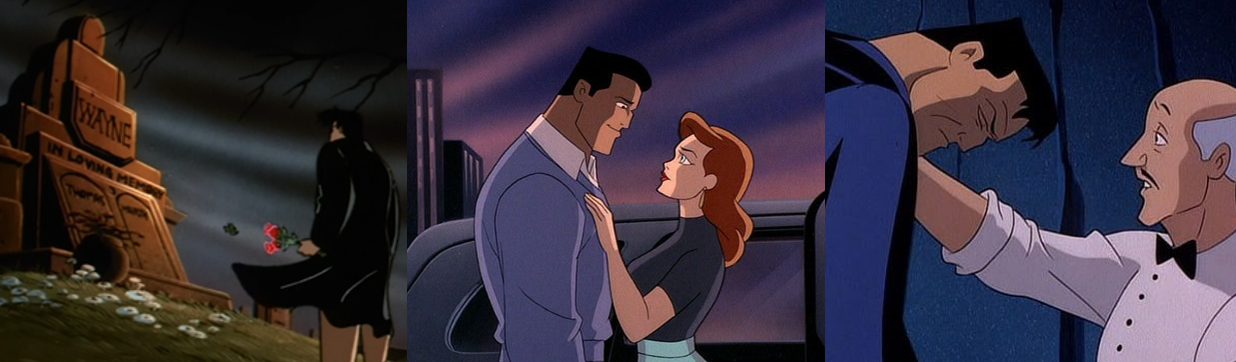
While Michael Keaton may have set the bar for live-action portrayals of Batman, make no mistake that Kevin Conroy remains the standard for depictions of Batman. Any actor looking to take on the iconic role must depict his three dominant personas: Public (Bruce Wayne, socialite and playboy), Private (Bruce Wayne, brooding and melancholy), and Vigilante (the grim and stoic Batman) and Conroy perfectly nails all three of these. When Bruce is attending functions and banquets, he’s a suave and smooth-talking ladies’ man known for being extremely generous with his family’s wealth, hands-on with charities and opportunities from growth and employment in Gotham, and for stringing along a seemingly endless parade of bimbos and lusty women. At home, in both the solitude of Wayne Manor and the sanctity of the Batcave, this public mask slips, allowing Bruce to confide in his faithful butler and father-figure, Alfred Pennywoth (Zimbalist Jr.), and is the closest he gets to being truly honest with anyone. And, of course, under cover of night, he stalks the criminal underworld as a theatrical vigilante, and Conroy expertly depicts the differences in each of these personas and situations with subtle changes to his tone, line delivery, and inflections that really went a long way to making this version of Batman one of the most well-realised, complex, and layered interpretations of the character. This really comes to the forefront here thanks to repeated flashbacks to an earlier time in Bruce’s life where he struggled with how to make good on the vow he made to avenge his parents’ death by tackling the criminal scum that took their lives. At this point, he’s still an angry, directionless young man whose vigilante debut goes sideways because, while he has the physical means to overpower even armed crooks, he’s at a disadvantage because he’s seen as just a man, rather than a force of darkness and justice (as he puts it: “They weren’t afraid of me!”) While brooding at their gravestone, he crosses paths with the beautiful Andrea Beaumont. Though she comes across as dismissive and aloof, she’s actually intrigued and somewhat taken by him since he has all this wealth and privilege but always seems so melancholy. As she’s also lost someone, her beloved mother, the two bond over their shared grief and, when she comes to visit him, she impresses him with her combat prowess and the two begin a whirlwind romance.

As if the mysterious and brutal Phantasm wasn’t enough, the Joker shows up to steal the show!

Bruce is so taken by Andrea that he questions his vow and contemplates a life of happiness as a benevolent entrepreneur with her by his side. He is therefore devastated when she suddenly rejects his proposal and leaves the city, forever setting him on a path of grim vigilantism. When Andrea returns to Gotham some years later, in the present day of the story, Bruce is a fundamentally changed man. A chance encounter between her and Batman accidentally reveals his true identity to her, and she greets the Batman with a cutting hostility when he’s forced to question her as part of his investigation into the recent killings (delivering a biting jibe about how he’s controlled by his parents). Buzz Bronski, a mob associate of Chuckie’s, is the Phantasm’s next target; his henchmen see him chased by the cloaked figure and crushed to death under a gravestone and mistake the “Angel of Death” for Batman, which causes a media sensation. Startled by the murders of his associates, the decrepit Sal Valestra/The Wheezer (Abe Vigoda) fears for his safety and turns to the Joker (Hamill) for protection. As if touching upon Batman’s origins wasn’t enough, Batman: Mask of the Phantasm thus provides a glimpse into the background of the typically mysterious Clown Prince of Crime. Although not named as such here, the Joker was once Jack Napier like in Batman, but we also learn that he was once a chauffeur and assassin for the mob before taking his dive into disfiguring acid. While I appreciate the effort to flesh out the Joker’s backstory a little, and the film does a decent jump of bringing him in late into the runtime, I can’t help but feel like the Joker’s inclusion was a little forced and unnecessary. It’s as though the filmmakers didn’t quite trust the intriguing mystery of the Phantasm, the glimpse into Bruce’s past, or the narrative of Batman being hunted by the police and felt they had to shoehorn the Joker in to make things more exciting.

The Nitty-Gritty:
Of course, I’d be doing Batman: Mask of the Phantasm a disservice if I didn’t mention the absolutely haunting score from the late, great Shirley Walker. Having collaborated with composer Danny Elfman for Batman, Walker was the perfect choice to evoke the same melancholic, gothic undertones of Burton’s blockbuster reinvention of the character, and she’s at her absolute best here. The sweeping, operatic score really gives Gotham City an ominous, looming character, punctuates the action, and makes the more poignant moments of the film all the more heart-breaking and that’s all thanks to Walker’s absolutely iconic and memorable orchestral number. The animation must also be praised; thanks to an emphasis on shadows and darkness, Batman moves like a slick, otherworldly figure and comes across as fearsome, intimidating, and efficient all at once. Nowhere is the use of lighting more impressive than in scenes in the Batcave, where deep, never-ending shadows and darkness are at their most prominent, and this all really adds to the stark contrast between the inky black of night and the brighter, dull pastels of the few day time scenes.

The feature provides a tantalising glimpse into Bruce’s motivation to become the Dark Knight.

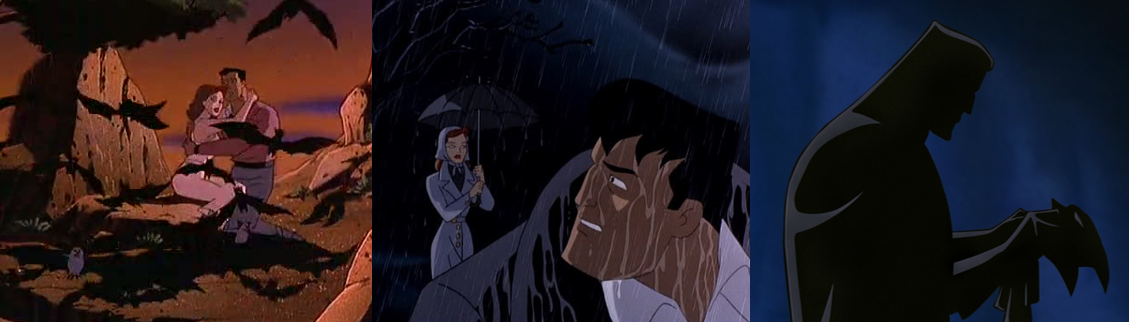
One thing that helped Batman: Mask of the Phantasm stand out as an animated feature was how surprisingly adult it was. Batman: The Animated Series always expertly towed the line with the censors by depicting guns and bullets rather than laser pistols, and the feature film gets away with even more to depict people smoking, modern-day pistols rather than Tommy guns, a bit of blood when Batman takes a beating, and an unexpectedly high body count for a “kid’s film” thanks to the murderous Phantasm. A central aspect of the film is the exploration into the motivation and tragedy that pushed Bruce into assuming the Batman guise. Despite travelling the world and gaining the physical and deductive skills to be a crimefighting detective, Bruce is torn between seeing his vow to the fullest extent and using his wealth to benefit the city while living a happy life with Andrea. Alfred naturally pushes him towards the latter, and Andrea even believes that his parents “sent [her]” as a sign that he can go back on his vow. Unfortunately, fate intervenes. Right after she accepts Bruce’s proposal, Carl Beaumont forces Andrea to leave the city after his dealings with the mob threaten both of their lives and, rather than explain the situation to her love, Andrea left him heart-broken and rejected. With his one last chance of a happy, normal life denied him, Bruce returns to his vow and, in a hauntingly impactful scene, embraces the cape and cowl of the Batman, losing himself to the darkness of his never-ending crusade and shocking even Alfred with his monstrous transformation.
The climatic finale sees Batman engage with the Joker, and seemingly lose his one true love forever.

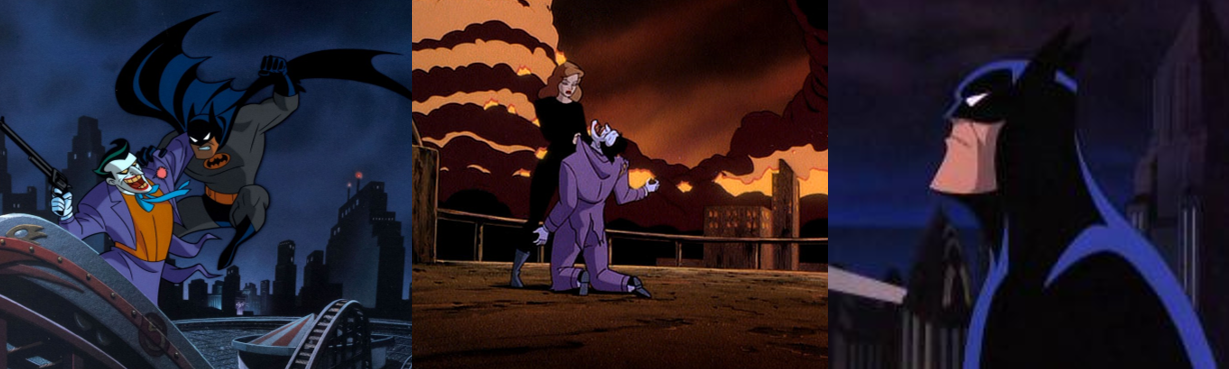
Batman takes his investigation up a notch after figuring out that the Joker is involved, and the cackling madman quickly takes a perverse pleasure in hunting down the one responsible for killing his old buddies. This involves murdering Valestra and wiring to explode, reducing Reeves to a hysterical mess with his laughing gas, and trying to off the Batman with ludicrous contraptions cobbled together from the abandoned world’s fair that the Joker’s taken as his hideout. Oddly enough, once Andrea’s true identity is revealed, the Joker actually holds his own in a fight with her thanks to his acid-spitting flower and turning the fair’s animatronics and rides into death traps. Andrea, however, is driven by a murderous bloodlust. Since the Joker was responsible for killing her father, she has no problem fighting dirty, kicking him in the nuts and tracing him across the hazardous amusement park in a bid to have her revenge. Naturally, Batman makes a dramatic save and chases down his most persistent nemesis, leading to a somewhat ludicrous conclusion where Batman battles a jetpack-wearing-Joker through the skies of a dilapidated amusement park wired to explode. Determined to see the Joker pay, Andrea ignores Batman’s pleas to leave and seemingly perishes along with the Clown Prince of Crime as the world’s fair is dramatically engulfed by explosions, leaving Batman not only heart-broken but guilt-ridden at his failure to save his former flame. In the darkness of the Batcave, he finds solace in Alfred’s reassuring words and Andrea’s pendant, giving him hope that she’s still alive. Hardened by the experience, he returns to the night as the Batman, grim avenger of injustice, while Andrea sails off to an unknown future with only her own heartbreak for company.

The Summary:
It’s hard to get much better than Batman: Mask of the Phantasm for pure, unadulterated Batman action. In many ways it, like the cartoon it spun out from, is one of the most striking, influential, and unapologetically faithful renditions of DC’s Dark Knight ever put to screen and perfectly captures the dark, gothic melancholy of the titular vigilante, his city, and his never-ending crusade against crime. This was one of the rare, few glimpses into a time of Bruce’s life where he was struggling to make the transition from angry, vengeful young man to grim avenger of the night and it’s absolutely tragic to see how close he came to abandoning his crusade for true love and was forced to fully commit to his dark alter ego once fate set him on that path. One of the things I absolutely love about Batman: Mask of the Phantasm is that it’s not afraid to show Batman’s more cerebral side. The mystery of the Phantasm and the killings is as crucial to the narrative as the romance between Bruce and Andrea, and is far more of a focus than the handful of fantastically realised and slickly animated fight and chase sequences. Batman also feels fallible and human while still being a fearsome and intimidating figure. He easily outmatches street level scum but can be hurt by the likes of the Phantasm and the Joker thanks to their skills and/or gadgets. As I’m also a big fan of Batman: Year Two, the Phantasm struck me as a brilliant foil for Batman. As cold and stoic as the Dark Knight, Andrea’s gruesome, cloaked persona is a dangerous and ruthless foe out for blood and nothing more, but more than a match for the Caped Crusader thanks to gadgets, theatricality, and a degree and physical ability. While I find the finale a bit over the top thanks to the focus shifting towards the Joker, you can’t deny that Mark Hamill steals the show at every turn with his maniacal performance, delivering every line with a sadistic glee that makes the Clown Prince of Crime a joy to watch. Honestly, if you know anyone who isn’t sure if they want to get into Batman or who wants to learn more about Batman, I would absolutely recommend you point them towards Batman: Mask of the Phantasm as you’ll be hard-pressed to find a better representation of everything that makes the Dark Knight such an enigmatic and alluring character.

My Rating:

Rating: 5 out of 5.

Fantastic

Are you a fan of Batman: Mask of the Phantasm? Where would you rank it against other Batman films, live-action or otherwise? What did you think to the Phantasm, their depiction, and the reveal of their identity? Were you a fan of the Joker’s inclusion or, like me, did it kind of overshadow the rest of the plot for you? Did you enjoy Batman: The Animated Series growing up? What are some of your favourite episodes, and where would you rank Kevin Conroy’s performance? What was your first experience of Batman and how are you celebrating his debut this month? Feel free to share your thoughts on Batman: Mask of the Phantasm down below, or leave a comment on my social media, and be sure to check back in for more Batman content in the near future!

Back Issues [Bat-Month]: Detective Comics #66/68


In the decades since his first dramatic appearance in the pages of Detective Comics, Bruce Wayne/Batman has become a mainstream, worldwide, pop culture icon. The brainchild of writer Bob Kane, Batman was brought to life by artist Bill Finger and has been a popular staple of DC Comics and countless movies, videogames, and cartoons over the years. “Batman Day” falls on 21 September this year and I figured this was a perfect excuse to spend every Saturday celebrating comic’s grim and broody vigilante.


Writer: Bill Finger – Artist: Bob Kane

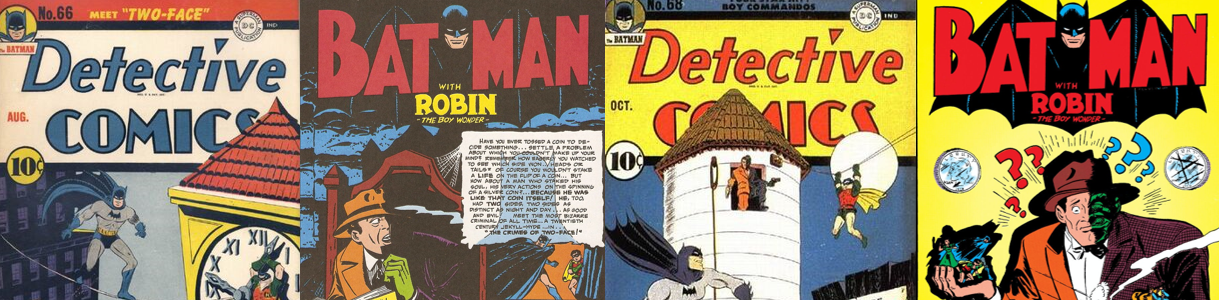
Story Title: “The Crimes of Two-Face”
Published: August 1942

Story Title: “The Man Who Led a Double Life”
Published: October 1942

The Background:
Following the huge success of Clark Kent/Superman, National Comics Publications had Bob Kane create another masked crimefighter to add to their repertoire. Thanks to the long-suppressed influence of artist Bill Finger, the “Bat-Man” soon became not only one of DC Comics’ most popular characters but also a mainstream cultural icon. In the years that followed, the Batman battled numerous costumed supervillains, but perhaps none are more tragic then former district attorney-turned-criminal Harvey Dent/Two-Face. Originally debuting in this two-part story as Harvey “Apollo” Kent, Two-Face was heavily inspired by the 1925 adaptation of The Phantom of the Opera (Leroux, 1909) and the 1931 adaptation of Strange Case of Dr Jekyll and Mr Hyde (Stevenson, 1886), both tales of a tortured soul, often gruesomely depicted or disfigured, who struggled with the duality of good and evil. Subsequent Two-Face stories have offered further insight into his tragic and abusive childhood, as well as further emphasising his complex relationship with Bruce Wayne, and the character is often a rival or litmus test for Batman’s different Robins. Widely regarded as one of Batman’s best villains, Two-Face has appeared as a prominent foe outside of the comics, from his renowned appearances in the acclaimed Batman: The Animated Series (1992 to 1999), Tommy Lee Jones’s bombastic portrayal in Batman Forever (Schumacher, 1995), and Aaron Eckhart’s understated turn in The Dark Knight (Nolan, 2008).

The Review:
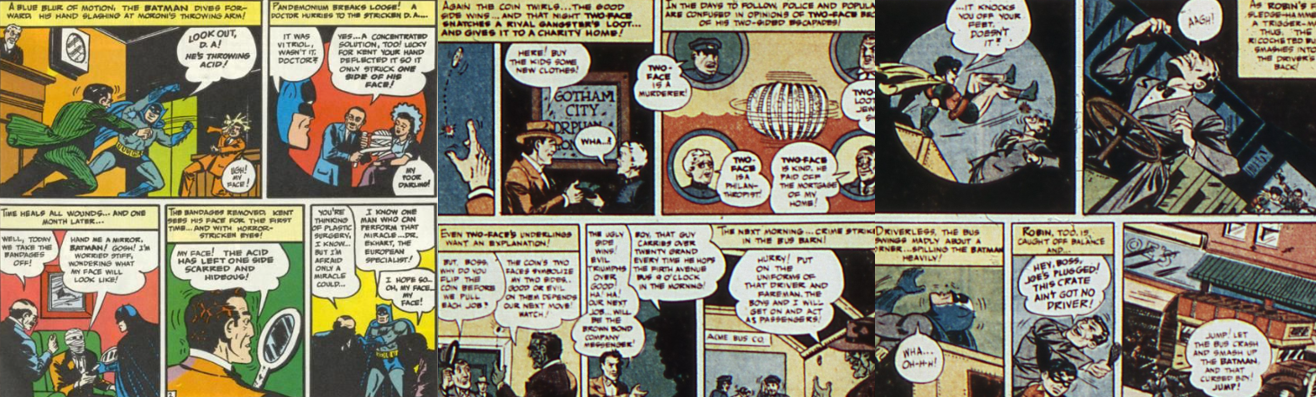
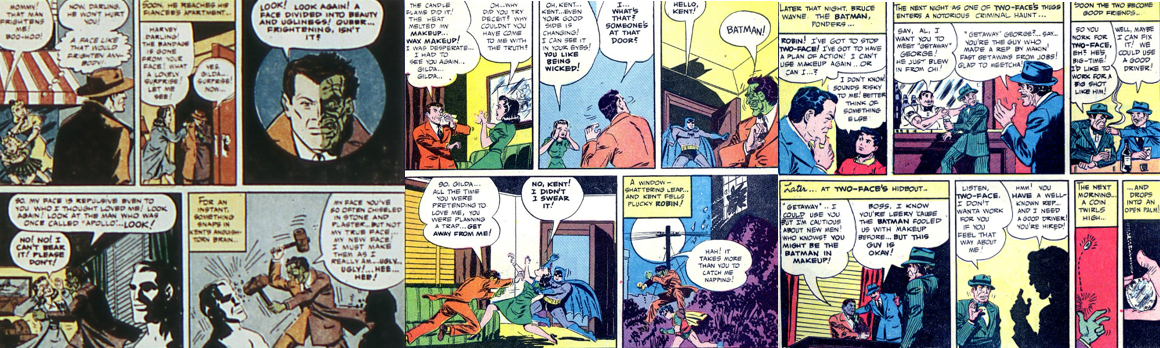
This two-part story begins by introducing us to Harvey Kent, the dashing and famous district attorney beloved by the press and nicknamed “Apollo” for his courageous stance against organised crime, such as mob boss Sal “Boss” Moroni. Kent is the lead prosecutor in the case against Moroni and wastes no time in calling the Batman to take the stand as a key witness in Moroni’s trial. Amazingly, the testimony of a masked vigilante is seen as perfectly acceptable and admissible as evidence. Batman relates how Moroni shot “Bookie” Benson while escaping from a fight and Kent produces his most damning piece of evidence: Moroni’s lucky, two-headed silver dollar with his fingerprints on it! Moroni’s so incensed by Kent’s bravado that he tosses a vial of acid right at the district attorney! Although Batman intercepts the throw, Kent is hit with a concentrated splash of vitriol on one side of his face, leaving him wrapped in bandages for an entire month. When the time comes to reveal the extent of the damage, Kent is horrified to find that the left side of his face is “scarred and hideous”. He’s even more despondent to find that his only hope, a “European specialist” Batman knows of, is currently imprisoned in a Nazi concentration camp. The Batman simply peaces out after that, advising Kent to face his fiancée, Gilda, sooner rather than later, but Kent is distraught to find his gruesome visage frightens not only children, but also his beloved Gilda. Seeing the fear in her eyes, he flies into a rage, defacing a sculpture of his former chiselled features and terrifying her almost as much as his monstrous scarring.

After being hideously scarred, Two-Face embarks on a bizarre crime spree across the city.

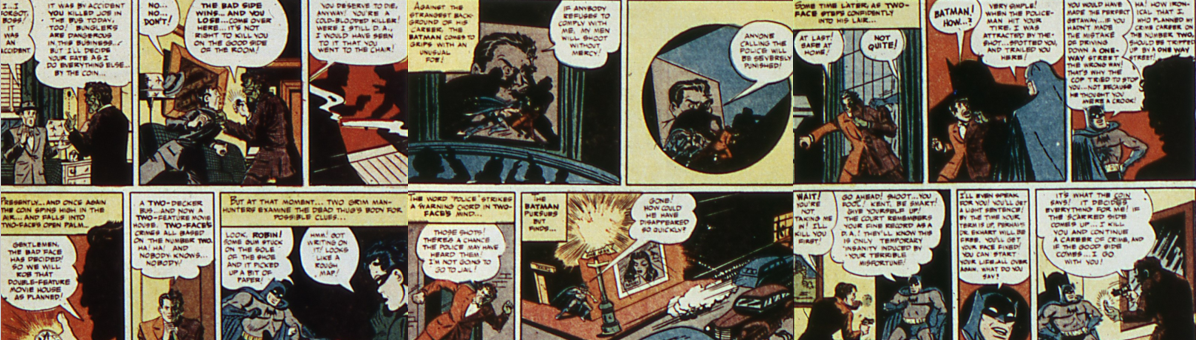
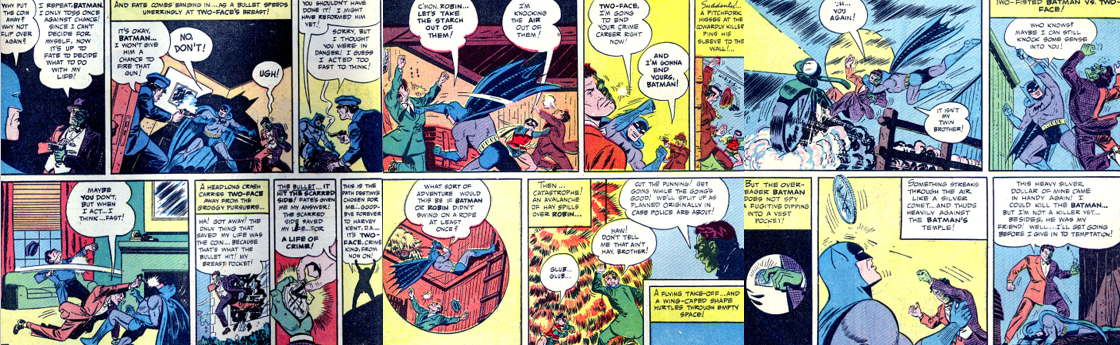
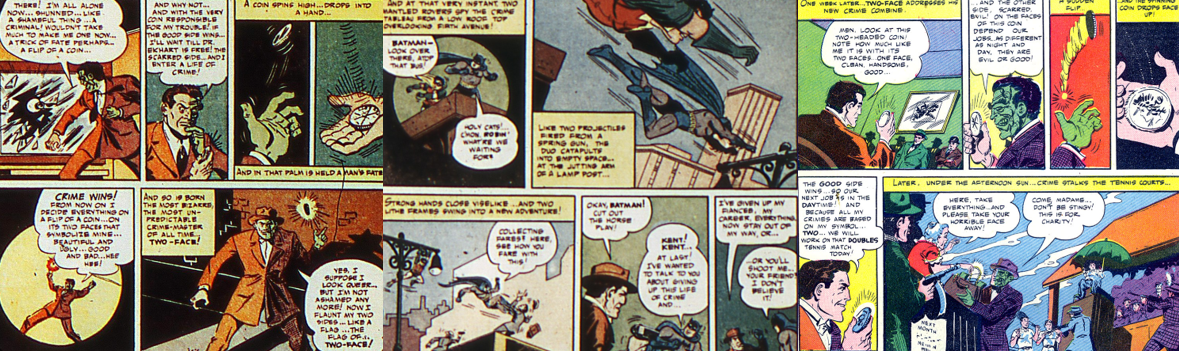
Tormented, driven to the brink of madness, Kent ponders this dichotomy of his explicit duality. He focuses his rage on Moroni’s silver dollar, defacing one side of it and lashing out at the cruelty of fate. Deciding that all life hinges on the flip of a coin, Kent projects his duality onto the now-scarred dollar. He resolves to decide his immediate future on a coin toss, promising to wait for Batman’s specialist to be freed if the unmarked side comes up or embark on a criminal career if the scarred side comes up. Of course, the scarred side wins and Kent rebrands himself “Two-Face”, adopting a suit to match his split face and putting his knowledge as district attorney to use in his crimes. Since everything he does is decided by this bizarre coin, one day he and his goons might rob a bank for illicit gain, but the next day he might donate his stolen money to charity! This causes public opinion of him to be fittingly divided, with some branding him a thief and a murderer and others a philanthropist and saviour. Even his goons are confused by Two-Face’s unpredictable nature, but they’re excited when the bad side wins and they undertake an elaborate scheme to rob the Brown Bond Company messenger that sees them hijack a double decker bus to rob the bondsman. As luck would have it, Batman and Robin happen to spot the mugging taking place and swoop in to intervene. Apparently well aware that Kent is Two-Face, Batman tries to talk him out of his life of crime but is stunned when his former friend pulls a gun on him and orders his men to toss him off the roof of the bus!

When Batman confronts Two-Face, the tragic villain is left clueless when his coin fails him.

Although this doesn’t come to pass thanks to Robin accidentally causing the thug driving the bus to be killed, Batman is incapacitated in the fracas and the Dynamic Duo are left to die on the out of control vehicle, though Robin manages to get to the handbrake in time. Back at his thematically appropriate lair (one side is clean and pristine and the other is a shambles), Two-Face chastises himself for his actions. Believing that he’s killed his good friend, Two-Face almost regains his sanity before lashing out at the mirror and murdering his other goon after blaming him for causing the shambles on the bus. Two-Face then steps his game up by targeting the double-feature movie house, since he’s now committed to basing his crimes on the number two, but remains unaware that Batman and Robin survived the bus crash. Upon investigating the dead body of Two-Face’s goon, the Dynamic Duo happen to find a map stuck to the sole of his shoe by a piece of gum! This leads them to the Bijou Theatre, Two-Face’s next target, where Two-Face takes over the projection booth and demands that the audience hand over their loot. While Robin takes out the goons in the projection booth, Batman swoops onto the stage for a brief fight with Two-Face while his pre-recorded message looms and rants in the background. Somehow (it’s really not too clear), Two-Face slips away, but the Batman easily tracks him back to his lair by simply…y’know, following him after Two-Face made the error of driving down a one-way street and attracting police attention. Refusing to go down without a fight, Two-Face again threatens to shoot Batman, but the Dark Knight pleads with him to come along quietly. Batman promises to testify on his behalf to argue temporary insanity and to do everything he can to see Kent gets a light sentence until that specialist can fix his face, but Two-Face is unable to make a decision without flipping his beloved coin. Unfortunately for the tragic villain, cruel fate strikes again and the coin ends up standing on edge, leaving Two-Face conflicted and incapable of deciding whether he should give up his life of crime or kill Batman and continue down his dark path.

Two-Face slips away, continues his unique crimes, and even bests Batman in a fight.

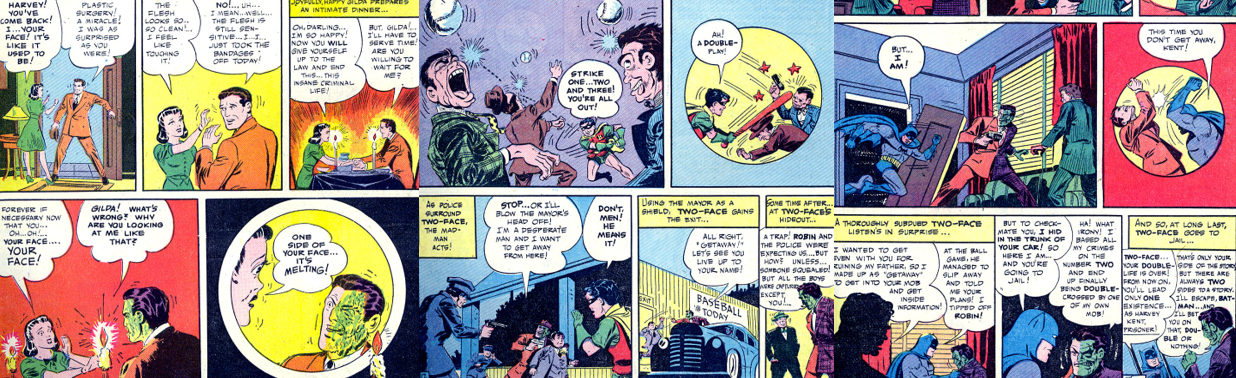
The story continued, fittingly two issues later, in “The Man Who Led a Double Life”, which picks up right where the first story ended and sees Two-Face pocketing his coin, resolving to let fate decide what he does with his life. Unfortunately, a trigger-happy cop bursts in and guns down Two-Face, believing he’s about to shoot Batman, but the bullet strikes the coin in Two-Face’s breast pocket, allowing him to survive and make a hasty retreat by leaping out of the window! Since the bullet hit the scarred side of the coin, Two-Face believes this is fate’s way of telling him to commit himself to his criminal career. His first act is to rob the doubles tennis match (during the daytime, since the coin landed good side up) and donate the cash to charity. Next, he and his goons kidnap matchstick mogul Henry Logan, whose entire home is apparently made out of matchsticks, but Batman and Robin are stunned to find it was actually the cantankerous tycoon’s double who was taken since Kent knew about Logan’s doppelganger from his time as district attorney. Batman and Robin are disgusted by Logan’s indifference towards his double’s fate and his selfishness, but the reclusive hobbyist agrees to pay Two-Face’s $200,000 ransom. However, when Logan and his wife arrive at the disused barn to make the transfer, Two-Face is enraged to find he’s been tricked and that it’s Batman and Robin in disguise! Batman and Robin easily overpower Two-Face and his mooks. Although one of the goons buries Robin under a pile of hay, Batman continues hammering Two-Face after the scarred villain tries escaping on a motorcycle. Laughably, Batman is felled when Two-Face tosses his coin at his forehead; however, Batman is spared since Two-Face “[is] not a killer yet” (despite it being said that he was in the first story) and still has some compassion for his former friend.

Two-Face’s attempt to return to his wife, and succeed at crime, are thwarted by the Batman.

When Batman and Robin return the double to Logan, they find the tycoon to be as grating as ever, so Robin teaches him a lesson by dropping a lit match into his shoe, something the Batman simply laughs about despite the fact that the house place could’ve gone up in flames! Anyway, after spotting a loved-up couple in the street, Two-Face decides to pay a visit to his lost love, Gilda. Gilda is elated when the fully restored Harvey Kent surprises her at home, but he ensures she doesn’t get too close to his face. Over a candlelit dinner, he promises to come back to her and forgo his criminal ways if she waits for him, but is incensed when her happiness turns to horror after the heat from the candles melts the wax make-up covering his hideous scars. Gilda is driven to tears by the revelation that Kent has completely lost himself to wickedness and insanity, but Two-Face flies into a rage when Batman bursts in since he assumes she was colluding with the Dark Knight. Once again, Two-Face escapes through a window and he avenges his misfortune on the mask and make-up factory that cost him his love. Two-Face and his goons beat up the proprietors and torch the place, leaving the mask-maker destitute and his son swearing revenge. The story then leads us to believe that, despite Dick’s warnings, Bruce uses make-up to infiltrate Two-Face’s gang as “Getaway” George when the coin flips in his favour. Two-Face’s next target is the double-header baseball game between the city’s fire and police departments, in which honorary police officers Batman and Robin are publicly seen participating. Two-Face brazenly steals the $50,000 takings and even takes the mayor hostage at gunpoint after Robin beats up his minions. When Two-Face gets back to his lair and finds the cops waiting, he assumes that “Getaway” is Batman in disguise and is stunned when the real Dark Knight barges in to deliver a swift uppercut. It turns out that “Getaway” was the mask-maker’s son working in cahoots with Batman, and Two-Face bitterly comments on the irony of being double-crossed by one of his own gang in the end.

The Summary:
Two-Face’s links to Jekyll and Hyde aren’t simply thematic, they’re explicit. Hell, the first dialogue box on the opening page of “The Crimes of Two-Face” not only refers to Two-Face as “a twentieth-century Jekyll-Hyde” but even shows the disfigured criminal reading a copy of the book! I may be committing a literary sin here, but I haven’t actually read that book so I can only speak to the widely regarded themes of duality and man vs. monster that are at work in the text, but “The Crimes of Two-Face” definitely goes out of its way to draw parallels between Kent’s fate and that classic piece of gothic literature. They are, however, really only skin deep. Sure, we only see Kent for a few panels before he’s hideously scarred, but there’s no indication in either story that he was anything but a model citizen and champion of justice. More than once, he and Batman refer to each other as old friends and Two-Face is noticeably conflicted about the Dark Knight, more so than his criminal career, it seems. Indeed, it’s quite jarring when Kent just suddenly decides he has only two options: wait to be fixed or turn to crime, but it’s pretty well conveyed that his ghastly condition has caused him to snap. Batman refers to him suffering from temporary insanity, the text boxes allude to his rage, and Gilda’s reaction to his outburst all point towards this, but it’s still quite the sudden turn from model civil servant to notorious bank robber. One thing I did enjoy was that the reveal of Two-Face’s horrific visage is kept hidden to start with, so we only see it when he reluctantly reveals himself to Gilda, which builds a sense of anticipation about what he looks like. It’s a shame that he’s depicted with a literal line running down the middle of his face, but I can forgive that given the simplistic art of the time.

Despite Two-Face’s obvious gimmick, there’s little detective work involved in stopping him.

We’re well into Batman’s time as a much brighter, kid-friendly character here. He’s appearing in broad daylight, working alongside the police, and even taking to the witness stand and playing baseball, for God’s sake! Now fully deputised members of the police department, Batman and Robin are seen as assets rather than vigilantes and are specifically brought in by Police Commissioner James “Jim” Gordon to help with the Henry Logan kidnapping case. More importantly, the Batman had a close working relationship with Harvey Kent that sees him repeatedly appeal to his better half in “The Crimes of Two-Face”. Sadly, we never get to actually see the extent of their friendship. It’s simply said and inferred by their dialogue, and neither story explores Bruce’s reaction to his friend’s condition or delves into how conflicted he feels about Two-Face. Instead, Batman tries to out-think the tragic villain, occasionally begs him to listen to reason, and settles for socking him in the jaw when he refuses to come quietly. By the end, Batman views Two-Face as just another colourful supervillain and there’s no indication that he wants to try to help or rehabilitate his former friend; he just wants him locked up. As a villain, Two-Face is both visually interesting, surprisingly tragic, unpredictably volatile, and incredibly restrictive. Since he dictates his actions on a coin flip, his crimes can either be horribly violent or unnervingly charitable, casting him almost as an anti-villain since he’ll help those in need with ill-gotten gains and even kill his own men if they violate his rules. This makes the coin his most obvious Achilles’ heel, but it’s at least tied to his dual and conflicting nature. His obsession with the number two is far more of a crutch and I’m surprised that more wasn’t made of it. Once again, Batman and Robin do very little detective work here (they happen upon that map and Batman simply guesses that Kent would return to Gilda) so there’s no depictions of them trying to figure out Two-Face’s next scheme or running around the city looking for obscure references to the number two. It’s simply them reacting whenever Two-Face strikes or stumbling upon a lead.

Two-Face is a tragic and visually interesting character even in his more basic debut story.

Still, while Two-Face’s complex nature, volatile personality, and relationship with Batman is only touched upon or inferred in “The Crimes of Two-Face” and “The Man Who Led a Double Life”, both stories were surprisingly fun and unique tales. It’s not often that Batman’s villains had such a tragic twist to them back then and the references to Two-Face using his knowledge as district attorney for evil only add to the cruel twist of fate dealt to this once handsome and honourable man. I enjoyed Two-Face’s lamentations, which were suitably Phantom-esque, and his whole gimmick, including the split suit and lair. Despite seeing it as a handicap, I’ve always liked the double-headed coin aspect of the character and I enjoyed how quickly he became fixated on the coin’s decisions and how he was rendered panic-stricken and impotent when the coin landed on its side. I think “The Man Who Led a Double Life” would’ve been served better if it had begun with a babbling and broken Two-Face being taken into custody and seeing doctors try to salvage his mind and face until he inevitably returned to his evil ways, but that was kind of toyed with when he desperately resorted to a wax facsimile to reconnect with Gilda. Overall, the two tales didn’t exactly blow my socks off and there are definitely better Two-Face origin stories and tragic tales out there, but they were entertaining enough. Two-Face is an elaborate criminal with a unique, if narratively exhausting, gimmick and has (and continues to have) a tragic appeal to him that’s prominently introduced here, even with the lacklustre depiction of Kent’s time before his scarring.

My Rating:

Rating: 4 out of 5.

Great Stuff

Have you ever read the two-part debut of Two-Face? If so, what did you think to it, which of the two was your favourite, and where would you rank Two-Face in Batman’s villain hierarchy? Would you have liked to see more backstory given to Harvey Kent? What did you think to his coin, obsession with the number two, and the depiction of his volatile duality? Did you enjoy Batman’s time as a brighter, friendlier character or do you prefer the brooding, grim Dark Knight? What are some of your favourite Two-Face stories and which interpretation of Two-Face is your favourite? Whatever your thoughts on Two-Face, share them below or on my social media, and be sure to check out my other Batman content!

Back Issues [Bat-Month]: “The Joker” (Batman #1)


In the decades since his first dramatic appearance in the pages of Detective Comics, Bruce Wayne/Batman has become a mainstream, worldwide, pop culture icon. The brainchild of writer Bob Kane, Batman was brought to life by artist Bill Finger and has been a popular staple of DC Comics and countless movies, videogames, and cartoons over the years. “Batman Day” falls on 21 September this year and I figured this was a perfect excuse to spend every Saturday celebrating comic’s grim and broody vigilante.


Story Title: Technically untitled, but commonly known as “The Joker”
Published: March 1940
Writer: Bill Finger
Artist: Bob Kane

The Background:
After seeing success with Clark Kent/Superman, National Comics Publications charged Bob Kane with creating another masked crimefighter to add to their portfolio and, thanks to the long-suppressed influence of artist Bill Finger, the “Bat-Man” soon became both a popular DC Comics character and a mainstream cultural icon. Over the years that followed, the Batman has matched wits against some of the most recognisable supervillains in all of comics, but unquestionable his greatest nemesis has always been the self-styled Clown Prince of Crime, the Joker. Bob Kane, Bill Finger, and Jerry Robinson all laid claim to creating the Harlequin of Hate, but what is widely known is that the character’s iconic, gruesome smile and clown-like visage was heavily influenced by Gwynplaine (Conrad Veidt) from The Man Who Laughs (Leni, 1928). It was a last-second decision by then-editor Whitney Ellsworth that saw the Joker survive his initial encounter with the Batman and, though the character was used less under the eye of editor Julius Schwartz, he rose to prominence thanks to the efforts of Dennis O’Neil and Neal Adams during the 1970s and 1980s. Since then, the Joker has become easily Batman’s most notorious and mainstream foe. In addition to terrorising Gotham City with laughing gas, the famously elusive and mysterious Joker crippled Barbara Gordon/Batgirl for many years, murdered both Jason Todd/Robin and Commissioner James Gordon’s second wife, had his face removed for a time, and has fought Batman to the death on numerous occasions, repeatedly returning to plague the Dark Knight, his allies, and Gotham City despite appearing to die more than once. The Joker has also been a prominent villain in Batman media outside the comics, often used as a primary antagonist in Batman videogames and brought to life with gleeful relish by many actors, such as Cesar Romero (who famously refused to shave his iconic moustache to portray the character), Jack Nicholson, and Mark Hamill (for many, the quintessential actor to tackle the role). The Joker has been the subject of numerous psychological and introspective debates and his popularity and infamy are such that he’s had his own self-titled comic, been a playable character in DC-related fighting games, and even appeared in standalone movies, with the first making over $1 billion at the box office!

The Review:
Our story wastes no time in introducing us not just to the Joker’s gruesome, grinning visage but also his menacing ways. A quintessential 1940s home is startled when the Joker’s cackling threats interrupt their nightly radio broadcast to issue an ominous threat against millionaire Henry Claridge, whom the Joker promises to kill and rob of his famed family diamond at midnight that night! Although some members of the public laugh it off as a gag akin to Orson Welles’ infamous War of the Worlds prank from 1938, the radio station is swamped with concerned calls and Henry Claridge is understandably panicked. His fears are allayed when the city police arrive and promise to watch over him, and his diamond, overnight and Claridge is overjoyed when his grandfather clock strikes twelve and he’s still alive. However, he suddenly convulses in agony and collapses dead to the ground with a ghastly rictus grin on his lifeless face – “the sign of death from the Joker!” As if that wasn’t bad enough, the cops are stunned when they inspect the Claridge diamond and find that it’s been replaced with an elaborate forgery and the Joker’s calling card, a literal joker-faced playing card, has been left behind to taunt them.

The Joker baffles the police by killing his victims and leaving them with a gruesome grinning visage.

Luckily for us readers, the Joker is quite a loquacious fellow. When the story switches to his ornate lair to focus on the hate-filled harlequin, he openly explains how he delivered on his threat and outwitted the police: he simply injected Claridge with a slow-acting poison as he slept so that he would die at exactly twelve midnight. He also swiped and replaced the diamond while he was at it, and is immensely proud of his cunning, which has riled up Dick Grayson since he’s astounded by the Joker’s repeated acts of violence. However, his mentor, billionaire Bruce Wayne, believes that it’s not quite time for them to intervene as the crimefighting duo, Batman and Robin. Because of this, the Joker makes good on another threat. This time, he promises to kill Jay Wilde at ten o’clock and steal his ruby and his victim again collapses in pain, dropping dead with a smile, after being shot by a poisoned dart when the Joker easily hid amongst the cops in one of Wilde’s suits of armour. Luckily for the cops assigned to watch him, the Joker chooses simply to “paralyse” them with a gas; he then liberates his victim of his ruby and gleefully slips away. The city-wide manhunt for the Joker is met with embarrassing failure, but his actions have also riled up the city’s mobsters. Angry and envious that the Joker has been beating them to the punch, surly Brute Nelson vows to teach him a lesson and has his boys spread the word that he thinks the Joker is a “yeller rat”. Since those are fightin’ words during this time, the Joker bursts into Nelson’s home to confront him and is impressed to find that the mobster has lured him into a trap. Luckily for him, the Batman saw the mob’s interest in the Joker as enough of a reason to finally step in so he’s also in Nelson’s home and manages to get the drop on his goons despite his characteristic lack of stealth.
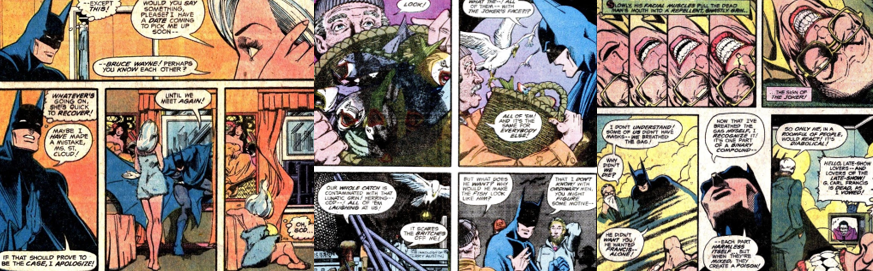
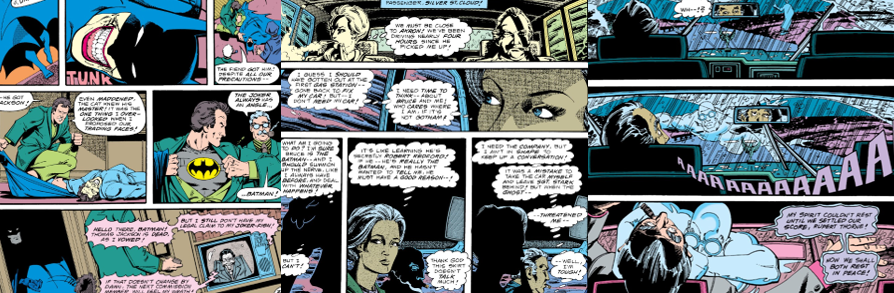
The Batman recovers from an initial failure to put an end to the Joker’s killing spree.

The Joker uses this distraction to his advantage, gunning the arrogant Nelson down in cold blood and making a quick getaway in his car. The Batman easily follows and leaps onto the speeding vehicle. However, when the two are launched from the car as it flies off a bridge, the Batman is surprisingly outmatched by the Joker, who socks him with a haymaker and delivers a kick that sends the Dark Knight plummeting to the water below. The Joker then takes a much more direct approach to target Judge Drake, the man who once sent him to prison. He disguises himself as the police chief (who he again chooses to simply subdue rather than kill) to get close to the judge and inject him with his gruesome poison. Although his disguise means the Joker gets away without suspicion, Robin takes his orders to “follow anyone that comes out of the judge’s house” literally and finds himself at the Joker’s hideout, where he’s summarily knocked out by the grinning maniac. The Batman, also staking out the judge’s house, uses his “infra-red lamp” to follow Robin’s trail and arrives just in time to save Robin from also being poisoned. Although the Batman overpowers the Joker, the Harlequin of Hate is knocked into a table of chemicals and a fire suddenly breaks out. Thanks to immunising himself from his poisons, the Joker sprays the Batman with a paralysing gas and leaves him to perish in the flames. However, the Batman simply recovers at superhuman speed and rescues Robin, who points him in the direction of the Joker’s next target: Otto Drexel and Cleopatra’s necklace. The Dynamic Duo arrive just as the Joker’s breaking into Drexel’s penthouse. The Joker’s driven to frustration by the Batman’s bulletproof vest and tries to make a death-defying getaway to a nearby construction site, only to be foiled by Robin and sent plunging to his doom. However, the Batman catches him and delivers a knockout blow, finally ending the Joker’s killing spree and seeing him behind bars…where he’s seen already plotting his escape!

The Summary:
I really enjoy seeing how “The Joker” influenced future live-action iterations of the titular villain. He’s shown broadcasting his threats over the radio, which is similar to how both Jack Nicholson and Heath Ledger’s portrayals would issue threats over the television. I believe Mark Hamill’s Joker used a similar system on more than one occasion, and the Joker would return to this method in future stories. The Joker’s entire persona here is one that is wholly unique to him and really helps him to stand out not just against the darker Batman but other comic book villains of this era. Not only does he have chalk-white make-up on and an unnerving lipstick grin, he’s decked out in the bizarre purple suit and hat that gives an unsettling air of menace to him. He’s also seen to be extremely cunning; he issues his threats as a method of intimidation and appears to be almost omniscient in the way he carries out his evil deeds, poisoning his victims ahead of time of hiding in plain sight to strike. Indeed, the Joker’s crimes have the police suitably baffled and even Batman, famously known as the “World’s Greatest Detective”, isn’t seen investigating or even trying to understand how the Joker pulls off his elaborate crimes. Beyond Bruce commenting that the Joker must use “some sort of drug” to give his victims their ghastly smiles, it’s up to the titular madman to explain his methods in an extended soliloquy, which actually goes a long way to show not just his theatricality but also how he’s got the guile and wits enough to bamboozle everyone.

The Joker is seen as a cunning and ruthless foe with a bizarre and terrifying gimmick.

At the same time, the Joker isn’t above simply gunning a man down; a prideful man, he rises to Brute Nelson’s bait and targets not just the wealthy for their priceless possessions but also those who have wronged him in the past, like Judge Drake. Constantly portrayed as being one step ahead of everyone, the Joker always has a plan B, whether that’s disguising himself as the police chief, speeding off in his car, or boldly leaping to a construction site to evade the Batman. He’s also seen to be quite capable in a brawl; when they first tussle, the Joker gets the better of the Batman, who we’d seen overpowering multiple armed men on the previous page. One quirk of the tale I found amusing was Bruce’s hesitancy to get involved until “the time is ripe”, which indirectly causes the deaths of at least three men. This is probably because the Batman’s relationship with the city’s police isn’t yet as co-operative as we know it today, but I found it interesting that he didn’t get involved sooner, especially considering the baffling nature of the Joker’s methods. Batman is surprisingly light on gadgets here, too; he has his infra-red lamp and a bulletproof vest but that’s about it, so he’s far more reliant on his wits and incredible recuperative and physical powers. This actually puts him and the Joker on relatively equal ground, but Robin gives the Batman the edge. Sure, the Boy Wonder ends up captured and is nearly killed, but he’s enthusiastic to get after the Joker where Batman is more impassive and even almost kills the Clown Prince of Crime when he sends him plummeting from the construction site. As is to be expected of this era, the artwork is quite questionable; everything has a very sketchy, “pulp” feel to it that works in the context of the time, even if I find it a bit rudimentary. However, the Joker certainly makes a visual impression; we don’t get any backstory to him beyond him having once gone to prison and being full of hate, which adds to his allure, and I’d say this set a pretty good standard for future Joker stories to build upon his character and his complex rivalry with the Batman.

My Rating:

Rating: 3 out of 5.

Pretty Good

Have you ever read “The Joker”? What did you think to the Joker’s debut story and the way he performed his kills? Were you surprised it took the Batman so long to get involved in the case? What are some of your favourite Joker stories? Which interpretation of the Joker, whether animated, pixelated, or live-action, is your favourite? Whatever you think about the Joker, share your thoughts below or leave comment on my social media, and be sure to check out my other Batman content across the site!

Back Issues [JLA Day]: Justice League of America #9


To celebrate the release of Justice League (Snyder/Whedon, 2017), DC Comics named November 18 “Justice League Day”. Setting aside all the drama surrounding that movie, this provides a perfect excuse to spotlight DC’s premier superhero team, which set the standard for super teams in comics by bringing together DC’s most powerful heroes.


Story Title: “The Origin of the Justice League”
Published: February 1962
Writer: Gardner Fox
Artist: Mike Sekowsky

The Background:
All Star Comics (1940/1941) brought together eight superheroes from different publishers for the first time, birthing not just the Justice Society of America (JSA) but also the first ever superhero team in comics, allowing readers to see their favourite characters interacting all for the same price as any one comic. The JSA’s roster expanded and changed over the years but the team underwent their most significant change in the late-1950s when then-editor Julius Schwartz tasked writer Gardner Fox with reintroducing and rebranding the team as the Justice League of America (JLA) to capitalise on the popularity of the American Football League and Major League Baseball’s National League. The Clark Kent/Superman, Bruce Wayne/Batman, Diana Prince/Wonder Woman, Hal Jordan/Green Lantern, Arthur Curry/Aquaman, Barry Allan/The Flash, and J’onn J’onzz (or “John Jones”)/Martian Manhunter debuted as the JLA in The Brave and the Bold #28, a title famous for featuring superhero team-ups. However, the team’s actual origin wasn’t revealed until this issue of their self-titled series, which became one of DC Comic’s best-selling titles. Over time, the JLA’s roster has also changed and many splinter groups and spin-offs have been introduced, but perhaps there is no more iconic line-up than this original roster of DC’s heavy-hitters.

The Review:
I was going to open this review by saying how odd it was that the Justice League’s debut story wasn’t actually a bumper tale about how these seven characters first came together, but quite a few first appearances of famous comic book teams and characters simply started with them already in their superhero role or somewhat established as a team, so I guess it wasn’t completely against the norm. “The Origin of the Justice League” gets off to a rocky start with perennial hanger-on, Lucas “Snapper” Carr, racing to the Justice League’s cavernous headquarters, the Secret Sanctuary, to celebrate a birthday, though he can only imagine which member of the team is to be honoured. When he gets there, he finds Green Lantern, Wonder Woman, Aquaman, and Oliver Queen/Green Arrow in the midst of getting the place and spik-and-span for the party; there’s something a bit odd about seeing Amazonian warrior and peacekeeper Diana Prince wiping down a table like a scullery maid but it’s great to see them making Snapper do menial chores like mopping the floor and cleaning out their display cabinets since this aggravating hipster youth really isn’t fit for anything else. It doesn’t take Snapper long to get distracted, however, when he spies a display case filled with wooden splinters that is directly tied to the team’s first mission. Wonder Woman has the entire Justice League pitch in getting the Secret Sanctuary ready for their event, which is of course to celebrate the anniversary of the first time they came together, and each of Leaguers take it in turns to share the story with their overexcited mascot.

J’onn and Aquaman are the first to encounter alien beings and to be transformed into trees!

J’onn J’onnz starts things off since it was he who first discovered the threat that would unite the world’s greatest heroes. After hearing a “queer report” about people spontaneously having turned to stone, J’onn investigated and found an entire town full of people turned to stone and confronted the source of the petrification: a massive stone giant that proves impervious physical assault. Using his “Martian vision”, the Martian Manhunter learned that the giant came from the alien world Appellax and was one of seven contenders to the throne who came to Earth in a meteor storm with the goal of conquering the planet to earn the title of Emperor (or “Kalar”) of his home world. Although the giant briefly sapped J’onn’s strength after learning of his weakness to fire, J’onn easily used his “Martian breath” to suck up some water from a fire hydrant to extinguish the flames and then attacked the giant’s weak spot with his great Martian strength. With the giant rendered unconscious, his victims returned to normal and J’onn summoned the police to “take the giant into custody” (apparently leading to them smashing the alien rock monster with sledgehammers!) but was transformed into a tree when he investigated the meteor that brought the being to Earth. While swimming through the Indian ocean, Aquaman learned from a dorado of another meteor, one causing panic in the seas after spawning a strange alien creature made of glass who turned underwater life to glass. Although also turned to glass the moment he investigated, Aquaman was still able to call upon his fishy friends to attack the creature, first attempting to shatter it with brute force and then succeeding in defeating the alien by causing massive sonic vibrations. However, when learned of another meteor and raced to oppose its threat, he too was transformed into a tree.

Wonder Woman and Green Lantern overcome their limitations to defeat their alien threats.

Wonder Woman’s arrival on Themyscira was ruined by the presence of strange glittering globs all over the island that unleashed a living blob of mercury that transformed the Amazons into liquid. Calling upon Hera for strength, Wonder Woman whipped out her magical lasso to ensnare the blob-like alien; although she was unable to simply fling it into space since her strength was divided between fending off the creature’s “queer radiation”, Wonder Woman was, inexplicably, able to swing the creature around so fast that it was destroyed by the resulting friction heat. Although this caused her great strain, Wonder Woman was ultimately successful and returned her sisters to normal, but she too was turned into a twisted tree-like being when she investigated the other meteor. Around the same time, Green Lantern was returning to Earth and was startled by the sudden appearance of one of these meteors, and even more shocked when it spawned a gigantic golden bird that systematically began transforming humans and animals alike into ghastly winged creatures using a “white ray”. Since his Power Ring is useless against anything even remotely yellow, Green Lantern was powerless and being partially transformed into a bird-man himself before luring the creature into a nearby waterfall and using his Power Ring to freeze both solid. With the winged terror effectively subdued, all of its victims returned to normal and Green Lantern got them to safety but found himself becoming a gnarled tree at the same time as Wonder Woman!

The Flash and the others help to free their comrades so Wonder Woman can finish off the wood alien.

While in Europe acting as a representative to an Interpol meeting, the Flash learned of a strange meteor falling near Italy and raced out to investigate, finding a flaming humanoid creature transforming humans into similarly blazing monsters. His attempts to whip up a strong wind, douse the flaming alien with water, and snuff it out with sand were all unsuccessful, however, when the creature proved powerful enough to turn these to steam and glass. The Flash quickly discovered the solution was the same as almost every situation he ever finds himself in and he simply ran around super fast to create a vacuum that extinguished the flaming beast, returning its victims to normal, but he wasn’t fast enough to avoid becoming a tree like his fellow costumed heroes. Their great powers rendered mute and their strength inert by the meteor’s radiation, the fledgling Justice League were powerless to stop a massive wooden alien from emerging from its cocoon and compelling them to follow its bidding. Did I say powerless? Well, not quite as Aquaman (of all people) summoned the strength necessary to chip a small piece of wood from Green Lantern’s hand, exposing his Power Ring and enabling him to free J’onn’s face. J’onn then used his Martian breath to free the Flash, who then helped to free Wonder Woman, thereby allowing her to regain just enough control over themselves to easily destroy the wood-like alien by stripping it to splinters with her magical lasso.  

Superman finishes off the last alien with little to no help from the other heroes.

This wasn’t the end for the colourful heroes, however; one last meteor landed in Greenland but, when they flew over to confront the final claimant to Appellax’s throne, they found Batman and Superman already clashing with the alien, this one a jagged, slender ice being. Although the other heroes were content to leave this last alien to the World’s Finest, Superman ran into a spot of bother when the meteor turned out to be made of Kryptonite, leaving him weak and vulnerable. Although his arms and legs were rapidly turning to diamond as a result of the creature, the Batman was able to use his Batplane to get the meteor away from the Man of Steel, allowing Superman to instantly destroy the creature by using one of his many crazy super powers to turn it into harmless coal. In the aftermath, despite none of the individual heroes even remotely learning anything about working as a team or coming together to destroy a threat greater than any one of them with the exception of Batman and Superman (who had already worked together numerous times by this point), the seven superheroes agree to form a the Justice League to oppose any threats to the sanctity of peace and justice. Back in the Secret Sanctuary, Snapper is blown away by the story, and Superman’s solution to the problem; although awestruck, he wants to know even more of the team’s secrets, like how the Secret Sanctuary was built, but is content to set these questions aside and join his masked friends in celebrating their anniversary.

The Summary:
Have I mentioned how much I detest Snapper-bloody-Carr? Jeez, I mean, of all the jive talkin’, hipster teenage characters in comics from this era, he’s got to be the dirt worst. At least he’s not constantly snapping his fingers like a moron throughout this story, but the way he talks just grates on me. Did the writers really think kids would appreciate seeing a character like this mooching off their favourite superheroes? It really blows my mind to think that this was ever considered a good idea; I mean, if you want to toss in a teenager for the young ‘uns to relate to, just use Dick Grayson/Robin! Anyway, luckily, Snapper is hardly in this story and he doesn’t get to take all the glory for himself like in the Justice League’s first issue, but that doesn’t make this story any better, to be honest. Like in their first issue, the Justice League is painfully divided here, and the focus is more on the less popular superheroes, meaning Batman and Superman don’t show up until the very end. To be fair, though, I don’t actually mind this; especially in today’s world, where Batman is everywhere, on every team, all the time and massively overexposed, it’s nice to see guys like Green Lantern and the Flash get a bit more of the spotlight (Hell, all Batman does is get the Kryptonite away from Superman; he’s probably in the story less than Snapper Carr!)

The combination of Snapper, a weak threat, and lack of teamwork make for a mediocre origin story.

Unfortunately, this isn’t really a compelling origin story. The idea that these seven elemental aliens have landed on Earth and are causing havoc has a lot of potential; seven threats for seven heroes to unite against. Instead though, each threat is dealt with individually; while this does showcase the power of Wonder Woman and the extent of Aquaman’s telepathy, it’s really not a good way to justify them forming a team. The only time they even remotely do anything even slightly team-orientated is when they free each other from the wood-alien’s control; they don’t get overwhelmed and need another hero’s help and they don’t come together to face off a greater threat. They just dispose of their individual menaces, get turned into wood like idiots, and then watch on as Superman finishes off the last alien since he doesn’t need their help. How much better would it’ve been if, say, one alien was boiling or freezing the sea, so the Flash had to use friction to help out Aquaman? Or if Wonder Woman had to bail out Green Lantern after his Power Ring proved useless? Or if J’onn faced the fire alien and Aquaman helped him out with water? The primary appeal of this story is paying the same price you would for a solo book and seeing seven superheroes in action, but the action and narrative really isn’t all the compelling; the aliens have no personalities or characterisations or motivations beyond this throwaway desire to rule the world, and they’re all pretty weak. The wood one is built up as this major threat, but it’s disposed of pretty easily, and the ice/diamond one is similarly undone in the blink of an eye by Superman. Honestly, I feel like Starro the Conqueror was a far more credible and League-worthy threat and, if you recall from my review of that story, he was basically a joke as well, meaning I can’t really take this menace that seriously or find the idea that these heroes would ever want to form a team after this lacklustre experience.

My Rating:

Rating: 2 out of 5.

Could Be Better

What did you think to the JLA’s origin story? Were you satisfied with the explanation of how the seven came together or, like me, did you find the threat and motivation incredibly weak? What did you think to the aliens the heroes faced off with and would you have liked to see the heroes interacting a little more? Are you a fan of Snapper Car and, if so, why? Which era or incarnation of the JLA is your favourite and what are some of your favourite JLA stories? Who would you like to see in the JLA some day? How are you celebrating Justice League Day this year? Whatever your thoughts on the JLA, feel free to share them below or join the discussion on my social media.

Game Corner [Bat-Month]: Batman Begins (PlayStation 2)


In the decades since his first dramatic appearance in the pages of Detective Comics, Bruce Wayne/Batman has become a mainstream, worldwide, pop culture icon. The brainchild of writer Bob Kane, Batman was brought to life by artist Bill Finger and has been a popular staple of DC Comics and countless movies, videogames, and cartoons over the years. “Batman Day” fell on 16 September this year and I figured this was a perfect excuse to spend every Saturday celebrating comic’s grim and broody vigilante.


Released: 14 June 2005
Developer: Eurocom
Also Available For: Game Boy Advance, GameCube, and Xbox

The Background:
There was a time when it every cinema release had to be accompanied by a videogame adaptation; big-budget movies were generally always accompanied by a hastily created videogame tie-in that often failed to capture the spirit of their source material. A popular staple of DC Comics since his debut, Batman has appeared in numerous videogames, with his first pixelated adventure being an isometric adventure game released in 1986. Over the years, Batman has been in more than a few duds but achieved critical and commercial success with Rocksteady’s Arkham franchise (ibid/Various, 2009 to present). Before that, though, Batman came to numerous platforms in this tie-in to Batman Begins (Nolan, 2005), Christopher Nolan’s dark and gritty exploration of the character’s origin. This version of the game was developed by Eurocom and published by EA Games, featured many of the film’s actors reprising their roles, and had a heavy emphasis on stealth-based gameplay. In a precursor to the Arkham games, Batman could stalk and intimidate his foes to unnerve them, utilise fighting styles and finishing moves pulled directly from the movie, and had access to a wide variety of gadgets to subdue foes and solve puzzles. The game also featured a counter system to its combat, saw Batman to interrogate foes for information, and allowed Batman to blast through the Gotham streets in the tank-like Tumbler. All of these aspects would later be refined in the Arkham games and, perhaps as a result of being rushed to coincide with the release of the film, Batman Begins was met with generally average reviews; critics praised the voice work, combat, and fidelity to the source material while also criticising it for being a short, unsatisfying, and cheap cash grab designed solely to leech off the success of the source material.

The Plot:
After his beloved parents were murdered before his eyes when he was a child, wealthy philanthropist Bruce Wayne travelled the world training to turn fear against the corrupt and unjust as “The Batman”. However, his skills are put to the test when Gotham City is threatened not only by organised crime, but also a biological attack orchestrated by a prominent figure from his training days.

Gameplay:
Batman Begins is a third-person action/adventure game with a primary focus on combat but which also includes rudimentary puzzles and a janky stealth mechanic. You’re placed into the gravelly-voiced cape and cowl of the Batman as presented in the movie, dropped into a variety of often claustrophobic and restrictive environments within Gotham City, and given context-sensitive access to a handful of the Batman’s gadgets to take out a gaggle of nameless, faceless thugs, corrupt cops, and progress through levels. The game has three difficulty settings (Easy, Normal, and “Challenging”) but is pretty tough even on the easiest setting thanks to an unreliable camera and some clunky controls. The Batman has a few combat options available to him: Square allows you to punch and Triangle lets you kick and you can string these together into slow, awkward combos to attack enemies. Unfortunately, the Batman moves and fights like he’s underwater most of the time, making for some sluggish combat; R2 allows you to block (and roll away from, or more often into, attacks when used in conjunction with the left stick) and you will sometimes get a prompt to press Square to counter attacks. Although enemies can block your attacks, you can break their guard with Circle and, when their health has been sufficiently whittled down, you can press Circle for a “Final Attack” to knock them out for good. When surrounded by enemies, you can use Circle to kick them all flying to give yourself room to breathe and you can even hit jumping attacks using X and Square or Triangle.

Pummel foes to take them out as stealthy as a ninja using Batman’s limited repetoire.

Batman can perform a hop and a double jump and will hang from ledges or slink around narrow platforms when against a wall; he can take cover, crouching to avoid enemies, but it can be strangely difficult to avoid snapping to cover when you don’t need to. Tapping R1 tosses his patented Batarangs but these are used to interact with switches, cut cables, drop ladders and other handholds, and general open up new ways to stun enemies or progress through levels rather than being offensively as in later Batman videogames. You’ll also acquire a few limited weapons, like gas bombs and flashbangs, and gadgets to hack into terminals, which you can cycle through with the directional pad and activate with L1, and Batman can also use his grapple in certain situations to zip up out of sight. Pressing L3 drops Batman into a crouch that helps him to sneak up on enemies to take them down, and stealth can often be as important as direct combat as Batman gets absolutely annihilated by gunfire. As such, you’ll want to avoid search lights and make use of your limited, but somewhat useful, radar system to see where enemies are and which direction they’re facing. Often, you’ll need to interact with the environment in some way to scare armed foes into dropping their guns; this might mean dropping pipes, collapsing statues and walkways, and causing explosions but it’s absolutely necessary to take guns out of the equation. As you do this and take enemies out, the remainder will become increasingly terrified, making them easier to beat and take out with Circle. Some enemies need to be interrogated for more information; you can grab them with Square and are prompted to hit Square multiple times to get the information you want, usually a door code or a key, before finishing them off with Circle.

Blast through the streets in the Tumbler or tackle the same puzzles over and over.

Batman can make use of vents to sneak around, climb up chain link walls, and clamber across pipes and wires to reach new areas; eventually, you’ll also be able to make use of his cape to glide short distances and, in many cases, you can simply avoid or go around enemies rather than being forced to take them all out. There are a lot of doors in Batman Begins; you’ll forever be opening doors, activating switches to get into elevators, and finding ways of accessing new doors, sometimes by use of a lockpicking mini game (which never gets any harder or changes in any way) or by entering codes that you must get from enemies (you can’t access the keypad until you interrogate them, so a walkthrough and your memory are no good here). A couple of times, the tedious gameplay is broken up by racing sections where you control the Tumbler and barrel through the city streets smashing enemy vehicles off the road like in the Burnout games (Criterion Games/EA UK, 2001 to 2018). Here, you use Square to brake and reverse, hold X to accelerate, press Circle to jump (something I never actually found a use for…), change your perspective with Triangle and look behind with L1, and hold R1 to boost when the gauge is full. L2 fires the Tumbler’s weapons, but these are only used once to bring down a truck and you have to wait for them to charge up and lock on, but the worst thing about these sections are the time limits and the armour system. As you collide with oncoming traffic, walls, or obstacles, the Tumbler’s armour is depleted; there’s no way to refill it and, once it’s gone, the mission ends and you need to restart from the last checkpoint…with the armour returned to the state it was in at that time, meaning it’s very easy to struggle with the last sections of these parts if you’re in a state where one hit will cause your death!

The game can get quite tedious and aggravating through its repetitive gameplay.

Generally, there’s not a whole hell of a lot to Batman Begins but, while the idea and concept of a good game is here, the execution falls flat in a lot of places. Batman is incredibly fragile, his health being drained through combat, gunfire, and falling into the void, and it can only be replenished by using medical kits found sporadically throughout the environments. Checkpoints are plentiful, thankfully, but you must manually save each one if you want to continue from that point after quitting the game, which is just atrocious programming. Overall, Batman is very stiff and clunky; the camera tries to make combat more dynamic by sweeping into an almost 2.5D perspective and automatically targeting enemies, but it can be difficult to land hits and fighting enemies just isn’t as satisfying as it could be. The general gameplay isn’t much better, with levels dragging on and on and on (you spend so much time in Arkham Asylum!) and looking very bland and lifeless thanks to the game’s muddy visuals, and you’ll be doing the same puzzles over and over. Sure, sometimes you need to sneak around enemies entirely; other times, you need to hack into cranes or magnets to progress; one time, you have to find and use an explosive canister to collapse a water tower and hack into security cameras to highlight laser traps and boobytrapped floor tiles. Sometimes, the room is filled with smoke or toxic gas and you need to break a window to keep from suffocating; other times, you’ll interact with the environment to find hidden passageways and keys, and you can sometimes lure enemies out to separate them and sweep them from a higher vantage point but it’s all very rinse and repeat and the game suffers from a stuttering performance, frustratingly repetitive mechanics, and enemies who will riddle you with bullets if they catch so much as a glimpse at you!

Graphics and Sound:
I mentioned the game’s muddy graphics earlier and it’s true; the game is washed in a coppery, muddy filter that looks especially ugly. Batman isn’t exactly known for his bright colours and such, but this game definitely needed to think a little further outside the box than stale grey and brown aesthetics. It’s hard to really knock that, though, as the game actually does a pretty good job of emulating the visual style of Christopher Nolan’s film, but it makes already drab and boring environments all the more tedious to go through. Environments are largely taken from the movie and include Arkham Asylum (whose exterior takes more inspiration from the gothic trappings of the comics books), sewers, the snow swept mountains where Bruce trained with the League of Shadows, and even a recreation of the burning Wayne Manor. This was probably my favourite level of the game as it expanded this sequence with ninjas for you to fight, robbed you of Batman’s cape and attire, and saw you avoiding the fires to rescue Lucius Fox and Alfred Pennyworth from the blaze. When in Arkham Asylum, you’ll not only sneak past guards and chase after Doctor Jonathan Crane/The Scarecrow to rescue Rachel Dawes, but also have to get past the corrupt cops who surround the place, meaning you have to make use of pipes, gantries, and fire escapes to avoid being shot at.

Though muddy and ugly, the game does a good job of recreating the look of the movie.

When Rā’s al Ghūl attacks the city, there’s a pretty good, if all-too-brief, level where you’re gliding and clambering about underneath one of the Gotham bridges and then running along the monorail tracks to intercept his train, and I was actually impressed with the second Tumbler sequence, which sees you blasting through the streets of Gotham and out to the rural areas to get Rachel to safety. Naturally, as it’s a PlayStation 2 title, the in-game graphics are a bit sketchy at times; Batman looks pretty good, though his cape often suffers from clipping issues, but the enemies are all recycled character models that fail to make an impression. Cutscenes not rendered with the in-game graphics are comprised of a series of disjointed clips from the movie (I suspect actually more from the trailers and TV spots) to deliver a truncated version of the film’s plot. This is disappointing, and incredibly lazy, but the game is bolstered by all of the film’s cast (except Gary Oldman) returning to voice their characters. Hearing Christian Bale and Michael Caine converse over the radio as Batman and Alfred is a lot of fun, and the dialogue offers Bale some opportunities to be a little more loquacious, and their presence helps to elevate the game by the tiniest sliver. Sadly, the same can’t be said about the soundtrack, which utilises an uninspired soundalike to Hans Zimmer and James Newton Howard’s movie score, though I did enjoy the banter and enemy chatter that litters the game, especially when you’re terrifying your foes.

Enemies and Bosses:
The Batman has a disappointingly limited pool of baddies to pummel in this drab tie-in game; after the first mission, you’ll basically have encountered every enemy in the game as the only thing that really changes is their appearance. You’ve got thugs, cops, and ninjas who attack using their fists, can block your attacks, and wield weapons such as knives, crowbars, and swords, none of which really factor all that much into the combat. You can sometimes face a few enemies at once but never more than about five, really, and some will simply run away or cower in fear at your presence. The most troublesome enemies are those armed with guns as they can cut you to ribbons in seconds; you need to isolate and disarm these enemies using the Fear system, which often involves simply crouching out of sight and sneaking up behind them as much as it does electrifying floors and such. You can make use of Batman’s fibreoptic cable to see through doors and get an idea of the layout of armed foes but be careful as enemies often come through doors and have very itchy trigger fingers!

The lack of bosses and enemy variety really drags the game’s minor appeal right down.

Unlike many videogame tie-ins, Batman Begins opts not to expand on the film’s story with additional comic book villains or act as a prequel, midquel, or sequel and instead adheres strictly to a truncated version of the movie’s plot. The result is a game not only padded by ridiculously long and repetitive levels, but a serious lack of boss battles and the disappointing absence of any villains not featured in the film. While Carmine Falcone and the Scarecrow are primary targets of the Batman’s crusade, you never get to fight them; instead, you have to take out Falcone’s goons and then commandeer a giant magnet to suspend his car in mid-air over the docks and you simply chase down the Scarecrow so that Rachel cane taser him in a cutscene. The first thing you’ll encounter that even resembles a boss is the truck you eventually have to bring down with the Tumbler’s missiles and this is more a timed challenge than a one-on-one fight and you won’t even encounter bigger, tougher enemies or anything like that. Victor Zsasz/Mister Zsasz crops up a few times but, rather than being a boss, he is simply another glorified thug and you never even fight him. You do have to contend with Arkham’s crazed inmates, who have been driven into a frenzy by the Scarecrow’s fear gas, but they’re really not any different from any other enemy besides wearing straightjackets. In the later stages of the game, you’ll have to face off against Rā’s al Ghūl a couple of times; first, he sets fire to Wayne Manor and sends waves of his ninjas at you before you fight him in an unwinnable battle, then you face him again on the pretty fun speeding train section. He escapes the initial fight and then returns with a sword and is accompanied by ninjas but fighting Rā’s is no different to fighting any other foe; he’s even susceptible to your gas bombs and such, so it’s a pretty anticlimactic way to end an already unimpressive game.

Power-Ups and Bonuses:
There’s really not the much on offer here. Unlike other Batman games, the Batman’s arsenal is quite limited in Batman Begins; you can toss Batarangs and use his grapnel gun but only when the game says you can and never against enemies or in attack combos. The only way to use his gas bombs and flashbangs and other gadgets is to find and open military crates and these gadgets really don’t add all that much to the combat experience; I mostly relied on Circle to take foes down quickly. Batman can also use his Electro-Hack device to hack certain consoles, requiring you to align four rows of zeros in a short and annoying mini game, and a similar device to hack security cameras by mashing Circle to reveal laser traps and such. I guess it makes sense that Batman isn’t overloaded with gadgets as he wasn’t in the film or at this time in his crimefighting career, but it’s pretty poor to see how few of his toys and abilities you have access to.

Additional Features:
As mentioned, there are two other difficulty settings you can attempt; the game comes with six save slots so you can easily have multiple save files if you want but, after you clear the game, there’s no level select so you have to start all over from the beginning. There’s also a disappointing lack of collectibles in the game…in fact, there aren’t any at all! There are no comic books or statues or gadgets to collect to unlock stuff here; instead, you unlock stuff simply by completing the game and its individual missions and you don’t even have to play on the harder difficulty settings to unlock everything. Once you beat the game, you’ll unlock three additional Batsuits, which is quite cool, and will have unlocked character models and bios to view in the interactable “Gallery of Fear” (of course modelled after Arkham Asylum). There are also interviews, trailers, and movie footage to watch and you can replay the Tumbler sections in full or in a time attack mode if you can stand the weird armour mechanic.

The Summary:
It’s fascinating playing Batman Begins after experiencing the Arkham series; the basic, fundamental mechanics that would be so masterfully refined in the Arkham games are here but nowhere near as enjoyable and very much limited by the hardware and time crunch that no doubt dogged this game’s development. I can see how Batman Begins might have impressed at the time; with the combat and gameplay options available, this was easily the most faithful videogame rendition of Batman seen by that point, but it can’t be denied that your options are painfully limited and the game suffers from all the same pratfalls as the very worst of videogame tie-ins. A terrible camera, clunky controls, and needlessly long and bland levels are only the tip of the iceberg; there are no collectibles, no level-up system, no incentive to play through again and very little motivation to play through at all thanks to the sluggish combat and frankly appalling save system that can cost you an entire level’s worth of progress if you don’t manually save. While the game is bolstered by the voice cast and does a pretty good job of creating the aesthetic of Nolan’s film, it’s hampered by a serious lack of visual variety, too few and too frustrating Tumbler sections, and an inexcusable lack of boss encounters. The Fear system was a lot of fun, and it was interesting finding new ways to use the environment to terrify and disarm enemies, but it also led to some of the game’s more annoying sections as there’s little margin for error if you’re spotted. In the end, this game stumbled so the Arkham series could run and you’re better off skipping this in favour of Rcoksteady’s far more refined videogames which truly captured what it meant to be the Batman.

My Rating:

Rating: 2 out of 5.

Could Be Better

What did you think to the videogame tie-in to Batman Begins? Were you a fan of the Fear system and the combat and stealth options available to you or did you find the gameplay mechanics needlessly frustrating? What did you think to its recreation of the movie’s plot and aesthetics? Which of Batman’s gadgets and the game’s missions was your favourite ? Were you put off by the lack of boss battles? What did you think to the Tumbler sections? How did you celebrate Batman Day this year and what is your favourite Batman videogame? Whatever your thoughts on Batman Begins, or Batman in general, please leave a comment below and stick around for more Batman and comic book content in the future!

Movie Night [Bat-Month]: Batman Begins


In the decades since his first dramatic appearance in the pages of Detective Comics, Bruce Wayne/Batman has become a mainstream, worldwide, pop culture icon. The brainchild of writer Bob Kane, Batman was brought to life by artist Bill Finger and has been a popular staple of DC Comics and countless movies, videogames, and cartoons over the years. “Batman Day” fell on 16 September this year and I figured this was a perfect excuse to spend every Saturday celebrating comic’s grim and broody vigilante.


Released: 15 June 2005
Director: Christopher Nolan
Distributor: Warner Bros. Pictures
Budget: $150 million
Stars: Christian Bale, Liam Neeson, Katie Holmes, Cillian Murphy, Gary Oldman, Tom Wilkinson, Michael Caine, and Morgan Freeman

The Plot:
As a child, young Bruce Wayne (Gus Lewis) developed a crippling fear of bats and witnessed his beloved parents murdered before his eyes in a random street mugging. Carrying his guilt and anger into adulthood, Bruce (Bale) travels the world to learn the tools to turn fear against the corrupt and unjust. Upon returning to Gotham City, Bruce poses as a wealthy playboy by day and takes to the city’s corrupt and desolate streets by night as “The Batman”, but finds his crusade marred when the ghosts of his past threaten the city he loves so dearly.

The Background:
In the eighties, DC Comics subjected Batman to a long period of alteration after he had been transformed from a ruthless vigilante into a colourful, camp, family friendly figure in the the sixties. This change directly influenced Batman’s return to the big screen, wherein noted auteur Tim Burton transformed “Mr. Mom” Michael Keaton into a brooding, tortured vigilante. Batman (Burton, 1989) was a huge success but parents and McDonald’s weren’t too thrilled by the disturbing sequel, which led to Joel Schumacher dramatically reinventing the franchise into two lighter, camper movies that resulted in a dismal box office, scathing critical reception, and effectively killed the franchise for some time. During that time, Warner Bros. desperately attempted to get a new movie off the ground but things didn’t get moving until they brought in visionary writer/director Christopher Nolan to helm a dark, gritty reboot. Working alongside writer David S. Goyer, Nolan sought to explore the origins and psychological motivation behind the character within a grounded, realistic context, and the two were heavily influenced by notable Batman stories like “The Man Who Falls (O’Neil, et al, 1989) and Batman: Year One (Miller, et al, 1987). To achieve his goal, Nolan emphasised Bruce’s relationship and fear of bats, altering his origin and shedding some light on a vague aspect of the Dark Knight’s years in training to turn his fear against criminals.

After Batman & Robin bombed, Nolan crafted a grim and gritty reboot.

Numerous actors were considered for the title role before Nolan cast noted method actor Christian Bale, who packed on 220lbs of muscle following a dramatic weight loss for The Machinist (Anderson, 2004), eventually trimming down to 190lbs and training in Wing Chun Kung Fu to present the most physically capable Batman yet. Cillian Murphy, who lost out on the lead role, was cast as Doctor Jonathan Crane/The Scarecrow and purposely downplayed the character’s more theatrical comic book appearance to focus on his obsession with mind manipulation. The film also marked a turning point in superhero movies with serious actors like Morgan Freeman, Gary Oldman, Michael Caine, and Liam Neeson lending a dramatic credibility to the production. This was further bolstered by Nolan’s remarkable attention to detail, practical sets and effects, and infusing Batman’s gadgets with a real-world believability. The new Batmobile, dubbed “The Tumbler”, was designed and built by production designer Nathan Crowley; the final vehicle could reach speeds of 100 miles per hour and had an actual jet engine fixed to the rear. The new Batsuit was created by costumer designer Lindy Hemming and made from molded cream latex sections and finished off with a cape inspired by parachute nylon and a cowl that gave Bale a better range of head movement. Upon release, Batman Begins was a massive success; with a worldwide gross of over $373 million, the film became the seventh-highest-grossing film of 2005 in the United States and was accompanied by an incredibly popular critical reception. Reviews praised the film’s portrayal of Bruce’s motivations, the dark tone, and focus on story and psychology rather than special effects; however, while Bale’s performance in the duel role was praised, the romantic sub-plot and fight sequences drew some criticism. Still, the critical and commercial success was more than enough to kick-start a whole new Batman franchise; the film was accompanied by a videogame tie-in, an animated spin-off, and one of the most celebrated Batman movies ever made a few years later.

The Review:
Interestingly enough, considering all the hatred Batman & Robin gets, I actually remember thinking it was the best Batman movie ever when I first saw it as a kid. I don’t really remember why, but I suspect it was a combination of factors: It was the first Batman movie I saw at the cinema, it was big and loud and colourful, it had new villains and Dick Grayson/Robin (Chris O’Donnell) in it, and there was a lot of hype surrounding it so it was kind of exciting as a young lad. Obviously, however, it was an absolute dumpster fire from start to finish and made the grave mistake of harkening back to an era of Batman many fans would rather forget. So, to say that my anticipation was high for the far darker, more serious Batman Begins would be an understatement. Terrible title aside, I was captivated by the trailers, which presented a far more suitable atmosphere and take on my favourite DC Comics character, and I remember being so enamoured by the cast (these were big-time, serious, high-quality actors, after all!) that I went out of my way to familiarise myself with Christian Bale’s previous body of work, discovering some of my favourite movies in the process and instantly becoming a fan of his commitment and work ethic. Batman Begins immediately separates itself from its predecessors (and many other superhero films from the time) by forgoing a traditional title sequence and daring to tackle the source material with a grounded, realistic take that would set the standard for many superhero films to come.

Haunted by his traumatic childhood, Bruce embarks on a worldwide quest to study the criminal mind.

More than any other Batman film before or since, Batman Begins delves deeply into Bruce’s psychology, motivations, and training. When we first meet Bruce, he’s a prisoner in a squalid Bhutan hellhole where he’s forced to fight just to eat the slop they serve. Thankfully, he’s more than capable of fending off larger (and multiple) opponents with a brutal and precise (if frenetically shot) fighting style that leaves his attackers injured and humbled (but, crucially, alive). Tormented by nightmares of bats, Bruce is haunted by memories of his childhood, which are related through clever flashbacks to keep the first hour or so of the movie constantly switching between the adult, rage-filled Bruce and his younger self (played by both Gus Lewis and Bale with a slightly different haircut). As a boy, young Bruce fell down a well on the Wayne Estate and was attacked by a swarm of bats and left traumatised by a crippling fear of them, despite the best efforts of his beloved father, Doctor Thomas Wayne (Linus Roache), to help him recognise that the bats were simply acting out of fear. Sadly, Bruce’s terror is so bad that he urges his parents to leave a performance of Arrigo Boito’s Mefistofele (an opera filled with bats), leaving him distraught by survivor’s guilt when they are shot by desperate mugger Joe Chill (Richard Brake). Heartbroken at the loss of his wealthy, loving parents, Bruce is left in the care of doting butler Alfred Pennyworth (Caine) and, as he grows, his guilt turns to anger and a burning desire for revenge, and a resentment towards his great family name. As a young adult, Bruce finally gets the chance at revenge when Chill agrees to testify against powerful crime boss Carmine Falcone (Wilkinson) in exchange for early parole; however, as Bruce moves to shoot Chill, the mugger is gunned down by one of Falcone’s agents, robbing him of the pleasure of taking the man’s life while also allowing him to watch Chill die.

Though a catalyst for his life-changing journey, there’s little chemistry between Rachel and Bruce.

It’s only due to the intervention of his childhood friend and love interest, assistant district attorney Rachel Dawes (Holmes), that Bruce realises how selfish and misguided he’s been. In an awkward scene, she repeatedly slaps him and tells him his father would be ashamed of him wallowing in his own pain while Gotham descends into desperation and anarchy. The slum-like “Narrows”, especially, have become a breeding ground for thugs like Joe Chill, and mobsters like Falcone are able to stay virtually untouchable thanks to them corrupting the police department and judicial system. She emphasises that his parents put their wealth to good use, providing jobs and a cheap city-wide transportation system and desperately trying to counteract the rise in crime, and that his desire to kill one lowly mugger just to make himself feel better sickens her. Stunned by Rachel’s outburst, and finding no solace in Chill’s death, Bruce attempts to confront Falcone and finds that the mobster is not only unimpressed but connected enough to do anything, even shoot someone as well-know as Bruce dead, without any repercussions. This drives Bruce to throw away his gun in a fit of disgust and hop on the next boat out of Gotham to travel the world, without any of his resources or finances, on a mission to not only train his body in multiple martial arts but also to understand the criminal mind. When he returns seven years later, Gotham has only gotten worse; despite this, Rachel is still fighting an endless sea of corruption but is disappointed to see that her close friend is more concerned with buying sports cars, dating supermodels, and throwing his wealth around on selfish endeavours than trying to fix the city. Although reinvigorated by the intervention of the mysterious Batman, who finally gives her means to take down Falcone, Rachel is fascinated by the masked vigilante and stunned to find that it’s Bruce beneath the mask, finally putting his anger and skill to the greater good.

Rā’s is determined to destroy Gotham in order to eradicate its cesspool of crime and corruption.

Bruce accomplishes this thanks to the tutelage of the enigmatic Ducard (Neeson), the head trainer of the League of Shadows, a shadowy organisation of ninjas and highly trained mercenaries who have battled crime and corruption for generations. Recruited by Ducard while wallowing in prison, Bruce is subjected to a highly powerful toxic that brings his worst fears to life and, through physical and mental training, learns to confront his worst fear and master it, to turn his rage and guilt into a powerful force that can be used to fight criminals rather than consume him. A wise and driven tutor, Ducard comes to see Bruce as his greatest student and spends seven years honing him into the perfect instrument through which his master, Rā’s al Ghūl (Ken Watanabe), can stamp out the injustice that has infested Gotham by destroying the city as they have done to countless corrupt civilisations in the past. Unfortunately for the two, Bruce maintains an unfaltering moral belief in the sanctity of life and judicial system, and therefore adamantly refuses to become their executioner. His rejection of the League’s murderous ways leads to the temple going up in flames and Rā’s being killed in the chaos, though Bruce saves Ducard’s life and finally returns to Gotham to begin his mission to save the city using the lessons he learned from the League. However, it turns out that Ducard was the true mastermind behind the League (a revelation that falls a little flat since Neeson looks exactly like Rā’s al Ghūl anyway); through the use of his decoy and theatricality, he has been able to fabricate the notion that “Rā’s al Ghū” is a supernatural, immortal force and thus catches Bruce completely off-guard when he gate-crashes his birthday party with his goons, burns Wayne Manor to the ground, and prepares to destroy the city not through economics or all-out invasion but through perverting an experimental Wayne Enterprises microwave emitter. Far from a colourful, insane villain, Rā’s al Ghūl is a measured, manipulative, and eloquent man driven by tragedy and with an innate desire to stamp out crime by any means necessary. This includes executing petty criminals and murders, deposing entire governmental bodies, and destroying cities that have become mired in corruption, and his mastery of numerous martial arts, willingness to take lives, and to go to any lengths to achieve his goals places him as Batman’s dark opposite.

Bruce is provided moral, tech, and field support from his allies who all want to see Gotham cleaned up.

Upon returning to Gotham, Bruce quickly establishes himself as a carefree playboy; he feigns interest in his family’s company only to gain access to the Research and Development department, where former board member Lucius Fox (Freeman) immediately deduces that his employer’s many requests for armoured outfits, lightweight fabrics, and prototype gadgets is for more than just spelunking. Quite how Fox is able to guess that Bruce is secretly cobbling together a vigilante persona for himself is beyond me, and it’s never said out loud so Fox can have plausible deniability, but it’s a good job that he is aware of it as it gives Bruce access to everything he needs to craft a horrifying symbol to strike terror into the hearts of criminals everywhere. His inspiration for this is his own dread, the bat, and he soon makes an immediate impression upon both Falcone and jaded, but incorruptible, Sergeant Jim Gordon (Oldman) when he leaves Falcone beaten and tied to a searchlight. While police commissioner Gillian B. Loeb (Colin McFarlane) is appalled at vigilante running around on his streets, Gordon is intrigued by the Batman and their interests soon align not only because Gordon showed Bruce compassion as a child but also because he’s one of the few honest cops in the city and is therefore vital to Batman’s goal of usurping the organised crime that is choking the life from the city. Though weary from the corruption within the police department, Gordon believes that Batman is trying to help and his tip-off about his amoral partner, Detective Arnold Flass (Mark Boone Jnr.), is a vital clue to uncovering Dr. Crane’s designs for the city. Gordon’s gut instinct about the mysterious vigilante leads to him directly aiding the Batman on at least two occasions, with the first being when he helps get the fear-addled Rachel to safety during a breakout at Arkham Asylum in scenes directly inspired by Batman: Year One, before being the only cop brave enough to enter the chaotic Narrows during the finale. Although Alfred despairs over Bruce’s recklessness and for throwing all his time and effort into his monstrous persona, he nevertheless willingly assists the driven orphan in building his Batsuit and reconfiguring a vast cavern beneath Wayne Manor into a suitable headquarters. These three allies are thus instrumental not just in Bruce becoming Batman, but in guiding his quest to become an incorruptible symbol into fruition. Alfred’s loyalty, Fox’s tech, and Gordon’s field support all allow Bruce to find an outlet for his pain and to not only fight crime but also save the city from descending into total chaos from Rā’s al Ghūl’s plot.

With Falcone deposed, Dr. Crane is free to indulge himself as the horrifying Scarecrow.

This scheme is only made possible thanks to the research and assistance of Dr. Crane, the slimy and vindictive chief administrator at Arkham Asylum. Thanks to being on Falcone’s payroll, Dr. Crane is well compensated for his expert testimonies, which have helped Falcone’s thugs escape extended jail sentences on the grounds that they’re mentally unstable. However, Dr. Crane actually has a more powerful and influential employer, Rā’s al Ghūl himself, who has been funding his research into the League’s psychotropic drug. This aligned perfectly with Dr. Crane’s fascination of the mind’s power over the body, how fear and intense emotions can override logic and reason and drive people to do incredible (and insane) things, and allowed him to not only weaponise the drug, but lace Gotham’s water supply with it and turn it into a fear-inducing gas he can blast in people’s faces from a wrist-mounted device. With his subject induced into a panic, they’re left helpless as Dr. Crane dons a tattered burlap mask and terrorises even the most hardened individuals (from Falcone to Batman) as “The Scarecrow”. Cillian Murphy excels in this role, exuding a disquieting menace and slick, unsettling demeanour; his condescending public face slips as he delights in torturing others as the Scarecrow but, while his fear toxin effectively drives all of the Narrows into a violent frenzy, he remains a purely psychologic threat rather than a physical one and, rather than Batman taking him down, he’s dispatched by a taser to the face from Rachel. Unfortunately, Batman doesn’t actually target the kind of street thugs who killed his parents; instead, he immediately targets Falcone to disrupt the stranglehold organised crime has on Gotham, and his mission is to clean up the streets and bring hope to the people not by picking off random punks but by tackling the source of the problem, free from the red tape and corruption and diplomacy that has swamped the city. Since this corruption has seeped into the police department, Batman also faces opposition from Gotham’s cops; with him barrelling around the city streets (and across rooftops!) in his supped-up tank, he attracts the police’s undue attention and is labelled by Loeb as a public menace, though by the end of the film has established himself as a heroic figure rather than just a symbol of terror, especially to the downtrodden citizens.

The Nitty-Gritty:
If there’s a drawback to Batman Begins, it’s the score. Don’t get me wrong, I eventually came to really enjoy Hans Zimmer and James Newton Howard’s work on Nolan’s films, and the score definitely established a dark, brooding mood to the rebooted Batman but, much like how Clark Kent/Superman is forever associated with John Williams’ iconic theme, it’s hard to watch a Batman movie without Danny Elfman’s absolutely perfect work. Still, this is a minor issue, and the score is soon embedded in your brain and getting you pumped for Batman’s big chase through the city or pulling at your heart strings when young Bruce is breaking down in tears in Alfred’s arms. The amount of time the movie spends with Bruce’s childhood, and his training, goes a long way to actually making this feel like a Batman movie. As good as its predecessors were, the previous Batman films all felt like Batman was more of a supporting player in his own movie as his villains took centre stage, but that absolutely isn’t the case here. While the death of the Waynes has been done to death at this point, the sudden brutality of it and the impact it has on young Bruce is absolutely tragic here. You can see how this carefree, curious little boy was rendered a terrified, hollow shell of himself and his fear and guilt twist into a burning desire for revenge as he grows. Seeing Bruce willing to kill Chill to try and heal that wound is a powerful scene, one that forever cements not just his refusal to use guns but also his unwillingness to kill, and he actively goes out of his way to save lives wherever possible (though there is some collateral damage along the way, and he does bend this rule for the finale, which clouds this philosophy somewhat).

While I’m a fan of the realistic slant, and Batman looks fearsome, I didn’t care for the tank-like Tumbler.

In terms of visual presentation and atmosphere, this was the best Batman and Gotham City had looked for quite some time. Eschewing the horrific gothic claustrophobia and bright, neon excess of the previous films, Batman Begins opts for a dank, gritty urban landscape that is comprised of numerous different layers. From the more respectable courthouse and upper-class areas to the seedy, dishevelled streets of the Narrows, Gotham feels like a living, breathing, physical space that packs its inhabitants in close quarters and breeds tension and anarchy through harsh living conditions from its poorest civilians. The wealthy and the corrupt live in far greater luxury, with Wayne Enterprise’s establishments and stately home being the most impressive and opulent, and the film is bolstered by a tangible realism, with minimal CGI employed throughout. This approach is best seen in the Batsuit; while the suit can look a bit grey and puffy in promotional pictures, it’s perfectly lit in the film to give Batman a menacing, fearsome look, especially when seeped in shadows or he’s hunched over railings. There’s a particularly stunning panoramic shot of him standing atop a towering structure, watching over the city, and the range of movement offered by the suit is worlds beyond anything we’d seen from the more obviously moulded rubber suits. While I prefer the texture and appearance of a leathery cape, the fabric one works extremely well, especially when draped over the suit and when electrified to allow Batman to effortlessly glide through the Gotham skies. While this Batman relied a little too heavily on his gliding for my liking, this does make for some dynamic shots and he utilises a gas-powered grapnel gun that looks and feels very realistic. It’s great seeing Bruce and Alfred tinkering away in the Batcave, making bat-shaped shurikens, spraying his gear, and testing out his equipment, which helps to show that Bruce isn’t entirely dependent on Fox. However, as fantastic as the Tumbler is, I’m still not really a fan; the Batmobile should be sleek, elegant, and terrifying, not a literal mini tank capable of blasting through solid concrete, ploughing through cars like they were cardboard, or flying across rooftops in the exact opposite of stealth. Alfred’s right; it’s a wonder no-one was killed, and it never fails to amuse me that the Tumbler’s idea of “stealth” is to simply turn all its lights off.

Bale is the quintessential Batman for me, expertly balancing Bruce’s different personas.

A serious point of contention in Nolan’s Batman movies, but especially this one, was the depiction of combat. Nolan does narrative pacing and introspective character development extremely well, but it’s clear that he’s not much of a fight choreographer. Batman’s first appearance is frenetic and obscured, full of rushed jump cuts and incoherent action, which actually works when you view the scene from the perspective of his terrified foes but this leeway can’t be afforded to other fight scenes in the film, which are filmed a little too close quarters for my liking and don’t really show off the brutal efficiency of Batman’s power and skill. On the plus side, Bale makes for a fantastic Batman; even now, he is the best embodiment of the complex duality of the character and he perfectly balances Bruce’s three metaphorical masks (public carefree playboy, private stoic trauma victim, and the intensity that is Batman) with subtle changes to his demeanour, body language, and voice. Bale’s Bat-voice has also caused some debate, but it’s pretty spot on here; his Batman speaks with a growling whisper, which escalates into a gravelly bark when he’s intimidating foes, but it works best when he’s not taxing his vocal chords to their limits. More than any actor before him, Bale also captures the physicality of Batman; he’s tall, well-built, and incredibly believable as a toned, highly trained individual capable of downing terrified mobsters with a sharp strike to the face and absolutely lives the role in a way the his predecessors could only dream of. It’s a shame, then, that he’s lumbered with such a disappointing love interest. Katie Holmes is cute but there’s just no chemistry between her and Bale, despite their best efforts. It doesn’t help that Rachel’s an entirely original character, but she’s so dull and uninspiring that it’s hard to really care when she’s in danger. Holmes does a commendable job of selling Rachel’s utter panic after she’s gassed by Scarecrow, but Bale carries this sequence with his intense desperation to get Rachel to safety and administer a serum to counteract the fear toxin. There’s a quiet moment between Batman and Rachel in the Batcave where he reassures her and keeps up his stoic façade, only to slip his cowl off after she passes out that hints towards what could’ve been a loving relationship between the two but, as I say, Holmes just isn’t capable of pulling it off and Nolan made the right decision to recast her with the far more capable Maggie Gyllenhaal in the sequel. Still, the scene prior to this, and one earlier in the film where Scarecrow blasted fear gas in Batman’s face really showcases what the fear toxin is capable of. The victim is so manic with uncontrollable terror that the world warps and twists into a nightmarish hellscape around them, to say nothing of how Batman appears to those affected! Rendered a salivating, monstrous man-bat, it’s no surprise that Dr. Crane is driven half out of his mind when subjected to his own toxin.

With Gordon’s help, Batman condemns Rā’s to death and they forge a partnership to clean up Gotham.

This leads me to talking about the microwave emitter, probably the most comic book-y element in the film (well…beyond the psycho dressed as a bat, of course). This machine vaporises a city’s water supply, which effectively allows Rā’s al Ghūl to cover most of the city (and all of the Narrows) in Scarecrow’s fear toxin. Would this actually vaporise the water in the human body? Did nobody boil water in all the time Dr. Crane was lacing the water supply? Well, maybe, but I don’t think it’s too much to ask to suspend your disbelief regarding this plot point, though I do have to admit that the frantic statements of Gotham’s panicked public servants was a step too far during the Tumbler chase and the climatic finale. So, as mentioned, Ducard is revealed to be the true Rā’s al Ghūl; he delivers an ominous threat to Bruce at his birthday party, forcing Bruce to ingeniously (and amusingly) feign being drunk and insult his guests so they won’t be harmed, and loads the microwave emitter onto Dr. Wayne’s train to quickly reduce all the water along the path to Wayne Tower into a panic-inducing fear gas. Inoculated against the gas, and with Fox working on mass producing the serum to counter its effects, Batman goes to confront his former mentor. Thanks to Gordon, who uses the Tumbler to scupper the train in another amusing little sub-plot, the train is derailed before it can vaporise the entire city’s water supply, but the Narrows descend into all-out chaos as a result of the gas. Before the train crashes in dramatic fashion thanks to some highly detailed miniatures, Batman chooses to confront Rā’s al Ghūl face-to-face on the out of control transport. Despite Rā’s al Ghūl trying to slow him down with his pawns and taunting him with his inability to “mind [his] surroundings” or take lives, Batman is finally able to best his one-time friend thanks to the advantages offered by his Batsuit. Unable to stop the train (and never actually planning on doing so), Batman is in prime position to end Rā’s al Ghūl’s life but, rather than kill him, he simply refuses to save him and glides to safety right before it goes up in flames, taking the draconian despot with it. Considering Bruce made such a show about not wanting to kill anyone, this does seem contradictory; surely refusing to save a life and leaving a man to die is the same as killing them, after all? I do think it might’ve worked a little better if Batman had tried to save Rā’s al Ghūl and his foe had instead stabbed him, or kicked him away, only to find out too late that Batman had jammed the controls and he was doomed to die. In any case, Gotham is saved (for the most part); Bruce resolves to rebuild Wayne Manor and takes full control of his family business, placing Fox in charge of the company’s day-to-day running, in a bid to aid the city’s redevelopment and underprivileged just as his father did before him. Although Bruce indicated his true identity to Rachel, she asserts that they can’t be together since “Bruce Wayne” is now a mask assumed by his true persona, Batman, symbol of fear and hope to the city. However, although he refuses to accept any thanks for his help, Batman ends the film having established a working relationship with the newly promoted Lieutenant Gordon, who calls for his input using a specially-made signal atop police headquarters regarding a theatrical villain who may require their future attention…

The Summary:
I kind of feel like a lot of people have forgotten how good Batman Begins was (and still is) since the sequel was such a massive hit and pretty much overshadowed the first film in Nolan’s trilogy, and that’s a shame as it really is a top-notch Batman movie. This was the dark, gritty, serious take on the character that long-term Batman fans so desperately needed; it treated the source material with the utmost respect and translated it into a realistic setting to offer a deep dive into Bruce Wayne’s tragedy, psychology, and motivations behind donning the iconic Batsuit. Bolstered by some superb actors and performances, Batman Begins showed that superhero films weren’t just for kids and that celebrated actors could be brought in to elevate the genre into a whole new stratosphere. Christian Bale was, and remains for me, the quintessential Batman; be absolutely embodied every aspect of the character I enjoy, from his physical commitment to the role to his expert portrayal of Bruce’s different, complex personalities and tumultuous emotions, and he’s let down only by his leading lady and some poorly shot fight sequences. Still, even Katie Holmes’ awkward performance and the mundane action scenes don’t detract from the broody, melancholic atmosphere Nolan so expertly crafted. His focus on realism and delivering a layered character study on the World’s Greatest Detective was the shot in the arm Batman really needed at this time, and I loved that the film dared to focus on less mainstream villains like the Scarecrow and Rā’s al Ghūl and to show a new side to Batman’s origin and early years. Sure, The Dark Knight (Nolan, 2008) took everything that worked here (and some of the things that didn’t) and improved and expanded upon them to craft one of the finest superhero movies we’ve ever seen, but don’t let that cloud how awesome Batman Begins was as a subdued, gritty, engaging action thriller that sheds new light on Batman and introduces audiences to one of the best onscreen portrayals of the character ever seen.

My Rating:

Rating: 4 out of 5.

Great Stuff

Did you enjoy Batman Begins? How do you feel it holds up compared to its sequels and other Batman movies? Did you enjoy Christian Bale’s performance and the inclusion of such acting heavy weights as Liam Neeson and Michael Caine? What did you think to Nolan’s realistic take on Batman, his fight scenes, and his suit? Were you a fan of the Tumbler, and what did you think to the romance between Bruce and Rachel? What’s your opinion on Rā’s al Ghūl’s ultimate fate and what do you think to Batman’s No-Kill rule? How did you celebrate Batman Day this year and what is your favourite Batman movie? Whatever your thoughts on Batman Begins, or Batman in general, share them below or leave a comment on my social media.

Back Issues [Bat-Month]: Secret Origins (Vol. 2)


In the decades since his first dramatic appearance in the pages of Detective Comics, Bruce Wayne/Batman has become a mainstream, worldwide, pop culture icon. The brainchild of writer Bob Kane, Batman was brought to life by artist Bill Finger and has been a popular staple of DC Comics and countless movies, videogames, and cartoons over the years. Today is “Batman Day” this year and I figured this was a perfect excuse to spend every Saturday celebrating comic’s grim and broody vigilante.


Story Title: “The Man Who Falls”
Published: March 1990
Writer: Dennis O’Neil
Artist: Dick Giordano

The Background:
Seeking to capitalise on the success of Clark Kent/Superman in their Action Comics publication, the editors of National Comics Publications wanted more superheroes under their banner. In response to this, artist Bob Kane, inspired by pulp heroes like Kit Walker/The Phantom and Lamont Cranston/The Shadow and Leonardo Da Vinci’s sketch of an ornithopter flying device, drew up a design for a masked crimefighter dubbed the “Bat-Man”. This design, however, was wildly different from the image of the Caped Crusader we know and love today and it was only thanks to the long-suppressed influence of artist Bill Finger that the Bat-Man gained his iconic cape, cowl, and darker, more gothic uniform. In the years since his debut, Batman has become not only one of DC Comics’ most popular characters but also a mainstream cultural icon, appearing in numerous other comics, movies, cartoons, and videogames. Many writers and artists have brought their own flair to the Batman and his colourful cast of characters, but one of the most influential for me (and an entire generation) was Dennis O’Neil, who removed many of the camp aspects of the character and reimagined Batman as a grim but sociable detective and even put his own spin on Batman’s famous origin in this story, first published as part of DC’s Secret Origins line (1961; 1973 to 1974; 1986 to 1990; 2014 to 2015) that specifically focused on detailing the origins and backgrounds of their many superheroes and villains.

The Review:
“The Man Who Falls” begins with anticipation; against a moonlight night sky, the Batman sits perched, ready to leap through the area and get the drop on a bunch of armed thugs. It’s something he’s done countless times before in the pursuit of justice, and never once has the Dark Knight ever entertained the notion that he would fail in his leap or to uphold his ideals. As he sits, poised for the jump, the Batman’s thoughts flash back to a time from his childhood when he did fall, tumbling through the rotten boards over a forgotten cave on his family’s estate as a child. There, bathed in darkness, young Bruce Wayne was overwhelmed by a hoard of startling, flapping bats; the boy cried out in terror, horrified by the experience, but soon found safety in the protective arms of his father, Doctor Thomas Wayne, who rescued young Bruce from the cave and admonished him for running off alone and putting himself in danger. Bruce’s mother, Martha, attempts to comfort him, assuring him that he was simply in a dark cave with scared animals rather than, as he believes, in Hell…but Bruce isn’t so easily reassured, and his thoughts remain haunted by his harrowing experience. Since then, the Batman considers whether he ever truly stopped falling deeper into the darkness; along the way, he watched others fall, including his beloved parents, who were viciously gunned down before his eyes, leaving only the broken shell of a child behind.

A traumatised Bruce travels the world looking for a purpose to put his skills and anger into.

Spurned on by this traumatic event, Bruce found himself desperate for a purpose, a direction, some way to make sense of everything. To get around the greed and pity of others, a teenaged Bruce crafted clever forgeries that enabled him to leave Gotham City and travel the world using his family’s wealth. He became something of a nomad, enrolling in various learning institutions but never staying very long, while also moonlighting on the streets amongst the poor and desperate. While others turned their nose up at him, dismissing him as a “rich snot”, Bruce consoled his feelings of isolation and loneliness with the knowledge that there would always be another train, city, or teacher waiting for him. At age twenty, his wealth and academic achievements were more than enough to secure him a place in the Federal Bureau of Investigation (despite his poor marksmanship skills), but he was only able to stomach it for six months; frustrated by the sheer amount of red tape and legislation, Bruce realised that he wouldn’t find whatever he was searching for within the governmental system. Instead, he journeyed to Korea, to a mysterious temple high up the frigid Paektu-San Mountains. After three weeks of patiently waiting, Bruce was graced with the presence of Master Kirigi; after five months of menial tasks, he was finally deemed worthy to begin his martial arts training and took to it with a finesse and skill beyond his years. This saddened his master, who believed that Bruce’s natural inclination towards violence would eventually destroy him and urged his student to let him teach him to move past the trauma that has so badly scarred him. As this would take another twenty years, and he had no intention of forgetting the lessons he’s learned, Bruce departed the next morning, travelling to France and learning the art of manhunting from a brutal mercenary known as Ducard.

After years of training and searching, Bruce adopts the terrifying persona of the Batman!

Protesting the man’s willingness to kill and shaken by his culpability in the murder, Bruce continued his travels and his studies; by his early twenties, he’d consulted with every prominent detective in the world save one: Willie Dogget. As gentle as Ducard was skilled, Dogget was also murdered before Bruce’s eyes and, in the scuffle with his murderer, Bruce indirectly took another life and was left wandering the frozen wastes of a mountain with little in the way of protection. Thankfully, he was rescued by an Indian shaman, one who wore the ceremonial mask of the bat and mused that Bruce had been “marked” by the winged creatures. Once he fully recovered, Bruce finally returned home to Gotham City, physically and mentally changed from his experiences and yet still pondering the true nature of his mission and its connection to the bats. Determined to put his skills to good use, Bruce’s first attempt at vigilante crimefighting is an abject failure that leaves him critically injured; humiliated, he retreats to his father’s library and contemplates the paradox of the criminal, a superstitious and cowardly lot who hide behind their guns. At that exact moment, the answer to all of his questions literally comes crashing through the window; a giant, terrifying bat that brings him both horror and an unexpected joy. In that moment, Bruce finally realises that he has to become something more than a man, something less than human and also more at the same time and dons his first ghastly visage as the Batman. Now, he is far beyond questioning his mission and his purpose; beyond fear, beyond doubt, the Batman leaps from his perch with nothing but confidence, committed to dedicating the rest of his life to taking such death-defying falls to bring justice to the same type of criminals that stole his childhood.

The Summary:
“The Man Who Falls” is an extremely simple tale; Secret Origins was a publication known for little more than retelling, recontextualising, or reframing the origin stories of DC Comics’ characters but one thing I enjoyed about the book was that it often gave a new spin on the narrative. Rather than the stories always just being a clear-cut narrative, there was often a framing device employed so you had a little more substance to the tale, and “The Man Who Falls” utilises such a device to really emphasise the bleak, never-ending crusade of the Dark Knight. For the Batman, his life has become a nightly routine of life-or-death situations, to the point where he really doesn’t think anything of leaping hundreds of feet from the air, crashing through a skylight, and tackling armed thugs despite the fact that he could die at any moment during even such a simple and mundane task as that. The Batman has no time for doubt or fear; all that matters to him is an unwavering commitment to his mission to battle injustice no matter the cost, and “The Man Who Falls” showcases that very well purely through its artwork and the grim narrative boxes that deliver more insight into the Batman’s background than ever before.

The story delves deeper into Bruce’s background and training than ever before.

The story touches, albeit briefly, upon Bruce’s travels, that lost period of time between him losing his parents and returning to Gotham City to “become a bat”. Skipping over some of the intervening years when he was a boy, we find a teenaged Bruce Wayne travelling, searching for a purpose and a way to put his pain and anger to good use, and finding himself bored and unsatisfied by traditional academic environments. Still, while others question his focus and integrity, Bruce excels in his studies and has all the tools required to do whatever he desires, even pursue a career in the F.B.I. on his test scores alone, but remains unfulfilled and frustrated by the compromises and flaws of the traditional system. More than ever, we get a glimpse of the arduous physical and mental training Bruce endured on his travels and find that his childhood traumas not only left him ideally suited to mastering physical combat, but also on the path towards self-destruction and with a strong moral compass that’s only galvanised by witnessing (and being somewhat complicit in) further death. While the Batman’s original origin story was incredibly powerful despite its brevity, “The Man Who Falls” expands upon it beautifully, linking in with the events of Batman: Year One (Miller, et al, 1987) and emphasising that Bruce effectively was killed alongside his parents and what left that alleyway was a traumatised, driven child determined to put his anguish to good use no matter the cost.  

My Rating:

Rating: 4 out of 5.

Great Stuff

Have you ever read “The Man Who Falls”? What did you think to the way it expanded on Batman’s origin and background? Do you like seeing Bruce’s travels and training or do you think it’s best left ambiguous? What are some of your favourite stories and moments depicting Batman’s never-ending crusade and his early days of training? Whatever your thoughts, drop them below or leave a comment on my social media, and be sure to check out  Batman content.

Back Issues [Bat-Month]: Batman #232


In the decades since his first dramatic appearance in the pages of Detective Comics, Bruce Wayne/Batman has become a mainstream, worldwide, pop culture icon. The brainchild of writer Bob Kane, Batman was brought to life by artist Bill Finger and has been a popular staple of DC Comics and countless movies, videogames, and cartoons over the years. “Batman Day” falls on September 16 this year and I figured this was a perfect excuse to spend every Saturday celebrating comic’s grim and broody vigilante.


Story Title: “Daughter of the Demon”
Published: June 1971
Writer: Dennis O’Neil
Artist: Neal Adams

The Background:
Following the huge success of Clark Kent/Superman, National Comics Publications set Bob Kane to work creating another masked crimefighter to add to their repertoire. Thanks to the long-suppressed influence of artist Bill Finger, the “Bat-Man” soon became not only one of DC Comics’ most popular characters but also a mainstream cultural icon. In the years that followed, the Batman defended Gotham City from numerous costumed supervillains, but perhaps none have been more captivating and intriguing than “The Demon’s Head” himself, Rā’s al Ghūl. Created by editor Julius Schwartz, writer Dennis O’Neil, and artist Neal Adams during a time when DC Comics were reinventing the Batman to shake off the camp trappings of the sixties, Rā’s al Ghūl was an enigmatic criminal mastermind akin to a James Bond villain. His vast criminal empire, lofty goal of ending all worldwide conflict by any means necessary, and international flavour made him both a dark mirror of the Dark Knight and an evolution of the Fu Manchu stereotype. A new villain for a new era in comics, Rā’s al Ghūl would continually plague Batman over the years thanks to the rejuvenating properties of his “Lazarus Pits”, which allowed him to stave off injuries and death and the cost of his keen intellect, and he was a pivotal figure in DC Comics thanks to the influence of his daughter, Talia, with whom Batman would have a volatile son. Rā’s al Ghūl has made numerous appearances outside of the comics, usually as a master manipulator; he was excellently voiced by the eloquent David Warner in the DC Animated Universe, often cropped up as a puppet master in various Batman videogames, and made appearances in DC’s live-action television shows (however ill-fitting these might have been) courtesy of Matthew Nable and Alexander Siddig. Liam Neeson expertly brought the character to life in Batman Begins (Nolan, 2005) and Rā’s al Ghūl has consistently been regarded as one of Batman’s most dangerous and formidable villains due to his complex nature and the influence of his League of Assassins.

The Review:
“Daughter of the Demon” takes place during a transitional time in the Caped Crusader’s life and portrayal; in an effort to curb ludicrous claims about the Dark Knight’s sexuality and to simplify his entire persona, Bruce Wayne moved into a luxury penthouse in the middle of Gotham City alongside his faithful butler and father-figure, Alfred Pennyworth, and Dick Grayson/Robin grew into the “Teen Wonder” and moved away to Hudson University. This provides some context for the opening panels of the story, which see the colourful youth sneaking back into his dormitory and being dramatically gunned down by two unseen assailants! As horrified as Bruce is to learn that Dick hasn’t been seen for a few days, he’s even more startled when a photograph of the captured (but seemingly alive) teen arrives at his penthouse with a threatening note addressed to the Batman! Bruce wastes no time in suited up as Gotham’s grim avenger and swinging his way over the Wayne Manor in order to run tests on the note and the photograph at the Batcave. It seems that, when they moved, they didn’t initially kit the penthouse up with all their crime-fighting equipment as Batman is forced to make the trip using his trusty Batrope rather than the Batmobile, but such concerns are immediately forgotten when Batman is greeted by the enigmatic figure of Rā’s al Ghūl and his hulking bodyguard, Ubu.

When Robin and Talia are kidnapped, Batman teams up with Rā’s to find them.

Having deduced that Bruce Wayne and the Batman are one and the same through deduction, research, and observation (being the Batman requires wealth and resources, after all, a “hole” that Batman vows to “plug” in the future), Rā’s comes to Batman seeking his aid since he received a similar note showing that his daughter, the beautiful Talia al Ghūl, has also been kidnapped. Having encountered the Batman in a previous story, Talia spoke highly of his deductive skills, making him the natural choice to seek for assistance and Bruce lives up to his reputation by analysing both pictures under a “microscopic spectograph” [sic] and discovering small traces of a certain herb used in ceremonies by an Eastern cult known as the Brotherhood of the Demon, who operate out of Calcutta. The three board Rā’s’ plane (with Batman noting the strength and loyalty of the overzealous Ubu) and, on the long flight to India, Rā’s comments on Batman’s stoic demeanour and Bruce grimly responds that he is compartmentalising on the task at hand and will grieve later, if necessary which, of course, detours the story into a flashback of how young Bruce Wayne saw his parents murdered before his eyes. Of course, we all know the story: Dedicating his mind and body to the eradication of crime, he was inspired by the appearance of a bat to become the Batman and then found a kinship in young Dick Grayson, whom he trained to become his crimefighting partner. Once they land in Calcutta, Batman begins his investigation in earnest, benefitting from the terror his unfamiliar guise evokes in the local street scum and even threatening them with death for information on the Brotherhood of the Demon. This bluff pays off and leads the three to a building at the end of a nearby alleyway, wherein Batman is set upon by a ravenous leopard! Acting swiftly, he locks the cat’s jaws open with his elbow, overpowers it, and nonchalantly breaks its neck with only minor wounds.

Batman outs Rā’s and is stunned to find he’s being groomed as the villain’s successor!

Remarking that the leopard had been well trained to act as a guard, the Batman discovers a convenient map pointing them in the direction of the Himalayan Mountains, and the three make haste to the frigid heights of Mount Nanda Devi. Easily picking up the trail, the Batman makes use of some handholds that have recently been hacked into the ice and leads the expedition up the mountain, only for them to be shot at by a sniper; while Ubu tends to his master, the Batman spectacularly swings into action to punch out the shooter. Afterwards, Batman notes the presence of a helicopter and several other armed guards, but his inner monologue suggests that he’s figured out what’s really going on; he calls the gunmen’s bluff and easily makes his way into an elaborate chamber, where he frees Robin and launches into an angered tirade against the so-called Brotherhood of the Demon that reveals Rā’s was behind everything. He was immediately tipped off when Rā’s showed up at the Batcave right after Robin was kidnapped, and when Ubu insisted that his master go ahead…unless there was immediate danger nearby, and finally because the two brought them to the exact mountain they needed to investigate despite the map not specifying the Brotherhood’s precise location. Furious and insulted by the deception and the run-around, Batman relishes in taking his anger out on the Brotherhood’s minions alongside Robin, unmasking their “Supreme Leader” as none other than Ubu and engaging with the musclebound brute in a short, but decisive, clash that sees the Batman effortlessly avoid the big man’s swings and lay him out with an uppercut to the jaw! Rā’s commends the Batman’s physical and mental prowess and reveals his intentions behind the whole charade: Talia is in love with the Dark Knight and Rā’s wishes to retire from his vast organisation and have Batman take his place as his successor…and son-in-law!

The Summary:
When I was a kid, comic books weren’t that easy to come by in the United Kingdom so I mainly got my Batman fix from yearly annuals, with many of them being from the seventies and eighties. Consequently, Denny O’Neil and Neal Adams’ version of Batman was the one I knew best, so “Daughter of the Demon” ticks a lot of boxes for me. The artwork is spectacular, with large, well-defined, and realistic depictions being at the forefront; while I’m not a fan of the Batman’s yellow oval symbol or blue-and-grey ensemble, Adams always drew him in dynamic and powerful poses, even when he’s just standing their with his caped wrapped around him or sitting and brooding. Having said that, it’s a bit weird that the Batman doesn’t have his car or at least a makeshift Batcave a little close to his penthouse; having to swing all the way across Gotham and out to Wayne Manor seems unnecessarily laborious, but it’s barely a factor in the story, though it might’ve saved some panels and been just as easy to simply have Rā’s and Ubu show up at Bruce’s penthouse. Rā’s himself is a well-spoken and mysterious figure; appearing to be a wealthy and influential man of culture and of high intelligence, it seems almost too convenient for him and the Batman to join forces but, in the context of the story, it makes sense as Bruce is clearly impressed and stunned that someone was finally able to figure out his true identity.

A startling debut for one of Batman’s greatest foes let down only be a weak finale.

We later find out that he knew all along that Rā’s was behind the whole plot and had simply been playing along to rescue Robin; along the way, Batman dishes out some sass to the brutish Ubu and demonstrates his keen mind and attention to detail alongside his unmatched physical prowess. This is enough to impress Rā’s in the end, but we wouldn’t actually see a resolution to this dangling plot thread for some time; the following issue doesn’t continue this story and next time Rā’s showed up, it was a similar test of Batman’s fortitude and skills. They wouldn’t have their iconic shirtless sword fight until over a year later either, meaning that all the intrigue and excitement this story builds around Rā’s is kind of squandered as it doesn’t really go anywhere. This is a bit of a disappointment as it was an interesting debut for one of Batman’s most cunning and ruthless foes; the idea of someone, especially a well connected individual like Rā’s, being privy to Batman’s dual identity is shocking and something that helped set him apart from the Dark Knight’s other rogues, but we wouldn’t learn more about the Demon’s Head, his organisation, or his motivations and physical skills for some time, retroactively making this story a bit random and unfulfilling in a lot of ways.

My Rating:

Rating: 4 out of 5.

Great Stuff

Have you ever read “Daughter of the Demon”? What did you think of Rā’s al Ghūl’s first appearance and his surprising knowledge of Batman’s true identity? Did you cotton on that Rā’s was behind everything? What are some of your favourite Rā’s al Ghūl stories? Which interpretation of the Rā’s al Ghūl, whether animated, pixelated, or live-action, is your favourite? Whatever you think about the Rā’s al Ghūl, share your thoughts below or leave comment on my social media, and be sure to check out my other Batman content!