Back Issues [Crossover Crisis]: Freddy vs. Jason vs. Ash


In April 1985, the first issue of the ground-breaking Crisis on Infinite Earths (Wolfman, et al, 1986) released and saw the temporary destruction of the “Multiverse”. To celebrate this momentous event, I’m discussing multiversal crossovers all throughout April in an event I dubbed “Crossover Crisis”.


Published: November 2007 to March 2008
Writers: James Kuhoric and Jeff Katz
Artist: Jason Craig

The Background:
Despite being regarded as one of the best slasher franchises, Paramount Pictures became embarrassed with their association with the Friday the 13th films (Various, 1980 to present) and eventually sold (some of) the rights to rival studio New Line Cinema. This meant that the long-awaited showdown between Friday’s iconic killer, Jason Voorhees (Various), and New Line’s Freddy Krueger (Robert Englund) could finally emerge from years of Development Hell. Freddy vs. Jason (Yu, 2003) received mixed reviews but its nearly $117 million box office gross made it the most profitable entry in either franchise and talks of a sequel inevitably came up. Unfortunately, no follow-up emerged on the silver screen, primarily because the main idea involved including horror icon Ashley “Ash” Williams (Bruce Campbell) and no deal could be reached. We did, however, see these three horror heavyweights tangle in not one but two limited edition comic books published by WildStorm and Dynamite Entertainment, who had been regularly publishing Ash’s comic book adventures for some time. Based on Jeff Katz’s film treatment, Freddy vs. Jason vs. Ash was praised for its covers and artwork and for its incorporation and expansion of all three franchises, though it was criticised for being somewhat predictable. Nevertheless, as alluded to, it was followed up by another clash between the three some two years later, one that sought to weave in even more lore from the franchises but was also met with somewhat mixed reviews.

The Review:
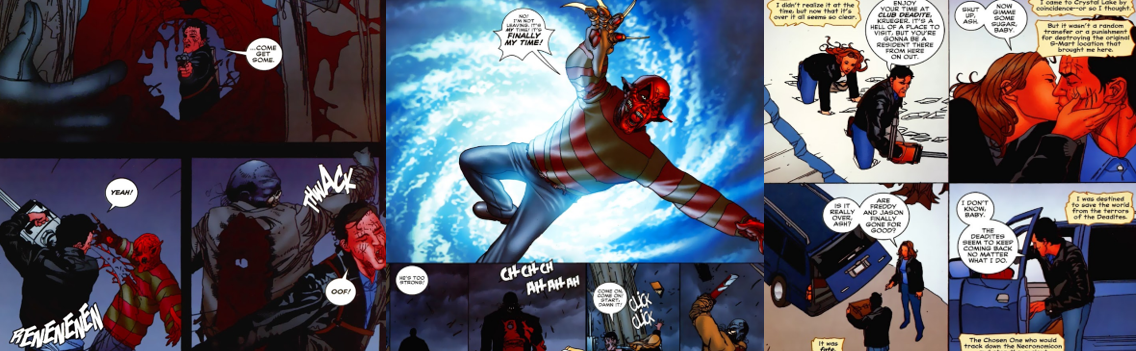
Our story begins five years after the events of Freddy vs. Jason and is narrated by the loquacious wit of Deadite-slaying, S-Mart employee Ash Williams, who not only relates that Crystal Lake has once again reverted back to its “Forest Green” moniker but is also now home to “Super Mega Ultra S-Mart”. Ash recaps what happened in the movie (unstoppable, undead killer Jason Voorhees was resurrected by dream demon Freddy Kruger and the two battled to the death at Camp Crystal Lake when Jason’s murderous ways defied Freddy’s wishes), and then reintroduces us to the two survivors of that epic showdown, Will Rollins and Lori Campbell (referred to as “Laurie”, for some reason), who have inexplicably returned to Forest Green because Laurie can’t shake the feeling that Freddy and Jason are still alive. Of course, basic horror movie odds state that this is a bad idea; both Will and Ash point out that it’s a bad idea, but Laurie won’t be dissuaded and, with snow caking the landscape, they investigate the remains of Camp Crystal Lake. Naturally, Laurie finds blood at the site and, moments later, is horrified to see Will’s eviscerated corpse strung up from the rafters, his entrails spilling to the floor. Hysterical and panicked, Laurie desperately tries to channel her survivor’s instinct, the special qualities that Ash bitterly remarks make such individuals special, attacking Jason with a buzzsaw and chastising his mindless killing, only to end up with a machete to the face as Ash sadly comments that, for better or for worse, the only true “chosen one” is him. Jason takes his newest victims back to his shack, where his beloved mother’s severed head has been joined by Freddy’s, a memento of his victory in Freddy vs. Jason. As we saw at the end of the film, Freddy’s spirit survived and, once Jason enters the shack, he’s immediately forced into a lucid dream state where he relives his childhood torment. He’s enraged when he finds Freddy nailing his mother, but Pamela soothes him, as ever, and convinces Jason that his new “daddy” not only wants to protect him from bullies but can also make him a “normal little boy” like he’s always wanted; all Jason has to do is go back to his childhood home and dig up the Necronomicon Ex Mortis that’s buried there.

With our survivors unceremoniously offed, a similar plot begins that sees Ash thrown into the mix.

With our returning characters summarily killed off, the story jumps over to the Forest Green S-Mart to introduce a new batch of horny, cliché teens; four slackers more interested in making crude dick jokes, pulling pranks on their supervisor, and giving oddball customers the brushoff. The four – Jarvis, Raoul, Davey, and Caroline (or “Carrie”) – are unimpressed to learn that a “senior housewares domestic engineer” is coming in to whip them, and the entire store, into shape for the holiday season. Of course, this is the “Chosen One” himself, Ash Williams, still sporting his robotic hand and embittered by both the influence the Necronomicon has over his life and the losses he’s suffered because of it. Still, he finds solace in kicking Deadite ass whenever they show up and the hope that he’ll one day get to destroy the book once and for all. Ash immediately puts the moves on some teens hanging around outside the S-Mart; as he’s reprimanded for his tardiness and shown around by the manager, the teens wander into the path of the lurking Jason, his vision twisted by Freddy’s influence and driving him into a killing frenzy. The screams attract Ash, and the cops, who immediately target Ash for being an out-of-towner but are forced to release him when the manager vouches for his innocence. Despite the event, Ash gets to work, unimpressed by the store’s presentation and the kids’ lethargic attitude and naivety regarding the dark forces lurking in the shadows. Naturally, Raoul and Jarvis mock his doomsaying demeanour, but Carrie is intrigued by his stories of cursed books and demons; just as he shares more of his experiences, she also clues him in on the local legend of Jason Voorhees, unaware that Jarvis and Raoul are listening in. When Raoul jumps in wearing a hockey mask and brandishing a tomato sauce-splattered hockey stick, Ash nearly kills him before Jarvis intervenes, further increasing the animosity between them and the unimpressed Ash. His mood lifts, however, when he not only sees the S-Mart sells the impressive “Chain Lightning” chainsaw but also when sultry Bree strokes his ego, convincing him to buy supplies for her camping trip, only to ditch him once he’s finished loading up her fancy sports car.

Ash searches for the Necronomicon, unaware that Freddy and Jason are also hunting it.

Meanwhile, Freddy urges Jason to continue towards his goal but the hulking killer can’t help but slaughter a group of carollers he spots in the forest along the way. Wouldn’t you know it, though, Bree and her shit-kicking friends are spending the night in the old Voorhees mansion, unaware that Jason is prowling outside. Ash rolls up soon after on the trail of the Necronomicon and immediately heads to the fruit cellar, ignoring the commotion upstairs as he assumes it’s just the kids getting laid (though it’s actually Jason ripping them to bloody pieces), and finally locating the book just before realising there’s a madman on the loose inside. Ash races upstairs and finds Bree, half naked and in shock, and uncomfortably slaps a kiss on her before delaying Jason with a shotgun blast and making a run for his Oldsmobile. With Bree in hysterics and the car refusing the start, Ash deflects Jason’s machete with his robot hand and is forced to bail when the monster wrecks his beloved car. Thankfully, Carrie suddenly runs Jason down as he’s throttling our hero and all three of them get to safety, much to Freddy’s anger. In Jason’s subconscious, where the hulking killer is little more than a terrified child, Freddy reiterates his mission to retrieve the book and gives Jason license to kill anyone who gets in his way, learning Ash’s name from the depths of Jason’s admittedly empty mind. Ash, Bree, and Carrie head to S-Mart, where Raoul and Jarvis are getting high, and Ash again chews the kids out for being macho assclowns. As Ash desperately searches for a solution in the pages of the Necronomicon, Jason waltzes through the front door and goes on a delightfully gory killing spree, forcing Ash to reload and rearm himself with his trademark chainsaw.

With Freddy’s threat now apparent, Ash comes up with a plan to destroy both undead killers.

Round two between Jason and Ash goes slightly more in Jason’s favour, with Ash being comically battered around the shop, incapacitating him enough for Jason to tear out Bree’s throat and retrieve the book. While the survivors regroup, now convinced of Jason’s threat and Ash’s abilities, Jason brings the book back to his shack and Freddy reads those immortal words – “Klaatu! Verata! Nikto!” – and returns to the waking world once more. Ready to spread a new kind of nightmare with the book’s power, Freddy leaves, considering the two even, but surprisingly makes good on his promise to “fix” Jason. Ash and the others head to Carrie’s place where they take stock of the situation, with Ash even referring to Jason as a Deadite and the group agreeing that “someone” must be manipulating him; but, with little else to go on, they turn in for the night. Thus, Ash finds himself dreaming of being back in the cabin; he even has his old hand for all of five panels before Freddy’s claws burst from it. As before, he races to the work shed and severs the razor-fingered limb with a chainsaw and wry commentary, only to be stunned when his blood forms into tiny, mocking Freddys and then a full-size Freddy, who introduces himself to Ash and then, strangely, states his plan to have Ash and the kids bring him the Necronomicon despite the fact that he already has it. Regardless, Ash fights Freddy off and forces himself awake, discovering that whatever happens in a dream happens in the real world, which is bad news for Davey as he’s pummelled to death by dodgeballs in his nightmare. Relishing his returning strength, Freddy orders Jason (now little more than his obedient lackey) to go kill them so he (as in Freddy) can properly read the book, while Ash has the kids round up some supplies from the S-Mart before heading back to the Voorhees estate. Ash’s plan is for them to stay awake, lure out Jason, and bury him under his own house using explosives; he arms himself with Chain Lightning, steals “some sugar” from Carrie, and heads inside, leaving the others to carry out their part of the plan.

Although supposedly smarter, Jason chooses to defy Freddy, who’s obsessed with the Necronomicon.

Unfortunately for the dumbstruck Raoul and Jarvis, Jason is a bit smarter now and doesn’t fall for their trap; he even taunts them with a finger wag before advancing on them. In the house, Ash is surprised to find Freddy manifested in the real world, suffering a shoulder wound for his arrogance, and even more stunned to find Freddy has already read from the book and enacted his plan to dominate both the waking and the dream worlds. Transforming to his demonic form and conjuring both ethereal Dream Demon spirits and miniature claws, Freddy prepares to cut Ash down but is surprisingly – and bafflingly – interrupted by Jason, now wielding two machetes, who randomly decides to turn against Freddy for no reason. Still, Freddy’s more than willing to oblige and conjures the demonic corpses of Jason’s many victims to swarm the hockey masked killer, with many familiar faces (even some who weren’t Jason’s prey) making a welcome return. Despite their numbers, and Freddy running him through with his own machete, Jason refuses to go down without a fight, but Freddy’s attention is soon turned to Ash when he finds the “Chosen One” has swiped the book during the commotion and made a run for it. In the forest, Ash is attacked by demonic trees and crows but quickly asserts himself with his chainsaw and shotgun, stumbling upon the bludgeoned remains of Raoul and Davey soon after. He’s relieved to find Carrie survived, however, but they’re forced to take shelter in the Voorhees house when the enraged Dream Demon looms over them from the clouds in an awesome visual. Ash frantically searches through the Necronomicon for the passage that will banish Freddy and Jason to the Deadite realm and discovers sketches of the two in the book’s pages, lending more credence to the “Jason is a Deadite” philosophy and only exacerbating Ash’s anger towards the book and all the suffering it’s caused. Ash entrusts the book, and the scared words, to Carrie and prepares to hold the two killers off, only to wind up tangling with Freddy’s nursery rhyme kids and watching, helplessly, as Carrie is taken away by Freddy in a recreation of the end of the original Nightmare on Elm Street (Craven, 1984).

After a long and bloody battle, Freddy and Jason are seemingly defeated once more…

Of course, Ash easily fights these apparitions off but, more surprisingly, Carrie is inadvertently saved from Freddy’s leering lusts by Jason. While he’s no match for Freddy’s God-like power, Jason is still switched on enough to snatch the book from Carrie before she can read the magic words, forcing Ash to blow his hockey mask (and half his rotten face) off to protect her. Ash then literally disarms Jason to retrieve the book, but Jason simply jams his machete blade into the stump and swats Ash out of the house, through a window and into unconsciousness, as the estate collapses on him and Freddy, leaving Carrie to run for her life when the demonic Freddy bursts forth demanding his book. After savouring the chase, Freddy gleefully mocks her by cutting himself in a perversion of the Holy Communion and reclaims the book, only for Jason to suddenly return and, despite Freddy’s taunts and impressive light show, splits his head in two with his machete. Naturally, Freddy quickly recovers, freezes Jason with a puff of bloody air, and prepares to use the Necronomicon to send him far away. Just then, Ash comes barrelling in in his bizarrely repaired Oldsmobile and runs Freddy down before beating the piss out of him and blowing his nuts off with his shotgun. Ash’s bravado is nullified when a recovered Jason enters the fray and causes Ash to slip into the icy waters of the frozen Crystal Lake. Freddy duplicates himself to momentarily overwhelm Jason and their fight is interrupted (…again…) by Ash, who breaks free from the ice and blows a hole in Jason’s chest and takes a swipe at Freddy with his chainsaw, only to be quickly overpowered and manhandled by their supernatural strength and powers. Luckily, Carrie finally gets her shit together and reads the passages, opening a vortex that sucks Freddy into the Deadite realm. Although Jason manages to resist the vacuum, he’s forced back to the depths of Crystal Lake by Ash’s Oldsmobile but, regardless, the threat is summarily ended. However, while he revels in this victory, Ash expresses scepticism that the two – and the Evil Dead – can ever truly by defeated and, indeed, the final panels not only show that Jason is alive in the frozen Crystal Lake but that the Necronomicon also foreshadows a future confrontation between the three!

The Summary:
Oh my, is this story quite the glorious mess! First of all, I have to say, while the covers are indeed striking, the interior artwork widely fluctuates between issues and is often almost incomprehensible. Although Will and Lori barely resemble their film counterparts, Ash, Freddy, and Jason are all rendered exactly as they appear in their films, almost to a fault as Jason Craig blatantly copies poses and images from Freddy vs. Jason in some panels. Sometimes, characters are depicted in a quirky, exaggerated manner almost on the verge of caricature; others, they’re a mass of angles and colours and blobs and things appear very rushed. You can guess which style works best for the story. Second, there’s the writing; Ash’s narration is a nice touch and is a unique way to fill in any blanks and to convey his overriding character arc of being this cursed “Chosen One”, but the narrative is kinda all over the place at times. Will and “Laurie” return only to be killed off right away, the new characters are dull and simply there to add to the body count, and a lot of the writing annoyingly pokes fun at the tropes of the Friday the 13th franchise rather than embracing them. I can’t help but feel the story might’ve been better served by having Will and Lori survive; maybe they also work at the S-Mart and they could’ve delivered some of the exposition, and died due to the power boost Freddy and Jason receive here. Instead, we’re left with a couple of jock dickheads and some slutty girls who mock Ash at first and then fall for his charms as soon as the bodies start piling up.

Ash’s bravado sees him underestimate his foes, and their connection to the Necronomicon.

Speaking of which, Ash is depicted quite fittingly here; he’s both bitter and tortured and snarky and proactive, openly telling his horror stories to anyone who’ll listen even when there’s no context or reason for him to and immediately jumping into action whenever a threat emerges. He’s never short of a quip or biting remark and bombards both his undead enemies and his smarmy teenage cohorts with snappy insults whenever he can; he also makes sure to spout all his familiar catchphrases, often when slicing and dicing, and comes up with a decent enough plan to get rid of the two monsters, even if he does underestimate their abilities. Yet, he’s also a complete moron; he easily falls for Bree’s deception, arrogantly assumes he can best Freddy and Jason since he’s killed Deadites before, and is easily distracted by whichever shapely piece of ass is in his view at that moment. The best parts of the story are when he’s matching wits with Freddy, with the two trading more barbs than blows, and going toe to toe with Jason, with Ash’s unique abilities giving him just enough edge to at least hold his own against Jason’s superior strength. Similar to Freddy vs. Jason, Freddy is more of a manipulative presence here; weakened, he must manipulate Jason once again, often using the form of his beloved mother, to restore his power and, consequently, claims only one victim in the entire story. Yet, his threat is constantly emphasised; the Necronomicon promises to increase his power a thousandfold and enables him to bring his dream powers to the real world, and nowhere is this more apparent than in him assuming his demonic visage about halfway through the story. Unfortunately, only the reader is truly aware of Freddy’s threat for the majority of the book; characters are naturally only aware of Jason since he’s a local legend, though this doesn’t diminish Freddy’s importance since he constantly pops up to chastise Jason or make lewd advances towards the characters before enacting his diabolical plan.

Despite some gruesome kills and seeing the three go at it, the story is lacking in key areas.

Of the three, Jason kinda gets a little shafted. Sure, he builds up an impressive kill count here and delivers the story’s most gruesome moments (his wholesale slaughter of the S-Mart customers and employees is a notable highlight), but I didn’t like that he was reduced to Freddy’s pawn once he delivered the Necronomicon. Freddy supposedly reenergised Jason’s brain cells with the book, but we see little evidence of this; sure, he’s a bit smarter and seems a little more aware of what’s happening, but it’s not enough for me to say he’s never shown that level of intelligence before. It’s also incredibly baffling to me that Jason just randomly turns on Freddy; there’s no explanation for this and it just comes across as a bit forced and a way to avoid coming up with a good reason to have them fight again. The fights between the two, and three, characters are pretty good; they’re surprisingly evenly matched despite Jason’s supernatural strength and Freddy’s increased powers and their battles are generally interrupted by characters waking up or interjecting themselves, but there was some meaty, bloody action whenever they got into it. Sadly, I’m not sure it’s enough to really elevate this story; it’s a fun glimpse at what could’ve been in a potential Freddy vs. Jason sequel, but I definitely think another pass was needed at the script and a few of the issues needed addressing. Primarily that the story really is just a retread of Freddy vs. Jason but with elements from the original Evil Dead films (Raimi, 1981 to 1992) thrown in, but also…Freddy has the Necronomicon so why does he need Ash the others to get it? Why does the story flip-flop between calling it Forest Green and Crystal Lake? How did Ash know the Necronomicon was at the Voorhees house? Still, I liked the visual of Crystal Lake covered in snow, the callbacks and references to each film and certain events from each franchise, and the visual of the three going at it, I just think it needed a little bit more to really elevate it to must-read territory.

My Rating:

Rating: 3 out of 5.

Pretty Good

Did you enjoy Freddy vs. Jason vs. Ash? What did you think to the artwork and the characterisations? Were you disappointed that Will and Lori were offed so quickly? Did you like the connection between the Necronomicon and Jason’s origin? Would you have liked to see these three horror icons tangle on the big screen? Which film in the three franchises is your favourite? What other horror crossovers would you like to see? Drop a comment below to share your thoughts and feel free to check out my other reviews of both franchises, and the rest of my Crossover Crisis content!

Back Issues [Crossover Crisis]: Jason vs. Leatherface


In April 1985, the first issue of the ground-breaking Crisis on Infinite Earths (Wolfman, et al, 1986) released and saw the temporary destruction of the “Multiverse”. To celebrate this momentous event, I’m discussing multiversal crossovers all throughout April in an event I dubbed “Crossover Crisis”.


Writers: Nancy A. Collins and David Imhoff – Artist: Jeff Butler

Story Title: “Goin’ South”
Published: October 1995

Story Title: “A Day in the Life…”
Published: November 1995

Story Title: “Face Off”
Published: January 1996

The Background:
Following on the heels of John Carpenter’s Halloween (Carpenter, 1978), which popularised the “slasher” sub-genre of horror cinema, Friday the 13th (Cunningham, 1980) proved to be a box office success, justifying the release of numerous sequels. Immediately, the slasher franchise became synonymous with its unstoppable, machete-wielding, hockey mask-wearing killer, Jason Voorhees (Various), a horror icon who has transcended the genre, becoming a mainstream figure who has branched out into videogames, toys, and various comic books. These would explore Jason’s complex mythology and pit him against other horror icons and, in fact, this latter gimmick was used in his very first comic book appearance as Jason ended up befriending Jedidiah Sawyer/Leatherface and his cannibalistic family in this curious and oft-forgotten three-issue series. Leatherface, of course, first appeared in the highly controversial and influential Texas Chain Saw Massacre (Hooper, 1974), to which all masked slashers owe a great debt. Thanks to a myriad of sequels, remakes, and requels, the Texas Chainsaw Massacre franchise has suffered from the law of diminishing returns at times, though Leatherface and his iconic chainsaw remains a prominent horror figure. Given their childlike demeanours, violent bloodlust, and their unsettling family relationships, I guess it made sense for Topps Comics to have the two square off in this limited series, especially as the legal issues surrounding the long-awaited clash between Jason and Freddy Kruger (Robert Englund) wouldn’t be resolved for some time.

The Review:
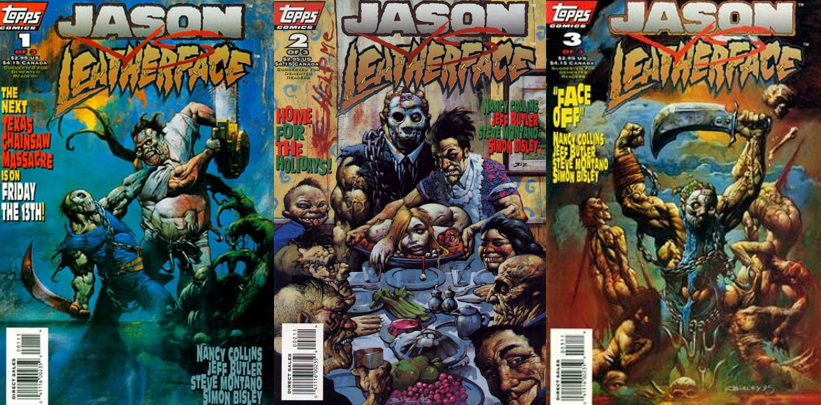
Our story begins as most Friday the 13thfilms do: with a bit of context about Crystal Lake, affectionately known to the locals as “Camp Blood” thanks to the actions of Pamela Voorhees and her zombie-like killer of a son, Jason. Given that this comic was published in 1995, the most recent film was Jason Goes to Hell: The Final Friday (Marcus, 1993), one of two ultimately unsuccessful attempts to finally do Jason in for good, which explains Jason’s somewhat odd-looking appearance. He’s kind of a mixture of his look from Friday the 13thPart VIII: Jason Takes Manhattan (Hedden, 1989) and Jason Goes to Hell, meaning his bulbous head is kind of eating into his mask. He also starts the story still chained to the bottom of Crystal Lake, indicating that this comic book takes place sometime after Friday the 13thPart VI: Jason Lives (McLoughlin, 1986) rather than after Friday the 13thPart VII: The New Blood (Buechler, 1988) since he hasn’t decayed enough to resemble his look in that film. Honestly, trying to figure out where or even if this comic fits into the already spotty Friday the 13thtimeline (or with that of the equally troublesome Texas Chainsaw Massacre films) is a fool’s errand; it’s better to just say it’s an alternative tale that takes place after Jason Lives and the original Texas Chain Saw Massacre. Anyway, the story sees Crystal Lake abandoned due to Jason’s many rampages; in its place is a big industrial factory that pumps its waste into the lake, contaminating it so badly that its owners, Linhart Amalgamated, decide to cut their losses and ditch the lake entirely so they can build a fancy business district on its foundations. Naturally, they do this on the cheap, but the dredging is successful and sees the polluted water and its toxic waste loaded onto containers and transported across the country via barge, truck, and train.

When Jason finds himself in Texas, he’s welcomed into the grotesque Sawyer family.

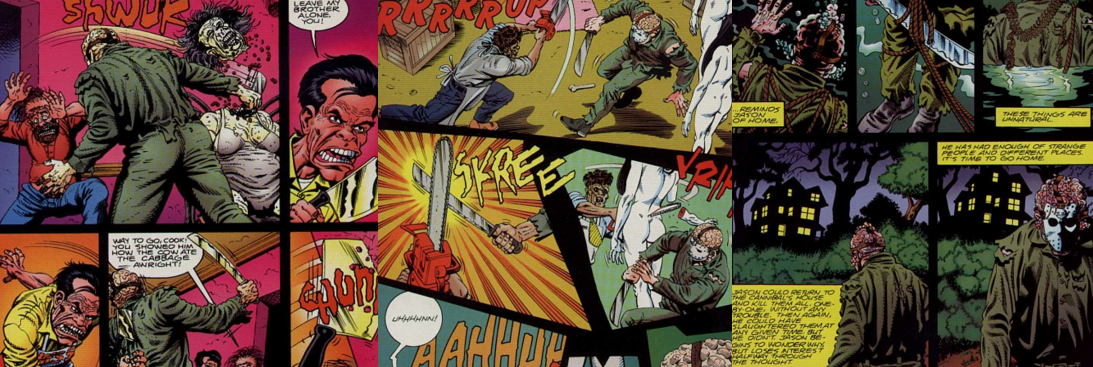
This sees Jason forcibly extracted from his underwater prison and reanimates him, just as the local crazy warned, and he bursts out of his confinement in such a rage that he chops up a train-hopping hobo and his doggy! Jason then barges into the control carriage and kills the relaxing train conductors, splitting the head of one right down the middle with his machete! The train consequently derails and dramatically explodes, leaving Jason lost in the woods of “Sawyerville” in Texas, where he’s just about to hack up some poor randomer when he’s interrupted by Nubbins Sawyer/The Hitchhiker and Leatherface, who are also chasing the terrified man. Encouraged by the Hitchhiker, Leatherface and Jason immediately go at it, with Jason somehow able to deflect Leatherface’s chainsaw with his machete and knock it from his hands. However, the two brutish killers share an intense look as they clash weapons and Jason chooses to behead the victim and peacefully hand Leatherface his chainsaw, earning him the admiration of the Hitchhiker. Against his very nature, Jason is compelled to follow the two back to their humble abode, which is adorned with decorations made from the flesh and bones of their victims, which are also cooked up for the family to eat by Drayton Sawyer/The Cook. When the Hitchhiker and the Cook applaud Jason’s killing skills and berate Leatherface, the hockey masked killer wanders upstairs to find the unmasked Leatherface blubbering. Sensing a kindred spirit in the hulking cannibal, Jason silently invites him downstairs to join the family for dinner, specifically the Cook, the Hitchhiker, the bloated corpse of Aunt Amelia, and decrepit former butcher Grandpa Sawyer. Though struggling with the alien emotions bubbling within his enraged mind, Jason feels so comfortable and accepted with the cannibalistic misfits that he communicates his name to them by writing on the wall with “Kool-Aid” (that’s most likely just blood) and being welcomed to the family.

When Jason sees the way the Hitchhiker treats Leatherface, it unearths some bad memories.

Jason stays with the family, even resting in his own bedroom, where his dreams are dominated by flashbacks to when he drifted out to sea and almost drowned as a child. Tensions quickly rise as the Hitchhiker insults Jason by demanding he take off his mask and eat some scrambled brains, and then attacks Leatherface after being reprimanded by the Cook, which gives Jason a flashback to the violence he suffered at the hands of his abusive father. The Cook briefly placates Jason with a tour of the house, showing off the macabre kitchen, where fresh bodies hang on meat hooks, human meat is stored in the freezer, and more bodies are cooked up in the smokehouse. The Cook takes an immediate shine to Jason, approving of his friendship with Leatherface and sharing his dreams to one day serve his unique food to the social elite. After showing off his long-dead dog to Jason, the Hitchhiker is ordered to the family gas station, where he creeps out a travelling couple. He then rushes back to recruit Leatherface to pick up the “groceries”, but the Cook suggests he take Jason out instead to show him their ways. The Hitchhiker attacks the man with a hammer, bashing his brains in, and admonishes Jason for throttling the woman to death too quickly as the Sawyers enjoy hearing them squeal and, while the Cook is disappointed that the dead bodies aren’t younger, it’s a successful trip for the cannibals. The Hitchhiker then excitedly shows off his art collection to Jason, a room full of dead bodies that have been turned into chairs and other furniture. He delights in showing off a lamp, plant pot, and chair all made from skulls and bones and his pride and joy: a corpse dressed up as Santa Claus with a red lightbulb for a nose! When Leatherface sneaks in and accidentally destroys the Hitchhiker’s chair, the maniacal Sawyer beats his dim-witted sibling mercilessly, berating him the entire time and again causing Jason to remember how his own father routinely beat and demeaned him before his mother (strangely called “Doris” here) cleaved his head in with a machete. Accordingly, Jason defends Leatherface, though the Hitchhiker is less than impressed since he can’t actually feel pain.

When the relationship breaks down, Jason finds himself ostracised and longing for home.

When Jason moves to stab the Hitchhiker with a bone, Leatherface steps in and Jason retires to the house, troubled by his hesitation and recent behaviour. He ends up in the attic, longing for simpler times at Camp Crystal Lake, and the Cook comes to find him and apologise for the Hitchhiker’s behaviour. He also reveals that he set aside his dreams to look after the family as a promise to their mother, his sister, Velma, suggesting a degree of inbreeding in the family, and asks Jason to help him get Grandpa downstairs for dinner. The Hitchhiker continues to scold Leatherface, however; after accusing the mongoloid of reading his comic books, the Hitchhiker beats him in a rage, again compelling Jason to defend his friend. This time, it earns him a switchblade to the chest, which naturally doesn’t faze the hulking murderer, and Jason tears the house apart in pursuit of the maniacal Hitchhiker. Angered at Jason’s outburst, which sees Aunt Amelia beheaded, the Cook tries to stop him with a meat cleaver and a chase ensues, with Jason smashing into the kitchen and preparing to eviscerate the two before Leatherface bursts in with his chainsaw whirring. After a moment’s hesitation, Leatherface strikes, slicing Jason’s stomach and rekindling his rage; incensed at the betrayal, Jason buries his machete in Leatherface’s shoulder and the two go at it. Leatherface suffers a deep cut to the wrist but fails to land a blow of his own before the Hitchhiker bashes Jason’s head in with a hammer. Although the Hitchhiker is eager to treat Jason the same as anyone else, the Cook doesn’t feel right about eating him; not only did he genuinely like Jason, he suspects his meat wouldn’t be too appetising so he decides that he deserves a decent send off. Despite their differences, Leatherface angrily insists that Jason keep his mask on and the family drive Jason’s brained body to the nearby lake, where they tie cinder blocks to his angles, put his machete in his lifeless hand, and dump him in with a ceremonial kick. This is enough to spark Jason back to life; he cuts through his bonds and rises from the lake, briefly tempted to slaughter the Sawyers for their betrayal, but deciding that he’s had enough of strange people and strange places and begins the long walk back to Crystal Lake and the comfort of the familiar.

The Summary:
This was an interesting anomaly of a comic; there’s definitely some crossover appeal between Jason and Leatherface and I think the story did a decent job of painting the two as kindred spirits, but I don’t think it fully lived up to this potential. This was more like Jason Meets the Sawyers since, while he does fight Leatherface very briefly twice throughout the story, he’s more touring their house and being welcomed into their family. I think one thing that’s kind of crucial for any crossover is seeing each character in the other’s location, but we don’t get that here as Jason spends the entire story in Texas, mostly in the Sawyer house, and I think it might have benefitted from having Jason and Leatherface spend more time together, killing randomers, and then demonstrating their differences in their methods. Leatherface is, essentially, a butcher, artist, and child-like figure but the comic only really delves into the last aspect of his personality. While this works in creating parallels between the way the Hitchhiker treats him and the way Jason’s father abused him, it doesn’t always land as the comic is understandably more interested in pairing Jason with characters who can actually talk beyond animalistic grunts.

While the two don’t fight much, they’re positioned as thematic parallels and the art’s suitably gory.

The artwork is pretty good; very exaggerated and stylised, but suitably gory and I really enjoyed the depiction of the Sawyer house, though it does seem like the story suffers from padding a bit as it stops to explore the Cook’s unrealised dreams and the Hitchhiker’s art collection. Because of this, I wonder if it might’ve been better as two thirty-page issues rather than being a three-issue arc as then we could’ve gotten to the titular fight a little faster. When Jason and Leatherface do fight, it’s very brief and not very bloody; neither really inflict much damage on each other and it just suddenly and anti-climatically ends when the Hitchhiker bashes Jason’s brains in. I enjoyed the text boxes that tried to explore Jason’s mindset and conflict over why he’s spared the family and chosen to stay with them, but at times it seems to be openly criticising the paper thin plot and the nonsensical reason behind why he would choose to stay with them. The narrative also suffers from repetition and constant flip-flopping; one minute Leatherface and Jason are buddies, sharing an unspoken bond, and the next Leatherface is attacking Jason with a chainsaw since he dared to raise a hand to the Hitchhiker. Similarly, the story repeats the same thread of Jason stepping in to defend Leatherface from the Hitchhiker more than once and it’s not really clear why the second time leads to a bigger falling out other than the story needing to end. Consequently, things get a bit muddled and boring considering it’s only three issues long, which is again why I think a two issue special would’ve been better. Still, it’s a fun little curio; the artwork is good, the gore is enjoyable, and the attempt to shed some light on Jason’s childhood and somewhat humanise him through Leatherface was admirable, if flawed. I’d actually like to see this done again, perhaps with a painted, gritty art style and a tighter plot, but it was inoffensive enough, if a bit forgettable.

My Rating:

Rating: 2 out of 5.

Could Be Better

What did you think to the showdown between Jason and Leatherface? Were you disappointed that they only fought a couple of times and that it was rather brief? Did you enjoy seeing Jason interact and bond with the Sawyer family? What did you think to the Hitchhiker and the focus on exploring the family’s…unique lifestyle? Which horror icons would you like to see clash in a comic or movie? What’s your favourite Friday the 13th and Texas Chainsaw Massacre film? Whatever your thoughts on this horror crossover, feel free to leave them in the comments or on my social media.

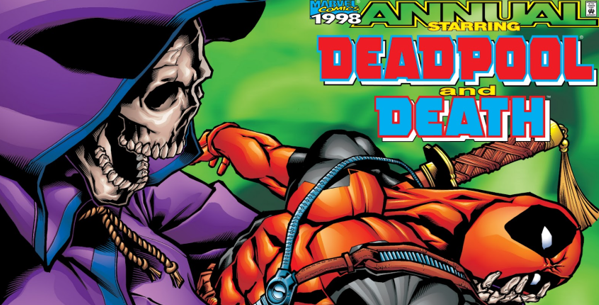
Back Issues [Deadpool Day]: Deadpool and Death Annual ’98


In February 1991, readers of The New Mutants were introduced to Wade W. Wilson, AKA the wise-cracking, fourth-wall-breaking Merc With a Mouth himself, Deadpool. Rob Liefeld and Fabian Nicieza’s sword-swinging immortal went on to become one of Marvel’s most popular anti-heroes thanks to his metatextual humour, violent nature, and massively successful live-action films. It’s perhaps no surprise that Sideshow rechristened April 1st as “Deadpool Day” to give fans of the chimichanga-chomping mercenary an excuse to celebrate all things Deadpool.


Story Title: “A Kiss, A Curse, A Cure”
Published: 13 May 1998 (cover-dated July 1998)
Writer: Joe Kelly
Artist: Steve Harris

The Background:
By the 1980s, the X-Men were established as a successful cornerstone of Marvel Comics; they were so popular that then-chief editor Jim Shooter ordered a number of X-Men spin-off books, one of which was Chris Claremont and Bob McLeod’s The New Mutants. These Mutant youngsters were eventually tutored by the time travelling Mutant Nathan Summers/Cable and rechristened as X-Force, and famously went up against Fabian Nicieza and Rob Liefeld’s Deadpool in The New Mutants #98 (ibid, 1991). Heavily inspired by James Howlett/Logan/Wolverine and Peter Parker/Spider-Man (and with numerous similarities to DC Comics’ Slade Wilson/Deathstroke the Terminator), the self-styled “Merc With a Mouth” was initially introduced as an antagonist for the Mutant team. However, Deadpool proved popular and soon made guest appearances in other Marvel Comics before receiving his own four-issue miniseries, a precursor to his ongoing solo title and his own influx of popularity once he began breaking the fourth wall. One of the character’s other defining traits is his relationship with Lady (or Mistress) Death, a cosmic, reaper-like entity whom Wade is desperately in love with. Created by Mike Friedrich and Jim Starlin, Death is most prominently known for also being the object of Thanos’s affections; his motivation for gathering the Infinity Gems and eradicating half the life in the universe was to win her love. Thanos and Deadpool clashed over their love for death more than once; in fact, it was the Mad Titan who cursed Deadpool with immortality when Lady Death chose Wade over him.

The Review:
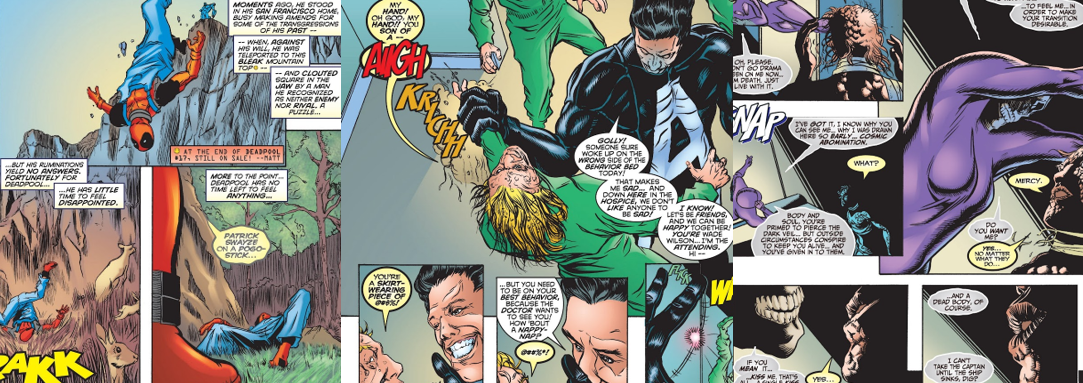
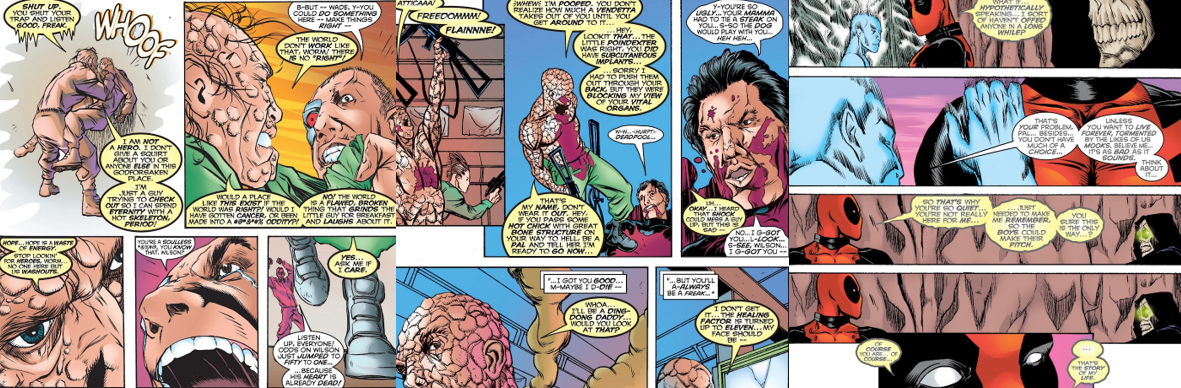
This bumper annual opens with the super chatty Deadpool unexpectedly teleporting right into the path of a closed fist; the punch sends him careening over a cliff edge where, despite this best efforts, he plummets to the ground with a sickening impact. Just moments before, Deadpool had been working to make amends for his past deeds in San Francisco, and now he finds himself literally dead of a broken neck thanks to his mysterious assailant. Deadpool’s spirit initially balks at the idea of the fall killing him, or the sudden attack being real, but is forced to confront the truth when Lady Death greets him with a passionate kiss. Despite Deadpool asking to skip the flashbacks and cosy up to Death, she silently insists on forcing him to relive his traumatic origins and the story regularly shifts between the present and the past, where mercenary for hire Wade Wilson is given a tour of the Weapon X facility, a special weapons development branch of Department K, the superhuman arm of the Canadian government. At this point, Wade is a strapping young man with a head full of blonde hair and the potential to be a valuable asset to his government, but also riddled with terminal cancer. Since Weapon X has already made a veritable Captain Canada out of James Hudson/Vindicator, the general is confident that even trash like Wade can be moulded into a superhero with their program. Wade readily agrees, awestruck by the Vindicator and with little to lose from his prognosis. However, he fails to pass the grade and, with his conditioning worsening, he’s locked up in a hospice where his fellow outcasts have such a low life expectancy that they regularly take bets on how long they will survive from their horrific and invasive experiments.

After being killed, Deadpool relives his traumatic origins and first encounter with Lady Death.

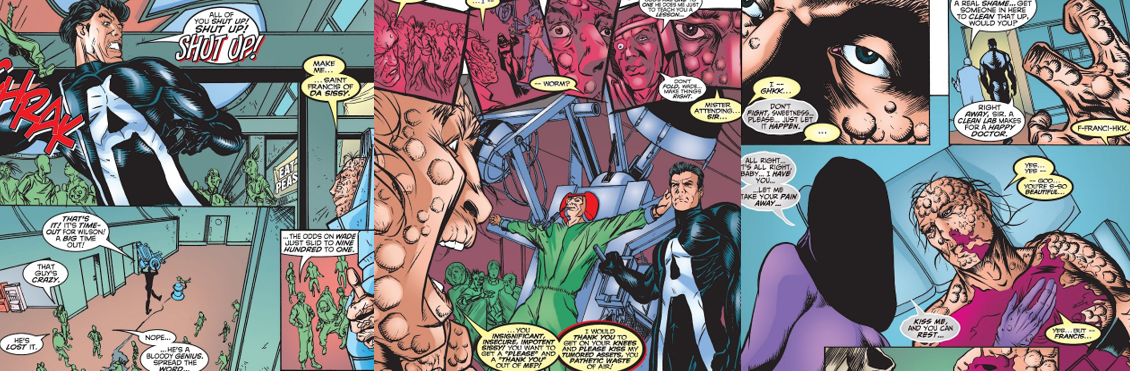
This “deadpool” carries high stakes and is championed by the semi-cybernetic Worm Cunningham; however, when Worm tries to pull that shit on Wade, the heavily scarred and slowly dying mercenary pulls a gun on him and demands to be left alone before turning the gun on himself. Before he can pull the trigger, though, the gun (and Wade’s wrist) is crushed by the sadistic, super strong Francis Fanny/A-Man, who mocks Wade and the knocks him out to deliver him to the resident doctor, Emrys Killebrew, for further experimentation. Dr. Killebrew and the A-Man are amused by Wade’s torture, especially when he begs for death, and both delight in subjecting him to unspeakable torment to make the most of his raw materials. The experience is so traumatic for Wade that his mind breaks and he grows cynical, scorns his misfortunes, and finds his body further ravaged by cancerous tumours. His mind becomes so warped that he perceives Lady Death, who lingers in his cell, intrigued by his unique imagination, and is stunned to find that he can see her. After invasively confirming that he’s not suffering from some kind of aneurysm, Death postulates that Wade is a unique being who longs to die but is being artificially kept alive against his will. Frankly, she finds the entire thing quite the turn on, as does he since Death assumes an alluring form given the amount of times he’s begged for it; thus, she promises they can be together if he finds a way to die but, despite his best efforts, he’s thwarted at every turn. He’s constantly stopped from killing himself and subjected to nightmarish experiments that bring him to the brink of death and cause him agony, yet he remains alive thanks to Dr. Killebrew’s machinations. He’s become so unkillable that his odds in the Deadpool have risen to three thousand to one, and such a risk to himself that he’s confined to a high-tech wheelchair. However, he remains determined to reunite with Death and to get the A-Man out of his way; Worm, however, doesn’t fancy his odds since the A-Man boasts enhanced strength, instincts, speed, and durability.

Wade’s defiance causes the A-Man to kill his friend just for the chance to murder the mouthy mercenary.

Worm lets slip that the A-Man hates his real name and is psychotically triggered by the merest mention of it, which is all Wade needs to rile up the brutal guard. Wade’s taunting works, sending Francis into a violent frenzy and condemning him to endure electroshock therapy. The experience is so intense and extreme that it briefly allows Wade to speak with Death once more. While he’s not truly dead, he crosses over long enough to share a dance with her, and Wade’s mockery of the A-Man not only improves his standing in the Deadpool but also offers a glimmer of hope to the other inmates. There’s a defiant fire there that wasn’t there before, but Wade angrily denies that he’s a hero; he sees the world as cruel and unfair and hope as a waste of energy, much to Worm’s disappointment. Even Death wonders if he was a little hard on the semi-cyborg but Wade insists that the only thing he cares about is being with her; others can play the role of hero, after all. Still, Wade’s attitude and the rising insubordination sees the A-Man voice his grievances to Dr. Killebrew; despite the A-Man protesting that he’s less effective if the patients don’t fear him, Dr. Killebrew is unwilling to simply dispose of Wade since his body contains information vital to his research. To get around this, and teach Wade some respect, the A-Man threatens to subject Worm to violent torture unless Wade falls in line. While Wade is torn between saving his friend and standing up to the A-Man, he ultimately chooses the latter, berating the A-Man with a tirade of insults after Worm begs him to stay defiant. This results in Worm being viciously lobotomised, giving Wade no choice to end his suffering and consequently forcing Dr. Killebrew to order Wade’s execution for killing one of his test subjects.

Wade’s desire for revenge sees him live on as Deadpool and drives him to confront his tormentor.

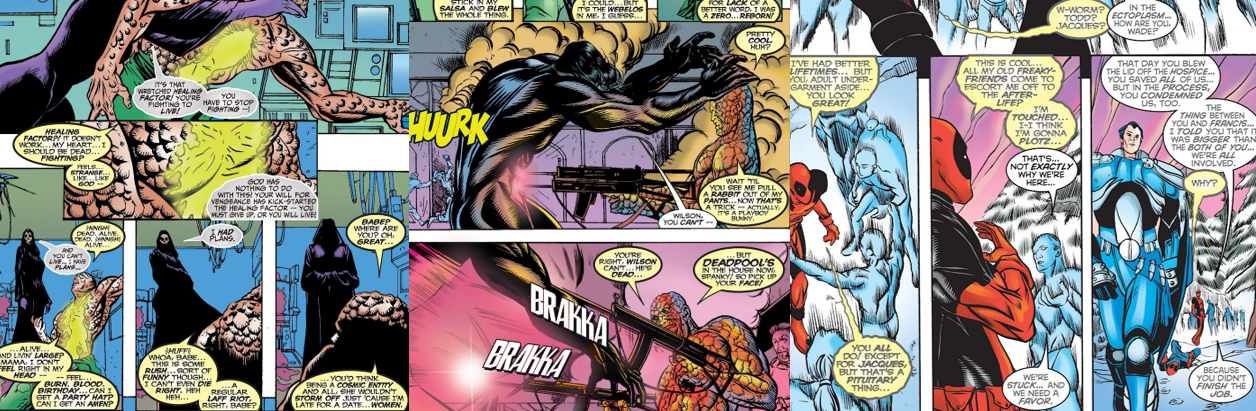
As the A-Man gleefully takes the controls of Dr. Killebrew’s elaborate murder machine, Wade vows to make them pay for what they’ve done to him, the other patients, and to Worm even as the A-Man rips his heart from his chest. Death comes to him, eager to consummate their love and begging him to let go and be with him; however, while he wishes to finally be with her, his stubborn nature and desperate need for vengeance kick-start his Mutant healing factor and force his body to repair the damage. The experience further damages his psyche but also shuts Death off from him as he drives himself forward to get revenge on his tormentors. Wade relieves some guards of their weapons and goes on a killing spree, much to the A-Man’s surprise and anger. The A-Man crushes Wade’s spine (his entire abdomen, in fact) in a rage and is left stunned when Wade painfully and sickeningly heals from the damage right before his eyes. Wade then christens himself “Deadpool” and unloads two assault rifles into his abuser but, even as he lies dying on the floor amidst the chaos of a full-blown riot, the A-Man can’t help but mock Deadpool’s heavily scarred visage, which somehow remains despite his advanced healing factor. With the A-Man dead, Deadpool calls to Death to take him but she doesn’t answer, leaving him distraught and heartbroken, which in the present he assumes is her way of causing him pain for choosing revenge over her. A silent point from Death reveals that Deadpool’s killer was none other than the A-Man, now calling himself “Ajax”, resurrected and sent to hunt down all the escapees from the hospice, The ghosts of his victims implore Deadpool to finish the job so they can move on to the afterlife and, with one last regretful kiss to Death, Deadpool spontaneously returns to life and heads out to make Ajax pay once and for all.

The Summary:
This was quite the surreal story. I believe this was the first real extended dive into Deadpool’s origins, and I recognise a lot of the elements from his first live-action movie, so that was kind of cool. While we don’t learn much about Wade’s life before Weapon X, and nothing about his time with the program since he dropped out of “hero school”, he has a reputation as being a mercenary and has a bit of sympathy to him because of his terminal disease. The main thrust of the story is to showcase just how horrific and traumatic Wade’s time at the hospice was. Wade’s unique speech patterns and manic thought boxes can be traced back to his time there, where the experiments and abuse fractured his mind and drove him to the point where he exists in this kind of limbo between life and death. That alone is alluring to Lady Death, but Wade’s crazed perspective on life also draws her attention, as does her desire to tease him with her affections. Naturally, since he longs for death, Wade finds her impossibly alluring and is desperate to be with her but he’s forever denied that thanks to a throwaway line from Dr. Killebrew about transplanting a healing factor into his ravaged body. When he finally is on the brink of death, Wade’s normally cold-hearted resolve has been replaced by a burning desire for revenge, spurning Death and close that door to him seemingly forever.

The story goes to great pains to examine the tragedy and torture that made Deadpool the man he is.

I do find this concept a little convoluted, similar to the idea that Wolverine has to literally fight off death every time he suffers a mortal injury. I think it clouds things a little and it’s simpler to just say he has a super-superhuman healing factor, but it only muddies the water if you think about it too much. While the concept of Death as a cosmic entity is proven to be real in Marvel Comics, it’s just as likely that Wade’s fracted mind is imagining her as this alluring skeleton woman and that he’s too stubborn, too powerful, and too stupid to die, despite wanting to deep down. Still, the story does a great job of humanising Deadpool and peeling back the layers behind his demented bravado; his experiences left him hating the world, cursing fate and the Gods alike, and wanting nothing more than to die, but the kindness of others and the brutality of his captors shifted him towards a different path. Dr. Killebrew and the A-Man are understandably one-dimensional characters; one’s a cackling mad scientist with no regard for his patients’ welfare and the other’s a superhuman sadist who delights in throwing his weight around and the suffering of others. I liked how Wade riled the A-Man up with insults and repeatedly calling him Francis, and that Wade became this revolutionary figure amongst the populace as a result, so the conflict was more about physical embodiments of oppression and freedom rather than an actual fist fight, which is fitting considering this extends to the physical and metaphysical aspect of Death. Ultimately, this was a decent and surprisingly tragic story designed to explain how awful Deadpool’s life has been and why he is the way he is. In that respect it worked well, and the art was serviceable enough most of the time, so it’s a good choice for anyone who’s just getting into Deadpool and wants to learn a bit more about his background and character.

My Rating:

Rating: 3 out of 5.

Pretty Good

Have you ever read Deadpool and Death Annual ’98? If so, what did you think about Deadpool’s trip down memory lane? Do you like the idea of him falling for Lady Death or do you find that aspect a bit convoluted? What did you think to the agonising torture Deadpool had to suffer and the characterisation of Dr. Killeshaw and the A-Man? Do you enjoy Deadpool’s manic sense of humour or do you find it a bit grating? What are some of your favourite Deadpool stories and moments and how are you celebrating Deadpool Day today? Whatever your thoughts on Deadpool, feel free to share them below or drop a comment on my social media.

Back Issues [Stark Sunday]: Iron Man #128


Anthony “Tony” Stark/Iron Man first lived, walked, and conquered in Tales of Suspense #39, published in March 1963 and brought to life by Marvel mastermind Stan Lee, Larry Lieber, and Don Heck. Since then, ol’ shellhead has gone through numerous different armours, had many amazing adventures, featured in numerous videogames and cartoons, and shot into mainstream superstardom thanks to an iconic, career-defining portrayal by Robert Downey Jr.  


Story Title: “Demon in a Bottle”
Published: November 1979
Writers: David Michelinie and Bob Layton
Artist: John Romita, Jr.

The Background:
Long before Robert Downey Jr. uttered the unforgettable words “I am Iron Man”, Stan Lee sought to take a character his readers would hate (a rich, military industrialist), mix in some inspiration from Howard Hughes alongside some vulnerability and personal tragedy, and make him someone they could root for. When mounting deadlines kept Lee from writing Iron Man’s debut, he turned to younger brother Larry Lieber, while artist Don Heck and the legendary Jack Kirby handled the artwork. Although Iron Man is very much a mainstream superhero these days, that wasn’t always the case, which is surprising given his prominence in cartoons and Marvel Comics. Alongside a colourful collection of villains, Iron Man has served on Marvel’s premier super team, the Avengers, swapped places with his teenaged younger self, fought against and imprisoned his fellow heroes, and even battled a sentient version of his armour! But one of Stark’s most harrowing battles came in his addiction to alcoholism; as plotted by writers David Michelinie and Bob Layton, Stark was wracked with guilt after an armour malfunction caused him to accidentally kill a foreign ambassador. Following this, Stark’s drinking increased and this is only exacerbated by the ensuing investigation and the machinations of Justin Hammer, who was behind his armour’s troubles, and caused Stark to drunkenly lash out at friend and foe alike. Considering how important and influential the “Demon in a Bottle” arc was for Iron Man’s characterisation (it’s frequently cited as one of the top Iron Man stories), it’s ironic that Layton would later state that it was never the writers’ intention to raft anything more than a new personal drama for Stark to conquer and that they had no idea how pivotal it would be to the character for years to come.

The Review:
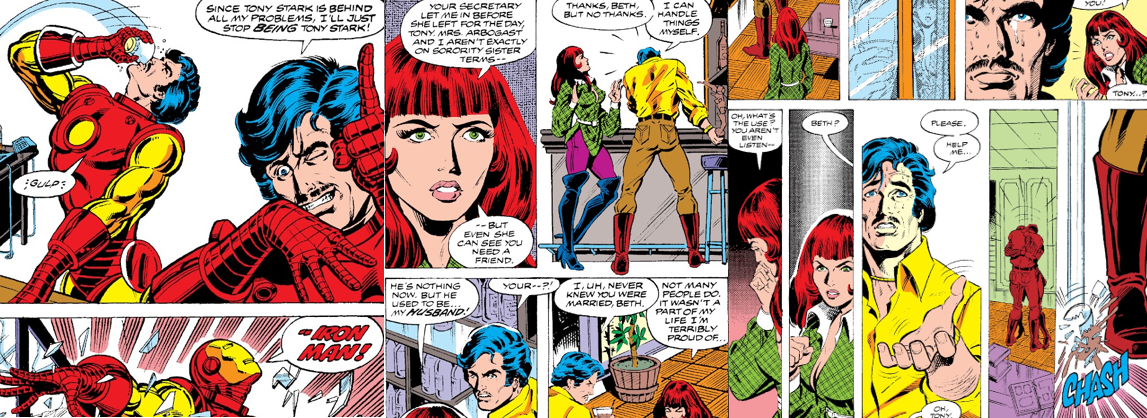
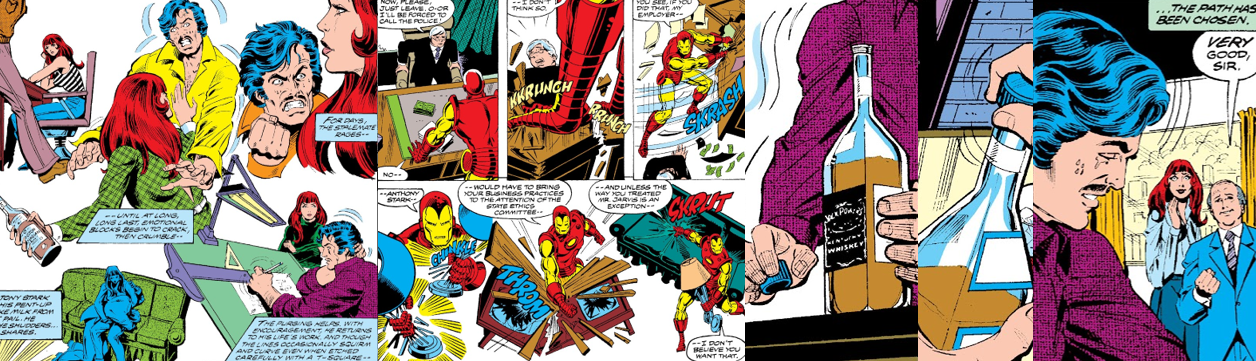
The issue begins with Stark wallowing in his office. Although he was publicly exonerated and cleared of all charges, public opinion of the Armoured Avenger (who was still believed to be Stark’s bodyguard at the time) has been shaken, as has confidence in Stark International. Already haunted by the memory of the life he took, Stark indulged in a wild night of drinking that saw him spur his love interest, Bethany Cabe, and insult his faithful butler, Edwin Jarvis, so badly that the courteous footman resigned from his employ. Sat alone, surrounded by glasses and bottles of half-finished whiskey and headlines branding his alter ego a murderer, Stark can’t help but ruminate on the status of his armoured persona. Usually, Iron Man was the perfect scapegoat for Stark’s more illicit actions but he’s forced to accept the fact that he, not Iron Man, killed a man, is causing his company to go down the drain, and scared off his loyal manservant. Terrified of losing everything he’s spent a lifetime building up, and still necking back the whiskey, Stark decides that the only solution is to give up being Tony Stark completely and devote himself to Iron Man full-time. Thus, he gulps back another shot of liquid courage and takes to the skies, drunkenly crashing through the window of his office and heading out for some action.

When his drinking starts to impact his heroics, Stark desperately asks for help to overcome it.

It’s not long before he finds it, either. A train has conveniently derailed nearby; while there are no casualties, a tanker full of chlorine gas needs getting back on track, something Iron Man decides to handle personally. However, in his inebriated state, he neglects to account for the weight ratio and the tanker plummets to the ground, spewing toxic gas into the air and causing the Armoured Avenger to be labelled a nuisance by the on-site cops. Ashamed, Iron Man flies away, angry at himself for being so careless and admonishing himself for not having designed any new armours in weeks thanks to his responsibilities to Stark International. In despair, he returns to his office to pour a fresh drink and is startled to find Bethany waiting to confront him about his addiction. Bethany can see the signs as clear as day thanks to her previous experiences with her now-ex-husband, Alexander Van Tilberg, once a charming and successful diplomat who became withdrawn and angry after becoming addicted to pills. This addiction not only caused a rift between them but also cost Alexander his life, so she’s perfectly positioned to warn Stark about the self-destructive nature of his drinking. She hits him with just the right mixture of tough love and sympathy, pleading with him to admit he has a problem and to open up to her and the few friends he has left before it’s too late. Incredibly, her words get through to him and he drops his glass to the floor and timidly asks, practically begs, for her to help him.

Despite the temptation, Stark goes cold turkey, makes amends, and is resolved to win back his company.

What follows is a harrowing montage in which Stark goes cold turkey; rather than attend meetings or seek professional help, Stark is minded by the incredibly patient Bethany, who endures his mood swings and despair over the course of several painful days. In time, Stark rediscovers his love for designing, and Bethany’s support helps him to realise that he has a lot of bridges to mend. His first port of call is the Avenger’s mansion, where Jarvis has set up home since leaving. Stark’s initial relief, and elevation, to have made amends with his faithful butler soon hits rocky shores when Jarvis reveals that he was forced to sell his shares in Stark International to pay for his mother’s medical bills; it turns out that he was scammed by a loan shark and now Stark is in danger of losing control of his company to the Supreme Headquarters, International Espionage and Law-Enforcement Division (S.H.I.E.L.D.) Although extremely tempted to turn to the bottle, Stark pushes through with all the resolve and willpower he can muster to don his armour once more and confront Mr. Benchley, the lender to whom Jarvis sold his stock. When cash fails to convince the Mr. Benchley, Iron Man trashes his office and threatens to expose his shady business ethics to the authorities, only to learn that the loan shark has already sold the stock to S.H.I.E.L.D. Returning despondent to his office, Tony moves to pour himself a fresh glass and, despite the immense urge to drown his sorrows in alcohol, Bethany’s appeal and the support of his friends ultimately wins through. The issue ends with Stark having turned his back on the booze and determined to win back control of his company with a newfound resolve, supported by Bethany and Jarvis and on the road to recovery.

The Summary:
The first thing that strikes me about this issue is the artwork; I didn’t read a lot of Iron Man as a kid as he didn’t tend to show up very often over here in the UK but what I did read was from the 1970s so I’m a bit biased towards John Romita Jr.’s rendition of Iron Man. While I prefer some of his other armours, particularly the “Silver Centurion” look or those that are more angular, Romita Jr. does a great job of updating Jack Kirby’s original design and making it seem like armour and not just flimsy fabric. Tony Stark also sports one of his best looks here outside of his later mullet, with a mop of dark hair, a sexy little moustache, and some outrageous bellbottoms, but it’s his facial expressions that win the day. Obviously, this is an extremely harrowing time for Stark; he’s at his lowest point, lost in depression, guilt, and self-doubt, and struggling to keep it all together and you really see this in the gamut of emotions etched into his features. He’s despondent, lost to a drunken joy, depressed, enraged, and literally bathed in sweat as he struggles, hands trembling, to resist taking another shot or reaching for that bottle. The text boxes do an equally masterful job of conveying, with trademark Marvel eloquence, the turmoil with Stark but a lot of these panels could’ve been left without any text and still been just as powerful, if not more so.

The story wonderfully showd the destructive effects of alcohol on Stark’s life.

Taken in a bubble, Stark’s battle with alcoholism seems to be very cut and dry; it’s important to remember that he was regularly swigging down the booze over a number of prior issues and, while this issue ends with him determined to turn his life around, it is by no means the end of his struggle and is instead the first step towards recovery. Still, I would have liked to see a little more of drunken Iron Man; the previous issues did a great job of showing drunk Tony lashing out at those closest to him and how his drinking has affected his social life, but seeing Iron Man stumble through heroics while tanked up is a startling visual. The issue plays it safe, with Iron Man’s mishap escalating an issue but one that is more inconveniently dangerous than life-threatening. Those who want to se ol’ shellhead go toe-to-toe in a fist fight while puking in his suit will be disappointed as this issue is very much an internal battle for Stark. Shaken by Bethany’s heart-breaking loss and moved by her persistent (if blunt) attempts to help him, Stark resolves to quit drinking altogether. As I touched upon, these days this would probably be rendered in a more realistic way but it’s certainly dramatic to see Stark suffering through withdrawal and sheepishly making amends with Jarvis. It’s a powerful issue, one that remains as prominent today as it did decades ago; it helps show a different vulnerability to Stark and portray him as a flawed hero, and man, as well as tackling the destructive nature of alcoholism in a way that isn’t as ham-fisted or cringe-worthy as some stories that touch upon similar issues. While it’s probably not the greatest Iron Man story ever told, it’s certainly significant and emotionally relevant to the character so it’s well worth checking out if only to experience one of the quintessential turning points in Iron Man’s long history.

My Rating:

Rating: 4 out of 5.

Great Stuff

Have you ever read “Demon in a Bottle”? What did you think to Stark’s descent into alcoholism and the way the disease was portrayed here? Would you have liked to see more of Iron Man under the influence or do you think focusing on his social life was a better idea? Do you think Stark’s alcoholism has become a bit of a cliché at this point or do you enjoy how it makes him a flawed character? Have you ever struggled with addiction? What are some of your favourite Iron Man characters or stories? Where does Iron Man rank in your hierarchy of comic book characters? Are you doing anything to commemorate Iron Man’s debut appearance and, if so, what is it? Either way, I’d love to hear your thoughts on Iron Man so leave a comment below or on my social media.

Back Issues: The Punisher #1-5

Writer: Steven Grant – Artist: Mike Zeck

Story Title: “Circle of Blood”
Published: 8 October 1985 (cover-dated January 1986)

Story Title: “Back to the War”
Published: 5 November 1985 (cover-dated February 1986)

Story Title: “Slaughterday”
Published: 10 December 1985 (cover-dated March 1986)

Story Title: “Final Solution: Part 1”
Published: 7 January 1986 (cover-dated April 1986)

Story Title: “Final Solution: Part 2”
Published: 11 February 1986 (cover-dated May 1986)

The Background:
By February 1974, Marvel Comic’s iconic teenage superhero, Peter Parker/Spider-Man, had become a mainstay of the publication following his 1962 debut in Amazing Fantasy #15. After earning his own ongoing book, The Amazing Spider-Man, the following year, he amassed quite the gallery of villains, such as Doctor Otto Octavius/Doctor Octopus, Flint Marko/The Sandman, and, of course, Norman Osborn/Green Goblin. In February 1974, Gerry Conway and Ross Andru introduced readers to the Jackal, a crazed scientist whose cloning technology eventually resulted in one of Spider-Man’s most infamous storylines, but who first employed the services of Vietnam veteran-turned-mercenary vigilante Frank Castle/The Punisher to target the web-slinger. Inspired by The Executioner (Pendleton, et al, 1969 to present), designed by Gerry Conway, and named by Marvel mastermind Stan Lee, the Punisher was such a hit that he graduated to this self-titled series. Naturally, given the Punisher’s propensity for killing his enemies, it was difficult for him to amass his own recurring antagonists but one of his most memorable foes is easily William “Billy” Russo/Jigsaw, a mutilated mobster created by Len Wein and Ross Andru who has returned time and again, defying death and fate, to torment the Punisher for nearly fifty years.

The Review:
As huge a fan of the Punisher I am I haven’t really read too much of his stuff. I like to pick up Marvel’s Platinum collections for their characters as they bring together a variety of iconic stories for their biggest names, and sadly the Punisher hasn’t yet received one of these so my experience with him is a little sporadic. Still, I love the simplicity and bleak grittiness of the hardened vigilante and find him to be an extremely compelling and layered character so I’m always glad to read his stories, especially his most influential ones. The Punisher’s first solo series begins with him locked up on Ryker’s Island, a gothic-style prison on a small isle adjacent to New York City. A conversation between warden Jerome Gerty and his aide, Tommy, gives the uninitiated a quick rundown on the Punisher’s backstory (you know the drill: Vietnam vet who turned to vigilantism after his family was killed in a mob attack) and reveals that he’s been locked up after a recent bout of drug-induced madness The warden appears to have big, potentially sinister, plans for the Punisher, whose reputation is so intimidating that all the inmates are scared stiff by his presence. All except for “The Mule”, Frank’s loud-mouthed, musclebound cellmate; unfortunately for the human ox, Frank isn’t impressed by his offer to protect him for a few favours and the Punisher quickly overpowers the Mule and forces him to do his bidding and feed him information. Considering his drug episode originated during a prior stay at Ryker’s, Frank puts the wind up Frisky Martin, one of the inmates who works in the prison cafeteria, and delights in the fear he’s causing amongst the populace. With Frisky suitably intimidated, Frank follows him to the source of the prison’s drug operation and is unsurprised to find Jigsaw peddling the wares from within the walls.

The Punisher infiltrates Ryker’s to get to the bottom of Jigsaw’s drug operation.

After making short work of Jigsaw’s goons, Frank walks into hostile territory, Block D, where the mutilated mobster living in luxury in his cell, only to find himself vastly outnumbered by the violent criminals awaiting there. Following a brutal beating, the Punisher is restrained and facing a broken glass bottle to the face as recompense for him destroying Jigsaw’s face, only for him to power his way out if it and crush Jigsaw’s hand, driving shards of glass into it. Although Jigsaw orders the guards to shoot Frank, the fracas is interrupted by Carlo Cervello, the prison’s resident mafia Don known as “The Brain” for always thinking one step ahead. Cervello reprimands Jigsaw and, to his surprise and outrage, welcomes Frank into his operation when the Punisher offers to join him in breaking out of Ryker’s. A few nights later, the plan begins and Cervello immediately double crosses the Punisher by sending his muscle, Gregario, to kill him using a homemade silencer. This cobbled together appliance is faulty, however, and the Punisher is able to outsmart “The Brain” using a simple mattress. As the escape turns into a full-blown riot, Frank lets the violence play out to whittle down the obstacles in his way before making a break for the control tower, wounding Gregario and scuppering the escape plan using the tower’s defensive measures. Cervello and Jigsaw make their way to the warden’s office where they take Gerty and Tommy hostage and demand the Punisher lays down his gun, only for it to literally backfire in Jigsaw’s face as he tried to shoot unsuitable bullets with it. When Cervello threatens to shoot Gerty, Frank calls his bluff with a cold-hearted stoicism that terrifies Cervello so much that he willingly returns to his cell.

With the Kingpin presumed dead, the Punisher incites a turf war that winds up the local mobsters.

Frank, however, tries to murder the mobster for the attempt on his life and then demands that Gerty escort him out of the prison. Although armed guards defuse the situation, Gerty vouches for the Punisher and reveals that he and Tommy work for a mysterious cartel known as “The Trust”, a well-oiled group who share Frank’s concerns regarding crime. Not only does Gerty offer to allow Frank to escape (though still a wanted man) and furnish him with his iconic skull outfit, he offers to bankroll his operation, asking only that the Punisher eradicate organised crime once he’s out. Despite his suspicions, Frank cannot say no to the opportunity to return to the war, unaware that would-be-doctor Tony Massera has been coerced by his mobster uncle, Charlie Siciliano, to take revenge on the Punisher for killing his father. Ignorant to this, the Punisher gets back to work with a bang, quite literally, by storming the office of the untouchable Kingpin of Crime himself, Wilson Fisk, only to find himself duped by a dummy and sent hurtling out of the seventy-storey building by an explosive trap. Although he slows his fall, the Punisher takes a bad landing and goes into shock, only to awaken in the lavish riverside home of the alluring Angela, who begs to assist the Punisher’s crusade, even offering her body, since organised crime left her family dead. In the aftermath, Frank ruminates on his age, the mistake that almost cost him his life, and his never-ending war; to help tip the odds in his favour, he calls Ben Urich of the Daily Bugle and reports that he assassinated the Kingpin in order to incite a mob war to fill the void, allowing him to easily take care of whoever’s left after the bloodshed. Accordingly, mobsters are offed all across the city and, desperate to avoid all-out war, Siciliano tries to broker peace amongst the disparate mobsters, completely unaware that the Punisher is listening to his every word from his kitted-out Battle Van.

Troubled by the collateral damage, the Punisher tries to stem the cycle of violence he started.

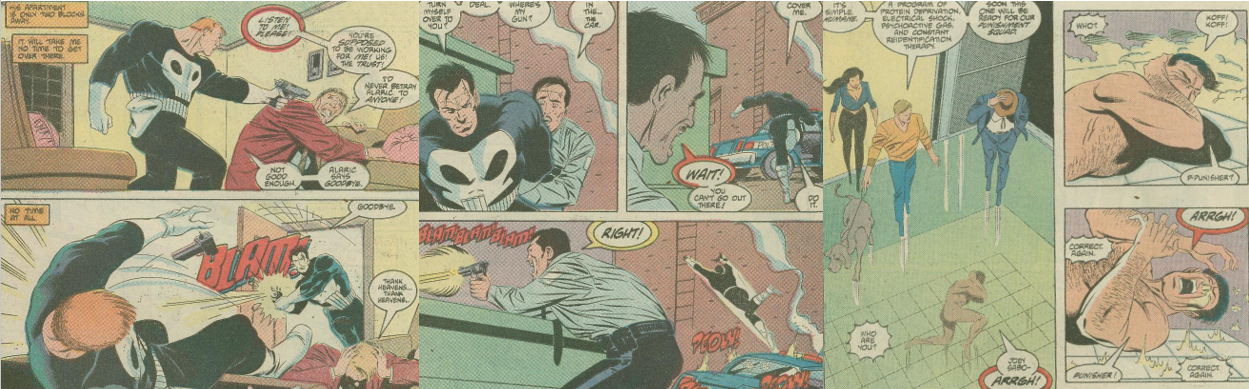
The heads of the city’s top crime families, and some of their lackeys, gather at Grand Central Station, of all places, that evening to hear Siciliano out, only to be set upon by Nolo Contendre, a hitman from Detroit. Although the Punisher is pleased by the ensuing anarchy, he wants to know who hired Contendre so he chases him down to the subway where a violent game of cat-and-mouse breaks out between the two. Frank takes a direct shot to the chest (though he’s saved by his heavy body armour) and is incensed when Contendre breaks the rules of his profession by opening fire upon civilians. Frank wounds Contendre with a knife, enraging him, and ends up decapitating the thug by kicking his head through a window, where it’s promptly taken off as the train pulls into Times Square Station. Seeing the fear in the eyes of the wounded passengers, Frank chastises his recklessness and vows to stop to the violence he has incited, only to be thrown off kilter when his van explodes before his eyes, which his Trust contact, Alaric, suggests is a sign that he needs to partner with the organisation on a more formal basis. Perhaps taking this to heart, the Punisher goes out of his way to protect mobster Tomas Santiago from an assassination attempt by rival gangster Simon Ejszaka all to set up another peace conference with Siciliano. In the interim, he opens up to Angela about the “circle of blood” that surrounds his life and she tries to convince him of the benefits of working with the Trust so he can have some support and back up, with the story revealing to the reader that the Trust not only blew up Frank’s van but also planted Angela to sway him to their cause. Ignorant to this, the Punisher spots Massera watching her building and confronts him, only for Massera to reveal he’s rooting for the Punisher since he can’t stand the violence surrounding his life, with the Punisher warning him to stay out of it or suffer the same fate as his father.

The Punisher is aghast to learn that Alaric has built an army of fake Punishers.

Frank pays a visit to Ejszaka and threatens him into going to Siciliano’s peace meeting and for information regarding Marcus Coriander; he then goes to visit Santiago, only for it to be revealed that Siciliano has been murdered by a fake Punisher! Although Frank puts down the faker, Santiago is killed and all the recent mob murders are revealed to have been perpetrated by Coriander and his gaggle of Punisher look-a-likes. Frank drops in on Coriander, who reveals that he formed this “Punishment Squad” to follow the Punisher’s example and disrupt the city’s criminal underworld before the Kingpin could return to power. After taking care of the fake Punishers (off-panel for maximum imagination), Frank is stunned when Coriander also opens fire on innocent civilians to cover his escape, gunning down a little girl in an experience that breaks the formally small-time crook. When the Punisher confronts him, Coriander exhibits signs of mental trauma but reveals that it was Aleric who was behind everything, right before Angela murders him and shoots the Punisher. He recovers pretty quickly, and without explanation, however (primarily because people refuse to shoot him in the head!) and returns to Ryker’s Island to talk with Gerty about the Trust, an organisation whose goals he can relate to but whose methods fly in the face of his strict moral code. There, he finds Tommy dead courtesy of another doppelgänger, whom he puts down a few blocks (and panels) later when he tracks down Gerty, threatening the warden with death unless he spills the beans on Alaric and the Trust. It turns out that Alaric has brainwashed criminals into his own personal death squad and the fear of Alaric’s reprisals, or being locked in his own prison, leads Gerty to shoot himself in the head before the Punisher’s grim-faced façade. The cops arrive at that exact moment; since the Punisher refuses to fight the police out of respect, he allows himself to be arrested, only for the Punishment Squad to arrive and try and kill them.

The Punisher callously makes short work of Jigsaw and Alaric and returns to his never-ending war.

One cop goes down but the Punisher convinces the other to uncuff him so he can kill his look-a-likes and coerce Siciliano into taking him to Alaric’s compound outside the city, where he forces his subjects to endure electroshock treatments and a special gas to condition them into thinking they’re the Punisher. Frank creates a distraction and makes his way into the compound, only to find that Jigsaw has also been brainwashed to be one of Alaric’s goons. A haymaker to the jaw is enough to undo Jigsaw’s conditioning and Frank easily hitches a ride to Alaric’s main building via a passing helicopter. Alaric begs his lover, Angela, to get to safety so he can hold off the Punisher without worrying about her and tries one last time to convince the Punisher to join his cause. When Frank stubbornly refuses, he falls into one of Alaric’s electroshock rooms and is subjected to the same brainwashing process so he can lead the Punishment Squad; thankfully, he’s able to withstand the pain of the electroshock floors, plug up his mouth, and make an explosive escape as he had all his equipment on him. His body wracked with pain and nursing several injuries, the Punisher is easy prey for Jigsaw, who delights in brutalising and taunting him, but spends too long gloating and Frank stabs him and beats him into submission. However, Frank inexplicably allows Jigsaw to live, but his actions scare off the Punishment Squad and clear the way for him to reach Alaric. Still, Alaric does a pretty good job of defending himself, surprising the Punisher and frantically beating him with the butt of his rifle, only to be sent into a desperate frenzy by the blood and violence. A stalemate of sorts occurs until Frank wounds Alaric and fends off his attack dog; again, rather than killing his enemy, the Punisher threatens him with death unless he blows the whistle on the Trust, which in itself will mean a death sentence for him when the mob come looking for revenge. Satisfied that Alaric will be punished one way or another, the Punisher leaves with his dog, only to be confronted by Siciliano; the Punisher’s able to talk him down, however, with a soliloquy about the cycle of violence and his part in it. As he leaves the compound, Angela tries to run him down and he callously leaves her to her fate after wrecking her car, heading off into the night to continue his never-ending war.

The Summary:
The first thing that strikes me about these five issues is the art work; fittingly, the Punisher’s solo series uses a far less exaggerated and comic book aesthetic (for the most part), depicting a much darker and grittier side to Marvel Comics that works perfectly with the Punisher’s more no-nonsense and violent attitude. Sure, Mike Zeck makes the Punisher a bit of a man mountain at times and Jigsaw’s face is a bubbling mess of scarred flesh but, for the most part, things are quite realistically done here. The Punisher suffers injuries, dislocating his shoulder, going into shock, and even fearing paralysis on a couple of occasions, which again speaks to his vulnerability as a character as opposed to his more virtuous and superhuman peers. He’s also far more introspective and stoic; his dialogue boxes are both “real time” narration and reflections from his war journal, which reinforces that he sees his mission as a war against all crime, and he’s not one for spouting quips or cliché puns at his victims. In fact, almost every word out of his mouth is a threat or some bleak meditation on the cycle of violence that is his life, and it goes a long way to added depth to his character and laying the foundation of what the Punisher is all about.

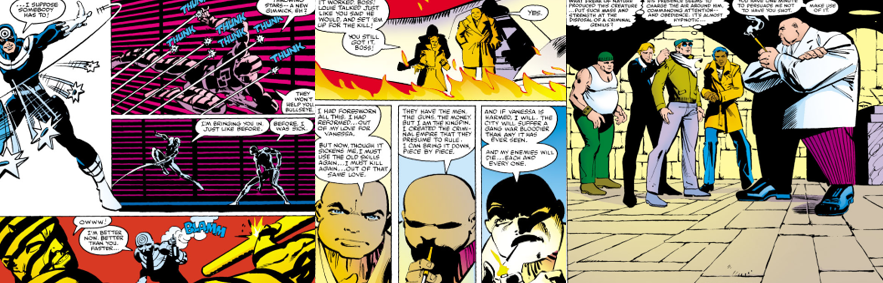
The Punisher is tormented by the cycle of death and violence that his life has become.

Indeed, there are many times when the Punisher laments the “circle of blood” that has surrounded his life. With nothing to lose, he’s fully committed to this cycle and he knows full well that it will end in his death and will even carry on after he died, meaning that his life’s mission is ultimately meaningless, and yet he is compelled, almost addicted, to killing criminals and saving as many lives as he can. His grim façade cracks only when there’s mention of his lost family or when he sees innocents being harmed; he’s enraged when Contendre and Alaric fire on civilians, suffering flashbacks to his family’s murder, and distraught by his part in the collateral damage, seeing himself as no different from those he’s sworn to punish. Since he’s just one man, the Punisher sets up a mob war to have the city’s mobsters to wipe each other out and make his job easier; a good plan that almost immediately goes sour. We see very little of this mob war beyond a few key gangsters being assassinated and a lot of dialogue talking about how things have escalated out of control with very little visual representation of this. Literally a few pages after he gets the ball rolling, the Punisher is beating himself up over the collateral damage as though he didn’t think anyone would get hurt in the crossfire, which is a bit ridiculous. I would’ve liked to see the gang war take place over an entire issue, with Frank coming to this realisation at the end or part-way through the next issue and then trying to stop what he started but, as presented, it’s quite rushed and nonsensical as he has to shut down his plan almost right away. Still, this was quite an intense story. I liked how each issue introduced a kind of rival for the Punisher, be it Contendre or one of the other head mobsters, and that his actions had consequences; Siciliano has a vendetta against him for killing his gangster father and, most prominently, Alaric brainwashed criminals into forming the Punishment Squad and perverted the Punisher’s skull logo specifically because he was inspired by Frank’s crusade.

Despite some weak villains, the story delves into the Punisher’s motivations and psychology.

Naturally, the Punisher guns down almost everyone who crosses his path without mercy or hesitation, meaning any kind of prolonged conflict between him and the likes of Contendre or his many look-a-likes is supplanted by a relatively quick kill from the Punisher. When his rivals put up more of a fight, the art really shines; it’s great seeing the Punisher walk into situations with no regard for his own safety and fight, beat, or gun down multiple armed assailants at once and I really enjoyed how many in the criminal underground fear him for his uncompromising mercilessness. Jigsaw is an exception to this rule; his hatred of the Punisher is so strong that it allows him to break free of Alaric’s brainwashing but his presence in the story is more of an extended cameo. It’s not entirely clear why the Punisher doesn’t kill him, either; he’s perfectly happy to kill everyone else but spares Jigsaw out of some half-assed sense of kinship given his own mental imbalance. This leaves Alaric as the story’s primary antagonist and he’s not really capable of matching Jigsaw’s visual or thematic appeal; I think the story might’ve benefitted from Jigsaw being behind the Punishment Squad and his motives being to further tarnish the Punisher’s reputation as Alaric is more of a pen pusher than a fighter. He’s reduced to a quivering wreck when he accidentally kills a little girl and before the Punisher’s fury and is only able to fight back because Frank is a bit weakened, making for a lacklustre villain. Overall, though, it’s an enjoyable Punisher story that explores his motivations and offers some introspection into his mission. There’s a sense of duty, obligation, and self-loathing to the Punisher, whose callous and grim demeanour make him stand out from other Marvel heroes and villains. He’s so committed to his cause that he’ll try and kill the Kingpin the first chance he gets and that disregard for his own wellbeing is wonderfully conveyed here. It’s not perfect but, for fledgling or casual Punisher fans, this miniseries is the perfect place to start reading.

My Rating:

Rating: 3 out of 5.

Pretty Good

Have you ever read the Punisher’s first solo series? What did you think to the deeper insight into Punisher’s character and motivation? Would you have liked to see more focus on the mob war? What did you think to the villains of the miniseries; would you have liked to see more from Jigsaw or Contendre? What are some of your favourite Punisher stories and villains? How are you celebrating the Punisher’s debut this year? Whatever you think about the Punisher, share your opinions down below.

Back Issues: The Amazing Spider-Man #210

Story Title: “The Prophecy of Madame Web!”
Published: 12 August 1980 (cover-dated November 1980)
Writer: Dennis O’Neil
Artist: John Romita Jr.

The Background:
After a blockbuster success with the Fantastic Four, Marvel editor and head writer Stan Lee spearheaded one of Marvel’s best selling publications with teenage superhero Peter Parker/Spider-Man. Spidey’s popularity soon saw him headlining other comics, such as Marvel Team-Up, amassing one of the industry’s most colourful and memorable rogues galleries, and his supporting cast ballooning as Parker aged and his life became more complicated. In November 1980, The Amazing Spider-Man readers were introduced to blind, crippled psychic Cassandra Webb/Madame Web, an enigmatic figure who both tasked Spider-Man with opposing certain villains and used her clairvoyance to direct his destiny. Madame Web played a significant role once Spider-Man was threatened by outside and multiversal forces, ultimately dying at the hands of a vengeful Vladimir Kravinoff/Grim Hunter, with her last act being to pass her powers to Julia Carpenter/Spider-Man. Madame Web’s most significant portrayal, however, was in the Spider-Man animated series (1994 to 1998), where she was voiced by Stan Lee’s wife, Joan, and acted as a mysterious mentor to Spider-Man (Christopher Daniel Barnes), often frustrating him with her manipulative ways. Years later, Sony Pictures inexplicably decided the best way to capitalise on their limited library of Spider-Man characters was to produce a Madame Web live-action movie, teaming this obscure side character with a handful of Spider-Women in an attempt to subvert audience expectations.

The Review:
We begin in the basement storage room of the New York Globe, a rival newspaper to the Daily Bugle, where Robert Dockery, circulation manager for the newspaper, directs a gang of masked hoodlums whom he’s hired in a bid to seize complete control of the publication. This plot point is then put on hold as the story joins Peter Parker, who’s strolling through Chinatown alongside Debra “Debbie” Whitman, an obscure love interest of Peter’s even for me whom he met while studying at Empire State University. Peter’s surprised to learn that the normally level-headed and pragmatic Debra has booked an appointment with a fortune teller, the titular Madame Web, though Debra insists that she’s simply exploring the fascinating subject of psychic phenomena rather than being scammed by a faux clairvoyant. Although Peter enjoys teasing her over this, he’s unable to join her to see Madame Web in action as, wouldn’t you know it, he’s late for a meeting at the New York Globe. Rather than web-sling over there, Peter takes the more traditional route but is forced to switch to Spider-Man when he’s denied access to the editorial department due to a managerial mandate. This is all part of Dockery’s plot, of course. He’s taking a meeting with his senior staff and introducing them to Katrinka Janice “K.J.” Clayton, publisher of the New York Globe, a provocative woman who, until now, has been a silent partner of the newspaper. Just as she announces Dockery’s ascension to power, those masked hoodlums burst in, accost the staff members, and take Clayton hostage.  

When a publishing mogul is seemingly kidnapped, Spidey turns to a mysterious psychic for help.

Luckily, Spider-Man was climbing up the outside of the building, so he bursts in to break up the party, easily dodging their machine gun fire with his superhuman speed and reflexes and fighting off the armed thugs even when they dog-pile him. They do, however, delay him long enough for Clayton to be kidnapped and, thanks to Dockery “clumsily” getting in his way, Spidey is a step too slow to pursue them and is unable to catch up due to a lack of windows. With no other options, Spidey decides to indulge Debra’s fantasy and pay Madame Web a visit to see if the elderly medium can help him track Clayton down. Spidey web-slings over the Madame Web’s apartment and is stunned to find she’s an elderly blind lady who’s hooked up to an elaborate web-based life support machine, created by her late husband, that sustains her so she can aid others with her gifts. She describes herself as a “soothsayer, a psychic, a witch” and claims to be capable not just of “second-sight” but fostering the psychic powers of others. Impressed by her presentation and boastful claims, Spider-Man asks for her insight into Clayton and, though she stresses that her abilities aren’t 100% guaranteed due to the nature of the paranormal, she immediately picks up that Clayton is the victim of a malicious deceit, perpetrated by Web’s own student, Belinda Bell, to be held hostage for financial gain. At Spidey’s urging, Madame Web intuits that Belinda and Clayton will perish in a horrific train crash if he doesn’t find Bell, who is his only hope of tracking down Clayton. The next scene shows that the deceit runs even deeper as Belinda was paid to impersonate Clayton and, for her assistance, she finds herself tied up in a toy store (of all places) and at the mercy of Dockery’s ruthless mercenaries. 

Thanks to Madame Web, Spidey saves Clayton, though her true nature remains a mystery.

Across town at the New York Gloe, Dockery confronts the real Clayton (actually a much older woman) and openly threatens her, mocking the vanity that so easily allowed him to have her impersonated to hand control of the newspaper over to him. Confident in his victory, Dockery calls his thugs and orders Belinda’s execution, but Spider-Man arrives to save her, having deduced that Madame Web’s vision of crashing trains actually meant the toy store that Dockery owns which…is a bit of a leap but sure, okay. Once again, Spider-Man easily dispatches of the goons, burying them beneath shelving units and stock, and freeing Belinda. Angered by the betrayal and grateful for the rescue, Belinda warns Spider-Man of Dockery’s intentions towards Clayton so he races over to the New York Globe, arriving just in time to find her office engulfed in flames thanks to Dockery dousing gasoline everywhere and starting a raging inferno. Spider-Man brings Clayton to safety, setting her down outside the building just as Dockery makes a run for it, only to find his car up-ended by the web-slinger. Defeated, Dockery folds like paper and Peter later reads that he’s run similar scams before, although Dockery’s imprisonment means that Peter is now out of work (I’m not sure exactly why, surely the New York Globe is still publishing and employing staff, but then I’m unfamiliar with this period in Peter’s life so maybe his job was somehow linked to Dockery?) Before he can descend into complete despair, Peter suddenly gets a phone call from Madame Web, who learned of his dual identity through her powers; she both promises to keep his secret and reassures him that his financial woes will soon be resolved. While this sounds positive on paper, the final panel of the issue reveals that his cantankerous former boss, J. Jonah Jameson, is literally chomping at the bit to re-employ the troubled young hero! 

The Summary:
“The Prophecy of Madame Web!” was an inauspicious debut for the mysterious psychic; Madame Web herself was more of a secondary (or even tertiary) character to the main plot, which was surprisingly low-key for a Spider-Man story, involving no colourful supervillains and being a simple story of a greedy man going to extreme lengths for more power. In other Spider-Man stories, Dockery would’ve employed the services of a low-tier Spider-Man villain, someone like MacDonald “Mac” Gargan/The Scorpion, Herman Schultz/The Shocker, or even Dmitri Smerdyakov/The Chameleon either to take Belinda’s role of impersonating K.J. Clayton or masquerading as Dockery himself. Indeed, I do wonder if maybe the story would’ve been more enjoyable with a supervillain in place of Dockery’s nameless, faceless goons, who offer no physical challenge to Spider-Man and don’t even respond to his witty remarks and cheap quips. Without a colourful villain, the fights aren’t as interesting and the stakes are quite low in terms of Spidey’s safety; there’s no question he can out-punch these mercenaries, so the drama revolves around ensuring Belinda and Clayton are safe instead. This would be fine but, again, there isn’t much emphasis on them being in danger; Belinda is tied up and taunted as the mercs wait for the order to kill her, rather than just being shot right away, and Dockery goes to the effort of setting Clayton’s office on fire to stage her death as an accident rather than just shoving her out a window or gunning her down. I don’t mind a more grounded, low-stakes Spidey story – in many ways, it’s a change of pace – but the narrative here is littered with contrivances and conveniences that make it decidedly run-of-the-mill compared to other Spidey tales. 

Madame Web’s look and powers impress, but the plot is middling and forgettable.

Madame Web makes for a visually interesting character; decked out in a slick black/red dress with a spider motif, blindfolded, and hooked up to a web-like life support system, she’s got a memorable design, for sure. Although Peter dismissed her as a fraud (which is a bit odd considering Peter has chummed with the X-Men before, a team known for their psychics), she proves to be completely legitimate, though her clairvoyance is paradoxically accurate and unreliable, meaning she can only vaguely point Spidey in the right direction and stress fatal consequences should he fail. Thankfully, Spider-Man uses his head (off panel, of course) and, rather than searching every trainyard in the city, realises that Dockery owns a toy shop, which turns out to be the right location. Truthfully, though, I didn’t really like this; it felt rushed and forced and again lowered the stakes as it meant we wouldn’t be seeing Belinda or Clayton threatened by oncoming trains. The twist of Madame Web learning Spidey’s secret identity was interesting as very few characters were in on this back then and taints her mysterious aura with a potential menace as her intentions might not be as benevolent as they seem, but she’s ultimately a non-factor in this story. I have no issues believing that Spider-Man could’ve figured out where Belinda was without Madame Web’s help, making her largely superfluous. I almost wonder if it might’ve been better to have Madame Web be the linchpin of the story; perhaps she’s a true medium who’s targeted by gangsters or hosts a psychic television show and is kidnapped by a villain for a ransom, or just something a little more engaging that Spider-Man giving up pursuing the hoodlums and randomly deciding to ask for her help.  

My Rating:

Rating: 2 out of 5.

Could Be Better

Have you read “The Prophecy of Madame Web!”? If so, what did you think to it? Were you impressed by her debut, or did it fall as flat for you as it did for me? Did you like that it was a more grounded story, or would you have preferred to see Spidey tangle with a supervillain? What are some of your favourite Madame Web stories or moments? Are you excited to see her live-action debut? Whatever your thoughts on Madame Web, drop a comment below or on my social media and be sure to check out my other Spider-Man content across the site. 

Back Issues & Knuckles: Sonic Quest


Following a highly anticipated release, bolstered by an extravagant marketing and release schedule, Sonic the Hedgehog 2 (SEGA Technical Institute, 1992) not only improved on every aspect of its influential predecessor but also became the second best-selling SEGA Mega Drive game of all time. Expectations were high for the equally-anticipated third entry, a game that ended up being so big that SEGA split it in two, birthing perhaps the greatest 2D Sonic adventure in the process.


Writer: Michael Gallagher – Artist: Manny Galan

Story Title: “The Death Egg Saga Book One: Scrambled”
Published: September 1996

Story Title: “The Death Egg Saga Book Two: Poached”
Published: October 1996

Story Title: “The Death Egg Saga Book Three: Over Easy”
Published: November 1996

The Background:
When Sonic the Hedgehog blasted onto the videogame scene in 1991, he was an immediate hit thanks to his debut title being bundled with the Mega Drive and SEGA’s aggressive marketing campaign. His popularity exploded with Sonic the Hedgehog 2 (SEGA Technical Institute, 1992), however, and Sonic merchandise was suddenly everywhere; not only did he feature in the Macy’s Day Parade and in cartoons but he also starred in a number of comic books. Following the initial four-part miniseries, which mashed together narrative elements of Sonic’s cartoon adventures, Archie Comics began regular publication of what would become the longest-running videogame comic book ever. In time, to capitalise on Sonic’s continued popularity, a number of spin-off comics were produced, including limited issue releases such as this one designed as adaptations of various Sonic videogames. While the videogame lore often clashed with Archie’s unique continuity, and later led to a series of convoluted retcons, these did introduce popular franchise characters like Knuckles the Echidna into the comics and helped to broaden Archie’s continuity.

The Review:
Since I wasn’t able to get my hands on Archie’s Sonic comics over here in the United Kingdom, I’ve always had a bit of a fascination with them, despite how complex their narrative eventually became with a whole mess of original lore and characters clogging up the pages. Still, one of the first priorities for me when these comics were collected in mini volumes was to pick up the “Death Egg Saga”, which was published in one of those Sonic the Hedgehog Select collections, primarily because Sonic 3 & Knuckles is my favourite of the classic Sonic games but also because I was intrigued to see the Death Egg, and Knuckles, looped into Archie’s quasi-continuation of the notoriously popular Sonic the Hedgehog/SatAM cartoon (1993 to 1994). For context, “The Death Egg Saga” picks up shortly after the long-lost King Maximillian Acorn was finally rescued from the Zone of Silence after being trapped there around about the same time Doctor Ivo Robotnik conquered Planet Mobius. While the Freedom Fighters celebrated their liege’s return, this would come to upset the balance of power and focus of their crusade against Dr. Robotnik as the out of touch King Acorn undermined the authority of his daughter, Princess Sally Acorn, and favoured the likes of the abrasive Geoffrey St. John over Sonic. Consequently, the story begins with St. John (one of my least favourite Archie characters) skulking around the Freedom Fighter’s hidden haven, Knothole Village, at the crack of dawn; he’s spotted by Sonic and the two get into a war of words that almost comes to blows before Sally intervenes and reveals that her father is slowly losing his mind and body to a bizarre crystalline infection.

When Sonic and Tails look for Magic Rings to help the King, they stumble upon the Death Egg!

As best as Knothole’s resident physician, Doctor Horatio Quentin Quack, can figure, this is a result of the King’s extended stay in the mysterious Zone of Silence; in order to keep the Freedom Fighters from panicking, King Acorn’s condition has been deemed top secret and Sally orders St. John to stand guard over the King while they explore their options. Their trusty mechanic and science expert, Rotor the Walrus (occasionally called “Boomer”), is at a loss but rookie Freedom Fighter Miles “Tails” Prower hits upon a possible solution when he observes that the King’s crystalline skin resembles the texture of Chaos Emeralds. This prompts Sonic to retrieve his recently-acquired “one-billionth Magic Ring” to try and use its Chaos Emerald powers to reverse King Acorn’s condition, though it proves to be a fleeting solution. Rotor theorises that the Ring is unique to Sonic and suggests gathering as many others as possible to try again, prompting Sally to send Bunnie Rabbot and Antoine D’Coolette out to the mysterious Lake of Rings in the forest and Sonic and Tails to the Ring Grotto outside Robotropolis, Dr. Robotnik’s industrial, mechanical city. This area has been irrevocably changed and damaged following a recent fight between Super Sonic and Hyper Knuckles, and Dr. Robotnik’s attacks, and the two are stunned to find the Ring Grotto has been sealed beneath an impenetrable steel dome. Sonic leaves Tails to watch over the area while he races off to recruit a bruiser named Carl Condor to help bust it open, and the young fox-boy is shocked when the dome suddenly opens up and the Grotto’s entire supply of Magic Rings is sucked up into the clouds courtesy of a giant vacuum tube, which also takes Tails along with it! At the Mobian Cliffs, Sonic is shocked by a sudden and unnaturally faster solar eclipse, almost as if something artificial were crossing the Sun’s path, and horrified to find that Carl has been robotocised; caught off-guard, Sonic is rendered unconscious by the mechanical vulture and carried into the sky towards an ominous, egg-shaped superstructure.

Knuckles and the Chaotix are aghast when the Death Egg tries to submerge the Floating Island!

This is, of course, the Death Egg, Dr. Robotnik’s newest and most dangerous creation. After leaving his nephew and whimpering subordinate Snively in charge of overseeing Robotropolis’s reconstruction (a position he immediately and amusingly abuses), the cybernetic dictator revels in his glory as he powers up the Death Egg with the Magic Rings and prepares to use it to roboticise every living thing on the planet! However, while the Magic Rings ensure that the Death Egg is effectively invulnerable to external attack, Dr. Robotnik still needs a Chaos Emerald to bring the station to full power; additionally, he sucked up some unwanted additional weight that’s keeping it from reaching its proper orbit, but has no idea that Tails is in amongst the trees and debris. Thinking quickly, Tails jams himself into the discarded wreckage of a disobedient SWATbot so he can explore the space station undetected, while Sonic escapes the talons of the Condorbot and defies the laws of physics to pinball his way onto the Death Egg just as Tails jettisons the crap that was weighing it down. With the Death Egg scrambling their communications signal and the King’s condition worsening, Dr. Robotnik guides the Death Egg towards the Floating Island (as it was then known), which naturally attracts the attention of the island’s hot-headed guardian, Knuckles. Swooping up to intercept the Death Egg, Knuckles is hit by a laser blast from the satellite’s “eye”; luckily, this simply stuns him and he falls into the arms of his friends, the Chaotix (Mighty the Armadillo, Vector the Crocodile, Charmy Bee, Espio the Chameleon and…*sigh* Archimedes the Fire-Ant). The group watch as Dr. Robotnik drops a squadron of gigantic Burrobots to dig up the island’s Chaos Emeralds, which they race to stop to keep the island from plummeting from the sky. While the Chaotix attack the massive drilling mechs, Sonic tears his way through the Death Egg but arrives too late to keep Dr. Robotnik from ramming the satellite into the Floating Island! The Chaos Emerald is able to keep the island aloft, but the sheer weight and thrust of the Death Egg causes it to tip to one side and forces it into the sea below!

Thanks to repurposing Dr. Robotnik’s mechs, Sonic and Tails are able to destroy the Death Egg.

Naturally, Sonic leaps into action, only to end up attacking Tails by accident. To make matters worse, Dr. Robotnik shields himself from Sonic’s attack with a thick wall of plexiglass and then chokes him out with a spew of poisonous gas. Luckily, Tails recovers from his assault and uses his SWATbot suit to break through Dr. Robotnik’s defences and destroy his control panels, saving Sonic from suffocation and sending the satellite uncontrollably hurtling into space. Thanks to a “stabilising field” built into his “Gravi-Gauntlet”, Dr. Robotnik staves off the sudden drag of inertia and escapes to his auxiliary control room; he then sics a massive robotic Sonic doppelgänger on the two. While a far cry from his sleeker, more popular counterpart or even Sonic’s more versatile Mecha Sonic form, this “Silver Sonic” has the muscle and armour to shrug off Sonic’s attacks and manhandle (or should that be hoghandle?) him with punches, kicks, and slams but proves disappointingly susceptible to an electric shock from some conveniently-placed severed cables. Despite the failure of his Silver Sonic, Dr. Robotnik resorts to another back-up plan, donning his “most sophisticated battle armour ever”, the Eggs-O-Skeleton, which augments his physical strength by drawing power from the Death Egg itself! Sonic evens the odds by (…somehow…) commandeering Silver Sonic’s mechanical body and battling the rotund dictator on equal ground. The melee escalates but, ultimately, Sonic hurls Dr. Robotnik up through the ceiling and out of the Death Egg; during the fight, Tails was somehow able to rig the Death Egg to explode and the two beat a hasty retreat, swiping the stolen Magic Rings and making it safely to the surface before the Death Egg’s destruction (which, while somewhat anti-climactic on paper, is “seen and felt” all around the planet). While Snively faces the wrath of his uncle and master and the mad cyborg swears revenge upon Sonic and the Freedom Fighters, Sonic and Tails race back to Knothole to see if the Rings will cure the King, which is a plot thread left unresolved in this miniseries.

The Summary:
As ever, one of the main appeals of Archie’s attempt at a Sonic 3 & Knuckles adaptation is the artwork; Archie Comics, especially at this time, did a great job of emulating the character designs and locations seen in SatAM, with Patrick “Spaz” Spaziante being their standout artist. Manny Galan is no slouch here, though, and there are times when his version of Sonic evokes the character’s more dynamic and streamlined Japanese presentation; Archie’s original characters, like St. John, don’t fare too well but SEGA’s characters all hold up quite nicely, though I’m not massively onboard with the artistic shortcuts taken to basically show Sonic and Knuckles flying simply because they need to get up to the Death Egg. Everything is still early Archie, though, meaning the Floating Island doesn’t look that great, the Death Egg has an ugly and needlessly “busy” design, and there’s an element of daft childishness in some areas as the comic still hadn’t quite shaken off the influences from SatAM’s more slapstick sister series. As if often the case, the first few pages are bogged down with recapping the events from previous issues and even prior Archie stories, but it’s not too invasive.

While there’s some decent build up to the Death Egg, it feels secondary to King Acorn’s plight.

The biggest issue with Sonic Quest is that it’s not much of an adaptation of Sonic 3 & Knuckles. Much like in their other videogame tie-ins and those seen in Fleetway’s publications over here in the UK, Archie’s writers pick and choose elements from the videogames to incorporate, almost as if they were drip-fed footage and details of SEGA’s upcoming games rather than being privy to full details ahead of time. Thus, elements of Sonic 3 & Knuckles are spread out across different stories and one-offs, such as introducing Knuckles and even the Chaotix before the Death Egg. While the Death Egg is at the centre of Sonic Quest, it’s not really the narrative focus; the satellite doesn’t appear until the end of issue one and is destroyed before it can really do anything other than steal some Magic Rings, blast Knuckles, and almost submerge the Floating Island. On the plus side, the story does a great job of building the threat of the Death Egg; hiding it, seeing it on computer monitors, and especially the “eclipse” sequence all add to the anticipation of the space station’s big reveal and it’s portrayed (on paper) as being a serious threat as it’s allegedly capable of roboticising the entire planet. However, since it lacks a Chaos Emerald, it cannot actually do this and it’s one attack is enough to simply stun Knuckles, significantly diminishing its menace. I think the story would have benefitted from being five or even six issues long and seeing Dr. Robotnik successfully attack the Floating Island with the battleship and steal a Chaos Emerald to robotoicise large areas of Mobius, which would have greatly raised the stakes of the narrative.

Things pick up when Silver Sonic appears but the story wastes a lot of its more interesting elements.

As presented, Sonic Quest doesn’t even require Sonic to begrudgingly join forces with his hot-headed rival; Knuckles’ involvement is more of a glorified cameo and, while he and the Chaotix do fend off the gigantic Burrobots, he does nothing to help destroy the Death Egg. Indeed, since Sonic and Tails do all the work from inside the space station and sabotage its controls, there was never any danger of Dr. Robotnik acquiring a Chaos Emerald so Knuckles could’ve been entirely absent from the story. Additionally, we don’t really get a sense of the interior of the Death Egg; we only see a few corridors and rooms, with the bulk of the story taking place in a confined control room, and the main concern of the plot is more about getting the Magic Rings to cure King Acorn, with the Death Egg presented as more of an inconvenience since that’s where the Rings are being held. Things pick up a bit once Dr. Robotnik unleashes Silver Sonic but, while I enjoyed this fight and the artwork here, this mechanical monstrosity is defeated with a ridiculous amount of ease, exhibits no personality, and is somehow easily controlled by Sonic after it’s defeated. Even the showdown between Sonic and Dr. Robotnik ends up being quite disappointing; not only is Dr. Robotnik’s Eggs-O-Skeleton a weak design and a poor substitute for his more imposing Death Egg Robot, we never get a sense of what he’s capable of while wearing it beyond “being stronger” and he’s easily trounced by Sonic piloting the remains of Silver Sonic. There’s almost an intriguing element to this in the panels where Sonic is so fixated on ending Dr. Robotnik that he briefly considers risking his life, but it’s swept under the rug by a quick word from Tails and wouldn’t really resurface until the comic’s fiftieth issue. In the end, this was an enjoyable three-issue adventure; the art is good, the writing isn’t too hammy, and there’s some fun visuals whenever the Death Egg is looming over the Floating Island. However, it just reads like another Archie Sonic adventure; the Death Egg should’ve been a massive event, one stretching across multiple issues, but just comes across as another of Dr. Robotnik’s many maniacal schemes. As soon as we see it, it’s destroyed without really doing anything except threatening the Floating Island, something easily solved by Tails being a bit trigger happy, and there’s never a sense that this is truly the final victory for Dr. Robotnik in his war against the furries. It’s a shame, really, as this could’ve been a great way to build bridges between Sonic and Knuckles or even have the Chaotix team up with the Freedom Fighters, but it just comes across as a throwaway tie-in with little impact on the ongoing narrative beyond finding a cure for the King.

My Rating:

Rating: 2 out of 5.

Could Be Better

Did you enjoy Sonic Quest? Did you collect the miniseries when it first released or, like me, did you pick it up in a later collection? What did you think to the depiction of the Death Egg? Do you agree that it was neutered compared to the videogames or were you impressed with its appearance? Were you disappointed that Sonic and Knuckles didn’t team up to fight at and by how easily it was brought down? What did you think to Silver Sonic and Dr. Robotnik’s Eggs-O-Skeleton armour? Which of Archie’s videogame tie-ins was your favourite? How are you celebrating the anniversary of Sonic 3’s release today? Please feel free to share your memories of Archie’s Sonic comics and Sonic 3 & Knuckles below or on my social media.

Back Issues [Sci-Fanuary]: 2000 AD #2


January sees the celebration of two notable dates in science-fiction history, with January 2 christened “National Science Fiction Day” to coincide with the birth date of the world renowned sci-fi writer Isaac Asimov, and HAL 9000, the sophisticated artificial intelligence of Arthur C. Clarke’s seminal 2001: A Space Odyssey (1968), being created on 12 January. This year, however, I’m spending every Thursday of January celebrating sci-fi’s toughest lawman, Judge Joseph Dredd!


Story Title: “Judge Dredd” (also known as “Judge Whitey”)
Published: 5 March 1977
Writer: John Wagner
Artist: Carlos Ezquerra

The Background:
Everyone knows DC and Marvel Comics; they’re unquestionably the top two comic book publishers in the United States and have birthed some of the greatest comic characters. Over here in the United Kingdom, comics are a little different; generally focusing on slapstick strip characters, British-made superheroes are a little more niche compared to those in the US. And then there’s 2000 AD, a sci-fi comic book that began life in February 1977 and is still published to this day; although the comic wasn’t expected to last long, 2000 AD briefly revitalised British pulp icon Dan Dare before crafting an entirely original character to appeal to their readers’ love of anti-authoritarian attitudes and narratives. Created by John Wagner, Carlos Ezquerra, and Pat Mills, the uncompromising Judge Dredd was the logical extreme from Wagner’s previous hardened cop, Jackson McBane/One-Eyed Jack and his name came from modifying the title of Mill’s unproduced horror strip, Judge Dread. Inspired by the leather-clad appearance of Death Race 2000’s (Bartel, 1975) “Frankenstein” (David Carradine), artist Carlos Ezquerra developed Dredd’s signature look of body armour, zips, and chains and placed Dredd into a futuristic setting far beyond the original intention, necessitating script alterations, with more reportedly coming about after the original story proved too violent. Known for keeping his face entirely obscured, aging in real time as the years went on, and his steadfast dedication to upholding law in a lawless futuristic society, Judge Dredd became one of the most popular and iconic British comic book characters of all time. Essentially an extreme parody of the US politics and judicial system, Judge Dredd has been involved in some violent and politically-charged tales in his nearly fifty years on the force, including crossovers with DC and Dark Horse properties and even meeting his two live-action counterparts in a one-off special. Judge Dredd has also made the leap into prose texts, videogames, and movies (with varying success) and even inspired the concept of the all-action sci-fi classic RoboCop (Verhoeven, 1987), proving that this ultra-violent lawman is one of the UK’s most enduring and influential fictional characters.

The Review:
Like all my comic book, sci-fi, and action fondness, I owe my love of Judge Dredd to my dad; my dad is a big fan of the character and 2000 AD comics and is responsible for getting many of Dredd’s collected adventures and individual issues into my hands when I was a kid. Personally, I prefer Dredd’s more epic and horror-themed tales, especially those involving the Dark Judges, but I’m always up for reading more of his adventures and have familiarised myself with a fair few of this escapades over the years. His earliest stories are a little different to later tales, with Dredd’s character being noticeably different and his appearance more subdued compared to the stony-faced grimace and imposing physique he’s now known for and this is noticeably right from the first impressive splash page of his debut tale. “Judge Dredd” introduces us to New York in the year 2099 A.D., so right away we have a few things different compared to established Dredd canon; rather than operating within the overcrowded walls of Mega-City One, Dredd enforces the law on the futuristic and crime-ridden streets of New York some seventy-five years from now (and over 120 years into the future from the date the story was published), with even the ruins of the Empire State Building factoring into the narrative over more recognisable Mega-City One structures and trappings. It’s a moot point in many ways since Mega-City One encompasses New York but an interesting observation that the story initially had its roots more firmly planted in real-world locations. Similarly, the captions tell us: “Judges are special lawmen of the 21st century. Elected by the people to enforce the law” which, as far as I’m aware, is decidedly at odds with the more totalitarian nature of the Judges, who are often a borderline dictatorship since crime and social chaos are so rampant within the city walls.

Judge Dredd doesn’t hesitate to show some Judge-killing punks who’s the law in the far future!

Anyway, one of these Judges races along a futuristic highway to intercept a gang of criminals, led by the sadistic and Judge-hating Whitey, only to be cut down by Whitey’s high-impact laser blast. Although he and his disreputable cohorts are disappointed to find they murdered Judge Alvin instead of the legendary Judge Dredd (who already has a reputation as “the toughest of the Judges” even in his first appearance), Whitey consoles himself with the promise of killing more Judges, especially Dredd, and in taking Judge Alvin’s helmet and badge for his own, rechristening himself “Judge Whitey”. Whitey’s true target, Judge Dredd, is in the middle of being praised by the “Grand Judge” for his efforts in reducing the crime rate in Section Six when they’re interrupted by the arrival of Judge Alvin’s dead body strapped to his motorcycle with a threatening note from Judge Whitey. Incensed, the Grand Judge prepares to order an air strike to obliterate Whitey at the Empire State Building but Judge Dredd volunteers to go in alone to teach people to have “respect for the law”. Dredd easily avoids Judge Alvin’s fate by distracting them with his bike, which he sets to automatic so he can get the drop on them from behind. Despite being outnumbered and outgunned, Judge Dredd lives up to his reputation and his skill as a lawman by gunning down Whitey’s minions and taking it to the would-be Judge with his bare hands. Although no match for the Judge, Whitey promises to escape from prison and continue his vendetta, only to be reduced to a tears when Dredd sentences him to life at “Devil’s Island”, a huge traffic island in the middle of a dangerous and bustling inter-city highway complex where any escape attempt is comparable to suicide. The Grand Judge approves of Dredd’s stern sentencing and laments that it’s perhaps the fate of all Judges to die in service of their duties, a destiny Dredd fully supports if it means upholding the law.

The Summary:
Although a brisk, five-page story with some notable differences to later Judge Dredd canon, Judge Dredd’s debut appearance establishes much of the lore and characterisation that would become so synonymous with the lawman and his world for the next fifty-plus years. What little we see of this proto-Mega-City One is beautifully rendered as a bustling futuristic landscape full of oddly-shaped buildings, dangerous stretches of highway, and clogged with traffic all amidst the ruins of New York City. Although the strip is brought to life in black-and-white, there’s a level of detail here that really gives a depth and intrigue to this far-flung world, where criminals use high-powered laser rifles, the Judges ride around on supped-up motorcycles, and the technology of the time is rendered with a kind of 1960s-esque fantasy that makes everything feel lived in and somewhat anachronistic. It’s interesting seeing so many references to the Judges acting on behalf of the public and being talked about as celebrated civil servants by the righteous citizens; my experience with Judge Dredd is that he’s just as likely to arrest or punish an innocent bystander for being a public nuisance as he is a violent criminal so it’s kind of fascinating seeing that the Judges were initially painted as being more virtuous rather than an exaggerated pastiche of militant, martial law.

The groundwork for Judge Dredd’s long and colourful history is all nicely established here.

A tougher, more violent law enforcer for a chaotic futuristic society, Judge Dredd is seemingly the embodiment of law and order, willing diving head-first into even the most dangerous situations simply to set an example to the people. Although there’s a sense that he’s just as angered by Judge Alvin’s death as the Grand Judge, his motivation for tackling Whitey and his gang is more about sending a message to criminals and the general public that the Judges are a force to be reckoned with; he believes that an air strike would diminish the people’s faith in their law enforcers and so volunteers to re-establish that there are consequences to killing one of their number. Judge Dredd’s faith in the system is so total that he considers dying in the line of duty to be the highest honour and he respectfully places Judge Alvin’s badge amongst the dozens hanging from a commemorative wall at “Justice H.Q.”. His sentencing of Whitey to such an inhumane punishment is also motivated by his disgust at the death of a comrade, something he would rather see Whitey suffer for than be granted a merciful death. Judge Dredd is clearly younger and a bit less stoic than I’ve come to know him; he shows respect and appreciation towards the Grand Judge and even cracks a bit of sass with Whitey’s gang before executing them. While many characters talk about Dredd’s reputation, we immediately see that he’s a far more skilled and wily Judge than Judge Alvin as he’s not only smart enough to avoid being so easily gunned down but effortlessly kills Whitey’s comrades and brings the perp in without breaking a sweat. Overall, this was an enjoyable little romp; the basic sense of Judge Dredd and his crime-infested world is all here and it’s fascinating to witness the character’s origins and trace his evolution as a more complex and multifaceted character as time goes on. It’s maybe a little too short and probably lacking in deep characterisations and world-building, but there’s enough here to whet the appetite and give a sense of this no-nonsense lawman of the future.

My Rating:

Rating: 3 out of 5.

Pretty Good

What did you think to Judge Dredd’s debut story? Did you like that he started out in a futuristic New York City or do you prefer the more unique setting of Mega-City One? What did you think to Dredd’s characterisation as an uncompromising lawman? Did you find Whitey and his gang to be disappointing first enemies for Dredd or do you prefer seeing him effortlessly gun down punks? What are some of your favourite Judge Dredd stories, characters, villains, and moments? Share your thoughts on the lawman of the future in the comments below and be sure to check out my other Judge Dredd content.
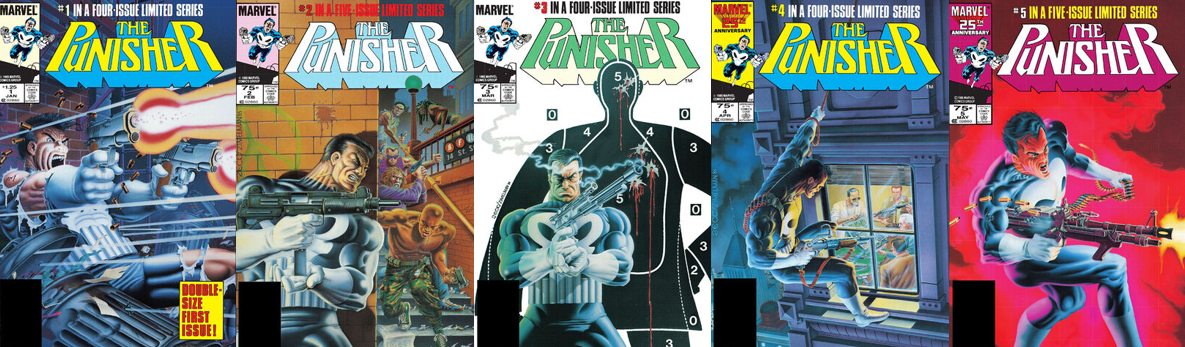
Back Issues: Aquaman #35

Story Title: “Between Two Dooms!”
Published:
August 1967
Writer: Bob Haney
Artists: Nick Cardy

The Background:
In November 1941, readers of More Fun Comics were introduced to Arthur Curry/Aquaman for the first time; while superficially appearing to be a knock-off of writer/artist Bill Everett’s Prince Namor McKenzie/The Sub-Mariner, the two aquatic supermen are actually very different characters. Mort Weisinger and Paul Norris created the character as part of DC Comics’ (then known as National Comics) call for new costumed heroes to captialise on the success of Clark Kent/Superman and Bruce Wayne/Batman, and Aquaman proved popular enough to prominently feature throughout the 1950s and beyond. In addition to seeing his cast of supporting characters expand to include a wife and ill-fated son, Aquaman amassed quite the gallery of nautical rogues; while his half-brother, Orm Marius/Ocean Master, tops most lists as his archnemesis, one of his most persistent antagonists is David Hyde/Black Manta. Initially debuting without a definitive origin, Black Manta was revealed to have a deep-seated hatred for Aquaman (and the sea as a whole) and proved to be a malicious and dangerous adversary;. Utilising a number of weapons and technology built into his distinctive battle suit, Black Manta was responsible for the death of Aquaman’s aforementioned son and frequently clashed with the Atlantean King alongside the Injustice Society. Black Manta has proven persistent enough to appear in DC’s animated ventures and videogames and made his live-action debut in Aquaman (Wan, 2018), where acclaimed actor Yahya Abdul-Mateen II shined in the role of secondary antagonist and promised to further explore the character in the sequel.

The Review:
Our story begins deep beneath the ocean at the long-lost underwater city of Atlantis, now prosperous and protected by an impenetrable dome and home to the Atlantean Royal family: Aquaman, his wife, Mera, their babbling baby, Arthur Curry, Jr./Aquababy, and Aquaman’s teenage sidekick, Garth/Aqualad. Like their fellow citizens, the three are startled when a menacing submarine begins orbiting their city, but both Mera and Aqualad are aghast when Aquaman volenteers to investigate alone; he states, very plainly, that it’s his duty as the Guardian of Atlantis and that he relies on Aqualad to safeguard the city in his absence, and then torpedoes himself towards the sinister-looking craft. Upon latching onto the submarine, a slew of comically expressive mutated Manta-Men burst forth, cluing Aquaman in that it’s the work of his old enemy, Black Manta. Black Manta has come more than prepared, trapping Aquaman to the ship’s hull through “bio-magnetics” and leaving him an open target for the Manta-Men’s deadly stun blasts and unable to intercept the villain’s assault on Atlantis. In an altogether different, far sleeker underwater craft, Black Manta heads towards Atlantis; garbed in an armoured outfit and sporting two enormous, glowing eyes on his helmeted head, Black Manta mocks Aquaman’s foolishness as he attaches a strange tube to the outer dome that protects the city. Within, Atlantis’s leading scientist, Doctor Nuidis Vulko assures Queen Mera and Aqualad that the dome cannot be penetrated, but both of them are horrified to see Aquaman under attack on their “radar-video” and, despite Aquaman’s orders, marshal themselves to go to his aid, with Mera using her command over water to open the heavily-guarded main lock and Aqualad commanding two giant seahorses, Imp and Storm, to carry them to their king.

Black Manta leads a life-changing assault on Atlantis and even kidnaps Aquababy!

They arrive just as Aquaman is heaving the ship into a spin, thereby making himself a more difficult target, and Mera promptly destroys Black Manta’s craft with a massive hammer made from “hard water”. Despite Dr. Vulco’s assurances, Black Manta throws Atlantis into chaos by using a “photon transducer ray” to bombard the dome with concentrated light particles that flash-boil the city’s water, forcing Dr. Vulco to empty Atlantis of the life-giving liquid and dooming its inhabitants to death as they cannot survive outside of water for longer than one hour. Although grateful for the assistance, Aquaman chastises Aqualad for leaving Atlantis undefended and orders the three of them back to the city to intercept Black Manta, where Aquaman is aghast to find the city empty of water. Black Manta’s efforts have succeeded all too well; Dr. Vulco’s attempts to refill Atlantis with water are met with disaster and he’s equally unsuccessful at removing the chemical substance the villain has affixed to the dome, potentially dooming the Atlanteans. With no options left, Aquaman orders Dr. Vulco to employ “Project X”, a radical solution that sees every Atlanetan administered with a serum that enables them to breathe air, with the exception of the Royal Family as they’re needed to protect the waters. The serum has a near-instantaneous effect, thereby nullifying Black Manta’s threat and temporarily causing his tactical retreat. Aquaman takes Aqualad into the ocean to ensure that the threat has finally passed and, mere moments after they’ve gone, Black Manta threatens the city once more, this time by launching a missile at them and kidnapping Aquababy after rendering Mera unconscious with a strange mist emitted from his craft. With the leverage swung back in his favour, Black Manta orders Aquaman to surrender in return for his son’s life and Aquaman has no choice but to give in to the villain’s demands.

Surprisingly, it’s the villainous Ocean Master who comes to the aid of Aquaman and his son.

Although Black Manta goes back on his word and attempts to have both Aquaman and his child as his prize, the villainous Ocean Master just happens to be passing by, himself swearing revenge against Atlantis and his half-brother, and intercepts Aquababy simply to have the pleasure of destroying Aquaman for himself. Helpless within Black Manta’s strange, unbreakable capsule…thing…Aquaman can only watch as his two foes wage war on each other using their crafts, with Aquababy at risk from the devastating missile salvo. Following an underwater dogfight, Ocean Master lands a crippling blow to Black Manta and causes his craft to crash into a coral reef. However, Black Manta scuppers Orm’s ship with one final missile, leaving him unconscious and at the mercy of his monstrous Manta-Men. Thankfully for the would-be despot, Aquababy has taken a shine to him and uses his own command over hard water to fend off the mutated monstrosities, much to Ocean Master’s chagrin as he’s humiliated to owe his life to the son of his worst enemy. Meanwhile, Aquaman asks two whales to free him and he engages Black Manta head on, only to be wounded by the villain’s harpoon gun and left staring death in the face. At the last second, Aquaman’s life is spared by a begrudging Ocean Master, who grapples with Black Manta and the two engage in a brutal fist fight even as they’re being carried away by a powerful (and convenient) current. Black Manta’s fate is left ambiguous, but Ocean Master returns to find Aquababy crawling alone, so he delivers him to his unconscious foe; however, this one act of charity is accompanied by the promise of one day battling and ending Aquaman in the near future. When he comes to, Aquaman is overjoyed to find Aquababy safe and sound; Mera and Aqualad are equally happy to find them both alive, and the threat having been ended, but none of them notice an envious Ocean Master glaring at them from the murky depths and swearing to conquer Atlantis.
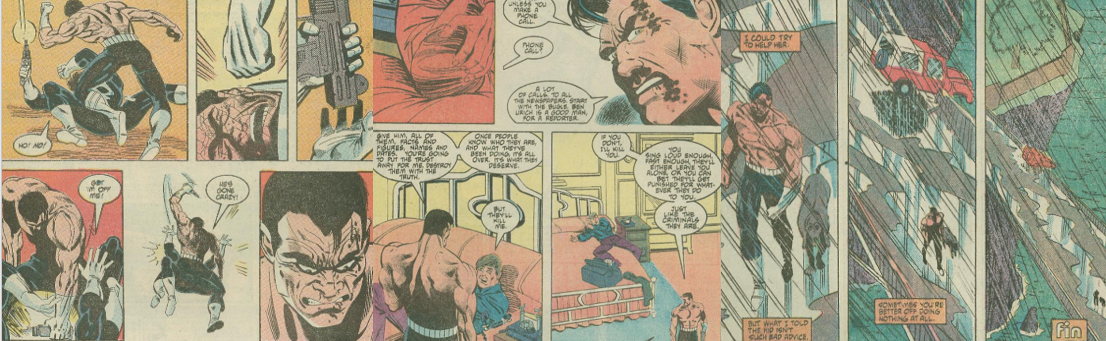
The Summary:
A lot has changed between Aquaman’s debut story and this issue; Atlantis is now a thriving underwater community, a city inhabited by sea-breathers and protected by its impenetrable dome. Aquaman also appears to be somewhat revised, now installed as king of Atlantis and having bolstered his social circle with friends and family. His overall demeanour remains unnervingly chirpy; his dialogue is a little too “hip” for my tastes at times and it’s a little cringy to see him refer to Aqualand as “Tadpole”, but this is nothing compared to Aqualad’s excited exclamations. In the style of quintessential boy sidekick Dick Grayson/Robin, Aqualad is not only impulsive and eager to battle at the side of his mentor and king, but also prone to spitting out such cries as “Holy Haddocks!”, “Suffering Swordish!”, and “Wailing Wolf Fish!” While he doesn’t really get much to do in this story, Aquaman clearly trusts Aqualad to safeguard Atlantis in his absence and he appears to share many of the same abilities as his mentor, but he’s not depicted nearly as capable as the water-bending Mera. While Mera is largely defined by her role as a wife and a mother, and thus has some of that air-headed demeanour that was commonplace in female comics characters back in the day, her ability to create hard water constructs and willingness to battle at Aquaman’s side show there’s more to her than just being a bit of arm candy.

A dramatic debut sadly somewhat overshadowed by Aquaman’s extended cast and villains.

Aquaman himself is generally depicted as a proud and dutiful defender of his city and its people; at the first sign of danger, he volunteers to meet it head-on, but his impulsiveness leads to him falling for Black Manta’s trap and almost being blasted to smithereens by his ridiculous Manta-Men. Although this is Black Manta’s first appearance, the dialogue indicates that this isn’t the first time he’s battled Aquaman or Ocean Master; we don’t get any kind flashback hinting at the villain’s origin or true name and appearance and he’s largely absent for most of the story, represented mainly by his various armoured crafts and his monstrous underlings. When he does appear, he’s a pretty intimidating figure with his armoured outfit and distinctive helmet, and he makes quite an impression by constantly fooling Aquaman, boiling Atlantis’s water and forcing them to undergo physiological (and presumably permanent) changes in order to survive, and even stooping so low as to kidnap Aquababy all to get his hands on Aquaman, who he injures and drives to the point of exhaustion. Black Manta also goes toe-to-toe with Aquaman’s half-brother Ocean Master, whose appearance somewhat pads this story be is actually quite beneficial to his character; though he has every reason to hate Atlantis and Aquaman and is as driven to destroy both as Black Manta, Ocean Master actively opposes Black Manta simply to have the honouring of conquering Atlantis and killing Aquaman. Him going out of his way to save Aquababy also shows that Orm has a code of honour unlike most villains and he ends the story being reasonably well-rounded as a character rather than just mercilessly evil for the sake of it like Black Manta. Unfortunately, this means that the story does more for Ocean Master, overall, than its debuting villain but I still think Black Manta came off pretty well here and proved himself to be a cunning and vindictive new foe for Aquaman.

My Rating:

Rating: 4 out of 5.

Great Stuff

What did you think to Black Manta’s debut story? Were you impressed by his cunning and guile or were you put off by his lack of physical presence? What did you think to his attack on Atlantis and the last-second intervention of Ocean Master? Are you a fan of Aquaman’s family and extended cast? What are some of your favourite Black Manta stories and moments and are you excited for his return to the big screen? Whatever you think about Aquaman and Black Manta, feel free to leave a comment below or start the discussion on my social media.

Back Issues: More Fun Comics #73

Story Title: “The Submarine Strikes”
Published: November 1941
Writer: Mort Weisinger
Artists: Paul Norris

The Background:
In April 1939, writer/artist Bill Everett introduced readers to Marvel Comic’s first Mutant, Prince Namor McKenzie/The Sub-Mariner, the superpowered prince of Atlantis who could live on land and in the sea and was just as likely to wage war against humanity as he was to defend it. While, on the surface, Arthur Curry/Aquaman appears to be another instance of blatant borrowing from their competitor, Mort Weisinger and Paul Norris’s aquatic superman couldn’t be more different. Aquaman was co-created by Weisinger after he moved to National Comics (the precursor to DC Comics) and was charged with coming up with some new costumed heroes to captialise on the success of Clark Kent/Superman and Bruce Wayne/Batman; after More Fun Comics changed its focus from superheroes to humour, Aquaman switched to Adventure Comics and was prominently featured throughout the 1950s. In addition to getting the cover spot on issues of Showcase and backup features in Detective Comics, Aquman had his own self-titled series, which saw him gain a wife, an ill-fated son, and undergo some pretty radical changes (including losing his hand). Often the subject of unfair ridicule for his ability to talk to fish and presumed uselessness, Aquaman has been part of DC’s biggest stories and proved popular enough to feature in numerous DC cartoons, a poorly-received videogame, and very nearly got his own teen drama show before Jason Momoa made a huge impression in his live-action debut as the character, portraying him as a bad-ass king of the deep and helping to change the character’s perception.

The Review:
As the story begins, a helpful text box informs the reader that many, especially those at sea, are well aware of the legend of the Aquaman, a water-dwelling do-gooder who emerges from the dark depths of the sea to battle evil and injustice, though even they consider him to be just that, a legend. While out on a mission of mercy, an unarmed ship is suddenly scuppered by a torpedo fired from an unseen submarine, the U-112; immediately, the captain orders an evacuation and stays behind to ensure that the crew and their consignment of refugees and hospital workers gets safely off the ship before he himself boards a lifeboat. At first, it’s not made clear where the enemy submarine is from or why they targeted the ship but it’s soon revealed that they’re goddamn Nazi sons-of-bitches who are determined to leave no witnesses to their heinous act. Luckily, just as the Nazis open fire upon the lifeboat, the scaled figure of the Aquaman arrives to help; his strength tempered by the crushing ocean depths, it’s no trouble at all for Aquaman to shunt the lifeboat out of the path of the submarine’s torpedo. Aquaman then turns his attention towards the “metal fish” and its maniacal crew.

Aquaman saves a boatload of refugees then delivers a startlingly different take on his origin.

Aquaman leaps aboard, sending one Nazi overboard with a good kick to the chin, but the commander sends the sub into a dive and makes a getaway. Although Aquaman vows to track them down and make them pay, his first priority is the safety of the ship’s compliment; to that end, he commands a pod of dolphins to help push the boat to dry land. The porpoise purpose of this seems to be to demonstrate Aquaman’s ability to clearly and openly communicate with sea life as he could have easily pushed the lifeboat to shore himself, and while that works the cynic in me also views it as him kind of making slaves out of the dolphins. Anyway, once on dry land, the captain begs to know Aquaman’s secret and he freely relates his origin story: his father was a famous undersea explorer who vowed to discover the secrets of the ocean after his wife’s death. This eventually led to him discovering the lost kingdom of Atlantis and constructing a water-tight home within its ruins, where he read up on ancient tomes and learned the secret of living under the ocean from Atlantean science and writing. Somehow, by “drawing oxygen from the water and using all the power of the sea”, the man who would come to be known as Aquaman was able to thrive underwater and continues his father’s work at the bottom of the ocean. So…quite a different Aquaman origin than I am familiar with, and one that’s absolutely full of plot holes and unanswered questions.

After escaping from the Nazi’s death trap, Aquaman puts an end to their threat.

With his story told, Aquaman dives back into the sea to get on the trail of the U-112, determined to do his share of punishing the evil that dwells on the surface world. By this point, the submarine has docked at a small island where the captain tells tales of his success and the strange sea-man who attacked them. Although his commanding officer balks at such an unlikely story, he’s forced to eat crow when Aquaman comes riding in on the back of a dolphin! Aquaman dives under the waters to avoid their bullets and, with a single powerful blow, sinks their submarine before their horrified eyes, trapping the Nazi bastards on their island. When Aquaman confronts them, he effortlessly swats away the commander’s pistol and chastises them for thinking him a “helpless refugee woman” but…somehow…the U-112 captain and his commander escape to their munitions house and then, even more startlingly, knock Aquaman unconscious by dropping a mallet on this head! Patting themselves on the back for their victory, the two tie Aquaman up, clamp weights to him, and toss him into the ocean, where he plummets into the mouth of an extinct sea-volcano. The sheer crushing depths restricting him, Aquaman desperately signals his dolphin friends by rubbing against a bulb-like plant and secreting an inky liquid (why he didn’t just shout for help isn’t clear; I guess he’s too deep?) The dolphins rush to his aid and allow him to easily break his bonds and return to confront the two Nazis. He knocks the submarine captain out with a stiff uppercut but the commander manages to slip back to the munitions room again; this time, he lobs a grenade at Aquaman’s head and, out of sheer instinct, he tosses it right back, blowing up the munitions storehouse and sending the commanding hurtling into the sky with comedic effect (but killing him nonetheless…) The deed done and the wicked punished, Aquaman returns to the sea, ready and willing to fight for justice in all its forms in the future.

The Summary:
So, yeah, Aquaman’s first story is decidedly different from his Marvel Comics counterpart; for one thing, Aquaman isn’t a murderous, ignorant fool ready to wage war against humanity but, and perhaps most strikingly, he’s not a native Atlantean and his powers don’t come from his heritage but are instead mysteriously and vaguely manufactured through a combination of “training” and “science”. It’s left incredibly vague exactly how Aquaman survives and breathes underwater or how he communicates with dolphins “in their own language” and, is so often the case in these early tales, we don’t really learn what his limits are (he can survive underwater but was effectively powerless when dumped in that sea-volcano because it was too deep; he can swim super-fast but is also seen riding dolphins, and he exhibits some superhuman strength but is knocked out by a mallet!) or even what his true name is! Garbed in a striking orange-scale outfit with green, fin-like gloves and a generally jovial personality, Aquaman stands out against his peers for lacking a cape and operating exclusively underwater; depicted as a highly trained and superhuman man, Aquaman is seen as the defender of injustice in all its forms, but especially out at sea, rather than being the Prince (or even King) of Atlantis.

A whimsical tale, despite some holes in the plot and Aquaman’s limits and origins.

Nowhere is this more evident than in the story’s choice of antagonist; no one’s going to mourn the death and destruction of Nazi soldiers and munitions and depicting the Nazis as openly firing upon innocents and mocking their foes is a great way of depicting them as morally reprehensible, if a little cliché (both the captain and the commander wear monocles and snigger about their superiority over others). The action is almost as haphazard as the artwork, however; Paul Norris shines in depicting the Greek-God-like Aquaman, panels at sea, and scenes that take place underwater, but the Nazi island is a bit bland and it’s jarring that the Nazis are able to just run away from Aquaman, especially as he’s right there in front of them! They even get the drop on him, again making me question his powers and durability, but this also seems to just be another excuse to reinforce Aquaman’s knowledge of the sea and command over its denizens. When Aquaman does leap into action, it’s with a cringey pun or taunt and he’s swift and efficient, easily knocking grown men out cold and tossing back grenades even if he doesn’t understand what they are. In the end, I was a bit surprised that Aquaman’s origin didn’t originally tie him as a native of Atlantis; this skewed my perception of the story somewhat as it raises a lot of questions that naturally aren’t answered here, but it was a pretty whimsical and enjoyable little tail tale that stands out against those of other superheroes, if nothing else.

My Rating:

Rating: 3 out of 5.

Pretty Good

What did you think to Aquaman’s debut story? Are you a fan of the character and, if so, what is it about him that you like? Were you also surprised by his differing origin and what do you think about his ability to talk to fish? What are some of your favourite Aquaman characters, stories, and moments and are you excited for his return to the big screen? Whatever you think about Aquaman, feel free to leave a comment below or start the discussion on my social media.