Back Issues [Spidey Month]: Spectacular Spider-Man #200


Easily Marvel Comic’s most recognisable and popular superhero, unsuspecting teenage nerd Peter Parker was first bitten by a radioactive spider and learned the true meaning of power and responsibility in Amazing Fantasy #15, which was first published in August 1962. Since then, the Amazing Spider-Man has featured in numerous cartoons, live-action movies, videogames, action figures, and countless comic book titles and, in celebration of his debut and his very own day of celebration, I’m dedicating every Tuesday of August to talk about everyone’s favourite web-head!


Story Title: “Best of Enemies!”
Published: May 1993
Writer: J.M. DeMatteis
Artist: Sal Buscema

The Background:
In 1962, Marvel Comics legend Stan Lee followed up his success with the Fantastic Four with Spider-Man. His Amazing Fantasy #15 debut proved to be one of Marvel’s best selling titles and his resultant popularity led to a solo title barely a year later. Spider-Man quickly amassed one of the most colourful and memorable rogues galleries in all of comics, with easily his most hated and iconic nemesis being the Green Goblin. Though many have assumed this elf-like guise, the most famous face behind the mask is Norman Osborn, industrialist and father to Peter’s best friend, Harry, and he and Spidey would have their most memorable clash during these days after Norman caused the death of Peter’s long-time love interest, Gwen Stacy. Although this storyline appeared to end with Norman’s death, the Green Goblin concept lived on through his son. First introduced in 1965, Harry famously turned to abusing drugs following his father’s demise, which fractured his grip on reality as much as his relationship with Peter. This culminated in Harry exposing himself to a modified version of his father’s Goblin formula, taking up the mantle of the Green Goblin, and ultimately perishing in this tale. However, this wouldn’t be the last time the Osborns would plague Spider-Man. Both would be resurrected time and time again for some of the web-slinger’s most controversial stories, both played pivotal roles in Spider-Man’s animated and live-action ventures, and Harry, especially, has been noted as being perhaps Spidey’s most tragic villain due to his complex and destructive relationship with both his best friend and his maniacal father.

The Review:
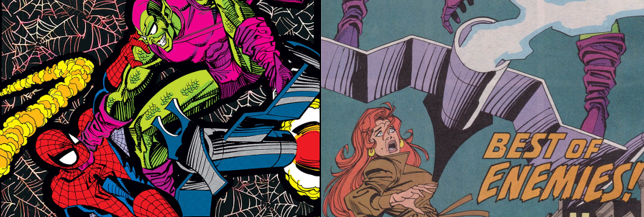
Our story begins, in suitably dramatic fashion, with Harry Osborn/The Green Goblin closing in on Peter’s wife, actress and model Mary Jane Watson-Parker/M. J. As M. J. walks through Central Park, she spots the Green Goblin coming for her and tries to run, but ends up in his clutches. Across town, in Harry’s apartment, a desperate Peter confronts Harry’s wife, Liz Allan; unfortunately, she’s as deluded as their son, young Norman “Normie” Osborn, is apparently psychotic and has blinded herself to the truth that her husband, already a recovering drug addict, has lost his mind to his father’s Goblin formula. Peter leaves and swings across the city as Spider-Man, lamenting the psychological instability of his best friend and the hatred Harry feels towards both his alter egos for his part in the death of his father. The maniacal Green Goblin flies M. J. to the George Washington Bridge, the very same location where Peter’s former flame, Gwen Stacy, died at the hands of her lover thanks to Norman’s machinations. Although M. J. is sure that Harry has brought her there to recreate the infamous moment, he surprises her by unmasking and opening up to her. Showing his vulnerable side, he expresses his love for her and promises that no matter how bad things get between him and Peter, he would never harm her. Naturally, she finds this a little hard to believe considering he just kidnapped her and the fact that he flies into a rage at the mere suggestion of his father’s involvement in the death of one of his friends, but M. J.’s left with no choice but to try and appeal to his better nature and their friendship to try and convince him to stop before it’s too late.

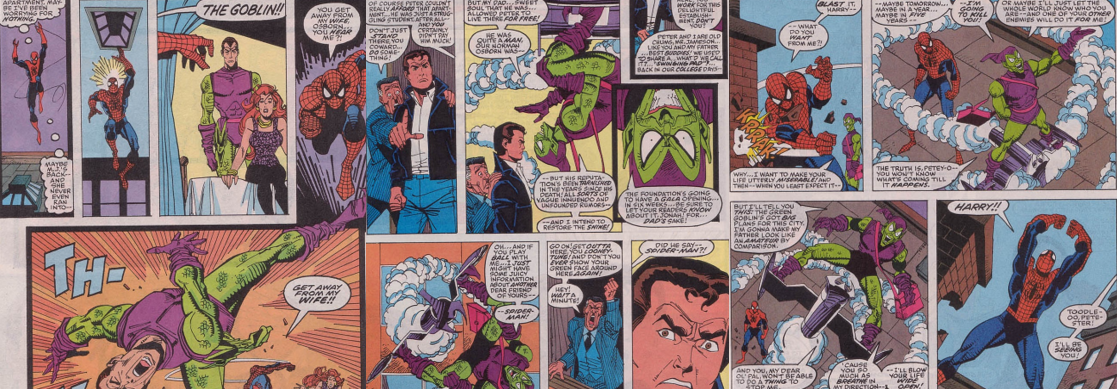
Harry delights in tormenting Peter at every turn, threatening to reveal his secret identity.

Despite the desperate nature of his search, Spider-Man takes the time to intercept some punks robbing an apartment but chastises himself when he almost loses his cool and takes his anger out on the lowlifes. When Spider-Man returns to his apartment, he’s stunned to find M. J. there alongside an unmasked Green Goblin; assuming that Harry means to harm her, he lunges for his former friend and knocks him clean across the room, but M. J. intervenes before things go too far. Scowling, Harry accuses Peter of always thinking the worst of him and flies off, leaving the two in such a state that M. J. sparks up a cigarette and suggests that maybe it’d be better for Peter’s identity to be exposed and Peter so riled up by it all that he lashes out in anger. A sweaty, neurotic Harry returns home to his equally deluded wife to play “happy families”. Neither of them think it’s unusual that Normie has such a venomous hatred for Spider-Man, and Harry’s temperament is on a razor’s edge, switching between violent outbursts and tender affection. The next day, Peter mulls over his options and is startled when the Green Goblin appears before him in broad daylight simply to taunt him. The Green Goblin then pays a visit to cantankerous Daily Bugle editor J. Jonah Jameson to ask for his help in advertising the “Norman Osborn Foundation”, a charitable organisation in his father’s honour that he plans to debut in six weeks. Peter arrives but is powerless to do more than look on as Jonah cowers behind him and the Green Goblin delivers a vague threat to reveal some “juicy information” to the publisher if he co-operates. Over the next few days, Harry tours the city spreading the word of his intentions and Peter is enraged to find the notoriously fickle public are completely onboard with the idea and assume the Green Goblin attire is simple the “odd affectation [of] a millionaire philanthropist”. Irritated by the entire debacle and frustrated at trying to figure out Harry’s endgame, Peter doesn’t hesitate to attack the Green Goblin as Spider-Man when he next sees him. Spider-Man warns his former friend that he’s sick of all the games and wants to settle their differences then and there but the Green Goblin not only refuses to fight him until he’s ready but also threatens to tarnish his image forever by filing legal action against him if he gives in to his anger. Instead, Harry delights in torturing Peter; he promises that they will throw down, and that he will emerge victorious, but only after his perverse desires are satisfied and vows to destroy his life if Spider-Man tries to stop him.

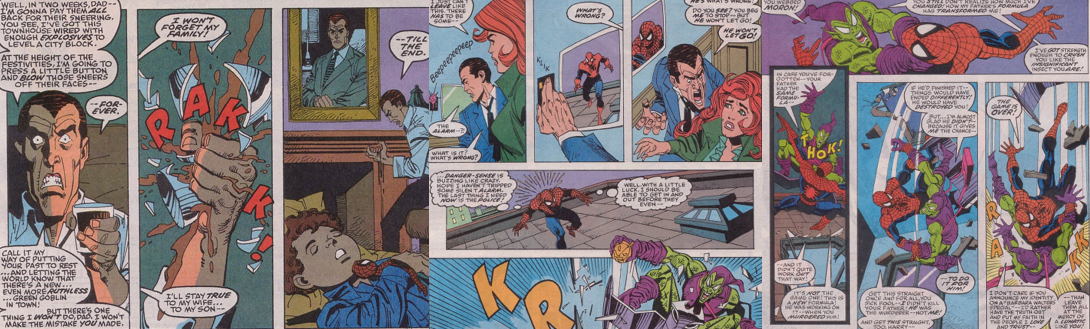
Harry’s mania sees him fly into a rage and plot an explosive revenge against his father’s enemies.

Liz is delighted at Harry’s newfound project but worries that he’s pushing himself too hard getting things ready for the foundation’s big unveiling; although Harry suffers from frequent bouts of nausea, he shrugs them (and Liz’s worrying) off and resolves to stay strong for his father. Of course, things are far from well in the mind of poor Harry Osborn; he openly converses to a large, ominous portrait of his father and delights in sharing how he’s been driving Peter batty, forcing him and M. J. to move to a new apartment, and promises that the foundation gala will be his ode to his father’s memory, where he’ll make all the enemies to the Osborn name pay for their insolence by blowing them all to kingdom come! The next day, M. J. tries to talk sense into Liz, but her delusion is so complete that she won’t drop either her unnerving smiling façade or her belief that Harry is a good man doing good things after a lifetime of adversity. Later, M. J. tries the same thing with Harry, storming into his apartment, fag on the go, and begging him to let go of his vendetta and rekindle his friendship with Peter. However, Harry refuses to listen to reason not just because of the unbridled power the Green Goblin offers him, but also the opportunity it creates to show the world the man he really is. After also briefly considering facing the consequences of going public, Spider-Man happens upon the George Washington Bridge and resolves to stop Harry no matter what rather than risk losing the woman he loves all over again. However, when he arrives at Harry’s apartment, the deranged Osborn flies into a rage; in his mind, Peter and Spider-Man are the problem and the true enemy, and just the mere sight of him makes Harry snap, throw on his suit, and burst up through the skylight to confront his adversary as the Green Goblin.

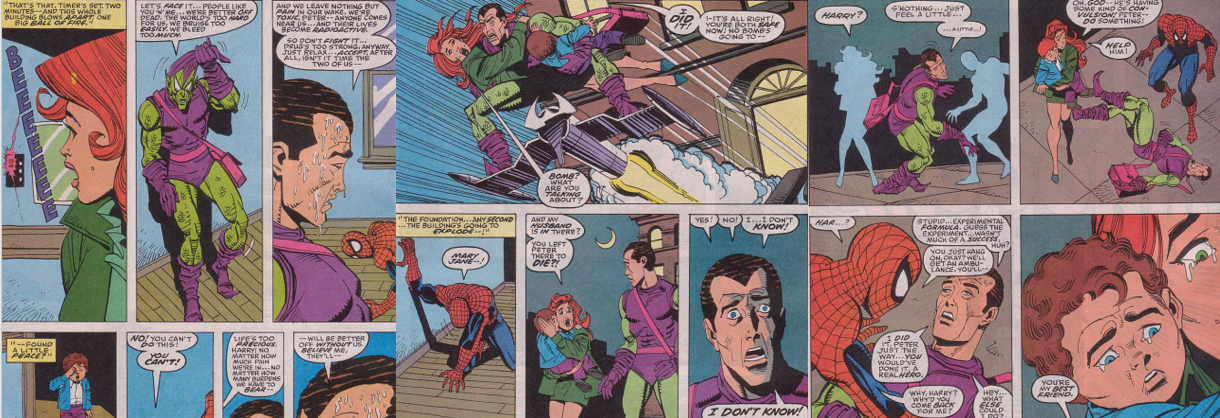
Harry ultimately comes to his senses and sacrifices himself to save his friends and family.

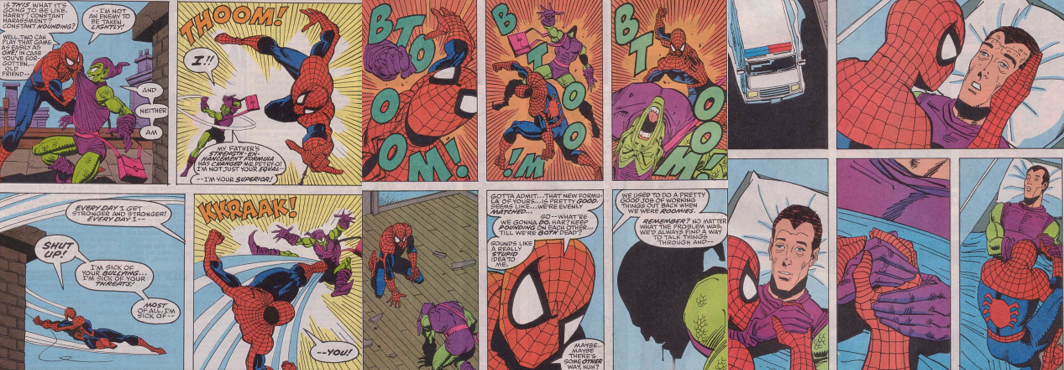
Both launch at each other with everything they have, refusing to hold back any longer; the Green Goblin again boasts that he now has the power to crush Spider-Man and even brags that he’s improved upon it since Norman’s days and that he’s glad that his father never killed Spider-Man since it gives him the chance to do so now. Spider-Man counters by arguing that Norman Osborn was a crazed murderer and that he no longer cares if Harry reveals his identity since he’d rather be exposed than leave his family at the Green Goblin’s mercy. Spidey also avoids being skewered by the Green Goblins glider but, when Harry bursts free of Spidey’s webbing, the two stop their war of words and simply trade blows for a few panels. However, Spidey is forced to admit that Harry was right; the new Goblin formula makes them evenly matched, so he suggests they find another, less brutal way of settling their differences, only to be caught off-guard and poisoned into unconsciousness by a hidden syringe in Harry’s glove. Harry’s plan is for the two of them to go up in flames, ridding the world of their toxic influence, but he is horrified when he realises that, in his mania, he forgot that M. J. and Normie were still in the house! Since he’s too out of it to act, Spider-Man begs Harry to set aside his self-doubt instilled in him by his father and save his loved ones. Despite his hysteria, Harry is moved by Peter’s belief in him and rockets M. J. and Normie to safety; Spider-Man collapses, seemingly doomed, but M. J. begs Harry to go back for him and is grateful beyond measure when Harry chooses to rescue Peter at the last second. However, Harry collapses in a violent convulsion as the Goblin formula finally takes its toll on his body. After expressing his gratitude to Peter and recognising him as his best friend, Harry dies before Peter’s eyes, leaving Spider-Man, M. J., and Normie distraught in a series of dramatic and wordless panels.

The Summary:
I don’t normally say this but I’m really not a fan of the art in this one; I’ve read a few Spider-Man stories illustrated by Sal Buscema and they’re all as visually bad as each other. Spider-Man and the Green Goblin don’t look so bad, but everyone has this weird angular took to them, the colours are super muted and dull, and Sal Buscema can’t draw faces for shit. It’s a very ugly looking comic and it’s a same since it’s such a pivotal Spider-Man story that’s let down by this atrocious art style. Otherwise, this is a very emotionally-charged story; it’s not often that one of Spider-Man’s villains learns his secret identity and I liked how Harry tormented the web-slinger at every turn, stalking him in broad daylight and threatening to expose him if he gets out of line. One interesting twist was M. J.’s suggestion that Peter get ahead of it by publicly revealing his identity; of course, Peter balks at this this idea since it would only cause more troubled him himself and his loved ones, but it was intriguing seeing him briefly consider it since it would remove Harry’s leverage. Like a lot of Spider-Man stories involving the Green Goblin, “Best of Enemies!” features many references to Gwen Stacy, but I don’t mind that here as it’s thematically relevant. It seems as though Harry’s going to recreate that impactful moment with M. J. at the start of the tale and returning to the site of her death reinvigorates Spider-Man’s fighting spirit, showcasing that there’s nothing he wouldn’t do to protect his loved ones and bringing him to the brink of facing Harry to the death, even though his better nature still keeps him from crossing that line.

A pivotal and emotional Spider-Man story let down by some horrendous artwork.

Harry’s vendetta is also an alluring one; he’s consumed by revenge and hatred towards Peter since he believes that he killed his father and is so obsessed with living up to Norman’s expectations and avenging him that he’s willing to die alongside Spider-Man in the finale. Harry’s always been a complex character; Norman casts a long shadow and his mistreatment of his son led to Harry developing an inferiority complex and turning to drugs long before he exposed himself to the Goblin formula. As the Green Goblin, Harry is more than a physical match for Spider-Man; he has all of his father’s technology and tricks, but relies more on mind games, intimidation, and dirty tactics than pumpkin bombs and his glider. I really enjoyed seeing him rile Peter up into an unbridled rage and cause him misery, and the wordless panels of them beating the hell out of each other only to find they’re evenly matched. All throughout the story, Harry is portrayed as a maniacal, sweaty psycho who can barely keep his emotions in check; this has had an extraordinarily destructive influence on his wife and child, as well as his friendships, but also takes its toll on his body, reason, and sanity. By the end, he’s convinced himself that he and Spider-Man are a blight on the world and need to be removed to keep from “infecting” others, and it’s only when one of his oldest friends and his beloved son are placed in mortal danger that he chooses to shake off his father’s influence. I really liked the hesitation he showed just before going back for Peter and their emotional reconciliation right before he died, and the wordless panels help to emphasise the impact of Harry’s death on all involved, leaving Spider-Man alone and heartbroken by the loss of his best friend. In the end, despite the terrible art, “Best of Enemies!” remains one of Spider-Man’s most poignant stories. Harry’s downward spiral and final, heroic sacrifice were executed so well that it genuinely annoys me that Marvel chose to bring both him and Norman back again and again rather than try something new, but it doesn’t detract from how crucial this story is to the overall Spider-Man mythos.

My Rating:

Rating: 4 out of 5.

Great Stuff

What did you think to “Best of Enemies!”? Where would you rank it amongst Spider-Man’s many other stories and moments? Do you think I was too harsh on Sal Sal Buscema’s art style? What did you think to Harry as the Green Goblin and his descent into madness and mania? Did you enjoy seeing him torment Peter or would you have preferred to see them throw hands more often? What did you think to Harry’s heroic sacrifice and were you also annoyed to see him and Norman return later down the line? Which incarnation of the Green Goblin is your favourite and how are you celebrating Spider-Man this month? Whatever your thoughts on Spider-Man and the Green Goblin, go ahead and share them below or drop a comment on my social media and be sure to check out my other Spider-Man Month content!

Back Issues [Thor’s Day]: Journey into Mystery #85


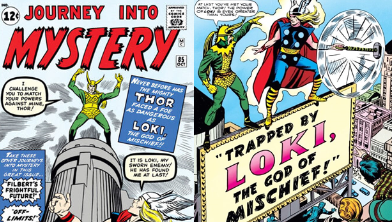
In August 1962, Stan Lee, Larry Lieber, and Jack Kirby introduced readers of Marvel Comics to the God of Thunder, Thor Odinson. Through associations with Marvel’s premier super team, the Avengers, and many cosmic, mythological adventures, Thor became another of Marvel’s most successful and versatile characters, with appearances in cartoons, videogames, and incredibly profitable live-action movies. Being as it’s the first Thursday (or “Thor’s Day”) of the month, this is the perfect time to celebrate the God of Thunder!


Story Titles: “Trapped by Loki, The God of Mischief” and “Part 2: The Vengeance of Loki”
Published: 2 August 1962 (cover-dated October 1962)
Writers: Stan Lee and Larry Lieber
Artist: Jack Kirby

The Background:
After creating Doctor Bruce Banner/The Incredible Hulk, legendary Marvel Comics writer, editor, and creator Stan Lee was inspired by Norse legends to dream up an even more powerful superhero and, alongside Larry Lieber and the renowned Jack Kirby, crafted a new version of the Norse God Thor Odinson who effectively took over Journey into Mystery until it became his own self-titled comic in 1970. Thor became a founding member of Marvel’s premier super team, the Avengers, and eventually took on more aspects of his inspiration, with one of the most notable of these being Thor’s adopted brother, Loki Laufeyson. Like Thor, a version of Loki appeared in Marvel’s predecessor, Timely Comics, years earlier in 1949, where he was depicted as a hatemongering member of the Olympian Gods, but it was Lee and Lieber who redesigned Loki as Thor’s most persistent nemesis in this issue of Journey into Mystery. Like his half-brother, Loki was instrumental in the first appearance of the Avengers and went on to dog many of Marvel’s superheroes as part of the Masters of Evil, to say nothing of waging war against Asgard and even having a turn as a more heroic character. Of course, Loki has seen immense popularity in recent years thanks to Tom Hiddleston’s portrayal of the character in the Marvel Cinematic Universe, where he was depicted as a tragic, flawed, misguided character who went from wanting to conquer the Earth to sacrificing his life to protect his brother and his adopted world.

The Review:
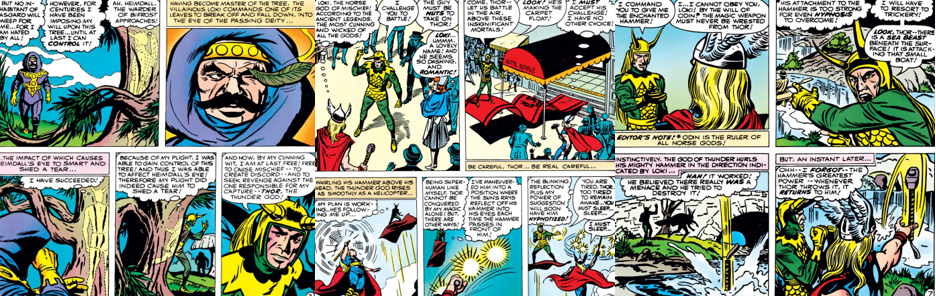
“Trapped by Loki, The God of Mischief” begins in the golden realm of Asgard, a citadel separated from time and space by the rainbow bridge, Bifrost. There, deep in a remote area of Asgard, stands a tree that acts as the prison for Loki, the devious God of Mischief, who was condemned to this prison ages ago, with his only hope of escape being if someone is driven to tears by his plight. Although he’s well aware that no Asgardian would ever weep for him since he’s hated by all, he’s able to exert some measure of control over the tree; enough to cause a stray leaf to drop into the eye of Heimdall as he passes by. Apparently, the single tera he sheds as a result is enough to break the curse and Loki slips free undetected, finally giving him license to cause mischief, spread discord, and seek revenge on the one responsible for this capture: Thor! Although Thor hasn’t been in Asgard for some time, Loki had the incredible foresight to forge a “mental link” with Mjölnir before his imprisonment. This allows him to locate the uru-made magical hammer and its thunder-commanding master, who’s currently entertaining children in a hospital, so Loki hops onto the Bifrost and heads to Earth “at the speed of thought”.

Loki escapes from his prison and comes to Earth to get revenge on Thor by hypnotising him.

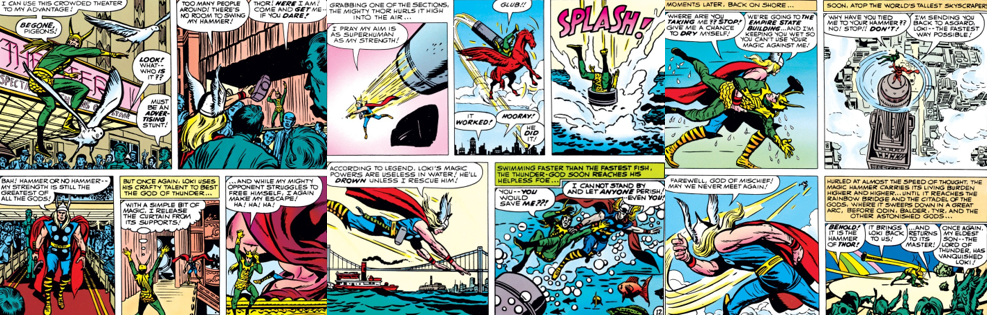
Once there, Loki magically assumes the guise of a normal, everyday man about town but finds that Thor has already left the hospital by the time he arrives. Rather than reveal his presence prematurely, Loki decides to use his incredible powers to cause a disturbance (namely transforming innocent bystanders into negatives) to lure Thor to him. Conveniently, Thor (in his alias as the lame Doctor Donald Blake), happens to be on his way to a nearby house call; upon seeing the phenomenon, Dr. Blake strikes his walking stick to the ground and is transformed into the Mighty Thor once more. Thor then spins Mjölnir at an incredible speed, fast enough to emit anti-matter particles that he then blows towards the victims using his magical hammer, restoring them to normal in a head-scratching piece of pseudo-science. Naturally, the people are awestruck by this feat and Thor is heralded as a hero. Amidst the gaggle of onlookers, Loki approaches Thor and reveals himself to the Thunder God (whose internal dialogue seems to indicate that he’s only aware of Loki from Norse mythology, again making me question whether Dr. Blake and Thor are two different people or if Don’s consciousness is simply within Thor’s body since Thor should know who Loki is considering he imprisoned him in that tree…) and challenges him to a battle. Loki uses his powers to turn a nearby carpet into a flying carpet and Thor follows him into the air but Loki, realising that it will take more than brute strength and magic to conquer Thor, uses this to his advantage by causing the sun’s rays to reflect off Mjölnir in a series of blinking lights that leaves Thor effectively hypnotised and under Loki’s command! Although this means Thor is compelled to obey Loki, he’s unable to hand over Mjölnir thanks to the will of his father, Odin Allfather, so Loki tries to trick him into hurling his hammer at an imaginary sea beast, only to be thwarted when the enchanted weapon returns to Thor’s hand like a magnet.

Loki’s tricks and deception are nothing compared to Thor’s great strength.

However, Loki comes up with the brilliant plan to conjure up a duplicate image of Thor; since only Thor can hold the hammer, Thor hands Mjölnir to the illusion and is finally relieved of his weapon. Loki then directs Thor to release the wild beasts from the city zoo but is distracted from witnessing this event by mocking a gaggle of civilians who try, unsuccessfully, to lift the enchanted hammer. Loki’s momentary distraction means he misses Thor reverting back to Dr. Blake, an automatic transformation that occurred whenever Thor was separated from Mjölnir for about a minute. This also has the added benefit of undoing Loki’s hypnosis, allowing Dr. Blake to reunite with Mjölnir and return at full power to Thor. Realising that he no longer has the advantage over his foe, Loki gathers a flock of nearby pigeons to fly him to safety so he can think up a new plot but is forced to land when he sees Thor pursuing him with a vengeance. Thanks to the dense crowd making it too dangerous for Thor to swing Mjölnir, Loki ducks into theatre and entangles the God of Thunder within the stage curtain. This is only a momentary setback for Thor, however, so Loki dashes into the subway and distracts his foe further by shoving civilians onto the train tracks. Rather than simply carry them to safety, Thor goes to the effort of showcasing his strength by hoisting up the tracks, allowing the train to pass safely overhead, and then watches on, helpless to pursue, as Loki flies off on horse statue he brought to life, smashing up Times Square as he goes. Although Loki plans to lure Thor to the Statue of Liberty for a final showdown, Thor simply tosses a massive section of a pipe at the God of Mischief that sends him plummeting to the water below. Since, according to legend, Loki’s magic powers are apparently “useless” in water, Thor rushes to save his foe, much to Loki’s shock and revulsion. Because Loki’s soaking wet, he’s powerless to keep Thor from taking him to the top of the Empire State Building, attaching him to Mjölnir, and hurling him back to Asgard through sheer brute force to the astonishment of his fellow Gods.

The Summary:
Considering how pivotal Loki now is to Thor’s mythology and the popularity of the misguided God of Mischief, Journey into Mystery #85 is a pretty poor showing for Thor’s half-brother. Indeed, no mention is made of Loki’s familial ties to Thor, their sibling rivalry, or his status as a Frost Giant. There’s not even any real detail as to why Thor imprisoned him within a tree beyond Loki delighting in causing chaos and some cursory mentions of Norse mythology, something I very much doubt readers of Marvel Comics had much knowledge of back in the day (or even now, if I’m honest). Instead, we’re left with the paper-thin exposition that everyone in Asgard hates Loki and that he himself hates Thor because he bested him ages ago, and even this falls apart since Thor acts like this is the first time he’s ever encountered Loki. A couple of panels showing their previous encounter might’ve been a nice inclusion; that space could’ve been used in place of the brief and pointless fawning of nurse Jane Foster, who’s immediately enamoured by Loki for no real reason and is simply there to help paint Dr. Blake as a milksop compared to the mighty Thor. The story even contradicts its own lore within the first few panels: Loki specifically says that only someone taking pity on his plight can free him, yet a brief bit of eye water from a leaf is enough to break his curse, to say nothing of going to the effort of stating that Loki has some divine link to Mjölnir when it would’ve been enough to simply show him capable of magically seeing across the Realms.

Loki doesn’t impress in his debut, appearing weak and useless at every turn.

The artwork is bright and colourful and quite fun, but disappointingly basic at times, and strangely bizarre at others. We’re denied seeing Thor tussle with bears and lions at the zoo but have to see him bend rail tracks rather than just carry Loki’s victims to safety, and Loki’s powers are some of the lamest and most disappointing from this era of comics. We’ve got a God capable of bringing inanimate objects to life, but his plan is to simply hypnotise Thor? He creates an illusion of Thor but is incapable of conjuring an actual sea beast to accomplish the same means, instead resorting to basically shouting, “Look over there!”, and his powers are suppressed by water? I had no idea that was a thing, but it’s pretty bloody lame. Almost as lame as forcibly nerfing Thor by sticking him in dense crowds and thus incapable of swinging Mjölnir without hurting someone since Thor is quite clearly and obviously depicted as Loki’s physical superior even before he literally throws him across time and space back to Asgard. So, no, I really wasn’t very impressed by Loki; he barely did anything except briefly hypnotise Thor, his motivations were woefully pitiable, and his powers were far from visually interesting. Luckily, he looked very visually appealing with his bright green and gold outfit and trademark horned helmet but neither he nor this story lived up to its potential. Loki was defeated with laughable ease once Thor shrugged off his hypnotism and got his hands on him, and this ended up being a pretty disappointing first encounter between the two legendary rivals even by the standards of the 1960s.

My Rating:

Rating: 2 out of 5.

Could Be Better

What are your thoughts on Loki’s debut appearance? Were you also disappointed by his ineptitude and depiction, or did he impress you with his colourful attire and mischievous nature? Did you enjoy seeing the two clash or would you have preferred to see something more visually interesting? What are some of your favourite Loki moments in and out of the comics? Do you have a favourite character, arc, or era in Thor’s long publication history? How are you celebrating Thor’s debut this month, if at all? I’d love to hear your thoughts on Thor in the comments below or on my social media, and it’d be great if you checked out my other Thor content across the site.

Back Issues [Spidey Month]: The Amazing Spider-Man #258 / Web of Spider-Man #1


Easily Marvel Comic’s most recognisable and popular superhero, unsuspecting teenage nerd Peter Parker was first bitten by a radioactive spider and learned the true meaning of power and responsibility in Amazing Fantasy #15, which was first published in August 1962. Since then, the Amazing Spider-Man has featured in numerous cartoons, live-action movies, videogames, action figures, and countless comic book titles and, in celebration of his debut and his very own day of celebration, I’m dedicating every Tuesday of August to talk about everyone’s favourite web-head!


Story Title: “The Sinister Secret of Spider-Man’s New Costume!”
Published: 31 July 1984 (cover-dated November 1984)
Writer: Tom DeFalco
Artist: Ron Frenz

Story Title: “’Til Death Do Us Part!”
Published: April 1985
Writer: Louise Simonson
Artist: Greg LaRocque

The Background:
Considering Spider-Man’s debut almost didn’t happen, it’s pretty ironic that Stan Lee and Steve Ditko’s angst-ridden teenage superhero went on to become the flagship character of Marvel Comics. Over the years, Spider-Man has been at the forefront of some of Marvel’s most celebrated, and notorious, stories and the troubled wall-crawler is often depicted battling his own personal woes as often (if not more so) as his colourful rogues gallery. In 1982, an illustration from reader Randy Schueller that depicted Spider-Man in a smooth, black outfit with a large red spider motif across his chest caught the eye of Marvel Comics’ editor-in-chief Jim Shooter. After Marvel purchased the concept for a mere $200, writer Tom DeFalco and artist Ron Frenz conceived the costume being a living organism; Spidey’s new black suit debuted without explanation in The Amazing Spider-Man #252 before Marvel Super Heroes Secret Wars #8 revealed that the web-slinger acquired the suit during the “Secret Wars” event. Over the next year or so, Spidey revelled in the costume’s unique and helpful ability to form both clothing and organic webbing until these two issues revealed the costume’s true nature as a symbiote. Of course, this directly led to the debut one of Spidey’s most iconic enemies (and one of Marvel’s most popular anti-heroes), Eddie Brock/Venom, but Spidey’s issues with the black suit have been adapted into cartoons, movies, and videogames and it remains one of his most iconic alternative outfits.

The Review:
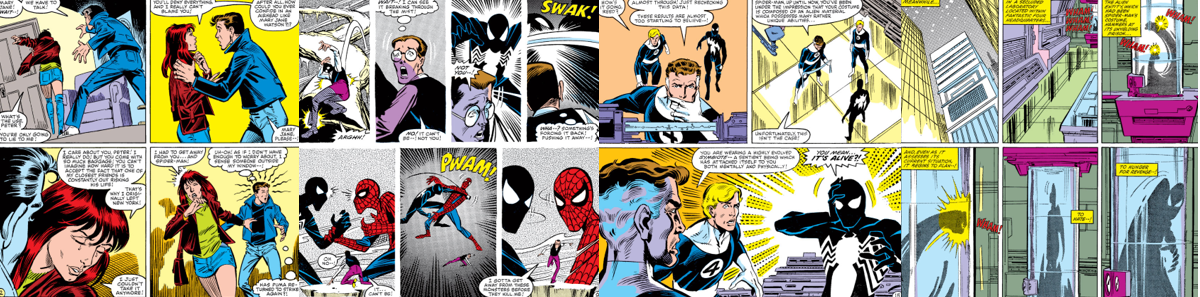
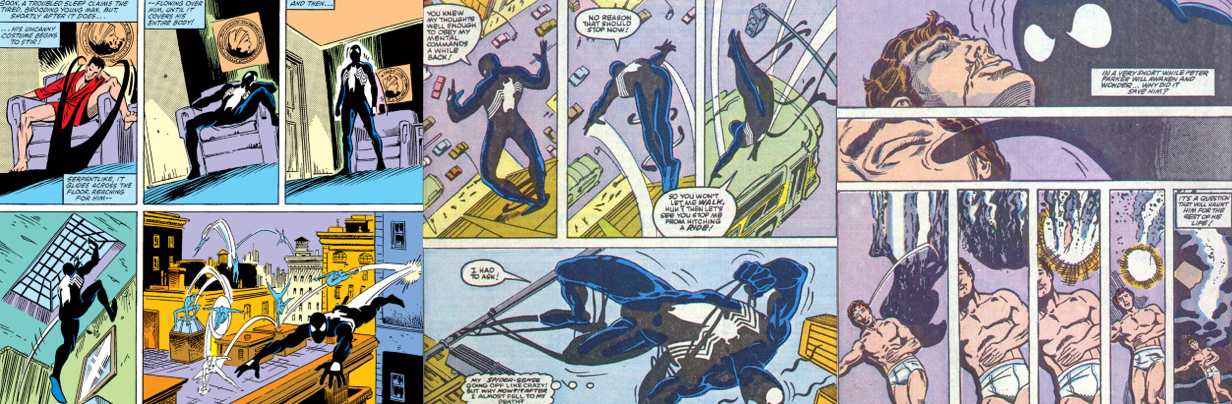
“The Sinister Secret of Spider-Man’s New Costume!” begins with Peter Parker, still reeling from defeat at the hands of crime boss Silvio Manfredi/Silvermane and the man-beast Thomas Fireheart/Puma, facing the shock of his life when he returns to his apartment and his former flame and close friend Mary Jane Watson/M. J. reveals that she knows he’s secretly Spider-Man! Peter’s naturally gobsmacked by this but M. J. doesn’t give him a chance to explain…or, as she puts it, to “lie to [her]”. Indeed, Peter’s shock is so total that he’s too distracted to hear that M. J. originally left New York City a while back because of this knowledge; not only did it hurt her that he didn’t trust an “airhead” like her with his greatest secret, but she couldn’t stand the thought of him constantly risking his life. Whatever chance Peter might’ve had of explaining things or perhaps retaining his secret identity then goes completely out of the window when Felicia Hardy/The Black Cat leaps in through his window looking for a fun night swinging through the city. M. J.’s heartache is only exacerbated by the Black Cat’s appearance, and she leaves in floods of tears, and Peter’s so distraught that he takes his anger out on the Black Cat, chastising her for bursting in unannounced. Naturally, the Black Cat’s none too pleased to be yelled at so she goes to leave, but they’re both startled when a strand of webbing instinctively and involuntarily shoots from Peter’s jacket to keep her from leaving. While the Black Cat takes this to mean that Peter truly loves her since he “didn’t even try to stop [M. J.]” when she left, Peter’s too surprised by the alien costume’s mysterious nature to deny her embrace. Later, after unsuccessfully trying to call M. J., the overwhelmed Peter succumbs to exhaustion. However, while he sleeps, the alien costume slinks across his apartment, attaches itself to him, and takes his slumbering body out on a joyride across the rooftops of the city.

Peter’s personal strife is compounded by the news that his alien suit is a living organism!

As he sleeps, Peter endures a horrific nightmare in which he finds himself (in his classic bookworm appearance) hounded by the ominous alien costume. Just as it closes in on him, his classic red and blue duds step in to battle the alien, with the screaming Peter literally caught in the middle! Peter awakens to find he’s missed an entire day and unnerved by his alien attire. To try and get some answers, he swings over to the Baxter Building to take up Doctor Reed Richards/Mister Fantastic on a previous offer to examine the suit. Following a series of intensive experiments on the gamut of the costume’s capabilities (producing organic webbing, assuming different appearances, and flowing on and off him at his mental command), Reed drops the bombshell that the costume isn’t just some amazing piece of advanced alien technology, but actually a living being that’s physically and mentally attached itself to the web-slinger! Spider-Man’s astonishment turns to horror when he tries to remove the suit at Reed’s suggestion, only to find it painfully attempting to permanently graft itself to him! With Spider-Man at risk of being crushed to death, Reed grabs his handy-dandy sonic cannon and blasts the alien, forcing it off of Spider-Man long enough for him to safely contain it. However, this does leave Spider-Man in just his underwear so, to preserve his secret identity and allow him to return home, Johnny Storm/The Human Torch provides him with a spare Fantastic Four uniform and a paper bag to cover his head, leading to him facing public humiliation when he steps in to help the police with a robbery. However, Peter’s pride and his shock at the revelation that his alien suit was a symbiote all along are pushed aside when a remorseful M. J. shows up to talk, though he’s unaware that the enraged symbiote lusts for revenge inside its cell…

Spidey’s so horrified by the symbiote suit that he barely notices the attacking Vulturions.

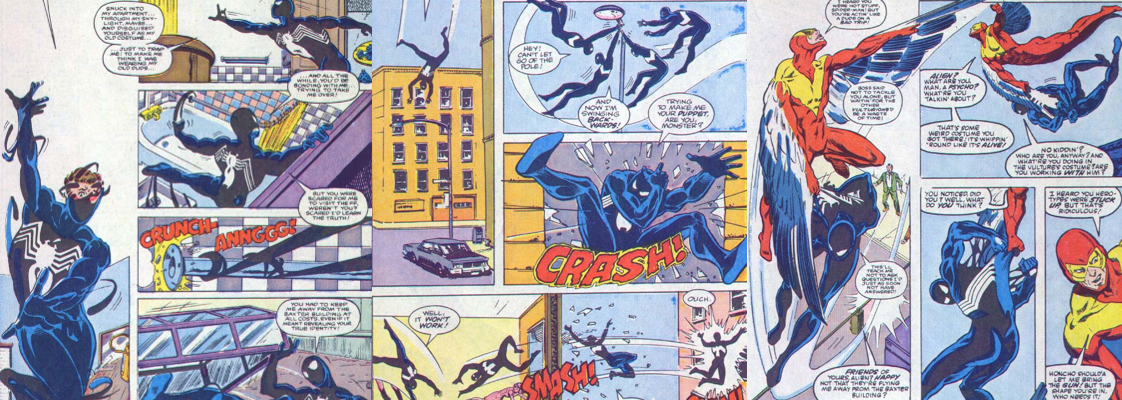
Peter returned to his traditional red and blue costume following this and incurred the anger and disappointment of his beloved Aunt May when he dropped out of his graduate studies in the time between The Amazing Spider-Man #258 and Web of Spider-Man #1. It was also during this time period that the symbiote managed to escape from its confinement and make its way back to Peter’s apartment, which is why “’Til Death Do Us Part!” begins with the alien costume lurking in Peter’s wardrobe. Peter’s so distracted by his recent breakup with the Black Cat and recapping how Reed revealed the costume’s true nature as a “symbiot” and helped rid him of it that he doesn’t even notice the parasitic alien attaching itself to his costume until it’s too late! Horrified, Spider-Man desperately flees his apartment and tries to get back to the Baxter Building, but the symbiote fights him the entire way; it sends out tendrils to ground him, throws off his webbing, detaches itself from walls, and forces him to do its bidding like a puppet. Refusing to obey his commands and sending him into a panic, the symbiote negates Peter’s spider sense and does everything it can to keep him grounded, and Spidey’s so caught up trying to fight off the alien and keep his cool that he doesn’t notice the Vulturions circling overhead. Comprised of hoodlums Gripes, Pigeon, Sugar Face, and Honcho, the Vulturions are a gang of low-level punks given a chance at stepping up their game when they repurpose Adrian Toomes/The Vulture’s technology and suits to their own ends. Their leader, Honcho, warned them about taking on Spider-Man alone and drawing undue attention to themselves, but Gripes can’t help but snag the writhing, babbling web-head when he spots him struggling with the symbiote during a scouting mission.

Spidey risks his life to rid himself of the symbiote, whose last act is to drag him to safety!

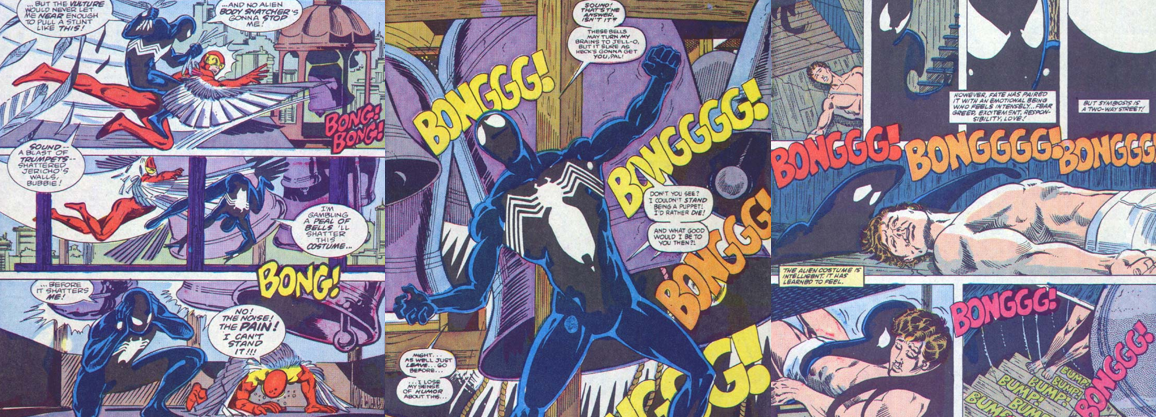
Spider-Man barely even acknowledges the presence of the Vulturions; even when he’s caught in Gripes’ talons, he rages and struggles against the symbiote. Gripes’ confusion at Spider-Man’s bizarre behaviour turns to horror when the symbiote’s tendrils lash out and attack him, and Spidey’s forced to use his own strength to fight off Gripes, Sugar Face, and Pigeon, sending the three plummeting into the sea and commandeering Honcho as a more reliable means of traversal. Realising that he might not make it to the Baxter Building in time to use Reed’s sonic blaster, Spider-Man redirects Honcho to a nearby bell tower. The loud ringing is already sending the symbiote into a frenzy but it’s in absolute agony when Spidey crashes into the tower and forces it to endure the ringing up close. The noise is apparently so loud that it threatens to kill Spider-Man as well; with his strength fading, Peter can’t help but think of his loved ones and all the people he’s leaving behind as he feels his life ebb away. The noise is so great that the symbiote is forced from Peter’s unconscious body; however, as the “emotionless being” slinks away, it can’t help but feel an obligation towards its former host. Chalked up to emotions inherited from its time joined with Peter, the symbiote pulls Peter to safety. It tentatively, lovingly, touches his face with a tendril one last time before promptly evaporating into dust, apparently destroyed from the cacophony of the bells and the exertion of saving Peter’s life.

The Summary:
If you’re a fan of Venom and Peter’s time in the black costume, these two stories are essential reading to understanding the complex relationship between Spider-Man and the symbiote. Unlike in other media (at least as far as I can remember), the symbiote didn’t actually negatively affect Peter’s mood or mannerisms; he didn’t go all emo or become aggressive, and I don’t think it really enhanced his strength or natural abilities beyond acting as infinite webbing and responding to his mental commands. Consequently, I believe that The Amazing Spider-Man #258 is the first time that the symbiote shows any signs of aggression or independent thought. Of course, it can be argued that the symbiote is simply reacting due to the massive revelations and pressure that bombard Peter in this story. Just the idea that M. J. knows his secret identity would be shocking enough, but quickly follow that with the Black Cat’s arrival and a bit of a love spat between the two and it’s no wonder that Peter’s emotions are all over the place. M. J.’s revelation would, of course, lead to her opening up to Peter about her own traumatic past and helped to not only flesh her out as something more than a gorgeous party animal but also galvanise their relationship, but here it’s a real curveball since Peter’s secret identity was such a sacred element to the character and not too many people were aware of it. Thus, finding out that M. J. had always known of his dual identity really helped her to stand out against Peter’s other love interests, even the likes of the Black Cat.

Spidey’s costume woes lead to the debut of the Bombastic Bag-Man!

As ever with Spider-Man stories, we get some drama and interludes to break up the action; the first story is broken up with interludes that show the Puma, in his public identity as a successful businessman, brooding over in New Mexico, hungry for his next encounter with Spider-Man, and Roderick Kingsley/Hobgoblin being recruited into Richard Fisk/The Rose’s campaign against Spider-Man, as well as hints towards M. J. having secrets of her own. The second story is largely concerned with establishing the Vulturions, painting them as thugs who mug old ladies in public and who have a contentious relationship with their boss because of this, and Peter’s recent falling out with Aunt May over his studies. Naturally, there are also some fun cameos from Mr. Fantastic and the Human Torch since Spidey needs the Fantastic Four’s help in figuring out what’s happening with his suit. I liked that Reed already strongly suspected that the suit was a living organism but still conducted a series of tests to be both absolutely sure and to satisfy his scientific curiosity. It’s lucky that Spider-Man has such a healthy relationship with the Fantastic Four as they’re the only ones with the technology and capability to study and contain the symbiote, but it’s doubly lucky for us as The Amazing Spider-Man #258 fetaures the debut of the Bombastic Bag-Man! Stuck in Fantastic Four suit with a paper bag over his head and a “Kick Me!” sign taped to his back, Spidey is humiliated before the press and public as part of a prank by the Human Torch, which makes for one of the best aspects of these two issues. It’s a rare moment of levity, especially considering not just all the personal strife Peter goes through here but also the startling revelation that his once seemingly amazing alien costume is actual a living, breathing organism that’s attempting to permanently bond with the web-slinger!

Peter’s natural reaction is to assume the symbiote is malicious, despite having no evidence of this.

This aspect is treated as a horrifying prospect as the symbiote is described as a “parasite” and Reed’s first advice to Spider-Man is to rid himself of it before the bonding process becomes permanent. It’s only natural, then, that the symbiote reacts to defend itself, refusing to budge from Spider-Man’s body and even causing him physical harm. There’s actually no suggestion or evidence to suggest that the symbiote has malicious intentions; Spider-Man reacts out of sheer panic and horror and Reed doesn’t hesitate to contain the creature and it’s only then that it becomes malevolent since it doesn’t appreciate being spurned. When it returns in Web of Spider-Man #1, notice how it doesn’t do anything aggressive except try to bond with him again; it only lashes out and takes control of Peter when he reacts in horror and tries to force it off, and there’s even a suggestion that it takes control of his sleeping body not to cause him harm but because it delights in his superhuman abilities. Still, Peter’s first instinct is to get rid of it and he’s so determined to do this that he even states he’d be willing to die than be a slave, again without any real evidence that the symbiosis would be anything malicious. To that end, he uses the ringing of the bell tower to drive the creature from his body and presumably destroy it but is rendered unconscious by the effort and completely misses the tragic truth of the symbiote. While the dialogue boxes hint that it’s an amoral creature, the symbiote sacrifices itself to get Peter to safety not just because of the emotions it learned of while bonded to him, but out of what is very clearly shown to be true love for Peter and his welfare. This aspect is expanded upon when the symbiote later returns with a vengeance as Venom, but it’s portrayed really well here and actually paints Peter (and Reed) in a bit of a bad light since his knee-jerk assumption was that the symbiote meant him harm but there’s nothing to say that’s the case. Because of this, these two issues are a really great launching pad for those wishing to get into reading some Venom stories; they contain some of the most iconic symbiote imagery (such as Peter’s nightmare and the bell tower sequence) and go a long way to giving the symbiote some characterisation long before it talks.

My Rating:

Rating: 4 out of 5.

Great Stuff

Have you ever read these two iconic Spider-Man stories? If so, what did you think to them and where would you rank the black costume era amongst Spider-Man’s many other stories and moments? What did you think to the black costume at the time and were you surprised to find that it was alive? Do you think Peter reacted poorly to this knowledge and that he should’ve tried to understand the symbiote’s true intentions? What did you think to the revelation that Mary Jane knew of Peter’s dual identity? How are you celebrating Spider-Man this month? Whatever your thoughts on Spider-Man and the symbiote, share them below and be sure to check out my other Spider-Man Month content!

Back Issues [Spider-Man Day]: The Amazing Spider-Man #4


Easily Marvel Comic’s most recognisable and popular superhero, unsuspecting teenage nerd Peter Parker was first bitten by a radioactive spider and learned the true meaning of power and responsibility in Amazing Fantasy #15, which was first published in August 1962. Since then, the Amazing Spider-Man has featured in numerous cartoons, live-action movies, videogames, action figures, and countless comic book titles and, following this celebration of his debut, I’ll be dedicating every Tuesday of August to talk about everyone’s favourite web-head!


Story Title: “Nothing Can Stop… The Sandman!”
Published: 11 June 1963 (cover-dated September 1963)
Writers: Stan Lee and Steve Ditko
Artist: Steve Ditko

The Background:
After debuting the Fantastic Four, Marvel Comics editor and head writer Stan Lee immediately sought to follow this with a teenaged superhero specifically created to appeal to younger readers. Inspired by a fly climbing up the wall of his office, Lee turned to artist Steve Ditko to settle on the character’s final design and, despite Marvel publisher Martin Goodman’s dislike of the concept, Spidey’s debut in Amazing Fantasy #15 became one of Marvel’s best selling titles and his popularity led to his own solo title barely a year later. Since then, Spider-Man has faced some of the greatest and most memorable villains in all of comics, with many of his most iconic villains being co-created by Stan Lee. Four issues into The Amazing Spider-Man, Lee and Ditko pitted the wall-crawler against Flint Marko/The Sandman, a regular crook transformed by atomic power who later went on to not only be part of the Sinister Six but also have a surprising amount of character growth over the years, to the point where he became a hero and ally of Spider-Man’s at times. The Sandman has also been a recurring villain outside of the comics, generally acting as a recurring boss in numerous Spider-Man videogames and made his contentious live-action debut in Spider-Man 3 (Raimi, 2007).

The Review:
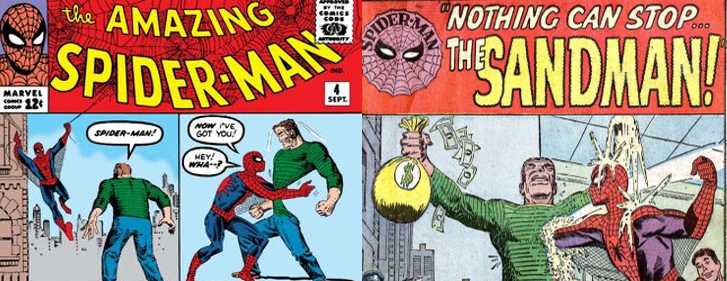
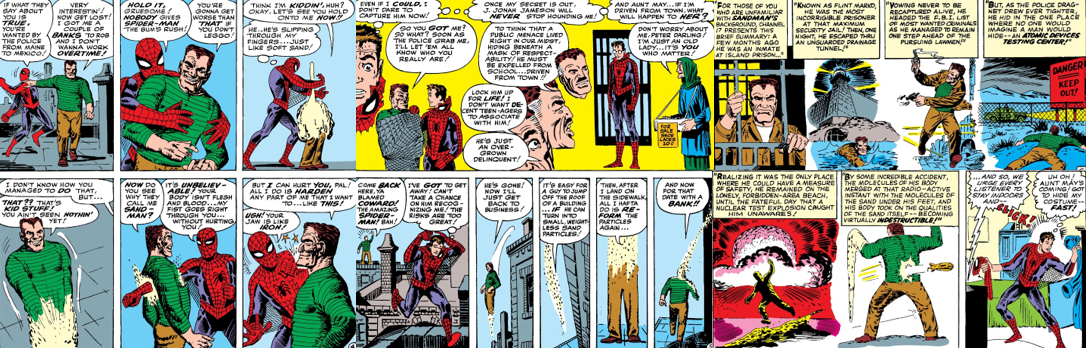
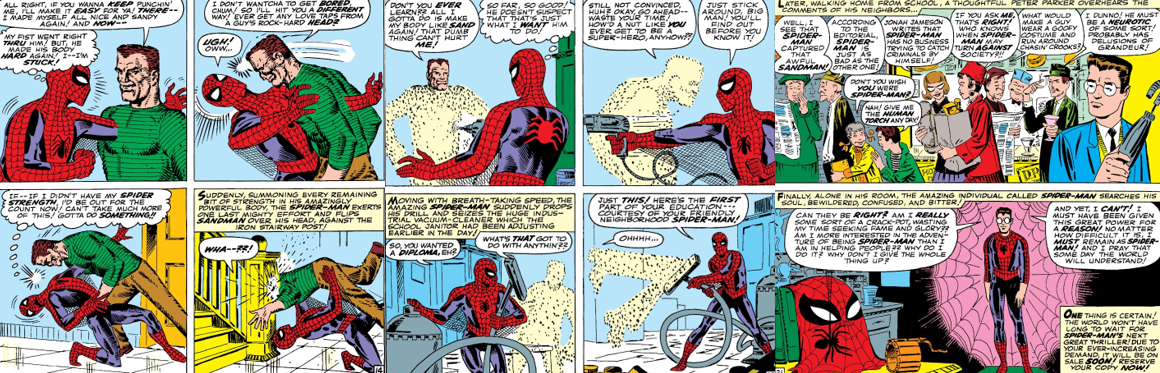
“Nothing Can Stop… The Sandman!” opens in very much the same way as a lot of Spider-Man stories from this era: our web-slinging hero starts the tale lamenting the hate campaign that the cantankerous J. Jonah Jameson continues to wage against him (which has escalated to an ongoing series, “The Spider-Man Menace!”, in the Daily Bugle) when he spots three shady looking goons eyeing up a jewellery store and leaps into action. Unfortunately for the troubled teenager, Spidey webs the would-be criminals up too soon; they rightly point out that there’s no law against walking the streets, brand him a menace, threaten to sue him for assault and battery, and yell for the cops to come and help them. Realising what a fool he’s made of himself, the web-slinger promptly gets out of there, consoling himself only with the knowledge that he did technically stop the goons from robbing the jewellers. Spidey decides to drop in on Jameson to give him a piece of his mind, only to find the grouchy editor isn’t in his office. As Spidey leaves, however, he spots a bunch of cop cars searching the streets and (apparently having learned nothing from his previous error) immediately confronts a thuggish looking brute climbing to a rooftop across the street. Luckily for him, though, the thug introduces himself as the Sandman, a criminal Spidey is only too well aware of as he’s wanted by the police “from Maine to Mexico”.

Spidey is stunned when he encounters the Sandman, a crook who can turn his body to...sand…!

Offended when the abrasive Sandman tries to brush him off like he’s nothing, Spider-Man moves to subdue the crook and is astonished when the Sandman literally slips through his fingers by turning his body into soft sand! The Sandman mocks Spider-Man as the wall-crawler’s punches go right through his body and when Spidey damn-near breaks his hand when the Sandman hardens his body to the consistency of iron, and his fully malleable body sends him reeling across the rooftop! Frustrated by the Sandman’s taunting and shape-shifting shenanigans, Spider-Man prepares to try his webbing on the crook but is startled to find that his mask has (somehow…) ripped during the fight. This sends his anxiety and paranoia into overdrive; Spidey envisions that capturing the Sandman will expose his secret identity, leading to an increased manhunt spearheaded by Jameson and the destitution of be beloved Aunt May. Of course, there’s nothing to suggest this would actually happen; there’s no way that the Sandman knows who Peter Parker is, after all, and he could just cobble together a substitute mask, but Spider-Man decides that the risk is just too great and flees before the Sandman can get a good look at him. This leaves the Sandman free to easily deposit himself at ground level, break into the bank by forming the exact shape of the key with his finger, and slip into the vault by turning his entire body into sand. Back at home, Peter frets about his sewing skills while watching a news report that’s conveniently expositing the Sandman’s bizarre origin story: career criminal Flint Marko escaped from solitary confinement in a maximum security prison on an island, swam to shore, and hid from the ensuring manhunt at an atomic device testing centre. There, he was caught in an atomic explosion and, rather than being immolated or suffering from gruesome cancer, his molecules were radioactively merged with that of the sand at his feet, transforming him into a veritably indestructible man of sand.

Peter’s social woes are exacerbated when the Sandman hides out in his school!

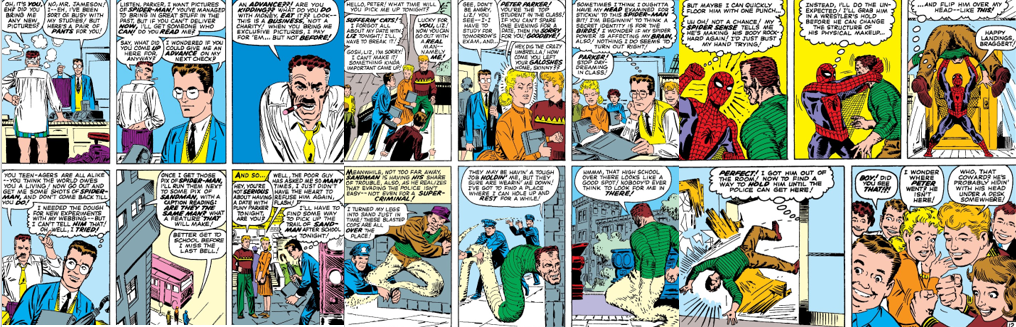
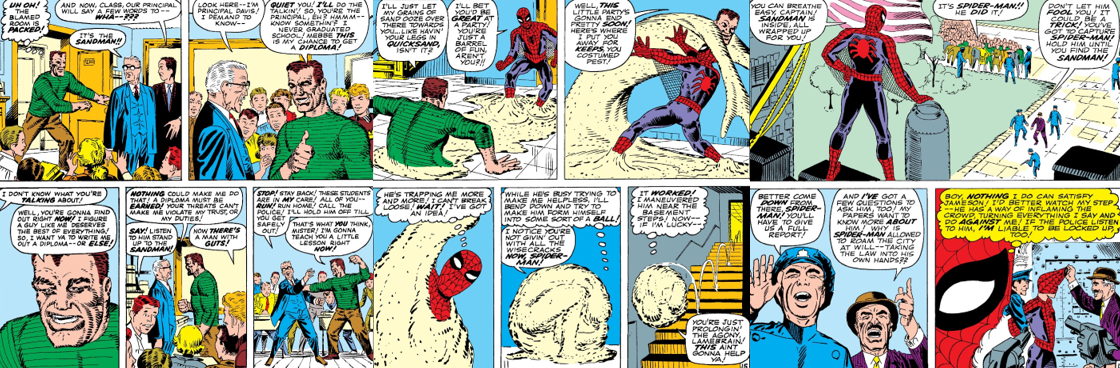
When his doting Aunt May comes knocking, Peter is forced to feign illness to cover up his costume and is unable to finish his work and get after the Sandman as she insists on mollycoddling him for the rest of the day and night. Consequently, the Sandman easily shrugs off the police’s gunfire, robs the bank, and eludes capture with his amazing abilities and Peter must wait until the morning (and being given a clean bill of health by his aunt) to finish up. Once he’s up and dressed (and armed with his umbrella and a promise not to exert himself), Peter heads over to the Daily Bugle, where Jameson’s mood has been soured by the little “gift” Spidey left for him the previous night (somehow, Spidey’s webbing managed to not dissolve after a few hours, but I don’t mind as it leads to Jameson standing around in his boxer shorts!) Unfortunately, Jameson is less than impressed by Peter’s lack of photos of Spider-Man and even more riled up when he dares to ask for an advance. Jameson berates Peter as an example of the entitled youth of the day and sends him packing, scuppering the webbing experiments Peter hoped to fund with the extra cash. Peter’s day just gets worse from there; distracted by the quandary of the Sandman, he’s forced to back out of a date with Liz Allen, earning him her ire and jeers from bully Eugene “Flash” Thompson, and he’s so disheartened by the drama of his dual life that even his teacher snaps at him for “daydreaming” in class. You wouldn’t believe it but the Sandman, annoyed at the constant attempts by the police to apprehend him, decides to duck into Peter’s high school until the heat dies down. He bumps into Principal Davis and, amazingly, demands that the teacher write him out a diploma so he can have an academic credit to his name! The kids are impressed when they see their principal standing up to the Sandman and even putting himself at risk to keep them safe but jump out of their chairs with excitement when Spider-Man leaps in to keep the Sandman from harming the elderly principal.

Though he triumphs over the Sandman, Spider-Man is slandered by Jameson’s hate campaign.

Realising that the kids are in danger and wary of the Sandman’s tricks, Spider-Man opts to hurl the brute out of the classroom when he hardens himself, but the Sandman quickly recovers and puts the pressure on Spidey by relentlessly trying to pummel him with his enlarged, hammer-like fists. Spider-Man lures the Sandman to the school gym, only for his webbing to fail him when the Sandman simply passes through it like…well…sand. The Sandman corners Spider-Man, who reacts on instinct and ends up with his arm trapped in Marko’s body. This allows the Sandman to repeatedly headbutt the web-slinger with his rock-hard head, forcing Spider-Man to desperately drive Marko into an iron stairway post to free himself and avoid being headbutted to death. The Sandman quickly reforms himself, ensnares Spidey’s ankles by turning his body into quicksand, and envelops the teenage hero with his entire body, encasing him within a ball of sand. Thinking fast, Spider-Man bounces his foe down to the school basement and slips free from his prison; he then plays to the Sandman’s arrogance by threatening him with an electric drill. Naturally, the Sandman simply turns his entire body into sand particles to render the tool harmless, but this is exactly what Spidey was hoping for; he quickly grabs a huge industrial vacuum cleaner and turns it on the Sandman, sucking him up and imprisoning him within a big metal capsule. Spidey then realises that he didn’t get a chance to snap any pictures of the fight for Jameson, so he fakes a few by snapping photos of himself tussling with some sand he tosses into the air! Jameson then inexplicably shows up at the school and starts barking orders at the cops with no care for the safety of the students inside. He angrily accuses Spider-Man of being in cahoots with the Sandman, so Spidey simply delivers Marko to the cops and changes back into Peter Parker. His joy at this victory is short-lived, however; not only does Jameson take the cost of developing his photos out of his pay, Liz and the others continue to berate him for being a coward and a bookworm, and Jameson uses Peter’s photos to further his vendetta against Spider-Man, leaving Peter despondent but nonetheless determined to continue using his powers for good.

The Summary:
Wow, Stan Lee really didn’t pull any punches in piling the pressure on young Peter Parker back in the day, did he? Peter has got to be the unluckiest guy in the world; it seems no matter what he does, the world is out to get him. It’s almost laughable at times, and especially in this story; Spider-Man’s busted up would-be crooks before and it’s never been a problem, but this time they threaten him with legal action as he jumps in too soon. Although he beats himself up over this, this mistake doesn’t stop him confronting the Sandman, which I think was a missed opportunity. If Spider-Man had spotted the Sandman and not intervened based on what just happened, Peter could’ve wallowed in self-pity not unlike the guilt he feels over Uncle Ben’s death when he later learned that the Sandman robbed that bank. Instead, we get this really random interlude where Spidey’s forced to run off because his mask rips (I still don’t see how that happened…) and he’s taken out of action by the suffocating affections of Aunt May. Then, rather than get out there and look for the Sandman, he’s scolded by his peers, subjected to abuse by the likes of Flash and the fickle Liz, and all his efforts to subdue the Sandman ultimately amount to nothing as Jameson is so determined to paint him as a menace. It’s really weird, though, as the kids at his high school are cheering him on and even the cops seem willing to give Spider-Man the benefit of the doubt, but the general public are easily swayed by Jameson’s biased opinions all so that Peter can be weighed down by depression and self-doubt. This already weighs so heavily on him that he totally overreacts when his mask rips and is immediately and irrationally convinced that it’ll mean the end of his life, even though the Sandman surely won’t know him from any other kid!

The Sandman’s powers are a highlight of the story, which beats Peter down at every turn.

Still, this interpersonal drama, as absurd as it often is in these older Spider-Man stories, is part of what makes Spider-Man so appealing; he always does the right thing and continues to fight against injustice even when most of the city wants to see him behind bars. In the Sandman, Spider-Man meets a formidable physical match; I really liked Marko’s characterisation here as a regular (if accomplished and notorious) crook who just happened to be granted amazing powers. His goals don’t extend much further than robbing banks for cash, but I really enjoyed that he demanded Principal Davis write him a diploma to realise his lifelong dream of graduating high school! At one point, Spider-Man compares the Sandman’s malleability to that of Doctor Reed Richards/Mister Fantastic, an analogy that’s not entirely unwarranted but I’d argue that the Sandman’s powers are even greater! He can basically make himself incorporeal, harden his entire body, stretch his limbs, make himself sticky, and form massive crushing appendages to attack Spider-Man and it’s his unpredictability more than his fighting prowess that throws off even Spidey’s famed spider sense since Spidey never knows what the Sandman is going to do next. I wasn’t a big fan of Marko’s unbelievable backstory (I’d love to know how he escaped from that prison…) but it’s fun seeing atomic power depicted in such surreal ways in comics and I liked that he was such a simplistic, and yet incredibly dangerous, adversary even if he barely scratched his potential here. Ultimately, I had a good enough time with this; while far from my favourite Spider-Man villain, the Sandman at least makes for a visually interesting baddie and the drama, while a bit too full-on at times, tied into Peter’s ongoing struggles with his duality. There are better Spider-Man stories from this era and things are wrapped up or rushed through a little too quickly, but it’s fun seeing Spider-Man being thrown for a loop by the Sandman’s fantastic powers and being forced to think of new ways to outsmart and overcome his latest villain.

My Rating:

Rating: 3 out of 5.

Pretty Good

What are your thoughts on the Sandman’s first appearance? Were you a fan of the villain and his unique powers or did you find him to be a bit daft and unbelievable? What did you think to Peter’s social woes and his panic over his ripped mask? Were you a fan of the Sandman’s simplistic motivations and bizarre powers? What are some of your favourite Sandman stories and moments? How are you celebrating Spider-Man Day today? Whatever your thoughts on Spider-Man and the Sandman, leave them below or drop a comment on my social media and be sure to check out my other Spider-Man content across the site!
Back Issues: Wolverine #88

Story Title: “It’s D-D-Deadpool Folks!”
Published: December 1994
Writer: Larry Hama
Artists: Adam Kubert and Fabio Laguna

The Background:
In 1974, Roy Thomas charged writer Len Wein to create the first Canadian superhero; a short, feisty character named “Wolverine”. After the legendary John Romita Sr sketched the original design for Wolverine and came up his now-iconic retractable claws, artist Herb Trimbe finalised the character’s design for his debut in the pages of The Incredible Hulk. Of course, nowadays, James Howlett (better known as “Logan”) is one of Marvel’s most well-known characters thanks to his association with the X-Men, but he’s not the only popular fast-healing Canadian Mutant anti-hero in Marvel Comics. In 1991, Fabian Nicieza and Rob Liefeld debuted Wade W. Wilson/Deadpool in the pages of The New Mutants. Heavily inspired by Wolverine, Peter Parker/Spider-Man, Slade Wilson/Deathstroke the Terminator, the self-styled “Merc With a Mouth” was initially introduced in an antagonistic role but eventually proved popular enough to graduate to his ongoing solo title. In time, Wolverine and Deadpool’s pasts would be intertwined to give them a shared history with the infamous Weapon X project and the two would cross paths as both rivals and team mates as members of the black ops X-Men team X-Force. Although both characters achieved greater mainstream success with their live-action movies, a proper big screen team up between the two seemed impossible after Hugh Jackman retired from the Wolverine role in 2017. However, in 2022, Ryan Reynolds shocked everyone by revealing that Jackman would return as Wolverine for Deadpool and Wolverine (Levy, 2024) and what better way to mark this momentous occasion than be revisiting the first-ever meeting of these two immensely popular characters?

The Review:
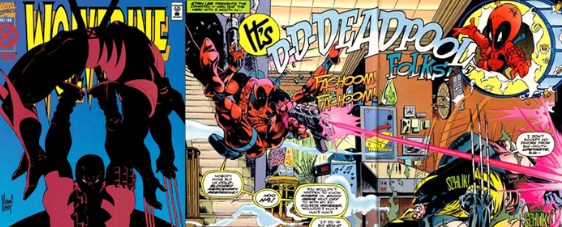
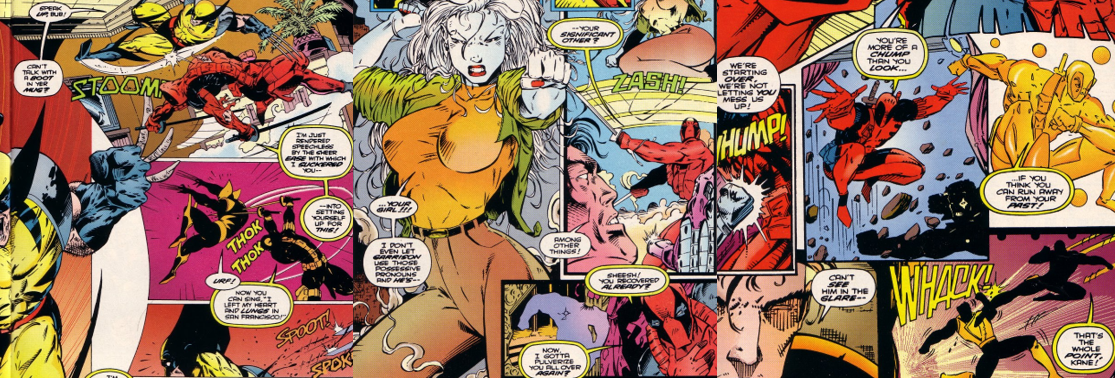
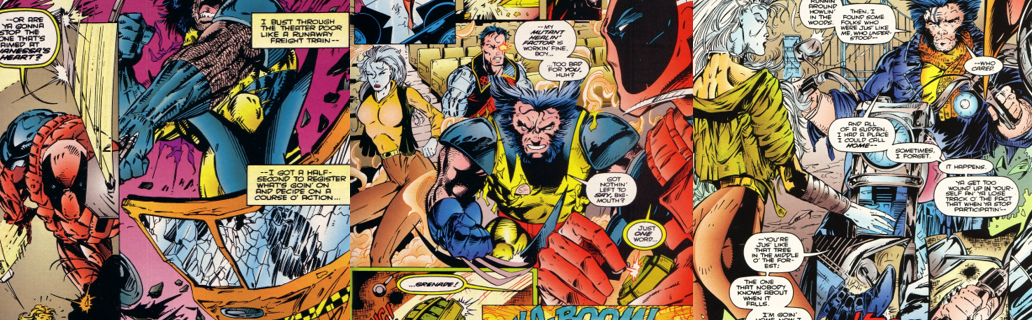
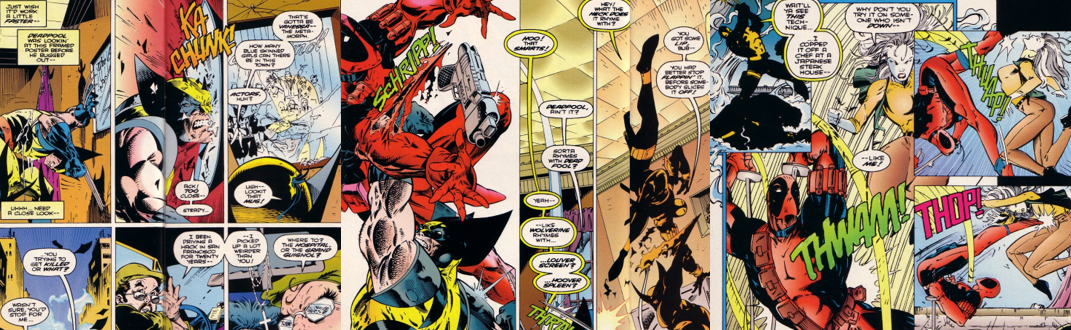
Our story opens with Wolverine back in the Great White North; he’s tracking down Garrison Kane/Weapon X as a favour to James Hudson/Guardian and (despite his heightened senses) is surprised to find the wacky mercenary Deadpool in Kane’s pimped out apartment. The hyperactive Deadpool immediately opens fire on Wolverine and promises to “put [him] out of [his] interminable suffering” if Logan can tell him where Kane took his “ex-squeeze”, Vanessa Carlysle/Copycat. Naturally, Wolverine refuses to rat out the two and fights back, slashing at Deadpool’s arm and trading insults as they clash. During their brutal combat, Deadpool boasts of his own healing factor, which gives him the edge over Wolverine since this story takes place during a time when Logan’s healing powers were on the fritz and he no longer had his Adamantium skeleton or claws thanks to Erik Lehnsherr/Magneto ripping it from his bones. While Wolverine still has the skills and ferocity to go toe-to-toe with Deadpool, his feral rage and curiosity about Deadpool’s vendetta against Kane cause him to leave himself wide open for the Merc with a Mouth to ram his swords through his back and into his lungs.

After incapacitating Wolverine, the deranged Deadpool attacks Kane and Vanessa.

Victorious, Deadpool spots a poster for the Grand Guigol theatre, realises that’s where his targets are, and skedaddles, leaving the critically injured Wolverine bleeding on the floor. At the Grand Guigol theatre, Kane and Vanessa are trying to establish normal lives for themselves as stage actors. Kane struggles with his lines and to find his motivation as an actor, but Vanessa encourages him to channel his infatuation with her and his desire to leave behind their tumultuous past into his acting. She’s ecstatic when this appears to result in a more convincing performance, only to find that he was startled by the sudden appearance of Deadpool. Delighted to find his targets and begging to know that Kane’s fighting skills have become as bad as his acting, Deadpool leaps at Weapon X, swords drawn, only to find his strike deflected by Kane’s mechanical arms. When Deadpool refuses to leave them be or forgive Kane for stealing his girl, he gets a beatdown from an enraged Vanessa and doesn’t hesitate to take a swipe at her, too. Kane gets in on the action, pummelling Deadpool and chastising him for interfering in their lives, but he loses the advantage when Deadpool temporarily blinds him with a flash of light from…somewhere… Back at Kane’s apartment, the wounded Wolverine struggles to his feet, his healing factor slowly taking care of his injuries, and cottons on to Deadpool’s lead. Wrapping the worst of himself up in a kimono, he stumbles out into the streets and into the back of a taxi that he demands take him to the theatre.

After healing, Wolverine makes a timely intervention that sees Deadpool make a desperate escape.

During the taxi ride, Wolverine endures a particularly chatty cab driver and is grateful to find his wounds have healed. However, when the cab’s brakes malfunction halfway to the theatre, Wolverine’s frustrations get the better of him and he slices off the cab door and opts to skate the rest of the way on the severed cab door! Although Vanessa intervenes before Deadpool can decapitate Kane, she ends up getting knocked on her ass by Wade’s unpredictable agility and Deadpool offers Kane a choice: defend himself from one sword or catch the other sword tossed right at Vanessa’s heart. Luckily, Wolverine shows up, bursting in “like a runaway freight train” and intercepts the blade, saving Vanessa. Deadpool’s stunned to see Wolverine alive and well and finds himself outnumbered by the three unlikely allies; as such, he chooses to toss a grenade into the group and beat a hasty retreat. In the aftermath, Wolverine helps tidy up Kane and Vanessa’s apartment and offers them advice about moving on from their violent and chaotic pasts. He also helps Vanessa to see that Kane chose to save himself so that he’d be able to help Vanessa rather than being selfish, and then rides off after noting that they were lucky he didn’t catch a cab with good brakes.

The Summary:
I often find that the comics I review are a little light on action and fight scenes; characterisation, interpersonal drama, angst, and outdated sensibilities are often the order of the day, meaning fights and visual spectacle are few and far between. That’s not the case with Wolverine #88; if anything, the opposite is true, and the issue is more style over substance. It’s definitely a side chapter in Wolverine’s larger story; we’re seeing how Logan is coping being “the best there is at what he does” with a less reliable healing factor and his awful bone claws, which often puts him at a disadvantage and makes him more vulnerable. This is the case here; while he’s still a skilled fighter and his feral nature allows him to go all-out against the likes of Deadpool, he can’t just leap head-first into fights these days and that costs him. In fact, Wolverine even notes that if he’d been injured like he was at Deadpool’s hands just a few months ago, he’d probably have been killed, though Wolverine’s mortality was often emphasised even before he had the Adamantium ripped from his bones. I quite like seeing Wolverine going out and doing his own thing, though, and having loyalties and adventures beyond the X-Men. It would’ve helped to emphasise this if he’d been wearing his brown/tan uniform instead of his yellow/blue one, but it adds a lot to his character that he’d do a favour for James Hudson and go out of his way to protect Garrison Kane and Vanessa despite them not really being in his close circle and their ties to the Weapon X project. I quite enjoyed seeing Wolverine stumble about, bleeding out in a daze, and struggling to knit himself back together in the back of the taxi. He had some amusing moments here, such as accidentally smashing his face into a picture of the Grand Guigol theatre and “skateboarding” through the streets on a car door, while still being a formidable and honourable (and brutal) fighter.

Some humorous moments and brutal fights help this otherwise shallow issue to stand out.

As ever, Deadpool really makes an impression here; this is still before he started breaking the fourth wall and being depicted as a nigh-immortal, ultra-skilled character, but he’s still absolutely out of his mind. The unique depiction of his speech bubbles and his hyperactive, deranged nature match perfectly with his dynamic agility, which allows him to perform physics-defying moves that out-fight the legendary Wolverine and fend off attacks from both Kane and Vanessa. Deadpool’s despicable nature means he’s not above fighting dirty and he’s perfectly happy to attack and even attempt to kill Vanessa, which only goes to show how warped he is since his entire motivation here is to kill Kane for stealing his ex and presumably win her back from him. Deadpool’s fighting skill, marksmanship, and swordplay are only part of the story here; he now sports an advanced healing factor that lets him fight Wolverine up close and dirty and isn’t afraid to use the small arsenal he carries both as offensive and defensive weapons. I still don’t really get what that blinding flash was supposed to be since he’s not shown pulling out a flash grenade or anything. In fact, as fun and dynamic and vicious as the issue’s art is, some of the fight scenes and narrative pacing was a little confusing (such as Vanessa randomly querying Kane’s actions at the end completely unprovoked) but there’s a visceral “nineties” feel to the issue that helps make everything feel entertaining and chaotic. This suits both Wolverine’s volatile nature and Deadpool’s madcap demeanour and results in Wolverine #88 being a visually fun, if narratively light, first meeting between the two; they establish an instant animosity based on how similar there are as fighters and in their Mutant abilities and it was fun seeing them tangle. I would’ve liked to delve a little deeper into that dynamic and maybe focus a little more on Wolverine as a protector to Kane and Vanessa, but I liked the race against his own body and time to intercept Deadpool and how open-ended the story finished so I’m excited to check out future meetings between the two someday.

My Rating:

Rating: 3 out of 5.

Pretty Good

What did you think to the first meeting of Wolverine and Deadpool? Were you disappointed by the lack of plot or did the brutal fighting win you over? Were you a fan of Wolverine’s bone claws? What did you think to Deadpool’s characterisation as a deranged psychopath? What are some of your favourite moments between Wolverine and Deadpool? Whatever your thoughts on Wolverine and Deadpool, feel free to share them below or on my social media, and be sure to check out my other Wolverine and Deadpool content across the site.

Back Issues [Independence Day]: The Avengers #4


First appearing in 1941, Marvel Comics’ star-spangled super soldier, Captain Steve Rogers/Captain America, has become one of Marvel’s most recognisable and celebrated characters not just for his super patriotism but also for being a prominent member and leader of Marvel’s premier super team, the Avengers. Having successfully made the jump to live-action, Cap is now a widely celebrated, mainstream superhero and, given that today is Independence Day, this seems like the perfect excuse to pay tribute to the star-spangled man with a plan himself!


Story Title: “Captain America Joins…The Avengers!”
Published: 1 March 1964
Writer: Stan Lee
Artist: Jack Kirby

The Background:
In 1941, the Second World War was well under way; Nazi Germany overtook Denmark and Norway in April 1940 and the United States finally entered the fray in 1941 to oppose the combined “Axis powers” of Germany, Japan, and Italy. Due to the ever-escalating conflict, patriotism and national pride ran rampant in America, leading to Joe Simon and the legendary Jack Kirby debuting Captain America and his kid sidekick, James Buchanan Barnes/Bucky, who took the fight directly to the enemies of America and encouraged readers to support the war effort by any means necessary. However, after the War ended, superheroes saw a decline in popularity and Captain America’s solo title was cancelled in 1954, but the character got a second chance when he was recast as a “man out of time” in this issue of The Avengers. The Avengers came about as a direct response to rival DC Comics’ Justice League of America; Martin Goodman tasked Stan Lee with bringing together Tony Stark/Iron Man, Doctor Bruce Banner/The Hulk, Doctor Donald Blake/Thor Odinson, Doctor Hank Pym/Ant-Man, and Janet van Dyne/The Wasp as Marvel’s premier superhero team. With their ever-changing roster and prominence in some of Marvel’s biggest events and stories, the Avengers became a consistent and influential presence in Marvel Comics, even more so after the Star-Spangled Avenger joined their ranks in this historic issue.

The Review:
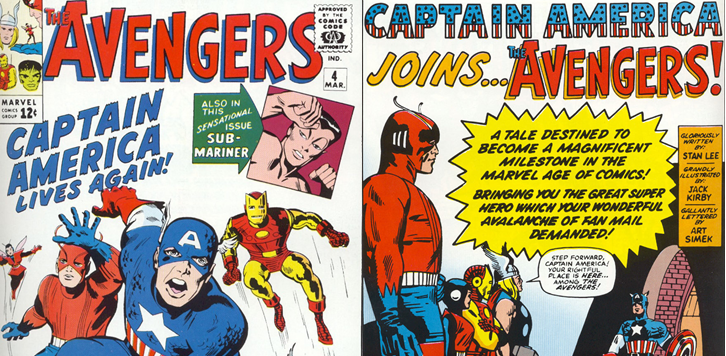
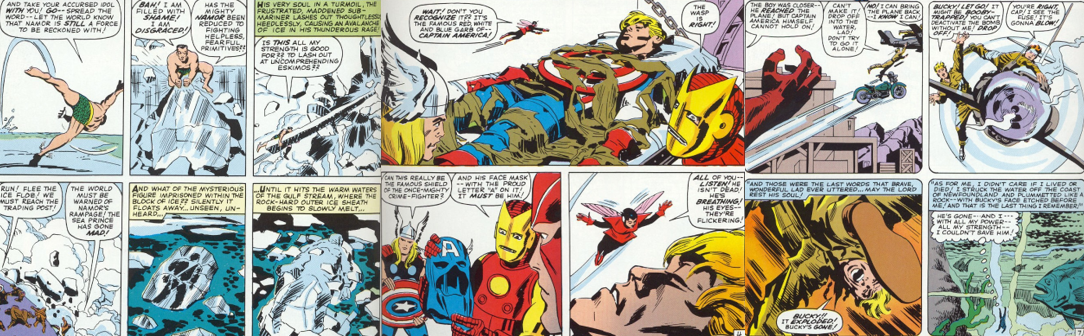
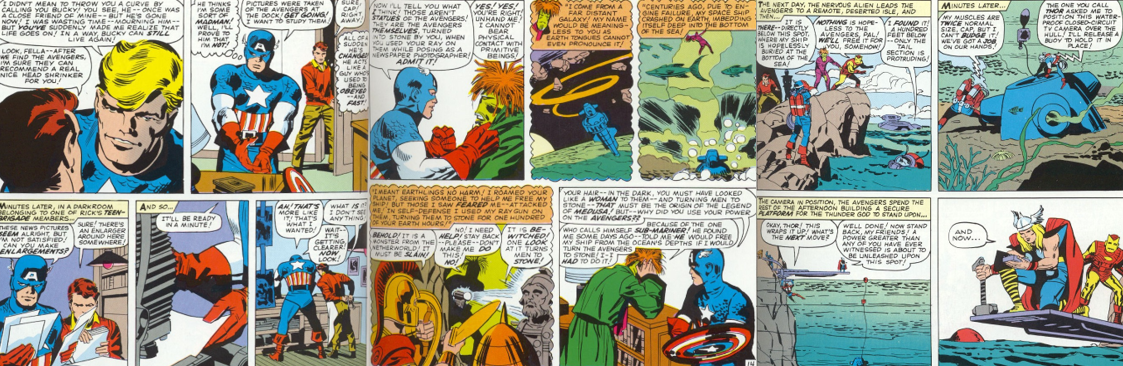
Marvel Comics always liked to hype up their stories and issues back during this time period; front covers would proclaim even the most bizarre-looking characters as being must-see events and issues generally always featured celebratory mentions of the creatives involved, and The Avengers #4 is no different. There are a couple of notable unique features in the full-page title splash for this story, though; first, a big explosive bubble of text directly attributes the return of Captain America to an “avalanche of fan mail” and a dialogue box at the bottom of the page makes sure to mention that “glorious” Stan Lee and “grand” Jack Kirby both collaborated on Captain America’s debut story, thereby lending further prestige to his return to the then-modern era of Marvel Comics. The story itself takes a little while to get started as the first page of panels is dedicated to recapping the Avengers’ battle against Prince Namor McKenzie/The Sub-Mariner and the Hulk in the previous issue; after the Hulk disappeared, Namor was forced to flee from the overwhelming odds and returned to the depths of the ocean. The sting of defeat is great for the proud Mutant but pales in comparison to the frustration he feels at being abandoned by his people after the inhabitants of Atlantis questioned his loyalty. Vowing to never stop searching for his lost people, Namor finds himself lost amidst the frozen wastes of the North Sea, where he comes across a tribe of Eskimos who worship a mysterious figure frozen in a block of ice. Interestingly, despite the Eskimos being isolated from the rest of the world, they instantly recognise “the dreaded Namor”, who wastes no time in mocking their idol and turning his anger upon them. In his rage, Namor decimates the frozen landscape, terrorises the simple folk, and hurls their frozen idol into the sea.

The Avengers are awestruck when they recover the perfectly-preserved body of the legendary Captain America!

Free from the frigid temperatures of the northern climate, the ice block slowly melts and, by the time the Avengers come across it in their little submarine (I assume they were tracking Namor, that seems to make sense as to why they’d randomly be out there), the ice has completely melted, freeing the unconscious body trapped within. Giant-Man brings the body aboard and the team are stunned to find that it’s none other than the slumbering body of the legendary Captain America, a star-spangled crusader of justice so prolific that even Norse God Thor is aware of his accolades. The team’s shock at this discovery turns to panic when Cap suddenly awakens and lashes out in a confused daze, desperate to keep his kid sidekick, Bucky, from harm. Thor, Iron Man, and Giant-Man leap in to restrain the raging legend, but his madness quickly passes. Within the space of five panels, he resigns himself to the memory that Bucky is dead and reclaims his identity, shield, and mantle of Captain America. Though impressed, the Avengers are so puzzled by Cap’s youth and vigour that they suspect some kind of trick. Thus, Cap invites them to test him, easily dodging Thor’s magical hammer, overpowering even the hulking Giant-Man, and is only kept from embarrassing the group further when Wasp stops him in his tracks by challenging his chivalry. Suitably convinced that Cap is the real deal, tensions calm long enough for Cap to tell the tragic story of how he came to be encased within a block of ice. Back during the Second World War, Cap and Bucky were posing as security guards at an Army base when a mysterious Nazi figure launched an explosive-filled drone in a bid to either kill the two or rob the United States of a powerful weapon. Although Cap failed to reach the plane in time, Bucky leapt onboard and was seemingly vaporised when the plane exploded; the heartbroken Cap was hurtled into the ocean depths off the coast of Newfoundland, where he became encased in ice and effectively held in suspended animation. When the Avengers reach New York City, they’re greeted by the press, hungry for the big scoop on their battle against Namor and the Hulk, but the team are suddenly and inexplicably turned into stone statues by a flash of light! Cap missed the event since he was still inside the craft and, when he emerges topside to find everyone gone, he assumes that the statues are in honour of the colourful heroes and ventures out to explore the strange new world he’s found himself in without a second thought.

Cap tracks down the one responsible for petrifying the Avengers, an alien whom he vows to assist.

Cap is impressed by how much has changed, from clothing and fashion to the establishment of the United Nations and the upgrades to everyday vehicles, and stuns the public, who instantly recognise him as the legendary hero of World War II. Directed to a hotel by a helpful police officer, Cap briefly marvels at the wonders of television before dozing off in a troubled exhaustion. Already questioning his place in the modern age, Cap is startled to wake up and find Bucky alive and well in his hotel room…only to realise that it’s perennial sidekick and Avengers mascot Rick Jones. Concerned by the Avengers’ disappearance, Rick confronts Cap; since Cap was the last person to see them, Rick basically accuses him of being involved and threatens to set the Hulk on him if he doesn’t help find the team. This threat means little to Cap since he doesn’t know who the Hulk is and he’s still struggling with the uncanny resemblance between Rick and Bucky, but he promises to help find the team despite Rick’s rude demeanour. After reviewing the photos taken of the team by the press, Cap spies a suspicious man holding a camera-like gun and Rick wastes no time in contacting his “teen brigade” to try and find him amongst the teeming masses. Laughably, the teens come up with nothing but dead ends and false leads, but Cap finds the guy seemingly at random just by scouring the city’s rooftops. Once he spots the man he’s looking for, Cap wastes no time in springing into action and confronting him and his armed goons. Even these lowly mobsters recognise Cap and they’re easily overwhelmed by his indomitable shield, uncanny agility, and Herculean strength; while the goons quickly surrender, their leader desperately tries to turn Cap to stone with his ray gun, only to miss and be unmasked as a bizarre extraterrestrial lifeform! Unfazed by this, Cap threatens the alien (who goes unnamed in this issue but is eventually revealed to be named Vuk), who gladly tells his story to avoid being handled by “primitive beings”. Vuk crash-landed on Earth centuries ago and, encountering nothing but fear and hostility, would turn men to stone with his ray gun in self-defence, which Cap realises directly led to the myth of the hydra-haired, stone-eyed Medusa. Vuk relates that the Sub-Mariner promised to help Vuk return to the stars if he turned his weapon against the Avengers and, recognising the Sub-Mariner’s name from the past, Cap vows to help Vuk in return for undoing the damage he’s inflicted upon the Avengers.

As impressed by the team as much as they are with him, Cap helps fight Namor and joins the Avengers.

Namor witnesses these events from his deserted imperial castle using his “undersea scanner” and vows to avenge himself upon his enemies, a promise that suddenly becomes more viable when he conveniently stumbles upon a loyal troop of his elite guard. True to his word, Cap leads the Avengers in finding and freeing Vuk’s ship from the ocean depths, an act that earns them Vuk’s eternal gratitude and Cap’s admiration for the group’s unparalleled teamwork. Their victory is short-lived, however, as Namor and his elite guard suddenly attack the group; Iron Man goes toe-to-toe with Namor but his armour struggles to withstand the sledgehammer-like blows of the Sub-Mariner. In desperation, Iron Man blasts Namor with a “full [intensity] magnetic ray”, but this only grants him a temporary reprieve; with his armoured foe’s “greatest weapon” exhausted, Namor redoubles his attack, smashing a rock over Iron Man’s head and manhandling him to the ground. Momentarily powerless as he waits for his transistors to recharge, Iron Man is saved from certain death by the timely intervention of the Wasp, who Namor easily shrugs off before answering his lieutenant’s plea for help in subduing the rampaging Thor. Thanks to his mighty hammer, Thor easily holds back Namor’s forces by himself and repels the energy bolts fired at him by their ray guns, forcing Namor to leap at the Thunder God to tackle him directly. After slipping free of the Atlantean’s net and saving himself from drowning, Giant-Man returns to the fray to assist Iron Man, hurling the Atlanteans off-panel with his massive strength before rushing to aid Thor in tussling with Namor, who’s become obsessed with wrestling Mjölnir from Thor’s grasp. Watching from the side lines, Cap can’t help but be impressed by the power and courage of the Avengers and in awe of Mjölnir, a weapon so powerful that only the Mighty Thor can lift it. Although the Avengers clearly have Namor beat, the proud prince refuses to surrender and lowers himself to threatening Rick’s life. This irks Cap so much that he finally leaps into action, tackling Namor’s elite guard and briefly being overpowered by the Sub-Mariner before the tiny isle on which they’re all fighting suddenly (and conveniently) breaks apart from an undersea explosion caused by Vuk’s ship. Confident that his enemies will drown beneath the resulting waves, Namor commands his forces to retreat, unaware that the heroes easily survived by clinging to the remains of the island. Impressed by Cap’s prowess in battle, the Avengers ask him to join their little team and he gratefully accepts, but Rick is left pondering the fate of his friend and partner, the Hulk, whose rage at being “replaced” by Captain America is as sure as the inevitability that the Avengers will butt heads with the Sub-Mariner again before long.

The Summary:
I quite enjoyed “Captain America Joins…The Avengers!” I sometimes struggle with Jack Kirby’s more bizarre artwork and designs but there was none of that here (save for the Avengers’ submarine and the brief depictions of Atlantean technology), which really helped these colourful characters to stand out all the more prominently. I especially liked Cap’s brief walk around New York City and him being impressed by the advances in technology and society since his day, and the panels that took place underwater, which evoked a murky, almost alien environment. Unfortunately, paralleling this was the pretty haphazard and confusing flashback to Bucky’s final mission, where it’s a bit difficult to make out where the characters are in relation to the plane, and the depiction of Vuk, who ends up looking more like Beaker than anything remotely impressive. I also really didn’t care for the reveal that an alien was behind the Avengers’ petrification; it was weird that Cap took it in stride and that the story didn’t treat it as a big deal, and it just came out of nowhere. I think it would’ve been far better to have it be an Atlantean in disguise, maybe switch the order of events to show Namor recruiting his elite guard before the Avengers reach New York, and then Cap could just threaten the Atlantean into helping him. It’s a minor thing to complain about but that’s kind of the problem; Vuk doesn’t even get a name and it just seems so random to just insert a Medusa-like alien into the story when the primary focus is the antagonism against Namor. Normally, I’d also complain about the depiction of women and youth during this time but, aside from being a bit too rude and confrontational, I didn’t have much of an issue with Rick Jones here and I was actually very impressed by the restraint show with the Wasp. She doesn’t fawn or coo over Cap upon seeing him and actually proves quite useful in the scuffle with him and Namor…but then all that goodwill gets thrown away on the very last page where it’s revealed that the Wasp disappeared from the battle to powder her nose!

Cap impresses with his abilities and characterisation, as does Namor’s unquenchable pride.

However, I enjoyed the angst of the Sub-Mariner as depicted here; Namor’s anger against he surface world has only exacerbated since his people abandoned him after questioning his loyalty due to his mixed heritage and he’s desperate not only to find his people, but to subjugate humanity to prove his superiority. There’s a tragedy to Namor that’s present even here; he lashes out at everyone and everything because he doesn’t want to be alone and craves power and adulation, but he’s tormented by being a child of both worlds and his status as a Mutant amongst even his bizarre people. Depicted as both an underhanded tactician and a formidable physical force, Namor’s threat is enough to require the attention of all the Avengers even without his elite guard and I liked how he easily overpowered Iron Man and matched even Thor’s God-like power (even if he was unable to lift Mjölnir). Of course, the true star of this story is Captain America; I really enjoyed how the issue went to great lengths to talk up Cap’s status as a legendary figure and that even randomers in the street recognised him as a hero from their youth. The Avengers are awestruck by his presence and seem delighted to not only have him amongst them, but also to test his abilities in battle, and Cap is equally impressed by the team, who he wishes could’ve been by his side during World War II. While it seems like Cap quickly regains his senses and returns to his confident and commanding persona, the story does touch upon the grief and anguish he feels at Bucky’s death and his feelings of belonging in the then-modern world. Though impressed by how far the world has come since his day, Cap briefly feels as though he doesn’t belong there, and it isn’t until he’s back in action, tracking down the Avengers’ mystery attacker and engaging with the Sub-Mariner, that he truly feels himself again. This was the perfect way to sell newcomers and sceptics on Cap’s return and make him relevant amongst his modern contemporaries and I really enjoyed how he meshed with the Avengers and their mutual respect for each other. Take out the Vuk stuff (or replace it with something better) and this would’ve gotten full marks from me, but it’s still a blast to read and one of the quintessential Avengers and Captain America stories.

My Rating:

Rating: 4 out of 5.

Great Stuff

Have you ever read “Captain America Joins…The Avengers!”? If so, what did you think of it and did you enjoy seeing Captain America join the Avengers? Was this your first exposure to Captain America, and if not what was? Were you also disappointed by the inclusion of Vuk? What did you think to the depiction of Namor and Cap’s introduction to the then-modern world? Which of the Avengers is your favourite? How are you celebrating Independence Day today? Whatever your thoughts, drop a comment below or on my social media and be sure to check out my other Captain America content across the site!
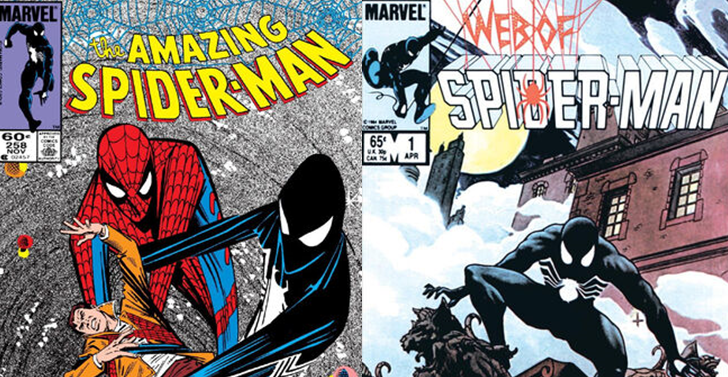
Back Issues [Superman Day]: Action Comics #23 / Adventure Comics #271


In 2013, DC Comics declared the 12th of June as “Superman Day”, a day for fans of the Man of Steel the world over to celebrate Clark Kent/Kal-El/Superman, the superpowered virtue of “Truth, Justice, and the American Way” who is widely regarded as the first ever costumed superhero.


Story Title: “Europe at War (Part II)””
Published: April 1940
Writer: Jerry Siegel (credited as “Jerome Siegel”)
Artist: Joe Shuster

Story Title: “How Luthor Met Superboy!”
Published: April 1960
Writer: Jerry Siegel (credited as “Jerome Siegel”)
Artist: Al Plastino

The Background:
Jerry Siegel and Joe Shuster, sons of Jewish immigrants, first met in 1932 at Glenville High School. By the time they were sixteen, they were already accomplished comics creators and, in 1933, they thought up their first concept for a superman with “The Reign of the Super-Man”. This story depicted a bald mad scientist who attempted to dominate others with his telepathic powers. Though a far cry from the most influential fictional character in American history, the duo would revisit the concept of a bald mad scientist in 1940. Originally known only as “Luthor”, Alexander “Lex” Luthor would evolve beyond his relatively childish reasons for hating the Man of Steel and become Superman’s arch-nemesis. While Kryptonite might weaken or kill Superman, Doomsday and Darkseid might pummel him, and Vril Dox/Brainiac might threaten his adopted world, Lex Luthor has become infamous for pitting his mind against the Man of Steel. Whether a scheming industrialist with seemingly unlimited resources, an egomaniacal megalomaniac, or enjoying the power of the United States Presidency, Luthor has created robots, patsies, mech suits, and even cheated death itself and had a brief stint as a superhero, all with the aim of acquiring the power to either humble, humiliate, or destroy his alien foe. As Superman’s most complex and enduring villain, Lex Luthor is a staple of any Superman adaptation. Clancy Brown and Michael Rosenbaum are considered two of the finest to portray the character, though it was Gene Hackman who set a high standard for all future portrayals of DC Comics’ most conniving criminal mastermind.

The Review:
The first appearance of a dangerous maniac named Luthor occurred in the second part of the “Europe at War” storyline. As established in the previous issue, the “lesser nation” of Galonia was suddenly attacked by Toran and reporters Clark Kent and Lois Lane were sent to cover the conflict as war correspondents. While sailing to Luxor, Clark was stunned to find beautiful actress Lita Laverne was a spy working alongside the Toranian Council of War to target the neutral vessel. Action Comics #23 picks up with the Man of Steel defending Belgaria from incoming shells before he (as Clark) and Lois meet with bald General Lupo, who’s confident that the war will end soon as a contingent of Toran officials are on their way to peacefully negotiate. Clark switches to Superman and flies ahead to take some photos of their arrival, only to witness the convoy be destroyed, which causes hostilities to renew. After sending an update to the Daily Star, Clark questions General Lupo, who insists that the Galonians would never be so deceitful, only to then make a suspicious phone call, completely unaware of Clark’s super-hearing. Suspicious, Superman trails General Lupo to a mountain range, where he disappears into thin air! Using his incredible strength, Superman rips open the mountainside and discovers a hidden passageway, where General Lupo is transfixed by a huge slab of rock, which bursts into hypnotic lights and a commanding face. General Lupo is astonished when Superman confronts him and, though he fears his disembodied master, desperately begs off being smushed against a wall and reveals that the mysterious “Luthor” is orchestrating events to engulf both nations in bloody warfare. 

Superman is perplexed by the mysterious Luthor, who plots to take over the word through chaos.

However, when Superman demands to know who “Luthor” is, green lasers suddenly burst from the wall-face and “[slice] the General in half”! Naturally, Superman is immune to the attack; he destroys the cave and escapes just in time to spy Luthor’s bombers flying overhead. He then destroys them all using his super strength and a mounted gun before warning both sides (as Clark) about Luthor’s machination. Although they don’t believe him since he has no proof, this brings him to Luthor’s attention, who orders Clark eliminated to keep him from talking. Conveniently, Lois happens to be looking for Clark in his hotel room, so Luthor’s minions grab her instead, transporting her to Luthor’s secret base, which is suspended from a gigantic dirigible “high above” Earth’s atmosphere! Although unimpressed that his goons failed him so badly, Luthor – a red-haired despot in a matching robe – nevertheless interrogates Lois, only to be met with confusion and sarcasm. While in her cell, Lois notices that her guard, a surly bald man, isn’t under Luthor’s hypnotic influence. She then threatens to expose him to Luthor unless he informs Clark about her capture and the guard is so terrified of his leader’s reprisals that he readily agrees. After reading the note, Clark flies into action as Superman, takes out a couple of guards, and bursts through a brick wall to rescue Lois. However, when Luthor threatens to harm Lois, Superman readily submits to parlay with the maniac, who describes himself as having the “brain of a super-genius” and plans to use his “scientific miracles” to plunge the world’s nations into conflict, weakening them so that he can assume control.
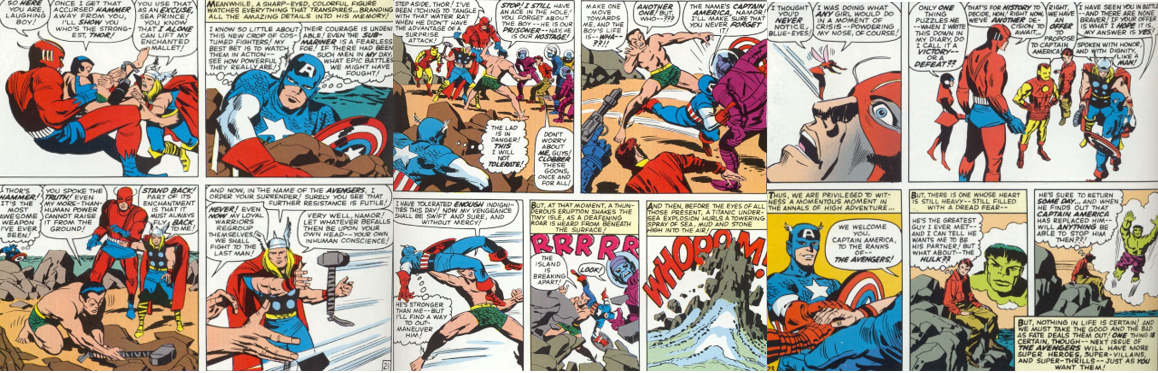
Superman is revealed to have known Luthor as a youth when he adventured as Superboy.

Luthor demonstrates his ability by strapping Superman up and bombarding him with an intense concentration of rays. However, Luthor grows tired of this and prepares to finish Superman off with a burst of deadly exposure, only for Superman to suddenly break free, turn the machine against Luthor’s underlings, shrug off its effects, and destroy the machine. After unsuccessfully trying to barter for his life, Luthor is equally unable to keep Superman from trashing the dirigible’s controls, sending it (and, presumably, all its inhabitants) crashing to the ground in a fiery blaze. The sight of the dirigible’s destruction is enough proof for the nation’s representatives to believe Clark’s story and the conflict comes to a peaceful resolution, with Clark praised for breaking the scoop and Lois eagerly awaiting her next encounter with the dashing Superman. Although Superman clashed with Luthor many times after this, it would take nearly twenty years to delve into Luthor’s origins, a story that took place during Superman’s youth in Smallville, Kansas, as Superboy. In this story, the young Lex Luthor has just moved to Smallville and, being the friendly youth that he is, Superboy flies in to say hello. Conveniently, a Kryptonite meteor lands right next to the Boy of Steel and immediately begins weakening him. Luckily, Luthor and his trusty tractor are on hand to save Superboy and the two quickly become friends. Luthor is a Superboy fanboy, as evidenced by his shrine to the young superhero, and a budding scientist, with ambitions to become a world-famous scientist. In gratitude for his help, Superboy builds a modern laboratory for his new friend using nothing by junk metal and his super speed and strength, which he fills with rare Earth materials for Luthor to experiment with. Although Superboy expresses caution since the chemicals are unknown and Luthor’s young and inexperienced, Luthor promises to be careful and the two part as friends, with Superboy owing his life to Lex and Luthor astounded to have befriended the Boy of Steel. Luthor wastes no time in getting to work, feverishly working with the chemicals over a period of weeks and producing a crude protoplasmic lifeform that he’s so excited by that he immediately sets to work coming up with a Kryptonite antidote so his new buddy won’t ever have to worry about that pesky substance threatening his health. 

Embittered after a lab accident, the once-kindly Luthor turns against his former friend.

Luthor retrieves the meteor from the lake, takes a few samples, and creates the antidote in no time at all. However, in his excitement, he accidentally knocks over a chemical flask that starts a toxic fire in his lab. Luckily, Superboy happens to be passing by and hears Luthor’s screams for help; he uses his super breath to put out the flames, accidentally blowing a jar of acid against the antidote and destroying it. To make matters worse, the gas fumes caused Luthor to go bald and destroy his weird protoplasmic creature, destroying all his hard work. And, while Superboy is apologetic and insists it was an accident, Luthor accuses him of being jealous of his genius and purposely sabotaging him, instantly flipping from a kindly boy to an embittered youth in the blink of an eye. Superboy offers to help him rediscover his experiments, and insists he’d never harm the boy who saved his life, but Luthor’s having none of it. He feigns sorrow to get rid of Superboy and then flies into a rage, destroying his Superboy memorabilia and plotting to avenge himself on the Boy of Steel with the last sliver of protoplasm. The next morning, Luthor has Superboy drink the “antidote” and then accompany him into space, protected by a space-globe Superboy brought along, to observe its effects. At first, Superboy is delighted to find he’s no longer vulnerable to the Kryptonite meteors floating around in space, completely unaware that they’re actually “Fool’s Kryptonite”, a ruse even Krypto the Superdog can see from a mile away. As soon as they return to Earth, Luthor spitefully reveals it was all a ruse and that the antidote is only temporary and vows to be more admired, and more famous, than Superboy, who flies away despondent and commenting that Luthor needs “a father’s guidance”.

When his attempts to outshine Superboy fail, Luthor resorts to attempted murder.

Some weeks later, Luthor approaches Smallville’s mayor with a fantastic invention, a weather-tower to keep the town perpetually warm by reflecting the sun’s rays, and the mayor is so impressed by his pitch that he approves it immediately. Both Superboy and the townsfolk are in awe and admiration of Luthor’s ingenious invention, which spares them the bitter chill of winter, and Superboy quietly wishes his former friend all the success in the world, harbouring no ill-will towards him. However, young Clark is alarmed when he notices that his adopted parents – Jonathan and Martha Kent – suffer from the intense heat. He’s even more startled when he sees the weather-tower is causing fires to break out all over the town, endangering its people, so he uses his freeze breath to cool the construction down, which effectively destroys it. Smallville’s populace are less than thrilled and openly mock Luthor in the street for putting their lives at risk with his crazy inventions, which he bitterly blames on Superboy. To atone, Luthor toils away for many months and produces seeds that promise to near-instantly produce fruit trees for the local farmers; although people are sceptical, they’re astounded when Luthor’s claims come true, but their elation soon turns to horror when simple rain turns the trees into marauding giants! Superboy deals with the issue, chalking it up to carelessness on Luthor’s part rather than maliciousness, but Luthor’s reputation is further tarnished and his hatred for Superboy only grows. This sees him unearth the Kryptonite meteor and lure the Boy of Steel into a trap and taunt the dying Superboy with the only antidote to his slow, painful death. In his arrogance, Luthor fails to remember Superboy’s super-breath, which allows him to suck up the antidote vial and save his own life, but Superboy chooses to consider them even rather than acquiesce to Luthor’s demands to be arrested. Out of respect for the friendship they once had and believing that Luthor could be a force for good, Superboy lets Luthor go, with the obsessed youth swearing to not only surpass the Boy of Steel’s popularity but destroy him in the process! 
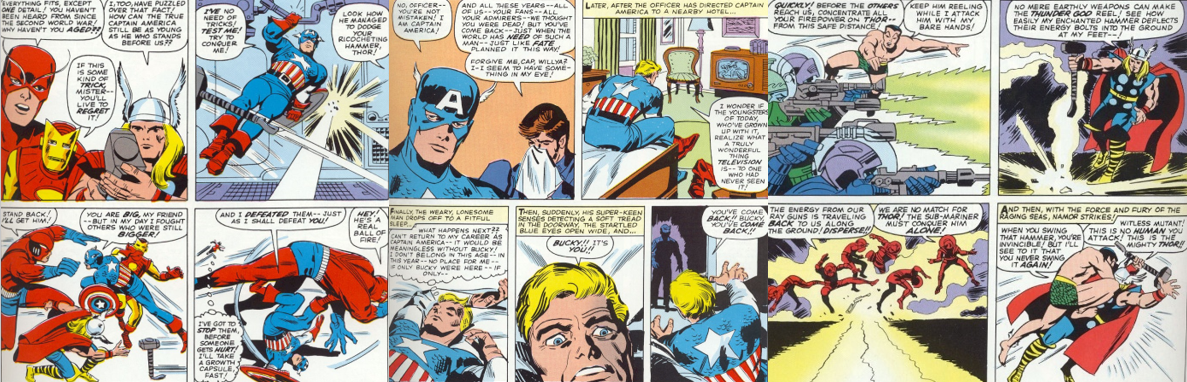
The Summary:
Let’s tackle each story in turn here, shall we? “Europe at War (Part II)” is a typically Golden Age Superman story, featuring simplistic dialogue, illustrations, and concepts. Part of me enjoys this simpler time, when fantastical things were just taken as the norm and superhero plots were both grounded and almost comical in their content, such as Superman threatening to bash General Lupo against a rock wall and presumably casually murdering countless of Luthor’s minions. It’s amusing to read as I find myself questioning why Clark warned of Luthor’s threat in his civilian guise, rather than as Superman, and seeing him use a machine gun rather than his heat vision since he didn’t have his full gamut of powers at that point. The core concept of “Europe at War (Part II)” actually has some legs to it: two nations being manipulated into all-out war with spies, heroes, and villains on both sides, and the mysterious Luthor pulling the strings behind the scenes and offering a challenge Superman can’t settle with his fists since he needs to get to the root of the problem. Unfortunately, a lot of its concepts are left ambiguous or flat-out forgotten; apparently, Luthor can hypnotise people into following his every command, yet he only demonstrates this power once and doesn’t think to use it on Lois or Superman (or the nation’s leaders). Not to mention that Luthor’s secret base is an elaborate castle suspended from a dirigible, but no one noticed it, and why was that one bald guard immune to Luthor’s control? It’s not explained, but the number of prominent bald henchmen at Luthor’s command makes me wonder if that particular guard was actually the real Luthor and the red-haired leader was merely a patsy. 

Neither story provides a particularly engrossing or accurate portrayal of Luthor.

And then we have “How Luthor Met Superboy”, a story that’s more influential than you think since it’s basically the inspiration for the entire series of Smallville (2001 to 2011). This is such a weird story that it almost reads like an elaborate dream sequence or fantasy story that recasts Superboy and Luthor as the best of friends thanks to a ridiculously convenient Kryptonite meteor (and don’t even get me started on the influx of similar meteors in near-Earth space!) People often criticise Superman for being infallible and unrelatable, but Superboy is the kindest, most trusting, and most understanding youth you’ll ever meet! He sees the best in Luthor all throughout the story, never once saying or thinking a bad word against him until he (as in Superboy) is dying at the young scientist’s feet and even then Superboy’s first act after saving himself is to forgive his former friend and hope that he turns his obsession to good deeds. It almost descends into parody as the story progresses, with Superboy genuinely believing that Luthor is trying to do good and has met with misfortune, and Luthor equally refusing to even think that he could be to blame for anything since he’s so embittered towards Superboy. It’s so strange seeing Luthor flip from a kindly boy to a venge-seeking maniac after the fire. Like, I get being mad at losing all your work and your hair but it’s a bit of a leap to blame Superboy. I think the implication is that the strange chemicals and toxic fumes altered Luthor’s mind in some way, though that’s not really explicitly stated (or even implied in the story text), but I think Luthor’s elaborate plot to cruelly taunt Superboy with the promise of a Kryptonite cure and to oust his popularity, to say nothing of his quick temper following the accident, go a long way towards suggesting that. 

Though amusing footnotes, both stories are fantastical nonsense unbecoming of Luthor.

Truthfully, neither story really gives the best impression of Luthor. It can be argued that the “Luthor” present in “Europe at War (Part II)” isn’t even Lex Luthor since he has hair, for one thing, and possesses hypnotic abilities. Sure, it could be a wig and his scientific acumen could account for the hypnosis and other inconsistencies, but he doesn’t really exude “Lex Luthor” energy and seems to simply be a maniacal, supervillain-esque third party for Superman to flex his muscles against once he stops his elaborate plot. “How Luthor Met Superboy” tries to flesh out Luthor’s character by providing him with a semi-sympathetic backstory and emotional connection to his hated nemesis, but ultimately reads like a non-canon adventure as I’m pretty sure no stories prior to his every hinted at the two knowing each other as youths. It is interesting seeing Luthor as an arrogant young scientist who idolises Superboy and is inspired to be a great scientist because of the Boy of Steel, it’s just a shame that the execution falters. Ultimately, Luthor’s hatred comes from losing his hair, rather than genuinely building towards a resentment towards Superboy or Luthor’s ego getting the better of him. Like, what was up with that protoplasmic creature? That could’ve factored into things, showing that Luthor is messing with things he doesn’t understand and his inability to recognise his limits and failings. Like, I would’ve maybe had Luthor build his weather-tower and plant those seeds before he loses his hair, so that when they go bad and Superboy has to intervene it adds to his growing bitterness towards Superboy for “stealing his thunder”. In the end, both stories can be largely ignored in the grand scheme of things and you wouldn’t be missing anything. They’re historical footnotes and amusing curios in Lex Luthor’s history, but you can simply skip to stories like “The Man of Steel” (Byrne, et al, 1986), “Birthright” (Waid, et al, 2003 to 2004), “Lex Luthor: Man of Steel” (Azzarello, et al, 2005), or “Secret Origin” (Johns, et al, 2009 to 2010) for better, more concise, and more in-depth explorations of Luthor and his complex relationship with Superman. 

Action Comics #23 Rating:

Adventure Comics #271 Rating:

Rating: 1 out of 5.

Rating: 2 out of 5.

Terrible

Could Be Better

Have you ever read these Luthor-centric stories? Do you like the idea of the two having been childhood friends? What are some of your favourite Luthor moments and stories? How are you celebrating Superman Day today? Whatever you think, feel free to share your opinion and thoughts on Superman in the comments below.

Back Issues [HulkaMAYnia]: Future Imperfect


Since his explosive debut in May 1962, Stan Lee and Jack Kirby’s gamma-irradiated Jade Giant has been one of their most recognisable and successful characters thanks, in large part, to the Incredible Hulk television show (1977 to 1982) catapulting the Hulk into a mainstream, pop culture icon. The Hulk has been no slouch in the comics either, being a founding member of the Avengers and undergoing numerous changes that have made him one of their most versatile and enduring characters.


Published: 22 December 1992 / 26 January 1993
Writer: Peter David
Artists: George Pérez

The Background:
The Incredible Hulk (and his human alter ego, Doctor Robert Bruce Banner) was another creation of Marvel legends Stan Lee and Jack Kirby. Inspired by the story of a hysterical mother showcasing superhuman strength to rescue her endangered child and classic movie monsters like Frankenstein’s Monster and Doctor Jekyll and Mister Hyde, the Hulk functioned as an allegory for the foils of war and was initially depicted as a stone-grey figure who emerged at night. Although his first series was cancelled after a year and a half in, the character returned to prominence following expansions of his lore and character and the popularity of the Incredible Hulk TV series. Nowadays, the Hulk is a staple of Marvel Comics, with an extensive gallery of villains who have tested him both physically and mentally, but one of his greatest tests came when writer Peter David and artist George Pérez had the Green Goliath encounter a possible future version of himself, the malevolent Maestro. Possessing the same insurmountable strength as the Hulk and bolstered by his calculating intellect, the Maestro is often regarded as one of the Hulk’s most dangerous and formidable villains. His debut story is so well regarded that the character has cropped up in additional tales to flesh out his backstory and regularly appears in the Hulk’s cartoon and videogame adaptations, so great is the threat of this devious alternative Hulk.

The Review:
Our story begins in a dystopian wasteland about one hundred years into the future; the overgrown, dishevelled ruins of New York City house the remnants of society in overcrowded, war-torn streets. Tensions are high and a “Big Brother” monitoring system is in place, courtesy of the mysterious Maestro, who dwells within an emerald palace high above the ruins. Amidst the bustling, anxious crowd, we’re introduced to Janis Jones and her cohorts in the rebellion against the Maestro, one that’s vastly outnumbered and against the odds. This is immediately demonstrated not just in their paranoia about their plans being overheard by the Maestro’s “Gravity Police” but the violent introduction of his cybernetic law enforcers, who immediately execute one of their number and demand their immediate surrender. Although Janis begs them to fall back and get to safety, her fellow insurgents choose to fight, leaving the elderly Pizfiz with a bloody stump for a leg and Janis and Skooter desperately trying to escape their pursuers. Luckily for them, a building collapses and covers their escape and, from the rubble, emerges none other than the Incredible Hulk. Now, this is the so-called “Professor Hulk”, a stable merging of Banner and the Hulk’s psyches who operated during the nineties. This Hulk wears clothes and is capable of intelligent speech, while also still exhibiting his trademark superhuman strength and dexterity, though not quite to the same degree as his usual savage self. This means he waxes lyrical while thrashing the Gravity Police but briefly struggles against their massive, mechanical “Dog O’ War”. However, he’s still the Hulk so naturally he rips the robot dog’s head off and sends the cops packing as a message to the Maestro.

100 years hence, the world is a dystopian hellhole ruled by a malicious Hulk.

Naturally, the Hulk attracts a fair amount of attention as he walks the streets; the people view him with a mixture of fear and respect, which he finds strangely alluring. He’s soon accosted by Janis and taken to the literal underground, where the rebellion hides deep beneath the wreckage of the city streets. Janis gives her people a quick history lesson on the Hulk, going over his classic origin courtesy of “sliding”, a visual representation of actual eyewitnesses to the Hulk’s history. It seems Janis recruited him to help them out and the Hulk went along because his old friend, Rick Jones, vouched for her and out of curiosity regarding the Maestro’s true identity. Janis takes the Hulk to an aged and decrepit Rick, who sits in Professor Charles Xavier’s hoverchair amidst a trophy room of those who have fallen in the years since, hero and villain alike. Word of the Hulk’s appearance quickly reaches Thomas Raymond, minister to the Maestro, who interrupts his leader’s orgy to bring him news of this temporal impossibility, giving us our first look at the Maestro as an older, more grizzled version of the Hulk who sports a lion’s mane of grey hair and beard. Favouring a regal cape and an intimidating helmet, the Maestro callously interrogates Pizfiz. When Pizfiz tries to goad the Maestro into losing his temper and killing him, the dictator allows the influence of the Minister and his cooler temperament to keep him in check and forcibly extracts the information he requires. Pizfix got Doctor Victor Von Doom/Dr. Doom’s time machine up and running and sent himself and Janis to the past to recruit the young Rick and the Hulk in helping them out. When Pizfiz is left a broken, lifeless husk from the stress of the procedure, the Maestro splatters him for his insolence and prepares to lead a strike team to hunt down his younger counterpart.

The Hulk is overpowered by the far stronger, far more cunning Maestro and left his helpless captive.

The frail Rick reveals that, in the end, humanity was their own undoing; two massive nuclear wars ravaged the world, killing the world’s heroes and villains, not to mention countless innocents, with only their costumes and ashes left as a memorial in Rick’s collection. Not so for the Maestro, who only increased in power from the radioactive fallout, built a dystopian society for his own amusement, and was driven completely insane. Much like Darkseid, the destitute peons of the city cheer the Maestro’s name and try to win his favour, only to be brushed aside and kicked out of the way like flies. The Maestro also has no time or worry for any defences the resistance may have set up and simply burrows his way down to their hideout using sheer brute strength, caring little when his men are dissolved by acid and gas or sliced to ribbons by lasers. The Maestro simply walks through these traps to come face to face, and blow for blow, with his counterpart. Their fight quickly explodes to the streets above, where the Maestro tests the Hulk’s resolve by calling him ”Puny Banner” and threatens to tear an innocent girl to pieces if he doesn’t surrender. The Hulk calls his bluff, reasoning that the Maestro must truly fear him to resort to such a tactic, but is unable to keep himself from leaping to the woman’s aid, much to the Maestro’s delight and disgust. Though the two are somewhat evenly matched, the Maestro takes the upper hand throughout the fight; he also constantly goads the Hulk, reasoning that he (as in the Maestro) can out-think and out-match him at every turn through the gift of hindsight as well as his awesome power and devious intellect. The plan works; when the Hulk charges in, the Maestro easily dodges and counters him to prove his intellectual superiority. Although the Hulk briefly turns the tide by fighting dirty with a nut shot, a haymaker sends the Maestro into a nearby building crushing and threatening innocent lives. The Hulk’s desperate need to save those lives allows the Maestro to get the jump on him and subdue him by breaking his neck. While Janis and the other lament the damage done to the Hulk, the Green Goliath wakes in the Maestro’s throne room, strapped into a massive neck brace and attended to by one of the Maestro’s “favourites”, who identifies herself as “Betty” and, apparently, rapes or at least physically interferes with him against his will, much to the Maestro’s pleasure.

The Hulk feigns injuries and temptation to lure the Maestro into a false sense of security.

Powerless and paralysed, the Hulk is forced to endure the Maestro’s scathing rhetoric; the Maestro even offers the Hulk the opportunity to put himself out of his misery, confident that his existence is assured since he has no memory of these events. The two get into a metaphysical debate about time travel theory but, in the end, the Hulk can’t bring himself to end his life since the risk that the Maestro is telling the truth about branching timelines being true is too great and would simply result in the Maestro’s continued existence. Resigned to being held prisoner while his wounds heal, the Hulk is forced out to the wastelands, where the elderly Boz and other would-be farmers desperately try to cultivate the irradiated and war-torn soil. Due to the scarce resources in the city, and the physical imperfections of these outsiders, they’re dependent on the Maestro’s limited generosity. He allows them to live, even furnishes them with supplies and has been trying to introduce nutrients into the soil, and all he asks in return is to take their most beautiful and worthwhile women for his own sordid amusement. The Maestro tries to win the Hulk over to his way of thinking, dressing him in fine robes and expositing the benefits of the less spirited slave girls in his palace, but the Hulk remains unimpressed. The Maestro sees his indignation and rejects it; to him, humans are the true monsters, for they destroyed themselves before any supervillain could. He sees himself as benefitting from the strange fate placed upon him since he was fortunate to have avoided being at ground zero and therefore reaped the rewards of the nuclear fallout while the world died around him. He offers the Hulk the chance to stay and rule at his side, promising that the future that lies ahead of him is full of the same hatred ad betrayal he’s always known, and the Hulk feigns temptation, and the extent of his injuries, in order to lead Janis and her allies into the palace.

Overpowered by the Maestro, the Hulk’s only hope is to out-think his foe using the time machine.

Pointed in the right direction by the Minister, the Hulk attempts to confront the Maestro directly and is blasted full force by a cannon specially created by Forge to kill the Green Goliath. Congratulating himself for being one step ahead of his counterpart, and his enemies, once more, the Maestro sets his forces against the resistance and a big ol’ shootout ensues. Angered at his soldiers’ inability to wipe the resistance out, and the disappearance of the wounded Hulk, the Maestro callously snaps the Minister’s neck and storms off in search of his younger self as his palace becomes a chaotic warzone. The Maestro follows the Hulk’s blood trail, and the familiar sound of Rick’s harmonica, to the trophy room; there, he chastises himself for allowing sentiment to stay his hand and delivers a mighty blow to his old friend. Though the frail Rick attempts to shield himself with the iconic shield of Captain Steve Rogers/Captain America, the force of the punch sends him flying across the room, where he’s impaled on the Adamantium claws of James “Logan” Howlett/Wolverine’s skeleton, much to the Maestro’s sneering amusement. In anger, the Hulk launches a surprise attack and attempts to cut the Maestro in half with Cap’s shield. When the Maestro attempts to counterattack with Thor Odinson’s magic hammer, he’s incensed to find he still cannot enough to lift it and briefly takes a beating after being blinded by the ashes of his former lover, Doctor Betty Ross. Once again, though, the injured Hulk finds himself overpowered and pummelled by the insane dictator’s onslaught; however, in the end, the Hulk is able to outsmart his devious doppelganger by luring him into Dr. Doom’s time machine. The Hulk activates the device, sending the Maestro to the one place he can be destroyed, ground zero of the very Gamma explosion that birthed the Hulk in the first place! In the aftermath, Boz’s daughter is returned to him and the people begin to pick their lives up in the Maestro’s absence. In a poignant farewell to his old friend, the Hulk launches Rick’s ashes, attached to Cap’s shield, into the horizon for one last adventure.

The Summary:
If you’ve ever read any story dealing with a dystopian future, particularly in Marvel Comics, then much of Future Imperfect will be visually familiar to you. The depiction of a war-ravaged, overgrown city full of strangely dressed survivors, cobbled together technology, and an oppressive, survival-of-the-fittest mentality is nothing new but this story does put a bit of a unique spin on things by focusing on the Hulk. As is often the case with stories that take place far in the future, the people of Future Imperfect use a lot of weird terminology in place of modern slang, curses, and even simple words like “see” to give it that bizarre edge, but this isn’t a future where advanced technology is readily commonplace. Thanks to humanity waging two devastating wars, these people are lucky to even be alive, much less spared the ravages of radiation poisoning and mutation, and it’s only through the paper thin grace of the tyrannical Maestro that they’re even able to eek out the harsh living they’re forced to endure. What’s left of the world’s heroes and Marvel’s iconic characters is stored in Rick’s trophy room; tattered costumes, forgotten weapons, and the ashes and memories of heroes and villains alike adorn the walls and are a stark reminder that, for all their battles, the superhuman community was unable to save humanity from itself in the end. This, as much as anything else, is a crucial aspect of the Maestro’s rise to power; as he so eloquently exposits to the Hulk, the people who hated, feared, and fought him were undone by their own monstrous nature and the “monster” they rallied against became a saviour and survivor in the aftermath.

The tyrannical Maestro is the Hulk’s physical and mental superior throughout the story.

At least, that’s how he sees himself. A combination of radiation, power, and presumably survivor’s guilt have driven the future Hulk completely mad. Selfish and tyrannical, he cares only for his own self gratification and sees himself as a tough but fair ruler to his people, who he demands sing his praises but cares little if they’re trampled underfoot. This is perfectly juxtaposed by the Hulk; younger, leaner, far less jaded (no pun intended), the Hulk retains his moral compass and respect for life, setting him at ideological odds with the Maestro in a way that wouldn’t be as possible or versatile with his more savage counterpart. It also helps that Professor Hulk is clearly much weaker than usual, especially against the Maestro; the added radiation and one hundred years of living give the Maestro the edge in terms of sheer power, ferocity, and cunning that even Professor Hulk struggles against. Rather than thinking with his fists or relying on his usual strategies, the Hulk is forced to endure being the Maestro’s captive to wait for an opening to strike more effectively, which allows us a deeper glimpse into the workings of the Maestro’s world and the depths of his insanity. I think it’s telling that the Maestro is so loquacious in his demeanour; he truly sees himself as the hero of his world, as the apex predator, and as deserving of everything his built and amassed after being hounded all his life and left the sole survivor following the devastating nuclear attacks.

The Hulk’s clash against the Maestro shows how dangerous an intelligent, evil Hulk can be.

Thus, the Maestro and the Hulk clash with morals as much as their fists, and both are intriguing. It’s not often that you see the Hulk, even Professor Hulk, manhandled and brutalised as badly as he is here; he’s constantly being swatted away, overpowered, and injured, bleeding in the finale and left half-paralysed after having his neck broken! In the rare instances when the Hulk is able to fight back, he’s always on the back foot within a few panels and, in the end, is forced to outwit the Maestro rather than out-fight him since he’s clearly outmatched. The supporting characters were okay; they fulfilled their purpose as resistance fighters who recruited the Hulk out of desperation, but it does make you wonder why Janis wouldn’t just stay in the past when she travelled back rather than risk her life saving a world that’s already gone to hell. The story even lampshades the suggestion that they go back and get more reinforcements; like, yeah, they could have tried to recruit more heroes while back in the past, and honestly the whole story of how the Hulk even got there is barely touched upon. Ultimately, they’re a means to an end; Janis needs to exist so the story can happen, but she’s not as interesting to me as the elderly Rick and his roomful of Easter Eggs, which served as a great backdrop for the finale. Ultimately, I can see why the story and the Maestro are so fondly regarded; it definitely could’ve benefited from being longer, perhaps five twenty page issues, to help things breathe a bit. Yet, the visual of the Maestro, his wild hair and his gruff, conniving demeanour, is certainly striking. The idea of the Hulk becoming intelligent and cruel enough to rule over the last vestiges of humanity is a powerful one since his rage at being ostracised is fully justified and he represents a nigh-unstoppable foe, and those elements were conveyed very well even in these two, all-too-brief issues.

My Rating:

Rating: 4 out of 5.

Great Stuff

Are you a fan of Future Imperfect? What did you think to the Maestro and his depiction as a tyrannical, malicious future version of the Hulk? Were you a fan of Professor Hulk, and would you have liked to see the more savage Hulk take his place in this story? Which of the Easter Eggs in Rick’s trophy room was your favourite? Which dystopian future of Marvel Comics is your favourite and do you have a favourite alternative version of the Hulk? How are you celebrating the Hulk’s debut this month? Whatever your thoughts on Future Imperfect, go ahead and share them below or leave a comment on my social media and be sure to check out my other Hulk content.

Back Issues [Crossover Crisis]: Freddy vs. Jason vs. Ash: The Nightmare Warriors


In April 1985, the first issue of the ground-breaking Crisis on Infinite Earths (Wolfman, et al, 1986) released and saw the temporary destruction of the “Multiverse”. To celebrate this momentous event, I’m discussing multiversal crossovers in an event I dubbed “Crossover Crisis”.


Published: August 2009 to December 2009
Writers: Jeff Katz and James Kuhoric
Artist: Jason Craig

The Background:
Although it is regarded as one of the best slasher properties around, Paramount Pictures became embarrassed with their Friday the 13th franchise (1980 to present) and sold (some of) the rights to rival studio New Line Cinema back in the early-2000s. This led to the long-awaited clash between Friday’s iconic killer, Jason Voorhees (Various) and New Line’s Freddy Krueger (Robert Englund) after years in Development Hell. Despite mixed reviews, Freddy vs. Jason’s (Yu, 2003) box office gross of nearly $117 million made it he most profitable entry in either franchise and naturally led to talks of a sequel. Unfortunately, these fell apart due to rights issues surrounding fellow horror icon Ashley “Ash” Williams (Bruce Campbell), but the three horror heavyweights did meet up in Freddy vs. Jason vs Ash (Kuhoric, et al, 2007 to 2008) courtesy of WildStorm and Dynamite Entertainment. Based on Jeff Katz’s film treatment, Freddy vs. Jason vs. Ash proved successful enough to warrant a follow-up the following year that was originally envisioned as a twelve-issue story before being scaled back. Katz returned to co-write the story, which he envisioned as a massive conclusion to the Freddy vs. Jason trilogy and a love letter to all three franchises. Fellow writer James Kuhoric was adamant about ensuring all the returning characters felt familiar to series fans, with special emphasis put on the clash of personalities between Ash and Tommy Jarvis. The two also sought to redesign Jason, giving him a Grim Reaper-like visage, and make the most of the unrestricted nature of the new format to show more over-the-top kills on a much larger scale. Although some saw The Nightmare Warriors as an improvement on the first crossover due to its larger scale, it was also criticised for being somewhat mindless and predictable and for struggling to juggle not just the titular horror icons but its extended cast of characters.

The Review:
The Nightmare Warriors opens twenty-four hours after the end of Freddy vs. Jason vs. Ash, with undead killer Jason Voorhees still trapped under the bumper of Ash Williams’ beloved Oldsmobile, still with a machete blade where his left hand once was, and still missing his trademark hockey mask, beneath the frigid depths of Crystal Lake. Cursed with eternal unlife by the Necronomicon Ex Mortis, Jason is compelled to return to the world of the living at the urging of his mother, Pamela, though it’s once again dream demon Freddy Kruger assuming Pamela’s form to reactivate Jason and set him against Ash for besting them in the previous crossover. At that same moment, a group of government agents, led by Director Gordon Russell, arrive to secure the area, intent on securing the Necronomicon for themselves, deeming its power to open rifts and raise demons more enticing than the unkillable Jason. Within mere panels, his team find and thaw out the book and spirit it back to base, while a separate team dives into the lake to retrieve Jason and nullify him. Unfortunately for the frogmen, Jason bursts to life and slaughters them all, shrugging off their bullets and high-powered shock lancers and dicing them to bloody pieces, then retrieves the remains of his mask and heads out to find Ash at this “mother’s” bidding. Spreading of Ash, the story jumps over the Franklin, Michigan and ahead six months; Ash’s narration once again brings us up to speed on his life: after defeating Freddy and Jason, he and surviving girl Caroline (or “Carrie”) settled down into suburbia, despite the dramatic age gap between them. Their domestic bliss is interrupted by the first of many returning faces when Doctor Maggie Burroughs (also known as Katherine Kruger, Freddy’s daughter and noted child counsellor) drops by. Since the events of Freddy’s Dead: The Final Nightmare (Talalay, 1991), Maggie has been working with another prominent Elm Street character, child psychiatrist Doctor Neil Gordon, to identify special “focal magnets” for the supernatural who can combat dark forces.

Ash initially refuses Maggie’s offer to join the other survivors, as the Pentagon resurrects Freddy.

Although she’s come to the right place, given Ash is the “Chosen One”, Ash has given up his Deadite-slaying ways and has no interest in joining their crusade to pre-emptively target the dark evils of the world and Maggie leaves empty handed. Ash heads out on a beer run, blissfully ignorant to the fact that Jason is tearing into his house and attacking Carrie. Although she desperately fights back, she’s no match for Jason and her head ends up cooking on the barbecue. On the drive back, Ash catches wind of this when he gets a vision of Freddy – not unlike the visions suddenly striking Stephanie Kimble, “Dream Master” Alice Johnson, and her teenage son, Jacob – between the panels, but he arrives too late to help and is pegged as a murderer by Carrie’s family. As a mysterious individual watches on, Ash fights off Carrie’s dad and makes a run for it as the cops arrive, hopping on the first train out of there to go find Maggie. Although Maggie seems to sense her father’s return, she allays the fears of her lover, Neil, since they’re protected by the dream-blocking powers of Hypnocil. She also assures their two psychic recruits, Rennie Wickham and Tina Shepherd, that they have nothing to fear and excites them with the prospect of new recruits joining their cause. Neil, however, isn’t completely sold on Maggie’s plan, especially after seeing a similar group of survivors butchered by Freddy in the past, but Maggie convinces him with her words (and her allure) that the survivors of Freddy and Jason’s rampages are special, crucial, to stopping such monsters. Their new recruits turn out to be Alice, Jacob, Stephanie and her father, Steven Freeman (referred to as “Stephen”). Just as they arrive, Stephanie suffers a massive seizure, bombarded by visions of Jason, who adds a bunch more bodies to his kill list when he follows Ash. Meanwhile, at the Pentagon, Director Russell and his team’s hard work translating the Necronomicon with some pretty futuristic technology sees them return Freddy to the real world, now fully mortal and free of his burns. Although Freddy gives Director Russell the run-around and plays coy, he gives them enough to confirm the book’s power and Russell orders a strike team to intercept Jason, who’ve they’ve tracked to Maggie’s house.

As the group struggles to co-exist, Freddy is joined by a revitalised Jason and a sadistic Maggie!

Jason makes a dramatic entrance shortly after Ash arrives looking to avenge Carrie’s death; Stephen’s incredulity about the entire thing turns to abject terror at the sight of Jason, who unceremoniously caves his head in, but the others are saved when the mysterious onlooker, Tommy Jarvis, bursts in to spirit them away in his jeep. The strike team arrives soon after and subdues Jason with sleeping gas, bringing him into custody at last. Chastising their efforts and clashing egos with Ash, Tommy warns about Jason’s brutality and power and begs them to leave it to him given his past experience, but Maggie won’t hear of it. She touts Rennie’s empathic power and each of the group reveals some of their past experiences with both killers and their special abilities, such as Alice sporting dream-based powers and Tina being somewhat telekinetic, and Ash naturally boasting off his Deadite-slaying past. Maggie desperately calls for he and Tommy to set aside their egos and focus on using the Necronomicon to put both monsters down for good, stating that her father oversees the project to research it, but the group remains divided. At the Pentagon, Jason is wheeled into a Deadite holding cell and once again falls prey to Freddy’s influence. Somehow possessing the Necronomicon’s power along with his dream powers, Freddy brags of his plot to use Russell to finish what he started in Freddy vs. Jason vs. Ash. Although Jason still wants to kill Freddy, he’s convinced to join forces with Freddy mentions Tommy’s name and Freddy uses the magic words – “Klattu! Verata! Nikto!” – to restore, repair, and upgrade Jason’s body and mind, turning him into Freddy’s long-haired, dual-machete-wielding General. Later that evening, Ash and the others (sans Tommy, Stephanie, and Jacob) enter the Pentagon using Maggie’s credentials and are immediately locked up on Director Russell’s orders despite their warnings about Freddy. As Ash questions Maggie’s relationship with Russell, she’s brought to Freddy, who can freely shift between a normal human and his burned form and has physically merged with the Necronomicon, effectively making him a God. In a dramatic moment, Maggie murders Russell with Freddy’s glove and reveals that she’s been working with Freddy the whole time, the two apparently in a very sexual incestuous relationship.

As Jason leads the Deadite army, Freddy kidnaps Jacob and spreads fear and death through the nation!

Although Neil believes it to be some kind of brainwashing, Maggie goes the whole hog and kills him and Rennie, rechristening herself Kathryn Kruger and being transformed by Freddy into a claw-handed murderess. Thanks to Tina’s psychic powers, Ash and the others are alerted to the betrayal just as the Pentagon goes on high alert after Jason leads the Deadite army in a jail break. Although desperate for some payback, Ash is convinced to flee by Tina and Alice; when he tries to retrieve the Necronomicon, he’s attacked by a claw-wielding machine controlled by Freddy but a combination of Tina’s psychic powers and Ash’s bravado brings it down. Tommy is aghast to see Jason leading the medieval dead on a killing spree throughout the nation’s capital, though his attempts to stop the masked killer are for naught as he’s quickly captured by a couple of bat-like Deadites and brought to Freddy, leaving Jason and the Deadites free to carve up congress. Back at the Stabe Hotel, Jacob is seduced by Stephanie in a nightmarish ruse by Freddy, who binds and tortures him until he cries for his mother. Sensing his plight, Alice uses her powers to transport herself, Ash, and Tina into Jacob’s nightmare, but they’re unable to keep Freddy from kidnapping Jacob and challenging them to confront him at the White House. Thankfully, they’re able to put Stephanie back together in the dreamworld and save her life, though the experience of being skinned alive in the nightmare leaves her traumatised. At the White House, the Deadites hold off the military and the cops and allow Freddy to address the nation, first using the guise of President George W. Bush and then reverting to a less despicable visage, his own burnt form, to dictate his “No Kid Left Alive” policy and declare war on the children of America.

When Freddy sets Stephanie and Kathryn against his enemies, Alice passes her powers to Jacob.

Ash galvanises Alice, Tina, and Stephanie and they gear up to go rescue Jacob; they find Washington swarming with Deadites and blood raining from the skies and their resolve falters when Alice chastises Ash’s plan of simply fighting their way to victory. Luckily, the military arrive and cause a big enough distraction; their wholesale attack upon the Deadites and Freddy’s focus on repelling their forces allows Ash and the others to slip past the undead defences, but the distressed Stephanie is lost when she wanders off and has her untapped Voorhees blood awakened by Freddy’s influence, turning her into a mindless killer like her…I wanna say uncle?…that sees her don her own hockey mask and set out to fulfil her birthright and kill Jason. In the Oval Office, Freddy brags of his superiority to the captive Tommy but, annoyed by the kid’s defiance, prepares to kill him when Jason intervenes, wanting the kill for himself. This is again enough to turn the two against each other; Freddy orders Kathryn to kill Jason and the two get into it, with Kathryn cutting chunks out of Jason and even impaling him on a flagpole, but the fight is interrupted when Ash comes crashing in in a tank, crushing Kathryn and blowing Freddy clear out of the Oval Office with a cannon shot. As Ash and the others rescue Tommy and Jacob, Freddy literally pulls himself together out on the lawn where he’s confronted by Alice; when Freddy mocks her chances and boasts of his immortality, she allows herself to be killed since she has a terminal disease, but her death passes her Dream Master powers to Jacob and releases the spirits of the original Dream Warriors and Freddy’s mother, Amanda. Suitably empowered, Jacob and the Dream Warriors dispatch of Freddy’s Deadite forces, bringing Freddy to his knees in defeat once more.

Tommy and Ash set aside their differences to defeat Freddy and Jason once more.

However, as Amanda prepares to bring Freddy’s soul to be judged by the Almighty, Freddy drops the ruse and guts Jacob; Ash and Tommy clash one last time as they try to get their priorities straight and ultimately agree to let Tommy have his wish to be the one to finish Jason off. Tommy attacks Jason with all his anger and strength but is, of course, physically outmatched by the revitalised killer; drawing strength from all the pain and death Jason has caused, Tommy pummels him with a rock but falters when he sees Jason’s unblemished face. The normally silent monster utters the words “Yew… daie!” and leaves Tommy with a shoulder injury and facing certain death. Luckily, Stephanie impales Jason with two machetes to the back, distracting him long enough for Tommy to behead him with a massive shard of glass and triumphantly hold up his severed head. As Tina desperately tries to stop Jacob from bleeding out, Freddy feasts upon both the souls of the Dream Warriors and of Jason himself; Ash thrusts the Necronomicon into Neil’s hands and demands he find a passage to end the nightmare and buys him time by battling Freddy once more but all hope seems lost as Neil can’t read the book’s language. However, the spirit of his former lover, Nancy Thompson, arrives to help and, together, they speak the cursed words, opening another vortex. Although Freddy’s power is such that he can resist the portal’s pull, the Dream Demons (revealed to be dwelling within the Necronomicon) express outrage at his failures and remove his powers, leaving him vulnerable to one last quip from Ash and a shotgun to the chest, which sends him flying into the vortex. Nancy and Neil share a tearful farewell and, as the nation recovers, a victorious Ash and Tina share a completely random kiss and he parts ways with Tommy with a mutual respect. However, Jason’s body disappears from the battlefield and the story ends in Springwood, 1964, where a random cop caught in the Necronomicon’s vortex blindly signs Freddy’s arrest warrant, apparently changing Freddy’s past despite him laughing from the clouds? It’s a bit confusing, if I’m honest.

The Summary:
Freddy vs. Jason vs. Ash: The Nightmare Warriors suffers from a lot of the issues that plagued the last crossover; the story is a bit of a mess, with twists and turns that pop up seemingly at random just to drag the story out to six issues, and with some underdeveloped themes and conflicts. Like, I must have missed when the Pentagon conjured enough Deadites to need a prison for them, and I’m not sure why Director Russell thought he could manipulate Freddy so easily, plus it’s really out of character for Maggie to suddenly be so on her father’s side that she not only kills in his name but is turned on by his affections. The art is also quite inconsistent again; it picks up from issue four but there are a lot of instances where the artist is again simply copying shots from Freddy vs. Jason and I had a hard time recognising a lot of the returning characters. Stephen looks more like a scowling Marshall Mathers III/Eminem than his film counterpart, I kept mixing Stephanie, Rennie, and Alice up and I just don’t think enough was done to visually make them stand out from each other. Alice, for example, should be far older than she’s portrayed here, which would’ve helped. I genuinely forgot Jacob was even in this until he was kidnapped, and I can’t say I cared much for Tommy’s characterisation; get him being gung-ho about wanting to end Jason, but I like to think he would see the benefits of joining forces with the so-called “Nightmare Warriors”. I did enjoy seeing him clash with Ash; I genuinely think the story might’ve been stronger with more focus on those two being an odd couple pairing and placing more emphasis on the Ash/Tina relationship since she randomly kisses him at the end despite there being no chemistry between them prior to that.

The interactions between Ash and the returning characters is the best part of this bloated crossover.

Ash is a little different here than in Freddy vs. Jason vs. Ash, at least initially. He’s settled down with Carrie and is happy to leave his past behind, but he’s brought back into the fight when she’s killed by Jason. Unlike the opening of the last crossover, I enjoyed this death since Carrie lasted a little longer and her death pushed Ash into joining up with Maggie and gave him a greater personal stake in the battle against Freddy and Jason. It’s not one that’s fully realised since Ash tangles more with Freddy, which I get as it’s fun seeing them trade insults as well as blows, but he doesn’t really fight with Jason all that much and, unlike the last crossover, there’s no three-way dance between them this time. Ash is also a little more contentious this time around; he clashes with Tommy, of course, but also aggravates Alice with his misogynistic attitude and inability to think of a plan beyond just ploughing through what’s in front of him. The Deadites get a little more play this time around, with Jason leading the medieval dead and them chattering away as they’re killing and being killed, but they primarily exist to be cannon fodder for the military, Ash, and the Nightmare Warriors. Speaking of whom, I did enjoy seeing these surviving characters return, even if they’re not as strong or visually interesting as the Dram Warriors. The only really useful one was Tina, and even she just blasted doors open and levitated stuff; Alice only became useful by dying and even then Jacob was attacked before he could finish offing the Deadites, meaning the returning characters were more like fan service than anything else.

More gore, more fan service, and more action doesn’t necessarily amount to a better story.

I don’t mind this; a story titled Freddy vs Jason vs. Ash should be heavy on the fan service, after all, but it does mean this story is even more bogged down with exposition than the last one as we need a recap on what everyone’s been up to since their last appearances. As before, Jason trumps Freddy in terms of kills; he hacks, bludgeons, and slaughters too many people to count here and it’s just as gruesome and glorious as you could ask for, but he is also once again relegated to being Freddy’s minion. At least this time he gets a visual upgrade and even speaks, but he doesn’t seem any more intelligent and the plot point of Stephanie “becoming a Voorhees” amounts to a mere distraction. Although the story makes a dramatic show of Jason’s beheading, we know he isn’t really dead as “only a Voorhees” can truly kill him and, as Pamela states, he can “never die”. Freddy is basically the same as in the last story, being a master manipulator but sporting incredible (and ill-defied) dark powers thanks to the Necronomicon. Having absorbed the book into himself, he can freely manipulate the waking world as he does the dream world but does little with this except send Jason and the Deadites on a killing spree, bring his enemies to him to absorb their souls and power, and mock his foes rather than just kill them. Seeing him take on Bush’s guise and revel in his Godhood was fun, and the story is far more creative with his powers and his dialogue, and I really liked seeing him reduced to a snivelling wretch after being stripped of his power. However, I still don’t really get the ending and I think The Nightmare Warriors confused itself by trying to be bigger and more grandiose than any other film in the franchises. Ultimately, it’s more enjoyable than the last crossover due to the fan service, cameos, and increased gore and action, but still falls short of being anything other than a novelty read for fans of these three horror staples.

My Rating:

Rating: 3 out of 5.

Pretty Good

Did you enjoy Freddy vs. Jason vs. Ash: The Nightmare Warriors? How do you think it compares to the last crossover between these three? What did you think to the returning characters and the fates that befell them? Did you like seeing Jason get an upgrade and Freddy become all-powerful? What was your interpretation of the ending? Which film in the three franchises is your favourite? What other horror crossovers would you like to see? Drop a comment below or on my social media to share your thoughts and feel free to check out my other reviews of both franchises, and the rest of my Crossover Crisis content!

Back Issues [Dare-DAY-vil]: Daredevil #170-172


Blind lawyer Matt Murdock first made his debut in Daredevil #1 in April of 1964 and was co-created by writer/editor Stan Lee and artist Bill Everett, with input from the legendary Jack Kirby. While perhaps not as mainstream as characters like Peter Parker/Spider-Man, Daredevil has become one of Marvel Comics’ greatest creations and has featured in a number of ancillary media and merchandise, included a questionably-received big-screen adaptation in 2003 and a critically-successful Netflix series. Still, he’s one of my favourite Marvel characters so today is a great excuse to pay homage to the “Devil of Hell’s Kitchen”.


Writer: Frank Miller – Artists: Frank Miller and Klaus Janson

Story Title: “The Kingpin Must Die!”
Published: 3 February 1981 (cover-dated May 1981)

Story Title: “In the Kingpin’s Clutches”
Published: 3 March 1981 (cover-dated June 1981)

Story Title: “Gangwar!”
Published: 24 March 1981 (cover-dated July 1981)

The Background:
In the 1960s golden age for Marvel Comics, Stan Lee teamed with legendary names like Steve Ditko and Jack Kirby to create some of their most iconic superheroes. On 1 April 1964, Stan Lee and artist Bill Everett presented their most challenging hero yet in Matt Murdock/Daredevil, who would go on to become one of Marvel’s most popular and enduring characters thanks, in a big way, to the efforts of writer/artist Frank Miller. In 1970, the then up-and-coming Miller joined the book with issue 159 and soon took over writing and illustrating, spearheading some of Daredevil’s most influential stories. It was under Miller’s watch that Wilson Fisk, the mammoth Kingpin of Crime, became one of Daredevil’s most hated enemies; created by writer Stan Lee and artist John Romita Sr. and first debuting in the pages of The Amazing Spider-Man, the Kingpin was patterned after actor Robert Middleton and known as much for his conniving ways as his intimidating bulk. A complex character whose ruthlessness was matched only by his love for his wife, the Kingpin has become one of Marvel’s most iconic villains but is especially noted for his intense rivalry with street-level vigilantes like Daredevil, Spider-Man, and Frank Castle/The Punisher. The Kingpin has appeared prominently outside the comics, too, generally as a boss in various Marvel videogames, a notable antagonist in various animated ventures, and in live-action, delivered with charm, menace, and significant screen presence by the likes of the late Michael Clarke Duncan and Vincent D’Onofrio.

The Review:
This three-issue arc begins with Daredevil sprinting through New York City, attracting the awe of the locals, to question noted streetwise bum Turk Barrett at Josie’s seedy bar. Although Turk makes a desperate escape attempt, Daredevil brings his getaway to a violent end and learns from him that the city’s top crime bosses have put out a hefty $5 million contract on the Kingpin, the mysterious and powerful mogul who once ran the underworld like a business but has since retired to Japan. There, Fisk is sequestered in a huge mansion with his own private guard and regularly showcases his physical abilities by besting the finest martial arts experts with precision and power, explodes with rage whenever anyone mentions his former life, and desperately keeps his questionable past and tendencies from his beloved wife, Vanessa. Since Fisk is due to sell out his former colleagues in return for clearing his name and $7 million, Vanessa heads to New York to enlist the legal aid of Matt Murdock and his partner and best friend, Franklin “Foggy” Nelson, offering them $200,000 to represent Fisk in court. Before Matt can agree, their office is attacked; in the confusion, Matt investigates as Daredevil and confronts the man responsible, Bruno, a seemingly semi-cybernetic former hitman with a firearm in place of his left hand. Daredevil easily bests Bruno but is stunned when his accidentally severs Daredevil’s grapple line and fatally plummets to the street below. Realising that mob are hiring any assassin they can to do their dirty work, Daredevil prepares to intercept his old foe, Lester/Bullseye, before he can be recruited but is delayed by cantankerous police lieutenant Nick Manolis, who reveals that Vanessa was kidnapped during the action. Released on a technicality (a brain tumour created just enough reasonable doubt about his previous murderous actions), Bullseye is furnished with a swanky new costume and demands $10 million to kill the Kingpin, but gleefully jumps at the chance to battle his hornheaded rival when Daredevil shows up to confront him.

As if Bullseye wasn’t bad enough, Daredevil must deal with the Kingpin’s return to town.

Having previously saved Bullseye’s life, Daredevil feels a responsibility to keep him from wasting it with his violent ways, but Bullseye simply attacks with throwing stars, his confidence and aim better than ever now he’s no longer sick. Despite landing a glancing blow with a pistol, Bullseye’s unable to land a kill shot thanks to Daredevil’s superhuman reflexes; however, Bullseye is so embittered towards his foe and so determined to best and kill him that he sends ol’ hornhead flying out of a window! Although Daredevil saves himself with his grapple hook, Bullseye severs the line, sending Daredevil plummeting to the ground; thankfully, he uses a passing flagpole and crumbling gargoyle to slow his descent just enough to land safely (if painfully) into a passing garbage truck. Rumours of the Kingpin’s return spread through the criminal underworld, leading the mob to kidnap and torture Louie the String for information. Before he succumbs to his injuries, Louie leads them to an explosive trap on Staten Island, where the Kingpin laments returning to his former violent ways but vows to turn New York City into an all-out warzone if it means seeing his enemies suffer and die and return his love to him. To that end, the Kingpin and his underling, Lynch, systematically target the mob’s goons and demand Vanessa’s safe return, with Fisk even stating he’s willing to negotiate to end further bloodshed. Although Bullseye is secretly unimpressed by the bickering mobsters, the city’s crime lords believe they have the upper hand as long as they have Vanessa and order Bullseye to send word that they’ll trade her for all the dirt Fisk has on them, further raising his ire at being reduced to a mere errand boy. Recovering from his fall and unable to find any leads, Daredevil assumes the guise of “Shades” and starts asking questions about Vanessa at Josie’s bar, causing him to get jumped by the local goons. However, after easily fending them all off, he impresses Turk and block-headed grunt Grotto enough to earn an audience with the big man himself and is led into a dingy sewer.

While the Kingpin proves a formidable threat in combat, he’s devastated by his wife’s death.

Matt is silently in awe of the Kingpin’s aura, finding that he more than lives up to his reputation as an intimidating presence; gathering himself, Matt claims to be a hitman from Ohio and offers his services, further impressing by jamming a goon’s gun with a pen without looking. Immediately afterwards, another of the Kingpin’s underlings arrives and, before dying from poisoning, delivers the mob’s demands for the exchange. Although Lynch is excited to see Fisk return to power and straighten out the disorganised underworld, Fisk has no interest in returning to his former life; he simply wants Vanessa back, leading Lynch to question if he’s lost his edge. However, Fisk demonstrates his vindictive cruelty when he finds “Shades” has broken into his vault; ready to kill him, the Kingpin is stunned when Daredevil attacks from the darkness. Although Daredevil makes jokes about Fisk’s weight, his swagger is shaken when he realises that the Kingpin is solid muscle; Daredevil’s speed and agility give him the edge in the fight, but every blow to the Kingpin’s rock-hard body wracks ol’ hornhead with agony and he soon tires himself out trying to damage the mammoth mogul. Thus, the Kingpin knocks Daredevil unconscious with a single blow and orders Turk and Grotto to tie him up and drop him into the city’s drainage system. Fisk then heads out to make the exchange, fully aware that the mob have set up a trap and turning the tables on them by incapacitating everyone in the vicinity – including Bullseye – with a high frequency sonic burst. However, as Fisk rushes to rescue his beloved wife, he’s stunned when someone triggers a mortar, causing the construction site to collapse. Though he survives being buried under all the girders and debris, Fisk is heartbroken when he can’t find Vanessa’s body and is suitably motivated to avenge her death by reassuming his former position and targeting his opposition without mercy. Thanks to his radar sense and sheer force of will, Daredevil avoids drowning and heads back to Josie’s bar to interrogate Turk again to catch up with the plot. Meanwhile, Fisk sets himself up in a subterranean stronghold and sends his few men out to disrupt the mob’s deliveries, turning the disparate crime lords against each other through a series of calculated attacks and stealing their cash and armaments. When Turk informs him of Daredevil’s survival, Fisk orders Lynch to move the files and set up an ambush, only for the goons to be attacked by Daredevil and lose the files; however, he’s humiliated to find he was duped by a briefcase full of newspapers!

Bullseye and Daredevil’s violent fight ends with the Kingpin manipulating himself back into power.

Bullseye takes advantage of the mob’s panic to demand a further $5 million to help them out, then hits up a bunch of small-time scumbags to learn the Kingpin’s location only to fall for another of the Kingpin’s traps. The Kingpin then confronts Bullseye and his mob employers, swaying Bullseye to his side and intimidating the mobsters into outing themselves to the cops. Afterwards, Fisk turns the full brunt of his rage on Lynch since it was he that set off the mortar and killed Vanessa to push him into returning as the Kingpin, so Fisk mercilessly breaks Lynch’s limbs and beats him to death as recompense. Fisk then gathers the city’s crime bosses to announce his takeover, only for them to be spooked when the skyscraper’s lights suddenly go out. Realising Daredevil is to blame, Fisk sends Bullseye to deal with him and the two fight once more, with Daredevil driven to make the assassin pay for all the lives he’s taken after Daredevil fought the urge to leave him to die before an incoming train. Relieving Bullseye of his weapons and discarding his billy club, Daredevil lunges for his foe, intent on making him feel the full force of his guilt and anger, but Bullseye fends off his furious assault by making use of his own weapon and smashing the vigilante in the face with a brick. Their brutal melee sees them land blow after blow, crash through a brick wall, and ends with them both choking the life out of each other, Bullseye determined to prove he’s better than his enemy and Daredevil seemingly willing to die alongside his foe. In the end, Bullseye passes out from the pressure, but Daredevil’s victory is short lived as the Kingpin and his goons arrive, armed and surrounding him. However, rather than gunning him down, Fisk gives Daredevil the files he has on the city’s crime lords and requests that he deliver them to the district attorney to have them arrested and allow Fisk to solidify his stranglehold over the criminal underworld once more. Although Daredevil considers making a desperate escape, the Kingpin advises against it; he even allows the Man Without Fear to take Bullseye as “a courtesy” and gives Daredevil no choice but to accept the offer as it will buy the city a brief period of peace while Kingpin works to reorganise and strengthen the fractured mob. Thus, Daredevil is forced to accept the offer and leaves, taking little solace in having brought Bullseye down and the story ends with a return to the city’s dank sewers, where a dishevelled and seemingly amnesiac Vanessa waders in search of money and food.

The Summary:
Daredevil’s first encounter with the Kingpin is quite the thrilling and intricate tale; while it starts off innocently enough, with Daredevil trying to get to the bottom of a disturbing anxiety in the criminal underworld, it quickly escalates as the Kingpin is forced to resume his violent former ways. While I’m not a big fan of Frank Miller’s sketchy artwork, he did some great work when working on Daredevil; most panels and characters are seeped in an inky darkness, giving a dark, moody edge to the story that contrasts with both Daredevil’s bright outfit and generally flippant demeanour and with his other, more colourful peers. The story focuses on a grittier, more violent subsection of the Marvel universe, one where mobsters are gunned down, blown up, and poisoned on the regular and gang warfare is constantly at risk of breaking out due to the fractured state of the criminal underworld. I enjoyed seeing the crime bosses struggle to keep their shit together; it took seemingly everything they had just to be in one room long enough to hire their assassins and I liked how they squabbled like children and were depicted with an arrogant sense of entitlement that slowly deteriorated into abject denial as the Kingpin’s power grew. It was fun seeing Bullseye grow disgusted by their bickering and disorganised ways and watching them crack as they lost their money, power, and men to the Kingpin. While it didn’t lead to all-out gang war, there were some striking instances of violence on the streets and around the city that showed not just how sadistic Bullseye is but how ruthless the Kingpin can be when he’s out for blood.

Evenly matched and equally hatful of each other, Bullseye and Daredevil have an intense rivalry.

Daredevil is caught right in the middle of this; there’s little time for Matt Murdock or his private life here, with just a few panels hinting that Foggy is going through some personal troubles and showcasing Matt’s latest relationship. His focus is solely on confronting and stopping the Kingpin, and on settling the score with Bullseye. I liked the sense of guilt Daredevil carries here; previously, he had the opportunity to leave Bullseye to die but chose to save him, a decision he openly regrets since Bullseye refused to change his ways and just kept on killing, meaning Daredevil feels directly responsible for those deaths. His confrontations with Bullseye start with him trying to reason with the assassin and turn to a murderous rage as Bullseye kills and tortures his way throughout the arc, switching his allegiances to whoever has the most money and power and desiring only to prove himself superior to his hornheaded foe. Bullseye’s abilities are showcased greatly here; he never misses except when fighting Daredevil, fuelling his pride and anger, and he’s highly adaptable, able to make use of throwing stars, knives, guns, and even Daredevil’s billy club with an almost superhuman deftness. Though a sadist, Bullseye is highly intelligent; he knows when to shut up and listen, when to switch sides, and is very aware of Daredevil’s tricks and abilities, meaning he does a great job of holding his own against his hated enemy. Daredevil’s abilities are constantly demonstrated both in visual form and through the narration boxes; he swings, moves, and fights with a superhuman swiftness, appearing as a constantly-moving blur at times, and has a force of will beyond most normal men as he pushes himself to escape from drowning, easily fights off numerous larger and armed foes without breaking a sweat, and makes good use of his billy club and enhanced senses to save himself and track down his prey. At the same time, he’s not depicted as infallible; he runs into a few dead ends, forcing him to assume a new disguise, interrogate Turk, and even talk to hookers for leads, and he takes his fair share of punishment not just when fighting Bullseye but also when battling the Kingpin.

The Kingpin is a callous, passionate, and highly intelligent antagonist whose wrath knows no limits.

This is a great arc for introducing readers to the threat that the Kingpin poses. A calculating, vindictive, and extremely savvy businessman, Wilson Fisk is as devious as they come, regularly setting up traps and always thinking one step ahead of his enemies. Yet, despite his reputation as the Kingpin of Crime, Fisk is absolutely besotted by Vanessa, to the point where he swears off crime, moves across the globe, and forsakes his former life, even being willing to name and shame his former associates to clear his name and start a new life as a loving husband. He’s drawn back into the fray entirely against his will thanks to the machinations of his aid, Lynch, and, though he regularly laments having to welch on his promise to Vanessa, Fisk returns to his former ways with a looming menace and cold-hearted cruelty that’s matched only by his ferocious power and quick temper. Having only heard of the Kingpin as an urban legend, Daredevil is completely caught off-guard when he finds the Fisk’s bulbous form is pure, rock-hard muscle; the Kingpin is practically impervious to pain and injury, easily shrugging off bullet wounds and Daredevil’s best shots and breaking limbs and pummelling his enemies to death with ease. This arc does a masterful job of stablishing how intelligent and intimidating the Kingpin can be, forcing Daredevil to assist his eventual return to power to end with a tainted and grey-hued victory for the Man Without Fear, and I’d say these are essential issues to read for anyone who’s a fan of Daredevil, the Kingpin, and their complex and violent relationship.

My Rating:

Rating: 4 out of 5.

Great Stuff

Have you ever read this three-issue arc? If so, did you like the way it depicted Daredevil’s first encounter with the Kingpin? What did you think to the Kingpin, his begrudging return to power, and the way his motivations were showcased? Did you enjoy the brutal fights between Daredevil and Bullseye? What did you think to the depiction of the mob and Daredevil’s helplessness against the Kingpin? What are some of your favourite Kingpin stories and how are you celebrating the Man Without Fear this month? I’d love to know your thoughts so feel free to share them in the comments below or on my social media, and be sure to check out my other Daredevil content.