Horror Prompts’ Gillian Church has created 28 single-word prompts and challenged writers to write a horror drabble for each. A drabble is a story of exactly 100 words, no more, no less (not counting the title).
Can you do it?
The Prompt: Substitution
The Submission: Gloria busied herself in the kitchen; a meat-and-potato pie was in the oven, vegetables were on the boil, and the roast tatties were crisping up in the air fryer.
There was hot, soapy water in the bowl; squash poured into glasses.
The table was set, and all that was left were the Yorkshire puddings.
Well … that and the pills.
Three pills three times a day like clockwork.
She glanced up and saw John working in the garden and, with a heavy sigh, made the switch as she placed his pills down.
There was no way he’d notice the substitution.
What did you think to the prompt for this week’s drabble challenge? Did you submit anything for it? Have you ever written any flash fiction before? I’d love to know what you think to my snippets and writing prompts, so feel free to sign up and let me know what you think below or leave a comment on my Instagram page. You can also follow Gillian Church to take part in her Weekly Writing Prompt challenge.
Released: 27 January 2009 Director: Frank Paur Distributor: Lionsgate Budget: Unknown Stars: Steven Blum, Fred Tatasciore, Tom Kane, Janyse Jaud, Colin Murdock, Mark Acheson, Nolan North, Bryce Johnson, and Tom Kane
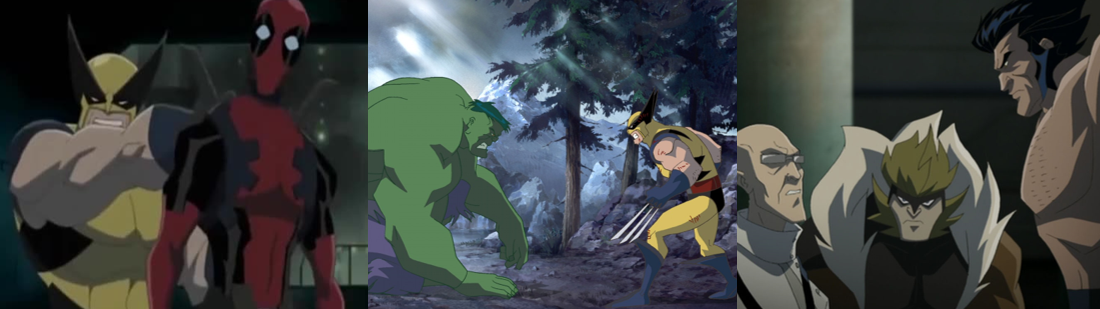
The Plot: After Doctor Bruce Banner’s (Johnson) rampaging alter-ego, the Hulk (Tatasciore), is suspected of destroying a town, Department H sends James “Logan” Howlett/Wolverine (Blum) to confront the creature, attracting soldiers from Weapon X.
The Background: Marvel Comics have had a long history with animated ventures; some of these, like the X-Men animated series (1992 to 1997), largely defined a generation of fans. In 2004, with the Marvel Cinematic Universe was still about four years away from it genesis, Marvel licensed many of their characters out for live-action films, many of which were massive critical and financial successes. To capitalise on this wave of mainstream popularity, Marvel made a deal with Lions Gate Entertainment to produce a series of direct-to-video animated movies based on their characters. Sales were initially very strong and, while the releases soon dropped from two per year to one, 2009 saw a dual feature release that pitted the Hulk against Wolverine and Thor Odinson in separate adventures. Hulk vs. would go on to make the second-highest gross out of all of these animated films and Hulk vs. Wolverine was met with generally positive reviews, potentially because of Wolverine’s inclusion and growing popularity at the time and the inclusion of fan favourite character Deadpool. Wade W. Wilson (also known as “Deadpool”) was created by Fabian Nicieza and Rob Liefeld and first appeared in The New Mutants#98 in February 1991. Though originally little more than a cold-blooded mercenary, the wise-cracking “Merc With a Mouth” went on to become one of the few comic book characters to be aware that they are comic book characters, leading to a warped, violent sense of humour, a tendency to break the fourth wall, and one of Marvel Comics’ most popular characters.
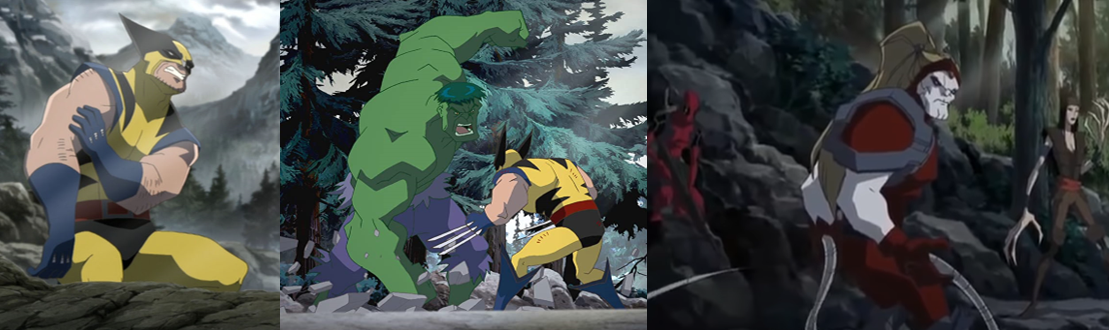
The Review: Hulk vs. Wolverine begins with a narration by Wolverine, who awakens beaten and bloodied in the middle of the Canadian wilderness. Momentarily disorientated, he painfully shoves his arm back into his socket and his memory is jogged by the dramatic arrival of the enraged Hulk. From there, the feature flashes back to four hours earlier in the day; Logan was transported into Canada by Department H after a town was destroyed by a creature believed to be the Hulk. Wolverine’s senses give him the general sense of what happened and, excited at the prospect of hunting down the Hulk, is given carte blanche to stop the Green Goliath by any means necessary before he can hurt anyone else. Free-falling to the snow-encrusted wilderness, Wolverine follows his enhanced sense of smell deep into the forests and mountains in search of the Hulk (a search made all the easier by the gigantic impact craters the Hulk has left behind as he leaps across the mountains) but finds only the distraught Bruce Banner.
Wolverine is sent to stop the Hulk but their fight is interrupted by Weapon X.
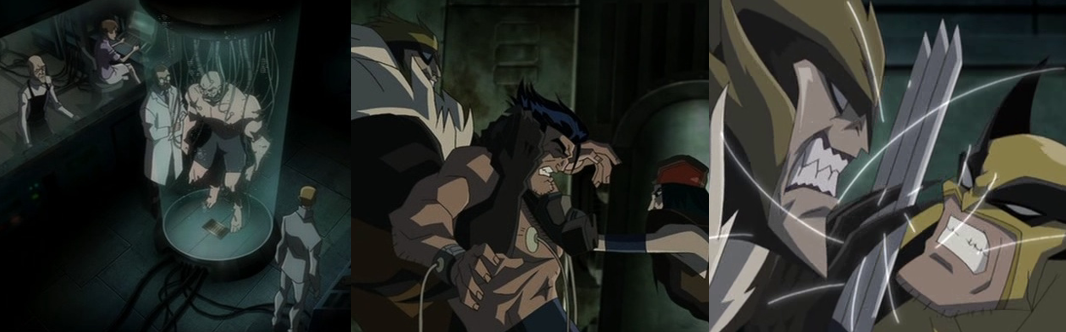
Although Banner begs him to leave and laments his condition, his transformation into the rampaging Hulk s triggered when Wolverine catches the Hulk’s scent on Banner and threatens him. After being knocked clear across the valley from a single punch from the Hulk, Wolverine recovers as in the opening and an all-out slugfest between the two ensues. Rather than engage the Hulk in head-to-head combat, Wolverine initially tries to use his wiles to attack the Hulk from behind, stabbing him repeatedly in the back, but the Hulk’s unquenchably rage and strength quickly overpower Wolverine and leave him a beaten, bloody pulp. As tenacious as his namesake, Wolverine gives in to his bloodlust and continues the fight, gouging deep, bloody wounds into the Hulk using his Adamantium claws but their fight is soon interrupted by a barrage of tranquilizer darts fired by Deadpool (North) and the arrival of Victor Creed/Sabretooth (Acheson), Arkady Rossovich/Omega Red (Murdock), and Yuriko Oyama/Lady Deathstrike (Jaud). Succumbing to the dart, Logan recalls how, while drinking himself into a stupor, he was abducted by the mysterious Professor (Kane) and subjected to the Adamantium bonding process against his will.
Wolverine’s past in Weapon X comes back to haunt him with a vengeance.
In the aftermath, he became the brainwashed soldier code-named Weapon X and was forced into a series of combat scenarios alongside the other Weapon X “graduates”; in time, Sabretooth’s unheeded warnings regarding Logan’s stability came to pass and he violently escaped from the facility and fled into the Canadian wilderness. Wolverine is brought back to the present by a vicious beating from his former teammate; as Sabretooth beats on him, Deadpool chatters incessantly, but the Professor (now sporting a robotic claw hand) interrupts to proceedings to reveal that Weapon X has been pursuing the Hulk and causing the destruction attributed to the beast in their efforts to capture him. The Professor plans to wipe the Hulk’s memories and brainwash him using the same procedures they subjected Logan to back in the day and place Wolverine back into the containment capsule in order to subdue him once more. As each of the Weapon X members wants Wolverine dead, Sabretooth kills the Professor so that he and Deathstrike can torture Logan and rip him to shreds; however, Wolverine is able to goad Deathstrike into skewering him in such a way that frees him from Sabretooth’s grip and, after slicing off her arm, attempts to escape the facility, slaughtering a whole bunch of armed guards in the process.
Hulk tears his way through Weapon X but the film ends with his fight against Logan unresolved.
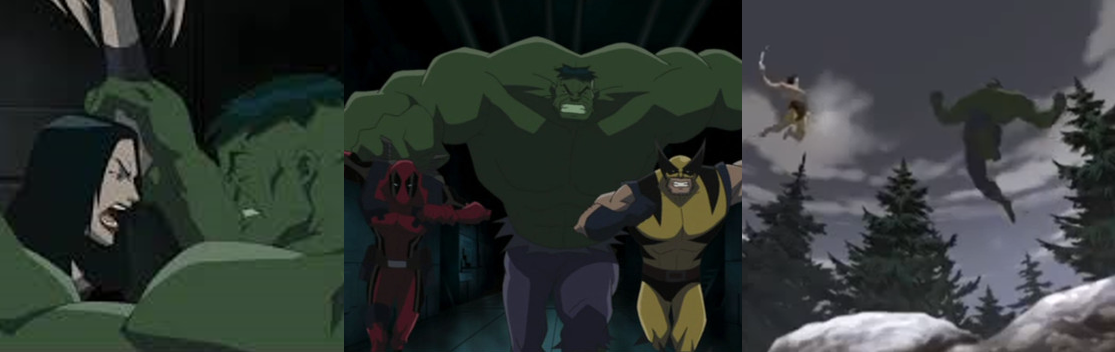
Although Deadpool isn’t convinced by Sabretooth’s story that Wolverine attacked the Professor, he agrees to hunt down and kill Logan, who frees Banner in order to get the Hulk’s help. A frail, despondent figure, Banner is tired of his dual existence and yet also terrified at the prospect of being turned into a weapon. Although horrified by Omega Red and Deadpool, Banner refuses to let the Hulk out so Wolverine stabs him in the gut to help speed up the transformation before engaging his adversaries alone; thanks to their individual healing factors, the fight is bloody and brutal and effectively pointless and yet each of them do everything they can to try and kill the other. Despite his best efforts, Banner is unable to hold off the transformation and, as Omega Red as Wolverine tangled up in his electrified tentacles, the Hulk attacks in a blind rage. The Hulk easily shrugs off Deadpool’s bullets and Omega Red’s tentacles, unwittingly saving Wolverine from Deathstrike’s clutches in the process; remembering Wolverine as an enemy, the Hulk charges after him, swatting aside Deadpool when Wolverine hilariously uses him as a human shield and dispatching Deathstrike with his patented clap before ripping her cybernetic limbs off. Hulk then pounds Omega Red into submission before bringing the entire facility down around them in his desperate need to escape; Wolverine is launched clear by the resultant explosion and the film ends with the two once again leaping to engage each other amidst the Canadian snow.
The Nitty-Gritty: Unlike the other Marvel animated efforts, Hulk vs. Wolverine isn’t exactly what you would call a feature-length presentation; this is mainly because it was released alongside Hulk vs. Thor (Liu, 2009) and, together, the two are supposed to form a kind of double feature. While they’re not exactly directly related to each other, this does help explain the brevity of Hulk vs. Wolverine, which is more like a bite-size version of a much greater story. You might think that this means the feature is a simple extended fight scene between the two characters but that isn’t actually the case; yes, Wolverine and the Hulk engage in bloody, brutal combat for a few minutes but their fight is quickly interrupted by the Weapon X members. The primary selling point of the feature then takes an extended break to touch upon Wolverine’s back story with Weapon X, which makes this much more like a snapshot of his character rather than a battle for the ages.
As amusing as Deadpool is, the Weapon X plot completely overshadows the title fight.
Indeed, Wolverine (and the Hulk, for that matter) spend more of the feature fighting against Weapon X than they do each other. On the plus side, this means there’s still a lot of violence and action packed into the feature’s short runtime and loads of opportunities for Deadpool to steal the show with his wit and wacky nature but those looking to see Hulk fighting Wolverine, as the title promises, may be left disappointment at how little of the action is actually focused on this fight. It’s interesting seeing a brief glimpse into Wolverine’s animosity against Weapon X but it’s all very rushed and glossed over to get to the next violent scuffle; I would have liked to see a bit more time spent exploring Banner’s desperation and downtrodden character at the sacrifice of, say, Omega Red (who was largely inconsequential overall) and a bit more time spent exploring the dichotomy between Banner/Hulk and Wolverine (since both are characters who rage and animal nature often overcome their rational minds). Instead, the feature blasts through a “greatest hits” package of Wolverine’s life, hints at relationships to characters many audiences might not be immediately familiar with (the past between Wolverine and Sabretooth and Deathstrike is given the bare minimum of lip service), and seems to have little faith in the concept of Hulk fighting Wolverine since it would rather skew its run time towards the more popular Wolverine.
The Summary: Hulk vs. Wolverine is a fun, if brief, way to spend about forty minutes of your life. Although it doesn’t quite deliver on its premise, the fight between the Hulk and Wolverine is brutal and exciting and there is a great deal of violence packed into its short run time. Hulk vs. Wolverine definitely doesn’t shy away from the ferocious nature of its title characters, or their adversaries, which is refreshing to see since these are violent characters and should be treated as such, but it definitely feels as though Wolverine’s presence overshadows that of the Hulk and the core concept of the feature. Although Deadpool’s role in the animated is small, he definitely stands out and it was exciting to see him included but, in the end, the insertion of Weapon X and the focus on Wolverine’s character definitely keeps Hulk vs. Wolverine from living up to its potential. I guess seeing the Hulk and Wolverine go at it for about half an hour straight wouldn’t have been that interesting but, as I said, there was a lot of potential in paralleling Logan’s animalistic character and nature with Banner’s condition that was imply abandoned to capitalise on Wolverine’s incredibly popularity and that’s a bit of a shame despite the feature being chock full of violent action and bloody violence.
My Rating:
⭐⭐
Rating: 2 out of 5.
Could Be Better
What did you think to Hulk vs. Wolverine? Do you feel like it wasted the potential of its premise or were you happy with what was presented? How do you feel it compares to Hulk vs. Thor and the other Marvel animated features? Which member of Weapon X was your favourite and how did you feel about the way Banner was portrayed here? What did you think to Deadpool’s inclusion and characterisation and would you like to see him featured in animation more often? How are you celebrating Deadpool’s debut this month? Whatever your thoughts on the Deadpool, or Marvel’s animated features, feel free to leave a comment below.
Horror Prompts’ Gillian Church has created 28 single-word prompts and challenged writers to write a horror drabble for each. A drabble is a story of exactly 100 words, no more, no less (not counting the title).
Can you do it?
The Prompt: Distorted
The Submission: There was a time when I’d look in the mirror and see a beautiful, beaming face staring back. Long blonde curls, glassy green eyes, perky lips always curved into a smile.
And now that reflection is distorted.
It started with the smallest blemish and I didn’t think much of it, but now it’s spread.
A twisting Glasgow smile, a dead, milky eye; straggly hair that hangs in clumps.
No one else sees it. They say I’m being “stupid” or “paranoid”.
But I see it every day.
A warped ugliness that eats at my flesh and needs to be cut out.
What did you think to the prompt for this week’s drabble challenge? Did you submit anything for it? Have you ever written any flash fiction before? I’d love to know what you think to my snippets and writing prompts, so feel free to sign up and let me know what you think below or leave a comment on my Instagram page. You can also follow Gillian Church to take part in her Wednesday Writing Prompt challenge.
Gillian Church posts Writing Prompts every week on her Horror Prompts Instagram account and I like to take part with a few snippets and pieces of flash fiction.
The Prompt: I stole the file you asked for. Now, what ae we looking for?
The Submission: “I hope you realise I’m seriously putting my neck on the line here?”
“Uh-huh,” I barely even glanced up.
I still don’t understand why you didn’t just go straight to the chief.”
I skimmed over the incident report. It was all there, in bloody detail. The bastard’s mug shot was even attached to the page by a paperclip. He still wore that smug, self-satisfied grin.
“—the procedure,” Evans droned on. “We have teams in place who can handle stuff like this—”
I had to fight the urge to screw the papers up, tear them to shreds, send the desk flying. I couldn’t believe the incompetence of the report.
“I just need the name,” I interrupted through gritted teeth.
“I’m not gonna be able to cover you on this one, I hope you know that?”
“Just the name…” I repeated, flicking through the last few pages.
There it was.
The arresting warrant.
Scrawled, looped penmanship that screamed inadequacy and carelessness.
And at the bottom of the page, the date. A signed signature.
“…The name…”
I felt a cold numbness at the base of my neck and gagged; an spray of blood burst from ym lips.
“I really wish you hadn’t seen that,” Evans growled.
What did you think to this week’s writing prompt? Did you submit anything for it? Have you ever written any flash fiction before? I’d love to know what you think to my snippets and writing prompts, so feel free to sign up and let me know what you think below or leave a comment on my Instagram page. You can also follow Gillian Church and Horror Prompts to take part in the Weekly Writing Prompt challenge.
Horror Prompts’ Gillian Church has created 28 single-word prompts and challenged writers to write a horror drabble for each. A drabble is a story of exactly 100 words, no more, no less (not counting the title).
Can you do it?
The Prompt: Pet
The Submission: I told her we couldn’t get a pet! But would she listen?!
No! And now look what’s happened!
I just couldn’t help myself! I tried, I really did, but it didn’t matter how cute the kitty was or how much joy she brought us both, I couldn’t fight the temptation.
It’s not that I don’t like pets. I love them! Especially cats, puppies, even plump little rabbits…
God, I’m salivating just thinking about it!
I’m sure she won’t notice; cats run away all the time, after all.
I’m sure she’ll get over it in time.
Hopefully the pie will help.
What did you think to the prompt for this week’s drabble challenge? Did you submit anything for it? Have you ever written any flash fiction before? I’d love to know what you think to my snippets and writing prompts, so feel free to sign up and let me know what you think below or leave a comment on my Instagram page. You can also follow Gillian Church to take part in her Wednesday Writing Prompt challenge.
Back in February 1974, Spider-Man/Peter Parker faced a new enemy in the form of Frank Castle, the Punisher, a veteran of the Vietnam War turned bloodthirsty vigilante. The Punisher separated himself from other, traditional costumed heroes by his willingness to kill and uncompromising, suicidal one-man war on crime and what better way to celebrate the debut of this nuanced and complex character by dedicating every Tuesday of this month shining a spotlight on Marvel’s most notorious anti-hero?
Released: 16 January 2005 Developer: Volition Also Available For: Mobile, PC, and Xbox
The Background: After his impressive debut in the pages of The Amazing Spider-Man #129, Frank Castle/The Punisher quickly became one of Marvel’s most popular anti-heroes thanks to his tragic backstory and unwavering commitment to the eradication of crime. The Punisher has also seen some success outside of the comic books, featuring in movies, cartoons, and a number of licensed videogames. Released to coincide with the 2004 movie of the same name, The Punisher was developed by Volition, a studio purchased by THQ in 2000 and perhaps best known at the time for their work on the Red Faction (ibid, 2001; 2002). Acting as a quasi-sequel to The Punisher (Hensleigh, 2004), The Punisher saw star Thomas Jane return to voice the role but incorporated its aesthetic presentation, storyline, and characters from the comics and was subjected to numerous edits and cuts to tone down its scene of explicit violence and gore and make it financially viable for release. While the game was met with mixed reviews, it sold around one million copies and was considered a success for Volition, who would go on to develop Saints Row (Volition, 2006).
The Plot: Having dedicated his life to the eradication of crime after losing his family to mobsters, Frank Castle has been working his way through New York City’s underworld as the Punisher. Having carved his way through the low-level street gangs and the Yakuza, he allows himself to be captured and interrogated in order to get closer to the town’s newest head gangster, the mysterious “Jigsaw”, who has a personal grudge against the Punisher.
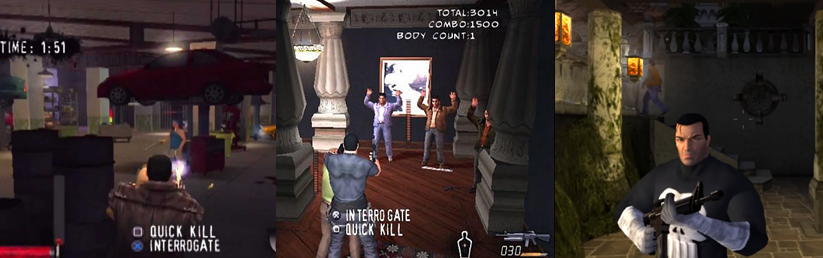
Gameplay: The Punisher is a third-person action shooter in which you’re placed into the iconic trenchcoat, combat trousers, and skull-shirt of Frank Castle, the titular Punisher, as he mows his way through countless thugs, lowlifes, and criminals in a one-man war on crime. Although he can’t jump, the Punisher has a number of combat and movement options available to him: he can pick up and swap weapons with the Circle button (note that, while he can dual-wield weapons, he can only hold two types of weapons at once; a smaller weapon like a pistol and a bigger weapon like a shotgun), select between his weapons by pressing down on the directional pad, fire his weapons with R1, toss grenades and other such explosives with L1, and enter a more accurate aiming mode (which is further expanded when he has a sniper rifles) by pressing in the right analogue stick.
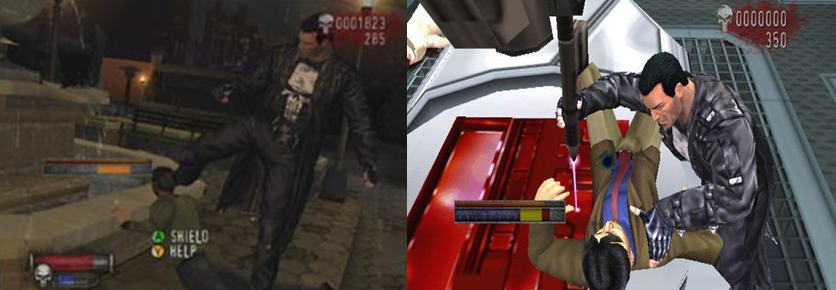
Frank’s methods of interrogation basically amount to brutal and sadistic torture.
The Punisher can also dive ahead with a press of R2, duck and crouch walk with L2, and grab thugs and use them as a human shield with X. In this position, or when up close to enemies, you can execute them with a quick kill by pressing Square. Enemies can also be interrogated by pressing X; in this mode, you’re ask to tilt or move the left analogue stick to keep a meter in the right area long enough to “break” your victim, which will award you with hints and Style Points. As you kill enemies, rack up kill combinations, and pull off successfully interrogations, you’ll earn Style Points that can be used to upgrade the Punisher’s various skills and attributes from the main menu in Frank’s apartment. As you encounter enemies and head into fire fights, you’ll notice glowing white Punisher skulls over the heads of certain enemies; once you’ve cleared the immediate area of all other enemies, these guys will give up and you’re tasked with performing a “Special Interrogation” using various parts of the environment (drills, furnaces, shark tanks, or dangling off a ledge, for example). Once you break them, they’ll often lead you to secret areas with new weapons or cause enemies ahead of you to stand down so you can progress easier. You can kill them, but it will cost you Style Points (which can be a little confusing as you’re otherwise rewarded for killing criminals; indeed, you can kill these guys normally after breaking them and not be penalised). Other times, you’ll see a glowing gold Punisher skull in the environment, which allows you to pull off a “Special Kill” (locking a scumbag in a coffin and tossing in a grenade, for example) for additional Style Points.
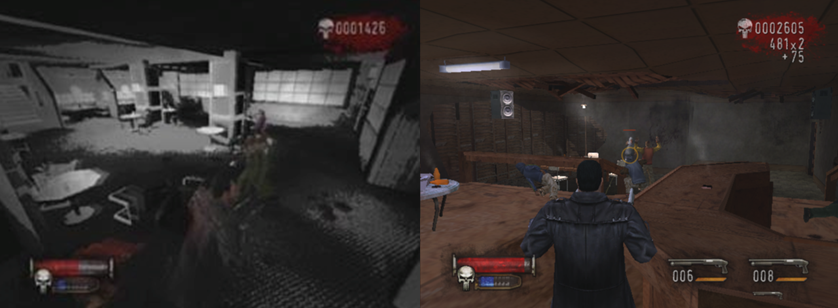
Enter Slaughter Mode to make short work of your enemies but watch your fire around friendlies!
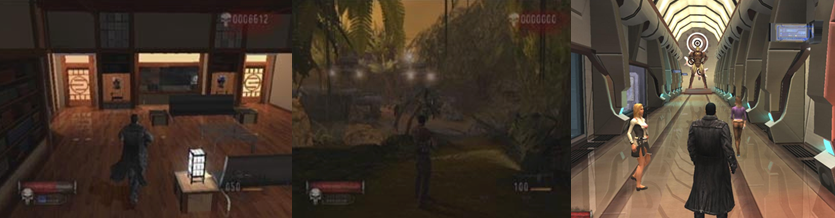
Considering how linear the game is, it’s surprisingly easy to get lost as you’re often exploring dark, grey corridors and very bland environments; there’s no map or onscreen indication of where you need to go so it’s easy to get a bit turned around at times. Often, you’re joined by a partner character (Natalia Romanova/Black Widow, Nick Fury, and agents of the Strategic Hazard Intervention Espionage Logistics Directorate/S.H.I.E.L.D.) who cannot be harmed by either you or enemies and are, surprisingly, very useful and competent for computer-controlled characters. Occasionally, you’ll be asked with solving some very simple puzzles that amount to finding a key or pulling a lever, rescuing hostages, placing explosive charges, interacting with a hidden switch to open a door, or forcing certain enemies to open doors; it’s nothing massively taxing but, again, it can sometimes be confusing as to where you need to go. The Punisher is quite a durable character whose health is refilled as he breaks thugs through interrogations or talks to rescued innocents but it also regenerates when you press Triangle; this puts you into “Slaughter Mode”, which slows time down to a crawl, turns the screen black and white, and has you tossing throwing knives and performing instant kills as long as the meter lasts. This can be a great way of clearing out rooms filled with perps but, honestly, I generally tended to save it for boss battles as the game is pretty generous with its checkpoints and not especially difficult to get through and I found this mechanic to be quite disorientating. Most of my deaths and mission failures came from accidentally dropping from high ledges or killing innocents; occasionally, enemies will grab hostages and use them as human shields and, if you kill them, you’ll instantly fail the mission so be sure to use your more accurate aiming in this situations.
Graphics and Sound: For a PlayStation 2 game, The Punisher is pretty decent to look at when you can actually see what’s onscreen. Character models are pretty good, if a bit blocky, but not much to shout about when it comes to enemy variety and aesthetic. Indeed, the character who looks the most dynamic and impressive is, fittingly, the Punisher himself. Decked out in a long trenchcoat, combat trousers, army boots, and skull shirt, the Punisher looks exactly like he stepped right out of the pages of a Garth Ennis comic book. Punisher even dons different outfits for different missions, including ditching the trenchcoat, decking himself out in war paint, and wearing prison clothes and, while he doesn’t have Thomas Jane’s likeness, he looks very much like his comic book counterpart.
Environments can be a bit boring and drab but there are a few that stand out as visually interesting.
Where the game falters, though, is in the level variety and presentation; you’ll skulk around seedy alleyways, dark corridors, and dingy crack houses, which aren’t massively impressive. Even areas like the chop shop, the zoo, and Fisk Industries’ skyscraper aren’t much to shout about as the game’s visuals are dulled with a dark, moody presentation that, while fitting, can make things visually very lifeless and boring. It’s not all bad, though; one mission takes place in a jungle, which helps to spice things up, as does battling through the research and development department of Stark Industries and a nightclub/bar, all of which bring some life and clarity to the action.
While many of its more brutal kills are censored, The Punisher is still a gloriously violent game.
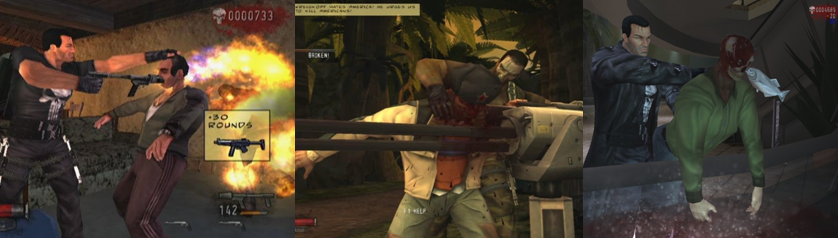
As mentioned, the game’s more brutal and bloodier executions have, sadly, been censored; nevertheless, the game is extremely violent, with enemies spurting blood and being blasted to death as best as the PlayStation 2 can render. The Punisher’s interrogation sequences basically amount to a version of torture and see Frank beating, choking, kicking, or intimidating his victims or threatening this lives using various parts of the environment, which is all very fun to see and take part in and, while these are censored, the implication is still very clear to see.
While the CG cutscenes are a bit fuzzy, the in-game graphics are pretty decent and there’s some fun cameos.
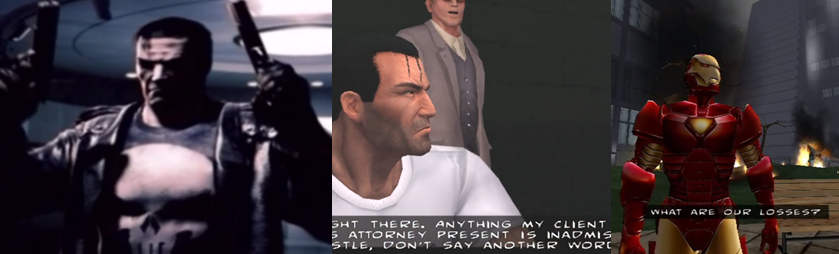
The music isn’t really that interesting or memorable; the game doesn’t seem to pull any tracks or influence from the movie, which is a shame, but the voice acting is top notch. Thomas Jane was always a fantastic Punisher and he continues to narrate events around him, offering wry commentary, dry quips, threats, and conveying just the right amount of dread and anger in the title role. The few amount of CG cutscenes the game uses are decent enough but the icing on the cake were the appearances and cameos from some of Marvel’s more recognisable characters, such as Matt Murdock, Tony Stark/Iron Man, and Wilson Fisk/The Kingpin, which are fun hints at the wider Marvel universe that exists around The Punisher and the cries and screams of the goons you fight are satisfying to hear.
Enemies and Bosses: As you might expect, the Punisher is confronted by a horde of nameless, faceless goons, thugs, and scumbags in his quest to destroy all crime. Enemies will react with fear and hostility at your presence, shoot at you from behind cover and doors, and throw weapons at you but, for the most part, are quite stupid and easily taken out even when they have the higher ground or the numbers advantage. As the story progresses, though, you’ll come up against more formidable enemies or enemies wielding more powerful weapons, such as shotguns, sniper rifles, and flamethrowers. Enemies will also fire rockets at you from helicopters, commandos don more protective armour to withstand your shots, and Yakuza will dog you at every turn in waves. Thankfully, you always have plenty of options available to take these guys out, from tossing them to giant snakes, smashing their faces into mounted guns, or simply blasting them away with your weapons and, while you’re often asked to hold out against a timer as an endless swarm of enemies rush at you, it’s never like you’re not capable of defending yourself.
Bushwacker gives you the slip more than once before you finally confront him head on.
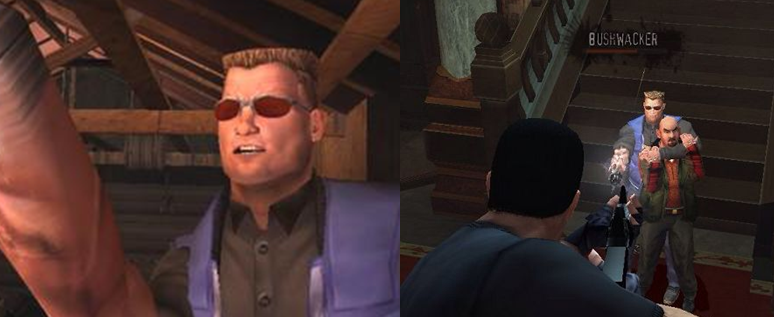
In terms of bosses, The Punisher has an interesting variety both visually and in terms of how you fight them. The game’s first few missions see you busting up the Gnucci gang; when you get into a shootout with Bobby Gnucci, you need to make use of nearby cover to get a good bead on him to take him out with a headshot. Later, you’ll burst out of a coffin and gun down countless minions of the family and find yourself running around in circles in a confusing attic maze as enemies continuously spawn in and you desperately try to find take out Eddie Gnucci in one of the game’s more confusing and frustrating boss battles. One of the more elusive bosses in the game is Carl Burbank/Bushwacker, a muscle-bound freak with a gun for an arm who constantly dogs your progress and escapes your retribution until you finally confront him in the library at Ma Gnucci’s estate. Goons will continually spawn into this fight and, if you attack Bushwacker head-on, you’ll take massive damage so I found the best tactic was to do a continuous circuit of the library, shooting at Bushwacker as and when, and bust out the Slaughter Mode to bring him down. Afterwards, you are given four minutes to escape the estate as it burns down, shooting sprinklers on the ceiling to get through the flames and performing a Special Kill to make short work of Ma Gnucci.
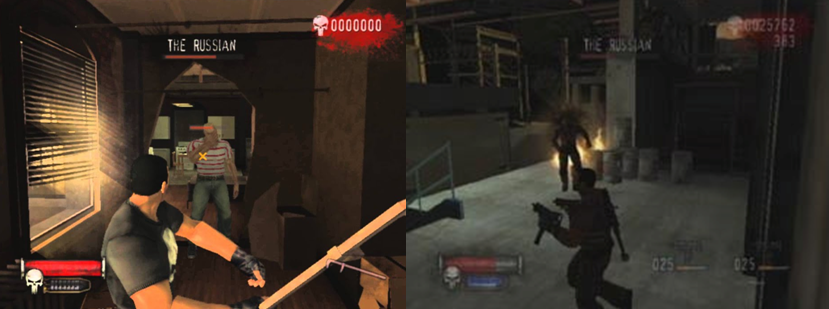
Though seemingly impervious to pain, environmental hazards and flames will bring the Russian down.
At the end of the docks, you’ll have to grab a nearby rocket launcher to take out the tank that blocks your exit, which is pretty easy to do thanks to all of the handy-dandy containers that offer cover. Afterwards, the game recreates a classic scene from the movie and comics with a battle against the nigh-invulnerable Russian in Frank’s apartment; here, you must stay away from the Russian and stun him with nearby melee weapons, mount his back, and use the Special Interactions to best him. Later, you’ll battle him against around a missile silo; this time, you need to shoot the barrels he grabs before he can throw them at you and, when he comes down to your level, use your grenades, the explosive barrels, and the missile’s flame jet to put him down once and for all while dispatching the endless goons.
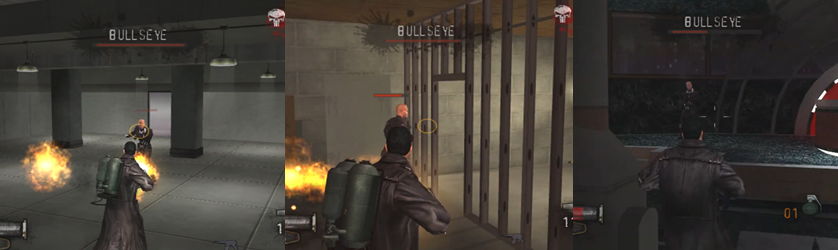
Bullseye is a slippery, tricky devil who eludes your attacks and keeps you on the move.
When you infiltrate Fisk Industries, you’ll encounter another elusive and annoying boss, Bullseye. This slippery devil will somersault about the place, tossing knives at you and only really taking damage when you land a headshot thanks to his fancy body armour. You’ll fight him again in an area of the skyscraper that is under construction, which makes it harder for you to get a clean shot thanks to all the walls and obstructions, before you have a finale showdown in Fisk’s penthouse where he pulls a gun out on you. In each of these three areas, you’ll find a weapons cache to keep your ammo topped up and I would recommend returning t it again and again to grab grenades to deal the most damage to Bullseye and knock him down so you can get a cleaner shot at his stupid head.
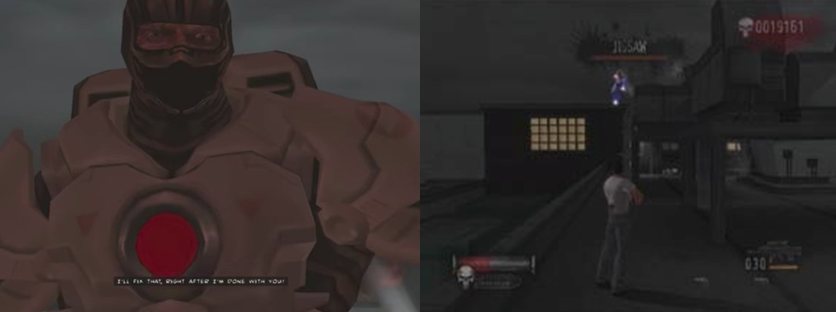
The finale sees you battling Jigsaw, who is in stolen Iron man tech, on the prison rooftop.
The finale of the game sees you facing off against Jigsaw (who, in a change to the source material, is revealed to be John Saint from the 2004 movie) who has donned stolen Iron Man armour. This is a two-stage boss battle; in the first stage, Jigsaw fires seeking missiles and repulsor blasts at you while hovering in the air and the only way to bring him down and damage him is to run underneath him and fire at his jetpack. Once he’s brought to ground level, he’ll chase after you and blast at you while goons spawn in to back him up. While you can shoot at him, it’s far easier to run to an area of the rooftop where the explosive mines (or “RAMs”) continually respawn; simply position yourself behind parts of the environment and toss these towards Jigsaw and remote detonate them and you’ll blow him away in no time at all.
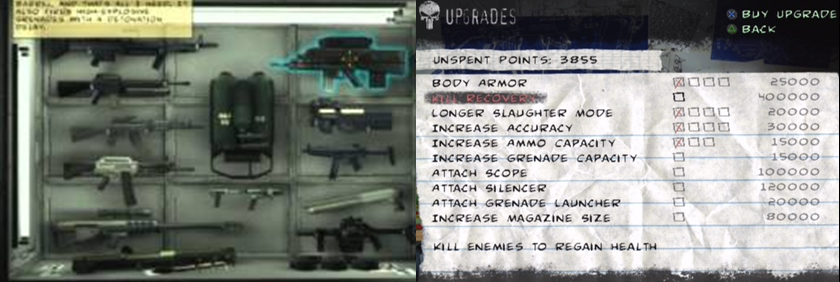
Power-Ups and Bonuses: The Punisher is afforded a great deal of weaponry for his crusade, most of it he liberates from defeated enemies or picks up from weapon caches in the environment. You’ll get access to a number of pistols (which Frank can dual-wield), revolvers, sub-machine guns, rifles, and shotguns and you can swap these out at any time when you see a weapon on the ground. You can also find and use flamethrowers (but be careful as flaming enemies can harm you as well) and a rocket launcher, which is perfect for bringing down helicopters, and a sniper rifle to take enemies out from a distance and defend your gondola in the jungle. Other time, you can acquire melee weapons to put a beatdown on your enemies.
Choose from a wide selection of weapons and use Skill Points to upgrade Frank’s abilities.
After clearing a mission, you’ll be awarded with both Medals and Style Points. You can spend these points upgrading a number of the Punisher’s skills and attributes from Frank’s apartment. You can upgrade Frank’s body armour to increase your resistance to damage, increase the duration of your Slaughter Mode, increase your clip capacity, and add a scope or grenade function to certain weapons. Thankfully, you don’t have to worry about upgrading every weapon individually so increasing your accuracy or ammo capacity will do this for every weapon by default.
Additional Features: The Punisher offers three difficulty settings, which will increase the aggressiveness and durability of your enemies and also allow you to obtain different Medals and gameplay modes. You can earn Bronze, Silver, and Gold Medals in every mission, but Gold Medals are only available when playing on Hard Mode; however, every time you finish a mission, you’ll unlock an additional “Challenge Mode” that presents you with a specific objective to fulfil to unlock extra stuff. Sadly, there is no option to don a different skin or outfit when replaying missions but there are cheat codes to unlock alternative outfits, so that ’s something, at least.
Take on challenges and play on Hard Mode (or cheat…) to unlock additional modes, cheats, and costumes.
From Frank’s apartment, you can view all of the Punisher’s weapons (Thomas Jane even narrates what each weapon is capable of), enemy biographies, cutscenes, flashbacks (which are triggered and unlocked when interrogating certain enemies), and comic books covers (unlocked by clearing challenges). When playing on Hard Mode, you’ll also gain access to “Punishment Mode”, which has you holding out against waves of enemies to earn points and medals. Additionally, clearing Hard Mode will unlock cheats for you to use; you can also unlock these manually but, while it’s fun to run around without fear of harm, you won’t actually be able to progress through the story with these activated.
The Summary: The Punisher is a pretty decent third-person shooter; considering it’s a licensed game, which are generally regarded as being terrible, it’s a pretty solid effort. I think choosing to veer more towards the source material than the movie was a good choice as it made it more appealing and fresh and, rather than going through the beats of the movie step by step, it crafts an entirely new adventure that is appealing to fans of the film, the comics, and this genre of videogame. It’s not perfect by any means; the censoring of the torture scenes is disappointing, environments are bland and dark and confusing, and certain sections can be frustrating at times but there is a lot of variety and mayhem on offer thanks to the wide array of weapons and kill options at your disposal. It’s probably the most accurate Punisher videogame we’re ever likely to get and has quite a lot of replay value thanks to the additional challenges and such. There might be better third-person shooters out there but The Punisher is definitely worth your time for the violence alone, to say nothing of the references to and cameos of other Marvel characters. Team this up with Deadpool (High Moon Studios, 2013) and X-Men Origins: Wolverine(Raven Software, 2009) and you have some of the best and most accurate videogame depictions of Marvel’s more violent characters.
My Rating:
⭐⭐⭐⭐
Rating: 4 out of 5.
Great Stuff
Have you ever played The Punisher? If so, what did you think of it? Were you disappointed that it didn’t follow the movie closer, or have more ties to the movie, or did you enjoy that it was more in line with the source material? What did you think to the game’s violence, executions, and action? Which of the cameos and/or boss battles was your favourite and were there any you felt were missing from the game? Would you like the see the title remastered for modern consoles or do you think it’s best left as a relic of a bygone era? Which Punisher videogame, story, or adaptation is your favourite? Whatever you think about The Punisher, feel free to write a comment below and be sure to check out my other Punisher content.
Horror Prompts’ Gillian Church has created 28 single-word prompts and challenged writers to write a horror drabble for each. A drabble is a story of exactly 100 words, no more, no less (not counting the title).
Can you do it?
The Prompt: Undone
The Submission: Years of planning … all undone by a single fighter!
One small gap in our defences, one lucky shot, and everything has fallen apart.
Well … so be it! If I’m to go down, I’ll take their whole damned world with me!
It won’t take much; it’s a simple case of overloading the gravity drive, inputting a collision course with that blue hellhole, and letting physics take care of the rest.
Klaxons blared around me as the ship lumbered to fulfil my final command.
A flickering, flaming aura engulfed the ship as we breeched the atmosphere.
“Long live the Empire!”
What did you think to the prompt for this week’s drabble challenge? Did you submit anything for it? Have you ever written any flash fiction before? I’d love to know what you think to my snippets and writing prompts, so feel free to sign up and let me know what you think below or leave a comment on my Instagram page. You can also follow Gillian Church to take part in her Weekly Writing Prompt challenge.
Horror Prompts’ Gillian Church has created 28 single-word prompts and challenged writers to write a horror drabble for each. A drabble is a story of exactly 100 words, no more, no less (not counting the title).
Can you do it?
The Prompt: Valentine
The Submission: I wish I’d never been to that fuckin’ forest! Ate that fuckin’ ‘shroom!
Fuckin’ Jonesy and his bright ideas!
Mark went last night; he tried to pass it on, but it didn’t take.
Jonesy’ll probably be okay; he’s got Ellen an’ she’s bound’t put out!
I can feel it eatin’ away at me; my fuckin’ eyes were bleedin’ this mornin’!
I gotta pass it on… there’s gotta be someone!
That chick two floors down,… she’s always had a thing for me.
Luckily, it’s Valentine’s Day so she won’t ask questions but I have to hurry! I’ve wasted too much time.
What did you think to the prompt for this week’s drabble challenge? Did you submit anything for it? Have you ever written any flash fiction before? I’d love to know what you think to my snippets and writing prompts, so feel free to sign up and let me know what you think below or leave a comment on my Instagram page. You can also follow Gillian Church to take part in her Weekly Writing Prompt challenge.
Horror Prompts’ Gillian Church has created 28 single-word prompts and challenged writers to write a horror drabble for each. A drabble is a story of exactly 100 words, no more, no less (not counting the title).
Can you do it?
The Prompt: Choking
The Submission: They were such a nice couple; they were always so polite, and I didn’t think twice of popping over to ask to borrow a tin opener.
George kept saying he’d fix ours, but it finally bit the dust and I needed it for my recipes.
They invited me in, even treated me to a cup of tea and a digestive; but when I saw the time and had to excuse myself, he leapt on me with such ferocity!
I had no hope of fighting back. I choked beneath his grip as she cackled behind him, and the world turned to–
What did you think to the prompt for this week’s drabble challenge? Did you submit anything for it? Have you ever written any flash fiction before? I’d love to know what you think to my snippets and writing prompts, so feel free to sign up and let me know what you think below or leave a comment on my Instagram page. You can also follow Gillian Church to take part in her Weekly Writing Prompt challenge.
Horror Prompts’ Gillian Church has created 28 single-word prompts and challenged writers to write a horror drabble for each. A drabble is a story of exactly 100 words, no more, no less (not counting the title).
Can you do it?
The Prompt: Fever
The Submission: “And how’s little Daisy’s fever? Is she still in bed?”
I half-choked on my tea; Dennis glared at me from across the table. “She’s fine,” he barked a little too harshly.
“I haven’t seen her in days; maybe I should go check on her?”
“No! Don’t, please!” I grabbed my mother’s wrist as she rose from the table.
“Whatever’s the matter, dear? I just want to see my granddaughter.”
Mother shook me off and headed upstairs. I moved to stop her but Dennis shook his head, a stern look in his eyes.
I drank my tea as the screaming started.
What did you think to the prompt for this week’s drabble challenge? Did you submit anything for it? Have you ever written any flash fiction before? I’d love to know what you think to my snippets and writing prompts, so feel free to sign up and let me know what you think below or leave a comment on my Instagram page. You can also follow Gillian Church to take part in her Weekly Writing Prompt challenge.








You must be logged in to post a comment.