Screen Time [Gazpacho Soup Day]: Red Dwarf: The Promised Land


In the episode “Me2” (Bye, 1988) of the classic British science-fiction comedy show Red Dwarf (1988 to 2020), it is revealed the Arnold Rimmer’s (Chris Barrie) last words were “Gazpacho soup!” and that he made a point to celebrate November 25th as “Gazpacho Soup Day” after a particularly traumatising visit to the Captain’s Table. Accordingly, this seems like the perfect date to celebrate the long-running cult phenomenon.


The Promised Land

Air Date: 9 April 2020
Director: Doug Naylor
Network: Dave
Stars: Chris Barrie, Craig Charles, Danny John-Jules, Robert Llewellyn, Norman Lovett, Lucy Pearman, Mandeep Dhillon, Tom Bennett, and Ray Fearon

The Background:
Red Dwarf was the brainchild of creators Rob Grant and Doug Naylor, who originally produced a similar show, Dave Hollins: Space Cadet for BBC Radio 4 in 1984. Influenced by sci-fi classics such as Dark Star (John Carpenter, 1974) and The Hitchhiker’s Guide to the Galaxy (Adams, 1978; Bell, 1981), the duo’s concept of a comedy set in space featuring relatively ordinary characters in an extraordinary setting was initially a hard sell but quickly became a cult hit among audiences. The show remained consistently popular and the duo became experimenting with more outlandish sci-fi concepts up until the seventh season, when the two parted ways, before disappearing from broadcast altogether following the eighth season. In 2008, the show was revived in a three-episode special that aired on Dave, which led to the commission of three more seasons that returned the four principal cast members, now understandably much older and far more jaded. After years of rumours, a feature-length instalment of the series finally saw the light of day in 2020 ahead of a comprehensive retrospective on the popular series. As a life-time fan of the show who had noticed an unmistakable dip in quality since the eighth season, I wasn’t too surprised to find that Red Dwarf: The Promised Land was met with mixed reviews as I remember being mostly unimpressed with it at the time of airing but let’s take another look back and see if it holds up on a repeat viewing.

The Plot:
While exploring Red Dwarf’s cargo bay, Dave Lister (Charles) is able to finally reboot Holly (Lovett), the ship’s computer, who promptly forces the crew to flee for their lives. In the process, Arnold Rimmer (Barrie) discovers technology to upgrade his hologramatic form and the crew stumble upon remnants of the Cat’s (Jules) race of felis sapiens, who worship Lister as  God and are being relentlessly hounded by the ruthless Rodon (Fearon).

The Review:
The Promised Land finally delivers on a concept the Red Dwarf creators had been kicking about years ago by returning to a long-forgotten plot point of the series revolving around the felis sapiens race; in all the length of the series history and the many bizarre plots and characters Red Dwarf has employed, the show never delved into this aspect beyond the first series despite the fact that it would have been pretty easy to have the cat race be recurring antagonists or characters. Instead, all we really know about felis sapiens comes from the Cat (who has little to no interest in the religious teachings of his race and is more obsessed with himself and fashion), an elderly priest (Noel Coleman), and the rough translation of the Cat Bible in the episode “Waiting For God” (Bye, 1988). It goes without saying that the focus of Red Dwarf has shifted quite drastically from the identity crisis Lister suffered in that episode, and which was peppered throughout the first series, and his status as the Cat’s God and saviour of his race was downplayed to the point of nonexistence in favour of him being a slobby, reluctant hero and developing a far more equal friendship with the Cat. The Promised Land, though, finally comes full circle back to these long-forgotten threads and shows that the felis sapiens race (or, at least, part of it) roams the universe on a fleet of warships under the command of Rodon. Rodon is unimpressed that three of his crew, Brother Sol (Bennett), Sister Luna (Dhillon), and Sister Peanut (Pearman), refuse to submit to his rule and, instead, prefer to embrace the antiquated teachings of “Cloister”.
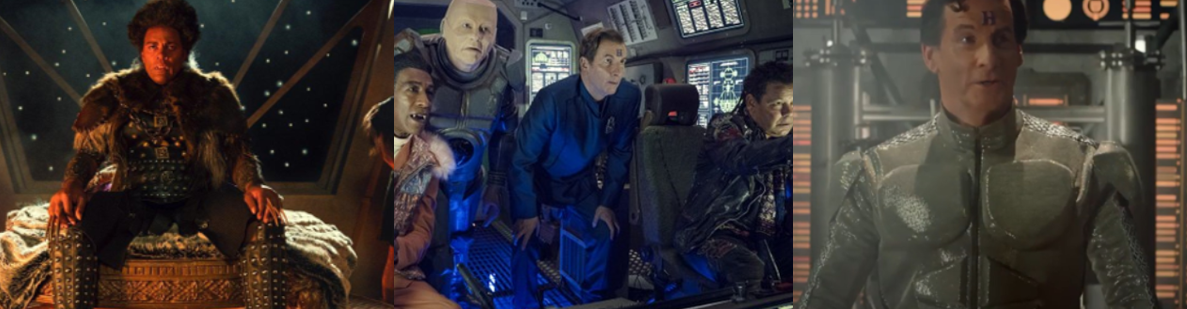
The crew are forced to abandon Red Dwarf, allowing Rimmer to upgrade totemporary diamond-light.

These three outcasts dress like Lister (at least, they dress like he did in the first two seasons) and believe wholeheartedly in the teachings of the Cat Bible; when they meet Lister, they bombard him with the big questions of life (male genitals, the agony of child birth, why people smell. You know, the usual) and are resolute in their belief that Lister is capable of working miracles since Peanut wondrously regains the ability to speak upon meeting her idol. Lister, meanwhile, has taken to hording junk, eating and drinking more than usual, and seems more distracted and slobby than normal, to the concern of Kryten (Llewellyn), who believes that Lister is having something of a mid-life crisis due to the pressure of being the last man alive. Eager for Lister to procreate and thereby ensure the survival of his species and give him something to focus on, Kryten suggests that the Cat undergoes a sex-change operation, much to their horror. This discussion is interrupted when Rimmer orders Kryten to investigated an unidentified object that appears to be on a collision course with the ship; when the object turns out to be the cats’ ship in need of aid, Rimmer decides that they’re all too old and too past it to go gallivanting off on some rescue mission and so has Kryten erase his memory of the entire event. This exchange goes on for some time before Lister and the Cat reveal that they found Holly’s back-up disk. However, upon rebooting Holly, they find that he’s returned to his factory settings and no longer recognises or remembers the crew or their many misadventures; believing them to be a group of stowaways and criminals, Holly decides to decommission Red Dwarf and drives the crew from the ship. Fleeing in Starbug, the crew plan to catch-up to the ship Rimmer picked up earlier, the Iron Star, and stumble upon advanced hologram technology; Rimmer, excited at the prospect of his form being vastly upgraded, decides to overrule Kryten’s concerns and (after cycling through his various costumes from previous series’) is granted a new “diamond-light” form and transformed into a veritable superhero. Sporting a glistening new uniform, Rimmer is now able to manipulate the density of objects around him, phasing through matter while still retaining his hard-light invulnerability, and even transforming into pure light energy at will…for about two minutes as his Light Bee is drained by the resulting energy surge.
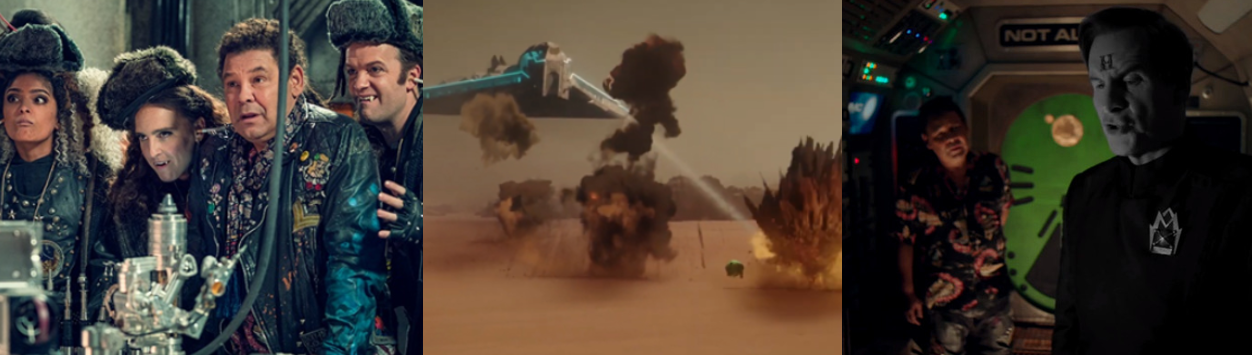
There’s some surprisingly heartfelt moments amidst the cat drama and sci-fi action.

While exploring the Iron Star, the crew stumble upon the cat escapees, who are immediately in awe at meeting their idol; as in “Waiting For God”, Lister is reluctant and uncomfortable at being worshipped as a God and insists that he’s simple a normal, unremarkable man. While he wants to tell them the truth, as he did with the Cat, Kryten and Rimmer discourage him from destroying their faith and he begrudgingly decides to play along while also vowing to protect them from Rodon’s pursuit. Rodon is unimpressed to find that their God is actually real as is concerned only with the rebels and the Anubis Stone they possess; he’s easily able to acquire the stone thanks, largely, to Lister not actually being the all-powerful deity the clerics believe him to be and orders his lackeys to throw them all out of an airlock as a message to those that would defy his authority. Thanks to Rodon’s impatience to destroy the Iron Star, the crew are able to elude their captors and make a harrowing escape in Starbug, though Lister impulsively jettisons the ship’s engines when they catch fire, sending them into an uncontrollable death dive to a desert moon. Thankfully, the hitherto-unknown Starbug owner’s manual reveals that the ship possesses emergency parachutes (as well as being a hybrid and having a hovercraft mode) and, while the Cat fashioned himself a jacket and mittens out of one, the back-up parachute is deployed, and the crew makes a successful crash-landing. Marooned on the moon with no food, water, fuel, or hope of escape, the crew are driven into a sandstorm when Rodon attacks and Lister begins to question the decision to keep the truth from the cats in their midst. Similar to when he worked to help Kryten break his programming, he is uncomfortable with the cats being so dependant upon him rather than thinking and acting for themselves and ultimately decides to break the truth of to them. When Kryten is unable to speak a bad word against Lister, Cat volunteers to do the deed but is quickly (and amusingly) reminded of everything Lister has done for him and briefly joins them in their worship of Lister, so Rimmer steps up to the task. Unfortunately, while he relishes the opportunity to tell them the awful truth about Lister, he is interrupted by a crashed piece of debris that may hold the key to their escape; in order to catch up to the piece of debris, Kryten is forced to conserves all available power, reducing Rimmer to low power mode. Thanks to being in mono and greyscale, and Cat’s goading, Rimmer begins to question his relevance and existence as he faces both his impending end and questions his identity. This does, however, give Lister an opportunity to show just how much he’s grown over the years; at one time, it would have been him criticising Rimmer and tearing him down but, instead Lister snaps at Cat for harassing Rimmer and is ultimately able to convince his long-time frenemy that he is a relevant and appreciated member of the crew with a heartfelt analogy comparing Rimmer to moonlight.

Rimmer ultimately saves the day and then reluctantly gives up his superpowers to save Kryten.

After being buried by the sandstorm, and with little options available to them, Rimmer comes up with the crazy idea to have Kryten establish contact with Red Dwarf and convinces Holly to load up his last save file, thus restoring his memories to the full. However, now suffering from three million years’ worth of computer senility, Holly’s only suggestion is to use one of Red Dwarf’s thermonuclear torpedoes to dislodge Starbug, a tactic which succeeds…but also destroys the entire moon in the process! However, Rodon and his fellow ferals managed to beat them back to Red Dwarf and, when he takes Luna hostage, Lister is forced to admit the truth about who he is, much to the disappointment and heartbreak of his devoted followers. Disgusted by these revelations, Rodon is satisfied to order Red Dwarf’s destruction with a time bomb; it’s also randomly revealed that Rodon is the Cat’s older brother and that the cats purposely left him behind for being “uncool”, thus spurring him to devote his life to being fashionably cool. Facing certain death, Lister performs one last miracle by revealing that the seemingly useless Anubis Stone in fact houses an incredible power source. He then uses this to power Rimmer back up to his diamond-light form, which allows Rimmer to save the ship from destruction by flying the bomb out into space. After a brief fake out where Rimmer appears to die (it’s already been established that his hard-light form is invulnerable to harm so it’s pretty obvious his diamond-light would be equally impenetrable), the crew fly head-first towards Rodon’s ship and Rimmer projects a beam of light into the bridge, turning Rodon’s crew against him and forcing them to crash into a nearby asteroid. Rimmer then reluctantly sacrifices his superpowered form to repower Kryten with the Anubis Stone (though he isn’t shy about rubbing this act in Kryten’s face) and the cats are returned to their people, their faith reaffirmed but now placed in Rimmer after witnessing his heroic actions.
The Summary:
Being a lifelong fan of Red Dwarf, I’m always excited to see the guys back on screen and getting up to all kinds of wacky hijinks and, ever since series eight, I’ve been continuously disappointed. You can really feel the absence of Rob Grant; ever since he left, the show hasn’t been the same and slowly, but surely, fell back on recycling the same old jokes and situations whilst sweeping all of the character progression under the rug. Thus, by the time the series came back on Dave, the Cat was right back to being a shallow, self-obsessed egomaniac rather than an independent and strong-willed character; Lister went right back to being a slobby layabout; Kryten regressed into a neurotic wreck; and Rimmer acted more like his season one incarnation than the developed and fleshed out character he was by season seven. To make matters worse, what little interest in continuity the show had was completely thrown out of the window, with sets, models, and outfits continuously changing with each of Dave’s productions and the show constantly dodging the unresolved cliffhanger of season eight in favour of random wacky shenanigans in space.

It’s great to see the characters back in action but a lot of the old magic is noticeably lacking.

Sadly, Red Dwarf: The Promised Land is no different in this regard; the only character who appears to have grown a little bit is Lister, who is now much more sympathetic and understanding to Rimmer and far more pragmatic and capable in tight situations thanks to his years of experience in dire scenarios. Yet this is never fully capitalised on and is massively downplayed in favour of random gags like Kryten’s sex change suggestion and laborious exposition and call-backs to previous episodes. Even the chemistry between the returning cast members is notably awkward; there’s a number of obvious pauses after they deliver lines where they wait for the laugh track or for the next line, which really interrupts the flow of their conversations and the few moments of genuine humour in the feature. The Promised Land puts a lot of its eggs in one basket, that being the depicting of the cat race. Accordingly, Rodon’s fleet resembles a cat’s face, the door to his private chambers is a cat flap, he and his minions all have exaggerate cat mannerisms similar to the Cat in the first series, and they’re all easily distracted by moving lights. Unfortunately, this all quickly outlives its charm; it’s one thing for one character, the Cat, to act this way but even he dropped the more annoying aspects of his personality by the second series and seeing a whole bunch of new characters take on the worst aspects of his character gets old very quickly. Equally, I found the call-backs to previous episodes and events more aggravating than anything else; Lister sings the Om Song, the crew run through a very truncated version of their past misadventures when bringing Holly up to speed, and Cat even drops a mention of the backwards world at one point and all this does is make me wish I were watching one of the earlier, far superior episodes of the show.
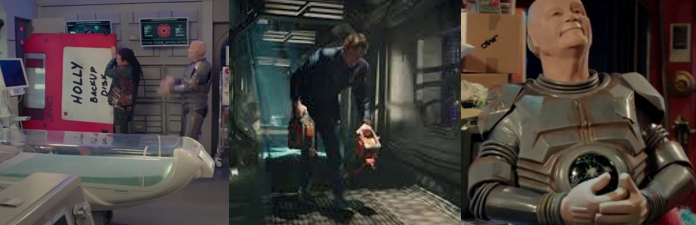
Some of the gags land and the feature has a lot of untapped potential in its premise.

It’s not all bad, to be fair. There are a couple of funny gags, such as Holly’s back-up disc being a gigantic floppy disc, Rimmer’s deep and overly dramatic voice when in his diamond-light form, Rimmer racing around with extension cords to prolong his lifespan, and Cat joining in with the cats’ “Listey-Listey” song. There’s also a definite sense that the crew are older and more world-weary (maybe “space-weary” is a better word) now: Kryten’s suit (which looks the worst and fakest it’s ever been) is all cracked and patched up; Lister’s rant about not finding the Cat attractive alludes to the possibility of him being impotent; and Rimmer asserts that they’re all too long in the tooth for any elaborate hijinks. Yet, once they are in the heat of their latest misadventure, the crew are still able to get by on the last few remnants of that old spark they had in season six, surviving through a combination of dumb luck, the stupidity of their enemies, and a modicum of competency on their part. Unfortunately, though, it’s just not enough to really capture the old magic of when Red Dwarf was at its peak. I was really excited when Red Dwarf first came back on Dave and was hoping for one last event to tie up all the loose ends and bring the story to a close. Instead, it feels as though Dave put the show on life support and has been dragging it out ever since. I would have much preferred to see maybe three one-hour specials that brought the story full circle, maybe even bringing the crew back to Earth or using time travel shenanigans to bring their story to a close. Instead, we keep milking the same gags and treading the same ground in a series of self-contained, meaningless episodes that, rather than celebrating the long-running cult show, merely serve as a bleak reminder of how great it used to be.

My Rating:

Rating: 1 out of 5.

Terrible

What did you think to Red Dwarf: The Promised Land? Did the jokes and gags work for you? What did you think to the inclusion of the cat race and Rimmer’s new diamond-light form? Are you a fan of the Dave era of Red Dwarf? Do you agree that it lost a lot of its magic after Rob Grant left or have you enjoyed the show regardless of the obvious dip in writing quality? Which character, season, and ship is your favourite and why? Would you like to see another feature-length special, maybe one that finally closes the book on the Red Dwarf story, or do you think it’s best to leave it be for now? How are you celebrating Gazpacho Soup Day today? No matter what you think, feel free to leave a comment about Red Dwarf: The Promised Land, or Red Dwarf in general, down in the comments.

Movie Night: Ghostbusters: Afterlife

Released: 19 November 2021
Director: Jason Reitman
Distributor: Sony Pictures Releasing
Budget: $75 million
Stars: Mckenna Grace, Carrie Coon, Finn Wolfhard, Logan Kim, Celeste O’Connor, and Paul Rudd

The Plot:
After being evicted, Callie (Coon) and her children Trevor (Wolfhard) and Phoebe (Grace) move to a decayed farmhouse ravaged by unexplained earthquakes. After discovering that their grandfather was Ghostbuster Doctor Egon Spengler (Harold Ramis), the children reclaim the Ghostbusters’ equipment to battle the supernatural forces seeking to enter our world.

The Background:
Ghostbusters (Reitman, 1984) began life as a project developed by actor Dan Aykroyd for himself, Eddie Murphy, and close friend John Belushi that finally came together when director Ivan Reitman, writer/actor Harold Ramis, and Bill Murray came onboard. Initially produced as a standalone film, Ghostbusters’ incredible critical and financial success eventually led to what I consider to be an under-rated sequel. Still, while Ghostbusters II (ibid, 1989) underperformed compared to the first film and was met with mostly negative reviews, the 2016 reboot was subjected to scathing criticism and controversial backlash. Following this failed reboot, Jason Reitman, son of Ivan Reitman, began development of a new Ghostbusters film that would be a direct continuation of the original films. Taking his cue from Ackroyd’s many unproduced attempts at a third film, Reitman aimed to show a younger generation picking up where their predecessors left off. He also sought to pay homage to the original films, returning the original actors in a way that made sense, and recapturing the spirit of what made the first film so successful. Thanks to the COVID-19 pandemic, Ghostbusters: Afterlife was delayed numerous times; upon release, the film was met with generally positive or somewhat mixed reviews. Critics praised the cast, atmosphere, and references to the first film but also questioned the reliance on nostalgia and narrative direction of the film. Regardless, Ghostbusters: Afterlife grossed over $204 million worldwide, more than justifying the production of a sequel in 2024.

The Review:
I’ve always been a big Ghostbusters fan; if you’ve read my review of the first film, you know that it’s one of the many formative movies and influences on my childhood. I had the toys, watched the cartoon, and even enjoyed the under-rated sequel, so to say that my anticipation was high to finally see a proper third entry in the franchise is a bit of an understatement. I was excited by the prospect of the trailers, which depicted a world that has moved past the need for the Ghostbusters and a new generation taking up their roles, and the only thing I was concerned about was that the film would retcon or out-right ignore the sequel. It was pretty clear from the trailers (and the younger cast) that the film was going for more of a Stranger Things (2016 to present) than being a straight-up sequel or requel of the original Ghostbusters, and this is pretty clear right from the beginning of the film with the focus squarely being on young Phoebe.

Something of an awkward outsider, Phoebe is the clear focus and highlight of the film.

Phoebe is something of an outcast in her family; while Callie is a struggling working mother and Trevor is more mechanically minded (when he’s not being an angst-and-hormone-fuelled teenager), Phoebe is a shy, awkward scientist prodigy. She has no friends, struggles to make emotional connections with people, and is fascinated by science and logic; although Callie worries over Phoebe’s development and personality, the forced move to Summerville, Oklahoma actually turns out to be the best thing for Phoebe as she slowly discovers her late-grandfather’s Ghostbusters technology and finds a connection to him that is otherwise lacking with her family and in her life. She also makes an actual friend in the form of “Podcast” (Kim), an enthusiastic young boy with an obsession interest in unsolved mysteries and the supernatural, and who actually finds Phoebe’s awkward attempts at humour funny and fills in the backstory of Summerville by relating the ghost stories surrounding Ivo Shandor’s mining operation. Ghostbusters: Afterlife is Phoebe’s story, first and foremost, which I actually wasn’t expecting heading into it; however, she’s a sweet and compelling character who is just trying to find herself and realise her potential as a scientist. Easily the smartest person in every room, she has a kind of naïve enthusiasm for science and the Ghostbusters tech and is eager to follow in her grandfather’s footsteps and redeem his reputation in the eyes of her mother, the entire town, and even his old team mates.

Sadly, there isn’t much for Trevor and Lucky to do beyond being support characters.

Comparatively, there isn’t that much for Trevor to do; he’s the typical moody teenager who despairs of their poor fortune and the backwater nature of Summerville, but he quickly finds a reason to stick around when he becomes infatuated with Lucky Domingo (O’Connor), a young girl who works as a roller-skating waitress. His awkward attempts to flirt with her do help to emphasise the importance of the mountain and the derelict mine, and he does fix up the Ecto-1 in this spare time, but he’s very much a supporting character next to Phoebe and both he and Lucky just seem to be here to make a new team of four would-be Ghostbusters. Trevor is far less intelligent than Phoebe, and also far less interested in figuring out why Summerville is routinely beset by unexplained tremors or uncovering the mystery of their grandfather. He comes into his own when driving Ecto-1, which makes for a fun-filled sequence where he and the others frantically chase a ravenous ghost through the town and cause all kinds of destruction, and it was interesting to see Finn Wolfhard take more of a backseat considering he’s the more prominent actor of the youngsters.

Callie feels a deep-rooted sense of abandonment while Gary is just excited by Ghostbusters tech.

Similarly, Callie is far from the primary focus of the film; a struggling single mother, she’s forced to uproot her family and move to Summerville when they get evicted from their flat. She has a very bitter, cynical, and sarcastic outlook on life; she resents her father for abandoning her and her kids and becoming such a fanatical recluse, and dismisses him entirely because of her strong feelings of abandonment. Because her father chose his obsession and his scientific experiments over her and others, Callie is far from interested in science, which causes a rift between her and Phoebe; Callie advises Phoebe not to be herself so that she can make friends better, which is pretty terrible advice, and it’s implied that she might be heading towards alcoholism, but it’s also clear that she’s hanging on by a thread and has a huge emotional void in her heart where her father’s love should be. Phoebe does find another adult figure to relate to, though, in the form of Gary Grooberson (Rudd), a lackadaisical high school teacher, seismologist, and Ghostbusters fan; Gary encourages Phoebe’s scientific curiosity and aptitude and is excited at the chance to get his hand son some Ghostbusters tech. he brings the kids (and the unknowing audience) up to speed with the Ghostbusters and the days when ghosts used to roam around unhindered, which has been long forgotten due to the passage of time. He strikes up a bit of a romance with Callie, and is generally a supportive and enthusiastic and positive influence, but again doesn’t really factor too directly into the plot until the final act when things start ramping up.

The Nitty-Gritty:
I think one thing to keep in mind going into Ghostbusters: Afterlife is that it’s very different from the first two Ghostbusters films; for starters it’s set in a small town in the middle of nowhere rather than the busy streets of New York City. Second, it’s focused more on the kids and exploring their characters and reactions to their family lineage, especially Phoebe, who we see grow from an awkward young girl into a far more confident budding Ghostbuster thanks to applying her scientific acumen to her grandfather’s long-unused technology. And, finally, it’s much more concerned with slowly refamiliarizing us with the Ghostbusters world than actually depicting the frantic and fun-filled bustin’ of ghosts. It takes about an hour or so for Phoebe to fix up a proton pack, Trevor to repair the Eco-1, and the four characters to chase down and capture their first ghost and, although Summerville is literally sitting right on top of a tumultuous death pit full of ghosts just waiting to escape into the world, restless spirits that need snapping up aren’t really a focus of the film.

While some familiar ghoulies reappear, there isn’t all that much ghost bustin’ in the film.

That’s not to say that there aren’t ghosts or ghouls to contend with; Ghostbusters: Afterlife circles back around to Ivo Shandor, a mysterious and fanatical figure briefly mentioned in the first film who was a devout follower of Gozer and built up a cult and temples in her/his honour. Shandor is responsible for building and founding the entire town and economy of Summerville, and his legacy is something of a local legend as his miners and workers spontaneously all committed suicide decades ago. Given Shandor’s devotion to Gozer, it’s little surprise to find that the mine hides a temple to the demented eldritch being, and as a result the film not only massively borrows from the original movie’s soundtrack and technology but also its monsters. Terror Dogs make a return in the film, hunting down two unwilling hosts in a bid to unite the Keymaster and the Gatekeeper and awaken their master, and Gary is attacked by one of these dogs and some adorable little “Mini Puffs” while in Wal-Mart. These miniature, mischievous versions of the Stay Puft Marshmallow Man are used more for comedic purposes and cause trouble in Wal-Mart and by sabotaging a proton pack at a critical moment, and the main ghost of the film, the Muncher, is basically an altered version of the famous Slimer meaning that the looming threat of ghosts and Gozer’s potential return is more prevalent than the spirits themselves. It was, however, very much appreciated to see practical effects and animatronics used here and there, especially with the Terror Dogs, and I can’t fault the inclusion of the classic proton packs, jump suits, gadgets, and beat-up car.

Phoebe’s curiosity leads to ghosts reappearing and a call needing to be made…

Far more integral to the plot and the characters is the reputation of former Ghostbuster Egon Spengler; although Harold Ramis sadly passed before Bill Murray could get his shit together and sign off on a proper third film, a combination of darkness, a body double (Bob Gunton), and CGI allow his character to make a brief appearance at the beginning of the film, where we see he has exiled himself to a dilapidated farmhouse in an unsuccessful attempt to capture Gozer and prevent his/her return to the world. After learning of her true lineage, Phoebe is both enamoured by her grandfather’s genius and former heroics and curious to find out how he fell so far from grace; her curiosity leads her to contacting Ray Stanz (Dan Ackroyd), still working at Ray’s Occult Books, who bitterly reveals that work dried up soon after they took care of Gozer and that Egon left the team in financial ruin after stealing Ecto-1 and all of their equipment in service of his ravings about the building apocalypse. Although Ray expresses regret at Egon’s recent death, he bitterly reveals that the Ghostbusters parted ways after Egon left and that none of them believed his claims that Gozer was prophesised to return, which works in terms of setting up the overall plot but I found to be a little sad and out of character. I’m not sure why Ray, of all people, would ever doubt Egon’s intelligence, no matter how manic his personality became, and it’s disheartening to see so many characters mock or disregard Egon as simple a mad hermit. Thankfully, Phoebe retains her belief in her late grandfather and goes out of her way, even putting herself in repeated danger, to prove that he wasn’t some crazy old man.

The film features some fun (if gratuitous) cameos and call-backs to the original movie.

This all comes to a head in the final act and the film’s finale; Phoebe and the others discover that Egon was perfectly on the money, and that the temple beneath Summerville houses a death pit full of restless spirits eager to burst forth and only held at bay by an intricate proton pack  system setup by Egon. Essentially, Egon has been pushing back the apocalypse and preparing for Gozer’s return for about thirty years, but Gary’s enthusiasm for Phoebe’s ghost trap and the characters’ overall ignorance regarding the Ghostbusters results in the Terror Dogs possessing him and Callie and birthing the Keymaster and Gatekeeper once more. When Gozer (Olivia Wilde/Shohreh Aghdashloo/Emma Portner) finally returns, spirits briefly over-run Summerville but the focus is more on Phoebe completing Egon’s plan to lure the Gozerian to a dirt field lined with numerous ghost traps. Although Gozer is easily able to fend off the kids, they get some last-minute assistance from Ray, Doctor Peter Venkman (Bill Murray), and Winston Zeddemore (Ernie Hudson), who show up for the finale to confront their old foe. Thankfully, they’re just as bungling as ever and, rather than swooping in for a last second save, Gozer uncrosses their streams and is finally undone by the efforts of the new generation of Ghostbusters. Perhaps the most poignant moment of the finale is the incorporeal appearance of Egon, who makes an emotional appearance as a ghost to help Phoebe aim her proton stream and reconcile with his friends and family. It definitely tugs at the heartstrings but I can’t help but think that maybe the film lingers a little too long on Egon’s unnervingly silent ghostly form, and while its fantastic to see the original actors back in their iconic roles, they do end up just being gratuitous cameos. It’s definitely a triumphant moment and a great return to form, but it’s also undeniably the three going through their most famous motions and lines and, seemingly, passing the torch to the kids rather than adding something new beyond regret at how their relationship with Egon ended.

The Summary:
Anticipation was high for Ghostbusters: Afterlife; when you are forced to wait decades for a third film in a franchise, it’s inevitable that you’ll be meeting a new generation of characters and potentially seeing a new direction for the series. Ghostbusters: Afterlife definitely falls into these categories, being primarily an entirely different beast than the previous two films and reintroducing the concept of the Ghostbusters to a new, younger audience through far younger characters. While there isn’t much for Trevor or Lucky to do, Podcast is a notable highlight and makes use of every scene he’s in to make an impression, and Phoebe absolutely carries the heart and emotion of the story on her back. She’s an interesting character, being curious and introverted and logical but still full of that wide-eyed, childish inquisitiveness to make her a compelling character and the clear highlight of the movie. By the time the third act rolls around, the call-backs and references to the first film become far more prominent, but the film still does enough things differently to stand on tis own two feet. The problem may be that perhaps it does a little too much differently, being a very different film to its predecessors and focusing far ore on characters and legacy and rediscovering the past rather than actually going out and bustin’ ghosts. It’s great seeing the returning score, technology, gadgets, and characters but I can’t help but feel maybe a little more ghost action would have helped bolster the plot and the film’s pace and given characters like Trevor a bit more to do rather than just stumble along until they hook back up with the more plot-relevant Phoebe.

My Rating:

Rating: 3 out of 5.

Pretty Good

Have you seen Ghostbusters: Afterlife? What did you think to the new characters and which of the kids was your favourite? Which of the call-backs, references, and cameos was your favourite? Do you think a third Ghostbusters film would have worked better a few decades ago or was even necessary or was it worth the wait for you? Did you like that the film delved a little deeper into Ivo Shandor or would you have preferred a more unique antagonist for the finale? Would you like to see another film with the characters, maybe something a little more in line with a traditional Ghostbusters film? Whatever your thoughts on Ghostbusters: Afterlife, drop a comment down below.

Game Corner [Sonic 2sday]: Sonic the Hedgehog 2 (2007; Xbox One)


After the release of Sonic the Hedgehog (Sonic Team, 1991), Sonic had firmly established himself as the hot new icon on the block and catapulted SEGA to the forefront of the Console Wars. Anticipation was high for a sequel and, in keeping with their aggressive marketing strategies, SEGA dubbed November 24, 1992 as “Sonic 2sday”, a marketing stunt that not only heralded the worldwide release of the bigger, better sequel but changed the way the videogame industry went about releasing games for years to come.


GameCorner

Released: September 2007
Originally Released: November 1992
Developer: Sonic Team
Original Developer: SEGA Technical Institute
Also Available For: Gamecube, iPod, Mega Drive, Mobile, Nintendo 3DS, Nintendo DS, Nintendo Switch, Nintendo Wii, PC, PlayStation 2, PlayStation 3, PlayStation 4, PlayStation Portable, SEGA Saturn, Xbox, Xbox 360

The Background:
Sonic the Hedgehog was a massive success for SEGA; thanks to an aggressive marketing campaign and packing the game with their all-power 16-bit Mega Drive, SEGA saw sales of over 15 million copies upon its release. And yet all was not right at SEGA; Yuji Naka, the mastermind behind Sonic the Hedgehog, quit the company and was convinced to join the California-based SEGA Technical Institute. After bringing in many of his own Japanese staff, Naka began spearheading the creation of a sequel while an entirely separate, Japan-based team worked on Sonic the Hedgehog CD (SEGA, 1993). Debates could rage on for years about which of these two games would be the “true” follow-up to the original title, and many ideas and concepts were reused and reworked for each title but, as if the massive “2” in Sonic 2’s title wasn’t enough, it’s clear to me based on graphics alone that Sonic CD was always meant to take place shortly after the first game. Yet Sonic 2’s development was mired by an influx of ideas and concepts; another internal contest was held to design Sonic’s new sidekick, Miles “Tails” Prower, and many Zones were scrapped from the final game despite being relatively close to complete. The pressure was on to top their efforts with Sonic the Hedgehog but, thanks to improved graphics and gameplay and the efforts of SEGA’s aggressive marketing machine, Sonic 2 proved incredibly successful; 400,000 copies were sold in its first week alone and over 6 million units were sold during the Mega Drive’s lifespan. SEGA’s control of the home console market shot up by 40% as a result of Sonic 2 and the game was widely praised upon its release and is still held in high regard, with many claiming that it is the best in the series. For me, I first played Sonic on the Master System but, upon acquiring a Mega Drive, played Sonic 2 before the first game and, as a result, I do prefer it over the original because of its faster, tighter, far more accessible gameplay.

The Plot:
Doctor Eggman is back! This time, he’s set his sights on Westside Island, home of the fabled seven Chaos Emeralds. Eggman unleashes his robotic Badniks upon the island, polluting and destroying the environment to find the gems and power his ultimate weapon: the Death Egg! However, Sonic the Hedgehog is hot on his heels and this time he’s not alone…

Gameplay:
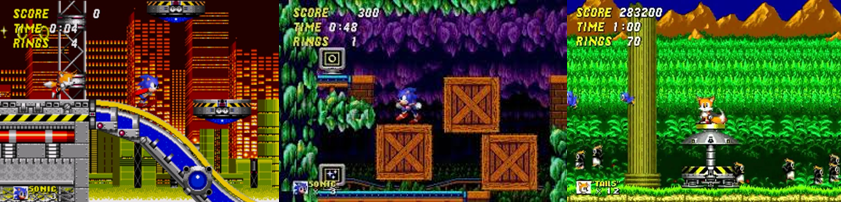
Like its predecessor, Sonic the Hedgehog 2 is a 2D, sidescrolling action platformer in which you travel eleven stages (known as “Zones”). Unlike the previous game, the majority of Sonic 2’s Zones are split into two “Acts” rather than three (though there is, oddly, one three-Act Zone and two one-Act Zones just to confuse things) and, this time, you’ll battle Eggman in one of his diabolical contraptions at the end of each second Act before facing him once and for all on the Death Egg. Essentially, everything that worked so well in the original game returns here, bigger, shinier, and much more refined; Sonic is faster than ever, now able to zip through every single Zone of the game at breakneck speed thanks not only to his new “Spin Dash” attack but also vastly improved level design that ditches the slower, more tedious elements on the first game and focuses on speed and split-second reactions. Improved obstacles and enemy placement also help speed up the game, as does the implementation of more loop-de-loop, slopes, the introduction of Möbius strips, and very little instances where the game grinds to a halt.

Help or hinder Sonic as Tails or simply choose to play solo with either character.

As before, you can still roll into a ball when you jump or press down while running to break monitors and smash apart Badniks. This time, though, you won’t do it alone; by default, the game has you take control of Sonic with the computer-controlled by his side but, by entering the “Options” menu, you can switch to playing alone as either character. When Tails is onscreen, though, a second player can join in at any time; Tails has all of Sonic’s abilities and essentially plays as a reskin as, though he is seen flying with his unique two tails, this isn’t a feature you can utilise in the game. When playing as Sonic and/with Tails, Tails can collect Golden Rings, destroy Badniks, and dish out damage to Eggman all while being functionally immortal and largely invulnerable. Attacks won’t damage Tails and the only way to lose him is to run so fast that he cannot keep up; unfortunately, second players can also screw you over by jumping onto temporary or crumbling platforms ahead of time, essentially sending you to your death.

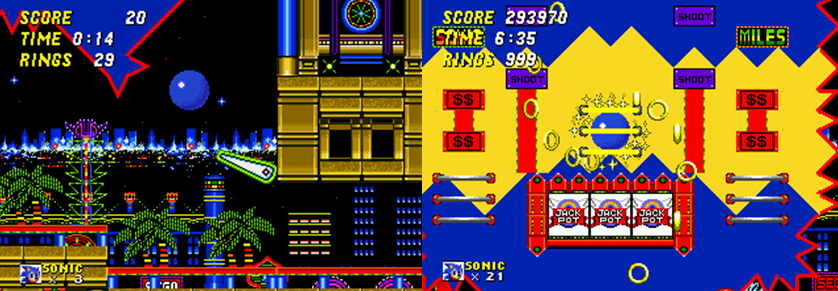
It’s easy to get distacted by Casino Night Zone’s pinball-based mechanics and gimmicks.

Thankfully, Sonic is much faster this time around. Zones are bigger than ever, with more branching paths to take and areas to explore and, best of all, there’s no tedious pushing of switches or blocks to slow things down. Perhaps the slowest Zone is Mystic Cave Zone (which also features a notorious pit that you cannot escape from), which features far more platforming elements and instant-death traps compared to the game’s other Zones; Sonic will have to grab levers and pulleys to create bridges and avoid floating blocks in this Zone but it’s got nothing on the seriously gruelling platforming and obstacles in the increasingly maze-like Metropolis Zone but, for the most part, Sonic 2 hits the ground running and doesn’t stop. Sonic 2 introduces many firsts for the series; gone are the checkpoint-creating Lamposts of the first game, replaced with Starposts that perform exactly the same function but also double as the gateway to the game’s Special Stages (replacing the Giant Rings from the last game) when you pass them with fifty Rings or more. Be warned, though, after finishing or failing a Special Stage, you’ll be deposited back in the Zone with no Golden Rings to protect you (though the Zone’s Rings (and Badniks) will have respawned).  The pinball-like mechanics of Spring Yard Zone are expanded upon in Casino Night Zone, a giant, pinball-themed Zone filled with so many little score-increasing mini games and distractions that it’s easy to run out the ten minute time limit in this Zone alone.

Many of Sonic 2‘s elements became recurring themes in the franchise.

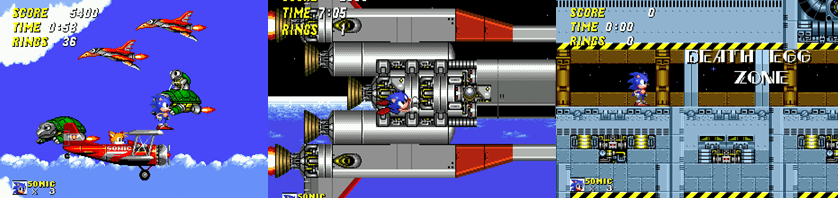
Another first is the inclusion of Sonic’s biplane, the Tornado, which mixes up the speed-based gameplay by having you ride atop the plane’s wings in Sky Chase Zone and, of course, the final showdown with Eggman on his space station. This latter element, clearly evoking imagery from the Star Wars trilogy (Various, 1977 to 1983), would become a recurring element in the franchise from this game onwards as subsequent games sought to either recreate the success of, or cash in on the nostalgia for, Sonic’s bigger, better sequel. As before, Sonic can collect Golden Rings to keep himself alive but, when submerged under water in Aquatic Ruins Zone or in toxic gunk in Chemical Plant Zone, will find himself under threat of drowning if he doesn’t escape to fresh air or find an air bubble before the all-too-familiar sinister countdown reaches its end. You’ll still gain points for collecting Rings, bashing Badniks, and clearing Acts and Zones as fast as possible but you no longer gain bonus points by jumping dramatically at the end of an Act. Thankfully, all the little niggling issues that slowed down and counted against the first game have been largely addressed and eliminated; there’s no real danger here of being unfairly squashed or glitching the game (unless you perform some very specific actions) and the only real issue the game has in this regard is that it’s sometimes very easier to run or fly so fast off the screen that the game struggles to catch up. there some instances where you’re forced to use a little more thought than just speeding ahead, though; Oil Ocean Zone, for example, requires you to think a bit before making jumps as you can easily end up trapped in the quicksand-like oil or getting turned around. Like the first game, Sonic 2 isn’t especially difficult game; there are no difficulty settings to choose from as, again, the game’s difficulty gradually increases as you progress from Zone to Zone. This time, there are seven Chaos Emeralds to collect; the now-iconic half-pipe Special Stages are arguably much easier (or, at least, more interesting) than those in the first game, and you get an actual, in-game reward for collecting these gems.

Graphics and Sound:
Sonic the Hedgehog 2 improves on its predecessor in every way: Sonic’s sprite is larger and now a vivid, eye-catching blue and Tails is visually very appealing thanks to his unique twin tails and cute appearance. Zones are as visually interesting and unique as ever; Emerald Hill Zone, while functionally similar to Green Hill Zone, has enough in it to separate it from its predecessor, such as coconut trees, Möbius strips, waterfalls, and underground areas. The game’s later Zones are some of the most iconic in the series; moving away from cliché element-themed platforming levels, you’ll roll around an industrial nightmare full of toxic waste in Chemical Plant Zone, frantically jump to escape from rising lava in Hill Top Zone (which improves upon Marble Zone’s lava gimmick in every way), and explore dark, dank caves in Mystic Cave Zone. Each Zone has different gimmicks to separate them not only from each other but those of the last game; Casino Night Zone is far less random than Spring Yard Zone, for example, with no bottomless spits to worry about and Metropolis Zone is nothing like Scrap Brain Zone beyond being the game’s toughest area to get through.

Each Zone has a variety of unique gimmicks to mix keep things interesting and exciting.

This is largely due to the Zone having three Acts, which means it soon outstays its welcome. Add to that and some annoying enemies and the Zones maze-like layout and you would have a fitting final Zone for the game if it wasn’t for Wing Fortress Zone. Taking place aboard Eggman’s vast airship, this Zone is your last chance to get any remaining Chaos Emeralds before the game’s final Zone and features a whole host of dangerous taps; for one thing, you can fall to your death at any moment, never mind precariously jumping from platforms and hooks and riding gusts of wind to progress further. Once again, there are no transitions or cutscenes or story included in the game until you clear Wing Fortress Zone, then a little cutscene plays showing how the player gets aboard the Death Egg and another shows how he escapes. Generally, though, the same obvious environmental message of the first game is repeated, but dialled up a notch as you end up in space! Both Sonic and Tails have idle animations this time around, giving them each their own distinct personalities, and the game’s soundtrack is, arguably, the best of the series. It’s everything the soundtrack was in the first game but far more bombastic and triumphant, far more foreboding and sinister, far more catchy and memorable.

Enemies and Bosses:
Once again, Sonic and Tails must do battle with Eggman’s Badniks; these cute-looking mechanical monsters are just as deadly as before but their danger increases as you progress further in the game. To start off with, it’s no bother at all to bounce off of Mashers and Buzzers just like in the first game but, soon, you’ll encounter Spinys and Flashers, both of which can throw up defences to sap your precious Rings. While their placement is generally much fairer in this game, you’ll still have to contend with Badniks like Grounder and Crawlton popping out to surprise you but the absolutely worst enemies in the game are found in Metropolis Zone. The mantis-like Slicer will toss its boomerang-like pincers at you and they’re a pain in the ass to dodge, to say nothing of Shellcracker’s massive spiked claw that will almost always catch you unawares or the self-destructive Asterons which always shoot out their damn spikes when you’re halfway up one of those corkscrews!

Dr. Eggman slowly steps up his game after a disappointing first few encounters.

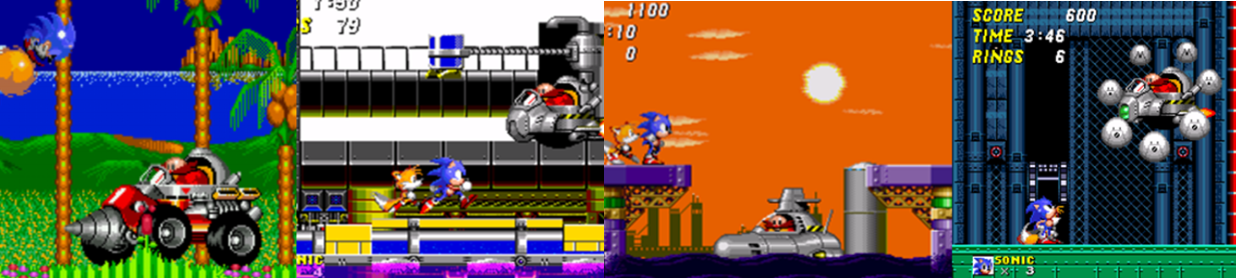
As before, you’ll face Doctor Eggman numerous times throughout the game; this time, he attacks at the end of every second Act and each time he has a deadlier contraption to try and end your adventure with. If you thought the wrecking ball from the last game was easy, you’ll be begging for a challenge even half of that when you encounter Eggman for the first time at the end of Emerald Hill Zone. Rather than trying to squash or zap Sonic, Eggman instead casually drives towards him back and forth, leaving himself wide open for the attack and only being a problem when he detaches his drill appendage at the last second. This mockery of a boss battle is quickly forgotten when you take on Eggman in Chemical Plant Zone, however. Here, Eggman tries to drop sludge on your head, which isn’t as much of a problem as the temporary ground that borders the arena and it’s very easy to fall to your death after landing the killing blow or while trying to escape Eggman’s attacks. Thankfully, most of the game’s boss battles aren’t as tough; Aquatic Ruin Zone’s boss can be a chore because of the jumping involved and Casino Night Zone’s is quite tough if you struggle with Sonic’s perfectly-attuned momentum-based physics but you shouldn’t really encounter an issue until you reach the Oil Ocean and Metropolis Zone bosses; thanks to Eggman’s shielding and strategy, it can be tough to land hits on his Egg-O-Matic in these bosses but, if you have a second player alongside you as Tails, they’re a breeze.

After besting your robotic double, the gloves come off for the final showdown with Dr. Eggman!

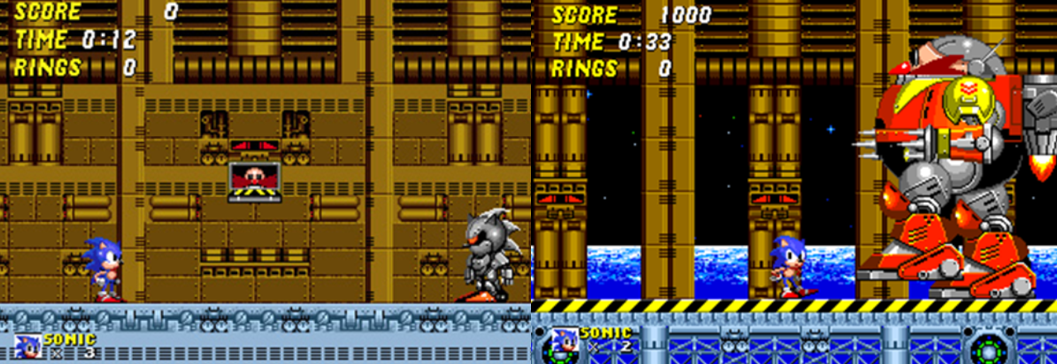
Things really ramp up once you reach Death Egg Zone, though; no matter how you play the game, you’ll have to tackle this final Zone alone and with no Rings to help you. Unlike the first game, where the final boss was pathetically easy, Sonic 2 has you run a gauntlet as you must first take on the armour-plated Mecha Sonic (or “Silver Sonic” depending on your preference, and not to be confused with the far more recognisable Metal Sonic). Mecha Sonic is a dangerous foe thanks to its buzzsaw-like spikes and fast-paced attacks but, luckily, its attack pattern is easily memorised; it’ll stand there posing, allowing you to hit it, then charge across the screen before either rolling at you or jumping over you. it can also shoot out its spines in a spread but, if you’re quick and smart enough, you can trash this dubious doppelgänger in no time. Once you do, though, you’ll find Eggman leaping into a massive robotic suit, the lazily named “Death Egg Robot”, which takes a whopping twelve hits to put down. Thankfully, again, this boss battle is very predictable; Eggman stomps towards you, allowing you to get a few hits in (as long as you’re careful to avoid his spike arms), then flies off-screen. A targeting reticule will appear and follow you around; simply wait in one of the far corners charging your Spin Dash and blast away when Eggman comes crashing down. Stay at the far end of where you end up to avoid his rocket-powered arms and repeat until he goes down. I wouldn’t recommend getting trapped behind him as he drops egg bombs that are difficult to avoid and you can also land a hit when he comes crash down from the ceiling if you’re fast enough. All in all, though, it’s a far more dramatic, taxing, and entertaining last boss than the one from the first game with some kick-ass music to boot.

Power-Ups and Bonuses:
As before, numerous computer monitors are scattered throughout the game’s Zones to help tip the odds in your favour. Breaking these open will award you with exactly the same rewards as the first game (ten extra Rings, a shield, an extra life, a speed up, or an invincibility) with the only difference being their appearance, sound effects, and the music that plays when you acquire them. Sadly, the only new power-up to be found is exclusive to the game’s two-player mode, which is a bit disappointing considering every other aspect of the first game was expanded and improved upon.

Additional Features:
As you might expect, this version of Sonic 2 comes with a handful of Achievements for you to earn. If you’ve played Sonic 2, or any Sonic game, before, these aren’t exactly difficult to get and include standard fare such as reaching certain Zones, collecting all the Chaos Emeralds, and completing the game though the online and time limit-specific Achievements may be trickier to accomplish depending on your skill level (finishing Chemical Plant Zone, Act 1, in under forty-five seconds is no joke!) As in the first game, players can access Special Stages to try and earn one of the Chaos Emeralds. This time, you must pass by a Starpost with at least fifty Rings to challenge for an Emerald, making the process a hell of a lot faster and easier. Additionally, the God-awful, head-trippy rotating mazes of the first game are gone as you now race down a half-pipe, collecting Rings and avoiding bombs. While these Special Stages are much better, they can be more difficult as it’s hard to know what is coming up without a lot of trial and error, you must collect a certain amount of Rings to qualify for an Emerald, and the delay between your jumps and Tails’ can cost you precious Rings if you’re not careful. Special Stages start off deceptively easy but, by the time you go for that damn fourth Chaos Emerald, you’ll start to notice how fast and unrelenting they can be; the seventh and final Emerald is, fittingly, the most difficult to get because it barely has enough Rings to hit the target.

Collect all seven Chaos Emeralds to transform into Super Sonic and get the game’s best ending.

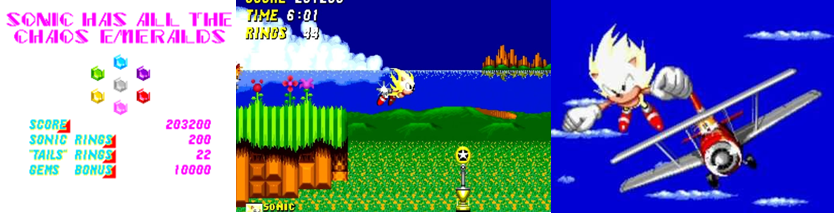
Luckily, you can cheese save states to make this so much easier than it was on the original hardware. Collect all seven Chaos Emeralds, though, and rather than jus earning a slightly different ending, you’ll be awarded with the ability to turn into the Super Saiyan-like Super Sonic. “Simply” collect all seven Chaos Emeralds, collect fifty Rings, and jump and you’ll transform into this super-fast golden upgrade of Sonic that has a constant speed up and invincibility. Don’t get too cocky, though, as you can still drown and be crushed and your Rings will slowly be lost over time; once they run out, the transformation ends so be sure to collect all the Rings you can to keep the form up as long as possible. The addition of Tails also means that Sonic 2 has a multiplayer component; not only can a second player play alongside you in the main game but you can also race against a friend in a woefully-realised split screen mode. While the screen is awfully crushed and you can only pick from four Zones, this mode was decent enough back in the day; it’s fun to blast ahead and leave your friend in the dirt only for them to smash a monitor and have you both switch places. Sadly, while this version of Sonic 2 won’t allow you to enter the iconic cheat codes and doesn’t feature any of the tweaks, upgrades, and additions for the far superior mobile port, a save state system and online leaderboards are included and, best of all, if you also purchase Sonic & Knuckles (SEGA Technical Institute, 1994), you’ll gain the ability to play as Knuckles the Echidna. Be warned, though; while Knuckles’ abilities mean there’s much more room for exploration, his rubbish jump makes battling certain bosses (particularly the Death Egg Robot) far more challenging.

The Summary:
As great as Sonic the Hedgehog was, it’s nothing compared to Sonic the Hedgehog 2. Bigger, bolder, faster, and better in every way, Sonic 2 is the quintessential example of how not only to do a sequel title right but how to do a Sonic title right. While the first game laid the foundation, Sonic 2 set the standard that subsequent games in the franchise tried to hold themselves up against (or surpass, with mixed results). Sonic 2 introduced numerous elements than immediately became staples of the series; add to that the fascination with all the content that was cut from the game and you have a title that continues to be relevant and influential even now, nearly thirty years after its release. While I, personally, prefer the next game in the series, Sonic 2 is still a highly regarded entry in the franchise for me and I’d always pick to play it over the first game if given a choice.

My Rating:

Rating: 5 out of 5.

Fantastic

What did you think about Sonic the Hedgehog 2? Where does it rate against the other games in the franchise for you? Which Zone is your favourite? Were you the younger sibling always being forced to play as Tails or were you the older sibling who got the privilege of playing as Sonic? Would you like to see a spruced up version of the game released one day, with all the cut content restored as originally conceived? Perhaps you think Sonic 2 doesn’t live up to the hype and prefer a different game in the series; if so why, and what is it? How are you celebrating “Sonic 2sday” this year? Whatever your thoughts on Sonic 2, and Sonic in general, drop a comment below.

Screen Time [Doctor Who Day]: Doctor Who: The Movie


On this day, the 23rd of November, in 1963, the longest-running and most successful science-fiction television series ever, Doctor Who, first aired on BBC One in the United Kingdom. Since then, the rogue Time Lord has gone through numerous incarnations, travelled throughout the entirety of the past, present, and the future, and is widely celebrated as one of the most iconic and recognisable mainstream cultural icons in the world.


Click here to listen to my guest spot about this special on the It’s Time to Rewind podcast.

Air Date: 12 May 1996
UK Distributor: BBC One
Original Network: CITV
Stars: Paul McGann, Eric Roberts, Daphne Ashbrook, Yee Jee Tso, and Sylvester McCoy

The Background:
In 1963, Sydney Newman, the Head of Drama at the BBC, commissioned the creation of an educational science-fiction show to fill a gap in the BBC’s schedule, something that would appeal to be children and adults alike. Staff writer Cecil Webber created a brief outline for the show, then known as Dr. Who, but it took a collaborative effort for this concept to be shaped into the debut episode, ‘An Unearthly Child’ (Hussein, 1963). Though the assassination of President John F. Kennedy overshadowed this debut, it fared somewhat better when rerun and the series shot to success with the second episode, which introduced the Doctor’s (Various, but played by William Hartnell at the time) long-running enemies, the Daleks. While Doctor Who reached mainstream popularity during Tom Baker’s time in the role, the show was cancelled in 1989 due to waning interest and a series of unpopular regenerations for the title character (who was then played by McCoy) but continued on in print, such as books and magazines.

Doctor Who’s immense popularity had waned by the end of the eighties.

In the mid-nineties, however, producer Philip Segal negotiated a revival of the series, which was originally going to be a complete, American-made and set reboot until writer Matthew Jacobs persuaded the filmmakers to tie it into the existing continuity. Many actors audition for the title role, some of whom would go on to play the Doctor years later, before Paul McGann was cast but, while McGann’s performance was received rather well, the feature-length episode failed to find an audience or impress in the United Kingdom and, especially, in the United States. While the film was largely glossed over when the show was eventually revived in 2005, McGann’s Doctor was actually one of the longest-running incarnations of the character, the first official Doctor I actually saw onscreen, and made a welcome return in the ‘Night of the Doctor’ (Hayes, 2013) special as part of the show’s fiftieth anniversary.

The Plot:
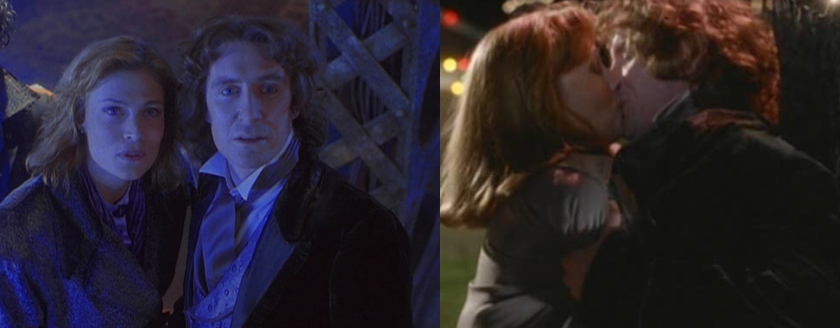
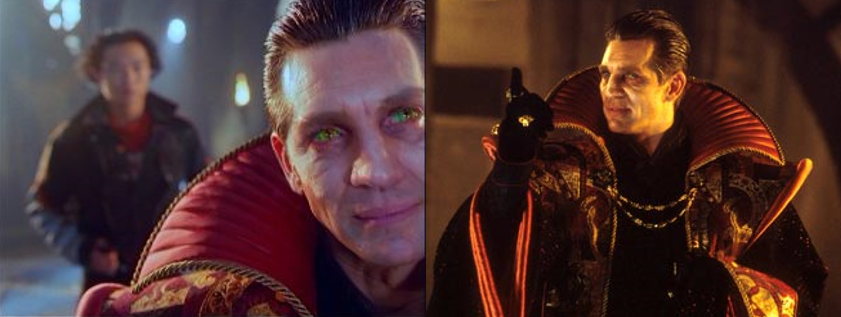
Whilst returning to Gallifrey with the remains of his old nemesis, the Master (Gordon Tipple), the Doctor’s (McCoy) TARDIS (Time and Relative Dimension in Space) is damaged and is fatally wounded upon making an emergency landing in San Francisco on the eve of the million. After regenerating into his eighth incarnation (McGann), the Doctor suffers from amnesia while the Master assumes possesses a new body (Robert) and plots to steal the Doctor’s remaining regenerations and destroy the Earth in the process.

The Review:
If you’ve never seen Doctor Who before, Doctor Who: The Movie is quite a daunting first experience in many ways; obviously, these days, with Doctor Who still running on the regular and access to the show being far easier, it’s highly unlikely that anyone would begin their Doctor Who experience with this feature-length pilot but, back in the day, that’s basically what happened for me. As I mentioned above, Doctor Who wasn’t on television when I was a kid so my exposure to the show came from the many novelisations my Dad owned, a number of videogames and audio books, and the two, largely unrelated films starring Peter Cushing. Thankfully, this was enough for me to understand the basic concept of the TARDIS and the relationship between the Doctor and the Master but, considering how long the show had been off television and the fact that the pilot was made for an all-new audience (and generation), Doctor Who: The Movie chooses to spread exposition regarding its concept throughout its runtime, which can be a bit daunting. The film picks up with the Seventh Doctor, “nearing the end of [his] life”, transporting the remains of his old nemesis, the Master, from Skaro and to Gallifrey; however, these opening scenes are narrated by McGann’s Eighth Doctor which is a bit of an odd choice and it almost feels like the film should have opened with the Doctor’s emergency landing on Earth and then incorporated more in-depth flashbacks, narrated by McGann as he relates his story to Doctor Grace Holloway (Ashbrook).

The Doctor meets a sudden end and regenerates into his amnesia-stricken eighth incarnation.

Regardless, the Master’s essence (little more than a slimy, snake-like glob) causes the TARDIS’s central console to malfunction and forces the Doctor to make an emergency landing on Earth, where he is immediately gunned down by a gang of gun-toting thugs who are chasing rebellious youth Chang Lee (Tso). Though a wannabe thug himself (and seeking to steal the Doctor’s belongings), Lee gets the Doctor to an ambulance, and a hospital, but Grace inadvertently kills him when his two hearts throw off their equipment and his alien physiology causes her trouble during her attempts to calm his erratic heartbeat. Thus ends the inauspicious seventh incarnation of the Doctor; there’s not a massive amount for McCoy to do except look horrified, get shot, and lie motionless in the hospital morgue but it’s nice to see him back in the role and to connect the pilot to the continuity of the series. The anaesthesia and being locked in the freezing morgue delays the Doctor’s regeneration into his eight incarnation and, as a result, when he dramatically rises from the dead (a scene cleverly juxtaposed with the creation of the Monster (Karloff) in Frankenstein (Whale, 1931)), he suffers from amnesia and wanders around San Francisco with fragmented memories. These led him to Grace and, having been confused by the Doctor’s physiology, she puts aside his wild demeanour and ravings in order to solve the mystery of her unusual patient.

Charming and enthusiastic, the Eighth Doctor is ruled by passion and empathy.

Grace, a well respected and highly skilled cardiologist, is baffled at having lost her mysterious patient literally right in the middle of a break-up with her long-term boyfriend due to her commitment to her job. Initially, she believes the Eighth Doctor is insane but is captivated by his charisma and mystery; however, he quickly proves his claims of the impending destruction of the Earth and his status as an alien Time Lord when he offers irrefutable proof. A charismatic, impulsive, and energetic incarnation of the Doctor, the Eighth Doctor is excitable, insightful, and very action-orientated, leaping on a police motorcycle and relying far more on his uncanny knowledge of the future to sway others to his whim rather than relying on his gadgets. Passionate, emotional, and effortlessly charming, his joy at the restoration of his memories leads him to unexpectedly kiss Grace, an action she finds very agreeable and encourages more of, leading to an explicit romantic attracting between the two. I remember, at the time, people hated this and it seemed like all anyone could talk about was how the Doctor would never do this so it really rubbed me up the wrong way when subsequent Doctors ran around snogging and falling in love with their companions and all anyone did was praise it.

The Master is obsessed with stealing the Doctor’s remaining regeneration no matter the cost.

Rather than the Daleks or the Cybermen, the Doctor’s antagonist is, of course, the Master; after being executed by the Daleks (sadly never seen onscreen), the Master is reduced to a snake-like creature and possess the body of Bruce, the paramedic who brought the Seventh Doctor to the hospital. Possessing superhuman strength and able to hypnotise others with his snake-like eyes, the Master is also able to spit venom at his victims and carries himself with an ostentatious, flamboyant arrogance. He’s easily able to persuade Lee to assist him in locating the Doctor with promises of gold dust and appealing to his greed, giving him access to the TARDIS and the Eye of Harmony located deep within it. Given that the Master has used up all thirteen of his regenerations and is only able to possess others, he plots to steal the Doctor’s remaining regenerations using the Eye of Harmony, a miniature black hole that powers the TARDIS and enables it to travel through space and time. However, the Eye being open weakens the fabric of reality and threatens to turn the Earth inside out on New Year’s Eve, 1999; the impending destruction of the planet leads to Lee opposing the Master and he, and Grace, pay the price for this insubordination. A remorseless killer, the Master wishes only to take what he wants, manipulate others, and have dominion over the living and it is his obsession with immortality that causes his downfall as the Doctor is able to force him into the Eye of Harmony and even perform a trick generally unheard of in Doctor Who by restoring Grace and Lee through the power of the TARDIS. Indeed, time in Doctor Who: The Movie is far more fluid and malleable than it’s usually presented in the show (“fixed point in time” my ass!), meaning that the Doctor can rewind time to prevent the destruction of the Earth and undo the Master’s actions even while they’re inside the TARDIS and even bring back the dead, which I don’t believe is something ever done in quite the same way in the show normally or else the Doctor would have surely brought back numerous companions in the same way.

The Summary:
I remember being really disappointed that more people didn’t enjoy Doctor Who: The Movie; it wasn’t like Doctor Who was on television at the time and, for me, something is generally better than nothing and, as a reintroduction of the character and concept, I think it works really well. The approach is, however, interesting; while I commend them for tying it into the show’s ongoing continuity and not starting fresh, I can see how new viewers would be a bit put off by the concept as it’s a little overwhelming and it walks a fine line between delivering exposition and keeping things vague (we learn a little about the TARDIS and the Time Lords but only the briefest of explanations about what these concepts mean and the history between the Doctor and the Master).

Thanks to the bigger budget, the TARDIS has never looked better and more elaborate than here.

One thing I really liked about the film was the depiction of the TARDIS; bigger and more elaborate than ever thanks to the bigger budget afforded to the pilot, the TARDIS is an extravagant and heavily decorated environment full of Victorian and Gothic architecture that, even now, the show has failed to fully replicate as Doctor Who generally only focuses on the main control room. The TARDIS is also depicted as having a degree of sentience; the Master comments that the ship “likes” Lee, responding to his touch and allowing him to open doors and even the Eye of Harmony despite the presence of the Master. At the time, like most people, I was mainly aware of the Third (Jon Pertwee) and Fourth (Baker) incarnations of the Doctor so, in many ways, the Eighth Doctor was my Doctor and the Doctor of my generation. I really enjoy McGann in the role; he’s passionate and dynamic, impulsive and full of vigour and sports a fitting Victorian-era outfit. Best of all, his solution to every problem isn’t to use the damn Sonic Screwdriver and is, instead, more geared towards his unique and (as far as I can recall) sadly forgotten ability to see and relate the past, present, and future of others through his distinct insight into their lives. Something else that I believe is only an aspect of this film (or incarnation of the Doctor) is that he is, apparently, half-human; I don’t believe that this has come up before or since and, honestly, it has little bearing on the plot beyond being a shorthand to explain his affinity for the human race and, apparently, his ability pilot the TARDIS.

I’ll always have a soft spot for the Eighth Doctor, who effectively introduced me to Doctor Who.

Honestly, it still bugs me that the Eighth Doctor isn’t a more prominent part of Doctor Who’s continuity; he had numerous adventures in books, comics, and audio dramas and it really feels like Steven Moffatt (a man whose contributions to the show I routinely call into question) missed a trick by not giving him a bigger role in ‘The Day of the Doctor’ (Hurran, 2013). I love John Hurt but the introduction of the “War Doctor” just caused too many problems and seemed like a cop out to me; I would have much preferred to see a series of specials chronicling the Eighth Doctor’s role in the Time War and decision to end the conflict between the Daleks and the Time Lords. I remember, at the time it was released, people seemed to be annoyed at how “American” the pilot was, that it had kind of perverted the quaint and cult nature of the show in some ways, but I think the additional budget did wonders for bringing the concept to life; the TARDIS has never looked better, the classic theme is the best it’s ever been, the effects and action were beyond anything seen in the show up to that point, and everything has a far bigger, grandiose feel to it. The cinematic quality of the production was also evoked when the show returned in 2005 which, again, was met was almost unanimous praise, which really annoyed me at the time as it seemed like everything people complained about in Doctor Who: The Movie was suddenly being praised and the only difference, really, was that one was produced in America and the other was produced in the UK. For me, the film, and the Eighth Doctor, will always have a special place in my heart and I’m glad that his surprise reappearance saw further interest in his portrayal of the character.

My Rating:

Rating: 3 out of 5.

Pretty Good

Have you ever seen Doctor Who: The Movie? If so, what did you think to it? If you saw it at the time, whether as a new or long-term fan of the show, what did you think of it? Were you put off by the “American” production of the show and the Doctor’s more passionate exploits? What did you think to McGann as the Doctor and the death of the Seventh Doctor? Would you have preferred to see the Daleks or another of the Doctor’s adversaries as the antagonists and what did you think to this incarnation of the Master? Which incarnation of the Doctor is your favourite? How are you celebrating Doctor Who Day today? Let me know your thoughts on Doctor Who and its feature-length production down in the comments.
Wrestling Recap: Hogan vs. Undertaker (Survivor Series ’91)

The Date: 27 November 1991
The Venue: Joe Louis Arena; Detroit, Michigan
The Commentary: Gorilla Monsoon and Bobby “The Brain” Heenan
The Referee: Earl Hebner
The Stakes: WWF Championship match

The Build-Up:
The Undertaker made his debut on this day at the 1990 at the 1990 Survivor Series as a heel; aligned with Ted DiBiase’s Million Dollar Team and eventually partnered up with the repulsive Paul Bearer, the Undertaker was portrayed as a zombie-like force of nature who was impervious the pain, implacable by nature, and apparently at the whim of a mysterious urn wielded by his manager. Hulk Hogan, meanwhile, was several months into his third run as the World Wrestling Federation (WWF) Champion, having defeated Sergeant Slaughter earlier in the year at WrestleManiaVII. However, thanks to mostly being booked into squash matches, the Undertaker went unpinned (on television, at least) for a year and this impressive statistic was enough to plug him in as Hogan’s next opponent in what was billed as Hogan’s “Gravest Challenge” to date.

The Match:
Rather than preceding the match with one of their trademark promo packages, this particular match is preceded by a couple of pre-taped promos from each of the competitors; Hogan, basically, has taken offense to the Undertaker and Paul Bearer’s threat to bury the hopes and dreams of all the Hulkamaniacs but ‘Taker stoically threatens that Hulkamania has had its day and is long overdue for a burial.

Hogan’s bombastic showboating soon gave way to slow, plodding offense.

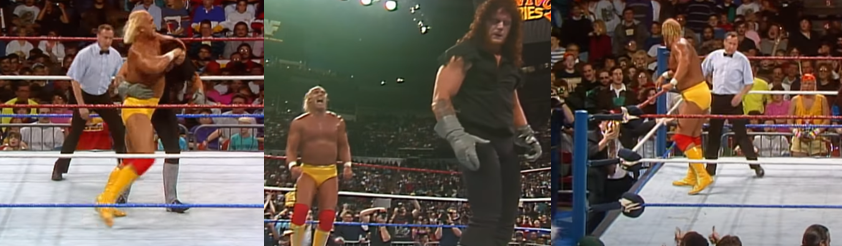
During his characteristically enthusiastic entrance, Hogan made a point to upturn and demolish the casket that was placed at ringside but the Undertaker maintained his stoic demeanour and remained unimpressed with Hogan’s showboating and simply set out to do what he promised: destroy Hulkamania. Unfortunately, given that it was 1991 and early ‘Taker (as well as Hogan’s limitations), this meant a lot of slow, plodding offense and an abundance of headlocks, face and beck chokes, and slow, measured strikes from the Undertaker.

Bearer’s interference and the Undertaker’s indomitable nature kept Hogan on the back foot.

Hogan, of course, was all about the superhuman energy and resolve; even though he spends the majority of the match on the back foot and seemingly unable to actually hurt the Undertaker, he continually came back time and time again even after having his head slammed off the steel ring steps and being choked by an electrical cord. Of course, Hogan had the crowd firmly in his corner right from the beginning of the match and they exploded into cheers whenever Hogan mounted some offense and showered the arena with boos every time Bearer got involved behind Hebner’s back.

Undertaker’s moveset back then mainly consisted of dull choke and claw holds.

A far cry from the later brawling and high-impact offense of his later years, the Undertaker’s plan of attack mainly consisted of punches, clotheslines, and full-face chokes; his gameplay, apparently, was to wear down Hogan and drain him of his much-vaulted energy and, every time he pressed his advantage with a Claw Hold or similar move, ‘Taker would turn to Bearer to draw power from the mysterious urn, his eyes rolling into the back of his head, and my interest and excitement draining right along with Hogan’s vigour.

Hogan’s comeback meant nothing once Flair snuck in a steel chair to give ‘Taker the win.

Of course, as relentless and dominating as the Undertaker was, Hogan is still Hogan; jacked up (and blown up) to the nines and full of passion, Hogan completely no-sold the Undertaker’s Tombstone Piledriver to mount his trademark comeback. This onslaught was enough to stagger the Undertaker and drive him to his knees but, right as Hogan looked to be setting up for the finish, Ric Flair sauntered down to ringside to distract Hogan. Flair then slid a steel chair into the ring, which the Undertaker summarily Tombstoned Hogan onto, and the match ended with the Deadman being crowned the new WWF Champion to the chagrin of Monsoon, the delight of Heenan, and a brief cheer from the crowd.

Sadly, it’s every Hogan match ever and even has a screwy finish to keep him looking strong.

It’s not an especially long of exciting match, to be honest; it’s basically every Hulk Hogan match you’ve ever seen as Hogan takes a beating, pulls out sly heel moves and tactics, and spends the majority of the match either on his back or taking a beating because he’s too gassed to work a long, involved match and is simply building up for his characteristic comeback. The story was far more interesting than the actual in-ring content as ‘Taker was more about slow, boring offense and shrugging off attacks and Hogan was only ever really good for pumping up the crowd and hitting his signature moves; the entire match was about a clash of ideals and wills and the potential death of Hulkamania but, whereas Hogan was able to overcome all his previous challenges, he failed to overcome his “Gravest Challenge”. However, he arguably only lost the match due to Flair’s interference and looked set to for a win before Flair distracted him, tainting the Undertaker’s iconic first championship win in true Hogan fashion, which is a shame as the Undertaker looked so dominant throughout the match and this should have been a clean win. Still, at least it’s a short match; the WWF was a very different time back then and, while I respect Hogan and his impact on the industry, I can’t say I’ve ever been a fan of his in-ring work and he didn’t seem to have a lot of chemistry with ‘Taker, who was worked a very premeditated and limited style thanks to his commitment to the zombie aspects of his character.

The Aftermath:
Hulk Hogan and the Undertaker faced off in a rematch less than a week later at This Tuesday in Texas, which Hogan, of course, won and, by WrestleMania VIII, both men were embroiled in entirely separate feuds and the Undertaker would not win the WWF Championship again until WrestleMania 13 some six years later. Despite both being in the company at the same time for many years following this match, the two never crossed paths again and would not face off in a championship match until Judgment Day in 2002, when the Undertaker defeated Hogan (then billed as Hollywood Hulk Hogan) for the Undisputed World Wrestling Entertainment (WWE) Championship.

My Rating:

Rating: 1 out of 5.

Terrible

What did you think to the contest between Hulk Hogan and the Undertaker at the 1991 Survivor Series? How would you rate it compared to their other bouts and which of their feuds, matches, and moments is your favourite? Were you a fan of the Undertaker’s when he debuted and were you hyped for his showdown with the Immortal Hulk Hogan? Which of the two were you rooting for, given Hogan’s incredible popularity and the Undertaker’s dominant first year? How are you celebrating the Undertaker’s debut this year, what are some of your favourite matches and moments from his long and distinguished career, and what dream match would you have liked to see him involved in? Whatever your thoughts, drop a comment below and let me know what you think about the Undertaker.

Movie Night: The Wolverine

Released: July 2013
Director: James Mangold
Distributor: 20th Century Fox
Budget: $100 to 132 million
Stars: Hugh Jackman, Tao Okamoto, Rila Fukushima, Hiroyuki Sanada, Haruhiko Yamanouchi, Svetlana Khodchenkova, Will Yun Lee, and Famke Janssen

The Plot:
Haunted by memories of Jean Grey (Jansssen), Logan/Wolverine (Jackman) is called back to Japan by the dying wish of an old friend, Ichirō Yashida (Yamanouchi), who offers to end Logan’s immortality. However, when Yashida dies, his granddaughter, Mariko (Okamoto) is targeted by assassins, and Logan’s healing factor is compromised, Logan is begrudgingly forced to protect her and uncover a conspiracy with Yashida’s vast corporation.

The Background:
20th Century Fox had vastly profited from their X-Men movies, the first three of which earned them over $600 million. Though X-Men Origins: Wolverine (Hood, 2009) was met with mixed reviews, the film grossed over $300 million against a $150 million budget and Hugh Jackman’s popularity as the character all-but ensured that some kind of sequel would be put into production. After deciding to draw upon elements from Chris Claremont and Frank Miller’s work on the character’s time in Japan, famed director Darren Aronofsky was brought on to direct; Aronofsky was responsible not only for the film’s blunt and unimaginative title but also restructuring the film as a standalone spin-off rather than a straight-up sequel to X-Men Origins. By 2011, however, Aronofsky had exited the project due to vast amount of overseas shooting the film would require and James Mangold was brought in as a replacement. Produced on a smaller budget than X-Men Origins, The Wolverine had a somewhat shaky box office; it’s currently the seventh-highest grossing film in the franchise, earning less in worldwide revenue than the much-maligned X-Men: The Last Stand (Ratner, 2006) but still more than the much-lauded X-Men 2 (Singer, 2003). Critically, however, the film fared far better than its predecessor, with the general consensus being that it was a far more accurate portrayal of the character. Personally, I have to admit that I missed the more recognisable X-characters of the previous film and the chance to shed more light on Wolverine’s complex and storied history but I did appreciate the film’s more brutal nature and grittier, more focused direction.

The Review:
In keeping with the theme of the previous X-Men movies, The Wolverine opens with a particularly gruelling and thrilling scene that sets the tone for the film to follow. In this case, we find Logan being held in an armour-plated well as a prison of war in Nagaski mere moments before the fateful atomic bomb is about to drop. Understandably panicked by the incoming wall of fiery death, young Japanese soldier Ichirō Yashida (Ken Wamamura) is too afraid to commit ritual seppuku but, having seen how Yashida risked his life to free prisons and give them a chance to escape, and fully aware of what’s to come, Logan manages to escape from his prison and shield Yashida from harm at the bottom of the well.

Memories of Jean haunt Logan’s dreams.

Surprisingly, rather than continue this narrative and fill in a large missing chunk from Wolverine’s early life, the film then jumps ahead to a few years after the events of X-Men: The Last Stand. Although Wolverine has not only recovered his missing memories, this is both a blessing and a curse as not only is he now (conveniently for this film’s plot) haunted by memories of Nagasaki, he’s also haunted by dreams of Jean Grey (Janssen). In them, he and Jean are happy and content in the afterlife; however, this perfect illusion is continually shattered by the brutal remind of how he skewered the love of his life and his desire to be with her in death. It seems that, despite appearing content and well-adjusted at the end of The Last Stand, Logan was unable to cope with what he did to another man’s wife that he decided, after minimal interactions with, that he loved and walked away not only from the X-Men but also the name of the Wolverine, vowing never to kill or endanger others again.

Thanks to Viper, Logan spends most of the movie with his healing factor on the fritz.

However, Logan is soon approached by Yukio (Fukushima), a Mutant with limited pre-cognitive powers who tracks him down to not only offer him Yashida’s blade but also accompany Logan to Tokyo so that Yashida can pass along his thanks before he succumbs to the caner that is eating away at his body. Initially resistant, Logan is eventually convinced to tag along for one day and is horrified to find that Yashida is offering to somehow remove his superhuman healing factor so that others can benefit from it and he can finally live out a normal, mortal life. While in Japan, Logan has a tense introduction to Yashida’s son, Shingen (Sanada) and granddaughter, Mariko (Okamoto), but is nevertheless adamant about heading back home as soon as possible. However, while tormented by his nightmares, Logan is attacked by Yashida’s doctor, Viper (Khodchenkova), and wakes to find Yashida has died in the night. Receiving a frosty reception at the funeral, Logan is immediately alerted to things not being quite right and is thrust into action once more when Yakuza thugs open fire and attempt to kidnap Mariko. In the fracas, Logan receives a few gunshots (included a blast from a shotgun and point-blank range) and is confused, and shocked, to find that his healing factor is mysteriously dulled. This does little to keep him down, though, and he is able to largely shrug off gunfire long enough to get Mariko to relative safety. As a result, a large portion of The Wolverine focuses on Logan’s damaged healing factor causing him both here and there and questions regarding his perceived immortality as he both tries to reconcile his past actions and get to the bottom of a conspiracy within Yashida’s vast organisation.

Logan’s complex, volatile character is finally explored in some depth.

As you might expect, Hugh Jackman is the unmistakable star of the show once more; now a far more tortured, broken man than we’ve seen before, this is a Logan who is visibly tired of the death and heartbreak that seems to follow him at every turn. Initially content to hide away from the world, he is forced back to Japan out of little more than the last vestiges of honour within him but is quick to do the right thing and defend Mariko when it appears her fiancé and father want her dead. Rather than being the cool, charismatic loner we’ve seen before, however, this Logan is a cynical, grouchy ex-soldier who just wants to be left alone and is desperately trying to suppress his violent urges. Honestly, it’s the version of Logan we should have gotten in X-Men Origins: Wolverine; world-weary and wanting death but not quite ready for it, he slowly comes to realise this his animalistic nature can be used for good and eventually comes to reclaim his title of the Wolverine.

Japan, and Japanese culture and traditions, plays a big role in the film’s plot and visual identity.

Compared to every other X-Men movie that came before it, The Wolverine is a much grittier, more focused affair; the story centres entirely on Logan and his inner emotional turmoil and his reluctance to get involved in the convoluted drama and conspiracy that has infected Yashida’s company. The Japanese setting works wonderfully to visually separate it from the other films as well and much of the film is focused on Japanese traditions and mysticism; Logan is like a vagrant stranger in his world, constantly referred to as a rōnin (a “samurai without a master”) or a gaijin (a derogatory Japanese word for an outsider or foreigner), who doesn’t fit and is not welcome. The simple, open countryside’s and urban landscapes of Tokyo give the film a visual identity that is truly unique; this isn’t another bombastic X-Men movie taking place in a large, familiar urban space or a grey-coloured military lab and it really adds to the film’s appeal at aesthetic.

Mariko and Yukio both help to bring Logan back into the fight in different ways.

It also helps that a large portion of the film includes subtitles; Japanese characters routinely speak to each other, and Logan, in their native tongue, adding a coat of legitimacy to its setting. All too often, foreign characters simply speak in English all the time and having them speak in Japanese helps to add to the other-worldliness of the setting and empathise with Logan, who doesn’t understand a word of Japanese. Logan’s newfound vulnerability is also clearly meant to help us empathise with him as it means he struggles to recover from injuries and is in near-constant pain, a step slower than usual, and actually has to struggle to succeed rather than simply charging head-first into battle. Of course, he’s not alone in his fight but rather than sharing screen time with other colourful, fan favourite Mutants, Logan spends most of his time associating with Yukio and growing closer to Mariko. The moment she is introduced, Yukio is portrayed as a bad-ass character in here own right; her pre-cognitive abilities work in conjunction with her athleticism and skill with a blade to make her a formidable opponent and ally. Mariko, on the other hand, is much more of a damsel in distress; initially, Logan sees her as little more than a pampered, self-entitled princess but she’s soon revealed to be oppressed by the desires of her father, fiancé, and her devotion to maintaining the honour of her family. She’s a damaged, conflicted character but is also able to put up a bit of a fight when needed so she isn’t just some screaming, helpless trophy to be fought over.

The Nitty-Gritty:
Up until now, we’ve seen glimpses of Logan’s vicious nature but The Wolverine goes above and beyond in portraying just how brutal and savage Wolverine can be. Initially reluctant to fight, much less kill, when Logan unsheathes his claws to fight, it’s with a fast, ruthless ferocity; every blow is designed to either kill or maim and you truly get the sense of an animal being unleashed in full force. For the majority of the film, Logan is chopping apart nameless, faceless Yakuza goons; he faces a new test in the form of Viper, a seductive, snake-like Mutant who is able to use her toxins to dull his senses and her medical expertise to suppress his healing factor. While the two don’t really come to blows (the honour of dispatching her is left to Yukio), Logan is able to match swords with Shingen, who has garbed himself in the ceremonial armour of the Silver Samurai. It’s in this fight that Logan regains his sense of identity and honour but it’s merely the beginning of the end for the film.

Logan is forced to operate on himself to restore his full abilities.

The decision to dull Logan’s healing factor didn’t sit right with me at the time as I was more interested in seeing a nigh-invincible Wolverine cutting down foes and being emotionally vulnerable rather than physically but it actually does work quite well in the film. That is until the revelation that it’s not some toxic or Mutant suppressant keeping his powers dulled but a weird little spider robot thing attached to his heart. Quite how that works is beyond me but it makes for a tense scene where Logan, having already been told by Yukio that he would die holding his heart in his hand, is forced to cut himself open and remove the device. It’s been suggested that Yukio’s vision actually foreshadowed Logan’s eventual, dramatic death in Logan (Mangold, 2017) but I don’t actually agree with that; Yukio specifically says that he saw Logan lying on the operating table with his lifeless heart in his hand but Logan is clearly impaled on a tree in a forest holding the very-much-alive hand of his “daughter” in Logan so I think this is a bit of a stretch, to say the least.

The actual Silver Samurai seems to conflict with the film’s more grounded, gritty tone.

After spending most of its runtime being almost the exact opposite of X-Men Origins (gritty and introspective, brutal and reflective rather than loud and bombastic), The Wolverine ends with a massive, knock-down brawl between Logan and a huge mech suit of armour. This true Silver Samurai is not only made from the same indestructible Adamantium that coast Logan’s bones but also wields two gigantic blades that are able to cut off Logan’s claws! Revealed to be Yashida, who faked his death and orchestrated everything just to forcibly extract Logan’s healing ability from the marrow of his bone claws, this finale is notably at odds with the tone of the rest of the film but is, nevertheless, quite the exciting end to the film. You really get the sense at Logan is in actual danger thanks to the Silver Samurai’s ability to actually hurt him, which is good for raising the stakes for the finale, but I wasn’t a fan of how Wolverine leaves the film with his entire Adamantium skeleton intact exact for his claws. The bone claws are a fun addition to his character and backstory but are pretty lame by themselves and I would have liked to see him just dip them into some Adamantium to recoat them or something.

Xavier and Magneto turn up alive and fully powered, hinted at a greater threat to come…

Simultaneously, though, I wasn’t a fan of how the next film simply gave him back the Adamantium claws without any explanation. Speaking of which, The Wolverine’s mid-credits sequence sees the inexplicable return of the fully repowered Erik Lehnsherr/Magneto (Ian McKellen) and Professor Charles Xavier (Patrick Stewart), who seek to recruit Wolverine to face an impending threat. A tantalising scene that raises a lot of interesting questions, this scene, and all the character development and story potential of The Wolverine’s finale, would be either swept away or forgotten completely in subsequent films. What happened to Yukio, for example, who ends the film as Logan’s self-appointed bodyguard? What happened in the two years between the final scene and the mid-credits scene? Why did Fox cut a scene in which Logan receives his traditional costume? Well…okay, I can kind of understand that last one but, thanks to the mess Fox made of the X-Men timeline and their complete disregarding of continuity, The Wolverine ends up being this really good, really engaging partially standalone story that exists in a weird bubble where it’s not really canon, but kind of is, but nothing that happens in it factors into Logan’s next appearances in any way.

The Summary:
Ever since Wolverine’s introduction in the first X-Men movie, I was waiting for a movie, and a depiction of the character, like The Wolverine. Far darker, grittier, and more brutal than his previous depictions, this is the first X-Men film to truly delve into the meat of the character’s complexities. As much as I enjoy, and apologise for, X-Men Origins: Wolverine, there’s no denying that The Wolverine, despite its bland title and tonally contradictory finale, surpasses its predecessor in every way. The oriental setting really adds to the film, as does Jackman’s bulkier (and yet more streamlined) look. Showing Logan as being constantly torn by his actions, haunted by his memories, and struggling with the dichotomy of being a weary immortal soldier who is tired of life but not quite ready die is a fascinating dive into the character’s nuances and psyche. Punctuated by fight scenes that cast a wider light on just how vicious the character can be and let down only by the fact that subsequent sequels failed to really expand upon where The Wolverine leaves the character, The Wolverine is easily one of the best X-Men movies, perhaps surpassed only by the even bleaker and grittier Logan.

My Rating:

Rating: 4 out of 5.

Great Stuff

What did you think about The Wolverine? Do you find that it’s a far better portrayal of the character compared to X-Men Origins: Wolverine or do you, perhaps, feel that it’s a bit over-rated? How did you feel about Wolverine’s healing factor being suppressed and the inclusion of the Silver Samurai? Which Wolverine story arc from the comics was your favourite? How would you like to see Wolverine re-introduced to the Marvel Cinematic Universe? Whatever your thoughts about Wolverine and the X-Men, feel free to leave a comment below.

Movie Night [Godzilla Month]: Godzilla (1998)


Toho’s famous atomic beast, and easily the most recognisable kaiju in the entire world, Gojira first emerged from the waters of outside of Japan to wreck the city of Tokyo on November 3rd, 1954. To celebrate “Godzilla Day” this month, I’ll be dedicating very Saturday in November to looking back at the undisputed King of the Monsters’ many reboots.


Released: 20 May 1998
Director: Roland Emmerich
Distributor: TriStar Pictures
Budget: $130 to 150 million
Stars: Matthew Broderick, Maria Pitillo, Jean Reno, Hank Azaria, and Kevin Dunn

The Plot:
When a gigantic, mutated iguana dubbed “Godzilla” suddenly comes ashore and rampages through New York City, the United States military finds their conventional weapon ineffective against the creature’s size and speed. Doctor Niko “Nick” Tatopoulos (Broderick) is brought on to try and understand Godzilla’s biology and nature in order to destroy it and ends up uncovering a conspiracy involving French nuclear tests and the monster’s true reason for arriving in the Big Apple: to birth its young.

The Background:
Ever since the release of the original Godzilla/Gojira (Honda, 1954), American filmmakers and studios have strived to translated the character for Western audiences; the original Japanese film received an international release as Godzilla, King of the Monsters! (Morse and Honda, 1956) and included a number of additional scenes and edits, with most revolving around actor Raymond Burr, who was inserted into the film. The sequel was completely rebranded as Gigantis: The Fire Monster (Oda, 1959) and Toho’s kaiju movies were consistently dubbed into English over their many decades of release, ensuring that a version of the atomic monster was as accessible to worldwide audiences, however awkwardly these dubs may have been. American film producer and distributor Henry G. Saperstein had attempted to get a fully American Godzilla production off the ground since the early-to-mid nineties, but the concept and its many pitches were repeatedly turned down by the likes of Sony Pictures and Columbia Pictures. Producer Cary Woods was finally able to get the project off the ground by pitching it directly to Sony Picture’s then-CEO and chairman, Peter Gruber, who was excited by the project and managed to purchase the rights from Toho. Toho were extremely protective of their property, however, and provided the filmmakers with a memo that detailed how the character should look and act in the film. After a number of rejected scripts, the studio settled on a pitch by up-and-coming filmmakers Roland Emmerich and Dean Devlin, hot off the success of Independence Day (Emmerich, 1996), who threw out the previous scripts and commissioned Patrick Tatopoulos to dramatically redesign Godzilla as a far more nimble and agile creature. Toho were stunned by the redesign but powerless to change it, though they eventually distanced themselves from the project entirely, and the creature was brought to life using cutting-edge CGI and a number of animatronics. Godzilla was bolstered by an aggressive marketing campaign that kept the creature’s full design obscured and resulted in toy manufacturers Treadmasters going out of business following the film’s scathing critical reception. Regardless, Godzilla’s $379 million box office made it a financial success and led to a short-lived animated spin-off, but plans for two follow-ups were shelved due to how badly the film was received; Toho were so underwhelmed by the film (which they felt took the “God” out of “Godzilla”) that they began production of a new series of Japanese-produced Godzilla films, and it would be some sixteen years before an American film studio would revisit the franchise.
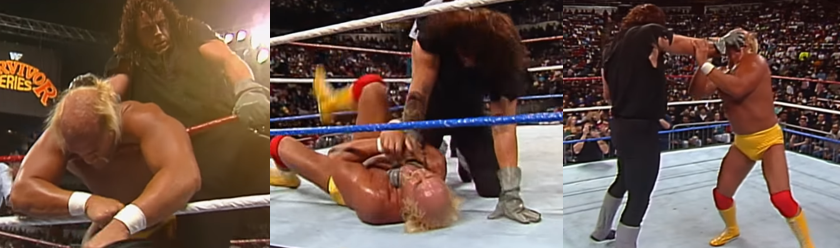
The Review:
It’s easy to forget now but Godzilla was a huge deal back in the day; the marketing was absolutely everywhere, from billboards to toys and merchandise, to a bevvy of trailers, all of which only showed glimpses and size comparisons of various parts of the creature. Roland Emmerich and Dean Devlin were the hottest of hot shits after Independence Day and big-budget disaster movies were all the rage [https://www.denofgeek.com/movies/how-independence-day-defined-modern-summer-movies/] in Hollywood, so anticipation was really high for their next effort. For a Godzilla fan such as myself, this was the first chance I would ever get to see a Godzilla movie on the big screen, and I vividly remember being taken to see it by my dad when it came out all those years ago. As a kid, I remember being bowled over by it and wowed by the destruction, special effects, and the sheer size and awe of the creature, but it’s safe to say that, very much like Independence Day, a lot of the glamour surrounding Godzilla died off really quickly. Now, it’s regularly aired on television to the point of oversaturation, its flaws are well documented, and it’s since been surpassed by bigger, better, and more fitting versions of the character but I still get a pang of nostalgia any time I watch it, see some of the old marketing crop up on social media, or whenever Puff Daddy and Jimmy Page’s “Come with Me” appears on the radio.

I’m not fan of Broderick, and he’s definitely the weakest element as the resident “Worm Guy”.

After a quick open credits sequence that hints towards the movie’s revised origin for the titular monster, we’re then introduced to easily the worst part of this, and any movie that he stars in: Matthew Broderick. I’m sorry to say that I’m not a fan of this guy; the only films of his I can even remotely stand to watch are this one and The Cable Guy (Stiller, 1996) and even then I’m more interested in the giant monster and Jim Carrey, respectively. Here, Broderick plays Dr. Niko Tatopoulos (named after the man who redesigned Godzilla for the movie, and subjected to a pretty lame running joke where no-one can pronounce his name properly so everyone just calls him “Nick” or “The Worm Guy”), a scientist working for the Nuclear Regulatory Commission (NRC) who is busy research the affects of radiation from the Chernobyl disaster on local wildlife, specifically worms, when he is suddenly whisked away to give his expert opinion on a gigantic, radioactive footprints and a wrecked sea vessel in Panama. While his new boss, Doctor Elsie Chapman (Vicki Lewis) believes that culprit to be a dinosaur that somehow escaped extinction, Nick provides the more credible explanation that the attack was caused by a creature mutated by radiation, and proves to be correct when the Big-G itself makes landfall in New York City. Nick has a tenuous relationship with the military and governmental officials he finds himself surrounded by; while Ellie clearly has the hots for him (for whatever reason) and Sergeant O’Neal (Doug Savant) is friendly enough to him, Colonel Hicks (Dunn) is far more abrasive and has little time for wild theories; he just wants to cut to the chase and find out the best way to track and destroy the creature as quickly and efficiently as possible, which is decidedly at odds with Nick’s more awestruck reaction to the creature and his scientific curiosity.

Nick and Audrey rekindle their romance in the midst of a giant monster attack.

Nick and the military follow Godzilla to New York City, which reunites him with his ex-girlfriend Audrey Timmonds (Pitillo), a beautiful young woman with aspirations of being a fully-fledged reporter but who is stuck doing menial work for her lecherous boss, anchor-man Charles Caiman (Harry Shearer). Although Nick never forget Audrey (he still has photos of her and the two of them together in his car, which isn’t creepy or obsessive at all…), their reunion is a little awkward as they broke up when Nick proposed to her and she got cold feet. Just as they begin to rekindle their friendship, and express a continued mutual attraction to each other, Audrey screws it all up by swiping a confidential videotape that reveals Godzilla’s origins and preparing a report on the creature, and Nick’s theories that it is nesting in the city, to try and launch her career as a reporter only to be screwed over herself when Caiman steals her report and misidentifies the creature as “Godzilla” instead of “Gojira”. From there, Audrey conducts her own investigation into Nick’s theories and, like him, ends up constantly at ground zero when the creature and its young rampage through the city. The two are joined by Audrey’s her friend and cameraman, Victor “Animal” Palotti (Azaria), who largely acts as the film’s comic relief. Of the three main characters, Animal is probably the most likeable and interesting to watch thanks to being both something of a snarky jokester and a bit of a cynical Brooklyn native who finds himself recording evidence of the story of the century by association.

In a film of bland and cliché characters, Jean Reno is the highlight for his undeniable charisma.

The rest of the film’s characters are made up of the standard, no-nonsense military types and thinly veiled parodies of real-world film critics, but easily the best human character in the film is Philippe Roaché (Reno). An agent of the French secret service, Philippe is conducting his own investigation into Godzilla; having been charged with destroying all evidence of his government’s involvement in the creature’s creation, including the creature itself and its young, Philippe takes a special interest in Nick and the ongoing military operation to track and destroy Godzilla, and is the only one wiling to entertain Nick’s theory about the creature having nested in the city. If you actually stop and think about it, it’s quite odd that Hicks and the other governmental officials don’t believe Nick’s theory considering he’s been right about every single other thing he’s said about the creature up until that point, but I guess it’s necessary to introduce some drama in the muddle of the film and get Nick teamed up with the more efficient and interesting French spies. This leads to some of the film’s more amusing and entertaining moments, such as their continual dissatisfaction with American coffee and snacks, them all chewing gum to “look more American”, and Philippe even impersonating Elvis Presley to convince the Americans that he’s one of them. While Hicks and the United States military are satisfied to believe that they’ve ended Godzilla’s threat, Philippe leads his men to Madison Square Garden to find and destroy the creature’s nest, which results in his men suffering the highest, most tangible body count in the entire film as they’re torn apart by the baby ‘Zillas. Still, Philippe remains an instrumental and pivotal character in the film since he’s the only one who takes Nick seriously outside of his friends, and Reno’s stoic charisma and undeniable screen presence easily allow him to steal every scene he’s in and be the undisputed highlight of the human cast, especially compared to the bland and awkward Nick.

Godzilla’s full reveal is built up over time, with the creature shown in glimpses and tantalising shots.

Very much like the original Godzilla, it takes some time before we actually seethe titular monster in full view; its emergence from the ocean comes at around twenty-five minutes into the film and is easily one of the best and most memorable shots of the entire film as it slices up through the water and lumbers its way into the city, crushing cars and people alike and raining debris down on the streets. Even here, we don’t really get a good look at the creature as its framed mainly from the legs and ankles down and we get brief glimpses of its jaw and head, all of which really helps to create a sense of mystery and fear surrounding the creature. In the first of many borrowings from Jurassic Park (Spielberg, 1993), the creature’s approach is heralded by a series of rumblings and shaking buildings, and the entire city is thrown into chaos as it stomps through downtown Manhattan before promptly disappearing. This is a recurring element in the film; despite being a good ninety-meters tall and causing a great deal of destruction in its wake, Godzilla is extremely difficult for the military to track and easily evades their attempts to track it by returning to the ocean and burrowing deep into the vast New York underground. This leads to a shot that should have been one of the most chilling in the movie but ends up being one of the most aged CGI shots in the film as Godzilla’s eye dominates one of its tunnels, and way too much of the film’s runtime is devoted to trying to figure out and draw out the creature and then contending with its young. When the creature does appear, it’s always at night and in the rain (which theoretically helps mask some of the CGI effects but ends up making the film appear very dreary and bleak as it’s constantly raining all the time), but it definitely makes an impression to see this mammoth, dinosaur-like creature standing in Central Park or weaving between the skyscrapers of the city, easily evading the military’s weapons with its agility and sheer mass.

The Nitty-Gritty:
The movie wastes no time in altering the origins of the iconic kaiju; in this version of the story, Godzilla is a normal, everyday iguana that was horrifically mutated by radioactive fallout from military nuclear tests in French Polynesia. I actually don’t really mind this change all that much; it’s not a million miles away from Godzilla’s actual origin (which varies, but is generally that of a new species of dinosaur that is supercharged by nuclear radiation) and brings the story a little closer to then-modern day. Obviously, it diminishes a lot of the horror of the original Godzilla in that the creature is no longer the embodiment of nature’s wrath or a physical manifestation of the nuclear terror that gripped Japan after the Second World War, but I think altering the story somewhat is probably necessary if you’re going to shift Godzilla’s target from Japan to America. However, thinking about it now, they probably could have retained the original story and had Godzilla target America as recompense for their actions during the war, similar to how the character would later be a vengeful force of the unjustly killed in Godzilla, Mothra and King Ghidorah: Giant Monsters All-Out Attack (Kaneko, 2001). Still, the creature remains very much a symbol of the dangers of nuclear power and mankind’s tendencies towards recklessly endangering others and nature, though it does make you wonder why only one iguana was mutated in such a way when we clearly see an entire nest near the set of the nuclear tests.

This version of Godzilla is far more agile and versatile than its more bottom-heavy predecessors.

The film does circle back around to the original movie, and the creature’s origins in Japan, by having it attack a Japanese boat out at sea, the sole survivor being traumatised by the experience and dubbing the creature responsible “Gojira”, and Godzilla laying waste to a village in Panama, which is all very similar to events seen in the original movie. Godzilla’s motivations for coming to New York couldn’t be further from the original monster’s, as it arrives not to unleash the fury of nature upon humanity or teach us the error of our violent ways, but to establish a nest within the city. Consequently, Godzilla doesn’t really go on a rampage in the same way as its predecessors; it only rages through the city after being attacked by the military while trying to have its fill of fish, and is far more concerned with gathering food for its young then destroying iconic landmarks. Indeed, as Mayor Ebert (Michael Lerner) states, the military causes more damage to the city than the creature as its easily able to slip past their missiles and high-powered artillery using its speed and agility; while the cluttered city doesn’t really give the creature a chance to reach its top speed, it allows Godzilla to nimbly hop onto and through buildings in a way its predecessors (and successors) never could. Its sheer size and mass also make it heavily hesitant to artillery, but its far from the invulnerable, unquenchable force of nature as the traditional Godzilla; the main issue the military have in trying to harm it is that it’s too fast and aggressive for them to get a good shot at with their more powerful weapons, and it favours an intense blast of air that becomes highly combustible rather than the iconic atomic breath, but it’s still a very formidable creature that easily overwhelms the U.S. military since they’re just not equipped to handle it.

Godzilla is enraged when Ferris Bueller causes the deaths of all of its young!

Eventually, however, the military are able to draw the creature out with “a lot of fish”; although the same trick doesn’t work twice, it is enough to force Godzilla into the ocean, where it is seemingly killed by torpedoes fired from a submarine. From there, Nick and his friends join forces with Philippe and the French secret service to destroy the nest, with the film blatantly ripping off the Velociraptors from Jurassic Park and The Lost World: Jurassic Park (Spielberg, 1997) in the depiction of the young ‘Zillas. These snapping, vicious little creatures are about the size of an average man and “born pregnant” and hungry, but are largely hit in miss in terms of their effects and their threat; sometimes they’re fully CGI creatures, other times they’re traditional animatronics, and sometimes they’ll leap at and chew the faces off the French but other times they’ll back away from falling lights to avoid hurting the main cast. This sequence gives the characters an additional threat that they can actually overcome, but does kind of drag the movie out a bit; I feel like it might’ve been better to simply have the nest and many five mini ‘Zillas running around rather than a whole mess of them, but they do serve one key purpose. Up until that point, there’s been a sense of awe and even beauty around Godzilla; it’s not presented as malevolent or aggressive in the slightest and is instead simply an animal looking to lay its eggs that only acts aggressively when provoked. However, when its young are killed, Godzilla becomes a vengeful and enraged creature as it relentlessly chases after the ones responsible (Nick, Animal, Audrey, and Philippe) in the lead-up to the finale.

In the end, Godzilla is tangled up and brought down with a ridiculous amount of ease.

For the most part, the film’s special effects and CGI hold up pretty well; Godzilla and its young can appear very weightless and fake at times thanks to some dodgy lighting effects, but when the creature is shot correctly, it remains an impressive and detailed digital creature. A few choice miniatures, physical sets, and animatronics help to lend a tangible threat to the creature and its destruction, and it’s clear that the most time, effort, and money went into the full body shots of the massive kaiju. Unfortunately for this version of Godzilla, the adaptation process has robbed the creature of many of its abilities, ferocity, and threat; though gigantic and formidable, it’s still just a mindless creature with simple urges (feeding, sleeping, and protecting its young), and its threat to the city and its inhabitants is generally framed as being incidental to its size and nature. Godzilla’s true threat lies in its ability to reproduce asexually; though it’s the only one of its kind, it can lay a vast amount of eggs, which hatch very quickly, and each of its offspring has the potential to grow just as big and produce just as many eggs, potentially meaning that Godzilla could supplant the human race as the dominant species on the planet. This is an interesting addition to the Godzilla lore, but one that somehow isn’t as impressive or as fearsome as Godzilla’s general depiction as the embodiment of nuclear fears. Upon discovering its young have been bombed to death by a massive air strike, Godzilla flies into a rage and chases as Nick and the others (who are, somehow, able to out-run the creature in a taxi despite the terrible weather and the destruction littering the streets…) and ends up getting tangled up in the cables of the Brooklyn Bridge. This finally gives the military a clear and open target to aim at and, after being assaulted by a bombardment of missiles from a few fighter jets, Godzilla finally goes down for the count. While it’s an anticlimactic and disappointing end to the traditionally indestructible creature, it’s a surprisingly distressing moment as the once mighty creature’s heartbeat slowly dies away in a scene very reminiscent of King Kong (Guillermin, 1976). Also like in that film, Nick is the only one to feel remorse at Godzilla’s death, as everyone else bursts into cheers of applause, but the film ends with the revelation that at least one of the creature’s eggs survived, and this ‘Zilla would go on to be the more heroic version of the character seen in the animated series.

The Summary:
It’s not hard to see why so many bemoan Godzilla, especially the die-hard fans of the character and its franchise. Realistically, the film would work just as well without the Godzilla name attached to it since so much about the monster has been changed that the filmmakers could have simply said any remaining similarities were a homage to Toho’s famous kaiju. The problem is that Godzilla really is so much more than just a mindless animal rampaging through a city; it’s supposed to be this metaphorical, elemental force of nature that exists to remind us of our failings and/or to defend the Earth from increasingly ludicrous and monstrous threat. Reducing it down to an irradiated and enlarged iguana that’s just trying to lay eggs is quite the betrayal of the core aspects of the character, and it also doesn’t help that it’s simply Godzilla against the largely ineffectual military rather than facing off against another monster. While this isn’t necessary a required element of a Godzilla film, as we’ve seen throughout this month, it is one of the main appeals of the franchise and was another serious miss-step on the filmmakers’ part. Still, as a disaster movie about a giant lizard trashing parts of New York, it works pretty well; the level of destruction is nowhere near that seen in Independence Day, though, and the attempt to introduce the secondary threat of Godzilla’s young succeeded only in unnecessarily prolonging the film’s runtime. I do have  a little affection for this film, though, despite my dislike of Matthew Broderick and many of the changes made to the titular monster; I actually quite like the more versatile and agile design of the creature, and the film definitely excels whenever Godzilla or Jean Reno are onscreen, but it remains a startling underwhelming disaster film that’s way too reliant on special effects and oddball humour. Obviously, you’re going to need a lot of special effects to bring Godzilla to life but you really need to make damn sure that the rest of the film can support those effects, and the creature within it, and the sad truth is that this could have been any threat, monster, alien, or otherwise, stomping through the city and very little about it would be different except that Godzilla fans wouldn’t have had to see the famous monster butchered by studio meddling.

My Rating:

Rating: 2 out of 5.

Could Be Better

So…do you have any fond memories or positive things to say about Godzilla? Were you disappointed by Godzilla’s redesign or were there elements of it that you enjoyed? Are you a fan of Matthew Broderick (and, if so, why?) and which of the film’s characters was your favourite? What did you think to the changes made to Godzilla’s origin and motivations, and the incorporation of its young? Were you disappointed by how easily Godzilla was taken down? Did you ever watched the cartoon that spun out from this film and would have liked to see a sequel? What’s your favourite Godzilla movie and why? How did you celebrate Godzilla Day this year? Whatever your thoughts on Godzilla, or Godzilla in general, feel free to sign up and leave a comment below, or let me know on my social media, and check back in next Saturday for more Godzilla content!

Game Corner [Mickey Mouse Day]: World of Illusion Starring Mickey Mouse and Donald Duck (Mega Drive)


It’s November 18th, which means that it’s Mickey Mouse Day! Disney’s beloved mascot first debuted in Steamboat Willie (Disney and Disney, 1928) and has since become one of the most recognisable and influential cartoon characters in the world, the face of an entire multimedia conglomerate, and one of the most enduring and popular characters of all time, featuring in a variety of cartoons, videogames, and other merchandise.


GameCorner

Released: 14 December 1992
Developer: SEGA AM7
Also Available For: Mega Drive Mini

The Background:
As I’ve talked about a few times in the past, videogames based on popular Disney characters and licenses had quite the reputation back in the nineties and resulted in some of the best 8- and 16-bit action/platformers of the era. As Disney’s loveable and successful mascot, Mickey Mouse was obviously at the forefront of this but Disney’s foul-tempered fowl, Donald Duck, had his fair share of pixelated adventures over the years as well and what better way to guarantee a success than to team these two popular characters up in their own fantasy adventure. Taking inspiration from a variety of Disney’s animated feature films, most prominently Alice in Wonderland (Geronimi, Jackson, and Luske, 1951) and Snow White and the Seven Dwarfs (Hand, et al, 1937), and, despite how easy the game was, it was both reviewed very well at the time of release and fondly remembered years later.

The Plot:
While practising for their magic show, Mickey and Donald discover a magical box that sucks them into a bizarre magical world. Now, the two must join forces to travel across five treacherous fantasy worlds, defeat the evil Magic Master, and return home safely.

Gameplay:
World of Illusion Starring Mickey Mouse and Donald Duck is a 2D action/platformer in which, as you might be able to guess, players can pick between playing as Mickey or Donald or team up to play as both in simultaneous play. Whichever character you select, the game’s controls are basically the same and can be customised from the main “Options” menu; you can jump, hold down a button to dash ahead, and press down on the directional pad to duck. Although you cannot defeat enemies by jumping on their heads as is the standard of the majority of 2D platformers, Mickey and Donald can attack enemies with a swipe of their magician’s capes.

Attack with your magical cape and lend a hand to your partner to get through tight spots.

The cape produces a small flurry of magical sparkles, which can stun enemies if it grazes them or if they need more than one hit to defeat, and defeated enemies will be transformed into harmless forms (such as flowers or butterflies) when hit. There are actually some notable gameplay differences between Mickey and Donald as well; Mickey is able to crawl through small gaps but Donald gets his wide load stuck and will need pulling through with Mickey’s help. This means that, when playing as Donald alone, you’ll explore different levels compared to Mickey, which encourages at least two playthroughs of the game in order to see everything it has to offer. Additionally, when playing with a friend, you can help them out further by dropping a rope so they can reach higher level.

While not especially difficult, there are some annoying moments you’ll have to deal with.

Mickey and Donald’s vitality is measured in magical playing cards; you begin the game with five cards, meaning you can take five hits before you lose one of your three “Tries”. You can, however, pick up Candy and Cake to restore one of all of your cards and are gifted with unlimited continues. However, when you lose all of your Tries and choose to continue, you’ll have to restart from the very first part of the level you were last on. When playing with a friend, you’ll share a stock of six Tries; when your partner loses a Try, you can expend one to revive them and, when you only have one left, the last player to die can choose to continue solo.

Some tricky jumps are made clunky thanks to the game’s extremely slow pace.

World of Illusion isn’t an especially long game; there are only five levels to venture through, with each one split into smaller sub-sections and with some minor puzzles and hidden paths or areas that you can find by exploring a bit. While these generally just lead you towards Candy or other power-ups, other times you’ll find short sub-areas to playthrough for similar bonuses. Each level only has a handful of enemies and none of them are particularly menacing but they do respawn if you end up having to backtrack and can cause you to fall down a bottomless pit if you’re hit mid-jump thanks to a bit of knockback damage. The game is also extremely slow; the dash function helps with that but, still, Mickey and Donald move painfully slowly and the game is more about taking your time and enjoying the moment rather than blasting through at breakneck speed, which is fine but it does feel like playing underwater sometimes since everything’s so sluggish.

Donald has his own unique levels and hazards to contend with.

Your main concern in most levels will be dealing with the game’s platforming sections; mostly, this involves reaching the exit on the far right of the screen but other times you’ll be hopping from spider’s webs and web lines, floating leaves or clouds, and other similar platforms. These will invariably be large, small, moving, or even temporary; even solid ground isn’t safe in this respect as you’ll have to contend with floorboards cracking under your feet and dropping you to your death. Levels also contain a number of helpful gimmicks as well, though, such as see-saws, flowers, staples, and bottle corks that fling and spring you higher and further up the level and towards the goal.

Graphics and Sound:
Like all of the 2D Disney videogames, World of Illusion features large, colourful, and charming cartoony graphics. Mickey and Donald both have amusing edge and idle animations and little reactions that perfectly capture their distinct personalities. There’s also a very small number of voice clips in the game; Mickey and Donald will yelp and squeal when attacked and give a cry of “Alakazam!” when performing their magic tricks, which is a lot of fun.

The game definitely looks the part but can be a bit muted and empty at times.

Enemies are similarly colourful and instantly recognisable from Disney’s classic animated films, such as Alice in Wonderland. The game also draws aesthetic influences form Pinocchio (Sharpsteen, Luske, et al, 1940) and The Little Mermaid (Clements and Musker, 1989), with all three films (and others) likewise evoked in the levels you’ll journey through. However, while levels are bright and very fitting, they’re every short and also very bland and empty in a lot of ways. Levels can be a bit inconsistent like that; the chocolate-and-sweetie-filled level is bursting with colour and sometimes there’s large trees or vines or other elements in the foreground or little details in the background, but other times they’re just very barren a bit muted.

The story is told using a fairytale book and in-game sprites with brief dialogue boxes.

The game’s story is told through text in a storybook that can be skipped through, or entirely, at will; while these are only accompanied by static images, the supplementary music (and the music of the entire game) is suitably jaunty and uplifting (if nothing spectacular). After defeating the game’s bosses, a similar cutscene will play in which the characters learn their new magic and, at a few points, the game will use the in-game sprites and a speech box to convey dialogue. As is the case for many 2D videogames from this era, the cutscenes are most impressive for the opening (which pans through the theatre’s backstage area) and the ending (which differs for each character and in which the two perform their magic show before an auditorium full of Disney cameos) before heading off through the forest as the credits roll.

Enemies and Bosses:
While they draw inspiration from many of Disney’s most celebrated animated features, World of Illusion’s enemies aren’t really anything to shout or worry about. You’ll take on armoured bugs, avoid literal tiger sharks, swipe at carnivorous starfish, toy bi-planes, and spiders but none of them are really a threat as they come at you quite slowly and make for large targets. Eventually, you’ll have to contend with wild lightning striking at the ground and conjuring little flaming imps and come up against some more colourful and zany opponents, such as anthropomorphic biscuit men, sharks wielding saws, and rose-throwing playing cards from Alice in Wonderland.

While the spider boss couldn’t be simpler, the little dragons can be a bit tricky to land a hit on.

Each of the game’s levels culminates in a battle against a boss. The first of these is a giant spider that crawls down and across the webbing that is spreading across the background of the boss arena; sometimes it’ll crawl down harmlessly on the other side of the web and taunt you but, for the most part, it’s pretty easy to edge out of the way and swipe at it with your cape. The second boss you’ll face is a series of small dragons that resemble the one from The Sword in the Stone (Reitherman, 1963) or Pete’s Dragon (Chaffey, 1977); these little buggers will pop out from blocks, hop around, and spit fireballs at you but, again, it’s not exactly difficult to avoid them and it helps that they attack one at a time.

The sharks speed and unpredictability, and Mim’s erratic flight, make for challenging boss fights.

At the bottom of the sea, you’ll battle against a giant shark that rushes at you ominously beneath the floorboards of a sunken ship. When it charges towards you, jaws snapping, or leaps out from the ground to pounce at you, this is your moment to quickly attack and hop out of danger, but the shark’s speed and unpredictability actually makes this a somewhat challenging bout. Next, you’ll battle against Madam Mim, which was an amusing and entertaining surprise Mim flies about just above you on her broomstick and tosses flames down to the floor. You can easily jump up to attack her, though, and she stupidly drops down to the ground to taunt you, leaving herself wide open to reprisals in the process.

The Magic Master might be big and ugly but he’s sadly as simple as any of the other bosses.

Finally, you’ll take on not the anthropomorphic cloud beast seen in the game’s cover art but the Magic Master, who is a gigantic background sprite and greatly resembles Mickey’s long-time nemesis, Pete. Taking place up in the clouds, this battle features randomly rising and falling columns that you can use to get close to the Magic Master’s big ol’ head and swipe at him with your cape. The boss conjures smaller, ghost-lime doubles of himself that resemble the Grim Reaper and float around the arena for a bit to damage you but, otherwise, is a bit of a pushover (especially if you have full health, which you probably will as there’s a number of health-restoring items on the way to the final confrontation).

Power-Ups and Bonuses:
There aren’t too many power-ups to pick up in World of Illusion; as I mentioned before, Candy and Cake will partially or full refill your health but you can also earn yourself an extra Try by either finding a magician’s hat or collecting fifty-two playing cards. You can also occasionally find a firework that will shower the screen in explosions and destroy all onscreen enemies or a Silver Card for a brief period of invincibility.

Mickey and Donald learn new magic tricks to help them progress through the game.

After defeating each of the bosses, Mickey and Donald will learn a new magical ability to help them progress in the next level. The first of these is a magic carpet, which you can cause to ascend by tapping the jump button and ride through the skies avoiding tornados and buzzards. Next, you’ll get a magic bubble that allows you to slo-oo-wly navigate the underwater stage, again by tapping the jump button. The next spell allows you to teleport across the library when you’re shrunk down and is probably the least interesting of all of the magic tricks. Finally you’ll be able to cause specific playing card enemies to arrange themselves into platforms and bridges to help you get through the iconic garden and dining hall from Alice in Wonderland. All of these are performed in specific circumstances rather than at will and don’t really afford you any useful in-game benefits beyond allowing you to get to the end of the level you’re on, though.

Additional Features:
That’s about it for World of Illusion. The game uses a password feature that allows you to warp to later levels as either Mickey, Donald, or both if you have to suddenly top playing but that’s about it. I’m a bit confused as to why the game has this password system, though, as it’s not exactly difficult and easy to fly through it in about a hour or so.

The Summary:
World of Illusion Starring Mickey Mouse and Donald Duck certainly looks and sounds the part of a typical 1990s D16-bit Disney videogame; it’s bright, fun, and full of gorgeously animated sprites and instantly recognisable Disney characters and locations. Mickey and Donald are always two of the most versatile characters in videogames, I find, and excel when dropped into fantastical environments and tasked with getting through them using a number of gimmicks; while the attack range of their magic capes leaves a lot to be desired, I enjoyed the magical spin on their arsenal and, especially, the flying carpet sections of the game. Sadly, though, it’s just a bit too short and bland in a lot of ways; two of the five bosses are just generic, large creatures and the game is just way too slow and sluggish through and through rather than being action-packed and entertaining. It’s a decent way to send an hour or so and fun to be able to team up with a friend for simultaneously play; it’s pretty cool how you get a slightly different experience when playing as each character but it’s lacking in a lot of content and options, some of which (such as score and certain gimmicks) actually featured in Castle of Illusion Starring Mickey Mouse (SEGA AM7, 199) which released three years earlier and stuff like that does bring the score down a little bit for me despite how striking the game’s presentation is.

My Rating:

Rating: 3 out of 5.

Pretty Good

What did you think about World of Illusion? Where does it sit in your hierarchy of 16-bit Disney games? Which of the 16-bit Disney was your favourite, or least favourite, and who is your favourite Disney character? How are you celebrating Mickey Mouse Day today? Whatever your thoughts on World of Illusion, and Disney and Mickey games in general, drop a comment below and share your thoughts and have a great Mickey Mouse Day!

Back Issues [JLA Day]: The Brave and the Bold #28


To celebrate the release of Justice League (Snyder/Whedon, 2017), DC Comics named November 18 “Justice League Day”. Sadly, this clashes with another pop culture holiday but, setting aside all the drama surrounding that movie, this still provides a perfect excuse to dedication some time to talking about DC’s premier superhero team, which set the standard for super teams in comics by bringing together DC’s most powerful heroes.


Story Title: “Starro the Conqueror!”
Published: 29 December 1959 (cover-dated March 1960)
Writer: Gardner Fox
Artist: Mike Sekowsky

The Background:
All Star Comics (1940/1941), brought together eight superheroes from a number of different publishers for the first time as the Justice Society of America (JSA). This not only heralded the birth of the first ever superhero team in comics but also allowed readers to see their favourite characters interacting all for the same price as reading any one comic. The JSA’s roster expanded and changed over the years but the team underwent their most significant change when, in the late 1950s, then-editor Julius Schwartz asked writer Gardner Fox to reintroduce and rebrand the team as the Justice League of America (JLA) to capitalise on the popularity of the American Football League and Major League Baseball’s National League. Though the team debuted in The Brave and the Bold #28, a title famous for featuring team-ups between various fictional and superheroic characters, the team’s actual origin wasn’t revealed until the ninth issue of their self-titled series, which became one of DC Comic’s best-selling titles. As with the JSA and other super teams, the JLA’s roster has changed over the years and many splinter groups and spin-offs have been introduced but perhaps there is no more iconic line-up than the JLA’s original roster that was comprised of DC’s heavy-hitters: Clark Kent/Superman, Bruce Wayne/Batman, Diana Prince/Wonder Woman, Hal Jordan/Green Lantern, Arthur Curry/Aquaman, Barry Allan/The Flash, and J’onn J’onzz (referred to here as “John Jones”)/Martian Manhunter.

The Review:
“Starro the Conqueror!” begins with the odd choice to not detail the first time these superheroes joined forces and, instead, starts off with the seven heroes already having agreed to come together in times of crisis (they each have a signalling device to summon the others). I kind of like this on the one hand as it suggests that DC’s top superheroes already set aside their differences for the greater good without any real fuss and it helps speed things up but, on the other hand, it feels a bit out of place to not detail the first meeting of these heroes. Anyway, the first member of the team to become aware of an impending threat is Aquaman who, thanks to information provided to him by a puffer fish, is learns of the arrival of the gigantic extraterrestrial starfish known as Starro.

Aquaman’s summons is answered by some of DC’s greatest superheroes.

This monstrous being has travelled across the depths of space to Earth with one goal in mind: conquest. To that end, Starro…somehow…transforms three of Earth’s starfish into replicas of itself and spreads them across the world to begin its mad scheme. Aquaman’s summons are immediately picked up and answered by Wonder Woman (who is in the middle of an awkward conversation with her beau, Steve Trevor, regarding marriage), Green Lantern (who, as Hal Jordan, was in the middle of a test flight), the Flash (who quickly disperses of a potentially life-threatening tornado), and the Martian Manhunter (who was simply about to start his vacation…). Each of these introductory panels immediately gives the reader and idea of what each character is capable of: Aquaman can breath underwater and talk to fish, Wonder Woman has an invisible jet, Green Lantern’s ring allows him to perform virtually any task, the Flash is super fast, and the Martian Manhunter can shape-shift. Aquaman’s signal also reaches Superman and Batman but the two are unable to respond right away since Superman is busy taking care of a potentially dangerous meteor shower and Batman is in the middle of stopping a crime spree. You might think that Superman would have spotted Starro’s arrival from space but he was dealing with a great deal of meteors (it’s also entirely possible that Starro caused the meteor shower specifically to distract Superman) and I guess it’s in character for Batman to prioritise Gotham City’s safety over a JLA summons (though a JLA-level peril is surely more threatening for Gotham than a crime spree…)

Green Lantern is able to defeat the Starro duplicate with relative ease.

Regardless, the five heroes meet at the “modernistically outfitted cavern” that serves as the JLA’s headquarters. Having been informed of Starro’s threat and where it intends to strike, the Flash, as the JLA’s chairman, orders the team to split up and it is at this point that the story diverges from the team-based format and instead switches to cover each individual mission. The first sees Green Lantern battling one of Starro’s deputies in the skies above Rocky Mountain National Park; Hal arrives in time to see the gigantic creature but is too late to stop it from attacking a passing air force jet-bomber and relieving it of its payload: nothing less than an atom bomb! Green Lantern is able to save the aircraft when it goes into a deadly freefall but is unable to keep the Starro duplicate from detonating the atom bomb! Thankfully, Hal’s energy shield protects him from the blast and he watches in horror as the creature absorbs the energy released from the bomb. Hal pursues and is nearly blasted from the sky by a scorching beam fired from the creature’s tentacle. However, Green Lantern is easily able to avoid the creature’s thrashing limbs and attacks and reduce it down to a regular starfish by scoring a direct hit on its massive eye.

Starro’s duplicate falls before the might of Wonder Woman and the Martian Manhunter.

Next, the story switches to “Science City” where Wonder Woman and Martian Manhunter (why Diana has to team up with another hero is beyond me…) find another of Starro’s deputies abducting the “Hall of Science”, where the greatest scientific minds of the United States are gathered. The creature intends to bring the scientists into the upper atmosphere so it can absorb their brainpower and knowledge; Wonder Woman attempts to use her magical lasso to prise the creature’s tentacles from the building but ends up being yanked off of her invisible jet and onto the Hall of Science thanks to the giant starfish’s incredible strength. Meanwhile, J’onn uses his super-breath to bombard the creature with fragments of the meteors Superman is destroying and uses the same technique to cause a torrential rainfall when flames from the building threaten his life. Starro’s deputy then attempts to destroy them both by firing bolts of nuclear energy their way but Wonder Woman is, of course, able to deflect them with her magical bracelets and J’onn shields himself using the building’s conveniently lead-lined roof. Diana then whips her lasso around her jet and uses the momentum to forcibly drag the building out of the sky. The effort of battling both heroes at once soon takes its toll on the creature, which plummets from the sky and begins to revert back into a regular starfish.

The Flash makes short work of the final Starro duplicate.

When then join the Flash as he confronts another of Starro’s deputies at Happy Harbour; this part of the story is easily the worst simply because it introduces one of the most annoying and aggravating characters ever conceived: the JLA’s “mascot”, Snapper Carr. Snapper is a hip, super cool teenager with the annoying habit of constantly snapping his fingers all the God-damn time who is shocking to find his family, and the entire town, enthralled by Starro’s trance. For whatever reason (possibly due to being high, judging by the way he speaks!), Snapper is immune to Starro’s influence so he needs to be saved from certain death by the Flash. Despite Starro’s best efforts to vaporise the Scarlet Speedster, the Flash (literally) runs rings around the creature and ultimately defeats it when it tries to hide in the sea. In the process, the townsfolk are freed from their trance and Snapper’s family are able to tell Flash where they were ordered by the creature to head to: Turkey Hollow.

The JLA defeat Starro with ridiculous ease and make Snapper an honorary member!

The final part of the story sees the team reunite to take on the real Starro at Turkey Hollow; despite the defeat of its deputies, Starro remains confident since it was still able to absorb the power of that atomic bomb, the knowledge of Earth’s scientists, and…whatever it is the townsfolk of Happy Harbour contributed to its mind (local Earth knowledge, I guess?) Starro plans to use all that it has learned to force humanity into destroying the world with nuclear weapons and then use the influx of nuclear energy would then allow it to conquer other worlds across the universe. When the JLA arrive, Starro immediately puts its abilities to good use by reading Hal’s mind and turning itself yellow to render itself immune to his power ring but the Flash notices that Starro’s awesome energy ray has absolutely no effect on Snapper (who he, of course, brought along for the ride!) Flash orders Wonder Woman and the Martian Manhunter to distract Starro while Hal uses his power ring as a spectroscope to discover that Snapper is covered in lime from when he was mowing the lawn earlier. Apparently, lime is deadly to starfish so Hal dumps a whole bunch of it onto Starro to weaken it. Martian Manhunter then uses his super-breath to blow a load of calcium oxide (which is, apparently, also lime) onto the creature and thus imprison it within an unbreakable shell of lime. With Starro’s threat ended, Superman and Batman return just in time to see the Flash making Snapper an honorary member of the JLA and…boy, do they look thrilled to be there!

The Summary:
I don’t mind telling you that I am a bit disappointed by “Starro the Conqueror!”; the story started pretty strong but fell off a cliff pretty quickly at the end, becoming little more than a science class rather than a big old fight between Earth’s greatest heroes and an alien menace. I suppose it speaks to the intelligence of the JLA (specifically Barry) to come up with a way to outwit, rather than outfight, the creature and the sudden introduction of lime as the might Starro’s one weakness is arguably no less lame than fire being J’onn’s weakness and yellow being Hal’s and there is a lot of action prior to the finale but still…the entire point of the comic is to see these heroes joining forces and we don’t really get that.

Aquaman is unfairly side-lined and does nothing except alert the JLA to Starro’s presence.

You might be wondering where the hell Aquaman was during this story; despite appearing to be a pivotal member of the team in the early panels, Arthur is little more than an early warning system to alert the team to Starro’s threat. Hell, when Barry is divvying out the JLA’s individual missions, Aquaman doesn’t even get to fight one of the creatures as he’s sent back to the ocean to watch out for any more of the duplicates and, when he does return to the story for the finale, he does absolutely nothing. It’s pretty sad considering the JLA were light on power with Superman out of the equation and when you consider that Arthur might have actually been really useful at Happy Harbour so could have easily teamed up with the Flash for that mission…but then we might never have gotten Snapper-fuckin’-Carr now, would we!?

Hal and J’onn are severely underutilised, with their powers reduced to the bare minimum.

Honestly, Snapper could have been dropped entirely from the story; he’s only there so the teenager readers can act like they’re fighting alongside their favourite heroes, after all, and it’s legitimately sad that he’s more important to the story than Aquaman! Seriously, drop Snapper, have Aquaman and the Flash go to Happy Harbour, and have Arthur get covered in lime while battling the creature in the water and reveal the key to Starro’s defeat. Seems like a pretty simple solution to me. Similarly, it’s pretty disappointing that Superman and Batman don’t play any part in the story at all. I can understand why as Superman’s power alone would probably be able to end Starro’s threat but it’s a bit of a let down that they don’t even join the team for the big climactic battle. Instead, we’re left with the likes of the Martian Manhunter, who is probably just as powerful as Superman if not more so and yet is reduced to simply puffing away with his super-breath. Similarly, Hal’s potential and power is also significantly reduced; his ring allows him to do virtually anything but, in the end, all he really uses it for is to fly about, rescue a falling plane, and zap at Starro with energy blasts.

Starro seems like a threatening villain but end sup being a massive disappointment.

Still, at least Wonder Woman gets a lot to do; she basically does all the work in her team-up with J’onn which, again, makes me question why she has to have a partner and no one else does. The implication may be that it’s because she’s a woman but she’s easily the most dependable and capable superheroine I’ve seen all year; she doesn’t even get bound or anything, which is refreshing. The Flash also gets far more chances to show off his abilities and competence; beyond his super speed allowing him to easily best one of Starro’s duplicates, Barry is portrayed as a decisive team leader and his intelligence is what ultimately wins the day over brute strength. Overall, Starro is just another in a long line of potentially dangerous foes that really don’t amount to a whole hell of a lot. It openly admits that its plot to conquer Earth is the first time it’s ever tried anything like that, exposing its naivety and inexperience in world conquest and battle. Its scheme seems pretty good to start with as it creates duplicates of itself and absorbs power and knowledge but it fails to really do anything with this beyond making itself yellow; it could have spewed flames at J’onn, bound Wonder Woman’s wrists, subjected Aquaman to intense heat, or slowed the Flash down with quicksand but it never does any of that. For all the power and knowledge it has, Starro ends up just being a giant alien punching bag that, arguably, the Flash alone could have defeated and, because of that, it’s simply a piss-poor excuse to see all these heroes band together and even then they spend the majority of the story working separately!

My Rating:

Rating: 2 out of 5.

Could Be Better

What did you think to the JLA’s debut appearance? Were you happy to see five out of the seven joining forces for the first time or would you have liked to see all seven of them getting in on the action? What did you think of Starro as the principal villain and the introduction of Snapper Carr? Which era or incarnation of the JLA is your favourite and what are some of your favourite JLA stories? Who would you like to see in the JLA some day? How are you celebrating Justice League Day this year? Whatever your thoughts on the JLA, feel free to leave a comment below.

The Summoning

“You’re cordially invited to LaVey House…”

The reclusive Howard LaVey has presented writers Frederick Brandis, Aster Callahan, Rhiannon Hughes, and Mikhail Orlov with the opportunity of a lifetime: a chance to spend a week at his ominous estate and collaborate on a horror anthology.

Each of them hopes to get something out of it, ranging from riches to recognition, but egos flare and co-existing becomes a struggle as each writer battles against their own demons and self-doubts.

Soon enough, LaVey House turns out to be much more than they bargained for, and the chance of a lifetime quickly becomes a living nightmare as ancient spirits awaken and torment them at every turn.

Four writers, four stories, but the true horror lies buried within the dark hallways and forgotten secrets of LaVey House just waiting to live again!

The Summoning is an intense horror collaboration from the minds of Dr. Stuart Knott, H. Everend, and Jessica Huntley and featuring contributions from Alice Stone, Shantel Brunton, Tom Schnipke, and Daria Lavrenteva.

Group interview by Shantel Brunton
Madilynn Dale’s Review on The Chapter Goddess
My review
Brittany’s Book and BeeReview
Feature with Alyanna Poe