Game Corner [Crossover Crisis]: Injustice: Gods Among Us (Xbox 360)


In April 1985, the first issue of the ground-breaking Crisis on Infinite Earths (Wolfman, et al, 1986) released and saw the temporary destruction of the “Multiverse”. To celebrate this momentous event, I’m discussing multiversal crossovers all throughout April in an event I dubbed “Crossover Crisis”.


Released: 16 April 2013
Developer: NetherRealm Studios
Also Available For: Arcade, Mobile, PC, PlayStation 3, PlayStation 4, PlayStation 5, PlayStation Vita, Xbox One and Xbox Series One X/S (Backwards Compatible), Wii U

The Background:
When it was first released, Mortal Kombat (Midway, 1992) was a phenomenal success for Midway because of its focus on gore and violence, and it offered some real competition for Street Fighter II: The World Warrior (Capcom, 1991) in arcades and on home consoles. For a time, the series seemed unstoppable during the 2D era of gaming but struggled to find a footing in the emerging 3D fighter arena and Mortal Kombat seemed to be in jeopardy after Midway went bankrupt in 2010. The main reason for this was the poor reception of Mortal Kombat vs. DC Universe (Midway Games, 2008), the first collaboration between Midway’s Mortal Kombat and the DC Comics characters owned by Warner Bros. Interactive, which was hampered by age-related restrictions. Luckily, Warner Bros. Interactive stepped in and the team, now rebranded to NetherRealm Studios, immediately set about getting their violent franchise back on track; Mortal Kombat (NetherRealm Studios, 2011) was subsequently very well-received for its “back to basics” approach and, bolstered by the reboot’s success and eager to take advantage of the vast library of characters of their parent company, NetherRealm Studios sought to expand upon the game’s mechanics with a new, all-DC brawler. Although the game wasn’t as bloody and violent as its sister series, Injustice: Gods Among Us was a massive critical and commercial success that was followed up by not only a bunch of additional fighters and skins added as downloadable content (DLC) but also a sequel in 2017 and a critically-acclaimed comic book series.

The Plot:
In an alternate reality, Clark Kent/Superman has become a tyrant and established a new world order after the Joker tricked him into killing Lois Lane before destroying Metropolis with a nuclear bomb. In an effort to stop him, Bruce Wayne/Batman summons counterparts of the Justice League’s members from another universe to join his insurgency and end the totalitarian regime that threatens to subjugate the entire world.

Gameplay:
Just like Mortal Kombat, Injustice: Gods Among Us is a 2.5D fighting game; however, this time you’re able to select one of twenty-four characters from the DC Universe and battle it out in the game’s single-player story mode, one-on-one against another player or computer-controlled opponent (both on- and offline), tackle numerous arcade-style ladders, or take on character-specific missions in Scientific and Technological Advanced Research Laboratories (S.T.A.R. Labs) training scenarios. Just as you’d expect from a Mortal Kombat videogame, Injustice’s fights take place in a best-of-three format (although there are no longer announcements or screen text between each round) and against a time limit, though you can alter these settings (and many others, such as the game’s difficulty) to your heart’s desire in the game’s options to suit your playstyle. If you’ve played the Mortal Kombat reboot then you’ll be immediately familiar with this game’s fighting mechanics and controls, although there are subtle differences: X, Y, and A are assigned to light, medium, and heavy strikes, for example, and may be either punches, kicks, or weapon-based melee attacks depending on which character you’re playing as. You can still grapple and throw your opponent with the Left Bumper (or X and Y and a directional input), dash towards or away from the opponent with a double tap of the directional pad (D-Pad), but now you must hold back on the D-Pad while standing or crouching to block, which can make blocking a bit trickier as sometimes you’ll simply walk or dash backwards when trying to block. If your opponent is crouch-blocking, you can land an attack by pressing towards and A for an Overhead Attack, and string together light, medium, and heavy attacks with directional inputs and your various special moves to pull off quick and easy combos.
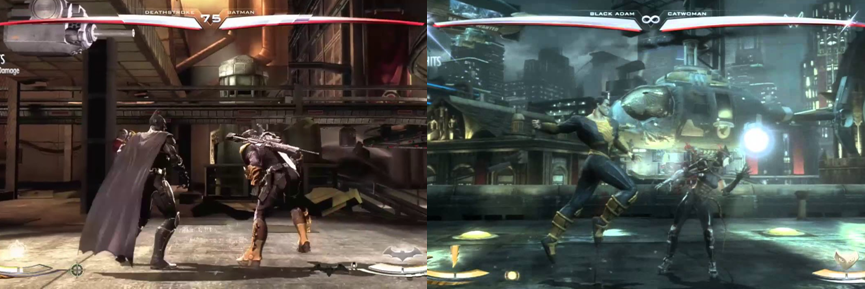
Attack with strikes, grapples, and combos to pummel a number of DC’s most recognisable characters.

As is the standard for NetherRealm Studios’ releases these days, you can practise the game’s controls and mechanics as often as you like and take part in a very user-friendly tutorial to learn the basics of the game’s simple, but increasingly complex, fighting mechanics. You can also view your character’s moves, combos, special attacks, and “Character Power” from the pause menu at any time, allowing you to also see a range of information (such as where and how to pull of certain moves, the damage they inflict, and frame data). Each character has a range of special attacks that are unique to them; these mostly consist of certain projectiles or grapples and strikes but can also include various buffs for your character or to slow down your opponent. Each character also has a specific Character Power that is performed by pressing B; this sees Batman summon and attack with a swarm of bats, Oliver Queen/Green Arrow fire different trick arrows at his opponent, Doctor Harleen Quinzel/Harley Quinn gain various random buffs, and allows characters like Diana Prince/Wonder Woman and Rachel Roth/Raven to switch between different fighting styles and thus access different special attacks. While some Character Powers have a cool-down period, others don’t, but they can also be detrimental to you; for example, Slade Wilson/Deathstroke can briefly give his shots perfect aim but, once the Character Power is expended, he’ll miss every shot until it refills. Another new addition to the game is the annoying “Wager” system; when the Super Meter is filled up by two bars, you can press towards and RT when blocking an attack to play a quick mini game where you and your opponent select how much of your Super Meter to gamble. If you win, you’ll regain some health; if you lose, the opponent regains health; and if you tie then you both lose. Personally, if find these “Clash Breakers” even more annoying than the usual “Breakers” seen in the modern Mortal Kombat games as I never win them and they generally just unnecessarily prolong a fight (and, even worse, there’s no option to turn them off).

Different characters attack and interact in different ways according to their strengths.

In a bridge between the differing character movesets of Mortal Kombat and the “Variation” mechanic seen in Mortal Kombat X (NetherRealm Studios, 2013), Injustice features a limited “Class” system whereby characters are split into two camps: Gadget- or Power-class characters. Gadget characters are generally smaller, faster, and rely on various tricks and weapons in fights while Power-class characters are typically bigger, often slower, and rely more on brute strength. One of the main ways you’ll notice the difference between playing as, say, Barry Allen/The Flash and Cyrus Gold/Solomon Grundy is that they interact with the game’s fighting stages in different ways. As in Mortal Kombat X, you can press the Right Bumper when indicated to use (or attack your opponent with) various environmental hazards, such as firing missiles at them or knocking them into the background. But, whereas Superman will wrench a car out of the air and slam it on his opponent, someone like Dick Grayson/Nightwing will rig the same car to explode or somersault off the environment to get behind their foe rather than try to crush them with a wall. As you might naturally expect, there are no Fatalities or gruesome finishing moves in Injustice (not even “Heroic Brutalities”). However, when your Super Meter is full, you can still press LT and RT together to pull off a devastating Super Move; while you won’t see bones breaking and organs shattering like in Mortal Kombat’s X-Ray Moves, it’s still pretty fun to see Hal Jordan/Green Lantern transport his opponent to Oa to pummel them with his constructs, Ares shower his foe with arrows and stamp on them while grown to gigantic proportions, Arthur Curry/Aquaman force his enemy into the jaws of a ferocious shark, and Bane demolish his opposition with a series of throws and grapples, culminating in his iconic backbreaker.
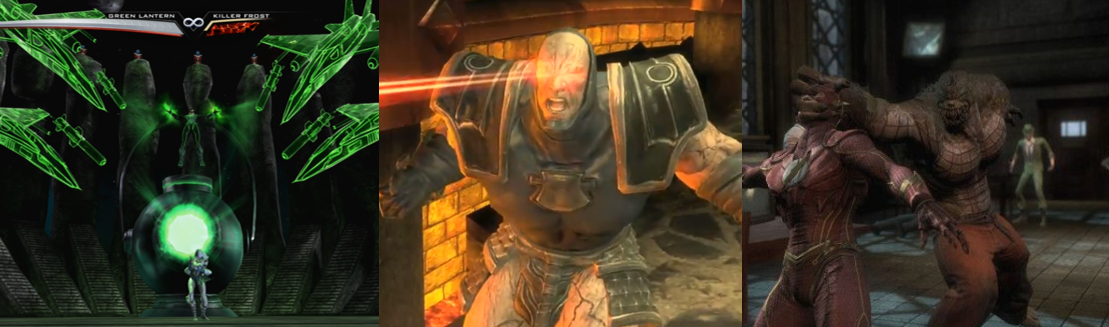
In addition to powerful Super moves, you can bash your foe into new areas using stage transitions.

Another way the game separates itself from Mortal Kombat is stage transitions; when near the far edge of certain stages, you can hold back and A to wallop your opponent through the wall or off into the background where they’ll be smashed up, down, or across to an entirely new area of the stage which often allows more stage interactions and new stage transitions available for your use. You might wonder exactly how someone like Louise Lincoln/Killer Frost can survive being blasting through the brick walls of Wayne Manor or go toe-to-toe with the likes of Doomsday but the game’s entertaining story mode explains that, on this alternative world, the tyrant-like Superman has developed special pills that bestow superhuman strength and dexterity to his generals. As is also the standard in NetherRealm’s titles, the story mode is broken down into twelve character-specific chapters, which is again a great way to experience a wide variety of the game’s roster (though Batman does feature as a playable character in two chapters, which seems a bit lazy). You can replay any chapter and fight you’ve cleared at any time, which is great, and skip through the cutscenes after they’ve loaded a bit, and the story mode isn’t all constant fighting either as you’re asked to pull off a handful of quick-time events (QTEs) at various points, such as blasting cars with Superman’s heat vision. The story is a fairly standard multiverse tale of the main canon heroes fighting against their corrupted or misled counterparts but it’s pretty fun and easy to blast through in no time at all.
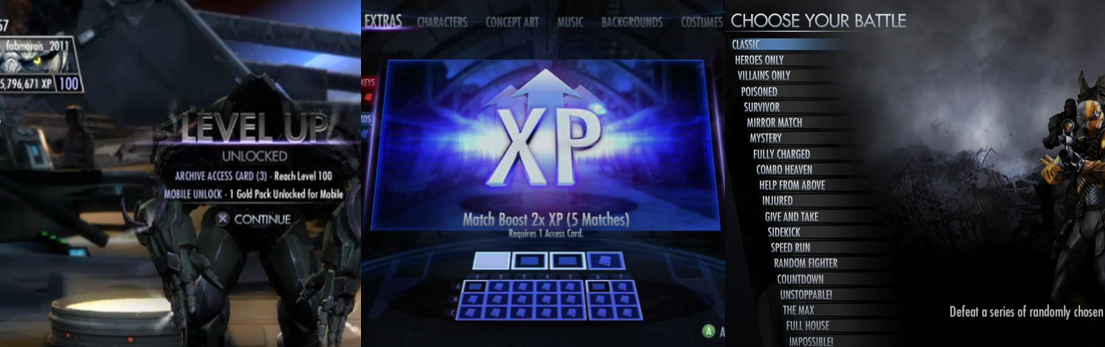
Fight to earn XP and level-up, unlock additional perks and modes, and take on a series of challenges.

Every time you win a fight, you’ll earn experience points (XP) that will eventually level-up your character profile. This, and performing a certain number of specific attacks, playing through the story mode, and tackling the game’s other modes and mechanics, unlocks icons and backgrounds for your profile card as well as additional skins in certain circumstances. You’ll also be awarded “Armour Keys” and “Access Cards” to spend in the “Archives”, which allows you to unlock concept art, music, more skins, and certain boosts that will increase how much XP you earn, to name just one example. Like in Mortal Kombat, you can also take on ten opponents in arcade ladders in the “Battle” mode; these range from the basic tournament-style ladder to specific challenges against heroes, villains, or battling while poisoned, injured, or with certain buffs (such as a constantly full Super Meter or health falling from the sky). We’d see a similar system be incorporated into the “Towers” modes in later Mortal Kombat games and similar scenarios exist here, such as a survival mode, battling two opponents, or being forced to fight against the computer set to the hardest difficulty.

Graphics and Sound:
Like its violent sister-series, Injustice looks fantastic; there’s almost no difference between the high-quality story mode cutscenes and the in-fight graphics (which, again, makes it all the more frustrating that NetherRealm Studios insist on having character’s endings represented by partially-animated artwork and voiceovers), though it has to be said that the graphics are much more palatable when in a violent fight. I say this purely because I am not a big fan of some of Injustice’s character designs: The Flash looks a bit too “busy”, for example, and Batman’s suit (and cowl, especially) look really janky to me, though I love the representation of Green Lantern and Thaal Sinestro.
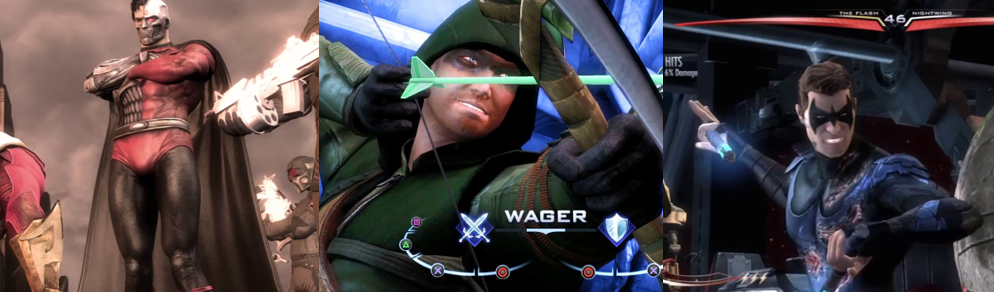
In addition to various intros, outros, and Wager dialogue, characters also take on battle damage.

Each character gets a nice little fitting intro and outro for each fight and, between rounds, will perform and quip a variety of taunts to the opponent. In a nice little touch, different character skins get different intros and outros; when playing as the evil Superman, for example, he enters and exits the fight differently to his more heroic counterpart. When playing as different skins, like John Stewart or Hank Henshaw/Cyborg Superman, you’ll also be treated to slightly different dialogue and animations, which is a much-appreciated touch on the developer’s part. Although there aren’t any character-specific interactions in the intros, there are during the Wager cutscenes and, even better, both characters and the arenas will accrue battle damage as the fight progresses! This means that you’ll not only see Selina Kyle/Catwoman’s cat suit rip and her skin be blemished by bruises and blood but arenas will degenerate or change around you the more damage you dish out, which can also allow different intractable options to become available to you.
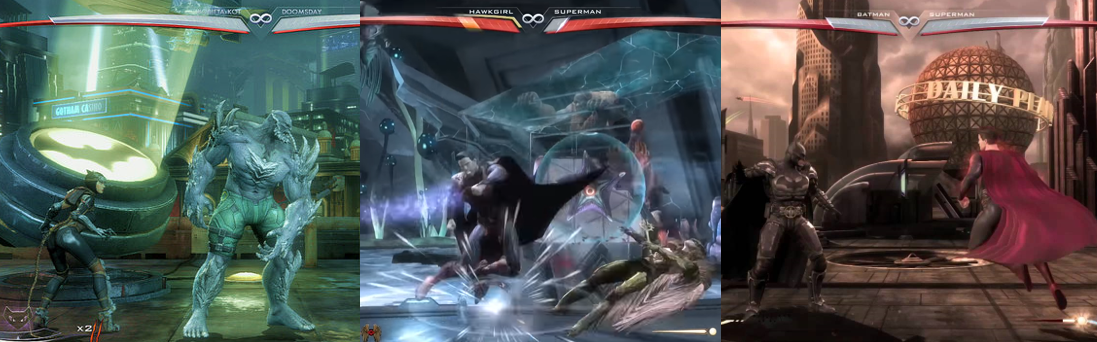
Stages include a range of recognisable DC locations and take damage as you fight.

Speaking of the stages, Injustice really goes above and beyond to make the best use of the DC license; while it’s a little disappointing to see Arkham Asylum and Wayne Manor feature twice in the game, they are made distinctive by having Joker-ised and night-time variants, respectively (and also being clearly modelled after, and featuring cameos by, the Batman: Arkham (Rocksteady Studios/Various, 2009 to 2015) videogames and villains). Additionally, the use of stage transitions really helps to add a whole new dimension to combat, with some stages featuring more than others (or even none at all), to help ensure that every fight can be a little different. Stages also feature a bevy of other little cameos and DC references, such as the Fortress of Solitude being clearly modelled after Superman (Donner, 1978) while also featuring a portal to the Phantom Zone and a cameo from Starro the Conqueror. Similarly, J’onn J’onnz/Martian Manhunter floats in the background of the Watchtower space station, Floyd Lawton/Deadshot is just hanging out at Stryker’s prison, and Amazons are preparing a boat to launch on Themyscira. Every single stage has a number of intractable elements and changes as you fight, cause damage, or smash foes around, with Gotham City being my favourite as you can battle on the roof with the Bat-Signal and then down to the grimy streets below and then blast your foe back up to the roof using a nearby truck!

Enemies and Bosses:
Injustice helpfully separates its character-selection screen into heroes (on the left) and villains (on the right) but, despite their different alignments (and that their loyalties change due to the multiverse shenanigans of the story), every single one of them will be an enemy of yours at some point as you play through the story, Battles, S.T.A.R. Labs missions, and on- or offline. Consequently, it’s worth keeping track of which character suits your playstyle as some have easier combos and special moves to pull off compared to others, or more useful Super Moves and Character Powers.

Play as, and against, the game’s characters to learn their strengths, weaknesses, and skills.

Additionally, the Class system should also be factored in; Lex Luthor, Doomsday, and Solomon Gundy may be powerful and capable of gaining armour to tank through attacks but they’re also a lot slower on their feet and with their jumps. Superman and Shiera Hall/Hawkgirl are much faster Power-class characters but can also have their own drawbacks at times depending on your playstyle (Superman’s Character Power, for example, simply powers up his attacks rather than being a more offensive move like, say, Areas being able to conjure massive magical weapons). Personally, I tend to lean more towards Gadget-based characters, like Nightwing (who can switch between using quick batons or a longer bo staff to attack) or Green Arrow (whose arrows and bow allow for both ranged attacks and blindingly fast melee attacks).

Take on the corrupted Superman and banish him to the Phantom Zone for his crimes!

Unlike Mortal Kombat, Injustice doesn’t really feature any secret or hidden fights or unplayable sub-bosses or boss characters; the story mode and basic arcade ladder culminates in a battle against the corrupted Superman that is a far fairer and more competitive fight compared to the finales of NetherRealm’s recent Mortal Kombat games. While Superman is definitely a bit more of an aggressive foe, even on the game’s easiest difficulty, he doesn’t gain inexplicable armour, can be stunned, and doesn’t deal ungodly amounts of damage or spam his attacks like a cheap bitch. Additionally, he doesn’t transform into some monstrous final form and, instead, the final battle is a far better use of the skills you’ve built up through regular gameplay rather than forcing you to resort to cheap tactics and tricks.

Power-Ups and Bonuses:
Because it lacks a “Test Your Luck” mode and “Kombat Kodes” for multiplayer fights, there aren’t really any in-game power-ups available to you outside of the various status effects seen in the Battle mode. As before, though, some characters can gain in-game buffs with their special attacks and Character Powers: Lex Luthor, for example, can erect a shield, Doomsday can cover himself in impenetrable armour for a brief period, and Solomon Grundy slows time down and drains his opponent’s health with his swamp gas. However, you’ll earn yourself additional XP if you mix up your fighting style and take advantage of stage interactions and transitions, which will allow you to unlock further customisation options for your profile card, and you can also earn additional skins and rewards by playing and linking up to the mobile version of the game.

Additional Features:
There are fifty Achievements up for grabs in Injustice, with three of which being directly tied to the story mode (50- and 100% completion and succeeding at all of the QTE mini games). Others are tied to the game’s online modes, levelling-up to specific levels, customising your profile card, and finishing Classic Battle with one (and every) character. There are also some character-specific Achievements on offer, including performing every character’s Super Move or a ten-hit combat and winning a fight using only arrows as Green Arrow, or landing at least twelve shots without missing as Deathstroke. Batman is the only character to have two specific Achievements tied to him, though, as you’ll get some G for winning a match using all of his special moves and his Super Moves and for defeating every villain as him. Another standard of NetherRealm Studios is their addition of further skins and characters through DLC; you can get skins to play as John Stewart, Cyborg Superman, and the Flashpoint (Johns, et al, 2011) Batman, among others, and they’re all easily applicable when selecting a character (no need for extraneous “Gear” here).

Injustice included some surprising DLC fighters; even Scorpion showed up!

While the game’s DLC characters have no additional Achievements tied to them, Injustice included some fun and interesting extra fighters; Lobo, General Dru-Zod (who also sports his Man of Steel (Snyder, 2013) look as a skin), Barbara Gordon/Batgirl, Zatanna Zatara, and the Martian Manhunter were all great choices to add to the roster and it was nice to see NetherRealm Studios exercise a little restraint and not overload the DLC with additional Batman characters. By far the most exciting DLC fighter was the inclusion of Scorpion, who sports a Jim Lee redesign and began a trend of DC and Mortal Kombat characters appearing in each other’s games. When you’ve had enough of the story mode and regular battle options, you can take the fight online in a series of matches; here; you can participate in ranked and unranked fights and “King of the Hill” tournaments where you watch other players fight until it’s your turn and bet on who’s going to win. The S.T.A.R. Labs missions will also keep us offline, solo players occupied for some time; these are expanded upon when you download the DLC fighters, which is much appreciated and, similar to Mortal Kombat’s “Challenge Tower” mode, basically serve as extended tutorials for each of the game’s characters. You’ll take on ten character-specific missions, with each one getting a little bit of text and maybe a picture to set the context of the mission, and these range from performing certain combos or attacks, winning fights, or completing tricky challenges (such as guiding Catwoman’s cat through laser trip wires, avoiding damage or debris, or racing against Superman).

The Summary:
Injustice: Gods Among Us is a far better marriage of Mortal Kombat and DC Comics than Mortal Kombat vs. DC Universe and a fantastic expansion of the gameplay mechanics and features NetherRealm Studios revitalised their violent fighting game series with in Mortal Kombat (2009). While Injustice is obviously not as gory or violent as its sister-series, that doesn’t make it any less fun and it’s still a very brutal fighter; the Super Moves, especially, and certain character’s outros (such as the Joker’s) are definitely in the Mortal Kombat mould. With gorgeous in-game graphics, a fantastic amount of variety thanks to all of the character’s different special attacks and gameplay mechanics and the stage transitions, and a simple to learn, easy to master fighting system, Injustice is an extremely enjoyable game for anyone who’s a fan of either franchise or fighting games in general. The story is a breeze to get through (thought it is essentially every basic multiverse story ever told in comics) and nicely varied with some QTE sequences; the S.T.A.R. Labs missions and different arcade ladders are much more enjoyable and challenging than in its sister-series and there are plenty of character options, variety, and unlockables to keep you busy. Best of all, the game isn’t bogged down by endless grinding to unlock Gear, skins, or other perks and is a much more user-friendly and accessible fighting game, and overall experience, than its sequel.

My Rating:

Rating: 4 out of 5.

Great Stuff

Were you a fan of Injustice: Gods Among Us? What did you think to it as a blend of Mortal Kombat and DC Comics? What were your thoughts on the game’s story and its depiction of a parallel world terrorised by a corrupted Superman? Which of the game’s fighters was your favourite and why? Did you buy the base game and all the DLC packs separately or did you pick up the Ultimate Edition when it released later? What did you think to the additional DLC characters and skins? Were there any characters or features missing from the game for you? Which DC Comics videogame, movie, comic, or other piece of media is your favourite? Are you a fan of multiverse stories and crossovers? Whatever you think about Injustice, leave a comment down below and be sure to check back in next Wednesday for more Crossover Crisis content!

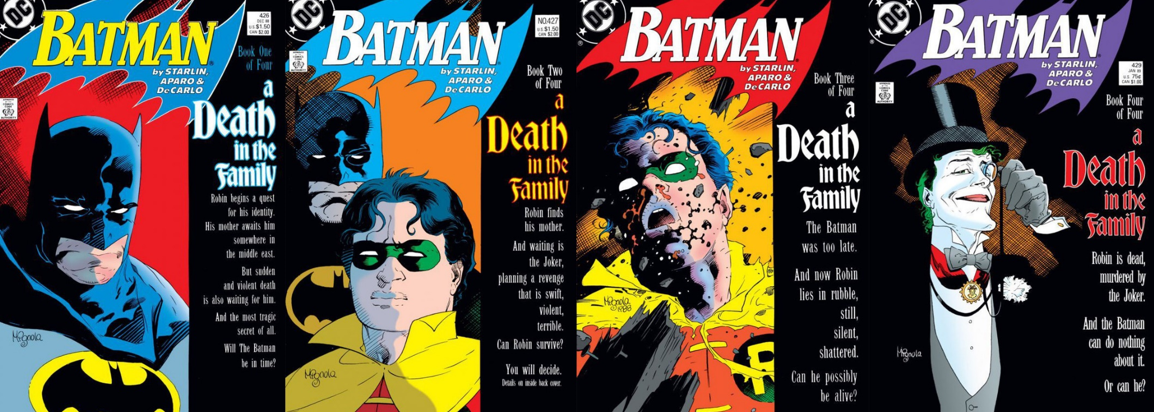
Back Issues [Robin Month]: Batman #426-429


In April 1940, about a year after the debut of Bruce Wayne/Batman, DC Comics introduced “the sensational find of [that year]”, Dick Grayson/Robin. Since then, many have assumed the mantle and the Dynamic Duo have become an iconic staple of DC Comics.


Story Title: “A Death in the Family”
Published: September 1988 to November 1988
Writer: Jim Starlin
Artist: Jim Aparo

The Background:
Having been a regular part of Batman’s adventures since his debut, Dick Grayson eventually grew from a “Boy Wonder” and into a “Teen Wonder” as part of the Teen Titans; to continue the Batman and Robin dynamic, writer Gerry Conway and artist Bob Newton created Jason Todd to, quite literally, fill Grayson’s boots as the new Robin. Originally having a background and personality that was almost an exact copy of Grayson’s, Jason’s backstory and demeanour were dramatically altered by writer Jim Starlin following the Crisis on Infinite Earths (Wolfman, et al, 1985 to 1986). Now a rebellious, impulsive brat from the streets with a volatile temper, readers came to dislike the new Robin and it was writer Jim Starlin who first proposed the idea of killing the character off. Dennis O’Neil decided to run a telephone campaign where the fans themselves would decide whether Jason lived or died following a brutal encounter with the Joker. Starlin and artist Jim Aparo crafted the story and produced two potential outcomes, one where Jason lived and one where he died but, despite some controversy, the results were heavily in favour of the young Robin’s demise. Jason’s death was a pivotal moment in Batman’s career; he kept a monument in the Batcave as a constant reminder of his greatest failure, mentally and physically struggled with the boy’s death even after Tim Drake took on the Robin mantle, and for fifteen years Jason was one of only a handful of comic cook characters whose death actually stuck.

The Review:
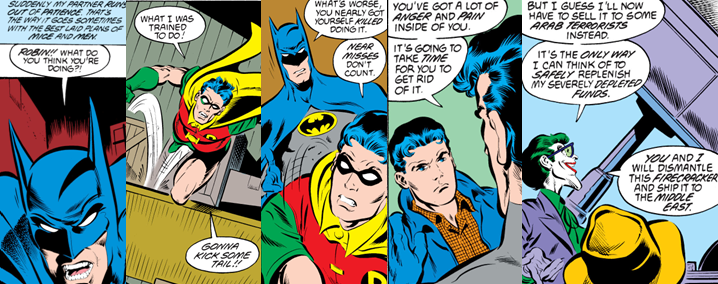
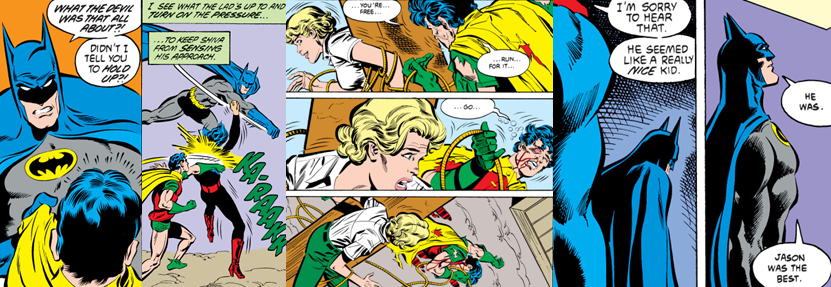
A Death in the Family begins by immediately emphasising that the dynamic between Batman and Robin has gotten a bit out of whack lately thanks to Jason’s reckless and impulsive attitude. After spending three weeks tracking down a kiddie-porn ring and cutting Commissioner Jim Gordon and the Gotham City police department in on the bust, Jason decides to go off script and attack the thugs head-on. Once they have subduing the pornographers, Batman chews Jason out since not only did his actions mean that Gordon missed out on the bust but they also lead to him (as in Jason) almost being shot in the back.

Jaosn’s reckless ways lead to him being grounded right when the Joker escapes from Arkham!

Although enraged at the time, Batman is left stunned at Jason’s cavalier attitude towards their job and, once back at Wayne Manor, confides in his butler and long-time confidante, Alfred Pennyworth, about Jason’s recent chaotic actions. Alfred suggests that Jason is still struggling to come to terms with the deaths of his parents and that being Robin is probably not the most productive way to work through his grief, a suggestion that Bruce begrudgingly agrees with. Jason, however, is angered at them talking about him behind his back and even more outraged when Bruce grounds him from being Robin and tries to get him to talk about his parents. As if that wasn’t bad enough, Batman is called out to Arkham Asylum (during the day, no less), where Gordon informs him that the Joker was able to get into the janitor’s storage room, mix up a version of his lethal laughing gas, kill a bunch of guards, and escape. Both Batman and Gordon are determined to use every resource available to track Joker down after he crippled Gordon’s niece, Barbara, in Batman: The Killing Joke (Moore, et al, 1988). Joker, however, is fully aware of the heat hanging over him and has a big plan to dismantle a cruise missile he has stored away in a warehouse and sell it off to terrorists and buy his way into politics.

Jason’s solo venture to find his real mother coincides with Batman’s search for the Joker.

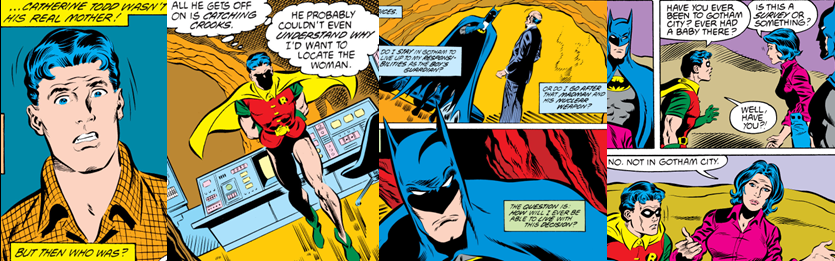
Still fuming, Jason wanders around Gotham City and ends up at his old home near Crime Alley. This provides the story with the perfect opportunity to recap how Jason’s mother, Catherine, died of a “disease” when he was young and his father, two-bit criminal Willis Todd, ended up being murdered by his boss, Harvey Dent/Two-Face, leaving Jason in the care of an orphanage. Quite coincidentally, Mrs. Walker, a friend of Catherine’s, recognises Jason and provides him with a box of his personal effects, much to his stunned amazement. However, when looking through these documents, he discovers that Catherine wasn’t his real mother; thanks to the Batcave, Jason narrows down his mother’s true identity to one of three people and, believing that neither Bruce or Alfred would approve or support his endeavour, steals Bruce’s credit cards and heads out to track his true mother down. Although obviously wishing to chase after Jason, Batman is forced to continue tracking down the Joker after discovering the madman’s plot; this leads him to Lebanon, but he is constantly one step behind the Harlequin of Hate. Thankfully, though, Batman’s investigation and Jason’s search for his mother align when they come across each other in Beirut. Despite being angered at the boy’s impulsive actions, Batman is pleased to be working alongside his young partner once more and, together, the two are able to disrupt the Joker’s sale of his missile, something made all the easier when the missile explodes on its launcher and takes the Joker’s money with it. On the downside, the Joker escapes and Sharmin Rosen, an Israeli agent who helps the Dynamic Duo, turns out to not have ever sired a child, though Batman vows to help Jason track down the other two names on his list.

Shiva turns out to be a dead end and Sheila, Jason’s true mother, is in league with the Joker!

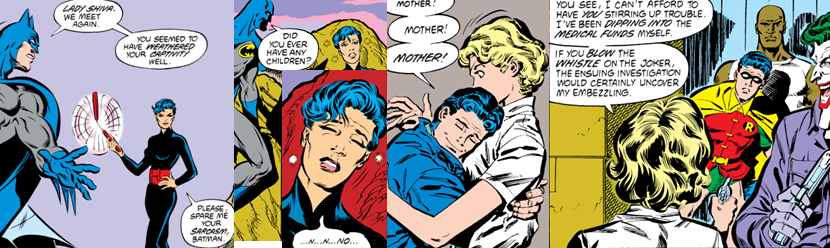
However, when they track down Shiva Woosan, they find that she has been kidnapped by Shite terrorists. Thankfully, Batman and Robin are able to infiltrate the Shite camp, where Shiva is revealed to be the deadly assassin and martial artist Lady Shiva and responsible for training the terrorists. A brutal fist-fight ensues between the Dark Knight and Shiva but Batman get the upper hand thanks to Jason choosing to help his mentor in subduing her. After destroying the camp, though, Jason is once again left disheartened when (after being subjected to sodium pentothal), Shiva reveals that has also never had a baby. This leaves Sheila Haywood, the last name on Jason’s list, who turns out to actually be Jason’s birth mother. While Jason is overjoyed to be reunited with his mother, he’s horrified when it turns out that she’s being blackmailed into helping the Joker get his hands on some medical supplies to help with his financial woes. This time, Jason does go to Bruce for help and Batman explicitly orders Jason to stay behind while he intercepts the supply trucks tainted by the Joker’s laughing gas. True to form, Jason doesn’t listen; he reveals his duel identity to his mother and she immediately sells him out to the Joker.

Superman is sent to keep Batman from avenging his partner’s death at the Joker’s hands.

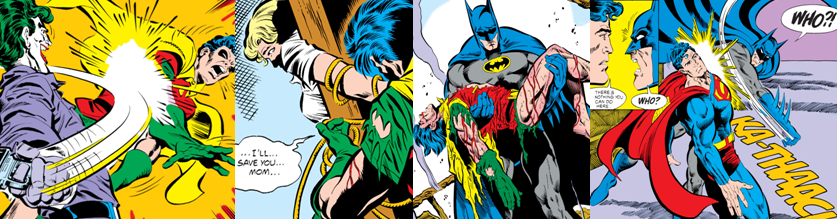
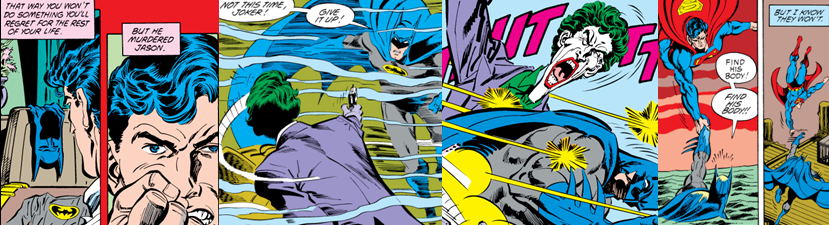
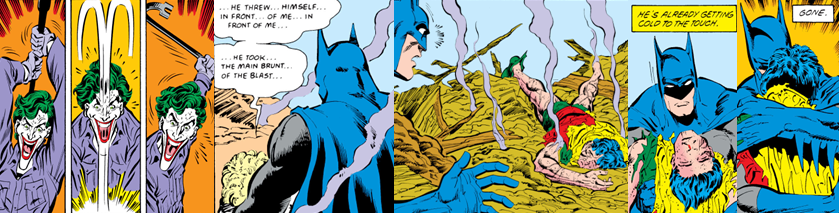
While Batman disrupts the Joker’s plot, he’s left relying on one of the supply trucks to get him back to Jason since he loses his little Bat-mini-copter. As a result, Jason is left entirely at the Joker’s mercy and subjected to a brutal beating; he smacks Jason with his pistol, kicks him in the face, has henchmen put a beating on him, and then beats him to a bloody pulp with a crowbar! Note that the Joker does not beat Jason to death with the crowbar; he “merely” bludgeons him into a broken, bloody mess. Indeed, Jason is still cognizant enough to free his mother when the Joker betrays her but the two are caught in a massive explosion when the bomb the Joker left in the warehouse with them explodes. Batman arrives just in time to witness the explosion and, despite hoping against hope and knowing better, is devastated to find that not only has Sheila perished in the blast but so has Jason. Again, while it is a bit unbelievable that Jason’s body isn’t strewn over the wreckage in bloody chunks, it is the bomb that killed Jason; not the crowbar! Anyway, Bruce immediately sets about coming up with a suitable cover story for how and why Sheila and Jason were there and laying him to rest. However, Bruce refuses Alfred’s offer to contact Dick Grayson to help track down the Joker but Batman’s desire to bring the Joker to justice for his actions are complicated by the arrival of Clark Kent/Superman. Although sympathetic to Bruce’s plight, Superman reveals that he has been explicitly asked by the State Department to stop Batman’s vendetta since the Joker has been made he new Iranian ambassador and has thus been granted diplomatic immunity from all prior crimes!

Batman goes out looking for blood and remains unsatisfied with the Joker’s apparent end.

Unimpressed, Bruce ignores Superman’s warnings, and those of the United States government, and prepares for a final showdown. He (as Batman) makes one final attempt to appeal to the Joker’s decency and sanity but that obviously fails, and he spends a great deal of his inner monologue postulating on the mysterious connection between him and his enemy. Here, we learn that Bruce regrets not killing the Joker years ago, lamenting that he let Joker’s clear insanity stay his hand, but he can no longer justify allowing him to live any longer. Equal parts driven by rage and a moral obligation to spare the world (and other children) the Joker’s wrath, Bruce sets aside his usually strict moral code and commits himself to killing the Joker…or dying in the attempt. When Batman’s suspicions about the Joker’s true intentions at being a United Nations ambassador come to fruition, Superman is luckily on hand to put a stop to his attempt to gas everyone but, thanks to panic caused by his explosive back-up plan, the Clown Prince of Crime is able to escape to his helicopter on the roof. Batman, fuelled by a desire for revenge, pursues his enemy and, in the fracas, both are shot by one of the Joker’s henchman. Though Batman is only wounded, the Joker takes a slug in the chest and, with the helicopter in a death spiral, Batman bids his archenemy adieu and dives to safety. However, he remains unsatisfied when the helicopter crashes since he knows that no-one, not even Superman, will be able to recover a body to confirm the kill.

The Summary:
A Death in the Family is the quintessential Batman for me. Never mind your Frank Miller’s and Scott Snyder’s; I grew up with the likes of Jim Starlin and the simple, agile elegance of Jim Aparo. Although I’ve never been a fan of Batman’s blue-and-grey suit with yellow oval, it is still an iconic and timeless look for the character and Starlin’s characterisation of the Dark Knight is pretty much spot-on. Under his pen, he’s not just some grim, stoic avenger of the night; he’s a trusted ally of Jim Gordon’s, a respectable partner of the G.C.P.D., a stern (yet, crucially, fair) mentor, and a master detective. Indeed, as adept and skilled as Batman’s physical prowess was during this time (and in this story), it’s his intellect that is often given just as much time to shine, which really help to redefine the character as a more intellectual superhero. Still, that’s not to say that Batman doesn’t get his fair share of action in this story. Both he and Robin get more than enough chances to shine; Starlin is sure to characterise the two as being a well-oiled unit even when Jason’s explosive temperament causes him to go off the rails. Batman is depicted as being cool, calm, and collected even when facing multiple armed foes and having to account for Jason’s volatile nature. While the everyday, run of the mill goons Batman fights don’t pose that much of a challenge to him, the story still goes to lengths to emphasise the physical skill, co-ordination, and special awareness Batman has to do what he does and it thus makes even more of an impact when Lady Shiva is able to match him blow-for-blow and deal some decent damage to Batman. Indeed, while Batman is characterised as being a master at what he does, he is by no means infallible; not only does his rage drive him into a wholly justified murderous vendetta by the story’s end but he also suffers a few significant physical injuries, including a bullet wound to his arm.

Jason’s reckless nature eventually leads to his brutal death.

Of course, a focal point to this story is Jason. While far from the insolent little prick he’s often characterised as being in flashbacks these days, Jason is still an emotionally-charged liability. He’s an angst-ridden teenager, one struggling to deal with the worst tragedy of his life and given free reign to unload his anger and resentment on Gotham’s underworld. While Dick was a daredevil and a risk-taker due to his background in the circus, Jason is just reckless and leaps into battle without a plan or a care for his own safety or the intricacies of Batman’s operation. Enraged at being shut out from his responsibilities as Robin, Jason finds renewed purpose in his search for his true mother; this helps mend the fences between him and Bruce, who of course sympathises with his young partner’s plight and genuinely wishes to help him in any way he can. Bruce agonises over having to pursue the Joker instead of Jason and this only adds to the grief and guilt he feels weighing upon him when he arrives all too late to save his headstrong partner from a gruesome fate. This is an interesting story for the Joker; like Batman, Joker went through a period of time where he was either absent from DC Comics or significantly altered but his threat really ramped up after Dennis O’Neil came onto the main Batman book. Now a calculating, vindictive, and incredibly intelligent villain, the Joker’s usual madcap nature is supplanted by a desperate need to quickly build up his finances and assume a position of real power through a political career. This backfires on him when he is arrogant enough to think he can assemble and reassemble a cruise missile, costing him his cash in the process, but also drives him to spiking medical supplies and trying to gas the United Nations while being protected from reprisals by diplomatic immunity.

Jason is beaten to a pulp with a crowbar and dies in a desperate attempt to save his mother.

This is a story very much driven by the Joker’s psychopathic and callous ways but not necessarily overwhelmed by him; it remains a dramatic tale of Batman struggling to help his unpredictable partner that culminates in a showdown with the Joker rather than him becoming the sole focus of the story like in a lot of later Batman/Joker stories. Of course, you can’t really talk about A Death in the Family without mentioning the brutal and sadistic torture and death of Jason Todd. One of the things I like about the story is that, as much of a little ass as Jason is, you can totally see where he’s coming from; he’s young, hurting, and lashing out in blind anger. His demeanour shifts from being reckless with his safety to trying to find his birth mother once he finds out that she’s still alive and there’s a definite sense that he just wants to have that gaping hole in his heart filled, which is again obviously something Batman can very much relate to. This is emphasised to the fullest when Jason, beaten and clearly dying, uses the last of his strength to try and save his mother from the blast that kills them despite the fact that she betrayed him to the Joker. In the end, he died every bit the hero Batman raised him to be and is fully deserving of Bruce’s adulation in death. Indeed, while Jason was talented and gifted, he wasn’t quite the all-rounder that Dick was and nowhere near the suitable protégé Tim Drake would prove to be and yet, in making the ultimate sacrifice, he gave himself to Bruce’s cause in a way beyond his other partners and it was fascinating seeing Bruce slowly self-destruct in subsequent stories because of his guilt over Jason’s death, and seeing the incident being brought up every so often to remind him of his greatest failure.

My Rating:

Rating: 4 out of 5.

Great Stuff

Have you ever read A Death in the Family? What did you think to DC’s decision to kill Jason off? Were you a fan of the character back then or did you think he was an annoying little brat who deserved what he got? What did you think to the characterisation of Batman during this time? Were you a fan of the Joker’s inclusion in this story, and did you like the wrinkle of Superman being brought in to keep Batman in check? Did you realise that Jason died by a bomb and not the crowbar? Whatever your thoughts on A Death in the Family, and Jason Todd, leave a comment below and stick around for more Robin content this month.

Back Issues: The Amazing Spider-Man #102

Story Title: “Vampire at Large!” (also includes “–The Way it Began” and “The Curse and the Cure!”)
Published: November 1971
Writer: Roy Thomas
Artist: Gil Kane

The Background:
After achieving incredible success with the Fantastic Four, Marvel editor and head writer Stan Lee created Peter Parker/Spider-Man, a teenage superhero who unexpectedly became one of Marvel’s best selling titles. Spider-Man’s popularity was such that he featured in a number of spin-offs, including Marvel Team-Up, which partnered him with other, less mainstream superheroes, and he quickly amassed one of the most colourful and memorable rogues galleries in all of comicdom. Doctor Michael Morbius was just one of these; the creation of writer Roy Thomas and Gil Kane, and billed as a “Living Vampire”, Morbius came into being thanks to the Comics Code Authority finally relaxing its ban on vampires and other supernatural beings in comic books, but was actually the product of science rather than magic. Morbius would go on to feature in a number of Marvel crossovers and stories, generally those involving supernatural characters such as Eric Brooks/Blade and the various Ghost Riders, but the only time I’ve ever encountered him is in his neutered depiction in the 1990’s Spider-Man cartoon. After years of stop/start efforts to make it onto the silver screen, Morbius inexplicably made his live-action debut recently, so I figured now is as good a time as any to revisit the Living Vampire’s debut and see if he’s really worth his own solo movie.

The Review:
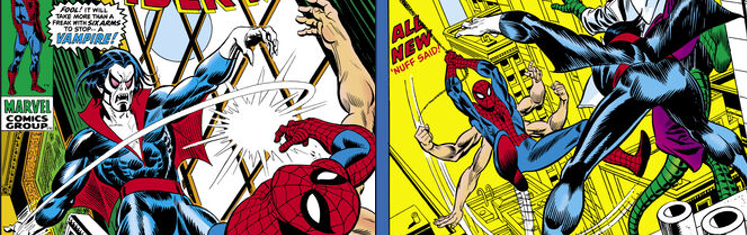
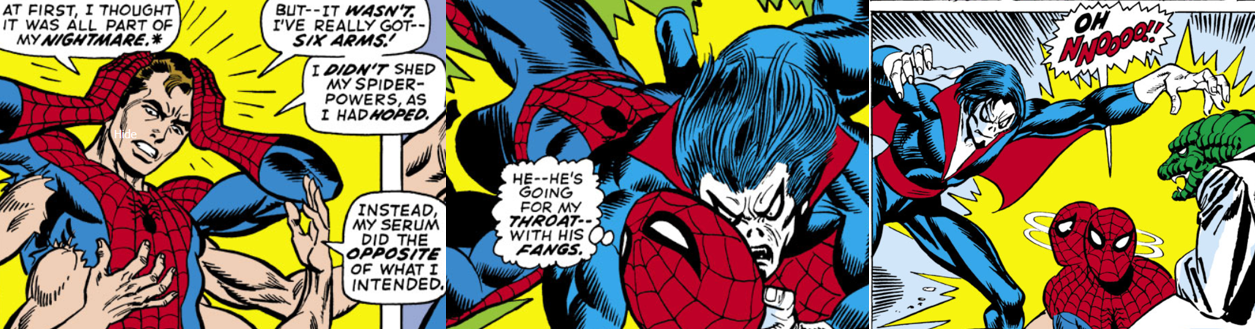
Before tackling “Vampire at Large!”, it’s probably best to also give a bit more background on Morbius and the events surrounding his introduction. The character actually appeared in “A Monster Called…Morbius!” (Thomas, et al, 1971), a story which opened with Spider-Man startled to find that his attempt to cure himself has resulted in him growing four additional arms! Struggling with the despair and horror of his newfound predicament, Peter makes a desperate call to Doctor Curt Connors/The Lizard and is invited to stay at the Connor’s Long Island beach house until he can find a solution. However, after working tirelessly for two days straight, Spider-Man is frustrated by failure, but has little time to dwell on his misery as he is attacked by a grotesque, pale figure garbed in an elaborate cape ensemble.

While trying to rid himself of his for extra arms, Spidey is attacked by first Morbius…and then the Lizard!

This previous story also details how this vampiric man known as Morbius was found adrift in the ocean and slaughtered the crew of a vessel under the darkness of night. Washing ashore, Morbius flees to Connor’s summerhouse to sleep in the belfry and avoid the draining influence of the daytime sun, but awakens to find the six-armed Spider-Man awaiting him. The Living Vampire isn’t one for villainous monologues; he simply attacks, surprising the wall-crawler with his deathly visage, his superhuman strength, and his sharp fangs. Fatigued after working without a break for two days, Spider-Man is in little condition to fight and is knocked unconscious following a massive blow. Morbius’s meal is interrupted, however, by the unexpected arrival of Dr. Connors; stunned by the vampire’s horrific appearance, Connors transforms into the Lizard and “Vampire at Large!” begins with Spider-Man being caught between a brutal throwdown between the two tortured monstrosities.

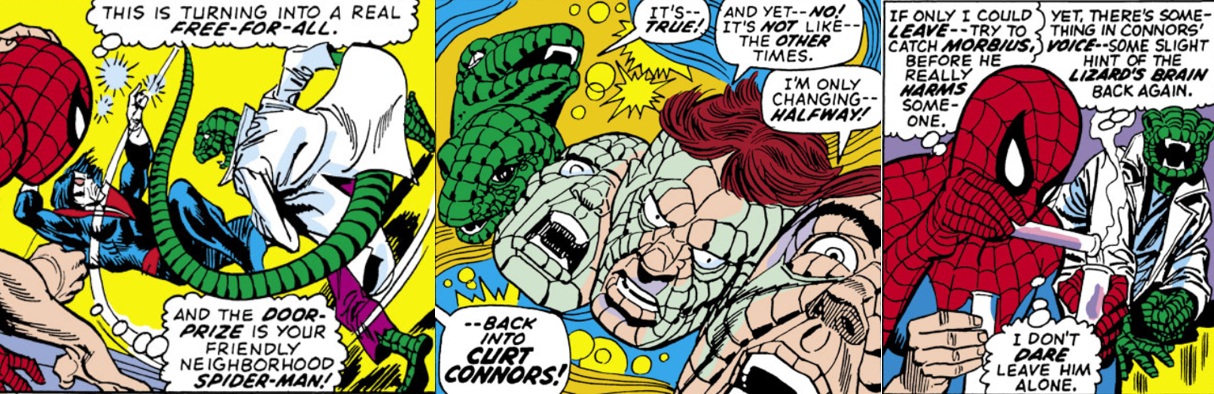
Dr. Connors struggles to maintain his humanity and help Spider-Man whip up a cure.

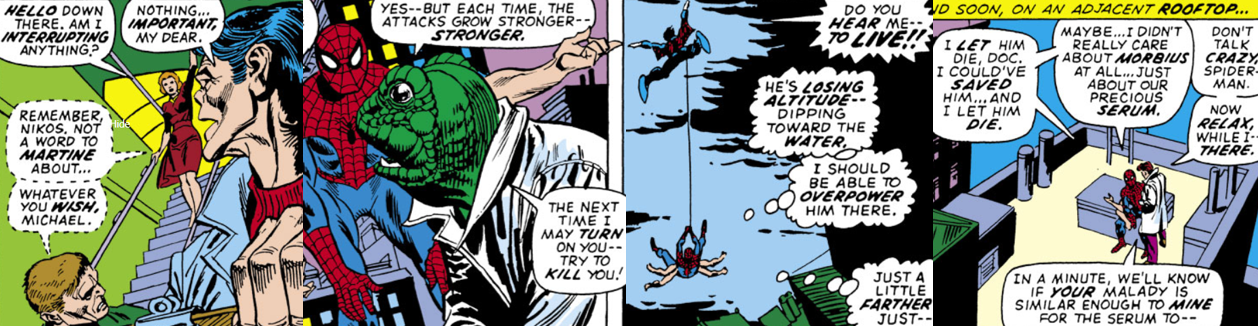
With Morbius desiring to feed on Spider-Man’s blood and the Lizard fixated on killing the wall-crawler, the two monsters are almost evenly matched in strength and ferocity; however, Morbius gains the upper hand by sending the Lizard flying into an electrical gizmo, which renders the reptilian unconscious and easy prey for the Living Vampire. Unable to see anyone, least of all a tragic soul like Dr. Connors, fall victim to such a fate, Spider-Man intervenes and tries to get answers from Morbius, but the enigmatic vampire chooses to fly out into the night, unaware that Spidey has tagged him with one of this spider tracers, and leaving him with the weakened Lizard. Although Connors briefly returns to a reptilian version of his human form, he finds himself trapped as the Lizard but retaining some semblance of his humanity thanks to the effects of Morbius’s bite. Spider-Man and the Lizard resolve to combine their resources and intelligence to help cure both of their conditions; the Lizard theorises that Morbius’s vampiric bite must have infected him with an enzyme, but time is against them as the Lizard grows wilder and more animalistic with every passing minute.

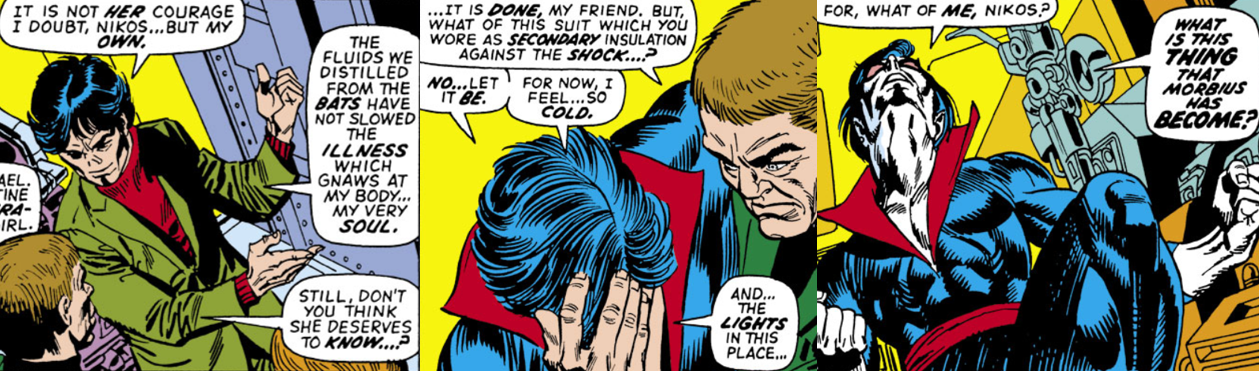
In trying to cure his mysterious fatal disease, Morbius becomes a Living Vampire craving human blood!

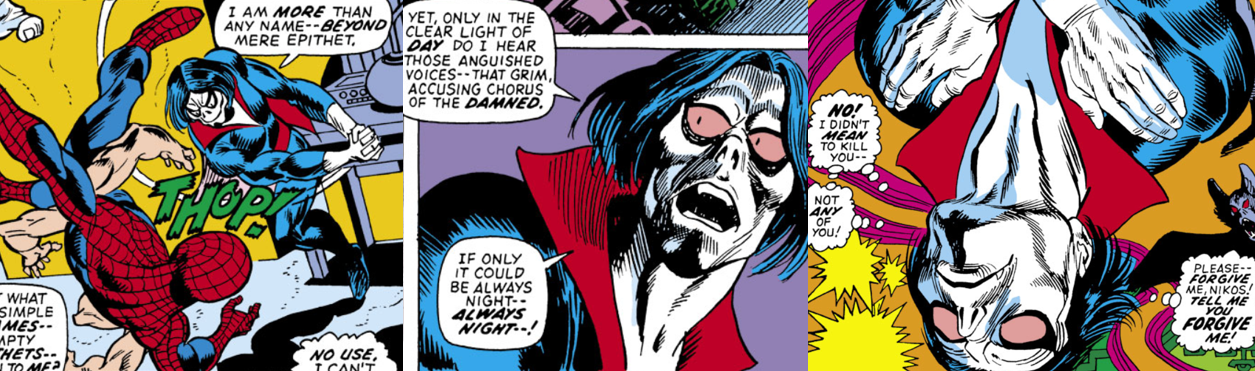
We then re-join Morbius in the throes of another soliloquy regarding the anguish he feels during the day time, the screams and accusations of his victims, and his need to sleep through the day to keep those nightmarish thoughts out and remain at full strength. As he sleeps, however, Morbius not only begs for forgiveness from his victims but dreams about how he came to be; it seems he was once Doctor Michael Morbius, a Nobel Prize winning scientist stricken by a facial deformity and ravaged by a rare disease that he hoped to cure by conducting research on vampire bats using experimental shock treatment. Desperate for a cure so that he can give his beloved Martine the life she deserves, Morbius has his friend and colleague Nikos help him by subjecting him to an untested dosage of electrical current while garbed in a special suit; however, Morbius emerges forever changed, transforming into a monstrous, man-made vampire during the night and he accidentally kills Nikos with his bare hands. Horrified by the monster he has become, Morbius attempts to lose himself in the ocean’s tumultuous waves, only for his survival instinct to kick in, forcing him to the surface…and to an undead life of feeding upon the blood of the living.

Although Spidey recovers the serum, Morbius is seemingly lost beneath the sea.

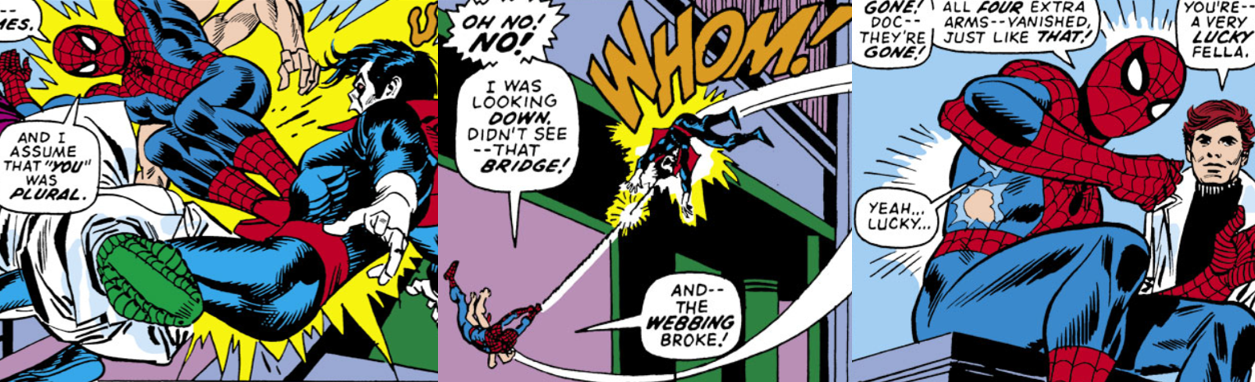
While Peter’s friends, family, and colleagues worry after him, Spider-Man and the unpredictable Lizard finally manage to track Morbius down and, conscious of time being against him, Spidey is able to finally render the Living Vampire unconscious so that the Lizard can extract the enzyme they need from Morbius’s blood. Without even waiting to test it, the Lizard injects the serum into himself and becomes Dr. Connors once more; however, Morbius suddenly awakens, catching Spidey off-guard and making off with the serum in order to drink it for himself. Dr. Connors finally recognises Morbius as Morbius (I mean…the clue’s in the name, right?) and Spider-Man is compelled to help him, sympathising and identifying with his horrific fate, but Morbius is so determined to escape and live free that he collides a bridge and appears to drown in the river. On the plus side, Spider-Man is able to snag the serum before Morbius disappears beneath the water and successfully rids himself of his additional limbs, but guilt over Morbius’s fate weighs heavily on the web-slinger’s mind.

The Summary:
“Vampire at Large!” is a very different, and yet very familiar, Spider-Man story; of course you’ve got all the usual tropes you’d expect from a swingin’ Spidey tale set in the late seventies, but Peter’s usual depression, bad luck, and lamentations are made all the worse by the presence of his additional arms. Although Peter is cured of his four extra arms by the conclusion of the story (and you can bet such a plot point would be dragged out for months or even years today), it’s an entertaining and visually interesting sight to see Spider-Man swinging around with these four extra arms sticking out of his side, but they don’t really factor into the story that much beyond giving Peter something new to despair over and driving him to tirelessly find a cure for his condition. What I mean to say is that he doesn’t really get to use the extra arms in an interesting way; they’re simply a plot point, something to make him feel like a freak and an outcast and thus relate to the plight of the Lizard and the debuting Morbius even more.

Morbius’s superhuman strength and unending hunger make him a formidable foe.

I have to say that I wasn’t expecting the Lizard to show up in this story, but it does make sense that Spider-Man would turn to the one man who has experience in trying to cure a limb problem (even though Dr. Connors has been…less than successful in his attempts) and it’s a good job that he does go to Dr. Connors for help or else he would have been another of Morbius’s very victims. Morbius himself is, of course, the big star of the story; mysterious and enigmatic, Morbius makes a visual impression with his chalk-white skin, gruesome bat-like visage, and elaborate outfit that is like a superhero reimagining of Count Dracula’s regal attire. Able to fly at will, sporting superhuman strength, and driven by an overwhelming need to drink human blood, Morbius is a conflicted individual; he sought to cure himself of his fatal ailment, and instead became a monstrous creature of the night that laments having to prey upon his fellow man, and his condition, and yet is also motivated by an irresistible desire to survive at any cost. Initially, Morbius attacks with a silent, driven fury and, thanks to Spidey’s fatigue, easily overwhelms the web-slinger but, as the story progresses, he becomes much more loquacious and prone to the same soliloquies and grandiose boasting so closely associated with comic book villains.

All three struggle with their monstrous afflictions but only Morbius gives into it completely, to his undoing.

And yet, Morbius remains a tragic figure. There’s a definite theme in “Vampire at Large!” regarding humanity as each character has a monstrous condition that leaves them a freak of nature and a threat to their loved ones and fellow man: Peter is distraught that his four arms could shock his beloved Aunt May to death and spell the end of his secret identity and the few relationships he has left, Dr. Connors is continuously battling for control of his mind and body and against the animalistic urges of his scaly other half, and Morbius has seemingly given in to his gruesome urges. Indeed, he actively shuns the daylight not just because it weakens his vampiric abilities but also because he sees only the faces of those he has killed and is haunted by the screams of his victims. Initially, he is so horrified by his condition that he seeks to end his existence, but chastises himself for his short-sightedness, his survival instinct overriding his anguish, and is seemingly destroyed by his obsession with maintaining his freedom by the finale. Personally, I’ve never really been that big a fan of Morbius; he’s okay, but hardly a character I would deem to be a game-changer but his debut here was well handled as it was tied so closely with Spider-Man’s bizarre appendage predicament. He definitely had a mystery and aura around him, though his origins were ill-defined and vague compared to later iterations, and he had a striking appearance that set him apart from Spidey’s abundance of green-and-purple-garbed villains, but he’s definitely more at home in Marvel’s more supernatural and horror-themed books and, for me, little more than a footnote in Spider-Man’s history.

My Rating:

Rating: 3 out of 5.

Pretty Good

What are your thoughts on Morbius’s debut? Are you a fan of the character and, if so, what are some of your favourite Morbius tales? Were you disappointed with how brief Peter’s struggles with his four extra limbs was or do you think it was a good idea to not drag the concept out too long? What did you think to Morbius’s depiction, origin, and powers? Do you think the Lizard was necessary to this story? Are you excited for Morbius’s live-action debut or, like me, do you consider it a waste of time and money? Sign up to leave your thoughts on Morbius below or comment on my social media, and be sure to check back in next Friday for my review of Morbius’s big-screen debut.

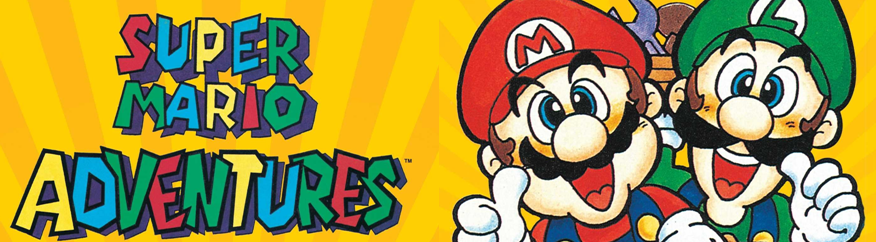
Back Issues [Mario Month]: Super Mario Adventures


So, for no better reason than “Mar.10” resembling Mario’s name, March 10th is widely regarded as being “Mario Day”, a day to celebrate Nintendo’s portly plumber, an overalls-wearing mascot who literally changed the videogame industry forever and shaped the home console market of the nineties. To commemorate Mario Day this year, I have been celebrating everyone’s favourite Koopa-flattening plumber every Thursday of this month in a little event I call “Mario Month”.


Story Title: “Super Mario Bros. Adventures” and “Mario vs. Wario”
Published: 25 October 2016
Originally Published: 1 January 1992 to 31 January 1993
Writer: Kentaro Takekuma
Artist: Charlie Nozawa

The Background:
By the early 1990s, Nintendo’s mushroom-stomping mascot was well-established as an icon not just in the videogame industry but in mainstream pop culture as well; with over sixty videogames to his name, and with Super Mario All-Stars (Nintendo EAD, 1993) proving a blockbuster release for Nintendo (and a pivotal title in the on-going “Console Wars” of the time), merchandising and licensing opportunities naturally began to increase as Nintendo sought to capitalise on the portly plumber’s popularity. In July/August of 1988, Nintendo of America began publishing a monthly review and strategy magazine, Nintendo Power (1988 to 2012), which soon included comic book and manga adaptations of its most popular videogame titles and, naturally, Super Mario was one such character who found his adventures chronicled in the magazine.

The Review:
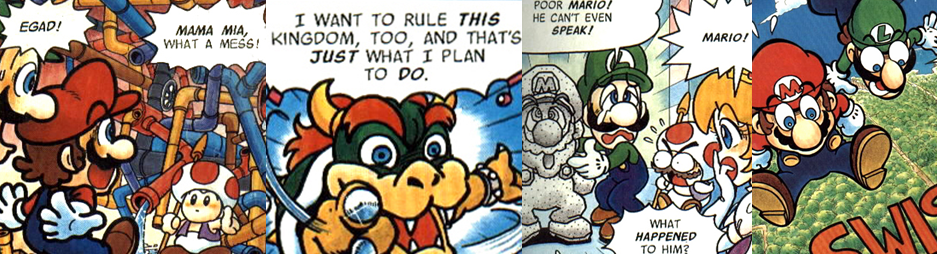
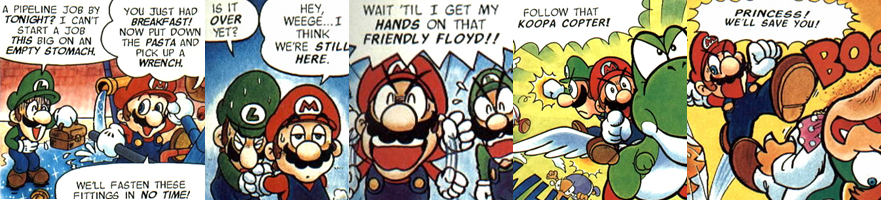
Super Mario Adventures starts with a cute little musical introduction to the titular plumber duo, who operate as the Mushroom Kingdom’s “plumbers extraordinaire” and claim that “there’s no pipe [they] can’t repair!” The plumber brothers have been called to an emergency situation at Princess Toadstool’s castle: the pipes are a leaking, broken mess and need to be fixed for the Princess’s big party that night. Although Luigi (affectionately called “Weege” by Mario) is suffering from hunger pains, Mario enthusiastically takes to the job and encourages him to get stuck in and fix up the castle’s pipes.

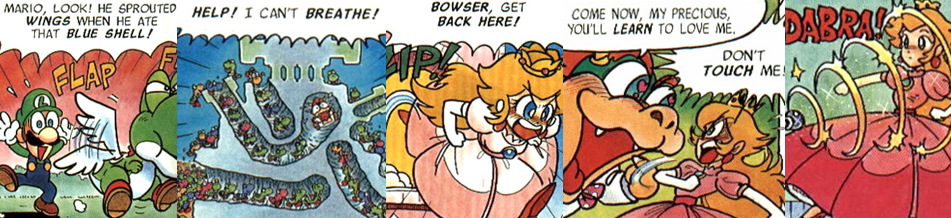
Bowser attacks the kingdom, turning many to stone, and the Mario Bros. race to assist the princess.

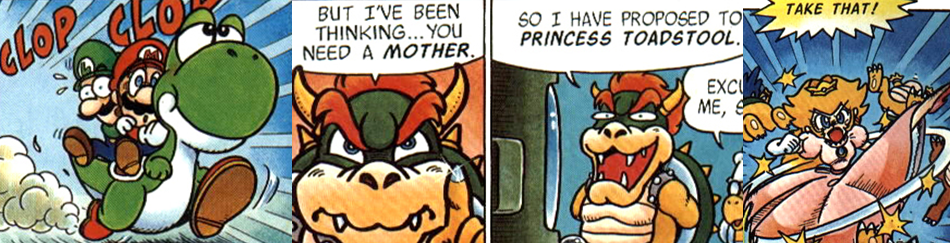
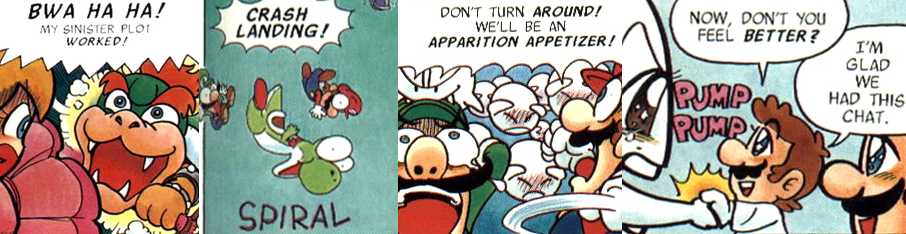
However, his eagerness is cut short when a series of larger green pipes suddenly start sprouting up through the ground and a hoard of Koopas, Goombas, and other nasties pop out and attack the castle. Although Mario fights off the invaders, his efforts are brought to a halt when Bowser, the King of the Koopas himself, arrives in his Koopa Copter and alongside his Koopalings to lay claim to the entire kingdom through his superior forces and his proposal to marry the princess to make his takeover official. When the princess adamantly refuses his offer, Bowser uses his magic wand to turn her loyal Toads (and, amusingly, their distraught cries) to stone. Although Mario is also caught in the blast, leaving Luigi hysterical, the princess refuses to bow to Bowser’s demands and leads a group of Toads into battle against him. The Toads take the petrified Mario to the Minister of Massage, an aged oriental Toad who cures him of his ailment and, determined to get his revenge against Bowser and rescue the princess, Mario boldly charges after the two and he and Luigi end up being dropped right onto Dinosaur Island.

While Mario and Luigi make a new friend, Princess Toadstool manages to escape her cell.

There, they meet Yoshi, a friendly green dinosaur who helps them out when they’re attacked by a giant Wiggler and then speeds them off to Yoshi Village and they’re introduced to Friendly Floyd, a travelling salesman who randomly lives in the otherwise Yoshi-centric population. Floyd tells them that Bowser has been kidnapping Yoshis and punishing anyone who gets in his way and then scams them out of ten Coins by selling them a book to help them communicate with Yoshi that turns out to be basically useless. Mario’s anger at Floyd is quickly shifted back onto his main objective, though, when the princess’s Guard stumbles, bruised and hurt, into town and informs them that the princess was captured by an army of Bowser’s minions, the Lakitu. Back at Bowser’s Tower, Bowser reveals an additional motivation to his plot is to provide his rambunctious kids with a mother, and demands his chef make a cake that is one hundred times bigger than the humongous dessert he’s already made and orders the Koopalings to make sure that the princess doesn’t escape. However, when they go to check on her, the princess easily fools them by hiding up in the rafters and then escapes from her cell, locking them inside instead.

Luigi and the princess swap places, free Mario, and bring Bowser’s Tower crashing down.

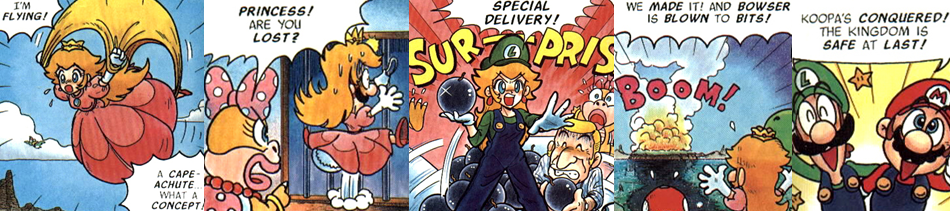
While Mario and Luigi struggle to reach Bowser’s Tower thanks to the surrounding waters being full of piranhas, the princess proves capable enough to fight and threaten her way out of the tower by use of a “cape-achute”. Although the princess manages to get to safety and meet up with Luigi, Mario ends up crashing into the castle when he saves his brother from a Bullet Bill and winds up being chained up in his own cell. Bowser has his Mechakoopa’s deliver Luigi a threatening ultimatum to deliver him the princess or lose his brother forever and, rather than send the princess back into the jaws of danger, Luigi opts to have Floyd make him up into a decoy. While the princess resolves to go save the two, Luigi is able to successfully fool Bowser with his performance and delay Mario’s execution by ordering pizza for the Koopalings. The princess, who is dressed in Luigi’s clothing, bursts in holding a bomb and demands that Mario be set free; the Koopalings’ confusion soon turns to anger as Luigi swipes the keys from Roy Koopa and, thanks to a distraction from Yoshi, is able to free Mario just in time for the two of them to help fight off the Thwomps and Chucks who threaten to crush the princess, Yoshi, and Floyd to death. Unfortunately in the commotion, the fuse on the princess’ bomb catches fire and the tower collapses in a massive explosion!

Bowser recaptures the princess but Dr. Mario helps cure the Boos of their shyness.

Although blasted to safety and pleased with their victory, the group realises that they’re still stuck on Dinosaur Island so one of the princess’s Toads offers to fly back to the Mushroom Kingdom for help. When help arrives, though, it turns out to be a bunch of Bowser’s minions in disguise and Bowser himself shows up to capture the princess once again. After fighting off Koopa’s forces, Mario and Luigi are astounded to see Yoshi sprout wings from over-eating; however, in their haste to chase after the Koopa King, they end up getting lost and crash-landing before a spooky chalet in a fog-strewn forest. Luigi suggests that they rest in the house, not realising that it’s another of Bowser’s devious traps, and, despite Mario’s better judgement, the two are lured inside by the irrespirable smell of Provolone. Trapped inside and separated from Yoshi, the duo are attacked by Boos; although the little spirits blush uncontrollably when looked at, they charge at the plumbers when their backs are turned, eager to take a bite out of their behinds! Eventually, Mario and Luigi find themselves trapped between a gaggle of Boos and the mighty Big Boo but are finally able to escape by luring the Big Boo into a faux therapy session where Mario gets to the roots of the ghost’s debilitating fear of humans.

Mario, Luigi, and an army of Yoshis interrupt the wedding ceremony and defeat Bowser.

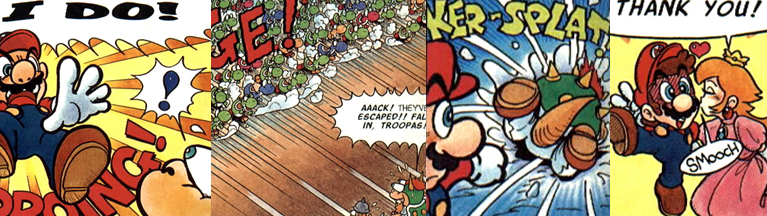
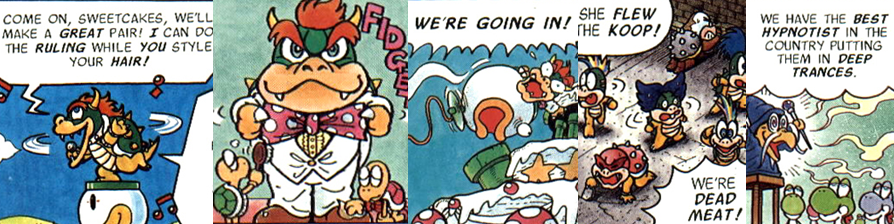
Having scammed their way out of the chalet, Mario and Luigi hop back onto Yoshi and race off to Marvy Mansion to keep the princess from marrying Bowser. Everyone in the Mushroom Kingdom is present for the wedding thanks to Bowser’s forces making up the majority of the guests and Magikoopa hypnotising the rest into compliance. With security type, and the hypnotised Yoshi’s willingly allowing themselves to be encased in eggs, Mario and Luigi sneak into the fortress using a pipe and end up being attacked by a Thwomp in a lava pit! While Bowser admires himself and his super sexy white suit, the princess throws a massive tantrum and continues to refuse to go through with the wedding, so Bowser has Magikoopa hypnotise the princess into falling in love with him. Thankfully, Mario crashes the party before the princess can say “I do” but, thanks to Magikoopa’s influence, ends up being beaten and tied up when the princess refuses to leave her beloved’s side. The ceremony is interrupted again, however, when Luigi and Yoshi free all other Yoshis from their eggs and the cuddly little dinosaurs quickly trample all over Bowser’s forces, including Magikoopa. After keeping Bowser from escaping in his little ‘copter, Mario fights his nemesis atop the gigantic wedding cake and merges victorious when the cake collapses, apparently taking Bowser with it, and thus saving the princess and the Mushroom Kingdom for another day.
Wario lures Mario into an ambush as payback for his childhood trauma.

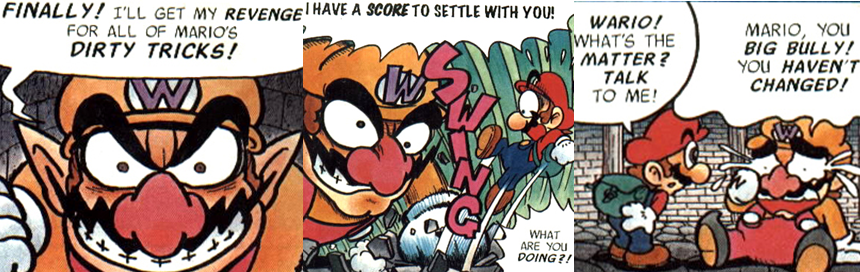
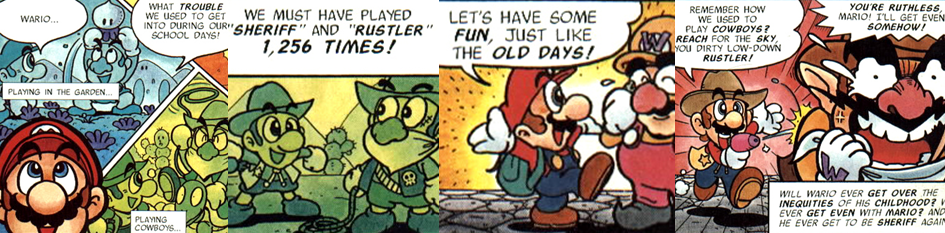
The fun doesn’t end there, though, as the collected edition includes an additional tale that is basically an adaptation of Super Mario Land 2: 6 Golden Coins (Nintendo R&D1, 1992). Unlike in the videogame, rather than Wario usurping Mario’s castle and forcing him to collect the titular six Golden Coins to retake his home, “Mario vs. Wario” shows Wario as the king of his own castle and inviting Mario to a reunion after twenty years of having not seen each other. In this story, Mario and Wario were childhood friends but their memories of those days differ wildly; while Mario recalls the two having fun playing in the garden, “[experimenting] with Coins”, and playing cowboys, Wario remembers Mario as a bully and a liar who got to get all the best vegetables while Wario got bitten by piranhas, how Mario got the Coins while Wario got flattened by a Thwomp, and (worst of all) how Wario was always forced to be the cattle rustler who was beaten by Mario’s sheriff. Mario has very quick run-ins with the bosses from the videogame, the majority of whom he has no idea are actually looking to cause him harm and whom he defeats (or kills, in one case) simply by being helpful or friendly. When he reaches Wario’s home, though, he is attacked by a big, mean incarnation of his old friend but Mario quickly takes the wind out of Wario’s sails, quite literally, by deflating his balloon-like form. Mario then makes amends with Wario but Wario’s grievances with his rival are rekindled when Mario busts out a cowboy hat and water pistol and casts himself as the sheriff once again!
The Summary:
Super Mario Adventures is a colourful, endlessly fun little adaptation of the Super Mario videogames, most prominently Super Mario World (Nintendo EAD, 1990). Perfectly capturing the look and feel of the videogames, the manga-like presentation of the story is immediately appealing and the artwork is consistently vivid and amusing all the way through. Add to that the moments of humour, sight and physical gags, and little details like characters playing a Super Mario substitute (with either with Mario or Bowser as the hero) or Luigi and Princess Toadstool swapping outfits really add to the quirky nature of the story.

Mario and Luigi quickly transform from energetic plumbers into princess-saving heroes.

Mario is characterised as an energetic, brave do-gooder with a playful nature and a quick temper at times, especially when he’s scammed by Friendly Floyd. He is committed to helping the princess by any means necessary, whether it’s by fixing her pipes (oi-oi!) or rescuing her from Bowser and is constantly keeping his brother focused on the tasks at hand. While he’s not a complete coward or a stick-in-the-mud, Luigi has a running gag throughout the story where he’s constantly distracted by his hunger. At first, he seems to lack the courage to act without his brother by his side and would rather eat or slink away than work or fight Bowser’s minions but, when Mario is captured, he voluntarily switches places with the princess and uses his wiles to free his brother and he’s directly responsible for helping to stop the wedding and provide much-needed back-up when he helps free the Yoshis.

Yoshi proves a valuable ally though the princess’s fiery nature means she’s no pushover.

While Yoshi is merely just a cute, cuddly sidekick, his motivations are called into question when he’s introduced as the duo (especially Luigi) are initially worried that he must be intending to eat them, he proves essential to their quest thanks to his insatiable appetite and ability to sprout new abilities as he gobbles up Goombas and such. As for Princess Toadstool, she’s an absolute bad-ass in this story! Right away, she adamantly refuses to submit to Bowser and only ends up being captured in the first place because she chooses to bring the fight to the Koopa King rather than let him run roughshod over her kingdom. Indeed, while the duo try valiantly to rescue her from Bowser’s Tower, she actually escapes without their help and only ends up being recaptured because of them. In the end, her demeanour and rage are so fervent that Bowser is forced to resort to hypnotising her to force her to go through with the ceremony, which is something I’ve personally never seen him stoop to in any of the videogames or adaptations.

Bowser is little more than a blowhard with largely ineffectual minions.

As for Bowser, well…he’s a very loud, bombastic figure here and certainly commands a great deal of dangerous forces but he’s not actually very effectual as a villain. He’s more concerned with winning the princess over, the cut of his suit, and the size of the wedding cake than spitting fireballs at Mario and their final confrontation is pretty humiliating for the Koopa King. Indeed, Bowser spends more of his time delegating down to his Koopalings, who are young and easily distracted and fooled by the antics of Mario, Luigi, and the princess. Magikoopa is, without a doubt, Bowser’s most useful minion as, without the maniacal wizard, he would never have been able to subjugate the Yoshis and the rest of the kingdom and, when Magikoopa is taken out of the equation, it’s surely no coincidence that Bowser is buried beneath a pile of sweet frosting soon after.

Mario and Wario have wildly different memories of their childhood days.

And then there’s Wario, easily my favourite character in the entire franchise, who is reduced to a bitter, snivelling child thanks to a lifetime of resenting Mario. It’s interesting that “Mario vs. Wario” paints Mario in such a negative light; here, he’s extremely naïve and insensitive to the feelings and concerns of others and is focused only on having a good time playing with his friend without considering Wario’s perspective. Indeed, the ending seems to suggest that Wario’s version of their childhood is more accurate since Mario not only calls him a “wimp” for getting upset but goes right back to type by chasing after him as the “sheriff”. It’s a fun enough little epilogue to the main story but all-too-brief for an adaptation of Super Mario Land 2 and, while it provides an interesting twist on the Mario/Wario rivalry from the time, it ends up veering a bit too far away from Wario’s more popular portrayal as a greedy, disgusting, self-obsessed mirror of Nintendo’s portly mascot.

My Rating:

Rating: 5 out of 5.

Fantastic

Have you ever read Super Mario Adventures? What did you think to it? Were you a fan of the manga’s quirky art style and humour? How do you think it worked as an adaptation of Super Mario World and the franchise’s gameplay mechanics? Did you read and collect Nintendo Power? If so, what were some of your favourite sections and inclusions in the magazine? Did you enjoy Mario’s other comic book adaptations as well and would you like to see another produced some time? Feel free to leave your thoughts on Super Mario Adventures, and Mario in general, down below and thanks for being a part of Mario Month.

March Drabble Challenge: Teddy Bear

Horror PromptsGillian Church is hosting another horror drabble challenge: 31 prompts for 31 creepy tales throughout March. This time, we can decide on the length of the piece but I’m sticking to the 100-word default.

Can you do it?

The Prompt:
Teddy Bear

The Submission:
Dennis closed the wardrobe and turned back to his terrified son. “There’s nothing in there.”

“I saw it!” Nicholas bawled, hugging his teddy bear closely.

Dennis sat down on the edge of the bed and stroked his son’s hair. “Monster’s aren’t real, son. They can’t hurt you.”

With that, he left the boy to sleep but woke with a start when Nicholas’s screams echoed down the hallway.

Dennis burst into the room and flicked on the lightswitch. Nicholas was gone; all that was left was his teddy bear and a streak of blood that stopped at the open wardrobe door.


What did you think to the prompt for today’s drabble challenge? Did you submit anything for it? Have you ever written any flash fiction before? I’d love to know what you think to my snippets and writing prompts, so feel free to sign up and let me know what you think below or leave a comment on my Instagram page. You can also follow Gillian Church to take part in her Weekly Writing Prompt challenge.

Game Corner: WWE Legends of WrestleMania (Xbox 360)

Released: 20 March 2009
Developer: Yuke’s
Also Available For: Mobile and PlayStation 3

The Background:
On March 31st, 1985, Vince McMahon changed the face of the wrestling landscape forever by bringing together the biggest names in wrestling (alongside a number of celebrity guests) for the very first WrestleMania, a pay-per-view extravaganza that became the hottest event of the calendar year for World Wrestling Entertainment (WWE). The WWE has a long and storied history with videogames that can be traced all the way back to the very first videogame ever produced baring the initials of their previous moniker of the World Wrestling Federation (WWF), MicroLeague Wrestling (MicroLeague/Various, 1987). A number of releases made their way to various home consoles and even arcades over the years, with the format slowly evolving to include more and more wrestlers and match types, but the WWE’s foray into digital entertainment largely hit its stride in the late-nineties when Asmik Ace Entertainment, AKI Corporation, and THQ joined forces to produce popular titles for the Nintendo 64 and Yuke’s took their first tentative steps into the SmackDown sub-series (2000 to 2003). Many of the games produced during this time and by these developers are considered to be some of the best wrestling games ever made and, by 2009, the WWE was represented by the multi-platform SmackDown vs. Raw series (Yuke’s, 2004 to 2011), a series which was largely regarded as mostly hit and miss in terms of value for money and year-on-year improvements. Still, the series was profitable enough to convince Yuke’s to attempt a few additional WWE videogames, with Legends of WrestleMania being one of them; pushed intro production to coincide with WrestleMania 25, and focused far more on nostalgia and giving players the chance to relive and redefine some of the company’s biggest moments, Legends of WrestleMania was met with largely lacklustre reviews that took issue with its presentation and control mechanics.

The Plot:
Take control of a WWE Legend and relive some of the biggest WrestleMania moments of all time, such as Hulk Hogan’s legendary clash with Andre the Giant and Bret “Hitman” Hart’s bloody showdown with “Stone Cold” Steve Austin, or rewrite and redefine history by playing these matches, and others that never took place, from the perspective of the loser (or another WWE superstar).

Gameplay:
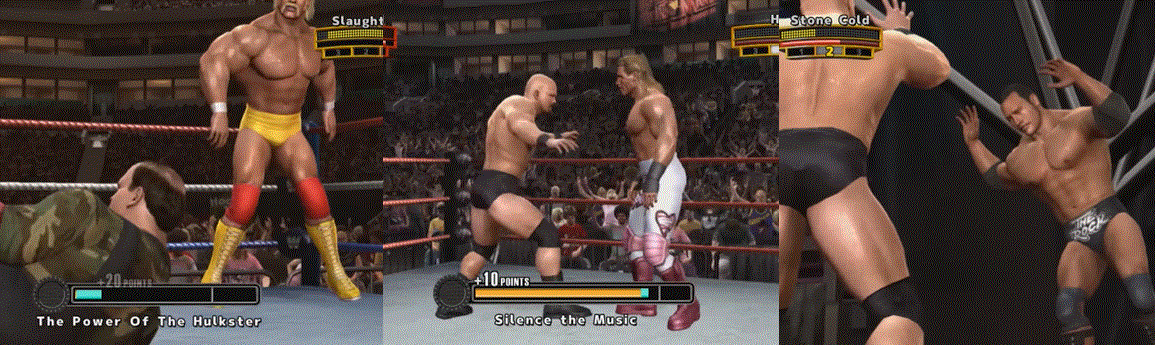
WWE Legends of WrestleMania is a wrestling title that gives players the chance to select from a roster of thirty-eight WWE Legends and pit them against each other in a series of matches, many of which will be immediately familiar to fans of the WWE or anyone who’s played one of Yuke’s WWE videogames before. Unlike many of the SmackDown! videogames, the focus here is much more on fast-paced, arcade-style action rather than simulating a real-life wrestling match, which has both positive and negative impacts on the gameplay. Players can move their Legend using either the left analogue stick or the directional pad (D-pad); having grown up playing the likes of WWF No Mercy (Asmik Ace Entertainment/AKI Corporation, 2000), I generally prefer to use the D-pad for these games (and most fighting games) as it feels more intuitive, but there’s little benefits from favouring one or the other. You can double tap towards or away from your opponent to run, but I had extremely minimal success with this; in most WWE games, running is mapped to one of the shoulder buttons, making it quick and easy to use, but that’s not that case here so the majority of my matches were slower, clunkier affairs as a result.

Gameplay is heavily based around QTEs and button mashing.

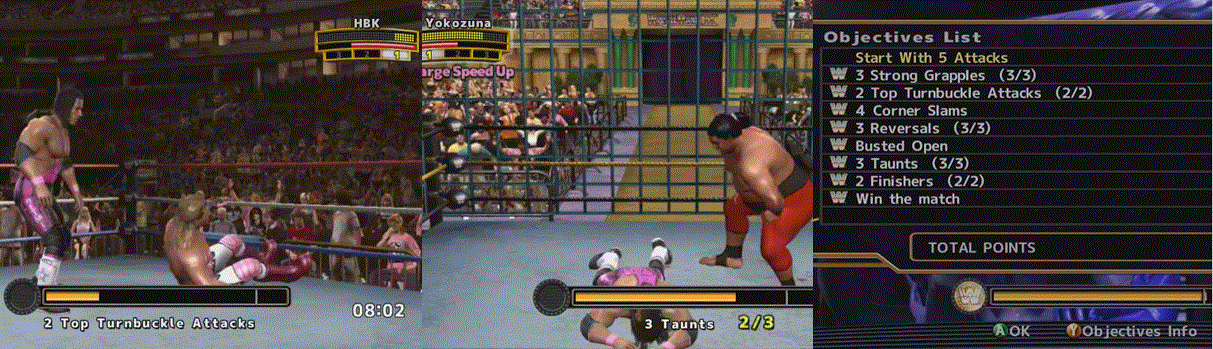
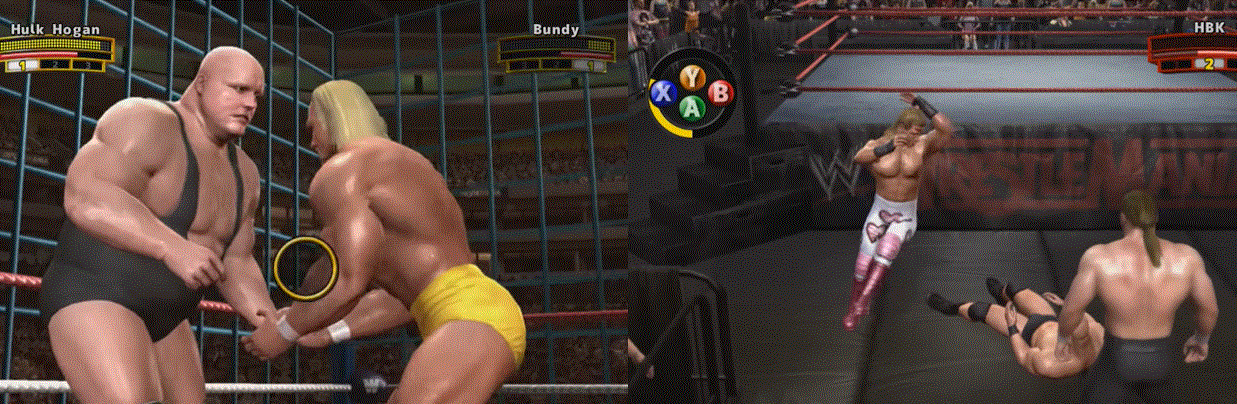
You can throw a strike at your opponent with X; land a few in quick succession to perform a simple combo or hold X to charge up a powerful strike, with both knocking them to the mat and leaving them prone for a leg or elbow drop or other ground-based offense. Grappling is performed with A; again, you can either tap it for a quick, weak grapple, or hold it for a stronger grapple, and use a directional input in conjunction with A to perform different moves (though your move pool is quite limited). As you attack and mix up your offense, you’ll build up a “Chain Meter”; as it reaches three different levels, you’ll gain access to more powerful grapples, with your finisher being unlocked at Level 3 and performed by pressing X and A together. Successfully landing attacks drains your opponent’s health meter and weakens them for either a pin or submission; submission moves are generally locked in when the opponent’s on the mat and see you mashing buttons to wear your opponent down, or you can pin them with B. If either of these things happen to you, you’ll need to mash buttons or full a circular meter to hit a small target in order to stave of the attack or kick out of the pin attempt.

While reversals can be tricky to pull off, finishers are a matter of hitting onscreen button prompts.

You’ll need to mix and match your offense in order to build up your Chain Meter (though simply mashing X can work just as well), and you can sacrifice a chunk of it by taunting with B and Y and gaining temporary buffs. This can all be a little clunky but it generally works quite well; what doesn’t work quite as well is the game’s reversal system. Rather than map counters to a shoulder button, WWE Legends of WrestleMania has them performed by pressing away from your opponent and Y or holding Y to block. I found this to be incredibly unreliable, as my Legend would often just step backwards or even run away, and I really don’t understand why this wasn’t just mapped to the Right Bumper. Unlike the majority of other wrestling games, WWE Legends of WrestleMania heavily relies on button mashing, button inputs, and quick-time events (QTES); you can’t even Irish Whip your opponent without a QTE flashing on the screen and many of the event matches in the WrestleMania Tour mode start, or are punctuated by, QTE sequences that see you mashing or hitting buttons in a test of strength, chain grapple, and other similar sequences. This also extends to the finishers; after pressing X and A, you’ll need to hit the QTE prompts to land your finisher sequence and do the maximum amount of damage, which is certainly unique but it comes at the cost of severely limiting the amount of finishers available in create-a-wrestler mode

There’s not much to differentiate the wrestlers but managers add a little spice to the matches.

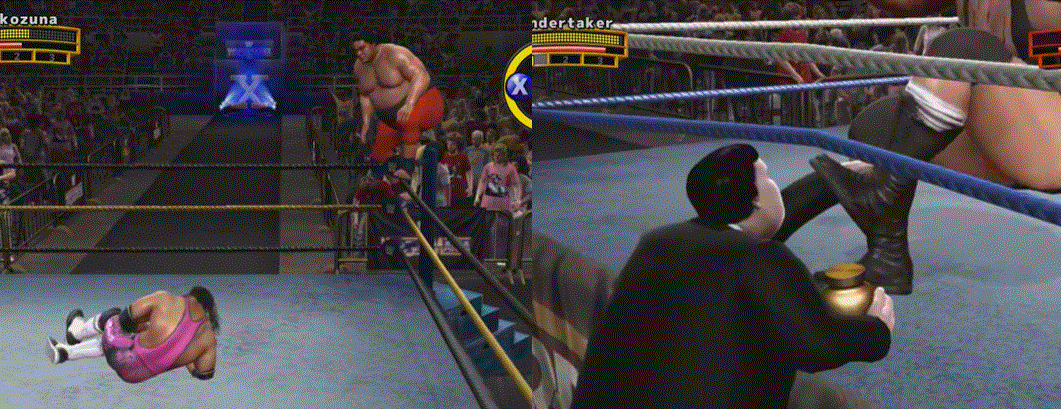
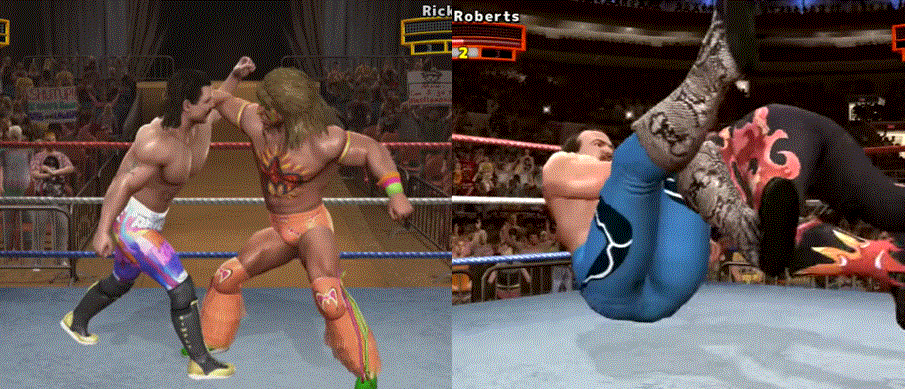
Contrary to other wrestling videogames; there isn’t really a weight class or detection system in WWE Legends of WrestleMania; playing as King Kong Bundy is largely the same as playing as Shawn Michaels, but there are some notable exceptions. For example, while Mr. Perfect can body slam and lift the likes of Yokozuna without issue, some Legends are noticeably more nimble than others and some superheavyweights struggle with climbing cage walls and are limited in their aerial offense. Some wrestling games like to lump their roster into categories and assign them abilities that play to their strengths, but that isn’t the case here so the majority of the roster’s differences are reflected in their move pool: Jimmy “Superfly” Snuka isn’t going to be quite as technically adept as Ric Flair but it’s not as though the Undertaker exhibits any supernatural abilities that other big men, such as the Big Boss Man, have. One major aspect of the game is the presence of managers; the likes of Paul Bearer and “The Mouth of the South” Jimmy Hart can accompany Legends to the ring and can interfere on your behalf at the cost of your current Chain Level, which makes them super useful when they’re in your corner and quite the hindrance when they’re in your opponent’s.

All the standard match types are available, with plenty of button mashing and QTEs sprinkled about.

Wrestling matches have all the standard options you might expect; you can set the difficulty level of the CPU in the options, manipulating the computer’s use of strikes and reversals and such, and customise win conditions (such as turning pin falls and disqualifications on or off and changing the amount of time you can spend outside of the ring). There’s also a number of additional match types on offer that will be recognisable to fans of wrestling games, with most featuring a twist in the game’s new engine and mechanics that mostly boil down to button mashing. You’ll need to mash buttons to either escape from, or prevent your opponent from escaping, a cage or break up a pin fall in a tag team match, for example. Similarly, you’ll find finishers disabled in the Royal Rumble match (there aren’t even special Royal Rumble finishers like in other games) and you’ll instead have to mash buttons to try and force your opponent out of the ring or save yourself from elimination. These components are less prominent in Hell in a Cell and ladder matches, however; you can start Hell in a Cell on top of the structure, which is a nice touch, and can throw your opponent through the cage wall or down to the ring using environmental grapples. Ladder matches are actually much more enjoyable than in other wrestling games I’ve played; you pick up a ladder (or any weapon) by double tapping B and a helpful glowing target shows you where to set it up and climbing and retrieving a championship belt is quite simple compared to other wrestling titles. Retrieving a weapon from under the ring can be a little trickier, though, as can utilising the ringside area or battling into the crowd or up the aisleway, as it requires you to hit A in specific areas around the arena, which can be difficult thanks to the janky controls. You’ll also find such staples as Iron Man matches and Last Man Standing matches on offer here, which are fun ways of mixing up the gameplay, but there’s nothing to really set the game’s matches or gameplay apart from other wrestling titles and very few of these appear in WrestleMania Tour.

WrestleMania Tour sees your reliving, rewriting, and redefining classic matches.

Speaking of which, you’ll be given three single-player options here: “Relive” (where you recreate specific WrestleMania matches), “Rewrite” (where you tackle other WrestleMania matches from the perspective of the historical loser), and “Redefine” (which features unique “dream matches”). Each of these matches is proceeded by a short hype package that features clips from real-life wrestlers and the matches and feud between the competitors, and you’ll be given a series of optional objectives to fulfil in order to earn points. These range from performing a certain number of attacks, grapples, counters, and finishers, winning the match, performing taunts, winning pre-match sequences, and more specific environmental situations (such as winning Chain Grapple sequences, slamming your opponent through an announce table, or grappling up near the entrance). Earning points fills a meter and, once it fills high enough, you’ll earn a medal that will award you with unlockable match types, attires, and more. There’s nothing to gain from playing WrestleMania Tour on anything other than the easiest difficulty, with the computer’s abilities completely neutered in your favour, beyond personal pride so you may as well manipulate the game’s settings to make things easier for you. This mode is also probably the best part of the game as it lets you recreate some iconic WrestleMania moments and matches, and meeting the objectives can be fun, but things quickly get quite frustrating if you’re trying to earn all the medals and monotony sets in quite fast as there’s not much variety in terms of the match types (there are no multi-man matches in this mode, for example) beyond the odd cage or ladder match and you can completely ignore the objectives if you like since winning is all that really matters.

Graphics and Sound:
Wrestling games can be a bit hit and miss when it comes to their graphics, especially with their in-game character models. WWE Legends of WrestleMania favours a slightly exaggerated, action figure-like aesthetic for its Legends, which is typically common when bringing the WWE’s old school superstars to life, and for the most part this actually looks a lot better than in some of the SmackDown! titles. This is primarily because WWE Legends of WrestleMania is largely consistent with its presentation, rather than fluctuating wildly between hyper realistic and massively off-model. Notably, however, you won’t find any female Legends or superstars on offer here, and there’s no on-screen referee either, which is a pretty big step back for me.

While character models look pretty good, the camera and arenas leave a lot to be desired.

The number of arenas on offer isn’t exactly much to shout about either. There’s very little variety on offer as you can only fight in WrestleMania arenas; there is a Royal Rumble arena, however, (and ironically you can only ever fight a Royal Rumble match in this arena) but there’s no Raw, SmackDown!, or other pay-per-view arenas on offer. The crowds are as sub-standard as ever, sporting signs and attire tied to their favourite superstars and parting to allow you to fight over the barricade (though essentially acting as barriers to keep you enclosed), but entrances have been a bit neutered. The game does offer the old-school gondola entrances, which is kind of cool, and recreates the old-school name plates and presentation of the pre- and early-“Attitude Era” of the WWE. Unfortunately, however, the presentation does take a bit of getting used to; the camera is very zoomed in, meaning that your Legends take up a lot of screen space and this can make it a little difficult to be fully aware of your surroundings. The camera is prone to wild swings and odd positioning, which is very annoying, and there’s a noticeable delay between button presses and executing grapples, making for a much more deliberate and slower pace to the game. Though I eventually learned to live with these niggling problems, it did take me a while to adjust to the presentation and gameplay style of the game.

Video clips add some historical context but the commentary continues to be mundane and predictable.

The inclusion of video clips and real-world footage adds to the drama and intrigue of the WrestleMania Tour mode, but these are nothing you haven’t really seen before in a wrestling title. The same goes for the entrance videos and music, which is all pretty much as you’d expect (with a few inconsistencies here and there, such as the Big Boss Man utilising his Attitude Era theme), and this extends to the in-game commentary. Provided by the legendary duo of Jim Ross and Jerry “The King” Lawler, the commentary is basically exactly the same as in the SmackDown! series, though there are some specific new sound clips added in to refer to the game’s roster and the rivalries on offer in WrestleMania Tour. I don’t play these games for in-depth commentary or crowd reactions but even I was astounded by how cheap and lazy these aspects were here. The same can be said of the create-a-wrestler options, which offers clothing, body, and hair options all ripped straight from the SmackDown! games but actually have less to offer in some respects: there’s less naming options available, less moves, less finishers, and even less clothing options as everything is geared towards meeting the old-school aesthetic and altered gameplay mechanics of the title.

Enemies and Bosses:
Being a wrestling title, every single in-game Legend is potentially your enemy; however, as mentioned, it’s not really necessary to play as or fight against each of the game’s roster in order to learn their strengths and weaknesses. Once you’ve played as and against a couple of the Legends, you’ve pretty much experienced all of the variety the game’s conflicts have to offer; your biggest hurdle will be getting the timing of the weird reversal system down, but you can circumnavigate this by just attacking your opponent head-on with strikes and landing strong grapples as and when they unlock. Guys like Bam Bam Bigelow might look big and intimidating, and the Honky Tonk Man might be the ultimate opportunist, but it’s not like you have to worry about character-specific abilities so what works against one will work against all as long as you can hit the QTE prompts when your opponent does get the drop on you.

Meeting objectives is pretty simple until Steve Austin butts heads with the Rock.

In the Relive portion of WrestleMania Tour, you’ll have to battle against specific opponents in recreations or classic WrestleMania matches; this means you’re forced into assuming the role of the historical victor, or loser, of specific matches. One of the most recurring playable characters in this mode is, of course, Hulk Hogan, who must take on King Kong Bundy in a steel cage, and Andre the Giant and the Ultimate Warrior in recreations of their iconic matches. As long as you win your matches, you’re fine, but you’ll need to meet a certain amount of objectives to earn your medal; this includes stuff like kicking out of a pin attempt, causing the opponent to bleed, or winning with a specific move. As you play through these matches, the amount and difficulty of the objectives will increase; I first noticed them becoming more complex in the classic clash between Steve Austin and Bret Hart, which requires you to attack Austin’s leg five times, fight into the crowd, utilise a steel chair, and win with the Sharpshooter but the difficulty severely ramps up for Relive’s final match. This is a recreation of Austin’s WrestleMania XV bout against the Rock; to achieve this medal, you need to meet every single objective, which can be extremely laborious as one of your objectives is reversing the Rock Bottom, to say nothing of all of the many environmental grapples you need to hit on the outside of the ring. I definitely recommend turning the game’s difficulty level and sliders all the way down in your favour and making liberal use of the health regeneration taunt to increase your chances in this match.

Objectives get even simpler in Rewrite and Redefine, meaning the medals are pretty simple to earn.

In Rewrite, you tackle different WrestleMania matches in the role of the historical loser and must fulfil different objectives in order to change history. Since you’re rewriting the outcome of these matches, these objectives are far less demanding and start off as simple stuff like performing and reversing grapples, taunting, and hitting a finisher and don’t really get more complex than landing more attacks, performing more taunts, maybe making the opponent bleed, and performing multiple finishers and reversals. Honestly, these matches were an absolute breeze, with even Bret and Shawn’s infamous WrestleMania XII Iron Man match providing little challenge beyond a ten-minute time limit. This carries over to Redefine, though the matches and competitors at least have a little more variety; here, you can pick which Legends you want to play as and will witness the likes of Andre and Giant and Big John Studd in a Hell in a Cell match and Mr. Perfect and the Big Boss Man in a ladder match. Redefine culminates with a dead simple no disqualification match between the Undertaker and King Kong Bundy that might have a lot of objectives but they’re nothing compared to the Austin/Rock match (boiling down to stuff like hitting five moves in a row at the start, two top rope moves, three reversals and taunts, and two finishers, which is still laborious but nowhere near as frustrating as in that aforementioned match).

Power-Ups and Bonuses:
There are a few options available to you during matches to help turn the tide in your favour; you can toss your opponent to the outside of the ring and interact with the steel steps, announce tables, and barricades to deal more damage to your opponent and, when your opponent is positioned correctly, pull weapons out from under the ring to bust them open or beat them down. When near the aisleway, you can clunkily force them up to the entrance way where there are often other environmental grapple points on offer that let you choke your opponent with wires, toss them into the stage dressing, and even make use of a drum kit but there’s no backstage brawling here. As your Chain Meter builds up, you gain access to taunts that can provide you with temporary buffs; these include regenerating your health, upping your speed and durability, and making reversals easier to pull off for a limited time. Managers can also provide many of the same temporary buffs and also attack or distract your opponent to give you the edge in matches, though utilising these will cost you part of your meter so you’re often asked to pick between receiving a temporary buff or earning your finisher.

Additional Features:
There are a mere nineteen Achievements on offer in WWE Legends of WrestleMania, which is astoundingly low for a wrestling title. Achievements are primarily tied to obtaining medals in WrestleMania Tour or making and using a created wrestler but you can also earn them by winning matches using only grapples or with other specific moves. Sadly, in a game featuring so many WWE Legends, there aren’t more fun or notable Achievements; for example, you can use Hogan to slam Andre all you like in the WrestleMania III arena but it won’t pop a “Unstoppable Force” Achievement. As you play, however, your win/loss record and other statistics are recorded in the “Hall of Fame”, which is good for the statisticians out there, but there’s no way to compete for championships outside of the WrestleMania Tour mode, no create-a-pay-per-view mode, general manager mode, or even WWE Universe mode so you’re basically limited to exhibition matches and the WrestleMania Tour. Well, not entirely; there is also the “Legend Killer” mode. Here, you use a created wrestler to take on six tiers, comprised of ten back-to-back singles matches and culminating in a showdown with one of six WrestleMania Legends. You’ll earn experience points (EXP) by winning matches, and even more for mixing and matching your gameplay style as you play, which you can spend upgrading your created wrestler’s attributes and earning more Achievements. The create-a-wrestler mode is basically the same as in the SmackDown! series, including many of the same hair and clothing options as in those games and you can also fully customise their entrance or even create a tag team, though there’s very little incentive without a Universe mode. While there’s no downloadable content on offer here, you can transfer basically the entire male roster of WWE SmackDown vs. Raw 2009 (Yuke’s, 2008) if you have a save file for that game on your system, which greatly expands the amount of moves and finishers available to you. While this is a cool feature, and something I wish WWE games would implement more often, it doesn’t equate to much more than adding modern superstars to the roster (which really doesn’t mean all that much as you can’t play as them in WrestleMania Tour).

The Summary:
I do enjoy a bit of a wrestling title, and quickly and easily nabbing a few Achievements, and as a big wrestling fan I enjoy revisiting some of the classic wrestlers of the past but WWE Legends of WrestleMania is a quite a bare-bones title. You can see everything the game has to offer in an hour or so and plough through the main story campaign in an afternoon; the Legend Killer mode might take a little longer but it’s hardly going to take up all your time and attention like a General Manager or Universe mode. The gameplay is a bit jarring at first thanks to the odd camera perspective and the plodding, clunky, QTE-heavy nature of the mechanics, but pretty easy to master and, before long, you’ll be winning matches in no time at all, meaning the game quickly gets boring. Yes, there’s a few other match types on offer but there’s little incentive to play these as you can’t compete for belts and I can’t imagine it’s that much fun to play against other human opponents, either. The create-a-wrestler is more lacklustre than ever and there’s a strange lack of focus on guys like the Undertaker, and some notable omissions from the roster (neither Kane nor Mankind are available, for example), though the ability to transfer the roster from WWE SmackDown vs. Raw 2009 is a neat touch. Ultimately, it’s not bad if you pick it up cheap but probably not really worth keeping in your collection once you’ve mined all of the Achievements. I appreciate the developers trying something a little different but this clearly isn’t a Triple-A title and is really only for fans of the rock ‘n’ wrestling era of the then-WWF. If you’re really in the mood for an arcade style wrestling game from around this time, you’d potentially be better off playing something like WWE All Stars (THQ San Diego, 2011).

My Rating:

Rating: 2 out of 5.

Could Be Better

Are you a fan of WWE Legends of WrestleMania? Did you like that the developers actually tried to do something a little different with this release or did the dumbed down gameplay put you off? Which of WrestleMania Tour’s matches was your favourite and did you ever achieve Legend Killer status? What did you think to the finisher system and the abundance of QTEs? How did you find the create-a-wrestler mode and were you disappointed by the lack of WWE Universe in this title? Were there any classic WWE superstars you felt were missing from the game and which of the available Legends was your go-to character? How are you celebrating WrestleMania’s anniversary this year and what’s your favourite WrestleMania moment? Drop your thoughts below by signing up or leave a comment on my social media to let me know what you think about WWE Legends of WrestleMania and check back for more wrestling content throughout the year.

March Drabble Challenge: Reveal

Horror PromptsGillian Church is hosting another horror drabble challenge: 31 prompts for 31 creepy tales throughout March. This time, we can decide on the length of the piece but I’m sticking to the 100-word default.

Can you do it?

The Prompt:
Reveal

The Submission:
Eric had been trembling when Sherry finally brought him to her dorm after weeks of going steady and making him wait.

They’d been going steady for a few weeks now, but she’d teased him by saying she wasn’t ready to go all the way yet, and now it was finally happening.

He sat on the edge of her bed as she lifted her dress over her head and was startled at the reveal of her naked body.

Boils pulsated across her creamy-white skin; some leaked pus as she ran her hands over them, licking her fingers at the taste.

“What’s wrong, babe?” she purred, her face splitting at the jaw. “Don’t you want me?”


What did you think to the prompt for today’s drabble challenge? Did you submit anything for it? Have you ever written any flash fiction before? I’d love to know what you think to my snippets and writing prompts, so feel free to sign up and let me know what you think below or leave a comment on my Instagram page. You can also follow Gillian Church to take part in her Weekly Writing Prompt challenge.

Weekly Writing Prompt: 30/03/2022

Gillian Church posts Writing Prompts every week on her Horror Prompts Instagram account and I like to take part with a few snippets and pieces of flash fiction.

The Prompt:
Unknown caller: You say you’ve found the perfect item to donate to the Museum of Oddities and Artefacts. Tell me more…

The Submission:
“Sorry, who is this?” Jameson asked, removing his pipe from his lips.

“Oh, this is Mr. Scratch from the Museum of Oddities and Artefacts.  Perhaps you’ve heard of us?”

“No?” Jameson said, puzzled. “I can’t say that I have.”

“I saw your listing on Facebook; that’s quite the intriguing trinket you have in your possession.”

Jameson glanced over at the dining table from his easy chair; the amphora had probably once been a shining black/gold but had been sun-bleached over the centuries. The remaining handle was chipped and brittle to the touch and the images and symbols that had once adorned the exterior was faded.

“May as I ask where you acquired it?”

“Well…” Jameson sighed. “That’s a…long story…”

“Let me be frank, Mr. Wolfe. My museum is very eager to display this piece, and we’re willing to offer you fair compensation for it.”

Jameson stared at the amphora, sweat dripping down his brow, reliving the blinding, burning light that had burst from the vase upon first removing its lid. Grace, Roberts, Donald…all burnt to charred, smouldering skeletons, with only him left standing.

I shall give you life! the demonic smoke-demon had cooed, swirling around his head, drifting up his nostrils. Life…and health…their lives for yours…

A wisp of mist wafted from the cracks in the amphora and Jameson gulped back a shaking breath. “I…I’m sorry…it’s….it’s not for sale…”


What did you think to this week’s writing prompt? Did you submit anything for it? Have you ever written any flash fiction before? I’d love to know what you think to my snippets and writing prompts, so feel free to sign up and let me know what you think below or leave a comment on my Instagram page. You can also follow Gillian Church and Horror Prompts to take part in the Weekly Writing Prompt challenge.

March Drabble Challenge: Bulb

Horror PromptsGillian Church is hosting another horror drabble challenge: 31 prompts for 31 creepy tales throughout March. This time, we can decide on the length of the piece but I’m sticking to the 100-word default.

Can you do it?

The Prompt:
Bulb

The Submission:
The naked bulb smashed in the fracas, plunging the dank basement into darkness.

Norris grabbed at me, heaving and gnashing, and I struggled to break free from his course grip.

“We don’t have time for this!” Grey shouted.

“Fuck you!” Norris barked and shoved me.

My arms pinwheeled out and I landed hard on my ass in a puddle. Suddenly light flooded the basement as the door burst open and the moaning, shambling ghouls spilled down the stairs.

“Oh fuck!” Grey screamed as one of the writhing corpses stroked at his calf.

Norris lift his crowbar as they swarmed him.


What did you think to the prompt for today’s drabble challenge? Did you submit anything for it? Have you ever written any flash fiction before? I’d love to know what you think to my snippets and writing prompts, so feel free to sign up and let me know what you think below or leave a comment on my Instagram page. You can also follow Gillian Church to take part in her Weekly Writing Prompt challenge.

Movie Night: Iron Man 3

Released: 3 May 2013
Director: Shane Black
Distributor:
Walt Disney Studios Motion Pictures
Budget:
$200 million
Stars:
Robert Downey Jr., Guy Pearce, Gwyneth Paltrow, Don Cheadle, Rebecca Hall, Ty Simpkins, and Ben Kingsley

The Plot:
Suffering anxiety attacks following The Avengers/Avengers Assemble (Whedon, 2012), Tony Stark/Iron Man (Downey Jr.) has created a slew of new armours. While smooth-talking entrepreneur Aldrich Killian (Pearce) woos Stark’s love interest, Virginia “Pepper” Potts (Paltrow), with his “Extremis” technology, Stark is incensed when his friend Harold “Happy” Hogan (Jon Favreau) is left critically injured by a sadistic terrorist known only as the Mandarin (Kingsley). After declaring war on the Mandarin, Stark is left without his vaulted technology and with only his wits and genius intellect to uncover the terrorist’s connection to Extremis.

The Background:
Although both Iron Man (Favreau, 2008) and Iron Man 2 (ibid, 2010) were both incredibly profitable, the future Of the Marvel Cinematic Universe (MCU) was secured after the unprecedented success of their first team-up movie. Moving into Phase Three, the MCU faced some corporate issues that led to Walt Disney Studios purchasing the distribution rights to the films from Paramount Pictures before production of a third Iron Man movie began. Although actor/director Jon Favreau remained attached as a producer and actor, he opted not to return to the director’s chair and star Robert Downey Jr. reached out to Shane Black to take the reigns. Drawing inspiration from Warren Ellis’ “Extremis” arc (2005 to 2006), Iron Man 3 (curiously titled “Iron Man Three” in the credits) sought to strip Stark of his resources and be more of a Tom Clancy-style thriller than a traditional superhero film. Although the film drew some controversy for dramatically altering Rebecca Hall’s role and prominence and including a very ill-advised (in my opinion) twist, Iron Man 3 was ridiculously successful and made over $1.200 billion at the box office. Critically, the film’s reviews vary; some praised the tonal shift towards comedy and more grounded action while others took issue with these same aspects.

The Review:
Unlike its predecessors, and the majority of films in the MCU, Iron Man 3 is bookended by Tony Stark narrating the seemingly-insignificant events from his past that led to his latest struggle in the film. While this makes for an amusing post-credits scene where it’s revealed that he’s been boring Doctor Bruce Banner (Mark Ruffalo) to sleep with the events of the movie, his voice over is only really used at the start and the end of the film so it seems a bit pointless to me. Add to that the fact that this post-credits scene is telling us that Tony’s battle against the Mandarin is boring an uninteresting, and this kind of sets a precedent for what to expect from Iron Man 3. As part of the film’s aim to harken back to the themes and atmosphere of the first movie, Iron Man 3 begins at a New Year’s Eve Party in 1993. Here we are reminded of just how selfish, self-centred, and vindictive Stark can be as he’s too busy drinking, partying, and flirting with Maya Hansen (Hall) than giving the likes of Ho Yinsen (Shaun Toub) or the awkward and ungainly Aldrich Killian the time of day. In this flashback scene, Killian is depicted as a bespectacled, awkward cripple and a goof in an employment of one of the worst tropes of superhero movies. However, thankfully, we’re spared watching him undergo a physical and mental transformation and degradation over the course of the movie and his inelegant manner is limited purely to this brief sequence and a subsequent flashback later in the film. This trope is also primarily used to show that he overcame his limitations and Stark’s dismissal of his idea for a collaborative think-tank of the country’s top minds and to further emphasise that Stark’s ignorance and egotism leads to him effectively creating his own villains later in life for not being more considerate to others.

Suffering from PTSD and insomnia, Stark neglects Pepper and focuses on building more armours.

When we catch up with Stark in the then-present day, he’s fully committed to his relationship with Pepper and seemingly in a much more stable place in terms of his personality (though he retains his trademark snark and sardonic nature) but he’s haunted by his near-death experience in Avengers Assemble. Suffering from frequent nightmares and flashbacks to the wide, unknown dangers that lie beyond our world, Stark is stricken by harrowing panic attacks any time the subject of New York comes up and has spent more and more time finding comfort in his Iron Man armour and tinkering down in his workshop. Constantly distracted, highly strung, and fatigued, his relationship with Pepper suffers a bit as a result of the fact that, rather than open up to her, he prefers to make more and more Iron Man variants and work on perfecting his Mark XLII armour, which is capable of separating into self-propelling parts that respond to his commands via micro-repeater chips. Despite having gained new allies in his fellow Avengers, Stark feels more alone than ever; not wanting to worry Pepper, he keeps her at arm’s length and works around the clock to ensure her safety. Happy is busy with his new position as head of security at Stark Enterprises (a job he takes very seriously) and, though Colonel James “Rhodey” Rhodes (Cheadle) unsuccessfully tries to ask about Stark’s mental health, his loyalty to the military necessitates keeping independent costumed heroes like Iron Man out of the loop.

Rhodey features prominently as the government-sponsored superhero Iron Patriot.

Indeed, in an extension of Rhodes’ sub-plot in Iron Man 2, President Ellis (William Sadler) has officially commissioned Rhodes to ditch the War Machine moniker and don the garishly patriotic red, white, and blue armour of the “Iron Patriot” and act as governmentally-sanctioned superhero to help allay fears following the Chitauri invasion. Since Stark is preoccupied with his mounting anxiety issues, Pepper is left feeling unappreciated and shunned. Though she stays loyal to Stark, despite his eccentricities, she is more than a little impressed when Killian shows up at Stark Enterprises having transformed into a physically gorgeous, confidant businessman. After Stark’s dismissal of him back in the nineties, Killian resolved to make Advanced Idea Mechanics (A.I.M.) incredibly successful and profitable and, through A.I.M..s research, was able to not only cure his own degenerative physical condition but potentially offer a cure for those suffering from all kinds of mental and physical ailments in the development of Extremis. However, while Killian’s presentation and charisma are impressive, Pepper ultimately turns down a proposed business venture between Stark Enterprises and A.I..M. out of fears about the potential weaponisation of the Extremis technology. Pepper is right to turn down this proposal as, very quickly, it is shown that a number of ex-soldiers have been exposed to Extremis and become living weapons as a result. The virus, cultivated from Maya’s research, promises to spontaneously heal wounds and even regrow limbs as well as curing mental and physical deficiencies and granted a degree of superhuman strength and dexterity to its subjects.

When Stark antagonises the Mandarin, he’s left without his tech and reliant upon a child.

However, Extremis is, as the name implies, extremely volatile and many of those exposed to it burn out and explode as veritable suicide bombers. When Happy is critically injured in one of these attacks, Stark is incensed and openly challenges the one responsible for these, and many other devastating terrorist attacks, the terrorist known as the Mandarin. The Mandarin, who flashes up the symbol of the Ten Rings and frequently issues ominous threats by hijacking the airwaves, directly threatens President Ellis and proudly takes credit for the deaths of innocents in his unrelenting attacks against the United States. However, despite Rhodey cutting Stark out of the Mandarin investigation, Stark publicly (and recklessly) calls out the Mandarin after Happy is put in the hospital; the result is an all-out attack that devastates his home, burying his armours and technology, and leaves Stark stranded in Tennessee cut off from Just A Rather Very Intelligent System (J.A.R.V.I.S.; Paul Bettany) and with his Mark XLII armour powerless. Stripped of his resources and technology, Stark is forced to team up with young Harley Keener (Simpkins), who helps Stark link the Extremist terrorist attacks, and the Mandarin, back to Killian.

The Nitty-Gritty:
Given that it’s written and directed by Shane Black, Iron Man 3 takes place around the Christmas season; while Christmas doesn’t really factor into the overall plot in any tangible way beyond a few trees, decorations, and Tennessee being covered in a frigid snow, it does help the film to stand out against other MCU movies, and superhero films in general, as there aren’t very many that take place in the festive season. Thankfully, despite some of the flaws in the direction of the film and the decisions the filmmakers make regarding certain characters, the change in directors doesn’t diminish the perfect blend of snark and humour at work in Iron Man 3. Indeed, Stark’s interactions with the likes of Rhodey, Happy, and Harley are one of the film’s highlights and it’s great to see that he’s still a droll prick when he needs to be despite being a “piping hot mess”.

While it’s great for his character growth, Stark spends a lot of the film without his armour.

Indeed, the film adds further layers to Stark’s complex personality by adding post-traumatic stress to his laundry list of character defects; traumatised to the point where he suffers from insomnia and a deep-seated urge to build and create armours for every conceivable scenario, the last thing Stark needs is to be left without his tools and technology and yet that’s exactly where he finds himself. Stark’s efforts in Tennessee effectively return him to the cave where he must rely on his innovative genius to survive; when he tracks the Mandarin to Miami, he infiltrates the terrorist’s base with little more than some cobbled-together armaments that ape his usual Arc Reactor-powered arsenal. Teamed with a similarly suit-less Rhodey (whose henchman, Eric Savin (James Badge Dale), appropriates the Iron Patriot suit to kidnap President Ellis), Stark becomes much more of a resourceful spy than a colourful superhero and he spends a great deal of the film (arguably too much, in my opinion) outside of the armour rather than in it.

The Mandarin stupidly turns out to be a drunken buffoon merely acting the part.

When he confronts the Mandarin, Stark is confused and enraged to find that he’s little more than a drunken, substance-dependent eccentric English actor named Trevor Slattery. Trevor willing reveals that he was contracted by Killian to pose as a credible terrorist threat in order to kill the President and replace him with Vice President Rodriguez (Miguel Ferrer), a puppet leader who will do exactly as Killian dictates. This twist on the traditional Fu Manchu sorcerer figure who I grew up seeing as Iron Man’s archenemy is undeniably amusing but, in retrospect, was a pretty awful idea; you had Ben Kingsley, Ben Kingsley, who absolutely crushed it when portraying the Mandarin and you turned him into an alcoholic buffoon. Indeed, the MCU producers backtracked on this depiction of the Mandarin pretty quickly and eventually brought the true Mandarin into the fold but even then the character was significantly altered from the source material. Sadly, though, this came out long after Stark’s emotional death so we were robbed of seeing him go toe-to-toe with his most iconic nemesis, which remains a bitter pill for me to swallow.

Killian is positioned as the main villain and claims to be the true Mandarin…

As has been publicly explored, Maya’s involvement in the plot as a tertiary antagonist is similarly swept under the rug; rather than be a significant threat to Stark, she merely ends up being a pawn of Killian’s who is gunned down the moment she has a crisis of conscience. Consequently, it’s Killian himself who acts as the film’s primary villain; a malicious, ruthless, and cunning adversary, Killian is yet another dark mirror of Stark (at least in terms of his business acumen) who subjects numerous desperate souls to his Extremis process despite knowing full well that it could kill them. He even forcibly infects Pepper with the virus, though this ultimately proves to be his downfall when she conveniently proves to be far more stable than most of his usual subjects. Killian ultimately takes on the Mandarin moniker for himself, showcasing superhuman strength, unparalleled regenerative abilities, and even the ability to breathe fire (making him like a composite of the comic’s Killian, Mandarin, and Fing Fang Foom).

The army of armours shows up way too late and are almost immediately destroyed, which is a shame.

While there is a noticeable lack of Iron Man action in Iron Man 3, the film does make up for it with a particularly exciting sequence where Stark has to rescue a bunch of the President’s personnel when Air Force One is destroyed, which is quite the innovative and unique rescue scene. Still, one of the primary selling points of any Iron Man movie, especially for me, are the various different armours Stark constructs for himself and Iron Man 3 culminates in a veritable smorgasbord of suits for our viewing pleasure. Sadly, though, while many of these were a significant aspect of the film’s marketing, they only appear onscreen for the briefest of moments in the finale, where Stark has J.A.R.V.I.S. remote pilot every single one of his suits to assist in the battle against Killian. Even his apparently revolutionary Mark XLII armour is pretty underwhelming as it constantly breaks, shatters, and loses power, making it probably the most ineffectual of all of his armours. Once Pepper kills Killian off, Stark immediately orders every single one of his suits to self-destruct and then just fixes not only Pepper’s condition but also his own, removing the shrapnel from his chest and apparently retiring from the superhero life. This, however, would simply be the start of another sub-plot and character arc for Stark throughout the remainder of the MCU which specifically dealt with his inability to walk away from Iron Man, the Avengers, and the thrill of being a superhero.

The Summary:
It’s not that Iron Man Three (I still don’t get why it’s credited like that…) is a bad film. For much of its runtime, it’s actually pretty entertaining and dark thanks to the intense and menacing nature of Kingsley’s portrayal of the Mandarin. Even seeing Stark genuinely affected by his experience in Avengers Assemble was intriguing to watch and showed that the character was clearly growing and learning and influenced by the ever-escalating nature of the MCU, to say nothing of further solidifying Rhodey’s growth as his own legitimate armoured superhero. I didn’t even mind, conceptually speaking, the idea of Stark being robbed of his resources and having to improvise as it went a long way to showing just how adaptable, intelligent, and increasingly neurotic the character is becoming about safeguarding his friends, family, and the greater good. However, the execution is flawed in a lot of ways; the film “feels” just as big and exciting as the previous Iron Man movies but any and all of its positives are immediately soured by that God-awful Mandarin twist. Imagine if a Batman movie gave us the most perfect casting and interpretation of the Joker and then threw a curveball by revealing that he was a simple janitor playing dress-up; people would go crazy and, while I understand that the Mandarin comes with many cultural issues, the fact that the MCU eventually managed to translate a more faithful version of him to film years down the line makes me wish that they had stuck with the casting and the magic they had in Kingsley’s casting and given us (and by “us” I mean “me”) the long-awaited showdown between Iron Man and his greatest foe. Instead, we’re left with a decent enough film but one that gambles, and loses, its credibility on a nonsensical decision and one of the weaker films in the MCU line-up, in my opinion.

My Rating:

Rating: 2 out of 5.

Could Be Better

What did you think to Iron Man 3? Can you explain to me why the credits spell the number three out because I honestly don’t get it? What did you think to the aspect of Stark suffering from anxiety attacks? Did you like that he was forced to innovate and work without his armour or were you annoyed at how little Iron Man action there was in the film? What did you think to the twist regarding the Mandarin? Did you enjoy it or, like me, were you annoyed by it? Which of Stark’s new armours was your favourite and would have liked to see more of and what did you think to the introduction of the Iron Patriot suit? What are some of your favourite Iron Man characters or stories? Where does Iron Man rank in your hierarchy of comic book characters? Are you doing anything to commemorate Iron Man’s debut appearance and, if so, what is it? Feel free to drop a comment down below and thanks for being a part of Iron Man Month!