It’s True, The Boogeyman is Real. And You Found Him. Review by Nat Whiston

StitchfaceBy Dr. Stuart Knott.First published in March 2023 by Amazon. Cover art created on Canva with input from Nadine Stewart. Stitchface, Stitchface, comin’ to get’cha!Stitchface, Stitchface, comin’ t’kill yah!Mind your manners,Mind your elders,Say your prayers and leave on a light‘Lest Mr. Stitchface come-a-callin’ on Halloween night! For thirty years, Jenny Carpenter has lived in fear […]

It’s True, The Boogeyman is Real. And You Found Him. Review by Nat Whiston

Back Issues: Showcase #4

This review has been supported by Chiara Cooper.
If you’d like to support the site, you can do so at my Ko-Fi page.

Story Title: “Mystery of the Human Thunderbolt!”
Published: October 1956
Writer: Robert Kanigher
Artist: Carmine Infantino

The Background:
In 1940, writer Gardner Fox and artist Harry Lampert introduced readers to Jay Garrick, a college student granted superhuman speed after inhaling “hard water vapours”, and thus the very first superhero to use the name “The Flash” was born. The Flash not only became a charter member of the Justice Society of America but also graduated to his own solo book a year after his debut; however, All-Flash was cancelled after thirty-two issues when the onset of the Second World War saw superheroes decline in popularity. In the seven years that passed after Jay’s last publication hit comic book stands, a lot had changed; the rights to the Flash were now held by DC Comics, who set about reinventing “Golden Age” superheroes like the Flash and Alan Scott/Green Lantern. Thus, in 1956, readers of Showcase #4 were introduced to an all-new version of the Scarlet Speedster; created by writer Robert Kanigher and artist Carmine Infantino, forensic chemist Barry Allen heralded not only the “Silver Age” of comics but also the concept of the multiverse as it was later revealed that Jay existed on a parallel version of Earth. Barry quickly became one of the most popular and iconic incarnations of the Flash mantle, being a founding member of the Justice League of America and cementing his legacy after sacrificing his life in the Crisis on Infinite Earths epic (Wolfman, et al, 1985 to 1986). Although Barry’s demise lasted longer than most superhero deaths, he was eventually brought back in the ridiculously confusing Final Crisis event (Morrison, et al, 2008 to 2009) and his popularity and influence has seen him in a starring role in two live-action television shows, feature prominently in DC cartoons and videogames, and also seen him brought to life on the big screen as part of the largely disastrous DC Extended Universe.

The Review:
Our story begins with a crisis at a radar station on the East Coast; two military personnel are startled after picking up a strange object travelling faster than anything ever recorded before it sends their equipment haywire. To explain this phenomenon, the story flashes back a short time to Central City on a night when the city was ravaged by a tumultuous lightning storm. Here, in the police laboratory, we meet scientist Barry Allen, who marvels over stories of the Jay Garrick version of the Flash, who at this point exists only in comic books in a slice of metatext. As he returns to his mysterious experiment (which, apparently, requires the use of “every chemical known to science”), a bolt of lightning causes him to be doused in chemicals, leaving him wet and dazed but otherwise unharmed. Shaken, Barry leaves but is too late to hail a cab so tries to chase one down, only to find himself flying along at super speed! Believing his near-death experience has caused him to imagine things, Barry stops at a diner to catch his breath and is startled to find that he can now perceive time in slow motion, moving so fast that a clumsy waitress cannot comprehend what happened, but he still believes he’s suffering from shock so he goes home to rest. By the morning, he’s used some wonky logic to explain everything away but, when he meets Iris West for a date (receiving a talking down for his poor timekeeping), his super speed kicks in again just as a stray bullet threatens her life! Acting quickly, he tackles Iris out of harm’s way, earning him her gratitude, and finally realises that his molecular structure has been altered by the accident to turn him into the fastest man on Earth. Inspired by the adventures of Jay Garrick, Barry…somehow…crafts himself a sleek, form-fitting costume that can condense into a ring on his finger and makes his debut as the Flash to answer a burglar alarm at the city’s central bank.

After gaining superhuman speed, Barry Allen tracks down the sloth-like villain the Turtle Man.

Thanks to his superhuman speed, the Flash can effortlessly race down the sides of buildings and across town so fast that he breaks the sound barrier, thus explaining the disruption monitored at the start of the story. At the bank, The Flash finds nothing has been stolen; questioning the holdup victims, he learns that the perpetrator was “The Turtle Man”, a villain known as the slowest man on Earth, and somehow intuits that the thief left the job half finished to complete it later on. This odd logic is compounded when the Flash is easily fooled by a silhouette painted on a brick wall, like he’s Wile E. Coyote, and goes crashing through a wall while trying to apprehend the Turtle Man. Somehow, despite the fact that the Flash just appeared and no one even knows about him, Barry believes the villain is “using [his] speed […] as a weapon […] against [him]” and stays on his guard as he follows the Turtle Man’s trail through a sewer and to the river. The Turtle Man certainly lives up to his name; not only does he talk in laborious sentences, but he also chooses a rowboat for his getaway, yet he is also smart enough to boobytrap a speedboat to keep the Flash from pursing him. Thankfully, the laws of physics mean nothing to the Scarlet Speedster and he races across he water’s surface, but he’s unable to apprehend the villain because his movements only push the rowboat further away. Instead, the Flash circles the rowboat at superspeed, trapping it in a vortex and easily capturing the sloth-like crook. The cops and press are awestruck by the feat and the Flash becomes the talk of the town; even Iris swoons over the super-speedy hero completely unaware that she’s already dating the Scarlet Speedster.

The Summary:
Well, I’m not gonna lie…this was a bit of a disappointment. These older comic book tales always tend to be very brief and simplistic but I found Barry’s debut story to be particularly bland considering how colourful and versatile the Flash and his powers can be. I liked that Barry didn’t immediately realise what’d happened after the lightning strike but it takes him so long to figure out what happened that he comes across as a bit of a dunce. His misadventures do give a taste of what he’s now capable of, showing that he can accelerate to inhuman speeds, defy gravity and physics, and even perceive time differently, but it’s handled very clunkily and not in an especially engaging or entertaining way. Barry’s clothes don’t catch fire from the friction, which would’ve been a fun visual, and he’s far too quick to explain away what’s happening with weak logic. Once he does figure things out, he’s somehow able to create this amazing suit that shrinks down into a ring, something I always thought came along later in his career but isn’t even explained with a wishy-washy trope like “unstable molecules”.

An unfortunately dull story with a foolish hero and a ridiculous villain that fails to impress.

The Turtle Man isn’t exactly a visually interesting or threatening first villain, either. I get the idea of pitting the world’s slowest man against the world’s fastest man as a kind of thematic parallel but it doesn’t really work because…why the hell would the world’s slowest man pose a threat to the Flash, of all people?! And…he doesn’t. He briefly bamboozles the Flash by fleeing the crime scene, causes him to run into a wall and sink, both of which are minor inconveniences at best, and is easily apprehended without really taxing the Flash’s powers or intelligence anywhere near their limit. It feels as though this story needed a few more pages; there are other standalone Flash stories in this issue but I would’ve used the extra pages to establish the Flash in the city before he encounters the Turtle Man as the villain is…somehow…aware of the Scarlet Speedster and relishing in their conflict despite him just making his debut! In the end, it’s a kind of fun, wacky tale but a bit of an inauspicious debut for one of DC Comics’ most popular heroes; a lot of the groundwork is here and there’s some fun art showcasing the Flash’s super speed and such but it’s ultimately a bit lacklustre and too simplistic for me to be the definitive origin story for the character.

My Rating:

Rating: 2 out of 5.

Could Be Better

What did you think about Barry Allen’s debut as the Flash? Were you impressed by it at the time or were you left a little fulfilled, like me? What did you think to the new Flash and how do you think he compared to Jay Garrick? Did you also find it odd that Barry took so long to figure out what was going on? What did you think to the Turtle Man and his threat to the Flash? Which Flash or speedster is your favourite and what are some of your favourite Barry Allen moments? Feel free to share your thoughts on the Flash below and be sure to check out my other Flash-related content!

Game Corner: Indiana Jones and the Temple of Doom (Arcade)

This review has been supported by Chiara Cooper.
If you’d like to support the site, you can do so at my Ko-Fi page.

Released: August 1985
Developer: Atari Games
Also Available For: Amiga, Amstrad CPC, Apple II, Atari ST, Commodore 64, DOS, MSX, ZX Spectrum

The Background:
In 1981, director Steven Spielberg joined forces with George Lucas and Harrison Ford to bring Indiana Jones to life in Raiders of the Lost Ark (Spielberg, 1981), a critical and financial success that launched one of cinema’s most beloved franchises and expediated Ford’s rise to superstardom. The movies soon led to a wealth of multimedia merchandise, including toys, comic, a spin-off television series, and videogames, beginning with an extremely basic 8-bit adventure for the Atari. Although Spielberg’s sequel, Indiana Jones and the Temple of Doom (ibid, 1984) made slightly less than its predecessor at the box office and attracted controversy for its performances, potentially insensitive cultural depictions, and its darker aspects, it too was accompanied by a videogame. Thanks to a graphically superior version being released in arcades, Temple of Doom was allegedly the first Atari System 1 game to include digitised speech, voice clips, and even John Williams’ iconic music. Seen as a marked improvement over its predecessor, Temple of Doom was also reportedly the fourth-most-successful upright arcade unit of August 1985 in Japan and has been noted as being one of the best videogame adaptations of a movie at that time.

The Plot:Archaeologist and adventure-seeker Doctor Henry Jones Jr., better known as “Indiana Jones” (or simply “Indy”), infiltrates a Thuggee cult to free the children they’ve kidnapped as slaves, recover the mystical Sankara Stones, and defeat the cult’s leader, Mola Ram.

The Review:
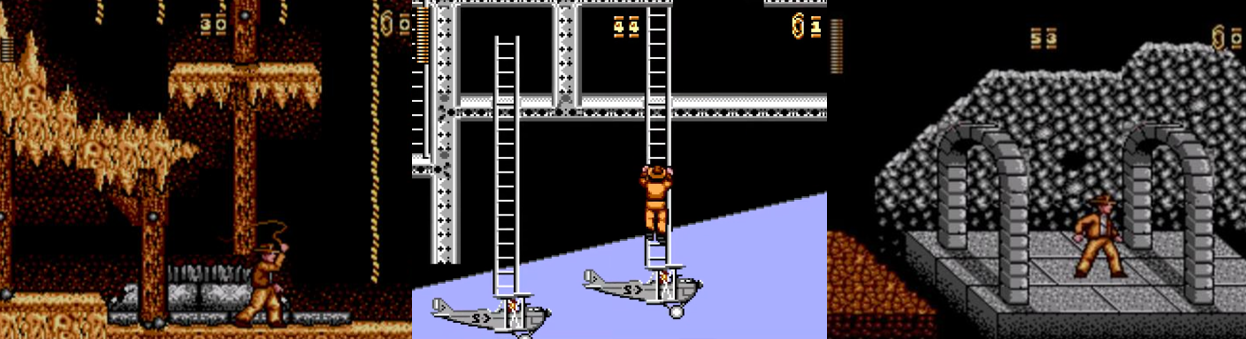
Anyone who actually makes a habit of reading my reviews will notice that this review is laid out a little differently from my usual ones and there’s a very good reason for that: there’s honestly not enough to Indiana Jones and the Temple of Doom to warrant a more extensive analysis. Considering the accolades it apparently received at the time, I was left very disappointed by the barebones presentation and mechanics offered by the game, which is a simple 2D adventure that takes place entirely in the lava-and-ladder-infested caves of the Thugee cult. Players, obviously, take control of Indy, in an extreme basic control scheme that allows him to whip in multiple directions, including diagonally, but unable to jump. Indy’s whip will only stun the Thugee enemies who relentlessly pursue him, however; to actually kill them, you’ll need to whip an explosive barrel or knock them to their deaths. Luckily, the snakes and weirdo, dinosaur-like bats can be killed but this is a small consolation considering how many enemies swarm you at any one time.

Whip, swing, and explore to reescue the children from their cages.

Upon starting the game, you’re presented with a pretty decent piece of sprite art depicting Indy and one of the game’s handful of voice samples from the film, which are muffled and painfully basic. From there, you select to play with either three or seven lives (which you’d ever pick less is beyond me) and pick from the Easy, Medium, and Hard difficulty setting and are tasked with rescuing several captured children from cages scattered all around the looping screens. Here, you’ll need to run up ladders, avoid slipping from platforms, swing over gaps using your whip, and try not to fall into lava as you rescue the kids and allow access to the minecart that acts as the level’s exit. Unfortunately, Indy is not only extremely limited in his abilities, being unable to jump, duck, punch, or shoot, but he’s extremely fragile, too. One touch from an enemy or spikes will do him in and, while he can drop from small heights, a high plummet will also kill him and the game’s clunky, slippery controls make it very easy to fall to your death and end up being asked to enter your initials on the high score table. Luckily, you’ll be granted an extra life after accumulating a set number of points and the only time you’ll face a time limit is when picking your difficulty setting; however, the amount of kids you need to rescue, and the hazards and enemies you’ll face, increase with each playthrough and it doesn’t matter how many credits you have, once you get a game over you’re done, so I recommend playing on an emulator to make liberal use of save states.

Even if you somehow best the minecarts and acquire the stones, you still have to face Mola Ram…

Gameplay is broken up a bit by two other sections; after reaching the minecart, you’ll race along a track just like in the film, leaning this way and that to avoid dead ends, and using your whip to dispatch enemies or set off explosives. At this, these sections are quite fun but, by the end, they feature such fast-paced, winding, and hazard-filled tracks that I have no idea how you’re supposed to legitimately get past them. After each of these, you’ll need to snag one of the three Sankara Stones from Mola Ram’s volcanic altar. You’ll need to quickly cross a wooden bridge, avoiding the trapdoor that leads to the lava, or swing across from the far ends of the room while fending off Thugee enemies. Once you have all three and conquered one final, vertically inclined cave section with ten children to rescue and more enemies than you can shake a stick at, you’ll reach the wooden bridge from the finale of the film for a final confrontation with Mola Ram. Mola Ram randomly appears during the game’s other stages, teleporting in and sending a flaming heart that is very difficult to hit and follows you around incessantly, and he represents the game’s most frustrating challenge here. Thugee will constantly spawn in from behind as you clunkily cross the bridge, forcing you to quickly whip them to the deaths and then turn the other way to smack Mola Ram’s projectiles out of the air, which requires split second timing and more luck than this game sees fit to gift you. If you somehow do get close enough, a cutscene will play showing Indy collapsing the bridge and you’ll get to play through a bonus round in the cave section where you run, climb, and slide about whipping golden statues for extra points until your lives are exhausted.

The Summary:
I was excited to play Indiana Jones and the Temple of Doom; I love old arcade games, and even got to play it in the wild at an arcade place a short drive from where I live. Technically, the game’s presentation is pretty good; sprites are large and colourful, if a bit crude and repetitive, and the handful of environments certainly are faithful to the movie. If you were a fan of anything other than the temple scenes, minecart chase, and the final, though, and characters other than Indy, Mola Ram, and random Thugee cultists, you’re shit out of luck as the entire game is built around these few individuals and locales. The classic Indiana Jones music is barely included, playing only as a celebratory jingle, and the voice samples, while cute, aren’t really worth praising. The main issue with the game is its crippling, unforgiving difficulty; this is another rare arcade game where credits mean nothing, a clearly conscious decision to account for the game’s limitations and short length. Indy is depressingly fragile, crumbling from the lightest touch, and the weird, quasi-isometric perspective our untimely death makes it far too easy to slip from platforms to your untimely death. It’s a shame as Indiana Jones could easily have worked as a fun, mindless run-and-gun (or run-and-whip) adventure, with thrilling minecart chases and button mashing sequences sprinkled throughout. Instead, the developers went for the cheapest, easiest route to force kids to waste their hard-earned pocket money trying to shift Indy’s useless ass around the cave and make blind, near impossible decisions in the minecart, making for a frustrating experience that looks far more appealing than it actually is.

My Rating:

Rating: 2 out of 5.

Could Be Better

Have you ever played the arcade version of so Indiana Jones and the Temple of Doom? If so, what did you think to it and were you also put off by its unrelenting difficulty? Were you impressed by the visuals and the voice samples? What did you think to Indy’s limitations and vulnerability? Did you enjoy the minecart and Sankara Stone sections and were you ever able to best Mola Ram? Which Indiana Jones videogame is your favourite and why? Whatever your thoughts on Indiana Jones and the Temple of Doom and classic arcade games, feel free to share them in the comments or on my social media.

Movie Night: Predators

This review has been supported by Chiara Cooper.
If you’d like to support the site, you can do so at my Ko-Fi page.

Released: 9 July 2010
Director: Nimród Antal
Distributor: 20th Century Fox
Budget: $40 million
Stars: Adrien Brody, Alice Braga, Topher Grace, Walton Goggins, Oleg Taktarov, Derek Mears, and Laurence Fishburne

The Plot:
Former United States Special Operations Forces veteran Royce (Brody) is just one of a handful of soldiers, criminals, and mercenaries forced to work together when they are suddenly deposited on an alien world that acts as a game reserve for two warring tribes of extraterrestrial killers.

The Background:
Predator (McTiernan, 1987) may have started life as the ridiculous concept of pitting Rocky Balboa (Sylvester Stallone) against an alien foe, but it quickly evolved from a B-movie with a budget that had Jean-Claude Van Damme running around a jungle in a big bug suit into a box office hit regarded as one of the best of its genre. After a long period of development, a sequel was finally produced, though star Arnold Schwarzenegger declined to return and Predator 2 (Hopkins, 1990) failed to match its predecessor’s box office despite positive reviews. Although the Predator franchise was well represented in comic books, novels, and videogames thanks to the efforts of Dark Horse Comics, it would be twenty years before a new movie was produced. However, producer Robert Rodriguez had actually pitched an idea for a third Predator film back in 1994, only to be rejected as his idea was too costly for the studio; although Rodriguez was surprised when the studio dusted off his script and contacted him about producing it some fifteen years later, he set about getting the wheels in motion for his new film, which aimed to ignore the sequels and crossovers that had followed the original classic. Although Schwarzenegger again declined to be a part of the project, Rodriguez and director Nimród Antal put together an ensemble cast that audiences would journey alongside, and drafted KNB EFX’s Howard Berger to design the creatures’ new suits, which were purposely designed to be faithful to Stan Winston’s original creature designs. With a $127.2 million box office gross, Predators was a minor hit that received mixed to average reviews; some praised it as a solid follow-up to the original while others criticised the characters as mere cannon fodder. Disappointingly, this meant that Predators became another under-rated entry in the franchise and hopes for a direct sequel were quashed when the studio again opted for a soft re-quel to the first film in 2018.

The Review:
I remember being really excited when Predators was announced. Although it took me some time to appreciate Predator 2, I was a big fan of the series and never quite understood why it hadn’t received the same amount of love as the Alien franchise (Various, 1979 to present) when it came to live-action films. Hell, I even enjoyed AVPR: Aliens vs. Predator – Requiem (The Brothers Strause, 2007) simply because it meant seeing the Predator on the big screen and in a central role, so my anticipation was quite high for this re-quel, which hits a lot of the same beats as the influential first film while taking the franchise in an interesting direction. We see these call-backs to Predator throughout the film (one of their unfortunate victims lays traps that are almost exactly the same as those set by Major Alan “Dutch” Schaefer (Schwarzenegger) in the first film, and the first film’s events are explicitly referenced at one point) but they’re actually thrust right at the viewer’s face right from the beginning when the familiar title font flies onto the screen alongside Alan Silvestri’s iconic Predator theme, which composer John Debney samples and draws heavily from for the remainder of the movie.

Royce starts off as a cold-hearted survivor willing to whatever it takes to escape the game preserve.

Also like the first film, Predators is very much an ensemble piece built around soldier-turned-mercenary Royce, a gruff and highly adaptable individual who is the first character we’re introduced to (but, because of his guarded nature, the last character whose name we learn). Rather than being a musclebound beefcake armed with a variety of one-liners or a jaded city cop, Royce is a much more realistic type of soldier; wiry and tough, he carries himself in a much more believable way and reacts to his unbelievable situation far more calmly than the other characters, who greet each other with hostility and even gunfire. Royce’s entire mindset seems to be centred around a philosophy of “simple, but effective”, which is reflected in his choice of weapon, an AA-12 automatic 12-gauge shotgun that delivers high-impact rounds to shred his targets. Although he is reserved about opening up to the others, he immediately takes charge of the group and tries to figure out where they are and what’s happened to them simply because he needs all of the knowledge and information he can gather to best figure out a game plan for survival…and to escape. His first instinct is to get to high ground, and he doesn’t really care whether the others follow him or not since he much prefers to work alone. Surly, perceptive (he immediately identifies each character’s background and speciality), and reluctant to bond with the others, Royce is nevertheless easily the most composed of the group and a bastion of common sense and adaptability. His character arc is learning to actually give a damn about others as he’s only teaming up with them for extra firepower, muscle, and to give his foes other targets to hit; secretive and deceitful, Royce has no qualms about using the others as bait to either draw out or better understand their enemy, readily leaves the doomed behind, and even makes a deal with the “Classic Predator” (Mears) to ensure his escape from the planet in exchange for freeing the creature.

Isabelle plays peacemaker and believes their greatest strength is their compassion and humanity.

In comparison, Isabelle (Braga) is much more compassionate; although she has her suspicions about the others upon first sight, she goes along with them simply because she has no other options available. A highly trained sniper from the Israel Defense Forces, Isabelle has “seen most” jungles and is the first to realise that they’ve been dumped in a place that is beyond their expertise simply based on the heat and the topography. While she’s the only female character within the group, she’s just as tough and capable of any of them and isn’t treated with kid gloves or ever presented as a damsel in need of rescue; she’s more than proficient in a firefight thanks to her sniper rifle but, more than any of the others, assumes the role of a peacemaker in order to emphasise that they need to work together to survive. Isabelle also brings a level of knowledge to the group that the others lack; since she’s aware of the events of the first film, she knows something of the Predator’s appearance and tactics, which gives Royce the additional information he requires to be able to prepare for the creatures and even battle the “Berserker Predator” (Derek Mears) in the finale. Isabelle is the most compassionate of the group; she believes that helping others is a sign of strength rather than weakness, which often causes her and the more cold-hearted Royce to butt heads as he’s perfectly happy sacrificing the others, putting them in danger, or leaving them behind when they’re injured or dying as long as it means he (and whoever’s left) survives a little while longer. This means she faces an uphill battle with Royce, who’s callous nature makes him almost as bad as their extraterrestrial foes, but her compassionate nature ends up biting her in the ass; when Edwin (Grace) is injured by a Predator trap, Isabelle insists on helping him, unaware of his true malicious nature, and is thus left relying on Royce, who ends up being more loyal and dependable than is first evident.

Nikolai protects Edwin out of gratitude, allowing him to deceive the others of his true, sadistic nature.

Edwin and Nikolai (Taktarov) form a friendship after the self-proclaimed doctor keeps him from being poisoned. Though a large, intimidating man who cuts a formidable figure with his high-powered M134 Minigun, Nikolai is softened by his family and his gratitude towards Edwin, who he protects as thanks for saving his life and since he (as in Edwin) seems so defenceless and out of place there. At first, Edwin seems to have been placed amongst the group as a kind of field medic to give them a fighting chance against the Predators on the alien world; his medical and botanical knowledge come in handy, but he’s crippled by fear and is largely a burden to the group since he has no combat experience. Although he seems to be just a normal man surrounded by trained (or compulsive) killers, with little in common with them (which is fantastically evident in his amusing “bitch raping” talk with Stans (Goggins)), he eventually proves to be a wily and sadistic character in disguise. The first cracks in his façade appear when he leaves Nikolai to be skewered by the “Tracker Predator” (Carey Jones) and left with no choice but to blow himself and the creature up with grenades. While you could argue that Edwin stood no chance of helping his brutish Russian buddy, he later appropriates a photo of Nikolai’s family as a means of guilt-tripping Isabelle into helping him when he’s injured by a Predator trap before revealing the true extent of his twisted nature in a surprise development in the final act. It turns out that Edwin is a devious and perverse serial killer who has been manipulating and using the others as protection and has no desire to leave since he feels at home amongst the monsters. While this serves him well, since he manages to survive for most of the film, his attempts to find a kinship with the Predators naturally fall on deaf ears and he pays for his betrayal by being left as an explosive boobytrap for the Berserker Predator.

The others are colourful cannon fodder, with Stans and Hanzo being standouts for their eventual ends.

The others are largely cannon fodder but have enough personality to stand out, even if they have smaller roles in the grand scheme of things. Unlike the soldiers from the first film, this is a rag-tag group of volatile egos and machismo; many of these guys have committed unspeakable acts, either in service of their country, a revolution, or for their own gratification, which leads to a lot of conflict within the group. While Mombasa (Mahershala Ali) and Cuchillo (Danny Trejo) don’t get too much to do beyond looking tough and being slaughtered, Mombasa provides some insight into the Predators’ ritual taking of trophies and the use of Cuchillo as bait to lure in the others is a harrowing scene that tells us a lot about the enemy’s tactics and the different morals of the other characters (Royce Mombasa, and Stans recognises it’s a trap and opt to leave him; though Isabelle disagrees, she can’t fight the facts and opts to at least deliver a mercy kill). Perhaps the most mysterious of the bunch is the soft-spoken Hanzo (Louis Ozawa Changchien), a Yakuza Inagawa-kai enforcer who keeps his distance and masks his footsteps by removing his shoes. He stands out from the others thanks to being a largely silent character who exudes a quiet, confident danger through his piercing eyes and severed fingers; similar to Billy Sole (Sonny Landham), Hanzo embodies the honour code of the Predators and even battles one sword to sword to buy the others time, claiming a life at the cost of his own. Stans is also a standout character; when he’s first introduced, he’s in a scuffle with Mombasa, immediately emphasising that he’s a highly aggressive character. Essentially the slimy, loudmouthed shithead of the group, Stans is an unpredictable death row inmate who is confrontational, highly sceptical, and constantly criticising every decision, which only aggravates the group and causes tensions to be strained to breaking point. While the others are hesitant to trust each other, nobody trusts him, though he actually ends up showing a surprising amount of humanity (he is disgusted that Royce set them up as bait and thus caused Mombasa’s death, showing that his priorities have quickly changed since he was ready to kill the man not long before) and backbone as he takes on the Berserker Predator despite being hopelessly outmatched.

Ronald is the film’s breakout character thanks to his fractured mind and appropriated Predator tech.

Then there’s the film’s breakout character, Ronald Noland (Fishburne), a former United States Army Air Cavalry soldier who’s been stuck on the planet for so long that he’s gone a little loopy. Having killed a couple of the Predators and appropriated their technology, Ronald observes the main characters from a distance using their cloaking ability and has holed himself up in the remains of an alien spacecraft. Talking in barely a whisper and keenly aware of the Predators’ tactics and techniques, Ronald is only too aware of the lengths one has to go to in order to survive against such a well-armed foe; indeed, a great deal of his mental instability is hinted to be because he chose to run and hide rather than fight alongside whoever he was first dropped there with. Having been stuck there for a long, long time, Ronald has developed a split personality and often talks (and argues) with himself after having been driven to madness from isolation and the constant threat of danger. At first, Ronald seems welcoming and accommodating; he admonishes the group for talking too loud and unknowingly giving their position away, but takes them in despite Stans’ bad attitude; he shares his food and water and even relates some of his knowledge to them, allowing them (and us) to learn how the Predators change and adapt with each cycle and the blood feud between the different Predator variants. All too soon, however, Ronald shows his true colours and tries to kill them, which ironically proves to be his undoing as he’s unceremoniously killed off with a single headshot. Having dug in and done whatever he can to survive, Ronald has been driven to edge from approximately ten years of isolation and conflict; believing that there’s no way off the planet since the idea of piloting an alien spacecraft is ludicrous even to him, Ronald is so far gone that he’ll lure in his own kind just to steal their resources so he can survive a little longer. It’s a shame Ronald didn’t last longer as he was an intriguing character and I think he deserved more of a payoff than he got; the Predators don’t seem to be actively hunting for him, and he doesn’t get a cathartic one-on-one showdown with any of them, meaning his end is pretty unceremonious, so I would have loved to see his character explored in some kind of prequel comic or book.

The Classic Predator is physically outmatched by the far superior Super Predators.

Predators expands on the titular alien’s lore and society in ways that have never really been seen before on film; previously the hunters came to Earth as a kind of workman’s vacation, basking in the heat and the chaos of our world to claim trophies or using us as incubators to bred the ultimate prey. Now, we learn that the aliens also regularly abduct killers and soldiers to be placed on their game world and hunted en masse in groups of three, which fundamentally alters the previously established portrayal of these creatures as solo hunters looking for a quick thrill on an alien world. Picking only the best prey for their game hunt, the Predators stalk them from afar as normal, but also unleash alien “attack dogs” to lure them out, and have clearly been bringing humans and other species there for a long, long time based on what we learn from Edwin and Ronald. Thanks to the jungle setting and the slower pace of the first half, much of the film heavily emulates Predator, retreading the same ground but in a new, fresh way while also acknowledging the events of the first film (though not the second, despite taking weapons and lore from that film). Nowhere is this more evident than in the traps laid by one of their victims, which as I mentioned are exactly like Dutch’s and kind of give the impression that Dutch’s tactics would not serve him well in this new environment. Not only that, there are now two groups of Predators and there’s a fascinating class warfare between the species; if you’ve seen the other films, you know how tough the Predator is so seeing the Classic Predator strung up and helpless is similarly a great shorthand to how formidable these new “Super Predators” are. These larger, far more fearsome Predators exhibit an even greater level of intelligence than their predecessors; utilising drones, attack dogs, and proving that their cunning and ferocity only increase with each season. While their technology remains largely the same, based around bladed weapons and plasma cannons, Ronald notes that they tweak and improve these with each batch of prey, clearly showing that they learn from their experiences, but even the Berserker Predator still craves the thrill of the old ways and engages in unarmed combat with Royce for the finale, and proves just as susceptible to mud and smoke and mirrors when left without the advantages of its technology.

The Nitty-Gritty:
Another way in which Predators borrows from the first film is in its building of tension; while Dutch’s group were a tight-knit, well-oiled team, these guys are one bad argument away from turning on each other, which keeps a thick layer of tension throughout the film, but especially in the first half. This is only exacerbated when Mombasa senses a Predator watching them from the trees, and the continued use of the first-person heat vision and the voice emulation of the titular hunter once again effectively builds a sense of dread and horror as both the knowing and unknowing audience would be just waiting for the creatures to reveal themselves and strike. A central theme in the movie is that of distrust and the nature of humanity; the Predators are overtly alien and monstrous, both in appearance and their ritualistic methods, but humans are much more adept at hiding their monstrous nature behind metaphorical masks. Even Royce, who openly admits to having employed similar tactics to flush out or overcome his enemies, has a darkness within him that means he’s ready to leave the others behind if it means escaping the planet. He’s interested only in surviving by any means necessary, but is determined not to end up like Ronald, whose desperate need to survive has driven him to madness. Edwin masks his true nature behind a mask of cowardice and helplessness but is, in fact, the most monstrous of all the main characters, even someone as reprehensible as Stans, to the point where he callously admits to feeling more at home amongst a planet of monsters than amongst his fellow man.

The Predators use attack dogs and tech to stalk and draw out their prey, while also being in a blood feud.

Although they’re all heavily armed and formidable individuals in their own right (even Edwin, who survives due to conning the others into believing he’s something he’s not), the characters are hampered by limited resources and a hostile, literally alien environment. At first, they try to piece things together and are stunned to find they’re on another world, but their first instinct is to blast at the alien creatures that come their way, leading to a number of highly engaging firefights. The action ramps up in a deliberate pace, building alongside the tension as the characters scramble to escape Ronald’s hideout and find the Predators far more formidable than their attack dogs. Naturally, Predators is bolstered by some brutal kills and vicious bloodshed; the Tracker Predator not only nonchalantly blows Ronald’s head off, it also stabs Nikolai in the back and leaves him hanging on the end of its clawed gauntlets. Cuchillo’s eviscerated corpse is left as bait for the others, Stans ends up having his spinal column and skull wrenched from his still living body and, perhaps to make up for Billy’s offscreen death in the first film, Hanzo engages in a sacrificial swordfight with the “Falconer Predator” (Mears) that leaves them both dead. We even get some violent Predator-on-Predator action in the finale as the Classic Predator battles with the fearsome Berserker Predator in a knockdown brawl that sees the iconic creature overpowered and ultimately beheaded by its physically superior counterpart. While the Predators are limited to four in the film, each one has a distinct look, as is to be expected from these creatures; as you also might expect, the Classic Predator is the most recognisable, and looks almost exactly like his counterpart from the first film, but these Super Predators are even uglier motherfuckers under those masks, with the Berserker Predator appearing far more monstrous once it takes its helmet off. We also get a couple of other alien creatures here, as the Predators send out tusked attack dogs to give the main characters something to shoot at and Edwin is used as bait to draw out the “River Ghost”, a humanoid alien that has some similarities to the Predator’s original design.

After the Classic Predator is killed, Royce uses all his intel to battle the Berserker Predator to the death.

When Edwin is maimed and left as dead weight for Royce and Isabelle, Royce callously opts to leave them both behind in a desperate bid to escape the game preserve by freeing the Classic Predator and having it fly them to safety. The Classic Predator, itching to settle the score with the Berserker Predator, honours the deal by setting the ship to autopilot back to Earth and goes one-on-one with its larger rival. Unfortunately, the Classic Predator’s no match for the Super Predator and Isabelle is stunned when Edwin drugs and paralyses her with a neurotoxin from an alien plant and coldly reveals his true nature as a sadistic murderer to her. Although Royce appears to die when the Berserker Predator destroys the spaceship, it turns out he had a change of heart and came back for them, proving he has some humanity beneath all his tough-guy swagger. He also proves to be craftier, and faster, than Edwin anticipated, stabbing and leaving the would-be doctor as a prime target to lure out the Berserker Predator. Having observed his foes throughout the film, and taken onboard everything he’s learned from them (and from Isabelle and Ronald), Royce wounds the Berserker Predator, uses fire to disorientate it, and cakes himself in wet mud to help neutralise the creature’s infrared vision. Striking hard and fast with an axe, Royce seems to have the upper hand but underestimates the capabilities of the Predator’s helmet, and he’s soon left taking a beating from the creature. Luckily, Isabelle manages to wound the Berserker Predator with a sniper shot, giving Royce the chance to recover, pummel the alien with his axe, and ultimately decapitate it to prove himself the superior of the two. Wounded, tired, and haunted by their experiences, Royce and Isabelle are left facing the prospect of a new crop of prey being dropped in for the hunt but nevertheless determined to find a way off the game planet.

The Summary:
Honestly, I can’t stress enough how much I enjoy Predators; as much as I like to see the Predators in new environments in each film, recreating the jungle theme of the first one by setting it on an alien world was a great way to evoke the spirit of that iconic movie while still providing something new for long term fans. There’s also enough breadcrumbs here to inspire newcomers to check out that first movie, but sadly (and honestly confusingly) no mention of the events of the second film despite the fact that the Predators use weapons introduced in that movie. Still, the focus is clearly on paying homage to and replicating what made the first film so great but with different circumstances and far more volatile characters; this can be seen all throughout, with the score, the narrative beats, and even the dialogue all being direct references to that first movie, but the presentation and conditions are just different enough that it never feels like a cheap knock-off or a simple remake. Adrian Brody is surprisingly convincing as a tough, gruff mercenary; Royce is an intelligent and versatile character who has great instincts and a strong urge to survive, but also finds his humanity again by the end of the film. The others are equally larger than life; even those with small roles shine in their own way by contributing some entertaining character moments or helping to spread the exposition across the film’s runtime. Ronald remains one of the most intriguing characters in the franchise; I’d love to see the degradation of his mind and spirit chronicled in a comic book some time, and I think the only way it could’ve been better is if he’d stuck around a little longer or even been a returning character. The Predators themselves naturally steal the show at every turn and their species is expanded upon nicely here, with some elements (like the differing Predator classes) bleeding into the next film. Indeed, one of the main reasons I was so disappointed by The Predator (Black, 2018) was that it didn’t tie up the cliff-hanger ending of this film; hell, I would’ve settled for Royce and Isabelle being the cargo the “Fugitive Predator” (Brian A. Prince/Kyle Strauts) was protecting in that film. Sadly, Predators seems to have been largely forgotten these days, and that’s a real shame as it’s a really good film that does a great job of putting a new twist on the classic formula and I’d love to see this concept and character revisited and expanded upon at some point down the road.

My Rating:

Rating: 5 out of 5.

Fantastic

Did you enjoy Predators? How do you think it compares to both the first film and the others in the franchise? Which of the characters was your favourite, and who would you have liked to see get a bigger role? Would you have liked to see Ronald’s character explored further, and were you disappointed that Predator 2 wasn’t referenced? What did you think to the Super Predators and the way the film expanded upon the creature’s lore? Would you have liked to see a direct sequel to this film? Which of the Predator sequels and merchandise was your favourite and did you celebrate Predator Day this year? Whatever your thoughts on Predators, feel free to leave a comment below or drop your thoughts on my social media.

Movie Night [Superman Month]: Superman Returns


In 2013, DC Comics declared the 12th of June as “Superman Day”, a day for fans of the Man of Steel the world over to celebrate Clark Kent/Kal-El/Superman, the superpowered virtue of “Truth, Justice, and the American Way” who is widely regarded as the first ever costumed superhero. This year, I’m spending every Monday of June celebrating the Man of Steel as I expand Superman Day to “Superman Month“.


This review has been supported by Chiara Cooper.
If you’d like to support the site, you can do so at my Ko-Fi page.

Released: 28 June 2006
Director: Bryan Singer
Distributor: Warner Bros. Pictures
Budget: $270 million
Stars: Brandon Routh, Kate Bosworth, Parker Posey, Tristan Lake Leabu, James Marsden, and Kevin Spacey

The Plot:
Returning to Earth after five years in deep space investigating the remains of his home planet, Krypton, Clark Kent/Superman (Routh) returns to find former flame Lois Lane (Bosworth) married and with a young son. However, as he struggles to acclimatise to a world that may no longer need him, criminal mastermind Lex Luthor (Spacey) steals Kryptonian technology and enacts a diabolical plot avenge himself on the Man of Steel.

The Background:
Those that have read my reviews will know that my opinions of the four live-action Superman feature films produced between 1978 and 1987 are somewhat dismissive. There are elements from each of them that I enjoy, and obviously I enjoy Christopher Reeve’s iconic portrayal of the title character, but overall I feel they haven’t really aged well at all and often hold back reinterpretations of the character. After Superman IV: The Quest for Peace (Furie, 1987) turned out to be a dismal financial and critical failure, Superman was persona non grata from cinema screens for nearly twenty years. Oh, sure, he had a few live-action and animated shows to tide him over and some pretty big comic book events in the intervening years but Warner Bros. struggled to get a new feature film off the ground. After attempts by the likes of writer/director Kevin Smith and Tim Burton failed to materialise and cost the studio millions in production costs, director Bryan Singer conceived of and pitched the general idea of Superman Returns during filming of X2: X-Men 2/X-Men United (Singer, 2003). Wishing to recapture the magic of Richard Donner’s original film, Singer cast relative unknown Brandon Routh in the title role because of his many similarities to the late Christopher Reeve, acquired permission to repurpose Marlon Brando’s footage from the first two Superman movies, and envisioned the film as a continuation of Donner’s films. Superman Returns was supposed to be a pretty big deal for DC Comics, Warner Bros. and Superman in general but, while the film’s $391.1 million gross meant that it was a financial success, the film was met with mixed reviews and even Bryan Singer later expressed regret with the direction and marketing of the film. Although it was followed by a videogame tie-in, this response sank plans for a sequel and Superman wouldn’t return to cinema screens for another seven years, though Routh did return to the role as an aged version of Superman in “Crisis on Infinite Earths: Part Two” (Belsey, 2019).

The Review:
Superhero cinema was in an interesting place in the early 2000s; the X-Men (Singer; Ratner, 2000 to 2006) and Spider-Man (Raimi, 2002 to 2007) trilogies were proving to be big box office hits, but the Marvel Cinematic Universe was a mere pipedream at that point despite the growing influx of adaptations produced year after year. While Marvel adaptations were undoubtably popular and successful, and had proven that the genre could be critically and commercial successful, it was Batman Begins (Nolan, 2005) that arguably turned the most heads when it came to bringing prestige to the genre. Ignoring its camp, cartoony predecessor in favour of a dark, serious take on the character and bolstered by a reputable cast, Batman Begins took the source material seriously and so anticipation was quite high when Superman Returns was announced as the character had similarly stagnated since his last ridiculous onscreen appearance. In a move I found surprising considering I grew up with the Post-Crisis John Byrne version of the Man of Steel, who was (initially) quite different from his more ludicrous Golden and Silver Age counterpart, Superman Returns opted not to reboot the character like in Batman Begins, but to position itself as a continuation of Richard Donner’s films, one that ignored (or presumably ignored) all of the sequels after the first film save for some tenuous links to Superman II (Lester, 1980) and sought to bring Christopher Reeves’ iconic version of the Man of Steel into a post-9/11 world following a lengthy absence.

Superman returns from a five year absence to find the world has moved on without him.

This, for me, meant that the film started on rocky ground right from the off; as much as I enjoyed Donner’s original version of Superman, I never understood the decision to resurrect that character rather than reboot it from scratch. After all, it’s not as if Batman Begins was a prequel to Batman (Burton, 1989) so it just seemed like a shameless cash-in on the iconography and success of Donner’s influential first film. The film’s premise is that, after becoming the world’s foremost superpowered protector and opposing the mad schemes of Lex Luthor, Superman abandoned the world to its own devices when astronomers discovered Krypton’s remains many light-years away. Even in a repurposed Kryptonian spacecraft, the trip there and back takes Superman five years and, obviously, results only in Superman finding the shattered remains of his home world. So, right away there’s a lot of questions here: why did Superman feel compelled to go and see this when he knew from the words of his long-dead father, Jor-El (Marlon Brando), that Krypton was destroyed? What was he hoping to gain from this? There’s a sense that he wanted closure but…why? He seemed perfectly happy to accept that Krypton was dead and that the Earth was his true home, so suddenly taking off like that really doesn’t make any sense at all, especially considering Superman and Superman II made such a big deal about his attachments and importance to humanity. When Superman returns, the world has largely moved on without him; not only that, Lex Luthor has spent the intervening years showing elderly Gertrude Vanderworth (Noel Neill) “pleasures that [she’s] never felt” in order to con her out of her vast wealth and return himself to a position of power and prominence. Clark’s own elderly mother, Martha Kent (Eva Marie Saint) is still alive, however, and has been covering for his lengthy absence by sending regular letters and postcards to his Daily Planet colleagues while maintaining his old childhood farm home in Smallville and stockpiling newspapers and reports so he can catch up on what he missed.

Clark is stunned to find Lois has settled down with a family and feels a resentment towards Superman.

Superman’s absence had two very important side effects for both his personal life and the entire world; first was that intrepid reporter Lois Lane won a Pulitzer Prize for her article “Why the World Doesn’t Need Superman” and has established a family of her own with fiancé Richard White (Marsden) and son Jason (Leabu) and the second is that Luthor was even able to get out of prison in the first place. Thanks to his disregard for due process and missing a vital court appearance, Superman was indirectly responsible for Luthor being remanded into Gertrude’s custody and released back into the civilised world, and his abandonment of his duties and responsibilities is only part of the reason why Lois acts so cold towards him. She learned to live without him, as did the rest of the world but, while everyone else applauds his long-awaited return, she is resentful of him because she feels he abandoned her as much as anything (or anyone) else. Richard is the pilot nephew of Daily Planet editor Perry White (the masterful, and completely wasted Frank Langella) and his characterisation seems to boil down to him being a nice guy who’s supportive of his wife, loves his child, and is jealous of Superman and Lois’s obvious fascination with him. Otherwise, he’s just kind of there and only really comes into prominence when questioning Lois’s previous relationship with Superman and in the climax, when his convenient piloting skills help rescue Superman for his big finale, and I can’t help but feel like Marsden made a mistake abandoning his role as Scott Summers/Cyclops in the X-Men films for such an inconsequential role. As for Lois, she’s noticeably different from the Margot Kidder version in many ways, but no less daring and inquisitive; she continually puts herself right at the forefront of big stories, even if it means she’s placed in mortal danger, and has her world (and her heart) turned upside down when Superman returns. As ever, she barely even registers that Clark is back and is instead constantly distracted by Superman, to the point where she confronts him directly. Thankfully, the two don’t end up going for a long, awkward flight with a cheesy song this time around, and she warms towards him after learning of his reasons for leaving.

Despite his personal drama, Clark continues his façade as a bungling reporter and saving lives as Superman.

Upon returning to Earth, Clark immediately jumps back into his old life; he returns to work at the Daily Planet and continues putting on the act of a good-natured, bungling reporter to contrast with the confidant and heroic Superman. Considering he was a relative unknown, and such a fresh-faced young actor at the time, Brandon Routh does a masterful job of not only resembling the late, great Christopher Reeves but adopting many of the same mannerisms he showcased as both Clark and Superman. He certainly looks the part, and fills out the suit well, and I buy that he’s a slight variation of this character, but there’s something a little off about him. It’s possibly because Routh was given the monumental task of being the first big-screen Superman in twenty years and also emulating Reeves’ performance; any actor has big shoes to fill when taking on Superman, but only Routh had to literally be Reeves’ version of the character. Consequently, comparisons between the two are not only inevitable but actively encouraged by the film’s presentation as a sequel to Donner’s film, which I feel unfairly reflects on Routh’s performance here. He gives it a good shot and certainly embodies many of the moral and physical ideals of the character, but he was lumbered not just was continuing Reeves’ performance but also a diabolical script that called for him to morosely stalk his former flame and cast him in an uncomfortable light as an unreliable, overly sombre, and disappointingly stoic Superman. Routh has few moments to showcase the character’s friendlier, more trusting characteristics and this is a shame as he had a wonderful smile and exudes charisma in these moments, but Superman is so weighed down with doubts and regrets and drama that it really sucks all the life and fun out of the character (and the film). Even Clark’s bungling nature can’t really salvage these moments, again mainly because his comic book counterpart had also evolved quite a great deal since the seventies. Instead, what we’re left with is a throwback to an outdated version of the character and a sullen version of the Man of Steel who’s so distracted by his personal issues that he doesn’t realise Luthor is a threat until it’s almost too late, which is odd considering that the film makes a big deal of showing that Superman is deeply affected by the planet’s cries for a saviour and yet he somehow doesn’t pick up on Luthor’s latest plot.

Luthor flips between cold, calculating menace to unhinged mania seemingly at random.

Luthor’s grand plan this time around is, essentially, similar to that of his predecessor; namely, the acquisition of profit from real estate. Quite why this continued to be a concern for the self-professed greatest criminal mind ever to walk to Earth is beyond me, but this Luthor is noticeably more bitter and twisted than Gene Hackman’s take on the character. Finally sporting his trademark bald head and wielding Gertrude’s vast wealth, Luthor sets himself up on her fancy yacht and surrounds himself with idiotic underlings simply because he was forced to make questionable allies to survive his time in prison. Thanks to the events of Superman II, Luthor directs his crew to the Fortress of Solitude and refamiliarises himself with Jor-El and Krypton’s technology; specifically, Luthor learns of the Kryptonian crystals’ ability to expand and create landmasses, which he plans to use to create a whole new continent in the Northern Atlantic Ocean that will supplant the mainland United States, killing millions of people in the process. Aided by Kitty Kowalski (Posey), who’s essentially exactly the same character as Eve Teschmacher (Valerie Perrine), Luthor is only too eager to avenge himself on the Man of Steel when he makes his dramatic return to the spotlight and has Kitty distract Superman so that he (as in Luthor) can reacquire the chunk of Kryptonite he used in the first film in order to make his new landmass fatal to his hated enemy. While Hackman gloriously ate up the scenery in the previous films, Spacey absolutely devours it here with a wild and manic performance that shifts from cold, calculating menace to unhinged hysteria at the flip of a coin. It’s uncomfortable to praise any Kevin Spacey performance these days but he really was a pretty fantastic Lex Luthor; while I would much rather see either the mad scientist or corrupt businessman version of the character, Luthor is an enigmatic and cold-hearted villain who relishes the opportunity to bring Superman to his knees and bring about the deaths of countless innocents simply to fuel his ego and lust for power.

The Nitty-Gritty:
Perhaps the most prominent thematic inclusion here is the question of whether or not the world even needs a Superman; the world has continued on without him, and even gotten used to his absence, and both Clark and even Lois question whether he even has a place there anymore. Although Lois’s career was boosted by her anti-Superman article, Superman returns to action, saving people and solving problems the world over, because all he can hear is a world crying out for a saviour. I’m really not sure why this is such a recurring theme in Superman movies; Zack Snyder wasted a huge chunk of Batman v Superman: Dawn of Justice (ibid, 2016) asking similar questions and it really bothers me for some reason. I haven’t read every single Superman comic book or story ever made but I’ve rarely ever come across this plot point in the source material and, while it raises interesting questions regarding the need for a God-like superhero, I can’t help but feel like it drags the already dull plot down quite a bit. Furthermore, it personally doesn’t sit well with me that the film is so closely tied to Donner’s original film; Superman’s supposed to have been gone for five years, from approximately 1980, but everyone seems younger than they were before, and the only character who even remotely seems to evoke their counterpart is Superman. As much as I enjoy Donner’s iconography, tying them together was a big mistake in my book; Superman had changed so much in the comics by this point that this felt like a massive step back and seemed way too “safe” of an option. The film wisely reuses John Williams’ iconic score, but not often enough; it’s most prominently heard in the opening credits (which are a direct homage to the original film) and Superman’s handful of action scenes. Even dusting off unused footage of Marlon Brando doesn’t help matters as the film’s weirdly stuck in the past and yet also supposed to be set in the then-modern day, which results in a confused presentation as it’s unclear which version of Superman II Superman Returns is set after, and it even confusingly seems to suggest that it’s a only direct sequel to the first film!

Superman Returns is full of heavy themes but paints Superman in an uncomfortable light.

Of course, the film is also rife with themes of responsibility and parenthood. Superman is, sadly, framed very poorly here; not only did he abandon his adopted home world on a whim, he never considered the legal fallout of Luthor’s arrest and thus was absent for a critical moment in his adjudication. Even worse is the fact that Superman is characterised almost like an obsessed stalker; he uses his super hearing to eavesdrop on Lois’s conversations both at work and in the office, his super vision to watch her at home as she makes a poor effort of hiding her emotions at Superman’s return, and he generally comes across as being unable to let go of the past. Lois hides her desire for Superman behind a mask of contempt and self-reliance; she defies Perry’s order to cover Superman in favour of the blackout caused by Luthor’s experiments but continually circles back to her feelings of abandonment by her long-time crush. Even distracting herself with her sickly child doesn’t help as she’s clearly as besotted with the Man of Steel as ever, just weighed down with her responsibilities as a mother and her career. Clark is stunned to find that Lois has settled down and had a child, and unethically uses his powers to gain insight into her emotional state, which is as uncomfortable as it sounds. Still burdened by Jor-El’s decree that he be a beacon of hope for all of humanity rather than devote himself to any one person, Superman is nonetheless overjoyed to find that Jason is his son. Unfortunately, this revelation is painfully telegraphed despite the boy’s asthma and fragility, and just serves to make Superman look even worse since the implication is that he had a one night stand with Lois and then took off and left her to raise his illegitimate child alone, forcing her to turn to another man in the process. I’m not massively against the idea of Superman being a father; it’s now been the status quo in DC Comics for some time and the film takes the time to have Superman recontextualise Jor-El’s words about the son becoming the father in a heartfelt moment but, sadly, there really isn’t all that much time spent exploring what being a father means to Superman, which could have been much more interesting than watching him spy on his ex from afar.

The suit is as divisive as the lack of action as Superman is left struggling to find his way in the world.

One area where the film excels, and surprisingly still holds up, are the special effects; the Fortress of Solitude is particularly striking here and scenes of Superman flying and showcasing his physical strength are slick and presented as a visual spectacle, which is only fitting. I’m a little torn on the suit, though; overall, it looks good, appearing to be a modern take on the classic outfit, but the colour palette is very subdued and dark. The symbol is way too small; the cape fits weird and is too thick and leathery and lacks the symbol on the back (a common occurrence in modern Superman films), and it somehow looks plainer than Reeves’. And yet, Routh fills it out wonderfully with his toned physique and the film definitely aims to make every shot of him a piece of art, even including a marvellous homage to the iconic cover of Action Comics #1. As awesome as Superman’s calm confrontation with a maniacal gunman is, the plane rescue is the film’s big, memorable action piece; as others have said, it’s great how Superman has to deal with the physics of the crisis, slowing and guiding the plane to a safe landing, but sadly the film doesn’t ever even try to top this. Superman barely uses any of his additional powers; he only uses his heat vision and super breath once, and he doesn’t even throw a punch! I get that Donner’s Superman wasn’t exactly an action-packed spectacle, but times have changed since then; Superman Returns came out after The Matrix Revolutions (Wachowski Brothers, 2003), which gave a tantalising glimpse into what a new Superman might be like with its epic final fight scene that pitted two superpowered characters against each other in the skies. Sadly, Superman Returns opts not to include a superpowered foe for Superman or any kind of physical danger; instead, it’s firmly focused on exploring the drama of his return, the interpersonal conflict of his character, and his struggles to find his place in a world that has moved on from him, none of which is particularly interesting or even fitting for the character.

Superman musters the strength to stop Luthor’s plot, recovers from death, and returns to duty.

All of this distracts Superman’s focus for the majority of the film, as does solving problems both big and small all over the world. Despite being knocked sideways by Superman’s return, Lois continues to follow her hunch on the blackout, which leads her directly to Lex Luthor and at ground zero for his latest maniacal scheme. Reunited, and with a showdown with his old foe impending, Luthor descends into complete lunacy because of his unwavering arrogance at being able to outthink the Man of Steel. Not only has Luthor kept a shard of Kryptonite for himself, he’s infused his alien landmass with the substance, thus rendering Superman weakened for this inevitable confrontation. In a surprisingly harrowing scene, Luthor’s henchman brutalise Superman and Luthor vindictively stabs him, critically injuring the Man of Steel and requiring Lois and Richard’s aid to pull him from danger. However, despite his injuries, Superman bathes in the healing energies of the sun to muster the strength to lift the entire Kryptonian landmass from the ocean and fling it into space. Quite how he was able to do this is also beyond me; even after being boosted by the yellow sunlight, he’s still handling what amounts to pure Kryptonite, the very substance which just moments earlier had left him helpless to fend off Luthor’s attack. To be fair, the effort is draining for Superman; here, Singer abandons all subtlety and absolutely wallops audiences over the head with the Christ allegory as Superman not only literally falls to Earth in a crucifix pose but also dies to save us and rises some time later. I get that the “Death of Superman” (Jurgens, et al, 1992 to 1993) was a monumental story for the character but, again, I really don’t get this obsession with “killing” off the character, which was a recurring suggestion in the many unproduced drafts before this film and, again, resurfaced in Batman v Superman, where it was equally rushed and unwarranted. Here, Superman just gets better after a few days in hospital, finally takes the moral high ground and leaves Lois and her family the hell alone while promising that Jason will continue his legacy and the legacy of Krypton, and does his trademark lap of the planet before vanishing from cinema screens for another seven years.

The Summary:
Even now, with the benefit of hindsight, it’s hard to regard Superman Returns as anything other than a massive disappointment and missed opportunity. Warner Bros. had the perfect opportunity to reboot the character, or otherwise reintroduce him, to a fresh new audience eager to jump on the next big-budget superhero film but instead pandered to an aged and dated version of the character simply to cash-in on nostalgia for Christopher Reeves’ influential portrayal and to piggyback off the success of Richard Donner’s original film. Admittedly, a lot of my dislike for this film comes from my desire to move away from such outdated representations of the Man of Steel and to do something new and more akin to his Post-Crisis characterisation, and my general dislike for much of the themes and presentation of those original films. Batman got a clean slate a few years prior so it’s astounding to me that Superman didn’t get the same treatment; even more mind-boggling is the suggestion that Brandon Routh and Christian Bale would’ve crossed paths in a potential crossover movie, which would’ve just been insane to imagine as you’d be effectively pitting the same Superman who reversed time against the most grounded and realistic Batman we’d seen at that point in time. Ultimately, it’s a real shame as there’s a lot to like in Superman Returns; the film is shot beautifully, challenges Superman in interesting ways, and features some great performances. Routh was placed in an unenviable position and delivered a pretty decent performance as the Man of Steel, but I think maybe it was a little too much too soon for him; he definitely commanded the role much better when he returned to it years later, though, so I like to think he might’ve been even more impressive if Superman Returns had gotten a sequel. Sadly, though, there’s just not enough here to really sustain things; Superman’s characterisation is uncomfortably off and the film just drags all the way through. Lex Luthor showcases some maniacal cruelty when he finally gets to put a beating on Superman, but this disturbing scene really belongs in a better film and Superman Returns ends up being a big missed opportunity to have the world’s greatest superhero return to the big screen in a meaningful way in favour of simply cashing in on the nostalgia for a film that was incredibly influential, yes, but an outdated representation of the character by this point.

My Rating:

Rating: 2 out of 5.

Could Be Better

Are you a fan of Superman Returns? What did you think to Brandon Routh’s portrayal of the character and his efforts to evoke Christopher Reeve? Were you also disappointed that the film was a continuation of Donner’s effort or did you enjoy the links to the classic Superman films? What did you think to Lex Luthor’s plot and the focus on interpersonal drama rather than action? What is your favourite Superman story, character, or piece of media? How are you celebrating Superman Day today? Whatever your thoughts on Superman Returns, feel free to share them below and be sure to check out my other Superman content.

Movie Night: Indiana Jones and the Temple of Doom

This review has been supported by Chiara Cooper.
If you’d like to support the site, you can do so at my Ko-Fi page.

Released: 23 May 1984
Director: Steven Spielberg
Distributor:
Paramount Pictures
Budget: $28.17 million
Stars:
Harrison Ford, Kate Capshaw, Ke Huy Quan, Amrish Puri, and Roshan Seth

The Plot:
Prior to his adventure with the Ark of the Covenant, archeologist and adventure-seeker Doctor Henry Jones Jr. (Ford), better known as “Indiana Jones” (or simply “Indy”), and his enthusiastic young sidekick Short Round (Quan) infiltrated a Thuggee cult practicing child slavery, black magic, and ritual human sacrifice to retrieve a mystical stone and rescue enslaved children.

The Background:
First dreamed up as “Indiana Smith”, George Lucas’s throwback to the heroic pulp serials of his youth gained momentum when he teamed with Steven Spielberg and Lawrence Kasdan and cast Harrison Ford in the now-iconic role. Raiders of the Lost Ark’s (Spielberg, 1981) nearly $390 million gross and widespread critical acclaim meant that Lucas’s dream of a trilogy of films could become a reality and the two set to work on crafting a far darker adventure, one that initially involved fantastical concepts such as a lost world of dinosaurs and a haunted Scottish castle. When Lucas introduced the concepts of a religious cult devoted to child slavery, black magic, and ritual human sacrifice, screenwriter Lawrence Kasdan refused to work on the project, which recycled an excised minecart sequence and other set pieces cut from Raiders. With Spielberg in high demand, there was a sense of urgency to get the script finalised; Lucas jumped at the chance to include a musical sequence and set out to make the infamous dinner scene as gross as possible. Since the Indian government found the script offensive, filming took place in Sri Lanka and made extensive use of matte paintings and scale models; creative lighting also disguised that around eighty percent of the movie was shot at Elstree Studios and incredibly complex miniatures were created by Industrial Light & Magic for the thrilling minecart sequence. Returning star Harrison Ford suffered a spinal disc herniation during filming but soldiered on with the production, and Spielberg even ended up marrying Ford’s new co-star, Kate Capshaw. Although Temple of Doom made slightly less than its predecessor at the box office, it was still one of the year’s highest-grossing movies, however it was met with mixed reviews. Some criticised Capshaw’s performance as annoying, Ke Huy Quan’s character as racist, and were so outraged by the depiction of Indian culture and the film’s darker aspects that it contributed to a change in film ratings. Even Spielberg regretted making the film so dark, but Temple of Doom also received its fair share of praise for its adventurous action sequences, the physical comedy and performances, and it’s been noted as a cult classic. Like its predecessor, Temple of Doom was accompanied by a tie-in videogame and followed by a third instalment five years later, one that was not only much more in-line with the tone of Raiders of the Lost Ark but which also proved the most successful of the original trilogy.

The Review:
Indiana Jones and the Temple of Doom immediately separates itself from its predecessor by opening with a very James Bond-like sequence; not only is Indy in an exotic location, he’s even dressed in an outfit that’s a dead ringer for James Bond/007’s (Sean Connery) famous white tuxedo from Goldfinger (Hamilton, 1964) and cabaret dancer/singer/entertainer Willie Scott’s (Capshaw) song and dance routine that plays over the far more elaborate title sequence is reminiscent of the Bond series’ trademark title sequences. While the first fifteen minutes of the movie owe a lot to the Bond movies, they also establish Indy as something of a mercenary; while he still mentions that he’s a professor at a university, it seems like he’s acting less out of the interests of preservation and more for the profit and thrill of his escapades, which expands upon how morally grey the character could be at times in Raiders of the Lost Ark especially when Prime Minister Chattar Lal (Seth) muses that Indy has had his manhood threatened for his “grave robbing” antics in the past.

After channelling 007, Indy picks up a stray and helps a village suffering from the local Thuggee cult.

Before, we saw that Indy often undertakes what could be described as illegal ventures to the furthest corners of the globe to acquire rare or forgotten relics for the museum and that he was tasked by the United States military to put these same skills to use in service of his country. Here, he’s in a fancy nightclub in the bustling city of Shanghai and doing shady deals with local crime boss Lao Che (Roy Chiao/Ron Taylor) to recover the remains of Emperor Nurhaci. After being insulted when Che sent his sons to forcibly recover Nurachi, Indy takes the clueless Willie hostage in order to get what’s owed to him in a tense showdown between the two that leaves him poisoned and his old friend Wu Han (David Yip) dead from a gunshot and ends with Indy making a hasty and action-packed retreat that lands him in India. Although essentially the adventurous tomb raider we saw in the opening of Raiders of the Lost Ark, Indy still dons his familiar outfit and showcases a respect for local culture and traditions, if only to allow him and his allies safe passage courtesy of a local shaman (D. R. Nanayakkara). Upon arriving at the shaman’s simple village, Indy is clearly unsettled by the misfortunes that have befallen them; in exchange for guiding him to Delhi, the shaman basically demands that Indy detour to Pankot Palace to recover the village’s sacred stone (which they directly attribute to the prosperity of their land) and their kidnapped children from the local Thuggee cult since they believe he has been brought to them by the Hindu God, Shiva, to aid them. While Indy dismisses this as a “ghost story” and recognises that their beloved stone is just one of any supposed sacred rocks, it’s clear to him that the disasters that have befallen the village are directly tied to the missing artifact not because of the wrath of some evil God but from the actions of the destructive cult. However, it should be noted that he’s just as motivated by the promise of “fortune and glory” as he is by the desire to rescue the lost children,

Short Round acts as Indy’s enthusiastic sidekick and is instrumental in bringing him to his senses.

That Indy is so rattled by the kidnapped children might explain why he inexplicably has a child sidekick for this particular adventure; the endlessly enthusiastic Short Round acts as his getaway driver, lookout, and bodyguard, of sorts, with only the briefest explanation offered for how they hooked up (Indy caught the orphaned Shorty, who was living on the streets, trying to pick his pocket). Short Round takes his job very seriously; he insists that Willie refer to Indy as “Doctor Jones”, just like he does, and willingly follows him into every danger while carrying his bags and showcasing a demeanour beyond his years while still being a kid. He tosses out fun puns and exclamations not unlike Dick Grayson/Robin (Burt Ward) from the 1960s Batman show, delights in Willie’s awkwardness and ungainly nature, makes friends with his elephantine steed, and is completely nonplussed by the dangers of the jungle that drive Willie into a screaming frenzy, yet Indy still recognises that he’s a child and makes efforts to shield him from the Thuggee’s brutal ways and even Shorty is disgusted by the food served at Pankot Palace. Indy allows Shorty to follow him into the palace’s hazard-filled tunnels, where he accidentally sets off a series of boobytraps that see them trapped in a death chamber and left to rely on Willie to save them from being crushed by a spiked ceiling. However, Shorty is instrumental in snapping Indy out of the Thuggee spell in the finale; Short Round is forced to dig alongside the other captive children and heartbroken to see his beloved friend a mindless follower of the Thuggee who willingly beats his young sidekick and, Shorty first tries to appeal to Indy’s heart and then drives the poison from his body using a flaming torch in order to bring him to his senses and save Willie from being sacrificed to Kali, the Thuggee’s dark Goddess. When Indy’s busy dealing with the hulking Thugee slave-driver (Pat Roach) in the climactic finale, Shorty again proves instrumental in freeing the enslaved children, and the enthralled Maharajá, Zalim Sing (Raj Singh/Katie Leigh), from their desolate days of endless torture and hardship in the Thuggee mines.

Far from the stage, Willie is put through the wringer and fails to be much more than a bimbo.

Willie is a natural performer; she’s at home on the stage, in a glittery dress, with all eyes on her and with her every whim catered for. Pampered, spoiled, and basking in the adulation of superstardom, she’s more than a performer; she’s a diva, one who abhors violence and squalor and expects to get everything she asks for even if the conditions don’t allow for it. Curious and bombastic, she forces herself into Indy’s life by interrupting his meeting with Lao Che and ends up being held hostage and treated as an expendable commodity by the conniving crime boss. Positioned as Marion Ravenwood’s (Karen Allen) exact opposite, Willie is literally swept up in his adventure because she happens to snag the antidote he needs and, from there, it’s just one major inconvenience after another for her as she’s taken on a destructive drive through downtown Shanghai, is forced out of a crashing aeroplane, and ends up choking down rancid cuisine far from her make-up chair and room service. When they arrive at Pankot Palace, Willie is initially far more comfortable surrounded by luxury and draped in a dress befitting of a princess but is distraught to find that the Maharajá is a child, thus ruining her chances of seducing him, and that he serves bizarre food that cause her to faint. While she is exasperated by Indy’s lifestyle, she can’t help but be attracted to his rugged handsomeness…and the fruit he brings to her…but their flirtatious banter in the palace ends in a childish game to see who snaps first before they’re interrupted by a Thuggee assassin and Indy’s discovery of secret tunnels in Willie’s bed chamber.

Mola Ram’s brutal voodoo practices enslave the locals and bring him close to acquiring the five stones.

Rather than butting heads with the bungling might of the Third Reich, Indy is faced with a malevolent cult who worship Kali, the Hindu Goddess of power and destruction, with their ways and practices being akin to Satanic rituals and Devil worship. Led by the priest Mola Ram (Puri), the threat of the Thuggees is slowly built up: we see the devastating consequences of their victimisation in the village, the brutal nature of their ways as the protagonists head to Pankot Palace, and clearly see that they’ll stoop to any means (including torture, killing, and kidnapping children) to spread their vitriol across the land. Their influence has infected Pankot Palace through and through; both the Prime Minister and the adolescent Maharajá have been enchanted by the power and allure of Mola Ram, which promises to shake them free of the condescending shackles of the British Empire, represented by Captain Philip Blumburtt (Philip Stone). A malevolent and sacrilegious figure, Mola Ram relies as much on grandeur as he does fear; he appears capable of tearing out human hearts and leaving the victims alive so they can be sacrificed to his dark goddess using a lava pit and keeps his followers entranced through his violent ways as much as the three sacred stones. Although Indy is unfazed by the mysticism surrounding the Thuggee, it turns out that Mola Ram is capable of putting others under his spell using a strange potion and demonstrates that voodoo magic is wielded by the Thuggee when the enraptured Zalim Sing causes him agonising pain by stabbing a voodoo doll made in his image. Furthermore, similar to Raiders of the Lost Ark, the threat of Kali’s destruction is real enough for Mola Ram to set himself the lofty goal of not only slaughtering his enemies but destroying all other deities to allow his dark Goddess to rule unopposed, with him as Her primary enforcer in a world overrun by chaos and bloodshed.

The Nitty-Gritty:
Considering how dark the film becomes later on, it’s a little strange how wacky Temple of Doom can be at times; the melee at Club Obi Wan in the opening is the first example of this strange dichotomy as Indy desperately trips and fights his way to the antidote, punching out a cigarette girl and taking out a goon with a cymbal as balloons fall and screaming patrons run everywhere, and shielding himself from an onslaught of gunfire using a giant gong like it’s a Three Stooges skit! His dramatic escape from Shanghai is hampered by his getaway plane containing a cargo of live poultry and ends with them plummeting from the plane using an inflatable lifeboat, which inexplicably doesn’t result in them being splattered all over the Himalayas, and even surviving a further plunge over a cliff and a raging river in a set piece so over the top that it would make Roger Moore’s Bond blush! Rather than attributing the film’s wackier aspects to Indy’s cheeky sidekick Short Round, it’s actually Willie who is responsible for them; there’s hardly a scene where she isn’t complaining, shrieking like a banshee, or making an idiot of herself with the local wildlife and culture. It’s extremely grating, though at the same time amusing to see Indy and Shorty ignore her screams and discomfort and to see her unknowingly toss away a large snake in a fit of rage while Indy freaks out at the sudden appearance of his worst fear.

The Thuggee palace and exhilarating minecart chase make up for the film’s wackier aspects.

The map sequences return, albeit only briefly, as does the score, which is largely unchanged from the first film and Indy remains as adaptable as ever; even while struggling from the effects of Lao Che’s poison, he’s able to impale one of his sons with a flaming skewer and make a hasty exit from Club Obi Wan and he’s not only shown to speak multiple languages but is always well aware of local customs and folklore. Because of this, he knows better than to offend his hosts (even when they’re offering food they cannot spare or serving up eyeball soup and chilled monkey brains) and to apologise when his accusations of Thuggee worship insult Zalim Sing. Actual fisticuffs, gunplay, and whip action are few and far between here; Indy brawls with an assassin in Pankot Palace, leaving him hanging from an overhead fan, the fight with the hulking Thuggee is a brutal affair that ends with the brute being ground into a bloody paste, and the film even subverts the classic ad-lib from the first movie but Temple of Doom definitely emphasises elaborate set pieces more than grounded action. One of the more harrowing is the bug-infested tunnel within Pankot Palace that seeks to outdo the trap-filled chamber from the last movie, but both are surpassed by the Thuggee temple with its massive stone idol to Kali, an actual lava pit, and its elaborate mine. Here, the local children are worked and beaten within an inch of their lives trying to find the last two stones and left begging for death rather than fall under Mola Ram’s dark spell. More importantly, however, this setting allows for easily the most extravagant and exciting sequence of the film, if not the entire series; the minecart chase that takes up a massive chunk of the finale. And what a sequence it is! Although the mines are impossibly huge and there’s absolutely no way they could have built those tracks, especially as the mines are so dangerous and adjacent to an active volcano, a combination of composite effects, highly detailed miniatures, and to-scale practical effects make this one of the most exhilarating set pieces in all of cinema! Sure, some of the effects and composite shots are a little dodgy and the sequence is maybe a little too ambitious, especially given how long it goes on for, and it’s a bit ridiculous that Indy is able to stop their out of control cart with just his feet but this thrilling minecart chase is reason alone to watch this movie and give it some extra props as an under-rated entry in the franchise.

After overcoming Mola Ram’s voodoo, Indy recovers the stone and returns it and the kids to the village.

Even with its wackier aspects, Temple of Doom is, without a doubt, the darkest entry in the franchise. Not only is the wholesale kidnapping and torture of children darker than anything else seen in the series (which is saying a lot considering its reliance on Nazis….), the voodoo practises and aesthetic of Mola Ram and the Thuggee cult are a disturbingly violent and gruesome affair. Mola Ram appears to rip out human hearts, immolates victims with his lava pit, has left a trail of bodies in his boobytrapped tunnels, and there’s even a bask of crocodiles waiting to chomp down on human flesh in the finale. If Mola Ram’s heretical attire and ominous demeanour weren’t bad enough, we also have a sadistic little child in the form of Zalim Sing, a disturbing scene where Indy is beaten and whipped into submission, and Willie is left facing her own horrific end when she’s lowered to Mola Ram’s lava pit. After being rescued thanks to Shorty snapping Indy out of his trance, she joins her friends as they fight off the Thuggee and race through the mines, stones in hand, as the children flee to safety. However, Indy, Willie, and Shorty’s escape is cut off when the Thuggee ambush them on a precarious rope bridge with a fatal fall and a grisly end at the jaws of the crocodiles below awaiting them. As crazy and adept as ever, Indy chooses the sever the rope bridge, dooming all of those not secured to certain death and he and Mola Ram fight over the sacred stones while dangling from the bridge. Indy’s knowledge of their religion is what ultimately allows him to outlast Mola Ram; by evoking the name of Shiva, the stones burst to fiery life and the mad priest plummets to his death trying to recover them. Thanks to Captain Blumburtt’s cover fire, the Thuggee are fended off and Indy returns to the village with their children and is hailed as a hero. Having learned a newfound respect for the power and significance of the sacred stone, Indy respectfully returns it to the shaman rather than see it gather dust in a museum and finally shares a passionate kiss with Willie.

The Summary:
I can understand why Indiana Jones and the Temple of Doom is the black sheep of the franchise; it gets very dark and edges away from the high-spirited action and adventure of the first film and seems uncharacteristically mean-spirited at times. Delving into Hindu mysticism and the sprinkling in of a bit of voodoo and human sacrifice alone makes this a more exotic entry in the franchise, one that’s more reliant on elaborate sets and outdoing the boobytraps of the first film rather than globe-trotting. Juxtaposing these darker moments are some of the wackiest action set pieces in a series known for being a little over the top at times; by drawing on the more extravagant aspects of the James Bond films and relying a little too heavily on Willie’s…shall we say “unique”…brand of humour, Temple of Doom feels decidedly at odds with itself at times. The inclusion of a kid sidekick is a strange choice; while Short Round isn’t too annoying, especially compared to Willie, he’s little more than a stereotype and appears to be there primarily to snap Indy out of his trance in the finale and to showcase that the adventurer has a heart of gold, something almost necessary considering his more mercenary nature in this film. However, Temple of Doom contains just as much of the appeal, action, and adventure as its predecessor if not more; as mentioned, the minecart sequence alone justifies a watch and I personally enjoyed the darker aspects, especially surrounding Mola Ram and his gruesome dedication to Kali and the disgusting feast laid before our heroes. For me, Temple of Doom isn’t any better or worse than Raiders of the Lost Ark, even with Willie’s grating and incessant squealing; it’s definitely a different film but I can’t in good conscience rate it any higher or lower than Raiders since I have just as much fun with it as the first movie and personally consider it to be an under-rated entry that’s worthy of re-evaluation.

My Rating:

Rating: 4 out of 5.

Great Stuff

Are you a fan of Indiana Jones and the Temple of Doom? How do you think it compares to Raiders of the Lost Ark and were you put off by the film’s darker aspects? What did you think to Indy’s more mercenary presentation and his enthusiastic little sidekick? Who did you find more annoying, Willie or Short Round, and what did you think to the wackier set pieces on offer here? What did you think to Mola Ram and the Thuggee threat and were you blown away by the minecart sequence? Which of the Indiana Jones movies is your favourite? Whatever you think about Temple of Doom, feel free to share your memories of Indiana Jones in the comments or on my social media.

Game Corner: RoboCop 2 (Arcade)

This review has been supported by Chiara Cooper.
If you’d like to support the site, you can do so at my Ko-Fi page.

GameCorner

Released: 1991
Developer: Data East
Also Available For: Amiga, Amstrad GX4000, Atari ST, Commodore 64, Game Boy, Nintendo Entertainment System (NES), ZX Spectrum

The Background:
In 1987, director Paul Verhoeven brought us RoboCop, a delightfully over-the-top sci-fi classic punctuated by copious amounts of gore and offering a tongue-in-cheek analysis of corporations and the media. The film was profitable enough to earn a sequel, which faced a tumultuous production, grossed noticeably less at the box office, and was met with mixed reviews. Regardless, RoboCop 2 (Kershner, 1990) remains an under-rated film in my opinion and, like its predecessor, was followed by comic books and a videogame adaptation publisher by Ocean Software, a British company known for making videogame adaptations of numerous film and television franchises, and developed by Data East, a Japanese arcade developer. The game saw the return of numerous gameplay mechanics from its predecessor, and was also released on multiple platforms, with some notable differences being present in the Japanese arcade release. While the Amiga port was praised for its presentation and the ZX Spectrum version was lauded for its replayability, the arcade version was criticised as being unoriginal and graphically inferior to its predecessor.

The Plot:
Detroit is being over-run by gangs, crime, and corruption thanks to the machinations of Omni-Consumer Products (OCP) and only cybernetic police officer RoboCop can hope to maintain law and order on the city streets.

Gameplay:
Like its predecessor, RoboCop 2 is a 2D, sidescrolling action shoot-‘em-up in which players once again assume control of Alex Murphy, cybernetic police officer RoboCop, and are tasked with cleaning up the streets of Detroit. Much like every RoboCop title I’ve ever played, RoboCop remains a sluggish, clunky, and awkward playable character. The controls couldn’t be simpler; you move RoboCop left and right with the joystick and can fire his iconic Auto 9 either directly ahead or directly behind him, allowing you to blast at enemies quickly and efficiently (though I did have some trouble remembering which button corresponded to which direction, and you can’t just hold down the fire button like in other run-and-gun games). RoboCop can’t duck but he can still haul his metal butt into the air to jump; thankfully, you won’t be required to do any kind of platforming and this is purely to allow you to hit certain bosses in their weak point with a “Jumping Shot” since you can’t aim your Auto 9 in any direction but the one you’re facing.

RoboCop must blast away thugs both horizontally and vertically, and chase them down on his bike.

You’ll have to contend with quite a few onscreen enemies at once, as well as a time limit, but each credit you enter will give you two lives and RoboCop is far more durable this time around. When enemies get up close, RoboCop will unleash a few piston-like punches and toss them away, which is super useful not just for clearing enemies off you but also dealing damage as enemies can take quite a few shots before going down but seem weaker to your melee attacks. You won’t really have to worry about anything except battling your way ever onwards, no matter how different the environment around you gets; you’ll occasionally get to fire at barrels or crates for power-ups or smash through pipes and doors, but I found these often just blinked out of existence rather than exploding. Gameplay is mixed up a little bit with a brief instance where you must frantically mash the fire button and waggle the joystick to overpower a car and, more consistently, when the perspective shifts to a vertical shooter and you have to pick off goons when they pop out from behind columns like a shooting range and in first-person bonus stages where you’re riding on a motorcycle or in a car for a bit of rail shooting.

Graphics and Sound:
One area where RoboCop really takes a hit is in the sprite work; sure, RoboCop and the enemies he encounters are much bigger and more detailed than in the last game, but they’re lacking in personality and animations. There might be a few voice samples from the films included but RoboCop doesn’t have an idle animation anymore; he just stands there like a statue until you get him plodding along. He’ll twirl and holster his Auto 9 after clearing a stage, which is all very well and good but, ironically, he only seems at his most alive when he’s being knocked down or killed. He scrambles to his feet and is rendered a smouldering mess of limbs upon death, which is a nice touch, but sadly this kind of detail is missing from his active sprite.

Sprites and environments are big, detailed, and accurate but lack animation and personality at times.

Thankfully, the recognisable bosses and areas from the movies fare much better in this respect; you start off on the graffiti-stained wreckage of the Detroit streets, passing behind wrecked cars and battling through the arcade past arcade machines and an air hockey table and into the Nuke production factory, and eventually end up at the OCP building. Like the gun shop and the Nuke factory, this area is ripped straight from the movie (it even has the little model of Delta City in the background) and you’ll battle through its hallways, up a lift, and fall from the rooftop to the streets below just like in the movie’s finale. Various pixelated shots from the movie are incorporated into the game’s opening sequence and the title screen, though the ending is related using only simple text; however, if you’re playing the Japanese version of the game, you’ll be treated to a pixel-art recreation of the first film that plays before and during a whole new opening stage that recreates RoboCop’s showdown at OCP headquarters from the end of that movie.

Enemies and Bosses:
Detroit’s finest scumbags are out in force in RoboCop 2; these mohawk-wearing punks initially attack with knives and guns but are soon busting out axes and large mallets to pummel you with. They’ll also race around on motorcycles, sport some nifty karate moves, and whip out heavier ordinance when you reach the gun shop. Soon, you’ll match wits with OCPs security droids, have arcade machines tossed at you, and be shot at by laser rifles and rocket launchers. Punks will also take shots at you from the backs of vans and from helicopters in the rail shooter sections, and you’ll find the enemies get mixed and matched as you reach the end of the game.

Despite Cain having a gang of thugs in the movie, they don’t really show up as the game’s bosses.

Each stage ends in a boss battle that’s made all the more tedious by the fact that each once can absorb a great deal of damage before being put down. Even the first stage boss, which is just a frog-footed motorcycle thug swinging a chainsaw around, doesn’t go down easy, and things quickly escalate when you come across a goon in a mechanised suit. This bugger flies around dropping mines everywhere and blasting at you with a machine gun and missile launcher, and even crops up again later in the game for a rematch; be sure to shoot at the pilot when he ejects, if only for a bit of catharsis. In the Nuke factory, you’ll encounter some mutated enemies clearly inspired by the first film’s “Melting Man” effect, and even battle a monstrous version of Catzo after dunking him in a vat of the stuff. You’ll also have to contend with a massive hopping cannon than leaps about the place blasting at you with its main weapon, tosses grenades at your head, and fires a machine gun at you. While you won’t take damage if you touch it and the main cannon can be put out of commission, it’ll become more erratic and aggressive when near defeat.

Battle ED-209 and then take on your would-be replacement in a multi-stage battle!

When you get to the OCP building, you’ll finally face off against one of the franchise’s most memorable foes, the Enforcement Droid 209/ED-209. Of course, you initially battle against this in the prelude in the Japanese version, but both battles are the same; you must avoid ED-209’s machine gun fire and missiles and shoot at its big domed head with your jumping shot. This is all you really need to worry about as ED-209 doesn’t really move that much or have other attacks but, while you’ll employ the same strategy against RoboCain, you’ll find this final boss much more formidable and mobile. First, the battle against RoboCain takes place over three phases; in each phase, RoboCain gains more health and adds additional attacks to its arsenal. At first, RoboCain plods about blasting at you with its machine gun arm and swiping at you with its metallic talon, then it gains its extending arm attack and flails its arms around like a whirlwind, and then it attacks with its electrical claw up close and fries homing missiles at you. When you crash to the ground outside the OCP building, RoboCain will lose some of its armaments the more your pour on the attacks, eventually crumbling to its knees and leaving itself wide open for RoboCop to rip its brain out and end its threat once and for all.

Power-Ups and Bonuses:
Health is extremely scarce in RoboCop 2, but you can occasionally grab pills to refill your health bar. Your main in-game upgrade, however, will be the additional, extremely temporary weapons you can grab here and there as you battle through each stage. You can grab such state-of-the-art bang-bangs as the Cobra Assault Cannon, a mini gun, and a bazooka, all of which deal heavy damage but are only good for a few shots before you lose them, which is extremely disappointing.

Additional Features:
Your main reason to replay RoboCop 2 will, of course, be to beat your high score. However, the game can be played in two-player co-operative mode, with player two taking control of a blue chromed RoboCop for twice the action. As mentioned, the Japanese version also features an additional opening stage so it’s probably best to play that version of the game so you can wring a little more game time out of it.

The Summary:
RoboCop 2 is very similar to its predecessor in a lot of ways; it remains a simplistic, action-packing shoot-‘em-up with a little variety thanks to the first-person and vertical shooter sections. While RoboCop is far more durable this time around, so are his enemies and, although there’s far less onscreen hazards to have to worry about, RoboCop remains as unwieldy as ever. The game features some nice big, detailed sprites and environments that are ripped straight from the movie, but the lack of personality and animation frames makes it all the clunkier to play. It’s a decent enough way to spend about forty minutes of your life, but it really doesn’t bring anything new to the table and is, in a way, a little less appealing than the first game due to the lack of enemy variety and entertaining action sequences. RoboCop 2 just about saves itself with an impressive amount of attention to detail, especially in recreating the brawl between RoboCop and RoboCain, and the additions found in the Japanese version absolutely make that the definitive version of this game, but you’re not really missing out on much if you skip this one or only play about ten minutes of it.

My Rating:

Rating: 3 out of 5.

Pretty Good

Did you ever play RoboCop 2 in an arcade? Which RoboCop videogame is your favourite? Would you like to see a new RoboCop game; if so, what genre do you think would best fit the source material? Which RoboCop movie is your favourite? Either way, leave your thoughts about RoboCop 2 below, or drop a comment on my social media.

Game Corner [Sonic Month]: Tails Adventure (Nintendo 3DS)


Sonic the Hedgehog was first introduced to gamers worldwide on 23 June 1991 and, since then, has become not only SEGA’s most enduring and popular character but also a beloved videogame icon and, in keeping with tradition, I will be dedicating the entire month to celebrating SEGA’s supersonic mascot.


This review has been supported by Chiara Cooper.
If you’d like to support the site, you can do so at my Ko-Fi page.

GameCorner

Released: 20 June 2013
Originally Released: 22 September 1995
Developer: SEGA
Original Developer: Aspect
Also Available For: Game Gear, Gamecube, PC, PlayStation 2, PlayStation 4, PlayStation 5, Xbox Series S/X, Xbox One

The Background:
Thanks to SEGA largely ignoring them these days, many people forget that Sonic’s iconic and much-lauded Mega Drive titles were accompanied by a fair few videogames for their 8-bit consoles. The 8-bit versions of Sonic the Hedgehog (Ancient, 1991) and Sonic the Hedgehog 2 (Aspect, 1992) were considerably different from the 16-bit counterparts, featuring entirely different Zones, gameplay gimmicks, and features, and this continued to Sonic’s other 8-bit titles, which tended to be more experimental compared to the mainline games. This is best evident in Sonic’s long-time kid sidekick, Miles “Tails” Prower , getting a few spin-off titles of his own, with this particular game facing criticism upon release for its slower pace and only really finding its fans later in life as retrospective reviews appreciated the role-playing elements of the game, though the back-tracking and inventory management was seen as a downside. Since Tails Adventure was a Game Gear exclusive title back in the day, I didn’t play it until it was featured in Sonic Adventure DX: Director’s Cut (Sonic Team, 2003) and, even then, I never actually sat down and put effort into playing through it until I picked up this Nintendo 3DS port of the game.

The Plot:
Before Tails met Sonic the Hedgehog, the two-tailed fox cub used his various gadgets and inventions to travel across Cocoa Island to liberate it from the Battle Kukku Empire, an evil empire that sought to conquer the world using the legendary Chaos Emeralds.

Gameplay:
Tail Adventure (oddly referred to as “Tails Adventures” in-game) is a 2D, sidescrolling action/adventure game that emphasises slow-paced exploration and backtracking, making it more like a “Metroidvania” style game than a high-speed platformer. Players are placed into the role of cute little two-tailed fox Tails, who plods along a number of fairly samey island environments tossing bombs, acquiring new gadgets, and using his twin tails to fly to new areas. Although you don’t have to contend with a time limit when playing, Tails’ flight is restricted by a meter, which drains the longer you fly; rather than tapping A to gain height, this will cancel the flying state so you need to use up on the directional pad (D-pad) to get higher and you can extend your flight meter by finding the six Chaos Emeralds across the game’s stages. The B button sees you make use of your currently equipped item; Tails starts off with a regular bomb, which can be tossed when standing still or dropped when flying, but can carry up to four at once and you can switch between them from the pause screen by pressing left or right on the D-pad. Tails can look up and duck down to scroll the screen vertically, which is useful for spotting enemies just out of sight or spikes, and can even toss bombs while ducking to take out smaller enemies. He will also automatically clamber up small ledges and walls when near to or jumping to them, but his default walking speed is incredibly slow and you’re not able to perform signature Sonic moves like the Spin Dash or Super Sonic Spin Attack without a specific gadget.

Tails embarks on his own solo adventure with his trusty bombs and helicopter tails.

As ever, Golden Rings are your life source; however, this time around, you lose a certain number of Rings depending on how you take a hit and they act more like traditional hit points in a role-playing game. You can pick up Rings from defeated enemies or find them either lying around a level or behind destructible walls and they’ll respawn when you leave the area, allowing you to farm them if need be, and Chaos Emeralds will also increase your maximum Ring count. Once you clear a stage (each of which is generally comprised of about three different screens with different paths accessible by your different gadgets and skills and capped off with a boss battle), Tails can navigate across Cocoa Island using a map screen. From here, you can jump back to Tails’ House at any time to swap out your gadgets, review your password (necessary to continue your game when you get a game over), or kit out Tails’ submarine, the Sea Fox. When in the Sea Fox, the game becomes a sidescrolling shoot-‘em-up of sorts as Tails explores new areas underwater, blasting at enemies and blocks with missiles and mines to reach new areas on and around Cocoa Island. Like Tails, the Sea Fox can be equipped with up to four different gadgets but it also comes with a drill appendage to plough through walls, though you’ll need to manually turn the submarine around with the A button, which can be a bit clunky.

Hop in the Sea Fox and explore your environments to find new gadgets and solve puzzles.

The bulk of the game is focused on exploration; at first, you’re somewhat limited to where you can go and will be teased by upgrade pods and areas of each stage that you can’t reach yet. Tails can blow through blocks and walls, push rocks and springs to climb and get higher, and often has to contend with blasts of wind that either hold him down, push him back, or blast him upwards. Many stages are rife with spikes, fireball-spewing lava pits, or in pitch black darkness, requiring careful navigation or new gadgets to get through; others are slightly maze-like and contain multiple exits, with some depositing you back on the map screen rather than advancing you forwards. Each time you get a new item or gadget, it’s worth equipping and experimenting with it to see how it might open new paths to new upgrades or stages in places you’ve already explored, and this is actively encouraged as it’s the only way to complete the game. You’ll be revisiting many areas but especially returning to Lake Rocky as you upgrade the Sea Fox, and a number of stage hazards will slow you down; you’ll have to redirect conveyor belts with your wrench, blow through walls with your bombs or napalm, dodge missile turrets, press switches to lower electrical barriers, and send your little Remote Robot through small gaps to grab items or solve puzzles. Occasionally, you’ll need to perform some tricky platforming, often with enemies hovering right in the way, making your way upwards on drafts of air and watching for ceiling spikes; other times, you’ll be hopping around on rapids and being blasted around under water (with no fear of drowning, thankfully), and returning to Tails’ House again and again if you get halfway through a stage and realise you don’t have the right item equipped (though there is a teleporter than makes this much faster than going back through the whole stage).

Graphics and Sound:  
If you’ve played any of the other 8-bit Sonic videogames, Tails Adventure will look and sound very familiar to you; many of the sounds (such as Ring collection and boss hits) are recycled from those games and the music is right in line with the jaunty chip tunes of those often overlooked titles. While the heads-up display is very sparse, even for an 8-bit Sonic title, the game does suffer from noticeable slowdown when there’s a lot happening onscreen. Not only does the game include include the signature “SE-G-AA!” jingle during the opening and a brief opening sequence in which Tails and Flickies are panicked by the Battle Kukku Empire, other cutscenes play when bosses appear or when Tails hops into the Sea Fox. Tails also has a cute idle animation where he digs in the ground or fiddles with his wrench, his flying sprite changes and becomes more dynamic as his meter increases, and he even has a pretty spectacular death animation that sees him sent flying.

While the environments can be a bit bland, the sprites and animations are pretty good.

There are twelve stages in Tails Adventure, though many are quite similar, with recycled foregrounds and sprite elements being recoloured and shuffled about. There are some interesting visuals considering the limited hardware, however; Volcanic Tunnel is full of flickering fire, and lava pits, and Cavern Island is beset by water rapids. While the second part of Polly Mountain is similar to Volcanic Tunnels except requiring the Night Vision item to cope with the darkness, the first part is very vertical, with a pretty impressive landscape in the background and gusts of wind to contend with. Green Island sees you venturing through hollow trees, Caron Forest has a big waterfall in the background, vines hanging down, and tree trucks as bridges. When in the Sea Fox, you’ll explore underground coral reefs and hop around on rapids above water as you blast at enemies and, after conquering all of the main stages, the Kukku Empire’s Battle Fortress rises from the map and you end up exploring a purely mechanical location that recalls classic Sonic stages like Scrap Brain Zone.

Enemies and Bosses:
The Battle Kukku Empire is made up of heavily-armed birds and robotic enemies not unlike Doctor Eggman’s Badniks; the Battle Kukku Empire’s birds pilot little hover pods and mechanical walkers, firing projectiles or flamethrowers at you, or fly around dropping bombs on you. Smaller ones can be harder to hit and move a lot faster, quickly being spawned in from gates, and the Kukkus will pilot their own submarines and even snipe at you from behind the environment by the end. You’ll also have to contend with robotic bats and mice, but probably the worst enemy in the game is a simple beehive that keeps spawning in bees until you destroy it, which causes the queen to pop out and chase after you, so it’s best you use your Napalm Bomb to quickly dispatch these little buggers.

A number of mechanical bosses will test your bomb-throwing prowess.

There are eight bosses to contend with throughout Tails Adventure, with one fought twice and some new upgrades being acquired after defeating them, and the first one you’ll battle with is the Bird Walker amidst the flaming background of Poloy Forest. This is a pretty simple boss that stomps and hops towards you and tries to fry you with its flamethrower; you can toss your bombs at it, or fly over it and drop them, but it’s worth noting that it can also shoot flames from behind. At the end of Cavern Island, another mechanical boss awaits: Mecha Golem (5-gou), which attacks with a swinging arm, causes boulders to rain from the ceiling, and takes a few more hits to destroy as you have to first blast off its cockpit to expose the pilot, and then continue attacking to finish it off. A similar boss is faced at the end of the Volcanic Tunnel; entirely stationary, it sits there firing a whole mess of projectiles at you. Some of these can be destroyed and you can avoid others by flying behind it and attacking the cockpit, but this was actually the most difficult boss in the game for me because of the sheer number of projectiles onscreen and the slowdown they caused. After finally getting the Sea Fox upgraded, you’ll encounter the Kukku Cruiser in Lake Rocky, which is a pretty simple and non-threatening boss battle as you simply avoid the depth charges it drops and unload on it with your Anti-air Missile until it goes down in flames.

The Battle Kukku Empire’s top dogs offer some diverse challenge.

The Battle Kukku Empire’s executives are somewhat more memorable boss battles; the first one you face is Battle Kukku XVI (or “Speedy”), a green rooster who initially confronts you on Polly Mountain in what amounts to a race. While you can throw bombs at Speedy and it registers as a hit, you’re actually supposed to avoid him (and the ceiling spikes) as you fly up without the restriction of your regular meter. Speedy will dart down at you like an arrow and can be tricky to avoid but gives up a Chaos Emerald once you reach the top. You’ll fight him properly on the Battle Fortress at the end of the game, however; this time, Speedy travels around the arena and fires a big projectile bolt at you. You need to anticipate where he’s going to appear or come around next and toss a bomb at him before quickly dodging his projectile and being hit by him as he barges past you, which can be tricky. Doctor Fukurokov also awaits on the Battle Fortress, though you don’t battle him directly; instead, he drops you into a mechanical arena full of lasers and spikes but these won’t harm you as you’re directing your Remote Robot through a narrow maze and having it drop a rock on the doc’s head. Finally, after besting Speedy, you’ll fight with the final boss, Great Battle Kukku XV; this large bird grabs and throws you if you get too close and tosses bombs at you. While you can fly over these, and him, to avoid many of his attacks, he becomes much more aggressive as you deal damage, spewing out bombs and walking across the arena to make himself a more difficult target to hit.

Power-Ups and Bonuses:
To begin with, Tails is quite limited in his abilities; he can throw a regular bomb and replenish one Ring of his health with each Golden Ring he picks up, but he won’t become more versatile without exploring high and low for Chaos Emeralds to increase his flight meter and maximum Ring count and acquire additional gadgets to progress further and increase his attack repertoire. Tails can acquire new bombs that help him progress in different ways; the Remote Bomb can be rolled through small gaps and remotely triggered to destroy anything blocking your progress, the Large Bomb destroys all onscreen enemies and bigger obstacles, the Napalm Bomb sends a burst of flames out for wide coverage and to get past dense grass, and the Triple Bomb sends a spew of explosions out. You can also acquire Night Vision goggles to light up dark areas, Speed Boots to dramatically increase Tails’ walking and flying speed, a Hammer for a close-range attack, and a Helmet to deflect enemy projectiles.

Tails has a variety of gadgets and upgrades available to him to help him fight and progress.

Tails can use his Wrench to reprogram conveyor belts, teleport back to his house with the Teleport Device to save you backtracking, and lift heavy objects with the Super Glove while the Item Radar helps you find hidden items and the “Raido” lets you change the in-game music, Probably Tails’ most useful item is the Remote Robot, and indestructible little robot that you can direct, hop, and fly through narrow passageways to solve puzzles, and you can also grab Sonic, Fang, and Knuckles items to perform a Spin Attack, increase your chances of finding Rings, and punch enemies, respectively. The Sea Fox can also be upgraded with new weapons, such as mines and Anti-air Missiles to clear enemies or blocks below and above you, respectively, and the Vulcan Gun and Proton Torpedo to shoot down enemies in front of you. You can speed yourself up, gain the ability to jump up rapids by holding A and releasing it at peak charge, destroy all onscreen enemies with the Spark, and use Extra Armour for an invincibility that protects you until you leave the current screen.

Additional Features:
There are six Chaos Emeralds and a total of thirty-four gadgets to be found in Tails Adventure. While you’ll naturally come across many of these, especially the ones that are necessary to progress, others are more hidden and optional. When you finish the game, you’ll be told your percentage of items found, but it appears as though you can’t return to your cleared save file as selecting ‘Continue’ simply restarted the game for me. Naturally, this 3DS version of the game allows you to save at any point with its save state feature, but you can also apply borders to the game, including a Game Gear border to recreate the original gaming experience.

The Summary:
Although I never owned a Game Gear growing up, Tails Adventure has been on my list for a long time. I’ve dabbled with it, generally on Sonic Adventure DX: Director’s Cut, but never actually sat and properly played it until now. It’s definitely a curio amongst Sonic’s vast library of videogames and obviously very different from its mainline titles. That’s not necessarily a bad thing, though; if you like Metroidvanias then there’s a bit of that flavour here, if maybe a little dumbed down for kids. The game has a very slow, deliberate, whimsical pace, feel, and aesthetic to it that makes it very visually appealing, if not necessarily too challenging or action-packed. It can be tricky and an obstacle to try and figure out what gadgets you need to progress and which stages to revisit and when to get everything you need, and a lot of the environments are a bit bland and repeated, but it was fun discovering new pick-ups and upgrades for Tails and his cool little submarine. I enjoyed how it wasn’t just Dr. Eggman and his Badniks and that the villains were visually interesting and quirky and I’d love to see the Kukku Empire crop up again in a videogame some time. Tails fits this genre of videogame very well so I could totally see this getting a revisit or a new coat of paint similar to Captain Toad: Treasure Tracker (Nintendo EAD Tokyo, 2014) if SEGA ever actually decided to dust off their sadly forgotten 8-bit titles. With some fun, cartoony sprites, a variety of interesting weapons to and secrets to find, and some wacky boss battles, Tails Adventure more than makes up for it slack of challenge and the limitations of its hardware with its presentation and tight gameplay.

My Rating:

Rating: 3 out of 5.

Pretty Good

Are you a fan of Tails Adventure? Did you enjoy the emphasis on exploration and item usage as opposed to high-speed adventuring? Which of Tails’s gadgets was your favourite to use? What did you think to the Battle Kukku Empire and their quirky bosses? Did you ever own this on the Game Gear or did you play it in a later compilation or port? Would you like to see the Sonic franchise dabble in other genres using their many characters such as this? Whatever your thoughts on Tails Adventure, leave them below or drop a comment on my social media and be sure to check out my other Sonic content!

Game Corner [Ghostbusters Day]: Ghostbusters (Mega Drive)


Throw on your proton pack and get ready to bust some ghosts because June 8th is, officially, “Ghostbusters Day”! Ghostbusters (Reitman, 1984) was first released on this day back in 1984 and, since then, has become a major pop culture franchise that includes comic books, a popular cartoon and line of action figures, and videogames and it is, easily, one of my favourite films and franchises from that era.


This review has been supported by Chiara Cooper.
If you’d like to support the site, you can do so at my Ko-Fi page.

Released: 30 June 1990
Developer: SEGA / Compile

The Background:
Ever since Ghostbusters was released and became a big hit, the concept of four somewhat-bumbling New York parapsychologists snagging troublesome spirits has developed into a pretty significant franchise. We’ve had the under-rated sequel, a questionable reboot, and a decent enough modern follow-up, a couple of popular cartoons, a whole slew of action figures and comic books, and, naturally, videogames. The first Ghostbusters-branded videogame was a multi-platform release from Activision that was a huge success despite being wildly different across each home console and containing humourous grammatical errors. Although the much-loved cartoon spin-off failed to replicate its success at the arcades, Japanese developer Compile made up for this with a much-sought-after Mega Drive title in 1990. The game, which was oddly missing Winston Zeddemore from its roster, was largely praised for its graphics and addictive gameplay, but criticised for its music and sound design. Although ranked highly among Ghostbusters videogames, the Mega Drive title is also seen as one of the strangest titles in the franchise for its unique art style and gameplay mechanics.

The Plot:
After saving New York City (and the entire world) from Zuul, business is slow for the Ghostbusters. However, when ghosts and ghouls rise again, the three supernatural exterminators rush to help (and earn some cash in the process) and solve the mystery of an ancient stone tablet.

Gameplay:
Ghostbusters is a 2D, sidescrolling run-and-gun with light platforming elements and an emphasis on exploration, purchasing upgrades, and choosing which missions to undertake. Players can pick from one of the three Ghostbusters, and there are slight differences between each character: Doctor Peter Venkman is the allrounder, with normal speed and stamina; Doctor Ray Stanz (referred to as “Raymond”) compensates for his slow speed with a higher stamina; and Doctor Egon Spengler is fast on his feet but has less health than his fellow Ghostbusters. In this case, I guess it makes some sense to leave Winston out of the game as his stats would inevitably mirror one of the others, but it’s still a kick in the teeth that all four Ghostbusters aren’t playable. Despite the fact that Ghostbusters was very much an ensemble movie and focused on the camaraderie between the main characters, the videogame is a single player experience, and once you pick a Ghostbuster, you can’t switch to another one mid-way through the game.

Explore a number of locations zapping and trapping ghosts to earn cash.

Regardless of which Ghostbuster you pick, the game’s primary controls and mechanics remain the same; pressing A will see you toss one of your limited supply of bombs to deal damage to or defeat enemies, B will fire your current weapon from your proton pack, and C allows you to jump. Oddly, you cannot change these controls, which is a bit of a shame as I’d much rather have A be fire, B jump, and C throw bombs but it’s not too difficult to adapt to the controls. Pressing Start brings up the game’s inventory screen, where you can select a different weapon, activate a shield, use items such as food or the infrared scope, and view the grid-like map. The map gets coloured in as you explore and will give you a vague idea of where the “middle ghosts” and bosses are in each level, but it’s a very barebones map screen not unlike those seen in the early Metroid videogames (Various, 1986 to present). The heads-up display (HUD) will show your stamina (basically your health bar), proton pack energy, remaining lives, the number of bombs you have left, and how many ghosts are left for you to catch in the stage you’re in. When you start the game, you can pick from one of four different locations in New York City; each building has a different number of spooks that you need to catch and will net you a different cash pay-out, and basically the amount of money you can earn determines how difficult the stage will be. Once in the location, you need to seek out the ghosts and try to catch them; along the way, you’ll encounter some basic enemies that’ll you need to blast and hazards to avoid or hop over. The Ghostbusters can fire while moving and shoot both upwards and diagonally, which is extremely helpful; they can also crouch through small gaps and vents and swim without worrying about drowning. Your goal is to “encounter” the stage’s resident ghosts, which act as sub-bosses; once the ghost has been defeated, its spirit will float around the immediate area and you’ll have to hold down fire button (or tap it, it’s not very clear) to snag the spook in your proton stream and try to drag it over the ghost trap to capture it. If you manage to do this (and it’s easier said than done sometimes), you’ll see some of your health and energy restored and get a cash bonus; if you fail, either due to running out of energy or taking too long, the ghost will run away and you’ll lose out on these bonuses.

There’s some freedom to level and item selection, and the difficulty shifts accordingly.

However, you don’t actually need to capture these ghosts in order to progress; you just need to battle and defeat them and tick them off in the HUD in order for the boss ghost to appear on the map. You can freely navigate your way back to the start of the stage to exit back to the Ghostbuster’s headquarters and purchase additional health, items, and gear if you need to and you’ll have a limited number of continues at your disposal to carry on playing if you lose a life. The game can be played in either Easy, Normal, or Hard mode; I played on Easy and had nine continues, but I imagine the harder modes limit your continues (possibly your lives as well) and potentially make enemies more aggressive. Enemies will respawn when you leave the screen, or sometimes when you hang around too long, and you’ll encounter such hazards as spikes, lava, limited visibility due to lack of lighting, swinging axes, and projectile-spitting barriers that block your progress. Thankfully, there’s no time limit to worry about so you can take your time exploring each location, and you’ll need to search all over to track down the ghosts and figure out how to progress further. This can be confusing at times, thanks both to the map and how familiar some of the stages are laid out and appear, and the screen sometimes doesn’t scroll up fast enough for you to see temporary platforms or ladders that lead to a new area or the final boss. There are also no checkpoints in the levels so, if you exit or lose all your lives and have to continue, you’ll have to play through the entire stage from the start again but, on the plus side, you won’t have to capture the middle ghosts again.

Graphics and Sound:
I’ve played the 8-bit Ghostbusters videogames, and the arcade shooter, and I have to say that I have long been intrigued by screenshots and gameplay footage of this title. The game immediately stands out by utilising a charming chibi-style aesthetic than compresses the characters down to squat, cartoonish sprites with comically oversized heads! This gives the Ghostbusters a great deal of personality and expression, especially when hit, dying, or left idle; you’ll even see their breath in the frozen apartment stage, and you’ll be treated to a 16-bit rendition of the iconic Ghostbusters theme alongside some jaunty and catchy tunes to keep you invested in even the more uninspiring locations. While the bog standard enemies aren’t much to shout about, the sub-bosses and bosses are extremely creative and unique in terms of their appearance; the game even includes some fun homages, such as a giant man-eating plant not unlike Audrey II (Levi Stubbs, et al) from Little Shop of Horrors (Oz, 1986), alongside familiar enemies like Slimer and the Stay Puft Marshmallow Man.

Though the locations are a bit bland, the sprites are comical and expressive and the story’s told well.

Indeed, Mister Stay Puft will be a constant presence in the high-rise building stage, leering in through windows and punching through the background as you progress upwards. The game’s main four stages are all quite similar in terms of their basic layout, containing doors to pass through, ladders to climb, and spikes to avoid, but the more profitable stages are noticeably bigger and more maze-like. The “Home Sweet Home” stage is a haunted mansion that just about separates itself from the high-rise building with dining tables and falling (and candle-tossing) chandeliers; the apartment stage grows increasingly frozen as you progress, with falling icicles dropping from above (but, thankfully, you don’t have to worry about the ground being slippery); the woody house requires the infrared scope to cast some light in the darkness and is filled with lava and narrow (or temporary) wooden log platforms. Once you’ve beaten the main four stages, you’ll head to a mossy, dungeon-like castle and, finally, descend into a deep hole full of diamond-like glass and damaging globs. The story is told through text boxes and pixelated renditions of the characters and their clients as they discuss the mysterious tablet pieces they acquire and the dialogue captures that amusing Ghostbusters banter that made the film so memorable; some limited sprite animations also help progress the story, but the majority of the cutscenes take place in these small box windows that somewhat limit their appeal.

Enemies and Bosses:
Each stage is filled with some minor enemies who dog your progress and don’t offer any pick-ups or cash upon defeat; you’ll encounter leaping slime balls, possessed cutlery and tablecloths, ice-like golems, big jellyfish, bouncing orbs, flaming bat-like spooks, gaunt zombies, and demonic teddy bears. Each of these can be dispatched in just a few hits but, as enemies will respawn and have a tendency to follow you, it’s quite easy to get caught off-guard or swamped with enemies at times, and this can be frustrating as you’ll experience some knock-back upon taking damage with can cause you to drop to a lower area or fall onto some spikes or lava.

You’ll need to wait for a lot of the middle ghosts to reveal themselves so you can properly damage them.

There are ten middle ghosts that need to be fought (and, ideally, captured) in order to refill some of your health and energy, snag a cash bonus, and unlock the stage’s boss battle. These “encounters” take place in an isolated area in each stage and, since you can take on the main four stages in any order, their difficulty can vary depending on which route you take. I played “Home Sweet Home” first, which sees you battling Silk Hatton, a headless gentleman ghost who resists your projectiles; you can only deal damage to this spirit when its demonic, dog-like “head” pops out of its top hat. You’ll need to avoid (or shoot) Silk Hatton’s projectiles and, once you deal enough damage, it’ll split into two disembodied parts that need to be blasted to reduce it to a catchable spirit. You’ll battle the ice giant Crystarobo in the apartment stage; this crystalline monster lumbers and hops about, blasting lightning that spawns small minions, swinging overhead, and even detaching its limbs to attack you and it can only be damaged by shooting its head. You’ll also need to battle the Siren, a witch-like entity that flies about at the top of the screen shooting a three-way projectile at you and splitting into three to fire large shots your way; it’s invulnerable when flying overhead and you’ll need to shoot the correct Siren in order to whittle her health down and snag her spirit. In the woody house, you’ll encounter the Fire Dragon and Fire Giant; while the “giant” is anything but and leaps all over the place spitting embers at you and is comparatively weak, the dragon is a pain in the ass as it randomly pops up through the floor to breathe a long plume of fire at you that is very difficult to dodge.

Monstrous creatures, possessed Ghostbusters, and even Death itself must be conquered to progress.

In the high-rise building, you’ll come across the 100-Eyed Centipede that worms around in mid-air and splits into separate, sweeping parts as you damage it; the 3-Way Shot upgrade is super useful here as the creature spreads itself across a large area and can be tricky to dodge as a result. You’ll also battle the Shell Beast, a green, glob-like ghost that shields itself from attacks with a pink shell and bounces around the arena; you must fire up at it when it cracks open, but can blast its projectiles to make this one of the easier encounters in the game. Finally, in the castle, you’ll battle the massively annoying Broccoli Worm that’s a bastard to jump over and splits into separate parts, the Grim Reaper himself (who flies about swinging his scythe at you and sending flaming blades spinning around the arena, and who can only be damaged by hitting his head), and even possessed versions of your kidnapped Ghostbuster pals! These two will mimic your currently-equipped weapon and match you shot for shot but, oddly, cannot damage you on physical contact; equally, the only way you can free them from their possession is to get around them to blast the spirit floating around near them, and I recommend equipping the Phaser Shell weapon as it’s slow and easier to dodge than other shots.

Bosses can take quite a bit of punishment, and love hopping about and firing projectiles.

Once you’ve captured the middle ghosts in each stage, you’ll be able to fight the boss can acquire a piece of the tablet or other key item to progress the story. There are five main bosses, one for each of the main levels, and four of them will need to be battled again in the “Deep Hole” stage before you can tackle the game’s final boss. In the apartment stage, you’ll find Scalon, a reptilian creature that rolls and hops about and is protected by its scales. When it attacks, it sends its scales flying off its body, exposing its true form and leaving it vulnerable, but you’ll need to fend off these projectiles and try to hop over or run under it as it moves back and forth across the arena. The frozen apartments are home to a demonic Snowman; this frosty customer floats above your head and spawns smaller versions of itself that shoot their carrot noses at you, but is pretty simple to take out, especially if you have the 3-Way Shot equipped. One of the more laborious bosses for me was the Wall Man from the woody house; in the first encounter, this massive projectile-spitting face is fought over a gap that leads to a lava pit, but this obstacle is missing in the “Deep Hole” stage, making the battle a lot easier. Basically, you need to fire diagonally upwards or jump-shoot at the eye that appears on the Wall Man’s forehead or chin, avoiding the enemies and projectiles he spits out, but he appears (seemingly at random) on either side of the screen, making this an exercise in trial and error.

After defeating a couple of familiar foes, you’ll face the newest God of Destruction on the block!

On the roof of the high-rise building, you’ll have a rematch with Mr. Stay Puft; this joyous kaijiu looms in the background firing lasers from its eyes, will-o’-the-wisp-like flames from its mouth, and trying to punch you from either side of the screen. However, it’s surprisingly simple to just blast away at Mr. Stay Puft’s grinning visage and put him down for the count. Easily the most difficult boss you’ll encounter before the finale is the Insect Trapper, a huge man-eating plant and fires a large laser from its gaping mouth and constantly spawns fines and snapping plant minions to attack you. I couldn’t quite tell if he creature was immune to my shots when its mouth was closed, so I simply poured on the firepower non-stop and kept low to the ground, switching to 3-Way Shot to dispatch the smaller minions. Once they’re all defeated, you’ll face off against Janna in a two-stage encounter; first, the massive, armoured monstrosity sits stationary and tosses an easily-avoidable bouncing heart at you and launches a spinning scythe that you need to race all the way to the left to avoid. Damage her head (her one weak spot) enough and she’ll detach from the background and float around, constantly hovering just out of reach of your attacks and tossing her scythe at you; however, if you stay on the move, duck and crawl when necessary, and take to the high ground when she exposes herself, you can take her down without too much trouble.

Power-Ups and Bonuses:
In-game power-ups and pick-ups are few and far between, making this a tough experience at times; you’ll come across Slimer in every stage (sometimes more than once, and usually right before or after an encounter) and can blast him for a health or energy boost, but he won’t respawn unless you lose a life or use a continue. If you’re extremely lucky, you might stumble across a 1-Up in a stage, which is massively useful, but you’ll generally be dependent on capturing ghosts or defeating the boss to refill your health and energy meters outside of buying items. You’ll find safes in each level that can be destroyed to gift you bags of cash (or damaging bombs) and you can spam-collect these by entering and exiting stages over and over so you can buy everything you need.

Slimer will drop power-ups, but you’ll need cold, hard cash to purchase new weapons and gear.

There are two shops at Ghostbusters HQ; an item shop and a weapon shop. At the item shop, you can buy health-restoring items, bombs, and infrared scopes but these items will sell out pretty quickly so be sure to use them sparingly in stages. At the weapon shop, you can purchase new weapons and shields to make things easier on yourself; I found the most useful weapon to be the 3-Way Shot but you can also get the Phaser Shell (which fires a slow, but powerful, burst of energy), the Bubble Projectile (a slow, floaty bubble that I had little use for), and an explosive shot to damage multiple enemies at once. These additional weapons do drain your energy meter a lot faster, however, which can limit their use and your ability to capture ghosts. You can also upgrade and extend your energy meter and buy protective gear like the Special Suit that reduces the amount of damage you take for a limited time and the Barrier, which renders you temporarily invincible at the cost of draining your energy meter. Each of these items and weapons can be equipped from the inventory menu, carries a hefty price tag, and often can only be used once per life.

Additional Features:
Although Ghostbusters is a fairly lengthy game for its era, there’s not too much extra material to spice things up. As mentioned, there’s no two-player mode and there isn’t even a high score to try and beat. Instead, the replayability comes from the addictive gameplay, the option to play as a different Ghostbuster, and the freedom in picking which order you play the first four stages.

The Summary:
I have to admit that I was a little intimidated and concerned when I finally sat down the play Ghostbusters; the game is so expensive and so hard to come by that I was worried that it wouldn’t live up to the hype I’d built up for it or the promise of its graphics. Thankfully, the game definitely delivers a solid experience; the controls are tight and responsive and blasting ghosts and enemies is a lot of fun, despite how difficult I found it to be to actually capture the little buggers. The graphics are charming and amusing, especially the sprite work on the main characters and the enemies, which more than makes up for some lacklustre environments. I actually really enjoyed earning cash to purchase new items and weapons; while you will need to grind a bit if you want to buy everything on sale, you don’t necessarily need to have every item the game offers to you and can fare well enough with the default weapon and setup. While it’s a shame that the game doesn’t include some kind of two-player mechanic or the ability to play as Winston or drive Ecto-1, Ghostbusters is easily the best videogame adaptation of the film I’ve played from this era of gaming; it’s tough but fair, presented wonderfully, and kept me engaged from start to finish. The only real drawback is how hard it can be to get your hands on a physical copy; I got lucky with mine, but it’s probably best you emulate it to save your money and also take advantage of save states to make things even easier on yourself.

My Rating:

Rating: 4 out of 5.

Great Stuff

Have you ever played Ghostbusters on Mega Drive? If so, what did you think to it and how does it compare to other Ghostbusters videogames from that era? Which of the Ghostbusters did you play as, and were you disappointed by Winston’s absence? Which of the bosses was your favourite and did you also struggle with capturing spooks for cash? What memories do you have of Ghostbuster merchandise like cartoon and action figures? How are you celebrating Ghostbusters Day today? Whatever your thoughts and memories of Ghostbusters, go ahead and share them below.

Movie Night: Taken

This review has been supported by Chiara Cooper.
If you’d like to support the site, you can do so at my Ko-Fi page.

Released: 30 February 2009
Director: Pierre Morel
Distributor: 20th Century Fox
Budget: $25 million
Stars: Liam Neeson, Maggie Grace, Arben Bajraktaraj, Olivier Rabourdin, Gérard Watkins, and Famke Janssen

The Plot:
Former CIA operative Bryan Mills (Neeson) employs his unique set of skills to track down his teenage daughter, Kim (Grace), after she is kidnapped by Albanian human traffickers while vacationing in France.

The Background:
Taken began life as the brainchild of filmmakers Luc Besson and Pierre Morel, who had previously collaborated on District 13 (Morel, 2004). Besson pitched the film’s premise to Morel over dinner one night and, after the film was financed and Liam Neeson was cast, Morel jumped at the chance to direct. After Jeff Bridges dropped out of the starring role, Neeson enthusiastically accepted; though he initially expected Taken to be released straight to video, the actor relished the opportunity to take on a more gritty, physically demanding role and his no-nonsense efficiency as Bryan Mills would garner him significant praise. Considering its low budget, Taken proved to be a surprise hit upon release; it received the second highest Super Bowl weekend at the time on its opening weekend and went on to gross nearly $230 million at the box office. Taken largely impressed with critics, who praised the hard-hitting action and thrilling plot, though some criticised it for being somewhat mindless and the Albanian government began a tourism campaign to counteract the film’s negative portrayal of their country. Still, the film’s incredible box office success saw the release of not only two sequels (which failed to live up to the standards of this original film) but also a short-lived prequel television series, and I’m always happy to revisit it and today seems like the perfect opportunity since it’s Liam Neeson’s birthday!

The Review:
Taken is the story of Bryan Mills, a former Green Beret who worked for the CIA as a “Preventor”; we never learn from the film exactly what this means but it’s pretty obvious that he was some kind of black ops specialist, proactively targeting and eliminating threats to national security before they can develop, or tackling them when they do. Though getting on a bit in years, Bryan hasn’t retired from his line of work due to age; instead, he walked away from his violent and secretive job in order to be closer to his teenage daughter, Kim, since his work meant that he missed out on much of her childhood despite his best efforts to be as present as possible. His former lifestyle caused much tension between him and his with, Lenore Mills-St John (Janssen), leading to their divorce and her subsequent remarriage to wealthy business tycoon Stuart St John (Xander Berkeley). A meticulous and fastidious man by nature, Bryan leaves absolutely nothing to chance; he studied and examined a karaoke machine for some time before finally deciding it was the right machine to get his daughter for her birthday to help encourage her dreams of being a pop star, used his former connections to do a thorough background check on Stuart and keep tabs on his business deals in order to ensure that his family was in the safest environment possible, and even tackles the wrapping of gifts with a military precision. A man of strict routine, Bryan doesn’t just believe in being prepared: he lives for it, and applies this philosophy to everything in life, from cooking to keeping his appointments and even the work he does on the side with his former colleagues, Sam Gilroy (Leland Orser), Mark Casey (Jon Gries), and Bernie Harris (David Warshofsky).

Bryan has left behind his violent, secretive former life to reconnect with his daughter.

Although very much retired from his old life, Sam and the others keep in touch with Bryan and they regularly socialise; though Bryan has no wish to talk about the old days and instead focus on rebuilding his relationship with Kim, he is coerced into signing up for a security detail for pop star Sheerah (Holly Valance) to try and help open doors for Kim. Despite Leone resenting Bryan for his absence over the years, he actually has a very close relationship with his daughter; she’s genuinely excited to see him whenever they meet and they have a bond over her dream of wanting to be a singer, something Lenore believes she’s grown out of. Their relationship isn’t as developed as it could be, however, since Kim is clueless about the specifics of Bryan’s former job, is too young to really appreciate what he’s sacrificed to be closer to her, and Lenore’s influence is also clearly a factor, too. Clearly wanting to keep Bryan at arm’s length, Lenore does everything possible to downplay Bryan’s involvement in her life, from trying to keep him from personally gifting his birthday present, to refusing to allow Kim to sleep over at his place, and to supervising their meetings. Unable to compete with Stuart’s excess of wealth, which threatens to turn Kim into a spoiled brat, Bryan nevertheless believes that he finally has a golden ticket to ensuring Kim’s love and gratitude after he defends Sheerah and she repays him by giving the name of her vocalist and manager. Unfortunately, Kim’s passion has shifted towards wanting to take a trip to Paris with her friend, Amanda (Katie Cassidy), something Bryan is initially extremely hesitant to sign off on since he’s not only fiercely protective of his daughter but is only too aware of the dangers posed by the outside world. After a roasting from Lenore, and a great deal of preparation, Bryan eventually agrees to let her go on the proviso that she call him the moment she lands and keep him well informed of her movements and travel plans, which is the best compromise he can reach beyond actually accompanying her. Although he’s clearly apprehensive about the idea of Kim going out into the world essentially by herself and without supervision, he goes along with it in order to keep her happy but is quickly proven to be right when Kim and Amanda are targeted at the airport by Peter (Nicolas Giraud), a mark for an Albanian sex trafficking ring.

Bryan employs his unique stills to track down Kim, whatever the cost.

Bryan’s initial frustration at learning the Kim has lied about her trip (they were actually going to be following U2 around Europe) is replaced by a stoic combination of fear and anger when he listens, first-hand, as the Albanians break into Amanda’s apartment and kidnap them both. Bryan’s nature and training kick in immediately, however; fully aware that Kim is going to be taken by her abductors, he orders her to describe them in as much detail as possible and delivers an ominous threat to her attackers that has since become one of cinema’s most iconic lines. Bryan wastes no time in confronting Lenore and Stuart for more information, using their resources to fly to Paris, and enlisting Sam and the others to provide the horrifying details behind the Albanian sex traffickers who are prominent in France and Europe. Known for targeting naïve teenager girls, the group abducts them, addicts them to heroin, and sells them as sex workers; although Sam is able to identify one of the abductors as mobster Marko Hoxha (Bajraktaraj), he also tells Bryan he statistically only has ninety-six hours before Kim is lost forever, though this is more than enough to set Bryan to work on his brutal investigation. After Peter is left dead as a result of Bryan’s questioning, Bryan turns to old friend and former French intelligence agent Jean-Claude Pitrel (Rabourdin), who points him towards a known Albanian red-light district but strongly advises against causing a mess in France. Having long since left active field work, Pitrel is more concerned about keeping his cushty desk job than tackling organised criminals, a mistake that leaves Bryan with no choice but to violently confront him in his house when he uncovers evidence of corruption in the French police department. Bryan’s investigation sees him making ample use of his time to study his tape recording and go over his notes, posing as an unassuming man and employing a local translator to track the Albanians to a construction yard, where he finds both Kim’s jacket and many of their victims being dosed up on drugs. This leads him to Marko, whom he confronts after appropriating Pitrel’s name and rank; although he’s too late to help Amanda, his subsequent torture of Marko leads him to a sex slave auction behind held by the affluent Patrice Saint-Clair (Watkins) and bringing the action and tension of the film to a dramatic climax as Bryan single-handedly infiltrates the auction and the private yacht of sheikh Raman (Nabil Massad) in order to rescue Kim.

The Nitty-Gritty:
Considering the entire plot of the movie is focused on Bryan’s desperate quest to rescue his daughter, it should be no surprise that family is a prominent theme in Taken. Bryan and Lenore have a frosty relationship after years of what she sees as neglect since he spent most of Kim’s life choosing his job over his family; Bryan and Stuart also struggle to be civil since he (as in Bryan ) is disgusted by their affluent lifestyle and naivety about the dangers of the real world. Bryan is, however, absolutely devoted to Kim, encouraging her dreams, and trying to build his relationship with her. No matter where he was or what he was doing, he always came home for her birthday; he takes pictures of her for his scrap book, and walked away from his job (which he clearly loves) to focus on her. This fatherly devotion is perhaps Bryan’s most poignant and relatable characteristic; he uses all of his resources to quickly get a lead on her and follow her to Paris and continually stays one step ahead of the local police thanks to his unique set of skills. He repeatedly shuns Pitrel’s requests that he obey the local laws and goes to any lengths, routinely torturing and killing men, to work his way towards Kim. His paternal devotion is so strong that he cares for a victim of the sex traffickers (Héléna Soubeyrand) as a proxy to Kim, is clearly devastated to find Amanda dead of a drug overdose, and repeatedly puts himself in harm’s way, going lengthy periods without sleep and taking on multiple armed opponents at once, to rescue his beloved daughter.

The film’s action is brutal and efficient, with Bryan employing a variety of methods to subdue his enemies.

In this manner, Taken is a very different film for Liam Neeson, one that greatly emphasises the mental and physical intensity of his character. Bryan is an extremely driven and focused man with a keen attention to detail; having travelled all over the world and dealt with the very worst of humanity, he is not only well versed in the ugly side of life but also somewhat jaded by it. Once Kim is kidnapped, however, he snaps immediately into action and uses every resource available to track her down, putting the local police to shame since they turn a blind eye to such atrocities. Bryan is an incredibly resourceful and attentive individual; able to operate without sleep for days and instantly reacting to danger with a quick, efficient brutality, he wastes no motion in being fancy with his blows and instead strikes his opponents in tender spots such as the throat and the ribs in order to incapacitate them. Bryan isn’t some roided up action hero who heads into situations all guns blazing; he meticulously plans and prepares for every confrontation, usually adopting an unassuming guise in order to catch his opponent’s off-guard and is rarely taken by surprise. He’s easily able to outwit Pitrel’s attempts to monitor and contain him, mercilessly beats and guns down multiple opponents with a slick effectiveness, and ends fist fights almost as soon as they begin with a targeted, military precision. This results in some of the most brutal and exciting fight scenes in modern action cinema; while Taken lacks the overly choregraphed pizzazz of other action films, it more than makes up for it with quick, intense scenes of Bryan chopping guys in the neck, dislocating and breaking limbs, and overpowering them with his unmatched efficiency. And, for those who prefer more traditional action, some intense car chases and more explosive moments are peppered throughout, alongside a particularly harrowing scene where Bryan tortures Marko using electrical cables.

Bryan launches a one-man crusade to bust up the sex trafficking ring and rescue his daughter.

Honestly, this was such a breath of fresh air back when I first watched it and, even now, it’s still a blast to watch through. More of an intense action thriller rather than a traditional action film, Taken is full of memorable moments, such as Bryan’s iconic “I will find you” speech, the brutality of its fight scenes, and even amusing moments such as him posing as Pitrel while confronting Marko and his cohorts. Despite his inexhaustible determination, Bryan grows increasingly fatigued and desperate as the film progresses since he’s fully aware that he’s running out of time and stumbled into a plot that’s far more complicated than thugs selling girls for money. Infiltrating Saint-Clair’s luxurious establishment by posing as a waiter, Bryan learns that the girls are being displayed and sold as little more than meat for the unscrupulous and wealthy. Even when knocked out and strung up by Saint-Clair, Bryan proves more than resourceful and is able to fight his way out of his predicament, leading to a frantic last-minute rush to chase down Kim before she’s spirited off on Raman’s yacht. While still maintaining his brutal efficiency and methodical approach, Bryan is noticeably more vulnerable in the finale, where he receives quite a beating and even a few gunshot wounds as he tackles Raman’s bodyguards. Regardless of his fatigue and the pain of his injuries, Bryan remains an unrivalled force of nature here, dispatching the henchmen and even putting Raman down with a well-timed headshot when the sheikh holds Kim hostage at knifepoint. In the aftermath, no criminal proceedings are brought against Bryan, potentially because of Pitrel’s complicity in the events of the film, and his relationship with Kim (and Lenore and Stuart) is noticeably stronger as a result of his obsessive and thorough nature and violent skills ensuring her safety.

The Summary:
I absolutely love this film; I’ve always been a big fan of Liam Neeson but this really helped to make him a household name and not only marked a career resurgence for the actor but also kickstarted a sub-genre of action/thrillers that focused on older, highly skilled individuals putting their retired talents to good use against overwhelming odds. The depiction of a highly resourceful and dangerous individual putting his skills to work on a deeply personal endeavour is both thrilling and emotionally harrowing; Bryan is a fastidious and devoted father who employs a whole range of skills and means to track down his daughter, shaming the French police in his efficiency and ruthlessly working his way up the food chain chasing leads down to get one step closer to Kim. While not a flashy or overly choregraphed action film, Taken is an intense thriller whose fight, chase, and gunfight scenes are brutal, efficient, and right to the point, all of which help to characterise Bryan as a nigh-unstoppable force of nature. Yet, he’s also vulnerable and flawed; not only is he just a father trying to rebuild a relationship with his daughter, but he’s far from bulletproof and thus makes use of every resource at his disposal, even if it means breaking the law and torturing his victims to get closer to his goal. It’s a shame that the sequels didn’t quite live up to the standard set by this first film, but that doesn’t diminish how good Taken was, and still is, and it makes for an intense experience with every revisit.

My Rating:

Rating: 4 out of 5.

Great Stuff

Did you enjoy Taken? Were you impressed with Liam Neeson’s foray into a more action-orientated role? What did you think to the central plot about sex traffickers? Did you find the film’s brutality and intensity enjoyable? What lengths would you go to to rescue someone you love? Were you a fan of the sequels and the TV show? How are you celebrating Liam Neeson’s birthday and what is your favourite Liam Neeson film? Whatever your thoughts, feel free to leave them below or drop a comment on my social media.