Back Issues [Spidey Month]: The Amazing Spider-Man #50


Easily Marvel Comic’s most recognisable and popular superhero, unsuspecting teenage nerd Peter Parker was first bitten by a radioactive spider and learned the true meaning of power and responsibility in Amazing Fantasy #15, which was published in August 1962. Since then, the Amazing Spider-Man has featured in numerous cartoons, live-action movies, videogames, action figures, and countless comic book titles and, in celebration of his debut and his very own day of celebration, I’m dedicating every Saturday of August to talk about everyone’s favourite web-head!


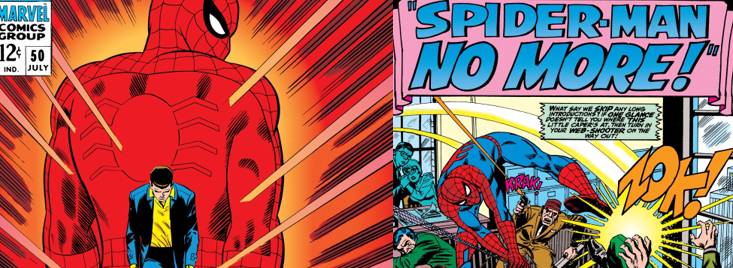
Story Title: “Spider-Man No More!”
Published: 11 April 1967 (cover-dated July 1967)
Writer: Stan Lee
Artist: John Romita Sr.

The Background:
Considering Spider-Man’s debut almost didn’t happen, it’s pretty ironic that Stan Lee and Steve Ditko‘s angst-ridden teenage superhero would go on to become the flagship character of Marvel Comics. Over the years, Spider-Man has been involved in some of Marvel’s most celebrated, and notorious, story arcs, and the troubled wall-crawler is often depicted battling his own personal woes as often as one (or more) of his colourful rogues. In 1967, he faced one of his most trying challenges when, burdened by J. Jonah Jameson’s hate campaign, Peter walked away from his responsibilities as a superhero in one of the character’s most influential stories, which also introduced readers to one of the most notorious Marvel villains, Wilson Fisk/The Kingpin.

The Review:
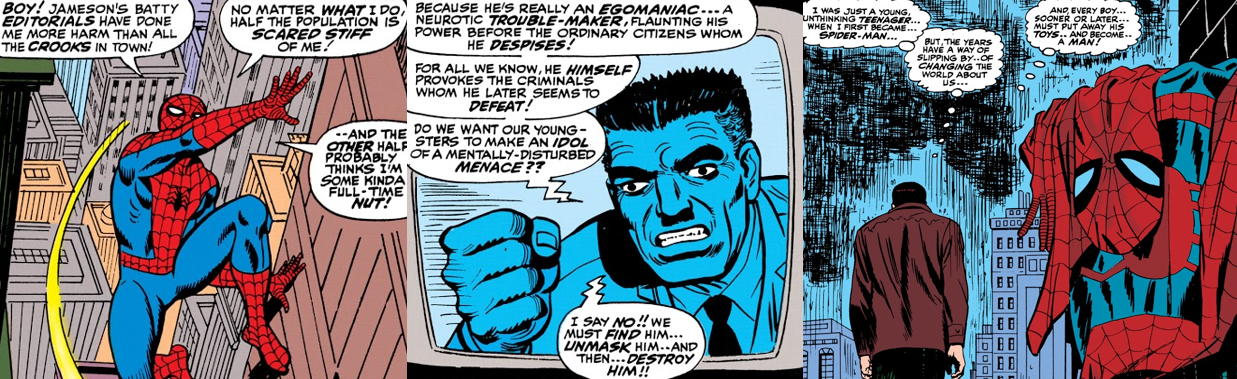
“Spider-Man No More!” kicks off with a bang courtesy of a visually stunning full-page splash from one of comic’s greatest artistic talents, John Romita, who practically wrote the book on how dramatic and spectacular Spider-Man’s depiction should be. With absolutely no context at all, we’re thrown right into the action as Spider-Man tackles a group of armed thugs who are in the process of pulling off some kind of heist. As is commonplace in sequences like this, the crooks are stunned at Spidey’s superhuman agility, which allows him to easily dodge bullets, and completely powerless against his superhuman spider strength, which easily allows him to shrug off even their combined assault and render them all unconscious with a few hard-hitting blows. However, despite saving the day in magnificent fashion, Spider-Man is met with fear and suspicion by one of the employees he saved, and he swings away cursing the efforts of grouchy Daily Bugle editor J. Jonah Jameson at painting him as a crazed masked maniac. Thanks to Jameson’s editorials, half of New York City is either terrified of him and thinks he’s just as bad as the many colourful supervillains in town and the other half thinks he’s mental, which he can’t help but be bothered by considering the populace celebrates other costumed superheroes like the Fantastic Four and the Avengers. Peter’s woes that, no matter what he does or how hard he tries, the public hates him more and more are only added to when he returns to his apartment and learns from his friend and roommate, Harry Osborn, that his beloved Aunt May has fallen ill. We’re not told what, exactly, May has been stricken by, however; she’s simply had “another attack” and been left bedbound. Naturally, Peter blames himself for his aunt’s condition; after all, if he’d been at home rather than putting his life on the line for his own sense of self-gratification, he would’ve been able to get there faster and he’s burdened by his unreliable nature due to his superheroics.

Burdened by his woes and Jameson’s smear campaign, Peter gives up his costumed identity.

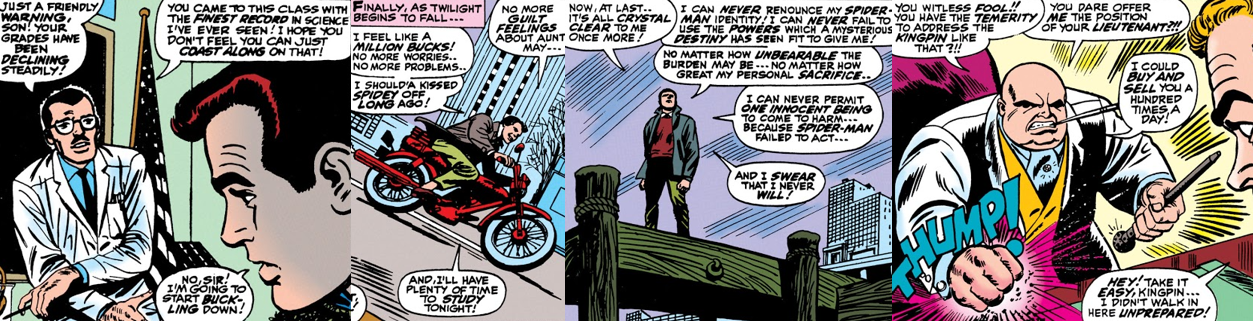
Beating himself up and already blaming himself for not being there for the only family he’s ever known and has left, Peter’s unable to concentrate on his studies, which directly translates into him struggling through a test the next day and receiving a kindly warning from his Physics teacher, Professor Miles Warren, about his steadily declining grades and that his once-impressive science record won’t allow him to coast along unless he puts in the work. To make matters worse, Peter’s so troubled by his aunt’s health and his failing grades that he’s forced to turn down a genuine offer from beautiful socialite Gwen Stacy, which only further adds to his woes as he kicks himself for not having the time or enthusiasm to find out if the likes of Gwen or seemingly scatter-brained Mary Jane Watson are really interested in him or have more depth to their personalities. Peter’s even had to turn down a fantastic job working for Harry’s dad, Norman Osborn, because he has to keep his evenings free in case Spider-Man is needed, and his troubles reach boiling point when he turns on the television and is faced with a malicious rant from Jameson painting Spider-Man as a neurotic trouble-maker who provokes villains for his own ego. Jameson’s so sure that Spider-Man is a menace to society that he offers a whopping $1000 reward for the capture and conviction of the web-slinger and Peter reaches his breaking point. Realising that his colourful alter ego has brought him and those around him nothing but pain, Peter begins to think that Jameson is right, that he’s been swinging all over town out of some childish, selfish desire for attention, and dramatically dumps his costume, and the identity of Spider-Man, in the trash once and for all.

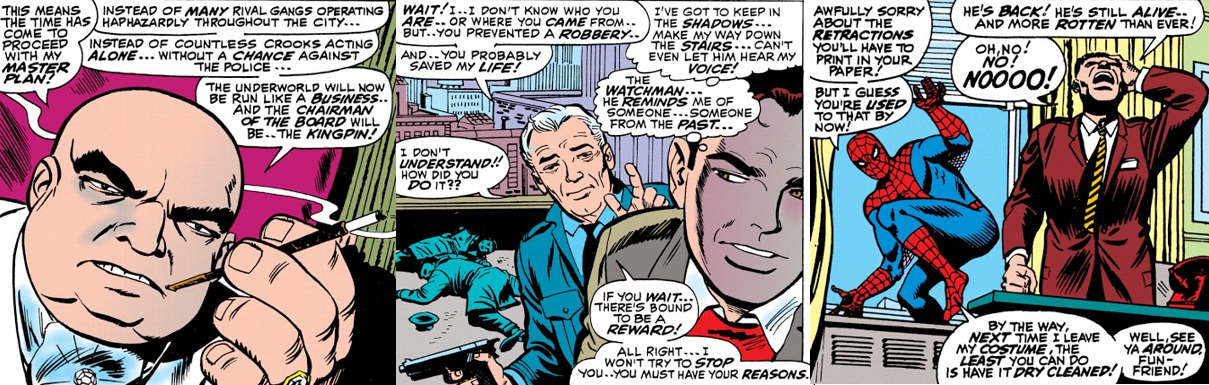
As the Kingpin seizes power, Peter is reminded of his responsibilities and returns to action once more.

Of course, Jameson is overjoyed when a small boy delivers him Spider-Man’s costume and that his smear campaign has worked, publishing his victory on the front page to a largely incredulous New York City (it’s actually endearing how his readers see it as nothing more than a publicity stunt and actually show support for Spider-Man). Peter follows up his decision by quitting as Jameson’s lackey, much to his comical outrage, though the publisher delights in bragging about his triumph and proudly displays Spider-Man’s costume in a trophy cabinet in his office. Meanwhile, the city falls into anarchy as the Kingpin takes the opportunity to consolidate the city’s various mobsters and gangsters under his direct supervision, organising them in a way they’ve never been before and leading to a flurry of crimes, all of them in broad daylight, that threaten to tax the city’s police department to their limit. Peter, however, is having a whale of a time; no longer having to devote his time and energy to crimefighting, he’s finally able to socialise with Gwen, dote on his recovering aunt, and catch up on his studies. He’s even giving serious thought to taking up Norman’s job offer once Aunt May is fully recovered but, while he catches himself in the act of responding to the news of a robbery at the welfare office, he instinctively acts without hesitation when he sees a watchman being set upon by armed thugs. Chastising himself for going back on his promise so quickly, Peter is devastated when he realises that the kindly old watchman has the likeness of his beloved Uncle Ben. All at once, the pain and guilt of his irresponsibility catch up to the troubled teenager as he relives his childhood and his failure to us his great powers responsibly, which directly caused his uncle’s death, and he realises that it’s his burden, his duty, to set aside his personal woes and use his superpowers for the benefit of others to atone for that loss. Thus, he breaks into Jameson’s office, recovers his costume, and pranks the editor with the promise of flooding the city with more Spider-Men before swinging off into the city rejuvenated once more.

The Summary:
If you came into “Spider-Man No More!” expecting fast-paced, hard-hitting action and to see Spider-Man pummelling goons and supervillains galore, then you’re probably going to be disappointed. Instead, in keeping with the story being published in The Amazing Spider-Man’s fiftieth issue, what we have here is a deep dive into Peter’s troubles and a new spin on detailing exactly why he’s cursed to set aside friends and even family to save lives as Spider-Man. It’s not uncommon for comics, especially Spider-Man stories and tales from this era, to constantly rehash a character’s origin but I think it’s used to good effect here and almost makes The Amazing Spider-Man #50 a kind of starting off point for new readers. Thanks to being overwhelmed by his aunt’s failing health, his non-existent social life, his declining grades, and Jameson’s smear campaign, Peter has lost sight of his mission and fallen into a depression so deep and so dark that the only solution he can think of is to literally and figuratively ditch his costumed identity in one of comic’s most iconic panels. We see the effect this has on Peter right away; no longer does he have to shun Gwen or Mary Jane or his studies since he has the time and focus to think about things other than crimefighting or swinging off to help with the next emergency. He can be there for May, relax with his science books, and apply himself in far more productive ways, literally turning his frown into a smile as he happily goes about his daily business without the burden of Spider-Man weighing him down. Peter even takes a great deal of pleasure in quitting from the Daily Bugle, a job that has always underpaid and underappreciated him, and is perfectly happy to let the city police handle  the escalating crime way sweeping across the town.

Peter’s joy at rediscovering his life is short-lived since Spider-Man’s powers will always be needed.

While New Yorkers are troubled by Spider-Man’s absence, the Kingpin sees it as a fantastic opportunity and makes an impact with his plan to consolidate the disparate gangs and criminals into something more akin to a business, with him as the chairman of the board. Though he doesn’t physically get involved in the action, he showcases his threat when Farley Stillwell tries to get in on the action and quickly makes a name for himself in the criminal underworld through his organisational skills and lofty goals. Although Peter is quick to chastise himself for reverting to type so quickly, he reasons that he had no choice but to act when he saw the watchman’s life in danger, and this brings back a flood of memories that we’re all keenly aware of but which serve as a stark reminder to the troubled youth that he has an obligation to use his gifts responsibly, regardless of the cost to his social life or his own desires. Having been reminded of his life’s mission, and perhaps feeling a sense of closure at having saved his uncle’s doppelgänger, Peter immediately returns to action as Spider-Man; though the story doesn’t resolve how he’s going to juggle his friends, family, and studies, it can be assumed that he’s at least more at peace with his duel identity for the time being and more than ready to make up for lost time. Overall, there’s a reason “Spider-Man No More!” is one of Spider-Man’s most celebrated adventures; what it lacks in action, it makes up for in interpersonal drama and a character study of everyone’s favourite web-head and the story is perhaps the quintessential reminder of the heavy burden Peter must carry lest he fail to use his gifts responsibly and indirectly cause more death or heartache. It’s a tragic tale, to be sure, but also one that encapsulates everything Spider-Man is; he sets aside his personal desires for the greater good and, even when he does take the time to be selfish for a change, his inherent need to help others will always win out, which is a message we could all stand to learn from.

My Rating:

Rating: 4 out of 5.

Great Stuff

Are you a fan of “Spider-Man No More!”? Where would you rank it amongst Spider-Man’s many other stories and moments? What did you think to Peter’s troubles and his decision to quit being Spider-Man? Do you think Peter was maybe a little too angst-ridden and could’ve found a better way to balance his duel identities? What did you think to the Kingpin’s plot to unite the city’s criminals? Do you think the resolution to Peter’s anguish was a bit rushed or did you enjoy that he got to save his uncle’s proxy? Would you say that Spider-Man is an egomaniac and a menace or do you think he’s a benefit to the city? How are you celebrating Spider-Man this month? Whatever your thoughts on Spider-Man, and “Spider-Man No More!”, share them below or drop a comment on my social media and be sure to check out my other Spider-Man content!

Back Issues: Captain Atom #83

Story Title: “The New Blue Beetle”
Published: November 1966
Writers: Steve Ditko and Gary Friedrich
Artist: Steve Ditko

The Background:
In 1939, comics readers were introduced to Dan Garret, a policeman who fought crime in a suit, fedora, and domino mask as the Blue Beetle, a shameless knock-off of Britt Reid/The Green Hornet created by Charles Nicholas Wojtkoski and who eventually found his way into the pages of Charlton Comics. Given the time period, where pulp crimefighters were beginning to be overtaken by more theatrical costumed superheroes, Garrett is often forgotten in the legacy of the Blue Beetle, especially when comparing his impact to that of his immediate successor. In 1966, the legendary Steve Ditko reimagined the Blue Beetle as genius inventor Theodore “Ted” Kord during the “Silver Age” of comics books, where many superheroes with given new origins and powers to fit the then-modern age. Despite debuting in a back-up feature and never rising above the status of a lower tier crimefighter, Ted gained far greater mainstream exposure thanks to his tenure on Justice League International and friendship with Michael Carter/Booster Gold; Ted even went toe-to-toe with Doomsday, unlike many of his more powerful comrades, and was even shockingly and graphically executed on-panel during the build-up to the universe-shaking Infinite Crisis (Johns, et al, 2005 to 2006). While still a relatively obscure character in the DC hierarchy, Ted is often regarded as one of the best incarnations of the Blue Beetle and he’s featured far more prominently in ancillary media compared to his predecessor, including multiple animated appearances and even appearing in live-action in the tenth series of Smallville (2001 to 2011).

The Review:
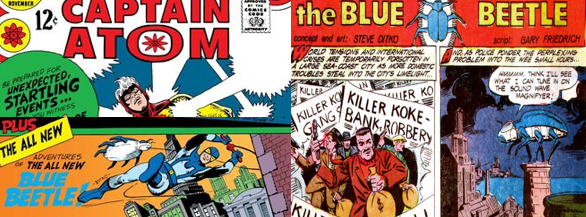
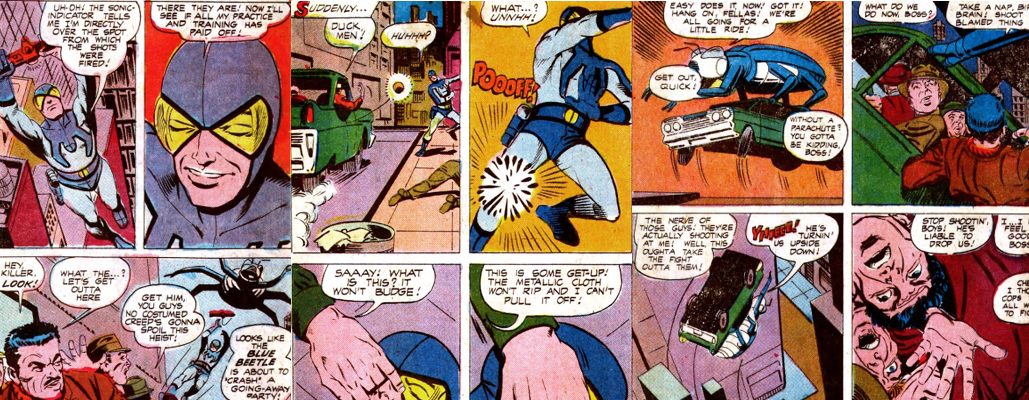
Similar to this predecessor, Ted Kord’s debut outing as the Blue Beetle begins not only with him already in the bug-themed guise of a masked crimefighter but also in the midst of a crime wave sweeping his city as the “Killer Koke Gang” make headlines for their many violent robberies. Unlike Dan Garret, however, Ted Kord’s Blue Beetle is tripped out on technology; he already has a massive, beetle-shaped hovercraft from which he can tune into sound waves throughout the city in search of trouble. When he picks up the sounds of gunshots from a nearby bank, the Blue Beetle flies into action, literally, guiding his craft through the night sky, though he strangely chooses to drop out of the craft and pilot it while hanging beneath it from a handle and wire. Although his monologue shares that he’s put in many hours of training, this is also still the Blue Beetle’s first field test and taste of real-world action; he’s so nervous about it that he almost clips a nearby building, but his presence certainly serves to put the wind up Killer Koke and his thugs.

Despite a minor setback, Ted Kord has a successful first night as the new Blue Beetle.

The Blue Beetle comes swinging in, fists flying, easily dispatching Killer Koke’s men with a deftness and skill despite their superior numbers and weaponry. Just as he’s feeling the thrill of the action, though, one of the goons tosses…some kind of spherical explosive…at the Blue Beetle’s knee, which manages to knock him unconsciously. Luckily for Ted, the thugs can’t get his mask off to learn his true identity and they’re scared off by a single cop before they can finish him off. When he comes to, the Blue Beetle assumes they fled because he was too much for them…even though he clearly saw one of them tossing that thing, whatever it was, at him. He summons his flying craft and makes a swift exit, praising his technology and prowess the entire time. Thanks to his amazing craft, the Blue Beetle is easily able to catch up to Killer Koke and his goons, literally snatching their car off the ground and depositing them, rattled and humiliated, at police headquarters. Although Killer Koke claims that the Blue Beetle was really behind it all, the cops are unconvinced and take them away, and the story comes to an end with the Blue Beetle name-dropping Dan Garret, suggesting a relationship between the two, and again praising the genius of his technology, such as the lock underneath his chin that kept him from being unmasked, and expressing excitement for his next crimefighting adventure.

The Summary:
I really didn’t think much of Dan Garret’s first outing as the Blue Beetle and, sadly, the trend continues here. Thanks to the immortal Steve Ditko, the art is at least much more palatable this time around; I’ve always liked Ted Kord’s Blue Beetle costume and, despite how corny it is with its overt bug theme, it’s at least more on brand with his masked persona that the suit-and-fedora combo of his predecessor. Ted Kord goes one step further than Dan Garret by having a massive beetle-shaped craft that doubles as a base of operations and his transport around town; it also leans into his branding and gives him an edge not shared by many other superheroes, who are more likely to utilise cars or motorcycles before jumping in a flying contraption. Having said that, though, it is all incredibly goofy; there’s nothing wrong with that, of course, and it makes for some fun visuals and concepts, but it’s just a bit weird seeing this massive metallic beetle rocketing through the city and scooping up cars. Similar to his predecessor, we learn almost nothing about this new Blue Beetle; we don’t even learn his true name in this story, much less delve into the relationship he may or may not have with Dan Garret or his motivations behind taking up the Blue Beetle mantle.

Despite his fancy new gimmick, Ted’s debut is barely any better than his predecessor’s.

Again, I’m okay with that, not every first appearance needs to be an origin story after all, but it does mean that Ted’s first appearance is more about expositing his technology than anything else. There’s still a sense of relatability to him; he appears to have no superhuman powers, starts the story itching to put his training to the test and nearly costing himself dearly because of it, and, for all his obvious fighting skill, he’s still flawed enough to be rendered unconscious by…whatever that thing was that was thrown at him. Killer Koke and his gang are just regular street-level mooks; they’re violent bank robbers and that’s about it, warm bodies for the Blue Beetle to beat up and prove himself against, and he’s very happy with how his first night went, despite nearly being unmasked, because he was smart enough to put a clasp on his cowl. I think it actually might’ve been better to showcase him using more gadgets in his fight rather than his fists to truly separate him from Dan Garret and lean into him being a more technologically-inclined crimefighter. As is, we’re presented with a guy who clearly has the time, means, and money to go out busting bank robbers with a fancy suit and craft but little that makes him stand out from other, similar costumed heroes. I’ve always been a fan of Ted Kord’s and he’s always been quite a goofy character, so I don’t want to begrudge his first appearance too much, but it’s surprising he was able to excel as far as he did after such a mediocre first outing.

My Rating:

Rating: 2 out of 5.

Could Be Better

What did you think to Ted Kord’s debut as the Blue Beetle? Were you stunned by how different he was, visually and in concept, to Dan Garret? What did you think to his costume and mechanical bug craft? Were you disappointed by ineffectual Killer Koke and his gang were and do you know what that thing was they threw at Ted? Which incarnation of the Blue Beetle is your favourite and what are some of your favourite Ted Kord moments? Whatever you think to the Blue Beetle, share your thoughts below or on my social media and be sure to check out my other Blue Beetle content across the site.
Movie Night [K-DAY]: Pacific Rim


In this absolutely bonkers science-fiction film, the monstrous Kaiju first attacked humanity on 10th August 2013. The attack ended a few days later on August 15th but, in that time, San Francisco, Sacramento, and Oakland were completely devastated and the Kaiju War officially began. Accordingly, August 10th became known as “K-DAY” and is, for me, a fantastic excuse to talk about some giant monster movies!


Released: 12 July 2013
Director: Guillermo del Toro
Distributor: Warner Bros. Pictures
Budget: $180 to 200 million
Stars: Charlie Hunnam, Idris Elba, Rinko Kikuchi, Charlie Day, Robert Kazinsky, and Ron Perlman

The Plot:
In 2013, alien monsters dubbed Kaiju emerged from an interdimensional portal at the bottom of the Pacific Ocean. To combat these creatures, humanity built massive robots called Jaegers, which are mentally controlled by pilots, and sealed their cities behind gigantic walls. By 2020, the war has taken its toll and washed-up Jaeger pilot Raleigh Becket (Hunnam) is called out of retirement and teamed with rookie pilot Mako Mori (Kikuchi) as part of a last-ditch effort to defeat the Kaiju.

The Background:
Although Godzilla has proven to be the most famous kaiju creature ever created, the atomic monster is very much a creation of Japan and the West has struggled to really have a counterpart to the Big G; sure, King Kong came first and has significantly influenced cinema, but we’ve not really created a giant creature to match Godzilla’s popularity. Celebrated filmmaker Guillermo del Toro sought to change that when he learned of Travis Beacham’s concept for a kaiju film that would become Pacific Rim; del Toro worked closely with Beacham to refine the script, suggesting scenes and concepts and urging his visual designers not to look to previous kaiju films for inspiration in the hopes of crafting something fresh and new that would introduce both the Kaiju and Mecha genres to a new audience. Industrial Light & Magic were behind the film’s spectacular and varied special effects; over one-hundred Kaiju and Jaegers were created for the filmmakers to choose from, and the Kaiju were specifically designed to evoke the man-in-a-suit aesthetic of classic Kaiju films while the Jaegers took inspiration from landmark buildings and war machines. Pacific Rim went on to gross over $400 million at the box office and was met with generally positive reviews: critics praised del Toro’s imagination and visuals, the spectacular action sequences and the chemistry between the actors. While some criticised the dialogue and plot, the film was accompanied by a poorly received videogame, an anime and, eventually, a less critically and commercially successful sequel, and talks of a crossover with Legendary Pictures’ “MonsterVerse” continue to do the rounds.

The Review:
I remember being a little late to the Pacific Rim party; a co-worker told me about the trailer and the concept and, as a massive kaiju fan, I was immediately intrigued but boy did I underestimate how bat-shit crazy the trailer and the resulting movie actually was! Pacific Rim outlines its concept in its opening moments, even providing a translation of the words “Kaiju” and “Jaeger” for our convenience, to help establish the premise of the film. Rather than falling from the stars, alien life comes from a mysterious portal, the “Breach”, deep beneath the Pacific Ocean. Later in the film, it’s revealed that the Kaiju are a genetically-engineered extermination force created by the alien “Precursors”, and their impact is immediate and violent and aims for nothing less than the extinction of humankind. Unlike in some giant monster movies, Pacific Rim provides a glimpse of the Kaiju’s destructive potential within the first few moments, showing (through news reports) the devastation brought to San Francisco in the first attack by a near-300-foot-tall creature subsequently dubbed “Trespasser” by the Pan Pacific Defense Corps. In six days, Trespasser destroyed three cities and claimed “tens of thousands of lives” before the military was finally able to put the beast down with tactical nuclear missiles; though the world tried to move on from this attack, another Kaiju emerged six months later, then a third, a fourth…and all too soon, it became evident that these weren’t isolated incidents but actually a full-blown invasion.

Raleigh is struggling with his brother’s death but unable to deny his desire to pilot a Jaeger again.

To combat the colossal invaders, the world’s governments finally set aside their differences to formulate a joint defence initiative, and the Jaeger Program was born. Rather than rely on jets, tanks, and heavy, nuclear artillery, humanity created monsters of their own, gigantic mechanical machines called Jaegers. Jaegers are massive, heavily armoured, and sport all kinds of bells and whistles; from missiles to swords, rocket propulsion and even a plasma cannon. Rather than being gigantic robots, Jaegers are controlled by at least two human pilots (Crimson Typhoon’s Cheung (Charles Luu), Hu (Lance Luu), and Jin (Mark Luu) Wei Tang are the only three-pilot team) by “Drifting” to share the neural strain. Still, it takes a great deal of mental and physical strength to pilot a Jaeger; pilots need to fully trust each other, their movements and thoughts need to be in perfect synchronisation, and they also need to be “Draft compatible” otherwise the strain becomes too much and will almost certainly result in death. This is a problem for our main character, Raleigh; his bond with his older brother, Yancy (Diego Klattenhoff) made them a formidable team in command of Gipsy Danger, but he was left grief-stricken and guilt-ridden after Yancy was killed by the Kaiju “Knifehead”. Thanks to the neural uplink, Raleigh experienced all of Yancy’s pain and fear at the moment of death and that, as much as the strain of piloting Gipsy Danger alone, traumatised Raleigh so badly that he quit the fight. Since the frequency and aggression of the Kaiju attacks escalates to the point where the Jaegers can’t be built fast enough to fend them off, the United Nations cuts funding to the project in favour of massive walls to shield major coastal cities from attacks. Raleigh finds himself drafted back into service when the walls prove completely useless when the Kaiju make their return, and he’s forced to join the few Jaeger pilots who remain from all corners of the world to once again bring the fight to the invaders.

Mako longs to put her training and trauma to use in directly fighting the creatures that took her family.

Only those with the strongest mental capacity succeed at piloting Jaegers; Drifting takes a heavy toll as the pilots are bombarded with the thoughts, memories, and fears of their co-pilot, and Raleigh is initially sceptical that he can have a bond as strong as the one he had with his brother. Additionally, he faces some distrust and resentment from the likes of Chuck Hansen (Kazinsky); Chuck and his father, Hercules (Max Martini), pilot Striker Eureka, the most powerful and successful Jaeger in the corps but, while Hercules is accepting of Raleigh given his knowledge of he and Yancy’s time piloting Gipsy Danger, Chuck is resentful of Raleigh abandoning the cause and arrogant in his skills as one half of the top Jaeger team. Central to Raleigh’s reintroduction to the Jaeger program is the timid Mako Mori (Kikuchi), who, despite being in awe of his physical appeal, initially doubts his suitability as a pilot due to his reckless nature and is tasked with finding him a suitable co-pilot. Naturally, Raleigh finds her an alluring presence, especially given he’s surrounded by grizzled soldiers (most of whom are men), but his interest in her only increases when, during a training session, he finds that they’re Drift compatible. Unfortunately, Mako is still struggling with a traumatic experience from her childhood where she was left paralysed with fear during a Kaiju attack. This, alongside Raleigh’s lingering guilt over Yancy’s death, means that she struggles to push past her ordeal and shows just how mentally fit a Jager pilot has to be to keep their focus on the here and now rather than getting lost in the allure of memories. Her desire to fight is admirable, but she not only lacks the proper combat experience but is also held back by her adopted father, and commanding officer, the grizzled and hard-nosed Marshal Stacker Pentecost (Elba).

The no-nonsense Pentecost is absolutely committed to ending the Kaiju threat, no matter the cost.

Pentecost is a man who absolutely exudes authority from his very core. Commanding respect from all around him, Pentecost disregards the United Nations’ threat to cut their funding and instead initiates a widespread recruitment initiative to get whatever pilots he can into the few Jaegers he has left but, while he’s able to inspire Raleigh to return to the cause by appealing to his innate fighting spirit, Pentecost is not quite as willing to allow Mako the chance to sign up to the Jaeger program since he knows she’s not mentally prepared and he’s extremely overprotective of her. Though a straight-talking figure with a penchant for rousing, pragmatic speeches and demands, Pentecost only delivers the information he deems necessary to his Rangers; his goal is not to be their friend, or their father, but rather a consistent source for them to focus their efforts on, but his steadfastness falters when Mako is involved purely because he is so protective of her. Years ago, he saved her from a Kaiju attack and he’s been grooming her to focus her anger and desire for revenge, crafting her into the perfect soldier and pilot, but time is against him and he is reluctant to let her step into a Jaeger without more training. Pentecost’s options, however, are quickly becoming limited; not only are the Kaiju attacks predicted to increase, but he’s also dying from radiation poisoning from his days of piloting Jaegers with insufficient shielding, all of which culminates in him strapping into a Jaeger once more in a last, desperate bid to seal the Breach once and for all. The Breach, and the Kaiju themselves, are closely monitored by eccentric and bickering scientists Doctor Newton “Newt” Geiszler (Day) and Doctor Hermann Gottlieb (Burn Gorman), two extremely different and conflicting personalities who have vastly different opinions on the Kaiju threat. While Gottlieb is convinced that the Breach will soon stablise and remain open, allowing not only for Category V Kaiju to emerge but for the creatures to attack in full force, Newt is obsessed with the idea of Drifiting with a living Kaiju brain in order to earn more about them. While he’s able to glean some intel on the creatures using this technique, he’s forced to turn to black marketeer Hannibal Chau (Perlman), a peculiar gangster who has profited from selling harvested Kaiju organs on the black market since it’s exceedingly difficult to gather specimens from the creatures.

Monstrous Kaiju emerge from the Breach to exterminate humanity!

Newt’s compulsion to Drift with the Kaiju brain causes him a great deal of mental strain, and also results in the first-ever double Kaiju attack and the discovery that the Breach can only be opened in the presence of Kaiju DNA, which proves pivotal in the final, desperate assault on the portal. The Kaiju are demonic, monstrous beings that sport thick, leathery hides, bony appendages, and which plough through cities and conventional weapons without fear in a single-minded quest to eradicate all life in their path. The creatures originally emerged millions of years ago, during the time of the dinosaurs, but couldn’t survive in the climate so they waited centuries until, thanks to our destructive and pollutive ways, humanity had “practically terraformed” the planet into a far more hospitable environment for the invaders. Over the years, Kaiju attacks have become frequent but also highly predictable; the Pan Pacific Defense Corps monitor the Breach closely and are able to determine the size and strength of each creature, which is given a suitably fitting moniker and categorised according to the “Serizawa Scale”, with Categories I and II being the weakest. The most powerful Kaiju in the film is “Slattern”, the first Category V Kaiju ever recorded; they sport acidic blood, self-destruct on death, emit a highly toxic substance called “Kaiju Blue” that contaminates the environment, and some can even emit electromagnetic pulses as the Precursors strive to better adapt their creatures for combat against humanity. Monstrous and lacking in anything other than pure, unadulterated destruction in the name of their creators, the Kaiju threat is often downplayed since they have become so frequent that people have learned to expect and live with them. Jager pilots are treated like celebrities, Kaiju are turned into action figures or revered by “groupies” like Newt for their impressive physiological allure, and yet Pentecost is right there on the ground level able to see with his own eyes that the attacks are increasing and witnessing his pilots dying trying to defend what’s left of humanity from all-out apocalypse.

The Nitty-Gritty:
One of the things I enjoy about Pacific Rim is how humanity is literally depicted as teetering on the brink; it’s not quite a post-apocalyptic story, but it’s verging very close to one as the Kaiju attacks increase. There’s a definite sense that everything, literally everything, is being put into the Jaeger project and the massive walls being erected; while bustling cities still exist and much of society continues on regardless, I think it’s fair to assume that these won’t last forever and you can see glimpses of how close humankind is to being snuffed out forever in just how elaborate the Jaegers, the Shatterdome, and even the walls are as there’s no way that we aren’t burning through our resources at an alarming rate producing such extravagant defensive measures. Crime and profiting from the Kaiju attacks is also rampant, as best evidenced through Hannibal Chau, and the death toll and absolute devastation brought by the Kaiju is beyond catastrophic, and yet many still disregard or downplay the threat. While we’re told that all the world’s governments and people have come together to fight the Kaiju, there’s a significant number of people not working towards that cause, and the United Nations disregard the Jaeger program simply because they’d rather hide behind ineffectual walls.

While visibility is low at times, the giant monster battles are the most memorable part of the film.

Easily the most appealing aspect of Pacific Rim is the effects; like many of my favourite science-fiction films, Pacific Rim features a marriage between the practical and the fantastical for its aesthetics. The Jaegers and the Shatterdome have a huge amount of weight and depth to them, feeling large and cumbersome and having a real impact when they’re onscreen while also sporting a slick, steampunk-like presentation. This exists alongside the bustling, neon-drenched streets of Tokyo and futuristic, advanced technology like holographic interfaces and the Drift equipment. The film is an absolutely bonkers premise, one that immediately drops audiences into a world constantly under threat from not one but multiple giant monsters and where our best defense is giant mechanical machines. You might think that there’s got to be a better and less expensive way to fight the Kaiju than this, but that wouldn’t be anywhere near as visually striking now, would it? In true Guillermo del Toro fashion, there are plenty of practical effects to be found here, particularly in the rendition of the organs and body parts harvested from the Kaiju, though the Kaiju and Jaeger are largely rendered using spectacular CGI. The two titanic concepts make for a constant visual spectacle as they match blows between skyscrapers, tearing down landmarks like the Golden Gate Bridge and storming through Sydney, though there are instances where the action is noticeably difficult to follow thanks to taking place at night, at sea, and with rain pelting down and distorting the impressive visual effects. The low visibility can make the Kaiju a little difficult to distinguish, but they all look very different; some have horns on their heads, or are more bulbous, or sport split jaws and long, glowing tentacle-like tongues. Slattern is the largest and most dangerous, sporting three whip-like tails and a spiny protrusion of its chest for close and long-ranged damage, but the Kaiju are also capable of giving birth to smaller, equally vicious offspring. Thankfully, the Jaegers are more than up to the task of combating them; though their primary form of attack is to engage in hand-to-hand combat, the Jaegers also pelt the Kaiju with missiles, cut them up with blades and saws, and Gypsy Danger even uses a boat as a melee weapon in the streets of Tokyo!

Thanks to Pentecost’s sacrifice, the Breach to the Kaiju dimension is successfully sealed.

With time fast running out and the promise of increased Kaiju attacks becoming a startling reality, Pentecost is forced to put his final plan in motion; scrambling all of his remaining pilots and Jaegers together, he plans to strap a nuclear warhead on the back of Striker Eureka and drop it into the Breach to collapse the portal once and for all. However, Hercules is injured during an earlier attack, forcing Pentecost to replace him as Chuck’s co-pilot and, impressed with Mako’s compatibility with Raleigh, to sign off on his adopted daughter piloting Gypsy Danger into battle. After finally getting on the same page and Drifting with a Kaiju brain, Newt and Gottlieb relate that the Jaegers must latch onto a Kaiju in order to enter the Breach or else the weapon will simply be deflected, as always, but this is made all the more difficult by the first instance of a triple Kaiju emergence, and the appearance of Slattern at the Breach. What follows is an action-packed battle between the last two Jaegers and the three Kaiju deep beneath the ocean which sees Striker Eureka damaged in the attack, forcing Pentecost and Chuck to sacrifice themselves to clear a path for Gypsy Danger. Since Gypsy Danger is an older, nuclear-powered Jaeger, the mech itself acts as the pay load and they’re able to skewer Slattern and ride it into the ethereal, bizarre dimension that lays beyond our own world. In a last minute bit of tension, Raleigh scrambles to overload Gypsy Danger’s nuclear reactor but he’s ultimately successful, collapsing the Breach and escaping back to the surface alongside Mako with the assumption being that the Kaiju assault has been ended once and for all.

The Summary:
I feel like Pacific Rim has kind of been forgotten a bit over the years; at the time, it was a pretty spectacular prospect, and American-made giant monster movies weren’t exactly the norm, though the first few Transformers movies (Bay, 2007 to 2011) were acclimatising audiences to seeing big, mindless robotic creatures duking it out onscreen. Pacific Rim has a lot more going for it than those dumb-ass films, however, though maybe there’s a little too much happening in the film: we’ve got Kaiju, portals, giant mechs, neural links, advanced technology…I’m honestly surprised there aren’t actual psychics here, too. Still, I enjoy that there’s a lot of action and destruction and variety; the low lighting can make some of the fights a little difficult to make out, but the Jaegers are all quite distinctive with their different paint jobs, limbs, movements, and weapons. The Kaiju have very similar leathery hides but also look a lot different when we get a good shot at them; glowing with neon blue highlights and sporting massive claws and monstrous, demonic appendages, they waste no time in making an immediate impression and the film is bolstered by a decent influx of action. Interestingly, it’s not the giant monsters of robotic mechs that are the most over the top thing about the film, it’s the acting. Filled with brilliant character actors, Pacific Rim is strengthened by a shot of machismo and some truly scenery-chewing performances by Charlie Day, Burn Gorman, and Idris Elba. Elba is the clear standout with his gruff demeanour, which he maintains despite carrying the weight of the world on his shoulders, though Charlie Hunnam is just charismatic enough to work as the square-jawed, reluctant hero. Naturally, it’s the big monster/robot battles that are the true spectacle of the film and make it a rollicking movie to throw on with some beers and pizza; there’s a decent attempt at a deeper message regarding uniting against a common foe and taking better care of our world, but you’re watching Pacific Rim to see giant mechs smashing seven kinds of shit out of Godzilla wannabes and that’s exactly that it delivers.

My Rating:

Rating: 4 out of 5.

Great Stuff

Were you a fan of Pacific Rim? Did you enjoy the concept, or was it a little too over the top for you? Which of the Kaiju and Jaegers was your favourite? What did you think to the human characters, particularly Idris Elba and his rousing speeches? Who would you Drift with if you were a Jaeger pilot? What’s your favourite kaiju movie, and how are you celebrating K-Day today? Whatever your thoughts on Pacific Rim, kaiju, or monster movies in general, please do leave a comment below or respond to my social media and be sure to check back in for more giant monster content in the near future!

Horror Hullabaloo: 10/08/2023

Gillian Church posts regular Writing Prompts on her Horror Prompts Instagram account and I like to take part with a few snippets and pieces of flash fiction.

The Prompts:
Spoiled, Rocket, Junkyard, Limp, Flavour, Ouija, River, Cellar, Eyeglasses, Secret  

The Submission:
Roger stumbled about in the darkness of the cellar, batting cobwebs and creepy-crawlies from his hands as he swept the dirt-ridden floor. He sighed and wiped his eyeglasses, wishing he hadn’t spoiled himself so much in front of the TV and had tidied the cellar sooner. 

He cursed as a rotting shelf partially collapsed, the splinter wood hanging limp and spilling spiders, paint pots, and a curious rectangular object to the floor. Roger bent and retrieved it, curious to what secrets were hidden away down in the dark. 

He wiped decades of dust from the board and read one word, Ouija, and felt his mouth go dry. He’d heard about these from his mother but thought they only belonged in movies; he could hear her now, insisting he toss it into the nearest river or bury it at the junkyard, but his curiosity rose like a rocket

Roger clambered up the stairs, his chores forgotten, itching for just a flavour of the allure the board offered, wondering if its power would allow him to communicate with his mother, his father, and the other bodies long buried in the cellar. 


What did you think to this piece? Did you submit anything for Gillian’s prompts? Have you ever written any flash fiction before? I’d love to know what you think to my snippets and writing prompts, so feel free to sign up and let me know what you think below or leave a comment on my Instagram page. You can also follow Gillian Church and Horror Prompts to take part in regular writing challenges.

Movie Night: Teenage Mutant Ninja Turtles: Mutant Mayhem

Released: 2 August 2023
Director: Jeff Rowe
Distributor: Paramount Pictures
Budget: $70 to 80 million
Stars: Nicolas Cantu, Micah Abbey, Shamon Brown Jr., Brady Noon, Ice Cube, Ayo Edebiri, and Jackie Chan

The Plot:
After years of being sheltered from the human world, four mutated turtle brothers embark on a quest to be accepted as normal teenagers by the people of New York City through acts of heroism. With the aid of their new friend April O’Neil (Edebiri), they target a mysterious crime syndicate, but trouble arises when an army of mutants is unleashed upon them!

The Background:
Created by Kevin Eastman and Peter Laird as a violent pastiche of comic book tropes, the Teenage Mutant Ninja Turtles (TMNT) achieved mainstream success with their toys and cartoons. After this translated into cinematic success, the TMNT became semi-regular staples on the silver screen; however, their box office potential began to wane over time, with their under-rated second and fourth outings receiving mixed reviews, their third being universally panned, and Michael Bay’s monstrous reimaginings being equally lambasted. Yet, the TMNT continued to flourish in various popular animated ventures and rights holders Nickelodeon were eager to bring the characters back to the big screen, so they partnered with Seth Rogan and Jeff Rowe to craft a new incarnation of the popular franchise. A life-long TMNT fan, Rogan aimed to emphasise the “teenage” aspect of the TMNT, which resulted in actual teenagers voicing the characters for the first time. Rogan was impressed by the cast’s camaraderie and much of the voice acting took place in group sessions to allow for more natural interactions between the characters, who were brought to life by over 120 animators at Mikros Animation and Cinesite. Inspired by the kinetic, comic book visuals of Spider-Man: Into the Spider-Verse (Persichetti, Ramsey, and Rothman, 2018), director Rowe wanted the animation to resemble concept art and imperfect comic book sketches to tie into the teenage focus. The TMNT were redesigned to be less bulky, have teenage frames and apparel, and the film’s many mutant characters were given exaggerated designs to reflect their individual personalities. Upon release, Teenage Mutant Ninja Turtles: Mutant Mayhem was met with widespread critical acclaim: critics praised the performances as much as the visuals and found it to be a reinvigorating revival of the long-popular franchise. Grossing over $180 million at the box office, Teenage Mutant Ninja Turtles: Mutant Mayhem was accompanied by a tie-in videogame, a spin-off animated series, and a sequel was also greenlit soon after.

The Review:
As is always the case when it comes to TMNT adaptations, Mutant Mayhem alters the TMNT’s origin story and the backstory of the mysterious ooze that transforms them, but in a way that touches upon many different iterations of the TMNT. The film begins with Doctor Baxter Stockman (Giancarlo Esposito) being hunted by mercenaries hired by his former employer, Cynthia Utrom (Maya Rudolph) of the Techno Cosmic Research Institute (TCRI), after he went rogue and stole the mutagenic ooze he was developing for them after forming a disturbingly familial bond with his animal test subjects, specifically the young mutant housefly who takes the name Superfly (Cube). Having felt ostracised and alone his whole life, Stockman planned to create a family of his own using the ooze but was left dead when TCRI attacked, which left Superfly to rescue his “siblings” and a stray cannister of ooze to fall into the sewers and mutate both Master Splinter (Chan) and the TMNT. Like in Michael Bay’s TMNT films, Splinter is once again just a normal street rat who comes to care for the infant turtles and decides the best way to protect them is to train them in ninjutsu, this time using YouTube videos and kung-fu movies rather than being a mutated ninja master or having learned from a ninja. Personally, I continue to find this a disappointing inclusion; it calls into question why the five are as skilled as they are when they’re simply mimicking what they see onscreen and I feel like it’s a bit weird to leave out Splinter’s legitimate martial arts background considering how bonkers the concept is in general and how hard this film otherwise runs with the surreal nature of the source material, to the point where the city is seemingly overrun with bombastic mutants.

The TMNT dream of being accepted by the outside world and being normal teenagers.

The TMNT are also very different to how I’ve seen them before; while they look very familiar and sport different body sizes relating to their capabilities (Raphael (Noon) is the biggest, Michelangelo (Brown Jr.) is the smallest and has braces, for example) and largely conform to the roles you’d expect (Leonardo (Cantu) leads and Donatello (Abbey) does machines, in the sense that he’s always got his headphones on), they’re characterised as teenagers, which is surprisingly rare in the history of the franchise, which often portrays them more as accomplished and responsible fighters who make the most of their downtime, with Mikey generally shouldering much of the comic relief. Here, they’re all very immature and easily distracted, especially by the outside world; they’re also largely untested outside of training and their own wild imaginations and develop confidence in their ninja abilities as the film goes on. Unlike in nearly every TMNT iteration before, there’s little in the way of internal conflict between them; Leo’s brothers mock and judge him for his strict adherence to Splinter’s mandate that they stay out of sight, but he’s easily swayed into straying off mission to see movies or enjoy the perks of the surface world, and his traditional rivalry with Raph is re-framed simply as an extension of the four ragging on each other for their flaws. The TMNT are lively, jovial, and squabble like bickering teenagers a lot of the time, making them as animated and kinetic as the film’s visually stunning art style; they are united in their love for their father and desire to please him but also in their longing to be normal teenagers and be accepted by humans, which they believe they can achieve if they perform heroic deeds to show that they’re not monsters. Overall, I found that the TMNT worked as a group, but individually had few chances to stand out: Raph is said to be full of rage but we rarely delve into this beyond a few instances where he delights in fighting, Donnie is more concerned with the apparent uselessness of his bo staff than he is with technical wizardry, Mikey is actually a little less goofy here since all the TMNT adopt many of his characteristics, meaning it’s Leo who edges out his brothers somewhat. He’s conflicted between his desire to live up to Splinter’s expectations and his yearning to join his brothers in revelling in the human world and this is only escalated when he instantly develops a crush on April. Yet, the film does a fun job of showing the TMNT grow and become more capable as a fighting unit as the film goes on, and this is reflected in Leo’s growing confidence as a leader even if his brothers give him a hard time over it.

Despite Splinter’s distrust of humans, the TMNT find a friend and ally in April.

As ever, the TMNT are sheltered and mentored by Splinter, now an overprotective father figure who has developed a severe hatred and mistrust of humans and the surface world. Having been shunned and ostracised his whole life, Splinter had never experienced love or affection until he stumbled across the mutated turtles and he’s desperate to hold onto that since, as he says, his boys are all he has. Since he knew how much the TMNT wanted to be a part of the outside world, Splinter took the baby TMNT up there only to be attacked and nearly killed by panicked New Yorkers. Thus, he resolved to keep them safe in the sewers and train them in ninjutsu to avoid being spotted when out for groceries, and Splinter’s characterisation is framed to mirror both Stockman’s relationship with his fledgling mutants and Superfly’s aggressive desire to create a world where he and his siblings won’t have to worry about being hounded by xenophobic humans. Although a bit overbearing and strict at times, Splinter truly loves his boys and wants what’s best for them and tries to appease their curiosity in his own way, but he’s powerless to stop them getting caught up in trying to prove themselves to humanity with the help of their human friend, April. A budding teenage reporter, April relates to the TMNT since she’s also been labelled and targeted after a comical blunder saw her vomit on-camera, so she’s desperate to turn her popularity around with a big story. Although she accepts them, she admits that others probably wouldn’t but is driven to document and aid their efforts in tracking down and apprehending Superfly since she wants to be popular and accepted, motivations that she later comes to realise are as selfish as the TMNT’s, yet they both resolve to do the right thing anyway since that’s what’s morally correct, regardless of whether people love or hate them for it.

Superfly and his crew plot to make mutants the dominant species to fight back against the likes of TCRI.

New York City is in the grip of a crime wave; news outlets are alive with reports of the mysterious Superfly orchestrating a series of robberies, but no one’s ever seen his face, not even the underlings the TMNT pummel for information. The TMNT are thus stunned and massively in over their heads when they find that Superfly is a monstrous mutated housefly and commands a crew of wacky and sadly underutilised mutants. Initially hyperactive Mondo Gecko (Paul Rudd) and Wingnut (Natasia Demetriou), wannabe singer Ray Fillet (Post Malone), meat-heads Bebop (Seth Rogan) and Rocksteady (John Cena), Aussie bruiser Leatherhead (Rose Byrne), slobbering cockroach Scumbug, and the forgettable Genghis Frog (Hannibal Buress) are painfully loyal to Superfly’s plan, to the point where they willing chase down the TMNT when they steal a vital component to his machine that he plans to use to mutate every animal on Earth. At first, Superfly and his crew embrace the TMNT as “cousins” and the TMNT even bond with some of his mutants, with Mikey and Mondo especially getting very close, but the TMNT cannot subscribe to Superfly’s plot to enslave, devour, and eradicate humanity, earning the mutated fly’s ire. Like Splinter, Superfly tried to rejoin society with his crew, only to be met with violence and bigotry, but he’s taken Stockman and Splinter’s distrust of society to a genocidal level and is determined to create a utopia for mutants by making them the dominant species on the planet. He sees this as the only way to protect his siblings from the likes of TCRI, who continuously hound the mutants in a bid to recover and replicate Stockman’s research by “milking” the mutants so they can create an army of genetically altered anthropomorphic soldiers. Superfly and Splinter’s paranoia about this comes to pass when the TMNT are briefly captured while trying to foil Superfly’s plot, but primarily exists to setup a later conflict in a future film and to forge a trust between Splinter and April that sees them uniting alongside Superfly’s easily turned crew to oppose the streetwise gangster in the finale when his plan sees him transformed into a kaiju-sized menace.

The Nitty-Gritty:
I’ve always been a big TMNT fan. I had the toys, watched the cartoons, played the videogames, and loved the original live-action movies (well…the first two, at least). When it comes to translating the TMNT to the cinema screen, I’ve come to regard animation as the best option; I loved Jim Henson’s super impressive practical suits and animatronic heads and would really like to see what modern technology could do with these traditional effects today, but animation allows for a near-infinite number of possibilities for the TMNT. Because of this, I’ve always held TMNT (Munroe, 2007) in high regard even if the plot was a little middling at times and the TMNT weren’t very visually distinct as it did such a good job of bringing them to life thanks to being entirely animated. I’m also a big fan of the frenetic visuals of the Spider-Verse films so I was intrigued when Mutant Mayhem was first announced, and even more so when I saw the big names attached to the project and teenagers being cast in the title roles for the first time. The TMNT have been reinvented numerous times over the years so it’s nothing new to me to see them and their supporting cast looking or acting different, and the film definitely does a really good job of paying homage to many aspects of the TMNT’s history, from the original Mirage comics to the ever-popular 1987 cartoon to the timeless 1990 live-action movie. This is best evident in the TMNT’s appearance; they mix aspects of the cartoons and toys into their designs (including the letters on their belts) and imagine themselves as stoic, silent ninjas much like in the original comics, yet their personalities are wildly different from both, allowing the film to present a new take on a long-running franchise.

The film has a fun and kinetic visual style that’s like a comic book come to life!

As ever, a primary theme of Mutant Mayhem is of family; Splinter and Superfly are motivated to protect their kin out of genuine concern for their welfare and prepare them to fight against inevitable xenophobia, and the TMNT and Superfly’s crew are both tight-knit groups, thought obviously the TMNT get more focus. Indeed, I do feel like Superfly’s crew could’ve been scaled down to just four mutants to give them more personality and better reflect the thematic parallels between Splinter and the TMNT as most of the crew don’t get to do much (Ray Fillet just sings his name over and over, I could barely understand Bebop and Rocksteady (who strangely turn good!), and Genghis Frog and Leatherhead may as well not be there). On the plus side, they do add to the film’s impressive visuals; the influence from the Spider-Verse films is strong here but Mutant Mayhem has a visual style all its own with this kinetic and eye-popping sketchbook-like aesthetic. Mutant Mayhem resembles a comic book come to life, or a new form of Claymation, and it really helps to give this new version of the TMNT a memorable and engaging appearance; when the TMNT fight, it’s with a fast-paced, frenetic action that gets more refined and methodical as their prowess and confidence improves, and every frame is a burst of colour, action, and creative lighting. The fights are subtly brutal at times, too; the TMNT and Splinter use weapons primarily defensively, but there were a couple of frames where it seemed like Leo, Raph, and Splinter had killed some of their attackers, which I appreciate as much as the film’s darker undertones regarding xenophobia and Superfly’s plans for humanity. Superfly himself cuts a monstrous figure at the best of times and his crew are suitably disturbing to behold, though sadly the film doesn’t give much depth to their personalities. While you could argue there’s more to his crew than meets the eye as they reveal that they only agreed to his plan as they saw no other option and readily accept a less destructive alternative, I’d say it comes across as quite rushed and the film could’ve spent more time showing the TMNT having a positive influence on Superfly’s crew if there were less mutants crammed into the brisk runtime, despite how amazing they look in this striking animation.

The TMNT and their newfound allies defeat Superfly and integrate into a grateful society.

So, yes, the TMNT reject Superfly’s plan and try to foil his plot but end up captured by Cynthia and TCRI; thanks to April, the four are rescued by Splinter and they gain more allies when they offer Superfly and his crew a place amongst them in the sewers. Unable to let go of his destructive need to avenge his “father’s” death, Superfly angrily lashes out at his siblings and activates his machine, only for the mutant’s combined might to force it (and him) into the river. Strangely, rather than this resulting in an army of mutated undersea creatures, this transforms Superfly into a gigantic concoction of marine life and fly; already a nigh-unstoppable force before he became a Godzilla wannabe, Superfly becomes a threat to the entire city when he adds more mutated animals to his form and rampages through the streets in a lumbering, ecstatic assault against humanity. This exposes the mutants to the world and sees them all branded as monsters but, luckily, April is literally able to swallow her fears and convince New York that the TMNT and their allies are there to help, resulting in civilians offering Splinter aid when he’s injured by Superfly. Since the only way to stop Superfly is to drop one of TCRI’s anti-mutant solutions into his raging blowhole, the mutants all work together with each other and the helpful civilians to get past Superfly’s vast bulk, stomping feet, and endless supply of vehicular projectiles to end his threat. In the aftermath, the TMNT are celebrated as heroes and accepted into society just as they dreamed; their newfound allies find a home with them in the sewer, Splinter forms a bizarre relationship with Scumbug and fully supports his boys enrolling in high school, where they’re popular fixtures amongst their peers and help restore April’s reputation. While things end well for the mutants, they’re unaware that Cynthia is monitoring them from afar and so determined to discover the secrets of their mutation that she’s willing to employ the services of an ominous mercenary in bladed armour. It’s also worth pointing out that Cynthia’s last name is Utrom, which is the race that Krang is from; her appearance and voice even mirrors that of Krang and his robot body, strongly suggesting we’ll be seeing a reimagining of the Krang/Oroku Saki/Shredder alliance, though I do wonder if the Shredder can have the same impact on the TMNT given the revisions to their origin presented in this film.

The Summary:
Teenage Mutant Ninja Turtles: Mutant Mayhem is a fun, action-packed, visually stunning reimagining of the popular franchise that I think young kids will really enjoy. There’s enough references to the cartoons, toys, and other iterations of the TMNT to appeal to older viewers and hit that nostalgic sweet spot, but much of the presentation, dialogue, and humour is geared towards appealing to a new demographic. Luckily, this is one of the best versions of the TMNT put to screen; I really enjoyed how youthful they sounded, how energetic and enthusiastic they were, and their interactions with each other. I liked that they didn’t fall out and that the film avoided the usual clichés like Raph and Leo clashing over his leadership, but I did feel like their individual personalities weren’t as fleshed out as normal; they adopt so many of Mikey’s characteristics that he loses some of his individuality, Donnie doesn’t get much to do beyond realising the potential of his bo staff, and I would’ve liked to see Raph’s impulsive rage emphasised more. On the plus side, the voice work is amazing, especially with the titular brothers; they bicker and banter and interact like real teenage siblings, though at times they talk over each other a little too much and some of their jokes may become dated quite quickly. The rest of the voice cast is also pretty good; I liked Splinter being reimagined as a paranoid, overprotective father, which was juxtaposed with Superfly so well that it almost made up for robbing him of his usual legitimacy as a master martial artist. Again, though, I do think there were too many mutants on Superfly’s team; they were all very one-dimensional and seem to have been included to sell new toys and appeal to that nostalgia factor I mentioned earlier, which is a shame as there was potential for more thematic parallels between Superfly and, say, Mondo, Leatherhead, Wingnut, and Ray Fillet as dark mirrors to Splinter, Mikey, Raph, Donnie, and Leo, respectively. Luckily, the visuals, frenetic action, and overall presentation makes for a very enjoyable package; there’s a lot of colour, jokes, and engaging animation to make this one of the most entertaining TMNT films in recent memory, but I do think it was a little rushed and overstuffed at times so hopefully the next film keeps things more focused.

My Rating:

Rating: 4 out of 5.

Great Stuff

What did you think to Teenage Mutant Ninja Turtles: Mutant Mayhem? Did you like the animation style or do you prefer more traditional animation? What did you think to the TMNT, their personalities and interactions, and do you agree that they needed more time to shine? Do you think there were too many mutants in the film? What did you think to the thematic parallels between Splinter and Superfly? Did you like the changes made to the lore and how do you think this will impact the Shredder’s inevitable inclusion? What’s your favourite TMNT movie or adaptation? Whatever your thoughts, please leave a comment below and check out my many other TMNT reviews across the site!

Wrestling Recap: Edge & Christian vs. Dudleyz vs. Hardyz (SummerSlam ’00)

The Date: 27 August 2000
The Venue: Raleigh Entertainment and Sports Arena; Raleigh, North Carolina
The Commentary: Jim “J.R.” Ross and Jerry “The King” Lawler
The Referee: Jim Korderas and Tim White
The Stakes: Triple threat Tables, Ladders, and Chairs (TLC) match for the WWF Tag Team Championships

The Build-Up:
For many, myself included, the year 2000 was a peak time in wrestling, particularly in the then-World Wrestling Federation (WWF). Coming out of a widely criticised WrestleMania, the company really hit its stride after riding the surge of popularity following the engaging rivalry between WWF chairman Vince McMahon and the renegade “Stone Cold” Steve Austin. With Austin out with a serious neck injury, the WWF strapped the proverbial rocket to the Rock, who reigned as a super-popular fan favourite champion in the main event, but their undercard wasn’t exactly slouching, either. The tag team division, already full of some colourful characters, hit a new pinnacle with the many contests between Matt and Jeff, the Hardy Boyz, and Edge and Christian that stretched back to each teams’ time in the Brood stable. By this point, the two had already engaged in death-defying ladder matches but their rivalry reached new heights when Bubba Ray and D-Von, the Dudley Boyz, brought their own brand of hardcore action to their matches, specifically in the form of tables. The three teams had already clashed at WrestleMania earlier that year in a triangle ladder match that saw Edge & Christian utilise their trademark chairs (with the two being known for a double chair shot to the head known as the “Con-Chair-To”) and the Dudleyz had made a name for themselves by driving WWF Superstars, particularly women, through tables, much to the delight of the crowd. With the rivalry between the three only intensifying, WWF commissioner Mick Foley ordered Edge & Christian to defend their WWF Tag Team Championships against both teams in this, the first-ever TLC match, in which the competitors must scale a ladder to claim the belts like in a traditional ladder match but could also utilise steel chairs and tables for additional carnage.

The Match:
Edge and Christian hit the ring first and then wisely bailed as their opponents followed; the Hardyz were so desperate to throw hands with the Dudleyz that they rushed to the ring before Howard Finkel could finish his introductions. Edge and Christian tried to take advantage by attacking them with all with steel chairs, but the Hardyz intercepted them, relieving them of their chairs so they could use them against Bubba, D-Von, and Christian. However, while Bubba took a chair right to the face courtesy of Matt, he immediately got a measure of payback by knocking Jeff out of the air with a chair shot as he went for the Hardyz’ patented Poetry in Motion. Edge then caused Matt to take a powder following a clothesline and he and Christian worked over D-Von, with Christian using a steel chair to hit a big crossbody in the corner and then sending D-Von face-first into it with a drop toehold. The guys paired off and stomped at each other for a bit to buy Edge the time he needed to slip outside and bring the first ladder of the match into play; he slammed Bubba into it, but the damn Dudley easily sidestepped a running charge and sent the ladder back into Edge’s face using the ring ropes. Bubba then planted Christian with a DDT and, as the crowd chanted “We want tables!” over and over, climbed up the ladder to make a try for the belts. The Hardyz intercepted him, however, and planted him with a powerbomb-like slam off the ladder; while Matt beat down Christian, Jeff started a climb of his own only to face opposition as D-Von set up his own ladder right next to the first one. Both men were so distracted fending the other off and climbing for the belts that they were easily caught from behind with Edge, who took them both down with a double Russian leg sweep of sorts.

The action and the stunts built beautifully in the early going as the teams utilised their signature weapons.

Christian then tried to take advantage, climbing both ladders at once, but Bubba shut him down with authority by landing a big-time Bubba Bomb off the top rungs of the ladder! Jeff then took a hellacious bump when he tried climbing a third ladder only to be toppled off by Edge onto the other two ladders, which were stacked up on the mat, the impact of which also smashed the ladder into Matt and Bubba’s faces, as well. Edge and Christian went for the Con-Chair-To on Jeff, but he managed to drop to the mat at the last second; Bubba then went nuts with a ladder, running it right into the champions and using it to smash a steel chair back into Jeff’s face. To the absolute delight of the crowd, Bubba and D-Von hit their Wassup! headbutt to Edge’s groin and Bubba demanded that D-Von “Get the tables!!” Unsatisfied with the selection under the ring and suspiciously avoiding the tables already set up at ringside, D-Von retrieved a table from the entrance ramp and set it up in the ring as Bubba beat on Matt, Jeff, and Christian before the two successfully drove Christian through the wood with their Dudley Death Drop (3D) finish to a crescendo of applause. The Dudleyz then went outside and created a four-table stack right next to the ring but, before they could do anything with this structure, Edge attacked with a steel chair, cracking both right over the head (!) before Matt planted him with the Twist of Fate. The Hardyz then added to the assault by hitting stereo leg drops to a prone Edge from a nearby ladder set up in the ring corner. Matt then awkwardly sandwiched Edge between a ladder before launching Christian off the top rope and onto it, which had to absolutely suck for his ribs. Meanwhile, on the outside, Jeff laid Bubba over a table and went for a Swanton Bomb off a massive ladder only to crash and burn when Bubba rolled off the table at the last minute!

After putting their opponents down with some big spots, the champions retained their titles.

Matt brought the twenty-foot ladder into the ring and (eventually) made a climb for the belts. However, after Edge, Christian, and D-Von intercepted him, and all four men went crashing to the mat after Christian planted Matt with a reverse DDT and Edge and D-Von fell to the top rope. Shaking off the effects of a brutal chair shot to the head, Bubba stumbled into the ring and started climbing, only for Edge and Christian to tip the ladder over and send him crashing through the four-table stack on the outside! With the field clear of their opposition, Edge and Christian went for the belts only for Lita to interrupt their climb by dumping them crotch-first onto the top rope! Encouraged by Lita, Matt desperately set up the ladder and briefly brushed the tips of his fingers against the belts before D-Von went him careening through two tables stacked up outside the other side of the ring! Edge then Speared Lita on the outside, nearly cracking her head open on the edge of a ladder in the process as Jeff and D-Von competed to grab the championship belts. Both men grabbed onto them as Edge pushed the ladder out from under them and frantically kicked at each other while dangling high above the ring. D-Von was sent crashing to the mat, but Jeff refused to let go. Edge and Christian solved this problem by swatting Jeff out of the air with a ladder and, with all their opponents unconscious or incapacitated from their falls, the champions successfully climbed the twenty-foot ladder and retrieved their belts. This was, in a word, carnage; but controlled carnage. So much could’ve easily gone wrong, but it came together really well, even with a couple of awkward moments here and there as the guys prepared tables and ladders for later spots. There wasn’t much chair action here but, in a match involving ladders and tables, it makes sense to focus on these aspects and the crowd was super into all the big spots and, though livid that Edge and Christian walked away with the belts once more, clearly appreciated all of the death-defying action crammed into these twenty minutes.

The Aftermath:
Of course, this wouldn’t be the last time these three teams fought. They brawled the very next night on Raw is War and the Hardyz defeated the Dudleyz to become the number one contenders soon after. While the Dudleyz were side-tracked with teams like the Acolytes Protection Agency (APA) and the Right to Censor, the Hardyz beat Edge & Christian for the belts at Unforgiven, only for the wily Canadians to briefly outsmart the brothers by assuming the guises of masked lucha libres. The storylines then converged at the 2000 Survivor Series, where the Hardyz and the Dudleyz joined forces against the Right to Censor and Edge & Christian in a winning effort. Though Edge & Christian were able to regain the belts by winning a Fatal 4-Way match at Armageddon, the Dudleyz then defeated the Canadian duo (despite nursing storyline concussions) at the Royal Rumble event and successfully defended them against not just Edge & Christian but always the Undertaker and Kane at No Way Out at the start of 2001. The stage was thus set for another TLC match at WrestleMania X-Seven, this one even more chaotic than the last and featuring run-ins from not only Lita, but Rhyno and Spike Dudley as well, though Edge & Christian again came out on top as the champions by the end.

The TLC match became a staple of WWE programming over the years.

Over the next few years, the paths of these six men would regularly cross; even when pursuing singles glory, the three teams would butt heads in the ring, clashing or competing in eight subsequent TLC matches over the next ten years or otherwise utilising tables, ladders, and chairs as they fought for pride, vengeance, or championship gold. The TLC match evolved slightly as time went on, with the match occasionally allowing pin fall victories and shifting away from tag team action to primarily be used in singles matches for the various World Heavyweight Championships. The match even got its own annual pay-per-view slot, featured little persons competing in a “WeeLC” match, was used to unify the World Heavyweight and World Wrestling Entertainment (WWE) Championships, and Kane once even captured the World Tag Team Championships all by himself on the first-ever Raw broadcast of the stipulation. The WWE’s first-ever women’s TLC match took place at TLC: Tables, Ladders & Chairs in 2018; this was a triple threat match for the SmackDown! Women’s Championship but, at the following year’s event, the first-ever women’s tag team TLC match took place.

My Rating:

Rating: 5 out of 5.

Fantastic

What did you think to the first-ever TLC match? Were you into the rivalry between these three teams? Which team did you want to see win and were you annoyed that Edge & Christian escaped with the belts? Were you impressed by the death-defying action in the match? Which TLC match is your favourite? Which of the matches featuring Edge & Christian, the Hardy Boyz, and the Dudley Boyz is your favourite? What are some of your favourite SummerSlam matches and moments? Whatever you think about these teams, the TLC stipulation, and SummerSlam, be sure to share them below or comment on my social media.

Back Issues: Mystery Men Comics #1

Story Title: “The Coming of the Blue Beetle”
Published:
August 1939
Writer: Will Eisner
Artist: Charles Nicholas

The Background:
Something I’ve always found fascinating about the history of DC Comics is just how many of their characters and concepts originated elsewhere; Billy Batson/Shazam might be a DC mainstay now but he started life in Fawcett Comics, for example, and even heavy hitters like the Justice Society of America were published under the All-American Publications banner before being bought by, or rebranded, to DC Comics. This is also true of the very first Blue Beetle, Dan Garret; created by Charles Nicholas Wojtkoski, the Blue Beetle was one of many costumed adventurers who would come to be featured in the pages of various comic books published by Charlton Comics and, in his earliest incarnation, was a domino-masked pulp crimefighter rather than a superhero. In fact, the character’s look and origin was almost a composite of the likes of Kit Walker/The Phantom and Denny Colt/The Spirit, which isn’t too surprising given that comic icon Will Eisner allegedly assisted with Garret’s first adventures. Initially appearing under Fox Comics publications, the otherwise powerless Blue Beetle would be taken on by Charlton Comics and play a significant, if often forgotten, role in the legacy of his successors. Indeed, Dan Garret is sometimes all but forgotten about whenever the subject of the Blue Beetle comes up since, like other Golden Age heroes, his influence was surpassed by his Silver and Modern Age equivalents. As a result, he’s rarely featured, referenced, or even acknowledged within DC Comics, let alone in ancillary media but, since his modern day successor has since made his live-action debut, I figured I would revisit Garret’s first appearance and examine the origins of this often overlooked character.

The Review:
Dan Garret is just your normal, everyday beat cop in a normal, everyday city where bankers like Mr. Vander are kidnapped in broad daylight. Indeed, poor old Dan was just minding his own business, patrolling his beat, when he was suddenly fired upon from a car. Although he takes a slug to the shoulder, Dan still has the presence of mind to fire back, but he’s unable to stop the speeding car, out of which is thrown an elderly man. Despite the pain from his injury, Dan tends to the man, who turns out to be the aforementioned Mr. Vander, a banker who was kidnapped by the “White Face Gang” alongside his daughter and his secretary, John Brandes. While Dan miraculously recovers from his wound between panels, Mr. Vanders isn’t so lucky; the sergeant informs Dan that the banker died later that evening, though the cops were able to recover the gang’s car. Rather than rest up as his sergeant suggests, Dan inspects the vehicle. Although the car’s serial number has been filed off, a “drop of specially prepared chemical” reveals the number and that the car belongs to a certain garage owner named Mike Ravani.

When a banker’s daughter is kidnapped, flatfoot Dan Garret investigates as the Blue Beetle!

Later that same evening, the Vanders girl is being tortured across town in Ravani’s garage by a group of thugs, who threaten to set her ablaze if she doesn’t tell them the combination to her father’s bank’s vault. One of the thugs spies an ominous sight, however: a blue beetle, the calling card of the titular suit-and-fedora-clad vigilante. Rather than rushing in and beating the gang to a pulp, the Blue Beetle is able to spare the girl from further torture by offering to tell them the combination to the vault in exchange for a 40% cut. Despite the fact that he’s a mysterious masked manhunter, the gang agrees to the offer; though they’re smart enough to take the Blue Beetle with them, they inexplicably leave him alone long enough to place a call to police headquarters using his special wireless phone. Consequently, when the White Face Gang break into the bank, the cops are there to get the jump on them; the Blue Beetle then punches one out, blinds another with a gas capsule, and then flees in his car as the gang is arrested. Their leader is unmasked to reveal it was John Brandes all along in a twist that really doesn’t make all the much sense as it can’t have been difficult for Mr. Vanders’ secretary to learn the safe combination. Things get even more confusing as Dan owes his plan’s success to his friend, drug store owner Abe, who apparently houses his Blue Beetle gear and called the White Face Gang to confirm the Blue Beetle’s combination…? I don’t really understand it, personally. Anyway, the gang is arrested, and Dan returns to work, where one of his colleagues tells him all about how he came so close to nailing the elusive Blue Beetle…even though they never actually had a hope in hell as he was long gone by the time they arrived.

The Summary:
Well…this was pretty awful. It’s strikingly similar to the first appearance of Bruce Wayne/Batman, something that shouldn’t be too surprising considering Batman’s pulp roots and Bob Kane’s talent for plagiarism. While the quality of these scans isn’t great, the artwork is fitting for the era; by which I mean it’s grainy, messy, low on detail, and a bit confusing with all the high contrasting colours and such. To be fair, the story does a decent job of introducing us to Dan Garret; he’s just a normal, everyday bloke but he tends to others even while wounded and takes it upon himself to tackle criminals…even though there’s no suggestion that the police are baffled by the kidnapping and no reason given as to why he’s adopted a masked persona. Like many pulp heroes, the Blue Beetle has a fancy car and a base of operations (though we never see it in detail) and a confidante who shelters and supplies him (though we learn nothing about him except that he’s an old friend and runs a drug store).

A confusing story featuring a Green Hornet rip-off that fails to impress on almost every level.

The Blue Beetle’s attire here is a simple blue suit, black fedora, and white domino mask that looks like he’s wrapped a handkerchief around his eyes! In fact, there’s little to separate the Blue Beetle from Britt Reid/The Green Hornet when it comes to his overall appearance and the down-to-earth nature of his crimefighting methods. His iconography, the Blue Beetle, is visible on his chest and apparently is left as a calling card to announce his arrival, though it’s not clear how he got this into the gang’s garage nor is it explained why Dan has chosen this motif for his masked persona, which only lends more weight to the argument that he’s a Green Hornet rip-off. The Blue Beetle also employs smoke pellets to blind his foes, packs a mean right hook, and carries a miniature wireless phone that’s quite ahead of its time, indicating that he’s surprisingly well funded and intelligent for a simple beat cop. However, the story falls apart very easily for me; I don’t get why Brandes would have to resort to kidnapping and murder for his crime, or how Abe’s call to the gang aided the plan. It’s also weird that the Blue Beetle is seen to be a known vigilante, yet the White Face Gang take him at his word when he offers to help, almost as if he’s some underworld figure. I don’t have any answers to that; all I know was that this was a very confusing and an extremely disappointing first outing for the Blue Beetle that paints him as a forgettable knock-off rather than a memorable pulp hero.

My Rating:

Rating: 1 out of 5.

Terrible

Have you ever read the first appearance of Dan Garret’s Blue Beetle? If so, what did you think to it? Was there anything about this strip that impressed you or do you agree that the Blue Beetle was a rather underwhelming presence? Are you able to explain the plot and what the hell happened with Abe and Brandes’ plan, because it didn’t make much sense to me…? Who is your favourite pulp hero? Would you like to see more from Dan Garret or do you prefer a different Blue Beetle and, if so, who is it? I’d love to know your thoughts on the Blue Beetle down in the comments or on my social media, so feel free to share them and be sure to check out my other Blue Beetle content.

Movie Night [Thor’s Day]: The Incredible Hulk Returns


In August 1962, Stan Lee, Larry Lieber, and Jack Kirby introduced readers of Marvel Comics (specifically Journey into Mystery) to Thor Odinson, God of Thunder and mightiest of the Asgardian deities. Through associations with Marvel’s premier super team, the Avengers, and a number of cosmic, mythological adventures, Thor has become another of Marvel’s most successful and versatile. Being as it’s the first Thursday (or “Thor’s Day”) of the month, what better way to celebrate the God of Thunder than to take a look back at his live-action debut!


Released: 22 May 1988
Director: Nicholas Corea
Distributor:
New World International
Budget:
Unknown
Stars:
Bill Bixby, Lou Ferrigno, Steve Levitt, Eric Kramer, Lee Purcell, Tim Thomerson, and Jack Colvin

The Plot:
For two years, Doctor David Banner (Bixby) has been able to keep his monstrous alter ego, the Hulk (Ferrigno) at bay. Banner’s hopes to rid himself of the Hulk once and for all with his Gamma Transponder are interrupted by a former student of his, Donald Blake (Levitt), and Thor (Kramer), the brutish Norse God of Thunder under Blake’s control. When mob boss Jack LeBeau (Thomerson) threatens to pervert Banner’s research, he reluctantly teams up with Blake and Thor to ensure that his machine doesn’t fall into the wrong hands.

The Background:
Long before the creation of the Marvel Cinematic Universe (MCU), Marvel Comics had a decent amount of success with live-action adaptations thanks to the iconic Incredible Hulk television series (1977 to 1982). The show, which coined the memorable “Don’t make me angry. You wouldn’t like me when I’m angry” line, aired eighty episodes before finally concluding on 12 May 1982 and forever entrenched the Green Goliath in the cultural consciousness thanks to standout performances by star Bill Bixby and Lou Ferrigno, who would go on to voice the character for years to come. About six years after the end of the series, the first of three made-for-television movies was produced, intended as a backdoor pilot for a Thor spin-off. The Incredible Hulk Returns was, apparently, a ratings success, which justified the production of the next two television features.

The Review:
So, if you’ve been following my website for a while and reading my previous reviews of the Incredible Hulk’s made-for-TV movies, you might’ve noticed that they’re a bit out of order. This actually reflects how I watched them as a kid, since I actually saw The Trial of the Incredible Hulk (Bixby, 1989) first, though it’s pretty clear right from the beginning that this film is meant to be take place two years after the end of the show. This is most obvious not just from the film’s title, but the inclusion of the classic opening sequence, narrated by Ted Cassidy, which gives a (very) brief rundown on the premise of the show. After experimenting on himself with Gamma radiation in an effort to unlock the hidden superhuman strength within all of us, Doctor David Banner finds himself transforming into a green-skinned beast whenever angered or panicked. Banner is believed to be dead, and this “Hulk” is pegged as the culprit, and the doctor has been forced to go on the run in a desperate attempt to find a cure for his condition, all while reporter Jack McGee (Colvin) relentlessly hounds him at every turn to try and get the scoop on the Hulk.

Banner’s chance for a cure is ruined by the surprise interruption of Blame and his magic hammer.

The Incredible Hulk Returns glosses over basically everything that happened in the show and picks up some two years later; Banner, using the fake name of “David Bannion”, lives a relatively stable and happy life with his long-term girlfriend, biogeneticist Doctor Margaret “Maggie” Shaw (Purcell). Though plagued by nightmares of his monstrous condition, Banner has finally found a happiness that had long eluded him; although he’s told a version of the truth to Maggie (he summed the whole situation up as a long period of “self-destructive behaviour”), he’s managed to hide the true extent of his secret from her and politely refuses to move in with her permanently to protect her lest his other half emerge. Maggie’s influence on Banner is immediate; not only is he content with her, but the Hulk has laid dormant for two years because of her positive influence on him, and it’s out of love for her that he works on his latest cure so he can fully commit to this new life. Banner has found a modicum of success as a scientist for the Joshua Lambert Research Institute, where he’s the brains behind the “Gamma Transponder”, a machine that promises to deliver unlimited, clean, renewable energy while also ridding Banner of his monstrous affliction. Much to chagrin of his employers, Joshua and Zachary Lambert (John Gabriel and Jay Baker), Banner refuses to take the spotlight or be publicly acknowledged for his work, not just because he insists that it was a team effort but also to avoid being recognised by the likes of McGee when he’s so close to a cure. Following a public unveiling of the institute’s most promising technological marvel, Banner wastes no time in activating the Gamma Transponder to rid himself of the Hulk. As is his nature, he is meticulous about this, recording what essentially amounts to a farewell message to Maggie and his colleagues in case the worst should happen, and emphasising that the machine can do everything he promised and so much more. Unfortunately, his experiment ends before it can even begin when a shady character grapples up into the lab and interrupts the procedure. This turns out to be a former acquaintance of his, Donald Blake, who sought to confirm that his old mentor was still alive and ask for his help in solving a very unique problem he has.

Blake can summon and command Thor, who must perform heroic deeds to ascend to Valhalla.

A far cry from the crippled doctor of the comics, Blake is a young and irresponsible figure, who often got into trouble as a student and acts without thinking of the consequences, Blake has been fixated on Norse mythology and culture his whole life but has never been able to explain why, so he signed on as the team doctor for a hazardous excursion into the frigid Norse mountains as a way to scratch that itch. Drawn towards a cave by pure instinct, Blake stumbled upon the tomb of a Viking warrior king known as Thor, who was denied entrance into Valhalla until he had paid a penance for a lifetime of arrogance. Blake discovered a Viking warhammer laying next to the skeletal remains of the warrior and, upon seizing it, was stunned by the arrival of Thor, reborn into the living world, following a flash of lightning and the rumble of thunder. Interestingly, Banner completely forgets about his experiment to indulge Blake in his story, but is sceptical that his old student truly brought a long-dead Viking warrior back to life. and rightfully so; The Incredible Hulk was always a very grounded show, with the only fantastical element being the titular green-hued beast, so the introduction of actual, real magical elements is as jarring to Banner as it is to the audience. Unfortunately for him, his scepticism leads to disaster as Blake calls forth Thor and Banner is stunned to find the brutish Norse warrior king is not only real, but dangerous in his arrogance and brash nature. Rather than Blake and Thor being one and the same, as in the comics, they are two completely separate individuals here; just as Blake is bound to the hammer, Thor is tied to him, duty-bound to follow Blake’s directions in a bid to fulfil his heroic quota and appease Odin so he can finally rest. Although he’s not as fantastical as his comic book counterpart, Thor possesses incredible superhuman strength but, despite wishing to perform heroic deeds, he’s impulsive and a stranger to the ways of the modern world.

Thor proves a valuable, if hot-headed, ally to the Hulk in battling their gangster foes.

Thor sees Banner as a “warlock”, the Hulk as a “troll”, and cars as “metal chariots” and is used to his demands for food, drink, and revels being met without question; frustrated at being little more than Blake’s slave, Thor wishes to live, to indulge himself, and craves the rush of battle. While this means his impetuous nature triggers Banner’s first transformation into the Hulk in two years, he delights in clashing with the Hulk, but is stunned when the Green Goliath shrugs off his attacks, and even electrified blows from his hammer. In a moment of hubris, a combination of shock, respect, and fear, Thor changes tries to befriend the beast after seeing the extent of his rage and fighting prowess, and humbly affords the proper respect and consideration towards Banner in subsequent scenes. Irritated by Blake’s interference and influence, to say the least, Banner guilt-trips him into sticking around rather than just running away after all the trouble he’s caused. In this way, Banner forces Blake to stop avoiding responsibility, or constantly shifting the blame to Thor, which ties into Thor’s earthly mission to encourage Blake to step up and be more heroic. While Blake is something of a burden to Banner, and Thor’s lumbering oafishness causes more than its fair share of trouble, Banner’s life is only compounded when McGee sees the newspaper report on the lab incident and immediately sets out to sniff out any news of the Hulk. McGee is small fry compared to Zach Lambert, however, who hires Cajun mobster Jack LeBeau (Thomerson) to steal the Gamma Transponder in a bid to screw over his domineering older brother and profit from the machine. Unfortunately, LeBeau’s men are thwarted in their attempt by the Hulk, and he thus decides to target Maggie instead; despite the best efforts of the Hulk and Thor, Maggie, already reeling from discovering Banner’s secret, is kidnapped from her beachfront home after a surprisingly engaging helicopter attack. LeBeau and his goons aren’t really much more than the stereotypical gangsters, but they’re given a bit of an edge with their Cajun accents and willingness not only to take Maggie as a hostage but also to kill Zach when he starts to get cold feet. Zach’s motivations are a bit weak (he wanted to have something for himself after being handed everything by Josh) but things quickly spiral out of his control when LeBeau goes into business for himself. LeBeau’s actions are enough to properly get the Hulk and Thor on the same page, and for Blake to see the potential for good Thor has, so as a plot device it ticks enough boxes for some last-act action and to crush Banner’s dreams of finally curing himself but none of the antagonists ever really pose a physical threat to either superhumans despite their greater numbers and being reasonably well armed.

The Nitty-Gritty:
Like I said, The Incredible Hulk has always been very grounded and focused more on science than mystical elements, so the introduction of Thor really does change the perception of the show in interesting ways. Obviously, the team up between Thor and the Hulk is nowhere near the grand spectacle of the MCU, but his presence definitely pushes the show more towards its comic book roots than ever before. It ties perfectly into Banner’s ongoing, desperate search for a cure; just as his efforts were thwarted time and time again in the show, his best effort to date is not only accidentally sabotaged by Thor but forever denied him due to the events of the film, and Banner is forced to return to his old, wandering life by the end. Along the way, though, he’s at least able to help impart some wisdom to Blake, who begins the film directionless and desperate in his own right but destined for greatness since he literally commands the power of a God, he just lacks the confidence and compunction to truly accept that destiny. Sadly, this comes at the expense of Banner’s cure, and his newfound life; this remains the closest Banner would ever get to a sense of normalcy, and in many ways he might have been better off using Maggie as his calming influence rather than constructing an elaborate machine that could be used for nefarious purposes, but it’s the tragedy of the character to be doomed to a life of hardship and to put his intelligence, and unique condition, to work aiding others rather than himself.

Alongside a fair amount of action and Hulk-outs, Thor’s boorish nature provides some humour.

As in every instance when I return to The Incredible Hulk, it’s the Green Goliath himself who provides the bulk of the action and spectacle. Lou Ferrigno excels in the role, which actually requires a little more nuance than just growling and looking hench as fuck! since the Hulk is now joined by a fellow boisterous muscleman. The initial fight between the Hulk and Thor might boil down to a lot of posturing and posing, but there’s some decent stuff there considering the limitations of the time and budget; the lightning effects when Thor arrives and leaves and tosses his hammer are crude but they get the point across, and the Hulk is even show lifting the Viking warrior up and tossing him aside, humbling the would-be Thunder God. Thor himself steals the show for me; sure, Kramer is garbed in a pretty cheap looking outfit and spouts some cheesy dialogue, but it works for the character’s raucous nature. Thor is a born and bred, battle-tested warrior from a very different time, when men fought and revelled and threw themselves in the glory of battle, and he’s frustrated that all Blake wants to do is discuss the nature of their relationship and destiny. Blake is moved by a poignant soliloquy from Thor in which the Viking expresses the pain and despair of having lost everything he knows and cursed to lay dead, and yet fully conscious, between worlds, and the two bond during one of the film’s most entertaining moments when Blake takes Thor to a biker bar to indulge his vices. Thor adds a much appreciated comedic element to the narrative, downing pitchers of beer, being a carefree and impulsive character, and even posing as David Bannion when McGee comes calling in a hilarious moment. Again, this does detract from the Hulk somewhat, who is noticeably absent in the middle part of the film, but Banner more than carries his own weight as he’s forced to neutralise the Gamma Transponder to keep it from being perverted into a weapon, thus destroying his best chance at a cure.

Banner loses his best hope of a cure and walks away from his idyllic new life in search of a new hope.

After Maggie is kidnapped and held to ransom, Banner has no choice but the dismantle the Gamma Transponder, erase all of the computer records, and destroy the machine’s most vital component to keep it from being weaponised. He and Blake then head to the agreed meeting place with the intention of rescuing Maggie, but things quickly become complicated when Josh shows up, grief stricken by Zach’s death, and triggers another transformation into the Hulk. This means that The Incredible Hulk Returns has a fair few Hulk-outs packed into it, which is actually quite surprising given how often the show (and these feature-length adventures) liked to focus on Banner’s personal dramas. It also means that the film concludes with the Hulk and Thor storming through LeBeau’s men, easily shielding themselves from their gunfire and overpowering them with their superior physical strength; even Blake gets in on the action, completely disregarding whatever hypocritic oath he may or may not have taken to gun down one of the mobster’s goons. Despite LeBeau taking Maggie at gunpoint, the Hulk cuts quite the intimidating figure, meaning he’s easily able to snatch the gun from his hand and subdue LeBeau by wrapping him up in a metal pipe. Although they’re victorious, Banner’s life has been irrevocably changed by the events; while McGee faces ridicule for his obsession chasing monsters, his presence and the publicity surrounding it all scares Banner off. While Blake and Thor make peace with each other and head out to do some good in the world, Banner is forced to leave Maggie and his idyllic life behind and hit the road once more, once again cursed to endure his hardship alone.

The Summary:
The Incredible Hulk Returns is easily my favourite of the Incredible Hulk’s three feature-length adventures; although my experience with the television show is still very limited, I feel this one is a bit more legitimate in  a lot of ways since it retains the opening sequence, Jack McGee features in it, and it has the same kind of atmosphere as the show. However, it also introduces fantastical elements to the otherwise grounded narrative, elements that don’t crop up again and make this a really unique entry in the show. I can see why some would find the Hulk sharing the screen with Thor, of all people, a little jarring but I find it incredibly enjoyable; Thor is a boorish, loud-mouthed, arrogant warrior who is massively out of place in every scene he’s in and it’s endlessly entertaining as he’s central to many of the film’s comedic and action-orientated moments. The Hulk is massive and eye-catching as always, performing a number of impressive physical feats and more than meeting his match with Thor who, despite being a little underpowered compared to the source material (much like the Hulk), still makes a visual impact. It’s cool seeing them onscreen together, fighting, roaring, and revelling in their battles, and this is nicely juxtaposed with the disappointing shattering of Banner’s new life. Clearly, the focus is on establishing the relationship dynamic between Blake and Thor, but Banner’s decision to destroy his only hope of a cure for a greater good and heading back on the road is very familiar to anyone who’s watched the show before. I think there’s a fair amount to like here, and Bixby holds his own against his less subtle screen partners to deliver a poignant reintroduction to the character, who’s doomed to forever be burdened with his monstrous alter ego.

My Rating:

Rating: 3 out of 5.

Pretty Good

Have you ever seen The Incredible Hulk Returns? What did you think to the introduction of Thor into the show’s continuity and did you enjoy Kramer’s performance? Were you sad to see that Banner had to walk away from his new life? What did you think to the relationship between Thor and Blake and would you have liked to see a spin-off show focusing on them? How are you celebrating Thor’s debut this month, if at all? I’d love to hear your thoughts on Thor in the comments or on my social media so feel free to drop me a line.

Horror Hullabaloo: 02/08/2023

Gillian Church posts regular Writing Prompts on her Horror Prompts Instagram account and I like to take part with a few snippets and pieces of flash fiction.

The Prompts:
Nerves, Vapour, Wager, Luck, Boat, Squid, Carnival, Lazy, Kids, Sand

The Submission:
As I approached the rundown carnival, my nerves started acting up. A strange vapour hung in the air, clouding the slides, the merry-go-rounds, the swinging pirate ship, making the plastic boat loom like some monstrous whale.

I wanted very much to turn and run but I knew I couldn’t. I’d lost the wager, my luck had run out, and now it was my turn to brave the once-bustling carnival, now the subject of ghost stories.

Would zombies burst from the doors of the arcade? Perhaps a giant squid lurked in the rancid river, or maybe something as simple as desperate vagrants willing to kill for some loose change.

I could hear my friends jeering as kids do, egging me on, calling me a chicken as I ventured deeper into the fog. Trash was littered everywhere; dead birds lay in the sand pit, swings creaked lazily, as I stepped into the Hall of Mirrors, where it was said no one returned.

It was too dark to see anything, even with my lighter casting an ominous orange glow. All they wanted was some proof, a token or a banner or a flyer… something to prove I’d gotten this far, but I quickly found myself lost, reflected endlessly in cracked, wared mirrors.

Panic rose from my stomach as I failed, bumping into mirror after mirror and dropping my lighter, hopelessly lost in the dark. Behind me, a shuffling… slow and lumbering. The faintest jingle of a bell… a child-like titter…

A hand, gnarled and thick and bursting from a rotting glove that had once been white, gripped my ankle and wrenched me back, screaming. The face that filled my watery eyes was that of a ghoulish, greasepaint grin; fangs salivated at my terror and eyes, black and glinted in the darkness, swallowing me whole.


What did you think to this piece? Did you submit anything for Gillian’s prompts? Have you ever written any flash fiction before? I’d love to know what you think to my snippets and writing prompts, so feel free to sign up and let me know what you think below or leave a comment on my Instagram page. You can also follow Gillian Church and Horror Prompts to take part in regular writing challenges.

Back Issues [Spider-Man Day]: The Amazing Spider-Man #3


Easily Marvel Comics’ most recognisable and popular superhero, unsuspecting teenage nerd Peter Parker was first bitten by a radioactive spider and learned the true meaning of power and responsibility in Amazing Fantasy #15, published in August 1962. Since then, the Amazing Spider-Man has featured in numerous cartoons, live-action movies, videogames, action figures, and countless comic book titles and, following this celebration of his debut, I’ll be dedicating every Saturday of August to talk about everyone’s favourite web-head!


Story Title: “Spider-Man Versus Doctor Octopus”
Published: 9 April 1963 (cover-dated July 1963)
Writers: Stan Lee and Steve Ditko
Artist: Steve Ditko

The Background:
After achieving incredible success with the Fantastic Four, Marvel Comics editor and head writer Stan Lee sought to capitalise on this with a teenaged superhero for younger readers to identify with. Inspired by a fly climbing up his office wall, Lee created Spider-Man (emphasis on the hyphen) and turned to artist Steve Ditko to settle on the character’s final design. Although Marvel publisher Martin Goodman disliked the concept and relegated the story to the final issue of Amazing Fantasy #15, the comic was one of Marvel’s best selling titles at the time and Spider-Man’s popularity led to him getting his own solo title barely a year later. Undeniably, Spider-Man has since fought some of the greatest and most memorable villains in comicdom, with many of Spidey’s most famous being co-created by Stan Lee. Three issues into The Amazing Spider-Man, Lee dreamed up a new supervillain for the webslinger, a crazed scientist with four mechanical arms grafted to his body simply out of a desire to offer something new and randomly settling on an octopus for inspiration. Since his debut in this issue, Doctor Otto Octavius has become one of Spidey’s most notorious and formidable villains; he not only handed Spider-Man his first defeat, but formed a cabal of villains to hound the web-slinger, almost married his beloved Aunt May, and even once switched bodies with Peter to become the “Superior Spider-Man”. Doc Ock has also been a recurring villain outside of the comics, often acting as a final boss or prominent antagonist in numerous Spider-Man videogames, and being a central villain in Spider-Man cartoons, to say nothing of Alfred Molina’s much-praised turn as the character in live-action.

The Review:
“Spider-Man Versus Doctor Octopus” begins with a pretty typical night in New York City; three mooks are wheeling a giant, cast-iron safe through a warehouse and in the process of stealing the vault when they’re startled by the appearance of everyone’s friendly, neighbourhood Spider-Man! As he was prone to doing from time to time, Spider-Man startles the crooks by projecting his spider-symbol onto the wall to put the wind up them and then makes short work of the three with his incredible spider strength. As Spidey waits for New York’s finest to show up and deal with the thieves, Spidey muses about how he’s run out of real competition and longs for an opponent who can actually put up a fight against his superhuman strength, a wish that he’s soon going to regret as, at that moment on the outskirts of the city, one of his greatest foes is about to be created! The scene shifts to an atomic research centre where genius nuclear physicist Doctor Otto Octavius has made a name for himself not just through his ground-breaking research but also in the development and utilisation of a unique mechanical harness which effectively grants him four additional, robotic arms that allow him to perform experiments no other scientist could dream of from a position of complete safety. While his peers have given him the nickname “Doctor Octopus” and regard him with a mixture of awe and ridicule, Otto is concerned only with his work and, early on, already shows signs of mania as he relishes in the benefits of his arms, which have made him the master of radiation.

Doc Ock’s mechanical arms allow him to manhandle Spider-Man and seize a nuclear facility.

However, tragedy strikes the workaholic scientist when the facility randomly explodes, leaving him not only permanently brain damaged (though we have no basis for comparison between this pre-accident personality and his post-accident one as they both seem very similar) but also fuses his mechanical arms to his body from the “radiation”. When Otto awakens, he’s eager to return to his work and, when the doctors insist that he lay down and rest, assumes that they’re jealous of him and actively keeping him from his research. His desire to escape is realised by his arms, which now obey his mental commands rather than being manually operated, and he basks in his newfound physical abilities. Naturally, cantankerous Daily Bugle editor, J. Jonah Jameson, wants pictures of the injured scientist yesterday so budding freelance photographer Peter Parker heads off to get the photos no-one can as Spider-Man. However, when he crawls his way up to Otto’s room, he’s stunned to see that the scientist, now embracing his nickname of Dr. Octopus, has gone mad with power and taken a few hostages so he can whip up some experiments. Spider-Man swings in to save the day, but Doc Ock is unimpressed by his quips and spider strength and even gives the web-head the shock of his life when he snaps his webbing, overwhelms him with his many arms (bitch slapping him in the process) and tosses him from the room like he was nothing. The shock of suffering his first real, unequivocal defeat runs deep for Peter, who suffers a crisis of confidence that leaves him powerless to stop Doc Ock from returning to the atomic research centre and easily taking command of the “brain centre”, granting him untold (if vague) power.

Peter bounces back from his defeat to out-think and defeat his multi-armed new foe.

To demonstrate his superiority, Doctor Octopus destroys part of the facility and rebuilds it to his specifications, setting up electronic barriers and barricades to create an impenetrable fortress; though it’s unclear what his ultimate goal is, it’s enough to put the wind up “the foremost brains of the nation’s armed forces”. Stuck in a deep depression, Peter feels lost and helpless, sleepwalking his way through school and envious of Johnny Storm/The Human Torch’s powers and confidence. However, Johnny’s address to the school makes Peter realise that defeat is inevitable and that the key is to never give up, which Peter takes to heart and finds his passion once more. Ready and raring for round two, Spidey easily infiltrates Doc Ock’s fortress, dodging his many traps and hazards thanks to his superhuman reflexes and spider sense, and dodging the mad scientist’s electronic eyes long enough to use his brains not brawn to whip his own scientific solution to his multi-armed foe. Confident of his unmatched power, Doc Ock opts to attack Spider-Man directly and is impressed when the web-slinger disables two of his arms with a chemical concoction that fuses them together. However, Doc Ock remains a deadly threat thanks to his flailing arms and surprising speed so, rather than trying to fight them off or fight through them, Spidey allows himself to be lured closer to his foe and relies on his superhuman strength and durability to withstand Doc Ock’s assault and lay him out with a single, well-timed knockout punch. Relieved to have ended the threat, Spidey takes no chances and thoroughly webs the dangerous madman up for the military police to find, then drops by Johnny Storm’s hotel room to thank him for his help, leaving the flaming teenager baffled since he has no idea what Spidey’s talking about.

The Summary:
Interestingly enough, “Spider-Man Versus Doctor Octopus” was actually the first Spider-Man story I ever read as a kid (or, at least, it’s the one I have any memory of reading first) and, as a result I grew up perceiving Doctor Octopus, rather than the likes of Norman Osborn/The Green Goblin, as Spider-Man’s greatest nemesis. Revisiting the story now, I’m actually surprised at how enjoyable it is; Marvel Comics from the sixties can be a bit hit and miss, bogged down by dated dialogue and traditions or full of bizarre and off-putting artwork, but “Spider-Man Versus Doctor Octopus” is actually a pretty simple and effective story that shows Spidey dealing with the shock of being so handily defeated. Though often a conflicted and heavily burdened character beneath the mask, one of Spider-Man’s greatest assets has always been his unmatched physical confidence and love of aggravating his opponents with quips and jokes so to see him overpowered, smacked about like he was nothing, and cast aside like a mere annoyance was pretty startling at the time. It’s no surprise that Peter takes the defeat to heart, and he even contemplates ending his superhero career since his confidence has been shaken so badly, and it’s only through a conveniently relatable speech from fellow superhero the Human Torch that he’s able to find the motivation to suit back up for the rematch. I also enjoyed that his solution was to use his own scientific acumen as much as his incredible spider strength to best his new foe as it’s always cathartic when the very thing his peers mock him for contributes to him defeating a supervillain.

Doc Ock’s goals may be vague, but his intelligence is more than a match for Spider-Man!

Of course, the standout of the story is Doc Ock himself and much of the story revolves around him and his mad ambitions for power. We don’t really learn anything about Doc Ock except that he’s a genius scientific mind and the accident has driven him to the point of obsessive madness; we never get a sense of who he is before the accident to compare with how it affects his mind and it’s not made clear what his endgame is in taking over the atomic research centre beyond the ambiguous threat of him having access to the strange and dangerous power of nuclear energy and radiation which was rampant in comics at the time. Radiation is such a mysterious and powerful element that it not only granted Spider-Man his powers, but also fused the mechanical arms to Otto’s body and drove him mad with the physical abilities they afford him; responding to his mental commands, the arms can extend, allow him to clamber up walls, easily manhandle his foes, and allow him to perform multiple tasks at once through sheer force of will. The arms are so versatile, dexterous, and powerful that they can even hold back Spider-Man’s superhuman strength, strike fast enough to test even his vaulted spider sense, and can break his webbing with ease. However, behind the arms, Doc Ock is simply a man; one filled with a burning desire for power and determined to prove his superiority by any means, but a man nonetheless, and nowhere is this more evident than in the ease at which Spidey punches him out once he gets close enough. Consequently, Doc Ock is a supervillain who relies on his genius, fractured intellect and his formidable arms rather than having an inherent superhuman durability, which contrasts his daunting threat with an emotional and physical vulnerability to create a villain who is visually interesting and fully capable of out-thinking and out-fighting Spider-Man.

My Rating:

Rating: 4 out of 5.

Great Stuff

What are your thoughts on Doctor Octopus’s first appearance? Were you a fan of the villain and his unique powers or did you find him to be a bit shallow and ridiculous? What did you think to Spidey’s defeat and crisis of confidence and his solution to besting Doc Ock? Were you a fan of the Human Torch’s cameo or did you think it was a bit forced? What are some of your favourite Doc Ock stories and moments? How are you celebrating Spider-Man Day today? Whatever your thoughts on Spider-Man and Doctor Octopus, leave them below and be sure to stick around for more Spider-Man content!