Movie Night [Godzilla Day]: Godzilla vs. King Ghidorah


Toho’s famous atomic beast, and easily the most recognisable kaiju in the entire world Gojira first emerged from the waters of outside of Japan to wreck the city of Tokyo on this day all the way back in 1954. In 2016, the day was declared “Godzilla Day” and, as a result, I am also appropriating November 3rd to shine a spotlight on the undisputed King of the Monsters.


Released: 14 December 1991
Director: Kazuki Ōmori
Distributor: Toho
Budget: $12 million
Stars: Kōsuke Toyohara, Anna Nakagawa, Megumi Odaka, Chuck Wilson, Yoshio Tsuchiyam, Kenpachiro Satsuma, and Hurricane Ryu

The Plot:
Time travellers offer to get rid of Godzilla (Satsuma), Futurians create the terrifying King Ghidorah (Ryu), leaving science-fiction writer Kenichiro Terasawa (Toyohara) and remorseful Futurian Emmy Kano (Nakagawa) to desperately revive Godzilla ensure Japan’s survival.

The Background:
When he made his big-screen debut in Godzilla (Honda, 1954), Gojira (more popularly known worldwide as Godzilla) represented very real lingering fears regarding the threat and consequences of nuclear war. However, it didn’t take long for Godzilla to be recast from Japan’s destroyer to its a saviour. While he often caused a great deal of destruction, Godzilla would often team up with other kaiju, such as Mothra and Rodan, to fend off a greater threat and cement his place as an iconic figure in pop culture. Perhaps Godzilla’s greatest nemesis is the three-headed dragon King Ghidorah (also known as “Ghidrah” and “Monster Zero”), a titanic winged beast created by Godzilla creator Tomoyuki Tanaka and inspired by the Lernaean Hydra and the Orochi of Japanese folklore. Initially depicted as an ancient alien monstrosity from Venus, King Ghidorah’s debut feature was so successful that he reappeared the following year and was a natural choice to recoup some of the studio’s losses after the disappointing box office of Godzilla vs. Biollante (Ōmori, 1989). Believing audiences wanted time travel plots given the success of Back to the Future Part II (Zemeckis, 1989), director Kazuki Ōmori specifically tailored the script to include this and place greater emphasis on developing the personalities of the monsters rather than the human characters. The movie reused the Godzilla suits from Godzilla vs. Biollante, but with some modifications that slightly altered Godzilla’s face and allowed actor Kenpachiro Satsuma a better range of movement when in water, and the redesigned King Ghidorah featured far more advanced wirework puppetry than its predecessor. Ultimately, Toho’s hopes of surpassing Godzilla vs. Biollante were not to be as Godzilla vs. King Ghidorah made noticeably less than its predecessor and the film is generally regarded as a visually impressive, if convoluted, entry in the franchise. The film also attracted controversy for its depiction of events from World War Two but this wouldn’t be the last Godzilla film, or the last we’d see of King Ghidorah. Godzilla was back in action a year later and his nemesis returned to do battle time and time again in many forms.

The Review:
I have been a massive Godzilla fan since I was a little kid, but my exposure to the scourge of Japan was actually quite minimal growing up. Godzilla films weren’t exactly commonplace on TV back in the day so I (and a lot of kids my age) really started getting into the franchise with the impending release of Godzilla (Emmerich, 1998). To celebrate the release of that film, I believe it was BBC2 that dedicated an entire night to Godzilla and other kaiju, and this evening of documentaries, quizzes, and comedy was capped off by the first Godzilla movie I ever watched, Godzilla vs. King Ghirodah. Godzilla had battled his most famous nemesis before, back in the “Shōwa Era”, but this was their first meeting in the “Heisei Era”, which began in 1984 and basically rebooted the franchise with bigger and better suits and new, ferocious monsters for the Big G to fight. This is also probably my favourite era of Godzilla movies since this is when I really started getting into the franchise, though I feel it’s only fair to also point out that I am watching the dubbed version of the film (because I can’t get enough of that “You bastards!” line delivery!)

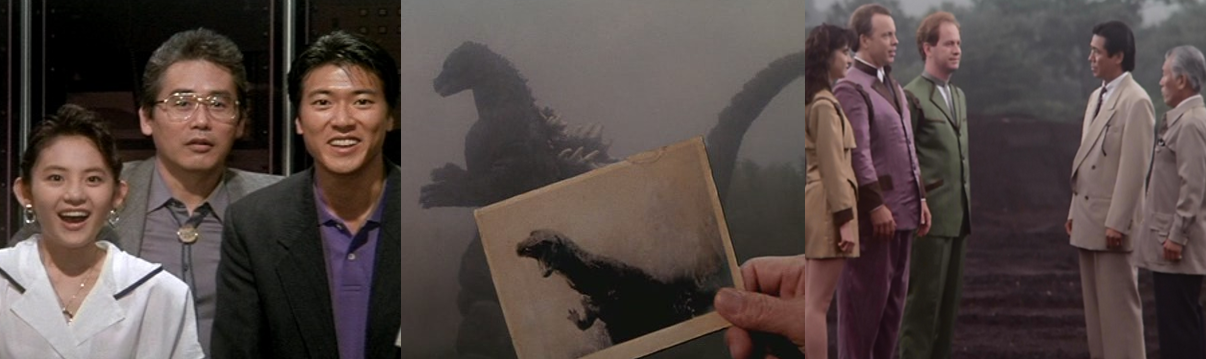
Terasawa’s research into Godzilla coincides with the Futurians’ arrival from 2204.

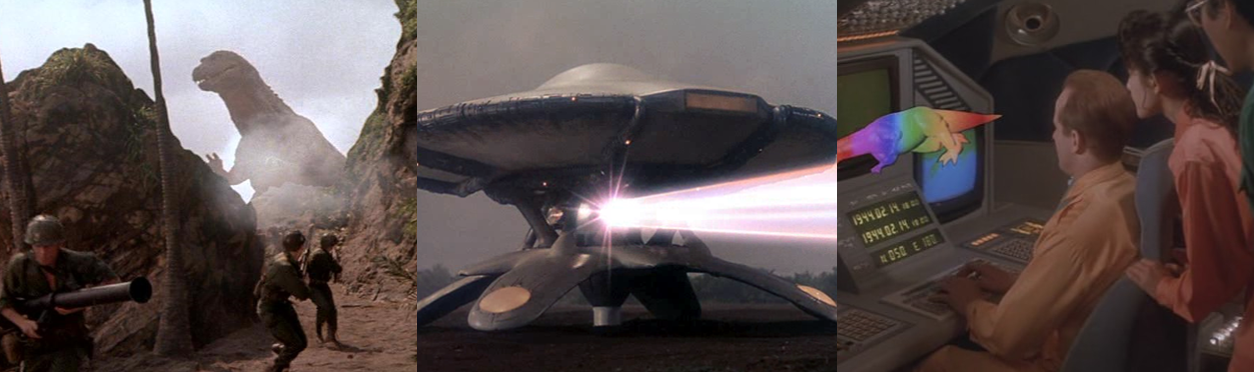
Oddly enough, as if all the kaiju action wasn’t enough, Godzilla vs. King Ghidorah heavily features a time travel plot. The film begins in 2204A.D., where King Ghidorah is little more than a mutilated skeleton at the bottom of the ocean, before jumping ahead to the then-present day of 1992 where all of Tokyo is shocked by the sudden arrival of a strange spacecraft on Mount Fuji. The unidentified flying object (UFO) instantly makes headlines but science fiction writer Kenichiro Terasawa has grown weary of the genre that has made him a “rich man” for his employers, Super Mystery Magazine, and is more interested in writing a detailed history of Godzilla. To that end, he interviews a number of World War Two veterans, including wealthy businessman Yasuaki Shindo (Tsuchiya), who were present on Lagos Island when Japanese troops were unexpectedly protected from the United States forces by the Tyrannosaurs rex-like Godzillasaurus, which they revere as a benevolent, powerful, protective spirit. Consequently, they believe the same to be true of Godzilla, especially as the world’s most famous kaiju is the mutated form of this dinosaur following hydrogen bomb tests. As is often the case in Godzilla films, the human characters are divided into journalists like Terasawa and the Japan Self-Defense Forces’s (JSDF) desperate attempts to combat the kaiju threat. In their efforts to uncover more information about the UFO, the JSDF turn to Miki Saegusa (Odaka), a character who has the rare distinction of appearing in subsequent Godzilla movies and is something of Godzilla expert and a budding psychic (because that’s often a thing in these movies, too). Because of this, she’s part of a team of specialists selected to ensure Japan’s future after the Futurians – Grenchiko (Richard Berger), Wilson (Chuck Wilson), Emmy, and their android, M-11 (Robert Scott Field) – deliver a morbid warning to Japan’s government, headed by the Prime Minister (So Yamamura).

Thanks to time travel shenanigans, Godzilla is removed from history.

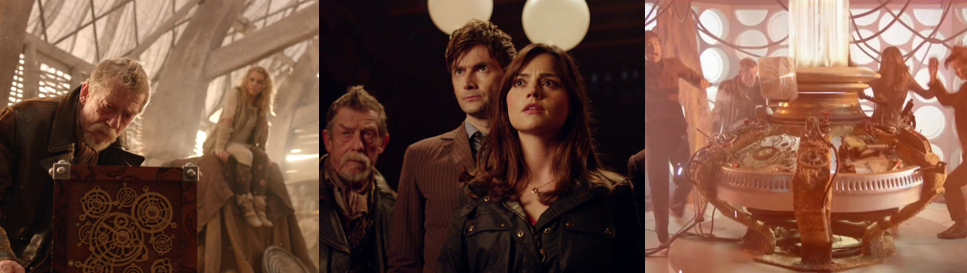
There, the seemingly benign Futurians completely disregard any sense of temporal paradoxes and time displacement to warn of a terrible future where Godzilla has decimated Japan following an unprovoked attack and devastating nuclear fallout. As proof, Emmy presents Terasawa’s book on Godzilla, thus bringing him into the JSDF’s investigation and confirming his theory that the Godzillasaurus became Godzilla. Thus, the Futurians propose travelling to Lago Island in 1944 and teleporting the Godzillasaurus to 1992, thereby sparing Japan’s social and economic future. Terasawa, Miki, and dinosaur expert Professor Hironori Mazaki (Katsuhiko Sasaki) join this expedition despite there being more qualified and experienced people, but Wilson hypocritically explains that this is because they can’t risk a temporal problem by sending, say, Shindo back to Lagos since he was already there as a young man (but changing the past by removing Godzilla is apparently fine…) Although Terasawa is disheartened to learn that his book didn’t make an impact in the future, he and the others are astounded by the Furtuians’ time ship. They travel through very Doctor Who-like swirls of colour to arrive in the past (spooking “Major Spielberg” (Daniel Kahl) in the process) and witness first-hand as the Godzillasaurus defends the brave and outnumbered Japanese troops. This is the first taste of kaiju action and it’s a little different from what we’re used to. Although it’s easily able to intimidate and crush the U.S. soldiers, the Godzillasaurus is far from the invincible titan we know and love and is easily felled by the Navy’s missiles. Badly wounded, the dinosaur is easily transported to 1992 by the Futurians, but they leave a substitute in its place: three small, winged Dorats that are hideously transformed by the nuclear radiation into a hydra-liked dragon!

A bigger, more violent Godzilla defeats King Ghidorah and then turns on Japan!

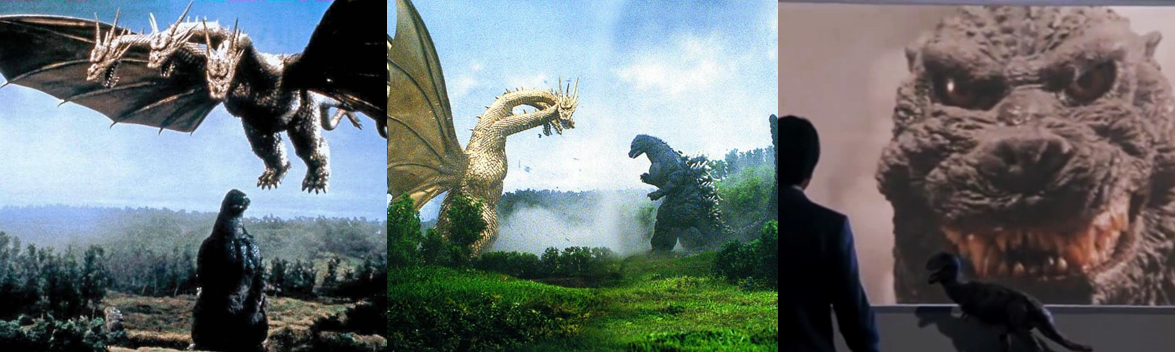
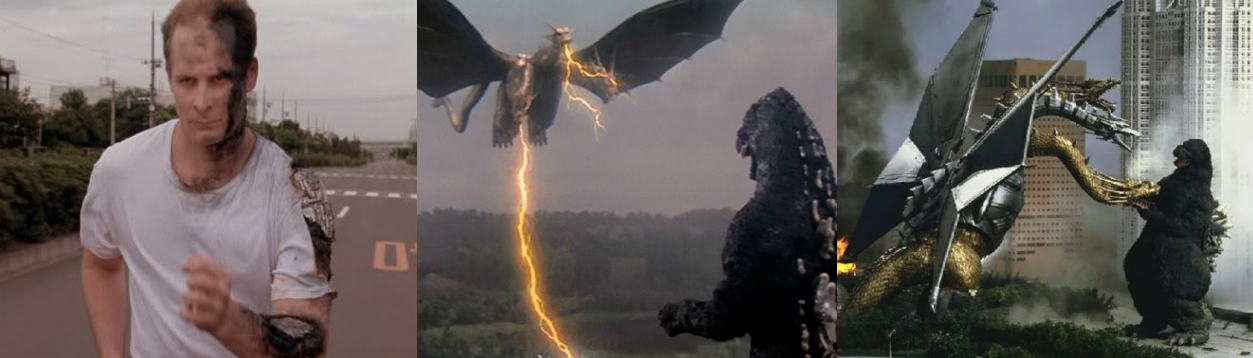
When Terasawa and the others return, expecting to face a more prosperous future without Godzilla (…though everyone still remembers Godzilla in another example of the film’s inconsistent time travel mechanics), they find Japan under attack by this three-headed mutate, the titular King Ghidorah. A screeching, golden-scaled, devil-like monstrosity, King Ghidorah mercilessly unleashes devastating lightning blasts upon Japan and the sight of it gliding through the skies and between skyscrapers is quite the nightmarish visage. Unrelenting and aggressive, King Ghidorah is controlled by the Futurians to wipe out Japan, which has actually become an economic superpower greater than the U.S., China, and even all of Europe. Feeling remorseful for her actions, and not wishing to see her home country annihilated, Emmy reveals the truth to Terasawa but their attempts to stop the government kick-starting the Godzillasaurus’s transformation into Godzilla with Shindo’s secret nuclear submarine fail when they’re intercepted by M-11. Thus, over forty minutes into the film, Godzilla and its iconic theme tune finally make an appearance as a newer, far bigger and far more hostile version of Godzilla is near-instantly created when it also absorbs the radiation from a crashed Russian submarine. It immediately clashes with King Ghidorah but not out of any sense of duty or to protect Japan as Shindo believes. This is purely a clash of territory and pride and Godzilla has no qualms about destroying parts of the city, and even obliterating Shindo himself, with its destructive atomic breath. Oddly, the two are said to be evenly matched, despite the fact that this new Godzilla is also said to be far more powerful than before thanks to being born from modern nuclear weapons. Godzilla thus topples its rival and lays waste to Tokyo, leaving Japan’s survival in the hands of Emmy and M-11, who jump to the future to augment King Ghidorah’s corpse and defend Japan against their violent attacker.

The Nitty-Gritty:
I mentioned up top that I purposely chose to watch the dubbed version of Godzilla vs. King Ghidorah. This is always my go-to viewing option for foreign-language films but it can’t be denied that the dubbing is pretty atrocious throughout the film, especially whenever the Futurians are speaking. Godzilla movies have always been deeply entrenched in the fallout from World War Two; the kaiju owes its existence to the War and is pretty much always surrounded by allegory of the dangers of conflict and nuclear power. However, it’s rare that a Godzilla movie actually tackles the Second World War directly and I believe that Godzilla vs. King Ghidorah was the first film in the franchise to actually depict events from the War and so many veterans from the conflict as being central to its story. Here, the U.S. is depicted as an invading, hostile force that overwhelmed the Japanese with ceaseless aggression. Though some American troops wish to see the conflict end, they do so under the shroud of victory for the stars and stripes rather than a more generalised end to the death and fighting. The Japanese forces are mercilessly cut down by their better equipped enemy and their final assault against the U.S. troops is framed as a brave and noble suicide run for the glory of the “motherland”, which is definitely a different perspective on the conflict and helps to humanise the Japanese forces.

While M-11 and the sci-fi effects look terrible, the suitmation scenes are explosion fun!

One of the major appealing factors of these Godzilla movies has always been the “suitmation” and practical special effects. Godzilla vs. King Ghidorah continues to evoke the Gerry Anderson aesthetic in its models, water scenes, and especially when depicting the UFO, which flails about unconvincingly compared to the awesome rubber kaiju suits. The UFO delivers such dated and questionable effects as a beaming technique and hologram effects that would put Star Trek: The Original Series (1966 to 1969) to shame and evokes the same concern and environmental message (and special effects) seen in The Day the Earth Stood Still (Wise, 1951), and offers a knock off of Skynet’s finest infiltrator units in M-11. Exhibiting superhuman strength, speed, and durability in ways that would make Colonel Steve Austin (Lee Majors) cringe, M-11 is perhaps their greatest weapon outside of their impressive teleportation device, which instantly transmits objects across both time and space. Thankfully, the film doesn’t rely on these dodgy optical effects and the rubber suits are soon out in full force. King Ghidorah is one of the franchise’s most technically impressive monsters, a combination of a man in a suit, animatronics, and puppetry that cuts through the sky, stomps around on elephantine feet, and constantly spews crackling electricity. Though far bigger and subjectively more powerful than Godzilla, King Ghidorah is hampered by the humans that control it, meaning it goes wild once Terasawa, Emmy, and the reprogrammed M-11 storm the Futurian time ship in a laser pistol fight. This allows Godzilla to blast off one of King Ghidorah’s heads and send it crashing into the ocean, leaving this aggressive and unfriendly Big G to rampage through Tokyo unopposed.

After a brutal scuffle, Mecha-King Ghidorah anti-climatically defeats Godzilla.

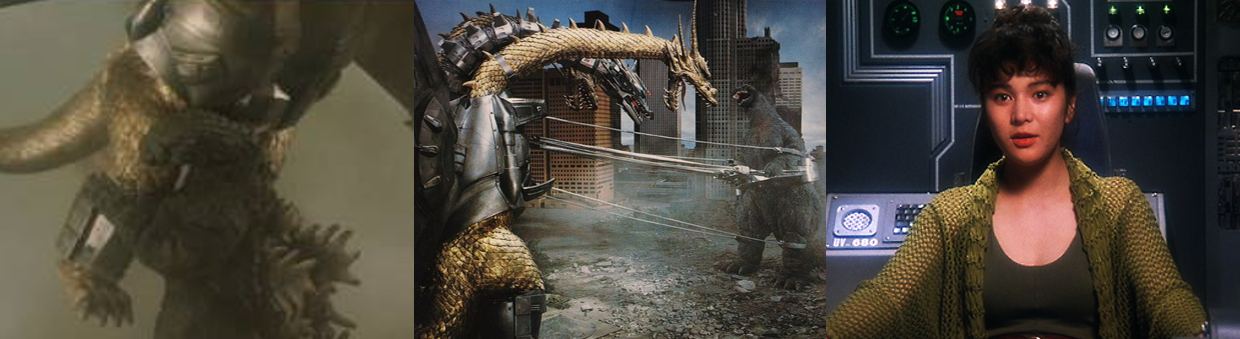
With Godzilla’s personality and aggression fundamentally altered and heightened, Japan has no hope of fending off her attacker with either conventional weaponry of the JSDF’s high-powered energy beams. Godzilla simply shrugs off attacks, topples skyscrapers and landmarks, and obliterates everything with its unmatched atomic breath. However, after a jaunt to the future, Emmy comes back piloting the cybernetically-enhanced corpse of King Ghidorah and battles with Godzilla to protect her beloved country. The humans we’ve been following become completely obsolete in this climatic and action-packed finale, which sees Grenchiko and Wilson atomised and the fate of Japan in the hands of Emmy and Mecha-King Ghidorah. Thus, the finale comes down to a rare case of a human piloting a mechanical kaiju-destroying creature rather than two wild monsters going at it. However, while Mecha-King Ghidorah is bolstered by future technology and armour, this new Godzilla is more powerful and aggressive than ever. It easily withstands Mecha-King Ghidorah’s boosted lightning and relentlessly attacks with its atomic breath, forcing Emmy to take a different approach, at great risk to herself. She grabs Godzilla in mechanical clamps and flies it to the ruins of Tokyo, dumping it in the sea. Though Mecha-King Ghidorah is destroyed, Emmy survives and reveals that she’s Terasawa’s ancestor (making the subtle attraction and flirtation between them a little awkward) before returning to the future. However, Godzilla soon reawakens at the bottom of the ocean but decides it would rather stomp away than resume its attack, making for an anti-climatic finish as it’s always disappointing when Godzilla is simply tossed aside rather than actually defeated.

The Summary:
I’m massively biased towards Godzilla vs. King Ghidorah since it was the first Godzilla movie I ever saw and got me hooked on the franchise, and there’s a lot to like here. The suits and monster-on-monster action are big, detailed, and very action-packed. King Ghidorah, especially, had never looked better prior to this film. While its design is a little clunky and bizarre since it lacks arms, its three heads, incessant screeching, and explosive lightning make for a formidable threat and it was pretty cool seeing it come back augmented with futuristic technology as Mecha-King Ghidorah. Godzilla is also pretty great in this film; while it takes a long time for it to show up, we get a revised origin for the kaiju and a return to its more aggressive personality as time travel shenanigans see it reborn as a hostile creature more akin to its original depiction. It is absolutely relentless in its rampage, spewing atomic breath all over the place and appearing more terrifying and formidable than ever. Sadly, the kaiju action takes way too long to kick in, leaving us with this bizarre time travel plot that’s full of temporal anomalies and reduces King Ghidorah to a puppet of these pantomime-like villains whose cringe-worthy lines and personality rob them of any menace. It was interesting, if a little unorthodox, to depict scenes from World War Two and explore an alternative origin for Godzilla, but the poor attempts to copy from better, big-budget science-fiction films really handicaps the overall plot. I feel like Godzilla vs. King Ghidorah overcomplicates and overstuffs things, making its human characters more inconsequential than usual as they don’t really get much to do except be stunned and betrayed. Also a disappointment is the film’s finale, which simply sees Godzilla dumped into the ocean…which is where it generally lives anyway so I’ll never understand how this is supposed to defeat it. Still, when the kaiju are actually going at it and when the dubbing is at its exaggerated best, the film is very enjoyable, but it does a drag a bit as the plot trips over itself to limp towards the titular clash of these two long-standing rivals.

My Rating:

Rating: 4 out of 5.

Great Stuff

What did you think to Godzilla vs. King Ghidorah? How did you feel about its time travel plot and the changes made to Godzilla’s creation? Did you like King Ghidorah’s revised origin and what did you think to Mecha-King Ghidorah? Were you also disappointed by the film’s inconsistent and nonsensical time travel shenanigans and poor attempts to rip-off other sci-fi films? What is your favourite Godzilla movie and why? How are you celebrating Godzilla Day this year? Whatever your thoughts on Godzilla vs. King Ghidorah, or Godzilla and kaiju films in general, feel free to leave them below.

Movie Night [Day of the Dead]: Shaun of the Dead


The Day of the Dead (or Dia de los Muertos) is a traditional Latin American holiday on which, every November 1st, the lives of deceased loved ones are celebrated with food, drink, parties, and a great deal of masquerade involving the calacas and calaveras (skeletons and skulls). For me, this seems like the perfect excuse to look back on the long-running and ever-changing zombie genre that was largely popularised by director George A. Romero, which I devoted a great deal of my PhD thesis towards and which has often been used as a parallel to various aspects of society and culture.  


Released: 25 October 2004
Director: Edgar Wright
Distributor: Universal Pictures
Budget: $6.1 million
Stars: Simon Pegg, Nick Frost, Kate Ashfield, Lucy Davis, Dylan Moran, Penelope Wilton, and Bill Nighy

The Plot:
Perennial loser Shaun (Pegg) is easily swayed from adult responsibilities by his oafish best friend, Ed (Frost). After Liz (Ashfield) ends their relationship, he resolves to win her back but awakens to find Crouch End under siege from a sudden zombie outbreak!

The Background:
Zombies have had a long and varied history in cinema. Originally, films like White Zombie (Halperin, 1932) depicted them more as voodoo slaves but director George A. Romero (who famously avoided the term “zombie”) popularised them as shambling, flesh-hungry corpses in Night of the Living Dead (Romero, 1968). This inspired an entire sub-genre of horror, particular in the sequel, Dawn of the Dead (ibid, 1978), widely regarded as one of the best and most influential zombie films ever made. Specifically, Romero and Dawn of the Dead were a key influence on long-time friends and collaborators Edgar Wright and Simon Pegg putting together this “rom-zom-com” after filming a precursor to the film as a gag for their sit-com Spaced (1999 to 2001). Wright believed so strongly in the project that he turned down further television work as he shopped the concept around before Working Title Films agreed to finance it and production could begin. Both were also huge fans of the Resident Evil videogames (Capcom/Various, 1996 to present) and liked the idea of setting a zombie outbreak in London, where people lack the heavy ordinance typically seen in American films, and focusing on two layabouts who are the last to know about the outbreak. The cast included not just long-time friends Pegg and Frost but many popular British comedians, the filmmakers were inundated with volunteers to fill in as extra zombies, and the film was littered with pop culture references and nods to prominent zombie and horror films. Shaun of the Dead’s $30 million worldwide gross made it a big hit upon release and this was reflected in the unanimous praise that accompanied the film. The film was heralded as an instant classic and its success ensured that Wright, Pegg, and Frost would reunite for other collaborations in the loosely-connected “Three Flavours Cornetto” trilogy.

The Review:
I was a bit late to the Spaced party; I didn’t watch the series until some time after seeing Shaun of the Dead, and I don’t think I saw that until a former friend of mine recommended it to me. One watch and I was instantly hooked and have been a fan of Pegg, Frost, and Wright ever since. The trio (and even two-group combinations of the group) have such a knack for crafting funny, believable, and incredibly relatable characters and stories even when things step into the fantastical and chaotic. As a Brit myself, I appreciate how they take the quaint, ordinary everyday mundanity of life in this little country of ours and satirise it, comment upon it and use it to show just how preposterous our nation can be at times. My love for zombie films may have dwindled over the years (watching and researching them non-stop for an entire year will do that to you) but I know which ones I like and count amongst the best, and Shaun of the Dead is definitely in the top-tier because of how wonderfully it utilises the shambling ghouls as figures of both horror and ridicule.

Shaun is at a crossroads in life where he’s not ready for adulthood, making for the unlikeliest of heroes.

As the title suggests, Shaun of the Dead is the story of Shaun, a twenty-nine-year-old manchild who lives in London and works in an electronics shop. Directionless and largely lethargic, he has fallen into an easy routine involving work, play, and simply hanging out at his local pub, the Winchester Tavern. As something of a manchild myself, I find Shaun’s attitude and predicament largely relatable. He has little to no job satisfaction, is still clinging to his more youthful days as a university student, and is generally just surviving his way through a humdrum existence. However, Shaun recognises that he is at an impasse even before Liz breaks up with him. He wants to do better and to do right by her, but is also fiercely loyal to Ed and can’t quite give up the carefree oaf’s influence on his life. Consequently, Shaun is a man who others see as having great potential but who lets himself get held back by excuses and by his friend. He only resolves to turn his life around after Liz is forced to break up with him, and he only comes to showcase his potential as an unlikely hero after he realises that London is in the middle of a zombie apocalypse. Even then, Shaun is largely making it all up as he goes along; his primary motivation is to get Liz and his mum, Barbara (Wilton), to safety. However, while he has lofty and noble intentions, he does make a bit of a balls-up of it along the way.

Though Liz breaks up with Shaun, she supports his plan to get everyone to safety and believes in him.

After Shaun fails to live up to his promise of trying to do better by her, and having finally had enough of his lackadaisical attitude, Liz is forced to break up with him to avoid being dragged into a sad, pointless existence where she wastes away at the Winchester rather than being out there and living life to the fullest. She doesn’t do this lightly; it’s clear that she’s very in love with Shaun and has a great deal of patience for, and belief in, him but she can only take so much of the same old routine day in and day out, night after night. Even after they’ve broken up, Liz still has a lot of faith in Shaun. She goes along with his plan to get everyone to safety, defends him from criticism regarding his plan (because, after all, at least he has a plan and is trying to do something helpful and proactive), and is generally very loving and supportive while also being level-headed, pragmatic, and calm even as flesh-eating zombies shuffle through the streets. Liz believes in Shaun’s potential to be and do better; all she wants is for him to grow up a little, sort his life out, and take charge of his own destiny rather than settling for a tedious existence that is beneath him. Shaun is thus fully aware that she’s the best and most positive influence of his life and continually puts himself in very real danger in order to win her back and keep her safe.

Perpetual manchild Ed is blamed for holding Shaun back but always has his back no matter what.

If Shaun is a manchild, then Ed is literally a child trapped in a man’s body. The quintessential slob, Ed is a jobless mooch who spends his days playing videogames, smoking fags and drinking beer, and selling a bit of weed on the side. He’s the definition of a moocher, living rent free at Shaun’s place and constantly encourages him to just “chill out” and waste their evenings at the Winchester. While others despair of Ed’s vulgar, unruly behaviour and demeanour, Shaun is fiercely loyal to his childhood friend and enjoys his company. He doesn’t see Ed as a drain or as holding him back, and simply enjoy having his best friend around because he’s fun to be around. In Ed’s defence, he does remind Shaun that he has to go to work and so can’t play videogames all morning, arranges for a lock-in so the two of them can have a few drinks and he can cheer Shaun up with his unique style of humour and crudeness after Liz dumps Shaun, and follows his friend’s lead without question when the zombie apocalypse hits. It’s Ed’s idea to head to the safety and familiarity of the Winchester, a plan that others (even Shaun) initially scoff at but actually has a lot of theoretical logic behind it (the pub has food and drink to sustain them and the windows, entrances, and exits could have been barricaded and boarded up to give them a decent chance at survival if the group was a little more competent). However, these flashes of unique brilliance are offset by Ed’s lack of urgency about everything. Ed sees the entire escapade as an adventure, one that gives him the chance to drive a Jaguar at high speeds and spend the day in the pub, which eventually aggravates even Shaun but the friendship and love between the two remains steadfast. The result is one of the most entertaining, and poignant, aspects of the entire film since they’re both incredibly devoted (and besotted) with each other.

Neither Pete or David much approve of Shaun and Ed’s antics, while Dianne’s mainly a mediator.

Contrasting Ed’s cheerful and apathetic attitude is Pete (Peter Serafinowicz), Shaun and Ed’s more responsible and strict roommate. Like Liz, Pete sees that Ed is a drain not just on Shaun but both of their lives (he doesn’t work, doesn’t tidy the house, and is generally slobbish and selfish) but, unlike Liz, Pete is far more direct in his dislike of Ed and his approach to get Shaun to grow up and take control of his life. Pete’s harsh, but he’s absolutely right, and his outburst is the final kick up the ass Shaun needs to resolve to turn things around, but Pete sadly falls victim to the zombie outbreak before this comes to fruition. Shaun faces similar criticism from Liz’s friend and roommate, David (Moran), who is dating Liz’s other friend and roommate, Dianne (Davis). Despite this, it’s pretty clear that David has feelings for Liz and he remains highly critical of both Shaun and Ed. While Shaun doesn’t agree with Pete’s assessment of Ed’s character, he acts a mediator between the two, but the same can’t be said of his relationship with David. The two have a mutual dislike of each other, which only exacerbates as David constantly berates and criticises Shaun’s plan for survival. This all comes to a head when Barbara reveals she’s been bitten and turns, leading to David almost killing Shaun with a rifle. Dianne is much calmer and more patient of the entire situation, but it’s clear that she’s on the verge of completely losing it at any moment. She proves herself adaptable and integral by putting her acting training to good use so they can comically stumble through the zombie hoards, and eventually snaps when David’s abrasive attitude reaches boiling point.

Everyday life is so dull, especially in Britain, that we’re already mindless zombies.

One of the fantastic things about Shaun of the Dead is how it depicts zombies. Zombies technically exist before the flesh-eaters even start walking the Earth as the opening credits show how Londoners are trapped in a lethargic cycle of sleepwalking their way through menial jobs and boring routines, and even Shaun resembles a shuffling ghoul when he drags himself out of bed in the morning. Nowhere is the depiction of the monotony of everyday life more prominent than in the parallel sequences that follow Shaun from his house and to the corner shop. Shaun is so blinded to what’s going on around him, and takes his life for granted so much, that he doesn’t even notice that things are wildly amiss the second time around. To him, it’s just another day in Crouch End, and he barely notices that the living dead are increasing around him until a blood-soaked ghoul wanders into his back garden. If you’ve seen a Romero film before, the zombies of Shaun of the Dead will be instantly recognisable to you. They’re the classic depiction of the living dead, being walking, bloodied corpses who attack the living on sight, ripping and tearing at their flesh until they’re satisfied and then turning their victims into shambling ghouls soon after. Though slow, they’re incredibly durable and dangerous in large groups, easily overwhelm their victims and can only being put down for good following heavy trauma or destruction of their heads. This proves difficult for the film’s protagonists as firearms aren’t easy to come by in the United Kingdom, meaning that Shaun largely relies on a cricket bat and other improvised weapons (such as vinyl records) before being stunned to find the rifle behind the bar is actually functional (though he’s naturally a “rubbish” shot).

The Nitty-Gritty:
Considering Shaun’s background as a DJ and his former youth spent in clubs and raving, it’s very fitting that Shaun of the Dead makes great use of music. The Specials’ “Ghost Town”, the Blue Wrath’s “I, Monster”, and Kerkraft 400’s “Zombie Nation” are all used to great effect as background music over scenes of life before the zombie outbreak, which only further emphasises the theme of ordinary, everyday life and media consumption turning us into zombies even before the outbreak sweeps the nation. Of course, the most memorable use of music is the fantastic use of Queen’s “Don’t Stop Me Now” when Shaun, Ed, and Liz attack the zombified owner, John (Steve Emerson), which perfectly parallels one of the most upbeat songs every performed with a scene of extreme, if ludicrous, violence.

Sight gags, repetition, and clever use of camera and editing all add to the film’s humour.

One of the most impressive, entertaining, and memorable aspects of Shaun of the Dead (and Edgar Wright films in general) is the unique and unexpected use of camera movements and jump cuts for comedic effect. Wright makes even mundane tasks like peeing and getting dressed for work appear exciting and humorous by filming them like action sequences and utilises a fun snap-cut to instantly turn night to day as Shaun passes out in the kitchen. Wright and Pegg’s writing is absolutely top-notch; the characters fun and relatable, while being vulnerable and desperately trying to adapt to the horrific events happening around them as best they can. The comedy is often based on repetition, references, and foreshadowing; Shaun’s plan to kill Philip and get to the Winchester, Ed’s suggestion to get drunk basically describes the events of the zombie outbreak the next day, and his videogame antics come back into play when defending the Winchester. Pete screams at Ed to “Go and live in the shed!”, which ends up happening in the epilogue, the tracking shot of Shaun’s morning perfectly captures how ignorant he is to the events happening around him, and when he flicks through  the TV channels, all the different sound bites perfectly describe what’s going on in a fun little moment.

Gore is used sparingly, but to great effect and heavily influenced by the likes of George Romero.

Fittingly, the film also contains a number of references and call-backs to popular zombie films. There’s a couple of nods towards Sam Raimi’s Evil Dead films (Raimi, 1981 to 1992) with Shaun referring to an “Ash” who is under the weather and his gasp of “Join us” when he first sees the zombified Pete. Fittingly, it’s Romero who has the most impact on the film; as in Romero’s movies, no definitive explanation is given for the zombie outbreak (the radio hints at a space probe crash, the newspaper headlines offer many different explanations, and the news reports that reports of “rage infected monkeys” are greatly exaggerated). As is often the case, finding the cause for the outbreak is largely inconsequential to actually surviving the chaos. The characters also discourage the use of a “ridiculous” term like zombies, a word never actually used in Romero’s films, and Ed directly quotes Night of the Living Dead with his declaration of “We’re coming to get you Barbara!” Perhaps the most striking and memorable homage to Romero is in David’s gruesome and gory death as he is literally torn to pieces by zombies in exactly the same way as Captain Henry Rhodes (Joseph Pilato) in Day of the Dead (Romero, 1985). Indeed, the film’s use of gore owes a lot to Romero and other “splatter horror” zombie films of the seventies and eighties. The film uses gore and blood sparingly but to great effect, delivering disturbingly mutilated zombies and such fun and disgusting moments as blood spurting from characters’ wounds, a zombie girl sickeningly pulling up after being impaled in Shaun’s garden, and Dianne leaping into the zombie hoard while brandishing her boyfriend’s severed limb!

Shaun is heartbroken when the outbreak forces him to kill his mother and even his stern stepdad.

As great as all of this gore is, a central aspect of the film, and Shaun’s character, is his strained relationship with his stepdad, Philip (Nighy), a stern and harsh patriarchal figure who Shaun resents for his condescending and disapproving attitude. Philip is the very embodiment of an overbearing authority figure and has long been a thorn in Shaun’s side as nothing he ever does, or has done, has ever been good enough for his would-be father figure. This is the exact opposite of his loving relationship with his mother, an eccentric and doting woman who just wants everyone to get along and doesn’t want to cause a fuss. This ranges from little things like being more concerned about making sandwiches for Shaun when he comes to rescue her, to hiding the bite she received from the others so as not to worry her beloved son. Having suffered two pretty horrific bites during their escape, Philip ultimately succumbs to his wounds and dies but, before turning, finally buries the hatchet with his step-son in a truly emotional scene. Philip admits that he also saw great potential in Shaun and did the best he could to push him to achieve that, but struggled as Shaun was already a pre-teen when they first met but, with his father-figure dying in his arms, Shaun finally puts his issues with his stepdad to rest. However, he’s absolutely heartbroken to find that his mum has also been bitten and leaps to her defence when David moves to execute her before she can turn. This causes the tensions between the two, and the entire group, to finally boil over and not only makes a traumatic moment even worse for Shaun but spells disaster for their makeshift fortification.

Shaun and Liz are the sole survivors but the country quickly recovers from the zombie outbreak.

Although Shaun bravely attempts to lead the zombie hoard away to cover his friends’ escape into the Winchester, they eventually find their way back to the pub, and the group fails to properly check and secure their stronghold for any resident evils. Thanks to David recklessly breaking a window so they can get inside rather than wait for Shaun to lead them to the back entrance, the zombies inevitably lay siege to the pub. After being bitten by Pete and other zombies, Ed is left bleeding out and doomed while Shaun and Liz find themselves trapped in the pub’s basement. After briefly considering killing themselves, they realise that they can make an escape using the keg lift, but Ed volunteers to stay behind rather than slow them down. In another of the film’s more poignant and moving moments, Shaun and Ed bid a heartfelt and tearful goodbye to each other and Shaun and Liz prepare to fight their way to safety on the infested streets…only to be suddenly saved at the last minute by the British military, led to them by Shaun’s friend and far more capable survivor, Yvonne (Jessica Stevenson). In this regard, the film veers away from the traditionally bleak endings of Romero’s films to give the couple a definitive and happy ending. In the aftermath, the film perfectly encapsulates how the UK recovered from “Z-Day” by turning the whole thing into a media circus: zombies appear on talk shows and gameshows, they are easily domesticated for menial work, and the entire event is largely glossed over as “just one of those things”. Crucially, Liz and Shaun find a happy medium where they go-exist as a slightly more adventurous (Shaun now takes two sugars in his tea!) couple while still having a regular routine. In many ways, Liz takes Ed’s place as Shaun’s best friend and most prominent influence, but she’s also fully supportive of him still spending time with his old friend, who is chained up in the shed so that the two can still enjoy videogames.

The Summary:
I tend to avoid reviewing comedies. I find trying to explain why something is funny a bit difficult at times since comedy is subjective and maybe not everyone will appreciate or fully understand some of the gags a film or why others find them so amusing. However, it’s an absolute pleasure to revisit Shaun of the Dead and to talk about it in detail as it’s legitimately one of my favourite horror, comedy, and zombie films of all time. Being a Brit, I totally relate to the depiction of our society and just how boring and dull everyday life can be, and having worked in retail for eleven years I can attest that it is one of the most soul-destroying jobs out there where you’re often encouraged to be little ore than mindless automatons…or zombies. I also fully relate to Shaun’s plight; he’s at that difficult crossroads where he’s not ready to become a fully-fledged adult, and it’s easy to fall back on hold habits and creature comforts at that time of life. I can totally buy the idea that he wants to do better but just isn’t sure how and is quite awkward in his attempts to do so because it’s such a big step for him. Toss in some entertaining and innovative camera movements and shots, jump cuts, and a fantastic use of music, and you’re already in line for a pretty entertaining romantic comedy but the addition of gory, voracious zombies only adds to the film’s appeal. It’s a true love letter to zombie maestro George Romero, but made all the more ridiculous and enjoyable because it’s set in London, of all places, and the characters are all so incredulous to the chaos happening around them. Consequently, there’s loads here for horror and zombie fans to enjoy but the film is peppered with surprisingly emotional moments as well, not to mention the perfectly executed comedy and character beats and the hilarious use of foreshadowing and repetition throughout that ensures every gag gets a fun payoff and characters are seen as both competent and incompetent when it comes to adapting to the sudden zombie apocalypse. Overall, this is a thoroughly enjoyable movie from start to finish and may still be the best of Wright, Pegg, and Frost’s “trilogy” of movies for just how expertly it juggles all of its different tones, characters, and themes, and I honestly couldn’t recommend it more to both die-hard fans and newcomers to the genre.

My Rating:

Rating: 5 out of 5.

Fantastic

Are you a fan of Shaun of the Dead? Did you enjoy the references and call-backs to other zombie films in the movie, especially the works of George Romero? Were you able to relate to the characters and, if so, which was your favourite and why? Are you a fan of Wright, Pegg, and Frost and their unique style of filmmaking and comedy? What do you think caused the zombie outbreak and how do you think you would react in such a scenario? What is your favourite zombie film and what do you think of the genre in general? How are you celebrating the Day of the Dead today? Whatever your thoughts on Shaun of the Dead, and zombie films in general, feel free to leave a comment below.

Movie Night [Halloween]: Halloween 4: The Return of Michael Myers


Starting life as the ancient Celtic festival of Samhain, when people would light bonfires and wear costumes to ward off ghosts, Halloween is largely associated not just with ghosts, ghouls, and confectionery but also a long-running series of horror movies. Beginning with John Carpenter’s Halloween (Carpenter, 1978), the franchise is largely credited with birthing the “slasher” sub-genre of horror films and has endured numerous remakes and reboots and is one of the most influential films in all of horror.


Released: 21 October 1988
Director: Dwight H. Little
Distributor: Galaxy International Releasing
Budget: $5 million
Stars: Donald Pleasence, Danielle Harris, Tom Morga and George P. Wilbur, Ellie Cornell, Beau Starr, and Karen Alston

The Plot:
Ten years after appearing to die in a fire, serial killer Michael Myers/The Shape (Morga/Wilbur) awakens from a coma and targets his young niece, Jamie Lloyd (Harris), who appears to have a psychic link with the killer, and only his mentally and physically scarred doctor, Sam Loomis (Pleasence), has a hope of putting an end to his rampage.

The Background:
Although critics mostly dismissed it upon release, John Carpenter’s Halloween’s box office gross of over $63 million made it one of the most successful independent films ever and it both popularised the clichés of the slasher genre and is now seen as one of the most influential horror movies. Thus, a sequel was inevitable, although writer/director John Carpenter wasn’t enthusiastic about this. Halloween II (Rosenthal, 1981) was a commercial success and the studio was eager for a third entry, which Carpenter only agreed to if it went in a different direction and became a horror anthology movie series. Unfortunately, Halloween III: Season of the Witch (Wallace, 1982) was a box office flop that was derided by critics, stars, and even the director so the decision was made to bring Michael back some six years later to reclaim his place as the star of the franchise. Initially, Carpenter and writer Dennis Etchison were attached to the project, but producer Moustapha Akkad decided a more back-to-basics approach was best and drafted writer Alan B. McElroy to craft a new script. Since her career had taken off since Halloween, star Jamie Lee Curtis refused to return to the film, which aimed to recreate much of the horror and suspense of the first. George Wilbur took over the Myers role, reportedly wearing hockey pads under his suit, and regularly put young co-star Danielle Harris at ease, though his mask appears inconsistent throughout due to the filmmakers altering the design mid-way through. With a $17.8million box office, Halloween 4 got the franchise back on track financially but was again slated by critics for abandoning the strengths of the original and being little more than a cheap knock-off of the first film, though some have defended it as one of the stronger Halloween sequels, though none of this stopped a fifth entry from being fast-tracked for release the following year.

The Review:
Halloween 4 takes place on October 30th and 31st, 1988, some ten years after the end of Halloween II. Michael’s been in a coma for ten years and his vegetative ass is being transferred back to Smith’s Grove Sanatorium, all of which we learn in the most ham-fisted way possibly from an overly chatty guard (Raymond O’Connor) and the callous Doctor E.W. Hoffman (Michael Pataki). Although he’s been content to lie dormant all this time, Michael bursts to life and starts killing his way back to Haddonfield when he happens to hear that he has a young niece living there. Since Laurie Strode (Jamie Lee Curtis) died between movies in a car wreck (a plot point I’m glad to see reversed later as that’s the lamest way to kill off a legacy character), Michael’s target is his niece, Jamie, who lives with her foster family. Richard (Jeff Olson) and Darlene (Alston) are doting, hardworking, and caring parental figures who recognise that Jamie needs all the support and love they can offer and their teenage daughter, Rachel (Cornell), does her best to make Jamie feel accepted within the family. Jamie is still struggling with the loss of her parents, who died only eleven months previously, and is very insecure about her place with the family and whether they really love and accept her. Jamie has had trouble sleeping thanks to nightmares and visions of Michael, who she might not recognise but is aware of since the unnecessarily cruel schoolkids tease her for being an orphan and for being related to the “Bogeyman”.

Michael’s presence haunts Jamie, who struggles to fit in with her peers and her family.

Because of this, Jamie is determined not to hide away and show that she is just as good as the other kids by going trick-or-treating in her very own costume and, as luck (or fate) would have it, she’s enamoured by a clown costume that’s nearly identical to the one worn by young Michael Myers (Erik Preston). This triggers another hallucination in which she sees first herself as the young, bloodstained Michael and is then attacked by the Shape himself…or so it seems. Undeterred, Jamie heads out with Rachel and not only enjoys herself getting candy but is even accepted by the same kids who were previously mocking her with such venom because her crappy clown costume is apparently that “cool”. Halloween 4 positions Rachel as a stand-in for Laurie; the two even have a connection since Laurie used to babysit Rachel when she was younger. Although Rachel isn’t perfect, she’s generally as attentive to Jamie’s needs as Laurie was to Tommy Doyle (Brian Andrews) and makes the effort to apologise to Jamie after accidentally upsetting her. Unlike Laurie, Rachel would like to enjoy herself with her boyfriend, Brady (Sasha Jenson), though she sets this aside to take Jamie trick-or-treating and protects her in the final act. Unfortunately, Rachel’s blow off upsets Brady, who was clearly eager to seal the deal with her that night. This means he goes elsewhere for some action and Rachel is humiliated when the kids knock on Sheriff Ben Meeker’s (Starr) door and Kelly (Kathleen Kinmont), his promiscuous daughter, answers wearing next to nothing and with Brady right there with her. Although Brady makes a pathetic attempt to defend himself, Rachel angrily brushes him off (and rightfully so) and he begrudgingly settles for just having his cake rather than eating it, too. Interestingly, Halloween 4 doesn’t include a gaggle of disposable bodies for Michael to wade through despite establishing characters like Rachel’s outgoing best friend, Lindsey (Leslie L. Rohland). However, the town’s youths do deliver one of the best and creepiest scenes when Dr. Loomis and Sheriff Meeker are surrounded by an army of Michael Myers clones. While this turns out to be an elaborate prank, both are momentarily perturbed by the sight and even more so when they return to the police station to find Michael has slaughtered everyone there.

Dr. Loomis is more scared and obsessed than ever, though this time he has the town’s support.

Thankfully, we have Donald Pleasance back as Dr. Loomis. Does it make sense that he survived the raging inferno that clearly immolated him and Michael in Halloween II? No. Do I appreciate that he has burn make-up, walks with a cane, and is clearly in physical discomfort from that incident? Yes. In the years since, Dr. Loomis’s reputation and authority have been largely stunted by his association with Michael. Unlike in the first film, he isn’t even present for Michael’s transfer since Michael was a federal prisoner and Dr. Hoffman regards Dr. Loomis very poorly, believing the tormented psychiatrist will struggle without Michael to obsess over. Dr. Loomis is incensed that Dr. Hoffman allowed “It” to leave the hospital and renews his crusade to hunt Michael down, once again spouting the same doomsaying speeches to anyone who’ll listen and again being seen as a madman until it’s too late. Dr. Loomis actually get s a rather tense confrontation with Michael early on. After stumbling upon Michael’s victims, Dr. Loomis pleads with him to stop and offers himself in place of further bloodshed but is enraged with Michael refuses to acknowledge him and simply continues on to Haddonfield in Dr. Loomis’ vehicle, forcing him to hitch a ride with God-fearing Reverend Jackson P. Sayer (Carmen Filpi). Upon reaching Haddonfield, Dr. Loomis immediately seeks out Sheriff Meeker to warn him of Michael’s presence. Although Meeker is sceptical of Dr. Loomis’ wild claims and chaotic reputation, he takes the threat as seriously (perhaps even more so, given what happened ten years previously) as his predecessor and mobilises his troops, though their efforts are hampered when Michael causes a town-wide blackout. Sheriff Meeker follows Dr. Loomis’ advice to enforce a lockdown, but this has the unintended side effect of inspiring a trigger-happy mob of angry townsfolk to take matters into their own hands once they learn that Michael is stalking the streets once more.

Michael is more dangerous, supernatural, and goofy-looking than ever in his big return.

And, finally, there’s the equally scarred Michael. This is the film where Michael really transitioned from a silent psycho in a mask with a high pain threshold to a quasi-supernatural force of nature, but with about as much explanation as he was given in the previous films. Indeed, while Michael had near-superhuman strength and patience in the first two films, his abilities are now almost on par with masked rival Jason Voorhees (Various), who was an unstoppable zombie at this time, meaning he has full mobility despite his injuries, no sign of muscle atrophy, and manhandles victims with ease. Although he briefly sports a new bandaged look, it’s not long before Michael’s back in his familiar overalls and mask. Well, I say “familiar” but Michael’s mask looks absolutely awful here. While the film makes a point to show that it’s an entirely new mask, it just looks…wrong. It’s too squat and white and lacks the personality of the original William Shatner mask, making Michael look more goofy then terrifying. Michael’s supernatural abilities are also expanded somewhat as the film has Jamie and Michael be linked by blood, meaning she is haunted by terrifying nightmares of him. However, this mainly serves to pepper the film with jump scares and their psychic connection would become much more prominent in the next film. Still, it has a profound impact on Jamie even here; though she’s terrified of the imposing, masked figure that’s constantly leaving bodies in his wake and trying to kill her and her sister, Jamie shows sympathy towards Michael after he’s lying prone on the ground in the final act. Perhaps out of morbid curiosity, perhaps because he’s the only “real” family and connection to her beloved mother she has left, Jamie briefly takes Michael by the hand before he’s blasted by the state police and is apparently left “touched” by his influence and evil as a result.

The Nitty-Gritty:
Considering how much Halloween 4 borrows from the first film, it’s surprising that it opts for a more ominous title sequence, one that is more bleak than atmospheric and even omits the iconic John Carpenter score. The score does make an appearance throughout, thankfully, and is as hauntingly impactful as ever but boy, does this film take a lot from Halloween. We’ve got Michael escaping custody, murdering a mechanic for some clothes, stalking Haddonfield while Dr. Loomis runs around like a wild man trying to warn people, we have a Laurie proxy in Rachel, and the film explicitly and thematically recreates the start of the first film for its shocking twist ending. While many, even John Carpenter, decry the decision to make Michael and Laurie related and add a familial motivation to his killings, I actually never really minded this and would argue that it had potential, but one squandered by poor execution in these movies. Michael only resumes his killing spree when he learns of Jamie, indicating very explicitly that his whole reason for being is to murder his bloodline and he’s simply a void (or “Shape”, if you will) without that. Like in the first film, Dr. Loomis openly comments on Michael and the nature of his evil, referring to him as “It” and delivering many of the same speeches, but with slightly altered verbiage, as in Halloween. Thanks to Pleasence’s unparalleled delivery and screen presence, this has the intended effect of painting Michael as the embodiment of evil and works perfectly as sound bites for a film trailer, but again it’s just all a repeat of what we’ve already seen.

Michael’s kills are a little more gruesome but largely derivative of the first film.

Although Halloween wasn’t really known for its nudity and debauchery, Halloween 4 sees Brady and Kelly’s sexy time in front of a roaring fireplace cut short when her dad arrives looking to protect Jamie and Rachel from Michael. Still, we don’t have to wait long for our first kill as Michael awkwardly crushes a male attendant’s (David Jansen) head with one hand and jams his thumb into his forehead within the first ten minutes. Michael leaves his ambulance a bloody wreck and impales an unassuming mechanic (Unknown) with a metal rod and leaves his corpse hanging from chains for Dr. Loomis to find and tosses a plant worker (Harlow Marks) into a transformer, frying him alive and causing a blackout. Initially, the kills are largely bloodless, or at least tame in their execution, just like in the first film, which used blood sparingly and to horrifying effect. I don’t necessarily mind this as I prefer Halloween as a more creepy and subdued horror franchise and find it a bit gratuitous when Michael starts hacking people up like Jason, but it’s again too derivative of the first film. Luckily, Michael is stronger than ever and more than capable of upping the ante from what came before it, as seen in the brief shot of various dismembered corpses at the police station and in Michael’s assault on the Meeker home. This moment is predicated by a relatively tense sequence as the film builds anticipation for Michael’s arrival and sees him recreate his famous pin-to-the-wall kill by ramming a shotgun into Kelly’s gut, leave Meeker’s last deputy (George Sullivan) a broken mess, crush (not snap, crush) Brady’s neck with ease, and leaves Rachel momentarily unconscious after she falls from the roof. In the finale, Michael viciously stabs a bunch of townsfolk who try to get Rachel and Jamie to safety and even partially tears through the skin and neck of poor Earl Ford (Gene Ross) in a precursor to his later, far gorier methods of killing.

Although Michael is seemingly killed, Dr. Loomis is horrified to see his evil reborn through Jamie.

Rather than stalking babysitters, Michael comes to Haddonfield specifically to track down and kill Jamie. Sure, he kills a handful of others but that’s mostly because they’re either in his way or the film needs to up the body count. Thanks to Jamie’s waking nightmares of the “Nightmare Man”, it’s often unclear whether Michael is actually there, and this paranoia is echoed by the lynch mob that roams the streets, armed to the teeth and blasting at anything that even resembles Michael Myers. Naturally, this results in them gunning down an innocent man but Sheriff Meeker is left relying on them to back him up after Michael butchers all his deputies. Initially, Meeker attempts to protect Jamie and Rachel but, when Michael ruins that plan, Dr. Loomis is forced to shelter Jamie in the school. Here, Dr. Loomis has a second, far more violent and physical confrontation with Michael (who’s inexplicably wearing a different mask in some shots) that sees Dr. Loomis tossed through a window. Luckily, Rachel arrives to rescue her; she also convinces the mob to get them to safety since the state police are en route. However, their saviours are summarily slaughtered when Michael attacks, having hitched a ride on the truck’s underside. Luckily, Sheriff Meeker and the state police arrive in time to pump Michael full of lead, causing him to disappear down an abandoned mine and Dr. Loomis to confidently declare him “dead…in Hell” despite the lack of a body. Dr. Loomis’s relief, and that of Jamie’s obviously traumatised family, is short-lived, however, when the film suddenly shifts to a first-person perspective, Halloween theme playing, to track an unseen killer through the Carruthers’ house. At the sound of Darlene’s scream, Dr. Loomis investigates and is horrified to the point of madness at the sight of Jamie, covered in blood, a pair of bloodstained scissors in her hands, an all-too-familiar blank stare in her eyes. Dr. Loomis even moves to shoot her, distraught to see Michael’s evil reborn in Jamie’s innocent form, but is stopped by Sheriff Meeker and the others, who can only look in horror as Jamie stands there, breathing heavily, apparently ready to continue her uncle’s work…

The Summary:
Although I’m not really a fan of Halloween III, I do enjoy anthology series and I think turning Halloween into an anthology series had some potential behind it, especially considering how dull and repetitive some of the sequels were. It’s possible that the idea would’ve had stronger legs if Halloween III hadn’t explicitly taken place in a separate universe; if it had been adjacent to and connected to the previous films, maybe it might’ve gone down better. Or, if they’d started the anthology idea with Halloween II instead of waiting for the third film…and if the third film had actually been good… In any case, I do understand the need to return to the tried and tested formula. Michael Myers is one of the most iconic horror villains and there was definitely some potential there, but the problem is that Halloween 4 really doesn’t try anything especially new with the character and basically acts as a remake of the first film, just with a few different characters. It’s a shame, too, as that final scene of Jamie standing there all ominous and Dr. Loomis shouting “No!” over and over is really chilling and I love the idea of Michael passing his evil on to a new host, but sadly this wasn’t meant to be as God forbid slashers try something new. Dr. Loomis was as great as ever here; the scars and injuries and increased madness add a desperate edge that made him almost as unhinged as Michael. Sadly, there’s just not much here that wasn’t in the first two films. Rachel’s personal drama isn’t as interesting or as well done as Laurie’s and it’s hard to care about most of Michael’s victims as they’re barely even side characters much less main ones. Ultimately, the film is simply a retread of the original. I get that this is probably to get the franchise back on track but I do think it might’ve been better if more emphasis had been placed on exploring Jamie’s link with Michael, the mob that hunts him, and Dr. Loomis’s increased desperation and obsession with putting him down (a better “death” for the Shape would’ve been appreciated, too, as this was ridiculously anti-climactic).

My Rating:

Rating: 2 out of 5.

Could Be Better

Did you enjoy Halloween 4: The Return of Michael Myers? What did you think to Michael’s return and were you happy, sad, or indifferent to see him come back? Were you annoyed that Laurie was killed off so unceremoniously? Are you a fan of Jamie’s and would you have liked to see her takeover as the franchise’s killer? Were you disappointed by the film’s kills and it just being a retread of the first one? How are you celebrating Halloween this year? Whatever your thoughts on Halloween, and the Halloween franchise, drop a comment below, oand have a spook-tacular Halloween!

Movie Night: The Crow: Salvation

Released: 23 January 2000
Director: Bharat Nalluri
Distributor: Dimension Films
Budget: $10 million (estimated)
Stars: Eric Mabius, Kirsten Dunst, Fred Ward, Grant Shaud, Tim DeKay, and Jodi Lyn O’Keefe

The Plot:
Alex Corvis (Mabius), wrongly executed for killing his girlfriend, Lauren Randell (O’Keefe), is resurrected by a supernatural crow to uncover the truth alongside her grieving sister, Erin (Dunst).

The Background:
The creation of James O’Barr as a means to cope with losing his fiancée, The Crow started out as a comic book published by Caliber Comics in 1989 and quickly became an underground success. With dark comic book narratives gaining popularity in Hollywood, the concept was adapted into a critically and commercially successful film despite the tragic on-set death of star Brandon Lee. Regarded as a cult hitThe Crow (Proyas, 1994) spawned numerous sequels; The Crow: City of Angels (Pope, 1996) released just two years later as a direct response to the original’s financial success. Studio meddling contributed to The Crow: City of Angels’ dismal box office and the film was (rightfully) slandered by negative reviews. Undeterred, series producers Edward R. Pressman and Jeff Most sought to continue the franchise, initially tapping rock star Rob Zombie to helm a more horror-centric approach. This clashed with the producers’ vision for the franchise, leading to frustrations and Zombie’s eventual departure, leading to Most shifting focus towards a younger avatar for the Crow mantle. Eric Mabius – who had auditioned for the lead in the first film – this finally got his chance to play the role. Released straight to video, The Crow: Salvation received lukewarm reviews, with most only able to praise it for being slightly better than the previous film. The dialogue, cheap presentation, and bland, charisma-less cast were all criticised, though some regard it as an under-rated entry. Ultimately, the film’s poor reception did little to sour the studio on producing another entry five years later, a film so reviled that it cast the franchise into Development Hell for nearly twenty years.

The Review:
I’ve been a big fan of The Crow since I was a kid and randomly discovered it recorded on one of our VHS tapes. I remember, at the time, a fair bit of intrigue surrounding The Crow: City of Angels; still photos mis-sold the film as a bad-ass action/revenge film, but it turned out to be an ugly mess that I struggled to comprehend, let alone enjoy. Still, I was intrigued by the third movie, which I’d heard was slightly better, so I picked it up on DVD a long time ago, watched it maybe two times, and then promptly discarded it simply because there was no need to clog my collection up with such sub-par movies. The film begins with young Alex Corvis a state-wide figure of controversy; having already been tried and convicted for murder, the braying, judgemental masses call gleefully for his execution, which has been held off for three years so he can be old enough to suffer his punishment. Though he’s maintained his innocence the entire time, pinning the blame on a mysterious man with a scarred forearm, the public and even the prison guards regard him as a reprehensible monster, largely because his victim suffered fifty-three stab wounds during the assault. Before he even returns as an undead wraith, Alex carries a tremendous amount of guilt and self-loathing for not only failing to protect Lauren but also failing to find her true murderer, powerful emotions that fuel his later thirst for revenge. Though he tries to maintain his composure, his resolve falters as he’s strapped to an electric chair, fitted with a gruesome helmet, and forced before not just the judgemental eyes of those in attendance – including Lauren’s younger sister and her father, Nathan (William Atherton) – but also (unbeknownst to him) the corrupt cops who screwed him over and, to his anger and horror, the scarred forearm that has tormented his days.

Youngster Alex returns from the grave to uncover the true culprit behind his girlfriend’s murder.

Unlike his predecessors, Alex gets no time to rest; moments after he’s unceremoniously wheeled into the morgue, a supernatural crow brings him back to life and he’s stripping the gloopy remains of his flesh from his face. I quite liked this aspect, that the helmet he wore scarred his face into the familiar Crow look, and it makes for a gruesome, gory sequence. Through Alex’s escape from prison, we witness him discovering his newfound powers: the crow seems to communicate or at least “push” him towards his goal, he sees visions through tactile contact, and his wounds almost instantly heal. This youngster revels in these abilities with a cocksure bravado but also demonstrates the truly bizarre ability to turn into a crow at will! As before, Alex and Lauren’s relationship is primarily related through flashbacks; amidst the usual lovey-dovey moments (though the inclusion of the “Only forever?” line is a nice touch), we see them arguing, Lauren acting erratically, and Alex’s frustration with her. This is all part of the mystery surrounding her death and makes up the evidence against him, but the crow leads him to the cops who testified against him. Lamenting his newfound unlife, Alex heads out with his literal kill list to discover the true murderer’s identity. Shown to be a more spiritual and reflective character, Alex is prone to waxing lyrical on the divine and Biblical rather than quoting Poe, which just comes across as shamelessly imitating Brandon Lee. I don’t mind Eric Mabius but he’s painfully generic; I appreciate that he has his own visual style, one spruced up when he acquires an overcoat, but he doesn’t cut an intimidating figure. Instead, he’s just a screwed up kid looking to confront those who wronged him, using Lauren’s murder weapon, no less. No one recognises him because of the scarring and Alex doesn’t immediately identify himself, making him more of an anonymous avenger at times. The only one who believed in his innocence is his lawyer, Peter Walsh (Grant Shaud). Peter vows to find the true culprit and is accosted by Detective Vincent Erlich (Dale Midkiff), one of the corrupt cops, when Alex starts ticking names off his list. Peter’s astonished when Alex appears to him and asks him to investigate Nathan’s dealings with the cops and a recurring company name, D.E.R.T., which directly leads to both Peter’s murder and Nathan to kill himself out of remorse.

Distraught Erin eventually supports Alex’s crusade against the corrupt cops.

While we don’t really learn anything about Lauren apart from seeing her as a sweet, playful girl, she gets a proxy in Erin. Much younger and expressing her grief through her hatred of Alex, Erin is confused and lost and initially hostile towards him until he brings her proof that her father was doing business with corrupt Detectives Madden (Bruce McCarty), Martin Toomey (Tim DeKay), Erlich, Stanley Roberts (Walton Goggins), and Phillip Dutton (Bill Mondy). Like Alex, Erin carries a great deal of guilt and pain, not just at because she’s lost her sister but also because she pointed them in the direction of where she might be when they came looking for her. When these emotions overwhelm her and make her wish she were dead, Alex forces Erin to experience Lauren’s terror and ordeal at the hands of the cops to show her what a fighter her sister was even as she was being stabbed to death, all to teach the distraught Erin that “life is worth living”. The dirty cops launder money through a strip club and engage in drug dealing and, when Lauren witnessed Roberts murder a man in cold blood, he and his cohorts went after her to silence her. When their base instincts took over, they all joined in with the stabbing and the killing after she dared to fight back. This is an interesting twist on the concept and allows The Crow: Salvation to stand out from its predecessors and presents us with morally corrupt lawmen whose testimony trumped that of a young, troubled kid. Alex’s first target is the sleazy Dutton, who delights in using his authority to sexually accost young, intoxicated women. Erlich takes a more authoritative role in the group, informing them of Dutton’s death, but his only defining character trait is his tendency to pull pranks on the group. Of them all, Roberts stands out the most thanks to being played with a squirmy glee by Walton Goggins. When he realises he’s next on the list, he accosts witness Tommy Leonard (David Stevens) and his family, killing him since he refuses to believe Alex has returned.

The Nitty-Gritty:
One of the main issues with The Crow: Salvation is similar to what dragged down the first sequel; while it’s shot far better and I’m not feeling nauseous due to disturbing mustard mist, everything just looks very cheap. The framing of shots, the quality of the film, even the crow’s-eye view scenes are all very direct-to-video and the movie even has the gall to recycle shots from the first film to imply it takes place in the same city. Structurally, it sticks very close to the same formula as the last two films; Alex really has no reason to work his way up the food chain of forgettable corrupt cops and could just go right to the source, but then the movie’s runtime would be much shorter and the filmmakers couldn’t rehash what worked so well in the original film. While interiors are perfectly serviceable, if unusually claustrophobic (again, seeming more like a television production), exteriors are painfully bland. The movie returns to the dump where Lauren died a few times and it’s a dull, lifeless location. The film lacks the gothic identity of even the second movie which, for all its obscuring fog and shadows, at least tried for a distinct visual identity. It doesn’t help that Alex is decked out not in leather and straps but his prison jumpsuit. Yeah, the coat helps but he looks like a kid playing dress-up, desperately trying to emulate Brandon Lee’s performance and failing miserably. Alex easily overpowers his victims; safe and even revelling in his invincibility, Alex freely stabs himself and walks into gun shots. He even blasts himself through the mouth to intimidate his prey, gleefully ending them out of frustration at their instance that there is no scarred man. Sadly, Alex’s mission is tainted by the budget; he tries to look badass by walking away from an explosion (that also destroys a police helicopter), but it’s painfully brought to life through dodgy rear projection.

The budget, visuals, and performances aren’t up to the task of equalling the gothic, moody first film.

Alex executes Dutton via gunshot to the head, drives Erlich into a bus and blows him up, and adds a twist to his venge-filled killings by using Lauren’s murder weapon, even inflicting the same fifty-three stab wounds and carving Lauren’s pet-name for Erin (“Daisy”) into Dutton’s forehead. He also continues the traditional of leaving the crow’s symbol and encourages a young stripper (Noname Jane) to give up her life of drugs and debauchery. Alex’s infiltration of the Key Club sees him first scurrying about the rafters to avoid a hail of gunfire and then forcing the gaggle of corrupt cops to expend all their bullets, though it does result in Roberts taking a pipe through the back, and Toomey being blown to pieces. The mystery of the true killer is built up right from the opening credits, where we see his trademark forearm scar, as well as his knowledge of/fascination with the supernatural crow in his macabre embalming hobby. All throughout the film, Alex is haunted by the image of that zig-zag scar and frustrated by his victims refusing to give him a name. Instead, they insist, even in the face of their death, that Corvis made the whole thing up. Even if he didn’t immediately reveal that he’s as corrupt as his detectives, you’d probably guess that Captain John L. Book is the true culprit simply because he’s played by the immortal Fred Ward. A gruff, uncompromising figure, Book exudes authority and elevates even this drab material just by Ward’s screen presence. Having “studied [the crow] phenomenon before”, Book is the only one not surprised to learn Alex has returned from the dead to seek revenge and is learned enough to know that Alex’s mission will be complete and his powers lost once he finds the man with the scar. Thus, he sets a trap at the Key Club, implanting the scar into Peter’s severed arm and tricking Alex into thinking he’s got his man.

Alex ultimately finds his man and avenges his losses in this cheap, dull imitation.

The fulfilment of his mission sends Alex into a disorientated daze; haunted by visions of Lauren, he loses his grip on reality and struggles to reacclimatising to feeling the pain of his wounds. When he returns to Peter’s office and finds Erin missing and that the Book is the man he’s been looking for, Alex immediately heads to the police station to confront him. However, despite knowing that he has a loose end to tie up and still being accompanied by the crow, Alex remains mortal and is brutally stabbed by Book. As he dies (again), Book taunts him and makes him doubt his innocence, twisting his memories and trying to ensure he doesn’t return anew. Erin, tied up and with her lips sewn shut (!), is forced to watch as Book, his unnamed woman (Kelly Haren), and Madden prepare to stuff and mount his corpse. However, the crow brings Alex Erin’s locket, reviving Alex, restoring his powers, and reminding him of the truth. Although Alex shrugs off Madden’s bullets, the crooked cop and the secretary have better luck by attacking the crow, whose pain Alex can feel, and he’s so distracted offing them that Book escapes with Erin in tow. When Erin stabs him and flees, Book is reduced to a crazed maniac in his pursuit of her, though Alex easily catches up to them. Finally getting his hands on his man, Alex takes Book to the electric chair and delivers a melancholy soliloquy regarding the painlessly of electrocution and revealing that it’s actually pure agony. Still, Book remains defiant to the end; cursing them both, he mocks Alex and Lauren’s relationship and vows to return to get his revenge. In the end, it’s Erin who pulls the lever and the two watch on as Book is incinerated by electricity. After finally witnessing Book’s prolonged and painful death, Alex bids farewell to Erin, returning him to happier times with Lauren and renewing the girl’s belief in life…and love.

The Summary:
The Crow: Salvation proves, beyond a shadow of a doubt, that the original film was lightning in a bottle. By moving so far away from a serious theatrical production and reducing the concept to a direct-to-DVD release, the movie dilutes and disrespects both the source material and the original film. It’s a shame because there are some good elements here. I like that the avatar is completely new, a younger character who exhibits different abilities and a different perspective on the powers. Alex isn’t a cool rockstar or an amateur magician/trained mechanic; he’s just a kid who’s been dealt a bad hand and now has the power to avenge himself. I liked the whodunit mystery and the suggestion that Alex might actually have been guilty; in some ways, I wonder if this might’ve been a better twist ending since it was obvious Fred Ward was the culprit once he appeared onscreen. I liked that Alex was going after corrupt cops, people in positions of trust and authority who abused their power, and that I could actually see what the hell was happening this time around. Sadly, the execution and performances are severely lacking; Fred Ward, William Atherton, and Walton Goggins are the only memorable or commendable performances. Kirsten Dunst is pretty, but woeful as an overly dramatic wreck, and Eric Mabius just doesn’t have the screen charisma or acting ability to captivate in the role. The film is also really cheap, using obvious jump cuts, recycled footage, and awful visual effects. To make matters worse, it’s still too similar to the original, repeating many of the same story beats and action moments but without the budget, passion, or care exhibited in the gothic cult classic. The Crow: Salvation just comes across as a cheap, bland cash-grab, one doomed to fail no matter what they did. However, for having actors who didn’t make me want to pull my teeth out and being visually more coherent than the last film, it gets one extra star but it’s ultimately a forgettable film that even die-hard Crow fans will have a hard time connecting with.

My Rating:

Rating: 2 out of 5.

Could Be Better

Did you enjoy The Crow: Salvation? If so…why? Do you think it was better, overall, than the second film? What did you think to Eric Mabius’s performance and Alex as a younger avatar? Did you guess who the true killer was or was the reveal a surprise to you? What did you think to the antagonists being corrupt cops? Were you disappointed by the low-budget production values? Which of The Crow’s sequels was your favourite, if any, and would you like the see the character return in some form or another in the future? How are you celebrating Devil’s Night tonight? Whatever you think about The Crow: Salvation, join the discussion below and check out my other Crow content on the site..

Back Issues [Asterix Anniversary]: Asterix the Gaul


Asterix the Gaul (and his best friend Obelix) first debuted on 29 October 1959 as a serial in the French/Belgium magazine Pilote. Since then, the plucky Gauls have gone on to have many adventures in comic books, videogames, and feature-length productions and Asterix himself has become a popular and enduring character in his native France and around the world as Asterix’s stories have been translated into over a hundred languages across the world.


Story Title: “Asterix the Gaul” (French: “Astérix le Gaulois”)
Published: 29 October 1959 to 14 July 1960
Writer: René Goscinny
Artist: Albert Uderzo

The Background: 
After years of struggling to find work as a comic strip writer, René Goscinny met reluctant artist Albert Uderzo while working for the World Press agency in 1951. The two worked on many projects over the next ten years before they created an instant hit in the pages of Franco-Belgian comics magazine Pilote with Asterix, a plucky Gaulish warrior who battled invading Roman forces alongside his wacky friends. The idea came about through a brainstorming session between the two. Inspired by the mostly overlooked Gaulish period in French history, the two were enthused at the potential and relished infusing the stories with as many puns as they could. After being serialised in Pilote, Asterix’s first adventure was released in a single volume, the first of an annual series, until 1997 when Goscinny tragically died. Although he continued solo for a while, Uderzo eventually signed the rights over to a new generation of creators so that Asterix’s stories could continue. Since then, Asterix has become an incredibly popular character all over the world, selling nearly 400 million books, and has been adapted into videogames, toys, and both live-action and animated features (the first of which was, fittingly, an adaptation of this very story). 

The Review:
If you’ve ever read an Asterix book or watched one of the movies (or even played one of the games), you’ll know there’s always a little introduction piece that sets the scene for the story and the world of these books. Asterix the Gaul is, naturally, the first instance of that and expands upon this paragraph of text in its first few panels. The year is 50 B.C. and ancient France (known as “Gaul”) has been conquered by the Romans. In the face of such overwhelming military might, Gaulish chiefs like the legendary Vercingetorix (literally) lay their arms at the feet of the power-hungry Julius Caesar and “peace” reigns throughout conquered Gaul. However, while the Romans have laid claim to the entirety of ancient France, one small village of indomitable Gauls refuses to surrender. Baffled by the Gaul’s stubborn nature, Caesar sets up four Roman camps (Aquarium, Totorum, Laudanium, and Compendium) to surround the village and orders repeated attacks, only for his troops to be bested time and again by brave warriors such as our titular hero, Asterix, and his hulking friend, Obelix. Over a dinner of piping hot roast boar, Asterix laughs off the Roman threat, which he and his fellows constantly repel thanks to the magic potion brewed by their druid, the venerable Getafix. As luck would have it, Asterix is due his daily dose of the potion so he and Obelix pay Getafix a visit. Getafix cooks up a batch of the magic potion, whose recipe is a closely guarded secret amongst his kind and one sip of which bestows incredible superhuman strength, but only for a short time. Since he fell into a cauldron of potion as a baby and drank the entire batch, Obelix is permanently empowered and is denied any potion out of fear for his safety, though he believes the druid is treating him unfairly.

Crismus Bonus sends Caligula Minus in to discover the Gauls’ secret.

At Compendium, the camp centurion, Crismus Bonus, is enraged that four of his soldiers could be so easily bested by one measly Gaul and vows to discover the secret of their superhuman strength. However, the Gauls strength is so feared that volunteers to infiltrate their village are scarce. Thus, Crismus orders his troops to play musical chairs to decide on a volunteer, and poor Caligula Minus loses out. Since his only options are to act as a spy or be roasted alive, Caligula reluctantly agrees to be disguised as a Gaul, much to the amusement of his peers, and paraded through the forest as bait for the Gauls. Luckily, Asterix and Obelix just so happen to be strolling through the forest looking for a fight. They don’t suspect a thing and make short work of Caligula’s “captors”, rescuing him and bringing him back to their village to keep him safe, where he gives his name as “Caliguliminix”. Caligula is astounded by the Gaul’s village, where everyone (even the children) is armed and ready to fend off Roman attacks. He’s welcomed by the village chief, Vitalstatistix, and amazed to see that the Gauls use their bare hands to temper metal, deliver menhirs, and lug around giant carts full of felled trees. While eating with Asterix and Obelix, Caligula enquires about the secret to their strength and produces crocodile tears when Asterix initially refuses to share their secret. Deciding to help their fellow “Gaul”, the duo take him to Getafix, who’s equally convinced to help when Asterix and Obelix guilt-trip him into it to get Caliguliminix back “home” to his “family”.

Asterix arrives to rescue Getafix but decides to stick around and have some fun with the Romans.

Though initially uncertain of the potion’s effect, Caligula revels in his ability to manhandle a giant boulder, but learns the hard way that the potion only makes one super strong, not invulnerable. His cover is quickly blown when his fake moustache is pulled off during a traditional Gaulish dance and he blasts back to Compendium at super speed before the Gauls can stop him. Back at Compendium, Caligula excitedly reveals the secret to Crismus and demonstrates the potion’s power, first by beating up a bunch of soldiers and then holding a large boulder over his head. Despite the Gauls stating that the potion’s effects are only temporary, it takes “several hours” before Caligula returns to normal. As the soldiers take their revenge for their earlier beating, Crismus dreams of stealing the potion for himself to usurp Caesar and orders his troops to kidnap Getafix when he goes into the woods for ingredients. When Getafix refuses to divulge his secret, Crismus straps him to a table and subjects him to the horrific torture of…having his feet tickled by a feather! Yet, the druid holds his resolve, even when Crismus tries to bribe him with “Sestertii”, the currency of the era. Concerned about Getafix’s welfare, Asterix searches the forest and comes across an ox dealer with a quandary: if he sells his oxen, he won’t be able to pull his cart. He’s so grateful to Asterix for providing him with a solution (selling his cart and keeping the oxen) that he gladly gives the Gaul a lift to Compendium after revealing he saw a druid being taken there in chains. After sneaking through the camp, Asterix first overhears Crismus’ plan to overthrow Caeser with the aid of his number two, Marcus Giantonicus (though the two secretly plan to betray each other), and then discovers Getafix. Rather than rescue the druid, though, Asterix decides to have some fun with the Romans and promptly surrenders to them, winding up in chains alongside his friend.

The Gauls make fools of the Romans and are set free by Caesar’s grace.

When Asterix refuses to speak, Crismus brings in his overly enthusiastic torturer and prepares to loosen Getafix’s tongue by having him witness his friend’s suffering. However, when Asterix comically pleads for mercy at the torturer’s merest touch, Getafix finally caves and requests to go into the forest for ingredients. After making fools of his escort, Getafix insists that he needs strawberries to complete the potion. Despite them being out of season, Crismus orders his troops to go find some and, days later, one soldier returns with a tiny (and expensive) punnet…only for Asterix and Getafix to scoff the lot and demand more! Driven to tears by frustration and rage, Crismus is ecstatic when Getafix whips up the potion regardless and forces the ox dealer to try it in case it’s poisonous. Since the Romans are reluctant to take another bashing, Asterix volunteers to test the man’s newfound strength and summarily drops to the ground as though the “sky had fallen on [his] head”. The ox dealer leaves, dreaming of profiting from his great strength, and Crismus and his troops greedily devour the potion, convinced of its potency, only to find it’s caused the hair of their heads and faces to grow uncontrollably! The duo tease Crismus with their lackadaisical attitude and hair-related puns, but promise to make an antidote. After another amusing trip to the forest, Getafix makes a big cauldron to cure the hair problem and a small pot of real magic potion for Asterix. Once they’ve had their antidote, Crismus orders his troops to attack, only for Marcus to summarily manhandled. Although the Gauls find themselves surrounded when they leave the camp and Crismus delights in his pending victory, they’re all stunned when Julius Caesar himself shows up for an update. After learning of Crismus’ ambitions, Caesar banishes him to out Mongolia and allows the Gauls to go free, though both promise to continue their vendetta.

The Summary:
As big a fan of Asterix as I am, I have to say that I’ve never been a big fan of this book, or the character’s early tales. The artwork is a little off; it’s less cartoony and more “sketchy” than in later stories, and the characters aren’t quite themselves yet. The most obvious example is Obelix, who’s less of a simple-minded, brutish oaf and more a morose bystander who doesn’t get much of anything to do here. The same is true for all the villagers who aren’t Asterix and Getafix; the only other one who stands out is Cacofonix, whose musical arts aren’t appreciated (unless they want to dance and then they’re all for it). I don’t say this to knock Asterix the Gaul; it’s the first story so obviously I don’t expect every character to be fully fleshed out and it’s true most of them become one-note caricatures as the books continue on, it’s just a little jarring when compared to later stories. Still, much of the patented Asterix humour is here; that means puns aplenty, especially in the characters’ names, and some fun fisticuffs. However, there’s a lot of padding here: the characters visit Getafix and pop into the forest more times than the story needs, repeating a lot of the same gags (like Getafix pricking himself on his sickle) and demonstrating the potion’s abilities in scenes that not only read the same, but look the same, too. It is essential, of course, for showcasing the effects of the magic potion to the Romans and the reader, but I do wonder if a bit of visual variety wouldn’t have worked better than seeing characters lift rocks over their heads all the time (though I do admit that the payoff – “I’ve done it! I’m a superman!” – always makes me giggle).

Though not infallible, Asterix is presented as a capable and shrewd warrior.

Much of the story is focused, fittingly, around establishing Asterix as a character. Not only is he a capable fighter, but he’s shown to be cunning, mischievous, and intelligent, too. He could’ve easily rescued Getafix and stormed out of Compendium, but he chose to stick around and have some fun with the bungling Romans, making fools out of them with needless tasks, mockery, and Getafix’s hair growth potion. He’s shown to be shrewd enough to sneak into the camp and adaptable enough to tattle on Crismus to Caesar, thereby ensuring his and Getafix’s safe return to the village and the first of many feasts. However, he’s not perfect; he’s as fooled as anyone else by Caligula’s Gaulish disguise and decides to help his fellow “Gaul” despite the village keeping their potion a closely guarded secret. While this doesn’t really result in any immediate consequences for the village beyond the Romans discovering the source of their strength is a potion and thus targeting Getafix, it does show that even the insightful Asterix makes mistakes, which the druid calls him out on. While I much prefer these stories to have a bit more Roman bashing, there’s some fun to be had in Asterix the Gaul. I liked the wild strawberry chase Asterix sends them on and him and Getafix messing with Crismus, and the book nicely lays the foundation for what would become long-running gags for the next seventy-odd years and, while I prefer other Asterix stories, this is still a highly recommended read.

My Rating:

Rating: 3 out of 5.

Pretty Good

What did you think to Asterix’s first story? Did you like the less cartoony art style of his earlier adventures? Were you disappointed that Obelix and the others didn’t have more to do or did you like the way the story established Asterix’s character traits? Which of the puns was your favourite? How are you celebrating Asterix today and what are your favourite books or moments of his? Whatever your thoughts on Asterix, please leave a comment below  and go check out my other Asterix content!

Wrestling Recap: Hogan vs. Flair (Halloween Havoc ’94)

The Date: 23 October 1994
The Venue: Joe Louis Arena; Detroit, Michigan
The Commentary: Tony Schiavone and Bobby “The Brain” Heenan
The Referee: Mr. T (guest)
The Stakes: Steel cage match for the WCW World Heavyweight Championship with both men’s careers also on the line

The Build-Up:
Easily one of the biggest missed opportunities in the wrestling world was then-World Wrestling Federation (WWF) chairman deciding not to main event WrestleMania VIII with the biggest dream match the industry could produce at the time, the “Immortal” Hulk Hogan taking on “The Nature Boy” Ric Flair. A falling out with World Championship Wrestling’s (WCW) Jim Herd saw Flair leave WCW with their World Heavyweight Championship, but McMahon was put off from pitting the two icons against each other after being unimpressed with the reception to their unaired matches and a preference for slotting Sid Justice into a main event role. While Flair went on to have a highly-rated WWF Championship match against “Macho Man” Randy Savage, Hogan and Sid put on one of the worst WrestleMania main events and WCW wasn’t about to make the same mistake two years later. Flair returned to WCW in 1993 and recaptured the gold, competing against old rivals Ricky “The Dragon” Steamboat and Sting, while Hogan dramatically jumped ship in 1994. Before he reinvigorated his career as part of the New World Order (nWo), Hogan largely continued the same schtick that had made him so popular in the WWF and immediately targeted WCW Champion Ric Flair, whom he defeated for the belt in his debut match at the 1994 Bash at the Beach. With the “Mouth of the South” Jimmy Hart in his corner, Hogan retained the title against Flair via count-out at Clash of the Champions XXVIII, leading to Flair putting his and Hogan’s careers on the line for one last shot at the gold at Halloween Havoc.

The Match:
It’s probably controversial to say but I’ve never been much of a fan of Ric Flair. I think it’s mainly because he’s always been from a bygone era and his peak was way before my time as a wrestling fan, when the grounded style and presentation was notably different not just to today but to when I started watching wrestling in the nineties. I’m a little more lenient on Hulk Hogan simply because he’s a larger-than-life icon of the industry but I’ve never been massively wowed by his matches as he had a very limited repertoire and very rarely deviated from what worked, meaning I find his matches quite repetitive. However, I will say that much of my exposure to both men was when they were in the heyday of their careers and wrestling in an extremely limited capacity, so a part of me is interested in seeing more from both men at their peak and against a contextual background the plays into their strengths, and even I can’t deny that Hogan vs. Flair was the match of the wrestling industry back in the day. Flair was the first to enter the arena for this long-awaited match. Accompanied by “Sensuous” Sherri and draped in one of his trademark robes, Flair exuded the pomp and grandeur of the classic wrestling heel from head to toe. In comparison, Hogan was his usual bombastic self; played to the ring by his awful “American Made” theme and accompanied by Jimmy Hart and Brother Bruti (all of them garbed in Hogan’s signature garish red and yellow). Hogan pandered to and posed with the crowd in the epitome of the beloved, indomitable wrestling babyface. In addition to Michael Buffer running down each man’s lengthy list of accomplishments, Tony Schiavone and Bobby Heenan emphasised that both men had made an indelible mark on the industry and cemented themselves as icons of the business, and to really hammer home that this match would spell the end of one of their legendary careers. Interestingly, the flimsy, rickety wireframe cage was lowered around the ring after the competitors entered, making for an unsettling visual as the ring crew scrambled to get it secured, though this ultimately milked the anticipation of the crowd as was common for Hogan matches. Also, the cage wasn’t really built or tall enough for climbing; it was simply a frame to keep both men in and ensure a decisive victory by pin fall or submission.

Hogan showed an unusual aggression during the match, while Flair systematically targeted his knee.

Surprisingly for these two, the match kicked off with a bit of a brawl. Hogan pummelled and clawed at Flair in the corner, despite Mr. T’s best efforts to separate the two, and sent Flair flying with a back body drop after unsuccessfully trying to ram the Nature Boy’s head into the wire mesh of the cage wall. A couple of weak-ass clotheslines saw Flair begging off but Hogan wasn’t having any of it. He stuffed his bandana down Flair’s throat and ended up partially scaling the cage to stomp on Flair’s chest in the corner! Despite the fact that the match was no disqualification, Mr. T got very hot about Hogan’s uncharacteristic aggression and the two got into a semi-physical argument that was all the opportunity Flair needed to take control following an eye poke to the champion. Unfortunately, the Nature Boy’s dirty tactics and trademark chops didn’t help him when it came to slamming Hogan into the cage wall. The champion powered out of it and smashed Flair into the mesh instead, then ran him back into the wall to shift the momentum back in his favour and send Flair tumbling to the mat with his signature flop. A low blow and a chop block to the back of Hogan’s knee saw Flair regain control, however. With Hogan down, Flair immediately went after the knee and leg of the champion, which caused him to clash with Mr. T as well. Flair finally tossed Hogan into the steel mesh and firmly established his dominance with a triumphant “Woo!” to the braying audience (of which the legendary Muhammed Ali was a member!) before striking with his patented knee drop. Incensed by the onslaught, Hogan suddenly made a comeback, launching Flair into the corner and the cage wall and then driving him head-first into the mesh like a lawn-dart, but Flair answered back with an ungainly double axehandle from the top rope. The match noticeably slowed as Flair sporadically targeted Hogan’s knee and scored near fall off an admittedly impressive suplex. He was so pleased with his commanding position that he made sure to stop for a bit of a strut.

The two brawled using the cage walls but Flair got some…assistance (?)…when Sherri entered the ring.

The two superstar icons exchanged chops and blows in the corner, and Flair frantically tried to escape the cage when he realised he couldn’t win the slugfest. Hogan followed, however, and assaulted the Nature Boy using the cage before causing Flair to drop crotch-first onto the ring ropes. However, Hogan’s renewed aggression was shut down with a boot to the face and put him at risk of the Figure Four, though the champion countered into a roll-up for a near fall. When Flair tried to stun Hogan with some knife edge chops, the Hulkster simply shrugged it off and started “Hulking Up”. He crushed Flair’s hand, ran him into the cage wall once more and then started grating Flair’s forehead on the mesh. A back suplex scored Hogan a two count and, as Hogan again argued with Mr. T (who, the commentators admitted, wasn’t a professional referee so didn’t have the best technique), Flair again tried to escape. This time, Hogan repeatedly smashed Flair’s head off the mesh and hit him with a barrage of chops, only for Flair to shut down his momentum with a knee lift and a couple more running knee drops, this time to Hogan’s weakened leg. Flair continued to work over the leg and wrench at Hogan’s knee, again causing him to butt heads with Mr. T, before finally slapping on the Figure Four Leglock. The crowd, Jimmy Hart, and Bobby Heenan were whipped into a frenzy as Hogan writhed in the hold before mustering the strength to power out of it and to his feet, but Mr. T accidentally took a bump during Hogan’s big comeback. Frustrated, Ric Flair kicked at  Mr. T and Sherri tried to climb into the ring to help Flair out. Although Jimmy Hart succeeded only in exposing her ass to the audience, Sting intercepted her and got clobbered from behind by a masked man wielding a steel pipe.

Flair’s bizarre decision in incapacitate Mr. T ultimately cost him the match (but not his career).

Sherri leapt into the ring, which sounds impressive (and, admittedly, it was) but it ended up looking a little awkward as she barely grazed Hogan. Regardless, Sherri worked with Flair to handcuff Mr. T to the cage wall, which was a weird thing to do as it meant that the gruff official couldn’t make the count when Flair had Hogan pinned after a shot from the masked man’s pipe. Despite the odds, Hogan took his attackers out, showing no compunction about slamming, clotheslining, or tossing Sherri about before once again assaulting Flair with the cage wall. Flair’s counterattack proved futile in the face of Hulk’s signature “Hulk Up”. Hogan shrugged off Flair’s chops and staggered him with clubbing blows, dropped him with the Big Boot, and crushed him with the Atomic Leg Drop. Mr. T made the count and, just like that, Hogan retained the WCW Championship and Ric Flair’s wrestling career was over. Hogan celebrated with Mr. T and Muhammad Ali but was jumped by the masked man, who was shockingly revealed to be Brother Bruti! Hogan’s former ally then teamed up with Kevin Sullivan and the debuting Avalanche to assault Hogan, who had to be saved by Sting. Considering how big both Hogan and Flair were back in the day, this match was really quite a let-down. It was surprisingly physical, especially in the early going and when Hogan showed an uncharacteristic aggression, but it slowed to a crawl in the middle and there were way too many repeated spots, such as Flair taking a back body drop or the two slapping each other about while perched precariously on the ring ropes. One thing I hate about cage matches is when they fail at the one thing they’re designed to do, which is keep people out. Sherri and the masked Bruti easily interfered in the match, but I don’t understand why she and Flair chose to attack and incapacitate Mr. T when it significantly impacted Flair’s chances of winning. Hogan “overcoming the odds” was a story that had gotten old long before this, but the crowd seemed into it here and were happy to see him win, but it didn’t really land for me. For what should have been an epic clash between the two biggest icons in the industry, the match was plodding and basic and shrouded by smoke and mirrors, meaning the spectacle of their long-awaited clash is mired by an otherwise forgettable contest.

The Aftermath:
Following this Halloween Havoc match, Hogan held onto the WCW Championship for a record-setting fifteen months. He wouldn’t drop the belt until the next year’s Halloween Havoc event, where he was defeated by the Giant before forming the nWo later in 1996. Perhaps in a bid to continue to capitalise on both men’s iconic status, this match certainly wouldn’t be the last time Hogan and Flair faced each other. Between 1994 and 2000 when WCW shut their doors, the two squared off in singles and multi-man matches no less than 21 times in WCW alone! They also fought on an episode of World Wrestling Entertainment’s (WWE) Raw in 2002, were at opposite ends of a tag team match in Total Nonstop Action (TNA), and even captained teams of five against each other when the WWE put on one of their controversial Saudi Arabi shows in 2019. All this is to say that no, this absolutely wasn’t Ric Flair’s last match in WCW or anywhere else. In fact, Flair was back on WCW television a little over two months later, regained the WCW Championship on more than one occasion, and reformed his legendary stable, the Four Horsemen, to oppose “Hollywood” Hogan and his disruptive takeover of the company. There was even a rumour that the aging Hulkster would be coming out of retirement to face Flair in the Nature Boy’s true final ever match in 2022 but, thankfully (given not just the deteriorating physical condition of both men but also how the actual match turned out) we were spared that contest…until the next time Flair decides to lace his boots up again!

My Rating:

Rating: 2 out of 5.

Could Be Better

What did you think to the match between Hulk Hogan and Ric Flair from Halloween Havoc? Do you think that their matches in WCW lived up to the expectations or were you let disappointed by bouts such as this one? What did you think to the ending and the odd decision to handcuff Mr. T to the cage? Were you a fan of either man during their WCW days? Which of their matches and moments was your favourite and would you have liked to see Hogan and Flair face off at WrestleMania as originally planned? What’s your favourite Halloween Havoc match or event? Whatever your thoughts on Hulk Hogan, Ric Flair, and Halloween Havoc, I’d love to see them in the comments.

Back Issues [Brightest Month]: Green Lantern Co-Starring Green Arrow #87


Although February 2014 was dubbed “Green Lantern Day” (because, by the American calendar, the date read as “2814”, the sector of space assigned to Earth in DC Comics), the significance of this date has passed as the years have changed. Instead, as perhaps the most popular iteration of the character, Hal Jordan, first appeared in October of 1959, I’ve been dedicating every Sunday of October to the Green Lantern Corps!


Story Title: “Beware My Power!”
Published: January 1972
Writer: Dennis O’Neil
Artist: Neal Adams

The Background:
Initially presented as magically empowered railroad engineer Alan Scott, Martin Nodell and Bill Finger’s colourful Green Lantern was significantly reinvented by writer John Broome and artist Gil Kane in 1959, becoming a more science-fiction-oriented superhero. Almost ten years later, Groome and Kane planted the seeds for a diverse peacekeeping force, a Green Lantern Corps, with the introduction of Guy Gardner, a volatile individual who acted as a backup to Harold “Hal” Jordan, popularly known as the greatest Green Lantern of all time. Arguably, however, many fans are more familiar with military-minded John Stewart as Earth’s go-to Green Lantern, particularly after his inclusion in the popular Justice League cartoons (2001 to 2004; 2004 to 2006). Created by Neal Adams, who favoured shelving Guy Gardner for an African-American Green Lantern, John was originally depicted as a belligerent architect whose methods and sensibilities clashed widely with Hal’s, and famously refused to hide his identity. John was later retconned to be a former United States Marine, a change that would come to define his character, and became burdened by guilt after accidentally committing genocide. In addition to serving on the Justice League, John became the first mortal Guardian of the Universe, was one of the rare male members of the Star Sapphires, and has prominently featured in DC adaptations, appearing as a skin for Green Lantern in multiple videogames and very nearly making it to live-action on more than one occasion.

The Review:
Things get off to a dramatic start here as an earthquake rocks Southern California just as Hal Jordan is charging up his ring. Although the tremors are brief and have cause only minor damage, Green Lantern swoops over the city to help out where he can, do-gooder that he is. And he’s not the only one; outside the city, the quake has wrecked a bridge and sees little Suzie teetering over a fatal drop. Luckily, Guy Gardner is on hand to help talk her down, but the poor girl’s so terrified that she’s rooted to the spot. With the remains of the bridge unstable and a plummet into the canyon awaiting them both, Guy makes a desperate run for the girl just as Green Lantern arrives to help. Hal shows up just in time to see Guy get smashed by a bus(!) as the section collapses, rescuing them both from the fall but grieved to see that Guy was critically injured from the impact. When doctors at a local hospital inform Green Lantern that Guy should fully recover in six months’ time, Hal is left dejected. Since Guy has been pegged as his successor, Hal has been relying on him taking over if his personal issues become too overwhelming. Luckily, one of the enigmatic and all-power Guardians of the Universe senses Hal’s anxiety and, aware of the situation, suggests that a new substitute be picked in case the worst should happen. Hal agrees and the Guardian takes him to meet his new replacement in the last place Hal expected to go: an urban ghetto. 

When Guy is injured, Hal begins training socially-minded John to be his backup.

There, we’re introduced to John Stewart in a way that perfectly encapsulates his alternative sensibilities. When a police officer threatens two Black youths with disciplinary action for playing dominoes on the pavement, John intervenes, questioning his authority and calling the cop out on his obvious racism. Hal, however, is unimpressed (though not, as the Guardian suggests, because he’s equally prejudiced) by John’s apparent ego. Though he disagrees with the choice, Hal agrees to approach John as Green Lantern and offer him the position as his backup and John, who’s struggled to find work as an architect because of his race, readily agrees to the opportunity to shake off his reputation as a “square” as a superhero, jokingly suggesting he change his name to “Black Lantern”. Thus, Green Lantern (who doesn’t reveal his true identity to John) begins teaching John about the powers and limitations of the power battery and the ring. Hal teaches John the Green Lantern oath (which he finds “corny”), reminds him to charge his ring every twenty-four hours, and temporarily empowers John with his own Green Lantern uniform so they can begin field training, John, however, refuses to hide his identity behind a mask. He also takes to his training like a natural, mastering the ring easier than avoiding muggers and bigots, and is quickly given the chance to put his skills to the test when they spot an out of control fuel tanker heading towards a crowd at the airport. Although they succeed, Hal is enraged when John purposely causes Senator Jeremiah Clutcher to receive a face full of oil, giving John the chance to insult him with a racist quip. John, however, justifies his actions since Clutcher is a known racist who openly oppresses John’s people in his bid to become President of the United States. 

Despite their clash of personalities, John earns Hal’s resect for his deductive reasoning.

Hal chastises John and, to teach him a lesson, orders him to guard Clutcher from reprisals; he also objects to being called “Whitey”, especially considering John’s so pent-up about racism. Later, Clutcher makes an impassioned speech to his supporters, openly mocking “The Darkies” and accusing them of being of lesser intelligence, which only further raises John’s ire. Although Hal doesn’t approve of Clutcher’s insensitive attitudes, he’s so strait-laced that he believes the senator has the God-given right to free speech, meaning he leaps into action when a Black man suddenly shoots at Clutcher during his tirade while John refuses to get involved. Hal quickly tackles the gunmen, noting that the assassin never tried to put up a fight, while John subdues a White gunman outside the stadium. Hal reprimands John for his prejudice, accusing him of bringing disgrace to his uniform, but John simply shrugs him off and teaches Hal a lesson of his own: he spotted both gunmen at the airport and was suspicious to note that one was shooting and the other was missing. Hal’s stunned to learn that the Black man’s gun was filled with blanks as part of an elaborate frame. The Black man was a patsy, setup to make it look like the “Blacks are on a rampage” and winning Clutcher the Presidency at the cost of an all-out civil war. Hal condemns the senator’s actions and is impressed by John’s deductive reasoning. Hal still has apprehensions about John’s methods and style, but the content architect simply brushes it off and the two seem to finish the story with a mutual respect for each other. 

The Summary:
First and foremost, I have to praise the stunning artwork of the late, great Neal Adams. Adams first came to my attention when I read Batman annuals as a kid and I’ve always loved his bold, kinetic, square-jawed depictions of DC’s superheroes. He brings Hal and John to life in such a dynamic way, depicting them as lean, muscular heroes and giving a fluidity to their actions, and it’s always a joy to see his art on the page. Sadly, the scans I’m reading don’t do the art justice. The colours are muted, messy, and robbed of their “pop”, though this does give “Beware My Power” a bit of a dark edge to it that is reflected in the nature of the plot. Next, I have to comment on Guy Gardner. While he tries to help a girl endangered by the earthquake, he’s unceremoniously taken out when a bus smashes into him, leaving him bedridden like a chump. This element was so random, so unnecessarily over the top, that it may as well have killed Guy (and, realistically, should’ve) since it was a pretty extreme and unintentionally hilarious way to put him on the shelf. It was also weird that Hal’s concern was less for Guy’s welfare and more for his own. His entire concern is on what will happen to him and the Green Lantern mantle if he’s unable to perform his duties and less on how the injuries will impact Guy’s future. It’s pretty selfish, if I’m honest, and does as little to endear me towards the “greatest Green Lantern” as his unwavering commitment to the concepts such as authority and free speech. 

With his outspoken nature and unique appearance, John makes a great first impression.

This means he naturally clashes with John Stewart. While John admittedly has a chip on his shoulder and is overly suspicious of authority figures, he has every right to be since he’s an out of work Black man struggling to make a living in the ghetto and facing unfair persecution wherever he goes simply for the colour of his skin. His attitude might be confrontational, and he might ruffle Hal’s feathers with his cavalier nature, but John’s entirely justified since the story depicts a cop persecuting young Blacks for no justifiable reason and then paints Senator Clutcher as such an exaggerated racist bastard that it’s almost comical. Of course, this is probably truer to reality at the time than we realise. The segregation and public dismissal of Blacks was commonplace and African-Americans had every right to take issue with it. Unlike many of them, John is given the power to affect real change when he agrees to become Hal’s backup Green Lantern. He easily masters the ring (potentially because of his creativity as an architect but also because of the strong sense of injustice he feels) and immediately clashes with Hal in his approach towards using his power. While Hal obviously doesn’t agree with racism, he’s a stickler for the rules and believes everyone should have basic human rights, even dirty scum like Clutcher, so he constantly reprimands John, who frankly doesn’t give a shit about Hal’s opinion. Being a product of the 1970s, the story naturally infuses John’s dialect with a bit too cliché “Jive talk” for my tastes, but it instantly gives him more personality than Guy; as does his refusal to wear a mask, his confrontational behaviour, and his unique look. Consequently, I’d definitely say John makes a better first impression than Guy, Hal, or even Alan. While they were all quite bland and cookie cutter in the debuts, John is bold and outspoken.  He might be a bit of a hypocrite at times (he exhibits the same prejudices towards Whites as he receives from them) and in need of some seasoning, but his introduction was the shake-up the book needed at the time and I’d go as far as to say that both Guy and Hal should’ve been taken out by that bus so the Guardian could’ve empowered John to take over the comic! 

My Rating:

Rating: 3 out of 5.

Pretty Good

Did you enjoy John Stewart’s debut story? What did you think to his characterisation and the personality clash between him and Hal? Were you as unimpressed by Guy’s accident as I was? What did you think to the racism angle threaded throughout this story? Do you think John was justified in his actions or do you think he needed tempering a little to approach things more diplomatically? Where does John rank in the Green Lantern hierarchy for you and what are some of your favourite stories and moments of his? How are you celebrating Green Lantern this month? I’d love to hear your thoughts on John Stewart so leave them below, and go check out my other Green Lantern content across the site! 

Game Corner [00-Heaven]: GoldenEye 007: Reloaded (Xbox 360)


To celebrate the release of Dr. No (Young, 1962), the first of the James Bond movies (Various, 1962 to present), October 5th is known as “Global James Bond Day”. This year, I’ve been spending every Saturday commemorating cinema’s longest-running franchise, and one up of the most recognised and popular movie icons.


Released: 1 November 2011
Originally Released: 2 November 2010
Developer: Eurocom
Also Available For: Nintendo DS, Nintendo Wii (Original Release); PlayStation 3 (Reloaded)

The Background:
Like many gamers back in the day, much of my social gaming was spent playing GoldenEye 007 (Rare, 1997), a best-selling title for the Nintendo 64 that began development as a simple rail-shooter before bucking the trend of videogame tie-ins by being universally praised as one of the greatest first-person shooters (FPS) and multiplayer experiences. Unfortunately, Rare lost the James Bond license and fans had to make do with spiritual successors like Perfect Dark (Rare, 2000), and other Bond titles, and blatant attempts to cash-in on GoldenEye 007’s popularity, like the shameless and mediocre GoldenEye: Rogue Agent (EA Los Angeles, 2004). In 2006 and 2008, both Nintendo and Microsoft expressed interest in releasing a port of the game on the Virtual Console and Xbox Live Arcade platforms but rights issues led to Activision charging Eurocom with developing a reimagining of the classic shooter for the Nintendo Wii. Built around the same gameplay and mechanics as 007: Quantum of Solace (Treyarch/Various, 2008), this new GoldenEye 007 saw Daniel Craig reprise his Bond role and many reviewers comparing it to the Call of Duty franchise (Infinity Ward/Various, 2003 to present). Despite some positive reviews GoldenEye 007 was mostly met with a mixed response that painted it as a lacklustre title. This didn’t stop Activision from releasing this high-definition port of the game to PlayStation 3 and Xbox 360 a year later, though critics remained as unimpressed as before. Thankfully, after numerous leaks, the original GoldenEye 007 was finally released on the Nintendo Switch and Xbox One so that a new generation of players could experience it and this middling reimagining was left mostly forgotten.

The Plot:
Renowned super spy James Bond/007 in drawn into a globe-trotting adventure as he races to stop a rogue 00 agent Alec Trevelyan (now a terrorist known as “Janus”) from causing a global financial meltdown with a satellite weapon known as “GoldenEye”.

Gameplay:
GoldenEye 007: Reloaded is a first-person shooter in which players assume the role of James Bond, now sporting Daniel Craig’s likeness and voice rather than Pierce Brosnan’s, and journey through reimagined maps and locations that are loosely based on the original videogame and movie. There’s a reason why GoldenEye 007: Reloaded has been referred to as “Bond of Duty”; if you’ve played any of the Call of Duty games, the controls, mechanics, and overall “feel” of the game will be very familiar to you, for better or worse. The game is therefore very much a modern reimagining of the classic Nintendo 64 FPS rather than a true, high-definition remake of the original game. This is first reflected in the game’s control scheme, which a helpful MI6 tutorial walks you through. Bond can climb and vault over downed objects (desks, trees, rocks, and the like), crouch with B to sneak up on enemies undetected for a stealth take down with the right analogue stick, manually reload his current weapon by pressing X and activate certain consoles or pick up new weapons by holding X, and switch weapons with Y. Holding the Left Trigger lets you aim down the sights of Bond’s gun and tapping it enables a helpful auto lock-on to the nearest target, if enabled. The Right Trigger is used to fire, and Bond can throw primary and secondary grenades and similar explosives with the Right and Left Bumpers, respectively. Finally, you can briefly sprint by holding down the left analogue stick, melee attack enemies up close by pressing in the right analogue stick, and apply a number of gadgets (such as a silencer or night vision goggles) with the directional pad (D-pad).

Use stealth, Bond’s phone, or go all-out in a tank in this mediocre shooter.

Your main gadget throughout the game isn’t a fancy watch or bizarre invention of Q and is, instead, disappointingly, your phone. Gameplay is invariably interrupted by phone calls from M and Bill Tanner that update your objectives or add some nuance to this re-told story, and you’ll be using your phone to scan partygoers to find your contact, investigate the environment to find and photograph objects of interest (like weapons caches and such), make recordings, activate remote explosives, and hack into terminals and drone guns. It’s a bit of a shame that so many of the game’s objectives require the use of the phone as it’s not that interesting to use and completely halts the action, though it’s relatively versatile and it can be fun to hack drone guns and gun down large groups of goons. Bond can also crawl through vents as a shortcut and to get behind groups of enemies, shoot fire extinguishers, explosive panels and barrels, and other parts of the environment to take down groups, and utilise his stealth and subdue skills to keep enemies from calling in reinforcements. Sometimes, you’ll be asked to press the right stick rather than hold X to open doors. This causes a “breach” that slows down time so you can dispatch armed foes and rescue hostages, like those on the frigate and Bond’s ally, Natalya Simonova. You’ll also be taking out security cameras to keep reinforcements at bay, activating surface-to-air missile launchers to take out choppers, acquiring and planting explosive charges, and even ploughing through the streets of Russia in a heavily armed tank! This chase mission is far more involved this time around, with Bond firing a chain gun, the main cannon, and even a homing shot, though the controls can be a bit clunky, and you can’t dawdle too long or you’ll lose General Arkady Grigorovich Ourumov. Another prominent feature in the game are quick-time event (QTE) sections. These pop up when Bond needs to pull apart doors by mashing LT and RT together, in first-person cutscenes where you need to activate explosives, and during bosses battles against turncoat Trevelyan and his right-hand assassin, Xenia Onatopp.

The locations are large but the objectives and requirements are sadly lacking.

QTEs rear their ugly heads at the worst possible moments, such as when Bond is racing after a plane down an airstrip. You need to fend off the pursuing troops and then leap to the plane with LT and RT, with failure returning you to the last checkpoint. Speaking of which, checkpoints are relatively generous here, allowing you to reload if you get spotted or are caught in a crossfire. GoldenEye 007: Reloaded has four difficulty settings (“Operative”, “Agent”, “007”, and “007 Classic”), with the enemy AI and objectives increasing for each setting. If you’re playing on “007 Classic”, you’ll be relying on body armour to replenish your health similar to the original game; otherwise, Bond will automatically regenerate health while taking cover, just like in the Call of Duty games. You’ll need to do this quite often, or at least be stealthy and smart about how you play, as Bond is surprisingly weak here. Enemy fire (and, especially, explosives) will end your mission in a split second and you always need to be aware of snipers and even sheer drops off cliffs! Thankfully, an onscreen radar highlights nearby enemies, allowing you to better anticipate their movements. This also points you in the direction of your main objective, with a phone icon altering you to any additional objectives in the nearby area. Unfortunately, Bond is far more limited here than in the original game. You can only hold two additional weapons alongside your standard issue pistol for three in total, though you can retrieve dropped weapons if you wish and the game is pretty good about providing you with helpful or necessary weapons (like sniper rifles or rocket launchers) in key areas. While the game is far more linear than the original version, you have a few options available to you (taking vents, lifts, and vaulting through windows, for example) to explore. You’ll need to pull apart rocks to progress, race through burning environments, fend of guards as they rappel through windows, and yes even defend Natalia as she sabotages the GoldenEye satellite. I actually found this a lot easier this time around (on “Agent” difficulty, at least). It didn’t seem like Natalia could be killed and it was much easier to target enemies, despite having to rush about between different consoles.

Graphics and Sound:  
Technically speaking, GoldenEye 007: Reloaded looks and plays perfectly fine. Many of the environments recreate and update the familiar stages of the original game, including the same sweeping camera cuts and décor choices. These are most prominent in the “Dam”, “Facility”, and “Archives” stages, which take the original map, apply updated textures and mechanics to them, and greatly expand upon them. “Dam” now takes place at night and in the pouring rain, for example. Bond and 006 commandeer an enemy truck to progress further towards their objective, there’s a helicopter pad, and the entire area is transformed from a relatively short and simple experience into a more nuanced opening stage. However, many of the returning stages are so different that they’re basically unrecognisable. It’s as though the developers were told the general concept of GoldenEye 007 and given free rein to imagine that however they like. “Frigate”, for example, is now comprised of a lengthy section where Bond must fight his way on to the ship. There are barely any hostages to rescue this time and you’re mainly disabling the ship’s systems to plant a tracker on the EMP-hardened helicopter as it takes off. Similarly, the “Surface” and “Bunker” levels are now far more detailed and basically entirely new stages. Bond must take cover within the wreckage of wooden huts and make his way through the burning wreckage of the Severnaya facility, and the “Depot” and “Train” stages are entirely reimagined, with the “Train” section being just a short run through a few wrecked carriages and a lacklustre escape where you need to shoot open a panel rather than use Bond’s watch.

Mostly, the game looks dark, bleak, and terrible and doesn’t do much with the Bond license.

Technically, I don’t really mind this. It makes sense that stages are expanded and changed using the new engine and mechanics, but any nostalgia you might feel creeping through the vents of “Facility” or stealthily taking out Janus goons in “Statue” is completely lost when you realise just how different and unrecognisable these environments are. “Statue” is a great example as the stage now takes place in a memorial park and museum. The confusing, maze-like layout is replaced with a dark and dreary covert mission past giant statues and stone trappings, using the sewers and silent takedowns to dispatch Janus’s men. The game also omits entire stages, like “Silo” and “Control”, replacing them with a nightclub stage full of raving partygoers where Bond meets a heavily altered version of Valentin Zukovsky. In fact, every character has had their likenesses completely remodelled with the exception of M, who’s still played by Judi Dench. Obviously Bond is Daniel Craig and that’s fine but the guy they got for Trevelyan is no Sean Bean and doesn’t even sport any facial scars to go with his Janus moniker! It’s almost a blessing, then, that much of the game’s story is conveyed through voice over and cheap MI6 briefings where all we see is digital information rather than character models. However, I think I preferred the text dossiers from the original game as at least that wasn’t doing the Nintendo 64’s graphical abilities a disservice like here. This translates to certain aspects of the gameplay, too. I noticed a few instances of graphical pop-ups and texture warping in the “Jungle” and “Surface” stages, enemies and gunfire often clipped through solid walls, and the game can get so dark and chaotic that it’s easy to get confused and frustratingly picked off before you even have a chance to react. One aspect I did like was that  “Dam” transitioned into an all-new title sequence, with Nicole Scherzinger performing an okay cover version of “GoldenEye” to give the game a cinematic flair that’s sadly missing in its otherwise muted, clinical, and bleak presentation. This is reflected in Craig’s delivery, which is decidedly lackadaisical, and juxtaposed by the vibrant “Jungle” stage and the high-tech “Cradle” finale, where blasts of blinding light cause gantries to collapse under your feet and goons to riddle you with bullets in the confusion.

Enemies and Bosses:
An endless supply of goons, guards, and soldiers will be patrolling every location in the game. If you follow them while crouched, you’ll get to listen in on some fun banter and discussions between them that might have you feeling a little remorse when you execute them with a headshot and you can see enemies going through certain motions, like patrolling back and forth, resting against barriers and walls, attaching charges to walls, and ransacking the environment. This opens a few options to you, such as sneaking up to subdue them, silently nailing a headshot, or going in all guns blazing, though the latter action is not always recommended as it’ll alert all nearby guards and cause tougher goons to come swarming in until the enemies are dealt with. Enemies are generally armed with an array of machine guns, but some also pack rocket launchers, take the high ground with sniper rifles, and you’ll have a fair few grenades lobbed at your head if you camp out in one area. Enemies can take cover (overturning tables and dramatically sliding behind walls) to fire at you, and have their hats shot off. They also busy themselves at computer terminals, vending machines, and in toilets but their gunfire is just as likely to ignite fuel tanks to cause explosive damage as yours so be sure to mind your surroundings at all times. Bosses aren’t really a thing in GoldenEye 007: Reloaded. Most stages end when you’ve completed your objectives, entered a facility, and either evaded capture or been captured. Sometimes you’ll need to hold off against waves of enemies as you wait for a lift to arrive. Other times, you’ll be switching to night vision to take out goons in darkened tunnels

Sadly, the game’s few boss encounters boil down to pressing the right buttons at the right time.

You will also be tasked with finding efficient ways of dispatching rooms or areas full of guards without raising too much of an alarm, and others you’ll be contending with helicopter attacks. This is fine when you’re in your tank but, when on foot, you’ll need to dodge between cover and activate a surface-to-air missile to down the chopper, with the one in “Jungle” unloading a missile barrage that limits your options in this regard. When in the tank, you’ll come up against a fighter jet near the end of the stage that takes a few more hits from your cannon to down, alongside loads of RPG-wielding soldiers, choppers, and trucks in the road but this is closest you get to battling Ourumov as he’s simply executed in a cutscene by Xenia. Xenia is fought as a boss, but this time it’s purely a QTE. Simply tap the buttons as they appear onscreen and Bond will dodge and parry her wild kicks until the sequence ends with her death. As in the original game, GoldenEye 007: Reloaded culminates in a showdown with traitor Alec Trevelyan, revealed as the terrorist Janus, in his antenna control facility. After overcoming the aggravation of getting past the dangerous gantry area, you’ll have another QTE-ladened fight with Trevelyan where the hardest thing about it is realising you need to mash LT and RT together rather than one after to other to avoid having your face burned off. After this, you’ll face one of the game’s toughest and most annoying challenges: a shootout with Trevelyan where he’s protected by a bulletproof vest and calls in goons and even a chopper to help him out. After failing multiple times, I realised that the best option is to shoot him with your unsilenced pistol (which oddly does more damage) and then head outside to the far left. The chopper won’t move around the building to fire at you so you can simply fend off the goons and shoot at Trevelyan until he runs off. Then you simply need to win one final QTE sequence that culminates in a fatal shot to the treasonous agent, and you’ll have achieved a final, if unremarkably hollow, victory.

Power-Ups and Bonuses:
Since you’ll only be picking up body armour on the “007 Classic” difficulty, the closest thing you’ll find to power-ups here are the various guns and gadgets you’ll find throughout your adventure. Bond can use a silencer to muffle his shots and remain undetected and can use night vision goggles in areas with low lighting to take out enemies (thought they don’t seem nearly as handicapped by the darkness), and of course use his trusty phone to hack drone guns. Otherwise, you’ll grab a fair amount of different guns, though barely any of them resemble their counterparts from the original game. You’ve got Bond’s regular pistol but there are other hand guns on offer, including one with a nifty aiming laser and one that fires in bursts. You can snipe from afar with sniper rifles (and some machine guns also make use of a scope or targeting attachment) or blow enemies away using a rocket launcher or a grenade launcher feature to one rifle, and blast goons in the face with powerful magnums and shotguns. My favourite weapon was the Masterson M557, a kind of high-powered, rapid rife shotgun! Classic Bond weapons like the one-hit kill Golden Gun and Moonraker laser also appear in the game’s multiplayer alongside grenades, though I never encountered either of these in the single player campaign. Honestly, I was a little disappointed by the weapon selection. You’ll come across locked crates and cabinets that can be smashed or shot open to grab new weapons, but they all seemed to be variations of machine guns and submachine guns, so I struggled a bit to tell them apart or favour one over the other, generally relying on whatever had the most ammo in the immediate area.

Additional Features:
There are fifty Achievements up for grabs in GoldenEye 007: Reloaded, four of which are awarded for completing every objective on every mission for each of the game’s difficulty levels (though these do stack up, so you can snag multiple in one playthrough). Many of the game’s stages contain the opportunity to earn an additional Achievement, such as getting forty kills with the Wolfe .44 magnum in “Nightclub” and twenty kills with hacked drone guns in “Jungle”, or require you to finish missions quickly or without reinforcements being called in. Five Janus emblems are hidden in every stage, and you’ll get Achievements for destroying one, twenty, and fifty of them, as well as for finishing any mission without taking damage of any “007 Classic” mission without any body armour. Outside of the main story, you can also take part in “MI6 Ops” missions for extra Achievements. These charge you with revisiting locations from the main game and eliminating enemies as quickly as possible, using stealth tactics, or defending three consoles and you’ll earn star rankings based on how well you perform. A good chunk of the game’s Achievements are also tied to the game’s multiplayer component. This can be played on- and offline and sees you again selecting from a roster of characters (including classic characters like Jaws and Oddjob) that you can now select different weapon and gadget loadouts. There are ten different maps to choose from and a variety of familiar game modifiers, such as melee only, team conflict, and a race for the Golden Gun. There are also some new modes here, too, such as “Escalation” (where killstreaks grant you better weapons), “Bomb Defuse” (like a “Capture the Flag” mode except you need to retrieve and defuse a bomb), and “Detonator Agent” (where you’re carrying a bomb and can either pass it to someone else or rack up a greater kill streak). While you don’t unlock fun cheat codes through gameplay like before, you can input some off websites to unlock some extra features for the multiplayer component, though not for the main campaign, which is limited to simply replaying missions on higher difficulties.

The Summary:
I played GoldenEye 007: Reloaded years ago on the PlayStation 3, around the same time as I played through the equally lacklustre Quantum of Solace game, and remember it being a largely uninspired FPS experience. Like many who bought the game, I was excited at the prospect and compelled by nostalgia to pick it up and it’s that same nostalgia that drove me to re-acquire it for my Xbox 360 library. Sadly, time and my experience with the Call of Duty franchise hasn’t made this game any better. While a lot of it visually resembles the original GoldenEye 007, so much has been changed and awkwardly shoe-horned into this samey, uninspired game engine that it may as well be an entirely different game. Indeed, I do wonder if it might’ve been better to tweak the concept a little to simply be a distant homage to GoldenEye 007 rather than an actual, explicit remake but that wouldn’t be anywhere near as interesting or profitable, would it? The gameplay is okay, but even on the “Agent” difficulty things can get very frustrating, boring, and repetitive very quickly. I found myself burning through weapons since they’re all so interchangeable, getting annoyed with how linear and obtuse the stages could be, and being unimpressed by the cutscenes, story, and voice acting. The QTEs were also annoying as they felt very out of place against the shooting gameplay. I disliked how much waiting and faffing around with the phone was involved, and the stealth mechanics were poorly implemented. When the game recalls and provides an updated twist on the original, it’s okay, but the rest of the time it’s just another painfully generic shooter where all you have to do is hide behind a wall until your health regenerates and then push a little further forward. It’s a shame as it could’ve been so much more, but GoldenEye 007: Reloaded was probably doomed from the moment it even thought about trying to cash-in on the original’s success and ends up offering nothing new for either Bond or FPS fans.

My Rating:

Rating: 2 out of 5.

Could Be Better

Have you ever played GoldenEye 007: Reloaded? If so, did you like it? Do you think it lived up to the standards of the original game? How do you think it holds up compared to other Bond games of this era? What did you think to the recreations and changes featured in the game? Were you annoyed by the QTEs and overreliance on the phone gimmick too? How did you find the game’s multiplayer and additional modes? What’s your favourite James Bond game that isn’t GoldenEye 007? Whatever you think about GoldenEye 007, please share your thoughts in the comments  and be sure to check out my other James Bond content across the site!

Game Corner: Dead Space 3 (Xbox 360)

Released: 5 February 2013
Developer: Visceral Games
Also Available For: PC, PlayStation 3, Xbox One, Xbox Series S/X (Backwards Compatible)

The Plot:
Three years after narrowly surviving a Necromorph outbreak on Saturn’s moon, Titan, former engineer Isaac Clarke and his allies explore the frozen planet Tau Volantis to discover the origins of the Necromorphs and oppose the fanatical Unitologists, who wish to “cleanse” humanity through the Necromorphs.

The Background:
Taking its cue from seminal survivor/horror franchises like Silent Hill (Konami/Various, 1999 to 2012) and Resident Evil (Capcom/Various, 1996 to present), Glen Schofield and his small (but committed team) shook up the genre with Dead Space (EA Redwood Shores, 2008). Highly praised and selling over one million copies, a sequel was greenlit almost immediately. The team worked hard to improve and refine Isaac’s gameplay and character, which was reflected in Dead Space 2’s (Visceral Games, 2011) equally positive reviews. Unfortunately poor sales meant that development of Dead Space 3 was almost cancelled, so the team scrambled to up the focus on action to appeal to a more mainstream audience and increase sales. Halfway into production, the decision was made to incorporate a co-op mode, which required an adjustment of the mechanics and enemy AI to allow for simultaneously two player gameplay. Environments in Dead Space 3 were bigger than ever, resulting in larger locations, new ways to play, and the inclusion of a rappel system to take advantage of the bigger play area. In anticipation of Dead Space 3 being the final game, the developers sought to wrap up Isaac’s story, expanding on both his character and the lore behind the Markers, while also using the new, frozen setting to tweak and refine the Necromorph designs. Consistent with its predecessors, Dead Space 3 released to generally positive reviews; reviews praised the action-orientated gameplay, co-op mode, and use of horror. Although sales started strong and the game was bolstered by some downloadable content, Dead Space 3 failed to meet EA’s expectations and tentative ideas for a fourth game were scrapped. Largely considered the worst of the trilogy, Dead Space 3 was criticised for its length and repetitive gameplay, and it is generally regarded as a fall from grace for a once-promising franchise.

Gameplay:
Like its predecessors, Dead Space 3 is a third-person survival/horror game set in the vastness of the cosmos many hundreds of years into the future. You’re once again placed into the role of Isaac Clarke, a former engineer now turned disgraced nobody thanks to the traumatic events of the last two games. This time around, you have a few control options available: you can pick from three control schemes or, if you’re feeling very fancy (or very stupid), you can use the Kinect to play! Obviously, I didn’t do this and went with the default control scheme, which sees you aiming with the Left Trigger, firing or bludgeoning enemies with a melee attack with the Right Trigger, and reloading with X. You can press and hold the Left Bumper to run or tap it for a handy (if occasionally clunky) dodge roll, tap the Right Bumper to stomp on enemies or crates or use your weapon’s secondary fire mode when aiming, and drop a temporary waypoint marker towards your next objective or destination by pressing in the left stick. Pressing in the right stick sees you crouch, which is somewhat handy when you engage in firefights with Unitologist leader Jacob Danik’s forces, and you can quickly replenish your health or stasis meter by pressing B and Y, respectively (as long as you have the associated items in your inventory). A is your action button, used to pick up items, open doors and interact with panels, switches, and such. You also press the left stick to take off and land when in zero gravity environments, where you’ll speed about using the bumpers but must collect air cannisters to avoid suffocating. Eventually, you’ll reacquire the use of your telekinetic abilities: while aiming with LT, you press B to interact with certain doors or objects and move them about, blast them with RB (skewering enemies with their own limbs in the process), or press Y to temporarily freeze enemies or hazards (such as large cogs or crushing weights) so you can pass them or easily decimate them.

Between the co-op and rappel sections, there are glimpses of a fun horror adventure here.

So, overall, the gameplay and controls are as you’d expect from Dead Space. Where Dead Space 3 primarily differs, though, is in the inclusion of a two-player co-op mode. Playing with a friend will require to you switch discs at a certain point, but you can play alone and avoid this option and also won’t have the benefit (or handicap) of an AI-controlled partner to worry about (John Carver appears in cutscenes but not alongside you like in other co-op games). While the option to play online is probably disabled now, you can still play in couch co-op, but I’m not sure how much this impacts the gameplay. There’s a certain hacking puzzle where each player guides a circuit to a certain point and presses A but that’s it, and it’s easily bypassed in single player by using both analogue sticks. There are no other areas where two players need to press switches or activate doors so I barely even noticed it as a function, though a late game objective would benefit from two players as you’d be able to split up and cover more ground. The co-op mode may also explain the abundance of Necromorphs (Feeders are especially abundant and annoying in single-player mode) and resources to be found. Another new aspect is a rappel mechanic where you and your partner zip down (or up) walls, shafts, and inclines, hopping across chasms, avoiding debris and hazards, and picking off Necromorphs. It was an okay mechanic but wore out its welcome pretty quickly and became more aggravating by the third of fourth time I endured it. Zero gravity sections are few and far between this time around, replaced by more open-ended sections set in the vast bleakness of space. You’ll float and fly about retrieving key items and activating doors in these sections, but they’re not as prominent in the previous games. One cool section sees you guiding a shuttle towards a planet as it crashes. You need to stay in the pre-set guidelines, blast at space debris, and even repair the ship’s engines to stay on course, which was quite fun.

Puzzles and space-faring sections are short breaks between all the gunplay and gore.

While some familiar Dead Space puzzles return here, they’re also far less prominent than in the previous games. You’ll still be hacking open doors by rotating a cone of light and pressing A on the blue sections, moving batteries to power up lifts and doors, and freezing hazards so you can slip past, but the focus is much more on seemingly never-ending, bloody combat this time around. You’ll make more use of your telekinetic abilities to power up generators and open certain doors, and there are a few puzzles where you use it to move plates into the correct order or awkwardly bend and twist alien architecture to match hieroglyphics or turn large structures to activate power nodes. However, the trickiest parts about these sections are the waves of enemies that’ll burst in the spoil your concentration. Later in the game, you must pay attention to film reels, onscreen prompts, and blood smeared around to activate alien translator devices, and take shuttles to new and previous destinations to explore other areas or take on optional side missions for new loot. You will also frantically tap A or make movements with the analogue sticks to succeed at quick-time events (either during dramatic cutscenes or when enemies grapple with you), and occasionally be forced to explore without your handy compass. Opportunities to use stasis and kinesis in interesting ways are few and far between here; you won’t be freezing bridges or moving about the environment to create new paths all that often. Instead, you search for key items to cobble together at workbenches and insert into something else, diverting power from one system to another to power up lifts or allow you to burn away the Necromorph infestation with a volatile gas, and blasting about through high-speed teleportation tunnels. You can pick from four difficulty modes, each of which increases the aggression of the enemies, and you can use the resources you find from crates, lying about the environments, or pick up from bodies to upgrade your suit and weapons, but you can only carry two weapons at a time and this time you need to craft new ones. I found this to be very aggravating; I wasn’t always able to create new weapons as the resource cost is so high, so I ended up playing most of the game with an upgraded version of the default Plasma Cutter. Furthermore, while it’s fun seeing flares scattered about and revisiting different areas to find new enemies and challenges there, I quickly became frustrated by how often the game simply throws a barrage of enemies at you in place of more intimate encounters and meaningful puzzles.

Graphics and Sound:
Graphically, Dead Space 3 may be the most ambitious of the entire trilogy. While human character models suffer from the same issues that dogged most games of this generation (namely, appearing to be little more than action figures or oddly-rendered puppets pretending to be flesh and blood), the environments, scope, and lighting effects are better than ever. You see this right from the beginning where, in a first for the series, you’re stuck on a frozen ice world and bombarded by snow and limited visibility before running through a gritty, futuristic city that’s ripped right out of Blade Runner (Scott, 1982). Although environments remain cramped and claustrophobic, there’s a grander sense of scale on offer, especially in the zero gravity sections. Far from being confined to scuttled spaceships, you can now blast through the openness of space using your suit’s thrusters and rocket along at blinding speeds thanks to alien technology. The writing and character interactions are also far more dramatic this time around; Isaac is at his lowest, estranged from his love, Ellie Langford, and constantly butting heads with her new lover, Robert Norton. Twists and turns are abundant as the Unitologists infiltrate and brainwash people to their cause, adding greater stakes to the gameplay as you race to rescue or protect Ellie and the other disposable side characters are killed off for dramatic emphasis. I still don’t really like that Isaac is so chatty now, but he’s given a little more weight and characterisation here. He’s not only still struggling with the traumatic influence of the Markers and the previous games, he also has intense rivalries with Norton and Danik and builds a rapport with new character John Carver that makes their poignant decision to stay behind and give their lives to save Elli (and the world) all the more impactful.

Drama, gore, and ominous alien architecture is at the forefront here.

All of this is merely window dressing for what I consider to be the strength of this franchise, and that’s the unsettling, ominous environments you explore. Blood, bodies, and flickering lights all add to the tension, as do the randomly falling grates and corpses, crucified torsos, non-playable characters who commit suicide or are reanimated before your eyes, and the many ominous messages written in blood over the walls and floors. Enemies burst from vents, crawl up through snow, explode to shambling life when infested with parasites, and clamber around walls and over railings to get to you. If you can’t fight them off or get pummelled too much, you’ll be treated to a gory death scene, and body parts will be sent splattered around as you target the Necromorph’s limbs to dispatch them. As ever, Isaac’s meters and ammo are displayed on his suit and weapons rather than a traditional heads-up display, though you can still bring up a live inventory, map, and objective screen and Isaac receives regular incoming video and voice messages from enemies and allies to clog up the screen space. Environments are similar to before, but noticeably different in same areas. You’ve still got dark, confined corridors, barracks, and other areas on spaceships and space stations, but you’ll be in steampunk-like facilities, genetic labs, and Necromorph infested outposts, too. Much of the game is set on a frozen planet, where snow and ice are naturally abundant, and you’re buffeted by snowstorms and crossing crumbling ice caverns. Perhaps the most visually interesting location comes in the final stretch of the game where you’re exploring an alien city, caverns filled with Markers, and a degenerating moon home to a gigantic eldritch abomination that really ups the ante for the finale.

Enemies and Bosses:
Many familiar Necromorphs return in Dead Space 3. As ever, no matter their appearance or attack pattern, your best bet is to target their limbs, severing their blade-like arms and their legs to slow them down and reduce their threat, though many are more than capable of attacking even without a head or reanimating if you don’t pick off the spider-like parasites infesting them so don’t forget to freeze them with Stasis when in a tight spot. “Slash” Necromorphs burst up from corpses, out of vents, and around corners without warning, leaping at you, slashing, and grabbing you to try and rip your face off, so be sure to keep your distance wherever possible. Only a handful of Necromorphs can fire projectiles, but these can be the trickiest to hit. Small variants scuttle about on walls and ceilings firing from their lashing tentacles, “Pukers” cough up acidic bile to slow you down, and the fatter variants spawn tiny parasites that’ll quickly consume you if you’re not careful. Spider-like parasites can infect corpses, making them zombies who shamble after you with wrenches and frantically blast you with assault rifles. The odd wall-mounted Necromorph also reappears, and you’ll again have the “joys” of encountering “Regenerator” variants who can only be slowed and fled from as there’s no dramatic way of putting them down this time. Mine-like cysts will blow you off your feet, large tentacles will block your path, and the aforementioned “Feeder” variants will swarm all around you from overhead vents. In addition, you’ll also get into firefights with Danik’s troops. These guys take cover, fire assault rifles and laser-guided rockets, and can even toss grenades at you that you can throw back using your Kinesis ability. Luckily, if Necromorphs are about, you can hang back and let the two groups battle it out, thinning their numbers to make your life a lot easier.

Despite some horrific Necromorphs, the game suffers from a lack of boss battles.

One aspect of Dead Space 3 I was quite disappointed by is the lack of bosses. Bosses have always been a bit of a weak spot in the franchise and Dead Space 3 noticeably suffers from a lack of tangible boss moments. Some Necromorph enemies can be analogous to bosses, such as the ever-annoying Velociraptor-like “Stalkers” who hide behind crates and rocks and charge at you from out of the blue and the large, skeletal Alien Necromorphs that gore you like a rhino. Easily the most persistent boss in the game is the crab-like “Snow Beast”, a gigantic crustacean you’ll battle in three separate locations, with the main strategy repeating each time but with less options for cover and resource replenishment. The Snow Beast lunges at you and tries to squish you with its spiked legs, only being vulnerable after you sever the whipping tentacles on its back and blast at its exposed mouth/underside. Stasis is useful for keeping it at bay but you’ll need to time your dodge roll well to avoid its lumbering attacks. Eventually, you drive it away but it pops back up again later, this time with crates in the way and no opportunities to recharge your meter, and a third time in the middle of a snowstorm where it’s joined by regular Necromorphs. This time, you use Kinesis to activate two generators and then lure it into the path of two harpoon guns that finally tear it apart. Far more visually interesting is the gigantic, Lovecraftian “Nexus” creature. This squid-like thing tries to crush you with its tentacles limbs, spits up Feeders, and tries to suck you into its maw. You must dodge and dispatch these annoyances and blast its tumour-like growths before targeting more globules inside its digestive tract! Finally, you battle the Tau Volantis Moon itself! The very surface crumbles and changes around you as an eldritch nightmare looms overhead, throwing rocks and depositing Necromorphs onto an unstable circular platform. Luckily, there’s a glowing circle here that will super charge your Kinesis and Stasis abilities, allowing you to slow and dismember enemies and launch large blue rocks into the thing’s eyes. Blast its tentacles when it tries to suck you in and repeat this three times, then succeed at a simple quick-time vent and you’ve won the day.

Power-Ups and Bonuses:
It’s hard from me to talk about Dead Space 3’s weapons as I struggled with the system. This time, you start with the standard Plasma Cutter and can add attachments and circuits to increase its stats (damage, reload time, clip size and such), which is fine, but you also use these same resources (alongside blueprints found scattered throughout the game) to craft new weapons. While many can be pre-made from these blueprints(providing you have the resources), others are cobbled together to give a sense of customisation. Unfortunately, the cost to create and upgrade weapons is so high that I often found myself relying on the standard Plasma Cutter. I created a rapid-fire submachine gun and a shotgun variant, but they were so weak that I rarely used them. A flamethrower proved much more reliable but you can also craft weapons that shoot lightning or acid rounds, darts, and explosives. I was pretty disappointed that I didn’t get to experience much of this, however. One of the appeals to games like this is naturally acquiring new weapons, but I found it difficult to craft new ones and their benefits lacklustre compared to upgrading the Plasma Cutter. A big reason for this is that the same resources are used to upgrade your suit. While Isaac gains new suits as the story progresses, you can spend resources upgrading your maximum health and armour, extending the range and recharge time of your kinesis meter, and improving your oxygen supply. It seems to be much more stripped down and barebones this time around, but these benefits are useful as you have limited inventory space for things like health and ammo. When you reach a workbench, you can store items in a safe for later use, which is useful, and this is also where you scavenger bot will deposit more resources after you deploy it. It’s worth taking the time to smash enemy bodies, crates, and explore your surroundings for pick-ups as they’ll frequently drop ammo, health, and resources to upgrade and craft your equipment. Recharge points for your abilities are also common and you can occasionally make use of environmental hazards (drops, explosive barrels, and laser traps) to dispatch enemies.

Additional Features:
There are fifty Achievements to aim for in Dead Space 3, many of which you’ll get from a simple playthrough. You get Achievements for beating the various difficulty levels, for example, dispatching the Snow Beast, crafting a weapon, and retrieving resources from a scavenger bot, all things you’d do without even trying. Some are a bit more obscure, such as shooting a deer head in an office, using the gas to destroy five Cysts, and not taking damage in certain sections. Others are a little more grindy: there are audio and text logs and alien artifacts to be found, blueprints and weapons to collect, and limbs that need to be severed if you want to tick off all the game’s Achievements. You’ll also need to play in co-op mode, use different weapons and melee attacks, and complete all optional missions to get the full 1000G associated with the game. Finishing Dead Space 3 on any difficulty unlocks “New Game”, which allows you to restart with all the upgrades and weapons and such from your last playthrough, access a new suit, and acquire better upgrade parts. If you have a save file from Dead Space 2, you get access to the “Planet Cracker” Plasma Cutter. Finally, if you managed to download the game’s additional content, you can play an epilogue story that comes with eight additional Achievements and sees Isaac and Carver escaping Tau Volantis, battling Dik’s cultists, and learning of an impending Necromorph invasion of Earth!

The Summary:
I’d heard that Dead Space 3 was the weakest of the original trilogy. Nothing specific comes to mind regarding that statement, just a general consensus that it’s not as strong as the first two games. I went into it with this in mind but expecting more of the same and, in many ways, that’s true. Dead Space 3 doesn’t stray too far from the previous formula of exploration, puzzle solving, and Necromorph slicing, but it adds a few wrinkles and changes things around just enough to drag it down a little bit. The crafting system, for one, was a major headache for me. I really didn’t like that I couldn’t swap to different weapons to break up the action as I lacked the resources to craft and/or properly refine the other weapons. It also took a lot of the fun out of the exploration when all you’re rewarded with are parts to cobble together weapons rather than an actual gun. The puzzles were extremely stripped down, and nowhere near as prominent. Sure, sometimes you have less time to hack a console or need to craft something to open a door, but ultimately the game failed to utilise the Stasis and Kinesis abilities in interesting ways compared to the last two games. It’s the same for the zero gravity sections. Yeah, it’s fun flying through space but these are merely distractions from the main gameplay rather than being standout sequences since the game would rather waste your time on frustrating rappel sequences. The lack (and recycling) of bosses hurts the game, too. I like fighting big, monstrous creatures but these encounters were few and far between. It’s also weird to me that you don’t get an AI partner in single-player and the game didn’t lean more into the co-op aspect. I honestly forget John Carver was even there as he only appears in cutscenes and scripted sequences, making you wonder why they bothered with the co-op function at all. Ultimately, there was a lot to like here – the game is as horrific and nerve-shredding as ever – but I can’t help but feel as though something was lacking. The soul, perhaps? I can’t quite put my finger on it but it was definitely a far less enjoyable and much more aggravating experience compared to the first two, which is a shame considering the core gameplay and mechanics are just as appealing.

My Rating:

Rating: 3 out of 5.

Pretty Good

Did you enjoy Dead Space 3? How do you think it compares to the previous two games? What did you think to the co-op mechanics and the new rappel gimmick? Were you also disappointed by the lack of boss battles and frustrated by the increased enemy swarms? Were you able to craft some decent weapons or did you also struggle with this system? Did you ever find all those artifacts? Which game in the franchise is your favourite? What horror-theme videogames are you playing this October in anticipation of Halloween? Whatever your thoughts on Dead Space 3, drop a comment below.

Movie Night: Spawn

Released: 1 August 1997
Director: Mark A.Z. Dippé
Distributor: New Line Cinema / Todd McFarlane Entertainment
Budget: $40 to 45 million
Stars: Michael Jai White, John Leguizamo, Martin Sheen, Melinda Clarke, and Nicol Williamson

The Plot:
United States Marine Force Recon Lieutenant Colonel and Central Intelligence Agency (CIA) operative Al Simmons (White) is betrayed and murdered by his employer, Jason Wynn (Sheen), and his enforcer, Jessica Priest (Clarke). After agreeing to lead Hell’s armies, Simmons returns heavily-scarred and bound to a symbiotic suit, but determined to avenge himself.

The Background:
After cutting his teeth in the comic book industry with Coyote, avid artist Todd McFarlane made a name for himself by revitalising The Amazing Spider-Man with his signature art style. However, McFarlane grew dissatisfied with his lack of creative control at Marvel and formed his own independent comic book publisher, Image Comics, alongside other Marvel creatives, in 1992. At the forefront of this was Spawn, a hellborn anti-hero first sketched by McFarlane as a teenager. Spawn #1 was an immediate hit; its 1.7 million sales set records and made it the most successful creator-owned comic of all-time. Naturally, Hollywood was eager to capitalise on this success, with McFarlane eventually selling the rights to New Line Cinema for a mere $1 in exchange for creative input and merchandising rights. New Line president Michael De Luca, himself a comic book fan, was eager to remain true to the source material while reaching a wider audience with a PG-13 rating and brought in Alan B. McElroy to pen the script. Attracted to Simmons’ tragic backstory, martial artist-turned-actor Michael Jai White eagerly signed on, enduring hours in the make-up chair and stuck in uncomfortable prosthetics. He didn’t suffer alone though as co-star John Leguizamo suffered from claustrophobia and heat exhaustion to be transformed into the Violator’s diminutive Clown form. Most of the film’s budget was naturally spent on digital effects, courtesy of Industrial Light & Magic, which included a digital rendition of Hell, digitally bringing Spawn’s living cape to life, and the creation of both an animatronic and CGI representation of the Violator’s true, demonic form. Unfortunately, a box office return of just over $87 million meant Spawn failed to match the success of the comic book. The movie was widely panned, criticised for its muddled plot and overreliance on special effects, though Leguizamo’s performance and some visual aspects have been praised. Michael Jai White was dissatisfied with the film, and a sequel was quickly halted. Since then, rumours of a reboot have persisted, with McFarlane constantly claiming that an R-rated reimagining is in the works, only to run into dead ends each time.

The Review:
Spawn immediately gets off to a bit of a bad start by presenting a chronological tale. One of the appeals of the original comic was its disjointed narrative; Simmons was dumped on Earth with fragmented memories and slowly pieced together his background over many issues. Hell, new revelations were being revealed and retconned in years after he first appeared, which added extra layers to his character and tragedy. Instead, Spawn spends some time with Simmons, a callous and deathly efficient CIA operative who meticulously and ruthlessly eliminates his targets. However, Simmons isn’t some cold-hearted killing machine; he has a conscience and is enraged when his latest mission causes the deaths of innocent bystanders. Later flashbacks show that his beloved wife, Wanda Blake (Theresa Randle), feared his life as a glorified assassin was slowly stripping him of his humanity and this, coupled with Director Jason Wynn’s increasing disregard for collateral damage, drives Simmons to bluntly state his intentions to resign his commission. While his rival, the sadistic Jessica Priest, scoffs at this and mocks Al’s decision, Wynn seemingly accepts his resignation on the condition that he completes one last mission for A-6, the counterterrorism offshoot of the CIA that Wynn commands. This mission sees Simmons sent to North Korea to destroy an extremely dangerous biological weapon. However, he finds the facility has already been rigged to blow and is blindsided by Wynn and Priest. Wounded and doused in flammable liquid, Simmons is helpless to keep the two from blowing the factory and spreading their pathogen to a nearby town, infecting and killing thousands to engineer “Heat-16”, a particularly aggressive virus that Wynn plots to use to manipulate the world’s governments into bowing to his every whim.

Assassin with a conscience Al Simmons is resurrected as a warrior for Hell.

In a flash of burning fire, Simmons awakens in a dank, filthy alley – Rat City – wracked with pain and covered in horrendous burns. Here, he’s immediately accosted by young Zack (Miko Hughes) and the mysterious Nicholas Cogliostro (Nicol Williamson). Confused and disoriented, Simmons heads home, only to discover that five years have passed and that Wanda is now married to his best friend, Terry Fitzgerald (Sweeney), who now acts as A-6 public relations correspondent. Wanda and Terry also have a young daughter, Cyan (Sydni Beaudoin), and have found a happiness that no longer includes Al. Tormented by heartbreak and agony, Simmons is hounded by the rancid Clown (Leguizamo), who delights in Al’s pain and takes great pleasure in jogging his memory by transporting him to his gravesite. Simmons learns he was burned alive and blown up by Wynn and, for his many murderous actions, sent to Hell. There, the gigantic demon, Malebolgia (Frank Welker), promised to “let [him] see Wanda again” if he agreed to lead Hell’s armies against the forces of Heaven. Desperate to be reunited with his love, Simmons readily agreed, only to miss out on five years and be bonded to a symbiotic, “Necroplasmic” armour. This painfully emerges from his scarified skin and sprouts chains, a ridiculously large CGI cape, and heals any wounds near instantly. Dubbed “Spawn”, Simmons is left festering with rage at Wynn’s betrayal and immediately arms himself to get revenge, despite Cogliostro warning that giving in to anger and Hell’s whims will only make things worse for him (and, indeed, the entire world). True to the source material, Simmons struggles to reconcile his newfound life. He angrily rejects Zack and Cogliostro (while also being disgusted by the Clown) and even accuses Terry of betraying him, only to eventually learn that he’s part of a far bigger (and unnecessarily convoluted) plot by Hell to bolster their forces. Michael Jai White does a decent enough job in the title role; he certainly looks the part, especially in his comic accurate suit. However, his line deliveries often leave a lot to be desired and the nature of the suit means he gets few opportunities to show off his fighting prowess, so Spawn’s fantastical abilities are often disregarded in favour of simple gunfights.
Spawn struggles to reconcile his past with his new cursed destiny.

Although he prefers to work alone in his vendetta, Spawn has some allies to both steer him in the right direction and appeal to what’s left of his humanity. Zack, a homeless child left scrounging through rubbish for rotting food alongside his abrasive father, Glen (Michael Papajohn), immediately offers Simmons aid and tries to befriend him. While Spawn repeatedly rebukes him, he defends Zack when Glen gets a bit too handsy and eventually opens up to the boy, entrusting him to care for his dog, Spaz, and is guilt-ridden when his battle with the Clown’s true demonic form, the Violator, causes Glen’s death (among others). Spawn is mentored by vague former Arthurian Knight turned Hellspawn, Cogliostro, a wise (if cryptic) old man who pleads with Simmons to let go of his anger, and his former life, and embrace his new destiny as Spawn, while also turning that hell-born power against his demonic creators. While he mainly observes and offers ambiguous advice, Cogliostro has enough Necroplasm left to conjure a sword and even fights alongside Spawn in the finale. Pained to see Wanda, Terry, and Cyan as a loving, happy family, Simmons largely distances himself from them both because of his horrific appearance and because he’s determined to kill Wynn. Still, he befriends Cyan, finding her sympathetic to his plight, and Terry aids him by association by using his high-ranking position to earn Wynn’s trust and obtain incriminating evidence regarding his Heat-16 plot. Still, Simmons is haunted by memories of and his love for Wanda; flashbacks portray them as a loving couple, and he literally sells his soul just to see her again. However, as attractive as Melinda Clarke is, she’s easily the weakest part of the film. In the five-year time skip, Wanda has been advocating to help the children affected by the incident in North Korea, but her address is so dry and her delivery so robotic that it impacts her relationships with other characters. Sydni Beaudoin is similarly cringe-worthy as Cyan but I can forgive a young child for struggling and, ironically, the relationship between Wanda and Cyan was the only one I believed in. She has little onscreen chemistry with Al or Terry, meaning the core emotional hook of Spawn’s journey fell flat for me and left me with an angry, stubborn soldier wielding incredible powers.

The forces of Hell hatch a convoluted plan to commit mass genocide.

Spawn’s target is Jason Wynn, the gruff, boisterous director of A-6 with designs for world domination. He colludes with the Clown to kill off Simmons, his best operative, and create Heat-16, a pathogen he uses to strong-arm governments into joining his “consortium” but which Hell plans to unleash to wipe the Earth clear for conquest. At Clown’s suggestion, Wynn has a heart monitor installed, ensuring that he cannot be assassinated without unleashing the virus, though he’s unaware that the Clown is purposely riling Spawn up specifically so that he’ll kill Wynn and set off the bomb. Why, exactly the Clown doesn’t kill Wynn or set off the bomb himself is beyond me but Wynn, for all his authority and intellect, unquestionably follows Hell’s orders, believing he’ll rule the world for his obedience. He’s joined by Priest, a highly killed assassin in her own right, but she’s quickly felled by Spawn when she defends Wynn. Thus, Spawn’s greatest physical challenge is the Clown, a belligerent and vile creature who constantly badgers Spawn, spitting threats that Simmons laughs off until the squat antagonist transforms into a towering, slobbering demon and attacks him in Rat City. Seemingly able to teleport and showcasing superior physical strength and durability, the Violator easily trounces Spawn, leaving him impaled on a railing, and promises to kill him if he ever steps out of line. The Clown is jealous of Spawn’s high standing in Hell’s army and wishes to prove himself superior in Malebolgia’s eyes, though acquiesces to his demonic overlord’s orders out of fear of reprisal, which only fuels his antagonistic relationship with Simmons. Leguizamo is the film’s highlight, relishing the Clown’s sadistic, spiteful demeanour with a devilish glee and chewing the scenery at every opportunity. Malebolgia is correctly positioned as the mastermind behind the film’s events, but has little direct influence on Earth; instead, he acts through the Clown, who in turn manipulates Wynn. While the Violator is the Devil’s primary agent on Earth, Simmons openly opposes and rejects Malebolgia. However, it takes him some time to realise that, while he thinks he’s acting independently in targeting Wynn, he’s actually playing right into Malebolgia’s hands and needs to choose a different path to make the most of his hell-given powers.

The Nitty-Gritty:
If, for some reason, you’re confused by Spawn’s premise, the movie has you covered. The unnecessarily mysterious Cogliostro is on hand to provide both an opening and closing narration, interludes, and even describe what’s happening onscreen at various points. Then, he and the Clown and even the Devil himself, constantly reiterate both the plot, the details of Spawn’s powers, and the deal Simmons made to be returned from the underworld. After a while, it feels a bit like padding and gets quite insulting. After all, the premise is extremely simple (former soldier is betrayed, murdered, sent to Hell, and returns with funky powers) so it baffles me that we need so much exposition. The film’s pacing is woefully disjointed; I can’t help but think the narrative would’ve been better served by telling the story out of sequence, like The Crow (Proyas, 1994). Skipping Cogliostro’s obnoxious narration and opening with Simmons awakening in Rat City, only to be tormented by fragmented memories of his former life and then experiencing more complete flashbacks as the film progresses, would’ve better captured the mystery so prevalent in the source material. The film is also shot like a music video; while the kinetic editing calms for exposition, the camera is all over the place during action scenes. Insufferable jump cuts and a barrage of demonic imagery are thrown at the viewer for scene transitions or tossed in whenever we need another reminder of what happened to Simmons and what his motivations are. Characters also not only routinely narrate their actions, but Terry even interacts with a touchscreen computer that helpfully displays and announces his surreptitious actions. Some scenes also appear to be missing from the final film, resulting in Spawn speeding through Cogliostro’s training without so much as a montage and Wynn inexplicably sporting a broken wrist for the finale.

Occasionally, the film brings McFarlane’s art to life with striking visual fidelity.

It’s a shame as there are some instances where the film really impresses, at least visually. Rat City is suitably desolate, rainswept, and gothic, perfectly capturing Spawn’s unkempt dwellings from the comic books. Spawn himself also looks fantastic and, thankfully, spends most of the film garbed in his slick, sticky armour. While he looks best when his glaring mask envelops his scarified face, the make-up effects used to bring Al’s burns to life are very impressive and make the actor barely recognisable. Unfortunately, as good as Spawn’s suit looks, its abilities aren’t featured all that much. Mostly, he sprouts spikes and chains as a defensive measure and his cape is entirely absent except in dire emergencies or to give us bad-ass (if dated) shots of Spawn brooding or sweeping into action. There are a few offhand warnings that draining his power will kill Spawn, but no visual indicator of how limited his abilities are like in the comics. Simmons breezes through Cogliostro’s training and quickly masters the suit, conjuring solid armour during his explosive motorcycle chase with the Clown rather than the suit instinctively hiding him or flying him from danger. When in Hell, Spawn unleashes a barrage of Necroplasmic lasers to eliminate most of Malebolgia’s forces and even uses eye beams to extract Wynn’s heart monitor, but it appears the effects budget ran out at this point as these are poorly executed. Similarly, Hell itself is an unsightly mishmash of flaming rocks, lava plumes, screaming Hellspawn hoards, and an absolutely abhorrent CGI rendition of Malebolgia that apparently replaced a far more impressive puppet. The Devil’s mouth doesn’t even move, for God’s sake, and the film just looks like an early PlayStation cutscene whenever the action shifts to Hell. Again, it’s a shame as the Violator looks fantastic (thanks, in part, to also having an animatronic counterpart). The Clown’s transformation is suitably gruesome and it’s clear more time, effort, and money went into animating the Violator, which looks like Todd McFarlane’s artwork come to life. Sadly, he’s only onscreen for one brief fight scene in the alley, a confusing acid trip of a Hell fight, and a surprise jump scare at the end.

Though triumphant, Spawn’s victory is tainted by some ugly-ass CGI.

So, yeah… Hell’s plot was to recruit Simmons before “the other side” since he somehow has the largest kill count in human history and is the perfect candidate to lead Malebolgia’s armies. Malebolgia then immediately ensured Spawn would defy him by screwing him over, then had Clown manipulate Wynn into creating a genocidal pathogen that they want Spawn to unleash by taking his revenge, for some reason. It’s all a bit confusing, needlessly so, but the thrust is that they’re trying to foster Spawn’s hatred and anger and strip him of his morality and humanity. Although he tethers on the edge of fulfilling this destiny, Spawn is pulled back from the brink by Cogliostro, Zack, and the happiness Wanda and Terry have found with Cyan. Still, his love for Wanda is so strong that he speeds to her house to save her from the Clown, who shows up with Wynn to take the Fitzgeralds hostage. There, Wynn threatens Wanda at knifepoint to force Simmons into reaffirming his allegiance to Hell and stabs her when he hesitates, causing Spawn to fly into a rage. Despite having seen the love of his life killed, Spawn opts not to kill Wynn and simply removes and destroys his heart monitor, ending his threat. However, it turns out to have been another double cross as the Clown was masquerading as Wanda and gleefully pulls Spawn and Cogliostro into Hell for a big, blurry CGI fight scene. There, the two Hellspawn fend off the Violator and Spawn finally rejects Malebolgia, eradicating most of his army and fleeing in a burst of Necroplasm, only for the Violator to appear one last time to try and bite Spawn’s head off. However, thanks to Cogliostro’s training, Spawn skewers the Violator and then beheads him with his chains, reducing the Clown to “a little head” and sending him back to Hell. Finally accepting that his old life is gone, Spawn seemingly agrees to take up Cogliostro’s fight, returning to Rat City and watching over the city like a dark protector, ready to oppose Hell should it ever try to resurface.

The Summary:
My first introduction to Spawn was when I was a pre-teen; a friend of mine randomly had a Violator action figure and the design obviously stuck with me because I recognised it in the Spawn trailer and was super excited to see the film at the cinema at the time. I remember enjoying the film as a kid and, for the longest time, I had a soft spot for it due to my deep love for the character, but Spawn hasn’t aged well at all. The visual effects are all over the place (and, I suspect, too ambitious even at the time), presenting a cartoonish version of Hell and a horrendous representation of Malebolgia that drags the film down considerably. This is juxtaposed with a fantastic recreation of Spawn’s suit and an impressive CGI and animatronic Violator. I can even defend Spawn’s terrible CGI cape, but none of these aspects make up for the shoddy CGI elsewhere. Even if the effects were up to scratch, the pacing and narrative is all over the place. Often resembling a frantic music video, Spawn is an almost insulting barrage of visuals and exposition that spells everything out to the audience like they’re children. The performances are similarly disjointed: John Leguizamo is the obvious standout, embodying the role with a rancid glee, and Martin Sheen desperately tries to elevate the material. But Michael Jai White falters as a leading man and Theresa Randle fails to impress as Wanda. I just didn’t buy into their chemistry or their relationship, which is the entire crux of Spawn’s motivation. It’s a shame as the film is a pretty accurate adaptation of at least the early days of the comic book and occasionally brings Todd McFarlane’s artwork to life with impressive fidelity. The rocking soundtrack fits with the quasi-gothic/urban setting and I enjoyed seeing Spawn in action but seeing him rely on toothless gunfire and stumble through what should be emotionally impactful moments hurts my enjoyment. In the end, it’s a decent effort but relies too much on nonsensical, explosive action, terribly dated CGI, and frantic, disjointed editing, bombarding the audience with clunky exposition and failing to hold together under close (or even cursory) scrutiny.

My Rating:

Rating: 2 out of 5.

Could Be Better

What did you think to Spawn? Were you a fan of the character back in the day? Did the constant exposition and barrage of visuals also put you off? Were you also disappointed by some of the performances? Do you think the plot was needlessly convoluted and muddied? What did you think to Spawn’s suit, the Violator effect, and John Leguizamo’s turn as the Clown? Do you think we’ll see a live-action reboot before the heat death of the universe? Whatever you think about Spawn share your thoughts in the comments and take a look at my other Spawn content.