Movie Night: Superman

Released: 11 July 2025
Director: James Gunn
Distributor: Warner Bros. Pictures
Budget: $225 million
Stars: David Corenswet, Rachel Brosnahan, Nicholas Hoult, Edi Gathegi, Nathan Fillion, and Gabriela de Faría

The Plot:
When xenophobic madman Lex Luthor (Hoult) orchestrates a smear campaign against and conspires to murder Clark Kent/Superman (Corenswet), the Man of Steel must prove to the world that he is its protector.

The Background:
When Superman was brought to the big-screen with Superman (Donner, 1978), it resulted in a critical and commercial (if chaotic) success. Although this was echoed with Superman II (Lester, 1980), things quickly took a nose dive, despite Christopher Reeve’s iconic performance. After a nearly twenty year hiatus from cinema screens, Bryan Singer tried to to recapture the magic of Richard Donner’s original film with Superman Returns (Singer, 2006), a critical failure that derailed sequel plans and led to Zack Snyder reinventing the character with Man of Steel (Snyder, 2013). Although a box office hit, Man of Steel divided critics and, while Henry Cavill’s portrayal was widely praised, the subsequent DC Extended Universe (DCEU) struggled to find its footing and, despite long-running plans for a Man of Steel sequel and Cavill (eventually) reprising his role, Warner Bros. opted for a complete reboot of the DCEU with James Gunn at the helm. Initially titled Superman: Legacy, the film was the first live-action chapter in Gunn’s DC Universe (DCU) and was inspired by many of Superman’s most beloved stories. This was reflected in the new Super-Suit; designed by Judianna Makovsky, it combined elements from many different comic book sources. With Cavill out, David Corenswet won the role specifically because he embodied Gunn’s vision of a younger, more optimistic interpretation of the character and it was Corenswet who insisted the costume had the iconic red trunks. After missing out on previous DC roles, Nicholas Hoult was cast as Lex Luthor, shaving his head and studying the work of Grant Morrison and Frank Quitely for the role. Gunn chose to skip the origin story and focus on a Superman in a world where costumed heroes are well established and was compelled to include Krypto the Superdog after connecting with his own adopted pup. Despite childish backlash from misguided die-hard Snyder fans, Superman was met with overwhelmingly positive reviews that praised a return to form for the inspirational hero, the action-packed fun, and the heartfelt narrative. Though some criticised the overreliance on CGI and cluttered runtime, Superman made over $560 million at the box office and paved the way for future DCU projects,

The Review:
In a fantastic change of pace for DC’s live-action efforts, Superman takes place in a world where superhuman individuals (or “metahumans”) are not only commonplace but accepted. In James Gunn’s DCU, metahumans have been public knowledge for about 300 years and Superman has been active for at least three by the time the movie starts, dropping us in a world where Guy Gardner/Green Lantern (Fillion), Kendra Saunders/Hawkgirl (Isabela Merced), and Michael Holt/Mister Terrific (Gathegi), the corporate sponsored “Justice Gang”, respond to alien, interdimensional, and metahuman threats alongside the world’s most powerful metahuman, Superman. In another change of pace, Superman distills the origin to a simple line of text and dialogue, giving us a Clark who’s already established as a reporter at the Daily Planet (one known for his exclusive interviews with Superman) and already in a relationship with feisty reporter Lois Lane. This also means that the world is well accustomed to Superman and other metahumans, with the Man of Steel celebrated as a symbol of hope and benevolent protector, though Superman is undergoing some scrutiny at the start of the film (and throughout) for taking it upon himself to intervene in a conflict between warring nations Boravia and Jarhanpur. While Boravian president Vasil Ghurkos (Zlatko Burić) launches a public tirade against Superman, the United States government refuses to act against the Man of Steel without proof of malicious intent, with General Rick Flag Sr. (Frank Grillo) being especially supportive of Superman, though even normal citizens question Superman’s unilateral actions when the “Hammer of Boravia” attacks. When grilled by Lois, Clark vehemently defends himself, claiming he did what was right and intervened to save lives. Thus, Superman sees the good in everyone and who has a very black and white view of the world; he knows what’s right and doesn’t hesitate to use his powers to help those in need.
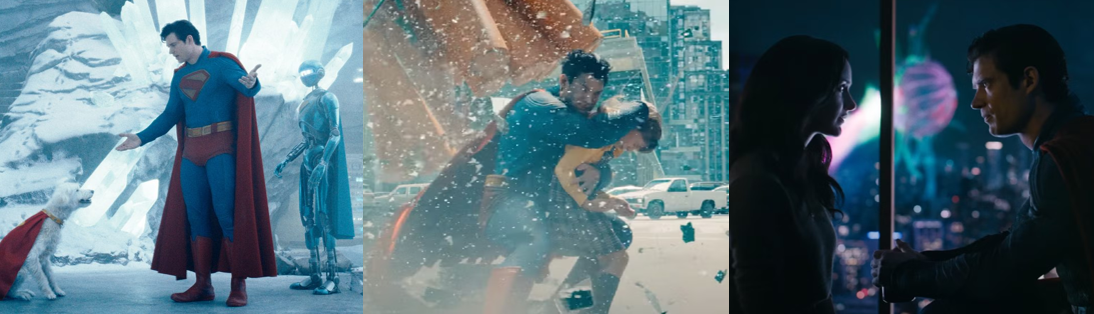
Superman finds his relationships tested by his determination to put his powers to good use.

This desire stems from a damaged message from his long-dead Kryptonian parents, Jor-El (Bradley Cooper) and Lara Lor-Van (Angela Sarafyan) in which they express their love and hopes for him to serve humanity as a protector. Superman takes great comfort in these words, finding solace in the knowledge that he has a higher purpose even if his people are long dead. Additionally, Clark was raised with the standard virtues of right and wrong associated with the character thanks to his adopted parents, Jonathan and Martha Kent (Pruitt Taylor Vince and Neva Howell), who nurtured his kindly nature and contributed greatly to his characterisation as a loveable goof. Despite his amazing powers, Superman struggles as much as any normal man, constantly swooping in to save those in danger and checking to make sure those around him are okay and always pushing to end conflicts with as little violence and death as possible. He’s therefore irritated when the Justice Gang mortally wound a rampaging kaiju and aghast at the idea that he should just stand back and let people die when he could intervene. While Clark and Lois have a very passionate relationship behind closed doors and keep up the pretence of being bickering co-workers, their views on this matter drive a wedge between them early on. While Clark wears his emotions on his sleeve and expects Lois to cut him some slack, Lois is more hesitant about long-term relationships and isn’t afraid to ask the big questions, even of Superman. Though she considers breaking up with him because of her doubts, Lois not only stands by Superman, she comforts him when Lex Luthor launches a smear campaign against him, and teams with Mr. Terrific to rescue him after he willingly surrenders to the authorities. This comes after Luthor raids his Fortress of Solitude and broadcasts the entirety of his parents’ message, which surprisingly reveals that Kal-El was sent to rule a backwoods people, severely shaking Superman’s outlook on himself and his mission to safeguard his adopted world.

While Lois has a lot to do, even teaming with Mr. Terrific, the rambunctious Krypto steals the show!

Superman may well give Lois more to do than any previous Superman-centric movie as she gives the Justice gang (particularly the conceited Guy Gardner) a grilling for abandoning their friend, braves Luthor’s unstable “pocket dimension” to locate her lover, and even pilots Mr. Terrific’s T-Craft to ferry him around when he’s injured. While Lois doesn’t hold back when questioning Superman, her deep-rooted desire for the truth sees her digging deeper into Luthor’s malicious vendetta against Superman. She’s aided by peppy photographer Jimmy Olson (Skyler Gisondo), who uses his unexpected way with the ladies to convince Luthor’s current squeeze, Eve Teschmacher (Sara Sampaio), to give them the clues to both locate Superman and reveal that Luthor financed Ghurkos in return for half of Boravia. Lois is depicted as more than Superman’s equal, braving any danger for a scoop and meticulously presenting her evidence to crabby Daily Planet editor Perry White (Wendell Pierce), who supports her efforts to expose Luthor as a liar and a traitor. While his people are long gone, Superman’s aided by a handful of robotic helpers at his crystalline Fortress of Solitude and begrudgingly cares for the energetic and disobedient Krypto, the Kryptonian dog of his unruly cousin, Kara Zor-El/Supergirl (Milly Alcock). While this isn’t Krypto’s first venture outside of the comic books, he steals the show here with his unruly and feisty behaviour, causing chaos due to his super speed and strength much to Superman’s exasperation as he’s struggled to train the pup. An all-CGI creation (though you’d never know it), Krypto’s an adorable superpup who pounds around in a cape, goes for the face when threatened, and nips at Superman’s heels at every opportunity. Though he reluctantly tolerates the dog, Superman is enraged when Luthor pupnaps Krypto, further damaging his reputation by storming into Lex’s office, and endures horrendous torture at the hands of the reluctant Rex Mason/Metamorpho (Anthony Carrigan) when he surrenders to rescue the dog.
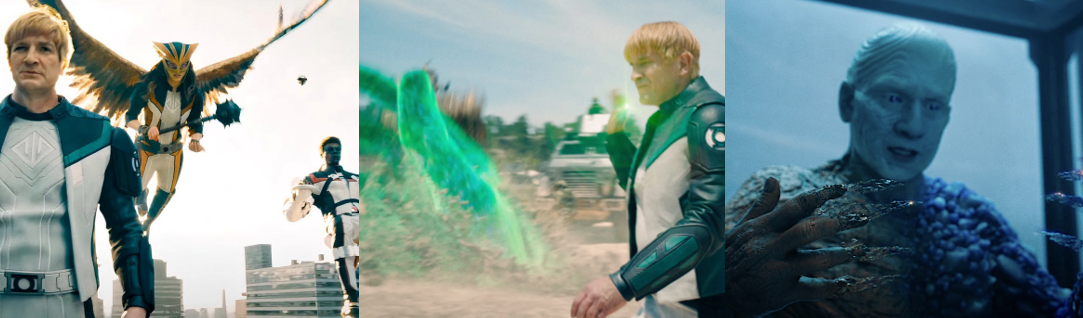
While the Justice Gang’s methods clash with Superman’s, it’s nice to see established metahumans.

Although the Justice Gang are clearly the tools of corporate mogul Maxwell “Max” Lord (Sean Gunn), garbed in uncomfortable matching outfits and showing up to avert any crisis and get some much-needed publicity, they are extremely competent superheroes in their own right. While we don’t get any meaningful backstory on any of them, especially the alluring and deliciously battle hungry Hawkgirl, beyond some snarky comments from Guy about how he was chosen to be a Green Lantern, the team is well established and close enough to Superman to know his true identity. Although Mr. Terrific takes centre stage, I enjoyed the abrasive and egotistical Guy Gardner the most and was very pleased to finally see a Green Lantern on the big screen again. Guy is rude, belligerent, and full of himself, believing himself the leader of the Justice Gang and stepping up to anyone who questions his motives, authority, or even the group’s name. Guy is the most vocal of the group in turning on Superman, immediately condemning him as an alien threat, while Hawkgirl is more dismissive and Mr. Terrific is more concerned with the facts. Shown to be a somewhat stoic but unrivalled genius, Mr. Terrific utilises various tech, most notably his T-Spheres, to analyse a threat and determine the best, most efficient course of action, lethal or otherwise. While Superman bemoans their recklessness, the Justice Gang disregard his complaints as they don’t hold themselves accountable for property damage or loss of life, painting them as very rough around the edges. Mr. Terrific is both impressed and horrified to learn the Luthor has harnessed a black hole to create dimensional portals all over the world and kit out a hazardous pocket dimension as his own prison, where the egomaniac throws any dissenters and forces monkeys to slander Superman online. Metamorpho is kept under heel there to save his baby son and forced to transmute his body into Kryptonite to torture Superman. While he initially demands that Superman not try to talk or reason with him, Metamorpho has a change of heart after witnessing how cruel Luthor is and restores Superman to full health, assisting him in fending off Luthor’s goons and even joining the Justice Gang to curb the invasion of Jarhanpur.
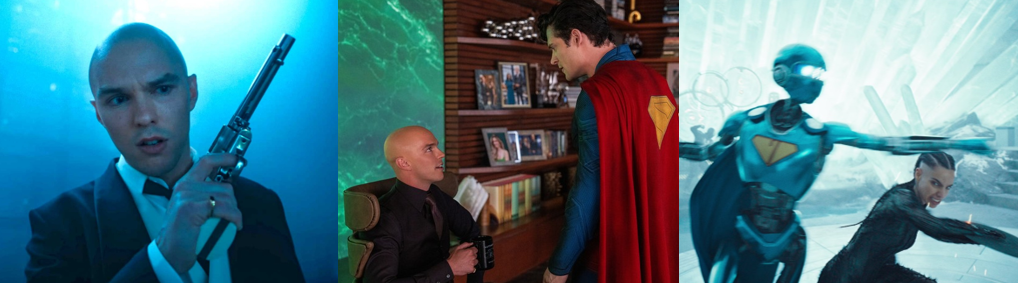
Vindictive Luthor schemes to discredit and destroy Superman with his self-made enforcers.

After years of enduring subpar or wildly eccentric cinematic interpretations of Lex Luthor, Superman finally gives us easily the greatest and most despicable version of the balding madman ever seen on the big screen. Nicholas Hoult excels in the role, effortlessly commanding every scene and bringing a cold, clinical focus to Lex that’s matched only by his ruthlessness and descent into abject tyranny. Already resentful of metahumans, Lex is driven to a self-confessed envious rage by Superman, whom he sees as an alien interloper who is stunting human growth and stealing the spotlight from hard-working, natural geniuses like himself. Committed to first discrediting Superman and then destroying him, Luthor concocts a convoluted scheme to turn the public against the Man of Steel to gain authority to apprehend and destroy him, all while funding the Boravia/Jarhanpur conflict to profit from the war. Constantly in command of every situation, Luthor easily infiltrates the Fortress of Solitude and steals Superman’s personal data, employing his homegrown metahumans – the cybernetic Angela Spica/Engineer (de Faría) and the mysterious Ultraman – to distract Superman while directing a team of all-too-willing underlings to commit horrendous atrocities. Sacrificing her humanity for Luthor’s dream, able to turn her body into any weapon she can imagine, the Engineer attacks with nanotech, easily hacking the Fortress of Solitude and almost suffocating him. Equally, Superman meets a physical match in the ruthless Ultraman, who mirrors his abilities and is directly controlled by Luthor, who’s meticulously studied Superman to counteract and predict his every move. Beneath his silky-smooth facade, however, Luthor is a raving lunatic who condemns anyone who questions him to his pocket dimension, happily tortures and executes those who get in his way or is even remotely tied to Superman, and who relishes the chance to prove his intellectual superiority over the Man of Steel.

The Nitty-Gritty:
It’s clear that James Gunn is influenced by many different sources for this film. Obviously, the classic Richard Donner films are the most prominent, with composers John Murphy and David Fleming sampling the iconic John Williams theme and giving it a glam-rock edge and the opening and closing titles mirroring Donner’s films. The design of the Fortress of Solitude is also ripped directly from Donner, though Gunn populates it with distinctly “Silver Age” Kryptonian automatons who tend to Superman’s needs. The entire film pops with colour and exciting action, just like a comic book, and Superman is purposely given a corny edge to make him a loveable throwback to a simpler time. Superman also takes place in a world where metahumans, Gods, and monsters have become an accepted part of everyday life. Therefore, while civilians still flee for their lives when the Hammer of Boravia and a fire-breathing kaiju attack, it’s treated as another day in Metropolis, with even Superman and Lois barely acknowledging an interdimensional imp threatening the city during their reconciliation. Superman goes one step further with this, introducing pocket dimensions, establishing the Hall of Justice as the Justice Gang’s headquarters, and hinting at a larger universe beyond our world through a Green Lantern and certain dialogue. Everything feels very “lived in”, like we’ve jumped into the third film in a franchise, without being overwhelming or difficult to follow as the focus is on the characters, their interactions and relationships, and their different dynamics. The world is in awe of Superman but turns on him immediately once Luthor broadcasts his message, with even his allies questioning his true purpose, and this twist is used to push Clark away from being beholden to his lost and unknown people and back towards his true heritage: namely, his Earth parents and their lessons.
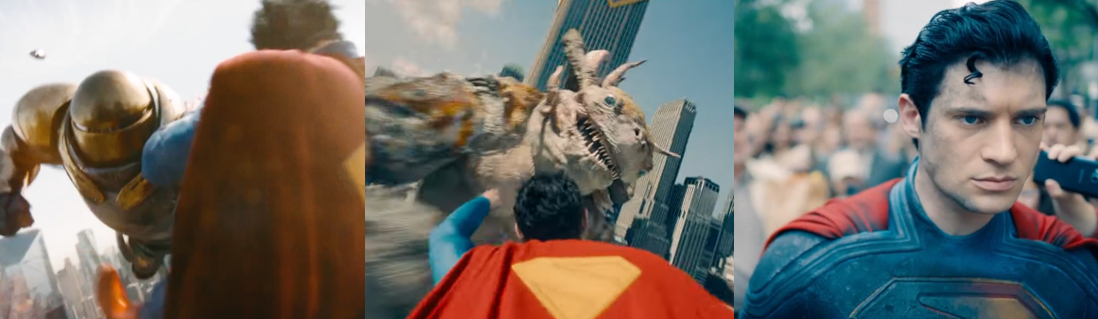
Even when Luthor turns people against him, Superman strives to do the right thing.

Although I wasn’t sold on the costume at first, seeing it as a mishmash of different elements from various Super Suits over the years, it looks fantastic on screen. It’s so gratifying to see the trunks and the cape symbol make a return and Corenswet fills the suit out beautifully, appearing as visually iconic as Christopher Reeve did all those years ago. Superman isn’t some invincible demigod here, either. Like in the John Byrne stories I grew up with, Superman is extremely powerful but still physical vulnerable, suffering a brutal defeat by the Hammer of Boravia and enduring incredible agony to return to full strength using a concentrated dose of solar radiation. Superman visibly struggles with his bigger, more impressive feats, increasing the stakes as it’s not always certain that he’ll succeed. Superman also makes a point to rescue civilians wherever possible, something the Justice Gang see as secondary, and even tries reasoning with the Engineer and Ultraman as he always sees the good in people. Superman’s greatest weakness here, however, isn’t just the Kryptonite Metamorpho synthesises to poison him but his own insecurities. Superman believed he was embarking on a sacred mission and is overwhelmed by doubt upon hearing his parents’ full message, but continues to fight anyway, determined to prove that he’s there to help regardless of what people say. The Kents, especially Jonathan, greatly contribute to this, encouraging him to forge his own path based on what he knows is right. To that end, Superman surrenders and allows himself to be imprisoned and tortured, all with the goal of rescuing Krypto and ending Luthor’s schemes, even if it causes him great pain, trusting that his actions will prove that he’s not a threat. Luckily for him, Lois helps turn public opinion back in his favour as Eve’s clandestine selfies reveals Luthor’s plot, though the people of Jarhanpur still believe in Superman since he helped liberate their people from tyranny.
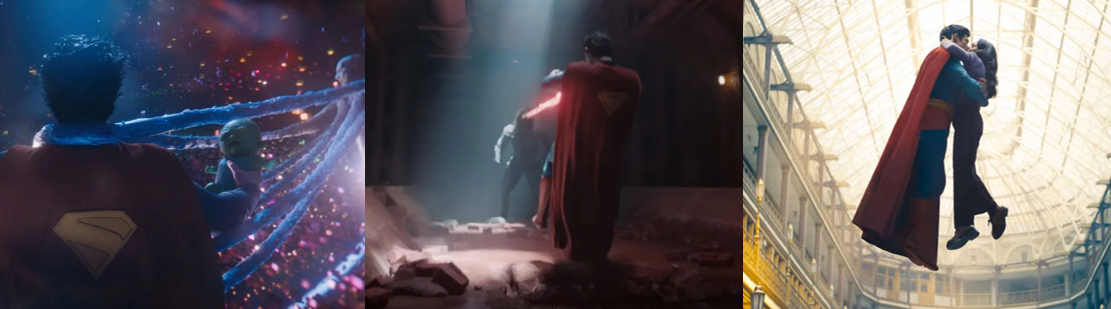
Superman rallies to redefine his mission, battle his crazed clone, and disrupt Luthor’s mad scheme.

Thanks to Lois, Mr. Terrific activates one of Luthor’s interdimensional portals and, after convincing Metamorpho to aid him, Superman escapes from the pocket dimension, recuperating at the Kent farm, reconciling with Lois, and determined to stop Luthor. In his mad ambition to publicly discredit and destroy Superman, Luthor overloads one of his portals and causes a rip in space and time to tear through Metropolis, literally splitting the city in two. Though a mandatory evacuation spares many lives, the entire planet is threatened by this tear, which can only be stopped using Luthor’s access codes. After narrowly escaping being suffocated by the Engineer’s nanites, Superman is horrified to learn that Ultraman is a mindless, brutal clone of his grown by Luthor with the sole purpose of destroying and replacing him. This revelation comes quite late in the film and is easily telegraphed as we never see Ultraman’s face and he’s there when Luthor access the Fortress of Solitude, and I don’t feel it landed all that well. It might’ve been better if Ultraman had been revealed to be a degenerating clone like Bizarro, but I feel the image of Superman battling his mirror image wasn’t as strong as the visual variety offered by the Engineer. It’s moot either way as Ultraman gets tossed into a black hole, leaving Superman free to confront Luthor and engage in a slanging match, one ended when Lois’s story breaks and Krypto manhandles Luthor. His reputation in tatters and his plans undone by Mr. Terrific’s genius, Luthor ends the film disgraced and incarcerated and Metropolis is sewn back together when the rip is shut down. Having declared their love for each other, Superman and Lois rekindle their relationship, the Justice Gang gets a new member in Metamorpho, and the world’s faith in Superman is seemingly restored. Although Superman despairs when his rowdy cousin returns from a bender out in space, he now finds comfort in viewing his memories of his childhood with his Earth parents.

The Summary:
I’ll be the first to admit that I was annoyed that we got another Superman/DC reboot after years of false starts and troubled efforts to get a live-action DC universe off the ground. I was hoping for a course correction with Henry Cavill and slightly sceptical of the new suit, but the colourful atmosphere and light-hearted action of the trailer gave me hope…and James Gunn certainly follows through on that promise. Superman is easily the best big screen adaptation of the Man of Steel perhaps ever, taking inspiration from many different interpretations and comic books and stitching together possibly the most accurate live-action distillation of the character and his chief nemesis. David Corenswet was fantastic in the title role, thankfully spending more time in the suit and just being a good man doing good things, while also not being infallible or so invulnerable that he’s not relatable. Nicholas Hoult was equally captivating as, in my opinion, the best Lex Luthor we’ve ever seen. He brought a malicious spite and smug energy to the role that blew his cinematic predecessors away, appearing as a true threat with an immense hatred for Superman. While I admit some of the supporting characters weren’t as developed as they could be, I’m intimately familiar with all of them so I’ll accept that in favour of a rich, fully realised world where superheroes are the norm. It is a bit odd that Supergirl never told Superman what Kryptonians were really like and somewhat reduces the emotional impact of Superman’s robots being trashed when they’re fully repaired by the end, but the engaging action and thought-provoking character interactions made up for it. I liked that Superman was questioned but not to the point where he was hated and feared, and the painfully relevant metacommentary on the state of politics and social media, and how people rallied behind Superman regardless of his bad press as they could see he was a good person. This was the Superman we should’ve gotten a decade ago, an inspirational hero who can spearhead a colourful and comic accurate live-action universe that finally does justice to these beloved characters while still offering a few fun twists along the way.

My Rating:

Rating: 4 out of 5.

Great Stuff

Did you enjoy Superman? What did you think to David Corenswet’s performance and his suit? Did you enjoy seeing him portrayed as fallible and vulnerable? Were you glad to see metahumans are the accepted norm in his new world? What did you think to Lex Luthor and would you agree this is the best cinematic portrayal of the villain? Were you a fan of Krypto and did you guess Ultraman’s true identity ahead of time? Feel free to share your thoughts on this new version of Superman, even if you’re a hardcore Snyder fan, in the comments, check out my other Superman content, and donate to my Ko-Fi to support more reviews like this.


Game Corner: Sparkster: Rocket Knight Adventures 2 (Nintendo Switch)

Released: 11 June 2024
Originally Released: 23 September 1994
Developer: Konami
Also Available For: Mega Drive, PC, PlayStation 4, PlayStation 5

The Background:
The success of Sonic the Hedgehog (Sonic Team, 1991) saw anthropomorphic mascot platformers become a popular trope throughout the nineties, with a superpowered earthworm, an intergalactic adventurer, and a gun-toting jackrabbit making a rocket pack-wearing possum seem normal! The brainchild of Nobuya Nakazato, the man behind many Contra titles (Konami, 1987 to present), Rocket Knight Adventures (Konami, 1993) was one of the most popular and celebrated Mega Drive titles. Despite a port for the Super Nintendo being allegedly cancelled, Rocket Knight Adventures was followed by two sequels the very next year: one exclusive to the Super Nintendo and the other this notoriously expensive Mega Drive-exclusive title. Although not as well-regarded as its predecessor and seen as inferior to its Super Nintendo counterpart, Sparkster: Rocket Knight Adventures 2 was praised for its colourful gameplay and tweaked rocket pack mechanics. Sparkster: Rocket Knight Adventures 2 inspired a six-part story in Sonic the Comic (1993 to 2002) but the franchise was dead in the water until Climax Studios attempted a revival in 2010, to mixed reviews. However, the game, the other 16-bit Rocket Knight titles, finally received a modern re-release with this Re-Sparked! collection, a widely praised release that came with some fun bonus materials and quality of life features.

The Plot:
When King Gedol’s lizard forces invade the kingdom of Zephyrus and rogue Rocket Knight Axel Gear kidnaps Princess Cherry, Sparkster searches for seven magical swords to oppose the Gedol Empire and best his rival.

Gameplay and Power-Ups:
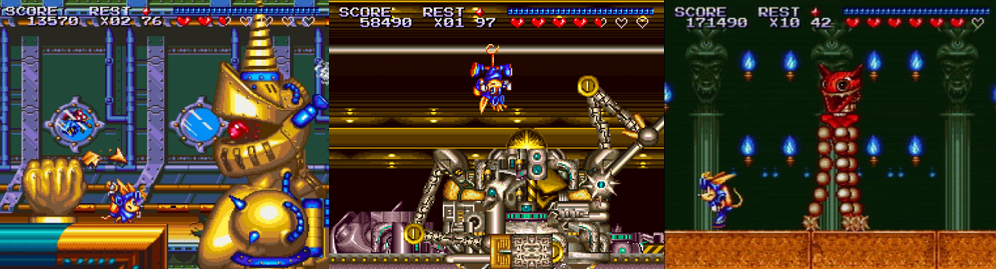
Just like the other 16-bit Rocket Knight games, Sparkster: Rocket Knight Adventures 2 is a 2D, sidescrolling action platformer. However, unlike the original game and its similarly titled Super Nintendo cousin, there are no run-and-gun elements to Rocket Knight Adventures 2 as Sparkster’s sword has been robbed of its sword beam. This significantly impacts the primary gameplay as you now rely on Sparkster’s bog-standard sword swings, which can fall a little short at times. You attack with Y and jump with B, executing a jump sword swing and clinging to poles using Sparkster’s paws and tail when you jump to them. Unlike in the other games, Sparkster’s rocket pack charges automatically and has different levels of effectiveness depending on how full the meter is. As long as the meter’s at least partially full, you can press A to rocket dash in the direction you’re facing, diagonally to take out turrets, and upwards to get higher. If you press A without a direction, Sparkster spins on the spot to attack enemies and, when the rocket pack is fully charged, Sparkster spirals in a “Screw Attack” (no relation), travels further, and bashes through destructible blocks and walls. While waiting for the meter to charge does take a lot of agency away from the player, it charges pretty quickly and you have far more control over Sparkster off a upwards boost, which greatly aids with reaching platforms. Sparkster can still ricochet off walls to get higher, though this is still underutilised, in my opinion, with Rocket Knight Adventures 2 focusing more on traditional platforming. Players still collect gems for points, though this time there are two types: regular blue ones and red ones that kick-start a slot machine for additional gems, health (now apples and chunks of meat), extra lives, or a rocket pack that instantly sends you flying in a Screw Attack. Naturally, these can all be found in the game’s stages, too, and you receive a score tally after clearing each stage for bonus points.
Sparkster’s sword is nerfed but his rocket pack and mech game are stronger than ever!

Sparkster can also grab the new power-up icon that gifts him a flaming sword to increase your attack power, though you’ll lose this when hit or advance to the next stage and I can’t say I noticed a significant difference, especially as many enemies die in one hit. Rocket Knight Adventures 2 has seven stages and four difficulty settings, with players only seeing the true ending by beating the game’s harder difficulties. Sadly, the shoot-‘em-up stages from the other two games are gone, replaced by three sections where you control Sparkster’s giant mech, the SparkRobo. Two of these are Rock ’Em Sock ’Em Robot battles with Axel Gear that are similar to that one boss from the first game, and the other is a sidescrolling autorunner where you blast enemies from the sky using the SparkRobo’s rocket punch (Y, which can also be charged) and jump over bombs tossed by enemies on the ground (also with Y). Sparkster doesn’t ride any minecarts or miniature mechs here and only has to deal with one autoscrolling section, where players dispatch enemies, destroy or jump to crates, and hop between train carriages to avoid a nasty spill. Spikes, flame plumes and lava, and insta-death traps are still present, however, with quicksand swallowing you, moving platforms ridden past spikes, and even a sand twister tossing you about atop a pyramid in Stage 2. This stage has a higher and lower path, which you may wish to switch between for different rewards and dangers, while Stage 5 features many switches to open doors, doors guarded by projectile-firing gargoyles, and conveyer belts. Stage 2’s pyramid gimmick differs from the Super Nintendo version, featuring a race from rolling balls and false doors that loop you back to the outside until you find the correct path. You’ll also cross lava on moving platforms and by clinging to overhead pipes, which gain destructible spiked hazards and even Gedol henchmen by Stage 5. Stage 3 sees Paeli, leader of Gedol’s lizard ninjas, bombard Sparkster and the blocks of the stage from his airship. This destroys the ground and forces you to take high-speed tubes up to the top of the ship to destroy barriers and drop the ship from the sky.

Presentation:
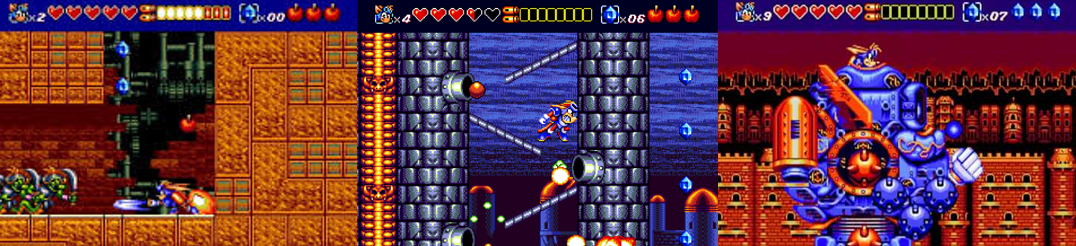
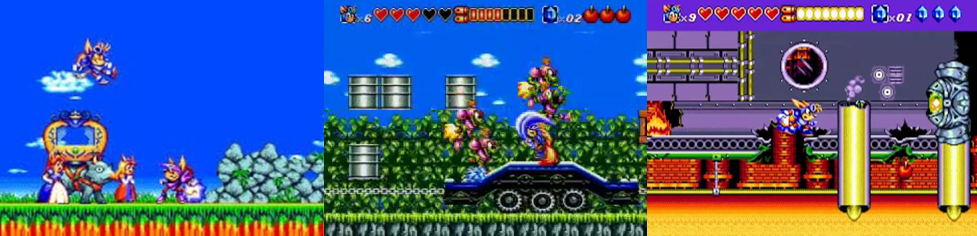
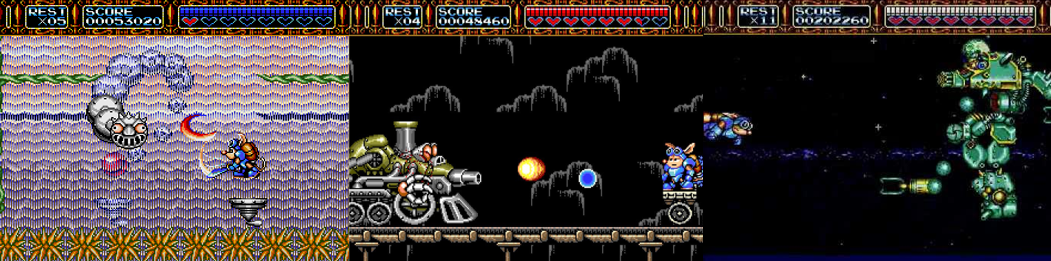
Sparkster: Rocket Knight Adventures 2 is a bit of a mixed bag, visually, something immediately evident from the lacklustre title screen (simply the game title against a moving sky background). This does pan down into the opening cinematic and mech battle against Axel Gear, however, a fight you can skip if you wish, which causes you to miss a collectible and displays an absolutely garish secondary title screen. Unlike in the Super Nintendo game, stage intros are back but they’re far less visually interesting than in the first game, and every sprite has been redesigned to give it a more anime flair. Although I miss the cute, squat Sparkster of Rocket Knight Adventures, he looks pretty good here and is far more animated. He bops about as if itching to get going, his rocket pack is almost constantly aflame, and he stands heroically when left idle. Sparkster also squeals when hit, reacts when piloting the SparkRobo, has more animation frames, and displays more personality than on the Super Nintendo thanks to Rocket Knight Adventures 2 including more pantomime-like, sprite-based cutscenes. These are similar to those of the first game, seeing Sparkster leap into action when Axel Gear kidnaps Princess Cherry and advance between stages, with elements from previous stages (such as Stage 1’s train) appearing in others. Unfortunately, like the Super Nintendo title, Rocket Knight Adventures 2 cannot live up to or surpass the original’s soundtrack. Things are jaunty enough, for sure, but nothing stuck in my head like the main from the first game. Interestingly, Rocket Knight Adventures 2 does replicate the slowdown from the first game, with the frame rate noticeably dipping when Gedol’s forces drive vehicles or too many sprites and explosion effects appear at once.

The visual overhaul is great for Sparkster but not so much for the enemies and environments.

Perhaps most unforgivably, Rocket Knight Adventures 2 appears far blander than the first game and its Super Nintendo counterpart. Stage 1’s forest section is disappointingly subpar compared to the first game, with the ground being a far more basic block of sprites and the background having little to distract you, even when the overgrown ruins creep into play. The train section adds some spice and variety, for sure, but it paled in comparison to the Super Nintendo title. Similarly, while both games include a desert, they’re rendered very differently. Stage 2 has a neat shifting sand and heat shimmer effect in the background, but its pyramid is blockier and more akin to ruins, making it far less visually engaging than SEGA’s competition. Stage 3 took place atop the pyramid’s ruins and in an airship, which was, again, a far cry from the steampunk-style battle craft from the first game, even with its fake doppelgängers of Princess Cherry and larger, blade-like propellers. Stage 4 was like a poor imitation of a similar city stage from Rocket Knight Adventures; sure, the SparkRobo looks cool (if a tad goofy), but the city lacks the detail and appeal of the first game. Things pick up in Stage 5, which takes place outside and inside King Gedol’s heavily fortified castle-cum-weapons factory. The background is a bit busy at times, but I liked all the moving parts, alternate routes, and the danger brought on by the turrets. While the mech battles against Axel Gear are in bland, dark caverns, you battle him in a traditional swordfight against a grandiose background and confront King Gedol in his opulent throne room. If you find all seven “Keys to the Seal” swords, you’re also treated to a great sprite-based cutscene of Sparkster becoming “Gold Sparkster”, a form he retains for the end credits and loses when he returns the combined magical sword in the game’s ending.

Enemies and Bosses:
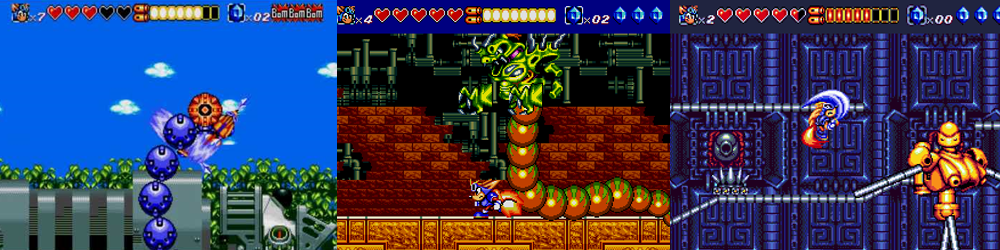
Instead of fighting pigs or wolves, Sparkster tackles the lizard forces of the Gedol Empire, whose infantry leaves a lot to be desired. Sure, armoured lizard-men spontaneously appear from boulders or even gems, but it takes a long time before they attack with swords. In Stage 1, for example, they might get the drop on you, but they just charge at you while unarmed; they don’t even lose their armour when defeated, making them far less satisfying to kill. By Stage 5, they’re hiding in large, snake-themed turrets and you’ll battle more formidable forces, such as gun-toting lizards (who oddly explode when defeated) and sword-wielding snakes whose body parts can hit you. Gedol’s forces drive steampunk-style vehicles in Stage 1, flailing their buzzsaw-like arms and forcing you to strike and rocket to safety, and pilot chicken-like mech walkers and float on balloons in Stage 4. Their forces are bolstered by some robotic enemies, such as annoying spiked balls that home in on you in Stage 3 and the returning robotic owls who can screw up your jumps. Interestingly, not only are bosses far weaker when playing on the easier difficulties, but you’ll miss some additional screens and mini bosses if you play on “Easy”. Stage 1 sees you battle a disturbing living plant that can only be damaged by rocketing into its face, which it protects with its extendable arms. You’ll also get an assist from some possum helpers when facing an ugly-ass lizard, with the two of you bouncing about an enclosed arena and the boss tossing bombs or rolling into you. A sentient plume of lava awaits in Stage 2, one that spews a flamethrower and controls the lava and forces you to the rail above to rocket into is face. Finally, there’s a large, robotic lizard face that hounds you throughout Stage 5, dropping spiked enemies, summoning lightning walls and lizard minions, and screwing up your traction with a conveyor belt.

Large bosses can cause a headache with their wide-reaching attacks and limiting your attack window.

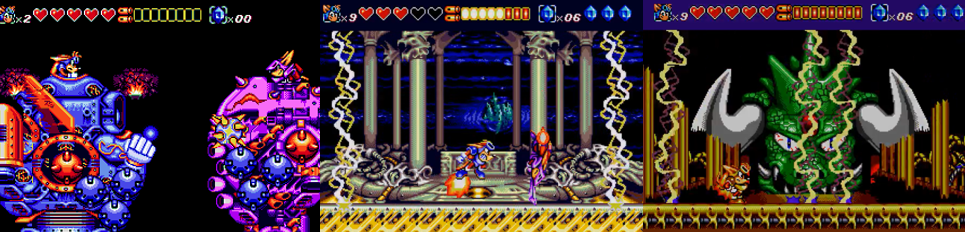
The first true boss is a variation of the Raccoon Robot enemy from the first game, this time integrated into a train. You must rocket away from its wide-reaching ball arm and avoid its projectiles, quickly striking the weak spot on the front of the train and dashing to safety as the arm flails wildly, which is quite taxing as the arm covers almost the entire screen and the projectiles can catch you off guard. Stage 2 ends with a gigantic, armoured snake whose only weak spot is its torso. You must dodge its claw arm, which it’ll fire out to reel you in and vigorously shake you, then chase it to the background. While hiding back there, it bursts its long, extendable tail, bursting from the ground and swishes it about, though you’ll also have to watch when it leaps across the tomb. King Gedol’s second-in-command, Paeli, is fought on the roof of his airship and seems to be a sorcerer or genie or something. He fires a flaming shot that both hurts and shrinks you, transforms into a genie-like form, then bursts into harmless miniatures that rain down as bombs and apples. One of these miniatures sparkles, so that’s your target; hit him and Paeli runs around in a panic like Captain Fleagle for you to deal real damage to him. Near the end of Stage 5, tall, spindly robots stomp about, spinning their long, stick-like arms, tossing bombs, and firing lasers. They’re easy enough to take down, even with the rails, conveyers, and enemies nearby, but you’ll then fall into a small arena and battle two of them. One fires pellets, lasers, and spins its arms but, upon defeat, is replaced by its green brethren, who leaps to the ceiling dropping bombs and drops to the floor to be finished off.

Match your skills against Axel Gear then power-up to Gold Sparkster to depose King Gedol.

As in the other Rocket Knight titles, your most persistent foe is the rival Rocket Knight Axel Gear, who you fight in a mech battle at the start. Though this is optional, you’ll miss a Key to the Seal sword and learning the SparkRobo’s controls for later on. You must avoid Axel’s punches and hold A to block when he throws a shot or a projectile. Though you don’t get a projectile attack, you can throw uppercuts with B or Y or hold one of these to charge a straight punch. While this battle is much easier than the top-down mech fight from the Super Nintendo game, it’s no less tedious. Axel constantly guards and backs away and there’s a noticeable delay between button presses that can catch you out. While you don’t necessarily have to win this first mech fight, you will have to in Stage 4. However, to get to this rematch you must race through the streets and avoid Axel’s missiles, hitting them back at him to cause him to flee to his mech. Best his mech (with patience and persistence) and you battle Axel in a sword fight. Axel summons lightning walls that you can ricochet off otherwise they’ll hurt you and Axel again sports the same attacks as you, rocketing about, spinning as a flaming dervish, and swinging his sword. He does tend to hover about doing nothing, leaving himself open, and drops the final Key to the Seal upon defeat. With all seven, Gold Sparkster gets a permanent rocket charge and is much faster, which is very useful in the final fight with King Gedol. This is a two-stage affair, with the lizard king blinding you with a flash and charging lightning bolts from above or spawning a meteor shower. You can only attack him during this charge animation and, after enough hits, he transforms into a gigantic form that takes up the entire background! In this phase, King Gedol fires eye lasers that travel across the floor, walls, and ceilings, ricochet about, or randomly fire in all directions. You must dodge these and rocket into the gemstone that appears on his forehead to finally put him down for good.

Additional Features:
Sparkster: Rocket Knight Adventures 2 has four difficulty settings that fundamentally change the nature of the game, altering the length and challenge of the stages and changing the ending depending on how hard a challenge you set for yourself. You can further adjust the game’s difficulty from the main “Options” menu, changing how many lives and continues you play with. The game also includes a password feature, allowing you to skip to later stages and easily acquire all seven Keys to the Seal. These magical blades are hidden in each stage, sometimes in plain sight and sometimes requiring a bit of exploration to find. You’ll need all seven to play as Gold Sparkster and get the best ending, encouraging a replay or two (though be sure to take out Axel’s mech at the start for the first sword!) This Re-Sparked version also comes with the American and Japanese versions of the game, boasts an awesome anime opening, allows you to apply filters and borders, and negates even the hardest difficulty with a rewind and save state feature. The collection also comes with a boss rush, advertisements and concept art, the box art and manual, and the entire soundtrack for all three games. Those playing the PlayStation 4/5 version can also earn nine Trophies, one for clearing the first five stages, one for beating the game on any difficulty, one for unlocking Gold Sparkster, one for achieving the true ending, and one for beating the boss rush.

The Summary:
I’ve played Sparkster: Rocket Knight Adventures 2 before thanks to the magic of emulation, but never got past the first stage because, as a big fan of the original and an avid Mega Drive collector, I always wanted to own a physical copy of the game. It took a while, but the Re-Sparked collection finally made that a reality, only to present me with a game that’s visually inferior to its predecessor and Super Nintendo cousin in many ways. While Sparkster looks great and there are some interesting effects in some stages, the environments just seem far blander and far less engaging compared to the other 16-bit titles. Honestly, the game made a bad impression from the start and never really recovered; the rocket gameplay is much improved, but the main enemies lack animation frames and personality. The locations lack the steampunk trappings of the other titles and are far more generic which, coupled with the bizarre downplaying of the rocket pack and ricochet gimmick and removing Sparkster’s sword beam, means Rocket Knight Adventures 2 is just another colourful platformer. It’s fun enough, for sure, and some stages have interesting gimmicks, such as zipping through the airship and piloting the SparkRobo, but where are the flying sections? Where’s the quirky humour? Where’s the memorable music? The bosses were decent enough and I liked that you face more of them on harder difficulties. The one-on-one with Axel Gear is probably the best version of that fight, it’s just a shame you have to sit through another tedious mech battle to get to it. Rocket Knight Adventures 2 is also far too linear at times and felt the easiest of the three 16-bit titles, with King Gedol being the simplest of the final bosses and the hardest part being tracking down those hidden swords. In the end, I enjoyed Sparkster: Rocket Knight Adventures 2 but nowhere near as much as I wanted to. It fails to live up to its predecessor, lacks the visual punch of the Super Nintendo title, and was a disappointing experience after years of pining for it.

My Rating:

Rating: 3 out of 5.

Pretty Good

Do you think I’m being too harsh on Sparkster: Rocket Knight Adventures 2? How did you think it compared to the first game and the Super Nintendo sequel? What did you think to the new rocket pack mechanics and the lack of sword beam? Were you disappointed to see the flying sections removed? Did you ever find all the Keys to the Seal and unlock Gold Sparkster? Would you like to see a new entry in the Rocket Knight series? Tell me what you thought to Sparkster: Rocket Knight Adventures 2 in the comments, support me on Ko-Fi, and go read my other Rocket Knight reviews.

Game Corner: Sparkster (Nintendo Switch)

Released: 11 June 2024
Originally Released: 15 September 1994
Developer: Konami
Also Available For: PC, PlayStation 4, PlayStation 5, Super Nintendo Entertainment System (SNES)

The Background:
Sonic the Hedgehog’s (Sonic Team, 1991) incredible success paved the way for a slew anthropomorphic mascot platformers back in the 1990s. We had everything from a heroic frog, a gun-toting jackrabbit, an intergalactic adventurer, a fragile bobcat, and a superpowered earthworm, so why not a possum with a rocket pack? Created by Nobuya Nakazato, who spearheaded many Contra titles (Konami, 1987 to present), Rocket Knight Adventures (Konami, 1993) became one of the most popular and lauded titles for the Mega Drive. Although a SNES port was allegedly cancelled, Rocket Knight Adventures was followed by two sequels the very next year: one a notoriously expensive Mega Drive-exclusive title and this similarly-titled but unrelated SNES-exclusive game. Although largely praised for its visuals and gameplay, Sparkster was criticised for not further expanding upon the first game’s formula and 1994 was, essentially, the end of Sparkster’s brief time in the spotlight. Although Sparkster did get a six-part story in Sonic the Comic (1993 to 2002), he didn’t get a cartoon like his more popular peers and was forgotten until Climax Studios attempted a revival in 2010, to mixed reviews. Sparkster, and its other 16-bit titles, finally got a modern re-release with this Re-Sparked! collection, a well-received release that included bonus materials and quality of life features.

The Plot:
When the kingdom of Eginasem is attacked by Generalissimo Lioness’s Wolf Army and Princess Flora is kidnapped by rogue Rocket Knight Axel Gear, Sparkster fights to save the land.

Gameplay and Power-Ups:
Like its predecessor, Sparkster is a 2D, sidescrolling action platformer with run-and-gun action in which players take control of Sparkster and his rocket pack and battle through a fantasy land infused with a dollop of steampunk madness. As before, players choose between three different difficulties, though you’ll only experience the full game and the true ending by playing on at least “Hard”. To aid with this, Sparkster incorporates a password system, one still relevant as the rewind and save state features won’t help you when you get to a nigh-impossible boss battle in the late game. Sparkster’s entire repertoire of moves and abilities returns alongside a couple of additional abilities. You jump with B and attack with Sparkster’s sword and sword beam with Y. As before, holding this button charges Sparkster’s rocket pack, allowing him to blast off in the direction he’s facing, straight up, or diagonally. If you don’t press a direction, he simply spins on the spot and, when aimed at walls, he’ll ricochet to higher areas. While there’s no need to swim this time around, Sparkster still clings to vines, branches, and poles with his tail and you’ll be hopping, sliding, and jumping to these purchases a lot more this time around. Pressing L or R sees Sparkster perform a flaming kick, of sorts, for an additional attack and mid-air boost, something you’ll be using a lot to reach higher platforms as Sparkster’s otherwise uncontrollable after blasting off. Although there are still no power-ups to collect, you can grab gems to increase your score (and your life count once you get 100 gems), the odd 1-up, and fruit (apples and bananas) to refill your health. There are far more gems this time around as well, possibly to offset the steep difficulty curve, but there are no horizontal sections where you blast along using Sparkster’s rocket pack.

Rocket along for more action-packed adventure and a handful of new gimmicks.

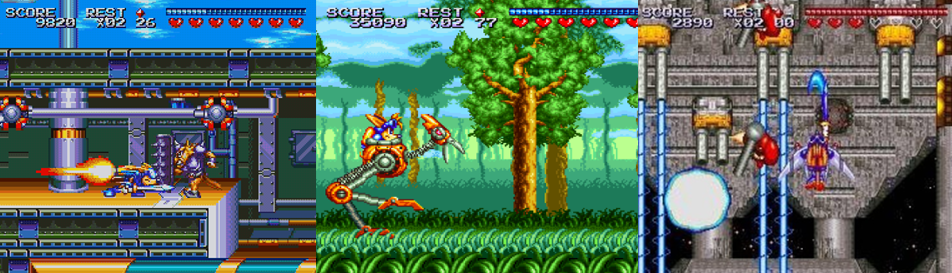
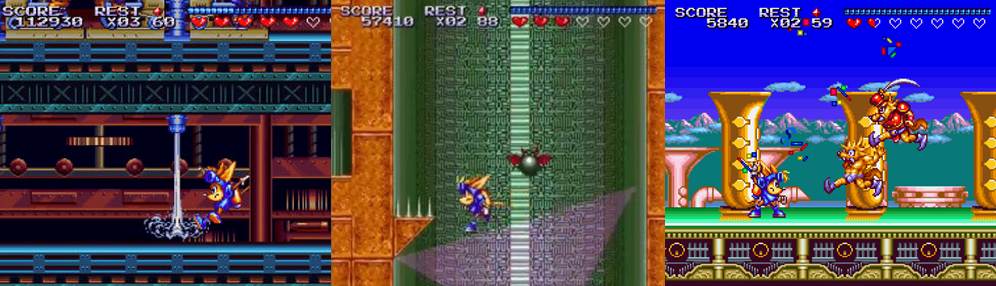
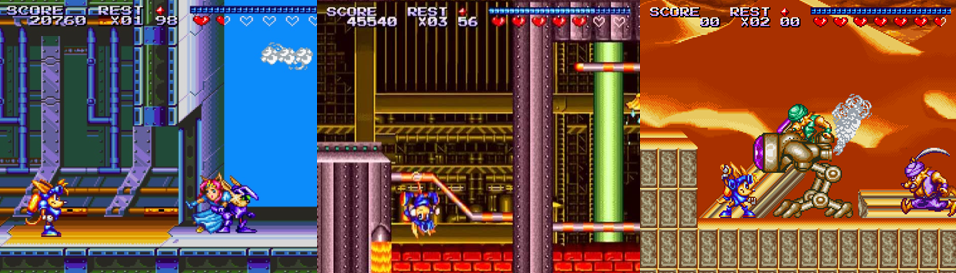
However, the spirit of these sections is evoked when Sparkster hops on a chicken-like mech and races through the jungles in Stage 3. In this long section, you press Y to fire a ring shot from the mech’s mouth while also attacking with Sparkster’s sword beam to dispatch enemies coming from behind. You must also duck under spikes and other hazards, get launched to other mechs, and take out waves of enemies as you race along. Later, in Stage 7, the game adopts a top-down view and you control Sparkster as be flies through space in pursuit of Generalissimo Lioness’s massive ship. In this section, you can still fire Sparkster’s sword beam but can also hold B to fire a spread of pellets to take out turrets and enemies. This is actually a bit awkward thanks to the button placements and it’s easy to miss incoming projectiles as a result, though the section is a burst of exhilarating fun until you get to the near-impassable wall that is a top-down Rock ’Em Sock ’Em Robot mech-battle against Axel Gear. In Stage 4, you use tubes to blast around the interior of an attack submarine and must avoid water jets that blast you into ceiling spikes. Stage 5 sees you venture into a pyramid, one that constantly shifts as you pass door-like tiles. You must shift and rotate the environment to find goodies and progress, which can be very aggravating and confusing as it’s not immediately clear which configuration you need to move on. Later in this same stage, you ride a translucent, rotating triangle platform up a shaft, avoiding spikes as you go, while high-speed tubes masquerading as musical instruments blast you along or send you back a fair bit in Stage 6. This stage also sees you bouncing to drums, riding air currents, and using teleports not unlike those in Rocket Knight Adventures.

New, even cheaper hazards will test your reflexes, patience, and rocket skills.

Sparkster is extremely similar to Rocket Knight Adventures, so much so that, at times, it feels like a SNES reimagining of the first game. You begin in a very familiar medieval forest setting, blast to a steampunk-like ship, and encounter many of the same hazards at times. Similarly, the game’s difficulty curve is slow but steep and things start off easy enough, even with the seemingly endless waves of enemies spawning in, but you’ll soon see boulders transform into enemies, clamber between bars and poles to avoid molten metal, and battle against conveyer belt platforms that push you towards instant-death gears. Giant crushing hazards are also present alongside an odd paint mechanic in Stage 2 that briefly turns you red, sheer drops in Stage 3 where it’s almost impossible to avoid being damaged by robotic owls, and bursts of steam courtesy of wolves running on treadmills in Stage 4, which also includes an all-too-brief pogo mechanic. Stage 4 also sees you frantically outracing a wall of rushing water not unlike the flame wall from Rocket Knight Adventures, except this one pushes you into wall spikes or drowns you in seconds if it overtakes you. Stage 6 also has you quickly hopping between cymbals trying to avoid being crushed when they clap together and falling into the tubas, which warp you back to the start of the obstacle course. Stage 7 is, essentially, a pretty standard top-down space shooter that has you weaving between laser blasts and destroying turrets, while Stage 8 has you traversing a long corridor on a space station and ducking under gigantic missiles that instantly kill you on contact. You’ll also ride a flame burst up a long shaft battling an oddly shaped wolf mech and encounter ceiling turrets that bounce lasers off bug-shaped robots. While instant death hazards and bottomless pits aren’t as prominent in Sparkster and there are far less tricky sections where you’re outracing crushing or dangerous hazards, the gigantic bosses and some cheap moments are sure to wipe out your stock of lives.

Presentation:
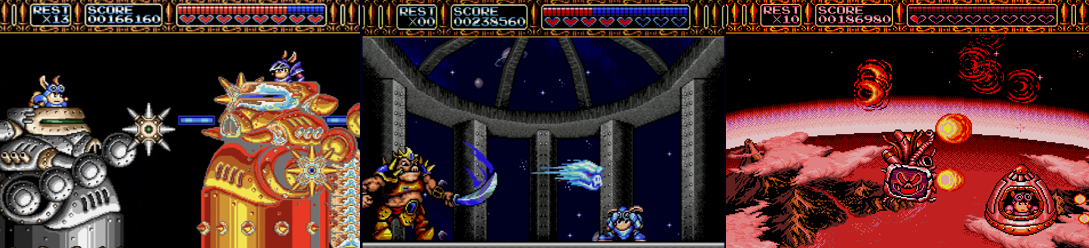
Although Sparkster overhauls the graphics and presentation of Rocket Knight Adventures, redesigning Sparkster into a more serious, anime-inspired protagonist, it continues the same cartoonish charm of the first game. Leaner and sporting a grim frown, Sparkster constantly has one paw on the hilt of his sword, glares at you when left idle, and squeals when hit or killed. Sparkster outdoes its predecessor with a more elaborate title screen and opening cutscene, which employs in-game sprites to show Axel Gear kidnapping another princess. This scene, Sparkster’s cannon blast to space, and Axel’s later escape from Sparkster’s wrath all closely resemble cutscenes seen in Rocket Knight Adventures, lending more credibility to my claim that this game is part-sequel, part-remake. Unfortunately, there are far less cutscenes like this in Sparkster, no stage intros, and the music is a far cry from the first game. While it’s jaunty enough, there are no tunes to rival the main theme of Rocket Knight Adventures and, while the game performs far better, with none of the slowdown from the first game, this is greatly aided by Rocket Knight Adventures: Re-Sparked’s “Boost” toggle from the ZL menu. Still, there are a lot of impressive visual effects included here; day turns to dusk turns to night, the Stage 7 missiles have a quasi-3D look, Sparkster’s rocket pack seems to charge faster, and there’s a unique (if odd) feature in Stage 2 where all sprites are rendered as silhouettes behind giant white screens. I also really enjoyed the sense of speed as you race along on your chicken-walker in Stage 3. The environment blurs past and there’s a lot of action here and, thankfully, no bottomless pits or unfair, split-second tests of your reflexes.

Anime paintjob aside, Sparkster rehashes much of the first game in its visuals and mechanics.

Sparkster seems to lean into the steampunk/fantasy aesthetic far more than Rocket Knight Adventures. You start in an open field, hopping to branches and trees, before blasting to Axel’s ship in what’s basically a combination of two stages from the first game. Clouds fly past the ship, which features flashing lights, destructible elements, and wolves popping from holes in the floor. Stage 2 is a cluttered factory that’s a mess of chains, lights, steam, and tubes and can be tricky to navigate as a result. Similarly, Stage 5’s desert exterior can be confusing as many columns and stone blocks obscure you. There’s a neat heat shimmer effect to this stage and I did like venturing into the pyramid; as perplexing as it was, it was far more memorable than the attack sub. You do end up outside this submarine, going to the left side of the screen and taking down biplanes, but it’s a bit dull compared to Stage 6’s bizarre musical-themed world. While this sticks out like a sore thumb against the other steampunk and medieval settings, it’s certainly whimsical and unique, even if it’d be more suitably in Zool: Ninja of the Nth Dimension (Gremlin Graphics, 1992). Stage 7 may just be a space shooter but there’s a lot of detail on the Generalissimo’s gigantic mothership (too much, at times, as turrets, enemies, and projectiles are hard to spot). Generalissimo Lioness’s space station has an impressive curve effect to its long-ass missile corridor, multiple missiles sitting stationary, and claustrophobic missile shafts to ricochet around in. It’s all very visually similar to Rocket Knight Adventures but just different enough to be unique. Still, I would’ve liked a greater visual distinction between the Wolf Army and the Devotindos Empire as the wolves’ armour even flies off like the pig infantry’s and the game ends with a big sprite art of Sparkster flying at the screen, just like before. While this art and the background accompanying the credits is more detailed, it’s still all a little too similar to be truly original.

Enemies and Bosses:
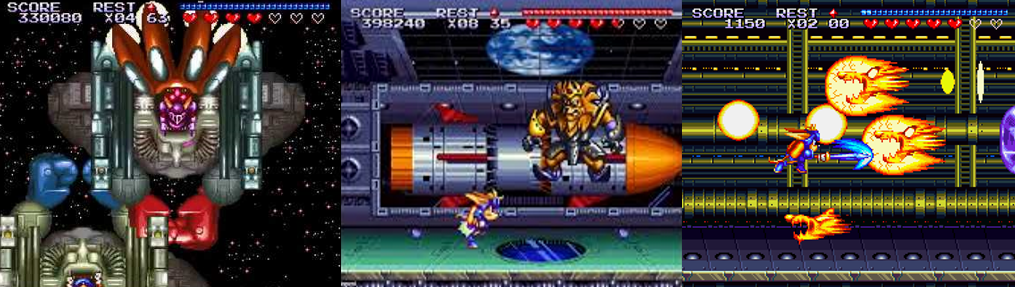
Just as you decimated an army of wacky pigs in Rocket Knight Adventures, so too will you cut through various wolves in your quest to liberate Eginasem. These wolves are functionally identical to the Devotindos Empire’s infantry, charging you with swords and powering defences to keep you at bay. While they don’t wield bazookas, they pop from the foreground, transform from boulders, bounce you back with shields, and wear different outfits depending on which stage you’re on. Various wolf mechs also appear, such as the one fought when you ride a flame pillar in Stage 7, and wolves riding chicken walkers in Stage 5. Stage 5 also sees a wolf pilot the Elephant Robot in a fight that’s functionally identical to the Raccoon Robot mini boss from Rocket Knight Adventures. You must avoid its extending arms and buzzsaw hands (which play the keys at your feet), dodge the explosive maracas, and rocket into the orb on its forehead. Robotic enemies also appear, such as the aforementioned owls (returning from the first game) and various robotic drones shot down in Stage 3 and 7. Robotic shrimp-type-things bounce about on Stage 6, robotic worms pop from walls in Stage 4, and the massive, wacky robot monkey, Ukkey-Ukikky that acts as the mini boss of Stage 1. Ukkey-Ukikky leaps and dives at you, chasing you and trying to stomp you, and becoming more aggressive when you steal its bananas, though it’s not too difficult to rocket-charge into its big, stupid head. You battle a tripod robot not unlike an octopus in the pyramid, one which flies about after a few hits by spinning hits legs like helicopter blades. Stage 2’s mini boss is fought on a rising elevator whose core looms overhead as a glaringly obvious target, one protected by two turrets. You must also defeat a gigantic flying mech in Stage 7, one that punches, fires a spread shot, and explodes in a shower of apples upon defeat.

Gigantic and troublesome mechs box you in and stand between you and victory.

Colonel Wolfheim confronts you midway through Stage 3, piloting a praying mantis-like mech and relentlessly tossing bombs and flailing its long arms. Unlike the fight against Captain Fleagle, you simply attack Colonel Wolfheim’s mech directly rather than reflecting his bombs. Colonel Wolfheim returns atop the attack sub, now commanding a giant cannon protected by smaller turrets. After you deal enough damage, the cannon detaches and is revealed to be a mech, which fires a massive flame burst and swings its spiked arms around wildly. Your best bet is to get behind Colonel Wolfheim’s mech and rocket-burst into it. The first boss is Temper-Drilln, a gigantic suit of golden armour that bursts through the airship’s hull, spawns wolves to distract you, and fires an eye laser. You must hop to its fists as they punch through the floor and time your rocket charge into its eyes to bring it down, a difficult task given the limited room to manoeuvre. Stage 2 culminates in a battle against a massive trash compactor. You can cling to the pole overheard to attack the exposed core and dodge some of its attacks, which consist of debris and buzzsaw-like arms. If you drop down, be wary as the ground is a conveyor belt that causes you to take damage from the boss. Stage 3 ends in an autoscroller battle against the Crazy Caterpillar, a robotic insect that wriggles along an overhead vine and drops parts of its body to bounce and explode into you after taking damage. It also tosses regular bombs and bounces in front of you firing flame bursts that can be hard to avoid given your larger hit box thanks to your chicken-mech. At the end of the desert, you battle a robotic worm around a bunch of ruins, forcing you to platform about to chase it down. It also burrows underground, breathes fire, and splits apart when you hit the glowing red sections of its body. Midway through Stage 8, you attack the core of the Generalissmo’s space station, rocketing into four rotating crystals and destroying the rings that protect it, which speed up as you deal damage.  

The only consolation to Axel Gear being so damn difficult is the final bosses are much easier…

Like in Rocket Knight Adventures, Sparkster constantly pursues Axel Gear, a rival and corrupt Rocket Knight who kidnaps the local princess and evades Sparkster at every turn. You finally battle him at the end of Stage 6 before a giant organ. Like in the first game, Axel Gear has the same abilities as you, ricocheting about, flinging sword beams, spinning into you, and diving with a flaming kick. Thanks to the verticality of the arena, it can be difficult hitting Axel Gear, but it’s nothing compared to the top-down mech battle at the end of Stage 7! Here, you press Y to fire a weak-ass projectile, tap L and R to punch with each robotic fist, and hold the triggers to block. You can hold Y to charge a dash but, in my experience, it did nothing, and I wouldn’t guard for long as Axel destroys your arms. While you can land a few solid shots, Axel constantly has his guard up, rushes you, and obliterates you with an unblockable barrage. I genuinely have no idea how you’re supposed to beat this fight as I was forced to use a password to skip to Stage 8. This is, obviously, Generalissimo Lioness, who breathes fire across the ground, conjures a boomerang-like energy wave, and fires two electrical beams using his sceptre. It’s best to stay in the middle of these, duck under the energy waves, and perfectly time a jumping vertical rocket boost to avoid the Generalissimo’s attacks, attacking whenever you can until his biological visage reveals his cybernetic interior. The final boss, accessed only on “Hard” mode or higher, is the Missile Core, a large, stationary target that fills the screen with flaming projectiles resembling wolf heads, drops spiked mines, and fires a gigantic laser across the screen. You should dash to the far left to avoid the mines and safely destroy the projectiles then rocket-charge into the core, landing a quick sword beam strike before dashing to safety, though the projectiles increase as the fight progresses.

Additional Features:
Rocket Knight Adventures: Re-Sparked includes both the American and Japanese versions of Sparkster alongside the impressive anime opening, different filters and borders, the aforementioned “Boost” toggle, and the incredibly helpful rewind and save state features. The collection also includes a boss rush for the game, various advertisements and concept art, the box art and manual, and the entire soundtrack alongside various Trophies for the PlayStation 4/5 version. These require you to clear every stage (meaning you must play on at least “Hard” mode), finish the game on “Normal” mode, and clear the boss rush. There is also a hidden “Crazy Hard” mode in Sparkster that’s accessed with a push button cheat code and passwords to jump you to any stage on any difficulty, which is basically required as I have no idea how the hell you beat that Axel Gear mech fight!

The Summary:
As a huge, lifelong fan of Rocket Knight Adventures, I’ve always wanted to give Sparkster a go but, being a SEGA kid, I never got the opportunity, which is another reason I’m grateful for Rocket Knight Adventures: Re-Sparked. Although the visuals have been overhauled and are more anime inspired, losing the chubby, chibi-style look of the first game, everything is as colourful and sharp as ever. Sparkster is now grim and serious, constantly ready to fight and ploughing through enemies with a burst of gusto, and has more gems to collect that ever. Interestingly, Sparkster places more emphasis on traditional platforming than its rocket pack gimmick, even omitting the horizontal shooter sections from the first game, which was a bit of a mistake, in my opinion. The chicken-walker chase and top-down space shooter sections had the same energy, but it was disappointing to not do more with the rocket pack. I liked that there were less chase sections and insta-death hazards and there were some interesting new gimmicks, like the shifting pyramid, though it also felt a little too safe. Many sections, cutscenes, and even bosses felt very similar to Rocket Knight Adventures, almost as though the developers wanted to atone for not porting the first game to the SNES. I didn’t mind this, but it felt more like a rehash at times and was especially disappointing as none of the game’s tunes match those of Rocket Knight Adventures. I did enjoy the massive bosses and how they continued to be creative and visually appealing, but that mech battle against Axel Gear can go and burn in hell! Honestly, I was tempted to knock another star off simply for that, and the requirement that you must play on at least “Hard” mode to finish the game. Thankfully, the rewind and save state features eased the pain of these sections but I was annoyed that I needed a password to skip that boss, especially as the subsequent bosses were much easier. In the end, Sparkster is a worthy follow-up that has a lot of visual appeal. It performs really well and challenges even the most seasoned platformer player, but its difficulty curve and more repetitive sections bring it down a notch compared to the first, especially as the develops didn’t take full use of the SNES to expand on the story and in-game cutscenes.

My Rating:

Rating: 4 out of 5.

Great Stuff

Did you own Sparkster back in the day? How do you think it compares to Rocket Knight Adventures? What did you think to the anime paint job given to the sprites? Did you ever legitimately beat Axel Gear’s mech and, if so, how? Which of the new gimmicks was your favourite? Would you like to see a new entry in the Rocket Knight series? Whatever you think about Sparkster, share your thoughts below, consider supporting me on Ko-Fi, and check out my other Rocket Knight reviews.

Movie Night: Jurassic World Rebirth

Released: 2 July 2025
Director: Gareth Edwards
Distributor: Universal Pictures
Budget: $180 million
Stars: Scarlett Johansson, Mahershala Ali, Jonathan Bailey, Manuel Garcia-Rulfo, and Rupert Friend

The Plot:
Five years after Jurassic World: Dominion (Trevorrow, 2021), with dinosaurs limited to remote, tropical locales, Zora Bennett (Johansson) leads a team to an abandoned InGen research facility to locate potentially life-saving dinosaur DNA, only to encounter horrific dinosaur mutates!

The Background:
Michael Crichton’s 1990 cautionary tale about the dangers of genetic engineering was well received and caught the eye of famed director Steven Spielberg, whose 1993 adaptation not only revolutionised computer-generated effects but also became one of the most influential movies of its era. While its sequels weren’t as well received, the ridiculously successful Jurassic World (Trevorrow, 2015) revived the franchise and kick-started a new trilogy. However, time is a circle as reviews were notably mixed for Jurassic World: Fallen Kingdom (ibid, 2018) and Dominion, despite both making over $1 billion at the box office. It was Spielberg who pitched the idea of another Jurassic World film, leading writer David Koepp to mine new material from Crichton’s books in an effort to recapture the tone of the first movie with a focus on scientific accuracy and humans exploring a dinosaur environment. Gareth Edwards, no stranger to giant monster movies, and Scarlett Johansson jumped at the chance to join the franchise and Edwards insisted on filming on location as often as possible. As ever, the dinosaurs were created through a mixture of animatronics and CGI, courtesy of Industrial Light & Magic, with the team redesigning a more scientifically accurate Spinosaurus and taking inspiration from sci-fi and horror classics to present the tragically monstrous Distortus rex. Garnering largely mixed reviews and a box office of over $322 million, Jurassic World Rebirth was generally regarded as a retread of the previous films, offering some new elements and mindless entertainment, but was mostly seen as a disappointing and predictable rehash that more resembled a generic monster movie than the heights of the franchise’s peak.

The Review:
Honestly, Jurassic World Rebirth gets off on the wrong foot almost immediately from my perspective. Firstly, I feel we could’ve waited a good ten years for a new entry. Second, the title irks me no end. Why not just Jurassic Rebirth or Jurassic Island, just something to differentiate it like the revival trilogy separated itself from the original trilogy, especially as Jurassic World Rebirth takes a more back-to-basics approach. Third, the film takes place seventeen years after Jurassic World, only to find that the revived dinosaurs cannot survive in the modern-day climate. It’s too polluted, for one thing, and the world has changed too much to facilitate their long-term survival, so any surviving creatures have emigrated to the equator. No humans are allowed to travel to these areas and the world has lost interest in dinosaurs, to the point where palaeontologist Doctor Henry Loomis (Bailey) is in despair as museums are closing and all the dinosaur exhibits are being packed up. We got glimpses of this in Jurassic World (though the park’s packed attendance said otherwise) but that would never, ever happen. People go to zoos and museums all the time so they would flock to see real, live dinosaurs in urban areas. Also, to make matters worse, these films never delivered on the potential of seeing dinosaurs in the real world. The revival trilogy glossed over it and the creatures have been returned to near extinction, and Jurassic World Rebirth essentially wipes the slate clean and brings the franchise back to where it was around the second and third movies…only this time, Brachiosauruses are causing traffic jams and there’s a sense of apathy towards the creatures. Indeed, shady Martin Krebs (Friend) of pharmaceutical company ParkerGenix is only interested in dinosaurs since he (and the Board) believes that their largest specimens hold the key to curing or preventing heart diseases.

Zora and her motley crew brave dinosaur danger to obtain samples for medicinal purposes.

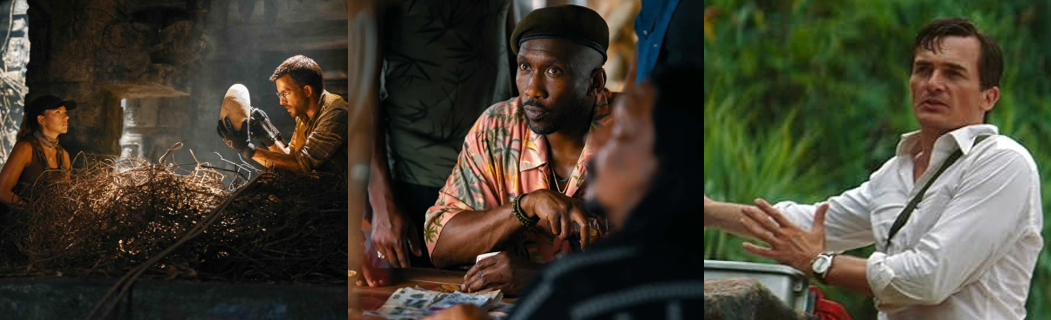
Determined to beat his competitors to this lucrative discovery, Krebs enlists mysterious mercenary Zora Bennett to lead an expedition to Saint-Hubert to collect blood samples from the three biggest dinosaurs ever to live. Though these creatures were conveniently resurrected by InGen, they currently inhabit an island where the dubious corporation dabbled in monstrous gene splicing and hybrids, leaving behind anything deemed too ugly or ferocious and eventually being slaughtered, the facility left in shambles, when the ghastly Distortus rex broke lose. Though initially sceptical, largely because she’s still processing the loss of her mother and a friend, Zora’s eventually convinced to join the highly illegal expedition by the promise of cold, hard cash. She plays Krebs like a fiddle, easily manipulating him into doubling his offer to get her long-time friends Duncan Kincaid (Ali) and Bobby Atwater (Ed Skrein) on the mission. While Duncan captains the ship and Zora oversees the weaponry, Kreb preps the special darts they use to extract their samples, which must be fired within ten feet of a live target. Strangely, none of them find this prospect scary, despite Zora later claiming they were underequipped against a dinosaur assault, and Loomis even being elated to see the prehistoric beasts up close. While Duncan’s other crew are largely expendable and may as well have targets on their backs, he exhibits some personality in the vaguely defined loss of his child and his believable relationship with Zora. Zora, however, is all over the place, being teary eyed one minute, cracking jokes the next, then being all business. It’s like her personality changes scene by scene, with her initially scoffing at Loomis’s suggestion that they make the dino medicine free for everyone and then refusing to leave anyone behind, making for a very unpredictable (if capable) character. At least Krebs is predictably untrustworthy, clearly having ulterior motives for collecting the dinosaur samples and even endangering Teresa Delgado (Luna Blaise) to keep her from calling for aid.

Beyond a semi-decent (if ridiculous) T.rex scene, this family added nothing to the film.

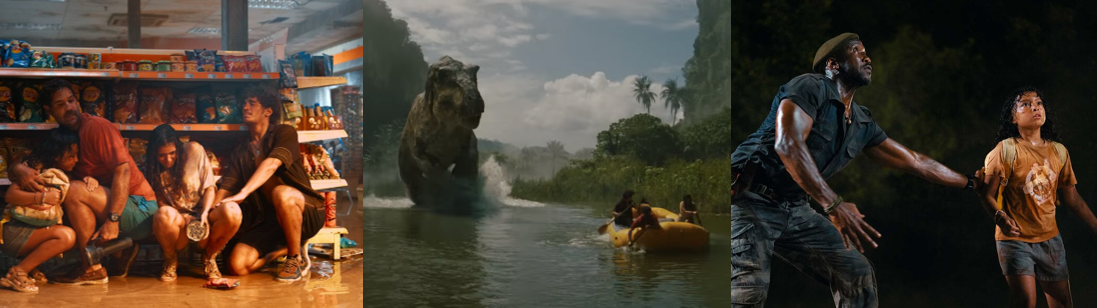
Yes, as if Zora’s rag-tag crew of barely defined misfits wasn’t enough, Jurassic World Rebirth clogs its runtime by introducing a civilian family stupidly taking a leisurely jaunt nearby. Led by patriarch Reuben (Garcia-Rulfo) and comprised on his youngster daughter, Isabella (Audrina Miranda), Teresa, and her lazy-ass stoner boyfriend Xavier Dobbs (David Iacono), the family get upended by a pack of Spinosauruses that aid the colossal Mosasaurus. Incredibly, the family stay adrift long enough for Zora’s group to rescue them but get separated from the others when the dinosaurs attack Duncan’s ship. Thanks to being present for much of their conversations, Reuben knows enough to lead his family through the perilous jungle and towards the abandoned InGen facility, acting as a thematic callback to Doctor Alan Grant’s (Sam Neill) own trek through Isla Sorna in Jurassic Park. Unfortunately, the family seem like an afterthought, a relic of a separate script for this largely redundant movie, as they contribute very little and barely have character arcs between them. It seems like the film’s building towards Xavier stepping up and earning Reuben’s respect, but every time he does (rescuing Teresa when she goes overboard, watching for predators while they rest), he immediately reverts to type and says the dumbest shit. Oddly, Xavier and Theresa barely say anything to each other, making me think he may as well have been Reuben’s unruly son since we don’t even get any romance between him and Theresa. Isabella is cute and somewhat raises the stakes and gives Reuben the chance to show what a devoted dad he is, but I never believed she was in real danger, even when the group are accosted by a hungry Tyrannosaurus rex. Isabella kind of gets a mini arc as she starts off hating dinosaurs and yet, despite being so traumatised by the events that she falls semi-mute and gorges on liquorice, she bonds with and adopts a cute baby Aquilops. Duncan is also quite taken by her and initially disgusted that Reuben would knowingly put his kids in such danger, eventually pledging to defend the youngster however he can, but even this is a half-baked idea as the two groups are separated for much of the runtime.

Since regular dinosaurs aren’t enough, we’re bombarded by these ghastly genetic freaks.

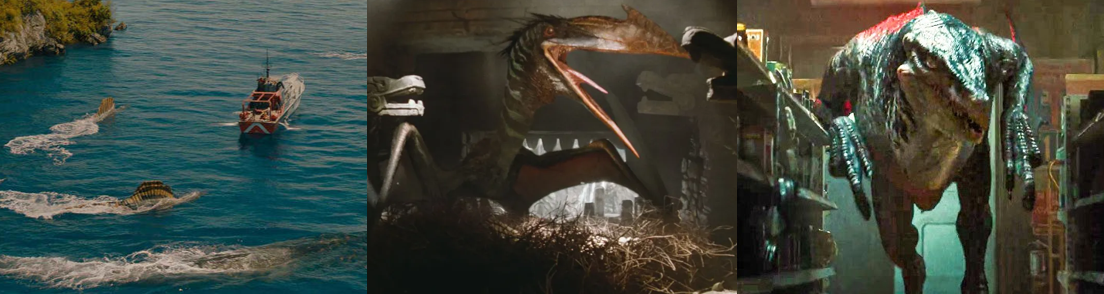
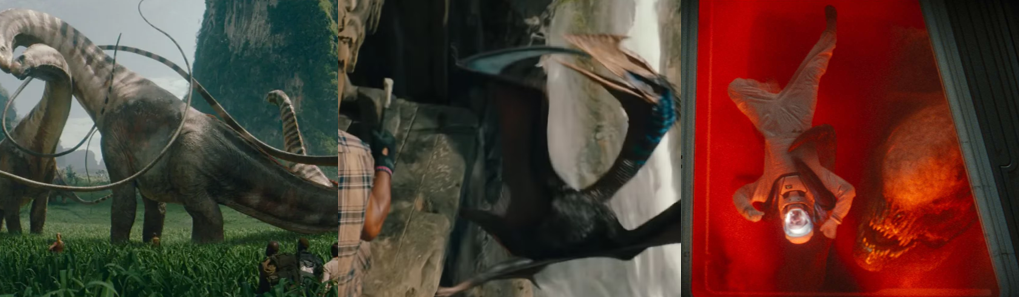
While it makes sense that InGen would have a separate island to conduct their more bizarre experiments, it does feel like overkill for there to be a third island. Jurassic World Rebirth could’ve easily taken place on the other side of Isla Nubar, where the other dinosaurs were developed before being shipped off, and very little would be different. InGen were apparently so rich that they could afford three islands, to build a whole bunch of high-tech facilities and stock them with as much product placement as you could want, and to afford the minimum $75 million a head for each dinosaur. When Loomis learns that InGen just let their mutations roam free rather than euthanise them, he’s aghast when Krebs gives a half-assed explanation that it was somehow better for the bottom line to not destroy the abominations, which I guess is designed to paint InGen as a morally bankrupt corporation but just seems insulting to me. This island is full of both regular dinosaurs and monstrous crossbreeds that finally push the franchise right over the line into generic monster movie territory. Whenever a regular dinosaur does appear, they’re often largely obscured or easily dispatched by one of their genetic offshoots, with the film sadly failing to deliver a compelling redebut for the Spinosaurus. Indeed, the dinosaurs oddly retreat once the group escapes to dry land, which is weird as they’re seen to be capable of exiting the water, unlike the larger Mosasaurus. While I’m grateful that the film doesn’t rely on the overexposed Velociraptors for a change, it does evoke both these creatures and the iconic kitchen scene from Jurassic Park with the Mutadons, weird ‘raptor/Pterosaur hybrids that return from a semi-tense chase in the finale. Krebs’ missions sees Zora and her team extracting samples a the Mosasaurus, a Titanosaurus, and a Quetzalcoatlus, with the latter proving especially terrifying and dangerous, especially as the group opt to take a sample from the beast’s eggs! The T.rex pops up for a cameo in an adaptation of the raft/rapids section of the original book, showcasing an amazing ability to swim that I never associated with it before, but we’re denied any dinosaur-on-dinosaur action this time around as the film ends with a desperate escape from both the relentless Mutadons and the horrifying D.rex.

The Nitty-Gritty:
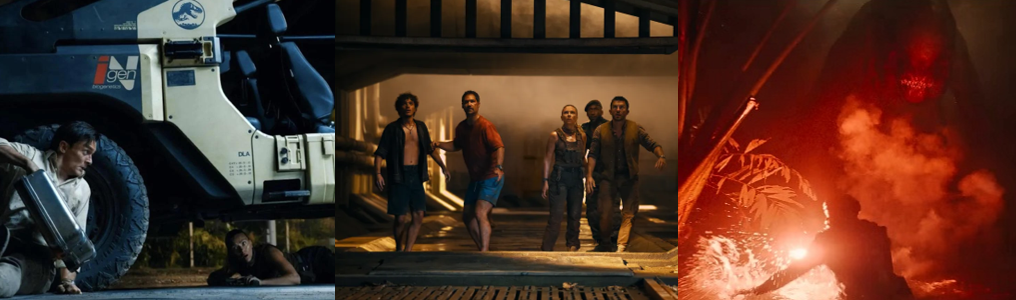
Jurassic World Rebirth certainly leans into its horror aspects, that’s for sure. The body count is quite high, with the forgettable Bobby and Nina (Philippine Velge) both being offed by a Spinosaurus once the group finally reach the island. LeClerc (Bechir Sylvain), who’s single defining character trait is that he’s French, doesn’t far much better, being devoured by a Quetzalcoatlus while frantically escaping its nest. However, you can clearly see him being swallowed by the creature and Krebs is later bitten in half by the D.rex which, coupled with the dark, intimidating aesthetics and the overall more gruesome appearance of these dinosaur hybrids, certainly pushes Jurassic World Rebirth into a horror-adjacent monster movie. There’s an attempt at delivering something more here, but it’s very on the nose and nothing we haven’t seen a hundred times before. Loomis delivers a not-so-subtle soliloquy about how humans are an arrogant and destructive species that are destined to destroy themselves and/or been shaken off by the planet, and the film beats you over the head with the idea that the modern world is too polluted and unstable for the revived dinosaurs. The commentary about the public being sick of dinosaurs also harkens back to the metatextual undertone of Jurassic World, which suggests that we are sick of dinosaurs and want something more monstrous and exciting in these films, when that’s clearly not true given how much money the franchise makes. Jurassic World Rebirth stumbles somewhat by taking far too long to get going, lumbering us with forgettable characters for the first hour or so and building anticipation for the dinosaurs, which sounds great on paper but is unnecessary by the seventh movie. Not only that, but the film simply rehashes many of the narrative beats and visual cues of the pervious films, with characters stumbling through the jungle, being in awe of gigantic sauropods, fleeing from voracious carnivores, and sneaking about abandoned facilities. It’s all very familiar, making the film about as redundant as Jurassic Park III (Johnston, 2001) was back in the day because we’ve seen all this before, and done better.

The usual awe and grandeur is downplayed in favour of a more horror-focused approach.

It’s doubly frustrating as the film could’ve presented something new by exploring the impact dinosaurs have in the modern world, something barely touched upon in the last two films and constantly swept under the rug because God forbid we have a Jurassic movie not set in the jungle! Even Duncan complains about the jungle setting, and rightfully so as there’s nothing new here at all. I thought we were in for a treat with all those Spinosauruses, but we barely get a glimpse of one on land and they conveniently just swim away once the survivors beach themselves. Xavier gets stalked by some Velociraptors at one point but the scene’s played for laughs as a Mutadon pounces on them while he’s peeing, ostensibly to establish this flying ‘raptor hybrid as the latest threat but falling way off the mark as they’re essentially the same creature…but with wings they barely use. It was fun to see the T.rex/rapids scene make it onscreen, and it was quite tense watching Theresa drag the lift raft to the water, but it fell apart the moment the family jumped into the raft and tried to paddle away from the T.rex. As if that wasn’t crazy enough, they amazingly survive this encounter and the T.rex just gives up, despite clearly being able to walk around the rocks, never to be seen again. While it was nice to see something new in the Titanosaurus, they’re literally just bigger, more awesome variations on the Brachiosaurus and their weird, whip-like tails looked ridiculous. The star of the show is meant to be the D.rex, an honestly gruesome T.rex mutation that boasts four colossal legs, two spindly arms, and a massive, Xenomorph-like head. I’m torn, though, as the creature is used sparingly, adding to its horror and mystery, but it might’ve been good to get a sense of it stalking the island, perhaps having characters come across dismembered corpses, to help build towards its big reveal. I was also impressed by the Quetzalcoatlus, even if I didn’t get the sense of scale Loomis kept exaggerating. It would’ve been nice to see this and/or the Mutadons and T.rex factor into the ending to battle the D.rex, but Jurassic World Rebirth seemingly goes out of its way to avoid any big dinosaur fights…which, again, can be seen as either good or bad.

The terrifying finale with the D.rex is undercut by some bizarre narrative choices and dull characters.

I think I fall into the latter camp. The film seems to be trying very hard to evoke the spirit of the first movie, alternating between awe and horror and not big dinosaur fights, but that doesn’t make for a very exciting finale as the characters obviously stand no chance against the D.rex and yet still manage to avoid it without any outside assistance. After being separated, both groups head towards the InGen facility, with Zora’s group stopping off to collect their samples with a minimum of fuss, to rendezvous with Zora’s helicopter extract team. Theresa is eager to reunite with them and get some revenge on Krebs after he leaves her to die, only for him to pull a gun on them, take the samples, and attempt to flee without them. Obviously, this goes very badly for him as, in his last moments, he’s too obsessed with money and the dino samples to avoid being munched on by the D.rex. This monstrous abomination easily devours Zora’s helicopter in a startling sequence and stomps about the facility, largely missing its prey as Duncan leads them through a convenient series of underground tunnels. Though pursued by Mutadons, the creatures are easily evaded through a combination of bullets and convenience, though the group faces disaster when they struggle to lower the one remaining boat on the island. Realising that everyone’s in jeopardy, Duncan makes the brave decision to lead the D.rex away using a flare, much to Zora’s dismay, fading into the jungle and seemingly being eaten. However, barely two minutes after his heroic sacrifice, a flare goes up and he wades out completely unharmed, having miraculously survived the encounter with no explanation. Somehow speeding away from the island without the D.rex or any of the aquatic dinosaurs following them, Zora decides to agree with Loomis’s earlier suggestion and provide their ill-gotten samples to the world for free, thereby allowing countless people to benefit rather than the top one percent. And that’s kind of it. All the characters you’d expect to survive make it out, with barely a scratch, and all those hideous dinosaur hybrids are just left to wander around for the inevitable sequel (assuming they’re not killed off between films, which is what I expect to happen).

The Summary:
I was sceptical of Jurassic World Rebirth right from the first trailer, and with good reason. I feel we needed a longer break between films as the last trilogy definitely suffered from diminishing returns by the end, and nothing here makes me think otherwise. While it desperately tries to revisit the smaller scale approach of the first film, Jurassic World Rebirth comes across as a “best-of” compilation of moments from the previous movies, wrapped up in a largely generic monster movie that somewhat betrays the spirit of the franchise. It doesn’t help that there are far too many characters. It might’ve been better to reduces Zora’s crew to four and follow four survivors on the island as that family added nothing to the film, apparently being left over from earlier drafts and kept in to pad the runtime. The main plot of the film is laughable as I don’t believe that anyone would choose to visit this island, regardless of the money offered, unless they were poachers, a rescue team, or had wandered off course. I struggled to connect with any of the main characters as they were incredibly one-dimensional or kept switching personality from scene to scene, with even Loomis proving adept in the field because the plot required it. The dinosaur action was impressive, except for the Titanosauruses, but there’s not enough of it because the film wastes time building unnecessary anticipation. I liked that it leaned into horror, and the D.rex was pretty damn horrific, but I think we needed a bit more to keep things moving and the keep a sense of dread and urgency to the film (Zora’s group, especially, never seems to be in a rush despite literally facing a ticking clock). Ultimately, I think Jurassic World Rebirth may be more appealing to newcomers but, for long time fans of the franchise, there’s little here than hasn’t been done in previous films and it just feels like a big-budget cash grab designed to wring more money out of the franchise, whether it makes sense or not.

My Rating:

Rating: 3 out of 5.

Pretty Good

Did you enjoy Jurassic Word Rebirth? Were you disappointed that the dinosaurs were driven back to extinction again? Do you agree that there were too many characters in the film and that they lacked personality? Which of the mutated dinosaurs was your favourite and did you like seeing the rapids scene finally make it to the big screen? Which Jurassic film is your favourite and where would you like to see the franchise go next? Whatever your thoughts on Jurassic Word Rebirth, leave them below and then go read my other Jurassic reviews and donate to my Ko-Fi to support the site.

Game Corner: Rocket Knight Adventures (Nintendo Switch)

Released: 11 June 2024
Originally Released: 6 August 1993
Developer: Konami
Also Available For: Mega Drive, PC, PlayStation 4, PlayStation 5

The Background:
Thanks, largely, to the phenomenal success of Sonic the Hedgehog (Sonic Team, 1991), anthropomorphic mascot platformers were all the rage back in the 1990s to the point where, in a landscape featuring a gun-toting jackrabbit, an acrobatic bat, a superpowered earthworm, and an intergalactic adventurer, a sword singing possum with a rocket pack doesn’t seem all that strange! Designed by Nobuya Nakazato, the man behind many of the notoriously challenging Contra videogames (Konami, 1987 to present), Rocket Knight Adventures was lauded as one of the best titles available for SEGA’s all-powerful Mega Drive. Though a popular and well-regarded title, Rocket Knight Adventures was essentially Sparkster’s peak; a Super Nintendo port was allegedly cancelled and its sequels were both region-locked and ridiculously expensive for decades. While Sparkster received a six-part story in Sonic the Comic (1993 to 2002), he didn’t get an animated spin-off like some of his peers and remained in obscurity until Climax Studios attempted a revival in 2010. Mixed reviews notwithstanding, the game captured a lot of Rocket Knight Adventures’ spirit and long-time fans of the franchise finally got a modern re-release of the original three games with this Re-Sparked! collection, a warmly received release that included a handful of bonus materials to celebrate the unfairly forgotten series.

The Plot:
When the Kingdom of Zephyrus is invaded by Emperor Devilgus Devotindos’s pig army, heroic Rocket Knight Sparkster fights to rescue Princess Sherry from the clutches of his rival, Axel Gear, and stop their forces.

Gameplay and Power-Ups:
Rocket Knight Adventures is a 2D, sidescrolling action platformer with elements of run-and-gun action and some sidescrolling shoot-‘em-up sections. Players take control of Sparkster, the titular Rocket Knight, a possum clad head to toe in armour, armed with a sword, and carrying a surprisingly versatile rocket pack on his back. You swing Sparkster’s sword with A or Y, sending out an energy spiral to attack enemies from a set distance, and press B to jump, with Sparkster snagging poles and branches with his tail. By holding A or Y, you charge Sparkster’s rocket pack; once the meter is full and flashing, you can release and Sparkster will fly off in the direction you press. You must often use this manoeuvre to richochet off walls to progress higher in stages, sometimes over lava, and to blast between vines over large, spiked balls. If you don’t press a direction, Sparkster performs a grounded spin attack to deal damage and reflect certain projectiles and Sparkster is often invulnerable when performing his rocket attacks. The rocket pack can take some time to charge so it’s worth planning ahead if you’re looking to quickly blast away and you must often blast off while jumping for additional height, either to reach doors, platforms, or high up goodies. Sparkster has a large health bar (represented by hearts) but it’s whittled down quite quickly. Apples and bananas will partially or fully fill it and you can snag a handful of generous 1-ups along the way. You also earn extra lives if you collect enough points, receiving a bonus at the end of each stage. Before you start, you can also adjust the game’s difficulty, which changes how many lives and continues you have, though trust me when I say the game’s hard enough even on “Easy” mode.

Rocket through colourful stages and take on tricky platforming as the sword-wielding Sparkster.

Occasionally, Sparkster collects a power pack or is dropped into an area where he flies indefinitely. These sections turn the game into a high-speed, action-packed autoscrolling shoot-‘em-up and have you weaving Sparkster between missile and other projectiles while picking off airborne enemies. Sparkster can also swim, automatically treading water and moving through the drink depending on your button presses, attacking with his sword and blasting from the water with his jet pack. However, his movement becomes noticeably sluggish and his hit box alters, making it tricky to navigate the tight, hazard-ladened depths. Each stage tests Sparkster’s platforming and rocket pack skills in different ways, from simple ricochet tricks to jumping to vines and branches, to racing from hazards (such as walls of fire, spiked knights, and crushing floors) that spell instant doom to the Rocket Knight. Platforming is largely satisfactory here and the usual tropes of swinging platforms and precarious handholds appear, but you’ll also be riding mine carts, leaping across bottomless pits and ducking under spiked ceilings. Stage 2 has you pass behind waterfalls using special platforms to progress, Stage 3 sees you using the reflective surface of rising and falling lava to hop to platforms, while Stage 4 has you clambering on the underbelly of Axel’s ship trying not to plummet to your doom. When on the roof, and during the final confrontation with Axel, you battle a strong wind that’ll suck you to an instant death, while Stage 5 has you race through claustrophobic tunnels avoiding knights that kill you on contact. The challenge is palpable but increases as you progress, easing you into the game’s surprising difficulty and introducing new gimmicks that test how you control Sparkster. Unfortunately, there are no power-ups to aid you (no shields or invincibility or anything like that) and you’re limited by your lives and continues, though thankfully this version includes rewind and save state features that finally allowed me to beat the game after more than thirty years!

Various gimmicks and dangerous hazards make the late game a considerable challenge.

It’s not long before hazards become troublesome for Sparkster. Each stage is split into multiple, interconnected areas, with the first stage culminating in you traversing Castle Zephyrus, which is full of burning pits and sees you being chased by a wall of fire. This will instantly kill you if you don’t keep moving, made harder by the stone walls you must hop over and the flame bursts you must duck to avoid, though this is all practice for a similar section in Stage 5, where you must run, ricochet, and jump away from Axel as he pursues in an insta-death mech suit! While it’s simple enough to hop to tree branches in Stage 1, Stage 2 introduces spiked balls to avoid while jumping, while spiked ceilings and surfaces dog both your high-speed jaunts on mine carts and your efforts to control a propeller platform in Stage 5. Stage 4 sees you taking out bazooka-wielding pig soldiers in tight corridors, your progress barred by temporary energy barriers, while Stage 5 introduces the rising floor gimmick that ended my runs as a kid. With enough speed and timing, you can outrun this hazard but it’s very tight, even when abusing the rewind feature. This stage also includes teleporter doors that represent your goal in each section, though they’re functionally no different from the regular doors you enter prior to this stage. Stage 7 introduces a springing ground, almost a quasi-anti-gravity feature, to boost your jumps, though it’s limited to snagging some out of the way goodies and battling a boss. The autoscrolling sections start off simple, with you mowing down aerial enemies and attacking a giant, robotic snake, but your manoeuvrability is tested in Stage 5, where you weave between gigantic missiles and cross-crossing gunfire and engage in glorified dog fights with mech walkers. Things are much simpler when you’re blasting through an asteroid field in Stage 6, though you must still be mindful of the small projectiles that can get lost against the stars. Stage 5 also culminates in you taking control of your own giant mech, though your options are simply limited to stomping back and forth and swinging its buzzsaw arms with A or Y; there’s no block or charge attack or anything.

Presentation:
Rocket Knight Adventures is and always has been a joy to play, purely from a visual standpoint. Released at the peak of the Mega Drive’s popularity, when mascot platformers were extremely popular, the game oozes colourful, cartoonish appeal. Presented with a steampunk-style fantasy land, players explore environments teeming with personality. You see the castle being attacked in the background of the first stage, panicked civilians and chickens run and flutter, and enemies are sent into a panic when hit, running around with their briefs on show! Though he can be a little clunky and his hit box is quite large, Sparkster is a wonderfully realised character. Blasting past the Konami logo at the start and standing proud against the title screen and in the brief prelude, he radiates heroism. Not only does Sparkster bop up and down by default, but he also judges the player when idle and calls to them to get a move on. He also squeals in pain when killed, reacts with panic when falling, and regularly advances towards his objective and enemies in the handful of cutscenes between stages. As if these stunningly lively and detailed visuals weren’t enough, Rocket Knight Adventures is bolstered by an infectious soundtrack, one of my favourites of the era. However, it’s true that the game peaks with Stage 1’s iconic and instantly memorable overture, which is rightly evoked for the end stage score tally. Still, the boss themes are really good and add to the tension when facing these troublesome foes. One negative about Rocket Knight Adventures, however, is the slowdown which occurs when there’s too many sprites on the screen. Thanks to the large scale of some enemies and the many explosions and effects peppering certain moments, the game can struggle along for a few seconds. It’s never impacted my progress, but it is noticeable. Furthermore, the title screen, despite showcasing large sprite art for Sparkster and the game logo, is surprisingly bland, especially compared to the detailed environments.

A visually impressive treat with one of gaming’s best and most memorable soundtracks.

Things start out safe enough with Stage 1’s flat fields, which act as a testing ground for players to test Sparkster’s moves, but even this area is full of detail, from the aforementioned castle in the background to the besieged homes and ransacked environment. As you blast through the skies, mountains and water rush past, with a lovely splash effect appearing as you skim the water’s surface. Sparkster loves to charge head-first into enemy strongholds, the first of which includes busts, skewed portraits, and windows where the first stage’s boss looms. While Stage 2 starts comparatively bland, you’re soon climbing vines and avoiding spikes amidst a large waterfall and racing around on high-speed mine carts. Stage 3 begins in a quartz cavern with a reflective effect applied to the lava, extends to an underwater cavern, and ends with you battling a gigantic robotic fish in a volcano. Stage 4 takes place on Axel’s ship and really leans into the steampunk aesthetic, having you navigate inside and outside the ship, clambering to poles, jumping to platforms, and passing energy barriers powered by pigs on treadmills! Stage 5 takes the steampunk aesthetic to the next level as you blast through the skies of a heavily polluted, heavily guarded pig city. There’s a real depth to the polluted backgrounds that’s married with the mechanical facility to crash into, a robot factory full of narrow corridors and insta-kill hazards. Stage 6 and 7 add a science-fiction twist to the steampunk fantasy and see Sparkster blasting through an asteroid field and infiltrating Emperor Devotindos’s “Pig Star” space station. Though you’re limited to a few rooms and boss battles here, you can see the stars and asteroids in the background and end up falling back to Earth in an escape pod, burning up on re-entry and showered by debris from the exploding space station! The large sprite art returns for the end credits, which feature Sparkster heroically flying towards the camera, and the pantomime-like cutscenes add to the game’s visual charm, with Princess Sherry, King Zephyrus, and Axel gear all exuding the same personality seen in Sparkster’s cartoonish animations.

Enemies and Bosses:
The Devotindos Empire is primary made up of armour-clad pigs, disposable ground forces who stand no chance against Sparkster’s sword and rocket pack. Though they leap from the background, drop down on balloons, and wield swords of their own, the pig infantry is easily dispatched in a single hit. Occasionally, you battle large groups of them, but you can simply rocket through them, making them more of a nuisance than anything. The sailor variants are a bit more formidable thanks to their bazookas and you being confined to tight corridors, as are the jet ski riders, who fire a spread shot while you’re floundering in the water. Pigs also race around in steampunk-style cars and chicken walkers, which can be trickier to put down as they’re much bigger and take more hits to defeat. At least they can be defeated, though, which is more than can be said of the later spiked armour variants. You’ll simply bounce off these guys and be killed if you touch them, so you must run from them and lure them into a molten metal trap to end their threat. Emperor Devotindos bolsters his forces with other robot minions, such as robo-owls who can spoil your jumps and robotic duplicates of himself, which spring to life at the worst possible moments, take a few hits to put down, and offer a significant obstacle thanks to their large hit boxes and pursuing you across the environment.

The piggy pests pilot some perilous mechanical marvels that’ll test your reflexes.

The pig infantry also controls numerous large, steampunk-style craft to act as mini- and end bosses. The first is a lumbering tank that fires slow moving cannonballs and tries to roast you with its flamethrower. Your best bet is to rocket behind it to quickly pummel it, but you’re then forced to avoid and frantically slash it as it pinballs around in the rapids in an exploding frenzy. A large mech greets you at the start of Stage 2, taking up the background and sporting extendable arms with buzzsaw-like hands. You must battle the finnicky swimming controls to avoid being hit, attacking the glowing red sphere on the front of the mech to put it down. Stage 3 sees you battle a gigantic crab mech, attacking its extendable pincers and avoiding its ring shots once they’re destroyed, floating precariously close to the craft to hit its cockpit. This stage ends with you fighting a giant robot fish in a battle not unlike the Lava Reef Zone boss. You must jump to floating platforms, which get faster and faster, avoiding the lava and the shower of pellets the fish spits. When the pilot appears, be sure to smack him a few times and grab the bananas if you’re low on health. A more powerful pig walker attacks in Stage 5, one that fires dual lasers and is protected by an energy barrier you must whittle down before the craft can be destroyed. Finally, Captain Fleagle constantly hounds you in Stage 4. First, he hides behind an energy barrier and tosses bombs which you must reflect back at him (the timing can be tricky and the bombs have a large blast radius, so watch out!) You must avoid Captain Fleagle’s shots on the roof and send him running once more. After knocking sentient bombs onto a flying mechanical pig head on the underside of the ship, Captain Fleagle calls in his large mechanical doppelgänger. Mirroring Captain Fleagle’s movements, this mech causes debris to  by shaking its hips and fires large blasts from its torso, giving you a small window to attack it. Once it’s destroyed, the battered Captain Fleagle runs and jumps around in a panic as the battleship explodes, finally finished for good after a few whacks with your sword.

Giant, steampunk-style robots and mechs often act as gruelling end of stage bosses.

Gigantic mechanical enemies also appear as mini- and end bosses, such as the Snake Mecha that lunges at you in the first flying section and the Big Spider at the end of Stage 1. This thing crashes its head through the castle walls and ceilings, giving you a chance to land some attacks, but you must avoid standing in the wrong place and being smacked by its spiked tail. Stage 2 features a weird collection of spheres, not unlike a mechanical caterpillar, that dives in and out of a waterfall. You must do the same and blast between vines to avoid its wide arc and pummel the weak spot on the end of its tail, which is pretty tricky given the hazardous environment. Stage 2 ends with you battling a menacing steampunk train that charges towards you firing slow shots and then transitions to an upper path, swinging and extending its claw arms, before finally firing bouncing shots from its wrecked behind, its weak spot changing each time. A satellite-like robot challenges you in Stage 6’s asteroid field, blocking your shots with a shield and firing a dual spread shot, and you must take on the strangely sized pig mothership, too. Since this hurts you if you touch it and fires relentlessly, you must target the many turrets to deal damage, switching position as it teleports in and out, taking out its minions, and dispatching its giant mouth cannon before you get fried! As the fight progresses, the cockpit detaches, leaving you to destroy the main body of the ship. However, the cockpit transforms into a mech that fires pellets, a ricocheting laser, and flailing its arms. You must strike the ball it bounces between its hands to deal damage, then fly around as it bounces around the screen in a frenzy, which makes for a troublesome boss due to its large hit box and the lack of health pickups.

Axel Gear and the persistent Emperor Devotindos won’t go down without a fight!

Your most persistent enemy is rival, corrupt Rocket Knight Axel Gear, who kidnaps Princess Sherry and constantly ducks you. When you finally go toe-to-toe with Axel in Stage 5, it’s in a Rock ’Em Sock ’Em Robots mech battle. After racing to your mech, you must avoid his hits and tap A or Y to swing your buzzsaw-like, extendable arms and damage his craft. It’s a bit clunky and difficult to avoid damage but, eventually, Axel’s mech is destroyed. Axel then appears at the end of the asteroid section of Stage 6, now sporting a gigantic laser cannon and firing smaller homing missiles. You must loop behind him to attack and take out his smaller shots, watching for his circular movements as he prepares each shot. Axel than challenges you to a more traditional sword fight mid-way through Stage 7’s gruelling boss gauntlet. Here, Axel sports the same abilities as you, swinging his sword, unleashing a rocket spin, and ricocheting about. Note that your sword beams cancel each other out and he’ll eventually cause explosive decompression! You must cling to the poles, attacking Axel with your sword beam and avoiding his missiles and circle motions, finally flying with your rocket charge when he’s charging his own. Emperor Devotindos is the game’s final boss and certainly doesn’t go down easily! Your first battle isn’t too bad, with you simply dashing from across the screen and charging into the pig monarch, dodging his progressively faster projectiles. After enough hits, he reconstitutes himself into a maniacal cyborg and you must avoid his extendable legs and rocket into him diagonally. Emperor Devotindos downloads his consciousness into the Pig Star’s main core, causing it to float, teleport, and bounce around firing various laser spreads that you must avoid while charging at the small red weak spot. As you escape the exploding Pig Star, Emperor Devotindos (now little more than a television screen) pursues you, thrashing tentacle-like limbs, firing ring projectiles, and barging into you. You cannot attack here and must simply survive until atmospheric re-entry finishes the bovine bastard off, a daunting prospect as Emperor Devotindos is hard to avoid and deals a lot of damage.

Additional Features:
There are four difficulty settings to challenge in Rocket Knight Adventures, with each one altering how many lives and continues you play with and slightly altering the end text. If you beat the game on anything other than the hardest difficulty, you’ll be challenged to try a harder difficulty once the credits have rolled. Interestingly, you can input a code from the pause screen to record your progress as the game’s demo mode, though the level select code apparently only works in the Japanese version of the game. Luckily, Rocket Knight Adventures: Re-Sparked lets you pick between the American and Japanese versions of the game and offers a host of additional features, too. There’s the slick, sexy, anime style opening that makes me wish we’d gotten a cartoon back in the day, various filter and border effects, and the always helpful rewind and save state features. You can also play a boss rush mode and view various advertisements and concept art for the game, peruse the box art and manuals, and freely listen to the game’s kick-ass soundtrack. The PlayStation 4/5 version also comes with numerous Trophies for you to earn, with nine specifically earned from playing this game (best done on the hardest mode to stack them) and clearing its boss rush.

The Summary:
I’ve been in love with Rocket Knight Adventures since I was a kid. I was captivated by its bright, cartoonish visuals and fun, action-packed gameplay from the start and regularly find myself humming that memorable Stage 1 theme in my day-to-day life. One of the biggest gripes of my life-long gaming career is that I was never able to beat this game back in the day; that damn crushing floor always ended my playthroughs. However, this version of the game changed all that. It’s telling that I needed the rewind and save state features to finally beat this game and shows just how challenging Rocket Knight Adventures is. It lulls you into a false sense of security by easing you into the challenge, slowly adding more and more obstacles and insta-death hazards and leaning more on split second reaction times as you progress through its detailed and varied stages. Yet, while the difficulty curve is off-putting at times and the game occasionally seems needlessly unfair and cheap (infinite continues would’ve helped mitigate this), I still find it a hugely enjoyable experience. Sparkster is a fantastic character and often unfairly forgotten in the pantheon of mascot platformers and I loved his sword- and rocket-based gameplay. The ricochet mechanics were a neat feature; however, if anything, they were underutilised and the game relies on traditional platforming tropes and mechanics than its unique selling point, which is a bit odd. I loved all the big enemies and bosses, the switch to sidescrolling shooter sections, and the sheer variety on offer. No two stages are the same and the game’s constantly throwing new gimmicks at you, from mine carts to flying platforms to mech battles and races through mazes. There are few games as visually appealing on the Mega Drive than Rocket Knight Adventures, which has such franchise and merchandise appeal that I’m honestly surprised we didn’t get more games and tie-ins, such as toys and comics and cartoons. Still, that doesn’t diminish how enjoyable Rocket Knight Adventures is. To this day, it’s one of the best platformers on the system and this Re-Sparked version just makes it more accessible and entertaining than ever before.

My Rating:

Rating: 5 out of 5.

Fantastic

Was Rocket Knight Adventures in your Mega Drive library back in the day? What did you think of the rocket-based mechanics and the colourful visuals? Which of the game’s bosses was your favourite? Did you manage to clear the game without modern quality of life features? Which of Sparkster’s sequels was your favourite and would you like to see him brought back from obscurity? Either way, whatever your thoughts on Rocket Knight Adventures, leave a comment below, consider supporting me on Ko-Fi, and check out my other Rocket Knight reviews.

Wresting Recap: Women’s Money in the Bank (2017)

The Date: 18 June 2017
The Venue: Scottrade Center; St. Louis, Missouri
The Commentary: Tom Phillips, John “Bradshaw” Layfield/JBL, Byron Saxton
The Referees: Danilo Anfibio, Jason Ayers, Mike Chioda, Dan Engler, Charles Robinson, and Ryan Tran
The Stakes: Five-woman ladder match for a chance to cash-in on a World Heavyweight Championship at any time within a year

The Build-Up:
Since World Wrestling Entertainment (WWE) has dominated the wrestling landscape, they’ve understandably been at the forefront of creativity with their celebrated Superstars, their impact on pay-per-view entertainment, and the creation of memorable matches. The company has long awed audiences with their Tables, Ladders, and Chairs (TLC) matches, a concept “Y2J” Chris Jericho took to the next level when he came up with the “Money in the Bank” ladder match. Debuting at WrestleMania 21, this multi-man ladder match saw the winner retrieve a briefcase to cash in for a championship match anywhere, anytime and immediately became an annual fixture following its first self-titled event. However, for about ten years, the gimmick was exclusive a men-only match, unsurprising considering women’s wrestling was long an afterthought in the WWE, where cheerleaders and models rolled around in mud pits. In 2015, competitors like Paige were at the forefront of changing the perception of women’s wrestling and, after Stephanie McMahon took credit for spearheading a revolution in the division, the women finally got their first-ever all-female WWE pay-per-view event. Though not a ratings success, WWE’s female superstars continued to push for a bigger spotlight, leading to this first-ever women’s Money in the Bank ladder match. The match came about after the competitors all brawled with each other and demanded a shot at SmackDown Women’s Champion Naomi, leading to SmackDown Live General Manager Shane McMahon to announce the match and further fire up the competitors. Accordingly, much of the build-up regarding this match focused on the historic nature of it being the first-ever women’s Money in the Bank ladder match, and many of the competitors sought to live up to their family’s legacy and set a new standard not just for the women of the WWE, but for all of wrestling.

The Match:
These days, it’s not uncommon for big matches and championship bouts to open shows. The Money in the Bank pay-per-view often staggers these extreme, violent, and pulse-pounding bouts so they open and close the show, thus ensuring the crowd doesn’t get burned out. This explains why the first-ever women’s Money in the Bank ladder match opened the show in 2017, though I do think it should’ve taken the main event slot just to add extra emphasis on the groundbreaking event. Regardless, the match featured some of the top women’s competitors at the time in the WWE, and perhaps ever, including two of NXT’s lauded “Four Horsewomen”: The overrated and insufferable “Queen” Charlotte Flair and the fiery Becky Lynch (some time before her incredible run as “The Man”). They were joined by Tamina (truly the odd one out), Carmella (accompanied by flash-in-the-pan sensation James Ellsworth), and a staple of the women’s division, Natalya. As soon as the bell rang, they all dashed outside to grab a ladder, except for Becky and Tamina, who duked it out in the ring before Tamina asserted her dominance and teased the first climb of the match. Charlotte quickly stopped to that and took over as queen bee, downing her foes with her long legs and suplexes, before Tamina took her out, crushed Becky in the corner, and destroyed Carmella with a Samoan Drop. Obsessed with keeping her ladder, Tamina superkicked Natalya to the canvas and catapulted her into the ladder after setting it up in the corner. After collapsing it onto Becky, Tamina was driven into the ladder by Charlotte, though she got dumped back outside by Natalya before she could do any more damage and Tamina finally dropped after Becky blasted her with the ladder. Becky and Natalya then fought over the ladder in a tug o’ war that ended with Becky being slammed spine-first onto it.

A disappointing bout with too many dead spots and an awful ending…but at least Charlotte didn’t win!

Though Natalya set the ladder up, she took too long positioning and climbing it, allowing Charlotte to hit an electric chair drop just as Natalya’s fingers grazed the briefcase. Carmella then cut off Charlotte’s climb, beating and clambering over her as she was caught in the rungs, resulting in the two exchanging shots at the top of the ladder, Charlotte almost unhooking the briefcase, and both being dumped when Tamina toppled the ladder. Natalya and Becky then resumed their rivalry, with Natalya tying Becky into the Sharpshooter. Carmella broke the hold and attacked Natalya before Charlotte squaring off with Charlotte, before Charlotte took a nice double-underhook suplex from Natalya. A whip into a ladder and a springboard kick saw Becky take Natalya out to begin her climb, before being whipped into and flung off a corner ladder courtesy of Carmella’s handstand headscissors. Charlotte reasserted herself with her big kicks but Tamina intercepted her as she went for the briefcase, resulting in both tumbling to the canvas following a headbutt. A Spear from Charlotte saw Tamina awkwardly tumble outside, and another saw her clumsily collide with the ring steps, before Charlotte took down Tamina and Natalya (and herself) with a corkscrew moonsault to the outside. Becky cut Carmella off with a powerbomb and, with the crowd behind her, clambered to the briefcase…only for James Ellsworth to topple the ladder to a cascade of boos! With Carmella unresponsive, Ellsworth climbed on her behalf and unhooked the briefcase, resulting in Carmella becoming the first-ever Ms. Money in the Bank, to a cacophony of displeasure and disbelief from both the crowd and some of the referees.

The Aftermath:
This was a disappointingly slow and uninteresting affair, save for the controversial, insulting, and absolutely ridiculous ending. Unlike most ladder and Money in the Bank matches, the competitors largely spent their time on the outside, leaving just two to four women in the ring at once, which was weird as half of them hadn’t really received that much damage! The match was structured to paint Tamina as a dominating force, which kind of worked but Charlotte also had to be a dominating figure and completely stole her thunder, as bland as Tamina is. The crowd favoured Becky and Natalya as plunky underdogs and fighting spirits, but were in uproar at Carmella’s win, and that she needed a man to get the victory! There was basically no extreme spots, no ladder play beyond the basics, and nothing memorable about this first women’s Money in the Bank contest except for its ludicrous conclusion (which is best forgotten!) Perhaps in an effort to course-correct, or perhaps as part of their awful booking, the WWE immediately addressed the controversy on the following episode of SmackDown Live, where Ellsworth defended the outcome since the match had “no rules”. However, General Manager Daniel Bryan decided that wasn’t fair and stripped Carmella of the briefcase. He thus had the six women redo the match in the main event of the show, banning Ellsworth from the arena, only for Carmella to win anyway! Carmella held the briefcase for just under a year, finally cashing in on Charlotte in April 2018 to become the SmackDown Women’s Champion. Despite successfully defending the belt against Charlotte and the “Empress of Tomorrow” Asuka, Carmella was dethroned in August…by Charlotte. Natalya defeated the other competitors at Battleground to become the number one contender, capturing the SmackDown Women’s Championship from Naomi at the 2017 SummerSlam. Becky, Carmella, Natalya, and Tamina were also forced to co-exist in a traditional Survivor Series match, the build-up to which saw Becky’s popularity skyrocket following an errant shot by Nia Jax. Following this inaugural women’s Money in the Bank match, the WWE’s female competitors have competed for the briefcase at every subsequent Money in the Bank pay-per-view, cementing their legacy in the stipulation.

My Rating:

Rating: 2 out of 5.

Could Be Better

What did you think to the first-ever women’s Money in the Bank match? Were you pissed about the ending or did you think it garnered great heel heat for Carmella? Who was your pick to win? Were you disappointed by lack of big ladder spots? Which of the competitors was your favourite? Were there any competitors you would’ve liked to see included in this first match? What’s your favourite women’s Money in the Bank match? Whatever your thoughts on the Money in the Bank match, share them below, support me on Ko-Fi, and be sure to check out my other wrestling reviews!

Game Corner [DK Day]: Donkey Kong Country 3: Dixie Kong’s Double Trouble! (Nintendo Switch)


In 1981, Shigeru Miyamoto and his team at Nintendo R&D1 created Donkey Kong, an arcade title that introduced gamers to two of Nintendo’s most recognisable characters: Mario and Donkey Kong. To celebrate everyone’s favourite King Kong knock-off, I’m dedicating a few days this week to gaming’s most famous ape!


Released: 18 December 2020
Originally Released: 18 November 1996
Developer: Rare
Also Available For: Game Boy Advance, Nintendo Wii (Virtual Console), Nintendo Wii U (Virtual Console), Super Nintendo Entertainment System (SNES)

The Background:
After establishing themselves in the United States with the financial and critical success of Donkey Kong, Nintendo captured the home console market. While Donkey Kong was still relevant during this time, legendary British developers Rare reinvigorated the cantankerous ape with their Donkey Kong Country series (Rare, 1994 to 1996). Debuting in 1994, the first game pushed the SNES to its limits, reimagined Donkey Kong for a new generation, and became the third-bestselling game on the SNES. After garnering overwhelmingly positive reviews, Donkey Kong Country was quickly followed by a purposely tougher and less linear sequel that was also critical and commercial hit. Emboldened by their success, rare fast-tracked a third game, using the same pioneering technology to convert prerendered graphics into 2D sprites and seeing Dixie Kong joined not by the titular ape, but her baby cousin! Although Donkey Kong Country 3: Dixie Kong’s Double Trouble! sold over 3.5 million units worldwide, the impending release of the Nintendo 64 is said to have impacted sales. Reviews were largely positive, praising the improved visuals and the expanded gameplay mechanics, though criticising the lack of innovation compared to is predecessors. Like the last two games, Donkey Kong Country 3 was ported to the Game Boy Advance (to some criticism) and featured on Nintendo’s online services, such as this version for the Nintendo Switch.

The Plot:
When Donkey Kong and Diddy Kong suddenly disappear in the Northern Kremisphere, Dixie Kong teams up with her baby cousin, Kiddy Kong, to brave the forces of the robotic KAOS and rescue their family.

Gameplay and Power-Ups:
Just like the last two games, Donkey Kong Country 3: Dixie Kong’s Double Trouble! is a 2D, sidescrolling platformer that utilises 2D sprite conversions of pre-rendered graphics. Like in the second game, Donkey Kong is entirely absent and no longer playable, and this time his nephew joins him on the bench to allow Diddy’s girlfriend, Dixie Kong, to take the spotlight. As ever, you have three save files to work with and three game modes: you can tackle the adventure alone, tagging between Dixie and Kiddy with -, team up with a friend for two-player simultaneous co-op, or go head-to-head with your friend to see who can play better. Donkey Kong Country 3 retains the same controls and fundamental mechanics of its predecessors, meaning you’ll be jumping and swimming with B, attacking with Y, teaming your Kongs up or grabbing barrels with A, and throwing both with Y. Each Kong plays a little differently, with Dixie being lighter and faster and Kiddy being slower and heavier, and also has a different method of attacking. Dixie retains her ponytail twirl (which also allows her to glide across gaps to greatly aid platforming) while Kiddy rolls ahead and can skip across the surface of water (though his stunted jump makes him more of a liability). You must smash DK barrels to spawn your partner if they’re lost because, without them, you’ll lose a life the next time you’re hit. However, you can once again accumulate extra lives by grabbing various colourful balloons, collecting 100 bananas, finding the four KONG letters, in every stage, and playing Swanky Kong’s Sideshow mini game. To play this, you’ll need silver Bear Coins, which are also hidden in stages, while larger, golden DK Coins are earned by defeating the tricky Koin Kremlin hidden in each stage (usually by finding innovative ways of chucking a metal barrel behind them). Those hoping for new in-game power-ups will again have to settle for the odd invincibility barrel (I literally encountered one in my playthrough), and you must still manually save at Wrinkly Kong’s save cave (though the Nintendo Switch’s rewind and save state features largely make this irrelevant).

There’s a greater emphasis on exploration and collectibles thanks to the Kongs’ new vehicles.

There is a far greater emphasis on collectibles in Donkey Kong Country 3, with more hidden items scattered throughout every stage and a family of bear brothers on hand looking for you to bring them special items (which allow access to additional areas on the overworld), often awarded after defeating bosses, offering hints, or selling you items. As you explore each stage, you’ll inevitably find secret hideaways or special barrels that’ll blast you to a timed bonus challenge in these, you must collect stars or green bananas or defeat all onscreen enemies against a strict time limit to earn one of the special coins, or even a Cog. Additional barrels will blast you across the environment (sometimes right into bottomless pits or enemies if you’re not careful), rocket you about, or shield you from enemy projectiles when climbing ropes. Dixie and Kiddy can again call upon a few animal friends to aid them, transforming into, riding, or being joined by them depending on the level. Enguarde, Squitter, and the parrots Squarks and Quarks return from the last two games and function the same (cutting through water, spitting webs, flapping about, and firing peanuts, respectively) alongside three new “First-Class Friends”. Ellie the elephant is the primary addition, though I found her to be a poor substitute for Rambi. She’s smaller, slipperier, and isn’t much use except in certain situations where you need her water spitting technique. Parry was similarly disappointing, simply flying above you and collecting items or defeating certain enemies, and Nibbla was a constant threat since it will take a bite out of your Kong if you don’t swim near enemies and keep it fed. Funky Kong also returns and, this time, builds various vehicles for you to use to navigate the main map. You start out with a motor boat, but soon upgrade to a hovercraft to pass over rocks, a turbo ski to traverse waterfalls, and eventually a gyrocopter, though you’ll need to search high and low and replay each stage to collect everything needed to build these vehicles, which also open up new areas of the map for you to challenge new levels, meet new bears, or discover Banana Fairies.

Varied gimmicks and challenges await, but it’s all a bit too familiar and uninventive.

While bottomless pits and thorny mazes weren’t as prevalent this time around, and Donkey Kong Country 3 generally seemed much easier an experience (as long as you’re not going for 100% completion), it’s still a tough game. Hit boxes are quite large, both Kongs are quite clunky to control, and it’s easy to slip off platforms or down pits even when on stable ground, much less the snowy landscapes and moving platforms you’ll find. Ropes were emphasised far ore than barrels, with you hopping to ropes, clambering up them, or being dragged along by them, all while avoiding Buzzes. Minecarts are gone this time, replaced by a few fun, high speed toboggan challenges, though you’ll still encounter the odd dark, murky level (requiring you to hit special fish to light up the area or use overhead lights). you’re essentially defenceless when swimming, as ever, unless you switch to Enguarde, and vats of molten steel, toxic gunk, or lightning bolts will cause you to rethink your jumps. In “Krack Shot Kroc”, you must hide behind metal shields to avoid an offscreen sharpshooter; you’ll be bouncing off barrels fired by Bazuka Kremlins to cross gaps, and must contend with poisonous water that reverses your controls in “Poisonous Pipeline”. Occasionally, the game switches to a quasi-third-person perspective to have to you toss coconuts or snowballs at targets, you must defeat Sneeks in giant wheels and grab overhead pulleys to open doors, and outrun a gigantic ripsaw in “Ripsaw Rage”’s autoscrollers chase. Some stages see you at risk of falling or looping around by dropping through trapdoors, many contain moving wooden platforms, and occasionally hop up moving or temporary platforms or to barrels to progress to the end goal. It’s all very familiar, though with a largely reduced challenge in terms of onscreen hazards. The game’s quite generous with 1-ups and chances for extra lives, but you’ll definitely want both Kongs on hand, and to favour Dixie, since you’re often tasked with making tricky jumps past, through, or over troublesome enemies and it can be easy to screw up your jump and drop down a pit.

Presentation:
Donkey Kong Country 3 retains the same presentation as the last two games, though even I, someone who’s never been the biggest fan of the franchise’s aesthetic, have to admit that it’s probably the cleanest, best-looking game of the trilogy. Though there’s no introductory story, there’s a fair bit of text as you chat with your allies or are taunted by enemies, and Dixie and Kiddy have a decent amount of personality. Both have idle poses and fun reactions to being hurt or left alone, though the end of level celebrations are gone and basically all of the sound effects are recycled from the last two games. Kiddy might be a fun, childish little soul, but he’s janky as anything to control, which hampered his utility in my opinion and I would’ve liked to see him have a more memorable playstyle to differentiate him from the other Kongs. The title screen is far better than before and there’s more emphasis on exploration here, with new areas opening up as you explore the larger overworld and non-playable characters requiring specific items to unlock additional areas or map features. However, there isn’t much to differentiate the three basic vehicles you acquire. I would’ve liked to see a submarine to access an underwater world or a drilling machine to burrow into a mine, rather than limiting them all to water traversal. The music has taken a hell of a downgrade this time around, too. Sure, it’s decent enough but there’s nothing as memorable as the first game and I just found it to be jaunty noise rather than fun earworms. Similarly, Donkey Kong Country 3 employs a similar approach to its stages as the last two games, with a handful of areas being recycled throughout your adventure. You’ll be hopping past a pier, exploring drainpipes, traversing an underground cave, and swimming in murky coral reefs, with the odd jungle and dungeon thrown in for good measure.

While the visuals are at there best, nothing really jumps out as especially memorable.

I found few of these to be that interesting, to be honest, or different from what came in the last two games. There are some fun background effects at times, such as the time of day changing or a snowstorm raging, or some areas being seeped in darkness. Donkey Kong Country 3 employs colour palettes to give the illusion of variety, changing vast of molten metal to toxic gunk or giving gigantic, hollowed out trees an autumnal glow. I quite liked these latter areas, to be fair, which see you jumping between branches, navigating claustrophobic trees, and outrunning that aforementioned ripsaw. Snowy peaks, with their frigid cabins and snowmen, were also fun, if few and far between, and I did like the cliffside stages, where waterfalls loom in the background and must be moved behind or clambered up using barrels and such. Rather than battling through mines, you’ll be dropping down trapdoors and opening doors in mills; the jungles are full of ancient ruins and raging thunderstorms; and dodging snipers in factories. As mentioned, there are loads of vines and ropes this time, which I definitely prefer to thorns and loads of pits, but everything just felt a little played out for me. while Donkey Kong Country 3 performs really well and looks great for what it is, there were some instances of slowdown and odd hiccups that took me out of the game, and it definitely felt like the game was struggling to justify itself at times and needed more new gimmicks to impress. Indeed, while the game emphasises collectibles on the save screen and in the Brothers Bear’s dialogue, this feels like an afterthought when you’re playing and couldn’t been played up more, like presenting you with unique visual challenges to get what the bears are looking for or Funky’s last piece of scrap.

Enemies and Bosses:
While Dixie and Kiddy are facing a new enemy this time around, you’ll still be dealing with the remnants of the Kremlin army. And “remnants” is a good way to describe them as these guys are far more stripped down this time around, consisting of a regular grunt who just walks about, a spring Kremlin who can give you a boost with good timing, and a larger blue one who’ll shrug off your regular attacks. The Bazuka variant caused me a bit of trouble as it was tricky timing my jumps to bounce off their barrels, while the Kopter Kremlins could be as annoying as the Buzzes, mechanical wasps that hover or swoop about right in your path. Kremlins also hide in barrels this time, clambering on ropes, tossing explosives, or trying to push you down pits, not unlike the Koindozers (who you can trick into giving you a boost). Little crocodiles, dung beetles, rats, and sliding penguins must be hopped on or avoided, you’ll use hopping spider platforms to reach higher areas, and must take cover behind half barrels when Minkeys toss their acorns. Red porcupines spin at you, an invincible swarm of bees incessantly chase you in “Riverside Race”, and various marine animals (from voracious Bazzas, spiny Lurchins, and clown-like Kocos) lurk in the water. You can pop Booty Birds to grab collectibles, dodge fireballs fired from the background by Karbines, and carefully position yourself so lightnign strikes your enemies rather than you! each stage naturally ends in a boss battle, though you get different rewards depending on which boss you’re fighting, two are recycled in the game, and one takes the form of a snowball fight. This is actually one of the more innovative bosses as Bleak pops up from behind snowy ridges in the fore-, mid-, or background tossing snowballs or firing a spread from his top hat. This can be a tricky boss due to the Kongs’ hit boxes and how small the target is you must hit, but it hints at how Donkey Kong Country 3 could’ve used its new mechanics to help it stand out (like, why not have a toboggan race against a boss?)

The big, challenging bosses task you to think outside the box and hint at the game’s full potential.

The first boss you face is Belcha, a giant barrel who spits out barrels and tries to force you down a pit. Immune to conventional damage, you must break open its barrels and toss the bugs that emerge into its mouth until you force it down that same pit. I quite liked Arich, the giant spider that awaits at the end of Kremwood Forest, purely because it was visually very interesting. You must dodge Arich’s erratic movements and venom spit to hop on its back and grab the barrel sitting there, then toss this into its face, which is quite tricky due to the spider’s gigantic size. Squirt was easily the most frustrating boss since you must fight it while riding Ellie, sucking water from Squirt’s waterfall and spitting it into the creature’s eyes when they pop out. However, Squirt fires a continuous stream of water that’s incredibly difficult to fight against, meaning it’s very easily to slip to your doom. Barbes wasn’t exactly a cakewalk either. Fought underwater, while using Enguarde, you must charge into the Lurchins it spawns to then attack its weak spot, but the timing is tricky and its so big and fills the screen with spines that I struggled quite a bit. You battle the malicious tin can robot KAOS twice, once in Mekanos and then as the penultimate boss. In both fights, you must dash beneath it, avoiding its jet burst, and bop its head using the propeller-like blades that emerge from its body. KAOS defends itself with boxing golf fists, its laser-firing head, and a missile barrage, though barrels turn the tide in the second fight. Once you defeat it, King K. Rool (in the guise of mad scientist Baron K. Roolenstein) attacks in a multi-stage battle. You must dash beneath him as he hovers about, grabbing barrels to toss at his butt, while avoiding the electrical bolt he fires, hopping to pulleys, and using stationary and moving wooden platforms. While this is a troublesome fight, it’s not too bad to get the hang of with liberal rewinding, though a much tougher rematch awaits if you unearth Krematoa.

Additional Features:
Every time you save your game, you’ll get a glimpse of you far you’ve progressed and how many collectibles you’ve found. When you finish the game, you’ll be played on a high score table according to completion percentage and be granted a title by Cranky Kong, as well as being treated to a roll call of the game’s enemies and characters. If you want to hit 100% completion, you must reload your save and go searching for KONG letters, defeat Koins for DK Coins, and collect Bear Coins, to say nothing of acquiring the different items for the Brothers Bear and Funky Kong. While the skis patch are easily acquired by defeating bosses, you must buy the mirror, trade it for a wrench, and hunt down presents and other trinkets to access bonus areas. Some of these house Banana Fairies, with the legendary Banana Queen being rescued if you find all the DK Coins and acquire the gyrocopter. By using the turbo ski, you can bring Krematoa up from the depths and tackle its five additional, challenging stages, including a tougher rematch with Baron K. Roolenstein. There are various mini games and challenges to tackle not just in each stage, but at Swanky’s Sideshow, a few fun cheats you can enter by renaming your save file, and of course the usual save states and rewind features when playing this version. If you’re playing the Game Boy Advance version, the game comes with an autosave, a new seventh world, additional collectibles, and graphical and mechanical tweaks to the stages and bosses for an additional challenge.

The Summary:
There isn’t anything fundamentally wrong with Donkey Kong Country 3: Dixie Kong’s Double Trouble!, it’s just not especially innovative or memorable and does little to stand out against its predecessors. The game is simply more of the same, with a noticeable reduction in the moment-to-moment difficulty while still being challenging, though largely because of how clunky the Kongs can be and the cheapness of the hit boxes and enemy placements. I wasn’t a big fan of Dixie Kong in her debut title but she was my go-to character here as Kiddy Kong is just a useless lump, barely utilising his incredible strength and existing simply as a health bar for me. while the visuals are the best they’ve ever been for the series and things have been expanded, particularly on the overworld, I wasn’t exactly blown away by the game’s environments, which either borrowed to heavily from the last two games or didn’t live up to expectations. While the enemies were largely forgettable, I did enjoy the big, colourful, unique bosses that challenged you to think about how to damage them, though the massive hit boxes and awkward controls made them an uphill battle. I was disappointed that the animal friends were so mediocre and that the soundtrack wasn’t more memorable, and that the game didn’t place greater emphasis on the collectibles. I simply aimed to finish the game and still hit 50% by the end, and felt no urge to help out the Brothers Bear or grab every DK Coin. Donkey Kong Country 3 continues the traditional of the franchise, but it really feels like this was a game that was made simply for the sake of it, with nothing really jumping out at me as being especially appealing or on par with the first game. Yet, it’s s visual treat and a fun little challenge, so I don’t want to be too harsh, but there’s really no reason to play this one over the last two unless you’re really itching for some more DK action.

My Rating:

Rating: 3 out of 5.

Pretty Good

Did you enjoy Donkey Kong Country 3: Dixie Kong’s Double Trouble!? Do you think I was too harsh and were you more impressed by the game’s visuals and mechanics? What did you think to Kiddy Kong and Ellie? Did you help all the Brothers Bear and snag all of the game’s collectibles? Which of the bosses was your favourite and what did you think to the game’s difficulty curve? Which of the Donkey Kong Country games is your favourite and why? How are you celebrating Donkey Kong’s anniversary this year? Whatever your thoughts on Donkey Kong Country, leave them below, support me on Ko-Fi, and go check out my other Donkey Kong content.

Game Corner: Banjo-Kazooie: Grunty’s Revenge (Game Boy Advance)

Released: 15 September 2003
Developer: Rare
Also Available For: Mobile

The Background:
After establishing themselves as one of the biggest UK-based videogame developers, Rare built a strong working relationship with Nintendo after revitalising their Donkey Kong franchise on the Super Nintendo Entertainment System (SNES). Rare sought to capitalise on this success with “Project Dream”, a tumultuous concept that eventually evolved into Banjo-Kazooie (Rare, 1998), one of the greatest Nintendo 64 titles. Although we didn’t get a long-running franchise, a similarly successful sequel followed in 2000 and the quirky duo also appeared in this oft-forgotten mid-quel for the Game Boy Advance. When development started, Rare was still a third party developer for Nintendo and the game was initially planned to release on the Game Boy Color. Development continued even after Rare was purchased by Microsoft since Microsoft didn’t have a handheld competitor and the story was originally a bit different, revolving around Banjo curing Kazooie of a curse. It also would’ve been a sidescroller, with more levels than the final game, and there were plans to incorporate a multiplayer feature, though all of this was cut. Banjo-Kazooie: Grunty’s Revenge received mixed reviews that criticised a lack of innovation and a lacklustre experience while praising its gameplay and visuals.

The Plot:
Two months after defeating the evil Gruntilda “Grunty” Winkybunion, Banjo embarks on a time travel adventure to rescue his bird friend, Kazooie, when Grunty returns in a robotic body and tries to keep the bear and bird duo from meeting!

Gameplay and Power-Ups:
Unlike its predecessor and its sequel, Banjo-Kazooie: Grunty’s Revenge is a kind of pseudo-isometric platformer that uses an odd, almost top-down perspective to follow Banjo and Kazooie’s latest collectathon. Interestingly, the game has more in common with Banjo-Tooie (Rare, 2000) than Banjo-Kazooie, acting as a side story between the two games and an alternative sequel. Many of Banjo and Kazooie’s basic actions return from Banjo-Tooie, though flying has been removed and there are some restrictions due to the limited hardware. You begin as Banjo alone and learn the basics: B sees Banjo whack enemies with his backpack while A is used to jump and swim. You’ll tackle the game’s first world alone but soon rescue Kazooie in the second world, adding additional, familiar moves to your arsenal through Bottles’ ancestor, Bozzeyes (as long as you have enough Musical Notes). Kazooie adds a airtime to your standard jump if you press A in mid-air, allows Banjo to backflip to higher areas by holding the Left trigger and pressing A, and performs a roll if you press B when running. Tapping L sees Kazooie carry Banjo up steep hills, and holding L and pressing B sees Banjo hold Kazooie like a shotgun and fire eggs with B. You switch between the different eggs with the Right trigger and fire regular eggs, special eggs that power up generators, ice eggs that put out fires, and fire eggs that melt ice blocks. If you jump and press B, Kazooie attacks with her beak and pressing L in mid-air sees her drill into the ground to defeat enemies and knock Jinjos, Jiggies, and other objects loose when drilling into special cracked areas. When in water, you press R to dive, tapping A to swim to avoid obstacles and grab air bubbles, while Honeycombs restore your health. You can grab a single one, one that restores two, and a randomiser that you must stop to refill more health. Finally, if you find the two Extra Honeycombs hidden in each world, you can bring them to Honey B.’s hive to extend your health bar.

Many of the duo’s familiar moves and abilities return, now skewed by the odd perspective.

As in the Nintendo 64 games, players collect Musical Notes, though they’re used to learn new moves rather than unlock doors. There are 100 Notes in each world and your total carries over if you leave or die in the stage. Like in Banjo-Tooie, Grunty’s Revenge doesn’t use a life system. When you’re defeated, you can choose to continue, respawning at the last doorway you used, which takes a lot of the pressure off but can make trial and error aggravating. Players collect ammo from egg nests and nab Gold Feathers to become invincible for as long as your stock lasts if you press A on a Wonderwing pad, an arbitrary restriction that severely limits the ability. You can again use Shock Spring Pads to rocket higher, though landing can be tricky due to the game’s odd perspective. Every area hides ten Jiggies: some are out in the open, some are awarded after defeating bosses, and others are dislodged with the Bill Drill. You’ll clamber up ladders and vines, cross lava, ice-cold water, and poisonous mists, fire the eggs into toll booth holes to activate platforms, and race down more than a few spiral slides to collect Jiggies. You’ll also get a Jiggy if you find the five Jinjos scattered throughout each location, with the piece spawning by a large Jinjo statue that’ll also give you a tip for every Jinjo you find. Many are awarded by finding objects in the worlds, from blue shells to coins to pieces of gold to be smelted into a Jiggy or ice cream and other treats to reunite a mother with her wayward children. There are also a handful of timed challenges to test you. These see you whacking special pads to spawn Jiggies and/or Shock Jump Pads and give you a few seconds to race to the prize before they disappear. These are easily the game’s toughest challenge prior to the final boss as you barely have time to reach the pad or the Jiggy and the enemies, who respawn as soon as you scroll the screen, certainly don’t help. The game’s worlds are surprisingly large and tricky to navigate as, unlike in Banjo-Tooie, there’s no fast travel system (though some worlds have shortcuts for the duo’s temporary other forms).

Sadly, the transformations are painfully underutilised and the mini games are recycled.

Yes, players still transform into different forms by bringing Mumbo Tokens (here awarded by beating certain bosses) to Mumbo Jumbo. There are four forms to turn into, with players able to use any form in any world (though you’ll be warped back to Mumbo’s Pad if you stray too far and must manually transform back to exit the world). You’ll become a mouse to pass through small holes and chew on wires with B, a candle that lights up a dark cave and performs a flaming somersault with B to light other candles and a TNT barrel, a cute little octopus that passes through water without harm and spits water projectiles with B, and a tank that can’t jump but braves toxic environments and fires its cannon with B. The tank enters special doors and crosses dropping panels to spawn Jiggies while the octopus is washed away through sewer pipes to blast enemies and obstacle and reach yet more Jiggies. Though these are fun, there aren’t any opportunities to explore previous worlds with new transformations and only some worlds require multiple transformations to find all their Jiggies. Each world does contain a mini game that mixes up the gameplay, but there’s only a few and they simply get reskinned. The various slides see you grabbing a set number of collectibles or racing a non-playable character (NPC) using boost pads to speed up and avoiding sticky oil slicks to get a Jiggy. There’s also a fishing mini game (which you first play snagging sheep) that can be pretty tricky; you must move left and right and cast by holding or tapping B to snag a set number. You only have a short time to do this and, later, you can’t see what you’re hooking as they’re underwater and you run the risk of being hurt by Snippets (though you can immediately retry if you fail). There are also two top-down driving challenges, one where you’re in a motorboat and one where you’re on a sled. In the first, you must snag the treasure chest and be holding it when the timer runs out; in the second, you must collect Snowies before the enemies get them. In both, you accelerate with A and fire with R though the craft can be very slippery and you’ll spin out when hit, so these can be problematic. Finally, there are shooting sections where you move back and forth and fire eggs at the Ghost Pirate or Mecha-Grunty, taking advantage of the egg nests and lamenting the lack of Honeycombs.

Presentation:
I was hesitant about Grunty’s Revenge for years simply because of the odd, top-down/isometric perspective and pre-rendered graphics…and I’m still torn after playing it. At times, the game looks great; it’s bright and cartoony and has a lot of visual charm. Other times, jumps are incredibly tricky to judge because of the slanted perspective and it’s not always clear where a wall starts and the ground ends, meaning I often ended up running against cliffs. Banjo and Kazooie look decent, if understandably limited. Banjo simply sways when idle, but all the returning moves look and sound exactly like the Nintendo 64 games. Characters still talk in gibberish, communicating via speech bubbles, and Banjo makes the same grunts and noises as he jumps and gets hurt. Grunty still talks in rhyme and taunts you, though collectibles are no longer anthropomorphic so most of the exposition is related through Bozzeyes, which can interrupt the gameplay. Grunty’s Revenge does a decent job of recreating familiar tunes from its bigger cousin, with Jamie Hughes remixing and sampling Grant Kirkhope’s memorable Nintendo 64 tunes, though these are obviously limited by the hardware and at times sound grating as a result. Enemy sprites and animations are disappointingly limited, however, and the game doesn’t do much with its time travel plot. You journey to each world from Spiral Mountain, which is closer to Banjo-Tooie’s Wooded Hollow since it houses Jiggywiggy’s Temple, though the area doesn’t look that different to what you’re used to. Sure, Grunty’s lair appears to be under construction, but the giant witch’s head is still there, and the inside is still an ominous castle. It might’ve been nice to see the landscape more dramatically changed as I legitimately forgot I was supposed to be in the past as it barely has any relevance beyond it being mentioned in dialogue. Sure, Mumbo’s younger but he still fulfils the same role and Bottles might not be born yet or too young to help, but Bozzeyes isn’t that different. Perhaps if the game had been changed a bit to have the duo flung into the distant past, or numerous time periods, the visuals could’ve been changed more.

While the game tries to capture the franchise’s colourful spirit, the perspective makes gameplay tricky.

This extends to the game’s worlds, too. Cliff Farm was an interesting idea but…it’s still just a farm, which isn’t an interesting location. Sure, there are haybales to jump on, tractors to see, a big barn to venture into, and a mill to explore but you can’t expect much from such a bland setting. Things then venture into the overly familiar with Breegull Beach, which isn’t a million miles away from Treasure Trove Cove and Jolly Roger’s Lagoon, featuring a beach, a sandcastle, a quarry and cliffs. Considering it’s Kazooie’s birthplace, it definitely feels like a wasted opportunity not to do more with that, perhaps include her family or siblings or something. Bad Magic Bayou was like Bubblegloop Swamp, with its poisonous water, broken wooden bridges and platforms, and murky swamp that’ll choke you if you linger too long. You hop to tyres to reach isolated islands and climb a tree using log platforms (taking full advantage of the lack of fall damage if you slip). Spiller’s Harbor is essentially a downgraded Rusty Bucket Bay, featuring polluted water thanks to oil leaking from pipes, a lighthouse (that you never go inside), and a nearby village where you hop onto rooftops like in Jolly Roger’s Lagoon. Freezing Furnace isn’t too dissimilar from Hailfire Peaks in that it’s a wide, frozen landscape of slippery platforms, narrow walkways, and ice-cold water that saps your health (unless you’re an octopus). You must scale mountains, venture into igloos, and enter a cave to reach Grunty Industries. This is a lava-filled industrial factory full of pipes, boilers, and toxic gunk that decimates your health unless you return as a tank. When you collect enough Jiggies to enter Grunty’s lair, it’s simply two screens: a stone arena where her minions watch you battle the final gauntlet and a claustrophobic rooftop where an ominous storm rages in the background. Grunty’s Revenge definitely captures the spirit of the Nintendo 64 games but plays things a little too safe, seemingly afraid to think outside the box and barely utilising the Game Boy Advance’s power to the best of its ability with its fitting, if simplistic, 2.5D aesthetic.

Enemies and Bosses:
Anyone who’s played the Nintendo 64 Banjo games will recognise most of Grunty’s Revenge’s enemies. There two most common baddies are the various Gruntlings and the thrashing tentacles that appear everywhere, even on the overworld. Gruntlings simply lumber about, stomping after you if they spot you, and take more hits to defeat the further you progress and the more their colour scheme changes. They’re echoed in the Bogfoot and Biggyfoot enemies, who take even more hits to defeat and often patrol on narrow walkways and above you on cliffs, which can cause you to fall into hazardous water if you’re not careful. Beehives are soon protected by bee swarms that fly at you, Tee-Hees pass through walls and, like the multi-coloured Spookos, are invulnerable unless you use the Wonderwing or certain eggs, and Gruntweeds burst from the ground, camouflaged by the Game Boy Advance’s limited palette, to slam on you. Chombas leap from portraits to take a bite out of you, Boom Boxes bounce around and explode on contact, Stinglashes block the way or pop from the ground like weeds, and sentient mines often patrol the waters. Most of these enemies are merely a nuisance; they’re defeated in one or two hits and often drop Honeycombs. The drop rate lessens as you progress and they become more formidable, but their biggest threat is that they respawn once you scroll away, even if it’s just for a moment. Sometimes, you’ll battle waves of them for a Jiggy; other times, bosses spawn them in, or they swarm claustrophobic interiors. By far the worst enemies, for me anyway, are the Germuloids, who latch onto you and won’t let go until they’ve drained your health, or you’ve wiggled the directional pad enough to destroy them.

Sadly, there’s a painful lack of variety and innovation in the game’s handful of recycled boss battles.

Grunty’s Revenge is extremely limited with its boss battles, recycling the same encounters with Mecha-Grunty or her chief minion, Klungo, three times each and then forcing you into a gauntlet in the endgame. The Ghost Pirate offers as a unique battle, framed as a limited third-person shooter where you must dodge his cannonballs and fire at his grinning visage when it appears, but even this is recycled for a Mecha-Grunty battle. This is a bit tougher as you must target her hands, hat, and panels on her torso, but the strategy is still the same. Similarly, though the battles against Klungo and Mecha-Grunty get progressively difficult, what works the first time will work the last. Klungo tosses vials and stalks you, only being vulnerable when his shield’s down. He’ll add in temporary invisibility, minions, and a slippery arena as you progress, with the window to attack getting smaller each time. This is echoed in the Mecha-Grunty fights as she also hides behind a shield, though she fires a projectile spread and also tries to crush you. In the endgame, you battle Mecha-Grunty in her arena, watching for her aerial bombardment, then take on Klungo again, with a quiz appearing between each fight. Best these and you’ll face a multi-phase battle against Mecha-Grunty on the castle roof, one where your room to avoid her homing projectiles and other attacks is extremely limited. To make matters worse, you can’t just hit her mech in this final fight like in the others; instead, you must strike her robot body and also attack her spirit when it appears. Additionally, you’re very unlikely to get Honeycombs during these battles and there are no checkpoints between each fight so, if you die at any point, you must not only start all over again but also complete the time switch task to enter Grunty’s lair! This was a difficulty spike I wasn’t expecting; just replenishing your health and eggs for the quiz would’ve helped. Ideally, there would be a doorway in the first arena to return to the overworld, with the entrance remaining unlocked but, as is, this was a gruelling final challenge that I couldn’t get past.

Additional Features:
There are two Extra Honeycombs in every area of Grunty’s Revenge, requiring all your abilities to uncover them to fully extend your health bar, and 600 Musical Notes and ten Jiggies in each as well. You won’t need all of them to learn every move or unlock every world, but you will need at least fifty Jiggies to reach the final boss gauntlet. However, if you want to see the best ending, you’ll need 100% of these collectibles, something that’s a tall order thanks to Breegull Beach’s timed challenge, let alone the final boss. When you finish the game, you play one last sliding game as the credits roll, collecting gold coins as you go. These are spent at an arcade machine in Breegull Beach, where you can replay the mini games at will.

The Summary:
I’ve been on the fence about Banjo-Kazooie: Grunty’s Revenge for years. There was something about the odd, quasi-isometric perspective that always put me off but, in the end, the game isn’t too expensive, and I felt the itch for more of the bear and bird duo. The game makes a good first impression, emulating the bright, cartoony visuals and quirky humour of the Nintendo 64 games and doing a decent job of recreating the characters, locations, and music from its counterparts. It is, in many ways, a 2.5D demake of Banjo-Tooie, featuring relatively large worlds and some fun mechanics with the different forms. However, these transformations are painfully underutilised and the Jiggies were, by and large, easy to collect as long as you weren’t racing against a ridiculously limited timer. There’s nothing here in terms of moves and abilities that you won’t find in the superior Nintendo 64 games…in fact, there’s less since you can’t fly or use the Wonderwing at will. While I enjoyed the visual fidelity to the other games, the worlds and environments are horrible limited and lack innovation. Each world has similar tropes (find stuff, play a mini game, fight a boss, a platforming challenge, etc), with none of the nuance and interconnectivity (or, at times, challenge) of the Nintendo 64 games. These issues are only compounded by Grunty’s Revenge recycling the same mini games and boss battles, forcing you into an unfair final gauntlet, and completely wasting its time travel plot. There was an opportunity to present something a little different and, instead, the developers played things far too safe and tried to give Game Boy Advance players a truncated version of the Nintendo 64 games rather than something that takes advantage of the system’s strengths. As a big, lifelong fan of the franchise, I was left disappointed and, though I don’t regret buying Grunty’s Revenge, I’m not surprised it’s largely been forgotten to the mists of time.

My Rating:

Rating: 2 out of 5.

Could Be Better

What did you think to Banjo-Kazooie: Grunty’s Revenge? Were you impressed by how closely it emulated the Nintendo 64 games, or do you agree that it wasted its potential? What did you think to the semi-isometric perspective and the time travel plot? Which of the new worlds and transformations was your favourite? Were you also disappointed by the recycled mini games and bosses? Did you ever get the best ending, and would you like to see this game more widely available? Whatever you think about Banjo-Kazooie: Grunty’s Revenge, drop your thoughts in the comments, support me on Ko-Fi, and check out my other retrogaming content.

Game Corner [DK Day]: Donkey Kong Country 2: Diddy’s Kong Quest (Nintendo Switch)


In 1981, Shigeru Miyamoto and his team at Nintendo R&D1 created Donkey Kong, an arcade title that introduced gamers to two of Nintendo’s most recognisable characters: Mario and Donkey Kong. To celebrate everyone’s favourite King Kong knock-off, I’m dedicating a few days this week to gaming’s most famous ape!


Released: 23 September 2020
Originally Released: 21 November 1995
Developer: Nintendo
Original Developer: Rare
Also Available For: Game Boy Advance, Nintendo 3DS, Nintendo Wii, Nintendo Wii U, Super Nintendo Entertainment System (SNES)

The Background:
After making a name for themselves Stateside with the financial and critical arcade classic Donkey Kong (Nintendo R&D1, 1981), Nintendo captured the home console market with the Nintendo Entertainment System (NES). Largely supplanted by their moustachioed mascot, Super Mario, Donkey Kong gained a new lease of life thanks to legendary British developers Rare. Donkey Kong Country’s (Rare, 1994) revolutionary pre-rendered graphics pushed the SNES to its limits, saw a redesign of Donkey Kong Jr., and became the third-bestselling SNES game. Accompanied by universal praise, development of a sequel began shortly after Donkey Kong Country’s release and was purposely designed to be more challenging compared to its predecessor. Although it utilised the same pre-rendered graphics pioneered in the first game, Donkey Kong Country 2 was designed to be less linear and focus more on speed, leading to Diddy Kong taking the lead role. He was joined by a new character, Dixie Kong, who was designed to offer gameplay mechanics similar to those in the first game but different enough to be unique. Donkey Kong Country 2 was a massive hit upon release, one met by both critical acclaim and numerous awards. The game was seen as an overall improvement in every way and has been ported to both other platforms and Nintendo’s digital mediums, and inspired Retro Studios’ 2020 revival of the franchise.

The Plot:
When Donkey Kong is kidnapped by the vengeful King K. Rool, his nephew, Diddy Kong, teams up with his girlfriend to rescue him from the Kremling army.

Gameplay and Power-Ups:
Like its predecessor, Donkey Kong Country 2: Diddy’s Kong Quest (a clever pun that took me years to pick up on) is a 2D, sidescrolling adventure brought to life using pre-rendered graphics converted into 2D sprites. This time around, Donkey Kong has been kidnapped, forcing you (and a friend, if you have one) to play as his nephew, Diddy Kong, or Diddy’s girlfriend, Dixie Kong, and traverse the Gangplank Galleon worlds to rescue him. You’re given three saves and three player options: either going it alone, tagging between the Kongs with -, playing two-player co-op or playing a “contest” mode against a friend. The control scheme should be immediately familiar to anyone who’s played the first game: you jump with B, attack with Y, grab your partner with A, and throw them with Y. Your Y attack differs depending on which Kong you’re playing as: Diddy performs a cartwheel to hit enemies in his path and add some momentum to his jump while Dixie twirls her ponytail, which lets her glide for a few seconds and thus makes her the better choice for clearing the game’s many gaps and bottomless pits. Your partner acts as your life bar; as long as you have a partner Kong, you can take at least one hit. You’ll need to smash DK barrels to reunite with your partner and collect bananas, KONG letters, and 1-Up balloons to earn 1-Ups. These can also be earned by spending Banana Coins to play Swanky Kong’s Bonus Bonanza mini game, and you’ll need a fair few lives as the game’s platforming and hazard placement can get pretty tough as you progress. Occasionally, you’ll find the odd invincibility barrel but there are no new power-ups included here. You can save your game at Wrinkly Kong’s Kong Kollege, where you can also spend Banana Coins to learn about various game mechanics, or abuse the Nintendo Switch’s rewind and save state feature to mitigate some of the game’s difficulty.

Diddy, Dixie, and their buddies hop and battle through stages filled with tough hazards.

Whereas Donkey Kong and Diddy Kong controlled very differently in Donkey Kong Country, with one being slower, bigger, and more suited to attacking and the other being fast, nimble, and better suited for platforming, Diddy and Dixie are very similar here. Dixie’s better for crossing gaps, though, and since there’s a lot of platforming and tricky jumps you’re usually better off sticking with her. It’s a shame that Diddy Kong remains unchanged from the last game as there’s little incentive to play as him beyond giving yourself a greater challenge. The Kongs’ animal friends are back, once again freed from crates and opening additional exploration and attack options. Rambi charges through enemies and destructible walls, Enguard slices through water with a sleekness the Kongs can only dream of, and Squawks the parrot spits peanuts with Y. Not only can Rambi charge up a gore, Enguarde attacks with his needle-like nose, and Squawks flies with taps of B, they’re joined by two new animal buddies. Squitter the spider fires a web projectile with Y and creates temporary web platforms with B while Rattly the snake allows you to charge a big leap to reach higher areas. Many of the hidden mini game rooms are played with these companions, too, and multiple animals can be found in certain stages, allowing you to take different routes and acquire different collectibles. The Kongs can also hurl barrels, TNT barrels, cannonballs, and treasure chests, with the latter two activating cannons to bonus games and yielding collectibles, respectively. Your goal is the target at the end of each stage, with each set up to gift different rewards depending on when and how hard you hit the target, awarding you extra bananas, lives, coins, or a KONG letter. Giant DK Coins and Kremkoins are also hidden across the various worlds; the latter are spent at Klubba’s Kiosk to access a bonus world. You can also hire Funky Kong’s airplane to fast travel across the overworld, climb ropes, chains, and ride wind gusts and, of course, blast across the environment using various barrels.

Some incredibly difficult platforming challenges and gimmicks await in this retread.

Barrels either automatically shoot you or you must time your shot to reach an adjacent barrel, often with the risk of plummeting to your death or hitting spiked thorns. Pits, water, toxic gunk, and lava all spell instant death and can be difficult to avoid thanks to some gaps being frustrating to clear. Dixie helps with this, as does bouncing on enemies, but you’ll also want to utilise any animal companions to help squeeze through narrow gaps or around thorns. Some stages have you traveling from the right side of the screen to the left; others force you into a race or a timed challenge. You’ll see many of these in the many bonus rooms, which challenge you to defeat multiple enemies, collect bananas or stars, or reach the end goal after a short obstacle course to earn rewards. Many hazards and gimmicks seen in the first game return here: you’ll ride mine carts and high-speed rollercoasters (hitting lights to open gates and jumping to new tracks), swim through mazes of crates, avoid plenty of pits, and slip on icy ground. Vertical traversal is as prominent as horizontal, requiring you to hop and barrel blast up ship masts as often as you explore the submerged interiors. Sometimes, water, lava, and toxic gunk rises after you, creating a sense of panic as you desperately hop to platforms and climb higher. Others, the floor rises, creating a crushing hazard, or you’re forced to make pixel perfect jumps or fly through thorny mazes. Sometimes, you’ll need to jump on seals to freeze water or cool lava, giving you a short window to slide under enemies or swim to safety. Other times, you’re floating between Zingers, dodging cannonballs, jumping to poles and hooks, and making desperate leaps across chasms to progress. Your animal friends are invaluable in many of these situations but you’ll definitely want both Kongs on hand, especially in the endgame when tight corridors filled with spikes and obstacles make even the simplest movements hazardous.

Presentation:
Donkey Kong Country 2 doesn’t really look or play any better than the first game, in my opinion. I’ve never been a fan of the aesthetic of this franchise and it continues to be ugly, blurry and pixelated here. The sprites, especially, have some mess on them that looks sloppy at times, though I did like how animated and cartoonish the Kongs were. Diddy and Dixie celebrate when you hit the end goal, cry when thrown, juggle and loaf about when left idle, and it’s funny how their eyes comically bug out whenever they see bosses. Each has little exclamations for when they’re hit or victorious and they control pretty well, but they have large hit boxes and can be clunky to move around, making them easy targets for the equally large hit boxes of enemies and hazards. There’s no introduction cutscene this time and the title screen is as basic as you can get, but you can talk to a few more Kongs (including the returning Cranky Kong) for some lore, tips, and to break up the gameplay. The music is mostly the same as before; I recognised some of the tunes from the first game and it’s all very whimsical and enjoyable, if not very memorable. Gangplank Galleon is a more foreboding overworld than Donkey Kong Country’s, featuring lava, dungeons, and a frigid mountaintop. I liked that Pirate Panic starts you on King K. Rool’s pirate ship, essentially starting the game where the first one left off, and the pirate theme continues throughout in the enemy sprites and level layouts.

The visuals, though ambitious, can be muddy and blurry, obscuring the clunky action.

Typically, stages fall into a routine very quickly. You’ll either be hopping about on the deck of a ship, clambering about in the masts up top, or exploring the inside, with these areas being flooded, riddled with lava, or beset by wind and rain. Wind is a particularly dangerous element as, while you can ride updrafts to new areas and it boosts your jump, it also pushes against you and can screw up your platforming. Caves, mines, and frozen mountaintops also appear, with some being remixed into the pirate-themed stages. While the mine cart stages are disappointingly bland, the game makes up for it with Krazy Kremland’s fairground and rollercoaster, where you’ll see fireworks and rides in the background. Stages like Jungle Jinx and Mudhole Marsh can be difficult thanks to the dense forest and contrasting colours, which swallow up the sprites and make for some muddy, ugly visuals. I liked stages set in the beehives, with their sticky nectar offering new platforming challenges, and those like Gloomy Gulch that adopted the haunted forest trope and the scorching volcano aesthetic of Crocodile Cauldron. However, any stages that incorporate the thick, maze-like mess of thorns and brambles can go die in a ditch. By the time you reach Toxic Tower, you’re avoiding toxic gunk in a suitably medieval dungeon before boarding King K. Rool’s steampunk-like airship, The Flying Krock. Gangplank Galleon features many paths, shortcuts, new worlds, and required stages, though it can be clunky to navigate. Also, while Donkey Kong Country 2 performs well, I did notice some frustrating slowdown one I reached K. Rool’s Keep. The game struggled to render all the sprites and hazards, slowing the gameplay to a crawl, and the large hit boxes became aggravating thanks to the sadistic enemy and obstacle placements of the game’s latter stages.

Enemies and Bosses:
King K. Rool’s army is familiar but largely original here in Donkey Kong Country 2. His ships are infested with rats and little snapping crocodiles and seemingly every stage is populated by Zingers, spiked bees whose red variants can’t be killed and who act as much as hazards as they do enemies, flying back and forth, in circles, or in vertical formations that force you to squeeze by. His Kremlin army is still easily dispatched with a simply bop on the head or a barrel to the face, but they’re sporting some new designs. Some bounce in place or at you, larger Kremlins wield cannonball-firing blunderbusses or toss boomerang-like hooks, smaller ones patrol back and forth with cutlasses that have a shockingly large hit box, and others are large and muscular and become enraged (and harmful) when you hit them. The wacky (and somewhat familiar) Cat-O-9-Tails either hurt you or toss you across gaps (or into spikes) with their tentacle-like tails, vultures swoop from the skies, porcupines totter across the ground, and stingrays and voracious fish lurk in water. You’ll be chased by a skeletal pirate ghost while speeding across broken rollercoaster tracks, jump to temporary ropes that are actually snake-like ghosts, slide and jump out of the way of rope-climbing Kremlins, gain a mid-air boost from passing dragonflies, and get bashed about (usually down a pit) by barrel-wearing Kremlins. You’ll race against Screech, hop to Krocheads to clear bodies of water or swampland, hop to Kannon’s barrels to achieve the same goal, tip over Click-Clack beetles to attack their underbelly, and encounter rotund sorcerer-type enemies who toss barrels and suicidal Kremlins at you.

Bosses offer a tough challenge but only King Zing is truly unique.

Each of Donkey Kong Country 2’s worlds end with a boss battle, though you’re awarded a Kremkoin rather than a giant banana this time around. Each boss has at least two phases, no life bar, and rarely a DK barrel to restore your partner if you’re hit, and they’re all essentially invulnerable until a barrel spawns for you to throw. Your first boss is Krow, a large, pirate-themed crow fought up in a crow’s nest (…get it?) Krow dives at you and launches giant egg from his nest. You must hop on this egg and toss it at Krow to deal damage, which eventually sends Krow into such a frenzy that he causes eggs to erratically rain down, making it trickier to score the final two hits. Kleever, a sentient sword, hides in lava for the first phase and tosses fireballs you must dodge. Eventually, a cannonball drops which you must throw at Kleever, then you must use the hooks to cross the lava pool and repeat. In the second phase, Kleever emerges from the lava and flies about, swiping and chasing you as you hop to the many hooks scattered around, tossing cannonballs to finish it whenever you get a chance. Kudgel, a roided-up Kremlin wielding a massive club, leaps offscreen and stuns you when he lands if you’re standing on the ground. He also swings his club like a baseball bat, after which a TNT barrel drops in. Toss this at him enough times and he’ll start pouncing at you, forcing you to run or cartwheel under him and making timing your throws a tad more difficult. King Zing is fought in a sticky beehive after previously chasing the player (on Rambi) in Rambi Rumble. King Zing is unique in that you fight him as Squawks, fluttering around and spitting peanuts at his stinger (a difficult target to hit considering how small it is). After enough hits, King Zing fires a spread of stingers and splits into smaller, regular Zingers, all of which can be tricky to avoid with Squawks’ awkward controls and hit box.

As if the final battle with K. Rool wasn’t bad enough, tougher challenges await to challenge you.

Another giant crow stands as the game’s penultimate boss. Fundamentally, battling the spirit of Kreepy Krow is the same as battling Krow except this time you’re up in the masts and sails of a pirate ship and he sends his minions after you. You must avoid the ghosts and hit the living enemies to spawn a barrel to toss at Kreepy Krow, trying not to plummet to your doom or be hit by the giant bird’s swoop. In the second phase, more baddies fly at you and you must climb hooks and chains, dodging Kreepy Krow’s falling eggs, to finish the deadbeat off. When you finally confront King K. Rool in his stronghold, where he’s gleefully torturing Donkey Kong, the Kremlin captain flees to his airship and you’re forced to beat Screech in a race through dangerous thorns and brambles. With Donkey Kong held hostage aboard The Flying Krock, you battle King K. Rool and his gigantic blunderbuss in a three-stage fight. In the first phase, you must dodge his rocket-powered charge and toss his cannonballs back when he sucks you in for a clobber. After enough hits, he collapses and the game tricks you into thinking you’ve won, only for King K. Rool to rise again and add new attacks to his arsenal. He fires spiked balls that reduce your dodging and jumping area, blue shots that freeze you, red shots that slow you, and purple shots that screw up your controls. He also turns invisible and speeds up his shots which, alongside his large hit box and the lack of DK barrels, makes this the toughest boss fight in the game as it just keeps going on and the margin for error is very small. If you’re playing the Game Boy Advance version, you’ll also battle a final final, version exclusive boss, Kerozene. A titanic Kremlin, Kerozene attacks by slamming his fists and summoning two Kleevers. You must dispatch these with cannonballs and then chuck another at Kerozene’s face when he starts glowing. After ducking his fists, you must jump to them to avoid the plumes of fire he spawns, waiting for them to die down so you can retrieve your cannonball and continue your attack.

Additional Features:
Your save file tracks the collectibles you’ve obtained in your playthrough and Cranky Kong will comment on or criticise your progress once you complete the game. While KONG letters and Banana Coins are easy to spot, they’re not always easy to acquire. DK Coins are even more elusive, requiring skilled platforming and tricks to reach. Many are rewarded by finding and completing bonus stages or discovering hidden paths. These are fun distractions and offer bite-sized challenges, but it can be tedious and frustrating revisiting the stages to hunt these down. If you collect all seventy-five Kremkoins, you’ll not only collect everything the game has to offer but also pay off Klubba and access the Lost World, six additional stages that remix enemies and gimmicks from the main game and offer an even tougher challenge for hardcore players. The final of these, Krocodile Kore, offers another boss battle with King K. Rool that’s a reskin of the regular final boss, but made even tougher. As if that wasn’t enough, the Game Boy Advance version adds Golden Feathers to upgrade Expresso II’s stats in the version exclusive Expresso Racing mini game and Photographs to fill Wrinkly Kong’s scrapbook. Collecting everything sees Cranky commend your performance and places you higher on the pedestal in the final cutscene, but offers no other tangible unlocks.

The Summary:
There’s no doubt that Donkey Kong Country is a Nintendo classic. While I’m not the biggest fan of its visual style or clunky gameplay mechanics, it was an impressive title that breathed new life into the cantankerous ape and showcased the power of the Super Nintendo. Donkey Kong Country 2: Diddy’s Kong Quest is more of the same, which you might think means it’s just as good if not better, but there’s something decidedly off about the execution. The absence of Donkey Kong hurts the game as there’s just not enough visual or gameplay difference between Diddy and Dixie Kong. If Diddy gained some new, tangible gameplay mechanic beyond just being a bit faster, maybe I’d appreciate the game more. Like, maybe Diddy could toss barrels but Dixie couldn’t; or if Diddy’s jumps were shorter to emphasise Dixie’s helicopter mechanic more. Instead, they’re so similar that you may as well stick to Dixie since you need her to clear gaps. The animal friends were fun, as ever, and the new additions added some unique aspects to the game, but I would’ve liked to see them incorporated more. The developers almost did this by giving Squawks race sections and a boss battle, but it would’ve been nice to see the other animal get this luxury, too. There is a load more collectibles this time around, which adds some nice replay value, but many are so difficult to reach and you don’t get anything substantial for finding them all so it’s barely worth your effort unless you want to punish yourself with the more difficult Lost World stages. I liked that the bosses were a bit more diverse this time, but I would’ve liked to see more variety in the environments. Everything feels like a carbon copy of the first game, just with the difficulty cheaply ramped up and very few new mechanics to make this an improvement on the original. It’s a shame as there was a fair but to like here, but the janky hit boxes, aggravating difficulty spike, and lack of originality mean Donkey Kong Country 2 feels like an inferior and less enjoyable retread of the first game to me.

My Rating:

Rating: 3 out of 5.

Pretty Good

What did you think to Donkey Kong Country 2: Diddy’s Kong Quest? Was it part of your SNES library back in the day? What did you think to Dixie Kong and the new animal friends? Which of the boss battles was your favourite? Did you find all of the game’s secrets and bonus rooms? Did you struggle with the dramatic difficulty spike? Which of the Donkey Kong Country games is your favourite and why? How are you celebrating Donkey Kong’s anniversary this year? Whatever your thoughts on Donkey Kong Country 2, leave them below, support me on Ko-Fi, and go check out my other Donkey Kong content.

Game Corner: Banjo-Kazooie (Nintendo 64)

Released: 29 June 1998
Developer: Rare
Also Available For: Nintendo Switch, Xbox 360, Xbox One, Xbox Series S/X

The Background:
Beginning life as Ultimate Play the Game and having established themselves as one of the biggest UK-based video game development companies, Rare built a strong working relationship with Nintendo after revitalising their Donkey Kong franchise on the Super Nintendo Entertainment System (SNES). Eager to capitalise on this success, Rare began work on “Project Dream”, an ambitious adventure game starring first a sword-wielding boy and eventually a bear with a backpack. As the project grew, Rare switched development to the upcoming Nintendo 64, eventually retooling the concept into a 2.5D sidescroller and, ultimately, a 3D action/platformer collectathon heavily inspired by Super Mario 64 (Nintendo EAD, 1996). Rare’s staff ballooned and their work hours increased as they sought to refine the 3D camera system and encourage player exploration across multiple, colourful worlds, infusing the game with a quirky, British sense of humour. Unfortunately, a multiplayer mode was scrapped due to time constraints alongside an ambitious plan to swap data between cartridges to unlock extra content. Banjo-Kazooie was universally praised, with critics praising the gameplay and visuals and technical superiority over Super Mario 64, though the camera was criticised as being unwieldy at times. Although we’ve been denied a long-running series of sequels, we got a Game Boy Advance spin-off and an equally lauded sequel followed in 2000, the characters appeared in various spin-offs and limited merchandise, and Banjo-Kazooie is widely regarded as one of the best and most pivotal 3D platformers of all time.

The Plot:
When his sister is kidnapped by the vain Gruntilda “Grunty” Winkybunion, dim-witted Banjo and loud-mouthed Kazooie quest to retrieve the magical Notes and Jiggies in Grunty’s lair to rescue the terrified bear cub.

Gameplay and Power-Ups:
Banjo-Kazooie is a 3D action/platformer collectathon in which players guide the titular bear and bird duo across nine main worlds, accessed via a main hub world, searching for magical jigsaw pieces (“Jiggies”) and Musical Notes to unlock additional worlds and progress further up Grunty’s lair to rescue Banjo’s sister, Tooty. You begin outside on Spiral Mountain, a diverse area where players can choose to learn or practice the duo’s moves, which are taught by the short-sighted mole Bottles, whom you’ll encounter at various molehills. Banjo and Kazooie have various moves to take out enemies and traverse the game’s worlds, some of which are similar to Mario’s 3D abilities and others which are unique to them. Banjo takes the lead and swipes with his claws in a short combo with B or rolls into enemies when running and pressing B. A sees him jump and pressing it again in mid-air sees him get a boost from Kazooie to cross small gaps. Pressing B in mid-air performs the super useful Rat-a-Tat Rap, where Kazooie pecks at enemies, while holding Z and pressing B when standing still sees Kazooie charge with her peak. Pressing A when standing still sees the duo backflip to higher areas and you can hold either A or B when underwater to swim, though you must collect air bubbles or resurface to avoid drowning. Similarly, you restore your health by collecting Honeycombs, extend your life bar by hunting down Extra Honeycombs, and snag an extra life from the golden Banjo trophies dotted around, You have decent control over the camera, but it can be clunky and get stuck on the environment at times. Indeed, the unreliability of the camera and Banjo’s inability to grab ledges are the only gripes I have with the game, but they’re easily dealt with once you get into the swing of things.

The duo’s abilities are expanded with some fun moves and bizarre transformations.

Banjo and Kazooie’s move set expands as you explore the game’s worlds, constantly adding new abilities to your arsenal that are tested by the environments. Kazooie fires eggs from her mouth or butt by holding Z and pressing C-up or C-down, respectively. This can be unwieldy as it’s difficult to precisely aim at targets but it’s great for picking enemies off from a distance and solving certain puzzles, such as extending bridges. The duo perform a ground pound by pressing Z in mid-air to crush enemies or activate switches to open new areas, reveal Jiggies, or start timed challenges. Holding Z and pressing C-left sees Kazooie dash across the landscape, greatly improving your movement speed and allow you to traverse inclines, while pressing C-right sees Kazooie shield Banjo with her wings, effectively making them invincible. Like your egg attacks, this “Wonderwing” ability lasts as long as you have ammo on hand (specifically Gold Feathers). Similarly, you’ll need Red Feathers and a Flight Pad to take to the air, where you can rise higher with A or blast at enemies and targets with B as long as you have Red Feathers to expend. Kazooie can also spring the duo to higher levels using Shock Jump pads, they can climb pipes and trees just by jumping to them, and Kazooie uses special shoes to vastly (if temporarily) increase her running speed or carry the duo across brambles and red-hot quicksand. You’ll also find numerous Mumbo Tokens everywhere; collect enough and the mystical shaman, Mumbo Jumbo, transforms the duo into various forms. These include a termite, a bee, a tiny crocodile, and a stout little walrus, with the transformation automatically ending once you venture far enough from the world. These forms are both amusing and incredibly useful: Banjo’s pumpkin form, for example, squeezes him into small spaces while his walrus form allows him to compete in a sledge race against the lazy polar bear, Boggy. The bee form lets you fly indefinitely by tapping B (though it’s even more unwieldy than the regular flying) and the termite allows you to clamber up steep surfaces that even best the Talon Trot. The crocodile form is the only one that can attack, snapping its jaws with B and easily crossing piranha-infested water, but it’s very small and no match for the bigger, tougher Mister Vile.

You use all the duo’s abilities to complete various missions to acquire Jiggies.

Like Super Mario 64, each world contains numerous collectibles you need to open new areas. There are 100 Musical Notes in each world and, when you leave the world, the Notes reset, so you’re better off collecting them all on your first go-through (which is possible, even when some areas require additional abilities to access). There are also ten Jiggies in each world, with one awarded when you find the five colourful Jinjos hiding in each world. Some Jiggies are out in the open, sitting on ruins or reached with a bit of platforming or careful traversal over narrow platforms, and others are guarded by bosses, revealed by hitting switches, or earned by solving puzzles. You’ll be smashing huts, hitting targets, completing races and timed events (such as jumping through hoops), and fending off waves of enemies to earn Jiggies. You’ll also aid various non-playable characters (NPCs), such as finding Captain Blubber’s gold, finding Boggy’s kids’ lost Christmas presents, rescuing Snorkel from a weighty anchor, and collecting acorns so Nabnuts can hibernate. Unlike in Super Mario 64, you’re not booted from the world upon collecting a Jiggy and your progress is saved even if you lose a life, though your Notes won’t be. Like that game, Jiggies are also found in the hub world, spawning when you activate switches in the main worlds, and you’ll also play some fun mini games to collect them. You’ll perform with Tiptup’s choir, spell out the game’s title on a sandcastle floor and on a Ouija board, match tiles and race through mazes in ancient pyramids, fly through hexagonal rings, defend sentient Christmas lights, and brave a dangerous fan room all to claim a prize. Jiggies become especially obtuse in Click Clock Wood, a world split into four seasonal sub-sections. You must complete tasks in the spring and summer to earn Jiggies in autumn and winter and vice versa, sprouting and watering a plant and helping Gnwaty throughout the seasons. The difficulty can spike in Clanker’s Cavern and Rusty Bucket Bay, where drowning is a constant threat alongside bottomless pits and polluted water that, like its ice-cold variants, quickly saps your air and health.

Presentation:
Banjo-Kazooie is an absolutely gorgeous game that still holds up today. Obviously, the game looks and runs a lot smoother on the modern re-releases but even the Nintendo 64 original stands the test of time thanks to its colourful visuals and quirky, fairytale-like world. Everything is so full of life and it’s truly remarkable and amusing. Banjo and Kazooie play pranks on each other when left idle, making daft sounds when jumping and attacking, and even the enemies are lively and peculiar, reacting when they spot you (my favourite’s being the Seaman Grublins, who shout an enthusiastic “Hi!” before charging!) Banjo, Kazooie, and all their supporting cast (and even collectibles) chatter with a whimsical babbling, communicating through gibberish, text bubbles, and pantomime movements. Enemies and hazards taunt you, collectibles encourage you to grab them, Bottles and Kazooie bicker constantly, and Grunty taunts you relentlessly as you explore or fail challenges. There’s a little bit of fog and pop-up but I can forgive it considering how large and varied each world is, especially compared to Super Mario 64. Like in that game, players visit worlds via a hub world, but these are unlocked in a fun and interesting way. You may need to explore or activate a switch to reach the puzzle pad and unlock the world, or activate a switch within the worlds to affect the hub world, and utilise various coloured cauldrons to fast travel throughout Grunty’s lair. Grant Kirkhope brings every environment to life with his infectious and whimsical soundtrack, which changes as you explore, becoming muted when underwater or ominous when exploring more dangerous areas. Grunty’s lair is a prime example, with Kirkhope’s rendition of “The Teddy Bear’s Picnic” warping and changing in each area. The soundtrack is, honestly, one of the best parts of the game and immediately makes an impact with Mumbo’s Mountain and only improves from there. Freezeezy Peak has a Christmassy overture that perfectly matches its festive aesthetic, Mad Monster Mansion is suitably spooky, and Click Clock Wood’s music alters depending on the season.

The game’s quirky humour is matched by colourful visuals and an infectious soundtrack.

The worlds on offer are as unique as the game’s quirky humour, which is both snappy and witty and very British at times. While things start very tame in Mumbo’s Mountain, which has no bottomless spits or hazards to worry about (except maybe drowning or taking fall damage), drowning or being bitten by Snacker are constant threats in Treasure Trove Cove, which highlights how large and varied the game’s worlds are with its beach, open sea, lighthouse, and pirate ship. Clanker’s Cavern (essentially Grunty’s sewer) introduces air bubbles to keep you from drowning and centres around the enormous semi-cybernetic shark Clanker and the duo’s efforts to both scale and explore within him. Bubblegloop Swamp is a suitably murky and hazardous environment thanks to the narrow platforms over piranha-infested water, which test your platforming skills. The world branches off to a maze and a giant crocodile, and meeting Tiptup inside a giant turtle. Freezeezy Peak is comparatively smaller but has always been a favourite, despite the ice-cold water and the tricky flying challenges. The annoying Sir Slushes and NPCs like Boggy and his kids and the anxious Wozza the Walrus add a lot of depth to the area. I was never a fan of Gobi’s Valley, which is treacherous like Freezeezy Peak but trickier to traverse as you need to fly, run, ride magic carpets, and complete timed challenges to get inside its pyramids. You’ll brutalise poor Gobi to earn Jiggies, feed Rubee’s snake, and tackle ancient challenges to claim prizes. I’ve always enjoyed Mad Monster Mansion, another wide and varied world sporting a haunted hedge maze, mansion, and church. Tombstones spring to life, brambles prick your feet, pipes must be scaled and dropped down, and you must race into the church to play a giant organ and sneak past a cantankerous ghost. Rusty Bucket Bay can be very challenging with its polluted water and bottomless pits in the engine room; like Mad Monster Mansion, it can also be easy to get lost as there are so many areas to explore. Finally, Click Clock Wood is actually four worlds in one and changes with each season, introducing different enemies and hazards. You’ll run up piles of leaves and snow mounds, for example, or platform using blossoming leaf platforms, but also find the water dried up, frozen over, or some areas are inaccessible depending on the season.

Enemies and Bosses:
Banjo and Kazooie encounter some bizarre enemies on their quest. You can practice your moves against the anthropomorphic vegetables patrolling Spiral Mountain and battle territorial termites and the first of many Grublin variants in Mumbo’s Mountain. Most enemies aren’t much of a threat as, while Buzzbombs swoop at you, Bigbutts try to gore you and can only be stunned, and Chinkers duplicate when hit, but most are easily taken out with a few hits. As you progress further through Grunty’s lair, her Gruntling minions become more durable and the beehives that yield Honeycombs are protected by swarms of bees, adding some challenge to each encounter. Mum-mums and Tee-hees pose a problem as they can only be destroyed with the Wonderwing, while Boom Boxes and Sharpnel mines explode when defeated or they make contact with you. Various Chompas burst from pipes and portraits to deliver a jump scare or take a bite out of you, often knocking you from high places if you’re slow to Rat-a-Tat Rap. Life rings and pipes come to life, monsters burst from wooden panels, mutated and regular crabs must be tipped over to attack their vulnerable bellies, and thrashing tentacles clog up tunnels alongside many environmental hazards. These include fan blades, scorching hot lava, brambles, freezing cold water, unseen piranha, and stinging sandworms but one of your biggest obstacles will be fall damage and bottomless spits, especially by the end game. While you can mitigate fall damage by landing in water or using the Feathery Flap, you’re more likely to plummet to the ground and take considerable damage, so be sure to watch your step, especially in Click Clock Wood. You’ll also have to be mindful of the likes of Snacker and Chump (who are difficult to defeat as the duo have no swimming attacks), Slappas (mummified hands that try to squash you) and the snowballs tossed by the jeering Sir Slushes.

The few boss battles are fun challenges that perfectly match the game’s light-hearted tone.

Banjo-Kazooie is a little light on traditional boss battles. While there are larger or challenging enemies battled in each world to acquire Jiggies, I would only classify a few as being traditional bosses. In Mumbo’s Mountain, for example, you battle Conga atop a tree. You must trick him into tossing his oranges to hit three switches for a Jiggy, feed one of his fruits to a hungry monkey for another, and then head up top to fire eggs at him for a third, but he’s more of an obstacle than a boss. While a tougher crab enemy awaits inside Treasure Trove Cove’s sandcastle, the gigantic Nipper is the game’s first real boss. He tries to clip you with his massive claws but it’s easy to dodge them and Rat-a-Tat Rap his eyes; three hits and he’s done, allowing you to enter his shell for a Jiggy. The closest Clanker’s Cavern has to a boss are the mutated Snippets you fight in a radioactive chamber. Similarly, you battle a gauntlet of frog-like Flibbets in Bubblegloop Swamp and a swarm Zubbas in Clock Clock Wood when you venture into their hive. Bubblegloop Swamp kind of has a boss in Mr. Vile, a mean crocodile who challenges Banjo’s croc form to gobble coloured worms but who isn’t fought in the traditional sense. Similarly, Sir Slushes supplant a boss battle in Freezeezy Peak; you must charge into them when flying to take them out and smash a larger Chinker to earn a Jiggy. Boggy also challenges you to two sledge races, one against your walrus form and one where you’ll need Kazooie’s speed shoes to win, with both being tricky due to you having to pass through slalom gates and avoid the freezing cold water. The closest Gobi’s Valley comes to a boss is when you race to swipe a Jiggy from Grabba, while Mad Monster Mansion simply has you sneak up on Napper. Rusty Bucket Bay does feature a showdown with Boss Boom Box, but it’s essentially just a bigger version of fighting a regular Bomb Box. He’ll split into smaller forms, exploding on contact, so either use your eggs or the Wonderwing, if you have enough Gold Feathers.

The final showdown with Grunty rightfully tests all the skills you’ve learned throughout.

Even when you finally reach the top of Grunty’s lair and confront her, you must first endure Grunty’s Furnace Fun, a quiz show you must complete without dropping to the insta-death lava below. The quiz tests your knowledge of the game, asking you to name worlds and characters, identify music, and even battle previous bosses. As you explore Grunty’s lair, you’ll inevitably meet her kindly sister, Brentilda, who tells secrets about Grunty that’ll be answers in this quiz. Honeycombs and extra lives are strewn about the board and you can earn Joker cards to skip challenges, each of which is timed and deals damage if you fail. You can also take different paths to the end, where you’ll be treated to a roll call and what appears to be the ending before the duo realise that Grunty escaped! You then venture to the rooftop for the final showdown, stocking up on ammo if you have enough Magical Notes to open the doors. The battle against Grunty has multiple phases, each one ending with her tossing a homing shot that you must defend against with the Wonderwing. In the first phase, Grunty swoops down on her broomstick; you must Talon Trot out the way and hit her with a Rat-a-Tat Rap three times, dodging her explosive fireballs after each hit. Things get tricky in the second phase; not only do you have to avoid slipping to your doom but Grunty’s now out of reach. She tosses multiple fireballs from afar and you have a very small window to hop on the ledge and pelt her with eggs, which is incredibly tricky without precision aiming. If you hit her enough times, she’ll fly high up, forcing you to use a Flight Pad to follow. While her fireballs are easily avoided, it’s not so easy to direct your Beak Bomb but, eventually, you’ll hit her enough to cause her to erect an impenetrable shield. In this phase, you activate the Jinjo statues with your eggs, avoiding Grunty’s shots, to bring her to the ground, then frantically avoid her barrage of fireballs and homing shots to power up the Jinjonator and send her plummeting to her doom.

Additional Features:
There are 100 Jiggies to collect in Banjo-Kazooie, ten in each world and ten in Grunty’s lair. While you don’t need all of them to unlock every world, you will need plenty to solve jigsaw puzzles and earn an upgrade to your life bar prior to the final showdown. There are also 900 Musical Notes to find, 100 in each world, which again you’ll need if you want to access every area of Grunty’s lair and the ammo stocks prior to the final boss. You can return to any world at any time to hunt down any Jiggies and Notes you’re missing and check your progress from the pause menu. Each world also has two hidden Extra Honeycombs which are worth collecting as you’ll extend your health bar with them, alongside multiple Mumbo Tokens, which you’ll need to change form. If you explore Grunty’s lair, you’ll activate cauldrons to create short cuts and discover Cheato, Grunty’s rebellious cheat book who gives codes to enter in Treasure Trove Cove’s sandcastle to increase your eggs and feather stocks. You can also utilise online guides to enter longer cheat codes in the same way to access mysterious eggs and a giant Ice Key, items that are completely useless here but unlock extras in the Xbox 360 version. There are other cheats you can enter as well to give you infinite lives, eggs, feathers, and air, though some of these cheats disable leaderboards and saving on the Xbox 360 version. Speaking of which, there are twelve Achievements in this version that are all simple to get, whereas the Nintendo Switch version lets you create save states. Finally, you can return to Banjo’s house and complete Bottles’ timed jigsaw puzzle challenges for additional fun cheats, my favourite being one that transforms Banjo and Kazooie into a washing machine!

The Summary:
I played Banjo-Kazooie to death as a kid. I was absolutely enamoured by everything, from its quirky characters to its colourful visuals, and its infectious soundtrack brought me such delight. I searched high and low for every secret I could find, eagerly testing out the sandcastle cheat codes and trying to open doors or find new areas. The game invites this at every turn, encouraging exploration and experimentation and crafting an intricate and enjoyable interconnected world. There are some nitpicks, of course. The camera is finnicky and awkward, flying can be clunky, the life system is antiquated, and it’s annoying that you must recollect Notes each time you enter a world if you don’t get all 100 on the first go. However, these are minor complaints, and the positives far outweigh these issues. I loved that you stay in each world after collecting a Jiggy and that there was a lot of variety in how you acquired them. From simply grabbing them, to completing puzzles, timed challenges, or the odd boss battle, I always felt a sense of accomplishment with every Jiggy I got. Similarly, the worlds are endlessly enjoyable, even the more annoying ones like Gobi’s Valley. I loved how characters carried over between worlds, how you altered the hub world with switches, and how each world had such a strong visual identity. Banjo and Kazooie steal the show with their quirky antics, versatile move set, and mismatched partnership. I just adore how whimsical and random everything is; it’s a lot of fun encountering new, oddball enemies and seeing them taunt the duo. While some elements were refined and expanded in the sequel, Banjo-Kazooie remains the superior game for me. nostalgia has a lot to do with that but I’ll never say no to playing this game. It’s always a joy to come back to it and I was doubly impressed to learn that I remembered how to get everything even though it’s been years since I last played it.

My Rating:

Rating: 5 out of 5.

Fantastic

Was Banjo-Kazooie part of your Nintendo 64 library back in the day? If you discovered it on modern platforms, how do you think they hold up to the original? What did you think to the game’s colourful visuals and quirky sense of humour? Which of the Jiggies was the most challenging for you to collect? Were you disappointed by the lack of traditional boss battles? Did you ever find all the game’s secrets and collectibles? Which world was your favourite and would you like to see the bear and bird duo make a proper comeback? I’d love to hear your thoughts and memories of Banjo-Kazooie so please share them in the comments, consider supporting me on Ko-Fi, and check out my other retrogaming content on the site.