Movie Night [Bat-Month]: The Dark Knight


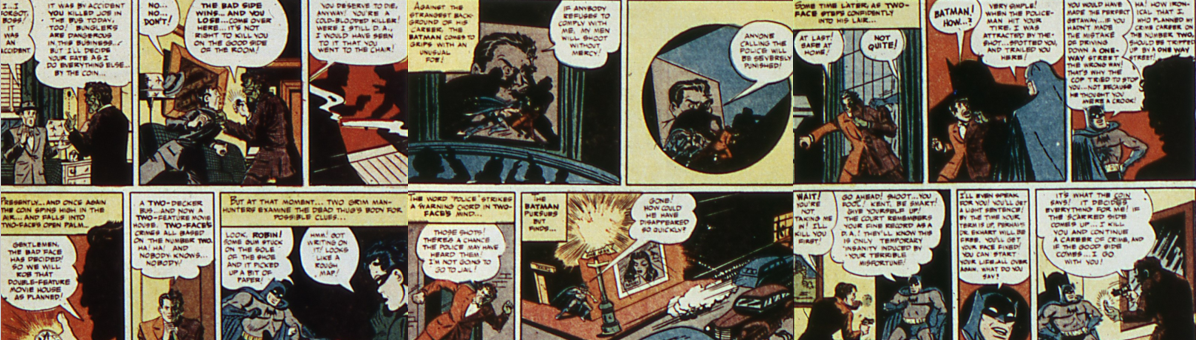
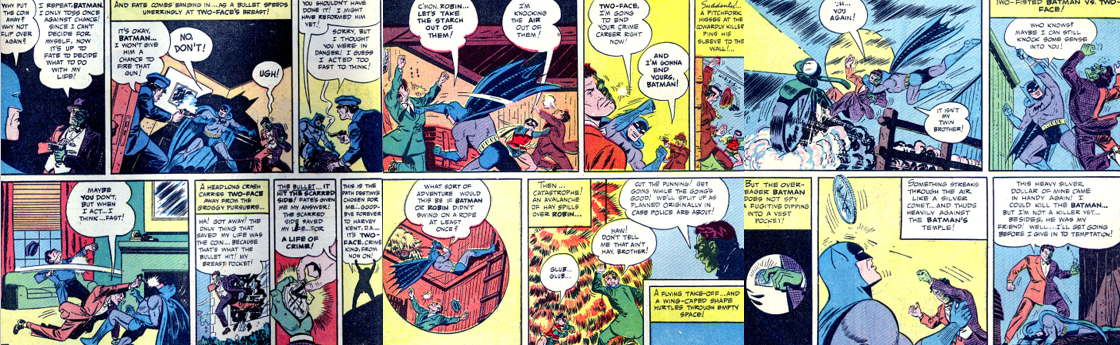
In the decades since his first dramatic appearance in the pages of Detective Comics, Bruce Wayne/Batman has become a mainstream, worldwide, pop culture icon. The brainchild of writer Bob Kane, Batman was brought to life by artist Bill Finger and has been a popular staple of DC Comics and countless movies, videogames, and cartoons over the years. “Batman Day” fell on 21 September this year so I’ve been spending every Saturday celebrating comic’s grim and broody vigilante.


Released: 18 July 2008
Director: Christopher Nolan
Distributor: Warner Bros. Pictures
Budget: $185 million
Stars: Christian Bale, Heath Ledger, Aaron Eckhart, Maggie Gyllenhaal, Gary Oldman, Morgan Freeman and Michael Caine

The Plot:
After his dramatic debut as “The Batman”, billionaire vigilante Bruce Wayne (Bale) is cracking down on organised crime within Gotham City. However, his mettle is tested by the clown-faced anarchistic “The Joker” (Ledger), who seeks to disrupt social order and corrupt upstanding district attorney Harvey Dent (Eckhart).

The Background:
After Joel Schumacher effectively killed the live-action Batman franchise with his dismally received camp adventures, Warner Bros.’ desperate attempts to get a new movie finally paid dividends when visionary writer/director Christopher Nolan, writer David S. Goyer, and star Christian Bale explored Batman’s origins in the highly regarded reboot Batman Begins (Nolan, 2005). Despite teasing the Joker at the finale, Nolan was initially unsure if a sequel would be greenlit but worked closely with Goyer and his brother, Christopher Nolan, to develop a suitable follow-up once Warner Bros. prioritised a sequel. The filmmakers took inspiration from seminal Batman stories like The Long Halloween (Loeb, et al, 1996 to 1997) and some of cinema’s most memorable movie villains to bring their versions of the Joker and Harvey Dent to life. Despite Jack Nicholson’s memorable performance as the character, Nolan confidently cast against type after being impressed by Heath Ledger, who mentally and physically threw himself into the role. In keeping with his preference for practical effects, Nolan signed off on the construction of a fully-working Batcycle, redesigned the Batsuit to be more flexible, blew up a building for real, and flipped an 18-wheeler truck using a massive piston! Sadly, the editing process proved particularly difficult after Ledger unexpectedly died from an accidental overdose; the film was summarily dedicated to him. Following an aggressive viral marketing campaign, The Dark Knight enjoyed a record-setting $1 billion+ box office and was met with widespread critical acclaim. It is widely considered one of the best and most influential comic book movies ever made, praised for its performances and socially relevant narrative, with many praising Ledger’s portrayal of the Joker which won him a posthumous Oscar. Immediately regarding as the best Batman movie of all time and recognised as setting a new standard for comic book movies, The Dark Knight’s success more than justified the production of a third and final (and far more divisive) entry some four years later.

The Review:
After the disaster that was Batman & Robin (Schumacher, 1997), I think it’s safe to say that everyone thought Batman’s feature film career was dead in the water. For me, that’s why Batman Begins was such an exciting and enjoyable experience. Finally, after decades of Batman being either a goof or a psychopath, we got a live-action film that really nailed the heart and drive of the character. The extended and in-depth exploration of Bruce’s psyche, determination, and training to become “more than just a man” really put him at the forefront of the piece and allowed the most accurate depiction of the Dark Knight ever seen in cinema at that point as Bale deftly shifted between numerous subtle personas. With Batman Begins’ conclusion masterfully teasing the Joker, expectations were high for the sequel, but reactions to Ledger’s casting were mixed at the time due to his reputation as a “pretty boy”. To address this, Nolan opens his film with an intense and engaging bank heist, filmed entirely in IMAX, in which the mysterious Joker showcases his hands-on, manipulative abilities by arranging for his clown-faced goons to knock off a mob bank and off each other once their specific tasks are completely, allowing him to easily slip away in the chaos. It’s been about a year or so since the last film and Batman now appears at crime scenes to liaise with Lieutenant James “Jim” Gordon (Oldman), much to the chagrin of cops like rookie detective Anna Ramirez (Monique Gabriela Curnen) because of his vigilante status and the corruption that continues to infest the Gotham City Police Department (GCPD). However, neither Batman or Gordon initially place much stock in the Joker’s continued threat since their focus is solely on taking down the last vestiges of organised crime in the city, represented by mob bosses Salvatore “Sal” Maroni (Eric Roberts), Gambol (Michael Jai White), and “The Chechen” (Ritchie Coster), a decision that’s entirely logical bit which comes back to bite them in due time.
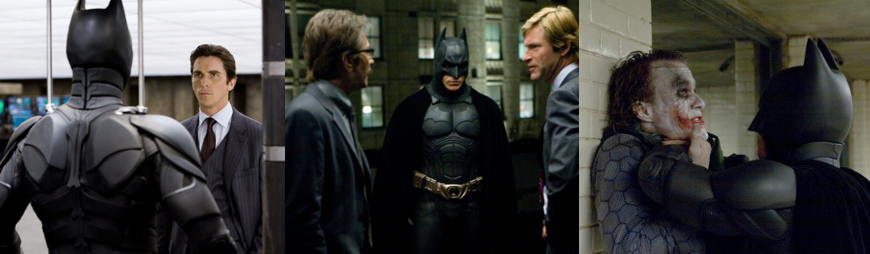
Batman’s war on crime is thrown into chaos by the maniacal Joker.

Bruce has been extremely busy in the time between films. Although he’s forced to operate out of a penthouse and highly equipped bunker in the city as he waits for Wayne Manor to be rebuilt, he’s established quite the reputation both in and out of his cowl. As Bruce Wayne, he’s the bored, party-going philanthropist who’s just as likely to abscond with a bunch of actresses to an isolated yacht as he is to fall asleep in board meetings. Although Bruce is seen by many as an aloof, reckless, and embarrassing billionaire, this persona effectively keeps anyone from questioning his nightly jaunts and he’s still savvy enough to fund and promote any programs or individuals who are committed to bringing Gotham City back to glory, such as Harvey Dent. As Batman, Bruce’s reputation is even stronger; criminals are now so afraid of the Dark Knight that they think twice about being on the streets when the Bat-Signal is in the sky and mobsters hold their meetings during the daytime. Although the Batman is still something of an urban legend, many in the city have been inspired to dress up as him and take the law into their own hands, something Bruce is disturbed to see since it results in a bunch of out of shape blokes with itchy trigger fingers wearing “hockey pads”. Still, Batman’s presence has had a positive impact on the city. He and Gordon collude to tackle the city’s mob, eventually entering a shaky alliance with Dent to apprehend mob banker Lau (Chin Hau) and make mass arrests, and Batman even detains Doctor Jonathan Crane/The Scarecrow (Cillian Murphy) in during the opening, finally taking the maniac’s drugs off the streets. However, night after night fighting crime and getting into fist, fire, and dog fights takes a toll on Bruce. His faithful butler and father figure, Alfred Pennyworth (Caine), continues to offer wry commentary and deep concern for his master’s welfare but Bruce is determined to clean up the streets and make the city safe before even considering giving up his crusade.
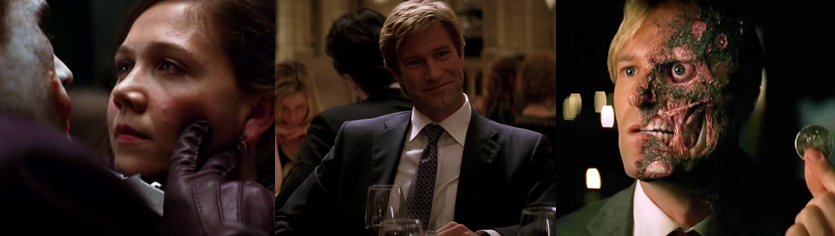
The loss of Rachel takes a heavy toll on Gotham’s “White Night” and drives him to murder.

However, Batman’s positive impact, the arrest of hundreds of mobsters, and the public’s approval of Dent give Bruce pause to reconsider his path. Since the last film, Bruce has been keeping a close eye on childhood friend and crush (and assistant district attorney) Rachel Dawes (Gyllenhaal), who works closely with Dent to prosecute the criminals and the corrupt. Thanks to Gyllenhaal being a far superior actress to her predecessor, Rachel has much more gusto this time around. She exudes a confidence and determination that was lacking in Katie Holmes’ performance and allows her to not only appear effective when interrogating Lau but also sees her fighting back against the Joker when he targets her at Bruce’s fundraiser for Dent. Although Bruce is clearly rattled by how close Dent and Rachel have become (the two are shown to be in a relationship) and somewhat condescending towards Dent’s marketing campaign, he’s as impressed by the D.A.’s conviction as the rest of the city. Dent is a square-jawed patriot who makes a buzz in the court room with his no-nonsense approach towards criminals and inspires the wealthy and the destitute alike with his commitment to justice. Dent is also an avid supporter of the Batman and determined to do whatever it takes to keep the city streets clean, even if just for six months, but he’s not as squeaky-clean as everyone believes. Gordon is sceptical of Dent due to his past in Internal Affairs, while Dent is highly critical of the corruption within the GCPD, but the two form an efficient trio alongside the Batman when they agree to pool their resources to bring Lau back from Hong Kong. Dent proves to be a surprisingly complex man. He believes so strongly in the iconography of the Batman and in not giving in to the Joker’s demands, no matter how many lives are at stake, that he publicly outs himself as the Dark Knight to keep the myth alive but also proves that he’s not above threatening criminals at gunpoint, showcasing an unexpectedly erratic side to his character. This is only exacerbated when Dent and Rachel are targeted by the Joker and Batman is forced to choose which one to save. Naturally, he picks Rachel but both he and Dent are horrified to learn that this was a double-cross that leaves Dent hideously scarred and despondent, his faith in both justice and the caped vigilante shattered and replaced by a cruel devotion to “chance”.
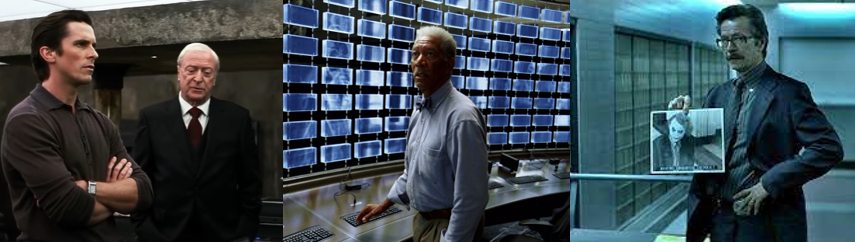
Bruce’s allies believe in the Batman and play a hands-on role in aiding and advising him.

As before, Bruce is supported in all things by Alfred, who acts as a field surgeon, conscience, and advisor to his duties both in and out of the Batsuit. We learn a little bit more about Alfred in this film through his entertaining exchanges with Bruce, in which the two share a banter that is both amusing and heart-warming. Alfred spent some time in the Peace Corps in Burma, indicating he’s seen combat and has a military background, and his insight into chaotic aberrations such as the Joker are almost on par with Bruce’s years of training to learn the criminal mind. Initially, Bruce dismisses Alfred’s insight, however, refusing to believe that the Joker is anything more than a thug with a gimmick, but is forced to admit that he’s underestimated his foe when the Joker pushes him to breaking point with his killing spree. Interestingly, Alfred actually encourages Bruce not to give in to the Joker’s demands, to “endure” the slings and arrows so as to maintain the Batman’s incorruptible persona, and also secretly shields Bruce from the knowledge that Rachel ultimately chose Harvey over him to spare his surrogate son further pain. As before, Bruce is provided with new toys and even a sleek new suit by Wayne Enterprises Chief Executive Officer Lucius Fox (Freeman), who now exhibits a working knowledge of Bruce’s dual identity despite both never outright saying it. Fox plays a pivotal role not just in helping Bruce apprehend Lau but also in throwing off the suspicions of Coleman Reese (Joshua Harto) when his number crunching exposes Batman’s identity, and in the creation of a fantastical device that allows Batman to pinpoint the Joker’s location by hacking every cell phone in the city. Though Fox threatens to resign if the device isn’t destroyed because of the dangerous invasion of privacy it offers, his loyalty is rewarded when Batman rigs the machine to self-destruct once the Joker has been located. Finally, we have Gordon, who publicly disavows any knowledge of Batman but regularly colludes with him to fight the mob. Gordon’s role is also crucial to the film as he is seemingly killed protecting mayor Anthony Garci (Néstor Carbonell), only for this to be revealed as an elaborate plan by him and Batman to capture the Joker, a gamble that sees Gordon promoted to police commissioner after the Harlequin of Hate assassinates commissioner Gillian Loeb (Colin McFarlane). Although horrified by the Joker’s murderous antics, Gordon’s riding quite the high when he, Dent, and Batman finally get their hands on the city’s mob, but his hubris comes back to bite him when Dent specifically targets him as failing to protect Rachel since Gordon’s forced to work with corrupted cops and a wayward vigilante.
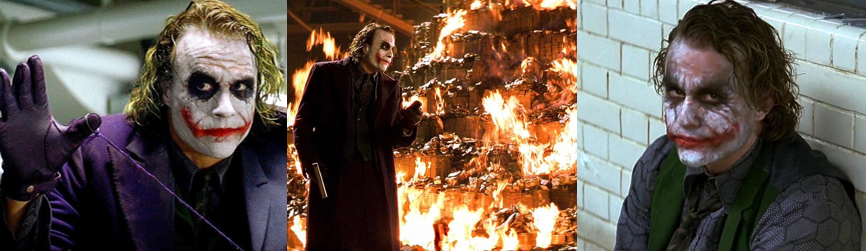
Ledger delivers a star-making performance as the chaotic and unhinged Joker.

And then there’s the Joker, played with an unnerving, scene-stealing performance by the late Heath Ledger. Unlike in Batman (Burton, 1989) where the Joker was provided with a hefty original backstory, this Joker is a complete enigma. A self-styled “agent of chaos” who proudly showcases both his gruesome facial scars and boasts that he’s simply “a dog chasing cars”, the Joker is as manipulative and psychotic as he is unpredictable and hypocritical. With no identification or fingerprints, the Joker is like a ghost. When he’s introduced, it’s like he’s been conjured by the city itself to challenge Batman’s presence and there’s no definitive explanation for who he is and why he does what he does. Indeed, much like popular depictions of his comic book counterpart, the Joker himself offers conflicting versions of his origin, scars, and motivations. The film suggests he’s been “rippin’ off mob bosses” for some time, he’s shown to have an intense hatred towards city officials and authority figures, and he even openly mocks the city’s mob bosses, threatening and murdering them with a gleeful menace. Although he favours knives over guns since they’re “more personal”, he’s proficient with firearms and, especially, explosives, hinting at a military background but, in true Joker fashion, his origins are completely irrelevant as he “just wants to watch the world burn”. Initially, the Joker encourages the mob to pay him to kill the Batman so they can run rampant over the city but he becomes infatuated by the Dark Knight’s incorruptible nature and refusal to kill. Thus, his motivation switches to opposing Batman’s ideology by corrupting the city’s “White Knight”, Harvey Dent, and breaking the will of the city by exposing their heroes as flawed human beings, demanding that the Batman publicly unmask and forcing both criminals and civilians to make life or death choices to test their mortality. In combat, the Joker is wild, dangerous, and apparently suicidal. He laughs manically in life-threatening situations, practically begs Batman to run him down, and is more than willing to die if it means forcing Batman to breaking point. Although his greatest strength is his unhinged imagination (he absolutely does have a plan, despite his claims, and carries them out with an almost supernatural foresight), the Joker gets the best of even the Batman thanks to appropriating mobsters for his own use and surprising Batman with his tenacity. But his true goal isn’t to simply fight Batman to the death but to instead cripple Gotham City by proving that anyone can turn to psychotic madness after one bad day, necessitating extreme actions from both Batman and Gordon to ensure that Dent’s reputation remains untarnished.

The Nitty-Gritty:
The Dark Knight represents how ingrained Batman’s iconography has become not just in the fictional world, but in ours. Just the fact that we got a Batman movie that omitted the character’s name entirely shows how synonymous this description is with the character, and it takes on a double meaning here since Batman is depicted (and, by the end, explicitly referred to) as a “Dark Knight”, a necessary evil to keep Gotham in check, since a “White Knight” has little chance of surviving the crime and corruption that infests the city. Indeed, Bruce is actively considering hanging up the cape and cowl when he sees how effective and unanimously beloved Dent is. Dent is the hero Gotham deserves without a masked persona, giving Bruce a sliver of hope that he can make good on his promise to be with Rachel once the city no longer needs Batman, but he vastly underestimates the destructive influence of the Joker, who perfectly encapsulates Gordon’s previous concerns about “escalation” through his unique brand of anarchy. The Joker is depicted as a man even Bruce “doesn’t understand”, someone beyond reason, intimidation, and bribery, and we see this when he shows no fear when interrogated by Batman and simply cackles with glee when the Dark Knight unloads on him since the Joker always has an ace up his sleeve (both literally and figuratively). Thus, the film very much focuses on the “battle for Gotham’s soul”, with the Joker shifting his motivation towards opposing and destroying not just the city officials and authority figures, but Batman himself since he’s the ultimate symbol of incorruptibility, to the point where he and his allies allow five people to die rather than reveal his identity because the Batman has become such an iconic force for justice within the city.
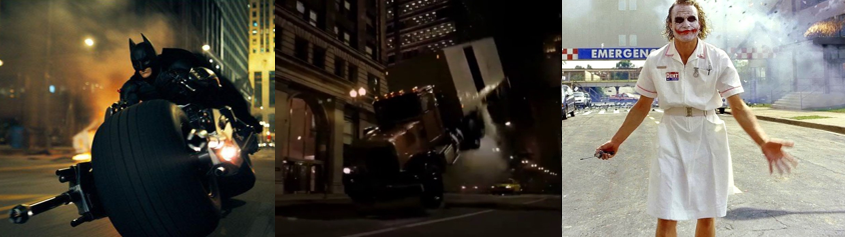
Some impressive practical effects and stunts make the film instantly memorable.

Speaking of Gotham, we’re shown a much different side of the city this time around. We’re firmly topside amongst the towering, glistening skyscrapers rather than in the dingy alleys of the Narrows, which is thematically relevant since the Joker is targeting the upper-class façade of the city but does rob it of a lot of its bleak, gothic identity. The Dark Knight also continues Batman’s crusade not against the street-level crime that killed his parents, but organised crime. He, Gordon, and Dent believe cutting the head off the proverbial snake will kill the body, and this is reflected after their big arrest that sees the lower-level scum facing at least six months in jail, giving the city breathing time to recover. However, this has the knock-on effect of reducing Batman’s street-level crimefighting to near zero since he’s more focused on nailing the likes of Maroni and the Joker and less on stopping random muggings and such. This isn’t necessarily a bad thing because, sadly, there’s little to no improvement in the fight scenes here. Nolan again opts for a close quarters, frenetic depiction of Batman’s fighting that does paint him as a brutal and efficient animal but robs us of seeing what he’s truly capable of. On the plus side, The Dark Knight explores Bruce’s detective skills; while it’s a bit confusing how he recreates fingerprints from bullet casings and he’s constantly one step behind the Joker, I liked how he colluded with Gordon and Dent to apprehend the mob and he’s given some fancy new toys to help him in these endeavours. The most prominent remains the tank-like Tumbler but, when this is destroyed by the Joker, Batman spends the remainder of the film blasting through the city streets on the sleek, bad-ass “Batpod”, a motorcycle-like vehicle that performs all kinds of unlikely turns and tricks with its near-spherical wheels, When extraditing Lau from his office building, Batman makes impressive use of his cape to soar through the skyline and then uses a “skyhook” to yank himself and his quarry out of there, just one of many impressive practical effects utilised in the film, with two more being the Joker’s insane truck flip and the fully practical, full-scale hospital explosion.
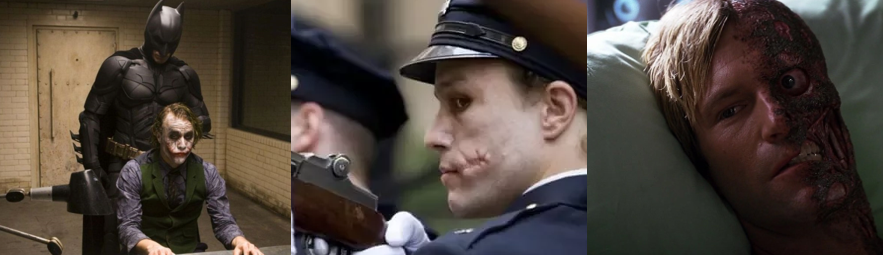
While I don’t like the new Batsuit, the Joker and Two-Face look especially impressive.

As mentioned, Batman gets a new suit this time around once he realises that he’s “carrying too much weight” and needs more flexibility. Sadly, I’m not a fan of the new suit; it allows full head movement and is less bulky, sure, but the Bat-symbol is too small, it’s unnecessarily “busy”, and just seems incredibly impractical to put on. It’s also far less durable; separation of the plates means Batman’s more vulnerable, which levels the playing field in his fight with the Joker, and the whole suit just looks too plastic-y and ugly for me. On the plus side, the Joker looks amazing; this might be my favourite depiction of the Joker and he looks ripped right out of a Lee Bermejo comic. While he still sports a permanent grin thanks to his facial scares, his clown make-up is haphazard and intimidating, specifically applied to resemble “war paint” and even degrades to reflect his insanity. His suit is also absolutely perfect, and I love how it’s filled with “knives and lint” and little booby traps, like grenades and such. The Joker also assumes various disguises, included dressing up as one of his own henchmen in a callback to the 1960s TV show, masquerading as a police offer at Commissioner Loeb’s funeral, and, most disturbingly of all, dressing up as a nurse to have a heart to heart with Dent! This is where the film really surprised me; obviously I half-expected Dent to become Two-Face (or “Harvey Two-Face” as films insist on labelling him…) but I never expected Nolan to go so comic-accurate with the depiction of Dent’s burns. Two-Face is absolutely gruesome to behold and the perfect example of how CGI can be used sparingly to enhance practical effects. You can see tendons, muscle, and charred flesh as Dent talks and he really does look like the comic come to life, almost to a fault as I find it difficult to believe that he’s talking so coherently and functioning so efficiently despite refusing pain medication. Similarly, I think we could’ve had a few more scenes exploring Dent’s dark side and his “lucky coin” before his scarring. His descent into vengeance and anarchy seems purely motivated by grief, perceived betrayal, and anger at having “lost everything” rather than having always had a dark side deep within him. Sure, there’s one scene where this is hinted at but it’s not what it seems; Dent never leaves anything up to chance since his coin is double-sided, meaning the odds are always in his favour. Accordingly, he was never actually going to hurt anyone, though this is twisted when he goes on a killing spree as Two-Face as he shoots his enemies dead based on the flip of that same coin.  
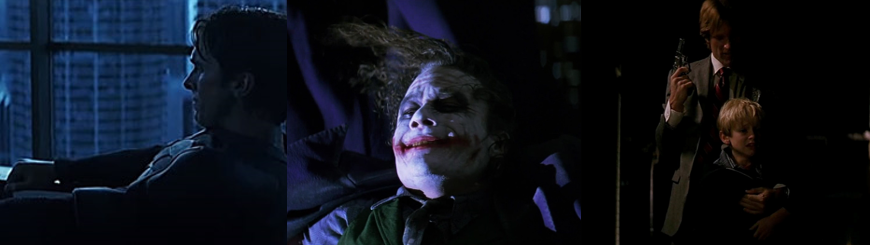
Crushed by Rachel and Dent’s deaths, Batman sacrifices his reputation to keep hope alive in Gotham.

Another element that doesn’t sit right with me is how everyone (and I do mean everyone) is aware of Batman’s code against killing. Maroni and the Joker challenge him on his “one rule” and Batman openly champions it at every turn, severely diminishing his threat somewhat and presenting a familiarity with him that irks me for some reason. A huge part of the Joker’s final plan is predicated on the notion that even “civilised people” will kill to survive. He even rigs the game in his favour to prove this point and is so determined to tarnish the Batman’s heroic visage that he plummets to his death with a maniacal laugh. However, Batman saves him at the last second and the two have an unnerving conversation about their duality and intertwined fates. This is made doubly uncomfortable not just because of Bale’s strained Bat-voice but knowing that they would never tangle again due to Ledger’s untimely death, and part of me wonders if it might’ve been better to insert an edit that shows the Joker willing die after giving his speech. When I first saw The Dark Knight in the cinema, I was so engrossed in the Batman’s fight against the Joker that I completely forgot about Two-Face and, as much as I enjoy the entire film and the finale, I wonder if it might’ve been better to incorporate Two-Face’s actions into the third film and cap things off here. Regardless, both Dent and Bruce are devastated when Rachel is brutally murdered by the Joker. This helps tip Dent over the edge and to kill those who’ve wronged him, but he forces Gordon to choose which of his family should be killed to teach him a lesson in pain and loss. When Batman arrives to confront Two-Face, both he and Gordon desperately try to appeal to Dent’s better nature and fail. Disillusioned and broken, Two-Face disregards Gordon’s pleas and prepares to kill his son (Nathan Gamble), forcing Batman to tackle him to his death. Glossing over the fact that Batman just killed a man (I guess, technically, it was the fall), Batman decides to heed Alfred’s advice and maintain Dent’s reputation by assuming responsibility for Two-Face’s murders. Though reluctant, Gordon realises that it’s the only way to keep people from losing faith in the justice system and begrudgingly agrees to paint Batman as a murderer, ending the movie with Batman a wanted fugitive who willing endures any punishment, mental, spiritual, or physical to ensure peace in Gotham.

The Summary:
I absolutely loved Batman Begins when it first came out. It was the dark, gritty, comic-accurate Batman I’d been hoping for for years and I was really excited to see where Bale and Nolan took the character in the sequel. To say that The Dark Knight exceeded expectations would be an understatement. The film is an absolute masterpiece not just of comic book cinema, but of the thriller genre. Bale continues to deftly embody the conflicting personalities and introspective drive and determination that fuels Batman’s crusade, and his Batman continues to be the definitive version of the character for me, despite the dodgy fight scenes and my dislike for the new suit. At its core, The Dark Knight works as an intense thriller depicting the fundamental conflict between justice and anarchy, logic and sanity, and truly elevated the genre to a new level by taking elaborate and colourful concepts like a clown-themed terrorist and a guy with half his faced burned off and treating them seriously. Naturally, Heath Ledger steals the show here; we may never see a better performance of the Joker and you can see that he’s as lost in the role as Bale is as Batman. Ledger’s manic energy and subtle touches really create a feeling of dread, mystery, and unpredictability to the villain, and it remains a tragedy that he didn’t live on to have more dramatic roles like this. Add to that the impressive practical effects, sweeping cinematic score and visuals, and the engaging discussion regarding Batman and his influence on the city and its criminal element and you have, for my money, one of the finest Batman movies ever put to cinema. The film masterfully pulls from some of Batman, Joker, and Two-Face’s most iconic and engaging stories to present an emotional and gripping tale of adversity for the Dark Knight. The film absolutely set the standard for both Batman and comic book movies going forward and, while the third film might have stumbled in concluding the story so wonderfully established here, it doesn’t diminish the timeless appeal of The Dark Knight in the slightest.

My Rating:

Rating: 5 out of 5.

Fantastic

Did you enjoy The Dark Knight? Where would you rank it against the other Batman movies? What did you think to Heath Ledger’s portrayal of the Joker? Were you a fan of the new Batsuit or do you also find it a bit too busy? What did you think to the effects and stunt work used in the film? Were you also surprised by how gruesome Two-Face’s scars were? Did you agree that Bruce had to maintain his identity, or do you think you should’ve come forward sooner? How did you celebrate Batman Day this year and what is your favourite Batman movie? Whatever your thoughts The Dark Knight, or Batman in general, share them below or leave a comment on my social media.

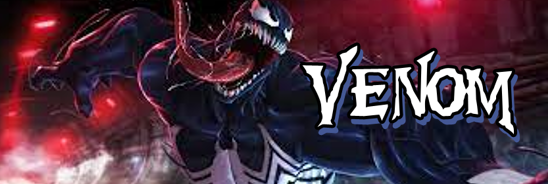
Back Issues [Venom Day]: The Amazing Spider-Man #346/347


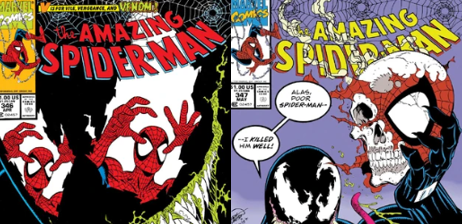
To celebrate the release of Venom: Let There Be Carnage (Serkis, 2021), Sony Pictures declared September 27 “Venom Day”, a fitting date to shine the spotlight on one of my favourite anti-heroes, who made their first full debut in May 1988 and have gone on to become one of Marvel’s most iconic characters.


Writer: David Michelinie – Artist: Erik Larsen

Story Title: “Elliptical Pursuit”
Published: 12 February 1991 (cover-date: April 1991)

Story Title: “The Boneyard Hop!”
Published: 12 March 1991 (cover-date: May 1991)

The Background:
Back in 1982, Jim Shooter, then editor-in-chief for Marvel Comics, purchased Randy Schueller’s illustration of Peter Parker/Spider-Man in a slick black outfit for a cool $200. It was writer Tom DeFalco and artist Ron Frenz who made the costume a living organism and Spidey’s new duds appeared without explanation in The Amazing Spider-Man #252, with it later revealed that he picked up the suit in Marvel Super Heroes Secret Wars #8. Over the next year or so, Spidey revelled in the costume’s unique ability to form both clothing and organic webbing but was horrified when Doctor Reed Richards/Mister Fantastic revealed it was a living symbiote. Spidey summarily rid himself of the symbiote using a cacophony of church bells and switched to a cloth version, before eventually returning to his classic outfit. A mysterious assailant attacked and stalking Peter throughout 1988 it was revealed that the symbiote had bonded with disgruntled reporter Eddie Brock. Spider-Man’s dark doppelgänger was an immediate favourite of mine and many readers, eventually jumping to different hosts, with his sadistic, even more dangerous offspring, Cletus Kasady/Carnage, being teased in these issues.

The Review:
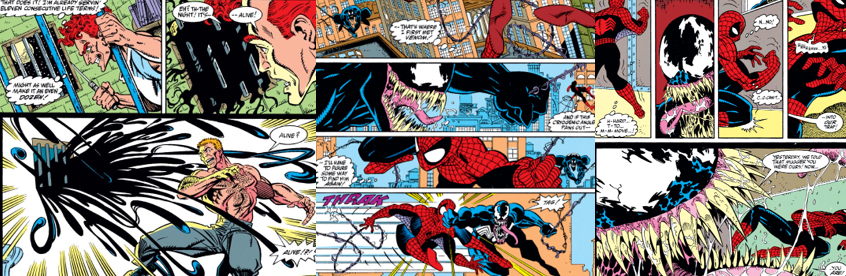
Although Venom’s second big appearance occurred in a two-part story in issues 346 and 346 of The Amazing Spider-Man, similar to their original first appearance, the character featured in a cameo in issue 345. Since it’s actually a pretty big cameo, I’ll quickly cover it before delving into the main story. “Gun from the Heart!” (Michelinie, et al, 1991) sees Spider-Man on the trail of noble, but misguided and violent, vigilante Elias Wirtham/Cardiac, with the added bonus of being promised $5000 by Silvija Sablinova/Silver Sable for apprehending him. The main reason this issue is important is two-fold: first, it shows Eddie Brock escaping from Ryker’s Island when his symbiote comes to bond with him once more. Second, it introduces readers to Brock’s cellmate, demented serial killer Cletus Kasady, who is unknowingly bonded with a small drop of the symbiote and would go on to become the sadistic Carnage. While Spider-Man fails to apprehend Cardiac in the main plot, the issue ends with Venom being reborn and swearing to avenge themselves against the wall-crawler. This perfectly sets us up for “Elliptical Pursuit”, which immediately re-establishes Venom’s warped moral code when they chastise fellow former reporter Sly Fenster for selling confidential files on the downlow before expressing regret when their webbing accidentally suffocates the corrupt reporter. The story then jumps over to Grand Central Station, where Peter’s wife, Mary-Jane Watson-Parker/M. J., is unimpressed at being spirited away to her sister’s. Having heard about Brock’s escape and the symbiote’s breakout from the Baxter Building, and fearing for M. J.’s safety, Peter convinces her to leave lest Venom targets the bombshell redhead like last time.

Venom returns with a vengeance, constantly blindsiding Spidey with their superior strength.

Despite knowing M. J’s safe, Peter’s thoughts dwell on Venom’s threat. Unwilling to put any of his allies in danger, even his former lover and part-time vigilante Felicia Hardy/The Black Cat, Peter resolves to face Venom alone, reasoning that it’s his responsibility since he technically created the creature and their hatred of him. He’s so lost in thought that he forgets that Venom doesn’t trigger his spider-sense and is caught off-guard when Brock accosts him at a coffee shop. Brock calmly convinces Peter to take a walk, expositing how his “other” survived an earlier confrontation with the cancer-inducing Styx and happy to settle their business down a back alley. However, they’re jumped by a mugger, who’s summarily dispatched (non-lethally this time) by Brock, though Peter uses the distraction to flee to a hotel for the night. A seemingly random phone call from Professor Evan Swann inspires Peter to swing on over to Empire State University and check out their cryogenics lab, hoping to find a weapon that can neutralise Venom similar to how extreme heat and sound defeated them before. Once again forgetting his reliance on his spider-sense, Spider-Man is blindsided mid-swing by Venom, who gleefully lays in a beating on the web-slinger. Experience and agility allow Spidey to create some distance, though Venom easily closes it by hurling a girder. With Venom distracted keeping innocent lives safe when their fight causes damage to the Bronx Zoo, Spider-Man goes on the offensive, giving Venom a taste of their own medicine and angering the unstable symbiotic pairing. However, Venom regains the advantage by using their uncanny ability to assume other forms, tricking Spider-Man into entering the cryogenic chamber, where the extreme cold forces the troubled superhero to blackout and be left at Venom’s mercy.

Overpowered, Spidey outwits his foe by faking his death.

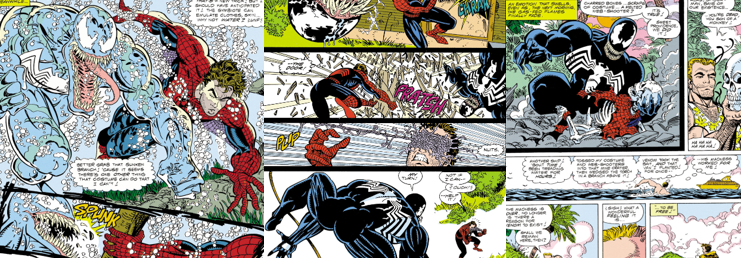
In the next issue, Spider-Man slowly dethaws and awakens on a sweltering beach, confused to find himself trapped on a deserted island with (and courtesy of) his most lethal foe. Not willing to allow for any distractions or let innocent bystanders get in the way of their combat, Venom proposes a fight to the death to settle their grudge and relishes chasing his foe through the dense foliage. Though terrified by the creature’s threat, Peter desperately forces himself to adapt to and out-think his foe but is again blindsided by a clever sneak attack when Venom renders themselves invisible and attacks from a stream, nearly drowning Spidey before he fights his way free using a nearby tree branch. Venom’s abilities constantly give them the edge even when Spidey calls upon the Eagle Scout training his former bully-turned friend Eugene “Flash” Thompson tried to teach him and lay traps for his foe. Venom’s ability to blend into their surroundings forces Spidey to rely on his speed and agility instead. Even when Venom is caught in Spidey’s snare trap, the creature easily overpowers him but, when Venom hurls a truck at his hated enemy, he unwittingly causes Spidey to stumble upon an abandoned mine full of gas. After using the mine to escape Venom, Spidey tries to swim to a boat on the horizon, only to end up tangled in Venom’s living webbing. Tackling his way out of the situation with a desperate lunge, Peter stumbles upon some macabre shallow graves and finally realises that their conflict will only end with his death. Spidey thus lures Venom into the jungle with a flaming torch and goads them into hurling another truck, this time resulting in a spectacular explosion that leaves Spider-Man nothing but a shredded skeleton. Overjoyed at having finally defeated their foe, Venom resolves to live out the rest of their existence in peace on the island, blissfully unaware that they’ve been fooled by an obvious trick. Having dressed a skeleton in his costume, Peter faked his death and swam out another passing boat, breathing a sigh of relief knowing that Venom’s menace has forever been put to bed.

The Summary:
After a dramatic and horrifying first appearance, it was pretty exciting to see Venom return, more unhinged and psychotic than ever. What I love about Eddie Brock is that he’s convinced himself that everyone, especially Spider-Man, is to blame for his lot in life. He takes no personal responsibility for the actions that led to his downfall and has convinced himself that he’s on a righteous, God-given mission to protect the innocent and destroy Spider-Man. This twisted ethical code means he’s vehemently against the killing of innocents and will even be distracted from his vendetta to protect them, but also leads to him both knowingly and unknowingly using lethal force to get what he wants. Similarly, he’s not above threatening Peter’s loved ones, which is exactly why Peter sends M. J. away and refuses Felicia’s help since he doesn’t want to be distracted by protecting them or burdened by putting them in danger. Indeed, Peter acknowledges that others have aided him against Venom before and he’s now put himself in greater danger by going solo. This is exacerbated by just how dependent Spidey is on his spider-sense; normally, he can swing around mulling over his personal dramas and always rely on his spider-sense to warn him of danger. But Venom doesn’t trigger it, so they constantly gets the jump on Spider-Man, almost to the point of parody in just these two issues as Peter seemingly never learns to adapt to this, forgets about it, or cannot find a way to compensate for the loss of his spider-sense.

A brutal conflict ultimately results in Venom finding solace in believing they’ve killed their enemy.

Since Venom is bigger, stronger, and completely out of their mind, Spider-Man is forced to stay on the move and rely on his experience and agility. Time and again, this puts him on the back foot; even when he does reach the university labs, he’s easily fooled by Venom’s camouflage ability and rendered unconscious. I loved the island setting for their final confrontation, which essentially put them on even ground since there were no innocents to worry about or tall structures to swing from, but Venom had the advantage because of their familiarity with the island and their unique abilities. Luckily for Spidey, Venom likes to toy with their prey and relishes the chase, giving Peter multiple opportunities to think up plans to subdue and ultimately trick his psychotic foe. Essentially, these two issues are a prolonged chase and fight sequence; Erik Larsen is one of the quintessential Venom artists, closely emulating Todd McFarlane’s style and giving Venom their gruesome teeth and tongue, so the action is always kinetic and visually striking. It’s not enough to tide over the story, though; the sub-plots regarding Felica and M. J.’s worries about Peter, his beloved Aunt May’s romantic life, and the loose thread regarding Cardiac help break up the pace but distract from the main appeal of the stories. It would’ve been nice to see Venom do more to torment Peter, especially in the first issue. They work great as a creepy stalker and that aspect is only briefly touched upon before the two are trading blows between the city skyscrapers. Similarly, the island battle quickly becomes repetitive as Spidey goes on the run, gets blindsided, and goes on the run…only to be blindsided again. These issues seem to have been produced to put Venom’s threat to bed; they’ are content and happy believing they’ve killed Spider-Man. Michelinie even leaves a tease that a version of the symbiote will live on through Kasady, making me wonder if this was supposed to Venom’s last appearance. As is, it’s a decent enough sequel to Venom’s first appearance, most notable for being the first appearance of Kasady, that indirectly leads to one of Spider-Man’s most violent and tedious crossover events later down the line.

My Rating:

Rating: 3 out of 5.

Pretty Good

What did you think to Venom’s big return? Did you ever think Cletus Kasady would become one of Spider-Man’s most notorious rogues? What did you think to Venom’s characterisation as a self-righteous psychopath? Did you find the conflict tedious in Venom’s repeated blindsiding of Spidey? What is your favourite Venom story and how are you celebrating Venom’s dramatic debut? Whatever your thoughts on Venom, share them down below and be sure to check out my other Venom and Spider-Man content.

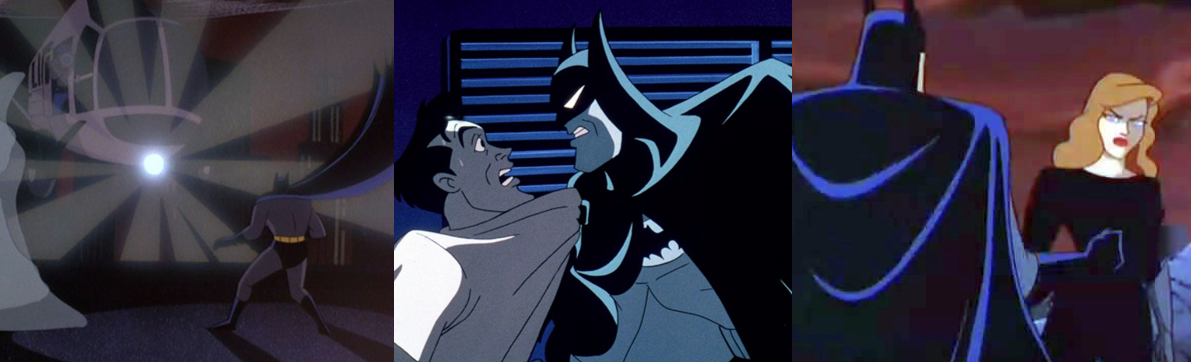
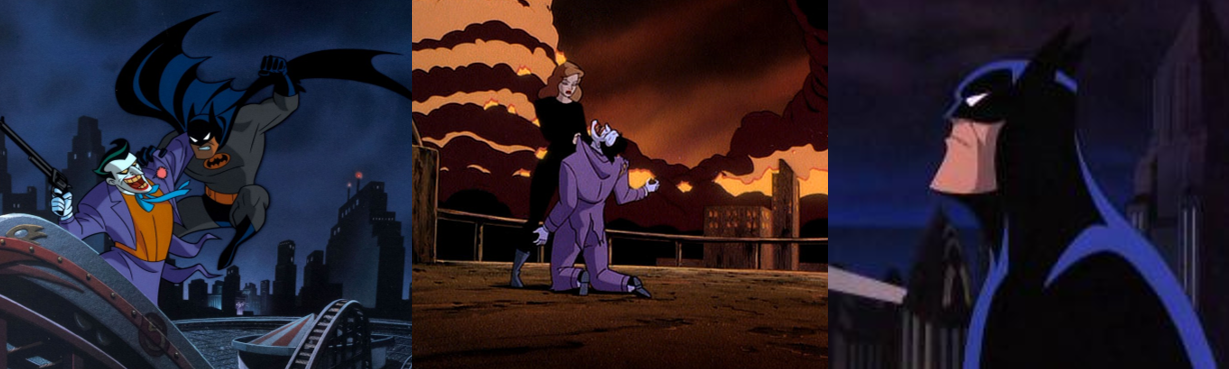
Movie Night [Bat-Month]: Batman: Mask of the Phantasm


In the decades since his first dramatic appearance in the pages of Detective Comics, Bruce Wayne/Batman has become a mainstream, worldwide, pop culture icon. The brainchild of writer Bob Kane, Batman was brought to life by artist Bill Finger and has been a popular staple of DC Comics and countless movies, videogames, and cartoons over the years. So, as today is “Batman Day”, I figured this was a perfect excuse to spend every Saturday celebrating comic’s grim and broody vigilante.


Released: 25 December 1993
Director: Eric Radomski and Bruce Timm
Distributor: Warner Bros.
Budget: $6 million
Stars: Kevin Conroy, Dana Delany, Hart Bochner, Bob Hastings, Efrem Zimbalist Jr., and Mark Hamill

The Plot:
Early into his crimefighting career as the Batman, Bruce Wayne (Conroy) finds mobsters being slain by a mysterious and vicious, Grim Reaper-esque vigilante “The Phantasm” (Stacy Keach). In trying to uncover the Phantasm’s identity, Batman reconnects with his lost love, Andrea Beaumont (Delany), and uncovers a terrible connection between the two.

The Background:
Artist Bob Kane may have dreamed up the idea of a new masked crimefighter to capitalise on the success of Clark Kent/Superman’s debut, but it was the long-suppressed efforts of artist Bill Finger that the “Bat-Man” became such an iconic figure. Decades later, the likes of Dennis O’Neil sought to correct the Batman’s image following the gloriously camp (and incredibly popular) 1960s television show, but the release and relative success of Batman (Burton, 1989) and Batman Returns (ibid, 1992) saw renewed interest in the character. Consequently, Bruce Timm, Paul Dini, and Eric Radomski spearheaded a new animated series influenced by both films that became one of the most beloved and influential cartoons of its era. Batman: The Animated Series aired eighty-five episodes between September 1992 and 1995 before being succeeded by twenty-four episodes of The New Batman Adventures (known as The Adventures of Batman & Robin in the United Kingdom) between 1997 and 1999, but its initial success convinced Warner Bros. to task Alan Burnett with writing a full-length animated feature. Heavily influenced by Batman: Year Two (Barr, et al, 1987), the film was set to feature a Grim Reaper-like counterpart to Batman while also acting as something of an origin story for both the Dark Knight and his long-standing nemesis, the Joker. Filming was completed within eight months, and Warner Bros. made the last-minute decision to release it theatrically. Although this negatively impacted its box office return, Batman: Mask of the Phantasm made up for this in home media sales and is widely regarded as one of the best superhero films ever made. Critics praised the presentation and score, the slick animation, and its mature themes, and it remains one of the quintessential adaptations of the character for many Batman fans.

The Review:
I watched Batman: The Animated Series as a kid, alongside a host of other popular cartoons at the time, but my memories aren’t massively clear. This is a general statement of my childhood in this regard, and I think it’s because I usually slept in at the weekends and didn’t get up until after a lot of the big cartoons had already been on, then I’d spend the rest of my time eating, playing videogames, or watching the same video cassettes over and over. Still, Batman: The Animated Series definitely made an impression on me. It was dark, surprisingly violent, and probably the most readily available incarnation of Batman since it didn’t involve buying any books or comics, so it was massively exciting when this animated feature aired on television for the first time or you saw the VHS available for purchase. The film begins in present day Gotham City, where Batman has established himself as a nocturnal vigilante but is still early enough in his career to large be considered an urban myth. As a result, Chuckie Sol (Dick Miller) has no qualms about conducting his business in the dead of night, which naturally means his money laundering deal is interrupted by the Batman. Although Chuckie slips away with his counterfeit money, he’s intercepted by a mysterious, Grim Reaper-like figure we now know as the Phantasm and so intimidated by the spectre that he drives out of the parking lot to a violent death.

The mystery of the Phantasm puts Batman in the frame, but their true identity may surprise you!

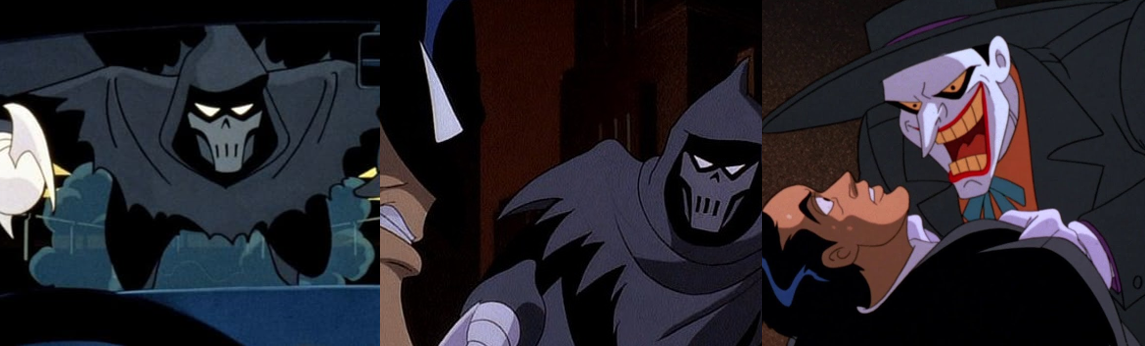
Thanks to the Phantasm, and the testimony of bystanders, Batman is fingered for Chuckie Sol’s death and councilman Arthur Reeves (Bochner) wastes no time publicly declaring Batman a violent vigilante who needs to be brought to justice. When Commissioner Jim Gordon (Hastings) remains adamant that sensationalist claims that Batman has snapped and gone on a killing spree are against Batman’s very nature and washes his hands of the entire debacle, Reeves personally leads numerous unsuccessful attempts to apprehend the Dark Knight. Batman is more concerned with analysing a piece of Chuckie’s windshield, which is stained by chemical residue from the Phantasm’s smoke, and investigating the graveyard where Buzz Bronski (John P. Ryan) was killed. Batman: Mask of the Phantasm does a wonderful job of depicting Batman’s detective skills and it’s a nice change of pace from all the thrilling action, chase, and fight sequences to follow his investigation into the murders. Additionally, there are two pressing mysteries in the feature: the identity of the titular Phantasm and the connection between the mobsters left dead in their wake. Of course, these end up overlapping but there’s a decent attempt to throw some red herrings our way. Reeves, Andrea’s father Carl (Keach), and Andrea are all potential suspects but it’s the latter who turns out to be behind the cloak and hand-scythe of the Phantasm. There’s an argument to be made that this isn’t too surprising given we’ve never heard of Andrea before this film, but the stature and physicality of the Phantasm definitely helps to keep this a dramatic reveal at the finale. Unlike the Batman, the Phantasm isn’t above killing; Andrea utilises theatricality to equal Batman, appearing to appear and disappear in a cloud of smoke, brandishes a dangerous scythe-like gauntlet, and is garbed in a heavy-duty armoured suit that makes her more than a match for Batman’s skills and gadgets when they inevitably come to blows.

Kevin Conroy delivers another stellar performance as Bruce is torn between his vow and his heart.

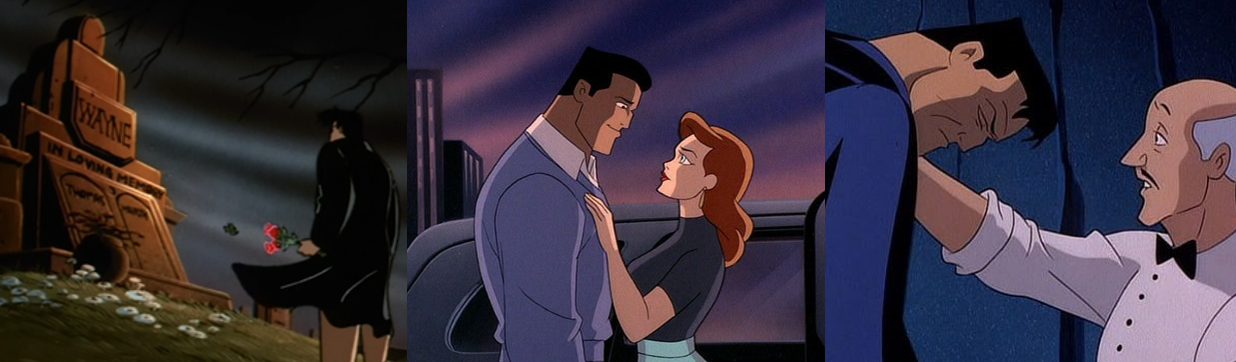
While Michael Keaton may have set the bar for live-action portrayals of Batman, make no mistake that Kevin Conroy remains the standard for depictions of Batman. Any actor looking to take on the iconic role must depict his three dominant personas: Public (Bruce Wayne, socialite and playboy), Private (Bruce Wayne, brooding and melancholy), and Vigilante (the grim and stoic Batman) and Conroy perfectly nails all three of these. When Bruce is attending functions and banquets, he’s a suave and smooth-talking ladies’ man known for being extremely generous with his family’s wealth, hands-on with charities and opportunities from growth and employment in Gotham, and for stringing along a seemingly endless parade of bimbos and lusty women. At home, in both the solitude of Wayne Manor and the sanctity of the Batcave, this public mask slips, allowing Bruce to confide in his faithful butler and father-figure, Alfred Pennywoth (Zimbalist Jr.), and is the closest he gets to being truly honest with anyone. And, of course, under cover of night, he stalks the criminal underworld as a theatrical vigilante, and Conroy expertly depicts the differences in each of these personas and situations with subtle changes to his tone, line delivery, and inflections that really went a long way to making this version of Batman one of the most well-realised, complex, and layered interpretations of the character. This really comes to the forefront here thanks to repeated flashbacks to an earlier time in Bruce’s life where he struggled with how to make good on the vow he made to avenge his parents’ death by tackling the criminal scum that took their lives. At this point, he’s still an angry, directionless young man whose vigilante debut goes sideways because, while he has the physical means to overpower even armed crooks, he’s at a disadvantage because he’s seen as just a man, rather than a force of darkness and justice (as he puts it: “They weren’t afraid of me!”) While brooding at their gravestone, he crosses paths with the beautiful Andrea Beaumont. Though she comes across as dismissive and aloof, she’s actually intrigued and somewhat taken by him since he has all this wealth and privilege but always seems so melancholy. As she’s also lost someone, her beloved mother, the two bond over their shared grief and, when she comes to visit him, she impresses him with her combat prowess and the two begin a whirlwind romance.

As if the mysterious and brutal Phantasm wasn’t enough, the Joker shows up to steal the show!

Bruce is so taken by Andrea that he questions his vow and contemplates a life of happiness as a benevolent entrepreneur with her by his side. He is therefore devastated when she suddenly rejects his proposal and leaves the city, forever setting him on a path of grim vigilantism. When Andrea returns to Gotham some years later, in the present day of the story, Bruce is a fundamentally changed man. A chance encounter between her and Batman accidentally reveals his true identity to her, and she greets the Batman with a cutting hostility when he’s forced to question her as part of his investigation into the recent killings (delivering a biting jibe about how he’s controlled by his parents). Buzz Bronski, a mob associate of Chuckie’s, is the Phantasm’s next target; his henchmen see him chased by the cloaked figure and crushed to death under a gravestone and mistake the “Angel of Death” for Batman, which causes a media sensation. Startled by the murders of his associates, the decrepit Sal Valestra/The Wheezer (Abe Vigoda) fears for his safety and turns to the Joker (Hamill) for protection. As if touching upon Batman’s origins wasn’t enough, Batman: Mask of the Phantasm thus provides a glimpse into the background of the typically mysterious Clown Prince of Crime. Although not named as such here, the Joker was once Jack Napier like in Batman, but we also learn that he was once a chauffeur and assassin for the mob before taking his dive into disfiguring acid. While I appreciate the effort to flesh out the Joker’s backstory a little, and the film does a decent jump of bringing him in late into the runtime, I can’t help but feel like the Joker’s inclusion was a little forced and unnecessary. It’s as though the filmmakers didn’t quite trust the intriguing mystery of the Phantasm, the glimpse into Bruce’s past, or the narrative of Batman being hunted by the police and felt they had to shoehorn the Joker in to make things more exciting.

The Nitty-Gritty:
Of course, I’d be doing Batman: Mask of the Phantasm a disservice if I didn’t mention the absolutely haunting score from the late, great Shirley Walker. Having collaborated with composer Danny Elfman for Batman, Walker was the perfect choice to evoke the same melancholic, gothic undertones of Burton’s blockbuster reinvention of the character, and she’s at her absolute best here. The sweeping, operatic score really gives Gotham City an ominous, looming character, punctuates the action, and makes the more poignant moments of the film all the more heart-breaking and that’s all thanks to Walker’s absolutely iconic and memorable orchestral number. The animation must also be praised; thanks to an emphasis on shadows and darkness, Batman moves like a slick, otherworldly figure and comes across as fearsome, intimidating, and efficient all at once. Nowhere is the use of lighting more impressive than in scenes in the Batcave, where deep, never-ending shadows and darkness are at their most prominent, and this all really adds to the stark contrast between the inky black of night and the brighter, dull pastels of the few day time scenes.

The feature provides a tantalising glimpse into Bruce’s motivation to become the Dark Knight.

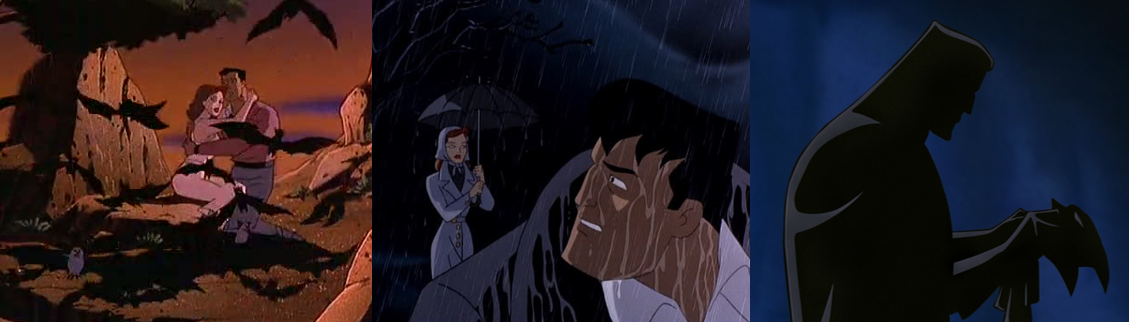
One thing that helped Batman: Mask of the Phantasm stand out as an animated feature was how surprisingly adult it was. Batman: The Animated Series always expertly towed the line with the censors by depicting guns and bullets rather than laser pistols, and the feature film gets away with even more to depict people smoking, modern-day pistols rather than Tommy guns, a bit of blood when Batman takes a beating, and an unexpectedly high body count for a “kid’s film” thanks to the murderous Phantasm. A central aspect of the film is the exploration into the motivation and tragedy that pushed Bruce into assuming the Batman guise. Despite travelling the world and gaining the physical and deductive skills to be a crimefighting detective, Bruce is torn between seeing his vow to the fullest extent and using his wealth to benefit the city while living a happy life with Andrea. Alfred naturally pushes him towards the latter, and Andrea even believes that his parents “sent [her]” as a sign that he can go back on his vow. Unfortunately, fate intervenes. Right after she accepts Bruce’s proposal, Carl Beaumont forces Andrea to leave the city after his dealings with the mob threaten both of their lives and, rather than explain the situation to her love, Andrea left him heart-broken and rejected. With his one last chance of a happy, normal life denied him, Bruce returns to his vow and, in a hauntingly impactful scene, embraces the cape and cowl of the Batman, losing himself to the darkness of his never-ending crusade and shocking even Alfred with his monstrous transformation.

The climatic finale sees Batman engage with the Joker, and seemingly lose his one true love forever.

Batman takes his investigation up a notch after figuring out that the Joker is involved, and the cackling madman quickly takes a perverse pleasure in hunting down the one responsible for killing his old buddies. This involves murdering Valestra and wiring to explode, reducing Reeves to a hysterical mess with his laughing gas, and trying to off the Batman with ludicrous contraptions cobbled together from the abandoned world’s fair that the Joker’s taken as his hideout. Oddly enough, once Andrea’s true identity is revealed, the Joker actually holds his own in a fight with her thanks to his acid-spitting flower and turning the fair’s animatronics and rides into death traps. Andrea, however, is driven by a murderous bloodlust. Since the Joker was responsible for killing her father, she has no problem fighting dirty, kicking him in the nuts and tracing him across the hazardous amusement park in a bid to have her revenge. Naturally, Batman makes a dramatic save and chases down his most persistent nemesis, leading to a somewhat ludicrous conclusion where Batman battles a jetpack-wearing-Joker through the skies of a dilapidated amusement park wired to explode. Determined to see the Joker pay, Andrea ignores Batman’s pleas to leave and seemingly perishes along with the Clown Prince of Crime as the world’s fair is dramatically engulfed by explosions, leaving Batman not only heart-broken but guilt-ridden at his failure to save his former flame. In the darkness of the Batcave, he finds solace in Alfred’s reassuring words and Andrea’s pendant, giving him hope that she’s still alive. Hardened by the experience, he returns to the night as the Batman, grim avenger of injustice, while Andrea sails off to an unknown future with only her own heartbreak for company.

The Summary:
It’s hard to get much better than Batman: Mask of the Phantasm for pure, unadulterated Batman action. In many ways it, like the cartoon it spun out from, is one of the most striking, influential, and unapologetically faithful renditions of DC’s Dark Knight ever put to screen and perfectly captures the dark, gothic melancholy of the titular vigilante, his city, and his never-ending crusade against crime. This was one of the rare, few glimpses into a time of Bruce’s life where he was struggling to make the transition from angry, vengeful young man to grim avenger of the night and it’s absolutely tragic to see how close he came to abandoning his crusade for true love and was forced to fully commit to his dark alter ego once fate set him on that path. One of the things I absolutely love about Batman: Mask of the Phantasm is that it’s not afraid to show Batman’s more cerebral side. The mystery of the Phantasm and the killings is as crucial to the narrative as the romance between Bruce and Andrea, and is far more of a focus than the handful of fantastically realised and slickly animated fight and chase sequences. Batman also feels fallible and human while still being a fearsome and intimidating figure. He easily outmatches street level scum but can be hurt by the likes of the Phantasm and the Joker thanks to their skills and/or gadgets. As I’m also a big fan of Batman: Year Two, the Phantasm struck me as a brilliant foil for Batman. As cold and stoic as the Dark Knight, Andrea’s gruesome, cloaked persona is a dangerous and ruthless foe out for blood and nothing more, but more than a match for the Caped Crusader thanks to gadgets, theatricality, and a degree and physical ability. While I find the finale a bit over the top thanks to the focus shifting towards the Joker, you can’t deny that Mark Hamill steals the show at every turn with his maniacal performance, delivering every line with a sadistic glee that makes the Clown Prince of Crime a joy to watch. Honestly, if you know anyone who isn’t sure if they want to get into Batman or who wants to learn more about Batman, I would absolutely recommend you point them towards Batman: Mask of the Phantasm as you’ll be hard-pressed to find a better representation of everything that makes the Dark Knight such an enigmatic and alluring character.

My Rating:

Rating: 5 out of 5.

Fantastic

Are you a fan of Batman: Mask of the Phantasm? Where would you rank it against other Batman films, live-action or otherwise? What did you think to the Phantasm, their depiction, and the reveal of their identity? Were you a fan of the Joker’s inclusion or, like me, did it kind of overshadow the rest of the plot for you? Did you enjoy Batman: The Animated Series growing up? What are some of your favourite episodes, and where would you rank Kevin Conroy’s performance? What was your first experience of Batman and how are you celebrating his debut this month? Feel free to share your thoughts on Batman: Mask of the Phantasm down below, or leave a comment on my social media, and be sure to check back in for more Batman content in the near future!

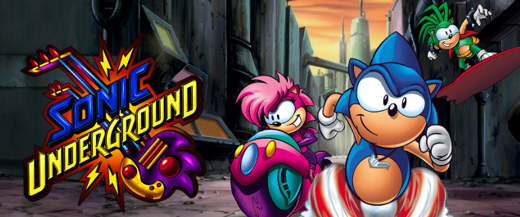
Screen Time & Knuckles: Sonic Underground & Knuckles


With the release of Sonic the Hedgehog 3 (SEGA Technical Institute, 1994), gamers were introduced to Knuckles the Echidna. This mischievous, dreadlocked antagonist was created by Takashi Yuda and his debut was made all the more impressive by virtue of the fact that Sonic 3 was too big to fit on one cartridge. This meant that Knuckles was the first of Sonic’s supporting characters to co-star in a main series videogame when Sonic & Knuckles (ibid) was released on this very day in 1994.


Episode Title: “Friend or Foe?”
Air Date: 28 February 1999

Episode Title: “Flying Fortress”
Air Date: 31 March 1999

Episode Title: “No Hedgehog is an Island”
Air Date: 7 April 1999

Episode Title: “New Echidna in Town”
Air Date: 13 April 1999

Directors: Marc Boreal, François Hemmen, and Daniel Sarriet
US Network:
BKN Kids II – UK Network: Channel 4

Stars: Jaleel White, Brian Drummond, Garry Chalk, Maurice LaMarche, and Peter Wilds

The Background:
After Sonic the Hedgehog blasted onto the videogame scene with Sonic the Hedgehog (Sonic Team, 1991), SEGA’s aggressive marketing campaign paid off dividends. Sonic’s popularity exploded after the release of Sonic the Hedgehog 2 (SEGA Technical Institute, 1992) and, suddenly, Sonic was everywhere, including two concurrent cartoons courtesy of DIC. While Adventure of Sonic the Hedgehog (1993; 1996) is generally criticised for its slapstick comedy, its darker counterpart, Sonic the Hedgehog (widely known as “SatAM”) is regarded as one of the defining cartoons of the nineties for its darker tone and mature themes. Although the cartoon inspired the original Archie Sonic comics, fans were left confused and disappointed when SatAM ended on an unresolved cliff-hanger. When the time came for SEGA to promote their up-coming Dreamcast, a new Sonic cartoon was commissioned, one that oddly took many visual inspirations from SatAM but told an entirely original story, one that owned more to Alvin and the Chipmunks (1983 to 1990) than its fan-favourite predecessor. Although Jaleel White returned to voice Sonic and his new siblings and writer Ben Hurst had some influence on the show, Sonic Underground became notorious for its musical interludes and struggled to find an audience thanks to the episodes being aired out of order. While the concept had even less to do with the source material than its predecessor (Sonic’s sidekick, Miles “Tails” Prower is nowhere to be found) and is widely regarded as one of the worst Sonic adaptations, Sonic Underground featured the debut of Knuckles the Echidna in Western animation and there was a sadly cancelled attempt to publish an epilogue to the much-maligned cartoon in 2013.

The Plot:
Whilst searching Planet Mobius for their mother, siblings, rebels, and rock stars Sonic, Manic, and Sonia (all voiced by White) cross paths with the distrustful and hot-headed Knuckles (Drummond). However, when the dastardly Doctor Robotnik (Chalk) manipulates Knuckles into providing him with a legendary Chaos Emerald, these four conflicting personalities must set aside their differences to oppose the doctor’s latest evil scheme.

The Review:
I watched all of Sonic’s cartoons when I was a kid. I distinctly remember watching Adventures of Sonic the Hedgehog every weekend, usually recording episodes for prosperity, and enjoying Sonic’s slapstick antics so much that I was shocked and confused when the entire tone and cast of the show suddenly changed. Sonic was no longer ridiculing Dr. Robotnik (Long John Baldry) and his minions and was instead the point man in an outnumbered resistance movement against a far darker, semi-cybernetic dictator much like in Sonic the Comic (1993 to 2002). I adapted to the new format and found myself enjoying Sonic’s dark escapades, only to be left further confused when SatAM ended on a massive cliff-hanger that teased a larger role for Dr. Robotnik’s long-suffering nephew, Snively (Charlie Adler) and a mysterious, red-eyed figure who I hoped would be Metal Sonic or even Knuckles! Sadly, we never got to see this ending resolved, even in the comics, and I was forced to adapt once again to an all-new Sonic cartoon, one that looked very similar to SatAM but was widely different and made the bold and frankly bizarre choice to lumber Sonic with two siblings. Why Tails and Amy Rose weren’t used in these roles I’ll never know but I was still a Sonic fan so I tried to give it a go, but to be fair I was about fourteen in 1999 so I was starting to veer away from cartoons like this.

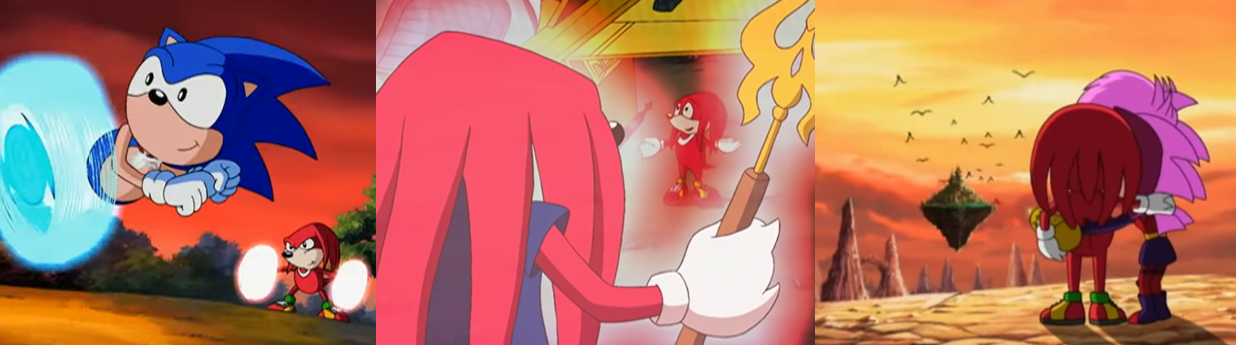
After some initial antagonism, Knuckles and Sonic team up to safeguard the Chaos Emerald.

Although “Flying Fortress”, “No Hedgehog is an Island”, and “New Echidna in Town” make up a three-episode story arc revolving around Knuckles and the Chaos Emerald, they were broadcast out of order and the character actually made his first appearance in the standalone story “Friend or Foe?” Following the surprisingly catchy opening theme song (one of the few highlights of the cartoon), the episode finds Sonic, Sonia, and Manic travelling to the “dreaded” Floating Island in search of their long-lost mother, Queen Aleena Hedgehog (Gail Webster, and running afoul of boobytraps laid across the island by its mysterious echidna guardian. As ever, Dr. Robotnik is lumbered with two bungling minions: sleazy-but-cunning wolf Sleet (LaMarche) and the block-headed Dingo (Wilds), who transforms into different forms at the touch of Sleet’s remote controller. The two are ordered to the Floating Island to poison Knuckles’ mind against the hedgehogs, distracting him so they can steal the Chaos Emerald and send the island (and their enemies) plummeting to the ground. Thanks to a hilariously bad holographic fake, Knuckles is easily tricked and takes off to confront the three hedgehogs right as they learn from one of the island’s “sacred pools” that their mother was (and possibly still is) there. Despite Sonia’s best attempts to keep the peace, a sluggish and awkward scuffle breaks out between Knuckles and Sonic, which ends with the Sonia and Manic exploring the island’s underground caverns (in a close approximation of the Hidden Palace Zone) and learning of Knuckles’ deception. Although Sonic talks sense into Knuckles, they’re too late to stop Sleet and Dingo from stealing the Chaos Emerald and endangering the island. Luckily, Dingo is distracted by his lust for Sonia and the baddies are forced to flee without the emerald while the three fend off a contingent of SWATbots. In the aftermath, the siblings make amends with Knuckles, who reveals that he knows Queen Aleena and that she left a message indicating that he would become a pivotal ally in their crusade.

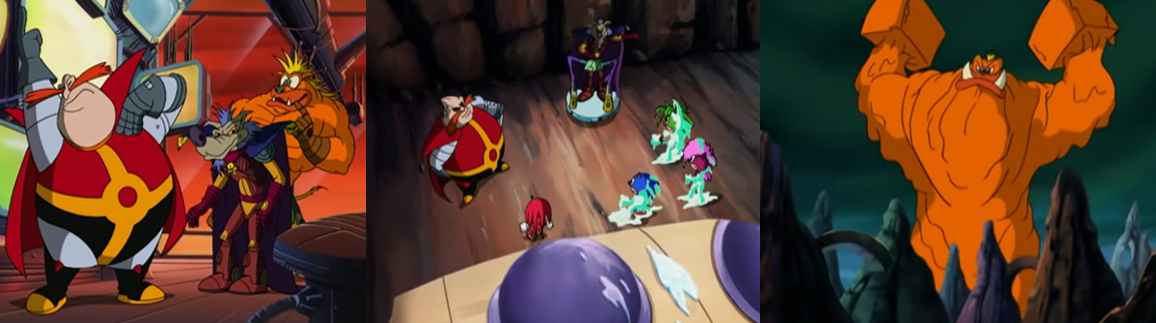
The siblings recruit Knuckles to help defeat the flying fortress, only for Sleet and Dingo to steal its Chaos Emerald.

A few episodes later, the siblings are relaxing at the beach when they’re attacked by Dr. Robotnik’s spherical “Fortress of Altitude” (almost a downgraded version of the Death Egg or the Egg Carrier), a flying fortress capable of bombarding his foes and shrugging off the laser blasts from their magic weapons thanks not only to being comprised of “Mobibindum” but also being powered by a Chaos Emerald, which atomises everything it touches. After fending off Dr. Robotnik’s SWATbots and evading the flying fortress, the siblings seek out Knuckles’ help. Initially reluctant to leave the Floating Island, Knuckles is convinced by their awful song (“No One is and Island”), though his resolve falters when the astral spirt of his great-grandfather, Athair (LaMarche), warns that this will result in a greater calamity. After easily fooling Dr. Robotnik with a decoy, Knuckles and the others slip aboard the flying fortress, avoid the ship’s defences, and burrow their way to the Chaos Emerald thanks to Knuckles’ super strength. However, after being callously dismissed by Dr. Robotnik, Sleet and Dingo claim the Chaos Emerald for themselves to both stand on their own and to try and prove their worth to their master. This causes the fortress to fall from the sky and into the sea below. Crippled by hydrophobia and unable to swim, Sonic relies on his family and friend to help get him to safety, but Sleet is stunned when usually thick-headed Dingo swipes the gem for himself! However, Dingo accidentally drops the Chaos Emerald, shattering it and unleashing a wave of unbridled Chaos Energy across the land that causes storms, earthquakes, and threatens the entire planet.

The heroes forge unlikely alliances to save the planet from being torn apart by Chaos Energy.

After his despair is lifted by another of the band’s terrible songs (“Learn to Overcome”), Knuckles leads them to his great-grandfather, who gifts them a special canister to house the shattered pieces and reveals that the only way to save the world is to ally with Dr. Robotnik. Naturally, Sonic and his siblings are aghast at this, but Knuckles is reluctant to defy his elder, especially with the fate of the world at stake. With the planet literally shaking apart from the rising Chaos Energy, the siblings race to find Knuckles and find another way to solve their problem, only to find that he’s been coerced into capturing them on Dr. Robotnik’s orders in exchange for the tyrant’s help in saving the world. Regretfully, Knuckles betrays his friends, only to be immediately double-crossed when Dr. Robotnik reneges on his promise not to roboticize the hedgehogs. Angered by this, a remorseful Knuckles fights back and frees his friends from their sticky bonds and joins them in searching for the Chaos Emerald, but they’re too late to keep Sleet from finding it and containing it in Dingo. This results in Dingo absorbing a full dose of Chaos Energy and transforming into a mindless, clay-like beast that threatens friend and foe alike. In what could arguably be described as a very loose adaptation of Sonic Adventure (Sonic Team, 1998), Dingo goes on a rampage that not only causes a series of volcanic eruptions but also destroys Manic’s magic drum set before heading to nearby Robotropolis, forcing Sonic to manipulate Dr. Robotnik’s ego to help subdue the beast. Toppled by the band’s music (“The Mobius Stomp”) and Dr. Robotnik’s special glue, Dingo spits out the Chaos Emerald, reverting to normal and saving the world and earning him his master’s ire. Knuckles then delivers the reassembled Chaos Emerald to Athair. Although the old echidna charges him with safeguarding the gem on the Floating Island, but the band promises that Knuckles will always have a place with them whether near or far.

The Summary:
Although the show has little in common with SatAM, Sonic Underground’s Sonic remains the same boastful, reckless speedster. In place of Princess Sally Acorn (Kath Soucie), Sonia acts as the voice of reason and intelligence in the trio, chastising Sonic’s irresponsible nature and emphasising diplomacy over impulsiveness wherever possible. Manic is characterised as a laid-back surfer dude who’s not as reckless as Sonic but still isn’t as attentive as Sonia. However, while Sonia might be the smartest of the bunch, she’s from an entirely different world to both. Sonic was raised to be a Freedom Fighter by his beloved Uncle Chuck (LaMarche) and has been fighting Dr. Robotnik for as long as he can remember, Manic is a streetwise thief, and Sonia comes from a life of privilege and luxury. All three were united by a common enemy when Dr. Robotnik roboticized the only family they ever knew and wield magic medallions that transform into music instruments that act as weapons, but Sonic Underground continuously emphasised their strength as a unit more than any previous Sonic cartoon. While Sonic possesses incredible speed, he’s impulsive and also crippled by hydrophobia. Sonia might have some fancy martial arts moves but she’s often too easily trusting of wealthy folk, who are often in Dr. Robotnik’s pocket. And Manic generally gets himself into trouble since he can’t help but half-inch when the temptation arises.

Though tough and wily, Knuckles is easily duped and fiercely loyal to this duties as the island’s guardian.

Of the three Sonic cartoons that aired in the nineties, Sonic Underground is somehow the most bizarre. Its tone is all over the place, lacking the ominous menace of SatAM but also veering more towards comedy like Adventures. Despite still being lighting fast and capable of bending physics, Sonic is surprisingly weak here. Perhaps because of the need desire emphasise themes of teamwork and friendship, Sonic is not only hampered by recklessness but shows fear when confronted by large groups of SWATbots, sluggishly fumbles through his initial fight with Knuckles, and succumbs to an uncharacteristic panic when left floundering in the ocean. Although the Floating Island is common knowledge in Sonic Underground and easily accessible, it’s far more accurate compared to the small mass seen in SatAM. It’s large, with a variety of different environments and wildlife on its soil, and Knuckles is later seen using a radar and communications system, and anti-aircraft cannons to fend off intruders. Knuckles’ reputation proceeds him to the point where even Sleet is aware of how tough he is and his skill at laying traps, and he makes an immediate impression by capturing the two dolts and roasting them over a spit for the local wildlife! However, as fleet-footed and super strong as he is, and despite showcasing a distrustful and snarky attitude, Knuckles is easily duped by Slate and Dingo and, like every character here, suffers from atrociously bad animation, appearing pudgy and disproportionate every time he moves. Knuckles’ go-to move is to spin his arms like a buzzsaw to rapidly burrow through surfaces. Just doing this is enough to knock Sonic on his ass and impress Manic, and Knuckles proves durable enough to withstand Sonic’s patented “Triple Spin Attack” and wily enough to use his knowledge of the island against his foe. Knuckles takes his role of guarding the Floating Island very seriously, to the point where he’s isolated himself from the rest of the world, but he’s equal loyal to his newfound friends and defies his instincts, and the will of his great-grandfather to aid them even though he’s extremely uncomfortable with leaving his island unguarded.

As if Dr. Robotnik wasn’t bad enough, the siblings must content with Knuckles and a rampaging Dingo.

There are some benefits to this for Knuckles; namely, that he spends more time socialising with his friends and bonding with Sonia, with whom he develops a mutual attraction. However, there are major drawbacks, too. Most notably, Knuckles is naïve and easily fooled; not only does he fall for Sleet and Dingo’s lies about the hedgehogs, he trusts his great-grandfather’s word so blindly that he willingly allies with Dr. Robotnik despite knowing full well of the semi-cybernetic dictator’s malicious nature. While he looks just like SatAM’s Dr. Robotnik (save for sporting two robotic arms) and even resides in a similar citadel in the heart of Robotropolis, this Dr. Robotnik lacks the gravelly, mechanical voice, employs wildly different SWATbots, and often spares the aristocracy the indignation of roboticization in return for hefty bribes. Although Dr. Robotnik appears to be at his most dangerous when he launches his Fortress of Altitude, the airship is as disproportionate and inconsistent as everything else on the show. The Mobibindum apparently makes it super heavy and tough, yet both Sonic and Knuckles smash through its structure without issue and a simple drop in the ocean is enough to trash the fortress and leave it literally blowing up in the dictator’s face. Even when Mobius is being torn apart around him, Dr. Robotnik finds a way to turn things in his favour. He’s willing to see the world destroyed if it means being rid of Sonic and strong-arms Knuckles into doing his bidding so that he can have the final victory of his hated enemies. Honestly, there are only a few episodes of Sonic Underground that are worth watching and these four are a handful of them. The animation and voice acting is atrocious (it’s insane that Jaleel White voices all three siblings), with Knuckles sadly getting the worst of both, but it was nice to finally see him in a Western Sonic cartoon. It’s not enough to salvage the series but it certainly makes these episodes more enjoyable. If only it had been an actual continuation of SatAM, it could’ve been even better.

My Rating:

Rating: 2 out of 5.

Could Be Better

Were you a fan of Sonic Underground? What did you think of the four Knuckles-centric episodes? Were you disappointed that we never got a continuation of SatAM? Which of Sonic’s siblings was your favourite and what did you think to the use of rock music in the show? Are you celebrating Knuckles’ big day today? Whatever you think about Sonic Underground, and especially Knuckles, leave a comment down below or let me know by commenting on my social media.
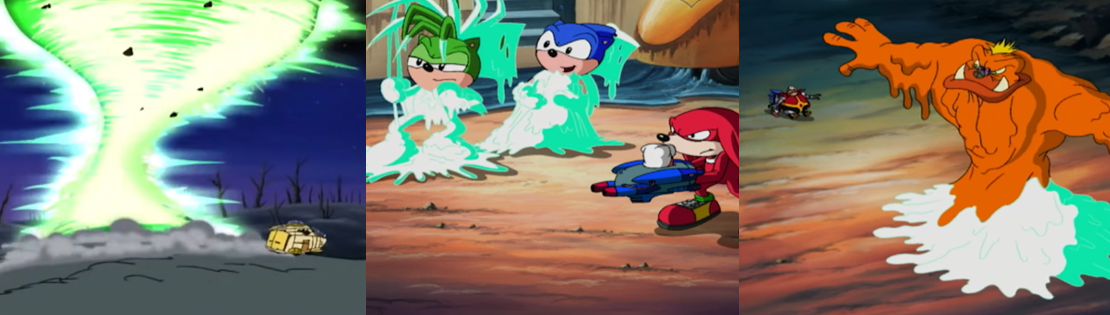
Movie Night: Beetlejuice Beetlejuice

Released: 6 September 2024
Director: Tim Burton
Distributor: Warner Bros.
Budget: $100 million
Stars: Winona Ryder, Jenna Ortega, Michael Keaton, Catherine O’Hara, Willem Dafoe, and Monica Bellucci

The Plot:
Thirty-six years after Beetlejuice (Burton, 1988), Lydia Deetz (Ryder) and her stepmother, Delia (O’Hara), return to Winter River. However, when Lydia’s rebellious teenage daughter, Astrid (Ortega), is spirited to the afterlife, Lydia must summon Beetlejuice (Keaton) to rescue her.

The Background:
In 1988, gothic auteur Tim Burton brought audiences Beetlejuice. Initially a much darker concept with a deadly titular character, the film was a surprise hit that cemented Burton as a director. A commercial and critical success, Beetlejuice was followed by videogame tie-ins, a lauded cartoon, and even a well-received Broadway musical, but a sequel struggled to emerge over the next thirty years. A sequel was fast-tracked at the time and multiple scripts were developed, two of the most notable being Beetlejuice causing havoc in Paris in search of love and following the Deetzes to Hawaii. Talks started again in 2011, star Winona Ryder was confident about a sequel in 2013, and it almost got off the ground in 2016 before being shelved in 2019. A few years later, Burton and Ryder revisited the concept and production finally got underway with a new story, one that kept the spirit of the first film while expanding the lore into new, bizarre realms. New star Jenna Ortega developed a close bond with Ryder during filming, and Keaton insisted that Beetlejuice’s screentime be as limited as before so as not to overload the narrative. While Burton sought to utilise practical effects wherever possible to retain the B-movie feel of the first film, Father Time and various controversies kept some actors from returning for the sequel. After a few additional delays, Beetlejuice Beetlejuice finally released to widespread acclaim. With a box office of over $330million, reviews praised it as a visual return to form for Burton. Michael Keaton and Jenna Ortega were also praised for their performances, though some criticised the pacing and disparate plot threads and Burton remained characteristically aloof about the chances of a third entry.

The Review:
After a nice recreation of the first film’s overheard shot of Winter River, Connecticut and stirring work (as always) by composer Danny Elfman, we catch up with Lydia, who now works as a psychic medium, investigating haunted houses and discussing the supernatural on a television show. It turns out that her ability to see ghosts never went away; it just became stronger. This means she sees ghosts constantly (though unfortunately not as often as I’d like), though this ability has been exploited by her manager/partner, the flamboyant Rory (Justin Theroux). An overly dramatic narcissist who’s more concerned with keeping Lydia on the air, and him in a position of wealth and power, than her wellbeing or bonding with her daughter, Rory is basically the Otho Fenlock (Glenn Shadix) of the film. It’s difficult to see the attraction as Lydia, Astrid, and even her stepmother find Rory repulsive and two-faced. However, the film reveals that Lydia was previously married to free spirited explorer Richard (Santiago Cabrera), who encouraged and fostered Astrid’s adventurous side, but ended up dying during a trip to South America. Devastated by the loss, Lydia latched onto Rory during grief counselling, and he took advantage right away, moulding her into a television personality he could continue to leech from. Richard’s death drove a wedge between Lydia and Astrid. The teen resented her mother for avoiding the subject and believes she’s a fraud since the only ghost she cannot communicate with is her late father, leading to Astrid barely talking to her mother. Naturally, given the massive time gap, Lydia is very different now; far from a rebellious goth girl, she’s become a troubled mother who’s clearly uncomfortable in her relationship but trapped with no way out. Although Delia is still as overbearing as ever (even more so considering her bizarre art has actually taken off), the two are much closer now that they’re older. Lydia has grown to understand how difficult it was for Delia to deal with an unruly teenager and Delia is far more supportive of Lydia, disapproving of Rory and even reaching out to Astrid to give her mother a break.

Lydia’s forced to turn to Beetlejuice to rescue her estranged daughter from the afterlife.

The three are brought together when Delia bluntly breaks the news that Lydia’s father, Charles (Unknown/Jeffery Jones), has died. And not just died: he survived a plane crash and was eaten by a shark! The sudden, ridiculous nature of his death is constantly returned to throughout the film; there’s an elaborate funeral, Delia tries to capitalise on her grief by turning it into art, and we follow Charles’ beheaded, blood-sprouting corpse as it wanders through the bureaucratic afterlife. Delia’s grief is painted as comical and exaggerated; it’s clear she truly loved him, foibles and all, but her reaction (photographing her agony and sculpting an elaborate and distasteful shark-themed headstone) is as strange as her art. Lydia is saddened but seemingly nonplussed; it doesn’t help that Rory hijacks the wake to surprise her with a proposal, or that Astrid continues to lash out at her. But what’s really bothering Lydia are the constantly visions she has of Beetlejuice. These cause her to react in horror when Astrid discovers one of Beetlejuice’s flyers, compounding the issues between them and causing Astrid to flee from the house. Distracted, she loses control of her bike and crashes into Jeremy Frazier (Arthur Conti), a teenage boy whom she’s immediately smitten by. Against Lydia’s wishes to leave the house out of fear of Beetlejuice, Astrid is allowed to hang out with Jeremy on Halloween night. However, this strangely alluring boy turns out to be a ghost, one who woos Astrid into journeying with him to the afterlife to exploit a loophole in the Handbook for the Recently Deceased that will restore his life. However, Astrid finds out too late that Jeremy wasn’t killed in an accidental fall; he murdered his family and died when the police came for him. He thus tricks Astrid into agreeing to swap her life for his, giving Lydia no choice but to summon Beetlejuice to rescue her.

While Beetlejuice shines and Wolf is entertaining, Delores seems like an afterthought.

Beetlejuice has expanded his bio-exorcism operation, employing an office full of voodoo-cursed mutes to handle his calls while he over his lost love, Lydia. When his ex-wife, soul-sucking witch Delores (Bellucci), literally pulls herself back together and trawls the underworld in search for him, reducing her victims to little more than rolled up deadflesh, Beetlejuice is caught up in the investigation. Headed by former actor turned cliché, hardboiled detective Wolf Jackson (Dafoe), the ghost cops are constantly one step behind Delores and Beetlejuice resorts to barricading his office and dressing his main underling, Bob (Nick Kellington), as a decoy. Luckily, Rory’s reckless calling of his name reunites Beetlejuice with Lydia and her desperation to save Astrid gives him a new opportunity to escape his undead drudgery. Out of options, Lydia agrees to marry him and he willingly brings her to the afterlife, though this act turns Wolf against him since it’s a violation of a sacred law, stacking the deck against the two. Unlike in the first film, Beetlejuice has only two main forms here: either his signature white and black suit or as a couple’s therapist. Michael Keaton easily slips back into the role and carries not just the first, middling half but the entire film. He taps into the same zany, macabre energy that made the first film so memorable and which is sadly lacking from this long-awaited sequel. Monica Belluci casts an alluring and intimidated figure, but Delores just wanders about sucking up souls and barely poses a threat in the finale. It’s Willem Dafoe who steals the show as a B-movie actor-turned-detective; I loved the running gag of his assistant, Janet (Georgina Beedle), constantly handing him coffee, his exposed skull, his over-the-top mannerisms, and his advice to “keep it real” at all times. Unfortunately, neither he nor Delores think to simply call Beetlejuice’s name three times when searching for him. At first, I thought this was maybe because that didn’t work in the afterlife, but Delia summons him when she unexpectedly ends up there, so that was a bit weird. Jeremy is also taken care of without much fanfare. His relationship and betrayal of Astrid seemed like it would be a focal point of the film, but instead it just gets swept under a rug like so many other plot points in this lacklustre sequel.
The Nitty-Gritty:
At its core, Beetlejuice Beetlejuice seems to be discussing the nature of grief. Lydia’s loss drove her to accept an unhealthy relationship in a moment of weakness and has effectively trapped her. That same loss caused Astrid to lose all respect for her mother, and grief similarly drives Delia to exaggerated forms of expression, like draping the house in a mourning shroud. This comes back to (literally) bite her when she’s fatally attacked by two asps she bought for a bizarre tribute to her husband, landing her in the afterlife, much to her chagrin. This was a very strange and uncomfortable moment, as was the Claymation sequence depicting Charles’ unnecessarily violent death. Like, I get it: Jeffery Jones did terrible things, but this just seemed unnecessarily spiteful and over the top. Similarly, death is apparently a subject we should be laughing at, according to this film, and can be played for a gag. That wasn’t really the case in the first one, where Adam and Barbara Maitland (Adam Baldwin and Geena Davis) died in a senseless manner, but it wasn’t played for laughs. Considering how violently Jeremy killed his parents and the continued twisted depiction of the souls stuck waiting for help in the afterlife, this choice just feels odd to me. The surreal nature of death continues when Richard spots Astrid in the afterlife and helps her and Lydia escape: he’s depicted as a half-eaten corpse with wriggling piranha still munching on him. Like, it’s kind of funny, I guess, but it makes these scenes more uncomfortable to watch than entertaining as beloved figures in these character’s lives are made into an undead mockery.

While the practical effects are great, the film is oddly disjointed and many parts don’t land.

In the time between the two movies, it’s fair to say that Tim Burton has heavily leaned into his reputation as a quirky, gothic filmmaker and lost some of the grindhouse charm that made his early films so visually alluring. I give Beetlejuice Beetlejuice props for continuing to use practical effects, puppets, and filmmaking techniques wherever possible. It brings the strange afterlife to un-life in a very tangible way; oddly, however, the sandworms look worse here than before and seem more CGI than stop-motion. Still, we do get to explore more of the underworld that the last film, revealing that the dead take on various jobs after passing on (including cops and dry cleaners) and returning to the joke of them having to wade through red tape to get help. Beetlejuice has essentially franchised his services, presumably keeping him busy between films, but rather than actually see any of that, we’re left with dry scenes of him bossing about his employees. Keaton carries these moments, but I didn’t wait over thirty years to see Beetlejuice messing around behind a desk. He’s more himself when confronting Lydia and Rory, literally spilling his guts at one point, but this scene also repeats gags and moments from the first film, with him sewing Lydia’s mouth shut and terrifying Rory with a demonic visage. His character is expanded upon through some exposition into his past life as a graverobber and his relationship with Delores, but it’s a very odd sequence that goes on a bit too long and does little to make Delores an interesting character. Her look is great, as is her reassembling scene, but the only real threatening moment she has is when she sucks up poor old Bob. There was a great moment where Beetlejuice blows a hole into the afterlife and his employees escape into the real world. I thought this had a lot of potential to up the stakes but, instead, Wolf offhandedly mentions that they closed the breach, killing that plot thread. Then there were gags that just outlived their welcome. Like, Lydia rushes to stop Astrid being taken to “the great beyond” by the “Soul Train”. And that’s exactly what you think it is; the joke lands and you can imagine what that means. But no, we need not one but two extended sequences where the undead jive about to soul music and Burton hammers home that he’s making a pun about Blaxploitation.

Important plot threads fizzle out and the film ends up being a shameless rehash.

Lydia’s venture into the afterlife sees her reunite with Richard and rescue Astrid; however, it’s Beetlejuice who facilitates this as he surprisingly keeps his word and intercepts Jeremy, sending him to Hell before he can escape to the real world. The realisation that her mother was right all along, and getting some closure in seeing her father again, mends the bridges between Astrid and Lydia. However, Lydia begrudgingly agrees to marry Rory regardless since she’s still stuck in that co-dependent relationship. Luckily, her agreement with Beetlejuice solves that problem as he shows up to stake his claim to her hand, leading to one of the best moments of the film where he forces the influencers Rory invited to the wedding to be sucked into the phones they gawk at so often. As per the contract, neither Lydia or Astrid can speak Beetlejuice’s name, meaning he’s free to enchant everyone present into an extended sequence where they all mime and dance to Jimmy Webb’s “MacArthur Park”. Like the “Soul Train” nonsense, this bit just went on way too long; rather than recapture the magic of the similar scene from the first film, it hijacks the finale and derails the pacing. Perhaps if Wolf and Delores’ scenes had happened earlier, making them a part of the proceedings, it might’ve worked better, but it felt like it was never going to end, and the joke wore itself out very quickly. Wolf’s easily subdued by Beetlejuice’s immeasurable powers, though he falters when Delores comes barging in for revenge, a desire I get but it also feels like he would want revenge on her more since she tricked and poisoned him. Anyway, it doesn’t matter as he distracts her with Rory and Astrid just draws a portal to Saturn’s moon to summon a sandworm to devour Delores and Rory (a strangely harsh comeuppance) and rehash the first film’s ending. Though briefly sad to say goodbye to Delia, Lydia’s emboldened by her renewed relationship with Astrid and being free from Rory’s leeching influence; she confidently banishes Beetlejuice once more and quits her job to spend more time with Astrid. However, the film ends with a really shocking nightmare sequence where Lydia dreams of Astrid violently giving birth to a baby Beetlejuice and still being haunted by her memories of the cackling demon in a sequence atmospherically at odds with the rest of the movie, but which might’ve helped spice up the second act if it had been shuffled in there.
The Summary:
I was cautiously optimistic heading into Beetlejuice Beetlejuice. While my relationship with legacy sequels is more miss than hit and I resented how long it took for the film to be made, I was attracted by my love for the first movie, Michael Keaton’s energetic performance, and by how cute Jenna Ortega is. These elements are the strongest parts of the film; Keaton carries the entire movie, salvaging even the strangest sequences and being the most enjoyable part. It feels like Beetlejuice is more of a focal point this time with all the different, halfhearted plot threads revolving around him in some way, but he’s strangely handicapped in ways he wasn’t before, robbing him of any monstrous transformations. Jenna Ortega does a great job as the hurt, resentful Astrid and I enjoyed her budding romance with Jeremy. It was obvious he was going to be a ghost but I didn’t expect him to be a psychopath, but then this plot gets dropped and forgotten about. The whole Delores sub-plot felt wasted to me, too; it added unnecessary backstory to Beetlejuice and didn’t factor into the finale. Characters like Jeremy, Delores, and Wolf (as enjoyed as he was) actually detracted from Beetlejuice’s presence. Like, maybe the film would’ve worked better if Beetlejuice had masqueraded as Jeremy, luring Astrid to the other side to bait in Lydia. Beetlejuice’s threat could’ve then replaced Delores wandering about and Wolf’s pursuit of him, tying into his visions haunting Lydia and making Beetlejuice a vicious, spiteful (and, crucially, sole) antagonist. I wasn’t impressed with how far the film went to bury Charles’ character; Burton beat us over the head with this to the point where it was awkward, not amusing. In fact, the whole movie is uncomfortable in a lot of ways, lacking a lot of nuance and subtlety and viewing like a bad parody of the first film. Jokes and sequences that worked so effectively last time and dug up and puppeted around gratuitously for no reason. The nostalgia was already there with the returning actors and atmosphere, but it felt like everyone was trying too hard to recapture lightning in a bottle and there were too many cooks in the kitchen offering ideas and gags. In the end, Beetlejuice Beetlejuice just wasn’t worth the wait; the visuals and some performances are there, but the execution was lacking and it seemed to go out of its way to not live up to its potential.
My Rating:

Rating: 2 out of 5.

Could Be Better

Were you also disappointed by Beetlejuice Beetlejuice? Did you find the tone and jokes to be oddly disjointed? What did you think to Michael Keaton’s return to form? Were you also disappointed to so many of the plot threads fizzled out? What did you think to the expanded depiction of the afterlife? Would you like to see another Beetlejuice film? Feel free to share your thoughts on Beetlejuice Beetlejuice in the comments below.

Back Issues [Bat-Month]: Detective Comics #66/68


In the decades since his first dramatic appearance in the pages of Detective Comics, Bruce Wayne/Batman has become a mainstream, worldwide, pop culture icon. The brainchild of writer Bob Kane, Batman was brought to life by artist Bill Finger and has been a popular staple of DC Comics and countless movies, videogames, and cartoons over the years. “Batman Day” falls on 21 September this year and I figured this was a perfect excuse to spend every Saturday celebrating comic’s grim and broody vigilante.


Writer: Bill Finger – Artist: Bob Kane

Story Title: “The Crimes of Two-Face”
Published: August 1942

Story Title: “The Man Who Led a Double Life”
Published: October 1942

The Background:
Following the huge success of Clark Kent/Superman, National Comics Publications had Bob Kane create another masked crimefighter to add to their repertoire. Thanks to the long-suppressed influence of artist Bill Finger, the “Bat-Man” soon became not only one of DC Comics’ most popular characters but also a mainstream cultural icon. In the years that followed, the Batman battled numerous costumed supervillains, but perhaps none are more tragic then former district attorney-turned-criminal Harvey Dent/Two-Face. Originally debuting in this two-part story as Harvey “Apollo” Kent, Two-Face was heavily inspired by the 1925 adaptation of The Phantom of the Opera (Leroux, 1909) and the 1931 adaptation of Strange Case of Dr Jekyll and Mr Hyde (Stevenson, 1886), both tales of a tortured soul, often gruesomely depicted or disfigured, who struggled with the duality of good and evil. Subsequent Two-Face stories have offered further insight into his tragic and abusive childhood, as well as further emphasising his complex relationship with Bruce Wayne, and the character is often a rival or litmus test for Batman’s different Robins. Widely regarded as one of Batman’s best villains, Two-Face has appeared as a prominent foe outside of the comics, from his renowned appearances in the acclaimed Batman: The Animated Series (1992 to 1999), Tommy Lee Jones’s bombastic portrayal in Batman Forever (Schumacher, 1995), and Aaron Eckhart’s understated turn in The Dark Knight (Nolan, 2008).

The Review:
This two-part story begins by introducing us to Harvey Kent, the dashing and famous district attorney beloved by the press and nicknamed “Apollo” for his courageous stance against organised crime, such as mob boss Sal “Boss” Moroni. Kent is the lead prosecutor in the case against Moroni and wastes no time in calling the Batman to take the stand as a key witness in Moroni’s trial. Amazingly, the testimony of a masked vigilante is seen as perfectly acceptable and admissible as evidence. Batman relates how Moroni shot “Bookie” Benson while escaping from a fight and Kent produces his most damning piece of evidence: Moroni’s lucky, two-headed silver dollar with his fingerprints on it! Moroni’s so incensed by Kent’s bravado that he tosses a vial of acid right at the district attorney! Although Batman intercepts the throw, Kent is hit with a concentrated splash of vitriol on one side of his face, leaving him wrapped in bandages for an entire month. When the time comes to reveal the extent of the damage, Kent is horrified to find that the left side of his face is “scarred and hideous”. He’s even more despondent to find that his only hope, a “European specialist” Batman knows of, is currently imprisoned in a Nazi concentration camp. The Batman simply peaces out after that, advising Kent to face his fiancée, Gilda, sooner rather than later, but Kent is distraught to find his gruesome visage frightens not only children, but also his beloved Gilda. Seeing the fear in her eyes, he flies into a rage, defacing a sculpture of his former chiselled features and terrifying her almost as much as his monstrous scarring.

After being hideously scarred, Two-Face embarks on a bizarre crime spree across the city.

Tormented, driven to the brink of madness, Kent ponders this dichotomy of his explicit duality. He focuses his rage on Moroni’s silver dollar, defacing one side of it and lashing out at the cruelty of fate. Deciding that all life hinges on the flip of a coin, Kent projects his duality onto the now-scarred dollar. He resolves to decide his immediate future on a coin toss, promising to wait for Batman’s specialist to be freed if the unmarked side comes up or embark on a criminal career if the scarred side comes up. Of course, the scarred side wins and Kent rebrands himself “Two-Face”, adopting a suit to match his split face and putting his knowledge as district attorney to use in his crimes. Since everything he does is decided by this bizarre coin, one day he and his goons might rob a bank for illicit gain, but the next day he might donate his stolen money to charity! This causes public opinion of him to be fittingly divided, with some branding him a thief and a murderer and others a philanthropist and saviour. Even his goons are confused by Two-Face’s unpredictable nature, but they’re excited when the bad side wins and they undertake an elaborate scheme to rob the Brown Bond Company messenger that sees them hijack a double decker bus to rob the bondsman. As luck would have it, Batman and Robin happen to spot the mugging taking place and swoop in to intervene. Apparently well aware that Kent is Two-Face, Batman tries to talk him out of his life of crime but is stunned when his former friend pulls a gun on him and orders his men to toss him off the roof of the bus!

When Batman confronts Two-Face, the tragic villain is left clueless when his coin fails him.

Although this doesn’t come to pass thanks to Robin accidentally causing the thug driving the bus to be killed, Batman is incapacitated in the fracas and the Dynamic Duo are left to die on the out of control vehicle, though Robin manages to get to the handbrake in time. Back at his thematically appropriate lair (one side is clean and pristine and the other is a shambles), Two-Face chastises himself for his actions. Believing that he’s killed his good friend, Two-Face almost regains his sanity before lashing out at the mirror and murdering his other goon after blaming him for causing the shambles on the bus. Two-Face then steps his game up by targeting the double-feature movie house, since he’s now committed to basing his crimes on the number two, but remains unaware that Batman and Robin survived the bus crash. Upon investigating the dead body of Two-Face’s goon, the Dynamic Duo happen to find a map stuck to the sole of his shoe by a piece of gum! This leads them to the Bijou Theatre, Two-Face’s next target, where Two-Face takes over the projection booth and demands that the audience hand over their loot. While Robin takes out the goons in the projection booth, Batman swoops onto the stage for a brief fight with Two-Face while his pre-recorded message looms and rants in the background. Somehow (it’s really not too clear), Two-Face slips away, but the Batman easily tracks him back to his lair by simply…y’know, following him after Two-Face made the error of driving down a one-way street and attracting police attention. Refusing to go down without a fight, Two-Face again threatens to shoot Batman, but the Dark Knight pleads with him to come along quietly. Batman promises to testify on his behalf to argue temporary insanity and to do everything he can to see Kent gets a light sentence until that specialist can fix his face, but Two-Face is unable to make a decision without flipping his beloved coin. Unfortunately for the tragic villain, cruel fate strikes again and the coin ends up standing on edge, leaving Two-Face conflicted and incapable of deciding whether he should give up his life of crime or kill Batman and continue down his dark path.

Two-Face slips away, continues his unique crimes, and even bests Batman in a fight.

The story continued, fittingly two issues later, in “The Man Who Led a Double Life”, which picks up right where the first story ended and sees Two-Face pocketing his coin, resolving to let fate decide what he does with his life. Unfortunately, a trigger-happy cop bursts in and guns down Two-Face, believing he’s about to shoot Batman, but the bullet strikes the coin in Two-Face’s breast pocket, allowing him to survive and make a hasty retreat by leaping out of the window! Since the bullet hit the scarred side of the coin, Two-Face believes this is fate’s way of telling him to commit himself to his criminal career. His first act is to rob the doubles tennis match (during the daytime, since the coin landed good side up) and donate the cash to charity. Next, he and his goons kidnap matchstick mogul Henry Logan, whose entire home is apparently made out of matchsticks, but Batman and Robin are stunned to find it was actually the cantankerous tycoon’s double who was taken since Kent knew about Logan’s doppelganger from his time as district attorney. Batman and Robin are disgusted by Logan’s indifference towards his double’s fate and his selfishness, but the reclusive hobbyist agrees to pay Two-Face’s $200,000 ransom. However, when Logan and his wife arrive at the disused barn to make the transfer, Two-Face is enraged to find he’s been tricked and that it’s Batman and Robin in disguise! Batman and Robin easily overpower Two-Face and his mooks. Although one of the goons buries Robin under a pile of hay, Batman continues hammering Two-Face after the scarred villain tries escaping on a motorcycle. Laughably, Batman is felled when Two-Face tosses his coin at his forehead; however, Batman is spared since Two-Face “[is] not a killer yet” (despite it being said that he was in the first story) and still has some compassion for his former friend.

Two-Face’s attempt to return to his wife, and succeed at crime, are thwarted by the Batman.

When Batman and Robin return the double to Logan, they find the tycoon to be as grating as ever, so Robin teaches him a lesson by dropping a lit match into his shoe, something the Batman simply laughs about despite the fact that the house place could’ve gone up in flames! Anyway, after spotting a loved-up couple in the street, Two-Face decides to pay a visit to his lost love, Gilda. Gilda is elated when the fully restored Harvey Kent surprises her at home, but he ensures she doesn’t get too close to his face. Over a candlelit dinner, he promises to come back to her and forgo his criminal ways if she waits for him, but is incensed when her happiness turns to horror after the heat from the candles melts the wax make-up covering his hideous scars. Gilda is driven to tears by the revelation that Kent has completely lost himself to wickedness and insanity, but Two-Face flies into a rage when Batman bursts in since he assumes she was colluding with the Dark Knight. Once again, Two-Face escapes through a window and he avenges his misfortune on the mask and make-up factory that cost him his love. Two-Face and his goons beat up the proprietors and torch the place, leaving the mask-maker destitute and his son swearing revenge. The story then leads us to believe that, despite Dick’s warnings, Bruce uses make-up to infiltrate Two-Face’s gang as “Getaway” George when the coin flips in his favour. Two-Face’s next target is the double-header baseball game between the city’s fire and police departments, in which honorary police officers Batman and Robin are publicly seen participating. Two-Face brazenly steals the $50,000 takings and even takes the mayor hostage at gunpoint after Robin beats up his minions. When Two-Face gets back to his lair and finds the cops waiting, he assumes that “Getaway” is Batman in disguise and is stunned when the real Dark Knight barges in to deliver a swift uppercut. It turns out that “Getaway” was the mask-maker’s son working in cahoots with Batman, and Two-Face bitterly comments on the irony of being double-crossed by one of his own gang in the end.

The Summary:
Two-Face’s links to Jekyll and Hyde aren’t simply thematic, they’re explicit. Hell, the first dialogue box on the opening page of “The Crimes of Two-Face” not only refers to Two-Face as “a twentieth-century Jekyll-Hyde” but even shows the disfigured criminal reading a copy of the book! I may be committing a literary sin here, but I haven’t actually read that book so I can only speak to the widely regarded themes of duality and man vs. monster that are at work in the text, but “The Crimes of Two-Face” definitely goes out of its way to draw parallels between Kent’s fate and that classic piece of gothic literature. They are, however, really only skin deep. Sure, we only see Kent for a few panels before he’s hideously scarred, but there’s no indication in either story that he was anything but a model citizen and champion of justice. More than once, he and Batman refer to each other as old friends and Two-Face is noticeably conflicted about the Dark Knight, more so than his criminal career, it seems. Indeed, it’s quite jarring when Kent just suddenly decides he has only two options: wait to be fixed or turn to crime, but it’s pretty well conveyed that his ghastly condition has caused him to snap. Batman refers to him suffering from temporary insanity, the text boxes allude to his rage, and Gilda’s reaction to his outburst all point towards this, but it’s still quite the sudden turn from model civil servant to notorious bank robber. One thing I did enjoy was that the reveal of Two-Face’s horrific visage is kept hidden to start with, so we only see it when he reluctantly reveals himself to Gilda, which builds a sense of anticipation about what he looks like. It’s a shame that he’s depicted with a literal line running down the middle of his face, but I can forgive that given the simplistic art of the time.

Despite Two-Face’s obvious gimmick, there’s little detective work involved in stopping him.

We’re well into Batman’s time as a much brighter, kid-friendly character here. He’s appearing in broad daylight, working alongside the police, and even taking to the witness stand and playing baseball, for God’s sake! Now fully deputised members of the police department, Batman and Robin are seen as assets rather than vigilantes and are specifically brought in by Police Commissioner James “Jim” Gordon to help with the Henry Logan kidnapping case. More importantly, the Batman had a close working relationship with Harvey Kent that sees him repeatedly appeal to his better half in “The Crimes of Two-Face”. Sadly, we never get to actually see the extent of their friendship. It’s simply said and inferred by their dialogue, and neither story explores Bruce’s reaction to his friend’s condition or delves into how conflicted he feels about Two-Face. Instead, Batman tries to out-think the tragic villain, occasionally begs him to listen to reason, and settles for socking him in the jaw when he refuses to come quietly. By the end, Batman views Two-Face as just another colourful supervillain and there’s no indication that he wants to try to help or rehabilitate his former friend; he just wants him locked up. As a villain, Two-Face is both visually interesting, surprisingly tragic, unpredictably volatile, and incredibly restrictive. Since he dictates his actions on a coin flip, his crimes can either be horribly violent or unnervingly charitable, casting him almost as an anti-villain since he’ll help those in need with ill-gotten gains and even kill his own men if they violate his rules. This makes the coin his most obvious Achilles’ heel, but it’s at least tied to his dual and conflicting nature. His obsession with the number two is far more of a crutch and I’m surprised that more wasn’t made of it. Once again, Batman and Robin do very little detective work here (they happen upon that map and Batman simply guesses that Kent would return to Gilda) so there’s no depictions of them trying to figure out Two-Face’s next scheme or running around the city looking for obscure references to the number two. It’s simply them reacting whenever Two-Face strikes or stumbling upon a lead.

Two-Face is a tragic and visually interesting character even in his more basic debut story.

Still, while Two-Face’s complex nature, volatile personality, and relationship with Batman is only touched upon or inferred in “The Crimes of Two-Face” and “The Man Who Led a Double Life”, both stories were surprisingly fun and unique tales. It’s not often that Batman’s villains had such a tragic twist to them back then and the references to Two-Face using his knowledge as district attorney for evil only add to the cruel twist of fate dealt to this once handsome and honourable man. I enjoyed Two-Face’s lamentations, which were suitably Phantom-esque, and his whole gimmick, including the split suit and lair. Despite seeing it as a handicap, I’ve always liked the double-headed coin aspect of the character and I enjoyed how quickly he became fixated on the coin’s decisions and how he was rendered panic-stricken and impotent when the coin landed on its side. I think “The Man Who Led a Double Life” would’ve been served better if it had begun with a babbling and broken Two-Face being taken into custody and seeing doctors try to salvage his mind and face until he inevitably returned to his evil ways, but that was kind of toyed with when he desperately resorted to a wax facsimile to reconnect with Gilda. Overall, the two tales didn’t exactly blow my socks off and there are definitely better Two-Face origin stories and tragic tales out there, but they were entertaining enough. Two-Face is an elaborate criminal with a unique, if narratively exhausting, gimmick and has (and continues to have) a tragic appeal to him that’s prominently introduced here, even with the lacklustre depiction of Kent’s time before his scarring.

My Rating:

Rating: 4 out of 5.

Great Stuff

Have you ever read the two-part debut of Two-Face? If so, what did you think to it, which of the two was your favourite, and where would you rank Two-Face in Batman’s villain hierarchy? Would you have liked to see more backstory given to Harvey Kent? What did you think to his coin, obsession with the number two, and the depiction of his volatile duality? Did you enjoy Batman’s time as a brighter, friendlier character or do you prefer the brooding, grim Dark Knight? What are some of your favourite Two-Face stories and which interpretation of Two-Face is your favourite? Whatever your thoughts on Two-Face, share them below or on my social media, and be sure to check out my other Batman content!

Movie Night [Friday the 13th]: Friday the 13th: A New Beginning


Long considered to be an unlucky day due to superstitions involving the number thirteen and religious connotations, Friday the 13th is perhaps equally as well-known as the title for a long-running series of slasher movies. Naturally, this is clearly the best opportunity to take a look at the Friday the 13th (Various, 1980 to 2009) horror series and to commemorate this unlucky and dreaded date.


Released: 22 March 1985
Director: Danny Steinmann
Distributor: Paramount Pictures
Budget: $2.2 million
Stars: John Shepherd, Melanie Kinnaman, Shavar Ross, Carol Locatell, Tiffany Helm, Dick Wieand, and Tom Morga

The Plot:
Several years after murdering hockey-masked psychopath Jason Voorhees, a grown-up Tommy Jarvis (Shepherd) is interned at a halfway house for recuperation. However, when Jason (Morga) seemingly returns and a fresh batch of bodies start piling up, Tommy must face his demons head-on once more.

The Background:
Following John Carpenter’s Halloween (Carpenter, 1978) and the birth of the “slasher” genre, Friday the 13th (Cunningham, 1980) was a surprising box office success and this led to equally financially successful sequels. However, just as producer/director Sean S. Cunningham distanced himself from the franchise, so too did Paramount executives become embarrassed by their shlock franchise. Thus, Friday the 13th: The Final Chapter (Zito, 1984) was developed to bring the series to a definitive end…before it proved to be a commercial success widely regarded as one of the best in the franchise. Consequently, a fifth entry followed only a year after the “Final Chapter”, one that was unusually deceptive in both it methodology and approach. Both stars John Shepherd and Dick Wieand were disappointed to find they’d been duped into a new Friday film and even the director was disgusted by how much footage was excised by the ratings board. Although child actor Corey Feldman could only return for a cameo, the film seemed to be setting Tommy up as the new killer of the franchise but A New Beginning’s disastrous critical reception and audience backlash saw Jason return for real in the very next film. As if being one of the lowest-grossing Friday films of the time with its $22 million box office wasn’t bad enough, A New Beginning is widely cited as one of the worst entries in the franchise.

The Review:
Jason may very well be one of the most, if not the most, prolific killers in all of horror cinema. His reputation as an unstoppable, merciless masked killer is well deserved not just because of his brutality but also because he categorically refuses to stay dead, even when film studios try to do him in! Branding The Final Chapter as the last-ever Friday the 13th was a bold claim, especially as the film ended with the pretty explicit suggestion that killing Jason had a negative effect on young Tommy. The film’s final, haunting shot suggested that Tommy would take over as the franchise’s killer and, honestly, I almost wish we’d seen that happen, at least for one or two movies. Not content with this blatant misdirection, A New Beginning opens with the suggestion that Jason is far from dead. In an opening that’s basically foreshadowing the next, far superior movie, young Tommy watches on, terrified and helpless, as Jason (here played by John Hock) rises from his grave in a zombie-like state to begin his killing spree anew. Sadly, we’d have to wait another year for this to come to pass and this promising opening is quickly revealed to simply be a vivid nightmare of the now grown-up Tommy. Yes, rather than following the traumatised youngster as he deals with the fallout of his actions and a newfound bloodlust rising within him, A New Beginning jumps ahead to find Tommy as the most mid-twenties-looking seventeen-year-old you’ll ever see in cinema but no less disturbed by his encounter with, and recurring visions of, Jason several years prior.

Traumatised by his childhood, Tommy is a deeply disturbed and haunted young man.

Now a disturbed, withdrawn youth, Tommy has bounced around numerous psychiatric hospitals and been subjected to every treatment and drug available short of electroshock therapy. Regardless of how poorly his treatments have taken, he’s been transferred to Pinehurst Halfway House, run by kindly Doctor Matt Letter (Richard Young) and his assistant, Pam Roberts (Kinnaman), in the hopes that he can be reacclimated back into society. Tommy is a very different character here; no longer the chirpy, enthusiastic, curious little boy, he’s sullen and moody and highly aggressive, carrying a nasty-looking flick knife and carrying a seething rage beneath his brooding exterior. Tommy is seen to be massively unstable, liable to flip on a dime and send Eddie Kelso (John Robert Dixon) hurtling through a table and mercilessly pummel anyone who touches him or riles him up with a sudden aggressive outburst. Yet, at the same time, Tommy still has some of his sentimental and playful side. He still carries a photo of his family and is still proud of his homemade masks, but he’s constantly on edge and triggered into violence by the slightest hint of hostility towards him. A New Beginning features two Jasons for the price of one; thanks to his childhood trauma, Tommy hallucinates and has nightmares of Jason, clad more or less in the same attire as he died in, despite it being explicitly stated that Jason was cremated after his death (a plot point later abandoned). The second Jason, though familiar, is noticeably different; not only is he dressed in different clothes, but his hockey mask also features prominent blue triangles rather than red and he’s very much real compared to the ghost that haunts Tommy. This Jason is just as brutal and superpowered as the last, easily manhandling his victims, crushing their bones, and surviving horrific injuries, lending credence to Tommy’s fears that Jason has returned from the grave.

Pinehurst shelters some eclectic, if one-dimensional and comically disturbed, kids.

In a change of pace from previous (and most other) Friday the 13th films, A New Beginning includes a gaggle of eclectic teenage misfits rather than horny camp counsellors, though Pinehurst’s residents are no less promiscuous and cliché. Functioning as an extremely lenient halfway house where the residents are free to do whatever they want thanks to the “honour system”, Pinehurst shelters Eddie and his lover Tina McCarthy (Debi Sue Voorhees), insecure stutterer Jake Patterson (Jerry Pavlon), goth Violet Moraine (Helm), blank slate Robin Brown (Juliette Cummins), compulsive eater Joey Burns (Dominick Brascia), and the violent and unstable Vic Faden (Mark Venturini). As you’d expect, the film wastes little time in establishing each character’s one defining trait and makes very little effort to expand them beyond that before they’re unceremoniously offed. Jake is humiliated when Robin mocks his affections and his corpse ends up in her bed, but she’s immediately killed before properly processing her remorse and grief. Indeed, all we really know about Robin is that she’s into films and a natural with kids. At least Violet has a unique look, her love for music, and her tendency to snap at people…but she’s knifed in the gut before she can do anything other than showcase her slick dance moves. Arguably, the most prominent members of the group are two who are barely even in the film. A loud and child-like teen, Joey desperately tries to be useful and make friends with everyone, only to constantly make a fool of himself. When he tries this with Vic (who really shouldn’t have had access to an axe), he ends up chopped to pieces, horrifying his fellow residents and leaving everyone shellshocked, particularly Tommy and oddly disturbed paramedic Roy Burns (Wiead). With Tommy’s sister, Trish (Kimberly Beck), reduced to a simple photograph, we’re left relying on Pam as our main girl. Of everyone in Pinehurst, Tommy is most receptive to Pam’s influence and persuasion, potentially because he reminds her of his sister or perhaps because of confusing sexual feelings towards her, but she has no idea what he’s seen or of the horrors Jason is capable of since she’s used to just dealing with unruly kids.

Charismatic and likeable, if zany, side characters steal the show and deserved more screen time.

In place of the smart-mouthed, resourceful young Tommy, we have standout character Reggie “The Reckless” Winter (Ross), son of Pinehurst’s grandfatherly cook, George (Vernon Washington). Reggie’s a lot like Tommy was as a child; he enjoys pranks and going where he’s not meant to and cheekily acting like he’s twice his age, especially with the ladies. As memorable and entertaining as Reggie is, he’s got nothing on his older, rockstar brother “Demon” (Miguel A. Núñez Jr.) In a film stuffed with aggravating and forgettable characters, Demon is a breath of fresh air. From his pimped-out van, his smooth tongue, and his meme-worthy singing voice to his devotion to his little brother and his energetic charisma, it’s a real shame when Demon gets skewered while on the crapper. While Matt’s heart’s in the right place, Pinehurst has ruffled a few feathers with the townsfolk, specifically loudmouth hic Ethel Hubbard (Locatell) and her simpleton son Junior (Ron Sloan). Ethel’s outspoken and aggressive not just to Matt and his residents, but even the ineffectual Sheriff Cal Tucker (Marco St. John) and her own son, who she berates constantly, and isn’t afraid to threaten Matt’s horny and disruptive residents with violence when they trespass on her property. As aggravating as Ethel and Junior are, they definitely make the most of their roles; Ethel excels as a suspicious and infuriated redneck, barking colourful swears and treating everyone like dirt, even her simpleton son. Other notable and strangely fun side characters include greasers Pete Linley (Corey Parker) and Vinnie Manalo (Anthony Barrile), who are murdered while experiencing car trouble but make a bizarre impression with their banter and Vinnie’s amusing singsong about his broken-down car! However, this is merely the appetiser for what Demon has in store for us! A charismatic mixture of Prince and Michael Jackson, Demon woos his girlfriend, Anita (Jere Fields), with an infectious melody of “Ooh, baby!” but even his charm has kinks in it. He exhibits uncharacteristic anger when Anita winds him up and ends up struggling with his bowels after eating one too many enchiladas.

The Nitty-Gritty:
I think a good way to describe A New Beginning would be to simply sum it up as a waste of potential. I firmly believe there was a good idea buried in here somewhere; I can’t say if it would’ve been any better or worse if it had taken more cues from Halloween and reframed Tommy as the franchise’s new killer, but it certainly might have been more interesting than this awkward game of whodunnit. Revenge has always been a prominent theme in the Friday the 13th franchise and it’s alive and well here. Like Pamela Voorhees (Betsy Palmer) before him, Roy is driven to madness by a murderous lust for revenge but he’s clearly more unhinged (or the writing just wasn’t as good) since he slaughters his victims seemingly at random rather than targeting those actually responsible. In many ways, A New Beginning mirrors the first film; there, it was pretty damn obvious Pamela was the killer since she showed up at the last minute when everyone was dead, and it’s also pretty obvious that this Lou Ferrigno lookalike is our man since Roy hogs the camera and interjects himself into conversations that are nothing to do with him whenever he’s onscreen. It’s actually very comical; this nobody, who you could easily forget, just randomly pops up and may as well have a big sign over his head saying KILLER. Yet, rather than focus on his grief and descent into madness and appropriation of Jason’s legacy, the film focuses on running the genre’s cliches into the ground with nonsensical padding and zany side characters. The likes of Ethel and Junior and the wacky Pinehurst residents really drag the runtime and make this one of the most boring and tedious entries when really we should be focusing on whether Jason is really back, if Tommy is unknowingly possessed by or acting out the kills, or who the real culprit is but there’s precious few red herrings offered to us throughout.

Although possibly the horniest Friday yet, the film’s gore is butchered by censoring.

Of course, Friday the 13th is a franchise known for three things: Jason, gore, and sex…and A New Beginning certainly has its fair share of the latter. Without a doubt, this may well be the horniest film in the franchise; everyone’s either catcalling, leering, or out-right drooling over each other, especially the girls. Randomly, the film detours from the main plot to up the boobs and body count with waitress Lana Ardsley (Rebecca Wood) and moustachioed ladies’ man Billy Macauley’s (Bob DeSimone) sordid antics. However, while Lana flashes her tits with glee, she’s got nothing on Tina, who basically puts on a softcore porn in the woods with Eddie. While the killing starts when Tommy’s nightmare Jason makes short work of two foolhardy grave robbers (Todd Bryant and Curtis Conaway), this is sadly a double-edged sword as A New Beginning includes several gruesome kills but, thanks to meddling censoring, many are decidedly toothless. However, in some cases this actually works quite effectively; Joey’s hacked-up body is only briefly seen but there’s enough gore and astonished, horrified reactions to tell that Vic really did a number on the lad, and a quick shot of Pete being force-fed a flare is suitably wince-inducing. Unfortunately, Vinnie and Anita’s throat slashes leave a lot to be desired, as does Roy’s axe attack on Billy and Lana, and Roy’s offing of the random drifter (Sonny Shields) is so sudden that you’d miss it if you looked away for half a second. From here, it’s all a bit hit and miss; as gory as Tina’s gouged-up eyes are, I have to believe that she was originally decapitated by those shears, and Eddie is simply crushed to death by a belt across the face. There’s some tension as Roy toys with Demon and a surprisingly explicit shot of him being impaled, and I was more than grateful when Junior’s obnoxious wailing was literally cut off at the neck and Ethel got her head split open, but it’s all so toothless and fleeting and random.

Roy makes for an uninspired reveal, ruining the potential of placing Tommy as our new killer.

Interestingly, it’s Reggie who ends up finding all the dismembered bodies in the final act. Since Tommy’s missing and the bodies are all in his room, Reggie and Trish assume that he’s gone on a killing spree and flee from the masked psychopath into the storm-swept night. “Jason” pursues the two with superhuman persistence, again echoing the finales of the previous films, before being run down by Reggie in a tractor! However, when they stupidly stop to inspect the body, the wounded “Jason” springs to life and corners them in the barn, where Pam briefly fends him off with a chainsaw before Tommy makes a dramatic entrance. “Jason” seems as captivated by Tommy as Tommy is horrified by “Jason”. Thanks to his traumatic childhood and crippling hallucinations, Tommy hesitates and is nearly killed, but strikes a piercing wound with his knife. This lures “Jason” to the barn’s upper level, where Reggie, Pam, and Tommy fight “Jason” once more and drop him onto a bed of spikes below where they get a look at his unmasked face and are stunned to find that it was meek, unassuming Roy all along! However, it’s a little difficult to really get all that invested in Roy’s motivations. It’s mentioned that Joey is an orphan, whose father “took off” when he was little, severely undercutting my emotional investment in Roy’s killing spree. Sheriff Tucker delivers some stilted exposition about Roy’s character and motivations, speculating that he was driven to murder after abandoning his son as much as grief over his brutal murder. It’s pretty obvious that he’s more than just a forgettable side character by the glare he shoots Matt and down the camera after Joey is killed, but it’s easy to forget about him amidst the sex, kills, and Tommy’s apparent descent into madness. Speaking of which, despite facing and conquering his demon once more, Tommy continues to be tormented by nightmares; he envisions himself killing Pam, then Jason standing over his bed ominously. Although Tommy seems to force the apparition to disappear once and for all, the film ends with the suggestion that Jason’s spirit has taken root in Tommy’s body. He dons Roy’s mask (no idea why it was in Tommy’s hospital room) and prepares to kill Pam, with even the iconic “Ki ki ki, ma ma ma” subtly altered to suggest Tommy will be the killer going forward.

The Summary:
Although it tries to play with the formula of the franchise, Friday the 13th: A New Beginning ends up playing things far too safe. The whole reason Jason was killed off in the first place was because of how repetitive and derivative the films were becoming, and changing the setting to a halfway house does little to alter that. Instead, the film goes out of its way to avoid featuring or expanding on the Pinehurst kids and needlessly drags out the runtime with a bunch of random kills that aren’t even fun to watch since the gore is so horrendously butchered. The potential to try something new is here but lost behind a thinly veiled attempt to remake the first film, hit all the cliché expectations of the genre, and pretend like Jason is still alive when he clearly isn’t. In another life, with a stronger script, A New Beginning would’ve taken place mostly in Pinehurst and seen the residents and staff picked off one by one, with Tommy being positioned as the killer only to reveal that it’s actually Roy. At least that would’ve made more sense than Roy targeting random civilians rather than those actually (well, partially) responsible for Joey’s death. Though, ideally, Roy would’ve been dropped entirely (or existed only as a red herring) and Tommy would’ve been positioned as the franchise’s new killer, now horribly traumatised from his experiences and driven to murder, we were sadly left with this mess of a plot. Ultimately, considering the next film basically pretends like this one didn’t happen, you’re best off skipping A New Beginning. It adds nothing to the franchise and stands out as a failed attempt to try something different mired in an insistence on repeating the same tired slasher formula.

My Rating:

Rating: 1 out of 5.

Terrible

What did you think to Friday the 13th: A New Beginning? How do you feel it holds up against its predecessors and its many sequels? Did you guess that Roy was the killer, and if not how did you miss the blatant foreshadowing peppered throughout? Were you disappointed that Tommy didn’t become the new killer and what did you think to his characterisation? Which of the kills was your favourite? What did you think to all the wacky side characters? Which of the Friday the 13th movies is your favourite? Do you consider Friday the 13th to be unlucky? Are you watching a Friday the 13th movie today? Whatever your thoughts on Friday the 13th (the movie, franchise, and day), go ahead and leave them down below or drop a comment on my social media and be sure to check in again for more horror content in the near future!

Movie Night [MK Day]: Mortal Kombat (2021)


This image has an empty alt attribute; its file name is mortalmonday.png

To celebrate the simultaneous worldwide release of Mortal Kombat (Midway, 1992) on home consoles, 13 September 1993 was dubbed “Mortal Monday”. Mortal Kombat’s move to home consoles impacted not only the ongoing “Console War” between SEGA and Nintendo but also videogames forever thanks to its controversial violence. Thus, it’s only fitting that we continue celebrating this influential fighting series every September 13th…except this year that clashes with Friday the 13th so…


Released: 23 April 2021
Director: Simon McQuoid
Distributor: Warner Bros. Pictures
Budget: $55 million
Stars: Lewis Tan, Jessica McNamee, Josh Lawson, Joe Taslim, Mehcad Brooks, Tadanobu Asano, and Chin Han

The Plot:
Struggling fighter Cole Young (Tan) is targeted by the relentless Bi-Han/Sub-Zero (Taslim), an assassin working under orders by the malevolent sorcerer Shang Tsung (Han) to kill Earthrealm’s chosen warriors before they can compete in the ages-old martial arts tournament known as Mortal Kombat.

The Background:
Inspired by the success of Street Fighter II: The World Warrior (Capcom, 1991), developers Ed Boon and John Tobias used innovative digitised sprites to unleash Mortal Kombat upon impressionable gamers. Attracting both popularity and controversy for its bloody content and gruesome “Fatalities”, Mortal Kombat soon expanded its scope not just with additional videogames but also into mainstream media thanks, largely, to catching the eye of producer Lawrence Kasanoff. Kasanoff envisioned a multimedia venture for the franchise and initially got off to a great start with the first live-action adaptation. Mortal Kombat (Anderson, 1995) became a cult hit that’s still one of the most highly regarded videogame adaptations ever made. Unfortunately, this success didn’t pan out quite as Kasanoff originally planned. A universally panned sequel was followed by lukewarm television ventures and talks of a third film evaporated into Development Hell. After the series made a dramatic comeback following Midway’s bankruptcy, hopes for a new Mortal Kombat movie were raised through the web series helmed by Kevin Tancharoen. Although he never got to direct a big screen adaptation, Tancharoen’s efforts were picked up by producer James Wan, writer Greg Russo, and director Simon McQuoid, with the trio determined to bring the franchise’s gory violence to life in all its glory. Despite long-running rumours of the original movie’s cast returning for another film, this new Mortal Kombat featured an all-new cast and attracted early controversy for creating a new audience surrogate and its poor use of Goro, now a disappointing CGI creature rather than a traditional effect. While the film’s $84.4 million box office made it a mild success, reviews were somewhat mixed. The fights and gore were praised but the characters, acting, and plot all drew criticism. Yet, despite it not living up to the standards set by the 1995 film, Mortal Kombat delivered some stellar fight scenes between the franchise’s most popular characters and was successful enough to warrant a 2026 sequel.

The Review:
I’ve always enjoyed the original Mortal Kombat movie. Even now, it’s still my favourite live-action adaptation of a videogame, to the point where I wrote an entire chapter of my PhD thesis about the film and its infamous legacy! I waited eagerly for the follow-up, only to be met with a surreal, nonsensical bombardment of noise and mess that basically killed the franchise dead. Even the relatively enjoyable television ventures couldn’t undo the damage, and Mortal Kombat was left to fester for years as fans waited for news of a third film or an all-out reboot. Those dreams were almost answered by Kevin Tancharoen, whose online videos showed a certain promise, but Warner Bros. randomly decided to go in a different direction and sign-off on this reboot instead. From the first trailers, things looked somewhat promising by focusing on bloody combat, the franchise’s trademark Fatalities, and with much of the marketing revolving around fan favourite ninjas Hanzo Hasashi/Scorpion (Sanada) and Sub-Zero. Indeed, Mortal Kombat immediately makes up for the character assassination these icons received under the direction of Paul W.S. Anderson by opening in 17th century Japan and depicting the wholesale slaughter of Hasahi’s ninja clan, the Shirai Ryu, at the hands of Bi-Han and his own ninja assassins, the Lin Kuei. Hasashi, an honourable family man who lives a relatively peaceful life tending to the land with his wife, Harumi (Yukiko Shinohara), and young son, Satoshi “Jubei” Hasashi (Ren Miyagawa), and infant daughter (Mia Hall). However, when his family and clan are threatened, Hasashi becomes a force to be reckoned with, making use of a digging trowel as a makeshift kunai to oppose the assassins, only to realise all-too-late that the attack was merely a distraction so the sadistic Bi-Han could leave Harumi and Jubei little more than ice sculptures for the grief-stricken Hasashi to find. 

A strong opening soon gives way to an audience surrogate no-one asked for.

Naturally, a fierce battle ensues between the two rivals that sees Bi-Han’s face permanently scarred and Hasashi stabbed and killed by his own weapon, condemning his soul of the hellish Netherrealm, ending his bloodline, and leaving the Lin Kuei victorious. Well…not quite, for Hasashi’s baby survived and was recovered by Raiden (Asano), God of Thunder and protector of Earthrealm, since it was foretold that the “blood of a Hasashi” would unite Earth’s champions against the realm-conquering Outworld. Honestly, Mortal Kombat might’ve fared better if the entirety of its runtime was built around the Hasashi/Bi-Han rivalry, taking place in the past and including select appearances from other prominent franchise characters. Instead, the story jumps ahead to 2021, a time when Outworld has won nine out of ten Mortal Kombat tournaments and needs just one more victory to legally invade our world. They have succeeded in this endeavour thanks to the unmatched sorcery and deceitful nature of Outworld representative Shang Tsung, an enigmatic man who uses any means at his disposal (including bending the sacred rules of the tournament) to preemptively target those destined to fight against Outworld. Thus, any Earthrealmer bearing a dragon-shaped birthmark is targeted by Shang Tsung’s lead assassin, Bi-Han, now clad in armour and taking the name Sub-Zero, who presumably retains his youth and vigour thanks to the sorcerer’s influence. Sub-Zero’s latest target is Cole Young, a down-on-his luck mixed martial artist who’s struggling with self-doubt and to make a career out of his skills to provide for his family, wife Allison (Laura Brent) and daughter Emily (Matilda Kimber). Once a champion fighter, Cole has been reduced to taking $200 fights to put food on the table and is thus incredulous when Jax shows up inquiring about his unique dragon mark. 

Cole is amazed when he’s drawn into a world of supernatural violence.

Cole is drawing into the crazy world of Mortal Kombat when Sub-Zero attacks him and his family at dinner, and it’s only the intervention of Jax that allows the Asano to escape. While Cole follows Jax’s instructions to meet with his partner, Sonya Blade (McNamee), Jax ends up mutilated when he battles Sub-Zero to cover Cole’s escape. Hopelessly outmatched despite his size and power, Jax has his arms frozen and shattered by the cruel cyromancer. Unlike Cole, and the other chosen warriors, Sonya does not carry a dragon mark, which is a source of great distress for her and something adversarial mercenary Kano (Lawson) and even Raiden mock her for. However, Sonya is acutely aware of Mortal Kombat, the threat against Earth, and the bizarre individuals associated with it. While Cole is sceptical, despite witnessing Sub-Zero’s abilities, his cynicism is quashed when another of Shang Tsung’s assassins, the voracious Syzoth/Reptile, who viciously attacks Sonya’s hideout. Since he’s her only chance to track down Raiden’s hidden temple, Sonya is forced to free Kano to assist in the fight. Although his face is mauled by the beast, Kano circumnavigates Reptile’s camouflage by stabbing him with a flare and proves his viciousness by tearing the Saurian’s heart out. While he’s a crude, crass, antagonistic criminal who can’t be trusted, Sonya is forced to bribe Kano with money she doesn’t have and he reluctantly joins the group, and the allies they find there, delighting in lording his superiority, verbally tearing them down, and excited at the prospect of gaining superpowers under Liu Kang’s (Lin) tutelage. Similar to Tancharoen’s previous adaptation, Mortal Kombat explains the videogames’ special moves not just in explicitly bestowing them to Shang Tsung’s demonic forces but in the concept of “Arcana”,  abilities unique to those with the dragon mark. Since she doesn’t have a mark, Sonya can’t unlock her power but is permitted to stay and help train the others, giving Kano ample opportunity to rile her up, though Cole also struggles to unlock his Arcana despite his efforts.

Raiden is unimpressed by Earthrealm’s chosen fighters.

Protected from Shang Tsung’s assassins by Raiden’s mystical barrier, Cole, Sonya, and Kano train alongside warrior monks Liu Kang and Kung Lao (Max Huang), who also tend to Jax’s wounds and furnish him with a rudimentary set of cybernetic arms. Like Cole, Jax is frustrated by his newfound handicap, but Liu Kang and Kung Lao strive to push them all to unlock their true potential to defend Earthrealm. Staunch believers in Raiden’s cause, Liu Kang and Kung Lao have already unlocked their Arcanas, demonstrating incredible abilities such as fireballs and teleportation, and Kung Lao also utilises his iconic razor-sharp hat. Although Liu Kang is sympathetic to their confusion, time is against the would-be champions and he and his fellow Shaolin repeatedly subject the group to intense sparring sessions to push their bodies and minds to the absolute limit. Unfortunately for them, the only one who achieves this is Kano who, angered by “Kung Pow’s” dismissive attitude towards him, suddenly fires lasers from his injured eye. Far from the wise, playful mentor of previous adaptations, this version of Raiden is a blunt deity. Indeed, he’s so disappointed by the fighters and Cole’s progress that he regularly runs them down and even out-right dismissing Cole when, after revealing his lineage as Hasashi’s ancestor, he expresses displeasure that the struggling fighter didn’t live up to the expectations set by his forefather. When returned to his family, however, Cole finally unlocks his Arcana to defend them from Prince Goro (Angus Sampson), a four-armed Shokan who attempts to kill them and is instead torn to pieces when Cole spontaneously grows organic armour that allows him to absorb any attack, grow tonfas to attack with, and grants him superhuman strength. 

Outworld’s monstrous forces meet gruesome ends at the hands of our heroes.

Galvanised by his awakened abilities and his victory over Goro, Cole reunites with his allies, now shaken following Kano’s betrayal. After a discussion with former ally Kabal (Daniel Nelson/Damon Herriman), Kano is convinced to betray Raiden, lowering the shield and allowing Shang Tsung’s assassins to attack. In the fracas, Jax unlocks his Arcana to save Sonya, upgrading his gaunt metal arms to more formidable appendages, but Kung Lao is lost when Shang Tsung steals his soul. Retreating to a void between realms to regroup, Cole shares a plan to target Shang Tsung’s warriors individually before teaming up to tackle Sub-Zero, their greatest threat, together. Like the original movie, Shang Tsung’s minions are given very little characterisation outside of two exceptions, Sub-Zero and Kabal. It’s genuinely upsetting seeing Goro reduced to an easily-dispatched underling and that more time wasn’t spent making Nitara (Mel Jarnson), Mileena (Sisi Stringer), and Reiko (Nathan Jones) more than lifeless minions for the good guys to fight. It seems the filmmakers were banking on Nitara’s and Mileena’s sex appeal (and the former’s unique, if poorly realised, vampiric abilities) and Reiko’s gargantuan stature to make up for this, but it doesn’t really work and it’s hard to care when they’re defeated, however gory it is, making me wish that Goro had taken Reiko’s place. Thankfully, Kabal somewhat makes up for this. He and Kano have the same snarky demeanour and Kabal has an awesome look, but we learn very little about their time together in the Black Dragon Clan and it’s weird that Liu Kang believed killing Kabal avenged Kung Lao’s death when Shang Tsung dealt the finishing blow. Similarly, Chin Han is as miscast as the sorcerer as Tadanobu Asano is as Raiden; neither can hold a candle to their predecessors or even their television counterparts and, while Han tries to exude an authoritative menace, both are very weak and forgettable in their roles. 

The Nitty-Gritty:
Similar to the much-maligned Mortal Kombat: Annihilation, faith in yourself and teamwork are core themes of this new Mortal Kombat. Much of Cole’s characterisation comes from his declining martial arts career; he went from a champion to a chump and he struggles with feelings of inadequacy and self-doubt, despite having a caring and supportive family behind him. It’s this, as much as his scepticism, that holds him back while training, and these issues are only compounded when Raiden literally tells him he was destined for more and has failed to accomplish even half of his potential. It’s thus telling that Cole’s Arcana awakens when he’s defending his loved ones, but it’s hard to deny that Cole’s bland and completely unnecessary character. The Mortal Kombat franchise has one of the biggest and most diverse rosters in all its genre but the filmmakers created a brand-new audience surrogate when Johnny Cage would’ve fulfilled this role just as well. Hell, it would only have taken a couple of slight tweaks to have Cage assume Cole’s role, and all the hints towards Cage’s future involvement can’t make up for his absence here. Cole’s struggles are echoed in both Jax and Sonya, who both face an uphill battle to overcome either their physical limitations or their lack of an official brand to contribute to Earthrealm’s defence, something they ultimately accomplish when forced to go beyond their limits to save their friends or avenge their losses. 

This adaptation is much more faithful to the violent nature of the source material.

While the first Mortal Kombat unquestionably captured the spirit of the source material, smartly drawing from martial arts cinema to focus more on memorable characters and fights than the trademark gore, this Mortal Kombat clearly draws from NetherRealm’s modern titles and even explicitly recreates Kung Lao’s infamous “Razor’s Edge” Fatality by having him slice Nitara in two with his hat! Similarly, Jax crushes Reiko’s head and Liu Kang conjures a flaming dragon to take out Kabal, just like in the videogames, and of course there’s Kano’s classic heart rip Fatality, which are all suitably gruesome and give the film an entertaining edge since it’s the first time we’ve seen such explicit gore in an official live-action adaptation of the famous franchise. Similarly, the film is full of cursing, with Kano clearly channelling the late Trevor Goddard into his performance as the bombastic and outrageous Kano to steal the show like his predecessor did with his rude quips and abrasive attitude. I do enjoy these more adult aspects of the film and, in many ways, they make it a superior and more faithful adaptation than the original film, but all the blood and swearing in the world can’t make up for bland characters and uninspiring acting. Say what you will about the original’s tame content but at least the main cast was charismatic and embodied their roles. I like the performances from Liu Kang and Kung Lao here but they show up so late into the story and we learn so little about them that it’s difficult to be too attached to them. Raiden is an unlikeable jackass, most of Shang Tsung’s underlings are disposable baddies to be offed, and once again Sonya fails to impress as a bad-ass female protagonist, coming across more like a spare part since she isn’t even a chosen warrior. It’s as though the filmmakers did the opposite of the original film, focusing on gore and spectacle over character and heart, meaning it also falls short of being a definitive adaptation and can’t even rely on a memorable soundtrack to get by since the remix of “Techno Syndrome” isn’t used as prominently as in the original film. 

The film’s bookended by the best parts and limp’s to an uninspired finish.

Mortal Kombat tries to claw back some credibility in the finale when, after dispatching Shang Tsung’s dull minions and finally granting Sonya an Arcana and a dragon mark when she kills Kano, Cole is drawn into a confrontation with Sub-Zero after he kidnaps Allison and Emily. Unfortunately, even with his organic armour, Cole is no match for the cold-blooded assassin. Luckily, however, Raiden gifted Cole his ancestor’s kunai, which returns Hasashi from the Netherrealm as the vengeful Scorpion. Thus, the film comes full circle as the two most popular characters battle once more, completely stealing the thunder from Cole and making all the time spent with the other characters largely superfluous. If Johnny Cage wasn’t going to be used in Cole’s place, Cole could’ve at least been a reincarnation of Hasashi or have been transformed into Scorpion by the Arcana or the kunai. Instead, Cole’s left freeing his family and watching from the sidelines as his ancestor avenges himself on his killer in a bloody battle that’s easily the best of the film. Again, this is why these two should’ve been the primary focus. If you’re not going to do the tournament anyway, you may as well focus on the two most interesting characters in the franchise, and Taslim and Sanada excel in their kinetic, brutal fight scenes. In this rematch, the two are far more equally matched and Scorpion takes his revenge, immolating the injured assassin alive. Strangely there’s a moment of sympathy for Sub-Zero that, like Shang Tsung’s throwaway line regarding the resurrection of his fallen forces, is potentially a hint at his return in the next instalment, possibly as Noob Saibot. In the aftermath, Hasashi charges Cole with protecting their bloodline and returns to the Netherrealm. As Shang Tsung threatened to bring an entire army to their door, the galvanised Cole readily accepts Raiden’s offer to find and train new warriors and heads out to recruit movie star Johnny Cage (Unseen) to the cause. 

The Summary:
I was pretty excited about Mortal Kombat at the time. I’d wanted to see a new adaptation for years and truly believed the original movie could be outdone if the filmmakers drew inspiration from it as much as the modern videogames. Obviously, nostalgia is a huge factor in the original’s appeal. Truthfully, it has many flaws that go beyond its tame nature, but it’s still an enjoyable action film, primarily because of the cast and execution. This Mortal Kombat stumbles somewhat in this aspect, predominantly because of its bland and unnecessary main character. Lewis Tan may have a good look and fight well, but he’s not much of an actor and it’s hard to be invested in Cole since I spent the entire time wondering why he’s even there. His Arcana wasn’t that great, either, and I’m not sure I liked this concept, while I’m on the subject. It worked as a goal for the characters to strive towards, but I honestly think it’s better to have the mortal warriors have to overcome fantastic abilities rather than giving everyone superpowers. The gore and Fatalities were great, as were many of the fight scenes and action sequences, and I enjoyed how closely these aspects mirrored the videogames. Sadly, this is juxtaposed with lacklustre version of Shang Tsung (because it’s hard to improve upon Cary-Hiroyuki Tagawa), an unlikeable rendition of Raiden, and a bizarrely unimpressive Goro who not only goes out like an idiot but is an awful CGI monstrosity. Indeed, for every aspect that works here, there’s two or three things that don’t, making this enjoyable enough but far from an improvement over the original film. It’s a shame as there’s a lot of potential here, and I’m sure viewers unfamiliar with the original movie will find a lot to like in this version. However, it missed the mark in a lot of ways for me, primarily in overcomplicating and overstuffing the narrative, making it a bit of a mess at times. 

My Rating:

Rating: 3 out of 5.

Pretty Good

Did you enjoy Mortal Kombat? What did you think to Cole Young; was he an interesting enough protagonist for you or did you find him a bit bland? Would you have preferred to see Johnny Cage in his role? What did you think to the blood, Fatalities, and fights? Were you also disappointed by the depiction of Raiden, Shang Tsung, and the underling villains? Would you have preferred to see Scorpion and Sub-Zero be the primary focus? Which Mortal Kombat characters would you like to see featured in a future film? How are you celebrating Mortal Kombat today? Whatever your thoughts, leave a comment below or on my social media and be sure to check out my other Mortal Kombat content across the site. 

Movie Night: Beetlejuice

Released: 30 March 1988
Director: Tim Burton
Distributor: Warner Bros.
Budget: $15 million
Stars: Geena Davis, Alec Baldwin, Winona Ryder, Catherine O’Hara, Jeffrey Jones, and Michael Keaton

The Plot:
Recently deceased Barbara (Davis) and Adam Maitland (Baldwin) despair when real estate developer Charles Deetz (Jones), his artist wife Delia (O’Hara), and their goth daughter Lydia (Ryder) renovate their beloved home. In desperation, they turn to mischievous “bio-exorcist” Beetlejuice (Keaton) to scare the family away.

The Background:
Tim Burton is, perhaps, the textbook definition of an “auteur”, producing gothic, disturbing films that are instantly recognisable thanks to his unique aesthetic and frequent collaborations with certain actors and personnel. However, even after proving himself with Pee-wee’s Big Adventure (Burton, 1985) and getting approval to work on a Batman adaptation, it wasn’t until Beetlejuice became a surprise hit that Burton’s ability as a director was cemented. The original script was much darker, depicting far more disturbing scenes and the titular character as a more dangerous and perverted spirit, before it was rewritten with input from Warren Skaaren to focus more on dark comedy than out-right horror. While Sammy Davis Jr., Dudley Moore, and Sam Kinison were considered for the title role, Burton was impressed by Michael Keaton’s audition, signalling a long-time collaborative partnership between the two. $1 million of the budget went on the special effects, which employed traditional techniques like stop motion, prosthetic makeup, and puppetry, and Burton insisted that they be purposely cheap and fake to emulate the B-movies he grew up with. As mentioned, Beetlejuice was a surprise commercial success; it received widespread positive reviews praising the blending of horror and comedy and the creativity on show. Although it spawned numerous videogames, a beloved animated spin-off, and even a well-received Broadway musical, development of a sequel ran into frequent obstacles and it would take over thirty years for it to see the light of day.

The Review:
Beetlejuice is set in Winter River, Connecticut; a quiet little town where everyone knows everyone. It centres on married couple Barbara and Adam Maitland, who own and run a hardware store in town and live in a large, suitably gothic (despite its subdued colour scheme and interior) house atop a hill. This house is their pride and joy; they’ve worked hard to get it exactly the way they want it and are so happy there and proud of their work that they eagerly spend their vacation at home, decorating and indulging their hobbies, rather than away in the sun. A keen model-maker, Adam has built an elaborate miniature recreation of the town in the attic, including lights and various minute details that perfectly represent their sleepy town, while Barbara has painstakingly decorated every room to her standard. There are only two blights on their happiness: annoying nosey neighbour Jane Butterfield (Annie McEnroe), a local realtor constantly trying to convince them to sell their house, and their lack of children. Although the two are perfectly happy as they are, Barbara is visibly hurt by not being a mother, but more than happy to keep trying since she’s so lovey-dovey with Adam. They two have great chemistry, enjoying a dance and playfully presenting each other with gifts to aid their hobbies, and enjoy each other’s company so much that Barbara doesn’t think twice to accompany Adam to the store to pick up a few things for his model. Unfortunately, their whimsy is cut short by ridiculous happenstance; while swerving to avoid a dog, Barbara accidentally sends them plummeting into a river. The two return, rattled and disorientated, to a home now bathed in ominous shadow and far less cozy than they left it. Troubled by gaps in his memory, Adam attempts to retrace their steps only to find himself in a desolate, alien wasteland populated by monstrous sandworms. When Barbara yanks him to safety, that one brief instant is revealed to have lasted two hours and the two are forced to confront the fact that they died in the crash and are now ghosts tethered to their beloved home.

The recently deceased Maitlands are horrified by their home’s new owners, but bond with Lydia.

Confused and frustrated, their only source of information is the convenient Handbook for the Recently Deceased, a guidebook that’s needlessly obtuse but explains that they’re bound to that location and invisible to most living people, though they can freely interact with objects and don’t appear intangible. Just as they’re adjusting to their newfound unlife, the Maitlands are dismayed to find that Jane finally got her wish and sold their house to a family from New York, who immediately come storming in and criticise the décor. The two families couldn’t be more different; patriarch Charles, a real estate developer, has little authority next to his demanding and outspoken artist wife, Delia. Charles is the only one of the three to be excited by the move, revelling in the peace and quiet after what’s implied to be a nervous breakdown. The one time he puts his foot down is when he convinces Delia and her flamboyant interior designer, Otho Fenlock (Glenn Shadix), to leave Adam’s office as it is so he has a place to relax. However, Charles soon sets his sights on selling other properties to New York big-wigs like Maxie Dean (Robert Goulet). Already annoyed at having to uproot, Delia is immediately disgusted by the house and works with Otho to strip away everything the Maitlands worked so hard on, turning the house into a bizarre art-deco mishmash of styles that suit her surreal artistic vision. Desperate to express herself creatively, Delia focuses on little else other than impressing others with her art and hospitality, constantly berating Charles and ignoring her stepdaughter, Lydia. A sullen goth with an eye for photography, Lydia is overly dramatic at times but naturally inquisitive. Whereas Charles and Delia are happy to accept that the attic is locked, Lydia persists and soon discovers both the handbook and the ghosts in their house. Describing herself as “strange and unusual”, Lydia’s unique disposition means she can see and fully accepts the ghostly couple. She quickly bonds with them, gaining friendly, accepting parental figures who encourage her curious nature, and becomes enamoured by the allure of the afterlife.

Desperate to reclaim their home, the Maitlands turn to the conniving Beetlejuice.

Though the Maitlands like Lydia and are excited to have someone else to talk to, they cannot abide her family and are desperate to scare them away. Unfortunately, their initial attempts fail miserably since no one but Lydia can see them, rendering their face-ripping and elaborate murder scenes pointless. Turning to the handbook, Adam discovers a way to journey to the amusingly bureaucratic spirit realm, where lost souls are forced to wait in line and fill out forms for assistance. This puts them in touch with Juno (Sylvia Sidney), their caseworker, who chastises their naivety and tells them they must spent 125 years at the house before they can move on, meaning it’s up to them to practice with their abilities and study the handbook to scare away the Deetzes. However, after failing to scare the Deetzes with simple sheets and struggling to remain hidden, Maitlands are drawn to the services of “bio-exorcist” Beetlejuice, a gruff, dishevelled spirit whom Juno warns them against employing due to his troublesome nature. In desperation, the two call his name three times and are transported to Adam’s model, where Beetlejuice has set up home. They dig him up and immediately regret their actions; loud, lewd, and foul, Beetlejuice disgusts them with his perverted nature and bloodthirsty methods. They leave, preferring to possess the Deetzes to dance to Harry Belafonte’s “Day-O (The Banana Boat Song)”, but fail to put Beetlejuice back. Enraged and insulted, Beetlejuice spitefully attacks the Deetzes as a giant, demonic state, taking a perverse interest in Lydia and mocking the Maitlands at every opportunity. Tired of being handcuffed to his spiritual lot, Beetlejuice tries to convince Lydia to say his name and unshackle him, though she’s warned off him by the Maitlands, who decide to let the Deetzes stay so they can be closer to Lydia, who they’ve come to see as a surrogate daughter. However, when the Deetzes see the potential of their haunted house for aggressive expansion, the Maitlands find their afterlife threatened and Lydia’s forced to turn to the unruly Beetlejuice to help them, even going so far as to agree to marry him to spare her friends from harm.

The Nitty-Gritty:
Beetlejuice is unhinged, gothic Tim Burton at its finest. As he often likes to do, Burton juxtaposes the quaint, suburban normality with the twisted and macabre, infusing the film with a black and occasionally metatextual humour to deliver a strangely compelling film. While the Maitlands are a perfectly normal suburban couple, the Deetz adults are obnoxious and selfish; even Charles indulges Delia’s ransacking of the house to get a bit of peace and quiet and his more subdued respect for the home turns to greed when he sees the financial value in the town. Lydia is the typical Burton outcast; sullen and introspective, she’s detached from her family’s drama and hobbies and struggles to connect with the real world. Befriending Barbara and Adam only fuels her fascination with the macabre and she even contemplates committing suicide to escape her boredom, something the Maitlands thankfully talk her out of by finally accepting her family. Naturally, the lewd humour is embodied by Beetlejuice, who swears at, molests, and mocks everyone around him. A conniving, self-serving conman, he twists every request to suit his own sadistic desires and has little interest in actually helping the Maitlands and more interest in indulging his mean streak and making moves on Lydia. Burton’s attention to detail in the humour is great; smoke escapes the slit in Juno’s throat, Adam reacts with confusion when the lighting grows more ominous when learning about Beetlejuice, and the bureaucratic nature of purgatory is just so bleakly fitting I can’t help but laugh.

Burton’s depiction of death and use of practical effects add to the film’s visual appeal.

Given it’s Tim Burton and 1988, Beetlejuice also boasts some impressive practical effects and model work. The rear projection is purposely janky whenever characters talk to the miniaturised Beetlejuice or encounter the sandworms, which all adds to the B-movie charm of the piece and the amazing make-up effects only broaden the appeal. The afterlife is full of poor souls forced to either wait their turn or deal with paperwork, whether they’re squashed flat, hanging from nooses, or literally cut in half. An entire football team appears as confused, zombie-like spirits, one poor soul as their head shrunken and mouth sewn shut, and Barbara and Adam are even shown the disturbing “lost souls” room, where exorcised spirits exist in an extra level of undead hell. Although Barbara and Adam’s attempts to scare the Deetzes fail time and again, they sure look great doing it. Barbara rips her face off in a wardrobe and stands holding Adam’s severed head, Adam’s disembodied body desperately rushes to the attic (briefly sensed by Otho, a self-proclaimed supernatural hobbyist), and the two malform their faces into monstrous forms using a combination of stop-motion and practical masks. Stop-motion is also employed during Beetlejuice’s snake attack scene, a surprisingly disturbing scene brought to life by practical, almost schlocky effects that would make Ed Wood proud. Beetlejuice’s powers seem almost unlimited, though he’s incapable of appearing unless summoned or directly telling people his name, causing him to employ flyers, advertisements and charades to spell it out. He can conjure spikes, a gruesome visage so ghastly only Barbara and Adam get to see it, call forth a brothel, and even manipulate reality to a degree, though he’s very much restricted unless his name is spoken. He does fear the sandworms, however, gigantic, multi-mouthed creatures that burrow through the sands of the desolate dimension outside a ghost’s boundaries and which seemingly feast on souls trapped there.

Despite his crude nature and vast powers, Beetlejuice gets his comeuppance in the end.

Beetlejuice’s full powers come to the forefront in the conclusion, when Lydia’s forced to summon him to save the Maitlands. Rather than being scared of their ghostly inhabitants, the Deetzes plan to market the Maitlands and use them to sell Winter River as a tourist attraction. Though a natural braggart, Otho does have an understanding of the handbook and, after swiping it, uses it and his rudimentary knowledge of the supernatural to perform a ritual that summons the Maitlands in a séance. However, the two begin to rapidly decay, so Lydia begs Beetlejuice to help. He readily agrees, delighting in attacking the yuppy guests as a living carnival attraction, on the condition that Lydia marries him so he’s no longer shackled by restrictions. Surprisingly, Beetlejuice keeps his word and restores the Maitlands (albeit aggressively), then possesses Delia’s awful sculptures to bind Lydia’s family and render them helpless to keep him from forcing her to go through with her promise. He summons matching wedding outfits and a squat demon priest (Tony Cox) and desperately demands that the ceremony be completed as quickly as possible. Although the Maitlands try to interfere by saying his name, they’re no match for his powers and end up with their teeth falling to the floor, or their mouths being clamped shut, and being teleported to the model and the sand world. However, a distraction from Adam leaves Beetlejuice poised to be consumed by a sandworm Barbara somehow tames and rides into the real world, disrupting the ceremony and reconciling with the Deetzes. In the aftermath, much of the house has been restored as the two families reach a peaceful co-existence, sharing parenting duties over the more confident and adjusted Lydia, while Beetlejuice is forced to wait in line and endure a voodoo curse in the afterlife’s waiting room.

The Summary:
Beetlejuice is a wonderfully gothic, quirky horror/comedy that I first watched as a kid, during a time when horror disturbed me greatly. I’m surprised I wasn’t more horrified by Beetlejuice as some of the visuals are really terrifying, especially the way Barbara and Adam malform their faces and the ghastly forms Beetlejuice takes. While not gory, it is visually disturbing at times, something only exacerbated by the film’s depiction of the afterlife. In Burton’s twisted mind, dying is as much a chore as living; red tape, bureaucracy, and convoluted rules are paramount, making death just as stressful as life. As if that wasn’t bad enough, the Maitlands must deal with a couple of yuppies messing up their beloved home. The Deetzes and Otho are perfectly cartoonish, selfish antagonists, caring little for the town’s peaceful nature and wanting only to make their mark on the untouched landscape. Lydia is portrayed as an outcast, someone as torn between normality and the macabre as she is the living and the supernatural, and she struggles to exist in that bubble, with her character arc coming to reconcile both halves of her personality. Naturally, the crude, lewd Beetlejuice is a standout; he barely has any screen time but Michael Keaton steals the show, yukking up his performance and delighting in unleashing his devilish side. The special effects are also a highlight, bolstering the horror and surreal nature of the film with a schlock, B-movie aesthetic and metatextual humour that makes it almost timeless. Beetlejuice is the perfect gateway into Tim Burton’s unique an macabre imagination, and is just as enjoyable now as when I first saw it. In fact, it might be even more enjoyable since I can better appreciate the little touches and attention to detail that make this such a strange but ghoulishly delightful experience.

My Rating:

Rating: 4 out of 5.

Great Stuff

Is Beetlejuice a favourite of yours? Where would you rank it against Tim Burton’s other films? What did you think to Michael Keaton’s scenery-chewing performance? Were you also freaked out by the ghastly visuals as a kid? What did you think to Burton’s depiction of the afterlife? Have you ever had an experience with ghosts or haunted houses? Either way, I’d love to see your thoughts and memories on Beetlejuice in the comments below.

Movie Night [Star Trek Day]: Star Trek IV: The Voyage Home


On this day, 8th September 1966, the first episode of Star Trek (1966 to 1969), “The Man Trap” (Daniels, 1966), first aired. Since then, Star Trek has become a massive cultural phenomenon that still endures to this day, spawning numerous continuations, spin-offs, and ancillary media to become, perhaps, the most influential science-fiction franchise of all time. Accordingly, the 8th of September has been deemed “Star Trek Day” and is thus the perfect excuse to dedicate some more time to, and celebrate, this massive sci-fi franchise.


Released: 26 November 1986
Director: Leonard Nimoy
Distributor: Paramount Pictures
Budget: $26 million
Stars: William Shatner, Leonard Nimoy, Catherine Hicks, DeForest Kelley, Walter Koenig, and James Doohan

The Plot:
After resurrecting their crewmate, Captain Spock (Nimoy), Admiral James T. Kirk (Shatner) and the USS Enterprise crew face a court martial for mutiny. However, when an alien probe threatens the Earth, Kirk seeks redemption by time travelling back to the 20th century to acquire the only thing capable of stopping it: long-extinct humpback whales.

The Background:
Although Star Trek: The Motion Picture (Wise, 1979) grossed almost $140 million, it was met with mixed to negative reviews that a disappointed Paramount blamed on Star Trek creator Gene Roddenberry. Luckily, the franchise bounced back with Star Trek II: The Wrath of Khan (Meyer, 1982), widely considered one of the best Star Trek movies, and Paramount was eager to capitalise with a third entry. Although Star Trek III: The Search for Spock (Nimoy, 1984) was the lowest-grossing Star Trek movie at the time,  positive reviews encouraged the development of a fourth film. Although Nimoy was granted additional creative input, star William Shatner was initially unwilling to return, leading to talks of a prequel movie. When Shatner signed on, Nimoy aimed to craft a fun, light-hearted time travel adventure and initially planned for Eddie Murphy to have a starring role before Shatner insisted on having a love interest. Industrial Light & Magic created the film’s models and optical effects, including the mysterious alien probe, though many sets and effects were allegedly reused from previous films. The Voyage Home was the first Star Trek movie to extensively film on location, specifically in and around San Francisco, though the whales were brought to life using cutting edge robotics courtesy of Walt Conti. With a box office of $133 million, The Voyage Home proved to be a financial success. Reviews were equally positive, with the film’s comedic tone, performances, and insightful message counting it amongst the best of the franchise.

The Review:
Following a touching dedication to the tragic fate of the Challenger and the title sequence (featuring a suitably bombastic and celebratory score by Leonard Rosenman), The Voyage Home opts to recap the events of the last two films by way of a Starfleet tribunal concerning Kirk and his crew’s actions. Thanks to footage from the previous movies somehow being presented as video evidence, the Klingon ambassador (John Schuck) reframes Kirk as a terrorist who murdered a Klingon crew and stole their ship and accuses him of developing the Genesis Device as a weapon of mass destruction against the Klingon people. Luckily for Kirk, Spock’s father, Ambassador Sarek (Mark Lenard), is on hand to defend Kirk’s actions and equally condemn the aggression of his Klingon enemies. Although Kirk is guilty of violating many Starfleet regulations, the Klingon is dissatisfied and disgusted and vows that there will never be peace between the Klingons and Starfleet “as long as Kirk lives!” We then return to the planet Vulcan, where Kirk and his crew have been exiled for the last three months. In that time, they’ve made some modifications to the Bird of Prey they commandeered in the last film, christened it the HMS Bounty, and have unanimously agreed to return home to face the consequences of their actions.                           

The crew’s voyage home is obstructed by a destructive alien probe.

Seemingly no longer burdened by his midlife crisis, Kirk is more weighed down by the inevitable dishonourable end of his Starfleet career than even the death of his son. We get one scene where Lieutenant Saavik (Robin Curtis) tells Kirk about David Marcus’ (Merritt Butrick) bravery and Kirk looks a little forlorn and that’s pretty much it. He doesn’t seem traumatised or grieving and is instead focused on atoning for his actions and helping Spock to reacclimatise to the crew. Since his resurrection, Spock has been testing his intelligence and reasoning ability to retrain his mind and get himself back up to speed. Though seemingly the same logical half-human Vulcan as ever, he’s still a little out of sorts. He’s perplexed by the relevance of his feelings and the illogical nature of his humans, who sacrificed everything to save him only for him to have regressed slightly thanks to his rebirth. While Kirk is confident that Spock will regain his full memories and personality, cantankerous Doctor Leonard “Bones” McCoy (Kelley) isn’t so sure and is the first to point out how unnerving it is that the status quo has been restored like nothing happened. Feeling a sense of kinship with his Vulcan companion that he’s never had before and curious to discuss his experience with death, Bones is aghast to find Spock as stubborn as ever, a quality the Vulcan shares with Kirk as both are seemingly dead set on ignoring the doctor’s wry commentary on and objections to their situation. Interestingly, The Voyage Home is the first Star Trek movie since the dreadful first film to have an otherworldly threat that doesn’t that humanoid form. The alien probe (a pretty basic, cylindrical structure) floats through space continuously broadcasting an incomprehensible signal that is eventually identified as being whale song.

While back in 1986, Kirk enlists the help of a cetologist to acquire some whales.

The mysterious probe defies all known sensor readings and explanations and disables the power systems of every ship that comes into contact with it, leaving them powerless and adrift and slowly succumbing the asphyxiation. After disabling both starships and spacedocks, the probe arrives at Earth and wreaks havoc with the atmosphere. This not only devastates all technology and power systems but also whips up destructive planetary storms and causes a thick cloud to block out the sun. With the Earth ravaged by the probe’s attack, Starfleet command have no choice but to warn all ships to stay away from the planet since they’re unable to communicate or engage with the probe. Though equally baffled by the probe’s signal, Spock theorises that it isn’t inherently hostile and that it’s actually trying to communicate with an aquatic lifeform. This allows Commander Nyota Uhura (Nichelle Nichols) to filter the signal and confirm Spock’s suspicions that only whales can respond to the probe. Since humans have hunted whales to extinction and an attack on the probe is deemed futile, the crew have no choice but to pull off a “time warp” by slingshotting the Bounty around the Sun at incredible speeds, a strangely simple concept that is almost laughable in its execution but, thanks to Spock’s “computations”, brings the crew to San Francisco, 1986. Determined to keep a low profile, Kirk and Spock head into the city to locate the source of the whales. Luckily, a bus billboard directs them to Cetacean Institute, a whale-themed facility where “George” and “Gracie” are under the care of cetologist Doctor Gillian Taylor (Hicks). Disgusted by man’s proclivity for hunting whales to the brink of extinction and the ineffectual means of preventing such heinous actions, Gillian greatly cares for George and Gracie, who have been kept in captivity since wandering into San Francisco Bay as calves. Gillian is heartbroken that the whales will soon be released into the wild due to budgetary concerns, which will put them at risk, and is astounded when Spock not only enters the whale enclosure but reveals that the whales are equally fond of her, and that Gracie is pregnant.

The other crew actually get something to do and get into all sorts of bother as a result.

Spock’s mind meld allows him to explain the situation to the whales and gain their consent, and sparks Gillian’s curiosity to the point where she throws caution to the wind and relates her concerns about the whales’ safety. Despite Spock’s amusingly blunt honesty and his notable charisma, Kirk is forced to tell Gillian the truth to win her over and she’s surprisingly chill about his crazy story, primarily because it’s the only viable option she has to keep her beloved whales safe. One positive about The Voyage Home is that it actually gives the rest of the crew something to do for a change; the crew split into teams and sent across San Francisco with specific tasks relating to the success of their mission. Commander Montgomery “Scotty” Scott (Doohan) teams up with Bones and Lieutenant Commander Hikaru Sulu (George Takei) to reconfigure the Bounty’s cargo bay into a whale enclosure, while Commander Pavel Chekov (Koenig) and Uhura are tasked with locating Naval ships to recharge the crude Klingon Dilithium crystals that power the Bounty. Though confused by the era and time displacement, the crew eventually bungle their way to success despite the natives being confused by Chekov’s questions regarding “nuclear wessels”. Alongside Bones, Scotty poses as a professor and meets with Plexicorp manager Doctor Nichols (Alex Henteloff) and provides him the formula for “transparent aluminium” in exchange for using his facilities to build the whale tank in an assumed example of a predestination paradox (i.e. Scotty was fated to provide the formula). While Sulu is relegated only to acquiring and piloting a helicopter to transport this tank, Chekov ends up hospitalised while acquiring the nuclear photons, resulting in a brief bit of drama as the crew infiltrate the hospital so Bones can wake him from his coma.

The Nitty-Gritty:
The Voyage Home is clearly a far more light-hearted film than its predecessors. After battling to defend the Earth from certain death, facing down a deeply personal enemy, and sacrificing everything for their comrade, it’s nice to have a fun, whimsical adventure that offers wry commentary on the state of society in the obnoxiously excessive 1980s. Despite this more light-hearted tone, there’s a strong environmental message at work here. Humanity is doomed to destruction in the far future thanks to overhunting humpback whales and their arrogance to assume that extraterrestrial life would only be interested in communicating with humans, and there’s a clear commentary on the beauty and wonder of these magnificent creatures that that are still tragically low in number. However, despite the catastrophic threat posed by the alien robe, there’s a distinct lack of stakes here. Wonky time travel logic means that the crew don’t even face the danger of a ticking clock and can effectively take as long as they like to acquire the whales since they can just travel back to the future at any time. Thus, the drama comes from them bungling through 1986 culture to recharge and prepare the Bounty and Kirk’s attempts to woo Gillian into aiding them in bringing George and Gracie to the 23rd century before they’re let loose into the wild.

Unfortunately, most of the film takes place in 1986 and focuses on comedy rather than space action.

One aspect of The Voyage Home that has always irked me is how cheap the production is; almost everything is recycled from the last two films, including the crew’s wardrobe, the sets, and the models. I can’t totally begrudge this as it makes sense, in continuity, to carry these elements over but you’d think that Kirk and the others would’ve had some Vulcan clothing after spending three months there! This is most obviously felt in the fact that the film largely takes place in 1986 thanks to some janky time travel physics, meaning a lack of space action and battles. This is a bit of a shame as the model work and practical effects remain as charming as ever and the depiction of time warp, through the use of surreal imagery and conflicting sound bites, is very interesting. I also liked seeing the crew on the dingy Bounty and forced to adapt to its less refined Klingon specifications, and that the ship was almost shaken to pieces by travelling at such impossible speeds, but it spends most of the film parked and cloaked in Golden Gate Park since the focus is more on the comedic shenanigans of placing the crew in the primitive then-modern day. There’s a fair bit of comedy to be had in this setting, though; the crew are like fish out of water and are confused that whales are in the city (since I guess zoos aren’t a thing in the future), puzzled by the clothing and “colourful metaphors” of the less civilised inhabitants, and with little idea of the concept or value of money and the primitive technology of the time. This leads to some of my favourite scenes of the film, such as Kirk and Spock encountering a particularly abrasive bus passenger (Kirk Thatcher), Scotty trying to communicate to the PC through the mouse, Chekov’s madcap infiltration of a military submarine and subsequent interrogation, and Bones’ grumbling disregard for the primitive medicine of these “Dark Ages”. Still, it is a bit disappointing that so much of the film is set in 1986; it makes for some fun moments, but it hardly screams big-budget sci-fi adventure, and the focus is more on comedy and awkward interactions between the crew and the inhabitants of the time.

Kirk’s time travel shenanigans result in him being reinstated as Captain and back on the Enterprise.

Although Kirk could head to the open sea to get the whales they need, he’s determined to take George and Gracie since it’s not only “better” for everyone but also much easier. Scotty makes the modifications to the Bounty, Sulu acquires a helicopter, and Uhura successfully recharges the Dilithium crystals, but Chekov is injured escaping military custody and the window for acquiring the whales becomes narrower when they’re unexpectedly released early. Gillian is finally convinced to trust Kirk when she learns of the whales’ early release; beamed aboard the Bounty, Gillian quickly overcomes her confusion and awe of the future technology to provide Kirk with the means to track the whales. However, he makes a detour to rescue Chekov from the hands of “butchers” (with even Spock voicing his approval of the effort since it is the “human thing to do”). Although Kirk insists that Gillian can’t come with them, she leaps into his transporter beam and accompanies the crew as they track George and Gracie to Alaska, where they arrive in time to defend the whales from pirates, transport them aboard, and successfully return to the future based on Spock’s “best guess”. Upon arrival, the Bounty is immediately crippled by the probe and crashes into San Francisco Bay where, after a dramatic pause, they answer the probe and cause it to leave Earth space, thus ending its threat and restoring power to the ships it crippled. In the aftermath, Kirk and his loyal crew face the court martial but, in light of their heroic activities, Starfleet shows leniency. Kirk is demoted to Captain and given command of a new ship, the USS Enterprise-A. After bidding farewell to Gillian as she disappears forever to join the crew of a science vessel, Kirk and his crew return to the bridge of their iconic ship and prepare for new adventures into the great beyond.

The Summary:
I’ve never really been much of a fan of Star Trek IV: The Voyage Home. Even as a kid, I felt like it was a bit of a step back since I mainly watch Star Trek for fun, space-based actin and adventure rather than comical jaunts to the past or dull political intrigue. Still, there’s a lot of heart and charm to this film; the cast are all clearly having a lot of fun wandering the city streets and interacting with everyday people, and this is reflected even in the normally stoic Spock, who can’t help but show his joy in the finale. The environmental message is very on the nose, but I think it works as a bit of a wakeup call regarding our place in the world, and the universe. The very animals we hunt to extinction could be all that’s saving us from destruction, which is a relevant message, but the film delivers it a little awkwardly. For instance, George and Gracie’s bloodline probably won’t last long enough to defend the world if the alien probe returns and it’s a bit impractical to keep time travelling for more whales. Luckily, I don’t think Star Trek ever returned to this plot point, or used Gillian again, but this sadly makes The Voyage Home even less relevant. I would’ve liked to see more emotion from Kirk, maybe explore his grief over his son’s death, and a bit more emphasis on Spock’s renewed life. The status quo was restored a little too fast, robbing the film and characters of some potential depth, and the reliance on comedy only exacerbates that. I like the feeling of light-hearted relief, but I’m hardly invested in the mission as there’s no sense of urgency or threat. Ultimately, The Voyage Home is like an extended epilogue to the last film that serves only to restore the crew to their rightful ship and ranks. The message is poignant, and the film is enjoyable at times; I liked that most of the crew actually got something to do and had some little side missions. However, I prefer the more intense space operas of the other entries so I can’t rank this one much higher.

My Rating:

Rating: 3 out of 5.

Pretty Good

Are you a fan of Star Trek IV: The Voyage Home? What did you think to the tonal shift towards comedy? Did you enjoy the time travel plot or did you also think it was a bit of a cheap follow-up? What did you think to the environmental message and the depiction of time travel? Would you have liked to see more focus on Kirk’s grief and Spock’s rebirth? Which Star Trek captain, crew, show, or movie is your favourite and why? How are you celebrating Star Trek Day today? No matter what you think, leave your thoughts down below or leave a comment on my social media and check out my other Star Trek content.