Movie Night [PokéMonth]: Pokémon the Movie: Genesect and the Legend Awakened


Upon the release of Pokémon: Blue Version and Pokémon: Red Version (Game Freak, 1996), a new craze swept through playgrounds across the world. Entire generations grew up with Pokémon as clever marketing saw Nintendo’s newest franchise become a massively lucrative and popular multimedia powerhouse that endures to this day. Accordingly, February 27th is now internationally recognised as “National Pokémon Day”, which I’m expanding to an entire month of Pokémon every Tuesday in February, which is even more fitting given that February 6th is the day that Mew successfully gave birth to my favourite Pokémon, Mewtwo!


Released: 13 July 2013
Director: Kunihiko Yuyama
Distributor: Toho
Budget: Unknown
Stars: Sarah Natochenny, Miriam Pultro, Scottie Ray, Samia Mounts, Eileen Stevens, Jason Griffith, and Ikue Ōtani

The Plot:
Ash Ketchum (Natochenny) and his friends arrive in Pokémon Hills, where a Red Genesect (Ray) and its brethren seek to forcibly make their home. This attracts the attention of the Unovan Mewtwo (Pultro), who seeks not only to challenge the Genesect’s power but to shield them from the abuse of their human creators.

The Background:
It would be foolish to deny how influential Pokémon (Nintendo/Creatures/Game Freak, 1995 to present) has become ever since the first games were released. The success of the game is only ever half the story when it comes to Pokémon, however; the franchise has dominated a wide variety of media over the years, thanks in no small part to the still-ongoing anime series (1997 to present). Following the financial success of the aptly-titled Pokémon: The First Movie: Mewtwo Strikes Back (Yuyama, 1998), animated feature-length productions became commonplace for the franchise, with fifteen released by 2013 and the last three focused on promoting the fifth generation of the videogames. Reportedly, Genesect and the Legend Awakened drew inspiration from New York City for its setting but the main story surrounding the film was its inclusion of Mewtwo. While this isn’t surprising considering Mewtwo is one of franchise’s most popular characters, what made this different was that this version of the character was entirely new due to legal issues and therefore more recognisably female. Debuting at number two at the Japanese box office and going on to become the tenth highest-grossing film of the year in Japan, Genesect and the Legend Awakened received mostly mixed reviews; some praised for its darker tone and cinematic scope while others criticised the inclusion of a new Mewtwo and largely derivative plot.

The Review:
By the time of Genesect and the Legend Awakened, the anime was firmly entrenched in the Unova region and Ash and his faithful friend Pikachu (Ōtani) were traveling alongside Iris (Stevens), a Gym Leader specialising in Dragon-Type Pokémon and accompanied by Axew (Kayzie Rogers), and Cilan (Griffith), another of the region’s Gym Leaders who favoured Grass-Types. My experience with these seasons of the anime is almost entirely limited to the feature films that were released around this time, though the dynamic between the three really isn’t all the different from what was seen between Ash and his other travelling companions; they function as his moral support and guidance, but there are some interesting distinctions, such as Iris being a bit of a wild child and Cilan being very loquacious. The three find themselves in New Tork City, a bustling island metropolis that features a grand park right in the middle (a “Central Park”, if you will), Pokémon Hills, in which various Pokémon roam freely beneath a special dome and where Ash encounters the mysterious, armoured insectoid Pokémon known as Genesect (Stevens). Immediately intrigued by the strange creature, Ash is blown away when it showcases the ability to switch between a bipedal form and a super-fast, aerodynamic form that’s perfect for flying (and sky-surfing), and further stunned when it exhibits the ability to talk using telepathy. Ash and his friends are moved by the lost Genesect’s plight; it’s desperate to return “home” and Ash is determined to help it, only to incur the wrath of its overprotective patriarch, the Red Genesect, who regards all humans as a threat.

Ash and his friends are astounded by the Genesect and the sudden appearance of an all-new Mewtwo.

Luckily, Mewtwo is on hand to defend them, but its priority is safeguarding Pokémon rather than humans; although Ash briefly expresses familiarity with Mewtwo, he mentions nothing of his previous encounters with it and the two are strangers to each other, largely because this isn’t the same Mewtwo he’s met before. While Mewtwo focuses on helping the Genesect and defending the local Pokémon, Ash and the others are also assisted by a concerned Sableye (Bill Rogers) that’s driven from Pokémon Hills by the Genesect’s aggressive invasion, and befriend the friendly, childlike Genesect they first encounter. This friendly Genesect opposes Mewtwo’s belief that all the Genesect crave destruction and simply wants to go home, where its beloved Panna Lotus flowers bloom, a desire shared by its brethren and which makes them susceptible to the Red Genesect’s destructive whims. As ever, Ash is shadowed by Jessie (Michele Knotz), James (Carter Cathcart), and Meowth (ibid) of Team Rocket and meet a new friend, Eric (Jake Paque), a park ranger who oversees Pokémon Hills and brought and ancient Panna Lotus flowers there from Absentia Natural Park, an achievement he’s very proud of given the rarity of the flowers. Naturally, Eric primarily delivers exposition regarding the city and its famous Pokémon reserve and realises that the Genesect’s invasive nest poses a significant threat to the city as it directly siphons its power supply and he proves instrumental in restoring power to the city while the genetic Pokémon engage in a furious battle. Team Rocket’s desire to kidnap Pikachu gives way to a plot to capture the Genesect, and Mewtwo, not to curry favour with their boss but to realise their own ambitions for power. Of course, they’re easily dispatched by the Genesect, once again reducing them to a throwaway gag that has little impact on the plot. Similarly, there’s not much for Iris or Cilan to do here; when they are useful and bring a bunch of wild Pokémon to help quell the Genesect’s attack, they quickly realise that the brutal fight is misguided as the Genesect simply want to live in peace and are largely being forced to attack by the red-hued leader.

Mewtwo is compelled to help the Genesect, but the Red Genesect is determined to enforce its will.

One of the things I absolutely loved about Mewtwo Strikes Back was the sense of mystery and foreboding surrounding Mewtwo (Philip Bartlett). The entire opening sequence was devoted to its tragic origins and painting it as a destructive and slighted Pokémon, and from there it was kept shrouded in shadow and mystery before its big reveal. Much of that is tossed out of the window here; Mewtwo is the first character we see onscreen, blasting through the skies over the Unova region, and she is presented as being sociable with local Pokémon and enjoying testing her limits by freely assuming her Mega Mewtwo Y form. Although Pokémon are rarely identified by their gender in the anime (even Pikachu is generally just called “it”), I feel comfortable describing this Mewtwo as a female since her voice is clearly female and her Mega Mewtwo Y form clearly evokes female anatomy, all of which demonstrates that this is an entirely different character from the one we knew before even commenting on her more carefree nature.  In comparison, the Red Genesect and its brethren emerge from dark clouds and cross through frigid mountains, indicating that they don’t enjoy the same freedoms as Mewtwo. The Red Genesect is clearly positioned as the group’s leader; unlike its regular purple variants, it is forceful, commanding, and confident, exuding a maternal protectiveness over its kin and is fully capable of bending the other Genesect to its will when they hesitate to follow its commands. While all the Genesect see others, especially humans as a threat, they’re largely timid and childlike; the Red Genesect, however, is aggressive and forceful, attacking Mewtwo even after she helped its kin and leading the Genesect in an all-out assault against Pokémon Hills in order to build their nest.

The Nitty-Gritty:
The visual inspirations of New York City are undeniable in Genesect and the Legend Awakened; it’s normal for Pokémon to base its regions and towns on real places but the influence is so strong here that New Tork City may as well be the famed City That Never Sleeps. Not only is it a lively megalopolis with a central reservation for wild Pokémon, its skyline is dominated by skyscrapers, sirens are everywhere, it’s lit up at night with hustle and bustle, and humans and Pokémon work together to maintain the city. One thing I will say about the Pokémon movies is that their presentation definitely improved as the years went on; the blend between traditional animation and CGI is far less jarring than before and used to great effect whenever the Genesect and Mewtwo engage in battle or multiple Pokémon fill the screen. The Genesect are very unnerving Pokémon; they’re very rigid and almost robotic, but also capable of unleashing powerful elemental attacks with their different “Drives” and transforming into a faster form at will. Their childlike demeanour and blank expressions are also quite unsettling, making the Red Genesect’s domineering personality all the more unnerving as it barks orders and forces its kin to assert themselves even when they have no desire to.

Inexplicably, we have a new, female Mewtwo who distracts from the enjoyable moments.

So, it’s clear from the moment we first meet this Mewtwo that she’s different from the last one; this Mewtwo enjoys testing her powers, especially her Mega Evolution, even going so far as to breach the upper atmosphere to go beyond her limits. Like its more recognisably male counterpart, this Mewtwo was created by a group of scientists using Mew’s genetic material; however, she endured horrendous torture at the hands of her creators, seemingly destroying them in a bid for freedom and finding acceptance and friendship with Unova’s wild Pokémon rather than being driven to destroy humanity. Thus, just as the male Mewtwo wished to liberate Pokémon from human control and fought valiantly to keep its clones safe from persecution, this Mewtwo is very protective of Pokémon. She doesn’t hesitate to swoop in and carry the Genesect to safety when they’re threatened by an avalanche or to shield others from the Genesect; however, while she has no love for humans, she’s far less aggressive towards them and simply chooses to ignore them rather than directly target them. Mewtwo feels a kinship with the Genesect due to their similar backgrounds; like her, the Genesect were genetically recreated against their will after Team Plasma extracted their DNA from fossils. The comparisons don’t end there; just as Mewtwo was scientifically augmented to have incredible psychic powers, the Genesect were outfitted with powerful laser cannons, and they too also went on a destructive rampage soon after being awakened and have been searching for their place in the world ever since. Mewtwo’s first instinct is to help them but, when the Red Genesect proves hell-bent on destruction, she stands against them purely to protect the native Pokémon. Even now, I find the decision to introduce an all-new Mewtwo incredibly bizarre; I get that there were legal issues, but I feel like a more creative solution could’ve been found, or maybe just excise Mewtwo from the script altogether as it’s really weird that another Mewtwo was created by the exact same methods and resulted in an almost identical character; maybe if she had been shiny or spent the entire time in her Mega Evolution form it would’ve helped but, as is, it’s very confusing and distracting from everything else happening in the film.

After a selfless sacrifice and a vicious battle, the Red Genesect finally ceases its relentless attack.

Since Mewtwo so strongly associates with the Genesect’s plight, she’s eager to help them but is met with aggression at every turn from the Red Genesect, which refuses to listen to reason and forces Mewtwo to battle it in the heart of the city in an action-packed fight that resembles a kaiju battle! Mewtwo’s Mega Evolution gives her the speed and power she needs to match the Red Genesect’s unrelenting assault; she shields herself from its energy beams, vanishes in the blink of an eye, and moves so fast that time slows around her. Once again, Ash is compelled to throw himself in the line of fire to shield innocents from the Genesect’s relentless attack, only this time it’s the friendly Genesect that takes the hit, sacrificing itself to save its new friend. This only compels the Red Genesect to redouble its attack, however, which Mewtwo is more than willing to match; using her Mega Evolution, she takes on the Red Genesect and three remaining kin all by herself, easily dodging and countering their attacks with her blinding speed. Unfortunately, the city’s power supply is damaged during the fracas and the nest goes up in flames, trapping and threatening all within. Thankfully, the downed Genesect is revived by the sight of its beloved flowers and fights to put out the flames alongside the other Pokémon, saving the other Genesect and proving to them that they need not fear the world. Blinded by rage, the Red Genesect refuses to back down and even opens fire on its brethren; frustrated by the creature’s stubbornness, Mewtwo pushes herself beyond her limits to force the Red Genesect into the upper atmosphere, where they both finally realise that their lives have more meaning than pure destruction and that even anomalies such as them can coexist in the world. Moved by the sight of a world without boundaries, the Red Genesect finally relents, and the other Genesect work alongside the other Pokémon to save the two as they plummet to the ground on re-entry. Thanks to Ash’s friendship and help, Mewtwo relaxes her prejudices against humanity and, in the aftermath, the protagonists help their newfound friends construct a new nest in Absentia Natural Park, where the Panna Lotus flowers are plentiful, finally allowing them to build the home they’ve longed for since their resurrection.

The Summary:   
Genesect and the Legend Awakened is definitely one of the poignant Pokémon movies; generally, the films teach similar messages about acceptance and friendship and equality but, by retreading some of the same ground that we saw in Mewtwo Strikes Back, the film touches upon some of the more mature themes regarding identity and acceptance that made that first movie so memorable. As is often the case, there isn’t much for Ash’s supporting cast to do here, but there’s a decent enough reason for that; the plot is firmly focused on the dynamic and parallels between Mewtwo and the Genesect, especially the hyper-aggressive Red Genesect, which embodies all of the destructive prejudices of Mewtwo’s male counterpart and cares for nothing other than the survival of itself and its kin. This parallel works well in the film, since Mewtwo may not care for humans but she absolutely cares for the safety of Pokémon, and results in some explosive action sequences as we finally see Mewtwo unleashing her true power, but it’s hard to really be that invested since this isn’t the same Mewtwo we’ve come to know. I wish I could say that the movie is able to overcome this but, while it is entertaining in its own right, it just sticks out like a sore thumb; had this been the same Mewtwo, the juxtaposition of one genetically-engineered Pokémon opposing another, one that has learned to set aside hatred and violence, with a less morally inclined counterpart would’ve landed so much better. Ash could also have been more invested in Mewtwo’s battle, rather than simply helping out because he’s such a friendly kid, and Mewtwo’s story could’ve come full circle in a satisfying way. Instead, I just can’t help but keep asking why there’s another Mewtwo, how she can possibly be so similar to the other one, or wondering where the male Mewtwo is or if it even exists! If you’re able to set all this aside then this is a pretty decent Pokémon feature, one that delivers an important message, but personally I can’t really get past this decision and it makes the film more of an anomaly than anything else.

My Rating:

Rating: 3 out of 5.

Pretty Good

What did you think of Pokémon the Movie: Genesect and the Legend Awakened? Were you put off by the bizarre inclusion of a new version of Mewtwo or did her Mega Evolution make up for this? What did you think to the Genesect and their plight, specifically the Red Genesect’s vendetta? Were you disappointed that the supporting cast didn’t have much to do or did the visual spectacle distract from this? How are you celebrating Mewtwo’s birthday this year? Whatever you think about Genesect and the Legend Awakened, Mewtwo, and Pokémon in general, leave your thoughts in the comments below or leave a reply on my social media.


Back Issues & Knuckles: Sonic Quest


Following a highly anticipated release, bolstered by an extravagant marketing and release schedule, Sonic the Hedgehog 2 (SEGA Technical Institute, 1992) not only improved on every aspect of its influential predecessor but also became the second best-selling SEGA Mega Drive game of all time. Expectations were high for the equally-anticipated third entry, a game that ended up being so big that SEGA split it in two, birthing perhaps the greatest 2D Sonic adventure in the process.


Writer: Michael Gallagher – Artist: Manny Galan

Story Title: “The Death Egg Saga Book One: Scrambled”
Published: September 1996

Story Title: “The Death Egg Saga Book Two: Poached”
Published: October 1996

Story Title: “The Death Egg Saga Book Three: Over Easy”
Published: November 1996

The Background:
When Sonic the Hedgehog blasted onto the videogame scene in 1991, he was an immediate hit thanks to his debut title being bundled with the Mega Drive and SEGA’s aggressive marketing campaign. His popularity exploded with Sonic the Hedgehog 2 (SEGA Technical Institute, 1992), however, and Sonic merchandise was suddenly everywhere; not only did he feature in the Macy’s Day Parade and in cartoons but he also starred in a number of comic books. Following the initial four-part miniseries, which mashed together narrative elements of Sonic’s cartoon adventures, Archie Comics began regular publication of what would become the longest-running videogame comic book ever. In time, to capitalise on Sonic’s continued popularity, a number of spin-off comics were produced, including limited issue releases such as this one designed as adaptations of various Sonic videogames. While the videogame lore often clashed with Archie’s unique continuity, and later led to a series of convoluted retcons, these did introduce popular franchise characters like Knuckles the Echidna into the comics and helped to broaden Archie’s continuity.

The Review:
Since I wasn’t able to get my hands on Archie’s Sonic comics over here in the United Kingdom, I’ve always had a bit of a fascination with them, despite how complex their narrative eventually became with a whole mess of original lore and characters clogging up the pages. Still, one of the first priorities for me when these comics were collected in mini volumes was to pick up the “Death Egg Saga”, which was published in one of those Sonic the Hedgehog Select collections, primarily because Sonic 3 & Knuckles is my favourite of the classic Sonic games but also because I was intrigued to see the Death Egg, and Knuckles, looped into Archie’s quasi-continuation of the notoriously popular Sonic the Hedgehog/SatAM cartoon (1993 to 1994). For context, “The Death Egg Saga” picks up shortly after the long-lost King Maximillian Acorn was finally rescued from the Zone of Silence after being trapped there around about the same time Doctor Ivo Robotnik conquered Planet Mobius. While the Freedom Fighters celebrated their liege’s return, this would come to upset the balance of power and focus of their crusade against Dr. Robotnik as the out of touch King Acorn undermined the authority of his daughter, Princess Sally Acorn, and favoured the likes of the abrasive Geoffrey St. John over Sonic. Consequently, the story begins with St. John (one of my least favourite Archie characters) skulking around the Freedom Fighter’s hidden haven, Knothole Village, at the crack of dawn; he’s spotted by Sonic and the two get into a war of words that almost comes to blows before Sally intervenes and reveals that her father is slowly losing his mind and body to a bizarre crystalline infection.

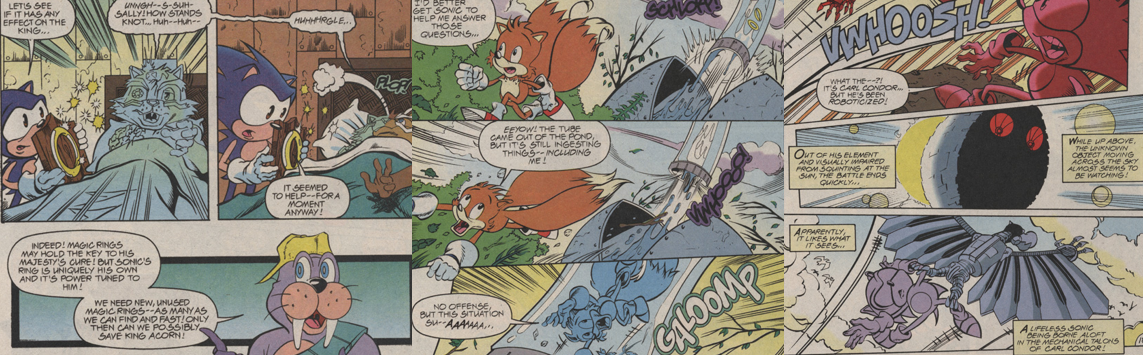
When Sonic and Tails look for Magic Rings to help the King, they stumble upon the Death Egg!

As best as Knothole’s resident physician, Doctor Horatio Quentin Quack, can figure, this is a result of the King’s extended stay in the mysterious Zone of Silence; in order to keep the Freedom Fighters from panicking, King Acorn’s condition has been deemed top secret and Sally orders St. John to stand guard over the King while they explore their options. Their trusty mechanic and science expert, Rotor the Walrus (occasionally called “Boomer”), is at a loss but rookie Freedom Fighter Miles “Tails” Prower hits upon a possible solution when he observes that the King’s crystalline skin resembles the texture of Chaos Emeralds. This prompts Sonic to retrieve his recently-acquired “one-billionth Magic Ring” to try and use its Chaos Emerald powers to reverse King Acorn’s condition, though it proves to be a fleeting solution. Rotor theorises that the Ring is unique to Sonic and suggests gathering as many others as possible to try again, prompting Sally to send Bunnie Rabbot and Antoine D’Coolette out to the mysterious Lake of Rings in the forest and Sonic and Tails to the Ring Grotto outside Robotropolis, Dr. Robotnik’s industrial, mechanical city. This area has been irrevocably changed and damaged following a recent fight between Super Sonic and Hyper Knuckles, and Dr. Robotnik’s attacks, and the two are stunned to find the Ring Grotto has been sealed beneath an impenetrable steel dome. Sonic leaves Tails to watch over the area while he races off to recruit a bruiser named Carl Condor to help bust it open, and the young fox-boy is shocked when the dome suddenly opens up and the Grotto’s entire supply of Magic Rings is sucked up into the clouds courtesy of a giant vacuum tube, which also takes Tails along with it! At the Mobian Cliffs, Sonic is shocked by a sudden and unnaturally faster solar eclipse, almost as if something artificial were crossing the Sun’s path, and horrified to find that Carl has been robotocised; caught off-guard, Sonic is rendered unconscious by the mechanical vulture and carried into the sky towards an ominous, egg-shaped superstructure.

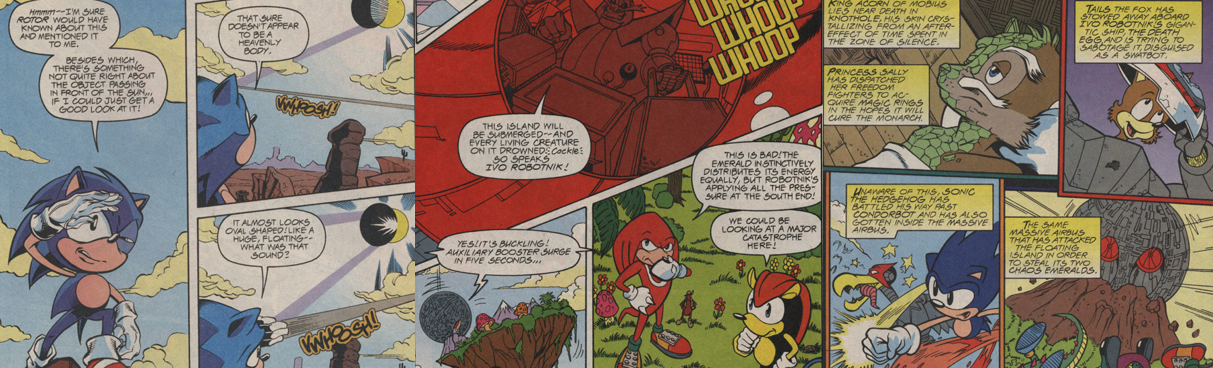
Knuckles and the Chaotix are aghast when the Death Egg tries to submerge the Floating Island!

This is, of course, the Death Egg, Dr. Robotnik’s newest and most dangerous creation. After leaving his nephew and whimpering subordinate Snively in charge of overseeing Robotropolis’s reconstruction (a position he immediately and amusingly abuses), the cybernetic dictator revels in his glory as he powers up the Death Egg with the Magic Rings and prepares to use it to roboticise every living thing on the planet! However, while the Magic Rings ensure that the Death Egg is effectively invulnerable to external attack, Dr. Robotnik still needs a Chaos Emerald to bring the station to full power; additionally, he sucked up some unwanted additional weight that’s keeping it from reaching its proper orbit, but has no idea that Tails is in amongst the trees and debris. Thinking quickly, Tails jams himself into the discarded wreckage of a disobedient SWATbot so he can explore the space station undetected, while Sonic escapes the talons of the Condorbot and defies the laws of physics to pinball his way onto the Death Egg just as Tails jettisons the crap that was weighing it down. With the Death Egg scrambling their communications signal and the King’s condition worsening, Dr. Robotnik guides the Death Egg towards the Floating Island (as it was then known), which naturally attracts the attention of the island’s hot-headed guardian, Knuckles. Swooping up to intercept the Death Egg, Knuckles is hit by a laser blast from the satellite’s “eye”; luckily, this simply stuns him and he falls into the arms of his friends, the Chaotix (Mighty the Armadillo, Vector the Crocodile, Charmy Bee, Espio the Chameleon and…*sigh* Archimedes the Fire-Ant). The group watch as Dr. Robotnik drops a squadron of gigantic Burrobots to dig up the island’s Chaos Emeralds, which they race to stop to keep the island from plummeting from the sky. While the Chaotix attack the massive drilling mechs, Sonic tears his way through the Death Egg but arrives too late to keep Dr. Robotnik from ramming the satellite into the Floating Island! The Chaos Emerald is able to keep the island aloft, but the sheer weight and thrust of the Death Egg causes it to tip to one side and forces it into the sea below!

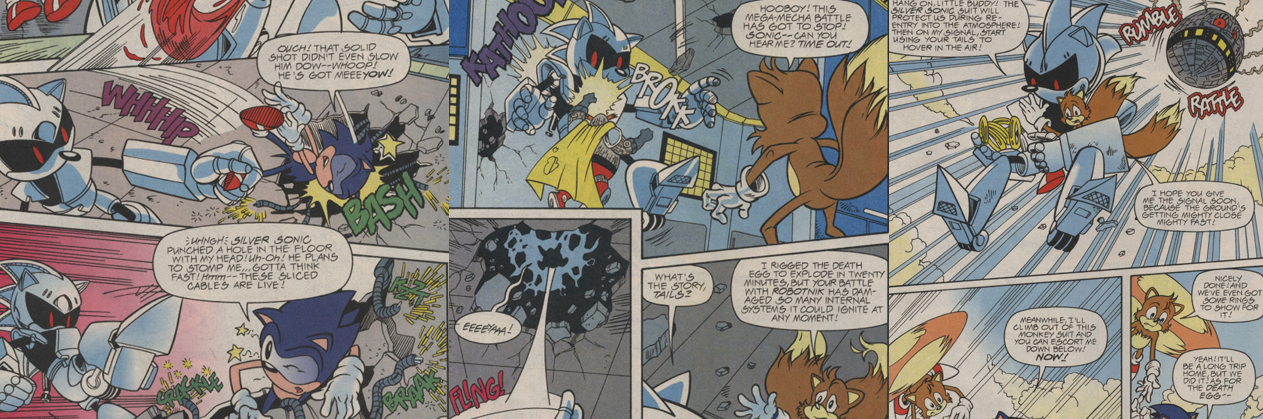
Thanks to repurposing Dr. Robotnik’s mechs, Sonic and Tails are able to destroy the Death Egg.

Naturally, Sonic leaps into action, only to end up attacking Tails by accident. To make matters worse, Dr. Robotnik shields himself from Sonic’s attack with a thick wall of plexiglass and then chokes him out with a spew of poisonous gas. Luckily, Tails recovers from his assault and uses his SWATbot suit to break through Dr. Robotnik’s defences and destroy his control panels, saving Sonic from suffocation and sending the satellite uncontrollably hurtling into space. Thanks to a “stabilising field” built into his “Gravi-Gauntlet”, Dr. Robotnik staves off the sudden drag of inertia and escapes to his auxiliary control room; he then sics a massive robotic Sonic doppelgänger on the two. While a far cry from his sleeker, more popular counterpart or even Sonic’s more versatile Mecha Sonic form, this “Silver Sonic” has the muscle and armour to shrug off Sonic’s attacks and manhandle (or should that be hoghandle?) him with punches, kicks, and slams but proves disappointingly susceptible to an electric shock from some conveniently-placed severed cables. Despite the failure of his Silver Sonic, Dr. Robotnik resorts to another back-up plan, donning his “most sophisticated battle armour ever”, the Eggs-O-Skeleton, which augments his physical strength by drawing power from the Death Egg itself! Sonic evens the odds by (…somehow…) commandeering Silver Sonic’s mechanical body and battling the rotund dictator on equal ground. The melee escalates but, ultimately, Sonic hurls Dr. Robotnik up through the ceiling and out of the Death Egg; during the fight, Tails was somehow able to rig the Death Egg to explode and the two beat a hasty retreat, swiping the stolen Magic Rings and making it safely to the surface before the Death Egg’s destruction (which, while somewhat anti-climactic on paper, is “seen and felt” all around the planet). While Snively faces the wrath of his uncle and master and the mad cyborg swears revenge upon Sonic and the Freedom Fighters, Sonic and Tails race back to Knothole to see if the Rings will cure the King, which is a plot thread left unresolved in this miniseries.

The Summary:
As ever, one of the main appeals of Archie’s attempt at a Sonic 3 & Knuckles adaptation is the artwork; Archie Comics, especially at this time, did a great job of emulating the character designs and locations seen in SatAM, with Patrick “Spaz” Spaziante being their standout artist. Manny Galan is no slouch here, though, and there are times when his version of Sonic evokes the character’s more dynamic and streamlined Japanese presentation; Archie’s original characters, like St. John, don’t fare too well but SEGA’s characters all hold up quite nicely, though I’m not massively onboard with the artistic shortcuts taken to basically show Sonic and Knuckles flying simply because they need to get up to the Death Egg. Everything is still early Archie, though, meaning the Floating Island doesn’t look that great, the Death Egg has an ugly and needlessly “busy” design, and there’s an element of daft childishness in some areas as the comic still hadn’t quite shaken off the influences from SatAM’s more slapstick sister series. As if often the case, the first few pages are bogged down with recapping the events from previous issues and even prior Archie stories, but it’s not too invasive.

While there’s some decent build up to the Death Egg, it feels secondary to King Acorn’s plight.

The biggest issue with Sonic Quest is that it’s not much of an adaptation of Sonic 3 & Knuckles. Much like in their other videogame tie-ins and those seen in Fleetway’s publications over here in the UK, Archie’s writers pick and choose elements from the videogames to incorporate, almost as if they were drip-fed footage and details of SEGA’s upcoming games rather than being privy to full details ahead of time. Thus, elements of Sonic 3 & Knuckles are spread out across different stories and one-offs, such as introducing Knuckles and even the Chaotix before the Death Egg. While the Death Egg is at the centre of Sonic Quest, it’s not really the narrative focus; the satellite doesn’t appear until the end of issue one and is destroyed before it can really do anything other than steal some Magic Rings, blast Knuckles, and almost submerge the Floating Island. On the plus side, the story does a great job of building the threat of the Death Egg; hiding it, seeing it on computer monitors, and especially the “eclipse” sequence all add to the anticipation of the space station’s big reveal and it’s portrayed (on paper) as being a serious threat as it’s allegedly capable of roboticising the entire planet. However, since it lacks a Chaos Emerald, it cannot actually do this and it’s one attack is enough to simply stun Knuckles, significantly diminishing its menace. I think the story would have benefitted from being five or even six issues long and seeing Dr. Robotnik successfully attack the Floating Island with the battleship and steal a Chaos Emerald to robotoicise large areas of Mobius, which would have greatly raised the stakes of the narrative.

Things pick up when Silver Sonic appears but the story wastes a lot of its more interesting elements.

As presented, Sonic Quest doesn’t even require Sonic to begrudgingly join forces with his hot-headed rival; Knuckles’ involvement is more of a glorified cameo and, while he and the Chaotix do fend off the gigantic Burrobots, he does nothing to help destroy the Death Egg. Indeed, since Sonic and Tails do all the work from inside the space station and sabotage its controls, there was never any danger of Dr. Robotnik acquiring a Chaos Emerald so Knuckles could’ve been entirely absent from the story. Additionally, we don’t really get a sense of the interior of the Death Egg; we only see a few corridors and rooms, with the bulk of the story taking place in a confined control room, and the main concern of the plot is more about getting the Magic Rings to cure King Acorn, with the Death Egg presented as more of an inconvenience since that’s where the Rings are being held. Things pick up a bit once Dr. Robotnik unleashes Silver Sonic but, while I enjoyed this fight and the artwork here, this mechanical monstrosity is defeated with a ridiculous amount of ease, exhibits no personality, and is somehow easily controlled by Sonic after it’s defeated. Even the showdown between Sonic and Dr. Robotnik ends up being quite disappointing; not only is Dr. Robotnik’s Eggs-O-Skeleton a weak design and a poor substitute for his more imposing Death Egg Robot, we never get a sense of what he’s capable of while wearing it beyond “being stronger” and he’s easily trounced by Sonic piloting the remains of Silver Sonic. There’s almost an intriguing element to this in the panels where Sonic is so fixated on ending Dr. Robotnik that he briefly considers risking his life, but it’s swept under the rug by a quick word from Tails and wouldn’t really resurface until the comic’s fiftieth issue. In the end, this was an enjoyable three-issue adventure; the art is good, the writing isn’t too hammy, and there’s some fun visuals whenever the Death Egg is looming over the Floating Island. However, it just reads like another Archie Sonic adventure; the Death Egg should’ve been a massive event, one stretching across multiple issues, but just comes across as another of Dr. Robotnik’s many maniacal schemes. As soon as we see it, it’s destroyed without really doing anything except threatening the Floating Island, something easily solved by Tails being a bit trigger happy, and there’s never a sense that this is truly the final victory for Dr. Robotnik in his war against the furries. It’s a shame, really, as this could’ve been a great way to build bridges between Sonic and Knuckles or even have the Chaotix team up with the Freedom Fighters, but it just comes across as a throwaway tie-in with little impact on the ongoing narrative beyond finding a cure for the King.

My Rating:

Rating: 2 out of 5.

Could Be Better

Did you enjoy Sonic Quest? Did you collect the miniseries when it first released or, like me, did you pick it up in a later collection? What did you think to the depiction of the Death Egg? Do you agree that it was neutered compared to the videogames or were you impressed with its appearance? Were you disappointed that Sonic and Knuckles didn’t team up to fight at and by how easily it was brought down? What did you think to Silver Sonic and Dr. Robotnik’s Eggs-O-Skeleton armour? Which of Archie’s videogame tie-ins was your favourite? How are you celebrating the anniversary of Sonic 3’s release today? Please feel free to share your memories of Archie’s Sonic comics and Sonic 3 & Knuckles below or on my social media.