Back Issues [Robin Month]: The Brave and the Bold #54


In April of 1940, about a year after the debut of arguably their most popular character, Bruce Wayne/Batman, DC Comics debuted “the sensational find of [that year]”, Dick Grayson/Robin. Since then, Batman’s pixie-boots-wearing partner has changed outfits and a number of different characters have assumed the mantle as the Dynamic Duo of Batman and Robin have become an iconic staple of DC Comics. Considering my fondness for the character and those who assumed the mantle over the years, what better way to celebrate this dynamic debut than to dedicate every Thursday of April to celebrating the character?

Story Title: “The Thousand-and-One Dooms of Mr. Twister”
Published: July 1964
Writer: Bob Haney
Artist: Bruno Premiani

The Background:
All Star Comics (1940/1941) brought together the Justice Society of America (JSA) for the first time, birthing the first ever superhero team in comics. While the JSA’s roster expanded and changed over the years, they were rebranded entirely in the late 1950s when editor Julius Schwartz tasked writer Gardner Fox with breathing new life into the team as the Justice League of America (JLA). The JLA brought together eight of DC’s heavy-hitters and their origin issue became one of DC Comic’s best-selling titles; a mere four years later, DC would assemble a new team, one that specifically targeted their younger readers by bringing together the sidekicks of three DC Comics’ most powerful superheroes. Under the leadership of Dick Grayson/Robin, the trio would later be expanded considerable and come to be known as the Teen Titans, with runs by the likes of Marv Wolfman and George Pérez being notably influential, and the team has seen success in both animated and live-action ventures.

The Review:
Our story begins in the town hall of Hatton Corners, where an “unusual” public meeting is taking place; specifically, Mayor Corliss is leading the charge against the disruptive and workshy youth of the day by calling for a curfew to help solve the town’s teenage problem. At the same time, in a dilapidated barn across town, the Mayor’s son, Eddie, is rallying the town’s teenagers, threatening that they’ll go “on strike” if they don’t get their new clubhouse, and both mobs are vehemently against the other. Robin, colourful partner and ward to Bruce Wayne/Batman, is on the side of Hatton Corners’ youths; while the Batman believes that the kids are acting like spoiled brats, Robin believes the kids’ voices need to be heard and accepts their invitation to join the Hatton Corners Teen Club (with Batman’s permission, in an amusing bit of irony). Barry Allen/The Flash is equally disturbed by the teenagers’ unruly attitude but his young partner, Wally West/Kid Flash, believes that adults have forgotten what it’s like to be a teenager and also agrees to join the club (again, with his mentor’s permission). The Hatton Corners Teen Club is so adamant about recruiting teenage heroes to their cause that they’re even able to extend an invitation (via an eel carrying a note in a bottle…) to Gar/Aqualad at the bottom of the ocean! Although Arthur Curry/Aquaman believes that kids shouldn’t dispute with their elders and warns Aqualad that he can’t survive out of the water for longer than an hour, he also allows his youthful companion to attend, and the three arrive at the club astonished not only to see each other there but also to find the barn demolished and deserted.
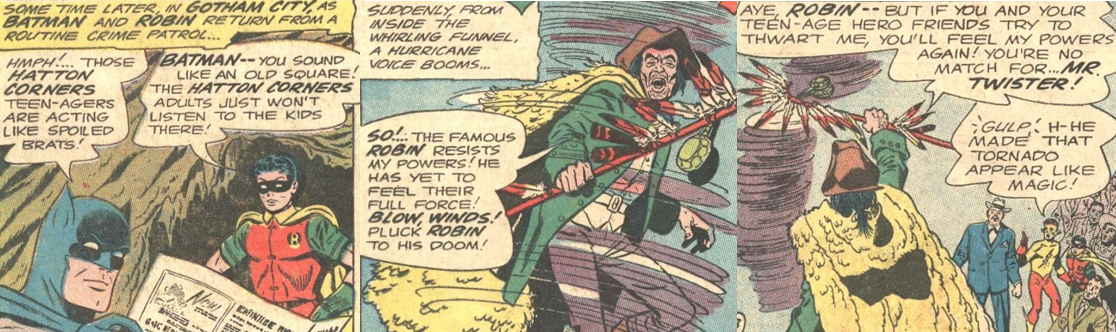
Mr. Twister kidnaps the rebellious youths of Hatton Corners and delivers a bizarre threat.

The trio go to Mayor Corliss for answers and he shows them a note form Eddie that reveals he and his fellow “cats” decided to “skip” until the adults “get hip” and build them a new clubhouse. While the Mayor and the town’s other adults believe it’s a ruse to get attention, Robin believes the note is phony since it didn’t use a more appropriate word for “music” (like “jive”); realising that the town’s elders won’t be of any help, the Boy Wonder takes charge and tasks Kid Flash with scouting around the area and Aqualand with checking out the surrounding waters for any sign of a clue. Robin stays in town and is thus on hand to help get the townsfolk to safety when a twister suddenly comes barrelling into Hatton Corners; despite his best efforts to resist the wind, Robin is tossed into the tornado and faces certain death courtesy of Bromwell Stikk/Mister Twister. Thankfully, Kid Flash is able to use his incredible speed to brave the winds and bring Robin to safety, but the young speedster is knocked for a loop when he tries to confront Mr. Twister and gets a blast from his odd staff. Mr. Twister takes credit for the missing children and threatens Mayor Corliss that the youths won’t be returned unless he bows to his demands; in the unspecified amount of time that follows, the townsfolk express regret at how quiet and lifeless it is without the kids, much to the trio’s disgust (though we never see the reactions from any parents except for the Mayor, who seems more bothered about Mr. Twister’s return than the loss of his son).
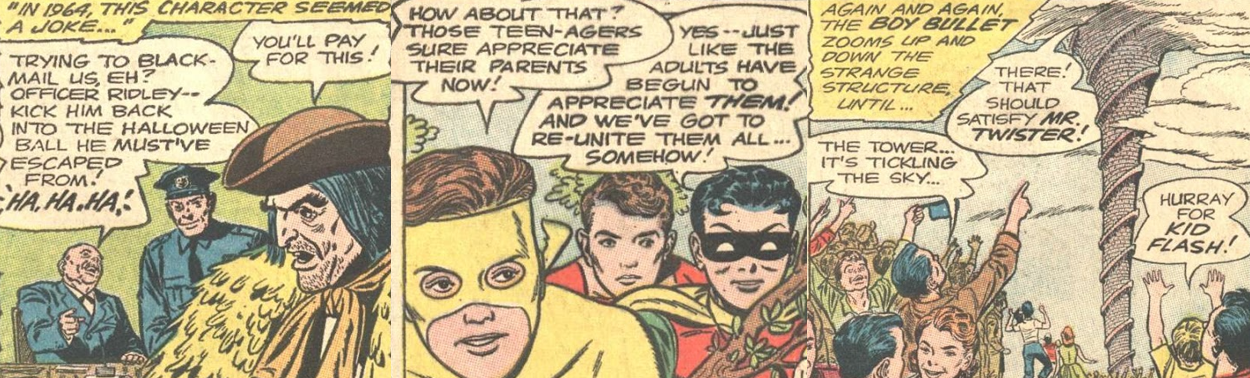
Mr. Twister’s threat to the kids is all-too-real, necessitating the intervention of Kid Flash.

Mayor Corliss sheds some light on what Mr. twister’s beef is; back in colonial days, Bromwell’s ancestor, Jacob, allowed settlers to build Hatton Corners on his land in return for him and his descendants being paid one passenger feather a year or forfeit one of their youths. Since the demand was so ludicrous, the town’s founders never honoured the agreement and, when Bromwell showed up looking claim on the unpaid debt, he was laughed out of the Mayor’s office and vowed revenge. With passenger pigeons having gone extinct in the intervening years, Robin decides to do a little detective work to find the missing kids and discovers records of “unidentified flying objects” heading southwest to…Goat Island…the same night the teenagers vanished. Aqualad arranges them some transport to the island on the back of a manta ray; along the way, he and Kid Flash get into a bit of a dispute over the appeals of the sea and super speed and Kid Flash even questions Robin’s tendency to bark orders considering his lack of superpowers. Still, they arrive at the island and find the missing teens being put to work by Mr. Twister to build a massive stone tower in his honour. Although Eddie tries to fight back by…throwing a rope at their captor…his efforts are easily subdued thanks to Mr. Twister’s staff and he (as in Eddie) and his fellow teens are suddenly longing for the safety and security of their town and its adults. Mr. Twister leaves to run an errand and threatens them with punishment if his tower isn’t completed by the time he gets back; while Robin goes to uncover the source of the villain’s powers, Kid Flash uses his superspeed to build the tower in no time at all, thereby sparing the youths the wrath of their kidnapper.
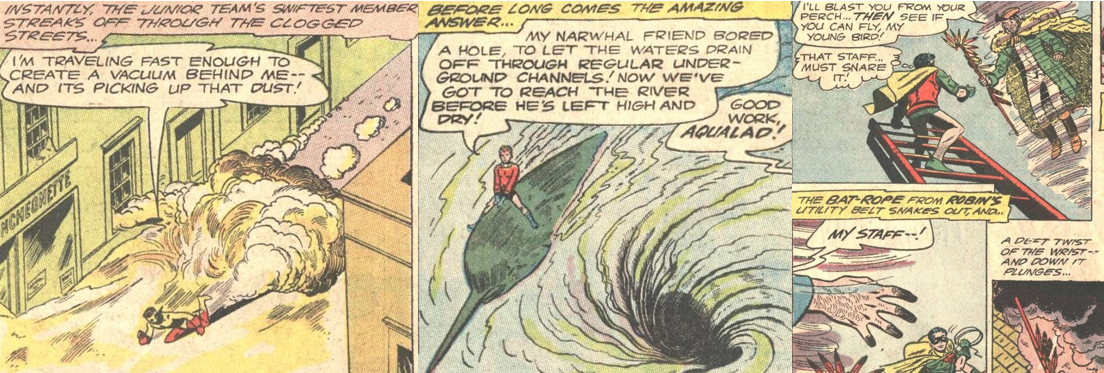
Despite being touted as invincible, Mr. Twister is defeated with a ridiculous amount of ease.

Back on the mainland, Robin discovers Mr. Twister using “long lost Indian medicine” to empower his staff; when he’s discovered, Robin leaps into action, tossing sand in the villain’s face and landing an uppercut to his jaw. However, his eagerness backfires; as long as Mr. Twister is in possession of his staff, his body automatically repels any force used against it. Mr. Twister uses a tornado to dump Robin back into town with a further threat to destroy the town unless his debt is paid, but the Boy Wonder is clueless how they can meet the villain’s demands or oppose the power of his staff. Jealous of the adulation Kid Flash receives from the town’s kids, Aqualand returns to the ocean to revitalise his strength and discovers that Goat Island is…somehow…held aloft by an extremely narrow piece of earth under the sea. Using his command over marine life, Aqualad has a bunch of whales literally transport the island out of Mr. Twister’s grasp, bamboozling the villain and earning him the admiration of the kids. Although the teenagers are safely returned to town, Mr. Twister makes good on his threat by conjuring a cloud of dust to bury the town; however, Kid Flash is easily able to disperse it with his superspeed. When Mr. Twister tries to flood the town in torrential rain, Aqualad is able to drain the water by commanding a narwhal to bore a hole into the ground but, when the villain rains literal fire upon the town, Kid Flash and Aqualad are incapacitated by bolts from his staff and the town is slowly consumed by fire (…despite the fact it was just half-submerged under water). Robin pulls his friends to safety and hops into a fire engine; he climbs up the fire ladder and is able to disarm the villain with a ridiculous amount of ease simply by tossing his Bat-Rope and because Mr. Twister was apparently unable to get a clean shot…even though he hit Kid Flash mere moments earlier! Anyway, Mr. Twister is depowered and apprehended, the trio put out the fire, the adults agree to build the teenagers their clubhouse, and everyone celebrates their newfound appreciation of each other.

The Summary:
Holy God! I was expecting this to be pretty bad but, somehow, the first team-up of the proto-Teen Titans managed to exceed my wildest dreams. I’ve said many times how much I dislike the dialogue and characterisations of teenagers and women of this era of comics, so it’s no surprise that I wasn’t best impressed by all the lame attempts to be “cool” by shoehorning in language and anti-adult attitudes all over the story. I liked that the story kind of acknowledged this when Robin noticed the note was clearly written by an adult; it’s ironic as this story, and all other teenage characters, was written by adults trying to capture the speech and beliefs of the younger generation and it just comes across as awkward and out of touch. The whole “teenagers against adults” thing is pretty overplayed throughout comics, especially in the pages of Teen Titans and its successors, but it’s paper thin here; we’re never seen what the Hatton Corners teenagers do that’s deserving of a curfew and the kids only rally against the adults because they won’t build them a clubhouse. There’s no discussion about the relationship between Mayor Corliss and Eddie, no reaction from any parents, and the kids immediately start praising the ground the adults walk on when they’re forced into slavery by Mr. Twister.
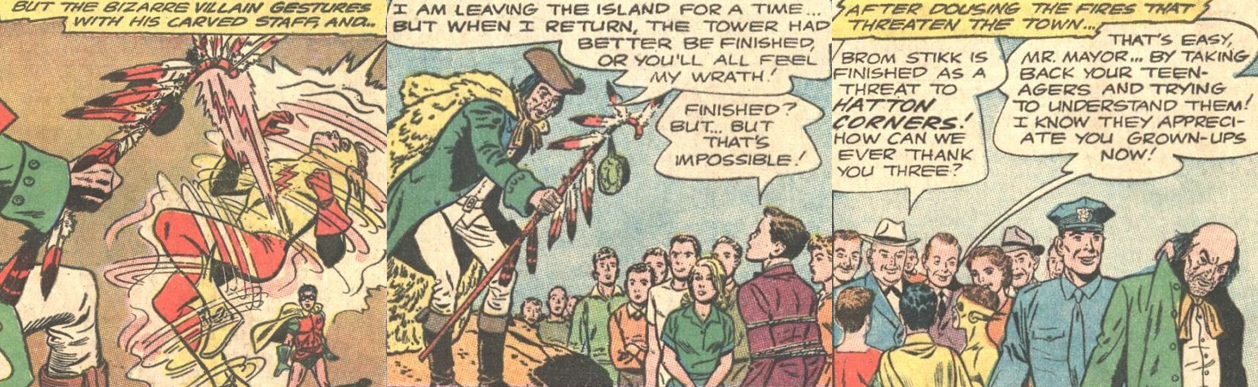
Although portrayed as a threat, Mr. Twister’s motives are paper thin and he’s easily defeated.

Speaking of whom…what the fuck is this villain? He’s the descendant of some landowner who made a bonkers agreement that was immediately welched on and yet he somehow stumbled upon some poorly defined “Indian” magic to empower his staff and gain control of the elements. I mean, I’ve seen some pretty wacky villains in comics in my time, but Mr. Twister takes the cake! He’s literally willing to kidnap a whole bunch of kids, force them to build him a monument, and destroy the entire town, killing all of its inhabitants, unless he’s given a bunch of feathers! He makes the pompous Mayor Corliss look reasonable by that measurement, but the worst part is that he’s portrayed as a credible threat! And that’s a really weird thing for me to complain about as I’m normally bemoaning the fact that the villains of these team-ups aren’t enough of a threat, but Mr. Twister makes mincemeat of both Kid Flash and Aqualad with his staff’s power and could’ve easily killed Robin when he had him unconscious but chose not to for no bloody reason! And yet, despite his vast power, the heroes have to triumph so the story pulls some of the most ludicrous explanations out of its ass to facilitate that; Goat Island is held aloft by a thin perch of earth? A goddamn narwhal? And the fact that Mr. Twister can “kayo” the two superpowered teens but can’t hit Robin because he’s climbing a ladder?!

Thanks to Kid Flash and Aqualad’s bickering, it’s easy for Robin to stand out and take charge.

The whole story is just a complete mess of a fever dream. The three teenage heroes are brought together in the most contrived way possible and, for all their high and mighty talk of the troubles of the youth moment, only go to Hatton Corners when their mentors give them the go-ahead! The dynamic between the three isn’t very developed, but there’s definitely potential here; the rivalry between Kid Flash and Aqualad doesn’t get a lot of play but it was kind of fun seeing them out-doing each other to impress the girls and bickering about their respective powers. If there’s a standout of this story, it’s Robin; he takes command of the three easily and naturally and they listen to him without question (save for one inconsequential remark from Kid Flash). As the far more logical and level-headed of the three, it’s fitting that Robin discovers where the kids have been taken and the source of Mr. Twisters power, and the remarks about his lack of superpowers mean he was obviously going to be the one to topple the villain…I just wish it had been in a more impressive fashion. In the end, “The Thousand-and-One Dooms of Mr. Twister” is indicative of the storytelling of its era; it might seem unfair to hold that against it, but I’m going to. There are certainly far better Teen Titans origin tales out there and you’re really not missing all that much if you skip this one unless you’re a big fan of outdated slang, outmoded opinions on both age groups, and nonsensical storytelling.

My Rating:

Rating: 1 out of 5.

Terrible

Have you ever read “The Thousand-and-One Dooms of Mr. Twister”? If so, what did you think to it? Do you own a copy of the original comic or do you remember reading it when it was first published? What did you think to the first team-up of Robin, Kid Flash, and Aqualad? Were you also put off by the outdated slang and attitudes or did you enjoy these aspects? What did you think to Mr. Twister, his motivations and powers, and the way he was defeated? What are some of your favourite Teen Titans stories? Whatever your thoughts on the Teen Titans, and Robin, drop a comment down below and check back next Thursday for more Robin content.


Game Corner: Aliens (Arcade)

Released: January 1990
Developer: Konami

The Background:
The Alien franchise (Various, 1979 to present) has a long and complicated history with videogame adaptations; from pixelated garbage to first-person shooters, real-time strategies and crossover titles, to survival/horror experiences, the decade-spanning sci-fi/horror franchise has seemingly done it all, including its fair share of arcade titles. In 1986, director James Cameron took on the unenviable task of following up on Ridley Scott’s financially successful and highly influential Alien (ibid, 1976) and more than met the challenge, producing an incredibly profitable and well-regarded follow-up that served as ample inspiration for both Alien videogames other videogame franchises as well. Naturally, considering how popular the arcade scene was at the time, Aliens made the jump from the silver screen to the familiar trappings of a sidescrolling run-and-gun courtesy of Konami, one of the most prominent developers in the industry at the time. Although it never received a home port, Aliens was an extremely popular arcade title when it released; its visuals and action were highly praised and, decades later, it is still regarded as one of the best games in the franchise.

The Plot:
Vicious, parasitic alien lifeforms have overrun Weyland-Yutani’s colony on the desolate world of LV-426 and only Lieutenant Ellen Ripley and Corporal Dwayne Hicks are left to battle through the hordes of acid-blooded Xenomorphs and confront the ghastly Xenomorph Queen!

Gameplay:
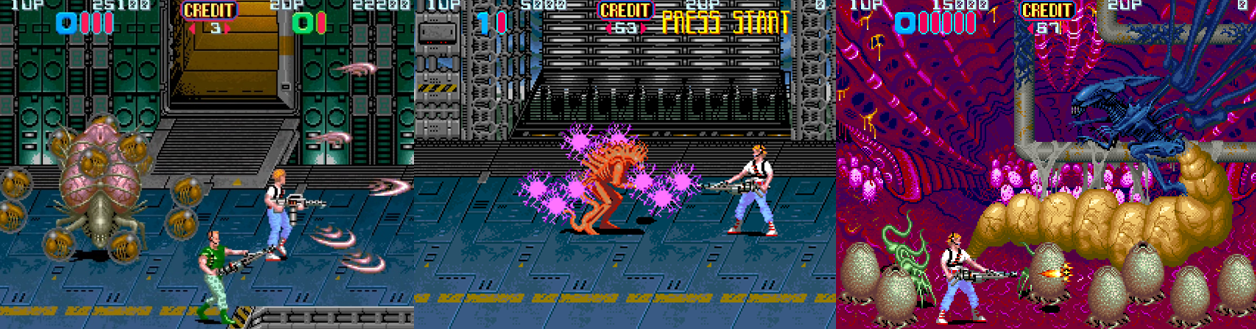
Aliens is a 2D, sidescrolling run-and-gun title in which players take on the iconic roles of either Ripley or Hicks to blast through a number of environments ripped straight from the blockbuster sci-fi/horror classic. The game allows for simultaneously two-player co-op, but players are locked into a specific character: player one is always Ripley, and player two is always Hicks. Additionally, there is absolutely no different between the two characters except for a different sprite and a different name above the life bar; both characters can move in any direction across each stage and fire while standing and walking or while ducking and crouching walking to blast at smaller enemies. There is no jump button to worry about, no health-draining special attack, and no time limit but Aliens will spawn in and swarm over you if you stand still for too long.

Blast your way through Aliens and their many variants to wipe out their infestation of LV-426.

Players are armed with the awesome M56 Smartgun, which has unlimited ammo and allows for continuous fire if you simply hold down the fire button. This default weapon has a high rate of fire and will shred the game’s basic enemies in just a few shots, though you can’t fire in any direction except straight ahead of the direction you’re facing from either a standing or a crouching position. There are instances where you can climb up or down ladders, however, in order to take a higher or lower path and, when playing in co-op, this is highly advised in order to better clear out the enemies in your path. Quite often, you’ll also be forced to crawl into an air vent to progress and have to watch out for blasts of steam, Facehuggers, and some of the game’s new Xenomorph variants.

Crawl through vents, mow Aliens down from the APC, or don the Power Loader to even the odds.

Aliens is the very definition of a coin-muncher; enemies will run at you and explode, taking a chunk off your health bar, and you get a couple of lives per credit. If you run out of credits, you can simply input some more and continue from where you left off, which is great news when you’re emulating the game as you can just plough ahead until you reach the ending. Its not all mindless sidescrolling shooting, however; the game always switches to a vertical shooter for some bosses and there’s a couple of bonus stages where you need to mow down Xenomorphs from the M577 Armoured Personnel Carrier (APC) in a desperate attempt to rack up points and rescue Rebecca “Newt” Jorden. Other tried-and-tested sidescrolling mechanics are here to help mix things up as well, including acid hazards dropping from above, sudden drops to sewers, explosive barrels, and, of course, a moving elevator stage where you need to fend off waves of enemies while travelling further down into the bowels of LV-426.

Graphics and Sound:
If you’ve seen the movie on which Aliens is based, the environments will be immediately familiar to you; you begin the game in the living quarters of the LV-426 colony, and blast your way through the metallic hallways, dingy sewers, and enflamed landing pad shredding any enemies that you come across and grabbing power-ups. The game does a fantastic job of rendering the movie’s locations in a high level of detailed sprite work and locations, and even includes the motion tracker when you’re in the air vents; while the player sprites aren’t incredibly detailed and are lacking in animations, you do get to see them from different perspectives when the game switches to the vents or a vertical perspective, and all of the enemy sprites are quite varied and detailed (though the purple colouring of the Xenomorph drones is a little odd; I suppose it helps them stand out from the environment, though).

Environments and enemies are extremely detailed and perfectly recreate the movie’s aesthetic.

There’s a decent amount of attention to detail placed into the game, despite how short a lot of its stages are; Facehuggers are held in glass capsules in the backgrounds, Xenomorphs crawl over the walls, up from the floor, and drop down across the screen, and you’ll spot a number of colonists left helpless victims to the Facehuggers. Seeing Chestbursters explode out of their chests in a bloody burst and the Alien’s biomechanical gunk corrupt the environment really helps add to the atmosphere and the fidelity to the source material, and the game is punctuated by some limited voice acting (mostly grunts and cries), though the memorable Alien squeal is sadly absent. The game’s story is related through some out on context pixelated recreations of shots from the film, onscreen text, and using some limited sprite animation; the most impressive of these is saved for the finale, where you can force the Xenomorph Queen out of an airlock and be treated to a sprite-based recreation of her being flush out into space. Although James Horner’s iconic score is absent, the game’s action is punctuated by some rocking beats that incorporate a siren effect, and a blaring alarm in the finale stage helps to add to the tension created from the blazing sky and flaming walkways.
Enemies and Bosses:
If you remember Kenner’s awesome toy line from back in the day, you’ll know that the Xenomorphs had some pretty funky variants outside of the movies. The most basic Alien drone will amble over to you, trying to swipe at you and exploding on contact, and you’ll need to crouch down to destroy the Alien eggs before they can spit out Facehuggers or to take out the titchy Chestbusters and spider-like Xenomorphs that scuttle around in the sewers. You’ll also encounter bat- and snake-like Xenomorph variants that flutter or slink about, Xenomorphs that ooze out of the floor or leap up from the foreground, and variants that spit acid at you from a distance. Easily the weirdest Xenomorph is a red, frog-like variant than hops around the screen and grows bigger as you shoot at it, but the most intriguing inclusion are the zombies. It seems in this version of the story that those infected by Chestbursters become gloopy, shambling ghouls that toss grenades, take shots at you, crawl their legless bodies across the floor, and spit out Chestbursters.

Aliens come in all colourful, disgusting shapes and sizes in this action-packed title.

Each stage is finished by a boss battle against a particularly gruesome Xenomorph variant; the first of these is a quadrupedal monstrosity with a snapping mouth at the end of a long, elasticated neck. Joined by a cadre of Facehuggers and spitting projectiles at you when its head has been blasted off, this Alien isn’t too great a threat as you can easily dodge its vicious jaws and even destroy its attacks with your gun fire. While trying to track down Newt, you’ll be attacked by a large Alien that is impenetrable whilst curled into a ball; you’ll have to avoid its rolling attacks until it uncurls and then unload in it to bring it down, but this is merely a sub-boss before you battle an Alien that’s been partially absorbed into the environment. Though it remains completely stationary, it rains Alien eggs into the arena and stretches its limbs out at you while. You must keep moving left to right, blasting and destroying the limbs and hitting the head when it pops up, though beware as you’ll be literally bombard by eggs when it’s near death, which can whittle your health down in no time at all.
After wading through countless Aliens, you’ll go head-to-head with the Queen Bitch herself!

There’s also a particularly gruesome spider-like Xenomorph that you’ll have to contend with twice throughout the game; this brain-like monstrosity scuttles about the place surrounded by orb-like Alien embryos which it uses as a shield and throws out to hit you. After the first encounter, you’ll then battle two Xenomorph bosses at once; these two nasty critters channel the lightning bolts that rain down across the level and fire them at you as bolts of electricity, and when there’s only one left it will surround itself with and shoot out glowing spirals of electricity in a desperate bid to protect itself. After fighting your way through the Alien nest, you’ll encounter the Xenomorph Queen; at first, she’s unable to attack beyond spitting acid at you and summoning her drones to protect her, so you simply need to fend them off and destroy her egg sack a piece at a time. However, when her egg sack is destroyed, she’ll detach and go on a rampage; the final confrontation takes place aboard the Sulaco and sees her clawing, biting, and charging at you and swiping with her spear-like tail. Thankfully, there’s a Power Loader on hand to help smack her about and, after you’ve damaged her enough, you can either pour on the firepower to blow her to pieces or force her into the airlock by rapidly tapping the attack button to activate the Power Loader’s flame torch.

Power-Ups and Bonuses:
As you wade through the parasitic alien scum that have overrun LV-426, you’ll occasionally find food that will replenish your health, but these are few and far between and usually placed right before a swarm of Xenomorphs and hazards. You’ll also find crates that will bestow you with another weapon that you’ll keep until you lose a life; these can be either a homing missile launcher, a three-way shot, a rocket launcher that fires three in the direction you’re facing, and a flamethrower that fires in bursts. You can’t just hold down the fire button with any of these additional weapons, sadly, but you can pick up bombs to toss into groups of enemies or a super smart bomb to clear out all onscreen enemies. There are also rare occasions, most notably the final boss, where you can hop into the Power Loader and use its big, pincer-like arms to splatter Aliens into acidic goo, destroy walls, and even the odds against the Xenomorph Queen.

Additional Features:
There’s really not anything else on offer in Aliens except for about thirty minutes of frantic run-and-gun action. You can play with a friend, of course, to mix things up and this probably adds both player characters to the sprite-based cutscenes, and you can compete to get a higher score as well, but there aren’t any alternate paths or anything to that you won’t see on the first playthrough. You’ll notice some differences in the Japanese version of the game; stages now have titles beforehand, the colourings of the Aliens is closer to the movies, enemy placement is a little mixed up, and both Newt and the APC stages are missing.

The Summary:
I’ve played a lot of the Alien videogames, and my fair share of arcade titles, over the years and I have to say that adapting the property into a fun, action-packed, mindless shooter is generally one of the most tried-and-tested tactics for the franchise. If you can’t recreate the horror of the source material due to hardware restrictions or mass appeal, then why not lean into the action-orientated elements that James Cameron introduced so well in the sequel? Often, this is hit and miss, but I’m usually quite pleased with the results as I love a good run-and-gun arcade title and Aliens is certainly a lot of fun to blast through. The attention to detail is admirable, recreating the environments and bloody horror of Aliens to an astounding degree for the time, and I really enjoyed all the new Xenomorph variants peppered throughout the game. The game gets very cluttered with enemies at times, which limits the usefulness of the weapon power-ups, but it’s just the right length with some surprising variety with the vertical shooting and APC sections so it’s well worth setting aside a little bit of time to load this one up and give it a quick run through.

My Rating:

Rating: 3 out of 5.

Pretty Good

Have you ever played the Aliens arcade game? If so, where would you rank it against other Aliens videogames and arcade titles of the time? Which character did you play as and what did you think to the new Xenomorphs featured in the game? Did you enjoy the game’s bosses and what did you think to the final battle with the Xenomorph Queen? Which of the Alien movies or videogames is your favourite and why? Whatever your thoughts on Aliens’ arcade venture, feel free to drop them below or leave a comment on my social media, and be sure to check out for my review of the film that inspired the game.

Back Issues [Crossover Crisis]: Spider-Man and Batman


In April 1985, the first issue of the ground-breaking Crisis on Infinite Earths (Wolfman, et al, 1986) released and saw the temporary destruction of the “Multiverse”. To celebrate this momentous event, I’m discussing multiversal crossovers all throughout April in an event I dubbed “Crossover Crisis”.


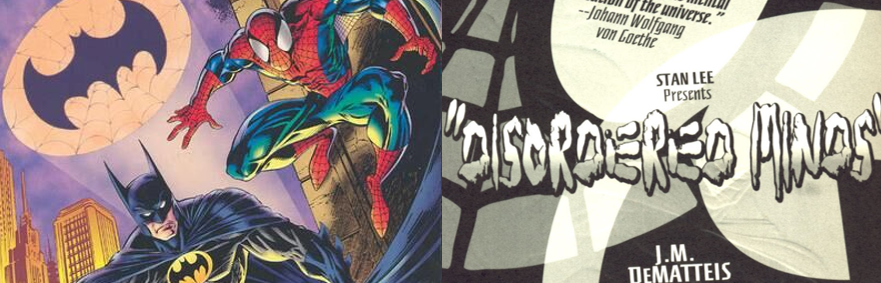
Story Title: “Disordered Minds”
Published: September 1995
Writer: J.M. DeMatteis
Artist: Mark Bagley

The Background:
You might be surprised to learn, considering they’re in direct competition with each other, that DC Comics and Marvel Comics have had a reasonably collaborative and amicable relationship over the years. Obviously, there’s been lawsuits and underhanded tactics from both, but not only were legendary Stan Lee and disreputable sham Bob Kane close friends but both comic giants borrowed from and inspired each other and they’ve even collaborated on many joint publications in the past. Having already had Clark Kent/Superman and Peter Parker/Spider-Man come to blows in Superman vs. The Amazing Spider-Man: The Battle of the Century (Conway, et al, 1976) and Bruce Wayne/Batman test his mettle against Doctor Bruce Banner/The Hulk in Batman vs. The Incredible Hulk (Wein, et al, 1981), DC and Marvel brought together their two most popular characters for the first time in this 1995 one-shot adventure. As is the case with many of these DC/Marvel crossovers, Spider-Man and Batman can fetch a pretty high price for collectors, and it also wouldn’t be the last time that the web-slinger and the Dark Knight crossed in one form or another.
The Review:
Our story begins with Peter Parker wrestling with the guilt and shame of being partially responsible for the death of his beloved Uncle Ben. In a nightmarish revisitation of the fateful night when Dennis Carradine broke into the Parker home and gunned down Ben, Peter (as Spider-Man) is on hand to strike with a furious vengeance, viewing the gunman as some maniacal monster who simply laughs at his murderous actions so hard that he eventually turns into the Joker! Peter awakens in horror, eased through the aftermath of this oft-recurring nightmare by his beautiful and busty wife, Mary Jane Watson-Parker. As ever in times of emotional crisis, Peter takes to web-slinging to help clear his head and ventures out into the night reaffirming his commitment to using his powers responsibility in order to live up to the examples set by his doting aunt and uncle. Coincidentally enough, that very same night, Bruce Wayne is also reliving the night that his parents died, gunned down in an alley in a senseless act of violence. Similar to Peter, Bruce’s dream sees him (as Batman) leaping into action, hatred for the inhumane monster boiling in his veins, and awakens to find himself, as ever, alone in his vast mansion with only his heartache and faithful butler and father-figure, Alfred Pennyworth. However, while he appreciates Alfred’s concern and loyalty, he heads out into the night as Batman without a word, determined to ensure that none should suffer as he did from random acts of violence. With our characters and their motivations firmly established, the story jumps over to the Ravencroft Institute, where Spider-Man is accompanying Doctor Ashley Kafka for a visit to the imprisoned Cletus Kasady/Carnage, who’s being held in a specially-constructed cell that keeps his violent symbiote at bay presumably using heat. The purpose of this is similar to the opening panels as Kasady simply taunts Dr. Kafka with a summary of his abusive and disturbing childhood, some of which may be true and some of which may just be another aspect of his twisted personality since Kasady is obsessed with murder, mayhem, and (quite fittingly) carnage.

Batman is less than thrilled when Spidey swings in to help after Carnage breaks free.

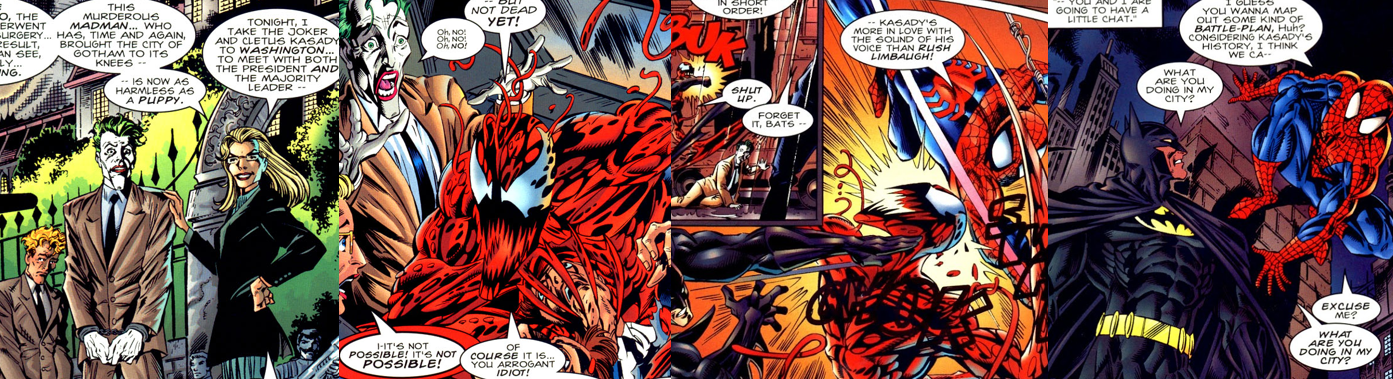
Carnage surprises both of them by breaking out of his cage, claiming himself to be a “walking impossibility” beyond logic and reason, but luckily Spider-Man and a security force led by Colonel John Jameson are on hand to subdue the serial killer with their fists and microwave guns, respectively, though newcomer Cassandra Briar proposes a far more permanent (if radical) solution to Kasady’s frequent maniacal outbursts. Utilising a “bio-technic cure” for Kasady’s insanity, Briar has a computer chip installed in his cerebral cortex, which promises to render him for more docile and stable, though Dr. Kafka likens it to the equivalent of a modern-day lobotomy and Spidey remains doubtful that it’ll stick since he’s more than familiar with Kasady’s volatile nature. Similarly, over in Gotham City, Batman puts a stop to the Joker’s latest scheme to infect millions of people with a deadly virus transmitted through bats and returns the Harlequin of Hate to Arkham Asylum (though he’s disgusted when the Joker lands a bite on him during their scuffle). There, Briar proudly shows off how meek and timid Kasady has become from her controversial treatment and uses this success as all the justification she needs to implant a similar chip into the Joker’s head, thus becoming a media sensation for rendering two of the country’s most violent and sadistic supervillains “as harmless as a puppy”. Determined to ride these successes to a wider rollout of her “miracle cure” and receive Presidential approval to eradicate psychopaths everywhere, Briar receives the shock of her life when the Carnage symbiote suddenly bursts out of Kasady’s body after shorting out her chip, taking both her and the terrified and submissive Joker hostage. Thankfully, the Batman is on hand (having disguised himself as a guard) to confront the demented killer, but his usual tactic of goading a villain into discarding their hostages in favour of him fails to work since Carnage has no interest in prioritising Batman over anyone else. Luckily, Spider-Man makes a surprise appearance to whisk Briar out of the maniac’s clawed grip and the two masked heroes take the fight to Carnage, despite Batman’s assertion that he doesn’t need the help.

While the villains’ alliance is short-lived, Batman is soon recruiting Spidey’s help in dealing with Carnage.

Regardless, the two briefly knock Carnage off balance, but he’s able to slip away by firing shards of his symbiote at the nearby cops and strangling the others with his bloody tendrils, creating an effective distraction to cover his escape. Naturally, Batman is less than thrilled to see Spider-Man encroaching on his turf, both out of a desire to keep the web-slinger from getting hurt due to his unfamiliarity with the city’s unique dangers and because he doesn’t need or want his help or him getting in the way, though Spidey naturally ignores this warning. In comparison, Carnage admits to an admiration for the Joker’s “homicidal genius [and] shameless depravity” and uses a small fragment of his suit to short out the chip and return the Clown Prince of Crime to what asses for normal. Although initially confused, frustrated, and angered at the Joker’s babbling and insolence, Carnage quickly gleefully rejoices in the Joker’s commitment to the absurd meaningless of anarchy. However, their partnership is short-lived. When the Joker takes Carnage to his secret, fairground-themed hideout to retrieve the remainder of his virus, joyfully expositing his plan to douse hundreds of Joker-themed jack-in-the-boxes with the toxin and distribute them to kids, Carnage is disgusted since it would take too long for the bodies to start piling up and he delights in getting his hands bloody from up-close-and-personal slaughter. The two come to blows over their differing methods and mentalities, with the Joker easily slipping away through a hidden trapdoor and even attempting to kill Carnage by blowing up his lair. In contrast after Batman contemplates Carnage’s unique brand of madness and sadistic nature in the Batcave and Spider-Man sees first-hand how different things are in Gotham when nobody bats an eyelid when a random civilian is screaming bloody murder in the streets, our heroes finally come together when Batman not only picks Spider-Man up in the Batmobile but even apologises for giving him the brush off.

Though pushed to their limits, Batman and Spider-Man are ultimately victorious and part as allies.

Though he has no time for Spider-Man’s quips and jokes, Batman recognises that he has unique insight into Carnage, and the two are able to track him to the wreckage of the Joker’s lair, where they find what appears to be his dead body but is, in fact, a decoy Carnage set up to trick the Joker. Delighted to have the Batman in his coils instead, Carnage plans to publicly execute Batman on top of Gotham Towers and, while comparing Carnage to Death itself, which passed him by back in Crime Alley, Batman orders Spider-Man to stop Carnage despite the threat to his life. However, it’s the Joker who actually intervenes in the tense showdown; claiming ownership over the Batman and determined to drop his virus on the four of them, killing all of them and everyone else in the city simply to spite Carnage, Kasady’s briefest flicker of fear is all the opening Batman needs to break free from his grip and leap into action. Spider-Man easily webs up the threat and, despite it taking the combined might of Spider-Man and Eddie Brock/Venom and many others in the past, the Batman is easily able to pummel Carnage into unconsciousness since, for all his powers and bloodlust, he’s simply another sloppy punk and a “scared little boy”. With Carnage subdued, Spider-Man chases down the Joker with an uncharacteristic rage; easily manhandling the Clown Prince of Crime, Spider-Man is barely able to stop himself from killing the Joker since he’s too great a threat, too dedicated to violence and chaos, to be left alive. While his better nature prevails and he ultimately spares the Joker, Spidey does deliver a knock-out punch to the cackling villain, finally bringing the story’s combined threat to an end. As if seeing Spider-Man pushed to the point of killing wasn’t surprising enough, Spidey is unusually quiet in his final confrontation with the Batman; weary from the night’s events, the two choose not to ruin the moment with words and instead part ways with a hearty handshake having found a common ground and a mutual respect through their conduct and escapades.

The Summary:
“Disordered Minds” is an interesting approach to take for an intercompany crossover. You might think with characters as wildly different as Spider-Man and Batman that the focus would be on their different methods; if Dick Grayson/Nightwing is an athletic chatterbox and the various Robins are brightly-coloured distractions to throw criminals off from Batman’s darker, more measured approach, then Spider-Man should drive the Dark Knight absolutely batty (heh!) with his constant chatter, quips, and annoying tendencies. Instead, there’s actually not much in the way of banter between the two; Spider-Man mouths off a little in the Batmobile, but that’s about it and the rest of their interactions basically boil down to Batman telling Spidey to fuck off and Spider-Man sticking around because of his innate sense of responsibility. This is a bit of a shame as I would’ve liked to see their contrasting personalities and methods more on show beyond “Gotham’s not what you’re used to sod off!” and “Boy, you’re grim” but the story does have to two united in their shared grief. Both carry a tremendous amount of survivor’s guilt, though for different reasons; Bruce was too young to do anything about his parents’ murder whereas Peter chose not to use his powers responsibly, so both are on the same path towards safeguarding others to ease their guilt and pain but have very different outlooks on the world. This comes up multiple times, with Spider-Man raging against the chaos and violence around him and Batman lashing out at “Death” and determined to rally against it however he can.

While the writing is a bit dodgy and there’s some wasted potential, the art work in phenomenal.

The art is where the story really shines; Mark Bagley is one of the top Spider-Man artists and, thanks to his work on the character and his various run-ins with symbiotes before, has more than proven himself capable of delivering a dynamic and visually exciting Spider-Man and menacing and dangerous Carnage. His Batman and Joker fare really well too, naturally, and the art is absolutely stunning all throughout even if the writing fails it somewhat. We spend no less than eleven pages recapping the origins of Spider-Man, Batman, and Carnage, which is probably great for newcomers but somewhat unnecessary for long-term readers when, normally, a simple text box sums it all up nicely. Thankfully, all of this is rendered in an interesting way through the use of nightmares and Carnage’s dramatic escape from custody, but the writing stumbles a bit mid-way through, too, since Cassandra Briar basically disappears after being rescued despite so much time being spent on her computer chip cure. I feel like a simple story about Kasady or the Joker being transferred across the country might’ve been a much simpler and faster way to get things moving since the chip is easily destroyed by Carnage and doesn’t factor into the plot beyond being a contrived way to get him and the Joker to cross paths. There’s also not a huge amount of interaction between Batman and Spider-Man; they don’t physically fight (which is unusual at the best of times but even more so for a crossover like this), join forces pretty quickly after Batman stops being irrationally stubborn, and it doesn’t really take much at all for them to defeat the villainous duo despite Carnage being so powerful that Spider-Man alone usually struggles to defeat him. there’s a promise of a twisted partnership between Carnage and the Joker but it’s almost immediately squandered simply because Carnage gets impatient, which is in keeping with his character but basically means the villains don’t actually do anything besides compliment each other, scuffle a bit, and then get taken out by the heroes. All in all, this was relatively entertaining and interesting first meeting between my two favourite comic book heroes but it didn’t quite deliver on its potential, despite the fantastic art work and some fun moments.

My Rating:

Rating: 3 out of 5.

Pretty Good

Have you ever read Spider-Man and Batman? If so, what did you think to it? Do you own a copy of the original comic or do you remember reading it when it was first published? Were you surprised that there wasn’t more time spent on contrasting the different methods and personalities of the two heroes? What did you think to the brief team-up between the Joker and Carnage the ease that they were defeated? Would you like to see DC and Marvel collaborate again in the future and, if so, what stories would you like to see? Whatever your thoughts on Spider-Man and Batman, and comic book crossovers of this kind, share them below and check out my other Crossover Crisis events!

Mini Game Corner [Robin Month]: Batman Forever: The Arcade Game (PlayStation)


In April of 1940, about a year after the debut of arguably their most popular character, Bruce Wayne/Batman, DC Comics debuted “the sensational find of [that year]”, Dick Grayson/Robin. Since then, Batman’s pixie-boots-wearing partner has changed outfits and a number of different characters have assumed the mantle as the Dynamic Duo of Batman and Robin have become an iconic staple of DC Comics. Considering my fondness for the character and those who assumed the mantle over the years, what better way to celebrate this dynamic debut than to dedicate every Thursday of April to celebrating the character?


Released: 1996
Developer: Probe Entertainment / Iguana Entertainment / Iguana Entertainment UK
Also Available For: Arcade, MS-DOS, and SEGA Saturn

A Brief Background:
It’s easy to forget now but Batman Forever (Schumacher, 1995) was a pretty big deal for Warner Bros. back in the day; not only had they sunk $100 million into the film but they were desperate to appease those who were outraged with the dark, macabre content of Batman Returns (Burton, 1992) and craft a film that would be more appealing for the sponsors. While it garnered a mixed critical response, Batman Forever made over $330 at the box office and was accompanied by a slew of merchandise and ancillary products. Like its predecessors, Batman Forever also received a tie-in videogame that marked Acclaim’s first foray into the arcade scene. However, the 2.5D beat-‘em-up was met with mostly mixed reviews but still fared better than Acclaim’s other home console adaptation of the movie.

First Impressions:
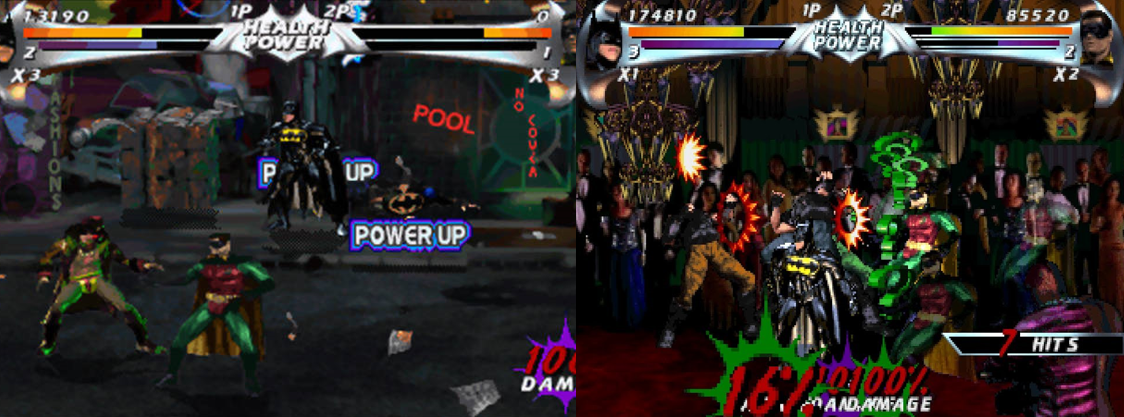
If there’s three things you can always count on with me, it’s that I’m a big fan of arcade titles, sidescrolling beat-‘em-ups, and Batman. Although I didn’t grow up with a Super Nintendo Entertainment System (SNES), emulators have allowed me to have a great deal of fun with Batman Returns (Konami, 1993), which was a cracking licensed videogame simply because it aped the formula of genre staples like Final Fight (Capcom, 1989) and X-Men (Konami, 1992). While Batman Forever had an extremely dismal and almost unplayable sidescrolling adventure game released on Mega Drive and SNES, arcades were blessed with this far more enjoyable and fitting videogame, which thankfully came to the PlayStation so I was able to snap it up (and at a pretty good price, too, all things considered). Batman Forever: The Arcade Game can be played on three different difficulty settings (Easy, Normal, or Hard), with enemies increasing in number and toughness on the harder difficulty settings, and allows you to assign yourself up to seven continues. You begin the game with three lives and, once you’ve lost all three, you can enter a high score and switch your character to return to the action once more. In terms of controls, Batman Forever is as simple as it gets: one button punches, one kicks, and one jumps and that’s it. you can customise these in the options menu and choose to play as either Batman or Robin (or both together, if you have a friend), before jumping into the game proper. There doesn’t appear to be any technical differences between the two, but they do have different animations and Robin seems to be a bit faster on his feet, but that could just my psychosomatic on my part. Right away, you’re treated to a pretty impressive in-game cutscene as Batman and/or Robin heads to the streets of Gotham City in the Batmobile, and the first thing you’ll notice is how impressive and ambitious the graphics are. The game utilises pre-rendered, 2.5D backgrounds that, while murky and a bit washed out, are immediately evocative of many of the neon-drenched, bizarre locations seen in the film, such as the graffiti-and-litter-strewn streets, Edward Nygma/The Riddler’s big gala (with partially animated guests in the background), and Harvey Dent/Two-Face’s lair among others. The playing field allows you to wander into the background, with sprites scaling accordingly, though they do lose a fair amount of graphical fidelity, becoming even more pixelated and ugly as you move about.

While the game is cluttered and chaotic, it’s full of action and fun ways to beat up thugs.

Sprites in general look decent enough; they appear to be digitised, similar to the early Mortal Kombat games (Midway/Various, 1992 to 1996), and Batman and Robin have a glistening sheen to them that makes them look like action figures. Batman looks a little goofy, with his massive chest symbol, but Robin looks pretty good; the thugs you encounter, however, are swarms of Two-Face’s goons, robots modelled after the Riddler’s fortune teller machine, and other generic beat-‘em-up mooks, none of whom have a life bar. The sheer number of enemies is pretty impressive and overwhelming, however. It doesn’t take much for you to get pummelled to death as enemies swarm around you and trap you in an unblockable beatdown, and enemies will fire guns, toss grenades, drive motorcycles and cars at you as well as spring out from the scenery. To make matters worse, Two-Face occasionally pops in, riding a wrecking ball or shooting rockets at you from the foreground, though there are times where you can swing and grapple parts of the environment to barge trough enemies. Combat is a pretty simple affair, with you mashing punch and kick to string together combos, tossing and jump-kicking enemies as you’d expect, but the game makes a big deal out swamping you with various power-ups. As you take out enemies, little Bat Symbols scatter everywhere which power-up your “Combo Meter” as well as a variety of gadgets and pick-ups: Bat-Signals, Two-Face Ying-Yangs, and Riddler Symbols appear frequently, bestowing either gadgets or temporary buffs and debuffs. When you grab a gadget, like the Batarang, grapple gun, taser, or Bat Bola, your regular attack is replaced with a projectile; the grapple gun is particularly useful for landing up to 150 hit combos on enemies and sees you swinging and flailing all over the screen, while the Batarangs can quickly rack up points and the taser and bola can stun enemies for a short time. You can also pull off a screen-clearing attack, summon bats to protect and attack enemies, and toss a stun grenade, and all of these attacks will increase in power and change their appearance as your meter builds higher. However, this can make the combat and action extremely chaotic as the screen is constantly filled with enemies, items, and your almost incomprehensible attacks, making for a very frantic and confusing experience.

My Progression:
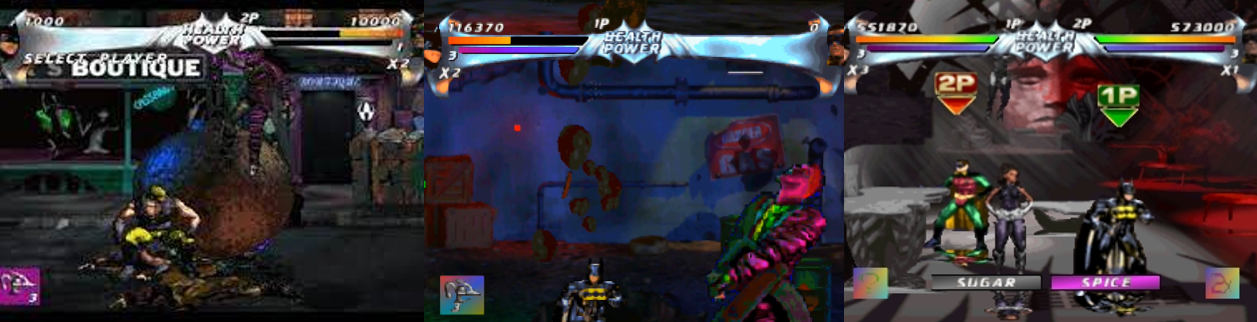
As you fight your way through the game, you can pick up and throw objects, grab the odd bit of health to sustain yourself, and will be blessed or cursed with power-ups such as invisibility, duplication, invulnerability, and shrinking you (or your enemies), among others. After clearing a stage, your score is tallied up; the more enemies you defeat and the more gadgets and such you use, the better your score and rewards. You can then pick from these rewards to start the next stage with a gadget or power-up advantage; some are merely cosmetic, like “VR Mode”, which sees enemies burst into green computer coding upon defeat, while others increase your combo by default, allowing you to build your meter faster. There are no save points, password, or checkpoints in the game, however; once you exhaust all of your continues, the game is over and you’ll need to start from the beginning, which is always a pretty shitty thing to do in a home conversion of an arcade game since its purpose isn’t to relieve you of your pocket money. All I’m saying is at least have the option to earn more lives or continues, or limit your continues on the harder difficulties and have them disabled entirely on Easy mode.

Unfortunately, I wasn’t able to save Gotham from the villains’ mad schemes…this time…

Naturally, you’ll have to battle a few bosses over the course of your playthrough, however not as many as you might think. The game is structured more to have you battle wave upon wave of the same goons over and over until you reach the end of a stage, where a boss may be waiting for you, but it’s not always the case. I didn’t fight a boss until the second stage, for example, which pits you against three slightly tougher goons: Nick, Blade, and Flex, each of which fires at you with an Uzi, tosses grenades, or throws knives at you and can block your attacks (something you’re incapable of doing). You’ll know when you’re facing a boss as they actually have a life bar and the screen flashes dramatically after you defeat them, and these three weren’t all that difficult but, again, it’s easy to get caught in a crossfire and just whittled down to nothing in no time at all. At the end of an alleyway, you’ll fight Tassel (who seems to be the neon-painted, clown-like goon who hassled Dick in the film), who’s joined by a couple of gun-and-grenade-toting henchmen and shows off a bit of flippy, martial arts skill. After battling through goons on a rooftop, you’ll be confronted by a helicopter and a seemingly endless supply of enemies; simply fend them off, dodging the chopper’s machine gun fire, and press attack to toss projectiles when prompted. Two-Face will continually pop up to fire rockets at you in the subway and at the gala, and two of the Riddler’s robots will attack you with their extendable arms to cover their escape. These then become regular enemies in a construction site full of explosive barrels, where you’ll battle Feather and Stew, with Feather proving pretty tough thanks to being very handy with his bo staff. My run came to a disappointing end in Two-Face’s lair, however, where his beautiful bodyguards, Sugar and Spice, absolutely wrecked me with their fast attacks, which pummelled me from both sides without any chance of fighting back, treating to me to a rather bland game over screen (in the Batman: The Animated Series (1992 to 1999) font, no less) informing me of my failure to save Gotham City.

I was having a pretty good time with Batman Forever: The Arcade Game once I got past the visual and sensory overload. The game includes a renditions of Elliot Goldenthal’s score and some brief sound bites from the movie, but the sheer number of enemies and chaos happening onscreen at any one time can be a little overwhelming. The game looks fairly decent, even though things can get a bit ugly and distorted at times, but the depth of combat is a little odd compared to other beat-‘em-ups; the gadgets and various pick-ups mean there’s always something happening and you can rack up big combos, but it also feels like a lot of control is being taken away from you as Batman and Robin leap into action with these big, elaborate movements at the touch of a button. Unfortunately, neither are particularly durable; your health bar can be whittled down to nothing in the blink of an eye and you’ll burn through your lives and continues in no time, with no passwords or cheat codes to make things easier for you. It’s probably do-able, maybe in two-player mode, and I’m sure I’ll return to it again as I do enjoy a bit of sidescrolling, beat-‘em-up action, but lumbering you with limited continues for a home console release always irks me and there’s not really anything to unlock or to discover outside of the main campaign, which continues basically no story and very few cutscenes (and even these are limited to the in-game graphics, impressive as they can be). I’d like to know if you’ve ever played this one, either in the arcade or at home, and how well you fared against Gotham’s colourful swarms of criminals? Which character did you prefer, and what did you think to all the gadgets and power-ups? Which licensed Batman game is your favourite? Who is your favourite Robin and how are you celebrating the Boy Wonder’s debut this month?  Whatever your thoughts on this game, and Robin in general, sign up to leave them below or share your thoughts on my social media, and check back soon for more Robin content!

Game Corner [Crossover Crisis]: Mortal Kombat vs. DC Universe (Xbox 360)


In April 1985, the first issue of the ground-breaking Crisis on Infinite Earths (Wolfman, et al, 1986) released and saw the temporary destruction of the “Multiverse”. To celebrate this momentous event, I’m discussing multiversal crossovers all throughout April in an event I dubbed “Crossover Crisis”.


Released: 16 November 2008
Developer: Midway Games
Also Available For: PlayStation 3

The Background:
Mortal Kombat (Midway, 1992) stood out from the competition at the time with its focus on gore and violence and unique digitised graphics; the game was a massive success for Midway and the first real competition for Street Fighter II: The World Warrior (Capcom, 1991) in arcades and on home consoles. However, while the franchise went from strength to strength during the 2D era of gaming, Mortal Kombat struggled to find a footing in the emerging 3D fighter arena, leading to the developers desperately trying to be innovative and appealing in an increasingly competitive business. Since Capcom had seen some success with crossovers with Marvel Comics and other fighting game developers, Mortal Kombat co-developer Ed Boon scrapped plans for a back-to-basics reboot of his violent fighting series in favour of a crossover with DC Comics. While incorporating popular DC characters like Bruce Wayne/Batman and Clark Kent/Superman had the potential to broaden Mortal Kombat’s mainstream appeal, the license carried many restrictions for the developers; Mortal Kombat vs. DC Universe was hampered by a “Teen” rating, which substantially neutered the series’ trademark violence. This, as much as anything, greatly contributed to the game’s mediocre reception; while some found the title surprisingly enjoyable, despite its bonkers premise, others found the gameplay and variety frustratingly tedious. Although the game received a “Kollector’s Edition” release, this was Midway Games’ last project before they went bankrupt and plans for downloadable content were subsequently scrapped. Thankfully, this wasn’t the final nail in the coffin for the franchise; the association with DC’ s parent company, Warner Bros, saw Midway being purchased by Warner and restructured into NetherRealm Studios, and the ultra violent was not only soon back on track but the new studio also eventually found success with the DC license in a separate series of fighting games.

The Plot:
After Raiden and Superman repel invasions from both their worlds simultaneously in their separate universes, villains, Shao Kahn and Darkseid are unexpectedly merged into “Dark Kahn” and the two universes to begin merging, with catastrophic events. With characters from both universes wildly fluctuating in power, representatives from both worlds come together to stop the merger by any means necessary.

Gameplay:
Mirroring the style and presentation of its mainline series, Mortal Kombat vs. DC Universe is a 2.5D fighting game in which players pick from a roster initially comprised of twenty fighters of iconic characters from both franchise’s and battle through the game’s single-player story mode, fight one-on-one against another player or computer-controlled opponent, battle their way through an arcade ladder, or take on a series of increasingly difficult combo challenges. By default, fights take place in a best-of-three format and against a time limit but you can alter these settings (and many others, including the game’s difficulty and the use of blood) in the game’s main options menu to speed up gameplay or make it more accessible to you. Rather than employing different fighting styles and weapon combat like its predecessors, or properly incorporate different variations like in the later games, Mortal Kombat vs. DC Universe takes a very barebones approach to combat and gameplay options: controls are fully customisable but, by default, you can throw with X or Y, kicks with A or B, toss them aside with a generic throw with Left Bumper, block incoming attacks by holding the Right Trigger, dash towards (but not away from) your opponent, jump in or crouch down to attack or avoid incoming attacks, and string together combos by quickly pressing the attack buttons alongside directional inputs. The game includes a practice mode to help you get to grips with this, and a “Kombo Challenge” feature that helps you practice the game’s tricky combo system, but you can bring up your fighter’s moves at any time by pausing the game. It has to be said that combat is quite a hurdle here; you’ll sometimes jump or dash when you don’t mean to, even when using the directional pad, jumping punches can be very floaty and often miss, and the game seems weighted in the CPU’s favour even when playing on the easiest setting as they have no difficulty pulling off some of the ridiculous combos on offer here.

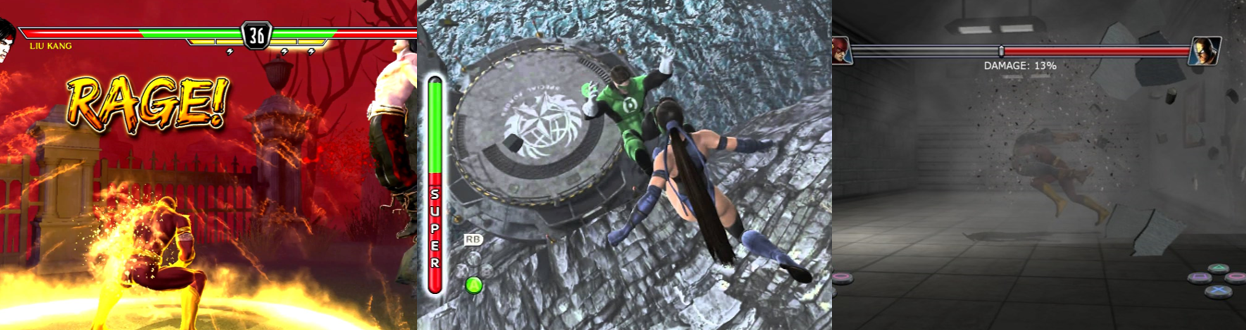
Unleash your Rage, pummel opponents in Free-Fall, or smash them through walls.

Each fighter can pull off a number of unique special moves with simple button and directional inputs (back, back, X, for example, or left, down, B); while these can be stringed together with combos, they can’t be enhanced like in subsequent games as your “Rage Meter” only allows you to pull of the ever-annoying breakers to interrupt combos and attacks when filled to the first tier and activate the game’s “Rage Mode” by pressing RT and LT at the same time. This will put you into “Rage” mode, which powers up your attacks and coats you in a glowing armour that weakens the damage you receive, shrugs off projectiles, and keeps you from being stunned or knocked over. This doesn’t last for very long but it can easily make short work of your opponent, and activating it will even see you unleash a burst of energy that knocks your foe away, so properly timing the burning of your Rage Meter can snatch victory from the jaws of defeat. The game also features a few unique gameplay mechanics: if you grab your opponent with the Right Bumper , you’ll activate “Klose Combat” mode, which sees you pummelling or breaking your opponent’s limbs with successive presses of the face buttons. They (and you) can counter these attacks by pressing the right button at the right time, and these quasi-quick-time events (QTEs) also crop up in the “Free-Fall Kombat” and stage transition moments. In some stages, you can send your opponent plummeting down to a new part of the arena; while in free fall, you can mash different face buttons to deal damage and finish them off with RB, but they’ll turn the tide against you if they hit the right buttons. Similarly, some stages allow you to charge your opponent through a way, whereupon you’re asked to “Test Your Might!” in a tug-of-way style button mashing sequence that inflicts more damage the more of the bar you manage to fill. These mechanics can be fun ways to spice up the somewhat lacklustre in-game combat and definitely open up the otherwise bland and empty arenas a bit more since you can literally smash your opponent to new areas, but they’re a far cry from the stage transitions seen in the Injustice series (NetherRealm Studios, 2013 to present).

While you can get up close and personal with foes, the dull finishing moves will leave you disappointed.

Sadly, that’s about it for in-game options; some stages very destructible elements you can smash into, and all of the game’s characters sport special moves befitting of them (Sub-Zero’s ice blast, for example, and Bruce Wayne/Batman’s Batarangs) but, since the game is hampered by a lower rating, there is very little blood and none of the gore you’d expect from a Mortal Kombat. That’s not to say that Fatalities aren’t present, however, they’re just…what’s the word..?…oh yes! Shit. Unlike in subsequent games, you can’t view your character’s finisher inputs from the pause screen, which makes finishing your opponent a real chore, but very few of these moves are even worth your time pulling off. All of the Mortal Kombat characters can execute two Fatalities that will see them murder their opponent in the most PG way imaginable; while some leave the opponent an exceptionally dry and clean skeleton, most boil down to you simply stabbing, shooting, or crushing them with very little bloodshed. The more morally pure DC superheroes will opt to finish their opponent with one of two “Heroic Brutalities”, though many of these would no doubt leave the foe severely crippled or dead since we see the likes of Clark Kent/Superman driving them into the ground and Barry Allen/The Flash pummelling them at superspeed. Unlike in previous (and subsequent) Mortal Kombat videogames, there are no mini games to distract you and is no in-game currency to earn, no player profile or fighter card to customise, and no Krypt to explore to send your coins. There aren’t even alternate skins for the fighters beyond a very minor palette swap when choosing the same character, and the best the game offers is allowing you to view bios, character models, and endings in the “Extras” menu, all of which makes for a very stripped down title even compared to its predecessor, Mortal Kombat: Armageddon (Midway Games, 2006).

While there’s not much to the arcade mode, the story mode is decent enough, if limited and tedious.

This also means that there are no challenge towers or option combat modes like “Test Your Luck” or tag-team combat to spice up multi-player gameplay; you can play locally or online (well, I assume you can’t do this latter any more) in ranked and “King of the Hill” style matches but the arcade ladder is a standard, ten-fight challenge where the extent of the game’s variety is offering you the choice between facing all Mortal Kombat or all DC Universe opponents or a mixture of the two. Mortal Kombat vs. DC Universe does, however, feature a single-player story mode but, strangely, it only allows you to play as up to eight characters from either side. After picking either the Mortal Kombat or DC Universe story, you’ll take control of a specific character and battle anywhere from three to five opponents as part of the campaign. This remains a great way to familiarise players with the vast majority of the game’s fighters and their unique combos and special moves, but you cannot perform finishing moves when playing the story mode. Although you can’t skip any of the cutscenes, or jump to specific chapters and fights after completion, you can save and quit…which is definitely something, though the game’s difficulty can become frustrating as the computer-controlled characters love to block your attacks, uppercut you out of nowhere, and jump-kick you out of the air, and can seemingly juggle you in an inescapable combo at will! Unlike in later NetherRealm Studios games, the story mode is as basic as it gets; the only time it actually tries anything remotely different is during Major Jackson “Jax” Briggs’ chapter as you’re forced to battle Diana Prince/Wonder Woman without your machine gun, which means you’re robbed of on of your ranged attacks. If you’re defeated, you have ten in-game seconds to choose between continuing and quitting, which is true of the arcade and two-player bouts as well. Unfortunately, winning or losing in two-player mode simply dumps you back to the fighter select screen and, as far as I could tell, there isn’t even a way to select your stage let alone input Kombat Kodes or activate anything interesting to make the fights less of a chore.

Graphics and Sound:
Mortal Kombat vs. DC Universe looks pretty good, for the most part; the character models are very similar to those seen in Mortal Kombat (NetherRealm Studios, 2011), meaning they hold up about as well, but some suffer more than others. Women, for example, look particularly off; sure, it’s great seeing Selina Kyle/Catwoman’s amply cleavage and Lieutenant Sonya Blade’s nipples poking through her top, but they’re all impossibly sexualised and their hair is very blocky and static. Unlike later NetherRealm Studios offerings, character’s don’t have unique intros or dialogue with each other before a fight; the camera simply pans the arena and zooms in to find the combatants ready to go and, while they do have little animations between rounds, these don’t seem particularly unique to any fighter. Post-fight animations are a little more unique, but there’s a definite lack of variety and character in each fighter which reminds me of the cut-and-paste job seen in Mortal Kombat: Armageddon (with the exception of the Joker, who dances and prances all over the place at every opportunity). On the plus side, characters do take battle damage; you’ll see their clothes rip, blood and bruises form on skin, and even uncover Scorpion’s skull as inflict damage on your opponent, which is fun, but the lack of any alternate attires or skins is a major tick in the “Con” column for this barebones title.

Stages are quite bland, but character models and cutscenes are okay, save for the poor endings.

There are some other notable little details on offer, however; when you toss Kano’s dagger at an opponent, it’ll stay stuck in their chest for a bit, you can sheath and unsheathe Baraka’s arm-claws with a press of B, you’ll see Sub-Zero’s icy breath, and there’s even a reference to Star Trek II: The Wrath of Khan (Meyer, 1982) thrown in for good measure. Another thing in Mortal Kombat vs. DC Universe’s favour, however, is that the CGI cutscenes are basically indistinguishable from the in-fight graphics; while the character models might be a little less detailed than in later games and have that action figure sheen that is common in this generation of games, it’s still impressive that there’s little distinction between the two, though the voice acting leaves a lot to be desired (the DC Animated Universe this is not!) and there’s very little to inspire you in the soundtrack, either. Similarly, stages are quite a let-down; the majority of them have this half-and-half theme going on where the DC Universe is split or merging with that of Outworld, NetherRealm, or Earthrealm but, even with that, there’s hardly anything to see or do and the stages are disappointingly bland and empty considering how big they are and the fat that you can navigate them in a 3D space. The likes of Oa, Themyscira, and the Fortress of Solitude probably stand out the most and have a few things to see in the background, but there’s a distinct and disappointing lack of Easter Eggs and visually interesting stages. Probably the most interesting one is the asteroid stage that sees you transitioning above and below thanks to the messed up gravity, but the game continues to bug me with presenting all these passable CGI cutscenes and relegating the arcade mode endings to a series of still pictures with narration.

Enemies and Bosses:
Since this is a fighting game, every character will inevitably be your enemy at some point so it can be useful to get an idea of what each one is capable of by playing through the story mode and completing their arcade ladders. However, there isn’t really too much to distinguish each character; you’ think the Flash would be faster and slippery to control compared to Liu Kang but he really isn’t and, while Jax and Billy Batson/Captain Marvel may utilise powerful grabs, they don’t feel any slower than someone like Kano or Hal Jordan/Green Lantern. Every character has a few simple combos that it’s best to learn so you can leap in, mash X three times or X, X, Y and then hit a special move or a throw to deal some decent damage, and they’re obviously made a bit more unique by their individual special moves. Characters will invariably have a projectile or some kind of range attack, a rush or grapple of some kind, and sometimes even disorientating gadgets like flash or smoke grenades. Some have more special moves on offer than others; Shang Tsung, for example, can toss flaming skulls across the screen and from above, suck his opponent’s health to fill his own, swap places (but not bodies) with them, and pull off a slide while other characters, like Batman, Sub-Zero, and the Joker, have parry moves in their arsenal that can interrupt attacks. Some characters are also a little more versatile than others; Superman can suck enemies in for a big punch, rush at them and smack them out of the air, fry them with his heat vision, freeze them with his breath, and perform flying attacks while Lex Luthor relies on his mech suit to fire missiles and blast away from danger. It’s when playing or fighting against the Mortal Kombat characters that long-time series fans will be at their most familiar: Liu Kang tosses his trademark fireballs and flying kicks, Jax grabs his foe and causes shockwaves, Kane launches himself like a cannonball, Scorpion throws his trademark spear, and Kitana uses her fans and dashes about in the air to be her usual annoying self.

Overcome the largely interchangeable fighters to chip away at the monstrous despots.

The lack of powered-up attacks, unique throws, and the generic effects of Rage Mode mean that you really don’t have to tailor your fighting style all that much against different opponents; Raiden’s abilities don’t really make him all that different from Slade Wilson/Deathstroke as both can be jumped over, ducked under, and attacked even if one has a dash and teleport and the other relies more on ranged attacks. You also won’t have to worry about any secret fighters cropping up in the arcade ladder; what you see is basically what you get but you do have to watch for characters like Sonya stringing together their multi-kick attacks in a cheap-ass combo. The exception to this comes in the form of the game’s big bad, Dark Kahn, who basically just looks like a slightly tweaked version of Blaze from Mortal Kombat: Armageddon and fights with a combination of moves from Shao Kahn and Darkseid. Dark Kahn awaits at the end of the story mode and arcade tower and is easily the biggest challenge you’ll face outside of the harder difficulties and opponents getting cheaper and more aggressive. A lumbering, monstrous foe, Dark Kahn can absorb a great deal of damage, gains armour and invincibility frames, and can drain your health bar to nothing in just a few basic swipes to say nothing of his energy barrier, shoulder charge, rising knee, and Warhammer attacks. Your best bet against him is to soften him up with ranged attacks and projectiles and stay moving; hop in, land a combo, and follow it up with a jump kick and then back away to avoid him stringing together his devastating moves in an inescapable barrage. The same is true of Shao Kahn and Darkseid, who act as sub-bosses in the arcade ladder; individually, they’re almost as formidable as their merged form, with both able to stun you with their hammer, fry you with their eye lasers, and smash you into the ground with a leaping attack. While you can’t play as Dark Kahn or perform your finishing moves on him, you can perform your finishing moves against Shao Kahn and Darkseid but, while both of these characters are unlocked after finishing the story mode (and, confusingly, pressing RB on the character select screen rather than adding them to the roster), neither of them have Fatalities of their own. Ultimately, while these three aren’t as impossible or as cheap as other Mortal Kombat bosses and sub-bosses, none of them really challenge your combat skills beyond relying on hit-and-run and spam tactics much like the previous two Mortal Kombat videogames that just ended with this hulking beast that could wreck you if given a chance rather than something that actually requires a bit more skill.

Power-Ups and Bonuses:
There’s absolutely nothing on offer in this regard in Mortal Kombat vs. DC Universe beyond the individual character’s special moves; this game is severely lacking even for a one-on-one fighter as there are no codes or options to spice up gameplay, no weapons to grab, barely anything to interact with in stages, and characters don’t even get buffs or anything with their special moves the closest they get is teleporting, surrounding themselves in a damaging aura for a bit, or tossing bombs or grenades either close, mid-range, or far away.

Additional Features:
There are fifty Achievements on offer in Mortal Kombat vs. DC Universe; many of these are obtained simply by playing through the story mode, with Achievements popping after certain chapters and completing each (and both) stories. Simpler ones are acquired by performing a ten-hit combat, initiating Klose- and Free-Fall Kombat, and performing one Fatality or Heroic Brutality. Things get a little more complicated and frustrating when you try to perform all of these moments as a handful of them require you to press up, which makes you jump and interrupts the sequence, and in trying to get the 5G Achievements from completing each character’s Kombo Challenge otherwise, you’ll get Achievements for finishing the arcade ladder with all characters and competing in online fights, which are probably impossible to get these days. These involved standard fare that you might expect, as mentioned, and you can fight locally, but beyond unlocking every character’s ending and trying to finish their Kombo Challenges, there really isn’t anything else on offer here once you’ve finished the story mode and a few arcade ladders. There’s no concept art, character models, or extras to unlock, no gear or skins or arenas to unlock, and no downloadable fighters on offer, making for an extremely barebones and lacklustre fighting title that struggles to compete against others in the genre or even its predecessors.

The Summary:  
There was a lot of promise in the concept of Mortal Kombat vs. DC Universe; after the success that Capcom had with their ventures with Marvel Comics, this could’ve been a great springboard to a more mainstream audience. Sadly the game is let-down at almost every turn: everything from the music to the visuals and the depths of the combat is just lacking, to say nothing of the additional features and options for replayability. It’s interesting revisiting this after playing Mortal Kombat ’11 since that game was supposed to be the franchise’s back-to-basics approach but it’s hard to get more barebones than Mortal Kombat vs. DC Universe. Even some of the 2D games had little extras, mini games or cheats or options to tweak the gameplay, but there’s absolutely nothing here, not even alternate skins for the fighters! The story mode is okay; it’s a paper thin excuse to mash these worlds together but it works, but I have no idea why it’s not a twenty-chapter mode that lets you play as each character from both sides. I’m actually a bit lenient on the lacklustre finishing moves; I get that the game couldn’t show spines being ripped out and flash being melted, but I think a little more effort could’ve gone into these and I really don’t like the term “Heroic Brutality”. The Free-Fall Kombat, Klose Kombat, and stage transitions are somewhat interesting, but the stages are so bland and empty that they’re completely wasted here. similarly, the lack of individuality to these colourful characters and the generic nature of their special moves and the Rage Mode really make this probably the most mediocre game in the entire franchise. Ultimately, this feels like a rushed, budget title that was hampered by pressing deadlines and financial pressure and a complete waste of the DC license. If you can get it cheap, give it a try and nab some easy Achievements, but otherwise you’re better off playing NetherRealm’s later games as this is just such a throwaway disappointment of a game.

My Rating:

Rating: 1 out of 5.

Terrible

What did you think to Mortal Kombat vs DC Universe? Were you disappointed by its use of the DC license? What were your thoughts on the game’s story and its depiction of these worlds merging? Which of the game’s fighters was your favourite and why? What did you think to the Free-Fall and Klose Kombat features? Were you disappointed by the lack of special features and the Rage Mode mechanic? Which characters or features would you have liked to see added to the game? Which Mortal Kombat and/or DC Comics videogame, movie, comic, or other piece of media is your favourite? Are you a fan of multiverse stories and crossovers? Whatever you think about Mortal Kombat vs DC Universe, eave a comment down below and be sure to check back in next Tuesday for more Crossover Crisis content!

Back Issues [Dare-DAY-vil]: Daredevil #181


Blind lawyer Matt Murdock first made his debut in Daredevil #1 in April of 1964 and was co-created by writer/editor Stan Lee and artist Bill Everett, with input from the legendary Jack Kirby. While perhaps not as mainstream as characters like Peter Parker/Spider-Man, Daredevil has become one of Marvel Comics’ greatest creations and has featured in a number of ancillary media and merchandise, included a questionably-received big-screen adaptation in 2003 and a critically-successful Netflix series. Still, he’s one of my favourite Marvel characters so today is a great excuse to pay homage to the “Devil of Hell’s Kitchen”.


Story Title: “Last Hand”
Published: 29 December 1981 (cover-dated April 1982)
Writer: Frank Miller
Artists: Frank Miller and Klaus Janson

The Background:
The 1960s were a golden age for Marvel Comics as Stan Lee teamed with legendary names like Steve Ditko and Jack Kirby to create some of comicdoms most iconic superheroes. Stan Lee and artist Bill Everett created their most challenging hero yet when Matt Murdock/Daredevil debuted on 1 April 1964, and the Man Without Fear would go on to be one of Marvel’s most popular and enduring characters thanks, in no small part, to the efforts of writer/artist Frank Miller. The then up-and-coming Miller joined the book in 1979 with issue 159 and soon took over writing duties as well as pencils; responsible not just for the creation of Elektra Natchios but penning some of Daredevil’s most influential stories. Easily one of his most memorable stories was told in this special, double-sized issue in which he made the shocking decision to kill off Elektra at the hands of Marv Wolfman and John Romita Sr’s Bullseye. Although Elektra would be resurrected (and killed again) in later years, this doesn’t change the impact of her first death and Miller’s storyline was so pivotal to Daredevil’s character that this storyline was adapted in both the live-action film and the Netflix series.

The Review:
“Last Hand” opens with Benjamin Pondexter, the assassin known as Bullseye, stewing in a prison sell on Ryker’s Island and fantasising about blowing Daredevil’s brains out; after being humiliated by the Man Without Fear time and again, Bullseye is no longer satisfied with a clean, simple kill and desires to make him suffer, to break him, to hear him scream in agony. Bullseye’s hatred is palpable and made only worse by the fact that Daredevil could have left him to die in a subway but actually saved his life, demeaning him even further in his own eyes and those of his fellow inmates. While training his body in anticipation for his eventually rematch with Daredevil, Bullseye is crippled by one of his agonising headaches; although the brain tumour he once suffered with has been fixed, he suffers from debilitating migraines and is dependent upon pills to stave off the pain, which is just one more thing he blames ol’ hornhead for. During one of his few moments of reprieve out in the yard, the shackled Bullseye has a tense confrontation with Frank Castle/The Punisher, who is currently locked up as well, who delights in taunting Bullseye with the knowledge that Wilson Fisk/The Kingpin has replaced him with a new assassin-for-hire.

Bullseye, driven by hatred for Daredevil, escapes from Ryker’s after learning he’s been replaced by Elektra!

Enraged by this, and driven to have his revenge against Daredevil, he accepts an effort to appear as a guest on Good Evening, New York; however, when he feigns a headache, he temporarily blinds an armed police officer by spitting the pill in his face and causes the cop to shoot his shackles with an errant shot, thus freeing him from his shackles. Bullseye wastes no time grabbing the downed officer’s gun, gunning down his guards, and taking host Thomas Snyde as a hostage. Bullseye shoots his way out into the yard and, incredibly, is able to throw off a sniper and commander their helicopter using little more than a pistol and a microphone cord! Although he’s eager to track down Daredevil and get his revenge, Bullseye first heads over the Eric Slaughter’s hideout for a lead on the assassin who replaced him; there, he learns that the old man’s freelance organisation is preferable to Bullseye’s more erratic and dangerous ways, and promptly beats the crap out of two of Slaughter’s men. Impressed, the old man willingly gives information the name he requires: former ninja Elektra, who has been instructed to assassinate Matt Murdock’s best friend, Franklin “Foggy” Nelson. Bullseye’s reputation is such that Slaughter fears him almost as much as, if not more than, the Kingpin and lends him the services of his men. They put together a file on Murdock and Nelson for Bullseye and he is amused to the point of hysterics at the similarities between Murdock’s pictures and Daredevil, finding the idea of a blind superhero to be hilarious.

Bullseye and Elektra’s brutal fight ends with her skewered on her own sai!

Bullseye begins following Murdock, watching him perform in court and being sickened by his good nature and humanitarianism; he literally slaps a bug on Nelson’s back so he can listen in on them and slices a taxi cab driver’s throat in order to obtain some wheels to follow Foggy’s cab. Quite conveniently, Foggy’s cab has been commandeered as well: by Elektra! Foggy just about pisses his pants when Elektra pulls over and prepares to execute him with her sai, but he saves himself when he realises that he recognises her as a girl Matt hooked up with when they were back in college. Although she falters in her duty because of her memories of her whirlwind romance with Matt, Elektra’s senses are attuned enough to hear Bullseye approach her with a pistol and she instantly springs into action: she disarms him with a leaping kick and catches him off-guard with her speed, strength, and skill. Their fight spills into a parking lot, and Bullseye uses his knowledge of ninja training to turn the tide against Elektra, matching her blow for blow but ultimately gaining the definitive upper hand when he tosses one of his razor sharp playing cards at Elektra’s throat, cutting her open and leaving her completely helpless as he grabs her and stabs her in the stomach with one of her own sais! Mortally wounded and bleeding out, Elektra staggers through the crowded streets to Matt’s flat, where she dies in his arms. Bullseye can’t help but be present when Matt and Foggy are called in to identify Elektra’s body and learn her cause of death; he heard Foggy mention that Elektra used to be “Matt’s girl” and is curious when Matt seems to stiffen up upon hearing his voice, as though he recognises him, and proves beyond a shadow of a doubt that his suspicion that Matt is secretly Daredevil is true by throwing a scalpel at Murdock’s head only for the blind lawyer to block it with his walking stick.

Bullseye ends up crippled but no less determined to one day further torment his foe.

Armed with this knowledge, Bullseye brings this revelation to the Kingpin, supporting his hypothesis with medical evidence, but Fisk finds the very idea of a blind man being Daredevil preposterous. He does, however, assign Bullseye the task of killing Daredevil and bringing him his body, so the assassin heads to Murdock’s apartment to finally have his revenge…only to be blindsided by Daredevil! Unbeknownst to Bullseye, Matt has set up a decoy of himself, which is enough to throw off Bullseye’s confidence in his hypothesis, but he’s no less eager to get into it with his hated rival. Bullseye lures Daredevil to the rooftop and adds a psychological edge to their fight by wielding Elektra’s sais; their brutal clash sees them plummet through a skylight, battle across an elevated train track, and finally come to blows on a precarious wire over the city street. Since he doesn’t have Daredevil’s superhuman balance, Bullseye slips and falls and is enraged when his foe catches him; determined not to suffer another humiliation at Daredevil’s hands, Bullseye prepares to stab his enemy with a sai but, surprisingly, Daredevil drops the assassin to the street below with the intention of ending his murderous ways. However, given that Bullseye has narrated the entire issue, you may have guessed that the fall doesn’t actually kill Bullseye; although even the Kingpin believes him to be dead, Bullseye lies fully bandage in a hotel room with a shattered spine and unable to move his limbs. However, he takes solace in having hurt Daredevil, both by killing Elektra and breaking his friend Matt Murdock’s heart, and in his hatred. Though he cannot move or speak, his hatred is as strong as ever, if not stronger, and he vows to find his way back and continue hurt Daredevil until he’s finally dead.

The Summary:
“Last Hand” is certainly a unique Daredevil tale for a few reasons: first and foremost, it’s told entirely from Bullseye’s perspective. Right from the first panel, we’re let in on the twisted, hate-filled internal monologue of one of Daredevil’s most notorious foes and he’s portrayed as a sick, remorseless, calculating villain throughout. Taking a perverse pleasure in toying with and killing his victims, Bullseye is dangerous and lethal with even the most harmless of everyday objects; while his hatred towards Daredevil is great, this never clouds his judgement or ability; instead, he’s surprisingly observant and conniving, able to deduce that Matt and Daredevil are one and the same to the point where he absolutely nails everything about the Man Without Fear’s origin to the smallest detail, only to be met with scorn from the Kingpin and successfully duped into disregarding his theory thanks to Matt’s trick. Interestingly, though, Bullseye’s crippling headaches don’t factor into the story at all once he’s out of Ryker’s; you’d think that maybe this is what would cause his downfall in the end, but this plot point is completely forgotten once he’s garbed in his familiar outfit and back on the streets, as though finally returning to action cured his debilitating pains.

This is Bullseye’s story, and he not only changes Matt’s life forever but almost figures out his dual identity!

Another way this story stands out is just how little Daredevil actually appears in it; when we do seem him, it’s either through Bullseye’s memories or as a quick flash over to Murdock’s daily routine as a parallel to Bullseye’s time in prison. Thanks to Bullseye’s constant narration, Daredevil is seen as a stoic and grim vigilante, a far cy from his wise-cracking debut, one who is as focused and formidable at fighting as Bullseye. When we do see Matt and Foggy, they’re painted as “saps”; the kind of do-gooders who sicken Bullseye and he only takes an interest in them because they can lead him to his replacement and when he suspects that Matt is Daredevil. We learn very little explicit information about how Elektra’s death impacts Matt; since we are never privy to Matt’s thoughts beyond the few words he says in the story, the entirety of his emotions is told through the artwork. This is strikingly effective, as entire fight sequences and panels pass without any text, and Matt’s morose pain and rage are expertly conveyed in his no-nonsense approach to engaging with Bullseye. It’s also quite interesting seeing the Kingpin outright dismiss the idea of blind Matt Murdock being Daredevil; in time, Fisk would learn that this was actually true and set in motion an aggressive campaign to physically and mentally destroy his foe, but it’s amusing to see just how close he (and Bullseye) came to the truth only for it to be sacked off as being patently ridiculous. Sadly, we don’t really get much insight into Elektra here; like Daredevil, she’s a person of few words, and all of her emotion and turmoil is told through her facial expressions and her fight sequences, which paint her not just as a conflicted and formidable individual but, ultimately, as a victim of Bullseye’s sadistic lusts.

Bullseye pushes Matt to the limit, and sets him on motion towards a dark and destruction path.

Finally, the issue stands out by having a major character being so brutally killed off. There’s a case to be made that Elektra, a trained ninja assassin from birth, should have been able to best Bullseye in their fight but I think the story does a decent job of putting them on equal ground thanks to the emotional blow of suddenly being reminded of Matt and Bullseye’s trick cards. The panel of Bullseye skewering Elektra will forever be iconic, no matter how many times she returns from the dead, and seeing he stumble across town to be with Matt in her final moments was truly heart-breaking. It’s clear from Matt’s stoic expressions that he’s in great pain at her loss, and seeing him launch into an all-out assault when Bullseye brandishes his former lover’s weapons conveys just how personal this fight is for Daredevil. Indeed, it drives him to critically injuring Bullseye; Daredevil’s promise that Bullseye’ll “kill no one – ever again!” could be taken two ways, I believe: either Matt intended for the fall to kill the assassin, or he aimed to cripple him as the final panels show him to be. Either way, it’s a pretty dark place for Daredevil to go and shows just how sour and morally questionable his life as Daredevil can be at times. Overall, this is definitely a pivotal story in Daredevil’s long history and well worth a read for fans of the character, or those who want to explore him further, but maybe it suffers a little from not seeing things form Matt’s perspective; obviously, subsequent issues would delve into this in great detail but it might have been interesting to switch back and forth between Bullseye and Daredevil’s inner thoughts just to get a sense of what’s going though Daredevil’s mind.

My Rating:

Rating: 3 out of 5.

Pretty Good

Have you ever read “Last Hand”? Were you a fan of Elektra and, if so, what did you think to her death in this issue? What did you think of the story being told entirely from Bullseye’s perspective? Did you enjoy the fights in the story or do you think Elektra was given the shaft? Would have liked to see Daredevil’s thoughts in more detail? What do you think of Daredevil as a character and which storyline of his do you think is the best, or the worst? How are you celebrating Daredevil’s debut this year? Whatever you think about Daredevil, sign up to drop your thoughts below or leave a comment on my social media.

Back Issues [Deadpool Day]: The Circle Chase


In February 1991, readers of The New Mutants were introduced to Wade W. Wilson, AKA the wise-cracking, fourth-wall-breaking Merc With a Mouth himself, Deadpool. Rob Liefeld and Fabian Nicieza’s sword-swinging immortal went on to become one of Marvel’s most popular anti-heroes thanks to his metatextual humour, violent nature, and massively successful live-action films. It’s perhaps no surprise that Sideshow rechristened April 1st as “Deadpool Day” to give fans of the chimichanga-chomping mercenary an excuse to celebrate all things Deadpool.


Writer: Fabian Nicieza – Artist: Joe Madureira

Story Title: “Ducks in a Row!”
Published: 15 June 1993 (cover-dated August 1993)

Story Title: “Rabbit Season, Duck Season”
Published: 20 July 1993 (cover-dated September 1993)

Story Title: “…And Quacks Like a Duck…”
Published: 17 August 1993 (cover-dated October 1993)

Story Title: “Duck Soup”
Published: 21 September 1993 (cover-dated November 1993)

The Background:
By the 1980s, the X-Men had established themselves as one of Marvel Comics’ most successful features, prompting then-chief editor Jim Shooter to commission a series of X-Men spin-off titles, resulting in Chris Claremont and Bob McLeod’s New Mutants. The Mutant youngsters eventually fell under the command of the time travelling Mutant Nathan Summers/Cable, who reformed them into X-Force, and famously came up against Fabian Nicieza and Rob Liefeld’s Deadpool in The New Mutants #98 (ibid, 1991). The self-styled “Merc With a Mouth” was heavily inspired by the likes of James Howlett/Logan/Wolverine and Peter Parker/Spider-Man with more than a few similarities to DC Comics’ Slade Wilson/Deathstroke the Terminator and was initially introduced in an antagonistic role with ties to time-travelling villain Mister Tolliver. Deadpool proved popular enough to make guest appearances in other Marvel Comics before receiving this four-issue miniseries that was a precursor to his ongoing solo title and the greater popularity he achieved once he became self-aware and began breaking the fourth wall. Naturally, this eventually evolved into appearances in Marvel/X-Men-related videogames, a cameo appearance in the beloved X-Men animated series (1992 to 1997), and his live-action debut in the much-maligned X-Men Origins: Wolverine (Hood, 2009), though it was his self-titled spin-off films that truly catapulted him to mainstream success.

The Review:
Deadpool’s first solo series begins in Sarajevo, Yugoslavia two years into an ongoing conflict that has made it a breeding ground for international black marketeers and mercenaries, including a heavily-armed group who have been given the unenviable task of searching out and eliminating Deadpool. Unfortunately for them, the Merc With a Mouth catches them completely off-guard, easily dispatching them while mocking them for being less effectual than G. I. Joe’s or Ken dolls. Despairing of the quality of mercs he’s encountered ever since Tolliver died, Deadpool is offended when his friend and contact, Jack Hammer/Weasel, pulls a gun on him. still, Deadpool is so scatter-brained that he quickly moves on from the misunderstanding to first complain that his suit’s teleportation function is “on the fritz” and the fact that he (and anyone who ever worked for Tolliver) now has a target on their back. Weasel tries to suggest that they (or, at least, Deadpool) should try and get their hands on Tolliver’s estate and weapons, but Deadpool’s more focused on getting intel on Vanessa Carlysle/Copycat, a shape-shifting Mutant and former flame of his who he’s looking to kill off, when they’re suddenly interrupted by one of the most nineties-looking characters I’ve ever seen (which is saying something considering Deadpool’s attire), Garrison Kane/Weapon X, a cybernetic mercenary who was both part of the same Weapon X program as Deadpool and a member of Cable’s Six Pack when he was working for Tolliver.

Deadpool is hounded by mercenaries and former allies who all want him dead.

Kane also wants to know where Vanessa is and attacks, easily shielding himself from Deadpool’s blade and bullets with his versatile cybernetic enhancements. Shrugging off Wade’s jokes and insults, Kane mocks him for betraying his mercenary code and allowing so any of his former enemies and allies to live, but it’s only when Weasel points out that neither of the two beefed-up idiots knows where Vanessa is and they’ve simply being fighting over nothing and as a result of their stupidity and machismo. Admitting to acting without thinking, Kane tries to leave, determined to make an offer to Vanessa before she’s killed (since she’s one of the prime targets in the whole will fiasco), and drops the bombshell that another of Wade’s former adversaries, Gregory Terraerton/Slayback, is not only still alive but is actively gunning for Deadpool, the man who left him for dead way back when. As if on cue, the cybernetic killer breaks into the headquarters of Department X (the government agency behind the Weapon X program) to steal Wade and Kane’s files in order to settle the score and, as if that wasn’t bad enough, the story also jumps over to New Delhi, India, where Wolverine knock-off Nyko Halfghanaghan guns down mercenaries looking for Tolliver’s will (his dead brother, Pico, was Tolliver’s right-hand man so they assume he must know something about it) before delivering a work order to Jacob Gavin Jr./Courier calling for Deadpool’s execution for his part in Pico’s death. Finally, there’s a third plot thread at work here as Cain Marko/The Juggernaut bursts into a genetic research facility outside of Angoulême, France in search of his friend, Thomas Cassidy/Black Tom Cassidy (a common occurrence during this time as the two had formed a strong friendship). Louis Banque, the director of the facility, manages to calm Juggernaut down enough to take him to Black Tom, who’s been enhanced through further mutations that allow him to form weapons, reshape his body into an organic wood substance, and focus and intensify his bioblasts through that same “wood gunk”. This storyline converges with Deadpool’s when issue two drops Wade into Cairo, Egypt where he executes another group of mercs to acquire a briefcase containing a disc that holds information on Tolliver’s will (if that sounds like some kind of mental scavenger hunt, it actually is as per Tolliver’s design, with the ultimate prize being “the most powerful weapon on the face of the planet!”) Anyway, just as Deadpool gets the case, Juggernaut and Black Tom show up, wreck the building he’s standing on, and then blast Deadpool in the back of the head to steal the case from him.

Deadpool is outraged when Commcast “violates” his mind while searching for Tolliver’s will.

Meanwhile, another former member of Weapon X, Bernard Hoyster/Sluggo, drops in on Vanessa’s mother in search for her and ends up garrotted around the neck by the blue-toned shape-shifter, who’s looking to avenge the death of her friend, Tina Valentino, at Sluggo’s hands. Vanessa settles for stealing Sluggo’s car and leaving him to be arrested after learning that she’s become a target in the search for the will and vows to head to Sarajevo to acquire it, and Tolliver’s fortune, for herself. However, when Courier procures the services of Garabed Bashur/Commcast and the Executive Elite, he offers not money, but Tolliver’s disc and thus a head start in the scavenger hunt. Unaware of this, Deadpool heads to Cairo International Airport using Weasel’s intel and a fight ensures between him and Juggernaut and Black Tom (in civilian guises) that sees Marko hand over the briefcase to save Tom from being sucked out of the plane, only for Wade to trick him and send both plummeting to the ground below while he returns to Sarajevo for issue three. There, he gets into it with Amie Zamborano/Makeshift and Anastasia Summit/Rive of the Executive Elite; disgusted by Deadpool’s sexist jeers, the two pin him to a wall and fry him into unconsciousness with a massive burst of electricity. This makes him easy pickings for Commcast to haul back to the Edsel and subject him to the torture of his “synaptic neural scanner”, a fancy high-tech headband that allows Commcast to scan the thoughts and memories of his victims. Though Deadpool attempts to resist, this sheds some light on his past with Vanessa, depicting them as lovers back before he was mutilated by the Weapon X program, and shows how Kane tried to emphasise the benefits of cybernetic prosthetics when Wade was diagnosed with terminal cancer. After revealing that there are actually two discs that act as a guide towards Tolliver’s will, Commcast rips off Deadpool’s mask, revealing his gruesome visage to everyone but the reader, distracting them enough for Weasel to make a dramatic entrance and break Deadpool free. Incensed at Commcast poking around in his head (which he unironically sees as a “violation” despite his mercenary ways), Deadpool goes on a rampage, destroying his facility and killing Makeshift and Rive (but it’s Weasel who delivers the fatal headshot to Commcast). Weasel then examines the two discs and learns of a monastery in Nepal, which he theorises is the location of Tolliver’s will, and of an “ambient-energy dampening” genetic monstrosity known as “Unit: Zero” that he assumes is guarding it.

After Slayback is atomised, Deadpool proves he’s more than just a killer…and makes out with Tolliver’s treasure!

Thanks to her shape-changing and mild mind control abilities, Vanessa is also able to learn of this monastery through alternative means but, when she makes the climb to the building, she’s surprised by Slayback and effectively taken hostage. Although Deadpool insists on heading in alone, Weasel makes the four-storey rope climb to offer his assistance in the arc’s final issue, and Kane also manages to make his way there so that all the loose ends can be nicely tied up. Thanks to Weasel, Deadpool discovers a locked vault packed full of weapons, gadgets, and other gizmos set aside by Tolliver, which leads to another scuffle with Kane when he comes looking to claim Tolliver’s secret, all-powerful weapon for himself. Although Deadpool is all mouth when it comes to Kane, he’s thrown into a panic when Slyback makes it a three-way dance since he didn’t just see Slayback die, he saw him reduced to little more than a bloody goop! Thanks to his cybernetic enhancements and burning desire to avenge himself, Slayback easily overwhelms Deadpool but, as he moves to deliver a fatal blow (despite this being impossible against Wade thanks to his superhuman healing factor…), Vanessa sacrifices herself to save her former love. During all of this kerfuffle, weasel realises that a seemingly innocuous mannequin is actually the Zero unit (or “Adam Unit-Zero”, to be precise) and Tolliver’s ultimate weapon, an energy-absorbing synthezoid built to eliminate all weapons of war. Consequently, it identifies Slayback as such and reduces him to cinders, atomising him in a blinding flash of light. While it settles for similarly destroying Weasel’s armaments and evaluates that Kane has a “strong inclination towards socially beneficial behaviour” [sic] despite his capability for lethal force, it classifies Deadpool as a weapon of war and moves to nullify him accordingly. However, in keeping with his reputation as the “Merc With a Mouth”, Deadpool is able to stall the machine by rationalising that he’s not just capable of killing but healing too. He then demonstrates this by having Vanessa touch his horrifically scarred body to absorb his healing factor and thus heal her mortal wounds, confusing Adam and causing it to teleport away to conduce further analysis. Although she’s grateful, and touched that he still loves her, Vanessa turns him down since she loves another and tearfully begs him to move past his cancer, his past, Tolliver, and even himself so he can find something worth fighting for again. Though heartbroken, Wade consoles himself with the knowledge (as amusingly expositing by Weasel) that he showed he can be more than just a brutal killing machine, and by swiping some of Tolliver’s gold for himself so the mission wasn’t a complete loss.

The Summary: 
In many ways, The Circle Chase suffers from a lot of the problems I often have with X-Men stories, particularly those from the team’s heyday in the nineties; stories were often crammed full of characters, lore, and interweaving plot threads that made single issues and even ongoing story arcs difficult for me to pick up and read since it was hard to keep track of everything going on. We’ve got Deadpool, Vanessa, the Juggernaut and Black Tom, Weasel, Garrison Kane, Slayback, Commcast, the Executive Elite, the complex search for Tolliver’s will and numerous references to him and his minions…it’s quite a bit to take in all at once. Thankfully, the art is pretty good; while much of the action takes place at night or in darkened interiors, all of the characters are very colourful and stand out thanks to that nineties excess of bulging muscles, ridiculously excessive guns and technology, and hyper sexualisation of female characters and bodies that was so rampant during this time.

Deadpool’s chatter mouth and questionable past are a highlight of the miniseries.

The writing is also really good, particularly in terms of dialogue and in characterisation Deadpool. Wade more than lives up to his loquacious reputation here and is constantly spouting nonsense, pop culture references, and getting distracted with tangents in the heat of battle. He taunts his opponents to the point of frustration, which is always amusing, and offers relentless amusing commentary throughout the miniseries. Deadpool’s skills are at their peak here and he’s easily able to take out the many run of the mill mercenaries he comes up against; the more prominent mercs from the Executive Elite manage to subdue him (mainly to advance the story, put some spotlight on Commcast, and subject Deadpool to his mind reading device so we can learn a little more about him) but even this is just a temporary setback and he immediately enacts a bloody revenge upon being freed by Weasel. Interestingly, the final issue delves a little into Wade’s complex mindset; while he hides behind his near-psychotic persona and smart mouth, he’s actually a very tortured individual, one suffering from hideous scars as a result of his healing factor constantly staving off the cancer that threatened his life. Wade is also rattled into an uncharacteristic panic by Slayback’s survival and appearance and a prominent plot point being Wade’s rejection of the notion that he actually enjoys killing and is a mindless sadist like Slayback. This is ultimately proven to be true in the finale, where he uses his healing factor to restore Vanessa and reject the notion that he’s nothing more than a weapon of wear, which allows him to neuter Adam-Zero’s threat which along with his heartbreak over having lost Vanessa’s love, goes a long way to injecting some humanity into this otherwise volatile and unstable mercenary. While The Circle Chase may be bulging with colourful characters, Mutants, and cybernetic antagonists, the core villains are actually surprisingly interesting. It seems as though everyone in the story has a connection to Deadpool, mostly through either Weapon X or the Six Pack (or both), and almost everyone has an axe to grind against him (even Weasel, the closest thing he has to an ally, is constantly exasperated by Wade’s instability and childish nature).

There’s quite a bit going on, but the characterisations and art work make it an entertaining read.

Having said that, the Executive Elite are basically a throwaway distraction that exist mostly to pad the story out with a bit more action, intrigue, and exposition, but Commcast almost makes an impression as a kind of dark mirror of Professor Charles Xavier by using his technology to violate Deadpool’s memories and he even has an “X-Men” team of his own in Makeshift and Rive. Garrison Kane is even more of a wild card than Deadpool himself; he’s something of a reluctant ally but doesn’t hesitate to throw down against his former teammate simply because he acts “like an idiot” when it comes to Wade due to their history together. With his glowing eye and bionic arms and armaments, he’s kind of like a poor man’s Cable, which is fitting given their history together, and ends the story on slightly better terms with Wade than they began due to their shared concern for Vanessa. Vanessa is also a significant factor in the miniseries, primarily as one of the main targets for Tolliver’s will and as Deadpool’s lost love, though she doesn’t get a huge amount of agency; she is able to string up Sluggo and find her way to the monastery without the discs but, once there, she’s held hostage by Slayback and then nonsensically throws herself in front of Deadpool despite him being able to heal from any wound. As for Slayback…I’ve never heard of this guy, but I actually really enjoyed him! His zombie-like appearance and malleable cybernetics (which give him an extensive reach and even a drill appendage) make him a fearsome foe and he’s written with this biting, British wit that adds a lot of character to him. the parallels between him and Deadpool kind of come out of nowhere in the last chapter but I liked that his appearance rattled wade so much that it put him on the back foot, and it was interesting seeing wade think (well, “talk”, really) his way out of being atomised by Adam-Zero like Slayback was. Overall, I really enjoyed this miniseries; it was a little bloated at times but bat-shit-crazy in all the ways I enjoy about a character like Deadpool. While Wade isn’t being as self-referential or meta as he is now known for, all the foundation for the characterisation is here and the miniseries went a long way to justifying his later mainstream success.

My Rating:

Rating: 5 out of 5.

Fantastic

Have you ever read The Circle Chase? If so, what did you think of the story and the Deadpool’s first solo foray? Did you enjoy the bloated cast of colourful characters and their ties to Deadpool’s past or was it all a bit too crowded for you? What did you think to Deadpool’s characterisation here, the glimpses into his past and motivations, and his snarky with? Were you a fan of Slayback, Vanessa, and the likes of Garrison Kane or is there another of Deadpool’s villains you prefer? What are some of your favourite Deadpool stories and moments and how are you celebrating Deadpool Day today? Whatever your thoughts on Deadpool, feel free to sign up and share them below or drop a comment on my social media.