Movie Night: South Park: Bigger, Longer & Uncut

Released: 30 June 1999
Director: Trey Parker
Distributor:
Paramount Pictures/Warner Bros.
Budget:
$21 million
Stars:
Trey Parker, Matt Stone, Mary Kay Bergman, and Isaac Hayes

The Plot:
After seeing the new Terrence and Philip movie, the kids of South Park cause controversy when they freely spout a whole slew of new swear words and profanity. This leads to Kyle Broflovski’s (Stone) mother, Sheila (Bergman), becoming so outraged that she pushes for all-out war against Canada! However, the situation escalates when, after dying, Kenny McCormick (Stone) uncovers a plot between Saddam Hussein (ibid) and Satan (Parker) to use these events as a catalyst to bring an age of darkness to the entire world!

The Background:
Back in 1992, Matt Stone and Trey Parker created a crude animated film using only glue, construction paper, and an old 8mm film camera. After being commissioned to create a follow-up short, the pilot episode first aired on this day in 1997 and a full series soon followed, which saw the duo joined by a team of around seventy employees. The duo also switched to replicating their cardboard cut-out style with computers, and the popularity of the show’s first season led to discussions of a feature-length production in 1998. Right off the bat, Stone and Parker made it clear that a feature-length film would have to be R-rated and eventually got this wish even after studio executives tried to sway them to tone things down. The filmmakers used a variety of additional computer effects to help the film stand out from its television counterpart, something further bolstered by the duo’s decision to make the film a musical, though production was made tense due to several battles with producers and executives regarding the film’s tone and marketing. Despite its vulgar humour, South Park: Bigger, Longer & Uncut released to widespread critical praise and earned over $83 million at the box office, making it the highest-grossing R-rated movie until it was knocked from its perch about sixteen years later.

The Review:
Man, I was so hyped for this film as a kid; funnily enough, though, I don’t actually remember if I knew that it was a musical until I was sitting in the cinema with my friend and the opening sequence started. As surprising as this may have been, it definitely didn’t put me off and only added to the film’s charm. Considering how popular and notorious South Park was when the film released, it’s unlikely that many audiences went into it without at least some knowledge of the show, its crude humour, and its colourful cast of characters and yet the film helpfully introduces us to the snowy, quiet, and apparently unassuming town with its opening song (“Mountain Town”) and by having Stan Marsh (Trey Parker) tour through the streets recruiting his friends to the cinema event of their lives, Terrance Henry Stoot (Matt Stone) and Phillip Niles Argyle’s (Parker) Asses of Fire. Fans of the show will remember Terrence and Phillip from the season episode “Death” (Stone, 1997), which actually contained a similar sub-plot to this movie; the duo (sometimes depicted as crudely animated cartoon characters) are a couple of vulgar Canadian comedians known for foul language and toilet humour but they’re heroes to the South Park kids.
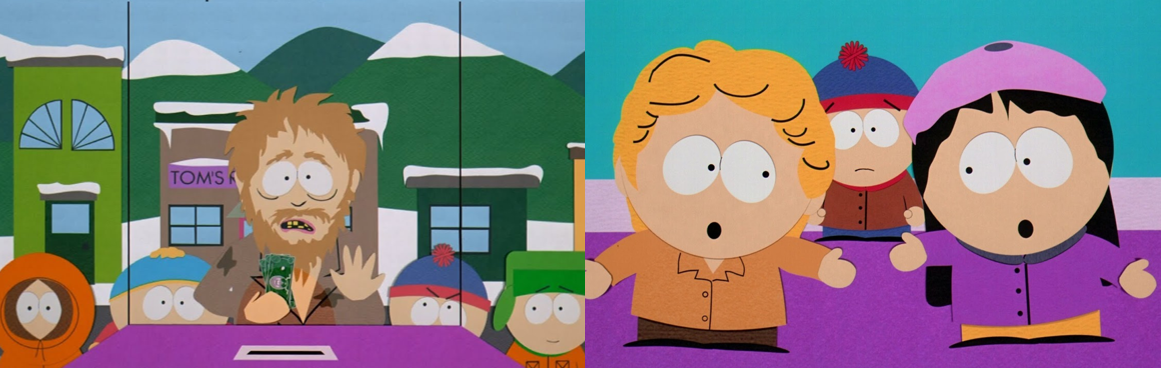
The kids pick up some new curses but Stan is preoccupied by Wendy’s new flame.

This opening song not only introduces the four main characters but also sets up many of the themes of the movie; Stan’s mother, Sharon (Bergman), sings about Stan’s pure-hearted innocence, Kenny’s mother, Carol (ibid), chastises him for skipping church to see the film and warns him that he’ll have to answer for Satan for his actions, and Kyle’s overbearing and controlling mother forces him to not only lie about where he’s going to avoid upsetting her further but to also take his adopted baby brother Ike (Various) along with them. Of course, Eric Cartman (Parker) doesn’t have to worry about his mother, his family, or money troubles like his friends since he emotionally manipulates his kind-hearted and doting mother, Liane (Bergman), with his callous and demanding persona but even he can’t get past the movie rating laws that forbid them from seeing Asses of Fire due to being underage. Stan, however, bribes a homeless man to pose as their legal guardian and get them into the film, which is a typical nonsense Terrence and Phillip affair of fart jokes and baloney but with the added bonus of including a whole new array of uncensored swear words and insults for the kids to pick up (“Uncle Fucka”). While the adults in the audience are horrified by the vulgarity, the kids are captivated and waste no time in impressing their fellow kids with their new vocabulary. Stan, however, is disheartened to find his long-time crush and on-again/off-again girlfriend, Wendy Testaburger (Bergman), has latched on to newcomer Gregory (Parker), an eloquent and sophisticated transfer student who appeals to her sensible and rational mindset.
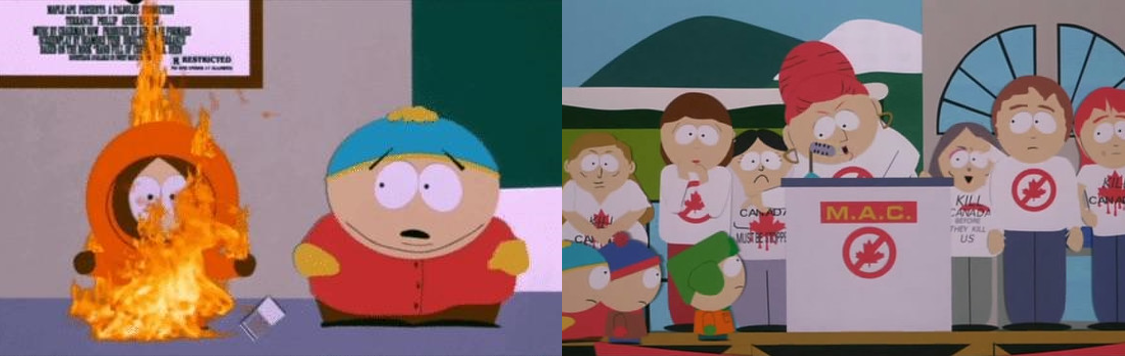
Following Kenny’s death, Sheila rallies the town against Canada and their vulgar humour.

To try and win her back, Stan goes to Jerome McElroy/Chef (Isaac Hayes) for advice but the smooth-talking womaniser accidentally informs him that the best way to make a woman like him is to “find the clitoris”; since Stan is too young to understand this, he believes that this is more of a spiritual quest and begins a sub-plot revolving around him trying to decipher Chef’s words and win back Wendy’s affections. Thanks to the kids, though, the rest of their class bribes their way into Assess of Fire and, before long, they’re all singing and quoting lines from the film (with the exception of the sensible Gregory and Wendy). Stan, Kyle, Cartman, and Kenny’s blatant use of swears horrifies their teacher, Herbert Garrison (ibid), and sees them sent to the school councillor, Mister Mackey (ibid), and lands them in hot water with their mothers. Although Mr. Mackey tries to dissuade the children from swearing (“It’s Easy, M’Kay”) and the school places a ban on Terrance and Phillip apparel, the kids continue to sneak into the film at every opportunity and Asses of Fire becomes a huge hit all across the country despite concerns that its content is ruining America’s youth. This all comes to a head when the kids try to recreate a scene from the film and, in the process, Kenny burns himself to death trying to light his fart. For Sheila, this is the final straw; not only do the mothers ground their kids for two weeks but she takes her opposition to the movie, and all of Canada, to the next level by reorganising the Parent/Teacher Association into Mothers Against Canada (M.A.C.) and vehemently opposing any and all Canadian products and imports in the town (“Blame Canada”).
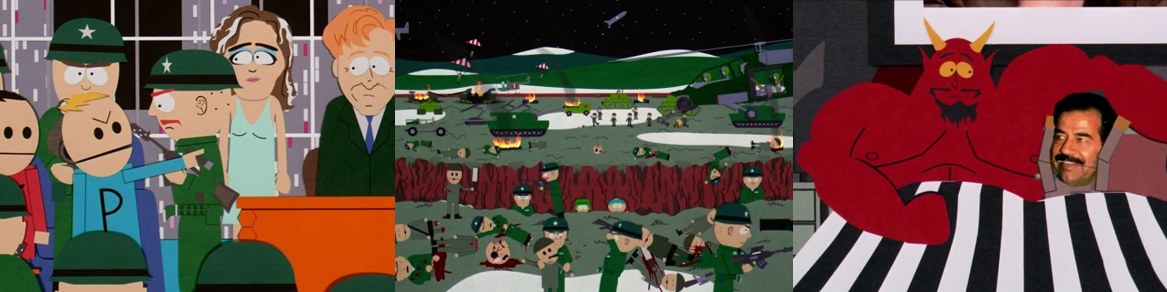
The arresting of Terrence and Phillip and war against Canada turn out to be signs of Satan’s return.

After paying off Conan O’Brien (Brent Spiner), Sheila then has Terrence and Phillip arrested for corrupting America’s youth; when the American ambassador (Stone) refuses to let the duo go and insults his Canadian counterpart (Parker), Canada responds by bombing and killing the Baldwin family and before long an all-out war between America and Canada is declared, with Sheila positioned as President Bill Clinton’s (ibid) chief advisor and Terrence and Phillip set to be executed as war criminals. While Kyle is angered at Cartman’s views on his mother (“Kyle’s Mom’s a Bitch”), the kids agree that they have to do something to stop their mothers and the war (“What Would Brian Boitano Do?”) and so unite the town’s kids under the banner of “La Resistance”. While they struggle to come up with a practical plan, Gregory leads them to Christophe/The Mole (Parker), who helps them to infiltrate the United Service Organisations (USO) show where the duo are set to be executed. Their motivations are only bolstered when Cartman is visited by Kenny’s ghost, who warns that this is all playing into an age-old prophecy that will allow Satan to rise up and bring devastation to the world. Having been denied entrance into Heaven, Kenny’s soul is cast down to the fiery depths of Hell where he finds Satan in a toxic relationship with former Iraqi dictator Saddam Hussein. While Satan is trying to focus on his opportunity to finally have his time in the sun (“Up There”) and wants more from their relationship, Saddam is an egotistical and self-centred schemer who’s focused only on sex. Although Kenny tries to convince Satan to leave his abusive partner, Saddam is easily able to emotionally manipulate Satan’s good nature (“I Can Change”) and, when the war culminates in Terrance and Phillip’s deaths despite the best efforts of La Resistance, he immediately usurps Satan’s position to steal the spotlight as the new dark ruler of the world.

The Nitty-Gritty:
As you might expect from South Park, the film is full of crude humour, sight gags, and ridiculous jokes; we see this right from the start as Cartman accuses Terrence and Phillip of having crappy animation and the kids are immediately seen jerking along in stilted movements. Cartman shines even brighter during his big solo where he complains about Kyle’s mother, his little gag with the microphone where he tells Mr. Garrison to suck his balls never fails to amuse, and he even absurdly tries to beat Kenny’s flames out with a stick! Kenny’s botched operation is similarly hilarious as Dr. Gouache (George Clooney) and his attendants slice his charred corpse up, beat him with a hammer, and accidentally replace his heart with a baked potato! The film also dips into comical satire with the “March of War” promotional video, Kyle randomly tapping keys on his computer to “re-route the encryptions” and get a message to the town’s kids (Cartman’s insistence on advertising that they’ll have punch and pie is a riot), and while Chef only has a small role he’s perfectly placed to lampoon the army’s notorious racism. Although created solely for the film, Christophe proves to be a true highlight; a foul-mouthed atheist with a dodgy French accent, the Mole provides some of the best and most absurd lines of the film with his rants about God, his mother (who stabbed him with a coat hanger while still in the womb!), and his “butt for” gag that are matched only by the wacky levels of blood and violence during the final conflict between the American and Canadian armies.
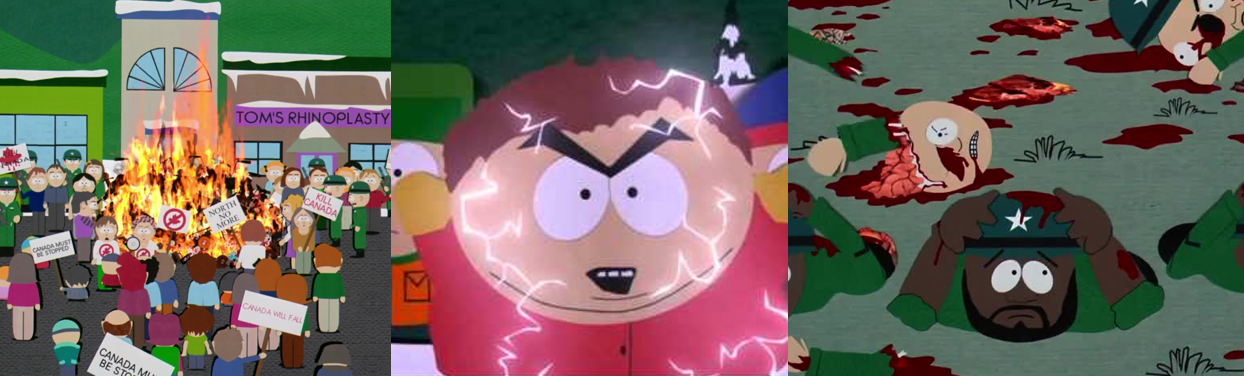
M.A.C.’s campaign against Canada quickly escalates to bigotry, a special chip, and all-out war.

In true South Park fashion, the reaction to a vulgar film is suitably over the top and comical; all of the town’s adults are outraged that their children have become “corrupted” by Terrence and Phillip and resort to more extreme measures when their attempts to ground their kids fail. In addition to burning all Canadian paraphernalia and causing all Americans of Canadian descent and blood to be sent to death camps, M.A.C. employs the services of Doctor Vosknocker (Eric Idle) to create the “V-chip”, an electronic device that is implanted into Cartman against his will and delivers a painful electric shock any time he speaks a swear word. As if these extreme methods weren’t bad enough, Sheila’s commitment to opposing the vulgarity of Asses of Fire expose her as an all-out racist; as Kyle says, she even forgets that her adopted son is Canadian and not only takes every opportunity to attack the physical characteristics of Canadians (which are exaggerated in the film’s animation) but to wage all-out war against them. She’s so obsessed with blaming and punishing everyone else, that she’s willing to put countless lives at risk in a senseless and bloody war simply because of a few swear words, which is just another fantastic example of how clever South Park’s social commentary can be as it parodies how extreme parents and social groups can be when opposing things they believe to be morally questionable.  

Thanks to Kenny, Satan overcomes his dependency on Saddam and the town is saved.

As a result of Sheila’s pompous and fanatical ways, Satan comes across as a far more sympathetic and relatable character; while you can kind of see where Sheila’s coming from, she quickly goes to unbelievable extremes to persecute Canadians under the façade of protecting her son that it makes her thoroughly unlikeable, whereas Satan simply longs to escape his aeons of banishment to the netherworld and claim the world as his own. Not only that, it’s clear that he’s a sensitive and introspective demon who’s being manipulated by Saddam Hussein; when he spreads his army of darkness across the world and begins his reign of terror, he specifically states that it’s in reaction to Sheila’s bigotry and that the world must pay for her actions but he’s quickly pushed aside by Saddam’s own desire for power and conquest. Initially unable to work up the courage to stand against Saddam, Satan finally frees himself from his lover’s toxic influence after seeing him unsuccessful try and fool Cartman with the same lies he used on Satan earlier and, in gratitude for Kenny’s help in seeing Saddam for what he truly is, Satan agrees to restore the world and the lives lost prior to the war. Unfortunately, this means that Kenny has to go back too and, in a surprisingly poignant moment, he reveals his face for the first time and bids a fond farewell to his friends and ascends to Heaven as peace and understanding returns to the world (“Mountain Town (Reprise)”).

The Summary:
Even after all this time, my love and appreciation for South Park: Bigger, Longer & Uncut remains unchanged; it’s as fun, entertaining, and poignant to me now as it was back when it first came out, when the hype and excitement about South Park was at its most palpable. Indeed, the one complaint I have about the film is that it came maybe a little too soon in the show’s lifecycle, meaning that later breakout characters like Leopold Stotch/Butters (Stone), Tweek Tweak (ibid), Jimmy Valmer (Parker), and Timmy Burch (ibid) either don’t feature (due to not being created yet) or have extremely minor roles. This, however, is a revisionist criticism and does absolutely nothing to reduce my enjoyment of the film; by recycling a few of the gags from the show’s first two seasons and expanding upon the premise, South Park: Bigger, Longer & Uncut proves to be as thought-provoking and surprisingly touching as it is vulgar and controversial. Many like to criticise South Park for appealing to the lowest common denominator with its immature jokes and crude humour but the showrunners often lace their episodes with commentary of modern society and media and the film is no different; by parodying the extreme reaction to vulgar content, the film holds a mirror up to South Park’s own critics and shows how there are things that are far worse than some naughty language. Add to that the legitimately funny jokes, the tight writing, a whole slew of catchy songs, some fun new characters, and the moving reveal of Kenny’s face and you’ve got an extremely humorous, witty, and touching animated feature that I enjoy just as much now as I did all those years ago when I first saw it at the cinema.

My Rating:

Rating: 5 out of 5.

Fantastic

Did you enjoy South Park: Bigger, Longer & Uncut? Were you a fan of the musical approach and, if so, which of the songs was your favourite? Which of the kids is your favourite and did you enjoy Kenny’s side plot in Hell and Cartman’s troubles with the V-chip? Were you a fan of the film’s satire on the extreme reaction to bad language in films and cartoons? Do you agree that Canada isn’t a real country? Would you have liked to see a sequel made that included some of the show’s later breakout characters? How are you celebrating South Park’s anniversary this year? No matter what your thoughts on South Park: Bigger, Longer & Uncut, or South Park in general, I’d love to hear from you so feel free to leave a comment below by signing up or on my social media.


Back Issues [Spidey Month]: The Amazing Spider-Man #14


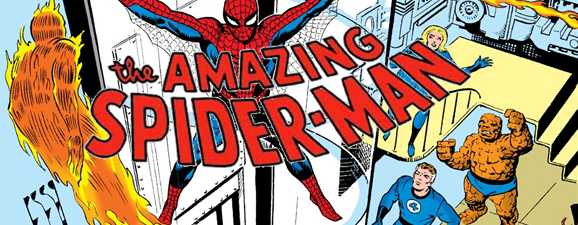
Easily Marvel Comic’s most recognisable and popular superhero, unsuspecting teenage nerd Peter Parker was first bitten by a radioactive spider and learned the true meaning of power and responsibility in Amazing Fantasy #15, which was first published in August 1962. Since then, the Amazing Spider-Man has featured in numerous cartoons, live-action movies, videogames, action figures, and countless comic book titles and, in celebration of his debut and his very own day of celebration, I’m dedicating every Friday of August to talk about everyone’s favourite web-head!


Story Title: “The Grotesque Adventure of the Green Goblin”
Published: 9 April 1964 (cover-dated July 1964)
Writer: Stan Lee
Artist: Steve Ditko

The Background:
In 1962, Marvel Comics editor and head writer Stan Lee followed up on his success with the Fantastic Four with Spider-Man; his debut in Amazing Fantasy #15 proved to be one of Marvel’s best selling titles and Spider-Man’s popularity led to him getting his own solo title barely a year later and he quickly amassed one of the most colourful and memorable rogues galleries in all of comics. Easily one of Spider-Man’s most devious and iconic enemies is the Green Goblin; although a number of people have assumed this elf-like guise, the most famous face behind the mask is Norman Osborn, industrialist and father to Peter’s best friend. Stan Lee’s initial pitch was very different from what the Green Goblin turned out to be, and he continued to clash with artist Steve Ditko over the character’s true identity. Although his identity was initially a mystery, the Green Goblin would go on to be a central figure in many of Spider-Man’s most prominent storylines and a recurring figure in Spidey’s life both in and outside of comics.

The Review:
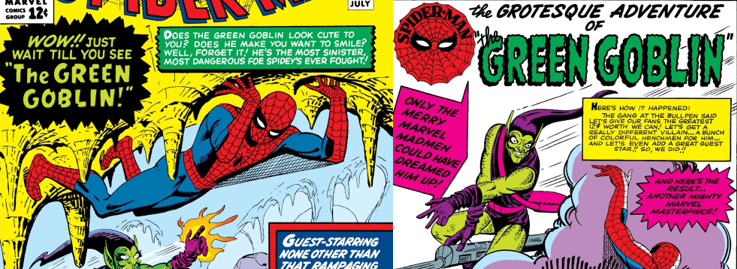
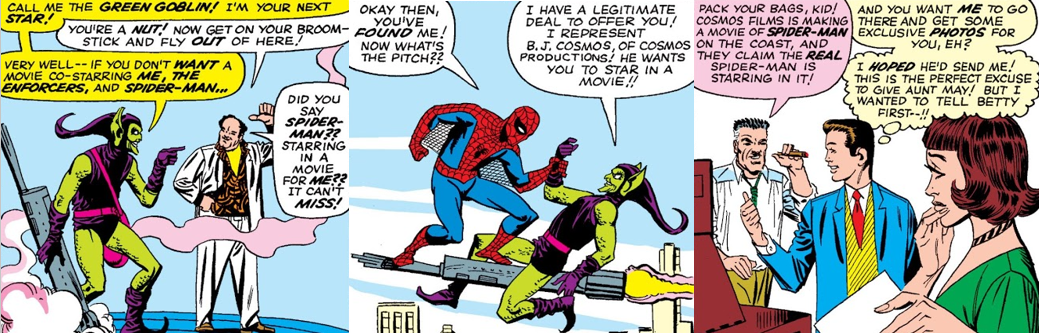
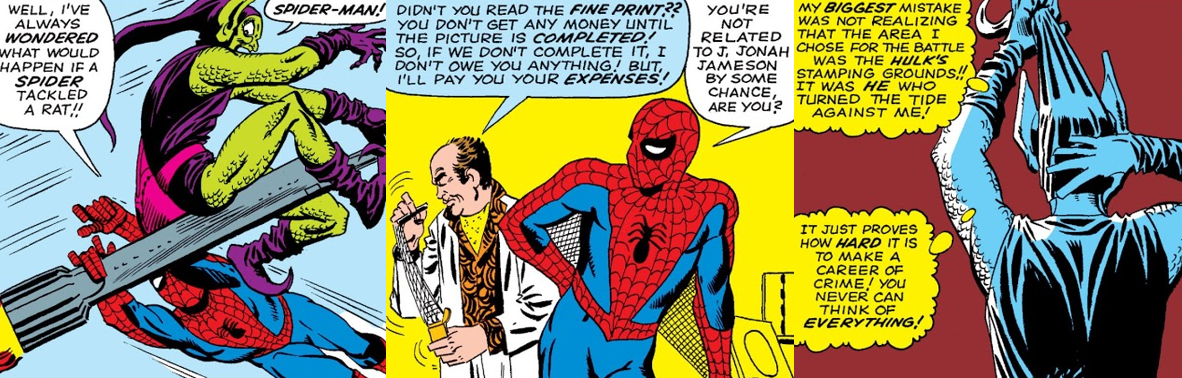
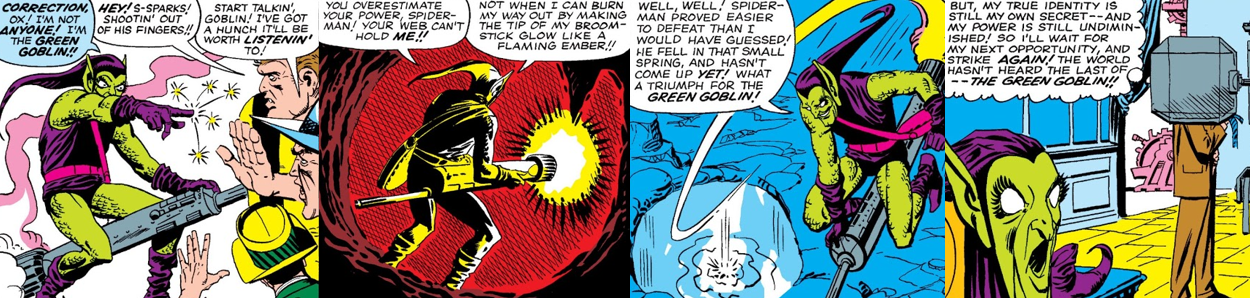
According to the issue’s first splash page, the Green Goblin came about after a concentrated effort by the Marvel writing staff to deliver “the greatest 12¢ worth [they] can” and wastes no time in introducing readers to “a really different villain” by opening with the shadowy wrongdoer hard at work in his high-tech basement laboratory. There, the mysterious Green Goblin puts the finishing touches to his “flying broomstick”, a rocket-powered flying device that completes his fearsome, colourful costume. With his look complete, the Green Goblin meets with the Enforcers (Montana, Fancy Dan, and Ox), a trio of the city’s most notorious gangsters, and coerces them into working for him to defeat Spider-Man (who previously got the Enforcers arrested some time prior to this story) by intimidating them with sparks shot from his fingers. Strangely, the Green Goblin’s plan involves offering struggling filmmaker B. J. Cosmos the chance of a lifetime: a sure-fire action movie with the Green Goblin and the real Spider-Man as the stars! We then catch up with Peter Parker, who’s in a far better position, socially at least, than usual; not only did he get a 100% score in his last exam, but his intelligence earns him the admiration of Liz Allen, who not only coos over him but actually stands up to Eugene “Flash” Thompson when the football star continues to mock Peter for his lack of physical acumen. Peter’s surprise at seeing Liz leap to his defence and joy at seeing Flash taken down a peg or two is cut short when he hears news of the Green Goblin flying around the skies of Manhattan, so he quickly dashes off to confront the garishly garbed goblin as Spider-Man. Rather than getting into a fist fight, however, the Green Goblin tells Spidey about the movie opportunity and, despite his better judgement, the web-head goes to check it out and finds that the filmmaker is willing to pay him $50,000 to star in a movie that pits him against the Enforcers and the Green Goblin.

The mysterious Green Goblin offers Spider-Man the chance to make bank on a Hollywood movie.

Despite the fact that the last time he cashed in on his spider powers, Peter learned a harsh lesson about using his abilities responsibly, Spider-Man actually agrees and signs a contract since the cash would allow him to provide for his beloved Aunt May. Although receptionist Betty Brant isn’t best pleased at her man socialising with Hollywood starlets, and Aunt May worries about him making a big trip out to California, Peter is not only given license to get out on his trip but even assigned to cover the movie shoot by editor J. Jonah Jameson, thus promising even more profit from the gig. Upon arrival, Spider-Man is amazed at B. J.’s make-up effects and doesn’t suspect that anything’s amiss (so much for his much-lauded spider-sense…), but quickly learns that he’s blundered into a trap when the Enforcers attack him during a “rehearsal”. Spider-Man’s agility and spider-sense help him to largely avoid the trio’s attacks, but he’s several disorientated when the Green Goblin tosses stun grenades at him and deftly avoids his web shooters thanks to his…*sigh*….rocket-powered broomstick. This gives the Enforcers the opportunity they need to dog-pile him, pummelling him mercilessly and leading to a common sequence where Peter musters all of his spider strength to throw them off and then whips up a “man-made dust storm” to temporarily blind his foes. The story then jumps back over the New York to find Aunt May already writing a letter to her nephew, Liz again standing up for Peter to Flash, and Betty continuing to suspect that Peter’s cheating on her over in Hollywood; I guess the point of this is to show that the never-ending drama in Peter’s life continues to churn over even when he’s not around, but the leaps in logic these characters make never fails to astound!

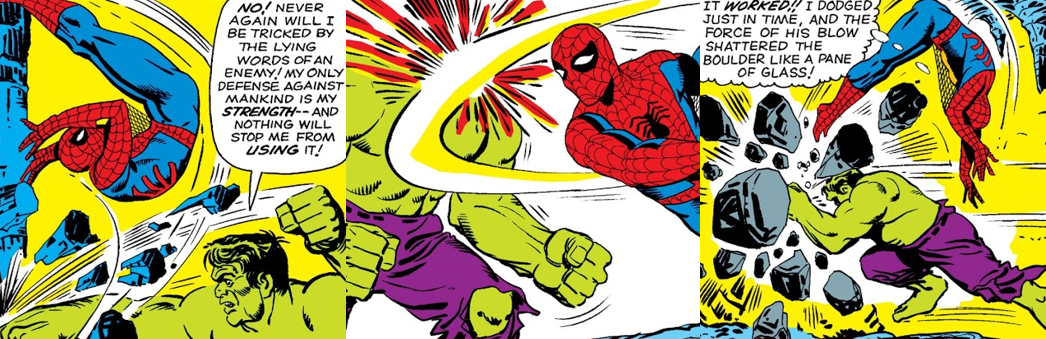
Of course the Hulk randomly shows up! I mean, why not?!

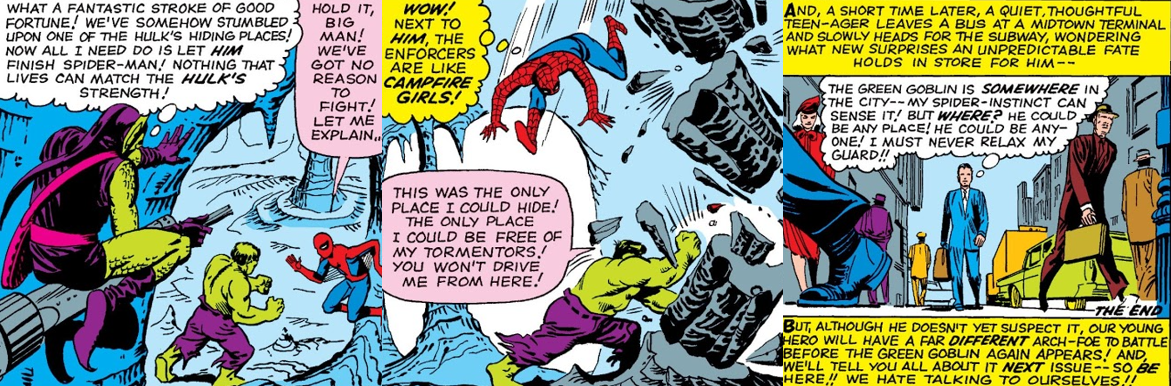
Thankfully, the story quickly returns to Spider-Man’s plight; the web-slinger takes cover in a nearby cave to catch his breath and ends up being trapped inside by, and with, the Enforcers and the Green Goblin. One by one, Spider-Man picks off the Enforcers; he nabs Montana, webs up Fancy Dan, and knocks out Ox with a single punch to the jaw, but the Green Goblin is not so easily ensnared thanks to burning away Spidey’s web net with his broomstick. As if things weren’t already complicated enough, who else should randomly appear in the cave but Doctor Bruce Banner’s enraged alter ego, the Incredible Hulk! Naturally, the Hulk attacks Spider-Man on sight and goes on a rampage, much to the Green Goblin’s glee. When Spider-Man’s attempts to reason with the Green Goliath fall on deaf ears, he’s forced to rely on his agility to avoid the Hulk’s attacks, stunned to see the beast tear through his webbing, and succeeds only in almost breaking his hand when he wallops the Hulk in the face! Realising that he can’t reason with or out-fight the Hulk, Spider-Man puts his health (and life) at risk by tricking the Hulk into smashing the boulder and freeing them from their confinement.

Spider-Man must settle for having survived as he’s left out of pocket and clueless to the Goblin’s identity.

Now back out in the open and able to swing again, Spider-Man turns his attention back to the Green Goblin; however, he’s too weak to properly overpower the Goblin’s broomstick and ends up falling to the water below. When he spots the Hulk heading back into the cave, Spider-Man is duty-bound to rescue the Enforcers before the Green Goliath can find and hurt them, and flees the scene to confront B. J. over his business associates. B. J. is aghast that the army would arrest his stars, but quickly hits on the genius idea of trying to sign the Hulk to an exclusive contract as a replacement antagonist. When Spidey arrives to talk about his fee, the web-slinger is left out of pocket due to the film being cancelled and given just enough money to cover his trip back to New York. Rather than be concerned about the Hulk being free out in the desert or question his willingness to sell his abilities out for fame and fortune, Peter returns to the city and ponders where and when the mysterious Green Goblin will strike next. Speaking of Spidey’s fiendish new foe, the story ends with the Green Goblin returning to his lair and lamenting his failure to destroy the web-spinner and position himself as the new head of a worldwide criminal syndicate. Still, the experience (and the unexpected appearance of the Hulk) teaches the Green Goblin the valuable lesson that one can never think of everything, but he consoles himself in his anonymity and resolves to strike even harder in his next criminal escapade.

The Summary:
Um…okay, so…Marvel claim, right from the first page of the story, that the Green Goblin will be this big, impressive, unbelievable new foe for Spider-Man and the fiend’s big debut plot is to trick Spider-Man into signing on the a film so the Green Goblin and his unimpressive goons can try and beat him up. I mean, as far as villainous plots go, it’s hardly tossing your girlfriend off a bridge or murdering countless innocents! While the Green Goblin would eventually live up to his hype and become arguably Spider-Man’s most dangerous villain ever, you’d never know it from this first issue; and you can’t even say that Marvel didn’t know how to debut new Spidey foes at the time as Doctor Otto Octavius/Doctor Octopus made a much more impressive debut that same year some months prior and he came across as a far more formidable foe.

Considering how important he would become, the Green Goblin makes an inauspicious debut.

Just about the only thing that the Green Goblin has going for him is the question of his true identity; when he’s not wearing his mask, his face is constantly obscured or in shadow and I can imagine this was incredibly intriguing at the time as it was uncommon for us readers to not know who Spidey’s villains were behind their colourful costumes. Rather than flying his iconic glider, the Green Goblin straddles a ridiculous rocket-power broomstick and tosses stun grenades instead of his trademark pumpkin bombs; he doesn’t seem to exhibit any superhuman powers, and yet is able to intimidate the Enforcers just by causing some sparkles to fly from his fingers (an ability that doesn’t show up again this issue and appears to have no actual function). The Green Goblin barely even fights with Spider-Man; instead, he sets the Enforcers against him, and these three are incredibly underwhelming characters. Sure, Ox is a brute and Montana has his trusty lasso and I guess Fancy Dan is supposed to be quite agile, but they’re never really portrayed as an actual threat even when they have the numbers advantage.

The Hulk completely overshadows the Green Goblin and only adds to the mess of the issue’s plot.

Then there’s the nonsensical inclusion of the Hulk! Now, I get it; Marvel loved to cram in random cameos from their other characters into stories at the time, and it’s incredibly possible that there’s more context for his appearance in his own comic, but all he really does is completely overshadow the Green Goblin and the main plot. Not only that, but Peter acts really out of character here; he signs up for a movie deal without hesitation despite his vow to use his powers responsibly rather than for personal gain and is not only easily duped by the Green Goblin but is spider-sense is unreliable, at best, at warning him of the obvious dangers around him. The action is pretty good, to be fair, but then it always is in Spider-Man comics; ultimately, this is a good showcase for Spidey as you get to see him hold his own against the Hulk, but the entire selling point of the story was the conflict between Spider-Man and the Green Goblin and we get so little of that that the Goblin may as well have not been in the story at all. This is the very definition of style over substance; the Green Goblin is mysterious and colourful but hardly makes a great first impression and the story is full of filler, nonsense, and overshadowed by the Hulk. This could have been a cool opportunity to have this strange, maniacal imp-like villain torment Spider-Man and constantly give Spidey the slip but, instead, we get this weird plot about him duping him with a movie deal, and then Spidey just checks out of there rather than trying to chase after him, resulting in an inauspicious first appearance for someone who would become one of Spider-Man’s most dangerous foes.

My Rating:

Rating: 2 out of 5.

Could Be Better

What are your thoughts on the Green Goblin’s inauspicious debut? Were you a fan of the villain at the time or did he win you over in a different story (and, if so, which one?) What did you think to Peter’s willingness to sign up for a movie deal and shirk his responsibilities? Who is your favourite Spider-Man villain and why? What did you think to the Hulk showing up in this story? Whatever your thoughts on the Green Goblin, sign up to share them below or leave a comment on my social media and be sure to check back in next Friday as Spider-Man Month continues!

Movie Night: Thor: The Dark World

Released: 8 November 2018
Director: Alan Taylor
Distributor:
Walt Disney Studios Motion Pictures
Budget:
$150 to 170 million
Stars:
Chris Hemsworth, Natalie Portman, Tom Hiddleston, Christopher Eccleston, Stellan Skarsgård, Rene Russo, and Anthony Hopkins

The Plot:
After defeating his step-brother, Loki Laufeyson (Hiddleston) alongside his fellow Avengers, Thor Odinson (Hemsworth) has been fighting disorder across the Nine Realms. However, after Doctor Jane Foster (Portman) is infected by the mysterious “Aether” and targeted by the malevolent Dark Elf, Malekith (Eccleston), Thor must team up with his brother to confront this dangerous new threat.

The Background:
Even before the blockbuster release of Avengers Assemble/The Avengers (Whedon, 2012), Kevin Feige, head honcho of the Marvel Cinematic Universe (MCU), promised that Thor would have another adventure. The team-up’s unprecedented box office success meant the MCU entered is second phase with a huge amount of momentum and expectation, but the experience of directing Thor (Branagh, 2011) left director Kenneth Branagh drained and reluctant to return for the sequel. At one point, Patty Jenkins was attached to direct but left due to “creative differences”, a decision that angered star Natalie Portman. Once Alan Taylor secured the director’s chair, the filmmakers set about progressing Thor’s relationship with Loki and expanding upon the gritty, more grounded approach to the merger of science and magic seen in the first film. Although Thor: The Dark World surpassed its predecessor’s box office with its worldwide gross of almost $645 million, the film wasn’t as well received as others in the MCU; while the performances and fantastical elements were praised, many criticised the film’s pace and weaker elements.

The Review:
Like the first film, Thor: The Dark World opens with some narration and scene-setting from the wise and powerful Odin Allfather (Hopkins), who tells the story of the Dark Elves (an ancient, malevolent race from the time before there was light in the universe) and their leader, Malekith, who sought to return the Realms back to darkness using the destructive power of the Aether before he was stopped by Odin’s father, Bor (Tony Curran). Unable to destroy the Aether, Bor buried it deep in a far away Realm and Malekith disappeared for aeons to Svartalfheim at the darkest corner of the cosmos. Sadly, this time around the narration falls into the same trap that so many narrations do in that we end up hearing the story all over again when Jane arrives on Asgard; it would have been just as effective to show the opening scene without Odin’s narration and then have him fill the gaps in later, or flash back to the opening battle later in the film to combine them into one scene.

Still a mighty warrior, Thor has matured a lot, though is preoccupied with thoughts of Jane.

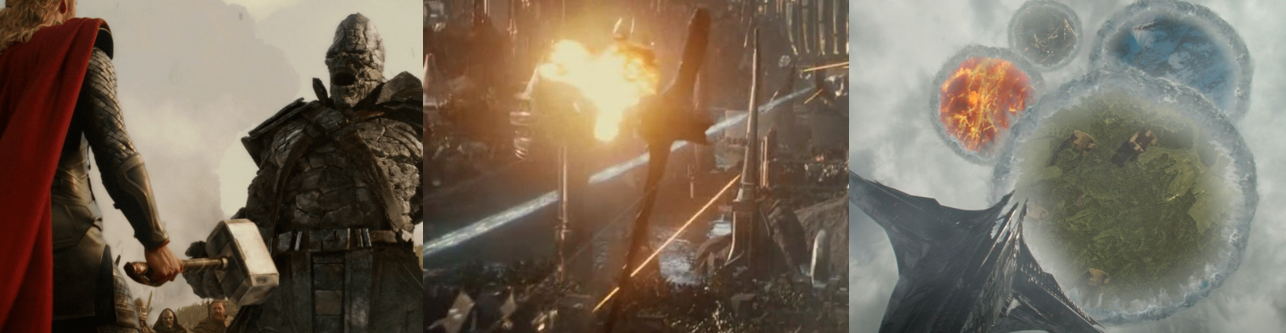
Thanks to Loki’s attack on New York City, the balance between the Nine Realms has been upset and Thor has been too busy setting things right alongside his allies to make good on his promise to return to Jane. Thor still retains much of his arrogance in battle (but then again, when he can explode a Kronan with one swing of Mjölnir, I feel a little pride is understandable) but he’s noticeably changed since learning humility in the first film; he’s far more respectful to Odin, who treats him as more of an equal for his good deeds, but the two disagree on Thor’s feelings for Jane. Odin believes that, since human lives are so fleeting, Thor would be better served turning his attentions towards his ally and comrade, Lady Sif (Jaimie Alexander), but the Thunder God is driven to distraction by his yearning for Jane. This actually sows the seeds for an eventual character arc for Thor in the MCU; since the first film, Thor has been groomed for and expected to take the throne but, here, we see that his adoration for Jane and Earth means that he cannot focus on the remaining Realms in the way a true king of Asgard should. We’d see the culmination of this in Avengers: Endgame (Russo and Russo, 2019), of course, where he abdicates his royal responsibilities and finally embraces his true self but, here, he’s at a crossroads between doing what’s right for him and doing what’s right for the cosmos.

Thanks to being possessed by the Aether, Jane visits Asgard and we see more of the mighty Realm.

Despite her half-hearted attempts to move on from the hunky Thunder God, Jane remains equally distracted by thoughts of Thor; however, when Darcy Lewis (Kat Dennings) alerts her to odd readings nearby, she can’t help but investigate in hopes of seeing Thor return to Earth. Instead, they find odd gravitational and special anomalies at an abandoned industrial district in London that render some objects weightless and transport others to another dimension. Following the source of the signal, Jane is unwittingly sucked into the Aether’s hidden dimension and absorbs the protoplasmic Infinity Stone. Their paths finally cross again when Heimdall (Idris Elba) loses sight of her in this moment and Thor returns to check on her, finding her not only as feisty as ever but also incredibly dangerous thanks to the Aether’s influence. This results in one of the best things a sequel can do and that’s taking a character tied to one world in the first film (Jane) and bringing her to another (Asgard) in the sequel; just as Thor was a stranger in a world beneath him in Thor, so too is Jane a stranger in a world beyond her here. Odin is unimpressed, nay angered, that Thor would bring a mortal to all-mighty Asgard and Jane is both overwhelmed and captivated by the technology and culture of the Golden Realm.

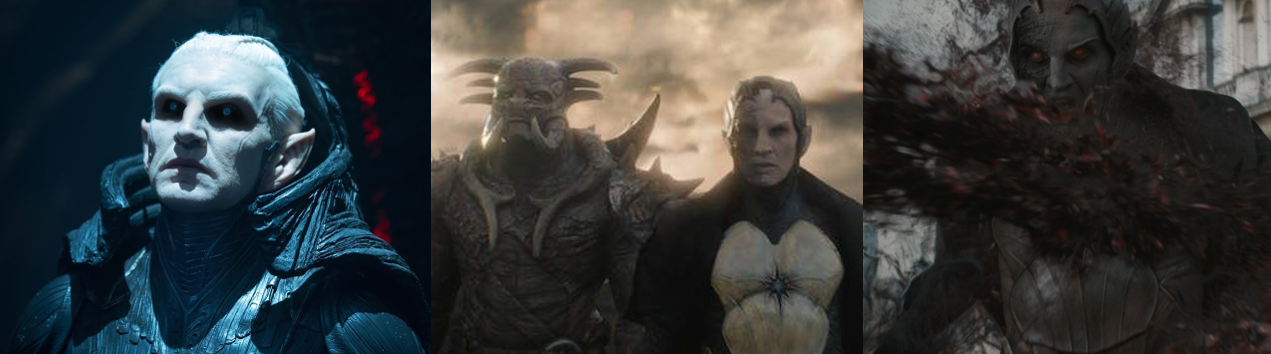
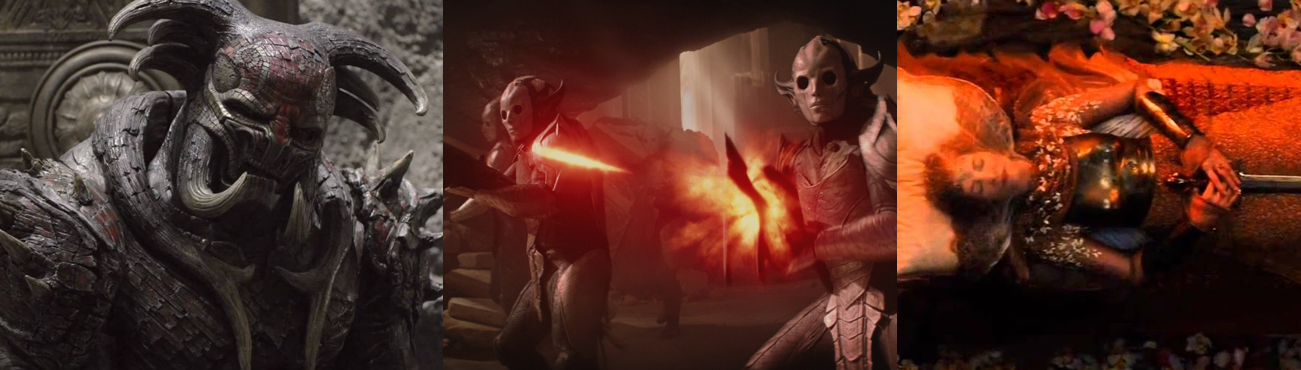
Malekith might be a bit of a weak villain and a waste of Eccleston but damn, does he look bad-ass.

Malekith’s plot can only occur at a specific time when the Nine Realms are in perfect alignment known as the “Convergence”, which temporally sees brief portals to the Nine Realms open up and cause all kinds of disruption and conveniently comes around at the same time as the Aether is discovered. Having fled to the further reaches of the universe with what little remained of his army following his defeat, Malekith is also awoken when the Aether is disrupted by Jane and immediately restarts his campaign to claim its awesome power. Considering how strong and complex a villain Loki was in the first film, it is admittedly disappointing to see him followed by Malekith, a character whose motivations basically boil down to wanting to spread darkness and discord throughout the known universe simply because he wants to. Indeed, Malekith is so obsessed with his plot for power and destruction that he willingly sacrificed a great number of his own people during the great war with Bor. However, I don’t really know much about the character as he’s only popped up in a couple of the Thor comics I’ve read, so all I’m really looking for in a superhero villain is someone who looks cool, is vaguely threatening, and for the hero to butt heads with (anything else is just a bonus for me), so my main gripe with Malekith is that the filmmakers completely wasted an actor of Eccleston’s talents since the Dark Elf disappears for massive chunks of the film and is mainly just seen posturing and monologuing until the finale.

Loki steals the show in every scene he’s in and completely overshadows Malekith.

It doesn’t help that Loki returns to this film and not only overshadows Malekith at every turn thanks to Hiddleston’s effortless charisma but also steals every scene he’s in. Following his defeat in Avengers Assemble, Loki is brought before his father to explain his actions; Loki is unapologetic and even arrogantly justifies his actions as simply being his divine right to conquer and rule lesser beings such as humankind. Odin, however, is unimpressed, countering that it was Loki’s destiny to die and that only Odin’s mercy spared him from that fate so that he could grow to hate him. Indeed, Odin specifically states that it’s only because of the mercy of his wife, Frigga (Russo), that Loki has been condemned to an eternity in the dungeons of Asgard rather than execution for his heinous acts. Ever the petulant child, Loki remains an emotionally complex and damaged character; he is deeply resentful of his father and brother, and yet still has much love for his mother and truly believes that he was simply doing what was destined of him to do and that his actions pale in comparison to the blood Odin has spilt in his aeons of conquest. Although they lack the numbers they once had (largely because of Malekith nonsensically killing most of them), the Dark Elves are quite a formidable army; wielding energy weapons and grenade-like devices that cause miniature black holes that destroy everything in range, their numbers are further bolstered by Algrim (Adewale Akinnuoye-Agbaje), a Dark Elf that Malekith transforms into Kurse, a monstrous being of pure rage and animalistic strength.

Malekith’s army, led by the monstrous Kurse, storm Asgard and kill Frigga.

Having infiltrated the prisoners being taken to Asgard, Kurse causes a jailbreak; though he amusingly decides against freeing Loki, the God of Mischief directs him in Odin’s direction and unintentionally causes his beloved mother’s death when Kurse delivers a fatal stab wound to Frigga after she chooses to protect Jane. Just as Frigga’s death sends Thor into a blind rage, scarring half of Malekith’s face in the process, so too is Loki distraught by her loss; united in their grief, Loki agrees to assist Thor in once more defying Odin’s decree to remain on Asgard and use a secret exit to track the Dark Elves to Svartalfheim. Seeing Thor, Jane, and their allies interacting with Loki is a source of great amusement since none of them like or trust him but are forced to rely on him, and Loki of course uses the situation to his advantage to fake his death as part of his ultimate scheme to seize Asgard’s throne. In a surprising twist, the consequences for Loki’s brain tampering are seen in Doctor Erik Selvig (Skarsgård), who has been driven to near madness by what he saw and learned while under the spell of Loki and the Tesseract. Despite his unpredictable and wild demeanour, this proves to be valuable information in helping Thor and his allies oppose Malekith’s plot. Unfortunately, the Warriors Three – Volstagg (Ray Stevenson), Fandral (Zachary Levi), and Hogun (Tadanobu Asano) – are still largely used for little more than comic relief and to add recognisable Asgardian bodies to the fight scenes but Thor: The Dark World does manage to squeeze in a far larger role for Heimdall; he not only takes down a Dark Elf ship with nothing but knives(!) also suffers a crisis of conscience when his duties as Gatekeeper are rendered superfluous by Malekith’s looming threat. Similarly, Odin is greatly expanded upon; grief-stricken by his beloved’s death, he prepares to fortify Asgard’s defences and sacrifice as many Asgardian lives as it takes to ensure ultimate victory, once more pushing Thor into taking matters into her own hands.

The Nitty-Gritty:
In a nice change of pace, much of the Earth-bound side of the story is set in good old Blighty so we get to see London under threat from cataclysmic destruction rather than the United States, which is nice, and much more of the film takes place on Asgard. Jane’s arrival causes much consternation among the Asgardians, who believe her to be largely inconsequential and meaningless even though she possesses the Aether, with only Thor and Frigga treating her with any kind of respect and kindness. While awestruck by the beauty and magnificence of Asgard (she has, after all, effectively paid a visit to Heaven), Jane still manages to hold her nerve; she openly challenges Odin’s boorish attitude towards her and even slaps Loki right in the face for the destruction he caused in Avengers Assemble. As for Loki, he adds a great deal of comedy to the film through his witty criticisms of Thor’s plan, demeanour, and actions; he even assumes Steve Rogers/ Captain America’s (Chris Evans) form in an amusing scene and seems to live to mock and critique his brutish brother.

Thor: The Dark World wonderfully expands the cosmic scope of the MCU.

While Thor masterfully introduced the idea of the MCU’s vast cosmic universe, Thor: The Dark World expands upon it wonderfully; as mentioned, a great deal takes place on Asgard and just the film’s very existence was further proof that there are many competing legends, stories, and warmongering races out in the galaxy just waiting for their time to strike. Accordingly, the film is much bigger and action-packed in its scope; unlike the first film, Thor is at full power for the entire movie and we get to see him and his people in far more battles than before. The opening depiction of Asgard’s war with the Dark Elves effectively set up how desperate and obsessed Malekith is with obtaining the power to achieve his goals, the prison breakout was a great way to showcase Loki’s indifference (however true or false) to the fate of his adopted people, and Malekith’s merciless campaign against Asgard made sure that both Thor and Loki would have personal stakes in the battle against Malekith. Of course, it’s not all perfect: the destruction of the Bifröst Bridge was this big, emotional event in Thor but it’s since been rebuilt and the status quo has returned as a result, which kind of undermines the first film’s ending (though, to be fair, that already happened in Avengers Assemble so I’m really not sure why a line or something wasn’t added in to Thor to downplay this event or at least plant the seeds of hope for Thor).

Loki plays on his brother’s affections to weasel his way to a position of power once more.

Still, the costume design remains incredible; of all the MCU characters, Thor may very well be my favourite both in terms of his character and his visual representation. His always looks fantastic, as do all of the Asgardians, and I really like the threatening and somewhat alien design of the Dark Elves; Malekith may be a bit of a weak villain in terms of characterisation but he definitely cuts an intimidating figure. The film also beautifully and naturally continues the ongoing sibling rivalry between Thor and Loki; Loki’s deceptive nature is key to tricking Malekith into freeing Jane from the Aether and, while he initially appears to have double-crossed his brother and reverted to his vindictive ways, it turns out that Loki was simply playing a role to give Thor the opportunity to try and destroy the Aether. So committed to this role is Loki that he even shields, an actively saves, Jane from attack and ultimately dies in Thor’s arms in an emotionally weighty scene after suffering mortal wounds to destroy Kurse. Of course, this is later revealed to all be part of a grander deception by Loki as the film ends with the twist that he has somehow disposed of Odin and taken his form as king, a surprise that the third film would unfortunately simply explain away in anticlimactic fashion rather than capitalise on the potential of Loki ruling Asgard under the guise of his father.

Thanks to his allies, Thor is able to end Malekith’s dark ambitions and save the Earth once more.

Of course, there has to be a big, climatic battle between Thor and Malekith at the end of the film. Having absorbed the Aether, Malekith wields incredible cosmic power that more than makes him a match for Thor’s brute strength. Easily able to take Thor’s blows, and even his lightning, the battle between Thor and Malekith rages through the Nine Realms thanks to the Convergence, which makes for a striking visual as they topple and tumble between the Realms (and, amusingly, all over London) and Malekith teleports around, renders himself incorporeal, and attacks with tendrils of red energy. Unlike in the last film, where Thor took out the Destroyer in a triumphant return to full power and bested Loki in a dramatic battle between siblings, Thor actually has help this time around as Jane, Selvig, Darcy, and Darcy’s intern Ian Boothby (Jonathan Howard) construct and place the specialist scientific equipment needed to send Malekith packing back to Svartalfheim, where he is subsequently crushed by his own ship. It’s definitely a bigger and more bombastic finale than the first film, which was obviously much more focused on Thor proving his worth as a hero and a warrior, but Phase Two of the MCU was all about kicking things up a notch and Thor: The Dark World definitely does that while still addressing and hitting the same emotional beats and themes of the first film.

The Summary:
Honestly, to this day I still don’t understand why people don’t like Thor: The Dark World; it’s very similar to how I don’t get why people rag on Iron Man 2 (Favreau, 2010) but I think some of the problem might be that the first films were so well done and Phase One of the MCU was such a massive surprise in terms of success and consistent quality that expectations were maybe a bit too high going into the sequels. Now, obviously Thor: The Dark World isn’t quite as good or memorable as the first film (primarily because of how weak Malekith is) but it’s a really good follow-up to the themes and characters set up in Thor and Thor’s character progression in Avengers Assemble. I like how the scope is so much bigger, how the society and inhabitants of Asgard are expanded upon, and how well it sets up the Infinity Stones and contributes towards the larger overall narrative of the MCU’s second phase. The film is far more action-packed while still being humorous and heartfelt, developing the complex relationship between Thor and Loki while also showing how much Thor has grown as a character since the first film. Maintaining the franchise’s incredible costume design, special effects, and visual style, there’s a lot to enjoy in Thor: The Dark World and I definitely feel like it’s worth another look with fresh eyes.

My Rating:

Rating: 4 out of 5.

Great Stuff

Are you a fan of Thor: The Dark World? If not, what is it about the film that you dislike, specifically? What did you think to Malekith as a character and a villain? Did you enjoy Thor’s character progression and the expansion of his relationship with Odin and Loki? What did you think to setting more of the film off-world and in a location other than the United States for a change? How are you celebrating Thor’s debut this month, if at all? Whatever you think about Thor: The Dark World, sign up and leave a comment below or drop a line on my social media.

Movie Night [K-DAY]: Cloverfield


In the absolutely bonkers science-fiction film Pacific Rim (del Toro, 2013), the monstrous Kaiju first attacked humanity on 10th August 2013. The attack ended a few days later on August 15th but, in that time, San Francisco, Sacramento, and Oakland were completely devastated and the Kaiju War officially began. Accordingly, August 10th became known as “K-DAY” and is, for me, a fantastic excuse to talk about some giant monster movies!


Released: 18 January 2008
Director: Matt Reeves
Distributor: ParamountPictures
Budget: $25 million
Stars: Michael Stahl-David, T.J. Miller, Lizzy Caplan, Odette Yustman, Jessica Lucas, and Mike Vogel

The Plot:
To celebrate Robert “Rob” Hawkins’ (Stahl-David) new job in Japan, his friends are throwing him a farewell party that is being recorded by his best friend, Hudson “Hud” Platt (Miller). However, Rob’s party, and his issues with friend and potential love interest Beth McIntyre (Yustman), are interrupted when a gigantic creature suddenly emerges from the sea and rampages throughout New York City!

The Background:
Perhaps unsurprisingly, Cloverfield owes a great deal of its existence to Godzilla; producer J. J. Abrams first thought up the idea of creating an American counterpart to the famous kaiju when visiting Japan and partnered with writer Drew Goddard and director Matt Reeves to bring the concept to life. The film’s creature, a mysterious beast whose exact origins were left intentionally vague, was designed by legendary special effects artist Phil Tippett and his studio to be biologically functional but also more like a force of nature than a malevolent aggressor. Cloverfield went through a number of different titles, built an incredible amount of hype through the heavy use of viral marketing, and was shot entirely using a found footage approach that left some audience members feeling sick. The film went on to gross over $172 million worldwide and was widely praised for its atmosphere and effects, though the camera techniques and allusions to real-world terrorist attacks like 9/11 were criticised. Although Reeves had an idea for a sequel, the film was followed by a couple of loosely-connected films before a direct follow-up was finally announced in January 2021.

The Review:
Cloverfield was such a strange and intriguing movie at the time; we’d seen found footage films before, of course, but they were still quite new and their marketing tended to be very surreal and metatextual. This was probably one of the first times I remember my friends really getting into a film’s viral marketing; they trawled through the website reading titbits about Slusho! and Bold Futura, and message boards were alive with people desperately analysing the vague trailers for any kinds of clues as to the monster’s identity, with many claiming that it would be Cthulu. Personally, I stayed away from all that; it was fun to see but I was hooked on the trailer alone and didn’t really see the need in wild speculation. It turned out, of course, that a lot of the viral marketing and expanded lore seen online was ultimately inconsequential to the film but it was still a fun, immersive, and unique way to promote the film.

Rob’s a regular guy whose sole focus during the attack is rescuing Beth no matter the danger.

The film primarily revolves around six characters caught up in the chaos of its events but the main character is Rob, a pretty average guy who is about to leave New York City for a new job in Japan. Rob’s just a normal, everyday sort of guy but he’s clearly a likeable and popular bloke as he has a lot of friends and acquaintances at his big leaving party, but he starts the film in a bit of a bind as not only is he leaving behind his friends and family for a foreign country but there’s also tension between him and his long-term friend Beth. Prior to the film, as seen in frequent cutaways to previous footage recorded by the camera, Rob and Beth hooked up and spent a fun-filled day at Coney Island but clearly his plans to leave caused a rift in their relationship and, despite the fact that he’s leaving, he’s clearly in love with her and wants to be with her, and so is kind of miffed when she brings a date to his party. His personal drama is put on hold, however, when a violent earthquake and power outage suddenly hits and the city is attacked by a gigantic creature. Rob’s first and primary overwhelming concern throughout the chaos that follows is getting to Beth and ensuring her safety; he fully plans to go through with this alone but his friends, scared out of their minds at the monster’s presence, don’t want to separate so they willingly follow along, which ultimately leads to many of them dying all so that Rob can get to Beth in a desperate attempt to get everyone out of there alive.

Beth and Rob’s relationship is on the rocks but he risks everything to save her.

Tensions are frayed between Rob and Beth at the start of the film; after they slept together, he didn’t call or talk to her since he felt it was better to not get too attached as he was leaving for his new job. This left Beth heartbroken, however, and as hurt as Rob was by the whole thing, but neither of them were properly able to convey their feelings towards the other before the monster’s arrival. Their relationship is easily one of the most relatable in the film; having been friends for years, they had a spur of the moment romance but each felt like they couldn’t properly commit to their feelings because Rob had been offered a lucrative position as vice president of his company and she would never ask him to give that up just like he felt he had to go through with it despite his feelings for her. Beth is absent for a large portion of the film but Rob’s entire motivation is centered around finding her so that they can all leave together, no matter how great the danger is. When they find her, she’s seriously injured and trapped in her apartment but they manage to get to her in time and she’s incredibly grateful that he came back for her; with her safe, the group is finally able to make efforts to escape but, unfortunately, rescuing Beth cost them precious time and they’re left stranded in Central Park. With the military preparing a massive bombing run to try and destroy the creature, Beth and Rob seek shelter and admit their love for each other before presumably being killed in the ensuing attack.

Rob’s brother and friends opt to go with him to find Beth, with disastrous results.

Rob is primarily aided in his quest to save Beth by his brother, Jason Hawkins (Vogel), and his fiancé, Lily Ford (Lucas); at the start of the film, Jason is annoyed that Lily has tasked him with carrying the camera and recording farewell messages at Rob’s party, so he quickly passes the job on to Hud so that he can enjoy himself. Jason and Rob have a very relatable and realistic relationship; Jason loves his brother but recognises that he’s kind of a douchebag and not good enough for Beth. Still, he adamantly encourages his brother to seize the opportunity with Beth and is the first one to suggest getting out of the city after the creature attacks. His decision to head to the Brooklyn Bridge costs him his life, however, when the creature inadvertently destroys the bridge and kills him in the process, which devastates both Rob and Lily. Lily is the pragmatist of the group; of them all, she’s the most responsible and serious and initially just wants Rob to have a great leaving party so that he knows how much they all love him. Constantly annoyed at Jason’s childish antics, she’s forever having to keep him and Hud on track so that things go off smoothly, but her sensible demeanour gives way to abject terror when the creature appears; though she and the others try to talk Rob out of risking crossing the city to rescue Beth, she’s the first to willingly agree to go with him and actually ends up being the only one of the group to unequivocally be seen surviving the events of the film.

Hud continues to document the events, regardless of the danger to himself and others.

The group, and the chaotic events that surrounded them, are constantly recorded by Hud, a well-meaning but somewhat socially inept friend of Rob’s who has an excitable personality but also a reputation for being a bit of a screw up and a bullshitter. He’s perfectly happy avoiding any responsibility that’s more complicated than putting up a goodbye banner but finds the job of recording the guests quite enjoyable, despite the fact that he keeps cutting people off and getting distracted by Marlena Diamond (Caplan). Even when the group are stumbling through the darkness and surrounded by rats, with sounds of destruction rumbling on the streets above, Hud continues to respond to the stress with awkward humour, nonsensical rambling, and terrified sarcasm, which may annoy his companions but is a completely understandable way to react considering the circumstances. Since she’s a friend of Lily’s and merely an acquaintance of Rob’s, Marlena is a bit of an outsider at the party and with the group and is initially annoyed by Hud’s badgering and awkward advances but is left shell-shocked by the creature’s attack and having seen it eating people. With little other choice than to accompany the others in order to survive, she briefly bonds with Hud after saving him from one of the parasites that accompany the creature, though she falls ill and eventually explodes in a shower of gore from the creature’s bite.

Clover rampages through the city, dropping deadly parasites and shrugging off the military’s might.

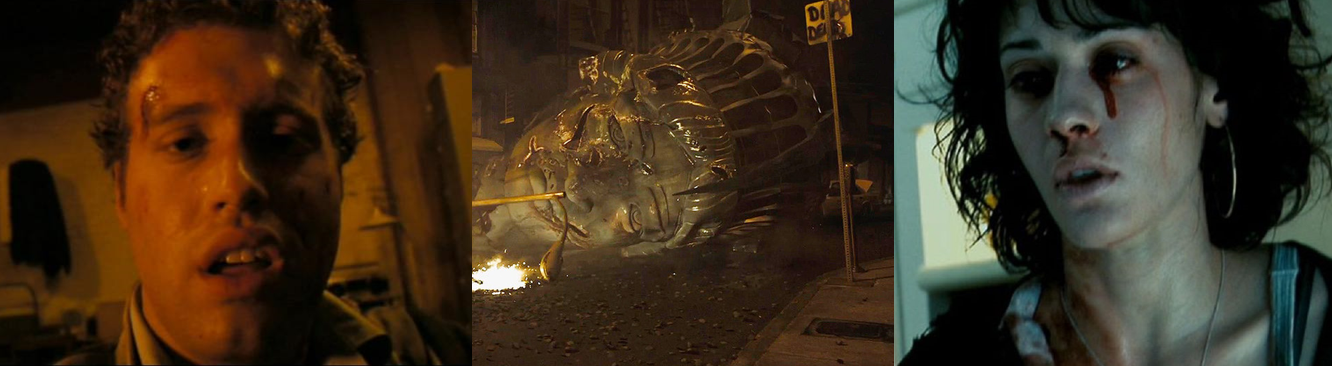
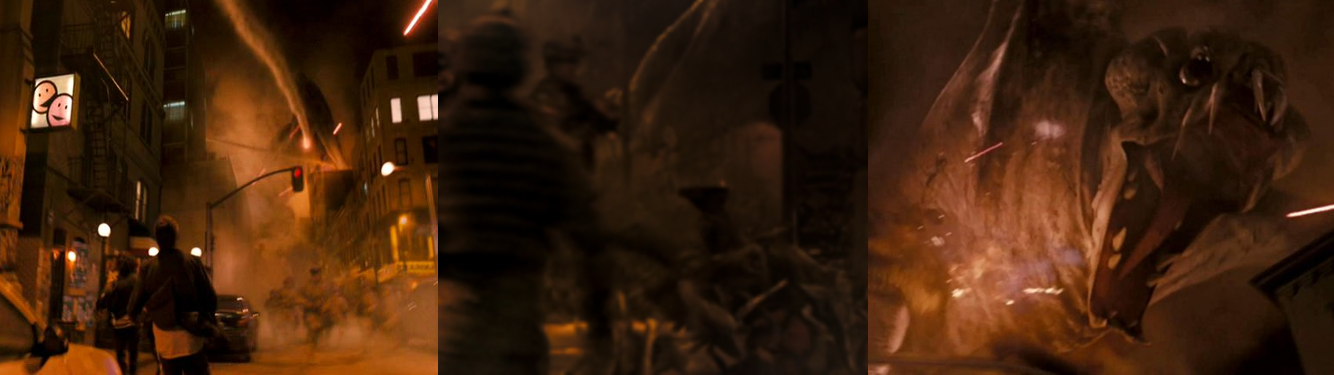
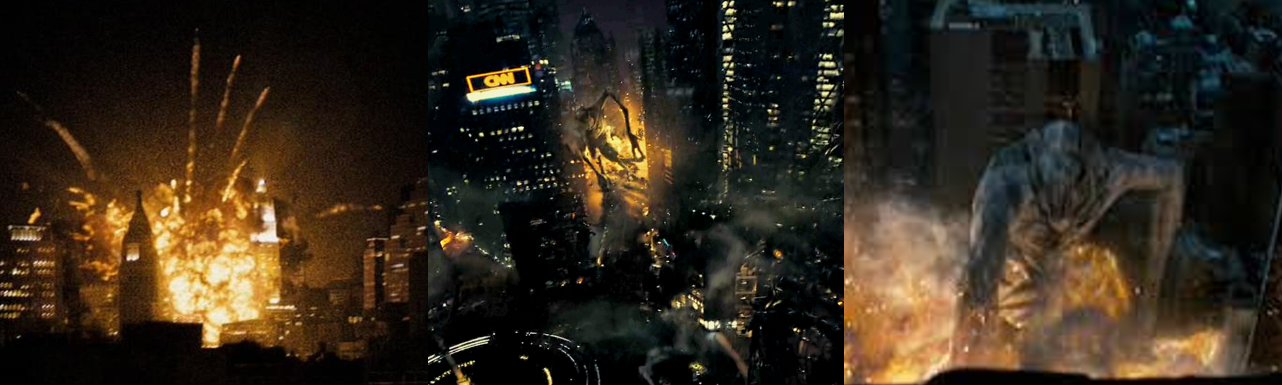
The military also plays a minor role in the film; completely outmatched and underprepared for the creature’s attack, they throw everything they have at it and fail in every attempt to do anything more than further enrage it. In the end, they’re forced to level the entire city in a last-ditch effort to destroy it and even this is left ambiguous by the film’s abrupt ending. The creature itself, often referred to as “Clover”, is largely obscured and hidden for the majority of the film; indeed, when it first strikes, the characters believe the disruptions are because of a terrorist attack and Clover’s initial destruction of the Statue of Liberty and arrival in the city is certainly framed and presented in a way to mirror such tragic events as 9/11 (buildings are half-destroyed and burning, the streets are littered with rubble and wreckage, and people are covered in ash, dirt, and debris). Clover’s movements appear to be a sporadic and mindless rampage as it flounders around seemingly at random, crashing into buildings and leaving confusion and destruction in its wake; this is reflected perfectly in Hud’s frenzied filming style as he desperately tries to get a good look at the creature while being overwhelmed by fear and panic.  To make matters worse, Clover is covered by these smaller crab-like parasites that scuttle around and attack everyone in sight, including our main characters, and make for a tense and dangerous secondary antagonist as their bite proves to be devastatingly lethal.

The Nitty-Gritty:
I mentioned at the start that Cloverfield’s marketing was immersive and a fun way to engage to audience and that’s fitting because in ties directly in to the found footage approach and first-person perspective of the film. Obviously, this genre isn’t for everyone; it’s wild and chaotic and unpredictable, the focus shifts and the camera is constantly moving about so we hardly ever get a clear shot of what’s happening, or the creature. One of the issues with found footage films is obviously the question of why the hell anyone would keep filming and carrying around a camera during something like this but Hud explicitly states that he’s recording it so that people can see “how it all went down”, which is a pretty good way of justifying his continued filming, and Hud’s sheer terror is perfectly conveyed through his erratic camera movements and tendency to get easily distracted, which is admittedly disorienting but extremely effective at conveying the panic and confusion caused by the creature’s attack.

Clover’s attack is purposely analogous to the horrors of a terrorist attack.

It’s pretty obvious what the filmmakers were going for with Cloverfield; not only are they crafting a wholly American monster film, they’re clearly paralleling the creature’s rampage to a terrorist attack. The film released some seven years after 9/11 but obviously the event was, and still is, very raw in the minds of people and audiences everywhere; everyone remembers where they were when they first heard about that day and scenes of the destruction, devastation, and confusion caused by the attacks continue to be powerful and horrifying. Evoking such imagery works massively in Cloverfield’s favour; in conjunction with the wild found footage approach, the entire event is seen as disorientating and appalling, and it’s perfectly understandable for the characters to initially suspect another terrorist attack. However, they are perhaps even more terrified when they review Hud’s footage and discover that “it’s alive!”; stunned and panic-stricken, they have even less idea of how to survive and react to such an attack so focusing on getting to Beth and escaping seems like the best idea simply because they’re desperate for a tangible and attainable goal to focus on in all the madness.

Clover’s mystery was as terrifying as its design and mindless rampage.

The monster fan in me remains fascinated by the creature; thanks to the film’s erratic filming style, we hardly ever get to see it and, for the majority of the film, its exact dimensions and biology are left to our imagination, which only adds to its intrigue and horror. Some of the best and most memorable screen monsters earned their reputation by being seeped in shadow or hidden for much of the film, and Clover is no different; generally, we just see a leg here, a flash of its body, and hear its braying roar echoing across the city. When we do see it, it’s this tangled mess of gangly limbs and a massive mouth full of fangs and we learn next to nothing about it, which only adds to its awe and mystery; Hud wildly speculates that it came from the ocean or possibly from space, both of which are subtly hinted at throughout the film, but ultimately its origins are meaningless and its horror only augmented by its mystery. Clearly, it’s a durable and dangerous creature; it causes an incredible amount of destruction in its mindless rampage and easily shrugs off the military’s weapons, even high-powered missiles and bombs, and is able to leap high enough to swipe a helicopter out of the air. Although it is said to eat people, it doesn’t seem to swallow and digest them as it spits Hud out after gobbling him up at the film’s conclusion. So great is Clover’s threat that the military decides to sacrifice the entire city of New York to destroy it, which leaves our final two survivors trapped, terrified, and presumably killed in the process, though the film leaves it ambiguous as to whether this actually destroyed the creature and a final, post-credits message when played backwards seems to suggest that it’s still alive…

The Summary:
Cloverfield is quite the intense and terrifying experience; found footage movies are difficult to get right as it’s so easy for them to come across as cheap and disorientating as anyone can grab a camera and just fling it about while shouting and screaming but Cloverfield uses this filmmaking technique extremely well to convey the mystery and sheer awesome terror of its rampaging monster. The characters really help sell this film, which is great because it’s much more focused on them than the gigantic creature; they react to both their interpersonal dramas and the appearance of a raging monster in a believable and realistic way and I enjoyed their banter and rapport, which was the right balance of familiarity, fear, and amiability. The star of the film is obviously the monster and Clover is one of the most intriguing, mystifying, and terrifying kaiju ever put to film; its biology makes it seem horrifyingly probably and its abilities are rooted in some kind of realism. Add to that the parallels to terrorist attacks and the sheer awesomeness of its rage and you have a creature that made an immediate impact that I just wanted to see more of and learn more about, only to be continually let down with follow-ups that largely ignored the best part of the film.

My Rating:

Rating: 4 out of 5.

Great Stuff

Were you a fan of Cloverfield? Did you get caught up in the viral marketing and what did you think the creature was before the film released? What did you think to the found footage approach to the film and are you a fan of that genre? Were you a fan of Clover? What do you think its true origins were and what did you think to the parallels to terrorist attacks? What’s your favourite kaiju movie, and how are you celebrating K-Day today? Whatever your thoughts on Cloverfield, kaiju, or monster movies in general, please do sign up to leave a comment below or respond to my social media and be sure to check back in for more giant monster content in the near future!

Author’s Spotlight: Sean Stevens Interview

Sean Stevens author of The Gift of Life III and various other poetry

1. First, introduce yourself a bit. What is your name (or pen name) and where are you from?

Sean Stevens. Worcester, Massachusetts.

2. Next, tell us a bit about your most recent work. Is this your first published book? What is it about and what genre would you classify it as?

The Gift Of Life III is a poetry book. I have self-published four books in total with my fifth book coming out on October 4th.

3. Tell us a bit about your main character; what are they like, how did they come about, and what are some of their strengths and weaknesses?

My poetry covers a range of topics including mental health, nature, love and much more.

4. What was your hardest scene to write in this (or any) book?

The hardest part of my books is really connecting with the reader. As a poet I want to generate emotions with my words. This can be difficult at times.

5. Did you go the traditional route when publishing your book or did you choose to self-publish?

I chose to self publish to maintain my creative integrity. I work with poetry editors who critique me more than I feel a traditional publisher would.

6. What would you say is the most difficult part of your writing journey and what advice would you give to other writers?

Marketing. Having a concise strategy of tactics can be very daunting at times. My suggestion to other writers is to be true to yourself, find your niche and most importantly generate an audience prior to publishing.

7. Do you want each book to stand on its own, or are you trying to build a body of work with connections between each book?

My Gift Of Life series plays off of each other. My other books are stand alone. I find connecting a series a books creates interest especially if the reader can read the books in succession.

8. What are some of your favourite authors and books and what inspired you to become a writer in the first place?

Robert Frost is by far my favorite author. I first read his work in Elementary school. He inspired me with his love for nature. I took that with me and to this day Immerse myself in nature.

9. What would you say has been the best way to market your books?

So far Twitter has been my most successful avenue. With Covid protocols the last few years its been tough getting out to do book signings and in person promotions.

10. Are there any tropes, clichés, or writing styles that you dislike and, if so, what are they and why?

I like originality. For example, the number of vampire books I come across is amazing. I’m sure each one of them could be amazing but I like to think outside the box.

11. Do you read reviews of your book and, if so, how do you handle negative feedback?

I do. I have received all good reviews of my work until recently when I received a one-star review. Sadly, they didn’t leave any comments. I do believe that honest reviews are important. What better way to improve your craft than by accepting constructive criticism.

12. What are some of your quirks as a writer? Do you like to plot everything out or do you prefer to just “wing it” and see where the story takes you? Do you listen to music when writing and, if so, what do you listen to?

I have a glass of wine before I write. I also write exclusively at nighttime as that’s when I feel most inspired. I do occasionally listen to music while I write. Most of the music I listen to has a poetry theme such as Jim Morrison or Bob Dylan.

13. What is the best advice you’ve ever had when it comes to writing and what advice would you give to new writers?

The best advice I received was to attack your audience. Find out where they are so you can connect with them and create a fan base. This is very important to be successful when self-publishing.

14. What’s next for you? Are you currently working on any new books or stories?

I am currently working on an autobiography that is set to be released next year. I may send out queries and go the traditional route here.

15. Finally, feel free to plug your social media, website, and links to Amazon, GoodReads, and other relevant sites below, and detail any current offers available for your book/s:

If you’d like to be featured in an interview, please check out the interview submissions page to submit your answers.

Movie Night: Wishmaster

Released: 19 September 1997
Director: Robert Kurtzman
Distributor:
Live Entertainment
Budget: $5 million
Stars:
Tammy Lauren, Andrew Divoff, Wendy Benson, Ricco Ross, and Robert Englund

The Plot:
Gemologist Alexandra “Alex” Amberson (Lauren) unwittingly frees an evil genie, the Djinn (Divoff), from an ancient jewel. As the Djinn twists people’s wishes into deadly curses in his quest to acquire souls, Alex finds herself the only one capable of stopping the Djinn and his brethren from wrecking Hell on Earth!

The Background:
Wishmaster was helmed by Robert Kurtzman, who had gotten his start in the industry surprising special effects sequences and working with the likes of Robert Rodriguez and Sam Raimi; in fact, it was Sam Raimi who recommended him to direct the film and his fast turnaround time with limited money on The Demolitionist (Kurtzman, 1995) meant he was ideally placed to quickly deliver an effects-heavy horror film. Wishmaster proved to be the ultimate fan service to fans of horror; not only was it produced by the legendary Wes Craven, but it featured numerous cameos by horror icons such as Robert Englund, Tony Todd, Angus Scrimm, and Kane Hodder alongside veteran writers, producers, and directors of the genre either showing up, getting involved, or being referenced in the film. The film also made a horror icon out of Venezuelan actor Andrew Divoff, who relished the opportunity to play a villain despite the heavy make-up required to realise the Djinn’s more monstrous appearance, which went through numerous design phases. A worldwide gross of just over $15 million meant that Wishmaster was only a modest box office success and the film was widely panned by reviews that criticised the effects and performances. Others, however, enjoyed the film’s commitment to its genre and its gory scares and it has gone on to be regarded as an overlooked cult classic that is sadly forgotten compared to other, more mainstream horror franchise. Wishmaster also spawned a franchise, though Divoff only returned for the second film and they were criticised as getting worse and worse as they wore on.

The Review:
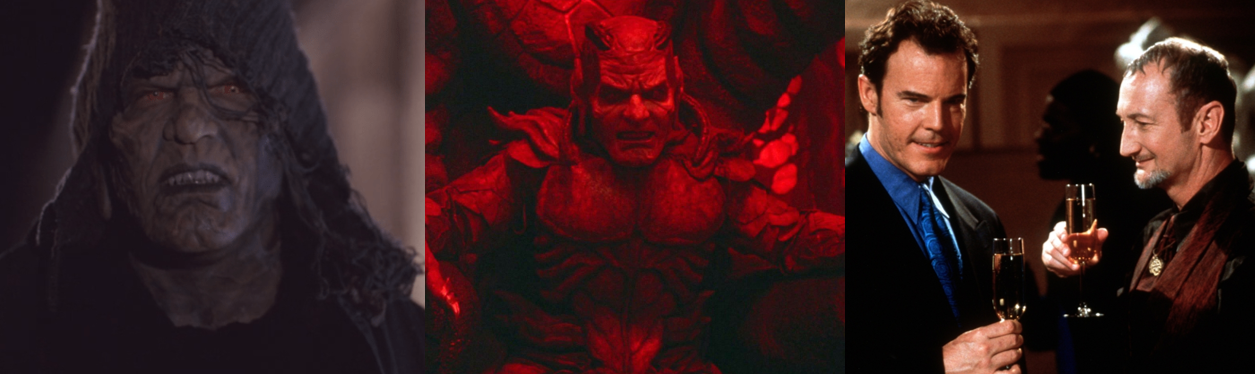
In the pantheon of horror icons and villains, you’d be forgiven for forgetting about the Djinn since he never attained the same level of popularity and notoriety as his closest equivalents, the likes of Freddy Krueger (Robert Englund) and Pinhead (Doug Bradley). However, I would argue that you’re doing yourself a disservice to not look into the Djinn’s efforts, especially the first two movies, simply because the concept of this malevolent, sadistic wish-granting demon is pretty unique and fascinating within the genre and Andrew Divoff’s performance is so damn captivating. The man oozes menace and a twisted glee at toying with and torturing his victims, his gravelly rasp of a voice makes him stand out even when he’s not made up into this truly horrific, demonic being, and he carries himself with an unsettlingly physicality and intensity at all times, never blinking, always watching and waiting to prey on the ignorance of others. The Djinn’s threat and seriousness is established right from the beginning with a helpful narration from horror icon Angus Scrimm and, later, from folklore professor Wendy Derleth (Jenny O’Hara), with both emphasising that the Djinn are not colourful, friendly characters as popularised by Disney but rather demonic creatures from the “void between the worlds” who must be feared above all else.

Alex is suddenly beset my gruesome visions after unwittingly freeing a demonic Djinn from an ancient jewel.

Back in 1127, the Djinn brought terror and suffering to a Persian empire but was sealed away within a special fire opal using an incantation by the emperor’s (Richard Assad) Zoroaster (Ari Barak) before he could bring his cohorts into the world. While it’s not made clear exactly how the emperor summoned the Djinn before this, the creature is trapped within the jewel for centauries and the gem is sealed within a statue of Ahura Mazda, finally making its way to then-present day America after wealthy art collector Raymond Beaumont (Englund) purchases it. However, crane operator Mickey Torelli (Josef Pilato) shows up to work drunk and accidentally causes the statue to break while unloading it, killing Beaumont’s assistant (Ted Raimi), and the jewel ends up in the hands of Regal Auctioneers and under the eye of their head appraiser, Alex Amberson. Alex is a very sporty, very active young lady who enjoys playing tennis with her best friend, Josh Aickman (Tony Crane), and even coaches a basketball outside of work, but she’s somewhat unlucky in love; a string of dead ends with boyfriends have left her cherishing the close friendship she has with Josh, even though he would like them to have something more, since dates “are a dime a dozen” and she doesn’t want to lose what little she has left. Thankfully, she’s distracted from this awkwardness by the jewel, which stuns her with its beauty and uniqueness, but she’s disturbed by strange visions and the results of her initial analysis after blowing and rubbing the gem. Luckily for her, Josh is capable of running additional tests with his laser equipment, so she takes it to him to take a look at, however she’s soon being haunted by the Djinn’s voice and bombarded with gruesome images of the death and suffering he’s causing after he breaks free from the gem.

To better collect the souls he requires and satisfy his lusts, the Djinn assumes a charismatic human form.

The Djinn’s first victim upon escaping is poor, lovesick Josh; caught in a horrific explosion caused by the Djinn’s breakout, Josh is left begging for his pain to end and the Djinn is only too happy to grant his request by increasing his agony a thousand fold until he dies, much to Alex’s horror and heartbreak. For Alex, this all hits a little too close to home as she’s still carrying the grief and survivor’s guilt from a house fire from her youth that saw her parents killed, though she was able to pull her sister, Shannon (Benson), to safety. At first, Alex believes that the shock of Josh’s death is causing her horrifying visions, which she’s previously suffered from and had therapy for in the past, but it’s actually because she unwittingly summoned the Djinn, who’s out in the world causing havoc with reckless abandon, having assumed the face and identity of “Nathaniel Demerest” to walk freely among men once more. While Alex meets with Beaumont to track the origins of the fire opal and discovers the horrifying truth of the Djinn from Derleth, Demerest conducts his own search for Alex, which causes him to cross paths with numerous victims and Lieutenant Nathanson (Ross), from whom he’s able to learn her location after causing a criminal (Dennis Madalone) to go on an unprovoked shooting spree. Determined to bring his fellow Djinn over from the dark dimension, the Djinn confronts Alex, killing Derleth and demonstrating his power using a “free” wish that proves he is an eternal force that cannot simply be killed or wished away by conventional means. When Alex refuses to give into the Djinn’s demands, the unholy demon is forced to resort to threatening Shannon in order to intimidate Alex into expending her remaining wishes, driving Alex to find another way to outwit the malevolent force she unwittingly unleashed.  

The Nitty-Gritty:
Of course, as mentioned, Wishmaster is absolutely chock full of appearances and contributions from some of horror’s greatest icons; Angus Scrimm, Robert Englund, Kane Hodder, Tony Todd, Josef Pilato, Reggie Bannister, and Ted Raimi all show up in one form of another (with all but Scrimm and Pilato meeting fittingly horrendous ends), Wes Craven produced the film and even Harry Manfredini does the music, resulting in one hell of a treat for die-hard, long-term horror fans. Horror villains generally fall into a couple of categories, from the unstoppable slasher villain to the unhinged psycho to the more supernatural wraiths and such, but the Djinn is almost in a league of his own. An unholy amalgamation of the likes of Freddy, Pinhead, and Daniel Robitaille/Candyman (Todd), the Djinn can only be called into being when summoned from the jewel that imprisons him and, upon being unleashed, will grant his summoner three wishes. However, the Djinn isn’t bound to just the one who summons him; he can freely walk the Earth, granting wishes to any that he encounters in exchange for their soul, but once the summoner has made their three wishes, the barriers between worlds will be broken and the entire Djinn race will flood the Earth. Although the Djinn cannot directly cause harm or hurt or kill others and is compelled to grant whatever is asked of him, he’s a master manipulator with a silver tongue and fully capable of twisting wishes to suit his own sadistic pleasures; even simple requests, such as to ease one’s pain or to be granted a million dollars, are perverted into a gory end and he’s constantly finding little loopholes to get past people or cause them suffering.

This under-rated horror is full of some horrific, gory effects, though some haven’t aged too well.

If there’s any reason to watch Wishmaster beyond Divoff’s magnetic and menacing presence, it’s the fantastically gory and unsettling special effects on show. We’re treated to an absolute orgy of blood and viscera in the opening sequence alone, in which the Persian emperor wishes to be shown “wonders” and is horrified to watch as his subjects are absorbed into the stone walls of his temple, trample over each other in a panic, suffer from horrendous diseases and injuries, turn to trees and human lizards, and even have monstrous jaws burst from their stomach. By far the most gruesome visual in this ghastly carnival of horrors is the depiction of a man’s bloodied and screaming skeleton literally forcing its way out of his body and pouncing on another in its pain and distress! And the harrowing deaths just keep coming once the Djinn is in the modern day; he coerces a cantankerous and bitter hobo (George “Buck” Flower) into wishing for an antagonistic pharmacist (Reggie Bannister) to die from cancer, resulting in the druggist collapsing and convulsing as a wretched form of super cancer eats him alive. He also grants a sales clerk’s (Gretchen Palmer) wish for eternal beauty by turning her into a mannequin, and renders a medical student (Brian Klugman) blind when he walks in on the creature ripping off and assuming Demerest’s face. The Djinn’s twisted sense of humour is at the forefront of every wish he grants; when Nathanson wishes to have unequivocal evidence of a known criminal’s guilt, the Djinn causes said criminal to shoot up the police station and even rip a guy’s jaw off! Though a security guard almost spares himself by sending Demerest away, he dooms himself to probably the poorest effect and death in the film when he goads the Djinn into turning him into glass, a death only surpassed in weakness by the fate of self-assured doorman, Johnny Valentine (Tony Todd), whom the Djinn “simply” leaves locked in a Chinese water torture cell.

Since she can’t kill the Djinn, Alex wishes to undo his actions by resetting time, banishing him once more.

The film is then nicely bookended by the Djinn granting Beaumont’s wish for his big gala to be unforgettable, which results in one of his guests turning to glass and shattering, mutilating a bunch of others, and still more being set on fire or ripped asunder when Beaumont’s pictures and statues come to life and go on a blood-soaked rampage, with Beaumont himself puking up a hideous, squealing tentacled creature! It’s not just the gore where Wishmaster shines, however; the Djinn himself is one of the most disturbing and monstrous creatures ever brought to life. A hulking, demonic creature, he glistens with an unsettling ooze, intimates with his red eyes and prehensile horns, and resembles something more akin to popular images of Satan rather than Robin Williams’s whimsical genie. The Djinn actually has a couple of forms in the film; when he escapes the jewel, he’s this putrid, slug-like monster (Verne Troyer) capable of little more than crawling, and undergoes a sickening metamorphosis (Walter Phelan) after ending Josh’s suffering that more than recalls the body horror of Hellraiser (Barker, 1987), and even has a ravenous beast at his beck and call in his dark dimension. Once he assumes his Nathanial Demerest guise, his external horror may be subdued but his charm and menace are just as palpable thanks to Divoff’s captivating screen presence, and there’s an intriguing complexity to his villain since he’s capable of practically anything you can imagine but his magic is restricted to the wishes of other, lesser beings. After attempting to trick Alex by assuming Derleth’s form, the Djinn abandons his façade and reveals his monstrous true self to her, granting Alex a taste of his hellish dimension, a bejewelled void of ancient evil where he delights in the torment of the souls in his possession, and manipulates her with the agony of the souls he has claimed. Functionally immortal and impervious to physical harm and at the brink of ultimate success, the Djinn doesn’t think twice to grant Alex’s final wish, that Torelli hadn’t been drunk at the start of the film, and thus unwittingly undoes the entire movie since the statue never breaks and the fire opal is never discovered, leaving the Djinn trapped once again and allowing all lives and souls lost to be restored and the unknowing Alex free to pursue a life with Josh.

The Summary:
I can see why Wishmaster didn’t quite reach the same heights as some of its competitors; the writing and dialogue is a little stilted and some of the acting isn’t quite up to par, with Tammy Lauren struggling with her delivery and comebacks and being a pretty weak main character and the wealth of horror icons hamming up their cameos at every opportunity. Some of the visual effects also leave a lot to be desired; obviously, the film didn’t have a massive budget and CGI was still finding its feet, but it probably would’ve been better to avoid computer effects entirely rather than date the film so noticeably. However, the practical and make-up effects are nothing short of extraordinary; Wishmaster is full of some of the most disturbing and gory deaths you’ll ever see from a slasher/horror film and there’s some really creative stuff happening here. Unlike Freddy and Pinhead’s initial outings, Wishmaster takes its fantastical concept and runs with it right away, depicting its demonic villain as a being of unparalleled power who can conjure all kinds of bizarre nightmares from the most innocent of wishes. Indeed, the titular genie is the star of the show here, and Divoff steals every scene he’s in with his creepy, menacing intensity and his purring growl of a voice. His Djinn easily stands up as one of the best under-rated horror characters ever and I loved how he exuded this hatred and contempt for humanity and being bound to their wishes when he’s capable of such incredible and horrendous feats. The film suffers a bit in terms of pacing, mainly being a showcase for the gruesome effects and a wet dream for horror fans everywhere with its gratuitous cameos, but I enjoyed the way the opening and ending paralleled each other and the Dijnn’s taunting, sadistic personality. Overall, I think this one is well worth your time and adding to your horror collection; it’s a unique and entertaining horror piece that has a lot of grisly visuals and effects to offer and is well worth a little bit more time in the spotlight.

My Rating:

Rating: 4 out of 5.

Great Stuff

Are you a fan of Wishmaster? Do you agree that it’s an under-rated horror film or do you think it’s better left forgotten? What did you think to the Djinn and Andrew Divoff’s performance, and where would you rank him against other horror villains? Which of the horror cameos was your favourite, or did you find them a bit too self-indulgent? What did you think to the kills and the effects on offer? Are you a fan of the Wishmaster sequels? If so, which is your favourite and would you like to see the franchise revived someday? What would you wish for if approached by the demonic Djinn? I’m always up for discussing Wishmaster so sign up to leave your thoughts below or feel free to leave a comment on my social media.

Game Corner [Spidey Month]: Spider-Man: Shattered Dimensions (Xbox 360)


Easily Marvel Comic’s most recognisable and popular superhero, unsuspecting teenage nerd Peter Parker was first bitten by a radioactive spider and learned the true meaning of power and responsibility in Amazing Fantasy #15, which was first published in August 1962. Since then, the Amazing Spider-Man has featured in numerous cartoons, live-action movies, videogames, action figures, and countless comic book titles and, in celebration of his debut and his very own day of celebration, I’ll be dedicating every Friday of August to talk about everyone’s favourite web-head!


Released: 7 September 2010
Developer: Beenox
Also Available For: Nintendo DS, Nintendo Wii, PC, and PlayStation 3

The Background:
Eager to capitalise on his success with the Fantastic Four, Marvel Comics editor and head writer Stan Lee conceived of Peter Parker/Spider-Man alongside Steve Ditko and the troubled teenage superhero first appeared in the pages of Amazing Fantasy #15. A near-instant hit, Spider-Man quickly made the leap to cartoons, films, action figures, and a number of videogames as well as seeing numerous other incarnations in the pages of Marvel Comics. In 2010, developers Beenox brought together four distinct versions of Spider-Man, each with their own aesthetic design and playstyle, for Activision’s next Spider-Man game. The developers sought to have the bosses of the game be just as distinct, as well as including some first-person sequences to break up the action and employing the talents of many notable Spider-Man voice actors to pay homage to the character’s long history. Although the game received mostly positive reviews, in addition to some downloadable content (DLC), it was eventually de-listed after Activision lost the Spider-Man license.

The Plot:
During a fight between Spider-Man and Quentin Beck/Mysterio, the mythical Tablet of Order and Chaos is shattered into fragments, causing chaos throughout the multiverse and falling into the hands of some of Spidey’s most notorious foes. To retrieve the pieces of the Tablet, Cassandra Webb/Madame Web unites four versions of Spider-Man from across the multiverse: the classic “Amazing” Spider-Man, the grim and stoic Spider-Man Noir, Miguel O’Hara of the futuristic 2099, and the black-suited teenaged “Ultimate” Spider-Man.

Gameplay:
Spider-Man: Shattered Dimensions is a linear, mission-based third-person action title that has players battle a number of Spider-Man’s most iconic foes as four distinctively different versions of Spider-Man, each with their own unique appearance, levels, and personality. While some Spider-Men have slightly different abilities, combat styles, and gameplay, there are many fundamental gameplay mechanics which the four Spider-Men share: they all jump with A (and tapping A again in mid-air will perform a double jump), can land a fast strike with X and a strong attack with Y (and holding down either button performs a charge attack and an air launcher, respectively), and web or grab objects and enemies with B and you can mix and match these attack commands to string together a few basic combos. Naturally, you can web-sling by holding the Right Trigger; release the trigger and hold it again to perform successive web-slings or tap RT to perform a super handy web-zip to quickly dash to perches and platforms. Tapping the Right Bumper sees you fire off a quick web shot (which I found to be largely useless), you can press up on the directional pad to enable the spider-sense (which acts almost exactly like the “Detective Mode” from the Batman: Arkham videogames (Rocksteady Studios/Various, 2009 to 2015) and allows you to see through walls and obstacles to highlight enemies and collectibles), and you can also hold the Left Trigger to enter an “Evasive Stance” that lets you dodge and roll away from enemy attacks.

While the Amazing Spider-Man takes the direct approach, his Noir counterpart sticks to the shadows.

Each Spider-Man has a few different options available to them that make their gameplay a little different; the Amazing variant is a pretty standard Spider-Man with no additional abilities whose gameplay consists of a mixture of combat, web-slinging, and wall-crawling with some very light puzzle-solving thrown in for good measure. His Noir counterpart may not have any additional abilities but he plays considerably different from his mulitversal allies; for one thing, Spider-Man Noir’s world is rendered entirely in the moody black-and-white of the 1930s and, for another, he’s far more reliant on stealth. Again, like the Batman: Arkham games, Spider-Man Noir has to stick to the shadows and avoid spotlights and being spotted by gangsters, who will fill him full of lead if they spot him and briefly hunt him down unless you flee to the shadows. This means you have to stay up high, out of the way, and in the darkness, sneaking up on enemies or taking them down from a variety of positions with the B button. Spider-Man Noir does also get to engage enemies in direct combat but only in specifically designed sections; most of your time will be spent webbing up gangsters from the shadows, which is pretty fun but nowhere near as challenging or varied as in the Batman: Arkham games as Spider-Man Noir doesn’t have any gadgets or options to distract or toy with his prey.

Ultimate Spider-Man and Spider-Man 2099 have special abilities that are unique to them.

Both Spider-Man 2099 and Ultimate Spider-Man make use of the Left Bumper; since he’s wearing the bestial black suit, Ultimate Spider-Man can build up a “Rage” meter by attacking enemies and, when it’s full, pressing LB sees him fly into a rage and attack enemies faster and with more powerful tendril attacks. In this regard, Ultimate Spider-Man seems to be more geared towards combat but, in practise, I found his gameplay mostly the same to his Amazing counterpart but with the added bonus of a useful attack buff. Spider-Man 2099 can utilise LB to activate his “Accelerated Vision”, which briefly slows down time and allows him to better dodge and react to incoming attacks and obstacles, and this meter will automatically refills over time. Spider-Man 2099 also has to endure a number of freefall sections that see you holding A to dive faster towards a target and use B to grab them and X to punch them all while avoiding debris and other obstacles.

Annoying first-person segments and rescue missions mix up the gameplay.

Other than that, the four Spider-Men share the remaining gameplay mechanics: this means you’ll be mashing B on certain walls and objects to rip them down or toss them at enemies and bosses, rescuing and protecting civilians and scientists by fending off enemies, swinging over to them, picking them up with B, and carrying them to a safety point; and taking part in some awkward first-person punching sequences. These appear during the majority of the game’s boss battles and see you using the two analogue sticks to punch or dodge, which is an interesting mechanic to add in but ultimately seems like something that could have been restricted to just the Amazing Spider-Man to help him stand out from the others. Other challenges include web-slinging away from danger (sometimes towards the camera, which can be very disorientating), web-zipping to enemies perched above, destroying certain objects, or activating or deactivating generators. Each level generally repeats these sections at least three times; if you have to rescue three civilians in the early part of a level, you can bet that you’ll be rescuing five a little later on, for example.

The game’s not especially difficult but can be long and tedious at times.

When not in combat or an action situation, each Spider-Man’s health will slowly regenerate, though you can also replenish it with Gold Spider Emblems scattered throughout each level. Occasionally, you’ll find water, acid, or electrified pits that will cause an instant respawn; other times, if you fall or fail a web-sling, you can recover with RT to save yourself. Spider-Man: Shattered Dimensions has three difficulty settings (Easy, Normal, and Hard), though the game isn’t massively difficult on Normal. Hard mode obviously results in more durable and aggressive enemies, and mixes up their placement and how many hits will defeat a boss, but there are many checkpoints and respawn points sprinkled through the game’s levels, which can get quite long and tedious as you progress. Additionally, like many Spider-Man videogames, mechanics such as wall-crawling and web-slinging can get a bit janky in Spider-Man: Shattered Dimensions thanks to the controls bugging out when on walls and ceilings and the camera proving unreliable and jerky at times.

Graphics and Sound:
Spider-Man: Shattered Dimension’s levels are entirely linear; there’s no free roaming or overworld to be found here, which is fine as that can be a little daunting, and instead you’ll explore a variety of levels that can be both large and intimidating and narrow and claustrophobic. When in wider, more open areas, your options for exploration are largely limited by walls (both visible and invisible) and gameplay objectives that constantly push you forwards. Still, there are at least a wide variety of locations on offer; you’ll scale Osborn Tower in the city, a disused desert mine, a ruin-filled jungle, and a hydroelectric dam amongst others. Primarily, the game leans towards a vibrant, quasi-cel-shaded style, especially for the Amazing and Ultimate Spider-Men, though not to the extent where it looks like ugly 2D characters monstrously rendered in 3D as in other games.

The game is full of visual variety in its levels, graphics, and characters.

Where the game really shines, though, are in the Noir and 2099 levels; the Noir levels are rendered entirely in monochrome, with sporadic use of colour only appearing when using the spider-sense. The heavy shadows and stark contrast of white on black immediately makes these sections stand out not just from the rest of the game but also its closest competitors, the Batman: Arkham titles, and reminds more of MadWorld (PlatinumGames, 2009) and Frank Miller’s Sin City comics and films (ibid, 1991 to 2002; ibid and Rodriguez, 2005; 2014). Similarly, the 2099 levels are an explosion of futuristic neon and technology; indeed, I found the 2009 levels to be a bit of a sensory overload and a bit difficult to digest, making it tricky to know where I was supposed to go since every level was so bustling with lights, metal, and colours. Still, it’s a great way to make each Spider-Man’s locations even more visually distinct from each other, though there was maybe a missed opportunity to mix things up a bit later in the game to have, say, Spider-Man Noir in the 2099 world.

The graphics hold up really well but it’s the voice work that really makes the game shine.

While the game’s music isn’t much more than the standard superhero fare of rousing horns and tunes, the voice acting is absolutely top notch! Each Spider-Man is voiced by a notable and popular Spidey voice actor from his many cartoons, which saw not only Dan Gilvezan’s return to the character after a twenty-five year absence but also the return of Christopher Daniel Bares, who voiced the Spider-Man I grew up with in the nineties cartoon. Neil Patrick Harris is easily the best of the four, though; he always makes for a fun and fitting Spider-Man and his delivery really sells the character’s many quips and witticisms. Stan Lee narrates the start and end of each chapter and Nolan North even reprises his role as Wade W. Wilson/Deadpool, who steals the show in his oil rig-turned-reality show by constantly berating and taunting Ultimate Spider-Man and breaking the fourth wall at every opportunity. The in-game graphics are brilliant; levels and enemies are as visually distinct as the four Spider-Man and the game runs very fast and smooth (when the camera isn’t freaking out on you). The cutscenes are equally impressive, if a bit inconsistent as they’re comprised of the in-game graphics, higher quality cinematics, and partially animated sequences, but they tell the story well enough and are always fun to watch.

Enemies and Bosses:
There are a number of goons to pit your spider-powers against in Spider-Man: Shattered Dimensions but, for the most part, once you’ve faced the first wave of enemies in the first level, you’ll encounter the same troupes again and again but in new skins. You’ll find regular enemies who come at you with their fists and melee weapons (baseball bats and swords and such), gun-toting enemies who either chip away at your health or blast you full of holes when playing as Spider-Man Noir, shield-carrying enemies who you must zip towards and hop over with A to attack from behind, and larger enemies who will put up a block that you need to break with your air launcher attack. Other enemies include smaller versions or duplicates of the level’s main foe that can generally be taken out in one or two hits but swarm all over you, larger enemies that toss out grenades or seeking rockets, and all manner of zombies and genetically-engineered monstrosities. One aspect I really enjoyed was that enemies can actually attack and harm each other, which is incredibly helpful when swarmed by foes, and you can also throw objects such as barrels and flaming debris at enemies to help whittle them (or, at least, their health) down.

The Amazing Spider-Man battles Kraven, the Sandman, and the Juggernaut for the Tablet pieces.

Each level is structured around locating, pursuing, and/or confronting one of Spider-Man’s villains and retrieving a piece of the Tablet from them; thus, each level concludes in a boss battle but you’ll actually battle each boss a number of times throughout each level. The first boss the Amazing Spider-Man comes up against is Sergei Kravinoff/Kraven the Hunter, who leads you on a merry jaunt through the jungle, shoots at you through his sniper rifle, and initially battles you inside of a caged arena. Here, you’ll need to dodge and evade his jumping strikes and counterattack in response, web-zip to the convenient columns to avoid the floor spikes, and finish him off with some first-person punching. In the second battle, he’s much stronger and faster thanks to the Tablet fragment but the strategy remains the same; take advantage of the spawning columns to avoid his attacks and strike as and when you can but don’t linger in one area for too long or he’ll knock your ass down. Later, you’ll have to pursue Flint Marko/The Sandman through an abandoned mine, using your web pull to drench his raging sand tornado and battle his gigantic form within the mine itself. Here, you must trick him into slamming his fists into water carts to muddy them up and make them vulnerable, then toss barrels at his face to defeat him. Afterwards, he draws you within his chaotic sandstorm and his personality begins to unravel; you must web-zip around the floating debris avoiding his giant fists and tossing water barrels at his face so you can deal some real damage and put him down once and for all. Finally, you’ll battle and purse Cain Marko/The Juggernaut in a construction site, through the city, and in the wreckage of Osborn Tower; initially, you simply have to avoid his charge attack to cause him to ram into specific towers and beat on him when he’s lodged in the ground, but his later empowered form sees him add a whole bunch of annoying ground pounds and smashes to his repertoire. Still, as long as you dodge away and stay away from his powerful grapple moves, it’s not too difficult to avoid his attacks and projectiles and put a big beating on him when prompted.  

Spider-Man Noir’s bosses can be a bit tricky, confusing, and mundane, respectively.

In the train yard, Spider-Man Noir follows Joseph Lorenzini/Hammerhead and it’s in the first fight against him that you might hit a considerable difficulty wall; Hammerhead uses a huge Gatling gun to keep you at bay whenever his lights (or the spotlights in the arena) spot even the slightest part of you. After taking cover behind walls, you must wait for Hammerhead to rotate away and run around behind him, staying wide and in the shadows, and press B when prompted to put a beating on him but the game doesn’t make this very clear and Hammerhead spots you way too easily. In the second fight, you have to avoid his machine gun fire and toss barrels at him to force him to blow up a piece of machinery with his rocket launcher, then zip up to the higher platform as he fires wildly into the fog to do big damage with a takedown, and then avoid his head-on charge to finish him off. Later, Spider-Man Noir pursues Adrian Toomes/The Vulture through the grimy streets and confronts him in a large warehouse; the Vulture is another annoying and confusing boss as he darts around slicing at you and tossing knives and you’re encouraged to use the spotlights to blind him and deal big damage but it’s unnecessarily random and difficult to get him into position to actually utilise this mechanic. When powered by the Tablet fragment, the Vulture’s claws and bite need to be avoided in first-person and then you go through the previous battle again but this time he also tosses Molotov cocktails at you (which you can cause him to drop to damage him instead). Finally, Spider-Man Noir tracks Norman Osborn/The Goblin to a warped fairground and has a number of first-person encounters with him before finally facing him inside the circus tent. The Goblin isn’t really all that, though; simply web towards him and jump over him to attack the glowing weak spot on his back, then zip up to higher ground when the lights go out to hit a takedown, before fending off his goons (or causing the Goblin to attack them himself) and avoiding the swipes from his column and pummel him when he’s stuck in the ground.

Ultimate Spider-Man’s bosses were probably the most fun and varied for me.

Ultimate Spider-Man’s first foe is Max Dillon/Electro, who he battles and pursues through a hydroelectric power plant to a huge dam; the first fight is quite annoying as Electro blasts at you with a huge laser and protects himself with an electrical field but the second bout is initially quite confusing as Electro teleports across generators and shields himself from your attacks. Soon, he drops to the floor and sends electrical blasts your way, but these leave him exhausted and vulnerable to your attacks. After fending off his electrical minions and draining his health, he’ll use the Tablet fragment to grow to gigantic properties and become invulnerable, similar to the Sandman fight. To defeat this giant Electro, you need to use your webbing on his hands to cause him to damage the dam behind him while avoiding his laser beams. When the fight switches to the other side of the dam, you’ll need to survive against the enemies he spawns and avoid his fists on an increasingly-small platform until prompted to web his head so the breached dam can finish him. While on the oil rig, Spider-Man is forced to take part in Deadpool’s warped reality show; this inevitably leads to a showdown between them that sees Deadpool teleporting around, slicing at you with his swords, and shooting at you all while his devoted fanboys rush in to join the fight. When he’s standing with a B prompt above his head, don’t web-zip over to him or else he’ll just teleport away; instead, rush over and approach from the ground to best him. After outrunning a tidal wave, you’ll battle him inside a caged arena, where he uses the Tablet to duplicate himself and rains explosive punching bags between rounds. However, simply evade these, and his attacks, and target each of his duplicates in turn and he’ll soon go down, but the final battle against Carnage is particularly striking since the creature has ransacked the Triskelion and corrupted its inhabitants into bloodthirsty monsters! In the first fight against Carnage, it leaps about the remains and wreckage of Quinjets and Helicarriers swiping and skewering you with spikes, but is perfectly susceptible to your attacks and can be dealt big damage by web-zipping it into the conveniently-placed furnaces nearby. In the second phase, Carnage encases itself in a bulbous, tentacled shield that some mechs will destroy with flamethrowers; this leads to a first-person sequence and Carnage blasting spikes, maniacally hopping around the place, and it draining your health to replenish its own if it gets hold of you!

Spider-Man 2099’s bosses tend to be very samey, tedious, and chaotic.

Spider-Man 2099 first butts heads with the Hobgoblin during a freefall sequence that sees you pummelling him and smashing him through obstacles. When you hit the ground, Hobgoblin hovers out of reach and tosses pumpkin bombs at you that you must grab with your webs and throw back at him to down him for a beating. After being empowered by the Tablet, the Hobgoblin conjures gargoyles to distract you and adds a bombardment of bombs to his arsenal, but the strategy remains the same; he’s just faster and more aggressive and you have to finish him off with a mid-air, first-person pummelling. O’Hara’s second boss is Kron Stone/The Scorpion, who leaves explosive, acidic eggs and spawns smaller versions of himself; the Scorpion initially charges at you and tries to smash you with his tail, but if you evade these attacks he’s left vulnerable to a beating and you can easily toss his eggs at him when he takes the high ground to spit acid at you and use B to beat him down. When powered by the Tablet, things are mostly the same but there’s also a large pit in middle of the room that Scorpion pounces at you in and fills with acid; however, throwing eggs at him will cause him to take a dip and be left wide open for a beating. Finally, O’Hara has to fight through Doctor Serena Patel/Doctor Octopus’ elaborate facility, avoiding her mechanical arms in freefall and trashing her gigantic Mecharms before confronting her at the heart of the complex. Here, you need to web pull three generators to lower her shield while avoiding her lasers, then jump over her energy shockwaves to do damage on her. When she powers up, she scuttles around fully shielded and firing lasers across the ground, but you can easily trick her into offing her own minions and defeat her by tossing their explosive cores at her.

All four Spider-Man take it in turns to whittle down and defeat Mysterio in the finale.

Once all of the bosses are beaten, the levels cleared, and the Tablets recovered, all four Spider-Man are thrown into a dimension of pure chaos as Mysterio uses the completed Tablet to become a gigantic, all-powerful God. First, you have to web-zip across floating, fragment platforms as Spider-Man Noir; there are no enemies to fight but you must make sure to avoid the light or else Mysterio will fire projectiles your way, and then simply press B when prompted to web pull his head into a rock. Ultimate Spider-Man then has to fend off a whole bunch of illusionary goons and then destroy the floating orbs after they’ve conjured an illusionary version of a boss, which hurts Mysterio, before quickly web-zipping across the wreckage when Mysterio destroys your platform and then hitting another web pull. Spider-Man 2099 has the easiest time in this fight as you simply have to freefall past Mysterio’s projectiles and magic obstacles to grab and pummel him, but the Amazing Spider-Man has to endure a gruelling gauntlet against a whole bunch of monsters while avoiding Mysterio’s projectiles. Once the enemies are cleared away, you can use the web pull to send a rock flying at Mysterio and must then web-zip to another, smaller platform and repeat the process until he’s downed for one last smash of his helmet to defeat his aspirations for good.

Power-Ups and Bonuses:
As you explore the various levels in Spider-Man: Shattered Dimensions, you may be disappointed to find that there aren’t any power-ups to find beyond the odd health-restoring Gold Spider Emblem. However, every level contains a number of challenges that make up the “Web of Destiny”; while most of these are unavoidable and story-based, many others are optional an easily missed unless you check the Web in each level. You may have to complete certain sections under a time limit, defeat certain enemies in certain ways, or perform certain moves a number of times in order to clear the challenges but the reward is some extra “Spider Essence”.

Collecting Spider Essence allows you to upgrade your abilities and unlock new costumes.

As you clear defeat enemies and bosses, clear levels, and complete these challenges, you’ll be awarded with Spider Essence, which essentially acts as a combination of currency and experience points and can be spent upgrading your health and regenerative capabilities, and unlocking new costumes and attacks, all of which make the game even easier and more chaotic as you plough through enemies with a longer health bar and additional strikes. You can also acquire additional Spider Essence by finding Silver Spider Tokens and Hidden Spiders in every level, which also count towards completing the Web of Destiny, so it pays to give each area a quick scan with your spider-sense for any collectibles.

Additional Features:
Spider-Man: Shattered Dimensions has forty-two Achievements on offer, with the vast majority of them popping as you play through the story and take down the game’s villains. There are also Achievements for completing the Web of Destiny, unlocking all the upgrades, and finding every Spider Token and Hidden Spider, which adds some replayability to the game. Other Achievements pop when you defeat up to five-hundred enemies, complete the game on each difficulty (which are stackable), maintain Ultimate Spider-Man’s Rage mode for a full minute, and perform a combo of up to two-hundred hits but there aren’t too many fun or quirky ones that ask you to go off the beaten track. Otherwise, that’s about it; you receive either a Bronze, Silver, or Gold Medal and unlock character models and concept art after clearing levels and there were some additional costumes for those who pre-ordered the game back in the day but there’s not really anything else to come back to besides any Achievements you missed. It might have been nice to include a boss rush or a survival mode, or as mentioned earlier mix and match the Spider-Man in a free play mode, but the Web of Destiny will keep you pretty busy for a few hours, I’m sure.

The Summary:
I’ve wanted to play Spider-Man: Shattered Dimensions for years; sadly, I missed out on it when it first released, and the game has become very expensive and hard to come by since then. Thankfully, I was able to snap it up and finally get to grips with it and it was actually a pretty good way to spend a few hours. It’s not especially long or difficult, at least not on Normal mode, and can probably be finished in a day if you play non-stop from morning the late evening but there’s a fair amount to come back to once you’re done. Fittingly, the four Spider-Men are the main highlight of the game; each one looks, sounds, and plays a little differently from the other and it’s fun to go nuts with Ultimate Spider-Man’s rage and then stealthily stalk gangster as Spider-Man Noir. Splitting the game into individual levels helps to keep things interesting and fun, but levels do tend to drag on and enemy and boss variety doesn’t really hold up under close scrutiny. Most of the bosses boil down to winning one of those annoying first-person sequences, pursuing them through the level, battling their first form (usually with hit-and-run tactics, using their own attacks against them, or taking advantage of them getting stuck) and then fighting their Tablet form, which is either a giant version of the boss or a faster, more powerful version. A janky camera and awkward wall-crawling and web-slinging can make the game frustrating but these are recurring concerns in Spider-Man videogames and, overall, I found the game to be pretty fun and entertaining for the voice acting and visual variety alone.

My Rating:

Rating: 3 out of 5.

Pretty Good

Have you played Spider-Man: Shattered Dimensions? If so, what did you think to it? Which of the four Spider-Men was your favourite? What did you think to the way the game handled the four Spider-Men and the different playstyles? Which level and boss battle was your favourite (or most frustrating)? Are you a fan of Spider-Man teaming up with his multiversal incarnations?? Which Spider-Man videogame is your favourite? Whatever you think, sign up and leave a comment or let me know on my social media and check in next Friday for more from Spider-Man Month.

Movie Night [Thor’s Day]: Thor


In August 1962, Stan Lee, Larry Lieber, and Jack Kirby introduced readers of Marvel Comics (specifically Journey into Mystery) to Thor Odinson, God of Thunder and mightiest of the Asgardian deities. Through associations with Marvel’s premier super team, the Avengers, and a number of cosmic, mythological adventures, Thor has gone on to become another of Marvel’s most successful and versatile characters, with appearances in cartoons, videogames, and a number of incredibly profitable live-action movies. Being as it’s the first Thursday (or “Thor’s Day”) of the month, what better way to celebrate the God of Thunder than to take a look back at his impressive MCU debut!


Released: 6 May 2011
Director: Kenneth Branagh
Distributor:
Paramount Pictures
Budget:
$150 million
Stars:
Chris Hemsworth, Natalie Portman, Tom Hiddleston, Stellan Skarsgård, Kat Dennings, and Anthony Hopkins

The Plot:
The heir to the legendary throne of Asgard, Thor Odinson (Hemsworth) is a brash warrior who longs for glory and is almost unstoppable thanks to his enchanted hammer, Mjölnir. After inciting war between Asgard and the Frost Giants of Jotunheim, he is banished to Earth by his father, Odin Allfather (Hopkins), and forced to learn humility to reclaim his lost powers.

The Background:
Thor may have been the fourth film in the Marvel Cinematic Universe (MCU) but a big-screen adaptation of the character was originally pitched by director Sam Raimi to 20th Century Fox back in the nineties; though the project lay dormant for nearly a decade, it gained momentum after the success of X-Men (Singer, 2000). After the character and movie rights changed hands numerous times, writer Mark Protosevich came onboard to draft a script that was part-superhero, part-Biblical allegory for the fledging Marvel Studios as part of producer Kevin Feige’s outrageous plan to introduce a number of Marvel’s greatest heroes in solo movies before uniting them against a common foe. After Matthew Vaugh dropped out of the project, Guillermo Del Toro briefly flirted with the concept before Marvel scored a massive coup by securing Kenneth Branagh as the film’s director. Relative-unknown Chris Hemsworth beat out his own brother and co-star Tom Hiddleston for the title role and Branagh landed a coup of his own by casting renowned actor Anthony Hopkins as Odin, who lent a credibility and gravitas to the production. As the first film in the MCU to introduce cosmic, magical elements, Thor was to be a bridge between science and magic and to help expand the scope of Marvel’s shared universe, while still laying the foundation for their first big team up. Thor released to widespread acclaim; the film made just under $450 million at the box office and catapulted Hemsworth and Hiddleston to superstardom in the process.

The Review:
After Iron Man (Favreau, 2008) proved to be such a phenomenal success, I was cautiously optimistic about the fledgling MCU; when Nick Fury (Samuel L. Jackson) appeared in the film’s post-credits scene and hinted at other “[superheroes] flying around” and name-dropped the “Avenger Initiative”, the excitement for what was to come was palpable. And yet even I was curious as to how the films, which had been so heavily based in technological and science-fiction, would introduce more bizarre, cosmic events and characters such as Thor. When Mjölnir appeared in the post-credits scene of Iron Man 2 (ibid, 2010), the possibilities for Thor’s inclusion in this world suddenly seemed endless; was he known to the Strategic Homeland Intervention, Enforcement, and Logistics Division (S.H.I.E.L.D.)? Had he appeared in Marvel’s shared world before? For me, Thor was the true test of whether the MCU would be an actual success because its one thing to present characters augmented by science but it’s quite another to have them rub shoulders with a literal Norse God!

Thor was our introduction to what would become a much larger and more dangerous universe.

Thor was also a first in the MCU for opening with a narration, fittingly enough by Odin himself, that briefly introduces the idea of the Nine Realms and Asgard’s place in the tapestry of the universe; thankfully, this information isn’t made completely redundant when it’s shared with other characters later in the story as Thor notably relates the true nature of the universe in a different way from his more grandiose father. A wise, enigmatic, and stern figure, Odin has high hopes for both of his children regarding their destiny as future kings of Asgard. It’s important to not that, while Asgard is certainly populated by beings we would consider to be superhuman, they are not strictly Gods in the MCU. Instead, they are others of their kind have been worshipped as Gods, had stories told about them as though they were Gods, but are just as mortal and fallible as we are for all their superior strength, technology, and durability. For me, this doesn’t diminish Thor’s appeal or that of the Asgardians; they’re still incredibly long-lived, with Thor himself being thousands of years old and yet still very much a child, and capable of wondrous acts, such as instantaneous travel across the Nine Realms thanks to the Bifröst and summoning thunder and lightning with their incredible weapons.

Be merciful, say “death,” For exile hath more terror in his look, Much more than death. Do not say “banishment.”

Asgard is a realm of great prosperity and peace; for centuries, Odin has led the Asgardians in defending the Nine Realms from chaos and incursions and the film begins with him ready to step down and pass those responsibilities onto Thor, his eldest son. Heralded as a hero, Thor is a battle-hungry warrior who has proved himself in conflict time and again to be brave and strong enough to lead his people into battle, but Odin cautions that a true king must also be wise, fair, and just. Nevertheless, he’s fully prepared to pass the crown to Thor when the ceremony is interrupted by Frost Giants from the desolate ice realm of Jotunheim who attempt to reclaim the mystical Casket of Ancient Winters from Odin’s treasure vault. Angered at the Frost Giants’ blatant disrespect and consumed by his pride, Thor disregards his father’s decree that he is to launch no counterattack and heads into Jotunheim alongside his allies to confront their king, Laufey (Colm Feore), an action that angers his father as it breaks the shaky, but long-standing, truce between the two realms. With Asgard now on the brink of an unnecessary all-out war, father and son rage at each other in a fantastically well-acted scene in which Odin’s heartbreak at Thor’s sheer blind arrogance is all too clear; enraged at Thor’s reckless actions, Odin strips Thor of his powers and armour and banishes him to “Midgard” (what we call Earth) without his hammer in a burst of fury.

Thor finds allies on Earth but is devastated when he finds he can’t lift his enchanted hammer.

Rendered a mortal, Thor is both angered and dismayed at what he sees as his father’s cruel and unjust punishment. Almost immediately, he (quite literally) bumps into a group of scientists in New Mexico: Doctor Jane Foster (Portman), Doctor Erik Selvig (Skarsgård), and spunky intern Darcy Lewis (Dennings). The three are conducting research in the area when Thor is deposited in their laps through what they perceive as a wormhole and become immediately captivated by him for his physicality, lineage, and knowledge of worlds beyond our own. Her curiosity piqued, Jane becomes enamoured by Thor; the mysteries of his being are as attractive to her as a scientist as his allure is to her as a woman and he is equally taken by her inquisitive nature and scientific tenacity. Thor’s arrival also attracts the attention of S.H.I.E.L.D., who dispatch Agent Coulson (Clark Gregg) to secure the area, resulting in Jane’s notes and equipment being seized. Eager to retrieve Mjölnir, atone for disrupting Jane’s work, and to prove to the group that he is the God of Thunder, Thor is aided in infiltrating the S.H.I.E.L.D. base but is left devastated when he finds his hammer has been enchanted so that only one who is “worthy” can lift it. Finally realising the folly of his impetuous ways, Thor becomes repentant and is heartbroken to learn from Loki (Hiddleston) that his father has died of a broken heart and that he can never return home, but finds solace in regaling Jane and his newfound friends with stories of Asgard and the Nine Realms.

Loki is a manipulative trickster who conspirers to seize the throne of Asgard for himself.

Of course, Thor has been deceived, as has all of Asgard, but the God of Mischief himself, Loki. Raised alongside Thor and having fought by his side in countless battles, Loki nonetheless finds himself constantly in his brother’s shadow; smaller and slighter than his muscle-bound brother, Loki’s strengths lie in illusions and manipulation rather than brute force and strength. With his silver tongue, he easily encourages Thor’s campaign into Jotunheim with but a few words all while conspiring with Laufey to murder Odin and take what will not be willingly given to him. Craving the throne of Asgard for himself, Loki showed the Frost Giants a way into Asgard that even the all-seeing Heimdall (Idris Elbra) was blind to and, after learning his true heritage as Laufey’s son, he flies into a distraught rage at his adopted father that exacerbates his falling into the “Odinsleep”. Seizing his opportunity, Loki claims the throne and prepares to allow his true father to enact revenge on his fated enemy; after toying with his brother and leaving him distraught with his lies, Loki resolves to tie up loose ends with the Destroyer, a massive mechanical construct that he sends to Earth to kill Thor so that his rule can never be challenged. There’s a reason why Loki is one of the MCU’s most enduring characters, both as a villain and an anti-hero, and that’s largely due to Hiddleston’s masterful performance at capturing the God’s anguish and fury at being denied his rightful time in the sun; there’s a tragedy to Loki that motivates his actions and an intriguing dichotomy as he both loves and hates his brother and father, respects and is envious of them, and his every motivation is geared towards winning the affection and approval of both by any means necessary.

Thor’s allies provide him with the support necessary to be a great warrior and a better man.

Luckily for Thor, his Asgardian allies learn of this plot and arrive on Earth to aid him. The large and ravenous Volstagg (Ray Stevenson), the grim and stoic Hogun (Tadanobu Asano), Fandral the swashbuckling romantic (Josh Dallas) – collectively known as the “Warriors Three” – and Lady Sif (Jaimie Alexander), the strong-willed warrior maiden, all willingly follow Thor into even the depths of Jotunheim and have fought many battles alongside him and Loki. At first, they are devastated to learn of Thor’s banishment but pledge their allegiance to their new king out of loyalty to the throne of Asgard. When they learn the truth of Loki’s deception, however, neither they nor Heimdall hesitate to provide Thor with back-up but, fundamentally, these characters are primarily there for comic relief, to flesh out Thor’s world and relationships, and to add a few more superhuman bodies to the battle against the Destroyer. Indeed, the film wisely places much of its focus and runtime on Thor’s burgeoning relationship with Jane and grounding him in the “real world” of the MCU in the process. Not only does this provide some amusing moments (Darcy tasing Thor, his attempt to escape the hospital, and Erik trying to match beers with him are notable highlights), but it also gives Thor the chance to learn that there’s more to life than glory and battle and he grows from a selfish, arrogant warrior into a selfless hero who puts others before himself and is willing to sacrifice his own life to save even those he has only just met.

The Nitty-Gritty:
At its core, Thor is a tale of fathers and sons; fittingly Shakespearean in its grandeur and scope, Thor weaves a story of betrayal and secrets as Odin’s attempts to maintain and foster peace between Asgard and Jotunheim ultimately lead to the destruction of his family. Though a benevolent figure, Odin is harsh and uncompromising; he doesn’t hesitate to subject Thor to a punishment worse than death as recompense for his foolhardy and rash actions. At the same time, though, it’s pretty clear that Odin does this fully expecting Thor to learn humility and to prove himself worthy of Mjölnir once more. Doing away with the dual persona of Doctor Donald Blake was a great move, I feel (and I enjoyed the quick shout-out to Thor’s traditional alter ego), as it really isn’t necessary to tell this story and it’s so much more impactful seeing the muscled, fittingly God-like Thor struggle to adapt to being a mortal.

Thor is forced to learn a lesson in humility to earn back his power and his hammer.

Of course, the downside to this is that Thor isn’t really Thor for the vast majority of Thor’s runtime; we get to see him in full regalia at the beginning of the film, where Asgard is rendered in stunning beauty, and for the climatic finale but, in the middle, he’s stripped down to the basics. However, this is obviously the entire point of the film and it works fantastically as a way to slowly introduce these cosmic and outlandish concepts to the otherwise grounded MCU. Dumped on Earth as a mortal, Thor’s history is related to us and the other human characters by Selvig so we can see how Asgardians were worshipped as Gods here on Earth, and Thor reveals to Jane that magic and science are one and the same in the realm of Asgard and directly relates outlandish concepts like Yggdrasil to Jane’s more scientific understanding of the universe. This grounded approach to the subject also results in two extremely emotional and impactful scenes: the first is Thor’s cry of utter anguish when he finds that he cannot lift Mjölnir and the second is his triumphant return to full power after giving his life. Thanks to us following Thor’s journey from braggart to humility, it’s not hard to share Thor’s adulation at having proved himself worth once more.

I absolutely love Thor‘s visual style and costume design.

One of the things I absolutely love about Thor is the costume design and aesthetic of the film; Asgard is a gorgeous golden city full of wondrous and grandiose architecture and technology and its inhabitants, particularly our main characters, look absolutely fantastic all decked out in their armour and attire. Even now, the sheer spectacle of seeing the likes of Thor, Odin, and Loki in glistening armour remains impressive and I absolutely love how weighty Mjölnir seems and how intricate all of the costumes are. Clearly inspired by Olivier Coipel’s 2007 redesign of the character, Thor looks both familiar and suitably updated for his big-screen debut and I love how the film showcases even ridiculous aspects of his powers, such as spinning Mjölnir around rapidly in order to fly. That’s not to discount Loki, Heimdall, and Odin, who all look stunning as well; garbed in regal armour, Odin appears both wise and glorious and Loki looks both regal and menacing fully garbed in his green and gold attire and sporting a fearsome horned helmet. Add to that the visual of the Destroyer wrecking its way through New Mexico, the dark and dreary ice wasteland of Jotunheim, and the imposing, demonic appearance of the Frost Giants and you have a film that, while not necessarily action-packed like other MCU movies, is visually breath-taking to behold.

Loki is defeated and presumed lost, just like Thor’s road back to Earth and Jane.

Thor also turns things on their head a bit by kind of casting S.H.I.E.L.D. as antagonists; concerned only with isolating Mjölnir and learning everything they can about the hammer’s arrival, both S.H.I.E.L.D. and Coulson appear much shadier and untrustworthy than in their previous appearances. However, this is obviously just a misunderstanding and, by the end of the film, Thor pledges to Coulson that he is a trusted ally and the S.H.I.E.L.D. agent is more than willing to return Jane’s work to her after getting to the bottom of the incident. Restored to full power, and now fully aware of his brother’s deception, Thor returns to Asgard to confront Loki, who has killed Laufey as part of his desperate attempt to win Odin’s approval. Although Loki is far from a physical match for his brother, he’s more than capable of holding his own thanks to his illusions and his prowess with daggers and a staff, and refuses to listen to Thor’s pleas to end his mad aspirations for power. Although bested by his inability to lift Mjölnir, Loki sets the Bifröst to remain open, thus threatening the very existence of Jotunheim and forcing Thor to make another sacrifice, this time of the heart as he willingly destroys the Rainbow Bridge and strands himself on Asgard (…for a short time) to end Loki’s theat. In the end, Thor tries to save his brother from falling into the chaotic abyss beyond Asgard but the mischief-maker ends up willingly falling into it after his pleas for Odin’s approval are rejected. With Loki presumed dead and the doorway to Earth closed, Thor reconciles with his father, having grown into a wiser man over the course of the film, and is moved to learn from Heimdall that Jane is tirelessly searching for signs of his return.

The Summary:
Honestly, Thor may very well be my favourite solo film of the MCU’s first phase; if this film were to be made now, I have no doubt that Marvel Studios wouldn’t have played the concept anywhere near as safe as they did here but it’s thanks to Thor easing the general audience into the fantastical, cosmic aspects of the MCU that we now just take for granted that we now have so many mystical and alien heroes and stories in this interconnected universe. A fantastic marriage of action, humour, and resonating themes of betrayal and humility, Thor is both grandiose and grounded in its scope; add to that some absolutely stunning visuals, costume design, and performances from Hemsworth, Hiddleston, and Hopkins and you have a truly unique superhero film that set the standard for the genre to be so much more than just mindless action. The sheer gravitas that Kenneth Branagh brings to the narrative and these often ludicrous characters is astounding and his vision of the story as this Shakespearean epic was absolutely spot-on, resulting in one of the most beloved and memorable anti-villains in the MCU and the beginning of a far larger story arc for Thor (and his brother) within these films and it all began here, with a harsh lesson in humility for the battle-hungry Thunder God.

My Rating:

Rating: 5 out of 5.

Fantastic

Are you a fan of Thor? Where does it sit for you in MCU hierarchy, especially in Marvel’s first phase? What did you think to the performances by the actors and the Shakespearean slant on the narrative? Were you impressed with the film’s visuals and costume design? What did you think to Thor’s lesson in humility and his romance with Jane and what are your opinions on Loki as a villain? How are you celebrating Thor’s debut this month, if at all? I’d love to hear your thoughts on Thor in the comments or on my social media so feel free to drop me a line and be sure to check back in next Thursday for my review of the sequel!

Back Issues [Spider-Man Day]: The Amazing Spider-Man #1


Easily Marvel Comic’s most recognisable and popular superhero, unsuspecting teenage nerd Peter Parker was first bitten by a radioactive spider and learned the true meaning of power and responsibility in Amazing Fantasy #15, which was first published in August 1962. Since then, the Amazing Spider-Man has featured in numerous cartoons, live-action movies, videogames, action figures, and countless comic book titles and, in celebration of his debut and his very own day of celebration, I’ll be dedicating every Friday of August to talk about everyone’s favourite web-head!


Story Title: “Spider-Man” and “Spider-Man vs. The Chameleon!”
Published: 1 March 1963
Writer: Stan Lee
Artist: Steve Ditko

The Background:
By 1962, Marvel Comics had achieved incredible success with the Fantastic Four and, eager to follow up on this, Marvel editor and head writer Stan Lee sought to create a teenaged superhero for his younger readers to identify with. Inspired by a fly climbing up his office wall, Lee created Spider-Man (with the emphasis on the hyphen) and turned to artist Steve Ditko to finalise the character’s costume and accessories. Spider-Man’s debut almost didn’t happen, however, as Marvel publisher Martin Goodman disliked the concept and relegated the story to the final issue of Amazing Fantasy. However, Amazing Fantasy #15 proved to be one of Marvel’s best selling titles at the time; Spider-Man’s subsequent popularity led to him getting his own solo title barely a year later and The Amazing Spider-Man has been in publication ever since.

The Review:
The issue begins with what has, in my experience, become a tried and true staple of all Spider-Man comics and that is the recap of Spider-Man’s origin. Some time after the death of Uncle Ben and bringing his murderer to justice as Spider-Man, Peter Parker recounts to himself (and the reader) the story of how he was bitten by a radioactive spider, took on a costumed persona to try and earn some money, and inadvertently caused his uncle’s death by not using his powers responsibly.

Maybe the other kids are right to mock Peter; he should have taken cash in hand!

Now, he and his beloved Aunt May are in a bit of a bind; they have no money to pay their bills and the landlord is literally on their doorstep demanding the rent! Although Peter offers to quit school to get a job, May insists that he continue his studies to become the scientist his uncle always dreamed he would be and, very briefly, Peter considers using his superhuman abilities to commit crimes to pay the bills. Quickly, though, he realises that his Aunt May would be devastated if he was ever caught and imprisoned and, instead, decides to fall back on show business. His duel commitments as Spider-Man and bookish nature continue to make Peter a laughing stock at school since all the hip kids of the sixties want to do is have fun and “jive” rather than study. Still, they would be amazed if they knew that Peter was really Spider-Man, who puts on a dazzling show at the town hall but, while he gets paid, he’s unable to actually get a hold of the money since he not only foolishly asks for a cheque but he asks that it’s made out to “Spider-Man”! I mean, come on, Pete; at least take cash in hand! At the same time, Spidey finds public opinion of him is immediately swayed thanks to the efforts of J. Jonah Jameson, writer and editor of the Daily Bugle, who not only writes a scathing editorial branding Spidey a “menace” but also goes all over New York City delivering lectures that paint Spidey as a bad influence and an outlaw compared to “real heroes” like his son, astronaut John Jameson, because he hides behind a mask.

Spider-Man runs rings around the Fantastic Four when they try to contain him.

Although many aren’t taken in by Jameson’s words, his efforts are enough to put an end to Spidey’s media appearances. Peter is similarly driven to frustration at his inability to get a part-time job and the fact that Aunt May has resorted to pawning her jewellery to make ends meet. The next day, Peter is on hand to witness John Jameson lose control of a space capsule shortly after launch after the guidance device malfunctions. While the guys in charge of the launch fail to think of a way to save the astronaut, Peter suits up as Spider-Man and, despite Jameson’s protests, hitches a ride on a plane to intervene. After webbing himself to the capsule, Spidey is able to manually engage the emergency chute and the capsule glides safely to the ground. However, despite his good deed, Peter is shocked and angered to find that Jameson has called for Spider-Man’s arrest following the incident and has even publicly blamed the wall-crawler for the entire thing as a means to fool the public into thinking him a hero. This time, public opinion is swayed massively in Jameson’s favour and a wanted notice is posted for Spidey’s capture; even worse, Aunt May also believes Spider-Man to be a dangerous criminal. Thankfully, in the next story, Peter hits upon the genius idea of trying to repair his reputation (and make some cash) by joining the much-loved Fantastic Four, thinking the team would jump at the chance to work with a super-powered teenager (why, especially when they have Johnny Storm/The Human Torch on the team already, is anybody’s guess). Since you apparently can’t just walk into the Baxter Building, Peter does the only natural thing and breaks in as Spider-Man; unsure of his intentions, Doctor Reed Richards/Mister Fantastic activates the building’s self-defence measures and tries to hold him captive in a plexi-glass cage.

The Chameleon impersonates Spider-Man to steal military plans!

Contrary to the now-iconic front cover image, Spidey immediately breaks free of this trap and, as a result, gets into a tussle with the Fantastic Four. He tosses Benjamin Grimm/The Thing aside with ease, webs up Mr. Fantastic’s elastic arms, easily outmanoeuvres Susan Storm/The Invisible Girl’s pathetic efforts to ensnare him in a rope thanks to his spider-sense, and uses his fantastic agility to run rings around the Human Torch. Eventually, cooler heads prevail and the five are able to talk it out. However, when Spidey learns that the Fantastic Four are a non-profit organisation, and that they are in doubt about his reputation thanks to Jameson, he promptly leaves, disgruntled. Meanwhile, at a military installation across the city, Dmitri Smerdyakov/The Chameleon uses his incredibly life-like masks and disguises to steal documents from a restricted area to sell to Soviet Russia. After hearing of Spidey’s failed attempt to join the Fantastic Four, and his status as a public menace, the Chameleon not only deduces that Spidey must be desperate but also that he would make for a perfect fall guy for his plot to steal more missile defence plans. To that end, he uses his fancy technology to broadcast a message that only Spider-Man, with his heightened senses, would be able to hear (the Chameleon apparently being smart enough to work that out as well, conveniently) and, unable to pass up the chance to make some money, Peter (oddly referred to as “Peter Palmer” in one panel) heads to respond to the call.
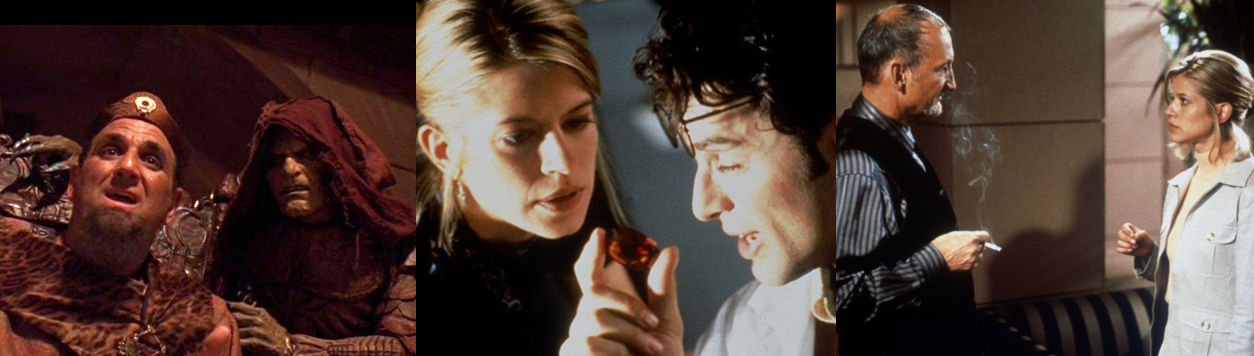
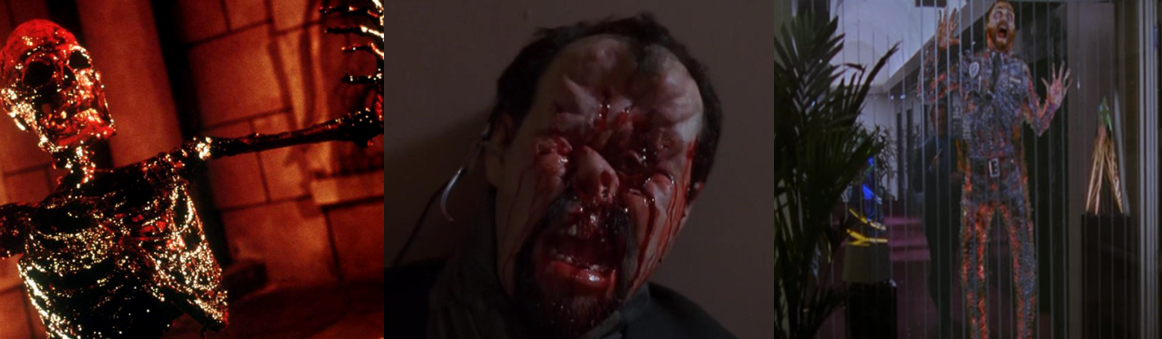
Spidey apprehends the Chameleon but does little to repair his reputation.

At the same time, the Chameleon masquerades as Spidey and steals the plans using a specially-created web gun and fleeing in a helicopter right as the real Spidey arrives to be accosted by the cops. Realised he’s been played for a fool, and having spotted the helicopter’s escape, Spidey dramatically slingshots and parachutes his way across the city using his webs and then steals a motorboat to track the Chameleon to a Soviet submarine. Despite the Chameleon’s best efforts, Spider-Man is able to force him to the ground and convince the cops of his innocence. However, the Chameleon escapes custody using a smoke pellet and slipping into another face mask, that slippery devil! Despite being out of web fluid, Spider-Man is easily able to track the Chameleon down in the local vicinity using his spider-sense but, just as he nabs the crook, the cops accost Spidey, believing him to be the fake! Enraged and despondent, Spider-Man escapes into the night completely unaware that the cops did catch the Chameleon in the very next panel and thus proving that he was innocent all along.

The Summary:
The Amazing Spider-Man #1 is a pretty decent comic, overall. Like all comic books published in the sixties, it suffers a little bit from the narrative style of the time but, unlike others I’ve reviewed from around this time, these are nowhere near as bad; characters aren’t constantly yabbering on in “hip” slang, for instance, and while Spidey and the Chameleon do constantly narrate their actions as they go, it’s not as intrusive as in other comics. As a result, I found this an enjoyable enough read but it’s not as good as it could be simply because it wastes quite a bit of time reminding readers of Spider-Man’s origin. Still, The Amazing Spider-Man #1 quickly establishes many of the character traits and recurring themes that would plague Peter throughout his career; mainly, money troubles, public opinion, Jameson’s endless crusade, and the frail nature of his Aunt May.

I’ve always found the Chameleon to be an underwhelming villain but he’s good enough here.

Peter Parker is a youth constantly on the short end of life; nothing ever seems to work out for him in either of his guises and he is constantly beaten down by society no matter what he does, and yet he perseveres. This aspiring quality is emphasised here; though Peter does get angry and dejected at his lot in life, he never gives in to the temptation towards crime and is steadfast in his decision to use his powers for good. One good thing that comes from this issue is the answer to the question of who Spidey’s first super-villain was and the answer, disappointingly, was the Chameleon. It might just be me but I’ve never been a fan of this character, or of stories of mistaken identity and fraud in my superhero comics, but thankfully that latter aspect is only a small part of The Amazing Spider-Man #1. If anything, more time could have been spent on the Chameleon framing Spidey for crimes; this would have made Jameson’s tirade against the web-slinger make a little bit more sense (he just comes across as an asshole and a blowhard here), to say nothing to turning the public (and the Fantastic Four) against him and adding to Peter’s woes.

The Fantastic Four dropped in for what amounted to a quick cameo amidst some classic Spidey action.

Also, I feel like the front cover is deliberately misleading; clearly designed to attract readers of the Fantastic Four, who were Marvel’s first big superhero success story, it kind of implies a greater conflict with the group that, in reality, is confined to just a few panels. This is good, on the one hand, as Spidey never needed their help in getting out of danger or anything but it does kind of set the foundation for a bad practice in Marvel (and all of comics for that matter) to use popular or established characters to sell their new releases (ironically, Spider-Man would come to be one of the most infamous examples of this). Still, the comic is full of relatable teenage woes and angst, colourful and larger-than-life characters, and set the standard for Spidey’s status quo going forward. There could maybe have been a little more action and web-slinging amidst all the angst but it’s still an enjoyable read and a must-have for any die-hard Spider-Man fan.

My Rating:

Rating: 4 out of 5.

Great Stuff

What are your thoughts on Spider-Man’s iconic debut solo outing? Were you a fan of the character at the time or were you introduced to him through some other means and, if so, what were they? How relatable did (or do you) find Spider-Man as a character? What is your favourite Spider-Man storyline, costume, or character and why? What did you think to the Chameleon being his first villain? Do you like the angle that the public is so easily turned against Spidey or do you think it doesn’t make much sense given how many superheroes run around New York? How are you celebrating Spider-Man Day today? Whatever your thoughts on Spider-Man, leave a comment below and be sure to stick around for Spider-Man Month starting this Friday!