Back Issues [Mario Month]: Super Mario Adventures


So, for no better reason than “Mar.10” resembling Mario’s name, March 10th is widely regarded as being “Mario Day”, a day to celebrate Nintendo’s portly plumber, an overalls-wearing mascot who literally changed the videogame industry forever and shaped the home console market of the nineties. To commemorate Mario Day this year, I have been celebrating everyone’s favourite Koopa-flattening plumber every Thursday of this month in a little event I call “Mario Month”.
Story Title: “Super Mario Bros. Adventures” and “Mario vs. Wario”
Published: 25 October 2016
Originally Published: 1 January 1992 to 31 January 1993
Writer: Kentaro Takekuma
Artist: Charlie Nozawa

The Background:
By the early 1990s, Nintendo’s mushroom-stomping mascot was well-established as an icon not just in the videogame industry but in mainstream pop culture as well; with over sixty videogames to his name, and with Super Mario All-Stars (Nintendo EAD, 1993) proving a blockbuster release for Nintendo (and a pivotal title in the on-going “Console Wars” of the time), merchandising and licensing opportunities naturally began to increase as Nintendo sought to capitalise on the portly plumber’s popularity. In July/August of 1988, Nintendo of America began publishing a monthly review and strategy magazine, Nintendo Power (1988 to 2012), which soon included comic book and manga adaptations of its most popular videogame titles and, naturally, Super Mario was one such character who found his adventures chronicled in the magazine.

The Review:
Super Mario Adventures starts with a cute little musical introduction to the titular plumber duo, who operate as the Mushroom Kingdom’s “plumbers extraordinaire” and claim that “there’s no pipe [they] can’t repair!” The plumber brothers have been called to an emergency situation at Princess Toadstool’s castle: the pipes are a leaking, broken mess and need to be fixed for the Princess’s big party that night. Although Luigi (affectionately called “Weege” by Mario) is suffering from hunger pains, Mario enthusiastically takes to the job and encourages him to get stuck in and fix up the castle’s pipes.
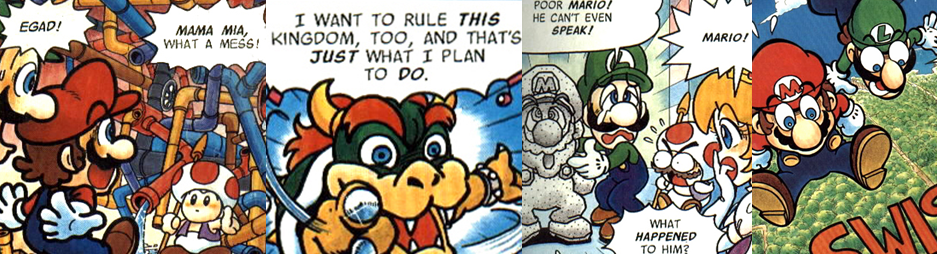
Bowser attacks the kingdom, turning many to stone, and the Mario Bros. race to assist the princess.

However, his eagerness is cut short when a series of larger green pipes suddenly start sprouting up through the ground and a hoard of Koopas, Goombas, and other nasties pop out and attack the castle. Although Mario fights off the invaders, his efforts are brought to a halt when Bowser, the King of the Koopas himself, arrives in his Koopa Copter and alongside his Koopalings to lay claim to the entire kingdom through his superior forces and his proposal to marry the princess to make his takeover official. When the princess adamantly refuses his offer, Bowser uses his magic wand to turn her loyal Toads (and, amusingly, their distraught cries) to stone. Although Mario is also caught in the blast, leaving Luigi hysterical, the princess refuses to bow to Bowser’s demands and leads a group of Toads into battle against him. The Toads take the petrified Mario to the Minister of Massage, an aged oriental Toad who cures him of his ailment and, determined to get his revenge against Bowser and rescue the princess, Mario boldly charges after the two and he and Luigi end up being dropped right onto Dinosaur Island.
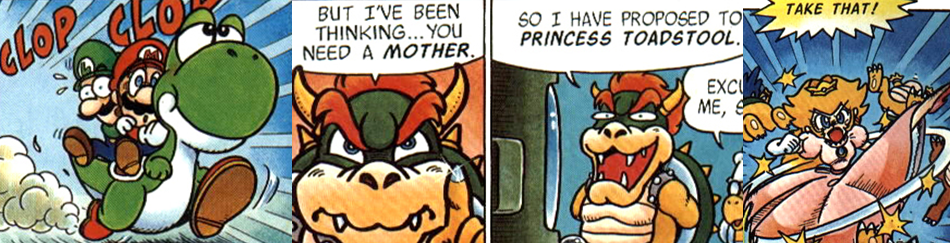
While Mario and Luigi make a new friend, Princess Toadstool manages to escape her cell.

There, they meet Yoshi, a friendly green dinosaur who helps them out when they’re attacked by a giant Wiggler and then speeds them off to Yoshi Village and they’re introduced to Friendly Floyd, a travelling salesman who randomly lives in the otherwise Yoshi-centric population. Floyd tells them that Bowser has been kidnapping Yoshis and punishing anyone who gets in his way and then scams them out of ten Coins by selling them a book to help them communicate with Yoshi that turns out to be basically useless. Mario’s anger at Floyd is quickly shifted back onto his main objective, though, when the princess’s Guard stumbles, bruised and hurt, into town and informs them that the princess was captured by an army of Bowser’s minions, the Lakitu. Back at Bowser’s Tower, Bowser reveals an additional motivation to his plot is to provide his rambunctious kids with a mother, and demands his chef make a cake that is one hundred times bigger than the humongous dessert he’s already made and orders the Koopalings to make sure that the princess doesn’t escape. However, when they go to check on her, the princess easily fools them by hiding up in the rafters and then escapes from her cell, locking them inside instead.
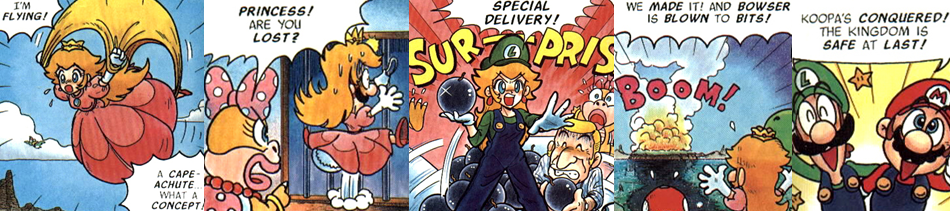
Luigi and the princess swap places, free Mario, and bring Bowser’s Tower crashing down.

While Mario and Luigi struggle to reach Bowser’s Tower thanks to the surrounding waters being full of piranhas, the princess proves capable enough to fight and threaten her way out of the tower by use of a “cape-achute”. Although the princess manages to get to safety and meet up with Luigi, Mario ends up crashing into the castle when he saves his brother from a Bullet Bill and winds up being chained up in his own cell. Bowser has his Mechakoopa’s deliver Luigi a threatening ultimatum to deliver him the princess or lose his brother forever and, rather than send the princess back into the jaws of danger, Luigi opts to have Floyd make him up into a decoy. While the princess resolves to go save the two, Luigi is able to successfully fool Bowser with his performance and delay Mario’s execution by ordering pizza for the Koopalings. The princess, who is dressed in Luigi’s clothing, bursts in holding a bomb and demands that Mario be set free; the Koopalings’ confusion soon turns to anger as Luigi swipes the keys from Roy Koopa and, thanks to a distraction from Yoshi, is able to free Mario just in time for the two of them to help fight off the Thwomps and Chucks who threaten to crush the princess, Yoshi, and Floyd to death. Unfortunately in the commotion, the fuse on the princess’ bomb catches fire and the tower collapses in a massive explosion!
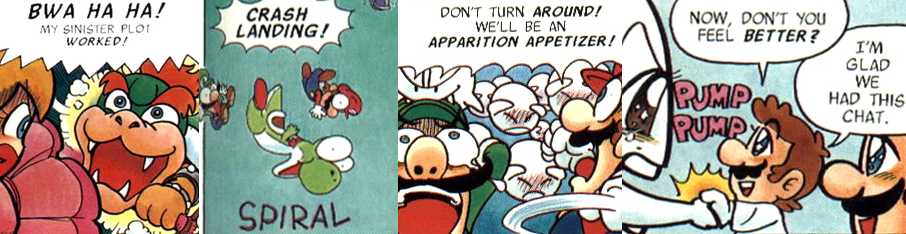
Bowser recaptures the princess but Dr. Mario helps cure the Boos of their shyness.

Although blasted to safety and pleased with their victory, the group realises that they’re still stuck on Dinosaur Island so one of the princess’s Toads offers to fly back to the Mushroom Kingdom for help. When help arrives, though, it turns out to be a bunch of Bowser’s minions in disguise and Bowser himself shows up to capture the princess once again. After fighting off Koopa’s forces, Mario and Luigi are astounded to see Yoshi sprout wings from over-eating; however, in their haste to chase after the Koopa King, they end up getting lost and crash-landing before a spooky chalet in a fog-strewn forest. Luigi suggests that they rest in the house, not realising that it’s another of Bowser’s devious traps, and, despite Mario’s better judgement, the two are lured inside by the irrespirable smell of Provolone. Trapped inside and separated from Yoshi, the duo are attacked by Boos; although the little spirits blush uncontrollably when looked at, they charge at the plumbers when their backs are turned, eager to take a bite out of their behinds! Eventually, Mario and Luigi find themselves trapped between a gaggle of Boos and the mighty Big Boo but are finally able to escape by luring the Big Boo into a faux therapy session where Mario gets to the roots of the ghost’s debilitating fear of humans.
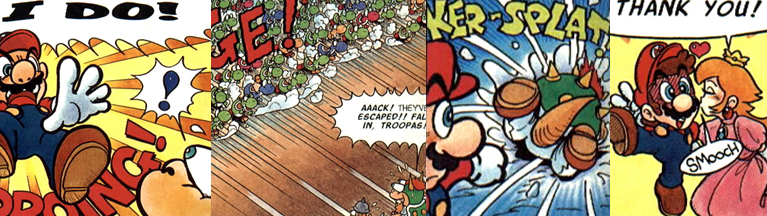
Mario, Luigi, and an army of Yoshis interrupt the wedding ceremony and defeat Bowser.

Having scammed their way out of the chalet, Mario and Luigi hop back onto Yoshi and race off to Marvy Mansion to keep the princess from marrying Bowser. Everyone in the Mushroom Kingdom is present for the wedding thanks to Bowser’s forces making up the majority of the guests and Magikoopa hypnotising the rest into compliance. With security type, and the hypnotised Yoshi’s willingly allowing themselves to be encased in eggs, Mario and Luigi sneak into the fortress using a pipe and end up being attacked by a Thwomp in a lava pit! While Bowser admires himself and his super sexy white suit, the princess throws a massive tantrum and continues to refuse to go through with the wedding, so Bowser has Magikoopa hypnotise the princess into falling in love with him. Thankfully, Mario crashes the party before the princess can say “I do” but, thanks to Magikoopa’s influence, ends up being beaten and tied up when the princess refuses to leave her beloved’s side. The ceremony is interrupted again, however, when Luigi and Yoshi free all other Yoshis from their eggs and the cuddly little dinosaurs quickly trample all over Bowser’s forces, including Magikoopa. After keeping Bowser from escaping in his little ‘copter, Mario fights his nemesis atop the gigantic wedding cake and merges victorious when the cake collapses, apparently taking Bowser with it, and thus saving the princess and the Mushroom Kingdom for another day.
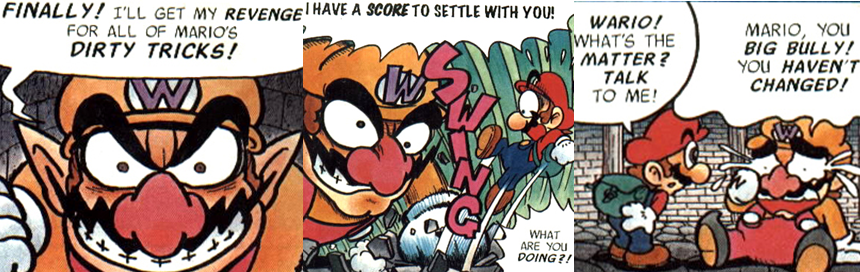
Wario lures Mario into an ambush as payback for his childhood trauma.

The fun doesn’t end there, though, as the collected edition includes an additional tale that is basically an adaptation of Super Mario Land 2: 6 Golden Coins (Nintendo R&D1, 1992). Unlike in the videogame, rather than Wario usurping Mario’s castle and forcing him to collect the titular six Golden Coins to retake his home, “Mario vs. Wario” shows Wario as the king of his own castle and inviting Mario to a reunion after twenty years of having not seen each other. In this story, Mario and Wario were childhood friends but their memories of those days differ wildly; while Mario recalls the two having fun playing in the garden, “[experimenting] with Coins”, and playing cowboys, Wario remembers Mario as a bully and a liar who got to get all the best vegetables while Wario got bitten by piranhas, how Mario got the Coins while Wario got flattened by a Thwomp, and (worst of all) how Wario was always forced to be the cattle rustler who was beaten by Mario’s sheriff. Mario has very quick run-ins with the bosses from the videogame, the majority of whom he has no idea are actually looking to cause him harm and whom he defeats (or kills, in one case) simply by being helpful or friendly. When he reaches Wario’s home, though, he is attacked by a big, mean incarnation of his old friend but Mario quickly takes the wind out of Wario’s sails, quite literally, by deflating his balloon-like form. Mario then makes amends with Wario but Wario’s grievances with his rival are rekindled when Mario busts out a cowboy hat and water pistol and casts himself as the sheriff once again!

The Summary:
Super Mario Adventures is a colourful, endlessly fun little adaptation of the Super Mario videogames, most prominently Super Mario World (Nintendo EAD, 1990). Perfectly capturing the look and feel of the videogames, the manga-like presentation of the story is immediately appealing and the artwork is consistently vivid and amusing all the way through. Add to that the moments of humour, sight and physical gags, and little details like characters playing a Super Mario substitute (with either with Mario or Bowser as the hero) or Luigi and Princess Toadstool swapping outfits really add to the quirky nature of the story.
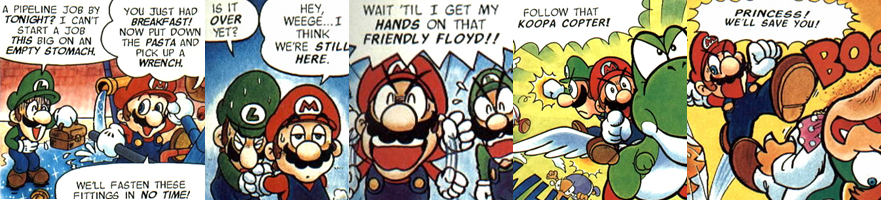
Mario and Luigi quickly transform from energetic plumbers into princess-saving heroes.

Mario is characterised as an energetic, brave do-gooder with a playful nature and a quick temper at times, especially when he’s scammed by Friendly Floyd. He is committed to helping the princess by any means necessary, whether it’s by fixing her pipes (oi-oi!) or rescuing her from Bowser and is constantly keeping his brother focused on the tasks at hand. While he’s not a complete coward or a stick-in-the-mud, Luigi has a running gag throughout the story where he’s constantly distracted by his hunger. At first, he seems to lack the courage to act without his brother by his side and would rather eat or slink away than work or fight Bowser’s minions but, when Mario is captured, he voluntarily switches places with the princess and uses his wiles to free his brother and he’s directly responsible for helping to stop the wedding and provide much-needed back-up when he helps free the Yoshis.
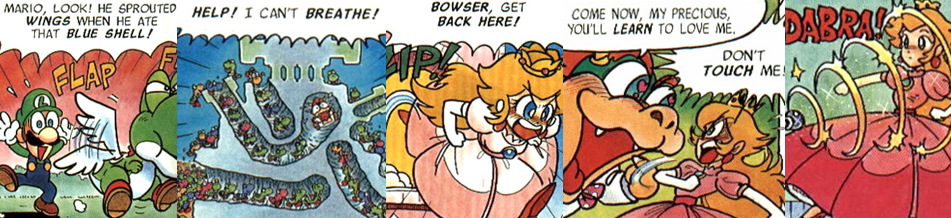
Yoshi proves a valuable ally though the princess’s fiery nature means she’s no pushover.

While Yoshi is merely just a cute, cuddly sidekick, his motivations are called into question when he’s introduced as the duo (especially Luigi) are initially worried that he must be intending to eat them, he proves essential to their quest thanks to his insatiable appetite and ability to sprout new abilities as he gobbles up Goombas and such. As for Princess Toadstool, she’s an absolute bad-ass in this story! Right away, she adamantly refuses to submit to Bowser and only ends up being captured in the first place because she chooses to bring the fight to the Koopa King rather than let him run roughshod over her kingdom. Indeed, while the duo try valiantly to rescue her from Bowser’s Tower, she actually escapes without their help and only ends up being recaptured because of them. In the end, her demeanour and rage are so fervent that Bowser is forced to resort to hypnotising her to force her to go through with the ceremony, which is something I’ve personally never seen him stoop to in any of the videogames or adaptations.
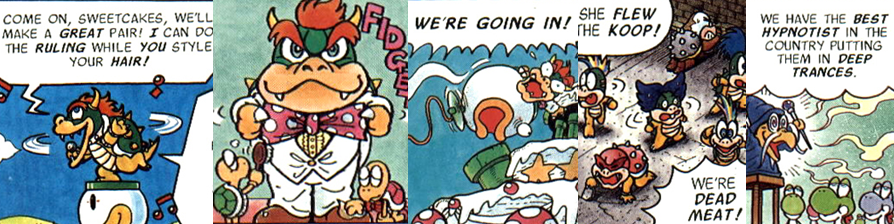
Bowser is little more than a blowhard with largely ineffectual minions.

As for Bowser, well…he’s a very loud, bombastic figure here and certainly commands a great deal of dangerous forces but he’s not actually very effectual as a villain. He’s more concerned with winning the princess over, the cut of his suit, and the size of the wedding cake than spitting fireballs at Mario and their final confrontation is pretty humiliating for the Koopa King. Indeed, Bowser spends more of his time delegating down to his Koopalings, who are young and easily distracted and fooled by the antics of Mario, Luigi, and the princess. Magikoopa is, without a doubt, Bowser’s most useful minion as, without the maniacal wizard, he would never have been able to subjugate the Yoshis and the rest of the kingdom and, when Magikoopa is taken out of the equation, it’s surely no coincidence that Bowser is buried beneath a pile of sweet frosting soon after.
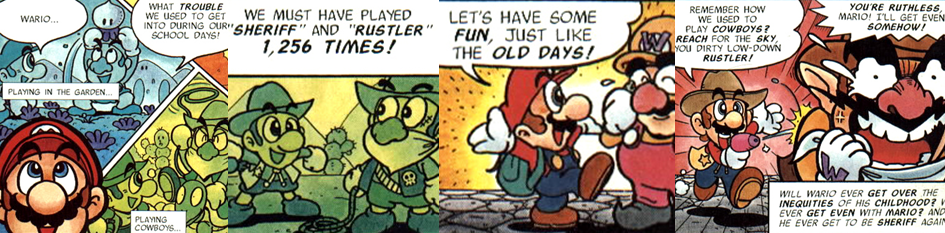
Mario and Wario have wildly different memories of their childhood days.

And then there’s Wario, easily my favourite character in the entire franchise, who is reduced to a bitter, snivelling child thanks to a lifetime of resenting Mario. It’s interesting that “Mario vs. Wario” paints Mario in such a negative light; here, he’s extremely naïve and insensitive to the feelings and concerns of others and is focused only on having a good time playing with his friend without considering Wario’s perspective. Indeed, the ending seems to suggest that Wario’s version of their childhood is more accurate since Mario not only calls him a “wimp” for getting upset but goes right back to type by chasing after him as the “sheriff”. It’s a fun enough little epilogue to the main story but all-too-brief for an adaptation of Super Mario Land 2 and, while it provides an interesting twist on the Mario/Wario rivalry from the time, it ends up veering a bit too far away from Wario’s more popular portrayal as a greedy, disgusting, self-obsessed mirror of Nintendo’s portly mascot.

My Rating:

Rating: 5 out of 5.

Fantastic

Have you ever read Super Mario Adventures? What did you think to it? Were you a fan of the manga’s quirky art style and humour? How do you think it worked as an adaptation of Super Mario World and the franchise’s gameplay mechanics? Did you read and collect Nintendo Power? If so, what were some of your favourite sections and inclusions in the magazine? Did you enjoy Mario’s other comic book adaptations as well and would you like to see another produced some time? Feel free to leave your thoughts on Super Mario Adventures, and Mario in general, down below and thanks for being a part of Mario Month.

March Drabble Challenge: Teddy Bear

Horror PromptsGillian Church is hosting another horror drabble challenge: 31 prompts for 31 creepy tales throughout March. This time, we can decide on the length of the piece but I’m sticking to the 100-word default.

Can you do it?

The Prompt:
Teddy Bear

The Submission:
Dennis closed the wardrobe and turned back to his terrified son. “There’s nothing in there.”

“I saw it!” Nicholas bawled, hugging his teddy bear closely.

Dennis sat down on the edge of the bed and stroked his son’s hair. “Monster’s aren’t real, son. They can’t hurt you.”

With that, he left the boy to sleep but woke with a start when Nicholas’s screams echoed down the hallway.

Dennis burst into the room and flicked on the lightswitch. Nicholas was gone; all that was left was his teddy bear and a streak of blood that stopped at the open wardrobe door.


What did you think to the prompt for today’s drabble challenge? Did you submit anything for it? Have you ever written any flash fiction before? I’d love to know what you think to my snippets and writing prompts, so feel free to sign up and let me know what you think below or leave a comment on my Instagram page. You can also follow Gillian Church to take part in her Weekly Writing Prompt challenge.

Game Corner: WWE Legends of WrestleMania (Xbox 360)

Released: 20 March 2009
Developer: Yuke’s
Also Available For: Mobile and PlayStation 3

The Background:
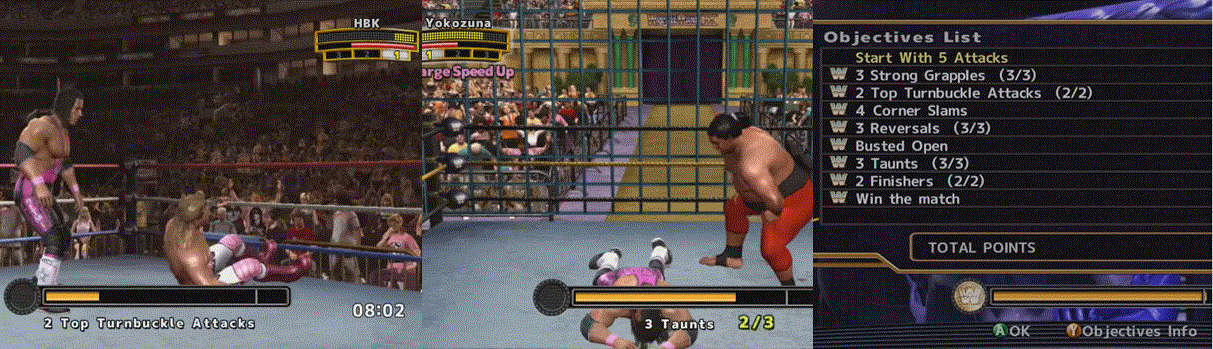
On March 31st, 1985, Vince McMahon changed the face of the wrestling landscape forever by bringing together the biggest names in wrestling (alongside a number of celebrity guests) for the very first WrestleMania, a pay-per-view extravaganza that became the hottest event of the calendar year for World Wrestling Entertainment (WWE). The WWE has a long and storied history with videogames that can be traced all the way back to the very first videogame ever produced baring the initials of their previous moniker of the World Wrestling Federation (WWF), MicroLeague Wrestling (MicroLeague/Various, 1987). A number of releases made their way to various home consoles and even arcades over the years, with the format slowly evolving to include more and more wrestlers and match types, but the WWE’s foray into digital entertainment largely hit its stride in the late-nineties when Asmik Ace Entertainment, AKI Corporation, and THQ joined forces to produce popular titles for the Nintendo 64 and Yuke’s took their first tentative steps into the SmackDown sub-series (2000 to 2003). Many of the games produced during this time and by these developers are considered to be some of the best wrestling games ever made and, by 2009, the WWE was represented by the multi-platform SmackDown vs. Raw series (Yuke’s, 2004 to 2011), a series which was largely regarded as mostly hit and miss in terms of value for money and year-on-year improvements. Still, the series was profitable enough to convince Yuke’s to attempt a few additional WWE videogames, with Legends of WrestleMania being one of them; pushed intro production to coincide with WrestleMania 25, and focused far more on nostalgia and giving players the chance to relive and redefine some of the company’s biggest moments, Legends of WrestleMania was met with largely lacklustre reviews that took issue with its presentation and control mechanics.

The Plot:
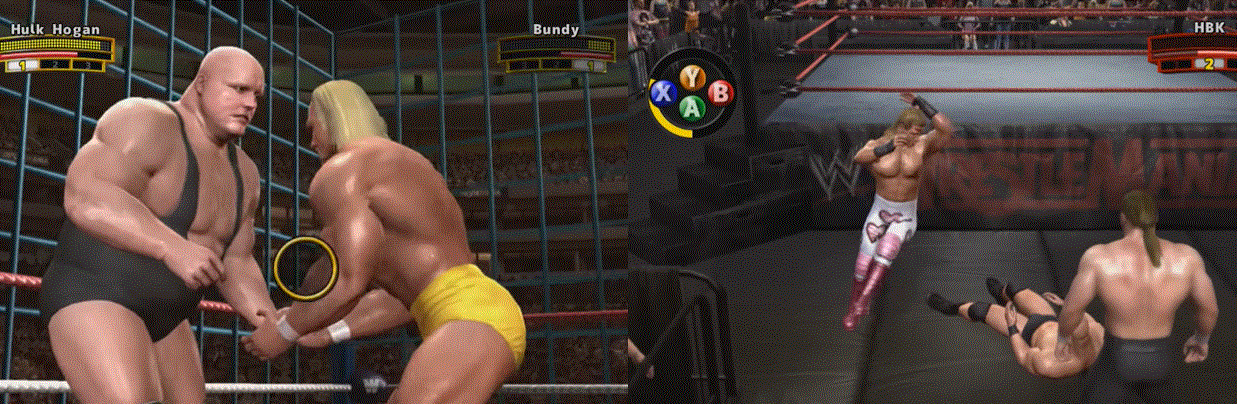
Take control of a WWE Legend and relive some of the biggest WrestleMania moments of all time, such as Hulk Hogan’s legendary clash with Andre the Giant and Bret “Hitman” Hart’s bloody showdown with “Stone Cold” Steve Austin, or rewrite and redefine history by playing these matches, and others that never took place, from the perspective of the loser (or another WWE superstar).

Gameplay:
WWE Legends of WrestleMania is a wrestling title that gives players the chance to select from a roster of thirty-eight WWE Legends and pit them against each other in a series of matches, many of which will be immediately familiar to fans of the WWE or anyone who’s played one of Yuke’s WWE videogames before. Unlike many of the SmackDown! videogames, the focus here is much more on fast-paced, arcade-style action rather than simulating a real-life wrestling match, which has both positive and negative impacts on the gameplay. Players can move their Legend using either the left analogue stick or the directional pad (D-pad); having grown up playing the likes of WWF No Mercy (Asmik Ace Entertainment/AKI Corporation, 2000), I generally prefer to use the D-pad for these games (and most fighting games) as it feels more intuitive, but there’s little benefits from favouring one or the other. You can double tap towards or away from your opponent to run, but I had extremely minimal success with this; in most WWE games, running is mapped to one of the shoulder buttons, making it quick and easy to use, but that’s not that case here so the majority of my matches were slower, clunkier affairs as a result.

Gameplay is heavily based around QTEs and button mashing.

You can throw a strike at your opponent with X; land a few in quick succession to perform a simple combo or hold X to charge up a powerful strike, with both knocking them to the mat and leaving them prone for a leg or elbow drop or other ground-based offense. Grappling is performed with A; again, you can either tap it for a quick, weak grapple, or hold it for a stronger grapple, and use a directional input in conjunction with A to perform different moves (though your move pool is quite limited). As you attack and mix up your offense, you’ll build up a “Chain Meter”; as it reaches three different levels, you’ll gain access to more powerful grapples, with your finisher being unlocked at Level 3 and performed by pressing X and A together. Successfully landing attacks drains your opponent’s health meter and weakens them for either a pin or submission; submission moves are generally locked in when the opponent’s on the mat and see you mashing buttons to wear your opponent down, or you can pin them with B. If either of these things happen to you, you’ll need to mash buttons or full a circular meter to hit a small target in order to stave of the attack or kick out of the pin attempt.

While reversals can be tricky to pull off, finishers are a matter of hitting onscreen button prompts.

You’ll need to mix and match your offense in order to build up your Chain Meter (though simply mashing X can work just as well), and you can sacrifice a chunk of it by taunting with B and Y and gaining temporary buffs. This can all be a little clunky but it generally works quite well; what doesn’t work quite as well is the game’s reversal system. Rather than map counters to a shoulder button, WWE Legends of WrestleMania has them performed by pressing away from your opponent and Y or holding Y to block. I found this to be incredibly unreliable, as my Legend would often just step backwards or even run away, and I really don’t understand why this wasn’t just mapped to the Right Bumper. Unlike the majority of other wrestling games, WWE Legends of WrestleMania heavily relies on button mashing, button inputs, and quick-time events (QTES); you can’t even Irish Whip your opponent without a QTE flashing on the screen and many of the event matches in the WrestleMania Tour mode start, or are punctuated by, QTE sequences that see you mashing or hitting buttons in a test of strength, chain grapple, and other similar sequences. This also extends to the finishers; after pressing X and A, you’ll need to hit the QTE prompts to land your finisher sequence and do the maximum amount of damage, which is certainly unique but it comes at the cost of severely limiting the amount of finishers available in create-a-wrestler mode

There’s not much to differentiate the wrestlers but managers add a little spice to the matches.

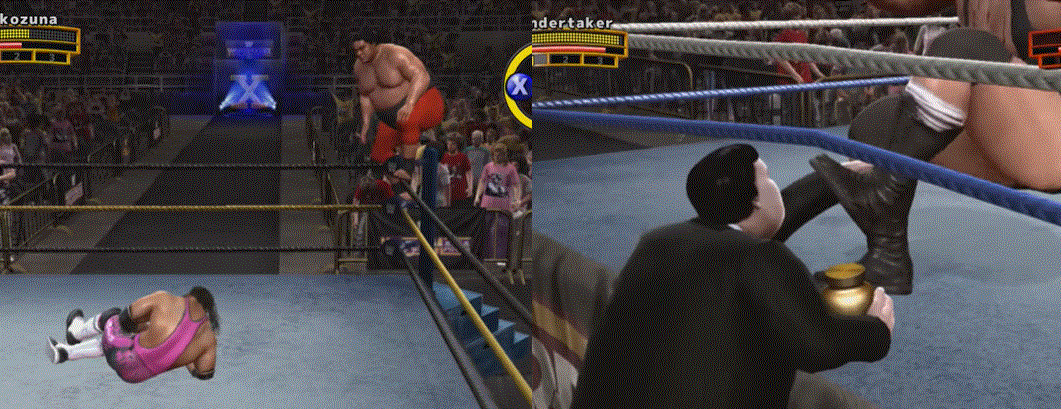
Contrary to other wrestling videogames; there isn’t really a weight class or detection system in WWE Legends of WrestleMania; playing as King Kong Bundy is largely the same as playing as Shawn Michaels, but there are some notable exceptions. For example, while Mr. Perfect can body slam and lift the likes of Yokozuna without issue, some Legends are noticeably more nimble than others and some superheavyweights struggle with climbing cage walls and are limited in their aerial offense. Some wrestling games like to lump their roster into categories and assign them abilities that play to their strengths, but that isn’t the case here so the majority of the roster’s differences are reflected in their move pool: Jimmy “Superfly” Snuka isn’t going to be quite as technically adept as Ric Flair but it’s not as though the Undertaker exhibits any supernatural abilities that other big men, such as the Big Boss Man, have. One major aspect of the game is the presence of managers; the likes of Paul Bearer and “The Mouth of the South” Jimmy Hart can accompany Legends to the ring and can interfere on your behalf at the cost of your current Chain Level, which makes them super useful when they’re in your corner and quite the hindrance when they’re in your opponent’s.

All the standard match types are available, with plenty of button mashing and QTEs sprinkled about.

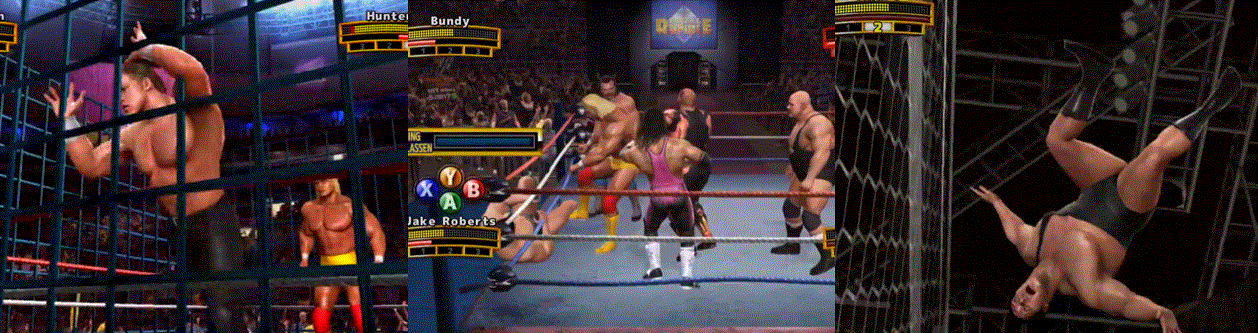
Wrestling matches have all the standard options you might expect; you can set the difficulty level of the CPU in the options, manipulating the computer’s use of strikes and reversals and such, and customise win conditions (such as turning pin falls and disqualifications on or off and changing the amount of time you can spend outside of the ring). There’s also a number of additional match types on offer that will be recognisable to fans of wrestling games, with most featuring a twist in the game’s new engine and mechanics that mostly boil down to button mashing. You’ll need to mash buttons to either escape from, or prevent your opponent from escaping, a cage or break up a pin fall in a tag team match, for example. Similarly, you’ll find finishers disabled in the Royal Rumble match (there aren’t even special Royal Rumble finishers like in other games) and you’ll instead have to mash buttons to try and force your opponent out of the ring or save yourself from elimination. These components are less prominent in Hell in a Cell and ladder matches, however; you can start Hell in a Cell on top of the structure, which is a nice touch, and can throw your opponent through the cage wall or down to the ring using environmental grapples. Ladder matches are actually much more enjoyable than in other wrestling games I’ve played; you pick up a ladder (or any weapon) by double tapping B and a helpful glowing target shows you where to set it up and climbing and retrieving a championship belt is quite simple compared to other wrestling titles. Retrieving a weapon from under the ring can be a little trickier, though, as can utilising the ringside area or battling into the crowd or up the aisleway, as it requires you to hit A in specific areas around the arena, which can be difficult thanks to the janky controls. You’ll also find such staples as Iron Man matches and Last Man Standing matches on offer here, which are fun ways of mixing up the gameplay, but there’s nothing to really set the game’s matches or gameplay apart from other wrestling titles and very few of these appear in WrestleMania Tour.

WrestleMania Tour sees your reliving, rewriting, and redefining classic matches.

Speaking of which, you’ll be given three single-player options here: “Relive” (where you recreate specific WrestleMania matches), “Rewrite” (where you tackle other WrestleMania matches from the perspective of the historical loser), and “Redefine” (which features unique “dream matches”). Each of these matches is proceeded by a short hype package that features clips from real-life wrestlers and the matches and feud between the competitors, and you’ll be given a series of optional objectives to fulfil in order to earn points. These range from performing a certain number of attacks, grapples, counters, and finishers, winning the match, performing taunts, winning pre-match sequences, and more specific environmental situations (such as winning Chain Grapple sequences, slamming your opponent through an announce table, or grappling up near the entrance). Earning points fills a meter and, once it fills high enough, you’ll earn a medal that will award you with unlockable match types, attires, and more. There’s nothing to gain from playing WrestleMania Tour on anything other than the easiest difficulty, with the computer’s abilities completely neutered in your favour, beyond personal pride so you may as well manipulate the game’s settings to make things easier for you. This mode is also probably the best part of the game as it lets you recreate some iconic WrestleMania moments and matches, and meeting the objectives can be fun, but things quickly get quite frustrating if you’re trying to earn all the medals and monotony sets in quite fast as there’s not much variety in terms of the match types (there are no multi-man matches in this mode, for example) beyond the odd cage or ladder match and you can completely ignore the objectives if you like since winning is all that really matters.

Graphics and Sound:
Wrestling games can be a bit hit and miss when it comes to their graphics, especially with their in-game character models. WWE Legends of WrestleMania favours a slightly exaggerated, action figure-like aesthetic for its Legends, which is typically common when bringing the WWE’s old school superstars to life, and for the most part this actually looks a lot better than in some of the SmackDown! titles. This is primarily because WWE Legends of WrestleMania is largely consistent with its presentation, rather than fluctuating wildly between hyper realistic and massively off-model. Notably, however, you won’t find any female Legends or superstars on offer here, and there’s no on-screen referee either, which is a pretty big step back for me.

While character models look pretty good, the camera and arenas leave a lot to be desired.

The number of arenas on offer isn’t exactly much to shout about either. There’s very little variety on offer as you can only fight in WrestleMania arenas; there is a Royal Rumble arena, however, (and ironically you can only ever fight a Royal Rumble match in this arena) but there’s no Raw, SmackDown!, or other pay-per-view arenas on offer. The crowds are as sub-standard as ever, sporting signs and attire tied to their favourite superstars and parting to allow you to fight over the barricade (though essentially acting as barriers to keep you enclosed), but entrances have been a bit neutered. The game does offer the old-school gondola entrances, which is kind of cool, and recreates the old-school name plates and presentation of the pre- and early-“Attitude Era” of the WWE. Unfortunately, however, the presentation does take a bit of getting used to; the camera is very zoomed in, meaning that your Legends take up a lot of screen space and this can make it a little difficult to be fully aware of your surroundings. The camera is prone to wild swings and odd positioning, which is very annoying, and there’s a noticeable delay between button presses and executing grapples, making for a much more deliberate and slower pace to the game. Though I eventually learned to live with these niggling problems, it did take me a while to adjust to the presentation and gameplay style of the game.

Video clips add some historical context but the commentary continues to be mundane and predictable.

The inclusion of video clips and real-world footage adds to the drama and intrigue of the WrestleMania Tour mode, but these are nothing you haven’t really seen before in a wrestling title. The same goes for the entrance videos and music, which is all pretty much as you’d expect (with a few inconsistencies here and there, such as the Big Boss Man utilising his Attitude Era theme), and this extends to the in-game commentary. Provided by the legendary duo of Jim Ross and Jerry “The King” Lawler, the commentary is basically exactly the same as in the SmackDown! series, though there are some specific new sound clips added in to refer to the game’s roster and the rivalries on offer in WrestleMania Tour. I don’t play these games for in-depth commentary or crowd reactions but even I was astounded by how cheap and lazy these aspects were here. The same can be said of the create-a-wrestler options, which offers clothing, body, and hair options all ripped straight from the SmackDown! games but actually have less to offer in some respects: there’s less naming options available, less moves, less finishers, and even less clothing options as everything is geared towards meeting the old-school aesthetic and altered gameplay mechanics of the title.

Enemies and Bosses:
Being a wrestling title, every single in-game Legend is potentially your enemy; however, as mentioned, it’s not really necessary to play as or fight against each of the game’s roster in order to learn their strengths and weaknesses. Once you’ve played as and against a couple of the Legends, you’ve pretty much experienced all of the variety the game’s conflicts have to offer; your biggest hurdle will be getting the timing of the weird reversal system down, but you can circumnavigate this by just attacking your opponent head-on with strikes and landing strong grapples as and when they unlock. Guys like Bam Bam Bigelow might look big and intimidating, and the Honky Tonk Man might be the ultimate opportunist, but it’s not like you have to worry about character-specific abilities so what works against one will work against all as long as you can hit the QTE prompts when your opponent does get the drop on you.

Meeting objectives is pretty simple until Steve Austin butts heads with the Rock.

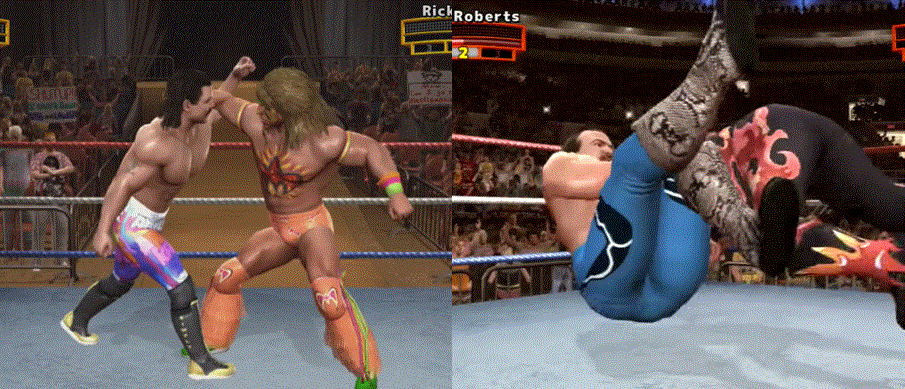
In the Relive portion of WrestleMania Tour, you’ll have to battle against specific opponents in recreations or classic WrestleMania matches; this means you’re forced into assuming the role of the historical victor, or loser, of specific matches. One of the most recurring playable characters in this mode is, of course, Hulk Hogan, who must take on King Kong Bundy in a steel cage, and Andre the Giant and the Ultimate Warrior in recreations of their iconic matches. As long as you win your matches, you’re fine, but you’ll need to meet a certain amount of objectives to earn your medal; this includes stuff like kicking out of a pin attempt, causing the opponent to bleed, or winning with a specific move. As you play through these matches, the amount and difficulty of the objectives will increase; I first noticed them becoming more complex in the classic clash between Steve Austin and Bret Hart, which requires you to attack Austin’s leg five times, fight into the crowd, utilise a steel chair, and win with the Sharpshooter but the difficulty severely ramps up for Relive’s final match. This is a recreation of Austin’s WrestleMania XV bout against the Rock; to achieve this medal, you need to meet every single objective, which can be extremely laborious as one of your objectives is reversing the Rock Bottom, to say nothing of all of the many environmental grapples you need to hit on the outside of the ring. I definitely recommend turning the game’s difficulty level and sliders all the way down in your favour and making liberal use of the health regeneration taunt to increase your chances in this match.

Objectives get even simpler in Rewrite and Redefine, meaning the medals are pretty simple to earn.

In Rewrite, you tackle different WrestleMania matches in the role of the historical loser and must fulfil different objectives in order to change history. Since you’re rewriting the outcome of these matches, these objectives are far less demanding and start off as simple stuff like performing and reversing grapples, taunting, and hitting a finisher and don’t really get more complex than landing more attacks, performing more taunts, maybe making the opponent bleed, and performing multiple finishers and reversals. Honestly, these matches were an absolute breeze, with even Bret and Shawn’s infamous WrestleMania XII Iron Man match providing little challenge beyond a ten-minute time limit. This carries over to Redefine, though the matches and competitors at least have a little more variety; here, you can pick which Legends you want to play as and will witness the likes of Andre and Giant and Big John Studd in a Hell in a Cell match and Mr. Perfect and the Big Boss Man in a ladder match. Redefine culminates with a dead simple no disqualification match between the Undertaker and King Kong Bundy that might have a lot of objectives but they’re nothing compared to the Austin/Rock match (boiling down to stuff like hitting five moves in a row at the start, two top rope moves, three reversals and taunts, and two finishers, which is still laborious but nowhere near as frustrating as in that aforementioned match).

Power-Ups and Bonuses:
There are a few options available to you during matches to help turn the tide in your favour; you can toss your opponent to the outside of the ring and interact with the steel steps, announce tables, and barricades to deal more damage to your opponent and, when your opponent is positioned correctly, pull weapons out from under the ring to bust them open or beat them down. When near the aisleway, you can clunkily force them up to the entrance way where there are often other environmental grapple points on offer that let you choke your opponent with wires, toss them into the stage dressing, and even make use of a drum kit but there’s no backstage brawling here. As your Chain Meter builds up, you gain access to taunts that can provide you with temporary buffs; these include regenerating your health, upping your speed and durability, and making reversals easier to pull off for a limited time. Managers can also provide many of the same temporary buffs and also attack or distract your opponent to give you the edge in matches, though utilising these will cost you part of your meter so you’re often asked to pick between receiving a temporary buff or earning your finisher.

Additional Features:
There are a mere nineteen Achievements on offer in WWE Legends of WrestleMania, which is astoundingly low for a wrestling title. Achievements are primarily tied to obtaining medals in WrestleMania Tour or making and using a created wrestler but you can also earn them by winning matches using only grapples or with other specific moves. Sadly, in a game featuring so many WWE Legends, there aren’t more fun or notable Achievements; for example, you can use Hogan to slam Andre all you like in the WrestleMania III arena but it won’t pop a “Unstoppable Force” Achievement. As you play, however, your win/loss record and other statistics are recorded in the “Hall of Fame”, which is good for the statisticians out there, but there’s no way to compete for championships outside of the WrestleMania Tour mode, no create-a-pay-per-view mode, general manager mode, or even WWE Universe mode so you’re basically limited to exhibition matches and the WrestleMania Tour. Well, not entirely; there is also the “Legend Killer” mode. Here, you use a created wrestler to take on six tiers, comprised of ten back-to-back singles matches and culminating in a showdown with one of six WrestleMania Legends. You’ll earn experience points (EXP) by winning matches, and even more for mixing and matching your gameplay style as you play, which you can spend upgrading your created wrestler’s attributes and earning more Achievements. The create-a-wrestler mode is basically the same as in the SmackDown! series, including many of the same hair and clothing options as in those games and you can also fully customise their entrance or even create a tag team, though there’s very little incentive without a Universe mode. While there’s no downloadable content on offer here, you can transfer basically the entire male roster of WWE SmackDown vs. Raw 2009 (Yuke’s, 2008) if you have a save file for that game on your system, which greatly expands the amount of moves and finishers available to you. While this is a cool feature, and something I wish WWE games would implement more often, it doesn’t equate to much more than adding modern superstars to the roster (which really doesn’t mean all that much as you can’t play as them in WrestleMania Tour).

The Summary:
I do enjoy a bit of a wrestling title, and quickly and easily nabbing a few Achievements, and as a big wrestling fan I enjoy revisiting some of the classic wrestlers of the past but WWE Legends of WrestleMania is a quite a bare-bones title. You can see everything the game has to offer in an hour or so and plough through the main story campaign in an afternoon; the Legend Killer mode might take a little longer but it’s hardly going to take up all your time and attention like a General Manager or Universe mode. The gameplay is a bit jarring at first thanks to the odd camera perspective and the plodding, clunky, QTE-heavy nature of the mechanics, but pretty easy to master and, before long, you’ll be winning matches in no time at all, meaning the game quickly gets boring. Yes, there’s a few other match types on offer but there’s little incentive to play these as you can’t compete for belts and I can’t imagine it’s that much fun to play against other human opponents, either. The create-a-wrestler is more lacklustre than ever and there’s a strange lack of focus on guys like the Undertaker, and some notable omissions from the roster (neither Kane nor Mankind are available, for example), though the ability to transfer the roster from WWE SmackDown vs. Raw 2009 is a neat touch. Ultimately, it’s not bad if you pick it up cheap but probably not really worth keeping in your collection once you’ve mined all of the Achievements. I appreciate the developers trying something a little different but this clearly isn’t a Triple-A title and is really only for fans of the rock ‘n’ wrestling era of the then-WWF. If you’re really in the mood for an arcade style wrestling game from around this time, you’d potentially be better off playing something like WWE All Stars (THQ San Diego, 2011).

My Rating:

Rating: 2 out of 5.

Could Be Better

Are you a fan of WWE Legends of WrestleMania? Did you like that the developers actually tried to do something a little different with this release or did the dumbed down gameplay put you off? Which of WrestleMania Tour’s matches was your favourite and did you ever achieve Legend Killer status? What did you think to the finisher system and the abundance of QTEs? How did you find the create-a-wrestler mode and were you disappointed by the lack of WWE Universe in this title? Were there any classic WWE superstars you felt were missing from the game and which of the available Legends was your go-to character? How are you celebrating WrestleMania’s anniversary this year and what’s your favourite WrestleMania moment? Drop your thoughts below by signing up or leave a comment on my social media to let me know what you think about WWE Legends of WrestleMania and check back for more wrestling content throughout the year.

March Drabble Challenge: Reveal

Horror PromptsGillian Church is hosting another horror drabble challenge: 31 prompts for 31 creepy tales throughout March. This time, we can decide on the length of the piece but I’m sticking to the 100-word default.

Can you do it?

The Prompt:
Reveal

The Submission:
Eric had been trembling when Sherry finally brought him to her dorm after weeks of going steady and making him wait.

They’d been going steady for a few weeks now, but she’d teased him by saying she wasn’t ready to go all the way yet, and now it was finally happening.

He sat on the edge of her bed as she lifted her dress over her head and was startled at the reveal of her naked body.

Boils pulsated across her creamy-white skin; some leaked pus as she ran her hands over them, licking her fingers at the taste.

“What’s wrong, babe?” she purred, her face splitting at the jaw. “Don’t you want me?”


What did you think to the prompt for today’s drabble challenge? Did you submit anything for it? Have you ever written any flash fiction before? I’d love to know what you think to my snippets and writing prompts, so feel free to sign up and let me know what you think below or leave a comment on my Instagram page. You can also follow Gillian Church to take part in her Weekly Writing Prompt challenge.

Weekly Writing Prompt: 30/03/2022

Gillian Church posts Writing Prompts every week on her Horror Prompts Instagram account and I like to take part with a few snippets and pieces of flash fiction.

The Prompt:
Unknown caller: You say you’ve found the perfect item to donate to the Museum of Oddities and Artefacts. Tell me more…

The Submission:
“Sorry, who is this?” Jameson asked, removing his pipe from his lips.

“Oh, this is Mr. Scratch from the Museum of Oddities and Artefacts.  Perhaps you’ve heard of us?”

“No?” Jameson said, puzzled. “I can’t say that I have.”

“I saw your listing on Facebook; that’s quite the intriguing trinket you have in your possession.”

Jameson glanced over at the dining table from his easy chair; the amphora had probably once been a shining black/gold but had been sun-bleached over the centuries. The remaining handle was chipped and brittle to the touch and the images and symbols that had once adorned the exterior was faded.

“May as I ask where you acquired it?”

“Well…” Jameson sighed. “That’s a…long story…”

“Let me be frank, Mr. Wolfe. My museum is very eager to display this piece, and we’re willing to offer you fair compensation for it.”

Jameson stared at the amphora, sweat dripping down his brow, reliving the blinding, burning light that had burst from the vase upon first removing its lid. Grace, Roberts, Donald…all burnt to charred, smouldering skeletons, with only him left standing.

I shall give you life! the demonic smoke-demon had cooed, swirling around his head, drifting up his nostrils. Life…and health…their lives for yours…

A wisp of mist wafted from the cracks in the amphora and Jameson gulped back a shaking breath. “I…I’m sorry…it’s….it’s not for sale…”

What did you think to this week’s writing prompt? Did you submit anything for it? Have you ever written any flash fiction before? I’d love to know what you think to my snippets and writing prompts, so feel free to sign up and let me know what you think below or leave a comment on my Instagram page. You can also follow Gillian Church and Horror Prompts to take part in the Weekly Writing Prompt challenge.

March Drabble Challenge: Bulb

Horror PromptsGillian Church is hosting another horror drabble challenge: 31 prompts for 31 creepy tales throughout March. This time, we can decide on the length of the piece but I’m sticking to the 100-word default.
Can you do it?

The Prompt:
Bulb

The Submission:
The naked bulb smashed in the fracas, plunging the dank basement into darkness.

Norris grabbed at me, heaving and gnashing, and I struggled to break free from his course grip.

“We don’t have time for this!” Grey shouted.

“Fuck you!” Norris barked and shoved me.

My arms pinwheeled out and I landed hard on my ass in a puddle. Suddenly light flooded the basement as the door burst open and the moaning, shambling ghouls spilled down the stairs.

“Oh fuck!” Grey screamed as one of the writhing corpses stroked at his calf.

Norris lift his crowbar as they swarmed him.


What did you think to the prompt for today’s drabble challenge? Did you submit anything for it? Have you ever written any flash fiction before? I’d love to know what you think to my snippets and writing prompts, so feel free to sign up and let me know what you think below or leave a comment on my Instagram page. You can also follow Gillian Church to take part in her Weekly Writing Prompt challenge.

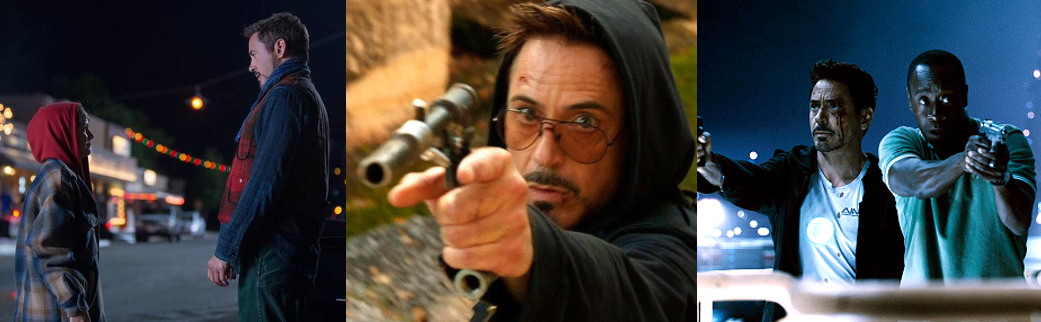
Movie Night: Iron Man 3

Released: 3 May 2013
Director: Shane Black
Distributor:
Walt Disney Studios Motion Pictures
Budget:
$200 million
Stars:
Robert Downey Jr., Guy Pearce, Gwyneth Paltrow, Don Cheadle, Rebecca Hall, Ty Simpkins, and Ben Kingsley

The Plot:
Suffering anxiety attacks following The Avengers/Avengers Assemble (Whedon, 2012), Tony Stark/Iron Man (Downey Jr.) has created a slew of new armours. While smooth-talking entrepreneur Aldrich Killian (Pearce) woos Stark’s love interest, Virginia “Pepper” Potts (Paltrow), with his “Extremis” technology, Stark is incensed when his friend Harold “Happy” Hogan (Jon Favreau) is left critically injured by a sadistic terrorist known only as the Mandarin (Kingsley). After declaring war on the Mandarin, Stark is left without his vaulted technology and with only his wits and genius intellect to uncover the terrorist’s connection to Extremis.

The Background:
Although both Iron Man (Favreau, 2008) and Iron Man 2 (ibid, 2010) were both incredibly profitable, the future Of the Marvel Cinematic Universe (MCU) was secured after the unprecedented success of their first team-up movie. Moving into Phase Three, the MCU faced some corporate issues that led to Walt Disney Studios purchasing the distribution rights to the films from Paramount Pictures before production of a third Iron Man movie began. Although actor/director Jon Favreau remained attached as a producer and actor, he opted not to return to the director’s chair and star Robert Downey Jr. reached out to Shane Black to take the reigns. Drawing inspiration from Warren Ellis’ “Extremis” arc (2005 to 2006), Iron Man 3 (curiously titled “Iron Man Three” in the credits) sought to strip Stark of his resources and be more of a Tom Clancy-style thriller than a traditional superhero film. Although the film drew some controversy for dramatically altering Rebecca Hall’s role and prominence and including a very ill-advised (in my opinion) twist, Iron Man 3 was ridiculously successful and made over $1.200 billion at the box office. Critically, the film’s reviews vary; some praised the tonal shift towards comedy and more grounded action while others took issue with these same aspects.

The Review:
Unlike its predecessors, and the majority of films in the MCU, Iron Man 3 is bookended by Tony Stark narrating the seemingly-insignificant events from his past that led to his latest struggle in the film. While this makes for an amusing post-credits scene where it’s revealed that he’s been boring Doctor Bruce Banner (Mark Ruffalo) to sleep with the events of the movie, his voice over is only really used at the start and the end of the film so it seems a bit pointless to me. Add to that the fact that this post-credits scene is telling us that Tony’s battle against the Mandarin is boring an uninteresting, and this kind of sets a precedent for what to expect from Iron Man 3. As part of the film’s aim to harken back to the themes and atmosphere of the first movie, Iron Man 3 begins at a New Year’s Eve Party in 1993. Here we are reminded of just how selfish, self-centred, and vindictive Stark can be as he’s too busy drinking, partying, and flirting with Maya Hansen (Hall) than giving the likes of Ho Yinsen (Shaun Toub) or the awkward and ungainly Aldrich Killian the time of day. In this flashback scene, Killian is depicted as a bespectacled, awkward cripple and a goof in an employment of one of the worst tropes of superhero movies. However, thankfully, we’re spared watching him undergo a physical and mental transformation and degradation over the course of the movie and his inelegant manner is limited purely to this brief sequence and a subsequent flashback later in the film. This trope is also primarily used to show that he overcame his limitations and Stark’s dismissal of his idea for a collaborative think-tank of the country’s top minds and to further emphasise that Stark’s ignorance and egotism leads to him effectively creating his own villains later in life for not being more considerate to others.

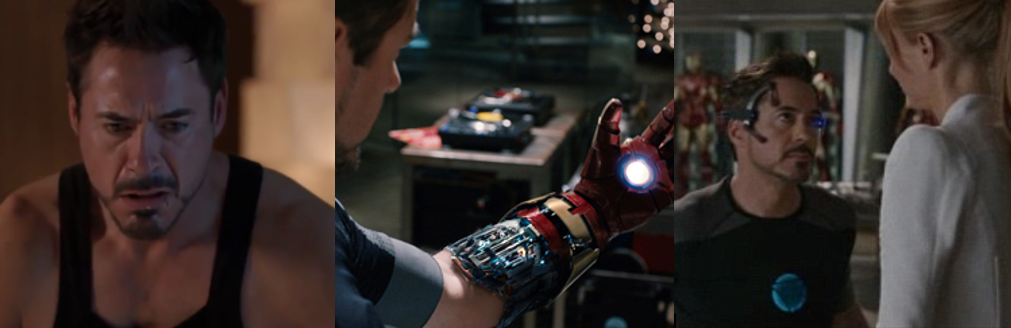
Suffering from PTSD and insomnia, Stark neglects Pepper and focuses on building more armours.

When we catch up with Stark in the then-present day, he’s fully committed to his relationship with Pepper and seemingly in a much more stable place in terms of his personality (though he retains his trademark snark and sardonic nature) but he’s haunted by his near-death experience in Avengers Assemble. Suffering from frequent nightmares and flashbacks to the wide, unknown dangers that lie beyond our world, Stark is stricken by harrowing panic attacks any time the subject of New York comes up and has spent more and more time finding comfort in his Iron Man armour and tinkering down in his workshop. Constantly distracted, highly strung, and fatigued, his relationship with Pepper suffers a bit as a result of the fact that, rather than open up to her, he prefers to make more and more Iron Man variants and work on perfecting his Mark XLII armour, which is capable of separating into self-propelling parts that respond to his commands via micro-repeater chips. Despite having gained new allies in his fellow Avengers, Stark feels more alone than ever; not wanting to worry Pepper, he keeps her at arm’s length and works around the clock to ensure her safety. Happy is busy with his new position as head of security at Stark Enterprises (a job he takes very seriously) and, though Colonel James “Rhodey” Rhodes (Cheadle) unsuccessfully tries to ask about Stark’s mental health, his loyalty to the military necessitates keeping independent costumed heroes like Iron Man out of the loop.

Rhodey features prominently as the government-sponsored superhero Iron Patriot.

Indeed, in an extension of Rhodes’ sub-plot in Iron Man 2, President Ellis (William Sadler) has officially commissioned Rhodes to ditch the War Machine moniker and don the garishly patriotic red, white, and blue armour of the “Iron Patriot” and act as governmentally-sanctioned superhero to help allay fears following the Chitauri invasion. Since Stark is preoccupied with his mounting anxiety issues, Pepper is left feeling unappreciated and shunned. Though she stays loyal to Stark, despite his eccentricities, she is more than a little impressed when Killian shows up at Stark Enterprises having transformed into a physically gorgeous, confidant businessman. After Stark’s dismissal of him back in the nineties, Killian resolved to make Advanced Idea Mechanics (A.I.M.) incredibly successful and profitable and, through A.I.M..s research, was able to not only cure his own degenerative physical condition but potentially offer a cure for those suffering from all kinds of mental and physical ailments in the development of Extremis. However, while Killian’s presentation and charisma are impressive, Pepper ultimately turns down a proposed business venture between Stark Enterprises and A.I..M. out of fears about the potential weaponisation of the Extremis technology. Pepper is right to turn down this proposal as, very quickly, it is shown that a number of ex-soldiers have been exposed to Extremis and become living weapons as a result. The virus, cultivated from Maya’s research, promises to spontaneously heal wounds and even regrow limbs as well as curing mental and physical deficiencies and granted a degree of superhuman strength and dexterity to its subjects.

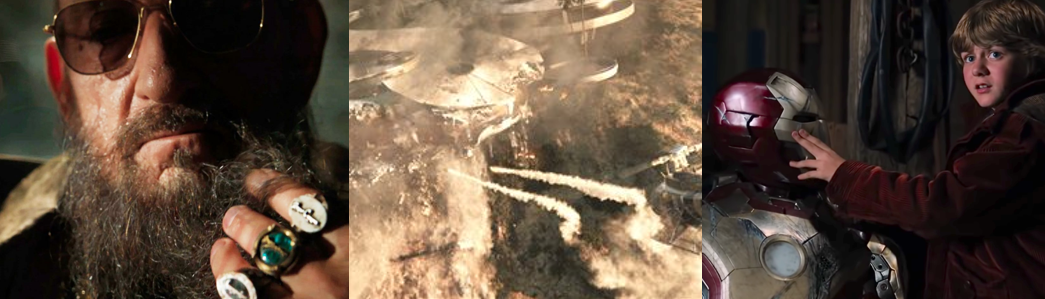
When Stark antagonises the Mandarin, he’s left without his tech and reliant upon a child.

However, Extremis is, as the name implies, extremely volatile and many of those exposed to it burn out and explode as veritable suicide bombers. When Happy is critically injured in one of these attacks, Stark is incensed and openly challenges the one responsible for these, and many other devastating terrorist attacks, the terrorist known as the Mandarin. The Mandarin, who flashes up the symbol of the Ten Rings and frequently issues ominous threats by hijacking the airwaves, directly threatens President Ellis and proudly takes credit for the deaths of innocents in his unrelenting attacks against the United States. However, despite Rhodey cutting Stark out of the Mandarin investigation, Stark publicly (and recklessly) calls out the Mandarin after Happy is put in the hospital; the result is an all-out attack that devastates his home, burying his armours and technology, and leaves Stark stranded in Tennessee cut off from Just A Rather Very Intelligent System (J.A.R.V.I.S.; Paul Bettany) and with his Mark XLII armour powerless. Stripped of his resources and technology, Stark is forced to team up with young Harley Keener (Simpkins), who helps Stark link the Extremist terrorist attacks, and the Mandarin, back to Killian.

The Nitty-Gritty:
Given that it’s written and directed by Shane Black, Iron Man 3 takes place around the Christmas season; while Christmas doesn’t really factor into the overall plot in any tangible way beyond a few trees, decorations, and Tennessee being covered in a frigid snow, it does help the film to stand out against other MCU movies, and superhero films in general, as there aren’t very many that take place in the festive season. Thankfully, despite some of the flaws in the direction of the film and the decisions the filmmakers make regarding certain characters, the change in directors doesn’t diminish the perfect blend of snark and humour at work in Iron Man 3. Indeed, Stark’s interactions with the likes of Rhodey, Happy, and Harley are one of the film’s highlights and it’s great to see that he’s still a droll prick when he needs to be despite being a “piping hot mess”.

While it’s great for his character growth, Stark spends a lot of the film without his armour.

Indeed, the film adds further layers to Stark’s complex personality by adding post-traumatic stress to his laundry list of character defects; traumatised to the point where he suffers from insomnia and a deep-seated urge to build and create armours for every conceivable scenario, the last thing Stark needs is to be left without his tools and technology and yet that’s exactly where he finds himself. Stark’s efforts in Tennessee effectively return him to the cave where he must rely on his innovative genius to survive; when he tracks the Mandarin to Miami, he infiltrates the terrorist’s base with little more than some cobbled-together armaments that ape his usual Arc Reactor-powered arsenal. Teamed with a similarly suit-less Rhodey (whose henchman, Eric Savin (James Badge Dale), appropriates the Iron Patriot suit to kidnap President Ellis), Stark becomes much more of a resourceful spy than a colourful superhero and he spends a great deal of the film (arguably too much, in my opinion) outside of the armour rather than in it.

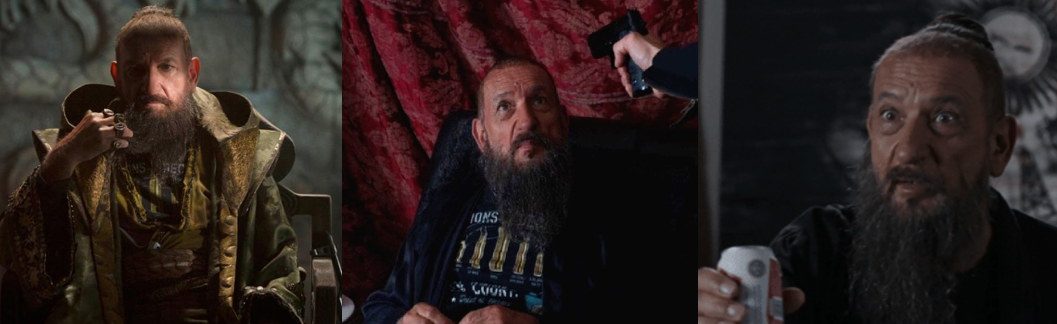
The Mandarin stupidly turns out to be a drunken buffoon merely acting the part.

When he confronts the Mandarin, Stark is confused and enraged to find that he’s little more than a drunken, substance-dependent eccentric English actor named Trevor Slattery. Trevor willing reveals that he was contracted by Killian to pose as a credible terrorist threat in order to kill the President and replace him with Vice President Rodriguez (Miguel Ferrer), a puppet leader who will do exactly as Killian dictates. This twist on the traditional Fu Manchu sorcerer figure who I grew up seeing as Iron Man’s archenemy is undeniably amusing but, in retrospect, was a pretty awful idea; you had Ben Kingsley, Ben Kingsley, who absolutely crushed it when portraying the Mandarin and you turned him into an alcoholic buffoon. Indeed, the MCU producers backtracked on this depiction of the Mandarin pretty quickly and eventually brought the true Mandarin into the fold but even then the character was significantly altered from the source material. Sadly, though, this came out long after Stark’s emotional death so we were robbed of seeing him go toe-to-toe with his most iconic nemesis, which remains a bitter pill for me to swallow.

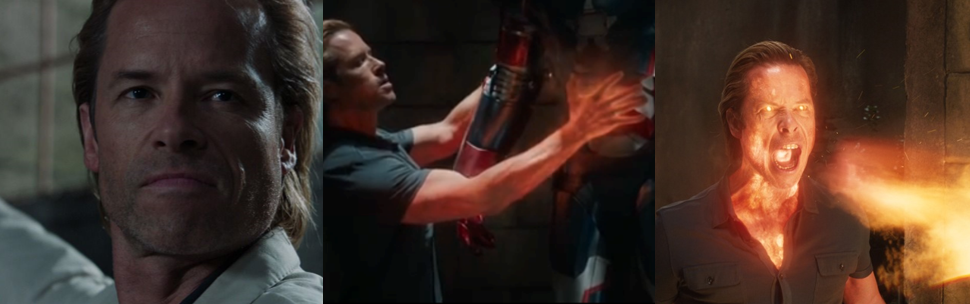
Killian is positioned as the main villain and claims to be the true Mandarin…

As has been publicly explored, Maya’s involvement in the plot as a tertiary antagonist is similarly swept under the rug; rather than be a significant threat to Stark, she merely ends up being a pawn of Killian’s who is gunned down the moment she has a crisis of conscience. Consequently, it’s Killian himself who acts as the film’s primary villain; a malicious, ruthless, and cunning adversary, Killian is yet another dark mirror of Stark (at least in terms of his business acumen) who subjects numerous desperate souls to his Extremis process despite knowing full well that it could kill them. He even forcibly infects Pepper with the virus, though this ultimately proves to be his downfall when she conveniently proves to be far more stable than most of his usual subjects. Killian ultimately takes on the Mandarin moniker for himself, showcasing superhuman strength, unparalleled regenerative abilities, and even the ability to breathe fire (making him like a composite of the comic’s Killian, Mandarin, and Fing Fang Foom).

The army of armours shows up way too late and are almost immediately destroyed, which is a shame.

While there is a noticeable lack of Iron Man action in Iron Man 3, the film does make up for it with a particularly exciting sequence where Stark has to rescue a bunch of the President’s personnel when Air Force One is destroyed, which is quite the innovative and unique rescue scene. Still, one of the primary selling points of any Iron Man movie, especially for me, are the various different armours Stark constructs for himself and Iron Man 3 culminates in a veritable smorgasbord of suits for our viewing pleasure. Sadly, though, while many of these were a significant aspect of the film’s marketing, they only appear onscreen for the briefest of moments in the finale, where Stark has J.A.R.V.I.S. remote pilot every single one of his suits to assist in the battle against Killian. Even his apparently revolutionary Mark XLII armour is pretty underwhelming as it constantly breaks, shatters, and loses power, making it probably the most ineffectual of all of his armours. Once Pepper kills Killian off, Stark immediately orders every single one of his suits to self-destruct and then just fixes not only Pepper’s condition but also his own, removing the shrapnel from his chest and apparently retiring from the superhero life. This, however, would simply be the start of another sub-plot and character arc for Stark throughout the remainder of the MCU which specifically dealt with his inability to walk away from Iron Man, the Avengers, and the thrill of being a superhero.

The Summary:
It’s not that Iron Man Three (I still don’t get why it’s credited like that…) is a bad film. For much of its runtime, it’s actually pretty entertaining and dark thanks to the intense and menacing nature of Kingsley’s portrayal of the Mandarin. Even seeing Stark genuinely affected by his experience in Avengers Assemble was intriguing to watch and showed that the character was clearly growing and learning and influenced by the ever-escalating nature of the MCU, to say nothing of further solidifying Rhodey’s growth as his own legitimate armoured superhero. I didn’t even mind, conceptually speaking, the idea of Stark being robbed of his resources and having to improvise as it went a long way to showing just how adaptable, intelligent, and increasingly neurotic the character is becoming about safeguarding his friends, family, and the greater good. However, the execution is flawed in a lot of ways; the film “feels” just as big and exciting as the previous Iron Man movies but any and all of its positives are immediately soured by that God-awful Mandarin twist. Imagine if a Batman movie gave us the most perfect casting and interpretation of the Joker and then threw a curveball by revealing that he was a simple janitor playing dress-up; people would go crazy and, while I understand that the Mandarin comes with many cultural issues, the fact that the MCU eventually managed to translate a more faithful version of him to film years down the line makes me wish that they had stuck with the casting and the magic they had in Kingsley’s casting and given us (and by “us” I mean “me”) the long-awaited showdown between Iron Man and his greatest foe. Instead, we’re left with a decent enough film but one that gambles, and loses, its credibility on a nonsensical decision and one of the weaker films in the MCU line-up, in my opinion.

My Rating:

Rating: 2 out of 5.

Could Be Better

What did you think to Iron Man 3? Can you explain to me why the credits spell the number three out because I honestly don’t get it? What did you think to the aspect of Stark suffering from anxiety attacks? Did you like that he was forced to innovate and work without his armour or were you annoyed at how little Iron Man action there was in the film? What did you think to the twist regarding the Mandarin? Did you enjoy it or, like me, were you annoyed by it? Which of Stark’s new armours was your favourite and would have liked to see more of and what did you think to the introduction of the Iron Patriot suit? What are some of your favourite Iron Man characters or stories? Where does Iron Man rank in your hierarchy of comic book characters? Are you doing anything to commemorate Iron Man’s debut appearance and, if so, what is it? Feel free to drop a comment down below and thanks for being a part of Iron Man Month!

March Drabble Challenge: Dough

Horror PromptsGillian Church is hosting another horror drabble challenge: 31 prompts for 31 creepy tales throughout March. This time, we can decide on the length of the piece but I’m sticking to the 100-word default.

Can you do it?

The Prompt:
Dough

The Submission:
Mrs. Sanders danced as she worked in the kitchen. She kneaded the dough, spreading it into a perfect base ready to be filled with meat, potatoes, and seasonings and cooked to perfection in her large, cast iron oven.

She took pride in her meat pies, which were the most popular seller in her bakery. And why not? Her meat was as fresh as you could want, and locally sourced. She danced her way to the fridge to grab a tray of Father Brisco’s meat, freshly tenderised and cut, and happily dropped the chunks of the nosey priest to the dough.


What did you think to the prompt for today’s drabble challenge? Did you submit anything for it? Have you ever written any flash fiction before? I’d love to know what you think to my snippets and writing prompts, so feel free to sign up and let me know what you think below or leave a comment on my Instagram page. You can also follow Gillian Church to take part in her Weekly Writing Prompt challenge.

March Drabble Challenge: Bleed

Horror PromptsGillian Church is hosting another horror drabble challenge: 31 prompts for 31 creepy tales throughout March. This time, we can decide on the length of the piece but I’m sticking to the 100-word default.

Can you do it?

The Prompt:
Bleed

The Submission:
By rights, I shouldn’t even be out here in the goddamn woods searching for some kid too stupid to know better.

A blur of motion caught my eye; I whirled around, frantically shining my torch across the thick trees, but visibility was almost impossible because of the pouring rain and I didn’t see the wolf until it was leaping at me.

Hot breath filled my nostrils as I beat at the wolf. I screamed as gleaming teeth clamped around my forearm and tore at my flesh, splashing gore in my eyes as it bit at my throat and gorged itself.


What did you think to the prompt for today’s drabble challenge? Did you submit anything for it? Have you ever written any flash fiction before? I’d love to know what you think to my snippets and writing prompts, so feel free to sign up and let me know what you think below or leave a comment on my Instagram page. You can also follow Gillian Church to take part in her Weekly Writing Prompt challenge.

Movie Night: The Batman

Released: 4 March 2022
Director: Matt Reeves
Distributor:
Warner Bros. Pictures
Budget: $100 million
Stars:
Robert Pattinson, Zoë Kravitz, Paul Dano, Jeffrey Wright, Colin Farrell, and Andy Serkis

The Plot:
During his second year of fighting crime, traumatised billionaire Bruce Wayne (Pattinson) struggles to balance rage with righteousness as he investigates a disturbing mystery that has terrorised Gotham City. During his pursuit of the sadistic Edward Nashton/The Riddler (Dano), the Batman is forced to make new, unlikely allies to bring the corrupt to justice.

The Background:
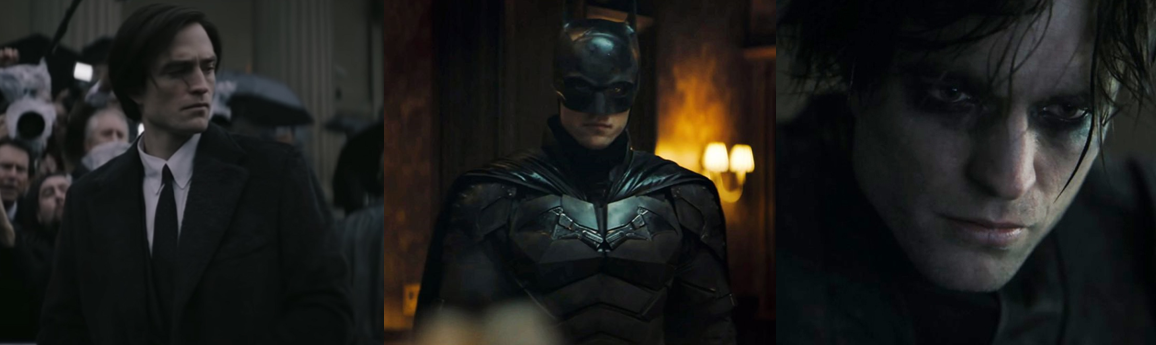
Ever since his debut in Detective Comics, the Batman has been a popular staple of DC Comics and no stranger to adaptation. The Caped Crusader and his faithful sidekick, Dick Grayson/Robin, first appeared in live-action in a black-and-white serial back in 1943, but it was his outrageously vibrant adventures in the sixties that arguably catapulted the grim vigilante into a cultural icon. Writers such as Frank Miller helped to return Batman to his darker roots, and his mainstream perception was changed forever thanks to the grim and gritty Batman (Burton, 1989); though the character would revisit his campier roots in the latenineties, auteur Christopher Nolan and method actor Christian Bale brought the Dark Knight back on track with an extremely successful and influential trilogy of Batman films that grounded the theatrical vigilante in a hyperreality. However, following the outrageous success of the Marvel Cinematic Universe, Warner Bros. were eager to establish their own interconnected cinematic universe; Man of Steel (Snyder, 2013) was to be their first step in this process; however, a series of missteps and underhanded decisions saw the studio backpedal and re-evaluate their strategy to make the bizarre decision to tell standalone stories alongside interconnected films. Initially, The Batman was to be solo project for Ben Affleck; however, the actor left the project after becoming disinterested in the character, production, and Warner’s treatment of director Zack Snyder. Director and lifelong Batman fan Matt Reeves replaced Affleck as director and reworked the script to focus on Batman’s second year of crimefighting and crafting a neo-noir story the focused on the character’s rage and detective skills. Former teen heartthrob-turned-method actor Robert Pattinson replaced Affleck and immediately tackled the role with a grim enthusiasm to undergo a physical and mental transformation and was encouraged by Bale to ignore criticism regarding his casting. Colin Farrell underwent an even more extreme transformation to play a new version of crime boss Oswald Cobblepott/The Penquin, and the film was clearly established as being separate from the existing DC live-action continuity. Reeves strived to incorporate horror elements and a stylistic noir tone to his film, and costume designer Jacqueline Durran drew inspiration from multiple Batman stories and interpretations to create a homemade look for the Batsuit. After being delayed due to the COVID-19  pandemic, The Batman made over $772 million at the box office and was met with near-unanimous praise. Critics lauded the film’s ambiance and gritty noir feel, Pattinson’s grim performance was celebrated, and it was largely heralded as being one of the most gripping and compelling superhero films to date. Even before the film was released, the cast and crew revealed that The Batman was intended to be the first of a new trilogy of films and it was followed by a spin-off television show focusing on the Penguin.

The Review:
Like many, I was somewhat sceptical going into The Batman, but probably for very different reasons; as much as I disagree with many of the choices made in the DCEU, and the direction Snyder took the films, at least we were finally getting DC movies where these wonderful characters actually co-existing and interacted. Now, though, Warner Bros. seem to think that it’s perfectly acceptable and understandable to have different variations of Batman onscreen at the same time, which is a far cry from the infamous “Bat Embargo” they usually place on their property. While I can just about get my head around this, I wonder how many in the casual audience will get that this Batman and this new world isn’t part of the DCEU as we know it, and is unrelated to the Ben Affleck and Michael Keaton Batmen that are in that universe. Personally, I feel things would’ve been much simpler if Warner Bros. had pushed for a new Batman solo film after Man of Steel, or simply recast Affleck with another grizzled veteran and retooled their script. However, I had no doubts about Robert Pattinson; he’s successfully reinvented himself as a high calibre actor and, at this point, I’m resigned to just hoping that these DC movies will be enjoyable in their bubbles and trying to ignore the absolute mess of the DC multiverse.

The film explores little of Bruce’s backstory and instead picks up with him in a dark mental state.

Similar to Batman and Batman v Superman: Dawn of Justice (Snyder, 2016), The Batman begins with Bruce having been active as Gotham City’s bat-themed vigilante for some time. Specifically, he’s in his second year of crimefighting and is already relatively well established as a vigilante; many in the Gotham City Police Department (GCPD) and positions of authority are aware of him and do not approve of his methods, but the city’s such a corrupt and rotting cesspool that there’s really not much of an effort being made to bring him in. Unlike pretty much every single interpretation of the Batman, however, we are spared a recreation of the night Bruce’s parents are killed; their deaths are still mentioned, and are a pivotal part of the plot, Bruce’s motivation, and the city, but the film very much takes inspiration from Spider-Man: Homecoming (Watts, 2017) and assumes that the audience will have a working knowledge of who Batman is and how he came to be. Obviously, for myself and a lot of us, this is the case, but if you’re new to the Batman than you might struggle a little bit with understanding exactly why Bruce was driven to such extremes. The film, in many ways, is framed as though you’ve picked up a random issue of DC Comics; it drops you right into this hellhole of a city and forces you along this intense investigation with a haunted young man who stalks the streets night after night. one thing I really enjoyed was the use of Bruce’s voiceover and the depiction of him keeping track of his nightly activities in a journal, two things which are common staples of the character in the comics and really help to reinforce the film’s seventies-inspired crime noir feel, though Pattinson’s narration dies down for the majority of the film, so that one explicit window into his mindset is shut off from us and the film instead becomes a masterful exercise in subtlety and body language. This is a very different Batman from the ones that have come before, one that is both new and familiar in a lot of ways; like Michael Keaton, he rarely speaks and, when he does, it’s in a hushed whisper. Like Christian Bale, he clearly put his Batsuit together and is still finding his way as Gotham’s protector, and he has a physical intensity not unlike Ben Affleck but fuelled by a rage so intense that it’s almost surprising to find he has such a strong moral code against guns and killing. This Batman is also firmly grounded in the real world, perhaps even more so than Bale’s; it’s suggested that, rather than travelling the world to learn crimefighting and solving methods, he was trained to fight by his faithful butler, Alfred Pennyworth (Serkis), but he also demonstrates an extremely keen mind.

Apart from Gordon, Batman’s relationship with the GCPD is as strained as Bruce’s with Alfred.

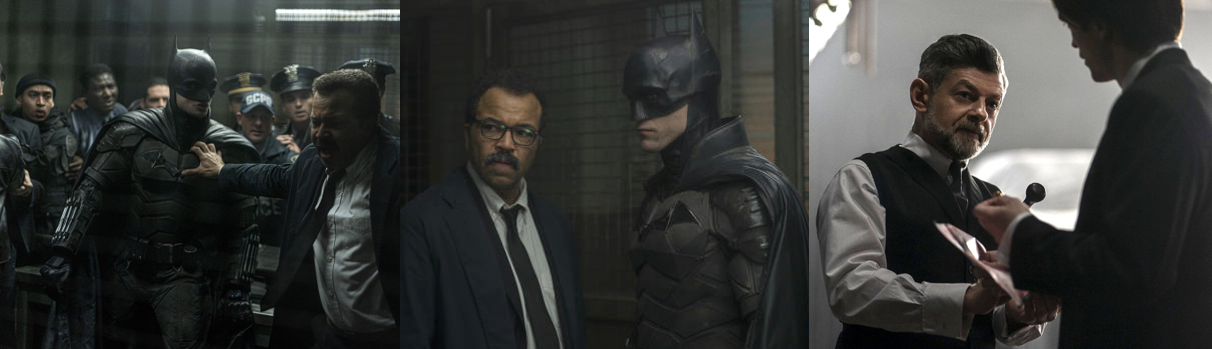
More than any other Batman, this Batman is a detective; he works closely with Lieutenant Jim Gordon (Wright), who vouches for him, allows him access to crime scenes, and even calls for him using a makeshift signal atop a seemingly abandoned skyscraper. Batman’s relationship with Gordon is easily the closest ever seen on film; the two have a clear trust and respect for each other, and feel that the system is so broken that they have no choice but to turn to the other (one an extreme vigilante, the other one of the city’s few honest cops). Despite the disapproval of his peers and superiors, Gordon constantly stresses that the Batman is their ally and he even colludes with the brooding vigilante to help him escape police custody. Gordon is depicted as a jaded and bleak individual who’s clearly seen too much death and corruption in Gotham and is near the end of his tether, yet he continues to fight on for justice. We don’t explicitly learn much about his personal life outside of work, but it was pretty great to see the two literally teaming up to investigate clues and having a relationship that’s much more equal than in other interpretations. On the flip side, we really don’t get many interactions between Bruce and Alfred. Clearly inspired by Batman: Earth One (Johns, et al, 2012 to 2021) and more than a little reminiscent of Sean Pertwee’s take on the character, Alfred clearly fully supports Bruce’s endeavours as Batman but, like other versions of the character, is dismayed to find that Bruce’s nightly jaunts have all but consumed his life. Indeed, this is truer here than of any other Batman; Bruce Wayne is merely a brooding shell of a man, one who is rarely seen in public and has made no efforts to put his wealth towards improving the city, and Alfred is dismayed that the young billionaire is letting his family’s legacy go to waste in favour of pummelling thugs as Batman. Having said that, though, Alfred assists in looking into the Riddler’s ciphers and helps Bruce to figure out clues to the madman’s next victims, and Bruce is delivered an unexpected blow when his last remaining member, whom he has long shunned, is critically injured after the Riddler targets Bruce Wayne. Bruce’s anger at this turns to feelings of betrayal, and finally appreciation for his elderly butler, after he learns that his father, Thomas Wayne (Luke Roberts), got caught up in Gotham’s underworld during his mayoral campaign.

Batman’s investigation leads to him crossing paths with numerous shady characters and tentative allies.

Similar to some modern Batman storylines, and Joker (Phillips, 2019), Thomas Wayne’s normally morally upstanding reputation is called into question after he is duty-bound to save mob boss Carmine Falcone’s (John Turturro) life and then to turn to the gangster to help keep a scandal under wraps. Though Bruce initially believes that Alfred has lied to him about this and that his father was as corrupt as the city’s system, he’s grief-stricken to learn that Falcone took extreme measures simply to have leverage over Thomas and that his parents were killed as a result. A prominent discussion point in the media, this Batman has taken the concept of inspiring fear into criminals and dialled it up to eleven; brutal and intimidating, he stalks his prey from the shadows and then engages with them, unarmed, with little regard for his own safety. He’ll take on gangs of thugs in the subway as readily as barging into the Iceberg Lounge to get answers from Oz Cobb/The Penguin (an absolutely unrecognisable Colin Farrell), and utilises minimal gadgets beyond his tough and durable Batsuit, grapnel gun, and somewhat unrealistic contact lenses (which record everything he sees and hears). It’s in the Iceberg Lounge that he first crosses paths with Selina Kyle (Kravitz) who, in just one of many homages to Batman: Year One (Miller, et al, 1985), is a working girl, barmaid, and frequent arm candy for some of Gotham’s seedier individuals. Selina is drawn to donning a figure-hugging catsuit in order to retrieve the passport of her friend and lover, Annika Koslov (Hana Hrzic), which one of the Riddler’s victims had taken to keep her quiet about her knowledge of Falcone’s illicit activities, and she ends up forming a rocky alliance with the Batman in order to track Annika down when she goes missing. Similar to Anne Hathaway’s take on the character, Kravitz never actually uses the pseudonym Catwoman, but she is depicted as a slick, cat-loving opportunist who is more than capable of fending for herself in a fight. Her vendetta against Falcone is deeply personal; she feels he owes her a shit-load of money after what he did to her mother and is so driven to making him pay for his actions that she’s willing to kill. This causes tension between her and Batman, who cannot abide the senseless taking of lives.

This version of the Riddler is a twisted psycho looking to expose Gotham’s corrupt system.

Speaking of which, Gotham City, already a powder keg of anarchy and crime, is gripped with fear when the absolutely terrifying and psychotic Riddler begins targeting prominent members of the city government and posting viral messages and threats in a bid to expose how corrupt the city’s system is. Garbed in a hunting jacket and masking his face behind a gruesome visage, the Riddler takes more than a little inspiration from the real-life Zodiac Killer to create a version of the character that is far beyond anything I’ve ever seen before. The closest analogy I could draw was with the Riddler seen in the Batman: Arkham videogames (Various, 2009 to present) and a mixture of “John Doe” (Kevin Spacey) from Seven (Fincher, 1995) and John Kramer/Jigsaw from the Saw franchise (Various, 2004 to 2021), which honestly was exactly what I was hoping for for this film considering how heavily inspired the city and the presentation is by Seven. The Riddler is an unhinged psychopath who stalks his victims from afar and either bludgeons them to death or rigs them up to ghastly death traps to be eaten alive by rats or serve as a veritable suicide bomber. His televised threats are an incoherent and frightening example of a mind twisted and snapped, and his tendency towards leaving riddles and ciphers bamboozles the GCPD and hints at a deeper corruption within Gotham. The Riddler specifically addresses these puzzles to the Batman and comes to see the Dark Knight as his intellectual equal; in actual fact, the Riddler is so warped that he believes the Batman is his partner, an accomplice who can perform the physical tasks he (as in the Riddler) is incapable of. His plot to expose Gotham even goes as far as to not only target Bruce Wayne but to flooding the city and recruiting a number of likeminded lookalikes to assassinate mayoral candidate Bella Reál (Jayme Lawson).

The Nitty-Gritty:
Although it starts in a very subdued manner, The Batman quickly escalates into an intense and gritty noir-style thriller that showcases a side to the Batman that we’ve really never seen before. Accompanied by a dark, haunting orchestral score from Michael Giacchino, this Batman is drawn into the Riddler’s twisted plot and spends the majority of the film attempting to figure out what the madman is doing and who his next target is. Perhaps more than any other Batman before him, Bruce has become obsessed, utterly lost, in his vigilante persona. He can no longer differentiate between day and night, sleepwalks through life as Bruce Wayne, and even pushes Alfred away all in service of his fixation on trying to salvage what’s left of Gotham City from the criminals and the corrupt. Consequently, this really isn’t a movie where you learn much, if anything, about Bruce Wayne. The differentiation between his private, personal, and vigilante life is practically non-existent and Pattinson spends almost the entire movie in the cape and cowl of the Batman. Furthermore, although he’s referred to as “The Batman” by the Riddler and the media, Batman actually believes himself to be vengeance personified, to the point where the Penguin and Selina both frequently refer to him as “Vengeance”, which is all part of the character’s larger story arc where he realises that he is actually making an impact in the city not just as an instrument of fear and revenge but also as a symbol of hope. The Batman may very well be the most visually interesting and stylistically aesthetic Batman movie ever made. Every shot is like a work of art, with the camera frequently utilising odd angles and long, lingering shots to really sell the atmosphere of Gotham City and the character of the Batman.

This is a very back-to-basics approach to the character, and his suit and gadgets reflect that.

Gotham is shot almost entirely at night and in the rain; it is a moody, gritty, and dangerous city that feels like it’s on the brink of total collapse at all times. It feels very much like the cesspit seen in Joker and the grimy streets of Batman Begins’ (Nolan, 2005) Narrows but, again, dialled up to eleven. There are some shots of the city at sunrise and sunset, but there’s hardly any scenes that take place in the daytime, all of which really helps to make Gotham feel like an absolute hellhole and really helps sell the idea that Batman is facing an uphill battle. Previously, Batman Begins delivered easily the most grounded and realistic take on the title character ever seen, but The Batman takes that even further. Many aspects recall director Darren Aronfosky’s God-awful pitch from back in the day, but these elements have thankfully been tweaked with clear inspirations from Year One, Earth One, and Batman: Zero Year (Snyder, 2013 to 2014) that show Bruce operating out of a subway beneath Wayne Tower rather than a more conventional Batcave or Wayne Manor and largely bereft of his usual gadgets and unparalleled efficiency. Even two years into his career, this Batman remains a flawed character. Though extremely intelligent, driven, and observant, his body is riddled with bruises and scars and he takes quite a beating during the film’s vicious fight scenes. Although we don’t get a step-by-step insight into Bruce’s trauma and transformation into the Batman, much of this is wonderfully conveyed through Pattinson’s body language and demeanour; he is clearly a haunted, broken man filled with rage and desperate to protect others from the pain that has all-but crippled him. More than any other Batman, he says an awful lot just with a glare of his eyes and his mere presence is enough to leave roomfuls of people, even those already familiar with him, speechless. This is only aided by his absolutely fantastic Batsuit; clearly cobbled together by himself, presumably using some of the resources afforded by his wealth, his Batsuit is as realistically believable as the rest of the film. Comprised of an armoured outer shell and a variety of practical gadgets such as his trusty grapple line (hidden in his wrist) and a gliding suit built into his cape. Batman’s use of gadgets is refreshingly limited. He uses the vague bat-shaped symbol on his chest as a cutting tool and has a taser function built into his gauntlets, but he isn’t busting out high-tech equipment at every opportunity and is largely reliant upon a torch and his grapple line. Taking inspiration from the likes of Gotham by Gaslight (Augustyn, et al, 1989) and Batman: Arkham Origins (WB Games Montréal, 2013), this Batsuit is surprisingly flexible and durable; Batman regularly tanks gunshots but can flip and swing about with ease, making him an agile and dangerous enemy to Gotham’s criminals. The only part of it I didn’t really like was the cowl, which seemed a bit too leathery and like it wouldn’t really protect him from headshots, but the suit is constantly shot in a way that makes it fearsome and impressive to behold.

Batman’s monstrous car and grim determination lead him towards a suitably dramatic finale.

Though Batman utilises a motorcycle for much of the film, he does bust out an absolutely mental rendition of the Batmobile. Essentially a supped-up muscle car with a jet engine on the back, the Batmobile is like a roaring beast that tears through the rain-slick streets in a thrilling chase to run down the Penguin and a far cry from the overly tech-laden Batmobiles of the past. Also impressive are the make-up effects used to literally transform Colin Farrell into the bulbous, grotesque Penguin. Portrayed as an underling of Falcone and proprietor of the Iceberg Lounge, the Penguin is a gruesome gangster who aspires to usurp Falcone’s position as Gotham’s top crime boss. As much as I would’ve liked to see someone like Ray Winstone take on the iconic role, Farrell absolutely steals the show in every scene he’s in, portraying the Penguin as a sleazy and manic mobster who seems to relish Gotham’s descent into freakish anarchy. Although not seen without his mask until quite late into the film, Paul Dano makes for a terrifying take on the Riddler. This isn’t Frank Gorshin’s madcap camp or Jim Carrey’s zany buffoonery, this is a Riddler who is dangerous and sadistic and empowered by his anonymity. Like Bruce, he has completely lost himself to his masked persona and addicted to the rush of breaking and taunting others, and is so far gone that he wants to literally wash away Gotham’s sins by flooding the city. This results in a finale where Batman is effectively powerless to stop the Riddler’s mad scheme and, instead, transforms into a symbol of hope for the terrified and endangered citizens. Although he gets plenty of opportunities to smash up the Riddler’s lookalikes, it’s his heroic actions in leading trapped civilians to safety that marks the turning point for Batman’s character, and potentially will result in him further refining his approach and mindset in a sequel. Although sequel bait is kept largely to a minimum and the focus is clearly on making an intense standalone film, The Batman definitely leaves the door open for continuations. The plot only scratches the surface of the corruption and degradation that threatens Gotha, there’s little hints and references towards the Court of Owls and even Doctor Thomas Elliot/Hush. The filmmakers also couldn’t help but include a brief, somewhat obscured cameo by Barry Keoghan as a maniacal Arkham inmate who proposed a team-up with the incarcerated Riddler.

The Summary:
As I said, there were doubts heading into The Batman simply because I’m tired of seeing Batman and other DC superheroes existing in self-contained worlds and am eager to see them interacting with each other. However, from the moment the first trailer dropped, I could tell that this was going to be a very different Batman movie from anything we’d seen before, and it certainly was that! “Intense” is the best word I can use to describe this film, which is so dark and gritty and so full of rage and brooding bleakness that you’d bee forgiven you’d walked into a crime thriller like Seven. This, however, is exactly what I’ve been waiting to see from Batman; a back-to-basics detective story. The Batman is met with suspicion, isn’t surrounded by high-tech gadgets, and is simply a broken man trying to fight an uphill battle against crime and corruption. Robert Pattinson brought an intensity to the role that rivals that of Christian Bale, clocking up so much time in the suit and maintaining a ferocity in and out of the cowl that paints Bruce Wayne in a very different light. While newcomers to Batman may be left wanting to know more about Bruce (it’s not even stated why he chooses the iconography of a bat here), a lifelong Bat-fan such as myself really appreciated that we just jumped head-first into the story and largely stuck with the Dark Knight throughout the story. The greater screen time afforded to Jim Gordon was very much appreciated, and more than maybe up for Alfred’s comparatively smaller role, and I loved how grimy and desolate the city was. The portrayal of the Penguin and, especially, the Riddler was fantastic; both actors really threw themselves into the roles. They challenged the assumed perception of the characters, transforming the Riddler into a calculating, sadistic psychopath and really bringing an intellectual challenge to the Batman. With so much room left to explore, I can’t wait to return to this gloomy new Bat-world and see what else can be done with this version of the character, which easily makes it to the number two spot for me (I still have to give the number one spot to Christian Bale for delivering an overall unmatched performance as Bruce/Batman).

My Rating:

Rating: 5 out of 5.

Fantastic

What did you think to The Batman:? How do you feel it compared to other live-action versions of the character? Were you impressed with Robert Pattinson’s performance or are you too short-sighted to give up on your precious Ben Affleck? What did you think to the Batsuit, his car, gadgets, and setup? Did you enjoy the reinterpretation of the Riddler and Colin Farrell’s transformation into the Penguin? What did you think to the mystery, the noir-style presentation, and the inclusion of Catwoman? Which villains or story arcs would you like to see utilised in potential sequels? Whatever your thoughts on The Batman, or Batman in general, please sign up to leave a comment below and be sure to check out my other Batman content.