10 FTW: Horror Movies Where Evil Triumphs in the End

These days, it’s probably one of the most clichéd elements of the horror movie genre to have the antagonistic force terrorising the protagonists rise again by the end of the last act. Yet, this staple of the genre can have a dramatic impact on the viewer, sometimes altering entire events that preceded it, salvaging a mediocre film at the last second, or (more often than not) setting up a sequel or even an entire franchise.

With that in mind, here are ten of the most memorable moments in horror movies where evil ultimately proved triumphant:

10.png
10 Final Destination (Wong, 2000)

The definition of a mediocre horror picture, Final Destination follows a group of teens who evacuate a plane moments before it explodes in mid-flight, only to find themselves falling victim as death stalks them to rebalance the scales. Hardly a classic in terms of horror, the sequels eventually descended into near-slapstick parody in their efforts to set up increasing complex and contrived ways of killing the unfortunate protagonists. After deciphering “death’s plan” and escaping to Paris, Alex Browning (Devon Sawa) is saved from a gruesome fate by former bully-turned-friend Carter Horton (Kerr Smith). Just as the audience breathes a sigh of relief at seeing the protagonist pushed to safety, a massive neon sign comes hurtling towards Carter before the film changes to black and the credits run. While this ending became a hallmark of the franchise, in the first movie, the predictability that would befall the series had yet to be established and the ending was new, fresh, and somewhat unpredictable.
9
9 The Last Exorcism: Part II (Gass-Donnelly, 2013)

Unlike its predecessor, which adopted the “found footage” approach, this sequel utilised more straight-forward techniques. Though these failed to make it any better than the film that preceded it, The Last Exorcism: Part II turned the events of the first film on its head by having its antagonistic demon be in love with the main character, Nell Sweetzer (Ashley Bell). In a surprising turn of events, at the brink of death, Nell opts to take the hand of the malevolent force that has been stalking her and allow it to possess her. She then kills a bunch of people, burns a house down, and drives off into the night as trees and vehicles combust around her, signalling the beginning of the apocalypse on Earth.

8
8 Saw: The Final Chapter (Greutert, 2010)

Saw is a horror/thriller franchise where evil triumphant at the end of every movie since the first instalment; John “Jigsaw” Kramer’s (Tobin Bell) meticulous planning and attention to detail dictated that, even when his victims escaped alive from his death traps, they often did so only as part of his grander plan or fell victim to his successors. By the end of the seventh movie, Jigsaw’s goal to teach people to value their lives has been perverted and his successor, Detective Mark Hoffman (Costas Mandylor) as devolved into a serial killer looking to tie up the last of his loose ends and flee before he can be exposed. However, just as it looks as though he is about to get away with his murder spree, he is attacked and locked up in the disused bathroom from the first movie by none other than Doctor Lawrence Gordon (Cary Elwes). Flashbacks reveal that, after severing his foot and crawling to safety, Gordon also became one of Jigsaw’s helpers and that Jigsaw tasked him with protecting his estranged wife. With her dead at Hoffman’s hands, Gordon enacts Jigsaw’s final revenge and ensures that his legacy lives on.
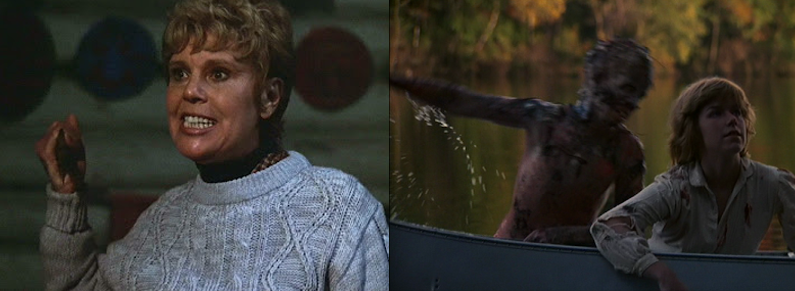
7 Friday the 13th (Cunningham, 1980)

Although the first film, and many of its sequels, has not exactly aged too well, the original Friday the 13th inspired countless slasher knock-offs looking to capitalise on its success. In the first movie, Camp Crystal Lake is terrorised by an unknown killer who systematically kills off the counsellors looking to re-open the camp; it’s the uncanny practical effects and atmosphere that steal the show here more so than anything else, and its effective use of the unknown killer became a common motif in horror for years to come. After the killer, revealed to be Pamela Voorhees (Betsy Palmer) seeking revenge after her son drowned due to the negligence of the former counsellors, is finally dispatched by lone survivor Alice (Adrienne King), all seems calm and well. Alice collapses into a raft and drifts out onto Crystal Lake, only to suddenly be attacked by a rotting, disfigured boy (Ari Lehman) who emerges from the water and drags her under. Although the subsequent sequels made better use of Jason as an unstoppable, unkillable supernatural killer, without the original shot of Jason’s mangled form leaping from the lake we may never have had the opportunity to classify this as a cliché much less have had the multitude of sequels that followed.

6
6 Drag Me to Hell (Raimi, 2009)

Sam Raimi returned to horror with a bang in 2009 with this surprisingly fun and gruesome tale of Christine Brown (Alison Lohman), a young, aspiring bank worker who finds herself placed under a gypsy curse whereby the demon Lamia will torment her for three days before taking her to Hell. What follows is a montage of terrifying imagery and events as Christine races against time and Raimi’s trademark semi-slapstick horror to salvage what’s left of her soul. After surviving these trials, Christine learns that she can pass her curse on to another and successfully passes it back onto the gypsy who placed it upon her. However, just as she is ready to celebrate her newfound life with her boyfriend, Professor Clayton Dalton (Justin Long), she realises that she made a mistake and that she is still carrying the curse upon her. Dalton can do nothing but watch in horror as Christine is set upon by demonic hands, which grasp at her from beneath the ground and pull her down into the hellish fiery pits.

Still, an eternity in Hell has got to be preferable than spending the rest of your life with Justin Long!

5
5 The Grudge (Shimizu, 2004)

Now I’m sure this won’t win me any fans but I haven’t actually seen the original Japanese version of this film. Considering that the Americanised version is set in Japan, directed by the man behind the original Ju-on series, and includes numerous elements that are shot exactly as in their Japanese counterparts, though, I don’t really regret that. Plus, it’s a damn creepy, horrifying film in its own right. Although featuring a non-linear narrative, The Grudge primarily follows exchange student Karen Davis (Sarah Michelle Gellar), who finds herself haunted and tormented by a vengeful spirit that seeks to kill anyone who enters a cursed house. After her boyfriend goes to the house to look for her, Karen goes to rescue him, only to find him dead. Witnessing the violent events that led to the houses carrying its curse, Karen sets the houses ablaze but is prevented from escaping by Kayako Saeki (Takako Fuji), who contorts herself towards her, looking to claim her life too. However, Karen is rescued from the house and taken to a hospital where it appears as though she has miraculously survived the never-ending curse. There she learns not only that the fire was subdued and that the house is still intact but also that Kayako is right behind her, bringing the film to a dramatic close and proving that Japanese spirits just don’t know when to quit.
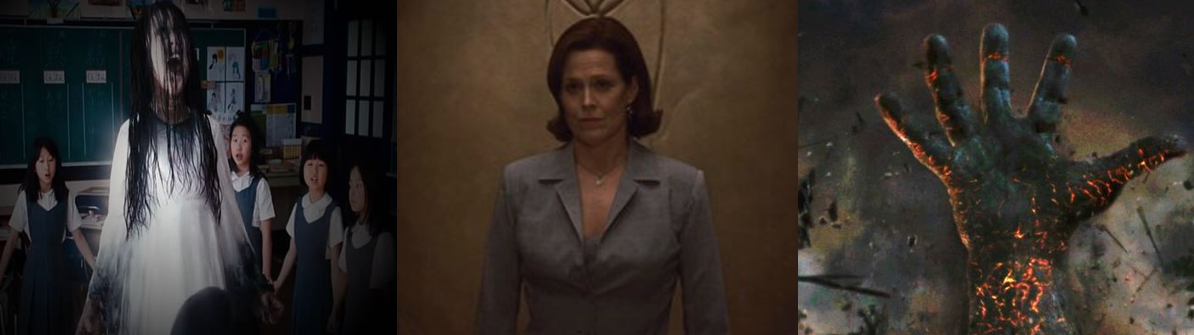
4 The Cabin in the Woods (Goddard, 2012)

I’m not going to lie: I consider this movie to be an absolute masterpiece. Not only does it subvert all expectations for a horror film, it’s also an extremely clever, incredibly enjoyable movie that pokes fun at the tropes of the genre and tells an incredibly original story. After a zombie family terrorises their friends and leaves them the sole survivors, Dana Polk (Kristen Connolly) and Marty Mikalski (Fran Kranz) stumble into a large underground facility where they discover that a covert organisation ritualistically sacrifices victims such as themselves to appease the malevolent Lovecraftian Ancient Ones. After defying the Director’s (Sigourney Weaver) urging that they complete the ritual through self-sacrifice and save humanity, they share one last joint as the facility is ripped apart by the awakening Ancient Ones as they emerge from beneath the Earth to doom humanity forever.
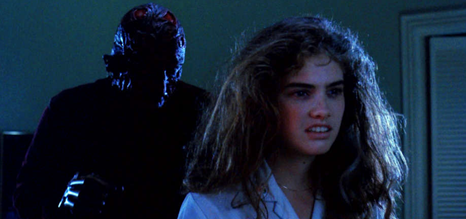
3 A Nightmare on Elm Street (Craven, 1984)

Wes Craven’s seminal horror film ensured that no ne was ever going to go to bed easily ever again as a group of teenagers are stalking in their dreams by a hideously burned killer sporting a glove adorned with razor blades. The idea that a vengeful spirit could cause you harm or even kill you simply through your dreams was a poignant, original, and terrifying idea and Craven created one of horrors most enduring, popular, and horrifying horror icons in Freddy Krueger (Robert Englund). As her friends are killed one by one, sole survivor Nancy Thompson (Heather Langenkamp) learns that she can pull things out of her dreams. Fortifying her house with booby traps, she manages to bring Freddy into the real world in an attempt to kill him. However, after Freddy kills her mother, Nancy realises that she is still asleep and, understanding that her fear has been making Freddy more powerful, she denounces him and her fear of him, apparently dissipating his spirit. Nancy awakens to a new day that is overly bright and cheerful where all of her friends are alive and her mother is no longer a chronic alcoholic. However, just as she begins to drive away into a literal happy ending, Nancy realises that the car sports Freddy’s trademark red-and-green colours and that she is trapped inside. She then watches on as Freddy bursts through the little window in her front door, grabs her mother, and violently pulls her through the opening. Although a somewhat confusing and odd ending, this shocker set up the idea that Freddy’s threat can never truly end no matter what tactics his victims use, something that the later sequels would drive into the ground.

2 John Carpenter’s Halloween (Carpenter, 1978)

Before Friday the 13th there was Halloween, without a doubt the grandfather of the slasher genre. John Carpenter’s atmospheric, tension-filled masterpiece brings horror to the suburban homestead as the cold-hearted Michael Myers (Nick Castle and Tony Moran) returns fifteen years after killing his sister to stalk and kill a group of babysitters. Having worked his way through the neighbourhood, Myers closes in on the last girl standing, Laurie Strode (Jamie Lee Curtis) with his psychiatrist, Doctor Sam Loomis (Donald Pleasence) in hot pursuit. After shrugging off a coat-hanger to the eye and a knife attack, Myers looks ready to claim his final victim only to be shot by Loomis. Stumbling backwards, he falls from the balcony to the ground below, lifeless and prone. However, when Loomis looks again, Michael has vanished into the night and he stares into the darkness with a look of horror on his face as he knows not only that Michael is still out there but also that a number of mediocre sequels and remakes are still to come.

1
1 The Omen (Donner, 1976)

Could it really have been any other film? Richard Donner’s horror classic takes the top spot simple because it depicted the birth and rise of the ultimate evil and then concluded with the threat that a little boy would grow up to bring humanity to its end. After his son dies during childbirth, US diplomat Robert Thorn (Gregory Peck) agrees to adopt another without telling his wife, only for the child – Damien (Harvey Spencer Stephens) – to actually be the son of the devil. Having uncovered the truth behind Damien’s blasphemous conception and his true destiny as the destructor of humanity, Thorn witnesses enough death and evidence to spirit Damien away to a church. Just as Thorn is about to drive seven sacred daggers into Damien before the alter of Christ, he is gunned down by policemen. At his father’s funeral, Damien smiles to the camera as he holds the hand of his newly adopted father – the President of the United States – leaving the audience with the knowledge that the Anti-Christ is perfectly positioned to usher in the end of humanity.


Talking Movies: Batman v. Superman: Dawn of Justice

Talking Movies
BatmanVSuperman.png

In 2013, director Zack Snyder released his gritty, modern interpretation of Clark Kent/Superman after a long hiatus and after Superman Returns (Singer, 2006) almost killed the franchise with ridiculous plotlines and nonsensical decisions. Man of Steel (Snyder, 2013) caused quite a deal of controversy for its darker, more grounded approach and the massive amounts of destruction caused by the battles between Clark Kent/Superman (Henry Cavill) and General Zod (Michael Shannon). Personally, I enjoyed the movie for making Superman awesome again and showcasing the impact of super-powered beings doing battle in highly-populated areas. Batman v Superman: Dawn of Justice follows-up on Man of Steel’s themes and narrative by introducing the first-ever live-action meeting between the two iconic superheroes. It should be noted that this post is going to be full of spoilers and talk about the film’s narrative, so if you haven’t seen the film then it’s probably best not to read on further. With the conclusion of Christopher Nolan’s Dark Knight trilogy (2004 to 2012), the role of Bruce Wayne/Batman was taken up by Ben Affleck in a casting decision that also caused a stir of controversy, mainly due to Affleck’s previous work on Daredevil (Johnson, 2003). Personally, this decision riled me the wrong way. While I actually enjoyed Daredevil (especially The Director’s Cut), I cannot say that I am much of a Ben Affleck fan; also, I felt that his casting took the role away from other actors who could have shined in that sort of role. Basically, this casting felt like the producers were trying to leech of Affleck’s star power.

1
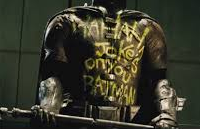
The loss of Robin has affected Bruce’s attitude, just as it did in the comics.

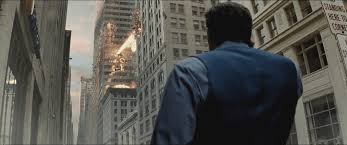
However, Affleck’s portrayal of Wayne/Batman is a true gem of a surprise; Affleck plays an older, grizzled, veteran Batman who is constantly haunted by nightmares, fatigue, and inner turmoil. In the film, Wayne has been Batman for about twenty years; Gotham has gone to hell despite his presence (Wayne Manor is dilapidated, for reasons unknown, and the Gotham Police Department is similarly run-down and seemingly abandoned) and his approach towards his vigilantism has become cruel and violent. This is not just due to his age but also to the dramatic shift in Wayne’s entire persona and attitude after the loss of his partner, Robin, at some point in the past. As a result, Batman (refreshingly commonly referred to as “The Bat” on numerous occasions) tortures and brands criminals in his night-by-night activities and, at a number of points in the film, brandishes firearms and racks up quite the body count. If people were pissed that Michael Keaton’s Batman killed people back in the day, then I wouldn’t be surprised to see Affleck’s Batman attract some debate given that he clearly guns down, blows up, and drives through quite a few goons. Personally, again, I have no problem with that because of the movie’s context. Batman is older, admittedly slower; he’s worn down by age, weariness, and his new mission in life: mainly, the destruction of Superman. It transpires that Wayne was present during the events of Man of Steel and witnessed Superman and Zod’s fight devastating Metropolis, causing the deaths of numerous Wayne employees.

2
Affected by the events of Man of Steel, Batman makes it his mission to end Superman.

As a result, despite the protestations of his ever-loyal butler Alfred (Jeremy Irons), Batman has decided to view Superman as a potential threat that doesn’t need stopping…he needs killing. It doesn’t help Wayne’s mindset that he is constantly haunted by nightmares of not only the deaths of his parents (as standard) but also visions of a dystopian future where Superman rules as a tyrant. These visions are given further credence not only by a surprise visit by Barry Allen/The Flash (Ezra Miller) in a scene straight out of Crisis on Infinite Earths (Wolfman, et al, 1986) where he warns Wayne of this apocalyptic future and urges him to “find us”, but also through the machinations of Lex Luthor (Jesse Eisenberg). Given the controversy caused by Man of Steel, the world is suitably divided by Superman’s presence. A big side plot in the film is the world’s views on Superman; while many view him as a hero, saviour, and messianic figure, others are also fearful of his presence and uncomfortable with his status as an all-powerful alien who answers to no one. While Batman comes to represent the extremes of the latter, Superman’s extended family – the ever-pretty Amy Adams and Lois Lane and his mother, Martha (Diane Lane) – represent the former, urging Clark to be a symbol of hope and/or remove himself from the equation entirely and leave the world to its own issues. Luthor capitalises on the divide that Superman causes and works it to his advantages; through his devious machinations, Luthor gains access to the remains of Zod’s Kryptonian ship, the body of Zod himself, and frames Superman as a destructive force through a series of terrorist actions. This is aided by the general consensus that, because Superman acts as an independent force, his actions have consequences for the rest of the world that led to a number of deaths, a fact that weighs heavily on Superman’s conscience and his belief in himself and what he’s doing.

4
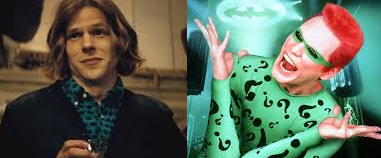
Separated at birth?

For me, the casting of Eisenberg is the exact opposite of Affleck’s: while I generally believed that he could bring something unusual to the role, he is less of a gem and more of a scenery-chewing, ham-fisted version of the character. In his defence, I was glad to see that he wasn’t the corporate, suit-wearing version; Eisenberg brings a manic, hyperactive energy to the role that masks his true, devious intentions; however, while it kind of portrays the character as a quirky, eccentric tycoon, it lends itself more to Jim Carrey’s over-the-top acting from Batman Forever (Schumacher, 1995) people continue to lament to this day. Luthor, implied to be from observing how often Superman saves Lois Lane from danger, pieces together Superman’s secret identity and kidnaps his mother and places Lois in peril in order to bend Superman to his will. He has also been fuelling Wayne’s thirst for blood by manipulating him over time, effectively setting the two against each other in order to publically discredit and shame Superman. However, Luthor’s ultimate plot involves not only the discovery of Kryptonite (which Wayne manages to intercept and use to his own advantage) but also the genetic tampering of Zod’s remains. Accessing forbidden Kryptonian technology, Luthor creates a hulking genetic monstrosity whose sole purpose is to kill Superman: he creates Doomsday.

5
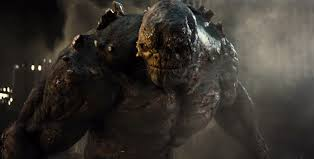
Doomsday serves as the penultimate threat of the film.

Doomsday, whom many online have criticised as being shoe-horned in to unite the central characters, also surprised me. When I first saw the footage of Doomsday from an earlier trailer, I lamenting his presence as it causes so many issues. People have been asking me over the last few years how Batman and Superman can fight and I have explained, over and over, that the two have not only fought numerous times in the comics but also that Batman has often come out on top more than once. Superman, for all his powers, is fallible and has numerous weaknesses; Doomsday, however, traditionally has no such weaknesses and, in a fight against him, the most useless ally you would want would be Batman. However, the film’s version of Doomsday is markedly different; it’s somewhat weaker, physically, and vulnerable to Kryptonite but remains as immensely powerful as ever, if not more so. Doomsday emits concussive blasts of heat energy, seems to float or straight-up fly a few times, and expels shockwaves of energy every time it evolves to repair from damage and attacks. In Superman’s favour, he learns from Man of Steel and attempts to take Doomsday into space and away from the planet; however, this plan is foiled by the governmental decision to nuke them once their out in orbit, which brings Doomsday back more powerful than ever. Joining Superman and Batman to oppose Doomsday is Diana Prince/Wonder Woman (Gal Gadot), who appears at numerous points in a sub-plot concerning her attempts to retrieve vital data of metahumans from Luthor.

6
Miller’s influence on Snyder is painfully obvious.

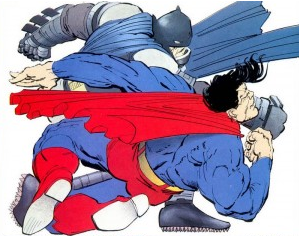
It turns out that Luthor has kept tabs on Barry Allen/the Flash, sightings of Aquaman (Jason Momoa), and the augmentation of Victor Stone into Cyborg (Ray Fisher) and is eager to keep Luthor from eliminating these metahumans. In service of this, she runs into Wayne at numerous points, who discovers that Diana has been around for about a hundred years and is more than she seems. Diana opts to interject herself into the conclusion and assist Batman and Superman, relishing the battle against Doomsday. For the first-ever live-action portrayal of Wonder Woman, Gadot bring both beauty and strength; while her casting also attracted controversy, she was actually portrayed very well and as integral to not only this film but also the formation of the upcoming Justice League. However, the primary title of this movie involves the fight between Batman and Superman. These two clash immediately due to their ideals and approaches and because of Wayne’s vendetta against Superman, but don’t actually come to blows until the third act. For this battle, Snyder draws implicitly from The Dark Knight Returns (Miller, 1986); Batman dons a cybernetic suit exactly as in the comic, blasts Superman with Kryptonite gas as in the comic, and beats him into submission just like in the comic. I guess, in execution, the fight between the two comes across as very similar to the showdown in Freddy vs. Jason (Yu, 2003) in that the entirely film builds the tension towards the confrontation, and builds it some more, and, when the tension finally snaps, it is a very satisfying event.

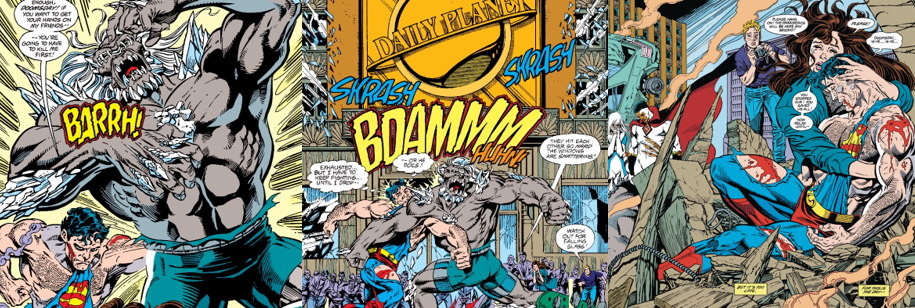
Superman famously died in battle against Doomsday in 1992.

Batman, as mentioned before, is violent and aggressive in his fighting style; his combat prowess is ripped straight from the Arkham series of videogames (Rocksteady Studios/Warner Bros. Interactive Entertainment, 2009 to 2015) and there is no question that, once Superman is suitably weakened, Batman is the superior fighter. Superman, in a change of pace, shakes off the effects of Kryptonite over time and it merely weakens him, rather than kills him. However, that’s alright because Batman is more than willing to stab a Kryptonite spear through Superman’s head! Batman bests Superman, beating him into submission, and is poised for the kill before Superman begs him to save his mother after the fact and Lois rushes in to help clear the air. It is at this moment that Batman comes to his senses and realises that Superman is a selfless man trying to do good; however, this revelation comes off quite rushed. Indeed, once the revelation that Wayne and Clark’s mothers share the same first name (a point I had never actually considered or thought of before) is brought up, Wayne does a complete turn around. Not only is he now willing to assist Superman’s causes, he also pledges to unite the other metahumans in honour of Superman’s penultimate sacrifice.

Oh, didn’t I mention that Superman dies?

Well, honestly, I was pleasantly surprised that Snyder saw this through as totally as he did. As I said on numerous occasions before the movie came out, you cannot involve Doomsday and not do The Death of Superman (Jurgens, et al, 1992) from the comics. Doomsday’s entire purpose is to kill Superman; leaving that out would be like using bane and not having him break Batman’s back. In fact, one of the major issues I had with Smallville (2001 to 2011) using a version of Doomsday was that it obviously wouldn’t be killing Clark (Tom Welling) and would be portrayed as another “villain-of-the-season”. Here, Doomsday and Superman kill each other through mutual impalement; this heroic act brings Batman entirely over to Superman’s cause. It also (through the effective use of a military/state funeral, the more emotional funeral in Smallville, and the montage of reaction shots to the news of Superman’s death) turns Superman into a matriarchal symbol of hope and heroism, effectively ending the divisive conflict he caused in life.

8
Smallville‘s Doomsday was an abomination.

Of course, a two-part Justice League movie is scheduled to begin filming soon and Superman is already confirmed as being part of the line-up. As a result, the film’s final shot is of Superman’s grave trembling slightly, signalling his inevitable return (and without the four bogus clones as in the original story, one would assume). However, the fact that Snyder actually had the balls to do The Death of Superman, in my mind, completely justifies and exonerates the inclusion of Doomsday. It wasn’t just some half-assed inclusion there to be brought down by the trinity of superheroes; it was there to unite them, the Justice League, and the world by killing Superman, so kudos for that. Visually, the film is actually quite magnificent; say what you will about Snyder as a storyteller, the man knows how to be cinematic. Batman shines the most throughout because of this, being shot in pitch black and having his action scenes be energetic and clear to see. Snyder’s visual symbolism extends to Superman as well; while the God and Christ metaphors have been done to death with Superman, here they actually have relevance in the plot so they don’t come off as cheap or superficial. The visual dichotomy of the film is wonderfully done; the contrast between Metropolis and Gotham City is apparent, the costumes all pop out and appear functional, and Batman’s weapons and gadgets are showcased to the fullest.

It really feels as though the film-makers held nothing back (except for the half-hour of cut footage rumoured to be on the home release) and that has, in the eyes of many, caused more controversy. I have heard of critics attacking the film for being “choppy” at the start, shoe-horning in the Justice League elements and Doomsday, and having nonsensical decisions woven into the dialogue, script, and plot. To them, I say, these are valid points in some cases. However, I never experienced any issues with the pacing or the editing; sure, it’s a long film, but films are these days and, when you’re enjoying a movie, that’s not a bad film. I found myself engaged with the plot; I wanted to know more about Wayne Manor, Gotham, and Batman (which is a perfect way to re-introduce this version of the character and will be expanded upon in future DC films), I followed along easily enough with Luthor’s plot and the side-plots involving the Justice League, and never felt that anything else done an injustice or there for the sake of it. The fact is that DC and Warner Bros. are very late to the shared universe party; Marvel Studios have gained the upper hand after building their individual heroes separately and now having them cross over regularly. While DC’s television efforts are popular and are beginning to cross over, their television shows will not be a part of this forthcoming DC film universe and the studio, which has largely been happy to produce mainly Batman and Superman movies after the lacklustre reception of Green Lantern (Campbell, 2011), doesn’t have the time or the release schedule to introduce the Flash, Aquaman, Wonder Woman, Cyborg or the other Justice Leaguers. Instead, what will set DC movies apart from Marvel’s from now on is their cross-connectivity and their immediate focus of having their films and character converge right off the bat, which could make for some exciting future releases.

Overall, yes, this film has some flaws but nowhere near as many as I was expecting and it certainly doesn’t deserve the critical backlash it is currently facing. It re-introduces Batman, presenting a grizzled, more violent version of the character who seems just as mental as the villains he faces, and brings more humanity and empathy to Superman. The visual presentation is top-notch, more than making up for any narrative deficiencies, and the thematic portrayal of both characters is largely in keeping with their portrayals in several prominent comic books, even the vaunted Dark Knight Returns. Snyder had the balls to do new thins with this movie: he incorporates Robin (no one knows which one but, most likely it was Jason Todd, meaning Nightwing could be active in this universe), a character no one has used in film for nearly ten years (and that’s just criminal); he utilised Doomsday to its fullest extent; he addressed and upped the scale of destruction from Man of Steel; and the apocalyptic future witnessed by Wayne, which is implied to be the result of Superman’s actions (somehow), and Luthor’s manic rant at the end (I half-expected him to announce that “a Crisis is coming”) lend credence to the rumours that the Justice League will come together to battle Darkseid. Make no mistake, the DC movies are a violent one where actions have consequences and the heroes amongst us may cause more trouble than the villains but it is one soon to be united by heroes and villains alike and, for the first true attempt and making headway towards a Justice League movie, I would say that Snyder has delivered on all fronts.

My Rating:

Rating: 3 out of 5.

Pretty Good

Recommended: Sure, why not? The film is beautifully shot, exciting, and engaging. It’s maybe not the best-paced film and has it’s issues, but it’s Batman…versus Superman!
Best moment: Easily the entire final act of the film from the titular clash between the two heroes, into Batman’s vicious rescue mission, through to the Trinity joining forces against Doomsday.
Worst moment: Jesse Eisenberg’s performance as Lex Luthor totally ruins what should have been a far more cerebral, menacing characterisation.

Movie Night: Alien: Covenant

AlienCovenant

In 2012, Ridley Scott attempted to present to audiences with a prequel to his seminal 1979 science-fiction/horror masterpiece, Alien. When I first saw Prometheus, I was actually very supportive of it; the film reeked of 1970’s science-fiction trademarks (such as a slowly building narrative, wide expansive shots, and deeper philosophical questions regarding humanity against the backdrop of science-fiction). However, upon repeated viewings, Prometheus is more of a massive missed opportunity for the larger Alien franchise. Rather than being a straight-up (perhaps predictable) prequel to Alien that explained what the Space Jockey was, how the alien spacecraft got to LV-426, and where the Xenomorphs came from, Scott appeared to have gotten too caught up and too preoccupied with establishing a disconnected film that was part of an entirely new science-fiction/horror franchise. The result was a convoluted, mixed-up film that wasn’t quite sure what it was or what it was trying to accomplish.

CovenantDavidWeyland.png
Weyland doesn’t exactly live up to David’s expectations.

Now, quite some time later, Scott presents the sequel to Prometheus and what is rumoured to be the first in three more prequel films set before Alien. Alien: Covenant opens not directly after the events of Prometheus but some time before that movie as we witness the activation of David (Michael Fassbender), the calculating android from Prometheus, and his initial conversations with his creator, Peter Weyland (Guy Pearce). This conversation establishes that David is just as inquisitive as his human creator and has little desire to live his life purely as a servant to those who believe themselves to be better than him simply because they created him. The film then jumps ahead to ten years after Prometheus. Walter (…also Fassbender, though with a pretty convincing American accent) is maintaining systems onboard the titular Covenant, which is carrying a whole bunch of colonists on a seven year journey to a new planet to colonise. A random neutrino bursts damages the ship and Walter is forced to awaken the crew, though captain Jacob Branson (James Franco) is roasted alive in his cryo-tube, leaving Christopher Oram (Billy Crudup) in charge. As a man of faith rather than science, and given the tough decisions he has to make in the wake of this tragedy, Oram struggles with his newly-appointed position and to get the ship repaired so they continue on their way. However, during the repairs, the ship picks up a recognisable melody coming from a nearby hospitable world that they somehow missed during their research. With the drew reluctant to return to cryo-sleep after the fate that befall their captain, Oram elects to pop down to this new world despite the objections of Branson’s widow, Daniels (Katherine Wilson).

CovenantNeomorph
These viscous little buggers kick the film into action.

Upon landing, they discover the world is fully vegetated but devoid of animal life. They stumble across a crashed Engineer craft and, along the way, disturbed some dark vegetation that infects two of them. The infected crew members quickly succumb to the alien parasite and, in spectacular fashion, become hosts to the Neomorphs. During the violent birthing, the crew’s craft is destroyed and many of the survivors are besieged by the Neomorphs until they are rescued by David. David takes them to a safety in a lifeless city whose grounds are littered with the twisted bodies of vaguely-humanoid creatures. While some of the crew attempt to radio the Covenant for a rescue, David relates to Walter, Orum, and Daniels the fate of Dr Elizabeth Shaw (Noomi Repace) and what happened following Prometheus: Shaw put David back together and he piloted them to the Engineer homeworld, falling in love with her along the way. Although she died during the journey, he bombarded the planet with the black alien goo from Prometheus, which destroyed the entire Engineer civilisation. Since then, David has been taking the Engineer’s technology and modifying it for his own ends.

CovenantEgg
Yeah, this doesn’t end too well…

Confronted by Orum, David reveals that he killed Shaw and that he has gestated a number of large, familiar-looking eggs. A facehugger latches onto Orum and (very soon afer), a chestburster emerges. David then protects the young Xenomorph by fighting with Walter so that his ultimate plan to obliterate the human species can be realised. With Tennesse (Danny McBride) fighting through the planet’s hostile atmosphere to rescue the survivors, Walter manages to get Daniels and Lope (Demián Bichir) onto the rescue craft, where they are attacked by a fully-matured Xenomorph. Although they kill the Xenomorph and make it back to the Covenant, another emerges from Lope and kills the rest of the crew before Tennesse, Daniels, and Walter suck it out into space. Injured but alive, Daniels returns to cryo-sleep…only to learn far too late that it was David, not Walter, who survived the earlier battle. David puts her to cryo-sleep and prepares a fresh batch of facehugger embryos with which he can infect the entirety of the Covenant’s colonists and crew to continue his experiments.

CovenantGenocide.png
So much for that plot thread…

Alien: Covenant still has its fair share of issues, mainly relating to continuity: like Prometheus, the film renders the AVP: Alien vs. Predator franchise (Various, 2004; 2007) no longer canon, but it also has some issues with the continuity it established in Prometheus. Mainly, we saw cravings and imagery of the Xenomorphs on Prometheus, suggesting that the Engineers had already created them (although it could be argued that David merely perfected the art of Xenomorph creation with his experiments). Secondly, it feels as though a big chunk of the film is missing as we only get one brief flashback to David’s annihilation of the Engineers and only get told about what happened to Shaw and between the films. Finally, the gestation period between facehugger and chestburster continues to be agonisingly fast; I understand why (to move events on and pick the pace up) but it’s still a bit jarring. However, Alien: Covenant more than makes up for the mediocrity that was Prometheus; the film looks and sounds fantastic and is much closer to the aesthetic of Alien. Much of the cluttered, convoluted plot elements from Prometheus are abandoned in favour of more recognisable elements, which may be a little disappointing as it makes the previous film feel like even more of a massive waste of time and I can’t help but think that we’ve had to endure two movies to tell a story that could’ve been accomplished in one movie.

My Rating:

Rating: 2 out of 5.

Could Be Better

I’ve heard a lot of mixed reviews and some harsh negative comments about this film, but I have to disagree. If this is to be the beginning of a new series of films set before Alien, I’d say that we’re in for something much more entertaining and enjoyable than more films that emulate the style of Prometheus. If Scott can continue to address and make up for the flaws of the film and extenuate the strengths of his world and the creatures that inhabit it, we could be one step closer to getting a film just as flawless as Alien before long.

Recommended: Absolutely, if only to wash the taste of Prometheus out of your mouth.
Best moment: The vicious birth of the first Neomorph; the little bastard spews out of the back of its host in fantastically gory fashion.
Worst moment: The sudden decimation of the Engineers and the abandonment of what was once the most intriguing, unanswered question of Alien.

Screen Time: Superheroes on Television

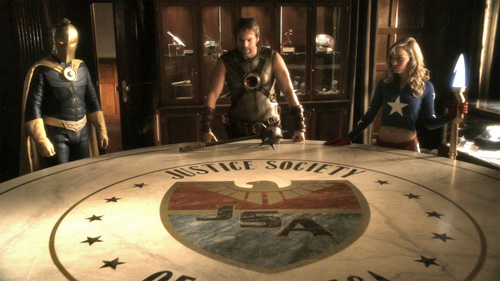
Okay, I’ll admit: I’ve never been a big fan of superhero properties on television. Growing up, I never watched The Incredible Hulk (1977 to 1982) as it was never on television when I was a kid – the closest I got were the three made-for-television movies that came out of it (which, incidentally, I liked as a kid). Similarly, the only exposure I had to the old Amazing Spider-Man television show (1977 to 1979) was from the three “movies” that came out of it. In fact, probably the only superhero television show I was regularly exposed to as a kid was, of course, the 1960’s Batman show and even that was primarily through the movie. No, as a kid, I grew up watching superheroes in animation: Batman: The Animated Series (1992 to 1995), the ‘90’s Spider-Man cartoon, ad basically all of the Marvel properties at the time. That was where it was at; animation was much, much closer to the comic books than anything in live action at the time, even compared to the live action movies that were coming out as I grew up. When Smallville (2001 to 2011) first started airing, I pretty much gave it the pass by. I watched a few of the early episodes, but not much more. This really came out at a time when I was in my mid-teens, I believe, when loads of teen-centric shows were on E4 and the like (One Tree Hill (2003 to 2012), Dawson’s Creek (1998 to 2003), all that stuff) and I didn’t have time for any of it. Smallville easily fit into those categories, which was enough for me to ignore it, but when I did flick on to it over the years I became increasingly turned off by the deviations from the source material and the creative licensing taking place on the show.

SuperTVJSA.png
Smallville got way more interesting once it included more comic book elements.

Ironically, I believe that Smallville actually did improve over time, especially by referencing and including more comic book-related stuff, but when I realised it had hit the ninth series and Clark Kent (Tom Welling) was no longer living in Smallville, was working at the Daily Planet, basically married to Lois Lane (Erica Durance), and saving lives daily in multiple variations of his eventual Superman costume, and yet despite all this he was not Superman, I was irked, to be frank. I never quite understood the logic of making a show that is about a young Clark Kent, that charts his journey from an unsure teen to the eventual saviour of humanity, and yet never actually evolved into a Superman show for the last season even though it practically was given that Clark was battling Davis Bloome/Doomsday (Samuel Witwer), of all people, and chumming around with Oliver Queen/Green Arrow (Justin Hartley). The final episode finally capitalised on this and had Clark assume his birthright to defeat Darkseid, but many were disappointed that we never got a decent shot of him as Superman. I guess they were trying to avoid degenerating into Lois & Clark: The New Adventures of Superman (1993 to 1997) but, surprisingly, I enjoyed that show as a kid – it struck a very similar balance between drama and superheroics and didn’t have half of the comic book inclusions as Smallville and, if I’m not mistaken, was pretty popular and successful at the time.

SuperTVArrow
I didn’t start watching Arrow right away.

Anyway, after Smallville ended, I watched a few re-runs and my 50/50 split of the show only increased. Simultaneously, there were persistent rumours that Warner Bros. were trying to fill the gap with a potential Batman prequel show, following a young Bruce Wayne (apparently this was even the initial pitch for Smallville but Batman was toxic at the time due to Joel Schumacher), one that charted a pre-Robin Dick Grayson, an attempt at an Arthur Curry/Aquaman and Bart Allen/The Flash spin-off, and even a Green Arrow series! Ultimately, only one came to fruition but, rather than a spin-off featuring Hartley’s Green Arrow, we got an entirely new, unconnected series depicting the origin and evolution of the Emerald Archer. Again, I don’t recall actually watching much of Arrow when it first aired as it conflicted with work and my life and such, but I did watch the first episode at least, an a few episodes here and there. My resistance to Arrow stems from the fact that Warner Bros. seem to desperately want to make a Batman television show but were unable to due to Christopher Nolan’s Dark Knight films (2005 to 2012), so they used Green Arrow as a substitute. This rubbed me the wrong way, as Green Arrow – or “The Hood”, or “The Arrow”, or “The Archer”, or “Steve” – (Stephen Amell) would frequently clash not with classic Green Arrow villains but with Batman villains – Deathstroke (Manu Bennett) was a prominent villain in the fist season, just as he had been in Smallville and Teen Titans. Now, in the comics, Green Arrow initially did start out as a rip off of Batman – he had an Arrow-Cave, an Arrow-Mobile, a kid sidekick, and even an Arrow-Signal. However, for far longer, Green Arrow has been portrayed as a street-level vigilante who targets the corrupt and those untouchable by law, frequently killing them, and protecting the “little people”. This has existed alongside the more adventurous version that was a member of the Justice League; Green Arrow’s right-wing sensibilities and strong moral beliefs often clashed with other, more conservative superheroes, and his everyday life as Oliver Queen, multi-millionaire, often facilitated his vigilante actions through urban renewals and the like. Arrow follows some of this tangent, with Queen returning to “Starling City” after being marooned on an island (and, later, in Hong Kong) and surviving against nature and a clandestine organisation using the impractical weaponry of a simple bow and arrow. Queen’s mission is to take down the corrupt of the city and avenge his father’s death, which means he kills a great deal of people in the name of the greater good, which I agree with and like – Green Arrow has often been portrayed as a slightly more morally-unhinged version of Batman and, for all their similarities, they have often clashed because of this.

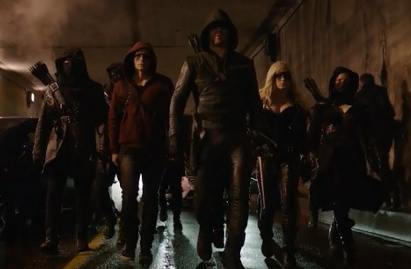
SuperTVTeamArrow.png
Arrow became much more of a team-based affair.

As Arrow went on, I largely ignored it because I didn’t agree with the seeming lack of faith Warner Bros. had in the character or the series. Like Smallville before it, the show avoids naming its titular hero even though he was popularly known as Green Arrow in Smallville. I’m sure there’s the case for this, that the show is meant to show Queen’s progression from a simple vigilante to the city’s hero (things like him upgrading his tech, adopting an actual mask, and renouncing killing support this) but why not just call him Green Arrow?  Ironically, I actually dislike the Green Arrow moniker as it’s kind of redundant – he wears green and shoots arrows, no shit!  Much like Green Lantern, I have an aversion to superheroes who preface their name with a colour and much prefer the show’s moniker of “The Hood” as it’s far more fitting. I got more into Arrow as the second season drew to a close due to the inclusion of Roy Harper/Arsenal (Colton Haynes) and the series-changing events initiated by Slade Wilson/Deathstroke (Manu Bennett). With Deathstroke having practically levelled the city and Queen basically poor, the show had raised its stakes for season three. Additionally, Queen had built a tight-knit group of allies, with Roy actually adopting the suit and outfit of Arsenal to become his sidekick! After years of Batman movies dodging, avoiding, criticising, and suppressing Robin, we finally had a depiction of a young teen sidekick that fit and actually made sense. My hope is that Arsenal’s inclusion and increased exposure will relax the embargo surrounding Robin and Nightwing at Warner Bros. and allow for their inclusion in their stupidly-unconnected series of DC films.

SuperTVSHIELD
Agents of S.H.I.E.L.D. is still tenuously related to the larger MCU.

Now, a big part of the reason I avoided Arrow was also because of the growing Marvel Cinematic Universe, which eventually spread into television with Agents of S.H.I.E.L.D. (2013 to 2020). After the events of The Avengers/Avengers Assemble (Whedon, 2012) Agent Phil Coulson (Clark Gregg) is revealed to be alive and builds a team of agents to investigate supernatural, paranormal, extraterrestrial, and superhuman incidents across the globe. The main thrust of the first series was the team coming together, leaning to trust each other, and the quest for answers regarding Coulson’s resurrection. However, this soon overlapped with the emergence of Hydra agents within the Strategic Homeland Intervention, Enforcement, and Logistics Division (S.H.I.E.LD.), which crossed over with the events of Captain America: The Winter Soldier (Russo and Russo, 2014), which saw the destruction of S.H.I.E.LD. Many supporting characters, and main character Grant Ward (Brett Dalton), were revealed to have been Hydra agents, and the unlimited resources available to Coulson were stripped away by the end of season one. Simultaneously, it is revealed that Director Nick Fury (Samuel L. Jackson) used an experimental serum and procedure, derived from an as-yet-unnamed alien source (it was recently revealed to be of Kree origin), to facilitate Coulson’s resurrection – this same serum drove HYDRA double agent Dan Garrett (Bill Paxton) mad and gave him superhuman abilities. Season one also included a side plot detailing the origin of a version of Mike Peterson/Deathlok (J. August Richards), a cyborg created to assist Garrett who eventually overcame his programming. Season two features a smaller team, with new characters, who are attempting to rebuild S.H.I.E.L.D. and uncover further truths behind their pasts, and future, as Coulson continually suffers from episodes induced by the alien serum that lead him, like Garrett, to scrawl strange alien symbols.

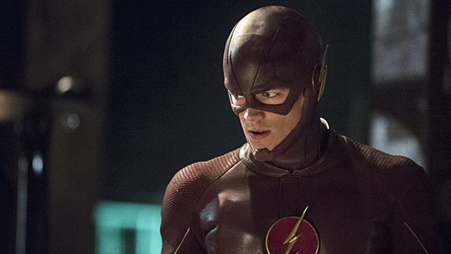
SuperTVFlash.png
The Flash became my favourite of the DC TV projects.

Truthfully, Marvel’s Agents of S.H.I.E.L.D. is far from perfect, or great. The best things about the show are the dialogue, which is witty and clever and full of Whedon-isms, the references and inclusion of lesser-known comic books characters (again, Deathlok…Deathlok, of all people!), and the fact that it ties directly in to the largely Marvel Cinematic Universe. Events from the films are often referenced directly in the show, supporting characters often appear, and it really feels as though the show is helping to build and expand upon the Marvel Cinematic Universe even though it is highly unlikely that any of the characters featured on the show will appear in the films. As a result, the show doesn’t feel “pointless”, unlike Warner Bros.’ efforts. After guest starring in Arrow, Grant Gustin returned as Barry Allen in his own spin-off, The Flash, which I initially decided to watch over Arrow as I was pretty sure there was no way they could shoe-horn in unfitting Batman elements into the show. The Flash is, in many ways, a carbon copy of Arrow; very quickly (hah!), like Queen’s base at Verdant, Barry based his team in Scientific and Technological Advanced Research Laboratories (S.T.A.R. Labs) nd has a team of specialists and supporting characters helping him that are analogous to Team Arrow and Oliver’s associates. The principal difference is The Flash’s inclusion and portrayal of metahumans. Barry gained superhuman speed after being struck by lightning during an explosion at S.T.A.R. Labs, which resulted in a wave of radiation emanating out from Dr. Harrison Wells’ (Tom Cavanagh) particle accelerator. The wave affected many members of Central City, bestowing them with superhuman abilities, and it is up to Barry and his team to subdue or assist all of them. This is in contrast to Arrow, which largely avoids metahumans for corrupt officials, ninjas, and grounded, street-level threats. Exceptions are usually the case of serums and scientific experiments, or clandestine organisations like the League of Assassins (another Batman-orientated organisation!). The Flash aired alongside Arrow’s third season, and the two frequently overlap and interact – characters often appear on both shows, which has increased my stake in both and, alongside the fact that they both air on days I can watch them, means I can now follow both.

SuperTVGotham
I wasn’t a fan of Gotham

Alongside The Flash, Warner Bros. finally got their Batman-prequel series underway with Gotham, which follows a young James Gordon (Ben McKenzie) in a pre-Batman Gotham City. This series is completely unrelated to The Flash and Arrow, however, and the three do not occupy the same continuity. Like The Flash, however, Gotham (2014 to 2019) had numerous problems with pace, particularly in the first episode. Both debut episodes threw so much at the viewer, introduced so many characters, plot lines, and comic book references that even I, an avid comic book fan, felt overwhelmed and actually a little insulted. Arrow took its time establishing Queen, his city, and his crusade – despite how much it annoys me that he isn’t known by the right name and constantly feels like a Batman substitute, I can’t fault Arrow for pace. Like Smallville before it, the show has been around a while now and has established a tone, pace, and atmosphere and can now afford to become more “comic book” and introduce more comic book elements – Ray Palmer (Brandon Routh) debuted in season three, hinting at the possibility of The Atom appearing at some point. The Flash, however, opened by throwing everything at us all at once: Barry’s mother was killed by a mysterious man-in-lightning when he was a boy, his father (John Wesley Shipp, from the old Flash TV series!) was arrested for it, Barry was raised by Detective Joe West (Jesse L. Martin) alongside his daughter, Iris (Candice Patton), whom Barry has been in love with for years. Barry grew up to become a forensic scientist, he was struck by the lightning, went into a coma, and when he woke up, Iris was dating Joe’s partner, Eddie Thawne (Rick Cosnett), and Barry secretly began working with Dr. Wells and his team to subdue metahumans…oh and, also, there’s all the mystery surrounding Wells’ true motivations.
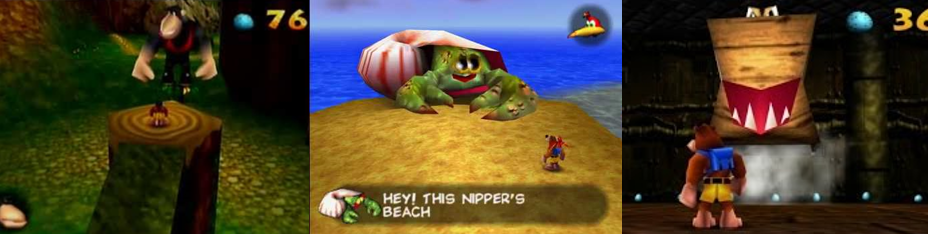
SuperTVPenguin.png
Gotham‘s Penguin doesn’t really do it for me.

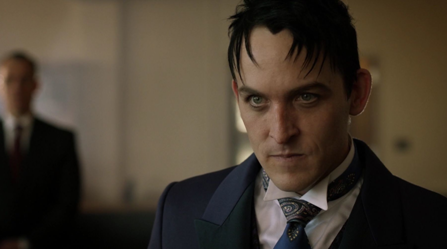
Think that’s a lot to take in in one episode? Try Gotham, which debuted with the murder of Bruce Wayne’s (David Mazouz) parents, Gordon’s initial partnership with the corrupt detective Harvey Bullock (Donal Logue), the tension between Gordon and his girlfriend regarding both his police work and her past as a lesbian, the suspicious of the Major Crimes Unit about Gordon, the length and breadth of Gotham’s corruption, the introduction of Selina Kyle (Camren Bicondova) as a cat-like street urchin, Edward Nygma (Cory Michael Smith) as a riddle-spouting forensic scientist, Oswald Cobblepott (Robin Lord Taylor) as a limping “Penguin” who angers his mob bosses, and Wayne’s stern-yet-protective butler Alfred Pennyworth (Sean Pertwee). Gordon, moved by Bruce’s plight, pledges to find his killer and is set up to kill a patsy, the father of a girl who greatly resembles Pamela Isley/Poison Ivy, by the mob. The mob consists of Carmine Falcone (John Doman) and Salvatore Maroni (David Zayas), who have both the police department and the mayor on the payroll, but is principally represented by “Penguin’s” boss, Fish Mooney (Jada Pinkett Smith), who is scheming to usurp Falcone’s power. “Penguin” learns of this and Gordon is forced to kill him to prove his loyalty. Gordon fakes the act, leaving “Penguin” to embark on a revenge plot and casting doubt on Gordon’s stature as a police officer. Meanwhile, young Bruce has decided to turn detective and investigate his parent’s killing, believing it to be a conspiracy, and also begin to train himself not to feel fear.
Damn, that is a lot to take in in one episode!

Thankfully, The Flash calmed it down after an episode or two and established a comfortable routine: Barry acts awkward with Iris and has come kind of self-doubt, a metahuman emerges, fight, Wells acts suspicious, the end. This “monster-of-the-week” formula dominates the show even to this day, but the show mixes it up with side-plots concerning the mysterious death of Barry’s mother, Iris’s obsession with “The Streak” (the show took quite a while to brand Barry as the Flash yet…despite all of his metahuman villains have carried their names) and their later romance, Wells’ suspicious nature, the presence of mysterious evil speedsters, exploring the multiverse, etc. Gotham, on the other hand, was far more violent and apparently attempting to channel police-procedural shows like CSI: Crime Scene Investigation (2000 to 2015), only with multiple references to Batman and Batman villains thrown at us in the most unsubtle way possible every episode. My continuation with the show was based on Sean Pertwee, whose presence as Alfred made the show somewhat bearable but I can’t say that I was too upset when it was finally concluded.

SuperTVLegends
Man, screw this show!

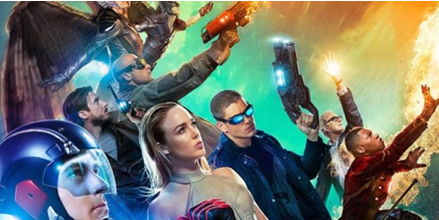
Warner Bros. also produced Supergirl (2015 to 2021) and DC’s Legends of Tomorrow (2016 to present). Easily the weakest offerings of their television line-up, DC’s Legends of Tomorrow is a direct spin-off of Arrow and The Flash, featuring characters introduced shows. However, the show is largely loud, overly complex, and suffers from even more pacing issues. Not only was the first episode a convoluted mess that rushed through its character introductions to set up the on-going narrative, every episode is a rush of plot conveniences, hammy dialogue, and poor scripting. In the first season, for instance, the team travel through various points of time and space in an effort to save the future from Vandal Savage (Casper Crump) but…if they have a time machine, why bother wasting time going back to various points to prevent him accumulating his power when they could travel back to just before his takeover and kill him then? Indeed, in the case of DC’s Legends of Tomorrow, the only stand-out characters for me were Leonard Snart/Captain Cold (Wentworth Miller) and Mick Rory/Heat Wave (Dominic Purcell), whose gruff, anti-hero ways and pre-existing partnership set them apart from the rest of the stilted, awkward group. Both actors chewed the scenery and stole the show at every opportunity, and Mick gained a decent character arc where the heroic sacrifice of his partner made him more accepting of his otherwise more naturally heroic partners.

SuperTVSupergirl.png
Supergirl was fun but a little too annoying for me.

Supergirl, however, is a horrific mess. I have times where I can be pretty pro-feminist but this show really grinds my gears. It seems as though Supergirl is incapable of conveying strong, independent female characters without making them soft, overly effeminate, or lesbians. Seriously, this show is rife with explicit lesbianism; even heterosexual female characters carry a lesbian vibe from them. This boggles my mind; Arrow, a show largely aimed more at the male demographic, doesn’t feature a load of gay males or in-your-face sexual tension between the males so why does a female-driven show feel the need to do so? Also, throughout the first season, Kara Zor-El (the titular Supergirl, portrayed by the sweet, cute, and incredibly likeable Melissa Benoist) is constantly playing second fiddle to her more famous cousin (later portrayed by Tyler Hoechlin); Supergirl is constantly having to prove herself and to live up to Superman’s legacy and constantly compared to him, and judged by how much more impressive he is. I find this quite disturbing, to be honest. Today’s society is much more female-dominated and driven than ever before; woman are in positions of power and have far more equality than ever before, yet Supergirl prefers to send the message to young girls that they will constantly be held down by those around them until they prove that they are just as good, if not better, than males. Plus…she constantly keeps fiddling with her glasses! Even when she is around people who are aware of her duel identity!

SuperTVArrowverse
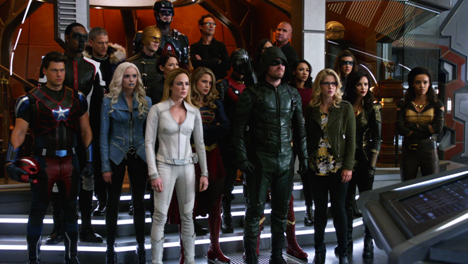
One big happy family.

Additionally, although set on an alternative Earth, Supergirl has crossed over with The Flash (and, by extension, its other shows) by utilising the multiverse aspects introduced in season two of The Flash , unlike Marvel, whose shows all take place within the larger cinematic universe, none of Warner’s DC properties tie in, or relate in any way, to their own cinematic universe that tentatively began with Man of Steel (Snyder, 2013) and continued with Batman v. Superman: Dawn of Justice (ibid, 2016). In fact, Warner Bros. included the Flash in their upcoming cinematic line-up and, as they often have concerning Green Arrow’s inclusion, have consistently gone on record as stating that the character’s will be entirely separate from those on television. Similarly, Gotham does not serve as a prequel to Ben Affleck’s Batman; as a result, we have a situation similar to when Superman Returns (Singer, 2006) came out whilst Smallville was still on the air in that conflicting versions of the same character will co-exist at the same time onscreen. For us comic book fans, this is not a problem: comic book aficionados are well versed in handling multiple, conflicting portrayals of the same characters, but the general audience…not so much. Indeed, Warner Bros. often reference the DC multiverse when justifying this decision, which is crazy beyond belief as the DC multiverse is a concept so confusing that they’ve had to destroy and rebuild it about three times in the last five years! Surely Arrow’s popularity alone, which arguably has helped to facilitate a DC Cinematic Universe, justifies its place in the oncoming cinematic canon?

SuperTVSHIELD2.png
A bit more continuity between TV and film would be nice.

This ties back in to my early remark about Marvel’s Agents of S.H.I.E.L.D. not feeling “pointless”. Sure, the show has flaws. Sure, the characters may not reintegrate with the Marvel Cinematic Universe for some time, if at all. But events matter. What happens in a Marvel Studios movie will impact another character, and those events may often be referenced in Marvel’s Agents of S.H.I.E.L.D. When the Arrowverse collides in their crossovers, it has little impact on the big-screen offerings, which also never really factor into their television counterparts in a meaningful way. This is what separates my enjoyment of current superhero television shows: continuity. It’s important for consistency, it’s important to maintain audience (especially the generally, non-comic book audience), and it’s important for integrity. It’s why I can forgive Marvel’s Agents of S.H.I.E.L.D.’s flaws, because the show is expanding upon and a direct part of Marvel’s larger cinematic universe, and it’s why I can forgive Arrow constantly portraying “The Arrow” as a bastardised version of Batman, because it’s integrating with The Flash is the closest thing we have to continuity between DC properties at the moment. Whether or not the films will offer an equal alternative remains to be seen.

Game Corner: Banjo-Tooie (Xbox One)

GameCorner
BanjoTooie

To reach Gruntilda, Banjo and Kazooie had to traverse a variety of worlds and collect a multitude of items, the most important of which were Jiggies – which were required to access new worlds and climb higher up Gruntilda’s castle. The game was a huge success for Rare, heralding a number of successes for the company on the Nintendo 64, and has been a personal favourite of mine for nearly a decade now for its charming aesthetics, catching music, amusing characters, and vibrant worlds.

One of gaming’s most unique duos.

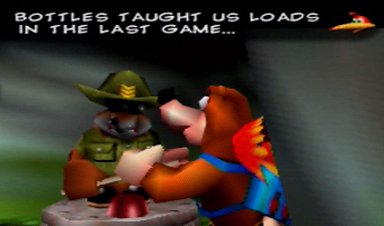
Back in 1998, Rare developed an incredibly intricate and amusing platform videogame called Banjo-Kazooie. The game starred a slightly slow, but very helpful, honey bear named Banjo, who first featured in Diddy Kong Racing in 1997. Banjo, humorously garbed in bright yellow short-shorts, carried around his friend and counterpart – a Breegull named Kazooie – in a blue back-pack. Together, the two were tasked with rescuing Banjo’s kid sister, Tooty, from the evil witch Gruntilda, aided along the way by Bottles, a short-sighted mole who teaches the two their attacks and abilities, and Mumbo-Jumbo, a shaman who transforms the duo into other forms to aid their quest. In 2000, Rare finally produced a sequel, Banjo-Tooie, which was released near the end of the Nintendo 64’s lifespan and has consequently become one of the rarest and most expensive videogames around, even when bought unboxed. As a result, obtaining a copy has been a goal of mine for years, ever since I briefly played it in 2001, and in 2013 I was finally able to procure a copy and play the game through to completion. Of course, since then, the title (alongside the original and many of Rare’s top titles from the area, before, and beyond) was given a high-definition remaster that I later picked up as part of Rare Replay for Xbox One.

BanjoTooieGrunty
Grunty is back and out for revenge!

Banjo-Tooie picks up two years after Gruntilda’s defeat. Trapped underneath a giant boulder, she summons her sisters, Mingella and Blobbbelda, to free her so she can avenge her defeat. Now little more than a skeleton, she destroys Banjo’s house, killing Bottles, and prepares a special ray gun that will suck the life out of the planet and restore her physical form. Eager for another adventure and desiring revenge for he death of Bottles, Banjo and Kazooie head out to travel new worlds and put the witch to rest once and more all. The first thing to note about Banjo-Tooie is how much bigger it is than its predecessor. Not only can players run around Spiral Mountain (the tutorial area from the first game) and re-enter the mouth of Gruntilda’s Castle, the player can explore and travel through an all-new overworld that is intricately connected to the playable levels in the game. For instance, rather than opening up worlds to enter in a central hub as in the previous game, the players go from one hub to the next following the path of Gruntilda’s digging machine through a huge overworld. Whilst exploring each level, the player can open up shortcuts to other levels, the most obvious being Chuffy the Train, but other sluiceways, tunnels, and paths also exist which connect one world to the next and allow players to traverse what now feels like an entire world rather than an enclosed space.

BanjoTooieJamjars.png
Jamjars has some new moves to teach Banjo and Kazooie.

The main aim of the game is still to collect loads of items, but the actual task is much less tedious. Previously, the player was awarded for collecting each world’s 100 musical notes, but the number you collected reset every time you left a world and re-entered it. Now, the number carries over, and they are a lot easier to find and collect. Jiggies, however, are found in a multitude of ways, as before, with each world now being home to a formidable boss battle which will test Banjo and Kazooie’s new skills. Speaking of which, Bottles’ brother, Jamjars, is on hand to teach the duo additional moves. While Banjo and Kazooie are capable of every move from the last game bar one (Banjo’s bear swipes are absent), Jamjars loads the player up with a variety of new eggs to shoot at enemies (which becomes a focal point in the game during its many first-person-shooter sequences), the ever-handy Grip Grab that allows Banjo to hang on to ledges, and the ability to have Banjo and Kazooie separate from each other to tackle switch-based puzzles. Mumbo now becomes a secondary character, as players use his magic to access unreachable areas and acquire Jiggies, while Humba Wumba’s spells are used to turn the duo into new forms, which are new required for a multitude of Jiggy-based tasks and even to conquer certain bosses.

BanjoTooieStopNSwop
Banjo-Tooie has many secrets and collectables.

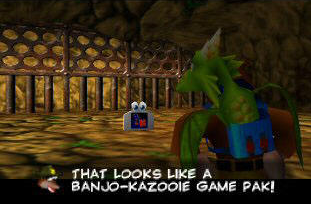
One of the greatest things about Banjo-Kazooie was its many secrets, most of which were meant to be accessed in Banjo-Tooie through a unique “Stop and Swap” feature that, theoretically, would have seen players swap one cart for another to unlock new content. Though this feature was eventually dropped, the ever-mysterious Ice Key and Secret Eggs return in this game, now used to unlock new moves and the awesome Dragon Kazooie, though the full extent of this feature would not be made accessible until the Xbox 360 HD remixes. Banjo-Tooie also features a multiplayer mode, allowing for up to four players to take part in Goldeneye 007-like deathmatches and other modes that, honestly, I haven’t played but I imagine are similar to the same multiplayer modes seen in Conker’s Bad Fur Day. Like The Legend of Zelda: Majora’s Mask, Banjo-Tooie features many recycled characters and character models, as characters encountered in the previous game return to aid or hinder the duo at various points.

BanjoTooieCutscenes
It’s all about the story…except when it’s not…

In the end, playing Banjo-Tooie was an awesome experience, but a couple of things let it down for me. Firstly, why remove Banjo’s bear swipes? This seems like a nit-pick, but I expected Banjo to have the attack when he goes solo and he never acquires it, meaning that he is limited to his Pack Whack move. Second, when you acquire a Jiggy, Banjo and Kazooie no longer go into a cute little celebration animation. The Jiggy is simply collected and you move on. While I don’t necessarily mind this, as the lack of the celebration means you don’t get any wasted momentum, it kind of makes acquiring Jiggies mean a lot less as the characters no longer seem to care. Next, the game takes a long time to get started – the opening cutscene is quite long and, at various points at the game’s beginning, the action cuts to a cutscene that shows Gruntilda’s plan in motion. Then you never hear anything of her plot until the final boss, which is pretty jarring – Gruntilda uses her restoration ray once and you never hear anything of it again, so the threat seems diminished and an afterthought by the conclusion. You also never confront her two sisters, which seemed a given, though the addition of a boss for each level kind of made up for that.

BanjoTooieTRex.png
There’s a bunch of new transformations to play around with.

Certain other aspects are a bit tedious as well; before, when you tried to exit a level as a transformed Banjo and Kazooie, Mumbo’s magic would automatically wear off. Here though, you must return to Wumba to transform back into the duo to exit – similarly, Mumbo and either character alone cannot exit levels and must switch back to do so, which can get a bit tedious. There’s a ton of backtracking in this game, which can be frustrating but it’s great to see how characters and events in one level can affect and influence the other, so I didn’t mind this too much and it didn’t really feel like it was padding the game out, more that the world was big and interconnected, so backtracking is more like a given. Also, in comparison to the first game, the ending felt a little limp and the overall game time seemed less – I finished the entire game in just under 25 hours, whereas I remember working on Banjo-Kazooie for a long time, but that may have just been rooting around for more secrets and such.

My Rating:

Rating: 4 out of 5.

Great Stuff

In the end, the game is a masterful example of how to make a great action/platform title – colourful worlds, great music, amusing characters, loads (and loads) to do, see, and collect, great controls (flying and swimming can be a bit testy, as before, however), and a pretty simple premise. Games like this aren’t really made much anymore – once you beat videogames these days, there’s not much incentive to pick up and play again, but in the Banjo titles there’s always more to do. As the Nintendo 64 copy is quite expensive, I recommended Xbox owners download both titles (or purchase Rare Replay) and play them to death and think themselves lucky to be able to experience the full games.