Back Issues [Venom Day]: Ultimate Venom


To celebrate the release of Venom: Let There Be Carnage (Serkis, 2021), Sony Pictures declared September 27 “Venom Day”, a fitting date to shine the spotlight on one of my favourite anti-heroes, who made their first full debut in May 1998 and have gone on to become one of Marvel’s most iconic characters.


Writer: Brian Michael Bendis – Artist: Mark Bagley

Story Title: “Origins”
Published: February 2003

Story Title: “Today”
Published: April 2003

Story Title: “Inheritance”
Published: March 2003

Story Title: “Still”
Published: May 2003

Story Title: “Legacy”
Published: March 2003

Story Title: “Father’s Pride”
Published: May 2003

The Background:
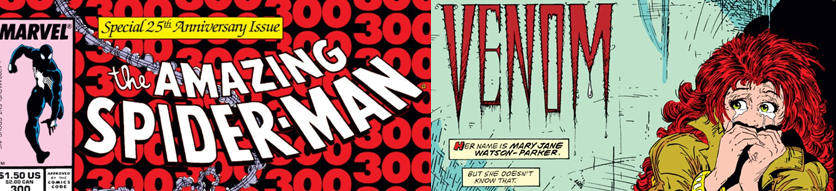
In 1982, Marvel Comics’ editor-in-chief Jim Shooter purchased Randy Schueller’s illustration of a black-suited Spider-Man for a mere $200; writer Tom DeFalco and artist Ron Frenz then conceived of the costume being a living organism Spidey would acquire in the “Secret Wars” event. After he shed the parasitic symbiote, it bonded with disgraced reporter Eddie Brock and Spidey was tormented by Venom, a twisted double who proved so popular that additional symbiotes and storylines spun out of the character’s lore. First proposed by lawyer Bill Jemas, Ultimate Marvel was a secondary imprint of Marvel Comics that ran alongside the main comic line (known as “Marvel-616”) but told their most popular characters’ stories from a fresh, modern perspective to entice new readers and fans of the live-action adaptations of the time. The imprint was spearheaded by Brian Michael Bendis and Mark Bagley’s Ultimate Spider-Man series, which featured a far younger Peter Parker who encountered many of his most notorious villains while still in high school. The series proved incredibly popular, and even survived the eventual destruction of its universe in the form of Miles Morales, and offered a far different, more scientific incarnation of Venom to its universe. The six-issue “Venom” story arc proved so successful that developers Treyarch revisited and expanded upon it for their moderately successful Ultimate Spider-Man videogame (ibid, 2005), which included this version of Venom as a playable character!

The Review:
I think it’s only fair to start by saying that I was never really a big fan of Ultimate Spider-Man, or the other Ultimate comics; the art work was amazing, and I admired how writers like Bendis were able to capture natural, relatable dialogue and how the comics adopted a dynamic, real-world aesthetic. But, for me, the comics were a little too dark, a little bit extreme at times, and rushed through some of Marvel’s biggest storylines and burned themselves out too quickly as a result. The Ultimate Spider-Man comics were especially difficult for me to get into since Bendis packs so much dialogue onto the page, sometimes having a single splash page of a character talking and a good 80% of the background being dominated by a huge speech bubble. Either that or he’d have characters barely able to string sentences together, which, again, is very realistic and indicative of real-life conversations but can make reading the comics a bit of a chore as relatively simple storylines are dragged out across multiple issues simply for the sake of drama. However, having said all that, Mark Bagley is one of my favourite Spider-Man artists, so I absolutely had to seek out the “Venom” story arc to see him working on the character again and he definitely made this younger, far more flawed Spider-Man all the more impressive and dynamic with his explosive and visually engaging art.
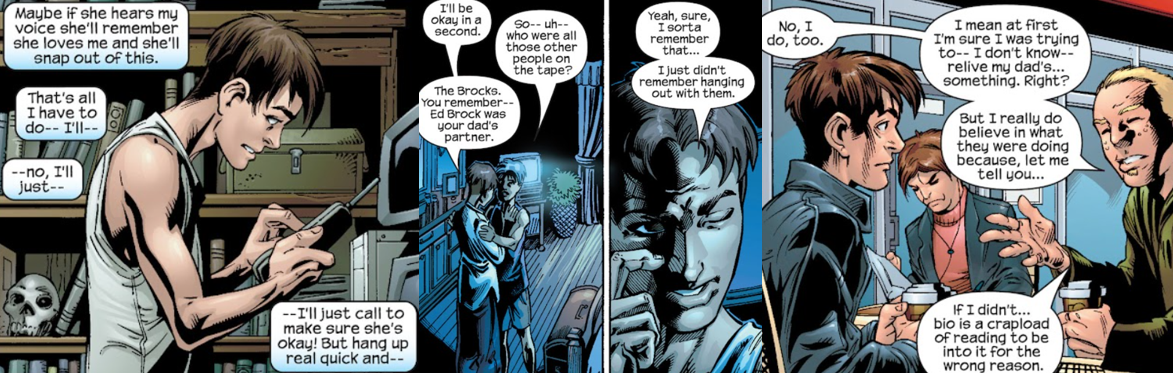
Following a painful break up, Peter reconnects with a childhood friend.

Anyway, the “Venom” arc comes at a time of great upheaval in Peter Parker’s life; already struggling with high school and the guilt of indirectly causing his beloved Uncle Ben’s death, Peter is burdened by his part in the death of heroic police captain George Stacy and has recently been dumped by his long-term friend and on-and-off girlfriend, Mary Jane Watson, since she can’t handle the pressure of worrying about his web-slinging activities (Peter’s duel identity wasn’t the best kept secret in the Ultimate comics). Peter is left devastated and wallowing in self-pity, doubt, and anger at having screwed up with M. J. While struggling with his tumultuous and self-deprecating emotions in his Aunt May’s attic, he stumbles across a box of photographs of his long-dead father, scientist Richard Parker, and a VHS tape depicting him as a small boy with his parents, his Aunt May and Uncle Ben (depicted as more of a free-spirited hippy in Ultimate Spider-Man), and the Brocks, family friends of the Parkers. Eddie Brock Snr was Richard’s partner on the “Venom Project”, while Eddie Brock Jnr was Peter’s best friend as a child; his memory jogged of his long-lost friend, Peter decides to reconnect with Eddie, who also lost his parents in the same plane crash that killed Richard and Mary Parker, and easily tracks him down thanks to the internet. Awestruck by the bustling Empire City University, Peter meets with Eddie, who’s in a bioengineering program at the university but struggling to live up to his father’s legacy thanks to the workload and the expense of university life.

In a bid to complete his father’s work, Peter finds himself garbed in a protoplasmic suit.

When Peter shares the news of his recent break up, Eddie is a little dismissive, but he’s absolutely right when he says that high school drama is nothing compared to the struggles of the bigger, wider world and he encourages Peter to not let it ruin the best years of his life. Touched by Peter sharing a copy of the video tape, Eddie takes him to a high-tech lab where he’s been working on their “inheritance”, a beaker full of black goo that represents their fathers’ life’s work. Thanks to help from Doctor Curtis Conners, Eddie has pieced together that Richard and Eddie Snr were working on a protoplasmic suit that could (theoretically) cure any disease while simultaneously enhancing the wearer’s natural physical strengths. To fund their research, Richard and Eddie Snr turned to Trask Industries, though this meant that anything they discovered or created would no longer be theirs, and Eddie theorises that they were killed when they tried to keep their project from being perverted into a weapon of war. Eddie’s sample is all that’s left, a small quantity that their fathers worked on in secret, one that was created using Richard’s own DNA and which Eddie fully believes could change the world for the better. Stunned by these revelations, Peter rekindles his friendship with Eddie, who picks him and his house mate and friend, Gwen Stacy, up after school, much to the chagrin of the conflicted M. J., who clearly still has feelings for and cares about Peter. Reviewing his father’s notes and video diaries, Peter snaps when he sees just how distraught his father was at having his research stolen or perverted and resolves to finish his father’s work by breaking into the lab as Spider-Man and taking a sample of the goo to run his own tests. However, a small drop of the liquid splatters onto his hand and a startling, agonising transformation occurs that sees Spidey engulfed by the writhing goo, encased in a monstrous cocoon of sorts, and finally emerging in a sleek, form-fitting black costume.

Peter’s elation soon turns to horror when the suit transforms into a hulking monster!

Spider-Man tests out his new duds by first rescuing a shallow, self-obsessed pop star after she’s held hostage by armed forces in her own limo and then making short work of Herman Schultz/The Shocker. The suit not only greatly amplifies Spidey’s already superhuman strength and speed but allows him to instantly heal from point-blank gun shots and fire black webbing from his fingertips and Peter revels in the power and euphoria offered by his father’s incredible invention. However, things quickly take a turn for the worst when he confronts an armed robber who shoots and kills an innocent man in front of his wife and child; overwhelmed by memories of Uncle Ben’s death, Spidey transforms into a hulking, salivating, monster that hungers for blood and drives him into a mindless rage! Peter’s sense returns in time to spare the man’s life and, horrified by the suit’s grotesque appearance and overwhelming appetite, he flees into the rainswept night, desperately trying to remove it. Luckily, his wild thrashing sees him collide with a set of power lines, which burn the suit off his body and leave him dramatically lying (butt-naked) on the grave of his dead uncle and parents. While all of this is going on, Gwen and Eddie were raving at a reggae concert; afterwards, he tries to put the moves on her and is slighted when she rightly refuses his advances since she’s only fifteen. Any further exploration of Eddie’s inappropriate lusts for the younger girl are quickly dashed when he turns on the news and sees Spider-Man’s fancy new black costume; racing back to the lab, he’s stunned to find Peter there but enraged to find that his young friend is planning to destroy their fathers’ legacy since it’s uncontrollable and dangerous.

Turns out Eddie’s a bit of a creep, and a selfish, jealous dick on top of it!

Eddie’s anger is only exacerbated when Peter reveals that he’s Spider-Man and goes on a lengthy tirade about power, responsibility, and his experiences with just a small sample of the suit. Devastated to learn that his father’s legacy is a volatile and potentially life-threatening substance, Eddie reluctantly allows Peter to take the remainder of the goo and destroy it, apparently convinced of his friend’s sincerity by the little white lie Peter tells that nobody else knows about his secret identity. However, as Gwen so astutely puts it, Eddie is a “bad guy” deep down and, soon after Peter leave, he mutters a bunch of insults at Peter, disgusted by the belief that he’s a Mutant, and willingly exposes himself to a separate sample of the protoplasm he secretly had locked away. Potentially because he lacks Peter’s spider-strength, the transformation is far more unstable and gruesome for Eddie; suffering from extreme cold and overwhelmed with an insatiable hunger, Eddie is bombarded with cruel and negative emotions, and the sheer panic at the realisation that the suit is feeding on him! By focusing on his anger and pain, Eddie is able to force the suit under some measure of control, but he quickly loses his focus when guards show up and transforms into a slobbering, clawed beast that devours people whole! Tormented by nightmarish memories, Peter finally snaps and visits M. J. and the two have a heart to heart in which he tells her that he loves her, but they far from reconcile despite her obviously still having feelings for him. Because of her intimate knowledge of Peter and his abilities as Spider-Man, she’s the only one who notices when he’s distracted by this spider-sense, which alerts him to the presence of the suit on the school grounds; chastising himself for not making sure the suit was completely destroyed, and theorising that it has some kind of “biological memory”, he races out to control it in his street clothes, completely unaware of Eddie’s fate.

Peter is left distraught when Eddie attacks him and appears to die.

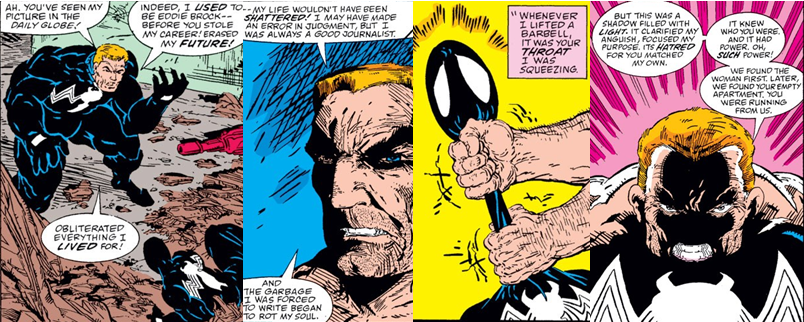
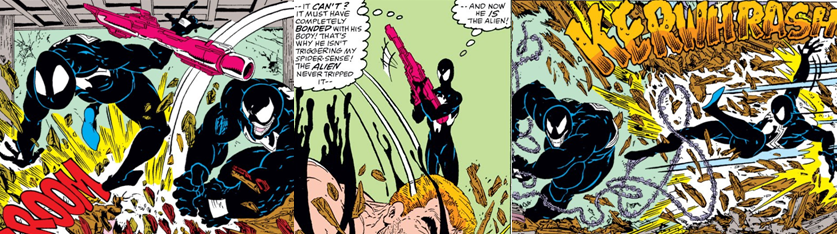
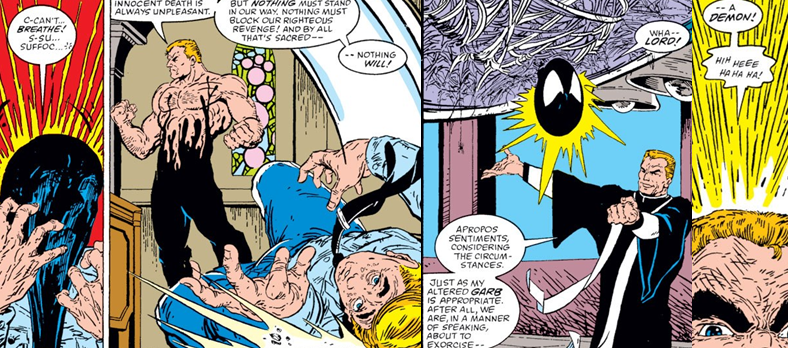
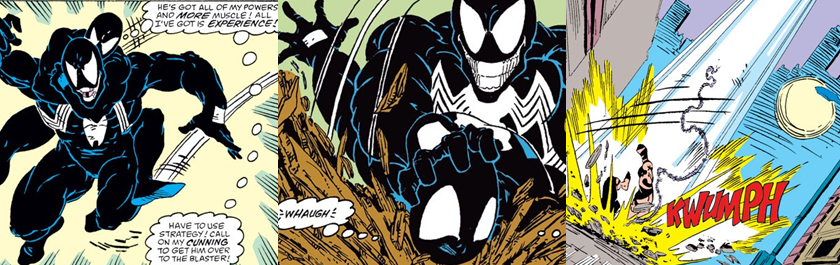
Indeed, when Eddie is revealed to be within the thrashing, monstrous suit, Peter is both shocked and appalled that his old friend would willingly subject himself to the suit’s influence. Unlike the mainstream version of Venom, Ultimate Venom is a volatile and almost mindless beast; a pulsating, brutish monster with teeth and spikes dotted throughout its body and whip-like tentacles, it oddly lacks the spider symbol so associated with the character (despite this appearing on the issue’s covers and Spider-Man having it when he wore the suit…and it randomly appearing in one panel…) and is constantly consuming Eddie’s body, feasting upon and fostering his rage and dark emotions to sustain itself. Lashing out in a jealous and embittered rage, Eddie attacks Peter, easily swatting him aside and half-choking him with his tendrils, all while Peter desperately tries to talk sense into his half-crazed friend. Realising that Eddie is out of control and that the suit is simply mimicking his spider abilities and driving him into a murderous fury, Peter leads Ultimate Venom away from the school grounds, lamenting the friends and loved ones he’s lost to “this super hero crap” and wondering whether the suit drove Eddie crazy or if he was always like that deep down. Regardless, they clash on a rooftop, quickly plummeting through some power lines and to the streets below. With Eddie stunned, the suit tries to overtake Peter once more, with Eddie’s distorted rambling claiming that the suit has to kill Peter in order to be whole since Eddie isn’t strong enough to sustain it. The timely arrival of New York’s finest see both peppered with gun fire, which drives Ultimate Venom back towards a live power line and, in a flash of light, apparently incinerates both the suit and Eddie before Peter’s eyes in suitably anti-climatic fashion. Naturally, Peter is also fired upon and, wracked with guilt and pain, he retreats home and ends the story exactly where he started: distraught and in utter anguish at having lost another friend and ruined his life even more thanks to his duel identity.

The Summary:
So, yeah, Ultimate Venom does suffer from some of those negatives that I find off-putting about the Ultimate Spider-Man comics; there’s a lot of dialogue, much of it rambling and disconnected, with at least one page being Peter babbling on and on to Eddie, which really isn’t all that interesting to see or read since we already know everything he’s saying and it just seems like padding. Any time Richard and Eddie Snr are discussing their work, you can expect a whole bunch of speech bubbles to be dotted all over the pages and panels, and there are a few instances where characters are completely static and art work is repeated between panels with the characters just saying different things. It’s a weird one for me as, like I say, I do appreciate and admire the way Bendis captures real, natural, often haphazard character dialogue but sometimes it’s a bit much. One thing that both works for and against the Ultimate comics is how cinematic they often are; panels and events are presented very much like a movie, showing rather than telling in some instances, and then snapping back to a massive exposition dump, with dynamic and exciting action sequences and visuals to help keep things interesting. On the plus side, Ultimate Spider-Man is arguably, subjectively, easier to read than some of the comics from the sixties and seventies since they’re not bogged down with outdated dialogue and such (though there is some of that here, particularly in Gwen’s dialogue) and the presentation is far more energetic, but I can understand why some people don’t really care of these comics as they’re very angsty, teen drama like a high school show.

Peter is definitely full of angst, which sadly limits his Spidey action.

Anyway, that aside, there’s a decent amount to like here; the art, especially, is incredible. Mark Bagley did some of his best work on Ultimate Spider-Man and really makes this younger, more troubled teenaged Spider-Man visually distinct from his mainstream counterpart not just in his haircut but in the physical depiction of Spidey as this gangly, inhuman superhero. Unfortunately, Bagley seems to struggle a bit with faces; a lot of the characters look the same, facially, and there’s a noticeable lack of Spider-Man in this arc. He only suits up a couple of times, and he’s only in the black suit for one issue! This is what I mean by Ultimate Spider-Man rushing through things; 616-Peter had the black suit for four years before its true nature was revealed and, at that point, he was in his early twenties. Here, Peter’s still in high school and has already had impactful encounters with some of his most memorable villains, and he’s in the suit for what seems like only a few hours before it tries to consume him, and he frantically rids himself of it. I’ve read a lot of mainstream Spider-Man stories and Peter is absolutely known for being riddled with guilt, pressure, and angst but his Ultimate counterpart is far more dramatic and melancholy; he’s driven into a self-deprecating, morose depression after M. J. dumps him (which I can totally relate to) and has been pushed to the edge by recent events, which cause him to recklessly experiment with the goo and thus almost be killed when the suit goes mental on him. Realising that he’s made a serious mistake and heartbroken to find that his father’s life’s work is volatile and dangerous, Peter immediately backpedals and tries to make everything right by destroying his dad’s research, which means exposing himself to Eddie and desperately trying to convince his childhood friend to go along with this despite how difficult the truth is to hear.
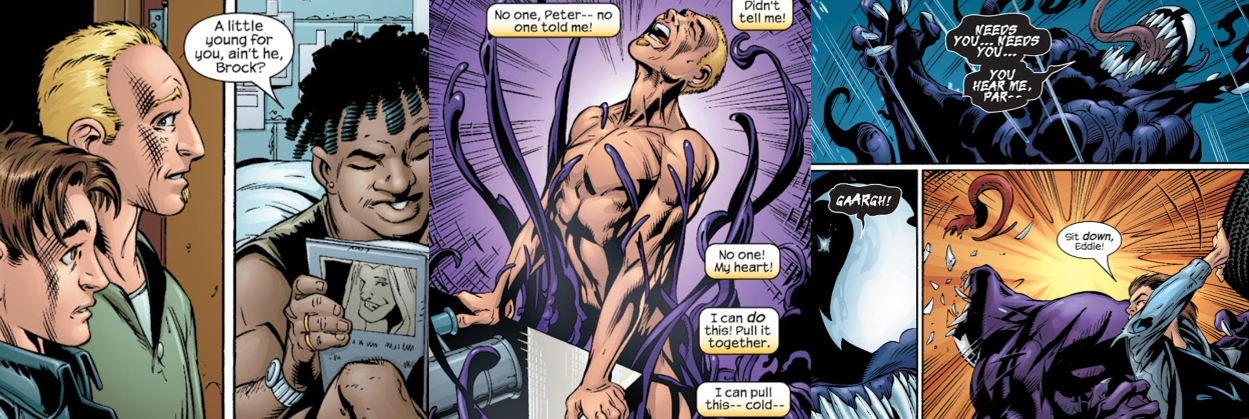
Eddie’s a bit of a weirdo, but Ultimate Venom is nothing more than a mindless beast.

Eddie himself is quite different here. A scientist rather than a discredited reporter, he’s a slender hipster who seems to have really valued his friendship with Peter and who is absolutely fixated on completing his father’s research so that his legacy can live on. There are some red flags raised when it comes to Eddie from the moment Peter meets him at his dorm room, which is a bit of a mess for one thing and shared with another student who has nothing good to say about Eddie. The exact depths of his depravity aren’t revealed until later, however, when he flirts with Gwen and tries to kiss her, then spitefully calls her a tease and dismisses her after she understandably rejects him. Although Peter defends his friend and believes that he’s a good person deep down, this incident is enough to convince Gwen otherwise, and it turns out she’s absolutely right as he’s a bit of a depraved, disturbed young man; bigoted towards Mutants (like most of the Ultimate universe) and ridiculing Peter’s naïvety, Eddie maliciously exposes himself to the goo simply to both prove Peter wrong and to assume the power he described for himself. Instantly, however, Eddie is consumed and driven to madness by this extremely removed version of Venom; little more than a voracious, cancer-like substance, Ultimate Venom is more an amplifier of emotions and abilities than it is a symbiotic life form and simply drives Eddie to confront and devour Peter in order to sustain its unstable and monstrous form out of an innate need for self-preservation rather than any kind of twisted vendetta. This results in a creature that is more of a hulking, primeval brute rather than a sadistic villain looking to make Peter’s life a living hell, though there are some similarities in that Ultimate Venom has apparently copied Spider-Man’s abilities. Ultimately, however, it’s more like a protoplasmic clone of Peter, one spewing teeth and tentacles and going on insatiable rampage, spouting nonsensical accusations and threats but being a far less interesting and layered character in its own right since it’s just a parasitic lifeform that overtakes Eddie.  

My Rating:

Rating: 3 out of 5.

Pretty Good

Have you read Ultimate Spider-Man’s “Venom” arc? What did you think to this new depiction of Venom? Were you a fan of the changes made to Eddie’s character and his more disturbing nature? Were you also disappointed that Peter’s time in the black suit was cut so dramatically short and that he didn’t fight Ultimate Venom as Spider-Man? Did you enjoy the Ultimate comics, specifically Ultimate Spider-Man and, if so, what were some of your favourite moments from those comics? What is your favourite Venom story and how are you celebrating Venom Day today? Whatever your thoughts on Venom, feel free to leave them below.

Back Issues: Secret Invasion

Published: June 2008 to January 2009
Writer: Brian Michael Bendis
Artists: Leinil Francis Yu

The Background:
In January 1962, legendary duo Stan Lee and Jack Kirby introduced Marvel Comics readers to the Skrulls, a race of warmongering shape-shifters who have long hounded Marvel’s heroes, particularly the Fantastic Four, by assuming their identities and powers. Experimented on by the all-mighty Celestials and launching aggressive campaigns against both the Earth and their hated enemies, the Kree, the Skrulls have been at the forefront of numerous Marvel stories over the years in addition to featuring as villains in various videogames and animated ventures before making their live-action debut, in a decidedly different manner, in Captain Marvel (Boden, 2019). Perhaps one of their most prominent storylines was the Secret Invasion arc that ran through these eight issues and multiple tie-ins and spin-offs; the brainchild of writer Brian Michael Bendis, Secret Invasion had not only been hinted at for some time and was heavily advertised as a means of changed up the perception of legacy Marvel characters and even return some to mainstream publication. Reviews of the storyline were mixed, with some noting that it was an anti-climatic Marvel event and others praising the marketing and artwork while criticising the religious undertones and spotty dialogue. Still, an adaptation of the story made its way into the Avengers: Earth’s Mightiest Heroes cartoon (2010 to 2012) and it also formed the basis of a six-episode, live-action series of the same name on Disney+.

The Review:
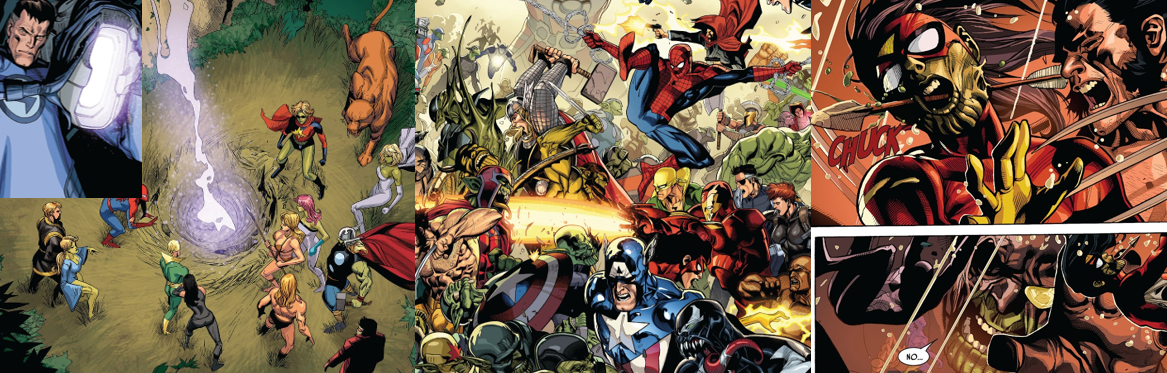
This eight-issue event series begins “years ago” after the destruction of the Skrull throneworld, a cataclysmic, prophesied event that leads the few survivors back to their queen, Veranke, who kicks the story’s narrative in motion by seeding Skrull agents throughout our world. It took years for this to be uncovered, and it was revealed in dramatic fashion when it turned out that the resurrected assassin Elektra Natchios was a Skrull in disguise, a revelation that alerted Tony Stark/Iron Man (then the conceited and self-righteous director of the Strategic Hazard Intervention Espionage Logistics Directorate (S.H.I.E.L.D.) following the game-changing events of Civil War (Millar, et al, 2006 to 2007)) to the depths of the Skrull’s infiltration. Recognising that even his armour’s sensors can’t be trusted to identity friend from foe, Stark drafts in his allies – Doctor Reed Richards/Mister Fantastic and Doctor Henry “Hank” Pym/Yellowjacket – to perform an autopsy in an attempt to figure out how the Skrull was able to remain completely undetected to technology, magic, and Mutant probing. Conveniently enough, a Skrull ship chooses this exact moment to come crashing into Earth’s atmosphere and make landfall in the Savage Land, taking Iron Man away from the operating room so he can investigate. Concerned that this could be the full-scale invasion they fear, Jessica Drew/Spider-Woman calls in the renegade “New” Avengers (those who refused to sign up to the ludicrous Superhero Registration Act in Civil War), which leads to Luke Cage/Power Man, Peter Parker/Spider-Man, James “Logan” Howlett/Wolverine, Danny Rand/Iron Fist, Clint Barton/Ronin, and Maya Lopez/Echo subduing Black Widow/Natasha Romanova and stealing her Quinjet to beat Iron Man and his government-sanction Mighty Avengers – Iron Man, Spider-Woman, Black Widow, Carol Danvers/Ms. Marvel, Janet van Dyne/The Wasp, Ares, Simon Williams/Wonder Man, and Robert “Bob” Reynolds/The Sentry – to the crash site. Both sets of Avengers are aware of the potential Skrull threat, which drives an even greater wedge between them as not only are the Secret Avengers being actively hunted by their former comrades, but they can’t even trust each other to be who they say they are.

While the Skrulls cripple Earth’s defenses, the fractured Avengers battle their classic counterparts.

After being brought down by one of the Savage Land’s rampaging dinosaurs, the New Avengers prepare to open up the crashed ship, but they’re intercepted by the Mighty Avengers, with Iron Man immediately trying to arrest them and Luke Cage obviously telling him and his jumped-up thugs to go kick rocks. Iron Man’s attempt to keep the rogue superheroes from overstepping the mark are scuppered when Timothy “Dum Dum” Dugan and his trusted butler, Edwin Jarvis, unexpectedly sabotage not only the orbiting the Sentient World Observation and Response Department’s (S.W.O.R.D.) satellite base but also Stark’s armour and S.H.I.E.L.D.’s Helicarriers and bases, effectively disabling the armoured Avenger and crippling the superhero community’s resources and communications. Additionally, maximum security prisons the Raft and the Cube are suddenly hit by mass breakouts and Mar-Vell/Captain Marvel and Susan Storm/Invisible Woman disable the villainous Thunderbolts and the rest of the Fantastic Four, with each of these supposed heroes flashing ominous eyes and assuring their victims that “He loves [them]”. Meanwhile, a Skrull armada bares down on Earth and Mr. Fantastic finds himself reduced to an elasticated mess right as he figures out the key behind the Skrull’s newfound undetectability, the victim of a shot from Pym, who’s revealed to also be the Skrull Citri Noll! Momentarily setting aside their differences to get Tony Stark to aid, the two Avengers groups are startled when a slew of classic-styled, currently deceased or long-changed superheroes emerge from the Skrull ship; Captain Steve Rogers/Captain America, the Vision, Thor Odinson, Doctor Jean Grey/Phoenix, Doctor Henry “Hank” McCoy/The Beast, Wanda Maximoff/Scarlet Witch, Jessica Jones/Jewel, Emma Frost/The White Queen, and Barbara “Bobbi” Morse/Mockingbird appear alongside classic versions of Spider-Man, Power Man, Wonder Man, Iron Man, Hawkeye, Ms. Marvel, Wolverine, and the Invisible Woman. Naturally, a tense showdown ensues in which both groups assume the other are Skrulls in disguise; guys like Wolverine, Spider-Man, Emma Frost, and the Vision struggle to get any kind of reading on their counterparts beyond sensing their distrust while Ronin is stunned to see his former flame, Mockingbird, alive and well but, despite Ares trying to convince his allies that it’s a trap, tensions boil over and an all-out brawl kicks off!

As more characters enter the fray, internal distrust is as rife as the escalating war with the Skrulls.

With Stark in agony from the alien virus that’s crippled his armour, Ms. Marvel flies him to safety as the others duke it out; the two Spider-Men trade quips and punches, the Vision uses the Sentry’s fear of his destructive and malevolent alter ego, the Void, to disable his God-like power, and Ronin steals his counterpart’s weapons to subdue their attackers but the arrival of a raging Tyrannosaurus rex disrupts the fracas. Trampled to death by the dinosaur, the classic Spider-Man and Hawkeye are revealed to be Skrulls, and Wolverine intuits that the Skrulls are setting them against each other to wipe out any resistance to their invasion plan. However, when he tries to eviscerate Mockingbird, Ronin intervenes and questions her; she’s adamant that she’s not a Skrull and even reveals personal information that only she and Clint would know, which is enough to convince him to trust her. This offers Luke Cage the hope that the Cap and Iron Man aboard the ship are the real deal, which would certainly explain Stark’s recent manic behaviour and allow the recently deceased Cap to still be alive, but Wolverine’s far from convinced. Meanwhile, back in New York City, a portal opens up and a whole slew of Avengers-inspired Super-Skrulls attack; there’s Skrulls combining the powers of various X-Men, a Fantastic Four Super-Skrull, one that’s a mixture of Spider-Man villains, and even an Illuminati hybrid, meaning the Young Avengers – Eli Bradley/Patriot, Dorrek VIII/Hulkling, Billy Kaplan/Wiccan, Tommy Shepherd/Speed, Kate Bishop/Hawkeye, and their mentor, the Vision – are completely overwhelmed despite Hulkling’s efforts to talk down their attackers with his royal status. Thankfully, they receive some back-up in the timely arrival of fledgling superheroes, the Initiative – Joseph Green/Gauntlet, Rachel Leighton/Diamondback, Cassandra “Cassie” Lang/Stature, David Alleyne/Prodigy, Anthony Masters/Taskmaster, Geldoff/Proton, Z’Reg/Crusader, Jimmy Santini/Batwing, Fahnbullah Eddy/Gorilla Girl, Wallace Jackson/Red 9, Delilah Dearborn/Geiger, Melee, Andrea Roarke/Sunstreak, and Alexander Ellis/Annex. Though the Skrull forces prove ruthlessly formidable, and the Vision is lost in the battle, even more help arrives when the Secret Warriors – Colonel Nick Fury, Yo-Yo Rodriguez/Slingshot, Daisy Johnson/Quake, Alexander Aaron/Phobos, J.T. Slade/Hellfire, Jerry Sledge/Stonewall, and Sebastian Druid/Druid – add yet more names and the bodies to the chaotic artwork and conflict.

Heroes and villains set aside their differences to take the fight to the invading Skrull army.

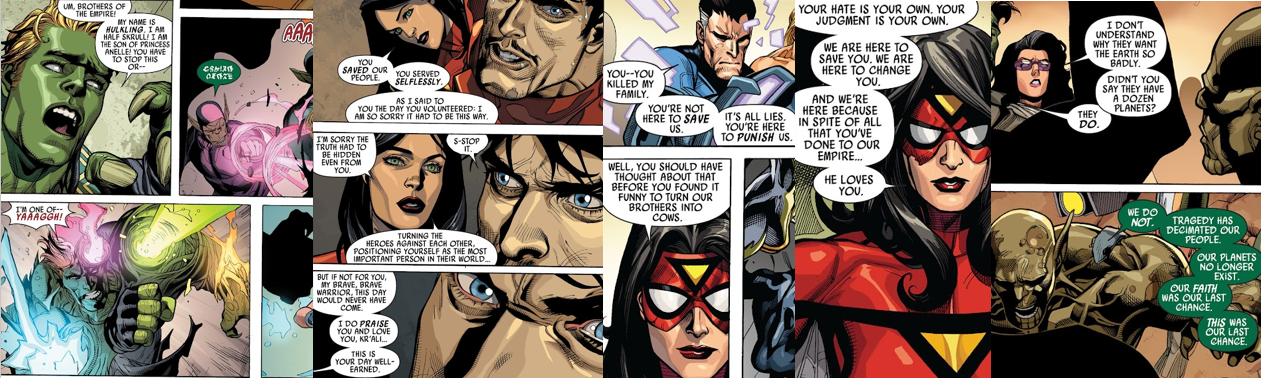
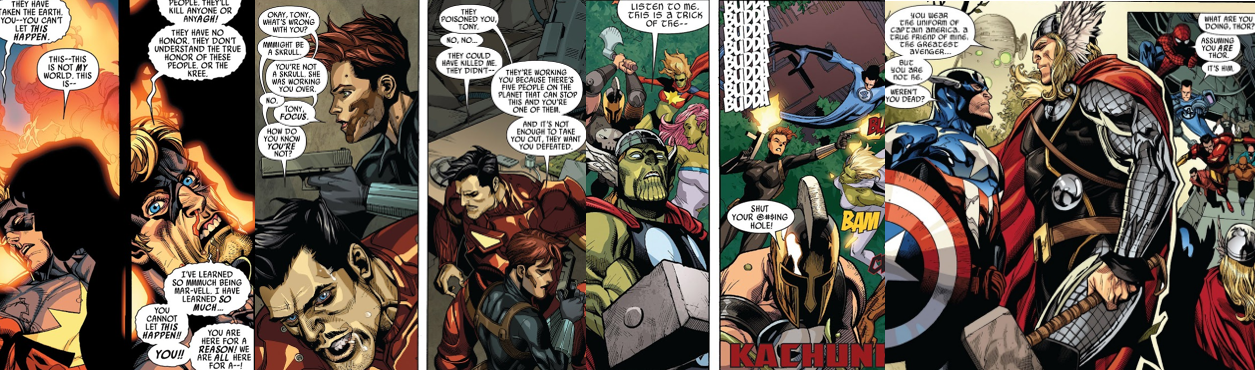
The Skrull threat is doubled thanks to the distrust between the world’s heroes, with even Nick Fury abandoning Ms. Marvel because of her alien DNA. Meanwhile, as a weakened Stark desperately attempts to repair his armour, Spider-Woman reveals herself to be the Skrull Queen, Veranke, and tries to convince him that he’s a Skrull agent so deep undercover that he’s forgotten his true nature. Before her poison (both literal and figurative) can take hold, Black Widow causes her to flee and Stark reveals that the key to victory lies with Mr. Fantastic, who’s currently being tortured aboard a Skull ship. Thankfully, S.W.O.R.D. director Abigail Brand bluffs her way onto the ship and flushes the Skrull into space to rescue him; Reed then fashions a device that exposes the Skrulls’ real forms, arriving just in time to stop another conflict in the Savage Land and revealing not only that the classic Emma Frost, Invisible Woman, Thor, Ms. Marvel, and Jessica Jones are Skrulls but that Mockingbird is as well, enraging Clint. The real Thor transports everyone to New York for a final confrontation, which even the Watcher, Uatu, shows up to observe and also sees Parker Robbins/The Hood’s criminal syndicate and Doctor Norman Osborn’s Thunderbolts pitch in with the nearly-incomprehensible brawl. While Mr. Fantastic and Iron Man try to take out Veranke (still disguised as Spider-Woman) to demoralise the Skrulls, the Wasp targets Citri Noll, who apes Pym’s Giant-Man form, though it’s Stature and the assassin Bullseye who end up taking him out. Iron Man is forced to withdraw so he can sort out his messed-up armour, Fury’s forces save Mr. Fantastic from being torn apart by multiple Skrulls posing as the Invisible Woman, the real Jessica Jones joins the fray, and Kate Bishop ends up gravely injured amidst the chaos. Although Wolverine tries to take out Veranke, the bio-electrical powers she stole from Spider-Woman keep him at bay, meaning it’s an arrow through the face courtesy of the vengeful Ronin that ultimately subdues her.

Although the Skrulls are defeated, the general distrust in Stark allows Osborn to seize power!

With Veranke compromised, Citri Noll activates a device that causes Janet to enlarge uncontrollably and unleash a chemical agent designed to kill humanity and Skrulls alike. With no other choice available, Thor whips up a hurricane with his magical hammer, one so powerful that is destroys the enlarged Janet and dissipates the weird black spots that threaten everyone’s lives. Although Wolverine seeks to make Veranke pay for Janet’s death, it’s Norman Osborn who gets the kill shot, then Iron Man finally gets his shit together and leads an all-out assault on the remaining Skrull ships, with the now disillusioned and leaderless armada being easy pickings. Iron Man also frees everyone the Skrulls impersonated since the shape-shifters conveniently needed the original versions alive in order to make the deception more convincing, meaning Elektra and Mockingbird return to “life”, Reed is finally reunited with his family, and the true versions of the likes of Spider-Woman re-join society. Unfortunately, this also means that Jessica Jones left her and Luke’s baby, Danielle Cage, in the care of the Skrull-Jarvis, a plot thread left unresolved in this story. Although recent tensions are eased in the aftermath and ensuing celebration, there’s an unshakable sense of hesitation given how long the Skrulls had been a part of Earth’s society and superhero community; Thor also condemns Stark’s recent actions and refuses to associate with him. Thanks to having publicly executed Veranke, Osborn is able to manipulate the President of the United States into equally losing faith in Stark, his methods, and his technology; the President thus ousts Stark as director of S.H.I.E.L.D. and names Osborn as the new overseer of any and all superhuman and defensive measures under a new organisation, H.A.M.M.E.R., unaware that this is exactly the opportunity the scheming madman and his Cabal of allies (Emma Frost, Doctor Victor Von Doom/Dr. Doom, The Hood, Prince Namor McKenzie/The Sub-Mariner, and Lady Loki) were waiting for.

The Summary:
Now, I am by no means an expert on the Skrulls; I know of them, primarily as an antagonistic, shape-shifting race of aliens who are almost constantly at war with the Kree and getting into scuffles with the Fantastic Four, but they’re generally on the periphery of most Marvel stories I’ve read. Secret Invasion is probably, to date, their most prominent story, at least in my experience, and it definitely adds some nuance to them that I didn’t expect. Normally, I see them as a warmongering race who live to conquer through both subterfuge and force but, here, they’re motivated by a fanatical devotion to their God (the “He” they keep referring to) and their invasion is seen almost as divine intervention. The Skrulls swamp television screens with their pseudo-religious propaganda, hijacking every telecommunications device across the globe and assuming the guise of various political figures, celebrities, and superpowered monarchs like Erik Lehnsherr/Magneto and Dr. Doom, and insist that they’re there to bring glory to our world and that their might cannot be opposed. Given the strength of their invasion and that their Super-Skrulls have mimicked the combined powers of many of Marvel’s heroes, it’s perhaps not surprising that Marvel’s ridiculously fickle citizens embrace their alien overlords, though this scene showcases that the Skrulls aren’t simply defending themselves or there to usher in a new age for mankind as they claim and are hell-bent on conquering the planet.

Having lost everything, the Skrulls throw themselves at Earth with fanatical desperation.

This campaign is spearheaded by their queen, Veranke, a figure of worship for the Skrulls and who has placed herself on the frontline, earning the trust of Tony Stark by posing as Spider-Woman and becoming privy to many of Earth’s defences. Stark even reflects on his role in the invasion and the shame he feels about not recognising the threat sooner in a show of guilt that was somewhat uncharacteristic of him at this time; this is a man who was so blinded by his belief that superhumans needed to register with the government that he actively fought and imprisoned his fellow heroes and abandoned many of them, and his morals, in favour of an uncompromising, borderline fascist mentality that only led to further conflict and resentment Indeed, Veranke revels in the irony of having twisted Earth’s technology and heroes towards her agenda, something she was easily able to do thanks to Stark being so dead-set about forcing or punishing his peers to register their true identities and powers. However, as much as Veranke likes to preach that hers is a Holy mission, she’s actually equally motivated out of revenge, specifically against Mr. Fantastic and the Fantastic Four after they tricked a contingent of Skrulls into believing they were cows decades prior. Since the Skrull home world has been lost and their once-prosperous empire lies in ruins, the Skrulls follow her without question and throw everything they have at Earth; they’re even willing to give their lives in the process, and in a last-ditch effort of mutually assured destruction, only to be defeated and left dejected. Veranke’s death leaves the Skrulls directionless and all their once-formidable might is as nothing; those that survive are left demoralised as they saw this as their last chance at survival and glory. Thus, Veranke’s quest for vengeance and conquest leaves her people devastated and more worse off than ever as a sizable portion of their armada is destroyed and the last thing they had in all the universe, their faith, is also shattered by their defeat.

The Skrulls are so deeply entrenched that the already frayed heroes are strained to breaking point.

I’m generally not a fan of imposter storylines; it’s a tired cliché and one that quickly outstays its welcome, but it actually works quite well in Secret Invasion. Many of the Skrulls seem to be completely unaware of their true nature; the Mockingbird-Skrull believes that she’s the real deal right up until the end and is begging Clint to listen to her even as he attacks her in a rage. This is also true of Captain Marvel, who believed so strongly that he was the deceased former hero that he couldn’t bring himself to kill and was convinced by Norman Osborn, of all people, to turn on his race; he even died begging the Kree warrior Noh-Varr/Marvel Boy to carry on the fight in his stead, so complete was his conditioning. It’s not revealed exactly how the Skrulls have the memories they do but it’s one of the big reasons why so many of them went undetected; however, many of the Skrulls posing as classic Avengers continued to believe they were the real deal after their true nature was revealed rather than immediately attacking the heroes in service of their God, which definitely paints much of this conflict in a morally grey area. The Skrulls pick the perfect time to strike the Earth; its heroes are divided and at war with each other and easy to manipulate, and seeing the return of dead heroes like Captain America, Mockingbird, and Captain Marvel, as well as the original version of Iron Man, only fuelled the flames of conflict between them thanks to Stark’s actions during Civil War leading to many deaths, including Captain America’s. It would’ve been so easy to explain away Stark’s recent actions as being the work of the Skrulls but, interestingly, that doesn’t turn out to be the case and, similarly, Cap’s death isn’t immediately undone with the presence of his classic counterpart. Instead, we’re left with a world where Stark is still shouldering the burden of his actions and where Cap’s mantle has been taken up by his friend, James Buchanan “Bucky” Barnes; there are no quick-fixes in this story to explain away the events of Civil War and there isn’t really a sense that bridges have been mended by the end of it as distrust is still rife and the status quo remains unchanged.

A decent story with some interesting wrinkles but a bit overstuffed and manic at times.

Ultimately, I quite enjoyed this story; it’s hard to read as an eight-issue standalone as you need some knowledge of prior Marvel events, especially Civil War, and it’s clear that there’s a lot of additional story and conflict in supplementary collections and books, but the narrative works just as well if you only read these eight issues. I enjoyed seeing the Mighty and New Avengers be forced to set aside their differences when faced with their classic counterparts and the reveals of which characters were Skrulls, even if none of the major players were aliens in disguise. The quasi-religious bent to the Skrull invasion was an interesting twist, as was them siphoning and combining the powers of Marvel heroes into an army of Super-Skrulls, and the art was pretty consistent and easy to follow throughout. Unfortunately, the biggest issue I had with Secret Invasion was the sheer number of characters jammed into it; it was hard to keep track of it all at times and it’s obvious that teams like the Young Avengers, Thunderbolts, and Secret Warriors all had bigger parts to play in spin-off stories, but I think they could’ve been downplayed a little here. There’s a Skrull-Galactus with absolutely no context or consequence to the story and even Uatu shows up, which is generally a short-hand to indicate that the events are of cosmic importance but, again, it doesn’t actually factor into the story in a meaningful way. Stark spends most of the arc out of action thanks to the Skrull virus messing up his armour, which is great for leaving him vulnerable and in pain and unable to participate in the wider conflict but then he just shows up in an older armour with a throwaway line for the finale. Similarly, Thor just pops in out of nowhere, formally prominent characters like Wolverine and Spider-Man get lost in the shuffle, and late appearances from Jessica Jones and Norman Osborn are simply there to set up the next big Marvel events and stories. Overall, it was pretty enjoyable and not as much of a mess as some Marvel events, but the action got a little too chaotic at times and there were too many characters wedged into these issues, which I think would’ve been far stronger if they’d focused on, say, eight or ten main characters and then just showcased the others in supplementary materials.

My Rating:

Rating: 3 out of 5.

Pretty Good

Did you enjoy Secret Invasion? Were you shocked to find out which characters were Skrulls in disguise? Were you hoping that some of the classic Avengers would turn out to be the real heroes? Which of the teams featured was your favourite? Did you think there were too many teams and characters in the story and which of the spin-off books did you enjoy? What did you think to Veranke, the pseudo-religious slant to the Skrulls, and the Skrull invasion? Were you also frustrated by Tony Stark’s characterisation during this time, or did you enjoy seeing Marvel’s heroes in dispute? What are some of your favourite Skrull-centric stories? Whatever your thoughts on Secret Invasion, feel free to share them below or leave your thoughts on my social media.

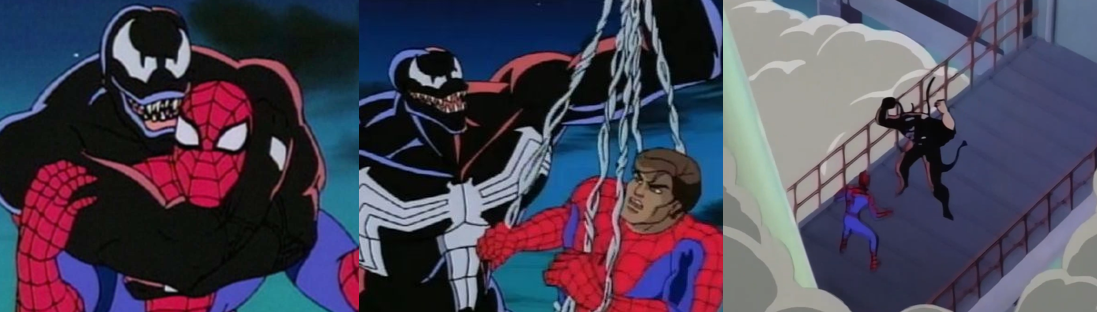
Screen Time [Venom Day]: Spider-Man (1994): “The Alien Costume” (S1: E8-10)


To celebrate the release of Venom: Let There Be Carnage (Serkis, 2021), Sony Pictures declared September 27 “Venom Day”, a fitting date to shine the spotlight on one of my favourite anti-heroes, who made their first full debut in May 1988 and have gone on to become one of Marvel’s most iconic characters.


Season One, Episodes Eight to Ten:
The “Alien Costume” Saga

Air Date: 29 April 1995 to 13 May 1995
Network: Fox Kids Network
Stars:
Christopher Daniel Barnes, Hank Azaria, Roscoe Lee Browne, Don Stark, Jim Cummings, and Edward Asner

The Background:
Given that Marvel’s resident wall-crawling hero proved to be popular enough to receive his own self-titled comic book barely a year after his blockbuster debut, it’s perhaps no real surprise that Peter Parker/Spider-Man has featured in a number of cartoons over the years. Nowadays, it seems like Spidey gets a new cartoon every other day of the week but, when I was a kid, his 1994 to 1998 cartoon was a must-watch piece of weekly entertainment. Produced by Saban following their success with the X-Men animated series (1992 to 1997), Spider-Man (or Spider-Man: The Animated Series) was a fresh and fun adaptation of many of the web-head’s greatest adventures, even if it was a little hampered by some unnecessary censorship. Given that I was super into Venom at the time, it’s no surprise to me that the cartoon’s introduction and depiction of the character rank as some of its best episodes; so popular were Venom at the time that they were introduced in the first three-part saga of the series (and well before the creators adapted the “Secret Wars” comic) and even returned for a two-part follow-up a year later.

The Plot:
After rescuing astronaut Colonel John Jameson (Michael Horton) from a shuttle crash, Spider-Man (Barnes) finds his costume and abilities augmented by a mysterious black goo. When Wilson Fisk/The Kingpin (Browne) sends a number of super-powered goons to retrieve the “Promethium-X” Jameson brought back to Earth, Spidey finds his aggression and character altered by the suit, which is revealed to be a symbiotic organism! After ridding himself of it, Spidey is confronted with one of his worst foes imaginable with the symbiote bonds with disgruntled reporter Eddie Brock (Azaria) and transforms them into Venom!

The Review:
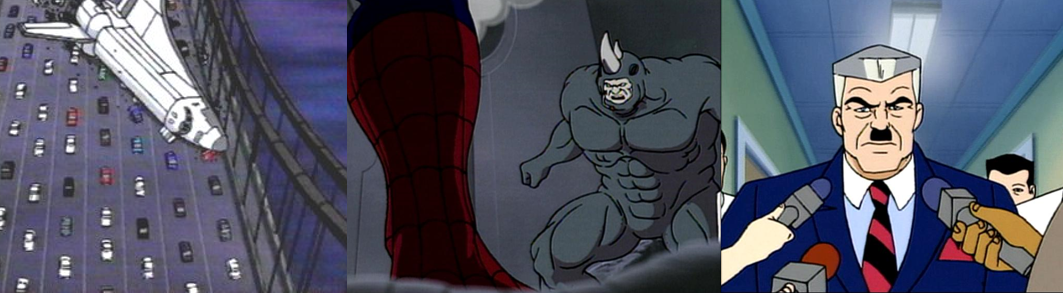
The “Alien Costume” arc begins with astronaut John Jameson digging up a mysterious black rock from the surface of the Moon; after narrowly escaping a Moonquake, he makes it back to the shuttle and his return to Earth with the newly-discovered isotope, Promethium-X, attracts the attention of the Kingpin since it promises to be more powerful and valuable than Plutonium. However, John’s return is hampered when the rock secretes a seemingly-sentiment, tar-like substance that attempts to consume the astronauts and leaves the shuttle on a collision course with New York City!

The shuttle crash and the acquisition of Promethium-X forms the central conflict of the arc.

Despite the imminent danger, Kingpin’s lead scientist, Alistair Smythe (Maxwell Caulfield), assures him that the shuttle will land without causing any damage to the city so he (as in the Kingpin) contacts Aleksei Sytsevich/The Rhino (Stark) to retrieve the Promethium-X once the shuttle makes its emergency landing on the George Washington Bridge. There, he comes into conflict with Spider-Man and, thanks to his superior size and strength and the shuttle’s precarious position, is able to best the wall-crawler and make off with the isotope. Although he saves John and his co-pilot, Peter is aghast when he is fingered as the one responsible for stealing the Promethium-X thanks to John’s incoherent rambling, his father J. Jonah Jameson’s (Asner) unrequited hatred for Spider-Man, and disgraced photographer Eddie Brock selling J. J. pictures that incriminate the web-head. Having been introduced in previous episodes as an embittered man desperate to regain his job at the Daily Bugle, Brock jumps at the chance to capitalise on Jameson’s hatred of Spider-Man with his photos.

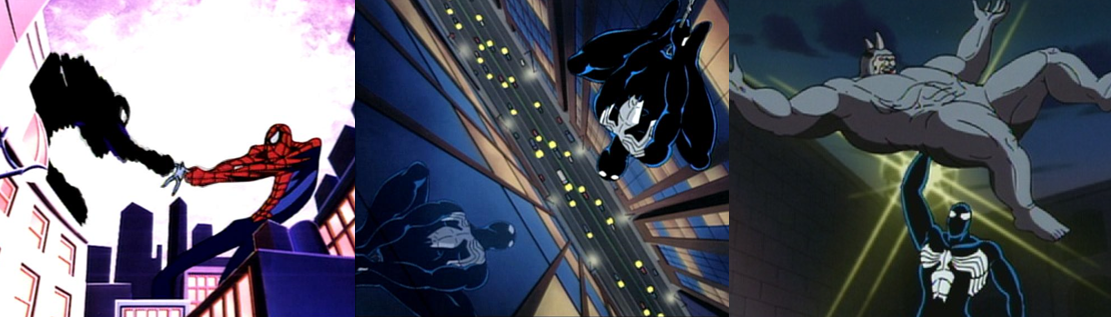
The black suit overtakes Spider-Man and augments his strength and negative emotions.

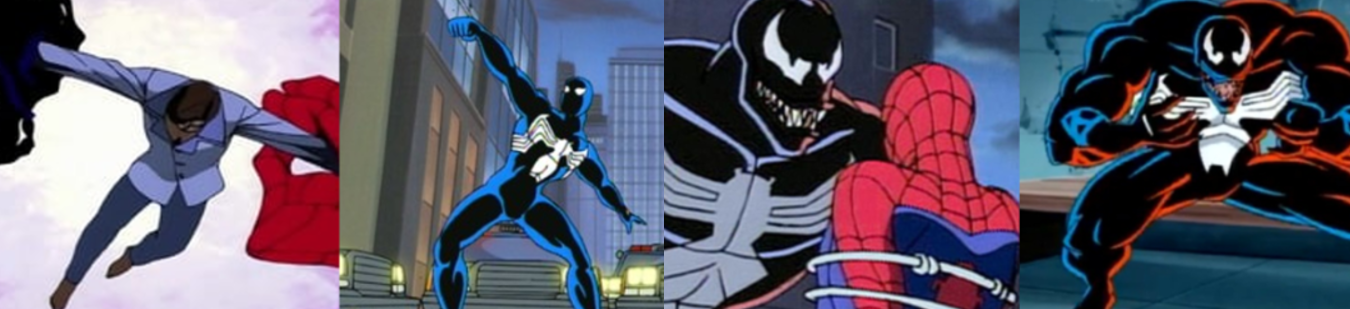
This results in Jameson placing a $1 million bounty on Spider-Man’s head, forcing Peter to lay low. However, while he sleeps, the mysterious black substance from the shuttle is revealed to have attached itself to his costume and, following a harrowing nightmare, the goo overtakes Peter, who wakes to find himself garbed in a sleek black costume that dramatically augments his speed and strength. Overwhelmed at the suit’s capabilities, Spider-Man discovers he can now shoot organic webbing and change his appearance by simply thinking about it, but it quickly becomes apparent that the alien substance is also affecting his personality. Far more confident than ever before, even Spider-Man’s voice is slightly altered when he’s wearing the black suit, making him sound tougher and more aggressive than usual. Equally quick to anger, Peter threatens Eugene “Flash” Thompson (Patrick Labyorteaux), snaps at his doting Aunt May (Linda Gary), and comes close to killing destroying the Rhino after handily dominating their rematch. Although he manages to get a hold of himself, Peter’s demeanour continues to degrade into an enraged fury as he is hounded at every turn thanks to Jameson’s bounty; his overconfidence and anger causes him to become sloppy, however, and he learns the hard and painful way that the alien costume is vulnerable to high-intensity sonic waves. Spider-Man does himself few favours when he confronts Brock and Jameson, threatening them in the Daily Bugle and driving him to visit his friend, Doctor Curt Connors (Joseph Campanella), to find out more about the suit.

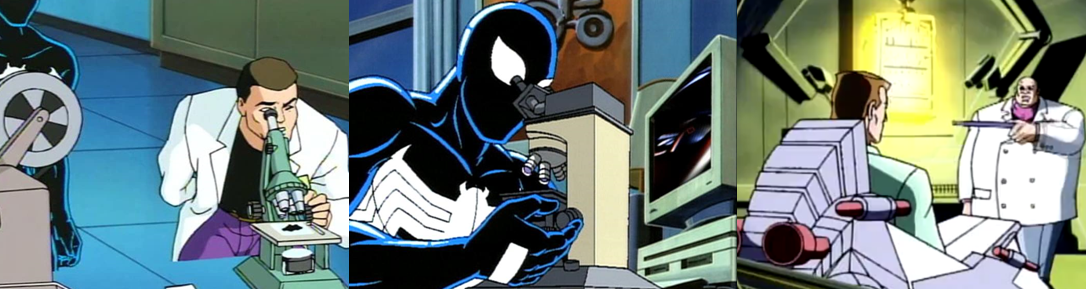
While Spidey disregards Connors’ advice about the symbiote, he uses to science to outwit the Kingpin.

As you might expect, Connors reveals that the suit is actually a living, alien symbiote that is seeking to permanently bond with Peter. Although he stresses the very real danger of the alien costume, Connors is unable to convince Spider-Man to remove to suit since he needs it to recover the Promethium-X. When John corroborates Spider-Man’s story of a guy in a rhino suit, Jameson angrily lays into Brock for lying to him, fires him, and is begrudgingly forced to withdraw his bounty on Spider-Man. Embittered by this development, Brock’s mood is further soured when he is also evicted from his apartment and when he is targeted by the Kingpin, who sends Herman Schultz/The Shocker (Cummings) after him to tie up the loose ends from the shuttle robbery. After saving Brock from being blasted into dust, Spider-Man tracks the Shocker to Smythe’s laboratory and finally recovers not only proof of his innocence from Brock’s apartment but the Promethium-X from Smythe. While the Kingpin was more concerned with selling the rock to the highest bidder, Spider-Man takes the time to properly investigate the Promethium-X and discovers that, while it is incredibly powerful and dangerous, its radioactive half-life is ridiculously small, which results in the Kingpin being left humiliated and with an inert rock in his possession.

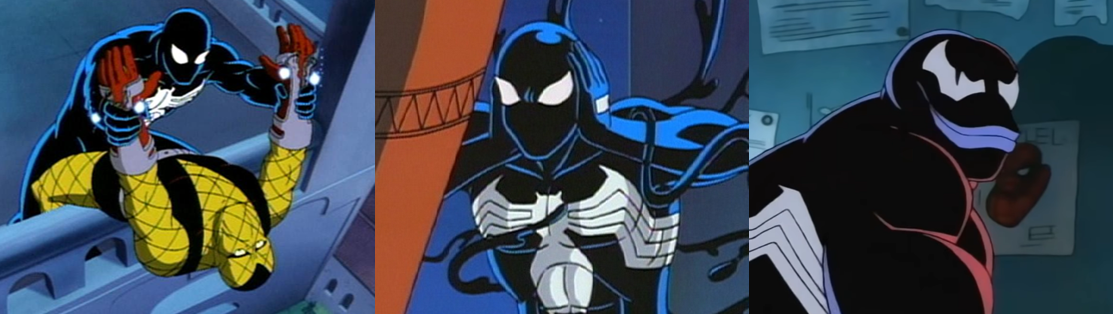
After ridding himself of the symbiote, Spidey unknowingly births his greatest foe: Venom!

However, Spider-Man’s tumultuous emotions are driven to the edge when Smythe lures him to a bell tower by taking John hostage in order to recover the isotope; overcome with rage, Spider-Man destroys the Shocker’s gauntlets and is seconds away from doing the same to the mercenary before memories of his beloved Uncle Ben remind him that “with great power comes great responsibility”. Guilt-ridden and desperate to be rid of the alien suit, Spider-Man frantically tries to remove the symbiote but his efforts prove useless until he takes advantage of the church bell to cause the creature enough pain to separate itself from his body. However, Brock (who followed Spider-Man in a desperate attempt to extract a measure of revenge against the well-crawler), finds himself enveloped by the injured and enraged creature as he hangs helpless beneath the church bell. The result is a muscular, embittered, monstrous union of man and symbiote, Venom, who vows to destroy Spider-Man for ruining both of their lives. Venom makes their presence known as Spider-Man is settling the score with the Shocker and the Rhino on a rooftop; Venom actually saves Spider-Man just as he’s about to be destroyed simply to have the honour for themselves. In the process, Venom proves to be far stronger than Spider-Man, immune to his spider sense, privy to his secret identity, and possessing all of his physical and superhuman abilities but augmented thanks to Brock’s rage and workout routine.

Overwhelmed by Venom’s superior strength, Spidey is left relying on his wits to triumph.

Hopelessly outmatched, Spider-Man is left physically overpowered; his attempts to appeal to Brock’s better nature fall on deaf ears and Spidey finds himself at Venom’s mercy. Venom threatens to target, and reveal Spider-Man’s identity to, Peter’s loved ones and even leaves him dangling over a rooftop without his mask on at one point! Narrowly escaping with his identity intact, Peter is stalked by Brock at every turn and starts seeing Venom everywhere; with no choice but to take the fight to his foes, Spider-Man taunts Brock with newspaper clippings of his failures and baits Venom into following him across the city to the launch of another shuttle at a military base outside of New York. There, the two have a final confrontation up the support gantry that ultimately ends with the symbiote being driven from Brock’s body when the shuttle launches. Spider-Man then webs the writhing creature to the shuttle, sending it back into space, and leaves Brock in police custody, finally free of his alien nightmare… for the time being.

The Summary:
As much as I enjoyed, and still enjoy, the 1994 Spider-Man cartoon, there are some elements of it that obviously haven’t aged too well. The video transfer to DVD isn’t the best and the animation can be a little jerky at times. The editing is quite rushed here and there, meaning that episodes can quickly gloss over and bounce around certain scenes despite being fully capable of telling a well-paced story at other times, and there is a bit of dodgy CGI and the music gets very repetitive. Still, these concerns are largely minor and can be said of almost any cartoon produced in the nineties (or ever, for that matter) and, for the most part, the episodes are bright, action-packed, and well animated. Fittingly, the animation and presentation benefits Spider-Man the most of all the characters in the cartoon; vibrant and athletic, Spider-Man is a very dynamic character in the cartoon and capable of many superhuman feats despite not being allowed to throw a punch. Peter, despite closely resembling Nicholas Hammond, oddly looks bigger than his web-slinging counterpart but Spider-Man is expressive and vibrant throughout. The depiction of his black suit is equally top-notch; one of the arc’s stand-out scenes is Peter’s disturbing nightmare where Kaiju-sized versions of the black and classic costumes battle over Peter’s soul and he’s left hanging upside down in the middle of the city garbed in the sleek, sexy black suit. “The Alien Costume” may also be the first instance of the symbiote augmenting Spidey’s superhuman abilities and characteristics as this didn’t really happen in the original comics (at least not to the extent as it does in other media) and the three episodes definitely set the standard for Peter’s struggles with the symbiote going forward.

Spidey looks great, despite some dodgy animation, and Venom benefits from the multi-part arc.

Brock’s introduction is handled far better in the cartoon compared to the comic since he was actually introduced, and featured, in a handful of episodes prior to these three; angry and bitter, he’s been the victim of a string of bad luck and bad decisions that cause him to grow increasingly resentful of Spider-Man. Consequently, his transformation into Venom empowers him, driving him even more maniacal thanks to the symbiote’s power and abilities. Unlike in the comic books (at least at the time of these episodes), the symbiote is revealed to be incredibly old, well-travelled, and possessing knowledge of the wider universe and numerous worlds, indicating that it’s far more than just a near-insane parasitic lifeform. Venom looks fantastic in the cartoon, sporting their trademark fangs, talons, and long tongue as well as a hulking physique and a distorted, monstrous voice that, again, set the standard for how Venom are portrayed outside of comics. The episodes also do a pretty decent job of portraying C-grade villains like the Rhino and the Shocker as formidable threats; thanks to the influence of the black suit, Spider-Man’s anger and emotions are constantly in flux throughout the arc and are only exacerbated by the duo’s tenacity. Still, once Venom enters the picture, they make all other villains irrelevant; possessing knowledge and physical abilities that make them superior to Spider-Man in every way, Venom plays mind games with Peter, taunting and stalking him and overwhelming him both physically and emotionally. Just like in their first comic book encounter, Spider-Man is forced to use his initiative and wiles to outsmart his maniacal foes rather than trying to match them blow-for-blow. The end result is a far grander conclusion to their confrontation since Spidey utilises a shuttle launch rather than simply wielding a sonic blaster, which is a fittingly dramatic (if temporary) end to Venom’s threat as their story started in space and technically ends in space.

My Rating:

Rating: 4 out of 5.

Great Stuff

What did you think to the “Alien Costume” arc? Did you watch Spider-Man when it first aired or did you discover it later, perhaps on Disney+? What did you think to the depiction of Spider-Man’s black costume and how it influenced his powers and personality? What did you think to Venom’s depiction in the cartoon? What is your favourite Venom story or adaptation? How are you celebrating Venom’s dramatic debut today? Whatever your thoughts on Venom, feel free to sign up to leave them below or drop a reply on my social media.

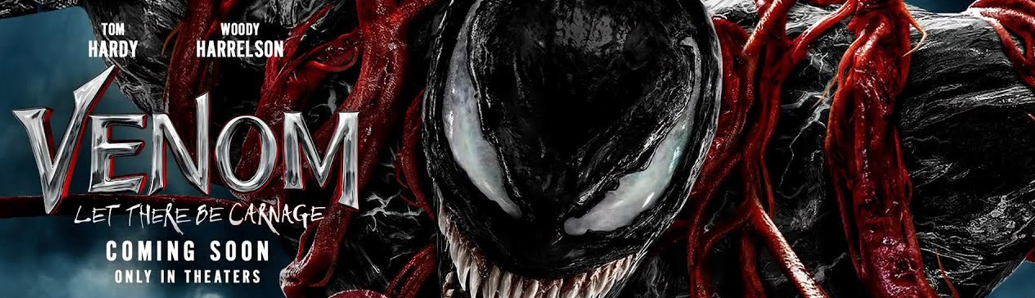
Movie Night: Venom: Let There Be Carnage

Released: 15 October 2021
Director: Andy Serkis
Distributor:
Sony Pictures Releasing
Budget: $110 million
Stars:
Tom Hardy, Woody Harrelson, Michelle Williams, Naomie Harris, and Stephen Graham

The Plot:
After the events of Venom (Fleischer, 2018), investigative journalist Eddie Brock’s (Hardy) struggles to co-exist with the alien symbiote Venom. Their lives are further complicated when serial killer Cletus Kasady (Harrelson) gains his own symbiote and begins a reign of terror as the maniacal Carnage.

The Background:
Originally depicted as a simple black costume acquired by Peter Parker/Spider-Man on an alien world, Venom eventually became their own character when the costume was revealed to be alive and bonded with the unhinged Eddie Brock to torment Spider-Man. Since their debut, Spidey-Man’s dark doppelgänger has become one of Marvel Comics’ most popular anti-heroes and one of Spider-Man’s most recognisable foes. So popular are Venom that they’ve made regular appearances in Spider-Man videogames and cartoons and were awkwardly shoe-horned into Spider-Man 3 (Raimi, 2008) for an impressive, if rushed, big-screen debut. Although the idea of a live-action Venom film had been doing the rounds in Hollywood since 1997, the idea only gained significant momentum after this film and eventually culminated in the frankly unprecedented casting of Tom Hardy in the title role for what became a commercially successful solo film despite mixed reviews and questions as to its relations to the Marvel Cinematic Universe. Development of a sequel began in 2019; although Ruben Fleischer was unable to return, Andy Serkis took over directing duties and worked closely with Hardy to develop the film’s script. Although popular Venom antagonist Carnage was nixed as the main antagonist of the first film, Woody Harrelson appeared as the character’s human host as a tease for the sequel and took a gamble by signing on for the sequel before a script was even written. Although Venom: Let There Be Carnage was delayed several times due to the COVID-19 pandemic, Serkis aimed to use the additional time to help spruce up the film’s visual effects and Hardy confirmed that he was signed on for a third film. Upon release, Venom: Let There Be Carnage was met with mostly positive reviews that praised the madcap nature of the relationship between Eddie and Venom. Though some criticised the film’s over-the-top moments, Let There Be Carnage eventually grossed over $500 million worldwide, more than justifying a third entry in 2024.

The Review:
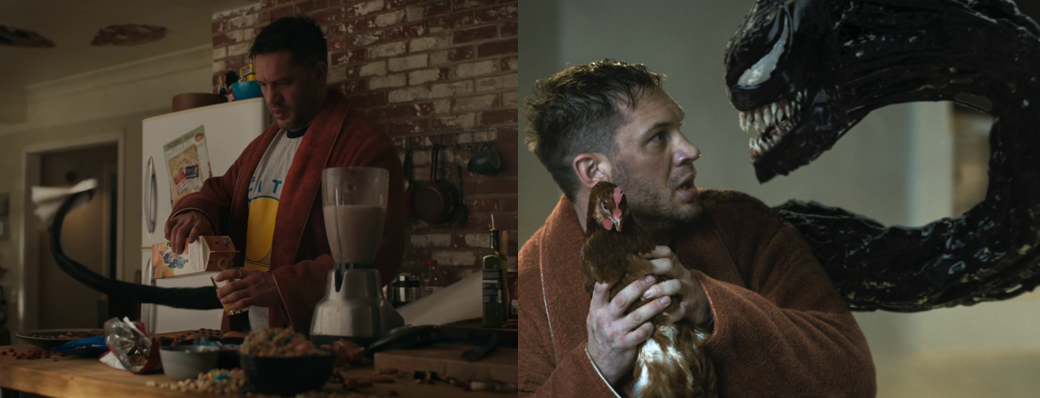
After coming to terms with his newfound relationship with the alien symbiote known as Venom, Eddie Brock ended Venom in a pretty good place: he was determined to get back to written journalism,  and win back the heart of his old flame, Anne Weying (Williams), and reached a compromise with the symbiote where the creature would be allowed to live within Eddie’s body on the provision that it only attacked, killed, and, crucially, ate bad guys. Venom: Let There Be Carnage walks the characters back a little bit and finds the two not operating as a lethal protector, but once again largely at odds with each other.

Eddie is burdened by Venom’s constant need to feed and desire to take out bad guys.

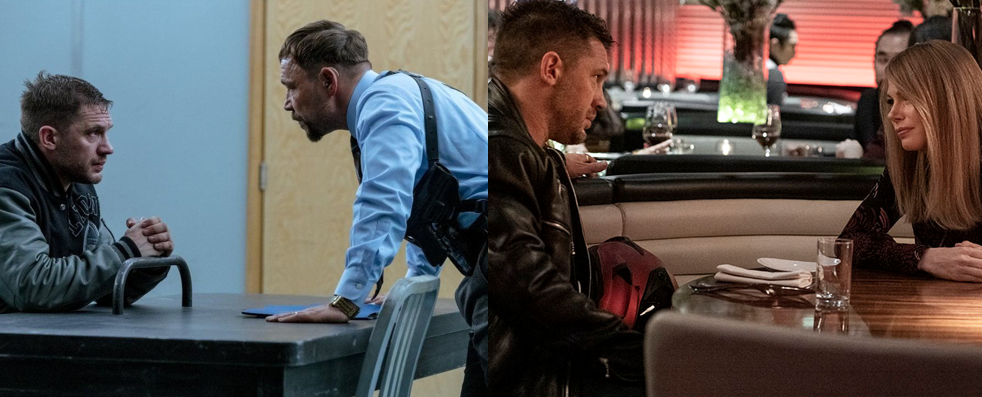
This is primarily because Eddie has been placating the symbiote with chocolate and live chickens rather than letting it ate the brains of bad guys; frustrated at being held back by Eddie’s morals, the symbiote frequently lashes out at him and demands to be let loose, but Eddie continues to exert his control over the alien parasite to avoid attracting undue attention. This gives the movie a very prominent “odd couple”/“buddy cop” feeling as Venom is basically an oversized toddler who just wants to go out and have a good time and doesn’t see why they have to hide themselves. A constant, nagging voice in Eddie’s head, Venom continually tries to give Eddie advice and push him into giving into his violent urges, which weighs heavily on Eddie; he seems to be absolutely burdened by the responsibility of housing and pacifying Venom, who represents his inner desires that he suppresses in order to live a simple life out of the spotlight. Venom resents Eddie’s hesitation in holding them back and wants to be out there, stalking bad guys and letting itself loose, rather than being cooped up in Eddie’s body and apartment. Still, Eddie’s concerns are largely validated; Detective Patrick Mulligan (Graham) is incredibly suspicious of Eddie, not just because he always happens to be in the wrong place at the wrong time and the unexplained events of the first film, but also because he’s the only person that notorious serial killer Cletus Kasady will talk to and Mulligan believes that Eddie is holding back information purely to bolster his own journalistic career.

Mulligan’s convinced Eddie’s holding out on him, while Eddie laments losing Anne.

Still a far cry from having his own, regular journalism show on television, Eddie endures Cletus’s repeated requests to talk to him primarily to help get his life back on track and to bring some relief to the families of Kasady’s victims. However, he comes across as being a selfish, self-serving reporter since to reveal the truth to Mulligan would mean his imprisonment, at best, and him and the symbiote being shipped off to some governmental facility somewhere. Venom’s near-perfect visual recall and artistic ability help Eddie to identify where Cletus has buried a number of his victims, instantly making Eddie an overnight celebrity and condemning Kasady to a lethal injection. Eddie’s exhilaration at his career turnaround is short-lived, however, when Anne reveals that she’s now engaged to the kindly Doctor Dan Lewis (Reid Scott); heartbroken at having lost his former love, tensions between Eddie and Venom finally come to boiling point, resulting in an amusing physical confrontation between the two that sees the symbiote separating itself from Eddie and heading out to live its own life. This results in a pretty amusing little side story where Venom jumps between multiple, unsuitable hosts, using them up one at a time as it tours through the colourful city streets and seeks out enjoyment. Being separated from Eddie causes Venom to slowly starve and realise how much it took Eddie for granted, while Eddie’s life generally improves without the symbiote weighing him down. This is where Anne plays her most prominent role; she doesn’t have as much to do as in the first film but makes for a great mediator between Edie and Venom, interjecting in their domestic dispute to bring them back together and force them to admit how much they need each other.   

Kasady and Shriek’s relationship is taken to the next level when he obtains his own symbiote.

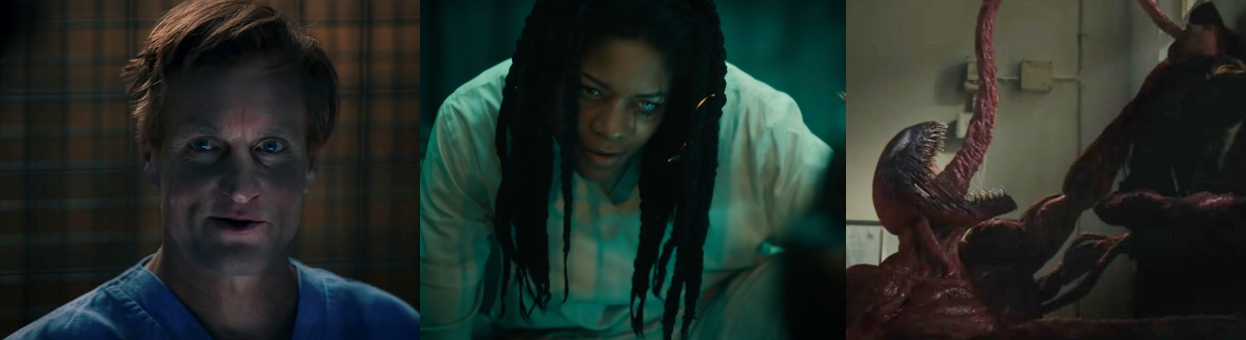
The two are soon forced to make amends, however, when Kasady suddenly sprouts a symbiote of his own; an absolutely crackpot murderer, Kasady feels a connection with Eddie due to believing them to be very similar people, with comparable backgrounds. Heavily abused as a child and with a long history of violence, Cletus is seemingly out of his mind and completely unremorseful of his actions, which have condemned him to death. During his final interview with Eddie, Kasady suddenly snaps and takes a bite out of Eddie’s hand, consuming a part of the symbiote which violently bubbles to the surface while he’s receiving his lethal injection. Dubbing himself Carnage, Kasady goes on an absolute rampage throughout the prison, killing several guards and breaking free of his confinement; he quickly comes to an understanding with his newfound alien partner that sees them joining forces to destroy their “father” and to reunite Kasady with his old girlfriend, Frances Barrison/Shriek (Harris), a Mutant sporting an ear-piercing scream who was the one source of light in Kasady’s life as a child. Of course, like Venom in the first movie (and also this one), Carnage is somewhat hampered by the film’s 15 rating; in the comics, Kasady is one of the most extreme and brutal villains from the “Dark Age” of comic books, slicing and dicing people on a whim and causing… well, carnage…with no rhyme or reason and entirely for the thrill of it. The entire point of the character was to be a more extreme version of Venom so that the symbiote could shift into more of an anti-hero role but, in the movies, Eddie is a far more stable and much nicer guy than his comic book counterpart, and Venom repeatedly states its desire to protect people from bad guys, meaning that the two are already much softer than in the comics. Still, Kasady remains as nutty as his comic book counterpart, but also far more focused; he genuinely loves Frances and wants to not only reunite with her for a killing spree but also protect her from harm, a weakness not shared by his Marvel Comics incarnation. His motivation for targeting Eddie also stems from a need to feel a genuine connection with someone, which is a far cry from just desiring senseless slaughter, but the abilities of the symbiote certainly dial all of Kasady’s worst impulses up to eleven. While bloodshed is kept to a minimum and there’s little in the way of the slasher-villain antics of his comic book counterpart, Carnage quickly amasses a pretty impressive body count and certain looks completely unhinged thanks to some top-notch CGI and being augmented to be larger and more unhinged than its “father”. With Carnage going on a tear and endangering lives, Eddie and Venom are reunited by Anne and forced to once again realise that they need each other to survive and to be special, and come together once more to confront their progeny and establish themselves as a lethal protector.

The Nitty-Gritty:
Director Andy Serkis definitely ups the ante in terms of the film’s presentation and the balance between action and humour; flashbacks to Kasady’s past are rendered using both younger actors an crudely-drawn animations to depict some of the younger Kasady’s more violent acts, which all helps to add to the character’s unhinged state of mind. The banter and dialogue between Eddie and Venom is one of the highlights of the film; Venom is constantly popping out and threatening to eat people’s heads or berating Eddie for being “weak”, and its tentacles are often whipping around mashing together food or causing mischief, which was very amusing. Thanks to having spent the majority of Venom’s runtime establishing Eddie and Venom as characters, Venom: Let There Be Carnage doesn’t have to worry about being shackled by the restraints of an origin story for them and we get to see Venom in all their glory pretty soon into the movie, which is great but does result in a bit of a rushed beginning to the film where it seems like it’s going to be a mindless, jump-cut-heavy action film but, thankfully, Serkis soon gets the film’s pacing under control and focus on the evolving dynamic between Eddie and Venom.

The conflict between Eddie and Venom forms a central element of the film’s plot.

Since we know who these characters are, much of the time spent with them is focused on showing how tension between the two are growing. This is primarily so that Eddie can lose his “powers” midway through the film and the two can relearn just how dependant they are on each other, but also allows the film the time to flesh out Kasady’s character and backstory, something he sorely needed. I actually disliked how Kasady was just tacked onto the end of Venom as a mid-credits teaser; it kind of came out of nowhere and probably left a lot of audiences unfamiliar with the characters confused as to why Woody Harrelson was sitting in a cell and sporting a bizarre wig. Personally, I would have had a recurring element of Venom be Eddie trying to gain an audience with Kasady in order to turn his career around, and only be granted this by the end, just to help foreshadow their meeting a bit but Venom: Let There Be Carnage definitely makes up for this. Harrelson seems to be having the time of his life, chewing the scenery and stealing the show as the unhinged Kasady, a madman who writes postcards and letters in a bizarre script and brags about how many people he’s killed. He was a psychopath even before acquiring his symbiote, and joining with Carnage simple allows his sordid ambitions to be completely free from any mortal restraints.

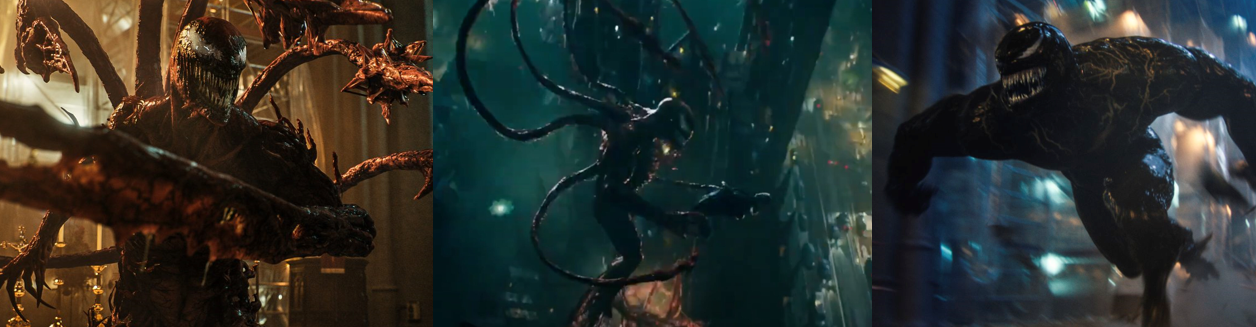
The effects do a great job of bringing Venom and Carnage to life and making them visually distinct.

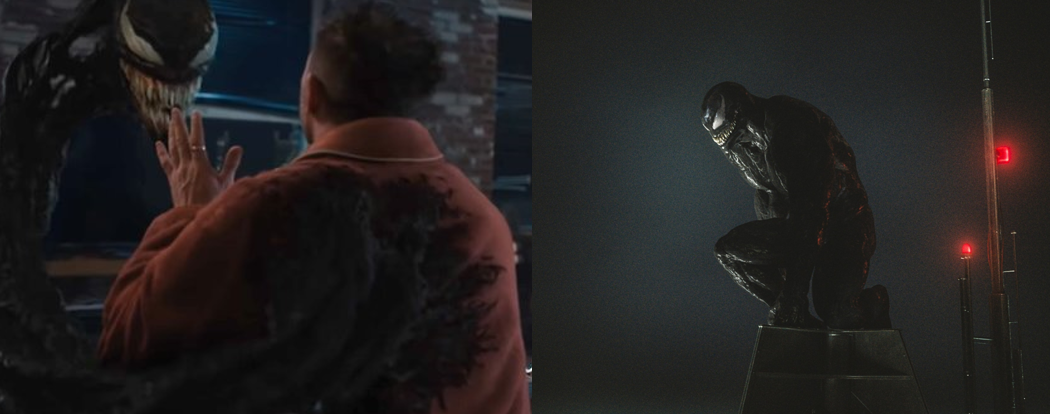
The relationship between Kasady and Carnage is as different from the comics as the one between Eddie and Venom, too; in the comics, Kasady and his symbiote form a perfect union, a symbiosis so complete that they refer to themselves as “I” instead of “we” and the symbiote even merged with Kasady’s blood, making them functionally inseparable. Here, the two converse independently like Eddie and Venom and come to a mutually beneficial arrangement very quickly, meaning that there is no conflict between the two like there is between Eddie and Venom, which allows the character to fulfil its criteria of being the most violent impulses of Venom dialled up to eleven and completely off the hook. Carnage’s threat is also accentuated by the fact that its actually bigger and much more versatile than Venom, which is also a welcome change; unlike Carlton Drake/Riot (Riz Ahmed) in the last film, Carnage is so much more visually distinct, being red, rippling with tentacles and malice, and sporting so many different abilities that even Venom is hesitant to go head-to-head with it because of how violent and dangerous the “red [ones]” can be. This results in some far more impressive and visually interesting action and fight scenes; indeed, Venom looks better than ever, all glossy and shiny and ferocious, and the effects used to bring the symbiote and its tentacles to life look much more impressive this time around. Carnage, especially, looks fantastic; I love how its so visually distinct from Venom, which really helps make their fight scenes easier to follow and far more vicious than in the last film; Kasady’s transformations are disturbing and violent as well, and just about the only thing I disliked about Carnage was that its voice was a little low (I always imagined Carnage to just shriek like a madman).

The Summary:
My expectations for Venom: Let There Be Carnage were quite low, to be honest; I enjoyed Venom but I think it was a major misstep to do the character’s story without involving some version of Spider-Man. The film just about pulled it off, but I still feel like critical elements of the character were (and continue to be) missing as a result; still, it was a pretty decent, if somewhat flawed, little action piece that was only hampered by its rating. I knew all along that Venom: Let There Be Carnage wouldn’t be rated any higher than a 15 as it just makes business sense to help it make the most money it possibly can, so I was fully prepared to see a more neutered version of Carnage but I was pleasantly surprised by how much I enjoyed this film. The odd couple dynamic between Eddie and Venom was brilliant, as was their banter and their tumultuous relationship in general, and it’s great seeing Tom Hardy’s physicality and dedication to these characters on show. The special effects were far better this time around as well; I may not like that Venom is lacking their iconic spider-symbol, but they look phenomenal here and there are far more scenes and action sequences of Venom this time around, which I greatly appreciate as a long-time fan of the character. Woody Harrelson absolutely stole the show as Cletus Kasady and Carnage, though; sure, the character is notably altered and he’s not tearing hapless innocents apart with reckless abandon, but I think this is the closest and most accurate portrayal of the character that we’re ever likely to get and they did a great job of accentuating Kasady’s madness and the ferocious nature of his symbiote. In the end, I expected Venom: Let There Be Carnage to be little more than just more of the same of the last film but it ended up being so much more and something far closer to the Venom I grew up reading in Marvel Comics.

My Rating:

Rating: 4 out of 5.

Great Stuff

Have you seen Venom: Let There Be Carnage? If so, what did you think to it? Did you like the relationship between Eddie Brock and Venom and their odd couple dynamic? What were your thoughts on Celetus Kasady and Carnage? Were you happy with the action and pace of the film and how do you feel it compares to the first movie? What did you think to the mid-credits teaser and where would you like to see the character go in the future? What are some of your favourite Venom and/or Carnage stories from the comics? Sign up to leave your thoughts on Venom: Let There Be Carnage down below or comment on my social media with your opinions.

Game Corner [Spidey Month]: Spider-Man: The Video Game (Arcade)


Easily Marvel Comics’ most recognisable and popular superhero, unsuspecting teenage nerd Peter Parker was first bitten by a radioactive spider and learned the true meaning of power and responsibility in Amazing Fantasy #15, which was first published in August 1962. Since then, the Amazing Spider-Man has featured in numerous cartoons, live-action movies, videogames, action figures, and countless comic book titles and, in celebration of his debut and his very own day of celebration, I’ve been dedicating every Wednesday to talk about everyone’s favourite web-head!


Released: 1991
Developer: SEGA

The Background:
Having achieved success with the creation of the Fantastic Four, Marvel Comics editor and head writer, the immortal Stan Lee, was searching for another title to match the success of Marvel’s first family. Inspired by a spider climbing up a wall, influenced by pulp vigilante the Spider, eager to capitalise on the surge in teenage demand for comic books, and working alongside artist Steve Ditko, Lee conceived of Spider-Man and was granted permission to feature the teenage superhero in the final issue of Amazing Fantasy. Marvel publisher Martin Goodman was shocked to find that Amazing Fantasy #15 was one of the publication’s highest-selling comics and a solo Spider-Man series soon followed, with Spidey quickly becoming Marvel’s most popular comic book character. Since then, Spider-Man has seen success in numerous other media; in 1967, he featured in a self-titled animated series, he famously appeared as a guest character on The Electric Company (1971 to 1977) and starred in his own live-action series in 1978, and heavily influenced my childhood through the fantastic Spider-Man cartoon (1994 to 1998) before eventually featuring in a number of live-action films. Furthermore, Spider-Man has also featured in numerous videogames, the first of which was the aggravating Spider-Man (Parker Brothers, 1982) for the Atari 2600. Before debuting in arcades, the majority of Spidey’s videogame efforts were sidescrolling action/platformers but this was the early nineties and button-mashing beat-‘em-ups were all the rage thanks to titles like Double Dragon (Technōs Japan, 1987), Final Fight (Capcom, 1989), and The Simpsons (Konami, 1991) so Spidey’s arcade debut naturally came in the form of a sidescrolling beat-‘em-up.

The Plot:
Wilson Fisk, the Kingpin of Crime in New York City, has sent his minions out into the city to retrieve a mystical artefact and only Spider-Man and his allies (Prince Namor McKenzie/The Sub-Mariner, Clint Barton/Hawkeye, and Felicia Hardy/Black Cat) can hope to defeat some of Spidey’s most powerful and iconic villains and oppose the Kingpin’s plans for domination.

Gameplay:
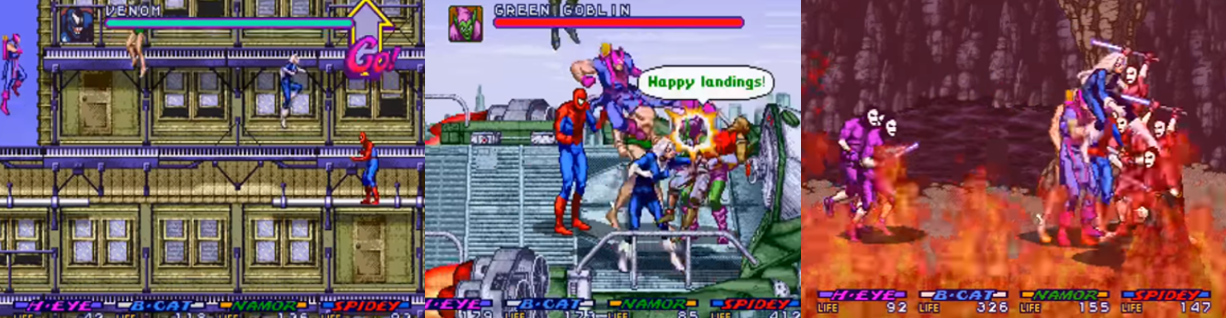
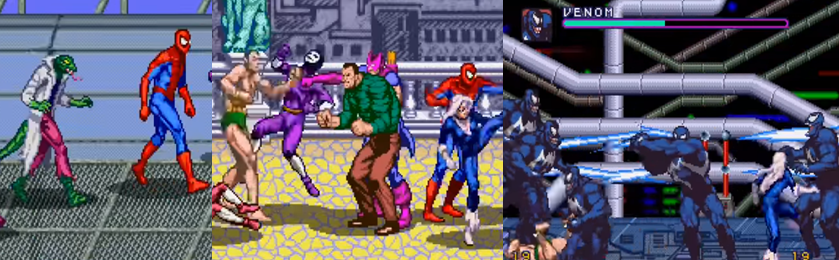
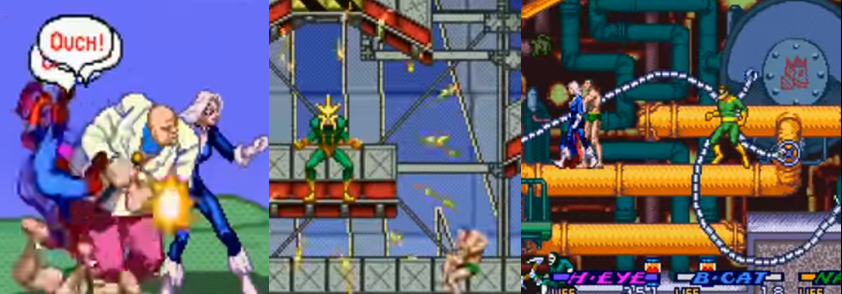
Spider-Man: The Video Game is a fairly standard sidescrolling beat-‘em-up in which players can pick from one of four characters (Spider-Man (obviously), Sub-Mariner, Hawkeye, and Black Cat) and make their way from the left side of the screen to the right beating up wave-upon-wave of nameless thugs. The game allows any player to select any character and allows for up to four players to play simultaneously, which is always an appreciated feature of such titles.

Each character is sluggish and gameplay is shaken up by some ugly platforming sections.

Upon selecting your character, you’re dropped into the streets of New York and quickly learn that the game is quite limited in terms of the moves available to you. Each character controls in exactly the same way, with a few subtle differences: Spidey and Black Cat can swing from webs/lines to attack enemies (if you can pull off the attack, which kind of requires a very specific combination of jumping and attacking) and each has a slightly different jumping attack (Namor dives fist-first down into enemies, for example) and melee attacks (Black Cat is much more about the fancy kicks than Hawkeye). While you can perform a signature special attack (shooting webs or arrows, for example) at the cost of some health points, each character is just as sluggish and apathetic as the next thanks to a lack of a dash function. However, after beating up a few thugs and taking out a sub-boss, the game suddenly shifts to an entirely different perspective; the camera zooms out and the game becomes more of an action/platformer as your character must scale a vertical and horizontal map taking out more goons as they go. In this zoomed out mode, your characters are no longer able to perform melee attacks and must rely on their projectile attacks: Spidey shoots webs, Hawkeye shoots arrows, Black Cat attacks with a grapple hook, and Namor….shoots lightning…? Spidey and Black Cat can also scale and climb walls to navigate these areas faster and Hawkeye and Namor can hang on to overhead platforms to shoot at enemies but it’s a bit weird that you’re not given full access to each character’s abilities in this mode.

Your health drains constantly and players are rated after each stage.

Unlike many videogames and beat-‘em-ups, inserting coins not only allows you to continue from death but also boosts your health, which is represented by a series of numbers under your character’s name. Your health numbers also double as a time limit as they’re constantly ticking down and this is quite a unique and clever way to get kids to waste their hard-earned pocket money as, while you can find health (in the form of hearts) strewn around the game’s stages at various points, you’ll quickly be pummelled into submission by the game’s enemies and forced to drop more coins to pump up your health and continue on a little further. Sadly, in a marketplace crowded by fantastic beat-‘em-ups, Spider-Man: The Video game fails to stand out in a lot of ways; you can attack and destroy parts of the environment but there’s not much motivation to do this as there are no weapons to find and use and no items to pick up to increase your score. Your score isn’t even displayed onscreen as you play, for God’s sake, which is really unusual, despite the fact that your progress is rated at the end of each stage. Instead, the game’s primary selling point appears to be exclusively the Spider-Man brand and the odd inclusion of action/platforming sections.

Graphics and Sound:
For the most part, Spider-Man: The Video Game looks serviceable enough; sprites are large and colourful but, like the backgrounds, are a little lacking in variety and detail. None of the playable characters have an idle animation, which lets the game down somewhat, and Spider-Man, especially, just looks bored and depressed as he plods around at a sluggish speed. When the game zooms out for its platforming sections, sprites take on a largely pixelated appearance but the backgrounds become much bigger and more detailed. Stages initially seem quite short as you come up against your first sub-boss in almost no time at all and, after defeating them, you’re tasked with climbing up to the rooftops of New York’s skyscrapers and the stages really open up.

Platforming sections expand the game, with “Latvelia” being the most visually interesting.

As you attack enemies, and are attacked, big comic book-style sound effects appear onscreen (as is pretty standard for comic book beat-‘em-ups) but I found sprites go a bit transparent when they pass over other sprites and graphics (though this could be due to emulation issues rather than a flaw of the title itself). The game does feature some limited voice acting but, despite featuring a female voice (who just loves to cry out “Spider-Man!” every time you insert a coin), no female voice work accompanies Black Cat. This isn’t necessarily a bad thing as the male voice acting is the same for every character and hardly of a high standard and when you realise that Namor and Black Cat’s attacks are accompanied by some really weird sound effects that make them sound like they’re drowning or a robot, respectively. As you might expect, comic book-style cutscenes tell the game’s story; these take the form of still images with some accompanying text (though these don’t change depending on your character and mostly just feature Spidey by himself) and in-game cutscenes with some fitting word balloons. Finally, while the game’s stages are fairly standard (the streets, the rooftops, flying through the skies, construction sites and the like), they don’t really stand out much until you crash-land into the hellscape of “Latvelia” and the game suddenly busts out some decent fire effects. Finally, the game’s music, while interesting and serviceable enough, doesn’t really feel very unique to the Spider-Man brand or compared to other beat-‘em-ups.

Enemies and Bosses:
The majority of the enemies you’ll encounter throughout your journey are literally nameless, faceless goons; weird kabuki-mask-wearing, purple-spandex-clad thugs are the order of the day here but they are soon joined by such cliché beat-‘em-up enemies as martial artists (who can duck your attacks), rotund enemies (who can belly flop you), and robots (which shoot projectiles). Spider-Man: The Video Game honestly doesn’t have much going for it in terms of enemy variety; you’ll fight the same enemies over and over and only encounter some weird and memorable foes with you reach “Latvelia” and encounter some weird ape-like monstrosities. However, Spider-Man: The Video Game is absolutely loaded with some of Spidey’s most iconic villains; after only a couple of minutes into the first stage, you’ll encounter Mac Gargan/Scorpion and, just as you’re getting into that fight, a massive containment unit opens up and Eddie Brock/Venom emerges.

You’ll face Spidey’s most iconic foes while swarms of enemies pile in on the action!

Although Scorpion soon runs off after a few hits, you’ll have to endure a handicap situation for a while as enemies spawn in, Venom teleports around the arena and chokes you with their goo, and Scorpion attacks you relentlessly. Once you whittle down Venom’s health, they use a mysterious artefact to grow to monstrous size and you’ll have to chase them to the rooftops for another encounter. This becomes the basic set-up for the majority of the game’s sub-bosses and bosses; you’ll fight them at one point and then have to give chase and battle them again in a slightly different situation after navigating the game’s zoomed out sections. You’ll battle Dr. Curt Connors/The Lizard (who has a nasty tendency to chomp down on your crotch), Flint Marko/Sandman, and Venom in a pretty standard beat-‘em-up format where you’ll be confined to an arena and have to fend off waves of additional enemies. Each boss reappears for a rematch later in the game but the strategy remains largely the same; keep your distance and land attacks while dispatching their support and things only really get hairy when Venom spawns a bunch of symbiote clones to fight alongside them!

While Kingpin is a marginal threat, Electro and Doc Ock really get the shaft!

Boss battles are mixed up a bit when you take on Norman Osborn/Green Goblin and Jason Macendale/Hobgoblin; while you’ll battle the Green Goblin on the ground, dodging his weird glowing hand attack, these two bosses stand out by taking to their iconic gliders and rushing at you from the air while tossing pumpkin bombs at you. These can be troublesome encounters as it’s difficult to judge where the Goblins are positioned to land your attacks or to successfully hit them with your jump attacks. Plus, when you battle Hobgoblin, you’re limited to your zoom-out attacks and will have to blast him with your projectiles and destroy large cannons to make things easier. You’ll also do battle with the Kingpin in a standard beat-‘em-up encounter; Kingpin’s attacks are limited to headbutts, swipes, and a shoulder barge, making him little more than an inconvenience than a formidable boss fight even in his second phase. Still, at least he actually gets a proper boss fight; Max Dillon/Electro and perhaps Spidey’s most famous foe, Dr. Otto Octavius/Doctor Octopus are relegated to mere semi-sub-bosses who randomly appear as you’re navigating the game’s later platform stages and they’re little more than a joke as you can easily damage boost through their attacks and pummel them into submission.

Doctor Doom is the game’s final boss and takes numerous forms.

After defeating the Kingpin, though, Dr. Victor Von Doom/Doctor Doom randomly appears to claim the mysterious artefact and reveal himself to be the game’s true big bad. When you reach Doom’s Castle, you’ll have to dodge mines and battle through the game’s previous sub-bosses and bosses to confront Doctor Doom…only to find you’ve battled a Doombot all along! However, when you finally do get your hands on the real Doctor Doom, the fight is still little more than a standard affair once you take out Doom’s nifty floating battle craft: Doom is fast and slippery but doesn’t attack with magical bolts until the final confrontation and even then he’s not much more of a threat than the likes of the Sandman or the Lizard.

Power-Ups and Bonuses:
As mentioned, there’s pretty much nothing on offer to spice up your gameplay in Spider-Man: The Video Game. You can’t pick up and use weapons or power-ups and the only thing for you to pick up is hearts to increase your health, making gameplay decidedly more repetitive and monotonous compared to other beat-‘em-ups.

Additional Features:
Again, there’s basically nothing here (as is pretty much the standard for most arcade games). However, the fact that you can select any character to play as and play with up to four players, each who accumulate their own separate score at the end of each stage, does add some replay value (if you have friends to play with, of course…)

The Summary:
Spider-Man: The Video Game is a decent enough beat-‘em-up; it’s bright and colourful and includes all of Spider-Man’s most iconic villains but it doesn’t really offer a whole hell of a lot when it comes to gameplay or variety. Beat-‘em-ups are generally quite monotonous as a rule but they usually compensate for this with kick-ass music, detailed sprites, and some cool weapons and super moves; Spider-Man: The Video Game has none of these attributes, meaning it’s a step behind other arcade titles released at the same time and even ones released years prior. The game’s unique selling point of having action/platforming sections incorporated into the usual beat-‘em-up formula is interesting but its execution is flawed thanks to the graphics taking a hit. Throw in an odd assortment of playable characters (I get why Black Cat is there but why are Namor and Hawkeye here?), some repetitive boss battles, and disappointing use of some of Spidey’s more visually striking foes and you have a gameplay experience that is fun enough (and probably better alongside friends) but hardly worth choosing over the likes of Final Fight or even Double Dragon. Put it this way: X-Men (Konami, 1992) released the very next year and is everything Spider-Man: The Video Game wishes it could be; hell, even Captain America and the Avengers (Data East, 1991) offers more in terms of gameplay variety and character abilities despite being graphically less impressive and that’s really saying something.

My Rating:

Rating: 2 out of 5.

Could Be Better

Did you ever play Spider-Man: The Video Game out in the wild? Which character did you pick, or get lumbered with, and which did you think was the best or the worst? What did you think of the game’s unique incorporation of platforming elements and the way it handled Spidey’s villains? Which characters do you think would have been more suitable to play in place of Namor and Hawkeye? Which Spider-Man videogame, or arcade beat-’em-up, is your favourite? Whatever you think, feel free to drop a comment below and be sure to check out my other Spider-Man content.

Back Issues: The Amazing Spider-Man #300

Story Title: “Venom”
Published: May 1984
Writer: David Michelinie
Artist: Todd McFarlane

The Background:
In 1982, Marvel Comics’ editor-in-chief Jim Shooter took a liking to an illustration from reader Randy Schueller that depicted Spider-Man in a smooth, black outfit with a large red spider motif across the chest; after purchasing the concept for a mere $200, writer Tom DeFalco and artist Ron Frenz conceived of the costume being a living organism and Spidey’s new black suit debuted without explanation in The Amazing Spider-Man #252 before Marvel Super Heroes Secret Wars #8 revealed that Spidey acquired the suit during the “Secret Wars” event. Over the next year or so, Spidey revelled in the costume’s unique and helpful ability to form both clothing and organic webbing until Doctor Reed Richards/Mister Fantastic revealed its true nature as a symbiotic lifeform. Out of fear, Spidey rejected the symbiote, using the cacophony of church bells to drive it from his body and began wearing a cloth version of his black suit. At the conclusion of Web of Spider-Man #24, though, a mysterious assailant attempted to push Peter in front of an oncoming train and a shadowy figure was clearly stalking him throughout 1988 before the symbiote, now known as Venom, made its full and dramatic reappearance. Since then, Venom has evolved from a gruesome, twisted killer into a violent anti-hero and a more morally righteous hero, with the symbiote jumping from numerous hosts and spawning a number of similarly-powered offspring. Acting as Spider-Man’s dark doppelgänger, Venom was an immediate favourite for me and many readers thanks to their knowledge of Spidey’s true identity, resistance to his spider-sense, and having all of Spidey’s powers (and more) but being far for vindictive, sadistic, and lacking Peter’s strong moral compass.

The Review:
“Venom” opens with the startling image of Mary Jane Watson-Parker, Peter’s former fling turned wife, huddled in the corner of their apartment nearly out of her mind with fear. When Peter returns home, still garbed in his cloth black costume, initially Mary Jane recoils in horror before gratefully embracing Peter. Peter, though disturbed by Mary Jane’s condition and the fact that she was attacked in their apartment, is even more troubled by her description of her attacker and worries that the alien costume might have survived their dramatic break-up. Mary Jane, ever the feisty and capable woman, is largely back to her old self after a good night’s rest in a hotel and immediately makes arrangements for them to move so she can put the whole thing behind her.

The usually strong-willed and brazen Mary Jane is left a trembling wreck by Venom.

However, overcome with his characteristic worrisome nature, Peter retrieves a Sonic Blaster from the Fantastic Four (a formidable weapon against the symbiote, which is highly vulnerable to sonic waves and intense heat), but is too highly strung to notice a mysterious stranger stalking him or to properly socialise with his friends and family, despite Mary Jane’s best efforts to perk him up. It’s an extremely effective way to introduce Venom without even seeing them on-panel; although Venom doesn’t physically hurt or molest Mary Jane, their mere presence and alien nature are enough to reduce her to a shivering wreck. Her condition greatly disturbs Peter, who points out through his internal monologue what a strong, impendent, and capable woman Mary Jane usually is; she’s always been very brazen and outspoken so to see her reduced to little more than a frightened child is a chilling moment for him (and us, the reader). At their house-warming party, Peter suddenly leaves after spotting his alien costume swinging around town and is immediately blind-sided by a muscular doppelgänger of himself baring a horrific grin. Although the reader was introduced to Eddie Brock, a large, stone-faced, muscle-bound man who is in possession of the alien costume, earlier, we don’t actually learn who he is or any of his backstory until this moment. Previously, we saw that he lives in a rundown apartment full of weightlifting equipment and newspaper clippings of Spider-Man, openly converses to the symbiote (though it doesn’t answer him back), and that he religiously pumps iron to increase both his physical strength and the strength of the symbiote.

Brock was driven to the edge before bonding with the symbiote and becoming Venom.

Peter, however, recognises not only the symbiote but also Brock, who is revealed to have been a respected reporter whose reputation was tarnished when he was duped by a compulsive confessor. Because Spider-Man captured Stan Carter/The Sin-Eater, Brock’s big story was discredited and he blamed Spider-Man for the sudden downturn in his fortunes. Brock’s mania was so complete and had blinded him so completely that he was driven first to strenuous exercise and, finally, to suicide; however, right as Eddie was contemplating the worst sin imaginable to his Catholic upbringing, the symbiote found him and, joined in their hatred of Spider-Man, they formed a bond so complete that Venom was born.

Spidey’s mercy proves to be his downfall as Venom are easily able to overpower and defeat him.

Though Spidey tries to use Brock’s monologue to edge his way towards his Sonic Blaster, Venom easily overpowers him with their superior strength. Spidey is, however, able to knock Venom down with a massive girder and blast him with the Sonic Blaster; Spidey hesitates, though, when he realises that the two have formed an unbreakable symbiotic bond and that further exposure to the high-intensity sound waves could kill Brock and decides to regroup and think of a new plan. This is all the hesitation Venom needs to recover, though, and with one massive blow, they knock Spidey out. When he awakens some hours later, Spidey finds that he has been webbed up to a church bell by Venom’s far stronger and much thicker webbing. Brock, now garbed in a priest’s robe, revels in the delicious irony and fitting nature of Spidey’s impending death since Peter tried to use the same massive bells to destroy his “Other”. Like any good, overconfident villain, Venom leaves Spider-Man to his fate and, as such, misses their chance to keep Peter from using his sheer force of will and brute strength to keep himself from being pounded into mush and breaking free of Venom’s webbing.

Spidey outsmarts Venom by forcing them to expend their webbing and tire out.

Unable to match Venom’s strength and at a serious disadvantage since Venom doesn’t set off his spider-sense and appears to have all of his strengths and abilities, Spidey decides to outsmart Venom by forcing them to expend their webbing and tire themselves out, draining the symbiote’s energy and sending Brock crashing to the street below. The story ends with Brock, and the symbiote, being held captive at Four Freedoms Plaza, the high-tech home of the Fantastic Four; there, encased within a cylinder and rendered inert by a constant barrage of sonic waves, Venom’s threat is effectively neutralised. Upon safely returning to Mary Jane, Peter and his wife agree that it is no longer appropriate for him to wear the black costume given Venom’s sadistic nature and he finally returns to the classic red and blue for the first time in about four years.
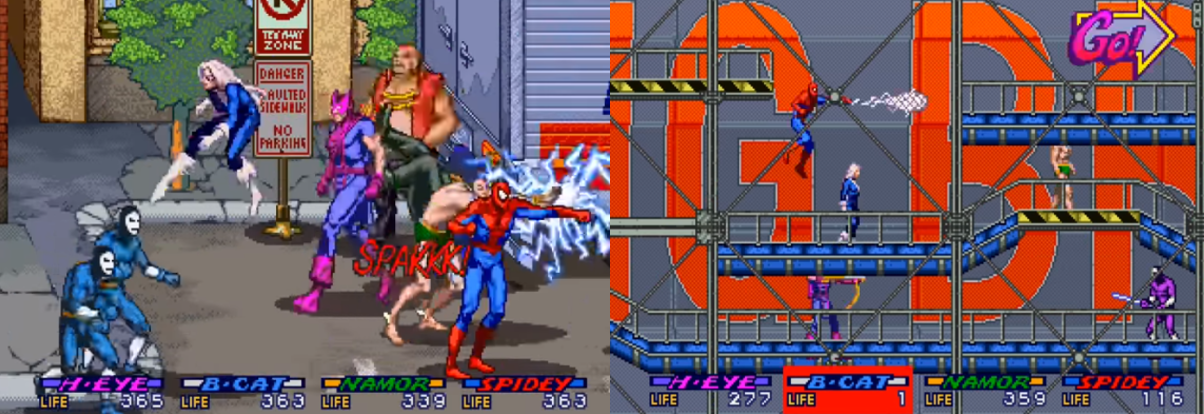
The Summary:
“Venom” is a really great introduction for one of Spider-Man’s most complex and vicious foes; this story took place during the much lauded Micheline/McFarlane pairing, which results in some absolutely fantastic and detailed artwork. McFarlane always drew a brilliant Spider-Man, emphasising the complexity of his webs, the inhuman positions and poses he would strike while web-slinging, and giving every character an edgy, nineties make-over to help them stand out a little more. Venom, in comparison, is far more subdued, visually, than he would later be, appearing as simply a jet-black, muscular version of Spider-Man with a demonic grin; it wouldn’t be until Mark Bagley came onto the title that Venom would take on some of their more recognisable characteristics, such as the writing tentacles, mass of teeth, and long, drooling tongue.

Brock is a hypocrticial, deluded, sadistic individual in his debut.

Still, Eddie Brock makes for a unique and interesting new addition to Spidey’s rogues gallery; Brock is one of a handful of Spidey’s villains who actually knows his secret identity and the only one (at the time) able to use that information to his full advantage thanks to his ability to circumvent Peter’s spider-sense and the many attributes of his alien costume. Brock is, of course, a complete madman here and in his early appearances; slighted by Spider-Man’s involvement, he blames all of his failings on Spidey rather than admit to being duped by a compulsive confessor. Eddie believes that Spider-Man is an evil and malevolent individual and that it is his sacred duty to put an end to his (Spidey’s) menace; his obsessive mania is so complete that he kills an innocent police officer and then justifies it as being necessary to his “righteous revenge”. He openly admits to being disgusted by innocent death but is all-too-happy to torment Mary Jane, stalk Peter, and attack Spider-Man with a maniacal glee.

Despite all their power, Venom are defeated quite easily through Spidey’s guile and cunning.

If there’s a downside to the story, it’s simply that Venom is defeated rather anti-climatically; the Sonic Blaster proves effective but Peter is too concerned with Brock’s well-being to press his advantage and, unable to match Venom’s brute strength (which is on par with Spidey’s and further augmented thanks to Brock’s intense physical training), Spidey simply has the symbiote exhaust itself and that’s it. However, Venom’s threat wouldn’t end here by a long shot and this is a simple way to leave the door open for their subsequent, far more impressive return and defeats. Furthermore, this tactic shows how blinded by his rage and spite Venom are and how adaptable and intelligent Peter can be; he doesn’t win through sheer mindless brute strength, as Venom are attempting to do, and must instead rely on his wiles and intelligence to overcome Venom’s very real and lethal threat.

My Rating:

Rating: 4 out of 5.

Great Stuff

Have you read “Venom”? Did you purchase a copy of The Amazing Spider-Man’s landmark 300th issue back in the day? What did you think to Venom’s introductory story; were you a fan of the concept and character or do you feel they are a product of a darker time in comics? What did you think to Spider-Man’s black costume and the revelation that it was an alien symbiote? What is your favourite Venom story? How are you celebrating Venom’s dramatic debut today? Whatever your thoughts on Venom, do please leave a comment below.
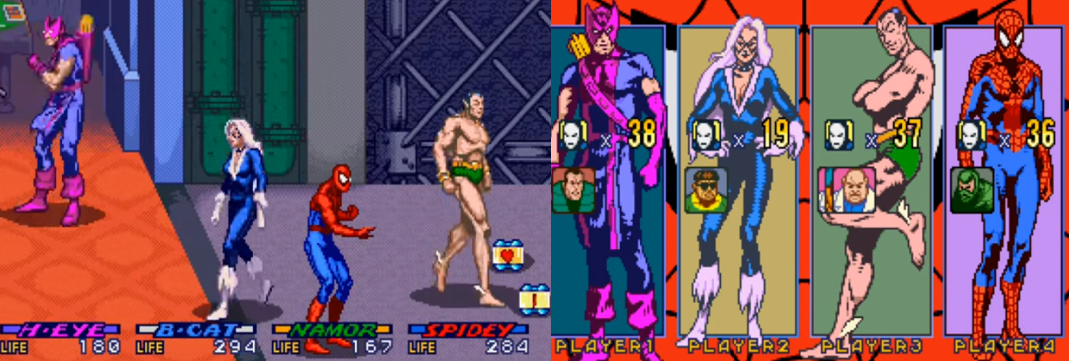
10 FTW: Dark Doppelgängers

10FTW

If there’s one thing any hero can count on it’s that, at some point in their illustrious career, they’re going to have to face off against themselves. Sometimes, like with the classic Demon in a Bottle (Michelinie, et al, 1979) this is a metaphorical battle against their own inner demons and foibles but. More often than not, it’s a literal battle against an evil version of the themselves. Sometimes they’re from another world or a parallel dimension, perhaps they’ve used stolen technology or been cloned from the hero; other times, they are of the same race or seek to replicate the hero’s powers and usurp them. Whatever the case, I’ve always enjoyed a good doppelgänger, generally because they’re just like the hero but dark and edgy or more violent and, being as I grew up in the nineties, I like that kind of stuff. An evil version of a hero can help to elevate the hero by allowing them to overcome their failings and, sometimes, will even edge out of villain territory and become either a full-fledged hero in their own right or a line-towing anti-hero. In either case, today I’m going to run through ten of my favourite dark doppelgängers; evil versions of heroes who are just cool through and through.

10DarkLink
10 Dark Link / Shadow Link

First appearing in Zelda II: The Adventure of Link (Nintendo EAD, 1987) this shadowy version of the heroic Link gets the number ten spot purely because he isn’t really much more than a glorified henchmen for main series villain, Ganon. In true Peter Pan (Barrie, 1902) fashion, Dark Link often takes the form of a pitch-black shadow or a dark, distorted reflection and is able to perfectly mirror all of Link’s attacks and abilities. In recent years, he’s appeared more as a phantom and been given more definition but he’s generally relegated to being a sub-boss for a game’s dungeon and never the true threat to the land of Hyrule.

9Wario
9 Wario

Debuting in Super Mario Land 2: 6 Golden Coins (Nintendo R&D1, 1992), this bloated, disgusting, twisted version of Mario is everything Nintendo’s cute and cuddly mascot isn’t: he’s rude, crude, mad, bad, and dangerous. Where Mario jumps on blocks and Koopa heads to save a delightful Princess, Wario barges through walls and tosses his enemies at each other to steal, loot, or recover treasure. Wario even has his own version of Luigi, Waluigi (who exists more for the sake of existing, I would argue) but, while he crashed onto the scene in a big way by taking over Mario’s castle, Wario has softened over the years. He’s transitioned from an anti-hero and begrudging ally to simply a master of ceremonies as Nintendo moved him away from being the star of his own series of unique games and more towards party games and mini games.

8 Black Adam

Created by Otto Binder and C. C. Beck, Teth-Adam was originally gifted the magical powers of the wizard Shazam and chosen to be his champion, Mighty Adam. After being bewitched and corrupted, however, Adam was stripped of his powers and withered away to dust but, centuries later, was reborn when his ancestor, Theo Adam kills Billy Batson’s parents to lay claim to Adam’s power. Black Adam possesses all of the same powers as Captain Marvel/Shazam but is also gifted with a pronounced mean streak and tactical genius; he briefly reformed for a time, even joining the Justice Society of America and building a family of his own, but his quick temper and deep-seated contempt for humanity generally always drives him into a murderous rampage that few heroes can hope to oppose.

7Janus
7 Alec Trevelyan / Janus

Appearing in what is still probably the best James Bond film ever made, GoldenEye (Campbell, 1995), Alec Trevelyan (masterfully portrayed by Sean Bean) was one of MI6’s top 00 agents. However, wanting revenge against the British government for the death of his family and comrades during World War Two, Trevelyan faked his death and formed a criminal organisation named after his new alias, Janus. Trevelyan makes the list because he’s everything James Bond (Pierce Brosnan) was but twisted towards villainy; he and Bond were close friends and partners and his “death” weighed heavily on Bond’s conscious for nine years, making his betrayal even more sickening. In facing Trevelyan, Bond not only faces his biggest regret and mistake but also himself and what he could easily become if the fates were different.

6Slash
6 Slash

First appearing in ‘Slash, the Evil Turtle from Dimension X’ (Wolf, et al, 1990), Slash was originally an evil violent mirror of the heroic Teenage Mutant Ninja Turtles who often appeared in Turtles videogames and merchandise as a sub-boss for the Turtles to fight. For me, his most iconic look is when he’s sporting a black bandana, some spiked apparel, razor-sharp, jagged blades, and a heavy, armour-plated, spiked shell. Slash’s look and characterisation have changed significantly over the years as he’s gone from a somewhat-eloquent villain, to a rampaging monster, to an ally of the Turtles depending on which version you’re reading or watching.

5TheMaster
5 The Master

Originally (and, perhaps, most famously) portrayed by Roger Delgado, the Master was a renegade Time Lord who rebelled against his overbearing masters to freely wander through time and space. While this closely mirrors the story of his childhood friend, the Doctor (Various), the Master was the Doctor’s exact opposite: evil where the Doctor was good, malicious where the Doctor was kind, and wanted nothing more than to extend his lifespan, conquer other races, and destroy (or break) his oldest rival. Though sporting a deadly laser screwdriver and able to hypnotise others, the Master gets the number five spot simply because he’s been overplayed to death in recent years. Time and time again we’ve witnessed the Master at the end of his regeneration cycle, or destroyed forever, only for yet another incarnation to appear and wreck more havoc. He’s even redeemed himself and turned good before, and yet still returns to his wicked ways to plague the Doctor even when his threat should long have ended.

4 Metal Sonic

Speeding onto the scene in Sonic the Hedgehog CD (SEGA, 1993), Metal Sonic stands head-and-shoulders above all over robot copies of Sonic the Hedgehog simply by virtue of his simplistic, bad-ass design. A fan favourite for years, Metal Sonic has made numerous appearances in multiple Sonic the Hedgehog (Sonic Team/Various, 1991 to present) videogames, comic books, and other media. Sporting a sleek, aerodynamic design, chrome plating, and a massive jet engine on his back, Metal Sonic did something no one had done at the time of his debut and not only matched Sonic’s speed, but outmatched it on more than one occasion. While Sonic CD is far from my favourite Sonic title, it’s hard to downplay the iconic race against Metal Sonic in Stardust Speedway or his impact on the franchise.

3ReverseFlash
3 Reverse-Flash

Versions of the Reverse-Flash have plagued DC Comics’ speedsters over the years, most notably Edward Clariss (The Rival), Eobard Thawne (Reverse-Flash), and Hunter Zolomon (Professor Zoom). Sporting a yellow variant of the classic Flash suit and shooting off sparks of red lightning, the Reverse-Flash is generally characterised as using his powers to torture the Flash out of a twisted desire to make him a better hero. Reverse-Flash’s threat is increased by his tendency to travel through time, evading death and plaguing different generations of the Flash; Professor Zoom was even able to manipulate the Speed Force to jump through time and appear to be faster than the Flash. Reverse-Flash has also been the cause of numerous agonies in the lives of multiple Flashes; he’s killed or threatened those closest to him (including Barry Allen’s mother) and delights in bringing the Flash to the brink of his moral code.

2JudgeDeath
2 Judge Death

Hailing from an alternate dimension where life itself is a crime (as crimes are only committed by the living), Judge Death is the dark counterpart to no-nonsense lawman Judge Dredd. First appearing in 1980 and created by John Wagner and Brian Bolland, Judge Death assumes the appearance of the Grim Reaper and uses his demonic powers to kill with a touch. Rocking a metal design (recently evoked by the Batman-Who-Laughs, another contender for this list), Judge Death takes Dredd’s uncompromising enforcement of the law and ramps it up to eleven. Alongside his fellow Dark Judges, he once slaughtered over sixty million citizens of Mega City One and, despite his corporeal form being destroyed or trapped, has returned time and time again to bring judgement upon the living.

1 Venom

Perhaps the most popular (or, at least, mainstream) of all dark doppelgängers is the alien symbiote who, when bonded to Eddie Brock (or others), is known as Venom. Created by David Michelinie and Todd McFarlane, Venom began life as a black alien costume that absorbed Spider-Man’s powers and abilities and sought to permanently bond with him. When Spidey rejected it, it turned to Brock and, through their mutual hatred of Spider-Man, Venom was born. Sporting a super simple design (pitch-black with a white spider logo, emotionless white eyes, deadly fangs and claws, and a long, drooling tongue), Venom plagued Spidey for years. Immune to Spidey’s Spider-Sense and sporting all his powers, but double the strength and viciousness, Venom has evolved from a sadistic villain, to an anti-hero, to all-out hero over the years but, thanks to their equally violent offspring, has been the source of much death and woe to Spider-Man since day one.

0CrimeSyndicate

What dark doppelgänger is your favourite? Were there any I missed off this list, or do you, perhaps, feel the evil copy is a played out trope? Drop a line in the comments and pop back for more lists and articles.

Movie Night: Venom

VenomLogo

Released: October 2018
Director: Ruben Fleischer
Distributor: Sony Pictures Releasing
Budget: $100 million
Stars: Tom Hardy, Michelle Williams, and Riz Ahmed

The Plot:
Disgraced reporter Eddie Brock (Hardy) is bonded with a psychotic symbiotic alien lifeform and becomes a superhuman anti-hero forced to choose between protecting the innocent and enacting revenge.

The Background:
A Venom spin-off had been in the works since Spider-Man 3 (Raimi, 2007), if you can believe that. Sony, once a studio capable of making good decisions and responsible for kicking off the modern superhero crazy with Sami Raimi’s first two Spider-Man movies (2002; 2004), have been determined to produce a Venom movie, even after the character was unceremoniously killed off in Spider-Man 3, and when the Amazing Spider-Man (Webb, 2012; 2014) series was ended prematurely, and now, when the rights to Spider-Man are shared with Marvel Studios. This means that, while Sony can produce spin-offs of Spider-Man characters like Venom, it doesn’t look like they can actually include Tom Holland’s version of the web-head. This has created some confusion, even amongst the two studios, with some at Sony stating that Venom exists adjacent to the Marvel Cinematic Universe and others proclaiming that it is a standalone story, and still others claiming that it’s both! Seemingly inspired by the success of R-rated, violent superheroes like Wade Wilson/Deadpool and Logan/Wolverine, Sony fast-tracked Venom and brought the production back to life, even managing to snag Tom Hardy in the process. Unfortunately, it seems that, at the last minute, someone at Sony lost their balls and, rather than a violent R-rated affair, Venom is more a watered down, studio-friendly version of the character in order to sell more tickets.

The Review:
Venom takes inspiration from three prominent arcs of the character’s self-titled series: Lethal Protector (Michelinie, 1993), Separation Anxiety (Mackie, 1994-1995), and Planet of the Symbiotes (Michelinie, 1995), whilst also taking some inspiration from the character’s origins and portrayal in the Ultimate Spider-Man (Bendis, 2000). This means that Venom is quite a talkative, violent character who isn’t necessarily interested in saving lives but is also driven to punishing only those who do wrong by others, which should result in an interesting and layered character and, instead, produces a fun, if kind of dumb, action movies that could have been really violent but was hampered by studio interference.

VenomDuality
Hardy really captures the duality of Eddie and the symbiote.

Therefore, Venom is an interesting beast; the film lives and dies by the strength and versatility of its star and Tom Hardy is brilliant as a likeable, downtrodden underdog who is trying to do what’s right but is tempted by the power offered by the symbiote to strike back at those who have wronged him. Hardy pulls double duty in this film, playing both Eddie Brock and voicing the alien symbiote, and is portrayed as a loser who screws up his life and blames others for it.

VenomDrake
Here’s an eccentric in a suit. He’s a bad guy.

Unfortunately, the same praise can’t really be said for some of Hardy’s co-stars. Carlton Drake (Ahmed) is every wacky evil corporate villain you’ve seen on film before and, while I didn’t exactly hate him or dislike his performance, I am personally just tired of seeing guys in suits being evil for no real reason. Rounding things out are Anne Weying (Williams), Eddie’s former fiancée who is serviceable enough but sure drops Eddie’s ass pretty quickly after he screws up an important interview. One person who did stand out for me was Dr. Dora Skirth (Jenny Slate), who was super cute and spunky and had a nice little character arc going on. I almost wish that Eddie had started the film with nothing and developed a romance with her rather than trying to find ways to repair his relationship with Anne as Dora had a lot more potential in her.
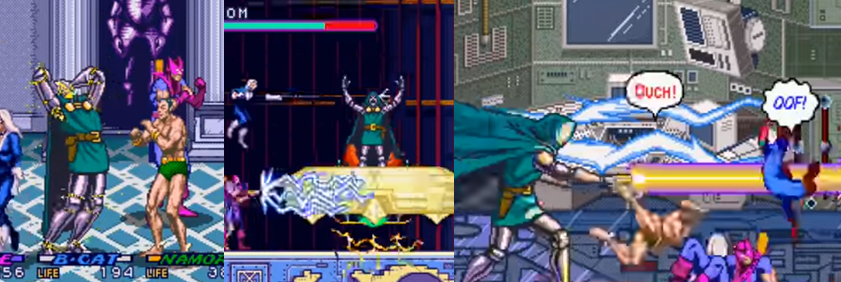
VenomBond
The symbiote offers Brock the power…but at a price.

Effects wise…well, Venom by its very nature requires substantial special effects and CGI to create the brain-eating anti-hero and it definitely seems like the studio put all of the money into making Venom look as good as possible and, honestly, Venom does look fantastic when he’s on screen. The problem is he’s just not on screen enough; a lot of the runtime is focused more on Eddie as a character and slowly developing his rapport with the symbiote and discovering what it can do, which is great as we really didn’t get to spend enough time with Brock (Topher Grace) in Spider-Man 3 but, as a massive fan of the character, I just wanted to see more Venom in my Venom movie. Other effects, though, are a bit hit and miss; in its non-bonded form, the symbiote is little more than writhing, liquid-like goo that honestly looked a bit dodgy. The effects used in Spider-Man 3 actually looked better and made the symbiote appear more vicious and dangerous; similarly, I wasn’t a fan of how the symbiote formed tentacles and appendages from seemingly nowhere with no ill effect on people’s clothes or skin. In the comics, the symbiote’s mimic clothing and cling and tug at skin like sticky webbing (an effect also nailed in Spider-Man 3) but none of that happens here; it’s seemingly just generated without any noticeable issues. Instead, Venom focuses on the duality between Brock and Venom, with the symbiote constantly talking and expressing itself to Eddie and threatening to devour his organs or takeover his body completely. This is a smart move, as it means we get a much more accurate version of Venom than anything seen before, but the symbiote’s motivations and behaviour is questionable at times, almost as much as those of Drake, and no amount of character work or amazing effects can change that some of those aspects are jarring and glaring flaws.

The Nitty-Gritty:
The Life Foundation obtains the symbiotes and hopes to use them to save humanity from extinction (which is kind of daft but okay, I guess); Eddie stumbles upon their plot and becomes bonded with the symbiote, which helpfully doesn’t kill him in the same way that others were killed from exposure. In an odd addition, the symbiote refers to itself as “Venom” right from the start, which is normally a name the two create to describe their union, and it is driven by hunger for living flesh and the desire to destroy humanity. However, it has a complete change of heart after being bonded to Eddie and decides to protect humankind instead because it randomly decides that it likes life on Earth. Drake, meanwhile, also bonds with another symbiote to become Riot, who wants to bring the rest of their kind to Earth to take the whole show over.

VenomLethalProtector
When he’s actually on screen, Venom looks fantastic!

A lot of fans will probably be annoyed at the decision to include Riot, who is a forgettable footnote in Venom’s character history compared to someone like Carnage, and is simply a return to the tired old formula of a villain who is exactly like the hero but eeeeevil! Riot even looks almost exactly like Venom in the right (or wrong, I guess) lighting, though he is separated by a distinct colour scheme and the ability to form different weapons. Carnage would have been a better choice by far but the neutered rating means that Sony would never have done the character justice. Cletus Kasady (Woody Harrelson) appears in a mid-credits scene, promising to unleash “carnage” when he escapes from prison, which is great as it might mean that the studio finds their balls and does a really violent sequel but it’s weird because the scene is so random and out of nowhere and so obviously put in for fan service. I would have preferred to see Brock chasing Kasady for an interview throughout the movie as his big break and stumble upon the Life Foundation’s plot that way, maybe have Cletus be a captive of theirs. But, still, if they get a sequel and if they go full on with the violence, I look forward to seeing Carnage unleashed in full the next go around.

The Summary:
Venom is loud and fun and full of potential but doesn’t exactly do anything new or even that exciting. Tom Hardy is great and Venom looks amazing, but the rest of the film kind of crumbles around them and the inclusion of Spider-Man would not have helped to stop that from happening, I love Venom and I wanted this movie to be great but, in the end, it only turned out to be just okay. Here’s hoping for an extended, bloodier cut on DVD and a more violent sequel if it makes enough green.

My Rating:

Rating: 3 out of 5.

Pretty Good