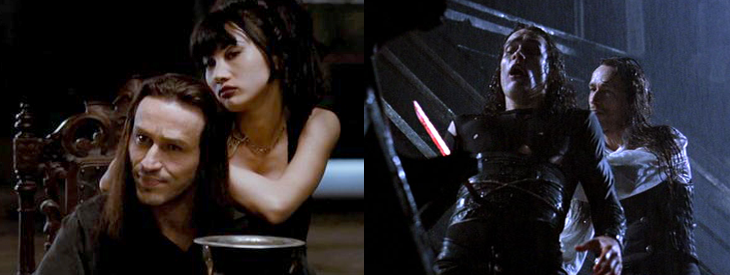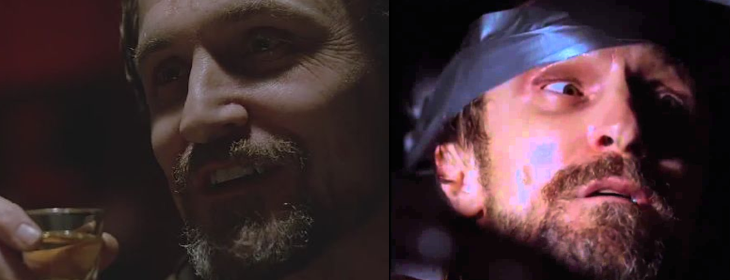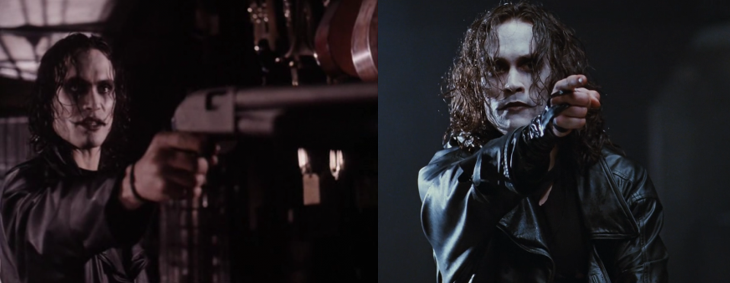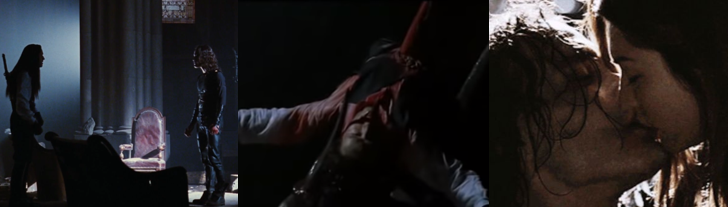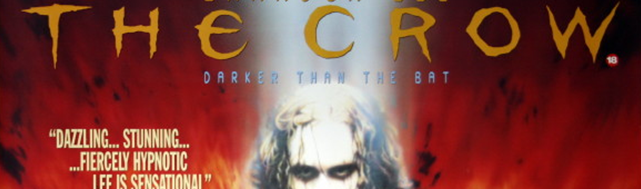
Movie Night: The Crow: Wicked Prayer

Released: 19 July 2005
Director: Lance Mungia
Distributor: Dimension Films
Budget: Unknown
Stars: Edward Furlong, David Boreanaz, Tara Reid, Emmanuelle Chriqui, Danny Trejo, and Dennis Hopper

The Plot:
When Jimmy Cuervo (Furlong) and his girlfriend, Lily (Chriqui), are ritualistic murdered by a Satanic biker gang led by Luc Crash/Death (Boreanaz), Jimmy is resurrected by a supernatural crow to take his revenge.

The Background:
Created by James O’Barr as a way to process losing his fiancée, The Crow began life as a 1989 comic book published by Caliber Comics and soon became an underground success. When dark comic book narratives became popular in Hollywood, the concept was a perfect fit and resulted in a critical and commercially successful adaptation sadly tainted by the accidental death of star Brandon Lee. Though an enduring cult favouriteThe Crow (Proyas, 1994) was followed by a slew of awful sequels: The Crow: City of Angels (Pope, 1996) was rushed out to capitalise on the original’s success. Resulting in a dismal box office and even worse reviews and The Crow: Salvation (Nalluri, 2000) didn’t fare much better with its lukewarm reviews. Despite this, the studio was determined to milk the franchise for all it was worth, initially collaborating with rapper DMX to work on a script revolving around a rapper being resurrected from a drive-by shooting. When this fell apart, the project was re-tooled into Wicked Prayer (with little resemblance to the comic of the same name),which was hoped to revitalise Edward Furlong’s fortunes after years of substance abuse. Director Lance Mungia, a fan of the franchise, eagerly signed on, hoping to tap into real-life tragedies like the Columbine Shootings and 9/11 with a stirring story of revenge. What we got was a film so reviled that the franchise lay dormant for nearly twenty years, a film almost universally lambasted for its laughable presentation, ridiculous effects and make-up, and intolerable performances from its lead actors.

The Review:
We’re out of the big city and stuck in the Mexican wilderness for The Crow: Wicked Prayer, where a racial and class divide exists between Native Americans and then-modern-day settlers. While this bigotry isn’t dwelled upon much, provides a springboard for a few half-hearted characterisations. As the ridiculous onscreen tags inform us, Death’s misfits (styled after the Four Horsemen of the Apocalypse) specifically seek revenge against the Native Americans after their local mine poisoned many of its workers, or robbed them of financial compensation, or some other excuse to attack minorities. When the tribe closes the mine, sparking outrage amongst its workers, for an extravagant casino, Death has his cohorts spread mayhem and death as part of a bizarre ritual to imbue Death with the powers of Satan! The racism goes both ways as Lily “Ignites the Dawn” and Jimmy are urged to stay on the “right side” of the road. Indeed, Jimmy is branded a racist and a killer by the entire town, particularly Lily’s brother, Sheriff Tanner (Dave L. Ortiz), after he killed a Native in his youth. This sees Jimmy ostracised, forced to eke out a living in a squalid trailer park with only Lily standing by him since he saved her from a rapist. However, neither her brother or her preacher father, Padre Harold (Danny Trejo), approve of Jimmy. Thus, when Tanner learns that Jimmy plans to elope with Lily, he’s less than impressed and encourages Jimmy to move on. Despite being an outcast, Jimmy’s devoted to Lily, yet he’s aware of his reputation and encourages her to keep their relationship a low profile. However, she’s far too peppy and trustworthy for that and gladly shouts her love for him, and it’s implied she probably would’ve absconded with Jimmy had Death and his cronies not spoilt their plans.
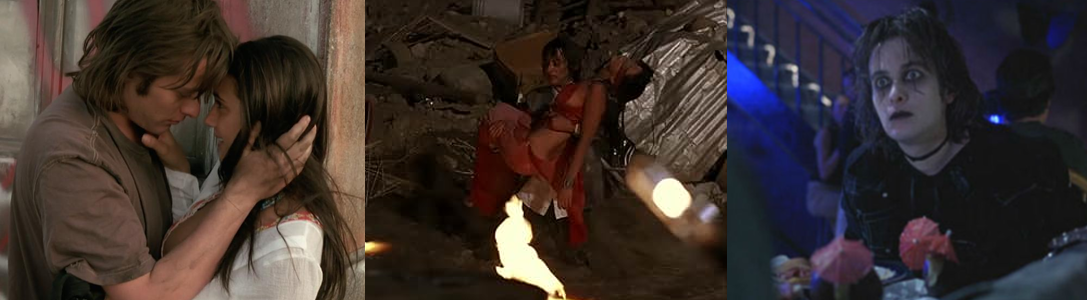
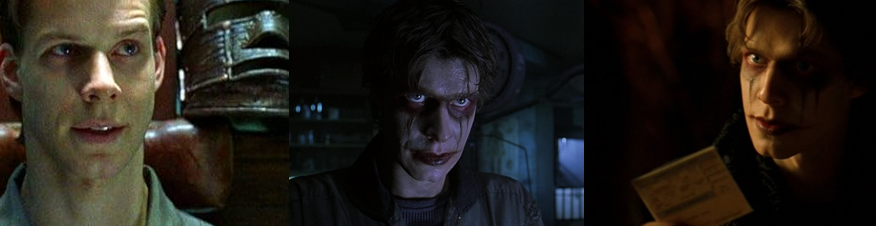
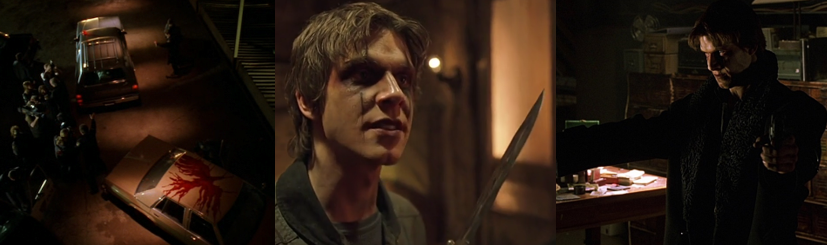
Troubled Jimmy’s life takes a turn for the worst when he returns from the grave as a lame cosplayer.

Having ridden with Death in his youth, Jimmy doesn’st have a squeaky-clean past but he’s just trying to get on. While I’m sympathetic towards Edward Furlong and everything he’s been through, I’m not sure he’s the best choice for this role as he lacks the charisma and screen presence much like his two predecessors. Jimmy’s certainly a more emotional and aggressive avatar, however, lashing out at his killers with a rage born not just from their atrocious actions, but for turning him into a “monster”. Jimmy’s caught completely off-guard when Death has his minions hang him and Lily and then slice out Lily’s eyes and cut out Jimmy’s heart, leaving Lily’s soul to wander the afterlife directionless. Jimmy returns from the nether near-instantaneously, the confusion, pain, and anger of Lily’s murder still raw, and immediately intuits from the crow that he must take revenge. Unlike his predecessors, who took to this mission with a resigned sense of duty, Jimmy’s reluctant and almost disgusted by killing, even for revenge, and constantly declares his desire to die (he even discovers his powers by trying to kill himself) but soon learns to embrace his rage with a hostility that’s noticeably different from his predecessors. However, being a shorter and far less physically capable individual, Jimmy doesn’t convey the same sense of quiet menace I associate with the character, even when draped in a cool duster jacket or inexplicably teleporting to toy with his victims. Like previous avatars, Jimmy instantly heals from all wounds and exhibits some superhuman strength and agility but, unlike them, his crow is wounded quite early on, leaving Jimmy’s powers in a state of flux. This doesn’t have much of an impact, though, as Jimmy still seemingly heals from his wounds and still performs superhuman (if poorly choreographed) feats, so I’m not sure why they bothered to have this happen when there’s no payoff since Jimmy can’t die until he’s avenged himself and Lily.
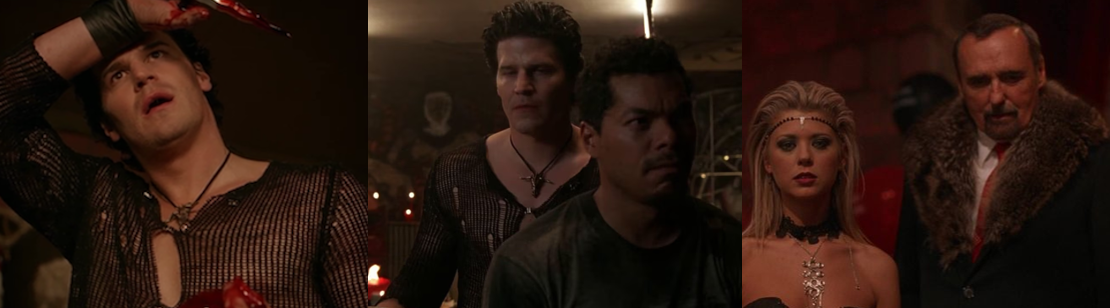
Death’s crew of forgettable try-hards are some of the most one-dimensional baddies you’ll ever meet.

Jimmy’s up against a colourful but very confused and one-dimensional bunch. The son of a preacher killed by an “Injun”, Death has a personal vendetta against God and the church, rejecting Christianity and seeking to be the vessel for Lucifer through ritualistic sacrifice. His followers – “Famine” (Tito Ortiz), “Pestilence” (Yuji Okumoto), and “War” (Marcus Chong) – all feel wronged by the mine and the town, taking their perceived hardships and using them as an excuse to be openly racist and cause havoc. Death’s constantly accompanied by Lola Byrne (Reid), a sadistic succubus who longs for the power and infamy offered by the Devil. Having stolen a book of black magic from the head of their order, the strangely theatrical El Niño (Hopper), Lola conjures spells and incantations after gaining a vaguely defined second sight from Lily’s eyes. After tracking down and shooting Moses, the man who killed his father (Richard Cumba), Death encourages his troop to engage in wanton murder, with War gunning down eyewitnesses, all to prepare for an unholy marriage and his own physical sacrifice to be possessed by the Devil. However, as one-dimensional as these “Horsemen” are, they’re all strangely conflicted at times. Death is constantly reminding them of their motivations, calling them out when they hesitate, and even Lola appears visibly uncomfortable at Death’s wholesale slaughter of innocents. Yet, they never once defy Death’s plan, with Lola only descending into penance after her lofty ambitious are ended by the Crow. While Tara Reid continues to be far better on the eyes than the ears, being the weakest link in a chain full of rusted connections, Boreanaz has a great time hamming it up as Death and even more when possessed by Lucifer. He’s a constantly enjoyable presence here, to the point where I wish he’d been cast in the lead role and the producers had piled some more money into Dennis Hopper’s pay cheque to cast him as Death instead.

The Nitty-Gritty:
While the legend of the crow was something of a fairytale in the previous films, a rare mystical occurrence that few understood or knew of, it’s presented as Native American folklore here. Lily speaks openly of the crow, a righteous figure of redemption powered by love, and those returned by the crow’s power are treated with reverence. Indeed, many refer to Jimmy or at least believe him to be an angel, and Lucifer openly makes the Crow as an extension of God’s will, repurposing the concept into a purely religious connotation. Thus, the fight between the Crow and Satan is framed as a battle of wills between Heaven and Hell rather than an emissary from the afterlife being unable to rest due to a devastating loss. It’s an interesting wrinkle in the Crow lore, one that might’ve had more legs if the film had fully committed to it, placing greater emphasis on Padre Harold’s belief in the figure beyond him simply performing a witch doctor dance to revive the bird. Tanner’s vendetta against Jimmy only ends when he realises Jimmy has become the Crow, but the fact Death and his cronies all dabble in black magic takes the spotlight away from Jimmy’s resurrection. While I appreciate the attempt to try something different, The Crow: Wicked Prayer is saddled by some truly awful performances, forgettable moments, and cheap presentation. Shots of the crow flying or glaring into the camera are recycled from previous films, as are some lines, and the special and practical effects are effectively non-existent, with the camera cutting away from any gruesome acts and then showing characters with bloody hands and holding organs or whatever.
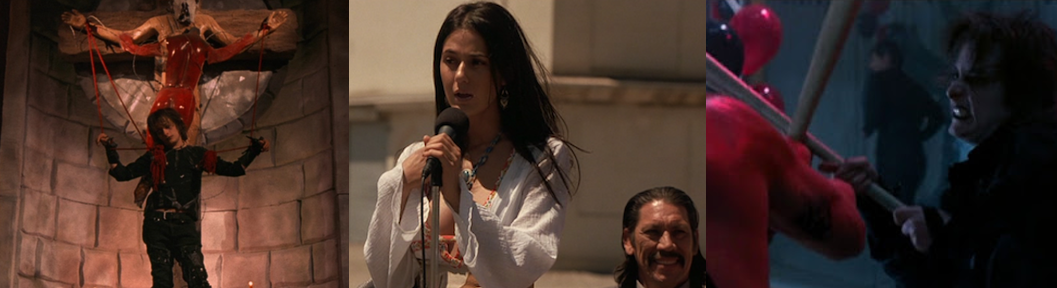
Even the interesting changes to the lore are as half-baked as the pathetic fight scenes.

Flashbacks to Jimmy and Lily’s past are similarly limited and presented seemingly at random as a shorthand to make us care about Jimmy’s vengeance, but instead appear as subpar editing. While Emmanuelle Chriqui is certainly cute and it’s nice to spend some time with the Crow’s lover before she’s killed, she has little chemistry with Furlong, who fares far better once he’s painted up. Unfortunately, Jimmy’s Crow looks like bad cosplay, with him moping about rather than exuding the crippling anguish I’d expect from the character. He’s far better when channelling his rage, but even then he’s hampered by some poor fight scenes, with his fist fight with War being a blurry, indistinct mess made more confusing by Padre Harold, Tanner, and a bunch of armed men firing at both men. The film tries to say there are some stakes involved since Jimmy’s powers are weakened for most of its runtime, but it’s hard to believe as he shrugs off bullets and even being physically overpowered by Death, who gradually gains superhuman powers through killing and other strange rituals. Still, none of his minions present a physical challenge to Jimmy, with the terminally ill Pestilence being easily offed via electrocution and the imposing Famine simply being beaten to death with a baseball bat. Jimmy tries to channel Eric Draven’s (Brandon Lee) sombre, caring side when he heals Moses to try and atone for killing his son, but it’s a poor effort. I would’ve liked to see more time spent with Jimmy winning over Padre Harold and Tanner, especially after they save him from his crucifixion, to either better delve into the subtle themes of penance or give him some backup in storming El Niño’s brothel…church…thing. Instead, Jimmy just tells them to get out of his way and heads off alone, with Padre Harold only being convinced to believe in the Crow when Tanner vouches for him.
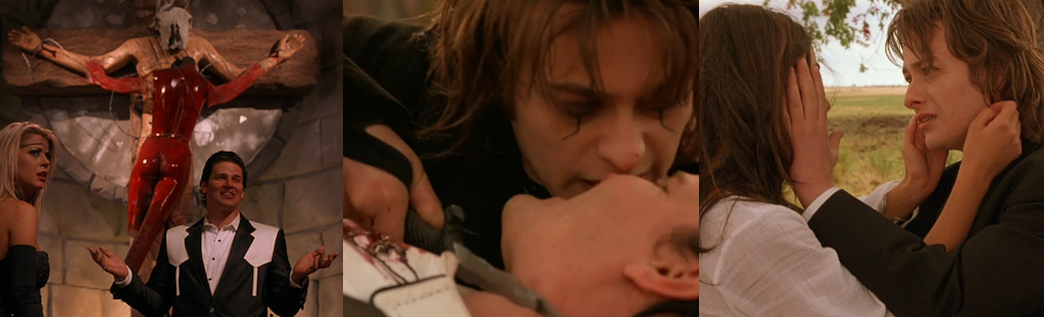
Even Lucifer’s infernal powers are useless against what this film laughingly sells as “true love”.

All throughout the movie, Death plots to prepare his body and soul to be possessed by the Devil. As ridiculous as that sounds, black magic is not only real in The Crow: Wicked Prayer but ridiculously easy to perform, with even a bimbo like Lola granting herself a degree of clairvoyance and understanding of El Niño’s ancient texts. Murdering Lily and Jimmy was the first step in Death’s plan; he gets his revenge against the man who killed his father, murders some innocent people, and then has a virgin (Daymond John) killed during his marriage to Lola. Surprisingly, Lola stabs Death and kills him to consummate the marriage, a betrayal Death didn’t seem to expect (it’s honestly hard to tell) but which allows Lucifer to posses his body. Now exhibiting incredible superhuman and telekinetic powers, Lucifer easily overpowers the Crow and leaves him for dead and is only stopped from finishing the job (and Padre Harold’s gun-toting mob) by a pressing need to have sex with Lola and thus make his transition official. Unfortunately for Old Scratch, Jimmy pursues them to a dilapidated graveyard and tries to stop him, though he’s no match for the Devil’s superior power and smart mouth. Thanks to Padre Harold leading the mob in a laughable dance, the crow is fully healed and restores Jimmy’s invulnerability and powers, and reminds him why returned to a vengeful unlife. Thus, the two unstoppable powers fight to a standstill until Jimmy sends Lucifer flying, impaling him on a tree branch right as the sun rises. Lola’s incensed at being denied her reward and, in desperation, prays to the Virgin Mary for forgiveness, but is left powerless to resist arrest after Tanner spares her from his father’s wrath. As for Lucifer, he makes sure his final words are suitably self-referential and mocking, leading a spiteful Jimmy to quote some Stephen Crane while slitting his throat. Despite Jimmy not retrieving Lily’s eyes during the fracas, her sight is restored when they reunite in the afterlife (though I guess defeating Lucifer before he could shag Lola undid the black magic she cast over Lily’s eyes? Who knows or even cares?)
The Summary:
And here we are, the lowest point and death knell of the Crow franchise (at least until the remake). This was my first time watching The Crow: Wicked Prayer and I have to say that it wasn’t as bad as I’d been led to believe. Sure, it’s not good and is definitely deserving of a one-star review, but at least I could see what was happening, unlike in the second film, and there was an attempt to do something a little different, veering into more supernatural territory. Unfortunately, The Crow: Wicked Prayer doesn’t commit to this, paying lip service to the Native American slant on the concept (possibly because it has no basis in reality) and skirting around the religious connotations it tries to shoe-horn into the lore. It’s always a tough sell having Satan worshipers as your bad guys and Death’s troop certainly don’t help make that concept any less ridiculous, being cookie-cutter bad guys who I instantly forgot. While David Boreanaz and a surprisingly enthusiastic performance by Dennis Hopper attempt to elevate the material and make things interesting, it’s not enough to carry the film and Edward Furlong just doesn’t have it in him to be a leading man. His involvement reeks of direct-to-video casting and, while he did a decent job with Jimmy’s more aggressive or desperate moments, he just comes across as a weak and watered down version of even his last two predecessors. There’s a good idea or two somewhere in here, but the execution was flawed from the start and The Crow: Wicked Prayer can’t even be said to entertain with some fun fights or bombastic stunts. The budget and the talent just aren’t here and it’s genuinely upsetting seeing the original comic book be diluted and warped into such a shameless cash grab as the concept is so evocative and deserves the same time, energy, and care as in the original film. I avoided The Crow: Wicked Prayer for a reason and you should, too. Just watch the original film four, even five times, and skip everything that came after it, including this debacle.

My Rating:

Rating: 1 out of 5.

Terrible

You didn’t enjoy The Crow: Wicked Prayer but by all means try to tell me you did in the comments. Try to tell me you enjoyed Edward Furlong’ performance, that you believed the chemistry between Jimmy and Lily, and that this is an under-rated gem. Tell me you thought David Boreanaz made for a solid and well-rounded villain, that the changes made to the Crow lore were justified and meaningful, and that the film successfully put a new spin on the franchise. While you’re there, tell me which of The Crow’s sequels was your favourite and how you’re celebrating Devil’s Night this year. Tell me all this, and more, in the comments and then go donate to my Ko-Fi to suggest other Crow content for me to review.

Movie Night: The Crow: Salvation

Released: 23 January 2000
Director: Bharat Nalluri
Distributor: Dimension Films
Budget: $10 million (estimated)
Stars: Eric Mabius, Kirsten Dunst, Fred Ward, Grant Shaud, Tim DeKay, and Jodi Lyn O’Keefe

The Plot:
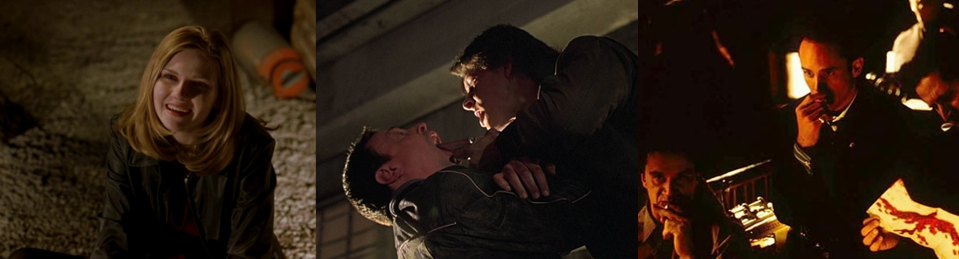
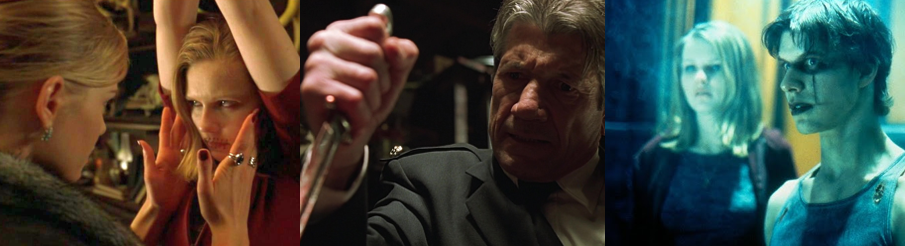
Alex Corvis (Mabius), wrongly executed for killing his girlfriend, Lauren Randell (O’Keefe), is resurrected by a supernatural crow to uncover the truth alongside her grieving sister, Erin (Dunst).

The Background:
The creation of James O’Barr as a means to cope with losing his fiancée, The Crow started out as a comic book published by Caliber Comics in 1989 and quickly became an underground success. With dark comic book narratives gaining popularity in Hollywood, the concept was adapted into a critically and commercially successful film despite the tragic on-set death of star Brandon Lee. Regarded as a cult hitThe Crow (Proyas, 1994) spawned numerous sequels; The Crow: City of Angels (Pope, 1996) released just two years later as a direct response to the original’s financial success. Studio meddling contributed to The Crow: City of Angels’ dismal box office and the film was (rightfully) slandered by negative reviews. Undeterred, series producers Edward R. Pressman and Jeff Most sought to continue the franchise, initially tapping rock star Rob Zombie to helm a more horror-centric approach. This clashed with the producers’ vision for the franchise, leading to frustrations and Zombie’s eventual departure, leading to Most shifting focus towards a younger avatar for the Crow mantle. Eric Mabius – who had auditioned for the lead in the first film – this finally got his chance to play the role. Released straight to video, The Crow: Salvation received lukewarm reviews, with most only able to praise it for being slightly better than the previous film. The dialogue, cheap presentation, and bland, charisma-less cast were all criticised, though some regard it as an under-rated entry. Ultimately, the film’s poor reception did little to sour the studio on producing another entry five years later, a film so reviled that it cast the franchise into Development Hell for nearly twenty years.

The Review:
I’ve been a big fan of The Crow since I was a kid and randomly discovered it recorded on one of our VHS tapes. I remember, at the time, a fair bit of intrigue surrounding The Crow: City of Angels; still photos mis-sold the film as a bad-ass action/revenge film, but it turned out to be an ugly mess that I struggled to comprehend, let alone enjoy. Still, I was intrigued by the third movie, which I’d heard was slightly better, so I picked it up on DVD a long time ago, watched it maybe two times, and then promptly discarded it simply because there was no need to clog my collection up with such sub-par movies. The film begins with young Alex Corvis a state-wide figure of controversy; having already been tried and convicted for murder, the braying, judgemental masses call gleefully for his execution, which has been held off for three years so he can be old enough to suffer his punishment. Though he’s maintained his innocence the entire time, pinning the blame on a mysterious man with a scarred forearm, the public and even the prison guards regard him as a reprehensible monster, largely because his victim suffered fifty-three stab wounds during the assault. Before he even returns as an undead wraith, Alex carries a tremendous amount of guilt and self-loathing for not only failing to protect Lauren but also failing to find her true murderer, powerful emotions that fuel his later thirst for revenge. Though he tries to maintain his composure, his resolve falters as he’s strapped to an electric chair, fitted with a gruesome helmet, and forced before not just the judgemental eyes of those in attendance – including Lauren’s younger sister and her father, Nathan (William Atherton) – but also (unbeknownst to him) the corrupt cops who screwed him over and, to his anger and horror, the scarred forearm that has tormented his days.

Youngster Alex returns from the grave to uncover the true culprit behind his girlfriend’s murder.

Unlike his predecessors, Alex gets no time to rest; moments after he’s unceremoniously wheeled into the morgue, a supernatural crow brings him back to life and he’s stripping the gloopy remains of his flesh from his face. I quite liked this aspect, that the helmet he wore scarred his face into the familiar Crow look, and it makes for a gruesome, gory sequence. Through Alex’s escape from prison, we witness him discovering his newfound powers: the crow seems to communicate or at least “push” him towards his goal, he sees visions through tactile contact, and his wounds almost instantly heal. This youngster revels in these abilities with a cocksure bravado but also demonstrates the truly bizarre ability to turn into a crow at will! As before, Alex and Lauren’s relationship is primarily related through flashbacks; amidst the usual lovey-dovey moments (though the inclusion of the “Only forever?” line is a nice touch), we see them arguing, Lauren acting erratically, and Alex’s frustration with her. This is all part of the mystery surrounding her death and makes up the evidence against him, but the crow leads him to the cops who testified against him. Lamenting his newfound unlife, Alex heads out with his literal kill list to discover the true murderer’s identity. Shown to be a more spiritual and reflective character, Alex is prone to waxing lyrical on the divine and Biblical rather than quoting Poe, which just comes across as shamelessly imitating Brandon Lee. I don’t mind Eric Mabius but he’s painfully generic; I appreciate that he has his own visual style, one spruced up when he acquires an overcoat, but he doesn’t cut an intimidating figure. Instead, he’s just a screwed up kid looking to confront those who wronged him, using Lauren’s murder weapon, no less. No one recognises him because of the scarring and Alex doesn’t immediately identify himself, making him more of an anonymous avenger at times. The only one who believed in his innocence is his lawyer, Peter Walsh (Grant Shaud). Peter vows to find the true culprit and is accosted by Detective Vincent Erlich (Dale Midkiff), one of the corrupt cops, when Alex starts ticking names off his list. Peter’s astonished when Alex appears to him and asks him to investigate Nathan’s dealings with the cops and a recurring company name, D.E.R.T., which directly leads to both Peter’s murder and Nathan to kill himself out of remorse.

Distraught Erin eventually supports Alex’s crusade against the corrupt cops.

While we don’t really learn anything about Lauren apart from seeing her as a sweet, playful girl, she gets a proxy in Erin. Much younger and expressing her grief through her hatred of Alex, Erin is confused and lost and initially hostile towards him until he brings her proof that her father was doing business with corrupt Detectives Madden (Bruce McCarty), Martin Toomey (Tim DeKay), Erlich, Stanley Roberts (Walton Goggins), and Phillip Dutton (Bill Mondy). Like Alex, Erin carries a great deal of guilt and pain, not just at because she’s lost her sister but also because she pointed them in the direction of where she might be when they came looking for her. When these emotions overwhelm her and make her wish she were dead, Alex forces Erin to experience Lauren’s terror and ordeal at the hands of the cops to show her what a fighter her sister was even as she was being stabbed to death, all to teach the distraught Erin that “life is worth living”. The dirty cops launder money through a strip club and engage in drug dealing and, when Lauren witnessed Roberts murder a man in cold blood, he and his cohorts went after her to silence her. When their base instincts took over, they all joined in with the stabbing and the killing after she dared to fight back. This is an interesting twist on the concept and allows The Crow: Salvation to stand out from its predecessors and presents us with morally corrupt lawmen whose testimony trumped that of a young, troubled kid. Alex’s first target is the sleazy Dutton, who delights in using his authority to sexually accost young, intoxicated women. Erlich takes a more authoritative role in the group, informing them of Dutton’s death, but his only defining character trait is his tendency to pull pranks on the group. Of them all, Roberts stands out the most thanks to being played with a squirmy glee by Walton Goggins. When he realises he’s next on the list, he accosts witness Tommy Leonard (David Stevens) and his family, killing him since he refuses to believe Alex has returned.

The Nitty-Gritty:
One of the main issues with The Crow: Salvation is similar to what dragged down the first sequel; while it’s shot far better and I’m not feeling nauseous due to disturbing mustard mist, everything just looks very cheap. The framing of shots, the quality of the film, even the crow’s-eye view scenes are all very direct-to-video and the movie even has the gall to recycle shots from the first film to imply it takes place in the same city. Structurally, it sticks very close to the same formula as the last two films; Alex really has no reason to work his way up the food chain of forgettable corrupt cops and could just go right to the source, but then the movie’s runtime would be much shorter and the filmmakers couldn’t rehash what worked so well in the original film. While interiors are perfectly serviceable, if unusually claustrophobic (again, seeming more like a television production), exteriors are painfully bland. The movie returns to the dump where Lauren died a few times and it’s a dull, lifeless location. The film lacks the gothic identity of even the second movie which, for all its obscuring fog and shadows, at least tried for a distinct visual identity. It doesn’t help that Alex is decked out not in leather and straps but his prison jumpsuit. Yeah, the coat helps but he looks like a kid playing dress-up, desperately trying to emulate Brandon Lee’s performance and failing miserably. Alex easily overpowers his victims; safe and even revelling in his invincibility, Alex freely stabs himself and walks into gun shots. He even blasts himself through the mouth to intimidate his prey, gleefully ending them out of frustration at their instance that there is no scarred man. Sadly, Alex’s mission is tainted by the budget; he tries to look badass by walking away from an explosion (that also destroys a police helicopter), but it’s painfully brought to life through dodgy rear projection.

The budget, visuals, and performances aren’t up to the task of equalling the gothic, moody first film.

Alex executes Dutton via gunshot to the head, drives Erlich into a bus and blows him up, and adds a twist to his venge-filled killings by using Lauren’s murder weapon, even inflicting the same fifty-three stab wounds and carving Lauren’s pet-name for Erin (“Daisy”) into Dutton’s forehead. He also continues the traditional of leaving the crow’s symbol and encourages a young stripper (Noname Jane) to give up her life of drugs and debauchery. Alex’s infiltration of the Key Club sees him first scurrying about the rafters to avoid a hail of gunfire and then forcing the gaggle of corrupt cops to expend all their bullets, though it does result in Roberts taking a pipe through the back, and Toomey being blown to pieces. The mystery of the true killer is built up right from the opening credits, where we see his trademark forearm scar, as well as his knowledge of/fascination with the supernatural crow in his macabre embalming hobby. All throughout the film, Alex is haunted by the image of that zig-zag scar and frustrated by his victims refusing to give him a name. Instead, they insist, even in the face of their death, that Corvis made the whole thing up. Even if he didn’t immediately reveal that he’s as corrupt as his detectives, you’d probably guess that Captain John L. Book is the true culprit simply because he’s played by the immortal Fred Ward. A gruff, uncompromising figure, Book exudes authority and elevates even this drab material just by Ward’s screen presence. Having “studied [the crow] phenomenon before”, Book is the only one not surprised to learn Alex has returned from the dead to seek revenge and is learned enough to know that Alex’s mission will be complete and his powers lost once he finds the man with the scar. Thus, he sets a trap at the Key Club, implanting the scar into Peter’s severed arm and tricking Alex into thinking he’s got his man.

Alex ultimately finds his man and avenges his losses in this cheap, dull imitation.

The fulfilment of his mission sends Alex into a disorientated daze; haunted by visions of Lauren, he loses his grip on reality and struggles to reacclimatising to feeling the pain of his wounds. When he returns to Peter’s office and finds Erin missing and that the Book is the man he’s been looking for, Alex immediately heads to the police station to confront him. However, despite knowing that he has a loose end to tie up and still being accompanied by the crow, Alex remains mortal and is brutally stabbed by Book. As he dies (again), Book taunts him and makes him doubt his innocence, twisting his memories and trying to ensure he doesn’t return anew. Erin, tied up and with her lips sewn shut (!), is forced to watch as Book, his unnamed woman (Kelly Haren), and Madden prepare to stuff and mount his corpse. However, the crow brings Alex Erin’s locket, reviving Alex, restoring his powers, and reminding him of the truth. Although Alex shrugs off Madden’s bullets, the crooked cop and the secretary have better luck by attacking the crow, whose pain Alex can feel, and he’s so distracted offing them that Book escapes with Erin in tow. When Erin stabs him and flees, Book is reduced to a crazed maniac in his pursuit of her, though Alex easily catches up to them. Finally getting his hands on his man, Alex takes Book to the electric chair and delivers a melancholy soliloquy regarding the painlessly of electrocution and revealing that it’s actually pure agony. Still, Book remains defiant to the end; cursing them both, he mocks Alex and Lauren’s relationship and vows to return to get his revenge. In the end, it’s Erin who pulls the lever and the two watch on as Book is incinerated by electricity. After finally witnessing Book’s prolonged and painful death, Alex bids farewell to Erin, returning him to happier times with Lauren and renewing the girl’s belief in life…and love.
The Summary:
The Crow: Salvation proves, beyond a shadow of a doubt, that the original film was lightning in a bottle. By moving so far away from a serious theatrical production and reducing the concept to a direct-to-DVD release, the movie dilutes and disrespects both the source material and the original film. It’s a shame because there are some good elements here. I like that the avatar is completely new, a younger character who exhibits different abilities and a different perspective on the powers. Alex isn’t a cool rockstar or an amateur magician/trained mechanic; he’s just a kid who’s been dealt a bad hand and now has the power to avenge himself. I liked the whodunit mystery and the suggestion that Alex might actually have been guilty; in some ways, I wonder if this might’ve been a better twist ending since it was obvious Fred Ward was the culprit once he appeared onscreen. I liked that Alex was going after corrupt cops, people in positions of trust and authority who abused their power, and that I could actually see what the hell was happening this time around. Sadly, the execution and performances are severely lacking; Fred Ward, William Atherton, and Walton Goggins are the only memorable or commendable performances. Kirsten Dunst is pretty, but woeful as an overly dramatic wreck, and Eric Mabius just doesn’t have the screen charisma or acting ability to captivate in the role. The film is also really cheap, using obvious jump cuts, recycled footage, and awful visual effects. To make matters worse, it’s still too similar to the original, repeating many of the same story beats and action moments but without the budget, passion, or care exhibited in the gothic cult classic. The Crow: Salvation just comes across as a cheap, bland cash-grab, one doomed to fail no matter what they did. However, for having actors who didn’t make me want to pull my teeth out and being visually more coherent than the last film, it gets one extra star but it’s ultimately a forgettable film that even die-hard Crow fans will have a hard time connecting with.

My Rating:

Rating: 2 out of 5.

Could Be Better

Did you enjoy The Crow: Salvation? If so…why? Do you think it was better, overall, than the second film? What did you think to Eric Mabius’s performance and Alex as a younger avatar? Did you guess who the true killer was or was the reveal a surprise to you? What did you think to the antagonists being corrupt cops? Were you disappointed by the low-budget production values? Which of The Crow’s sequels was your favourite, if any, and would you like the see the character return in some form or another in the future? How are you celebrating Devil’s Night tonight? Whatever you think about The Crow: Salvation, join the discussion below and check out my other Crow content on the site..

Movie Night: The Crow (2024)

Released: 23 August 2024
Director: Rupert Sanders
Distributor: Lionsgate
Budget: $50 million
Stars: Bill Skarsgård, FKA Twigs, Danny Huston, Laura Birn, and Sami Bouajila

The Plot:
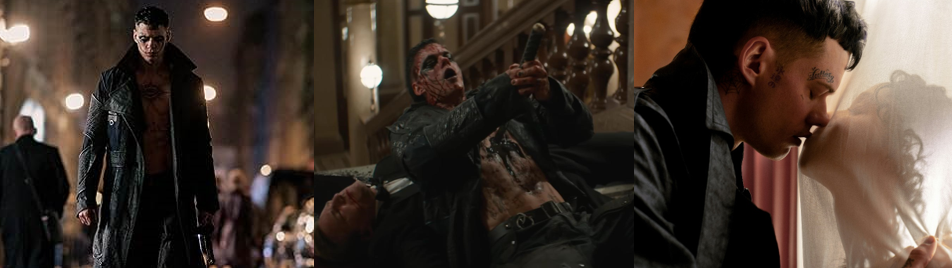
When troubled youth Eric (Skarsgård) and his girlfriend, Shelly (Twigs), are brutally murdered on the orders of demonic crime lord Vincent Roeg (Huston), a supernatural crow resurrects Eric to take his revenge.  

The Background:
Created by James O’Barr in 1989, The Crow was an underground success that reflected O’Barr’s anger and pain after a tragic loss to. Since dark comic book narratives were all the rage in Hollywood at the time, the comic soon transitioned into a critically and commercially successful film adaptation, one that achieved cult status and infamy after the accidentally on-set death of star Brandon Lee. Determined to capitalise on The Crow’s (Proyas, 1994) success, series producers Edward R. Pressman and Jeff Most signed off on a slew of sequels and even a short-lived television show that was notably better received than the three cinematic and direct-to-video follow-ups. Following the universally panned fourth movie, the franchise entered Development Hell for nearly twenty years as various writers, directors, and actors were attached to a potential reboot. Stephen Norrington was in talks to direct at one point, stars Bradley Cooper and Jason Momoa were tapped for the lead role, production was stalled by financial issues, and series creator James O’Barr stated repeatedly that the new film would be a “re-adaptation” of the source material rather than an outright remake just as Alex Proyas slammed its production. Finally, in 2020, the project was revived and gained traction; Bill Skarsgård won the lead, impressing director Rupert Sanders with his conditioning and enthusiasm, and harmless firearms were mandatory onset to avoid a repeat of Brandon Lee’s tragedy. Upon release, The Crow was met with largely negative reviews that reflected the reactions to the film’s trailers. The chemistry and performances of the leads was questioned, the pacing was slandered, and even more positive spins decried it as derivative of the original and ultimately unable to escape the shadow of its predecessor. Given the franchise’s persistence, it should be no surprise that the ending was reportedly tweaked (against Skarsgård’s objections) to leave the door open for a sequel, though the film’s dismal $24 million box office makes the prospect unlikely.

The Review:
I’ve been a fan of the Crow concept since I was a kid and we first taped the original movie off the television. From there, I discovered the original graphic novel (which, honestly, took me a little while to properly appreciate) and I delved into the movie sequels hoping to at least see more of the same. Unfortunately, it seems The Crow was lightning in a bottle and none of the follow-ups came close to matching the movie’s aura and appeal, which is weird to me as the concept is pretty simple and I maintain there’s a lot of material in the comic (and its follow-ups) that could make for a good film. Like, why not do it hyper-stylised and hyper-violent, like the Sin City movies (Rodriguez and Miller, 2005;2014)? Or take inspiration from The Crow: Dead Time (O’Barr, et al, 1996) or The Crow: Flesh and Blood (Vance, et al, 1996), maybe put a twist on the story and have Shelly be the one resurrected? I was cautiously optimistic for this long-gestating remake, hopeful that it would go for grim and gritty and try to get back to the roots of the concept, but immediately lost faith once I saw the first trailers and went into it hoping that it would at least be full of enjoyable, bloody action. My first wish (that it does something different with the concept) was kind of granted in that a huge portion of the film focuses on Eric (not Draven) and Shelly (no last name) and their budding attraction to each other. Unlike in the original, we spend a significant amount of time hanging with the two, seeing them flirt and play and fuck and apparently fall in love, and the entire time I was thinking to myself…I just don’t care. It’s so weird. Like, I felt more of an emotional connection to Shelly Webster (Sofia Shinas) in the original film and she only appeared in flashbacks or as an apparition. Her and Eric’s (Brandon Lee) love and relationship was conveyed through fragmented memories, both happy and agonisingly violent, and through Eric’s pained, righteous anger. Yet, here, we see the two coming together and finally finding some peace together and I just couldn’t buy into it was it seemed so shallow and hollow.

When he and Shelly are murdered, emo try-hard Eric returns to mope about and eventually get revenge.

It doesn’t really help that we really don’t learn much about them. The film opens with a dream sequence from Eric’s childhood where he was apparently traumatised by the death of his beloved horse and it’s implied that his alcoholic or addict mother (Unknown) was abusive, then jumps to him in rehab, covered in ludicrous tattoos, and moping about, barely speaking and being further abused by his fellow inmates and the strangely aggressive guards. We’re told he turned to drink and drugs but never learn what he went through in the interim or what drove him to cut his wrists, and instead are presented with this sullen, damaged young man who’s essentially sleepwalking through life. In contrast, we do eventually learn a bit more about Shelly, but it still feels like pieces are missing from her puzzle. She begins the film freaked out because her friend, Zadie (Isabella Wei), is killed for recording some mysterious video of them and their friends at some party, then randomly gets arrested for possession and is locked up with Eric, whom she becomes attracted to because the script says so. when her mother, Sophia (Josette Simon), shows up with the mysterious Marian (Birn), Shelly has a partial panic attack and Eric encourages the two to flee. After escaping with ridiculous ease, the two then hole up in Shelly’s apartment and her pursuers never think to check there while the two shack up, befriend a bunch of unnamed fellow lowlifes, and revel in their freedom, despite apparently having no jobs or income (beyond, I guess, drug dealing?) eventually, Shelly opens up about being her past as a piano prodigy and Eric later learns that she was targeted by the enigmatic Vincent Roeg, who preys upon innocent souls and corrupts them with a demonic whisper. Since Shelly had video evidence of Roeg’s supernatural abilities, he eventually has his men storm the couple’s digs and suffocate them to death with plastic bags, condemning Shelly’s soul to eternal damnation since she was manipulated into stabbing a girl to death by Roeg’s influence. While Eric returns from the grave, Shelly also pops up here and there as a phantom, in Eric’s memories, or as he uncovers more of her past and she’s honestly a more fleshed out character than he is, and she’s cute and serviceable enough, but I struggled to believe the strength of their love since I didn’t see a lot of chemistry between the two.

Despite constant exposition and the obvious, Eric remains largely clueless for most of the film.

Upon being killed, Eric immediately awakens in a mysterious, desolate landscape dominated by crows (what I would describe as purgatory). There, he meets a shadowy figure the credits call Kronos (Bouajila) who basically acts as an exposition dump for what’s happened, delivering the famous “People once believed…” line from the original film and describing Eric’s situation and abilities. It’s honestly a little insulting, especially as we didn’t need such ham-fisted exposition in the original film; probably due to Brandon’s untimely death, all of his supernatural powers were conveyed using a simple “show, don’t tell” method but here, Kronos lays it all out to the stunned Eric, who returns to the living world a short time later not by bursting from his grave but by waking up on the apartment floor. Confused and disoriented, he attacks and kills corrupt cop Detective Milch (Dukagjin Podrimaj) when he comes to search for Shelly’s phone and discovers that he can heal from any wound, though isn’t spared the agony of bullet wounds and broken bones. Guided by a supernatural crow, Eric wanders about the streets, largely in disbelief about what’s happened, desperately trying to put names to the faces of his murderers; although he ends up as clueless as we are until the credits, he does stumble upon one of Roeg’s men, only for him to commit suicide rather than talk. Even Sofia is largely tight-lipped about providing him with information, though “luckily” Roeg is aware of the crow’s nature and sends his goons out to find Eric so he can steal his powers, meaning Eric gets to take out some baddies and the guys that wronged him, but he’s hardly as proactive as his predecessors.

Probably the biggest sin of the film is it’s dull and forgettable villains.

Although he lacks any formal fighting training and is unfamiliar with guns, Eric attempts to outfit himself and largely holds his own in a fight by relying on his supernatural healing. He simply ploughs ahead, absorbing damage and enduring the pain of resetting broken bones or healing from wounds. This time around, he remains virtually indestructible as long as his love for Shelly remains pure. While I would’ve expected this to factor into the finale, rendering him mortal as in previous iterations, this becomes a throwaway moment in the second act, when his belief in Shelly falters after watching her video and he dies a second time, forcing him to barter his soul for hers to return once again, finally donning a version of the iconic face paint and committing himself to his mission. This turns him from a melancholy, reluctant avenger to a stoic, enraged crusader as he systematically slaughters a bunch of goons with a sword, cutting his way through a wave of nine-to-fivers to reach Marian, who finally points him in Roeg’s direction. It’s hard to watch The Crow without comparing it to The Crow, but one area where it really fumbles the ball is in the bad guys. Instead of an eclectic bunch of over the top, memorable, despicable glorified street punks, we have a handful of unnamed goons who get so little screen time that I found myself forgetting which ones were responsible for Eric and Shelly’s death. The only one who stands out is Marian and, again, I have no idea who she is or what her motivations are. Roeg’s power is said to manipulate, corrupt, and control, so I assume they all follow him out of a desire for power or because he has leverage over time, but we learn nothing about any of them. They’re just people for Eric to kill, and while he may gain some catharsis and satisfaction from their deaths, I was briefly entertained by the blood splatter and then immediately forgot them. The exception, of course, is Roeg, played with quiet menace by the ever-reliable Danny Huston. He’s said to be centuries old, to have made a deal with the Devil, and corrupts innocents to keep himself out of Hell but…we never learn how this deal came about or anything about him except his predication for young piano players. He desires Eric’s powers, of course, and seems to covet power in general over everything else, but he’s such a vacuous and forgettable character compared to Michael Wincott’s Top Dollar and none of his underlings were as memorable as the latter’s gang of sadists.

The Nitty-Gritty:
As is to be expected, a central theme of The Crow is love. Eric and Shelly are both damaged and lonely individuals, one seemingly tortured by an abusive childhood and the other forced into horrendous acts against her will. Shelly apparently sees a reflection of herself in Eric, or perhaps feels whole with his damaged parts literally and figuratively filling the void in her soul, and they’re portrayed as carefree youngsters who live outside the system. Yet, while they may make for passionate lovers, I never felt like their love was anything more than the fiery lust of the young and attractive. Draven and Webster were a proper couple, set to be married, when they were killed, having built a life together filled with passion, fashion, and music. Eric and Shelly get drunk and high and doss about with their mates. Considering the threat Shelly knows Roeg represents, it seems weird to me that they didn’t go on the run and stayed not only in town but in her apartment; almost as weird as Roeg not sending his men there right away. Eric is especially disappointing; even if he’d had a different name so as not to be associated with Brandon Lee’s character, he’s such a sulky little emo try-hard, with his “edgy” tattoos and lethargic attitude, that I found it hard to care about him. He has none of Draven’s charisma or concern for others; he’s purely motivated by his emotions, slaughtering anyone in his way and struggling to understand what’s going on. He’s a very ineffectual avenger, something Kronos chastises him for, until the finale, where he finally accepts the responsibility placed on him and comes close to giving a decent interpretation of the character. Similarly, the soundtrack is noticeably lacking; sure, I’m an old man who isn’t into the weird tunes featured in this movie, but the lack of emo-infused, gothic rock and traditional heavy metal really works against the aural identity of the film as much as the bland setting keeps it from standing out visually.

By the time Eric embraces his mission, it’s too little, too late for this snooze-fest.

So, okay, maybe The Crow makes up for all this with action and gore. Well…no. yes, there is a lot of blood splatter and some creative, gory kills (certainly more than in the original film) but they’re not seen until the final act. Eric and Shelly are killed in a terrifying, but toothless manner compared to their counterparts and many of Eric’s later kills boil down to headshots and quick swipes of his sword. The opera slaughter (easily the best sequence in the film) is thus a highlight, with Eric cutting through waves of henchmen, slicing off arms, cutting through jaws, and absorbing every shot like a juggernaut, revelling in his bloodlust. His earlier freeway fight was okay, but lacked the focus and physicality of this scene, though naturally none of the antagonists offer a physical challenge to him given his supernatural abilities. There was a brief moment where this seemed to be a point of contention: Marian mentions how Eric, covering in the blood of his victims, has “the same look” as Roeg and Roeg explicitly states that Eric’s lust for revenge has cost him his humanity. Then it’s just swept under the rug and forgotten. Similarly, it seems Roeg is set to follow in Judah Earl’s (Richard Brooks) footsteps and steal Eric’s power using a combination of his demonic voice and Eric’s “black blood”, but that doesn’t happen either. Instead, Eric transports them to the crow’s realm and beats the old man to a pulp until he’s spirited away by demons. As per his deal, Shelly is returned to him and to life, with time apparently rewinding slightly to see her resuscitated soon after being suffocated. Eric remains dead, but seemingly chooses to wander purgatory, halfway between life and death, sure that their souls will reunite someday. Honestly it’s a bit of a confusing ending; almost as confusing as Roeg’s powers and background. Personally, I’ve always disliked that the Crow franchise has included other supernatural elements as they’ve progressed; to me, the avatar should be the only supernatural thing, set against earthly beings who must find other ways to combat him. But then again I also think The Crow is worthy of being more than just a plodding, generic, confuddled mess of a film. A sentiment Hollywood seems not to share.

The Summary:
I wanted to bee excited for The Crow. I genuinely believe a new version or adaptation of the story or concept could work, especially if it took a hyper-stylised or gritty, gothic aesthetic. Instead, The Crow is as generic as I feared and, I suspect, spent way too much time overthinking the concept. We didn’t need everything explained to us by Kronos and, arguably, we gained very little from following Eric and Shelly up to and past their deaths. I didn’t feel an emotional connection to them and, trust me, I wanted to. I kept waiting, begging, for the film to kick into gear and get started only for it to keep dragging its feet, giving us mopey emo-dude looking clueless when the obvious happens around him or is explained to him. For me, he should’ve taken on the familiar guise after his second resurrection and been all-in from there. I also wonder if the film would’ve been fitted from being told out of sequence, with the relationship aspects scaled down and reduced to nightmares and flashbacks. Also, the villains just missed the mark completely. There’s only so much Danny Huston can do with such limited screen time and development, and none of his underlings were as remotely memorable as those seen before. Even the brutal action sequences and copious blood can’t save The Crow, which is so far away from the spirit of the original that I wouldn’t call this a remake or a reboot, more a re-imagining. It’s a real shame as we’ve endured so many terrible Crow sequels and the concept deserves so much better, but do yourself a favour and just watch the original again because this tripe is as dull as dishwater and, worst of all, completely and immediately forgettable.

My Rating:

Rating: 1 out of 5.

Terrible

Did you enjoy The Crow? Do you think the film added some interesting new wrinkles to the formula or did you find it generic and tasteless? What did you think to Bill Skarsgård’s performance and Eric’s characterisation? Did you like the addition focus on his relationship with Shelly? What did you think to Roeg and his largely forgettable henchmen? Which of The Crow’s sequels was your favourite, if any, and would you like the see the character return again? Whatever you think about The Crow, join the discussion below and go check out my other Crow reviews.

Movie Night: The Crow: City of Angels

Released: 30 August 1996
Director: Tim Pope
Distributor: Miramax Films
Budget: $13 million (estimated)
Stars: Vincent Pérez, Mia Kirshner, Richard Brooks, Thuy Trang, Iggy Pop, Thomas Jane, and Eric Acosta

The Plot:
Mechanic Ashe Corven (Pérez) and his young son, Danny (Acosta), are brutally murdered by zealot Judah Earl (Brooks) and his thugs. After being resurrected by a mysterious and supernatural crow, Ashe is guided by the aloof Sarah Mohr (Kirshner) and assumes the guise of a tragic clown to avenge his loss using his newfound superhuman abilities.

The Background:
Beginning as a comic book published by Caliber Comics in 1989, The Crow was the brainchild of James O’Barr. The main character, named simply “Eric”, was modelled after prominent rock musicians and brutally slayed those who killed him and his fiancée as a reaction to the pain and loss O’Barr felt after losing his own fiancée. The Crow became an underground success and, since dark comic book narratives were becoming popular in Hollywood, transitioned into a critically and commercially successful film adaptation despite the accidentally on-set death of star Brandon Lee. While The Crow (Proyas, 1994) is regarded by many as a cult hit, the same accolades can’t be said about its sequel, which came as a direct response to the financial success of the first film. Initially, director Tim Pope and writer David S. Goyer planned to take the sequel in a different direction to avoid copying or emulating the original movie. They pitched having Sarah become a female Crow (a concept later explored in the comic books) or setting the story in the 19th century before ultimately settling on another tale of urban vengeance. It was the producers, however, who most directly engineered the film to be more of a carbon copy of the first, dramatically cutting down Pope’s original 160-minute cut into a jumbled mess of muddy visuals and confusing plot points. Despite the popularity of the first film, The Crow: City of Angels failed to recapture the magic of its predecessor; it barely grossed over $25 million at the box office and has been met with scathing criticism for its awful execution, lacklustre lead actor, and woeful narrative and pacing. Despite this, Miramax continued producing Crow movies and spin-offs, and some have even argued that The Crow: City of Angels is an under-rated entry in the franchise. Spoiler alert: I am not one of them but, as The Crow is one of my favourite movies and tonight is “Devil’s Night”, I figured this would be a good opportunity to look back on this shambles of a film and see how it holds up.

The Review:
I’ve been a huge fan of The Crow ever since I was a kid and randomly stumbled upon it on one of our many VHS tapes; it took me a little while to be equally impressed with the bleak and harrowing comic book, but the film had a huge impact on me at a time when I was really getting into dark and gritty comic book comics, stories, and anti-heroes. While the story didn’t really lend itself to a sequel since everything was wrapped up nicely in the film and it seemed very self-contained, the concept leaves plenty of wriggle room for other avatars to be resurrected and seek justice (or revenge, depending on your perspective) for the wrongs they suffered in death. It’s not as if it should really be all that difficult, either; there was plenty of material in James O’Barr’s comic that hadn’t been used in the first film, or was left on the cutting room floor, that could’ve been worked into a new movie, or a reboot. In this regard, I’m okay with new actors taking on the iconic role as the Crow’s very nature allows legacy characters, and I can understand the studio wanting to try and emulate the look, feel, and narrative of the first film, and there’s even some interesting new wrinkles in the lore and concept of The Crow: City of Angels, but the final product and overall execution is lacking in almost every regard beyond the soundtrack and the general moodiness of the film. The first and biggest problem is the lead himself; while I had the faintest idea of who Brandon Lee was prior to The Crow thanks to a vague familiarity (at the time) with the legendary Bruce Lee, I have no idea who Vincent Pérez is and, frankly, still don’t. I have no idea why he, of all people, was cast in such an iconic role; it’d be hard for any actor to fill Lee’s shoes, especially after the tragedy he suffered during filming, but Pérez is incapable of matching Lee’s tortured, charismatic performance and comes across as a pale imitation in his attempts to channel the same mixture of grief, anger, and morose conviction of his predecessor.

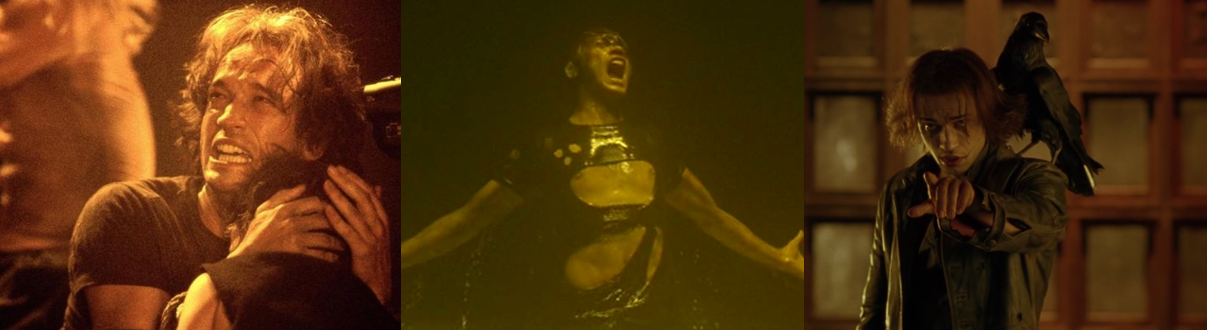
Reborn from a violent death, Ashe embarks on a mission of vengeance with a manic theatricality.

Ashe is quite a different character to Eric Draven; rather than being a loved-up rockstar, he’s a mechanic and a single father living in Los Angeles, here rendered as a bleak, gritty, crime-infested hellhole swamped with drugs and rampant violence thanks to the fanatical Judah Earl. Though there are few places free from Judah’s influence; Ashe lived a simple, quiet life near the pier with his beloved son, Danny, but the two were brutally tortured and executed by Judah’s maniacal followers, primarily Kali (Trang) and “Curve” (Pop), after accidentally witnessing them murdering another drug dealer. Some time later (in the first film it was a year; here, we don’t really know, but it can’t be that long as Ashe’s garage/home is largely untouched since his death), the mysterious and semi-supernatural crow brings Ashe back from his watery grave to seek vengeance but, whereas the crow guided Eric and assisted in his similar quest, Ashe is primarily aided by Sarah Mohr (Kirshner), who is all grown up from the last film and working as a melancholic tattoo artist. While Eric rose in a state of confusion, he became committed to his cause after the crow helped him relive his traumatic death; Ashe similarly reawakens confused and disorientated, but is overwhelmed by his situation, as related by Sarah, and reacts with denial and hostility before reluctantly accepting that he’s now an undead spirit of vengeance after being bombarded with memories. Sarah uses Danny’s paints to make Ashe into an imitation of her former friend (even his make-up is a poor facsimile of Eric’s, however, with the white barely visible in the film’s poor lighting and the black only going around his lips rather than covering them) and he throws on a bad-ass trench coat, hops on an equally bad-ass motorcycle, and heads into the misty and filth-ridden streets to track down his killers. Thanks to the crow, Ashe is led to “Spider Monkey” (Vincent Castellanos), where he showcases his dramatic flair, performing sleight of hand and card tricks while toying with his prey, while also exhibiting just how corny and bad Pérez’s acting and line delivery is. This becomes a common theme, with his weird screaming, cackling countenance, odd appropriation of the “One for sorrow” nursery rhyme to now include crows, and desperate attempts to appear menacing only serving to make him appear unhinged. Whereas Eric somewhat revelled in the virtual invincibility and superhuman abilities afforded to him, Ashe wallows in the constant cycle of pain and healing his body goes through when he’s hurt (which, to be fair, is somewhat similar to the comic book Eric) and fluctuates between being violently, maniacally unbalanced when facing his killers, and miserable and brooding when with Sarah or contemplating his newfound afterlife.

Though seeking revenge for his son’s death, this new Crow is tempted to stay behind with Sarah.

While this is reminiscent of his predecessor, Ashe comes off as far gloomier and sullener than Eric, and it’s not like he makes up for it with any decent fight scenes. The few he does have are brief, poorly shot, and completely one-sided in his favour until the end, and we’re even denied decent shoot outs this time around as Ashe largely forgoes firearms (except for when hunting Curve), though he does evoke the crow imagery by stuffing a paper crow into “Nemo’s” (Thomas Jane) mouth, forming Kali’s blood into a crow upon her death, and leaving Curve surrounded by a crow outline of petals. Naturally, Ashe isn’t just out to avenge his death, but is primarily driven to avenge the brutal murder of his son; this causes him the most pain, as Danny was just an innocent, wide-eyed kid (a stupid one, but an innocent one nonetheless) and reliving his murder causes grief and rage to wrack Ashe’s body and, in many ways, makes his plight far worse than Eric’s but this tragedy really belongs in a better movie (or in the hands of a better actor). He goes out of his way to retrieve Danny’s corpse and give him a proper burial and is even visited by Danny’s spirt when he starts to lose his way. This wrinkle is added because, for whatever reason, Ashe develops a strong attraction to Sarah; surprising, as the two have very little chemistry and, while she seems fascinated to see another reborn by the crow and is sympathetic to him, I never got any romantic feelings from her. A snappy, somewhat feisty goth girl who partially narrates the film and has a familial bond with her boss, Noah (Ian Dury), Sarah’s influence over Ashe becomes so strong that he considers staying behind with her. This is juxtaposed by the Day of the Dead festival that’s being celebrated in the city, and through a conversation with a priest (Reynaldo Duran), who tells Ashe that wandering souls can get lost, believing themselves to be alive, and need guidance to achieve eternal rest. Honestly, the idea of a Crow wandering the Earth with no memory of how or why they got there is a fascinating one, and one I believe was strongly emphasised in the original cut of the film, where Ashe decides to stay behind rather than join his son, and Sarah, in death.

Some terrible performances stunt whatever menace Judah and his followers are meant to have.

Of course, this plot is barely notable in the finished film and is used more as motivation to keep Ashe fighting and help him overcome the loss of his powers, courtesy of Judah Earl. I hate to keep making comparisons, but Judah Earl is no Top Dollar (Michael Wincott); he exudes a decent menace and is a reprehensible and zealous figure in his own right, but Richard Brooks’ performance is all over the place as well, ranging from stoic and gravelly to over the top theatre as he proudly proclaims: “I’m your shadow, Ashe! […] I’ve tasted the blood of the crow and taken your power!” Like Top Dollar, Judah Earl is surrounded by a gaggle of cackling, shit-kicking underlings, none of which have any of the personality (however one-note and despicable) of Top Dollar’s and most of whom are constantly out of their minds on Judah’s tainted crack to be little ore than a knock-off combination of Skank (Angel David) and Funboy (Michael Massee). The most notable exceptions, beyond Nemo’s eccentricities, are Kali and Curve. Kali is a sadistic bitch who takes great pleasure in mocking and killing Danny; she also exhibits some martial arts prowess, giving Ashe his first real physical competition, and is one of three characters who I actually enjoyed seeing offed due to her aggravating nature. The other was Curve, played with manic abandon by rock icon Iggy Pop; I’m no fan of Iggy Pop’s music, or his acting, however, and Curve comes across as completely off his rocker, constantly raging about a tattoo Sarah gave him and assaulting the senses with his weird line delivery and atrocious acting (his “Do you think I’m afrai-i-id?” spiel is probably the worst performance I’ve ever seen). While Top Dollar seemed to have his hands in everything and was more about anarchy, Judah’s deal is drugs; he swamps the city with the stuff and has little concern over how badly his merchandise affects people. Once a product of the streets, Judah has taken to spending his time in his penthouse surrounded by the macabre and supernatural, and conveniently has a blind seer on hand Sybil (Tracey Ellis) to fill him (and us) in on the nature of the crow and how harming or killing it can hurt Ashe and render him mortal. Judah Earl takes this one step further, however, and drinks the crow’s blood to become “The Shadow”, a dark version of Ashe who gains all of his supernatural abilities for their final climatic showdown in the streets.

The Nitty-Gritty:
It’s so interesting and weird to think about the Crow franchise; the premise is incredibly simple and shouldn’t really be that hard to make a gritty, gothic, somewhat low budget film that’s a mixture of action, horror, and romance. It turns out, however, that The Crow was lightning in a bottle; not only did everything about its presentation work exceptionally well, but its reputation was bolstered by Brandon Lee’s tragic death, which has elevated the film above whatever shortcomings it might have to make it a monument to a young actor cut down in his prime. In that regard, you could argue that it didn’t make sense to follow it up, especially so soon after, but to do so with this knock-off, poor quality effort is a real insult to both Lee and O’Barr and comes across as a poor man’s attempt to recapture the magic. While the soundtrack is still pretty strong thanks to Graeme Revell’s haunting score (even if it is basically the same as last time) and some notable names, like White Zombie and Deftones, contributing to the film, the quality of acting takes a dramatic nosedive. Rather than a strong assortment of character actors and charismatic performers, The Crow: City of Angels features a bunch of one-dimensional, underdeveloped scumbags or aggravating performances from people who never should’ve been cast in the first place or actors who had yet to really hit their stride in their art.

Whatever visual appeal this film may have is lost beneath a muddy filter and poor special effects.

Easily the worst aspect of The Crow: City of Angels, though, is the presentation; this was legitimately the first film I’ve ever watched where I’ve criticised the direction and cinematography, and the look and feel of this film is a far cry from the harsh, rugged streets seen in the first film, which was almost a noir thriller in its aesthetic. The sequel swamps every scene in this grimy, mustard-yellow glare; mist and smoke covers everything, making the city appear to be either a poorly-constructed miniature or obscuring sets and real-world locations, and everything looks cheap and rushed, as though the filmmakers were trying to cover their inadequacies with this ugly, choking fog. Honestly, it looks like a homemade movie filmed on a soundstage or in a back garden, it’s that bad and, while the city occasionally seems like one of the worst places you can ever imagine, with its seedy underworld, sex clubs, and bars and such, everything just seems more fake and staged compared to the first movie, and this carries through to the action scenes. Sure, Ashe looks awesome cutting through the fog on his motorcycle, but he gets none of the rooftop-running action of Eric and doesn’t really acquit himself well in fight scenes. More often than not, Ashe simply slaps around and scuffles with his victim rather than threatening them with Poe or mutilating his body to intimidate his opponents, and the only physical challenge he’s presented with comes from Kali, whom he easily dashes out a window thanks to his invulnerability. Otherwise, Ashe’s mission of vengeance is an absolute mess of murky visuals, jerky camera moments, and awful acting; Pérez desperately tries to come off as intimidating when confronting Spider-Monkey but it’s a poor effort made worse by some dodgy CGI effects, and seeing him mock Nemo with a pouting countenance is more disturbing than menacing. Even Ashe’s big fight scene with Kali is ultimately disappointing, being a plodding affair with slow, awkward movements, erratic editing, and some weird contorted body language from Pérez, and his rundown of Curve ends up being a pitiable chase and confrontation thanks to such memorable lines as “Fuck you, bird dick!” and the down-right ugly visual presentation of the film.

Although rendered powerless and unable to save Sarah, Ashe is…somehow…able to destroy Judah Earl.

Fittingly, Ashe’s greatest physical challenge comes in the film’s conclusion; desiring to take the Crow’s power for his own, Judah Earl takes Sarah hostage and, after capturing the crow with a ridiculous amount of ease, has her witness a bizarre ritual where he kills the bird, inflicting Ashe with stigmata for a very on the nose Christ allusion and causing him to plummet from Judah’s high-rise dwelling and be rendered vulnerable. This fulfils Judah’s life-long fascination with death; his stoic demeanour and callous nature isn’t just to try and paint him as a malicious threat, but is because he’s completely numb to the concept of death since he has already experienced, and survived it, before. Having “liked what he saw” in his brief time in Hell, the only pleasure Judah has been able to take since is in the suffering of others, and the power of the crow allows him to indulge this to the fullest extent…however, while much of this is inferred and implied throughout the film, it really only becomes explicit when you know that, apparently, the original script went into greater detail about Judah’s near-death experience as a child. Regardless, thus empowered, Judah (or “The Shadow”, or whatever-the-fuck he’s supposed to be) easily manhandles Ashe, who’s completely helpless against Judah’s superior strength. The cruel zealot takes a sadistic pleasure in stringing Ashe up and lashing him before a raucous crowd but, when he goes to finish him off, Sarah intervenes and takes a knife to the stomach (without him even trying), dying in Ashe’s arms. Spurred on by Danny, who eagerly awaits his return, and enraged at Sarah’s death, Ashe skewers Judah on a piece of scaffold and…somehow…calls up a murder of (presumably) supernatural crows to tear the cruel kingpin into a mess of dodgy CGI. Again, quite how Ashe does this considering he has no powers at this point isn’t explained, nor is it really made clear exactly what the hell’s happening; it’s just another of the many drawbacks to huge chunks of the story being excised from the film, and this is only further reinforced in the rushed and vague ending, which suggests Ashe actually did stay behind rather than what the film is actually going for (which is that he rode off into the fog to be with Danny and, most likely, Sarah).

The Summary:
What happened to Brandon Lee on the set of The Crow was a tragedy. What happened to James O’Barr as a hopeful teenager was a tragedy. The Crow: City of Angels is a tragedy. The whole film is just an ugly, distorted, incoherent mess from start to finish; oh sure, there’s flashes of a somewhat decent sequel here, but everything that’s good about it is based on what worked in the first film and is a mere copy (a shadow, if you will) of it. Rather than taking the formula of its predecessor and expanding upon it, offering more action and bloodshed and more visually interesting fights and kills, The Crow: City of Angels ends up looking like a direct-to-video rush job that completely squanders not only its own premise, but everything that the first movie did so well. The idea of a father returning to enact revenge on those that killed his son is palpable, as is the concept of a crow avatar falling in love with a living female and resisting returning to the grave; hell, even the idea of a sadistic thug stealing the powers of the crow has some merit, but the execution of all of these ideas is ruined by muddy visuals, piss-poor performances, and an absolutely butchered narrative pacing. There’s some cool visuals of the Crow on his motorcycle and dramatically stalking and toying his prey or brooding in the dark, but Vincent Pérez is absolutely terrible here; he does the more melancholic aspects quite well, but his madcap buffoonery, grating accent, and stilted line delivery leave him a charisma-less void, especially compared to his predecessor. Iggy Pop desperately tries to hog every scene but he’s in way over his head here, and I doubt a better script or direction could’ve helped his tone-deaf performance, and Richard Brooks fails to exude any type of menace, even when he’s trying his hardest, thanks to his random descents into mania. Overall, it’s baffling to me that the studio managed to butcher a sequel to The Crow so badly; when its aping the first film, there’s some appeal here, but no one in their right mind would ever choose to watch this over the first movie and it does nothing but leech off of The Crow’s cult appeal in the laziest and most insulting ways possible, leaving us with a patchwork imitation of its predecessor that deserves nothing but scorn and derision.

My Rating:

Rating: 1 out of 5.

Terrible

Am I being too harsh on The Crow: City of Angels? Do you think the film had any chance of living up to the popularity and reputation of its predecessor? What did you think to Vincent Pérez’s performance and Ashe as the new Crow? Did you buy his romance with Sarah, or enjoy his flair for the theatrical? What did you think to Judah Earl and his crew? Did you enjoy the murky, foggy presentation of the film or was it also a struggle to endure? Which of The Crow’s sequels was your favourite, if any, and would you like to see the character return in some form or another in the future? How are you celebrating Devil’s Night tonight? Whatever you think about The Crow: City of Angels, join the discussion below or leave a comment on my social media.

Movie Night: The Crow (1994)

Released: 13 May 1994
Director:
Alex Proyas
Distributor:
Miramax Films
Budget:
$23 million
Stars:
Brandon Lee, David Patrick Kelly, Rochelle Davis, Ernie Hudson, and Michael Wincott

The Plot:
Musician Eric Draven (Lee) and his fiancée, Shelly Webster (Sofia Shinas), are brutally murdered by “T-Bird” (Kelly) and his gang of thugs. One year later, a mysterious and supernatural crow brings Eric back to life; painting himself up as a tragic masquerade and bestowed with invincibility, Eric sets out to avenge their deaths using his newfound abilities.

The Background:
The Crow began life as a comic book published by Caliber Comics in 1989 and created, written, and illustrated by James O’Barr. The character, named simply “Eric” in the comic, was a tragic figure modelled after prominent rock musicians, prone to quoting a variety of scripture, and who engaged in the brutal slaying of those who killed him and his fiancée as a reaction to the pain and loss O’Barr felt after losing his own fiancée to a drunk driver. Thanks to its bleak tone, striking black and white artistic style, and emotional narrative, The Crow became an underground success and, with dark comic book narratives quickly gaining popularity in Hollywood, was adapted into a feature film in 1994. Of course, you can’t talk about The Crow without mentioning star Brandon Lee’s tragic and untimely death after accidentally being shot with a real bullet. The film, which was already mostly complete, was finished through a combination of stunt doubles, stand-ins, and some digital trickery and released to both unanimous critical acclaim and was a surprise box office hit, grossing over $50 million in total. While the  subsequent sequels failed to capture the magic of this first film, The Crow inspired not only a darker look for legendary wrestler Sting but also became a cult hit and is one of my favourite movies period so, with tonight being “Devil’s Night”, what better way to celebrate than by revisiting this classic film?

The Review:
The bleakness and darkness of The Crow’s world is dropped in our laps as soon as the film begins as it opens with Eric already dead and Shelly in critical condition. Considering that Eric spends the entire film as a reborn revenant, it’s oddly fitting that, when we first meet him, Eric is little more than a lifeless corpse on the cold, rainswept pavement. Eric’s return from the grave is a harrowing, disturbing process not just for him but for the audience as well as he literally claws and crawls his way out of his grave and, disorientated and in shock, stumbles his way back to his apartment only to be immediately bombarded with memories of his former life. These brief flashes to happier times with Shelly are juxtaposed with the violent and disturbing memories of the brutal attack the two of them endured at the hands of T-Bird and his motley crew; Eric’s agony at reliving events both good and bad send him into an anguished fury and, very quickly, in the space of just a few minutes, we learn not only that Eric is now able to immediately heal from all physical wounds but are instantly committed to seeing through his burning desire for revenge alongside him, so tangible is Lee’s performance at showcasing Eric’s torment during this deeply affecting and unpleasant sequence.

Guided by the crow, Eric enacts brutal and fitting revenge against his targets.

In the comic, Eric and Shelly were attacked at the side of the road and it was a very random, brutal affair but, in the film, they’re specifically targeted after angering the gang and Eric’s suffering is magnified significantly as he is stabbed, beaten, shot, and unceremoniously throw to his death. After his return, Eric is guided on his journey by a mysterious and supernatural crow (ironically, no crows actually appear in the film and the filmmakers used ravens instead) but, unlike in the comics, Eric never actually refers to himself as the Crow in the film. Instead, Eric explicitly uses his real name so that his victims know exactly who it is who is coming for them. His vengeance comes in systematic fashion as he targets each of those responsible for his suffering one at a time, hunting them down thanks to his ability to see through the crow’s eyes and forcing each of them to not only remember him and Shelly but also making them pay in fitting fashion; “Tin-Tin” (Laurence Mason), for example, favours knives as his weapon of choice so Eric stabs him, off screen, through “all his major organs in alphabetical order” and, similarly, he kills “Funboy” (Michael Massee) by subjecting him to a lethal overdose of heroin.

Eric’s mission means he can’t fully indulge in reconnecting with allies and loved ones.

Although he is an extremely tormented individual and has chosen to commit himself fully to his mission rather than attempt to reconnect to his previous life, Eric isn’t alone in his quest for revenge. While alive, he and Shelly befriended and often took care of Sarah (Davis), a streetwise young girl whose mother, Darla (Anna Levine), is unfit to care for her since she’s dependent on substances and used as a plaything by Funboy. Left alone and devastated by her friends’ deaths, Sarah was comforted by Sergeant Albrecht (Hudson), a jaded cop who was first on the scene at Eric’s apartment and whose tendency to stick his nose where it doesn’t belong causes friction between him and Detective Torres (Marco Rodríguez). Both characters eventually, inevitably, cross paths with Eric during his crusade and offer an emotional link to a life that is now haunting the reborn rock star like a bad dream; Albrecht provides Eric with the memories of Shelly’s prolonged death and sympathises with his plight and Sarah represents Eric’s one remaining link to the happier times in his life. Eric is forced to keep Sarah away since his return was predicated on seeking vengeance rather than reuniting with her but, in the end, their fates converge for the finale and allow Eric to bring closure to his life and death, with even the crow favouring Sarah throughout the film.

Top Dollar retains his sadistic edge despite appearing disgruntled with the routine of his life.

The town’s violent criminal element have taken to ritualistically committing arson attacks throughout the city on October 30th, which has become known as “Devil’s Night” as a result. The head honcho of these attacks is “Top Dollar” (Wincott), a charismatic and mystifying gang leader with delusions of grandeur and an unhealthy and disturbingly close relationship with his stepsister, Myca (Bai Ling). A sadistic and perverse individual, there’s a lingering sense of dissatisfaction and humanity to Top Dollar’s character as, while he happily kills and orders annual destruction and anarchy, he seems disgruntled with the routine and predictability of his life and even expresses genuine regret at the pain and suffering Eric and Shelly had to endure. Ultimately, though, he is a slave to the life he lives and, while he may be discontented and bored with how mundane things have become and is largely dispassionate and stoic even when Eric actively disrupts his operation, he remains resolute in keeping his position of power and influence in the city. As a result, Top Dollar is more than happy to kill anyone who gets in his way and even kidnaps Sarah in a bid to lure Eric into a confrontation whereby his powers can be stripped away, starting an annoying trend in the Crow movies. The film greatly expands his role compared to his comic counterpart, who was more of a throwaway goon, but Wincott shines as the gravely-voiced kingpin and the restructured hierarchy of the gang really helps to escalate the action and emotion behind Eric’s crusade.

There’s a certain catharsis to be gained from Eric’s stoic execution of the sleazy T-Bird.

One of the things I love about The Crow is that there are no corporate, suit-wearing bad guys as the antagonists are generally street-level thugs; Top Dollar and his aid, Grange (Tony Todd in a disappointingly small role), are the sole exceptions to this rule and I can forgive it as they’re not businessmen by any means and it’s implied that they were just street punks at one time and are now simply at the top of the criminal food chain thanks to their power and influence. Indeed, unlike in the comic, Eric has no interest in actively pursuing or killing Top Dollar since he wasn’t present during his and Shelly’s deaths and he only targets the gang leader when he kidnaps Sarah in a bid to steal the crow’s powers. As a result, for much of the film’s runtime, the principal antagonist and the primary target of Eric’s vengeance is Top Dollar’s main street thug, T-Bird, just as it was in the comic. A sleazy, arrogant punk, T-Bird takes a perverse pleasure in unquestionably executing Top Dollar’s every order but prefers to be the more hands-off compared his little gang of thugs. He directs his crew with a simple high-pitched whistle, often while quoting Satanic scripture, and his power and authority out on the streets are never in question. Though he often intimidates and bosses around “Skank” (Angel David), the comic relief of the film and the most cowardly and immature of the gang, T-Bird is reduced to a blubbering wreck when enduring Eric’s wrath and seeing his calm, controlled demeanour break is almost as fitting an end for the character as his explosive death. This scene, which was one of a handful shot using a body double for Brandon Lee, actually benefits from Eric’s silence; rather than explain himself as he did with his other victims, Eric simply allows T-Bird to come to the horrifying realisation that his actions have come back to haunt him, making or an emotionally charged scene that really hammers home how unheroic Eric’s vendetta is.

The Nitty-Gritty:
The city itself is also a prominent character in the film; constantly blanketed in rainfall and violence, it is a bleak, desolate, and ominous place and, to add to its foreboding atmosphere, there are very few scenes that take place during the day or in locations that aren’t squalid or ransacked. The Crow’s soundtrack also plays a vital role in setting the tone and atmosphere of the film; alongside a gloomy, emotional score by Graeme Revell, The Crow includes some fantastic heavy metal tracks from the likes of The Cure and Nine Inch Nails, all of which tie into Eric’s career as a musician and the film’s character. Indeed, if there’s a downside to the film, it’s that some of its effects haven’t aged too well; the scene where Eric holds his hand up so that Funboy can see his bullet wound heal is a noticeably poor effect by today’s standards but, for the most part, the employment of more practical effects and camera trickery hold up well enough.

An enigmatic and unpredictable character, Eric is driven by great loss and a lust for revenge.

Eric is an enigmatic and unpredictable character, made even more captivating by Lee’s enthralling performance. In the comic, Eric was a sombre, stoic character who was fond of quoting literature, poetry, and speaking in riddles and, while that is still true of his live-action counterpart, Lee’s Eric is imbued with a justifiable anger and, at times, a sarcastic snark. Sporting an alluring smile (that’s more of a sneer) and an effortless confidence, Eric fully believes in the righteousness of his mission (as he tells Albrecht: “They’re all dead. They just don’t know it yet”) and is brutally efficient at carrying it out, though he still takes the time to taunt and toy with his victims as they did to him. His quotation of Edgar Allen Poe’s The Raven when violently confronting Gideon (Jon Polito) is a notable highlight, as is his rant to Funboy about Jesus Christ, both of which capture the melancholy personality of his comic book counterpart, and is contrasted by his apathetic, silent execution of T-Bird. Eric often revels in his powers, willingly goading his targets into trying to stab or shoot him and then laughing at their terrified reaction to his superhuman healing. Similarly, he often gets so caught up in the fury and pain of his death that he takes a perverse pleasure in toying and murdering his killers, particularly Tin-Tin and Skank, often punctuating their deaths with a crow motif either in blood or fire. Still, his many flashbacks show that he was a carefree and fun-loving bloke while he was a live so he’s also notably appalled at himself and what he has become; this is best seen when, after killing T-Bird and believing that his mission is completed, he removes Tin-Tin’s jacket and tosses it away in disgust.

Despite being stripped of his powers, Eric triumphs and reunites with Shelly in the afterlife.

After his painfully and harrowing rebirth, Eric’s life became consumed with revenge and the desire to return to the grave and be reunited with Shelly after avenging their deaths; however, along the way, he not only indulges in a series of escalating violent acts (culminating in an action-packed shoot out between himself and Top Dollar’s fellow gang members and a sword fight against Top Dollar himself on the roof of a church) but also impacts and improves the lives of his allies. For example, while dispensing justice to Funboy, he conveys to Darla the seriousness of her responsibilities as a mother, thus helping to repair her relationship with Sarah. However, this is also seen in the film’s finale, where Albrecht provides Eric with back-up for his showdown with Top Dollar, Myca, and Grange. Despite the fact that he keeps getting into trouble for acting outside of his pay grade, Albrecht feels he owes it to Eric to help him out and ends up being instrumental in assisting Eric in saving Sarah after Grange shoots the crow and robs Eric of his invincibility. This was a new element that wasn’t in the original comic book and it carried over into the subsequent sequels but it works in service of the film’s larger narrative because, in the end, Eric must confront Top Dollar as a mere mortal man with nothing left but his rage and uncompromising determination. Thanks to the rain, even Eric’s face paint is washed away during this final confrontation and, after enduring a mortal wound, he subjects Top Dollar to the many hours of suffering and pain Shelly was forced to endure because of his orders and dispatches him in brutal fashion by impaling him on one of the church’s stone gargoyles.

The Summary:
Even now, nearly thirty years after I first saw the film, The Crow remains one of my favourite movies of all time. Honestly, I actually prefer it to the comic book thanks to the alterations to the source material improving upon the hierarchy of the villains and making Eric an even more relatable and tragic character. The desolate, violent, and bleak presentation of the film, the city, and the plot were a profound influence on me and, despite a few dodgy effects here and there, The Crow has a real timeless quality. I am continuously astounded at how badly Hollywood managed to screw up the sequels as it seems like such a simple formula to recreate, but The Crow really was lightning in a bottle as it not only captured the spirit of the source material but enhanced it with some fantastic and memorable performances. It’s absolutely tragic that this film saw the untimely death of Brandon Lee; his performance is captivating and full of life, action, and a multitude of complex emotions (from stoic conviction, to subdued melancholy, to unhinged anger) and it’s a real shame that he never got the chance to show the full extent of his range and ability over a long and illustrious career. Yet, his legacy lives on in the enduring strength and appeal of The Crow, which greatly contributed to comic book movies being seen as a serious and worthwhile sub-genre of cinema and whose iconography has left a lasting impression.

My Rating:

Rating: 5 out of 5.

Fantastic

What are your thoughts on The Crow? What did you think to Brandon Lee’s portrayal and do you think he would have had a promising career had his tragic death not occurred? How did you feel it compared to the comic book? Were you a fan of the changes the filmmakers made to the source material (such as the removal of Eric’s powers for the finale) or would you like to see a remake that was closer to the original comic book? Were you a fan of the soundtrack; if so, which track was your favourite? Which of The Crow’s sequels was your favourite, if any, and would you like the see the character return in some form or another in the future? How are you celebrating Devil’s Night tonight? Whatever you think about The Crow, go ahead and leave a comment down below or start the discussion on my social media.

Back Issues: The Crow

Story Title: “Inertia”, “Pain”, “Fear”, “Irony”, and “Despair”
Published:
January 1989; February 1989 to May 1989
Writer/Artist:
James O’Barr (as “J. O’Barr”)

The Background:
The Crow began life as a comic book published by Caliber Comics in 1989, with the title character’s first appearance being a short prequel tale, “Inertia”, which was published in Caliber Presents #1 (January 1989). The comic book was the creation of writer and artist James O’Barr as a way of coping with the pain and loss he felt after losing his fiancée to a drunk driver. Although it took O’Barr nearly ten years to find a publisher, The Crow became an underground success thanks to its bleak tone, striking black and white artistic style, and emotional narrative. Wildly regarded as one of the most unique and poignant tales in the industry, the comic book achieved even greater mainstream success with the release of a suitably bleak 1994 feature film adaptation. Although The Crow (Proyas, 1994) was a cult hit, its sequels were disappointingly lacklustre; nevertheless, the original comic remains a highly regarded masterpiece and was succeeded by a number of spin-offs and subsequent stories.

The Review:
I first became aware of The Crow in very much the same way as I’m sure a lot of people did: by watching the first movie, which immediately captivated me and made me curious enough to seek out the original comic book. The story begins in the grimy, dangerous streets of Detroit, where gangs and crime and vice run rampant; the first thing we see is small-time thug Jones Transfer, a muscle-bound skinhead desperate for a fix of cocaine and having just swiped a Toshiba cassette player. His exhilaration turns to horror, and then anger, when a large, shadowy figure draped in a long black trench coat and with a face painted into the image of irony (a perpetually smiling clown-like face that is decidedly at odds with his generally more stoic and column appearance). Completely unfazed by Jones’s switchblade, even after it’s stabbed into his shoulder, the clown-faced mystery man demands to know the whereabouts of another local thug, T-Bird, and his cronies (Tom Tom, Top Dollar, Fun Boy, and Tin Tin). Jones is terrified to see the ghostly figure remove the switchblade, lap blood from the blade, and reveal that he tortured Jones’s friend and associate, Shelby the Giant, by clipping off his fingers one by one until he gave up everything he knew. Convinced, and desperate to save his own miserable life, Jones reveals that where each of the ghost-man’s targets can be found throughout the city, and is left alive to tell the thugs that he (as in, the painted-up vigilante) is coming for them.

Tormented by his fragmented memories, the Crow executes his first victim.

When the story proper begins, both the art and the presentation has shifted somewhat; text boxes allow us into the mind of the ghost-faced vigilante, now identified as “The Crow”, who stalks through the murky city streets and broods in an abandoned house outside of the city, constantly reliving the memory of a girl being attacked, though he cannot remember the exact specifics. All he can think about are the names of those responsible, and we transition over to find one of them Tin Tin, testing out a gun on a hapless pedestrian. He guns down the seller, and the little punk who arranged the sale, caring only about sending a message to Top Dollar’s would-be competition and little for the innocent woman’s cat, Gabriel, who would be left homeless as a result of his actions.  Thankfully, we don’t have to wait long for Tin Tin to pay for his reprehensible nature as the Crow immediately confronts him down a dark alley; showing no fear and completely no-selling an errant shot to the head, the Crow downs Tin Tim with a bullet to the wrist and, after bombarding Tin Tin with nonsensical religious statements, triggers his victims memory by detailing his part in attacked a man and a girl on a cold October night. Although Tin Tin begs for his life, pinning the blame entirely on T-Bird and the drugs they were on, the Crow, wracked with fragmented memories of happier times, shows no mercy and blows the asshole’s head clean off.

The Crow wastes no time in dispatching the top player in town.

The Crow ties a shotgun shell into his hair to indicate that the first of his victims has fallen, and Tin Tin’s death causes some concern amongst his shit-kicking associates; Top Dollar, the self-styled head honcho of the neighbourhood, is unconcerned, however. He doesn’t give two shits what the street punks think about it, or that Tin Tin got killed, and vehemently asserts that he owns the dope, the neighbourhood, and that “[his] word is the law!” Top Dollar is quickly convinced to give a shit, however, when the Crow gate-crashes the meeting and guns down everyone there. Some of the punks are sporting bulletproof vests, but the Crow is as unfazed by this as he is by their wild bullets, which strike him and draw blood but do not drop him, and simply executes them with a shot to the head while preaching a sermon on their evil ways. In the end, only Top Dollar is left; he attempts to barter for his life with money and drugs, but the Crow ignores him and simply stoically tells his story of a man, a woman, and a 1971 Plymouth on a rainy night. the second Top Dollar admits to remembering what the Crow is talking about amidst his angered ranting, the Crow executes him with two shots to the head. That’s right, in the original comic book, the Crow went pretty much directly to the top of the pecking order and then worked his way down, rather than working his way up the chain of command in the gang responsible for his suffering, showing him to be slightly more efficient and direct than his filmic counterpart.

The Crow retrieves Shelly’s engagement ring and catches the attention of the local cops.

Those that were concerned about Gabriel’s welfare can rejoice as the Crow takes the fluffy white cat in brings her (Gabriel is initially thought to be a boy but is later revealed to be a girl, and pregnant to boot) back to their old home, where he presents the cat as a gift to his lost love. This triggers a cute flashback to when the fresh-faced, unscarred and far less tortured Crow (then known as Eric) proposed to his beautiful girlfriend Shelly, during a playful bout of painting their home. Later, as Christmas closes in, Gabriel triggers another memory of when Eric surprised Shelly with the news that he had secured the house for them, leading to the Crow lamenting that the cat “[makes him] smile too much”. The Crow then arms himself with a samurai sword and heads out to confront Tom Tom, beheading his punk-ass friend Skank before taunting the gun-toting thug with the iconic gag about Jesus Christ being “put up for the night” at a hotel. Shrouded in darkness, Tom Tom has no chance to land a shot quickly has his legs literally taken out from under him with one swipe of the Crow’s sword. Bleeding out, and suffering from shock, Tom Tom seems mildly repentant for his part in Eric and Shelly’s murder and tells the Crow where he can find Shelly’s engagement ring. This leads the Crow to Gideon Resale, a pawn shop in a seedier part of town, where he calmly confronts the grouchy owner, stabbing him through the hand and forcing him to hand over a box full of rings. After locating Shelly’s ring and taking it for himself, the Crow executes Gideon, loads himself up with armaments from his shop, and sets it ablaze using a makeshift kerosene bomb. Young police officer Albrect attempts to interrupt the Crow, but is suitably intimidated by the vigilante’s stoic demeanour and conviction, bringing the Crow to the attention of the police for the first time. Based on Albrect’s description of the Crow, Sergeant Hook figures out that he’s Eric returned from the grave pretty much right away since, as we later find out, he visited Eric in hospital after he was attacked and offered his condolences. Hook was shocked when Eric utters his dying words: “The crow said don’t look!!” and is later less than impressed to find that the Crow has left him the pregnant, flea-ridden Gabriel to look after.

The Crow wades through Fun Boy’s goons and grants him a merciful death for his honesty and help.

On his way to confront Fun Boy, Crow comes across a young girl, Sherri, whose mother is one of the punk’s concubines. Feeling a connection with the girl’s innocence, the Crow gifts her with Shelly’s engagement ring, much to the girl’s emotional appreciation, and promises to return her mother to her. Later, before bringing his vengeance to an end, the Crow bids a heartfelt farewell to Sherri and promises her that things in her life will one day get better, or at the very least she will find serenity in the afterlife. Barging in on Fun Boy and Sherri’s mother in bed, the Crow demands that she leave and compels her to do better by her daughter with the memorable “Mother is the name for God” line, before getting into it with Fun Boy. Unlike his film counterpart, who was a wacked out junkie, the comic book Fun Boy is far more defiant and integral to the plot; he talks snark to the Crow and agrees to gather the rest of the gang together in a bar for a big gun fight. After intimidating the hugs with his loquaciousness, the Crow dispatches them in a blood-soaked battle that sees him burying an axe in one guy’s neck and gunning them all down with two pistols without missing a single shot, all while shrugging off any bullets that happen to hit or graze him until only Fun Boy is left. Unlike his associates, he doesn’t beg or plead or even repent for his actions; instead, he owns his reprehensible actions and even admits to perpetrating even worse acts against his fellow man. Tired of all the killing and vengeance, the Crow demands that Fun Boy go and get T-Bird so that they can finish this where it all started, at the side of a road outside of town where Eric and Shelly were tortured and killed. In return for Fun Boy’s assistance, the Crow promises him a quick, clean death, but makes no such promises for T-Bird, the man who pulled the trigger on himself and his lover.

Eric and Shelly are brutally murdered by a gang of coked up assholes.

After following the Crow’s vicious and bloody path of vengeance throughout the story and being treated to brief flashbacks and memories of Eric and Shelly’s lives together, the final chapter shows us exactly what happened to the two on that fateful night. After proposing to Shelly, Eric takes her on a night out to celebrate but, on their way home, their car suddenly breaks down. As Eric is attempting to fix it, T-Bird and his cronies, completely off their heads on cocaine, alcohol, and other drugs, randomly happen to drive past them and, spotting Shelly, decide to circle back and harass them. Eric has Shelly lock herself in the car and attempts to reason with the gang and, for his efforts, is violently shot in the bac of the head by T-Bird. The bullet blows part of his skull off (giving him the scar over his nose and the one glazed over eye we’ve seen him sport throughout the book as the Crow) but doesn’t actually kill him. Even when T-Bird follows this up with a second, direct shot that briefly sets Eric’s hair on fire, Eric still doesn’t die; instead, he’s left helpless and paralysed on the cold, wet road and forced to watch as Shelly is beaten and raped by the gang before being killed by T-Bird. As Eric lies there, mortally wounded and barely clinging to life, he is berated by a vision of the crow, who begs him not to look and urges him to give up the mortal coil so that he can have his revenge.

The Crow destroys T-Bird’s crew and finally completes his mission of revenge.

After burning his house down and leaving Albrect a note to look after Sherri, the Crow heads to the final showdown at a dilapidated house in the city after Fun Boy was unable to convince T-Bird and the others of the Crow’s threat. Still, the Crow remains true to his word and allows the junkie to kill himself with a lethal dose of morphine, before pumping a dose of the drug directly into his heart, killing a number of T-Bird’s cronies (with the exception of Two-Tone, whom he allows to live), and finally confronting T-Bird himself by stowing away in the back seat of his car. The Crow endures a bombardment of bullets from T-Bird’s gang before brutalising them with his superior strength and turning their weapons against each other, butchering them all in violent fashion and even walking away from a bullet shot through his neck at point-blank range. Terrified by the Crow’s manic violence, T-Bird races away in his blood-soaked and ends up crashing at the exact location where he killed Eric and Shelly; suffering from two broken legs, T-Bird remains defiant to the end and the comic cuts away as the Crow approaches his helpless foe with nothing more than a hammer in hand. The story ends with the Crow resting at a cemetery, having succeeded in avenging himself and his lover, and allowing himself to be spirited back to the afterlife by memories of himself and Shelly as the crow lies overhead.

The Summary:
Each chapter of the story is preceded by a quotation or a short poem that sets up the theme of the chapter, and the entire book, be it “Pain” or “Night”. Flashbacks to Eric’s journey to the afterlife, or his far happier life, are rendered in a far different visual style; these are beautiful, soft paintings rather than harsh pen strokes of black and white and, from the very first interlude, set the tragic tone for the entire story. “Shattered in the Head” appears to show Eric in a dream-like memory of riding a train but is, in actuality, a representation of his journey to the afterlife; he sees a beautiful white horse get tangled up in barbed wire, suffering in agony as it bleeds to death, which is an obvious parallel to how Shelly died. Just like in that instance, Eric was helpless to do anything to help and powerless to do anything but look on in horror, something which the Crow admonishes him for as the skeletal train conductor as for his ticket (an obvious representation of the Grim Reaper or, more specifically, Charon, with the train being an interpretation of the ferry he uses to take souls to the realm of the dead). Another interlude shows the Crow performing Kata-like dances while brooding over pictures of his former life and being tormented by memories of Shelly’s dead; we also see that the Crow regularly engages in self-harm, cutting and scarring his arms and wrapping them up in black tape in an attempt to either commit suicide and return to his love or feel something, anything, other than his eternal emotional torment.

Eric is guided by a snarky, supernatural crow that keeps him focused on his violent mission.

Unlike in the film, only Eric can see the crow; it advises him here and there throughout his mission but noticeably disappears between panels, indicating that it’s much more of a supernatural entity. It also has far less play then in the film; there, it was a mysterious guide and commonly seen at Eric’s side but, here, it appears sporadically and directly communicates with him, chastising him for constantly tormenting himself with memories of his past and distracting himself from his vengeance. In one of the interludes, the Crow chastises Eric for losing himself to the throes of passion with Shelly in what appears to be the closest representation of his paradise, before the conductor (now dressed as a Skull Cowboy) violently shoots Shelly in the head and forces him out of his heaven. In another, the crow scolds Eric for juicing up on Fun Boy’s drugs and reliving sexual memories of him and Sherry; while the crow is overly blunt and direct, it’s clear that it cares about Eric, his feelings, and his need for revenge and just wants to keep Eric on track rather than constantly dwelling on the past. After Eric is shot and left for dead, the crow immediately appears before him and its first advice is to turn away from the horrors being performed by his killers; it tries to comfort him by telling him that it wasn’t his fault and then chastises him for clinging to life, eager to give Eric the power to avenge himself on his killers.

The Crow is a tortured, tragic, invincible figure who is the embodiment of vengeance and fury.

The Crow’s mission is fuelled by rage and a lingering sense for brutal justice; there’s very little “heroic” about the Crow in that he’s acting solely to appease his need for vengeance rather than for the benefit of others. However, he remains a tortured and vulnerable character; he has no desire to hurt Albrect or those who aren’t on his list and shows a great deal of love for Sherri. At the heart of his motivation is, of course, Shelly; he curses a God who would allow someone as beautiful and innocent as Shelly to be molested and murdered in such a violent fashion, and who would allow him to suffer so badly by association, and regards the scum he guns down and brutalises as being little more than vermin deserving of punishment. Eloquent and largely impassive, the Crow is prone to bouts of intense rage and emotion when avenging himself; thanks to being undead, he has nothing to fear and willingly walks into gunfire and knives without hesitation. Although the comic doesn’t actually go into detail in explaining exactly what Eric has become, how he was resurrected, or the extent of his powers, it’s largely inconsequential to the story; all you need to know is that he is retribution personified on what he sees as a Holy mission to purge the city of undesirable sinners. The Crow remains a powerful, intense, and brutal tale of revenge and love; it’s far from a traditional comic book story and is more akin to a Gothic mediation on loss and chaotic emotion, and is bolstered by some great use of shadows and pen work. The black-and-white art style makes the story as beautiful as it is violent and it remains a passionate, tragic story to this day; it’s made even more enjoyable for fans of the movie as the film directly lifted entire scenes and dialogue from the original comics and perfectly captured, and expanded upon, the atmosphere of this dark, gritty story that I would definitely recommend everyone check out.

My Rating:

Rating: 5 out of 5.

Fantastic

Have you ever read The Crow? What did you think to the story, artwork, and the narrative structure? How did you feel about Eric and Shelly’s plight, their love story, and their deaths as the motivation for the Crow’s mission? What did you think to the Crow; did his loquacious nature annoy you or did you find him intimidating and compelling, and do you think he was overpowered? Were you a fan of the interludes, poetry, and symbolism employed throughout the comic? Which of The Crow’s follow-ups was your favourite and how were you introduced to the franchise? How are you celebrating Devil’s Night tonight? Whatever you think about The Crow, leave a comment on my social media or sign up to reply down below.

10 FTW: Comic Book Crossovers We Need To See

If there’s one thing comic books allow, it’s the grandiose crossover between characters. Ever since Barry Allen met Jay Garrick all the way back in 1961 and introduced the idea of multiple parallel universes, comic book characters have existed in both isolated shared universes and travelled across a near infinite multiverse. However, while it’s relatively common to see Bruce Wayne/Batman and Clark Kent/Superman interact with the Justice League or the Teen Titans, or to have Peter Parker/Spider-Man randomly join forces with the Fantastic Four or the X-Men, we’ve also seen the characters of DC and Marvel Comics interact with each other. We’ve seen Superman and Batman both cross paths with Spider-Man, the X-Men team with the New Teen Titans, and both publishers’ greatest heroes go head-to-head in the epic DC Versus Marvel Comics (Marz and David, et al, 1996) crossover.

10FTWCrossoversWeird
There have been some weird crossovers in comics.

In addition, Dark Horse Comics snapped up multiple science-fiction and horror film franchises, giving us crossovers such as RoboCop Versus The Terminator (Miller, et al, 1992) and a whole slew of Aliens vs. Predator (Various, 1989 to present) comics. It doesn’t end there, either; we’ve seen Batman cross paths with Judge Dredd on multiple times and Frank Castle/The Punisher team up with not only Eminem but also pop up in Archie Comics, and it was thanks to such comic book crossovers that we finally got to see the three-way mash-up between Freddy Kruger, Jason Voorhees, and Ash Williams! Yet, as many and varied and seemingly limitless as these crossovers can be, it seems like we’ve missed out on a few seemingly-obvious crossovers. Maybe it’s because of licensing issues or the fact that DC and Marvel Comics don’t tend to do a lot of business together lately, but, either way, I figured I’d talk about ten crossovers I’d love to see in comic books.

10FTWCrossoversJSWM
10 Justice Society/Watchmen

After DC Comics finally put an end to the largely-awful New 52 run, they teased Alan Moore’s seminal work, Watchmen (ibid, et al, 1986 to 1987), becoming part of DC canon when Edward Blake/The Comedian’s iconic smiley-face button turned up in the Batcave. Cue the extremely delayed publication schedule of Doomsday Clock (Johns, et al, 2017 to 2019), a storyline that revealed that Doctor Jon Osterman/Doctor Manhattan had been influencing DC canon for decades. While this, obviously, brought the characters of Watchmen (or, at least, versions of them) into conflict with Superman, Batman, and other versions of the Justice League, it’s the older, more seasoned members of the Justice Society of America (JSA) I’d like to see have extended interactions with the Crimebusters. The JSA were at their peak around the time of World War Two, meaning they are decidedly more optimistic and pragmatic about their approach to crimefighting. The Crimebusters, meanwhile, existed in a largely dystopian version of the 1980s that was pretty bleak and constantly on the verge of another World War, meaning this team up could produce an interesting clash of styles and philosophies that would probably be more in keeping with Moore’s more reflective text rather than an all-out brawl. Plus, who doesn’t want to see who would win a battle between Jim Corrigan/The Spectre and Doctor Manhattan?

10FTWCrossoversPulp
9 Pulp Heroes United

Before Batman and Superman, there were the pulp heroes of the 1930s to 1950s. Names like the Phantom, the Shadow, the Spirit, the Rocketeer, and Green Hornet may have faded from mainstream relevance in recent years, but they live on thanks to publications from Dynamite Comics and crossovers with DC Comics. Speaking of Dynamite Comics, they came very close to this crossover with their Masks (Various, 2014 to 2016) series, which saw the Shadow teaming up with the Green Hornet and Kato, a version of Zorro, and the Spider but this crossover has so much potential to really pay homage to the heroes of yesteryear. Ideally, such a comprehensive team up would be similar to The League of Extraordinary Gentlemen (Moore, et al, 1999 to 2019) in its scope and legacy; hell, I’d even have the Phantom, the Shadow, the Spirit, the Rocketeer, Green Hornet and Kato, Zorro, Doc Savage, the Lone Ranger and Tonto, and the rest of their ilk butting heads with the Martians from The War of the Worlds (Wells, 1897) at the turn of the century. A proper sepia-toned, steampunk-filled piece that sees these wildly different pulp heroes begrudgingly working together to save the world could be a great way to thrust these overlooked classic heroes back into the spotlight.

10FTWCrossoversRHWS
8 Red Hood/Winter Soldier

If the comic industry was like it was back in the mid-nineties, we would surely have already seen this crossover, which is as obvious and as fitting as the team up between the Punisher and Jean-Paul Valley/Azrael during his brief tenure as Batman. Speaking of which, a team up between Jason Todd/Red Hood and the Punisher is just as enticing but, in terms of thematically complimentary characters, you’re hard pressed to find two more fitting that Jason Todd and Bucky Barnes. Both characters were well-known sidekicks to greater heroes whose deaths shaped, influenced, and affected their mentors for years, and both even returned to life as violent, broken anti-heroes around the same time.

10FTWCrossoversJTBB
Jason and Bucky’s deaths weighed heavily on Bat and Cap for years.

Yet, while Bucky has gone on to not only redeem himself and assume the mantle of Captain America (and is largely far more mainstream thanks to his prominent inclusion in the Marvel Cinematic Universe), Jason Todd has floundered a little bit. It didn’t help that Jason’s resurrection was directly tied to DC’s latest reality-shattering Crisis for years (even though there have since been far less convoluted explanations, and he really should have been Hush all along) but, even ignoring that, Jason’s place is skewed as one minute he’s a sadistic killer, then he’s a violent anti-hero, then he’s wearing the Bat embalm and is an accepted (however begrudgingly) member of the Bat Family. However, both characters have carved a name out for themselves as being willing to go to any lengths to punish the guilty; each has blood on their hands, a butt load of emotional and personal issues, and a degree of augmented strength, speed, and skill thanks to their training or resurrection. While both are similar, Bucky is far more likely to be the bigger man and take the more moral ground, which would be more than enough to emphasise the differences between the two (provided Jason feels like being more antagonistic in this theoretical crossover).

10FTWCrossoversRCJD3
7 Judge Dredd/RoboCop

It’s no secret that RoboCop exists almost solely because of Judge Dredd; without 2000 A.D.’s no-nonsense lawman, we’d likely never have seen the excellently gore-and-satire-filled sci-fi action that is RoboCop (Verhoeven, 1987). While Batman has had more than a few run-ins with Judge Dredd, Detroit’s resident cyborg supercop has yet to meet his cinematic counterpart. The story is so simple is basically writes itself; you could have RoboCop awakened from suspended animation or reactivated after decades of being offline in the war-ravaged dystopia of Mega City One and briefly come into conflict with Dredd. I’d wager that RoboCop would be the more likely of the two to be more morally inclined; RoboCop generally operates based on very specific, law-abiding directives (or, depending on the version, his own conscience) that justify violence in service of protecting the innocent. Dredd, meanwhile, is just as likely to arrest victims of crimes as those who perpetrate them and is generally more an example of totalitarianism and uncompromising brutality in the name of the “law!” Yet, just as Dredd and Batman were able to work together despite coming to blows over their methods and philosophies, these two would make quite the formidable team once they’d ironed out their differences…though RoboCop may need an upgrade or two to survive in the future.

10FTWCrossoversDPTM
6 Deadpool/The Mask

DC Comics have had many crossovers with Dark Horse over the years, resulting in numerous interactions between DC’s finest and the Xenomorphs, Predators, and Terminators. Similarly, both companies worked together on a number of crossovers revolving around the violent, big-headed cartoon anti-hero “the Mask”. It stands to reason, then, that if the Joker acquiring the magical mask and gaining its powers is a natural fit, a crossover between the near limitless power of the mask and everyone’s favourite fourth-wall breaking Mutant, Wade Wilson/Deadpool, would be just as fitting. Both characters are known for their over-the-top, cartoony violence, springing weapons out of thin air, directly addressing the reader, and busting heads with a maniacal glee. Hell, DC and Dark Horse had Lobo team up with “Big-Head” and even acquire the mask in another crossover and, given Lobo’s similarities to Deadpool, it wouldn’t bee too hard to imagine a crossover between these two being little more than a non-stop bloodbath as they tried in vain to damage each other, before Deadpool inevitably acquires the mask for himself and, in all likelihood, reduces all of conscious reality to a cheesy puff.

10FTWCrossoversRvTvAvP
5 RoboCop vs. Terminator vs. Aliens vs. Predator

Speaking of Dark Horse Comics, they really have brought us some great crossovers over the years; RoboCop Versus The Terminator and Aliens vs. Predator were natural stories to present in comics, videogames, and toys that were (arguably) too big for movies. They also merged three of these franchises together in Aliens versus Predator versus The Terminator (Schultz, et al, 20000), though that story was more a sequel to Alien: Resurrection (Jeunet, 1997) and a continuation of the Aliens vs. Predator comics than anything to do with the Terminator (Various, 1984 to 2019) films. Instead, this four-way crossover would give Dark Horse a chance to take the time-hopping, action-packed story of RoboCop Versus The Terminator and merge it with their complex Aliens vs. Predator comics. RoboCop would probably be best served as the central character of the story; a member of the human resistance could travel back in time to try and eliminate RoboCop, only to run into a T-800 right as Predators come to clean up a Xenomorph outbreak in Detroit. A time dilation could transport them to the war-ravaged future, where RoboCop could team up with a reprogrammed T-800 (or John Connor) against the aliens, or perhaps the future war would be changed by the reverse-engineering or Predator technology. There’s a lot of potential in this crossover but, for me, it only really works if you include RoboCop. Without him, you end up with a poorly-executed concept like Aliens versus Predator versus The Terminator, which really didn’t utilise the Terminator franchise enough. But imagine a Terminator/Xenomorph (or Predator) hybrid exchanging plasma blasts with a Predator-tech-upgraded RoboCop and tell me that doesn’t sound cool!

10FTWCrossoversHBJC
4 Hellboy/Constantine

We’re scaling back a bit with this one. Honestly, I am very surprised we’ve never seen these two team up before, especially considering the amicable relationship DC and Dark Horse Comics have had over the years. Hell, we did get a brief team up between Hellboy and Batman but, arguably, this is the far more fitting choice. In this concept, I would go with the idea that John Constantine and Hellboy co-exist in the same world and have them cross paths when investigating the same supernatural threat or mystery. Obviously, they’d have to fight before teaming up (or, perhaps, they’d just rub each other the wrong way after being forced to team up), but can you imagine the quips and taunts and insults Constantine would have for Hellboy all throughout this crossover? Toss in guys like Swamp Thing and Etrigan, or even the Justice League Dark and the rest of Hellboy’s buddies (and absolutely have Mike Mignola provide his distinctive art style to the piece alongside co-authoring the story with either Grant Morrison or Neil Gaiman) and you could have a very dark, moody, and entertaining paranormal crossover.

10FTWCrossoversBGSG
3 Batgirl/Spider-Gwen

This one is more of a light-hearted pick but there’s nothing wrong with a bit of unapologetic fun amidst all the big action set pieces and violent action. After her debut in the “Spider-Verse” (Slott, et al, 2014 to 2015) storyline and prominent inclusion in Spider-Man: Into the Spider-Verse (Persichetti, Ramsey, and Rothman, 2018), this alternative version of Gwen Stacy has gained quite the fan following over the years and has become firmly entrenched in Marvel canon as Ghost-Spider. Meanwhile, since the New 52, DC have returned Barbara Gordon to the role of Batgirl; this wasn’t without some controversy as, for years, Barbara had operated just fine as a paraplegic and the Batgirl mantle had been assumed by other, far more suitable candidates. Yet, DC have continued unabated, largely changing Barbara from a smart and capable tech and information wizard, to a far more catty, athletic, and socially-conscious young lady. Despite this, this has the potential to be a really fun crossover between these two; while Babs should really be the older and more mature of the two, they’re both around the same age these days (somewhere between fifteen and twenty-one, depending on DC and Marvel’s sliding timelines), meaning there would be a lot of common ground between the two. No doubt they would have plenty to say about each other’s costumes, hair, and ex boyfriends (throw Nightwing in there and have that cause a bit of tension between the two) and I would even have them team up against C-list villains, like the Vulture, Chameleon, Shocker, Mad Hatter, or Killer Moth, just to keep the focus on fast-paced, witty action rather than getting all sour and bleak.

10FTWCrossoversSM2099BB
2 Spider-Man 2099/Batman Beyond

I know what you’re thinking: Shouldn’t this be a crossover between Batman Beyond (1999 to 2001) and Spider-Man Unlimited (1999 to 2001), considering both cartoons aired at the same time and both characters wore similar, futuristic costumes? Well, you might be right, but Spider-Man Unlimited really should have been based on the initial Spider-Man 2099 (Various, 1992 to 1996) comics as that cartoon is largely remembered for being a poor follow-up to the superior Spider-Man (1994 to 1998) animated series and for featuring a pretty neat new costume for Spidey. Instead, I’d go with Spidey’s futuristic counterpart, Miguel O’Hara, who is more famous for operating in an alternative future of Marvel Comics. Again, the easiest way for him to interact with Terry McGinnis would be to have them exist in the same world but there’s a bit of an issue with that: Batman Beyond was set in 2039 when Terry was sixteen. The Justice League Unlimited (2004 to 2006) episode “Epilogue” (Riba, 2005) jumps to fifteen years later and Terry is a thirty-one-year-old Batman but the story would probably need some kind of time travel plot to bring these characters together at their peak.

10FTWCrossoversSM2099BB2
Both characters come from similar futuristic worlds.

Luckily, neither character is no stranger to time-hopping adventures; perhaps the best way to do this would be to have two similar villains in each world experimenting with time/reality-bending technology and cause a dilation that threatens to merge both timelines unless Miguel and Terry can stop them. I’d even have them both swap places; have Miguel wake up one morning in Neo-Gotham, running into the aged, grouchy Bruce Wayne (Kevin Conroy) and battling some of Terry’s foes, while Terry randomly finds himself dumped in Nueva York and running afoul of Alchemax. After two issues of them exploring each other’s world, the third issue would be the obligatory fight between the two before they agree to team up for the fourth and final issue and sort out the problem. Both characters’ futuristic costumes have very similar traits and exist in visually interesting futuristic worlds, making a potential clash and eventual team up between them an exciting prospect for the art work and banter alone.

10FTWCrossoversDetective
1 Batman/The Crow

Easily the top choice for me, and the genesis of this list, I literally cannot shake how perfect a crossover between Batman and Eric Draven/The Crow would be. Neither are strangers to inter-company crossovers but, while the Crow has had to settle for teaming up with the likes of Razor, The X-Files (1993 to 2018), and Hack/Slash (Seeley/Various, et al, 2014 to 2018), Batman has met Al Simmons/Spawn, Spider-Man, Judge Dredd, and even Elmer Fudd and the Teenage Mutant Ninja Turtles. Yet, this crossover provides the opportunity to get Batman back to the gritty, noir-inspired style of stories like The Long Halloween (Loeb, et al, 1996 to 1997) utilising an art style that is part Dave McKean and part James O’Barr. As for the plot, I’d have Eric return to his undead life once again after it is revealed that there was another figure pulling the strings of Top Dollar’s gang. This would, of course, bring Eric to Gotham City, where he’d start killing members of this extended gang of thugs with his usual brand of violence and poetic justice. Naturally, this would lead him into conflict with Batman but, rather than the two descending into a poorly written, childish brawl as in Spawn/Batman (Miller and McFarlane, 1994), it would probably be better to focus on Batman’s detective skills as he investigates Eric’s murder, those behind the murder, and Eric’s violent actions on the streets of Gotham. In fact, I probably would only have the two interact right at the conclusion of the story, just as Eric is about to kill his final target; they could have a discussion on morality and the meaning of justice but, ultimately, Eric would fulfil his mission and return to the grave regardless of Batman’s protestations, leaving Batman to ponder the line between justice and vengeance.

10FTWCrossoversEnd

What comic book crossover would you like to see? Which comic book crossover has been your favourite, or most reviled? Whatever you think about comic book crossovers, leave a comment below.

10 FTW: Films That Need Remakes

10FTW

It seems blasphemous to say it but, sometimes, films do deserve a modern remake. The stigma that remakes are “bad” or “unnecessary” is one that I have already contested before, as some of the best films in cinema history are actually remakes. However, whether because they haven’t aged too well, or sequels ruined the original concept or expanded upon it in ways that actually affect the original negatively, or there is the potential that some films could just be done better, I put it to you that there are some movies that totally are in need of a remake and here are just some of them.

10 X-Men

I’ve already discussed, at length, my ideas for the surely-inevitable X-Men reboot that will come once Marvel Studios decides to integrate Mutants into the Marvel Cinematic Universe but it needs repeating here: the X-Men franchise is a mess! 20th Century Fox could have rebooted the franchise with X-Men: First Class (Vaughn, 2011) but, instead, they chose to produce a sloppy mish-mash of sequel, reboot, and retcon because God forbid that they lose the revenue produced every time Hugh Jackman’s Wolverine pops his claws. Similarly, X-Men: Days of Future Past (Singer, 2014) could have straightened things out using time travel but that clearly was asking too much; the focus was on powering through with a nonsensical, confusing timeline, not on any sense of continuity or logic. Therefore, X-Men really needs to have the plug pulled and a whole new retelling to help bring some kind of order and logic to one of Marvel’s biggest and most profitable franchises.

9StreetFighter
9 Street Fighter

What’s that, you say? “Street Fighter already had a reboot; Street Fighter: The Legend of Chun-Li (Bartkowiak, 2009)!” Really? You’re happy for that atrocity to stand as your Street Fighter adaptation? Jeez, at least Street Fighter (de Souza, 1994) was fun; dumb, yes, but fun. The only things Legend of Chun-Li had going for it were higher production values, Robin Shou, and the use of chi; literally everything else was a slap in the face to any fan of the videogames or action movies in general. Now, you might also be wondering why I didn’t pick Mortal Kombat (Anderson, 1995) and the answer is simple: it is a fantastic film; fun, witty, with some great fight scenes and decent effects. Street Fighter, however, is still waiting for a halfway decent adaptation; go old-school with it, make it a gritty, Kickboxer (DiSalle and Worth, 1989)/Bloodsport (Arnold, 1988)-style action movie; maybe throw in some inspiration from Warrior (O’Connor, 2011). In today’s climate, where MMA and UFC are mainstream and popular, Street Fighter has the potential to be a pretty solid action film if handled correctly.

8TheMask
8 The Mask

Our first remake where my overriding advice is simple: “Go back to the source material!” Don’t get me wrong, I love The Mask (Russell, 1994); it’s a great vehicle for Jim Carrey’s talents and looks fantastic as a live-action cartoon but it’s not really a great adaptation of Mike Richardson’s original comic book. In the comics, “Big-Head” was a complete and utter psychopath and the titular Mask was anything but a force for wacky comedy. Therefore, rather than simply trying to ape Carrey’s performance, do a complete 1800 and make a super-stylised, hyper-violent action/horror movie. Honestly, given how successful Deadpool (Miller, 2016) and its sequel were, I am surprised that we haven’t heard rumblings of a new Mask movie as it’s basically the same premise but even more over the top, if you can believe that!

7Resident Evil
7 Resident Evil

Easily the most inevitable of all of these films given recent news that a director has already been picked, I once again would advise revisiting the source material this time around (or, you know, actually bother to look at the source material at all) as the movies churned out by Paul W. S. Anderson have little to no resemblance to Capcom’s survival-horror series. Seriously, stop trying to copy Aliens (Cameron, 1986) and concentrate on making a dark (literally and figuratively), tense, atmospheric movie where two characters have to survival against some gory, fucked up zombies and gristly, practically-created (CGI just for enhancement, please!) monsters. It’s a bad sign when Doom (Bartkowiak, 2005) is a better Resident Evil movie than any of the actual Resident Evil movies so, come on, bring back the splatter-gore zombies movies of old and make a real Resident Evil adaptation for once!

(Side note: I actually love Doom. Fight me).

6 The Crow

Here’s one that’s been in and out of development hell for decades now. We have come so close to getting a new Crow movie so many times, with names like Bradley Cooper and Jason Momoa both attached at one point, only to have it snatched away at the last second. Honestly, I am fine with this as The Crow (Proyas, 1994) remains one of the most haunting and beautiful movies (and adaptations) of all time. However, while I am in no hurry to see a remake, if we do ever get one I again urge those behind it to look a little closer at James O’Barr’s original 1989 comic book, if only to differentiate the new film from the original. Go for a moody, stylised, neo-noir piece, taking inspiration from Sin City (Miller and Rodriguez, 2005), and craft a dark, sombre film that has little to do with heroism and more to do with cold, uncompromising vengeance.

5LXG
5 The League of Extraordinary Gentlemen

Ah, yes, the film that notoriously caused Sean Connery to retire from Hollywood altogether. Again, I am actually a bit of a fan of The League of Extraordinary Gentlemen (Norrington, 2003); it’s not perfect but I liked seeing all these literary characters come together and the steampunk aesthetic of the movie. However, I would not be against Hollywood giving this one another go as it could definitely be done better. Keep the steampunk aesthetic but really emphasise the gritty, world-weary nature of these characters; you’re bringing together some of the most beloved, nuanced, and interesting fictional characters ever created so don’t belittle them with goofy antics. Go back to Alan Moore’s comic books, maybe take some inspiration from the second volume in which Moore has the League participate in the War of the Worlds (Wells, 1897) and for God’s sake do not promote the movie as “LXG”!

4 Fantastic Four

Another pick that is surely inevitable given Disney’s purchase of 20th Century Fox, I could go into a lot of detail about how the first family of Marvel Comics should be introduced into the Marvel Cinematic Universe (and hey, maybe I still will!) but, suffice it to say, the Fantastic Four really need a movie deserving of their longevity and popularity. There were things I liked about both of Tim Story’s movies, and even the much-maligned reboot by Josh Trank, but all three films failed to capture the essence of the Fantastic Four and really do them justice. This is a chance for Marvel Studios to make a film with actual responsible adults in it; bring in an older cast for Reed Richards and Susan Storm (Bruce Campbell is a great choice for Reed but may be a bit too old; I’d suggest Pierce Brosnan, if he isn’t used for Magneto), get a popular, utterly handsome guy in his mid-twenties-to-late-thirties for Johnny Storm (Zac Efron?), and use that patented Marvel CGI wizardry (preferably in conjunction with practical effects) to create a truly lifelike Thing (voiced by, I dunno, Danny DeVito?). Whatever they do, though, it is crucial (and I mean absolutely crucial) that they get Doctor Doom right (and I mean pitch perfect); Doom should be a premier villain in the MCU and they shouldn’t shy away from his mystical origins. Get someone who isn’t afraid to wear a mask the entire time and who has the presence and gravitas to pull off such an enigmatic role (again, I would go the older route, maybe try and bring in Arnold Vosloo?)

3Spawn
3 Spawn

Oh, Spawn, you’re so very nineties! A Spawn remake/reboot has also been kicking around for decades, with creator Todd McFarlane constantly banging on about how it’s being scripted, in production, coming soon, won’t feature Spawn much (which is insanity!), will be super dark, super scary, and loads of other talk but, until we see a poster, a trailer, and the film in cinemas it’s just that: talk. Spawn (Dippé, 1997) is not a great film; you could argue that it’s not even a good film. It’s rushed, sloppy, disjointed, and some of the effects have aged terribly. This is the reason we need a new movie, one that isn’t afraid to go dark, be super violent, and really do justice to the character and his original run. Take the effects work from Venom (Fleischer, 2018), go balls-deep with the violence and surreal nature of the concept, take notes from the excellent animated series, and bring in Denzel Washington to play the titular hellspawn and you could have a winning formula.

2 Hellraiser

Here’s another remake that’s been doing the rounds for a while. Despite all the talk and anticipation of a remake, however, it seems we’re doomed to getting ashcan sequels and direct-to-DVD releases that keep this franchise limping along on life support (would you believe that there are ten films in this series!?) Hellraiser makes the list because the original 1987 movie and its immediate sequels have not aged well; in fact, they have aged terribly. I applaud them for using practical effects and making the most of their obviously limited budget but it’s clear to see that this movie could be made so much better with modern filmmaking techniques. Indeed, one of the few good points of the later sequels is how much better the effects are and, done right, a Hellraiser remake could really surprise at the box office. So, I say to you: Go back to Hellraiser and Clive Barker’s original novel, look at the lore and legacy of the series, and put some time, effort, and money into making a truly nightmarish, surreal, and atmospheric horror movie. And if you’re not going to cast Doug Bradley as Pinhead, at least have him dub the lines or something.

1Highlander
1 Highlander

Oooh, boy, this film. Similar to Hellraiser, Highlander (Mulcahy, 1986) makes the list because it just doesn’t hold up; the effects are bad, the fight sequences are shit, and, thanks to all of the nonsense introduced in the sequels, the original movie is a laborious chore to sit through. Yet, the concept is a good one; the franchise clearly had some staying power as well, if the television series is anything to go by. However, we really need to look at the lore and iron out some specifics: what is the Prize? How many Immortals are there and will we address where they come from? What is the exact nature of the Quickening? Seriously, these concepts are so ill-defined in the original and bogged down with retcons and illogical additions in the sequels that I have no idea what’s going on. Either get a clear picture and make a decent fantasy film based on that or ignore some of the sequels and bring back Christopher Lambert in the mentor role; either way, you absolutely must cast Thomas Jane in the title role…and maybe Dave Bautista as the Kurrgan.