Back Issues [Superman Day]: The Death of Superman


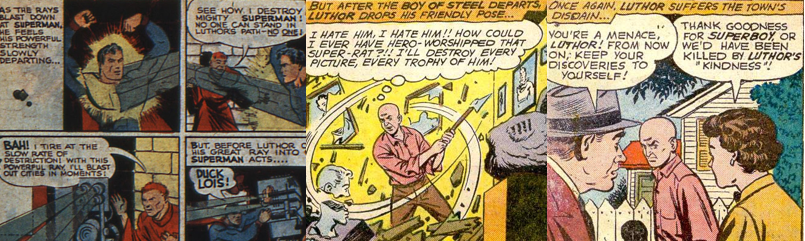
In 2013, DC Comics declared the 18th of April as “Superman Day” so fans of the Man of Steel could celebrate Clark Kent/Kal-El/Superman, the superpowered virtue of “Truth, Justice, and the American Way” who is widely regarded as the first ever costumed superhero.

Published: December 1992 to October 1993
Writers: Dan Jurgens, Jerry Ordway, Louise Simonson, and Roger Stern
Artists: Brett Breeding, Dan Jurgens, Jackson Guice, Jon Bogdanove, and Tom Grummett

The Background:
Jerry Siegel and Joe Shuster first met in 1932 while attending Glenville High School and, just one year later, dreamed up their first draft for a superman with “The Reign of the Super-Man”. About five years later, a revised version of this concept appeared in Action Comics #1 and the world met Superman for the first time. Not only was Superman an immediate hit, but he went on to become a cultural icon. After decades of increasingly over-the-top stories, DC Comics tasked John Byrne with reimagining Superman for modern audiences. Under Byrne’s direction, Superman was a more grounded character and his stories adhered to strict continuity guidelines. After Byrne left DC Comics over creative differences, Superman group editor Mike Carlin moderated frequent “Superman Summits” involving Byrne’s replacements. It was during these chaotic meetings that writer/artist Jerry Ordway would jokingly suggest killing the Man of Steel. With Superman’s sales taking a hit thanks to readers favouring more violent anti-heroes, the creatives planned to shake things up by having Superman reveal his identity to his long-time love, Lois Lane, and eventually marry her. However, these plans were postponed to coincide with a similar arc on Lois & Clark: The New Adventures of Superman (1993 to 1997) and thus the idea of “Doomsday for Superman” was developed. Writer Dan Jurgens came up with the concept of a monster tearing through Metropolis and a climactic fist fight between it and Superman, before sketching a design for the creature that was subsequently dubbed Doomsday. Although DC always planned to resurrect the character, Superman’s death was headline news and became a best-selling title, despite being criticised as a publicity stunt. Despite also dying in this story, Doomsday would return to dog Superman, evading the literal death of the universe and evolving into both an ally and an intelligent being, though he never returned to the prominence he had in this first arc. Doomsday and the “Death of Superman” concept also appeared outside the comics: there was a videogame adaptation, multiple animated ventures, and it was long considered for a live-action adaptation before being brought to life first on television (with disastrous results) and then on the big screen (to similar chagrin) before finally having more faithful live-action renditions on Krypton (2018 to 2019) and Superman & Lois (2021 to 2024).

The Review:
Our story begins “somewhere else…” where, deep underground, in a reinforced prison, a mysterious monster repeatedly strikes its cage. Each blow sees the thing’s containment suit rupture little by little, revealing menacing bone appendages on its knuckles, and the metal wall crack and weaken until, eventually, the creature we now know as Doomsday bursts free! Oblivious to this impending threat, Superman’s far more concerned with tracking down the Underworlders, a group of misfits, monsters, and outcasts from the shady Project Cadmus who dwell deep beneath Metropolis. Led by the simple-minded but nigh-invulnerable Clawster (whose rocky design and bony appendages are eerily evocative of Doomsday’s final form), the Underworlders cut the city’s power in a bid to rise up and take the streets as their own. Luckily for Superman, young Keith White alerts him to the Underworlders’ plot and that they’ve taken Lois Lane hostage after she stumbled upon their lair. Though bolstered by technology stolen from War World, the Underworlders are no match for Superman, who easily fells Clawster with a grenade to the mouth, trashes their digging machine, and ends their plot. Thanks to Lois’s informant, Charlie Underwood, the plot is revealed and the uprisers are imprisoned to await trail by their more peace-loving people. However, while all this is going on, Doomsday runs amok across the countryside and causes chaos in Ohio…all with one hand tied behind his back! Thanks to Oberon monitoring the police band, Justice League International arrives to help with the rescue effort and, after learning the devastation was caused by a “monster man”, Ted Grant/The Blue Beetle rallies the JLI in pursuing the culprit. While Superman gives a candid interview of his life and allies, the JLI follow Doomsday’s trail of destruction. Though neither the mysterious Quintus Arce/Bloodwynd or the battle hungry Maxima’s psychic probes offer little information on the creature other than him being “hate–death and blood lust personified”, they soon come face-to-face with Doomsday when he wrecks the Bug with a tree trunk and starts tearing through a LexCorp oil refinery.
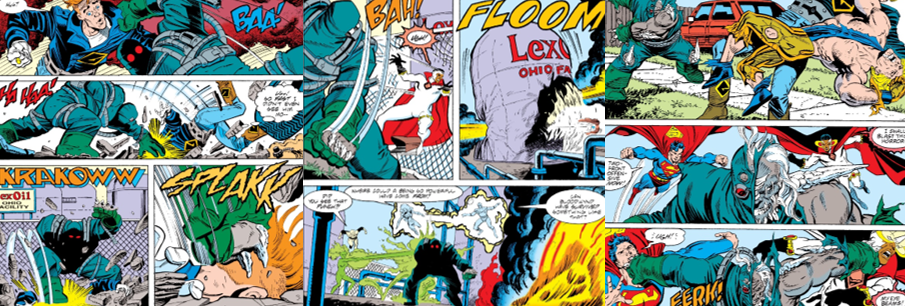
A monstrous creature tears across the countryside…and through the Justice League!

Never one to back down from a fight, Guy Gardner (who wasn’t a Green Lantern at this point but instead wielded Thaal Sinestro’s yellow ring) immediately attacks, only to be blindsided by the creature’s incredible speed and left damn near blinded when it pounds his face into the ground! Beatriz Da Costa/Fire’s intense heat blasts do little to halt Doomsday’s attack so Bloodwynd steps in. Summoning the “spirits of the dead” into a powerful blow, he’s stunned when Doomsday barely registers the punch and is then sent hurtling into the oil refinery (and an explosive end). The Blue Beetle rushes in to help his secretive ally, catching a glimpse of Bloodwynd’s true form before Doomsday strikes. With no superpowers and being little more than a child against the monster’s awesome strength, the Blue Beetle is manhandled by Doomsday and beaten into a coma. Enraged, Michael Carter/Booster Gold throws a “full-intensity blast” but barely has time to erect his force field before Doomsday sends him flying. Luckily, Superman intercepts him, having been alerted to the crisis by a stagehand. Unfortunately, though Maxima spirits the Blue Beetle away for medical attention, Superman’s too late to save Tora Olafsdotter/Ice from being tossed into the home of some innocent bystanders. Superman’s initially unimpressed by Doomsday, easily taking the creature’s first blow, but is astonished when the follow-up kick sends him flying harder than he’s ever been hit before. Realising Doomsday’s threat, Superman rallies and stands with the remaining Leaguers, who combine their individual powers in an intense barrage. Though completely encompassed by the onslaught, the effort drains Fire and Booster Gold’s physical and power reserves. Unfortunately, their efforts are wasted as Doomsday emerges unscathed save for his torn containment suit, revealing a scowling, gruesome visage that gleefully rushes the fatigued heroes. Booster Gold endures a horrific beating, then Doomsday easily tramples the others and causes another inferno before leaping away. Although Superman chases and temporarily subdues the creature underwater, he’s forced to help the injured Justice League rescue the innocent bystanders caught up in Doomsday’s rampage. With the JLI down, Superman resolves to pursue and stop Doomsday alone.
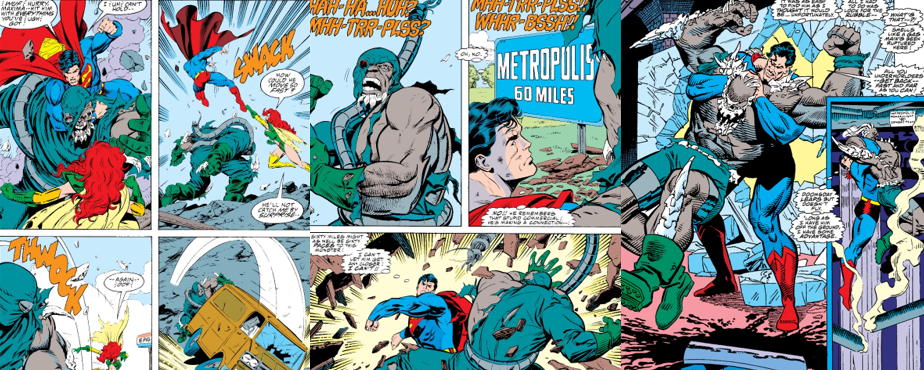
Despite Superman’s best efforts, Doomsday crashes into Metropolis and endangers his loved ones.

Despite the military’s best efforts, Doomsday continues his rampage. As Superman battles the creature, he’s stunned by Doomsday’s complete lack of empathy and troubled that the snarling brute seems to be growing stronger as the fight progresses. Although Lex Luthor II (Lex Luthor inhabiting a young, fit body and masquerading as his own son) forbids Matrix/Supergirl (a protoplasmic alien rather than the traditional Kara Zor-El) from assisting Superman out of fears for her safety, Maxima jumps in to help…only to cause more destruction and endanger additional lives. After Maxima is left concussed, Superman asks James “Jim” Harper/Guardian to tend to her and continues pursuing Doomsday, determined to put the monster down before he does any more damage. Doomsday carves a path of destruction across the countryside and eventually winds up tearing through a Lex-Mart store, where a television commercial for a Metropolis wrestling match catches his attention. Obsessed with “Mhh-trr-plss”, Doomsday prepares to head there and Superman flies into a desperate second wind,  continuously amazed that his strongest blows barely faze the monster. With Lois and Jimmy Olson covering the battle, Superman accidentally hurls Doomsday into Habitat, a tree-city created by Project Cadmus. Resolving to fight smarter rather than harder since just hitting Doomsday hurts, Superman buries Doomsday beneath Habitat, only for him to burst free in a rage and resume his course towards Metropolis. Superman intercepts Doomsday and finally tries to fly him off-world, only for Doomsday to easily wriggle free and send Superman crashing into a construction site. As Jonathan and Martha Kent watch on horrified, Doomsday crashes into the Underworlder domain, inadvertently rescuing and then purposely slaughtering the prisoners, and causes a massive explosion to rock the city when his foot collides with a power line.
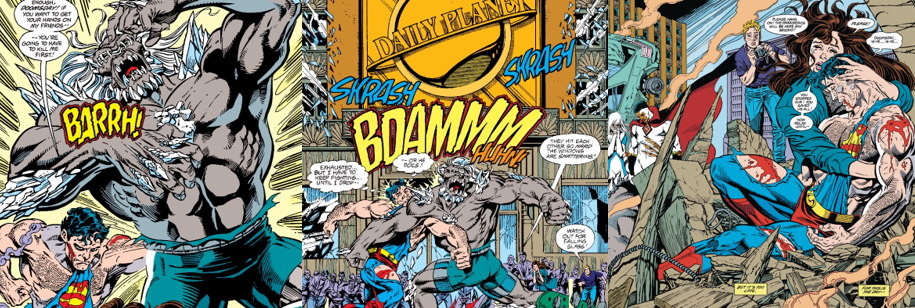
Superman battles valiantly and ultimately stops Doomsday at the cost of his own life.

Superman’s second attempt to fly Doomsday away ends with him skewered through the abdomen by one of Doomsday’s spines. Finally released to assist, Supergirl is immediately dispatched with a single punch that reduces her to protoplasmic goop and even Professor Emil Hamilton’s massive laser cannon barely fazes the beast. Still, these distractions give the injured Superman time to regroup; hoping that Doomsday is as fatigued as him, Superman redoubles his attack. Luthor’s paratroopers and even Metropolis’s finest try to aid the Man of Steel, bombarding the creature with laser blasts that seemingly have no affect. Battered, exhausted, and desperate, Superman’s constantly distracted by saving innocents so, after rescuing Lois and Jimmy, he bids an emotional farewell to his fiancée and flies at his adversary, determined to put Doomsday down by any means necessary. Despite fighting for most of the day and having journeyed across the country and endured horrendous punishment, Doomsday easily overpowers Superman, cutting and bruising him. Superman finally hurts the creature by targeting Doomsday’s bony protrusions before the fight devolves into a slugfest outside the Daily Planet. Each blow shatters windows as the two relentlessly pummel each other, neither backing down until, finally, they fly in for the killing blow. Superman and Doomsday strike simultaneously, the force of their final blows sending shockwaves across the country, and Doomsday finally falls, apparently dead. Too late to help, Bloodwynd and Ice can only watch in shock alongside the world and Superman’s nearest and dearest as the Man of Steel collapses. Lois cradles her beloved, unconcerned about hiding her grief, as Superman breathes his last and succumbs to his wounds. Lois is left wailing as Superman, his costume torn and tattered and bloody, lies still amidst the rubble of his titanic clash, leaving the onlookers and his friends and family stunned.

The Summary:
“The Death of Superman” isn’t so much a story as it is a long, protracted beatdown of the Man of Steel. Amidst the fighting, the story takes a few detours to explore Superman’s opinion of his fellow heroes and his impact on the world. While most people find him an awe-inspiring figure and celebrate him as the world’s greatest hero, others are more dismissive. A teen eventually caught in Doomsday’s rampage is especially outspoken about the Man of Steel, preferring hot-headed Guy Gardner instead, only to be indebted to Superman when he puts his life on the line to protect his family. Guy, especially, is overly critical of Superman, blinded by pride and arrogance and attacking Doomsday head-on only to be mutilated and humbled. Doomsday’s threat is so great that even some of Superman’s more duplicitous and mysterious allies aid him with Dubbilex attempting to probe the beast for clues to his origin and the supercilious Maxima throwing herself into the bout to try and prove her worth. While the outside world sees Lex Luthor II as a benevolent figure, he’s the same conniving antagonist he’s always been. He doesn’t get involved until Superman and Doomsday are literally tearing through his city and, even then, his tech and even Supergirl’s bizarre powers are no match for the creature. Nowhere is this better showcased than in Doomsday’s utter decimation of the Justice League. Sure, the JLI was never the strongest incarnation and his demolition of them isn’t as powerful as if he were shredding the likes of Arthur Curry/Aquaman, Princess Diana Prince/Wonder Woman, and Wally West/The Flash, but it sends a startling message when Earth’s greatest heroes are beaten by one creature. However, the narrative is quite repetitive after a while. I lost count of how many times Superman and other characters muse over the creature’s strength, tenacity, and origins and, while the art is good, it’s inconsistent throughout. For example, Superman’s injuries vary between issues, with some issues ending with him bleeding and bruised and others ignoring those injuries before leaving him with different ones.
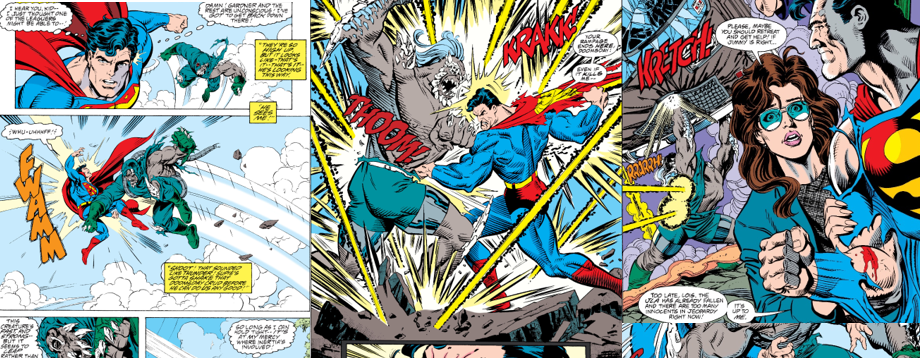
When Doomsday decimates everyone else, Superman resolves to put him down at any cost.

As a story about Superman’s will, “The Death of Superman” is quite powerful. Where the JLI and others fail due to being significantly underpowered, Superman fights on, battling Doomsday almost non-stop across the country. During their fight, Superman constantly stops to rescue bystanders and is always trying to keep Doomsday from populated areas. When he realises Doomsday’s heading to Metropolis, Superman desperately tries to keep him from reaching the city and, when this fails, he commits to ending the beast’s rampage. Sure, Superman rarely tries to get Doomsday off-world, but Doomsday is not only incredibly strong, but extremely agile and he easily escapes Superman’s grasp or leaves him gravely injured. At one point, Superman tosses Doomsday several miles away so it’s possible he could’ve launched Doomsday into space. However, Superman constantly notes that Doomsday never tires, seems to be growing stronger, and adapts to each situation. What works against Doomsday once won’t necessarily work a second time, something greatly expanded upon in subsequent appearances, so I think this is acceptable enough as an explanation for why Superman doesn’t just toss Doomsday into space. The conflict causes great distress for Lois and Jimmy, who are forced to watch and report as the man they love and admire is beaten to death before their eyes. While Lois eschews the usual restraint regarding her relationship with Superman to comfort and tend to him, the Kents are forced to watch, helpless, as their son is beaten to a pulp on live television. The impact of Superman’s deteriorating health is felt by every character and is palpable through the artwork. There’s a real sense of desperation as the fight reaches its climax and a shocking gut punch as the final blows are struck.
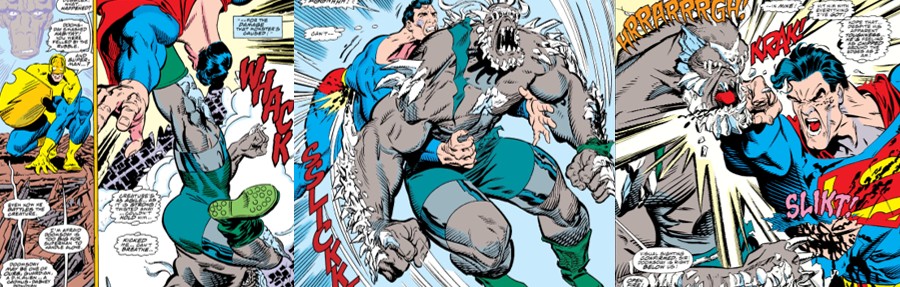
The mysterious Doomsday lives to kill and is little more than a mindless beast.

In many ways, it’s disappointing that Superman dies not at the hands of a traditional villain but in a slugfest with a monster. However, Doomsday is a visually intimidating and impressive monster. Initially garbed in an uninspiring containment suit, Doomsday’s true form – a snarling, grey-hued monstrosity – is revealed as he tears through his opponents and shrugs off their attacks. Doomsday never speaks; he simply barks laughter, grunts, and mumbles a bastardised growl of “Metropolis”. He’s noted to be “faster than Flash”, easily overturns trucks and rips apart bridges and buildings, and is not only inhumanly strong but absorbs tremendous punishment. Even the combined energy powers of the Justice League barely faze him, blows from mighty man-made trees barely slow him, and even hitting the brute causes Superman pain. Doomsday is malicious and bloodthirsty, slaughtering wildlife and innocents and beating the JLI with relish, and becomes fixated on both Metropolis and Superman. Throughout the story, psychics try to learn his origins and find only hatred and destruction. Doomsday is, essentially, a blank canvas; a mindless beast determined to destroy. Later stories fleshed out his origin (which is actually really interesting) but I can totally understand why adaptations made him a man-made doomsday machine or added to his lore as he’s primarily an invincible McGuffin shamelessly designed to shock the world by killing Superman. Superman realises far too late that Doomsday can be hurt by targeting his bony protrusions and he barely takes advantage of this, breaking one before going back to trading punches with the beast. This is a bit of a shame as it means the finale was always anti-climactic for me. We never see Doomsday tire, he rarely shows pain, he has no injuries and survives shots that look far more devastating than Superman’s final blow. This, as much as the tedious nature of their fight, means I’ve never held “The Death of Superman” to very high regard beyond it being notable for killing the Man of Steel and introducing a monstrous new villain for Superman, one who sadly never reached these same heights again because it’s difficult to top killing the world’s most powerful superhero.

My Rating:

Rating: 3 out of 5.

Pretty Good

What did you think to “The Death of Superman”? Were you disappointed that Superman wasn’t ended by one of his more iconic foes? What did you think to Doomsday, his design and characterisation (or lack thereof)? Were you disappointed that a more powerful version of the Justice League didn’t battle Doomsday? Do you think the story suffers from being little more than a prolonged slugfest? Did you enjoy Doomsday’s later appearances or do you think he peaked here? How are you celebrating Superman Day today? Whatever you think, feel free to share your opinions in the comments below and feel free to check out my other Superman content on the site.

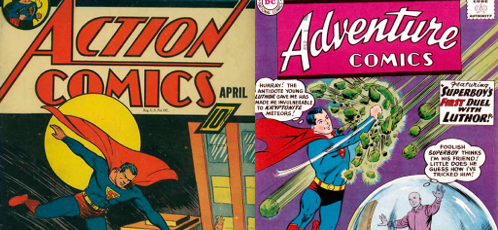
Back Issues [Superman Day]: Action Comics #23 / Adventure Comics #271


In 2013, DC Comics declared the 12th of June as “Superman Day”, a day for fans of the Man of Steel the world over to celebrate Clark Kent/Kal-El/Superman, the superpowered virtue of “Truth, Justice, and the American Way” who is widely regarded as the first ever costumed superhero.


Story Title: “Europe at War (Part II)””
Published: April 1940
Writer: Jerry Siegel (credited as “Jerome Siegel”)
Artist: Joe Shuster

Story Title: “How Luthor Met Superboy!”
Published: April 1960
Writer: Jerry Siegel (credited as “Jerome Siegel”)
Artist: Al Plastino

The Background:
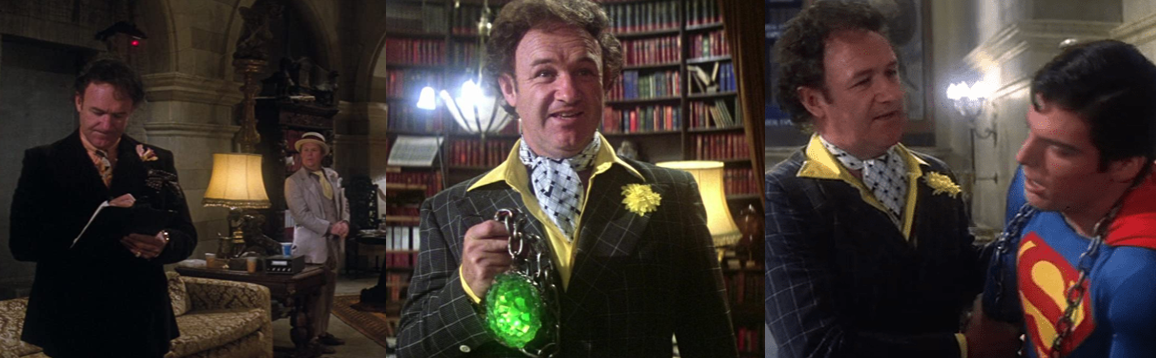
Jerry Siegel and Joe Shuster, sons of Jewish immigrants, first met in 1932 at Glenville High School. By the time they were sixteen, they were already accomplished comics creators and, in 1933, they thought up their first concept for a superman with “The Reign of the Super-Man”. This story depicted a bald mad scientist who attempted to dominate others with his telepathic powers. Though a far cry from the most influential fictional character in American history, the duo would revisit the concept of a bald mad scientist in 1940. Originally known only as “Luthor”, Alexander “Lex” Luthor would evolve beyond his relatively childish reasons for hating the Man of Steel and become Superman’s arch-nemesis. While Kryptonite might weaken or kill Superman, Doomsday and Darkseid might pummel him, and Vril Dox/Brainiac might threaten his adopted world, Lex Luthor has become infamous for pitting his mind against the Man of Steel. Whether a scheming industrialist with seemingly unlimited resources, an egomaniacal megalomaniac, or enjoying the power of the United States Presidency, Luthor has created robots, patsies, mech suits, and even cheated death itself and had a brief stint as a superhero, all with the aim of acquiring the power to either humble, humiliate, or destroy his alien foe. As Superman’s most complex and enduring villain, Lex Luthor is a staple of any Superman adaptation. Clancy Brown and Michael Rosenbaum are considered two of the finest to portray the character, though it was Gene Hackman who set a high standard for all future portrayals of DC Comics’ most conniving criminal mastermind.

The Review:
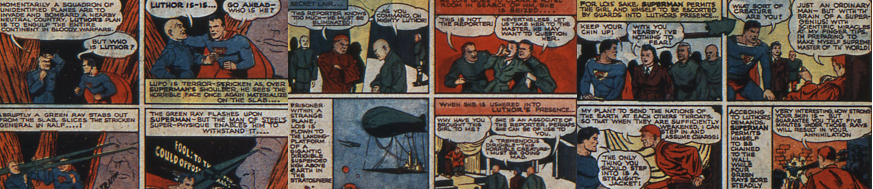
The first appearance of a dangerous maniac named Luthor occurred in the second part of the “Europe at War” storyline. As established in the previous issue, the “lesser nation” of Galonia was suddenly attacked by Toran and reporters Clark Kent and Lois Lane were sent to cover the conflict as war correspondents. While sailing to Luxor, Clark was stunned to find beautiful actress Lita Laverne was a spy working alongside the Toranian Council of War to target the neutral vessel. Action Comics #23 picks up with the Man of Steel defending Belgaria from incoming shells before he (as Clark) and Lois meet with bald General Lupo, who’s confident that the war will end soon as a contingent of Toran officials are on their way to peacefully negotiate. Clark switches to Superman and flies ahead to take some photos of their arrival, only to witness the convoy be destroyed, which causes hostilities to renew. After sending an update to the Daily Star, Clark questions General Lupo, who insists that the Galonians would never be so deceitful, only to then make a suspicious phone call, completely unaware of Clark’s super-hearing. Suspicious, Superman trails General Lupo to a mountain range, where he disappears into thin air! Using his incredible strength, Superman rips open the mountainside and discovers a hidden passageway, where General Lupo is transfixed by a huge slab of rock, which bursts into hypnotic lights and a commanding face. General Lupo is astonished when Superman confronts him and, though he fears his disembodied master, desperately begs off being smushed against a wall and reveals that the mysterious “Luthor” is orchestrating events to engulf both nations in bloody warfare. 

Superman is perplexed by the mysterious Luthor, who plots to take over the word through chaos.

However, when Superman demands to know who “Luthor” is, green lasers suddenly burst from the wall-face and “[slice] the General in half”! Naturally, Superman is immune to the attack; he destroys the cave and escapes just in time to spy Luthor’s bombers flying overhead. He then destroys them all using his super strength and a mounted gun before warning both sides (as Clark) about Luthor’s machination. Although they don’t believe him since he has no proof, this brings him to Luthor’s attention, who orders Clark eliminated to keep him from talking. Conveniently, Lois happens to be looking for Clark in his hotel room, so Luthor’s minions grab her instead, transporting her to Luthor’s secret base, which is suspended from a gigantic dirigible “high above” Earth’s atmosphere! Although unimpressed that his goons failed him so badly, Luthor – a red-haired despot in a matching robe – nevertheless interrogates Lois, only to be met with confusion and sarcasm. While in her cell, Lois notices that her guard, a surly bald man, isn’t under Luthor’s hypnotic influence. She then threatens to expose him to Luthor unless he informs Clark about her capture and the guard is so terrified of his leader’s reprisals that he readily agrees. After reading the note, Clark flies into action as Superman, takes out a couple of guards, and bursts through a brick wall to rescue Lois. However, when Luthor threatens to harm Lois, Superman readily submits to parlay with the maniac, who describes himself as having the “brain of a super-genius” and plans to use his “scientific miracles” to plunge the world’s nations into conflict, weakening them so that he can assume control.

Superman is revealed to have known Luthor as a youth when he adventured as Superboy.

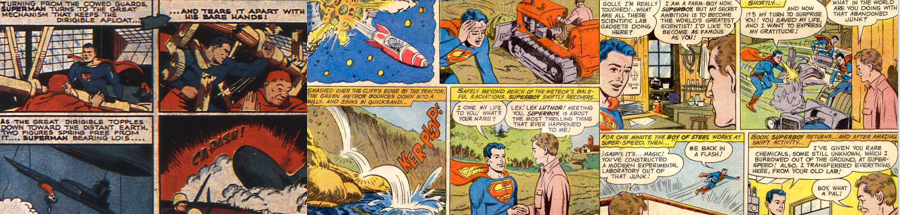
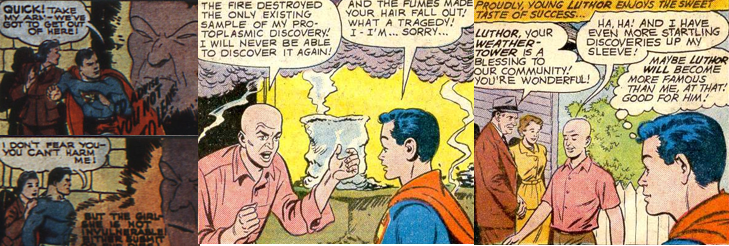
Luthor demonstrates his ability by strapping Superman up and bombarding him with an intense concentration of rays. However, Luthor grows tired of this and prepares to finish Superman off with a burst of deadly exposure, only for Superman to suddenly break free, turn the machine against Luthor’s underlings, shrug off its effects, and destroy the machine. After unsuccessfully trying to barter for his life, Luthor is equally unable to keep Superman from trashing the dirigible’s controls, sending it (and, presumably, all its inhabitants) crashing to the ground in a fiery blaze. The sight of the dirigible’s destruction is enough proof for the nation’s representatives to believe Clark’s story and the conflict comes to a peaceful resolution, with Clark praised for breaking the scoop and Lois eagerly awaiting her next encounter with the dashing Superman. Although Superman clashed with Luthor many times after this, it would take nearly twenty years to delve into Luthor’s origins, a story that took place during Superman’s youth in Smallville, Kansas, as Superboy. In this story, the young Lex Luthor has just moved to Smallville and, being the friendly youth that he is, Superboy flies in to say hello. Conveniently, a Kryptonite meteor lands right next to the Boy of Steel and immediately begins weakening him. Luckily, Luthor and his trusty tractor are on hand to save Superboy and the two quickly become friends. Luthor is a Superboy fanboy, as evidenced by his shrine to the young superhero, and a budding scientist, with ambitions to become a world-famous scientist. In gratitude for his help, Superboy builds a modern laboratory for his new friend using nothing by junk metal and his super speed and strength, which he fills with rare Earth materials for Luthor to experiment with. Although Superboy expresses caution since the chemicals are unknown and Luthor’s young and inexperienced, Luthor promises to be careful and the two part as friends, with Superboy owing his life to Lex and Luthor astounded to have befriended the Boy of Steel. Luthor wastes no time in getting to work, feverishly working with the chemicals over a period of weeks and producing a crude protoplasmic lifeform that he’s so excited by that he immediately sets to work coming up with a Kryptonite antidote so his new buddy won’t ever have to worry about that pesky substance threatening his health. 

Embittered after a lab accident, the once-kindly Luthor turns against his former friend.

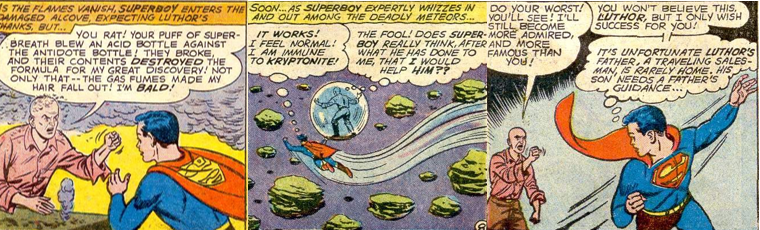
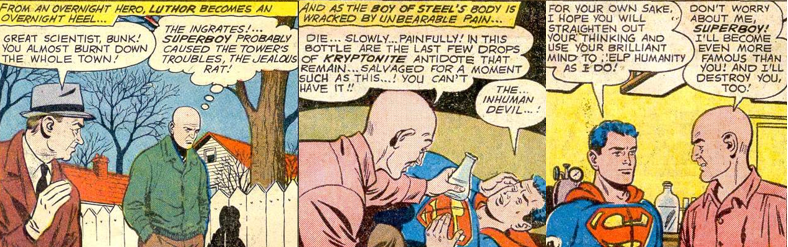
Luthor retrieves the meteor from the lake, takes a few samples, and creates the antidote in no time at all. However, in his excitement, he accidentally knocks over a chemical flask that starts a toxic fire in his lab. Luckily, Superboy happens to be passing by and hears Luthor’s screams for help; he uses his super breath to put out the flames, accidentally blowing a jar of acid against the antidote and destroying it. To make matters worse, the gas fumes caused Luthor to go bald and destroy his weird protoplasmic creature, destroying all his hard work. And, while Superboy is apologetic and insists it was an accident, Luthor accuses him of being jealous of his genius and purposely sabotaging him, instantly flipping from a kindly boy to an embittered youth in the blink of an eye. Superboy offers to help him rediscover his experiments, and insists he’d never harm the boy who saved his life, but Luthor’s having none of it. He feigns sorrow to get rid of Superboy and then flies into a rage, destroying his Superboy memorabilia and plotting to avenge himself on the Boy of Steel with the last sliver of protoplasm. The next morning, Luthor has Superboy drink the “antidote” and then accompany him into space, protected by a space-globe Superboy brought along, to observe its effects. At first, Superboy is delighted to find he’s no longer vulnerable to the Kryptonite meteors floating around in space, completely unaware that they’re actually “Fool’s Kryptonite”, a ruse even Krypto the Superdog can see from a mile away. As soon as they return to Earth, Luthor spitefully reveals it was all a ruse and that the antidote is only temporary and vows to be more admired, and more famous, than Superboy, who flies away despondent and commenting that Luthor needs “a father’s guidance”.

When his attempts to outshine Superboy fail, Luthor resorts to attempted murder.

Some weeks later, Luthor approaches Smallville’s mayor with a fantastic invention, a weather-tower to keep the town perpetually warm by reflecting the sun’s rays, and the mayor is so impressed by his pitch that he approves it immediately. Both Superboy and the townsfolk are in awe and admiration of Luthor’s ingenious invention, which spares them the bitter chill of winter, and Superboy quietly wishes his former friend all the success in the world, harbouring no ill-will towards him. However, young Clark is alarmed when he notices that his adopted parents – Jonathan and Martha Kent – suffer from the intense heat. He’s even more startled when he sees the weather-tower is causing fires to break out all over the town, endangering its people, so he uses his freeze breath to cool the construction down, which effectively destroys it. Smallville’s populace are less than thrilled and openly mock Luthor in the street for putting their lives at risk with his crazy inventions, which he bitterly blames on Superboy. To atone, Luthor toils away for many months and produces seeds that promise to near-instantly produce fruit trees for the local farmers; although people are sceptical, they’re astounded when Luthor’s claims come true, but their elation soon turns to horror when simple rain turns the trees into marauding giants! Superboy deals with the issue, chalking it up to carelessness on Luthor’s part rather than maliciousness, but Luthor’s reputation is further tarnished and his hatred for Superboy only grows. This sees him unearth the Kryptonite meteor and lure the Boy of Steel into a trap and taunt the dying Superboy with the only antidote to his slow, painful death. In his arrogance, Luthor fails to remember Superboy’s super-breath, which allows him to suck up the antidote vial and save his own life, but Superboy chooses to consider them even rather than acquiesce to Luthor’s demands to be arrested. Out of respect for the friendship they once had and believing that Luthor could be a force for good, Superboy lets Luthor go, with the obsessed youth swearing to not only surpass the Boy of Steel’s popularity but destroy him in the process! 

The Summary:
Let’s tackle each story in turn here, shall we? “Europe at War (Part II)” is a typically Golden Age Superman story, featuring simplistic dialogue, illustrations, and concepts. Part of me enjoys this simpler time, when fantastical things were just taken as the norm and superhero plots were both grounded and almost comical in their content, such as Superman threatening to bash General Lupo against a rock wall and presumably casually murdering countless of Luthor’s minions. It’s amusing to read as I find myself questioning why Clark warned of Luthor’s threat in his civilian guise, rather than as Superman, and seeing him use a machine gun rather than his heat vision since he didn’t have his full gamut of powers at that point. The core concept of “Europe at War (Part II)” actually has some legs to it: two nations being manipulated into all-out war with spies, heroes, and villains on both sides, and the mysterious Luthor pulling the strings behind the scenes and offering a challenge Superman can’t settle with his fists since he needs to get to the root of the problem. Unfortunately, a lot of its concepts are left ambiguous or flat-out forgotten; apparently, Luthor can hypnotise people into following his every command, yet he only demonstrates this power once and doesn’t think to use it on Lois or Superman (or the nation’s leaders). Not to mention that Luthor’s secret base is an elaborate castle suspended from a dirigible, but no one noticed it, and why was that one bald guard immune to Luthor’s control? It’s not explained, but the number of prominent bald henchmen at Luthor’s command makes me wonder if that particular guard was actually the real Luthor and the red-haired leader was merely a patsy. 

Neither story provides a particularly engrossing or accurate portrayal of Luthor.

And then we have “How Luthor Met Superboy”, a story that’s more influential than you think since it’s basically the inspiration for the entire series of Smallville (2001 to 2011). This is such a weird story that it almost reads like an elaborate dream sequence or fantasy story that recasts Superboy and Luthor as the best of friends thanks to a ridiculously convenient Kryptonite meteor (and don’t even get me started on the influx of similar meteors in near-Earth space!) People often criticise Superman for being infallible and unrelatable, but Superboy is the kindest, most trusting, and most understanding youth you’ll ever meet! He sees the best in Luthor all throughout the story, never once saying or thinking a bad word against him until he (as in Superboy) is dying at the young scientist’s feet and even then Superboy’s first act after saving himself is to forgive his former friend and hope that he turns his obsession to good deeds. It almost descends into parody as the story progresses, with Superboy genuinely believing that Luthor is trying to do good and has met with misfortune, and Luthor equally refusing to even think that he could be to blame for anything since he’s so embittered towards Superboy. It’s so strange seeing Luthor flip from a kindly boy to a venge-seeking maniac after the fire. Like, I get being mad at losing all your work and your hair but it’s a bit of a leap to blame Superboy. I think the implication is that the strange chemicals and toxic fumes altered Luthor’s mind in some way, though that’s not really explicitly stated (or even implied in the story text), but I think Luthor’s elaborate plot to cruelly taunt Superboy with the promise of a Kryptonite cure and to oust his popularity, to say nothing of his quick temper following the accident, go a long way towards suggesting that. 

Though amusing footnotes, both stories are fantastical nonsense unbecoming of Luthor.

Truthfully, neither story really gives the best impression of Luthor. It can be argued that the “Luthor” present in “Europe at War (Part II)” isn’t even Lex Luthor since he has hair, for one thing, and possesses hypnotic abilities. Sure, it could be a wig and his scientific acumen could account for the hypnosis and other inconsistencies, but he doesn’t really exude “Lex Luthor” energy and seems to simply be a maniacal, supervillain-esque third party for Superman to flex his muscles against once he stops his elaborate plot. “How Luthor Met Superboy” tries to flesh out Luthor’s character by providing him with a semi-sympathetic backstory and emotional connection to his hated nemesis, but ultimately reads like a non-canon adventure as I’m pretty sure no stories prior to his every hinted at the two knowing each other as youths. It is interesting seeing Luthor as an arrogant young scientist who idolises Superboy and is inspired to be a great scientist because of the Boy of Steel, it’s just a shame that the execution falters. Ultimately, Luthor’s hatred comes from losing his hair, rather than genuinely building towards a resentment towards Superboy or Luthor’s ego getting the better of him. Like, what was up with that protoplasmic creature? That could’ve factored into things, showing that Luthor is messing with things he doesn’t understand and his inability to recognise his limits and failings. Like, I would’ve maybe had Luthor build his weather-tower and plant those seeds before he loses his hair, so that when they go bad and Superboy has to intervene it adds to his growing bitterness towards Superboy for “stealing his thunder”. In the end, both stories can be largely ignored in the grand scheme of things and you wouldn’t be missing anything. They’re historical footnotes and amusing curios in Lex Luthor’s history, but you can simply skip to stories like “The Man of Steel” (Byrne, et al, 1986), “Birthright” (Waid, et al, 2003 to 2004), “Lex Luthor: Man of Steel” (Azzarello, et al, 2005), or “Secret Origin” (Johns, et al, 2009 to 2010) for better, more concise, and more in-depth explorations of Luthor and his complex relationship with Superman. 

Action Comics #23 Rating:

Adventure Comics #271 Rating:

Rating: 1 out of 5.

Rating: 2 out of 5.

Terrible

Could Be Better

Have you ever read these Luthor-centric stories? Do you like the idea of the two having been childhood friends? What are some of your favourite Luthor moments and stories? How are you celebrating Superman Day today? Whatever you think, feel free to share your opinion and thoughts on Superman in the comments below.

Movie Night [Superman Month]: Man of Steel


In 2013, DC Comics declared the 12th of June as “Superman Day”, a day for fans of the Man of Steel the world over to celebrate Clark Kent/Kal-El/Superman, the superpowered virtue of “Truth, Justice, and the American Way” who is widely regarded as the first ever costumed superhero. This year, I expanded Superman Day to “Superman Month“ and have been spending every Monday of June celebrating the Man of Steel.


This review has been supported by Chiara Cooper.
If you’d like to support the site, you can do so at my Ko-Fi page.

Released: 14 June 2013
Director: Zack Snyder
Distributor:
Warner Bros. Pictures
Budget:
$255 to 258 million
Stars:
Henry Cavill, Amy Adams, Michael Shannon, Antje Traue, and Russell Crowe and Kevin Costner

The Plot:
Just before the planet Krypton is destroyed, scientist Jor-El (Crowe) sends his young son to Earth. Raised by a kindly couple, Clark Kent (Cavill) hides his superhuman powers from the world but, when he discovers the truth of his alien heritage, he finally assumes the mantle of Earth’s greatest protector, Superman, just in time to defend his adopted home world from the maniacal General Zod (Shannon), a Kryptonian warrior seeking to terraform Earth into a new Krypton!

The Background:
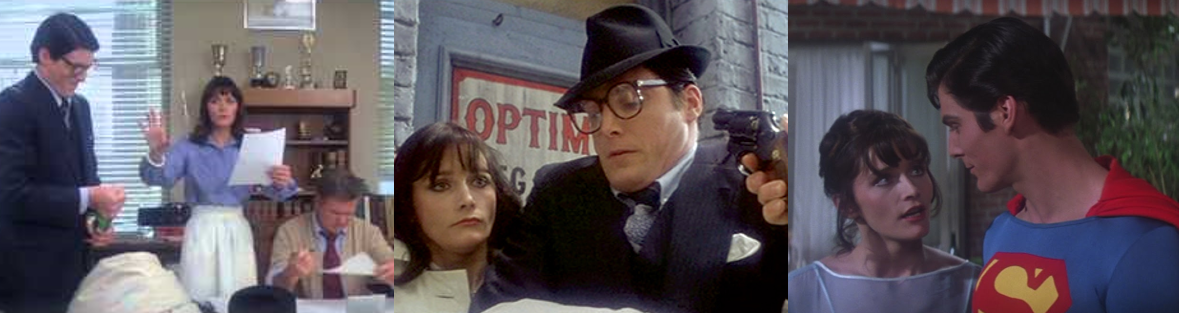
For Superman’s big-screen feature back in 1978, producers Ilya and Alexander Salkind and Pierre Spengler initially convinced Warner Bros. to produce a two-part film, a decision which led to both financial and creative issues as director Richard Donner frequently clashed with the producers. Still, Superman (Donner, 1978) was a critical and commercial success and, despite all the behind the scenes drama, Superman II (Lester, 1980) was equally successful, but things quickly took a nose dive, despite Christopher Reeve’s iconic portrayal of the character, and Superman was absent from cinema screens for nearly twenty years. After numerous abortive and attempts to bring the Man of Steel back, director Bryan Singer attempt to recapture the magic of Richard Donner’s original film with Superman Returns (Singer, 2006) but, despite making $391.1 million at the box office, the film was maligned by critics and derailed plans for a sequel. Two years later, Warner Bros turned to notable Superman writers like Grant Morrison and Mark Waid to consider options for a reboot and, after settling a lawsuit, brought in writer David S. Goyer and director/producer Christopher Nolan to collaborate on a new Superman movie following their success with the Dark Knight trilogy (Nolan, 2005 to 2012). After Nolan won the studio over with his pitch to completely reboot the franchise in a similarly grounded way, director Zack Snyder was brought in to helm the project, and he immediately set about redesigning the character’s iconic costume with a slick, modern aesthetic that owed a lot to his Kryptonian heritage. British actor Henry Cavill finally won the chance to take on the role after having lost out to it before and underwent rigorous physical training to prepare for the role, while veteran actors Kevin Costner and Russell Crowe were cast to portray Superman’s two fathers who would raise the ethical and moral quandaries faced by the character. Weta Digital, MPC, and Double Negative created the film’s extensive visual effects, which were bolstered by documentary-style filmmaking techniques, infused Krypton with a whole new liquid geometry and alien landscape, and aimed to bring a real physical weight to the flying and fight scenes. Man of Steel was a massive success at the box office, where it made nearly $670 million, but reviews were somewhat mixed; while the action and performances were praised, critics questioned Superman’s characterisation, the widespread death and destruction, the Superman’s execution of General Zod. Regardless, Man of Steel was the start to the rocky and needlessly complicated DC Extended Universe (DCEU); it was followed by the divisive (to say the least) Batman v Superman: Dawn of Justice (Snyder, 2016) and a Justice League team-up that was fraught with its own issues, and both fans and Cavill were left salivating for another solo film for the titular superhero.

The Review:
Those who’ve read my reviews of the Richard Donner/Christopher Reeve films, and Superman Returns, will know that my relationship with those movies is a contentious one. While Reeve was undoubtably iconic in the role, and the first two films not only helped establish Superman in the eyes of the general audience but influenced comic books and their adaptations for decades, I also grew up reading the Post-Crisis version of Superman as written by John Byrne and firmly believed that the character had significantly changed since his wacky Pre-Crisis days. In the comics I read, Clark Kent wasn’t some bumbling reporter, Lois Lane wasn’t an obsessed stalker, and Superman was a relatable and at times vulnerable character; he got married, died and came back, and, crucially, had a humanity at the heart of his character and was far less God-like than in the sixties and seventies. Consequently, I was quite excited to see a new version of the character brought to the big screen, with a revised origin and no ties to the films that had come before it. I believe this is the route Warner Bros. should have taken with Superman Returns and, if they had, the nature of the DCEU could be quite different today. I was doubly excited since the studio not only had Christopher Nolan onboard as a producer but brought in Zack Snyder, who had impressed me with his visuals and brutal action-orientated storytelling in 300 (Snyder, 2006) and Watchmen (ibid, 2009), and even roped in Kevin Costner and Russell Crowe in pivotal roles.

Amidst a chaotic opening, Jor-El is able to spirit his infant son to safety before Krypton is destroyed.

As is tradition at this point, Man of Steel opens on Krypton, a world decidedly different from what we’ve seen onscreen and in the comics before. While many interpretations of Krypton like to draw upon Donner’s cold, crystalline wasteland, Man of Steel presents a vast alien world whose technology is based around a sort of fluid nanotech, genetic engineering, and artificial intelligence. The landscape is also much more alive and vibrant, with massive creatures roaming the ground and the skies, other planets dominating the horizon, and a tint of copper red/orange applied to the world, whose architecture is a curious mixture of almost Aztec-like structures and advanced anti-gravity technology. In this version of events, Krypton is quite the lackadaisical race; having grown weary of colonising other worlds, they’ve allowed themselves to become somewhat stagnant on their home world. Their society is comprised of genetically engineered individuals pre-programmed into specific roles, such as warriors, scientists, and politicians, and thus the infant Kal-El is the first natural birth in centauries. However, their hubris remains as steadfast as ever and they ignore Jor-El’s warnings that the planet’s core is quickly destabilising after (presumably) decades of mining it following an energy crisis. Realising the planet is doomed, Jor-El pleads with the Kryptonian Council to allow him access to the “Codex”, a complete record of their society and genetic history, in order to ensure that a new generation of Kryptonians survives the calamity, but his demands are quickly interrupted by a coup d’état led by General Zod, who disposes the council and causes the planet to erupt in all-out war despite the looming danger. Consequently, Man of Steel has an extremely chaotic opening where we’re bombarded with information and explosive visuals; Kal-El is born, Krypton is said to be close to destruction, war breaks out!, Kal-El is imbued with the vaguely-defined Codex and rocketed to safety, Zod kills Jor-El before his insurrection is quashed and is banished to the Phantom Zone alongside his cohorts, and then the planet explodes all within the first twenty minutes! While this is clearly important to give us a glimpse of Kryptonian society and the sacrifices his parents made, and absolutely a narrative device used in Superman media time and time again, I can’t help but feel like the opening could have been trimmed down a little and scattered throughout the film, especially as Jor-El’s holographic interface later gives Clark the rundown on these events, and Zod also relates things from his perspective, meaning we essentially learn the same information twice.

Having struggled with his powers, and guilt over his father’s death, Clark with his place in the world.

This bombastic and visual cacophony then gives way to a much more nuanced, grounded, and undeniably Nolan-influenced portion of the film where we jump ahead some thirty years to find the now grown-up Kal-El travelling Earth as Clark Kent and trying to get a better understanding of himself and the nature of humanity in order to figure out how best to utilise the fantastic abilities afforded him by our yellow sun. This narrative device makes far better use of the film’s run time to parallel Clark’s journey as an adult with his childhood growing up in Smallville, Kansas, where young Clark (Cooper Timberline and Dylan Sprayberry) was initially overwhelmed with his developing abilities, which cause him pain, discomfort, and fear and are framed very much as an allegory for puberty. Clark’s superhearing and x-ray vision are depicted as being harrowing for the young boy, who has a full-blown panic before his kindly adopted mother, Martha Kent (Diane Lane), helps him to focus himself, to block out the noise and the visions that plague him, and to master his abilities. As he grows older, he comes to resent having to hold himself back and to hide his powers, which very much sets up an ongoing moral conflict within the film. Indeed, his adopted father, Jonathan Kent (Costner), even suggests that he should have let a busload of his classmates drown rather than risk revealing himself since he’s of the firm belief that the world isn’t ready to accept the truth of what he is. However, Jonathan and Jor-El both believe that Clark, and his gifts, have world-changing implications; his presence will inspire both fear and hope, reverence and hostility, as humankind realises that they’re not alone in the universe and that their world has been forever changed. Jonathan recognises that this is not only a huge burden but will result in Clark being viewed as something other than human, whether for good or ill, and just wants his son to be prepared to either face up to this great destiny or to walk away from it without regret. Clark’s fear and confusion eventually turn into resentment and adolescent rage as he grows older and becomes tired of having to hide himself and lashes out at Jonathan without thinking, only to have to watch, helplessly, as his adopted father is swept away by a tornado since he was forbidden to act and expose himself before he was ready. While this death is overly dramatic and lacks the subtle nuance of Jonathan succumbing to a simple heart attack thus teaching Clark that even he cannot stop nature, it does result in him being so guilt-ridden that he travels the world to try and find himself and learn how best to honour his father.

Lois is integral to Clark’s decision to reveal himself as Superman and is at the forefront of the chaos.

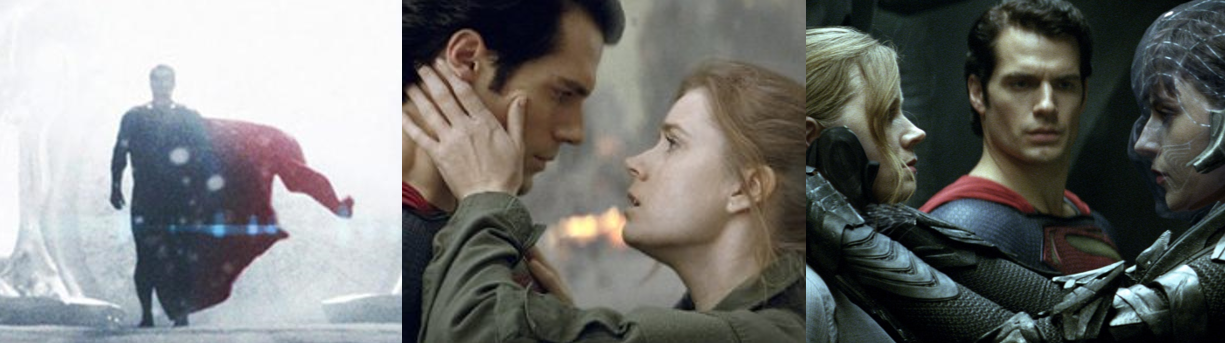
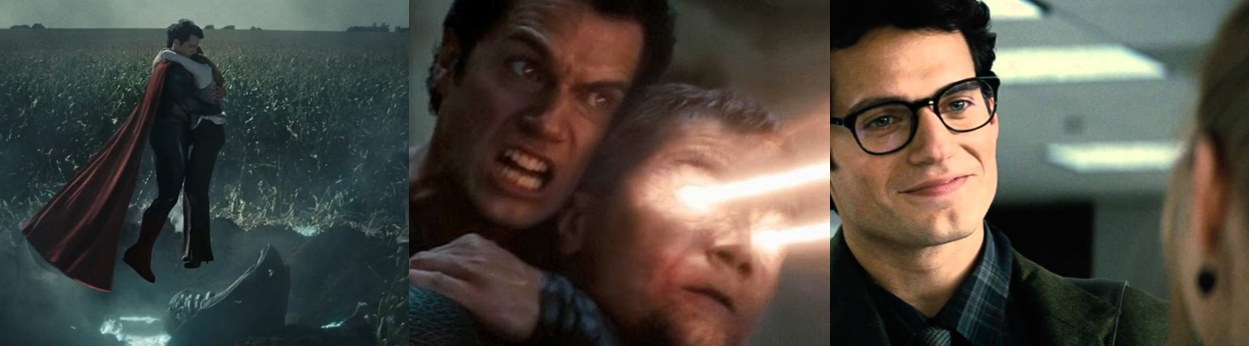
By the time he’s an adult, Clark has experienced much of the conflicting nature of humanity; there are bullies and assholes but also those who will go out of their way to save others, proving that humankind has a spark of decency buried deep beneath the conflict. When he discovers the Kryptonian scout ship and meets the holographic representation of his birth father, Clark learns of his true heritage and the reason for his existence and finally discovers the means to reconcile the conflict within him. Donning an absolutely glorious alien suit and flowing cape, and inspired by both his fathers, Clark finds he has only begun to realise the true extent of his abilities as he defies Earth’s gravity, clearly basking in the feelings of liberation brought not only from flying through the air but from finally accepting his birthright. Clark is shown to have always had a strong relationship with Martha, who only ever showed him love and affection and tried to help him to focus his abilities. While both her and Jonathan loved him unconditionally, their methods at helping him through his adolescence and his burgeoning powers differed somewhat, as she was perfectly happy to just let him grow up, fully confident that he’d make the right decisions, whereas Jonathan continually went out of his way to stress that Clark is there for a reason and has a greater destiny. After Jonathan’s death, Clark’s bond with Martha grows even stronger, partially due to his guilt but also because she’s all that he has left and he flies into a rage when her life is threatened by Zod and his cronies later in the film. Of course, intrepid reporter Lois Lane (Adams) remains a central influence in Clark’s decision to embrace his destiny and put his powers to good use; depicted as a strong-willed, curious, and empathetic woman, Lois is a fearless reporter who doesn’t hesitate to put herself in harm’s way, or the most extreme environments, in order to get a good story. When she learns that a centuries-old Kryptonian scout ship has been located in the Canadian Arctic, she doesn’t hesitate to head out there, immediately establish herself as a woman of some fortitude before the somewhat disapproving Colonel Nathan Hardy/Guardian (Meloni), and even brave the frigid environment to get up close and personal with the ship. After she’s attacked by the Kryptonian security droids and Clark saves her life, she throws herself into trying to track down her mysterious saviour, much to the chagrin of her editor, Perry White (Lawrence Fishburne), and is intrigued by the many and varied reports of a superpowered do-gooder helping others before disappearing.

Strong supporting characters flesh out the world and ask new questions about Superman’s presence.

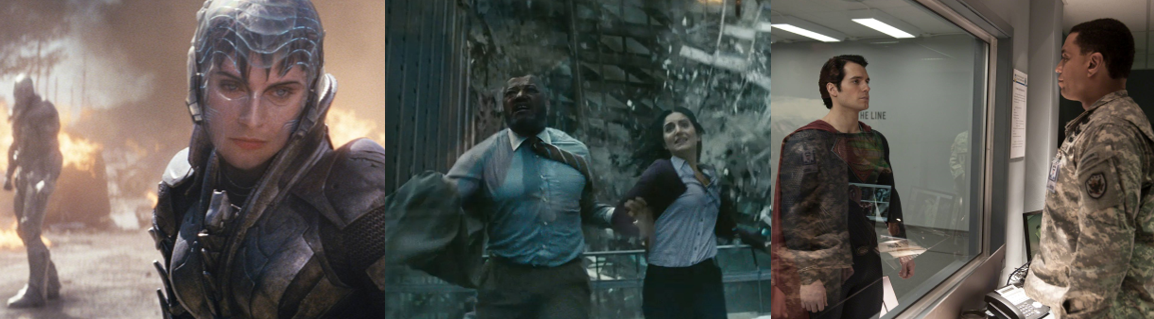
In a fantastic change of pace, Lois experiences Clark’s abilities and is privy to his identity right away, doing away with the need for him to assume the guise of a bumbling fool. Lois not only gives him the name Superman (in a roundabout way), but also plays an important role as an audience surrogate as she uses her reputation as a celebrated reporter to accompany and talk to him after he surrenders himself to the distrustful Lieutenant General Calvin Swanwick (Harry Lennix) and even goes with him to Zod’s ship after Superman willingly agrees to give himself up to spare his world. Cavill and Adams have a real tangible onscreen chemistry and Lois very much acts as a mediator between Clark’s somewhat sheltered upbringing, the awe that his presence (and unparalleled physicality) inspires, the suspicion of Swanwick and some others, and the demands of Zod. General Zod announces his arrival by broadcasting an ominous message across all media platforms and in all languages to deliver Clark with an ultimatum, thereby giving him another moral quandary over whether to surrender himself to the Kryptonians or to humanity, neither of which are particularly trustworthy. Zod isn’t alone in his mission, of course. He’s joined by a number of Kryptonian followers, the most prominent of which are Faora-Ul (Traue) and an unnamed towering brute who ransack Smallville to draw Superman out for a conflict. Much like Ursa (Sarah Douglas), Faora-Ul is absolutely devoted to General Zod and follows his every order without question. Interestingly, she sparks up a rivalry (and, apparently, a mutual attraction and respect) with Colonel Hardy during the conflict between the military and the Kryptonians that eventually drives them to go out in a burst of glory during the finale. Perry White also has quite a prominent role here; not only does he bust Lois’s balls over daring to suggest the Daily Planet print a story about aliens, but he’s also less than impressed that she protects Superman’s identity and actually takes an active role in helping his staff (and others) during the cataclysmic finale. Lieutenant General Swanwick takes the lead in the military’s investigation of Superman; legitimately concerned and thrown off by the revelation that an alien has been living amongst them for thirty-three years, he treats Superman with a great deal of apprehension since he has such incredible power but acts independently of anyone’s interests, to say nothing of those of the United States government.

Zod is a cruel and malicious warrior who is dedicated to ensuring the survival of the Kryptonian race.

I do think that the film would have benefitted from a slight restructuring to allow for a time jump between Clark discovering his suit and Zod’s arrival; Clark is Superman for barely a day before the Kryptonians arrive to cause havoc, meaning his first real test is right in the deep end against a bunch of fanatical warriors and I think it would have benefitted the film (and the sequel) to have had a bit of a montage that showed him performing superheroic feats across the world and lay the seeds for the hope and fear his presence inspired in people. Kryptonian society is a little different to what we saw in the old films; genetic engineering is the norm, so everyone has a predefined role; while Clark, as the first natural-born Kryptonian in centuries, is the exception to this rule, General Zod is a warrior through and through whose desire to ensure Krypton’s survival drives him to extreme and devastating actions that he couldn’t stop even if he wanted to. Having spent a great deal of time in exile and spurred by the perceived betrayal of his fellow Kryptonians, Zod is an interesting dichotomy; he’s both one-dimensional and multi-dimensional since he is fixated on ensuring Krypton’s survival and yet he’s genuinely hurt when Jor-El refuses to join forces with him in meeting this goal, and at being forced to fight against his old friend. Rather than being a criminal and a conqueror simply for personal glory, Zod seeks to terraform Earth and extract the Codex from Clark in order to rebuild Kryptonian society and is disgusted that Clark shares the same compassion and weakness as his father. As much as I was glad to see that Man of Steel avoided using typical Superman villains and devices like Lex Luthor and Kryptonite, I was a little disappointed that Zod was used as the main antagonist; Michael Shannon is amazing in the role, don’t get me wrong, exuding an intelligence and a malice that help him be as distinct from Terence Stamp’s memorable rendition of the character as Cavill is from Reeve, but I do think the film could’ve been largely the same, and actually somewhat superior, if Zod had been replaced with Brainiac. By taking influences from Superman: The Animated Series (1996 to 2000) and elements of the Eradicator and Zod’s fanatical fixation on rebuilding Kryptonian society, Brainiac could have helped the film stand out even more from its predecessors, and Michael Shannon could have brought the same calculating intensity to that role as he does to Zod, but I very much enjoyed how Zod was such a devious, manipulative, and brutal foe here.

The Nitty-Gritty:
Man of Steel owes more than a little to Nolan’s grounded and gritty take on Bruce Wayne/Batman in the Dark Knight trilogy; like those films, Man of Steel is a very serious and thought-provoking deconstruction of easily the most iconic superhero in all of comicdom. The film is front-loaded with themes regarding destiny, nature/nurture, and realising oneself in a world that’s not as black and white as we’d like. More than ever, Superman and General Zod are presented as thematic opposites; while Zod is pained to have killed his friend and is acting only in the interest of preserving his long-dead society, Superman is determined to safeguard his world and others but has struggled for his entire life with finding the means to do so. Both Jor-El and Jonathan see him as a world-changing symbol of hope and the capacity to achieve something greater, and he even wears his family crest (the symbol of hope) as Superman, but a prevailing concern throughout the film (which later turns out to be true) is that humanity will stumble, to say the least, in their efforts to keep pace with him. As ever, Superman is accompanied by strong religious themes; one of Jonathan’s many worries about him exposing himself is how it will change humanity’s perception of their beliefs in both scientific and religious teachings, when Zod arrives Clark communes with a priest (Coburn Goss) before surrendering himself (fitting, considering his dialogue with Jor-El clearly evokes a conversation with the Creator), and of course Superman adopts the image of the crucifix before dashing off to rescue Lois’s escape pod.

Superman, his enemies, the tech, and the entire film shines thanks to a strong visual identity.

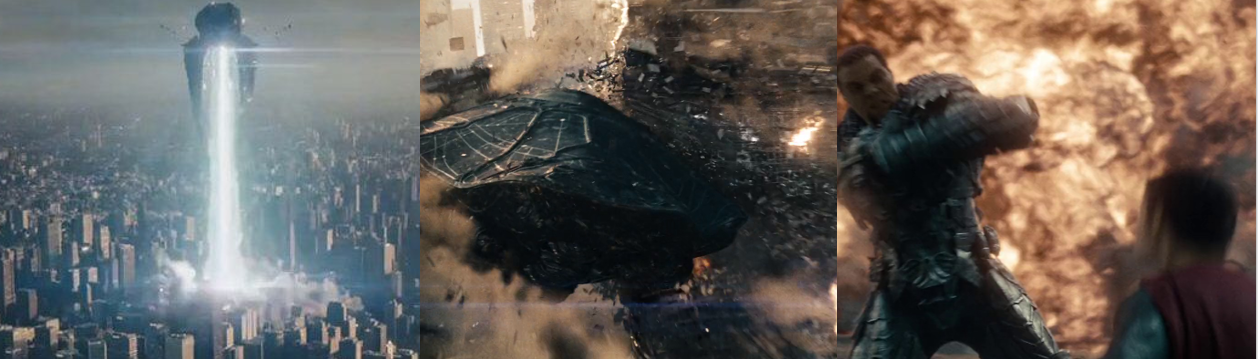
One of the benefits of bringing in Zack Snyder is his strengths as a visual storyteller; Man of Steel is beautifully shot, utilising a subdued colour scheme that gives the film a very tangible, grounded aesthetic. Shots of Krypton, and Superman, are given a suitably grandiose sheen, making for some of the most impressive flying sequences in a Superman film yet and ensuring that Superman makes a lasting impact every time he’s onscreen. Snyder is far from a subtle storyteller, however, though, here, his tendencies are clearly tempered by Nolan’s more measured and intellectual approach. Still, Snyder’s propensity towards spectacle and engaging visuals results in some harrowing sequences; one of the standouts is a dream-like confrontation between Superman and Zod where the Man of Steel sinks beneath the skeletal remains of billions of murdered humans. Superman’s powers are somewhat subdued here, potentially to maintain the grounded tone of the film; Superman exhibits superhearing, vision, and strength but he and the other Kryptonians primarily rely on their heat vision, superspeed, and flight rather than freezing breath. Thanks to fully utilising modern technology, Man of Steel has the best flying sequences of any Superman movie, taking the lessons learned in Superman Returns and cranking them up to eleven. Snyder loves him some dramatic camera zoom; it’s a little overused but actually makes it feel as though the camera is tracking the action and flying in real-time. Of course, I have to gush about Cavill’s super-suit; yes, debates will rage seemingly for all eternity about whether he should have trunks or not but this is, for me, the best Superman costume we’ve ever seen in live-action. The symbol is alien, and yet familiar, and the texture work is sublime. His cape is nice and long and flowing, making for some dramatic shots as it billows out behind him, and the colour grading allows it to be both colourful and realistic without being overly comic book-y. While the Kryptonian suits are all CGI, you’d never know it since they never appear to be fake; I love how they’re all garbed in this functional dark armour, which is a brilliant thematic and visual parallel between their dark designs for Earth and Superman’s heroism. Krypton and its technology are far more alien than is the norm, comprised of squid-like robotic aides, a sort of nanotechnology used for communication, and a life-like holographic projection of Jor-El that guides Superman and helps Lois. When Superman arrives on the Kryptonian ship and learns about his society, there’s a distinct visual contrast between himself and the world he knows on Earth and this unknown alien society, which is similar to ours but fundamentally different and far more advanced in so many ways.

Metropolis is wrecked by the destructive conflict in scenes analogous to a disaster movie.

Superman ultimately embraces aspects of both worlds by donning a Kryptonian suit and his father’s crest and using his powers to benefit his adopted world while also being mindful of his adopted father’s fears that society will never fully trust, or embrace, him due to how different he is. Thanks to having lived on Earth for his entire life, Clark has fully mastered all of the sensory bombardment that comes from his powers, however he’s still learning and is untested in operating in public. Onboard Zod’s ship, Superman is rendered powerless and as vulnerable as they are when exposed to Earth’s atmosphere, which initially causes them crippling pain. However, the Kryptonians are born and bred warriors, trained to master their senses and their environment, so quickly adapt to the atmosphere and the powers that come with it; they’re also far more adept at fighting than Clark, and not only outnumber him but have devastating terraforming technology at their disposal, meaning Superman faces a very real and formidable physical threat throughout the film. This results in Man of Steel being almost the exact opposite of Superman Returns, and its other predecessors, as it features more action, fight scenes, and depictions of gratuitous destruction than you could ever hope for…and it’s pretty freakin’ glorious! Even Jor-El gets in on the action, donning both the Superman suit and Kryptonian armour, blasting at Zod’s forces, flying through the battle that rages in Krypton’s sky, and even going toe-to-toe with Zod himself to help establish that Superman’s fighting spirit and defiance is potentially inherited from his father. The action is intense and brutal, with a huge area of Metropolis and Smallville being destroyed as Superman ploughs his opponents through buildings and Zod’s World Engine machine devastating the city with its energy cannon. This Superman is an extremely emotional and reactive character who flies into a rage and is determined to tackle his enemies using brute force, meaning untold collateral damage in the process that received a lot of backlash but is clearly evoking the imagery of cataclysmic events such as 9/11 to show how these God-like beings pose a real danger to the world. While I can’t deny that Snyder definitely went way overboard with the destruction caused during the finale (Metropolis literally looks like it’s been entirely wiped out at one point, and Superman sends Zod’s ship crashing right into the heart of the city, which absolutely killed thousands of people), Clark’s just become Superman and is being threatened by a formidable force who won’t listen to reason, so he’s not as experienced as his predecessor or comic book counterpart. Plus, I think it’s important to remember that Superman does make an effort, wherever possible, to save lives; hell, the entire reason Colonel Hardy learns to trust Superman is because he saved his life, and he pushes himself to the absolute limit to destroy the World Engine in the Indian Ocean, thus saving the entire world from destruction.

Superman takes drastic action to end Zod’s threat and settles into his new life as an unassuming reporter.

With his ship downed, his World Engine destroyed thanks to Superman and Hardy’s sacrifice, and his followers all dead, General Zod is left utterly devastated; he’s lost his world, the last remnants of his people, and his entire reason for living (nay, being) has been brought to ruins all because Superman, the son of his former friend and hated enemy, chose his adopted world over his birth planet. Fuelled by his rage, and his commitment to ensuring the greater good of his people, Zod flies into a brutal and merciless assault, resulting in a vicious battle between him and Superman through the remains of Metropolis. Thanks to the benefits of modern day effects, this fight isn’t restricted in the same way as the finale of Superman II was, allowing Superman and Zod to plough through buildings, tear through walls, smash through a Wayne Enterprises satellite in the upper atmosphere, and finally gives us the violent and exciting airborne fist fight we’ve wanted from a Superman film since seeing The Matrix Revolutions (Wachowski Brothers, 2003). Although the battle has already cost the lives of God-knows how many, Superman is ultimately faced with an impossible decision; trapped in a headlock, General Zod refuses to ever stop his destructive vendetta and threatens to immolate a nearby family with his heat vision, leaving Superman no choice but to break the fanatical Kryptonian’s neck to end his threat once and for all. Again, this sparked a great deal of controversy and I can fully understand that, but it’s not as if Superman hasn’t killed Zod before (he did it in Superman II (twice, actually) and famously did executed him the comics, too) and I would much rather have Superman forced to make that decision and then learn to deal with it rather than just sweep it under the rug because he’s supposed to “be better”. In the aftermath, Superman maintains that Swanwick will just have to trust that he’s there to help and isn’t a threat to humanity (something that, sadly, is a focal point of the sequel) and, in a move that I was genuinely surprised to see, goes to work with Lois at the Daily Planet. Considering how fast and loose Man of Steel played Superman’s identity, I was almost sure that Snyder would avoid using this trope but it is tradition, after all, and the film ends with the hope that the world will change for the better following Superman’s arrival (which, again, would be dashed in the sequel…)

The Summary:
After years of Superman being pigeon-holed into this outdated Silver Age characterisation as a God-like being forever embodied by Christopher Reeve, Man of Steel was a real breath of fresh air for the character and really changed the perception and portrayal of the character in interesting ways. I’ve said it before but playing Superman is no mean feat because Reeve cast a very long, dark shadow and comparisons will always be made between him and every actor to take on the tights and cape, but Cavill really brought a physicality and charisma that hadn’t been seen for some time. It helps that he’s an absolute beefcake, but his suit is incredible, and I enjoyed the deeper insight into his relationship with humanity and the burden of living up to the responsibility of his incredible powers. It’s maybe a bit too grounded and gritty and dour for a Superman film, especially as he’s meant to be a paragon of truth, justice, and the American Way, but I think it did a great job of introducing a new version of Superman to a new generation of audiences. The visual presentation and explosive action is an absolute spectacle; there’s a real sense of danger and consequence when Superman throws hands with his Kryptonian foes that may not be the most subtlest approach to take when it comes to disastrous events but absolutely makes for the most action-packed Superman film yet. Man of Steel is only bolstered by strong performances across the board; there’s a fantastic chemistry between Lois and Clark, Zod is a malicious and spiteful despot, and even the supporting actors all do a wonderful job of grounding this world and setting the stage for the coming DCEU. It’s a shame that so many people couldn’t get past the wanton destruction and more controversial aspects as there’s a lot to like here, and even more of a shame that Snyder (and Warner Bros.) squandered all the potential of this world with the follow-up by presenting Superman as a contentious figure and then killing him. While I have grown to despise die-hard Snyder fans and their antagonistic behaviour, I still really enjoy Man of Steel and am incredible happy with how it all came together to deliver a Superman much more in line with what I wanted to see onscreen.

My Rating:

Rating: 4 out of 5.

Great Stuff

Did you enjoy Man of Steel? What did you think to Henry Cavill’s performance as Superman and how do you think he compares to other live-action Superman? Did you enjoy the new interpretation of Krypton? What did you think to the extended discussion regarding Clark’s powers and place in the world? Did you enjoy the way the film handled his secret identity and the new suit? What did you think to this version of General Zod? Were you put off by the destruction and Zod’s execution or did you enjoy the more violent aspects of the film? What is your favourite Superman story, character, or piece of media? How did you celebrate Superman Day this month? Whatever your thoughts, feel free to share them below or leave a comment on my social media.

Game Corner [Superman Month]: Superman Returns (Xbox 360)


In 2013, DC Comics declared the 12th of June as “Superman Day”, a day for fans of the Man of Steel the world over to celebrate Clark Kent/Kal-El/Superman, the superpowered virtue of “Truth, Justice, and the American Way” who is widely regarded as the first ever costumed superhero. This year, I’m spending every Monday of June celebrating the Man of Steel as I expand Superman Day to “Superman Month“.


This review has been supported by Chiara Cooper.
If you’d like to support the site, you can do so at my Ko-Fi page.

Released: 22 November 2006
Developer: EA Tiburon
Also Available For: Nintendo DS, PlayStation 2, Xbox

The Background:
As I mentioned in my review of the film, Superman Returns (Singer, 2006) was supposed to be a pretty big deal for DC Comics, Warner Bros. and Superman in general. Absent from cinema screens since 1987, Superman had seen a fair amount of representation in videogames in the intervening years and ever since 1979, but the Man of Steel has had a difficult history with pixels and polygons and it’s not as if videogame tie-in to movies have an esteemed reputation. Add to that the fact that Superman Returns didn’t exactly impress critically and the videogame tie-in was off to a troublesome start before it even released. Developed by a subsidiary of Electronic Arts, EA Tiburon (who had developed a handful of sports-based games for the publisher) and incorporating a large open world version of Metropolis that required players to minimise collateral damage, Superman Returns received mostly negative reviews and Superman has continued to struggle with transitioning into a successful videogame adaptation.

The Plot:
Acting as part-prequel- part-midquel, and part-retelling of the events of the film, Superman leaves Earth to investigate the remains of his home planet, Krypton. There, he incurs the wrath of the tyrant Mongul and, upon returning to Earth after five years, finds his arch enemy, Lex Luthor, enacting a diabolical plot for revenge involving Kryptonian technology while also battling some of his most notorious villains.

Gameplay:
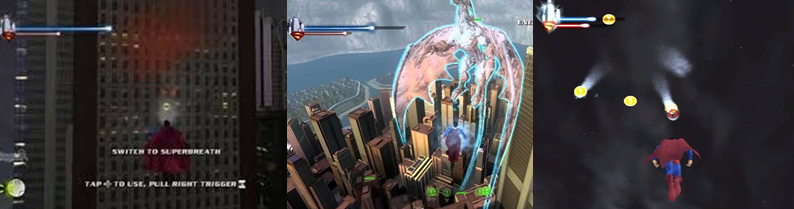
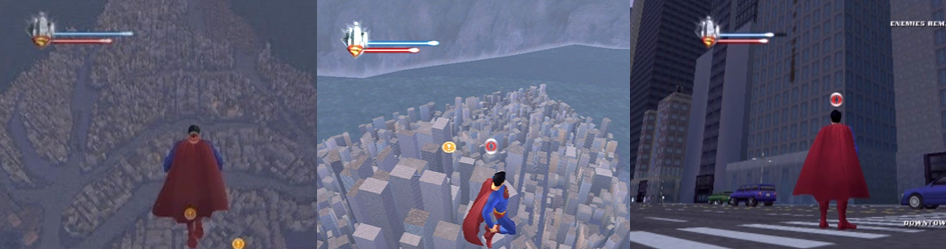
Superman Returns is an open-world action game that places players in the cape and tights of the Man of Steel, as portrayed by Brandon Routh in the movie of the same name. The main objective of the game is to defend the impressively-realised and expansive city of Metropolis from a variety of threats using Superman’s awesome powers, all of which are available to the player from the moment the game begins. By pressing Y, players can take to the skies and can even rocket away by holding the button down. While it is a bit disorientating once you’re in the air, it doesn’t take long to adjust to it and it can be quite a thrill to blast through the air and between skyscrapers at Superman’s full speed. By holding down the Left Bumper, you can speed through the sky, going faster and faster until everything around you becomes a blur and Superman breaks the sound barrier, however it can be very difficult to make tight turns and avoid flying head-first into buildings when going at full speed. You can land with Y and, when on the ground, sprint at superspeed by holding LB, which is equally unwieldy at times.

Rocket through the sky at breakneck speeds or blast enemies with Superman’s array of powers.

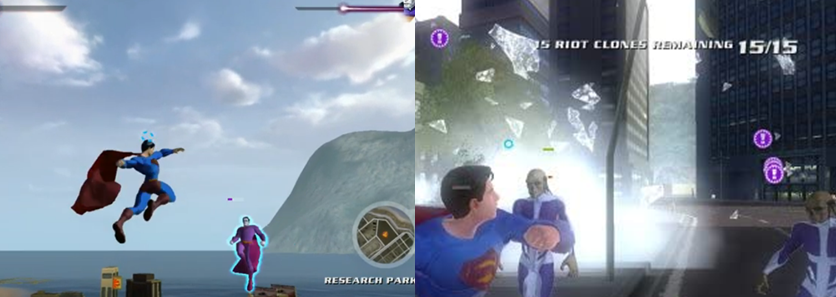
You can target enemies with the Left Trigger and attack enemies with, primarily, X; repeatedly pressing X and adding in presses of Y and A will see Superman pull off more elaborate combos to deal more damage, although there is a significant input delay when trying to perform combos (in a change from most games, it seems that you have to press each button deliberately rather than as quickly as possible). Superman also has the full scope of his superpowers available to use as well; these are assigned to the directional pad and activated with the Right Trigger and allow you to blast at enemies with heat vision, freeze them with Superman’s freeze breath, or put out fires with his superbreath. All of these can also be augmented by double-tapping the direction and can even be worked into your combos but be sure to keep an eye on the power meter, which will deplete as you use your superpowers and take some time to refill (though you can speed this up by flying up into the sky to bathe in the sun’s rays). One of the constant problems with Superman videogames is that, thanks to the prerequisite for character’s to have a health bar, the Man of Steel is often neutered or susceptible to damage and death rather than being the powerful, superhuman hero he is known to be. Superman Returns comes up with a truly inspired solution to this problem; not only are Superman’s powers restricted by a power meter, not only does he come up against powerful alien foes and robots that are able to bash him about like a ragdoll, but he must also ensure that Metropolis doesn’t suffer too much damage from the constant barrage of attacks that befall it.

In an ingenious twist, Metropolis takes damage in Superman’s place.

Enemies will attack civilians, set fire to buildings, and the environment is highly destructible, meaning that cars, trees, walls, and other objects and parts of the environment can be used as weapons or destroyed and, if the city is damaged too much, Superman will fail his mission and you’ll have to either restart the chapter or reload your last save. Replenishing Metropolis’ “health” can be quite a chore; you can pick up injured civilians (one at a time) and carry them to a specific ambulance to restore a bit of the city’s health but the best way to bump its health back up is to get rid of all the enemies or the threat in play or reload your last save. Unlike the vast majority of videogames, Superman Returns doesn’t appear to autosave after you complete objectives and missions; instead, you can/must manually save from the pause menu, which also lets you view Superman’s combos, statistics, and the experience points (XP) you’ve accumulated. XP is earned by defending Metropolis from incoming comets, burning buildings, and attacks from aliens, robots, and Cadmus’ monstrous creations; when you gain enough XP, Superman will level-up and his superpowers will automatically become more powerful as a result. Superman Returns features a nice little mini map on the bottom left of the screen that shows you where enemies and ambulances are located and Superman will pick up cries of distress and be able to see objective markers thanks to his super-senses. You can also view the entire city map by pressing the ‘Back’ button but this really isn’t all that helpful as no areas, secrets, or places of interest are highlighted and the only place you can fast travel to and from is the Fortress of Solitude.

Gameplay gets extremely tedious and frustrating very quickly.

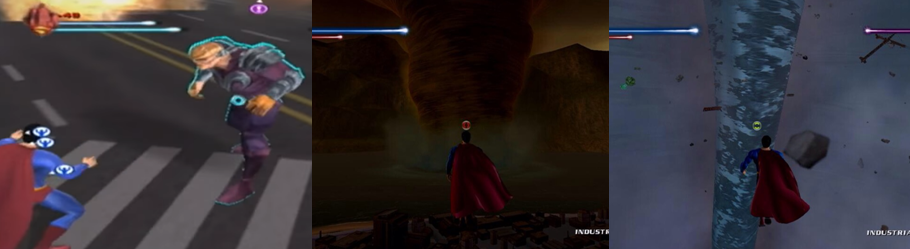
Gameplay gets extremely repetitive very quickly and the game’s pace is all over the place; you cannot progress the story until you’ve defended Metropolis from a certain number of random attacks, which occur either so sporadically that you’re flying around aimlessly like an idiot or happen so often and have so many enemies that it becomes annoying. You cannot just fly away from these incidents and ignore them, either, as that’ll cause a game over but, even though you’re playing as frickin’ Superman, you often end up getting bashed all over the place by a barrage of attacks and are forced to mash buttons to get Superman’s useless ass back into the fight. A certain amount of strategy is required to take on enemies, who can race away across the city or are vulnerable to certain superpowers, but it all gets very frustrating and mind-numbing very quickly. Incidents where you have to blast meteors from the sky, put out fires, save citizens, or tackle incoming tornados help to break the monotony up a bit but they’re few and far between.

Graphics and Sound:
Similar to the movie it’s based on, Superman Returns makes extremely poor use of John Williams’ iconic Superman theme; in fact, the rousing “DUN-dun-dun-DUN-DUN” doesn’t appear at all in the game and is replaced by a very generic soundalike that really undermines the entire experience. Stars Brandon Routh, Kate Bosworth, and Kevin Spacey all return to lend their likenesses and voices but, sadly, like many videogame adaptations of movies, the game’s interpretation of the film’s events leaves out many of the characters and sub-plots from the source material and provides only a very basic recap of the film as story-based missions.

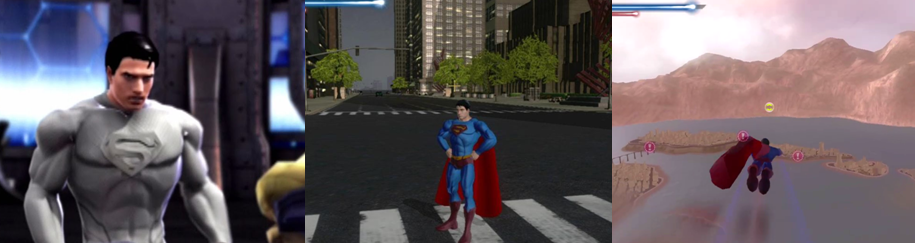
While the cutscenes look terrible, Superman’s character model is okay, especially when he’s flying.

Plus, while these actors do lend their likenesses, only Superman appears as an in-game character model. The game’s cutscenes are quite low-quality, very blurry, and extremely limited in their detail and length but, thankfully, Superman himself looks mostly okay. When you leave him standing around, he’ll strike a heroic pose (the camera even automatically changes position for the best possible shot) and NPCs will continuous be in awe of his presence, feats, or begging for his help. Superman looks best, however, when flying at high speeds; his head and neck seem a little disproportionate to his body and, like many Xbox 360 character models, he looks a bit more like a malformed action figure than an actual person with a logical skeletal structure. Superman ragdolls around when attacked and seems quite unwieldy at times as he’s both superfast but also clunky and his attacks are slow and have a limited range; additionally, there are some wonky instances of cape physics as well but, still, it’s probably the best rendition of the character in a solo videogame I’ve seen yet.

Metropolis may be big and impressive but it’s incredibly lifeless and empty.

Superman’s enemies aren’t exactly much to shout about either; indeed, it seems like the developers put all of their time and effort into creating a vast city for you to fly around in. However, considering how good a job Superman Returns does of recreating Metropolis, it’s quite a dull and uninspiring experience; although cars drive through the streets and non-playable characters (NPCs) wander around the place, the city feels extremely empty and lifeless and there really isn’t that much to do or see beyond iconic buildings like the Daily Planet and areas such as Suicide Slum. Metropolis may be very grey and barren at the best of times but you can damage and interact with a fair amount of it (which is actually to your detriment as it’ll cost the city health) and the environment does change at the start of the game, where you fight Mongul and his warriors on Warworld, and in the final chapters when the city is bathed in an ominous darkness and a tumultuous thunderstorm but you never get to go inside any buildings or freely visit other environments so it all becomes very underwhelming and boring very quickly.

Enemies and Bosses:
There are three types of enemies Superman will have to defend Metropolis against: the alien forces of Mongul, killer robots created and controlled by John Corben/Metallo, and the various monstrous clones created by Cadmus. As you play though the game’s story, you’ll encounter each of these, and their many variants, in successive fashion and, by the end of the game, entire groups of different enemies will attack the city and its inhabitants. For the most part, enemies fall into some recognisable tropes no matter their appearance, being susceptible to heat vision or freeze breath or more vulnerable against objects (such as cars and debris) being thrown at them. Some are smaller and faster, zipping around on the ground or flying through the air and firing Kryptonite lasers, energy blasts, or elemental plumes at you; others are larger, requiring more combos to damage or blocking your attacks; and others will directly attack the environment to distract you with fires and such.

Bosses like Overcast and Metallo eventually grow to gigantic proportions.

You’ll learn the basics of combat at the start of the game, where Mongul forces you to fight his minions, Phalanx and Overcast, before taking you on himself. This teaches you how to engage with multiple enemies, use the environment to deal damage to gigantic enemies, and the importance of holding B to block or pressing B to quickly dodge behind opponents. Each group of enemies you face from that point on is directly related to the main villain who serves as the recurring and final boss of that particular chapter; thus, when trying to put a stop to Metallo, you’ll first have to stop his robot minions from attacking the city. Complete enough of these missions, and Metallo will spawn into the map and you can fight him; similar to the enemies you battle on Warworld, Metallo attacks by pummelling you, blasting you with a massive Kryptonite laser, shielding himself like a bitch, and spawning in minions to distract you. Like Overcast, Metallo eventually grows to enormous proportions and begins trashing the city, forcing you to hurl cars at him. Once you deal enough damage, he’ll try to destroy the city with a missile, necessitating that you chase after it and complete a quick-time event (QTE) to stop it and bring him down once and for all.

Unless you use your powers in the right way, Bizarro and Riot can be a right pain in the ass.

Next, a breakout at Cadmus Labs sees a whole slew of vicious, demonic monsters roam rampant around the city, attacking blimps and causing massive damage with their big explosive attacks. As if that wasn’t bad enough, Superman’s flawed doppelgänger, Bizarro, is also running rampant; compared to Brainiac, Bizarro is a much easier fight as it’s much simpler to avoid his lumbering attacks and land some combos on him. To put him down for good, however, you’ll need to chase after him and ram into him to stop him destroying the city with his heat vision and complete another QTE in a test of heat vision, all while desperately trying to fend off swarms of flying monsters who pummel you relentlessly. That’s nothing, however, compared to fighting Frederick von Frankenstein/Riot, who duplicates himself every time you land a melee attack and can only be defeated by blasting him and his doubles with your freeze breath and then your heat vision, which can get very tedious.

After taking out Mongul, you’ll battle Superman’s ultimate nemesis: a giant tornado!

In the game’s final chapters, Mongul arrives on Earth looking for revenge, bringing with him an army of Phalanx warriors and Overcast, with all three spawning into the map at inopportune times to cause massive amounts of damage. Battling Overcast’s gigantic form while also juggling an endless swarm of Phalanx warriors and contending with Mongul is a hell of a tall order but, thankfully, you can (and totally should) focus on Mongul alone in order to compete this story mission and can worry about the rest later. The opening of the game teaches you that Mongul is a cheap bastard who likes to constantly block your attacks and that’s true in the endgame as well but he’ll also attack citizens and cars and spawns in more and more minions the more damage you do. Personally, I found it easier to just keep throwing cars at him until he goes down. Ultimately, the game concludes with a series of deadly tornados threatening the city; you must blow and freeze them away, put out the fires they cause, and rescue citizens from their path before contending with Superman’s most deadly and iconic foe…a giant tornado! To dispel this swirling mass of destruction, you must blast its core with either your heat vision or freeze breath all while cars and debris relentlessly slam into you but, with enough patience, it’s pretty simple to bring this chore of a game to a close.

Power-Ups and Bonuses:
There’s nothing. Seriously, you fly all over the city fighting bad guys and righting wrongs and there’s literally nothing. The only way you can replenish health is to rescue citizens, stop whatever the current threat is, or reload your save and the only tangible power-up you get is from levelling-up. Unlike most videogames, you can’t freely spend your XP upgrading Superman’s skills individually, though; instead, his powers increase automatically, taking all agency and effort out of your hands entirely.

Additional Features:
Superman Returns has a whopping eighteen Achievements for you to earn; six of these are directly tied to defeating the game’s villains and finishing the story, while there are others for fully powering Superman up, defeating enemies with cars, lifting a certain amount of weight, or playing the game for twelve hours total (as if you’re ever going to bother doing that…). Sadly, despite the size of the city, there aren’t any fun Achievements tied to, say, knocking the globe off the Daily Planet or finding all the Planet Krypton restaurants or even finding much of anything for that matter.

Rescue kittens, race against Mr. Mxyzptlk, or cause destruction as Bizarro!

That’s not to say that there isn’t nothing else to do in the game; there are a hundred kittens hidden throughout the city that you can find for an Achievement and, at various points around the map, you’ll encounter Mister Mxyzptlk who’ll challenge you to completing increasingly-challenging races against him. These are quite fun but by far the most entertaining side mission are the instances where you get to play as Bizarro and cause as much damage as possible in a time limit. You can input some cheat codes to make the game easier but you won’t earn any Achievements (except for a 0G one) if you do this. As you play and level-up and explore, you’ll also acquire trophies to view in the Fortress of Solitude and unlock a couple of additional suits for Superman, which is nice, but there’s really not much to entice you back to this game once you’re done trudging through this God-awful borefest.

The Summary:
Superman Returns may very well be the most accurate and impressive Superman game I’ve ever played; being able to fly through and across an impressively-rendered recreation of Metropolis is a real blast and giving the city a life bar instead of Superman was an ingenious solution to the problem of having Superman take damage or be killed when he really shouldn’t be. Sadly, though, these aspects are the only real saving graces of this game, which is clearly a rushed cash-in produced solely to tie-into the movie. The story is basically nonexistent, the combat and gameplay extremely repetitive and boring, and the presentation is wildly inconsistent as, while the city and Superman look pretty good, the cutscenes and music and dreadful. In the end, only die-hard Superman fans will really be able to enjoy this one and, for the rest of us, it’s just a quick game to plough through to increase your Gamer Score that is more monotonous and frustrating than fun and entertaining so I’d say that it’s best avoided.

My Rating:

Rating: 1 out of 5.

Terrible

Have you ever played the videogame adaptation of Superman Returns? If so, what did you think to it? Did you enjoy the wide, open world of Metropolis and the feeling of having Superman’s full abilities at your fingertips? Were you also disappointed by how empty the world is and how tedious the gameplay was? Which of the game’s villains was your favourite and why and what did you think to how the game expanded upon the plot of the film? What is your favourite Superman videogame and would you like to see something like this tried again but with a bit more time, effort, and money put into it? How did you celebrate Superman Day this year and what are some of your favourite Superman stories?

Movie Night [Superman Month]: Superman Returns


In 2013, DC Comics declared the 12th of June as “Superman Day”, a day for fans of the Man of Steel the world over to celebrate Clark Kent/Kal-El/Superman, the superpowered virtue of “Truth, Justice, and the American Way” who is widely regarded as the first ever costumed superhero. This year, I’m spending every Monday of June celebrating the Man of Steel as I expand Superman Day to “Superman Month“.


This review has been supported by Chiara Cooper.
If you’d like to support the site, you can do so at my Ko-Fi page.

Released: 28 June 2006
Director: Bryan Singer
Distributor: Warner Bros. Pictures
Budget: $270 million
Stars: Brandon Routh, Kate Bosworth, Parker Posey, Tristan Lake Leabu, James Marsden, and Kevin Spacey

The Plot:
Returning to Earth after five years in deep space investigating the remains of his home planet, Krypton, Clark Kent/Superman (Routh) returns to find former flame Lois Lane (Bosworth) married and with a young son. However, as he struggles to acclimatise to a world that may no longer need him, criminal mastermind Lex Luthor (Spacey) steals Kryptonian technology and enacts a diabolical plot avenge himself on the Man of Steel.

The Background:
Those that have read my reviews will know that my opinions of the four live-action Superman feature films produced between 1978 and 1987 are somewhat dismissive. There are elements from each of them that I enjoy, and obviously I enjoy Christopher Reeve’s iconic portrayal of the title character, but overall I feel they haven’t really aged well at all and often hold back reinterpretations of the character. After Superman IV: The Quest for Peace (Furie, 1987) turned out to be a dismal financial and critical failure, Superman was persona non grata from cinema screens for nearly twenty years. Oh, sure, he had a few live-action and animated shows to tide him over and some pretty big comic book events in the intervening years but Warner Bros. struggled to get a new feature film off the ground. After attempts by the likes of writer/director Kevin Smith and Tim Burton failed to materialise and cost the studio millions in production costs, director Bryan Singer conceived of and pitched the general idea of Superman Returns during filming of X2: X-Men 2/X-Men United (Singer, 2003). Wishing to recapture the magic of Richard Donner’s original film, Singer cast relative unknown Brandon Routh in the title role because of his many similarities to the late Christopher Reeve, acquired permission to repurpose Marlon Brando’s footage from the first two Superman movies, and envisioned the film as a continuation of Donner’s films. Superman Returns was supposed to be a pretty big deal for DC Comics, Warner Bros. and Superman in general but, while the film’s $391.1 million gross meant that it was a financial success, the film was met with mixed reviews and even Bryan Singer later expressed regret with the direction and marketing of the film. Although it was followed by a videogame tie-in, this response sank plans for a sequel and Superman wouldn’t return to cinema screens for another seven years, though Routh did return to the role as an aged version of Superman in “Crisis on Infinite Earths: Part Two” (Belsey, 2019).

The Review:
Superhero cinema was in an interesting place in the early 2000s; the X-Men (Singer; Ratner, 2000 to 2006) and Spider-Man (Raimi, 2002 to 2007) trilogies were proving to be big box office hits, but the Marvel Cinematic Universe was a mere pipedream at that point despite the growing influx of adaptations produced year after year. While Marvel adaptations were undoubtably popular and successful, and had proven that the genre could be critically and commercial successful, it was Batman Begins (Nolan, 2005) that arguably turned the most heads when it came to bringing prestige to the genre. Ignoring its camp, cartoony predecessor in favour of a dark, serious take on the character and bolstered by a reputable cast, Batman Begins took the source material seriously and so anticipation was quite high when Superman Returns was announced as the character had similarly stagnated since his last ridiculous onscreen appearance. In a move I found surprising considering I grew up with the Post-Crisis John Byrne version of the Man of Steel, who was (initially) quite different from his more ludicrous Golden and Silver Age counterpart, Superman Returns opted not to reboot the character like in Batman Begins, but to position itself as a continuation of Richard Donner’s films, one that ignored (or presumably ignored) all of the sequels after the first film save for some tenuous links to Superman II (Lester, 1980) and sought to bring Christopher Reeves’ iconic version of the Man of Steel into a post-9/11 world following a lengthy absence.

Superman returns from a five year absence to find the world has moved on without him.

This, for me, meant that the film started on rocky ground right from the off; as much as I enjoyed Donner’s original version of Superman, I never understood the decision to resurrect that character rather than reboot it from scratch. After all, it’s not as if Batman Begins was a prequel to Batman (Burton, 1989) so it just seemed like a shameless cash-in on the iconography and success of Donner’s influential first film. The film’s premise is that, after becoming the world’s foremost superpowered protector and opposing the mad schemes of Lex Luthor, Superman abandoned the world to its own devices when astronomers discovered Krypton’s remains many light-years away. Even in a repurposed Kryptonian spacecraft, the trip there and back takes Superman five years and, obviously, results only in Superman finding the shattered remains of his home world. So, right away there’s a lot of questions here: why did Superman feel compelled to go and see this when he knew from the words of his long-dead father, Jor-El (Marlon Brando), that Krypton was destroyed? What was he hoping to gain from this? There’s a sense that he wanted closure but…why? He seemed perfectly happy to accept that Krypton was dead and that the Earth was his true home, so suddenly taking off like that really doesn’t make any sense at all, especially considering Superman and Superman II made such a big deal about his attachments and importance to humanity. When Superman returns, the world has largely moved on without him; not only that, Lex Luthor has spent the intervening years showing elderly Gertrude Vanderworth (Noel Neill) “pleasures that [she’s] never felt” in order to con her out of her vast wealth and return himself to a position of power and prominence. Clark’s own elderly mother, Martha Kent (Eva Marie Saint) is still alive, however, and has been covering for his lengthy absence by sending regular letters and postcards to his Daily Planet colleagues while maintaining his old childhood farm home in Smallville and stockpiling newspapers and reports so he can catch up on what he missed.

Clark is stunned to find Lois has settled down with a family and feels a resentment towards Superman.

Superman’s absence had two very important side effects for both his personal life and the entire world; first was that intrepid reporter Lois Lane won a Pulitzer Prize for her article “Why the World Doesn’t Need Superman” and has established a family of her own with fiancé Richard White (Marsden) and son Jason (Leabu) and the second is that Luthor was even able to get out of prison in the first place. Thanks to his disregard for due process and missing a vital court appearance, Superman was indirectly responsible for Luthor being remanded into Gertrude’s custody and released back into the civilised world, and his abandonment of his duties and responsibilities is only part of the reason why Lois acts so cold towards him. She learned to live without him, as did the rest of the world but, while everyone else applauds his long-awaited return, she is resentful of him because she feels he abandoned her as much as anything (or anyone) else. Richard is the pilot nephew of Daily Planet editor Perry White (the masterful, and completely wasted Frank Langella) and his characterisation seems to boil down to him being a nice guy who’s supportive of his wife, loves his child, and is jealous of Superman and Lois’s obvious fascination with him. Otherwise, he’s just kind of there and only really comes into prominence when questioning Lois’s previous relationship with Superman and in the climax, when his convenient piloting skills help rescue Superman for his big finale, and I can’t help but feel like Marsden made a mistake abandoning his role as Scott Summers/Cyclops in the X-Men films for such an inconsequential role. As for Lois, she’s noticeably different from the Margot Kidder version in many ways, but no less daring and inquisitive; she continually puts herself right at the forefront of big stories, even if it means she’s placed in mortal danger, and has her world (and her heart) turned upside down when Superman returns. As ever, she barely even registers that Clark is back and is instead constantly distracted by Superman, to the point where she confronts him directly. Thankfully, the two don’t end up going for a long, awkward flight with a cheesy song this time around, and she warms towards him after learning of his reasons for leaving.

Despite his personal drama, Clark continues his façade as a bungling reporter and saving lives as Superman.

Upon returning to Earth, Clark immediately jumps back into his old life; he returns to work at the Daily Planet and continues putting on the act of a good-natured, bungling reporter to contrast with the confidant and heroic Superman. Considering he was a relative unknown, and such a fresh-faced young actor at the time, Brandon Routh does a masterful job of not only resembling the late, great Christopher Reeves but adopting many of the same mannerisms he showcased as both Clark and Superman. He certainly looks the part, and fills out the suit well, and I buy that he’s a slight variation of this character, but there’s something a little off about him. It’s possibly because Routh was given the monumental task of being the first big-screen Superman in twenty years and also emulating Reeves’ performance; any actor has big shoes to fill when taking on Superman, but only Routh had to literally be Reeves’ version of the character. Consequently, comparisons between the two are not only inevitable but actively encouraged by the film’s presentation as a sequel to Donner’s film, which I feel unfairly reflects on Routh’s performance here. He gives it a good shot and certainly embodies many of the moral and physical ideals of the character, but he was lumbered not just was continuing Reeves’ performance but also a diabolical script that called for him to morosely stalk his former flame and cast him in an uncomfortable light as an unreliable, overly sombre, and disappointingly stoic Superman. Routh has few moments to showcase the character’s friendlier, more trusting characteristics and this is a shame as he had a wonderful smile and exudes charisma in these moments, but Superman is so weighed down with doubts and regrets and drama that it really sucks all the life and fun out of the character (and the film). Even Clark’s bungling nature can’t really salvage these moments, again mainly because his comic book counterpart had also evolved quite a great deal since the seventies. Instead, what we’re left with is a throwback to an outdated version of the character and a sullen version of the Man of Steel who’s so distracted by his personal issues that he doesn’t realise Luthor is a threat until it’s almost too late, which is odd considering that the film makes a big deal of showing that Superman is deeply affected by the planet’s cries for a saviour and yet he somehow doesn’t pick up on Luthor’s latest plot.

Luthor flips between cold, calculating menace to unhinged mania seemingly at random.

Luthor’s grand plan this time around is, essentially, similar to that of his predecessor; namely, the acquisition of profit from real estate. Quite why this continued to be a concern for the self-professed greatest criminal mind ever to walk to Earth is beyond me, but this Luthor is noticeably more bitter and twisted than Gene Hackman’s take on the character. Finally sporting his trademark bald head and wielding Gertrude’s vast wealth, Luthor sets himself up on her fancy yacht and surrounds himself with idiotic underlings simply because he was forced to make questionable allies to survive his time in prison. Thanks to the events of Superman II, Luthor directs his crew to the Fortress of Solitude and refamiliarises himself with Jor-El and Krypton’s technology; specifically, Luthor learns of the Kryptonian crystals’ ability to expand and create landmasses, which he plans to use to create a whole new continent in the Northern Atlantic Ocean that will supplant the mainland United States, killing millions of people in the process. Aided by Kitty Kowalski (Posey), who’s essentially exactly the same character as Eve Teschmacher (Valerie Perrine), Luthor is only too eager to avenge himself on the Man of Steel when he makes his dramatic return to the spotlight and has Kitty distract Superman so that he (as in Luthor) can reacquire the chunk of Kryptonite he used in the first film in order to make his new landmass fatal to his hated enemy. While Hackman gloriously ate up the scenery in the previous films, Spacey absolutely devours it here with a wild and manic performance that shifts from cold, calculating menace to unhinged hysteria at the flip of a coin. It’s uncomfortable to praise any Kevin Spacey performance these days but he really was a pretty fantastic Lex Luthor; while I would much rather see either the mad scientist or corrupt businessman version of the character, Luthor is an enigmatic and cold-hearted villain who relishes the opportunity to bring Superman to his knees and bring about the deaths of countless innocents simply to fuel his ego and lust for power.

The Nitty-Gritty:
Perhaps the most prominent thematic inclusion here is the question of whether or not the world even needs a Superman; the world has continued on without him, and even gotten used to his absence, and both Clark and even Lois question whether he even has a place there anymore. Although Lois’s career was boosted by her anti-Superman article, Superman returns to action, saving people and solving problems the world over, because all he can hear is a world crying out for a saviour. I’m really not sure why this is such a recurring theme in Superman movies; Zack Snyder wasted a huge chunk of Batman v Superman: Dawn of Justice (ibid, 2016) asking similar questions and it really bothers me for some reason. I haven’t read every single Superman comic book or story ever made but I’ve rarely ever come across this plot point in the source material and, while it raises interesting questions regarding the need for a God-like superhero, I can’t help but feel like it drags the already dull plot down quite a bit. Furthermore, it personally doesn’t sit well with me that the film is so closely tied to Donner’s original film; Superman’s supposed to have been gone for five years, from approximately 1980, but everyone seems younger than they were before, and the only character who even remotely seems to evoke their counterpart is Superman. As much as I enjoy Donner’s iconography, tying them together was a big mistake in my book; Superman had changed so much in the comics by this point that this felt like a massive step back and seemed way too “safe” of an option. The film wisely reuses John Williams’ iconic score, but not often enough; it’s most prominently heard in the opening credits (which are a direct homage to the original film) and Superman’s handful of action scenes. Even dusting off unused footage of Marlon Brando doesn’t help matters as the film’s weirdly stuck in the past and yet also supposed to be set in the then-modern day, which results in a confused presentation as it’s unclear which version of Superman II Superman Returns is set after, and it even confusingly seems to suggest that it’s a only direct sequel to the first film!

Superman Returns is full of heavy themes but paints Superman in an uncomfortable light.

Of course, the film is also rife with themes of responsibility and parenthood. Superman is, sadly, framed very poorly here; not only did he abandon his adopted home world on a whim, he never considered the legal fallout of Luthor’s arrest and thus was absent for a critical moment in his adjudication. Even worse is the fact that Superman is characterised almost like an obsessed stalker; he uses his super hearing to eavesdrop on Lois’s conversations both at work and in the office, his super vision to watch her at home as she makes a poor effort of hiding her emotions at Superman’s return, and he generally comes across as being unable to let go of the past. Lois hides her desire for Superman behind a mask of contempt and self-reliance; she defies Perry’s order to cover Superman in favour of the blackout caused by Luthor’s experiments but continually circles back to her feelings of abandonment by her long-time crush. Even distracting herself with her sickly child doesn’t help as she’s clearly as besotted with the Man of Steel as ever, just weighed down with her responsibilities as a mother and her career. Clark is stunned to find that Lois has settled down and had a child, and unethically uses his powers to gain insight into her emotional state, which is as uncomfortable as it sounds. Still burdened by Jor-El’s decree that he be a beacon of hope for all of humanity rather than devote himself to any one person, Superman is nonetheless overjoyed to find that Jason is his son. Unfortunately, this revelation is painfully telegraphed despite the boy’s asthma and fragility, and just serves to make Superman look even worse since the implication is that he had a one night stand with Lois and then took off and left her to raise his illegitimate child alone, forcing her to turn to another man in the process. I’m not massively against the idea of Superman being a father; it’s now been the status quo in DC Comics for some time and the film takes the time to have Superman recontextualise Jor-El’s words about the son becoming the father in a heartfelt moment but, sadly, there really isn’t all that much time spent exploring what being a father means to Superman, which could have been much more interesting than watching him spy on his ex from afar.

The suit is as divisive as the lack of action as Superman is left struggling to find his way in the world.

One area where the film excels, and surprisingly still holds up, are the special effects; the Fortress of Solitude is particularly striking here and scenes of Superman flying and showcasing his physical strength are slick and presented as a visual spectacle, which is only fitting. I’m a little torn on the suit, though; overall, it looks good, appearing to be a modern take on the classic outfit, but the colour palette is very subdued and dark. The symbol is way too small; the cape fits weird and is too thick and leathery and lacks the symbol on the back (a common occurrence in modern Superman films), and it somehow looks plainer than Reeves’. And yet, Routh fills it out wonderfully with his toned physique and the film definitely aims to make every shot of him a piece of art, even including a marvellous homage to the iconic cover of Action Comics #1. As awesome as Superman’s calm confrontation with a maniacal gunman is, the plane rescue is the film’s big, memorable action piece; as others have said, it’s great how Superman has to deal with the physics of the crisis, slowing and guiding the plane to a safe landing, but sadly the film doesn’t ever even try to top this. Superman barely uses any of his additional powers; he only uses his heat vision and super breath once, and he doesn’t even throw a punch! I get that Donner’s Superman wasn’t exactly an action-packed spectacle, but times have changed since then; Superman Returns came out after The Matrix Revolutions (Wachowski Brothers, 2003), which gave a tantalising glimpse into what a new Superman might be like with its epic final fight scene that pitted two superpowered characters against each other in the skies. Sadly, Superman Returns opts not to include a superpowered foe for Superman or any kind of physical danger; instead, it’s firmly focused on exploring the drama of his return, the interpersonal conflict of his character, and his struggles to find his place in a world that has moved on from him, none of which is particularly interesting or even fitting for the character.

Superman musters the strength to stop Luthor’s plot, recovers from death, and returns to duty.

All of this distracts Superman’s focus for the majority of the film, as does solving problems both big and small all over the world. Despite being knocked sideways by Superman’s return, Lois continues to follow her hunch on the blackout, which leads her directly to Lex Luthor and at ground zero for his latest maniacal scheme. Reunited, and with a showdown with his old foe impending, Luthor descends into complete lunacy because of his unwavering arrogance at being able to outthink the Man of Steel. Not only has Luthor kept a shard of Kryptonite for himself, he’s infused his alien landmass with the substance, thus rendering Superman weakened for this inevitable confrontation. In a surprisingly harrowing scene, Luthor’s henchman brutalise Superman and Luthor vindictively stabs him, critically injuring the Man of Steel and requiring Lois and Richard’s aid to pull him from danger. However, despite his injuries, Superman bathes in the healing energies of the sun to muster the strength to lift the entire Kryptonian landmass from the ocean and fling it into space. Quite how he was able to do this is also beyond me; even after being boosted by the yellow sunlight, he’s still handling what amounts to pure Kryptonite, the very substance which just moments earlier had left him helpless to fend off Luthor’s attack. To be fair, the effort is draining for Superman; here, Singer abandons all subtlety and absolutely wallops audiences over the head with the Christ allegory as Superman not only literally falls to Earth in a crucifix pose but also dies to save us and rises some time later. I get that the “Death of Superman” (Jurgens, et al, 1992 to 1993) was a monumental story for the character but, again, I really don’t get this obsession with “killing” off the character, which was a recurring suggestion in the many unproduced drafts before this film and, again, resurfaced in Batman v Superman, where it was equally rushed and unwarranted. Here, Superman just gets better after a few days in hospital, finally takes the moral high ground and leaves Lois and her family the hell alone while promising that Jason will continue his legacy and the legacy of Krypton, and does his trademark lap of the planet before vanishing from cinema screens for another seven years.

The Summary:
Even now, with the benefit of hindsight, it’s hard to regard Superman Returns as anything other than a massive disappointment and missed opportunity. Warner Bros. had the perfect opportunity to reboot the character, or otherwise reintroduce him, to a fresh new audience eager to jump on the next big-budget superhero film but instead pandered to an aged and dated version of the character simply to cash-in on nostalgia for Christopher Reeves’ influential portrayal and to piggyback off the success of Richard Donner’s original film. Admittedly, a lot of my dislike for this film comes from my desire to move away from such outdated representations of the Man of Steel and to do something new and more akin to his Post-Crisis characterisation, and my general dislike for much of the themes and presentation of those original films. Batman got a clean slate a few years prior so it’s astounding to me that Superman didn’t get the same treatment; even more mind-boggling is the suggestion that Brandon Routh and Christian Bale would’ve crossed paths in a potential crossover movie, which would’ve just been insane to imagine as you’d be effectively pitting the same Superman who reversed time against the most grounded and realistic Batman we’d seen at that point in time. Ultimately, it’s a real shame as there’s a lot to like in Superman Returns; the film is shot beautifully, challenges Superman in interesting ways, and features some great performances. Routh was placed in an unenviable position and delivered a pretty decent performance as the Man of Steel, but I think maybe it was a little too much too soon for him; he definitely commanded the role much better when he returned to it years later, though, so I like to think he might’ve been even more impressive if Superman Returns had gotten a sequel. Sadly, though, there’s just not enough here to really sustain things; Superman’s characterisation is uncomfortably off and the film just drags all the way through. Lex Luthor showcases some maniacal cruelty when he finally gets to put a beating on Superman, but this disturbing scene really belongs in a better film and Superman Returns ends up being a big missed opportunity to have the world’s greatest superhero return to the big screen in a meaningful way in favour of simply cashing in on the nostalgia for a film that was incredibly influential, yes, but an outdated representation of the character by this point.

My Rating:

Rating: 2 out of 5.

Could Be Better

Are you a fan of Superman Returns? What did you think to Brandon Routh’s portrayal of the character and his efforts to evoke Christopher Reeve? Were you also disappointed that the film was a continuation of Donner’s effort or did you enjoy the links to the classic Superman films? What did you think to Lex Luthor’s plot and the focus on interpersonal drama rather than action? What is your favourite Superman story, character, or piece of media? How are you celebrating Superman Day today? Whatever your thoughts on Superman Returns, feel free to share them below and be sure to check out my other Superman content.

Movie Night [Superman Month]: Superman II: The Richard Donner Cut


In 2013, DC Comics declared the 12th of June as “Superman Day”, a day for fans of the Man of Steel the world over to celebrate Clark Kent/Kal-El/Superman, the superpowered virtue of “Truth, Justice, and the American Way” who is widely regarded as the first ever costumed superhero. This year, I’m spending every Monday of June celebrating the Man of Steel as I expand Superman Day to “Superman Month“.


This review has been supported by Chiara Cooper.
If you’d like to support the site, you can do so at my Ko-Fi page.

Released: 28 November 2006
Originally Released: 9 April 1981
Director: Richard Donner
Distributor:
Warner Bros.
Budget:
$54 million
Stars:
Christopher Reeve, Margot Kidder, Terence Stamp, Sarah Douglas, Jack O’Halloran, and Gene Hackman

The Plot:
Having thwarted Lex Luthor’s (Hackman) maniacal plans, Clark Kent/Superman (Reeve) faces a new challenge when intrepid reporter Lois Lane (Kidder) deduces his secret identity. While Clark prepares to give up his incredible powers to be with Lois, General Zod (Stamp) and his cohorts escape from the Phantom Zone and terrorise the planet, forcing Clark to choose between his happiness and his responsibilities to mankind.

The Background:
As detailed previously, producers Ilya and Alexander Salkind and Pierre Spengler convinced Warner Bros. to produce a two-part Superman adaptation back in the late seventies. However, the production of Superman (Donner, 1978) was fraught with financial and creative issues; director Richard Donner frequently clashed with the producers and Richard Lester was brought in as a mediator to allow the filmmakers to focus on the first film, which was a financial and critical success. Despite having shot 75% of the sequel, Donner was ultimately replaced by Richard Lester, a decision that irked star Gene Hackman so much that he refused to return for the necessary reshoots; Lester shot an entirely new opening for Superman II in addition to making numerous changes to emphasise slapstick silliness. Star Christopher Reeve returned after negotiating a better deal for himself but Marlon Brando was excised completely due to his unrealistic financial demands. Despite all the behind the scenes turmoil, Superman II was a critical and commercial success but fans campaigned for years to see Donner’s original vision restored. Donner was understandably reluctant to return to the film but came onboard after Warner Bros’ reached a deal with Brando’s estate as part of the production for Superman Returns (Singer, 2008). Working from the original negatives, Donner oversaw the assembly of a version that best represented his original vision for the film, and even incorporated screen test footage for additional scenes to fundamentally alter the tone and context of the theatrical cut. Following a limited theatrical release, Superman II: The Richard Donner Cut released on home media and was received far better than its theatrical counterpart; the film was praised as a love-letter to the fans and a superior version of the film, while some found the re-cut jarring and little more than a curio.

The Review:
As a kid, Superman II was easily my favourite of the original four Superman movies; it was far more of a spectacle than its slower, more deliberate predecessor and hadn’t yet devolved into outright buffoonery or ridiculousness like its successors. However, I don’t recall having any knowledge that so much material had been cut from the film until around about the time that Superman Returns released; suddenly, some of the odd decisions in Superman II made a bit more sense, though I was actually fine with the first film’s focus being on Jor-El (Marlon Brando) and the second one having more emphasis on Lara (Susannah York) and, as we’ve seen countless times, Superman exhibited loads of bizarre additional superpowers back in the Golden and Silver Age so why not a memory wiping kiss? Still, my philosophy is generally that a great film can only be made better by an extended or director’s cut (usually…) so I was eager to see what the original version of Superman II would turn out like. After a disclaimer alerting viewers that the film contains test footage, and a touching dedication to Christopher Reeve, The Richard Donner Cut opens very similarly to the theatrical cut; however, the scene of General Zod, Ursa (Douglas), and Non (O’Halloran) breaking into one of the Kryptonian council’s crystal chambers and destroying one of their crystals has been excised and we’re instead treated to a reused scene from Superman that re-establishes that Jor-El acted as the trio’s chief prosecutor. Because of this, Zod holds Jor-El directly responsible for their imprisonment in the Phantom Zone and swears that the Kryptonian scientist, and his heirs, will bow down before him.

Lois is so sure that Clark is Superman that she puts her, and his, life at risk to force him to reveal the truth.

After Superman diverted Luthor’s missiles and put an end to his maniacal plot to set off the San Andreas Fault, daring reporter Lois Lane receives the front-page exclusive on the story and is praised by her boss, Perry White (Jackie Cooper). When budding Daily Planet photographer Jimmy Olsen (Marc McClure) offhandedly points out that Clark Kent and Superman are never around at the same time, the gears start turning in Lois’s head and, after crudely drawing a pair of spectacles and a hat on a picture of Superman, she begins to suspect that her timid co-worker isn’t all that he seems. Similar to the theatrical cut, Lois is so sure that she’s figured out Superman’s true identity that she literally puts her life on the line; however, rather than leaping into Niagara Falls, she takes the much more sensible option of leaping out the window of a high-rise office building to force Clark into action, though he’s again able to subtlety use his powers to slow and cushion her fall, thus throwing her off the scent. Interestingly, in this version of the film, it’s made much more explicit that Clark is trying to romance Lois; I honestly never really got the impression that he was actively pursuing her in the original film or its sequel, but here he gives an impassioned, stammering plea that she stop comparing him to Superman and accept him for who he really is, but she’s so adamant that her theory is correct that she fires a gun at Clark to force him to reveal his true self to her. Just like in the Richard Lester version, Superman wastes no time in spiriting Lois off to the Fortress of Solitude so that they can have some privacy; this time, though, they consummate their relationship before Clark decides to give up his powers. Much to the despair of his father’s holographic spirit, Clark chooses his love for Lois over his duties to humankind, and the new footage of Brando really emphasises that Clark’s calling is to serve a higher purpose, one far beyond any one person, even himself. Jor-El even goes so far as to call Clark selfish, and shoot a glaring condemnation at Lois as Clark bathes in the red sunlight that renders him human, and vulnerable. The context of this narrative element remains largely the same, and just as confusing; for me, it always seemed to exist simply as a dramatic device to add additional grief to Clark, and was mostly lost on me since Clark and Lois were a married couple in DC Comics in the mid-nineties when I was watching the theatrical cut so it never made much sense to me that Clark would have to pick one life or the other.

Backed by his loyal followers, General Zod is hungry to rule, and avenge himself on Jor-El and his progeny.

Like before, Clark almost immediately comes to regret this decision not just when he has the crap kicked out of him by abrasive trucker Rocky (Pepper Martin) but when Zod calls out Superman on live television from the White House, forcing the depowered Kryptonian to make the dangerous trek back to the Fortress of Solitude and humbly beg his father for forgiveness. Having been condemned to a lifetime of imprisonment in the Phantom Zone, Zod has sworn vengeance against Jor-El and his bloodline; a megalomaniacal despot who feels it’s his birthright to rule over others, Zod stewed in the Phantom Zone, alongside his followers, for the better part of thirty years, his anger and lust for power and revenge only growing more potent as they drifted the endless void of space. Luckily for them, the Phantom Zone spirals towards Earth and the three are freed from an explosion caused by one of Luthor’s missiles, which Superman diverted to save countless lives on Earth. Upon release, the three are immediately bestowed with the same powers as Superman since, in this original film continuity, Kryptonians require no time at all to gain the superhuman befits of Earth’s yellow sun. The three explore their powers, maliciously killing three astronauts without a second’s thought, with Zod’s followers unquestionably following his enigmatic leadership and every command; Ursa remains fixated by patches, badges, and symbols and a loyal advocate of her General, while Non is still little more than a childish brute easily distracted by flashing lights. Just as Zod quickly tires of the ease with which he destroys a small town in Houston, Texas, the renegade Kryptonian grows equally bored after assuming control of the United States, and the entire world, following his attack on the White House; he is reinvigorated, however, when Lex Luthor tells him that Kal-El, the son of his hated jailer, is on Earth and finds new motivation in breaking his hated enemy’s progeny to prove, once and for all, his physical and mental superiority of his long-dead foe.

Luthor schemes to avenge himself on Superman by manipulating the Kryptonian villains.

As in the theatrical cut, Lex Luthor (finally sporting his signature bald head) is locked up in a common prison with his bungling henchman, Otis (Ned Beatty), who indirectly assists Luthor in realising that Superman has a secret up north. Despite the fact that Luthor’s previous plot threatened to kill her beloved mother, Eve Teschmacher (Valerie Perrine) returns to assist Luthor’s escape from prison with a hot-air balloon (though Otis is left behind in the attempt), and the two again discover the Fortress of Solitude amidst the frozen wastes. There, the irritable and self-conceited criminal mastermind communicates with a holographic representation of Jor-El and learns about the three Kryptonian criminals and is immediately giddy at the prospect of adding their might and lust for chaos to his own devious ends. Although Zod and the others are already master of all they survey, Luthor is able to win them over with his knowledge of Jor-El and the revelation that the mysterious “Superman” who they’ve heard of is actually their foe’s son, and the criminal mastermind is quickly able to earn their trust in return for sovereignty over Australia (and, later, Cuba). Luthor is so consumed with avenging his loss to Superman in the first film that he manipulates the Kryptonians into attacking the Daily Planet and threatening Lois in order to draw Superman out, but quickly comes to realise that the three are far too dangerous and violent to be properly trusted, much less controlled. Superman is, of course, able to exploit Luthor’s deceptive nature to get the better of his superpowered foes and, in this version of the film, makes the odd decision to destroy the Fortress of Solitude to keep Luthor from invading his privacy again…despite the fact that he turns back time and thus undoes this act.

The Nitty-Gritty:
Although John Williams was unable to return to work on this new cut, Donner reused much of his work on Superman to largely replace Ken Thorne’s original score. Some characters also lose their original dubbing (notably Luthor, since Hackman’s original lines and scenes have been restored, and Non, who’s childish squeals are replaced by more monstrous roars). It’s interesting to learn that Richard Donner wasn’t responsible for so many of the scenes that I consider to be integral to the narrative of Superman II. Without actually witnessing a sample of what made three antagonists so reprehensible on their native Krypton, we’re left simply with Jor-El’s vague descriptions of their heinous ways and acts. Simplicity such as this is rife in The Richard Donner Cut, which shows that the three saw Krypton’s destruction from their prison and even spotted the infant Kal-El’s birthing chamber as they spiralled throughout the galaxy; furthermore, the entirely new opening sequence of Lois’s escapades in Paris is completely replaced with footage from Superman’s efforts to stop Luthor’s missiles intercut with scenes of the three tumbling towards Earth. Similar to the theatrical cut, this makes Superman the unwitting saviour of the criminals but directly ties their accidental escape from the Phantom Zone into the events of the first film, thus indirectly making Luthor responsible for their freedom as well.

Jor-El disapproves of Clark’s decision, and then sacrifices himself to re-power his son to full strength.

Conspicuous in their inclusion is the use of test footage of Reeves and Kidder for scenes in Niagara Falls where Lois tries to help Clark be more assertive and self-confident and then shoots at Clark to prove he’s Superman! While the revelation that she was firing blanks makes this a little less disturbing, and it’s a little jarring that Reeves’ hair and glasses change throughout, it’s a much more effective way to force his dramatic unmasking than him simply tripping on a bear-skin rug. Naturally, it’s Brando who’s the most notable reinsertion into the film. Oddly, Brando’s restored footage is rendered in wildly inconsistent ways, appearing both translucent and in an odd, distorted, holographic effect, and his presence completely removes Lara from the film’s narrative to continue the father/son themes and relationship from the first film. While I liked that Superman II gave Lara the chance to be there for her son, here it’s Jor-El who Clark again turns to regarding his love for Lois and the conflict he faces between choosing her or his responsibilities to the world. Jor-El pleads (with about as much enthusiasm as Brando can muster, which is to say not much at all) with Clark to reconsider giving up his destiny, and grieves at having to forever disappear in order to restore Clark’s powers. Although Clark is obviously devastated at having let down his father, and the thought of losing his last remaining link to a family and people he never knew, Jor-El’s sacrifice allows Superman to return to the service of truth, justice, and the American Way and this sequence also gives us the only physical onscreen interaction between Reeves and Brando, fulfilling the Kryptonian prophecy that “The son becomes the father, and the father becomes the son”. Although General Zod still displays the odd ability to levitate objects, many of the bizarre superpowers showcased by the Kryptonians are thankfully missing from this version of the film, meaning we don’t have to suffer through Superman’s weird plastic S-shield attack he did in the theatrical cut or the characters randomly duplicating and teleporting throughout the Fortress of Solitude. On the downside, this means we miss out on the scene of the three rapidly defacing Mount Rushmore, which is replaced by a brief shot of them destroying the Washington Monument, but the trio’s assault on the White House is far more violent and brutal, and even includes an amusing scene where Zod gleefully fires an assault rifle.

The ending is wildly different, with Superman again reversing time to undo Zod’s destruction.

Following their attack on the Daily Planet (which is far less impactful without Thorne’s score, and even replaces the iconic “General, would you care to step outside?” line), Superman again battles his three foes in the skies and streets of Metropolis. You’ll notice a few additional shots here, which are sadly let down by the fact that this project clearly didn’t have much of a budget as the shot composition is even more obviously dodgy than it was in the original film, which was already extremely ambitious in its superpowered brawl. All of the slapstick nonsense is missing from this scene, replaced with a foreboding menace as Superman matches his foes blow for blow until he’s forced to flee to the Fortress of Solitude to keep the three from causing further damage and harm to the city and its inhabitants. Rather than engaging in a battle of strength and skill in the Fortress, Superman uses his wits to outsmart the maniacal Zod; Zod demands that Superman submits to him, becoming his slave for eternity, in exchange for the lives of others and, thanks to Luthor’s deceitful nature, Superman is again able to turn Luthor’s edict of “mind over muscle” against his enemies to render them powerless using the Fortress’s red sunlight. Superman and Lois dispose of the three using lethal means, but the moral quandary of these actions is arguably rendered mute when Superman once again reverses the rotation of the planet to turn back time. This returns Luthor to prison, and the three Kryptonians to the Phantom Zone, but also undoes the relationship he forged with Lois over the course of the film; ultimately, the result is the same, that Superman couldn’t bring himself to put Lois through the pain of knowing the truth and chose to continue living a lie. As I understand it, the original idea was to have the time travel element only in this film, which really makes you wonder how Superman would have undone Lois’s death in the last film, but either way it’s just as much of a cheap trick as the memory-wiping kiss and kind of shows Superman to be a bit of a hypocrite as he takes these extreme actions but doesn’t really learn anything from it as he goes right back to awkwardly flirting with Lois as the bungling Clark Kent (and even pays Rocky back for the beating he gave him earlier, despite the fact that this didn’t actually happen).

The Summary:
I think the main question anyone wants to know about Superman II: The Richard Donner Cut is: is it better than the theatrical version? And, I guess, it technically is; the removal of the more slapstick scenes and continuing the themes from the first movie makes it more cohesive and helps it to act as a more fitting follow-up, but I can’t honestly say that it really trumps the original in a fundamental way. This isn’t an extended version of the film, but rather an alternative cut, one that is the closest we’ll ever get to what Donner originally intended and, had we seen this (or something very much like it), we probably would have had a better overall experience that felt likes two parts of a greater whole but I really can’t say that there’s any scenes or inclusions here that make the film objectively better. A lot of this is due to my nostalgia for the original, which I’m very fond of, and my bias against Brando and his abrasive, difficult attitude which impacted his performance as Jor-El and tainted my perception of him. It’s definitely very poignant to see Jor-El reinserted into the film, and his inclusion offers a little more explanation about how Superman regains his powers, but I liked seeing Lara comfort her son in the sequel and was happy with the implication that the green crystal simply restored Superman offscreen. I’m glad that some of the weirder elements are gone, but there isn’t too much in their place to make up for their removal. I enjoy the extra scenes involving Zod and his crew, but the ending is just as head-scratching as in the theatrical cut (seriously, why destroy the Fortress if you’re going to turn back time?!), so, for me, you can just kind of flip a coin and watch either version and pretty much get the same story, just with a few different scenes and contexts between the two.

My Rating:

Rating: 3 out of 5.

Pretty Good

What are your thoughts on Richard Donner’s version of Superman II? Did you feel like it’s superior to the theatrical cut or were you put off by the newly inserted scenes? What did you think to the alterations made by re-inserting Marlon Brando’s lost footage? Were you a fan of the altered ending? What is your favourite Superman story, character, or piece of media? How are you planning to celebrate Superman Day this month? Whatever you think, feel free to sign up to share your opinion below or leave a comment on my social media.

Movie Night [Superman Month]: Superman IV: The Quest for Peace


In 2013, DC Comics declared the 12th of June as “Superman Day”, a day for fans of the Man of Steel the world over to celebrate Clark Kent/Kal-El/Superman, the superpowered virtue of “Truth, Justice, and the American Way” who is widely regarded as the first ever costumed superhero. This year, I’ve been spending every Sunday of June celebrating the Man of Steel by expanding Superman Day to “Superman Month“.


Released: 24 July 1987
Director: Sidney J. Furie
Distributor:
Warner Bros. / Columbia-Cannon-Warner-EMI Distributors
Budget:
$17 million
Stars:
Christopher Reeve, Gene Hackman, Margot Kidder, Mariel Hemingway, Jon Cryer, and Mark Pillow

The Plot:
When criminal mastermind Lex Luthor’s (Hackman) nephew, Lenny (Cryer), breaks him out of prison, he enacts a diabolic scheme to destroy Superman (Reeve) by creating his own super-powered minion, “Nuclear Man” (Pillow/Hackman). As if this threat wasn’t bad enough, Superman (and his alter ego, Clark Kent) is suffering a crisis of conscience and the heart as he struggles to keep the world from nuclear destruction and to balance his love life.

The Background:
Superman III ( Lester, 1983) might have been a critical disappointment but producers Alexander and Ilya Salkind were happy to produce a fourth film if its predecessor made over $40 million at the box office. Somehow, it did, but the duo’s financial concerns and Reeve’s reluctance to return to the franchise ultimately saw them selling the Superman rights to the Cannon Group for $5 million in June 1985. Cannon managed to entice Reeve back with a $6 million payday, additional creative control (the anti-nuclear angle of the film was his idea), and financing for another project. However, the production was off to a rocky start almost immediately; Richard Donner turned down the director’s chair, Reeve clashed with Wes Craven and was unable to convince the studio to hire Ron Howard, and co-star Jon Cryer described the entire film as a “nightmare” to shoot. Thanks to Cannon’s ongoing legal issues, the film’s budget was routinely slashed, an entire sub-plot was cut, and the once-vaulted special effects took a dramatic decline in quality. Unsurprisingly, Superman IV: The Quest for Peace was a dismal box office bomb; the film fell short of $40 million, which is frankly pathetic after the success of the first film, and has been repeatedly touted as not only the death knell of the franchise but one of the worst movies ever made.

The Review:
Superman IV: The Quest for Peace is another difficult one for me to revisit; as a kid, I remember being entertained by the film, which was full of bright colours, action, and another physical confrontation for the Man of Steel but, as many have stated in the years since, it can’t be denied that the series had taken a massive and unexpected dip in quality since the ground-breaking original and its influential sequel. The film opens with a poignant scene at the Kent farm where, following the offscreen death of his mother, Clark is preparing to sell his childhood home. Before doing so, he retrieves a glowing Kryptonian energy module from the remains of his ship, which is rendered forever cold and silent as a result, and Clark’s day-to-day life is made all the more complicated by the interference of David Warfield (Sam Wanamaker) and his daughter Lacy (Hemingway) in the running of the Daily Planet; annoyed at the Planet’s lack of profitability, the Warfield’s put pressure on editor-in-chief Perry White (Jackie Cooper) to sex-up the traditional publication and the elder Warfield is so full of himself that he makes his daughter’s promotion front page news!

An odd three/four-way love triangle develops between Clark, his alter ego, and his leading ladies.

Although Lana Lang (Annette O’Toole) is sadly missing from the film and no mention is made of her, an awkward love triangle (more like a love square, I guess) does become a sub-plot of the film when newcomer Lacy takes a shine to Clark Kent. This leads to such “hilarious” moments as Clark visiting a gym with Lacy and feigning difficulty with the machines, and a laughable sequence where Clark and Lacy double date with Lois Lane (Kidder) and Superman, forcing Clark to dive in and out of costume to keep both women happy before thankfully being called away by a greater threat. The film even unashamedly rips off the Superman/Lois romance from the first two films; having a crisis of conscience regarding the world’s nuclear crisis, Clark reveals his identity to Lois, takes her on a terribly composited flight around the world, and asks for her advice before wiping her memory once again. While there is a poignant moment to be found here when Clark laments how unfair it is that he is forced to share himself with the entire world rather than the woman he loves, this largely amounts to an uncomfortable bit of selfishness on Superman’s part since he freely toys with Lois’s emotions and her memory rather than finding a less invasive way of decided what he should do about the looming threat of nuclear war.

After a moral debate, Superman ultimately decides to rid the Earth of all nuclear weapons.

Indeed, perhaps the film’s most promising and appealing element is the question of worldwide nuclear destruction; I know a lingering fear I’ve always had about our world is the presence of nuclear weapons, just one of which could cause a cataclysmic disaster that could end all life on the planet, and tackling this issue with Superman has a lot of potential that really deserves to be in a better movie. When begged to intervene in the nuclear arms race, Superman finds himself torn between his morals since the ghosts of the Kryptonian council vehemently forbid him from interfering in human history. Ultimately, however, Superman decides that he loves the Earth too much to see it go the same way as Krypton and announces to the world’s governments that he is going to rid the planet of all nuclear weapons. He does this by, of course, having them all shot into space so he can gather them up in a giant net and hurl them into the Sun, an ingenious solution that potentially means the world should calm down into a semi-utopia but actually gives birth to a supervillain whose powers match (and, in many ways, surpass) Superman’s.

Using Superman’s DNA, Luthor births Nuclear Man, a ridiculous supervillain capable of crippling the Man of Steel.

This Nuclear Man is the latest brainchild of criminal genius Lex Luthor; easily freed from his imprisonment by his loud-mouthy, goofball nephew Lenny, Luthor (now completely disregarding both bald caps and wigs for Hackman’s natural hair) hatches a plot to take advantage of Superman’s deeds and birth a superpowered minion of his own using a strand of Superman’s hair (also acquired with a ridiculous amount of ease) and some ill-defined genetic tissue attached to one of the nukes. The result is the violent but child-like Nuclear Man, a being born of both Superman and Luthor who exhibits incredible superhuman powers when exposed to sunlight but becomes useless and dormant when bathed in the slightest of shadows. Still, Nuclear Man proves to be a formidable threat; not only does he cause all kinds of chaos and destruction across the globe with his powers but he is also able to cripple Superman with radiation sickness using his talons. However, thanks to the energy module from his ship, Superman is able to recover and ultimately defeat Nuclear Man by shifting the orbit of the Moon and dropping his inert form into a nuclear power plant.

The Nitty-Gritty:
I find Superman IV incredibly fascinating in a lot of ways; considering both Margot Kidder and Gene Hackman were pissed at the treatment of Richard Donner, I find it mind-boggling that the two (especially Hackman) agreed to be in this absolute mess of a movie. While the film doesn’t have to worry about being dominated by the buffoonery of Richard Pryor, any drama and tension that might be felt by Nuclear Man is completely negated by the presence of Lenny. Thankfully, he’s nowhere near as prominent as Gus Gorman but he’s basically Otis (Ned Beatty) dialled up to eleven and infused with a lazy, surfer-dude persona and I never quite understood why these films felt compelled to lumber Luthor with halfwit accomplices (though I actually probably would have preferred to see Otis take Lenny’s place).

The special effects and film logic have taken a massive hit thanks to the miniscule budget.

Of course, one of the first things you’ll notice about Superman IV is that the once-lauded special effects have taken a massive hit; the budget cuts are apparent right from the off as the opening titles pale in comparison to the first film, John Williams’ score seems devoid of all its usual enthusiasm, and even Superman’s rescue of a runaway subway train is lacklustre. Rather than film dynamic and unique flying sequences, the film simply reuses the same shot of Reeve flying at the camera over and over again and, unlike in the previous films, it’s pretty much impossible not to spot that this is a poorly-composited effect. The film’s wirework is equally sloppy and embarrassing compared to the last three films; the fight between Nuclear Man and Superman on the Moon is a plodding affair the lacks any of the intensity seen in Superman’s battles in the second and third movies. Add to that the frankly ludicrous depiction of Superman’s powers (he can now rebuild the Great Wall of China using just his eyes) and concepts as simple as outer space (not only do Nuclear Man and Superman move around freely on the Moon but Lacy is somehow able to breathe in the great void, despite astronauts and space-faring equipment being seen in the opening sequence!), and it’s frankly humiliating to see just how far the series has fallen since the first movie.

Superman IV‘s few good moments would shine all the brighter in a film that was actually good…

Superman comes under fire when he initially turns down the heartfelt plea from schoolboy Jeremy (Damian McLawhorn) to step in and help with the nuclear crisis, something he feels compelled to do despite the urgings of the long-dead Kryptonian council. Feeling a deepfelt love for his adopted world, he feels morally obligated to step in but only does so after confiding in Lois once more. Truthfully, the nuclear plotline is something I’d love to see addressed in the comics some time; I get that it’d be “too easy” to have Superman simply solve the world’s problems but I feel like getting rid of the world’s nuclear weapons deserves a bit of a pass. Clearly attempting to leech off what worked in the first movie, Superman IV’s various call-backs (Superman and Lois go for a fly, Luthor impersonates a military officer and communicates with Superman on a special frequency, Lois gets flustered interviewing Superman, and his abilities are restored using Kryptonian technology, to name just a few) just paint it as a pale, low-budget imitation of better movies. While there are a few decent moments in the film (Superman addressing the United Nations and being accepted by the world’s different representatives is pretty inspiring, and Reeve and Hackman continue to elevate even the weakest of scripts), all of them belong in a far better film. As a kid, I was enthralled by the battle between Superman and Nuclear Man but as intimidating as Nuclear Man with his demonic voice (his declaration of “I am the father now” hints at the potential of him to be a significant threat) and own array of terrible superpowers, but he looks absolutely ridiculous in his little black-and-cold outfit and his menace is ultimately neutered with ludicrous ease (though I guess this makes sense and goes a long way to show how Luthor prepared for his “son’s” hostile impulses).

The Summary:
I mean…what can you say about Superman IV: The Quest for Peace that numerous others haven’t already said? The film’s been picked and critiqued and criticised to death and I don’t think I’ve ever seen anyone say a good thing about it beyond praising Reeve for maintaining a consistent portrayal of the Man of Steel. I think the one thing you can say about the film is that it’s probably a decent amount of fun for little kids who, if they’re anything like I was as a child, will be easily pleased by the bright colours, daft comedy, and fight scenes between Superman and Nuclear Man. Once you grow a old enough to recognise how cheap and lazy the film is, though, it’s hard to look past Superman IV’s glaring flaws. If there’s any concept that can’t be done on the cheap, it’s Superman, because the result is this; a whole mess of recycled, low-quality shots, poor special effects, and a lame rehash of concepts realised far better in even the third film. Ultimately, there’s a reason people avoid this film as it’s a pretty sad state of affairs to find the once-lucrative and ground-breaking franchise in and you should only check it out if you have kids to entertain or if you’ve got nothing better to watch and want to get drunk to a bunch of ridiculous nonsense.

My Rating:

Rating: 1 out of 5.

Terrible

I don’t suppose you’re a fan of Superman IV: The Quest for Peace? I mean, probably not but it’s worth asking the question, right? What did you think to the focus on nuclear weapons and do you think Superman should tackle this issue more directly? Were you a fan of Nuclear Man and his ability to injure Superman? What did you think to the romantic sub-plot and the return of Gene Hackman to the franchise? How influential was Christopher Reeve’s turn as Superman on your perception of the character? Whatever your thoughts on Superman IV, and Superman in general, drop a comment below.

Movie Night [Superman Month]: Superman III


In 2013, DC Comics declared the 12th of June as “Superman Day”, a day for fans of the Man of Steel the world over to celebrate Clark Kent/Kal-El/Superman, the superpowered virtue of “Truth, Justice, and the American Way” who is widely regarded as the first ever costumed superhero. This year, I’m spending every Sunday of June celebrating the Man of Steel as I expand Superman Day to “Superman Month“.


Released: 17 June 1983
Director: Richard Lester
Distributor:
Warner Bros. / Columbia–EMI–Warner Distributors
Budget:
$39 million
Stars:
Christopher Reeve, Richard Pryor, Robert Vaughn, Pamela Stephenson, and Annette O’Toole

The Plot:
Clark Kent (Reeve) returns to his hometown of Smallville and reunites with his old flame, Lana Lane (O’Toole). However, conniving industrialist Ross “Bubba” Webster (Vaughn) hatches a devious plot to control the world’s oil supply by corrupting Kent’s alter ego, Supermen, using the computer genius of bungling programmer Gus Gorman (Pryor).

The Background:
Although, as I mentioned in my reviews, both Superman (Donner, 1978) and Superman II (Lester, 1981) were critically and financially successful, their production had been not only expensive but also tumultuous; behind the scenes tensions between director Richard Donner and the film’s producers saw him replaced by Richard Lester despite having plans for a third film in the series. Development of a third film continued regardless, with both Vril Dox/Brainiac and Kara Zor-El/Supergirl considered as inclusions; elements of this story, which also featured Mister Mxyzptlk (as played by Dudley Moore) corrupting Superman, remained prevalent throughout the long scriptwriting process. By the time filming began, the production continued to be fraught with bad blood; both Margot Kidder and Gene Hackman had publicly opposed the treatment of Donner and were removed or significantly downgraded for the third film, which was much more focused on slapstick shenanigans. Nowhere was this emphasised more than in the casting of comedian Richard Pryor, who was paid $5 million for his substantial role after declaring his affection for the previous films. With a worldwide gross of barely over $80 million, Superman III was the least financially successful of the series at that point; the reviews were even worse, especially regarding Pryor’s tomfooleries (though Reeve’s consistent portrayal of the Man of Steel (and his turn as the corrupted Superman) continued to be praised).

The Review:
Despite the fact that I had some issues with the first two films, there’s no denying the quality on display in Superman and Superman II; even with all the behind-the-scenes shenanigans, both films have pretty much the perfect balance of action, romance, intrigue, and humour and never veer too far into one element or the other. This means that they both manage to deliver perhaps the most influential portrayal of the Man of Steel while also including just the right level of camp, with both of these aspects being bolstered by some truly impressive and ambitious special effects. Here, things largely proceed as you might expect; with the status quo restored following the memory-wiping kiss of the last film, Clark continues to pose as an awkward, mild-mannered reporter while exuding confidence and reliability as the charismatic Superman.

Clark returns to home, reconnects with old friends and earns the town’s adulation as Superman.

However, in a change from the last two films, Superman III sees Clark return to his hometown of Smallville for a high school reunion; there, he reconnects with old friend Lana Lang but continues to right wrongs with his superpowers. Crucially, this includes preventing a nearby chemical plant from a potentially disastrous meltdown, which earns the Man of Steel the adulation of the entire town. One aspect about the film that I really enjoy is seeing Superman interacting with ordinary civilians and emergency services more often; when approaching an emergency situation, Superman always defers to whoever is in charge before offering his assistance, which goes a long way to showing how polite and willing to collaborate with others he is and is a great parallel to his later turn towards the dark side. With Lois Lane (Margot Kidder) absent for the vast majority of the film thanks to an assignment in Bermuda, Lana fittingly takes over as Clark’s new love interest. A childhood friend and former flame of Clark’s, Lana is a struggling single mother to young Ricky (Paul Kaethler) who is constantly fending off the unwanted advances of the bullish borderline alcoholic Brad Wilson (Gavan O’Herlihy) and dreams of escaping the suffocating confines of Smallville. Though she’s maybe not quite as loud and feisty as Lois, Lana is a capable enough woman in her own right but still laments that she’s stuck without a husband since all the “good” men in Smallville are taken. Crucially, unlike her Metropolis counterpart, Lana’s far less besotted by Superman and is more appreciative and interested in Clark, whom she sees as a kind and caring alternative to the likes of Brad. Lana admires that Clark has made a life for himself out of Smallville and is grateful for his positive influence on Ricky, who is often shunned for being the only kid in town to not have a father, but there’s really not a whole much for her to do in terms of the film’s overall plot beyond be a pretty face for Clark to converse with and to ponder Superman’s later change of character.    

Webster is willing to do anything to add more power and wealth to his already-vast empire.

Also absent from the film is Lex Luthor (Gene Hackman); in his place is Ross Webster, a wealthy philanthropist who is, basically, a poorly veiled stand-in for Superman’s traditional archnemesis. Alongside his spiteful and cruel sister, Vera (Annie Ross), and the voluptuous Lorelei Ambrosia (Pamela Stephenson), Webster initially plots to avenge himself on the nation of Columbia after they refuse to do business with him but soon turns his attention towards the more profitable hording of oil, and makes destroying Superman his top priority after the Man of Steel interferes with his coffee plot. While Vera enables Webster’s ambitions and craves the acquisition of further power and influence (it’s her idea to target the oil, for example), Lorelei plays the part of an airheaded bimbo but is actually much smarter than she appears (it’s her idea to use Kryptonite against Superman). Unlike Luthor, who saw pitting his criminal genius against Superman as the ultimate challenge, Webster is largely dismissive of the Man of Steel and believes destroying him should be a simple task since they’re well aware of his weakness to Kryptonite. It can’t be understated how much Vaughn’s presence and allure elevates this film ever so slightly above mediocrity; thanks to him, Webster makes for a charismatic and manipulative villain. Webster is far more approachable and fair-minded than Luthor but no less dangerous and authoritative; he doesn’t care a lick for the lives he endangers with his schemes and is easily able to threaten and coerce the likes of Gus Gorman into doing his bidding thanks to the power and breadth of his wealth.
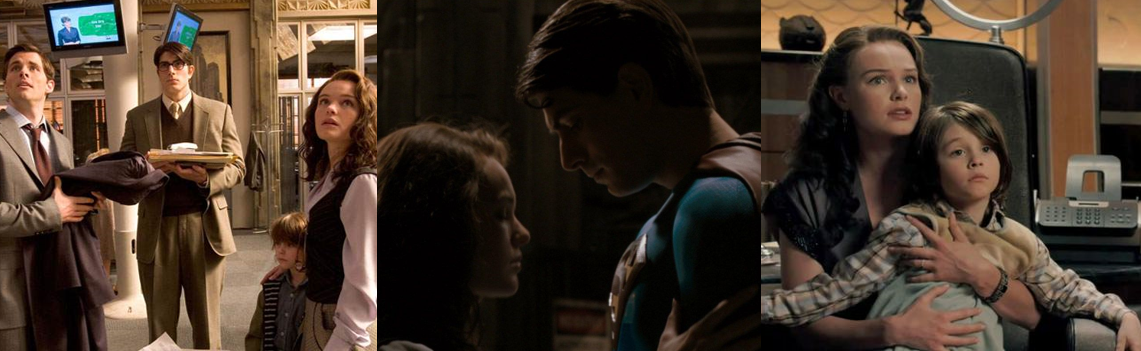
Sadly, the film is far too focused on Richard Pryor’s bombastic attempts at comedy.

That, of course, brings us to the ultimate underdog, Gus Gorman, who begins the film as an out-of-work buffoon who finds that he has a talent for computer programming when he lands a job at Webscoe. Gus is a greedy, bumbling fool who believes that the world owes him more than it’s given and who wants to enjoy life now, while he’s young. While it’s child’s play for him to embezzle Webscoe’s funds into his mediocre pay cheque, Gus immediately regrets this decision when he is brought before Webster; however, Webster is as impressed by Gus’s capabilities as he is despondent by the man’s foolishness. To get out of being locked up for this crimes, Gus agrees to redirect space satellites and oil tankers for the industrialist but soon comes to realise that his talents make Webster’s threats obsolete and thus demands that the villain fund and construct a giant super computer of Gus’ own design. A selfish and outlandish figure, Gus only realises the error of his ways when his supercomputer is perverted by Webster into a tool for killing Superman but, sadly, Gus mainly exists to flood the film with all kinds of ridiculous pratfalls; providing both physical comedy and outlandish, energetic rants that appear to be ad-libs on Pryor’s part, Gorman is like a living cartoon and sticks out like a sore thumb as the one buffoon in a film full of mostly straight men.  

Synthetic Kryptonite alters Superman’s demeanour and splits him into two beings!

When Webster orders that Superman be killed, he has Gus synthesise a chunk of Kryptonite but Gus is forced to make some compromises in the element’s construction due to its alien nature. The result is a green hunk of rock that, rather than weaken and kill Superman, affects him more like the red variant from the comics. Initially, Superman becomes distracted and disinterested in his usual duties, which causes him to arrive too late to help out in a minor disaster on a Smallville bridge. Pretty soon, though, he’s flying all over the world and causing all kinds of nuisances, such as straightening the Leaning Tower of Pisa (brought to life through the finest green screens money can buy…), blowing out the Olympic Flame, and gulping shots at the bar. Soon, his costume and demeanour noticeably change for the worst; he wears a constant scowl, sports dark stubble and darker eyes, and his suit takes on a muddier, subdued hue. After being sexually manipulated by Lorelei to cause an environmental crisis with one of Webster’s oil tankers, Superman has a violent breakdown in a junk yard and literally splits into two beings! This leads to a violent brawl between the virtuous Clark Kent and his aggressive doppelgänger that ultimately results in Clark emerging victorious and returning as the one, true Superman. It’s quite a bizarre sequence, to be sure, and is mostly hand-waved away but I can’t deny that the fight between the two is a real highlight of the film.

The Nitty-Gritty:
Right off the bat, Superman III shows us exactly what it’s all about: slapstick, goofball attempts at comedy. Skipping the traditional title sequence (though I swear this was included when I first saw the film on television…), the film opens with this convoluted series of pratfalls and accidents as the people of Metropolis get into all kinds of madcap hijinx. These elements are only exacerbated every time Pryor is onscreen and we’re treated to such delights as him acting out Superman’s impressive feats; rather than spending the money on showing Superman stopping a tornado, we get to hear Gus tell us about it while wearing a makeshift cape which, as entertaining as Pryor can be, is never going to be as enjoyable as actually watching these events happen onscreen. Instead, we get to see Gus flailing around like a fool, falling from the roof of Webster’s skyscraper without injury simply because he’s wearing skis, and him getting into all kinds of scrapes such as impersonating a military officer, jumping at his own reflection, going off on wild tangents in an attempt at humour, and drinking Brad into a stupor to access his company’s computer.

The effects are surprisingly decent and the evil Superman gives Reeve more chances to shine.

These comedic elements are a stark parallel to the film’s darker elements; seeing Superman go from a virtuous paragon of truth, justice, and the American Way to an apathetic and mean-spirited villain is perhaps the best element in this otherwise ludicrous film and really belongs in a far better Superman movie. The dark Superman really gives Christopher Reeve a chance to show his range as an actor and he spits his lines with a real venom and spite and seeing him relish in causing trouble and indulging in his vilest whims really helps the film to keep its head above water. While Superman’s rescue of the trapped chemical plant workers and his solution to freeze a nearby lake and drop it on the inferno is ambitious and impressive, other special effects don’t hold up so well, especially the rendition of technology. Overall, though, the film’s special effects remain largely consistent with those from the previous two films; there’s far more in-camera shots of Reeve being propelled across through the air on wires (though there are some instances where the wires are a little too visible…) and the flying effects, in general, actually hold up a little better than in Superman II, potentially because the film’s budget is being used to slightly better effect or not being stretched across two films that are spiralling out of control.

Despite the awesome power of Webster’s supercomputer, Superman triumphs through his wits.

One of the main themes of the film is that of the growing reliance on computers and technology, which is depicted as being both mysterious and capable of almost anything. With just a few taps of a keyboard and a swipe of a screen pen, Gus is able to make all kinds of ludicrous stuff happen, and the depiction of computer “hacking” horribly dates the film since we know that there’s no way that he’d be able to issue the commands he’s making without utilising proper code. Later, Gus is able to manually reprogram everything from traffic lights to cash machines to send the city into a frenzy, the severity of which is, again, played to cringeworthy comedic effect (the traffic light men even inexplicably get into a fist fight!) Finally, when Superman heads off to confront the villains, Webster manually sends a number of rockets and a large ballistic missile his way using a crude videogame-like interface. While Webster is, in many ways, exactly the same as Luthor except without the same level of personal animosity towards Superman, what helps bolster him and make him slightly more distinct are his sister and lover and his commission of Gus’s supercomputer. Just as the dark Superman is basically a version of Bizarro, this supercomputer is kind of like a dumbed-down interpretation of Brainiac; sure, it doesn’t speak, or look or act anything like Brainiac, but it’s clear that the finale has some roots in the popular villain. The machine is capable of analysing and counteracting with a person’s weaknesses when it feels threatened and is constantly adapting to combat threats; this includes trapping Superman in an odd plastic bubble (that, somehow, manages to choke him even though he doesn’t need to breathe…) and bombard him with pure Kryptonite. Seemingly gaining sentience through its battle with Superman, the computer turns on its creators and even transforms Vera into a cybernetic avatar in a truly horrific scene. Ultimately, Superman takes a page out of Luthor’s playbook and opts for mind over muscle by utilising a highly corrosive acidic substance to fool the machine into destroying itself. Since Gus tried, in his own way, to help Superman in the finale, Superman spares him imprisonment (a favour that Gus immediately squanders) and Kent sets Lana up at the Daily Planet, ending the film with a hint towards a rivalry between her and Lois over Clark’s affections that, sadly, would be completely ignored in the sequel.
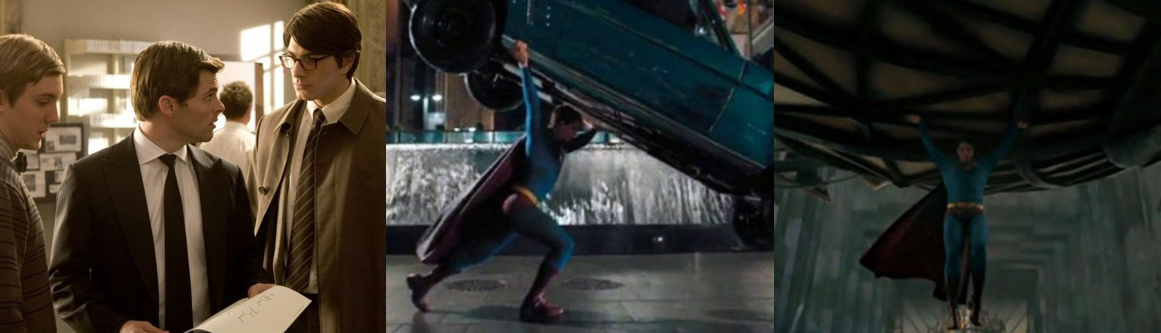
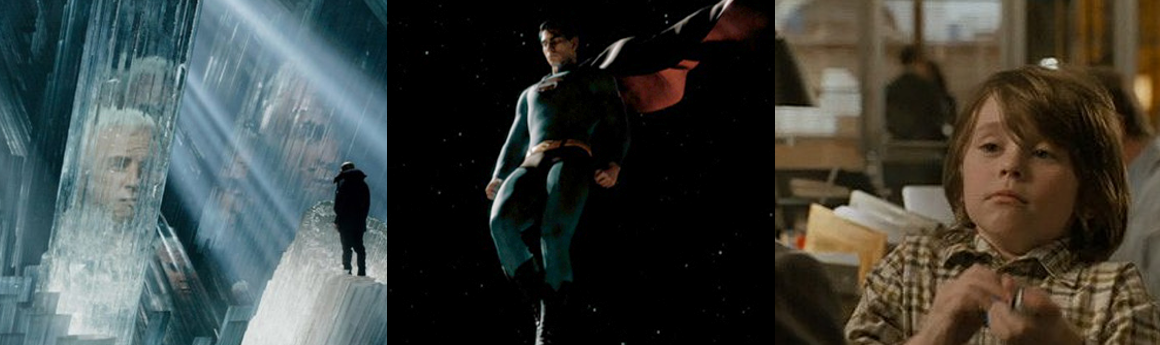
The Summary:
Honestly, this is a hard one for me. I remember really enjoying this film as a kid because it’s not like we had superhero films coming out of our asses like we do these days; however, as so many have said on many occasions, Superman III can’t be seen as anything other than a massive disappointment. There are some positives to be found here, though: Robert Vaughn adds a great deal of gravitas to the film and Christopher Reeve continues to be excellent in the title role and Superman III gives him some fantastic moments to show new sides of his personality; the fight between him and his dark self remains a highlight of the film, it’s just a shame that it’s wedged into this unfortunate mess of a film. There’s so much potential in Superman III that is sadly never fully realised because it’s more focused on giving the late, great Richard Pryor a chance to practise his stand-up routine; had the filmmakers exercised some restraint and pulled back on some of Pryor’s more outlandish outbursts and scaled back the slapstick comedy, and maybe even gone all-in with the supercomputer to bring Brainiac to the screen then there might have been something here. As it is though, what we’re left with is a film that’s probably enjoyable enough for little kids but is a bit of a slog to sit through unless you’re a big Richard Pryor fan.

My Rating:

Rating: 2 out of 5.

Could Be Better

Are you a fan of Superman III? What did you think to Richard Pryor’s inclusion in the film and his attempts at comedy? Did you enjoy the switch from Metropolis to Smallville and what did you think to Ross Webster as the film’s replacement for Lex Luthor? Were you a fan of the dark Superman sub-plot and the fight between him and Clark Kent or would you have preferred a more direct interpretation of Bizarro? What did you think to the themes of computer technology spiralling out of control? Where would you rank this film against Superman’s other live-action adaptations and how have you been celebrating the Man of Steel this month? Whatever your thoughts on Superman III, drop them down below and check out my review of the much-maligned fourth entry in the franchise.

Movie Night [Superman Month]: Superman II


In 2013, DC Comics declared the 12th of June as “Superman Day”, a day for fans of the Man of Steel the world over to celebrate Clark Kent/Kal-El/Superman, the superpowered virtue of “Truth, Justice, and the American Way” who is widely regarded as the first ever costumed superhero. This year, I’m spending every Sunday of June celebrating the Man of Steel as I expand Superman Day to “Superman Month“.


Released: 9 April 1981
Director: Richard Lester
Distributor:
Warner Bros. / Columbia–EMI–Warner Distributors
Budget:
$54 million
Stars:
Christopher Reeve, Margot Kidder, Terence Stamp, Sarah Douglas, Jack O’Halloran, and Gene Hackman

The Plot:
Having thwarted Lex Luthor’s (Hackman) maniacal plans, Clark Kent/Superman (Reeve) faces a new challenge when intrepid reporter Lois Lane (Kidder) manages to deduce his secret identity. While Clark prepares to give up his incredible powers to be with Lois, General Zod (Stamp) and his two followers escape from the Phantom Zone and begin terrorising the planet, leading Clark to choose between his happiness and his responsibilities to mankind.

The Background:
As I detailed in my review of Superman (Donner, 1978), producers Ilya and Alexander Salkind and Pierre Spengler convinced Warner Bros. to produce a two-film adaptation of the character back in the late seventies. However, the production was fraught with issues, both financially and creatively; director Richard Donner frequently clashed with the producers and Richard Lester was brought in as a mediator to allow the filmmakers to focus on the first film, which was a financial and critical success. Despite having shot 75% of the sequel, Donner was replaced as director with Richard Lester, a decision that irked star Gene Hackman so much that he refused to return for the necessary reshoots. Lester shot an entirely new opening for Superman II in addition to making numerous changes to the tone of Donner’s original version to place more emphasis on slapstick silliness. Star Christopher Reeve returned to the project after negotiating a better deal with more artistic control for himself but Marlon Brando was excised completely from the film due to his unrealistic financial demands. Despite all the behind the scenes turmoil, Superman II was still a financial success; its worldwide box office gross of just over $190 million might’ve been less than its predecessor but it was still highly praised, with Stamp’s turn as Zod drawing particular acclaim. Many years later, of course, in the build-up to Superman Returns (Singer, 2008), Donner would finally return to the film to assemble a version that closely resembled his original vision of the film.

The Review:
As far as I can remember, Superman II is another of those instances where I actually saw the sequel before the original; consequently, the film had much more of an impact on my childhood and I remember being more entertained by it thanks to it having a far brisker, more action-orientated flow and featuring villains who could actually match Superman in combat rather than simply just outwitting him. Not that I have a problem with the “mind over muscle” concept, it’s just far more gratifying to me to see Superman getting into a superpowered scrap as Superman II definitely delivers in that regard. Thankfully, for those who haven’t seen the first film, the movie opens with both a quick recap of the first movie over the opening credits and a return to Krypton to show exactly how General Zod, Ursa (Douglas), and Non (O’Halloran) got themselves banished to the mysterious “Phantom Zone”. Basically, they broke into one of the Kryptonian council’s crystal chambers and destroyed one of their fancy little crystals; since Jor-El (Marlon Brando) is entirely absent from this film, the three are sentenced and imprisoned by the nameless Kryptonian council yet, as they’re being thrust into the void of space in their mirror prison, Zod vows revenge upon Superman’s birth father regardless.

Lois begins to suspect that mild-mannered Clark Kent isn’t all that he seems…

The film then picks up shortly after the events of the last film to find the Eiffel Tower overtaken by terrorists who are holding a bunch of people hostage and threatening to detonate a hydrogen bomb if their demands aren’t met. Being the feisty, fearless reporter that she is, obviously Lois Lane is right in the middle of the story and her boldness leaves her in danger of being killed; thankfully, Superman is again on hand to save her and disposes of the bomb-filled elevator by tossing it into space and unknowingly releasing the three Kryptonian criminals form their prison. Still playing the part of the lovable, bumbling goofball, Clark stumbles his way through his assignment with Lois in Niagara Falls but, after springing into action to save a young boy from a fatal fall into the waters, Lois’ suspicions are raised to the point where she willingly puts herself in danger in order to prove that the two are one and the same.

Luthor escapes from prisons, learns Superman’s secrets, and forges a fragile alliance with Zod.

Despite being arrested and locked up at the end of the first film, Lex Luthor (Hackman), the self-proclaimed greatest criminal mind of all time, quickly breaks his way out of prison with the help of a holographic projector of his own making and the assistance of Eve Teschmacher (Valerie Perrine), thankfully leaving the bumbling Otis (Ned Beatty) behind. Not only does Luthor now largely sport his traditional bald head, he also has a far better plan than simple real estate; having deduced that Superman has a tendency to travel north, he tracks the Man of Steel and discovers his Fortress of Solitude, boning up on the three Kryptonian criminals and using this knowledge to charm his way into General Zod’s good graces. There’s something disconcerting about seeing Luthor in the Fortress of Solitude and poking around in his private archives and materials; although Luthor doesn’t learn that Clark Kent is Superman from this excursion, he learns more than enough to be able to barter with General Zod and spare him from the Kryptonian’s unending wrath in exchange for being able to rule over Australia after the three Kryptonians consolidate their control over the entire world.

Led by power-hungry Zod, the Kryptonian criminals quickly claim dominion over the world.

Still, even Luthor is fearful of his new tentative allies; Zod, a verbose egomaniac who craves power and acknowledgement, strikes fear into the hearts of those around him with not only his sadistic and cold-hearted demeanour but also his inclination to fly into an intense rage when his power is defied. The alluring and callous Ursa revels in causing destruction and acquiring new badges and trinkets for her uniform, while the imposing brute Non is as childlike as he is silent and literally follows his General’s orders without question. The three quickly discover and reveal in the superhuman powers afforded by the Earth’s yellow sun, which immediately grants them all of Superman’s powers but with none of his moral compass. They start small, toying with a group of astronauts on the Moon and terrorising a small town in the United States before identifying where the true power of the U.S. lies and laying seize on the White House in a harrowing scene where he forces the President of the United States (E.G. Marshall) to transfer all control to their General.

The Nitty-Gritty:
Of course, it’s difficult to talk about Superman II without addressing some of the film’s more ridiculous aspects; Otis might not be around but his status as the comic relief is usurped by Non’s infantile nature. While things quickly take a turn for the dramatic when Zod steps in out of boredom, it’s initially played for laughs when the three are causing trouble in Houston; similarly, when the three are terrorising Metropolis to goad Superman into a conflict, there’s an awful lot of slapstick and tomfoolery for what is meant to be an imposing scene. And let’s not forget the outrageous superpowers introduced in the film; while traditional Kryptonian powers like heat vision, super breath, and freeze breath are all on display to great effect when the three are causing destruction and fighting with Superman, there’s all kinds of crazy stuff added to the film. Zod is somehow able to levitate objects with a point of his finger, the three of them deface Mount Rushmore by simply blasting it, all four Kryptonians are all able to duplicate themselves in the finale (which I can only assume was originally supposed to be some kind of depiction of superspeed that was limited by the technology of the time), and don’t even get me started on Superman’s weird s-shield attack-thing! Yet, as mental as all of this, it’s actually nowhere near as insane as some of the stuff Superman was doing in the comic books at the time!

Superman willing gives up his powers to be with Lois.

While a romantic element was present in the first film (and gave us the God awful cringey scene of Superman and Lois flying together), it’s far more prominent here. Although Clark is able to momentarily quash Lois’s suspicions about him, his dual nature is ultimately revealed after an accidental stumble. Of course, bearing in mind that Clark is clearly besotted with Lois and was tempted to reveal himself to her in the first film, both Clark and Lois suggest that this was anything but an accident and that Clark subconsciously wanted Lois to learn the truth and made sure that it happened. Regardless, the two embark on a romantic tryst that sees Clark focus on her above all other concerns. Busy wooing her with flowers and food from the far corners of the world at his Fortress, Superman ignores the chaos caused by General Zod and his subordinates and makes the ultimate sacrifice when the consciousness/artificial intelligence of is mother, Lara (Susannah York), dictates that to live with a mortal, he must live as a mortal. This wrinkle, which results in the destruction of the main control console in the Fortress, goes a long way to showing just how serious Clark is about his love for Lois; indeed, he willingly gives up all of his superpowers just to be with her despite the fact he can hear that people are pleading for his intervention. Clark’s adjustment to mortal life is a tough one; almost immediately, he feels the fatigue and pains of us normal folk and runs afoul of mouthy trucker Rocky (Pepper Martin). Humbled and humiliated, Clark is horrified to find that Zod has taken control of the world and immediately journeys back to the Fortress (from what looks like Canada…because I guess there’s a direct road from Canada to the Arctic now?) in a desperate bid to regain his powers. Although the Fortress appears dead and his father Jor-El doesn’t answer his son’s desperate plea, Clark finds the green crystal that birthed the Fortress and this, somehow, restores his powers. Although this whole sequence is a little sloppy, mainly thanks to the way the film was cut up and re-edited from Donner’s original version, I can’t say that I was ever really a fan of it; we’ve seen in the comics, and other adaptations, that Superman is fully capable of being in a relationship with Lois without having to give up his powers and it seems like this aspect was only included to give some humanity to the all-power Man of Steel. One part of it that does work for me was the emphasis on Lara; since Jor-El is entirely absent, Lara’s importance is greatly increased and makes Superman II an interesting companion piece to the first film by placing the focus on his mother rather than his father.

It’s clear the budget was stretched to its limit to depict the superpowered brawl.

Armed with Luthor’s knowledge of Superman’s true heritage and affinity for Lois Lane, Zod, who quickly grows bored of having absolute power, relishes the opportunity to exact his revenge upon Jor-El’s progeny. To this end, the three ransack the Daily Planet and then cause destruction in downtown Metropolis in entertaining scenes of devastation that were certainly ambitious and in stark contrast to the first film’s slower, more subdued tone. It’s clear that the budget is being pushed to its limits to show all four characters flying and fighting in the skies and streets of Metropolis and, while the special effects and the quality of the fight does suffer a bit as a result (there’s a lot of awkward standing around, posturing, and slow, easily telegraphed attacks on show), it’s still a commendable effort for the time. Crucially, Superman goes out of his way to draw the fight away from the city and to save lives rather than mindlessly ploughing his opponents through buildings and causing as much damage as the film’s villains, which goes a long way to emphasising Superman’s selfless and heroic nature (something that arguably needed to be reinforced after he seemed to abandon his responsibilities in favour of getting laid).

Superman turns the tide on his foes but is forced to erased Lois’s memory of his dual nature.

Although the three have the numbers advantage, and are clearly better fighters than he, Superman manages to hold his own but, realising that continuing the fight would only endanger further lives (despite the commendable spirit of the Metropolis citizens in their willingness to stand up to the three after Superman appears to be killed), he flees from the city and lures them to his Fortress for a final showdown. The three are led their by Luthor with Lois as their hostage; when Zod declares that Luthor has outlived his usefulness, the criminal mastermind attempts to double-cross Superman in order to regain favour with the General and, in the process, unwittingly plays right into Superman’s plan. Having reversed the molecule chamber so that Krypton’s red sun rays erase the three’s powers, Superman and Lois are easily able to best their foes and send them hurtling to their deaths. However, in the aftermath, Clark and Lois split up since Superman can’t prioritise one life over the lives of the world and, to spare his love further pain from the burden of knowledge, Superman busts out another new power: the ability to erase minds with a kiss. With Luthor back in prison, the Earth saved, and the status quo restored, Superman promises the President that he’ll never abandon his responsibilities again and heads off for his victory lap.

The Summary:
When I was a kid, I absolutely loved this film; it was probably the closest and most accurate depiction of a live-action Superman I had seen and definitely set a high standard for superhero movies in general for its mixture of heart, action, and comedy. Even now, thanks to the ambitious and impressive special effects, the film holds up surprisingly well; once again, it’s the performances that help bolster the film, with Terrence Stamp putting in a scene-stealing turn as General Zod. The inclusion of three evil Kryptonians to match Superman blow-for-blow was a great way to raise the stakes from the first film and Superman II definitely builds upon the themes and standards of the first film. While I still have a lot of affection for Superman II and definitely prefer it to the first movie, it’s difficult for me to rate it much higher as there are a number of aspects of Superman II that don’t sit too well with me. The same can be said of the first film, and the rest in the series, but I’m still a little baffled by the idea of stripping Superman of his powers and then immediately restoring them and the absurd memory erasing kiss that is almost as preposterous as Superman turning back time at the finale of the first film. Still, it’s easily the best film out of the original four for me and, crazy superpowers aside, deserves to be rated as being at least on par with the influential original and is well worth a watch of only for Stamp’s iconic performance and the battle between Superman and his Kryptonian adversaries.

My Rating:

Rating: 3 out of 5.

Pretty Good

What are your thoughts on Superman II? Did you feel like it measured up to the first film or do you perhaps consider it to be superior, or inferior? What did you think to the introduction of more physically capable villains for Superman to fight and were you a fan of Terrence Stamp’s performance as General Zod? What did you think to Superman sacrificing his powers for Lois and then erasing her mind with a kiss? Do you prefer the theatrical cut of the film or do you think the Donner Cut is the superior version? What is your favourite Superman story, character, or piece of media? How are you planning to celebrate Superman Day today? Whatever you think, feel free to share your opinion and thoughts on Superman in the comments below.

Movie Night [Superman Month]: Superman


In 2013, DC Comics declared the 12th of June as “Superman Day”, a day for fans of the Man of Steel the world over to celebrate Clark Kent/Kal-El/Superman, the superpowered virtue of “Truth, Justice, and the American Way” who is widely regarded as the first ever costumed superhero. This year, I’ll be spending every Sunday of June celebrating the Man of Steel as I expand Superman Day to “Superman Month“.


Released: 14 December 1978
Director: Richard Donner
Distributor:
Warner Bros. / Columbia–EMI–Warner Distributors
Budget:
$55 million
Stars:
Christopher Reeve, Gene Hackman, Margot Kidder, Valerie Perrine, and Marlon Brando

The Plot:
In the dying moments of the planet Krypton, scientist Jor-El (Brando) rockets his son away to Earth. After learning of his alien origins and discovering the limits of the fantastic superhuman powers afforded him by Earth’s yellow sun, the now-adult Clark Kent (Reeve) assumes the costume identity of “Superman” while disguising himself as a mild-mannered reporter. However, he faces his greatest test when genius criminal mastermind Lex Luthor (Hackman) hatches a plot to cause devastating earthquakes west of the San Andreas Fault.

The Background:
In the years since his dramatic debut, Superman quickly became the subject of numerous adaptations and his 1940 radio drama even introduced many aspects that became synonymous with the character. The idea of a feature-length Superman film was first conceived of by producer Ilya Salkind in 1973; entering into a partnership with his father, Alexander, and Pierre Spengler, the filmmakers were able to convince Warner Bros. to produce a two-film adaptation of the character and paid screenwriter Mario Puzo (of Godfather (ibid, 1969/Coppola, 1972) fame) $600,000 to write the screenplay. Steven Spielberg was courted to direct but was unable to commit and, while Guy Hamilton was attached to the project, the producers eventually settled on Richard Donner, who immediately ditched the campy tone of Puzo’s 400-plus-page script. The first actor signed to the film was Marlon Brando (who had some pretty funny ideas about Jor-El’s appearance and characterisation and had a lackadaisical attitude towards the film) and Oscar winner Gene Hackman soon followed, with the two receiving top billing. Many notable names were considered for the title role before relative-unknown Christopher Reeve was cast after a laborious casting process. Having bulked up for the role, Reeve’s experience as a pilot paid off when performing the film’s complex flying sequences, which were achieved through a combination of green screens, wire work, and other camera tricks while the striking Kryptonian suits were the result of a happy accident with a reflective material. Very quickly, the film’s budget ballooned and filming began to over-run, causing tensions between Donner and the producers; Richard Lester was brought on board as a mediator and work on the sequel halted to concentrate on the first film. After several delays, Superman (also marketed as Superman: The Movie) released to rave reviews and was an incredible financial success, making over $300 million. Although the producers continued production of the sequel immediately, the damage was done and Donner did not return, necessitating a series of expensive reshoots and raising the ire of many of the film’s actors. Still, the first film was an incredible achievement, massively influential on Superman’s comic books, and was eventually preserved in the United States Library of Congress National Film Registry.

The Review:
Superman begins, as most Superman origin stories do, on the far away world of Krypton (or “Krypt’n”, if you’re Marlon Brando), a technologically advanced civilisation that inhabits a largely barren, crystalline world. In a fantastic seed for the sequel, Jor-El sentences three seditious criminals – Non (Jack O’Halloran), Ursa (Sarah Douglas), and their leader, General Zod (Terence Stamp) – to the mysterious “Phantom Zone” for their treasonous and destructive efforts to usurp the Kryptonian council and subjugate the world to Zod’s will. Defiant to the last, Zod vows to avenge himself upon Jor-El and his heirs, no matter how long it takes and against all odds, before the three are cast into the strange mirror prison. Following this, Jor-El is unable to convince the council that Krypton is doomed to be destroyed by its red giant sun within thirty days; indeed, despite being a highly respected and rational member of the council, Jor-El’s claims are so adamantly refuted that he is threatened with being labelled a terrorist himself.

Unable to save his planet, Jor-El sends his infant son to Earth, where he gains awesome powers.

Apparently despondent (it’s hard to tell with Brando…), Jor-El resigns himself to ensuring the survival of his young son, Kal-El; his wife, Lara (Susannah York), laments that their son will forever be an outcast amongst the “primitives” of Earth but Jor-El remains confident that the powers bestowed upon Kal-El by Earth’s yellow sun will make him a symbol of hope and afford him physical advantages beyond all known understanding. As Krypton shatters around them, the baby is rocketed away and, guided by his father’s voice, slowly grows into an infant within his escape craft; Jor-El, who encoded all of his knowledge and wisdom into the crystalline form of the ship, stresses that his son is “forbidden” to interfere in Earth’s history and instead let his example inspire others. In time, many thousands of years after Krypton’s destruction, the ship crash lands on Earth and is stumbled upon by kindly, elderly couple Jonathan (Glenn Ford) and Martha Kent (Phyllis Thaxter) who are awestruck by the child’s super strength and, despite Jonathan’s concerns, take him in as their own.

After losing his adopted father, Clark learns the extent of his powers and reveals himself to the world.

About fifteen years later, the boy has grown into well-meaning teenager Clark Kent (Jeff East, with Christopher Reeve dubbing his voice); though Clark is frustrated that he has to hide his physical capabilities from the world, Jonathan stresses that the boy was sent to them (and the world) for a greater reason than to simply score touchdowns or show off to the other kids. As he just wants to make his parents proud, Clark takes his father’s advice to heart but is left utterly heartbroken when Jonathan suffers a fatal heart attack. At his graveside, a devastated Clark laments that his awesome powers were ultimately useless in saving his father and thus learns a valuable lesson about the limits of his superhuman abilities. Drawn to the remains of his ship (which the Kents kept hidden in their barn), Clark discovers a glowing green crystal that leads him far north, all the way to the Arctic, where the crystal births a piece of his home planet on Earth. In this Fortress of Solitude, Clark communes with the spirit of his father, who lives on as a glorified artificial intelligence, and spends a further twelve years absorbing all of Jor-El’s knowledge and teachings of his newfound abilities. After his training is completed, Clark emerges as Christopher Reeve and garbed in a bright Kryptonian costume and ready to share his abilities with the world as Superman.

Clark poses as a mild-mannered reporter, which allows Superman to captivate Lois.

Clark sets himself up as a reporter at the Daily Planet (apparently it’s as easy as being able to type incredibly fast and being overly polite), meeting hot-tempered editor-in-chief Perry White (Jackie Cooper), enthusiastic young photographer Jimmy Olsen (Marc McClure), and feisty reporter Lois Lane (Kidder). Despite her inability to spell, Lois is a lively and fearless journalist and, consequently, she both despairs of Clark’s overly friendly nature and sees him as a bit of a dorky milksop and finds her curiosity sparked by some of his oddities. In comparison, Lois is immediately captivated by Superman when he not only catches her in mid-air as she’s plummeting to her death but also snags the helicopter she was falling from. Enamoured by his mystery, confidence, and the seemingly limitless superhuman abilities he possesses, her normally controlled and forthright demeanour is shattered and she’s left absolutely awestruck during (and following) her exclusive interview with the Man of Steel (where she names him and he also, curiously, divulges a number of secrets about himself that later come back to bite him in the ass).  

The maniacal Lex Luthor plots to destroy Superman in his quest to profit from real estate.

The villain of the piece, the enthralling Lex Luthor, has set up an impressive hideout beneath the city streets; there, protected by a series of cameras and deadly booby traps, he surrounds himself with the dim-witted Otis (Ned Beatty) and sexy but cynical Eve Teschmacher (Valerie Perrine). Egotistical and arrogant in his intellect, Luthor sees himself as the world’s greatest criminal mind and is busy planning the crime of the century, which involves the acquisition of seemingly worthless land and profiting from it by causing a cataclysmic flood, endangering and ending countless lives in the process. Luthor immediately surmises that Superman is not of this Earth and relishes the opportunity to pit himself against the Man of Steel, and to both prove his intellectual superiority over him and destroy the very virtues that Superman stands for, seeing the Man of Steel as the ultimate challenge for his self-proclaimed criminal genius.

The Nitty-Gritty:
Of course, you can’t really talk about Superman without mentioning John Williams’ bombastic and immediately iconic “Superman” theme that is rendered in full glory over the opening credits. While this theme has become so synonymous with the character that no composer or filmmaker since has come close to crafting a more suitable melody for the Man of Steel, I continue to be baffled by the absolutely cringe-worthy “Can You Read my Mind?” sequence. Like, I get it; it’s supposed to be this big romantic moment between the Lois and Superman and to showcase the film’s wirework, but it stands out like a sore thumb and is all kinds of different flavours of cheese.

While Reeve set the standard for Clark/Superman, other performances are a bit hit and miss.

If I’m being brutally honest, the film’s performances are a bit hit and miss; despite being a relative unknown, Reeve provides the quintessential portrayal of Superman and simply exudes confidence and sociability as Superman while masking his true nature as loveable, bumbling fool. Indeed, by simply straightening his posture and slightly altering his voice, Reeve effortlessly depicts the simple differences between his two persona and his performance so explicitly set the standard for the character that it continues to be emulated to this day. Once the story shifts to Metropolis, the film becomes a much more vivid and over-the-top production that emphasises buffoonery and comic book camp; nobody embodies this more than the bumbling Otis, who is mostly here for comic relief, but there’s also the suggestion that Luthor socialises with cretins simply to have someone to lord over. While Beatty and Cooper seem to have stepped out of a pantomime for their roles as the goofy Otis and bombastic Mr. White, respectively, Hackman brings a certain gravitas to the film that perfectly walks a fine line between camp and severe. Hackman seems to be enjoying himself in the role and commands every scene and room that he’s in; though he lacks Luthor’s bald head, he sports a variety of wigs and exudes a sadistic menace in his willingness to kill millions of innocent people in his quest for power, profit, and to have his matchless intelligence recognised by the world.

While some effects don’t hold up well, they’re all very ambitious and impressive for the time.

Obviously, you have to expect that some of the effects aren’t as impressive and haven’t aged as well as others, as ambitious as they are; the Arctic is clearly a set like something out of Star Trek (1966 to 1969) and I can only assume that Krypton is so barren and lifeless because it was cheaper and easier (though it also makes it cold and alien and a stark contrast to our lush world). The young Clark’s running effect and a number of the rear-projection and miniature shots leave a lot to be desired and almost every skyline appears to simply be a gigantic matte painting as the film is heavily reliant upon impressive sets the likes of which are akin to a James Bond film. While Clark’s super fast changes to Superman and his little spin down into Luthor’s lair aren’t that great, easily the weakest effects come in the conclusion as the San Andreas Fault is ruptured and painstakingly crafted models are washed away by water and dirt before Superman circles the globe at superspeed. To be fair, though, the film’s effects are still incredibly impressive; the helicopter sequence is an ambitious and remarkable composite of miniatures, rear-projection, and live-action wire work that makes for a suitable debut for the Man of Steel and, overall, the film has largely stood the test of time thanks to its practical effects and undeniable charm. As you might expect, Superman’s powers and abilities are the highlight of the film; Superman’s invulnerability, super strength, and superspeed are all accounted for and realised well enough and Superman’s first night on duty provides a great showcase of what he is capable of. No job is too big or too small for Superman, who does everything from rescuing a cat from a tree to apprehending jewel thieves as they clamber up the outside of buildings using sucker pads.

Superman comes up with a unique solution to save the day.

Naturally, it’s the flying sequences that are the true spectacle of the film; even now, the rear-projection holds up pretty well in these scenes but what really sells it is Reeve’s dynamic and believably movements. Reeve banks and turns with an elegant grace and really sells the illusion that we’re seeing a man fly and makes even the most ridiculous aspects of the film (from the 100% comic-accurate suit to using his own body to repair a broken train track to repairing the San Andreas Fault by ploughing through questionable-looking magma) seem entirely plausible thanks to his charming smile and undeniable charisma. Of course, when talking about Superman, you have address the ending. Thanks to acquiring a chunk of Kryptonite, Luthor is able to weaken and cause incredible agony to Superman and it is only thanks to Ms. Teschmacher’s change of heart that he’s able to recoup his strength and intercept Luthor’s missiles. However, while he’s able to stop one, he’s unable to keep the other from striking the San Andreas Fault and is so busy repairing the damage it causes that he’s unable to save Lois from being crushed to death by debris. Devastated and overcome with grief, Superman flies into the upper atmosphere and defies his birth father’s warnings of interfering in human history to favour his adopted father’s advice and is able to literally turn back time by reversing the rotation of the planet. This undoes all of the damage caused by Luthor’s missiles and prevents Lois’s death but remains the most ludicrous aspect of the entire movie and just ends up raising all kinds of questions like…wouldn’t there be two Superman? Why doesn’t he just turn back time all the time? Ultimately, it’s just one of those crazy, over-powered feats that we’ve come to expect from older versions of Superman and I guess it works to show that Superman is capable of overcoming even his limits by pushing hard enough (plus, Reeve’s anguished cry does make for an incredibly intense scene).

The Summary:
I honestly went into Superman ready to give it a lower score of two stars; it’s never really been my favourite superhero, or Superman, film as it’s just got a little too much cheese and cringe in it for my tastes. There’s an undeniable level of camp at work in the film that makes it very cartoony and over-the-top in places, to say nothing of long, oddly paced inclusions that seem decidedly at odds with the rest of the film. However, all of these elements are in perfect balance with the film’s more dramatic and spectacular sequences; this is a film that is, primarily, a showcase of ambitious and trend-setting cinematic techniques as much as it is perhaps the most influential interpretation of Superman ever seen outside of the comic books. While not every effect has aged too well, the majority have stood the test of time remarkably well and there’s just the right balance of goofy comedy, heart-warming charm, and exciting spectacle that simply scream “Superman”, a character who is often characterised as being the world’s biggest Boy Scout and embodying timeless (if slightly antiquated) ideals. There’s no denying that Superman is an absolute classic; while I cannot sanction Marlon Brando’s attitude and I may not be a fan of some of Donner’s choices (Luthor being a real estate maniac, the barren depiction of Krypton, and the time travel ending are all cons of the film for me), Superman remains a delightful and enjoyable little slice of camp goodness that is worth it for Reeve’s incredible and career-making turn in the title role if nothing else.

My Rating:

Rating: 3 out of 5.

Pretty Good

Are you a fan of Superman? What did you think to Christopher Reeve’s portrayal of the character and were you a fan of Lex Luthor’s interpretation in the film? How influential was Donner’s film on your perception of Superman and are there any aspects you would prefer to see films and media move away from? What did you think to the film’s campier elements and were you a fan of the ending? What is your favourite Superman story, character, or piece of media? How are you planning to celebrate Superman Day next week? Whatever you think, feel free to share your opinion and thoughts on Superman in the comments below.