Movie Night: Creepshow

Click here to listen to my guest spot on the Anthological podcast discussing this film

Released: 10 November 1982
Director: George A. Romero
Distributor: Warner Bros. Pictures
Budget: $8 million
Stars: Carrie Nye, Jon Lormer, Stephen King, Leslie Nielsen, Ted Danson, Hal Holbrook, Fritz Weaver, E. G. Marshall, and Joe King

The Plot:
Abused Billy Hopkins (Joe King) takes solace in Creepshow, a horror anthology comic with tales of a cursed family’s Father’s Day, a simple-minded yokel’s encounter with a meteorite, a heartless millionaire’s spiteful vengeance, a mysterious crate, and a germaphobe’s battle against cockroaches.

The Background:
Horror has a long and successful association with anthologies for many decades. Books, comics, and television shows have benefitted from telling episodic or short-hand horror tales over the years, with celebrated horror author Stephen King using the medium to deliver some of his finest works. In 1982, King collaborated with the grandfather of the zombie genre, George A. Romero, on this cult classic horror anthology movie. While two of King’s existing short stories were adapted for the film, the remaining shorts were written specifically for the movie, with King and his young son appearing as actors. Star Ted Danson endured a gruelling experience shooting in a specially prepared pit to simulate being drowned while co-star Leslie Nielsen (then known as a dramatic actor) kept things light on set with a hidden fart machine. Additionally, although 20,000 live cockroaches were utilised for the “They’re Creeping Up on You” segment, horror legend Tom Savini bolstered their numbers with nuts and raisins. With a box office gross of over $21 million, Creepshow was a surprise success that proved popular with critics for its quirky blend of comedy and horror and became a horror classic. However, while Creepshow led to a comic book and two sequels of varying quality, distribution issues led to a planned television spin-off being reworked into the thematically similar Tales from the Darkside (1983 to 1988), though a well-regarded TV series revival did eventually emerge in 2019.

The Reviews:
As Creepshow is an anthology film comprised of five short stories and a framing narrative to tangentially link them together, it’s just logical that I go over each one individually and then discuss the overall film. The prologue and epilogue reveal that Creepshow is a horror anthology comic with pulp horror stories and advertisements for prank toys like x-ray glasses and voodoo dolls. Billy Hopkins (an avid horror fan judging by his bedroom) loves the comic but is berated by his cruel and strict father, Stan (Tom Atkins), for wasting his time on such trash. When Billy dares to speak back to his father, he gets a smack for his troubles, much to the chagrin of his loving but ultimately helpless mother (Iva Jean Saraceni). When Billy tries to appease his father and apologise, Tom sees through the trick and demands that he give up his comics and horror, forcing him to go to bed and tossing Creepshow in the trash. Unbeknownst to him, there is inexplicable supernatural power in those pages as the comic’s skeletal host, the Creep, lingers outside Billy’s window as he wishes death upon his father. The segments that follow are then presented as adaptations of the comic stories, complete with the occasional comic book panelling and colour effects to tie everything together. Once they’re all finished, two garbagemen (Marty Schiff and Tom Savini) retrieve the comic from the Hopkins’ trash and find the voucher for an “authentic” voodoo doll removed. Inside the Hopkins residence, the still grouchy and aggressive Tom complains of neck pain before experiencing stabbing pains all over. As Tom collapses in agony, Billy cackles gleefully in his bedroom as he repeatedly stabs at the voodoo doll, the image turning into the cover art for the next issue of Creepshow.

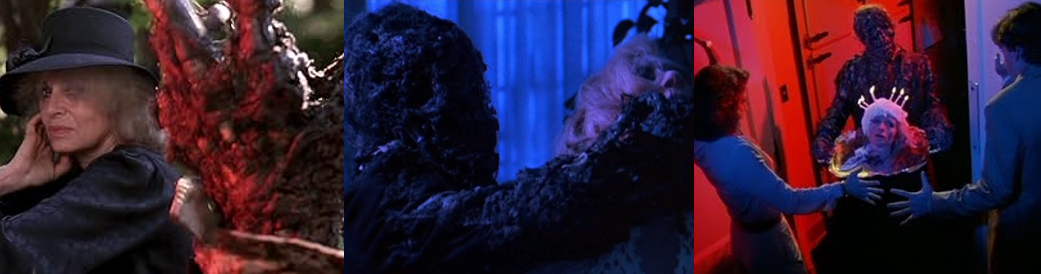
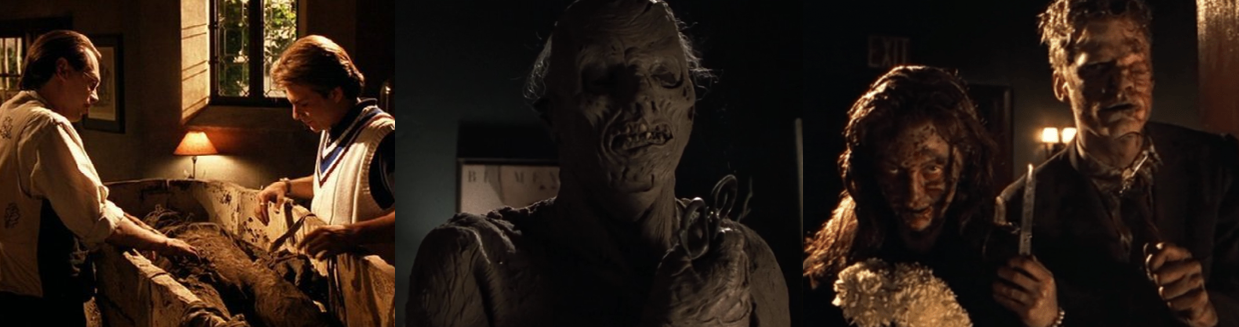
The wealthy Granthams are horrified when their patriarch reanimates and avenges himself upon them.

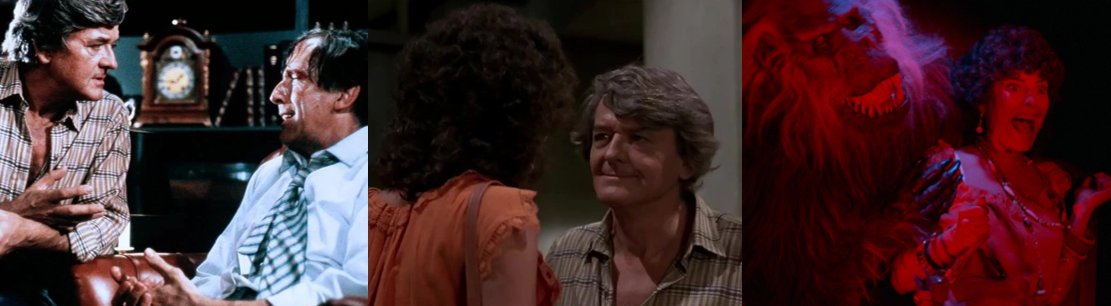
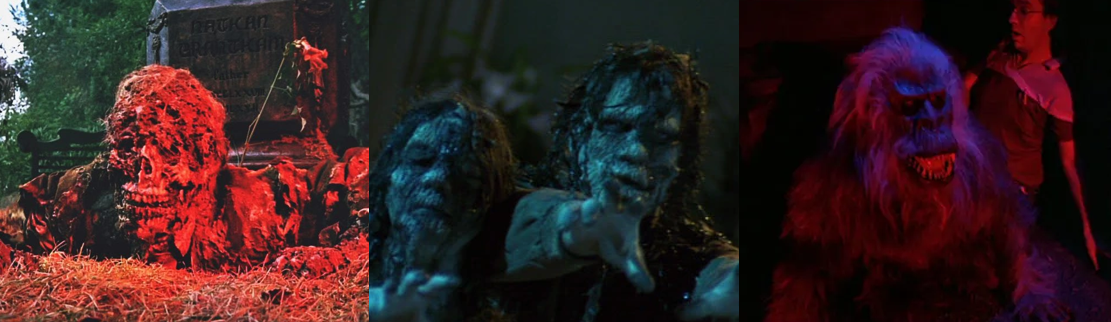
The first full-length story to spring to life is “Father’s Day”, which revolves around the filthy rich Grantham family. Every year, Sylvia (Carrie Nye), gathers the family for a special dinner. This year, her niece, Cass Blaine (Elizabeth Regan), brings her husband, Hank (Ed Harris), to meet her condescending aunt, her self-absorbed cousin, Richard (Warner Shook), and her great aunt, Bedelia (Viveca Lindfors). Between criticising Cass’s healthy appetite, Sylvia nonchalantly tells Hank that Bedelia, the family matriarch, once murdered the disgustingly wealthy and miserly Nathan Grantham (Lormer). Having accumulated vast wealth through unscrupulous and criminal means, the aged patriarch became aggressive, demanding, and paranoid, believing everyone was using him for his fortune and making constant, abusive demands of Bedelia, who was forced to care for him and endure his belittlement. Bedelia finally snapped after her father orchestrated the death of her fiancé, the only man who’d shown her any kindness, to keep her in check. Unable to take her father’s barrage of insults and childish demands for his Father’s Day cake, Bedelia cracked him in the head with an ash tray. Though free of Nathan’s abuse, Bedelia remained scarred and traumatised, placing a flower at his gravesite every Father’s Day. While drunkenly reminiscing about the murder, (which Sylvia helped cover up to profit from her inheritance), Bedelia is horrified when her father’s gaunt, gruesome corpse suddenly bursts from his grave and throttles her to death, still slurring demands for his cake. While having a smoke, Hank wanders into the family cemetery and ends up crushed when the zombified Nathan telekinetically drops a gravestone on him. When Cass expresses concern for her husband, Sylvia begrudgingly volunteers to look for him (hinting at her desire to seduce him), only to end up with her head twisted backwards by Nathan. Impatient and frustrated, Cass demands the lackadaisical and half-cut Richard help search for their missing party, only to be appalled when Nathan’s ghastly, maggot-ridden corpse bursts from the kitchen and proudly presents his cake: Sylvia’s severed head on a silver platter, covered with frosting and candles!

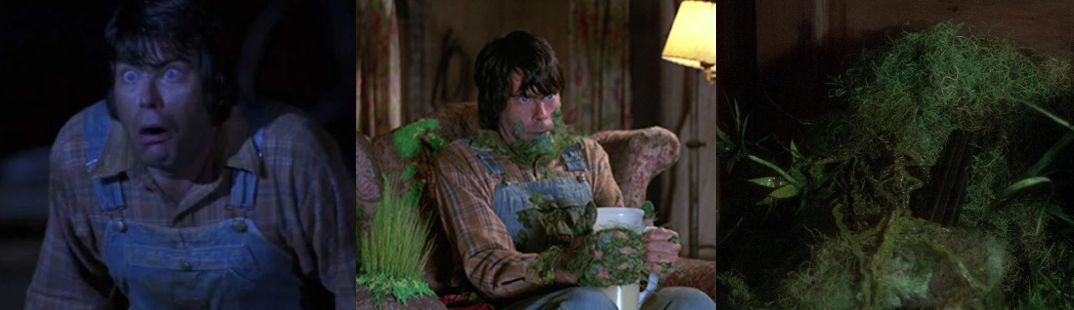
Unlucky halfwit Jordy is transformed by alien vegetation due to his stupidity.

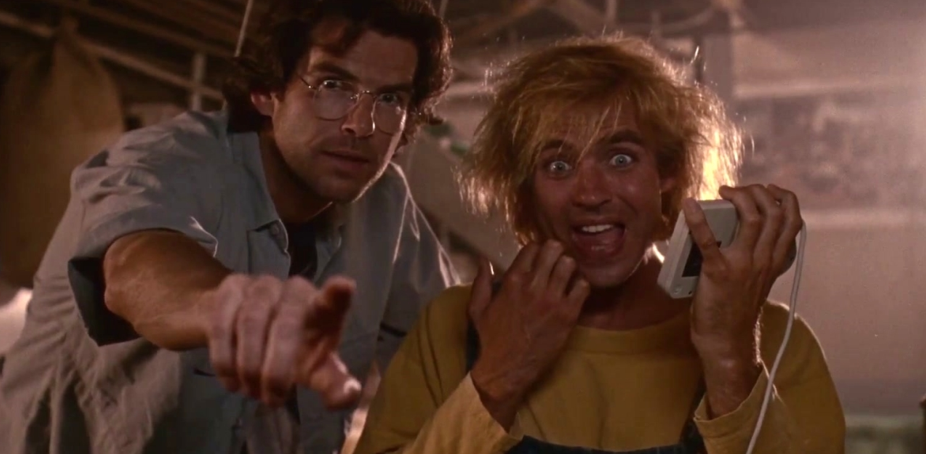
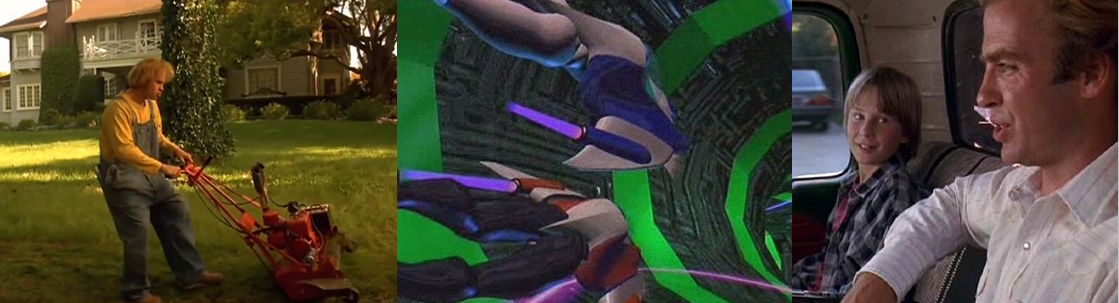
Stephen King takes centre stage in “The Lonesome Death of Jordy Verrill” as the titular, dim-witted, hillbilly farmer. After being amazed by a falling meteorite, Jordy investigates and, dreaming of collecting a cool $200 from the “Department of Meteors” at the local college, touches the red-hot rock without thinking. Jordy’s dismayed at his characteristic bad luck and thinks he’s cost himself a payday when he tries to cool the meteorite and it cracks and is so preoccupied by his overactive imagination that he misses the strange goo that spills from the rock and touches his skin. Retreating home, hoping to repair the meteorite in the morning, Jordy enjoys a beer and some wrestling, sucking his fingers out of habit, but is perplexed and horrified to find a strange, green vegetation growing there. Though he immediately thinks to call a doctor, he stops himself when he imagines it leading to a painful amputation and resolves to simply ignore the problem. As the night continues, the vegetation rapidly spreads across his land, his house, and his body, causing him dreadful itching and to drink himself into a stupor after seeing the vegetation consume his face. Unable to take the itching, Jordy tries to relieve his discomfort with a bath, only to be inexplicably warned against it by his deceased father (Bingo O’Malley), who warns that water will only feed his condition. Realising that he’s beyond help anyway, Jordy gratefully plunges into the bath for some momentary relief but, by the morning, his entire farm, house, and body are consumed by the alien vegetation. Despite the short opting for bizarre, dumbfounded comedy, the finale is unexpectedly grim and emotional as the transformed Jordy cocks his gun, prays for some good luck for once in his life, and blows off what used to be his head. While this ends his torment, the alien vegetation continues to spread beyond Jordy’s land, potentially spelling doom for humanity.

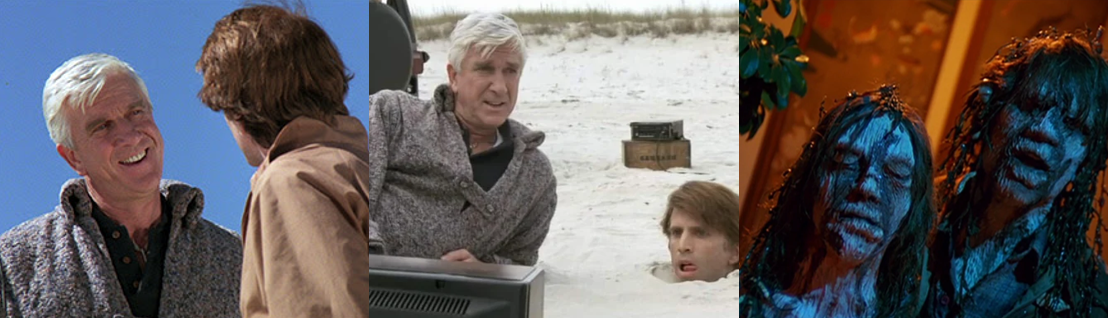
Psychotic spurned husband Richards finds his revenge revisiting him in the form of drowned ghouls!

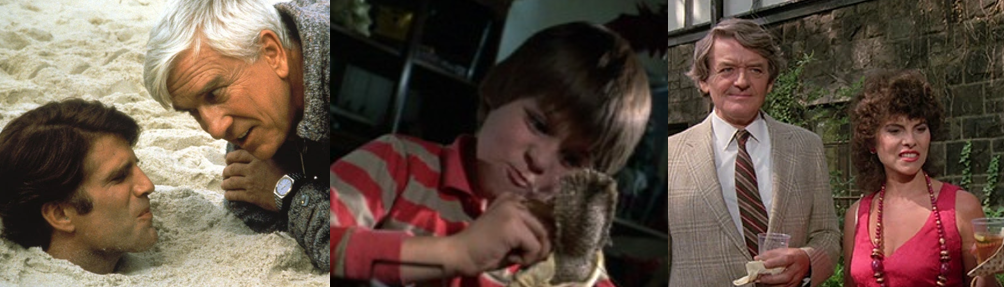
If you’re anything like me, you’ll be surprised to see the late, great comedy actor Leslie Nielsen delivering a seemingly uncharacteristic performance as maniacal, spurned millionaire Richard Vickers in “Something to Tide You Over”. In actuality, Nielsen started his career in more dramatic roles, though his comedic flair seeps through here as Richard is disturbingly jovial and avuncular in his vengeance. After learning that his wife, Becky (Gaylen Ross), is having an affair with square-jawed Harry Wentworth (Danson), Richard visits Harry, coldly dismissing his feelings and simply looking to assert his right over his property. Unimpressed by Harry’s threats, Richard lures his rival to Comfort Point, a private beach he owns, where he implies Becky is in danger. Since he has no choice, Harry makes the trip, only to find a shallow grave in the sand, which he’s forced into at gunpoint by the menacingly aloof millionaire. Harry’s forced to bury himself neck-deep in sand and to watch a live feed of Becky in the same position, slowly succumbing to the tide as it washes over her. Dismissing Harry’s pleas and bribes, Richard simply drives off, watching with glee from his high-tech home as the two struggle to hold their breath. While a glimmer of sanity seems to suggest Richard has some remorse for his actions, a stiff cocktail quickly alleviates such emotions and he dispassionately returns to tidy up the crime scene hours later, sure that his victims were washed out to sea. However, Richard is stunned when Becky and Harry return as drenched, shuffling revenants bent on revenge. Though initially nonplussed and confident his pistol can hold off the ghouls, Richard’s reduced to a cackling, terrified wretch as the two shrug off his assault and use their supernatural powers to grab him, subjecting him to the same fate they suffered and leaving the raving lunatic to see just how long he can hold his breath.

The crate’s ravenous inhabitant represents the perfect chance for Henry to off his abusive wife.

“The Crate” is easily the longest segment and centres on good friends Dexter Stanley (Weaver) and Henry Northrup (Holbrook), professors at Horlicks University. Meek and mild-mannered, Henry daydreams of murdering his emotionally abusive, borderline alcoholic wife, Wilma/Billy (Adrienne Barbeau), who frequently belittles and embarrasses him in front of his friends. Though Dexter feels for his timid friend’s predicament, he’s powerless to intervene, but this drama is superseded when university janitor Mike Latimer (Don Keefer) discovers a mysterious crate hidden under a basement staircase. Though apparently originating from an Arctic expedition, the crate is a mystery to Dexter, who forces it open and is horrified when the bizarre, voracious ape-like “Fluffy” (Darryl Ferrucci) bursts out and devours Mike’s hand (and then the rest of him!) Fleeing, the shellshocked Dexter babbles of the horror to a passing graduate student (Robert Harper) who, first sceptical and then curious of the creature, is promptly mauled and dragged off by Fluffy, which returns to its crate after each kill. The half-mad Dexter shares the gory story with Henry, begging him to help dispose of the creature in a nearby quarry. Though loyal to his clearly traumatised friend, Henry sees this as the ideal way to dispose of his abusive wife and promptly drugs Dexter, clears up the crime scene, and lures Billy to the university on the pretence of helping a young girl who’s been assaulted by Dexter. Eager to both mock the girl’s ordeal and further demean Henry, the tanked-up Billy races over and, suspecting nothing from her meek husband, willingly enters the creature’s hovel without fear. Seizing his opportunity, Henry finally enacts his fantasies and desperately calls for the monster to awaken and kill his wife, only to be met with silence and a barrage of insults from Billy. Just as she’s done criticising his manhood, Fluffy pops out to feed. Though disgusted, Henry finds the courage to reseal the crate and dump it (and the bodies) in the quarry as Dexter suggested. Despite some apprehension, both men agree to stay quiet, though henry’s insistence that the ravenous creature has drowned turns out to be false when we see Fluffy tearing through the submerged crate.

Cruel germaphobe Pratt gets his comeuppance when he’s set upon by a swarm of cockroaches.

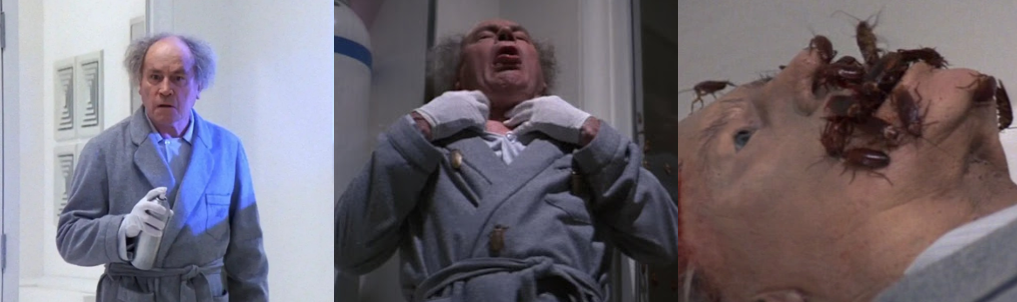
The final story, “They’re Creeping Up on You!”, forces us to share about twenty minutes with uncompromising, belligerent, and extremely wealthy businessman Upson Pratt (Marshall), a germaphobe who lives in a sparse, air-tight penthouse apartment and conducts all his business via telephone and computers. Pratt begins the story battling a cockroach infestation, spraying and stamping the bugs, demanding an exterminator, and threatening to rob people of their livelihoods if his demands are not met. Pratt is delighted to learn that his company’s recent successful corporate takeover resulted in the suicide of his business rival, Norman Castonmeyer, and dismissive towards Norman’s grieving widow, Lenora (Ann Muffly). When Lenora blames him for her husband’s death and wishes all kinds of pain upon the cruel entrepreneur, Pratt simply laughs, having fended off such insults all his life just as effectively as he’s stamped out bugs. Still, Pratt is increasingly disgusted and troubled by the cockroaches, which appear in his food, his equipment, and soon swarm throughout his apartment during a blackout. Having insulted an alienated anyone who could help him, Pratt never wavers in his desire to avenge himself on those who have subjected him to the infestation but is soon overrun by persistent bugs. In his panic, Pratt flees to a more secure panic room only to be mocked by another call from Lenora, who wishes death upon him, and promptly suffers a fatal heart attack upon seeing cockroaches scuttling around his bed. When the blackout lifts, the aggrieved, unsympathetic building handyman (David Early) stops by to check on the unresponsive Pratt. While the cockroaches seem to have disappeared, perhaps vanished now Norman’s death has been avenged or being manifestations of Pratt’s isolation and paranoia, they soon burst from his corpse, tearing through his skin and enveloping his shredded remains.

The Nitty-Gritty:
Although Creepshow offers a unique premise, with its segments being stories in a comic book, the comic book hook isn’t used much. Sure, some shots are framed by comic book panels, actors are rendered against colourful backdrops, and each story fades into an artist’s depiction of the ending, but it’s a tangential link, at best. While the Creep is a questionable animatronic creation, he has a fun, creepy design and it would’ve been nice to see him (and/or Billy) thumbing through the pages of Creepshow and reacting to the stories between segments. The film is an interesting, if occasionally awkward, blend of horror and comedy, with “The Lonesome Death of Jordy Verrill” being the worst offender. I’d like to say King is doing his best but Jordy is such a cartoonish buffoon that it’s hard to take his plight seriously, what with his bizarre fantasises about college professors and doctors. This seems to be a bait and switch, however, as the segment has an unexpected and emotional conclusion where Jordy blows what can loosely be described as his head off, but it doesn’t land quite as well since he’s such a bizarre moron prior. Creepshow really has an issue with pacing, to be honest, as the film is way too long at just over two hours and some stories drag on needlessly. I can’t help but think “The Crate” could’ve easily skipped right to Mike and Dexter examining the titular crate and cut out much of the dull build up. Sure, it effectively paints Billy as an abusive bitch and Henry as a timid, put upon husband, but we clearly see that in every interaction they have and dwelling upon how awful Billy is takes too much focus away from the monstrous Fluffy. While it’s likely it was intentional to paint Fluffy as an afterthought as the true horror was Billy’s belittling and vindictive ways, this segment outstayed its welcome by tacking on an odd final exchange between Henry and Dexter.

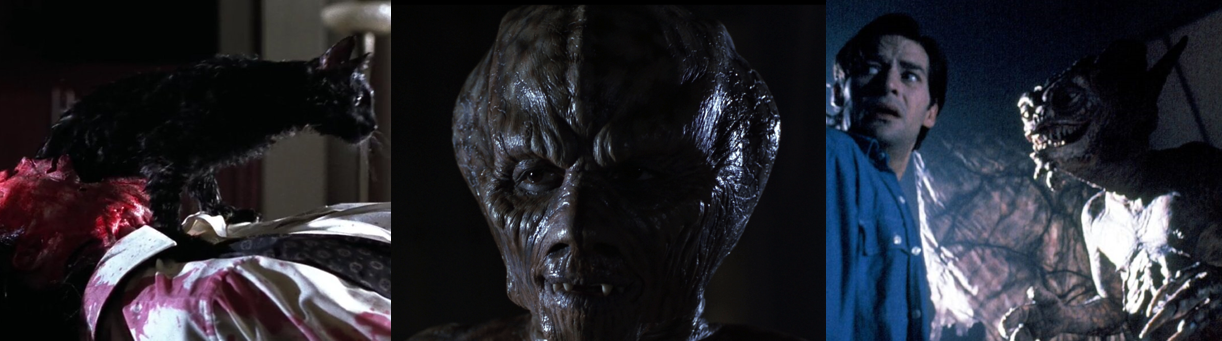
Though occasionally questionable, the practical effects are mostly gruesome highlights.

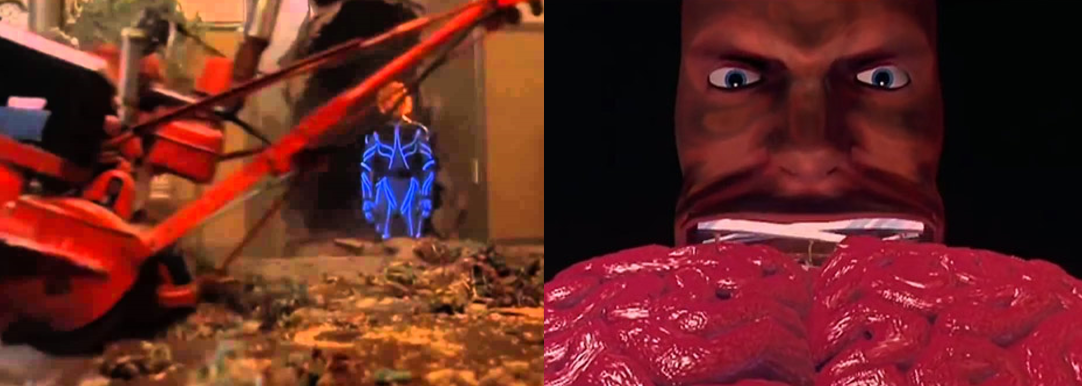
Even my favourite segment, “Something to Tide You Over”, suffers from uneven pacing. Richard’s threat and Harry’s awful predicament are well conveyed but things linger a little too long rather than focusing on Harry’s desperation and slow, painful death. It’s fun seeing Leslie Nielsen be such a despicable, crazed lunatic and there’s a fair bit of nuance to Richard as he shows glimmers of regret and madness throughout. The same can’t be said for Sylvia or any of the Grantham family, who were all obnoxious and thoroughly unlikable characters, or Pratt, who we delight in seeing tortured by the relentless cockroaches. While there’s not much gore in Creepshow and many of the scares are played for laughs, the practical effects are impressive. The squelching, zombified Nathan Grantham sets an early standard, rendering him as a grinning, rotting corpse who strangely exhibits telekinetic powers alongside superhuman strength, all while demanding his special cake. Harry and Becky’s waterlogged corpses are equally impressive, sporting sunken eyes, shrivelled features, and gushing bloody seawater when shot. Equally, the alien vegetation was really good in “The Lonesome Death of Jordy Verrill”, with grass, moss, and vines rapidly overtaking the simple-minded goon’s land, house and, most terrifyingly, his body. This is a slow process more akin to an infection than body horror, though the depiction of the fungus gradually consuming him and eventually transforming him into a vaguely humanoid grass man nicely tied into his desperation for relief from his suffering. Fluffy may be one of the most obvious hand puppets but it’s certainly a unique creature, being some kind of rabid monkey. It’s a little weird and incredibly convenient that it always returns to its crate and only attacks when it’s most dramatic, but Fluffy delivers the most gruesome gore of the movie as it claws, gouges, and bites at its victims.

Despite some intriguing performances, the wraparound is bland and the pacing drags the film down.

“They’re Creeping Up on You!” was probably my second favourite of the segments (“The Crate” is just too long for me to rate it at number two), but it still felt lacking at times. Pratt is a suitably deplorable excuse for a human being and I enjoyed seeing him squirm and get increasingly agitated as cockroaches swarm his germ-proof apartment. There definitely seems to be a suggestion of the supernatural here, even knowing how quickly cockroaches can infest buildings, as they increase the more he belittles others and delights in the death and grief he’s caused. Lenora’s calls, especially her ominous final message, suggest she is putting a death curse upon him, or that her husband is enacting a gruesome and fitting revenge for all the pain Pratt’s caused. Although Pratt’s corpse is also quite obviously a highly detailed dummy, it was quite unnerving to see the cockroaches burst through his skin and envelop him, with this final segment certainly bringing more of a creepy vibe to the proceedings as opposed to the black comedy and unsettling atmosphere of its predecessors. There’s something deeply disturbing about the usually jovial Leslie Nielsen coldly describing what he plans to do to Sam Malone, forcing Harry to bury himself in sand at gunpoint and watch his lover struggle against the tide. Richard has a madcap nature to him that makes him extremely unpredictable, with him coolly commanding every situation with a few curt words and threats rather than physical violence. It’s tough to pick whether Nathan Grantham was more cruel and vindictive than Billy as both are aggressive, patronising, and demanding individuals who push their victims to breaking point, meeting fitting ends as a result (though Nathan’s so stubborn and malicious that he literally returns from the dead to get his Father’s Day cake!)

The Summary:
Although I’m a big fan of horror, horror comedies, comedies, and comic books, Creepshow missed the mark for me in many ways. It’s always to be expected that some segments in an anthology film will be stronger than others. Creepshow certainly offers a variety of stories, but the film is just too long and some segments really outstay their welcome rather than telling fun, gory horror tales. I liked that each one had a different flavour, from bickering families faced with a spiteful zombie patriarch to a spurned husband enacting a chilling revenge and a bizarre monster living in a box and ready to eat an abusive wife. The practical effects were an obvious highlight, with the rare instances of gore being quite shocking, the undead appearing very tactile and disturbing, and even the unconvincing Fluffy making an impression since it’s so weird and wild. I enjoyed seeing some famous faces pop up here, especially Ted Danson and Leslie Nielsen, though it might’ve been a mistake to give Stephen King such a prominent role. Jordy is so dim-witted he makes Tom Cullen seem like a genius (M-O-O-N, that spells “genius”!) and I felt the comedic buffoonery of the character really lessened the emotional impact of his transformation and suicide. Similarly, while it helps to build sympathy to see just how put upon Henry is, “The Crate” is crippled by its overly long run time, which is doubly disappointing considering most of the other stories deliver on their premise in an acceptable length of time. I enjoyed seeing the likes of Pratt and Richard get their comeuppance, and how different each story was, but the wraparound segments felt lacking to me as they didn’t capitalise on the unique aspect of the Creepshow comic book. Ultimately, I can’t help but feel a little dissatisfied with Creepshow, which maybe crams too much into its runtime to be as effective as other horror anthologies and definitely has a format that’s more suited to an anthology television show than the big screen.

My Rating:

Rating: 3 out of 5.

Pretty Good

How offended are you by my disappointment with Creepshow? Which of its short stories was your favourite? Do you agree that the pacing is off and it runs too long or were you satisfying by the length? What did you think to the special effects and sparing use of gore? Were you surprised to learn that Leslie Nielsen used to be a dramatic actor? Which of Creepshow’s sequels and counterparts is your favourite? Whatever you think about Creepshow, leave a comment, go check out my other horror anthology reviews and my guest spot on the Anthological podcast, and donate to my Ko-Fi to fund more reviews like this.

Movie Night: The Running Man (1987)

Released: 13 November 1987
Director: Paul Michael Glaser
Distributor: Tri-Star Pictures
Budget: $27 million
Stars: Arnold Schwarzenegger, María Conchita Alonso, Yaphet Kotto, Marvin J. McIntyre, Erland Van Lidth, Jesse Ventura, and Richard Dawson

The Plot:
Following worldwide economic collapse, the United States has become a totalitarian police state whose populace is pacified by Damon Killian’s (Dawson) The Running Man, a game show where criminals fight for their lives from sadistic maniacs. After escaping prison following a frame-up, Ben Richards (Schwarzenegger) is forced to compete in the game and, in the process, assist a resistance movement in revealing the horrible truth behind The Running Man.

The Background:
By 1982, Stephen King has established himself as the undisputed king of the horror novel; Carrie (King, 1974) became be a runaway success, especially after the accompanying adaptation, The Shining (ibid, 1977) became his first hardback bestseller, and The Stand (ibid, 1978), as epic as it was, proved to merely be a precursor to King’s sprawling Dark Tower series (ibid, 1982 to 2012). King also wrote a under the pseudonym Richard Bachman, both to publish more books per year and to test whether his success had been a fluke or not, and The Running Man began life as a Bachman book. The story, a dystopian thriller in a world where the economy has collapsed, was first published in 1982 and King claimed to have written it in just a week! Producer George Linder became obsessed with the book and its premise and was easily able to acquire the film rights since it wasn’t yet public knowledge that Bachman was King’s alias. After the success of The Terminator (Cameron, 1984), Arnold Schwarzenegger shot to superstardom as the premier action star in Hollywood, and screenwriter Steven DeSouza tweaked the script to accommodate the Austrian Oak, who in reality had very little in common with is literary counterpart. He also greatly expanded upon the game show aspects of the novel, but the film’s production was troubled by directors constantly dropping from the project and Schwarzenegger disapproved of Paul Michael Glaser’s filming style. With a $38.1 million box office, The Running Man was a modest financial success; reviews were somewhat mixed, with Dawson’s performance, the film’s satire, and Arnold’s range and physicality drawing praise despite the mindlessness of the action. A life-long favourite of mine, The Running Man recently gained additional exposure thanks to its accurate predictions of the future and the production of a remake but, since today is Arnold’s birthday, this is the perfect time to revisit this fantastic, action-packed sci-fi classic.

The Review:
It’s hard for me to say, since I don’t really remember all that well, but The Running Man may very well have been my first exposure to Stephen King; at the very least, it was one of my first, and it came at exactly the right time in my life since I was already a big fan of Schwarzenegger’s work from the late eighties to early nineties. The film takes places in the far-off future of around 2018 where the world has become a dystopian police state following a massive economic collapse. Censorship runs rampant and the people are controlled by the media and their governments; generally, they’re satiated by an influx of violent media, such as the life-or-death game show The Running Man, but riots and pockets of resistance continue to spring up, so the government employs more “direct methods” to quell the uprising. Ben Richards begins the film as the part of the system; he starts off as a helicopter pilot for the police force sent in alongside a group of armed officers to investigate a food riot in Bakersfield, California. Richards is aghast when his superior officers order him to open fire on the unarmed crowd and refuses to comply; for his moral stance against gunning down woman and children, he is not only overpowered and knocked out by his comrades but also framed for the ensuring slaughter, earning him infamy as “The Butcher of Bakersfield” and a stint in the Wilshire Detention Zone.

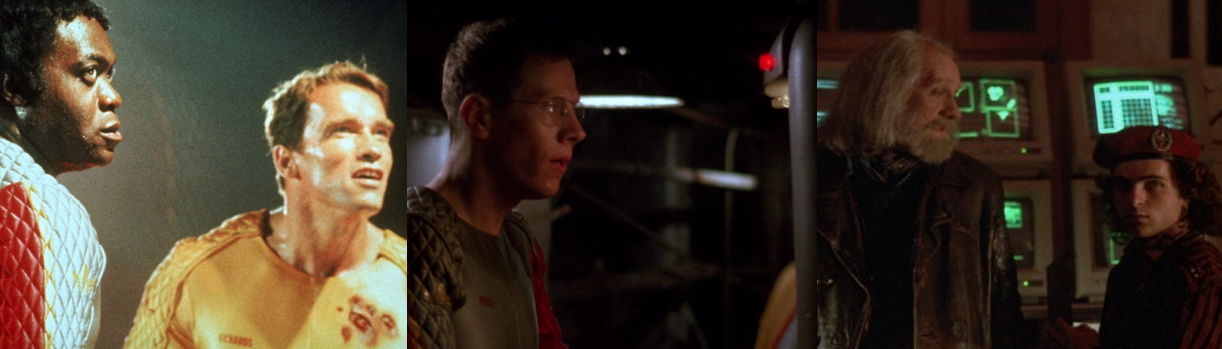
After being framed for a massacre, Richards is forced into fighting for his life on The Running Man.

After eighteen months in a harsh labour camp, his life in the hands of the government that betrayed him thanks to the explosive collar clipped around his neck, Richards has grown into a jaded man who has no time for politics or the steadily declining shithole that the world is becoming. All he cares about now is getting out and reuniting with his brother so he can flee the country, and he joins forces with William Laughlin (Kotto) and Harold Weiss (McIntyre) to stage a brawl and overthrow the armed guards long enough to deactivate the controlling mechanism for their collars and allow a mass escape. Richards remains aligned with the two, who are associates of the Resistance, long enough to have his collar removed but has no interest in getting caught up in resistance leader Mic’s (Mick Fleetwood) efforts to highjack the ICS network satellite and broadcast the true extent of the government’s deception to the unsuspecting masses. Richards is a man of action who has been burned once too often by those who only talk of changing the world; believing that no-one is willing to act on their words, he’s ready to walk away from the world but finds himself targeted by Killian, the charismatic host of The Running Man, who is so inspired by Richards’ physicality and notoriety that he employs every means at his disposal to intercept Richards as he’s trying to flee to Hawaii with the feisty Amber Mendez (Alonso), a composer for the network who Richards was forced to take hostage to keep such an arrest from happening. Initially defiant, Richards is coerced into taking part on the show when Kilian threatens to have Weiss and Laughlin take his place, only to be double-crossed when his friends are dumped into the wreckage of Los Angeles, which comprises the game zone, but his defiance is only fuelled by his desire to fight his way out of the situation and make Killian pay for his part in defaming and endangering him and his buddies.

The feisty Amber ends up competing as well when she learns that the media has been lying to the masses.

After his escape, Richards heads to the city to meet up with his brother, only to find that Edward’s apartment is now owned by Amber after he was taken away for “re-education”. Like Richards, Amber begins the film as an employee of the system; she has had some success composing songs for the ICS network, but is also hiding a few secrets of her own as she has music from the censor list and black-market clothing in her apartment. Richards uses this knowledge to effectively blackmail her into accompanying him to Hawaii, but he also requires her to go with him since, without his brother to help him, he needs her money and travel pass in order to get out of the country. Despite Richards’ massive stature and the ease at which he overpowers her, Amber is a spirited and bold young woman in her own right; she goes along with Richards’ plan, throwing insults and taunts his way wherever possible, and takes the first chance she gets to hit him in the dick and alert airport security to his presence. Like the rest of the ignorant masses, Amber fully believes that Richards is a dangerous and psychotic killer, but her opinion of him (and ICS) changes when she sees that the specifics of his arrest at the airport have been greatly exaggerated to include him having assaulted and killed airport personnel. Her suspicions raised, Amber snoops around the ICS offices and finds that the original unedited video record of the Bakersfield Massacre, but is caught in the act and thrown into the game zone after Killian besmirches her on air with scathing accusations. Although she’s absolutely in over her head, and little more than a screaming, complaining wreck when in the game zone, Amber remains an entertaining character; she constantly winds Richards up with her babbling and naïvety and actually ends up proving quite useful when Weiss has her memorise the uplink code so that Mic can hack into the network satellite. Furthermore, she’s instrumental in Richards’ name being cleared in the finale, and even learns to take care of herself, rather than constantly being saved by Richards, by the time the bulbous Dynamo (Van Lidth) tries to sexually assault her during the film’s climatic firefight.

Much to his chagrin, Richards’ allies are fixated on exposing the government.

While Richards has little interest in politics or fighting against the system, the same can’t be said of Weiss and Laughlin; Laughlin, a former schoolteacher, despairs for the state of the country’s youth as ICS run their propaganda twenty-four hours a day and brainwash them into signing up to serve as part of the violent polices state that oppresses free speech and art. Laughlin’s anger at ICS, and this situation, makes him quite a volatile character; he and Richards start a fight to distract the guards in the labour camp at the start of the film and he explodes with rage when Eddie Vatowski/Buzzsaw (Gus Rethwisch) attacks Richards out in the game zone. This despite the fact that Laughlin was somewhat suspicious of Richards; while Weiss is adamant that their musclebound ally has been framed by the government, Laughlin isn’t so sure since Richards was once a part of the same system he’s fighting against and isn’t “one of [them]” (as in, he’s not a member of the Resistance). Still, Laughlin is fiercely loyal to both his cause and his friend, which ultimately proves to be his undoing as he puts himself in harm’s way to keep Richards from being skewered by Buzzsaw’s chainsaw and ends up dead as a result. Deeply touched by his friend’s sacrifice, this is the turning point for Richards, who vows to bring the uplink code to Mic, despite his scepticism, to honour his friend. Sadly, Weiss doesn’t fare all that well either; the less physically capable of the three, he’s easily manhandled by Professor Subzero (Professor Toru Tanaka) and constantly at risk since he’s unable to simply fight his way through with brute force. Weiss remains fixated on finding the network uplink out in the game zone which, coupled with his weaker physical stature, leads to him being electrocuted to death by Dynamo. Luckily for him, he’s able to teach Amber to memorise the uplink code before he dies, which she then gives to Mic so that the Resistance can finally hack into the ICS network. Although he’s critical of Mic’s Resistance, not just because of the extent of ICS’s influence but also Mic’s use of kids like Stevie (Dweezil Zappa) in his makeshift army, Richards relishes the chance to arm up and lead them in storming The Running Man studio to broadcast the truth of ICS’s malevolent nature and end Killian’s disruptive influence over the audience.

Killian is a charismatic game show host who casually manipulates lives and the media for his ratings.

Speaking of Killian, this guy is one slimy, charismatic, and underhanded individual. Played with absolute relish by career game show host Richard Dawson, Killian is a cold-hearted showman who delights in the adulation of his rowdy audience and is focused only on increasing The Running Man’s ratings by any means necessary. Since The Running Man is “the number one show in the whole, wide world” and the most direct means by which the government can influence and control the masses, Killian wields an incredible amount of power and regularly flouts his influence by manipulating the justice department (or going directly to the President of the United States’ agent) to find viable candidates for his show and thus increase his ratings. Unimpressed with the physical stature and uncharismatic screen appeal of the potential candidates on offer, Killian uses all of his resources and influence to get approval to put Richards on the show, and then goes the extra mile by threatening his friends to force him to undergo the horrific and invasive medical treatments necessary before dumping them all into the game zone. While the protagonists desperately fight for survival out in the desolate wasteland, Killian shines as the captivating host of the show; he engages with his audience (especially his “number one fan”, Agnes McArdle (Dona Hardy)) with a flirtatious and magnetic banter, encouraging them to pick their favourite Stalker to chase after the contestants and awarding them their prizes for participating. However, Killian becomes increasingly frustrated not just by Richards’ continued victories over the Stalkers but also by his increasing popularity, which sees the masses cheering and betting on him rather than favouring the Stalkers. Luckily for Killian, he has a crack media team on hand to not only doctor video footage to incriminate his contestants but also to stage Amber and Richards’ deaths using a very early representation of CGI facial mapping after Richards vehemently turns down Killian’s offer to become a Stalker himself.

The violent and sadistic Stalkers are worshipped by the masses and famed for their brutal kills.

The Stalkers make up the primary physical threat faced by our main characters; essentially a gaggle of bloodthirsty wrestlers kept under ICS’s payroll with the specific purpose killing contestants in the most gruesome ways to pop a higher rating. Cheered and idolised by the masses, the Stalkers are more than celebrities; they’re heroes, each of which have their own dedicated fanbase and odds of winning based on their experiences on the game show, and the audience is stunned into silence to see them being offed one at a time by Richards, especially as a Stalker has never been killed before. Although Captain Freedom (Ventura) is technically the first Stalker introduced, he’s basically been reduced to being a mascot for the network, and is insulted when Killian denies him the “code of the gladiators” for his eventual fight against Richards. Consequently, Captain Freedom is denied actually participating in the show as much as he is his time to host his workout show or share his insights during the broadcast, which leaves him resentful of his employers. The first Stalker to actually enter the fray is Professor Subzero, a huge Japanese sumo wrestler who attacks our heroes with a razor-sharp hockey stick and meets his ends when Richards garrottes him with a piece of barbed wire. Buzzsaw and Dynamo enter the game as a tag team of sorts, with the chainsaw wielding Buzzsaw having the most impact of all of the antagonists thanks not just to the sadistic pleasure he derives from slicing his prey with his chainsaws but also because he kills Laughlin and is subsequently executed by Richards by having his beloved chainsaw cut through his groin. Not that Dynamo is any slouch either; he murders Weiss and makes an immediate impression with his ludicrous light-up outfit, operatic singing, and little armoured car that he tries to run down Richards with. Initially, Richards spares Dynamo’s life after he’s left helpless beneath the wreckage of his vehicle, but he is later electrocuted to death by Amber after he tries to assault her, bringing his perverse designs to an end. Finally, Killian sends in Fireball (Jim Brown) to immolate Richards and Amber but, despite the benefits afforded to him by his jetpack, his fireproof suit, and his trusty flamethrower, Fireball is easily dispatched by Richards using a road flare after a brief, tense game of cat and mouse.

The Nitty-Gritty:
I’d just like to take a moment to praise the stellar work by composer Harold Faltermeyer; The Running Man’s gloriously over the top action, satirical cynicism, and dystopian world are only bolstered by a thumping synthetic beat that hits perfectly during every punch, kill, or contemplative scene. Even now, the bombastic main melody will often pop into my head and it’s just a really fun, energetic score that gets the blood pumping every time it kicks in. Considering it was made in the late-eighties, The Running Man is a startlingly accurate portrayal of modern society; not only do we have voice-activated conveniences at home that control our lights and appliances, but we have absolutely become blinded to the conflicts and politics of the wider world in favour of consuming media, and governments make no bones about using said media to control us in both subtle and explicit ways. Obviously, The Running Man favours the more explicit path for the purposes of entertainment; the prison Richards finds himself in is an absolute hellhole where the inmates are worked to death, watched over by armed, masked stormtroopers, and unable to leave lest their heads be blown off by explosive collars! Furthermore, the government is more than willing to employ lethal force to quell food riots and spin the situation in their favour by pinning such incidents on patsies like Richards. The United States government has a controlling interest in The Running Man television show, using it as a backdoor solution to eliminate political insurgents, and even those who manage to beat the game are executed offscreen but presented as heroic victors to help boost the ratings.

Schwarzenegger is never short of a cutting quip to taunt his dismembered opponents in this film.

The Running Man is filled with examples of black humour, from Killian’s laughably bad adverts for Cadre Cola (“It Hits the Spot!”) to lethal game shows like Climbing for Dollars and the price of a Coca-Cola having shot to $6, The Running Man is indicative of a biting satire regarding consumerism and media consumption that was so crucial to sci-fi classics at the time. Of course, a great deal of the film’s humour also comes from Schwarzenegger; while the Austrian Oak falters somewhat here and there with his line delivery in this one, The Running Man is chock full of some of his most amusing one-liners and character moments, from stabbing his court appointed attorney (Kenneth Lerner) in the back with a pen after he rattles off all kinds of nonsense legal mumbo-jumbo, his vow that “[he’ll] be back” to Killian (whose reply, “Only in a rerun”, isn’t to be sniffed at either) and his many quips while interacting with and after dispatching each of the Stalkers (“Hey, Christmas Tree!”, “He had to split”, and “What a hot-head!” spring instantly to mind). For me, though, the standout moment comes when Richards, enraged at the loss of his friends, turns down Killian’s request to sign up as a Stalker and promises to “ram [his fist] into [Killian’s] stomach and break [his] Goddamn spine!” Alongside Schwarzenegger’s trademark wit, we have a decent variety of action and fight scenes on offer thanks to the different Stalkers; Professor Subzero attacks the group in an enclosed ice rink, Buzzsaw and Dynamo strike out in the wasteland, and Fireball chases Richards and Amber through an abandoned building. More often that not, Richards can’t simply rely on throwing punches at his opponents as they’re pretty huge guys in their own right, heavily armed, and some wear protective armour or ride motorcycles, meaning he has to think up some creative ways to subdue them and finish them off, such as ripping out Fireball’s fuel line and tossing a flare at him and overpowering Buzzsaw to drive his chainsaw up into his crotch!

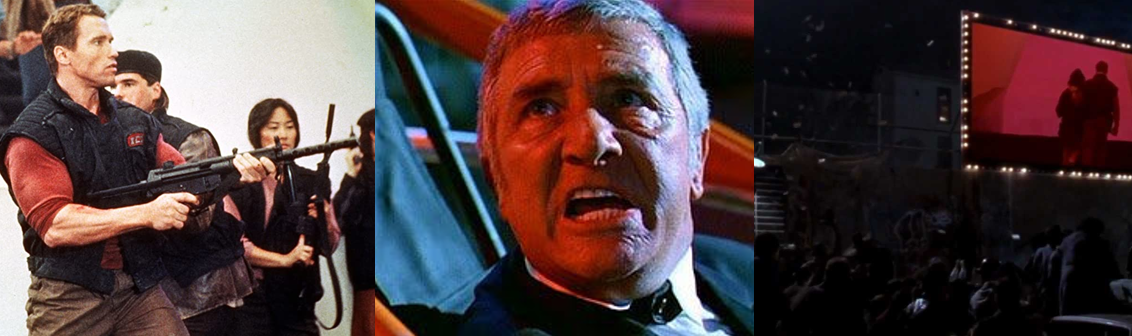
Richards storms the studio, gives Killian some karma, and becomes the unlikely face of a revolution.

Interestingly, one of the film’s more brutal fight sequences doesn’t technically involve Richards; thanks to Killian’s aide, Tony (Kurt Fuller), using digital trickery, Captain Freedom fights and kills two stand-ins to stage Amber and Richards’ deaths in order to quell the support the latter is gaining from the viewing public. Thankfully, Mic intercepts the two before Killian can have them hunted down and killed off-camera and Richards volunteers to lead the Resistance in storming The Running Man broadcast, ensuring that the film culminates in a massive firefight between the Resistance and the ICS armed guards. Thanks to being caught off-guard, the guards are picked off by Richards and the others, who help get the majority of the panicked audience to safety, and Richards is left alone with Killian after his mistreated head of security, Sven (Sven Thorsen), leaves him in the lurch. Clearly not a physical match for Richards, Killian falls back on his silver tongue and desperately pleads with the grim-faced former cop for mercy since Killian is simply trying to appease the masses with violent entertainment. However, his appeals fall on deaf ears and Richards seals him up in one of the rocket-powered pods that so violently deposits contestants into the game zone and sends the deceiving game show host careening to a fiery death. By this point, however, the truth of the Bakersfield Massacre has been revealed and Richards has won over the viewing audience for being a “bad motherfucker”, meaning that Killian’s death is celebrated across the city. With the head of the snake effectively removed, The Running Man (and the large television screen in the city centre) goes off air for, presumably, the first time ever and the film ends with a definite sense that the people have not only found a new hero to idolise in Richards but will no longer allow themselves to be so absolutely controlled by the media and the oppressive government.

The Summary:
I haven’t read The Running Man, so I really can’t comment on the film’s fidelity to Stephen King’s original text, but I do have to say that I’ve always wanted to give it a read based on my affection for this adaptation. I might be blinded by nostalgia and my love for Arnold Schwarzenegger films, but I absolutely love The Running Man. It’s not completely flawless thanks to some spotty line delivery and most of the action taking place in a pretty bland, dark location, but I think it holds up surprisingly well even after all this time. It helps that it’s not an overly elaborate sci-fi tale, so there are no flying cars or complicated special effects here; it’s simply a darker, somewhat realistic representation of a possible future society that has been oppressed by an overbearing government following near-total economic collapse. The film shines in its excess of machismo; Schwarzenegger is at his most quippy here, overpowering and outmatching his beefy opponents with pun after pun and filling out his skin-tight spandex outfit wonderfully. The Stalkers might be soulless, sadistic modern-day gladiators, but they stand out thanks to being visually distinct and each having their own unique, vicious ways of attacking the contestants. Of course, the real star of the show is Richard Dawson as Killian, the two-faced game show host who is jovial and engaging in front of the cameras and a cold-hearted tyrant backstage, which makes him an impeccable mastermind for Schwarzenegger to go up against. The Running Man continues to be culturally relevant as time goes on thanks to modern day technology not being a million miles away from what’s seen in the film, and our continued obsession with meaningless gameshows, media, and increasingly violent entertainment. For me, this makes The Running Man a clever satire amidst a top-notch sci-fit action film that means it only takes on more meaning, and gets more entertaining, as you get older and appreciate all the different layers at work in what many probably write off as just another mindless Schwarzenegger flick.

My Rating:

Rating: 5 out of 5.

Fantastic

What do you think to The Running Man? How do you think the film holds up to others in the same genre and what would you rank it against Arnold’s other films? Have you read the original book and, if so, how do you think the film holds up as an adaptation? What did you think to Schwarzenegger’s many quips? Which of the Stalkers was your favourite? Are you surprised at how accurate The Running Man was at predicting the progression of society? Were you a fan of Richard Dawson’s performance? How are you celebrating Schwarzenegger’s birthday today and what is your favourite Schwarzenegger film? Whatever you think, go ahead and leave your thoughts below.

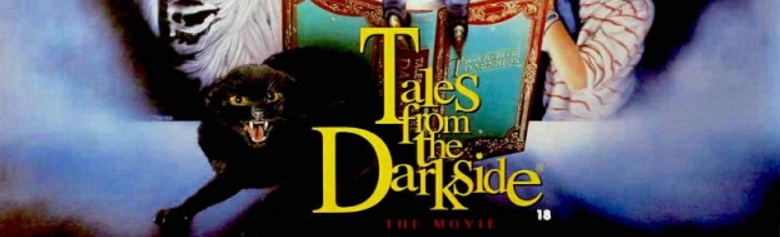
Movie Night: Tales from the Darkside: The Movie

Released: 4 May 1990
Director: John Harrison
Distributor:
Paramount Pictures
Budget: $3.5 million
Stars:
Deborah Harry, Matthew Lawrence, Steve Buscemi, Christian Slater, William Hickey, David Johansen, James Remar, and Rae Dawn Chong

The Plot:
Timmy (Lawrence) has been imprisoned by a suburban witch (Harry) who plans to cook and eat him; his only hope is to stall her with three stories from a horror book that depict a graduate student who uses a mummy to avenge himself on those who have wronged him, a wealthy old man who hires a hitman to kill a cat he believes is haunting him, and a struggling artist who finds fame and fortune but at terrible cost!

The Background:
In 1982, the grandfather of zombie horror himself, George A. Romero, joined forces with my favourite writer of all time, Stephen King, to write and direct Creepshow (Romero, 1982), a horror anthology movie that won over critics with its blend of comedy and horror, becoming a cult classic in the process. Having grossed $21 million against an $8 million budget, Creepshow was successful enough to raise interest in a potential television series; however, distribution issues led to Laurel Entertainment (Creepshow’s producers) opting to create the similar show, Tales from the Darkside, instead. Following a pilot episode in 1983, Tales from the Darkside ran for four seasons and produced eighty-nine official episodes between 1984 and 1988, and featured works or adaptations from the likes of Stephen King and Clive Barker. Since the show had also achieved cult status, and given that horror and sci-fi anthologies were still relatively popular back in the late-eighties and early-nineties, its perhaps not too surprising that the show was succeeded by a big-screen feature film. Largely regarded as the true successor to Creepshow, Tales from the Darkside: The Movie’s $16.3 million gross made it a modest success. Reviews were mixed, however, and plans for a sequel were scrapped and writer Joe Hill was equally unsuccessful when he tried to get a reboot off the ground.

The Reviews:
Since Tales from the Darkside: The Movie is an anthology film compiled of a framing narrative and three short horror stories, it only makes sense to review each one individually and then discuss the overall film, so this review will be structured a little differently from my usual ones. The film’s framing narrative, “The Wraparound Story”, is easily the weakest part of the film, though even this has its simple charms; Betty is an affluent suburban housewife whose pleasant and polite demeanour hides the amusingly horrific truth that she is actually a witch. Some time prior to the film, she kidnapped young Timmy and has had him chained up in a dungeon in her kitchen, where she has been feeding him cookies and other snacks to fatten him up for a big dinner party for her other friends (presumably also witches). Although Timmy desperately cries for help, Betty nonchalantly prepares her oven and her evisceration implements; desperate to delay his impending death, Timmy reads her stories from her favourite childhood book, Tales from the Darkside. Once each of the short films has finished, Timmy continues to read from the book and, thanks to Betty’s fondness for the stories and her desire to hear a love story, she is suitably distracted but remains undeterred in her wish to gut him and cook him. Thankfully, Timmy’s efforts buy him the time to think of an escape plan and, as Betty moves to get him, he tosses some marbles onto the floor that cause her to slip and impale herself on her own butcher’s block! Timmy then frees himself, shoves her into the oven originally meant for him, and rewards himself with a well-deserved cookie.

Bellingham uses an ancient scroll to avenge himself using reanimated mummies.

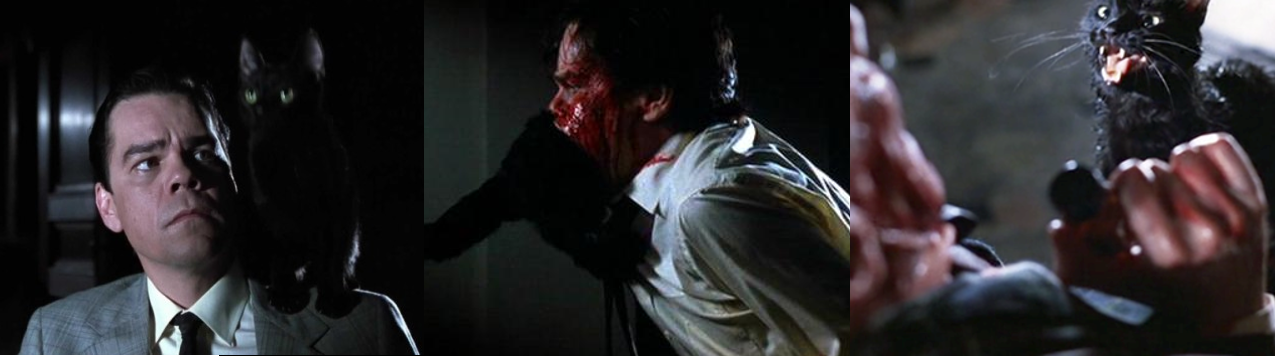
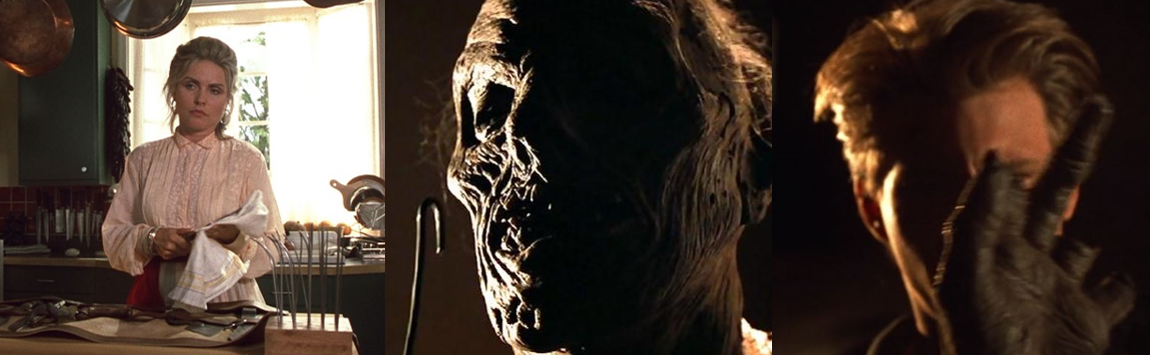
The first story, “Lot 249”, is an adaptation of Sir Arthur Conan Doyle’s short story of the same name; the short follows two rich college students, Andy Smith (Slater) and his best friend Lee Monkton (Robert Sedgwick), who is not only dating Andy’s sister, Susan (Julianne Moore), but has also succeeded in conning the administration into awarding him an all-expenses trip to Europe thanks to Susan writing his scholarship proposal for him. While Andy disapproves of Lee’s moral deception, it is of particular aggravation to Edward Bellingham (Buscemi), a much poorer student who pays his way through college by selling antiquities and other artefacts. Though friendly enough with Andy, who lives in dormitory above him, Bellingham’s introduction to Lee is met with tension; still, Bellingham delights in showing them his latest acquisition, the titular Lot 249, which he believes will make up for him being cheated out of the scholarship by an anonymous tip accusing him of theft. Lot 249 is a massive sarcophagus that contains a dried out, ancient mummy with a scroll in its stomach which, despite his claims to the contrary, Bellingham is fully capable of reading. Aware that Lee screwed him out of his scholarship, Bellingham wastes no time in reading from the scroll to bring the mummy to unlife and promptly sending it after Lee. The rich jock is completely blindsided by the superhumanly strong mummy, who violently pulls Lee’s brains out through his nose and leaves them in a fruit bowl. Susan has little time to process Lee’s death as Bellingham sends his mummy after her next since he knows that she framed him; although she attempts to fight back, the mummy rips open her back with a pair of scissors and stuffs her full of chrysanthemums! Andy’s suspicions about Bellingham’s involvement are only further confirmed at the sight of his sister’s bandage-wrapped corpse; he attacks Bellingham and ties him to a chair, easily dispatching the mummy using a battery-powered saw to cut off its leg and then slice its head in half. Threatening to burn Bellingham alive using his Master’s thesis for kindling, Andy settles for setting fire to the scroll and sends Bellingham packing. However, the maniacal Bellingham gets the last laugh, having tricked Andy with a fake scroll; he uses the real one to resurrect Lee and Susan as mummified corpses and sends them after Andy in the story’s finale.

A supernatural cat haunts an old man and drives him to hire a hitman to dispose of it.

Next is “Cat from Hell”, which is an adaptation of a Stephen King short story of the same name and was written for the film by Romero. Drogan (Hickey) is an incredibly wealthy, incredibly fail old man who is bound to a wheelchair but wields considerable power and influence thanks to having amassed a bountiful fortune in pharmaceuticals. Drogan lives alone in a vast mansion furnished with “everything you could want; everything you could ever want” but all the money in the world can’t quell his fear and paranoia regarding a particular black cat that haunts his house. Drogan hires hitman Halston (Johansen), a grim and professional man, to take care of his feline stalker; at first, Halston is incredulous and dismissive of the job but is convinced by the old man’s down payment of $50,000 to learn the story behind the cat. Drogan reveals that his company’s wonder drug was created by experimenting on and killing over fifty-thousand cats and he believes that the black cat is a supernatural form of karmic revenge sent to address the balance; his sister, Amanda (Dolores Sutton), was tripped by the cat and broke her neck falling down the stairs, the cat then suffocated Amanda’s friend, Carolyn (Alice Drummond), with its body while she slept, and then attacked the butler, Richard Gage (Mark Margolis), as he was driving to dispose of it, with each victim dying at precisely midnight. Though believing the old man is delusional, Halston takes his money, and the job, but finds that killing the cat isn’t as easy as he initially believes. The cat scratches him when he tries to break its neck, continually eludes and swipes at him throughout the night (clawing at his crotch at one point), and even appears to be immune to Halston’s high-powered bullet when he tries to shoot it. Having been driven into a near frenzy by the cat, Halston fires blindly but is terrified out of his mind when the cat leaps at him and forces its way down his throat and into his body! The next morning, Drogan arrives home to find Halston dead on the floor; then, as the damaged grandfather clock strikes twelve midnight, the cat emerges from Halston’s bloodied corpse and leaps onto Drogan’s lap, causing the hold man to literally die from fright.

A struggling artist is wracked with guilt after making a promise to a fearsome gargoyle

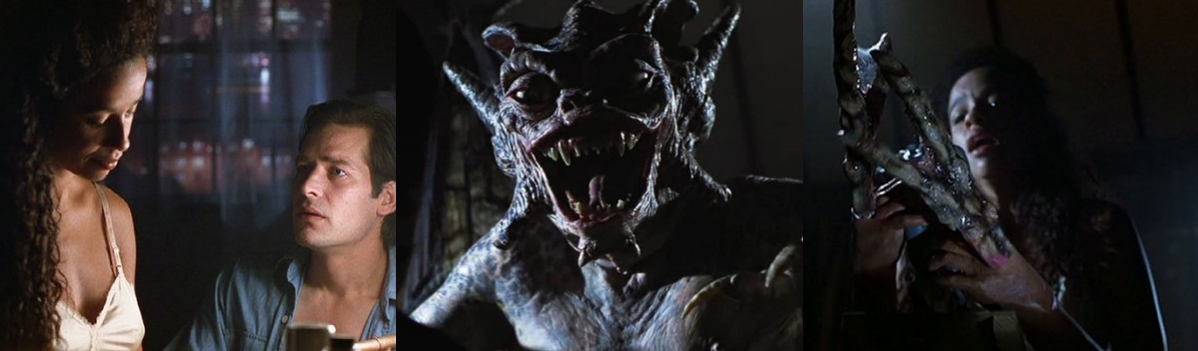
The final segment, and quite possibly my favourite, is “Lover’s Vow”; Preston (Remar) is a struggling artist living in New York whose work is proving to be so unprofitable and unpopular that even his agent, Wyatt (Robert Klein) dumps him. Dejected and frustrated, he drowns his sorrows at his local bar; however, when the bar’s owner, Jer (Ashton Wise), offers to walk him home, the two are suddenly attacked in the alley outside the bar. Preston is horrified when he witnesses a large, winged gargoyle-like grotesque rip Jer’s hand off and then behead the bartender but, rather than kill Preston, it inexplicably offers him a deal: his life for his solemn vow that he will never speak of the horrors he has seen that night. Terrified out of his mind, Preston agrees and the creature leaves after clawing at his chest to seal the deal; disgusted at the gargoyle’s gruesome appearance, Preston comes across a stranger, Carola (Chong), in the aftermath and encourages her to get off the streets and go to his apartment to keep her safe from the beast. Enthralled by Preston’s artwork, Carola warms to him and cleans his wound and the two have a romantic tryst that leads to ten years of success and happiness for Preston thanks to Carola having connections that help his work take off. While a doting father to two young children and devoted husband, Preston is nonetheless haunted by memories of that night, and the creature, and tormented at having kept the truth from his beloved all these years. On the eve of the ten year anniversary of the night they met, Preston breaks down and confesses the truth, even showing Carola a statue and drawings of the creature but his guilt soon turns to horror as Carola transforms before his eyes into the same gargoyle that attacked him, her body splitting and tearing apart as the creature breaks free from its human form! To make matters worse, their children also transform into pint-sized gargoyles before Preston’s terrified eyes; heartbroken and distraught, Preston begs Carola to change back and professes his love but it’s not enough to undo his broken vow and the gargoyle rips his throat out with an anguished cry and flies off into the night, where it turns back into a stone statue with its two children.

The Nitty-Gritty:
The Twilight Zone (1959 to 1964; 1985 to 1989) was a bit before my time (and wasn’t even on television when I was a kid, as far as I know) so I grew up watching The Outer Limits (1995 to 2001) instead; while I can’t recall right now when I first saw Tales from the Darkside: The Movie, I distinctly remember it being one of the key influences in my subsequent appreciation for anthology stories. The idea of having such wildly different short stories all in one movie was fascinating to me and it still is, as a storyteller myself. Each story has only a short amount of time to give a sense of who its characters are and make us care about them and I think Tales from the Darkside: The Movie does a pretty good job with that thanks to casting some young up-and-comers, noted character actors, and even a distinguished actor of stage and screen in William Hickey. Not only that, the film is bolstered by some pretty decent practical effects; while the mummy is a little stiff, the puppet cat looks a little fake, and the gargoyle is notably seeped in darkness to hide its flaws, each remains a frightening and startling monster thanks to how well the shorts tell their stories.

“Lot 249” more than makes up for the frame narrative’s lack of monsters and raw horror.

It’s not surprising that “The Wraparound Story” is the weakest part of the film; to be fair, it’s not really designed to anything more than provide a basic setup for why we’re being shown the other, superior short stories and in that regard it succeeds at being mildly entertaining, at least. However, while lacking the monsters, blood, and unsettling visuals of the other tales, the framing story seems much more geared towards youngsters than the rest of the film. I suppose the idea of a witch hiding in plain sight could be considered scary but Betty is so nice and the threat against Timmy is left implied rather than explicit, meaning the horror of the framing narrative is noticeably diminished for me compared to the other stories. While I consider “Lot 249” the weakest of the three main tales, even that proves to be an entertaining little horror romp thanks, largely, to the gory methods employed by Bellingham’s mummy. It’s pretty horrific to see it jam a twisted coat hanger up Lee’s nose and jerk his brains out, to say nothing of the graphic depiction of Susan’s back being violently cut open! Not only that but the short is bolstered by enjoyable performances by a young Christian Slater, Steve Buscemi, and Julianne Moore; Slater, especially, shows so much charisma and likeability as Andy, who is easily able to cut up and subdue the mummy thanks to his being prepared, which only adds to the shocking twist of the short’s ending.

The film is bolstered by some disturbing visuals and gruesome (and practical) special effects.

“Cat from Hell” is easily the most traditionally terrifying story of the film; for some reason, this short always reminds me of “The Raven” (Poe, 1845) in the simplicity of its gothic horror and the way the short builds tension is incredibly effective as a lot of shots are from the cat’s point of view and yet the story doesn’t hold back in depicting the supernatural feline’s horrific nature. Watching Halston’s unshakable arrogance crack be replaced by a fanatical obsession is very unsettling but the true highlight of the piece is obviously in the disturbing and grotesque way Halston meets his end. Yes, the puppets and dummies are pretty obvious but the darkness helps hide a lot of the effects and it’s still very grotesque not only to see the cat force its way down his throat but also crawl out through his mouth in a burst of blood. The way it simply leaps onto Drogan’s lap and hisses at him as the old man succumbs to his terror is particularly ghastly and is only augmented by the haunting sound of the clock striking twelve, the intense score, and the slanted angle of the camera. It’s a bit of a tie between “Cat from Hell” and “Lover’s Vow” for which story is my favourite but “Lover’s Vow” is definitely the most tragic and distressing of the stories; while you can argue that the twist ending is somewhat predictable, for me it’s easily the most memorable and impactful part of the film and helped make it a truly nightmarish horror story. The short is made all the more memorable by some fantastically ambitious animatronics and puppet work on the gargoyle; Carola’s visceral transformation into the beast is right up there with the disgusting body horror seen in The Fly (Cronenberg, 1986) and is made all the more heart-wrenching by Preston’s anguished scream at seeing his children turned into little monsters as a result of him just being honest with his wife.

The Summary:
It’s probably just the nostalgia talking but I have a real soft spot for Tales from the Darkside: The Movie. I remember being fascinated by it as a kid because I had only seen anthology narratives done in TV shows like The Outer Limits (or potentially this was my introduction to the concept, I honestly forget which is which) and I found the idea to be incredibly unique and substantial (it’s like getting four movies for the price of one!) Years later, and some time ago now, I got around to seeing Creepshow and don’t remember it resonating me in the same way as this film (though, to be fair, I really do need to give Creepshow another watch sometime), which had a profound influence on me as a horror fan and writer. The stories are incredibly bleak and intense considering their short length, and bolstered by some fun performances and gruesome use of both gore and ambitious practical effects. While there are other, better films and examples of these effects out there (and even from the same time period), Tales from the Darkside: The Movie does a pretty good job and standing the test of time not just through remarkably well shot animatronics and puppets but also in how raw and powerful its stories can be. While “The Wraparound Story” is easily skipped, even that helps to add a breather between each tale so you can catch your breath and prepare for the next gruesome tale, and I never fail to be haunted, moved, and disturbed by the stories on offer here, in particular “Cat from Hell” and “Lover’s Vow”, which are more than reason enough for you to give this one a try sometime.

My Rating:

Rating: 4 out of 5.

Great Stuff

Have you ever seen Tales from the Darkside: The Movie? Which of its short stories was your favourite and what did you think to the practical effects used to bring the horrors to life? Did you see the twist endings coming and which of the stories could you see expanded out into their own feature? Did you ever watch the television show? How would you rate this feature-length version of the show against other horror anthologies like Creepshow? Are you a fan of anthologies and would you like to see more? What horror films are you watching this month in preparation for Halloween? Whatever you think about Tales from the Darkside: The Movie, leave a comment and check out my other horror anthology reviews!

Movie Night: Cat’s Eye

Released: 12 April 1985
Director: Lewis Teague
Distributor:
Paramount Pictures
Budget: $7 million
Stars:
James Woods, Alan King, Robert Hays, Kenneth McMillan, Candy Clark, and Drew Barrymore

The Plot:
A stray tabby cat (latter dubbed “General”) is beset by visions of Amanda (Barrymore), a young girl in mortal danger. However, to reach her, he must travel across the United States, where he’s picked up by a former mobster who goes to extreme measures to keep his clients from smoking, a crime boss who offers a wager to his wife’s lover, and finally must defend Amanda from a viscous little troll (Daniel Rogers) looking to steal her breath!

The Background:
In 1982, George A. Romero, the grandfather of zombie horror, collaborated with my favourite writer, Stephen King, to write and direct Creepshow (Romero, 1982), a horror anthology movie that was praised for its blend of comedy and scares and became a cult classic. Potentially because of its $21 million worldwide gross against an $8 million budget, Creepshow led to the development of a similar show, Tales from the Darkside (1984 to 1988) and, no doubt, further interest in adapting King’s work for Cat’s Eye, which featured two segments based on stories from King’s Night Shift collection (King, 1978) and a third story King crafted specifically for the movie. Twelve different cats were used throughout the production, with handler Karly Lewis Miller alternating between the kitties when they were full from the treats they earned from performing, and director Lewis Teague stressed that none of them came to harm thanks to using air pressure hoses to simulate electric shocks and split screens to show the cat racing across a busy road. This was also an early role for young Drew Barrymore, who had starred in another Stephen King adaptation, Firestarter (Lester, 1984), the year before, and the film reaped a commendable $13.1 million at the box office. A favourite of mine since I was a child, Cat’s Eye was met with positive reviews that praised King’s focus on exploring phobias, the presentation and performances, and I’m pleased to see that it’s generally regarded as a forgotten gem of its era and genre. Cat’s Eye was so influential on me as a kid that I couldn’t imagine a better homage, or title, for my horror novella of the same name; as this releases next week, I figured now is as good a time as any to revisit Cat’s Eye and share my thoughts on it.

The Reviews:
Since Cat’s Eye is an anthology film made up of a framing narrative and three short horror stories, this review will be structured a little differently from my usual ones as I’ll look at each section in turn before giving my final thoughts. Cat’s Eye is a little unique from other anthology films I’ve known, however, in that the framing narrative kind of feeds into the final segment, so I’m going to tackle the detours General takes first and then circle around to talking about his journey and the framing story when I get to the final segment.

Habitual smoker Dick Morrison is driven to paranoia by Donatti’s intimidating methods.

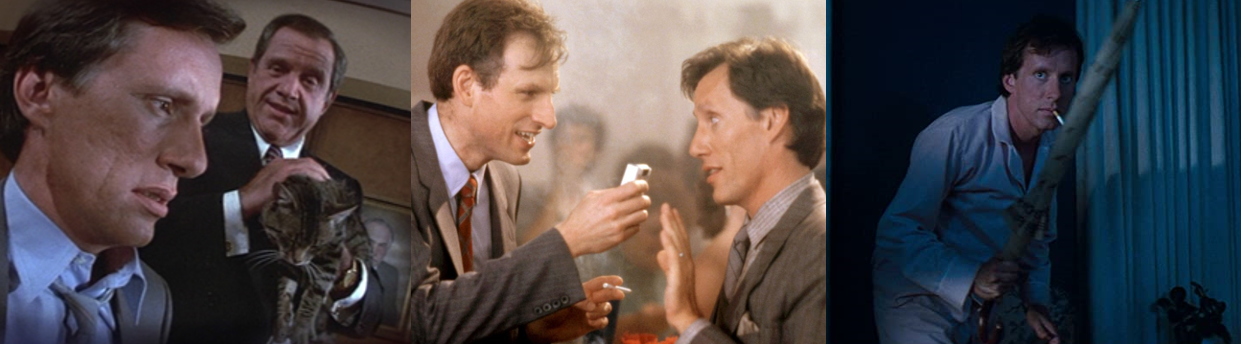
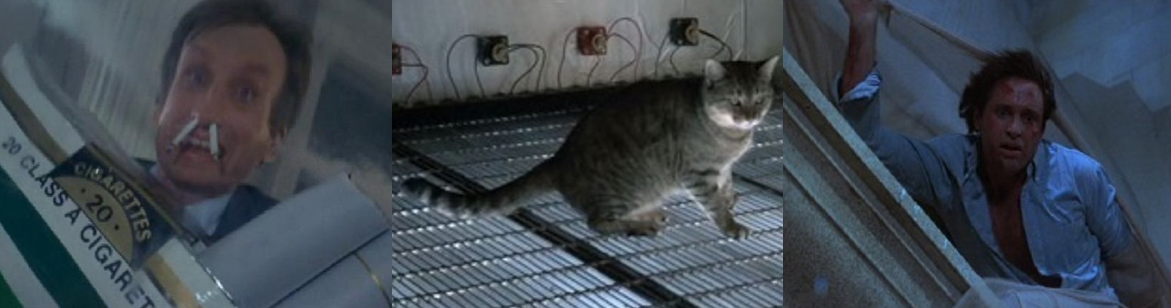
General begins the film wandering the streets aimlessly until a rabid dog chases him; taking shelter in a delivery truck, General winds up in New York City where, after being enthralled by a vision of Amanda begging for help, he’s picked up by Junk (Tony Munafo), one of Doctor Vinny Donatti’s (King) many underlings. Donatti heads up Quitters, Inc (which is the name of our first segment), a company so dedicated to stopping its clients from smoking that it uses intimidation and coercive techniques carried over from Donatti’s days in the mob. A habitual smoker with a wife (Cindy; Mary D’Arcy) and child (also Barrymore), Dick Morrison (Woods) is recommended Quitters, Inc by a friend and impressed to learn that they have a 100% success rate thanks to their uniquely persuasive method of having their clients constantly monitored by their thugs and subjecting the client to increasingly harsh penalties every time they stray from the plan. Morrison is horrified when Donatti demonstrates one such punishment by subjecting General to electric shocks in a wire cage, and even more terrified to learn that Cindy and his daughter will face the cage if he slips up, then Cindy will be raped and, finally, Morrison will be killed if he cannot stick to the program. Agitated by the threats and the lack of nicotine, Morrison struggles to keep it together for his family; he’s alarmed to find one of Donatti’s men in his house, and that they know where his daughter goes to school, but manages to resist lighting up even when the pressure causes him to have nightmarish hallucinations at a work function. Morrison’s resolve falters for just a second when stuck in a traffic jam, however; he finds a lone cigarette in a battered packet and, thinking he’s safe, enjoys a quick drag only to spot Junk watching him from a nearby car. Racing home to find Cindy gone, he’s forced to watch her endure the electrified cage but, much to Junk’s dismay, she forgives his infraction and they reconcile after he reveals the truth to her. The segment ends some time later; Morrison has successfully kicked the habit but started to gain weight, so Donatti “prescribes” him some dodgy diet pills. Though Morrison has built up a good-natured rapport with the two mobsters, he’s aghast to find that Donatti’s threat about cutting off Cindy’s finger should he not hit his target weight all too true when he spots his friend’s spouse is missing her pinkie!

Norris is forced to traverse a narrow ledge to appease the whims of a sadistic gambler.

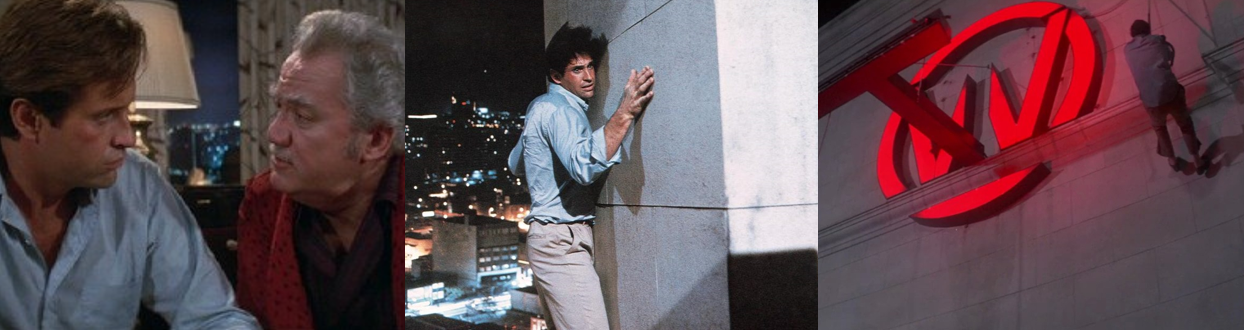
When Morrison lashed out in a rage during Cindy’s torture, General managed to slip out of Quitters, Inc and hitch a ride to Atlantic City, where he’s eventually adopted by crime boss and casino owner Cressner (McMillan) in “The Ledge”. An arrogant and powerful figure, Cressner will wager on anything and sees General as a lucky talisman after the cat successfully dashes across a busy road without injury. Cressner is also an extremely dangerous and vindictive man and, after finding out that his wife has been having an affair with former tennis pro Johnny Norris (Hays), has his henchman, “Ducky” (Mike Starr), plant incriminating drugs in Norris’s car and forcibly bring him up to Cressner’s penthouse for a confrontation. There, Cressner offers Norris a wager: if he (as in Norris) cane traverse the narrow exterior ledge of the penthouse without falling to his death, the drugs will be removed, Norris will be given a big cash sum, and he will be allowed to leave with Cressner’s wife. Facing either a lifetime in jail or a death sentence at Cressner’s hands, Norris has no choice but to take the bet and gingerly shuffles around the building trying not to slip, being buffeted by whistling wind, and pecked at by a particularly annoying pigeon. While Cressner asserts that he doesn’t welsh on his bets, he does make sure to make the ordeal as difficult as possible, blasting an air horn in Norris’s face and setting a high-pressure hose on him. However, even when Norris manages to overcome all of this, Cressner screws him over by gifting him his wife’s head in a sickening twist; pushed to the edge, Norris manages to overpower Cressner, shoots his henchman dead, and then holds the gangster at gunpoint. Despite being tempted at a multi-million dollar payoff, Norris forces Cressner to endure the same trial on the penthouse ledge, but Cressner is unable to get past the pigeon and plummets to his much-deserved demise as General looks on.

General journeys to keep a nightmarish little troll from stealing Amanda’s breath.

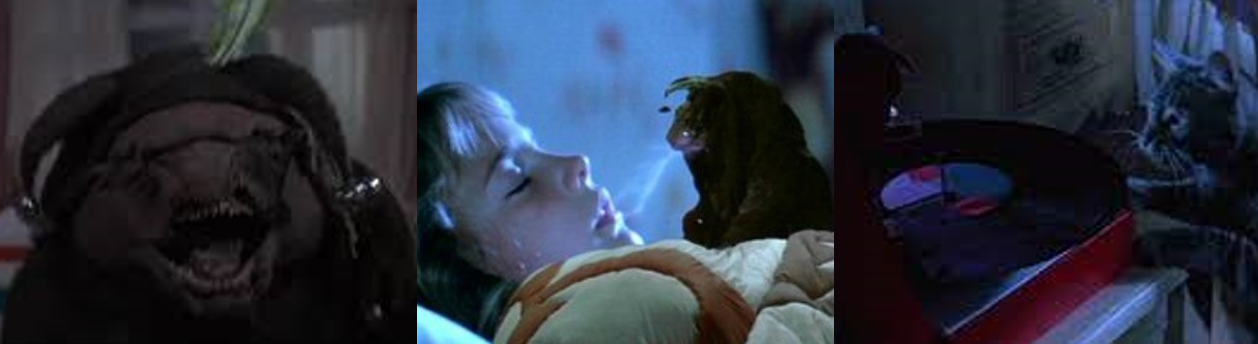
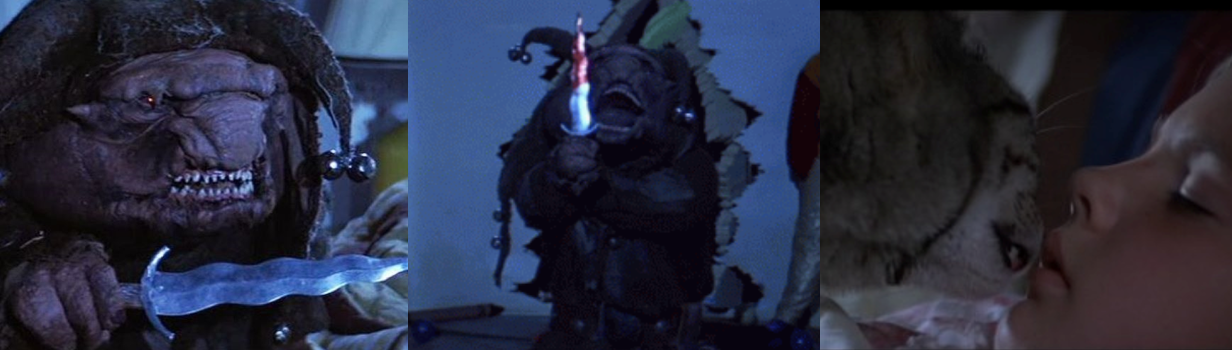
This brings us to the final segment, fittingly titled “General”; an excised prologue would’ve shed a bit more light into exactly why our kitty protagonist has been seeing visions of a young girl but, as is, the film presents the idea that Amanda (or, at least, some disembodied spirit taking her form) is in mortal danger and General is compelled to journey to Wilmington, North Carolina in order to keep her safe. Amanda is overjoyed to discover the cat, gifting him his name and insisting that her family adopt him; however, while her father, Hugh (James Naughton), is perfectly happy with this, her strict and cat-hating mother Sally Ann (Clark) doesn’t want the cat around, much less sleeping in Amanda’s room. Sally Ann’s animosity towards the cat is only exacerbated when they find Amanda’s pet parakeet, Polly, mauled to death following a late-night struggle, and insists that the cat is to blame despite Amanda’s claims that the bird was killed by a “monster” that lives in her bedroom walls. While Amanda is at school, Sally Ann lures General into a box and takes him to an animal shelter to be put down but, thankfully, the wily cat is able to escape and race back to Amanda’s aid right as a vicious little troll tries to suck the breath from her body! What follows is a battle between the cat and the little critter that is both amusing and horrifying; the troll is a disgusting, slimy, horrifying little ghoul in a jester’s hat who wields a pint-sized dagger that he uses to wound General’s shoulder. However, General is able to block the troll’s escape and send it flying into Amanda’s box fan, shredding it to bloody ribbons, much to Hugh and Sally Ann’s stunned shock. Finally, after overcoming many hardships and a long journey, General is gifted a large fish and is allowed to sleep on Amanda’s bed, though the film can’t resist teasing that Sally Ann’s fears about the cat’s malevolent intentions are true.

The Nitty-Gritty:
I like to think that there’s a lot of appeal in Cat’s Eye; not only does an adorable little kitty take centre stage as the primary protagonist and framing device, but the film tackles a variety of all-too-relatable horrors in a relatively grounded format. Anyone who’s been a lifetime smoker will know how hard the habit is to quit, and how self-destructive it can be weaning yourself off those cancer sticks; Morrison is almost immediately stressed at being denied his nicotine fix and his mental stability is only further frayed by the very real danger posed by Donatti and Quitter’s, Inc. If you’re anything like me, you’d absolutely crash and burn if forced to shuffle around a narrow ledge like Norris is; heights really aren’t my thing at all and the film does a great job of showing Norris constantly on the edge (pun intended…) of cracking and just plummeting to the street below. Finally, what child hasn’t been afraid of the monster under the bed or in the wardrobe? The decision to frame some of “General” from the troll’s perspective really adds to the sense of dread surrounding the creature and this segment always freaked me out the most as a child since the troll was such a horrifying little thing and, even now, I hesitate to dangle my feet out of the bed in case some nasty little critter like that is lurking in the dark.

Cat’s Eye‘s focus on relatable horrors and phobias makes it an intense watch at times.

Cat’s Eye utilises a very tense, haunting, and ominous score courtesy of Alan Silvestri that never fails to send a chill down my spine when some of the more nightmare-inducing sequences are happening. There’s a constant sense of dread surrounding Morrison, who jumps at every shadow and feels as though Donatti’s eyes are always on him; when at a work function, the stress, fear, and desire to smoke all become too much for him and he suffers from a horrifying (and amusing) hallucination in which everyone present (even the children and canapés!) are smoking, demonic pictures are glaring at him, and Donatti himself is tormenting him with a rendition of The Police’s “Every Breath You Take (I’ll Be Watching You)”. This surreal scene always stuck with me for how ominous it is and it really helps to sell the panic and strain Morrison is under; for him, it’s nothing compared to the realisation that he screwed up and his wife has to pay the price for that, but he ends the segment happy to be free from his addiction and even grateful for Donatti’s extreme measures since they’ve benefitted his family. That final gut-punch of seeing that severed finger, though, never fails to send a shiver running through me and is an effective way of reminding Morrison (and the audience) that his nightmare may never end. Norris is put through the wringer as well; barely able to keep his balance and with next to no handholds on offer, he’s constantly teetering on the precipice of death and it’s only through sheer force of will that he’s able to overcome Cressner’s obstacles (and such inconveniences as a massive neon sign) to complete his monumental task. As gruelling as the horror of this task is, though, “The Ledge” delivers its own gut-punch when Cressner spitefully kicks over a bag and his wife’s head comes rolling out! Hays’s horrified scream of “Jesus!” really sells the impact of this moment on the character and it makes Cressner’s fitting demise all the more cathartic as he’s unable to beg or buy his way out of Norris’s uncharacteristic wrath and ultimately pays for his abusive and sadistic ways.

The malicious little troll is the stuff of nightmares, but luckily the kitty is here to save the day!

Of course, the true star of Cat’s Eye is General himself. A resourceful and adaptable little kitty, General finds food where he can and crosses vast distances by hitching rides and stumbling into the lives of these other characters, all in his quest to get to Amanda and defend her. General certainly endures a lot throughout his journey; he’s electrocuted, nearly gets run over, gets tripped over, and watches others suffer only to be met with hostility from Sally Ann when he finally finds the girl who’s guided him this whole time. Sally Ann’s antagonism towards him seems to be based on a number of factors: one is she’s just a strict, overbearing mother who doesn’t want to give in to her daughter’s every demand; another is a concern for Polly’s welfare; and a third, as so inappropriately related by Hugh, is based on her mother’s wild belief that cats creep into the bedrooms of children to steal their breath as they sleep. Because she’s so pragmatic, Sally Ann has little time for Amanda’s flights of fancy about monsters living in her walls but she couldn’t be more wrong; the troll skitters over from the nearby woods and takes up residence in Amanda’s bedroom, coming and going through a hole in the wall and slaughtering Polly simply for the sadistic pleasure of it. Brought to life using a combination of forced perspectives and camera trickery, the troll is an unexpectedly horrific exclamation mark on what was a pretty intense horror/thriller up to that point. Seeing it shuffle about the bedroom, tittering away, and brandishing its little knife with glee may be an amusing sight but its glowing red eyes and mouthful of razor-sharp teeth make this frog-like monstrosity a pretty horrifying creature even with its little jester outfit. I really enjoy that we never learn what the troll is or where it came from; it’s simply this fantastical creature that intrudes on a normal, everyday family and tries to suck the breath from a little girl’s mouth and I recommend anyone who hesitates to let their cat or dog sleep with their children to just take a second to consider that one of these little fuckers could be lurking in the shadows!

The Summary:
I’ll be the first to admit that my opinion and appreciation for Cat’s Eye is deeply rooted in my nostalgia for the film; I watched it as an impressionable youth, when I was still struggling to get into horror, and was deeply affected by some of the more terrifying sequences and moments in the film. Morrison’s hallucination, the visual of that severed head bouncing across the floor, and just the idea of this malicious little troll living in the bedroom’s walls all had a lasting impression on me and I think the film does a great job of delivering on some surprisingly impactful, nightmarish concepts. Cat’s Eye also features some pretty terrific character actors that help boost its appeal; I’m not really a big James Woods fan but I enjoyed him as a tense, increasingly paranoid family man desperately trying to quit an addictive habit and cope with Donatti’s extremist ways, Robert Hays is always a treat to see and does a great job of portraying Norris’s absolute, abject terror when out on that ledge, and Drew Barrymore is suitably adorable as the little girl in peril. The real star are the cats used to bring General to life, of course, and it’s really enjoyable seeing him take centre stage for the finale and go paw-to-claw with that horrible little troll. While some of the shots and effects haven’t aged too well and the film’s maybe not quite up to the standards set by Creepshow, Cat’s Eye is a fun and memorable horror anthology that I fear has kind of been largely forgotten. However, I maintain that it’s well worth your time if you’re a fan of Stephen King and this genre, and might even leave more of a mark on young viewers than you might expect thanks to its exploration of timeless horrors and phobias.

My Rating:

Rating: 4 out of 5.

Great Stuff

Have you ever seen Cat’s Eye? Which of its segments was your favourite and what did you think to the filmmaking techniques used to bring their horrors to life? Did you enjoy seeing a cat take the lead role and which of the stories could you see expanded into their own feature? Were you creeped out by that little troll, and have you ever struggled to quit smoking? How would you rate Cat’s Eye against other horror anthologies? Are you a fan of anthologies and would you like to see more? Have you picked up my horror novella of the same name and, if so, could you please rate and review it? Whatever you think about Cat’s Eye, leave a comment by signing up or visiting my social media, and be sure to check back for more horror anthology shenanigans later in the year.

Movie Night [Sci-Fanuary]: The Lawnmower Man: Director’s Cut


January sees the celebration of two notable dates in science-fiction history, with January 2 christened “National Science Fiction Day” to coincide with the birth date of the world renowned sci-fi writer Isaac Asimov, and HAL 9000, the sophisticated artificial intelligence of Arthur C. Clarke’s seminal 2001: A Space Odyssey (1968), being created on 12 January. Accordingly, I have decided to spend every Sunday of January celebrating sci-fi in all its forms.


Released: 6 March 1992
Director: Brett Leonard
Distributor: New Line Cinema
Budget: $10 million
Stars: Jeff Fahey, Pierce Brosnan, Mark Bringelson, and Austin O’Brien

The Plot:
Intellectually challenged Job Smith (Fahey) works as a lawnmower man, he is regularly abused and mistreated by townsfolk. However, when Doctor Lawrence Angelo’s (Brosnan) research into using psychoactive drugs and virtual reality to improve the intelligence of chimps dramatically increase’s Job’s intelligence, the once childlike Job transforms into a hyper intelligent being whose sanity soon begins to suffer as a result.

The Background:
The Lawnmower Man began life as a short story by my favourite author, Stephen King. First published in 1975, “The Lawnmower Man” told the story of a strange lawnmower man who was actually a satyr of the Greek God, Pan, and driven to kill a client in His name by telekinetically controlling a lawnmower. Quite how this translated into a cautionary tale about the potential dangers of virtual reality is beyond me but, regardless, this concept of digital worlds and the potential danger of technology was a popular one in the realms of science-fiction and clearly had a strong influence on the writing and production of this very loose adaptation. King was so incensed at the changes made to his original story that he sued to have his name removed from the film’s title and marketing, and the film received mostly mixed reviews, with the film’s special effects being a noteworthy highlight. The Lawnmower Man’s $32.1 million domestic box office made the film a moderate success, which justified the release of a far worse sequel about four years later and the release of a much longer and more intricate “Director’s Cut” on home media that I’ll be looking at today.

The Review:
Like something out of a 1950s sci-fi film, The Lawnmower Man opens with a piece of blurb warning about the dangers of virtual reality; the potential of this technology (and computers in general), which was seen as so new and limitless at the time, to be the source of both enlightenment and corruption, were rife back in the day and these themes permeate throughout The Lawnmower Man. Immediately, we’re shown the scary potential of virtual reality as Dr. Angelo’s research has been used, in conjunction with various drugs and stimulants, to turn an ordinary chimp into a deadly engine for war…largely against his wishes.

The Director’s Cut features a much longer opening following the chimp’s escape from V.S.I.

This sequence, largely framed as a dream sequence in the theatrical cut, is expanded upon significantly here in the Director’s Cut as we follow the chimp as he uses his increased intelligence to escape from captivity, acquire a gun, and shoot his way out of the Virtual Space Industries (V.S.I.) facility (which is under the administration of the mysterious and malevolent governmental body known as “The Shop”, a semi-recurring agency in King’s works). In the theatrical cut, the chimp is killed curing the escape but, here, he makes it all the way to the nearby town thanks to the guidance of his V.R. headset; it’s while seeking sanctuary that the chimp meets Job, the titular simple-minded lawnmower man who mistakes him for the comic book superhero “Cyboman”. This introduces us to Job a lot sooner than in the theatrical cut, showcases both his kind, naïve nature and his childlike demeanour, and recontextualises the introduction of his father-figure,  Father Francis McKeen (Jeremy Slate), who is directly responsible for the Shop’s mercenaries finding and killing the chimp, which leaves Job distraught and Angelo incensed.

Angelo sees in Job the chance to use his research for something other than war.

A pacifist by nature, Angelo is frustrated by the Shop’s constant interference and insistence of twisting his research into a tool for war; he believes in the potential of virtual reality to improve the minds of men towards a higher calling, one far greater than conflict and death. Excited at how far the chimp came in its cognitive development and discouraged at his death, Angelo is driven to distraction by the potential of his research to help countless people just like Job. Even after taking a hiatus from work, Angelo refuses to focus on anything other than his work, which causes his relationship with his wife, Caroline Angelo (Colleen Coffey), to suffer. In the theatrical cut, she out-right leaves him part-way through the film but, here she acts far more aloof and instead goes out on the town with her friends, leaving Angelo in the basement with his work, his audio journal, and a bottle of Scotch.

Virtual reality transforms Job from a simpleton into a confident savant.

Angelo sees vast potential in Job to realise the full potential of virtual reality; skipping over the V.S.I. “aggression therapy” and concentrating purely on virtual reality and stimulating concoctions, he convinces Job to agree to a series of sessions where, over time, his mental capacity is dramatically increased. Beginning as a simple, child-like man who man in the town take advantage of (including Father McKeen, who regularly beats, berates, and mistreats Job) with little understanding about personal hygiene or reasoning, Job is a hardworking lawnmower man with a natural gift for fixing mechanical things but, thanks to Angelo’s experiments, he becomes an excitable and incredibly capable individual. He is soon able to surpass his young friend, Peter Parkette (O’Brien), at Angelo’s V.R. games, outgrows comic books, and seeks to feed his growing intellect with knowledge and input of all sorts, which transforms his mind and body into a far more competent and capable form.

While some treat Job terribly, others are incredibly loving and supportive towards him.

While Job runs afoul of the local town bully, the aggressive Jake Simpson (John Laughlin) and is regularly abused by McKeen for the smallest transgressions, Job actually has a couple of close friends who genuinely care about his well-being. Angelo likes him, for a start, and then there’s Peter, with whom Job shares a love of comic books and videogames. He’s also treated like a surrogate son by McKeen’s brother, Terry (Geoffrey Lewis), a local handyman and groundskeeper who employs Job and is one swig of booze away from becoming a full-blown alcoholic. In a nice twist, even as Job’s changes begin to negatively affect and overwhelm him, he never forgets those who have been kind to him and actively seeks out to punish those who have wronged him and others when he begins to develop awesome powers.

The malevolent Shop pay for their desire to exploit Job’s abilities.

The core of the film is Job’s descent under the weight of his newfound abilities but this only really comes about because of the intervention of Angelo’s supervisor at V.S.I., Sebastian Timms (Bringelson); although Timms begins the film as a straight-laced, corporate ass-kisser who, unlike Angelo, doesn’t have a problem with bowing to the whims of the Shop, he soon becomes a real cypher and sends the plot spiralling into destruction and tragedy. Eager to impress the authoritative Director (Dean Norris), Timms swaps out Angelo’s formula for the original “Project 5” samples so that they can see what the effect will be on a human being. The result is unprecedented to all, but especially Angelo, who comes to realise, with mounting horror, that Job has developed awesome, unstable abilities and suffered a psychotic break that devastates V.S.I.’s employees and leaves Timms to a truly horrific fate.

The Nitty-Gritty:
I’ve always been a fan of The Lawnmower Man and I was excited to watch the extended Director’s Cut when I bought the DVD. Unfortunately, though, much of the additional material kind of bogs the film down, especially the extended sequence with the chimp which only bloats the opening. I was surprised to see the natural of Angelo and Caroline’s relationship issues change but there were some nice new additions, too, such as Angelo having more interactions with Peter’s mother, Carla (Rosalee Mayeux), him asking Father McKeen for permission to take Job away from his duties at the church and with Terry to run his V.R. experiments, and some slightly longer scenes at V.S.I. showing Angelo trying to calm Job’s growing thirst for knowledge and input and Job experimenting with the limits of his powers to cause lesions to form on his skin. Another significant addition is Job using his psychic powers to manipulate Caroline into conflict against the Shop’s agents, thus causing her death, something which is entirely absent in the theatrical cut and goes a long way to show just how far gone Job is at that point.

Job’s new abilities allow him to wreck terrible revenge on those who have wronged him.

While The Lawnmower Man is only partially based on King’s original story, some of his traditional tropes still show up in full force; thankfully, there are no writers here but a couple of abusive, aggressive assholes show up in full force. There’s Jake, who I mentioned before, who routinely mocks and mistreats Job for his childlike demeanour and is angered into a fury when local hardbody Marnie Burke (Jenny Wright) takes a shine to Job after he begins to show more confidence and physical appeal. There’s also Peter’s father, Harold (Ray Lykins), who regularly yells at and beats his wife and child. Both of these reprehensible individuals fall victim to Job’s wrath when he begins to exact his revenge upon those who have wronged him; it’s not entirely clear what Job does to Jake (though it seems to be implied that he made Jake a simpleton like he (as in Job) used to be) but he rips Harold to shreds with his lawnmower and daunting psychic powers in perhaps the only part of the film that is similar to the original story.

As Job’s intelligence increases, so does his mania and his mental abilities.

The Project 5 formulas are noted several times by Angelo to heighten a subject’s aggression, but they have an entirely unexpected additional effect on Jon; he gets splitting headaches and begins to pick up on the thoughts of those around him before developing telekinesis. His mind absorbs information and input “like a clean, hungry sponge”, allowing him to surpass Angelo’s intelligence at a rate that leaves Angelo speechless in fear. As these changes begin to take hold, Job suffers a serious of worrying seizures and struggles to adapt to his newfound abilities but soon suffers a psychotic break and comes to see himself as accessing powers and abilities lost to mankind generations ago; all but forcing Angelo to continue his experiments, Job begins to grow more and more unstable, turning to violence and hurting Marnie, reducing her to a gibbering wreck, as he begins to lose control of his abilities and sanity.

As his powers grow in cyberspace, Job is able to influence the real world.

Impressed with a demonstration of Job’s abilities, the Director orders him to be brought in to the Shop for further testing and study; angered at Timms’ betrayal and scared half to death at Job’s increasing instability and growing God complex, Angelo is unable to protect Job from the Shop’s mercenaries, which sees him projecting a digital version of himself into the real world and reduced them to pixelated atoms! Job’s wrath is only increased when an errant shot leaves Terry dead and, having dispatched all of V.S.I.’s security with a swarm of pixelated bees, he enters the facility unimpeded to put his insane plan into motion.

Job transforms himself into Cyber Christ, a being of pure digital energy!

Having come to regard himself as the bridge between reality and virtual reality, Job plans to upload his very consciousness into the virtual world, becoming a “Cyber Christ” in the process, and spread his influence across the entire world. Although Angelo believes all of this to be a psychotic delusion, Job is able to complete his plan, transforming himself into a being of pure energy and Angelo is forced to try, one last time, to appeal to the last remnants of Job’s humanity in cyberspace. Having trapped Job behind a computer virus, and threatening him with death from bombs he placed around the facility, Angelo is ultimately no match for Job’s awesome powers but, when he realises that Peter and Carla are also in danger, Job allows Angelo to leave before they all die in the explosion.

Fahey is fantastic in the film, masterfully portraying Job’s descent into psychotic mania.

Although it appears as though Job perished in the blast, he is finally able to crack Angelo’s lock and escapes at the very last minute, with the final shot of the film being his “birth cry” as very telephone around the world rings in union, ending the film on a semi-ambiguous note that, sadly, the sequel dropped the ball on following up on. Still, The Lawnmower Man continues to impress me; its effects and realisation of virtual reality and cyberspace may be wildly outdated and based in pure fantasy but I think they hold up pretty well and are indicative of the technology and fears/speculation of the time. What also bolsters the film, for me, are some captivating performances from both Brosnan and Fahey; beginning as a wise mentor whose admiration of Job’s progress soon turns to fear for his sanity, Angelo is an admirable idealist whose wishes to use V.R. for the betterment of mankind result only in destruction. Similarly, Fahey does a fantastic job portraying Job’s childlike innocence, his pain and confusion at his growing psychic powers, his thirst for knowledge, and his descent into both stoic, unnerving menace and aggressive, unstable insanity.

An under-rated sci-fi film that explores a fantastically horrific side of V.R.

Fahey delivers some truly awesome and memorable lines here, such as his gibbering, terrifying statement of “I saw God! I touched God!”, his later stoic declaration of him becoming “Cyber Christ”, and his eventual declaration when he has fulfilled this objective of “I am God here!” (not to discount Brosnan’s moving whisper of “”Oh, dear God…” when he realises how far off the deep end Job has gone), all of which tie into the additional themes regarding faith and religion. Such notions, which originally were used to keep Job in check and under threat of reprisal for his transgressions, quickly become redundant as Job begins to experiment with his abilities; free of all fear and boundaries, he sets Father McKeen ablaze, easily manipulates the minds of others, and soon transforms from a meek, mentally challenged man into a monstrous being both in and out of virtual reality.

The Summary:
I don’t see The Lawnmower Man talked about enough when the subject of sci-fi films comes up. Sure, it’s maybe not aged too well and is absolutely nothing like the story it’s based on but so what? Total Recall (Verhoeven, 1990) is nothing like the short story it’s based on and that didn’t hurt it; obviously, it’s not a fair comparison and Total Recall  is a much better film but my point is that debates about fidelity to the source material are often meaningless when the result is an enjoyable piece of media. By gearing the story into a cautionary tale regarding the unknown dangers and potential of technology ad virtual reality, The Lawnmower Man presents a truly unique twist on the concept of V.R. as a gateway into the untapped potential of the human mind. The effects are still pretty impressive for the time; it helps that the V.R. sequences are all entirely computer-generated rather than splicing humans into cyberspace and, for me, they hold up pretty well and tie into the overall plot of Job transforming into this digital tyrant. Some solid performances only bolster the film’s appeal for me and, while the Director’s Cut actually causes the runtime to drag a bit more compared to some others, I can never get enough of a good thing. For having a truly interesting premise and execution, some stellar performances by Brosnan and Fahey, and some chilling sequences involving Job’s wrath, The Lawnmower Man is an unfairly under-rated gem of a science-fiction romp and I highly recommend it to fans of the genre who are looking for something a little different.

My Rating:

Rating: 4 out of 5.

Great Stuff

Have you ever seen The Lawnmower Man? If so, what did you think to it and do you enjoy this longer cut of the film? What did you think to the film’s premise and the performances, particularly Brosnan and Fahey? Did you enjoy the film’s depiction of virtual reality and cyberspace or do you feel it’s a little too dated? Have you ever read the original story and, if so, would you have preferred that the film was closer to the source material? What is your favourite Stephen King adaptation and how are you celebrating National Science-Fiction Day today? Whatever your thoughts on The Lawnmower Man, or sci-fi in general, be sure to leave a comment below.

Talking Movies: It: Chapter Two

Talking Movies

It2Title.PNG

Released: September 2019
Director: Andy Muschietti
Distributor: Warner Brothers Pictures
Budget: $60 to 79 million
Stars: James McAvoy, Isaiah Mustafa, James Ransone, Jessica Chastain, Bill Hader, Jay Ryan, Andy Bean, and Bill Skarsgård

The Plot:
Twenty-seven years after facing and defeating Pennywise the Dancing Clown (Skarsgård), the Losers’ Club are called back to Derry to face the terror of It once again but, in order to overcome their greatest fears, they must first remember their past and rekindle their friendship.

The Background:
It: Chapter Two is, obviously the sequel (or second part) to the hugely-successful It (Muschietti, 2017), which retroactively retitled itself It: Chapter One just before the credits rolled. Given the length and structure of Stephen King’s original 1986 novel, it only made sense to split the story into two parts (which was all-but-inevitable when Chapter One raked in over $700 million against a $35 million budget), and everyone involved has clearly gone to great lengths to secure some big and talented names to help bolster Chapter Two even further.

The Review:
Chapter Two picks up twenty-seven years after the conclusion of Chapter One; a grown-up Mike Hanlon (Mustafa), who has stayed in Derry the entire time and become somewhat obsessed with watching for signs of Pennywise and haunted by his memories of the first movie, is forced to call his old friends up when It awakens and begins not only abducting, dismembering, and eating children but also calls out to the Losers to settle their score.

It2Losers
It: Chapter Two certainly excels with its casting.

Unfortunately for Mike, the Losers are all grown-up, successful adults with no memories of Derry, Pennywise, or their friendship; Bill (McAvoy) is a successful writer who overcame his stutter in favour of struggling with writing good endings to his books, Beverley (Chastain) has become a successful fashion designer who is trapped in an abusive marriage, Ben (Ryan) is now a fit and healthy architect, Eddie (Ransone) works as a risk assessor, has traded a fat mother for a fat wife, and fell back into his dependence on medicines and his inhaler, Richie (Hader) has become a stand-up comedian, and Stan (Bean)…well, it’s not said in the film what he does, but he’s grown up too. However, Mike’s phone call is enough to reignite the Loser’s memories (for better and worse) and compel them to return to Derry in record time to get caught up and piece together their memories, and their friendship, to perform an ancient ritual that Mike believes will destroy Pennywise once and for all.

It2Horror
It: Chapter Two definitely ups the gore and horror.

As I may have mentioned in my review of Chapter One, It is, unquestionably, my favourite novel of all time; King builds his characters so well that I can’t help but feel for each of them and, as I have grown older, my connection to the themes of It (friendship, childhood, adulthood) has only grown stronger. While I enjoyed Stephen King’s It (Wallace, 199) and Tim Curry’s rampant portrayal of Pennywise, I always felt like It needed another shake of the stick, one free form the restrictions of a made-for-television miniseries. While Chapter One altered some elements of King’s novel (changing the time period, adding new scares, altering some of the motivations and so forth), I didn’t really mind this and the movie didn’t disappoint in showcasing how malevolent and psychotic Pennywise can be.
It2Kids
The kids make a much welcome return thanks to flashbacks.

Chapter Two, however, faces the same problem as the 1990 miniseries (and one also present in the book) in that it must now live and die on the strength of the adult version of the Loser’s Club. Given that Chapter One pulled a lot of its presentation and inspiration from Stranger Things (Various, 2016 to present) and the fact that the kids were so good in their roles, this is a tall order but the cast of Chapter Two largely fulfils this by bringing in some great talent for the adult roles.

It2RichieEddie.PNG
Richie and Eddie’s banter keeps the film lively and energetic.

Hader and Ransone especially stand out; their foul-mouthed banter and close friendship adds a lot of heart and levity to the film, while McAvoy and Chastain bring the emotional weight and acting nuance. Mustafa portrays Mike far from the wise mentor figure he assumed in the 1990 miniseries and instead pulls more from the fatigued, terrified obsession that Mike struggles with in the book. Unfortunately, there once again isn’t too much for Ben or Stan to do this time around; Ryan is serviceable in the role but, where child-Ben (Jeremy Ray Taylor) assumed Mike’s role of historian and exposition in Chapter One, adult-Ben is mainly there as a mediator and to rediscover his love for Beverley. Once again, Skarsgård steals the show as Pennywise; unlike Curry’s madcap performance, Skarsgård is a creepy, legitimately terrifying force who loves to mess with Its prey before It feeds. Chapter Two feeds (pun intended) Pennywise a far greater body count as he chomps down on adults and children alike, literally biting the heads of Its prey in a shockingly gruesome display. Skarsgård also gets a one-up on Curry in that the finale thankfully does not lose his visage or presence, allowing the final confrontation between Pennywise and the Losers to be far more entertaining while still staying true to the source material.

It2Pennywise
Skarsgård remains a truly creepy Pennywise. 

Despite upping the gore and creepy visuals, the bulk of Chapter Two’s scares again rely on jump scares, which is fine as they’re generally well done and Pennywise is a very charismatic presence, but the film does struggle with its pacing at bit. For example, Mike rings the Losers and they all arrive literally moments later with little issue. This does happen in the book and the miniseries but it stuck out to me as a little rushed as the film then slows down a bit so we can get truncated snippets of their lives. A couple of examples of this are Bev making very short work of her husband when he attacks her, with little to none of the catharsis given in the book to this moment, and Ben summing up his weight loss in one line, which is very disappointing considering how hard John Ritter fought to include an abridged version of Ben’s weight-loss story in the miniseries. However, I think some of these pacing issues will be absolved if you watch both parts back-to-back as one big movie (or, even better, they release a supercut version), that way you won’t lose any momentum as you’ll be familiar with all the characters. Also, when the film includes the original child actors, it makes the wise decision to include new scenes, storylines, and scares that pull more material from the book so it never really feels like its treading over the same ground or telling us things we already know.

The Nitty-Gritty:
Fundamentally, Chapter Two follows many of the same beats as the book and the miniseries but there are some interesting wrinkles; one of the biggest is the idea that Richie is actually in love with Eddie and has been harbouring an unspoken homosexual love for him this entire time, which I never even thought of or picked up on when I read the book. Another is Mike managing to escape the attack by the aged Henry Bowers (Teach Grant) with only a flesh wound, allowing him to not only participate in the final battle but finish up his character arc when his desperate belief in the Ritual of Chüd faisl to destroy Pennywise and Mike is revealed to be severely traumatised by his childhood nightmare. A big spoiler for anyone who hasn’t read the book is that Stan never makes it back to Derry, opting to slit his wrists instead. In the book and miniseries, he leaves a chilling message scrawled on his bathroom tiles (simply the word “It”), which is a genuinely spine-tingling moment; here, it’s a brief blink-and-you’ll-miss-it inclusion and, rather than killing himself because he was unable to face his fears and knew that pennywise was due to reproduce, Stan instead kills himself so that his fear won’t hold back the Losers and will galvanise them. This is given a heroic air in the film, which helps keep Stan a part of the group, but it’s never really presented as a motivation for the Losers sticking around to face Pennywise again.

Eddie also ends up dead in the finale; honestly, I thought that Mike was going to die (either in his place or as well), given his presence in the end, but Mike survives and Eddie gets impaled by one of It’s Spider-legs. This comes after Eddie has overcome Bowers and found the strength to strike what appears to be a fatal blow to the Spider and, before he dies, Eddie allows the Losers to realise that they can defeat It by disowning their fear of It and reducing It to a weak form, allowing Eddie to die a hero. This is a small issue, however; the new It movies seem to favour an oversimplification of It’s desire to inspire fear in Its prey. In the book, It likes Its prey to be scared because it improves the taste of the flesh and It delights in tormenting Its victims but, in these films, the Losers are able to defeat It by standing up to It and rejecting their fear of It, reducing It to little more than a blubbing baby. This was a factor in the book, miniseries, and Chapter One but, generally, Pennywise is enraged at the Losers hurting It and making It experience fear, rather than being powered by fear. It’s not a massive issue, as it’s a perfectly acceptable adaptation of Pennywise, but, as I say, it is a bit simplified. Similarly, Chapter Two seems to prefer the idea that It is actually an extraterrestrial lifeform that crashed to ancient Derry on a meteor, rather than an unspeakable eldritch horror; It’s true from is still living light but, rather than a Lovecraftian mass of orange lights that defy life, Chapter Two realises this form as three spinning orbs. Again, a fine way to show it and to hint at there being more to It, but a bit of an oversimplification.

Finally, one thing I feel would have helped with the film’s pacing is just omitting Henry Bowers completely. Henry (Nicholas Hamilton) took an unquestionably fatal tumble in Chapter One and his inclusion, while true enough to the book, is diluted so much that it would have been probably a lot better and easier to say Henry died and have It take the form of a zombified Bowers to attack Eddie. The time spent with Henry, brief though it may be, could then have been put into showing the adult Losers’ lives a bit more prior to returning to Derry. A big plot point for Bill is that everyone loves his books but hates the endings he writes; this is not-so-subtly based on real-life criticisms of a lot of King’s work, especially It. I, however, was always happy with the idea that It is best translated as a giant Spider; it worked as a metaphor and the ending always hit me hard as the Losers sacrifice so much to end Pennywsie’s threat and it’s a real poignant reflection of what it’s like to grow up and forget (or grow apart from) the friends that were once so important to you. Chapter Two, however, actually improved on the ending in a way that I found heart-warming in that, unlike in the book and miniseries, the Losers don’t lose their memories of each other after defeating Pennywise. Them losing Stan and Eddie and their memories after working so hard to remember everything always broke my heart so this really made me happy. Stephen King’s gratuitous cameo could have been shorter, though…like, he has a lot of lines and a lot of time was spent on indulging him.

It2Bunyan

The Summary:
While not as good as It: Chapter One, It: Chapter Two is still a solid horror movie; there’s plenty of creepy moments, gore, and a surprising amount of humour here that’s sure to appeal to fans of the first movie. Allowances have to be made for the characters we became attached to now being grown up and the cast does a great job stepping into the shoes of their younger counterparts; the cast is scarily fitting, which really helps to adjust to this narrative shift. While some of the plot points are a bit weaker and the ending may be disappointing to some, as a massive fan of the book I was very satisfied and just as touched by the ending, especially some of the tweaks they made that, in my opinion, actually improved it.

My Rating:

Rating: 4 out of 5.

Great Stuff

Talking Movies: It: Chapter One

Talking Movies
It

Twenty-seven years after the much-lauded (but equally criticised) miniseries by Tommy Lee Wallace and some thirty years after the publication of Stephen King’s original novel, director Andy Mushietti brings one of King’s most terrifying works (and my personal favourite book ever) to the big screen with the novel’s gruesome imagery and themes largely intact. Unlike the novel, It takes place at the back-end of the 1980s and revolves around the coming together of seven outsiders to face an unspeakable, shape-changing nightmare in their quaint little town. Bill Denbrough (Jaeden Lieberher), who suffers from an uncontrollable stutter, is absolutely devastated after his little brother, Georgie (Jackson Robert Scott), goes missing one rainy afternoon.

While Bill, blinded by grief and guilt, is determined prove that Georgie is still alive, Georgie has actually fallen prey to Pennywise the Dancing Clown (Bill Skarsgård), a sewer-dwelling maniacal shape-changing creature that feeds on children. With school out for the summer, Pennywise begins to haunt and terrorise several of the neighbourhood children, who are already struggling to avoid being targeted by local bully Henry Bowers (Nicholas Hamilton) and their own adolescent issues. While Bill regularly visits the Barrens and investigates the sewer outflow pipes alongside his friends Richie (Finn Wolfhard), Eddie (Jack Dylan Grazer), and Stan (Wyatt Oleff), they run into local new kid Ben (Jeremy Ray Taylor) and, while patching up the wounds he suffered at Bowers’ hands, join up with Beverly (Sophia Lillis). As the group bond as friends, they each recount their encounters with Pennywise, share stories of the history of their home town, and work to figure out how they can avoid ending up on missing posters

After a particularly apocalyptic rock fight against Bowers and his friends, they befriend Mike (Chosen Jacobs), the only black kid in town, and figure out that Pennywise appears to live beneath a dilapidated house. Journeying inside, they are attacked by Pennywise and realise that, together, they are able to wound and stand up to the creature. The remainder of the film deals with them overcoming their own individual fears and coming together as a group to not only solve the mystery surrounding Bill’s brother but also destroy an evil that has apparently existed for hundreds of years. Although primarily revolving around a horrific situation, the core themes of It are friendship and coming to terms with adolescence and the loss of innocence. Fittingly, the depiction of the child protagonists is staggeringly on point; the Losers Club (as they dub themselves) all seem to be close friends and their dialogue and interactions appear real and well-developed. However, due to the sheer amount of characters present in the narrative, some of them get less development time than others; Richie never encounters Pennywise by himself (which seems an odd omission given that the other six characters all get attacked by Pennywise separately before coming together), and Mike is largely absent and a lot of his characteristics are transplanted onto Ben (who also isn’t as prominent as he is in the book or miniseries). Despite this, the characters are all very likeable and layered characters, each dealing with their own problems and struggling to deal with the trials they face as children.

The real star of the show here is Bill Skarsgård. While Tim Curry put in a truly iconic performance in the original miniseries, playing the part of Pennywise with a manic glee that remains iconic to this day, Skarsgård opts for a far more intimidating, creepy take on the character. Pennywise taunts his prey, lulling them in with Its comedic appearance and mocking them as It seeks to bring their fear to breaking out and feast upon their flesh. While Pennywise is noticeably absent for sections of the film’s middle, the entire plot and motivations of the children revolve confronting It; this also serves to give Skarsgård’s appearances that much more impact and he really embodies the dark comedic menace of the creature. Right off the bat, It sets itself up to be much more “inspired by” King’s book than directly based upon it. As an adaptation, it retains many key scenes, themes, and characters from the book but places them within entirely new settings. Unlike The Dark Tower (Arcel, 2017), It has the runtime to properly flesh out the child protagonists and bring King’s story to the screen in a far more faithful way. It’s fair to say, though, that, much like the original miniseries, It is quite a departure from the book. The violence and general themes are present but a lot of the specifics are altered; Pennywise takes different forms than in the book and attacks the children in very different ways, and the idea that they can overcome It by not being afraid of It is far more pronounced here than it is in the book.

Perhaps the biggest departure is the fact that It revolves entirely on the narrative of the children; the book and miniseries detail how the children encounter It in the 1950s and then again as adults in the 1990s. All throughout the film’s marketing, no mention was made of inserting the adult narrative into the film or producing another movie to tell that story but it turns out this was a masterful strategy as, right before the end credits play, the film retitles itself as It: Chapter One, which should hopefully mean that a second chapter will follow to complete the story. This means that It is purely focused on developing and portraying the characters as children, establishing the world they inhabit and the rules of that world, as well as dipping its toe into the more metaphysical aspects of Pennywise. Is It the beginning of a new age of successful, profitable horror movies? The critical and commercial success seems to think so, though I was slightly disappointed to find that the film is more about the in-your-face, loud scares and less on haunting, spine-tingling scares, as I had hoped and suspected from the trailers (most disappointing of all was that the creepy soundtrack heard in the trailers was absent from the film). However, It doesn’t rely on random jump scares as much as you might think; the tension builds appropriately well and the payoff is suitably cathartic – Pennywise’s possession of the kids’ slide projector and attacks them in a large, monstrous form exemplifies this wonderfully. As an adaptation of one of King’s works, It fares a lot better than The Dark Tower and many other adaptations. Many liberties are taken with the source material but they all retain the essence of the text in a way that fits and feels natural, while still leaving plenty of unused material for the sequel. Some characters could’ve been given more screen time and a bit more spotlight but, overall, the film works extremely well as a coming of age story featuring a truly creepy and horrific villain.

My Rating:

Rating: 5 out of 5.

Fantastic

Recommended: Definitely, if only to finally see a really well done adaptation of a Stephen King story.
Best moment: Probably the first real showdown between the Losers and Pennywise in the house on Neibolt Street.
Worst moment: Despite the decent runtime and the well-developed characters, the lack of screen time for Mike and Ben was a bit of a miss-step for me.

Talking Movies: The Dark Tower

Talking Movies
DarkTower

Between 1982 and 2012, notable horror writer Stephen King produced a series of seven novels (and one spin-off) that made up what he referred to as his magnum opus. Over the years, numerous writers and directors have attempted to launch a film series base don King’s Dark Tower books, only to run into various issues at every turn. Finally, after nearly ten years in development hell, 2017 sees the release of Nikolaj Arcel’s adaptation of King’s work. The Dark Tower tells the story of a young boy named Jake Chambers (Tom Taylor), who suffers from regular nightmares and visions of a mysterious Dark Tower, a malevolent Man in Black (Matthew McConaughey), and a grizzled Gunslinger named Roland Deschain (Idris Elba). Jake’s dreams also involves the Man in Black and his henchmen, who wear false faces, strapping children to a device that draws their life-force out to attack the Dark Tower

Given that Jake is clearly struggling to cope with the loss of his father, his mother, Katheryn (Laurie Chambers), tries to help Jake by sending him to a psychiatrist (José Zúñiga), to no avail. However, when he suspects that two representatives of a mental institute are emissaries of the Man in Black, he runs away from home and tracks down a dilapidated house he saw in his dreams. Inside, he finds a control console that opens a doorway to another dimension, Mid-World, and, after being attacked by the house itself, he enters to find himself stranded in the vast alien desert from his nightmares. Eventually, he runs into Roland, who is on his own quest for revenge against the Man in Black after the sorcerer killed not only his entire people but also his father (Dennis Haysbert). After learning that Jake’s dreams can lead him to the Man in Black, Roland reluctantly allows Jake to tag along with him through the desolate remains of times and worlds long gone in order to get his revenge.

The first thing you really need to know about this film, if you’ve read the Dark Tower books, is that this is not a page-for-page adaptation of the series. It’s not even a direct adaptation of the first book; instead, the film draws influences from many of the different books and, if Arcel is to be believed, is actually a canonical sequel to the final book in the series. Therefore, if you were hoping to come into this to see the events of The Gunslinger (King, 1982) play out, you’ll be disappointed. To be fair, The Gunslinger is probably too short to be its own film, much less the first part in a seven film series. Additionally, Roland’s famous Ka-tet do not feature at all, although many events from the books in which they appear are represented: Roland is injured and poisoned after an attack and must get treatment on Jake’s world (“Keystone Earth”). There, he visits a gun shop and stocks up on bullets; he also briefly teaches Jake how to shoot like a Gunslinger and takes part in a shoot-out at the Dixie Pig, similar to The Song of Susannah (King, 2004).

Apparently, The Dark Tower is supposed to launch an ongoing television series, with the main characters all reprising their roles, and even a sequel that will involve more content from The Drawing of the Three (King, 1987). However, the film feels more like a stand-alone, condensed version of the books and it does not conclude on an obvious cliffhanger or with explicit sequel-bait. To veer into spoiler territory, Jake is apprehended by the Man in Black due to his incredibly powerful psychic powers and strapped into the chair from his nightmares. However, having had his true calling to protect the Dark Tower awoken by Jake’s influence, Roland blasts his way through the Dixie Pig and confronts the Man in Black, putting a bullet through his head. Roland then destroys the machine, and the base in which it was housed, and ends the Man in Black’s assault against the Dark Tower. After, he and Jake return to Mid-World together and the film ends with basically everything wrapped up: Jake has realised that he’s not crazy and achieved closure over the loss of his father and Roland has realised his revenge and rediscovered his calling. Although the theme throughout is that darkness will continually attempt to destroy the Dark Tower (I guess I should say at some point that this would result in horrific monsters entering the multiverse and destroying all life) and there are some hints towards a larger, looming evil (the Crimson King), watching the film you get the real sense that everyone was aiming to make only one movie.

Having read all of the books and only found maybe a third of them to be enjoyable, I actually really liked The Dark Tower. It drew the most interesting aspects from the books and paid homage to the larger world that King created (in addition to numerous references to his other stories) without being bogged down by some of the more convoluted and cringe-worthy moments from the books (such as King including himself as a character, the pointlessness of The Waste Lands (King, 1991), or the weirdness of Blaine the psychopathic train). The Dark Tower is Jake’s story; you follow him as the main character and Roland, while being the more enigmatic, bad-ass, and mysterious of the two, is really more of a side character until Jake ends up on Mid-World. Because of this, we only really learn about Roland’s past and the mechanics of King’s multiverse through Jake’s conversations with Roland, in which we are told just enough to know the stakes but not be overwhelmed by the complexities of King’s multi-layered worlds.

The downside to this is that we don’t get much exposition into the Man in Black. McConaughey plays the role with a nuanced relish, clearly revelling in being the personification of evil, and while kills without remorse and clearly desires the destruction of the Dark Tower and the prospect of ruling the darkness that would follow, we never find out what is exact motivations are except that he is pure evil. There is no mention of him serving the higher power of the Crimson King, no explanation regarding his henchmen, and no real tangible motivation behind any of the antagonists except that they’re clearly evil because they want to destroy the multiverse. The only reason this works in the film is due to the fact that The Dark Tower is disappointingly short; at a mere 95 minutes, the film moves at a brisk pace, emphasising action and fast-paced shoot-outs when it can. While it never feels rushed or suffers from jump cuts or even massive plot holes, it is disappointing that the film was not afforded a longer run time; I honestly feel that, if this is the only Dark Tower film to be made, they could have done the books (and the unique narrative of the film) more justice by affording it a two-and-a-half-hour runtime instead.

Fans of the books will probably be disappointed with The Dark Tower; unlike another films based on a long-running book series, The Dark Tower is not a straight-up adaptation of its source material. If it is to be the first in a film series or launch a multi-media franchise, it doesn’t appear to have done a great job of doing so. I feel as though, if there are more films made, this film will be looked at as being like The Matrix (Wachowski Brothers, 1999) in that it feels more like a stand-alone film that wasn’t meant to have a sequel. However, there is plenty of material to still draw from and plenty of potential in the ideas raised in the film to warrant at least two more movies; the disappointment comes from The Dark Tower’s inefficiency at setting these up (but, at the same time, the fact that it is not massively concerned with setting up future films makes it much easier to watch than, say, The Mummy (Kurtzman, 2017), which was criticised for being more concerned with setting up future films in the “Dark Universe” tan telling a good stand-alone story). In the end, though, I enjoyed The Dark Tower for what it was: a fantasy/action film with a compelling protagonist (Elba plays the grizzled, war-weary Roland to perfection, proving that race can have no baring on an actor’s ability to effectively portray a role), engaging set-pieces (Roland’s efficiency at dispatching his foes is unmatched; every shot is an instant kill, even when he’s poisoned to the point where he can barely stand), a charismatic antagonist (McConaughey lives his role, exuding a barely-contained hate and malice beneath an ice-cold exterior), and some extremely enjoyable allusions to other King works buried within the expansive war-torn dimension of Mid-World. It was very enjoyable while it lasted; my only real gripe is that it should’ve easily been a longer film. However, if you go into it expecting slavish fidelity to King’s magnum opus you will be disappointed, so I’d recommend putting your expectations for that aside and enjoying it as a stand-alone fantasy/action piece instead.

My Rating:

Rating: 3 out of 5.

Pretty Good

Recommended: Sure, I would say give it a watch. If you’re a die-hard Dark Tower fan though, expect to be a little disappointed.
Best moment: Roland’s battle against the Taheen that come to kidnap Jake is pretty great, with his proficiency and aim being top-notch despite his weakened condition,
Worst moment: The run-time; for a film with such potential and the expansive nature of King’s work, 95 minutes just doesn’t cut it.