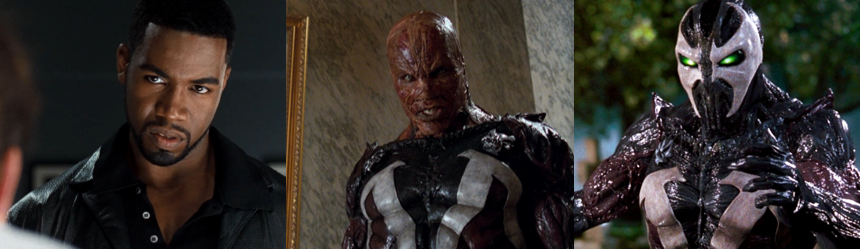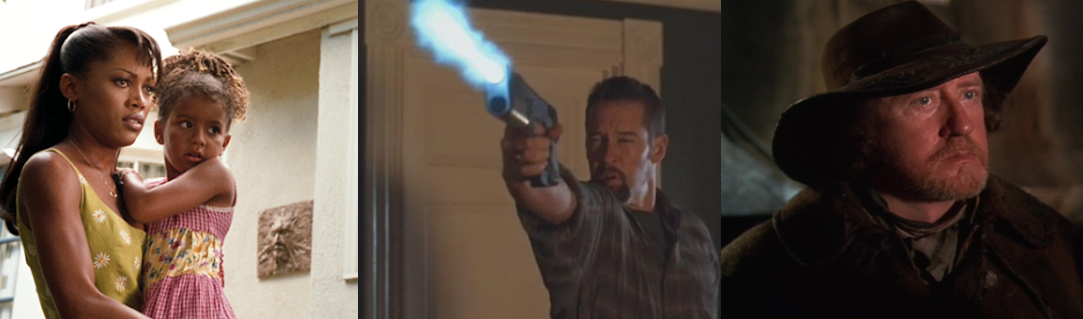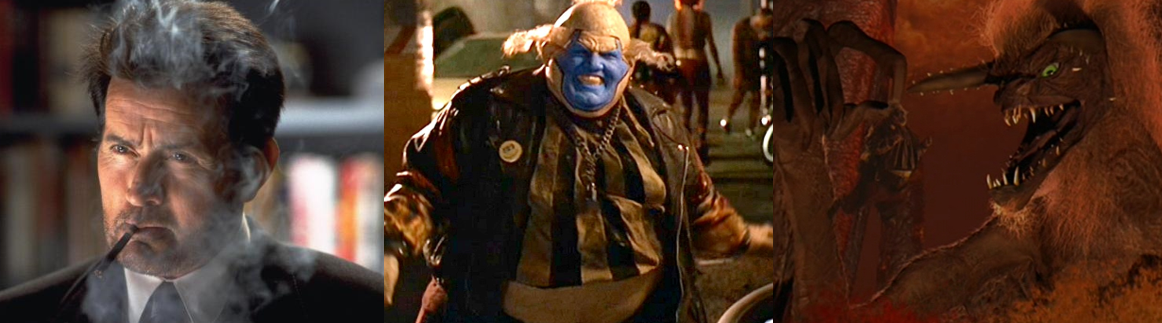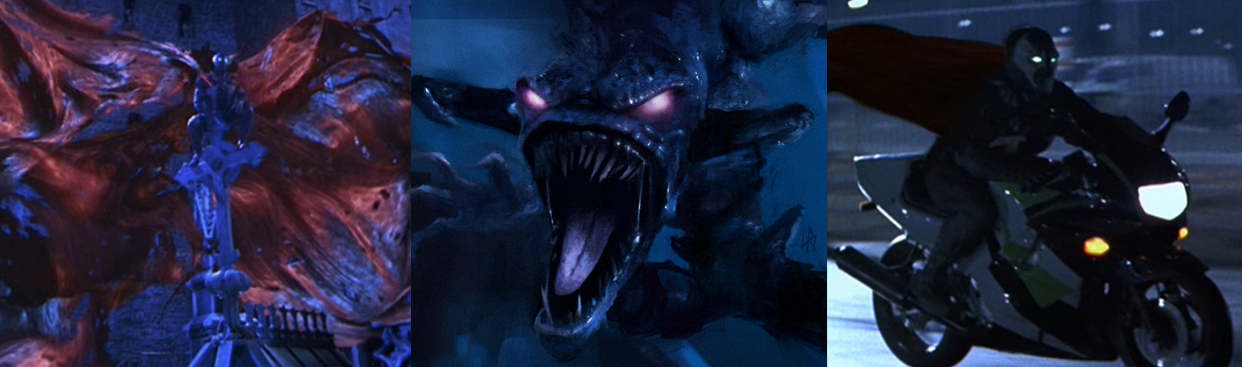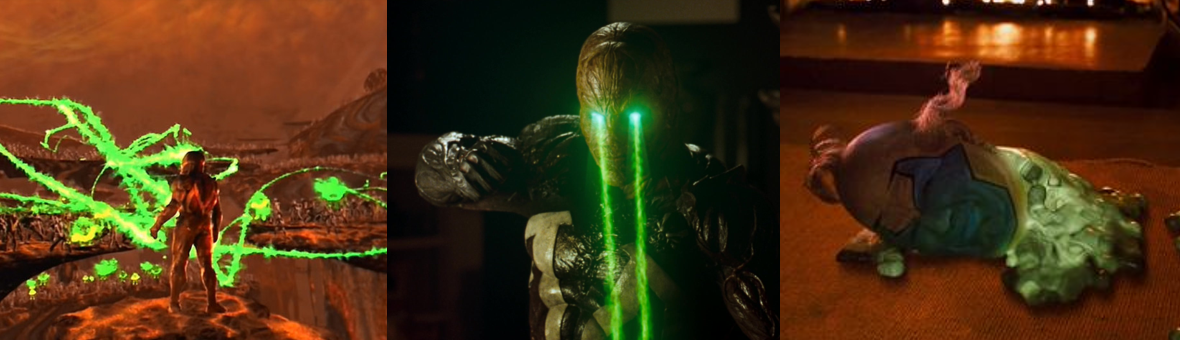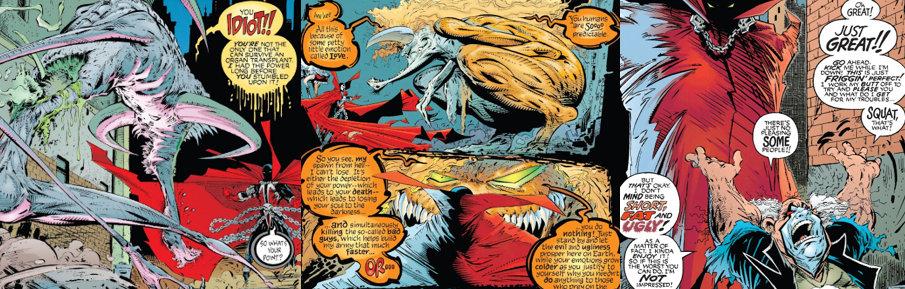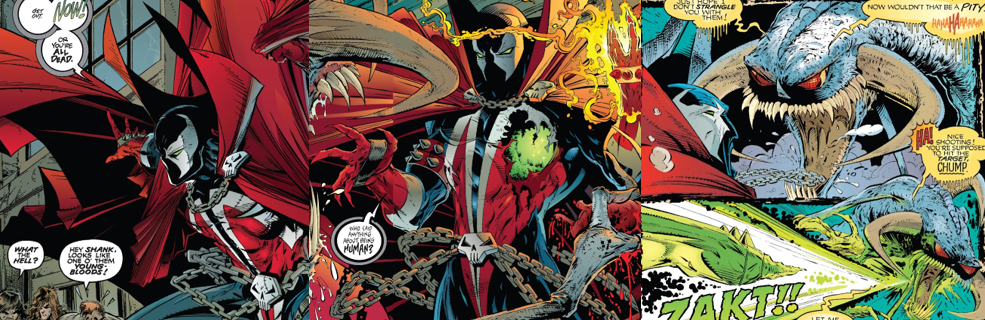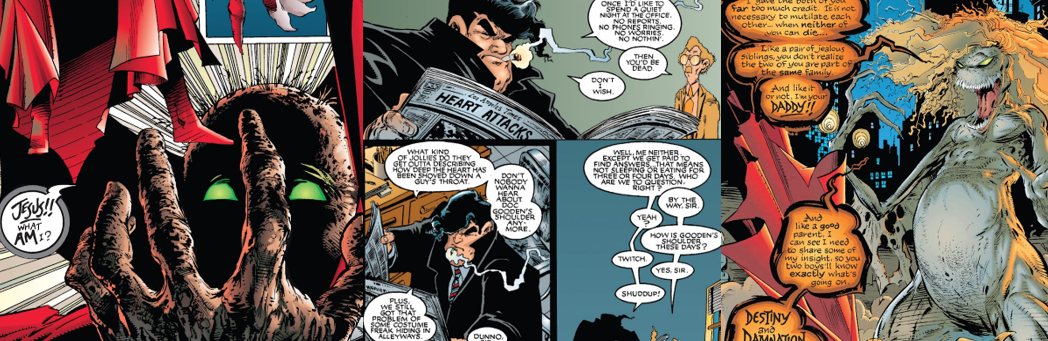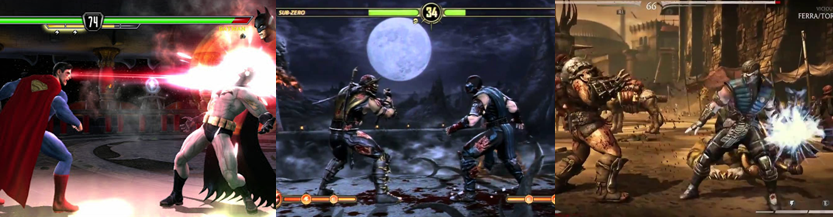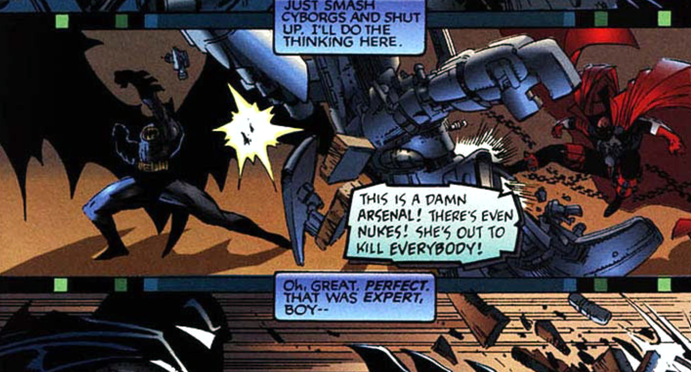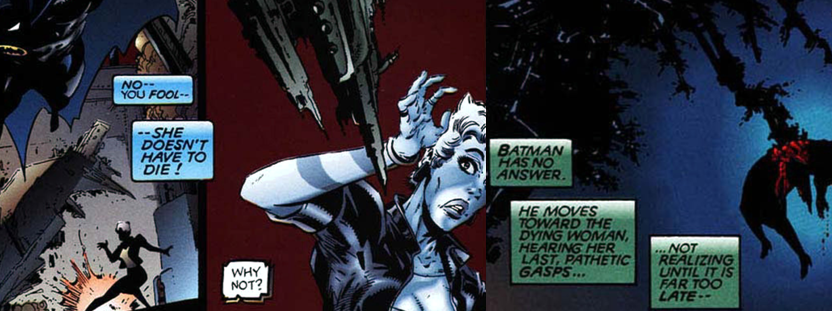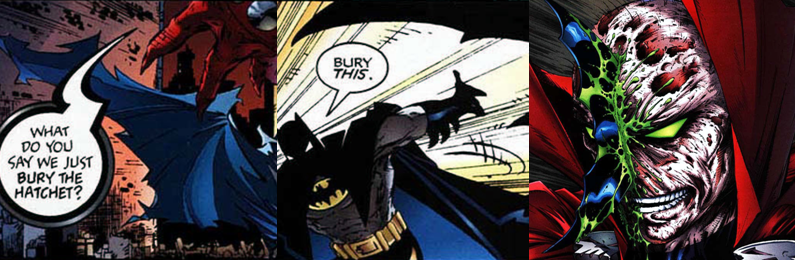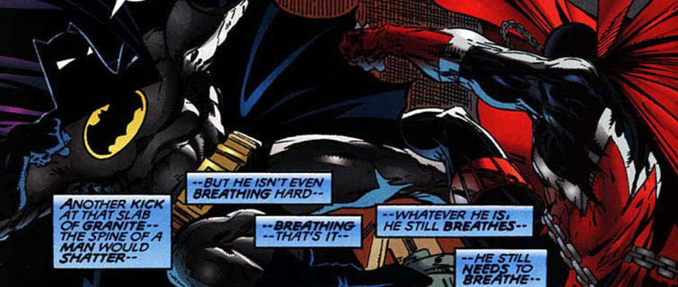
Game Corner: Spawn: Armageddon (PlayStation 2)

Released: 21 November 2003
Developer: Point of View
Also Available For: GameCube and Xbox

The Background:
After making his debut in the comic book industry with his work on Coyoteavid artist Todd McFarlane stood out from his peers by revitalising The Amazing Spider-Man with his signature art style. In time, McFarlane became dissatisfied with his lack of creative control at Marvel and established Image Comics alongside other Marvel creatives in 1992. Image was led by Al Simmons/Spawn, a hellborn anti-hero first dreamed up by McFarlane as a teenagerSpawn #1 was a record-setting hit and became the most successful creator-owned comic of all-time. This led to a widely panned live-action adaptation, a beloved animated series, numerous toys, and a handful of videogames. Spawn’s first videogame outing was Todd McFarlane’s Spawn: The Video Game (Ukiyotei, 1995) which set a precedent for his subsequent outings, which garnered mixed reviews across the board. Developers Point of View sought to deliver the definitive Spawn experience in 2003, though there’s sadly little information available online about the development of this game. I can tell you, however, that Spawn: Armageddon received mixed reviews that criticised the repetitive gameplay, though some have praised it as an enjoyable enough title.

The Plot:
When the demonic forces of Malebolgia invade New York City, signalling the onset of Armageddon, Lieutenant Colonel Al Simmons/Spawn turns his supernatural powers against the hordes of Heaven and Hell to defend humanity.

Gameplay and Power-Ups:
Spawn: Armageddon is a third-person action brawler that focuses on melee, gunplay, and magical attacks courtesy of Spawn’s finite “Necroplasm”. Unfortunately, rather than striking a balance between high intensity, action-packed combat and emphasising stylish combo attacks like the Devil May Cry series (Capcom/Ninja Theory, 2001 to present), Spawn: Armageddon limits the player to a handful of melee attacks, assorted regular and supernatural firearms, lacklustre demon powers, and aggravating platforming sections. Offering three difficulty levels (which alter the strength of your enemies) and favouring a mission-based structure, Spawn: Armageddon sees you cutting down demon entities with Spawn’s “Agony Axe” (formed from his sentient cape) with Circle, jumping, double jumping, and gliding short distances with his tattered cape with X, and awkwardly using his chains (fired from his crotch!) to grapple with L1. Players fire Spawn’s currently equipped firearm with Square and unleash his Hell Powers with Triangle, using the directional pad to switch between them. You can (and should) hold R1 to target enemies, though there doesn’t seem to be a way to cycle your targets and you only target the closest one, can hit an axe slam by pressing Circle in mid-air, and open doors with X. Weapons are found as you explore the restrictive, bland environments and each needs ammo. In lieu of your guns, you can attack with your crotch chains, though defeated enemies and smashed crates will yield ammo to keep you topped up.
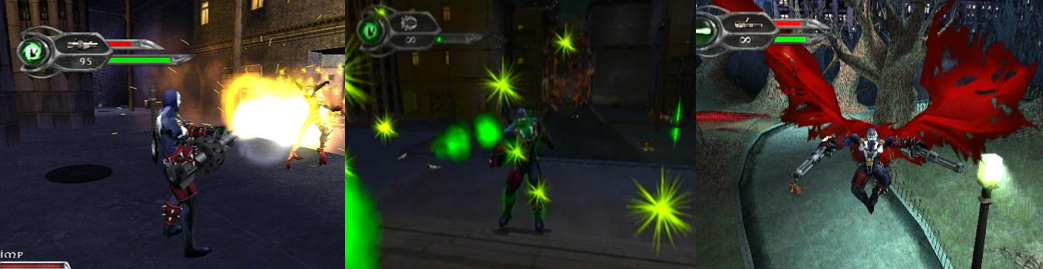
Switch your weapons depending on who you’re facing and battle the game’s awful camera.

Enemies and crates also drop coloured “Souls” you must collect. Green Souls replenish your Necroplasm, allowing you to use Spawn’s Hell Powers; Red Souls replenish your health; and you trade Blue Souls for upgrades between missions. From here, you can increase Spawn’s maximum health and ammo and the damage output of your guns, though each upgrade costs progressively more so I’d focus on increasing your health since there are no mid-mission checkpoints. Spawn has a shotgun for close-quarters combat, dual pistols, a sub-machine gun, a mini-gun, the Brimstone Cannon, a missile launcher, and the Inferno Cannon, with the latter requiring a charge and larger weapons (such as the mini-gun) weighing you down. Spawn can toss Necroplasm fireballs, fire an energy beam, erect a shield, and use “bullet time” to pummel enemies for as long as his meter lasts. Some enemies are weaker to certain attacks than others; they’ll shrug off your Necroplasm attacks and your explosives do minimal damage, so you must whittle them down with bullets. Like many elements, this isn’t as deep or as developed as it could be. It would’ve been interesting to see demons weak to bullets and angels weak to your Hell Powers, for example. Spawn’s axe combos aren’t very useful or complex, either, and I often forgot I had it. While you’ll largely be jumping or gliding over gaps or grappling about, Spawn can also wall jump. Unfortunately, the finnicky camera and Spawn’s clunky-ass controls make these platforming tricks frustrating. Spawn cannot block and has few options to avoid damage. He can be easily stun-locked and ragdolled by projectiles, making combat aggravating. It doesn’t help that Spawn: Armageddon throws waves of enemies at you, which just serves to expose how shallow and unfulfilling the combat is.
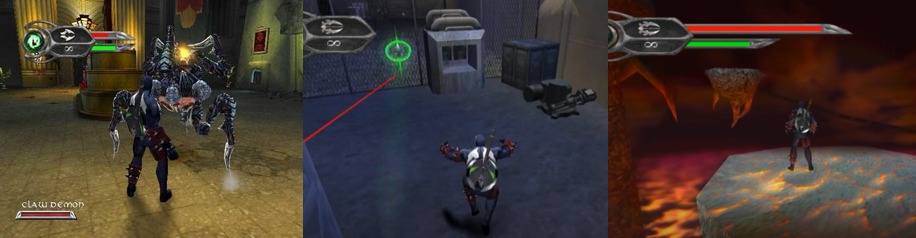
Tedious combat is awkwardly married with clunky platforming, delivering a lacklustre experience.

Spawn is often confined by Hellfire barriers or mist dispel or destroy skeletal Guardians once all nearby enemies are dispatched. Each mission has a specific objective you can review from the pause menu, but these mainly focus on destroying all enemies, activating switches, or spawning (pun intended) the end goal. In between awkwardly jumping up walls or between moving platforms, you’ll often destroy objects like junction boxes, generators, and power nodes for Heaven’s ominous space station. This opens doors, lowers barriers, or re-routes power to new areas, though it’s often unclear where you need to go or what you need to do as there is no map system and no onscreen indication of your objectives or when you’ve met them (beyond the end goal appearing). This was especially aggravating in the newspaper factory, where I activated a bunch of switches and was left clueless how to reach a higher platform. In the end, getting Spawn on top of a printing press and forcing the double jump and glide to barely get him close enough to ledge grab was the key. I was equally frustrated when disabling auto turrets, attacking gargoyles to raise bridges in Hell, and following blood trails in the subway since some gaps were very difficult to clear thanks to Spawn’s useless glide and grapple. When inside buildings, the game becomes uncomfortably claustrophobic and difficult to navigate as every area looks the same. When outside, the camera gets stuck and blocks your view. Heavenly bolts can rain down upon you, enemies constantly teleport in, you’ll take lifts and portals to new areas. Spawn must also struggle past laser defences and flame bursts, which only adds to the frustration when navigating the floating platforms and narrow stone columns of Hell. While dropping down pits usually resets you on solid ground, it’s an instant game over when descending deeper into the volcanic malebolge and good luck figuring out the looping, maze-like hallways of the Angel Station.

Presentation:
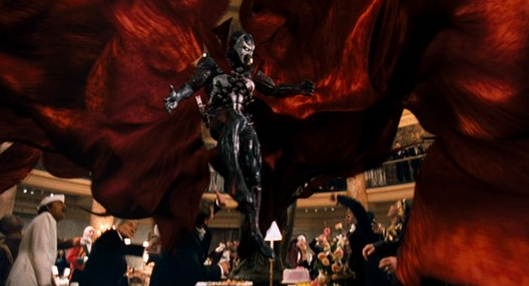
Spawn: Armageddon makes a good first impression. The pre-rendered cinematics bring Todd McFarlane’s distinctive art to life and suggest a game that’s going to at least be visually interesting to look at. You’re only further encouraged when Keith David reprises his celebrated portrayal of the titular anti-hero, but things quickly take a turn with the in-game graphics and painfully generic rock/metal soundtrack. Obviously, you have to give the game some leeway as it is a PlayStation 2 title but…damn, do these character models and environments look ugly and generic. I want to say Spawn fares the best since he closely resembles McFarlane’s artwork but he’s very clunky and struggles to navigate the largely claustrophobic locations. Keith David tries to add some gravitas to the action, punctuation victories with low chuckles and commenting on what’s happening around him, and Spawn’s cape impresses with it unfurls, but it’s odd to me that Spawn looks so low-res when Dante looked sleek and sexy just two years earlier. I liked that demonic creatures like the Violator and Malebolgia communicated through telepathy like in the animated series, though the game is disappointingly light on recognisable characters and villains from the comics. While cutscenes utilise both pre-rendered and in-game graphics, with Spawn being aided/mocked by Mammon throughout, it seems the developers ran out of time or money as major events are often relayed through text prior. This became increasingly noticeable as the game progressed and they were often used to explain a sudden shift in location, but the execution just felt very lazy and cheap to me.
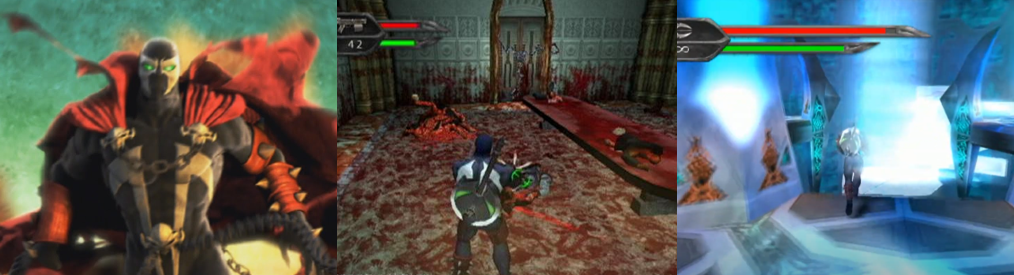
Despite some strong visuals, the game struggles to leave a lasting impression.

You start the game in the heart of the city and return there often, clumsily wall jumping and hopping across rooftops as you defend Spawn’s alley, Rat City. You can destroy fire hydrants, cars, and bins for goodies and may notice the music awkwardly skipping, looping, or cutting out. This quasi-open environment is then replaced with the restrictive newspaper factory, a warehouse-like interior full of large printing presses that are deceptively difficult to climb on. Spawn raids Jason Wynn’s elaborate office building, though the luxurious corridors and offices aren’t much to shout about. However, I liked the wider foyer with its staircases and rooms were often ransacked, splattered with blood and corpses. Things switch back to generic, muddy, and dull as you explore the docks (you might want to adjust your television’s brightness settings for this game, just saying). While things were more visually interesting in the dilapidated subway, it was equally difficult to figure out where to go as everything looks the same. Spawn fends off angels outside city hall and spends a few missions in a twisted, nightmarish bastardisation of Central Park. Though you’re confined to a set path, the gnarled trees, burning Hellfire, and freakish enemies made this an enjoyable section. After battling in a disappointingly bland opera house (save for the giant props), Spawn’s forced to retreat to Hell to subdue his angelic counterpart, Anti-Spawn/The Redeemer. Hell is a volcanic mess of flame bursts, floating rocks, and chains floating around a central tower. After striking a deal with Malebolgia, Spawn fights through the Angel Tower and into the Angel Station, easily the most visually interesting and repetitive areas. While I enjoyed the ethereal lights, marble-like stone, the strange mixture of alien and otherworldly technology, this was a confusing mess of samey corridors that I was glad to see the back of.

Enemies and Bosses:
Spawn’s most recurring enemies here are imps, scrambling little demons who attack in groups, slashing with their claws, leaping at you, or tossing fireballs from afar. Luckily, they’re very weak and easily disposed of, as are the Hell Leeches that often burrow up from the ground and vomit Necroplasm-draining spit. Flying imps can be a bit trickier as they attack from afar while slaughtered corpses rise as flailing Meat Puppets whose torsos claw their way across the floor. While raiding Wynn’s office, you battle both his armed troops and possessed variants, who are noticeably feeble, unlike the twisted Tree demons who haunt Central Park. Often, these demonic forces are bolstered by the unsightly Lamenting Demon, a thrashing monstrosity that spawns floating eyes and is best fought from a distance. The Berserkers were some of the more annoying enemies as they leap at you with blade arms, strike fast, and take a lot of punishment a d made tougher when joined by the durable Whip Demons. Perhaps the most bizarre of Malebolgia’s forces are the Claw Demons, distinctly crab-like demons that scuttle around and lunge with their large front claws. You’ll also battle the formidable forces of Heaven, who teleport about in a blaze of Heavenly light and attack with lances, rain projectiles, and wield Brimstone Cannons. Angels were easily the most tiresome foes, especially in the Angel Station, where they just kept spawning. The space station’s crew also appear here; angels in their purest form, they travel as beams of Heavenly light and share a health bar, though your Necroplasm attacks can whittle them down quite nicely.
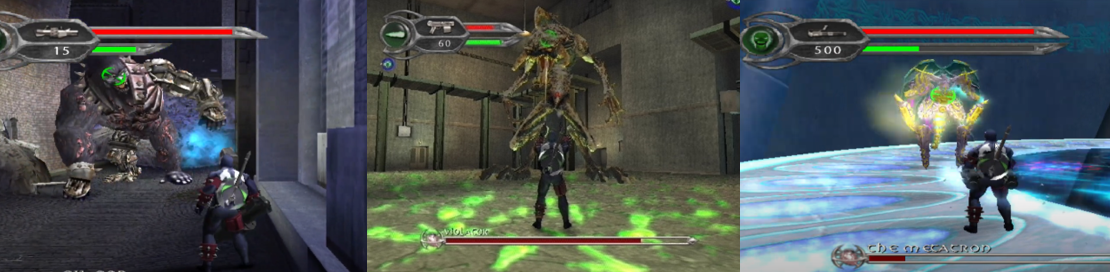
The game doesn’t use enough of Spawn’s rogues but, when it does, they’re the best bosses.

Many enemies are recycled as mini boss encounters, like when you battle angels outside City Hall and when the Hellhole opens in Central Park and you’re forced to fend off waves of Newborn demons who pose a significant threat if you’re low on ammo and Necroplasm. You’ll twice battle the Spider Tank, an arachnid mech possessed by demons; once in the docks and then in the more restrictive military warehouse. Either way, it lurches at you firing mini guns and a powerful front cannon, though it’s vulnerable from the rear. While in the docks, you contend with a hellish bulldozer, which tries to run you down and spawns Berserkers. Its weak spot (a disturbing, tentacle-like tongue) is only briefly exposed and is difficult to hit with those nippy bastards distracting you. This battle echoes the one against the brutish Michael Konieczni/Cy-Gor. This cybernetic ape fills a narrow alleyway and forces you to avoid its shockwaves and the debris it hurls, which is difficult as your movements and resources are limited. Spawn’s archenemy, the Violator, is also fought twice but, while he assumes a “frenzied” form in Hell, both battles are functionally the same. You must stay on an upper, circular path avoiding his claw swipes (which destroy your platforms), grappling to safety, and peppering him with attacks until he keels over. You get a prelude of your later battles with the Redeemer when fighting the Reaver, an armoured avenger who wields a titanic sword that covers a wide arc and which he hurls at you, alongside a devastating beam attack. The Redeemer favours floating above you, igniting the floor (forcing you to grapple to nearby spikes), and attacking with his own massive sword. In the finale, the Redeemer transforms into the Metatron for a two-stage final boss. In the first phase, it resembles a scorpion, attacking with its stinger and pincers and shielding itself at times. In the second, it becomes humanoid and leaps across the arena, fires fast projectiles, and unleashes a massive chest cannon. In every encounter, though, the Redeemer is a slow, lethargic enemy who often leaves himself wide open to your heavier attacks.

Additional Features:
After clearing each mission, no matter how short, your progress is tallied up, awarding you unlockables like concept art. Every enemy you encounter is added to the game’s encyclopaedia, providing additional lore and tips on how to defeat them, and numerous comic books can be found in most of the game’s environments, unlocking Todd McFarlane’s beautiful artwork to view. Clearing missions also allows you to freely replay them, challenging different difficulties if you wish, though your upgrading and saving options are limited when you choose this mode. Spawn: Armageddon also has a few cheat codes, inputted from the pause menu, that’ll bestow you with unlimited ammo and Necroplasm, all guns, unlock every comic and enemy entry in the encyclopaedia, and disable the blood. While it’s annoying that there isn’t an infinite health cheat, these codes make blasting the game’s wildly inconsistent missions a breeze.
The Summary:
I was really excited to play Spawn: Armageddon. I’m a huge fan of the character, and brawlers, and had high hopes for the game from what I’d seen, expecting something like a mixture of the Devil May Cry and God of War games (Various, 2005 to present). As I mentioned, my anticipation was high after seeing the decent FMVs and hearing Keith David’s voice, but it was all downhill after a couple of missions. Spawn: Armageddon looks and plays like an ambitious PlayStation title at times; its blocky visuals and clunky controls do little to showcase the power of the PlayStation 2. While the locations are true to the comics, they’re also painfully empty, generic, and bland, bar a few excepts (such as Central Park and Angel Station). Spawn and the demons may look passable enough, but the Violator and Malebolgia look awful and the game’s disappointingly light on recognisable characters. Take away the Spawn title and it’s just another ugly, muddy, clunky action game that needlessly pads out its awkward gun combat with frustrating platforming sections. Spawn’s powers are largely useless here; his cape and glide are stunted, his chains woefully ineffective, and his movement handicapped by his ungainly nature. Missions are all over the place, forcing you to knob about hopping to platforms or trying to get the damn glide and chains to work and then having you quickly destroy a few enemies and supplanting the cutscenes with cheap-ass text. A lack of unlockables (no skins? Really?) and collectibles and some uninspired bosses only compound matters, as do the endless waves of enemies that simply drive home how repetitive and shallow the combat is. It’s such a shame as there’s the ghost of a good game here but it feels as though the developers ran out of time and/or money and simply slapped together a quick, lacklustre brawler that really doesn’t do the character justice and is barely worth the time of even a die-hard Spawn fan such as myself.

My Rating:

Rating: 2 out of 5.

Could Be Better

Did you ever play Spawn: Armageddon? Did you enjoy it or, like me, did you find it a lifeless and disappointing experience? What did you think to Spawn’s firearms and array of powers? Did you also struggle with the gliding, grappling, and camera? Which if the bosses were you most disappointed by? Would you like to see Spawn get another videogame on modern consoles? Which of his videogame outings is your favourite, if any? Whatever you think about Spawn: Armageddon, share your thoughts in the comments, support me on Ko-Fi, and take a look at my other Spawn content.

Movie Night: Spawn

Released: 1 August 1997
Director: Mark A.Z. Dippé
Distributor: New Line Cinema / Todd McFarlane Entertainment
Budget: $40 to 45 million
Stars: Michael Jai White, John Leguizamo, Martin Sheen, Melinda Clarke, and Nicol Williamson

The Plot:
United States Marine Force Recon Lieutenant Colonel and Central Intelligence Agency (CIA) operative Al Simmons (White) is betrayed and murdered by his employer, Jason Wynn (Sheen), and his enforcer, Jessica Priest (Clarke). After agreeing to lead Hell’s armies, Simmons returns heavily-scarred and bound to a symbiotic suit, but determined to avenge himself.

The Background:
After cutting his teeth in the comic book industry with Coyote, avid artist Todd McFarlane made a name for himself by revitalising The Amazing Spider-Man with his signature art style. However, McFarlane grew dissatisfied with his lack of creative control at Marvel and formed his own independent comic book publisher, Image Comics, alongside other Marvel creatives, in 1992. At the forefront of this was Spawn, a hellborn anti-hero first sketched by McFarlane as a teenager. Spawn #1 was an immediate hit; its 1.7 million sales set records and made it the most successful creator-owned comic of all-time. Naturally, Hollywood was eager to capitalise on this success, with McFarlane eventually selling the rights to New Line Cinema for a mere $1 in exchange for creative input and merchandising rights. New Line president Michael De Luca, himself a comic book fan, was eager to remain true to the source material while reaching a wider audience with a PG-13 rating and brought in Alan B. McElroy to pen the script. Attracted to Simmons’ tragic backstory, martial artist-turned-actor Michael Jai White eagerly signed on, enduring hours in the make-up chair and stuck in uncomfortable prosthetics. He didn’t suffer alone though as co-star John Leguizamo suffered from claustrophobia and heat exhaustion to be transformed into the Violator’s diminutive Clown form. Most of the film’s budget was naturally spent on digital effects, courtesy of Industrial Light & Magic, which included a digital rendition of Hell, digitally bringing Spawn’s living cape to life, and the creation of both an animatronic and CGI representation of the Violator’s true, demonic form. Unfortunately, a box office return of just over $87 million meant Spawn failed to match the success of the comic book. The movie was widely panned, criticised for its muddled plot and overreliance on special effects, though Leguizamo’s performance and some visual aspects have been praised. Michael Jai White was dissatisfied with the film, and a sequel was quickly halted. Since then, rumours of a reboot have persisted, with McFarlane constantly claiming that an R-rated reimagining is in the works, only to run into dead ends each time.

The Review:
Spawn immediately gets off to a bit of a bad start by presenting a chronological tale. One of the appeals of the original comic was its disjointed narrative; Simmons was dumped on Earth with fragmented memories and slowly pieced together his background over many issues. Hell, new revelations were being revealed and retconned in years after he first appeared, which added extra layers to his character and tragedy. Instead, Spawn spends some time with Simmons, a callous and deathly efficient CIA operative who meticulously and ruthlessly eliminates his targets. However, Simmons isn’t some cold-hearted killing machine; he has a conscience and is enraged when his latest mission causes the deaths of innocent bystanders. Later flashbacks show that his beloved wife, Wanda Blake (Theresa Randle), feared his life as a glorified assassin was slowly stripping him of his humanity and this, coupled with Director Jason Wynn’s increasing disregard for collateral damage, drives Simmons to bluntly state his intentions to resign his commission. While his rival, the sadistic Jessica Priest, scoffs at this and mocks Al’s decision, Wynn seemingly accepts his resignation on the condition that he completes one last mission for A-6, the counterterrorism offshoot of the CIA that Wynn commands. This mission sees Simmons sent to North Korea to destroy an extremely dangerous biological weapon. However, he finds the facility has already been rigged to blow and is blindsided by Wynn and Priest. Wounded and doused in flammable liquid, Simmons is helpless to keep the two from blowing the factory and spreading their pathogen to a nearby town, infecting and killing thousands to engineer “Heat-16”, a particularly aggressive virus that Wynn plots to use to manipulate the world’s governments into bowing to his every whim.

Assassin with a conscience Al Simmons is resurrected as a warrior for Hell.

In a flash of burning fire, Simmons awakens in a dank, filthy alley – Rat City – wracked with pain and covered in horrendous burns. Here, he’s immediately accosted by young Zack (Miko Hughes) and the mysterious Nicholas Cogliostro (Nicol Williamson). Confused and disoriented, Simmons heads home, only to discover that five years have passed and that Wanda is now married to his best friend, Terry Fitzgerald (Sweeney), who now acts as A-6 public relations correspondent. Wanda and Terry also have a young daughter, Cyan (Sydni Beaudoin), and have found a happiness that no longer includes Al. Tormented by heartbreak and agony, Simmons is hounded by the rancid Clown (Leguizamo), who delights in Al’s pain and takes great pleasure in jogging his memory by transporting him to his gravesite. Simmons learns he was burned alive and blown up by Wynn and, for his many murderous actions, sent to Hell. There, the gigantic demon, Malebolgia (Frank Welker), promised to “let [him] see Wanda again” if he agreed to lead Hell’s armies against the forces of Heaven. Desperate to be reunited with his love, Simmons readily agreed, only to miss out on five years and be bonded to a symbiotic, “Necroplasmic” armour. This painfully emerges from his scarified skin and sprouts chains, a ridiculously large CGI cape, and heals any wounds near instantly. Dubbed “Spawn”, Simmons is left festering with rage at Wynn’s betrayal and immediately arms himself to get revenge, despite Cogliostro warning that giving in to anger and Hell’s whims will only make things worse for him (and, indeed, the entire world). True to the source material, Simmons struggles to reconcile his newfound life. He angrily rejects Zack and Cogliostro (while also being disgusted by the Clown) and even accuses Terry of betraying him, only to eventually learn that he’s part of a far bigger (and unnecessarily convoluted) plot by Hell to bolster their forces. Michael Jai White does a decent enough job in the title role; he certainly looks the part, especially in his comic accurate suit. However, his line deliveries often leave a lot to be desired and the nature of the suit means he gets few opportunities to show off his fighting prowess, so Spawn’s fantastical abilities are often disregarded in favour of simple gunfights.

Spawn struggles to reconcile his past with his new cursed destiny.

Although he prefers to work alone in his vendetta, Spawn has some allies to both steer him in the right direction and appeal to what’s left of his humanity. Zack, a homeless child left scrounging through rubbish for rotting food alongside his abrasive father, Glen (Michael Papajohn), immediately offers Simmons aid and tries to befriend him. While Spawn repeatedly rebukes him, he defends Zack when Glen gets a bit too handsy and eventually opens up to the boy, entrusting him to care for his dog, Spaz, and is guilt-ridden when his battle with the Clown’s true demonic form, the Violator, causes Glen’s death (among others). Spawn is mentored by vague former Arthurian Knight turned Hellspawn, Cogliostro, a wise (if cryptic) old man who pleads with Simmons to let go of his anger, and his former life, and embrace his new destiny as Spawn, while also turning that hell-born power against his demonic creators. While he mainly observes and offers ambiguous advice, Cogliostro has enough Necroplasm left to conjure a sword and even fights alongside Spawn in the finale. Pained to see Wanda, Terry, and Cyan as a loving, happy family, Simmons largely distances himself from them both because of his horrific appearance and because he’s determined to kill Wynn. Still, he befriends Cyan, finding her sympathetic to his plight, and Terry aids him by association by using his high-ranking position to earn Wynn’s trust and obtain incriminating evidence regarding his Heat-16 plot. Still, Simmons is haunted by memories of and his love for Wanda; flashbacks portray them as a loving couple, and he literally sells his soul just to see her again. However, as attractive as Melinda Clarke is, she’s easily the weakest part of the film. In the five-year time skip, Wanda has been advocating to help the children affected by the incident in North Korea, but her address is so dry and her delivery so robotic that it impacts her relationships with other characters. Sydni Beaudoin is similarly cringe-worthy as Cyan but I can forgive a young child for struggling and, ironically, the relationship between Wanda and Cyan was the only one I believed in. She has little onscreen chemistry with Al or Terry, meaning the core emotional hook of Spawn’s journey fell flat for me and left me with an angry, stubborn soldier wielding incredible powers.

The forces of Hell hatch a convoluted plan to commit mass genocide.

Spawn’s target is Jason Wynn, the gruff, boisterous director of A-6 with designs for world domination. He colludes with the Clown to kill off Simmons, his best operative, and create Heat-16, a pathogen he uses to strong-arm governments into joining his “consortium” but which Hell plans to unleash to wipe the Earth clear for conquest. At Clown’s suggestion, Wynn has a heart monitor installed, ensuring that he cannot be assassinated without unleashing the virus, though he’s unaware that the Clown is purposely riling Spawn up specifically so that he’ll kill Wynn and set off the bomb. Why, exactly the Clown doesn’t kill Wynn or set off the bomb himself is beyond me but Wynn, for all his authority and intellect, unquestionably follows Hell’s orders, believing he’ll rule the world for his obedience. He’s joined by Priest, a highly killed assassin in her own right, but she’s quickly felled by Spawn when she defends Wynn. Thus, Spawn’s greatest physical challenge is the Clown, a belligerent and vile creature who constantly badgers Spawn, spitting threats that Simmons laughs off until the squat antagonist transforms into a towering, slobbering demon and attacks him in Rat City. Seemingly able to teleport and showcasing superior physical strength and durability, the Violator easily trounces Spawn, leaving him impaled on a railing, and promises to kill him if he ever steps out of line. The Clown is jealous of Spawn’s high standing in Hell’s army and wishes to prove himself superior in Malebolgia’s eyes, though acquiesces to his demonic overlord’s orders out of fear of reprisal, which only fuels his antagonistic relationship with Simmons. Leguizamo is the film’s highlight, relishing the Clown’s sadistic, spiteful demeanour with a devilish glee and chewing the scenery at every opportunity. Malebolgia is correctly positioned as the mastermind behind the film’s events, but has little direct influence on Earth; instead, he acts through the Clown, who in turn manipulates Wynn. While the Violator is the Devil’s primary agent on Earth, Simmons openly opposes and rejects Malebolgia. However, it takes him some time to realise that, while he thinks he’s acting independently in targeting Wynn, he’s actually playing right into Malebolgia’s hands and needs to choose a different path to make the most of his hell-given powers.

The Nitty-Gritty:
If, for some reason, you’re confused by Spawn’s premise, the movie has you covered. The unnecessarily mysterious Cogliostro is on hand to provide both an opening and closing narration, interludes, and even describe what’s happening onscreen at various points. Then, he and the Clown and even the Devil himself, constantly reiterate both the plot, the details of Spawn’s powers, and the deal Simmons made to be returned from the underworld. After a while, it feels a bit like padding and gets quite insulting. After all, the premise is extremely simple (former soldier is betrayed, murdered, sent to Hell, and returns with funky powers) so it baffles me that we need so much exposition. The film’s pacing is woefully disjointed; I can’t help but think the narrative would’ve been better served by telling the story out of sequence, like The Crow (Proyas, 1994). Skipping Cogliostro’s obnoxious narration and opening with Simmons awakening in Rat City, only to be tormented by fragmented memories of his former life and then experiencing more complete flashbacks as the film progresses, would’ve better captured the mystery so prevalent in the source material. The film is also shot like a music video; while the kinetic editing calms for exposition, the camera is all over the place during action scenes. Insufferable jump cuts and a barrage of demonic imagery are thrown at the viewer for scene transitions or tossed in whenever we need another reminder of what happened to Simmons and what his motivations are. Characters also not only routinely narrate their actions, but Terry even interacts with a touchscreen computer that helpfully displays and announces his surreptitious actions. Some scenes also appear to be missing from the final film, resulting in Spawn speeding through Cogliostro’s training without so much as a montage and Wynn inexplicably sporting a broken wrist for the finale.

Occasionally, the film brings McFarlane’s art to life with striking visual fidelity.

It’s a shame as there are some instances where the film really impresses, at least visually. Rat City is suitably desolate, rainswept, and gothic, perfectly capturing Spawn’s unkempt dwellings from the comic books. Spawn himself also looks fantastic and, thankfully, spends most of the film garbed in his slick, sticky armour. While he looks best when his glaring mask envelops his scarified face, the make-up effects used to bring Al’s burns to life are very impressive and make the actor barely recognisable. Unfortunately, as good as Spawn’s suit looks, its abilities aren’t featured all that much. Mostly, he sprouts spikes and chains as a defensive measure and his cape is entirely absent except in dire emergencies or to give us bad-ass (if dated) shots of Spawn brooding or sweeping into action. There are a few offhand warnings that draining his power will kill Spawn, but no visual indicator of how limited his abilities are like in the comics. Simmons breezes through Cogliostro’s training and quickly masters the suit, conjuring solid armour during his explosive motorcycle chase with the Clown rather than the suit instinctively hiding him or flying him from danger. When in Hell, Spawn unleashes a barrage of Necroplasmic lasers to eliminate most of Malebolgia’s forces and even uses eye beams to extract Wynn’s heart monitor, but it appears the effects budget ran out at this point as these are poorly executed. Similarly, Hell itself is an unsightly mishmash of flaming rocks, lava plumes, screaming Hellspawn hoards, and an absolutely abhorrent CGI rendition of Malebolgia that apparently replaced a far more impressive puppet. The Devil’s mouth doesn’t even move, for God’s sake, and the film just looks like an early PlayStation cutscene whenever the action shifts to Hell. Again, it’s a shame as the Violator looks fantastic (thanks, in part, to also having an animatronic counterpart). The Clown’s transformation is suitably gruesome and it’s clear more time, effort, and money went into animating the Violator, which looks like Todd McFarlane’s artwork come to life. Sadly, he’s only onscreen for one brief fight scene in the alley, a confusing acid trip of a Hell fight, and a surprise jump scare at the end.

Though triumphant, Spawn’s victory is tainted by some ugly-ass CGI.

So, yeah… Hell’s plot was to recruit Simmons before “the other side” since he somehow has the largest kill count in human history and is the perfect candidate to lead Malebolgia’s armies. Malebolgia then immediately ensured Spawn would defy him by screwing him over, then had Clown manipulate Wynn into creating a genocidal pathogen that they want Spawn to unleash by taking his revenge, for some reason. It’s all a bit confusing, needlessly so, but the thrust is that they’re trying to foster Spawn’s hatred and anger and strip him of his morality and humanity. Although he tethers on the edge of fulfilling this destiny, Spawn is pulled back from the brink by Cogliostro, Zack, and the happiness Wanda and Terry have found with Cyan. Still, his love for Wanda is so strong that he speeds to her house to save her from the Clown, who shows up with Wynn to take the Fitzgeralds hostage. There, Wynn threatens Wanda at knifepoint to force Simmons into reaffirming his allegiance to Hell and stabs her when he hesitates, causing Spawn to fly into a rage. Despite having seen the love of his life killed, Spawn opts not to kill Wynn and simply removes and destroys his heart monitor, ending his threat. However, it turns out to have been another double cross as the Clown was masquerading as Wanda and gleefully pulls Spawn and Cogliostro into Hell for a big, blurry CGI fight scene. There, the two Hellspawn fend off the Violator and Spawn finally rejects Malebolgia, eradicating most of his army and fleeing in a burst of Necroplasm, only for the Violator to appear one last time to try and bite Spawn’s head off. However, thanks to Cogliostro’s training, Spawn skewers the Violator and then beheads him with his chains, reducing the Clown to “a little head” and sending him back to Hell. Finally accepting that his old life is gone, Spawn seemingly agrees to take up Cogliostro’s fight, returning to Rat City and watching over the city like a dark protector, ready to oppose Hell should it ever try to resurface.

The Summary:
My first introduction to Spawn was when I was a pre-teen; a friend of mine randomly had a Violator action figure and the design obviously stuck with me because I recognised it in the Spawn trailer and was super excited to see the film at the cinema at the time. I remember enjoying the film as a kid and, for the longest time, I had a soft spot for it due to my deep love for the character, but Spawn hasn’t aged well at all. The visual effects are all over the place (and, I suspect, too ambitious even at the time), presenting a cartoonish version of Hell and a horrendous representation of Malebolgia that drags the film down considerably. This is juxtaposed with a fantastic recreation of Spawn’s suit and an impressive CGI and animatronic Violator. I can even defend Spawn’s terrible CGI cape, but none of these aspects make up for the shoddy CGI elsewhere. Even if the effects were up to scratch, the pacing and narrative is all over the place. Often resembling a frantic music video, Spawn is an almost insulting barrage of visuals and exposition that spells everything out to the audience like they’re children. The performances are similarly disjointed: John Leguizamo is the obvious standout, embodying the role with a rancid glee, and Martin Sheen desperately tries to elevate the material. But Michael Jai White falters as a leading man and Theresa Randle fails to impress as Wanda. I just didn’t buy into their chemistry or their relationship, which is the entire crux of Spawn’s motivation. It’s a shame as the film is a pretty accurate adaptation of at least the early days of the comic book and occasionally brings Todd McFarlane’s artwork to life with impressive fidelity. The rocking soundtrack fits with the quasi-gothic/urban setting and I enjoyed seeing Spawn in action but seeing him rely on toothless gunfire and stumble through what should be emotionally impactful moments hurts my enjoyment. In the end, it’s a decent effort but relies too much on nonsensical, explosive action, terribly dated CGI, and frantic, disjointed editing, bombarding the audience with clunky exposition and failing to hold together under close (or even cursory) scrutiny.

My Rating:

Rating: 2 out of 5.

Could Be Better

What did you think to Spawn? Were you a fan of the character back in the day? Did the constant exposition and barrage of visuals also put you off? Were you also disappointed by some of the performances? Do you think the plot was needlessly convoluted and muddied? What did you think to Spawn’s suit, the Violator effect, and John Leguizamo’s turn as the Clown? Do you think we’ll see a live-action reboot before the heat death of the universe? Whatever you think about Spawn share your thoughts in the comments and take a look at my other Spawn content.

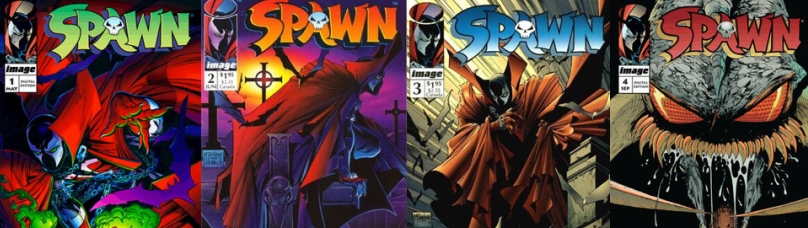
Back Issues: Spawn #1-4

Story Title: “Questions” (Part One to Four)
Published: May 1992 to September 1992
Writer / Artist: Todd McFarlane

The Background:
Born in Calgary, Alberta, Canada, artist and comic creator Todd McFarlane started drawing at an early age and cut his teeth in the comic book industry working on Coyote before getting his big break illustrating Batman: Year Two (Barr, et al, 1987). After jumping to Marvel Comics and working on The Incredible Hulk, McFarlane made a name for himself for his dynamic and kinetic work on The Amazing Spider-Man. Bringing new life to Spidey through his art and his hand in creating popular anti-hero Eddie Brock/Venom, McFarlane eventually became dissatisfied with his lack of creative control over stories and, alongside other Marvel creatives, quit the company and formed their own independent comic book publisher, Image Comics. To spearhead this new venture, McFarlane revisited an old sketch from his teenage years and revised the concept into Al Simmons/Spawn, a former mercenary reborn as a brooding warrior for Hell’s army. Spawn’s debut issue became a record-setting release; selling 1.7 million copies, it was the most successful creator-owned comic of all-time. This success put Image Comics on the map and, aside from a few slumps here and there, Spawn has remained a popular and successful publication for the upstart publisher. This success catapulted McFarlane to new heights, leading to a successful line of action figures, solo and guest spots in videogames, a cult hit animated series, crossovers with DC Comics, and even a muchmaligned live-action adaptation in 1997.

The Review:
The saga of Spawn begins with Al Simmons, fittingly, tormented by questions. Although Al’s aware of some aspects of what’s happened to him (he died and made a deal to return), he doesn’t know what compelled him to come back from the beyond and feels separated from the mortal realm. His memories are fragmented, giving him flashes of a life he can’t quite recall. He remembers he was in love, though he can’t picture her face; he remembers there’s someone he hates, though he can’t recall his name; and he remembers that he was a good and loyal soldier for his country. Crucially, he’s haunted by the grinning visage of a skull and the feeling of being betrayed and brutally murdered. The more Al broods on his disparate memories, the more scant images come to mind. He pictures a beautiful woman, one who he was so desperate to return to that a wicked demon granted his request but on his terms, dumping him back on Earth with incredible power and an awesome costume but with no idea who he is or what any of his memories mean. Confident that the beautiful woman he sold his soul for will remember him and fill in the blanks, Spawn heads into the night to find her and the one who betrayed him, his thoughts already turning to revenge. Of course, we get scant clues to his true origin through McFarlane’s employment of media reports relating to Al’s decorated career, his untimely death, and Wanda Blake’s grieving process. These are presented in a very Dark Knight Returns (Miller, et al, 1986) format, showing reporters and pundits addressing the reader next to blocks of text, all accompanied by a mysterious countdown that we later learn tracks Spawn’s current power supply. Such interludes are juxtaposed with our first introductions of detective duo Sam Burke and Maximillian Williams/Twitch, who are currently baffled by gruesome murders that’ve left the victims without their hearts.

The tormented Spawn finds only further pain and questions at every turn.

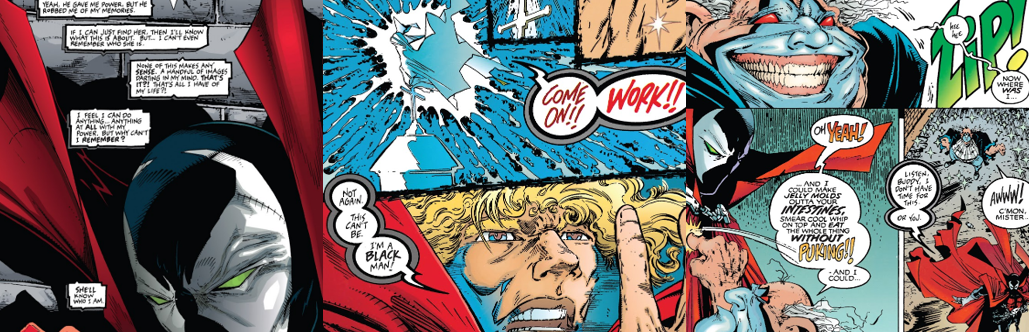
Spawn’s journey across town takes a detour when he spots a gang of lowlifes attacking a woman. Though he effortlessly dispatches the punks, Spawn terrifies the young lady when he’s suddenly bombarded by memories. The woman’s face taunts him and bleeds into memories of his funeral, where his disembodied soul cried out in anguish only to be ignored by his love. Thanks to the girl he rescued comforting him and bringing him back to reality, Spawn slowly realises that the woman he’s been seeing was his wife and that he’s been gone for five years. Desperate for answers, he claws away his mask and talon-like gloves, horrified to find a scarified body beneath his skin-tight leather and chains. While Spawn weeps in the dank alley and Sam and Twitch stew over reports of a costumed figure in a red cape and chains taking out street punks, the wicked, horned demon Malebolgia relishes in Spawn’s pain from his burning inferno. As Spawn broods, questioning his humanity and feeling comforted by his costume and defending the innocent, he ponders the limits of his powers. Focusing his will, he turns his power on himself to restore his human visage and is aghast to find he’s been transformed into a bleach-blonde surfer dude instead of his true form as a Black man. Enraged, realising that he’s being toyed with, Spawn explodes with anger, trigging a fresh set of memories. He puts a face to new name of his employer and mentor: Jason Wynn moulded him into the perfect soldier, only for them to clash when Simmons took issue with Wynn’s increasingly brutal and cold-hearted ways. Overcome with emotion, Spawn collapses in the alley, where he’s approached by a comical, clown-like figure. Spawn had spotted this squat, colourful individual earlier and readers were treated to him dramatically introducing himself and all the ways he plans on torturing and humbling Spawn to appease his boss, the aforementioned Malebolgia. The clown, introducing himself as the Violator, piques Spawn’s interest when he dubs him a Hellspawn and quickly blows his cover.

Spawn’s outrage at having his life stolen is preyed upon by the demonic Violator.

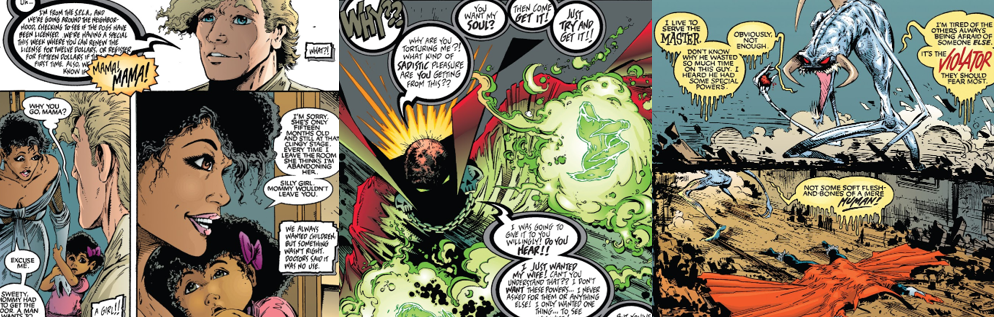
The Violator goes on a tirade, listing all the ways he could slaughter Hell’s newest soldier. Naturally, given the clown’s diminutive stature, Spawn scoffs at his threats and walks away, completely missing the clown’s transformation into a large, horned, slack-jawed demon, the same creature that’s been ripping the hearts out of mafia bosses all over town. Still, for now, the Violator is content to let Spawn go, primarily because Malebolgia gets off on making his creation suffer. As he aimlessly wanders, Spawn is elated to finally remember his wife’s name. He also remembers having parents and brothers and the location of the Central Intelligence Agency (CIA) headquarters and an armoury. He stops by the CIA skyscraper first, accosting creep Billy Miller and threatening him to keep his hands to himself and pay his child support, and retrieves Wanda’s file. However, Al’s distraught to learn she’s moved to Queens and engaged to his former best friend, Terry Fitzgerald. With no other choice, Spawn assumes his blonde visage and heads over there with the vague hope of convincing her to see past his façade, only to be left speechless by her beauty and the unexpected presence of a child, Cyan. The added realisation that he was the problem when it came to giving Wanda a child adds to Spawn’s mental anguish and causes him to black out. Wanda and Terry tend to him and he shares some of his pain with them, only to be met with warmth and kindness. Retreating back to the alleys, Spawns rages, openly challenges the being that’s toying with him and fed up with playing games. Luckily for him, the Violator answers his challenge and, this time, Spawn witnesses the clown’s transformation into his true, horrific form. Caught completely off-guard, Spawn is powerless to keep the Violator from plucking his still-beating heart from his chest. However, the crude, leering demon is stunned when Spawn gets up, a burning hole in his chest and all fired up for a scuffle.

Malebolgia interrupts his “children’s” squabbling to torment and punish them.

This leads into the final issue of this four-part arc, which finds the Violator incensed to learn that Malebolgia lied to him about Spawn’s powers. Fully expecting to have killed the Hellspawn with his attack, apparently unaware that humans are being gifted powers greater than the denizens of Hell. After expending energy reattaching his heart and healing from the damage, Spawn launches a blast of hellfire at his foe, returning the favour by blasting a hole right through the demon. However, the Violator easily survives the attack, boasting of his superiority, and manhandles Spawn. To the Violator’s frustration, Spawn meets his arrogance with disrespect and the two start shamelessly mutilating each other over a two-page spread consisting solely of dismembered limbs and sound effects. The mindless battle grows so intense that Malebolgia himself manifests in the alley to break them up, chastising such pointless escapades. Addressing the two as unruly siblings, Malebolgia lays out his grand plans to storm the gates of Heaven and go to war with God, a concept baffling to a lifelong atheist like Simmons. Still, Malebolgia emphasises that God is now Spawn’s enemy and details that Spawn’s past life as a hired killer made him the perfect candidate to become a Hellspawn. Malebolgia also explains that Spawn’s power, though vast, is not infinite and relishes in giving him a simple choice: bow to Hell’s whim, expend his power killing “bad guys” and accelerate his return to Hell while bolstering Malebolgia’s armies, or do nothing and watch innocents suffer. Malebolgia then fully heals Spawn, reattaching his arm so as not to waste any more of his energy, and angrily rebukes the Violator when he takes exception to this. Malebolgia punishes him by banishing him to Earth, removing his ability to switch forms, and returns to Hell. Insulted and frustrated, the Violator storms off in a huff, leaving Spawn to brood over his newfound lot in life. Meanwhile, across town, Wanda awakens from a terrible nightmare in which she sees Al begging for help and it’s revealed she’s as haunted by her memories and love for him as he is of her.

The Summary:
I mean…first things first, let’s talk about Todd McFarlane’s unparalleled artwork. Every page, every panel, is so detailed and full of edgy, moody visuals. Barely a scene takes place in the daytime, bathing New York City, its depressing alleys, and, crucially, Spawn himself in oppressive darkness and shadow. Thus, when Spawn goes to Wanda’s in his forced guise of a blonde, white man, the juxtaposition of colour is like a slap in the face. It clearly shows that a normal, human, happy life is now far beyond Spawn’s reach and he stands out, despite his seemingly normal appearance, due to his jagged and distorted speech bubbles, hammering home that he doesn’t belong in that world any more. Spawn himself makes an immediate visual impression. Sure, there’s a lot of Spider-Man, Venom, and Danny Ketch/Ghost Rider in his design but he’s actually more like Bruce Wayne/Batman since he’s mainly brooding or dramatically standing rather than web-slinging across the city. Garbed in a sleek, black costume, Spawn casts an intimidating figure with his burning green eyes and flowing, blood-red cape and McFarlane never wastes an opportunity to depict him against gargoyles, crosses, cutting through the air like a tiger, or seeped in darkness. Considering his monstrous visage is hidden behind his mask for most of these issues, Spawn expresses a lot of emotion. Tormented by memories, he cries out in pain and anguish and lashes out at every opportunity, unaware that even by doing good he’s fuelling Malebolgia’s will since he’s either expending his finite energy or sending more despicable souls to Hell. While the news report sections are less visually engaging for me and simply a copy of Frank Miller’s narrative style, McFarlane makes up for it with his depiction of demons. The Violator and Malebolgia are horrific, gruesome creatures with a constant cackling visage and they represent an explicit, external personification of the dark power Spawn now wields. This, as much as anything else, is what angers the Violator so since he believes humans are unworthy of such vaulted positions in Malebolgia’s ranks.

Spawn and his demonic adversaries shine thanks to McFarlane’s merticulous artwork.

These first four issues set a precedent that would continue throughout Spawn’s publication, creating a constant air of mystery around the titular anti-hero. Simmons walks the alleys with fragmented memories, barely remembering anything of his past life and being tormented by scattered faces, feelings, and recollections of a previous life that eludes him. This brings him great torment and is the design of Malebolgia, who delights in torturing his “child”, fostering his dark ambitions, and humbling him. Malebolgia gets off on spoon-feeding Spawn memories and information, never once letting him forget who he really serves, and takes great glee in explaining that Spawn serves him no matter what action or inaction he takes. Malebolgia’s chief agent on Earth is, of course, the rancid Violator, a boastful little sprite with a chip on his shoulder. He seeks to spread chaos throughout the city by tearing the hearts from his victims and inciting a gang war, confident in his Hell-born power being greater than Spawn’s and eager to showcase his worth to his master by maiming and killing his newest recruit. Instead, the Violator finds himself in a brutal deadlock, with neither he or Spawn able to land a killing blow. Of course, neither thinks to go for the head and this isn’t strictly true as Spawn would inevitably lose due to his reckless use of his powers. At this point, Spawn barely understands what he is let alone the nature of his “Necroplasm” so he expends his energy without thinking. Healing wounds, firing energy blasts, and transforming his appearance all cause the helpful countdown to decrease, showing the reader just how close Spawn is to ending his new unlife and returning to Hell. Malebolgia explains these rules to him, leading to Spawn constantly considering his energy cost in future issues, but it does give a taste of what Spawn’s capable of since we see him reattach his heart, blow a hole through the Violator, and alter his appearance using his dark magic.

These issues perfectly set the scene for Spawn’s subsequent battle against the dark forces.

Sam and Twitch are also introduced in these issues and offer a fun side plot to Spawn’s constant brooding and rage. Essentially a reimagining of Commissioner James “Jim” Gordon and Detective Harvey Bullock, the two couldn’t be more different: where Sam is loud, gruff, and obnoxious and a lot like the Violator, Twitch is quiet, subdued, and methodical. The two are baffled by the Violator’s brutal murders and somewhat at odds regarding the caped vigilante stalking the streets, since Sam is far more lenient regarding Spawn as he doesn’t have to worry about due process. Spawn’s path doesn’t directly cross with these two here, but they’re nicely set up as supporting characters, as are Wanda and Terry. Again, we don’t learn too much about them at this point, especially Terry, but the story does a decent job of emphasising Wanda’s beauty and Al’s undying love for her. He’s haunted by her face, in agony at being denied her and being able to give her a child, and torn between wanting to confess everything to her and stay away from her idyllic new life. These emotions only fuel his anger and Malebolgia’s glee, driving him to chastise others who so freely take their blessings for granted or brutalise rapists and demons alike to vent his frustrations. While I admit the first issue doesn’t have much going on and largely exists to whet the reader’s appetite and the fourth issue devolves into an exposition dump from Malebolgia, there’s a lot to like in these first four issues. The mystery surrounding Al’s life and death is nicely set up, leaving breadcrumbs regarding Wynn and Al’s killer, as is the uncertainty regarding Spawn’s powers. The artwork is the main reason to delve into these issues, and all of McFarlane’s work, but the narrative is intriguing and strong, appealing to the brooding, edgy nineties kid in me. All the key players make a great first impression through McFarlane’s stunning and visceral art and the stage is set from a dramatic and explosive exploration of the dark path Spawn will eventually follow as he tries to piece together his past, have his revenge, defend the innocent, and defy his demonic master.

My Rating:

Rating: 4 out of 5.

Great Stuff

What did you think to Spawn’s first four issues? Did you pick up a copy of issue one? What did you think to Spawn’s costume and powers? Are you a fan of Todd McFarlane’s art style? What did you think to the demonic antagonistic and the mystery surrounding Spawn? Which Spawn characters and story arcs are your favourite? Whatever you think about Spawn, feel free to leave your thoughts below and be sure to check out my other Spawn and horror-related content on the site.

Game Corner [MK Month]: Mortal Kombat 11 Ultimate (Xbox One)


To celebrate the simultaneous worldwide release of Mortal Kombat (Midway, 1992) on home consoles, 13 September 1993 was dubbed “Mortal Monday”. Mortal Kombat’s move to home consoles impacted not only the ongoing “Console War” between SEGA and Nintendo but also videogames forever thanks to its controversial violence. Fittingly, to commemorate this game-changing event, I’ve been dedicating every Monday of September to celebrating the Mortal Kombat franchise.


Released: 17 November 2020
Originally Released: 23 April 2019
Developer: NetherRealm Studios
Also Available For: Nintendo Switch, PC, PlayStation 4, PlayStation 5, Stadia, Xbox Series X

The Background:
Mortal Kombat was a phenomenal success for Midway; thanks to its controversial violence and unique digitised graphics, the game stood out from the likes of Street Fighter II: The World Warrior (Capcom, 1991). While the franchise went from strength to strength during the 2D era of gaming, Mortal Kombat struggled to really stand out amidst a slew of revolutionary 3D fighters and, following the lacklustre release of Mortal Kombat vs. DC Universe (Midway Games, 2008), the series looked to be in serious trouble after Midway went bankrupt in 2010. Thankfully, Warner Bros. Interactive stepped in and the Mortal Kombat team was rebranded as NetherRealm Studios. Their first order of business was to get their violent franchise back on track, which they did with Mortal Kombat (NetherRealm Studios, 2009), a particularly well-received reboot of the surprisingly convoluted lore. This gritty, violent reboot again stirred controversy but sales of the game alone were enough to cover the costs of Midway’s acquisition and work on a follow-up soon began.

After the disappointing Mortal Kombat vs. DC Universe, Mortal Kombat made an impressive comeback.

Mortal Kombat X (ibid, 2015) instantly impressed and out-did its predecessor in every way, being both the most violent entry and having the biggest launch in the franchise’s long history at the time. Mortal Kombat X also scored very well and the success of the game earned it not just a host of additional downloadable content (DLC) but also an expanded version, Mortal Kombat XL, in 2016. Keen to capitalise on the good will they had earned back with these releases, NetherRealm announced the development of Mortal Kombat 11 at the Games Awards 2018, a game that saw the triumphant return of actor Cary-Hiroyuki Tagawa to the role of Shang Tsung and sold over eight million copies by October 2020. Like its predecessors, Mortal Kombat 11 received an expanded addition that included all of its DLC fighters and even additional story mode content and was met with favourable reviews, though some criticised the randomisation of the game’s unlockables and the overreliance on grinding, mechanics that, for me, affected the appeal of Injustice 2 (ibid, 2017).

The Plot:
After the defeat of Shinnok at the conclusion of Mortal Kombat X, Raiden has become corrupted by the Elder God’s amulet and, angered at the Thunder God’s repeatedly meddling in the fabric of space and time, the keeper of time (and Shinnok’s mother), Kronika, plots to rewrite history to erase Raiden from existence. With past versions of classic Mortal Kombat characters showing up all over the place, and Earthrealm’s most dangerous and long-dead enemies forging an alliance to usher in Kronika’s “New Era”, Earthrealm’s Special Forces and allies face a battle against time itself to keep the realms from being torn asunder.

Gameplay:
As you might expect by now, Mortal Kombat 11 Ultimate is a 2.5D fighting game in which players can pick from one of thirty-seven characters and battle through the game’s single-player story mode, fight one-on-one against another player or computer-controlled opponent, battle their way though a variety of arcade-style towers, or challenge other players to a variety on online battles. Battles take place in a best-of-three format and against a time limit, though you can alter these settings (and many others, including the difficulty of computer-controlled opponents) from the game’s comprehensive menu to speed up gameplay or make it more accessible.

One of the things I love about Mortal Kombat is that gameplay and combos are generally easy to pick up.

As in the other 3D Mortal Kombat fighters, fights in Mortal Kombat 11 are extremely accessible and easy to master. You can attack your opponent with punches with either X or Y, kicks with A or B, block with RT, throw (again, this is more like a grapple) with LB or X and Y and a directional input, and interact with the game’s environments when indicated with RB. You can also dash towards and away from your opponent, jump in or crouch down to attack or avoid projectiles, and string together combos by pressing the attack buttons and using directional inputs quickly. The game features a comprehensive tutorial mode that teaches you all of the basics and intricacies of the game’s combat, which gets deeper and more complex depending on your skill level and who you play as but is still extremely easy for even novice players to pick up and pull off a few simple combos.

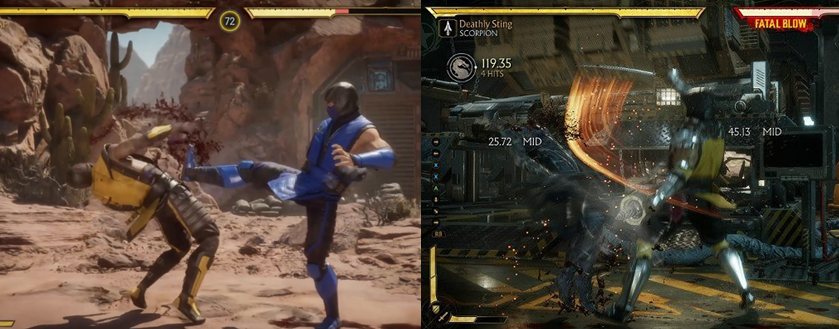
In addition to trademark special moves, characters can also pull off gruesome Fatal Blows.

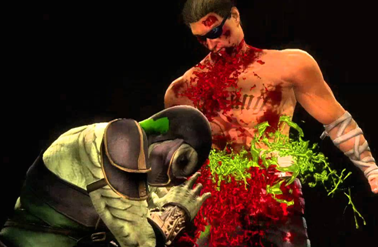
Each character also boasts a number of special moves, also pulled off by a few simple button and directional inputs (back, forward, X, for example, or forward, down, B); these can be stringed together with combos and augmented with a well-timed press of RB (this will, however, drain a meter at the bottom of the screen but this will quickly refill in time). Unlike in the last two games, though, you can no longer build your meter towards a gruesome X-Ray move; instead, when your health is sufficiently depleted, you’ll have the option of pulling off a “Fatal Blow” once per fight (not per round) to mash your opponent into mush. While these are suitably impressive, violent, and gory, I have to say that I miss being able to build up to and pull off a momentum-changing special move whenever I want rather than when I’m near death. While special moves are pretty easy to perform, you can review them at any time from the pause menu and even “tag” team so they appear onscreen for easy reference, but I would have liked the option to pick and choose which ones are displayed for quick reference.

Fatalities are more visceral and gory than ever and see you dismembering and eviscerating your opponent.

As horrific as the Fatal Blows can be, though, the real star of the show is, once again, the game’s Fatalities, the trademark of the franchise. At the end of the deciding round (usually round two), you’ll be told to “Finish Him!!” (or her…) and given a short period of time to stand in a specific spot and enter another button combination to tear your opponent to pieces, usually resulting in their guts, brains, and eyes bursting from their body or them being shredded and blown apart. Every character has three Fatalities available to them: one that is readily available, one that is locked and must be unlocked in the Krypt (or looked up online…), and one that is assigned to pulling off special Fatalities in certain stages (“Stage Fatalities”, like the classic uppercut into an acid pit) and you can also find (or purchase) “Easy Fatality Tokens” to pull them off more easily and practice them in the Fatality Tutorial.

There’s more than one way to finish your opponent, including a couple of non-lethal options.

Fatalities aren’t the only way to finish your opponent, though; by following a specific set of instructions during a fight (such as not blocking or hitting a certain number of moves and ending the decisive round with a specific attack), you can once again end your foe with a “Brutality” (although, as Factions are no longer included, Faction Kills are also not present this time). You can also pull off a non-lethal “Friendship” if you don’t wish to eviscerate your opponent and even replenish a small portion of their health by showing “Mercy” to allow the fight to continue a little longer. There are benefits to finishing off your opponent, though, as this will award you Hearts, one of four different forms of in-game currency, additional Koins (the primary form on in-game currency), and contribute to your player level and allow you to unlock additional bonuses.

Once again, it’s going to take a lot of grinding to earn enough to unlock everything in the game.

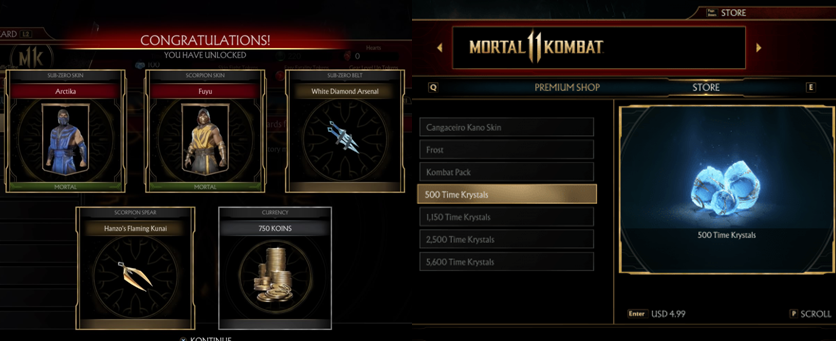
One of the biggest complaints I had about Injustice 2 was the sheer abundance of different in-game currencies and the unfortunate emphasis on grinding for levels and unlockables and the randomness of the game’s loot crates. Sadly, Mortal Kombat 11 carries a lot of this forward; there are numerous customisation options available to you, from backgrounds and icons for your gamer card to individual gear and skins for each character but pretty much all of them are locked behind the game’s time-consuming grinding system. You earn Koins, Soul Fragments, Hearts, and Time Crystals by playing every single one of the game’s modes; while each of these can be spent in the Krypt to unlock chests and release souls (which will net you additional currency, skins, gear, augments, and Konsumables), Time Crystals can be spent in the in-game shop but, as items in the shop at so expensive, you’re encouraged to spend real world money to unlock additional stuff.

Battle through Klassic and online towers to earn rewards, see character endings, and unlock gear.

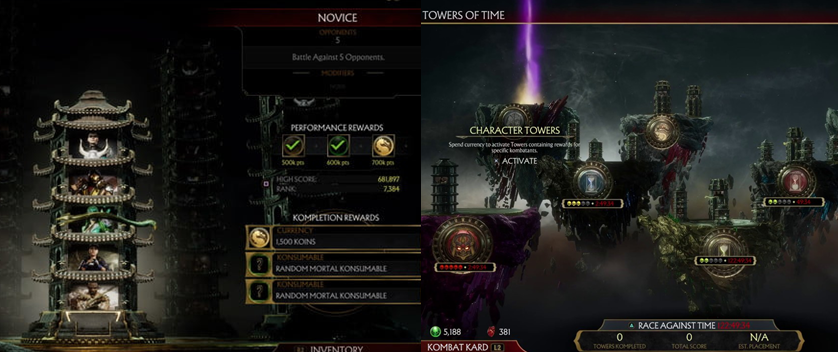
Unfortunately, while each character has a whole load of gear and skins and customisation options available to them, these are locked behind grinding; you can find many of these in the Krypt but others are unlocked by playing story mode, completing the character tutorials, or besting the game’s many towers. As in the classic 2D games, you can once again pick between three different towers (Novice, Warrior, and Champion); which tower you pick determines the amount of fighters you’ll face and the degree of the rewards you’ll earn from completion. You can also take on the Endless tower to face and endless number of opponents until you quit or are defeated and the Survival tower in which the damage you receive from each fight carries over to the next. Similar to Mortal Kombat X and Injustice 2, you can also challenge a number of different online towers, the “Towers of Time”; these provide you with a variety of challenges but are only available for a set amount of time before they’re replaced with a fresh challenge. However, you even access this mode you first need to clear a number of tutorials first, which seemed a bit redundant, and you will need to pay and also perform certain tasks (such as a certain amount of attacks or specials) to complete each character’s specific tower and unlock more gear and skins for them.

Timelines collide in the story mode, which occassionally asks you to pick between two fighters.

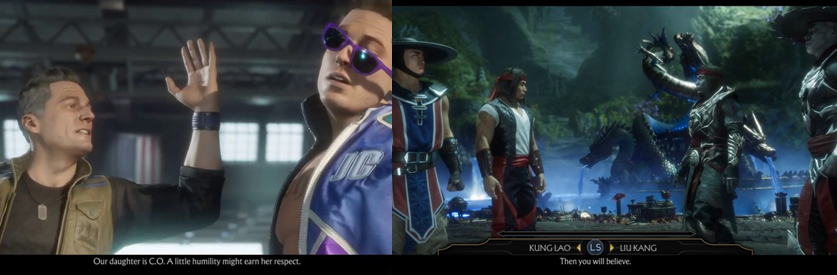
A big part of the game is its story mode; once again, the story is broken down into twelve chapters, with each chapter assigned to at least one character but, every now and then, you’ll be given the option of picking between two characters. It doesn’t really matter which character you pick, though, as you don’t even need to tick off all of these options to 100% the story mode and it hardly affects the narrative at all. Despite the fact that you can’t finish off and kill your opponents, the story mode is a great way to earn Koins and gear and get to grips with each character; the story sees characters from the past return to life as Kronika attempts to rewrite history, which effectively undoes a lot of the development done to the series in Mortal Kombat X but it’s a good excuse to have classic characters return to the series. You can set the difficulty setting for the story mode whenever you like but there are no Achievements tied to beating it or any of the other mode son higher difficulties but you do generally earn better rewards for taking on more difficult challenges.

Graphics and Sound:
Mortal Kombat 11 looks fantastic; character faces still look a bit shiny and odd at times (particularly the females) but there’s even less distinction between the in-game graphics and the many cutscenes you’ll see as you play through the story. Every character is full of life and little quirks, such as Liu Kang constantly hopping from foot to foot in true Bruce Lee style, Kano nonchalantly spitting on the floor, and Skarlet cutting herself open. If the winning fighter is too close to their fallen foe when a round ends, they’ll back away with their own unique animation and voice clips and taunts can be heard throughout each fight as you pull of special moves, combos, and gain victories. Unfortunately, as always, the developers continue to render the character’s different endings using a motion comic aesthetic and voice over rather than utilise the full motion CGI cutscenes used to great effect in the game’s story, which continues to be a disappoint for me and I’ve never really understood this choice.

While environmental interactions seem limited, they’re still a great way to deal some damage.

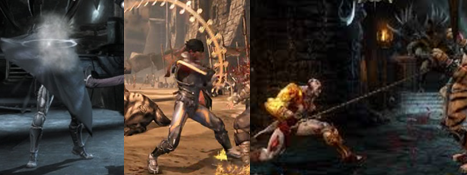
Where Mortal Kombat 11 fails a little bit is in the stages; stages are a big part of any fighting game but especially Mortal Kombat and NetherRealm Studios’ recent efforts since they introduced the concept of interacting with various parts of the environment. This returns again, allowing you to skewer opponents with spears, throw bodies at them, wall run out of harms way, or toss or wield a variety of weapons (such as a chainsaw and a sledgehammer) to deal additional damage. These will often finally utilise the gruesome x-ray feature that was a big part of the last two games (which can also be triggered with certain special moves and augmented specials) but it feels as though there are a lot less opportunities to interact with the background and pull off Stage Fatalities than normal, making environments look and feel very alive but being disappointingly light on interactive elements despite all of the cameos and interesting elements at work in the background.
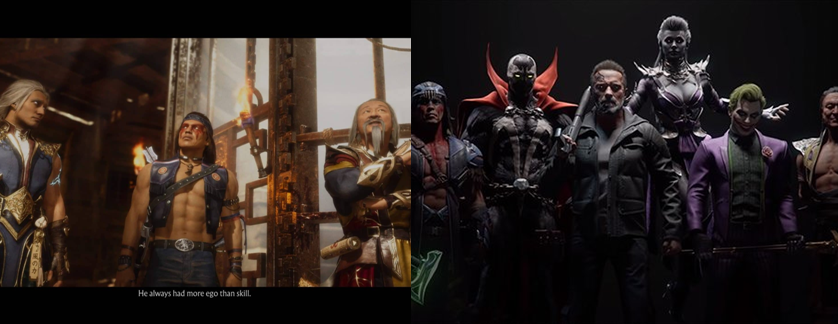
The game goes to great lengths to recreate iconic environments and locations from the first two games.

One thing I did like, though, was the return of some classic stages from past Mortal Kombat games, such as the courtyard and the dead pool; the best stage for this is, easily, the Retrocade stage, which randomly generates pixel-perfect recreations of classic Mortal Kombat stages complete with music. The game also goes above and beyond to recreate Shang Tsung’s island in immaculate detail in the Krypt; not only does it feature every stage from the first Mortal Kombat but it also recreates scenes and locations from the brilliant Mortal Kombat (Anderson, 1995) and cameos and references to numerous Mortal Kombat characters, which makes it a fantastic area to explore that is sadly let down by how confusing the Krypt’s map system is. Not only that but Cary-Hiroyuki Tagawa lends his voice and likeness to Tsung once again, adding his unmatched gravitas to the character, and you can even buy a skin pack that adds skins for Sonya Blade, Johnny Blaze, and Raiden that adds three more likenesses and voices from the film.

As gruesome and visceral as the Fatalities are, the Fatal Blows are gloriously rendered in macabre detail.

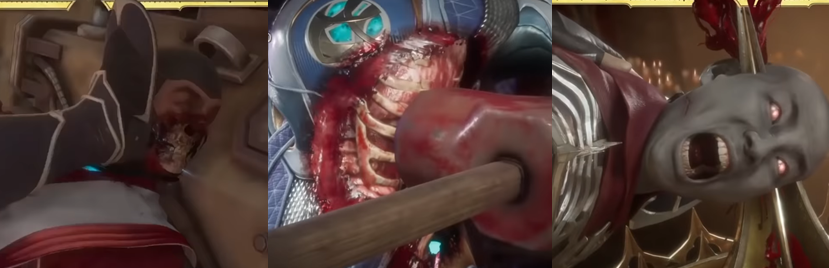
While the game does excel in its many cutscenes and does a great job of telling its story with just the right level of cheese and seriousness, the main draw of the game is in its violence and gore and Mortal Kombat 11 certainly delivers in that respect. Skin is literally peeled from the bones, eyeballs fly in geysers of blood, bodies are dismembered, split into pieces, dissolved, and shredded, and limbs are torn apart in a variety of ghastly ways and it’s always a joy to see the horrifying ways characters are going to mutilate their opponents. The Fatal Blows are sometimes just as good, if not better, as any of the game’s Fatalities, with characters being stabbed, shot, and blasted in ways that would surely kill them only for the characters to hop right back up afterwards. While character’s clothes and accessories don’t rip or tear during the fights, they do seem to get stained by blood at times and skin can be seen baring wounds and scars from battle.
Enemies and Bosses:
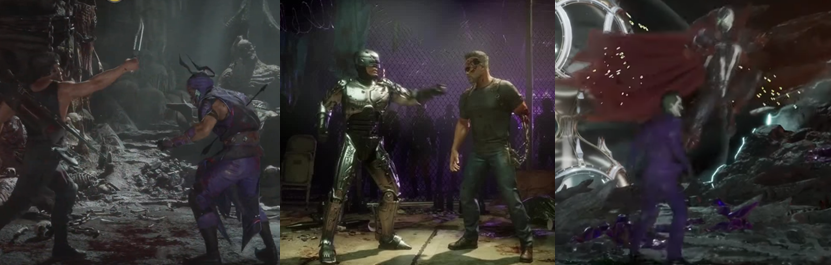
As a fighting game, every single character in Mortal Kombat 11 is your enemy and you’ll be forced to do battle with all of them at least once, at some point, as you play through the story mode and arcade towers. Because every character controls and fights a little differently, with some focusing on ranged attacks or brawling while others emphasis slow but hard-hitting attacks, it’s best to sample each for yourself and to get an idea of your favourite character’s different abilities and variations in order to achieve success. Also crucial is mastering a handful of the game’s combos; many are as simple as X, X, Y or X, Y, X but others require directional inputs, longer button presses, and the co-ordinated stringing together of frame-perfect attacks and special moves. Luckily, though, every character usually has one or two simple combos for you to master so it’s simple enough for players of any skill level to pick up and play.

Your attack strategy may have to change depending on who you are fighting or playing as.

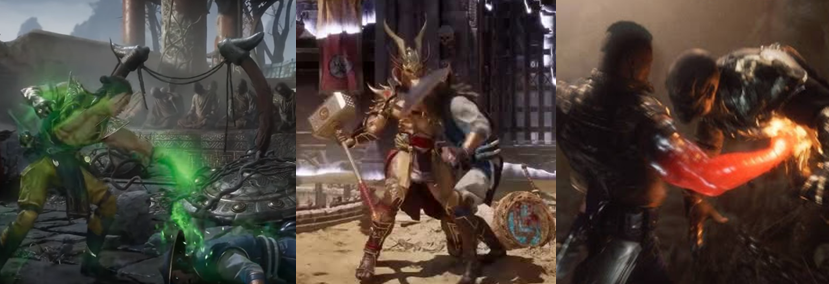
Some characters, though, play a little differently to others and this affects not only how you play but also how you fight them. Shang Tsung, for example, can not only steal the soul of his opponent, which not only drains their health but also has him assume their form and moveset for a short period, but can also morph into various masked ninjas from the franchise; Shao Kahn primarily attacks with his massive hammer, which can make his attacks slower; Jax Briggs can charge up his metal arms with punches and other attacks, which allows him to pull off his projectile attacks; and Erron Black can whip out a shotgun, which allows him to fire at and melee attack his opponent but also needs reloading and to be manually put away. Other opponents can be a lot cheaper than others; Noob Saibot, for example, is always a bit of a pain because of his vast array of teleporting attacks and the same applies to Mileena, who’s capable of quickly teleporting about the place and launching sais at you. There are also some returning favourites you’ll have to watch out for, such as Sub-Zero’s ice ball, Scorpion’s kunai spear, and Liu Kang’s lightning quick kicks and fireballs but the new characters have their own tricks to watch out for, too. Geras, for example, loves to spam his little sand pit trap and Certrion will spawn elemental hazards out of thin air to trap and hurt you.

Cyrax and Sektor can only be fought in the story and you’ll face tough boss battles in the Towers.

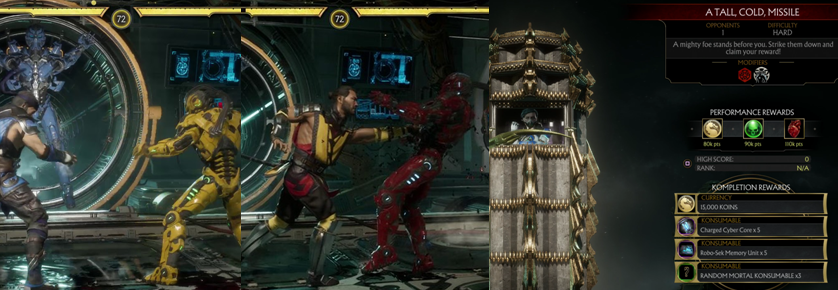
When playing through the game’s story mode, you’ll also have to fight a couple of familiar faces in the form of Cyrax and Sektor. These cybernetic ninjas sadly don’t make the cut this time around so they essentially fill the role of mini bosses, in a way, despite appearing quite early on in the story mode. In addition, there will also be time sin the story (and in certain towers) where you have to face two opponents in a handicap match very similar to the “Endurance” matches from the first game, which see your opponents automatically tag into battle once their comrade has fallen while you’re forced to continue with whatever health you have left. When taking on the Towers of Time, you’ll get to battle against a character that has been augmented to “boss” status; this means that you can’t use Konsumables and that your opponent will be super tough, requiring multiple players to take on the challenge while its active to help bring them down and earn rewards.

After Kronika is defeated you must choose between facing Fire God Liu Kang or Shang Tsung.

When you play the story mode or battle through one of the other towers, your final opponent will be Kronika, an unplayable boss character who presents a unique challenge compared to the likes of Shinnok and Shao Kahn. The battle against Kronika takes place in one round but is split between three fights against her and three different locations and time periods, with each phase seeing you having to battle a randomly generated opponent. Unlike other characters, Kronika cannot be thrown, staggered, or hit with a Fatal Blow; when you try any of these attacks and certain combos, she’ll take damage but you won’t see the usual animations play out, which can leave you open to one of her devastating attacks. Kronika likes to teleport around the arena and summon energy balls and projectiles but her most lethal attack is a time warp that renders you helpless and drains a massive chunk of your health bar, which basically means that it’s best to reach her final phase with as much health as possible or else you have to replay the entire fight from the beginning. At the conclusion of the Aftermath story mode, you have the choice of facing either Shang Tsung (who has usurped Kronika’s powers) or “Fire God” Liu Kang (a merged form of Liu Kang and Raiden) as your final opponent. Unlike Kronika, though, these are standard battles and subject to all the normal gameplay mechanics, meaning you’re free to hit your Fatal Blows and augmented special moves and combos without fear of being left vulnerable. Indeed, as long as you’re proficient enough with a few combos and special moves, these fights should be noticeably easier than the one against Kronika though be wary as Shang Tsung and Liu Kang are also much more versatile in their attacks than Kronika, who favours bursts of temporal energy over combo strings.

Power-Ups and Bonuses:
Like in Injustice 2, each character has a number of gear that can be equipped but, thankfully, unlike in that game, these do not affect the character’s stats or abilities and are merely cosmetic. As you battle with your character, their gear will level up and unlock up to three augment slots and you can then equip augments to their gear to increase their special attacks, defence, and other attributes to make them more efficient. Similar to Mortal Kombat X, each character has a number of variations available to them but, this time, it’s up to you to equip and assign these variations to each character; these are limited to three slots, which allow you to assign different special moves and abilities to each character to differentiate them (you can have Scorpion, for example, focus on flame or kunai attacks, or mix and match them). You can also assign different intros and outros for each variation (once you unlock these) and tweak their artificial intelligence (A.I.) stats to make them more focused on reversals or brawling, for example, or a more balanced fighter when taking part in A.I. Battles.

Equip Konsumables and augments to give you buffs and power-ups and make Towers a little easier.

To help you clear these modes, you can choose to have the computer battle through each tower on your behalf and also use up to four Konsumables to tip the odds in your favour. These allow you to flick the right analogue stick and call upon assistance from other characters or effects (such as a brief acid rain, missiles, or similar projectiles) and/or earn additional rewards from battle or performing finishers. Other times, especially in the Towers of Time, your opponents will have access to similar Konsumables and augments, which essentially recreates the Test Your Luck feature from Mortal Kombat (2009), and you’ll again have the option of teaming up with others to take on super tough boss battles.Each time you take on a tower, you’ll be asked to take on a number of “Dragon Challenges”; these appear at the bottom of the screen and ask you to do such tasks as switching stance, ducking, jumping, or performing (or not performing) a certain number of actions throughout the fight and the more you complete, the more additional Koins you can earn so I recommend drawing the fight out so that you can pull off as many as possible.

Additional Features:
There are fifty-eight Achievements on offer in Mortal Kombat 11 and, unlike most games, most of these are tied to repetitive actions rather than playing though the story mode. You’ll earn an Achievement for pulling off a certain number of Fatalities and Brutalities, one for performing two Fatalities with every character who isn’t a DLC fighter (which is a good way to test out each fighter), using a certain number of Konsumables, and opening a certain number of chests in the Krypt, for example. You’ll also earn Achievements for clearing the Klassic Tower with first one and then ten characters (why not all of them is beyond me), running five miles in the Krypt, and for taking part in A.I. and online battles and clearing half of (and all) of the main story mode.

All of the DLC is included as standard but, sadly, there are no additional Achievements tied to these.

Sadly, however, the Achievements do not extend to any of the DLC fighters or story content; there are no Achievements to be earned from clearing Aftermath or specifically tied to any of the DLC fighters, which is a real shame when you’ve got RoboCop and the Terminator in your game and when you consider that Mortal Kombat XL had sixty Achievements to earn, with an extra thirteen added with its DLC fighters. On the one hand, this does mean that it’s a lot easier to get Achievements in Mortal Kombat 11 since there are far less devoted to online play but, on the other, I was disappointed that the Achievements didn’t encourage more replayability and variety; instead, it’s all repetitive actions and nonstop grinding and I’d be pretty pissed off to have paid £40-odd for the Aftermath DLC and all those fighter packs only to find that they don’t come with any extra Achievements.

Some familiar faces and movie icons feature as guest fighters…and also the Joker, who I could live without.

Speaking of which, Aftermath and all of the DLC fighter packs and skins are included in Mortal Kombat 11 Ultimate (…except for those released after the game) but you should be aware that your previous save data from the base Mortal Kombat 11 is not compatible with Ultimate. This means that you can play Aftermath right away, if you want, and thus complete the actual story since the main story just kind of ends unresolved. The additional fighters include the likes of Spawn, RoboCop, the Terminator, and even John Rambo (with Keith David, Peter Weller, and Sylvester Stallone all lending their voice talents (and likeness, in Rambo’s case) to the game. You can also play as returning characters such as Sindel, Fujin, and one of my favourites, Rain though I question the inclusion of the Joker as I really think Pennywise the Dancing Clown would have fit a lot better. There are also a number of cheeky DC Comics skins and gear to equip that turn Cassie Cage into Harley Quinn, Geras into Darkseid, Kitana into Catwoman, and Baraka into Killer Croc and you can even dress Jacqui Briggs up in Spawn’s costume.

The Krypt is full of Easter Eggs and references to both the 1995 movie and the franchise’s long histor.y

Aside from fighting, much your time is also spent exploring the Krypt and spending all of your hard-earned currency on skins, gear, augments, and the like. The Krypt is the biggest it has ever been, encompassing the entirety of Shang Tsung’s island and is full of treasure chests, death traps, and references to the videogames and movies. Unfortunately, though, as great as the Krypt is for Easter Eggs and such, it’s a bitch to navigate; you can create shortcuts by smashing through walls and pulling levers and such but the map is dreadful and it can be extremely difficult to get to where you need to be as it relies on an awkward coordinate system. It’s also ridiculously expensive to open the chests, which can lead to you spending over 10,000 Koins just for some useless icons and concept art and it’ll cost you 100 Soul Fragments and 250 Hearts every time you want to open one of those chests. There’s a lot to see and do, though, with new areas to stumble across and fun little Easter Eggs to find but, again, no Achievements really tied to this; when I find the statue of Reptile’s reptilian form from the movie or examine Drahmin’s mask or find Goro’s corpse, I’d expect at least a fun little 5G Achievement but…nope.

The Summary:
I knew that we would eventually be getting Mortal Kombat 11 Ultimate and specifically held off from purchasing the base game or Aftermath while waiting for this release, which bundles 99% of the game’s content all onto one disc (well…technically it’s two…) for you to play at your leisure (after the lengthy download and installation process, of course). In many ways, I wasn’t disappointed; Mortal Kombat has never looked better, with blood and guts and gore being rendered in exquisitely visceral detail and the recreation of Shang Tsung’s island for the Krypt is stunning, full of little details and references that really reward my many years of fandom. Equally, the story mode and fights are brought to life fantastically and the scaled back approach to gear and customisation is appreciated since it means I don’t have to worry about my character being underpowered if they look how I want.

Mortal Kombat has arguably never looked better but the emphasis on grinding lets the game down.

Unfortunately, though, there are a few things that let it down. The Fatal Blow system is great but seems catered more to new players and a defensive playstyle; tying so much of the game to online servers results in a lot of dodgy slowdown and loading on the menus at times; locking everything behind the towers and such is fine but forcing players to grind for in-game currency to spend on even challenging those towers is not; the handful of Achievements might be pretty simple to get but there’s not a lot of variety or fun to them; and I question some of the choices made for the roster. First of all…why thirty-seven fighters? Why not go all-in and bring it up to a nice, even forty? Where are Takeda Takahasi and Kung Jin, the actual descendant of the Great Kung Lao? They weren’t exactly my favourite characters from Mortal Kombat X but they were just as important to the “new generation” of fighters as Cassie and Jacqui but they’re missing yet that lumbering oaf Kotal Kahn is still there. In the end, there’s a lot of fun to be had in Mortal Kombat 11 but it’s notably more finite and time-consuming than in the last two Mortal Kombat games; it’s not as bad with the randomness and loot boxes as Injustice 2 but some of the better skins and gear and such is still annoying locked away and will take a lot of time and effort to unlock, which is especially aggravating when the game uses four different types of in-game currency and yet your options for actually purchasing new stuff in-game are severely limited.

My Rating:

Rating: 3 out of 5.

Pretty Good

What are your thoughts on Mortal Kombat 11: Ultimate? Did you wait for this version to come out or did you buy the base game and DLC separate? Either way, do you think there was enough value for your money or, like me, were you disappointed to find the DLC didn’t have any new Achievements to earn? Which fighter in the game (or the franchise) is your favourite and why? What did you think to the story mode and the use of competing timelines to bring back classic characters? Were there any characters or features missing from the game for you? What did you think to the online options and the different towers the game had to offer? Which Mortal Kombat game, movie, comic, or other piece of media is your favourite? Whatever your thoughts on Mortal Kombat 11, or Mortal Kombat in general, leave a comment down below.

Back Issues: Spawn/Batman

BackIssues

I didn’t get to read a lot of comic books as a kid; growing up in the United Kingdom in the mid-nineties, it seemed my access to DC and Marvel Comics was far more restricted than it is these days, when comics are available in almost every corner shop or newsagent. Mostly, I read the odd graphic novel from the library or annual compilations picked up from car boot sales and the like. Nevertheless, I had a fondness for Bruce Wayne/Batman, Peter Parker/Spider-Man, and Clark Kent/Superman. These were the heroes I had the most exposure to growing up, which was lucky considering the movies and television shows these characters had around this time. As my exposure to more comics grew, however, I soon gravitated towards the likes of Eddie Brock/Venom, Frank Castle/The Punisher, and Doctor Bruce Banner/The Hulk, skewing my preference towards the more violent and aggressive comic heroes. In the nineties, there was no superhero that embodied violence, aggression, or edgy angst more than Todd McFarlane’s Spawn. Initially an assassin for a covert arm of the Central Intelligence Agency (CIA), Al Simmons was betrayed by his commander, Jason Wynn, and murdered as part of a pact between Wynn and the ruler of the Eighth Circle of Hell, Malebolgia.

SpawnBatCameos
McFarlane included some cheeky cameos in early Spawn titles.

Simmons returned to the world of the living five years later, with few of his memories, decked out in a living, symbiotic costume and wielding tremendous (if finite) hell powers as Spawn. Constantly plagued by Malebolgia’s chief lieutenant, the Violator (who generally assumed the form of the disgusting Clown), Spawn was torn between wanting to reconnect to his previous life (specifically his wife), rejecting his apparent destiny as the general of Hell’s armies, and using his abilities to protect those in need. Few superheroes had the impact that Spawn had upon his debut; after breaking away from Marvel with a bunch of talented writers and artists, McFarlane founded Image Comics and spearheaded his new company with Spawn. Issue one sold over a million copies and Spawn’s place as a cultural icon has since been secured thanks to a fantastic animated series, an…okay live-action movie, a bunch of surprisingly decent videogames, and a whole host of fantastically-detailed toys and merchandise. While Spawn may not be as prominent a figure in the world of comics as he once was, his impact certainly changed the way the industry viewed independent publications. So great was Spawn’s popularity that he featured in a number crossovers; initially, this was restricted simply to Spawn appearing alongside other Image characters, or other independent characters popping up in Spawn comics, but, after some cheeky, barely legal cameos from some famous faces in issue ten, Spawn officially teamed up with Batman in 1994 for a couple of crossover specials.

SpawnBatLogo

Spawn/Batman saw artist Todd McFarlane join forces with celebrated Batman writer Frank Miller. Being that this was 1994, Miller was still riding high off genre-changing titles like The Dark Knight Returns (Miller, et al, 1986) and Batman: Year One (ibid, 1987) and knee deep into his Sin City (ibid, 1991 to 2000) series. Yet, the signs of Miller’s degradation into self-parody and absurdity still managed to crop up in this one-shot title; while it’s nowhere near as bad as what we got in The Dark Knight Strikes Again (ibid, 2002) or All-Star Batman & Robin, The Boy Wonder (ibid, 2005 to 2008), Miller’s writing and characterisation of Batman is noticeably lacking and questionable, especially compared to what we saw in The Dark Knight Returns or Year One.

SpawnBatCoexist
In this story, Batman and Spawn co-exist on the same world.

But we’re jumping ahead a bit. Spawn/Batman is one of those crossovers that, rather than having the DC and Image characters exist in separate universes, acts as though they all co-exist in the same world at the same time. Honestly, I always prefer it when crossovers are handled this way as, while it can be difficult to believe that Superman, Spider-Man, X-Men, and the Teen Titans all co-exist but we never hear about it until they cross paths every once in a blue moon, it’s a lot less messy than dreaming up another reality-shattering Crisis or out of place dimension shift. The story opens with Batman (described as “Protector. Avenger. Detective. Champion”) busting up some thugs transporting high-tech weapons and getting into a throwdown with a massive robot. Slipping on a robotic gauntlet that fills him with superhuman strength, Batman is able to tear the robot apart…only to find that it is a cyborg that is powered by a still-living severed head.

SpawnBatAlfred
Alfred’s wit is as dry as ever.

Back at the Batcave, he examines the head while his loyal butler and father-figure, Alfred Pennyworth, tries in vain to patch up his injuries and recommend some tea, rest, and relaxation. After running the head’s dental records through the Batcomputer, Batman discovers it belonged to a homeless vagrant from New York City. Batman heads there immediately (and, as you might expect, is immediately reminded of the night his parents were murdered…) and, as he stalks the alleyways and dark corners of the city, overhears “legends” of a bum named Al with magic powers, which he dismisses as “nonsense”. I find this a little out of character for Batman, who rubs shoulders with Atlanteans, Amazons, and aliens on a regular basis and has a long-standing friendship with an actual magician but who am I to question the legendary Frank Miller?

SpawnBatVs1
Batman drastically underestimates Spawn in their first encounter.

Anyway, this leads to a natural segue into Spawn’s introduction to the story. Spawn’s not happy (but then again when is he ever?) because a lot of his friends have suddenly gone missing; after returning from the dead, Spawn found a home amongst the bums of New York City and made it his mission to protect them. This mission (which was more of an obsession, in many ways) leads to him mercilessly burning alive a couple of thugs who want to set alight a sleeping bum. Although this is perfectly in keeping with Spawn’s brand of justice, it catches the attention of Batman who, none-too-pleased with what he sees as cold-blooded murder, leaps in to attack without a second’s hesitation. However, Batman’s confidence (more of an aggravating arrogance under Miller’s pen…) is misplaced against Spawn, who is tough enough to take everything Batman can dish out and repay it in kind without mercy.

SpawnBatLove
Spawn’s past returns to haunt him…again…

With Batman having made a strategic retreat, Spawn is free to continue his investigation and soon runs into another of the cyborgs that messed up Batman at the start of the story. Spawn is horrified to find that the cyborg was powered by the severed head of a bum he knows, Chuck, and is further disgusted to discover that the cyborgs are the product of Margaret Love, an old acquaintance of his from his days as an assassin. Love fuels Batman’s newfound obsessive vendetta against Spawn and, armed with the robotic gauntlet he picked up in the opening panels, Batman soon engages with Spawn once again. This time, the fight is a bit more even but it suffers from some really out of character “trash talking” from Batman, who criticises Spawn’s lack of discipline and sloppiness as a fighter.

SpawnBatDeath
Batman is killed, forcing Spawn to save his life.

After beating each other senseless, the two are easy pickings for another of Love’s cyborgs, which mortally wounds Batman. Though tempted to leave him to die, Spawn ultimately opts to expend his limited Hell power to obliterate the cyborg and then save Batman’s life. Spawn also uses this opportunity to telepathically communicate with Batman in a bid to find some common ground. You know it’s bad when Spawn, of all people, is trying to be the bigger man and the voice of reason; his efforts are met with extreme resistance by Batman (who calls Spawn a “twit”) but, after being shown what Love is capable of, Bats begrudgingly agrees to postpone his vendetta against Spawn to put a stop of Love’s experiments. Luckily, Love is hosting a fancy fund-raiser on a luxury cruise liner to help raise funds and interests for her almost hypnotic campaign to “heal the world” with a nuclear arsenal capable of destroying the world ten times over.

SpawnBatTeam2
Batman takes any excuse to criticise Spawn.

Still in telepathic contact (much to Batman’s chagrin which, again, I find odd considering the Martian Manhunter often enables the Justice League to communicate in very much the same way…), Batman and Spawn crash the party and wreck Love’s cyborgs. The entire time, all Batman does is criticise Spawn for being a “blunt instrument” (even getting a very Miller-esque dig in at Superman while he’s at it) and lacking any finesse…which runs a little contrary to Spawn’s military training and seems to be present only to artificially extend the gulf between their methods when it was sufficient enough to focus on Batman as a practical, mortal man doing the best he can and Spawn as a violent, magic-infused undead man-monster.

SpawnBatDeath2
I’m pretty sure Batman would have an answer…

Speaking of which, Batman is unable to come up with a viable reason to spare Love’s life. Again, this is very out of character for Batman who surely would not hesitate to come up with a reason to spare a life; this is the same man who has spared the Joker time and time again but, when it comes to Love, he “has no answer” and does nothing to save her from being skewered. With her dying breath, though, Love launches a nuclear missile directly into the center of New York City, forcing Spawn to further expend his finite magic to teleport himself and Batman to the missile so they can disarm it. Miller gushes over Batman’s genius, his mind, his skilled hands, as he uses his unparalleled abilities to disarm the weapon without any assistance or input from Spawn. Instead, Batman ignores Spawn’s knowledge of the missile and is more concerned with the fact that Spawn dared to touch his cape!

SpawnBatEnd2
Batman sure made an impression on Spawn…

With the threat ended, Batman takes his final moments to berate everything about Spawn: his motives, his discipline, his moral compass. Literally everything. He vows to one day find the means and power to put an end to Spawn for good but Spawn, again acting massively out of character, instead pleas for Batman to recognise all the good they did together and asks that they bury the hatchet. Batman responds by lobbing a Batarang right into Spawn’s face, which would leave a wound that Spawn would, eventually, seal up with a shoe lace rather than waste his precious magic.

SpawnBatArt
McFarlane’s art is the highlight of the story.

If there’s one thing that Spawn/Batman has going for it, it’s Todd McFarlane’s absolutely gorgeous artwork. McFarlane is truly without peer in the comic’s world and he doesn’t get enough praise for his distinctive art style. Spawn is featured in his original, far more heroic and less complicated costume in this story as it takes place not long after his debut; while I prefer his later tattered look, McFarlane obviously makes his signature character look great whenever he puts pen to paper. Similarly, his Batman is a dark, gritty avenger constantly swamped in deep shadow, with pointed tips to his cape and often appearing more as a wraith-like silhouette than a man. The story is full of violent action as the two exchange blows on more than one occasion but what really lets this down is Miller’s writing. His narration is repetitive and almost embarrassing to read at times; it’s clear that Miller is only interested in praising Batman as the be-all and end-all of superheroes as the narrative boxes (and Batman’s “dialogue”) are all geared towards explicitly stated how amazing and well-disciplined and unbeatable Batman is even as he’s bleeding to death at Spawn’s feet.

SpawnBatWriting2
Are they meant to sound like squabbling kids? Is that the point?

Spawn, for the most part, reads quite well but his characterisation falls off a cliff during the rematch between the two, where both characters simply sound like children having a punch up. Maybe that is the point? Maybe Miller is making some kind of commentary on childish “tradition” of superheroes always fighting each other before teaming up and I could appreciate that…if it didn’t come at the detriment of both characters, who just come off as foolish. Batman should be smarter than that, for one thing; you would think that Miller, of all people, would know that too, especially given the lengths Batman went to battle Superman in Miller’s seminal work. Instead, Batman slips on a robotic gauntlet and thinks that’ll be enough to stop a guy who can literally reassemble himself with his magic. Batman then spends the remainder of the story chastising Spawn at every opportunity despite the fact that, without Spawn’s help and his powers, they would both have died.

SpawnBatWriting4
Batman’s characterisation is grating, to say the least.

I get that Miller’s Batman is this gritty, unrepentant hard-ass who doesn’t need help from anybody but this emphasis on him being some ultra-disciplined “soldier” who knows better than anyone else just comes across as supremely arrogant. Again, maybe that’s the point, but it’s an extreme, ill-fitting characterisation of Batman I don’t like at the best of times, to say nothing of when he’s teaming with an actual soldier! Given how protective Todd McFarlane is of Spawn as a brand and a character, it seems weird to me that Miller was given such free reign to, effectively, bury Spawn every chance he got in this story. Sure, it’s probably to make explicit the differences between the two but I think that could have been handled better with about forty percent less “stupid punk!” being sent Spawn’s way.

SpawnBatLegacy
This wouldn’t be the last time these two crossed paths.

Nevertheless, Spawn/Batman is a pretty decent read, mainly for the artwork and for the thrill of seeing Spawn side-by-side with Batman. This wouldn’t be the last time these two teamed up either, as DC and Image released Batman-Spawn: War Devil (Moench, et al, 1994) that same year; while that’s a slightly more cohesively-written tale, its artwork is nowhere near as good as in Spawn/Batman. These crossovers were even referenced in Mortal Kombat 11 (NetherRealm Studios, 2019), in which Spawn appears as a playable guest character, though, since Image Comics isn’t quite the trend-setting powerhouse it used to be, I wouldn’t expect to see these two teaming up again any time soon.

My Rating:

Rating: 4 out of 5.

Great Stuff

What did you think of Spawn/Batman? Were you a big fan of Spawn’s or did you, perhaps, find him over-rated? What are your thoughts on Frank Miller, specifically his Batman? Which comic book crossover is your favourite, or which characters would you like to see cross paths and butt heads? Whatever you think, good or bad, drop a comment below.

Game Corner: Mortal Kombat 11 Guest Characters

GameCorner
MK11GuestLogo.PNG

I’m a bit late with this but NetherRealm Studios’ Mortal Kombat 11 will be coming later this year and, as with every Mortal Kombat, fans have immediately started asking several questions: What characters will be returning? What new characters will be included? What will the story be? What new, or returning, gameplay mechanics can we expect? Just how brutal will the Fatalities be? And, of course, the question of guest characters. After the inclusion of Freddy Krueger in Mortal Kombat (ibid, 2011), Mortal Kombat X (ibid, 2015) featured four guest characters from outside the franchise: Jason Voorhees, Leatherface, Alien, and Predator. This may have been a bit of overkill; I would argue that it would have been enough to just have Alien and Predator and that the other two DLC spots could have gone to some classic Mortal Kombat characters but it does set a tone for what we can potentially expect from Mortal Kombat 11.

The question of guest characters has been brought up to me in conversations about the videogame so I figured I would talk about a couple of characters I’d really like to see turn up as DLC in Mortal Kombat 11.

MK11GuestIt.PNG
Pennywise would be my first choice.

The first is Bob Gray, better known as Pennywise the Dancing Clown, the eponymous “It” from Stephen King’s classic 1986 novel. Honestly, I would argue that it’s extremely likely that we could see Pennywise in Mortal Kombat 11 as NetherRealm Studios is a subsidiary of Warner Bros. Interactive Entertainment, which is itself a subsidiary of Warner Bros., the studio behind It: Chapter One (Muschietti, 2017), It: Chapter Two (ibid, 2019), and Stephen King’s It (Wallace, 1990). As a result, the rights shouldn’t be any more of an issue than they were to get Freddy or Jason into the game. While it’d be nice to bring in Bill Skarsgård to voice the character, NetherRealm Studios would most likely do what they did with Freddy and simply have It chuckle, roar, and growl as It attacks. Given that Mortal Kombat 11 is set to bring back character variations, which allows each character to have three slightly different playstyles, each one associated with a different costume, I would hope to see NetherRealm Studios continue what they did with Leatherface when it comes to Pennywise’s variants.

MK11GuestItVariations
Seeing It’s different looks would be an essential inclusion.

Each of Leatherface’s variants was modelled on a different outfit from one of the Texas Chainsaw Massacre (various, 1974-2017) movies. Since DLC characters tend not to have the same amount of additional costumes as regular fighters, I’d do the same for Pennywise; have one variation be modelled after Pennywise’s 2017 look, one after his 1990 look, and one more closer to his depiction in the books (a shiny, silver suit with big orange pompoms and a bow tie, as illustrated above by Mikael Quites).

Make use of Pennywise’s warped sense of humour.

Next, for Pennywise’s general moveset and depiction, I see Pennywise as a very grounded all-rounder. It would have an average jump height, speed, and recovery and could clash at opponents with claws, fangs, and tentacles. I would look back to what NetherRealm Studios did with Shang Tsung in Mortal Kombat and the Joker in their Injustice titles (NetherRealm Studios, 2013; 2017), specifically in Injustice 2, where the Joker was depicted as a nightmarish clown. Just imagine seeing Pennywise morph through some different forms or holding a balloon (or a bunch of balloons) in front of Its face while taunting Its opponent, perhaps while munching on a child’s arm. Pennywise’s special moves could be as varied as you want; I remember being really disappointed with how limited, boring, and weak Freddy’s special moves were in Mortal Kombat and NetherRealm Studios really made up for this with Mortal Kombat X’s guest characters.

Mesmerise a foe or just chew on their flesh!

Pennywise could warp from one side of the screen to another in a cloud of orange smoke or a burst of orange light, stun or screw up an opponent’s controls with a Deadlight Gaze similar to Quan Chi’s Trance from MKX, and chomp away at the opponent’s face and neck with those big old vampire teeth like Mileena’s Pounce from MKX or Reptile’s Fatality from Mortal Kombat 4 (Midway Games, 1997). I’d also like to see Pennywise dart towards the opponent with spider legs like in the 2017 movie and similar to D’Vorah’s attacks, maybe summon a bunch of drowned dead kids to hold the opponent in place, and grab the opponent whilst spewing toxic bile over them in Its Leper form. I would avoid using balloons in any of Pennywise’s moves and save them for the intro and outro animations but I guess It could use them as explosive traps to propel the opponent into the air.

MK11GuestItFatality
You can’t have Pennywise and not do the Spider…right?

As for the X-Ray moves, I’d like to see Pennywise morph into a gruesome variant of the Frankenstein Monster and the Mummy and perform a move similar to Jason’s Back Breaker/Tight Squeeze and have It crush the ribcage of the opponent, and use those razor-sharp fangs to crush the opponent’s shoulder blade. For Pennywise’s Fatalities, you have to go back to the Spider-It; take inspiration from the 1990 version, yes, but I would also either incorporate anything used in It: Chapter Two (if this form even appears) and both the Alien’s Killer Queen Fatality and Scorpion’s transformation from Mortal Kombat 4. Have Pennywise contort and twist into a giant, crazed spider; have It impale the opponent through the chest/stomach, tear their upper body off, and then drop their still screaming form into its salivating jaws.

MK11GuestItFatality2
The Deadlights could melt foes to their bones!

It’s other Fatality could be based on the depiction of the Deadlights in It: Chapter One; have Pennywise grab the opponent and Its head split open, mesmerising the opponent so they float up to the Deadlights that then melt the flesh off their bones similar to Nightwolf’s Ascension Fatality from Mortal Kombat. Brutalities are generally quite standard but you could have Pennywise rip the opponent’s head or limbs off and start gnawing away, slice the opponent’s legs off at the knees with Its spider legs, maybe toss a balloon at the opponent’s face that explodes in a burst of Deadlights and has the opponent’s head explode. As for Pennywise’s story and ending…well, these are never that strong or defined for Mortal Kombat’s DLC fighters; Pennywise’s status as a transdimensional being means that It could easily be sucked into the Mortal Kombat universe and want to compete for chance to dine on new fears and new flesh. Its ending would simply be to accumulate the power necessary to spread Itself over the multiverse and feast for all eternity, or perhaps even eat Itself to death, or, maybe, some kind of hint towards King’s interconnected multiverse.

MK11GuestSpawnSoul.PNG
Spawn’s no stranger to being a guest fighter.

The other guest character I think is perfectly suited to Mortal Kombat is, of course, Spawn. If he hadn’t already appeared in Injustice 2, I would have also suggested Hellboy but Spawn also has a high probability of appearing as Todd McFarlane, the character’s creator, has all-but-guaranteed that his violent anti-hero will make the cut later this year. While McFarlane is known for blowing a lot of smoke when it comes to his most popular creation, it cannot be denied that Spawn would be a great fit for Mortal Kombat; Spawn was also previously a guest fighter in the Xbox version of SoulCalibur II (Project Soul/Namco, 2002) so a lot of his moveset could be drawn from that title. His story would also be just as simple as him being transported across dimensions and fighting to get back home, though I’d have his ending be suitably dire and angst-ridden, like he ends up displacing Malebolgia and becoming an evil despot intent on conquering the multiverse.

MK11GuestSpawnMoves.PNG
Spawn’s brute strength and magic could pummel foes.

Spawn also has a few distinctive looks that could be used for his variations; the classic Spawn look is a must, as is his tattered-and-torn look, and maybe Medieval Spawn, Angel Spawn, the Redeemer, or some other look could be incorporated into his last variant. Spawn could emerge through a hellfire portal like Freddy, or simply teleport himself in a burst of Necroplasm, and you could even bring in the legendary Keith David to reprise his much-lauded role as the character’s voice artist. Spawn is a great opportunity to carry over some of the superhero-stylings of Injustice 2 thanks to his vast and varied moveset; Spawn could do variants of Superman’s Flying Punch, Lockdown Launch, and/or Rising Grab while teleporting in a manner similar to Scorpion, use his cape to float over the battlefield and launch himself down at opponents, and blast out energy bolts or beams (similar to Doctor Fate) that could set the opponent on fire.

MK11GuestSpawnMoves2.PNG
Go back to Kratos for an idea of Spawn’s moveset.

Spawn also has the added bonus of being well-known for his cape and chains; he could incorporate a Cape Parry similar to Batman’s, or wrap his opponents up in it like Sindel used to with her hair, and whip his chains around in a flurry like Takeda in MKX, Kratos in Mortal Kombat, and Scarecrow in Injustice 2. Spawn is also known for using heavy-duty firearms so could bust out a machine gun or rocket launcher like Jax did in MKX, or these could possibly be saved for his grabs and throws.

MK11GuestSpawnFatality.PNG
Spawn should definately send his foes to Hell!

For his X-Rays, Spawn could grab his opponent’s head in both hands and crush their skull, or use his chains to draw them in close and snap their joints. I did have an idea for one Fatality that, similar to the Killer Queen, would see Spawn summon Malebolgia but, rather than repeat myself, I think it might be better to do something like the stage transition from Injustice: Gods Among Us and Cyborg’s Super Move from Injustice 2, which sees the opponent launched to Apokolips and assaulted by Darkseid and Parademons, respectively, only replace Apokolips with hell similar to that seen in Scorpion’s Fatalities/outros and Darkseid and the Parademons with Malebolgia, the Violator, and other Hellspawn.

MK11GuestSpawnFatality2.PNG
Spawn’s powers would allow for some gruesome Fatalities.

As for his second Fatality, Spawn could wrap his cape around the opponent’s head and suffocate them, or crush it, but that’s a bit lame; perhaps something similar to Reptile’s Weight Loss Fatality from Mortal Kombat or Scorpion’s Super Move from Injustice: Gods Among Us would be better and a good way to reincorporate some brutal moves previously used by other characters in other games. I’d also look back to Kratos, Takeda, maybe even Kabal for inspiration for Spawn’s Brutalities, which could be anything from detonating a grenade or energy blast in an opponent’s mouth to tearing their limbs off with his chains. In the end, Mortal Kombat 11 is sure to have its fair share of guest characters; for me, drawing from horror movies and violent superheroes/comics is a great starting point as certain characters just fit the franchise. NetherRealm Studios might seek to incorporate faces more familiar to their franchise, which I wouldn’t be adverse to (I’m looking at you, Rain!), or to other franchises (perhaps Chucky or Michael Myers, maybe even someone really obscure like Pumpkinhead!) but, for me, using Pennywise makes sense as It is a natural inclusion, is basically owned by the studio already, and has a big movie coming out this year so it all ties together as a marketing move, and Spawn is as natural an inclusion as someone like Hellboy or Kratos. You’d be hard pressed to find a more violent anti-hero, who still retains a lot of the popularity he had in the mid-nineties, without alienating the kids who might force their parents to buy them this super-gory game just because Batman has been included.

Time will tell who will make the cut but let me know in the comments what you think of these picks, who you would like to see show up, and your opinion of guest characters and Mortal Kombat in general.

10 FTW: Films That Need Remakes

10FTW

It seems blasphemous to say it but, sometimes, films do deserve a modern remake. The stigma that remakes are “bad” or “unnecessary” is one that I have already contested before, as some of the best films in cinema history are actually remakes. However, whether because they haven’t aged too well, or sequels ruined the original concept or expanded upon it in ways that actually affect the original negatively, or there is the potential that some films could just be done better, I put it to you that there are some movies that totally are in need of a remake and here are just some of them.

10 X-Men

I’ve already discussed, at length, my ideas for the surely-inevitable X-Men reboot that will come once Marvel Studios decides to integrate Mutants into the Marvel Cinematic Universe but it needs repeating here: the X-Men franchise is a mess! 20th Century Fox could have rebooted the franchise with X-Men: First Class (Vaughn, 2011) but, instead, they chose to produce a sloppy mish-mash of sequel, reboot, and retcon because God forbid that they lose the revenue produced every time Hugh Jackman’s Wolverine pops his claws. Similarly, X-Men: Days of Future Past (Singer, 2014) could have straightened things out using time travel but that clearly was asking too much; the focus was on powering through with a nonsensical, confusing timeline, not on any sense of continuity or logic. Therefore, X-Men really needs to have the plug pulled and a whole new retelling to help bring some kind of order and logic to one of Marvel’s biggest and most profitable franchises.

9StreetFighter
9 Street Fighter

What’s that, you say? “Street Fighter already had a reboot; Street Fighter: The Legend of Chun-Li (Bartkowiak, 2009)!” Really? You’re happy for that atrocity to stand as your Street Fighter adaptation? Jeez, at least Street Fighter (de Souza, 1994) was fun; dumb, yes, but fun. The only things Legend of Chun-Li had going for it were higher production values, Robin Shou, and the use of chi; literally everything else was a slap in the face to any fan of the videogames or action movies in general. Now, you might also be wondering why I didn’t pick Mortal Kombat (Anderson, 1995) and the answer is simple: it is a fantastic film; fun, witty, with some great fight scenes and decent effects. Street Fighter, however, is still waiting for a halfway decent adaptation; go old-school with it, make it a gritty, Kickboxer (DiSalle and Worth, 1989)/Bloodsport (Arnold, 1988)-style action movie; maybe throw in some inspiration from Warrior (O’Connor, 2011). In today’s climate, where MMA and UFC are mainstream and popular, Street Fighter has the potential to be a pretty solid action film if handled correctly.

8TheMask
8 The Mask

Our first remake where my overriding advice is simple: “Go back to the source material!” Don’t get me wrong, I love The Mask (Russell, 1994); it’s a great vehicle for Jim Carrey’s talents and looks fantastic as a live-action cartoon but it’s not really a great adaptation of Mike Richardson’s original comic book. In the comics, “Big-Head” was a complete and utter psychopath and the titular Mask was anything but a force for wacky comedy. Therefore, rather than simply trying to ape Carrey’s performance, do a complete 1800 and make a super-stylised, hyper-violent action/horror movie. Honestly, given how successful Deadpool (Miller, 2016) and its sequel were, I am surprised that we haven’t heard rumblings of a new Mask movie as it’s basically the same premise but even more over the top, if you can believe that!

7Resident Evil
7 Resident Evil

Easily the most inevitable of all of these films given recent news that a director has already been picked, I once again would advise revisiting the source material this time around (or, you know, actually bother to look at the source material at all) as the movies churned out by Paul W. S. Anderson have little to no resemblance to Capcom’s survival-horror series. Seriously, stop trying to copy Aliens (Cameron, 1986) and concentrate on making a dark (literally and figuratively), tense, atmospheric movie where two characters have to survival against some gory, fucked up zombies and gristly, practically-created (CGI just for enhancement, please!) monsters. It’s a bad sign when Doom (Bartkowiak, 2005) is a better Resident Evil movie than any of the actual Resident Evil movies so, come on, bring back the splatter-gore zombies movies of old and make a real Resident Evil adaptation for once!

(Side note: I actually love Doom. Fight me).

6 The Crow

Here’s one that’s been in and out of development hell for decades now. We have come so close to getting a new Crow movie so many times, with names like Bradley Cooper and Jason Momoa both attached at one point, only to have it snatched away at the last second. Honestly, I am fine with this as The Crow (Proyas, 1994) remains one of the most haunting and beautiful movies (and adaptations) of all time. However, while I am in no hurry to see a remake, if we do ever get one I again urge those behind it to look a little closer at James O’Barr’s original 1989 comic book, if only to differentiate the new film from the original. Go for a moody, stylised, neo-noir piece, taking inspiration from Sin City (Miller and Rodriguez, 2005), and craft a dark, sombre film that has little to do with heroism and more to do with cold, uncompromising vengeance.

5LXG
5 The League of Extraordinary Gentlemen

Ah, yes, the film that notoriously caused Sean Connery to retire from Hollywood altogether. Again, I am actually a bit of a fan of The League of Extraordinary Gentlemen (Norrington, 2003); it’s not perfect but I liked seeing all these literary characters come together and the steampunk aesthetic of the movie. However, I would not be against Hollywood giving this one another go as it could definitely be done better. Keep the steampunk aesthetic but really emphasise the gritty, world-weary nature of these characters; you’re bringing together some of the most beloved, nuanced, and interesting fictional characters ever created so don’t belittle them with goofy antics. Go back to Alan Moore’s comic books, maybe take some inspiration from the second volume in which Moore has the League participate in the War of the Worlds (Wells, 1897) and for God’s sake do not promote the movie as “LXG”!

4 Fantastic Four

Another pick that is surely inevitable given Disney’s purchase of 20th Century Fox, I could go into a lot of detail about how the first family of Marvel Comics should be introduced into the Marvel Cinematic Universe (and hey, maybe I still will!) but, suffice it to say, the Fantastic Four really need a movie deserving of their longevity and popularity. There were things I liked about both of Tim Story’s movies, and even the much-maligned reboot by Josh Trank, but all three films failed to capture the essence of the Fantastic Four and really do them justice. This is a chance for Marvel Studios to make a film with actual responsible adults in it; bring in an older cast for Reed Richards and Susan Storm (Bruce Campbell is a great choice for Reed but may be a bit too old; I’d suggest Pierce Brosnan, if he isn’t used for Magneto), get a popular, utterly handsome guy in his mid-twenties-to-late-thirties for Johnny Storm (Zac Efron?), and use that patented Marvel CGI wizardry (preferably in conjunction with practical effects) to create a truly lifelike Thing (voiced by, I dunno, Danny DeVito?). Whatever they do, though, it is crucial (and I mean absolutely crucial) that they get Doctor Doom right (and I mean pitch perfect); Doom should be a premier villain in the MCU and they shouldn’t shy away from his mystical origins. Get someone who isn’t afraid to wear a mask the entire time and who has the presence and gravitas to pull off such an enigmatic role (again, I would go the older route, maybe try and bring in Arnold Vosloo?)

3Spawn
3 Spawn

Oh, Spawn, you’re so very nineties! A Spawn remake/reboot has also been kicking around for decades, with creator Todd McFarlane constantly banging on about how it’s being scripted, in production, coming soon, won’t feature Spawn much (which is insanity!), will be super dark, super scary, and loads of other talk but, until we see a poster, a trailer, and the film in cinemas it’s just that: talk. Spawn (Dippé, 1997) is not a great film; you could argue that it’s not even a good film. It’s rushed, sloppy, disjointed, and some of the effects have aged terribly. This is the reason we need a new movie, one that isn’t afraid to go dark, be super violent, and really do justice to the character and his original run. Take the effects work from Venom (Fleischer, 2018), go balls-deep with the violence and surreal nature of the concept, take notes from the excellent animated series, and bring in Denzel Washington to play the titular hellspawn and you could have a winning formula.

2 Hellraiser

Here’s another remake that’s been doing the rounds for a while. Despite all the talk and anticipation of a remake, however, it seems we’re doomed to getting ashcan sequels and direct-to-DVD releases that keep this franchise limping along on life support (would you believe that there are ten films in this series!?) Hellraiser makes the list because the original 1987 movie and its immediate sequels have not aged well; in fact, they have aged terribly. I applaud them for using practical effects and making the most of their obviously limited budget but it’s clear to see that this movie could be made so much better with modern filmmaking techniques. Indeed, one of the few good points of the later sequels is how much better the effects are and, done right, a Hellraiser remake could really surprise at the box office. So, I say to you: Go back to Hellraiser and Clive Barker’s original novel, look at the lore and legacy of the series, and put some time, effort, and money into making a truly nightmarish, surreal, and atmospheric horror movie. And if you’re not going to cast Doug Bradley as Pinhead, at least have him dub the lines or something.

1Highlander
1 Highlander

Oooh, boy, this film. Similar to Hellraiser, Highlander (Mulcahy, 1986) makes the list because it just doesn’t hold up; the effects are bad, the fight sequences are shit, and, thanks to all of the nonsense introduced in the sequels, the original movie is a laborious chore to sit through. Yet, the concept is a good one; the franchise clearly had some staying power as well, if the television series is anything to go by. However, we really need to look at the lore and iron out some specifics: what is the Prize? How many Immortals are there and will we address where they come from? What is the exact nature of the Quickening? Seriously, these concepts are so ill-defined in the original and bogged down with retcons and illogical additions in the sequels that I have no idea what’s going on. Either get a clear picture and make a decent fantasy film based on that or ignore some of the sequels and bring back Christopher Lambert in the mentor role; either way, you absolutely must cast Thomas Jane in the title role…and maybe Dave Bautista as the Kurrgan.