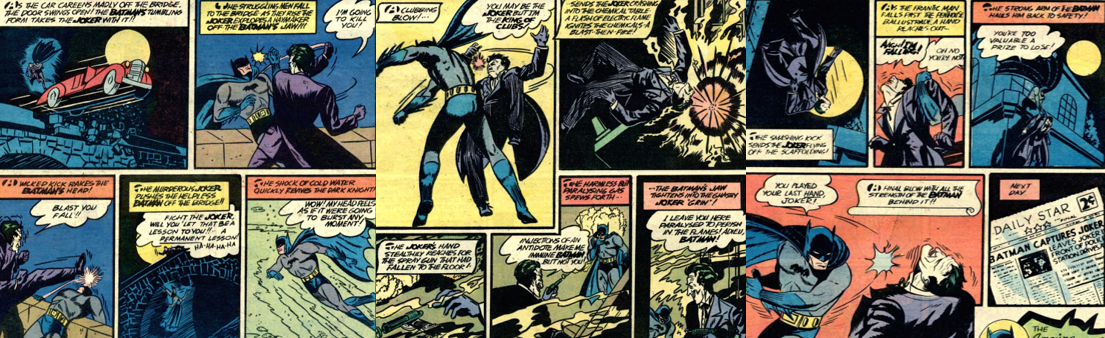
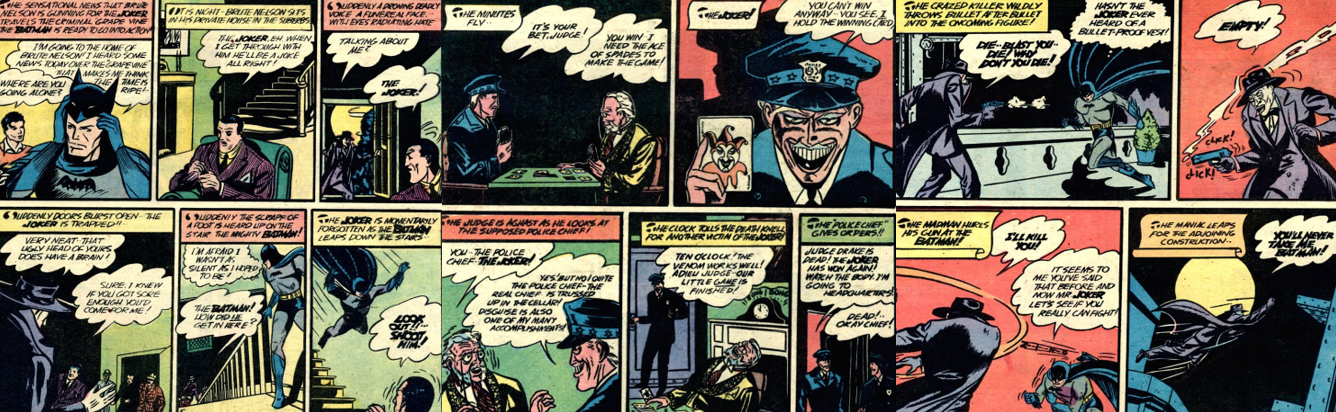
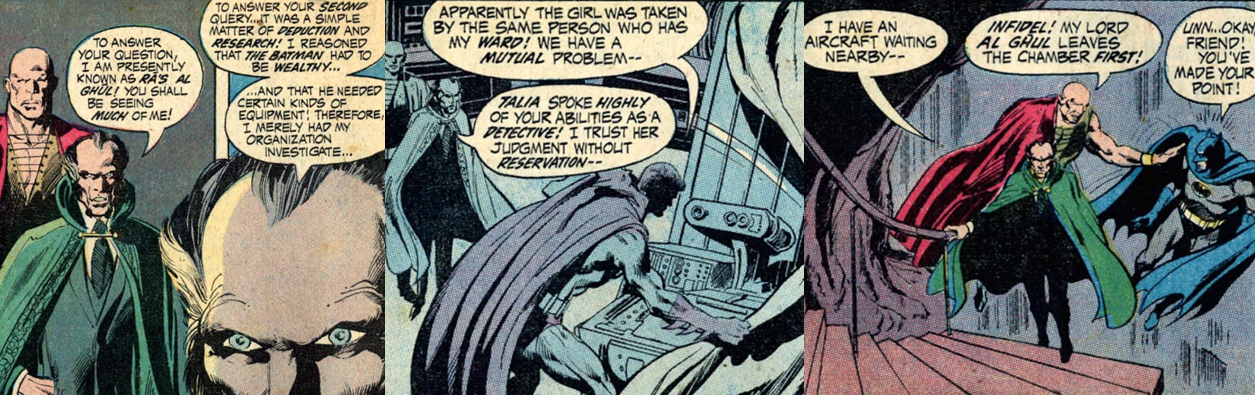
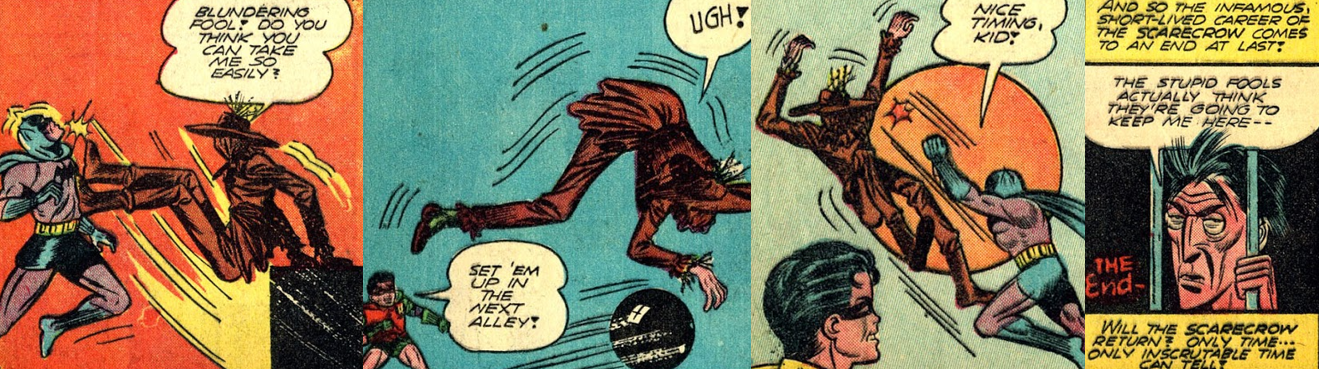
Back Issues [Bat-Month]: Knightfall


Following his first dramatic appearance in the pages of Detective Comics, Bruce Wayne/Batman became a mainstream pop culture icon. The brainchild of writer Bob Kane, Batman was brought to life by artist Bill Finger and has been a popular staple of DC Comics and countless movies, videogames, and cartoons over the years. “Batman Day” fell on 20 September this year so I spent every Saturday celebrating comic’s grim and broody vigilante.

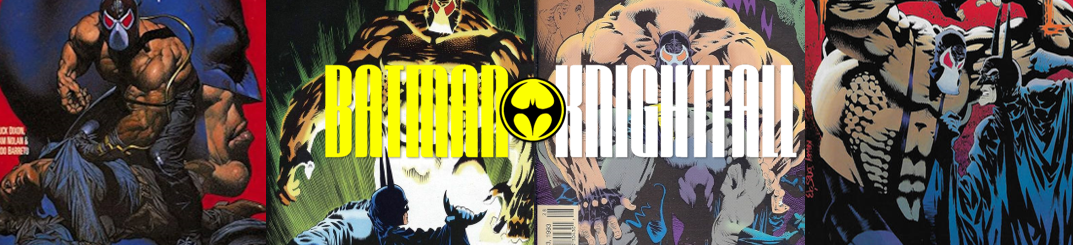
Story Title: “Vengeance of Bane” and “Knightfall Part I: Broken Bat” (includes various subtitles)
Published: January 1993 to July 1993
Writers: Chuck Dixon and Doug Moench
Artists: Graham Nolan, Jim Aparo, Jim Balent, and Norm Breyfogle

The Background:
After the overnight success of Clark Kent/Superman, National Comics Publications commissioned Bob Kane to add another masked crimefighter to their repertoire. Thanks to considerable input from artist Bill Finger, the “Bat-Man” immediately became one of DC Comics’ most popular characters and a mainstream cultural icon. This was bolstered, in no small part, by the many costumed supervillains the Batman has contended with over the years, with perhaps the superhuman mastermind “Bane” being the Batman’s most dangerous and physically imposing foe. Created by Chuck Dixon, Doug Moench, and Graham Nolan based on input from legendary Batman editor Dennis O’Neil, Bane was specifically conceptualised for this sprawling story arc, with the seeds of his first appearance and actions during “Knightfall” being planted throughout 1992. Following plans to introduce the warped vigilante Jean-Paul Valley/Azrael, O’Neil, Dixon and other DC creatives planned to significantly shake up the Dark Knight similar to how Superman was set to be dramatically killed. In keeping with DC’s plans to comment upon the readers’ desire for darker, grittier characters, Bane drove Batman to exhaustion before breaking his spine, leading Valley to assume the Batman mantle and become a more violent and unhinged version before Bruce reclaimed the role. The initial eleven issues were seen as one of the most important moments in Batman’s storied career and, while Bane struggled to remain relevant in the eventual aftermath, the visual of him bending Batman over his knee has influenced videogames and cartoons for years. Though always appearing significantly altered from the source material, Bane has appeared numerous times in cartoons and live-action, where he was reduced to a mindless lackey and something worse than cosplay before Tom Hardy largely divided audiences with his enigmatic portrayal in The Dark Knight Rises (Nolan, 2012). Still, as one of Batman’s most enduring villains, Bane joined the Secret Six, murdered Bruce’s mentor and father figure Alfred Pennyworth while conquering Gotham City, was once rumoured to be Bruce’s brother, and almost became the head of the League of Assassins!

The Review:
The story of Bane, easily Batman’s most physically imposing foe, begins years ago in the chaotic nation of Santa Prisca. After the totalitarian dictatorship quashed a doomed coup d’état, the insurgents were either slaughtered or arrested. One such insurgent, a heavily pregnant woman, was taken to island gulag Pena Duro and her unborn son was tried and convicted for his father’s crimes, as per Santa Prisca custom. Thus, the infant Bane was born in captivity, cared for only by his mother and fellow prisoner “Zombie”. They watched as the child grew and the mother’s health failed, with the boy showing an aptitude for exploration and subjected to daily horrific brutality. When the boy was six, his mother finally passed, yet by then he was too hardened to shed a tear. Without his mother’s protection, the boy was released into the cutthroat general population, far from Zombie’s gaze, where he was protected by the brutish Trogg. However, while Trogg fought off a malicious inmate with sadistic designs on the boy, the youngster fell and suffered a near-death experience, a vision of his future self who spoke of his destiny to rule. The vision also warned that the boy must overcome fear (represented by a giant, fearsome bat) to be a true conqueror and, when he awoke from a thirty-odd-day coma, the boy took his first steps towards becoming a man by savagely murdering his would-be abuser. The boy’s feral nature earned him the moniker “Bane” and a lengthy stint in solitary confinement, where every day and night was a fight for survival against crabs, rats, and a nightly flood of water. Each time, Bane overcame the odds, killing what he could to survive and growing stronger, harder, and more disciplined with each passing day. To stave off further madness, Bane entered a meditative trance, dreaming of slaughtering a bat-like creature and overcoming fear itself.
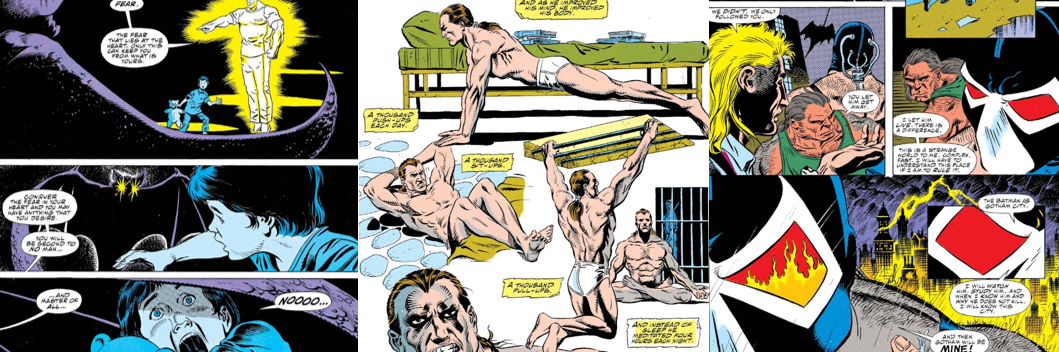
After a lifetime of hardship and training, Bane vows to crush Batman and conquer his city!

After ten years in the hole, Bane was released by the warden in the hopes that the inmates would kill him, only to be praised as a legend and to gain an additional follower, Bird, who taught Bane to read. Bane consumed knowledge and literature, learning six languages and training himself to the peak of human physical perfection. Bane’s coveted position was challenged many times, and each time he established himself as the alpha male in brutal combat. Still, Bane remained curious about Gotham City and demanded Bird tell him everything about the city, learning of its vigilante protector and vowing to destroy the Batman, whom he soon became obsessed with. Frustrated by this obsession, Bane incited a riot, slaughtering over thirty prisoners before he was subdued and returned the isolation. This was when the cruel warden forced Bane to be the next “volunteer” for Doctor Ruger’s inhumane experiments with a particularly deadly nerve toxin. Although others died from the serum, Bane persevered and was further altered, with “Venom” fed directly into his brain and turning him superhuman. As Dr. Ruger and the others busied themselves with Bane, Zombie stole a Venom sample, replicated it, and helped Bane fake his death so he could finally escape the island. His first act was to take the warden hostage and free his three lieutenants, tossing the warden to the sharks as they helicoptered to safety. Establishing themselves in Gotham City, Bane’s lieutenants devised a portable delivery system for his drug and quickly made a name for himself by brutalising a mob gang. Bane watched and followed the Dark Knight as he investigated, even saving Batman’s life so he could claim it for himself later. Eventually, Bane confronted the Batman and mocked his code against killing, though the Batman was unimpressed by Bane’s threats.
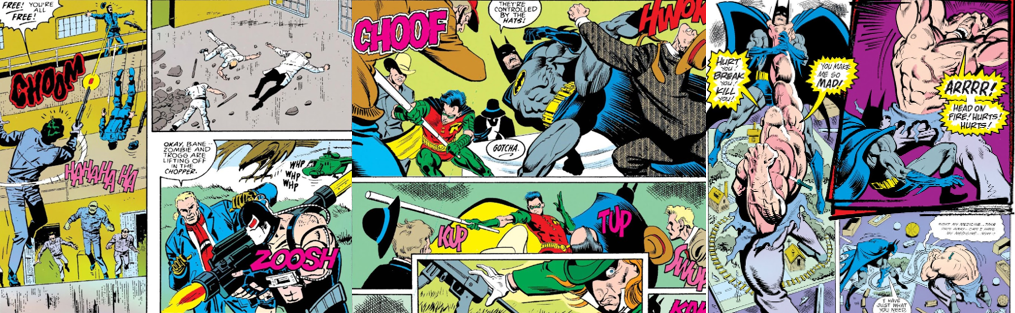
When Bane frees Arkham’s inmates, an exhausted Batman’s forced to hunt them all down.

After spending more time observing and studying his quarry (during which Bane fought Waylon Jones/Killer Croc and broke his arms), Bane finally struck about six months later, ransacking a military armoury and launching a premeditated assault on Arkham Asylum. At Bird’s suggestion, Bane blew open the Joker’s cell first before dropping some ordinance to fuel the ensuring riot. While the other prisoners attacked the guards, the Joker gleefully took Doctor Jeremiah Arkham hostage. Though still recovering from mental and physical fatigue, the Batman arrived to help, rescuing who he could but unable to keep many inmates from blasting their way to freedom. While Batman freed Dr. Arkham from the Joker’s death trap, his hated enemy escaped and Batman was left mortified at the prospect of hunting down the escapees, much to Bane’s delight. After reviewing the situation and, alongside Tim Drake/Robin, surmising that Bane sparked the outbreak, Batman’s first test came when Jervis Tetch /The Mad Hatter invited him to a “tea party”. There, the Mad Hatter forced some goons to wear his brainwashing hats, sending Z-tier villain Burt Weston/Film Freak to investigate the bird following him and leading to him being beaten to death by Bane. Though Batman and Robin broke up the tea party, they were nowhere closer to locating Bane and, though physically struggling, Batman was adamant about proactively stopping the more dangerous inmates from organising themselves. His stubborn nature saw him chastising Robin’s concern and being more abrasive than usual, almost costing him when he investigated a toy store break in and was attacked by Arnold Wesker/The Ventriloquist’s brutish companion, Aaron Helzinger/Amygdala, while searching for Wesker’s mobster puppet, Scarface. With Robin busy tussling with the agile and arrogant Bird, Batman took a beating before finally knocking his simple-minded foe unconscious, forcing him to slink away to the Batmobile rather than apprehend the Ventriloquist.
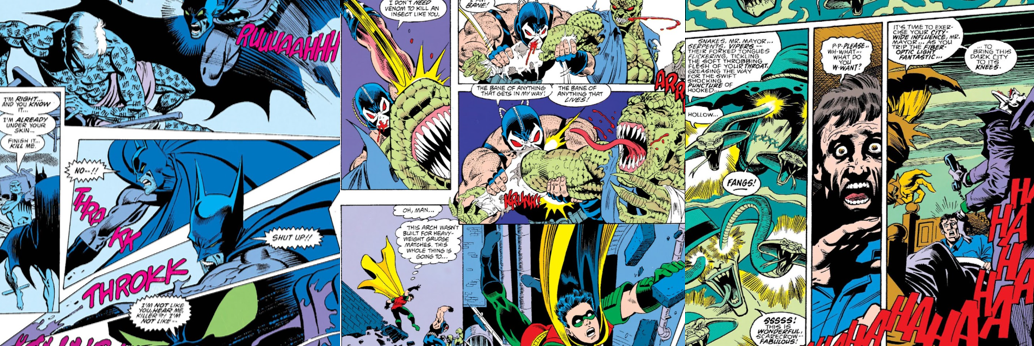
While Batman’s pushed to his limit and Robin barely escapes Bane, the mayor is kidnapped.

Though hurting and fatigued, the Batman raced to a school where sadistic serial killer Victor Zsasz/Mister Zsasz had taken schoolgirls hostage, relishing the thought of scarring his body after slitting their throats. Though Bane’s lieutenants were eager for their boss to act, Bane was content to observe and delight in exhausting Batman and the Dark Knight refused to allow the Gotham police to interfere in the situation, which left one cop dead a feisty pupil held at knife point. After sending Robin after Bird (expressly forbidding him from confronting Bane), Batman brutalised Mr. Zsasz with a beating so vicious that Detective Renee Montoya had to intervene at gunpoint. The ordeal left the Batman so drained that he blacked out on a rooftop, meaning he couldn’t answer Robin’s calls for backup as he tracked Bird to Bane’s location. When Bane leapt to a passing train, Robin followed and was easily captured, blindfolded, and taken to the sewers. There, Bane expressed admiration for the boy and queried him regarding Batman, only to be meet with quips and Robin’s desperate attempts to fight back. Luckily for the Teen Wonder, the vengeful Killer Croc stepped in for a rematch, damaging Bane’s Venom device and ending up with his arm broken again. Their smackdown saw all three being swept through the sewers, with Robin barely getting to safety, though both he and Alfred despaired when Batman refused to back down from Bane’s challenge. As Trogg repaired Bane’s device, Batman was horrified to learn that cannibal psychopath Cornelius Stirk planned to murder Commissioner James “Jim” Gordon. Utilising his unique ability to cloud his prey’s mind with fear, Stirk masqueraded as Batman and almost knifed Gordon, much to the anger of his accomplice, the Joker, who wanted Gordon alive. Although the Batman saved Gordon, the incident led to the Joker teaming up with the true master of fear, Doctor Jonathan Crane/The Scarecrow, who suggested they terrorise the city’s anti-Batman mayor, Armand Krol.
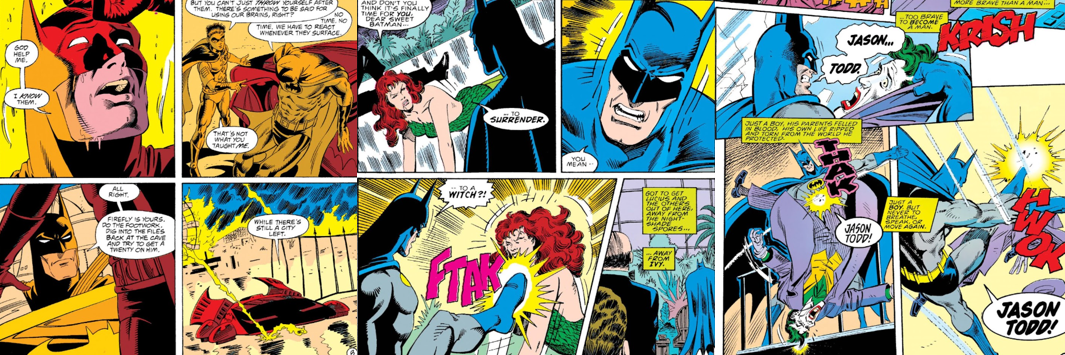
Though Batman leaves Firefly to Robin and defeats Poison Ivy, he flies into a rage against the Joker.

After kidnapping Mayor Krol and driving him to near madness with the Scarecrow’s patented fear gas, the two coerced the mayor into causing a firefighter strike, which allowed crazed pyromaniac Garfield Lynns/Firefly to set the city pier alight. Though he stubbornly refused Robin’s aid, the Batman was too exhausted to apprehend Firefly and begrudgingly let his partner investigate Firefly’s possible targets. While this led Batman to Firefly’s location, he was still too out of it to stop him, leading to him literally collapsing upon returning to Wayne Manor. While the Ventriloquist searched for Scarface and Jean-Paul Valley tested himself, Mayor Krol was forced to send the cops into a trap. Despite his failing health, Batman forced himself to attend a charity function as Bruce Wayne alongside physiotherapist Doctor Shondra Kinsolving, only for Doctor Pamela Isley/Poison Ivy to gatecrash the function and use special spores to kidnap wealthy gentlemen. Bruce played along to reach Poison Ivy’s lair and then switched to Batman to stop her, expending the last of his energy fighting her terminally infected minions. After the disgruntled Tim’s legwork leads Batman to the zoo and finally results in Firefly’s capture, Robin’s forced to intervene when Edward Nygma/The Riddler takes a talk show hostage, though his reckless actions earn him a dressing down from cantankerous detective Harvey Bullock. Upon learning of the mayor’s kidnapping, the Batman races to locate him, rescuing Bullock from an explosion and eventually tracking the Joker and the Scarecrow to the Gotham river tunnel. Unfortunately, the Scarecrow’s fear toxin bombards Batman with images of the Joker beating former Robin Jason Todd with a crowbar. Enraged, the Batman makes short work of the Scarecrow and savagely beats the Joker while screaming Jason’s name. The Batman’s only kept from killing his hated foe by the Scarecrow’s timely intervention, which sees him save and finally earn the trust of Mayor Krol.
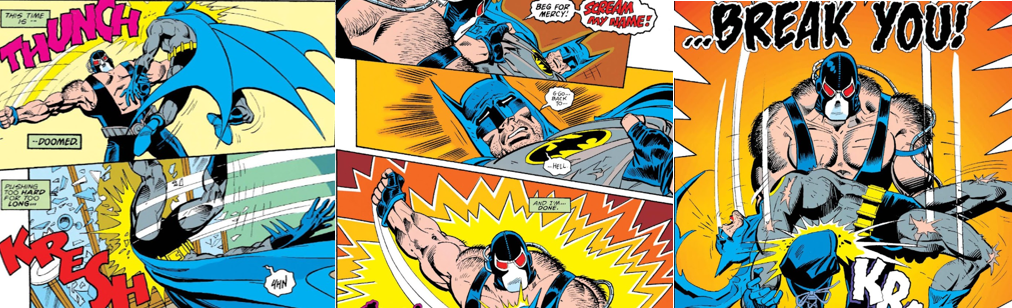
Bane beats the near-helpless Batman close to death and then shockingly breaks his back!

As the Ventriloquist finally reunites with Scarface, the Batman’s gauntlet ends when he’s attacked by Trogg. Though the brute snaps one of Batman’s rubs with a bearhug, the Dark Knight’s gadgets and tenacity see him victorious. He then quickly outsmarts Zombie but, after being driven to the edge by Bird, again comes close to snapping. Drained and at his wit’s end, the Batman reluctantly heads home, eager to rest, only to be horrified to find Alfred unconscious and Bane in his family home! Bane reveals he easily figured out the Batman’s identity, has mastered and perfected the Venom serum that once almost drove Bruce insane, and states his desire to take Gotham City by ending its creator. Though startled by Bane’s cold-hearted demeanor, Bruce dons his cowl and leaps into the fight…only to be immediately swatted aside. After launching Batman through some nearby furniture, Bane tackles him down to the Batcave and shrugs off his foe’s pitiful counterattack, disgusted by Batman’s broken resolve. The vicious beating causes Batman to remember every fight, injury, and villain to have mentally and physically scarred him, leaves him trapped under the Batcave’s giant penny, and driven head-first into the Batmobile, all while Bane rages. Though the Batman tries to fight back, it’s a miserable attempt and he’s sent crashing through Jason’s memorial, mercilessly battered, and partially impaled on parts of the Batcave. While Alfred rushes to Tim for aid, the half-dead Batman is manhandled by his monstrous foe. Victorious, Bane decides it would be too easy to simply kill the Batman and that he’d rather his foe continued to suffer so, in dramatic and horrifying fashion, Bane lifts the brutalised Batman over his head and drives him, spine-first, onto one meaty knee, snapping Bruce’s back in an awesome show of power. Bane then simply drops his foe to the floor, dismissive in victory, and prepares to claim his reward…

The Summary:
It’s easy, at first glance, to compare this first dramatic chapter in the “Knightfall” saga to the “Death of Superman” (Jurgens, et al, 1992 to 1993) arc that happened just before it (indeed, Batman and Robin both wear black arm bands in mourning for the Man of Steel). However, while that was a prolonged slugfest over a few issues with little meat on its bones beyond the shocking death of the world’s greatest hero, “Knightfall” is an agonising gauntlet for the Dark Knight that pushes him to his mental and physical limit. This was all perfectly set up in previous issues, which pushed Batman to breaking point and saw him shun Robin and drive himself to exhaustion, causing Tim to resent his stubborn and dismissive attitude and Bruce to alienate his allies. Perhaps he would’ve snapped out of this of it wasn’t for Bane, a calculating supervillain who spend a lifetime in near-literal hell honing his mental and physical self to conquer Gotham City and destroy her protector. I’ve mentioned it before, but this is peak Batman for me, in terms of art, with the likes of the immortal Jim Aparo showcasing Batman’s exhaustion, anger, and degenerating mental state throughout each issue. While this first chapter suffers from the absence of Batman’s biggest foes, Bane’s test is more than enough to exhaust Batman as he insists on going alone to avoid others getting hurt and out of a pig-headed refusal to accept help. Notably, however, the Batman commends Tim when his investigation locates Firefly and shows concern when Tim survives his encounter with Bane and Killer Croc, but Bruce ultimately shoulders the burden alone, which leads to his inevitable downfall.
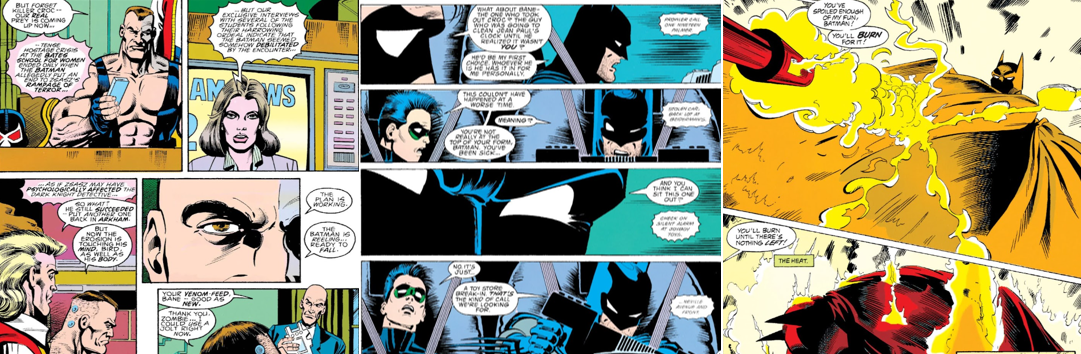
The calculating Bane tests Batman’s mettle by running him ragged across Gotham.

I’ve always found it interesting that Bane chose to put Batman to the test this way. It’s a fantastic way to showcase Bane’s cunning and strategy; he’s no mere mindless brute, something many subsequent stories and adaptations tend to forget. Bane is a man of deep focus and determination, with a sprinkle of obsessive insanity thrown in, and is depicted as a dark mirror of Batman in many ways (though he’s ironically more courteous to his lieutenants than Batman is!) Still, for a man who expresses such admiration for the Batman and who wants to make a point of physically dominating him, it’s ironic and a little hypocritical that Bane chooses to strike when Batman is ready to keel over. All through the one-sided beatdown, Bane scoffs at the Batman and rages in disappointment, but he specifically chose to fight a Batman who was far from his peak, cleverly ensuring his victory but also meaning his win, while dominant, was undeniably tainted. Bane even maims and kills others to keep his target alive so that he can have the final glory, though showcases enough respect to leave Alfred and Robin alive since the Batman is his sole target. Nevertheless, Bane takes perverse pleasure in watching new reports and observing Batman’s progress and decline, studying his quarry to learn all his strengths and weaknesses to aid his eventual attack. The gauntlet is an exhausting test for the Batman, who’s obsessed with locating Bane, to the point where he brutalises some of his villains and comes dangerously close to breaking his “one rule”. This was particularly notable in Batman’s confrontation with the Joker, which sees the enraged Dark Knight beat his foe half to death for killing Jason Todd. It’s enough to terrify even the Scarecrow, and similar outbursts against the Mad Hatter and Mr. Zsasz sees Batman’s allies question his mental stability. This is reflected in Mayor Krol’s anti-Batman campaign, though the city’s cops are left largely useless thanks to a departmental shake-up and the mayor being forced to mess them about.
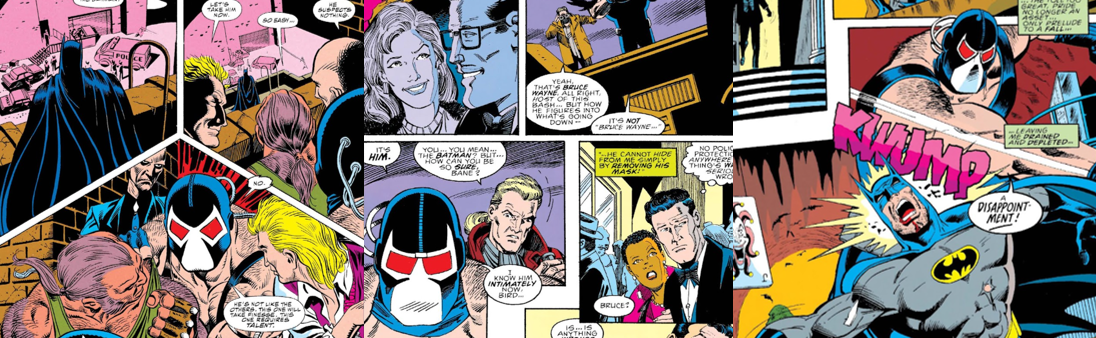
Bane showcases cunning, strength, and a psychotic determination in his memorable debut.

This first chapter of “Knightfall” does a fantastic job of painting Bane as an intelligent and nigh-unstoppable foe. While it’s a shame that it took a new villain to overwhelm and decisively defeat the Dark Knight, Bane makes a far greater impression here than Doomsday, who was a mindless brute bent on destruction. While Bane’s design is perhaps too simplistic, I really enjoyed how calculating and quietly psychotic he was: he has a plan and he sticks to it, confident of his victory. Naturally, this is aided by his Venom serum, which makes him almost superhuman, but a lifetime of hardship and training made Bane the perfect villain, a puppet master largely being content to let the escapees do as they please. This chapter also depicts some of Jean-Paul’s redemption, as he trains with Robin to put his skills to good use, shows Robin’s frustration and adaptability, and even leaves the door open for future threats from the Joker, the Scarecrow, and the Ventriloquist. Far from being as one-note as “The Death of Superman”, this first chapter of “Knightfall” deconstructs Batman and leaves him a man weary from a lifetime of fighting, effectively shattering the status quo as surely as Bane breaks Batman’s back. This startling conclusion leaves the reader wondering what’s next for Batman, Bane, and Gotham City and shows that even the Batman has a breaking point. While it’s a shame that Bane struggled to remained relevant after such a memorable debut, his intriguing and imposing character certainly made an impact on me as a teenager and continue to make “Knightfall” one of the quintessential Batman stories.

My Rating:

Rating: 3 out of 5.

Pretty Good

Were you a fan of Bane’s dramatic debut? What did you think to his violent past and his depiction as a dark mirror of the Batman? Do you agree that it was unfair of him to run the Batman to exhaustion? Which of Batman’s battles were you most invested in? Were you shocked when Bane broke the Batman’s spine? What are some of your favourite bane stories and moments? How are you celebrating Batman Day this year? Whatever your thoughts on this first chapter of the “Knightfall” saga, and Batman in general, share them below. If you’d like to see me tackle the next chapter in the “Knightfall” saga, support me on Ko-Fi and let me know.

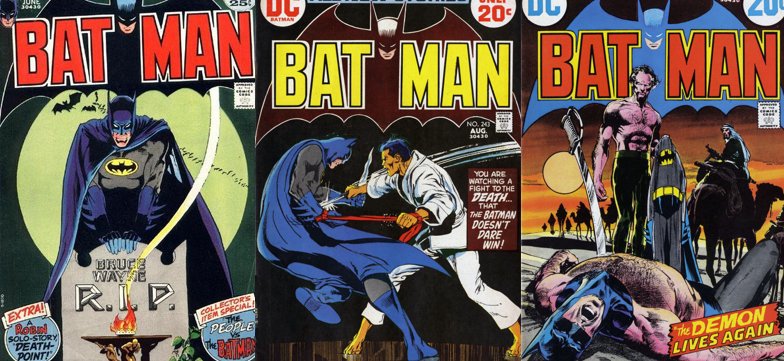
Back Issues [Bat-Month]: Batman #242-244


In the decades since his first dramatic appearance in the pages of Detective Comics, Bruce Wayne/Batman has become a mainstream, worldwide, pop culture icon. The brainchild of writer Bob Kane, Batman was brought to life by artist Bill Finger and has been a popular staple of DC Comics and countless movies, videogames, and cartoons over the years. “Batman Day” falls on September 16 this year and I figured this was a perfect excuse to spend every Saturday celebrating comic’s grim and broody vigilante.


Story Title: “Bruce Wayne — Rest in Peace!”
Published: June 1972
Writer: Dennis O’Neil
Artist: Irv Novick and Dick Giordano

Story Title: “The Lazarus Pit!”
Published: August 1972
Writer: Dennis O’Neil
Artist: Neal Adams

Story Title: “The Demon Lives Again!”
Published: September 1972
Writer: Dennis O’Neil
Artist: Neal Adams

The Background:
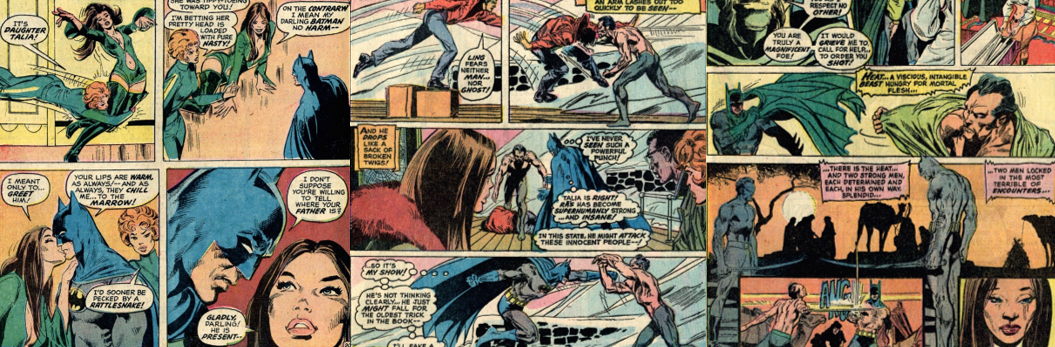
Following their success with Clark Kent/Superman, National Comics Publications tasked Bob Kane with creating another masked crimefighter to add to their repertoire. Thanks to the invaluable and long-suppressed talent of artist Bill Finger, the “Bat-Man” quickly became one of DC Comics’ most popular characters and a mainstream cultural icon. Over the years, the Batman defended Gotham City from many costumed supervillains, but perhaps his most captivating and intriguing villain is “The Demon’s Head”, Rā’s al Ghūl. Created by editor Julius Schwartz, writer Dennis O’Neil, and artist Neal Adams during DC Comics’ reinvention of the Batman to downplay the camp trappings of the sixties, Rā’s al Ghūl was an enigmatic criminal mastermind not unlike a James Bond villain. His expansive criminal empire, lofty goal of ending worldwide conflict by any means necessary, and international flavour made him a dark counterpart to the Dark Knight. Following his first appearance, Rā’s al Ghūl continually plagued Batman thanks to the rejuvenating properties of his “Lazarus Pits”, which were introduced in these three issues and restored him from death at the cost of his keen intellect. Rā’s was a pivotal figure in DC Comics thanks to his daughter, Talia, who birthed Batman’s volatile son, and numerous appearances outside of comics. He was excellently brought to life by the eloquent David Warner, Matthew Nable, Alexander Siddig, and Liam Neeson. These issues also inspired some of these interpretations of Rā’s, with the story and visual of the two (or a Batman proxy) battling bare-chested and/or with swords being evoked in the DC Animated Universe, Batman Begins (Nolan, 2005), and Arrow (2012 to 2020).

The Review:
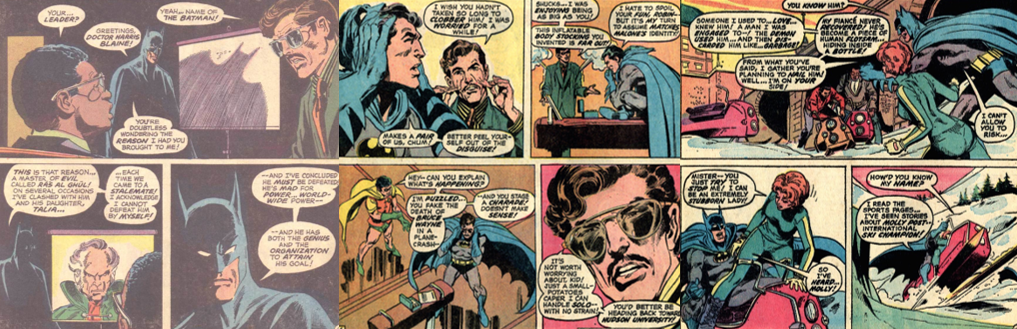
This three-part story kicks off with quite the sensational headline: “Bruce Wayne Vanishes!” In Commissioner James “Jim” Gordon’s office, the world-weary commissioner discusses the millionaire’s presumed death with the Caped Crusader, obviously oblivious that the Batman is Bruce Wayne. Both men lament Wayne’s assumed death before the Batman leaves, informing Gordon that he’ll be out of the country for some time. As the Batman swings through the city, we learn that he faked his alter ego’s death as a mysterious villain apparently knows of his dual identity and the Batman doesn’t want to risk endangering those closest to him. Begrudgingly, the Batman realises he needs help combating this threat and thus swoops into a downtown café to chat with crime boss “Matches” Malone. However, Malone sics his goons on the Batman and flees into the café’s kitchen. Cornered, Malone opens fire and apparently shoots Batman dead! Thus, the story follows Malone (whose gimmick, who may have guessed, is repeatedly lighting matches with his thumb) as he follows Doctor Harris Blaine through the Gotham Arms Hotel. When Dr. Blaine is attacked by an unknown assailant, Malone repays the favour and carries the unconscious doctor to a nearby building to meet the Batman, alive and well and grimly revealing that Rā’s al Ghūl – the seemingly immortal head of the worldwide criminal organisation the League of Assassins – has targeted Dr. Blaine due to his as-yet-unknown research. Dr. Blaine’s attacker, Lo Ling, interrupts the meeting and spontaneously reveals some of his backstory (he was saved by Rā’s and thus owes him his servitude) and that Rā’s’ daughter, Talia, disagrees with his vendetta against the Batman, all before tossing a knife right into the Dark Knight’s chest! Malone is so enraged by this that he accidentally topples over the projector Batman was using to show Dr. Blaine slides, temporarily blinding Dr. Blaine and allowing Lo Ling to vanish…along with the Batman’s corpse!

The Batman assembles a rag-tag team to track Rā’s al Ghūl to the Swiss alps.

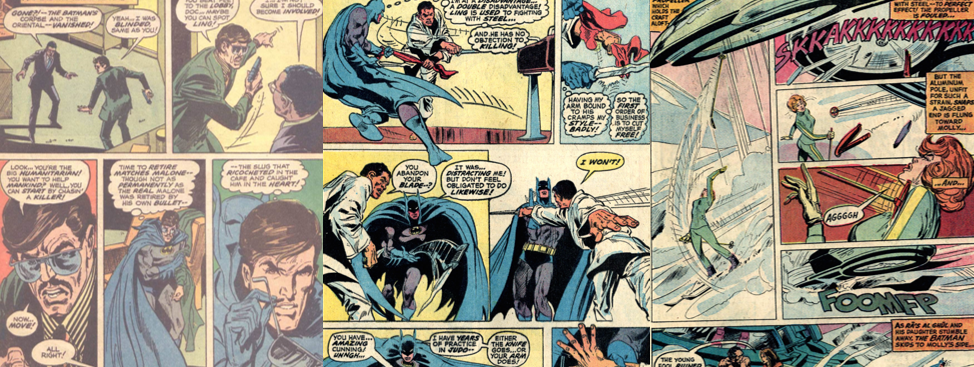
Malone orders Dr. Blaine to the lobby and then races after Lo Ling. With Dr. Blaine out of sight, Malone removes his clever disguise and reveals that he was the Batman all along, the Dark Knight assuming the mobster’s identity after he accidentally killed himself and setting up a dummy for his meeting with Dr. Blaine. Lo Ling is so shocked to see the Caped Crusader alive that he slips from the rooftop, though the Dark Knight catches him mid-fall by racing to a lower-floor window. Now owing his life to the Batman as much as Rā’s al Ghūl, Lo Ling is drafted into Batman’s crusade, though insists on fighting him in respectful combat first. This time, Dick Grayson/Robin assumes Malone’s identity as the two battle, with Batman abandoning his blade and overpowering Lo Ling with his superior judo skills and earning Lo Ling’s eternal servitude. Despite needing allies for his war with Rā’s al Ghūl, the Batman sends Robin back to Hudson University to avoid endangering the Teen Wonder and to ensure that the Batman’s legacy can continue if he falls. Dr. Blaine and Lo Ling then meet with Malone (who’s Batman in disguise, keep up!) at a private airfield and take a plane to the Swiss alps, where it’s rumoured Rā’s al Ghūl is located. Upon landing, Lo Ling randomly spots Talia al Ghūl and rushes to capture her, eager to please his new master, only to be knocked out by Talia’s hulking bodyguard, Ubu. The Batman intervenes and quickly takes the brute down, only to be blasted by international ski champion Molly Post, who misread the situation and thought Batman was attacking Talia. This allows Ubu to kick the shit out of Batman, but Talia calls him off since she’s still got the hots for the Masked Manhunter.

Although Batman and his allies find Rā’s dead, the Demon’s Head rises again, stronger than ever!

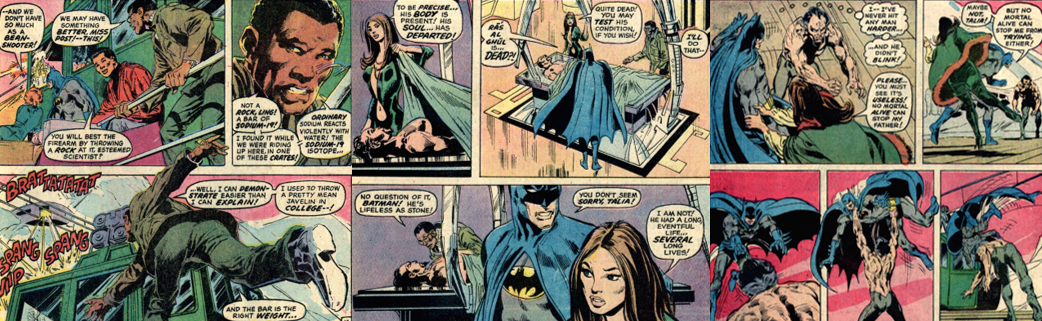
After apologising for her blunder, Molly insists on accompanying the three in hunting Rā’s al Ghūl since the Demon’s Head manipulated her fiancé so badly that he turned to alcoholism. Upon reaching Rā’s al Ghūl’s private cable car, Batman and Lo Ling KO two guards (much to Dr. Blaine’s chagrin) and have Molly and Dr. Blaine assume their identities, while Batman and Lo Ling cling to the outside of the cable car, to bypass the inept snipers. As swift as the Dark Knight and his ally are, however, the goons open fire, causing the group to be pinned down by machine gun fire from a nearby World War Two bunker that serves as Rā’s al Ghūl’s Swiss headquarters. Despite claiming to be a pacifist, Dr. Blaine resolves the situation by hurling a bar of Sodium-19 (which was being transported in the cable car) into the bunker, causing a massive explosion that the doctor is strangely confident their attackers will have survived. Eager to discover what Rā’s is planning for the Sodium-19, the Batman leads the group onwards, lamenting that he must endanger such brave and feisty lives, easily breaking into Rā’s’ stronghold and taking Ubu down with a flying kick. Although Molly tackles Talia, believe her to be a threat, Talia not only reaffirms her love for the Batman but also reveals that Rā’s is dead. Dr. Blaine confirms it by examining the body and Batman offers his condolences. Although Talia dismisses Batman’s sympathies and agrees to be arrested, the group miss that she activates a hidden switch that lowers Rā’s al Ghūl’s corpse into a bubbling, putrid green liquid – the Lazarus Pit. True to its name, the mysterious liquid reanimates Rā’s, returning him to life with the strength of ten men and the madness of an animal! Accordingly, the crazed, half-naked Rā’s races into the frigid cold to confront the group, laying Lo Ling out with a single punch and shrugging off the Batman’s most powerful blow! Refusing to back down even in the face of such a mighty madman, the Batman is easily manhandled and tossed into the cable car.

Following a beautiful sword fight, Batman KO’s his foe and takes him into custody.

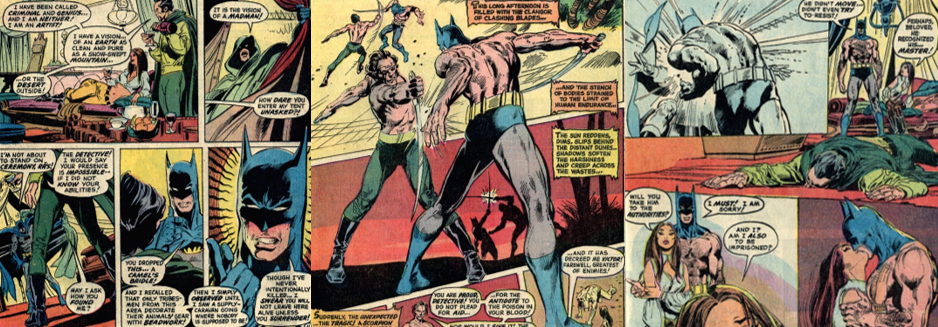
After Dr. Blaine wrecks the cable car’s controls, Talia talks some sense into her father and flees with him to their hovercraft, leaving Batman to shake off his injuries and Dr. Blaine insisting they get the wounded Lo Ling to a hospital. Upon seeing Rā’s al Ghūl’s futuristic hovercraft blast away, the Batman is stunned when Molly gives chase on her skis, forcing him to follow to protect her. Though astonished by her recklessness, the Batman can’t help but admire her skill and bravery, and he’s even more impressed when Molly hurls one of her skis into the hovercraft’s propeller, forcing a crash landing, though she’s wounded from debris. This is all the distraction the al Ghūl’s need to flee and, after getting Molly to safety, the Batman returns during the night to inspect the downed hovercraft and discovers a camel’s bridle. With all his allies on the shelf, Batman heads to the desert of an unspecified nation to confront Rā’s, whose regained his senses and determined to rebuild his empire. Determined to stop Rā’s, Batman agrees to a duel to the death and the two face each other, topless and armed with swords, in the sweltering desert. As a weeping Talia watches her lover and her father clash, Batman and Rā’s battle long into the afternoon but the fight unexpectedly ends when Batman is stung by a scorpion. Declaring himself the victor, Rā’s abandons his foe to his fate, though a kiss from Talia revitalises Batman and counteracts the poison. Driven by rage and instinct, the Batman stalks to Rā’s’ tent and lays him out with a single punch, with Rā’s too humble and horrified to offer any resistance. Although the Batman carries Rā’s al Ghūl off to be the authorities, he lets his emotions get the better of him and spares Talia, leaving her with a final kiss.

The Summary:
These three stories (generally referred to as “The Demon Lives Again!”) have become iconic moments in the Batman’s long and storied career mainly due to the visual of the bare-chested Dark Knight duelling with the Demon’s Head in the arid desert. For me, this is peak classic Batman since I grew up with the writing and art of Dennis O’Neil and Neal Adams, which portrayed him as a well-rounded, intelligent, and stable individual more focused on crime solving than bashing heads or being a paranoid control freak. While the Batman loathes asking for help and putting others in danger to track down Rā’s al Ghūl, he feels compelled to do so to protect those he cares about (such as Robin and, assumedly, his mentor and father figure, Alfred Pennyworth). While the Batman is clearly rattled to have his civilian identity be targeted, to the point where he fakes Bruce Wayne’s death to operate autonomously as the Batman, it’s not clear what Rā’s al Ghūl’s goal is in this story arc. He targets Dr. Blaine for unspecified reasons and is stockpiling Sodium-19, but it’s not revealed why or what the endgame is beyond Rā’s wishing to strengthen his already powerful criminal empire. The assumption is that whatever Rā’s al Ghūl is planning can’t be good since he’s essentially a threat to the entire world by default, but it might’ve been nice to get some idea about what the stakes were beyond this vague threat. It’s also not revealed how and when Rā’s al Ghūl died. The Batman doesn’t seem to have known about this, so I doubt it happened in a previous story, and it raises questions regarding Talia. While she’s clearly conflicted between her loyalty to her father and her love for the Batman, it’s heavily implied that she’s begrudgingly carrying out his posthumous orders and is therefore the true threat of the story arc.

Batman’s allies and methods are questionable, adding little to the plot and ultimately being unnecessary.

Naturally, she hides it well, talking down Ubu, kissing the Dark Knight, weeping at the iconic clash between the two, and making no explicit moves against him, but Talia clearly can’t be trusted and carries out her father’s orders, willingly or not. The Batman’s plan is to assemble a team to hunt the Demon’s Head, though I’m not entirely sure what the benefit of assuming “Matches” Malone’s identity was since his underworld ties didn’t have any impact on their journey. I guess it helped to distract Lo Ling, who was fooled by the dummy Batman, but Malone didn’t seem necessary to the plot to me. It would’ve made more sense for “Bruce Wayne — Rest in Peace!” to revolve entirely around Batman masquerading as Malone to figure out who Rā’s al Ghūl is planning to target and then abandoning the disguise once Dr. Blaine was saved. I quite liked Lo Ling; he seemed like a tortured soul torn between his loyalties, like Talia, and was a useful ally in combat. It definitely would’ve made more sense for him to toss that Sodium-19 bar and for that to have killed Rā’s’ men, bringing some conflict between Lo Long’s methods and the Batman’s. It also would’ve made more sense for Lo Ling to guide Batman through the Swiss alps; he should know the location of Rā’s al Ghūl’s base, after all, meaning the inclusion of Molly Post also a questionable one. I liked that she impressed Batman time again, how resourceful, determined, and fearless she was, and that he was obviously taken by her, but I fail to see how she added anything to the story. Lo Ling and the Batman could’ve easily filled her role and it’s not like Molly and Batman become an item by the end. Additionally, Lo Ling and Molly are both grievously wounded in the final issue, which also takes Dr. Blaine out of the picture since he needs to see to her, meaning Batman faces Rā’s al Ghūl alone in the end…which was the exact opposite of his plan!

Batman’s relationship with Talia and rematch with Rā’s are the two highlights of this arc.

Therefore, the primary focus of this story arc (tracking down and stopping Rā’s al Ghūl’s mysterious plot) is a bit flimsy for me. However, these issues still stand as a landmark moment in the Dark Knight’s history simply because of how alluring and nuanced Rā’s al Ghūl and Talia are. Rā’s al Ghūl poses a significant threat to both the world and the Batman because of his resources and knowledge of Bruce Wayne’s identity, while Talia represents seductive temptation. Both the al Ghūl’s deeply respect and admire the Batman and wish him to join their cause, though they refuse to alter their methods to appeal to him and even Talia only defies her father so much. These issues not only reintroduce Rā’s al Ghūl but also introduce the concept of the Lazarus Pit, a mysterious, ancient substance that not only restores the dead to life but briefly bestows them with superhuman strength, though at the temporary loss of their sanity. When he rises from the dead, Rā’s al Ghūl is a mindless, animalistic force who easily fells Lo Ling and overpowers the Batman, only coming to his senses when confronted by his daughter. By the time the Batman intercepts them in Egypt Afghanistan whatever desert they flee to, Rā’s al Ghūl has fully regained his composure and is ready to battle to the death to settle his differences with the Dark Knight. While the Batman outright refuses to kill Rā’s al Ghūl, he also refuses to leave without the Demon’s Head in custody and accepts the challenge, providing the arc’s most powerful and sexually charged imagery. The actual sword fight, however, is surprisingly disappointing; neither competent draws blood, there’s no back and forth between the two, and it randomly ends when a scorpion stings Batman. Rā’s is incredibly pleased by this victory, claiming that nature itself has willed him as the victor, but so startled to see his foe fully recovered that he offers no resistance when the enraged Batman comes for him. In the end, these are decent enough stories, but I feel it could’ve been cut down to a two-part tale by removing some unnecessary characters and moments. This might’ve freed some panels to better explore Batman’s relationship with Talia and Rā’s al Ghūl’s plan, but there’s no denying the appeal of their sword fight and the juxtaposition between the Dark Knight and the Demon’s Head.

My Rating:

Rating: 3 out of 5.

Pretty Good

What did you think of Rā’s al Ghūl’s rematch with the Dark Knight? Do you agree that the additional characters bogged down the narrative or were you a fan of Lo Ling and the “Matches” Malone identity? Did you enjoy the bare-chested sword fight between the two? What are some of your favourite Rā’s al Ghūl stories? Which interpretation of the Rā’s al Ghūl, whether animated, pixelated, or live-action, is your favourite? Whatever you think about the Rā’s al Ghūl, share your thoughts below, support me on Ko-Fi, and check out my other Batman content!

Back Issues [Crossover Crisis]: Crisis on Infinite Earths


Cover-dated April 1985, the first issue of this ground-breaking event precipitated the destruction of the “Multiverse” in favour of a unified DC canon. Though DC returned to this concept again and again, that doesn’t change how influential this massive crossover was and what better way to celebrate than with a “Crossover Crisis” of my own?


Published: 3 January 1985 (cover-dated: April 1985) to March 1986 (cover date)
Writer: Marv Wolfman
Artist: George Pérez

The Background:
In Showcase #4 (1956), writer Robert Kanigher and artist Carmine Infantino debuted Barry Allen/The Flash, the successor to Jay Garrick, who was established as an alternative version of the Fastest Man Alive. This concept was taken to the next level when Barry and Jay met face-to-face, revealing an infinite number of parallel worlds. Regular crossovers between the likes the Justice Society of America and the Justice League of America soon followed, allowing alternative heroes and various stories to exist simultaneously. Over time, writers like Mark Wolfman became frustrated with this concept, which made keeping track of continuity difficult and it was hard for both writers and readers to connect with the stories. Wolfman initially pitched a reader guide to simplify the DC universe, which then evolved into a sprawling tale of multiversal destruction seen as a risky proposition as it meant erasing all continuity and starting from scratch to attract new readers. Such an event was unprecedented and DC spent two years laying the foundation for this Crisis, hiring researchers to document every character and event in their library and bringing in George Pérez to illustrate, with the artist excited at the idea of illustrating every DC character. Crisis on Infinite Earths became a bestseller for DC Comics and was heralded as a turning point for both the publisher and the industry. The fallout saw every DC character rebooted, with Clark Kent/Superman notably being reimagined as a more grounded character and Wally West taking over as the Flash, though Carter Hall/Hawkman was irrevocably damaged for years as DC struggled to reconcile certain elements of his character. Praised as the greatest comic book crossover in history, the event popularised massive, cosmic crossovers and DC revisited this concept numerous times in subsequent years. The event was even adapted into an ambitious and well received television event and an impressive three-part animated feature.

The Review:
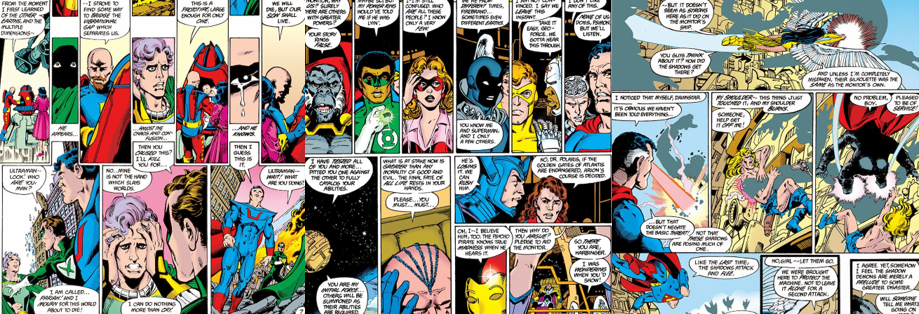
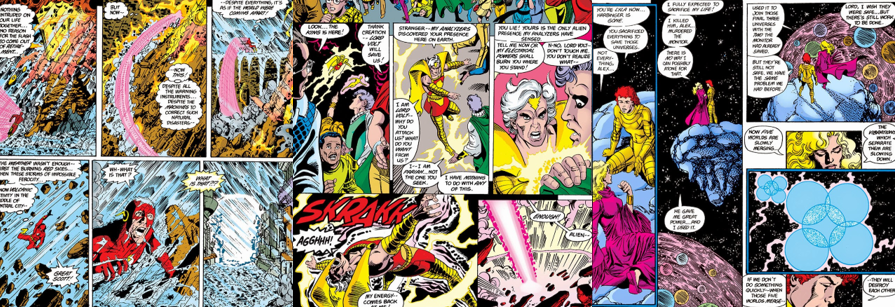
Confused by the concept of the multiverse? Well, Crisis on Infinite Earths has you covered, to a degree, as it opens with (and features throughout) narration and exposition from the tragic Kell Mossa/Pariah. In the beginning, before there was light and life, there was only darkness. Then, from nowhere, came a single light that grew and expanded and finally exploded in “pain [and] relief” as the multiverse was born. The idea is infinite parallel realities all co-exist at once, separated by vibrational planes, though this is noted to not have been the intention when the light burst into being. The story the shifts to one such Earth where the hooded, weeping Pariah witnesses the destruction of not only that world, but the entire reality, at the hands of an all-encompassing white light. As entropy erases everything it touches, Pariah begs to be taken with it, sparing him his grim fate, only to be teleported away as the universe meets its destructive end. We then jump to Earth-3, home of the Crime Syndicate, an evil alternative version of the Justice League. There, Harold Jordan/Power Ring and Clark Kent/Ultraman desperately try to stop the cataclysmic natural disasters springing up across their world as the anti-matter wave approaches. While Thomas Wayne Jr./Owlman and Jonathan Allen/Johnny Quick lament their helplessness against such awesome power, the world’s only superhero, Alexander Luthor, watches helplessly as lifelong enemies like Diana/Superwoman are devoured by the anti-matter wave. With no way to save his world, Alexander rushes to be with his wife, Lois, and baby son, Alexander Luthor, Jr. In a parallel to Superman’s iconic origin, the baby is loaded into a specially prepared rocket and spirited away to Earth-1 as his world dies.

With all universes at risk of annihilation, the Monitor assembles a team of heroes and villains.

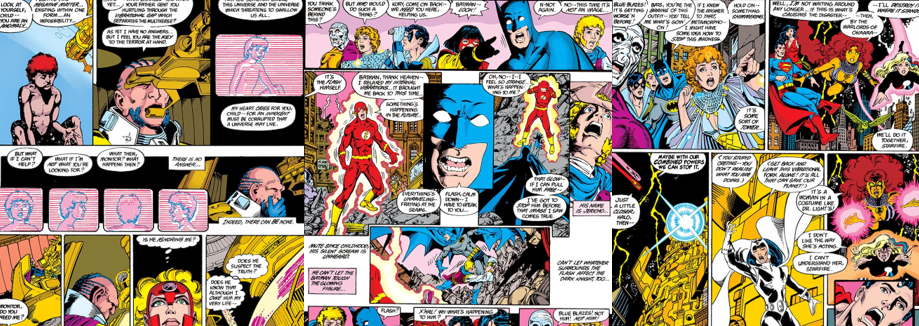
The mysterious Mar Novu/The Monitor observes this from his orbiting, spherical space station alongside Lyla Michaels/Harbinger, whom he sends to recruit Earth’s greatest heroes and villains to stop the pending Crisis. Harbinger recruits King Solovar from Gorilla City, Dawnstar from the 30th century Legion of Super-Heroes, Danette Reilly/Firebrand from Earth-2 1942, Ted Kord/The Blue Beetle from Earth-4, and Roger Hayden/Psycho-Pirate from present-day Earth-2. She returns Psycho-Pirate’s emotion manipulating Medusa Mask and coerces him into quelling Louise Lincoln/Killer Frost’s bloodlust and bringing both her and Ronnie Raymond and Professor Martin Stein/Firestorm to the cause. Though Harbinger is possessed by a Shadow Demon when recruiting Ahri’ahn/Arion the Sorcerer, he joins the other recruits, including Kal-L/Superman, John Stewart/Green Lantern, Neal Emerson/Doctor Polaris, Victor Stone/Cyborg, Simon Jones/Psimon, and Todd Rice/Obsidian. With tensions running high, the group are attacked by Shadow Demons, which seem impervious to physical, mental, and energy-based attacks. While the likes of the Blue Beetle can only run and Firestorm struggles with Killer Frost’s newfound affections, Obsidian and the arrogant Dr. Polaris put their shadow- and magnetism-based powers to good use. The Monitor halts the attack and introduces both himself and the threat to their universes. Weakened by the spread of anti-matter and facing suspicion from his assembled forces, the Monitor reveals that he’s judged them as the best hope of protecting five devices spread across the different eras that he hopes will halt the anti-matter wave. Meanwhile, reality is warped across the multiverse: in prehistoric times, Anthro the Cave-Boy is as astonished to spot a futuristic city amongst the wilds as Querl Dox/Brainiac-5 is to see mammoths stampeding through the 30th century. Half a galaxy away on Oa, the Guardians of the Universe prepare to summon their entire Green Lantern Corps to meet the threat, only for a mysterious voice to corrupt the Central Battery and trap them in a stasis beam. On Earth-1, Bruce Wayne/Batman is busy confronting the Joker during his latest crime spree and is astonished when an emaciated, confused Flash suddenly appears babbling about the end of the world and begging for help before disintegrating before the Dark Knight’s eyes!

As the Crisis worsens, the Monitors prepares Alexander and a new Dr. Light to face the threat.

On the post-apocalyptic Earth-AD, Kal-L, King Solovar, and Dawnstar meet Kamandi, the last boy on Earth, and discover the Monitor’s device, a towering, golden Cosmic Tuning Fork that’s immediately (though only briefly) attacked by Shadow Demons. Arion, Obsidian and the Psycho-Pirate watch over another tower in Atlantis, only for the Psycho-Pirate to be transported to a dark realm and coerced into turning against the Monitor just as Harbinger secretly conspires with that same dark force. Oblivious, the Monitor experiments on the rapidly aging Alexander Luthor, Jr., an impossible merger of matter and anti-matter who potentially holds the key to defeating the anti-matter spread, whom Harbinger’s dark master wants destroyed before he can threaten his schemes. Meanwhile, in the far future of Earth-1, the Flash races to keep his world from being torn apart from natural disasters but is forced to vibrate at super-speed to escape death. This same anti-matter energy arrives on present-day Earth-1, much to the horror of the Teen Titans, who desperately try to both halt the destructive wave and save lives alongside Batman and Superman. As Linda Lee/Kara Zor-El/Supergirl does the same, Barbara Gordon/Batgirl gives in to self-doubt, and John Constantine arrogantly believes it’ll all work out, Vril Dox/Brainiac coldly observes the events concludes that, if he’s to survive, he must team up with Lex Luthor. While defending a Cosmic Tuning Fork from both Nazi forces and Shadow Demons in 1942 Markovia, the Blue Beetle discovers the mysterious Scarab fused to his suit is lethal to the shadowy entities but is wounded before he can put this to good use and returned to his world by the Monitor to spare him. Back on Earth-AD, the skies turn red and King Solovar succumbs to his wounds while Cyborg, Firebrand, John Stewart, and Psimon team up with some local heroes (including Jonah Hex) in 1879 to defend another tower, only to be as overwhelmed by anti-matter as the far-flung future of the Legion of Super-Heroes. Elsewhere, the terrified heroes of Earth-6 blame Pariah for the looming threat, to no avail (though Pariah does save Tashana/Lady Quark to ease his suffering). While the unseen villain forcibly recruits the Red Tornado, the Monitor activates an “ion-based energy ray” to empower Doctor Kimiyo Hoshi, transforming her into the new Doctor Light and sending her to defend his tower on Earth-1.

Following the Monitor’s death, his champions are convinced to unite and save the remaining Earths.

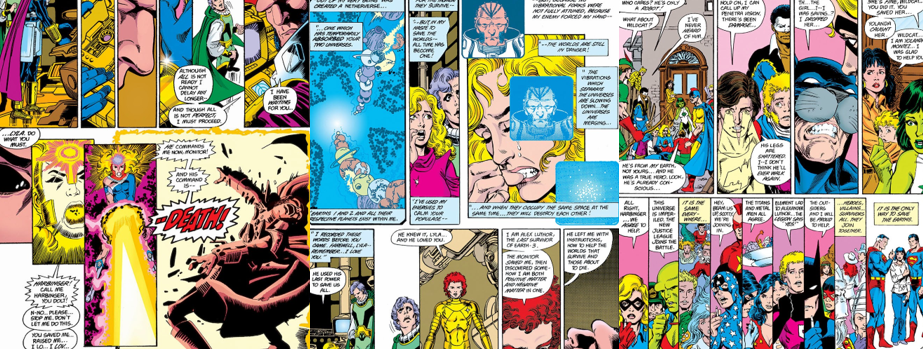
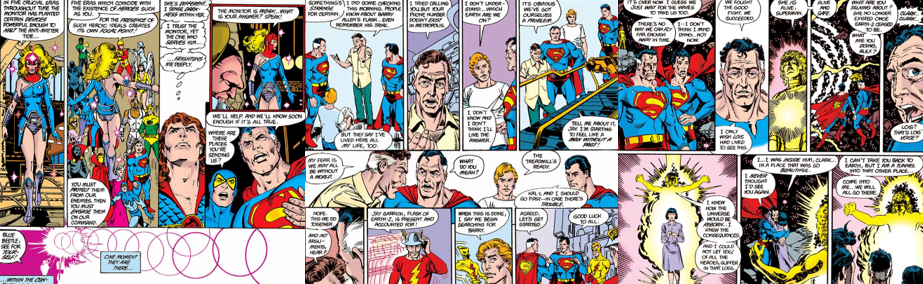
When the heroes attack her, believing she and the tower caused the entropy, Superman quells the fighting, though things take a turn when the Shadow Demons combine into one gigantic, terrifying entity in each era. Even Princess Diana Prince/Wonder Woman’s hopes of recruiting her Amazonian sisters fail. When Pariah berates the Monitor for not doing more to intervene, he reveals just how weak he’s become and then nobly faces his end at Harbinger’s hands. Distraught, Pariah weeps as Earth-1 and Earth-2 are finally consumed; confused to find his strength hasn’t increased as a result, the dark villain delights in having the Psycho-Pirate torture the Flash. Depowered, Lyla is distressed by her actions but a pre-recorded message from the Monitor reveals that his death allowed his essence to empower his Cosmic Tuning Forks and create a “netherverse”, a pocket dimension to keep Earth-1 and Earth-2 safe. After giving the Monitor an appropriate burial, Lyla, Pariah, and the now teenage Alexander Luthor, Jr. gather both world’s champions on the Monitor’s satellite to merge all existing realities into one lest all worlds and realities be lost. Since there are some doubters, Alexander has them witness the Red Tornado be forcibly transformed into a being of pure, primal force, one easily subdued by sorcerers like Kent Nelson/Doctor Fate and Zatanna Zatara (though Ted Grant/Wildcat’s legs are shattered during the fracas). Thus, even the most sceptical agree to defend their worlds, only for the satellite to disintegrate courtesy of the event’s big bad, the Anti-Monitor! Fleeing to the emptiness of limbo, Alexander moves to save Earth-4, -S, and -X, only for Harbinger to subdue him and take his place. While Yolanda Montez continues Wildcat’s legacy on Earth-2, the Freedom Fighters and the Monitor’s agents come to blows on Earth-X when the Psycho-Pirate, his powers augmented by the demonic Anti-Monitor, stirs fear and hatred amongst them. Similarly, on Earth-1, Billy Batson/Captain Marvel and his siblings mindlessly attack Supergirl and Wonder Woman, though the fighting ends when Harbinger forces Earth-4, -S, and -X into the netherverse alongside Earth-1 and Earth-2, exhausting her incredible powers but dooming them to be slowly merged together.

After Lyla relates the Anti-Monitor’s origin, Supergirl sacrifices herself to try and destroy him.

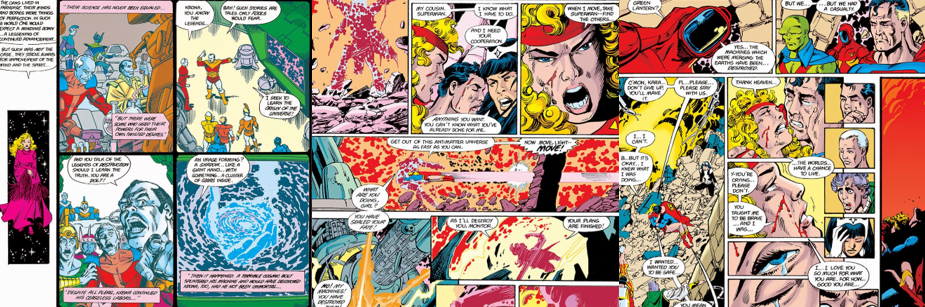
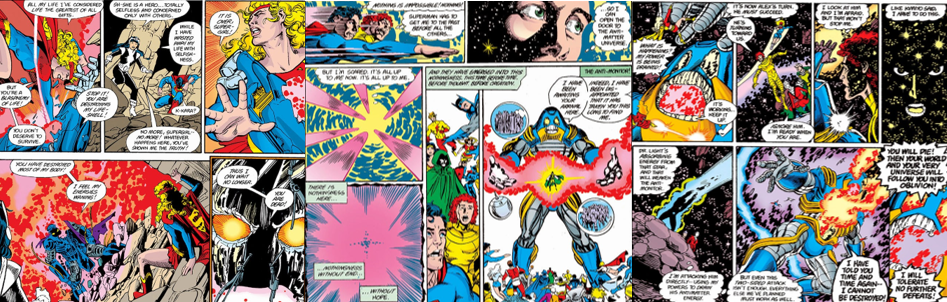
Thus, Lyla, Pariah, and Alexander assemble Earth-1’s Superman, Earth-2’s (Kal-L), Captain Marvel, the Blue Beetle, Lady Quark, and Uncle Sam and reveal that, ten billion years ago, the Oan scientist Krona dared to seek the beginning of the universe, witnessing a giant hand clutching a star cluster. This caused a cosmic fracture, creating not just the multiverse, but an anti-matter universe and a counterpart to Oa, Qward. After banishing Kronoa, the Oans created peacekeeping forces like the defective Manhunters and the Green Lantern Corps but were fractured by a civil war, birthing the Controllers. Amidst the fighting, the Monitor and his evil, anti-matter counterpart came into being. The Anti-Matter conquered Qward and created the Shadow Demons to spread his influence throughout the anti-matter universe before waging war against the Monitor upon sensing his presence. Evenly matched, they were rendered unconscious for nine billion years before being awoken by the misguided Pariah, once a celebrated healer and scientist who also investigated the origin of the universe. Pariah’s world paid the price, and he was damned to live forever and watch all worlds die, though the Monitor also saw him as instrumental in saving all reality. Alexander uses his unique matter/anti-matter powers to create a dimensional tear to the anti-matter universe, which Pariah leads the heroes to the Anti-Monitor’s vast stone fortress. Enraged that the Psycho-Pirate is too drained to corrupt them, the Anti-Monitor has his stronghold attack, injuring the usually invulnerable Kal-L. Dr. Light and Superman discover the Anti-Monitor’s solar collector but are attacked before they can destroy it and halt the merger of the Earths. Hearing her cousin’s agony, Supergirl flies to Superman’s aid, brutally beating the villain in a rage and chastising his disdain for life, tearing through his protective armour. Furious, the Anti-Monitor prepares to explode with all his energy and, in a last-ditch effort to destroy him, his machine, and save everyone, Supergirl tackles him, destroying his machine but being fatally blasted. As the Anti-Monitor’s deteriorating, incorporeal form slinks away, Superman mourns his cousin’s death and vows to kill the Anti-Monitor. Kal-L calms his counterpart and they escape, and a memorial service is held on Earth-2, where Superman pays homage to Supergirl, vowing to remember her and fight in her name. Despite the loss, the five worlds are saved; similarly, the Green Lantern Corps free their masters and almighty Darkseid wisely cloaks Apokalips from the Anti-Monitor’s gaze. However, the Anti-Monitor reconstitutes himself on his ship, where the Flash is imprisoned, and prepares a counterattack from Qward.

Despite the Flash’s noble sacrifice, the Anti-Monitor gains God-like power from his anti-matter universe.

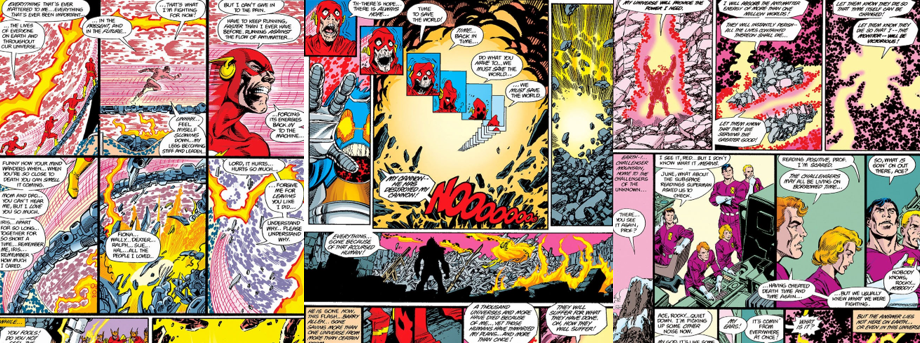
Though saved, the five worlds are still overlapping, causing anomalies and damage to each while  the Anti-Monitor oversees the creation of the anti-matter cannon, which he plans to use to obliterate the worlds. Just as the Psycho-Pirate feels his powers return, the Flash escapes and angrily attacks the sadistic villain, forcing him to turn the Anti-Monitor’s slaves against their master as a distraction. Though stunned to find the anti-matter cannon is powered by concentrated anti-matter and realising that destroying it would kill him, the Flash bravely circles the weapon’s core to turn its destructive energy back on it. Staving off the agony with memories of his loved ones, the Flash runs fast enough to move back in time (explaining his earlier, sudden appearances). Though Barry successfully destroys the weapon, it costs him his life. Enraged, the Anti-Matter absorbs the anti-matter universe, literally sucking the life out of over a million worlds to feed his lust for power and vengeance, an act so awesome that it’s detected by both the Challengers of the Unknown and the embodiment of the Lord’s wrath, Jim Corrigan/The Spectre. In the face of multiversal destruction, the Guardians of the Universe offer Guy Gardner the chance to become a Green Lantern once again and, when all but one of them are all slaughtered by a sudden explosion, Guy vows to avenge them as their champion. The Brainiac/Luthor team then recruit dozens of villains to strike while the remaining Earths are weak and in disarray. As time runs amok on Earth-1 and Alexander, Lyla, and Pariah address the United Nations, the villains make their move, having conquered Earth-4, -S, and -X, encasing them within impenetrable barriers, and threatening to destroy the remaining worlds. Lyla and Jay recruit a reluctant Wally West/Kid Flash to breach the barrier with the cosmic treadmill, though neither Luthor or Brainiac care much about their losses since they still possess the power to destroy everything. However, the Spectre ends the hostilities by revealing that the Anti-Monitor still lives and plans to corrupt the flow of time and formation of life by travelling to the dawn of time.

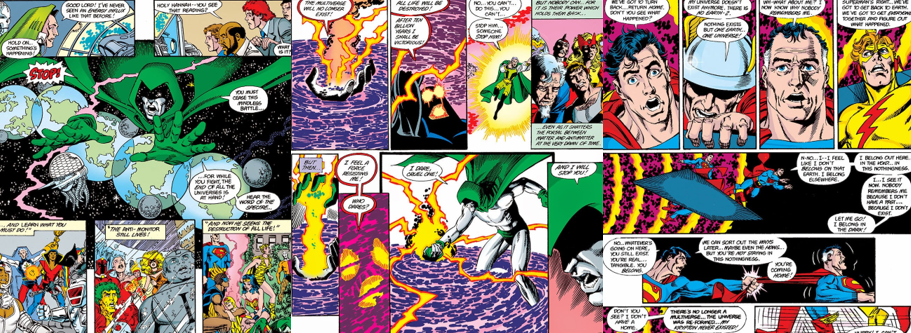
The Spectre demands co-operation, resulting in a singular world being created.

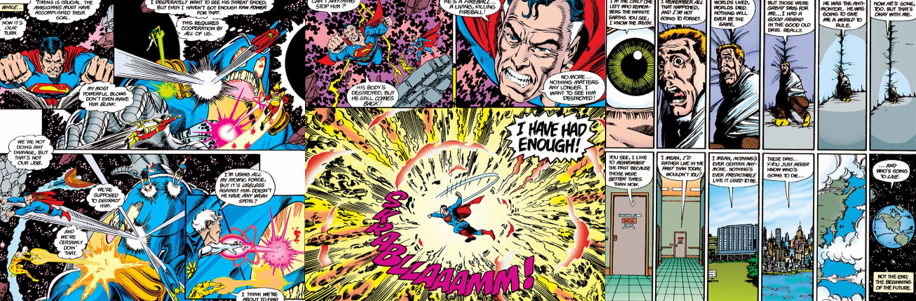
With the villains back on side, Kal-L bids an emotional farewell to his wife, Lois Lane, to join the counterattack, alongside a surprising newcomer: the Superboy from Earth-Prime (a fictional approximation of the real world where he’s the only superhero). After a rousing speech from Uncle Sam, heroes and villains alike pool their technology and powers to travel to the dawn of time and confront the anxious Anti-Monitor. The Anti-Monitor reveals that he, not Pariah, was responsible for the destruction of Pariah’s world after he took advantage of Pariah’s experiments to rebuild his power, absolving the tragic figure of his sins. Now grown to immense proportions, the Anti-Monitor withstands the assault of those assembled (with guys like Batman offering only support), absorbing their life energy to add to his power and allowing his hand to be the one that shapes all reality, as witnessed by Kronoa. His grasp is intercepted by the Spectre and the combined magic of the unified sorcerers, reducing the battle to a literal arm wrestle between the Anti-Monitor and the Spectre. Thanks to their bickering, Luthor’s underlings fail to kill Kronoa before he can cause the creation of the multiverse and the Anti-Monitor, and all seems lost. However, following a blinding light and the literal shattering of all time and space, Kal-L awakens on present-day Earth to find he’s on the same world as his Earth-1 counterpart. Sharing the same fragmented memories, Superman explains that time seems to be healing (albeit wonkily) and that elements of multiple Earths have been merged into one. For example, everyone knows Supergirl died but not how, the Flash is presumed vanished, and Earth-2’s Keystone City and Jay Garrick now live on this Earth. Jay, Wally, and the Supermen use the cosmic treadmill to discover Earth-2 is missing. Realising that the multiverse no longer exists, Superman has to force his older counterpart to return rather than throw himself into the endless void in despair. With the cosmic treadmill irreparably damaged, Wally assembles everyone at Titans Tower, discovering guys like Captain Marvel, Superbody-Prime, Uncle Sam, and the Earth-2 Dick Grayson/Robin also exist on this world, where they’re all shocked to see Harbinger alive and powered back up. The refugees are despondent and horrified to learn their worlds, pasts, and many loved ones are gone thanks to “cosmic irony” as Harbinger explains that there is now one Earth with one coherent timeline that folds their disparate lives into its flow, sending Kal-L into a crazed distress at having lost his wife and home.

A final, all-out assault ends the Anti-Monitor and starts the universe anew, with some casualties.

After questioning the imprisoned Lex Luthor, Batman, Jason Todd/Robin, and Alexander confirm that, while some duplicates remain and some lives were restored, others weren’t and only those who present at the dawn of time remember the multiverse. Just as they’re processing this, the skies turn red and the world suddenly shifts to the anti-matter universe, where the titanic, disembodied Anti-Monitor still lives! Though incensed by their efforts, the Anti-Monitor congratulates them for handing him his first defeat in ten billion years and then decrees that they must all die. Wally’s shock at his mentor’s death is mirrored by the abject panic that sweeps the civilians following the Anti-Monitor’s threat, which doubles when the Shadow Demons kill Don Hall/Dove, Helena Wayne/Huntress, and Tula Marius/Aquagirl. While the sorcerers remove the Shadow Demons, Harbinger assembles one last effort to stop the Anti-Monitor on Qward. Though the Anti-Monitor is too large and powerful to be damaged, Harbinger has Dr. Light absorb the star feeding him power, weakening him enough for Alexander to breach the villain’s armour. With the threat seemingly ended by a combined energy blast, Alexander struggles to return Earth home and the Anti-Monitor absorbs his exiled Shadow Demons to rise again and vaporise Wonder Woman. Rather than see anyone else die, Kal-L tackles the Anti-Monitor, believing he’s got nothing to lose, and Alexander and Superboy-Prime are trapped with him. Though Darkseid, watching from Apokalips, strikes a fatal blow through Alexander’s eyes, the Anti-Monitor refuses to die, so Kal-L delivers a final strike that obliterates the tyrant. Faced with the pending destruction of the anti-matter universe, Kal-L and Superboy-Prime prepare to meet their end only for Alexander to teleport them, alongside Kal-L’s Lois, to a pocket dimension. In the aftermath, Wonder Woman returns to the clay that forms Themyscira, her Earth-2 counterpart is welcomed among the Gods, the dead heroes are memorialised, and Wally assumes the Flash mangle. Confined to Arkham Asylum, the Psycho-Pirate is dubbed a raving lunatic since he’s the only one who remembers the multiverse and the catastrophic events of the Crisis.

The Summary:
Whew, there’s a lot happening in Crisis on Infinite Earths. There’s a reason I’ve put off reviewing it for so long, and why I rarely revisit it. It’s a very dense and complex story, full of exposition and cameos and faces both obscure and iconic. As a celebration of DC’s rich history and characters, it’s hard to find much better than Crisis on Infinite Earths, which stuffs just about every costumed character, hero or villain, into its dense twelve issues! My hat’s off to George Pérez; it must’ve been painstaking to sketch all these group shots, action sequences, montages, and dramatic events. Equal praise to Marv Wolfman as I can’t imagine how difficult it was to make sense of all these different worlds and come up with a cohesive way to explain, link, and destroy them all. In the end, the solution was simple: pure, destructive, unstoppable entropy. It’s fitting that the anti-matter wave is depicted as a blinding white light that erases everything it touches, for it symbolically represents a blank page or an artist’s eraser, indicating that these colourful and convoluted worlds are being literally wiped clean for a new status quo. Our guide through most of this is Pariah, a tragic figure doomed to watch each world die as penance for kick-starting the events that follow. Immortal but seemingly powerless to intervene, all he can do is shout desperate warnings and is powerless to rescue anyone and constantly met with aggression, suspicion, and accusations. He’s merely a pawn in a much larger game, however, much like Harbinger, who acts as an all-powerful emissary of the Monitor and deliver exposition in his stead. A conflicted individual burdened with the knowledge that she will betray and murder the man to whom she owes her life, Harbinger, nevertheless works to uphold the Monitor’s legacy and bring together heroes and villains alike to stand against his dark counterpart.

The Anti-Monitor’s power sends shockwaves through the multiverse and those who’ve witnessed it.

The dreaded inevitability of death is a focal point in Crisis on Infinite Earths. When the anti-matter wave hits, heroes and villains set aside their differences and use all their powers and resources to either stop it or save people from its destructive touch. Even the abhorrent Crime Syndicate find themselves fighting to save their world and Ultraman willingly enters the wave to die on his terms. Even before the wave arrives, the worlds are shaken to their core by natural disasters; volcanoes, tsunamis, and ominous, crackling red skies precipitate the disaster as much as Pariah. Perhaps no character is more synonymous with the coming destruction than the Flash; thanks to his super-speed, he ends up travelling through time, arriving before the likes of Batman and Wally as an omen of what’s to come and taking on an appearance that resembles Death itself. The Anti-Monitor echoes this in his design; though shrouded by his all-powerful armour, he sports a skull-like visage and dark, piercing eyes. Commanding demonic shadows, he’s very much the embodiment of Death and his lust for utter annihilation drives him to snuff out all life and light. Sadistic to the core, he employs the Psycho-Pirate to foster fear and hate, turning his would-be opponents against each other and causing countless more deaths. His ruthlessness seemingly knows no boundaries as he gleefully corrupts Harbinger, relishes the death of his counterpart, and nonchalantly obliterates his rebellious slaves without a second thought. His power and cruelty are so great that even the mighty Darkseid is driven to hide rather than confront him, striking when the villain is at his most vulnerable and largely avoiding the greater conflict. For all his God-like power, the Anti-Monitor still relies on technology; his merger and destruction of worlds can be halted or stopped by Cosmic Tuning Forks or destroying his solar collector. Indeed, it’s only after his massive, world-ending cannon is destroyed that the Anti-Monitor eschews all other methods and absorbs the entire lifeforce of the anti-matter universe into himself to literally take matters into his own hands.

The Supermen anchor the story, leading the assembled champions in battle and saving all reality.

There is no one central character in Crisis on Infinite Earths. Instead, it’s a team-up story through and through, meaning some of your favourites may be sidelined. In some respects, I don’t mind this; Batman outright admits how useless he is against the Anti-Monitor and it’s clear only beings of incredible power can stand against him. Yet, the Blue Beetle is said to be pivotal in opposing the villain, the Red Tornado is briefly said to be incredibly important, and Lex Luthor comes close to co-ruling five entire worlds and even leads the charge to assassinate Kronoa. The Earth-2 Superman, Kal-L, is often at the heart of the conflict, leading the others and inspiring confidence, as is his Earth-1 counterpart. It’s therefore more tragic seeing Superman’s grief-stricken reaction to his cousin’s death; holding Supergirl in his arms, the Man of Steel briefly forgets his morals and vows to kill the Anti-Monitor as recompense. This is but one of the unforgettable deaths featured in Crisis on Infinite Earths as the Flash sacrifices himself to deal a critical blow to the Anti-Monitor, making a martyr of himself for decades before DC made the bone-headed decision to revive him. There’s an odd dichotomy in Crisis on Infinite Earths; these alternative worlds and characters co-exist and are even folded into one by the end. Rather than wiping everything away and starting afresh by the conclusion, the story clunkily has the survivors forget key events and weaves characters like Captain Marvel and the Justice Society into a unified timeline. This works for me as I prefer a coherent narrative, but it essentially means Crisis on Infinite Earth takes place mid-way through the early years of the post-Crisis reboot and reimaginings like John Byrne’s Superman stories happen before and during this event, rather than after it.

Worlds lived, worlds died, and the DC Universe was never the same…for about twenty years…

These days, Crisis on Infinite Earths may be a lot for modern readers to take in. Many of its characters and concepts are either forgotten, wildly different, or have been done to death thanks to the multiple reality-altering events that followed (many specifically to address loose ends from this story). At the time, though, I’d wager many long-term DC readers appreciated the cameos and call-backs weaved into the story. I’m glad DC devoted twelve issues to the story and didn’t rush it, but it does get repetitive and convoluted as it drags on. The secondary threat of Brainiac and Luthor directing a team of villains to conquer the five worlds, for example, could probably be skipped or relegated to a tie-in comic. Similarly, the defending of the Cosmic Tuning Forks isn’t very interesting and doesn’t really add to the story since we barely see any action around this, the Shadow Demons are too powerful to be interesting, and it’s all negated by the Monitor’s death. In this respect, I think the event could’ve been cut down to eight or ten issues and still been just as effective, especially as many Earths and characters feature as quick cameos to be obliterated. The remaining five Earths are said to be the most important, which is a little disrespectful to those that perished by the Anti-Monitor’s hand and a bit of an insult to any fans of those worlds. I liked seeing new heroes rise during the chaos, like a new Dr. Light (who was an aggressive bitch throughout), Wildcat, and Guy being Green Lantern again, though it falls a little flat when you know the canon is going to be altered after this to return the status quo. I liked the Anti-Monitor’s design and his characterisation as a reprehensible being who craved only power and destruction, but it was hard to get a sense of his power and limitations. One minute he’s weakened by giant towers, then his armour is containing his energy, and then he’s being powered by a black sun despite having absorbed the lifeforce of his anti-matter universe. Still, the unification of heroes and villains to oppose him was fun to see, the sacrifices and determination were poignant, and the weaving together of a singular continuity, while flawed, was ambitious and visually engaging to behold.

My Rating:

Rating: 4 out of 5.

Great Stuff

Have you ever read Crisis on Infinite Earths? What did you think of this unprecedented mash-up of DC’s various worlds and characters? Which parallel world was your favourite and were you upset to see destroyed? What did you think to the Anti-Monitor, his vast power and his stubborn refusal to die? Were you shocked to see Supergirl and the Flash die so dramatically? Do you agree that the story dragged on a bit by the end? Which of the subsequent Crisis events was your favourite and what are some of your favourite cosmic events? Drop a comment below to share your thoughts about Crisis on Infinite Earths and feel free to check out my reviews of other notable crossovers.

Back Issues [Bat-Month]: Detective Comics #66/68


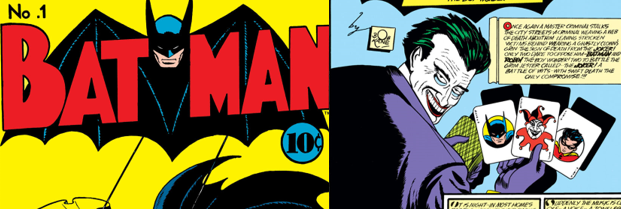
In the decades since his first dramatic appearance in the pages of Detective Comics, Bruce Wayne/Batman has become a mainstream, worldwide, pop culture icon. The brainchild of writer Bob Kane, Batman was brought to life by artist Bill Finger and has been a popular staple of DC Comics and countless movies, videogames, and cartoons over the years. “Batman Day” falls on 21 September this year and I figured this was a perfect excuse to spend every Saturday celebrating comic’s grim and broody vigilante.


Writer: Bill Finger – Artist: Bob Kane

Story Title: “The Crimes of Two-Face”
Published: August 1942

Story Title: “The Man Who Led a Double Life”
Published: October 1942

The Background:
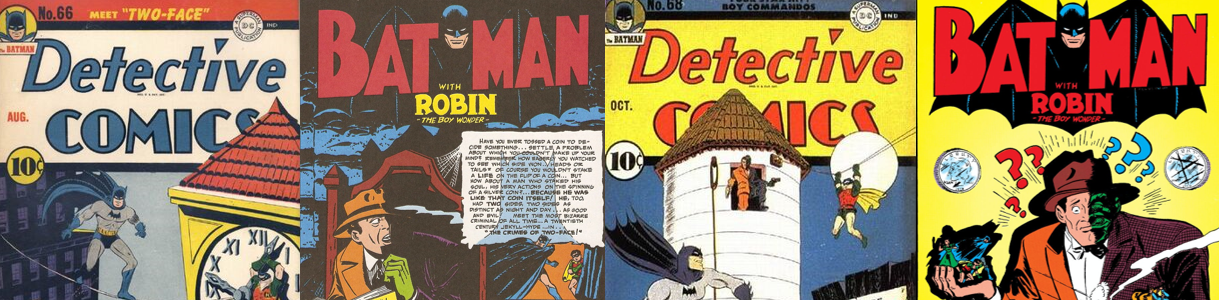
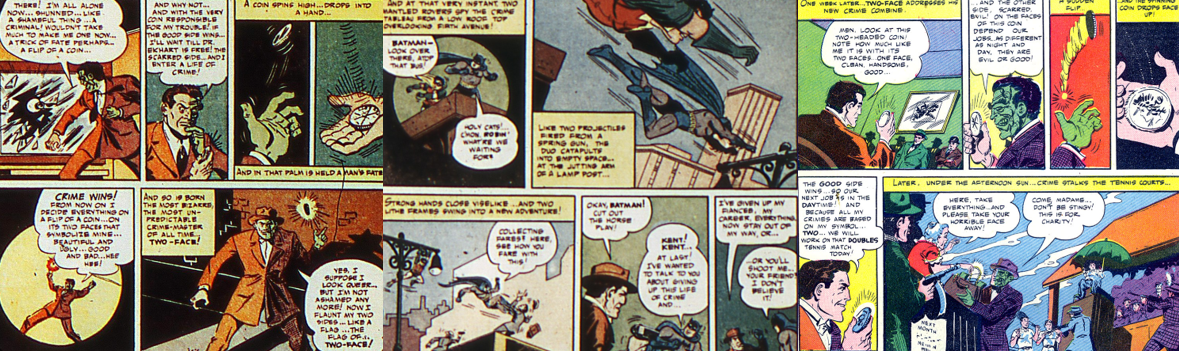
Following the huge success of Clark Kent/Superman, National Comics Publications had Bob Kane create another masked crimefighter to add to their repertoire. Thanks to the long-suppressed influence of artist Bill Finger, the “Bat-Man” soon became not only one of DC Comics’ most popular characters but also a mainstream cultural icon. In the years that followed, the Batman battled numerous costumed supervillains, but perhaps none are more tragic then former district attorney-turned-criminal Harvey Dent/Two-Face. Originally debuting in this two-part story as Harvey “Apollo” Kent, Two-Face was heavily inspired by the 1925 adaptation of The Phantom of the Opera (Leroux, 1909) and the 1931 adaptation of Strange Case of Dr Jekyll and Mr Hyde (Stevenson, 1886), both tales of a tortured soul, often gruesomely depicted or disfigured, who struggled with the duality of good and evil. Subsequent Two-Face stories have offered further insight into his tragic and abusive childhood, as well as further emphasising his complex relationship with Bruce Wayne, and the character is often a rival or litmus test for Batman’s different Robins. Widely regarded as one of Batman’s best villains, Two-Face has appeared as a prominent foe outside of the comics, from his renowned appearances in the acclaimed Batman: The Animated Series (1992 to 1999), Tommy Lee Jones’s bombastic portrayal in Batman Forever (Schumacher, 1995), and Aaron Eckhart’s understated turn in The Dark Knight (Nolan, 2008).

The Review:
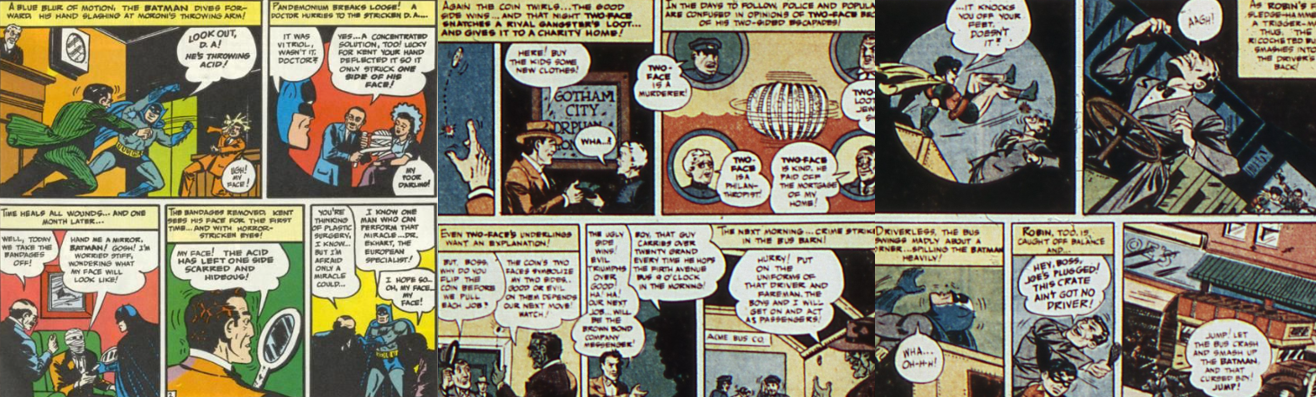
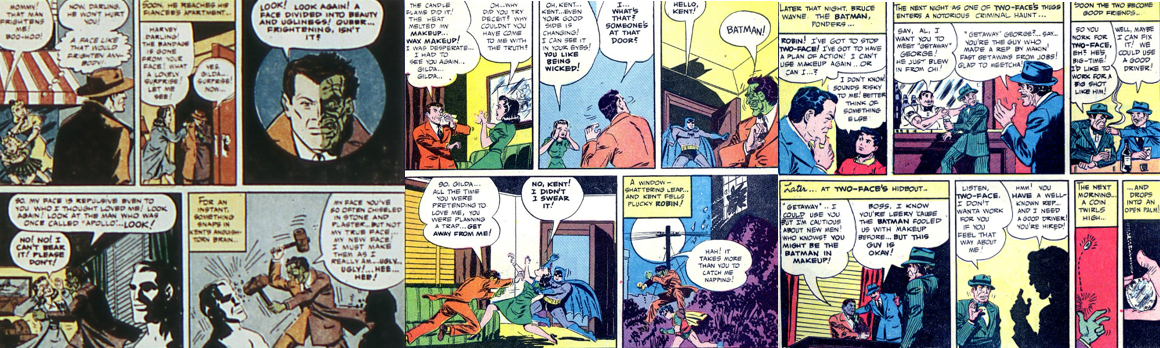
This two-part story begins by introducing us to Harvey Kent, the dashing and famous district attorney beloved by the press and nicknamed “Apollo” for his courageous stance against organised crime, such as mob boss Sal “Boss” Moroni. Kent is the lead prosecutor in the case against Moroni and wastes no time in calling the Batman to take the stand as a key witness in Moroni’s trial. Amazingly, the testimony of a masked vigilante is seen as perfectly acceptable and admissible as evidence. Batman relates how Moroni shot “Bookie” Benson while escaping from a fight and Kent produces his most damning piece of evidence: Moroni’s lucky, two-headed silver dollar with his fingerprints on it! Moroni’s so incensed by Kent’s bravado that he tosses a vial of acid right at the district attorney! Although Batman intercepts the throw, Kent is hit with a concentrated splash of vitriol on one side of his face, leaving him wrapped in bandages for an entire month. When the time comes to reveal the extent of the damage, Kent is horrified to find that the left side of his face is “scarred and hideous”. He’s even more despondent to find that his only hope, a “European specialist” Batman knows of, is currently imprisoned in a Nazi concentration camp. The Batman simply peaces out after that, advising Kent to face his fiancée, Gilda, sooner rather than later, but Kent is distraught to find his gruesome visage frightens not only children, but also his beloved Gilda. Seeing the fear in her eyes, he flies into a rage, defacing a sculpture of his former chiselled features and terrifying her almost as much as his monstrous scarring.

After being hideously scarred, Two-Face embarks on a bizarre crime spree across the city.

Tormented, driven to the brink of madness, Kent ponders this dichotomy of his explicit duality. He focuses his rage on Moroni’s silver dollar, defacing one side of it and lashing out at the cruelty of fate. Deciding that all life hinges on the flip of a coin, Kent projects his duality onto the now-scarred dollar. He resolves to decide his immediate future on a coin toss, promising to wait for Batman’s specialist to be freed if the unmarked side comes up or embark on a criminal career if the scarred side comes up. Of course, the scarred side wins and Kent rebrands himself “Two-Face”, adopting a suit to match his split face and putting his knowledge as district attorney to use in his crimes. Since everything he does is decided by this bizarre coin, one day he and his goons might rob a bank for illicit gain, but the next day he might donate his stolen money to charity! This causes public opinion of him to be fittingly divided, with some branding him a thief and a murderer and others a philanthropist and saviour. Even his goons are confused by Two-Face’s unpredictable nature, but they’re excited when the bad side wins and they undertake an elaborate scheme to rob the Brown Bond Company messenger that sees them hijack a double decker bus to rob the bondsman. As luck would have it, Batman and Robin happen to spot the mugging taking place and swoop in to intervene. Apparently well aware that Kent is Two-Face, Batman tries to talk him out of his life of crime but is stunned when his former friend pulls a gun on him and orders his men to toss him off the roof of the bus!

When Batman confronts Two-Face, the tragic villain is left clueless when his coin fails him.

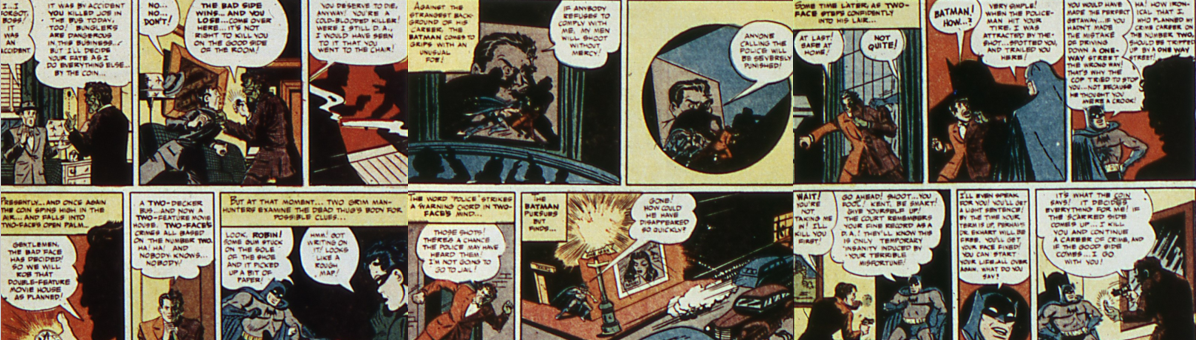
Although this doesn’t come to pass thanks to Robin accidentally causing the thug driving the bus to be killed, Batman is incapacitated in the fracas and the Dynamic Duo are left to die on the out of control vehicle, though Robin manages to get to the handbrake in time. Back at his thematically appropriate lair (one side is clean and pristine and the other is a shambles), Two-Face chastises himself for his actions. Believing that he’s killed his good friend, Two-Face almost regains his sanity before lashing out at the mirror and murdering his other goon after blaming him for causing the shambles on the bus. Two-Face then steps his game up by targeting the double-feature movie house, since he’s now committed to basing his crimes on the number two, but remains unaware that Batman and Robin survived the bus crash. Upon investigating the dead body of Two-Face’s goon, the Dynamic Duo happen to find a map stuck to the sole of his shoe by a piece of gum! This leads them to the Bijou Theatre, Two-Face’s next target, where Two-Face takes over the projection booth and demands that the audience hand over their loot. While Robin takes out the goons in the projection booth, Batman swoops onto the stage for a brief fight with Two-Face while his pre-recorded message looms and rants in the background. Somehow (it’s really not too clear), Two-Face slips away, but the Batman easily tracks him back to his lair by simply…y’know, following him after Two-Face made the error of driving down a one-way street and attracting police attention. Refusing to go down without a fight, Two-Face again threatens to shoot Batman, but the Dark Knight pleads with him to come along quietly. Batman promises to testify on his behalf to argue temporary insanity and to do everything he can to see Kent gets a light sentence until that specialist can fix his face, but Two-Face is unable to make a decision without flipping his beloved coin. Unfortunately for the tragic villain, cruel fate strikes again and the coin ends up standing on edge, leaving Two-Face conflicted and incapable of deciding whether he should give up his life of crime or kill Batman and continue down his dark path.

Two-Face slips away, continues his unique crimes, and even bests Batman in a fight.

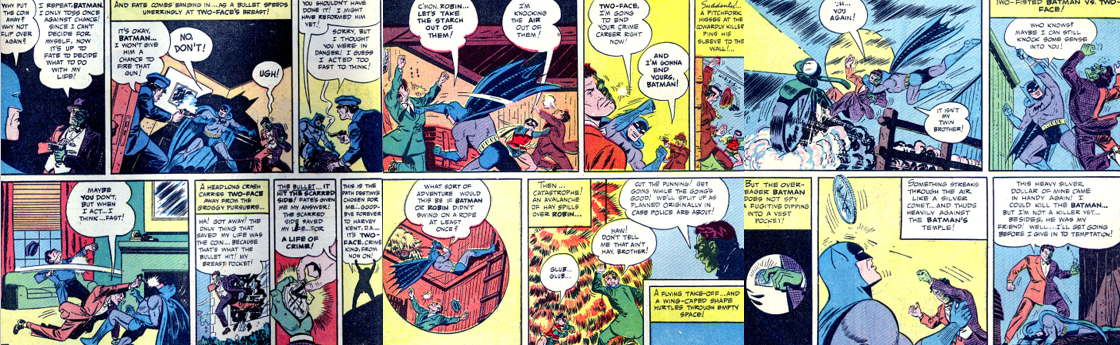
The story continued, fittingly two issues later, in “The Man Who Led a Double Life”, which picks up right where the first story ended and sees Two-Face pocketing his coin, resolving to let fate decide what he does with his life. Unfortunately, a trigger-happy cop bursts in and guns down Two-Face, believing he’s about to shoot Batman, but the bullet strikes the coin in Two-Face’s breast pocket, allowing him to survive and make a hasty retreat by leaping out of the window! Since the bullet hit the scarred side of the coin, Two-Face believes this is fate’s way of telling him to commit himself to his criminal career. His first act is to rob the doubles tennis match (during the daytime, since the coin landed good side up) and donate the cash to charity. Next, he and his goons kidnap matchstick mogul Henry Logan, whose entire home is apparently made out of matchsticks, but Batman and Robin are stunned to find it was actually the cantankerous tycoon’s double who was taken since Kent knew about Logan’s doppelganger from his time as district attorney. Batman and Robin are disgusted by Logan’s indifference towards his double’s fate and his selfishness, but the reclusive hobbyist agrees to pay Two-Face’s $200,000 ransom. However, when Logan and his wife arrive at the disused barn to make the transfer, Two-Face is enraged to find he’s been tricked and that it’s Batman and Robin in disguise! Batman and Robin easily overpower Two-Face and his mooks. Although one of the goons buries Robin under a pile of hay, Batman continues hammering Two-Face after the scarred villain tries escaping on a motorcycle. Laughably, Batman is felled when Two-Face tosses his coin at his forehead; however, Batman is spared since Two-Face “[is] not a killer yet” (despite it being said that he was in the first story) and still has some compassion for his former friend.

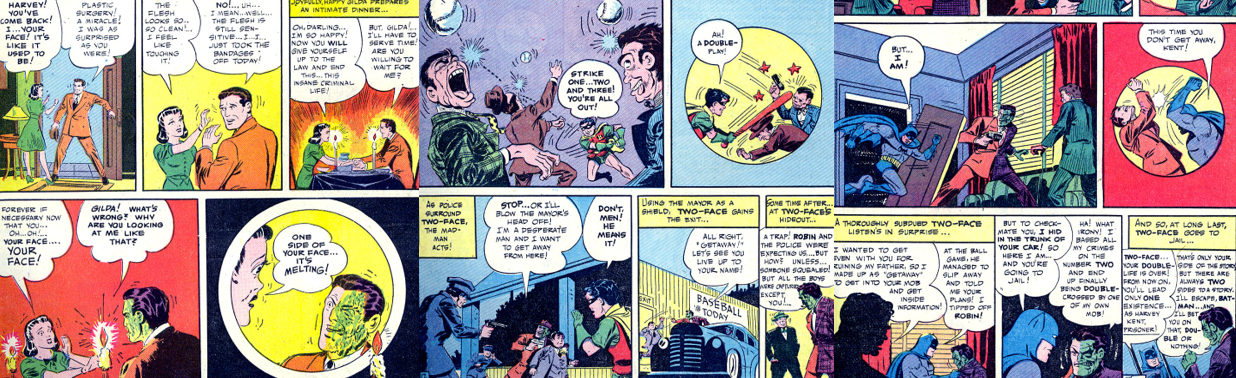
Two-Face’s attempt to return to his wife, and succeed at crime, are thwarted by the Batman.

When Batman and Robin return the double to Logan, they find the tycoon to be as grating as ever, so Robin teaches him a lesson by dropping a lit match into his shoe, something the Batman simply laughs about despite the fact that the house place could’ve gone up in flames! Anyway, after spotting a loved-up couple in the street, Two-Face decides to pay a visit to his lost love, Gilda. Gilda is elated when the fully restored Harvey Kent surprises her at home, but he ensures she doesn’t get too close to his face. Over a candlelit dinner, he promises to come back to her and forgo his criminal ways if she waits for him, but is incensed when her happiness turns to horror after the heat from the candles melts the wax make-up covering his hideous scars. Gilda is driven to tears by the revelation that Kent has completely lost himself to wickedness and insanity, but Two-Face flies into a rage when Batman bursts in since he assumes she was colluding with the Dark Knight. Once again, Two-Face escapes through a window and he avenges his misfortune on the mask and make-up factory that cost him his love. Two-Face and his goons beat up the proprietors and torch the place, leaving the mask-maker destitute and his son swearing revenge. The story then leads us to believe that, despite Dick’s warnings, Bruce uses make-up to infiltrate Two-Face’s gang as “Getaway” George when the coin flips in his favour. Two-Face’s next target is the double-header baseball game between the city’s fire and police departments, in which honorary police officers Batman and Robin are publicly seen participating. Two-Face brazenly steals the $50,000 takings and even takes the mayor hostage at gunpoint after Robin beats up his minions. When Two-Face gets back to his lair and finds the cops waiting, he assumes that “Getaway” is Batman in disguise and is stunned when the real Dark Knight barges in to deliver a swift uppercut. It turns out that “Getaway” was the mask-maker’s son working in cahoots with Batman, and Two-Face bitterly comments on the irony of being double-crossed by one of his own gang in the end.

The Summary:
Two-Face’s links to Jekyll and Hyde aren’t simply thematic, they’re explicit. Hell, the first dialogue box on the opening page of “The Crimes of Two-Face” not only refers to Two-Face as “a twentieth-century Jekyll-Hyde” but even shows the disfigured criminal reading a copy of the book! I may be committing a literary sin here, but I haven’t actually read that book so I can only speak to the widely regarded themes of duality and man vs. monster that are at work in the text, but “The Crimes of Two-Face” definitely goes out of its way to draw parallels between Kent’s fate and that classic piece of gothic literature. They are, however, really only skin deep. Sure, we only see Kent for a few panels before he’s hideously scarred, but there’s no indication in either story that he was anything but a model citizen and champion of justice. More than once, he and Batman refer to each other as old friends and Two-Face is noticeably conflicted about the Dark Knight, more so than his criminal career, it seems. Indeed, it’s quite jarring when Kent just suddenly decides he has only two options: wait to be fixed or turn to crime, but it’s pretty well conveyed that his ghastly condition has caused him to snap. Batman refers to him suffering from temporary insanity, the text boxes allude to his rage, and Gilda’s reaction to his outburst all point towards this, but it’s still quite the sudden turn from model civil servant to notorious bank robber. One thing I did enjoy was that the reveal of Two-Face’s horrific visage is kept hidden to start with, so we only see it when he reluctantly reveals himself to Gilda, which builds a sense of anticipation about what he looks like. It’s a shame that he’s depicted with a literal line running down the middle of his face, but I can forgive that given the simplistic art of the time.

Despite Two-Face’s obvious gimmick, there’s little detective work involved in stopping him.

We’re well into Batman’s time as a much brighter, kid-friendly character here. He’s appearing in broad daylight, working alongside the police, and even taking to the witness stand and playing baseball, for God’s sake! Now fully deputised members of the police department, Batman and Robin are seen as assets rather than vigilantes and are specifically brought in by Police Commissioner James “Jim” Gordon to help with the Henry Logan kidnapping case. More importantly, the Batman had a close working relationship with Harvey Kent that sees him repeatedly appeal to his better half in “The Crimes of Two-Face”. Sadly, we never get to actually see the extent of their friendship. It’s simply said and inferred by their dialogue, and neither story explores Bruce’s reaction to his friend’s condition or delves into how conflicted he feels about Two-Face. Instead, Batman tries to out-think the tragic villain, occasionally begs him to listen to reason, and settles for socking him in the jaw when he refuses to come quietly. By the end, Batman views Two-Face as just another colourful supervillain and there’s no indication that he wants to try to help or rehabilitate his former friend; he just wants him locked up. As a villain, Two-Face is both visually interesting, surprisingly tragic, unpredictably volatile, and incredibly restrictive. Since he dictates his actions on a coin flip, his crimes can either be horribly violent or unnervingly charitable, casting him almost as an anti-villain since he’ll help those in need with ill-gotten gains and even kill his own men if they violate his rules. This makes the coin his most obvious Achilles’ heel, but it’s at least tied to his dual and conflicting nature. His obsession with the number two is far more of a crutch and I’m surprised that more wasn’t made of it. Once again, Batman and Robin do very little detective work here (they happen upon that map and Batman simply guesses that Kent would return to Gilda) so there’s no depictions of them trying to figure out Two-Face’s next scheme or running around the city looking for obscure references to the number two. It’s simply them reacting whenever Two-Face strikes or stumbling upon a lead.

Two-Face is a tragic and visually interesting character even in his more basic debut story.

Still, while Two-Face’s complex nature, volatile personality, and relationship with Batman is only touched upon or inferred in “The Crimes of Two-Face” and “The Man Who Led a Double Life”, both stories were surprisingly fun and unique tales. It’s not often that Batman’s villains had such a tragic twist to them back then and the references to Two-Face using his knowledge as district attorney for evil only add to the cruel twist of fate dealt to this once handsome and honourable man. I enjoyed Two-Face’s lamentations, which were suitably Phantom-esque, and his whole gimmick, including the split suit and lair. Despite seeing it as a handicap, I’ve always liked the double-headed coin aspect of the character and I enjoyed how quickly he became fixated on the coin’s decisions and how he was rendered panic-stricken and impotent when the coin landed on its side. I think “The Man Who Led a Double Life” would’ve been served better if it had begun with a babbling and broken Two-Face being taken into custody and seeing doctors try to salvage his mind and face until he inevitably returned to his evil ways, but that was kind of toyed with when he desperately resorted to a wax facsimile to reconnect with Gilda. Overall, the two tales didn’t exactly blow my socks off and there are definitely better Two-Face origin stories and tragic tales out there, but they were entertaining enough. Two-Face is an elaborate criminal with a unique, if narratively exhausting, gimmick and has (and continues to have) a tragic appeal to him that’s prominently introduced here, even with the lacklustre depiction of Kent’s time before his scarring.

My Rating:

Rating: 4 out of 5.

Great Stuff

Have you ever read the two-part debut of Two-Face? If so, what did you think to it, which of the two was your favourite, and where would you rank Two-Face in Batman’s villain hierarchy? Would you have liked to see more backstory given to Harvey Kent? What did you think to his coin, obsession with the number two, and the depiction of his volatile duality? Did you enjoy Batman’s time as a brighter, friendlier character or do you prefer the brooding, grim Dark Knight? What are some of your favourite Two-Face stories and which interpretation of Two-Face is your favourite? Whatever your thoughts on Two-Face, share them below or on my social media, and be sure to check out my other Batman content!

Back Issues [Bat-Month]: “The Joker” (Batman #1)


In the decades since his first dramatic appearance in the pages of Detective Comics, Bruce Wayne/Batman has become a mainstream, worldwide, pop culture icon. The brainchild of writer Bob Kane, Batman was brought to life by artist Bill Finger and has been a popular staple of DC Comics and countless movies, videogames, and cartoons over the years. “Batman Day” falls on 21 September this year and I figured this was a perfect excuse to spend every Saturday celebrating comic’s grim and broody vigilante.


Story Title: Technically untitled, but commonly known as “The Joker”
Published: March 1940
Writer: Bill Finger
Artist: Bob Kane

The Background:
After seeing success with Clark Kent/Superman, National Comics Publications charged Bob Kane with creating another masked crimefighter to add to their portfolio and, thanks to the long-suppressed influence of artist Bill Finger, the “Bat-Man” soon became both a popular DC Comics character and a mainstream cultural icon. Over the years that followed, the Batman has matched wits against some of the most recognisable supervillains in all of comics, but unquestionable his greatest nemesis has always been the self-styled Clown Prince of Crime, the Joker. Bob Kane, Bill Finger, and Jerry Robinson all laid claim to creating the Harlequin of Hate, but what is widely known is that the character’s iconic, gruesome smile and clown-like visage was heavily influenced by Gwynplaine (Conrad Veidt) from The Man Who Laughs (Leni, 1928). It was a last-second decision by then-editor Whitney Ellsworth that saw the Joker survive his initial encounter with the Batman and, though the character was used less under the eye of editor Julius Schwartz, he rose to prominence thanks to the efforts of Dennis O’Neil and Neal Adams during the 1970s and 1980s. Since then, the Joker has become easily Batman’s most notorious and mainstream foe. In addition to terrorising Gotham City with laughing gas, the famously elusive and mysterious Joker crippled Barbara Gordon/Batgirl for many years, murdered both Jason Todd/Robin and Commissioner James Gordon’s second wife, had his face removed for a time, and has fought Batman to the death on numerous occasions, repeatedly returning to plague the Dark Knight, his allies, and Gotham City despite appearing to die more than once. The Joker has also been a prominent villain in Batman media outside the comics, often used as a primary antagonist in Batman videogames and brought to life with gleeful relish by many actors, such as Cesar Romero (who famously refused to shave his iconic moustache to portray the character), Jack Nicholson, and Mark Hamill (for many, the quintessential actor to tackle the role). The Joker has been the subject of numerous psychological and introspective debates and his popularity and infamy are such that he’s had his own self-titled comic, been a playable character in DC-related fighting games, and even appeared in standalone movies, with the first making over $1 billion at the box office!

The Review:
Our story wastes no time in introducing us not just to the Joker’s gruesome, grinning visage but also his menacing ways. A quintessential 1940s home is startled when the Joker’s cackling threats interrupt their nightly radio broadcast to issue an ominous threat against millionaire Henry Claridge, whom the Joker promises to kill and rob of his famed family diamond at midnight that night! Although some members of the public laugh it off as a gag akin to Orson Welles’ infamous War of the Worlds prank from 1938, the radio station is swamped with concerned calls and Henry Claridge is understandably panicked. His fears are allayed when the city police arrive and promise to watch over him, and his diamond, overnight and Claridge is overjoyed when his grandfather clock strikes twelve and he’s still alive. However, he suddenly convulses in agony and collapses dead to the ground with a ghastly rictus grin on his lifeless face – “the sign of death from the Joker!” As if that wasn’t bad enough, the cops are stunned when they inspect the Claridge diamond and find that it’s been replaced with an elaborate forgery and the Joker’s calling card, a literal joker-faced playing card, has been left behind to taunt them.

The Joker baffles the police by killing his victims and leaving them with a gruesome grinning visage.

Luckily for us readers, the Joker is quite a loquacious fellow. When the story switches to his ornate lair to focus on the hate-filled harlequin, he openly explains how he delivered on his threat and outwitted the police: he simply injected Claridge with a slow-acting poison as he slept so that he would die at exactly twelve midnight. He also swiped and replaced the diamond while he was at it, and is immensely proud of his cunning, which has riled up Dick Grayson since he’s astounded by the Joker’s repeated acts of violence. However, his mentor, billionaire Bruce Wayne, believes that it’s not quite time for them to intervene as the crimefighting duo, Batman and Robin. Because of this, the Joker makes good on another threat. This time, he promises to kill Jay Wilde at ten o’clock and steal his ruby and his victim again collapses in pain, dropping dead with a smile, after being shot by a poisoned dart when the Joker easily hid amongst the cops in one of Wilde’s suits of armour. Luckily for the cops assigned to watch him, the Joker chooses simply to “paralyse” them with a gas; he then liberates his victim of his ruby and gleefully slips away. The city-wide manhunt for the Joker is met with embarrassing failure, but his actions have also riled up the city’s mobsters. Angry and envious that the Joker has been beating them to the punch, surly Brute Nelson vows to teach him a lesson and has his boys spread the word that he thinks the Joker is a “yeller rat”. Since those are fightin’ words during this time, the Joker bursts into Nelson’s home to confront him and is impressed to find that the mobster has lured him into a trap. Luckily for him, the Batman saw the mob’s interest in the Joker as enough of a reason to finally step in so he’s also in Nelson’s home and manages to get the drop on his goons despite his characteristic lack of stealth.

The Batman recovers from an initial failure to put an end to the Joker’s killing spree.

The Joker uses this distraction to his advantage, gunning the arrogant Nelson down in cold blood and making a quick getaway in his car. The Batman easily follows and leaps onto the speeding vehicle. However, when the two are launched from the car as it flies off a bridge, the Batman is surprisingly outmatched by the Joker, who socks him with a haymaker and delivers a kick that sends the Dark Knight plummeting to the water below. The Joker then takes a much more direct approach to target Judge Drake, the man who once sent him to prison. He disguises himself as the police chief (who he again chooses to simply subdue rather than kill) to get close to the judge and inject him with his gruesome poison. Although his disguise means the Joker gets away without suspicion, Robin takes his orders to “follow anyone that comes out of the judge’s house” literally and finds himself at the Joker’s hideout, where he’s summarily knocked out by the grinning maniac. The Batman, also staking out the judge’s house, uses his “infra-red lamp” to follow Robin’s trail and arrives just in time to save Robin from also being poisoned. Although the Batman overpowers the Joker, the Harlequin of Hate is knocked into a table of chemicals and a fire suddenly breaks out. Thanks to immunising himself from his poisons, the Joker sprays the Batman with a paralysing gas and leaves him to perish in the flames. However, the Batman simply recovers at superhuman speed and rescues Robin, who points him in the direction of the Joker’s next target: Otto Drexel and Cleopatra’s necklace. The Dynamic Duo arrive just as the Joker’s breaking into Drexel’s penthouse. The Joker’s driven to frustration by the Batman’s bulletproof vest and tries to make a death-defying getaway to a nearby construction site, only to be foiled by Robin and sent plunging to his doom. However, the Batman catches him and delivers a knockout blow, finally ending the Joker’s killing spree and seeing him behind bars…where he’s seen already plotting his escape!

The Summary:
I really enjoy seeing how “The Joker” influenced future live-action iterations of the titular villain. He’s shown broadcasting his threats over the radio, which is similar to how both Jack Nicholson and Heath Ledger’s portrayals would issue threats over the television. I believe Mark Hamill’s Joker used a similar system on more than one occasion, and the Joker would return to this method in future stories. The Joker’s entire persona here is one that is wholly unique to him and really helps him to stand out not just against the darker Batman but other comic book villains of this era. Not only does he have chalk-white make-up on and an unnerving lipstick grin, he’s decked out in the bizarre purple suit and hat that gives an unsettling air of menace to him. He’s also seen to be extremely cunning; he issues his threats as a method of intimidation and appears to be almost omniscient in the way he carries out his evil deeds, poisoning his victims ahead of time of hiding in plain sight to strike. Indeed, the Joker’s crimes have the police suitably baffled and even Batman, famously known as the “World’s Greatest Detective”, isn’t seen investigating or even trying to understand how the Joker pulls off his elaborate crimes. Beyond Bruce commenting that the Joker must use “some sort of drug” to give his victims their ghastly smiles, it’s up to the titular madman to explain his methods in an extended soliloquy, which actually goes a long way to show not just his theatricality but also how he’s got the guile and wits enough to bamboozle everyone.

The Joker is seen as a cunning and ruthless foe with a bizarre and terrifying gimmick.

At the same time, the Joker isn’t above simply gunning a man down; a prideful man, he rises to Brute Nelson’s bait and targets not just the wealthy for their priceless possessions but also those who have wronged him in the past, like Judge Drake. Constantly portrayed as being one step ahead of everyone, the Joker always has a plan B, whether that’s disguising himself as the police chief, speeding off in his car, or boldly leaping to a construction site to evade the Batman. He’s also seen to be quite capable in a brawl; when they first tussle, the Joker gets the better of the Batman, who we’d seen overpowering multiple armed men on the previous page. One quirk of the tale I found amusing was Bruce’s hesitancy to get involved until “the time is ripe”, which indirectly causes the deaths of at least three men. This is probably because the Batman’s relationship with the city’s police isn’t yet as co-operative as we know it today, but I found it interesting that he didn’t get involved sooner, especially considering the baffling nature of the Joker’s methods. Batman is surprisingly light on gadgets here, too; he has his infra-red lamp and a bulletproof vest but that’s about it, so he’s far more reliant on his wits and incredible recuperative and physical powers. This actually puts him and the Joker on relatively equal ground, but Robin gives the Batman the edge. Sure, the Boy Wonder ends up captured and is nearly killed, but he’s enthusiastic to get after the Joker where Batman is more impassive and even almost kills the Clown Prince of Crime when he sends him plummeting from the construction site. As is to be expected of this era, the artwork is quite questionable; everything has a very sketchy, “pulp” feel to it that works in the context of the time, even if I find it a bit rudimentary. However, the Joker certainly makes a visual impression; we don’t get any backstory to him beyond him having once gone to prison and being full of hate, which adds to his allure, and I’d say this set a pretty good standard for future Joker stories to build upon his character and his complex rivalry with the Batman.

My Rating:

Rating: 3 out of 5.

Pretty Good

Have you ever read “The Joker”? What did you think to the Joker’s debut story and the way he performed his kills? Were you surprised it took the Batman so long to get involved in the case? What are some of your favourite Joker stories? Which interpretation of the Joker, whether animated, pixelated, or live-action, is your favourite? Whatever you think about the Joker, share your thoughts below or leave comment on my social media, and be sure to check out my other Batman content across the site!

Back Issues [Bat-Month]: Batman #232


In the decades since his first dramatic appearance in the pages of Detective Comics, Bruce Wayne/Batman has become a mainstream, worldwide, pop culture icon. The brainchild of writer Bob Kane, Batman was brought to life by artist Bill Finger and has been a popular staple of DC Comics and countless movies, videogames, and cartoons over the years. “Batman Day” falls on September 16 this year and I figured this was a perfect excuse to spend every Saturday celebrating comic’s grim and broody vigilante.


Story Title: “Daughter of the Demon”
Published: June 1971
Writer: Dennis O’Neil
Artist: Neal Adams

The Background:
Following the huge success of Clark Kent/Superman, National Comics Publications set Bob Kane to work creating another masked crimefighter to add to their repertoire. Thanks to the long-suppressed influence of artist Bill Finger, the “Bat-Man” soon became not only one of DC Comics’ most popular characters but also a mainstream cultural icon. In the years that followed, the Batman defended Gotham City from numerous costumed supervillains, but perhaps none have been more captivating and intriguing than “The Demon’s Head” himself, Rā’s al Ghūl. Created by editor Julius Schwartz, writer Dennis O’Neil, and artist Neal Adams during a time when DC Comics were reinventing the Batman to shake off the camp trappings of the sixties, Rā’s al Ghūl was an enigmatic criminal mastermind akin to a James Bond villain. His vast criminal empire, lofty goal of ending all worldwide conflict by any means necessary, and international flavour made him both a dark mirror of the Dark Knight and an evolution of the Fu Manchu stereotype. A new villain for a new era in comics, Rā’s al Ghūl would continually plague Batman over the years thanks to the rejuvenating properties of his “Lazarus Pits”, which allowed him to stave off injuries and death and the cost of his keen intellect, and he was a pivotal figure in DC Comics thanks to the influence of his daughter, Talia, with whom Batman would have a volatile son. Rā’s al Ghūl has made numerous appearances outside of the comics, usually as a master manipulator; he was excellently voiced by the eloquent David Warner in the DC Animated Universe, often cropped up as a puppet master in various Batman videogames, and made appearances in DC’s live-action television shows (however ill-fitting these might have been) courtesy of Matthew Nable and Alexander Siddig. Liam Neeson expertly brought the character to life in Batman Begins (Nolan, 2005) and Rā’s al Ghūl has consistently been regarded as one of Batman’s most dangerous and formidable villains due to his complex nature and the influence of his League of Assassins.

The Review:
“Daughter of the Demon” takes place during a transitional time in the Caped Crusader’s life and portrayal; in an effort to curb ludicrous claims about the Dark Knight’s sexuality and to simplify his entire persona, Bruce Wayne moved into a luxury penthouse in the middle of Gotham City alongside his faithful butler and father-figure, Alfred Pennyworth, and Dick Grayson/Robin grew into the “Teen Wonder” and moved away to Hudson University. This provides some context for the opening panels of the story, which see the colourful youth sneaking back into his dormitory and being dramatically gunned down by two unseen assailants! As horrified as Bruce is to learn that Dick hasn’t been seen for a few days, he’s even more startled when a photograph of the captured (but seemingly alive) teen arrives at his penthouse with a threatening note addressed to the Batman! Bruce wastes no time in suited up as Gotham’s grim avenger and swinging his way over the Wayne Manor in order to run tests on the note and the photograph at the Batcave. It seems that, when they moved, they didn’t initially kit the penthouse up with all their crime-fighting equipment as Batman is forced to make the trip using his trusty Batrope rather than the Batmobile, but such concerns are immediately forgotten when Batman is greeted by the enigmatic figure of Rā’s al Ghūl and his hulking bodyguard, Ubu.

When Robin and Talia are kidnapped, Batman teams up with Rā’s to find them.

Having deduced that Bruce Wayne and the Batman are one and the same through deduction, research, and observation (being the Batman requires wealth and resources, after all, a “hole” that Batman vows to “plug” in the future), Rā’s comes to Batman seeking his aid since he received a similar note showing that his daughter, the beautiful Talia al Ghūl, has also been kidnapped. Having encountered the Batman in a previous story, Talia spoke highly of his deductive skills, making him the natural choice to seek for assistance and Bruce lives up to his reputation by analysing both pictures under a “microscopic spectograph” [sic] and discovering small traces of a certain herb used in ceremonies by an Eastern cult known as the Brotherhood of the Demon, who operate out of Calcutta. The three board Rā’s’ plane (with Batman noting the strength and loyalty of the overzealous Ubu) and, on the long flight to India, Rā’s comments on Batman’s stoic demeanour and Bruce grimly responds that he is compartmentalising on the task at hand and will grieve later, if necessary which, of course, detours the story into a flashback of how young Bruce Wayne saw his parents murdered before his eyes. Of course, we all know the story: Dedicating his mind and body to the eradication of crime, he was inspired by the appearance of a bat to become the Batman and then found a kinship in young Dick Grayson, whom he trained to become his crimefighting partner. Once they land in Calcutta, Batman begins his investigation in earnest, benefitting from the terror his unfamiliar guise evokes in the local street scum and even threatening them with death for information on the Brotherhood of the Demon. This bluff pays off and leads the three to a building at the end of a nearby alleyway, wherein Batman is set upon by a ravenous leopard! Acting swiftly, he locks the cat’s jaws open with his elbow, overpowers it, and nonchalantly breaks its neck with only minor wounds.

Batman outs Rā’s and is stunned to find he’s being groomed as the villain’s successor!

Remarking that the leopard had been well trained to act as a guard, the Batman discovers a convenient map pointing them in the direction of the Himalayan Mountains, and the three make haste to the frigid heights of Mount Nanda Devi. Easily picking up the trail, the Batman makes use of some handholds that have recently been hacked into the ice and leads the expedition up the mountain, only for them to be shot at by a sniper; while Ubu tends to his master, the Batman spectacularly swings into action to punch out the shooter. Afterwards, Batman notes the presence of a helicopter and several other armed guards, but his inner monologue suggests that he’s figured out what’s really going on; he calls the gunmen’s bluff and easily makes his way into an elaborate chamber, where he frees Robin and launches into an angered tirade against the so-called Brotherhood of the Demon that reveals Rā’s was behind everything. He was immediately tipped off when Rā’s showed up at the Batcave right after Robin was kidnapped, and when Ubu insisted that his master go ahead…unless there was immediate danger nearby, and finally because the two brought them to the exact mountain they needed to investigate despite the map not specifying the Brotherhood’s precise location. Furious and insulted by the deception and the run-around, Batman relishes in taking his anger out on the Brotherhood’s minions alongside Robin, unmasking their “Supreme Leader” as none other than Ubu and engaging with the musclebound brute in a short, but decisive, clash that sees the Batman effortlessly avoid the big man’s swings and lay him out with an uppercut to the jaw! Rā’s commends the Batman’s physical and mental prowess and reveals his intentions behind the whole charade: Talia is in love with the Dark Knight and Rā’s wishes to retire from his vast organisation and have Batman take his place as his successor…and son-in-law!

The Summary:
When I was a kid, comic books weren’t that easy to come by in the United Kingdom so I mainly got my Batman fix from yearly annuals, with many of them being from the seventies and eighties. Consequently, Denny O’Neil and Neal Adams’ version of Batman was the one I knew best, so “Daughter of the Demon” ticks a lot of boxes for me. The artwork is spectacular, with large, well-defined, and realistic depictions being at the forefront; while I’m not a fan of the Batman’s yellow oval symbol or blue-and-grey ensemble, Adams always drew him in dynamic and powerful poses, even when he’s just standing their with his caped wrapped around him or sitting and brooding. Having said that, it’s a bit weird that the Batman doesn’t have his car or at least a makeshift Batcave a little close to his penthouse; having to swing all the way across Gotham and out to Wayne Manor seems unnecessarily laborious, but it’s barely a factor in the story, though it might’ve saved some panels and been just as easy to simply have Rā’s and Ubu show up at Bruce’s penthouse. Rā’s himself is a well-spoken and mysterious figure; appearing to be a wealthy and influential man of culture and of high intelligence, it seems almost too convenient for him and the Batman to join forces but, in the context of the story, it makes sense as Bruce is clearly impressed and stunned that someone was finally able to figure out his true identity.

A startling debut for one of Batman’s greatest foes let down only be a weak finale.

We later find out that he knew all along that Rā’s was behind the whole plot and had simply been playing along to rescue Robin; along the way, Batman dishes out some sass to the brutish Ubu and demonstrates his keen mind and attention to detail alongside his unmatched physical prowess. This is enough to impress Rā’s in the end, but we wouldn’t actually see a resolution to this dangling plot thread for some time; the following issue doesn’t continue this story and next time Rā’s showed up, it was a similar test of Batman’s fortitude and skills. They wouldn’t have their iconic shirtless sword fight until over a year later either, meaning that all the intrigue and excitement this story builds around Rā’s is kind of squandered as it doesn’t really go anywhere. This is a bit of a disappointment as it was an interesting debut for one of Batman’s most cunning and ruthless foes; the idea of someone, especially a well connected individual like Rā’s, being privy to Batman’s dual identity is shocking and something that helped set him apart from the Dark Knight’s other rogues, but we wouldn’t learn more about the Demon’s Head, his organisation, or his motivations and physical skills for some time, retroactively making this story a bit random and unfulfilling in a lot of ways.

My Rating:

Rating: 4 out of 5.

Great Stuff

Have you ever read “Daughter of the Demon”? What did you think of Rā’s al Ghūl’s first appearance and his surprising knowledge of Batman’s true identity? Did you cotton on that Rā’s was behind everything? What are some of your favourite Rā’s al Ghūl stories? Which interpretation of the Rā’s al Ghūl, whether animated, pixelated, or live-action, is your favourite? Whatever you think about the Rā’s al Ghūl, share your thoughts below or leave comment on my social media, and be sure to check out my other Batman content!

Back Issues [Bat-Month]: World’s Finest Comics #3


In the decades since his first dramatic appearance in the pages of Detective Comics, Bruce Wayne/Batman has become a mainstream, worldwide, pop culture icon. The brainchild of writer Bob Kane, Batman was brought to life by artist Bill Finger and has been a popular staple of DC Comics and countless movies, videogames, and cartoons over the years. “Batman Day” falls on September 16 this year and I figured this was a perfect excuse to spend every Saturday celebrating comic’s grim and broody vigilante.


Story Title: “The Riddle of the Human Scarecrow”
Published: September 1941
Writer: Bill Finger
Artist: Bob Kane and Jerry Robinson

The Background:
Once Clark Kent/Superman proved to be a massive success, National Comics Publications (as DC Comics was then known) were eager to add more superheroes to their line-up and charged Bob Kane to create a new masked crimefighter. Thanks to the long-suppressed influence of artist Bill Finger, Bob Kane’s “Bat-Man” concept quickly became one of comicdom’s most popular characters and a mainstream cultural icon thanks to a slew of successful and profitable multimedia ventures. Over the years, the Batman has matched brain and brawn against many colourful supervillains, but perhaps none have challenged his reputation as a fearsome symbol of terror more than Jonathan Crane, the Scarecrow! Created by Bill Finger and Bob Kane, the Scarecrow was heavily inspired by Ichabod Crane, the slender protagonist of The Legend of Sleepy Hollow (Irving, 1820); though he only made two appearances during the “Golden Age” of comic books, the Scarecrow has become a recurring member of Batman’s rogues’ gallery, often as a manipulative and unhinged master of fear who gasses or doses up his victims to drive them to near hysteria. The character was a prominent villain in the DC Animated Universe, where his design was radically altered to make him scarier and he was responsible for one of the most disturbing episodes of The New Batman Adventures (1997 to 1999). He also played a memorable role in the Batman: Arkham videogames (Various, 2009 to 2023), where he sported a Freddy Kreuger-inspired design, and made his big-screen debut in Batman Begins (Nolan, 2005), all of which has helped add to the villain’s mystique as one of Batman’s more twisted and cerebral foes.

The Review:
The Scarecrow’s ties to Sleepy Hollow are immediately apparent from the first splash page of his debut story, which depicts him as a huge, gaunt scarecrow lumbering across a moonlit field surrounded by bats and gnarled trees, certainly evoking a gothic, supernatural horror more than anything. But, as we soon learn, behind this terrifying visual is a man; a very disturbed man, at that. Flashback panels tell how young Jonathan Crane delighted in frightening birds as a small boy and this obsession with fear (both causing and studying it) carried through to his adulthood, where he became a Psychology teacher “in a university” notorious for his extreme methods as much as his haggard appearance. Crane brings a gun to his class to demonstrate the psychology of fear; the mere sight of a gun, of having it pointed your way, inspires dread but hearing it go off, seeing it destroy a vase, only increases the emotional response, something Crane is absolutely fascinated by. Crane is shunned by his peers since, rather than spending his salary on some decent clothes, he resembles a scarecrow in his old, drab attire and buys books instead. Enraged by their dismissive comments and prejudice, Crane formulates a plot to acquire the wealth deemed so important by others using a dramatic and powerful symbol: the scarecrow, a “symbol of poverty and fear combined”. The Scarecrow immediately sets about establishing a protection racket by preying on Frank Kendrick, a local businessman whose partner is suing him for embezzlement. The Scarecrow offers to “scare” Kendrick’s partner, Paul Herold, in return for a fee, and Kendrick is…I dunno…intrigued? Curious? Certainly not terrified and the Scarecrow doesn’t really demonstrate anything that makes him a valid investment beyond his straw outfit…

Fear-obsessed Dr. Crane begins a campaign of terror under the guise of a scarecrow.

Regardless, Kendrick agrees and the Scarecrow makes good on his promise not by his trademark fear gas or any kind of elaborate gimmick, but by simply wounding Herold with a gun shot and promising to kill him if he doesn’t drop the suit. Conveniently, Batman and his colourful sidekick, Dick Grayson/Robin, are on a rooftop nearby and hear the gunshot; they swing into action when they spot the curious human scarecrow making his escape. The Scarecrow surprises them with his swiftness and effectively holds them off with a few shots from his pistol, a good wallop to the Batman’s head, and by tossing a trash can at Robin and slipping away “with queer grasshopper leaps”. Naturally, Kendrick is fingered as the prime suspect in hiring Herold’s attack, but he denies everything, and Herold’s refusal to drop his lawsuit results in another visit from the Scarecrow that leaves him dead as “The Scarecrow warns only once!”, leaving Kendrick horrified. He still pays, however, which is lucky as Crane’s unorthodox teaching methods cost him his job; Crane barely even cares, however, since he now has a big wad of cash and a reputation in the criminal underworld. The Scarecrow sets about bolstering this reputation by offering his services to Richard Dodge, whose department store is going under thanks to a rival store, so he offers to scare customers away and back to his shop, which he does through his mere appearance and the use of smoke bombs, which drive the crowd into a frenzy. Coincidentally, Bruce Wayne and Dick Grayson happen to hear about this riot on the radio and, suspecting a link between Crane and the Scarecrow after the university president (who is conveniently a friend of Bruce’s) nonchalantly mentioned Crane’s wad of cash, Batman and Robin rush to the scene. They find the Scarecrow in the act of smashing up the store with a baseball bat and Batman flings some really weird and cringey one-liners and quips at the Master of Fear during their far more even rematch.

Despite proving a surprisingly slippery foe, the Scarecrow is finally apprehended.

Still, the Scarecrow proves to be a slippery and surprisingly physically capable opponent, as well as highly adaptable; he has Batman on the ropes and at gun point at one point and is only stopped from shooting him, and finishing him off with a “bomb” (potentially meant to be a grenade? Who even knows?), by the timely intervention of the Boy Wonder. Discovering that the only thing the Scarecrow stole were a couple of rare books is all the proof Batman needs to deduce that Crane and Scarecrow are one and the same and he proves his theory by infiltrating Crane’s home under an elaborate disguise and spotting all his rare books. Crane is not so easily fooled, however; by use of the lost art of…looking out his window…he sees that his visitor was really the Batman and heads out to kill Dodge to cover his tracks, only to find Batman and Robin waiting for him. Armed with his trusty pistol and giving them the slip with his “queer grasshopper leaps”, the Scarecrow flees to a nearby playground, where he almost shoots Robin but for an errant swing bashing him in the head. The Scarecrow is even able to hold off the Batman with his punches, boasting that he’s “as good as fighting as [he] is”, but is ultimately undone when he tries to retrieve his gun and gets unbalanced by Robin and a see-saw and then punched out by the Dark Knight. Impressed by his newest foe, who “gave [him] the fight of [his] career”, Batman literally drags the Scarecrow’s unconscious body off to jail, where Crane vows escape and continue his reign of terror.

The Summary:
“The Riddle of the Human Scarecrow” is certainly a bizarre early-Batman tale. There isn’t really a “riddle” to the straw-faced villain, so to speak, as we learn everything about him within the first few pages, including hints towards him being psychologically damaged as a boy and his obsession with wealth, knowledge, and fear. Batman and Robin barely even stop to wonder who is under the burlap sack and only happen upon clues to his true identity through sheer luck and massive coincidence, so it’s not as if they spend hours toiling away studying evidence or being bamboozled by the their new foe’s identity. Indeed, they only happen across the Scarecrow out of dumb luck and are only alerted to his crimes because of newspapers and radio broadcasts. If the Scarecrow had employed his fear toxin here to kill through a more unconventional means it might have helped to make the title more relevant and give the character more menace and intrigue, but he just runs around dressed as a scarecrow and shoots people, clearly as a hired gun, so I think a title more akin to “The Menace of the Human Scarecrow” would’ve been more appropriate.

While his methods are quite different from what we’ve come to expect, the Scarecrow is a tricky foe for Batman.

Interestingly, since this is a longer Batman tale than some other debuts I’ve read, quite a bit more time is spent on developing Crane and establishing his character; he’s resentful that his peers place so much importance on wealth and combines his obsession with fear with his desire for affluence into a horrifying visage. He sells himself as an intimidating thug who can terrify a person’s business rivals for cash, but goes about this in a manner so mundane that it really isn’t befitting of his theatrical getup. He simply shoots people and tosses smoke bombs, something any hoodlum can do, but makes the front page because he happens to be dressed as a scarecrow. Despite being a gaunt, wiry, and somewhat middle-aged man, Crane is surprisingly nimble, athletic, and physically gifted; much time is spent emphasising his speed and agility and he’s more than capable of fending off Batman and Robin either using his wiles or fisticuffs. This is probably the most unrealistic aspect of the character and I much prefer the Scarecrow as a psychological challenge rather than a physical one, but this “Crane Style” of fighting has come up before and is known to catch Batman off-guard so I can just about forgive it. What I can’t forgive is how clueless and ineffectual Batman and Robin are; they stumble across the Scarecrow and are easily bested, are hounded by the police (and even have to fight them off at one point), are almost killed by the villain on more than one occasion, and make absolutely no effort to investigate the Scarecrow, relying purely on the convenient clues dropped by other characters. Batman’s one piece of innovation has him dressing up as a civilian…over his Batsuit…and then revealing his subterfuge right outside Crane’s window and it’s only through their teamwork (and the will of the writer) that they’re able to finally topple the Scarecrow. Overall, I enjoyed the parts of this story that focused on Crane and his strawy alter ego; the Scarecrow has a lot of visual and motivational potential, but without his fear gas and his more psychological aspects he comes across as just weird guy in a suit shooting people for cash.

My Rating:

Rating: 3 out of 5.

Pretty Good

Have you ever read “The Riddle of the Human Scarecrow”? What did you think of the Scarecrow’s debut and his surprisingly direct methods of inspiring fear? Were you surprised at how lazy and ineffectual Batman and Robin were and how physically capable Crane turned out to be? What are some of your favourite Scarecrow stories? Which interpretation of the Scarecrow, whether animated, pixelated, or live-action, is your favourite? Whatever you think about the Scarecrow, share your thoughts below or leave comment on my social media, and be sure to check out my other Batman content!

Game Corner [Robin Month]: Gotham Knights: Deluxe Edition (Xbox Series X)


In April of 1940, about a year after the debut of arguably their most popular character, Bruce Wayne/Batman, DC Comics debuted “the sensational find of [that year]”, Dick Grayson/Robin. Since then, Batman’s pixie-boots-wearing partner has changed outfits and a number of different characters have assumed the mantle as the Dynamic Duo of Batman and Robin have become an iconic staple of DC Comics. Considering my fondness for the character and those who assumed the mantle over the years, what better way to celebrate this dynamic debut than to dedicate every Thursday of April to celebrating the character?


Released: 21 October 2022
Developer: WB Games Montréal
Also Available For: PC, PlayStation 5, Xbox Series S

The Background:
In 2008, Eidos Interactive and Rocksteady Studios delivered one of the greatest superhero videogames of the modern era, Batman: Arkham Asylum, which proved to not only be a critical and commercial success after years of Batman games of varying quality but also kick-started an incredibly successful and well-regarded series of videogames. Batman: Arkham City (ibid, 2011) proved to be bigger and better and, despite criticisms of its driving sections, the final game in the series, Batman: Arkham Knight (ibid, 2015), was still met with largely favourable reviews. After the success of Arkham City, Warner Bros. Interactive Entertainment turned to WB Games Montréal to develop a prequel and give Rocksteady Studios time to produce their expansive and impressive finale. Although Batman: Arkham Origins (ibid, 2013) is often considered the black sheep of the franchise, I found it to be just as enjoyable as Arkham City and it still sold incredibly well and it even laid the foundation for a spin-off focusing on the Suicide Squad. Indeed, in August 2020, it was announced that Rocksteady would be returning to their popular spin-off franchise for a Suicide Squad title but, at the same time, WB Games Montréal were also revealed to be working on their own Bat-centric title, one that wasn’t connected to the Arkham series but still owed a lot to it in terms of its presentation and gameplay. Unlike the Arkham games, Gotham Knights was to be a multiplayer, open-world adventure set after the Dark Knight’s death and focusing on his four protégés; the game was built to incorporate role-playing elements and online functionality to allow players to co-operate in combat and missions. However, also unlike its spiritual predecessors, Gotham Knights was met with mixed reviews; while the customisation and visuals were praised, the combat and focus on grinding was criticised; the lack of variety offered by mission objectives and dull mechanics were also a negative, though the focus on character relationships was praised.

The Plot:
Batman is dead, killed in battle with Rā’s al Ghūl. In his place, his four protégés – Dick Grayson/Nightwing, Tim Drake/Robin, Barbara Gordon/Batgirl, and Jason Todd/Red Hood – must work together to combat the escalating crime sweeping the city, fill the void left by the Dark Knight, and investigate a mysterious secret cabal known as the Court of Owls.

Gameplay:
Gotham Knights is a third-person action game that takes place in an open-world environment, includes a great deal of role-playing game (RPG) elements, and allows players to pick between one of the four titular Gotham Knights and take on a variety of missions across different nights in Gotham City. Although each of the Gotham Knights has their own pros, cons, and special abilities, they all share the same control scheme, which, like many things in the game, is similar to that of the Batman: Arkham series but also a little different. You attack enemies with X; tapping the button will unleash a small combo that quickly gets a little repetitive and holding X charges up an attack for extra damage and to break through the enemy’s guard or shields. A is use to open doors, squeeze through gaps, interact with the environment, and to hop over obstacles using the game’s dysfunctional parkour mechanic; as you run around (accomplish by pressing in the left analogue stick), you can tap A to hop over gaps or up to higher levels, but the only time you can actually jump is after grappling to a ledge (accomplished by tapping the Left Bumper). Press Y sees you toss out a ranged attack, either with Batarangs or Red Hood’s apparently non-lethal pistols, and you can also hold Y to knock back and stun enemies with a wider ranged attack. B allows you to evade; there is no counter system like in the Batman: Arkham games but you can hop over and under incoming attacks and out of the way of gunfire (helpfully indicated by danger lines) and, if timed correctly, pull off a counter by tapping X after a dodge. Like the combat, it’s not as slick or intuitive as in the Batman: Arkham games, which again is something that comes up a lot here, but it does a decent enough job.

Each character has their own unique skills and abilities to fight crime in a Gotham without Batman.

The Left Trigger allows you to precision aim your projectile to attack specific enemies or interactable elements, such as exploding barrels, electrical boxes, or chains to create platforms; the Right Trigger lets you grab enemies after you’ve whittled their health down enough, allowing you to finish them off with a strike attack with X, interrogate them to fulfil mission objectives with Y, or toss them at other enemies (or off a rooftop!) with B. The Right Bumper brings up the onscreen “Ability” menu; as you pummel enemies and perform well-timed evades, a meter will build up that allows you to perform your character’s unique attacks, such as a flurry of strikes, unleashing an elemental attack, calling in a drone for a short time, or sending out a bunch of little nanobots. Some of these will boost your attack, other will create a hologram to distract enemies. Similar to the Batman: Arkham games, you can also crouch by pressing in the right stick and take to higher perches to scope out large groups of enemies; this allows you to pull off silent takedowns or ambush takedowns if you want to make a little more noise, disable any security cameras or turrets, and use the environment to instil fear in your enemies and cause them to hesitate. While there are no “Predator” sequences, the spirit of this mode is still alive here; you’re often encouraged to take a stealthy approach, something Robin is especially good at, but you can just as easily tackle most situations head-on since the Gotham Knights are much better at resisting and avoiding gunfire. Additionally, your health will no longer be restored after taking out enemies; instead, you carry a limited umber of health packs, which you can use by pressing right on the directional pad (D-pad); enemies will sometimes drop health packs when defeated so look out for these and, if you’re defeated, you’ll respawn but will have lost a chunk of the bootie you picked up in the mission. At first, the Gotham Knights seem a bit limited compared to their caped mentor; each has their own individual strengths, with Nightwing being more acrobatic and Red Hood a powerhouse brawler, for example, but none of them are capable of gliding, at least not at first. You’ll need to complete a series of side missions with each character, ranging from stopping the randomly-generated “procedural crimes” around the city, interacting with non-playable characters (NPCs) like Alfred Pennyworth and Renee Montoya, to eventually unlock each character’s unique traversal method (known as “Heroic Travel”). Nightwing gets a jet-powered glider, which is a bit clunky to control; Robin taps into the Justice League’s satellite’s to teleport short distances, Red Hood harnesses the power of the Lazarus Pit to pull off a mid-air leap, and Batgirl gets a conventional glide.

Race through the streets on the Batcycle and use the shadows and your detective skills to complete missions.

All of these are performed with RT and you’re encouraged to practice and master them using time trials scattered across the city, but I found them a bit unwieldy so I relied mostly on the grapple, which can be chained together to quickly cross horizontal and vertical distances, and the Batcycle. Summoned by pressing up on the D-pad, the Batcycle is a fast and nimble way to get around the impressively crowded city streets; RT accelerates, LT brakes, reverses, and lets you perform a drift, Y sees you perform your ranged attack (though you can plough through pedestrians and enemies as well), A performs a wheelie for a ramp boost, and you can even rocket off the Batcyle with LB. The Batcycle is much more fun than Arkham Knight’s Batmobile and Gotham Knight’s handy and familiar compass and waypoint system mean it’s easy to blast your way to each objective, but you can also unlock various fast travel points across the map by taking out drones as a story objective to make things even faster. Between missions, you’ll return to the Belfry to rest up, advance the story, interact with characters, and upgrade your gear but you can also quick launch missions from here, which will spawn you in a unique and enclosed section of the city to take on one of Batman’s rogues in a specific environment, such as Arkham Asylum or the city dam. Another holdover from the Batman: Arkham games is the ability to scan the environment; pressing or holding down on the D-pad lets you perform an AR Scan, which highlights interactable elements, allows you to tag specific enemies, and is essential for examining crime scenes. Here, you scan dead bodies, lab equipment, and other key areas for clues; sometimes you need to identify a specific item, other times you need to link two together, and you’re often given the option of quick-solving the puzzle if you take too long. It’s a decent system as you’re spending half the game in what’s essentially a wire-frame mode like in the Batman: Arkham games, but it can lead to you feeling obligated to AR Scan every nook and cranny for potential items of interest. When playing Gotham Knights, you have the option of focusing on the main story or taking care of numerous side missions, however this is often actually integral to completing the main story or upgrading your characters. Consequently, while you could glide past most of the random crimes and enemies in the Batman: Arkham games, that’s not the case here; playing on the “Normal” difficulty is quite a challenge, practically forcing you to engage with every premeditated crime and side mission to get stronger, so I definitely recommend playing on an easier difficulty to make things less repetitive. And things can get very repetitive: crimes range from punks trying to bring into cars or escaping police custody, to performing bank heists, hacking into terminals, attacking armoured cars, and even racing away down the streets. You’ll be retrieving organs from organ traffickers or Modchips from goons, defending your allies and other NPCs from attacks, tracking down pieces of Basil Karlo/Clayface, disrupting Doctor Harleen Quinzel/Harkey Quinn’s latest scam, and sneaking into areas through vents to take out enemies.

While you’ll be repeatedly stopping the same crimes, some missions are more memorable than others.

These missions repeat over and over, with stronger and more diverse groups of enemies being mixed in, but with very little deviation; sometimes you can gain bonus rewards if you stay undetected or take out enemies in certain ways or avoid damage, other times there’s a loot crate for you to collect, but mostly you’ll be swinging in to do the same tasks over and over, which can get repetitive very quickly. The main story is where the meat is at. While you often have to complete some side missions to advance it, such as repeatedly infiltrating Oswald Cobblepott/The Penguin’s Iceberg Lounge, disrupting enemy strongholds, rescue hostage strapped to bombs, avoid attracting the attention of the distrustful and trigger happy Gotham City Police Department, and exploring some of Gotham’s most notorious locations, such as Blackgate Prison and even the cavernous tunnels beneath the city. There’s generally a good balance of action, stealth, and puzzle solving when on mission; you might have to sneak into an area and quietly take out goons, but you can also bust heads if you feel like it and are strong enough to pull it off. Puzzle solving becomes more prominent as the plot thickens and the Court of Owls and League of Shadows get involved; you’ll be finding Owl’s Nests all over the city, interacting with hidden doors and taking on the zombie-like Talons to clear them out, as well as infiltrating a masquerade ball and staying undetected as you listen in on the Court’s conversations and examine various parts of stately homes for hidden doors. The Court like to test your mettle in a series of elaborate death traps; you’ll have to avoid instant-fail traps like bursts of flame and spinning blades while on a conveyor belt, for example, muddle through the dark caves and even the wreckage of the Batcave, and at one point are drugged and forced to endure a maze full of spike traps and tricky platforming while the game distorts around you. There are a lot of mazes, elevator shafts, and simple to tricky puzzles to solve, these latter being difficult mainly because the things you need to find are so small. Again, things can get very difficult and very frustrating very quickly on higher difficulties, where you absolutely must tackle every and any crime happening around the city to level- and power-up but, on easier settings, things are much more enjoyable, if still a bit repetitive. While you can upgrade and modify your gear at any time, you can only switch characters in the Belfry, which will end that night’s patrol. The city map reloads, with any incomplete missions still active, and it pays to swap characters between missions to unlock all their abilities and mix things up, and also because some are better suited for certain missions than others.

Graphics and Sound:  
Gotham Knights absolutely impresses in its visual presentation; Gotham City is bigger than ever, divided into different sections, many of which will be familiar to players of the Batman: Arkham games, and the city is awash in ominous darkness, glows with light, and often covered with rain. All the familiar locales you’d expect are here: Blackgate Prison, Arkham Asylum, GCPD headquarters, and the like, alongside chemical plants, docks, cemeteries, towering skyscrapers, dingy alleyways, and gothic cathedrals. Many areas include little references to other Batman villains and stories, which is fun to see, or house plaques and other scannable points of interest for you to interact with. Unlike the Batman: Arkham games, Gotham Knights’ overworld is fully populated not just with criminals, but pedestrians and traffic! Gothamites can be saved from attacks, run into with your bike, and will offer commentary when they see you, which really helps the city to feel alive for the first time. As ever, the thugs come in all shapes and sizes and are loyal to different gangs but also offer some amusing commentary when you stalk and batter them. Posters, scannable graffiti, and a variety of warehouses are also on offer; thugs will take over Robinson Park, break into banks, and cause disruption in the streets all around you, all of which helps make this the most lively, dangerous, and accurate Gotham City of any Batman game despite how repetitive some elements can be.

The game looks great and has lots of customisation options but is a bit unstable at times.

Gotham Knights is a very story-driven game, so it’s good to see that there’s basically no distinction between cutscenes and in-game graphics; if you customise your character a certain way, they will appear like that in every cutscene, and dialogue and interactions differ depending on which character you play as (and, presumably, how many of you are playing at once). While I’m not a fan of all the costume choices on offer, they do look impressive and the game only struggles whenever your character wears a cape; sometimes the cape physics go a little janky. While combat is noticeably stripped down compared to the Batman: Arkham games and much more reliant on special abilities, it is fun, especially when you level-up and/or lower the difficulty, but the game struggles to maintain a consistent framerate at times. More than once I experienced dramatic and game-breaking slowdown, with the action stuttering or the game out-right crashing at least five times in my playthrough, which I really don’t expect from an Xbox Series X game. Things can also get quite cluttered very quickly, especially when completing the organ harvesting missions; it was never clear to me where I was supposed to take the organ, meaning I’d often run out of time and would have to clear away other active missions before trying again with a clearer compass. Still, the interactions between the Gotham Knights are one of the best parts of the game; they’re united in their grief but still act like siblings at times, making jabs at each other and learning to live and move on together, which was great to see. More often than not, when you switch characters, you’ll be able to interact with parts of the Belfry to learn more about each character, in addition to completing missions for your allies out in the field, all of which allows you and the characters to grow into their roles as Gotham’s protectors.

Gotham is more alive than ever but the game really shines when the environments are visually altered.

Gotham City is an expansive open-world map full of overground trains, built on top of the Court of Owls’ grimy tunnels, and filled with colourful characters. However, certain missions will restrict you to a specific game area, an isolated and reskinned version of the map tailored to that villain, and this is where things really get visually interesting. When confront Doctor Victor Fries/Mr. Freeze at the Elliot Center and Blackgate Prison, Gotham is ravaged by a vicious snowstorm; ice and snow are everywhere, with innocents caught in the crossfire, and it really helps set the mood for the battles against Mr. Freeze. Similarly, you’ll explore the gothic and ransacked remains of Arkham Asylum, enter the Gotham General Hospital after it’s received a makeover by Harley Quinn, and even venture into the ruins of the Batcave, giant dinosaur and penny and all, as you track down the Court of Owls. While it’s often difficult to see in these areas and they’re fraught with danger, they help to mix up the gameplay and the visuals and the enemies you encounter, from Mr. Freeze’s Regulators to the sword-wielding League of Shadows, then start to appear on the overworld, and in stronger forms, to help keep things a little interesting even as you complete the same tasks over and over. It’s fun just barrelling through the streets or taking to the rooftops, stopping crimes along the way to your next objective and stumbling across side quests as you go; there are various items to examine or interact with, generally for exposition or to aid you in combat, and lots to see and do in terms of customisation, though I found the menus a little finnicky to navigate at times.

Enemies and Bosses:
As in the Batman: Arkham games, Gotham City is ravaged by a contingent of criminals, all of whom are loyal to one gang or another. You’ll encounter “Freaks”, street punks who follow Harley’s lead, the Regulators, who wield tech and often use Mr. Freeze’s toys, be attacked out of the blue by the League of Assassin’s ninjas and stir up the Court of Owl’s zombie-like Talons in their nests. Enemies come in different types, from regular grunts to ones with weapons (Molotov cocktails, rifles, freeze or electrical weapons, and even annoying drones), and bigger enemies who have shields or can tank your hits. Each gang has these different types of enemies so, if you fight three different types of Regulators, you’ll encounter similar versions when fighting the Freaks, though they do look different. The bigger Freaks have large metal shields and sometimes maces, for example, whereas the larger Talons wear ceremonial armour and carry axes and the larger Regulators can create an electrifying area attack. Generally, they all go down quite easily once you get the hang of combat; you can dodge out of the way of their attacks and gunfire, which also seems to damage enemies, and take advantage of any interactable elements to stun or defeat them, but things can get quite hectic as enemies mix and match and you take on waves of them to complete objectives or defend endangered Gothamites. You’ll also have to avoid the GCPD; police officers are often in the streets or will arrive at crime scenes after you’ve cleared out enemies; they won’t hesitate to shoot or chase you and you won’t gain experience points (XP) from taking them out, so it’s better to just avoid them.

Thankfully, Man-Bat is on hand to offer a bit of spice after pummeling Harley and her freakish thugs.

You’ll encounter each type of enemy in a dedicated fight as the story progresses, essentially making them almost like mini bosses. Tackling the larger enemies is good practice for the battle against Harley Quinn’s goons, Basher and Blazer; one is obviously a large brute and the other is smaller and likes to toss flaming bombs at you, all while other goons attack you and a series of bombs activate in an enclosed space that you need to disarm before the timer runs out. By this point, you’ll have encountered similar enemies to these two more than once, and many others after ape their strategy, so it’s not exactly hard to break through Basher’s guard with a heavy strike and pummel him while dodging Blazer’s projectiles and smacking him up too, but make sure to take care of the bombs as soon as possible. Harkey Quinn herself (now using the alias Dr. Q) is also fought later in the game after you disrupt her operation and confront her in the vandalised hospital. Harley’s a nimble little minx, deftly cartwheeling about while swinging first her giant hammer and then a sledgehammer infused with electricity. Harley also tosses playing cards are you and sends her goons against you, but you can take advantage of the environment to deal damage to her as long as you can dodge her manic swings and land a good combo once the window of opportunity opens up. Later in the game, after spending a great deal of time investigating Doctor Kirk Langstrom’s death and research, you’ll not only engage with the various Talons of the Court of Owls, who can poison you and are so quick that you need to stun them with a heavy ranged attack, but you’ll also battle a number of Man-Bats across the city. Though they look scary and vicious and can blast you away with  scream, swipe at you, and will pin you down to gorge on you, these monstrous freaks are actually quite a pushover, especially by that point as you’re pretty well powered up, and can easily be beaten into submission.

Mr. Freeze and Clayface represent two of the most frustrating and unfair encounters in the game.

However, before that, you’ll endure two of the most frustrating and game-breaking bosses battles I’ve ever experienced. The first is Mr. Freeze, who initially tries to freeze the city with a big machine that deals damage when you get too close. Mr. Freeze stomps about firing missiles at you and his freezing gun, both of which can freeze you on the spot or cause painful ice spikes to sprout from the ground. Mr. Freeze also has a habit of flying about the place, drops down with a slam, and swipes at you when you’re up close. After you deal a bit of damage, he retreats to the machine and it sends out freezing bolts that you have to frantically dodge and he unleashes blasts from a shoulder cannon. This is the first boss fight of the game and is honestly one of the worst experiences of my life; Mr. Freeze is an absolute tank, with your attacks barely fazing him, so you absolutely must have ice resistance and fire damage equipped, be at a higher level, or lower the game’s difficulty because this is an absolute chore of a fight otherwise. It only gets worse in the second bout; this time, Mr. Freeze has escaped Blackgate Prison inside a giant spider-like mech! He stomps about the place, causing a freezing effect, and bombards you with missiles from afar, so you’ll constantly be running and dodging and frantically attacking his legs to get a good shot on his cockpit. The fight then shifts to a frozen platform on the sea, where you need to quickly grapple up top to avoid being flash-frozen, some goons join the fray, and everything becomes even more frustrating and tedious. Clayface is just as bad; after tracking down his clones around the city and taking them out in a massive melee, you battle him in the sewers and your attacks barely do a dent without the right modifications; in my first encounter, he could one-shot me with his annoying grab attack and I was only able survive and beat him by lowering the game’s difficulty. Successfully avoid his swipes and grabs and you’ll have to outrace his liquid form and clay tendrils in the sewer tunnels, which can result in some unfair instant failures if you’re not careful, before fighting him one last time in a furnace. Here, he sprouts extra arms and become much more aggressive but things are significantly easier if you’re equipped right, correctly powered up, or playing on easier difficulties. Still, these boss battles were a pain in the ass, with unfair checkpoints and a startling difficulty spike that almost had me rage quitting!

Ultimately, you’re forced to battle a resurrected Bruce and a malicious Talia to safeguard Gotham.

These bosses are possibly so annoying and difficult because Gotham Knights really doesn’t feature many boss battles at all. The game is padded out by multiple encounters with Mr. Freeze and Clayface, meaning that you only interact with the Penguin rather than fighting him and have to settle for Man-Bats and tougher enemies as your main obstacle as the final portion sees you fending off Talons and the League of Assassins in the catacombs beneath the city. Here, Talia al Ghūl, predictably betrays you and sets a volatile, resurrect Bruce Wayne against you. Bruce is actually quite a fun boss but not too dissimilar from most of the enemies you’ve fought up to that point; you have to dodge his flurry of blows, break through his guard, and deal enough damage to drive him to his knees so you can tap A to appeal to his better nature. When this works, Talia engages you directly in a two-stage boss fight that takes place around a Lazarus Pit (that ironically hurts you if you step into it). Talia is swift and attacks like lightning, teleporting around the arena and striking with her sword, so you’ll need to be tapping that B button like a madman (or precisely, to pull of perfect dodges and counters) and landing combos wherever you can. She also fires arrows at you in a spread and a charged attack, and switches to an even faster and more aggressive spear for the final phase, which includes a big jumping strike that leaves her open to damage. While the fight is needlessly drawn out since your window or opportunity is so short, both Talia and Bruce are far less of a headache than Mr. Freeze or Clayface since they don’t just absorb your blows, you should be much stronger by then, and the fights are more diverse with more opportunities to land hits.

Power-Ups and Bonuses:
Even on the easier difficulty settings, you’ll want to engage with as many premeditated crimes and side missions as possible to earn the XP you need to level up, the AP you need to upgrade your special abilities. Gotham Knights incorporates a loot system; defeated enemies, chests, and mission rewards will include a whole bunch of scrap, “Modchips”, and other rewards that you can use to customise, craft, and enhance your gameplay experience. You’ll get different colours and parts for your suits and the Batcycle and the more you collect, the more you can craft to create better equipment. You can also unlock “Transmogs” (basically skins) to be applied over the game’s suits if you like (which I preferred; you miss out on being able to customise each part of the suit, but you also get to wear a strong outfit and avoid some of the game’s uglier designs). Mod chips can be applied (and up to four fused together) to your suit, melee, and ranged weapon for additional buffs, such as increasing your health, durability, and attack power, adding elemental attacks and resistance to your character, and other benefits that I honestly didn’t look too deep into as it was a bit of a cluttered and confusing system. I simply crafted and created the strongest elements I could and went from there, but you’ll definitely need to think about adding fire attacks and ice resistance to your character when taking on Mr. Freeze, for example. As you defeat enemies and complete mission objectives, you’ll also earn XP; earn enough XP and you’ll level-up, increasing your stats and awarding you Ability Points (AP) that can be spent upgrading each character’s unique skills. This is where you’ll unlock their more powerful abilities, but you’ll also be able to buff their damage output, gain a respawn for Batgirl, increase their stealthiness, and other useful perks that make gameplay more enjoyable. However, while each character levels-up at the same rate (if you only play as Nightwing, the other characters will level-up when he does and you’ll be able to use the same AP to upgrade them, making things less of a grind), there is a level cap; once you hit Level 30, you’re done and can’t earn any more AP until you overwrite your game save with New Game+, which ups the level cap to 40. The Gotham Knight’s headquarters, the Belfry, also changes as you progress through the story; more interactable elements are added and it becomes more homely and fit for purpose as you progress, just as your abilities become more honed from battle.

Additional Features:
Gotham Knights boasts forty-eight Achievements, at least eight of which are essentially unmissable as they’re awarded for clearing the story’s case files and taking out Batman’s leftover rogues. Achievements are also earned from defeating certain enemies, preventing crimes across the city, crafting certain gear, and fully upgrading each character. Unlike the Batman: Arkham games, there aren’t any riddles to worry about here; you can scan landmarks across the city, and graffiti, and find Bruce’s discarded Batarangs for more rewards and Achievements, but these are surprisingly difficult to find and thus not much fun to search for, as well as mysterious symbols strewn all over the place that I could never quite figure out. You’ll unlock audio files, comic book covers, information about the city, and details on all of the enemies, bosses, and allies you encounter as you do so, in addition to earning some Achievements, but there’s a lot less on offer compared to the Batman: Arkham games as the focus is more on the multitude of side missions. Gotham Knights has four difficulty settings but no Achievements tied to them so I absolutely recommend playing on “Very Easy” to help balance the more repetitive and frustrating aspects of the game. Clearing it unlocks New Game+, which overwrites your save file, increases enemy difficulty, and carries over your upgrades and unlockables, but it irked me that it meant losing my save file to play it. There is a lot of gear to find and craft, though a lot of it is superfluous; I don’t get why you’d wear a suit or use gear that’s weaker compared to others, so some of the customisation is lost there as I simply favoured the strongest setup and then applied a Transmog. The Batcycle can also be customised, to a degree, and this Deluxe Edition of the game comes with some additional gear and skins for it and the characters, though you’re not missing out on much if you just get the standard version. You can also play the arcade version of Spy Hunter (Bally Midway, 1983) in the Belfry, where you can battle even tougher versions of the bosses if you’re a sadist or take on training missions to learn new skills, but they’re nothing compared to the combat challenges of the Batman: Arkham games. Finally, Gotham Knights can be played in multiplayer; two players can play alongside each other and even team up to perform team attacks, and up to four players can take on challenges in “Heroic Assault” mode, though there are no Achievements tied to these features either, which is weird considering it’s a pretty big part of the game.

The Summary:
I’m sorry that my review has constantly made reference and comparisons to the Batman: Arkham games but it’s frankly unavoidable given how much of Gotham Knights’ gameplay and visuals takes from that series. in many ways, I feel the game could’ve easily been a continuation of Rocksteady’s franchise with just a few minor tweaks here and there, but it is unfair to make such comparisons as, for all its visual and gameplay similarities, it’s a very different game. Gotham Knights is a long, story-driven action experience; the focus on these characters continuing on after Batman’s death is very intriguing and I really enjoyed their interactions and camaraderie, as well as their individual playstyles. I thought I would favour Nightwing as my go-to character but all of them had their pros and I enjoyed swapping in and out and customising their costumes and gear. Gotham City has never looked better and it’s amazing to see it alive not just with crime, but civilians as well; it’s a massive city that can be daunting to traverse, especially with so much going on at any given time, but you’re given plenty of tools to navigate and address those issues. Unfortunately, the game is severely let down by its repetition and frustration; even on “Normal”, the game is unfairly and unnecessarily grind-heavy, especially considering the level cap. Bosses are an exercise in frustration without being properly prepared, making it less a game a skill and more a game of tenacity, and few of them were fun to play against. The instability of the game was also a factor; I was shocked by how often the game stuttered, glitched, or out-right crashed on me, forcing me to restart missions or even give up at certain points until things sorted themselves out. There are a lot of mechanics here that may appeal to RPG players, but they’re a bit complicated, cluttered, and annoying for me; I get that the point is that you’re learning and growing alongside the Gotham Knights and that’s conveyed very well, but it’s just tedious doing the same tasks over and over and cobbling together new gear that’s instantly rendered superfluous by better gear. In the end, it’s a decent game and I did enjoy it; it might be better (or worse) playing alongside a friend and there’s a decent amount on offer, but I can’t say I’ll be deleting my game save to tackle New Game+ any time soon.

My Rating:

Rating: 3 out of 5.

Pretty Good

What did you think to Gotham Knights? How would you rate it against the Batman: Arkham games and do you think that’s a fair comparison? Which of the four playable characters was your favourite and why? Did you also struggle against the game’s bosses and difficulty spike? What did you think to the combat and RPG elements of the game? Did you enjoy crafting and customising your characters? What did you think to the relationship between the Gotham Knights? Did you ever play the game online and, if so, how did it hold up? Which of Batman’s sidekicks is your favourite and how are you celebrating the Boy Wonder this month? To share your thoughts on Gotham Knights, leave a comment below or on my social media.

Movie Night [Robin Month]: Teen Titans Go! To the Movies


In April of 1940, about a year after the debut of arguably their most popular character, Bruce Wayne/Batman, DC Comics debuted “the sensational find of [that year]”, Dick Grayson/Robin. Since then, Batman’s pixie-boots-wearing partner has changed outfits and a number of different characters have assumed the mantle as the Dynamic Duo of Batman and Robin have become an iconic staple of DC Comics. Considering my fondness for the character and those who assumed the mantle over the years, what better way to celebrate this dynamic debut than to dedicate every Thursday of April to celebrating the character?


Released: 27 July 2018
Director: Peter Rida Michail and Aaron Horvath
Distributor: Warner Bros. Pictures
Budget: $10 million
Stars: Scott Menville, Hynden Walch, Khary Payton, Tara Strong, Greg Cipes, Will Arnett, Kristen Bell, and Nicolas Cage

The Plot:
Determined to be a Hollywood star, Dick Grayson/Robin (Menville) will go to any lengths to impress director Jade Wilson (Bell) to notice him and his team! With a few madcap ideas and musical numbers, the Teen Titans try to take the limelight, but when Slade Wilson/Deathstroke the Terminator (Arnett) messes with their plans, the Teen Titans will have to become true superheroes to save the world!

The Background:
About four years after the debut of the Justice League of America (JLA), their teen sidekicks came together to form the Teen Titans, presumably to appeal to younger readers. The team were a relatively consistent presence throughout the 1960s and 1970s but writer Marv Wolfman and George Pérez breathed new life into the concept with characters like Victor Stone/Cyborg and Princess Koriand’r/Starfire, who became synonymous with the team. No strangers to adaptation, the Teen Titans have seen some success in animated ventures; Teen Titans (2003 to 2006) was widely regarded as a popular spin-off of the incredibly well-regarded animated series pioneered by Bruce Timm and Paul Dini. Many long-term fans were therefore put off when the show was retooled into a more kid-friendly aesthetic with the slapstick Teen Titans Go! (2013 to 2022), though many praised the show for its bizarre nature and light-hearted humour. Additionally, the show was popular enough to spawn this feature-length production; universally praised for its metatextual comedy, its gleeful destruction of superhero tropes, and its unhinged comedy, Teen Titans Go! To the Movies also gave finally star Nicolas Cage the chance to portray Clark Kent/Superman after missing out on a live-action appearance in the nineties. With a box office gross of $52.1 million, the film was followed by a reasonably well received straight-to-DVD crossover between the Go! Titans and their more serious predecessors, as well as a couple of other similar features of varying quality.

The Review:
So, like a lot of kids my age, I watched a fair amount of Bruce Timm and Paul Dini’s DC cartoons back in the day; even into my late teenage years, I was enjoying Justice League Unlimited (2004 to 2006), and I really enjoyed the original Teen Titans cartoon. Although never explicitly stated to be a part of the same fictional universe, I always liked to think that Teen Titans was a spin-off from the main DC Animated Universe and I loved how it gave a bit of a gritty edge and a commanding presence to one of my favourite characters, Robin, and allowed him to be in the spotlight in a world where he’s often given the shaft in live-action movies. I’d be lying if seeing Teen Titans Go! for the first time wasn’t a little off-putting for me in this regard; however, it was clearly aimed at a younger audience and I found it to be quite funny the few times I did watch it, the same as Batman: The Brave and the Bold (2008 to 2011), which showcased a more light-hearted version of the Dark Knight but in a fun and action-packed way. There is room for both interpretations of these characters, as much as I prefer the darker interpretations as they’re truer to the original spirit of Batman and his world, and it’s not as if there weren’t other animated ventures that showcased this side of the likes of Batman and Robin, so it was still pretty exciting when a feature-length presentation was announced, especially as it aimed to poke fun at Warner Bros.’ tumultuous history with cashing in on their DC Comics franchises.

The happy-go-lucky Titans are distraught to learn the public and their peers see them as bumbling fools.

Things get off to a loud and action-packed start as Jump City is attacked by the megalomaniacal supervillain known as Balloon Man (Greg Davies), a ludicrous character who is quite literally a gigantic, anthropomorphic balloon who can easily smash his way into a bank and squeeze through small gaps by expanding and contracting his bulbous body. Although Jump City’s police are no match for the inflated villain, the Teen Titans soon arrive to help out; what follows is a fight scene, set to an electric guitar remix of the Teen Titans Go! main theme, that helps to establish the characters and abilities of the titular team for those who are unfamiliar. Robin is the leader, jumping head-first into the fight and partially tearing Balloon Man’s hide with his shuriken; Cyborg (Payton) is the enthusiastic muscle, able to transform his body into all kinds of heavy ordinance; Starfire (Walch) is a naïve, childlike misfit from another world who wields incredible cosmic power but is easily distracted by cute things; Rachel Roth/Raven (Strong) is the dark, stoic enchantress capable of manipulating others and creating constructs out of a black magical energy; and Garfield “Gar” Logan/Beast Boy (Cipes) is the team’s goofball shape-shifter, who delights in monkeying around and transforming into a range of green-hued animals (including becoming a porcupine to pierce Balloon Man’s butt for an extended fart gag). So consumed by their own hype are the team that they completely miss that the Justice League – Superman (Cage), Diana Prince/Wonder Woman (Halsey), and Jon Stewart/Green Lantern (Lil Yachty) – take out Balloon Man and are saddened to learn that both the public, and the superhero community, see them as a team of goofballs rather than “real” superheroes worthy of their own movies. Despite the fact that people “don’t talk” about Green Lantern’s movie, Superman advises the team that they’ll never be seen as anything other than a joke unless they shape up and start acting like real heroes rather than goofing off for food and dance numbers. Despite the evidence lobbied against them, Robin is adamant that he and his friends are not only world-renowned heroes but worthy of their own movie; it’s been his lifelong dream to have his own movie franchise, after all, and he’s determined to prove that he’s worthy of this accolade.

Robin’s so determined to get his own movie that he briefly messes up with the timeline.

Unfortunately, he and his friends are aghast to learn that they’re not on the list to attend the premiere of Batman’s (Jimmy Kimmel) newest film, and even more insulted when the Challengers of the Unknown, of all people, are more known than they are. Thanks to Raven’s ability to teleport them using her extradimensional portals, the team are able to gate crash the screening and steal the Challengers’ seats, introducing them to beloved superhero movie director Jade Wilson. Robin is dejected to see first-hand that he’s not only not slated to appear in a movie, but that the entire superhero community laughs him off as simply a sidekick and a nobody. After dispelling Robin’s depression with a musical number, the team head to Warner Bros. Studios in Hollywood, determined to demand that they get their own movie from Jade. Unfortunately, she’s not interested in the prospect of a solo Robin movie and states that she would only consider it if there were no other superheroes in the world, a dismissive comment that gives him the outrageous idea to travel through time to prevent the world’s superheroes from ever coming into being using their time cycles (because their regular time machine is too “boring”). Thus, the team prevents Krypton’s destruction (using disco-synth, no less), stealing Wonder Woman’s magical lasso when she’s just a girl, cause Arthur Curry/Aquaman (Eric Bauza) to get caught up in trash and drown as a baby, prevent four turtles from coming into contact with radioactive ooze, and redirect Thomas, Martha, and young Bruce Wayne (Kal-El Cage) from going down Crime Alley. As you might expect, this results in the world being overrun by supervillains in the present day and therefore no superhero movies being produced, so the Teen Titans immediately travel back to undo their efforts…resulting in them being directly responsible for Krypton’s destruction and gleefully pushing Thomas and Martha Wayne to their deaths with a smile and a thumbs-up!

Slade’s master plan to control the world brings him into conflict with the Teen Titans.

Since rewriting the space/time continuum did nothing to improve their standing in the superhero community, the Teen Titans resolve to prove themselves the old-fashioned way. Earlier, the others suggested to Robin that they’re not taken seriously because they lack a cool archnemesis with an ominous name and they attempt to address this by confronting Deathstroke (as ever referred to simply as “Slade”) as he steals “the perfect plot device”, the Ditronium Crystal, from Scientific and Technological Advanced Research Laboratories (S.T.A.R. Labs). A bombastic villain who mocks the Teen Titans pose and easily tricks them with simple illusions and distractions, Slade is nonetheless fully capable of holding the team off using only his skill, weapons, and vast array of gadgets. Still, by taking themselves seriously, the team is able to retrieve the crystal on their second encounter, but Slade easily escapes by preying on Robin’s ego and painting himself as his archnemesis. Incensed at their interference, Slade vows to divide the team to take away their greatest advantage, something made considerably easier when jade summons the team to Warner Bros. Studios, impressed by their fight, to start shooting their movie. However, when the others embarrass him by repeatedly pooping in a prop toilet, attacking their co-star and subduing Superman with Kryptonite, causing havoc, and almost destroying her Digitally Ordering Online Movies Streaming Directly At You (D.O.O.M.S.D.A.Y.) Device (Phil Morris), Robin angrily ditches his friends in order to have his own solo movie and shake the stigma of their idiocy from his character. Heartbroken at his decision, especially after they supported his dream all throughout the movie, the team leave him to indulge his greatest fantasies on the set of his very own movie, finally bringing him the adulation he has craved for so long, though all the digital enhancements and action sequences in the world can’t make up for the loss of his friends.

The Nitty-Gritty:
I gather there are a lot of people who dislike the art and animation style of shows like Teen Titans Go!; many comparisons are made to the likes of Steven Universe (2013 to 2019), though I’m not sure why that’s a bad thing as, while I’ve never watched it, I always thought the show was quite popular. Again, it’s potentially because of the nostalgia and love for Timm and Dini’s traditionally dark and moody visual style, and the anime influences seen in the original Teen Titans, but I thought the change in visual direction was a great way to immediately show that Teen Titans Go! is aimed at a completely different audience to its predecessor, and enjoyed the presentation because it, like some of the line-towing humour, reminded me of The Ren & Stimpy Show (1991 to 1996; 2003). Jump City is a bright maze of skyscrapers and beaches, its inhabitants all sport comically oversized heads and cartoonish proportions, and much of the allure of the movie’s visual style comes from the short, sharp movements characters make that remind me of traditional animation techniques such those using construction paper. The movie’s tongue-in-cheek approach is also evident right from the start, as DC’s heroes are chibi-fied in the opening credits to fit with the show’s more exaggerated art style; the movie even appears to ape the traditional Marvel Studios opening by rapidly flicking through pages of Teen Titans comics, only to subvert expectations and show that it’s simply a seagull flicking through a comic book! In this cartoonish world, the DC superheroes are such huge celebrities that they have their own merchandise and movie franchises, just like in the real world, with even the grim Dark Knight playing up to the paparazzi at the premiere of his new film, Batman Again, and heroes like Kara Zor-El/Supergirl (Meredith Salenger) and even Doctor Raymond “Ray” Palmer/The Atom (Patton Oswold) being treated as Hollywood starlets.

The movie is jam packed with references, cameos, and fun musical numbers.

This is taken to the nth level when we see just how many superheroes are being given feature-films and the lengths to which Hollywood is going to milk Batman’s popularity with movies about his loyal butler, Alfred Pennyworth, his high-tech vehicle, the Batmobile, and even his utility belt! Although a hilarious gag at the time, and with some basis in truth given how much Batman content had been produced by 2018, this lands even harder now considering Alfred received his own live-action television series and we even got a Cars-like (Various, 2006 to 2022) Batmobile cartoon! Even the D.O.O.M.S.D.A.Y. Device is a precursor to the stranglehold over the genre that Marvel Studios would get with the onset of Disney+, making the film scarily ahead of its time in its metacommentary. The film also stands out with its fourth-wall-breaking humour; this includes jabs not only at existing DC properties, but also gags like the Teen Titans mistaken Slade for Wade W. Wilson/Deadpool, a parody of the iconic opening of The Lion King (Allers and Minkoff, 1994), references to one of my favourite cartoons, Animaniacs (1993 to 1998; 2020 to present), Superman (Donner, 1978) and the Tim Burton Batman movies (1989; 1992), and the Back to the Future trilogy (Zemeckis, 1985 to 1990), a gratuitous and self-referential cameo by Stan Lee himself, a fantastic jab at the whole “Martha!” debacle during the filming of Batman vs. Superman: Part II by having the two come to blows because their fathers have different names, and having Robin’s team mates embarrass him when they kick the crap out of Shia LaBeouf (James Arnold Taylor). Musical numbers also play a huge role here; we get our first taste of this when Balloon Man insults and shocks the group by claiming not to know who they are (he thinks they’re “lesser members” of the Justice League of the Guardians of the Galaxy), leading to them performing a rap number running down their names, powers, and a bit of their background (“GO!”). Unfortunately, they get so wrapped up in their singing and dancing that they’re completely upstaged by the Justice League. Struggling with his sense of self-worth and disheartened at being mocked by everyone, even the team’s adorable hand-crafted movie fails to cheer Robin up; it takes an amusingly generic “upbeat, inspirational song” to reignite Robin’s spark and renew his enthusiasm (“Upbeat Inspirational Song About Life”). Additionally, Robin’s able to describe his perfect solo superhero through song, resulting in a montage and homages to Batman: The Dark Knight Returns (Miller, et al, 1986),  Batman: The Animated Series (1992 to 1995) specifically designed to emphasise Robin’s competency, cute butt, and totally adult hands (“My Superhero Movie”). When the Teen Titans travel through time to take out their competition, the sequence is brilliantly set to A-ha’s “Take On Me” and Huey Lewis and the News’s “Back in Time”, they play Krypton’s crystals like a DJ deck to prevent the decidedly Donner-esque planet from exploding, and Cyborg, Starfire, Raven, and Beast Boy get themselves kicked out of their own movie by pulling pranks all over the Warner Bros. Studio (“Shenanigans”).

In the end, the Titans come together to defeat Slade and earn the respect of their superhero peers.

Robin is so caught up in finally getting his time in the spotlight, away from the shadow of the Batman and the goofiness of his teammates, that he doesn’t even question Jade’s motivations or inputting the code to the vault as part of his movie’s finale. All too late, he realises that he’s been tricked into opening the actual vault and that Jade has been Slade in disguise all along in a surprising, and amusing, twist. Thanks to his manipulations as Jade, Slade has effectively subdued the Justice League by distracting them with their movies, leaving him free to steal the Ditronium Crystal, insert it into the D.O.O.M.S.D.A.Y. Device, and control the minds of the world’s populace as part of a diabolical scheme for world domination. Thanks to his baby hands and Bat-gadgets, Robin is able to escape the exploding Titans Tower; seeing his home and his friends’ possessions go up in smoke makes him realise how selfish and foolish he’s been but his friends enthusiastically return to his side to aid him in stopping the broadcast of Robin: The Movie to prevent Slade’s plans from coming to fruition. After unmasking Slade before their superhero peers, the Teen Titans are forced to battle the Justice League when Slade uses the D.O.O.M.S.D.A.Y. Device to turn them into his mindless slaves; thanks to a golf cart and Raven’s portal abilities, they’re able to take the Justice League out of the equation but, when Robin engages Slade in a one-on-one fight, Robin’s unable to resist watching footage of his film and is compelled to attack his friends. Robin’s brought to his senses when forced to watch the remainder of the homemade film the Titans made for him, reuniting the team in friendship just in time to battle Slade’s ridiculously oversized robot! Although Slade mocks them and boasts at his invincibility, Robin realises that their greatest asset is their goofball antics and they’re able to take out Slade’s robot using another of their dope songs (“GO! (Battle Remix)”) and an overwhelming combination of their unique powers and abilities. With the world freed from Slade’s control, the Ditronium Crystal destroyed, and Slade defeated, the Teen Titans finally earn the approval and respect of their peers, though Robin’s denied the chance to deliver a meaningful speech as everyone else insists that the movie’s over.

The Summary:
Teen Titans Go! To the Movies is a ridiculously over the top, slapstick romp in this exaggerated and cartoonish spin-off of the darker DC Animated Universe. Everything from the visuals, the gags, and the action is designed to appeal to younger audiences, ones who will delight at the instances of toilet humour and the fun music numbers, yet there’s a fair amount here for older audiences to enjoy as well. From cameos, references to other movies and DC properties, and some surprisingly dark inclusions that might go over the heads of little kids but had my spitting out my drink at times. The overriding narrative of the Teen Titans trying to earn respect for being superheroes is done pretty well, and wisely focuses on Robin’s obsession with being seen as more than a sidekick and worthy of his own movie, though the film doesn’t dwell too much on the wedge this causes between him and his friends. Similarly, the time travel side plot was primarily there as a gag, a funny one to be sure but one immediately undone to focus on the campaign against Slade. I would’ve liked to see the Teen Titans realise their worth in a world without the other superheroes, but it was fun seeing Slade mock them and wipe the floor with them and be revealed to have been disguised as Jade all along. While there isn’t much here for the other Teen Titans to do beyond be goofy, say their catchphrases, and sing and fight alongside Robin, the metacommentary on the influx of superhero movies was amusing and I found myself thoroughgoingly entertained through the film. I always enjoy it when animated movies sprinkle their narratives with little Easter Eggs for adults to enjoy and Teen Titans Go! To the Movies certainly succeeds in this regard, and with including some genuinely funny gags that keep the energy high, resulting in a very enjoyable animated romp.

My Rating:

Rating: 4 out of 5.

Great Stuff

Did you enjoy Teen Titans Go! To the Movies? Were you a fan of the cartoon or did the move towards slapstick put you off? Which member of the team was your favourite and what did you think to Robin’s desire to be taken seriously as a superhero? Did you enjoy the musical numbers and the sprinklings of dark humour laced throughout? What s your favourite incarnation of the Teen Titans? Who is your favourite Robin and how are you celebrating the Boy Wonder’s debut this month? Whatever your thoughts on this film, Teen Titans, and Robin, leave a comment either below or on my social media.

Back Issues [Robin Month]: The Brave and the Bold #54


In April of 1940, about a year after the debut of arguably their most popular character, Bruce Wayne/Batman, DC Comics debuted “the sensational find of [that year]”, Dick Grayson/Robin. Since then, Batman’s pixie-boots-wearing partner has changed outfits and a number of different characters have assumed the mantle as the Dynamic Duo of Batman and Robin have become an iconic staple of DC Comics. Considering my fondness for the character and those who assumed the mantle over the years, what better way to celebrate this dynamic debut than to dedicate every Thursday of April to celebrating the character?


Story Title: “The Thousand-and-One Dooms of Mr. Twister”
Published: July 1964
Writer: Bob Haney
Artist: Bruno Premiani

The Background:
All Star Comics (1940/1941) brought together the Justice Society of America (JSA) for the first time, birthing the first ever superhero team in comics. While the JSA’s roster expanded and changed over the years, they were rebranded entirely in the late 1950s when editor Julius Schwartz tasked writer Gardner Fox with breathing new life into the team as the Justice League of America (JLA). The JLA brought together eight of DC’s heavy-hitters and their origin issue became one of DC Comic’s best-selling titles; a mere four years later, DC would assemble a new team, one that specifically targeted their younger readers by bringing together the sidekicks of three DC Comics’ most powerful superheroes. Under the leadership of Dick Grayson/Robin, the trio would later be expanded considerable and come to be known as the Teen Titans, with runs by the likes of Marv Wolfman and George Pérez being notably influential, and the team has seen success in both animated and live-action ventures.

The Review:
Our story begins in the town hall of Hatton Corners, where an “unusual” public meeting is taking place; specifically, Mayor Corliss is leading the charge against the disruptive and workshy youth of the day by calling for a curfew to help solve the town’s teenage problem. At the same time, in a dilapidated barn across town, the Mayor’s son, Eddie, is rallying the town’s teenagers, threatening that they’ll go “on strike” if they don’t get their new clubhouse, and both mobs are vehemently against the other. Robin, colourful partner and ward to Bruce Wayne/Batman, is on the side of Hatton Corners’ youths; while the Batman believes that the kids are acting like spoiled brats, Robin believes the kids’ voices need to be heard and accepts their invitation to join the Hatton Corners Teen Club (with Batman’s permission, in an amusing bit of irony). Barry Allen/The Flash is equally disturbed by the teenagers’ unruly attitude but his young partner, Wally West/Kid Flash, believes that adults have forgotten what it’s like to be a teenager and also agrees to join the club (again, with his mentor’s permission). The Hatton Corners Teen Club is so adamant about recruiting teenage heroes to their cause that they’re even able to extend an invitation (via an eel carrying a note in a bottle…) to Gar/Aqualad at the bottom of the ocean! Although Arthur Curry/Aquaman believes that kids shouldn’t dispute with their elders and warns Aqualad that he can’t survive out of the water for longer than an hour, he also allows his youthful companion to attend, and the three arrive at the club astonished not only to see each other there but also to find the barn demolished and deserted.

Mr. Twister kidnaps the rebellious youths of Hatton Corners and delivers a bizarre threat.

The trio go to Mayor Corliss for answers and he shows them a note form Eddie that reveals he and his fellow “cats” decided to “skip” until the adults “get hip” and build them a new clubhouse. While the Mayor and the town’s other adults believe it’s a ruse to get attention, Robin believes the note is phony since it didn’t use a more appropriate word for “music” (like “jive”); realising that the town’s elders won’t be of any help, the Boy Wonder takes charge and tasks Kid Flash with scouting around the area and Aqualand with checking out the surrounding waters for any sign of a clue. Robin stays in town and is thus on hand to help get the townsfolk to safety when a twister suddenly comes barrelling into Hatton Corners; despite his best efforts to resist the wind, Robin is tossed into the tornado and faces certain death courtesy of Bromwell Stikk/Mister Twister. Thankfully, Kid Flash is able to use his incredible speed to brave the winds and bring Robin to safety, but the young speedster is knocked for a loop when he tries to confront Mr. Twister and gets a blast from his odd staff. Mr. Twister takes credit for the missing children and threatens Mayor Corliss that the youths won’t be returned unless he bows to his demands; in the unspecified amount of time that follows, the townsfolk express regret at how quiet and lifeless it is without the kids, much to the trio’s disgust (though we never see the reactions from any parents except for the Mayor, who seems more bothered about Mr. Twister’s return than the loss of his son).

Mr. Twister’s threat to the kids is all-too-real, necessitating the intervention of Kid Flash.

Mayor Corliss sheds some light on what Mr. twister’s beef is; back in colonial days, Bromwell’s ancestor, Jacob, allowed settlers to build Hatton Corners on his land in return for him and his descendants being paid one passenger feather a year or forfeit one of their youths. Since the demand was so ludicrous, the town’s founders never honoured the agreement and, when Bromwell showed up looking claim on the unpaid debt, he was laughed out of the Mayor’s office and vowed revenge. With passenger pigeons having gone extinct in the intervening years, Robin decides to do a little detective work to find the missing kids and discovers records of “unidentified flying objects” heading southwest to…Goat Island…the same night the teenagers vanished. Aqualad arranges them some transport to the island on the back of a manta ray; along the way, he and Kid Flash get into a bit of a dispute over the appeals of the sea and super speed and Kid Flash even questions Robin’s tendency to bark orders considering his lack of superpowers. Still, they arrive at the island and find the missing teens being put to work by Mr. Twister to build a massive stone tower in his honour. Although Eddie tries to fight back by…throwing a rope at their captor…his efforts are easily subdued thanks to Mr. Twister’s staff and he (as in Eddie) and his fellow teens are suddenly longing for the safety and security of their town and its adults. Mr. Twister leaves to run an errand and threatens them with punishment if his tower isn’t completed by the time he gets back; while Robin goes to uncover the source of the villain’s powers, Kid Flash uses his superspeed to build the tower in no time at all, thereby sparing the youths the wrath of their kidnapper.

Despite being touted as invincible, Mr. Twister is defeated with a ridiculous amount of ease.

Back on the mainland, Robin discovers Mr. Twister using “long lost Indian medicine” to empower his staff; when he’s discovered, Robin leaps into action, tossing sand in the villain’s face and landing an uppercut to his jaw. However, his eagerness backfires; as long as Mr. Twister is in possession of his staff, his body automatically repels any force used against it. Mr. Twister uses a tornado to dump Robin back into town with a further threat to destroy the town unless his debt is paid, but the Boy Wonder is clueless how they can meet the villain’s demands or oppose the power of his staff. Jealous of the adulation Kid Flash receives from the town’s kids, Aqualand returns to the ocean to revitalise his strength and discovers that Goat Island is…somehow…held aloft by an extremely narrow piece of earth under the sea. Using his command over marine life, Aqualad has a bunch of whales literally transport the island out of Mr. Twister’s grasp, bamboozling the villain and earning him the admiration of the kids. Although the teenagers are safely returned to town, Mr. Twister makes good on his threat by conjuring a cloud of dust to bury the town; however, Kid Flash is easily able to disperse it with his superspeed. When Mr. Twister tries to flood the town in torrential rain, Aqualad is able to drain the water by commanding a narwhal to bore a hole into the ground but, when the villain rains literal fire upon the town, Kid Flash and Aqualad are incapacitated by bolts from his staff and the town is slowly consumed by fire (…despite the fact it was just half-submerged under water). Robin pulls his friends to safety and hops into a fire engine; he climbs up the fire ladder and is able to disarm the villain with a ridiculous amount of ease simply by tossing his Bat-Rope and because Mr. Twister was apparently unable to get a clean shot…even though he hit Kid Flash mere moments earlier! Anyway, Mr. Twister is depowered and apprehended, the trio put out the fire, the adults agree to build the teenagers their clubhouse, and everyone celebrates their newfound appreciation of each other.

The Summary:
Holy God! I was expecting this to be pretty bad but, somehow, the first team-up of the proto-Teen Titans managed to exceed my wildest dreams. I’ve said many times how much I dislike the dialogue and characterisations of teenagers and women of this era of comics, so it’s no surprise that I wasn’t best impressed by all the lame attempts to be “cool” by shoehorning in language and anti-adult attitudes all over the story. I liked that the story kind of acknowledged this when Robin noticed the note was clearly written by an adult; it’s ironic as this story, and all other teenage characters, was written by adults trying to capture the speech and beliefs of the younger generation and it just comes across as awkward and out of touch. The whole “teenagers against adults” thing is pretty overplayed throughout comics, especially in the pages of Teen Titans and its successors, but it’s paper thin here; we’re never seen what the Hatton Corners teenagers do that’s deserving of a curfew and the kids only rally against the adults because they won’t build them a clubhouse. There’s no discussion about the relationship between Mayor Corliss and Eddie, no reaction from any parents, and the kids immediately start praising the ground the adults walk on when they’re forced into slavery by Mr. Twister.

Although portrayed as a threat, Mr. Twister’s motives are paper thin and he’s easily defeated.

Speaking of whom…what the fuck is this villain? He’s the descendant of some landowner who made a bonkers agreement that was immediately welched on and yet he somehow stumbled upon some poorly defined “Indian” magic to empower his staff and gain control of the elements. I mean, I’ve seen some pretty wacky villains in comics in my time, but Mr. Twister takes the cake! He’s literally willing to kidnap a whole bunch of kids, force them to build him a monument, and destroy the entire town, killing all of its inhabitants, unless he’s given a bunch of feathers! He makes the pompous Mayor Corliss look reasonable by that measurement, but the worst part is that he’s portrayed as a credible threat! And that’s a really weird thing for me to complain about as I’m normally bemoaning the fact that the villains of these team-ups aren’t enough of a threat, but Mr. Twister makes mincemeat of both Kid Flash and Aqualad with his staff’s power and could’ve easily killed Robin when he had him unconscious but chose not to for no bloody reason! And yet, despite his vast power, the heroes have to triumph so the story pulls some of the most ludicrous explanations out of its ass to facilitate that; Goat Island is held aloft by a thin perch of earth? A goddamn narwhal? And the fact that Mr. Twister can “kayo” the two superpowered teens but can’t hit Robin because he’s climbing a ladder?!

Thanks to Kid Flash and Aqualad’s bickering, it’s easy for Robin to stand out and take charge.

The whole story is just a complete mess of a fever dream. The three teenage heroes are brought together in the most contrived way possible and, for all their high and mighty talk of the troubles of the youth moment, only go to Hatton Corners when their mentors give them the go-ahead! The dynamic between the three isn’t very developed, but there’s definitely potential here; the rivalry between Kid Flash and Aqualad doesn’t get a lot of play but it was kind of fun seeing them out-doing each other to impress the girls and bickering about their respective powers. If there’s a standout of this story, it’s Robin; he takes command of the three easily and naturally and they listen to him without question (save for one inconsequential remark from Kid Flash). As the far more logical and level-headed of the three, it’s fitting that Robin discovers where the kids have been taken and the source of Mr. Twisters power, and the remarks about his lack of superpowers mean he was obviously going to be the one to topple the villain…I just wish it had been in a more impressive fashion. In the end, “The Thousand-and-One Dooms of Mr. Twister” is indicative of the storytelling of its era; it might seem unfair to hold that against it, but I’m going to. There are certainly far better Teen Titans origin tales out there and you’re really not missing all that much if you skip this one unless you’re a big fan of outdated slang, outmoded opinions on both age groups, and nonsensical storytelling.

My Rating:

Rating: 1 out of 5.

Terrible

Have you ever read “The Thousand-and-One Dooms of Mr. Twister”? If so, what did you think to it? Do you own a copy of the original comic or do you remember reading it when it was first published? What did you think to the first team-up of Robin, Kid Flash, and Aqualad? Were you also put off by the outdated slang and attitudes or did you enjoy these aspects? What did you think to Mr. Twister, his motivations and powers, and the way he was defeated? What are some of your favourite Teen Titans stories? Whatever your thoughts on the Teen Titans, and Robin, drop a comment down below and check back next Thursday for more Robin content.