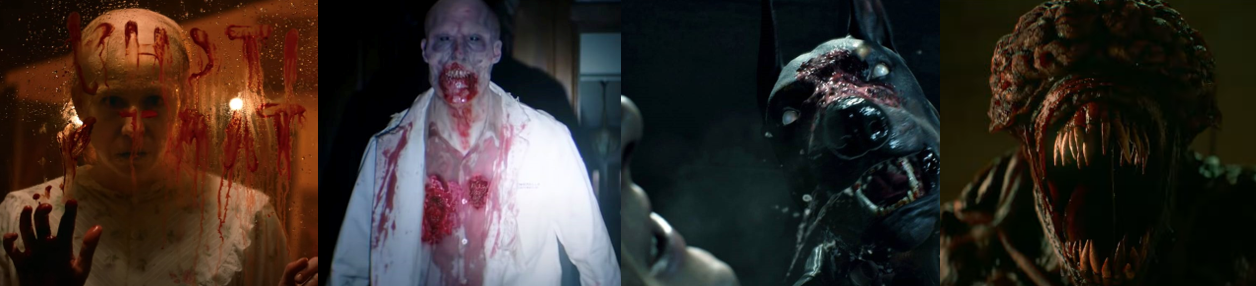
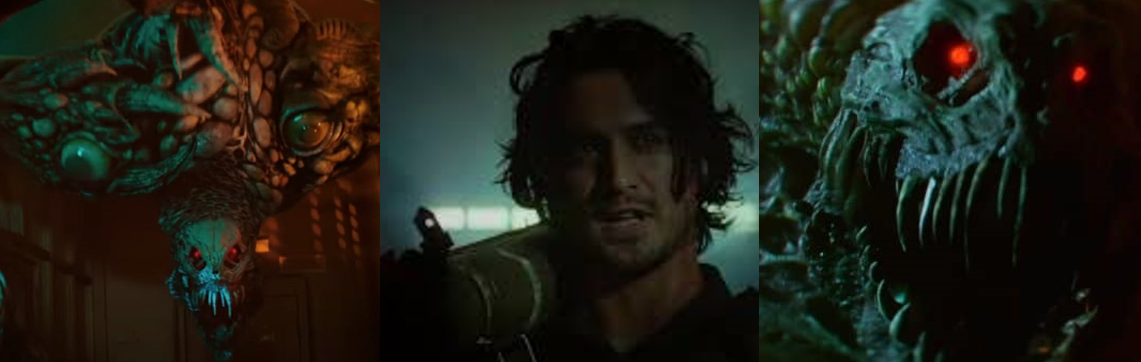
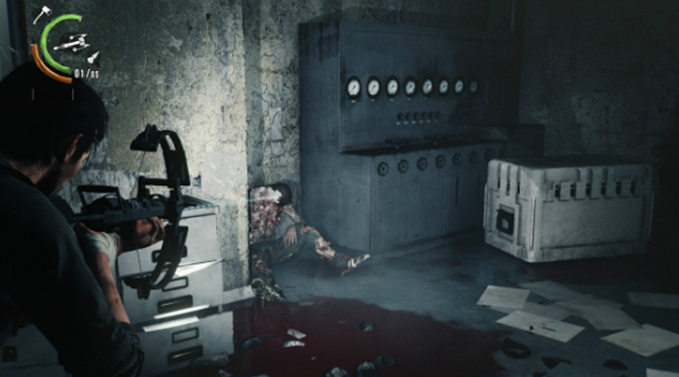
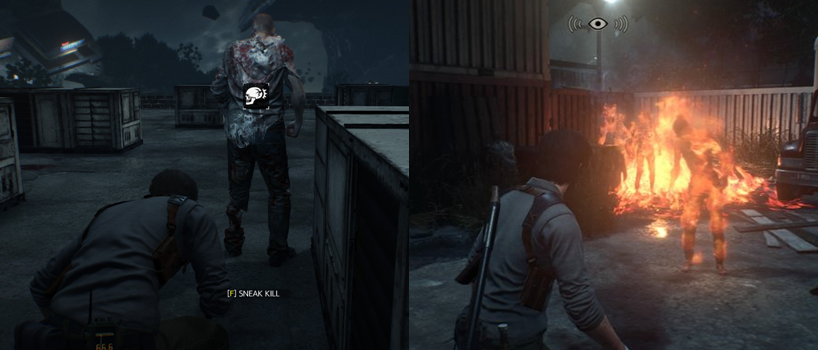
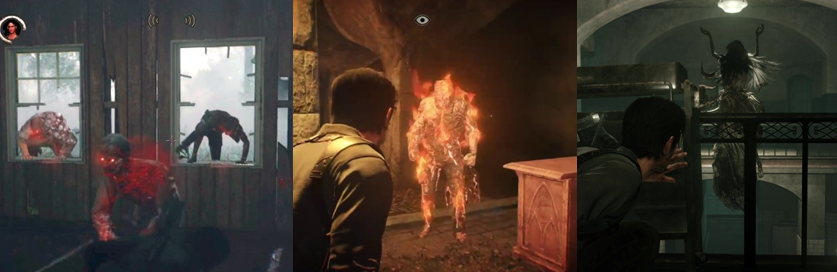
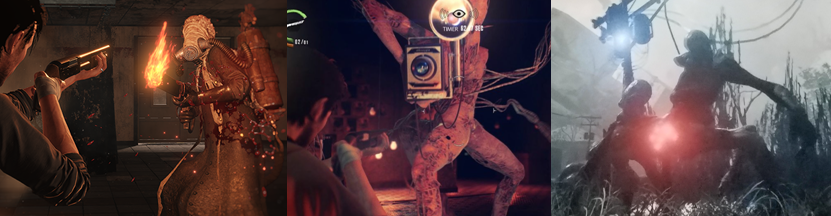
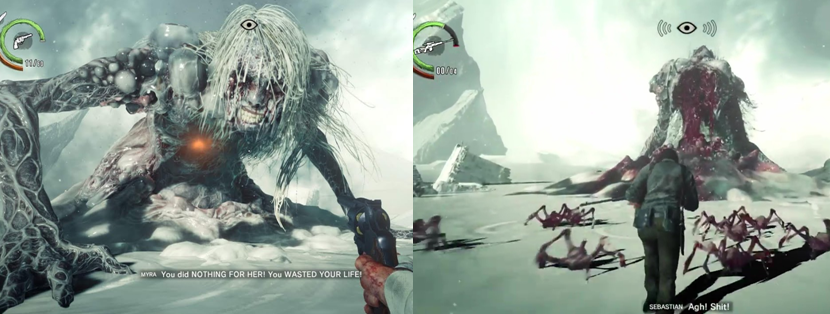
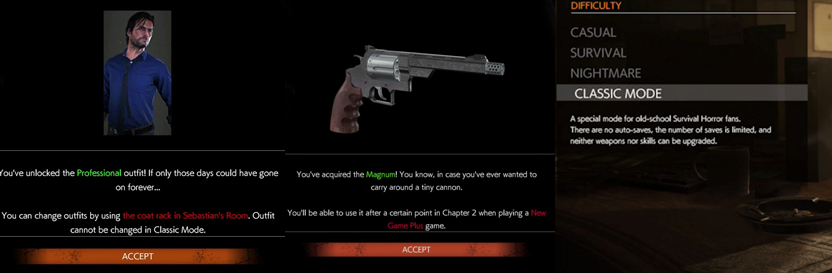
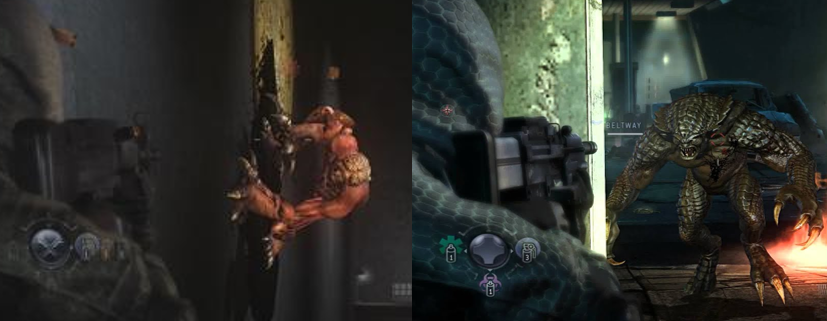
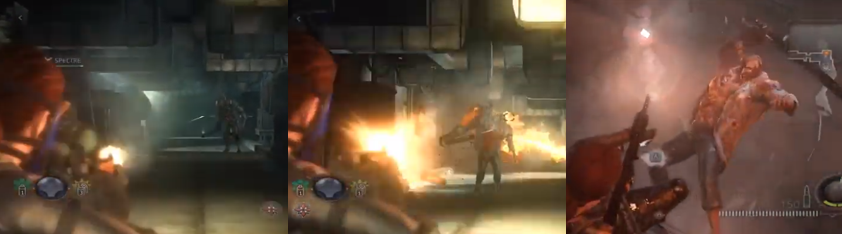
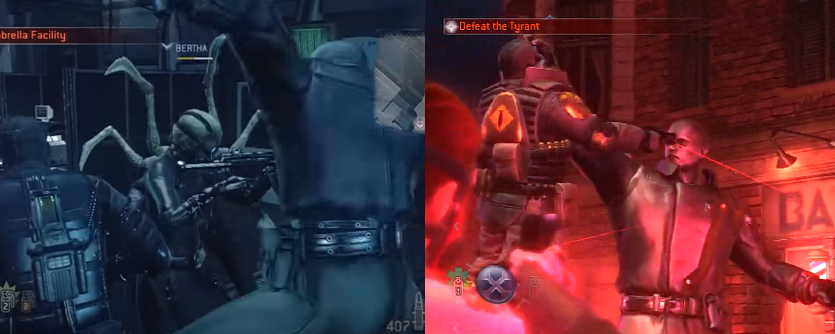
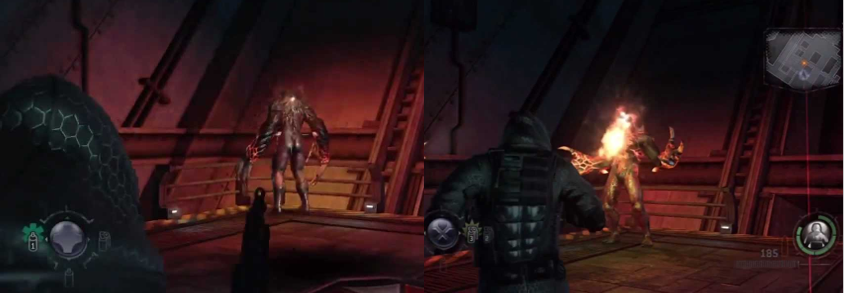
Game Corner: Resident Evil 4: Gold Edition (Xbox Series X)

Released: 8 March 2024
Originally Released: 24 March 2023; 11 January 2005
Developer: Capcom
Also Available For: PC, PlayStation 4, PlayStation 5, Xbox One, Xbox Series S

The Background:
Headed by Shinji Mikami, Resident Evil’s (Capcom, 1996) focus on atmospheric horror and limited resources popularised the “survival-horror” subgenre. Despite its blocky graphics, clunky controls, and cringe-worthy voice acting, Resident Evil was a critical and commercial success, kickstarting an entire franchise that continued to tweak the gameplay mechanics, expand the lore, and prove equally successful. During the sixth-generation of the gaming industry, Mikami (after a lengthy development process) spearheaded Resident Evil 4 (Capcom Production Studio 4, 2005). The game reinvented the series by shifting away from tank controls and restrictive angles to an over-the-shoulder perspective and a greater emphasis on player control and action. Resident Evil 4 became the second best-selling Resident Evil title and is universally regarded as one of the best (if not the best) entries in the franchise. Despite receiving a high-definition port in later years, the success and popularity of the game saw Capcom prioritise a modern remake over other Resident Evil titles, especially as they’d seen considerable success with remakes of previous entries. The project was not one that directors Kazunori Kadoi and Yasuhiro Anpo took lightly. Although they wished to capture the spirit of the original, the developers minimized the use of quick-time events (QTEs), expanded the narrative and capabilities of the notoriously annoying Ashley Graham, and placed greater emphasis on knife attacks and parrying. Like its predecessor, Resident Evil 4 was met with widespread critical acclaim. Reviews praised the updates to the graphics and mechanics, the expanded characterisations, and the brutal gore, though some criticised the retention of some of the original’s weaker moments. Regardless, Resident Evil 4 sold over five million units by July 2023 and was subsequently bolstered by some downloadable content (DLC). “The Mercenaries” mini game was made available for free from April 2023, microtransactions were added to speed up weapon upgrades, and a remake of the “Separate Ways” side story was released to high praise in September 2023. All this DLC was then re-released alongside the base game as this physical Gold Edition in early 2024.

The Plot:
After escaping Raccoon City, Leon S. Kennedy, now a government agent, is sent to rescue Ashley Graham, the daughter of the United States President, from a mysterious cult in a rural Spanish village. There, he encounters hostile villagers pledged to Los Iluminados and infected by a mind-controlling parasite known as Las Plagas.

Gameplay:
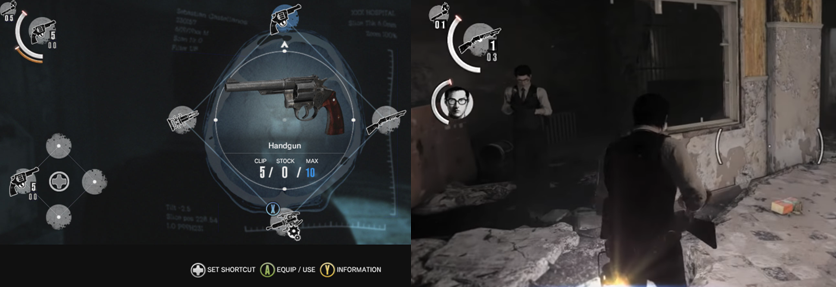
Resident Evil 4 is one of the all-time classics not just of the Resident Evil franchise, but in all of gaming. It changed the survival/horror formula into a more action-oriented genre and directly influenced later remakes of similarly classic Resident Evil titles. However, I was disappointed when I heard it was getting the remake treatment, especially as the previous HD version still holds up really well (despite you not being able to move and shoot). I would’ve much preferred to see Resident Evil – Code: Veronica (Capcom Production Studio 4, 2000) brought up to modern standards but I guess I understand the logic behind prioritising one of the most profitable and popular games. Resident Evil 4 offers six different control types and a wealth of modern options to choose from. You can toggle aim assist, the run and crouch functions, the size of the aiming reticle (which largely replaces the laser sight from the original game), various camera settings, and the intensity of the heads-up display and damage indicators. The default controls see you aiming with the Left Trigger, readying your knife with the Left Bumper, shooting or stabbing with the Right Trigger, and running with the Right Bumper or by pressing in the left stick. Y brings up your inventory (still nicely arranged in attaché briefcases), X reloads, A interacts with the environment to pick up weapons, ammo, treasure, and files, and you can crouch through small gaps with B. You can use the left stick in conjunction with RB to perform a quick turn, hold A to pull certain objects (bookcases, filing cabinets, etc) when prompted, and switch weapons using the directional pad. Two weapons can be assigned to each direction this time, which is great for mixing up your attack strategies and conserving ammo, though there’s no quick-heal option here.
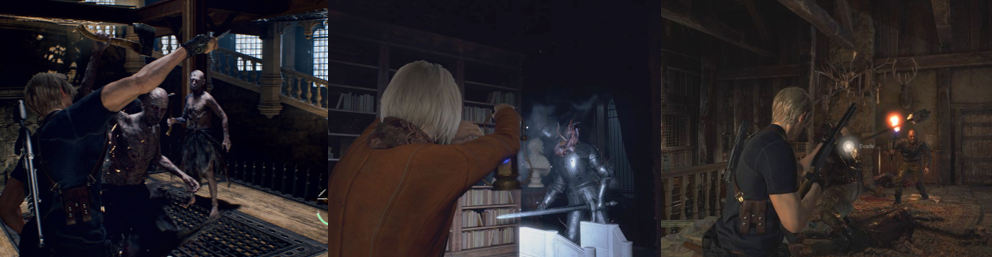
Alongside more emphasis on the knife, Leon’s allies have had their roles greatly expanded.

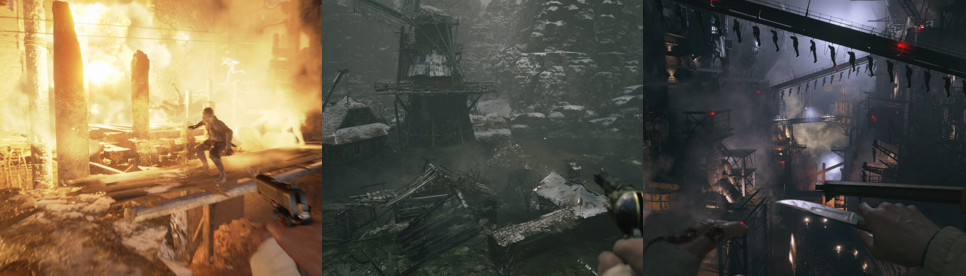
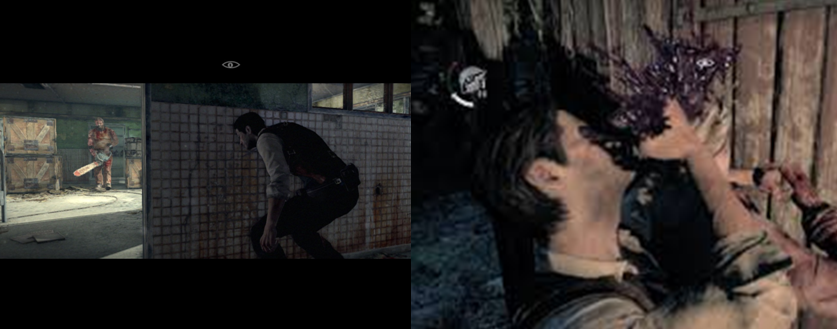
Resident Evil 4’s newest gimmick is placing increased emphasis on the knife. Before, you could cheese the knife to a ridiculous extent, stunning enemies and opening them up for Leon’s over the top melee attacks. While that’s still true here, Leon’s knife also parries certain attacks from the likes of the Chainsaw Ganado and other weapon-wielding enemies with LB. This will wound or stun enemies so you can run in to press A to hit a suplex, but you can also sneak up behind them or finish them off with your knife with a press of RB. Leon’s knife now has a durability meter; eventually, it’ll break and he’ll need to spend his hard-earned pesetas upgrading it at the mysterious Merchant. Weaker, disposable knives are often found dotted around the environment, in addition to stronger ones, and it really makes you think twice about going all gung-ho with your knife like before and opens up interesting ways to battle the likes of Major Jack Krauser since all the previous QTEs have been replaced by these new parry mechanics. In what’s now a franchise tradition, there is also a part where you lose your gear and must stealthily take out enemies to retrieve your stuff. As before, Leon will partner with some allies; suave ladies’ man Luis Sera has an expanded role here, helping you at key points and providing both ammo and extra gunfire when besieged by enemies or battling the troll-like El Gigantes, but your main partner is still Ashley Graham. Now wearing more sensible attire and with her bratty persona toned way down, Ashley is far more capable and useful than before. You command her to wait, hide, and follow you by pressing in the right stick, hiding her in the odd cabinet or cupboard and having her climb over walls to unlock doors or lower ladders. While she can die (and you can accidentally shoot her), you no longer have to worry about wasting your healing items on her and she typically just gets “incapacitated”. You can revive her and get her back on her feet, though you’ll still have to cover her as she helps solve puzzles and shoot enemies that try to spirit her away or else you’ll get a game over.
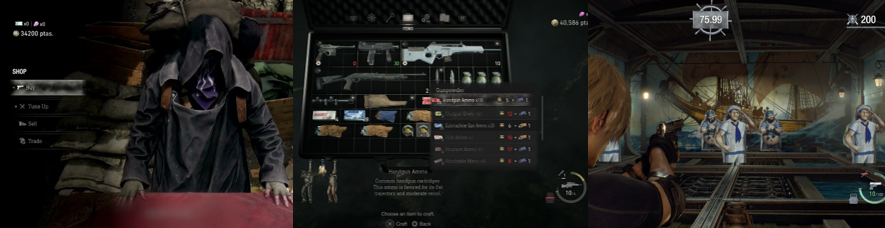
Purchase new items and upgrades, craft ammo, or just kill time at the shooting range.

I actually felt like Ashley wasn’t even partnered with Leon as much as in the original game and, when she is, it’s so much easier to look after her. Her solo section has also been expanded somewhat, moving from a primarily stealth-based interlude to a more puzzle-based section where you stun Armaduras with her special lantern. Leon also has a few more combat options available to him: he can occasionally dodge bigger attacks with B, has more control over the boat he uses to cross the vast lake, and can again use giant cannons to splatter enemies and shatter doors. As is now the standard in Resident Evil titles, Leon can also craft ammo and health from the inventory screen. By picking up resources, gunpowder, herbs, and purchasing instructions from the Merchant, you can craft ammo and various coloured herbs that will partially, fully, or even extend your health. This has also been expanded to the treasures; you can increase the value of goblets and crowns and other large treasures by inserting coloured gemstones, which is great for earning extra cash. You once again save at typewriters with no fear of running out of ink (though the game has a generous autosave function), can use a limited Item Box when doing so, and can once again take a break from all the killing and horror at the many shooting ranges. Here, you test your marksmanship skills to earn letter grades and tokens to purchase charms for your briefcase that’ll give you certain buffs. The Blue Medallion system has also been expanded to include side missions set by the Merchant. These include shooting hidden Blue Medallions, disposing of rats, and confronting tougher enemies, all for greater treasures.
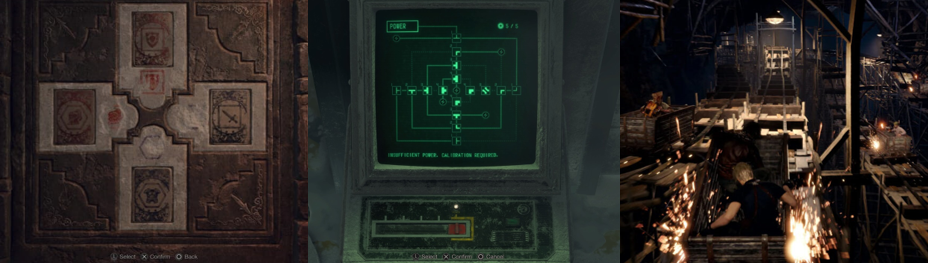
Classic puzzles and former QTEs have been reworked to offer a new, if familiar, challenge.

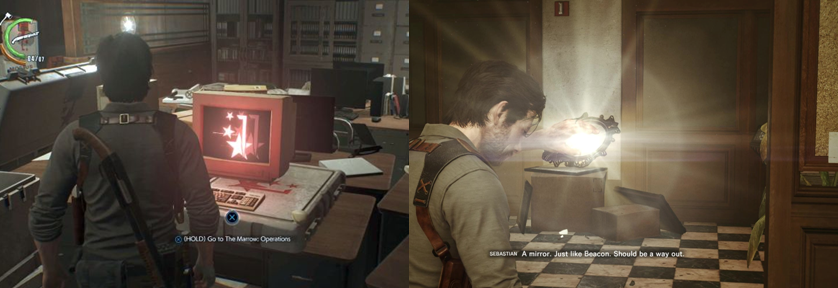
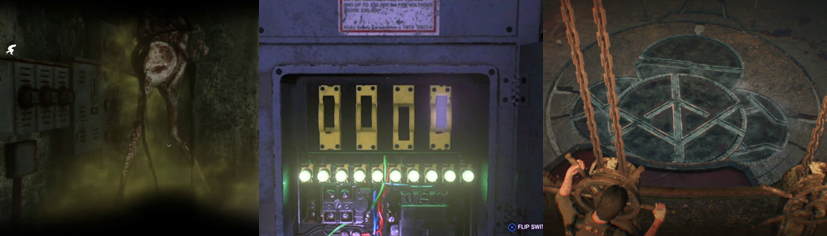
While much of Resident Evil 4 is familiar to anyone who’s played the original game, some of the puzzles and sections have been reworked. You’ll no longer run away from a giant stone version of Ramon Salazar or deal with that flame-filled room, for example, but these elements have been reworked into the tower section, meaning you not only have to avoid barrels coming down the spiral staircase but also take out Salazar’s giant stone visage to avoid being roasted alive. The light puzzle in the church is different, I’m pretty sure I don’t remember exploring a bunch of different caves to find shrines in the original, and I believe the dissection lab has a new power reroute puzzle that wasn’t there before. I do recognise some of the puzzles, though; you’ll still be traversing that damn hedge maze, still have to wait for the lift to come while fending off the Verdugo (now pulling levers to temporarily freeze it with liquid nitrogen and parrying it when it destroys these controls), and you’ll still have to watch your step when crossing rickety wooden bridges. You can still save a dog for an assist later on, still shoot lanterns to set enemies on fire, and still use explosive barrels to take out hordes of enemies. You and Ashley will sometimes have to turn wheels or levers or simultaneously pull switches or create new paths or open doors, or you’ll command her to do this while you explore further and protect her. You’ll be finding keys to unlock doors and drawers, taking the long way around to unbolt doors and create shortcuts, upgrading key cards, finding spheres that need to be rotated to form the Los Illuminados’ symbol, shooting gongs, sitting at the right tables as dictated by paintings, completing sword puzzles, and racing along on minecarts at breakneck speed, struggling to stay on the track, take out enemies, and avoid dead ends. If things get too tough for you (and it can get a bit hairy when you’re surrounded by enemies that only become stronger when you defeat them), you can lower the game’s difficulty. “Assisted” mode enables a health regeneration system and lowers the cost of items, but generally you can get by on “Standard” if you conserve ammo and make good use of the melee attacks, knife, and environmental aids dotted around the place.

Graphics and Sound:
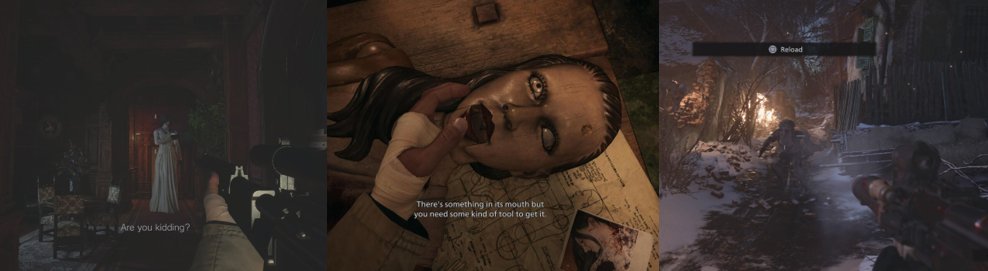
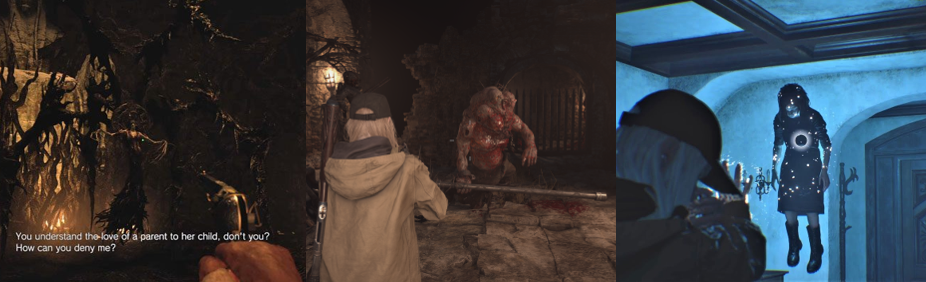
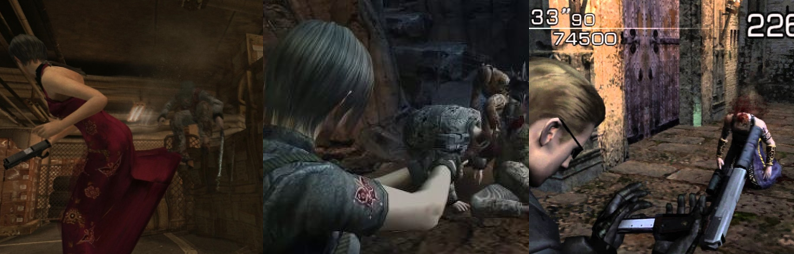
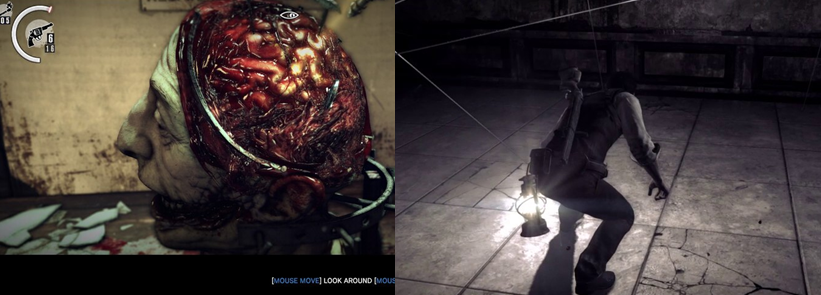
While I was sceptical about remaking Resident Evil 4 since the previous version still holds up really well, it can’t be denied that the game has never looked better than here. The remake engine makes fantastic use of lighting and shadows to give everything a far creepier and more horrifying atmosphere. The level of detail at work throughout the game’s environments is astounding, with rain and water effects being a constant standout. Areas feel real and lived in, with blood trails and splatters, damage and debris, and little things like photographs, ticking clocks, and even enemies hiding in toilets and giant ovens all adding to the immersion. Leon, especially, benefits from the graphical upgrade; he can now move and shoot, dynamically reloads, and reacts to his environment, shielding himself from rain, resting against walls when low on health, and crashing through destructible objects with the same gusto as before. Character models, in general, are much improved here; Ashley has a more sensible wardrobe, Luis has never smoked a cigarette better, and even the diminutive Salazar looks far less comical here. Faces are still a bit unnerving at times, appearing a bit plasticky (especially when wet) but the level of detail is greater than ever before, so I can forgive it. This extends to the blood and gore, too; enemies can be blown to pieces, exploding in a splatter of guts and viscera, their bodies writhing on the floor, reanimating with renewed aggression, or their heads bursting open as horrific tentacles parasites writhe about. More of them appear than ever before, too, with their variants and mutations causing serious trouble when you’re low on health and ammo and must survive until the game decides to let you continue.
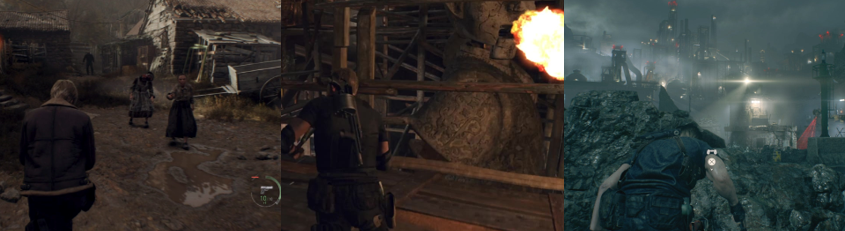
The graphical upgrade is astounding, making everything darker, grittier, and gorier.

All the key areas from the original game return here, including the main village, a sprawling castle, a network of dank caves and mines, and the fortified island the serves as the finale. You’ll visit graveyards, churches, houses (both abandoned and occupied), forgotten laboratories where bizarre genetic experiments lurk, medieval dungeons and hallways, and a veritable war zone in the end game as you navigate past barricades, narrow corridors, and ransacked areas where enemies lurk around every corner. Everything has a much higher level of detail; you can push obstacles out of the way as well as hop over or through them, files are scattered about to flesh out the local lore, and gameplay is frequently interrupted by exposition dumps from Ingrid Hunnigan or taunts from Saddler and his cohorts. Every cutscene and comms chat can be interrupted, which is great for subsequent playthroughs, and the sheer sense of foreboding atmosphere is unparalleled here as you’re never sure what’s lurking around even the most familiar corridors. Enemies can toss weapons at you, clamber up ladders, and will shout for help when they spot you. Later on, spider-like parasites will scuttle about and attach themselves to regular enemies, making them more formidable, and you’ll be constantly deactivating explosives, avoiding those ever-annoying bear traps, and redirecting gun turrets to clear your path. As ever, music plays a key role in alerting you to when there’s danger present; when it dies down or is more tranquil, you’re safe to explore and regroup. The dialogue and script has also been slightly tweaked; while Leon still has a lot of sass, some of the cheesier lines have been removed. There’s also an additional haunted quality to Leon as he struggles to reconcile the horrors he saw in Raccoon City and make amends for his mistakes with his newfound training.

Enemies and Bosses:
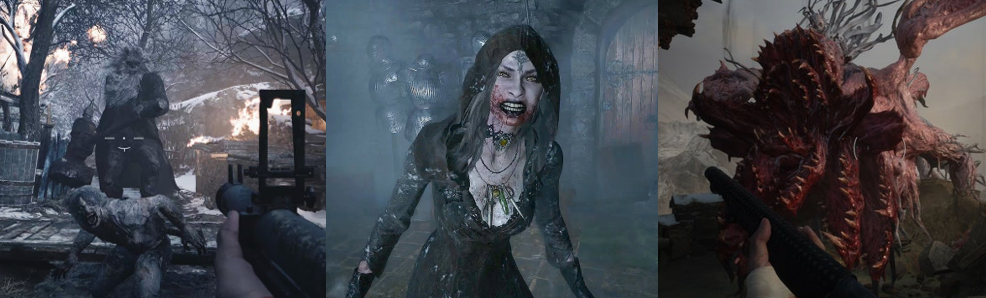
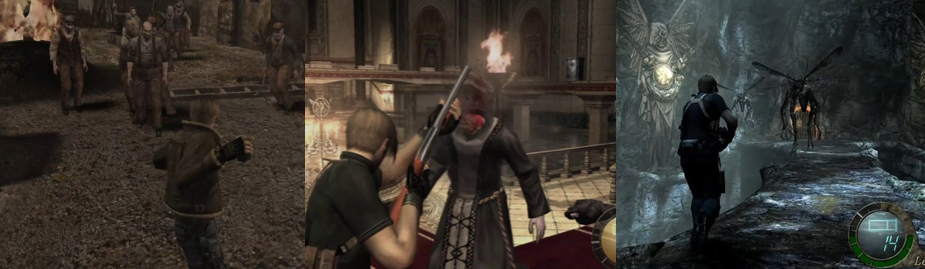
Like in the original game, there are no zombies here. Instead, you primarily fight the cult-like, parasite-infested minions of Los Illuminados. Ganados are far more intelligent than zombies, but no less durable; they can take multiple shots, even to the head, and keep going, utilising weapons like hatchets, pitchforks, and dynamite to cause you headaches. Thankfully, any nearby traps and hazards (and larger enemies) can hurt and kill them, but they are a real pain in the ass when they start wielding crossbows, hiding behind shields, and their heads burst to reveal disgusting tentacles and voracious parasites. The robed summoners will force this transformation and obscure your vision, so be sure to take them out quickly, while flash grenades are your best bet against the naked parasites or the armour-clad Armaduras. You’ll also battle Plagas-infested Novistadors, giant bugs that hover around, spawn from hives and can camouflage into the environment. Later, the Ganados better arm themselves and protect themselves with flak jackets helmets, and other military gear, making it even harder to score a good headshot.
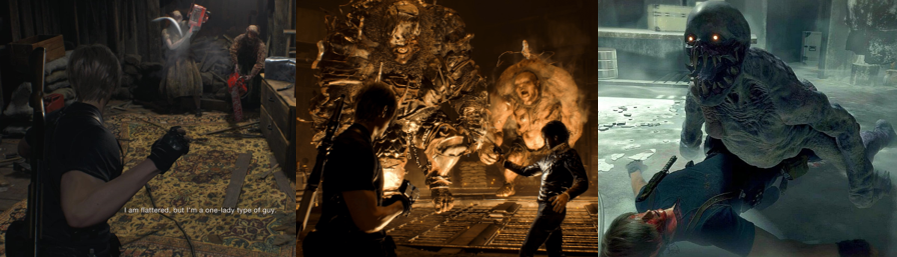
Bosses have been reworked to accommodate the new mechanics and modern graphics.

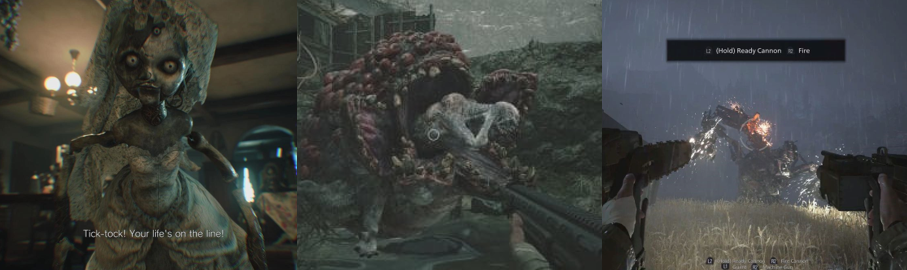
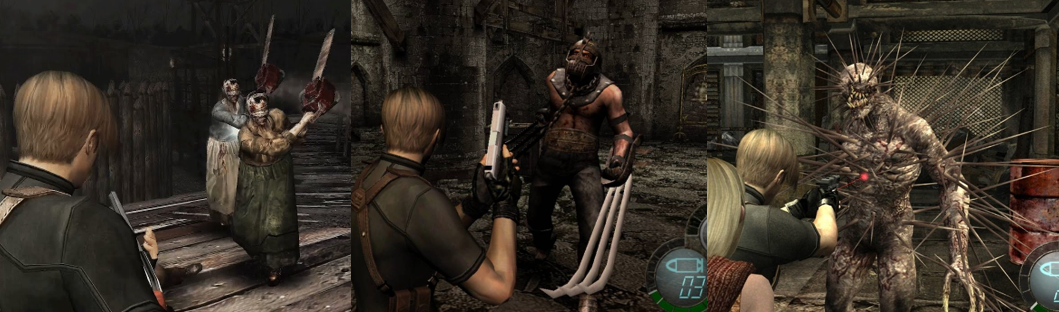
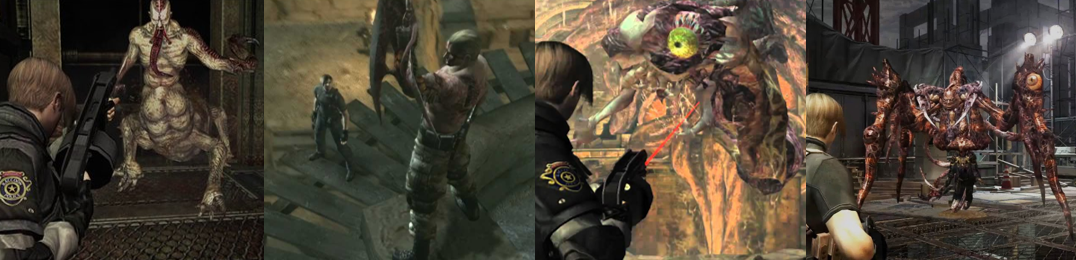
Larger, more monstrous enemies are also commonplace and act as mini bosses. The first you’ll encounter is the Chainsaw Ganada, a burlap-sack wearing madman who will lop your head clean off if you don’t make good use of the parry system. As if their sporadic appearances aren’t bad enough, you’re also forced to fight the Bella Sisters again, this time in an enclosed room (which actually makes it easier to track them), and the aggravating, claw-handed Garradors. Though brutish, heavily armoured, and extremely dangerous, Garradors are also slightly easier here as you’re not locked in a small cage and have more room to manoeuvre behind them to shoot the parasite on their back, stunning them for a more effective attack. Similarly, sledgehammer-carrying Brutes often show up, though their wild swings can just as easily wipe out nearby lesser enemies, as well as lumbering El Gigantes. This time, when you battle the two of them in the furnace, Luis is there to help; though he’s more of a distraction and hinderance as he needs to get clear before you can drop their asses into the molten steel. As ever, two of the more disturbing enemies-cum-mini bosses are the cackling, slug-like Regenerators and spiky Iron Maidens, two intimidating creatures that shrug off bullets and grenades, rapidly heal even when blasted in two, and pounce on you to try and eat your face and skewer you. The only way to effectively destroy them is by finding and equipping the Bioscope Sensor to your rifle so you can see and shoot the parasites lurking in their bodies, which can be easier said than done thanks to their erratic movements and extendable limbs. Another memorable boss encounter is, of course, the massive, mutated salamander Del Lago. You’ll need to use LB and RT to throw your unlimited supply of harpoons and the beast, avoiding the obstacles floating in the lake and chucking your spiked implements into its mouth when it leaps from the water. Thankfully, your encounters with the Verdugo are much more manageable this time; instead of running around a maze of shipping containers and fighting it in a cave, you must simply freeze it with liquid nitrogen and avoid or parry its lashing tail attacks when prompted.
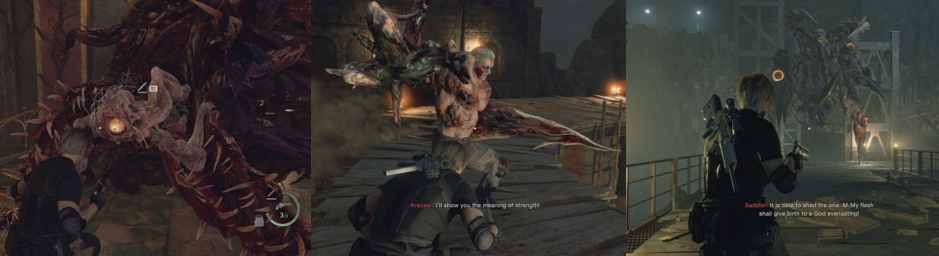
No matter how big or monstrous the boss, your knife, parry, and dodge abilities will be the deciding factors.

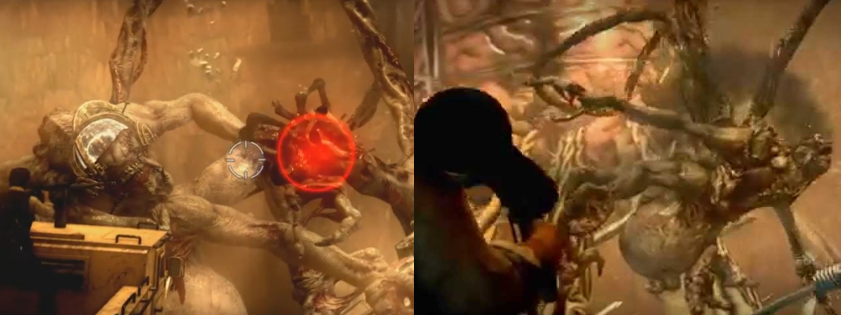
Bitores Mendez once again hounds Leon throughout the story, though you are spared him lumbering after you like a Mr. X or Nemesis figure. He’s still fought in a burning barn, assuming a scorpion-like mutated form where he swipes with his tentacles, requiring you to either dodge or parry his limbs to blast at his big, ugly eye. In the second phase, the fires rage out of control and can really eat away at your health, as can the barrels he tosses at you, but the key is staying in the safest place you can find, parrying when prompted, and hitting RT when he’s stunned to deal big damage. Ramon Salazar’s mutated plant form is more agile than I remember it. He scuttles about on the walls and ceilings, belching corrosive bile and explosive pods, and can eat you in one bite if he gets too close. You need to constantly stay on the move and not miss the opportunity to fire when the pod opens and reveals him, which will eventually stun him to the ground so you can use your knife, but I found this a particularly gruelling boss battle. Krauser is fought twice this time; the first is a straight-up knife fight where you must parry or dodge his attacks, landing slashes and melee attacks until he flees. This repeats in the ruins, but Krauser also fires at you, tosses flash grenades, and mutates a giant arm blade for the finale. The fight isn’t timed this time, but Krauser is extremely agile, so you’ll need to keep him in view, taking shots and using any nearby knives to parry his slashes while also getting around his bio-organic shield. Finally, Osmund Saddler transforms into a rampaging, tumour-filled arachnid monster that stomps about an unstable mining platform. For such a big creature, it’s difficult getting a good shot at the eye-like growths on his limbs but doing so leaves his main weak spot open. Repeat this a few times, watching out for the limited ground, and Ada Wong will eventually toss you a rocket launcher to finish him off after he envelops the entire arena in a mess of putrid limbs.

Power-Ups and Bonuses:
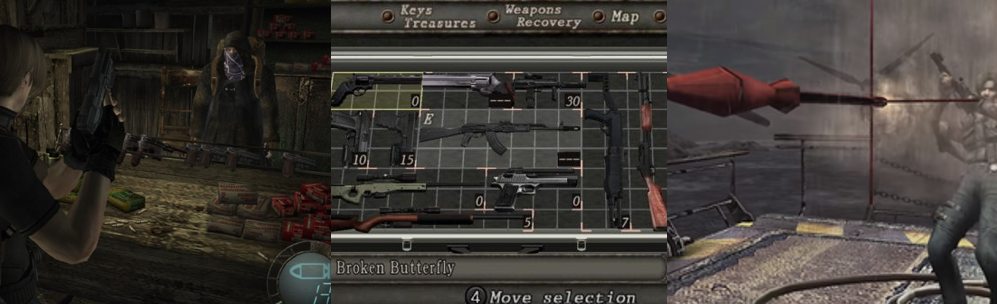
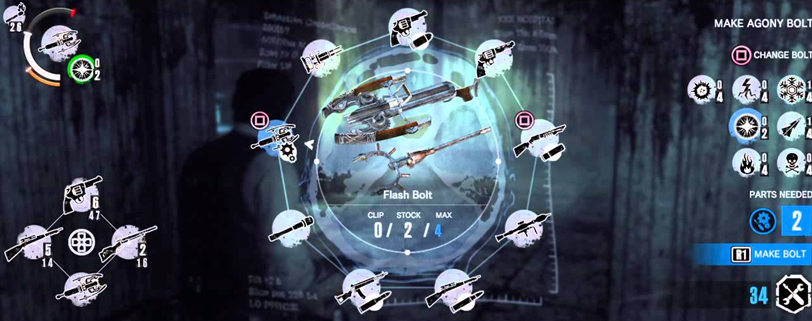
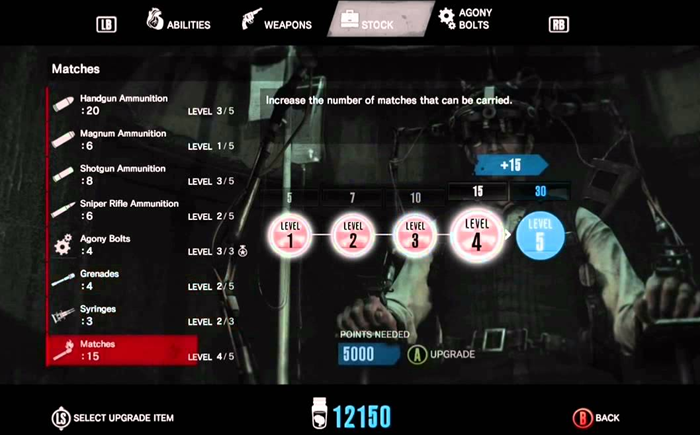
As you explore the game’s environments, you’ll find key items to progress and useful pick-ups to aid you. Small keys, cuboid blocks, medallions, and such access treasures, ammo, or healing items, or resources for crafting. Defeated enemies will invariably drop an assortment of supplies and you can smash open crates to acquire them, too (just watch out for snakes!) First-Aid sprays and herbs will restore your health, as ever, but you can also eat eggs and fish to do the same. You can combine green, red, and yellow herbs to recover more health and extend your health bar, which is always handy. Treasures come in many forms, from various jewels to ornate masks, clocks, and the like. The bigger ones house your smaller jewels to increase their value and you can also sell unwanted ammo, guns, and items to the Merchant for more cash. The Merchant’s stock is constantly changing, allowing access to new ingredients and weapons, so my advice is to wait for the more powerful weapons before you upgrade them to save your money and have stronger weapons later in the game. The Merchant also sells attaché case upgrades, allowing you to carry more and providing specific buffs, and degradable body armour to upgrade your durability. He also trades you special weapons, items, and add-ons for your arsenal if you complete his side missions. Leon uses many different weapons, from grenades and flash bombs to his trusty knife, pistols, and shotguns. You’ll eventually utilise heavier weaponry, like the assortment of submachine guns and assault rifles to single-use rocket launchers, as well as revolvers and magnums, sniper rifles, and a surprisingly handy bolt rifle. This is useful for destroying Blue Medallions, shooting rats, or finishing off enemies as you can recollect the bolts; you can also press the left stick to attach explosives, which is super handy in a tight pinch. These weapons can be upgraded to increase their power, ammo capacity, and reload time. Upgrade them fully (or acquire a special ticket) and you can unlock their special bonus ability, and you’ll also equip add-ons, such as stocks and scopes. Completing the shooting ranges earns you tokens to play for charms to attach to your briefcase; these increase how much ammo you craft, item drop rates, and provide other buffs, though you can only attach three at a time.

Additional Features:
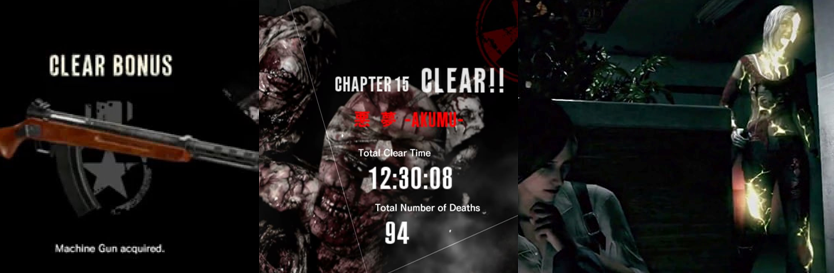
There are thirty-nine Achievements on offer in Resident Evil 4 by default, with many unlocking simply by completing the story chapters, besting the monstrous bosses, and beating the various difficulty modes. While you won’t get an Achievement for aggravating Del Lago or looking up Ashley’s skirt, you will for rescuing her as she’s being carried away, for parrying incoming attacks, destroying all of a Regnerator’s parasites in a single shot, and selling an item for many times its usual value. Achievements also come from fully upgrading weapons, finding and destroying all of the Clockwork Castellan toys scattered throughout the game, escaping certain areas without taking damage, defeating certain bosses in specific ways, and finding every treasure (something greatly aided by purchasing the Merchant’s treasure maps). Not only are you graded on your time and performance at the end of the game, each chapter ends with a rundown of your accomplishments. These are tied to the Achievements and the in-game challenges that earn you Completion Points (CP) to spend in the “Extra Content” section. This is where you’ll unlock character models, concept art, and additional costumes and weapons. Beating the game on different difficulty modes unlocks various rewards, such as a dapper noir outfit for Leon, sunglasses and masks, the even harder “Professional” mode, and all your weapons, charms, and remaining treasures carry over to your next save file. Sadly, however, unlocking Ashley’s super useful suit of armour is much harder this time, requiring at least an A-rank completion of “Hardcore” mode. You’ll also need to destroy sixteen Clockwork Castellans to get an unbreakable knife, clear “Professional” mode for a bad-ass hand cannon, and shell out a whopping 2,000,000 pesetas for the infinite rocket launcher.
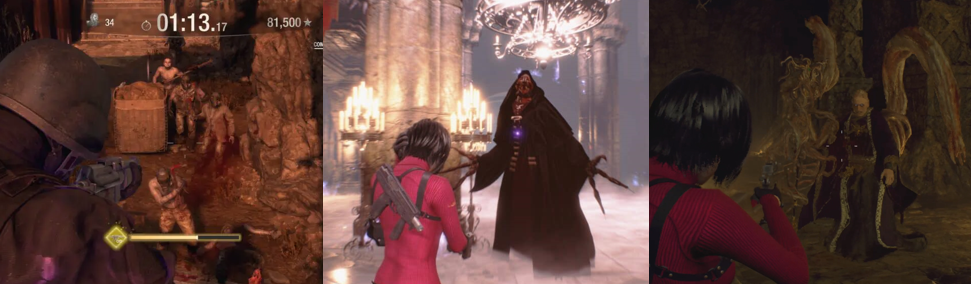
Battle for points in “Mercenaries” mode and experience Ada’s story in this revamped nightmare.

You can also play the “Mercenaries” mini game to dispatch as many enemies as possible against a time limit, building up your “Mayhem Meter” to unleash character-specific special moves and playing as either Leon, Luis, Krauser, or the returning HUNK, each with their own weapon loadouts and attributes. DLC packs also contain funky extra costumes, weapons, and even the original game’s soundtrack. Finally, there’s the Separate Ways side story that focuses on what Ada was up to during the main game and comes with seven additional Achievements. Separate Ways has been expanded upon in many ways. Not only does Ada have access to the same weapons, knives, items, crafting, treasure, and abilities as Leon (including the Merchant and her own melee attacks) but her grapnel gun now plays a significant part in her gameplay. You’ll often be prompted to grapple to (or find yourself traversing) the rooftops and upper levels in recycled locations, tapping RB to swing across gaps, launch to ledges, and even remove shields from enemies and fly in for a quick melee attack once upgraded. Separate Ways also expands upon Luis’s story, teaming him with Ada at various points, and she utilises her ocular I.R.I.S. implants to track footprints and reveal fingerprints for keycodes. Separate Ways also adds content back into the game, including the laser hallway sequence (a simple QTE where you tap B a few times and the RB at the end, finishing off a gigantic, toad-like boss at the same time) and U-3 boss fight. This returns as the final form of Ada’s clingy stalker, the gruesome Black Robe, which distorts the environment, teleports and creates duplicates, and is fought numerous times before it transforms into this scorpion-like form for a two-phase showdown in the caverns. Ada also battles Garradors, Regenerators and Iron Maidens (without the benefit of the infrared scope, that I could find), and boar-headed brutes with machine guns strapped to their arms. She also tackles an El Gigante (battling from atop destructible huts) and has a unique showdown with Saddler. This was the most frustrating part of Separate Ways for me. Saddler has a rush attack, bursts tentacles from the ground, fires bullets from his fingers, and can spam-lock you with tentacle combos. You must blast his face until the eyeball appears in his mouth and keep firing until you can melee attack him, but this took me quite a few tries. After that, you must grapple around the final stage as Saddler’s Lovecraftian mass attacks Leon, blasting the eye tumours in its tentacles to reach the rocket launcher and bring the side-game to a close. Separate Ways has the same difficulty settings as the main game and you can unlock additional costumes and accessories to wear in it, and the main game, as well as complete similar challenges when playing.
The Summary:
I love Resident Evil 4. It’s probably my second favourite in the franchise after the second (both/either version) and it was a blast playing through this top-notch modern reimagining of the title. Sure, I don’t think I’ll ever get over Capcom prioritising remaking this title, which has stood the test of time extremely well, over Code: Veronica, which is still stuck in the tank control days of the franchise, but they absolutely delivered with this game, to the point that it almost makes up for them dropping the ball on the remake of the third game. The new graphical overhaul makes the game darker, moodier, and gorier than ever. There’s just so much detail, so much happening in the environment and with lighting and shadows, and Leon and the others have never looked more detailed and human (or inhuman) than here. I think it’s a testament to how well-crafted the original game was that very little has been changed or discarded. A few boss battles and hazardous areas are omitted or heavily altered, sure, but everything from the original game is retained but with a more serious tone, a greater degree of movement, and far more options for you to upgrade your arsenal. I thought I’d hate the degradable knife and parry mechanics, but they were implemented really well, making me think twice whenever I used the knife since I wouldn’t want it to break at a pivotal moment. While I actually enjoyed the quick-time events of the original, I’m glad they were replaced by playable sections; it really added to the immersion of Leon’s bouts against Krauser. Expanding on Leon, Luis, and Ashley to make them more well-rounded characters while still retaining the edge, arrogance, and characteristics that previous defined them was a great idea, as was altering Ashley’s solo section into something more enjoyable and never-wracking. In the end, I’m forced to admit that remaking Resident Evil 4 was a fantastic idea as it resulted in this gorgeous, gore-soaked, super tense and exciting game. I really hope Capcom give the same treatment to Code: Veronica next but it does make me wonder if they can improve upon Resident Evil 4’s sequels just as well later down the line…

My Rating:

Rating: 5 out of 5.

Fantasic

Were you pleased with the remake of Resident Evil 4? Do you think it deserved the remake treatment so soon? What did you think to the new knife-based mechanics and the alterations to certain bosses? Did you like that Luis and Ashley’s roles were expanded and more flesh out? Did you ever find all of those Clockwork Castellans? Which Resident Evil videogame, character, monster, or spin-off is your favourite, and which game would you like to see remade next? Whatever you think, feel free to leave your thoughts down below.


Game Corner: Resident Evil Village: Gold Edition (Xbox Series X)

Released: 28 October 2022
Originally Released: 7 May 2021
Developer: Capcom
Also Available For: Nintendo Switch, PC/Mac, PlayStation 4, PlayStation 5, Stadia, Steam, Xbox One, Xbox Series S

The Background:
Helmed by Shinji Mikami, Resident Evil (Capcom, 1996) was a seminal title for the up-and-coming PlayStation, one whose focus on atmospheric horror and resource management popularised the “survival-horror” subgenre. A critical and commercial success, Resident Evil was quickly followed by a numerous sequels that continued to refine the gameplay, add to the lore, and be equally successful. After a troubled development, Mikami re-invented (and once again re-defined) the genre with the ridiculously successful Resident Evil 4 (Capcom Production Studio 4, 2005), though Capcom soon drew heavy criticism for over-relying on an increasingly action-orientated and over the top presentation. Thus, Capcom shook the franchise up again with Resident Evil VII: Biohazard (Capcom, 2017), which took the series in an all-new direction, featured an immersive first-person perspective, and introduced new mechanics and lore that would impact subsequent releases. Although Resident Evil VII was a critical and commercial success, development of an eighth instalment began about a year and a half before VII released. Inspired by Resident Evil 4, the developers purposely focused on a village as the central location and sought to create a balance between combat, exploration, and puzzle-solving. In addition to tying up the story of VII’s protagonist, Ethan Winters, the developers aimed to encourage exploration with an ever-shifting, more open-world environment and drew from gothic horror to design the game’s new werewolf-like enemies. Resident Evil VIII’s marketing heavily focused on Lady Alcina Dimitrescu, a towering, alluring, vampiric figure whose sex appeal helped boost interest in the game, which led to over three million copies being shipped within the first four days alone. The game’s new direction and ties to Resident Evil 4 were praised, as was the gameplay variety and emphasis on exploration, though the bosses and puzzles drew some criticism. Still, the game was a hit, more than justifying the release of additional downloadable content (DLC) within the following year. All of this DLC, which included additional gameplay modes and an epilogue story, was then made available on this Gold Edition release.

The Plot:
Three years after escaping the Baker family, Ethan Winters faces an all-new terror when his infant daughter, Rose, is kidnapped by Mother Miranda, the fanatical leader of a cult-like coven, after being seemingly betrayed by Chris Redfield.

Gameplay:
Like its predecessor, Resident Evil Village (stylised as Resident Evil VII.I.age) is a first-person survival/horror title in which players are again placed into the bland, faceless shoes of Ethan Winters, easily the franchise’s dullest character. Ethan has been fleshed out a little more this time around, though, to be fair. Between games, he and wife Mia have relocated, starting their lives anew with baby Rose; he has much more to say and far more agency this time around since he’s trying to rescue (and restore) his baby daughter; and he’s a little more competent after his experiences in the last game. If it’s been a while since you played Resident Evil VII, you can watch a helpful recap before setting up your subtitle, screen, and sound settings and, thanks to this Gold Edition of the game, you can play in third-person mode, which was my preference. Resident Evil Village offers four control setups, but the default is serviceable enough. You aim with the Left Trigger, guard against enemy attacks with the Left Bumper (with successful timing shoving enemies away), shoot with the Right Trigger, use a recovery item (such as First Aid Med) with the Right Bumper (a godsend in sticky situations), examine points of interest and pick things up with A, reload with X, and open your inventory with Y. By default, B does nothing except perform a quick turn in conjunction with the left stick, which can also be pressed in to break into a run. Pressing in the right stick allows you to crouch behind cover or through tunnels and small gaps, and you can switch weapons using the directional pad, with four different weapons able to be applied to this weapon “wheel”. There are also options to adjust aim assist, the intensity of the damage display, onscreen tutorials, and how much of the heads-up display is visible, allowing you to customise a more cinematic experience if you wish.

Craft health and ammo and purchase new items and upgrades from the Duke.

There are three difficulty settings to choose from at the start of the game, with a fourth, “Village of Shadows”, unlocked after beating the game on any difficulty. Naturally, the harder the difficulty, the tougher the enemies will be, with even basic foes tearing your throat out in a few hits on “Hardcore” difficulty. Unlike in the classic Resident Evil titles, there are no fourth dimensional Item Boxes here. You’ll need to combine and craft items to save inventory space, or spend the Lei dropped by enemies or found in destructible crates to expand your carry capacity. Yes, the crafting system is back; by finding items such as herbs and gunpowder, Ethan can craft recovery items, ammunition, and even explosives like pipe bombs and mines. New “recipes” can be purchased from the game’s rotund merchant, the mysterious Duke, who will happily purchase any treasure you’ve found, sell you ammo, weapons, and healing items, and also tunes up your existing weapons to make them more powerful. If you kill local wildlife, you can bring the meat to the Duke to cook food that increases your movement speed, maximum health, and reduces the damage you take while defending, though the Duke’s prices increase over time and he can even sell out of items, so it’s best to keep an eye out for craftable pickups. I’d also recommend caution with your weapon choices; eventually, better weapons will become available and you can only carry so much, so it’s easy to invest a lot of money tuning up your default handgun only to then have to sell it for the stronger upgrade. You can buy back any weapons you sell, but you can’t remove any charms or attachable tools (such as the scope for the sniper rifle or the extra magazines) from your weapons, so I definitely think it’s better to wait for the W870 TAC shotgun to become available and spend your money upgrading that as opposed to the first shotgun you find.

Alongside some challenging combat, you’ll solve rudimentary puzzles and acquire elaborate keys.

In addition to a decent weapon selection to choose from, Ethan can also use his environment to fight back against the lycan-like enemies that infest the titular village. Explosive barrels will blow enemies away and can hold A to barricade doors with furniture against enemies. You can shoot them off rooftops, sometimes you’ll need to rapidly tap A to escape an enemy’s grasp, and some larger enemies will even attack their smaller cousins. Even on the “Standard” difficulty, Resident Evil VIII is pretty tough. You often have just enough on hand to survive an enemy onslaught, after which you’ll be in dire need of resources to fend off the next enemy encounter, so it’s worth searching every drawer and cupboard, even if many of these are empty. Luckily, your map will indicate any missed items in the local area; it highlights treasures, locked doors, and missed items. You can then backtrack when you have the right keys or the environment has altered to grant you access, and you can still find helpful files that flesh out the game’s lore, Mother Miranda’s connection to the Mold and the Umbrella Corporation, and provide clues or solutions to the game’s puzzles. These may be as simple as finding bolt cutters to break chains, using a key to unlock a door, or finding and entering combination codes, but also become a wild goose chase as you search for masks, examine items for keys or add-ons for existing keys, insert glass eyes into holes, awkwardly swing flaming lanterns, and pull levers to open doors. As ever, you can save your progress at any time using a typewriter. You don’t need to worry about ink ribbons here, and the game also includes an autosave function so you’ll respawn from checkpoints when you die, but I’d recommend making a couple of save files so you can backtrack for missing items or optional side quests as you’ll eventually reach a point where you can’t return to the village that acts as a central hub, of sorts.

While the game peaks early, there’s enough variety and intrigue to keep you hooked throughout.

Resident Evil Village tasks Ethan with venturing to four distinct areas from the titular village, which alters (along with the title screen) as the game progresses, becoming infested with tougher enemies, set on fire, and ransacked by the Mold. Each of these areas presents a unique, but also familiar, challenge; Lady Alcina Dimitrescu’s castle, for example, is very reminiscent of the original game’s ornate mansion, and Lady Dimitrescu herself patrols the hallways, pursuing you throughout the estate like her predecessors, Mr. X and Nemesis. When trapped in House Beneviento, Ethan loses all his gear to the childlike Donna Beneviento and her malevolent puppet, Angie, who force you to complete a series of puzzles, including finding items to investigate a mannequin, rearranging film cells, and searching for fuses, to escape and reclaim your items. The toad-like Salvatore Moreau dwells in a mine, one infested with slime-like pustules, outside a massive lake strewn with wreckage that you must cross, lowering and raising temporary platforms, to power up the generators. Finally, the rebellious Lord Karl Heisenberg dwells in rundown factory populated by horrific cybernetic monstrosities. Here, you’ll use the smelting equipment to craft key items to progress, take a maintenance lift, and battle Heisenberg’s cyborg creations. After defeating Heisenberg, you’ll take control of the far more capable Chris for an all-action infiltration of the village and the catacombs beneath it. Chris has better weapons on hand, utilises ample supply drops, and calls in air strikes by holding down RT,  making short work of Mother Miranda’s Mold defences and the hammer-wielding Uriaș who plagues Ethan so often in the main story.

Graphics and Sound:
It’s almost astounding how good Resident Evil VIII looks; the environments, especially, are moody, dank, and claustrophobic while also being genuinely creepy and unsettling, and the use of ambient noise, distant scratching and screaming, and sporadic music really adds to the tension. The level of detail is incredible at times, with Ethan panting and showing visible pain when low on health, blood splattering on his weapons, snow and frost ransacking the village, bullets and blood alike marking doors, windows, and the environment, and heads sporadically exploding in a shower of gore. Playing in third-person allows you to finally see Ethan’s character model, though he’s still just a guy, one whose face is oddly obscured no matter how much you wriggle the camera. Interestingly, many of the character models (basically anyone who isn’t Chris, who’s been redesigned once again) sport a shiny, uncanny look that makes them seem not quite real. This is fine for the monstrous enemies, but makes human characters a little unsettling to look at in the wrong lighting (though, admittedly, this may be due to the brightness settings I chose). Resident Evil VIII ventures towards the supernatural for many of its enemies, depicting werewolves, witches, and shambling wretches alongside cyborg brutes fitted with drill arms! If these get too close to you, you’re gonna be in for a bad time and treated to some gruesome death scenes, but it’s equally satisfying seeing them be blown to pieces by a well-timed grenade round.

There are some creepy and visually impressive locations beyond the titular, ever-changing village.

As you might’ve guessed from the game’s title, the village plays a prominent role here. It’s your central hub you’ll return to time and again and have to explore and defend throughout the story, housing a church, graveyard, ruins, rivers, and more. Largely barren due to the events taking place, there’s a constant dread hanging in the village that’s mirrored by its adjacent locations. While some areas (stately homes, mostly) are guilty of recycling assets such as ornaments and furniture, others are more visually unique and unsettling, such as the cyborg factory and the creepy doll’s house-like House Beneviento. Resident Evil VIII continues to move away from the futuristic laboratories of Umbrella and takes more cues from Resident Evil 4, bringing an Eastern European flavour back to the franchise. I’m actually surprised it didn’t try to harken back to the backwater locations of the last game. However, these are partially evoked in your encounter with Moreau and when the Mold starts bursting from the ground and overtaking the village, but it’s a tenuous link, at best. The game’s story is engaging enough and mostly related through in-game cutscenes that retain the first-person perspective. You’ll be falling or sent crashing through floors and walls, have your limbs and organs cut off or ripped out, and be constantly interrupted by surprise attacks or jump scares. Everything’s played very seriously here, with very few glib remarks from the increasingly tested Ethan, with the exception of Mother Miranda and her lieutenants, who are almost as over the top as the crazed Baker family from the last game. Sadly, much of their personality is lost when they transform into gigantic, boil-infested monstrosities as per Resident Evil tradition.

Enemies and Bosses:
In place of zombies, bio-organic weapons, parasite-infected villagers, and Mould creations, players battle werewolf-like lycans upon first entering the village. These snarling brutes are nimble and voracious, lunging for you and trying to tear your throat out and taking a fair few shots to be put down. A larger, armour-clad variant is also encountered, one that is better shielded from headshots, and bigger, more monstrous Vârcolacs pose a significant challenge if you’re caught unprepared. The spirit of the classic games is evoked through the shambling, sword-wielding Moroaicǎ, hooded, gaunt figures that rise from shallow water and attack in groups, while bat-like Samcas nest on the rooftops of Castle Dimitrescu. While the mindless Haulers are little more than cannon fodder in Heinsberg’s factory, his cyborg Soldats aren’t to be trifled with. Sporting up to two drill-like appendages and a variety of cybernetic armour, these lumbering walls of muscle can only be put down by blasting the exposed core on their chests, a task easier said than done when they attack in groups and are protected by quasi-mech suits. Most of the game’s more formidable enemies, like the Vârcolacs and Soldats, are introduced as mini bosses, giving you a chance to sample their abilities before they become commonplace and are joined by even stronger variants as the game progresses.

Monstrous and grotesque abominations are the order of the day, however unfitting some of them are.

The first boss you encounter is the aforementioned Uriaș; although it is technically possible to defeat him when he first appears, this isn’t necessary, you just need to survive until the plot progresses. Uriaș shows up as a proper boss twice during the main campaign; first, Ethan fights him in a confined space full of pillars to take cover behind. You’ll need to stay well clear of Uriaș’ giant hammer and leaping attack, and fend off the lycans for resources, preferably blasting him with your shotgun or grenade rounds to put him down. Uriaș also shows up when playing as Chris, but this fight is much easier as you simply need to target him for a few air strikes, surviving until he’s put down once more. As if frantically avoiding Lady Dimitrescu’s appearances isn’t bad enough, her three witch daughters – Bela, Daniela, and Cassandra – also haunt Castle Dimitrescu, appearing as a swarm of bugs that will whittle your health down and then taking physical form to dash at you with scythes. These three can only be made vulnerable by pulling switches or breaking windows to let in a blast of cold wind, with you constantly strafing to keep them in the cold, or pulling levers to keep the pressure on, while blasting at them until they turn to ash. Lady Dimitrescu herself cannot be harmed or killed when she’s pursuing you, but will transform into a massive, dragon-like bat-thing for a boss battle that sadly loses much of her visual appeal. The mutated Dimitrescu will stomp, charge, and try to eat you on the castle rooftop. Luckily, there are lots of resources on hand and her head is wide open for your shotgun blasts. When she flies into the distance, you can use the sniper rifle to shoot her down, repeating this process even as she forces you to take refuge higher up.

There are some unique elements to the bosses, though the later ones lack the iconography of earlier foes.

Donna Beneviento prefers to toy with you than take you on directly; her game of hide and seek will increasingly freak you out as the lights flicker and go out, the environment changes, and a massive, slug-like foetus thing lumbers down the narrow hallways of her doll’s house. To defeat her, you’ll need to track her doll, Angie, three times, ending her threat in a cutscene. This intense, genuinely creepy encounter is juxtaposed by the battle against the mutated Moreau, who transforms into a monstrous aquatic creature that lumbers around a drained lake, spitting and raining acid and thrashing its tail at you. Fortunately, there’s a lot of convenient cover to avoid damage and Moreau pops out to taunt you, allowing you to blast at him, though he’s certainly not an easy target despite his size. In Heinsberg’s factory, you’ll constantly run from Sturm, an armour-clad brute with a propeller mounted to his head! When you eventually battle him, it’s a tense affair as he crashes through walls and shoots flame bursts as you desperately try to hit the vent on his back. Heinsberg proves one of the more formidable of Mother Miranda’s lieutenants purely because of his mental control of metal, which allows him to constantly get the drop on you throughout the game. When Ethan finally reaches him, he’ll construct a massive, spider-like form for himself out of scrap metal, forcing Ethan to man a tank gifted to him by Chris. This made for a fun, action-packed battle where you fire a massive cannon and machine gun at Heinsberg’s glowing weak spots, until Heinsberg destroys your tank. Then, you frantically run around looking for ammo to blast him in the face until he whips you up in a tornado, which allows you to fire one last shot from the tank’s cannon and finish him off.

Alongside also battling Mother Miranda, Rose has her own boss battles to contend with.

With all of her lieutenants defeated, Mother Miranda attacks the village with tentacles and tree-like constructs of Mold, forcing you into a final confrontation that is easily the toughest of the game. Even with the Duke stationed nearby and some resources appearing in the enclosed arena, this is an uphill battle as Mother Miranda causes Mold to burst from the ground, quickly dashes about and swipes at you, traps you in pitch black and attacks in the blink of an eye, and spews lava and fireballs to whittle you down. Your best defense is a good offense; blast at her with everything you have, taking cover when you can and crafting as need be, until a scripted event is triggered, which requires you to hit RT to cut yourself free and finish her off. Well, not entirely, as you’ll fight her again at the conclusion of the “Shadow of Rose” DLC story. Although Mother Miranda has a similar attack pattern, your strategy for defeating her is very different as Rose must absorb her projectiles with LB and then press towards and B to unleash a Mold attack that stuns Mother Miranda long enough for you to blast her. She also goes into a full-blown rampage as a gigantic Mold beast, requiring you to make liberal use of the dodge and a final power boost from Ethan to dispel her for good. Before Rose fights her, though, she’ll have to contend with the troll-like Amalgam, a grotesque beast who relentlessly pursues you before you face it in an enclosed dungeon, where it freely teleports around, summons minions, and spawns weak spots on different parts of its body. Rose has her own terrifying adventure in Beneviento as well, first fleeing from unsettling animated mannequins, then avoiding killer dolls (while shrunk down), before finally facing the vengeful spirit of Eveline in a psychic battle that sees you avoiding being blasted and corrosive Mold, and blasting the embittered wraith when she’s exhausted from hrr enraged attack.

Power-Ups and Bonuses:
As you explore high and low, you’ll find a bunch of treasures, ammo, items, and pick-ups scattered around. In Resident Evil Village, a herb is useless unless combined with chem fluid, so you’ll be relying on the crafting system to restore your health, unless you happen upon ready to use restoring items. Gunpowder is similarly used to craft ammo, though you’ll also find these in crates and drawers and such. You can also purchase these from the Duke, though his prices increase as the game progresses and he can even sell out of ammo and healing items. Generally, you’ll be gifted or will find your main weapons, such as the handgun and shotgun, as well as a few explosives, like throwable pipe bombs or proximity mines you can lay to take out groups of enemies. However, you can buy additional weapons from the Duke; the selection is nothing you haven’t seen in previous Resident Evil titles, including machine guns, a grenade launcher, and a magnum revolver, with upgrades available for most, and a knife for when all else fails. Ethan can utilise Chris’s weapons, and others, when you beat the game on other difficulty settings and accumulate points playing “The Mercenaries”, but things really take a twist when playing the “Shadow of Rose” story. Rose has some additional superhuman abilities that are unlocked as you play. When you find special flasks, Rose gains a meter that allows her to use RB to destroy Mold cores, opening new areas, and briefly freeze enemies, with this meter expanded by flasks and refilled with the new White Sage item. As a trade-off, Rose can’t use healing items with RB and has no need for Lei or the Duke’s services (he takes on a mysterious antagonistic role instead), but she can expend her meter with RB when grabbed to escape an enemy’s attack.  

Additional Features:
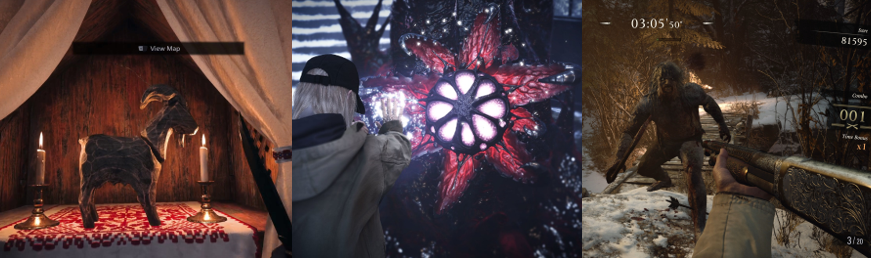
There are forty-nine Achievements up for grabs in Resident Evil Village, with a further seven included in the “Winters’ Expansion” DLC that’s included with this Gold Edition, bringing the total to fifty-six. You’ll get Achievements for finishing the game, and “Shadow of Rose”, on each difficulty setting, defeating the game’s bosses and reaching story-specific sections, and for simple stuff like using a lockpick, entering Photo Mode, and killing a wild animal. Other Achievements pop when you defeat three enemies with one attack, take down Uriaș early on, equip add-ons and upgrade your weapons, and far more tedious tasks, such as breaking every window in Castle Dimitrescu and opening every outhouse in the village. As you explore, you may come across little wooden goats that should be destroyed for additional Achievements. You’ll also get another Achievement for having 777, 7,777, or 77,777 Lei, using only a knife, or finishing the game in under three hours and/or with four or less recovery items.

Complete challenges, play Rose’s epilogue, or put your skills to the test in “The Mercenaries”.

Some of the Achievements align with the list of in-game challenges you can work through to earn Completion Points (CP). CP is spent in the ‘Bonuses’ menu to purchase new weapons, infinite ammo, concept art, and character models in the form of figurines. You can also acquire CP by playing “The Mercenaries”, a Resident Evil staple that sees you playing as either Ethan or Chris (plus Lady Dimitrescu and Heinsberg once you unlock them), each with different attributes and weapons, and clearing out all enemies across various maps. You’re working against a time limit here, so you must be quick and accurate and use the hourglasses to extend your time. You can also buff yourself and your weapons with power-up stations found on each map, which offer additional health or greater accuracy with specific weapons. It’s a fun little side-game, though you’ll need to have your wits about you as you’ll only unlock new maps and gain the best awards with an A-rank or more. Finally, you can play tilting ball games, hunt down rare treasure and wild beasts, and find the game’s files to go for 100% completion, which requires additional playthroughs and possibly multiple save files in case you miss stuff you can’t go back for, in addition to the “Shadow of Rose” epilogue. This sees you returning to some of the game’s key areas, now warped and nightmarish, as Rose follows a mysterious disembodied voice to rid herself of her strange powers. It’s a fun extra few hours of gameplay that’s spiced up just enough with her extra abilities, a few new and rearranged areas (including the super creepy mannequin section), and some new bosses and twists on existing enemies.

The Summary:
I put off Resident Evil Village for some time, specifically because I was waiting for this Gold Edition of the game so I could experience the entire thing in one go. Although I didn’t mind the jump to first-person horror, I immediately switched the game to third-person as that’s my preference and I feel this suits the game and its action much more. The immersion felt by first-person is outweighed by the frustration of never being able to see all around you, so the third-person option was a godsend for me. Gameplay-wise, there’s not much you haven’t seen from Resident Evil before here; everything is suitably creepy, tense, and incredibly well put together, with a fantastic level of grimy and gruesome detail given to the game’s environments. I was surprised by how much I came to enjoy revisiting the village; it’s not the most engaging hub world and I sometimes felt the narrative was a little too mission-based at times, but it changed enough to hold my attention and I liked how each area offered different gameplay challenges. It’s true, however, that the game peaks quite early; Castle Dimitrescu and House Beneviento were the most engaging areas of the game for me, and neither Moreau or Heisenberg had the same visual appeal or creep factor as Lady Dimitrescu and Angie, which was a shame. It was equally disappointing how often the antagonists degenerated into monstrous abominations; I know it’s a “thing” in Resident Evil, but I don’t think Lady Dimitrescu or Heisenberg needed transformations to be interesting or scary. Still, there’s a lot to enjoy here; Ethan, while still bland, is far more interesting this time around with his heartfelt desire to rescue his baby girl, and the franchise continues to evolve its story, even if the direction it’s going down is becoming increasingly bizarre. Best of all, there are plenty of reasons to come back to this one for additional playthroughs. The addition of playable antagonists to “The Mercenaries” is a goal to reach for, and the game itself a fun distraction from the main story, which was as gruesome and disgusting as we’ve come to expect from this long-running franchise.

My Rating:

Rating: 4 out of 5.

Great Stuff

What did you think to Resident Evil Village? Did you buy the game upon release, or did you wait for this Gold Edition, like me? Are you a fan of Ethan Winters and, if so, what did you think to his character progression? Which of the game’s areas and bosses was your favourite and what did you think to the new enemies on offer? Did you ever beat the “Village of Shadows” difficulty and find all those goats? Which Resident Evil game is your favourite and where would you like to see the franchise go next? Whatever your thoughts on Resident Evil, drop a comment below and be sure to check out my other Resident Evil content across the site.

Game Corner: Resident Evil 4 (2016; Xbox Series X)

Released: 30 August 2016
Originally Released: 11 January 2005
Developer: Capcom Production Studio 4
Also Available For: Android, GameCube, Nintendo Switch, Nintendo Wii, Oculus Quest 2, PC, PlayStation 2, PlayStation 3, PlayStation 4, Xbox 360, Xbox Series S, Zeebo

The Background:
Spearheaded by Shinji Mikami, Resident Evil (Capcom, 1996) was one of the seminal titles for Sony’s burgeoning PlayStation. By focusing on atmospheric horror and resource management, the title practically invented (if not massively popularised) the “survival-horror” subgenre. Despite its blocky graphics, clunky tank controls, and B-movie dialogue, Resident Evil was a critical and commercial success that was soon followed by a number of sequels that continued to refine the gameplay, add to the lore, and be equally successful. With the videogame industry firmly in its sixth-generation, one largely defined by the PlayStation 2, Mikami set about producing a fourth mainline entry in his survival-horror franchise, but Resident Evil 4’s development was fraught with issues. There were at least four different versions of the game, one that was so far removed from the franchise’s roots that Capcom spun it out into an all-new action-packed series, one that saw Leon trapped in a haunted castle, one where he was pursued by a hook-handed monster, and one where the player was beset by horrifying visions. Ultimately, these were all scrapped and Mikami took over the directing duties, intent on reinventing the series from the ground up; one major aspect of this was the shift away from static and cinematic camera angles and prerendered graphics to an over-the-shoulder perspective and fully modelled 3D environments and a greater emphasis on player control and action. New enemies were created to fit the new tone, ones that were more intelligent, versatile, and monstrous than Umbrella’s Bio-Organic Weapons (BOWs) and Leon evolved from a rookie cop into a bad-ass agent who spouted one-liners like an action movie star. Initially a GameCube exclusive release thanks to a pre-existing deal between Capcom and Nintendo, Resident Evil 4 was soon ported to multiple platforms; it became the second best-selling Resident Evil title, made it into the Guinness World Records for 2012, and is widely praised as one of the best (if not the best) entries in the franchise despite it paving the way for less acclaimed action-orientated entries. The game is so revered that it later received a high-definition port on modern consoles that included all of the additional game modes and unlockables alongside new graphical and gameplay tweaks before being completely remade in 2023 following the success of Capcom’s previous modern remakes.

The Plot:
After escaping from Raccoon City, Leon S. Kennedy, now a government agent, is sent to rescue Ashley Graham, the daughter of the United States President, from a mysterious cult in rural village in Spain. There, he encounters a group of hostile villagers who pledge their lives to Los Iluminados and have been infected by a mind-controlling parasite known as Las Plagas.

Gameplay:
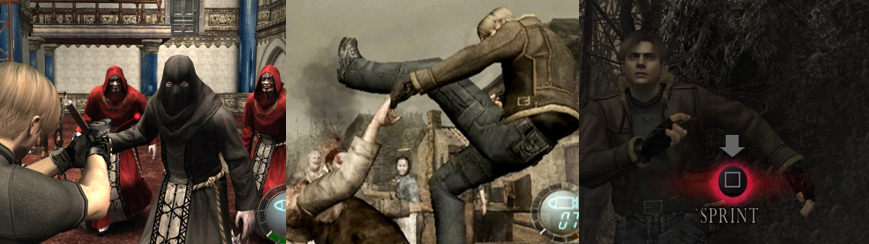
Unlike every Resident Evil game that came before it, Resident Evil 4 is a third-person action shooter with some light puzzle solving and additional mechanics sprinkled in. The entire complexion of the franchise has been altered; gone are the fixed camera angles and “tank controls”, replaced by fully rendered 3D environments, a much more action-orientated perspective, and a far greater range of movement. The player steps into the familiar shoes of Leon (but he’s changed so much between Resident Evil 2 and Resident Evil 4 that he may as well be a completely different character) and can choose from three different control types, with my preference being the first. In this configuration, X performs an action (such as opening a chest or a door or picking up items or vaulting over ledges), B does absolutely nothing except exit out of menus, Y brings up the map screen, and holding A allows Leon to run indefinitely. You aim with the Left Trigger (a function greatly aided by the inclusion of a laser sight to your weapons) and fire with the Right Trigger. Pressing LT and A will allow you to manually reload and you can perform a quick turn by holding down on the left stick and pressing A. Holding the Left Bumper and pressing RT sees you switch to your knife for close-quarters combat and to save ammunition, but it’s better to use this weapon when enemies are already down to avoid being grabbed. In the years since Resident Evil 2, Leon has become an absolute bad-ass and is now capable of some incredible physical feats. These range from simple things like double tapping X to kick open doors, diving out of windows, or jumping down from greater heights without worrying about damage, to more superhuman feats, such as smashing enemies with a variety of melee attacks when prompted.

A new perspctive brings Leon new, action-packed abilities and panic-inducing QTEs!

This is a great way to conserve ammo; you can fire a shot to stun an enemy, or slash at them with your knife, and then hit X to kick them away so you can follow up with another knife attack. Leon will often be tasked with barricading a room against swarms of enemies, which means pushing bookcases in front of windows, kicking down or raising up ladders with X, or shooting at explosive barrels to even the odds. If grabbed by an enemy, players can avoid or lessen damage by waggling the left stick, but you’ll also be required to pull off some quick-time events (QTEs) to get out of scrapes. When boulders come rolling at you or you make a desperate dive for a cliff edge, you’ll need to rapidly tap X to avoid being crushed; when the Verdugo or other bosses take a swipe at you, you’ll need to duck or dodge out of the way by pressing X and A or LT and RT together, and these skills are put to the ultimate test near the later stages of the game where you need to perform a series of acrobatic dodges to escape a laser trap. While QTEs aren’t as overused as they would be in later games, the developers clearly wanted to make the most of them; you’ll be rapidly tapping X to swim away from a gigantic sea creature or to slash at tentacles grabbing you, you can be sure that they’ll crop up in most boss battles, and QTEs even appear during cutscenes, meaning you can never put your controller down for a second or you’ll risk being stabbed through the heart! Another massive gameplay mechanic of Resident Evil 4 is the partner system; Leon is aided on a couple of occasions by the mysterious Luis Sera, who will help fend off attacking enemies at key moments, but obviously the most prominent partner you’ll have to look out for is Ashley. After rescuing her, Ashley will diligently follow you around and you’ll need to keep her safe to avoid a game over.

You’ll need to keep Ashley safe, and rely on her to solve certain puzzles, which constantly pepper the game.

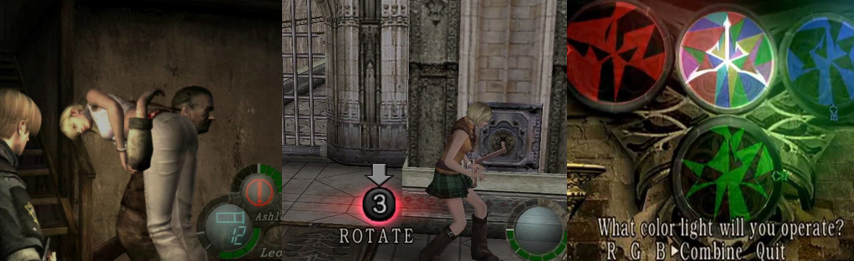
Using the Right Bumper, you can command Ashley to stay in place or follow you, which is used to solve certain puzzles such as standing on two pressure pads or pulling two levers simultaneously, but she’s useless at defending herself so you’ll need to have her hide in dumpsters and such to avoid being carried away by enemies. Ashley can be very grating as she is constantly screaming for help and in need of rescue, and there are many times where you’ll have to provide cover fire for her as she turns cranks or searches for keys. Thankfully, you’re not handicapped by her the entire time; in fact, you play more of the game without her than with her, and she does help break up the action a bit in a later part of the game where you get to control her. Ashley carries no weapons but can toss nearby lanterns at enemies with RT and crawl under desks or through small spaces to avoid them entirely, turning cranks to progress and return to her saviour. If she really gets on your tits, though, you can unlock a suit of armour for her that protects her from all attacks and makes her too heavy for enemies to carry away, making her far less of a nuisance and being doubly useful as she acts as a human shield. The map screen is also far more user friendly here; you can clearly see locked and unlocked doors, treasure, save points, and other areas of interest, and your next destination, which makes navigation much simpler, something aided by the game largely being much more linear than its predecessors. Still, while much of the gameplay has been altered to make use of the new presentation and format, many of the classic Resident Evil tropes remain. You’ll be exploring areas for items, documents to expand the story, and keys to unlock doors; often, you’ll need two or more items, insignias or plates or the like, to complete a puzzle and progress onwards and you’ll be unlocking or clearing pathways to create shortcuts as you explore. You’ll sometimes need to examine, combine, or encrypt key items to progress, or activate (or deactivate) security protocols to acquire the items you need, awakening any dormant enemies in the area. Other times, you’ll be exploring maze-like areas, such as a particularly ominous hedge maze, raising a cannon to blast open a door, or receiving some much-needed air support from a helicopter.

It’ll take all your skills and weapons to conquer the game’s puzzles and swarms of enemies.

There are several familiar puzzles here, too, such as pushing statues onto pressure pads, angling mirrors to reflect lasers, picture puzzles, turning dials, and merging coloured lights to acquire new items or open new paths. These usually aren’t too difficult, and the solutions are normally provided by inspecting the immediate environment, or with a bit of trial and error. In addition to pushing crates into water to create platforms or off lifts to progress upwards and turning levers to open doors or activate traps, Leon is now able to jump across gaps, smash off padlocks, ride zipwires, and ride around in minecarts, blasting at barricades and enemies alike as he goes. Vehicles actually crop up a few times in the game, with you needing to shoot the drivers of trucks to avoid being crushed, defending Ashley as she ploughs through a facility in a bulldozer, riding a speedboat across a lake as a sea creature stalks you, and a particularly aggravating final section where you must race away from the island on a ski boat, flying over ramps and desperately avoiding falling rocks at high speeds. Not only can more enemies than ever easily swarm you, but the environments are littered with hazards, from annoying beartraps and explosive trip wires, to bursts of flame, swinging axes, and spiked ceilings. Some of these can be used against your enemies, but most you’ll either need to avoid with a QTE or shoot at panels to stop them from splattering you across the wall. While Leon is afforded more resources than ever, you still need to watch your ammo and be mindful of your stock of healing items; Leon can only carry so much, even with a fully upgraded attaché case, and you won’t have the benefit of Item Boxes to help you out here so it’s best to use the environment wherever possible, flee to higher ground, and force enemies into a narrow space to easily pick them off with as few shots as possible.

Graphics and Sound:
Without question, Resident Evil 4 was the best-looking Resident Evil we’d seen at that point. While I think the remake of the first game actually holds up better now, thanks to the restrictive angles and clever use of lighting, there’s no doubt that this was a dramatic shift away from the limitations of the previous generation and into a new era for the franchise. No longer restricted to tight corridors or prerendered environments, Leon explores some surprisingly large areas, with much of the game taking place outside and in a location decidedly removed from the urban trappings of its predecessors. Leon is now a large, versatile 3D model who can interact with his environment and enemies in fun new ways; from backflipping out of danger and kicking the heads off his attackers to simple things like being able to move and aim in all directions, the player had never had some much freedom in a Resident Evil title before…it’s just a shame you can’t move and shoot at the same time, which can make combat a little clunky, and the camera is a little too close at times, meaning it can be difficult to see what’s ahead of you.

The game certainly had the most visual variety of any Resident Evil title at the time.

Still, the game looks gorgeous; so much so that I really don’t understand the logic of prioritising a remake of it over the far more polygonal Resident Evil – Code: Veronica (Capcom Production Studio 4, 2000). Taking place in a desolate Eastern European nation, the game is awash with a gothic aesthetic that is both familiar and new. Leon explores barren, backwater villages and farmlands, an ominous graveyard, descends down into a number of sewers and catacombs, and even ventures into a dank mine and a dig site to uncover the origins of the Las Plagas parasite. Outside environments are plentiful, with Leon venturing around the outskirts of towers and castles so the game can impress with its graphical scope; crows, wild dogs, and signs of decay and the Los Illuminados’ influence are everywhere, giving even the smallest rural areas a sense of menace. Once inside the churches, castles, and stately manors of the malevolent cult, the game becomes a little more familiar; once again, we’re treated to vast and elaborate rooms filled with paintings, suits of armour, dining tables and joined by corridors bathed in moonlight. You’ll venture into disgusting kitchen and waste disposal areas filled with dead or dismembered bodies, wade through wretched water and creep through rusted, wrecked prisons and crumbling catacombs, past vast lakes, waterfalls, and waterwheels in the surroundings mountains, and even into industrial areas filled with molten metal, shimmering heat effects, and corroded elements.

Eventually, you’ll reach more high-tech locales, with the horror countered by the B-movie dialogue.

After battling through the boobytraps of the Los Illuminados’ grandiose castles, you’ll descend into dark tunnels filled with giant, skittering bugs, heavily fortified bases surrounding the Los Illuminados’ island, and eventually reach a disused, high-tech facility not unlike those Umbrella established under mansions and cities in the previous games. Here, you’ll be treated to bloodstained walls, trashed laboratories, and bizarre Las Plagas experiments, which all burst or shamble to life in the most horrific ways. Largely, there’s very little distinction between the CG cutscenes and the in-game graphics, especially in this remastered version of the game; while the same can’t be said of Ada Wong’s unlockable chapter, whose cutscenes are as low quality and blurry as they were on the PlayStation 2 version, the main game looks crisp and clear…perhaps a little too clear at times, though there are some suitably dark and spooky areas to help balance the lighting. The action is constantly interrupted by radio conversations between Leon and his allies and enemies, which really gives a sense of how much Leon has changed; he’s no longer a rookie cop and is instead a flirtatious, cocksure action hero who trades barbs and drops one-liners as often as he does chat up lines. The game plays its dialogue very tongue in cheek; while not as clunky and awkward as the voice acting in the original game, it’s as though the direction here was to treat it like a B-movie from the off, resulting in a strange mix of terror and ridiculousness at times. The music is suitably ominous and still used to great effect; you’ll always know when you’re in a save room or area or near the merchant, for example, and the music generally only kicks in when enemies or hazards are nearby and will fade out once the danger has passed. Enemies also shamble about, dragging their weapons across the floor, and shout when they spot you; they’ll chant strange phrases and mutter their loyalty to their masters even as they dissolve into a puddle of goo, making for far more visually interesting enemies than moaning zombies.

Enemies and Bosses:
Speaking of which, another way Resident Evil 4 separates itself from its predecessors is in the complete absence of zombies and Umbrella’s bio-organic weapons and viruses. Instead, every enemy in the game is infected with an ancient, mind-controlling parasite that makes them slaves to the Los Illuminados’ power and grants certain superhuman abilities. Your most common enemy are the Ganados; faster, more vocal, and more coordinated than zombies, these infected villagers will rush at you, try to eat you, and attack you with melee weapons from afar or up close. Many hold flaming torches, which you can use to set them on fire; others toss sticks of dynamite, which you can also use to thin out the hoards. You’ll also encounter robed variants who wield crossbows, man catapults, and carry maces, large wooden shields, and even scythes that they hurl at you! Soldier variants are further protected by armour and helmets and carry rocket launchers; additionally, Ganados’ heads will explode and tentacled parasite will swipe at you, or a Facehugger-like variant will pounce at you from the floor. Enemies also man fire-breathing statues and the local wildlife has also been infected, meaning you’ll come across some John Carpenter-esque wolves rippling with tentacles. The Plagas also control heavy suits of armour in the castle, but you can make surprisingly good use of the flash grenade against most enemies, in addition to shooting them into pits of molten metal or over the side of cliffs, blowing them up with flaming or explosive barrels, and you can even shoot their meat cleavers out of the air if you’re quick enough.

The game’s most horrific and formidable enemies crop up as mini bosses to get the adrenaline pumping!

It doesn’t take long for the enemy variety to ramp up and become more formidable, though. You’ll come up against a massive Ganado wielding a Gatling Gun on more than one occasion, or a Ganado in a red robe and sporting a ram’s head will mount a large rotary cannon and cut you down if you can’t make good use of cover to get a shot at him from behind. Raging, masked Ganados rush at you with chainsaws and can one-shot you if you don’t keep your distance and blast them with your heavy artillery, and you’ll even have to battle a few claw-and-armour clad psychopaths who charge at you, swiping madly with their clawed appendages, and can only be damaged by targeting the writhing parasite on their back. These Garradors are usually fought in an enclosed space as other enemies swarm around you, a common theme in Resident Evil 4 as the game loves to send a gaggle of various enemies at you, forcing you to stay on the move and switch up your weapons accordingly. Giant mutated locusts and bugs also crop up: some will hover about, darting at you from above; others skitter across the floor to slash at you; and some are invisible and will leap onto you to vomit acid over your face! By far the most disturbing enemy in the game is the Regenerator, a slender, ashen, zombie-like creature instantly recognisable by its distinctive and chilling breathing. As their name suggests, these wretches constantly regenerate, necessitating the use of high-powered explosives or an infrared scope to target the pulsating boils on their body. Their spiked variant, the Iron Maiden, is even more fearsome, exploding in an array of spikes as it ungainly shuffles after you, so it’s best to either avoid these creatures or make use of any nearby explosives to put them down, but keep your distance as they tend to explode in a shower of guts upon death. Many of these enemies are introduced in such a way that they could count as mini bosses; Doctor Salvador and the Bella Sisters, especially, mark key moments in the game that indicate how dangerous these enemies can as they can take your head off in one move!

Some monstrous and terrifying new creatures will take both heavy firepower and some skill to best.

You’ll also have to contend with some far bigger enemies, each one taking the disgusting body horror of the franchise in new, startling directions. One of the first is the gargantuan, troll-like El Gigante, a lumbering beast you first fight in an enclosed arena near the opening village and later battle alongside a second, similar beast inside a factory. Generally, these creatures charge at you and grab and squeeze you, things you’ll need to rely on QTEs to avoid; they also swipe, pound, and swing trees at you but are pretty slow so you can usually get around them easily enough. In the first battle, you’ll also be aided by a local dog if you chose to save it; in the second, you can drop one into a pit of molten metal, but you still need to avoid getting too close or you’ll be dragged under. Otherwise, unload on El Gigante’s face until the parasite explodes from its back; attack this until it bursts, and you’ll finally put it down, but keep your wits about you as you’ll need to hit LT and RT to avoid being crushed afterwards. When you reach the lake, don’t fire your gun into it (unless you want an Achievement…) because Del Lago will eat you up! This monstrous alligator…thing…attacks your little speed boat, requiring you to toss your infinite supply of harpoons at it and mash X whenever you’re knocked overboard. This can be very finnicky as it’s hard to line up your shot and the cooldown time between throws is substantial; also, don’t get complacent as you’ll need to mash X to avoid being drowned when it snares you with its tentacle. Before you can leave the Godforsaken village, you’ll battle Bitores Mendez inside a burning barn. This spider-like monstrosity slashes at you with his insectoid limbs and tentacles absorbing damage much like Mr. X before his torso completely disconnects from his body and scurries about the place, making him a difficult target to hit; thankfully, you can clamber up to a higher level and make use of the various explosives scattered about the place. When in the processing plant, you’ll constantly have to dodge the Verdugo’s spiked tail as it whips at you from above and below; after you restore power and wait for the lift to arrive, it will attack with lightning fast speed, putting your QTE skills to the test. The Verdugo seems to be completely impervious to all weapons; all you can to is topple over the nearby cannisters of liquid nitrogen to freeze it, buying you time and allowing you to briefly scare it away.

The game leans into body horror and the grotesque mutations popularised in Resident Evil 2 for its later bosses.

A similarly impervious Las Plagas monster awaits in an elaborate cage maze down in the tunnels; “U-3” is this scorpion-like mess of limbs and tentacles that you must dodge and scare away while activating consoles to drop each section of the cage. Once done, it will attack you directly on a cliff edge; here, it will burrow underground to slash at you, but you can make use of explosive barrels to damage it and trap it in an enclosed space to avoid being cleaved in two by its pincer! Resident Evil 4 also introduces a rival for Leon: Jack Krauser, a mercenary for hire who initially attacks with his knife, forcing you to win QTEs to avoid being unceremoniously stabbed to death. Later, he shoots explosive arrows, a machine gun, sends his explosive drones after you, and leaps out to attack you as you search for three tablets in some ruins. This culminates in a one-on-one boss battle where Krauser mutates a knife-like appendage on his arm which he uses to slice at you and shield against your attacks. You’re given about three minutes to defeat him and escape before the area explodes; your best bet is to target his legs and switch to the knife, which does far more damage in this battle than in any other. Leon is also mocked all throughout by the diminutive Ramon Salazar, who largely sends his minions and even a giant statue of himself after you rather than face you head-on. After scaling his tower, however, he’ll mutate into this massive, plant-like monstrosity and try to swat you with his huge spiked tentacles. Like in the battle against “G”, you need to target Salazar’s pulsating eye to deal damage and briefly expose him from his protective cocoon so you can fire at him with your heavier weaponry, ideally the rocket launcher for an instant kill. Finally, after dogging your progress and killing Luis, you’ll confront the leader of the Los Illuminados cult, Osmund Saddler, at a construction site; here, he transforms into a four-legged abomination that also sports eyeball protrusions that you must shoot to stun him and allow you to strike his exposed central eye. Eventually, Ada will drop a rocket launcher into the arena for you to finish him off, but this can be a tough fight if you’re low on ammo, especially as you need to rely on the knife to damage the main eye and you’re given less than three minutes to escape the island afterwards.

Power-Ups and Bonuses:
As ever, Leon can restore his health using first-aid spray and herbs and you can combine these to restore more health or his and Ashley’s health meters. You also won’t need to worry about being poisoned here, though do be wary when smashing open crates for goodies as you’ll sometimes be attacked by a snake! Almost every enemy you defeat will drop some goodies, such as herbs, ammo, or pesetas, the local currency. Smash open jars, crates, and barrels to reap the same rewards and you’ll often also find high value collectibles in the same way or twinkling at you around the environment. These can be sold to the merchant, who you’ll encounter many times throughout the game, usually right next to a save point; saving is once again done manually at typewriters, though you no longer need to worry about ink ribbons and the game does contain checkpoints, so you don’t have to start all over from your last save point. The merchant will buy almost anything off you and will sell you new weapons, ammo, health items, and upgrades to your outfit and weapons.

Weapons and upgrades can be purchased from the merchant to vastly improve your arsenal.

Occasionally, you’ll find new weapons and upgrades in cases or lockers around the environment but, for the most part, they’re also purchased from the merchant. Every weapon can be “tuned up” at the cost of more pesetas, allowing you to increase their damage, reload time, capacity, and firing speed, though the cost of this tune up increases each time. It’s also worth waiting for better weapons to become available; there’s little point in wasting money upgrading the standard shotgun, for example, when a more powerful one becomes available later on that is more worth your investment. Leon has access to a variety of familiar weapons, from a standard pistol (which can be upgraded to fire bursts), shotguns for close range combat, machine guns (which can also be fitted with stocks to improve handling), sniper rifles (which can be fitted with a better scope or an infrared attachment), and a variety of grenades (standard explosive, incendiary to set enemies alight, and flashbangs to stun enemies and instantly burst parasites). You’ll also get access to more heavy-duty weapons, such as the armour-piercing magnum, the mine launcher, and the rocket launcher; while the mines take a few seconds to explode and the rocket launcher is a bit unwieldy as it forces you into a scoped perspective, these are the most powerful weapons and make short work of any enemy, even the game’s large and grotesque bosses.

Additional Features:
There are twelve Achievements up for grabs in Resident Evil 4, seven of which are awarded simply by playing through the game and clearing each chapter. If you shoot the water and draw out Del Lago, you’ll snag another at the cost of Leon’s life; another has you holding out against the villagers at the start of the game until Dr. Salvador shows up; and another is given for beating the game on the far harder “Professional” mode. Beating the game on any difficulty will also unlock two alternative costumes for Leon, one a dapper film noir outfit and another his classic cop uniform, which also nets you an Achievement. The final Achievement is earned by winning all twenty-five bottle caps in the various shooting galleries found throughout the game; here, the merchant supplies you with a sniper rifle and another weapon and you’re tasked with shooting all the targets on the range to earn your prize, which is easier said than done if your aim is as bad as mine! There are also several blue medallions found all over the game; shooting them will unlock new weapons that the merchant will gift to you for free, which can be helpful on your first playthrough.

Take on side stories as Ada or battle for points in the all-action “Mercenaries” mode.

Beating the game also unlocks the “Assignment Ada” mini game; in this game, which is similar to the “4th Survivor” bonus game for Resident Evil 2, you control Ada on Saddler’s island and must track down five Las Plagas samples in one playthrough, managing your ammo and health without the benefit of save points. Ada is also playable in the “Separate Ways” campaign, a five-chapter side story to the main game which fills in the gaps around Ada’s involvement in the plot. Ada plays exactly like Leon except she’s faster, far more graceful in her moves, has access to a powerful bow gun and a grapple to reach higher areas faster, and takes more damage when attacked. In this mode, you’ll play through rejigged sections of the main game and even battle similar bosses, such as El Gigante and Krauser, and endure a unique fight against Saddler in his human form. Additionally, you can play the “Mercenaries” mini game, even playing as different Resident Evil characters like HUNK and Albert Wesker, in which you must defeat enemies to score points against a time limit in a fun arena shooter. Finally, you can view files and movies from the main menu and unlock additional costumes and weapons by clearing these game modes, though there are sadly no Achievements tied to them.

The Summary:
I can totally understand why so many people rave about Resident Evil 4. This was only my third playthrough of the game, and the second of this version; I played on a cleared game, so I had access to Ashley’s super useful suit of armour, upgraded weapons, and the infinite rocket launcher for the last half of the game and I still had an absolute blast. I’m a big fan of the original games, their focus on exploration, puzzle solving, and resource management and it’s true that a lot of the survival/horror aspects have been lost in this more action-oriented game. However, they’ve been replaced by a creepy, disgusting body horror; some genuinely thrilling moments thanks to the QTEs happening during cutscenes; and the spirit of the franchise is kept well alive even though we have better controls, a better camera, and far better graphics. Leon has always been my favourite Resident Evil character; while he’s a very different person here, this game went a long way to solidifying how cool he is, and I enjoyed his new abilities and gung-ho attitude. Even the annoying parts, like Ashley constantly being in danger, the swarms of enemies, and the occasional instant deaths are fun to replay; even now, some aspects catch me off-guard, like the trucks speeding towards you or Krauser’s sneak attacks. I may not fully understand why the game needs to be rebuilt from the ground up but I can understand the logic behind it; Resident Evil 4 is a popular and successful entry in the franchise, on that redefined the series for better or worse and which could benefit from a few modern tweaks, but at the same time this version still stands up as one of the most enjoyable in the entire franchise.

My Rating:

Rating: 4 out of 5.

Great Stuff

What did you think about Resident Evil 4? When did you first play the game and how do you think it holds up today? Were you put off by the new perspective and controls scheme or did it reinvigorate your love for the franchise? What did you think to Leon, the changes to his repertoire and character, and the dynamic between him and the other characters? Were you a fan of the QTEs and Ashley? Did you ever collect all the bottle caps? Which Resident Evil videogame, character, monster, or spin-off is your favourite, and would you like to see a return to the original tank-control era of the franchise? Whatever you think, feel free to leave your thoughts down below.
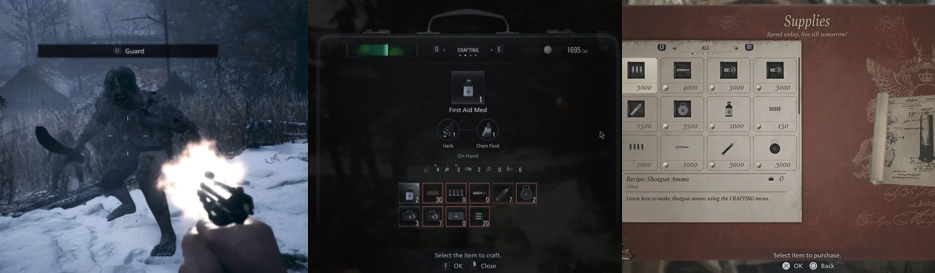
Movie Night: Resident Evil: Welcome to Raccoon City

Released: 24 November 2021
Director: Johannes Roberts
Distributor:
Sony Pictures Releasing
Budget: $25 million
Stars:
Kaya Scodelario, Avan Jogia, Donal Logue, Robbie Amell, Hannah John-Kamen, Tom Hopper, and Neal McDonough

The Plot:
In the year 1998, the grim post-industrial town of Raccoon City has just lost its biggest employer, the Umbrella Corporation. While college student Claire Redfield (Scodelario) believes Umbrella has polluted the town’s water, her estranged brother Chris (Amell) and his team investigate a nearby mansion and find the area swarming with flesh-eating zombies! Claire is forced to team up with rookie cop Leon S. Kennedy (Jogia) to survive and unravel the mystery behind the outbreak and of her traumatic childhood.

The Background:
Resident Evil (Capcom, 1996) began life as a seminal “survival-horror” title for Sony’s burgeoning PlayStation that emphasised atmospheric horror and conserving resources. Although the original title suffered a bit from the PlayStation’s blocky and clunky graphics and mechanics and dodgy, B-movie voice acting, the game was a best-seller for the PlayStation and bolstered by a number of sequels. Resident Evil 2 (ibid, 1998) improved on many of these mechanics and, alongside, Resident Evil 3: Nemesis (ibid, 1999), established much of the lore and groundwork before the fourth game forever changed up the formula for a new generation of gamers. The franchise’s success inevitably led to discussions of a live-action adaptation, which initially had legendary zombie horror maestro George A. Romero attached to direct before Constantin Film placed Paul W. S. Anderson in charge of the film series, which eventually included six live-action films. The movies, which were more of an action/horror genre, starred Anderson’s wife, Mila Jovovich and, despite earning a mostly negative reception, became the most successful and profitable live-action adaptation of a videogame series, though I can safely say that I was left disappointed by their lack of fidelity to the source material. After Anderson’s series concluded, Constantin Films began developing a much-needed reboot, and director James Wan initially expressed interest in the project before dropping out to direct Mortal Kombat (Wan, 2021) and being replaced by Johannes Roberts. Roberts aimed to return to the same dark, foreboding, and fun horror of the original videogames and the capture the traditional spirit of the source material by returning to the original locations, time period, and heavily featuring the popular videogame characters. Initial reactions, however, we less than encouraging, with many criticising the film’s B-movie feel; this was only exacerbated when Resident Evil: Welcome to Raccoon City released and criticised for its lack of substance and character development. The film was praised for its fidelity to the source material and references for long-time fans, however, and grossed $42 million worldwide; additionally, both the director and star Robbie Amell have expressed interest in returning for a sequel and tackling some of the later games in the long-running franchise.

The Review:
I feel like I need to preface this review with the revelation that, while I am a big fan of the Resident Evil videogames, I am not a fan of Paul W. S. Anderson’s live-action franchise. I spent a year of my PhD researching the history of zombie cinema, watching and studying and delving into Anderson’s movies, and I came out the other end absolutely loathing them. The only one I even remotely enjoy is Resident Evil: Apocalypse (Witt, 2004), and that’s purely because it’s the closest adaptation of my favourite games in the series (Resident Evil 2 and 3: Nemesis). I absolutely despise Alice (Jovovich), hated how Anderson ignored, cherry-picked, or diluted the source material and its iconic characters, and was actually a little insulted by how continuity was continuously thrown out of the window with the next movie purely for the same of slapping together a new plot. To me, Anderson’s films, while successful, are not Resident Evil; they do a decent job of adapting a different elements of the source material and zombie troupes but the result is this incomprehensible mish-mash of ideas that have been done much better elsewhere and with the Resident Evil title slapped on it purely to make money. And, make no mistake, they did make money and were popular enough to become their own independent franchise from the source material, but I longed for something a bit more faithful to the games I grew up with so I was excited at the prospect of a new Resident Evil adaptation that not only featured the iconic characters in starring roles but also revisited the events of the videogames…even if it was lumbered with a ridiculous title.

Chris and Claire’s fractured relationship is a central story of the film.

Resident Evil: Welcome to Raccoon City opens with Chris and Claire as young children (Daxton Grey Gujral and Lauren Bill) at the Raccoon City Orphanage; there they, and many other children, are cared for by the Umbrella Corporation and scientist Doctor William Birkin (McDonough). While this scene does go on a little longer than you might expect, it establishes a few key elements that crop up throughout the film; first and foremost, that Chris and Claire’s relationship is an important part of the story, the mystery surrounding what Birkin and Umbrella are doing with these children, and the existence of the malformed Lisa Trevor (Marina Mazepa). Lisa watches and visits Claire, scaring her but also arousing her suspicions, but Chris never sees the young Trevor and despairs of Claire’s stories. The story then jumps ahead a few years to 1998 to find Claire all grown up and journeying to the veritable ghost town of Raccoon City to reunite with her brother, who has joined the Raccoon City Police Department’s (RPD) special operations team, Special Tactics And Rescue Service (S.T.A.R.S.) and all but given up on her younger sister. Their relationship is strained, to say the least, since Claire ran away from the orphanage and left Chris alone; with no one else to turn to, he came to see Birkin as a father-figure and grew up a loyal representative of Umbrella and dedicated law enforcement officer, so he’s less than thrilled when Claire breaks into his house spouting conspiracy theories about Umbrella poisoning Raccoon City’s water supply.

Leon is oddly characterised as a bumbling fool who often makes an ass of himself.

Raccoon City has declined over the years after the Umbrella Corporation randomly pulled themselves out of the area, leave only a handful of staff and those too poor to leave behind to fend for themselves. As a result, the RPD is a bit under-staffed and has little choice but to accept the unlikeliest of recruits, such as rookie Leon. A young, fresh-faced, inexperienced cop, Leon is a recent transfer to the RPD thanks to the grace of his father, who ensured that he continued on with his law enforcement career after an embarrassing mishap where he shot his partner in the ass. Consequently, Leon is constantly berated, talked down to, and the butt (no pun intended) of other character’s jokes and frustrations…and he certainly deserves this treatment. A lackadaisical kid who’s in way over his head just manning the front desk, Leon fumbles with police protocol almost as much as with his firearm; he has no idea how to handle a shotgun, is easily disarmed by desperate conspiracy theorist Ben Bertolucci (Josh Cruddas), and is constantly just getting in people’s way and asking questions rather than actually being a pro-active and resourceful character. He’s kind of here as the film’s comic relief, though he doesn’t actually make any jokes, and his character arc is a very slow burn from being an awkward and unreliable rookie to building his confidence towards being more useful and capable, but it’s not handled too well.

The S.T.A.R.S. team are a tight-knit group, but Wesker has secretly got his own agenda.

RPD police chief Brain Irons (Logue) has little time for Leon’s antics, and is frustrated by a spate of mysterious attacks and killing across town. Reports of a chewed-up body at the old Spenser Mansion raise his ire further and, when Bravo team fails to report in from their investigation, he sends in Chris and the S.T.A.R.S. Alpha team to find out what happened. Alpha team is also made up of jock commander Albert Wesker (Hopper), trigger happy bad-ass Jill Valentine (John-Kamen), expendable nobody Richard Aiken (Chad Rook), and pilot Brad Vickers (Nathan Dales); they are an overconfident, militant bunch who have a friendly camaraderie that include splaying pranks on hapless colleagues like Leon and some sexual chemistry between Jill and Wesker. They travel to the mansion for a side story that is basically a condensed adaptation of the original Resident Evil and involves them exploring the dark, elaborate mansion with only their torches and a whole mess of submachine gun ammo on hand. Upon being dispatched, however, Wesker receives a mysterious page and is led to a PalmPilot that contains a map of the mansion, which is all part of a pre-arranged agreement with an unknown third party to led him to Birkin’s research and score him a big payday at the cost of betraying his teammates.

Though a loyal family man, Birkin’s research leads to a horrifying outbreak of zombies and monsters.

With Chris busying fending off the recently reanimated dead at the Spenser Mansion, Claire is forced to team up with Irons and Leon inside the police station for the Resident Evil 2 aspect of the film; the RPD is as beautifully true to the source material as the mansion, but it quickly becomes apparent that they can’t hold out against the increasing zombie horde. Irons leads them to the orphanage, which contains a secret passage to the mansion, and Claire is forced to face a traumatic experience from her childhood where Birkin tried to ship her off the mansion for experimentation with the mysterious T-Virus. Claire managed to escape, and has been trying to uncover the truth about Umbrella ever since; although a Licker shreds up Irons, Leon and Claire are aided by the grown-up Lisa Trevor and meet up with Chris right as he’s in the middle of being overwhelmed by zombies. Thanks to Wesker’s knowledge, the survivors are led to a secret passage in the mansion, which leads to a confrontation between Wesker and Birkin. A creepy, clinical scientist, Birkin is given layers of humanity through his devoted (and naïve) wife, Annette Birkin (Janet Porter), and innocent young daughter, Sherry (Holly De Barros); unlike his paranoid, self-absorbed, and malevolent videogame counterpart, Birkin is a loving father and equally concerned with getting his family to safety as he is preserving his research into the G-Virus. His desire to protect both leads him to pulling a gun on Wesker and getting riddled with bullets, and his desperate plea to Annette to inject him with the G-Virus so he can survive his wounds.

The Nitty-Gritty:
Resident Evil: Welcome to Raccoon City owes a lot to the Resident Evil 2 and 3 remakes in terms of its visual presentation; the cinematography is dark, gritty, rain-swept and gory just like in those games and the representations of familiar areas like the mansion and RPD are ripped right out of the high definition remakes of Capcom’s classics. The fidelity to the source material is so strong here; the orphanage and S.T.A.R.S. office is exactly like in Resident Evil 2, Chris, Leon, and Claire are all decked out in game-accurate outfits, even the Arklay mountains match up with the videogames. A surprising amount of time is spent with the trucker (Pat Thornton), who has only a brief role in Resident Evil 2 but, here, plays a pivotal role in bringing Claire to Raccoon City and expositing some background on the city, and the film is punctuated by both eighties horror tropes such as constantly onscreen reminders of what time it is (since the city is on a countdown to destruction) and onscreen text that recalls the opening of the original Resident Evil. The film’s title font is event exactly the same as the classic titles, and many of the shots and events are pulled right from the videogames; Vickers crashes his helicopter into the mansion, similar to a chopper smashing into the RPD, Chris’s first encounter with a zombie is almost exactly like in Resident Evil, and stormtrooper-like members of Umbrella Security Service even appear in a cameo role.

Some characters suffer from the writing and differ considerably from their videogame counterparts.

Unlike Paul W. S. Anderson’s films, the focus of Resident Evil: Welcome to Raccoon City is squarely on adaptations of the videogame characters, however long-term fans of the videogames may be a little disappointed with how some characters are represented. He clear standout is Claire; she’s a little more capable and has a bit of a chip on her shoulder compared to her videogame counterpart, but is a strong, bad-ass central character here and more than able to wield a shotgun, pick locks, and beat zombie dogs to death with melee weapons. Chris also fares pretty well; he’s much more the unprepared cop rather than a boulder-punching bad-ass and, while he doesn’t have as much nuance as Claire, he’s got just enough personality to not just be some meathead or stoic military brat. Unfortunately, my favourite character in the franchise, Leon, gets well and truly shafted here; never have I ever seen the character portrayed as such a bumbling klutz and it’s truly baffling that the film can be so true to the videogames in so many ways and bungle one of the most capable and popular characters so completely. It seems the writer/director decided to really overemphasise Leon’s rookie status and portray him as an incompetent fool who as no idea what’s happening, trips over his own feet, and constantly needs his ass pulling out of the fire. He does grow as the film progresses, but sadly not completely; thanks to Claire giving him a kick up the ass, he becomes more useful and even gets to deliver the coup de grâce to the film’s big-bad with a rocket launcher, but he definitely survives more due to the assistance of others and in spite of his incompetent nature.

While Birkin is surprising layered, Wesker is very different from his usual cold, calculating persona.

Another character who suffers quite a bit is Wesker; this isn’t the cold, calculating, manipulative puppet master you know from the videogames and is, instead, a bit of a cock-sure douche who Jill fawns over with doe eyes, banters with his teammates, and betrays his team for money rather than because he’s working for (or directly against) Umbrella. For much of the film, Wesker is actually surprisingly likeable; he leads his team efficiently, clearly cares for them, and even when he reveals his true intentions, he is remorseful. When he confronts Birkin, he repeatedly gives the doctor the chance to hand over the G-Virus samples peacefully and is distraught when he is forced to gun down Birkin and Annette. The implication is that his mysterious benefactors have some kind of sway over him and are forcing him to go down a dark path, or that the money is too good to turn down, and he expresses his regret and even apologises to Jill and Chris and directs them to the exit after being shot to death by Jill. Jill is also a little different to her videogame counterpart, and previous live-action portrayals; as mentioned, she’s quick to pull her gun and has eyes for Wesker, ignoring Chris’s clear attraction to her in favour of her commander, but luckily this aspect isn’t dwelled on too much (there’s no actual romance between her and Wesker, no kiss or anything, but she is clearly hurt by his betrayal as more than just a teammate). Birkin is noticeably altered as well in a way that makes him a touch more sympathetic, but not completely absolved of all evil as Claire stumbles across evidence that he has been experimenting on children as part of what he calls “God’s work” and developed the virus that is responsible for the city’s horrific events.

Zombies aren’t too commonplace in the film, but grotesque monsters are still a constant threat.

While Anderson’s previous efforts did include their fair share of zombie action, zombies were pretty much relegated to cannon fodder and annoyances to move his characters along and insert an action scene here and there. In Resident Evil: Welcome to Raccoon City, zombies are actually few and far between; thanks to Raccoon City being all-but deserted, we don’t really get any sweeping, dramatic shots of an army of the living dead. The zombies we do get are quite different to the usual depiction as well; they’re fast, as is to be expected, and much more vocal and animalistic than the traditional Resident Evil shambling hordes. They do attack in a ravenous fury, however, and relentlessly pursue fresh meat; they overwhelm Richard, chewing him up in an instant, though Chris is somehow able to fend a whole gaggle of them off with only a lighter as a light source. In the orphanage, Irons, Claire, and Leon are attacked by a Resident Evil movie staple, the Licker. As in Anderson’s films, the Licker is merely a more ferocious inconvenience; it reduces Irons to bloody ribbons but is easily subdued by Lisa Trevor, who is recast from a tortured monstrosity to a sympathetic tragedy of Birkin’s experiments. Also included are the infected crows and zombified dogs, but the depiction of the T-Virus is also a little different; according to Ben, the entire town was slowly exposed to the virus over a long period of time, and Umbrella even issued shots to its staff and the RPD officers to stave off their infection (though it’s not really clear as to why they would do this), and the focus is less on depicting the motivations behind developing the virus and more on the impact it has on the survivors.

Birkin undergoes a grotesque mutation that forces Leon to finally step up.

After Wesker and Birkin kill each other, Chris, Claire, Leon, and Jill follow Wesker’s directions to an underground train to will take them (and Sherry) to safety. However, exposure to the G-Virus causes Birkin to undergo a horrific mutation; his right arm becomes a monstrous claw-like appendage and disgusting tumour-like eyes glisten out from his skin. Driven by an animalistic urge, he hunts the survivors, attacking Chris and taunting him (an addition I can get behind as it retains McDonough’s visage and deliver), and reunited the estranged siblings as Claire comes to his aid. Wounds only exacerbate the G-Virus, however, mutating Birkin into a grotesque monstrosity that franchise fans will recognise as “G”; it attacks the train, sporting Birkin’s wailing, agonised face on its torso, and threatens to eviscerate all of the survivors. They are saved by the unlikeliest of heroes as Leon blasts the monstrous Birkin in the face with a rocket launcher (dangerously close to Claire and Chris, but they survive thanks to Plot Armour) and the survivors manage to escape Raccoon City right as it collapses in on itself and is erased from the face of the Earth. In the aftermath, Umbrella believes that they have contained the outbreak and eliminated any witnesses, unaware of the five survivors, and Wesker suddenly wakes up in a body bag in a mysterious facility. There, the mysterious Ada Wong (Lily Gao), provides him with sunglasses to ease his newfound sensitivity to light and forcibly drafted into an unknown fate. I applaud the confidence in the film’s ability to get a sequel, and I wouldn’t be surprised if it does get on in some way, shape, or form but I do think it might have been better to have this scene take place after the credits rather than mid-way through them.

The Summary:
I went into Resident Evil: Welcome to Raccoon City with pretty low expectations; I was excited by how faithful to the first two games it seemed from the trailers and images, but wasn’t impressed with the odd title and heard that it wasn’t that great. Specifically, I heard all about the assassination of Leon’s character and Wesker’s odd characterisation, and criticisms about it being little more than a dumb B-level monster movie. While I was displeased with Leon’s characterisation, and surprised at the take on Wesker, I would still say that Resident Evil: Welcome to Raccoon City is better than every single one of Paul W. S. Anderson’s previous live-action adaptations put together. It’s so true to the games (which were B-level monster movies at heart) that I’m genuinely surprised to see Anderson listed as a producer since he seemed determined to ignore everything but the most popular aspects of the source material. While the film still has a focus more on action rather than survival, the characters, locations, and atmosphere are so perfectly in-tune with the classic Resident Evil videogames that it easily compensates for any misgivings I may have about some of the characterisations. If the film does get a sequel, I’d like to see these issues addressed as part of a larger story and character arc, but I was very entertained by Resident Evil: Welcome to Raccoon City’s back-to-basics approach. For me, Resident Evil works best when it’s a gory, horrifying battle for survival against zombies and other monsters and Resident Evil: Welcome to Raccoon City definitely meets these criteria. I’d even go as far as to say that, despite some missteps with Leon and Wesker, this is the live-action Resident Evil movie fans have been waited for since Capcom first considered producing an adaptation and that there’s enough here fans of the videogames, and of gory action/horror films, to really sink their teeth into.

My Rating:

Rating: 4 out of 5.

Great Stuff

Have you seen Resident Evil: Welcome to Raccoon City? How do you think it compares to the previous live-action films and the videogames it is based on? Which character was your favourite, and what did you think to Leon and Wesker’s characterisation? Did you enjoy the B-movie trappings of the film or did you prefer Paul W. S. Anderson’s more bombastic approach? Would you like to see a sequel to the film or were you disappointed by it? Which Resident Evil videogame is your favourite? I’d love to hear your thoughts on Resident Evil: Welcome to Raccoon City, so sign up to leave a comment below or leave a comment on my social media.

Game Corner: The Evil Within 2 (Xbox One)

Released: 13 October 2017
Developer: Tango Gameworks
Also Available For: PC and PlayStation 4

The Background:
After a long and illustrious career at Capcom in which he created and spearheaded the Resident Evil franchise (Capcom/Various, 1996 to present), Shinji Mikami left to help found Tango Gameworks in a bid to develop new properties and titles, such as The Evil Within (Tango Gameworks, 2014). Although critical reception of the game was somewhat mixed, The Evil Within sold well enough to justify a sequel, which began development shortly after Mikami’s team had finished up working on the first game’s downloadable content (DLC). In response to some of the criticisms regarding the first game’s convoluted plot, the team sought to make The Evil Within 2 more comprehensible while also placing greater emphasis on psychological horror elements. Despite a much shorter production period and some notable technical hiccups, The Evil Within 2 fared much better with critics than its predecessor and was generally regarded to be an improvement over the original.

The Plot.
Three years after the events of the first game, Sebastian Castellanos has left the Krimson City Police Department and continues to be haunted by his experiences. Driving to alcoholism by the death of his child, Lily, and the break-up of his marriage, he reluctantly agrees to re-enter the nightmarish world that plagues his dreams when it is revealed that Lily was actually being used as the Core for a new STEM system.

Gameplay:
The Evil Within 2 is, fundamentally, extremely similar to the first game but also noticeably different in many ways. Where the first game really emphasised a twisted, nightmarish world where anything was possible and that was populated by a variety of gruesome creatures and restricted your resources to keep you constantly fighting for survival, The Evil Within 2 is much more linear and action-orientated title. The difficulty setting you pick for your playthrough will determine how much ammo and damage you can take, which is pretty standard, but even on the “Normal” difficulty, “Survival”, there’s quite a bit of ammo, crafting items, and opportunities to replenish your health through the game, certainly more than in the first game.

The game’s controls are largely the same as before but tweaked for the better.

Control wise, however, the game is basically exactly the same; you can aim your weapon with LT, shoot with RT, and reload with X, and interact with your environment with A but, this time around, your melee attack is also mapped to RT and Y brings out your Communicator, which allows you to lock on to signals and help lead you towards objectives and objects of interest. Thankfully, you no longer need to worry about burning bodies so, rather than tossing matches with B, B activates your flashlight (Sebastian is no longer hampered by a large lantern this time around), though you can still sprint by pressing in the left analogue stick.

Stay low and sneak around to avoid detection and perform an instant kill move.

Like before, stealth and taking cover is a big part of the gameplay; you can snap to nearby cover by pressing the Right Bumper and shift from cover to cover by pressing up on the left stick. Pressing in the right analogue stick will see you crouch down and sneak around and, when enemies are nearby, you’ll again see the return of the eye-themed “Enemy Alertness” icon that will help you to know when you’ve been spotted. This time around, though, it is much easier to spring away from enemies and out of sight to keep them from pursuing you and there are far ore opportunities for you to sneak up behind enemies and perform a one-hit Sneak Kill, and you’re also given the option to enable or disable an “aim assist” that is super helpful in targeting enemies but combat is much more fluid and far less awkward this time around even without this.

Save areas have now been expanded into two locations to allow you to heal up and upgrade you attributes.

Interestingly, the game also offers the option to enable a first-person perspective; I didn’t play with this as first-person games aren’t really my thing but there was a point in the story that forced you into this perspective and it’s unusual to see this feature included in a game, so it’s interesting, if nothing else. There are far opportunities available to you to heal and craft resources; by exploring your environments, you’ll find Weapons Parts, gunpowder, fuses, and other items that can all be used in workbenches in “Safe Houses” to craft ammo and upgrade your weapons. In these Safe Houses, you’ll usually find similar resources to top up your inventory and will always find a coffee maker, which will fully refill your health with one soothing sip. You can’t abuse this mechanic, however, as it takes time for the machine to refill but you can warp through a cracked mirror like in the last game. This takes you to Sebastian’s office, where you can view documents, slides, access another workbench, and upgrade Sebastian’s other abilities (such as health and stealth) using the torture chair from the last game. In both Safe Houses and Sebastian’s office, you’ll find a terminal for you to insert your Communicator and save but, like before, the game is pretty generous with autosave points.

The addition of a Communicator, map, and waypoints makes navigation a breeze this time around.

The Communicator is a pretty big addition to the game and, yet, paradoxically not that integral at the same time. At a number of key moments in the story, you’ll have to hold X to tune into a frequency that will lead you to your next story-based objective and Sebastian will often stop (or continue walking) to chat with the game’s various non-playable characters (NPCs) and expand the story. Perhaps the best addition to the game is the inclusion of a map, which is accessed from the inventory menu; from here, you can see a simple to understand layout of the immediate area, key locations like Safe Houses, and set up a waypoint marker that allows you to easily navigate towards any location. It’s amazing how much of a difference this makes, though it is slightly unnecessary as the game is far more linear than the first game despite the fact that you’re often exploring much larger and more open areas this time around.

Access your weapons on the fly without fear of attack and chat with NPCs for side quests and exposition.

The heads-up display (HUD) remains very similar to the last game and is noticeably sparse to help with your immersion in the game but, this time, you can completely disable it (and all onscreen indicators) from the game’s settings. When you access the “Arsenal Menu” with the Left Bumper, the game actually pauses to allow you to time to select weapons or map them to the directional pad for quick access, which is super helpful. Later on, you can also craft ammo on the go from this menu as well, though it costs you more Weapon Parts to do this on the go as opposed to at a workbench. When talking to NPCs, you’ll often be given a number of different dialogue options that allow you to learn a bit more about these characters, the world around them, and activate side missions. Thankfully, you can skip through or ignore these entirely if you want and the game’s plot and ending don’t really change based on your choices.

Puzzles are few and far between and extremely simple, even when compared to the first game.

The first game was often littered with traps, many of which would kill you in a heartbeat, but the same isn’t true for The Evil Within 2. There are only a handful of moments where explosive trap wires will dog your progress (this time around, you can’t disable them and must simply duck under them or trick enemies into tripping them on your behalf) and absolutely no instant death traps, which is nice but also removes a lot of the tension and trial and error. The most consistent trap you’ll have to navigate is a series of electrified wires that require you to duck under and inch around to reach your target but one area that did slightly stand out was when you were forced to don a gas mask and forgo the use of your firearms to avoid causing a fatal explosion. There are also a few more instances where you’ll be asked to mask buttons (usually just A) to open doors, pull levers, or turn cranks or rotate the analogue sticks to line up frequency waves to open doors but puzzles are generally extremely simple (even more so than the last game) and boil down to maybe finding a key, flicking switches in the correct order, using a door’s markings to decode a cipher, or shooting a Shock Bolt at a fuse box to open a door.

The game is much more linear but there are still opportunities for exploration..

Gameplay is broken up a little bit but has far less variety than in the first game; alongside the aforementioned brief first-person sequence, there is one moment where you and Esmeralda Torres have to hold out against waves of enemies but you’re never asked to take the controls of a mounted machine gun or battle enemies on a moving vehicle or distract larger enemies with bodies this time around. Instead, the emphasis is largely more on exploration; there are numerous instances where you must access a computer and travel through “The Marrow” (which is a sparse, poor attempt at masking a loading screen) to access an underground bunker and different areas of the town of Unity and you’re generally given free reign to explore, which can lead to you partially completing side quests without realising it. As you explore, you’ll get notified whenever your Communicator picks up a signal, which can lead you to viewing “Residual Memories” to understand a bit more about STEM, Mobius, and Unity and the usual documents, newspaper clippings, and diaries will also help flesh things out but it can’t be denied that the story is much less complex this time around.

Graphics and Sound:
Honestly, The Evil Within 2 doesn’t look that much different to its predecessor; character models are really well done and lifelike (though Sebastian remains a visually uninspiring character) but, despite areas being much bigger, the game’s environments lack much of the foreboding atmosphere and horrific imagery of the first game.

While surreal imagery is still prominent, it’s not as visually interesting or macabre as before.

Unity is quite an uninspiring town; though the influence of the game’s first antagonist, Stefano Valentini, is often felt through the presence of disturbing pictures, a giant camera eye lens in the sky, and murdered Mobius agents frozen in time and staged as “art”, the more bizarre aspects of STEM (twisted hallways, crumbling cities and landscapes, and macabre, nightmarish locations) are downplayed in favour of more sterile locations. The game progressively gets more warped and strange as you progress, though, and by the time you reach the final chapter you’ll be wandering around Unity as it collapses around or and through a desolate limbo trying to rescue Sebastian’s wife but I have to say that I miss the emphasis on gore and disgusting, disconcerting imagery over The Evil Within 2’s more subdued and cerebral presentation.

Graphically, the game doesn’t seem much better than its predecessor and is arguably worse in a lot of ways.

The enemies also suffer a bit because of this; before, they were twisted, terrifying creatures that drew inspiration from a wide variety of media and came in all different variants but here they’re mainly just moaning zombies or flaming brutes. That’s not to say that there aren’t some disturbing enemies and locations in the game (the Obscura and Anima are two of the more horrific enemies and the stronghold of the game’s true antagonist, Father Theodore Wallace, is like a Lovecraftian cathedral) but the problem is that they’re just not as prevalent or as immediately creepy as in the last game. It’s telling, to me, that the finale sees Sebastian forced to relive a few key encounters from the first game and seeing the return of the Keeper enemy only served to reinforce how the sequel’s creature designs are somewhat lacking compared to the original. Add to that the fact that I glitched through some steps once, that there was occasionally a delay in textures loading and graphics popping up around me, and the fact that the game flat out soft locked on me once right before I was about he save and The Evil Within 2 seems like a bit of a step back in terms of its presentation despite appearing to be bigger and the gameplay largely being much more fluid and enjoyable.

Enemies and Bosses:
The enemies in The Evil Within 2 are known as “The Lost” and, as mentioned previously, are far less visually interesting than in the last game, where the looked like weird Cenobite/zombie hybrids that had crawled out of some nightmarish fever dream. Shambling, zombie-like creatures, the Lost shuffle about and are generally found tearing into corpses, wandering around, or rising from apparent death. They were charge at you if they spot you, throw you to the ground, attack with knifes or axes, and like to try and take a bite out of your neck but, as also mentioned, it’s pretty easy to outrun them, stealth kill them, and take out large numbers using explosive barrels, setting fire to oil pools, or electrocuting them by shooting Shock Bolts into pools of water.

Enemies, while still horrific at times, seem much more generic and predictable compared to their predecessors.

While many of the game’s creatures leave a lot to be desire, there are some interesting and disturbing enemies on offer here: Spawn are gruesome, scuttling corpses that leap at you with their huge jaws full of sharp fangs; Hysterics attack you with knives; the bulbous Glutton creatures will explode when they reach you or are attacked; and the Disciples cause additional damage thanks to their flaming bodies. You’ll also occasionally be tormented by the onryō-like Anima who, similar to Ruvik in the last game, appears every now and then and is completely immune to your attacks; she also drains your health if she gets close to you and forces you to crouch and dash through an ever-shifting maze and you’ll also have to sneak around the glob-like Watcher at one point (or risk trying to kill it by shooting it in the face).

The monstrous Guardian is a nightmareish mish-mash of linbs and giggling heads with a buzz saw for a hand!

Similar to the last game, the game only really features a handful of bosses, many of which function more like sub bosses and return as regular enemies after being defeated. The first of these you’ll encounter is the abominable Guardian, a gruesome miss-match or bodies and limbs that wields a buzz saw for a hand and pursues you relentlessly at the beginning of the game. Later, you’ll be forced to battle one outside of Cit Hall but, while there’s lots of ammo, health, and places to get a reprieve nearby, you can also dart down an alley way and cause it to be damage by trap wire traps as you escape into the building through a side door. Similarly, you’ll battle the flamethrower-wielding Harbinger first as a boss (where you can shoot at the fuel tank on its back to disable its weapon and set it alight and use nearby levers to douse its flames with the sprinklers overheard) and then as regular enemies out in the streets.

It’s a shame more of the game’s enemies aren’t as disturbing as these bosses…

The aforementioned Obscura also appears more than once; this demonic creature is one of the game’s most striking and memorable monsters in the game and resembles a weird, mangled corpse with an old style camera for a head! It scuttles about on the ceiling in the first encounter and you’re forced to hold it off and survive while waiting for an emitter machine to activate and, if you’re caught in its camera flash, time will slow to a crawl, allowing it to grab at you and attack you. Later, you’ll also encounter the monstrous Effigy, which merges with a nearby telephone pole and tries to smash you with both the pole and its claw-like hands.

After getting past Stefano, you’ll be tasked with fending off some familiar faces from the first game.

When you finally confront Stefano, the battle is one of the more subdued in the game in its first phase, which sees him teleport around his gallery in a puff of smoke and slashing at you with his knife. Once enough damage has been done to him, though, he’ll distort the area into a hellscape and get backup from his gigantic camera eye. Later, during your pursuit of Theodore, you’ll be forced to battle the chainsaw-wielding berserker (more of an interactive cutscene where you simple press A to slice him in two), three of the Keepers (easily dispatched with your more powerful weapons), and even Laura from the first game. This latter battle takes place in the furnace as before but, by that point, you’ll have access to a flamethrower than can make short work of her, too.

Myra’s horrific final form is a much more difficult finale compared to the simplistic battle against Ruvik.

Battling the Effigy is basically a taster of the game’s final battle against Sebastian’s corrupted with, Myra, who transforms into a similar gigantic creature for the finale. Unlike the final fight against Ruvik, this actually requires you to use your own weapons and ammo and a far greater degree of skill as you have to dodge her massive arms and shoot at her stomach to expose her first weak spot. Destroy this and you’ll have to stomp a load of spiders (which will drop ammo and resources) before blasting her arm fro her torso. When this severed limb grabs you, you’ll have to shoot its glowing stump in slow motion before blasting the glowing weak spot in her head. Compared to Ruvik, it’s a much tougher and more involved boss battle but, even then, the game drags out its ending to an uncomfortable degree, featuring a number of long-winded cutscenes and even a brief sequence where you take control of Juli Kidman to shoot down some Mobius agents.

Power-Ups and Bonuses:
Like before, The Evil Within 2’s locations contain a great deal of resources for you to find by interacting with the environment and smashing wooden crates. Syringes and medical kits will restore your health and you can also find ammo, new weapons in special cases, and both the returning Green Gel and the brand new Red Gel. These can also be earned when, soon into the game, a shooting gallery becomes accessible from Sebastian’s office that places you in a simplisic recreation of areas from the first game and tasks you with hitting high scores to earn Green Gel, Weapon Parts, and other resources. Sebastian’s office also allows you to sit in the familiar torture chair and use your Green Gel to upgrade his abilities; this will increase your maximum health and stamina, your ability to recover both of these, and a number of new abilities. For example, you can upgrade to break free of an enemy’s grip with a bottle if you have one in your inventory, dodge out of the way of enemy attacks, perform Sneak Kills under cover of your Smoke Bolts, or Ambush Kills by stealthily approaching from cover. The Red Gel is used in this skill tree to unlock additional skill levels, which seems a little pointless but it gives you something else to look out for, I guess.

Weapons can be upgraded at workbenches at the cost of Weapon Parts.

From the chair, you can also use the keys you find by smashing special statues to once again open up lockers for additional resources. Many of the weapons Sebastian has access to return, or are very similar, to those from the previous game; he carries a knife for melee combat but can instantly kill enemies if he grabs a one-use axe or distract them by throwing bottles, which can now be stacked in your inventory. Very soon, you’ll get hold of a handgun and, in time, acquire such familiar weapons as a shotgun, sniper rifle (which I had very little use for), assault rifle, and the returning crossbow (now called the Warden Crossbow and capable of firing only explosive, smoke, shock, freeze, or harpoon rounds). Later, you’ll also grab a flamethrower and, after completing the game, gain access to the magnum but you can also find better versions of the handgun and shotgun by exploring your environments. Each weapon can be upgraded from a workbench using Weapon Parts; this allows you to increase their ammo capacity, firepower, and reloaded rate, among others, and this skill tree is similarly expanded with High Grade Weapon Parts. You can also find ammo pouches of certain corpses to increase your ammo capacity and, while pipebombs are missing, the Warden Crossbow is much more accurate and wieldy this time around.

Additional Features:
There are fifty-one Achievements available in The Evil Within 2, the majority of which are earned by simply playing through and completing chapters of the story mode. You’ll also earn Achievements for defeating a certain number of enemies (both in general and in certain ways, like with Stealth Kills and your crossbow bolts), upgrading weapons, and finding collectibles. There are a number of special items you can find that will appear in Sebastian’s office, which are tied to Achievements, and you’ll also earn them for clearing certain sections in certain ways, which will require you to reload a previous save point to pop them in one go.

A few unlockables and bonus content add a little replay value but there’s no additional story DLC this time.

Right off the bat, there are free difficulty levels to choose from; when you clear the game, you’ll unlock another, access to the magnum, 40,000 Green Gel points, and a number of skins for Sebastian (which, while nothing too groundbreaking, help to mix up subsequent playthroughs). By signing up for a Bethesda account, and depending on how you purchase the game, you can also access additional perks, such as the “Last Chance Pack” code, which adds a bunch of bonus items to your inventory but, most usefully, the ability to toggle on one-hit kills, infinite stamina, and infinite health. As you’re not penalised for using these “cheats”, the game is made a complete cakewalk with these activated and means you can stack Achievements by just ploughing through on the hardest difficulty without fear of being killed. Also accessible after clearing the game is “New Game Plus”, which carries over all of your upgrades and unlocks and skins and such to a new save file. Unfortunately, you can’t upscale the difficulty when playing New Game Plus and must, instead, start a new file to play on a harder difficulty. There is also no other downloadable content to expand the game’s story or add in new modes like in the last game, no unlockable rocket launcher, and, worst of all, you can no longer freely jump to the game’s chapters, which means that you’ll have to play through the game from the start to mop up any missing Achievements.

The Summary:
In many ways, I preferred The Evil Within 2 over the original; just the inclusion of a map and waypoint system makes it a much more user-friendly experience and the combat has been tweaked just enough so that you’re not hesitating to engage with enemies. The story, which focuses much more on Sebastian and makes him a far more proactive figure, is also far less convoluted (at least until the ending) and the options available for combat make it much more interesting to play. However, it’s undeniably a much more linear game despite how big the locations are and lacks a lot of the features that make The Evil Within interesting and horrific; enemies and environments are rather drab and uninspired, the puzzles are simple and barely a factor, gameplay variety leaves a lot to be desired, and it’s just far less disturbing than the original. Interestingly, while I found the first game frustrating at times, I didn’t consider it to be so hard that it needed cheats for infinite health and stamina and, while I appreciated these inclusions, making it so that you can finish the game and get all the Achievements with these activated really renders any tension redundant and I simply ran around melee attacking enemies and killing them in one hit to complete alleviate the survival aspects of the game as much as the developers eliminated the horror elements by toning down the macabre, disturbing visuals.

My Rating:

Rating: 3 out of 5.

Pretty Good

What did you think to The Evil Within 2? Do you think it was better, worse, or just as good as the original? What did you think to the change in presentation, mechanics, and tone? Were you disappointed with the enemy designs and presentation like I was or did you find it just as disturbing as before? What did you think to the story and the new antagonists? Did you play the game with the cheats activated; if not, what did you think to the game’s difficulty? Would you like to see another entry in this franchise or do you think it’s best left alone now? Whatever your thoughts on The Evil Within games, feel free to drop a comment below.

Game Corner: The Evil Within (Xbox One)

Released: 14 October 2014
Developer: Tango Gameworks
Also Available For: PC, PlayStation 3, PlayStation 4, Xbox 360

The Background:
Shinji Mikami joined Capcom in 1990 and worked on a number of successful handheld, 8- and 16-bit titles during his first six years with the company. In 1996, though, Mikami developed the first Resident Evil (Capcom, 1996) videogame, which not only popularised the “survival-horror” subgenre but was an incredible success upon release. Since then, Mikami spearheaded or was heavily involved in Resident Evil’s sequels and spin-offs, including taking over as director of Resident Evil 4 (Capcom Production Studio 4, 2005) and changing the direction of the franchise. However, by 2010, Mikami had left Capcom to develop new properties and titles under Tango Gameworks; the first of these was The Evil Within (known as Psycho Break in Japan), a title which Mikami aimed to return to the roots of the survival-horror genre, which had become increasingly actionorientated over the years. Despite some criticism regarding technical issues, The Evil Within was received rather favourably; while some struggled with the game’s difficulty and convoluted plot, the atmosphere and horror elements were notably praised. The game was also the second-best selling game in the United Kingdom upon release and earned an even more highly regarded sequel in 2017.

The Plot:
After arriving at a brutal massacre, Detective Sebastian Castellanos is pulled into a distorted world full of nightmarish locations and horrid creatures after pursuing a mysterious, seemingly supernatural hooded figure known as Ruvik. Trapped with limited resources and relentlessly hunted, Sebastian is left to fight for his survival and uncover the mystery of Ruvik and the horrific world Sebastian’s found himself trapped in.

Gameplay:
The Evil Within is a survival-horror videogame very much in the style of Resident Evil 4 in many ways; my experience with the Silent Hill franchise (Konami/Various, 1999 to 2014) is sadly limited but, from the bit I’ve played of the first game, The Evil Within is clearly heavily borrowing from the more nightmarish and twisted reality of Silent Hill than the virus-heavy narrative of the Resident Evil franchise. Like in Resident Evil 4, you have full 3600 control of your character and the camera rather than being restricted by tank controls and set camera angles, and you’re also given much more options in terms of combat. You can melee attack with Y using your fists or bottles, interact with the environment with A, burn bodies and pools of gasoline with your limited supply of matches with B, aim with LT and shoot your weapons with RT, reload with X, and spring with LB. you can’t hold the sprint trigger down for too long, though, as you’re hampered by a stamina meter and Sebastian will be left vulnerable and out of breath if you run for too long.

Sneak past enemies or creep up behind them to pull off an instant kill move.

One of the big mechanics of The Evil Within is the sneaking and stealth-based gameplay that is pushed as a big thing in the first few chapters of the game’s story and then all but vanishes for the bulk of the gameplay as you’re given more ammo and weapons, before rearing up again near the finale of the game. You can use RB to sneak around when enemies are nearby and a helpful eye-themed “Enemy Alertness” icon will let you know when enemies are unaware of you or actively searching for you. When the eye widens, you should sprint out of site or hide inside a nearby locker or wardrobe until the danger has passed but be careful as enemies will pull you out of your hiding place if they see you try to hide. Still, if you manage to sneak up behind enemies, you’ll be able to pull off an instant kill move with a press of the A button but I found enemies become very aware of your presence even when you’re being super stealthy so this was often quite tricky to pull off. As much of the game is seeped in an unsettling darkness, you can also use your lantern by pressing in the left analogue stick to light the way but this will also attract nearby enemies (though, again, this becomes less of an issue hen you gain more resources).

Set your weapons and healing items to the D-pad for quick use and take advantage of any backup.

Like all great survival-horror titles, The Evil Within excels in building a horrific, foreboding atmosphere thanks to its unsettling, often gruesome visuals and twisted, reality-bending narrative. To help with this, the heads-up display (HUD) is extremely sparse to increase your immersion in the game’s horrifying locations and narrative. You’ll see your health, stamina, and currently-equipped weapon and ammo and that’s about it unless you’re joined by one of Sebastian’s partners, like Joseph Oda, who often help you out with some additional firepower. If they’re attacked, you can fend off their attackers and heal them by holding down A (which helpfully doesn’t waste your own healing resources). You can set your weapons and healing items to the directional pad (D-pad), which helps you to quickly switch weapons or replenish your health without going into the inventory wheel, which slows the in-game action to a crawl but doesn’t pause it completely and can thus leave you vulnerable.

Puzzles are few and far between in The Evil Within but are suitably macabre (and a bit unfair, at times).

Interestingly, The Evil Within is surprisingly light on puzzles, labyrinthine environments, and the use of keys and other items to progress. Occasionally, you’ll have to acquire a key to open a door or work your way through a grim and grimy location avoiding instant death traps, fending off enemies, and running from Ruvik as you try to open a central door, but these moments are few and far between. Instead, The Evil Within is a much more linear game than its forefathers, meaning that you’re not afforded a map this time around. For the most part, this isn’t an issue but it wouldn’t have hurt to have a map available since a lot of the environments are a bit grey, dark, and look alike so it can be easy to get turned around sometimes. As a result, though, you never really have to worry about pushing statues or getting a bunch of extraneous items or combining them together and, instead, will be more focused on blasting enemies or bashing their heads in than worrying about jewels. However, when puzzles do crop up, they’re fittingly gruesome: you’ll have to insert probes into brains while looking at nearby diagrams and listening to audio tapes, press the right buttons on surgery tables to avoid being skewered and reveal a hidden exit, sneak past wire traps and rush through spiked traps, and shut off valves of steam or activate flames to get past certain areas, and turn a few dials here and there in order to progress, take out enemies, or free your comrades.

You’ll need to constantly watch out for traps and hazards that threaten to skewer or explode you.

During Chapter 11, though. you’ll also have to shoot down corpses hanging above the flooded streets in order to distract and swim past a monstrous creature, which can get pretty tense as your window of opportunity is very small, and you’ll also be chased by chainsaw-wielding berserker’s and suddenly ensnared in traps that you must shoot or run out of or face a grisly end. Indeed, traps and hazards such as these are one of the most recurring dangers in the game; these are dotted around every location, springing up on you when you least expect it and often skewing you or blowing you into bloody chunks with little warning. Many of these will result in instant death, requiring you to retry from your last save point, but others can be disarmed by holding A, sneaking up on them, or pressing A at the right time in a small mini game. Disarming traps such as these will net you additional junk (which you can also acquire by smashing crates and such), which is used in the game’s (thankfully) extremely limited crafting system to create ammo for your “Agony Bolt” crossbow. You’ll also find Green Gel in jars and bubbling on the floor after you defeat enemies; be sure to grab this whenever you see it as you’ll need it to upgrade Sebastian’s abilities and weapons in the game’s haunting save areas.

Graphics and Sound:
Honestly, The Evil Within is quite a bland game in many ways; much of the environments take place in such uninspired locations as a hospital, sewer, grimy caverns, and gothic laboratories, meaning that a lot of the colours are subdued and feature a lot of black, grey, and brown. However, the game excels in the use of lighting and a perverse, macabre atmosphere that really adds to the sense of dread and tension in every area. Things may look perfectly normal one minute and then, very quickly, become warped either by Ruvik, Sebastian’s apparently fragmenting mental state, or the presence of certain enemies.

Environments are forboding and ominous, if a bit drab and interchangeable at times.

Bodies, bloodstains, and gore are in abundance in almost every area you visit; you’ll find dismembered corpses, flickering lights, smashed up areas and some truly disturbing labs and operating theatres that more closely resemble torture chambers or slaughter houses. Sebastian’s journey takes him through a variety of locations, all of which are generally seeped in a thick, ominous darkness or carry an menacing sense of dread thanks to the carnage that surrounds him or the use of screams and ambient sounds (mostly haunting, almost taunting voices). There’s also some cool weather effects on display; rain splatters on the screen, wind blows through trees and grass, and environments twist and change as Ruvik bends them to his will with often devastating effects.

Much of the game draws visual inspiration from Resident Evil, Silent Hill, and other horror franchises.

When The Evil Within breaks free from restrictive corridors filled with barbed wire, wreckage, and corpses, it really starts to feel much more unique amongst other survival-horror videogames; you’ll wander through the castle-like ruins of weird mish-mash of cultures, venture through a city that is constantly shifting and changing and collapsing around you like something out of Inception (Nolan, 2010), but you’ll also recognise a number of the tropes and references to Resident Evil along the way. The hospital and laboratories of the game, for example, are very reminiscent of Umbrella’s facilities, as is the mansion you eventually explore; you’ll also spot a few familiar typewriters but the game also evokes imagery from Silent Hill through its narrative and horror franchises like The Ring (Various, 1991 to 2019) and Hellraiser (Various, 1987 to present) in its enemy designs.

Sebestian might not be the most compelling character but he’s thrust into some horrific situations.

While the game’s use of music and ambient sounds is pretty good, if uninspiring at times, it’s the lapses in sound and use of ominous groaning or wails of some unspeakable eldritch abomination that really add to the game’s unsettlingly atmosphere. The voice acting is okay, for the most part, but kind of reminds me of the B-movie delivery of games like The House of the Dead (SEGA AM1, 1996) and even the original Resident Evil while still treating the events of the game with a grim seriousness that further emphasises that its meant to be unsettling and disturbing rather than thrilling or cheesy. Sadly, thanks to the nature of the game’s narrative, the plot is all over the place; much of the narrative is focused on Sebastian trying to figure out the mystery of Ruvik while the world literally falls apart around him and questioning his sanity but it turns out to be this weird, pseudo-virtual reality environment of sorts that really isn’t elaborate don all that much in the game’s cutscenes or dialogue. Instead, you’ll have to root through the many mysterious and ominous documents and the comments of non-playable characters (NPCs) around you to get a better idea of what the hell is actually going on which, while creating a bit of a disconnect between me and Sebastian’s plight, I found did lend to the nightmarish appeal of the game as it was literally like playing through some ghastly nightmare where nothing makes sense and the world is full of shrieking, gabbling zombie-like creatures and unspeakable horrors and gore.

Enemies and Bosses:
As you desperately plough your way through the game and try to figure out just what the hell is going on, you’ll find yourself besieged by a number of grisly creatures that literally come to life before your eyes as corpses stagger upwards, seemingly innocent blood stains burst free with screaming ghouls, and enemies burst apart into freakish abominations. The most common types of enemy you’ll encounter are known as “The Haunted”; these dishevelled reanimated corpses are like a cross between zombies, Cenobites, and the Las Plagas enemies of Resident Evil 4 and will stagger and rush at you in a blind fury looking to take a bite out of your neck. They’re also capable of attacking as a group and with weapons such as knives, crossbows, and even guns, and will eventually don body armour and wield machine guns, shotguns, Molotov cocktails, and can even activate traps by pulling levers. Thankfully, they go down relatively easily, especially after a few shots to the head, but you’re also encouraged to burn their bodies upon defeat to avoid them springing to life once more.

Ghastly, zombie-like enemies will rush at you and attack using edged weapons, explosives, and even firearms!

The haunted come in all shapes and sizes, including much bigger and more rotund enemies who can tank your shots, ones who rush at you in a suicide run, and even ones that appear invisible until the moment before they strike. You’ll also have to contend with some disturbing little baby versions of the Haunted that seep out through walls and drop from the ceilings, but these are easily dispatched with your melee attacks. You’ll also encounter far larger versions (who are best avoided rather than tackling directly unless you have some heavier weaponry on hand) and the disgusting AlterEgo variants who shamble about the place, take far more damage to defeat, and puke up viscera onto you when they got close to you!

The game’s bigger, more dangerous sub bosses will require your more powerful weapons to put down.

Such larger, more grotesque enemies serve as The Evil Within’s mini bosses; the first enemy you encounter, for example, is the chainsaw-wielding Sadist who cannot be harmed. Instead, you have to frantically run from him and sneak around him to avoid being sliced in two but, later in the game, you’ll encounter these brutes as mini bosses in increasingly confined areas; thankfully, by then you’ll be packing a shotgun and some explosive weaponry so they’re not too difficult to put down as long as you keep away from the wild swing of their chainsaws. Similarly, while exploring Cedar Hill Church, you’ll have to fight past the misshapen, monstrous formally conjoined twins Neun and Zehn, who rush at you and try to smash you into a bloody puddle in a confined area. Luckily, Joseph is on hand to offer support with a sniper rifle and you can use your more powerful weapons to slow them and finish them off one at a time.

The Keepers are similar to Pyramid Head but are much easier to put down…with the right weapons…

Another prominent sub boss, of sorts, is the Keeper; these hulking creatures wield meat cleavers and pursue you with a screen-distorting effect and dropping barbed wire mine traps on the floor. Because their heads are protected by a metal safe, the only way to kill these bastards is to aim for the ample chests but, quite often, killing one will simply cause another to spawn out of nearby safes, which can also spring to life and attempt to attach to your face. As a result, a mixture of stealth and tactics are advised when facing the Keepers, which can often be avoided altogether and mainly serve as a formidable distraction while you try to shut off steam valves and progress further.

The Amalgam Alpha was a horrendous boss figh, especially when it enters its second phase and eats you!

As you might expect from the man behind Resident Evil, you’ll also have to battle a number of bizarre and monstrous creatures to progress; one, the Sentinel, is a giant wolf-like creature transformed into a hideous monstrosity and which likes to hide in nearby bushes before pouncing on you and trying to bite your face off. Another is Quell, a massive octopus-like creature that attacks you in the sewers and likes to hide in pipes and grab you with its tentacles; when it does, you have a small window to shoot its face to damage it and save yourself from a gruesome end. Easily the most prevalent and annoying, however, is the Amalgam Alpha creature, which appears to be an eldritch, nightmarish spider/scorpion hybrid that rampages through an underground car park and was, easily, the toughest and most annoying boss fight of the game. This thing is really big and its weak point (an eye on either its tail or within its gaping mouth) can be really tricky to hit; luckily, the car park is full of ammo and other resources but you’ll have to be quick on your feet to avoid its super frustrating instant kill move.

Laura is a shrieking, persistent threat best staved off with fire and avoided lest she pummel you to death!

As Ruvik remains elusive for most of the game, the most prominent antagonist you’ll face for most of the game is Laura, an onryō-like girl who emerges, shrieking and wailing, from bubbling bloodstains in certain parts of specific chapters and scuttles after you like a spider, instantly smashing your head in if she gets a hold of you. You’ll encounter Laura three times over the course of the game and she gets more aggressive and difficult to face each time: in the first encounter, you simply have to run around a corner and set alight a pool of gasoline to scare her off but you’re then forced to battle her in an incinerator room. Here, she demonstrates her ability to teleport and emerge from nearby corpses so you’ll have to make sure that you burn these and arm yourself with nearby torches to stave her off but the only way you’ll defeat her is to trick her into spawning inside of one of the incinerators and pulling the lever. The last battle against her is even worse as it has multiple stages that see you fending her off by shoot levers on pipes to spew fire at her and desperately making your way towards an elevator before she can grab you. While it is possible to do her in using nearby flame traps and your conventional weapons, it’s worth coming back after you’ve unlocked the rocket launcher to make these fights easier as she’s basically indestructible otherwise.

You’ll battle Ruvik’s monstrous final form without fear of exhausting your precious resources.

Finally, there’s the primary antagonist himself, the mysterious Ruvik, who is apparently the mastermind behind all of the game’s events. Occasionally, Ruvik will spawn into a location and begin to chase you; if this happens, my advice is to run as fast as you can and hide in a wardrobe or under a bed until he disappears as he’ll explode you into bloody chunks otherwise. Later, you’ll encounter Haunted who assume his guise, who can be easily put down without much trouble, and the entire final chapter of the game is dedicated towards making your way to a final confrontation with Ruvik. Here, he merges with the Amalgam Alpha to become the Amalgam, a Lovecraftian beast that you must run from as it chases you up the side of a building before commandeering a machine gun and a rocket launcher to finish him off for good. In this final boss fight, you don’t need to worry about expending your ammo or running around in a panic; you simply have to move to the left or right to avoid his claws, aim for his head, and try not to miss withy our rockets. Eventually, you’re given a split second to shoot the final bullet at Ruvik’s exposed head but it’s okay if you miss as the autosave point is right before this section so take your time and put an end to him for good by stomping on his exposed brain.

Power-Ups and Bonuses:
As you explore the many nightmarish environments of The Evil Within, you’ll find a lot of junk and helpful items to pick up, especially if you smash open crates and open up any drawers or cupboards. You’ll acquire syringes and medical kits to restore your health (these latter will also briefly extend your health at the cost of a few seconds of disorientation), ammo for your weapons, matches, and Green Gel. You’ll want to grab as much of these as you can (be sure to reload your weapons and cycle through your Agony Bolt variants to stockpile as much ammo as possible) in order to have the best chance of success in combat.

In addition to the usual firearms, your Agony Bolt can fire a number of different arrows.

Sebastian is afforded all the usual weapons you should expect from a survival-horror videogame; begins with a simple pistol but soon acquires a shotgun, the aforementioned Agony Bolt, a sniper rifle, and even a magnum as the game progresses. These can usually be found in attaché briefcases so be sure to explore your environments fully to get your hands on more weapons and ammo, and Sebastian can also make use of nearby bottles to throw at and bash enemies with, pipebombs, and explosive barrels (which he can also awkwardly kick around to best destroy enemies). In addition, the Agony Bolt can shoot multiple different types of arrows, from explosives to freezing blasts to stun shots, all of which can be either found in the environment or crafted with a simple press of a button from the inventory menu.

Find Green Gel to upgrade Sebastian’s abilities, ammo, and weapons.

At numerous points throughout each chapter, you’ll find mysterious cracked mirrors that transport you to the save room. Here, you can use any keys you find from breaking special statues to open up lockers and access some extra ammo and also use your Green Gel in a very ominous looking chair. This allows you to upgrade Sebastian’s abilities, such as his maximum health and stamina and melee damage output, and weapons, allowing you to increase your maximum ammo capacity, reload time, accuracy, and overall effectiveness for each weapon. It’s worth stockpiling Green Gel and spreading it wisely to increase Sebastian’s health and the amount of matches he can carry while also focusing on each weapon at a time; I favoured upgraded the shotgun and saved that for the more troublesome enemies but you may prefer to upgrade the Agony Bolt or sniper rifle.

Additional Features:
There are forty-one Achievements on offer in The Evil Within, many of which require a bit more strategy to unlock than simply clearing every chapter. Indeed, almost every chapter of the game has a specific requirement to unlock an Achievement, such as defeating a Sadist with a stealth kill, surviving an onslaught of enemies without Joseph being hurt, or killing Laura rather than simply outrunning her. You’ll also get Achievements for more mundane things, such as stealth killing five enemies in a row without being discovered, upgrading weapons and skills, or killing a certain number of enemies in specific ways, as well as finishing the game on higher difficulties or without any Green Gel upgrades.

Clear the game to unlock bonus weapons, new difficulty levels, or purchase the DLC for extra story content.

The game has four difficulty settings, with two available right from the start; while you can lower the difficulty at any time, you can’t raise it and, after finishing the game, you’ll unlock additional weapons to use in the ‘New Game+’ mode, which allows you to replay any chapter on the difficulty you cleared it on. You’re also given 50,000 Green Gel points to spend and unlock a model viewer but, annoyingly, your rocket launcher and machine gun have limited ammo, meaning you can’t just plough through the game’s chapters willy-nilly. Still, it does give you the edge in tracking down any statue key, map pieces, and documents you missed the first time through and working toward 100% completion. There are also a couple of expansion packs available to download that add an extra thirty Achievements to the game in addition to expanding upon the story with new playable characters and enemies to battle. I haven’t actually bought this, however, so it’s not my place to comment upon it but the game was appealing enough that I may explore this extra content later down the line (or if there’s a sale on).

The Summary:
The Evil Within certainly was a disturbing head-trip of a videogame; very little about it makes sense as you play it, with the events appearing to be the result of Sebastian slowly going insane but eventually being revealed to be the results of some bizarre experiment that, even now, I’m a bit unclear on. The result is a very unpredictable and gameplay experience full of unsettling imagery and enemies, gore, and ghastly creatures of all shapes and sizes that pull from a variety of other media and horror elements and mash them together in a truly nightmarish and ominous videogame that maintains a constant sense of dread and anticipation as you’re never quite sure what’s going to happen next as Sebastian is battered and tossed all over the place through a constantly shifting nightmare world.

While it can be annoying and tedious, the game does a great job of conveying a macabre and ominous dread.

Having said that, though, there were a few flaws in the game. It’s not always immediately clear where you need to go as environments tend to look the same (especially in chapters set within the hospital or similar locations), some of the boss battles and enemies were ridiculously unfair thanks to them having one-hit kill moves in their arsenal (something I’m always frustrated by), and expanding Resident Evil’s save rooms out to a whole area was a bit laborious at times when I just wanted to quickly save without having to trudge about in the slowly-dilapidating hospital foyer. Still, it was a harrowing experience, one that really conveyed a tangible sense of dread and horror; Sebastian might not be the most compelling or dynamic character but his “Everyman” persona worked well with the increasingly insane and macabre things he was faced with and it was nice to feel that sense of foreboding menace once again, even if the game does veer more towards action than survival-horror thanks to you have just enough ammo and resources to get through each chapter rather than having to constantly worry about inventory management.

My Rating:

Rating: 3 out of 5.

Pretty Good

Are you a fan of The Evil Within? Did you enjoy the game’s ominous atmosphere and mind trip of a story or was it too derivative for you? What did you think of Sebastian as a protagonist, his supporting cast, and Ruvik as the main antagonist? Did you enjoy all the allusions and references to other survival-horror videogames and horror media or do you feel like that got in the way of the game’s more unique qualities? Would you like to see more from the Evil Within franchise? Which survival-horror videogame or franchise is your favourite and why? Whatever your thoughts on The Evil Within, or survival-horror in general, drop a comment down below.

Back Issues: Resident Evil (2009)

BackIssues

Issue One
Story Title:
“One if by Land, Two if by Space…”
Published: May 2009
Writer: Ricardo Sanchez
Artists: Kevin Sharpe, Jim Clark, et al

Issue Two
Story Title:
“Dirty Jobs”
Published: June 2009
Writer: Ricardo Sanchez
Artists: Kevin Sharpe, Gabe Eltaed, and Randy Mayor

Issue Three
Story Titles:
“If You Meet the Zombie on the Road…” and “Holiday Sugarman: Special Operations Agent”
Published: January 2010
Writer: Ricardo Sanchez
Artist: Jheremy Rapaak

Issue Four
Story Titles:
“Ich Bin Ein Schlechtes Genie…” and “Mina Gere: Special Operations Agent”
Published: May 2010
Writer: Ricardo Sanchez
Artist: Jheremy Rapaak; Al Barrionuevo

Issue Five
Story Title:
“The Bio-Weapons of Urador”
Published: July 2010
Writer: Ricardo Sanchez
Artist: Jheremy Rapaak

Issue Six
Story Title:
“Schafft Chaos Und Lasst Die Kriegshunde Los”
Published: February 2011
Writer: Ricardo Sanchez
Artist: Jheremy Rapaak

The Background:
As I’ve detailed previously, WildStorm comics first published a five issue anthology series based on the first two Resident Evil videogames (Capcom, 1996; 1998). Resident Evil: The Official Comic Magazine featured stories and characters, both primary and secondary, from the videogames and fleshed out the lore surrounding the Raccoon City outbreak and the malevolent Umbrella Corporation’s experiments with the Tyrant Virus (T-Virus) and the Golgotha Virus (G-Virus). While many of these events have since been rendered non-canon, WildStorm also went to the trouble of creating a number of original characters, who were revived for a subsequent four-issue series, Resident Evil: Fire and Ice, published between 2000 and 2001. This series focused on the hitherto-unknown Special Tactics and Rescue Service (S.T.A.R.S.) Charlie team and was, honestly, pretty terrible compared to WildStorm’s previous efforts. With Resident Evil 5 (ibid, 2009) having been released earlier in the year, WildStorm returned to the franchise with another six-issue series, simply titled Resident Evil, that featured an entirely new creative team and was marketed as a prequel to Resident Evil 5 despite its events also being rendered non-canon almost immediately.

The Review:
Our story begins exactly where you would expect a Resident Evil story to start…in space. Thanks to some expository text boxes, we discover that the President of the United States has been made aware of some illegal bio-organic weapons (B.O.W.) research being conducted onboard the Joint Nations space station, so he authorises a shuttle to be sent up to investigate. The investigation is assisted by rookie agent Mina Gere of the Bioterrorism Security Assessment Alliance (B.S.A.A.) who, after arriving on the space station, discovers no response from the crew and that the station has suffered a non-lethal hydrogen leak. Much of Mina’s backstory is later revealed through a two-page backup story that details that she was arrested for hacking into the Federal Bureau of Investigation’s (F.B.I.) most wanted and added her school principal’s name to the last as an April Fool’s joke. After choosing to enlist rather than go to prison, she excelled during her training with the Marines and as part of an experimental space combat unit, all of which made her an ideal candidate to join the B.S.A.A.

Of course the story begins in space, just like every classic Resident Evil story.

Her deployment to the space station is her first official B.S.A.A. assignment and she immediately lives up to her reputation by dispatching a Licker with her “shotgun pistol” that fires special “flechette loads” to keep her from accidentally depressurising the space station with an errant shot. Investigating the space station further, Mina confirms that the space station has suffered an outbreak of the T-Virus after they conducted experiments by exposing “Cnidaria” samples to the virus and that they launched satellites containing a G-Virus sample down to Earth before the station went offline. The danger to her is still very present, however, as not only do zombies roam the station but a monstrous, tentacled creature is also looming within, absorbing everything it touches, being completely immune to her gunfire, and Mina postulates that the creatures (and the virus) will evolve and mutate further thanks to the lack of gravity. This, apparently, rules out sucking the creatures into space so Mina fights her way past the zombies and escapes into space (and the safety of the space shuttle) after setting the space station to explode.  

Maybe if Holiday spent less time quoting philosophy he wouldn’t have lost his team…

The story also follows the B.S.A.A. Alpha Team, lead by Holiday Sugarman (a Barry Burton lookalike of sorts with an annoying penchant for quoting the literary greats and historical figures) who are dispatched to the hostile territory of Grezbekistan to contain a B.O.W. outbreak caused by one of these satellites. When the team are suddenly over-run with what appear to be Las Plagas, Holiday has no choice but to kill his own team after they are eviscerated by the creatures. This leaves him alone against the rampant creatures and hunted by a larger alpha who more closely resembles Doctor William Birkin’s “G” form. Holiday conveniently stumbles upon a weapon cache when trying to outrun the creatures which, even more conveniently, also includes a rocket launcher that allows him to hurt the “G” creature. Figuring out that all of the lesser B.O.W.s feel the pain of the Alpha, Holiday leaps in and stabs it repeatedly in its exposed brain with his trusty knife and causes all of his pursuers to die as a result. As his evacuation team flies in to retrieve him, he ensures that the mission wasn’t in vain by busting out a flamethrower and destroying all traces of the infected in the area.

While neither are happy about their partnership, it’s clear that they both need each other’s expertise.

Holiday doesn’t get much time to rest on his laurels, though, as he’s told that Giesel Industries made the satellite and is ordered to head to Übelandia, partner with Mina, and investigate further. Holiday is unimpressed with the assignment, believing it’s a waste of his time and is even more perturbed at the nothing of partnering with a “little [girl] who [has] no business in the field”. In Übelandia, Mina and her partner, Cruz, find a lone survivor, a terrified young girl, in a village on the way to Fritz Giesel’s estate and are summarily attacked by a hoard of zombies. Luckily, though, the three manage to fight their way to a jeep and escape without injury rather than trying to fight them all off but Mina’s insult at being assigned a partner after how capably she performed without one on the space station quickly takes a back seat in terms of priorities when the little girl suddenly attacks Cruz, biting him on the arm before she’s executed by Mina. This incident is used by her commanding officer, Espinoza, to emphasise how Mina is inexperienced and that partnering with Holiday, despite his rough and pig-headed demeanour, will help her to gain valuable experience. On his way to rendezvous with Mina, Holiday’s internal monologue reveals that much of his demeanour comes from the death of his daughter, Summer, who has many similarities to Mina. The exact specifics of his backstory are further elaborated on in a short, two-page backup story, which reveals that he gave up his former life as a teacher to become something of a mercenary before settling down with his wife and daughter in Raccoon City. The zombie outbreak took their lives and saw him return to action as a member of the B.S.A.A.; angered that men like Giesel caused the death of his daughter, Holiday made a vow to bring all of those responsible to justice.

Despite some obstacles and disagreements, the two reach Giesel’s estate and meet his supposed nephew.

Upon the two meeting, they immediately air their grievances at being partnered with a “greenie” and a “babysitter”, respectively, but the two are able to fill in the gaps in each other’s knowledge (Mina has intel on the local area, the unrest between Übelandia and Urador, and the use of viral agents in the region and Holiday has more combat and field experience, not to mention being more seasoned overall). When their jeep is suddenly ambushed by zombies, Holiday thins out much of the infected heard by blowing up the vehicle with a grenade launcher (or, more specifically, a “tank buster” that fires a “depleted uranium armor piercing casing with a high-energy explosive core on a short delay”). Impressed by the weapon, Holiday quickly switches to plan B when Mina’s request for an air evacuation is denied and the group salvage what they can and prepare to make their way on foot instead. Upon reaching Giesel’s estate, Holiday and Mina disagree on how to get past Giesel’s massive armoured doors; Holiday wants to blow them with C4 but Mina manages to talk their way in more peacefully by stating their intentions to Giesel’s nephew, Neurmann (or “Neu” for short). Neu takes the team on a tour throughout his uncle’s elaborate estate, which more than resembles the Spencer Mansion from the first game and the various estates from Resident Evil 4 (Capcom Production Studio 4, 2005). Impressing with his eccentric demeanour, Neu leads the team into Giesel’s greenhouse where they are attacked by mutated plants, zombies, and infected apes, much to Neu’s giddy pleasure.

Although suffering heavy losses from B.O.W.s, Mina takes out the Tyrant using a knife and a grenade.

While a number of their team are skewered and dismembered by the plant or ripped to shreds by the apes, Holiday and Mina manage to lead themselves and the few survivors to safety and, under Holiday’s supervision, immediately set about setting up a narrow kill zone to fight their way out using the remainder of their resources in clever combination with the supplies in the surrounding environment. This plan works but, again, Neu is more excited by their victory than troubled since he also has a Tyrant (the Ubersoldat prototype) at his command! Holiday’s improvised “fertiliser bomb” only causes the Tyrant to mutate into a more monstrous form but Mina proves her worth and her ingenuity by having the team distract the creature with gunfire so she can slice it open and blow it apart with a grenade. Still undeterred by these events, Neu watches the team through a series of monitors and prepares to send more B.O.W.s their way. Still, despite being beset by more infected apes and even Hunters, the team are able to shoot their way to Neu’s control room…only to helplessly watch he fly away to safety on a biplane. Thanks to Mina’s hacking skills, though, the team are able to locate a B.O.W. manufacturing depot that is, of course, hidden beneath a Ziggurat pyramid in Urador and that the local villages were attacked by B.O.W.s as a demonstration for the local fascist dictator, Del Valle. As the entire area has been overrun with zombies and B.O.W.s, Espinoza is unable to spare a helicopter or any backup for Holiday and his team but authorises them to pursue Neu by any means necessary.

While Holiday struggles against Giesel, Mina and the others place explosives while fending off B.O.W.s.

While searching for more intel, Mina discovers that Neu has used T-Virus-based gene therapy to enhance his “metabolic function [and increase his] regenerative capabilities” and that Neu is Fritz Giesel but enhanced and restored to the prime of his life. The team take what they can salvage and head out on an armour-plated truck to rendezvous with a supply drop; along the way, Mina explains that the B.O.W.s have been fitted with an explosive charge to execute them if they ever become a threat to their masters. Loading up with heavy ordinance, the team begin a co-ordinate attack strategy on the pyramid (which is guarded by Hunters and Cerberuses) and manage to sneak in using a combination of sniper rifles and stealth. Inside, the team splits up; Holiday follows Del Valle in a bid to get to Giesel and Mina leads the rest of the team in planting explosive charges throughout the facility, which greatly resembles the hi-tech laboratories and facilitates from Resident Evil 5. Holiday is surprised by Giesel, who sets his Überhund B.O.W.s (basically albino Cerberuses that don’t appear to be much of a threat compared to the Hunters or Tyrants) against his team while he personally deals with Holiday. Absorbing bullets like they were nothing and exhibiting superhuman strength, Giesel easily overwhelms Holiday and has him at his mercy while Mina and the others place the remainder of their charges (ensuring that the finale as the trademark final countdown that accompanies basically all Resident Evil videogames) and fend off the Überhund.

Thanks to his enhancements and mutations, Giesel keeps coming but is finally defeated by Holiday.

Although Holiday is able to incapacitate and then execute Giesel using an “infrasonic weapon” that causes his organs to explode from the inside out, Mina discovers that Giesel planted B.O.W.s all across Übelandia and rigged them to remotely activate if the facility were destroyed. While Holiday guards the door, Mina works to disable the “No Go” signal before the explosives detonate; while the two are injured in the explosion, she is successfully able to cause the implants to detonate rather than activate, stopping the B.O.W.s from being unleashed across the country. However, Giesel suddenly returns, now mutated into a “G”-like Tyrant and attacks Holiday; although he shrugs off their bullets and instantly regenerates from even a shotgun blast to the head, he is finally put down for good when Holiday uses his trusty knife to slice his head off. In the aftermath, while Mina recovers from her concussion, Holiday reveals that the documents they recovered from the facility show that Neu was a clone of Giesel and that the real Giesel is not only alive and well but publically absolved of any involvement in the events of the story. However, it’s not a total loss; Del Valle was summarily executed by the Uradorian military and the entire experience sees Holiday and Mina forge a strong bond, partnership, and friendship.

The Summary:
If there’s one area where Resident Evil excels, especially compared to Fire and Ice, it’s in the artwork; the art is much more in line with WildStorm’s first Resident Evil comic book series, with Holiday featuring a bulky build similar to Chris Redfield’s from Resident Evil 5 and Mina (and the other females) being very curvy and sexy but still bad-ass in their demeanour and ability, like Claire Redfield and Jill Valentine. Sadly, zombies and other B.O.W.s don’t benefit from the comic’s otherwise impressive art style as they take a backseat in the narrative. When zombies, Las Plagas, and other B.O.W.s do show up in a mindless hoard to be gunned and knifed down while ripping chunks of flesh from their prey, which is where the art fails to properly do them justice. When the more monstrous B.O.W.s like the Lickers, Hunters, and Tyrants appear, however, they are used sparingly and with dramatic effect but are still reduced to slightly tougher cannon fodder like in WildStorm’s other efforts. I’ve never really understood this; you’d think in a comic released to coincide with the more action-orientated Resident Evil 5 that the B.O.W.s would make more of an impact or be a bit more formidable but it really doesn’t take much for Holiday or Mina to survive a Tyrant’s attack and put them down using heavy weapons or even just their knives and grenades.

Holiday and Mina might be one-note characters but at least they have names and some personality.

The story is also a little weak; it’s great that it focuses on Mina and Holiday but, even with their little backup stories, they’re largely one-note characters given a bit more personality through their frosty relationship but even this is largely put to one side as the two work together to reach the same goal. They are surrounded by numerous other characters, very few of which are named; even those that avoid being eaten or killed and actually play a more pivotal role in the story largely go unnamed and are just there to provide backup or be killed. Again, I find it very odd that these comics always leans towards a squad as the games generally only focus on two or maybe four characters in a survival situation and I think this story might have benefitted more from Mina and Holiday being the lone survivors after their team is wiped out at Giesel’s hands in, say, issue two. Speaking of Giesel, he’s this really elaborate, over the top German, a mad scientist type whose motivations are geared more towards his own self-interests (and amusement) and lust for power and superiority rather than anything else. He’s kind of an amalgamation of Birkin and Albert Wesker but, for all his eccentricities, is a shadow of those more iconic villains; for one thing, he’s dispatched stupidly easily, even in his Tyrant form, and he wastes time gloating and toying wit his prey rather than actually being a significant threat. One thing that is really underdeveloped is that he seems to have a vendetta against Holiday, specifically, but it’s not really shown why; sure, Holiday is actively hunting him and opposing him but so is Mina and the rest of their team but Giesel remains fixated on Holiday alone.

It’s bloody and action-packed but still doesn’t do much with the license and misses the mark at times.

In the end, it was a pretty good story; way better than Fire and Ice and more coherent than the anthology format seen in Resident Evil: The Official Comic Magazine but let down byfocusing a little bit too much on trying to inject some life and personality into these characters rather than some good, old-fashioned gory zombie action. A resident Evil comic seems like it’d be really easy to do; you tell stories of ordinary people trying (and, possibly, failing) to survive against zombies and B.O.W.s or follow iconic characters as they clear out a facility and battle one or two super tough B.O.W.s that require a bit more than a few bullets or one shot to put down, or maybe even follow ordinary Umbrella scientists as they experiment on animals and humans. And, yet, WildStorm’s efforts always seem to miss the mark just a little bit; it’s not quite horror, it’s not quite action, it’s not quite a mystery, it’s not quite a battle for survival, and it does very little to really add to the lore of the Resident Evil mythos. This particular comic actually doesn’t do that bad a job of expanding upon the world seen in Resident Evil 5, which is dramatically different to that seen in the first game, but I think maybe tying into that game with a story involving Chris, Jill, and Wesker and the development of the viral outbreak seen in that game might have been better and more enjoyable.

My Rating:

Rating: 3 out of 5.

Pretty Good

Did you ever read Resident Evil? If so, what did you think to it and how do you feel it holds up compared to WildStorm’s other Resident Evil comics? What did you think to the new characters and villains introduced in this story? Did you like the art work and the use of B.O.W.s or do you think the comic could have emphasised these elements, and others from the videogames, a bit better? What is your favourite piece of Resident Evil media apart from the videogames and do you think a Resident Evil comic book could work in a different format? Whatever you think, feel free to leave a comment below.

Game Corner: Resident Evil: Operation Raccoon City (Xbox 360)

Released: 20 March 2002
Developer: Slant Six Games/Capcom
Also Available For: PC and PlayStation 3

The Background:
By 2012, the Resident Evil series (Capcom/Various, 1996 to present) had undergone many changes since debuting as a cheesy survival/horror title hampered by “tank controls”; Resident Evil 4 (Capcom Production Studio 4, 2005) famously switched the game to a more action-orientated, over-the-shoulder third-person perspective, which had been expanded upon greatly in Resident Evil 5 (Capcom, 2005) and would basically transform the series into an action-heavy shooter by Resident Evil 6 (ibid, 2012). In the midst of this transition into a more action-orientated franchise, developers Slant Six Games worked alongside Capcom on a spin-off, a squad-based shooter that reinterpreted events from the franchise’s early days. Despite selling over two million copies and being considered by Capcom to be a success, the game was met with mixed reviews perhaps in a reflection of the backlash against Resident Evil’s new direction; some praised the gameplay and mechanics while others criticised it as being inferior to other, similar videogames.

The Plot:
In a retelling of the events before and during the zombie outbreak in Raccoon City, an Umbrella Security Service (USS) strike team, under the command of HUNK, attempts to secure the G-Virus sample from Doctor William Birkin. However, they are soon forced to battle against Umbrella Biohazard Countermeasure Service (UBCS) mercenaries, flesh-eating reanimated corpses,  and the malevolent Umbrella Corporation’s many Bio-Organic Weapons (B.O.W.s), and faced with death and betrayal that cause them to question their orders.

Gameplay:
Resident Evil: Operation Raccoon City is a third-person, squad-based shooter in which players can pick from six members of the Umbrella Security Service (U.S.S.) Delta team (known as “Wolfpack”): Vector, Lupo, Beltway, Spectre, Bertha, and Four Eyes. Once you’ve selected your character, you must then select three others to assist you in the game’s missions to be controlled either by other human players using the game’s online function or assigned to the relatively competent A.I. No matter which character you select, the controls remain the same and will be instantly recognisable to players of similar third-person shooters: press in the left stick to run and then press A to dive ahead, press the Right Trigger to fire and the Left Trigger to aim, B executes a melee attack, you can switch weapons with the Left Bumper, toss grenades and other explosives with the Right Bumper, and press X to reload. The directional pad (D-Pad) also factors into gameplay; you can select from the different grenades available by pressing right, use a First Aid Spray by pressing left, use an Antiviral Spray by pressing down, and toggle through various vision modes by pressing up.

Each character has different abilities that can be used to give you an edge in combat.

Each character does, however, have access to several different abilities, which you can activate with Y for a variety of temporary effects. Vector specialises in reconnaissance and moves much faster, can become undetectable to enemy radar, mimic other characters, and become completely invisible; Lupo focus more on combat and is able to wear stronger body armour, reload faster, and utilise more versatile ammunition; Beltway is the explosive expert and is able to better resist explosions, disarm mines and traps, and utilise a wider variety of explosives; Spectre is all about detection and mapping and is able to expand upon the mini map and detect nearby items and enemies using different vision modes; Bertha is the team’s medic and can carry more healing items, use them more effectively, and reduce the amount of damage taken; and Four Eyes, being more of a virologist, can carry more Antiviral Sprays, detect infected individuals, and both infect and command infected targets. Similar to the more action-orientated Resident Evil titles, much of the game is focused more on combat rather than exploration and puzzle solving; as a result, you will automatically snap to cover when you’re near walls, barriers, or other objects and must often clear a room of enemies in order to progress. The game is surprisingly dark, however, so I recommend increasing the “Gamma” settings in the options to bring a bit of illumination to the darker areas, though the use of darkness is used to create a sense of ambience and dread to the proceedings.

The better you play, the more XP you’ll get and the faster you can upgrade weapons and abilities.

As you defeat enemies, find Raccoon City Mascots and data, destroy well-hidden security cameras, pick up Intel and send it using laptops, and complete missions, you’ll gain experience points (XP); XP is then used to purchase new weapons and unlock and upgrade each character’s Passive and Active abilities. While any character can use any of the weapons you unlock, once again you can only carry two weapons at a time, so you’ll most likely be dropping weapons and liberating new ones from your defeated foes, and you’ll need a great deal of XP to unlock and upgrade everything the game has to offer for its six characters. As is the standard for Resident Evil titles, you can pick up First Aid Sprays to fully refill your health and use green herbs to restore a little bit of health; if you come across a green herb, though, it cannot be stored in your inventory. Unlike most other Resident Evil videogames, though, you can actually become infected with the Tyrant Virus (T-Virus) and, unless you use an Antiviral Spray, will become a zombie and attack your team mates after a short period of time. Additionally, you can be afflicted with a “bleeding” status that will attract (and spawn in) all nearby enemies (though you can also inflict this status on human enemies to zombies attack them as well). Note, however, that while you can pick up First Aid Sprays, Antiviral Sprays, and additional weapons and explosives, you’ll lose all your new held items if you die during a mission.

Take advantage of the stashes of ammo to help stave off the swarms of zombies.

The A.I. is relatively competent in a firefight; if they get downed during combat, you can press A to revive them but you may find that they often wander around aimlessly and tend to shoot through doors and walls before enemies even spawn in. Your mission objectives generally involve holding out against wave upon wave of enemies, reaching a specific destination, and clearing out all enemies but you’ll also be tasked with destroying or locating certain items and objects. Other times, generally during boss battles, you’ll have to hold out until doors are opened, or open them yourself, and the battle becomes much more about survival as you desperately try to stay alive while a seemingly endless wave of enemies attack you. Despite the fact that the environments are littered with an abundance of ammo creates and plenty of ammo and weapons, it’s easy to be overwhelmed, which can lead to some frustrating moments that are probably made a lot easier when playing with another human.

Graphics and Sound:
Resident Evil: Operation Racoon City mostly holds up pretty well; thanks to many of the characters having their faces obscured by helmets and masks, the character models largely avoid resembling action figures and, when popular and recognisable Resident Evil characters do appear, they shine all the better for it. However, I did notice quite a few instances of slowdown and jitteriness when there were a lot of enemies and characters onscreen at any one time and more than a few clipping errors where characters would walk through parts of the environment.

Gore and creepy, recognisable locations are plentiful, if a bit dark at times.

The game’s environments are decent enough; they’re dark and creepy and fully of the usual Resident Evil ambiance, featuring flickering lights, blood trails, and an abundance of gore to punctuate the game’s action-orientated approach. There are a lot of little details here and there (though the dark lightning can make a lot of them difficult to make out) and, once you finally escape from the drab, grey corridors, you’ll get to fight through the ravaged streets of Raccoon City (which was a notable highlight). Other environments include the dark, maze-like offices of City Hall, a creepy cemetery, as well as recognisable locations from Resident Evil 2 (ibid, 1998) and Resident Evil 3: Nemesis (ibid, 1999) such as the police station (including Chief Irons’ office) and the prerequisite Umbrella laboratories and facilities. Despite the presence of a number of high-quality cinematics, the game’s cutscenes largely utilise the in-game graphics, primarily to ensure that your chosen character and team mates are properly loaded into each scene. This adds a degree of variety and replayability to the game as different characters have different dialogue in cutscenes, though it does seem as though the game recycles a lot of sounds from Resident Evil 5.

Enemies and Bosses:
As you might expect, one of the most common enemies you’ll encounter in Resident Evil: Operation Raccoon City are zombies; zombies are slow, shambling corpses who go down quite easily but generally attack in large groups and will lunge and grab at you to try and take a bite out of you. In these situations, you can frantically wiggle the left stick to try and shake them off and you better make sure you do this as they can infect you or cause you to bleed otherwise. Dead bodies in the nearby area will often pop up as surprise zombies, who can also power-up and return to life as the much faster, tougher, and more aggressive Crimson Heads so make sure you take them out with a good old head shot before they get the chance to do this. Similarly, you’ll also encounter the odd Cerberus; these infected dogs like to pounce at you out of nowhere to give you a good scare and you’ll also have to shake off their bite and have a good aim to take them out because of how fast they can be. You’ll also come up against spider-like Parasites that quickly scuttle across the environment and can also be difficult to hit. These become doubly annoying when they join with a zombie as not only will Parasite Zombies be faster and more dangerous thanks to the Parasite’s extra limbs but you’ll also have to kill the Parasite after taking out the zombie host.

Lickers and Hunters are as formidable a threat as ever thanks to their superior strength.

You’ll also come up against some of Resident Evil’s most notorious B.O.W.s, such as the Lickers and the Hunters; Lickers scramble all over the walls and ceilings, popping out from vents and grabbing at you with their long tongues. Fast and difficult to hit, it’s best to target their exposed brains but they can easily overwhelm with their sheer numbers and ferocity. Similarly, Hunters will often drop from the sky in torpedo-like capsules and attack with an unmatched viciousness; leaping and charging across the place, they attack with large, deadly claws and take a great deal of punishment before going down so you’ll definitely need your more powerful weapons to make short work of them. Apparently because B.O.W.s aren’t interesting and dangerous enough, you’ll have toe exchange gunfire with a variety of living, human enemies; soldiers from the Umbrella Biohazard Countermeasure Service (U.B.C.S.) will fire at you from behind cover and other barricades, often to provide support for series staples such as Leon S. Kennedy and Claire Redfield, and are surprisingly durable and difficult to spot. You’re encouraged to inflict them with the bleeding status to send nearby zombies into a frenzy and tear them apart but this can just as easily be bad news for you, too, as the U.B.C.S.’ bullets can cause you to bleed and the final mission of the game is notably frustrating because you end up caught in a crossfire between the well-equipped U.B.C.S. and an endless swarm of zombies.

Keep your distance from the invincible “G” to avoid his swings and hold him at bay.

If you’ve played Resident Evil 2 and 3, you’ll instantly recognise the bosses and larger B.O.W.s included in the game; given that your first mission is to retrieve the Golgotha Virus (G-Virus) samples from Birkin’s laboratory, the first boss you’ll encounter is Birkin in his monstrous “G” form. “G” can’t be killed, however, making this a tense chase down a very narrow corridor as you desperately avoid “G”’s wild swings and slow him down by shooting nearby explosive barrels and pipes. If you linger around too long or get too close to him, it’s stupidly easy to get caught up and glitched on his hit box and the nearby environment so just turn around and run and save your ammo and efforts for when the game tells you to hold him at bay.

Mr. X is bad enough by itself but is accompanied by other enemies and another Tyrant!

Another recognisable B.O.W. you’ll encounter more than once is the T-103 Tyrant known as Mr. X; this massive, hulking figure has a tendency to attack and damage other B.O.W.s in its path and can be briefly controlled by Four Eyes but, for the most part, is indestructible when you first encounter it, leaving you to desperately run around taking out zombies and Parasites as you retrieve key cards to escape the area. In a later mission, two of the damn things attack you at once and you must take them out in order to progress. They’re incredibly strong, leaping and charging at you, pounding you into the ground and squeezing the life out of you with each so it’s best to keep your distance, focus on one at a time, and always aim for the head. One of the most troublesome and frustrating missions of the game sees you staving off wave after wave of zombies and U.B.C.S. soldiers while trying to bring down the Nemesis-T Type, an intimidating creature by itself without all the additional enemies swarming the area. After numerous deaths and failures, I found it was much easy to quickly take out any nearby zombies, grab some restorative sprays, and camp out by the ammo crate and take pot shots at Nemesis until it finally dropped to the ground, taking advantage of the explosive barrels wherever possible. Even then, it can rear up and keep ticking along, all while you’re getting shot to shit and desperately trying to bring it down so you can inject it with the NE-α parasite.

Concentrate your fire on the Super Tyrant’s exposed heart to take it out quickly.

As in Resident Evil 2, you’ll have to do battle with Mr. X’s final form onboard an elevator; again, like Nemesis, the Super Tyrant is powerful and formidable enough without the battle being made more strenuous by the presence of Lickers, flame jets, and being a gauntlet that you must complete without any checkpoints mid-way through. To take out the Super Tyrant, it’s best to camp out by the ammo crate, stay away from it, and shoot at its exposed heart with everything you’ve got. If it’s close enough to the elevator edge, you can knock it off pretty quickly in the first phase of the battle and, as long as you can pick off the Lickers and avoid being roasted alive, you can repeat this strategy for the second phase of the fight where the B.O.W. is much faster and more aggressive.

Claire, Leon, and swarms of soldiers and zombies await you in the final mission of the game.

In a change of pace, however, the final challenges of the game have you taking on Claire and Leon in separate missions; Claire awaits you in an infested train yard and likes to take pot shots at you with a grenade launcher but tags out before you get to make her pay for her insolence. When you get to the end of the train yard, Leon camps out up top and snipes at you while being protected by U.B.C.S. soldiers behind a fortified barricade and zombies roam the immediate area. This, without a doubt, was the toughest and most frustrating part of the game at that point and, in the end, I was reduced to simply tanking damage and running the barricade to reach the ladder and trigger the cutscene that led to the game’s final mission. Here, you’re given two options: one sees you spare Leon and the other sees you kill him as per your orders. If you kill him, you’ll have to take out a couple of your team mates before you can get to Leon, who blasts at you from behind cover and can cut you down with ease unless you bring along or get your hands on the sniper rifle. If you spare him, it’s the same thing but, this time, you’re defending him from your team mates and it’s a far easier fight but, if you want to get all of the game’s Achievements, you’ll need to slog through this final mission at least twice.

Power-Ups and Bonuses:
As mentioned above, you have a variety of restorative items available to you in the game; green herbs offer a quick, one use pick-me-up, First Aid Sprays can be stocked and refill more of your health, and Antiviral Sprays will cure you from infection if needed. Unlike a lot of third-person shooters, your health won’t replenish over time so it’s best to keep a First Aid Spray in your inventory and to keep your team mates nearby so they can revive you as checkpoints are often lacking mid-way through the more frustrating missions.

Use XP to purchase new weapons and be sure to shoot open weapon crates whenever you see them.

Each character has a variety of unique Passive and Active abilities; Active abilities also come with a cooldown period so you can’t spam their use over and over and some are, honestly, more useful than others; the mechanics are definitely geared towards human players working together and using each character’s abilities to the best of their advantage and you’ll be grinding and replaying missions quite a bit to unlock everything and make life easier for yourself. Of course, the main power-ups you’ll pick up are the wide variety of weapons; pistols, shotguns, assault rifles, sniper rifles, and heavier weapons like grenade and rocket launchers are all available if you have enough XP but you’ll also be able to liberate them from dead U.B.C.S. soldiers and grab better weapons from weapon creates scattered throughout the environments (you’ll need to shoot the locks off these first, though). You’ll also be able to use familiar weapons from the franchise, such as the Samurai Edge and Barry Burton’s magnum, and three different types of grenades (frag, flashbang, and incendiary). Thankfully, you don’t need to use XP to upgrade the proficiency of the weapons and, once you unlock them, any character can use them but you’ll still need a lot of XP to unlock everything.

Additional Features:
Resident Evil: Operation Raccoon City has fifty Achievements for you to earn; many of these are tied to simply clearing the single player missions but you’ll also get Achievements for purchasing weapons and upgrades, healing a certain amount of times, and killing a certain amount of enemies. Some are much trickier to get and require you to finish he game on harder difficulty modes, purchase and upgrade every ability, and kill enemies in specific ways.

There’s a fair amount of multiplayer and DLC options available if you want more content.

Many of the rest are tied towards the game’s many multiplayer modes; the game’s single player campaign can be played in co-op and it also features a variety of competitive modes, from traditional deathmatches to a survival mode and one that has you searching out G-Virus samples, and the Xbox 360 version also has an exclusive “Nemesis Mode” that allows one player to take control of the Nemesis and hunt down and kill the other players. Unfortunately, I never got to experience any of Operation Racoon City’s multiplayer options as they game cannot be played locally, which is always frustrating and mind-boggling for me, meaning I couldn’t even 100% all of the Achievements even if I wanted to. Operation Raccoon City isn’t an especially long game (I finished it on “Normal” mode in around eight hours), even in its most frustrating moments, but you can extend the game’s playtime by purchasing the “Spec Ops” downloadable content (DLC), which adds six more playable characters, a number of additional campaigns and Achievements, and more recognisable characters from the series to expand upon the game’s unique retelling of the second and third games.

The Summary:
Resident Evil: Operation Raccoon City is a decent enough title for a spin-off of the main series; it takes many familiar characters and concepts from the franchise and reimagines them, fully embracing its more action-orientated mechanics and being a relatively inoffensive third-person shooter. It’s not much compared to the Gears of War franchise (Various, 2006 to present) and lacks a lot of the appeal of main series titles like Resident Evil 4 but, had Capcom kept the more action-orientated, third-person mechanics confined to a side series such as this, Resident Evil 6 might have turned out a little less disappointing. However as great as it is to battle the franchise’s gruesome B.O.W.s with more freedom and more detailed graphics compared to the original PlayStation releases, Operation Raccoon City has a lot of flaws and bugs and frustrating parts that really drag it down; the clipping and frame rate issues were noticeable, the lack of checkpoints and losing all of your inventory after dying can make bosses and the survival missions needlessly exasperating, and the sudden, anti-climactic end of the game really derails what little story is on offer. Overall, it’s a decent enough experience that should satisfy fans of the series, especially the more action-heavy titles like Resident Evil 5, but fans of third-person shooters can definitely find better options on the market.

My Rating:

Rating: 2 out of 5.

Could Be Better

What did you think to Resident Evil: Operation Raccoon City and how do you think it holds up as a third-person shooter and spin-off of the main series? Which of the playable characters was your preferred choice? What did you think to the game’s minor retelling of the main story and the encounters with recognisable Resident Evil characters and monsters? Did you choose to kill or defend Leon at the conclusion of the game? Did you ever play the game’s multiplayer and, if so, what was it like? Which Resident Evil videogame, character, monster, or spin-off is your favourite, and would you like to see a return to the more action-orientated style the games adopted during this time? Whatever you think, feel free to leave your thoughts down below.
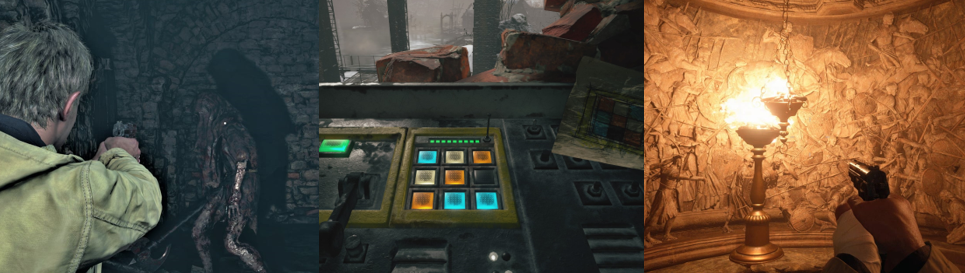
Mini Game Corner: Devil May Cry 4 (Xbox 360)

DMC4Logo

Released: January 2008
Developer: Capcom
Also Available For: Mobile, PC, PlayStation 3, PlayStation 4 (Remaster), Xbox One (Remaster)

A Brief Background:
Long before the God of War franchise (Various, 2005 to present) cornered the market when it came to hack and slash videogames, Capcom released a trilogy of titles that saw you cutting demons and angels alike into pieces with a giant sword and blasting them apart with pistols. After the success of Resident Evil 2 (Capcom, 1998), famed Resident Evil (ibid, 1996) director Hideki Kamiya began development on a new Resident Evil title for the PlayStation 2. However, when the game’s development began to veer further and further away from Resident Evil’s survival-horror aesthetics, Kamiya embraced this new direction and created an entirely new franchise with Devil May Cry (Capcom Production Studio 4, 2001). I’d been aware of the series for some time and, being a fan of hack and slash videogames, was eager to experience the games once I bought a PlayStation 3. I remember enjoying the title but ultimately being turned off by the repetitive nature of the game’s missions and boss battles, which are basically identically for both of the game’s playable characters. When I bought my Xbox 360 earlier this year, it coincidentally came with a copy of Devil May Cry 4 so, eager to snag a few additional Achievements, I attempted to rush through it again and see if it was still as enjoyable as before.

First Impressions:
Unlike previous games in the Devil May Cry series, Devil May Cry 4 begins with you not assuming the role of iconic series protagonist Dante but that of newcomer Nero. Functionally, Nero looks, acts, and even controls very similar to Dante (kind of making you question why Capcom bothered to make a new character in the first place…); Nero can attack enemies with his impossibly-large sword, the Red Queen, or stun them with his revolver, the Blue Rose. The more you mash the attack buttons, the higher a combo you’ll begin to build up; the better your combo, the better your grade. Additionally, if you successfully manage to complete missions and puzzles without using healing or recovery items, in a decent time, and with a consistently high style grade, you’ll receive better mission grades and therefore better rewards.

DMC4Gameplay
Nero’s demonic arm separates him from Dante.

What separates Nero from Dante is his Devil Bringer; a demonic arm that stretches out and allows him to cover large distances and grab, grapple, slam, and throw enemies and objects at his enemies. Eventually, he also gains access to the Devil Trigger, a state that allows him to charge his sword to unleash more powerful, flaming attacks, or explode into a demonic state for a short time to unleash stronger attacks. As you destroy enemies and certain parts of your environment, you’ll collect a bevy of Red Orbs; destroying enemies, bosses, and clearing missions also earns you Proud Souls, both of which can be used in the game’s Power Up menu. Here, you can trade Red Orbs for healing and recovery items to help you in the game’s more difficult missions or spend Proud Souls upgrading Nero’s abilities, unlocking new combos, faster moving speeds (a definite must), more powerful charged shots, and other similar power-ups. Unfortunately, every time you buy a recovery item, that item’s price shoots up, meaning you can’t just stockpile healing items as you’ll run out of Red Orbs pretty fast; occasionally, though, you can find these items hidden in the game’s missions. Devil May Cry 4’s story is told through in-game and pre-rendered cutscenes; these are pretty decent and full of frenetic, over-the-top action and dialogue and the story is pretty out there, with both Nero and Dante appearing to be infallible and superhuman in cutscenes which, unfortunately, doesn’t translate to their gameplay.

DMC4Bosses
Bosses are big and impressive but often more frustrating than fun..

The in-game action is fast and frantic but if you don’t properly lock-on and focus on your enemies, or dodge and switch up your attack style accordingly, you can be pummelled into oblivion pretty easily, which can be frustrating. Fortunately, the game’s bosses are large and complex; they’re actually quite fun, despite some of them being frustrating and cumbersome. Bael and Dagon stand out as one of the game’s tougher bosses, for me; this horrific cross between a toad and an anglerfish hides in the snowy shadows, bursting out and swallowing you up to deal massive damage, and its tendency to enter an aggressive final stage is a theme you’ll find from all of the game’s bosses. You’ll hack away, draining their stupidly long health bar and desperately trying to avoid damage, and then they just freak out and throw everything they have at you, making already annoying and difficult battles like the one against Angelo Credo extremely aggravating.

My Progression:
I was quite enjoying Devil May Cry 4 for the most part; I chose to play on “Devil Hunter” mode (which is basically the game’s Hard mode) and the game’s difficulty increases steadily as you play. Initially, enemies aren’t much of an issue; there can be a lot of them and they take quite a beating before actually going down but, generally, they weren’t much of an issue. Then I noticed that they were respawning and that I was encountering far tougher enemies, such as the cloaked Mephisto, the ice-plated Frosts, and the always infuriating Angelos. As if that wasn’t bad enough, the game’s map leaves a lot to be desired; it’s functional and shows you where areas of interest, doors, and your last exit are and can be expanded similar to the maps in Resident Evil but, quite often, I would clear a room, solve a puzzle, or defeat a boss and then be left clueless as to where I was supposed to be going and what I was supposed to be doing. Just having an area light up on the map and a directional arrow appear would have been super helpful, or even a brief objective in the pause screen.

DMC4Mission10
Mission 10 culminates in a battle against Dante but I’m not sure I’ll reach this fight.

Anyway, I was fully expecting to clear the game with only a few annoying roadblocks; however, once I limped through a particularly trying boss battle against Angelo Agnus (a hovering, insect like monstrosity that spawns fireballs, flies into a razor-sharp whirlwind, and drains your health to replenish its own), I found myself faced with an exasperating trek back through the suitably gothic and nightmarish environment. Here I was faced with Faust, a more powerful form of the Mephisto enemies, and way too many armoured Angelo enemies; considering I was trying to be mindful of saving my recovery items for the game’s increasingly challenging boss battles and the game’s restrictive checkpoint and save system, I found myself basically rage quitting (though it was more like annoyed quitting) after a few failed attempts. I am so very close to the end of Nero’s story, though, and I know I have done it before so I am tempted to try and push through but, the moment the game becomes more annoying than fun, I know it’s time to take a bit of a break.

BiteSizeGamesContinue

Mission 10. Mission 10 out of 11 missions. Once I clear the eleventh mission, the game begins over from Dante’s perspective but getting there is proving more frustrating than enjoyable; plus, I still remember enough of the game’s massive, Lovecraftian final boss to know that things don’t get any easier. I haven’t checked if it’s possible but it might be better to notch the game’s difficulty down, or simply use a recovery item and hope that I earn enough Red Orbs to buy new ones for later use.

What did you think about Devil May Cry 4? Where do you rate it in the hierarchy of the Devil May Cry series? What do you think of newcomer Nero and the direction the game took? Whatever you think about Devil May Cry 4, or Devil May Cry in general, feel free to leave a comment.

Back Issues: Resident Evil: Fire and Ice #4

BackIssues
REF&I4Title

Well, we’re in the last week of October and Halloween is this weekend. If you’ve been following my blog this month, you’ll know that, as a means to generate some fitting content for the season, I’ve been taking a look back at Resident Evil: Fire and Ice, a four-issue comic book series published by WildStorm between 2000 and 2001. This series was a follow-up to their previous five-issue mini series, Resident Evil: The Official Comic Magazine, and focused on an entirely new group of characters, the hitherto-unknown Special Tactics and Rescue Service (S.T.A.R.S.) Charlie team, rather than telling interludes, side stories, or truncated versions of the first two videogames. Charlie team was made up of a bunch of one-dimensional, impractically attired characters who looked like they had just stepped out of the worst comics of the nineties: led by the muscle-bound Falcon, who looks and acts like an extra from Predator (McTiernan, 1987), the team consists of newcomer and munitions expert Raquel Fields (who is hiding a mysterious infection following a zombie attack), the shady hacker Jesse Alcorn, Patrick Brady (a former zoo keeper able to sense G-Virus monsters), the anti-authority Australian Quan Williamson, and the Mexican quasi-Native American Rosa Cardenas (whom it is implied Quan has a crush on but who actually has feelings for Brady…).

REF&I4Copter
Quan fixes up a means to save his team mates from Whitlam’s clutches.

This final issue rejoins Quan in the Alaskan mountains (Charlie team split into two sub-teams to investigate two Umbrella laboratories and run into a few troubles, to say the least, almost immediately upon arrival); he discovers the remains of an Umbrella surveillance minicopter, which he uses to spy on Dexter Whitlam, Klaus, and Mr. Venk, the Umbrella scientists and operatives who have captured Rosa and Brady and are preparing to subject them to Whitlam’s experimental new X-Virus.

REF&I4Whitlam
And that’s it for Dexter Whitlam. What a waste of time and effort.

Whitlam, who we first met as a misguided youth who stole a sample of Umbrella’s G-Virus, transformed himself into a violent “G”-type monster, and was summarily recruited to Umbrella by Klaus after (somehow) being cured, is now all grown up and has transformed into a semi-cybernetic mad scientist. He was one of WildStorm’s more interesting and layered original characters, an insight into the type of person Umbrella likes to have on staff and put to work on their experiments. So, of course, he is incinerated on page three by the exploding minicopter, bringing him to a sudden (if impressive) end.

REF&I4Infection
Though saved, Brady and Rosa are revealed to have been infected with the X-Virus.

Free from their captivity, Rosa and Brady are reunited with Quan and immediately get their asses handed to them by Mr. Venk. Venk actually puts up more of a fight and gets a better showing than popular Resident Evil creatures like the Lickers and the Tyrant but, in the end, he is dispatched with a judo throw that ends with him impaled on the bloody stump of Klaus’ hand. However, as they make their mistake, Brady reveals that Whitlam succeeded in infecting them with some of his X-Virus, leaving a gloomy shadow over their otherwise joyous reunion. Back in Mexico, Falcon, Jesse, and Raquel take a jeep to a helicopter, where they spot the cactus plants arranged in a biohazard symbol. In a further nod to the series’ original Japanese name, they mention that the facility’s computer labelled their new virus as “Biohazard” and, dropping in for a closer look, discover that Umbrella placed a vial of the antidote into one of the cacti plant…because of course that was where you would leave the antidote to a deadly virus!

REF&I4Flight
After dispatching their pursuers, the team begin their long flight from Mexico to Alaska.

As he is lifting her back into the chopper, Jesse again acts a little shady, insisting that Raquel hands her the antidote and, in the brief scuffle, spills half of it. Just as Raquel expresses her concerns over Jesse’ competency, they are set upon by an Umbrella attack ‘copter; however, Raquel makes short work of it with her handy-dandy rocket launcher and the team prepare to fly to Alaska.

From Mexico.

They’re going to fly from Mexico to Alaska in a helicopter! That’s over 3,500 miles! Most choppers are only good for about 400 miles before needing to refuel and, if you’re thinking they flew to an airport to refuel or switch vehicles, you’re wrong because they show up a few panels later to rescue their team mates and, judging by the background, it’s still the same day!

REF&I4XFight
The other team arrives and they desperately try to subdue their mutated allies.

Speaking of the other team, Quan is forced to stop when, part-way through their trek back to the helipad, Brady begins to undergo a dramatic and painful metamorphosis into a really lame looking Mr. X/Tyrant-like creature. Falcon’s team arrives just in time to stun Brady with a crossbow (yeah…a crossbow, perhaps the weakest and most useful weapon in the Resident Evil series) but Rosa suddenly transforms into a similar, hulking creature and the team tries to subdue them non-fatally so that they can be administered with the antidote.

REF&I4Jesse
Jesse reveals his true colours…and then immediately dies.

Raquel manages to tie up Brady with some bolas and Falcon puts down Rosa using the snowmobile but, right as they’re about to get the antidote, Jesse reveals his true colours and, holding the two at gunpoint, reveals that he’s actually a deep cover mole placed in S.T.A.R.S. by Umbrella. This might have been surprising if the last two issues hadn’t made it abundantly clear that there was something very fishy about Jesse and it’s rendered completely redundant as Jesse is immediately skewered and killed by the monstrous Brady.

REF&I4Finale
Brady is put down and Rosa is, apparently, cured. It’s hard to really tell.

Raquel injects the antidote into Rosa but Brady wakes up before he can receive it and Falcon is forced to put him down with a single shot to the head; on the plus side, the antidote takes hold in Rosa and returns her to normal (though we don’t actually see this on panel). Just as it seems like our heroes have survived, however, it is revealed that yet another shady Umbrella operative (or…maybe it’s Klaus? It’s not really made clear) who monologues that, actually, everything went almost exactly according to Umbrella’s plan as Charlie team eliminated “the rogue agent Dexter Whitlam”, killed one of their own, and Raquel’s infection will ensure that the whole team is dead before they ever get a chance to land and the issue just…ends.

REF&I4Brady
None of Brady’s potential or plot threads are capitalised on.

So…what was the point of that sub-plot about Brady being able to sense the G-Virus as a result of being cured of the virus? That literally doesn’t crop up once throughout the entirety of Fire and Ice when it really could have been a useful feature that made him a relevant part of the team, or perhaps helped him to resist the X-Virus. Instead, he has this ability but does nothing with it, wields a massive, bad-ass electric cannon and is stated to be a formidable fighter (despite being nothing more than a zoo security guard), falls and hits his head, and then gets turned into a sasquatch-like thing, and summarily shot in the head. Nothing even comes of the poorly executed hint that Rosa is attracted to Brady.

REF&I4Labs
The two labs seem to be working on different things? Or the same things? I can’t tell!

It all just comes crashing to the ground in this final issue; since when was Whitlam a “rogue agent”? He was directly recruited by Umbrella and was using their existing viruses and resources to fashion a new, more powerful and deadly virus; that definitely sounds like something they would do, and want, but then it doesn’t even pay off as I’m not seeing anything in the mutations Brady and Rosa undergo that makes the X-Virus better than the G-Virus or even the Tyrant-Virus (T-Virus). Neither seem anywhere near as vicious or resilient as the Tyrants or the “G” monstrosities of the videogames; I know that WildStorm liked to really neuter Umbrella’s monstrosities, with even Mr. X and William Birkin’s “G” being put down with disappointing ease, but these X-Virus creatures are even more of a joke. Not only that, issue one made it sound as though the Alaskan and Mexico laboratories were working on two separate projects and viruses. Instead, apparently, their “rogue agent” was working on the X-Virus in Alaska, which was also known as “Biohazard” in Mexico (…for some reason) and also produced an antidote…that was also in Mexico. Unless “Biohazard” is supposed to be the antidote? The issue isn’t written to support this, though, and instead it seems like Whitlam developed one virus with two names and stashed the antidote thousands of miles away for no real reason. If the X-Virus was really supposed to be the successor t the T- and G-Viruses, why even make an antidote in the first place?

REF&I4Raquel
Raquel’s mutation only matters when the plot says it does.

And then there’s Raquel. All throughout Fire and Ice, a big deal is made of her mysterious infection (which, I assume, she got from her brief appearance at the start of issue one and is a result of her being infected with the G-Virus) but, again, nothing comes from it. Her skin changes colour, taking on a strange green hue, she grows a bony protrusion that she immediately cuts off, she suffers from headaches (but only when it’s dramatically appropriate), and then the series winds up with the threat that she’s going to transform into…something…and kill her team mates. I was expecting her to mutate into something and battle with the X-Virus monsters but…she doesn’t and, as a result, this whole plot point is a giant waste of time that adds nothing to the story, is never resolved, and leaves more questions than answers. Say what you will about Alice (Milla Jovovich) in Paul W. S. Anderson’s Resident Evil movies (2002 to 2016), at least her mutation actually factors into the plot and the movie’s action sequences.

REF&I4Characters
None of the characters really stood out for me.

Jesse’s heel turn is as obvious as the nose on your face and immediately amounts to nothing as he is killed right away; it’s not like he destroys the antidote and forces Charlie team to kill both Brady and Rosa, he just stands in the way for a moment and then gets stabbed from behind. Neither Falcon or Quan end up becoming fully-developing characters, but then this is par for the course of Fire and Ice. When I reviewed Resident Evil: The Official Comic Magazine, I talked about how I wanted to see WildStorm focus more on telling a continuous story issue by issue rather than a whole bunch of vignettes and half-assed adaptations but, man, was I wrong. Their writers were no better at telling a month by month story with their own original characters than they were with Resident Evil’s more recognisable characters and, as I mentioned before, this time there’s no impressive, gory artwork to save the series. As a companion piece to Resident Evil: The Official Comic Magazine, I guess Fire and Ice works well enough at fleshing out (or, at least, putting more of a spotlight on) some of WildStorm’s minor characters and maybe the team were planning on publishing a third mini series to wrap up all their loose ends but it definitely doesn’t read or seem that way. Instead, WildStorm again squandered their pages and efforts on one-dimensional, action, horror, and move clichés and archetypes, and somehow manages to tell a four-issue story without ever really getting into who these characters are, what their motivations are (besides being angry and quick to violence), or actually crafting a story that made logical sense.

REF&I4Covers
It’s pretty cool how the covers all form one giant picture, though.

Like Resident Evil: The Official Comic Magazine, Fire and Ice was eventually collected into a trade paperback which, like Resident Evil: Collection One (Various, 1999), is currently out of print but, unlike that collection, generally sells for about £40 to £60 rather than £60 to £200. They also returned to the franchise and published a prequel to Resident Evil 5 (Capcom, 2009) between 2009 and 2011 but, after reading Fire and Ice, I can’t say I’m too excited about covering more of their Resident Evil comics later down the line. If WildStorm ever re-released their original Resident Evil comics, including Fire and Ice, into one affordable collection then maybe, maybe, as one complete package these comics might hold up slightly better but, as is, I wouldn’t worry about trying to add these to your Resident Evil collection, no matter how big a fan you are, as there’s really nothing on offer here.

My Rating:

Rating: 2 out of 5.

Could Be Better

Did you ever read Fire and Ice? What did you think of Charlie team and WildStorm’s original characters? Do you agree that the artwork in these issues is a massive step down from WildStorm’s earlier efforts, and that WildStorm bungled their time with the franchise, or do you have fonder memories of their efforts than I do? Which piece of ancillary Resident Evil media is your favourite? Thanks for coming back each week for my review of Fire and Ice; are there any other Resident Evil games or adaptations you’d like to see me cover? Whatever you think, leave a comment below and have a great Halloween.