Movie Night: Predator: Killer of Killers

Released: 6 June 2026
Director: Dan Trachtenberg
Distributor: Hulu / Disney+
Budget: Unknown
Stars: Lindsay LaVanchy, Damien Haas, Louis Ozawa, Rick Gonzalez, Michael Biehn, and Britton Watkins

The Plot:
In this interconnected series of shorts, a bloodthirsty Viking warrior (LaVanchy), a battle-weary ninja (Ozawa), and a hot-shot pilot (Gonzalez) are forced to fight to the death after besting three separate Predators (Watkins) throughout history.

The Background:
What started as a high-budget B-movie that had Jean-Claude Van Damme running around a jungle in a bug suit eventually became a box office success when Predator (McTiernan, 1987) released on this day in 1987. Though praised as one of the best of its genre, Predator was followed by a troubled and financially stunted sequel in Predator 2 (Hopkins, 1990). Despite positive reviews, it took twenty years before Predators (Antal, 2010) revived the series with a back-to-basics approach. Though a minor hit, hopes for a direct sequel were quashed in favour of a soft reboot, though The Predators (ibid, 2018) divisive response saw the franchise take a hiatus despite its respectable box office. After 20th Century Fox was purchased by the Walt Disney Company in 2017, director Dan Trachtenberg and screenwriter Patrick Aison returned the franchise to its roots with Prey (Trachtenberg, 2022), a surprise hit that promised big things for the franchise. Indeed, while Trachtenberg was busying himself with a Predator-centric follow-up, he also spearheaded this separate project, an anthology film inspired by hyper-violent and stylised anime. Released exclusively on Disney+ and Hulu, Predator: Killer of Killers was met with overwhelmingly positive reviews that praised its visual design, varied stories, and intriguing expansion of the lore.

The Review:
Predator: Killer of Killers came somewhat hot off the heels of the surprise success of Prey, which successfully rejuvenated the Predator franchise after years of ups and downs. It seems my desperate call for new Predator stories set in unique time periods and locations has finally been answered as Predator: Killer of Killers takes place in the frigid wastelands of Scandinavia, the beautiful landscape of ancient Japan, in the midst of the Second World War, and finally on an alien world that could very well be the Yautja home world. Yes, after years of me fighting against it, the term “Yautja” is now undeniably canon thanks to the film’s opening quote from their codex. While I’m sure long-time fans of the extended Predator media are glad to see this, I can’t say I’ve ever been a fan of this name and would prefer the species went unnamed or were referred to as “Hunters” or “Predators” and the like. Still, I’m really glad we’re finally seeing the Predators being used in new settings and time periods as there’s so much potential for that to see how different people combat the Yautja threat depending on their technology or understanding of the alien foe. Indeed, to two of our main characters, the Yautja are seen as devils or demons rather than an extraterrestrial force, which is understandable given when they encounter them. Predator: Killer of Killers adopts a framing device where each of the main characters are trapped on a Yautja transport ship taking them to a gladiatorial arena for the finale, though this is primarily used as interludes between each story and to show who’s the main character of each segment. Finally, Predator: Killer of Killers uses subtitles when appropriate, particularly throughout “The Sword” and the final segment, where the characters talk exclusively in their native tongue even if we’ve heard them speak English before. I liked this aspect as it added some authenticity to the film, and each character, and I liked that their words weren’t translated for us beyond subtitles despite the characters wearing explosive translation collars.
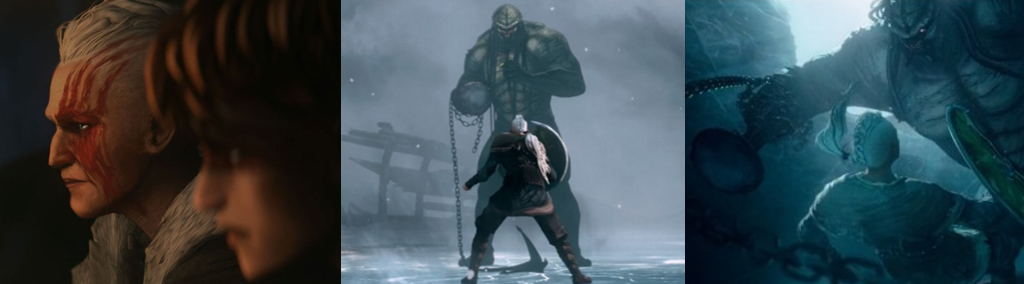
Ursa’s quest for revenge sees her turning her rage against a vicious, hulking Predator.

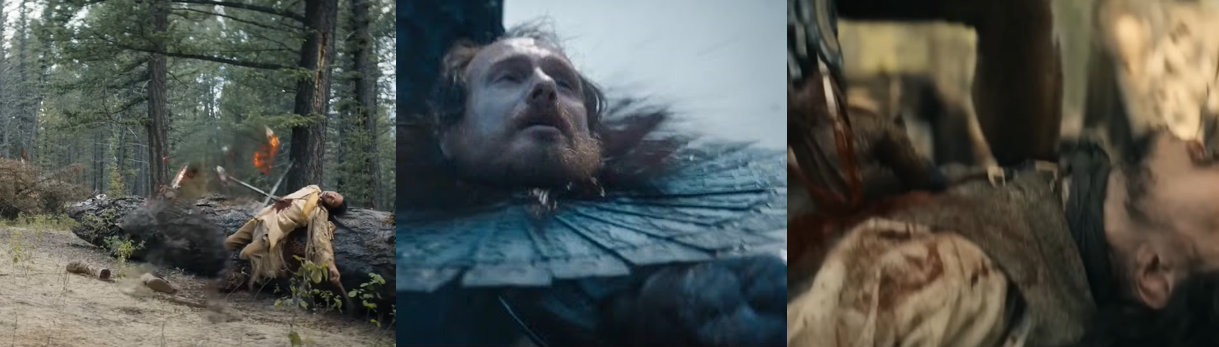
The first segment, “The Sheild”, is set in Scandinavia, 841 and follows Viking warrioress Ursa as she leads her son, Anders (Hass), and their battle hungry clan into battle against the Krivichs to avenge the death of Ursa’s father, Einar (Doug Cockle), at the hands of the Krivich chieftain, Zoran (Andrew Morgado). While Anders is keen to make his mother proud, this is his first expedition so he’s understandably a little rattled at the sheer wanton destruction and violence his clan, and his vengeful mother, heap upon the Krivichs. Thus, he freezes when presented with his first kill, both out of fear and concerns for his place in Valhalla should he kill an unarmed man, though Ursa has no hesitation in cutting their prisoner in half after learning Zoran’s location. Unaware that a Yautja ship has dropped off a Predator to hunt the ruthless Vikings, Ursula shares the story of Einar’s death with Anders, which saw young Ursa (Cherami Leigh) consumed by anger and vengeance from a young age and determined to avenge her father, wearing his bloody handprint with pride despite initially being too overwhelmed by grief to function. So righteous is Ursa’s quest that she storms Zoran’s heavily fortified fortress alone, cutting through and bludgeoning many of his men single-handedly before her warriors (and Anders) join the fray. Using her sharpened, splintered dual shields, Ursa severs limbs and slaughters Zoran’s troops to confront the chief in his throne room. Despite Ursa’s rage, Zoran openly mocks her, disrespecting her in front of her men and leading to Anders beheading him for his insolence. Before Ursa can comment, the hulking Warlord Predator decloaks before them, naturally startling the Vikings and easily brutalising them with its superior speed, strength, and bionic hand appendage. Anders successfully wounds the Warlord with a spear, leading Ursa to leap to this defence, only for the Predator to bring the whole fortress down with a single concussive blow. Its helmet damaged by Ursa’s attack, the Predator stalks her on the brittle, frozen water, though she eventually traps and seemingly kills it by improvising with an anchor and turning its own weapon against it. Despite her victory, the exhausted and wounded Ursa is distraught when Anders succumbs to his wounds and dies in her arms.
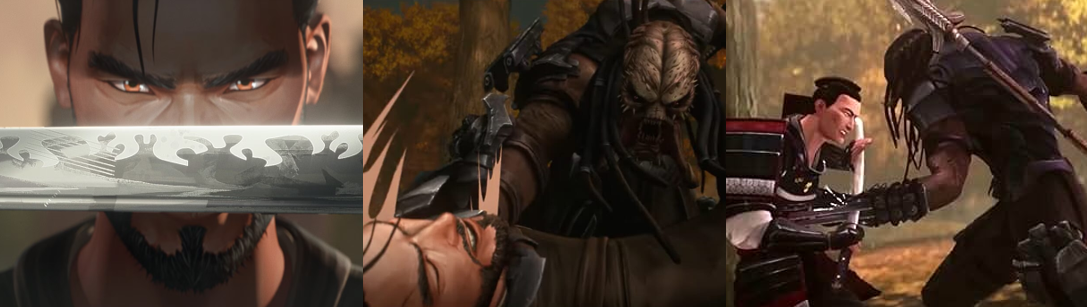
Brothers Kenji and Kiyoshi must set aside their differences to battle a common foe.

“The Sword” is set in Japan, 1609 and follows twin brothers Kenji and Kiyoshi Kamakami, bright and optimistic youngsters who are forced to duel to determine which of them is strong enough to succeed their father, a stoic and demanding samurai warlord. Though Kiyoshi shares Kenji’s reluctance, he ultimately attacks with a sudden viciousness, forcing the hurt and heartbroken Kenji to flee. Upon his father’s demise twenty years later, Kiyoshi adopts his grim persona and succeeds to the throne, ceremonially burning his father’s corpse and ringing the bells to indicate the succession. This attracts Kenji’s attention, with him gearing up to confront his brother for his betrayal using the ninja skills he cultivated while living in exile. As a Predator watches with curiosity, Kenji stealthily subdues Kiyoshi’s guards and infiltrates his old homestead, utilising shuriken and a chained weapon to overwhelm his foes. When the alarm is raised, Kenji’s forced to take a more direct and violent route, cutting his brother’s personal guard down with his katana using a smoke bomb for cover. With a mere glance and a glare, they match swords once more as the Predator observes, with Kiyoshi’s straightforward samurai skills being somewhat outmatched by Kenji’s shinobi deviousness as Kenji utilises various weapons to press his attack. Still, the brothers are largely evenly matched, especially as Kiyoshi dons his father’s samurai outfit throughout the fight. Still, Kenji gets the upper hand and symbolically scars his cheek, just as Kiyoshi did when they were younger, then sheathes his sword rather than deliver a killing blow. Stunned when Kiyoshi apparently plummets to his death, Kenji’s ambushed by the Predator, who cuts down a bunch of Kiyoshi’s guards with its spear, katana-like blade, and fancy spring-loaded chains. Forced from the pagoda, Kenji utilises his ninja skill to hide, flee, and even launch surprise attacks on the cloaked Yautja, who relentlessly pursues him across the rooftops. Driven to the moat, Kenji’s amazed to find his brother alive and, though skewered by the Predator’s wrist blades, Kiyoshi joins his brother against their mutual foe. Despite the Predator’s great strength and explosive gadgets, Kiyoshi stabs it through the neck and the brothers injure and then dramatically cut the Predator in two with dual sword strikes, though Kiyoshi dies after making peace with his brother.
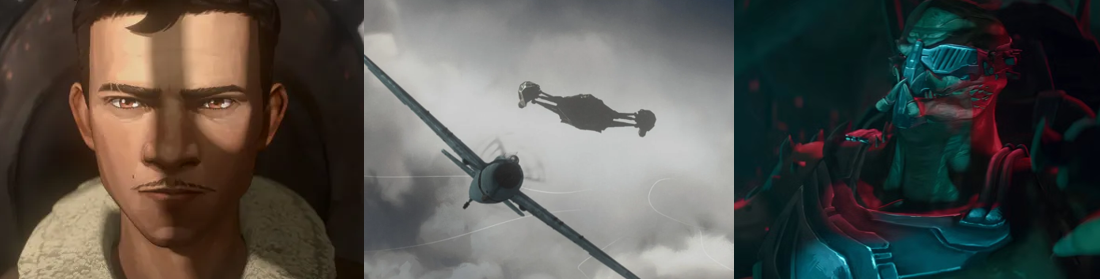
World War Two pilot Torres finds his aviator skills tested by a Predator with a taste for war.

The third segment, “The Bullet”, starts in Florida, 1941 and finds free-spirited John J. Torres dreaming of being a pilot, much to the chagrin of his down-to-earth mechanic father (Felix Solis). Though Torres gets his wish, it comes from being drafted into the United States Navy and, one year later, Torres puts both his dreams and his practical skills to use when he impresses with his dad’s mechanics knowledge. Frustrated at being grounded by Captain Vandenberg/Vandy (Biehn), Torres is bewildered when one of their squadrons is decimated by a mysterious aircraft. While Captain Vandenberg leads a squadron to investigate, Torres inspects the alien, harpoon-like device stuck into one of the plane’s engines and is stunned when it suddenly activates and flies off, dragging an engine behind it on a chain. Despite Torres’ best efforts, he’s unable to warn the squadron of the greater threat in the skies around the Atlantic, so he commandeers a battered old fighter plane (the titular “bullet”) and goes to warn them. Though they take out the opposing squadron, Vandy’s planes are suddenly attacked by a decloaking Yautja craft, whose one-eyed pilot easily rips apart Vandy’s planes. With his wing burning, Torres makes a desperate climb to fix the damage while the remaining planes provide cover fire. Despite their bravery and aerial skill, the pilots are no match for the Predator’s technology, with one shredded by an energy net. After sorting out his plane, Torres regroups with Vandy and correctly theorises that the Predator can only see heat, so they make a desperate gamble and lure the ship as high as they can. With the alien ship closing in, Vandy bravely sacrifices himself to buy Torres the time to swing behind the blinded ship and take out one of its engines. Enraged, the alien pilot pursues Torres through the city streets, struggling to get a lock on and being drawn into a Naval skirmish. After the cannon fire heavily damages the alien ship, Torres tricks the Predator into firing, blowing his parachute and turning its massive harpoon against it to finally bring the craft down, though Torres is abducted after the war while working in his father’s garage.  

The Nitty-Gritty:
Predator: Killer of Killers is a fitting homage to everything that makes the Predator franchise so good, with Benjamin Wallfisch offering a fresh take on Alan Silvestri’s classic “Predator” theme, infusing it with a darker edge befitting of his horror roots, and the Yautja technology is very similar to previous films. Each segment follows radically different main characters, with Ursa being a venge-seeing Viking warrior, Kenji wishing to get a little payback against his brother, and Torres dreaming of being a heroic wartime pilot. While they’re all from very different backgrounds and have very different skills, with Ursa attacking first and asking questions later, Kenji largely laying down his sword, and Torres desperately trying to keep the peace and escape, they share a unique bond in their shared experiences with different Yautja. These Predators were as different as the protagonists are from each other, of course, with the Warlord being a bulky fighter, Kenji’s adversary favouring stealth, and the pilot attacking from a space craft. All three were ultimately outwitted by their foes turning their technology against them, however, with even the pilot’s systems and numerous armaments proving useless without a clear target. Ursa’s story is one of violence and vengeance, with her soul being consumed by both for years, while Kenji has no desire to fight any more and Torres just wants them to join forces against a common foe. Ursa is driven to a suicidal madness by the end, wishing only to die in glorious combat to reunite with her son in Valhalla, and even Kenji is completely at peace with meeting his end to be reunited with Kiyoshi. Torres’ infectious demeanour ultimately wins both over and they learn to take up arms once more against their shared enemy, with the ultimate message being that human tenacity, adaptability, and co-ordination is what makes us such a compelling target for this warrior species.
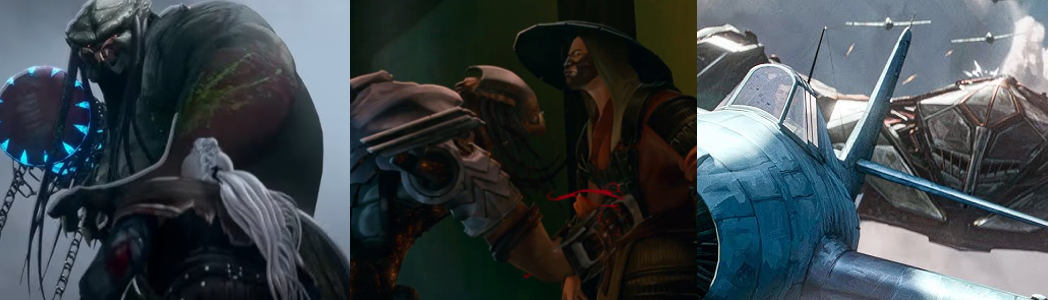
We finally get to see some visually distinct Predators in unique environments and time periods.

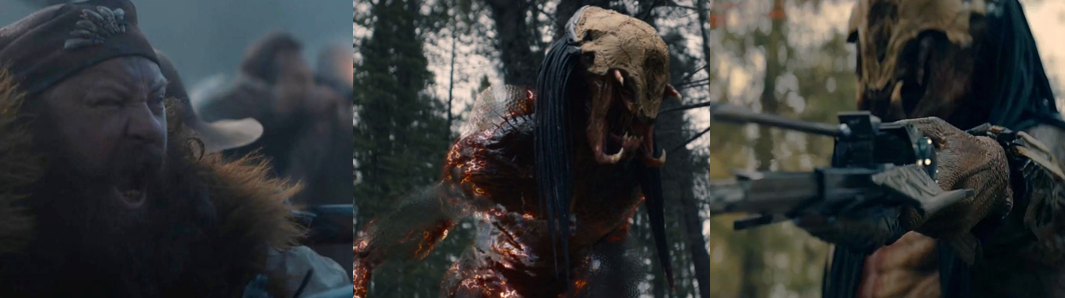
Predator: Killer of Killers employs a stylised, jerky, comic book-esque animation style that’s very similar to the Spider-Verse movies (Various, 2023 to present) and Teenage Mutant Ninja Turtles: Mutant Mayhem (Rowe, 2023). If this animation style isn’t for you, you may struggle with the film but I think it worked really well. It’s not as frenetic and overstylised those movies, but it accentuates the violence and action with a comic book-style aesthetic that I find really appealing. The character models also reminded me of the exaggerated models used in TMNT (Munroe, 2007), though they’re far more varied, nuanced, and detailed here. For the most part, human characters are rendered in a stylish but ultimately realistic way, being proportionate to their size, with only Kenji and Kiyoshi seeming to defy gravity in their agile nature. The Yautja, however, are the extreme opposite, presented as towering, monstrous beasts who defy explanation and live up to their description as “devils”. The Warlord Predator, for example, is a massive brute far beyond any hunter we’ve seen before and the pilot is a grizzled, battle-scarred veteran who reminded me of Commander Kruge (Christopher Lloyd). The stealthier Predator who attacks the Kamakamis is probably the closest to a regular Yautja in the film and even he boasts chain-like weapons and a more samurai-styled appearance. The Grendel King, however, takes the award for most elaborate and intimidating Predator design, sporting full-on tusks, elongated dreadlocks that appear to be Xenonorph tails, and showcasing a ferocity far beyond his peers. There’s some fun new Yautja technology on show here, including miniature explosive devices, the Warlord’s concussive arm device, and the pilot’s energy net. Predator: Killer of Killers gives us a taste of the Predator ship’s combat skills, which is very refreshing, with the pilot utilising a devastating harpoon weapon that essentially frames the dog fights as old school Naval battles. There’s also some gruesome gore on display here, with characters being sliced in half, heads and limbs being lopped off, and blood splattering everywhere, which was glorious to see to sell how vicious both the Predators and their prey are.
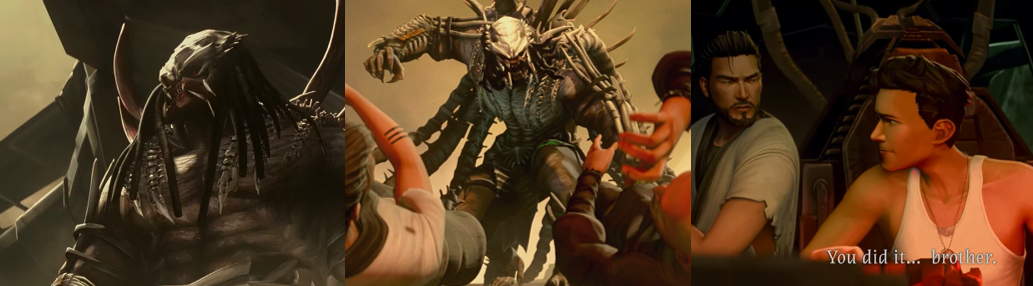
Rather than fight to the death, the three survivors team to fight and escape the Grendel King.

“Final Battle” reveals that Ursa, Kenji, and Torres were placed into suspended animation after being abducted. Thanks to the language barrier and his cell mates being largely anti-social, Torres struggles to communicate with the two, though they’re soon brought to a gladiatorial arena on a scorching hot alien world. There, they encounter another elder Predator that Ursa dubs the “Grendel King” who, thanks to the translation collars fitting around their necks, commands them to fight to the death for the honour of facing him in tribal combat. The three are furnished with fitting weapons, with Torres gifted Captain Raphael Adolini’s (Bennett Taylor) pistol, and are threatened with having their heads exploded by their collars if they refuse to fight. Naturally, Ursa attacks first, determined to prove herself the “killer of killers”, but Kenji defends Torres and refuses to fight, urging the others to join forces against their captors. While Torres struggles to load Adolini’s pistol and Kenji desperately defends himself against Ursa’s savage attack, the Grendel King unleashes a massive alien beast that promptly swallows Torres whole! Enraged after seeing Anders’ likeness in Torres, Ursa attacks the creature alongside Kenji on the outside while Torres desperately stabs it with a Predator’s severed gauntlet arm from the inside. Together, they successfully kill the creature, much to the Grendel King’s amusement, but the suicidal Ursa only agrees to join forces with them upon seeing Torres alive. Having disabled their collars and commandeered a Yautja hoverbike, Torres flies his new allies to the Grendel King, who overpowers them with little effort, suffering only superficial wounds as Torres tries to figure out the Yautja ship’s controls. Just as the Grendel King is preparing to finish off his foes, Torres activates the ship, sending the brutish Predator flying. However, as they limp to safety, Kenji’s right arm is severed by the vengeful alien’s spear and the ship is anchored by a harpoon cable. Thus, Ursa slides down the chain to destroy the launcher, allowing herself to be recaptured so they can escape but eschewing her father’s ways by demanding they not avenge her. Though she mocks the Grendel King’s efforts, he orders his forces to pursue the escapees and has Ursa returned to suspended animation, where she’s stored alongside thousands of others…including Naru (Amber Midthunder).
The Summary:
Predator: Killer of Killers was another pleasant surprise after the fun return to form the franchise enjoyed with Prey. I’ll admit that I was a bit dubious at first by the idea of an animated anthology movie, but I enjoyed the framing device of these three characters triumphing over separate Predators and being brought together to earn the right to fight the Grendel King. This was a new wrinkle in the Predator lore that adds new layers to Predators, which already revealed that the Yautja abduct the best of the best (or worst of the worst) to hunt for sport. The animation style might not be for everyone, but I think it did a great job of presenting these visually arresting Yautja as incredible, monstrous beings that are so far beyond our understanding. Put simply, Predator: Killer of Killers makes the Yautja scary again as we see them absolutely decimate anyone who gets in their way, ripping them to pieces and deftly wielding incredible alien technology repurposed into practical weaponry. It thus takes a very special individual to overcome them, and our three main characters certainly fit that bill as they use their individual strengths to endure and overcome the alien threat, largely by turning their strengths and technology against them. I really enjoyed that we got three different time periods for the Predators to play around in, showing how the distinctly different hunters approach their unique environments and prey, and the ways the main characters react to and tackle them. Framing each segment as a character driven piece that happens to feature an alien hunter was a great choice as it allows you to connect with each character and for them to stand out against each other, with the finale showing how their vastly different personalities clash but ultimately result in victory once they come together. Even if you don’t like the animation and can’t connect with the characters, there’s some fantastic Predator action here. Each one is distinct and uses different tactics and weaponry and we get a glimpse into a different aspect of their society and overall lore. Honestly, I wouldn’t be against seeing a couple more films like this to explore this aspect of Yautja society and tie up a few loose ends in the franchise, and Predator: Killer or Killers just reinforced how much potential there is for more stories in this world.

My Rating:

Rating: 4 out of 5.

Great Stuff

Did you enjoy Predator: Killer of Killers? Which of the characters and segments was your favourite? What did you think to the animation style and the visual design of the new Predators? Are you a fan of the Yautja name or do you prefer the species to go unnamed? What did you think to the gore and how each character overcame their alien foe? Would you like to see more anthology films like this for the franchise? Which of the Predator films is your favourite and how did you celebrate Predator Day this year? Whatever your thoughts on Predator: Killer of Killers, feel free to leave a comment below, check out my other Predator reviews, and donate to my Ko-Fi to suggest future Predator content.

Mini Game Corner: Predator 2 (Mega Drive)

Released: 1992
Developer: Teeny Weeny Games
Also Available For: Game Gear and Master System

A Brief Background:
Predator (McTiernan, 1987) was birthed from a simple concept: Rocky Balboa (Sylvester Stallone) versus aliens! However, it soon evolved into a B-movie with a budget that became a critical and commercial hit. Predator was accompanied by a middling and bizarre sidescrolling shooter that was a far cry from the celebrated action brawlers and crossover shooters it would later inspire. Although development of the under-rated Predator 2 (Hopkins, 1990) took some time and resulted in a less profitable, but more critically lauded, movie that not only developed a cult following but was also followed by a videogame adaptation. There were actually two Predator 2 videogames: the first came in 1990 and was a frustrating rail shooter released for Amiga, Atari ST, DOS, and other platforms, and the second was this semi-isometric shooter which released exclusively for SEGA’s consoles. Though largely regarded as merely an average shooter, Predator 2 made it into my Mega Drive library and was the last solo Predator videogame for twelve years. Although the fan-created “Predator Day” clashes with “Superman Day”, I still like to celebrate the Predator franchise around this time so this seems like a good excuse to see what this videogame has to offer.

The Review:
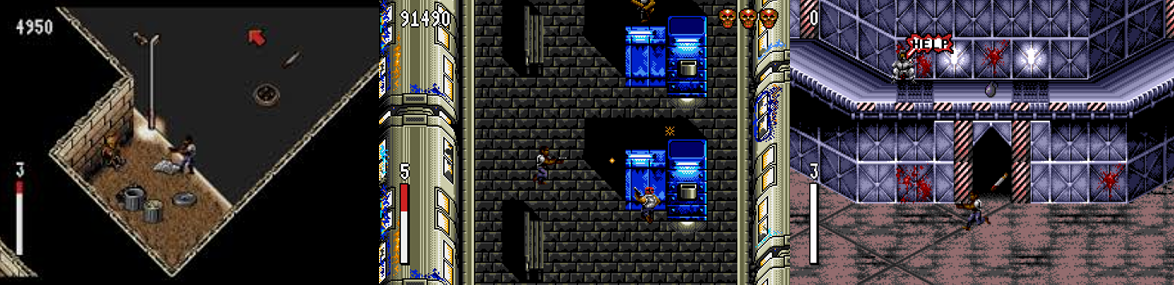
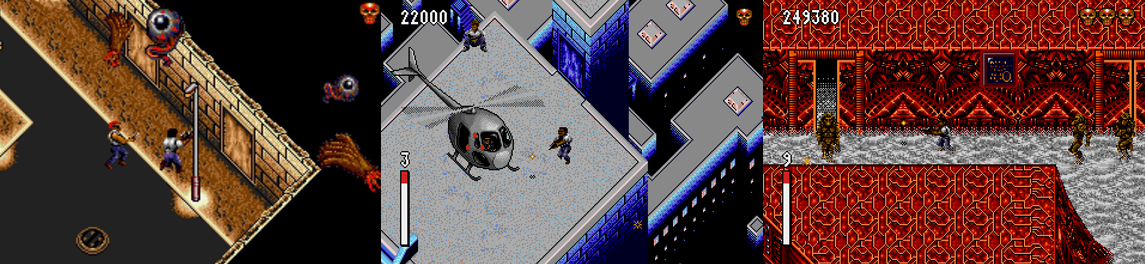
I’m doing things a little differently for this review of the Mega Drive adaptation of Predator 2; it’s mainly getting a shorter review because it’s not a very lengthy game so I don’t see the point in dragging things out that much, but I was also able to finish it so I want to discuss it and give it a proper rating. Predator 2 is primarily a semi-isometric arcade-style shooter that looks and plays a lot like the amazing Smash TV (Williams, 1990), with some levels in Predator 2 even adopting more of a top-down perspective. Like the movie, the game follows the efforts of hardened Lieutenant Mike Harrigan in quelling the violent gangs of Los Angeles and you basically do this by blasting everything and everyone in sight. This is accomplished by tapping or holding A to fire your current weapon; you can use B to lock Mike in place to open fire on specific targets, but I found it much more beneficial to keep moving as there are a lot of respawning enemies in Predator 2’s maps. C selects a different weapon and there’s a decent range to pick from apart from your default rifle, which has unlimited ammo: you can grab a scattergun for a spread shot, a ridiculously powerful sawed-off shotgun, grenades, and eventually make use of the Predator’s own weapons, such as a circling smart disc, a spear, and a net to pin enemies to walls or push them back. All of these additional weapons have limited ammo so, despite them being quite prominent, they’re best saved for when you need to destroy taxis, large trucks, or battle the Predators.

Blast through city scum and rescue hostages before the Predator can strike!

Predator 2 sees you shooting your way across seven levels, all ripped right out of the movie; your main objective is to rescue a certain number of hostages, with a helpful onscreen arrow and cries for help pointing you in the right direction, before the Predator can kill them with its plasma cannon. You’ll know when one’s in immediate danger as you’ll see the familiar red dots of the Predator’s aiming reticule appear onscreen. A red skull icon will also pop up to show when a hostage has been killed and the game’s difficulty is directly tied to how many hostages can be lost before your mission fails as well as how many shots the flak jacket power-up protects you from. On “Easy”, four hostages can be lost and Mike can take eight hits; on “Normal”, its three and six, and on “Hard” it’s one and four, meaning the game can get pretty challenging on harder difficulties as enemies constantly spawn into the map and locations can get a bit maze-like at times. Although there isn’t a timer in the strictest sense, there kind of is; you’re in a race against the Predator to find those hostages and, after you have freed them all (which isn’t tracked in any way; you’ll only know when you’ve succeeded, failed, and how many have died, not how many are left), you need to hurry to the exit before the Predator one-shots you with its cannon. Every enemy you gun down drops a variety of drug-related paraphernalia (such as bags of cocaine, syringes, and pill bottles) that you can pick up for points. Although this is in keeping with the movie, I was still a bit surprised to see drugs make it into a home console game! You can also grab the aforementioned flak jacket to reduce damage taken and restore your health and a first aid kit for an extra life, but it’s game over with no continues once all your lives are exhausted. Thankfully, the game is super generous with its checkpoints; if you rescue all the hostages and then die, for example, you don’t have to find them all again. After clearing each level, you’ll also get a password that you can use to continue at a later date and there are also passwords to award infinite health (though the Predator can still kill you) and other perks.

Although its difficulty is often unfair, Predator 2‘s environments are surprisingly detailed.

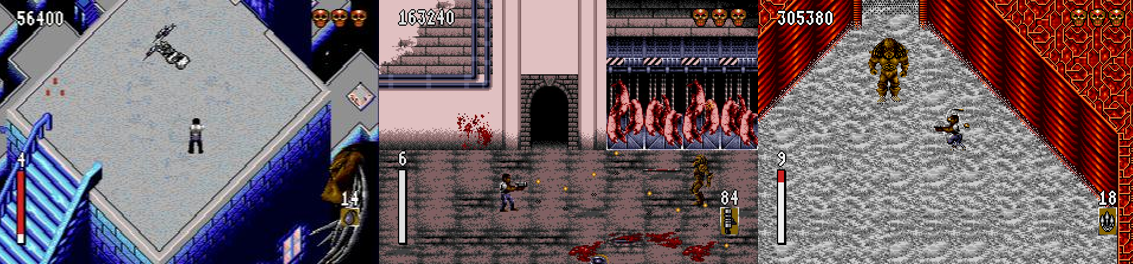
Although the character and enemy sprites aren’t very detailed and have very little animation (most enemies just walk into you to damage you), the environments are surprisingly complex. Enemies pop up from manholes, come through doors, and Predators decloak in each environment, which sometimes bars your progress with taxis that need to be destroyed and barriers that’ll only lower when you’ve rescued enough hostages. I really enjoyed level 2, 4, and 7, which have you exploring the city rooftops, subway, and the Predator ship, respectively. There’s some fun, quasi-3D effects happening on the rooftops and a lot of depth given to the skyscrapers by the isometric perspective; enemies pour out of heavily-graffitied subway trains in the subway and the Predator will even take shots at you from atop the trains; and the spaceship is unexpectedly faithful to the movie in its details with its mist-covered floor, alien architecture, and even trophy walls featuring the Predator’s previous victories. I think I disliked the levels that take place on the streets and in the slaughterhouse the most; the streets can get very repetitive and it’s surprisingly easy to get lost with the limited perspective and wide-open areas. The slaughterhouse, while suitably gory and full of hanging carcasses, was quite frustrating as it’s a very large map with multiple vertical levels so it can be a bit hectic trying to rescue all of those hostages. As much as I enjoyed the visuals of Predator 2, which also features an impressive thermal image of Los Angeles on the title screen and some pixelated movie stills before each level, the sound was really jarring; the game is full of this strangely upbeat music that really doesn’t fit with the franchise (though it does keep your adrenaline pumping). There’s also no in-game story text and the ending is really anti-climactic, but I liked how a big image of the Predator appears in the foreground at times to let you know to hurry to the exit. The game over screen features the Predator standing on a rooftop holding a skull and spine (presumably Mike’s), and Mike explodes into bloody chunks if he gets blasted by the Predator’s cannon so, overall, the game was visually impressive considering how simple it can be.

The Predator hounds you throughout the game but beating it gives you access to its weapons.

The streets are littered with the scum of society; punks are everywhere and will attack you with their bare hands and baseball bats or shoot from a far. Enemies also ride around on motorcycles and in taxi cars or blockade your progress and the exit in large trucks. These latter often serve as mini bosses: three enemies will constantly pop out from the cab and trailer of the truck to blast at you and it can take quite a few shots to blow these trucks up, though you do get a hefty supply of drugs to add to your score as a reward. Enemy choppers also fly overhead and shoot at you and can be found on the ground to fulfil very much the same role, similar to the taxi cabs that you’ll have to destroy to reach power-ups, hostages, or exits, but the sheer number of enemies that swarm the screen can compound these encounters. You’ll also encounter the Predator as a boss on numerous occasions; the first time you battle it, its at the end of the subway and from a top-down perspective. The Predator crackles with electricity when hit, fires bolts from its shoulder cannon, and pins you against the far wall with its net but you’ll be rewarded with its smart disc upon defeating it. In level 5, the Predator appears multiple times to block your progress; this time, you fight from a side-on perspective and it also uses its smart disc, which rotates around almost as a damaging shield. In level 7, Predators act as the primary enemy aboard the alien ship; they’ll decloak, blast at you, toss out multiple nets, throw their spears, and have smart discs circling about the place but will run off or cloak after a few hits. You’ll also have to watch out for wall cannons and the ship’s labyrinthine layout, but if you’re able to rescue all twenty-five hostages and survive the gauntlet of enemies and projectiles, you’ll get into a final showdown with a bigger, unmasked Predator. This also takes place from a top-down perspective and isn’t really any different from previous battles except that the Predator ungainly plods about and managed to kill me even with the infinite health cheat activated! Once defeated, you’re told to escape the ship before it takes off but this simply plays out in a cutscene; you then enter your high score and that’s it, game over, move on.

The Summary:
If it wasn’t clear in my review, I played through Predator 2 with the infinite life cheat activated, which admittedly accounts for how quickly and easily I was able to beat it. However, even with this cheat enabled, you need to have some level of speed and skill to find all those hostages and you’re still capable of dying, but even with it on and a brief playthrough with it off I can see how unfairly difficult Predator 2 can be. The sheer influx of enemies and how quickly they can drain your life bar is astounding, quite frankly. This maybe wouldn’t be so bad if rescuing hostages restored some health or if you had infinite continues, but that’s not the case so you really need to be quick, have a firm understanding of each location, and conserve your more powerful ammunition just to power through the gaggle of baddies much less take on the super strong (and ridiculously cheap) Predator. However, I really enjoyed this game; it was short and simple and a bit mindless, but the environments are surprisingly detailed and fun to run around in and its enjoyable to blast druggies into bloody chunks and outrun the Predator’s reticule. I do think that the game needed a little bit more to it, though; perhaps some racing levels or some kind of bonus stage, maybe a two-player mode where a friend plays alongside you as Mike’s partner, Detective Danny Archuleta, or definitely including Special Agent Peter Keyes in an antagonistic role. Still, this was a harmless enough experience; it works as an action-orientated shoot-‘em-up and I enjoyed the tension of having to outrace the Predator to its targets. However, it gets very messy and cheap with enemies and health-draining hazards very quickly so I can understand why some would be put off by it, but take my advice and slap on the infinite health cheat and this is a decent way to spend about half an hour of your time.

My Rating:

Rating: 3 out of 5.

Pretty Good

Have you ever played the Mega Driver version of Predator 2? What did you think to the game’s perspective and action-oriented gameplay? Did you struggle with the game’s difficulty, or did you enjoy the challenge out avoiding the Predator and rescuing all the hostages? Which Predator game is your favourite? How are you celebrating the action/horror franchise this month? Whatever your thoughts on Predator 2, please feel free to leave a comment below or on my social media and go check out my other Predator content.
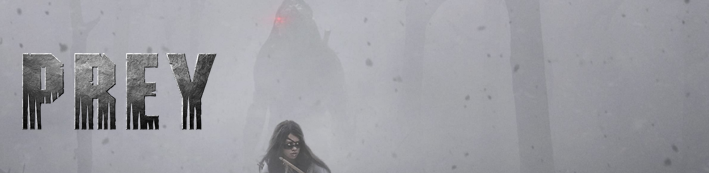
Movie Night: Prey

This review has been supported by Chiara Cooper.
If you’d like to support the site, you can do so at my Ko-Fi page.

Released: 5 August 2022
Director: Dan Trachtenberg
Distributor: 20th Century Studios / Disney+
Budget: $65 million
Stars: Amber Midthunder, Dakota Beavers, Bennett Taylor, Michelle Thrush, and Dane DiLiegro

The Plot:
In 1719, on the Great Plains, Comanche warrior Naru (Midthunder) finds herself fighting to protect her people not only from French fur traders destroying the buffalo they rely on for survival but also from a vicious, humanoid alien (DiLiegro) that hunts humans for sport!

The Background:
Predator (McTiernan, 1987) quickly evolved from a high-budget B-movie that had Jean-Claude Van Damme running around a jungle in a bug suit into a box office hit heralded as one of the best of its genre. After a troubled development, Predator 2 (Hopkins, 1990) failed to match the first film’s box office despite positive reviews and it would be twenty years before Predators (Antal, 2010) ignored the sequels and crossovers and proved a minor hit. Sadly, this meant that hopes for a direct sequel were quashed when the studio opted for a soft re-quel; unfortunately, despite the return of Predator writer Shane Black and a respectable box office gross, The Predator (ibid, 2018) divided critics and any hopes of a sequel were put on hold after 20th Century Fox was purchased by the Walt Disney Company in 2017. It wasn’t long before development of a fifth entry (initially titled “Skulls”) got underway, however; director Dan Trachtenberg and screenwriter Patrick Aison’s pitch of a prequel that returned to the franchise’s roots was approved and the filmmakers even considered having the film’s characters speaking exclusively in Comanche. Trachtenberg specifically cast Dan DiLiegro as the iconic hunter as he wanted a leaner, more agile version of the Predator; the creature’s entire design was revamped, though DiLiegro still had to suffer in an uncomfortable suit throughout the shoot. Four weeks of weapons, team-building, and communications training saw star Amber Midthunder gain prowess in axe throwing, and filming attracted much attention and support from the Native American community and the film was praised for its historical accuracy in depicting Comanche society. Prey was released exclusively on streaming services, becoming the most-watched premiere on Hulu in the United States at the time, and was widely regarded as being the greatest Predator sequel yet. Critics praised the tension and atmosphere, its strong and capable heroine, and the thrilling balance of action, emotion, and gore; its success effectively reinvigorated the franchise and left the door open for further films.

The Review:
Prey kind of came out of nowhere for me; I suspected that Disney would want to profit from their acquisition of 20th Century Fox’s properties but it seemed as though the franchise was sadly dead in the water after the disastrous effort that was The Predator. As someone who thoroughly enjoyed Predators, I had been hoping for some kind of follow-up to that film’s cliff-hanger and, instead, we got this weird mish-mash of a bunch of elements from the previous three films and a controversial depiction of autism as some kind of superpower. I enjoyed the effects, some of the characters and humour, and a few aspects of The Predator but it still dropped the ball and I was convinced that the next step at trying to kick-start the franchise would be to lure back either Arnold Schwarzenegger or Danny Glover (or both) and drop us back in the jungle again. For me, each Predator film should try something different; I might not be a fan of AVP: Alien vs. Predator (Anderson, 2004) but at least it was unique in its snow setting, its three Predators, and the clash between alien species so I was intrigued by the idea of a prequel. Dropping the highly advanced and adaptable alien hunter into an era where automatic weapons and modern technology weren’t really a thing is a great way to recapture the raw nature of the first film, especially the final act where Major Alan “Dutch” Schaefer (Schwarzenegger) is left to rely on his “Boy Scout shit” to survive, and I’d love to see the Predator picking soldiers off the battlefield in No Man’s Land, stalking cowboys in the Old West, or lurking in the misty shadows of Plague-era London almost as much as I’d enjoy visiting their home world or a film set further into the future. Plus, a smaller budget lacking in big-name actors meant more focus on the creature, the battle for survival, and had the potential for a higher reward in terms of box office and reception; low risk and high reward is a model that’s worked pretty well for other genre films and I was pleased to see it pay off in Prey‘s reception.

Naru is desperate to prove herself a skilled warrior but didn’t expect to be facing an alien hunter!

Prey revolves around a Comanche tribe, back before the then-modern world absolutely ravaged their lands with industry and Christianity. Our main character, Naru, is something of an outcast in her tribe; tradition demands that she follow her calling as a healer but, in secret, she trains to be a warrior like her brother, Taabe (Beavers). Alongside her faithful canine companion Sarii (Coco), Naru works on her tomahawk-throwing skills out in the forests and showcases a considerable talent with accuracy and proficiency but also at hunting, as she’s able to sneak up on a deer undetected. When the deer is startled, Naru demonstrates her impressive cardio and parkour-like skills, racing through the forest, hopping over and under trees with a deftness and determination, and also her talent for medicine after Sarii’s tail is caught in an iron trap that puzzles her in its design. Later, Naru fashions a weapon unique to her by tying her tomahawk to a length of hand-made roping, not unlike a roped kunai, and demonstrates her grace under pressure when she falls into a swamp-like bog and is able to haul herself to safety rather than giving in to panic. While out in the forest, Naru catches sight of the Predator’s cloaked ship breaching Earth’s atmosphere and interpets it as a Thunderbird, a sign that she needs to prove herself. Despite showing talent in many areas, Naru’s motivation for wanting to hunt is simply: nobody in the tribe believes she’s capable of it (even her mother, Aruka (Thrush) questions her desire) and she’s determined to prove them wrong. Taaba, who paints himself up in half-ghost face, is a great hunter; when Naru was young and being taken to gather herbs, he was learning the skills that allow him to shoot an eagle out of the sky with barely a glance. His relationship with Naru is a complex and surprisingly realistic one; they wind each other up like most siblings but, while she believes she’s ready to prove herself, Taabe has his doubts. He knows, from first-hand experience, the difference between picking off prey that’s either unaware or incapable of defending itself and taking on something that actively hunts its quarry.

Despite Wasape’s mockery, Naru is wily enough to learn from the Predator and to survive.

Still, when Taabe joins the search party to rescue Huupi (Tymon Carter) from a mountain lion, he vouches for Naru’s tracking and medicinal skills, though it’s not enough to completely win over the prejudice of his fellow hunters, particularly Wasape (Stormee Kipp). Even after she tends to Huupi’s wounds, Wasape gives her grief and their antagonism boils over into an intense brawl when he’s sent to retrieve her and is met with defiance and tales of a mupitsl, a monster from her tribe’s children’s stories, lurking in the forest. Paaka (Corvin Mack) has equal disregard for Naru, believing she’s too afraid to be of use and, like Wasape and Naru’s other doubters, he meets a gruesome end as a result of his condescending nature. Unfortunately, Naru misses out on her big moment thanks to a distraction from the Predator; when Taabe returns to the village with the lion’s beheaded carcass, he’s named the tribe’s War Chief and, fully confident that he can tackle whatever other threats are out there when the time comes, leaves Naru heartbroken when he voices his own distrust in her abilities, regardless of her clear hunting skill. Determined to prove herself, Naru shirks her duties and heads out beyond the ridge with Sarii, finding more of the Predator’s tracks (and even some of its distinctive luminous blood), a herd of rotting, skinned bison, and a grizzly bear. Forced to take shelter when her weapons fail her, this affords Naru her first gruesome glance of the true alien menace lurking on her lands, a creature she cannot understand and so believes to be the fictional mupitsl come to life. Bound and helpless, it’s all Naru can do to free herself from her bonds when the Predator attacks Wasape and his fellow hunters, but her experience proves invaluable at seeing what the creature is capable of and spotting the warning signs of its bolt gun.

Even the French’s guns are no match for this Feral Predator, despite the primitive nature of its weapons.

Although it appears as though the Predator is responsible for slaughtering the buffalo herd (skinning creatures is its modus operandi, after all), this is actually the work of a brutish group of French voyageurs. Compared to the Comanche, the voyageurs are almost Viking-like savages; they growl and bark in an unintelligible French dialect and wield far more advanced weaponry, including rifles and gunpowder. After she’s taken captive by them, Naru is approached by Raphael Adolini (Taylor), an Italian man who acts as a translator between the two groups and who both speculates on the nature of the Predator and reveals that the voyageurs have encountered the creature before. When she refuses to talk, their leader, “Big Beard” (Mike Paterson), wounds Taabe with a cut across his torso and the two are strung up as bait for the Predator. Although we see a fleeting shot of it within the first ten minutes or so, we don’t actually see it unobscured until about fifty minutes in, with much of the first act being built around echoing the slowly mounting tension regarding the creature to reflect the confusion and superstition felt by the Comanche. There’s a particularly simple, yet striking, sequence that showcases both the Predator’s looming menace and the film’s themes of predatory hierarchy; an ant unknowingly crawls over the cloaked Predator’s leg before being eaten by a rat, which is then struck by a snake, which in turn is slaughtered by the Predator’s wrist blades, with all of this framed to show just how close the alien was to Taabe and the others without them realising it. As is tradition with every new Predator movie, this Predator is both familiar but decidedly different, perhaps more than any Predator before and not just by virtue of being bigger and tougher. This Predator sports decidedly outdated technology, including a skull-like mask more bone than mechanical, a laser-guided bolt gun rather than the traditional plasma cannon, and few of the more technologically advanced weaponry of its brethren. Whether this is by design or by choice, it means this Predator is much more about getting up close and personal with its prey, stalking them with its thermal vision and favouring both hand-to-hand combat and its wrist blades rather than smoke and mirrors. Yet, despite all of this, the Predator still only kills prey it deems worthy; it has no interest in helpless bait and leaves Naru be when she’s caught in an animal trap since she’s no longer a threat or capable of putting up a decent fight. Additionally, in a twist on the usual formula of Predator protagonists using mud to obscure their body heat, Prey sees Naru’s medicinal knowledge to accomplish the same result.

The Nitty-Gritty:
Right from the start, Prey is a very different kind of Predator movie; being set in the wide-open flatlands and dense forests of the Great Plains, the movie eschews the stifling jungles and anarchy of the city streets for a more open and, dare I say it, cinematic presentation. Through its visuals and its haunting melody, the film has more in common with the likes of Dances with Wolves (Costner, 1990) and spends a great deal of time establishing the society, lore, and lifestyle of the Comanche tribe. While I’m no expert in Native Americans, I found the film to really benefit from this approach and its attention to detail; we get sporadic uses of their native tongue and the voyageurs speak exclusively in a guttural French (without subtitles), the Comanche are painted up individually to represent their personalities, their clothing consists of simple robes, their village is made up of tepees, they adorn themselves with feathers and necklaces, and their weapons are hand-made. Crude, yes, but these are simple, primitive times and folk, yet their bows, arrows, tomahawks, and hunting skills are no less formidable and they’re fully capable of sustaining themselves through traditional hunting prowess and restraint. Consequently, they don’t indiscriminately hunt simply for sport or the thrill of it, but to survive, meaning that the presence of French voyageurs greatly disrupts their ecosystem as they haphazardly slaughter the local buffalo.

Prey contains some of the most brutal, gory, and creative kills of the franchise.

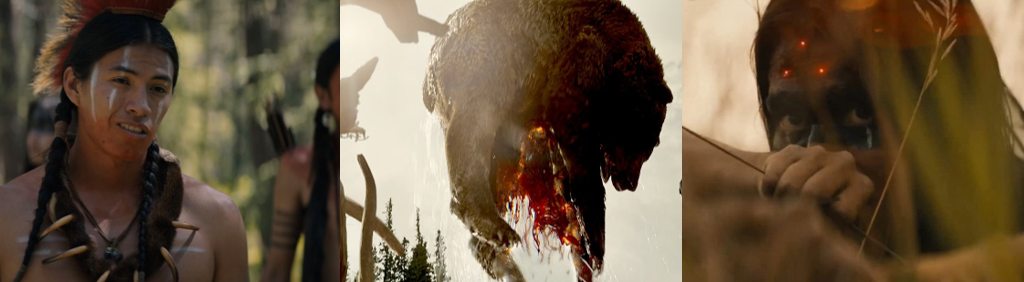
This Predator isn’t just about the wholesale slaughter of human beings; given when the film takes place and the many instances of primitive weaponry seen in the film, it’s possible that humanity hasn’t yet caught the attention of the alien hunters. Observing the local wildlife, this Predator stalks all prey, not just humans; it tracks a ravenous wolf, gutting and mutilating it to add another trophy to its belt. This Predator’s preference to fight up close with its prey makes it far more aggressive and susceptible to injury; the Predator wrestles with the grizzly bear with its bare hands, its wounds only fuelling its aggression, and seems to take great pride in showcasing its superior strength over the wild animal, holding it aloft to be drenched in its blood in a fantastically gory and striking shot. Having witnessed Wasape and Naru brawl and assessing the weaponry of the tribe, the Predator strikes, killing Wasape with its bolt gun and slicing off limbs, heads, and impaling Taabe’s kinsmen with its separatable combistick. Although it lacks the explosive impact of the traditional plasma cannon, the Predator’s bolt gun allows for some fun and bloody kills; it still uses the iconic red targeting system, but fires three arrow-like projectiles on a predetermined path. There are quite a few drawbacks to this primitive version of the plasma cannon; for one, it allows some leeway for its victims to potentially survive, and the targeting system comes back to bite the Predator in the finale but it’s an interesting way of showing how the Predator’s technology evolved over time and almost puts it on more equally ground with the primitive tribespeople. Although the French boast more advanced weaponry than the Comanche (and attempt to capture and kill the creature with traps of their own), the Predator’s superior strength and weaponry sees them all reduced to bloody corpses; the Predator sports its constricting net trap, electroshock bolas, a retractable bulletproof shield that also doubles as a razor sharp projectile, leaves its gauntlet behind as an explosive surprise, and even uses the humans’ own weapons against them by throwing a foothold trap right at a voyager’s head! Not to be outdone, Naru doesn’t abandon Sarii, even in the face of the Predator’s near-supernatural menace, when she’s held captive by the voyageurs, mercilessly killing them all with her roped tomahawk to get her to safety.

Naru uses all of her wiles and skills to outsmart and defeat the Predator and prove herself worthy.

With the French brutalised by the Predator, the mutilated Adolini begs Naru to help him and teaches her how to load and use his flintlock pistol; although she’s able to stem his bleeding and mask his body heat and he tries playing dead, he ends up dead anyway when the Predator steps on his body and stabs him when he screams. Taabe then rides in on horseback to attack the Predator with its own weapons; with his speed and skill with a bow, Taabe is able to land several shots on the Predator all while Naru struggles to load Adolini’s pistol in a strikingly effective commentary on the clunky inefficiency of then-modern technology compared to her tribe’s more direct methods. Unfortunately, Taabe is unable to kill or even mortally wound the Predator and Naru is forced to watch her brother be slaughtered right before her eyes. The last one standing, Naru takes a moment to expel her grief and anguish and then mounts her final stand against this seemingly unstoppable monster; ambushing the shellshocked Big Beard, she severs one of his legs and leaves him Andolini’s unloaded pistol to make him an easy target for the Predator as payback for him hurting her brother, then makes use of her herbs to mask her body heat and take the Predator by surprise. A bullet to the back of its head might only be a flesh wound to the alien hunter, but it’s enough to again expose its horrific visage (which is also a far cry from the usual Predator appearance) and allow her to steal its helmet, driving the creature into a vengeful frenzy. Naru prepares an elaborate trap around the bog using carved wooden spikes, not unlike Dutch’s later tactics, and places the helmet in full view to lure her prey in. While physically outmatched by the far larger and stronger creature, Naru’s speed, wiles, and determination see her strike with a wild tenacity, using herself as bait to draw the Predator closer on her own terms, a tactic that allows her to allow use its weapons against it and severe its right arm. While Wasape mocked Naru using her “leash” for her weapon, it proves vital in trapping the Predator in the quagmire of the bog; goading the creature using both Taabe’s and Dutch’s words, Naru tricks the Predator into firing its bolt gun at her, which sees its projectiles kill it instead. Exhausted and injured, Naru returns to her village with the Predator’s severed head and its blood splashed across her face like war paint; having proved herself beyond measure, she’s named as the new War Chief, but tribal paintings allude to the inevitable return of the alien hunters, if only to claim Adolini’s pistol…

The Summary:
For a movie that’s so visually and narratively removed from the Predator franchise, Prey does a wonderful job of getting back to the basics and roots of the series. Setting the film hundreds of years in the past and focusing on a primitive, but highly skilled and spiritual Comanche tribe, was a fantastic way of reframing the Predator narrative into a fresh and original presentation while still paying homage to the themes of horror and survival that made the first film as memorable as its abundance of machismo. Naru is a very strong and determined young woman, easily the equal of her more celebrated male rivals, and really comes across as a formidable opponent for the Predator thanks to her adaptability, intelligence, and ability to see what others miss. While I’m a sucker for well-armed protagonists getting picked off by a superior force because they rely too much on their weaponry, I really enjoyed the higher stakes on offer in Prey as everyone is using such limited and primitive weaponry. Even the French, with their cumbersome rifles and gunpowder, are no match for this, probably the most brutal and aggressive Predator that isn’t bulked up on steroids. This Feral Predator is a hands-on kinda guy, slaughtering whatever creatures take its fancy and sporting some unique, if primitive, technology alongside its more familiar toys. I can see why so many people praised Prey for being the best film in the franchise for some time; it’s definitely better than The Predator, and I’m really excited for the possibilities of other Predator films exploring other time periods, and overall this was a highly enjoyable horror that told an entertaining coming-of-age story and showed that there’s still life in this under-rated franchise yet.

My Rating:

Rating: 4 out of 5.

Great Stuff

Did you enjoy Prey? How do you think it compares to other films in the franchise? What did you think to Naru’s character, the obstacles she overcame and her solutions to those problems? Would you have liked to see more from the Comanche tribe and their society? What did you think to the Feral Predator, its different technology and its more aggressive personality? What time periods or situations would you like to see the Predator dropped into in the future? Which of the Predator sequels and merchandise was your favourite and did you celebrate Predator Day this year? Whatever your thoughts on Prey, feel free to leave a comment below or drop your thoughts on my social media.

Movie Night: Predators

This review has been supported by Chiara Cooper.
If you’d like to support the site, you can do so at my Ko-Fi page.

Released: 9 July 2010
Director: Nimród Antal
Distributor: 20th Century Fox
Budget: $40 million
Stars: Adrien Brody, Alice Braga, Topher Grace, Walton Goggins, Oleg Taktarov, Derek Mears, and Laurence Fishburne

The Plot:
Former United States Special Operations Forces veteran Royce (Brody) is just one of a handful of soldiers, criminals, and mercenaries forced to work together when they are suddenly deposited on an alien world that acts as a game reserve for two warring tribes of extraterrestrial killers.

The Background:
Predator (McTiernan, 1987) may have started life as the ridiculous concept of pitting Rocky Balboa (Sylvester Stallone) against an alien foe, but it quickly evolved from a B-movie with a budget that had Jean-Claude Van Damme running around a jungle in a big bug suit into a box office hit regarded as one of the best of its genre. After a long period of development, a sequel was finally produced, though star Arnold Schwarzenegger declined to return and Predator 2 (Hopkins, 1990) failed to match its predecessor’s box office despite positive reviews. Although the Predator franchise was well represented in comic books, novels, and videogames thanks to the efforts of Dark Horse Comics, it would be twenty years before a new movie was produced. However, producer Robert Rodriguez had actually pitched an idea for a third Predator film back in 1994, only to be rejected as his idea was too costly for the studio; although Rodriguez was surprised when the studio dusted off his script and contacted him about producing it some fifteen years later, he set about getting the wheels in motion for his new film, which aimed to ignore the sequels and crossovers that had followed the original classic. Although Schwarzenegger again declined to be a part of the project, Rodriguez and director Nimród Antal put together an ensemble cast that audiences would journey alongside, and drafted KNB EFX’s Howard Berger to design the creatures’ new suits, which were purposely designed to be faithful to Stan Winston’s original creature designs. With a $127.2 million box office gross, Predators was a minor hit that received mixed to average reviews; some praised it as a solid follow-up to the original while others criticised the characters as mere cannon fodder. Disappointingly, this meant that Predators became another under-rated entry in the franchise and hopes for a direct sequel were quashed when the studio again opted for a soft re-quel to the first film in 2018.

The Review:
I remember being really excited when Predators was announced. Although it took me some time to appreciate Predator 2, I was a big fan of the series and never quite understood why it hadn’t received the same amount of love as the Alien franchise (Various, 1979 to present) when it came to live-action films. Hell, I even enjoyed AVPR: Aliens vs. Predator – Requiem (The Brothers Strause, 2007) simply because it meant seeing the Predator on the big screen and in a central role, so my anticipation was quite high for this re-quel, which hits a lot of the same beats as the influential first film while taking the franchise in an interesting direction. We see these call-backs to Predator throughout the film (one of their unfortunate victims lays traps that are almost exactly the same as those set by Major Alan “Dutch” Schaefer (Schwarzenegger) in the first film, and the first film’s events are explicitly referenced at one point) but they’re actually thrust right at the viewer’s face right from the beginning when the familiar title font flies onto the screen alongside Alan Silvestri’s iconic Predator theme, which composer John Debney samples and draws heavily from for the remainder of the movie.

Royce starts off as a cold-hearted survivor willing to whatever it takes to escape the game preserve.

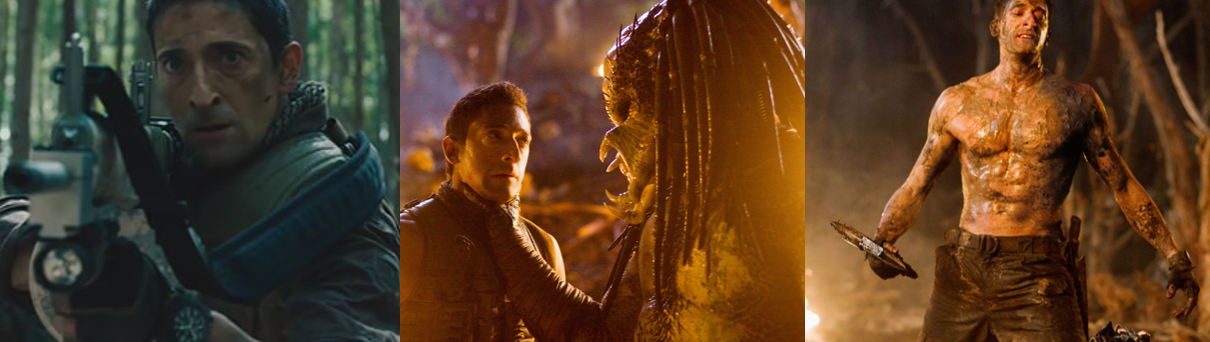
Also like the first film, Predators is very much an ensemble piece built around soldier-turned-mercenary Royce, a gruff and highly adaptable individual who is the first character we’re introduced to (but, because of his guarded nature, the last character whose name we learn). Rather than being a musclebound beefcake armed with a variety of one-liners or a jaded city cop, Royce is a much more realistic type of soldier; wiry and tough, he carries himself in a much more believable way and reacts to his unbelievable situation far more calmly than the other characters, who greet each other with hostility and even gunfire. Royce’s entire mindset seems to be centred around a philosophy of “simple, but effective”, which is reflected in his choice of weapon, an AA-12 automatic 12-gauge shotgun that delivers high-impact rounds to shred his targets. Although he is reserved about opening up to the others, he immediately takes charge of the group and tries to figure out where they are and what’s happened to them simply because he needs all of the knowledge and information he can gather to best figure out a game plan for survival…and to escape. His first instinct is to get to high ground, and he doesn’t really care whether the others follow him or not since he much prefers to work alone. Surly, perceptive (he immediately identifies each character’s background and speciality), and reluctant to bond with the others, Royce is nevertheless easily the most composed of the group and a bastion of common sense and adaptability. His character arc is learning to actually give a damn about others as he’s only teaming up with them for extra firepower, muscle, and to give his foes other targets to hit; secretive and deceitful, Royce has no qualms about using the others as bait to either draw out or better understand their enemy, readily leaves the doomed behind, and even makes a deal with the “Classic Predator” (Mears) to ensure his escape from the planet in exchange for freeing the creature.

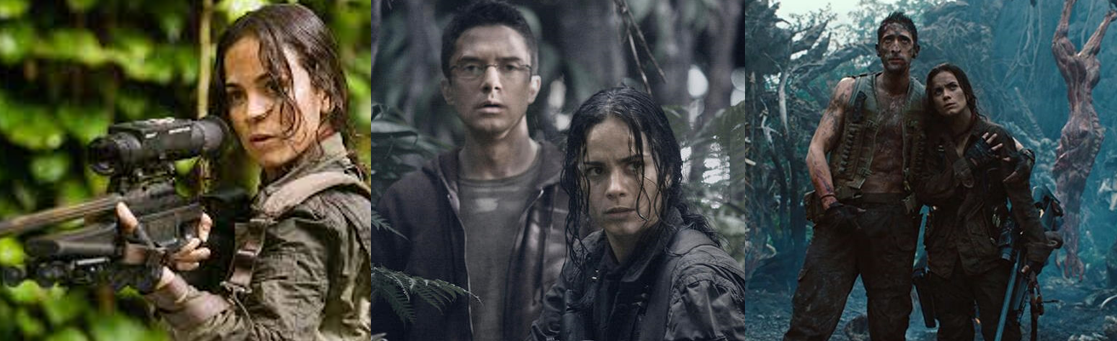
Isabelle plays peacemaker and believes their greatest strength is their compassion and humanity.

In comparison, Isabelle (Braga) is much more compassionate; although she has her suspicions about the others upon first sight, she goes along with them simply because she has no other options available. A highly trained sniper from the Israel Defense Forces, Isabelle has “seen most” jungles and is the first to realise that they’ve been dumped in a place that is beyond their expertise simply based on the heat and the topography. While she’s the only female character within the group, she’s just as tough and capable of any of them and isn’t treated with kid gloves or ever presented as a damsel in need of rescue; she’s more than proficient in a firefight thanks to her sniper rifle but, more than any of the others, assumes the role of a peacemaker in order to emphasise that they need to work together to survive. Isabelle also brings a level of knowledge to the group that the others lack; since she’s aware of the events of the first film, she knows something of the Predator’s appearance and tactics, which gives Royce the additional information he requires to be able to prepare for the creatures and even battle the “Berserker Predator” (Derek Mears) in the finale. Isabelle is the most compassionate of the group; she believes that helping others is a sign of strength rather than weakness, which often causes her and the more cold-hearted Royce to butt heads as he’s perfectly happy sacrificing the others, putting them in danger, or leaving them behind when they’re injured or dying as long as it means he (and whoever’s left) survives a little while longer. This means she faces an uphill battle with Royce, who’s callous nature makes him almost as bad as their extraterrestrial foes, but her compassionate nature ends up biting her in the ass; when Edwin (Grace) is injured by a Predator trap, Isabelle insists on helping him, unaware of his true malicious nature, and is thus left relying on Royce, who ends up being more loyal and dependable than is first evident.

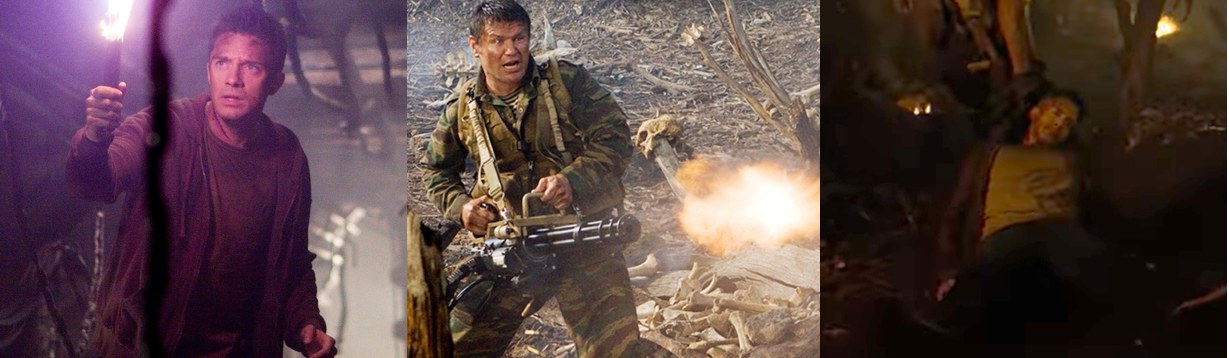
Nikolai protects Edwin out of gratitude, allowing him to deceive the others of his true, sadistic nature.

Edwin and Nikolai (Taktarov) form a friendship after the self-proclaimed doctor keeps him from being poisoned. Though a large, intimidating man who cuts a formidable figure with his high-powered M134 Minigun, Nikolai is softened by his family and his gratitude towards Edwin, who he protects as thanks for saving his life and since he (as in Edwin) seems so defenceless and out of place there. At first, Edwin seems to have been placed amongst the group as a kind of field medic to give them a fighting chance against the Predators on the alien world; his medical and botanical knowledge come in handy, but he’s crippled by fear and is largely a burden to the group since he has no combat experience. Although he seems to be just a normal man surrounded by trained (or compulsive) killers, with little in common with them (which is fantastically evident in his amusing “bitch raping” talk with Stans (Goggins)), he eventually proves to be a wily and sadistic character in disguise. The first cracks in his façade appear when he leaves Nikolai to be skewered by the “Tracker Predator” (Carey Jones) and left with no choice but to blow himself and the creature up with grenades. While you could argue that Edwin stood no chance of helping his brutish Russian buddy, he later appropriates a photo of Nikolai’s family as a means of guilt-tripping Isabelle into helping him when he’s injured by a Predator trap before revealing the true extent of his twisted nature in a surprise development in the final act. It turns out that Edwin is a devious and perverse serial killer who has been manipulating and using the others as protection and has no desire to leave since he feels at home amongst the monsters. While this serves him well, since he manages to survive for most of the film, his attempts to find a kinship with the Predators naturally fall on deaf ears and he pays for his betrayal by being left as an explosive boobytrap for the Berserker Predator.

The others are colourful cannon fodder, with Stans and Hanzo being standouts for their eventual ends.

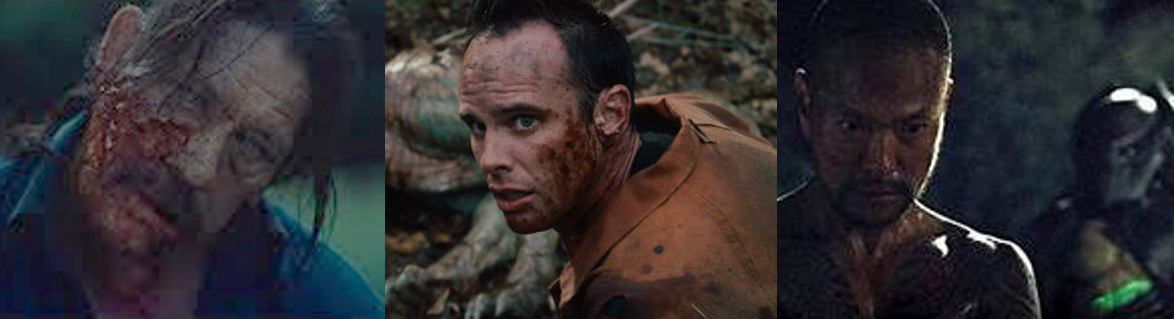
The others are largely cannon fodder but have enough personality to stand out, even if they have smaller roles in the grand scheme of things. Unlike the soldiers from the first film, this is a rag-tag group of volatile egos and machismo; many of these guys have committed unspeakable acts, either in service of their country, a revolution, or for their own gratification, which leads to a lot of conflict within the group. While Mombasa (Mahershala Ali) and Cuchillo (Danny Trejo) don’t get too much to do beyond looking tough and being slaughtered, Mombasa provides some insight into the Predators’ ritual taking of trophies and the use of Cuchillo as bait to lure in the others is a harrowing scene that tells us a lot about the enemy’s tactics and the different morals of the other characters (Royce Mombasa, and Stans recognises it’s a trap and opt to leave him; though Isabelle disagrees, she can’t fight the facts and opts to at least deliver a mercy kill). Perhaps the most mysterious of the bunch is the soft-spoken Hanzo (Louis Ozawa Changchien), a Yakuza Inagawa-kai enforcer who keeps his distance and masks his footsteps by removing his shoes. He stands out from the others thanks to being a largely silent character who exudes a quiet, confident danger through his piercing eyes and severed fingers; similar to Billy Sole (Sonny Landham), Hanzo embodies the honour code of the Predators and even battles one sword to sword to buy the others time, claiming a life at the cost of his own. Stans is also a standout character; when he’s first introduced, he’s in a scuffle with Mombasa, immediately emphasising that he’s a highly aggressive character. Essentially the slimy, loudmouthed shithead of the group, Stans is an unpredictable death row inmate who is confrontational, highly sceptical, and constantly criticising every decision, which only aggravates the group and causes tensions to be strained to breaking point. While the others are hesitant to trust each other, nobody trusts him, though he actually ends up showing a surprising amount of humanity (he is disgusted that Royce set them up as bait and thus caused Mombasa’s death, showing that his priorities have quickly changed since he was ready to kill the man not long before) and backbone as he takes on the Berserker Predator despite being hopelessly outmatched.

Ronald is the film’s breakout character thanks to his fractured mind and appropriated Predator tech.

Then there’s the film’s breakout character, Ronald Noland (Fishburne), a former United States Army Air Cavalry soldier who’s been stuck on the planet for so long that he’s gone a little loopy. Having killed a couple of the Predators and appropriated their technology, Ronald observes the main characters from a distance using their cloaking ability and has holed himself up in the remains of an alien spacecraft. Talking in barely a whisper and keenly aware of the Predators’ tactics and techniques, Ronald is only too aware of the lengths one has to go to in order to survive against such a well-armed foe; indeed, a great deal of his mental instability is hinted to be because he chose to run and hide rather than fight alongside whoever he was first dropped there with. Having been stuck there for a long, long time, Ronald has developed a split personality and often talks (and argues) with himself after having been driven to madness from isolation and the constant threat of danger. At first, Ronald seems welcoming and accommodating; he admonishes the group for talking too loud and unknowingly giving their position away, but takes them in despite Stans’ bad attitude; he shares his food and water and even relates some of his knowledge to them, allowing them (and us) to learn how the Predators change and adapt with each cycle and the blood feud between the different Predator variants. All too soon, however, Ronald shows his true colours and tries to kill them, which ironically proves to be his undoing as he’s unceremoniously killed off with a single headshot. Having dug in and done whatever he can to survive, Ronald has been driven to edge from approximately ten years of isolation and conflict; believing that there’s no way off the planet since the idea of piloting an alien spacecraft is ludicrous even to him, Ronald is so far gone that he’ll lure in his own kind just to steal their resources so he can survive a little longer. It’s a shame Ronald didn’t last longer as he was an intriguing character and I think he deserved more of a payoff than he got; the Predators don’t seem to be actively hunting for him, and he doesn’t get a cathartic one-on-one showdown with any of them, meaning his end is pretty unceremonious, so I would have loved to see his character explored in some kind of prequel comic or book.

The Classic Predator is physically outmatched by the far superior Super Predators.

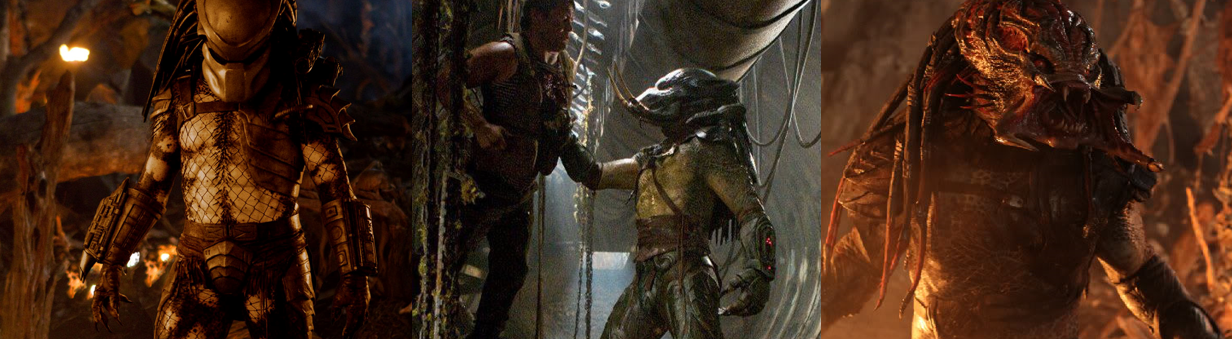
Predators expands on the titular alien’s lore and society in ways that have never really been seen before on film; previously the hunters came to Earth as a kind of workman’s vacation, basking in the heat and the chaos of our world to claim trophies or using us as incubators to bred the ultimate prey. Now, we learn that the aliens also regularly abduct killers and soldiers to be placed on their game world and hunted en masse in groups of three, which fundamentally alters the previously established portrayal of these creatures as solo hunters looking for a quick thrill on an alien world. Picking only the best prey for their game hunt, the Predators stalk them from afar as normal, but also unleash alien “attack dogs” to lure them out, and have clearly been bringing humans and other species there for a long, long time based on what we learn from Edwin and Ronald. Thanks to the jungle setting and the slower pace of the first half, much of the film heavily emulates Predator, retreading the same ground but in a new, fresh way while also acknowledging the events of the first film (though not the second, despite taking weapons and lore from that film). Nowhere is this more evident than in the traps laid by one of their victims, which as I mentioned are exactly like Dutch’s and kind of give the impression that Dutch’s tactics would not serve him well in this new environment. Not only that, there are now two groups of Predators and there’s a fascinating class warfare between the species; if you’ve seen the other films, you know how tough the Predator is so seeing the Classic Predator strung up and helpless is similarly a great shorthand to how formidable these new “Super Predators” are. These larger, far more fearsome Predators exhibit an even greater level of intelligence than their predecessors; utilising drones, attack dogs, and proving that their cunning and ferocity only increase with each season. While their technology remains largely the same, based around bladed weapons and plasma cannons, Ronald notes that they tweak and improve these with each batch of prey, clearly showing that they learn from their experiences, but even the Berserker Predator still craves the thrill of the old ways and engages in unarmed combat with Royce for the finale, and proves just as susceptible to mud and smoke and mirrors when left without the advantages of its technology.

The Nitty-Gritty:
Another way in which Predators borrows from the first film is in its building of tension; while Dutch’s group were a tight-knit, well-oiled team, these guys are one bad argument away from turning on each other, which keeps a thick layer of tension throughout the film, but especially in the first half. This is only exacerbated when Mombasa senses a Predator watching them from the trees, and the continued use of the first-person heat vision and the voice emulation of the titular hunter once again effectively builds a sense of dread and horror as both the knowing and unknowing audience would be just waiting for the creatures to reveal themselves and strike. A central theme in the movie is that of distrust and the nature of humanity; the Predators are overtly alien and monstrous, both in appearance and their ritualistic methods, but humans are much more adept at hiding their monstrous nature behind metaphorical masks. Even Royce, who openly admits to having employed similar tactics to flush out or overcome his enemies, has a darkness within him that means he’s ready to leave the others behind if it means escaping the planet. He’s interested only in surviving by any means necessary, but is determined not to end up like Ronald, whose desperate need to survive has driven him to madness. Edwin masks his true nature behind a mask of cowardice and helplessness but is, in fact, the most monstrous of all the main characters, even someone as reprehensible as Stans, to the point where he callously admits to feeling more at home amongst a planet of monsters than amongst his fellow man.

The Predators use attack dogs and tech to stalk and draw out their prey, while also being in a blood feud.

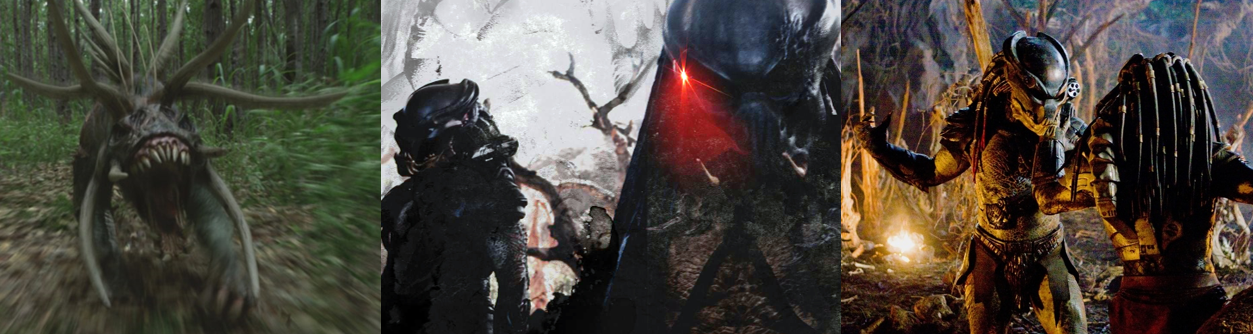
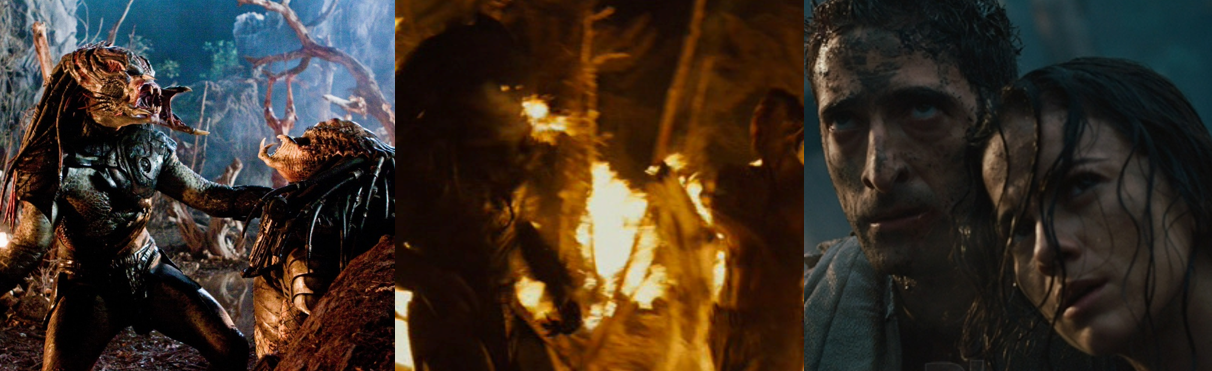
Although they’re all heavily armed and formidable individuals in their own right (even Edwin, who survives due to conning the others into believing he’s something he’s not), the characters are hampered by limited resources and a hostile, literally alien environment. At first, they try to piece things together and are stunned to find they’re on another world, but their first instinct is to blast at the alien creatures that come their way, leading to a number of highly engaging firefights. The action ramps up in a deliberate pace, building alongside the tension as the characters scramble to escape Ronald’s hideout and find the Predators far more formidable than their attack dogs. Naturally, Predators is bolstered by some brutal kills and vicious bloodshed; the Tracker Predator not only nonchalantly blows Ronald’s head off, it also stabs Nikolai in the back and leaves him hanging on the end of its clawed gauntlets. Cuchillo’s eviscerated corpse is left as bait for the others, Stans ends up having his spinal column and skull wrenched from his still living body and, perhaps to make up for Billy’s offscreen death in the first film, Hanzo engages in a sacrificial swordfight with the “Falconer Predator” (Mears) that leaves them both dead. We even get some violent Predator-on-Predator action in the finale as the Classic Predator battles with the fearsome Berserker Predator in a knockdown brawl that sees the iconic creature overpowered and ultimately beheaded by its physically superior counterpart. While the Predators are limited to four in the film, each one has a distinct look, as is to be expected from these creatures; as you also might expect, the Classic Predator is the most recognisable, and looks almost exactly like his counterpart from the first film, but these Super Predators are even uglier motherfuckers under those masks, with the Berserker Predator appearing far more monstrous once it takes its helmet off. We also get a couple of other alien creatures here, as the Predators send out tusked attack dogs to give the main characters something to shoot at and Edwin is used as bait to draw out the “River Ghost”, a humanoid alien that has some similarities to the Predator’s original design.

After the Classic Predator is killed, Royce uses all his intel to battle the Berserker Predator to the death.

When Edwin is maimed and left as dead weight for Royce and Isabelle, Royce callously opts to leave them both behind in a desperate bid to escape the game preserve by freeing the Classic Predator and having it fly them to safety. The Classic Predator, itching to settle the score with the Berserker Predator, honours the deal by setting the ship to autopilot back to Earth and goes one-on-one with its larger rival. Unfortunately, the Classic Predator’s no match for the Super Predator and Isabelle is stunned when Edwin drugs and paralyses her with a neurotoxin from an alien plant and coldly reveals his true nature as a sadistic murderer to her. Although Royce appears to die when the Berserker Predator destroys the spaceship, it turns out he had a change of heart and came back for them, proving he has some humanity beneath all his tough-guy swagger. He also proves to be craftier, and faster, than Edwin anticipated, stabbing and leaving the would-be doctor as a prime target to lure out the Berserker Predator. Having observed his foes throughout the film, and taken onboard everything he’s learned from them (and from Isabelle and Ronald), Royce wounds the Berserker Predator, uses fire to disorientate it, and cakes himself in wet mud to help neutralise the creature’s infrared vision. Striking hard and fast with an axe, Royce seems to have the upper hand but underestimates the capabilities of the Predator’s helmet, and he’s soon left taking a beating from the creature. Luckily, Isabelle manages to wound the Berserker Predator with a sniper shot, giving Royce the chance to recover, pummel the alien with his axe, and ultimately decapitate it to prove himself the superior of the two. Wounded, tired, and haunted by their experiences, Royce and Isabelle are left facing the prospect of a new crop of prey being dropped in for the hunt but nevertheless determined to find a way off the game planet.

The Summary:
Honestly, I can’t stress enough how much I enjoy Predators; as much as I like to see the Predators in new environments in each film, recreating the jungle theme of the first one by setting it on an alien world was a great way to evoke the spirit of that iconic movie while still providing something new for long term fans. There’s also enough breadcrumbs here to inspire newcomers to check out that first movie, but sadly (and honestly confusingly) no mention of the events of the second film despite the fact that the Predators use weapons introduced in that movie. Still, the focus is clearly on paying homage to and replicating what made the first film so great but with different circumstances and far more volatile characters; this can be seen all throughout, with the score, the narrative beats, and even the dialogue all being direct references to that first movie, but the presentation and conditions are just different enough that it never feels like a cheap knock-off or a simple remake. Adrian Brody is surprisingly convincing as a tough, gruff mercenary; Royce is an intelligent and versatile character who has great instincts and a strong urge to survive, but also finds his humanity again by the end of the film. The others are equally larger than life; even those with small roles shine in their own way by contributing some entertaining character moments or helping to spread the exposition across the film’s runtime. Ronald remains one of the most intriguing characters in the franchise; I’d love to see the degradation of his mind and spirit chronicled in a comic book some time, and I think the only way it could’ve been better is if he’d stuck around a little longer or even been a returning character. The Predators themselves naturally steal the show at every turn and their species is expanded upon nicely here, with some elements (like the differing Predator classes) bleeding into the next film. Indeed, one of the main reasons I was so disappointed by The Predator (Black, 2018) was that it didn’t tie up the cliff-hanger ending of this film; hell, I would’ve settled for Royce and Isabelle being the cargo the “Fugitive Predator” (Brian A. Prince/Kyle Strauts) was protecting in that film. Sadly, Predators seems to have been largely forgotten these days, and that’s a real shame as it’s a really good film that does a great job of putting a new twist on the classic formula and I’d love to see this concept and character revisited and expanded upon at some point down the road.

My Rating:

Rating: 5 out of 5.

Fantastic

Did you enjoy Predators? How do you think it compares to both the first film and the others in the franchise? Which of the characters was your favourite, and who would you have liked to see get a bigger role? Would you have liked to see Ronald’s character explored further, and were you disappointed that Predator 2 wasn’t referenced? What did you think to the Super Predators and the way the film expanded upon the creature’s lore? Would you have liked to see a direct sequel to this film? Which of the Predator sequels and merchandise was your favourite and did you celebrate Predator Day this year? Whatever your thoughts on Predators, feel free to leave a comment below or drop your thoughts on my social media.

Back Issues: Predator #1-4

This review has been supported by Chiara Cooper.
If you’d like to support the site, you can do so at my Ko-Fi page.

Story Title: “Concrete Jungle”
Published: June 1989 to March 1990
Writer: Mark Verheiden
Artist: Chris Warner and Ron Randall

The Background:
In 1980, Mike Richardson founded Dark Horse Comics, a comic publisher that separated itself from the heavy-hitters like DC Comics and Marvel Comics by focusing its efforts on creator-owned titles. Dark Horse Comics achieved greater mainstream success in 1988 by publishing licensed stories and adaptations of horror and science-fiction films and franchises, the most prominent of these was the merging of the Alien franchise (Various, 1977 to present) and the Predator films (Various, 1987 to present). However, concurrent to writer Chris Warner’s three-issue clash between those two, Dark Horse Comics also published this four-issue spin-off of the Predator franchise, specifically revolved around the hitherto-unknown brother of Major Alan “Dutch” Schaefer (Arnold Schwarzenegger), later retitled to “Concrete Jungle”. Perhaps bolstered by the crossover between Aliens and Predator, “Concrete Jungle” proved popular enough to spawn not only a slew of additional Predator spin-off comics and movie adaptations, but also crossovers with other comic book icons such as DC Comics’ superheroes and even lawman of the future Judge Joseph Dredd. While the Predator movies have often been met with mixed reviews, comic book adaptations continued to be published, with the alien hunters even crossing over into Marvel Comics after Disney purchased 20th Century Fox.

The Review:
Much like Predator 2 (Hopkins, 1990) “Concrete Jungle” is set in an overpopulated and crime-ridden city during a stifling heatwave that drives its citizens to violence and even murder. In this case, we’re in New York City and following police detectives and long-term friends and partners Errol G. Rasche and John Schaefer, Dutch’s older brother who got them transferred from narcotics to homicide after tossing a cartel chief off a rooftop. While Rasche is convinced this is a conspiracy headed by their corrupt police captain, McComb, to have them offed by local gangs, Schaefer’s more concerned about the stars looking “different” than either their current situation or the escalating drug problem sweeping the city streets. This nicely segues to a tense meeting between two rival gangs, headed by Lamb and Carr; while Carr advocates for them joining forces to maximise their profits and fend off Columbian cartels, Lamb would much rather fight to the death and see who’s left to reap the rewards. Just as an all-out gunfight is about to break out, one of Lamb’s men is blasted from behind by the Predator’s plasma cannon; another is diced up when he sticks his head out the window and, assuming it’s an attack by the Columbians, both gangs open fire and blow a hole in the building wall. The fracas draws the attention of the cops but, when Rasche and Schaefer arrive, they’re barred from entering the building until Captain McComb arrives.

Stubborn Schaefer ignores all the warnings and ends up going toe-to-toe with a Predator.

Just like the hot-headed Lieutenant Mike Harrigan (Danny Glover), Schaefer doesn’t really give a damn about McComb’s authority and he and Rasche head on in after one of the gang members is hurled from a window and crashes into a police car. Inside, they’re horrified to find the remains of the two gangs littering the floor and strung up, skinned, from the ceiling. Carr, who somehow survived the massacre, opens fire, blaming the cops for what happened, and manages to slip away right before Special Weapons and Tactics (S.W.A.T.) come crashing in, led by an incensed McComb. Pissed that Schaefer disobeyed a direct order, McComb continues the homage retread of Predator 2 by chewing the blonde-haired muscleman out for overstepping his boundaries. Later, Rasche and Schaefer investigate a wholesale slaughter in the subway, again covering the same ground as Predator 2 and seeing McComb reprimand them despite the fact that they’re literally just responding to calls rather than actively involving themselves in the investigation. This time, however, McComb’s orders are overruled by the appearance of General Homer Philips, Dutch’s former commanding officer from the first movie, who takes Rasche and Schaefer aside to warn them off out of loyalty to Dutch. While we’re never told what happened to Dutch or where he is, he clearly told General Philips enough about his big brother and the Predator for him to step in, for their own safety, assuring them that it’ll all be over in about two weeks if they don’t interfere. Realising that the gruesome murders are somehow connected to Dutch, Schaefer naturally ignores these warnings and breaks into Lamb’s apartment, now a crime scene, where he’s blindsided by the Predator. A fist fight breaks out, one naturally one-sided, that sees the Predator place a curious implant into Schaefer’s neck and him managing to steal the creature’s helmet after smashing it off with a piece of timber.

Schaefer’s search for answers takes him to South America, where he easily scores his first Predator kill.

For his efforts, he’s left with a broken nose and sent plummeting to the street below; he’s saved from death only by grabbing on to and tangling himself up in washing lines conveniently hanging between buildings. Despite being left a bloody mess, his snark remains intact, but his doctor is unconvinced by the paper thin explanations the two give for the brute’s injuries. Stubbornly refusing to take the time to rest, Schaefer limps his way over to Rasche’s home where he suggests that the Predator tagged him to keep track of him for later and insists that they try to find General Philips so they can get some real answers. Their efforts are interrupted by a furious McComb, but when he threatens to have Schaefer brought up on charges, the hulk lashes out, smashing his telephone, ramming McComb against the wall, and threatening him with further violence if he doesn’t give up General Philips. However, McComb is too low on the totem pole to help; as far as he’s concerned, General Philips doesn’t exist, there is no investigation, and all of it is far above his paygrade. With no other leads to go on, Schaefer decides to fly out to South America, Dutch’s last known location, and look for answers himself despite the danger posed to him by the Columbians he’s pissed off. He finds himself a guide in a seedy bar in Riosucio and is led to first the overgrown remains of the guerrilla camp Dutch and his team ransacked in Predator and then the massive crater left over from the Predator’s (Kevin Peter Hall) self-destruct device. At night, Schaefer reminisces about his childhood with Dutch (the two of them used to hunt in the woods, not for sport or fun but to test their mettle against nature) and arms himself with a fully automatic shotgun when his neck implant alerts him to the Predator’s presence. Although he’s able to dodge the Predator’s plasma cannon and even land a shot on the creature’s shoulder, Schaefer’s caught off-guard by the Predator’s cloak; still, he’s able to stab it in the ribs before being manhandled. Schaefer’s as quick with his wit as he is with his thinking, though, and tosses salt in the Predator’s eyes before beating it with a log, successfully knocking it over a cliff edge and causing it to be impaled on a spike-like tree branch.

In the face of a Predator invasion and military cover-ups, Schaefer seeks allies in low places.

Schaefer’s less than surprised when it turns out that his guide was one of General Philips’ men, who’s distraught that Schaefer killed the creature and even suggests that Philips knew about the Predator when he sent Dutch into the jungle. As he forces Schaefer to face General Philips, chastising him for not understanding the implications of killing one of the alien hunters, they’re attacked by Columbian drug lords, who kill the guide and manage to knock Schaefer out. Although Schaefer’s able to fight his way out before he can be tortured, a whole gang of Predators strikes the drug camp, wiping out the Columbians with their plasma cannons and setting the base on fire. Thankfully, General Philips arrives to help get Schaefer out of there and back to New York, where Philips confirms that he’s known about the Predators all along and that they seem to be fixated on Schaefer and his brother. Meanwhile, Rasche messes about with the Predator’s helmet and, when he puts it on, figures out what’s been screwing with television receptions and the stars when he sees a whole fleet of cloaked Predator ships hovering throughout the city skyline! When he attempts to warn McComb, the police captain shoots him down and threatens him with jail for withholding evidence and he’s taken into custody by agents of the Inland Revenue Service acting on behalf of the Federal Bureau of Investigation (FBI). When he realises that the Feds mean to hand Schaefer over to the Predators, Rasche is able to take advantage of the accountants’ penchant for numbers to overpower them and load up at the station armoury. Showing little concern for the safety of New York, Schaefer knocks Philips out and forces his chopper to land so he can reconvene with Rasche but, realising that they’re outgunned and outmatched against the alien menace, Schaefer goes to Carr to recruit him and his gang.

Just when all hope seems lost, the Predators just…decide to leave and the conflict is over.

Although he’s naturally suspicious of the cop, Carr is immediately attacked by a Predator; when Schaefer struggles to fend off the Predator, Rasche arrives and blows it away with a bazooka, convincing Carr to set aside their differences to combat the alien invasion. The Predator ships open fire, bombarding the city with devastating laser blasts but Schaefer and the others manage to escape to safety and get their forces together to make a final stand against the invaders. Schaefer draws first blood, using the Predator helmet to direct Carr in bringing down a Predator ship with a single rocket, somewhat undermining the threat of their advanced technology and looming ships. Their efforts catch the attention and anger of Captain McComb, who surrounds the immediate area and calls for their surrender but, just as McComb is about to gun Schaefer down in the street, a Predator ship decloaks and opens fire, resulting in McComb getting his face blasted off by a Predator’s plasma blast. Schaefer’s helmet is damaged after he goes off all gung-ho and Rasche is injured by a plasma shot before General Philips and the army turn up, only to reveal that the military is preparing to launch a massive air strike that will level the city and lay waste to both the populace and the “foreigners”. Schaefer targets fire hydrants to short out the Predator’s technology, revealing their ground forces and allowing him and his allies to take the fight to them, but the Predators quickly overpower even Schaefer. However, they burst into laughter when they see the incoming choppers amidst a dark, rainy sky. Schaefer finally pulls his neck implant out as the Predators leave, theorising that the weather has turned too cold, and the situation has escalated so far that there’s no sport to be found in New York anymore. Schaefer vows to see them again the next time it grows unseasonably hot and ignores General Philips’ scolding to get Rasche to safety, showing little consideration for the state of the city.

The Summary:
While the artwork of “Concrete Jungle” is pretty good, with Schaefer appearing as a good facsimile of Arnold Schwarzenegger and New York City mimicking the aesthetic of Predator 2, the writing and narrative leaves a lot to be desired. Although Dutch dropped a couple of situational one-liners, he wasn’t some cliché, snark-spouting machine; his older brother, however, has almost John McClane (Bruce Willis) levels of sarcasm and is never short of a wry remark no matter how desperate the situation is. This is fine for a one-dimensional action hero and helps to differentiate the elder Schaefer from his brother, but it doesn’t always land for me; it doesn’t help that he’s motivated not out of a desire to serve and protect but more to test his own limits. A proud man with little regard for authority, he sees New York as an unsalvageable cesspool and he simply rises to the challenge when the Predators arrive, sensing their presence even before he’s forcibly implanted with their relatively unexplained and ultimately pointless neck device. In many ways, Schaefer is a mixture of Dutch’s musclebound bravado and Harrigan’s weathered, roguish character; he bursts into crime scenes, shows up where he’s not wanted, and openly defies both his superior and the American military, just like Harrigan, while throwing his muscles around and being a driven man’s-man just like his younger brother. Unfortunately, these elements come together in a way that doesn’t really gel for me; “Concrete Jungle” has a really interesting premise that it just squanders in favour of recreating or referencing events from the first two Predator films.

The story contains a few too many callbacks to the films and completely upends General Philips’ character.

I really like the idea of the hunters arriving on Earth en masse; the visual of characters wearing their helmets, being horrified at the sight of the fleet, and the Predator ships opening fire upon New York City and swarming the streets is a striking one and a natural escalation from the existing movies that only comics can provide since they’re unconstrained by budgets. But all the potential of these plot points isn’t realised until the final few pages of the last issue and, instead, the bulk of the story is spent on a rehash of the main plot elements of Predator 2. Like Los Angeles, New York is a grimy city in the middle of a gang war about drugs that involves a lot of violence, and, like Harrigan, Schaefer has no time for the red tape surrounding this and wants to bring both gangs down. The Predator not only slaughters both gangs much like in the opening moments of Predator 2 but even randomly attacks subway passengers, just like in that film; McComb’s anger at Schaefer is a combination of Special Agent Peter Keyes (Gary Busey) and Deputy Chief Phil Heinemann (Robert Davi), and the general visual and narrative thrust of the first two issues is geared very much towards recreating sequences of Predator 2, robbing “Concrete Jungle” of much of its identity. The story then finds a contrived reason to ship Schaefer over to South America for literally no other reason than to reference events from the first film; it turns out that he’s right and General Philips is there, but this could’ve just as easily taken place somewhere else, and Dutch’s actions could’ve been represented by pictures and dialogue rather than literally having Schaefer stand in that crater. I enjoyed the return of General Philips, a character I would’ve loved to see make a return in a hypothetical Predator 3 back in the nineties, and it was interesting learning that he was aware of the Predator before sending Dutch in, effectively turning him into a Keyes substitute.

Some good art and action doesn’t make up for a squandered plot and diminished Predator threat.

I can’t say I actually enjoy this twist, though; the brief interaction between Dutch and Philips spoke to me as two old friends who have an immense amount of respect for each other, and nothing in Predator suggested that he (or anyone apart from Anna Gonsalves (Elpidia Carrillo)) was aware of the Predators. In fact, the prevailing understanding is that the world (or, at least, the government and military) only became aware of the Predators after that first film and I found it a bit disappointing and frustrating to find out that Philips was happy to sacrifice his best soldier and close friend to the alien hunters. Of the two protagonists, Rasche gets quite a bit of development; we see his home, learn and see a little from his family, and he’s much more concerned with the implications of their actions compared to Schaefer; it’s also through him that we learn anything about Schaefer for some time, as surface-level as it is, so I was glad that he didn’t die, especially as it seemed like he was going to. Then there’s the Predators; modelled after the ones seen in the first two movies with little deviations, they sport very little new weaponry or technology, and their threat has been significantly downplayed. Naturally, in a one-on-one fight, not even Schaefer can stand against one of them, but he is able to wound them, knock one of their helmets off, sense their presence even before he gets his neck implant, and is able to kill one much easier than either of the films’ two protagonists. Schaefer can dodge their plasma cannons pretty easily, regularly fights them off with melee weapons, and never has to worry about their wrist blades, combisticks, or other weapons as these either don’t get much play or are only used against disposable background characters. The ending was also extremely anti-climactic; with all of New York under siege and the human characters vastly overpowered, the battle/invasion/whatever just…ends because of a bit of rain and the suggestion that the Predators just wanted to goad humans into destroying each other. It’s a bit vague and very unfulfilling for an ending, with the only consolation being that it didn’t end the same way as the films (with a one-on-one fight against a Predator) but, in this case, maybe it should’ve as it seems like the Predators were just messing about and never intended to wipe out the city (and/or humanity) despite clearly being able to with their superior force (…as long as you ignore how easily Carr took down one of their ships…)

My Rating:

Rating: 2 out of 5.

Pretty Good

Have you ever read the original, four-issue Predator story? If so, what did you think to it? Do you own a copy of the original comics or did you pick up the collected edition? Were you also disappointed by repetition of events from the first two movies? What did you think to John Schaefer, especially compared to his little brother, and the revelation that General Philips knew about the Predators? Were you disappointed that the story didn’t do more with the Predator invasion plot or did you enjoy the callbacks to the first two films? Which of Dark Horse’s Predator stories or adaptations was your favourite? Whatever your thoughts on Predator, and comic book adaptations of this kind, drop a comment down below or share your thoughts on my social media.

Movie Night [Crossover Crisis]: AVPR: Aliens vs. Predator – Requiem


In April 1985, the first issue of the ground-breaking Crisis on Infinite Earths (Wolfman, et al, 1986) released and saw the temporary destruction of the “Multiverse”. To celebrate this momentous event, I’m discussing multiversal crossovers all throughout April in an event I dubbed “Crossover Crisis”.


Released: 25 December 2007
Director: The Brothers Strause
Distributor:
20th Century Fox
Budget: $40 million
Stars:
Steven Pasquale, Ian Whyte, Johnny Lewis, Reiko Aylesworth, Kristen Hager, and Tom Woodruff Jr.

The Plot:
Following the last clash between Xenomorph and Predator, a “Predalien” (Woodruff Jr.) hybrid begins a bloody rampage in a small Colorado town. While former convict Dallas Howard (Rasquale), his troublesome younger brother Ricky (Lewis), and soldier Kelly O’Brien (Aylesworth) desperately try to survive as their town is overrun with viscous alien drones, a lone Predator, “Wolf” (Whyte), is dispatched to remove all traces of the creatures from the town by any means necessary.

The Background:
Starting life in the pages of Dark Horse Comics with a three-issue short story courtesy of writer Chris Warner, the Aliens vs. Predator concept quickly expanded into multiple follow-up stories, an expansive toy line, and videogames. After a lengthy stint in Development Hell in which notable figureheads from the Alien franchise (Various, 1977 to present) openly criticised a crossover between the two horror icons, Paul W. S. Anderson won over the studio with his pitch and turned a tidy profit with AVP: Alien vs. Predator (ibid, 2004). Though the film was subjected to largely negative reviews, brothers Colin and Greg Strause were brought in to helm a follow-up, having previously unsuccessfully pitched a similar crossover and making a mark in Hollywood with their work as visual effects supervisors. Excited at the prospect on working on such a film, the two insisted that the bulk of the film’s effects were achieved practically, with CGI being used sparingly to render alien spacecraft, the more elaborate sets, and to bolster the practical effects wherever possible. Amalgamated Dynamics, Inc. created the monstrous Predalien suit, which incorporated visually recognisable aspects of both species and was brought to life using an animatronic head and practical suit. Despite the brothers’ attention to detail and clear love of both franchises, and making a respectable $130.2 million worldwide gross, Aliens vs. Predator: Requiem failed to impress critics: many have cited it as one of the worst films in either franchise and critics dismissed the film as a mindless, violent mess akin to a videogame that suffered from dull human characters and poor lighting. While some were impressed by the film, especially compared to the first one, plans for another movie was indefinitely suspended and fans would have to settle for the 2010 videogame as a quasi-third entry as both franchises have continued on separately on the silver screen.

The Review:
As a big fan of both the Alien and Predator franchises, and of their crossover comic books and videogames, I was left pretty disappointed with the first AVP film. While I believe that the premise of pitting these two iconic extraterrestrial monsters against each other has a lot of potential, and should be a license to print money, the execution of their long-awaited clash fell flat thanks to a by-the-numbers, toothless effort on behalf of all involved. Despite some decent practical effects and an interesting expansion of the Predator lore, the film just played things far too safe and couldn’t live up to either the standards of its predecessors or the expectations set by other meetings between the two. Unfortunately, AVP: R had a bit of a mountain to climb in that regard as many audiences went into it with low expectations after the last film and because it picks up immediately where AVP left off, meaning the entire film beyond the opening sequence is set on then-modern-day Earth. And in the suburbs, no less! While I’ll never agree with the decision to set the conflict between the two creatures on Earth in the mid-2000s rather than in the far future and on another world, at least AVP: R doesn’t shy away from the gore and immediately delivers something new by quickly accelerating the birth of Scar’s (Whyte) progeny and bringing to life a truly gruesome Alien/Predator hybrid, the Predalien.

Sadly, AVP: R falters with its human characters, who are far too generic to make an impression.

After slaughtering the Predator’s on their shuttle and causing it to crash-land in the forests of Gunnison, Colorado, the Predalien immediately sets about establishing a nest for itself in the sewers under the town, while the ship’s payload of Facehuggers gets to work impregnating the unsuspecting townsfolk…including a little boy, showing that AVP: R really isn’t pulling any punches compared to the last film. One of the things I criticised about the first film was the strength and quality of its cast; however, at least AVP had Colin Salmon and Lance Henricksen to add some gravitas to the proceedings. AVP: R is completely robbed of this benefit, giving us a cast of no-name television actors who struggle to offer any kind of dimension or intrigue to the largely expendable human characters. The film ties to focus itself around Ricky, a normal, everyday high schooler who works a shitty job, is the target of farcical jock-like bullies, and pines after the unreasonably attractive Jesse Salinger (Hager). I guess we’re supposed to like and connect with Ricky because he’s just a regular kid, but he’s basically just every semi-rebellious, resentful teenager you’ve ever seen. While he’s not very appealing by himself, I ironically didn’t mind the relationship between him and his older, far more interesting brother, Dallas. A former convict with a no-nonsense attitude who’s trying to turn his life around, Dallas might be burdened by desperate attempts to make him appealing (he’s a rugged ex-con, he shares his name with Tom Skerritt’s Alien character, he shares an awkward flirtation with Kelly, and he even gets the iconic “Get to the chopper!” line) but at least he demonstrates a brief glimmer of character through his practical, if blunt, solutions to the escalating horror. Kelly is shoehorned into the mandatory “tough female protagonist” role made synonymous with the Alien films by Lieutenant Ellen Ripley (Sigourney Weaver); sadly, like Lex Woods (Sanaa Lathan) before her, Kelly struggles in this role; she’s not nearly dynamic or captivating enough to be a strong female protagonist, despite her being given a layer of vulnerability and maternal appeal in her strained relationship with her young daughter, Molly (Gade). Kelly is barely seen processing the death of her husband, Tim (Sam Trammell), before she’s flirting with ex-cons and blasting shotguns and Xenomorphs and it seems she’s primarily there in a half-hearted attempt to call-back to the far ore memorable Ripley and to have someone in the group who can pilot them to safety in the finale.

Gunnison is caught not just between the Aliens and Predator but the rampage of the monstrous hybrid.

Gunnison is naturally a central focus of the film; the Xenomorphs nest and rampage through the town and its inhabitants are picked off and impregnated by them for the first half of the film, with the town’s homeless and gung-ho hunters particularly suffering in the early going. Law and order is maintained in the town by Sheriff Eddie Morales (John Ortiz), a childhood friend of Dallas’s and former problem child himself who makes efforts to help him get his life back on track but who’s soon overwhelmed by the sudden invasion of bloodthirsty biomechanical monstrosities. Completely out of his depth, Morales calls in the National Guard (who are promptly slaughtered) and desperately radios for military aid; however, he refuses to heed Dallas and Kelly’s advice that Colonel Stevens (Robert Joy) is misleading them with the promise of an air evacuation and therefore dooms himself and his posse, who are so terrified that they’re focused only on escaping rather than using rational thought. Gunnison is also home to some disreputable characters; bullies Dale Collins (David Paetkau), Mark (Matt Ward), and Nick (Michal Suchánek) give Ricky more than his fair share of grief, with Dale beating him in the street for giving him backchat and eyeing up his girl, Jesse. Despite their differences, they’re forced to band together when they’re attack by a Xenomorph in the school pool and hunted through the school corridors, with the bullies soon paying for their misguided machismo. For all the focus AVP: R puts on the mutual attraction between Ricky and Jesse, it’s absolutely brutal when she is unceremoniously cut in half by Wolf’s shuriken-like Smart Disc; her death is so spontaneous that it’s both shocking and amusing and indicates just how much more ruthless AVP: R is compared to its predecessor. However, nowhere is this more evident when the Predalien stalks through a maternity ward at the local hospital, where it uses its proboscis to lay a bunch of Chestbursters into the bellies of the pregnant women in there! While this kind of cruelty may understandable frowned upon by some, I’m actually a big fan of shock value and AVP: R certainly delivers in that regard thanks to being unapologetically gory and violent.

Wolf comes to clean up the Alien infestation and proves to be the film’s most interesting character.

Similar to the last film, and true to the nature of the concept, the Predator takes an active role as an anti-hero throughout the film’s events, however I’d argue that Wolf is such a presence here that he’s almost portrayed as the film’s primary character. After the Predator shuttle crashes and the Facehuggers and Predalien escape into the wild, Wolf picks up the signal (giving us our first live-action glimpse of the Predator home world) and immediately sets out to contain the outbreak. An accomplished hunter and veteran, Wolf is far more capable and experienced compared to the rookies seen in the last film; carrying the acid scars on his face and missing a mandible, Wolf is portrayed as something of a “cleaner” and damage control for unwanted or unsanctioned Xenomorph infestations, but comes across more like a detective in his investigation of the crash site, which sees him arm himself with two shoulder cannons, and his meticulous destruction of all traces of either species using a corrosive blue goop. Though largely surreptitious and focused on this mission, Wolf does stray to partake in a little hunting, recreating scenes from Predator when interrupted by the Gunnison search party in the  forest (actually skinning his victims rather than just stringing them up as in the last film) and bringing undue attention to himself by causing a blackout when picking off Xenomorph’s at the town power plant. However, humans are of little interest to this Predator, meaning we’re thankfully spared any awkward and cheesy team ups between Wolf and Dallas; indeed, Wolf is largely nonplussed when the townsfolk get caught in the crossfire between him and his prey and he’s perfectly happy to blast their heads off if it means containing the outbreak. Sporting all the tried-and-true weapons and tactics associated with the alien hunter, Wolfe is given the tactical and technological edge that the humans sorely lack; he can view multiple spectrums and review recorded footage from his fallen comrades using his helmet, has all the tools and toys of his predecessors (but with two shoulder cannons), and is far more adept at dealing with Xenomorphs than any other Predator we’ve seen before.

Led by the grotesque Predalien, the Xenomorphs swarm through the sleepy, unassuming town.

As before, the Xenomorphs are portrayed as being more stereotypically and recognisably “bad” compared to Wolf, who’s firmly entrenched as a bad-ass anti-hero. Alien acid severs limbs and melts faces, and Facehuggers and scurrying to the sewers to set up a nest. The fully-grown Xenomorphs seem largely unfazed at their urban settings, easily skulking through town in the dead of night to pick off victims and being framed in a suffocating, near constant darkness that really helps to add to their terror (when you can actually see them, that is). In a nice change of pace, AVP: R doesn’t rely on the cliché of a Xenomorph Queen and instead has the creatures directed by a far more mobile and altogether more versatile and horrifying alpha, the Predalien. A hulking, drooling nightmarish mish-mash of Alien and Predator biology, the Predalien is framed very much like the original Xenomorph drone (Bolaji Badejo) and a figure of disgusting, uncomfortable sexually-charged horror rather than some disposable, squealing drone. Although I often think of the Predalien as being a masculine counterpart to the Alien Queen, it’s actually an asexual creature, able to impregnate multiple Chestbursters directly into a host using its proboscis. Not only does the Predalien sport the mandibles and dreadlocks of a Predator but it also rips the spines out of its prey much like the alien hunter; seen as an abomination by Wolf, the two have a deep-rooted instinctual hatred of one another and their inevitable conflict is so brutal that it would be a fight to the death even without the impending threat of nuclear destruction.

The Nitty-Gritty:
AVP: R tends to get a bad name primarily because of its poor lighting; when I went to see it in the cinema, I don’t remember it being that dark or difficult to make out what’s happening but it’s hard to deny that sections of the film are all-but impossible to see since they’re bathed in a pitch-black darkness. On the one hand, I don’t actually mind this; it recalls the dark atmospheric horror of the first Alien film and returns these creatures to their roots as frightening monsters rather than lessening their threat through over exposure, however I think the Brothers Strause went a little too far into the dark, perhaps in an attempt to keep the film from upsetting the censors by adding unnecessary monster horror to its gore, swearing, and violence. Fiddling with your TV settings and the lighting in your home can improve things, for sure, but it’s a shame that so much of the film, suits, and brutality is lost to this impenetrable blackness. Unlike the last film, AVP: R is unapologetically R-rated; characters swear throughout the film and blood and gore are far more prevalent, bringing the film more in line with the standards set by previous entries in the series. As alluded to, this also can be taken as a detriment as the Brothers Strause go super dark by having Chestbursters burst out of children and pregnant women, but these films have always had some uncomfortable gory scenes and I’m certainly not going to complain about this considering how toothless the first AVP film was. I also have to commend the Brothers Strause for their clear affection for the source material; this is evident right from the start, where the film’s credits are a mixture of both franchise’s fonts and the ambient sound is a mash-up of the classic motion tracker beeping and the Predator’s thermal vision, and the amalgamation of the franchises continues to be felt throughout the film in Brian Tyler’s score.

The increased focus on gore and recreating both franchise’s atmospheres is very much appreciated.

As ever, the main appeal of the film are the practical effects used to bring both species to life; again, this is why the low lighting is such a drawback as the Aliens finally include their most memorable design (the rigged skull variant from the second film) and we never really get a decent look at the Predalien thanks to the all-encompassing darkness and wash of rain throughout the movie. Still, the suits, puppets, and animatronics are as good as they’ve ever been and sometimes benefit from the darkness; Wolf sticks very closely to the classic Predator look defined in the first two films, though with a more visually interesting helmet and sporting the battle scars of his many hunts. The cloaking effect is much improved this time around, as are the CGI blasts used to represent his shoulder cannon projectiles, both of which harken back to the first two films and Wolf even uses the trajectory tracking system seen in the first Predator. Best of all, his face more resembles the classic Stan Winston design rather than the butt-ugly travesty we saw in AVP, and we get an all-too-brief glimpse of the Predator home world, a searing hot planet of ancient pyramids and structures that just cries out to be revisited in more detail some time, and the additional toys Wolf gets to play with. Wolf has the spear and the gauntlets but also has little mapping devices that double as laser traps he to cover his back and cut down any Xenomorphs, he can charge up his gauntlet to burst through solid concrete, has a slick razor-sharp whip, and he’s also easily powerful and adept enough to hold multiple Xenomorphs off at once. The Aliens not only have their signature squeal, but we also get to see them feeding on human brains; they’re also slimier and more grotesque than ever, though none more so than the Predalien. This thing is absolutely abhorrent to look at, drooling and stomping about with a real weight. In many ways, it reminds me of the Newborn (Tom Woodruff Jr./Joan La Barbara/Archie Hahn) in that it’s an even more monstrous variant of one of cinema’s classic creatures, though the Predalien enforces its will far more aggressively than the Queen, striking Xenomorphs when they try to eat or act before it and slashing at its victims with its huge claw-like hands and prehensile tail.

Sadly, the brawl is interrupted by a nuke that kills the town and puts an end to the alien threat.

Many of the human survivors are whittled down in their efforts to arm themselves thanks to Wolf using them as bait and picking them off simply for being armed; the National Guard and absolutely massacred by the Xenomorphs as well, and the remaining survivors split up after disagreeing about Colonel Steven’s evacuation plan. Colonel Stevens directs the survivors to the centre of town on the pretence of an evacuation but it’s actually to ensure that the Aliens all congregate on ground zero of his tactical nuclear strike, which obliterates the entire town and all traces of the alien infestation save for Wolf’s shoulder blaster. Before the town is destroyed, however, Dallas, Kelly, Molly, and a wounded Ricky fight their way to the roof of the town hospital (which has been partially converted into a horrific Alien nest) to get to the helicopter and escape the incoming blast in tense scenes awash in darkness and flickering lights that recall Ripley’s desperate last-minute escapes as much as Kelly’s drive through the wrecked streets calls back to Ripley’s rescue of the Colonial Marines in their armoured transports. Barely able to fend off the skulking Xenomorphs with their weapons, Dallas covers their escape by wielding Wolf’s repurposed shoulder cannon, but ultimately it comes down to a one-on-one, hand-to-hand slugfest between Wolf and the Predalien. This takes place on the rooftop of the hospital, in the dead of night, and amidst a torrential downpour with their destruction an inarguable guarantee since we know Stevens has a missile inbound. And yet, as in the last film, actually seeing the Predator go at it with the Aliens and that horrific hybrid are the highlight of the film despite the low lighting; overpowered by the Predalien and ready to fight to the death, Wolf discards his weapons and battles his rival in a test of strength that sees him rip out its inner mouth, stab it through the head, and be left impaling on its spear-like tail. Unfortunately, Wolf is incinerated along with his foe and the entire town by Stevens’ missile; although our human protagonists escape, the shockwave causes their helicopter to crash and they’re apprehended by military police shortly afterwards. In the aftermath, Colonel Stevens recovers Wolf’s damage cannon from Dallas and presents it to Ms. Yutani (Françoise Yip) of the Yutani Corporation, awkwardly implying that they were somehow able to reverse-engineer enough technology from this one weapon to eventually become a universe-spanning colonising force alongside the Weyland Industries some two-hundred years in the future.

The Summary:
I’m a firm believer that AVPR: Aliens vs. Predator – Requiem isn’t as bad as people make it out to be, but also that it still has plenty of undeniable flaws that keep it from being classified as under-rated and which also make me hesitate to rate it much higher. I’ve always enjoyed that the film veers back to the horror atmosphere that popularised each franchise; the swearing, blood, gore, and shocking violence all make quite an impact and make this film the extreme other end of the spectrum compared to the first AVP movie. I also enjoy Wolf’s character and presence throughout the film; in many ways, I almost wish that we’d followed him more as he’s far more interesting a character than any of the disposable humans, but I would be surprised if we ever saw something like that in a live-action movie. I also really enjoyed the Prealien; as much as I love the Xenomorph Queen, she’s very played out and it’s nice when the franchise uses a similar concept but in a different, uniquely grotesque way and the Predalien is such a striking character design and vicious concept that it really helps to up the ante in a more visceral way. In these regards, AVP: R is worlds better than its predecessor; the tone, presentation, and atmosphere are far more in line with what I expect from each franchise and I would choose to watch this one out of the two on any day of the week…but sadly it’s still a mess of a movie. The film’s just way too dark, there’s no denying it; some scenes are just a blank screen of darkness with the vaguest hint of movement and the sounds of gnashing, slobbering teeth, and the impressive practical effects are almost entirely lost in this death shroud. Furthermore, the characters and setting are just awful; an urban environment might be something different from the franchise but a present-day setting just doesn’t work for this concept and the lack of any strong, recognisable faces and human protagonists means it’s almost impossible to give a damn when they’re in danger or die. Overall, this was a step in the right direction in many ways but the execution again fell short of the mark; it’s a shame that we probably won’t see a proper Aliens versus Predator film set in space and in the future and that we’re left with these two largely disappointing live-action adaptations as the premise has so much potential but the studio clearly didn’t have faith to put the money and effort behind it so we’re left with these sub-par efforts that really could’ve, and should’ve, been much better.

My Rating:

Rating: 3 out of 5.

Pretty Good

Are you a fan of AVPR: Aliens vs. Predator – Requiem? How do you think it compares to the first film and other films in each franchise? Were you disappointed that it continued the modern-day setting? Did the poor lighting and shock value of the gore and horror bother you? Which of the humans was your favourite? What did you think to Wolf and his mission to erase all traces of the Aliens? Were you a fan of the Prealien or do you find it to be a little too unrealistic? Which of the Aliens vs. Predator stories or adaptations was your favourite? Would you like to see the two cross paths again in some form or another? Whatever you think about Alien vs. Predator, leave a comment down below or share your thoughts on my social media.

Movie Night [Crossover Crisis]: AVP: Alien vs. Predator: Extreme Edition


In April 1985, the first issue of the ground-breaking Crisis on Infinite Earths (Wolfman, et al, 1986) released and saw the temporary destruction of the “Multiverse”. To celebrate this momentous event, I’m discussing multiversal crossovers all throughout April in an event I dubbed “Crossover Crisis”.


Released: 7 March 2005
Originally Released: 12 August 2004
Director: Paul W. S. Anderson
Distributor:
20th Century Fox
Budget: $60 to 70 million
Stars:
Sanaa Lathan, Raoul Bova, Colin Salmon, Ewen Bremner, Ian Whyte, Tom Woodruff Jr., and Lance Henriksen

The Plot:
When sickly, wealthy industrialist Charles Weyland (Henriksen) discovers a pyramid buried in Antarctica, he coerces experienced guide Alexa “Lex” Woods (Lathan) to lead a team of scientists, mercenaries, and archaeologists to investigate. However, they soon find themselves caught in a war as three Predators (Whyte) seek to prove their worth against the ferocious Xenomorphs (Woodruff Jr.), whom they breed within the ancient structure.

The Background:
The concept of Aliens vs. Predator originated in the pages of Dark Horse Comics; founded in 1980 by Mike Richardson, Dark Horse Comics stood out from its competition by by primarily publishing creator-owned titles and achieved mainstream success with its licensed adaptations of horror and science-fiction films, such as the original meeting of these two icons in a three-issue short story, courtesy of writer Chris Warner, which was then followed by multiple follow-ups, action figures, and videogames. Although it appears that plans for a live-action adaptation can be traced back to the late-nineties, these were paused to focus on Alien Resurrection (Jeunet, 1997) and, despite director James Cameron and actor Sigourney Weaver openly criticising the idea of diluting both creatures with a crossover, with director Paul W. S. Anderson spearheading the production after pursuing the project for eight years and winning over the studio with his pitch. While the comic books were set in the future like the Alien films (Various, 1977 to present), AVP was set in the then-modern day, but Anderson strived to maintain continuity by setting the film in the wilderness of Antarctica. Anderson’s focus on continuity and paying homage to the existing franchise compelled him to bring star Lance Henriksen back to play an ancestor of the Bishop seen in previous films, though star Arnold Schwarzenegger was unable to make an appearance. Amalgamated Dynamics Incorporated (ADI), who had worked on the last two Alien films, created AVP’s special effects, which focused on practical suits as often as possible, which led to ADI re-using many of the suits and animatronics from the previous movies. Although Alien vs. Predator eventually grossed over $177 million at the box office, it was met with overwhelmingly negative reviews; while some found it to be an enjoyably dumb action/horror flick, others saw it as a boring film filled with one-dimensional characters and lacking in either franchise’s trademark gore. The box office was clearly enough to convince the studio to push forward with a sequel, however, and, prior to that film’s release, this “Extreme Edition” of AVP was released on home video and contained a few extended scenes for home audiences.

The Review:
In all honesty, AVP was off to a bad start in my book right away with its rating; while it’s possible to have violent, gory, and sweary 15-rated films, scary monsters and subject matter need to be factored into the equation, meaning AVP lacks not only the iconic soundtracks from its forefathers but also completely wastes its one f-bomb and denies us the signature “Ugly motherfucker” line. This method of playing things way too safe extends to the film’s setting, which, unlike the comic books and videogames, takes place on then-present-day Earth, a decision that works for the Predator narrative but somewhat conflicted with the Alien timeline as we know it back then. It tries to get around this by having the bulk of the plot take place in secluded Antarctica, but it just doesn’t work for me. I feel like the simplest solution would’ve been to set it in the future, perhaps between the second and third Alien film, and have it take place on a remote ice world; you replace Weyland’s mercenaries with renegade Colonial Marines, splice in a bit more of the malevolent designs of his corporation, and maybe throw in an android (Maxwell Stafford (Salmon) would be my pick) and you’d already be on a better path than shoehorning Xenomorphs onto Earth long before their existence was discovered. Instead, we get the briefest tease of a space-based film before a Weyland satellite picks up an unexplained heat flare at a whaling station way down South and then we’re meeting Weyland’s recruits for an expedition to investigate. Just when you feel you can accept the setting presented, AVP immediately throws a few idiotic decisions at you within the first five minutes; Lex is supposed to be this experienced Arctic explorer and yet she’s climbing up a mountain without any face coverings and she somehow failed to hear Stafford’s helicopter land above her. Later, she even rushes out in the dark, bitterly cold temperatures of the whaling station in little more than a body suit, surely inviting hypothermia despite the scattered fires, but these are the least of AVP’s problems.

Lex and Sebastian are stuck between an age-old conflict between two alien races.

Lex is the best at what she does; she’s climbed everything and is highly recommended, so naturally Weyland seeks her out the lead his expedition. A hardened veteran of numerous climbs, Lex believes in being prepared; she’s far from intimidated or impressed by Weyland’s wealth or Stafford’s guns and balks at the idea of heading to the site without proper training or preparation. In fact, she chooses to abandon the expedition entirely when the two ignore her warnings and is only convinced to stay when archaeologist Professor Sebastian De Rosa (Bova) and chemical engineer Doctor Graeme Miller (Bremner) point out that they spend a better chance of surviving with her there and without her and, once they reach the site, she’s quick to enforce her rules to ensure their survival no mater how much it irks Stafford. There’s a subtle romantic tension between Lex and Sebastian, but thankfully it’s not dwelled upon all that much; a down on his luck digger who’s just about ran out of money for his excavations, he jumps at the chance to be a part of Weyland’s team and his expertise is invaluable first in recognising that the pyramid contains elements of Cambodian, Egyptian, and Aztec structures and, later, in translating the hieroglyphics contained within, though his warnings go unheeded by Weyland’s gung-ho mercenaries. Against his better judgement, Sebastian is left with no choice but to go along with Lex’s plan to side (or, at least, appease) the Predators since their true targets are the Xenomorphs infesting the pyramid; her entire character is built around survival, by any means necessary, while he’s more inclined towards braving the odds to find a way out. While I never for a second believed they had any chemistry, it was still a sad moment when Lex was forced to mercy kill him rather than let him suffer the agony of a Chestburster, but I can’t help but feel like this would’ve landed better if there’d been less disposable mercenaries and more time spent on developing their characters and interactions (and a better script…and a couple of better actors to boot…) Miller is primarily part of the group to be the somewhat awkward, likeable everyman who we will feel sorry for when he inevitably falls victim to the extraterrestrial menaces within the pyramid; you know he’s destined for a bad ending the moment he whips out pictures of his kids and, while he lasts a fair amount of time, this eventually comes to pass when he’s cocooned up for a Facehugger buffet.

Stafford and Weyland just about manage to stand out against a bunch of forgettable characters.

Still, at least he shows a bit of character, however cliché, which is a bit more than can be said about most of Weyland’s team; Adele Rousseau (Agathe de La Boulaye) seems like she’s channelling a bit of Private First Class Jenette Vasquez (Jenette Goldstein) in her snarky, non-nonsense attitude but she never even gets the chance to put up a fight and is the first of the team to be imploded from within by a disappointingly bloodless Chestburster. Mark Verheiden (Tommy Flanagan) cuts an intimidating figure with his facial scar and surly demeanour and for a second it seems like him and Miller are going to be to odd couple pairing of the group but then he’s unceremoniously offed in a scene that apes the fate of Captain Dallas (Tom Skerritt). Thankfully, Colin Salmon is on hand to lend some gravitas and presence to the proceedings; Stafford comes across as an arrogant, conceited mercenary who always believes that he’s right and that his weapons and training are more valuable than expert knowledge, but he’s sadly wasted here. It’s fun seeing his icy demeanour crack as the pyramid constantly shifts and changes around him; I also liked that he ends up giving Weyland some backchat after his obsession costs so many lives and that he met a suitably gruesome end, but I can always do with more Colin Salmon in my films and he was criminally underutilised here. That just leaves Charles Bishop Weyland himself; it’s always a blast seeing Lance Henriksen and he really lends a legitimacy to this farce of a film. Although incredibly wealthy, and powerful and influential enough to do almost anything, Weyland can see the end of his life coming and knows that his legacy will only be remembered as a businessman rather than anything tangible. Having witnessed her father die from his obsession with climbing and exploration, she recognises the condition in the deathly ill Weyland and cautions him about pursuing his fixation when he’s physically incapable of taking the strain; however, just as she earns his respect through her expertise, so too does he manage to convince her that he needs to explore the strange pyramid to feel like his life was actually worth something. His need to show that he’s not out of the fight just yet comes to bite him, however, when he angrily confronts the lead Predator (known as “Scar”) and ends up skewered after forcing the alien hunter to recognise him as a threat, thereby becoming one of only two actors to be killed by a Xenomorph, Predator, and a T-800.

With his comrades easily offed, Scar is left to achieve glory in the great hunt.

More than ever, the Predator is naturally a key character in the film; a novice hunter compared to the Predators we’ve seen before, Scar and his comrades – “Chopper” and “Celtic” (both also played by Whyte) – make landfall hoping to prove their mettle by hunting the ultimate prey. The pyramid is thousands of years old and the film very blatantly shows that the Predators were instrumental in the development of the human race; worshipped as Gods and using ancient humanity as slave workers and sacrificial victims to the Xenomorphs, the Predators are recast as being the inspiration for, at the very least, the Egyptian deities of lore. Scar and his comrades might be much bigger and sport shinier armaments but, without the ritual scar that one earns from a Xenomorph kill, they’re far less experienced than their predecessors. Indeed, these rookies don’t even come equipped with their signature shoulder blasters; these weapons are hidden within the pyramid and act as the trigger to set off the automated process that sees their captive Xenomorph Queen literally thawed out and laying eggs ready for the hunt. Still, that’s not to say that they’re completely useless; they sport all the same weaponry and technology as the “City Hunter” (Kevin Peter Hall), meaning they can bend light to appear invisible, have wrist-mounted blades, an extendable lance, an alternative version of the Smart Disc that appears more like a shuriken, and their razor-sharp net. As ever, they’re also afforded the benefits of their helmets, which allows them to see in a variety of spectrums and stalk their prey, but they’re woefully ineffectual against even a single Xenomorph; only Scar proves capable enough to earn his mark and even then he’s impregnated by a Facehugger with a ridiculous amount of ease and essentially a dead Predator walking for the rest of the film.

Lex and Scar team up against a hoard of Aliens led by their enraged Queen.

With all of her comrades dead, Lex is left no choice but to force a team up with Scar, something he’s understandably disinterested in. not only is there an obvious language barrier between the two, there’s also a cultural one; the Predator clearly sees her (and all humans) as little more than cannon fodder and he’s ready to kill her before she impresses him by killing a Xenomorph. Thus, in easily one of the cheesiest scenes in the film, franchise, and all of cinema, Scar cobbles together a weapon and shield for her and the two literally run off into the pyramid to fight their way out. As is often the case in these types of movies, one of the two monsters are cast as being more recognisably “evil” and, in this case, it’s the Xenomorphs. Vicious, brutal, and animalistic in nature, the Xenomorphs are little more than a swarm of near-mindless locusts intent only on killing, feeding, and defending their Queen. Since the Predators are more recognisably humanoid, and obviously have a twisted code of honour of sorts, it makes sense for them to be the more heroic of the two, but Scar is more of an anti-hero and his partnership with Lex is one of convenience more than anything. Also, it can’t be forgotten that the film makes it very explicitly clear that the Predators bred the Xenomorphs using humans and that the film’s entire events happen because they returned to embark on their great hunt, meaning that they’re just as destructive and dangerous as the more voracious Xenomorphs. Although largely interchangeable and disposable, one Xenomorph manages to stay out from the pack after being scarred by the Predator’s net; “Grid” crops up as a recurring threat throughout the film, but is naturally supplanted by the fearsome Alien Queen once she breaks free from her shackles and goes on a rampage for the film’s bombastic finale.

The Nitty-Gritty:
I’m not really sure that this “Extreme Edition” really makes the best use of its rare second chance to improve upon the theatrical release; this version of the film adds a very brief opening sequence showing a cloaked Predator chasing down some poor fool at the whaling station in 1904 but that really doesn’t add a whole hell of a lot to the film. We know the whaling station’s been abandoned, it’s said in the script, and the fact that a fuckin’ Predator pyramid is hidden beneath it kind of heavily implies that the creatures slaughtered whoever was there a hundred-plus years ago so it basically adds nothing except the short thrill of hearing that iconic Predator gurgle within the first two minutes. There’s a little bit ore time spent with some of the characters at the start of the film, none of which really amounts to all that much; we already know Sebastian is struggling for financing and that Verheiden is an asshole, though I did like the clarification that Sebastian was planning to decline and return to his dig with Weyland’s money). The main addition beyond the useless opening is some extra gore courtesy of some CGI blood; it’s not enough to salvage the film or bring it on par with its predecessors, but it helps to add a bit of colour to the proceedings and at least pretend to be an Alien/Predator film. The issue is, however, that there are fundamental missteps with the entire film from a script and concept level; AVP betrays its gory roots in favour of trying to capture a wider audience, reducing both franchises to a mindless action/monster film full of one-dimensional and forgettable characters. Try as she might, Lex is no Lieutenant Ellen Ripley (Sigourney Weaver) and Sanaa Lathan fails to impress as a tough leading lady. Of course, it doesn’t help that characters are constantly just saying the obvious simply to spell out what’s happening and to have something to say; subtlety was never Paul W.S. Anderson’s strong suit but he abandons it entirely for endless diatribes about the nature of the pyramid and its monstrous inhabitants just in case the kids watching can’t keep track of what’s happening.

When the two monsters actually go at it, it’s a pretty impressive and brutal physical affair.

AVP is a strange contradiction; on the one hand, the film is awash with CGI and green screen, shots, with the Predators’ cloaking effects and shoulder cannon being the most egregious, but, on the other hand, it employs traditional practical effects and composite shots. The result is that, for much of the film, the two creatures are brought to life using men in suits; specifically, the Xenomorphs recall (or are perhaps ripped straight from) Alien Resurrection and the Xenomorph Queen is a bigger and more complex animatronic than the original, though I can’t say that I’m a fan of the woeful redesign of the Predator’s face, which somehow looks even worse than the 1987 original thanks to a misguided attempt to make Scar appear more sympathetic. Other missteps can be found when the Predators slaughter the drilling team on the surface; this scene plays out like a rushed and toothless rendition of its predecessors, made all the more obvious by the bodies being strewn up but not skinned. When the two monsters do finally do battle, however, the film largely delivers; the scuffles we do see are primarily suit-on-suit or suit-on-animatronic action, though some odd creative licenses were made regarding the length of the Xenomorph’s tails and the Predators are disappointingly neutered in these conflicts. Chopper is impaled through the back like a loser and, despite Celtic absolutely dominating Grid during their destructive brawl, he ends up being pounced up and having his brains blasted out. Although Scar dispatches of a Xenomorph with a deft skill and earns his mark, even he’s unable to keep himself from being impregnated, though he is able to use his self-destruct device to destroy the pyramid and contain the Xenomorph outbreak in keeping with the traditions of his people. While I’m unimpressed with the digital coat of paint given to the Predator’s technology, it’s the impotent portrayal of the Xenomorphs that really lets this film down; the incubation time of the Chestbursters has been shortened from days or hours to mere minutes and they pop out with barely a splash of blood, and the only time we really see them splattering gore is when they’re spilling the vivid neon green blood of the Predators.

Although Lex earns the clan’s respect, Scar doesn’t make it and gives birth to an even greater threat…

Eventually, of course, Lex is the only human left standing; armed with the gutted skull of a Xenomorph and a modified spear, she accompanies her newfound partner to the exit of the pyramid, with Scar destroying the entire structure but getting injured following a surprise attack by a Xenomorph. Still, the two manage to escape to the surface, burying all evidence behind them and, in a moment of respect, Scar brands Lex with the sacred mark in recognition of her Xenomorph kill (despite the fact that she got lucky, something I’m pretty sure the Predators would’ve acknowledged). However, the Xenomorph Queen somehow escaped the blast to menace them in the film’s finale; here, the Queen is a combination of a massive animatronic, puppetry, and CGI and the result isn’t actually half bad, making for a pretty impressive last few minutes as Scar and Lex desperately try to fight it off with their weaponry. With Scar having lost his shoulder cannon during the escape, the two have to improvise somewhat; Lex takes cover in a frozen bone yard and the remains of the whaling station, which only riles the Queen up more, but Scar is able to impale her through the head with his lance. Unfortunately for the young hunter, Scar is run through from behind just like Weyland’s android counterpart while helping Lex to tangle the Queen up in a water tower; it’s thus Lex who not only delivers the coup de grâce to the rampaging matriarch, sending her plunging to the frigid depths of the ocean, but who is honoured by the Predator Elder (Whyte). Just like in Predator 2 (Hopkins, 1990), a group of Predators decloak before her and grant her a gift for her bravery before departing with Scar’s body, which I have to give props to as any film that actually acknowledges the under-rated Predator 2 gets a nod from me. While Lex’s fate is unknown (there’s a snowmobile nearby so presumably she uses that to get back to civilisation), Scar is taken back aboard the Predator ship and left on a ceremonial alter in reverence to his accomplishments (such as they are)…only for a disgusting little Alien/Predator hybrid Chestburster to emerge from his chest to set up for the sequel…

The Summary:
As a fan of both franchises, and the concept of Aliens Versus Predator, I was pretty disappointed by AVP: Alien vs. Predator. Everything that made the two franchises great has been stripped away and replaced by a by-the-number monster/action flickthat has none of the nuance of the Alien series or the machismo of the Predator films. It comes to something when the comic books are gorier than the movies and I think AVP really let itself and its honestly impressive practical effects down by toning back the violence and blood and slipping in some unnecessary CGI. Although it massively contradicted the mythology we’d seen in the films up until that point; I enjoyed the flashback to the conflict between the Predators and Aliens; I’ve always liked the idea of the Xenomorphs being the ultimate prey and even the idea that the Predators were frequent visitors to Earth has sone legs, I just find it questionable depicted the Aliens being on Earth in 2004. Still, there are still quite a few elements from the Dark Horse Comics here, most notably the Predator using a strung-up Xenomorph Queen to breed their prey and depositing them across the galaxy. Aesthetically, there’s a few noteworthy elements too; I like that the film’s set in the frozen wilderness as I think it’s important to place the Predators in new environments and the dark, claustrophobic corridors of the ever-shifting pyramid recall the atmospheric, oppressive nature of the first and third Alien film. Scar is a notable highlight of the film, for sure, and I did enjoy his brutal throwdown with the Xenomorph Queen and the inclusion of Lance Henricksen, but the overall toothless nature of the film really stops it from being everything it could’ve been. There’s enough here to like if you’re just looking for a mindless monster romp but, as both franchises are capable of so much more, I can’t help but remain disappointed by the end product, especially as it would’ve been so easy to bring it more in line with the standards set by its predecessors.

My Rating:

Rating: 2 out of 5.

Could Be Better

What did you think to the live-action version of Alien vs. Predator? Were you disappointed by the lack of gore, the modern-day setting, and the toothless execution of its titular monsters? Which of the humans was your favourite and what did you think to Lex and her alliance with Scar? What did you think to the alternations made to the Predator lore and the relationship/conflict between the two species? Which of the Aliens vs. Predator stories or adaptations was your favourite? Would you like to see the two battle again in some form or another? Whatever your thoughts on Alien vs. Predator, drop a comment down below or share your thoughts on my social media.

Movie Night: Predator 2

Released: 21 November 1990
Director: Stephen Hopkins
Distributor: 20th Century Fox
Budget: $20 to 30 million
Stars: Danny Glover, Gary Busey, María Conchita Alonso, Bill Paxton, Ruben Blades, and Kevin Peter Hall

The Plot:
Ten years after the first film, stubborn and abrasive Lieutenant Mike Harrigan (Glover) battles Colombian and Jamaican drug cartels on the hot streets of 1997 Los Angeles. When a heavily armed extraterrestrial hunter (Hall) arrives and shady government agent Peter Keyes (Busey) try to capture the creature, Harrigan is forced to use all of his wits and resources to tackle the alien predator head-on.

The Background:
Predator (McTiernan, 1987) began as the ridiculous concept of pitting Rocky Balboa (Sylvester Stallone) against an extraterrestrial opponent, evolved into a B-movie with a budget that had Jean-Claude Van Damme running around a jungle in a big bug suit, and finally became a box office hit regarded favourably as one of the best of its genre. While development of a sequel took some time, the concept of placing the titular hunter in the “urban jungle” was a persistent idea right from the start. Although the original plan was for Arnold Schwarzenegger to return and be teamed up with either Patrick Swayze or Steven Segal, the Austrian Oak ultimately passed due to his dislike of the city-based setting and dispute over his salary. Under the direction of Stephen Hopkins, the titular hunter was slightly redesigned by the legendary Stan Winston to be more “hip”, fearsome, and both visually similar and also distinct from its predecessor. Sadly, Predator 2 grossed just under $60 million, substantially less than its predecessor; however, paradoxically, the critical reaction was far more positive. Considering I’ve long argued that the film is an under-rated entry in the franchise, I’m glad to see that it has developed a cult following over the years as its expansion of the Predator lore and society had a significant impact on the franchise’s subsequent sequels, videogames, and comic books. Since there was also a fan movement to declare June 12th as “Predator Day”, this seems like a perfect excuse to revisit this film, even if I’m a day late due to this date clashing with “Superman Day”.

The Review:
When I was a kid, I did not really care for Predator 2; Predator was such an influential film on me and I was such a huge Arnold Schwarzenegger fan that the sequel felt like a bit of a let down from his absence alone and, as other sequels from around that time didn’t suffer in this way, this definitely stuck out to me as a negative. Over time, though, I’ve really come to enjoy it for the new elements it brings to the franchise and the influence it had on the series; it also helps that I became a Danny Glover fan in the intervening years and I now regard it far more favourably than that naïve little kid who didn’t know any better. Glover stars as hot-headed Michael Harrigan, a Los Angeles cop with a lack of respect for authority, rules, and proper police procedure. Harrigan sees himself as a soldier fighting on the frontlines of an ever-escalating gang war and has little time to appease the whims of his superiors; he’s the kind of cop who cruises around with a boot full of small to heavy ordinance, drives head-first into a firefight to get injured cops to safety, and barges into a building full of armed gangsters rather than wait for a “bullshit special unit” since he wants to bust ass before the perps get a chance to dig themselves into a dominating position. Critically, Harrigan isn’t some infallible super soldier; he’s incredibly emotional, quick to anger, and deathly afraid of heights and yet remains deeply committed to fighting his war with a strong emphasis on cooperation and trust within his team.

Hot-tempered Harrigan finds his chaotic life turned upside down when an alien hunter arrives in town.

Harrigan’s service record is littered with instances of aggression, violence, and insubordination but also examples of bravery and an unparalleled arrest record; while his methods rub his superiors the wrong way, he definitely gets results but it’s pretty clear right from the start that he’s on very thin ice when a series of gruesome murders only escalate the tensions and violence on the streets. Luckily, Harrigan isn’t alone in his efforts as he’s part of a very close-knit team of detectives made up of his partner of fifteen years Danny Archuleta (Blades) and tough-as-nails Leona Cantrell (Alonso). While both are far more cool-headed than Harrigan, they willingly follow him into the fray, which ends badly for Danny after he begrudgingly agrees to return to a brutal crime scene to investigate further and ends up being killed by the new Predator. Danny’s death weighs heavily on Harrigan, who came up through the force with him, and his guilt only fuels his drive to track down whoever was responsible for his partner’s death no matter whose feathers he has to rustle. In an interesting change of pace, there is no romantic tension or subplot between Harrigan and Leona, who remains a strong and spirited independent woman who’s just as apt to offer emotional support to the grieving Harrigan as she is her skills with a gun and an aggressive retort to anyone who tries to get in her way. Initially, she turns this fire on newcomer Jerry Lambert (Paxton), a loud-mouthed braggart who, despite often being a source of comic relief, specifically transfers to Harrigan’s team in order to contribute to a greater cause. Known as the “Lone Ranger”, Lambert quickly proves to be a valuable asset to Harrigan’s team not just through his own tenacious nature but also his bravery in trying, in vain, to fend off the Predator.   

Keyes and Harrigan butt heads on how best to deal with the extraterrestrial hunter.

Although there’s friction between the team and Peter Keyes’ special operations unit, Harrigan quickly develops a fierce hatred towards the shady agent as their paths cross more and more; immediately suspicious of him (primarily because of Harrigan’s distrust of authority figures and his intense dislike for Federal government agencies), Harrigan initially feigns co-operation with the smooth-talking Keyes but tensions between the two only escalate when Harrigan continues to disregard orders regarding the Predator’s handiwork, especially after Danny’s death. Convinced from the start that Keyes is covering something up and keeping him out of the loop, both characters warn each other off for different reasons but Harrigan’s stubborn nature leads to him investigating Keyes almost as much as the mysterious killer the agent appears to be protecting. When Keyes reveals the truth to Harrigan, he displays a personal investment in the capture and study of the Predator that leads to him recklessly endangering his men and vastly underestimating the hunter all to show off to the hot-headed cop. While Keyes has certainly done his homework and is unquestionably the authority on the Predator’s capabilities, he massively miscalculates how clever the creature is; having set itself up at the slaughterhouse, the Predator is quick to notice something amiss and filter its vision accordingly, meaning that all of Keyes’ carefully-laid plans are for naught and Keyes ends up first horribly scarred and then skewered, despite a valiant effort to try and cryogenically freeze the alien in order to reverse engineers its technology.

This sexy new Predator’s in town with a few days to kill!

As mentioned, Los Angeles is a veritable warzone thanks to escalating and violent conflict between the Colombian and Jamaican drug cartels; the most prominent figure in this conflict is King Willie (Calvin Lockhart), who openly practises voodoo rituals and brutality to spread fear and intimidate his rivals. When both sides suffer losses from a vicious and mysterious third party, Harrigan arranges an unorthodox meeting between himself and the voodoo priest who, similar to Billy (Sonny Landham), exhibits some supernatural knowledge of the titular alien hunter. The Predator itself is largely very similar to the one from the first film; the build-up to the creature’s reveal is very familiar, though doesn’t take as long as in Predator, which results in a far more action-packed movie and a focus on the Predator’s brutal slaughter of gangbangers and cops alike. The Predator again stalks its prey using its camouflage and still has its shoulder-mounted plasma cannon but this one is also sporting a far more impressive and diverse array of weaponry compared to its predecessor: it wields a deadly spear, a razor sharp net, tosses a smaller sharped implement that kick-starts Harrigan’s investigation, and skewers Keyes with a circular disc. After Harrigan damages its weaponry, the Predator switches to a wrist-mounted blaster and has a far more intricate medical kit that allows it to cauterise gunshot wounds and its stump of a hand, and also shows off a whole range of different visual modes in its helmet that allow it to easily get around Keyes’ well-thought-out plan to capture it.

The Nitty-Gritty:
For me, moving the sequel to the urban jungle was an inspired move; the high-rise skyscrapers, dark alleys, and swelteringly hot Los Angeles streets make for a veritable boiling pot of tension and violence that is both relatable and outrageously dangerous. As overwhelmed as the city police are by the gang wars, even reporters are aghast at both the violence, the inability of governmental officials to step in and, paradoxically, the extreme measures used by the police. Plus, setting it in the city helps the sequel to be visually distinct from the original; if it’d been in the jungle again, it would’ve been criticised for being rehash so it did the best thing a sequel can do (in my opinion) and change the setting up a bit.

While some effects are better than others, they mostly hold up and the film is visually interesting.

The city setting allows for far more diverse and interesting scenes; the film opens with an all-out gunfight in the streets that results in a bunch of crackheads being cut to ribbons by the Predator, includes an extremely intense (if brief) sex scene that is followed by a brutal voodoo ritual that leaves a man with his heart cut out, and also allows for the Predator to be placed in all kinds of new and visually interesting environments. In addition to slaughtering his victims while fully cloaked, we also get an impressive shot of the invisible hunter as it stalks King Willie but two stand out scenes are obviously the subway massacre (where the Predator tears through criminals and pedestrians alike while bathed in ominous strobe lights) and Keyes’ futile effort to corner and freeze the creature in the slaughterhouse. Following an absolutely blinding rooftop chase, Harrigan eventually goes one-on-one with the hunter in its ship, which is a Lovecraftian nightmare filled with smoke, trophies of former kills, and all kinds of intriguing alien architecture. It’s pretty clear to me that the special and practical effects from the first film have only improved in the sequel; yes, the Predator’s camouflage can look a little dodgy and there’s a few dated composite shots, but I always found this to actually work in the context of the film since the Predator would obviously be actively bending light as it moved.

The cat-and-mouse game between Harrigan and the hunter escalates throughout the film.

The Predator tags Harrigan early in the film when he valiantly risks himself to break up a firefight and chases El Scorpio (Henry Kingi) to a rooftop; from there, the two cross paths again and again, with Harrigan constantly being one step behind the creature and left with little more than the blood-soaked aftermath of its slaughter and trace pieces of evidence. Like in the first film, this culminates in a massive showdown between Harrigan and the Predator that begins with the methodical massacre of Keyes and his team and sees Harrigan chase the creature halfway across the city. Although Danny Glover lacks the size and screen presence of Arnold Schwarzenegger, Harrigan is by no means a lesser protagonist; emotional and tenacious, he’s also as vulnerable and incredulous as he is fiery and adaptable. Rather than laying traps and resorting to makeshift weaponry like his predecessor, Harrigan arms himself with as many weapons as he can and even uses the Predator’s own weaponry against it; he makes notable use of the creature’s Smart Disc to slice its hand off, fend off its wrist blades, and finally deliver a killing blow aboard the alien’s ship. However, he also takes a lot more damage that his predecessor and is far more human in a lot of ways; he responds to pressure with a biting wit or explosive anger and uses those emotions to drive him forwards to a messy but impressive victory.

Predator 2 significantly expanded upon the creature’s lore and society.

Crucially, the film also does wonders for expanding upon the Predator lore and society. While visually similar to its predecessor, the new Predator is just visually distinct enough to be unique and, as mentioned, it has a whole bunch of new toys to eviscerate foes with. Like the first Predator, the hunter lures in prey with its voice synthesiser and demonstrates an unwillingness to kill unarmed or dishonourable prey; we see it hold off from blasting a kid with a toy gun and, most notably, it leaves Leona alive after seeing that she is pregnant. Thanks to an amusing scene that shows that practically all of the city is armed in some way or another, to say nothing of the violent war between the two factions, the Predator isn’t exactly short on victims to take as trophies for its collection. Like in the first film, the Predator resorts to honourable combat using melee weapons when challenged by a worthy foe, such as when King Willie pulls a sword out on it and at the end, when its other weapons have been disabled and it’s left to battle Harrigan in knife combat. Finally, after Harrigan emerges victorious, we see the extent of the code of honour amongst the Predator’s species as Mike’s left a trophy of his own, something that would be a prominent and recurring element in future Predator stories.

The Summary:
While I wasn’t initially as big a fan of Predator 2 compared to the original, I now have more than enough time for the sequel thanks to the way it takes everything that worked from the first film and expands upon it, bringing the alien’s technology and twisted code of honour to the big city and giving the creature far more opportunities to kill its targets. An intense and fast-paced action-packed sci-fi horror, Predator 2 is absolutely unrelenting; the tension and escalating conflict is palpable and, crucially, it’s both a very different film from the original while still hitting some familiar beats to satisfy fans of the influential first film. Augmenting the Predator’s skillset, weaponry, and lore to the point where the franchise and its spin-offs would have a wealth of material to pull from and expand upon, Predator 2 is bolstered by strong, memorable performances from Danny Glover and the late, great Bill Paxton (who looks like he’s having the time of his life as the grandstanding Lone Ranger) as much as it is by the ambitious practical effects used to bring the Predator’s advanced technology to life. While it may not be as notable or as impactful as the first film, it does more than enough to hold its own as a worthwhile follow-up; my fondness for it has grown to the point where I often choose to watch this one over the original and I’ll always defend Predator 2 as a worthy successor.

My Rating:

Rating: 4 out of 5.

Great Stuff

Are you a fan of Predator 2? How do you think it compares to both the first film and its successors? Were you disappointed that Schwarzenegger didn’t return for the sequel and what did you think to Danny Glover’s character in comparison? What did you think to the new Predator, its new weapons, and the way the film expanded upon the species’ code of honour? Which of the Predator sequels and merchandise was your favourite and did you celebrate Predator Day this year? Whatever your thoughts on Predator 2, feel free to leave a comment below or on my social media.

Back Issues [Crossover Crisis]: Dark Horse Presents #34-36


In April 1985, the first issue of the ground-breaking Crisis on Infinite Earths (Wolfman, et al, 1986) released and saw the temporary destruction of the “Multiverse”. To celebrate this momentous event, I’m discussing multiversal crossovers all throughout April in an event I dubbed “Crossover Crisis”.


Writer: Randy Stradley – Artist: Phill Norwood

Story Title: “Aliens vs Predator: Aliens”
Published: November 1989

Story Title: “Aliens vs Predator: Predator”
Published: December 1989

Story Title: “Aliens vs Predator”
Published: February 1990

The Background:
Founded in 1980 by Mike Richardson, Dark Horse Comics separated itself from the heavy-hitters like DC Comics and Marvel Comics by primarily publishing creator-owned titles. In 1988, the company achieved greater mainstream success by publishing licensed stories and adaptations of horror and science-fiction films and franchises, the most prominent of these being the merging of the Alien franchise (Various, 1977 to present) and the Predator films (Various, 1987 to present). About a year before a Xenomorph skull appeared as a trophy in Predator 2 (Hopkins, 1990), the two alien species clashed in this three-issue short story that was the brainchild of writer Chris Warner. This story served as the basis for a five-issue follow-up that greatly expanded upon the premise, which soon exploded into a slew of additional publications, action figures, videogames, and (eventually) live-action movies that pitted the two creatures against each other.

The Review:
Our story begins “some time in the future” where the commercial transport vessel Lecter is making its way to the ranching outpost of Prosperity Wells on the planet Ryishi. Pilots Scott and Tom provide the entirety of the story’s narration, and are deeply engaged in a debate about the ethics and morals of mining other worlds for their resources, especially after humanity used up Earth’s in such a short space of time. Tom believes that it’s irresponsible to strip other worlds of their resources as it could stunt or even prevent the evolution of entire species, while Scott believes that it’s absolutely necessary to ensure the long-term survival of the human race.

Against the backdrop of a philosophical debate, Predators forcibly harvest Xenomorph eggs.

Their debate is briefly interrupted by what they assume is a meteor but is actually a Predator spacecraft darting through the cosmos. Scott and Tom’s discussion about the morals of harvesting unintelligent species for food and such are paralleled by the Predator’s harvesting on Xenomorph eggs aboard their ship; as Scott delivers a lecture about survival of the fittest and the strong overpowering the weak, the eggs and their Facehugger contents are scanned and processed and placed into pods to be seeded on other worlds. The eggs are all being forcibly harvested from a captive Xenomorph Queen, here an allegory for the “bitch” that is Mother Nature, who has no choice but to pump out egg after egg and watch as they are summarily processed and shot into space in a clean and efficient system.

Broken Tusk fends off a challenge by the upstart Top-Knot.

As Scott and Tom move their philosophical debate on to the merits of technology versus man’s primal nature, the story introduces us to a Predator warrior known colloquially as “Broken Tusk”. As Broken Tusk arms himself with all the standard Predator weaponry we’ve come to know and love over the years, Scott and Tom endlessly comment on the difference between passive leaders and active combatants. Broken Tusk observes a bout of ritual combat between other Predators and we catch a glimpse of just how many worlds have been seeded with Xenomorphs by the creatures in order to give them something worthwhile to hunt. When upstart Predator “Top-Knot” wins the bout, he’s not content with just choosing which hunting ground he gets to visit and challenges Broken Tusk’s position, which results in the rookie being bested by his superior.

The Predators engage in a successful hunt and gain their ritual markings.

One of the Predator’s seeding pods touches down on a marsh-like alien world; the automated, tank-like vehicle drives around the environment dropping off Xenomorph eggs in its wake before finally exploding, ensuring that many of the native creatures become impregnated by the Facehuggers. As Scott and Tom move their discussion to safari hunts and the like, Top-Knot and his hunting party make landing to begin their hunt, quickly and efficiently moving through the foliage and tracking their Xenomorph prey by following the exploded dead bodies. Soon, the Predators are attacked by the full-grown Xenomorphs; despite the Aliens’ greater numbers, the Predators have the benefit of their advanced weapons and their absolute devotion to the thrill of the hunt. They emerge victorious, having suffered only one casualty, and Top-Knot brands one of his subordinates with the Xenomorph’s acid blood for successfully executing his first kill.

The Summary:
The original, three-issue run of Aliens vs. Predator is basically just a prelude to greater things to come in the subsequent Aliens vs. Predator (Stradley, et al, 1990) comics series. Consequently, it’s quite the brief and tantalising glimpse into this shared universe of the two popular, sci-fi/horror franchises, but establishes a lot of the themes for how these franchises would crossover going forward. Rather than being set in the present day or on Earth, like the Predator films tend to be, Aliens vs. Predator takes place in the future like the Aliens films; it also heavily borrows from the aesthetics of Alien (Scott, 1977), especially in the depiction of the Lecter, which is essentially the same kind of vessel as the Nostromo. Similarly, the Predator’s spaceship and appearances are heavily inspired by what we see in the first two films, but the comic greatly expands upon their society and depiction even while utilising a philosophical debate between two humans for the entirety of its dialogue.

The story provides a glimpse into the Predator’s society and lore.

Aliens vs. Predator took the idea of the Xenomorphs being this biomechanical infestation, a swarm of vicious insect-like creatures, and really ran with it; because they lack the higher levels of intelligence seen in the Predators, they are reduced to being forcibly bred specifically for young Predators to test their mettle. The visual of the Xenomorph Queen being strung up and held captive is a powerful one, and one that subsequent comics, and movie and videogame adaptations would heavily borrow from, and is a humbling visual considering how formidable the Alien Queen was depicted in Aliens (Cameron, 1986). The implication is clear: The Predators, with their greater intelligence and superior technology and weapons, were easily able to overpower and capture a Xenomorph Queen and make a regular routine of harvesting her eggs for their own ends. They’re so efficient at it that the entire process is completely automated, with the eggs being forcibly removed, processed, and seeded without any manual intervention on the Predators’ part. Predator society is expanded upon greatly here; we see the hierarchy and feudal nature of the species, with ritual combat being the norm and the younger, less experienced hunters having to fight against their peers for recognition and the chance to hunt. Like lions and other members of the animal kingdom, it’s common for the young upstarts to challenge their betters in an attempt to claim the top position. While this doesn’t go well for Top-Knot, as he’s easily bested by Broken Tusk, he’s still dispatched to lead a hunting party, so it seems as though making the challenge isn’t necessarily a sign of disrespect. During the hunt, even the inexperienced Predators are formidable and capable warriors; while we don’t get to see much of their traditional strategies (there’s no cloaking, no need to modulate their prey’s voices, and very little use of the plasma cannon), we do get to see them working in a co-ordinated effort to eradicate their prey. Although the Aliens are fast and strong and have the numbers advantage, the Predators are keen hunters and superior warriors, meaning they are victorious with minimal effort, and the honour that comes from killing a Xenomorph is of high standing in their society (which, again, would be a crucial plot point in later stories).

A decent story, but clearly just a taste of greater things to come for this crossover.

However, it has to be said that the concept of bringing together the Aliens and Predator franchises probably sounded better on paper than it worked in execution. I have read the subsequent comic series, and it’s definitely a lot better and more in-depth, but I didn’t want to get into that without first tackling the three-issue arc that kick-started this entire sub-franchise and Aliens vs. Predator, while a novelty, is really just an appetiser for the main course. Dark Horse Comics teased readers by framed the first two stories as Aliens and Predator tales, so the actual Aliens on Predator action doesn’t kick in until right at the end, and it’s very brief when it does happen. I applaud the creative use of Scott and Tom’s philosophical debate as a parallel to the events of the story, but I found myself tuning the text boxes out and focusing more on the visuals. While the art does tell us a lot about what the Predators and even the Xenomorph Queen are thinking and feeling, I am not a massive fan of the art on show here. It’s both messy and yet simple, oddly coloured (I get that we hadn’t seen much of the Predator society or their ships but there’s a lot of odd purples and yellows and blues here), and it’s not that easy to tell the Predators apart. Obviously, this is in keeping with the aliens as depicted in the movies, which had very subtle differences, but I think for a comic you need a little more than just a barely distinguishable broken tusk or hair being styled differently. It’s also a little disappointing that we don’t get more variations of the Xenomorphs; considering they were all born from alien lifeforms, it’s a little odd that they are just carbon copies of the drones seen in Aliens, but again I can understand why this decision was made as it makes sense to focus on the familiar visual of a Predator we recognise from the movies fighting Aliens as they appear in the films. Overall, it’s a fun little novelty that’s worth checking out as long as you read it as a prelude to the longer, far more exciting and visually interesting follow-up.

My Rating:

Rating: 2 out of 5.

Could Be Better

Have you ever read the original, three-issue Aliens vs. Predator story? If so, what did you think to it? Do you own a copy of the original comics or did you pick up the collected edition as I did? Were you also disappointed by the brevity of the story and the artwork or did it get you excited to see subsequent clashes between the two aliens? Which of the two creatures, and franchises, was/is your preference? Which of the Aliens vs. Predator stories or adaptations was your favourite? Would you like to see the two battle again in some form or another? Whatever your thoughts on Aliens vs. Predator, and comic book crossovers of this kind, drop a comment down below.

Movie Night: Predator

Released: 12 June 1984
Director: John McTiernan
Distributor: 20th Century Fox
Budget: $15 to 18 million
Stars: Arnold Schwarzenegger, Carl Weathers, Bill Duke, Jesse Ventura, Sonny Landham, Shane Black, Richard Chaves, and Kevin Peter Hall

The Plot:
Major Alan “Dutch” Schafer (Schwarzenegger) and his crack rescue team are recruited by Dillon (Weathers), an old friend turned government operative, to rescue an important group of hostages from guerrilla forces in a Central American jungle. However, they soon find themselves being picked off one at a time by a mysterious extraterrestrial hunter (Hall) who kills for sport.

The Background:
After the release of Rocky IV (Stallone, 1985) there was a joke circulating around Hollywood that Rocky Balboa (Sylvester Stallone) had run out of earthly opponents and would have to fight an alien next time around. Writers Jim and John Thomas took this concept and expanded it into a screenplay initially titled Hunter that, after being bought by 20th Century Fox and placed into the hands of producer Joel Silver, was transformed from a pulp sci-fi tale into a big-budget action vehicle. Initially, the then-relatively-unknown Jean-Claude Van Damme was cast as the titular alien creature, which was originally conceived of as a more agile and bug-like monster; however, after Van Damme bowed out after issues with the original suit, the creature was redesigned by special effects legend Stan Winston (with some input from director James Cameron) to accommodate a new actor, the monolithic Kevin Peter Hall. Filming was rough for the cast and crew, many of whom became ill from food poisoning and the intense heat, and the lead actors (all big, beefy boys in their own right) became obsessed with working out and appearing in peak physical condition. Upon release, Predator was met with largely negative reviews; despite this, the film made nearly $100 million at the box office and quickly became a cult classic that is now regarded far more favourably. Of course, it also spawned an under-rated sequel and marked the beginning of a multimedia franchise that includes further sequels, videogames, and comic books. There were even crossovers with 20th Century Fox’s other sci-fi/horror franchise, the Alien saga (Various, 1979 to 2017), and a fan movement to declare June 12th as “Predator Day”; although this clashes with “Superman Day”, any excuse to revisit this franchise is a win for me.

The Review:
I know how it sounds but let’s not beat around the bush here: Predator is as much a man’s film as you can get! I say that having known plenty of girls who enjoy the film, and the franchise, but come on now, this is a film made for a very specific type of audience at a very specific time when films such as this were popular and the fact that it is so unapologetically hyper-masculine really plays into its strengths as an enjoyable sci-fi/action/horror romp that can be appreciated by anyone and everyone, regardless of gender identification. Right off the bat, Predator isn’t pulling any punches: first, we get the blatant shot of an alien craft shooting a capsule to Earth, then the manliest team of men who ever menned disembark a helicopter while Alan Silvestri’s fantastic, iconic score plays, and, finally, we get perhaps the single greatest interaction between two characters ever put to film as Dutch and Dillon reunite with the world’s most powerful handshake! The excess and testosterone is practically oozing out of the film at every moment but, perhaps, none more so than in these first ten minutes or so where we learn all we need to know about Dutch and his team: They’re the best at what they do but have certain principals, seeing themselves as “a rescue team, not assassins” and being suspicious of outsiders joining their party.

Predator showcased many different sides of Arnold’s range and charisma.

Though one of Arnold’s early roles, Dutch is a fantastic part for the Austrian Oak; rather than being a stoic and silent character, Dutch is confident and instantly likeable, with a playful sense of humour and camaraderie with this teammates. However, when on mission, Dutch is all business, exhibiting a keen sense of his surroundings, comprehensive knowledge of guerrilla tactics and survivalist skills, and a natural ability to adapt to any and all situations. We first see this when he provides a distraction by sending a truck careening into the guerrilla camp and, later, when he sets traps for the Predator and learns how to use mud to camouflage himself and put together a proactive plan to bring the fight to the alien hunter. Of course, while Dutch is a physically capable mountain of a man, he’s no one man army (well…he is but he’s part of a team so I have to talk about his team…); while you can make the argument that Predator’s characters are all largely interchangeable, with the majority of them being heavily-muscled, snarky brutes who attack with a cold, clinical efficiency, each of them has many opportunities to stand out and be a little more than a one-dimensional caricature despite the fact that we really know and learn next to nothing about them.

Mac is distraught and driven to mindless vengeance when his friend is killed.

Hawkins (Black), for example, is the awkward bookworm type, one of only two members of the team to sport a more slender physique, whose “thing” (beyond his ridiculous glasses) is trying to get Billy (Landham) to laugh with so-bad-they’re-good Dad jokes. Billy, in comparison, is the strong, silent type; introspective, with an aptitude for tracking, he is the first of the group to really sense that something otherworldly is afoot in the jungle. Superstitious and an appropriation of the Native American spiritualist, Billy believes that a spirit or some cursed demon is stalking the group yet, while he doesn’t rate their chances of survival, he never gives in to despair and is the first of team to confront the Predator head-on in single combat…with results so disastrous that they’re not seen onscreen. Easily the most amusing and memorable character, beyond Dutch and Dillon, is Blaine (Ventura), a gigantic, musclebound soldier who exudes a macho charm that is both endearing and entertaining. Oh, and, he’s also got a fuckin’ galting gun that he uses to mow down guerrillas with reckless abandon and shrugs off bullet wounds like they’re nothing! Blaine also stands out through his love of chewy tobacco, some fantastically memorable one-liners (his “sexual Tyrannosaurs” line is a personal favourite but who can forget “I ain’t got time to bleed!”, perhaps the most unforgettable line of the film) and his brotherly relationship with Mac (Duke). Mac’s “thing” is the little razor he uses to constantly shave sweat from his face and his friendship with Blaine; he’s the only one to refer to one of his team mates as a friend and he’s deeply affected by Blaine’s violent death. Mac is also the only one of the team to really crack under the pressure of the Predator’s assault; grief-stricken and hungry for revenge, he blindly rushes into the jungle to pursue the creature and tries to make good on his promise to avenge his fallen comrade. Of course, he is unsuccessful, mainly because he is so emotionally distraught that, despite being the first to really “see” the camouflaged Predator, he’s unable to think rationally enough to get the upper hand on the alien.

Poncho and Anna help flesh out the team and the world but are largely insignificant.

Perhaps the most underwhelming and easily forgotten member of the team is Poncho (Chaves); in fact, Poncho is so inconsequential that I’m also surprised that he manages to outlive Hawkins, who appears the least physically capable of the group. Poncho, instead, does very little beyond asking rhetorical questions, taking a log to the gut, and ultimately being killed by an unceremonious plasma blast to the head when the last few survivors are trying to escape. The team is also joined by Anna (Elpidia Carrillo), the last remaining hostage from the guerrilla camp; like Billy, she’s a quiet, superstitious, and perceptive character who believes that a devil is stalking them, having heard stories of similar events happening in the past. She adds very little to the team beyond being a hinderance and to add an extra layer of dread to the proceedings, especially when the Predator is still being hidden from view and is a mysterious presence, but she’s largely inoffensive. Best of all, there’s no awkward romantic subplot between her and Dutch; he orders her to “Get to dah choppah!!” the first chance he gets and is left to fend for himself, with no sexual distractions or damsels to rescue.

Dillon’s presence causes tension and his downfall comes from his wounded pride.

The wild card to the team is, of course, Dillon; numerous vague hints and references are made towards Dillon’s past and friendship with Dutch but, even with that in mind, Dutch is immediately suspicious of the mission when he is ordered to take Dillion, now a CIA operative, along with him. The rest of the team, particularly Mac, don’t care much for Dillon’s presence, seeing him as a liability to their operation, and these suspicions turn out to be well founded when it’s revealed that the team was drafted in to take out a group of terrorists rather than rescue hostages. This causes tensions within the group, who are already on edge thanks to the mysterious killer picking them off, but they are nevertheless forced to work together to try and corner the Predator. Dillon is the only one of the team that is unwilling to believe in a supernatural or extraterrestrial threat stalking them from the trees but, when the Predator is exposed, he willingly joins Mac in attempting to extract a measure of revenge against the alien for all the death and trouble it has caused him. For Dillon, it’s pride that causes his downfall; had he stayed with Dutch, he may have been in with a chance of surviving but, in the end, he’s dismembered and skewered with an effortless efficiency.

The Predator is initially kept well hidden and vague for maximum tension.

It is, perhaps unsurprisingly, the titular Predator who brings the most appeal and distinctiveness to the film; although we know that an alien presence is clearly stalking the team, we don’t get out first real look at it for a good hour or so and, even then, it’s a fleeting shot. Instead, we see through the Predator’s unique and costly thermal vision, watching as it pursues and observes its prey from the treetops and attempts to mimic their speech (a haunting feature, to be sure). When the Predator does appear, it’s little more than a pair of luminous glowing eyes and a vague, distorted shape and, despite almost the entire film taking place during the day, the creature is kept well hidden. We see glimpses of its blade, spend a lot of time watching its arms, legs, and torso as it ritualistically cleans up its gruesome trophies, and only get a good, lingering look at the creature when it follows Dutch into the water and its cloaking device is disrupted. The result is one of the most iconic alien designs of all time; rather than the bug-like creature that was the Predator’s original design or the animalistic nature of the Xenomorph, the Predator is a humanoid being made up of two arms, two legs, and sporting an impressive frame and physique. Garbed in light armour and sporting a vast array of weaponry (that ranges from low-tech but incredibly lethal wrist-mounted blades to the creature’s iconic plasma cannon), the Predator is instantly recognisable thanks, in large part, to its helmet and dreadlocks but also because of its monstrous crab-like visage and mandibles.

The Nitty-Gritty:
Take away the alien and Predator would be a largely forgettable, by-the-numbers action film about a troupe of crack soldiers fighting terrorists. The Predator, though, takes that concept and the film’s various clichés and completely flips them on their head; as soon as we first see the Predator’s thermal vision, and definitely after Hawkins’ brutally swift death, the film becomes something entirely different from a hyper-masculine action film. It transforms before your eyes into a survival/horror film against an alien presence that is far beyond that of man, changing from a routine mission to defend America’s freedoms to one about man’s battle for survival.

The film evolves from bombastic action to one man’s primal battle for survival.

Before we get to the point, it’s important to make mention of the wide variety of action scenes on offer in Predator: the film starts off relatively simple, with Dutch and his team gunning down the entire guerrilla camp with a clinical efficiency and a bevvy of one-liners, before escalating into a paranoid firefight into the dense jungle in a desperate attempt to kill whatever is responsible for the deaths of their team mates. When it becomes apparent that they’re facing something beyond their understanding, Dutch leads the survivors in setting up a series of low-tech traps, using survival tactics to create a perimeter to ensnare the creature so that they can get a clear shot at it. Though Dillon is sceptical, he helps with this task regardless and it works…until the full extent of the Predator’s capabilities quickly render all their planning mute. Dutch, however, continues to employ these same tactics out of desperation and necessity more than anything else when he’s left the sole survivor; he loses his gun and is left with only a handful of shells and melee weapons with which to make his final stand. He does this through simple guerrilla strategies, using mud to mask his heat signature after a close call with the Predator and then fashioning a bow, a series of explosive arrows, and a number of deadly traps with which to enact his last, desperate stand against the creature. In this sequence, the film’s title takes on a double meaning as Dutch becomes both predator and prey, turning the Predator’s weapons and technology against it to draw it out into the open for a more even fight.

Despite the Predator’s superior strength, Dutch triumphs through his wiles.

While the sequels and extended media would, of course, greatly expand upon the Predator’s society and culture, there’s enough evidence towards the race’s ethos in this first movie: the Predator only attacks those who are armed and that it deems worthy prey (with the exception of Hawkins and Poncho, who were largely defenceless…), methodically stalks its victims from afar to ascertain their strengths and weaknesses, and makes trophies out of the skulls of those it kills. With its cloaking device compromised and faced with an enduring, persistent, and adaptable foe, the Predator chooses to ditch its signature plasma cannon to engage Dutch in a one-on-one fight, even hampering its vision by removing its helmet. Of course, the fight is anything but fair since the Predator is inhumanly strong; I watched a lot (basically all) of Arnold’s films as a kid and it was massively impressive to see a foe not only tower over him but also lift him up by one hand and beat him to near death. In the end, of course, Dutch is able to outsmart the Predator and lure it into a fatal trap; mortally wounded and defeated, the Predator chooses to activate a devesting self-destruct device in an attempt to take Dutch with it but, just as Dutch casually shrugged off a plasma blast early, no small-scale nuclear blast is enough to put down Arnold and he manages to outrun and avoid the blast but is left clearly affected, traumatised even, by his encounter with the creature and the Predator’s systematic slaughter of his friends and comrades.

The Summary:
To me, Predator will always be a near-peerless classic; everything about the film, from start to finish, is so gloriously over the top and entertaining that it never fails to be an enjoyable sci-fi/horror romp. Endlessly quotable and immensely fun, Predator is a fantastic film to throw on with a group of friends with some pizza and a few drinks and just have an unapologetic good time. I regard Predator as one of Arnold’s best films since it was a role with some real meat to it that really showcased his charisma and what he was capable of as a subtly complex action hero: Dutch isn’t just some muscle-bound meathead; he’s intelligent, experienced, and highly adaptable while also being charismatic, well-respected, and tough as nails at the same time. The film is full of testosterone and ridiculously macho characters yet, despite this, they’re all really endearing and likeable; there’s a real sense of camaraderie amongst the team, who all work together as a unit, and even the tension and suspicion regarding Dillon is largely a non-factor in the face of their struggle against a greater, common enemy. The titular Predator is a fantastically unique creature; here, it and its culture are, largely, a mystery and a lot of what we learn about it comes from inference and speculation, all of which adds to the otherworldly nature and appeal of the alien, to say nothing of its horrific appearance and impressive weaponry and physical skill, and I will always have time for Predator and the Predator concept because of this.

My Rating:

Rating: 5 out of 5.

Fantastic

So, tell me, what did you think to Predator? Did you see the film in the cinema back when it first came out and, if so, what did you think of it at the time and how do you think it holds up today? Which of the film’s characters did you like the most, or the least, and why and did you enjoy the film’s excessive machismo? What did you think to the Predator and its design and weaponry and how differently do you think the film would have turned out if Van Damme had remained in the role? Which of the Predator sequels and merchandise was your favourite and did you celebrate Predator Day this year? If you’re a girl and you enjoy Predator and over-the-top action films, chime in with your thoughts about how any one can enjoy these films but, either way, do please leave a comment below sharing your thoughts and opinions on Predator.