Game Corner [Sonic Month]: Sonic Rush Adventure (Nintendo DS)


Sonic the Hedgehog was first introduced to gamers worldwide on June 23 1991 and, since then, has become not only SEGA’s most enduring and popular character but also a beloved videogame icon. Thus, in keeping with tradition, I’m dedicating some time to celebrate SEGA’s supersonic mascot.


Released: 13 September 2007
Developer: Dimps / Sonic Team

The Background:
SEGA’s desperate desire to create a mascot to rival Super Mario paid off when Sonic the Hedgehog became a mainstream icon with Sonic the Hedgehog 2 (SEGA Technical Institute, 1992). Despite subsequent success with both 2D and 3D titles, costly business decisions forced SEGA to withdraw from console manufacture, bringing the original “Console War” to an anti-climatic end. Now focused on software development, the unthinkable happened when Sonic and SEGA-branded videogames appeared on Nintendo’s GameCube and Game Boy Advance. Alongside Dimps, Sonic Team created a trilogy of largely lauded 2D throwbacks for the handheld and this partnership extended to the more powerful, dual screen Nintendo DS with the widely praised Sonic Rush (Dimps/Sonic Team, 2005). Introducing series staple Blaze the Cat and pioneering the hotly-debated Boost gameplay, Sonic Rush impressed enough to warrant a sequel. Inspired by adventure narratives, director Sakae Osumi decided the sequel should be set on the high seas, with pirate antagonists, and the developers expanded on the Sonic Rush’s game engine to incorporate more 3D elements and more use of the touchscreen. Released after the universally panned Sonic the Hedgehog (Sonic Team, 2006), critics noted that Sonic Rush Adventure proved the brand was still viable and praised the eye-catching visuals, upbeat soundtrack, and touchscreen functionality for the boat racing sections. While the plot and material collecting were criticised and we never got a third game in this sub-series, its influence was felt in Dimps’ subsequent 3DS port of Sonic Colours (Sonic Team, 2010).

The Plot:
Stranded in Blaze’s world following a mysterious storm, Sonic and Tails team with Blaze and an energetic, wannabe sailor to explore the neighbouring islands and keep the lost Jeweled Scepter away from Captain Whisker and his robo-pirates.

Gameplay and Power-Ups:
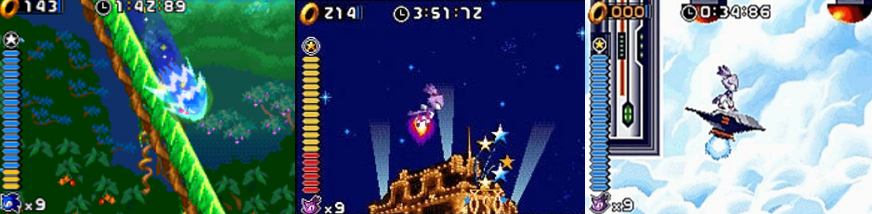
Like its predecessor, Sonic Rush Adventure is primarily a 2.5D action platformer focusing on high-speed platforming and Boost-based tricks. Initially, only Sonic is playable but, after clearing the third stage (known as a “Zone”), Blaze will be unlocked once again. While the game takes place on various islands, each Zone contains two stages (or “Acts”) and a third, dedicated boss battle against one of Doctor Eggman and Eggman Nega’s robotic giants (known as “Ghosts”). The game includes an “Options” menu where you can set the game to “Easy” or “Normal” mode to tweak the difficulty of bosses, toggle the ten-minute time limit on or off, and manually save your progress. Sonic Rush Adventure expands on the world map of its predecessor, allowing you to not only draw paths to other islands on the bottom screen but also enter buildings and talk with non-playable characters (NPCs). These allies give you hints, allow you to listen to the game’s soundtrack, offer additional missions to complete, and allow a stage and boss select so you can quickly retry completed Zones. Although Sonic and Blaze are still contrasting personalities, their controls and gameplay and essentially the same and as in Sonic Rush. Both jump with A or B, charge up a dash with down and A/B, and perform various mid-air tricks with A, B, and the Right trigger. You can use the directional pad in conjunction with these buttons to reach higher or further platforms, as well, though Blaze has the added benefit of her Burst Hover, which grants her a limited mid-air glide.
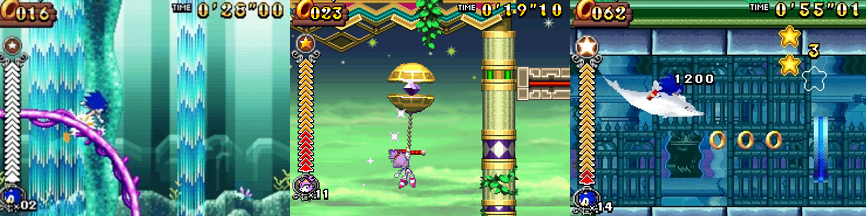
The core, Boost-paced gameplay remains unchanged but is bolstered by some new interactable elements.

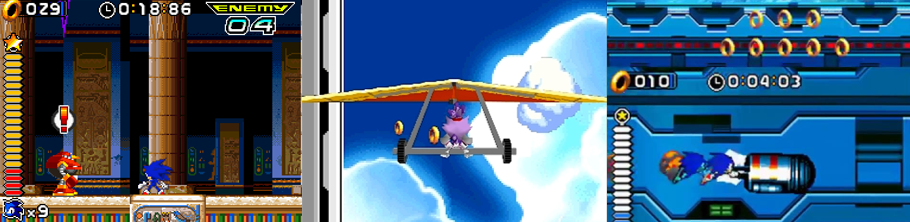
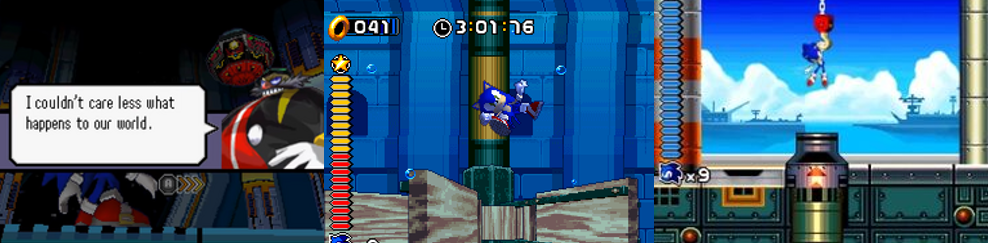
In contrast, Sonic can home in on nearby targets and is much faster by default, though Blaze is also immune to fire. Both characters can grind on various rails, tapping B to pull off additional tricks. These tricks and smashing robots fill your “Tension Gauge” which, when partially or completely full, blasts you ahead with the Super Boost or Fire Boost when you hold down X or Y. This allows you to plough through Badniks and breakable walls and across gaps at high speed, completely invulnerable, though you need to be careful as it makes it much easier to miss ramps and other interactable objects that spring you across the environment. Golden Rings act as your life blood, protecting you from attacks and awarding you extra lives when you collect increments of 100, and you can snag all the usual power-ups (extra Rings, a barrier and magnetic shield, and a brief invincibility) alongside boosts to your Tension Gauge and top speed. Your Tension Gauge also gets a boost when you pass a checkpoint, and you’ll use loops, springs, and ramps to blast between both screens across the game’s colourful and distinct Zones. Similar to the last game, there are instances where you get additional gimmicks: Blizzard Peaks starts you on a snowboard for some high-octane grinding, Coral Cave sees you push and jump into large minecarts, and Pirates’ Island sees you riding a dolphin through rings in underwater tunnels. The hang glider reappears in Machine Labyrinth, now steam-powered and letting you Boost along, while catapults, cannons, and giant hooks and anchors carry you to higher platforms. Pirates’ Island includes a water cannon gimmick where you aim, fire, and grind along water streams, crystals allow you to float across deadly gaps in Sky Babylon, and the Haunted Ship’s cannons blast you through the sky, allowing you to press buttons to score points off rings. Occasionally, the game switches perspective, shrinking you to the background, bringing you to the foreground, and putting you in a third-person view as you switch tracks in a mine cart or grind across spiked vines.
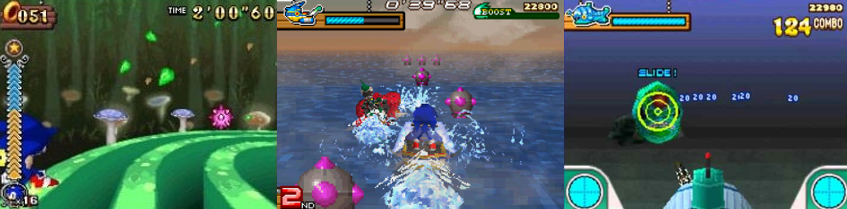
The touchscreen is wonderfully utilised in third-person and sea-based race sections.

The “adventure” aspect of the game comes into play in the overworld. You’ll travel across the sea to reach each island and challenge the game’s Zones, which you can only do with Tails’ various sea craft. After plotting a path, you’re placed on the bottom screen and use the stylus to control Sonic as he grabs Rings, performs tricks off ramps, and avoids enemies. In these sections, tricks and other actions are performed by swiping or tapping the screen, which builds your “Boost Gauge” and allows you to rocket ahead by double-tapping the screen or pressing the Left or Right triggers. Clearing Acts awards various materials and a letter grade; the higher your grade, the more materials you acquire. These can be brought to Tails to create newer, more diverse sea craft, such as a submarine and a hovercraft. As each craft needs specific materials to be built and further upgraded, you’ll be revisiting Zones again and again to “farm” for these materials. These can also be located on the sixteen Hidden Islands, which act as brief obstacle courses designed to test your skills and award materials, and you must do this to progress though the story. Sonic starts with the Wave Cyclone, a simple hoverbike, before Tails builds the Ocean Tornado, a sailboat you control and fire the weapons of (comprised of a gun turret, cannon, and flamethrower). The Aqua Blast hovercraft is similar to the Wave Cyclone but players must move it side to side to avoid rocks and other hazards and fire its laser cannon in either short or charged bursts. The last craft you get direct control of is the Deep Typhoon, a heavily armed submarine that sees you exploring the ocean’s depths, tapping commands similar to a quick-time event to lock-on to and destroy enemies and hazards, as indicated by a radar. Additional power-ups are also found in these stages to repair your craft or fill your Boost Gauge, and they certainly offer a fair bit of variety, though the grinding for materials can get tedious at times.

Presentation:
Like Sonic Rush, Sonic Rush Adventure utilises traditional sprite art for its backgrounds alongside polygonal assets. These are primarily seen in the character and enemy models but various interactive elements (such as drums and bouncy ropes and the end goal treasure chests) are 3D models as well. Sonic and Blaze’s models seem to be copied wholesale from the last game, sporting the same animations, playstyles, and voice clips as before and therefore being just as blocky and clunky. Again, I wonder if it might’ve been better to swap things around and have fully polygonal environments and sprites for the characters, though these models do look a lot better when the action switches to the touchscreen for the sea sections or brief third-person sequences. As you might expect from the title, Sonic Rush Adventure places more emphasis on the story, meaning more cutscenes using both 3D models and still images and more interactions with NPCs. The standout of these is the now sadly forgotten Marine, a plucky raccoon girl with a love for the sea and its craft and who hides incredible power behind her boisterous personality. Sporting a quirky Australian dialect, she furthers Blaze’s development from a stoic princess into a more laidback defender of her world and is a joy to talk with, as are the various amusing koalas who help you. Sonic Rush Adventure incorporates a more sea-faring flair to its soundtrack, peppering every stage with upbeat tunes that match the fast-paced gameplay. The opening theme, “A New Venture”, is infectious in its whimsy though it was surprising and a little disappointing to find the game didn’t include voice acting to go with its cutscenes and still relied on simple text. For most of its length, Sonic Rush Adventure focuses on two new antagonists, Captain Whisker and Johnny, and doesn’t reveal Dr, Eggman and Eggman Nega’s involvement until later, though I genuinely think it would’ve worked just as well, if not better, to omit the Eggmen entirely and focus on his pirate-theme doppelgänger and Sonic’s latest rival, just to mix things up a bit.
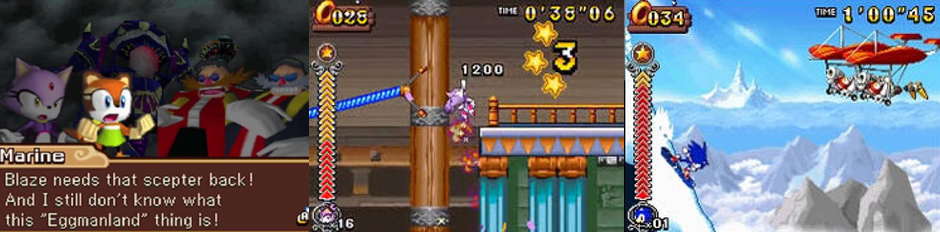
The game shines through its increased emphasis on story and a unique pirate-aesthetic.

Sonic Rush Adventure is one of the more visually unique Sonic games, especially in its environments. While Zones blast along a mile-a-minute and it’s easy to overshoot ramps or plummet down the many bottomless pits, the new, sea- and pirate-themed aesthetic really benefits the visuals. This is immediately apparent in the heads-up display, whose font is a far cry from the usual, generic lettering in other Sonic titles and more akin to the short-lived “Storybook” games on the Nintendo Wii. Things start pretty standard in Plant Kingdom (which features vines to swing from and grind on, bouncy mushrooms, and robotic dinosaurs) before delving into steampunk in Machine Labyrinth. Similar to Metropolis Zone, Machine Labyrinth features steam-based springs and winding tubes alongside the hang glider, pinwheels, and massive drums that pinball you about. Coral Cave is a coral spin on a mine, featuring crystalline coral, coral bridges, and a partially flooded grotto alongside abandoned mine carts and tracks and waterfalls. Similar to Pirates’ Island, you must pay attention to the top screen or you’ll get crushed by falling hazards that are used as platforms to higher areas, and giant anchors will swing you about, too. The Haunted Ship was probably my favourite Zone. Featuring a misty graveyard of wrecked ships in the background and seeing you dash up ropes and mainsails, you’ll explore the dishevelled interiors, bash robotic pirate ghosts, and blast between ships using massive cannons. You’ll also bounce up to higher areas using special ropes or be forcibly dragged up by barrels. Sky Babylon was also visually very interesting, sporting a green night-time sky and strange, neon-glowing ruins in a mish-mash of Marble Garden, Sky Sanctuary, Altitude Limit, and the Babylon Garden. Strange floating orbs drag you higher, destructible platforms drop you past flaming hazards and to the ever-present electrical bolt lurking below, and you explore both the background and foreground. Blizzard Peaks started strong with its snowboarding section, which allowed some fun grinding, and with its snowy slides and giant icicles that you must jump between. Pirates’ Island is, essentially, Sonic’s version of Venice, featuring stone buildings, flooded ruins, spring-loaded fountains, and helpful dolphins to navigate its waters. These environments and their gimmicks are all recycled for the Hidden Islands, and there’s even a degree of choice in which locations you visit depending on which ships you have.

Enemies and Bosses:
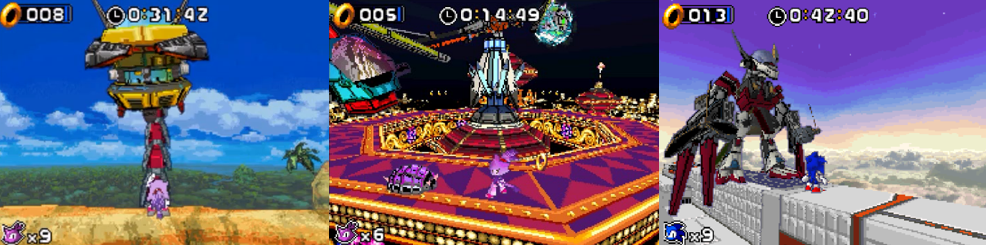
Sonic Rush Adventure bolsters its unique environments with a slew of all-new Badniks, each one the creation of the Dr. Eggman/Eggman Nega duo and in keeping with the nautical/pirate aesthetic of the game. The most persistent of these are the various “Kaizoku” Badniks that toss explosive barrels, glide around on hang gliders, fire small, shoulder-mounted cannons, hide in snowballs, or attack with a cutlass. The Kaizoku Hogan variant is a touch tougher than the usual Badniks, swinging a ball and chain and sporting a health bar. The Hover and Gunner variants fly about using jetpacks, and the Skeleton versions float around like wandering spirits and toss bone sat the player. These Badniks are bolstered by the “Shisaku-gata” series of mechanical miscreants who chuck spanners, hover using steam-powered jetpacks, and push you back with jets of steam. More traditionally designed Badniks also appear, such as the Barrier Angler (a robotic angler fish, which also has an electrical variant), the Jaws-like Nibbles, the Dive Bat (another of Dr. Eggman’s many bat-themed Badniks), and the Rabid Crab (which focus more on melee attacks than Crabmeat’s projectiles). The Triceratank charges you with its horn similar to the Rhinobot, Ptera swoop from the skies, Sky Moons fire projectiles while hovering in the path of your jumps, and steam-powered Bomb Ghosts wander the Haunted Ship ready to explode in your face! Each Zone ends in a boss battle against one of Dr. Eggman and Eggman Nega’s gigantic robot creations. Unlike in the last game, where you were restricted to either a platform or a ring, Sonic Rush Adventure features more variety to its boss battles. You’re still restricted to a set area, but the arena and boss strategies alter as the fight progresses, switching between the screens. Each also possesses a health bar, though you no longer have your allies cheering you on, and ends with a dramatic, slow-motion final blow against the mech.
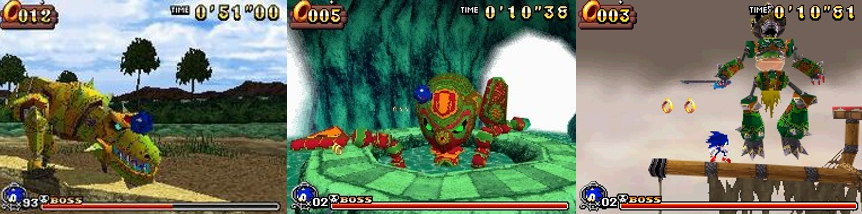
The massive bosses are far more visually interesting and complex than before.

The first boss you encounter is the Ghost Rex, a gigantic, robot Tyrannosaurus rex that stomps around in the background, stalks around your small stone platform, and tries to munch you with its powerful jaws. Dodge this attack to attack its head and repeatedly strike it when it tries to charge from either side of the platform and you’ll eventually fall to a cavern, where the Ghost Rex elongates its neck to try and crush you and cause shockwaves. The Ghost Pendulum is fought on a ring and stays out of reach and you must run around in a circle, striking its low-hanging fruit to smack them into it. As the fight progresses, more balls appear, with some sporting spikes and electrical barriers and the boss dropping to create shockwaves, which can all be tricky to avoid. The Ghost Kraken is also fought on a ring; it spins its tentacles to attack you, but you can smack these (especially the jewelled one) to damage it. It also tries to grab and slam you into the ground, forces you underwater, and spits ink to either stick you in place or obscure the screen. The Ghost Pirate awaits on the Haunted Ship, spewing fireballs and flaming vortexes and attacking with kicks and its cutlass. You must target the glowing red core, which eventually detaches and must be chased around to deal more damage, which can be tricky, especially if the ship’s swaying. The Ghost Whale is one of the most unique bosses as it’s fought on a rapidly deteriorating ice float. You must smack it when it charges to jump inside, where you have thirty seconds to battle to its inner core, destroying pods for more time and avoiding freezing hazards and ridable missiles.
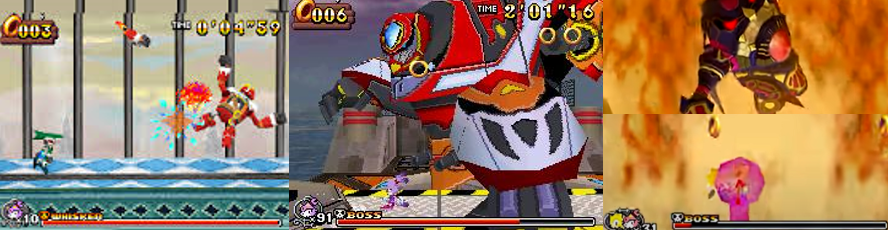
Sadly, the new baddies are usurped by the Eggmen, who power-up to battle for the fate of both worlds.

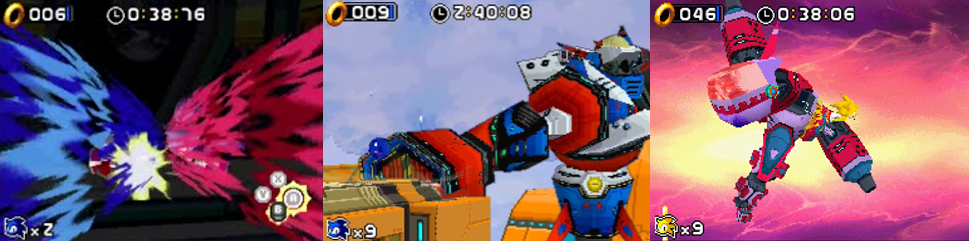
The Ghost Condor was probably the toughest of the regular bosses for me. You’re running on a never-ending path on the bottom screen, avoiding mines, spiked platforms, and the boss’s charge. You must hit the green mines to fly up and smack the boss’s weak spot, landing on the platforms to deal additional damage, though the hazards, speed, and aggressiveness ramp up over time. Captain Whisker and Johnny first attack as a duo on a stage full of buzzsaw-spewing platforms. Captain Whisker fires his rocket arms and performs a ground pound to produce a shockwave and Johnny torpedoes at the player, and they have a team attack that must be repelled. Both must be defeated but this looks more intimidating than it is and it’s pretty easy to pepper them with hits. Captain Whisker then jumps into the Ghost Titan for a penultimate showdown not unlike the battleship bosses from the last game. You must hit its missiles to lower the shields on the cannons, then line up the aiming reticle to attack. The Ghost Titan also delivers a big punch, fires laser-guided flame blasts, litters your platform with bullets from its crotch, and spreads flames across the ground. Though there’s a lot happening at times this was a big, fun, boss made even more intimidating by it boxing you in with insta-kill lasers at the end. After collecting the seven Chaos and Sol Emeralds, you’ll battle the true final boss, the Egg Wizard, a super-powerful mech piloted by Dr. Eggman and Eggman Nega and wielding the fabled Jeweled Scepter. This is a three-phase battle that takes place from a top-down perspective in the molten core of Blaze’s world. You control Super Sonic and Burning Blaze, collecting Rings to sustain your transformation and switching between the two with R. In the first phase, you reflect boulders using Super Sonic’s A attack. You must then reflect the Egg Wizard’s fireballs and three flaming dragons to deal damage or switch to Burning Blaze and fire single or charged fireballs with A. Deal enough damage and the Egg Wizard regains some health and adds a targeted meteor, a flamethrower, and gigantic missiles that must be avoided or reflected to deliver the final blow. It’s not the hardest final boss but, with no checkpoints, few Rings, and many of the attacks stunning you, it can be a trifle aggravating to contend with.

Additional Features:
When exploring the seas of Blaze’s world, you’ll inevitable cross paths with Sonic’s latest rival, the arrogant robotic shark, Johnny. When you do, Johnny challenges you to the race, with the prize being a legendary Chaos Emeralds. These races take place on the Wave Cyclone and are thus performed using the touchscreen and stylus. Players can follow Johnny’s trail for a boost and must dodge his mines or they’ll suffer irreparable damage and lose. To stay ahead, you collect Rings and perform tricks off ramps to build and maintain your Boost Gauge, though you can replay each race as often as needed to score the Chaos Emeralds. Like before, Blaze doesn’t get Sol Emeralds from Special Stages like these. Instead, you talk to NPCs to take on various missions, with seven of the 100 available missions specifically relating to the Sol Emeralds. These are acquired by finding Hidden Islands or beating certain bosses again, and only by getting all seven of both will you unlock the game’s true ending. Other missions also challenge you to reach the goal within a certain time limit or while holding a set amount of Rings. You can also explore to find the sixteen Hidden Islands and replay previous Acts to get materials to build and upgrade your craft and score better rankings, and take on a time attack mode. Sonic Rush Adventure also includes a multiplayer component where players race against each other to finish Zones and defeat bosses the fastest, though I’ve never played this mode. Finally, there’s a sound test and movie viewer mode available and you can take on the bosses and Johnny’s race at any time by chatting to NPCs.
The Summary:
Sonic Rush was a fun, if barebones, return to form for Sonic, a natural progression of the Game Boy Advance titles and a nice taster of what the Nintendo DS could do with the franchise. Sonic Rish Adventure takes everything that worked and adds a bit more to it, expanding the narrative and the scope of both Sonic and Blaze’s world and delivering a fresh take on the usual, formulaic events by assuming a pirate aesthetic. I really enjoyed the sea-based sections, exploring the map and playing about with each craft. It was a fun use of the touchscreen that never outstayed its welcome, though it does get a touch tedious having to grind for materials. It might’ve been better if Tails built the ships as the story progressed and the materials were purely to upgrade each one to give you an edge in combat or against Johnny. The Zones were some of the most unique and visually interesting the series has ever seen, finally moving away from tried-and-tested tropes and embracing new aesthetics. The gameplay is fast-paced and fun, with lots happening at once and really gave me a sense of empowerment, though it’s still dogged by bottomless spits, insta-kill hazards, and unavoidable traps. Captain Whisker, Johnny, and Marine are some of the best new additions to the franchise and I’m honestly annoyed that they’ve never been seen again. I’ll reiterate that neither Eggman was necessary for this game, and it might’ve been better without them as Captain Whisker was a familiar enough threat given a quirky edge by being a pirate. It’s a shame that Sonic and Blaze’s gameplay was basically unchanged from Sonic Rush, with no new moves or abilities or playable characters added to the mix, but the 2.5D Boost gameplay was arguably better than it’s ever been here. It really feels like Sonic Rush Adventure filled in some of the blanks of the last game, adding more diversity and complexity to the boss battles, switching up the stage aesthetics, and placing more emphasis on the story. Add to that the fun sea mini games and races and opportunities for exploration and you have a really solid title that definitely deserves more love than it gets as I never see anyone talking about this one, and that’s a real shame.

My Rating:

Rating: 4 out of 5.

Great Stuff

Did you play Sonic Rush Adventure back in the day? What did you think to the new setting and the quirky new characters? Did you enjoy the pirate aesthetic to the stages and trying out new sea-based craft? What did you think to the grinding mechanic and the changes made to the boss battles? Did you ever defeat the Egg Wizard, and do you agree that Captain Whisker and Johnny were strong enough antagonists by themselves? Which of Sonic’s handheld adventures is your favourite and how are you celebrating him this month? I’d love to know what you think about Sonic Rush Adventure so leave a comment and be sure to check out my other Sonic content.


Mini Game Corner [Mario Month]: Super Mario 64 DS (Nintendo DS)


So, for no better reason than “Mar.10” resembling Mario’s name, March 10th is widely regarded as being “Mario Day”, a day to celebrate Nintendo’s portly plumber, an overalls-wearing mascot who literally changed the videogame industry forever and shaped the home console market of the nineties.


Released: 21 November 2004
Originally Released: 23 June 1996
Developer: Nintendo EAD
Also Available For: Nintendo 64, Nintendo Switch, and Nintendo Wii (Virtual Console, original version only)

A Brief Background:
After rebuilding the videogame industry following its horrific crash in 1983, Nintendo embarked on a “Console War” with SEGA. Their two mascots – Super Mario and Sonic the Hedgehog – were at the forefront, creating celebrated 16-bit classics that defined a generation. By the end of the nineties, though, 2D graphics were out and the race was on to produce the first commercially viable 3D home consoles. While SEGA struggled to get started with expensive add-ons for the Mega Drive, Nintendo shunned CD-based technology in favour of traditional cartridges, and launched their Nintendo 64 console with Super Mario 64, a critical and financial success that set the standard for 3D platformers. In mid-2002, former Nintendo president Hiroshi Yamauchi proposed the idea of a dual-screen console, a portable system Nintendo hoped would propel them back to the top of the industry. An expanded version of Super Mario 64 was developed as a launch title for this new console, the Nintendo DS. Originally titled Super Mario 64 x4, the game featured graphical upgrades to the textures and character models and was a huge success, selling 11.06 million copies worldwide. It was also met with rave reviews that praised the addictive gameplay and additional characters but criticised the clunky control scheme.

The Review:
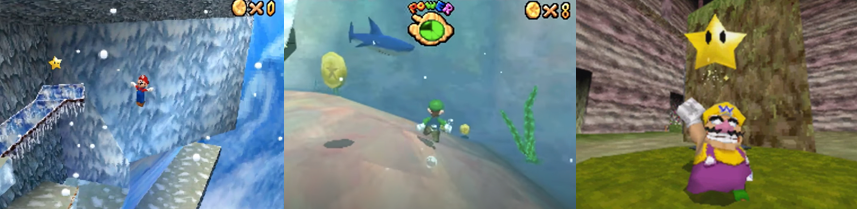
So, let’s address the elephant in the room first: why just a mini review for this remaster of Super Mario 64? Well, primarily it’s because much of the core gameplay, mechanics, and elements of the original game are retained here. The story is largely the same: Princess “Peach” Toadstool invites Mario, Luigi, and (strangely) Wario to her castle for cake but, when they disappear inside, Yoshi has to go rescue them. The gameplay loop is the same (enter magical paintings to be transported to action stages where you collect Power Stars to open new doors and access new areas of the castle), and everything I said about the original game in my initial review still stands here. Thus, I think it’s more productive to focus on what’s different about this version. Namely, the controls; while all four characters perform the same basic actions as Mario (though only he can wall jump), you now control them with the directional pad (D-pad) or, *shudder*, the touchscreen and stylus. This is problematic in many ways; Super Mario 64 DS is a fully 3D gaming world, and yet these controls make the characters clunky and tank-like. It’s also not helpful having to hold Y to dash, which can make performing long jumps or running attacks problematic as your fingers get in the way. If you play the game on the Nintendo 3DS, as I did for this playthrough, you can use the analogue stick but you don’t get true analogue control. Instead, the same janky tank controls are mapped to the stick, making the precision platforming, running, and combat mechanics much more of a chore to pull off in this version, which is a real shame. Although you have greater camera control with the Left bumper, touch screen, and X (which zooms out), the camera is still aggravating, regularly getting stuck on the environment or adopting a poor angle. However, I did like how the touchscreen displays a helpful map at all times and highlights any available Power Stars or character caps. One of the most noticeable changes to the gameplay is that Super Mario 64 DS now features 150 Power Stars rather than the original 120, and you now need 80 of them to access the final confrontation with Bowser, King of the Koopas. As I’ve 100% both this and the original version before, my goal for this playthrough was simply to reach that final fight, hence again why this is just a mini review as I didn’t strive for 100% completion.

You’ll need everyone’s unique powers and skills to hunt down a whopping 150 Power Stars!

Although each character has their own unique mechanics, attributes, power-ups, and controls a little differently, they all share a basic move set that’s immediately familiar to players of the original game. B allows them to jump; tapping it three times while running executes a triple jump to reach higher areas. Holding R and pressing B pulls off a backwards somersault and doing the same while running performs a long jump, while holding left or right on the control stick and pressing B executes a side jump. Tapping B also allows you to swim; you can hold the button for slower, more precise movement but keep in mind that some characters also swim faster than others. A allows you to talk with non-playable characters (NPCs), read signs for tips, pick up certain objects, and perform a melee attack. You tap A three times for a three-hit combo, press A when running for a dive, or hold R and press A for a sweeping kick. You can also jump and press R in mid-air to perform a ground pound to crush enemies, and simply hop on most enemies to defeat them or get a boost to higher levels. Your health is measured in a colourful pie chart that depletes as you take damage, get set on fire, or when underwater. You must collect coloured Coins or run through Hearts to replenish it or grab an air bubble or resurface when swimming. The basic gameplay structure remains unchanged except each level (or “Course”) has an additional mission, and some missions have been altered to take advantage of the new characters’ abilities. You’ll still be jumping to moving, spinning, and temporary platforms, activating switches, running up walls, utilising cannons, smashing blocks, pounding stakes, raising and lowering water, catching rabbits, climbing fences, defeating enemies, finding Red Coins, and speeding down slides on your butt to complete missions.

Alongside their shared skills, characters have unique abilities modelled after the original game’s caps.

The biggest change to the gameplay is the inclusion of three new characters. You begin controlling Yoshi, who swallows enemies with A, lays an egg with R, and tosses said egg with A (or simply spits the enemy out if you prefer). Yoshi also performs a “flutter” jump by holding B to give him a bit more airtime and temporarily breathes fire with a Power Flower, which is great for melting ice blocks. Luigi is the fastest, slipperiest of the characters; he also has a flutter jump but can spin in the air off a back somersault to cross wider gaps. Luigi can also briefly run across the surface of water and temporarily turn invisible when he grabs the Power Flower, effectively replacing the Vanish Cap from the original game. Wario is the smallest, stoutest, and slowest of the four but also the most powerful. He can break black blocks swing and throw opponents in Vs. Mode, and temporarily turn invincible when grabbing the Power Flower, meaning he replaces the Metal Cap. Mario has all his original abilities, including temporarily flying with the Wing Cap with a feather (which remains as awkward as ever) but he can now inflate like a balloon and float with the Power Flower. Although you must unlock Mario, Luigi, and Wario, you can assume their form and powers by defeating enemies who wear their caps or finding their caps in the Courses, though you’ll lose their abilities when you take damage. You can manually switch characters by visiting the switch room, which is located where the Princess’s Secret Slide was (and still is) but you can only battle Bowser as Mario. The Super Mushroom also makes a return here, briefly enlarging your character and allowing them to plough through enemies and obstacles and earn extra lives. You can also still ride discarded Koopa shells to speed around Courses, and all the character models and game textures have received a nice upgrade, making everything even more colourful and detailed even on the DS’s smaller screen.

Old bosses have received a graphical overhaul and been joined by new baddies and Courses.

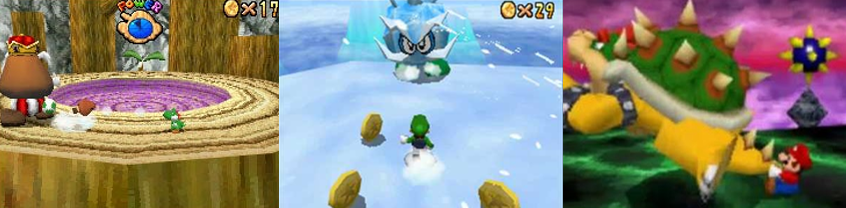
While the same selection of Courses are present here, there are some new bonus areas to visit to find new Secret Stars or character portraits, which take you to new mini obstacle courses not unlike the Bowser Courses. These culminate in a boss battle against the three new bosses who guard the keys needed to rescue Mario, Luigi, and Wario. The first, Goomboss, is fought with Yoshi; this enlarged Goomba chases you around a tree stump platform. He gets faster as the fight progresses and can only be damaged by dashing behind him, swallowing his Goomba minions, and spitting them at him. Luigi is rescued by clearing a small looping carousel maze and battling King Boo, who’s the same as the Big Boo bosses except you sometimes use the giant mirror to spot him closing in. Finally, Wario’s key is guarded by Chief Chilly, a larger version of the Chilli Bully from Snowman’s Land and fought similar to other Bullies, but with the twist that the arena is super slippery, surrounded by burning cold ice water, and Chief Chilly destroys the stage as the fight progresses. All the previous bosses return, unchanged except for their new character models and altered dialogue depending on who you’re playing with, but there are now two battles against King Bob-omb, with the first one being fought with Yoshi and containing new mechanics. This time, King Bob-omb hurls his explosive minions at you and you must spit them back, which is kinda fun, though you can fight him in the same way as before (running behind him and tossing him) when playing as other characters or using their caps. Bowser’s battles are also the same, though slightly more challenging thanks to the clunky controls. You must best a dangerous obstacle course beforehand that’s now home to two hidden Power Stars before battling Bowser in borderless arenas. Bowser will stomp about, spitting fire (which homes in on you and rains from the sky in the final bout) and even tip or destroy the stage in later encounters. You defeat him by running behind him, grabbing his tail, and swinging him into one of the nearby mines. You’ll need to do this once in the first two fights and three times in the last to be victorious and see the slightly altered ending, where all the characters get cake.

There are more missions, more Power Stars, more rabbits, and even loads of unlockable mini games.

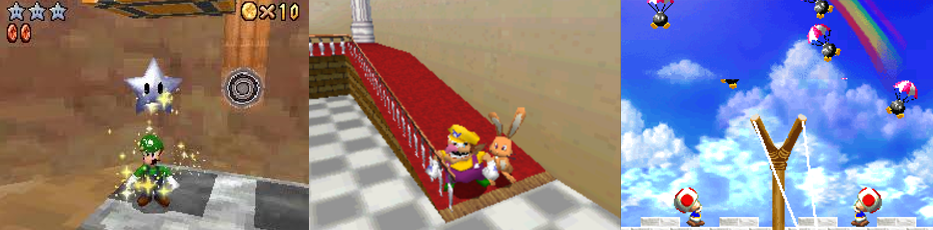
As mentioned, every Course now has eight Power Stars to collect rather than seven. You complete missions for seven of them but earn an eighth for collecting 100 Coins in every Course, and each Course has an additional mission tied to one of two new mechanics. One is the Star Switch, which causes a Power Star to temporarily spawn somewhere in the Course and gives you a short time limit to get to it, usually by platforming, wall jumping, or utilising the character’s Flower powers. The other is collecting five Silver Stars, smaller Stars dotted around Courses that fly out of you when hit and spawn a Power Star when collected. There are also a bunch of rabbits to catch in and outside Peach’s castle; seven for each character (as indicated by their colour) that appear when you’ve collected a certain number of Power Stars. Catching them doesn’t award you a Power Star like when you catch Mips in the original game, but instead unlocks mini games to play in the Rec Room. These are assorted button- and touchscreen-based distractions that see you matching pairs of cars, rubbing the screen to reveal Boos, touching the right character faces amidst a sea of others, bouncing Mario past Shy Guys, playing slot machines, launching balls, and shooting parachuting Bob-ombs from the sky. There are thirty-six mini games to unlock and play, with each one awarding you Power Stars as points, and they’re an interesting addition, though I didn’t spend much time on them. The squishy Mario face mechanic from the original game has been expanded to other characters and a limited drawing canvas, you now only get three save files instead of four, and while the cannon outside the castle does unlock after you get 150 Power Stars, it simply leads to a Wing Feather for Mario and another rabbit for Luigi. Courses have had some graphical updates as well: Coins are now 3D objects, Peach has a new hairstyle, Bob-omb Battlefield is noticeably more autumnal than before, Hazy Maze Cave’s toxic gas is a different colour and Dorrie now wears swimming goggles, and the secret Courses where you once activated the different caps are now just challenges for Power Stars. Everything looks far superior, despite the smaller screen size, and sounds way better, but issues from the original game still persist. The camera, obviously, is the main one, as is the character’s tendency to just randomly slip or detach from platforms. Finally, while you get more guidance this time around, it can still be difficult to know how to clear certain missions without consulting an online guide.

The Summary:  
I loved Super Mario 64. Like almost everyone back in the day, it was the first Nintendo 64 game I owned and I played it constantly, though I was never able to get all 120 Power Stars. Ironically, however, I was able to get all 150 Power Stars when I first owned Super Mario 64 DS. I sold the game back then, choosing the more traditional, refined, and enjoyable experience offered by New Super Mario Bros. (Nintendo EAD, 2006) but, after playing the Nintendo Switch port and realising the 3DS analogue stick could be used to play the game (and being a big fan of Wario), I felt compelled to revisit it. Sadly, the analogue stick didn’t help with the game’s clunky control scheme and the camera is just as bad as ever, so this is a bit of a step down compared to its Nintendo 64 predecessor despite all the extra features, but it’s still a really fun game. I think that’s a testament to just how well Super Mario 64 was made. It’s still a readily accessible and surprisingly deep 3D platformer with a lot of varied locations and missions to playthrough. This version of the game impresses with its graphical overhaul, new Courses and boss battles, and the three new characters. While I rarely played as Yoshi, I enjoyed running around as Luigi and Wario and the cap-swapping mechanic and I liked how they each took on the cap power-ups from the original game. It’s a shame the Bowser fights weren’t tweaked to utilise each character’s unique move set, but they get Courses and missions tailored to them, so I think it balances out. While I didn’t play the mini gams or the Vs. Mode, I had a lot of fun plugging away at this remake of a classic. I’d love to see this get a proper HD port to the Nintendo Switch, though, to further refine its niggling issues. Still, as is, this is a great way to revisit Super Mario 64 and well worth your time, if you can cope with the odd tank-like control scheme.

My Rating:

Rating: 4 out of 5.

Great Stuff

Was Super Mario 64 DS a part of your Nintendo DS library? What did you think to the new control scheme and visual overhaul? Which of the new characters and power-ups was your favourite? What did you think to the new missions, additional Power Stars and Courses, and the new bosses? Did you ever collect all 150 Power Stars? What other Nintendo 64 game do you think deserve a remaster? How are you celebrating Super Mario this month? Whatever you think, comment below and let me know and don’t forget to check out my other Mario content.

Game Corner [Sonic Month]: Sonic Rush (Nintendo DS)


Sonic the Hedgehog was first introduced to gamers worldwide on June 23 1991 and, since then, has become not only SEGA’s most enduring and popular character but also a beloved videogame icon and, in keeping with tradition, I have been dedicating the entire month to celebrating SEGA’s supersonic mascot.


Released: 15 November 2005
Developer: Dimps / Sonic Team

The Background:
SEGA’s desperate attempt to create a mascot iconic enough to rival Super Mario paid off greatly when Sonic the Hedgehog expanded into mainstream popularity with Sonic the Hedgehog 2 (SEGA Technical Institute, 1992). Despite further success with subsequent platform titles and his first forays into 3D gaming, a series of costly decisions saw SEGA forced to withdraw from console manufacture, bringing the “Console War” of the nineties to an anti-climatic end. With SEGA focused on software development, the unthinkable happened when Sonic and SEGA-branded videogames appeared on Nintendo’s often-underappreciated GameCube console and Game Boy Advance handheld. Partnered with Dimps, Sonic Team created a trilogy of throwback titles for Nintendo’s handheld that were largely well received, despite some nagging criticisms. The partnership with Dimps continued when Nintendo succeeded the Game Boy Advance with the more powerful, dual screened Nintendo DS and SEGA immediately impressed when they dropped the first gameplay footage of their newest game for the new-fangled device at E3 2004. Director Akinori Nishiyama was keen to infuse the spirit of the classic games with the contemporary mechanics and fast-paced action of Sonic’s 3D titles and introduced not just the hotly-debated Boost gameplay to the franchise but also a brand-new character, Blaze the Cat, who would become a staple of the series. Released exclusively for the Nintendo DS, Sonic Rush has been widely praised for its back-to-basics approach, gorgeous graphics and fast-paced action, and memorable soundtrack. While some criticised the level layouts and repetitive elements, the game impressed enough to warrant a sequel in 2007 and the game is largely fondly regarded as an oft-forgotten gem of the franchise.

The Plot:
When Doctor Eggman steals the seven Sol Emeralds, their stoic guardian, Blaze the Cat, journeys to Sonic’s world to recover them. However, her nemesis, Doctor Eggman Nega, has followed her and in search of the seven Chaos Emeralds, leading Sonic the Hedgehog to oppose his mad plot for worldwide destruction.

Gameplay:
Sonic Rush is a 2.5D action platformer much like most classic Sonic titles and his 2D outings on the Game Boy Advance. Players can initially only control Sonic but will unlock new character Blaze after clearing the first level (known as a “Zone”). As is often the case, each Zone is comprised of two stages (or “Acts”), with a third dedicated to a boss battle against either Dr. Eggman or Eggman Nega. By entering the “Options” menu on the main menu screen, players can tweak some of the game’s settings, setting it to Easy, Normal, or Hard (which I believe impacts the amount of lives you start with and hits bosses take), disable the ten minute time limit for Acts, listen to the game’s soundtrack, or allow a friend to download a demo version of the game to their Nintendo DS. One new feature rarely seen in 2D Sonic titles is the presence of a world map; styled after the map screen in Sonic Adventure 2 (Sonic Team USA, 2001), this allows players to wander about a static screen to replay previous Zones or visit their allies. Miles “Tails” Prower and Cream the Rabbit will offer encouragement and enthusiastic support to each character, keeping track of how many lives they have, how many of the Chaos and Sol Emeralds they’ve collected, and the percentage that their worlds have unmerged (reduced as you clear Zones). Despite visually appearing very different, and their contrasting personalities (Sonic is all brash and happy-go-lucky and Blaze is quiet and reserved), Sonic and Blaze play in almost exactly the same way, visit the same Zones (albeit in a different order), and battle the same bosses (just with different madmen at the helms), though Blaze doesn’t have to worry about beating Special Stages to acquire her Emeralds.

Sonic and new ally Blaze can blast through Zones with their new Boost mechanic and abilities.

Both characters can jump with a press of A or B; holding the button lets them jump a bit higher and pressing down and A or B charges up either the Spin Dash or the Burst Dash so you can blast ahead in a burst of speed. When jumping, you can press the right bumper to perform an air dash as Sonic or Blaze’s Burst Hover, which gives her a little more airtime courtesy of a rocket boost from her boots. Unfortunately, Blaze is little more than a reskin of Sonic; her gameplay is slightly different thanks to her limited hover but it’s essentially exactly the same as Sonic’s, lacking additional features such as climbing or flying to really make her stand out despite her visual appeal, to the point where I wonder if it might’ve been better to have Blaze be incapable of boosting just to make her gameplay a bit different and challenging compared to Sonic’s. When flying off ramps, springs, or propelled through the air, you can press B, A, and R to perform tricks; these will both boost you higher and further, which is necessary to reach platforms and switches, and build up your “Tension Gauge”. When partially or completely full, you can hold down X or Y to blast off with the Super Boost or Fire Boost, respectively, which sees you plough through Badniks and breakable walls at breakneck speeds, completely invulnerable and surrounded by waves of supersonic or flaming energy. This boost mode allows Sonic Rush to reach speeds classic Sonic games could only dream of and is essential for outrunning giant rolling balls, blasting through enemies and Acts alike, building momentum with some of the game’s gimmicks, and entering Special Stages. It can be unwieldy at times, though; just as you should exercise caution with your trick moves, you should use the boost sparingly as you could overshoot platforms or run head-first into one of the game’s many bottomless pits. Sonic and Blaze can also grind on rails to pick up speed and perform tricks, fill the Tension Gauge by defeating enemies, and make use of giant bullets and hovering UFO-like vehicles, though these latter two are equally cumbersome due to being difficult to control and having to use the Nintendo DS’s dual screens to navigate.

Despite a few new gimmicks, both characters sadly share the exact same playstyle.

Sonic Rush uniquely uses the dual screens to spread its action out vertically; you’ll often by sprinting down slopes from the top screen to the bottom, which is quite fun, and you’ll need to pay attention to the top screen when planning jumps to avoid Badniks or spot platforms and switches. Otherwise, the bottom touchscreen is mostly relegated to menus and the Special Stages, which I’ll talk about later, and the bulk of the game is comprised of tried-and-true Sonic gimmicks. You’ll grab Golden Rings to survive hits and earn extra lives when you collect 100, suck in air bubbles when lumbering underwater, run through loops, bounce from springs, and avoid or be frustrated by sudden spiked hazards as you blast through the game’s seven Zones. There’s a lot that’s familiar about Sonic Rush; the ramps, boosters, and many of the Zones and enemies are modelled after Sonic Adventure 2 and married with a tweaked version of the classic gameplay mechanics, effectively bridging the gap between the “Classic” and “Modern” iterations of Sonic and laying the foundation for Sonic’s mid-2000s Boost-centric gameplay. You’ll spring from bungees, be blasted about by water jets and cannons, jump to moving or temporary platforms, boost into giant propellers to cover greater distances, resist the urge to pull off tricks after being blasted through the sky by rocket sledges, temporarily light up rails and platforms or ride blocks of light by hitting switches, run along the ceilings, and even be whisked through the cloudy sky on a hang glider (though, thankfully, it’s a largely automated section that’s much easier to control this time). Often, you’ll be trapped in a small arena and have to destroy all onscreen enemies to escape, sometimes while avoiding crushing hazards; other times, you’ll swing from chains and ropes (again resisting the urge to press any inputs except to jump to safety) and desperately avoiding instant-kill lasers or the numerous bottomless pits. These cheap hazards crop up from the first Zone and only increase by the time you reach Dead Line; it can be extremely aggravating being in the swing of a fun boost run, pulling off nifty tricks and building momentum, only to cause yourself to fly past a platform or spring or through a rail and plummet to your death.

Graphics and Sound:
Although Sonic Rush employs traditional sprite art for its backgrounds and environments and even oddly includes some Sonic Advance-style sprites in its endings, character models are all polygonal this time around, which is a bit hit and miss. Sonic and Blaze make a big show of looking up, dying, and encouraging you to get a move on but lack a lot of the detail seen in the Game Boy Advance games as their character models are a bit blocky and indistinct at times. Sure, they express a lot of personality when pulling off tricks, vocalising their enthusiasm, and when clearing an Act and getting their final letter grade, but I can’t help but think it might’ve been better if the environments were polygonal and the characters were nicely-animated sprites instead. On the plus side, despite the bland title screen and menu selection, Sonic Rush has an absolutely killer soundtrack; Hideki Naganuma and Teruhiko Nakagawa went above and beyond to really produce some infectious ear worms. This is evident from Sonic’s first Zone, Leaf Storm and its upbeat “Right There, Ride On” tune and continues with tracks like “Back 2 Back”. Every Zone makes an impression with its soundtrack, which really helps the game stand out from the usual punk rock tunes of the main console games and the traditional chirpy music from the classics. Cutscenes are a bit of a mixed bag; the story is primarily told using barely animated in-game models accompanied by dialogue boxes and you’ll see the same cutscenes repeated over and over after you defeat each boss, though there are some fun cameos here and there.

While the environments looks great, I’m not impressed with the polygonal models.

As mentioned before, Sonic Rush’s Zones are modelled after Sonic Adventure 2’s, for the most part. Leaf Storm is like a 2.5D version of Green Forest, Mirage Road resembles Hidden Base/Sand Ocean, and Huge Crisis takes place on battleships and in the middle of a Naval fleet like Metal Harbor. Other Zones are a little more traditional, with the Casino Night/Carnival Night Zone-inspired Night Carnival and Dead Line essentially being another run-through of a Death Egg-style space station. There’s quite a bit of detail packed into each Act, though they can be a little barren of enemies at times; you’ll see critters freed from every enemy or fluttering about, vines twisted over rails, flashing neon billboards, and fighter jets all lurking in the background. Hieroglyphics, giant stone statues, and fast sand slides await in Mirage Road, with these latter two gimmicks enlarging the character models as they’re brought closer to the camera. Similarly, you’ll precariously run along fencing, parachute past enemies and spikes in Altitude Limit, and illuminate entire areas with spotlights or glowing platforms in Night Carnival. Sonic’s opening Zones, Leaf Storm and Water Park, made the strongest impression on me; I enjoyed the ripple effect on the water, that you can run across it, and the Greece-inspired architecture in Water Park and the sheer colourful depth of Leaf Storm that helped to showcase the upgrade in power from the Game Boy Advance. Sadly, even these Zones are let down by an abundance of death pits, but the way the action spreads across both screens can be really fun, especially when you’re building up speed. The touchscreen comes to the forefront in the Special Stages, which are modelled after Sonic 2’s half-pipe stages and see you using the stylus (or your finger) to control a fully 3D Sonic model as he grabs Rings, avoids obstacles, and hits numbered targets to score extra Rings.

Enemies and Bosses:
There are two types of robotic enemies you’ll encounter in Sonic Rush: Egg Pawns and the minions of the Eggman Empire modelled after those seen in Sonic Heroes (Sonic Team USA, 2003) and security droids not unlike those employed by the Guardian Units of Nations (G.U.N.) in Sonic Adventure 2. Egg Pawns are the most common and have a few variants, from being relatively harmless to packing rifles and bazookas and even blocking your direct attacks with shields. A larger variant, the Egg Hammer, also appears, usually when you’re confined to on area, and takes multiple hits to defeat and could be classified as a mini boss. You’ll also encounter Dr. Eggman’s flying forces, often placed right where you’re about to spring into the air or dive-bombing you when you’re navigating a bottomless pit or bed of spikes or dropping bombs on you at the worst possible time. Egg Bishops also reappear from Sonic Heroes, though they’re limited to simply firing projectiles from their wands. Knight Pawns also appear but, despite their fun armoured appearance and lance, they’re simply another Egg Pawn to plough through, same with the G.U.N. Hunter that can catch you with its bullets but is otherwise just there to build up your Tension Gauge. Sadly, no classic Badniks appear but you often get a great feeling of empowerment ploughing through multiple enemies with your boost attack, which I guess is a good compromise.

Though large, bosses are repetitive and time consuming chores you fight multiple times.

Each Zone ends in a boss battle against either Dr. Eggman or Eggman Nega; sadly, both pilot the same machines so, while you’ll battle them in a different order with each character, both Sonic and Blaze have the same boss encounters with the same strategies employed each time, making for a bit of a repetitive experience. Bosses are fought either on a single platform or a circular loop, with their health measured on the bottom screen where Tails or Cream constantly shout encouragement, end in a dramatic freeze frame, and the arenas hold a handful of Rings to keep you going. The first boss you fight is the Egg Hammer Mega, a snake-like mech that tries to crush you with singular or multiple head slam and sends its cockpit rolling across the ground to try and damage you. Simply dash out of the way then its head slams down, jumping over any shockwaves, and ram the cockpit to do damage. This boss is repeated in Huge Crisis, where it now launches missiles from the battleship in the background and charges up an instant-kill slam, and it was during this fight that I realised how long-winded the game’s bosses are as there’s a lot of waiting around and few opportunities to attack. Water Park sees you battling the Egg Turtle; although much of this fight is underwater, you won’t have to worry about drowning and must simply avoid the mech’s belly flop and propeller butt, smacking its glowing head whenever you get the chance. Things pick up a little when you fight the Egg Beetle; you need to hit the explosive ball it sends rolling at you when its spikes are withdrawn and it’s flashing to do damage, often a couple of times when it jumps over you, and avoid the bombardment of projectiles when the mech takes to the sky. Similarly, you’ll need good timing when fighting the Egg Libra; you need to hit the weighted ball when its shield drops to lower the cockpit and land a hit, then avoid the bolts running across the ground and use the springing robot to score an extra hit, which can be a bit frantic as there’s a lot happening onscreen. Finally, in Altitude Limit, you’ll battle the Egg Eagle, one of the toughest and most annoying bosses because of how long the battle takes. You’ll need to avoid its bullet barrage and frantically mash A and B when it lands and tries to blow you off the platform! You can score a hit when it lands and tries to peck at you, but it’s a small window and it’s easy to take damage so you’ll need to be quick with your reactions.

After settling their differences, Sonic and Blaze must team up against the Eggmans!

When you reach the end of Dead Line, you’ll battle ither Sonic or Blaze in a one-on-one fight not unlike the Hidden Palace Zone bout against Knuckles the Echidna. Both have the exact same moves as they do when playing as them in the game but seem to be nerfed in their intelligence, meaning it’s pretty simply to bop or dash into them to whittle their health down, but you’ll need to mash A and B to win the boost-off head-to-head at the end. The main story ends in a battle against the titanic Egg King, which sees you frantically dodging its sporadic eye lasers and jumping over up to three shockwaves when it smacks your platform. You then need to hit its arm and run towards the cockpit for a hit, but hold down when prompted or you’ll be flung off. The Egg King also tries to smush you with a double axhandle smash and speeds up its attacks as the fight progresses, eventually ramming into the platform for a kamikaze attack at the end that you have to quickly avoid to land the final blow. Once you’ve acquired all seven Chaos Emeralds, Sonic and Blaze power-up to their Super forms for a Doomsday Zone-esque showdown with the two Eggman’s underwhelming Egg Salamander. This is fought on each screen, with each hero taking it in turns to avoid or destroy asteroids, dodge lasers, and land a hit, which switches the action to the other screen and character. The Egg Salamander shoots laser orbs at Super Sonic which must be awkwardly bounced back into it using the Super Boost (A or B); it also swipes at you with its claws, and you’ll need to grab Rings to keep from powering down. Burning Blaze has to charge up and launch a fireball with A, which has a significant delay and is equally difficult to aim. She can also have her Rings sapped when the mech tears open a hole in the fabric of space/time, and this is another fight made unnecessarily tense and frustrating by how long it drags on, how difficult it is to land hits, and how few windows of opportunity you get (though I found that when I respawned after a late stage death, I didn’t have to start all over again, which was unexpected).

Power-Ups and Bonuses:
All the power-ups seen in the Sonic Advance games return here; you can add anywhere from one to fifty Rings to your tally with a Super Ring box, gain temporary invincibility or earn an extra life, or protect yourself from a bit with a barrier or attract nearby Rings with its magnetic variant. The new power-up on the block here are the two Tension Gauge boxes, which partially or fully fill your boost meter, usually right before you need to use it to get past a section of an Act.

Additional Features:
When playing as Sonic, you’ll need to keep your Tension Gauge filled to the maximum for when you stumble upon Special Generators; grab onto these and hold X or Y to open the rift to the Special Stage, though keep in mind that you can only challenge one Special Stage per Act. So, if you want to try for a different Chaos Emerald, you’ll need to complete the Act and replay it; if you earn a Chaos Emerald in an Act and then enter another Special Stage in the same Act, you simply replay the same Special Stage. Special Stages aren’t too bad this time around; based on Sonic 2’s half-pipe, they task you with acquiring two totals of Rings, avoiding spikes and other hazards and flicking Sonic off the pipes to grab Ring clusters or hit springs. When you do, you’ll need to quickly tap the numbered icons for a Ring bonus; you can also hit boost pads and switches to grab bigger Ring clusters, but your skill at Sonic Rush’s Special Stages all comes down to the quality of your touchscreen and how good your stylus game is. It can be janky and awkward making precise or quick movements and you’ll often miss large clusters of Rings trying to get others, though the fact you can easily access and practise the Special Stages makes them leagues better than any in the Game Boy Advance games. Collecting all seven Chaos Emeralds unlocks the final “Extra” story, which is the only way you can play as Super Sonic and Burning Blaze. Otherwise, you can replay previous Acts to try and get all S-ranks for bragging rights or try out the game’s multiplayer mode, in which two players race head-to-head as Sonic and Blaze to finish Acts the fastest, though I’ve never played this mode. Sadly, there’s no boss rush to unlock or even the ability to watch back the game’s cutscenes, though I guess you could try playing on a harder difficulty if you want a bit more of a challenge.

The Summary:
This is my first time playing Sonic Rush in over a decade, certainly since I first completed it. I always had pretty fond memories of it; the visuals, Blaze’s design, and the action-packed gameplay stood out, especially because it was the first Sonic game to incorporate the Boost mechanic, but it was surpassed not just by the sequel but by other, bigger Sonic games. Revisiting it now was a lot of fun; the environments, especially, look fantastic, really translating a lot of the visual style of the 3D games of the time into a handheld title and I especially enjoyed being able to let loose with the boost and plough through enemies. Sadly, the polygonal models aren’t as appealing and I didn’t like how long-winded and repetitive the bosses were; sure, Blaze fights them in a different order but nothing else is different about them, which is very disappointing. Blaze, in general, was a bit of a let-down in this regard; she plays the same as Sonic except for a bit more airtime and her Zone order being mixed up, meaning the difficulty curve of her story is a bit out of whack yet she’s paradoxically easier to play as since you don’t have to worry about Special Stages. I like her design, but I do think her gameplay should’ve been altered to make her more like a “Hard Mode” compared to Sonic’s “Normal”. While the Special Stages can be finnicky, I liked that I was actually able to access and beat them all and the Act layouts, while sometimes a bit barren and strewn with instant-death traps, where much improved, showing the developers learned from their mistakes on the Game Boy Advance. I really liked the verticality of the game and how it used the dual screens in an interesting way, but this was a bit of a barebones presentation for such a powerful handheld. It’s great as a fun, back-to-basics return to Sonic’s roots, with just enough familiar and new mechanics to make things exciting, but there’s not a lot of incentive to revisit it once you’ve unlocked and beaten the “Extra” story and there are a few too many missed opportunities to really make Blaze’s gameplay as unique as her appearance.

My Rating:

Rating: 3 out of 5.

Pretty Good

Was Sonic Rush a part of your Nintendo DS library back in the day? What did you think to the new boost mechanic and the way it utilised the dual screens? Were you a fan of Blaze, and were you also disappointed that she was basically a reskin of Sonic? What did you think to the game’s bosses and Special Stages? Did you ever defeat the Egg Salamander, and were you a fan of Eggman Nega? Which of Sonic’s handheld adventures is your favourite and how are you celebrating him this month? I’d love to know your thoughts and memories of Sonic Rush so leave them in the comments, or on my social media, and be sure to check out my other Sonic content.

Game Corner [Turtle Tuesday]: TMNT: Arcade Attack (Nintendo DS)


The first issue of Kevin Eastman and Peter Laird’s Teenage Mutant Ninja Turtles (TMNT) was published in May of 1984. Since then, the TMNT have gone on to achieve worldwide mainstream success thanks not only to their original comics run but also a number of influential cartoons, videogames, and wave-upon-wave of action figures. Even now, the TMNT continue to be an influential and popular commodity, proving that some fads don’t die out…they just get stronger!


Released: 9 November 2009
Developer: Ubisoft Nagoya

The Background:
Like so many kids back in the day, I was super into the Teenage Mutant Ninja Turtles (known as Teenage Mutant Hero Turtles here in the United Kingdom). The “Heroes in a Half-Shell” dominated playgrounds in the years prior to the rise of Mighty Morphin’ Power Rangers (1993 to 1996) and Pokémon (1997 to present) thanks to a slew of toys, merchandise, videogames. Konami’s original arcade title largely set the standard for subsequent TMNT videogames, with many of the franchise’s most revered titles being arcade-style beat-‘em-ups. By 2009, almost forty TMNT videogames had been released in arcades and home consoles, with most of them either being sidescrolling beat-‘em-ups or brawlers. It’s perhaps no surprise, then, that developers Ubisoft Nagoya turned to this tried-and-true gameplay style for this Nintendo DS-exclusive title. Unfortunately, there’s not a lot of information out there about the development and thinking behind this game, but I can say that it doesn’t seem to be one of the franchise’s more successful or revered games. While the presentation, references, and concept of the game drew some praise, the gameplay, button configuration, and graphics were criticised and the game was seen as a shallow effort to lure in fans with the promise of a throwback to the celebrated arcade games of old.

The Plot:
After returning from an adventure in the far future, the TMNT are faced with the threat of a cybernetic version of their greatest enemy, Oroku Saki/The Shredder, who sends his futuristic Foot Ninjas back through time in a bid for world domination!

Gameplay:
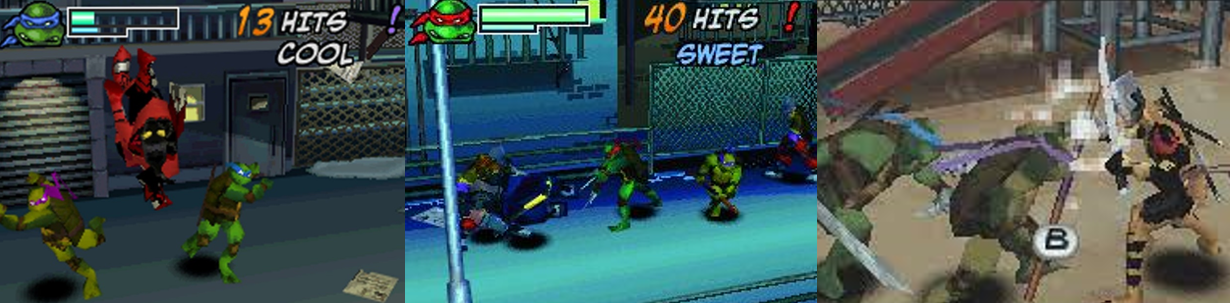
Teenage Mutant Ninja Turtles: Arcade Attack is a 2.5D sidescrolling beat-‘em-up in which the bulk to the game’s action takes place on the bottom screen, while the top screen displays your current score, rank, and plays the story cutscenes. Players can pick between the four Ninja Turtles, with each one having different strengths and weaknesses in addition to their trademark weapons: Leonardo is an all-rounder, Donatello has the best reach but is the slowest, Raphael has the worst reach but is the most powerful, and Michelangelo is the fastest and most agile of the four. Each of the TMNT has their own combos that are performed with successive presses of B or A, with the former attacking with their weapon and the latter seeing them kick. You can jump with X and perform jumping attacks by pressing B or A in mid-air, or hold down or tap the Y button to block or counterattack enemy attacks. A also allows you to revive your partner when they’re knocked down and to pick up weapons and health restoring food, while Y and B lets you grab and toss or launch enemies and pick up or push objects like barrels and traffic cones. Although there’s no dash function here, you can press the directional pad and Y to back flip out of harm’s way (even launching into a flying kick with A or B) or to sidestep, though I found both of these actions to be finnicky and unreliable. As you wade through enemies, you’ll build up a Co-Op Gauge; when it’s full, and flashing, you can press Y and B together to perform one of three powerful co-op moves, such as a giant swing, a diving shell smash, or the classic tossing of enemies towards the screen. However, I was only ever able to pull off the swing so it’s probably better to try to others with a human partner using the DS’s wireless feature.

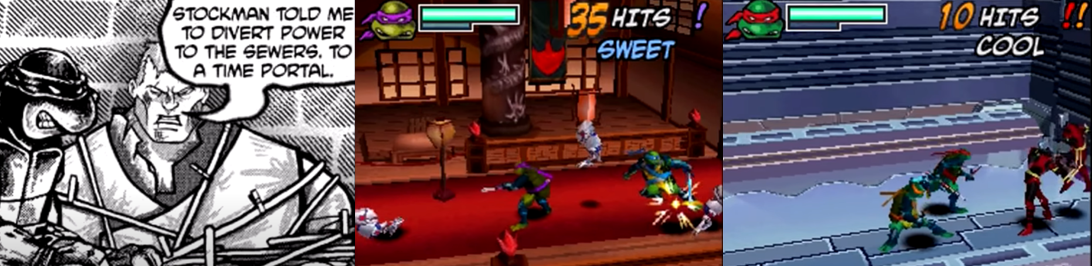
Battle through eight boring stages with repetitive and dull gameplay and combat.

Even when you’re playing alone, you’ll be accompanied by a computer-controlled partner who you can select before a stage; the CPU does a decent job of fending off enemies but, while you can revive them, there’s no option for them to return the favour. If you’re defeated, you can spend some Shells to continue on from that point; otherwise, it’s back to the beginning of the stage for you. Shells are earned by performing well in stages; as you pummel enemies, you’ll build up a combo meter that increases your grade. At the end of a stage, this is factored into your overall score (alongside other data, such as how many hits you landed, how much damage you took, whether you used a Shell to continue, and such) and translates into more Shells for you to use to either continue or unlock extra game modes from the main menu. These modes are also made available by playing through the game’s story mode, which is comprised of eight stages, each of which is surprisingly long and light on interactive elements. You’re asked simply to run at an awkward right angle towards the edge of the screen, fighting between one and four enemies at once, with no bonus stages or much in the way of gameplay variety beyond the odd instance where you have to jump up to a higher level, mash B in a quasi-quick-time event when your clash weapons with an enemy, or the obligatory rising/descending elevator stage near the end of the game. There are four difficulty modes to choose from, with enemies being faster, smarter, and tougher on the higher settings in return for higher scores being on offer. The easiest setting, “Normal”, isn’t especially difficult to play through as you rarely face more than four enemies at once, but the enemies can be quite cheap and the gameplay isn’t really rewarding enough to make bashing them up all that enjoyable.

Graphics and Sound:  
TMNT: Arcade Attack seems to be a little confused about its identity; the story is told using animated comic book panels that are modelled after the original Mirage Comics, which is amazing, but the plot seems to be rooted in the continuity of the 2003 to 2009 cartoon series despite the logo being closer to the original 1987 series. The game doesn’t include the classic TMNT theme song, or any notable music or voice acting, which really doesn’t help improve the experience or shake off the sense that this was a slapped together budget title to cash in on the franchise. While the black and white cutscenes are really good and perfectly capture the spirit of the original comics (and even include some funny running gags such as Mikey struggling with his nunchakus), the in-game graphics opt for a bright, colourful cel-shaded style that is similar to Teenage Mutant Ninja Turtles: Turtles in Time Re-Shelled (Ubisoft Singapore, 2009) but far less appealing; character models are distinctly low resolution, blocky, and lack idle animations. Their attacks are nice and fluid, however, and they have entrance and stage victory animations, and it is fun seeing them pull off more elaborate attacks when you punch in button combos, but the models are a far cry from the appealing sprite work of its predecessors.

While the cutscenes are great, the in-game presentation is generally clunky and lifeless.

Environments equally as disappointing; the game does its best to recreate the locations of previous TMNT brawlers, placing you on the city streets, in a construction site, having you battle trough dark alleyways, the surprisingly clean sewers, across rooftops, and through an office building but there’s no real personality or excitement in these environments. Even when you get transported to the far future, you’re restricted to a traditional Japanese temple and a futuristic lab, with only cyberspace really having much to offer in terms of visuals. None of the stages have any hazards or obstacles to avoid; there’s not much really happening in the background, enemies simply drop in from the top of the screen or dramatically appear on screen rather than bursting from behind signs and such, and the stages go on for far too long, which really makes the game a drag. You’re also restricted in your movements; you can’t always move beyond the awkward angle of the game’s linear path, or backtrack too far, and you’re never asked to climb ladders or to transition to other screens as the game does all of this automatically. Stages do try to be a little distinct from each other by featuring different breakable objects, from tyre stacks to discarded televisions and pixelated cubes, but it’s not enough to make the environments any more interesting and, again, they pale in comparison to the 2D arcade games of yesteryear.

Enemies and Bosses:
Since this game is all over the place with its visual identity, I’m not really sure what you’re fighting here half the time. You start off beating up nameless, disposable street punks; the bigger variants attack with a hockey stick and can tank through your attacks, and you’ll learn that most of the enemies can block your attacks and grab and hurl you just like you can to them. Other punks will toss grenades, which can be hard to see and avoid as they seem to drop them right as you’re jumping in for an attack, but once you reach Stage 3 you’ll find some cybernetically enhanced members of the Foot Clan. As ever, these come in different colours and with different weapons; the basic ninjas can slide tackle you, others toss concussive grenades or shuriken, others wield laser pistols or will rush at you with katana swipes, and others shoot arrows or rockets. You’ll also battle hoards of Mousers, who swarm the screen and jump and bite at you or blast you with laser projectiles from their mouths, but at least you don’t have to worry about them clamping down on your hands and you can toss enemies into each other for extra damage and even send them flying with breakdance-style wake-up attacks.

Only four of the five bosses are worth talking about, and they’re all sadly disappointing experiences.

Eight stages means five bosses (strangely, the first, third, and sixth stages don’t have boss battle…), each sporting a life bar but lacking disposable minions to distract and frustrate you. Your first test is against a golden Foot Ninja variant who wields two katana swords, back flips about the place, slides at you, and sports a jump attack. He’s not too difficult to take out as he’s basically just a tougher version of the regular Foot Ninjas, but Hun represents the game’s first real challenge. This hulking bruiser carries a bazooka that allows him to not only fire missiles from a distance but also doubles as a devastating melee weapon; he can absolutely tank your hits and smash you in the middle of a combo, too, so it’s best to wait for him to taunt you or become momentarily stunned from his attacks. Karai attacks at the end of the sewer stage; easily the fastest boss, she attacks with katana blades, tosses shuriken from mid-air, flies at you with a kick, and loves to endlessly block your attacks to make the battle needlessly long and aggravating. A cybernetically enhanced version of Doctor Baxter Stockman awaits in the far-flung future, proving the most versatile boss so far. His enhancements let him hover about with a burst of flaming jet, he knocks you flying with an electrical burst if you get too close, has a sliding uppercut and an electrically-charged fist, and blasts a Kamehameha-like laser across the screen that leaves him momentarily vulnerable to a good combo. Finally, you’ll battle the Cyber Shredder in cyberspace; this fearsome foe sweeps the arena with a wide red laser, flies at you with a spinning attack, emits a concussive blast after being knocked down, causes the ground to burst into flames, whips at you with a tentacle-like appendage, and dashes with a claw swipe or knee strike. The trick here is to hit and run, really; just leap in, hit a combo, and side step away until he’s open for another flurry and he’ll eventually go down.

Power-Ups and Bonuses:
As is to be expected from a TMNT game, you can restore your health by eating pizza found by smashing various objects around each stage; additionally, if you find some chop suey, you’ll restore a portion of your health. This is the first TMNT videogame I’ve ever played where you can actually pick up and use additional weapons; wooden boards, steel pipes, and stop signs can be tossed at enemies or used as temporary melee weapons and you can even toss shuriken, grenades, and destructible objects (though the latter will greatly reduce your walking speed).

Additional Features:
Perform well in each stage and you’ll earn yourself Shells that can be used as a continue if you’re defeated or to unlock additional gameplay modes. You can take on a Stage Attack to compete for the highest score and rank, a Survival mode against an endless wave of enemies, and a boss rush, all of which must be purchased with your Shells. Completing the story unlocks every stage in the game for you to replay at your leisure, though there’s no way to rewatch the game’s cutscenes outside of playing the story. While there aren’t any skins or unlockable characters, the TMNT do receive a futuristic glow up from Stage 6, though you can’t apply these at will, and of course TMNT: Arcade Attack can be played on higher difficulties or alongside a friend if they also have a copy of the game.

The Summary:
I’ve played a lot of Teenage Mutant Ninja Turtles videogames and, while many of them are basically mindless beat-‘em-ups with little on offer than the simple thrill of beating the piss out of countless colourful enemies, they still had more on offer than this misfire of a title. I get the idea behind Teenage Mutant Ninja Turtles: Arcade Attack: a quick, cheap, arcade-style brawler to appeal to fans of the TMNT’s old beat-‘em-ups, but the execution falls flat in almost every department except for the motion comic-like cutscenes and the shallow diversity of the combos. There’s a lot about the game that’s modelled after these arcade titles, particularly in the environments and the simple, pick-up-and-play format, but it just can’t live up to those titles because of the way it presents itself. Not only is it all over the place in terms of its identity, the presentation of the gameplay has this weird isometric angle, there are hardly ever any enemies onscreen, and the lack of environmental hazards or visual interest really hurts the title. It’s a shame as this would’ve been so easy to get right if the game had simply been a 2D brawler with 3D style backgrounds, or even more akin to Turtles in Time Re-Shelled, which was a far better 2.5D conversion of the classic arcade visuals. A disappointing lack of bosses and recognisable TMNT characters and enemies also keeps the game from being as good as it could be, as does the monotony of the strangely long stages, and I wasn’t impressed by the revive function not really working in single player. There are some decent unlockables, at least, but it’s undeniable that there are better TMNT games to play, with Teenage Mutant Ninja Turtles 3: Mutant Nightmare (Konami Computer Entertainment Studios, 2005) looking like a far better option for DS players.

My Rating:

Rating: 2 out of 5.

Could Be Better

Have you ever played Teenage Mutant Ninja Turtles: Arcade Attack? How do you think it holds up against previous TMNT beat-‘em-ups? Which of the TMNT was your favourite to play as and why? Did you enjoy the Mirage Comics-style cutscenes and do you agree that the game’s identity is a bit muddled? Were you disappointed by the graphics, environments, and bosses? Did you ever unlock and clear every mode in the game? Which TMNT videogame is your favourite? How are you celebrating the TMNT’s debut this month? Whatever your thoughts on the TMNT, leave a comment down below or on my social media and pop back for more TMNT action!