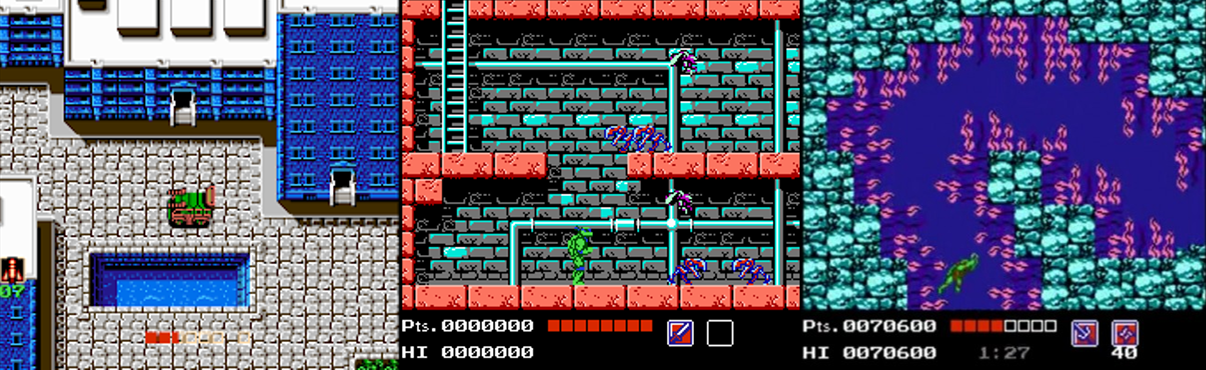
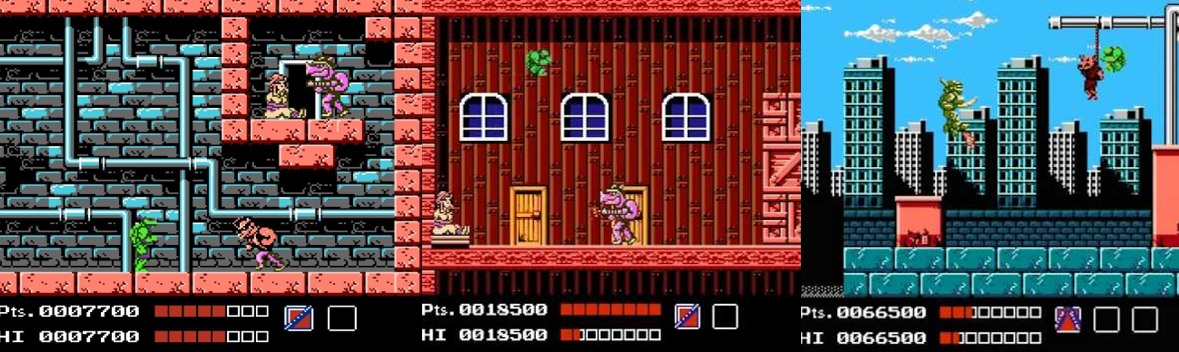
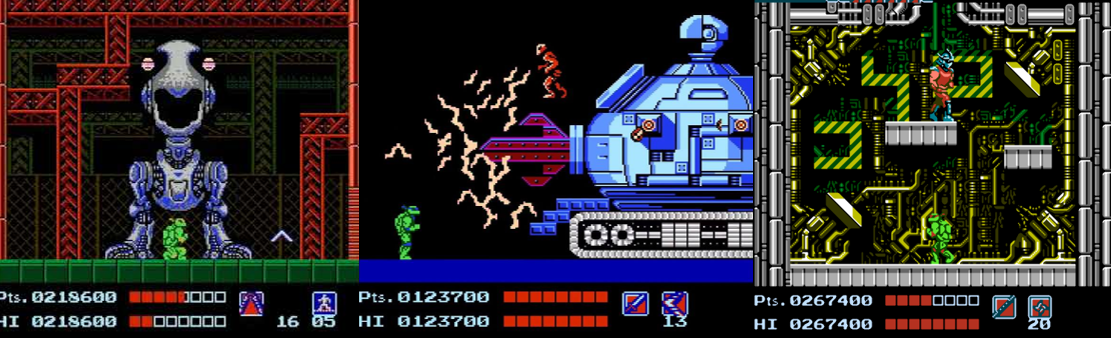
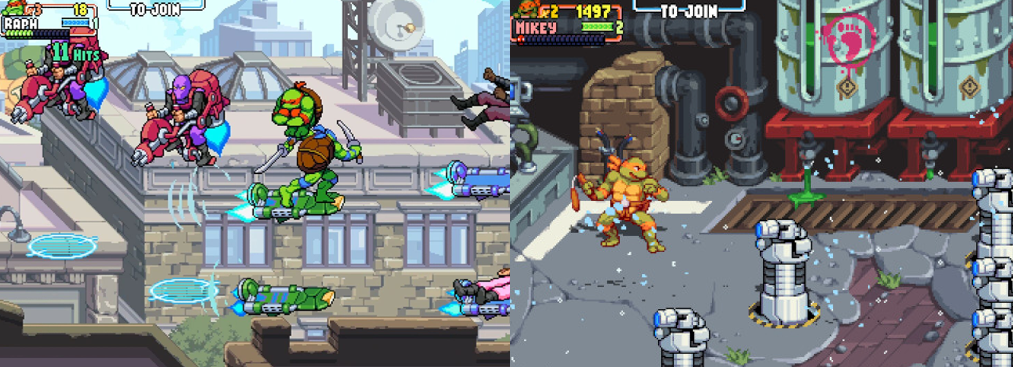
Game Corner [Turtle Tuesday]: TMNT: Turtles in Time (Xbox Series X)


The first issue of Kevin Eastman and Peter Laird’s Teenage Mutant Ninja Turtles (TMNT) was published in May of 1984. Since then, the TMNT have gone on to achieve worldwide mainstream success thanks not only to their original comics run but also a number of influential cartoons, videogames, and wave-upon-wave of action figures. This year, I’m emphasising third entries and time travel shenanigans in the popular franchise every Tuesday in May!


GameCorner

Released: 30 August 2022
Originally Released: March 1991 (Arcade) / 24 July 1992 (SNES)
Developer: Digital Eclipse
Original Developer: Konami
Also Available For: Arcade, GameCube, Nintendo Switch, PC, PlayStation 2, PlayStation 4, PlayStation 5, Super Nintendo Entertainment System (SNES), Xbox, Xbox 360, Xbox One, and Xbox Series S

The Background:
Back in the late-eighties and early-nineties, the Teenage Mutant Ninja Turtles (or Teenage Mutant Hero Turtles for us Brits) took the lives of children everywhere by storm. Before Mighty Morphin’ Power Rangers (1993 to 1996) and Pokémon (1997 to present) dominated playgrounds, Christmases, and birthdays alike, kids were transfixed by the Teenage Mutant Ninja Turtles (1987 to 1996) animated series. A toned down version of the original, far darker Mirage Comics publications, the “Heroes in a Half-Shell” were so popular that they spawned not just a series of live-action movies (of varying quality), but also additional comic book spin-offs, a beloved line of action figures, and a whole host of videogames. It was Konami’s efforts with the original TMNT arcade game that laid the foundation for some of the franchise’s most influential gaming ventures and the developers sought to expand upon those efforts with this equally beloved sequel. Bigger, better, and longer than its predecessor, much of Turtles in Time’s impact can be attributed to the surprisingly faithful home console port that wowed SNES gamers back in the day, and the game was so memorable that it received an unfairly lambasted 2.5D remake in 2009. Though ports of Turtles in Time have been sporadically available, its remake was de-listed from digital stores for the better part of eleven years, meaning Turtles in Time was (ironically) lost to time until it was included in this Cowabunga Collection for modern consoles alongside a host of other games and quality of life features. As both the arcade and SNES versions are included in this collection, and the differences between the two don’t really warrant two separate reviews, I’ll be including both versions in this review.

The Plot:
The Turtles leap into action when Krang steals the Statue of Liberty, only to be sent hurtling through time courtesy of a time warp activated by their archnemesis, Oroku Saki/The Shredder, forcing them to fight Shredder’s army in both the past and the future in order to get home.

Gameplay:
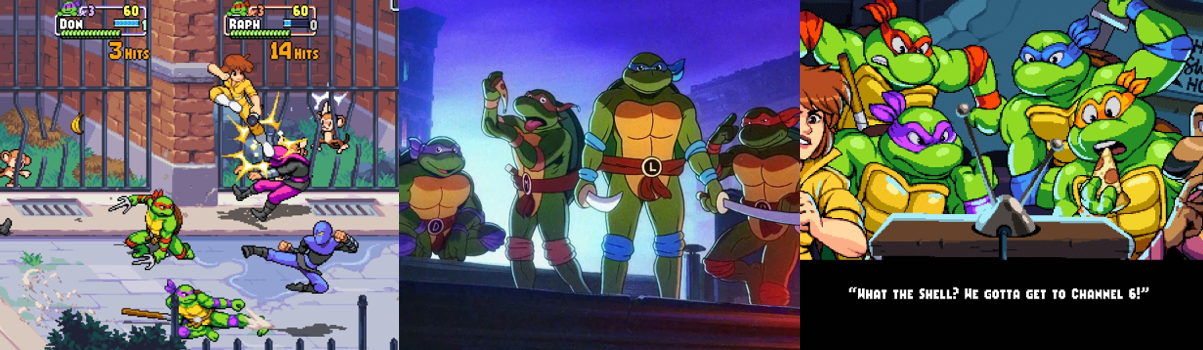
Like its predecessor, Teenage Mutant Ninja Turtles: Turtles in Time is a sidescrolling beat-‘em-up that supports up to four players; supposedly, two-player arcade cabinets were released and the arcade version never made it over to Japan, but this version of the game allows both on- and offline co-operative play, though the SNES version of the game is limited to two player simultaneous co-op. As ever, players can select from one of the four Ninja Turtles who all control exactly the same but play slightly differently depending on the reach of their weapons (putting Raphael at a disadvantage). Gameplay is limited to two primary buttons, with X allowing you to attack and string together basic combos and B letting you jump; you can press X in mid-air for a flying attack and press X and B together to perform a power attack that doesn’t seem to drain your health meter. Once again, you have no dash options or dashing attack, but you can now slam and hurl enemies about by hitting X when up close to them and you can pull off a “back attack” to fend off enemies attacking from behind.

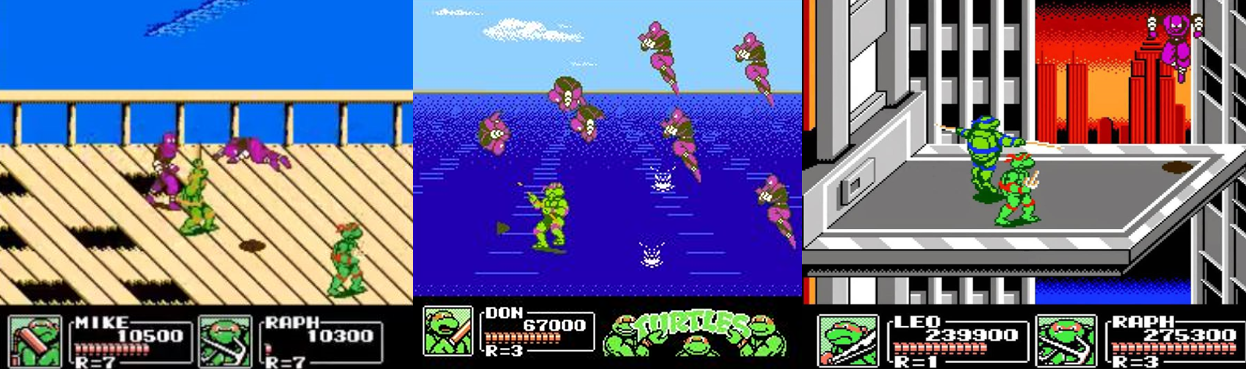
Despite a dip in graphics, the SNES version holds up surprisingly well to its arcade counterpart.

Turtles in Time is much bigger and longer than the last game, sporting nine levels to play through, each of which being far livelier and with more opportunities to interact with the environment. You can hit traffic cones, hydrants, explosive barrels, and boxes of fireworks to take out enemies but, even better, onscreen hazards like wrecking balls can also damage enemies. Hazards like these are far more plentiful this time around, including loose floorboards, mines, and electrical bolts from turrets and Krang’s massive exosuit so it pays to keep your wits about you and not just charge blindly ahead. Gameplay is mixed up a bit with two levels dedicated to fast-paced, autoscrolling action, first on a hoverboard in Sewer Surfin’ and then on a floating disk in Neon Night Riders; your combat options remain the same here, but some enemies are a little harder to hit as they’re floating above you and you’ll need quick reflexes to dodge hazards like the spiked gates and mines. The SNES version offers not only an additional score bonus for these stages but even includes an extra level, complete with a traditional elevator gauntlet.

Graphics and Sound:
Visually, the game is very similar to its predecessor; I’m pretty sure the sprites are all exactly the same, bar maybe a few additional animations and enemy variants, but they’re just as colourful and full of life as before. Every character pops against the background, has some limited idle animation, and the likes of Splinter and April O’Neil (depending on which version you’re playing) will appear to hurry you along if you dawdle. Voice clips are used to great effect, especially in the arcade release, with the Turtles shrieking, “My toes! My noes!” when hurt by spikes and ending every stage with a triumphant cry of “Cowabunga!” alongside a victory animation. Voice samples are far sparser and more dulled in the SNES version, naturally, which relies more on subtitles and its own sound effects, but both games still perfectly capture the quirky and slapstick nature of the cartoon. The SNES version also presents a different version of the Neon Night Riders stage, with the action taking place from behind the characters and the stage tweaked to make use of the console’s “Mode 7” features.

The game is noticeably bigger than before, with the SNES version even boasting new features.

Environments are far more varied this time around; thanks to the time travel plot, the TMNT don’t just fight through the streets and sewers of New York City but are also transported back to a prehistoric jungle (complete with shimmering heat effects from the lava and a cave full of falling stalactites), a pirate ship full of loose planks, a speeding train in the Old West, and the neon streets of the far-flung future! Levels are noticeably longer and with more enemies, with no visible slowdown, though the SNES version is automatically slower since you can’t activate a “Turbo Mode” to speed things up. The SNES version of the game does add a whole new Technodrome level, however, and swaps some bosses around, even replacing one entirely with one of my favourite villains from the series. Both versions of the game use big, colourful art to tell their story, with the SNES version offering different endings depending on the difficulty setting you played on. Finally, while the SNES version features some popping tunes and a decent rendition of the TMNT theme song, the arcade version impresses with its funky, adrenaline-pumping soundtrack and even boasts a rendition of “Pizza Power” for its introduction sequence.

Enemies and Bosses:
As is tradition for a TMNT videogame, you’ll primarily be fighting your way through hordes of robotic Foot Soldiers; these come in all different colours and variants, from the regular, easily dispatched purple ones to weapon-wielding goons garbed in red, silver, or yellow. These guys will toss shuriken at you, stab at you with spears and swords, toss giant bombs, or swing axes; they also come flying in on dinosaurs, charge at you on fire-breathing Velociraptors, and pilot flying machines. Robots also return as notable enemies, with one wildly swinging its boxing gloves at you, though you’ll only encounter Mousers in the SNES version of the game. There are some new enemies in Turtles in Time, too, including the Xenomorph-like Pizza Monsters and the Rock Soldiers, who charge at you and wield high-powered weapons of their own.

Bosses are more visually varied, especially in the SNES version.

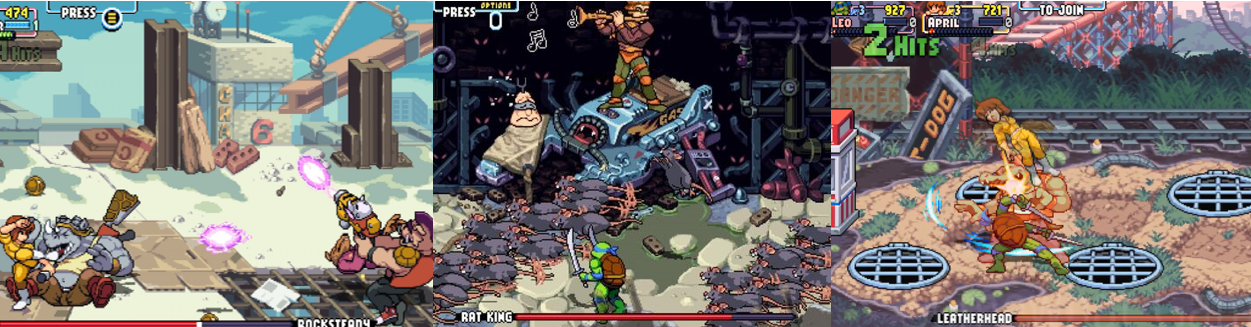
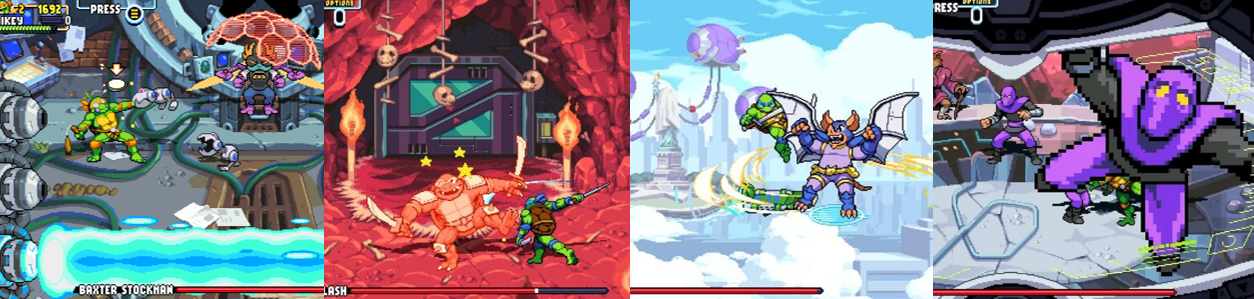
Also, as is to be expected, some of the TMNT’s most recognisable foes return to dog you as end of level bosses. The first you’ll encounter is Baxter Stockman, now mutated into his human fly form; Baxter hovers overhead firing at you with a machine gun, only to switch to sending out plasma fists after you’ve damaged him enough. At the end of Alleycat Blues, you’ll battle Metalhead, who attacks from a distance with his extendable arms and legs and flies at you courtesy of a rocket-powered kick, though he has a tendency to stop and gloat and leave himself open to a counterattack. Sewer Surfin’ doesn’t feature a boss in the arcade version, instead forcing you to fend of a swarm of Pizza Monsters, but you’ll take on the Rat King in the SNES version, which is much more interesting and exciting as he’s in his little hovercraft and fires missiles and mines at you. Similarly, you face the underwhelming Cement Man in the arcade version of the Prehistoric Turtlesaurus level, with the mud-like goon sliming about the place and trapping you in mud, but the SNES version replaces him with Slash! This deranged doppelgänger is far more formidable, slashing at you with his jagged blade and spinning about the place as a whirling shell of bladed fury, making him a far worthier adversary.

Boss battles feature different phases and more formidable attack patterns this time.

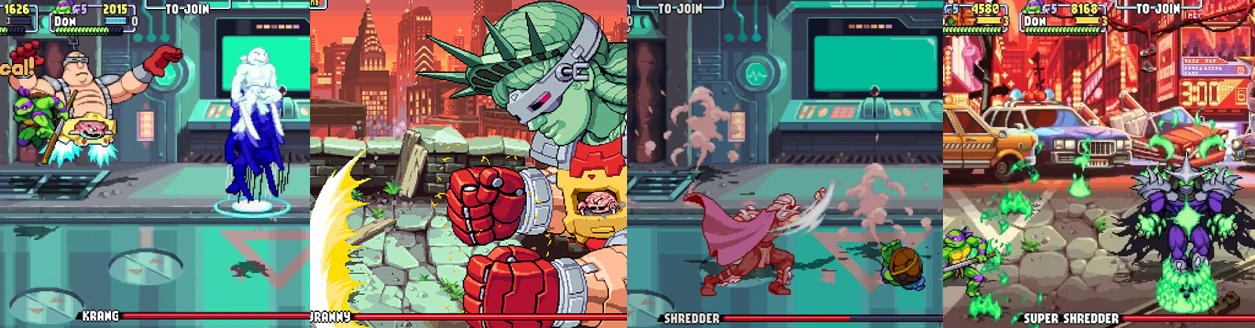
After battling across the deck of a pirate ship, you’ll face both Tokka and Rahzar; while they simple charge, swipe, and hop about in the arcade version, they’re much more formidable in the SNES version, where they appear in the new Technodrome stage and sport flame and freezing breath and act as sub-bosses. In the SNES version of the pirate ship level, Bepop and Rocksteady take Tokka and Rahzar’s place; garbed in theme-appropriate attire, they attack you with a whip and sword, respectively. The hulking Leatherhead awaits at the end of the train stage, scurrying about the place, lashing at you with his tail, and tossing daggers your way, while you’ll go one-on-one with Krang while racing through the futuristic streets of 2020 A.D. Krang’s a lot less of a threat compared to the last game, dashing at you with a kick, smacking you with a clap attack, and firing missiles from his chest, but he resurfaces in the Technodrome stage. Now flying a UFO, he drops Mousers into the arena and teleports about to avoid your attacks, but the SNES version also adds a bubble-like projectile to his arsenal and has him more erratically which, in conjunction with his height, can make him a difficult target.

The Shredder is far more persistent and dangerous in the SNES version of the game.

Naturally, you’ll also do battle with the TMNT’s mortal enemy, the Shredder. However, in the SNES version of the game, you actually battle him twice and the final battle is noticeably different in both versions. The first time you face him is at the end of the new Technodrome level, where he hops behind the controls of some unseen giant mech and blasts at you with bullets while swiping with a retractable claw arm in perhaps one of the game’s most memorable boss battles. To defeat the Shredder, you need to avoid his targeting reticule and hurl Foot Soldiers at him in a fun bit of innovation, though this can be tricky to do due to poor visibility and the sheer number of enemies and projectiles. The Shredder awaits in the final stage of the game, too, where the Statue of Liberty looms in the background; in the arcade version, he attacks with his sword and martial arts skills while also sending out plasma hands similar to Baxter and once again sporting an instant death regression blast that turns you back into a regular turtle. In the SNES version, Shredder immediately transforms into his far more formidable Super Shredder form; protected by a flaming aura, Super Shredder sends fireballs flying your way, shoots flames along the ground, and fires bolts into the air while dashing about the screen at breakneck speed.

Power-Ups and Bonuses:
Unfortunately, for all the additions Turtles in Time sports, power-ups are not one of them. You can still replenish your health with the odd pizza box but the only other power-up available to pick up is a bomb pizza item that sends you into a frenzy for a few seconds.

Additional Features:
As is to be expected, the arcade release is limited in its options; you can play with up to four other players both on- and offline and try to out-do your last high score, but there’s not much else on offer beyond playing through this awesome game as a different character. The SNES version might have taken a graphical hit but actually boasts a few interesting additional features: you can go head-to-head against a friend in versus mode, take on three courses in a time trial mode, pick from three difficulty settings (with different continues and endings assigned to each), set your maximum number of lives, and enjoy the benefits of a sound test. You can also pick between two colour schemes, “Comic” and “Animation”, which gives the TMNT new colour palettes, which is a nice touch. Naturally, the Cowabunga Collection adds a number slew of extra features to the list, however; first, you’ll gain a 70G Achievement for finishing each game, you can use the Left Bumper to rewind, and use the Right Bumper to access save states and display options. The arcade version can be further enhanced with a level select, God Mode (which makes you invincible and allows one-hit kills on most enemies and bosses), the removal of the penalty bombs that kill you if you linger about, and the ability to activate the far harder “Nightmare Mode” and speed things up with Turbo Mode. The SNES version isn’t lacking in similar options, boasting a level select and additional lives, while also providing every boss with a helpful life meter. Even better, you’ll still get your Achievements even with these enhancements activated and you can again peruse a strategy guide, switch between the American and Japanese versions (with minimal differences that I could see), view the game’s box art and manuals, and even choose to simply watch the game play itself.

The Summary:
There’s a reason Teenage Mutant Ninja Turtles: Turtles in Time is remembered so fondly; it really was the quintessential TMNT videogame at the time, taking everything that was so good about the original arcade release and expanding on it with larger, more varied stages and far more interesting boss battles. While the gameplay remains very much the same and there’s a distinct and disappointing lack of power-ups, the game is much more enjoyable than its predecessor, offering more enemies and more visually interesting environments to battle through. The SNES release, while noticeably lacking in visual and audio quality, is a surprisingly faithful recreation of its arcade counterpart; sporting some nifty additional features and new levels and bosses, it’s easy to see why it was a must-have game for the system back in the day. The Cowabunga Collection only adds to the appeal of both games, offering numerous quality of life options to make gameplay a breeze and preserving these two classic arcade beat-‘em-ups for a whole new generation. There may be better beat-‘em-up titles out there, with more gameplay variety, more power-ups, and more options available, but Teenage Mutant Ninja Turtles videogames didn’t get much better than Turtles in Time when it was released and it’s a joy to see it more readily available so others can experience the fast-paced, action-packed pick-up-and-play thrill of these simplistic brawlers.

My Rating:

Rating: 4 out of 5.

Great Stuff

Did you ever play Teenage Mutant Ninja Turtles: Turtles in Time out in the wild? How do you think it compares to other TMNT videogames and similar arcade fighters? Did you own the SNES version? If so, what did you think to the new levels and bosses and were you impressed with the conversion from the arcade original? Which of the characters was your go-to and which of the game’s bosses was your favourite? What did you think to the additional features added to the Cowabunga Collection? Which of the four Turtles is your favourite (and why is it Raphael?) Whatever your thoughts, I’d love to hear your memories of Turtles in Time down in the comments!

Game Corner [Turtle Tuesday]: TMNT III: Radical Rescue (Xbox Series X)


The first issue of Kevin Eastman and Peter Laird’s Teenage Mutant Ninja Turtles (TMNT) was published in May of 1984. Since then, the TMNT have gone on to achieve worldwide mainstream success thanks not only to their original comics run but also a number of influential cartoons, videogames, and wave-upon-wave of action figures. This year, I’m emphasising third entries and time travel shenanigans in the popular franchise every Tuesday in May!


GameCorner

Released: 30 August 2022
Originally Released: 25 November 1993
Developer: Digital Eclipse
Original Developer: Konami
Also Available For: Game Boy, Nintendo Switch, PC, PlayStation 4, PlayStation 5, Xbox One, Xbox Series S

The Background:
The Teenage Mutant Ninja Turtles were almost unrivalled in popularity back in the late-eighties and early-nineties; known as Teenage Mutant Hero Turtles here in the UK, the “Heroes in a Half-Shell” dominated an entire generation with their comics, cartoon, extensive toy line, and videogames. Konami’s efforts not only proved a hit at arcades but also took 16-bit gamers by storm and helped to make Nintendo a household name in the UK. Additionally, Konami produced three handheld TMNT titles for Nintendo’s ground-breaking portable console, the Game Boy; though restricted by the Game Boy hardware, the first two games impressed in their ambition and even tried to incorporate elements from the arcade releases. However, for this third game, Konami chose to completely overhaul not just the graphics and gameplay, but the genre too; unlike the previous two handheld efforts, Radical Rescue was a “Metroidvania” title with a heavy emphasis on exploration rather than mindless brawling. This resulted in mixed reviews, with some criticising the decision due to the Game Boy’s hardware being insufficient for such a genre and others praising the genre shift as a means to improve upon its predecessors. Either way, Radical Rescue remained a Game Boy exclusive title for nearly thirty years before it was finally re-released in the 2022 Cowabunga Collection alongside a host of other TMNT games and quality of life features.

The Plot:
When their arch-nemesis, Oroku Saki/The Shredder, strikes again by kidnapping their master and father-figure, Splinter, the TMNT leap into action one turtle short. Now Michelangelo must venture into the Shredder’s hazardous mine to rescue his brothers, and their master, and put a stop to their enemy’s latest scheme.

Gameplay:
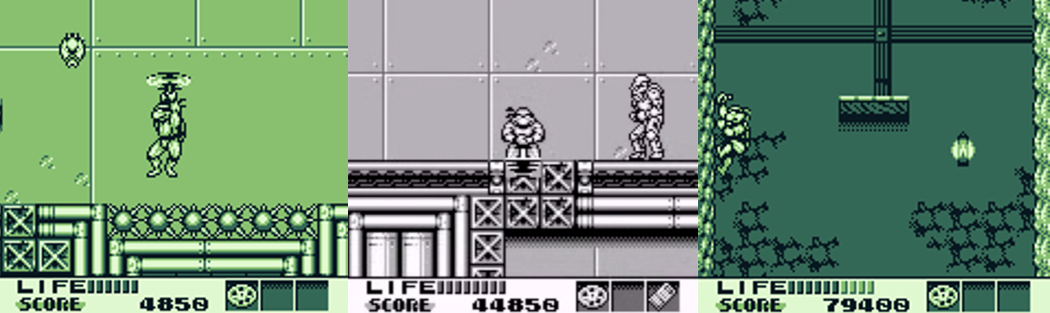
As mentioned, Radical Rescue is a 2D adventure game with a heavy emphasis on exploration as much as combat; it thus falls under the “Metroidvania” banner and will have you constantly consulting a barely useful grid-like map to discover new paths and areas to explore in your quest to locate the other TMNT. This means that, unlike every other TMNT game I’ve ever played up to this point, you can’t select a character from the start; instead, you’re stuck with Michelangelo and must defeat bosses to acquire keys to free his brothers and then hunt down key cards to access new areas, using each turtle’s unique skills to get past enemies and obstacles. Each turtle controls the same; you use X to attack and A to jump and press X while jumping to do a flying kick. Unlike in the TMNT’s last two Game Boy outings, you can neither throw shurikens or perform a slide kick with down and X, though you can toss shuriken when climbing ladders and you’re able to switch to one of the other turtles at any time from the pause menu and each one not only has their signature weapons but comes with different abilities to get past hazards and access new areas of Shredder’s diabolical mine. Mikey actually ends up being one of the most useful characters; I found myself defaulting back to him a lot as he can perform a helicopter-like glide with his nunchakus when you press and hold A while jumping, which is great for drifting past spike pits or reaching out of the way platforms.

Each turtle has their own unique abilities to aid with exploration as well as combat.

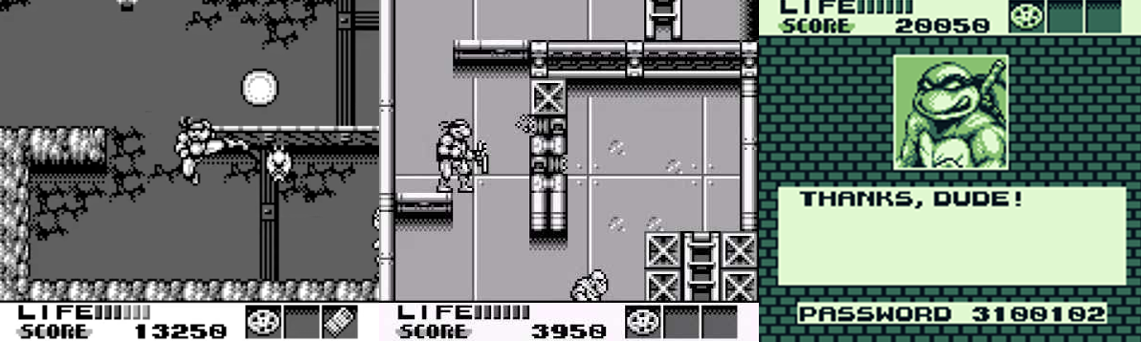
While I can’t be certain, I’m fairly sure that the game forces you to rescue each of Mikey’s brothers in a specific order; I definitely found myself following a particularly path but then my logic was based simply on going for whichever boss and key card was closest to where I was. Thus, the first turtle I rescued was Leonardo, who’s given the bizarre ability to burrow through certain blocks by pressing down and A, effectively turning him into a living drill. Next, I rescued Raphael who can pop into his shell with down and A to pass harmlessly over spikes (until you inevitably have to jump up to a platform) and through small gaps and tunnels; this also makes him immune to certain attacks, which is helpful. Finally, I rescued Donatello, who can cling to and scale walls by jumping at them, which is basically required to access the final areas of the mines. Naturally, each turtle has their own strengths and weaknesses in combat, with Raph and Mike limited in their reach compared to their brothers, but I found myself favouring Mike since there’s more emphasis on jumping than any of the turtle’s other abilities. Every time you defeat a boss, your health will be fully restored, which is useful; rescuing a turtle (and, later, Splinter) grants you a password that you can jot down from the pause screen to continue if you fail in your quest, but your main enemy here will be trying to find your way around the mine and surviving its mechanical trap rooms.

Exploration and backtracking are greatly emphasised to find secrets and rescue your allies.

Radical Rescue all takes part in one large interconnected map; you start on the outside of the main area and venture out here a couple of times to reach other otherwise inaccessible parts of the mine, and will go through doors (either using a key card or passing through from a certain direction) to enter mechanical areas where a boss lurks. These areas, and the mine itself, and crawling with respawning enemies and numerous hazards; we’ve got falling boulders, spike pits, wall lasers, bursts of flame, ceiling spikes, Foot Soldiers trying to run you down in giant mine carts, and extremely annoying bubble-like projectiles that clog up the screen and follow you incessantly. The Cowbunga Collection allows you to activate “helpful map icons” and I’d definitely recommend doing this; it doesn’t help the basic nature of the map but it’s useful to know that you’re heading to a boss, key card, or captive in need of rescue. This will serve you well when it comes to exploration; naturally, you’re somewhat limited in how far you can go in the mines when you only have one or two turtles on hand but, when you have them all, it’s very easy to get turned around because the map is so simplistic and many of the game’s environments all look the same. Because of this, it’s not uncommon to locate a captive turtle but not have a key or to run into a door that requires a key card you haven’t gotten yet, or to have to backtrack halfway across the map to get an item you require. Once you get used to the map and have all four turtles rescued, exploration gets a little easier; you can take shortcuts by climbing or digging down certain areas, for example, but a quick travel system to the four compass points of the map would’ve been much appreciated.

Graphics and Sound:  
To be fair, Radical Rescue is a step up from the TMNT’s last two Game Boy titles. Sprites are smaller now, but actually benefit from it; you get more screen space to work with and the game runs much smoother by default. As a trade-off, though, the game’s taken a step back in some areas; Leo and Raph only hold one of their weapons again, there are no idle animations, and the common Foot Soldiers simply wander about the place. However, the TMNT are far more versatile this time around; their new abilities help them to be more unique and offer up some new ways to play and some new animations and the boss sprites are far bigger and more visually interesting. Additionally, the story cutscenes are the best yet for a TMNT Game Boy title; text and large sprite art are used to convey the general plot and whenever you rescue an ally and, while these barely contain any frames of animation, they’re much more detailed than in the previous games.

The visuals are far better but environments are too similar to impress all that much.

The game’s music isn’t bad, either; while sound bites are at a minimum this time around, Radical Rescue still features a pretty good version of the classic TMNT theme and each area of the game has different music associated with it. However, where the game falters, for me, is in the variety of its presentation; while it’s nice to not be ploughing through the sewers, streets, and Technodrome again, I question the logic of setting the entire game in a drab, repetitive mine. Sure, there are ladders, lanterns, and some different rocky formations here and there but the Game Boy simply isn’t powerful enough to make this large and boring environment visually interesting. When you’re outside, it’s a different story; the background is still quite plain and generally just shows clouds or mountains, but it’s a nice change of pace from rocks and shit. The mechanical areas do help to break things up as well, but these all look and feel the same as well; it’s way too easy to get lost because most of these areas are largely indistinguishable from each other. I think it would’ve helped to theme them after the elements; have one take place under water or covered in snow, one have more lava pits and fire hazards, maybe implement a wind theme…anything but the same screens over and over. In this way, while Radical Rescue is easily the biggest and most involved of the TMNT’s Game Boy adventures, it also paradoxically feels the least innovative because it’s just not very engaging to plod from one dark cave to one mechanical hellscape and back again.

Enemies and Bosses:
As is to be expected, the Shredder’s Foot Soldiers are all over the place. Unlike in the TMNT’s last two Game Boy games, they’re a little bit more competent here; they mostly just wander around but the greater emphasis on horizontal and vertical exploration means they’re often in awkward places and the fact that they constantly respawn can make traversal a bit difficult at times. The Foot Soldiers will toss grenades at you (which you can destroy), wield pickaxes, and fly overhead with jetpacks to drop bombs on you, as well as try to run you down in large mine carts. You’ll also encounter little laser firing spider-like robots, these weird rock-like humanoids, and mechanical frog-like enemies that hop about and fire at you. Traditional TMNT enemies like Mousers and Roadkill Rodneys are absent here, replaced by swooping bats and an abundance of environmental hazards, such as homing missiles and spikes. Another area where Radical Rescue is a step back from its predecessors is its bosses; the game boasts only five boss battles, with all but one being some of the TMNT’s more obscure enemies (at least for me). Each one sports a health meter and each boss fight takes place in an enclosed arena that’s ripped right out of the Mega Man series (Capcom, 1987 to present).

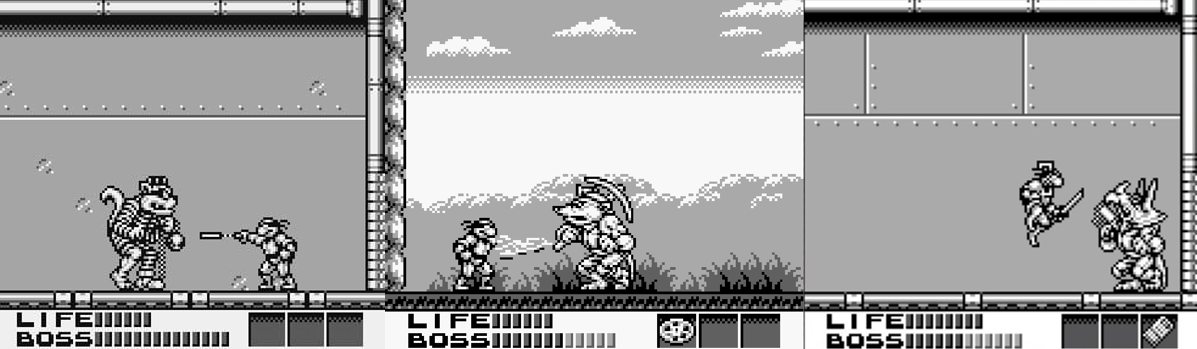
Bosses are fought in enclosed arenas and will test your patience at times.

The first boss I thought was Scratch, who jumps about, swipes at you up close, and hurls a ball and chain at you from a distance. Scratch very much sets the standard for Radical Rescue’s bosses in that they have quite large hit boxes, deal quick, heavy, and nigh-unavoidable damage up close, and you need to get into a bit of a rhythm to land an attack; rather then simply tank through their hits and whittle their health down, it’s better to keep your distance and play things smart, something that serves you well in the fight against Dirtbag. This mining mole dashes at you with a super annoying uppercut and swipes with his pickaxe, but will also leap into the air and stun you if you’re touching the ground when he is. It’s pretty hard to avoid him as he always aims to land on top of you, so you need to jump away and then quickly double back to hit him and then jump away again to avoid taking damage. I was probably getting the hang of the game by the time I fought the Triceraton as he actually seemed a bit easier; for this fight, stay out of his crosshairs and avoid the lighting bolt he fires out while being mindful of his charge attack, but otherwise he’s not too dissimilar from the Rocksteady and Bebop bosses of previous TMNT games.

As if battling these tricky bosses wasn’t bad enough, you’re forced into a boss rush before the finale.

Lastly, you’ll battle with Scale Tail, probably the most difficult of the four main bosses; Scale Tail lashes at you with his tail when you’re up close and spits a projectile at you that becomes a plume of fire. If you manage to avoid this, the snake will try to blow you into the hazard, though this is actually your best chance to attack him providing you can fight against the rush of air and avoid taking damage from his large hit box. After battling through the hazardous final section of the game, you’ll have to fight all four bosses again, one after the other, with no health items or reprieve between each bout! While this is easily one of the laziest gameplay mechanics of any game, I actually found the bosses a little easier the second time through, probably because I was more aware of their attack patterns and had a tried-and-tested strategy in mind for beating them. After defeating them all again, you’ll get to take on “Cyber Shredder” in a two-phase boss battle where he gets a whole new health bar after the first round while you get nothing, making for easily the toughest segment of the game. Shredder flies across the screen with a knee attack, levitates overhead and spams a diving kick, throws kicks at you up close, and launches an orb-like projectile that becomes a plume of fire. In the second phase of the fight, these flames are bigger, the Shredder gains an aerial projectile, and his attacks become faster and more aggressive.

Power-Ups and Bonuses:
Unfortunately, despite being a Metroidvania adventure, Radical Rescue doesn’t offer anything that new in terms of pick-ups and power-ups. Each turtle acts as a power-up in a way, offering new traversal options, but the best you’ll hope for in any tangible way is the odd slice of pizza dropped by defeated enemies to refill your health. Two new aspects though, are the ability to pick up and store a whole pizza, which will replenish your health bar when it’s drained (a literal lifesaver in boss rooms) and the ability to permanently extend your health bar by picking up hearts hidden throughout the game.

Additional Features:
Another way Radical Rescue is a bit of a step back is the lack of any in-game options; there are no difficulty settings here, no bonus games, and the only real option available to players is to continue their progress with the password system. When playing the Cowabunga Collection, you’ll net a sweet 70G Achievement for completing the game; you can also check out the game’s box art and manuals, switch between the Japanese and American version, apply various borders and display options (including an LCD display to recreate the feeling of playing on the Game Boy’s eye-watering screen) and make use of a strategy guide for some helpful tips. While the only enhancement on offer is to activate helpful map icons, you can still rewind the game with the Left Bumper and access save states using Right Bumper, both of which are incredibly helpful during the game’s trickier platforming and boss sections.

The Summary:
I was completely caught off-guard by Teenage Mutant Ninja Turtles III: Radical Rescue; I was not expecting it to be this sprawling Metroidvania-style game and it took me some time to come to terms with the dramatic genre shift compared to the more action-oriented TMNT games I’ve played. That’s not to say there’s a lack of combat here; you’ll still be busting plenty of heads, but the emphasis is much more on exploration, back-tracking, and thinking about how to get past obstacles and progress to new areas. In some ways, this is much appreciated; the game is surprisingly big, definitely offers something different from the TMNT’s usual games, and I liked that the TMNT each had their own abilities to help differentiate them. While I appreciate that it’s offering something different, it’s pretty tough to find your way around the repetitive environments and I’m unimpressed by the mine setting, as large as it is. There was also little incentive for me to switch between turtles, the bosses were unnecessarily troublesome at times, the inclusion of a boss rush was beyond lazy, and I don’t think the enemies, environments, or bosses really captured the depth of the TMNT license. Still, the gameplay wasn’t bad and it’s clear that Konami had finally come to grips with the Game Boy’s capabilities by this point so it’s probably worth another go-around as long as you play this version of the game, with all the handy features to get around its more frustrating aspects.

My Rating:

Rating: 2 out of 5.

Could Be Better

Did you have Teenage Mutant Ninja Turtles III: Radical Rescue in your Game Boy library back in the day? What did you think to genre shift towards exploration and Metroidvania mechanics? Which character’s ability was your favourite and which one did you play as the most? What did you think the the game’s presentation and the boss battles? What’s your favourite Metroidvania title? Whatever you think about Teenage Mutant Ninja Turtles III: Radical Rescue, feel free to share them in the comments below or leave your thoughts on my social media.

Game Corner [Turtle Tuesday]: TMNT III: The Manhattan Project (Xbox Series X)


The first issue of Kevin Eastman and Peter Laird’s Teenage Mutant Ninja Turtles (TMNT) was published in May of 1984. Since then, the TMNT have gone on to achieve worldwide mainstream success thanks not only to their original comics run but also a number of influential cartoons, videogames, and wave-upon-wave of action figures. This year, I’m emphasising third entries and time travel shenanigans in the popular franchise every Tuesday in May!


GameCorner

Released: 30 August 2022
Originally Released: 12 December 1991
Developer: Digital Eclipse
Original Developer: Konami
Also Available For: Nintendo Entertainment System (NES), Nintendo Switch, PC, PlayStation 4, PlayStation 5, Xbox One, Xbox Series S

The Background:
The Teenage Mutant Ninja Turtles (or Teenage Mutant Hero Turtles here in the UK) were the in thing for kids like me back in the eighties or nineties thanks, largely, to the popularity of its influential cartoon and extensive toy line. After helping to define the term “NES Hard” with their original, incredibly successful TMNT title for the NES, developers Konami turned to the equally popular arcade game for the sequel, which proved to be a hit thanks to its ambitious recreation of its far superior arcade counterpart. By the end of 1991, Konami had mastered the art of bringing the TMNT to the arcades with the smash title Teenage Mutant Ninja Turtles: Turtles in Time (Konami, 1991), which also took 16-bit gamers by storm with its home console port. NES players weren’t forgotten in this time, however, with this 8-bit expansion of the previous NES title being critically lauded despite it never actually being released in the United Kingdom. Although TMNT III: The Manhattan Project was never ported or re-released to other consoles or digital services, the 2022 Cowabunga Collection remedied that for modern gamers by including it alongside many other TMNT games and quality of life features

The Plot:
While vacationing at the beach, the TMNT leap into action when their archnemesis, Oroku Saki/The Shredder, kidnaps April O’Neil and hijacks the entire borough of Manhattan, turning it into a floating island and daring them to challenge him.

Gameplay:
If you’ve played any of the TMNT’s arcade efforts, especially Teenage Mutant Ninja Turtles II: The Arcade Game (ibid, 1990), you’ll be immediately familiar with the controls, features, and gameplay of The Manhattan Project. As in those titles, the game allows up to two plays to pick from one of the four titular turtles and battle their way through waves of enemies in a variety of locations, many of them drawing from tried and tested environments such as the sewers and the Technodrome. The Manhattan Project offers two options for two players, one that allows friendly fire to be activated for an extra level of difficulty and one that disables it so you can play like a normal person. The controls couldn’t be simpler; you press X to attack and A to jump, with your chosen turtle pulling off a mid-air kick when you press X when jumping. Each turtle control exactly the same and is defined primarily by their colour scheme and the range of their weapon, with Raphael at an obvious disadvantage and Donatello having a longer reach. You can toss enemies overhead by pressing down and X, which seems to do greater damage, or pull off a power attack at the cost of some health by pressing X and A together. Each turtle has their own power move, with Michelangelo performing a handspring kick, Donatello barrelling across the screen in a cannonball, Leonardo flying into a sword cyclone, and Raphael performing an M. Bison-like torpedo attack, but I found actually getting them to execute these power modes to be surprisingly unreliable since all you have to do is press two buttons together.

The TMNT have more attack options and the game is decidedly more akin to its arcade brethren.

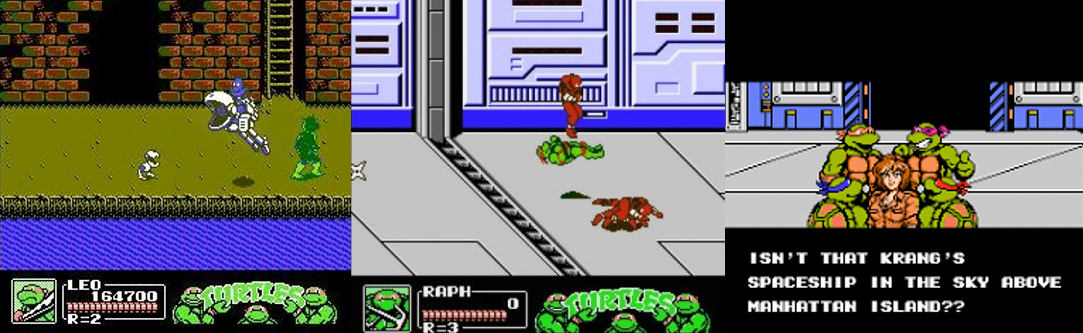
Overall, gameplay and combat is basically exactly the same as in the previous NES title and naturally lacks some of the additional animations and options seen in the superior 16-bit titles, with no dashing, elaborate combos, or throwing options available to you, but as a simple pick up and play arcade brawler it does the job pretty well for those who were stuck with the NES. Additionally, gameplay is once again mixed up slightly with a sidescrolling chase sequence in Scene 2 that sees you slashing across the ocean on a surfboard; there are also times when you’re asked to travel diagonally and where you can jump up to a higher level to avoid certain hazards. As ever, the TMNT need to watch out for holes and barrels, which will squash them flat, and new hazards like explosive pipes in the sewer and conveyor belts on the floor of the Technodrome, though you can switch to a different character when you run out of health. The Manhattan Project also includes an elevator section, as is the staple [https://www.digitiser2000.com/main-page/10-weird-rules-for-every-scrolling-beat-em-up] of any good beat-‘em-up, with this one taking you up the outside of a skyscraper like it’s Street of Rage (SEGA, 1991), but also includes some unique fighting stages that in themselves act as hazards. You’ll be fighting on top of a submarine, on a bridge strewn with holes, and on the aforementioned lift; in these areas, you need to be careful not to jump or be hit into the water or down the gaps as it’ll cost you some health. However, you can awkwardly manipulate your enemies into falling to their deaths in your place and, if you simply walk near the edge, you’ll hang on rather than simply slipping off as in most 2D games from this era.

Graphics and Sound:  
On the surface, The Manhattan Project really isn’t all that much different from the TMNT’s last NES title; however, the environments and overall presentation is far better. For starters, the game ambitiously recreates the cartoon’s iconic opening sequence and the game even includes a few sound bites here and there to evoke its technically superior arcade and 16-bit counterparts. While TMNT’s sprites don’t seem to be all that different, they have been tweaked a bit: Leonardo now holds two katana, for example, and there’s some animation on Donatello’s bo staff as he walks; even their idle animations have been expanded a little bit to include foot tapping and such. Although you can again remove the slowdown and sprite flickering, these elements are still somewhat present, with the same minor screen tearing and the screen still struggling to scroll properly; you’ll find yourself walking right at the edge of the screen and needing to hop back to get things moving less jerkily. The enemies are a little more diverse this time around; not only do they pop up from manholes, out of the water and sand, and from behind parts of the environment, but Foot Soldiers will scurry down poles, burst out of vehicles, and your turtle can get blinded by gas and sand this time around.

The Manhattan Project is undeniably graphically superior to its predecessor.

Environments are much improved over the TMNT’s last NES game; though still a far cry from the arcade and 16-bit titles, there’s much more detail, colour, and even a bit of animation here and there (such as the tide coming in on Scene 1). This is best seen in the Technodrome stage, which is far more visually interesting than before, and in the sewer, where you now cross through waist-high water rather than just being in a simple brick environment. There are some new stage types on offer here, such as the beach that opens the game and includes a pier, the aforementioned submarine, and even generic stages like the bridge are spruced up with large holes to avoid. Perhaps the most impressive environments are the subway, where enemies will jump out of subway trains, and those set on the rooftops of the floating city as you can see skyscrapers and other buildings in the background. Cutscenes and music are much improved this time around as well, with the TMNT transitioning between stages on their blimp more sprite art, voice samples, and speech bubbles being included, and even the heads-up display has been changed up to give it a more distinct visual identity.

Enemies and Bosses:
As ever, your most persistent enemies will be the robotic Foot Clan and their many variants; these guys will toss large shuriken at you (though you can deflect these with you weapons), burst up from the ground, blast at you from hovercrafts, hover about on floating discs, wield whips, and ride around on large rolling balls. The Foot also toss balls and weights at you to squash you, attack with swords, toss daggers in a spread, throw lances and boomerangs at you, and you’ll find two working in tandem to fry you to your shell with an electrical beam. The Rock Warriors are also back, though thankfully without their annoying charge attack; now, they still fire machine guns and heavy ordinance but can also temporarily stun you with gas grenades and send you flying across the screen with a swing of a girder! Robots also dog your progress, with flying bugs diving at you in a kamikaze run, humanoid robots firing projectiles at you, spider ‘bots dropping from the ceiling as rocks, and Mousers clamp down on your hands.

Familiar villains and accompanied by some newcomers as bosses and mini bosses.

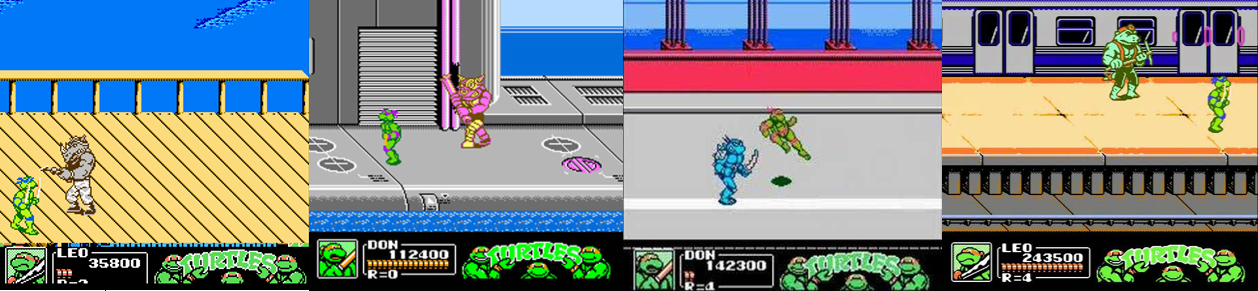
As The Manhattan Project is a much bigger and longer game than the TMNT’s last outing on the NES, you’ll have to contend not only with a few more bosses but also a mini boss or two, all of whom come complete with a helpful life bar and will be immediately familiar both to fans of the franchise and anyone who’s played any of the TMNT’s arcade outings. As is often the case in these types of TMNT games, the first boss you’ll fight is Rocksteady and he’s not really changed his attack pattern up all that much; in addition to kicking and punching you when you’re up close and charge at you from a distance, he comes armed with a harpoon gun to launch projectiles your way. The second boss, Groundchuck, represents not just a rare venture into different villains but also an increase in difficulty as he charges around the screen erratically and swings a pipe at you after you deliver enough damage to him. Halfway across the bridge, you’ll get attacked by my favourite TMNT villain, Slash; this dark turtle jumps about the place, spins around on his spiky shell, and (appropriately) slashes at you with his jagged sword. He’s merely an appetiser for Bebop, who now comes equipped with a spiked mace that he twirls over his head and whips at you in a horizontal line. Down in the subway, you’ll fittingly do battle with Dirtbag, who comes rolling in on a mine cart and fires rings from his miner’s helmet; although he also wields his trademark pickaxe, he leaves himself wide open for an attack when it gets stuck in the ground.

Since the game’s bigger, it only makes sense that there’s more bosses and that they’re a bit tougher.

When you reach the end of the sewers, you’ll have to fend off the Mouther Mouser mini boss (a Foot Soldier on a larger Mouser who spits out fireballs and smaller Mousers) before finding yourself on a narrow path surrounded by rising water and once again doing battle with Leatherhead, who not only whacks at you with his tail but also fires a shot gun spread your way. Rahzar and his ridiculously disproportionate head is the mini boss of the Technodrome and again charges at you, swipes with his claws, and can freeze you into a block of ice with his spit. Defeating him sees you facing off with the Shredder, with April held hostage nearby; a cheap spam artist who can kick you clear across the screen, the Shredder slashes with his sword and has a devastating throw, but is thankfully lacking in his de-evolution powers this time around. Tokka attacks you on the rooftop; carrying a shield to block your flying attacks and able to uppercut you into the electrifying neon sign in the background, Tokka also likes to take a bite out of your face and punch at you. The Mother Mouser reappears on Krang’s ship, which is also where you’ll naturally battle Krang; again, his sprite leaves a lot to be desired but he’s a bit tougher this time around thanks to the electrical hazard in the arena, his rocket punch, missile barrage, and tendency to electrify his body while taunting. Krang can also split his android body into two, with his torso floating about firing eye beams at you as his legs stomp about trying to kick you. You’ll immediately face Super Shredder after this fight; Super Shredder can teleport and dash about, send you flying with a swipe, summon a lightning strike and even turn you into an ordinary turtle with a fireball…although this is now a temporary ailment rather than an instant death move.

Power-Ups and Bonuses:
Unfortunately, The Manhattan Project doesn’t expand on the available pick-ups in any way; the only power-up you’ll find here are the all-too-rare instance of some health-restoring pizza, which is a bit of a shame considering Turtles in Time had added a new power-up item.

Additional Features:
There aren’t any in-game options available to you in The Manhattan Project beyond picking between the two different two-player options unless you enter the legendary “Konami Code”. This means that your only options for replay here are to pick a different turtle or play with friendly fire on and off rather than setting different difficulty levels. The Cowabunga Collection does offer some additional features, however; first, you’ll earn yourself a respectable 70G Achievement for completing the game and you can the game’s box art and manuals, switch between the Japanese and American version, apply various borders and display options, and listen to the game’s soundtrack. The enhancements also allow you to remove slowdown and sprite flicker, allow for “easy menu navigation” (which I found no use for), and offer a super useful infinite lives and an easy mode if you’re struggling. Finally, you’re still about to rewind the game with the Left Bumper, access save states using Right Bumper, and watch the game play itself if you fancy it.

The Summary:
Teenage Mutant Ninja Turtles III: The Manhattan Project isn’t much compared to its arcade and 16-bit counterparts, for sure; it’s undeniably graphically inferior, the sound and music isn’t anywhere near as clear, and the gameplay and combat remains restrictive and clunky thanks to the limitations of the NES. However, it’s quite obviously a step up from the TMNT’s previous outing on the NES; not only are the sprites a little more alive, the environments are far more detailed and the game is almost double the length of its predecessor, meaning that it’s a pretty decent 8-bit alternative to the likes of Turtles in Time. It’s unfair to be too harsh on it considering the power of the NES simply can’t compete with its bigger brothers, but it’s a far more impressive effort that its predecessor and felt much more like a complete, concentrated effort rather than a downgraded port. The addition of mini bosses was a nice touch and I liked how the bosses had second phases or upped their attack strategies after you dealt enough damage. The cutscenes and story are far more impressive this time around, though the lack of additional options, power-ups, and gameplay mechanics keeps it from really being all it could be. Giving each turtle their own power move was a nice touch and I liked the additional animations and stage variety on offer here; in some ways, it’s like a remix and expansion of its predecessor, but it’s clearly the superior of the two so I had a pretty good time playing through this one.

My Rating:

Rating: 3 out of 5.

Pretty Good

Did Teenage Mutant Ninja Turtles III: The Manhattan Project make it into your NES library back in the day? What did you think to the gameplay and presentation of the game, especially compared to its predecessor and arcade counterparts? Which character’s power move was your favourite and what did you think to the new bosses and mini bosses? What did you think to the new, longer stages and the additional tweaks made to the visuals? Did you play with the additional features added to the Cowabunga Collection? What’s your favourite NES game? Feel free to drop your opinions on the TMNT’s third outing on the NES in the comments section down below or share them on my social media.

Game Corner [Turtle Tuesday]: TMNT: Tournament Fighters (Xbox Series X)


Ever since Kevin Eastman and Peter Laird’s Teenage Mutant Ninja Turtles (TMNT) first debuted, the franchise has enjoyed worldwide mainstream success thanks to action figures, cartoons, and videogames. Since I found some free time this December, I’ve been spotlighting four such videogames every Tuesday of this festival season.


GameCorner

Released: 30 August 2022
Originally Released: 4 September 1993 (Mega Drive / SNES) / February 1994 (NES)
Developer: Digital Eclipse
Original Developer: Konami
Also Available For: Mega Drive, Nintendo Entertainment System (NES), Nintendo Switch, PC, PlayStation 4, PlayStation 5, Super Nintendo Entertainment System (SNES), Xbox One, and Xbox Series S

The Background:
There was only one franchise that dominated childhoods back in the late-eighties and early-nineties and that was the Teenage Mutant Ninja Turtles (or Teenage Mutant Hero Turtles for Brits like me); beginning life as a violent pastiche of comic book tropes, the TMNT’s popularity exploded into the massively successful cartoon and action figures, live-action movie adaptations, and many videogames. Spearheaded by Konami, the TMNT were equally successful with their arcade beat-‘em-ups and their home console ports, but this was also a time when Capcom had changed the face of both arcades and the competitive fighting scene with the many iterations of Street Fighter II: The World Warrior (Capcom, 1991), which was great success on home consoles and inspired a slew of knock-offs looking to cash in on Capcom’s success. The TMNT were amongst these with this one-on-one tournament fighter, which released in slightly different versions across three platforms at the time; the games took inspiration from the cartoons, movies, and the Archie spin-off comics but, while the 16-bit titles aped the combos and special moves of Street Fighter II, the 8-bit version had more in common with the likes of Yie Ar Kung-Fu (Konami, 1984) due to the NES’s limitations. Of the three, the SNES version was positively received despite being a Street Fighter II knock-off, the Mega Drive version was criticised for its sluggish controls and lacklustre presentation, while the NES version was seen as ambitious but unsurprisingly limited. All three games were lost to the midst of time, available only through emulators or extortionately expensive physical copies until they were included in this Cowabunga Collection alongside a host of other games and quality of life features.

The Plot:
The Turtles and their allies take part in a one-on-one tournament. In the Mega Drive version, the heroes battle across the alien worlds of Dimension X to rescue Splinter from their archnemesis, Oroku Saki/The Shredder, and their evil clones; in the NES version, the Shredder challenges them to defeat his latest plot for world domination; and in the SNES version, the heroes battle on a fighting game show to prove their mettle and earn some cold, hard cash.

Gameplay:
Regardless of which version of Teenage Mutant Ninja Turtles: Tournament Fighters you choose to play, the game is a standard 2D, one-on-one fighting game, with the 16-but versions of the game heavily borrowing their controls, combat, and presentation from Street Fighter II. Each game comes with a different roster of fighters, with ten fighters selectable in the SNES version, eleven available in the Mega Drive version, and seven in the NES version. Each version of the game allows you to customise the gameplay in some way, such as setting the difficulty level of the game (which directly impacts the ending and bosses you face), changing the time limit and amount of rounds to win (with the games defaulting to the standard best of three rounds), setting the speed of the game, setting the amount of credits you have to continue laying upon defeat, and eve setting the strength of your character and your opponent to establish any handicaps. These features don’t carry across to every version of the game, and some are slightly altered (the SNES version represents difficulty on a zero to seven scale, for example, while the NES uses a simple Easy, Normal, and Hard designation), but these options are generally consistent to those seen in Street Fighter II.

Each game sees you pummelling foes with a variety of moves and special attacks.

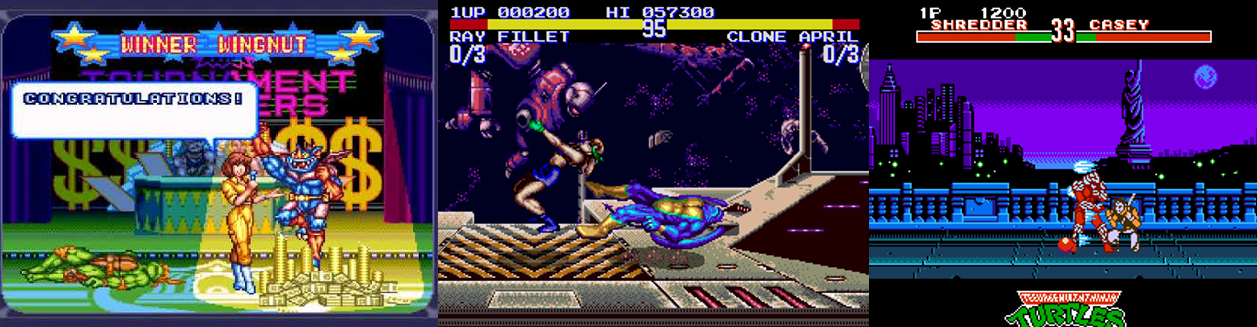
Combat, however, is a slightly different story and varies somewhat between each version; while the SNES version benefits from the additional buttons and mimics the directional input and button presses of Street Fighter II to pull off special moves, the Mega Drive and NES versions are limited by their control scheme layouts and the general presentation of the game. Indeed, the SNES version is more like Super Street Fighter II Turbo (Capcom, 1994), running much faster at its maximum speed and aping similar button combinations, while the Mega Drive version is far slower and reminds me more of the original, somewhat clunky first release of Street Fighter II. The NES version, as mentioned, is more like Yie Ar Kung-Fu and features little in the way of complex button combinations and special moves due to the limitation of the NES hardware. In the SNES version, you have two different types of punches and kicks; A and X launch a “normal” punch and kick while B and Y throw “fierce” variants. You can press up on the directional pad (D-pad) to jump and launch flying kicks and punches; when up close to an enemy, you’ll grab them and toss them in a unique throw move and you’ll use directional inputs and button presses (down, diagonal down-right, right, X, for example) to pull off each character’s special moves. When not playing in the game’s story mode, you’ll gradually fill up a gauge underneath your life bar; when this is full, you can use another simple button combination to unleash a devastating “Ultimate-Attack” that, unlike your regular attacks, actually damages the opponent through their block (though if they attack you during it you’ll fail and it’ll deplete if you don’t use it in time). Much of this is true of the Mega Drive version, but with some notable differences; there’s no special attack gauge, for starters, and no “fierce” attacks, you simply use X to punch and A to kick, and press Y to pull off a taunt (that seems to have no function). To pull off stronger attacks, you need to press the D-pad towards the opponent and then press X or A; you can still grab and throw your foe but special moves seem a lot harder to pull off (not least because the button inputs are missing from the strategy guide) and the game’s sluggish pace makes combat inconsistent and frustrating. It’s still more complex that the NES version, though; here, X punches and A kicks and that’s about it; you can use directional inputs and button presses to pull off special moves, but they’re extremely basic and the TMNT don’t even fight with their signature weapons in this game! Each game features a stun mechanic like in Street Fighter II, though; deal enough damage in a string of attacks and your opponent will be momentarily dazed and wide open for another combo or throw.

Although it lacks Nintendo’s bonus stages, the Mega Drive version has instant replays…

Some versions of the game do allow you to alter the button layout if you’re not happy with the default, and all three versions allow you to block by holding back on the D-pad (a mechanic I’ve always found awkward in fighting games; I much prefer a dedicated block button) but the SNES version also allows you to flip away from incoming attacks but only the NES version allows you to run towards your opponent by double tapping the D-pad. Each version also comes with a few gameplay options; you can take on the story mode (where you’re limited to playing as the TMNT), with cutscenes and a map screen (in the Mega Drive version) furthering the narrative between each bout, battle against a friend (or against the computer in the NES version), watch or practice the game in the SNES and Mega Drive versions, or take on a standard tournament mode. This also differs greatly between each version, with the SNES version taking the form of a broadcast and game show and featuring pre- and post-match dialogue and even tossing in a bonus stage where you rack up extra points and gold by smashing open safes in a bid to help break up the monotony. Although this is absent from the Mega Drive version, whose tournament simply goes from one fight to the next, every match is followed by an instant replay), bonus stages do appear in the NES version; here you have to smash through walls in the dojo for extra points, and all three will tally up certain criteria (health remaining, time left, whether you took damage or not) when you’re victorious to add to your score and this is the only version of the game to feature a high score table.

Each version offers a pretty tough challenge even on the easiest difficulty.

Each game comes with a natural, steady, and expected difficulty curve that I find is typical of most fighting games but synonymous with Street Fighter II; your ability to succeed will depend on how adept you are at pulling off the awkward special attacks and combos, especially as special attacks and throws deal way more damage than your regular attacks. The enemy AI, even on the easiest settings, is incredibly cheap in all three versions; your opponent will block almost constantly, is consistently able to attack and throw you through your attack animations, and they’re far more aggressive and skilled than I was, meaning I either had to fight hard and fast or be on the defensive. The difficulty and gameplay sliders can help with this, especially in the Mega Drive version, which allows you to reduce the rounds to win to one and set your speed and power to give you an advantage. Since the SNES version is the fastest of the three, combat can move at a breakneck speed, with rounds turning out of your favour in the blink of an eye, and you’ll be immediately at a disadvantage as you need to play on at least difficulty level three to even battle to true final boss and see the game’s best ending. This is even more demanding in the Mega Drive version, where you need to play on level eight to get the true ending; this version is so hampered by its plodding speed that it’s easy to get trapped in an unbreakable combo string and stunned into oblivion by your hyper-aggressive opponents. The NES version can be both paradoxically difficult and easy at the same time; there’s little benefit from picking one fighter over another as they’re all so limited but some, like Hothead, make for bigger targets while others, like Casey Jones, appear to be more agile. Either way, the limitations of the hardware make this a mundane back and forth affair that’s more about who can grab the power-up first rather than requiring any in-depth skill like the SNES version.

Graphics and Sound:  
Obviously, all three games look and sound very different. Of the three, the SNES version is the clear winner in terms of overall presentation; the game features more sound bites, big, bright, and well animated sprites and backgrounds, and the music is clearer and has more kick to it. The emphasis on story and cutscenes means there’s far more opportunities for big, partially animated sprite art here, with April O’Neil reporting on and interviewing characters before and after bouts and every fight in story mode being proceeded by dialogue between the fighters and the TMNT travelling to each location via their signature blimp. The characters in this version are clearly modelled more like the cartoon, with a hint of the live-action influence here and there, and they’re all large and full of attack and reaction frames. Sadly, the same isn’t true of the Mega Drive version; even the title screen and character select screen aren’t as impressive, though the game does include more palette swaps and some different fighters compared to its SNES counterpart. Sprites are smaller, however, duller, and seem to be missing some animation frames; everyone seems far meaner and more surly, as well, making this a very gritty and moody experience that seems to owe more to the original Mirage Comics, but it’s pretty obvious even to a die-hard SEGA fan like me which version has the better overall presentation. Naturally, the NES version is the most inferior in terms of graphics, character, and stage selection; however, while the TMNT don’t sport their signature weapons, they do have their own unique green palettes to separate them and the character designs seem to be drawing more from the first live-action movie than anything else. You won’t find much in the way of animation and variety here but it’s pretty ambitious, really; sprites have some decent details and special attacks, but the game suffers from black bars eating up a lot of the player’s screen.

Presentation varies between the three, with the SNES being the clear superior.

Naturally, the stages you’ll fight in follow very much the same format; the SNES version features a variety of large and detailed environments set largely on Earth, with some even featuring destructible elements to smash your opponents into like in Street Fighter II. Also like in that game, you’ll see background characters and elements and characters cheering and watching the fight, including TMNT staples like Bebop and Rocksteady, Baxter Stockman in his fly form, and various Foot Soldiers. There’s always something going on in the SNES version, whether it’s a giant octopus, a band performing on stage, or a news report recording the action, and this version also includes better, more detailed and varied story cutscenes and even character bios in its attract mode. Comparatively, the Mega Drive version is an immediate disappointment; cutscenes are smaller and less interesting and the backgrounds, while surreal and often disturbing, are far more muted and feature almost no animation and absolutely no interactable elements. As this version of the game features a planet-hopping narrative, there are some bizarre stages to choose from, from an ice world complete with a submarine to an ocean planet with a sinking ship in the background, to the bleakness of the cosmic abyss, but it’s all so dull and lifeless even when there’s giant cycloptic magma creatures and dinosaurs looming in the background. Again, the NES version is hampered by its hardware and includes only four stages: the sewers, a subway station, the galley of a pirate ship, and the rooftops of New York City. This latter is the most impressive stage, showing the city and the Statue of Liberty at night and in all its 8-bit glory, and is preceded by a rare cutscene to set the stage for the final battle against the Shredder.

Enemies and Bosses:
As with all fighting games, every available character will eventually be your enemy at some point; button codes and the Cowabunga Collection’s enhancements allow you to play as the boss characters in the 16-bit versions of the game and the Mega Drive version even includes and practise mode to help you get to grips with your favourite character. Essentially, however, there’s minimal benefit to picking a certain character in each version of the game; all of them sport special moves that can match each other, with every character sporting projectiles, grabs, and powerful rushing or slamming attacks to deal heavy damage. However, there are some notable exceptions; as mentioned, Hothead is a unique character in the NES version, sporting a chunkier sprite and breathing fire, meaning his hit box is a little larger and the character is a little slower. In the Mega Drive version, Casey Jones can set bombs as traps, while characters like Chrome Dome and Krang can cover distances from a standstill with their extending arms and legs. Even on the easiest setting, the SNES version puts up quite a fight; I struggled against War in the first battle simply because of his ridiculous rolling throw and large swiping claws, and the Shredder proved quite formidable here thanks to his dashing uppercut, his flurry of punches, and his cheap tactics of spamming low kicks. The Rat King also proved a unique foe in this version as he relied more on wrestling moves, snatching you out of the air and grabbing you midway through your attacks to slam you to the ground, and you’ll really get a sense of how good or bad you are when you face off against your character in a mirror match.

You’ll need to challenge the game’s highest difficulties to achieve the best endings.

These are spiced up a bit in the Mega Drive version through the inclusion of evil clones, who sport a purple palette swap and constantly dog your progress throughout the game. The Mega Drive version also includes a unique character, Sisyphus, an alien beetle who spits a blue projectile at you and unleashes a rapid-fire horn attack. He’s not the only unique character, however; Ray Fillet, April O’Neil, and a Triceraton are also included in this version of the game, while Wingnut, Aska, and Armaggon round out the SNES roster, with each one bringing their own strengths and weaknesses. April was a surprisingly decent character to use as she has a very cheap crouching spam attack that’s great four countering the game’s aggressive enemies, but you can never count out the titular turtles, who can send ground sparks, spinning cyclones, and twirling kicks your way at any moment even in the NES version. Krang only appears as a boss in the Mega Drive version of the game; naturally, you battle him in the Technodrome as the penultimate boss and he’s able to extended his arms, slide at you with a kick, and fire missiles high and low from his robot body but his sprite just isn’t large or intimidating enough to evoke a sense of danger. Both 16-bit versions include the same final boss, Karai, who can only be fought on higher difficulty settings; on the SNES, you fight her on top of a speeding train, whereas you battle her in a traditional dojo on the Mega Drive. In both, she’s easily the most formidable fighter, which is accentuated on the SNES thanks to her larger sprite; she’s capable of crossing the screen with a devastating cartwheel kick, tossing out projectiles, diving from high above with flying kicks, and is overall a pretty tough customer thanks to her martial arts kicks and overly aggressive AI. Thanks to its limited roster, the Shredder is your final foe in the NES version of the game; fought on a rooftop like in the movie and original comic, Shredder again has a dashing uppercut, a flaming flurry of punches, and can send a ground shot your way but goes down just as easily as every other enemy in this version of the game.

Power-Ups and Bonuses:
As Tournament Fighters is styled heavily after Street Fighter II, for the most part, there aren’t any in-game power-ups for you to utilise. The SNES version includes that special gauge outside of the story mode, which is good for a dramatic finish, but this is completely absent from the Mega Drive version. The NES version, however, does feature a power-up; at some point in every battle, Splinter will drop a red ball into the arena, which you can collect by pressing down and X. While the exact button inputs aren’t explained, and it seems incredibly temperamental, you can then launch this ball at your enemy to deal massive (and, usually, decisive) damage and this will be your key to victory in almost every bout. Be warned, though, as your foe is also able to pick up the ball and you’ll lose it if you take too much damage.

Additional Features:
The additional features on offer differ somewhat between each version of Tournament Fighters but there is some overlap; each version includes a story and a tournament mode and allows players to go head-to-head, selecting their character, stage, and handicap modifiers as you’d expect from a one-on-one fighter. Each game includes a variety of endings depending on which character you play as and the difficulty you set the game to, encouraging multiple playthroughs if you can stand to tackle this game again. Of course, the Cowabunga Collection adds even more features to these games; you’ll get a generous 100G Achievement for completing each game, however, you need to beat each one of the higher/highest difficulty level and battle Karai for this to pop. You can also use the Left Bumper to rewind the gameplay and bring up save states and display options with the Right Bumper, which also allows you to look through the strategy guide for tips and move inputs, which is much appreciated. In addition to viewing each game’s box art and manuals, exploring their soundtracks, and switching between the American and Japanese versions, you can enhance each game in various ways: you can choose to play as the 16-bit bosses, access additional stages, increase the game’s speed, and enable extra lives, remove sprite and slowdown from the NES version and allow for Hothead versus Hothead fights if you wish.

The Summary:
Teenage Mutant Ninja Turtles: Tournament Fighters is a tough one for me. I’m really not the best at Street Fighter II and similar knock-off fighters; the button inputs and aggressive opponents always throw me off and playing these games is often more frustrating than fun. The TMNT aesthetic certainly suits the format; all of the character have unique attacks and represent both the cartoons, comics, toys, and movies from the time and anyone who’s ever played Street Fighter II, especially on home consoles, will be immediately familiar with the 16-but versions of the game. For me, the SNES version is the clear winner; not only does it look and sound the best of the three, it plays a lot better and there are far better opportunities for combos and special attacks. The story and tournament modes are also presented in a much more visually impressive way, the stages are livelier and more interesting, and the game is bolstered by the faster combat and fluid gameplay. It pains me to say it being a big SEGA fan, but the Mega Drive version just can’t compete with its SNES counterpart; everything’s smaller, grimier, and so slow and clunky. I actually prefer some of the roster here, having read a lot of the TMNT’s Archie Comics as a kid, but the gameplay and presentation lets these additions down considerably. Naturally, the NES version is the inferior of the three but, even so, it does a decent job with the limitations of its hardware. One-on-one fighters are never a good option on inferior hardware and the TMNT definitely benefitted more from their 8-bit sidescrolling adventures and brawlers, but there’s some ambitious elements here that make it an interesting option, at least, though it’s hard to believe anyone choosing to downgrade or settle for the NES version of the far superior SNES version. Overall, if you’re a fan of one-on-one fighters and Street Fighter II, you could do a lot worse than to give the SNES version of Tournament Fighters a whirl; the other two are worth a quick playthrough for a boost to your gamer score but I can’t see myself picking the Mega Drive or NES version on future playthroughs since the SNES version just leaves both in the dust with its superior options, gameplay, combat, and presentation.

Mega Drive Rating:

NES Rating:

SNES Rating:

Rating: 2 out of 5.

Rating: 1 out of 5.

Rating: 3 out of 5.

Could Be Better

Terrible

Pretty Good

What did you think to Teenage Mutant Ninja Turtles: Tournament Fighters? Which of the three did you own back in the day, or is your favourite to play in this collection? How do you think it compares to other one-on-one fighters, especially Street Fighter II? Which character was your favourite to play as in each version? Were you disappointed by the dip in graphical quality in the Mega Drive version? What did you think to the NES version and how it utilised the system’s limitations? Would you like to see another one-on-one tournament fighter from the TMNT? What did you think to the additional features added to the Cowabunga Collection? Whatever your thoughts on Tournament Fighters, go ahead and share them in the comments below.

Game Corner [Turtle Tuesday]: TMNT II: Back from the Sewers (Xbox Series X)


Ever since Kevin Eastman and Peter Laird’s Teenage Mutant Ninja Turtles (TMNT) first debuted, the franchise has enjoyed worldwide mainstream success thanks to action figures, cartoons, and videogames. Since I found some free time this December, I decided to spotlight four such videogames every Tuesday of this festival season.


GameCorner

Released: 30 August 2022
Originally Released: 15 November 1991
Developer: Digital Eclipse
Original Developer: Konami
Also Available For: Game Boy, Nintendo Switch, PC, PlayStation 4, PlayStation 5, Xbox One, Xbox Series S

The Background:
In the late-eighties and early-nineties, you’d be hard pressed to find a franchise more popular than Teenage Mutant Ninja Turtles. Known as Teenage Mutant Hero Turtles here in the United Kingdom, the original dark and violent comic books exploded into an incredibly successful cartoon and extensive toy line, and a slew of videogame outings courtesy of developer Konami. Konami’s efforts helped to make the NES a household name here in the UK, produced two of the most beloved titles for arcades and home consoles, and also extended to three handheld titles for Nintendo’s super successful portable, the Game Boy. Building upon the standards set by its predecessor, Back from the Sewers improved upon the visuals despite the obvious limitations of the Game Boy hardware and expanded the gameplay options available to bring the sub-series more in line with its bigger, better 16-bit counterparts. Since a complete physical version of the game is still ridiculously expensive for the quality of the game, I was still glad to see Back from the Sewers included in the 2022 Cowabunga Collection alongside a host of other TMNT games and quality of life features.

The Plot:
The TMNT’s archnemesis, Oroku Saki/The Shredder, returns, now bolstered by the forces of the sinister Krang and kidnaps April O’Neil to get his revenge on the foursome.

Gameplay:
Like its predecessor, Back from the Sewers is a simple sidescrolling action game rather than a traditional arcade style beat-‘em-up. After selecting from three difficulty levels (Easy, Normal, or Hard), you pick one of the four turtles and battle your way from the left side of the screen to right across six stages (referred to as “Acts”). Again, the Game Boy’s limited colour palette means that the turtles are only distinguished by their individual weapons, but they again have different strengths and weaknesses: Leonardo is a bit of an all-rounder, for example, with Raphael having a fast attack but a terrible range. Sadly, the shuriken projectiles are gone; they’re replaced by a sliding kick that I only found a handful of uses for as it often leaves you open to enemy attacks, but you can toss shuriken when using ladders. The buttons have been remapped, with A allowing you to jump (holding it again allows you to get some extra height with a reanimated somersault) and X performing your attack; you can pull off a jumping attack by pressing X in mid-air and the game still allows you to hit back or destroy most incoming projectiles with your attack. Screen transitions are much more involved this time and initiated by climbing ladders but you’ll also clamber along pipes to cross gaps and there is a lot more emphasis on vertical traversal, with you hopping up and down girders and platforms using up and down on the directional pad and A.

The graphics and gameplay have been overhauled to more closely resemble the arcade titles.

The essential gameplay remains mostly unchanged; the screen and hardware limitations mean things are still very restrictive but there are far more influences from the TMNT’s arcade titles (the Foot jump up from manholes and you can fall down the holes, for example). The most obvious of these is in Act 2, which sees you racing along a bridge on a rocket-powered skateboard attacking enemies and dodging barrels, and Act 6, which recreates the classic Sewer Surfin’ level, to say nothing of the inclusion of not one but two traditional elevator sequences in Act 3 and 6. There are also some additional gameplay elements here, such as a race away from a rolling boulder in Act 4, mines being scattered across the ground, bursts of flames and machine gun fire, and jumping to a series of floating platforms in Act 5. Levels are a bit longer and more involved but the game loves to artificially up the difficulty by swarming you with an endless barrage of Mousers and bug ‘bots; these fuckers will pop out from holes in the caves and sewers and from mechanical ports and it can be extremely frustrating trying to fend them all off and back jumps in Act 3’s construction sites. Some stages seem to be on a loop as well, though I think this is just a consequence of the limited hardware, and you’ll still have to avoid the same obstacles like falling hazards and electrical bolts. As before, you can pick a different character between stages and if your health is drained; each turtle has their own health bar, any damage you take carries over to the next Act, and any captured turtle can be rescued in bonus games, with these now taking place upon completion of an Act and seeing you chasing around an enclosed arena to refill your health as much as possible in a short time limit.

Graphics and Sound:
Although Back from the Sewers is still handicapped by the Game Boy’s hardware, it’s an obvious graphic step up over its predecessor right from the start, where it ambitiously recreates the cartoon’s iconic opening sequence, and the game even includes some limited sound bites to punctuate the action. The game’s overall presentation is far more akin to the cartoon than many other TMNT titles as it not only basis its story art on the cartoon but even includes level intros and a pause screen that mimic the show’s episode titles. All of the sprites and environments have been overhauled and are all the better for it; the TMNT are bigger and more detailed, with Leonardo and Raphael now carrying two weapons each and all four having a more detailed idle animation. Although the sprites appear a bit stiffer and more clunky than other TMNT titles, they pull an amusing panic face when running from the aforementioned rock and will be left charred when caught in flames and explosions.

Sprites and environments have been greatly improved, despite the Game Boy’s limitations.

Similarly, the game’s environments are far more detailed than those seen in the previous game; this is evident from the opening Act, which actually provides a level of depth and visual interest to the sewers despite the lack of moving water. This extends to the streets as well, where vehicles and there’s an attempt to showcase some depth to the backgrounds can be seen, and in the overhauled Technodrome which now sports many of the same hazards and features as the arcade versions. While there are only a handful of unique environments, such as a cave and an overused construction site, there is much more to spot in the background, from Splinter working in a pizza parlour, Foot Soldiers hiding behind cover and sliding at you, chain link fences and cityscapes, and holes in the environment leading to sewers and such, though the caves can be a bit of a mess. There are far more enemies onscreen at any one time thanks to those damnable Mouser holes and turrets, and you’ll still get an annoying beep when your health is low, and the ending is even sparser than in the first game. On the plus side, the music is much more varied and there are some fun in-game cinematics, such as Splinter piloting the turtle blimp, and options to move around in a wider area like in the arcade titles once you’re descending down the stairwell.

Enemies and Bosses:
Surprising no one, you’ll primarily be battling against the Shredder’s inexhaustible army of robotic Foot Soldiers; they’ll jump in at you but actually managed to land a hit or two this time with their sliding kicks, dynamite, large projectiles, standing on each other’s shoulders, and firing bazookas at you. As indicated, the Mousers and bug ‘bots return; they might not bite your hand anymore but they are absolutely relentless, spawning so fast and so frequently that it’s hard to fend them off and progress through some stages. Roadkill Rodneys are also back, now firing laser bolts, and the game even includes a handful of mini bosses this time around; a swarm of Foot Soldiers, a Pizza Monster in the sewers, Baxter Stockman’s fly form on a rooftop, and the Game Boy debut of the Rock Warriors in General Traag and Granitor.

Boss are greater in number, strength, and visual appeal this time around.

Each Act naturally concludes with a boss battle; each sports a life bar but they’re all just variations on the boss battles we saw in the last game. Once again, your first test is against Rocksteady; this time, he jumps about while Foot Soldiers drop objects from the windows above and shoots deflectable bullets at you, pausing to laugh and leaving himself open for your attacks. Bebop (and his ridiculously disproportinate head) awaits at the end of the bridge stage, firing out a spread of diamond projectiles and knocking you silly with an uppercut when he’s not hopping all over the place. Krang makes a rare appearance in his little walker at the end of Act 3, stomping about firing rings and raining bombs on the arena, and leaping overhead to try and crush you in a nigh-unavoidable attack. You’ll have rematch with the Shredder at the end of Act 4; this time, he fires an energy wave at you that you can jump over but not duck under, dives at you with a flying kick, and runs from one side of the screen to the other, meaning you’re basically guaranteed to take damage as the window of opportunity to dodge and counterattack is so small. Granitor confronts you in Act 5, rolling about the place and roasting you with his flamethrower, but the additional movement options afforded in this arena help to make this more manageable. When you get to the Technodrome in Act 6, you’ll have to battle General Traag to get inside the machine in a conflict made more troublesome by the 2D pane and the treadmill under foot. The Shredder mutates into his Super Shredder form for the penultimate boss, plodding about and swiping at you, teleporting about the place, and confusing you with a bevvy of duplicates to try and land a sneak attack. Finally, you’ll take on Krang’s android body in the finale; this time, Krang is nice and big and is able to stun you with a ground-shaking stomp, however he’s far weaker than in the last game and much easier to defeat than either of the Shredder fights in this game since you can just jump kick him and run underneath him when he’s jumping in for an attack.

Power-Ups and Bonuses:
As in the last game, your only pick-ups are the odd slice of pizza; these are sometimes carried by enemies and sometimes found floating around the environment, generally before a boss battle, but are noticeably rare and still the only power-up available.

Additional Features:
Back from the Sewers trumps its Game Boy predecessor by including three difficult levels, but it’s still very limited in terms of in-game options. Luckily, the Cowabunga Collection awards a 70G Achievement for completing the game, offers a strategy guide to help with the game’s trickier sections, lets you view the game’s box art and manuals, includes both the Japanese and American versions, and offers various borders and display options (including an LCD display to recreate the Game Boy’s headache-inducing screen). The game also allows you to rewind the game with the Left Bumper and access save states using Right Bumper and you can take advantage of the enhancements to jump to any level you wish and enable infinite lives without fear of missing out on your Achievement.

The Summary:
Undoubtably,Teenage Mutant Ninja Turtles II: Back from the Sewers is a vast improvement over the TMNT’s previous Game Boy title. If the first one was a pretty basic proof of concept, this sequel takes the capabilities of the handheld system and uses them to its advantage to produce a title that’s still very restricted by its hardware but much more akin to a 2D version of its arcade counterparts. While the sprites and animations are still a bit stiff and limited, they’re far more detailed, as are the backgrounds, and I loved how the game included versions of the sidescrolling chase sequences from the arcade games. Placing the bonus game sat the end of Acts was a nice way to break up the monotony and I enjoyed the improved music, cutscenes, and the expanded length; tossing in a few mini bosses also helped and it was just great to have so much to se happening around you. Unfortunately, it’s still not perfect; I don’t mind the loss of a turtle as a life system but the endless swarm of Mousers and bug ‘bots was needlessly frustrating and some of the bosses were almost impossible without full health. The strange loop system and slide kick were also odd inclusions, but the overall presentation was much improved and far more fitting for the license and the standards set by its technically superior counterparts. There are still better games on the Game Boy, and better TMNT videogames, however, but this one is a little bit more worth your time compared to its predecessor.

My Rating:

Rating: 2 out of 5.

Could Be Better

Was Teenage Mutant Ninja Turtles II: Back from the Sewers included in your Game Boy library back in the day? How do you think it compares to the last TMNT Game Boy game? What did you think to the additional elements included from the arcade titles? Were you a fan of the overhauled sprites and backgrounds, and which character was your favourite? What did you think to those Mouser holes and the addition of mini bosses? Do you have any fond memories of the Game Boy? Whatever your thoughts, you can share the, in the comments section below or you can join the discussion on my social media.

Game Corner [Turtle Tuesday]: TMNT: Fall of the Foot Clan (Xbox Series X)


Ever since Kevin Eastman and Peter Laird’s Teenage Mutant Ninja Turtles (TMNT) first debuted, the franchise has enjoyed worldwide mainstream success thanks to action figures, cartoons, and videogames. Since I found some free time this December, I’ve decided to spotlight four such videogames every Tuesday of this festival season.


GameCorner

Released: 30 August 2022
Originally Released: 3 August 1990
Developer: Digital Eclipse
Original Developer: Konami
Also Available For: Game Boy, Nintendo Switch, PC, PlayStation 4, PlayStation 5, Xbox One, Xbox Series S

The Background:
Back in the late-eighties and early-nineties, it was tough to find a franchise more popular than Teenage Mutant Ninja Turtles (or Teenage Mutant Hero Turtles as we knew them in the UK); the Teenage Mutant Ninja Turtles (1987 to 1996) cartoon and extensive toy line saw the “Heroes in a Half-Shell” dominate an entire generation. The TMNT were also prominent videogame characters thanks to the efforts of Konami, which saw them help to make the NES a household name here in the UK and produce two of the most beloved arcade games that also impressed on home consoles back in the day. Not content with their arcade and 8- and 16-bit titles, Konami also produced three handheld titles for Nintendo’s ground-breaking portable console, the Game Boy. Limited by the Game Boy hardware, Fall of the Foot Clan was obviously lacking in many areas and struggled to live up to the standards of its technically superior predecessors, though it was still praised for its ambitious attempt to give fans a portable TMNT experience. With a complete version of the title being pretty expensive for what it is, it was very much appreciated to see it included in the 2022 Cowabunga Collection alongside a host of other TMNT games and quality of life features.

The Plot:
When their archnemesis, Oroku Saki/The Shredder, kidnaps April O’Neil, the TMNT emerge from the sewers to take on the Shredder’s Foot Clan once more.

Gameplay:
Unlike most TMNT videogames at the time, Fall of the Foot Clan is a pretty simplistic sidescrolling action game; you pick from one of the four turtles and travel from left to right across five stages attack enemies with their signature weapons. The TMNT are even more indistinguishable from each other thanks to the Game Boy’s non-existent limited colour palette but are, as ever, identified by their weapons and the reach offered to them. Raphael gets up close and personal with foes with his sai, for example, while Donatello is afforded a greater reach with his longer bo staff, however this is so far the only TMNT game I’ve played that allows you to throw shuriken by default (and an infinite number to boot), thereby affording even the most limited ninja turtle a projectile attack. The controls are as simple as you could want; you press X to jump (and holding the button sees you jumping higher into a somersault) and A to attack. You can attack in mid-air and press down and A to toss your shuriken, but a big mechanic in this game is the ability to swat away most incoming projectiles with your attack, which is almost mandatory given the much smaller screen size of the Game Boy.

A basic sidescroller that mixes up its gameplay with bonus games and mild platforming.

Gameplay is very restrictive and doesn’t really ask all that much of you other than to continue to the right, slashing at enemies as they jump at you, and avoiding the odd level hazard, such as falling blocks, bouncing balls, electrifying obstacles, and spiked ceilings. Here and there you’ll get the option to hop up to a higher level or wade through sewer water; you can destroy barriers to reach bosses, hop on and rush underneath pistons, jump over fire pits, and leap from log to log over a raging river. If your turtle runs out of health, they’ll be “captured” and you’ll have to pick another to tackle the stage again, though you’ll helpfully be placed at the start of the boss battle if you reached that point when you died. One mechanic Fall of the Foot Clan incorporates that separates it from pretty much all of the classic TMNT games is the presence of hidden bonus areas in every stage; these aren’t immediately obvious (though the strategy guide clearly highlights them for your benefit) and allow you to restore your health by guessing the number Master Splinter has in mind, fighting with Krang by eradicating as many stars as possible, or partaking in a bit of target shooting. You’re generally given a few chances to succeed at these but they’re not particularly inspired or fun or easy, though I appreciate the attempt to mix the simplistic gameplay up a bit with these little distractions.

Graphics and Sound:
Naturally, you need to keep expectations low here; not only is Fall of the Foot Clan a Game Boy title, it’s an early game Boy title so it plays things very safe and doesn’t try to throw too much at the player or tax the game engine. The result is enemies leaping at you largely one at a time and barely launching an attack before you take them out in one hit and keeping the amount of onscreen action to a minimum, but there are a surprising number of little details that certainly make it somewhat ambitious. The TMNT don’t have idle animations and Leonardo and Raphael only have one weapon each rather than the usual two, but their weapons move as they walk, and Raphael and Michelangelo even twirl theirs as they plod along. When ensnared by a Roadkill Rodney, you’ll even see your turtle’s skeleton as they’re shocked and they get crushed by pistons and weights as well, all of which are nice little touches I wouldn’t really expect from such a limited title.

Though basic, the graphics and presentation are ambitious at times.

Environments aren’t really anything to shout about; stages are pretty long, consisting of a few different screens and transitioning from different areas as you progress, but there isn’t a great deal of detail in the background in environments like the Technodrome. At the same time, the streets have a bit going on, with graffiti and posters on the walls behind you, and you’re even able to hit a parking meter to use it as a projectile at one point. I also liked seeing the mountains in the background of Stage 4 but easily the most visually interesting stage is Stage 3, which sees you jumping across the backs of trucks and vehicles down a speeding highway. Sprites are all nice and big and certainly capture the essence of the cartoon; the Foot even drive past in a jeep at one point and the classic TMNT theme plays, with the rest of the chip tune soundtrack being very fitting to the franchise and the action. The game’s story is as basic as you could want and is told using some basic text under pretty decent sprite art recreating scenes from the cartoon. Unfortunately, the ending falls a little flat, with the Technodrome just disappearing from frame and the epilogue consisting of a bunch of text, and you’ll be assaulted be an incessant beeping when your health is low, which is always a pain.

Enemies and Bosses:
You’ll never believe it but you’ll primarily be fighting off an endless supply of Foot Soldiers on your short journey; they’ll come jumping in and be reduced to a little explosion before even getting a chance to attack, but they’re capable of tossing darts and bricks at you but are largely disposable. Generic enemies like bats, fish, and anthropomorphic fireballs are also a problem, but the classic TMNT enemies like Mousers and Roadkill Rodneys are also present and capable of chomping on your hand and electrocuting you, respectively. Each stage naturally culminates in a boss battle against five of the TMNT’s most recognisable and popular villains, each of which is afforded a life bar.

Classic TMNT enemies are recreated in the Game Boy’s limited hardware.

The first boss you’ll battle is Rocksteady, who simply wanders across the screen blasting at you from his rifle; Bebop ups the ante by rushing at you in a charge, punching you up close, and firing rings from his pistol, but it’s not exactly a stretch to hop over them, swipe them with your weapon, or toss a shuriken their way. Baxter Stockman attacks in his fly form at the end of the all-too-brief Stage 4; he hovers overhead, firing projectiles at you, and swooping down in a dive, but again you can just jump over him and attack without too much difficulty. In a change of pace, the Shredder is encountered as a penultimate boss rather than the final battle; he can be a bit tricky if you go in with low health, advancing towards you and swiping with his katana before teleporting to safety after. This means that Krang is the game’s final challenge; he emerges in his android body from a transport wall and stomps about, completely immune to your shuriken and trying to kick you in the face. While he’s quite a large target and he likes to jump about, you can again jump over him and attack him and whittle his health down if you stay in a good rhythm.

Power-Ups and Bonuses:
As ever, the TMNT can restore their health by picking up the odd slice of pizza; these are sometimes dropped by enemies and sometimes found floating around the environment, occasionally before a boss battle, but are noticeably infrequent and are the only power-up you’ll find in the game.

Additional Features:
Unlike most TMNT videogames, there’s no two-player option here. In fact, there aren’t any options to speak of in the base game, not even a difficulty mode or any sound options. Thankfully, the Cowabunga Collection remedies that, awarding you a 70G Achievement for completing the game and allowing you to view the game’s box art and manuals, switch between the Japanese and American version, and apply various borders and display options (including an LCD display to recreate the feeling of playing on the Game Boy’s eye-watering screen). The enhancements not only allow you to remove slowdown and sprite flicker, rewind the game with the Left Bumper and access save states using Right Bumper, but you can also choose to practice the bonus games if you want to bump up your health in your next playthrough.

The Summary:
I don’t like to throw too much shade at Game Boy titles, especially early ones, but Teenage Mutant Ninja Turtles: Fall of the Foot Clan really isn’t all that impressive or fun to play through. There are some ambitious and admirable elements here and there, don’t get me wrong; the odd bit of animation, the ability to throw shuriken, the attempt at variety in the stages are all positives and I liked how it did the best it could with the hardware limitations to adapt the aesthetic of the cartoon. However, there’s no denying that this is a far too simple effort to really give it too high a score, especially compared not only to the obviously better arcade and home console TMNT games but also the later Game Boy titles. This feels like a proof of concept to show that a simple sidescrolling action game can be cobbled together with the license rather than an attempt to really try anything too innovative with the platform. Throwing in bonus games was a nice, if frustrating, touch and there was even some call-backs to the superior arcade titles here and there, but the TMNT would definitely be represented far better in subsequent Game Boy games and I can’t see myself going back to this one over the other TMNT games included in the Cowabunga Collection.

My Rating:

Rating: 1 out of 5.

Terrible

Did you have Teenage Mutant Ninja Turtles: Fall of the Foot Clan in your Game Boy library back in the day? What did you think to gameplay and presentation of the game, especially regarding its simple sidescrolling format? Which of the characters was your favourite to play as and which boss was the most exciting for you? Were you able to beat the bonus games? What did you think to the additional features added to the Cowabunga Collection? What’s your favourite Game Boy title? I have a comments section down below where you can share your opinions on the TMNT’s Game Boy debut, or you can start the discussion on my social media.

Game Corner [Turtle Tuesday]: Teenage Mutant Ninja Turtles (Xbox Series X)


Ever since Kevin Eastman and Peter Laird’s Teenage Mutant Ninja Turtles (TMNT) first debuted, the franchise has enjoyed worldwide mainstream success thanks to action figures, cartoons, and videogames. Since I found some free time this December, I’ve decided to spotlight four such videogames every Tuesday of this festival season.


GameCorner

Released: 30 August 2022
Originally Released: 12 May 1989
Developer: Digital Eclipse
Original Developer: Konami
Also Available For: Amiga, Amstrad CPC, Atari ST, Commodore 64, MS-DOS, MSX, Nintendo Entertainment System (NES), Nintendo Switch, Nintendo Wii, PC, PlayChoice-10, PlayStation 4, PlayStation 5, Xbox One, Xbox Series S, ZX Spectrum

The Background:
The Teenage Mutant Ninja Turtles (or Teenage Mutant Hero Turtles here in the UK) were the in thing for kids in the eighties or nineties thanks, largely, to the popularity of the Teenage Mutant Ninja Turtles (1987 to 1996) cartoon and an extensive toy line. A couple of years before Konami brought the “Heroes in a Half-Shell” to the arcades, the developers helped to make the NES a household name here in the UK with this adventure title, produced at a time when videogames (especially those on Nintendo’s ground-breaking platform) were built to last by ramping up their difficulty. Reportedly the first TMNT product to release in Japan, the game suffered from glitches and exploits across all its versions and is often cited as one of the hardest NES games of all time thanks, largely, to it featuring in an early episode of The Angry Video Game Nerd. regardless, the game was a huge success at the time and sold over four million copies worldwide despite mixed reviews, with some praising the controls and graphics and others flagged the lack of polish and recognisable elements from the franchise. Although readily available at the time on a variety of consoles, Teenage Mutant Ninja Turtles has been pretty difficult to come by after being removed from the Wii Shop Channel in 2012, that is until this Cowabunga Collection released for modern consoles alongside a host of other TMNT games and quality of life features.

The Plot:
The Turtles are on a mission to retrieve the Life Transformer Gun from their archnemesis, Oroku Saki/The Shredder, who has kidnapped their friends and is terrorising New York City with bombs, ninjas, and his army of robots.

Gameplay:
Unlike the vast majority of TMNT videogames, the original NES Teenage Mutant Ninja Turtles title is a 2D, sidescrolling action platformer that allows you to switch between the four titular turtles at any time via the pause screen. Being as it was an NES title, your controls and options are somewhat limited, but also effective; X sees you attacking with your turtle’s signature weapon and A allows you to jump, and you can both hold A for a higher and longer jump and attack while in mid-air or crouching. The TMNT are separated not only by the colour of their bandanas but by the range, speed, and power of their weapons; Donatello has the longest reach and is great for dispatching enemies above or below with his bo staff, for example. He and Raphael also seem to dish out more damage, destroying some enemies in one hit that would take Leonardo and Michelangelo two or three, however Leo and Mike have better options for attack with an arc or a swing. You’ll also comes across a number of secondary weapons with limited ammo, which you can switch to using the Xbox controller’s ‘View’ button and will find some pick-ups that activate automatically to carry you across gaps. Each turtle has their own health bar, and the game “helpfully” alerts you when you’re at low health by emitting a warning wound, so you’ll need to switch between them to get past trickier sections with fire pits and the like. If a turtle’s health is depleted, he’ll be captured and unplayable until found and rescued, though it’s game over if all four are captured.

Navigate through mazes, repetitive areas, and the infamous electric seaweed to rescue your allies.

The game is split into two very distinct sections; the first is a top down overworld, a recreation of New York City and the surrounding district, which is split into six areas that act as the stages of the game. Here, you can wander about, attacking enemies and avoiding larger vehicles such as Roller Cars, carpet-bombing fighter jets, and helicopters with search lights. At one point, you’ll hop into the turtles’ Party Wagon, which allows you to blast at Roller Cars and enemies on the overworld with X, though you’ll need to search for a handful of high-powered missiles to destroy barriers with X and progress further. The second part of the game is the 2D, sidescrolling action stages, which are accessed via manholes placed all over the overworld or by entering certain buildings. These drop you into claustrophobic sewers, aircraft hangers, enemy warehouses, and robot factories and see you navigating past enemies, hazards, and tricky jumps to small blocks or platforms to either progress, find health and pick-ups, rescue a comrade, or access new areas, like the rooftops and caves. Not only to enemies respawn when you leave the screen for just a second, but hazards are numerous; you’ll be stuck on conveyor belts, walking across some smaller gaps and trying to jump across others to tiny blocks, and hopping over spike and lava pits. At some points, you’ll be dumped back onto the outside if you fall while jumping across the rooftops or landing in the raging sewer waters, and you’ll also have to contend with spiked ceilings and instant-kill crushing spiked walls near the end of the game. Easily the game’s most infamous section is encountered pretty early on when, after reaching the damn, you’re given 2:20 to navigate an underwater section full of electrical bolts and electrifying seaweed in search of eight bombs to disarm. While it’s true that this is a difficult section thanks to the unfair hit boxes, the tight time limit, and the labyrinthine nature of the section, it’s made all the easier with the Cowabunga Collection’s rewind feature and you can tank through some of it using well-timed character swaps.

Graphics and Sound:  
Since it’s an NES title, the graphics are obviously somewhat dated; the top-down sections on the overworld aren’t great, with movement being noticeably clunky, and the game’s reliance on mazes and looping paths can get annoying when you’re stumbling around the airport trying to find the correct path or dodging searchlights in the dark to find the right manhole. The variety in these top-down locations is appreciated, though; you’re in the city, visit a dam, pop along the JFK Airport, and infiltrate the Shredder’s secret base under cover of darkness, and the game opens with a pretty ambitions character introduction screen and is accompanied by some fitting chip tunes to help ease even the most annoying sections, and each stage ends with a rendition of the TMNT theme to punctuate your victory. When you pause the game, you’ll get access to a pretty basic grid-like map that isn’t much help but it’s better than nothing; April O’Neil and Splinter will also offer some limited advice to give you an idea of what you’re looking for or how to defeat the game’s bosses, but these features are stripped from you in the final area as you’re “lost”.

Although limited by the hardware, the game’s fairly distinctive and graphically ambitious.

The 2D sections are where the game shines since you can actually see the TMNT in action, though the actual sprites obviously don’t emote or animate all that much unless they’re being swept away by the current. Mostly, the controls work just fine; you’re generally restricted in your horizontal and vertical movement so it’s rare that you have to make precise jumps but, when you do, they have to be pretty bang-on. Hit boxes are quite big, which is an issue in such close quarters, and backgrounds can be disappointingly bland and repetitive; all that separates one sewer section from another is the amount of brown and green, for example, so it can be easy to get lost, especially in sections that have to warping about trying to find the right exit. Things pick up a bit as you progress, with large background elements being used as static boss sprites, and you can avoid any slowdown or sprite flickering by turning them off with the Cowabunga Collection’s enhancements (though a fair amount still remains, perhaps unavoidably). The game’s story is primarily told through limited text and some art portraits, but the game doesn’t include any credits and it’s a bit cheap how the enemies constantly respawn but the health items and other pick-ups don’t, meaning you sometimes have to backtrack into dangerous areas to restock your health and ammo.

Enemies and Bosses:
Considering the source material has a near inexhaustible cast of characters to choose from, Teenage Mutant Ninja Turtles features some truly bizarre and misplaced enemies; I may not be able to remember every TMNT character but I could barely recognise any of the enemies encountered here, with the shuriken-throwing Foot Soldiers and the Mousers being the most familiar for me. There are some really weird baddies here, ones that are far too generic for a TMNT game and sadly symptomatic of this era of gaming; we’ve got robot bugs, spider-like jumpers, flaming men who spit out smaller minions, a large porcupine that shoots spines at you, a big bald asshole with a chainsaw, flying eye drones, this weird blank slate of a humanoid who becomes invulnerable when crouched down, another bald asshole who tosses boomerangs, crawling eyes, giant mutated frogs and fleas, and some truly aggravating Dimension X Troopers who hover about firing lasers right at you, no matter where you are, and always attack in groups! Some of these enemies will act as mini bosses, gaining a health bar and teaching you their attack patterns and such, but most of the time they’ll swarm the screen just to annoy you and screw up your jumps.
You’ll need to defeat TMNT mainstays and a robo-turtle to rescue April and Splinter.

Each stage of the game ends in a boss battle, generally with the life of one of the TMNT’s allies at stake; Bebop goes solo in this game as Rocksteady is holding April hostage, though he attacks in very much the same way as he always does, by charging at you with a head of steam, punching you when you get close, and jumping at you with a kick. It’s pretty simple to stay at the right side of the screen, jumping up to where Rocksteady and April are to avoid Bebop’s limited attacks, and smack him with your weapons. Rocksteady gets in on the action at the end of the warehouse stage and follows very much the same pattern; while April sits all tied up, Rocksteady charges at you with his horn, tries to jump at you, and fires bullets at you. However, you can destroy these projectiles, which is always helpful, and you can absolutely cheese this by hopping on top of the crates on the right-hand side and using Donatello’s crouch attack to defeat him without taking a single hit! When you finally figure out where the rope is and how to get across the rooftops, you’ll find Splinter held hostage by a dark version of Leonardo; this guy attacks exactly as Leo would when you play as him, with sword swipes and such, but draining his health reveals that he was the “Mecaturtle” (not to be confused with Metalhead…) all along. The Mecaturtle hovers about using its rocket boots and fires homing missiles at you, punching when up close, but there’s a lot of room to dodge and land hits.
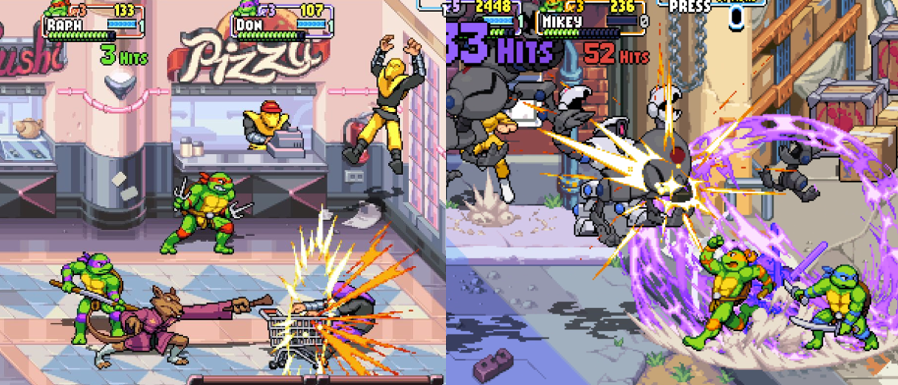
Bosses get bigger and tougher near the end, though the Shredder’s a bit of a joke.

After fighting through the Shredder’s robot factory, you’ll battle one of the more visually impressive bosses of the game – a giant Mouser that’s rendered as a background element and reminds me of the titular war machine from the original Metal Gear (Konami, 1987). While it looks intimidating, its lack of movement and predictability make this a pretty easy boss; it fires twin laser beams from its eyes that are simple to avoid, the smaller Mousers it drops are easily defeated, and you can easily smash away at the weak point in its mouth using Donatello’s ridiculously long bo staff. Naturally, you’ll eventually make your way to the Technodrome, which also acts as a large, impressive, and formidable boss battle; the humongous machine idles along on its treadmill base, frying you with electrical currents from its front and back spokes and protected by two turrets and an endless supply of Foot Soldiers. You need to fight against the pull of the treadmill, fend off the ninjas, and attack the Technodrome’s giant eye to eventually blow open an entrance, but this is easily the toughest and cheapest boss battle in the game. Once you fight your way through the insanity of the Technodrome, the game ends with a one-on-one encounter with the Shredder; after teleporting in with a burst of lightning, he jumps about the enclosed arena trying to punch you and firing deadly shots from his one-hit-jill de-evolution pistol. However, it’s laughably easy to avoid this and stay out of his way, especially with Donatello, and you can even trap him in a corner using Leo’s rapid sword swings to make short work of the would-be-conqueror.

Power-Ups and Bonuses:
As ever, you’ll occasionally find pizza strewn about in the 2D sections to refill either two bars of your health with a slice, four with half a pizza, and the entire bar with a whole pizza. Like all of the game’s items, these are quite rare and hard to track down thanks to the maze-like nature of the levels, and you’ll need to remember to switch to a turtle with low health when you spot one to keep everyone in tip-top condition. You can also find a turtle-face icon that looks like its should be an extra life but actually grants your temporary invincibility and puts you into an awkward frenzy. In one specific area of the game, you’ll also need to track down missiles for the Party Wagon to destroy the barrier son the overworld, though you can just about get by with one load of ten if you plan your route and shots correctly. Areas three and four also hide the rope item, which you’ll need to automatically cross large gaps across rooftops in area four.You can also pick up additional weapons, which you can switch to with the ‘View’ button and which act as projectiles, with each having a limited amount of ammo. Sometimes enemies will drop additional ammo, but mostly you’ll just stumble upon the weapons out in the open in 2D sections and they’re extremely effective, killing many enemies in one hit. You can grab shurikens, tossing either one or a triple-shuriken spread for maximum coverage, a boomerang, and a “kaiai”, which fires out a powerful energy wave.

Additional Features:
In a change from most TMNT videogames, there’s no two-player option here; in fact, there aren’t any options to speak of in the base game, not even a difficulty mode or any sound options. Luckily, the Cowabunga Collection remedies that, awarding a 70G Achievement for completing the game and allowing you to view the game’s box art and manuals, switch between the Japanese and American version, and apply various borders and display options. While the enhancements only allow you to remove slowdown and sprite flicker, you can still rewind the game with the Left Bumper and access save states using Right Bumper, and choose to watch the game play itself if that’s your jam.

The Summary:
I was actually surprised by how much I enjoyed the TMNT’s first venture onto the NES. It helped that I knew all about some of its more frustrating and obscure moments thanks to watching the Angry Video Game Nerd and the reputation that game as earned over the years online as one of the most difficult NES titles. While the game’s presentation and execution are a bit janky, opting for a restrictive and confusing 2D sidescroller rather than a mindless beat-‘em-up, I liked that each turtle was selectable at any time and shared their own health and weapons. While they all control the same, they’re made unique by their individual weapons, which can be particularly game-breaking in certain situations, and I liked the top-down sections of the game, despite how confusing it can be to navigate at times. What lets the game down is the oddball nature of the enemies on show; it’s almost as if this could’ve been any NES action game as the enemies are decidedly off-brand for the TMNT, and the environments just aren’t detailed or distinctive enough to really make an impact or make best use of the license. The respawning enemies and labyrinthine gameplay certainly add to the game’s difficulty; some of the enemies are needlessly cheap and make it extremely difficult to not take damage. However, I enjoyed the boss battles, especially the presentation of the giant Mouser and the Technodrome, and it’s fun to add a little more depth to the TMNT beyond just repetitively pummelling enemies. Tense, frustrating, and head scratching at times, Teenage Mutant Ninja Turtles has a fair amount of action packed into it for such a limited title and it’s definitely worth checking out, especially with the enhancements offered by the Cowabunga Collection, which definitely reduce the challenge offered by this influential NES title.

My Rating:

Rating: 3 out of 5.

Pretty Good

Was Teenage Mutant Ninja Turtles a part of your NES library back in the day? What did you think to gameplay and presentation of the game, especially regarding its maze-like aspects? Which of the characters was your favourite to play as and which boss was the most exciting for you? Were you able to make it through the underwater section? What did you think to the additional features added to the Cowabunga Collection? What’s your favourite challenging game from the NES days? I have a comments section down below where you can share your opinions on this classic NES title, or you can start the discussion on my social media.

Game Corner: Teenage Mutant Ninja Turtles: Shredder’s Revenge (Xbox Series X)

GameCorner

Released: 16 June 2022
Developer: Tribute Games
Also Available For: Linux, Nintendo Switch, PlayStation 4, Xbox One, Xbox Series S

The Background:
Like many kids back in the eighties or nineties, I was super into the Teenage Mutant Ninja Turtles (TMNT, known as Teenage Mutant Hero Turtles here in the United Kingdom), which dominated playgrounds years before Mighty Morphin’ Power Rangers (1993 to 1996) and Pokémon (1997 to present) with the popular cartoon, toys, and, of course, videogames. Although a toned down version of the original Mirage Comics characters, the TMNT were unbelievably popular at the time and this was reflected in their videogames; Konami’s original arcade title was one of the defining titles of the beat-‘em-up genre (despite being a bit limited in terms of its content and combat), the first TMNT title on the Nintendo Entertainment System (NES) was one of the quintessential games that defined what it meant to be “NES Hard”, and the Heroes in a Half-Shell have seen quite a bit of success in a variety of genres, though beat-‘em-ups like Teenage Mutant Ninja Turtles IV: Turtles in Time (Konami, 1991) were regarded as some of the team’s best. Considering their track record with beat-‘em-up, it’s fitting that Tribute Games and Dotemu were behind this loving throwback to the TMNT’s heyday; inspired by these titles and the popular cartoon, the game saw the return of many of the original voice cast to the franchise, and Teenage Mutant Ninja Turtles: Shredder’s Revenge was met with universal critical acclaim upon launch as reviews gushed over the visual presentation, the references to the TMNT’s rich history, and the arcade-style beat-‘em-up gameplay.

The Plot:
With Bebop and Rocksteady assaulting Channel 6 and stealing pieces of Krang’s robotic body as part of Oroku Saki/The Shredder’s latest twisted plan, the TMNT and their allies must take on some of their most memorable enemies in a journey that will take them from the streets of Manhattan to the dank sewers and all the way to Dimension X!

Gameplay:
Like the classic TMNT videogames from the arcade era, Teenage Mutant Ninja Turtles: Shredder’s Revenge is a 2D, sidescrolling beat-‘em-up in which you and up to five other plays take control of one of the four titular mutant turtles or one of their allies and battle through wave upon wave of Foot Soldiers and other enemies across sixteen stages. If you’ve ever played the original arcade release of Turtles in Time (or even more modern releases, like Scott Pilgrim vs. The World: The Game (Ubisoft Montreal, 2010) and Streets of Rage 4 (Dotemu, Lizardcube, and Guard Crush Games, 2020)) then you’ll be more than familiar with the criteria and the controls: simply move from the left side of the screen to the right, tapping the control stick or directional pad to run and using A to jump and X to attack, repeatedly tapping the button to string together simple combos. The controls are fully customisable so you can set them to whatever works best for you, but I found the default settings to be more than adequate, and the game includes an optional ‘How to Play’ mode that runs you through what the characters are capable of. I mentioned Scott Pilgrim just now and that’s an appropriate comparison as the characters in Shredder’s Revenge will level up to a maximum level of ten the more you fight and play, increasing their gauges and unlocking additional moves to use.

Bust some shell with the TMNT and their allies’ versatile combat options.

Streets of Rage 4 is also an appropriate comparison considering Dotemu developed both that and Shredder’s Revenge, and there are some similar mechanics here: B allows you to perform a backflip (or a hop with some characters) to avoid attacks or launch into a reverse attack with X, you’ll grab enemies automatically when standing close to them and can toss them, fling them at the screen, or slam them, pressing A when running performs a sliding attack, and you can press A or B to do a quick wakeup roll or get up faster when knocking down. You can also hold X to charge up a heavy attack and smack enemies upwards for a juggle and, as you pummel enemies, you’ll build up your “Ninja Power” gauge; when full, you can press Y to pull off a special attack that drains this meter rather than your health and sees your character explode in a whirlwind of sais, swords, or nunchakus to take out groups of enemies. When you level-up, this gauge will increase up to three levels, allowing you to perform subsequent special attacks and, eventually, enter “Radical Mode” with the Right Bumper to temporarily increase your speed and attack power at the cost of being able to perform a special attack. Eventually, you’ll be able to press Y in mid-air or out of a backflip to perform different special attacks, and you can also press RB to perform a taunt that leaves you vulnerable but will instantly fill your Ninja Power gauge. When playing with friends, you can perform team attacks simply by attacking the same enemies at the same time; the Left Bumper allows you to high five them to grant them two hit points from your own health meter, and you’ll have ten seconds to revive them when they’re defeated by holding LB (and a slice of pizza) before their downed form.

Speed along on rocket boards and watch for stage hazards!

While all the controls and even the special moves aren’t that different between characters, they do have different attributes; you’ll need to consider their range, speed, and power when selecting a character as guys like Raphael have a short reach, Casey Jones is quite slow and lumbering, and April O’Neil is fast but not particularly powerful. You’ll also want to consider the game’s difficulty settings, with “Chill” offering a very casual experience but “Gnarly” increasing the number and aggression of your enemies, and the additional challenge offered by the “Arcade” mode, which limits your lives and continues and features no save progression for a more authentic arcade experience. The main story mode sees you travelling to and from stages (referred to as “Episodes”) using a world map, which is easy to navigate and allows you to replay previous missions to level-up further or find any collectibles you missed. In stages, you’ll find plenty of things to smash to uncover power-ups and collectibles, but these can also help fend off enemies, such as fire hydrants to blast them back, explosive barrels, and smacking cameras, shopping trolleys, or traffic cones. Enemies can also toss things at you, though, and will often burst up from manholes or behind billboards and such, which then act as pits for you to fall down and other stage hazards, like electrical wires, spikes, freeze blasts, and subway trains are also present. The enjoyable mindless beat-‘em-up action is somewhat broken up by a handful of Episodes that see you rocketing along the streets or through the skies on a skate/hoverboard, taking out similarly-equipped and flying enemies with the full range of your attacks still available to you. Jump-kicking flying enemies can be a little tricky to judge, however, even with their shadows being on screen and, in the event that you do exhaust all your lives, you’ll need to restart the Episode from the very beginning.

Graphics and Sound:  
Shredder’s Revenge opts for absolutely gorgeous sprite work for its in-game graphics to make it seem like a modern version or update of the classic TMNT arcade titles. All of the sprites are big, colourful, and packed full of character; all of the playable characters have different idle and movement animations, so Splinter hobbles along on his cane, Michelangelo flails about when running, and characters swing about their weapons and comment when left standing still. Many of the voices from the original cartoon return to voice their respective characters, though this is limited to in-game outbursts and comments rather than full-on voice acting. Even the enemies have a great deal of personality; you’ll see Foot Soldiers chilling out, blending in in the background, playing Game Boys, eating ice cream, and many other amusing sight gags that encourage multiple playthroughs and all the moves, combos, and controls are so slick thanks to how well done the sprite work and animation is. There’s loads of Easter Eggs packed into Shredder’s Revenge, from enemies using some of the toy vehicles to graffiti or recognisable elements dotted all over the place, and references to the original arcade release, Turtles in Time, the live-action movies, and, of course, the original cartoon frequently cropping up so you’ll probably spot something new each time you play.

The whole game is a visual homage to the TMNT cartoons and videogames of old.

If you’ve played the original arcade game or Turtles in Time, many of Shredder’s Revenge’s locations will be immediately familiar; you’ve got the streets of New York, the rat-infested sewers and subway tunnels, the Channel 6 building (including the kitchen, a cooking show, and the office where you’ll find the likes of Irma, Burne Thompson, and Vernon Fenwick), the dingy alleys and high-speed skies of the city (where you’ll see the TMNT blimp in the background and the Foot attacking the Statue of Liberty), and eventually the jungles, wilds, and technological nightmares of Dimension X. There are also more colourful locations, like the fairground and attractions of Coney Island (where you’ll briefly battle across a beach and find the Punk Frogs), the cages and animals of the Central Park Zoo (where monkeys toss bananas at you and rhinos and warthogs stampede across the stage), and the creature comforts of the Crystal Palace Mall (where you’ll smash through barriers, ride escalators, and destroy arcade machines). There are, of course, a couple of instances where you’re trapped on an elevator and must fend off waves of goons and, while there’s not much focus on vertical traversal, stages often have multiple areas to help keep things visually interesting. The music is pretty much standard TMNT fare but there’s some fun inclusions from the likes of Lee Topes and (surprisingly) Raekwon and Ghostface Killah; even Mike Patton of Faith No More does a rocking cover version of the classic TMNT theme song. Speaking of which, this iconic intro is lovingly recreated and expanded upon through a slick animated sequence, while the remainder of the game’s cutscenes are rendered using either the in-game graphics or larger sprite work with text boxes just like in the old games.

Enemies and Bosses:
As is pretty much always the case for a TMNT videogame, you’ll primarily be battling through the seemingly endless hordes of the robotic Foot Clan; these multi-coloured ninjas come in a variety of forms, from the standard purple variant to blue, yellow, pink, and black, with each one wielding a different weapon. Some fire arrows or plungers, others can tangle you up in their whips, while others have katanas, axes, lances, or shields and can block your attacks. Some will be able to disappear in a puff of ninja smoke and toss daggers at you, while others drive motorcycles or the Foot Cruiser or pilot a spider-like mech that can only be damaged when the pilot is dizzy from missing a big axe handle smash. You’ll also encounter smaller robotic enemies, such as Roadkill Rodneys they grab you with their tentacles or spit out bombs, and Mousers, which can clamp onto you and be spawned by their larger variants. Hulking Triceratons and Stone Warriors can take quite a beating, charge at you, and even protect themselves with forcefields to take pot shots at you. Easily one of the most annoying enemies in the game, however, are the mud-like beasts that resemble the Pizza Monsters; these bastards leap up from the ground, clamping themselves to your face, and can be difficult to get a hit on since they pop up so quickly.

Some of the TMNT’s most memorable foes return as action-packed boss battles.

Naturally, you’ll also have to contend with some bigger, tougher bosses; many of these will appear mid-way through the Episode to take hostages, cause havoc, or head off with a piece of Krang’s robotic body, forcing you to pursue them across the stage. Two bosses you’ll encounter on numerous occasions are series staples Bebop and Rocksteady; both are fought alone in the first two episodes, with Bebop blasting laser bolts from his pistol and stunning himself when you avoid his shoulder barge and Rocksteady stomping around while hurling grenades at you. You’ll chase the two down through tunnels and across a bridge in Episode 3, where they attack from the Turtle Tenderiser, a large armoured jeep that erratically veers across the stage while they shoot and toss grenades at you. Later on, after clearing the rooftop stage, you’ll battle both on the ground and at the same time. This is definitely much tougher than the previous fights as their projectiles and physical attacks become much more erratic and aggressive, but it’s not too difficult to isolate one of them or even pummel them both when they’re on the same side of the screen. I was happy to see a number of familiar faces return as bosses throughout the game as well; the Rat King awaits in the sewers, charming a stampede of rats from atop a wrecked Footski with this flute and tossing you about with a whirling-like throw, and Leatherhead is fought at the end of the Coney Island episode, where he randomly hops out from grates to snap at you with his powerful jaws while the Punk Frogs toss barrels and pizzas to help you.

Some familiar, and obscure, TMNT enemies also show up for some fun boss encounters.

Baxter Stockman attacks (in his human fly form) at the end of the Secret Laboratory episode, hovering just out of reach and blasting at you, firing a gooey fist from his gun, and retreating to the background to blast massive laser cannons across the arena. Recognisable enemies like Tokka and Rahzar also make an appearance courtesy of Tempestra, a villain I’m not actually familiar with but who spawns them in to burp debilitating gas and roll around in a spiked shell and to distract you from attacking her when she’s not protecting herself with a burst of electricity. Shredder reprograms Metalhead to fight you in an electronics shop in the Silicon Alley episode, where he attacks with extendable arms and is accompanied by a bunch of Mousers, General Traag awaits in Balamphon after a descending elevator sequence, shielding himself with a piece of wall panel and blasting at you with a huge bazooka, and one of my favourite TMNT enemies, Slash, stalks you from the jungles of Dimension X and attacks you outside the ruins of the Technodrome, flying in a bladed whirlwind, causing boulders to rain down (and even throwing one at you), and spinning about in a shell attack. There are also a few other somewhat more obscure (at least they were to me) bosses to battle: Groundchuck and Dirtbag attack together, shooting spiked projectiles and digging under the ground to attack with a shovel, respectively; Wingnut battles you in the skies above New York, dashing about at high speeds and firing missiles at you while Foot Soldiers come hovering in (though you can just focus on him for a relatively easy win); Captain Zorax of the Triceratons fights you in the Natural History Museum, blasting at you and ordering a herd of Triceratons to try and flatten you like a pancake; and Chrome Dome confronts you in Balamphon, proving completely invulnerable to conventional attacks and requiring you to fling Foot Soldiers at him when the screen shifts to his first-person perspective in a call-back to the final battle against the Shredder from the original arcade game.

Besting Krang leads to you clashing swords with the Shredder and a true test of your skills.

Speaking of the Shredder, he crops up here and there in cutscenes and to sic enemies and bosses after you but won’t actually be fought until the final Episodes of the game. Each time, you must get through Krang first, who also appears (in pieces, in his little walker, or as a floating brain) throughout the story mode as Shredder’s henchmen try and reassemble his disparate parts. After fighting through pretty much every single previous enemy in the Outworld Hideout episode, you’ll fight against Krang in his robotic body. This isn’t too bad as long as you avoid his kick when up close and it’s pretty easy to dodge his mace-like punch from across the screen, but it gets a bit tricky when Krang splits into two parts; his feet stomping and kicking and his torso hovering around and firing lasers. You’ll have to face the Shredder immediately afterwards as well, with the armoured ninja slashing at you up close, flinging you away with a burst of electricity, and duplicating himself for three times the danger and with only one of his doubles being the right one. Once they’re defeated, Krang takes control of the Statue of Liberty and you face his gargantuan form atop a ruined rooftop, not unlike similar massive battles from other beat-‘em-ups and fighting games; your attack range is limited here as Krang smashes his fists and sends you flying with a shockwave, fires a devastating mouth laser, and turns Lady Liberty’s head into a cannon that targets you with an explosive bolt. Foot Soldiers will also swarm into the small platform you’re on, but it’s not massively difficult to pummel Krang up close and avoid his shots to take him out once and for all. Back on the city streets, the Shredder will once again transform into his ultimate form, the hulking Super Shredder, for the final battle of the game; Super Shredder is completely invulnerable and dashes about leaving a trail of flames in his wake. He can also teleport, grab and slam you, and send out waves of flames that you can somewhat easily avoid by staying in the corner furthest from him. He then unleashes an electrical sphere attack that also shields him as his shadowy doubles fire projectiles from the four corners of the screen, but he will eventually succumb to the mutagen’s debilitating effects and be rendered vulnerable for a very short period of time, allowing you to land a quick combo (but be sure to backflip away before he slashes you with a shadowy duplicate).

Power-Ups and Bonuses:
Each character comes equipped with their own signature weapons, from Leonardo’s double katana to Casey’s array of sporting paraphernalia, all of which can be utilised with your combos and other attacks, though this does mean that there are no opportunities to pick up and throw weapons so you’ll have to settle for attacking parts of the environment to help you out in a pinch. Onscreen hazards like spikes, electrical bolts, falling lights, and laser turrets can often damage enemies as well, so it’s worth manoeuvring them to be damaged by these, but there are a couple of pick-ups you can find throughout the game, too. Pizza will replenish your health (and you won’t pick it up if you’re at full health, meaning it’s harder to screw over your friends) so be sure to grab that but there are two other pizzas you can get, too; one will grant you an endless Ninja Power gauge for about ten seconds and another sends you into a frenzy, devastating all onscreen enemies with a super special attack. It’s worth playing through as each character as well as they’ll level-up and gain better meters and additional moves, increasing your chances of success on other modes and difficulties.

Additional Features:
Teenage Mutant Ninja Turtles: Shredder’s Revenge has thirty Achievements on offer, with six awarded simply for playing through the story mode. You’ll get Achievements for playing with friends, too, including reviving and high fiving them, and for performing a number of combo attacks. Achievements can also be earned for clearing the “Arcade” mode on higher difficulties and without continues, for defeating the Rat King as Splinter, and for clearing the game as every character, as well as powering each character up to the max and flinging enemies at the screen. Each Episode also comes with three challenges for players to aim for; these range from finishing the stage without taking damage, performing certain moves, or not doing certain things and will add to the points you earn upon completion to aid with your levelling-up. Once complete, you don’t need to worry about redoing these challenges on each playthrough, but it would’ve been nice to see new challenges loaded in each time to help level-up other characters on subsequent playthroughs. Once you clear the game’s story mode, you’ll unlock Casey Jones as a playable character, and you can replay your completed file at any time. Most of the game’s Episodes are also hiding a recognisable TMNT side character, such as the four Punk Frogs or the Neutinos, who’ll then appear on the world map and task you with finding certain items in each Episode (newspapers, bugs, VHS tapes, and crystals); finding all of these will award you extra points to level-up and some Achievements, though they’re pretty easy to find on a casual playthrough. The game allows for local and online co-operative play and is at its most challenging on “Arcade” mode, but sadly doesn’t have too much in the way of unlockables; there are no extra skins or colour palettes (which is a shame as I would’ve liked to see a black and white mode akin to the Mirage Comics or Slash included as a playable character), no versus mode, no boss rush, no gallery or concept art, and the only way you can currently get a physical copy of the game is to get one of the extremely limited and expensive copies offered by Limited Run.

The Summary:
I’ve always been a massive fan of sidescrolling beat-‘em-ups and have long lamented how so many of the classic titles are denied to us on modern consoles due to being discontinued or licensing right and such, and this is true of a great many of the TMNT videogames (at least, for now…) so to see the Heroes in a Half-Shell make such a spectacular, unexpected, and welcome return to form is truly a delight to see and Teenage Mutant Ninja Turtles: Shredder’s Revenge was a no-brainer purchase for me. Everything about the game is a love letter not just to the beat-‘em-up titles of the past but to the cartoon and the franchise as a whole; there are enemies, vehicles, bosses, and references to the movies, the comics, and the vast toy line all over the game, but the decision to bring back the cartoon’s voice cast and stick closely to the aesthetic and lore of the popular animated show just adds to the charm and nostalgia of this title. Even better, the added combat options and variety offered by the characters and stages really helps to keep things from getting repetitive; the sheer personality, allure, and cartoony humour etched into Shredder’s Revenge helps to keep the game fast-paced and action-packed from start to finish. The added extras like finding items for some of the TMNT’s supporting characters and offering an extra level of challenge in the “Arcade” mode are welcome additions to help keep you coming back for more, though it’s a shame that more of the additional modes and features from Streets of Rage 4 weren’t included (though I wouldn’t rule out some downloadable content in the future). Ultimately, Shredder’s Revenge proved to be a wonderfully enjoyable throwback to the bygone era of beat-‘em-up TMNT videogames; the presentation, combat, and gameplay was all top notch, offering a fun-filled, action-packed experience that lovingly pays homage to one of the greatest cartoon and toy franchises of the eighties.

My Rating:

Rating: 5 out of 5.

Fantastic

Did you enjoy Teenage Mutant Ninja Turtles: Shredder’s Revenge? Which of the playable characters was your go-to and what did you think to the original voice cast returning? Did you enjoy the many references and homages to the cartoons and videogames? Which of the stages or bosses was your favourite? Would you like to see more characters and modes added to the game in the future? What are some beat-‘em-ups you’d like to see make a comeback? Whatever your thoughts on the Teenage Mutant Ninja Turtles: Shredder’s Revenge, feel free to sign up to leave them below or drop a comment on my social media.

Movie Night [Turtle Tuesday]: Teenage Mutant Ninja Turtles II: The Secret of the Ooze


The first issue of Kevin Eastman and Peter Laird’s Teenage Mutant Ninja Turtles (TMNT) was published in May of 1984. Since then, the TMNT have gone on to achieve worldwide mainstream success thanks not only to their original comics run but also a number of influential cartoons, videogames, and wave-upon-wave of action figures. Even now, the TMNT continue to be an influential and popular commodity, proving that some fads don’t die out…they just get stronger!


Released: 22 March 1991
Director: Michael Pressman
Distributor: New Line Cinema
Budget: $25 million
Stars: Brian Tochi/Mark Caso, Adam Carl/Leif Tilden, Laurie Faso/Kenn Troum, Robbie Rist/Mark Caso, Paige Turco, David Warner, Ernie Reyes, Jr., and David McCharen/François Chau

The Plot:
Having defeated their nemesis, Oroku Saki/The Shredder (McCharen/Chau), the TMNT begin to grow restless about being hidden in the shadows. When their friend, reporter April O’Neil (Turco), does a report on Techno Global Research Industries (TGRI), she uncovers a possible link to their past through the mysterious mutagenic “ooze”. However, the TMNT are in for the fight of their lives when Shredder returns bent on revenge and uses the ooze to create mutant minions of his own!

The Background:
As I’ve explained before, the TMNT were originally a violent pastiche of comic book troupes created by Kevin Eastman and Peter Laird who were catapulted to mainstream success by the unbelievably popular 1987 cartoon. Perhaps inevitably, this led to a live-action feature film; Teenage Mutant Ninja Turtles (Barron, 1990) was a technically impressive financial success that went on to become a cult favourite. Interestingly enough, though, as much as I love that film, I actually saw its sequel first. Produced on a budget nearly twice that of the original, TMNT II featured a few cast changes and Eastman and Laird using every piece of their influence and creative control to ensure that Shredder’s henchmen from the cartoon didn’t appear in the film. Although TMNT II went on to receive mixed reviews due to it being dumbed down compared its predecessor, it stillmade over $78 million at the box office (though this was significantly less than the first film). However, despite TMNT II’s less-than-stellar reputation, I have an incredible amount of nostalgia for it and prefer to think of it as an under-rated entry in the franchise.

The Review:
Teenage Mutant Ninja Turtles II: The Secret of the Ooze picks up an unspecified (but presumably short) period of time after the end of the last movie; with the Foot Clan all-but eradicated following the Shredder’s apparent death, New York City has settled down quite a bit and it appears that all of its inhabitants have taken to stuffing their faces with delicious pizza rather than causing trouble to their fellow man. Sorry, did I say all? Well, that’s not quite true as we find our new audience surrogate, Keno (Reyes, Jr.), stumbling upon a late-night robbery while out delivering (you guessed it) pizza. Though a bit of a little bastard (he body shames a couple of girls when they turn him down despite the fact that they look pretty fine to me), Keno’s a good kid just trying to make his own way so when he finds a group of low-level scumbags robbing a mall, he doesn’t hesitate to intervene using his impressive martial arts skills. While his intentions are good and he’s more than capable of holding his own, Keno is hopelessly outnumbered but, luckily for him, he’s saved when the TMNT intervene. Since their old sewer hideout was compromised in the last film, the TMNT and their mentor and father-figure, Splinter (Kevin Clash), have moved into the new apartment of their human friend, April O’Neil, and have filled their time by mostly ordering pizza.

The TMNT grow restless after the victory and befriend an awe-struck pizza delivery boy.

You may be wondering what happened to Casey Jones (Elias Koteas) between movies and, sadly, this answer is never provided; instead, Keno bonds with the TMNT after discovering them on one of his many trips to April’s apartment with their pizza and specifically forms a fast friendship with the similarly hot-headed Raphael (Faso/Troum). Essentially, the TMNT remain very much the same characters as in the last film, although their more childish characteristics have been dialled up quite a bit; all of them, even field leader Leonardo (Tochi/Caso), are far more prone to spouting quips and surfer talk during fights and are growing incredibly restless with having to hide from the outside world, especially after saving the city. As before, it is Raphael who most strongly embodies this; when Keno finds that the Foot are actively enlisting new recruits, both characters explicitly disobey Splinter’s direct order not to investigate and Raph ends up captured as a result, apparently having learned nothing about the value of teamwork from the last movie. Of all the TMNT, it is Michelangelo (Rist/Caso) who again best encompasses the TMNT’s buffoonery; he’s the first one to spout a pop culture reference, lapse into tomfoolery, or incur a punishment from Splinter for his foolishness, and yet, despite all of that, he actually ends up being instrumental in defeating the Shredder’s mutant goons.

The TMNT are disappointed to find that their creation was a simple industrial accident.

The TMNT’s immature and restless nature is of considerable aggravation to April, who is torn between enjoying the company of her strange friends and finding their laziness and untidiness irritating in her cramped apartment. Similarly, Splinter tries to emphasise that his “sons” cannot ever hope to be a part of normal society and most devote themselves to the life of ninjas, hiding in the shadows in order to protect them from reprisals. When April’s news report on TGRI promises to answer lingering questions about their past, the TMNT are excited to investigate further, especially Donatello (Carl/Tilden). However, Donnie is disheartened to learn from Professor Jordan Perry (Warner) that their creation was simply a mistake caused when one of TGRI’s canisters of mutagenic ooze was lost down a sewer some fifteen years ago.

Shredder is enraged when his mutant minions turn out to be little more than super strong babies!

With the Foot in disarray at the start of the film, Tatsu’s (Toshishiro Obata/Michael McConnohie) hopes of taking the reins are almost instantly supplanted by the returning Shredder, who pulls himself from the wreckage of his defeat, crafts himself a far more fearsome-looking armour, and specifically sends the best of his few remaining men to follow April in order to enact revenge against the TMNT. In the process, the Shredder acquires the final canister of the mutagenic ooze and arranges for Perry to be taken hostage so that he can use the substance to create mutant minions of his own. The results are not the more familiar Bebop and Rocksteady but are, instead the infantile Tokka (Frank Welker/Kurt Bryant) and Rahzar (Frank Welker/Mark Ginther) who immediately (and amusingly) imprint on Shredder as their “Mama” and pose a significant physical threat due to their sheer size and ferocity.

The Nitty-Gritty:
While I can understand people lamenting that the sequel adopts more of the kid-friendly archetypes from its animated counterpart than the first film, I don’t really feel like this is a detriment to Secret of the Ooze; the presence of additional jokes and gags doesn’t diminish from the film’s darker elements (the Shredder, in particular, cuts a far more intimidating figure thanks to his new armour). Additionally, having more slapstick elements doesn’t mean the film isn’t entertaining and amusing; if the first film was a compromise between the comic and the cartoon, the sequel is a pretty close live-action approximation of the cartoon and also delivers one of my favourite exchanges in the entire franchise (Mickey’s “Yeah, a little too Raph!” line is just golden!) The film also greatly benefits from its increased budget, which not only results in the TMNT’s impressive new lair in an abandoned subway but also far more exterior scenes in and around the city and even an appearance and song by rapper Vanilla Ice.

While cartoonish action is the order of the day, the suits and fighting are still impressive.

Additionally, and crucially, the turtle suits still look fantastic and are, arguably, better than in the first film. The film also features bigger and more elaborate fight scenes and the martial arts are still incredibly impressive considering how hot and heavy and uncomfortable the suits must be, though it can’t be denied that the action has been significantly dumbed down. Unlike in the first film, the TMNT never actually use their weapons in combat, which is startlingly emphasised in the opening fight scene where they dispatch each of the robbers using slapstick shenanigans and improvised weaponry from the mall. Cartoonish sound effects punctuate a lot of the fights and actions in the film but they are used relatively sparingly and to amusing effect and one of the standout sequences sees Raph and Keno sneaking their way into, and attempting to fight their way out of, the Foot’s new recruitment centre.

After disposing of Tokka and Rahzar, the TMNT must do battle with the Super Shredder!

The addition of mutated antagonists for the TMNT to fight is a welcome one; while I would have much preferred Bebop and Rocksteady, Tokka and Rahzar are a more than suitable substitute thanks to their savage appearances. As you might expect, given how the film leans more towards the comedic than its predecessor, the two are also the source of much comedy; being “intellectually inferior” by Perry’s design to try and render them less of a threat, the two are easily manipulated by Shredder. Despite having the numbers advantage against Tokka and Rahzar, the TMNT are continuously overpowered by their greater strength and are forced to turn to a more scientific solution to defeat them and reduce them to harmless, regular animals. With his minions taken out of the picture, and driven to the edge by his numerous defeats and humiliations, the Shredder opts to drink the last vial of ooze and transforms himself into the hulking “Super Shredder” (Kevin Nash). The resulting finale is a far less technically impressive contest between the TMNT and their archenemy as, rather than making short work of the TMNT with his superior martial arts and skills like in the first film, the Super Shredder is little more than a silent, monstrous foe who goes on a self-destructive rampage on a pier. Though outmatched by Super Shredder’s incredible strength and unrequited rage, this ultimately doesn’t matter since Shredder ends up destroying himself for an ending that is a sadly anticlimactic end for their most famous enemy.

The Summary:
Even now, considering my unashamed fondness for the first film, I still find Teenage Mutant Ninja Turtles II: The Secret of the Ooze a thoroughly entertaining watch in its own right. In many ways, the film is the perfect bridge between the original Mirage Comics and the popular 1980s cartoon since it has just the right blend of cartoonish buffoonery and action and dark, poignant moments. Sure, it’s disappointing that the TMNT don’t use their weapons offensively but it’s not like they were cutting their enemies up into bits and pieces in the first film and anyone who’s watched the cartoon would be more than used to this depiction of the TMNT by this point. The addition of mutated antagonists was a welcome one; while Bebop and Rocksteady would have been my first, preferred choice, it was a natural way to escalate the conflict from the first film. Featuring a bunch of genuinely amusing gags and moments, some fun action, and incredibly impressive practical suits and animatronics, The Secret of the Ooze has plenty of appealing features to it that make it a more than worthy follow-up to the last film and I will defend it until my dying day as being an entertaining experience in its own right that deserves far more attention than it gets.

My Rating:

Rating: 4 out of 5.

Great Stuff

Are you a fan of Teenage Mutant Ninja Turtles II: The Secret of the Ooze? How do you think the film holds up against its predecessor and the other TMNT films? Which of the TMNT is your favourite and why? What did you think to Tokka and Rahzar and would you have preferred to see Bebop and Rocksteady instead? What did you think to the increased emphasis on comedic slapstick compared to the last film? Would you like to see another live-action TMNT film using modern technology to create more practical versions of the TMNT? How are you celebrating the TMNT’s debut this month? Whatever your thoughts on the TMNT, leave a comment down below.

Movie Night [Turtle Tuesday]: Teenage Mutant Ninja Turtles


The first issue of Kevin Eastman and Peter Laird’s Teenage Mutant Ninja Turtles (TMNT) was published in May of 1984. Since then, the TMNT have gone on to achieve worldwide mainstream success thanks not only to their original comics run but also a number of influential cartoons, videogames, and wave-upon-wave of action figures. Even now, the TMNT continue to be an influential and popular commodity, proving that some fads don’t die out…they just get stronger!


Released: 30 March 1990
Director: Steve Barron
Distributor: New Line Cinema
Budget: $13.5 million
Stars: Brian Tochi/David Forman, Corey Feldman/Leif Tilden, Josh Pais, Robbie Rist/Michelan Sisti, David McCharen/James Saito, Judith Hoag, Elias Koteas, and Kevin Clash

The Plot:
New York City is under siege by a crime wave perpetrated by masked hoodlums calling themselves the “Foot Clan”. When reporter April O’Neil (Hoag) tries to bring their organisation to light, the Foot’s leader, Oroku Saki/The Shredder (McCharen/Saito) orders her death but she is saved by four turtles, mutated into humanoid form and trained in martial arts and the way of the ninja, who live in the sewers. When the TMNT’s master, Splinter (Clash) is attacked and held captive by the Foot, they must work to set aside their differences, end the Shredder’s schemes, and finally settle an old grudge between him and their master.

The Background:
I’ve talking in great detail about this before but you must be surprised to learn just how dark and violent the TMNT originally were; created and self-published by Kevin Eastman and Peter Laird back in 1984, the TMNT were influenced by the works of Frank Miller and comic books like Daredevil, the New Mutants, Ronin (Miller, et al, 1983 to 1984), and Cerebus (Sim and Gerhard, 1977 to 2004). As such, the four mutated ninjas were rendered in striking black and white and exposited stoic, stilted dialogue (largely through text boxes) in a clear pastiche of Miller’s trademark art and writing style. The extremely popular 1987 cartoon catapulted the TMNT to mainstream superstardom, transforming them from dark, violent anti-heroes to cute, cuddly, kid-friendly “Hero” Turtles. As such, for many children (myself included), our first taste of just how violent the TMNT could be was this live-action feature film, which blended elements of both the cartoon and the comics to create what is, for me, the quintessential TMNT movie. To bring the TMNT to life, the filmmakers wisely went to Jim Henson’s Creature Shop to create highly sophisticated suits and animatronics, giving the film a truly timeless feel not just because of nostalgia but the sheer quality of the film’s practical effects. Teenage Mutant Ninja Turtles, unsurprisingly, debuted at number one at the box office and went on to earn over $200 million, meaning it was a massive success. Perhaps due to the film’s subject matter and target audience, critics were somewhat divided on their opinion of the film but it has gone on to be a cult favourite for many and, of course, spawned two sequels (one which I believe to be under-rated and the other which was hot garbage).

The Review:
The film begins by showcasing and emphasising the crimewave that is sweeping through New York City; April narrates in her broadcast the particulars of these events and we see how teenagers and youths are picking pockets and stealing stuff all over the place and delivering it to the Foot Clan. This sets up right away that the city is, in effect, under siege and the police are powerless to really stop it and hints towards possible corruption in the police department as a result of the Foot’s influence. Despite the warnings of Charles Pennington (Jay Patterson), her boss, April is determined to run with the story; she’s that typical reporter cliché we’ve seen hundreds of times in a multitude of media, always chasing the story and butting heads with those in authority, and seemingly ignorant to any threat against her person. This backfires on her when the Foot confront her, apparently looking to kill her, but she puts up a decent fight despite the odds being stacked against her, which really helps sell her as this tenacious and ballsy character.

April is a strong, ballsy ally to the TMNT who isn’t afraid to stand up to injustice.

April gains additional layers as the film progresses; though she first reacts with fear and horror at the appearances of the TMNT and Splinter, she soon becomes captivated by their origin story, sympathetic to their cause, and befriends them, showing genuine affection towards each of them and offering them a place to stay after Splinter is abducted and presumed dead. She also has a lot of friction with Casey Jones (Koteas) at first but the two eventually warm to each other as they spend more time together; though she doesn’t really factor into the film’s finale, she’s the glue that holds the characters together and drives the plot into motion. Plus, even better, she never becomes a simple damsel in distress and is, instead, both an audience surrogate and a useful ally when the TMNT are left directionless after Splinter’s kidnapping.

Raphael’s hot-headed nature causes him to clash with Leo and sees him seriously hurt.

The film does a great job keeping the TMNT hidden and obscured in the early going; they strike from the shadows and are only heard, rather than seen, until dramatically leaping into view in all their practical and animatronic glory. Each of the TMNT has a distinct look (Michelangelo (Rist/Sisti) is shorter and pudgier, and Leonardo (Tochi/Forman) is leaner and more toned, for example), colourations, and blemishes to help distinguish them beyond their different bandana colours. Each also sports a different and unique voice and accent, with Raphael (Pais) favouring more of a Brooklyn twang and Mikey having that “surfer dude” style of speech that the TMNT were known for in the cartoons. Additionally, each has their own personality and character arc in the film to help separate them and make them relevant; of them all, though, it is Raphael who gets the most recognisable story arc as he is the angry, antagonistic, hothead of the group. He expresses both ager and frustration at having lost his sai in the beginning, frequently defies Leo’s authority and leadership, and makes numerous trips to the surface in a ridiculously basic disguise. Of all the TMNT, Raph is the one who takes Splinter’s abduction the worst, reacting with a gut-wrenching cry of anguish and lashing out at both friend and foe alike. He ultimately pays the price for this when he is jumped and beaten by the Foot and spends the second act of the film semi-conscious in a bathtub. Faced with his mortality, he makes amends with his brother and the TMNT begin training anew as a complete group to take the fight to the Foot Clan.

The TMNT work best as a team, where they are a formidable force despite their bickering.

Leo’s character arc is subtle but present; he’s the field leader of the group but they are all relatively untested in live combat so there are some kinks to work out in the dynamic. Obviously, the most explicit example of this is seen in his frequent clashes with Raphael but we also see Leo struggling to hold his brothers together in Splinter’s absence and he is the only one balanced enough to successfully contact Splinter through meditation and eventually comes to lead the group in their battle against Shredder. Conversely, Donatello (Feldman/Tilden) doesn’t really get much of an opportunity to really stand out or do much in the film, showcasing none of the intelligence or technological ability he is generally known for; however, he is the only one to use bigger, more verbose words in his vocabulary, to notice when April’s apartment is becoming structurally unstable, and to help fix up the vehicle at the farmhouse so these elements aren’t entirely absent. He also attempts to address the implications of Splinter’s absence to the team and bonds with Casey during the sojourn at April’s farmhouse and gets a lot more to do than Mikey, who is the childish goof of the film and exists mainly to complete the group and act as the comic relief. He doesn’t even get highlighted during April’s narration at the farmhouse and has few stand out moments beyond being a loveable goofball and his cringe-worthy, but amusing, series of impressions. Still, the appeal of the TMNT has always been the group dynamic rather than the individuals; when Raph is injured, the team is noticeably fractured and struggles to coordinate their efforts without all four of them and, though they often clash and are very different, even volatile personalities at times, they work best when they are a team. The film really uses their amusing bickering, interpersonal conflicts, and complex interactions to sell the idea of the TMNT being four teenaged brothers; of course they don’t always get along and they are far from perfect but this serves only to highlight them as relatable and full-realised characters even when some of them get ore screen time and development than others.

Splinter is the TMNT’s wise mentor and father-figure whose absence affects them greatly.

The TMNT are guided in their growth and development by Splinter, their mentor and father-figure; each of the TMNT has a different relationship with Splinter, who is a calm and wise teacher who indulges but often despairs over their more childish ways and personality quirks. Leo treats Splinter with a reverence and respect, Mikey takes him somewhat for granted and isn’t willing to think about life without him, Don is the opposite and worries about Splinter’s mortality, and Splinter struggles to get through Raph’s anger. Splinter spends much of the film as Shredder’s captive but, while he is clearly suffering and, perhaps, close to death during this torture, he not only remains tight-lipped but is also able to impart his knowledge on to Charles’s son, Danny (Michael Turney), and make contact with the TMNT via semi-telepathic meditation. Splinter also gets his own arc in the film, having raised the TMNT using teachings he learned as an ordinary rat and, ultimately, confronting and besting the man who killed his master. April isn’t the only audience surrogate in the film though; we also get one of my favourite characters in the franchise, Casey Jones, the hockey mask wearing, sports-gear-wielding vigilante who initially clashes with Raphael before falling in with the TMNT and forming a friendship with them, especially Donatello. We don’t learn a massive amount about Casey or his motivations beyond vague hints towards an injury keeping him from going into professional sports, that he’s extremely claustrophobic, and that he appears to a homeless vagrant but Koteas brings a real likeable charisma and snark to the role and Casey ends up helping out a lot in the film’s finale by rescuing Splinter and confronting Shredder’s main henchman, Tatsu (Toshishiro Obata/Michael McConnohie).

Shredder cuts an intimidating figure but his plot to turn teens into ninja thieves is a bit suspect…

Speaking of Shredder, he’s a far more subdued and calculating individual compared to his boisterous animated incarnation. Rather than wishing to conquer the city, the world, or employ resources from another dimension, Shredder’s entire plot seems to be about building an army of ninja warriors and thieves, turning disillusioned teens into petty crooks and fostering their resentment of authority figures by allowing them to indulge their every whim. It’s not entirely clear what his larger endgame is but it’s enough to amass him a formidable criminal enterprise and to have the city in a state of…maybe not fear but definitely apprehension. Of course, it turns out that the Shredder is actually Oroku Saki, the man responsible for killing Splinter’s master. This isn’t revealed until right at the very end of the film, moments before the Shredder’s defeat at Splinter’s hands, but the TMNT’s battle against the Shredder is highly emotionally charged nevertheless thanks to the beating the Foot deliver to Raphael, Shredder being behind Splinter’s abduction, and Shredder’s assertion that their father-figure is dead. Unlike his lowly minions, Shredder is a formidable combatant, able to easily match and best the TMNT in a four-on-one battle and exuding menace and authority through this very presence.

The Nitty-Gritty:
Having grown up watching Teenage Mutant Hero Turtles as a child, I had no idea how dark and violent the original TMNT comics were; the film was in stark contrast to the TMNT media I was exposed to on a semi-regular basis and, at the time, I saw it as a darker, more serious reimagining of the concept. Still, it impressed me then and it still impresses now not just as easily the best live-action adaptation of the comic books but also how closely it sticks to the original comics. A few elements are changed here and there and the TMNT look and act a lot more like their animated counterparts, but this is all to the film’s benefit as the early comics took a while to actually make distinctions between the otherwise-interchangeable TMNT. It always bugged me how the TMNT have these weapons and martial arts skills and yet never seemed to use them; the film doesn’t show them skewering or slicing up their enemies like in the comics but it does make far better use of their weapons and skills to portray them as competent and dangerous combatants. That’s not to say that the film isn’t violent, though; it’s full of a violent and disturbing subtext that suggests a threat just as real as the gore seen in the comics. This is seen in the Foot’s merciless beatdown of Raphael and the big fight between the remaining TMNT in April’s apartment, which sees the Foot swinging axes and other edged weapons with clear deadly intent and the film’s glorious interpretation of the Shredder as a razor-clad foe who clearly means business and has much more in common with Darth Vader (David Prowse/James Earl Jones) than the bungling fool seen in the cartoon.

The film strikes just the right balance between goofy humour and violence.

One of the film’s most violent scenes comes when Tatsu, Shredder’s gruff, intense, mostly-silent underling beats one of their teenage inductees to within an inch of his life. In fact, it’s pretty clear that Tatsu does kill the boy and that a line was dubbed in to keep the victim alive but, even so, that (and the fact that the TMNT carry the clear bruises and injuries of their many battles) really sells the notion that the film isn’t some goofy cartoon and means serious business. The fact that it is able to take a concept as ridiculous as the TMNT and treat it so seriously is to be commended; the TMNT and Splinter are the most outrageous aspects of the film, with everyone who sees them reacting in shock, fear, disgust, and incredulity but, once you accept that these mutated beings exist, the film is almost the exact opposite of its animated counterpart. There’s humour, of course, largely thanks to the TMNT’s goofy antics and sense of humour but, for the most part, it’s a dark and gritty take that is a fantastic compromise between the violent comic books and the more kid-friendly cartoon. A central theme in the movie is that of family and fatherhood; Danny is an angry, angst-ridden teen who resents his father and wants to rebel against him (and authority in general). His emotional confusion is a pivotal sub-plot as he struggles to fit in with the Foot, doesn’t feel like he belongs or is appreciated at home with his Dad, and becomes conflicted after befriending Splinter.

Family and fatherhood are central themes to the movie’s plot.

Shredder acts as a surrogate father to Danny and his teenaged wannabe ninjas, offering the cheap thrills of sin and indulgence in return for their unwavering loyalty, and Splinter acts as a father to the TMNT. His absence deeply affects each of the brothers and he, too, misses them greatly during his capture and torment; this comes to a head during the group’s meditation practice where he expresses his love and pride for his “sons” and the five are reunited in the finale. The theme here is that family isn’t perfect: the TMNT continuously bicker and are somewhat dysfunctional as personalities despite how well they work together when in battle, Shredder is clearly using and manipulating the kids under his command, Danny has to accept this his father is only acting in service of his best interests, and Charles has to learn that Danny is becoming his own man now and to not treat him like a kid. Of course, the real star of the film are the incredible practical effects used to bring the TMNT and Splinter to life; the TMNT suits are incredibly well realised, full of distinct details and little nuances to distinguish each character and make them feel alive and real. Though their eye masks could be better (they look fake and glued to the their heads rather than being actual fabric coverings wrapped around their eyes), the animatronic heads are an incredible technological feat allowing the TMNT to express a range of emotions, expressions, and even eat pizza convincingly. Splinter looks the most like a practical puppet thanks to his frail frame and less humanoid proportions but he is nevertheless and impressive practical effect, looking wizened and being very expressive and dynamic in his range of motion, and I especially like how he has a wet nose.

The Summary:
Even now, some thirty years since its release, Teenage Mutant Ninja Turtles continues to impress; the practical suits and effects used in the film make it a timeless classic that is way better than it had any right to be and ensures that it holds up under close scrutiny in today’s digital age not just thanks to nostalgia but also because of just how much clear love and effort was put not just into bringing these ridiculous characters and concepts to life but also treating them with a level of respect and reverence that you rarely saw in adaptations of such concepts back then. As a compromise between the dark and violent comic books and the bright and goofy cartoon, Teenage Mutant Ninja Turtles still works surprisingly well; it’s probably the closest we’ll ever get to a straight one-to-one adaptation of the original concept since the TMNT’s wider appeal and commercialisation lie sin their accessibility and recognisable elements like their “surfer dude” attitudes, obsession with pizza, and individual colour schemes. Nowadays, it’s widely known how violent and dark the original concept was and we’ve seen those elements work their way back into the franchise’s later animated incarnations but it was this film that was the first to bridge that gap and to showcase just how much the original concept had been changed to appeal to a wider, more mainstream audience.

My Rating:

Rating: 5 out of 5.

Fantastic

What are your thoughts on Teenage Mutant Ninja Turtles? Do you think the film still holds up today or do the rubber suits and practical effects put you off? Which of the TMNT is your favourite and why? What was your first exposure to the TMNT as a kid and which of their various incarnations is your favourite? What do you think Shredder’s endgame was in the film and would you like to see another crack at the source material using modern technology to create more practical versions of the TMNT? How are you celebrating the TMNT’s debut this month? Whatever your thoughts on the TMNT, leave a comment down below.