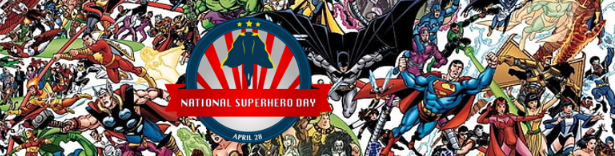
Back Issues [National Superhero Day]: Marvels


In 1995, Marvel Comics created “National Superhero Day” and, in the process, provided comics and superhero fans the world over with a great excuse to celebrate their favourite characters and publications.

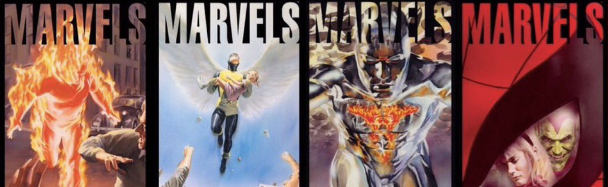
Story Titles: “A Time of Marvels”, “Monsters”, “Judgment Day”, and “The Day She Died”
Published: 9 November 1993 (cover-dated: January 1994) to 22 March 1994 (cover-dated: April 1994)
Writer: Kurt Busiek
Artist: Alex Ross

The Background:
In 1939, pulp-magazine publisher Martin Goodman created Timely Productions, expanding his reach into the increasingly popular medium of comic books. Timely’s first publication, Marvel Comics #1, was spearheaded by the first appearances of Jim Hammond/The Human Torch and Prince Namor McKenzie/The Sub-Mariner, and went on to sell over 900,000 copies. This success was followed by Captain America Comics #1 selling over a million copies just two years later, the same year that Goodman’s wife’s sixteen-year-old cousin, Stanley Lieber, was named interim editor under the pseudonym “Stan Lee”. Though superheroes declined in popularity after the Second World War, Goodman continued to publish Westerns, horror, and war comics under Atlas Comics before rebranding to Marvel Comics in 1961. Stan Lee and Jack Kirby then ushered in the “Marvel Age” of comics with the Fantastic Four, kick-starting a slew of costumed superheroes and Marvel’s distinct narrative style. These colourful heroes caught the eye of artist Alex Ross from an early age; known for his startlingly photorealistic artwork, Ross later cemented his position in the industry with Kingdom Come (Waid, et al, 1996). However, his big break came when he teamed with writer Kurt Busiek to produce this four-issue miniseries that reframed many of Marvel’s most iconic moments through the eyes of a common man. Marvels was an award-winning, widely praised miniseries that inspired a much grimmer counterpart story in 1995, a follow-up series in 2008 (though Alex Ross did not return), and a sister-series in 2021.

The Review:
Marvels followers budding photographer Phil Sheldon who, at the beginning of the story in 1939, is eager to go to Europe and make a name for himself as a war photographer. While his friend and fellow cub reporter, a youthful J. Jonah Jameson, scoffs at the futility of the war, he shares his own lofty aspirations of one day owning the Daily Bugle and making his own headlines. While Jameson heads off to cover a labour dispute, Sheldon attends a press conference hosted by noted scientist Phineas T. Horton, who unveils his revolutionary “synthetic man”, a robotic creation indistinguishable from the real thing except that it bursts into flame when exposed to oxygen. While the reporters initially mock the demonstration as an elaborate hoax, they react in horror when this “Human Torch” moves and appears sentient. Subsequent sensationalist headlines – the “power of the press”, as Sheldon puts it –   slander Professor Horton and see him bury his creation lest it prove to be a danger. While shopping for a gift for his betrothed, Doris Jacquet, Sheldon rushes to investigate a disturbance, hopeful for the big break that’ll get him shipped to Europe, only to the find the Human Torch running amok through the streets of New York City. While the ridiculously fickle New Yorkers brush the event off as an elaborate prank, Sheldon is shaken by his second sight of the flaming man and is therefore the only person to take reports of a “Sub-Mareener” seriously. Over the next few panels, both the Human Torch and the Sub-Mariner raise the ire of everyday folk with their antics, but they captivate Sheldon, who turns down the chance to cover to war to stay and follow these ever-prominent “Marvels”. As awe-struck as he is by such costumed super-men, Sheldon can’t help but question what their presence means for mankind, who suddenly seem secondary in the evolutionary chain. Thus, when the Human Torch and the Sub-Mariner inevitably come to blows in what’s likened to a battle between Gods, Sheldon shares the same fear as his fellow citizens, despite protests from the likes of officer Betty Dean, who vouches for Namor’s character.
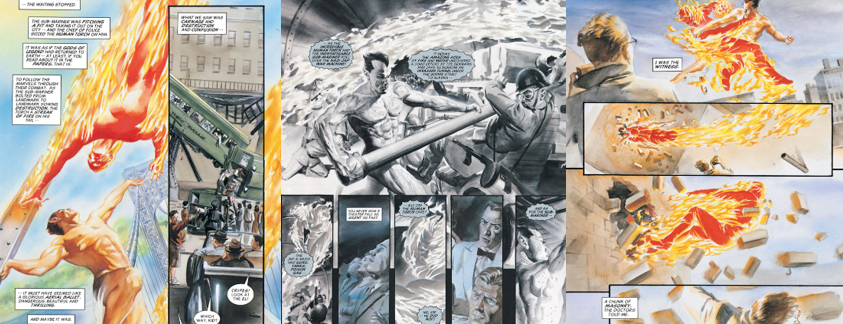
Photographer Phil Sheldon witnesses the terrifying and awesome debut of the “Marvels”.

As the two titans battle, hijacking the airwaves and causing a great deal of property damage, Sheldon is angered at them for making humanity feel so helpless. The conflict is ultimately resolved by Officer Dean, who cools the differences between the two, though Sheldon echoes the same bitterness of his peers at both superhumans escaping any punishment for their actions. In the face of his helplessness, and intuiting that such occurrences will only escalate, Sheldon reluctantly suggests pushing back the wedding and, resenting him, Doris opts to call the whole thing off until he feels more like a “man”. By winter, the press was alive with reports of Captain Steve Rogers/Captain America’s colourful adventures; kids and adults alike revelled in his Axis-smashing antics. While at the cinema, Sheldon’s musings that Cap is so accepted because he’s not perceived as a threat are given further credence when the entire audience (him included) applaud news reports of the Human Torch and the Sub-Mariner teaming up to battle the Nazis. Just like that, the Marvels are celebrated, national heroes; the public debates which of them is better and stronger and Sheldon’s perspective has changed enough to rekindle his relationship with Doris. His elevation is short-lived, however, when it’s suddenly reported that Namor has turned on the Allies and waging his own war against America, a war that sees him flood New York with a catastrophic tidal wave! The Human Torch confronts him and Sheldon’s right there to snap some pix, now revelling in witnessing such a titanic clash, only to be injured by flying debris and lose an eye in the process. Surprisingly, he feels no ill will towards the Marvels and instead chooses to focus on the bigger picture – the war and his impending wedding, specifically. After the wedding, Sheldon finally gets to cover the war in Europe and is right there when Cap, the Human Torch, Namor, and the rest of their superpowered Invaders, storm a Nazi compound, noting in a letter to Doris that the Marvels aren’t some temporary fad; they’re here to stay.
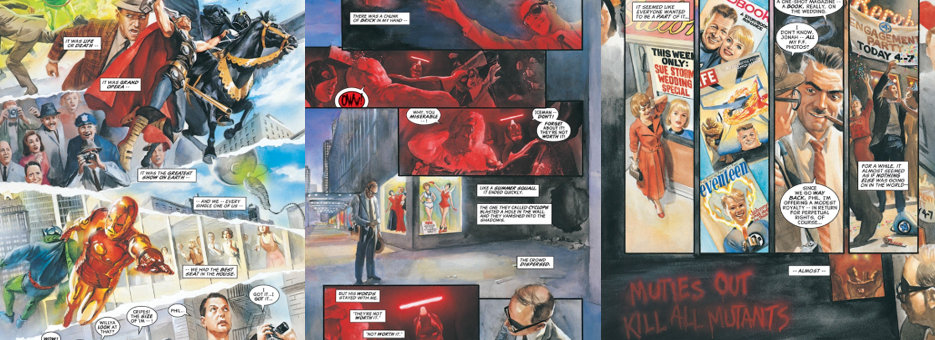
While the Avengers and Fantastic Four are celebrated, even Sheldon hates and fears Mutants.

Some decades later, an older and more experienced Sheldon is convinced to cover a battle between the Avengers and the Masters of Evil. Cap has just returned from his icy sabbatical, inspiring the awe and admiration of Sheldon and the public. By this time, sights such as Anthony “Tony” Stark/Iron Man, Thor Odinson, and Doctor Hank Pym/Giant-Man cutting through the city skyline and dwarfing mere mortals are commonplace but no less impressive. Sheldon hopes to publish a book of his photos of their heroics, convincing his publisher to take a shot on the idea based on how inspirational Marvels like the Fantastic Four are. While mulling over his opening text, Sheldon’s swept up by an angry mob who descend upon the X-Men, convinced that the Mutant teenagers tried to kill an innocent construction worker. Sharing the sentiment that the Mutants are dangerous killers, Sheldon literally casts the first stone, left shaken by the words of Scott “Slim” Summers/Cyclops (“They’re not worth it”) and pondering why Mutants illicit such hatred and distrust compared to the other Marvels. He concludes it’s because Mutants are genetically predisposed to be the next step in human evolution, thereby conjuring fears of death and redundancy in everyday folk. Ruminating these matters at home with his kids (who idolise the Marvels), Sheldon is gifted a writing assignment covering an art exhibition hosted by blind sculptress Alicia Masters. He’s also right there for when Doctor Reed Richards/Mister Fantastic announces his engagement to Susan Storm/The Invisible Girl, landing Sheldon another book deal with Jameson for every photo he takes of the colourful couple and landing him on the guest list for the wedding. With major shake-ups occurring in the Avenger’s roster and the likes of Matt Murdock/Daredevil making a splash downtown, to say nothing of the wedding drama, Sheldon almost forgets about the Mutant problem…save for the abundance of anti-Mutant graffiti plastered around town.
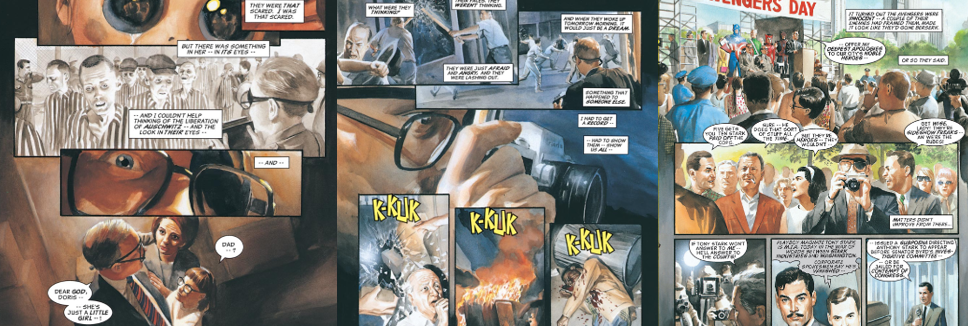
Sheldon sees the worst of humanity when the Mutant problem escalates into all-out paranoia.

Sheldon’s stunned when he returns to his quiet suburb and finds an angry mob literally grabbing pitchforks to hunt down a Mutant in the area. His first thought is his family but Sheldon’s shocked to come home and find his children sheltering a Mutant child, Maggie, a frightened little girl who’s the anthesis of everything Sheldon had so firmly believed about her species. Suddenly likening the persecution of the Mutants to the horrors of Auschwitz, Sheldon resolves to protect the girl from their friends and neighbours, who wouldn’t think twice to burn their house down to get to her. While his family keep Maggie safe, Sheldon reads up on Mutants and tries to find some way to help her, only to be met with dead ends and realise that the government wants to lock them up, at best, and execute them, at worst. Sheldon realises that the X-Men could help but falters, worrying they would remember him as another angry human, and meanders through even Reed and Sue’s wedding, his thoughts so preoccupied by Maggie’s fate. His concerns are only exacerbated when a television debate between Professor Charles Xavier/Professor X and Bolivar Trask sees the unveiling of his Mutant-hunting Sentinel machines and the outing of Professor X as a Mutant. Driven into a frenzy by fear, hated, and paranoia, an all-out riot breaks out. Sheldon’s right there, recording evidence of man’s inhumanity to man, as the monstrous Sentinels fly overhead, and is distraught to return home and find Maggie left to keep them safe and unable to comfort his kids when they worry about her safety. Within a mere two months, the fickle public begin to turn on the Marvels, holding them accountable for their actions and questioning their methods. Their primary target is Tony Stark, who bankrolls the Avengers and pays Iron Man to be his personal bodyguard, and the Avengers, who had recently been framed by evil doppelgängers. Disturbed by how sordid the Marvels have become, Sheldon throws himself into his work, determined to keep his family fed and sheltered, but unwittingly drives a wedge between him and Doris and the girls.
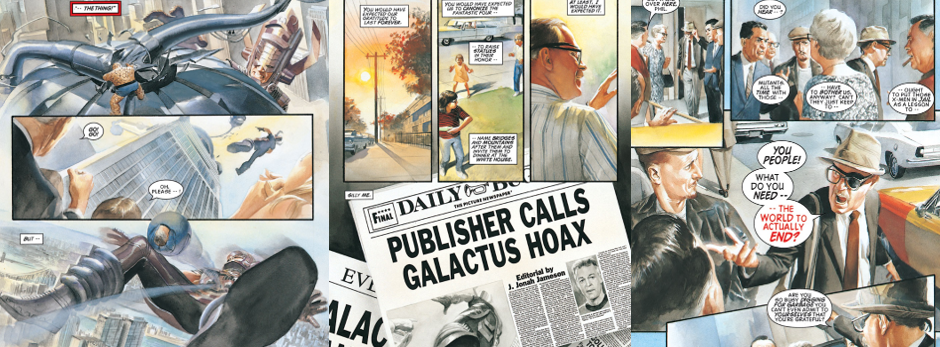
Sheldon’s incensed when the public slanders the Marvels even after they defeat Galactus.

The Marvels’ bad press is only escalated by Jameson’s personal vendetta against Peter Parker/Spider-Man and Sheldon comes to question his perception of the Marvels once more. However, he and the entire city are horror-struck when the skies burst into flames, asteroids fill the horizon, and a mysterious “Silver Surfer” arrives, seemingly heralding the onset of judgement day. Once again, despite their distrust and slander, the people must put their faith in the Marvels and be mere spectators as the Fantastic Four raced to confront the Silver Surfer, only to be dwarfed by the might and terror of the titanic Galactus! To the stunned horror of the public, the Fantastic Four lose the battle and none of their other defenders appear to help, leaving them to contemplate their end and watch, helplessly, as Galactus constructs an elaborate device around the Baxter Building. The people celebrate as the Fantastic Four and the Silver Surfer attack Galactus in full force, but Sheldon decides to leave the scene and be with his family, realising that the Marvels could fail and that he would rather be with his loved ones at the end. Luckily for him, and everyone, the Fantastic Four fend Galactus off with the Ultimate Nullifier but, rather than being celebrated as heroes, the team – and all Marvels – are further slandered by Jameson’s derogatory headlines. Sheldon’s protests fall on deaf ears and even he’s disgusted to find teenage photographer Peter Parker gleefully selling incriminating photos of Spider-Man to Jameson. His contempt for the public reaches a boiling point as Sheldon heads to cover a battle between the X-Men and Count Luchino Nefaria, snapping at them for slandering the very people, even Mutants, who save their lives. Still, by the 1970s, the public turn to his book of photographs for comfort after the Avengers are stuck in another galaxy determining the fate of all reality, begrudgingly guilty for questioning their methods. Now feeling his age, Sheldon takes on an assistant, Marcia Hardesty, though even this can’t help lighten his increasingly sour mood as he repeatedly sees the Marvels questioned, persecuted, and smeared by the courts, the public, and Jameson.
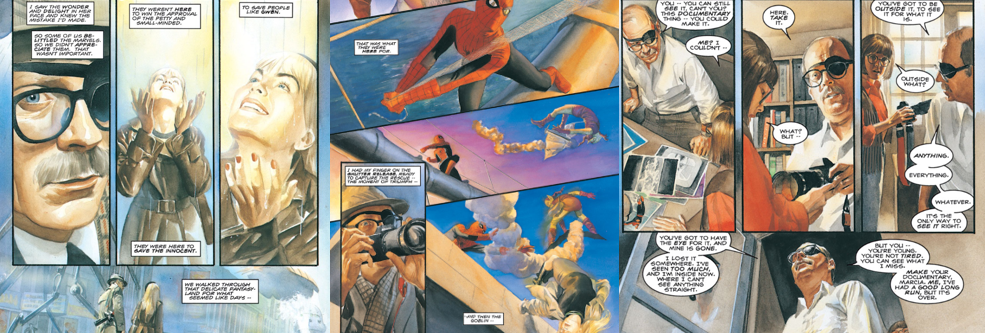
Sheldon ultimately decides to leave the awe and drama of the Marvels behind.

After the Fantastic Four again fend off Galactus, Sheldon desperately tries to turn opinion in favour of the Marvels, only to be dismissed as an overworked old man. Sheldon resolves to use his skills as a reporter to clear Spider-Man of Captain George Stacy’s death, interviewing a bystander who unashamedly blames Stacy’s death on Spider-Man. Sheldon’s as sceptical as the cops he meets with; however, while they have evidence that suggests Doctor Otto Octavius/Doctor Octopus caused Stacy’s death, they can’t prove anything without questioning Spidey. Confident that the underappreciated Marvels will handle a crisis happening at the Sun, Sheldon interviews some more people, all of whom believe Spidey’s a menace, and even questions Jameson, revealing the cantankerous publisher feels inadequate against such Marvels and is therefore determined to besmirch them, guilty or not. Jameson’s attitude makes Sheldon seriously consider an offer to write for the Daily Globe and he takes the first boat to Ryker’s Island to talk with the captive Dr. Octopus, only to find the stubborn scientist unwilling to co-operate with his inquiries. With no roads left, Sheldon visits Stacy’s daughter, Gwen, finding that, while she did initially blame Spider-Man, she no longer does. Reinvigorated, Sheldon regularly meets with Gwen; she’s with him when Namor invades New York with an army of mechanical attack craft. Rather than being terrified, Gwen marvels at their beauty and Sheldon realises that lives like hers are what the Marvels are fighting for and resolves to rework his new book into championing the heroes, flaws and all. Sheldon’s conviction turns to dread when he goes to Gwen’s to pick up some of her father’s journals and witnesses her being kidnapped by Norman Osborn/The Green Goblin. Sheldon follows in a taxi and witnesses the brutal battle between Spidey and the Goblin, sure that good would triumph over evil, and is crushed when Gwen’s knocked from the bridge and dies when Spidey tries to save her. Angered that Gwen’s death is buried under Jameson’s anti-Spidey campaign and left disillusioned by the Marvel’s failure, Sheldon loses interest in his book and grows resentful of the world moving on without a care. However, he realises that Marcia still sees the good in the Marvels and ultimately hands the assignment to her, retiring to be with his family and leaving the Marvels behind.

The Summary:
I’ve long criticised the hypocrisy of Marvel Comics’ everyday citizens. The people, especially New Yorkers, are a fickle and judgemental bunch, easily swayed by a few headlines and news reports. They can literally be dodging Galactus’ footsteps one day and then will laugh it off as a hoax the next. They can witness Spider-Man saving people from a burning building and yet fully believe Jameson’s claims that the wall-crawler started the blaze. They’ll come out in droves to cheer the wedding of Reed and Sue and applaud the star-spangled heroics of Captain America, but hurl bricks at Mutants and accuse them of all sorts in the same breath. They are a terrible, unappreciative, unreliable bunch of ingrates who don’t appreciate that these heroes put their lives on the line to save not just them, but the entire world and even the whole universe! Marvels is a perfect examination of this phenomena, with our equally culpable main character witnessing first-hand as Joe Public fear the likes of the Human Torch and the Sub-Mariner because they’re “different” and then cheer them on when they fight to defend America’s interests. Much of the public’s fickle nature isn’t just because of Jameson’s outrageous headlines, either; people, even Sheldon, feared the Marvels in the 1930s simply because of the existential threat they presented. This evolved and escalated once Mutants came along, with the species inarguably representing the next step in humanity’s inevitable extinction and thus causing the public to hate and fear them out of paranoia of being replaced (or the simple fear of death). Yet, Marvel’s civilians can never be appeased; they even turn on celebrated heroes like the Avengers for “abandoning” them and treat many of the Marvels as disposable celebrities. Their everyday, awesome feats lose their grandeur for many, who just become inconvenienced by their battles, and public opinion wildly fluctuates throughout the decades represented here as a result, even spilling over into paranoid violence when Mutants and shapeshifters become commonplace.
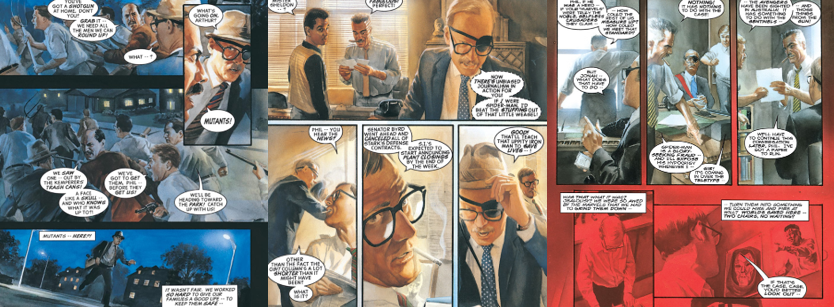
Flawed photographer Sheldon finds his awe of the Marvels tested over time.

At the heart of it all is flawed photographer Phil Sheldon. Phil’s a complex character, for sure, echoing the awe and fear of his peers at the sight of the Marvels and feeling small, insignificant, against these God-like figures. His opinion regarding the Marvels fluctuates throughout the story, with him praising and celebrating them during their “Golden Age” and profiting from their antics, never losing his faith in their good deeds even when it costs him an eye. Yet, like the public, Sheldon hates and fears Mutants. Unlike the average Joe, Sheldon contemplates why this is and realises he doesn’t really know, beyond that aforementioned existential dread. When he discovers Maggie hiding in his house, fully accepted by his well-meaning kids, he finally realises that he’s as guilty of persecution as the Nazis he once so heartily rallied against and privately defends Mutantkind. His perception changed for the better, Sheldon comes to see the worst in humanity: while they accuse Mutants of being dangerous, he sees only heroes trying to defend the innocent and angry mobs tearing their neighbourhoods apart out of sheer paranoia. Haunted my Maggie’s unresolved fate, time and weariness with the public’s everchanging opinions takes its toll on Sheldon. He remains in awe of the Marvels but focuses on them so much that he neglects his family, desperate to figure out what it is about them that distracts him so much. When Galactus arrives and the end of the world seems nigh, Sheldon realises that none of that matters; all that matters is being with the ones you love. This attitude leads into him becoming very short-tempered when people question or slander the Marvels, snapping at the unappreciative public for not realising that they owe their lives to the same people they’re dragging over the coals. Unfortunately, Sheldon lives long enough to see the best and worst of both humanity and the Marvels, realising with gut-wrenching finality that these “Gods” are as flawed as the everyday man. He comes to put all his faith in Gwen’s innocence and is thus heartbroken when Spider-Man fails to save her, but comes to see that his time with the Marvels has come to an end and that it’s time to let those concerns go to focus on what really matters.
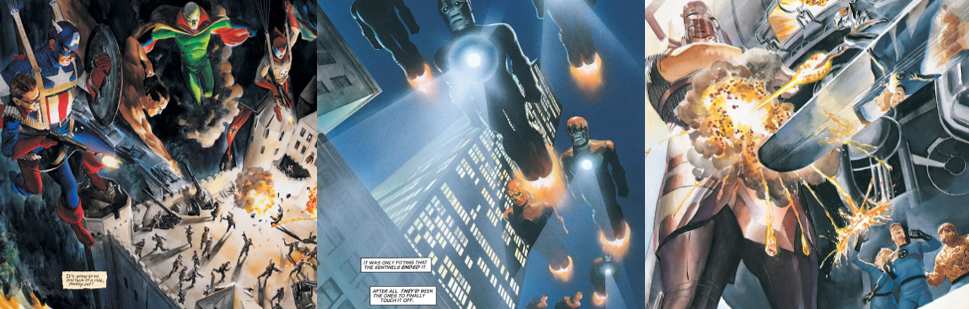
Alex Ross’s beautiful artwork brings some of Marvel’s most epic moments to glorious life.

Of course, what really makes Marvels shine is Alex Ross’s frankly gorgeous artwork. Every panel is painstakingly hand-drawn and painted to bring these colourful, outlandish superheroes to life. Unlike many of his peers, especially later in life, Alex Ross doesn’t try to reinvent these characters or make them more “realistic”; he simply presents photorealistic interpretations of their classic costumes, with the sole exception that he depicts Namor as being completely naked. This can be hit and miss; Spider-Man, for example, looks phenomenal under Ross’s penmanship but Thor and Iron Man struggle somewhat with their more outlandish designs. Still, Ross delivers some gorgeous full-page spreads, recreating Reed and Sue’s wedding, showing the battles between Namor and the Human Torch, and bringing these incredible moments to life from a street level perspective. Nowhere is this represented better than in Galactus’s arrival. Despite being faithful to Jack Kirby’s original design, Galactus cuts an intimidating and awe-inspiring figure here, towering over skyscrapers and constantly framed as though a Titan has risen from the Earth. While the story primarily focuses on Sheldon’s family life during this bout, the glimpses of the Fantastic Four and the Silver Surfer’s battle against Galactus deliver a sense of scale and realism not often seen in comics. This is further echoed in the coming of the Sentinels and Spider-Man’s battle with the Green Goblin, events where Sheldon is merely a bystander amongst the faceless masses watching history unfold, powerless to intervene. Ross fills every panel with little cameos and an amazing attention to detail, basing many characters’ likenesses off real-world celebrities and figures, and his work really makes you appreciate the craft and effort put into every panel, no matter how small. Marvels is a dramatic and compelling distillation of the first thirty-years-or-so of Marvel Comics, linking major events on a realistic timeline and giving us a glimpse at how these heroes, Gods, and villains are perceived by the common man. It’s a startlingly bleak tale at times, criticising our hypocrisy and inclination towards hatred and violence, but also an uplifting story. Sheldon, and many characters, celebrate and are inspired by the Marvels, championing them even when a small, volatile minority try to slander them. It’s the perfect snapshot of what life in Marvel’s New York City can be like and a great way to witness such iconic moments from a street-level perspective.

My Rating:

Rating: 4 out of 5.

Great Stuff

Have you ever read Marvels? If so, what did you think to it? Are you a fan of Alex Ross’s artwork? What did you think to the presentation of Marvel’s fickle public? Did you relate to Sheldon as a protagonist and enjoy his growth throughout the series? Which “Marvel” is your favourite? How are you celebrating National Superhero Day today? Whatever your thoughts, leave a comment below and be sure to check out my other superhero and comic book content.


Game Corner [National Superhero Day]: Marvel: Ultimate Alliance 2 (Xbox 360)


In 1995, Marvel Comics created “National Superhero Day” and, in the process, provided comics and superhero fans the world over with a great excuse to celebrate their favourite characters and publications.


Released: 15 September 2009
Developer: Vicarious Visions
Also Available For: Nintendo DS, Nintendo Wii, PC, PlayStation 2, PlayStation 3, PlayStation 4, PlayStation Portable (PSP), Xbox One

The Background:
Few videogame publishers are as closely associated with Marvel Comics than Activision, who have been spearheading adaptations of some of Marvel’s most popular characters since 2000. Of course, these weren’t all smash hits but some of their titles are counted as being among the best outings for the likes of Peter Parker/Spider-Man and the X-Men. In 2004, Activision teamed with Raven Software and achieved big success with X-Men Legends, a team-based brawler that mixed role-playing elements and co-op gameplay, and its sequel, so the two expanded to incorporate the larger Marvel universe with Marvel: Ultimate Alliance (Raven Software, 2006), a sadly delisted title that was met with generally favourable reviews. For the sequel, Activision turned to Vicarious Visions, who developed the game engine for the first game, and tweaked the gameplay to focus on team-based “Fusion” attacks to encourage players to experiment with different character combinations. Rather than tell an original story like the first game, or deliver on the many optional endings for Marvel: Ultimate Alliance, the sequel drew inspiration from the controversial “Civil War” story arc (Millar, et al, 2006 to 2007) that saw Marvel’s heroes divided over a governmental registration act, though the game was met with positive reviews. The action-packed gameplay and branching storyline were particularly praised, though some decried the stripped down roleplaying mechanics; the game was also delisted in 2020 and it would take just under ten years for another developer to produce a third entry.

The Plot:
After a series of devastating attacks on the United States, the American government passes the Superhero Registration Act (SRA), forcing all super-powered individuals to act under official regulation, to reduce the chaos that results from their battles. The superhero community is left divided; Tony Stark/Iron Man and his followers champion the Act while Steve Rogers/Captain America and his oppose it, but the two warring factions soon find themselves battling a new enemy that threatens global peace. 

Gameplay:
Like its predecessor, Marvel: Ultimate Alliance 2 is a team-based brawler with limited roleplaying mechanics, exploration options, and puzzle elements. Players can (eventually) assemble a team of four from a roster of around twenty-five characters, many of which return from the last game alongside some newcomers, though your options are limited by story-mandated restrictions and the decision you make partway through to side with the Pro-Registration side or the Anti-Registration side. Regardless of which character you pick, your basic combat and control mechanics remain the same: tapping A executes a light attack while B throws a heavy attack; you can hold B to charge up a stronger strike and mix these together to form basic combos, such as a pop-up attack to break an opponent’s guard. X lets you activate doors and consoles, grab anything from crates to cars to toss at enemies, pull shields off foes and even grab enemies to pummel or throw them to their doom. Y lets you jump; press an attack button in mid-air and you’ll crash to the ground with a slam and press Y again for a double jump or to web-sling, fly, or dart along on a glider or ice bridge depending on who you’re playing as. The Left Bumper allows you to block incoming attacks or dodge out of the way by wiggling the left stick at the same time; there are also times when you’ll need to hit LB to deflect incoming projectiles. The Right Bumper allows you to heal yourself or your allies or revive a fallen comrade as long as you have a Heal Token in stock; these are found scattered across each location, usually spawning in during boss encounters or after defeating enemies, and you can hold up to two at a time.

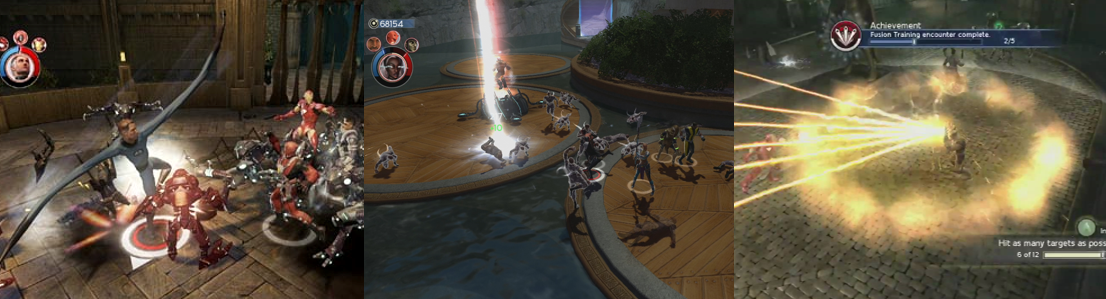
Characters boast new superpowers and can combine abilities in devastating Fusion attacks.

Although up to four players can play Marvel: Ultimate Alliance 2 simultaneously; you can also play alone with some competent A.I. companions and freely switch to another character using the directional pad when playing solo. You can press in the right stick for a handy arrow to point you to your next objective or bring up the game map from the pause menu. Each character as a life and stamina bar; the former is filled when you collect red Health Orbs or level-up and the latter fills automatically, and each character also comes equipped with their own Super Powers, which you activate by holding the Right Trigger and pressing A, B, X, or Y. Many of these are shared across characters, but with a unique flare to each; Spider-Man can web enemies towards him, for example, while Matt Murdock/Daredevil homes in with his grapple cane, but both can lash at foes with their whip-like weapons. Most characters tend to have a ranged attack (Johnny Storm/The Human Torch’s flaming projectiles, Iron Man’s Repulsor blasts, Ororo Munroe/Storm’s lightning strikes, etc) and a clearing attack (Doctor Bruce Banner/The Hulk’s ground pound, Doctor Reed Richards/Mister Fantastic’s tornado spin, and Remy LeBeau/Gambit’s kinetically-charged card barrage, etc), but some also have abilities that buff either their attacks or their team (Doctor Jean Grey/Phoenix can automatically revive characters or add fire damage to her attacks, Danny Rand/Iron Fist’s “Healing Hand” technique heals him, and Captain America can temporarily reduce the damage he takes, for example). Not only can these be improved by earning experience points (XP) and levelling-up and spending “Ability Points” (AP) in the character menu, but you can now combine powers for powerful “Fusion” abilities. As you dish out damage, you’ll build up the Fusion Meter and you can store up to two Fusion Stars at once and combine powers by holding the Left Trigger and pressing either A, B, X, or Y to team up with one of your allies. This produces various effects depending on the combination but, again, many of them are very similar and only made unique by the way the characters team up. For example, you can perform the iconic “Fastball Special” by combining James “Logan” Howlett/Wolverine, Daredevil, Iron Fist, and Mr. Fantastic with bruisers like the Hulk, Ben Grimm/The Thing, or Mac Gargan/Venom. Venom, Hulk, and the Thing can also do a dual stomping attack and you’ll be able to suck enemies in with tornados from the likes of Storm and Thor Odinson while adding elemental attacks to these twisters with the Human Torch and Phoenix.

Puzzles and objectives are simpler than ever and dialogue trees give the illusion of dramatic discord.

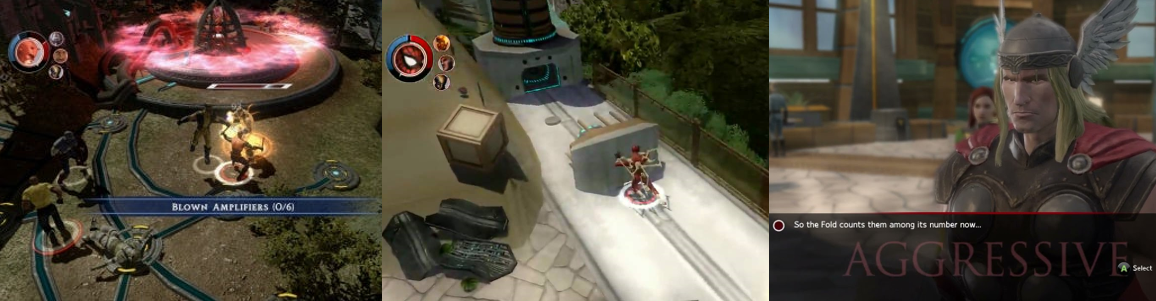
No matter the combination of characters, you’ll be prompted to tap A to increase the radius, target specific enemies, or hit successive foes to score extra points and unlock additional abilities and buffs for your characters. Tapping or holding X is also the most common way you’ll be solving the game’s puzzles; generally, you’re tasked with clearing out all nearby enemies and then activating a console or door with X, but sometimes you’ll need to push or pull amplifiers and giant batteries to power up (or down) generators or pass through barriers, rip off control panels, or destroy projectors. Other objectives include destroying anti-aircraft guns, defeating certain enemies, activating consoles in the correct order, and moving stone columns around to unlock doorways and paths, and some missions also contain optional objectives (such as destroying weapon stockpiles or teleporter pads) that net you additional rewards. Additionally, while you’re often told over your comms that you need to act quickly, only certain objectives actually carry a time limit (you’re given less than six minutes to defeat certain bosses, dispose of bombs, or escape collapsing facilities, for example) and you’re often given options to pick from in dialogue trees that will earn you buffs for being “aggressive”, “diplomatic”, or “defensive”. However, as near as I can tell, this doesn’t really alter the story or your character relationships like picking between Pro- and Anti-Reg, which will restrict the characters available to you and alter both the bosses and mission objectives you’re given (protecting or destroying a Strategic Hazard Intervention Espionage Logistics Directorate (S.H.I.E.L.D.) convoy, for example, or raiding or defending a S.H.I.E.L.D. base). Other missions will see you joined by an additional fifth character (technically not a non-playable character as many, like Captain America and Nick Fury, are playable) who will provide support; however, you can’t select them during gameplay, and you’ll still be met with failure if all four of your team are knocked out.

Graphics and Sound:  
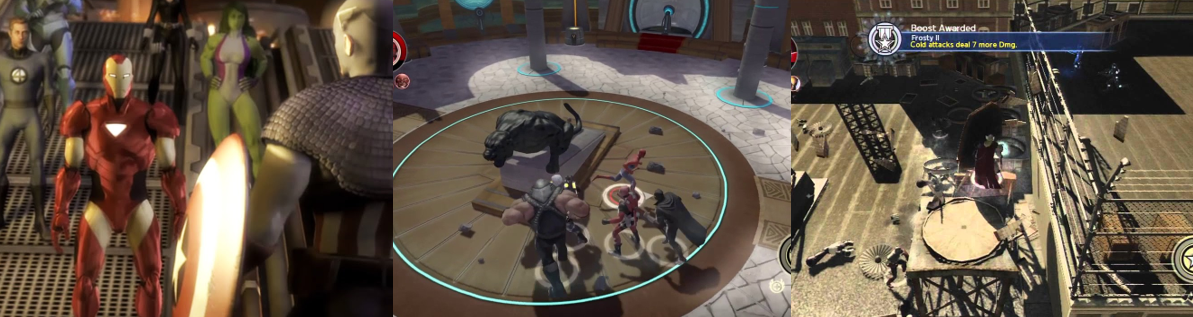
There’s been a decent graphical upgrade between Marvel: Ultimate Alliance and its sequel, namely in the sense that the game is far less dark than before and environments are a little more varied, though the same issues with things becoming repetitive and visually dull persist despite how many additional destructible elements have been added. The game starts in Latveria and sees you infiltrating both the castle town, with its many statues of dictator Doctor Victor Von Doom, and Dr. Doom’s main castle, a location that featured in the last game and is now far more linear and less confusing. This is true of all of Marvel: Ultimate Alliance 2’s locations; it’s very rare that’ll you’ll need to explore off the beaten track, mazes and repeating areas are pretty much non-existent, and everything is much more straightforward this time around, which is great in the sense that levels tended to drag on a bit and be frustrating in the first game but disappointing as you don’t have much to do in, say, Wakanda, except follow a straight path taking out enemies and gun placements and simply walking past the waterfalls, jungles, and tribal trappings in the background. Additionally, Marvel: Ultimate Alliance 2 is way less fantastical; there are no trips to Atlantis, Asgard, or Hell here and, instead, you have to make do with such inspiring locations as…downtown, the rooftops of Hell’s Kitchen, train tracks, and high-tech facilities. Some, like Phineas Mason/The Tinkerer’s lab, T’Challa/The Black Panther’s throne room, and the Negative Zone prison are actually visually very interesting but, for the most part, this is a far more grounded affair, and the game loses a lot of its madcap appeal as a result since the focus is on the more grounded struggles of the Civil War.

While the characters and cutscenes look good, the game is noticeably less visually interesting than its predecessor.

This disappointment is also felt in the game’s soundtrack, which once again opts for very generic, military-esque tunes and rock-inspired beats that serve only to make the mindless gameplay all the more tedious. The voice acting and cutscenes are a lot better this time around; there’s still an obvious graphical difference between pre-rendered cutscenes and in-game graphics, but there’s more focus on character interactions and debating the merits of the SRA. Characters will continue to offer commentary during gameplay, with Wade W. Wilson/Deadpool regularly breaking the fourth wall and characters alerting you when they’re on low health, plus you sometimes get bonuses and additional dialogue if you have certain characters speak to each other. Character models seem better this time around, though; the animations used to bring their powers to life feel more unique and tailored to each hero, though it is disappointing (though, at the same time, understandable) that the same Fusion animations are recycled for certain team-ups. Once again, you’ll be operating out of various hub worlds, like Stark Tower and the White Star base, where you can chat to other characters and find collectibles, and performing certain deeds during gameplay will net you extra costumes (though, sadly, each character only has one this time around). Unfortunately, though, you won’t be treated to as many bizarre and wacky Easter Eggs or endings as before; you only really get one game-changing choice to make here, meaning there are only two endings to see, which is a shame as I really enjoyed all the different consequences of your actions in the first game and how it led to more replay value, whereas here you’re limited to picking Pro- or Anti-Reg.

Enemies and Bosses:
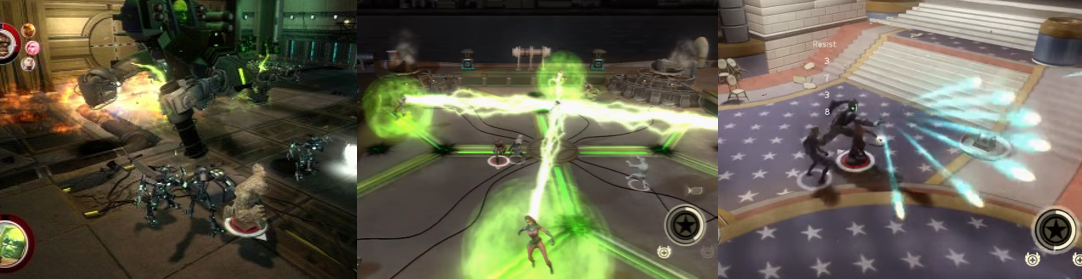
A slew of disposable goons will be set against you throughout Marvel: Ultimate Alliance 2, from Dr. Doom’s soldiers and robots to S.H.I.E.L.D. forces and the nanite-controlled minions of “The Fold”, a rogue A.I. that springs up in the game’s final act to reunite the warring superheroes. Regardless of who you’re fighting, you’ll come across the same recycled enemy tropes again and again: gun-toting soldiers, grunts with shields, ones who block your attack or inflict elemental statuses on you (such as burning, electrocution, and poisoning), and larger mechs. Helicopters will need to be taken out by tossing their grenades back at them, enemies will fire missiles and rockets at you; some have swords, some need to be stunned with your charged attack, some are shielded, and some toss explosive barrels your way. You’ll also have to watch for flame-spitting turrets, laser guns imbedded in walls, loose wires, and flaming hazards that’ll need a dose of coolant (or Bobby Drake/Iceman’s ice powers) to get past. It all gets very repetitive very quickly; the basic enemies aren’t much of a threat to you with your various powers and abilities but can quickly whittle your health down as they start mixing and matched and increasing in number, with more enemies onscreen than the last game and many of them being called in to boost or interrupt the many mini and main boss battles that you’ll have to contend with throughout the story. Like the last game, a who’s-who of Marvel’s most obscure and memorable villains are encountered throughout the game’s three acts, many of which crop up again, often in tandem with other villains.

The Tinkerer, Lucia von Bardas, and the damn Titanium Man represent a dramatic difficulty spike.

The first supervillain you’ll face is Max Dillon/Electro, who teleports around a church in a burst of electricity, performs an electrical blast attack, and can recharge his powers at the capacitors dotted throughout the area. After that, you’ll come up against Bentley Wittman/The Wizard and Steven Hudak/The Scorcher, with the former capable of erecting a shield and the latter roasting you with flame blasts, but your first real boss battle is against the Tinkerer. The Tinkerer stomps about in a large, spider-like tank mech that fires homing missiles, stamps the ground and sets it aflame, and sweeps that area with a laser blast. He’s also supported by an endless swarm of robotic minions, but you can use these to build up your Fusion Meter to target the Tinkerer’s legs and turn his mech into scrap metal. The Shocker/Herman Schultz’s stunning pulses must then be endured to rescue Carol Danvers/Ms. Marvel, then you’ll have your first of many encounters with the scythe-handed Eric Williams/Grim Reaper, one of the most recurring mini bosses who’s actually pretty tough thanks to his fast speed and quick, targeted slashes. Electro, the Scorcher, the Shocker, and the Wizard all reappear during the chaotic battle against cyborg Lucia von Bardas, which takes place on the deck of a ship. You’ll need to avoid her blasts and destroy the four cannons in each corner of the deck, which is easier said than done as Lucia defends three of them with flaming jets and you’ll have to contend with her supervillain bodyguards. Lucia also rains bombs from the sky, protects herself (and her minions) with energy shields, regularly hovers out of reach, and compounds the entire fight with a time limit. In the last part of the game’s first act, which takes part in Washington, D.C., you’ll have to do battle with Deadpool (who teleports about and riddles you with uzi bullets) and hit a bit of a brick wall when you go up against the mysterious Titanium Man. At first this isn’t so hard (he sends you flying, slows you with a pulse, and showers you with a laser spread) but things get much tougher in the second phase, where he turns invisible, is bolstered by minions and floating cannons, sends out loads of annoying vortexes, and there are no checkpoints during this battle, making it all the more frustrating.

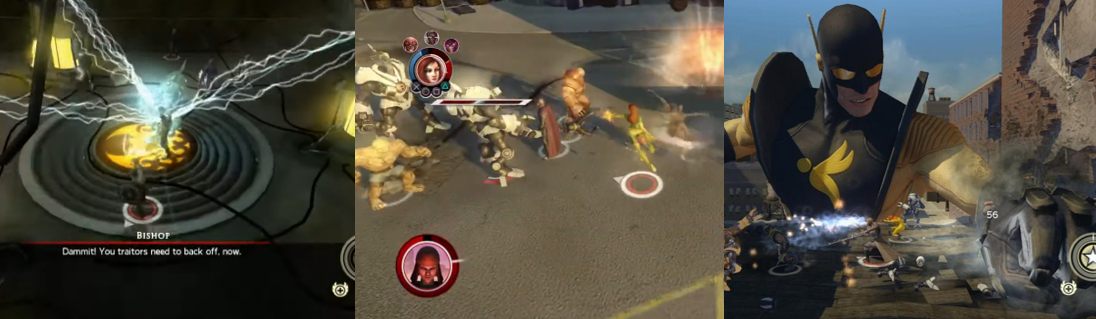
While Bishop and Deathstrike can be aggravating, the Yellowjacket boss fight was actually pretty fun.

After this, you’ll be forced to pick a side and this alters the characters you pick and fight against; I went with Anti-Registration (because, frankly, the was the right choice all along) so I’ll primarily talk about those bosses. First up is a scuffle with Natalia Romanova/The Black Widow, who keeps you at bay with her pistols, cartwheel kicks, and grenades, and your first battle with Colonel James Rhodes/War Machine, who’s basically a mirror of Iron Man and attacks with a rocket-powered punch and missiles, though both are pretty easy fights here, especially compared to the one against Lucas Bishop. Your energy attacks will actually heal the grenade-toting Bishop, so try to focus on physical attacks, but you’ll deal the greatest damage against him if you attack and destroy the terminals he plugs himself into. This actually gets pretty tricky as you have to hit three power terminals to cause feedback, then hit four nodes on other terminals to stop him regaining health, and finally hit all six nodes when he draws energy from the middle of the terminals, all while avoiding his rushes and shockwave attacks. In comparison, Melissa Gold/Songbird is a bit of a joke since all you have to worry about are her pink sonic waves, but the difficulty ramps up again when you butt heads with Yuriko Oyama/Lady Deathstrike, who attacks with her Adamantium claws like a whirling dervish. Though the Thing saves your ass, you’ll have to contend with S.H.I.E.L.D.’s soldiers and robots in the second phase; Deathstrike will repair these mechs, so it pays to quickly take them out, but that’s not easy thanks to her speed and aggression. Thankfully, this is followed by a fun and visually interesting fight against Doctor Henry “Hank” Pym/Yellowjacket, who pounds and slaps at you in his gigantic form; you need to attack his massive fists to build up your Fusion Meter and stun him, only then can you unleash a Fusion attack to deal big damage to him, though you’ll have to watch for his double-fist slam and the minions who swarm the rooftops. When in the unstable chemical plant, you’ll have a quick run-ins with Bullseye (who I had no issues with despite his triple-shot projectile), Simon Williams/Wonder Man (who’s also not too hard despite teleporting about the place and sporting powerful melee attacks), and even an unexpected alliance between Jennifer Walters/She-Hulk and Mark Raxton/Molten Man that sees you avoiding the former’s jumping slams and the latter’s flame bursts.

You’ll face different bosses depending on which side you choose, which also impacts the game’s difficulty.

You’ll also contend with a more formidable version of War Machine and have a brief fight with Iron Man (who’s basically the same as War Machine but with fancier laser attacks) before he tags in Mr. Fantastic (who’s actually a bit of a pain thanks to his stretchy limbs bursting up from the floor and his tornado spin). Iron Man and Mr. Fantastic prove quite the double team when you battle them together; even with Captain America on hand to help and with victory coming by defeating Iron Man alone, this can be a tough fight as Mr. Fantastic sometimes glitches and perpetually spins in place and Iron Man flies around the arena sending energy projectiles your way. Finally, you’ll need to help Nick Fury dispose of some bombs while fending off a joint attack from Doctor Norman Osborn/The Green Goblin and Venom; the former flies around dropping grenades or tosses pumpkin bombs in your face while the latter attacks with their tendrils and even webs up the bomb disposal vent and commandeers the Goblin’s glider! On the Pro-Reg side, you’ll have to quell Eli Bradley/Patriot after your betrayal, fend off Jessica Drew/Spider-Woman rather than Black Widow and Hercules instead of Wonder Man, as well as tangle with Nathanial Summers/Cable, who proves highly resistant to damage, constantly teleports about the place, and forces you to rely on your standard attacks and super powers since there are no minions to help build up your Fusion Meter. Ritchie Gilmore/Prodigy, Angelica Jones/Firestar, Tandy Bowen/Dagger, Piotr Rasputin/Colossus, and Jamie Madrox/Multiple Man also crop up, with the latter being quite the obstacle if you don’t have the right teammates, while Tom Foster/Goliath takes Yellowjacket’s place. Instead of fighting War Machine, Mr. Fantastic, and Iron Man, you’ll take on Iron Fist, Luke Cage/Power Man, and Captain America, with this latter fight complicated by plumes of fire and the Cage and Cap being able to pull off Fusion attacks!

After battling numerous foes, you’ll need all your powers to defeat the nanite-infused Nick Fury.

Before you enter the Negative Zone prison,  Commander Maria Hill hands over a key card without issue and Robbie Baldwin/Penance is subdued and recruited after a brief fight. Terrance Sorenson/Equinox proved much tougher thanks to the nearby turrets and his health-draining elemental attacks, and you’ll battle the nanite-infected Grim Reaper, Bullseye, and Molten Man to rescue Luke Cage and Firestar. To escape the prison with the nanite samples, you’ll take on the combined might of David Cannon/Whirlwind, Karla Sofen/Moonstone, and Rachel Leighton/Diamondback; though Captain America and Iron Man help out, this can be a frustrating fight as Whirlwind is constantly spinning about and minions are always spawning in but focusing on one mini boss can help mitigate the danger. While in Wakanda, you’ll fight off Alexander Summers/Havok (whose concussive powers are bolstered by nearby vibrational pillars), the combined threat of Hulk-clone Rick Jones/A-Bomb and Vance Astrovik/Justice (who shields his nanite ally), and once again deal with the duo of Green Goblin and Venom, this time in the Black Panther’s throne room and with a wider, more versatile space for them to avoid your attacks (though having a flame-orientated character or buffs will help against Venom). Wonder Man and Spider-Woman guard the entrance to the Fold’s Iceland base, with both proving tougher than before, while She-Hulk, Firestar, Colossus, and Whirlwind await inside guarding amplifiers. You’ll also battle the Tinkerer again here; this time, he’s almost constantly shielded by the Fold’s enhanced elites, who you’ll need to destroy in order to deal damage to the mad inventor, though the sheer influx of enemies can make this a gruelling prospect. Finally, after battling on a rising elevator and reaching the top of the Fold’s amplifier tower, you’ll fight the nanite-infected Nick Fury. Using a coloured holographic projection, Fury emulates the powers of other characters and bosses to constantly keep you on your toes; he strikes with lightning, sends out energy pulses, rapidly moves and teleports all over the place, creates duplicates, absorbs and projects energy, blasts out a stream of light, and causes the ground to erupt in flames. Although a frustrating and long-winded bout, this was actually easier than some other bosses; switch characters to whoever’s closest, unleash your rapidly-filling Fusion Meter, and remember to deflect his projectiles when prompted and you should emerge victorious without having to expend a single revive, which is more than I can say for the damn Titanium Man!

Power-Ups and Bonuses:
As mentioned, combat yields XP that levels you and your team up; all characters level-up regardless of whether you use them or not, but levelling-up alone isn’t enough to power-up your team. You need to spend AP boosting their four superpowers and all four will only be unlocked by levelling-up; thankfully, AP is easily earned by beating enemies, rapidly tapping A during Fusion attacks, and smashing crates and other onscreen destructibles. Each character also has “Passive” abilities that can be upgraded in the character menu; many of these are locked to a specific side, so you’ll never have full access to all abilities in a single playthrough, and they provide buffs such as raising your chances of landing a critical hit, allowing more frequent use of your powers, regenerating health, reducing damage, and increasing the stamina you gain. Defeating mini bosses and bosses also rewards you with medals that provide additional “Boosts”; you can manually or automatically equip up to three of these at a time to increase your health, teamwork, resistance to or ability to inflict elemental attacks, and other similar bonuses. It also pays to utilise your comic book knowledge; if you make a team comprised entirely of X-Men or the Fantastic Four, for example, you’ll get an additional boost to aid you. Finally, extra rewards are on offer for performing three “Heroic Deeds” per character; these range from defeating fifty enemies, performing specific Fusion attacks, or using certain superpowers and will unlock a new costume or ability for each character, as well as being a fun aside.

Additional Features:
There are fifty Achievements to snag in Marvel: Ultimate Alliance 2, with sixteen being tied to the story mode alone, though you’ll need to do two playthroughs and experience both the Pro- and Anti-Reg missions to earn them all. You’ll also earn Achievements for completing missions in co-op mode, clearing the game on “Legendary” difficulty, performing ten Fusions with a friend, earning high scores from Fusions, unlocking costumes, collecting boosts, and finding the various dossiers and audio logs scattered throughout the game. You’ll unlock additional characters not just through the story mode, but also by collecting Asgardian Ruins, pieces of the M’kraan Crystal, and Gamma Regulators; some characters’ alternate costumes also act as skins, such as General Thaddeus “Thunderbolt” Ross/Red Hulk and Eddie Brock/Venom. You’ll also find simulator discs scattered about that once again let you take on special simulator missions from the game’s hub worlds, can put your Marvel knowledge to the test in various trivia games for more XP, and will be given the option of starting a new game, with all your unlocks and stats, but at the cost of your existing save file. There is no option to replay previous missions as far as I can tell so you’ll need to start over if you missed anything. I’d also advise making use of the manual save function as often as possible, especially before you pick a side so you don’t have to start right from the beginning to see the other side of the story. If you were lucky enough to own this game before it got delisted, you can also expand the roster with some downloadable characters, like Cletus Kasady/Carnage and Erik Lehnsherr/Magneto, though this feature is obviously unavailable these days; additionally, other versions of Marvel: Ultimate Alliance 2 include console-specific characters, like Eric Brooks/Blade.

The Summary:
I was always hesitant about getting into Marvel: Ultimate Alliance 2, simply because of my hatred for the diabolical Civil War storyline. Even with that bias to one side, I wasn’t impressed that the sequel stripped back the story and scope of the franchise so much; the first game arguably tried to do a bit too much and touch base with a bunch of different locations and characters in the Marvel universe, but at least it embraced the bonkers spirit of the source material and wasn’t as blinkered as the sequel. I really missed the unpredictability at the first game; here, the only replay value is in picking a different side, especially as all characters are available to you in the finale, so all you’re really left with is the new-fangled Fusion mechanic. Sadly, this isn’t as good as the game makes it out to be; once you’ve seen a handful of them, you’ve basically seen them all and they weren’t as impressive as I had hoped. I also wasn’t a big fan of some of the character choices and the lack of extra skins, though overall I think I preferred the gameplay and combat; it’s still mindless and tedious and gets old really quickly, but at least the different superpowers felt a little more dynamic this time. While I have no complaints about the game’s linearity since it made it faster to play, it is a shame that exploration has been cut way back this time around and that many of the level-up and customisation mechanics have been stripped down. Once again, the game’s biggest issue is cramming so much into it; it’s great for a Marvel fan but it does impact the enjoyment and memorability of the mini bosses since a lot of them are just the same thing over and over with the same tactics used to overcome them. Overall, I feel Marvel: Ultimate Alliance 2 is no better or worse than the first game: I miss the different gameplay mechanics and visual variety of the first game, but the sequel feels a bit more refined and focused; I don’t like how grounded and restricted it is, but the graphics and ability options are a step up. I think the best thing to do (if you can afford it) is have both and play them back to back for a complete experience but if I honestly had to pick which one was better, I’d go with the first one since I’m much more inclined to play it and see what wacky endings I can earn rather than seeing the SRA repealed or lessened by the end of this game.

My Rating:

Rating: 3 out of 5.

Pretty Good

Have you ever played Marvel: Ultimate Alliance 2? If so, how do you think it compares to the first game? Which side did you pick and who made it into your team? What did you think to the new Fusion mechanic and the changes to the roster? Were you disappointed that the boss battles were still mostly tedious exercises and that the scope was scaled so far back? Did you ever complete all the Heroic Deeds and simulator missions? How are you celebrating National Superhero Day today? Whatever your thoughts, leave a comment below or on my social media, and be sure to check out my other superhero and comic book content across the site!

Game Corner [National Superhero Day]: Marvel: Ultimate Alliance (Xbox 360)


In 1995, Marvel Comics created “National Superhero Day” and, in the process, provided comics and superhero fans the world over with a great excuse to celebrate their favourite characters and publications.


Released: 24 October 2006
Developer: Raven Software
Also Available For: Game Boy Advance, Nintendo Wii, PC, PlayStation 2, PlayStation 3, PlayStation 4, PlayStation Portable (PSP), Xbox 360, Xbox One

The Background:
Perhaps few videogame publishers are as synonymous with Marvel Comics than Activision; the publisher has been spearheading adaptations of some of Marvel’s most popular properties since the year 2000. They weren’t all smash hits, of course, but some of their titles have been praised as among the best for characters like Peter Parker/Spider-Man and Marvel’s resident Mutant team, the X-Men. In 2004, the publisher teamed with developers Raven Software and saw big success with X-Men Legends, a team-based brawler that incorporated role-playing elements and simultaneous co-op gameplay. Following similar success with the sequel, Activision’s partnership with Raven Software expanded to incorporate much of the rest of Marvel’s line-up with this title, which was built on Vicarious Visions’ Alchemy engine. The game also greatly benefitted from utilising the Havok physics engine; in addition to including many of Marvel’s most popular characters alongside those added as downloadable content (DLC), Nintendo staples Link and Samus Aran were initially planned to be Wii-exclusive characters before being nixed. Marvel: Ultimate Alliance received generally favourable reviews; critics praised the game’s presentation and for improving and expanding upon its predecessors, and the game was successful enough to warrant an equally-successful sequel three years later and (eventually) a Nintendo Switch-exclusive third entry that received mixed reviews. Sadly, despite a remastered version being developed for PC, PlayStation 4, and Xbox One in 2016, Marvel: Ultimate Alliance is currently delisted from digital storefronts and quite difficult to come back for an affordable price as a result.

The Plot:
When Doctor Victor Von Doom and his Masters of Evil launch an attack against the Strategic Hazard Intervention Espionage Logistics Directorate (S.H.I.E.L.D.), Colonel Nick Fury sends out a distress call to all available superheroes for assistance. Steve Rogers/Captain America, Spider-Man, Thor Odinson, and Logan/Wolverine respond to the call and must soon join forces with a myriad of other Marvel heroes in order to put a stop to Dr. Doom after he attains incredible cosmic powers from Odin Allfather.

Gameplay:
Marvel: Ultimate Alliance is a top-down, team-based brawer peppered with some very light puzzle solving, opportunities for exploration, and role-playing mechanics. Players can (eventually) assemble a team of four from around thirty available superheroes and journey across a number of recognisable Marvel locations battling against the nigh-on endless minions of the Masters of Evil. Up to four players can play at once, though a single player is able to battle on alone, using the Left Trigger and directional pad (D-pad) to direct their computer-controlled team mates or switching to another superhero by pressing a corresponding direction on the D-pad. Players are given two primary attack options: A for a quick attack and B for a stronger attack, which can be charged up, and alternating between these commands will allow you to string together a few simple combos that will stun, trip, or blast your foe into the air, which can be essential to breaking through some enemy’s guards. X is the “action” button, allowing you to open doors, activate consoles, turn levers, or grab enemies to pummel, throw, or relieve them of their weapons, and Y allows you to swim and jump (you can also double jump, web-sling, or fly by double pressing and holding the button, respectively). Players can block incoming attacks by holding the Left Bumper or tap it to dodge out of the way entirely and each character has their own special abilities, which are accessed by holding the Right Trigger and selecting either A, B, X, or Y. Special powers can only be used if you have another energy, which is represented by glowing blue orbs dropped by enemies or uncovered from smashing crates or opening chests, and allow you to fire energy beams, toss projectiles, entrap enemies (by freezing or webbing them up, among other options), boost you (and your team mate’s) defense, attack, and other attributes, and cause status effects to your enemies like stunning, burning, or electrocuting them. While many of the effects are largely shared amongst the roster, each character pulls them off in their own unique way; Tony Stark/Iron Man’s Repulsor blasts are different from Mark Spector/Moon Knight’s projectiles, even though both can ricochet around the environment, and each character has a variety of special powers that you can power-up and assign to the face buttons from the “Hero Management” menu.

Assemble a team of four superheroes and battle the endless forces of the Masters of Evil.

Each character also has a big, character-specific attack that can be performed when your energy gauge is completely full and you press Y while holding RT this will see them unleash a huge, screen-clearing attack specific to them and each character will perform these in succession if their energy gauge is full. You’ll also earn additional bonuses if certain characters pull off their special moves at the same time, and this also happens if your team is formed of characters who have a history together, like the X-Men or the Fantastic Four. The game’s story mode is comprised of five “Acts”, which drop your team in a variety of locations that should be familiar to Marvel Comics fans. After clearing the first mission, which has you retaking a S.H.I.E.L.D. Helicarrier from Dr. Doom’s forces, you’ll be dropped into one of five hub areas where you can interact with Nick Fury, Natasha Romanoff/Black Widow, and other non-playable characters (NPCs) to learn more about your current or next mission, gain insight into the heroes and villains, and be given side quests to perform. In the hub area, and scattered throughout each location, are S.H.I.E.L.D. Access Points where you can save or load your game, change up and upgrade your team, or revive fallen teammates. Just as blue energy orbs can be acquired during gameplay, so too can red health orbs, but some environmental hazards or bottomless pits will see you or your teammates taken out of action. It can take about three minutes for your fallen ally to be ready for revival, but they can only be brought back into the fight from one of these save points. As you defeat enemies, you’ll earn experience points (XP) and level-up once you’ve gained enough XP, which will improve both your individual and team stats and unlock additional special moves for you to utilise. From the Hero Management screen, you can switch your character entirely, change their costume (which affords different abilities), equip gear to boost their stats, and name and improve the competence of your team to increase your odds when in a fight.

The tedious combat is broken up by some simple puzzles, QTEs, or short bites of variety.

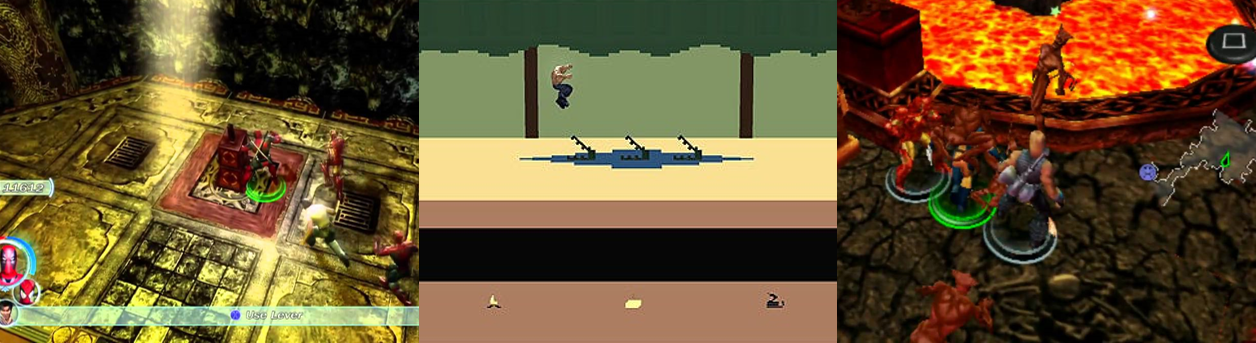
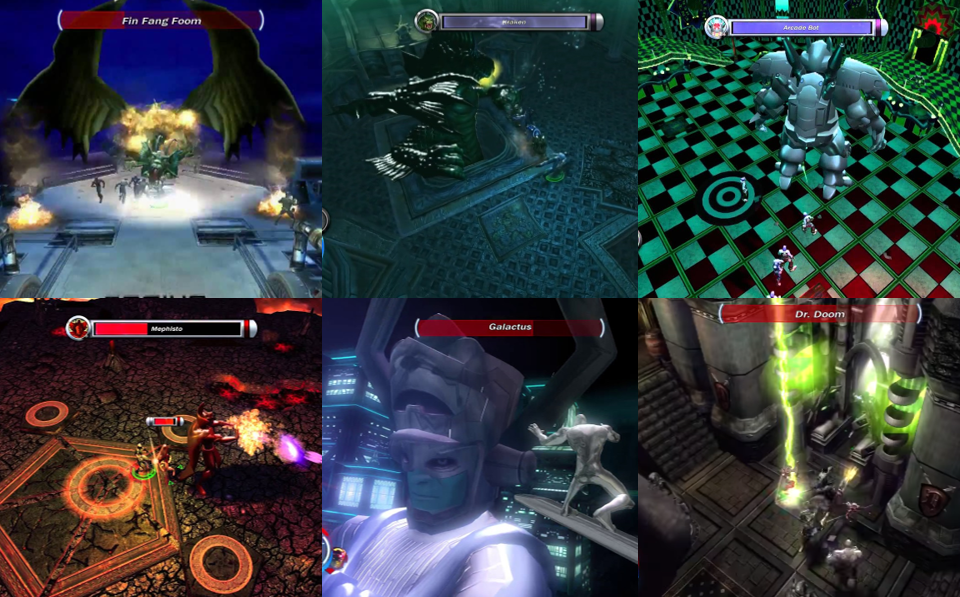
Gameplay in Marvel: Ultimate Alliance quickly grows quite repetitive; you can charge through most missions by repeating the same combos and special moves over and over, and opportunities for exploration are quite limited as areas generally only give the illusion of being large and multi-pathed. Combat doesn’t get much deeper than tripping, stunning, or blasting enemies, or avoiding using physical or energy-based attacks, and it’s surprisingly easy to get turned around in areas even with the presence of a mini map as one dark, grey corridor looks the same as the last. Puzzles aren’t much of a head-scratcher here; you’ll generally fight your way to a console or power generator that needs to be activated or destroyed, though sometimes you’ll need to activate two switches at once with the either of a partner, and you’ll sometimes have to perform these tasks against a time limit. You’ll need to push or pull heavy objects onto pressure pads, redirect sunlight to free Balder Odinson, defend Dum Dum Dugen in a glorified escort mission, perform character-specific motions to activate statues, or complete quick-time events (QTEs) to open doors or take out larger, otherwise-invulnerable bosses. You’ll jump behind the controls of an anti-aircraft cannon, be joined by NPCs like Major Christopher Summers/Corsair, and have to rescue characters like Doctor Bruce Banner and Prince Namor McKenzie/The Sub-Mariner, though some of these are optional side quests. These optional missions appear during the main campaign and often having you searching for items for a specific character, or destroying certain targets along the way, and sometimes you’re faced with an impossible choice between two options which will fundamentally alter the multiple endings. Gameplay really gets interesting, though, when you end up in Murderworld, a twisted funfair featuring bumper cars, a giant pinball set, a hedge maze, and even an old-school Atari-style mini game that sees you awkwardly swinging from ropes and collecting Golden Tickets to rescue Doctor Jean Grey/Phoenix from Arcade’s clutches.

Graphics and Sound:
Marvel: Ultimate Alliance is largely an impressive looking title, despite how old it is now, thanks to the zoomed out, almost isometric camera perspective. This means that the in-game character models, while hardly the most detailed, pop out nicely against the various backgrounds and I liked how they all had their own unique flourishes, like Spider-Man being able to web enemies up when he grabs them and Norrin Radd/The Silver Surfer floating around on his cosmic surfboard. Unlike some similar team-based brawlers, this really helps it to feel as though each character plays a little differently since they don’t just share the same animations and have a little individuality to them; you’ll need a stronger character to move certain objects, for example, and it’s much easier to explore the environment with a character who can fly. While your customised team won’t appear in the pre-rendered cutscenes, they do all have a lot of unique dialogue during the game, and when talking to or fighting against other characters; dialogue trees exist so you can ask a number of questions to NPCs or pick different options, which either helps you answer trivia questions, kicks off a side mission, or has you picking to team up with or save a different character, and villains like “Lester”/Bullseye or Quinten Beck/Mysterio. Unfortunately, the music isn’t really on par with the voice acting; it’s all very generic superhero-y or militaristic themes, and the in-game tracks often awkwardly loop, which is very jarring; the music’s also very loud, so you might want to adjust the sound settings in the options.

While the cutscenes aren’t great, the in-game graphics are decent enough and there’s a lot of dialogue variety.

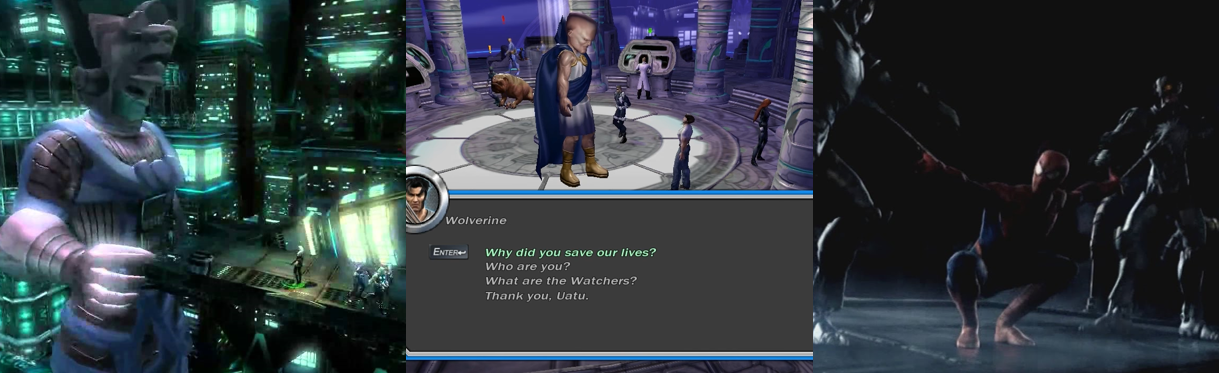
The pre-rendered cutscenes also often let the game down a bit; they haven’t aged too well, and have a very rubbery and surreal quality to them (though they are pretty epic, especially when the Masters of Evil are discussion their evil lot and when Galactus and Uatu/The Watcher enter the story) that I’d criticise more if I could actually see them but the cutscenes are very dark and the only way to brighten them is by changing your television’s settings. The game’s environments often don’t fare much better, either; while it’s fun visiting places like the Sanctum Sanctorum and Valhalla in the hub worlds, the actual mission locations quickly become confusing and boring. While there’s a lot to destroy and see in each area, and even some hidden paths to uncover, rooms, corridors, and sections all start to blend together and the levels themselves can outstay their welcome at times, which only makes the monotonous combat more glaring. That’s not to say that there aren’t some visually interesting locations, though; you’ll swim through the depths of Atlantis, travel to Hell itself, battle across the length of the Bifrost Bridge and through the frozen wastes of Niffleheim, and infiltrate the gothic, regal stone walls of Castle Doom. Easily the most impressive area you’ll visit, though, is the Skrull home world, which is currently under attack by Galactus. The World-Devourer is seen lumbering around in the background between the futuristic skyscrapers and even pursues your across the walkways in an exciting (if frustrating) sequence, though the gameplay and visual variety offered by Valhalla is equally fun as you can visit the Warrior’s Hall (where NPCs are enjoying revels) and hop across Viking ships amidst a cosmic backdrop.

Enemies and Bosses:
Since a gaggle of Marvel’s most notorious villains has joined forces in Marvel: Ultimate Alliance, you can expect to come up against a bevy of disposable goons during your adventure. It doesn’t take long for you to basically have seen everything the game has to offer in this regard, but each location does at least change up the appearance, dialogue, and some of the attacks of the enemies you face; you’ll battle Ultron’s minions, Loki Laufeyson’s trolls, and soldiers from the Shi’ar Empire and the depths of Atlantis, all of whom can be defeated using your standard combos or special powers. You can set your team mates to follow, attack, or defend formations, but I always like to choose an aggressive approach to overwhelm the hoards of enemies that can flood each area. Some of these carry weapons, either melee armaments like axes, spears, and swords which you can appropriate, or laser rifles for long-range attacks; others shield themselves and need to be attacked from behind or stunned. Some, like the imp-like demons from Mephisto’s Realm, leap onto you and drain your health, while others fly above taking pot-shots at you, and some are resistant to physical or energy attacks or need to be tripping, stunning, or blasted into the air. Some are larger, dealing and taking more damage, while others regenerate their health (or their allies), sap your health or energy, or boost the attack of other foes, so it’s best to take those guys out first.

A whole host of Marvel villains stand in your way, though most can just be beaten into submission.

The Masters of Evil have assembled quite the smorgasbord of allies; you’ll do battle with almost every single villain from Marvel Comics throughout the course of the game, sometimes more than once, as various underlings dog your progress throughout each mission. Often, you’ll battle at least two of these sub-bosses at a time; sometimes they flee after an initial encounter and need to be fought again, other times they’re powered up to be more formidable, and in other cases they’re able to heal or shield each other from your attacks by working together. However, defeating the likes of Mac Gargan/The Scorpion, Bullseye, James Buchanan “Bucky” Barnes/The Winter Soldier, Chen Lu/Radioactive Man, Valentin Shatalov/Crimson Dynamo, Aleksei Sytsevich/The Rhino, Herman Schultz/The Shocker, Doctor Curt Connors/The Lizard, Hussar and Neutron, Paibok, and even the corrupted superheroes you eventually fight really don’t require much more than you constantly attacking them with combos and special powers. Indeed, while it’s impressive that so many villains appear in the game, very few actually offer much in the way of a challenge beyond being a little tougher than the regular enemies you encounter, with even the likes of notorious villains like Ultron and Titannus proving quite disappointing encounters as, while they keep you at bay with laser blasts or destroy everything in a rampage, respectively, both can be similarly put down without any complicated strategies. Many of these villains are fought in teams, however, and they can also reappear in the simulator missions you unlock by finding discs, allowing you to battle them with different characters and in different situations, but as long as you string together your usual combos and unleash your best special attacks they go down pretty easily, even when bolstered by disposable minions.

Some of the best sub-bosses require a bit more strategy and forethought to put them down.

Other villains, however, do bring a little bit more to the table: Mysterio uses illusions to throw you off and, while Paul Pierre Duval/Grey Gargoyle can disable you by turning you to stone, Baron Carl Mordo, Kl’rt/Super Skrull, and the Mandarin disable you with elemental attacks to encase you in ice or send you flying with a blast of wind. The Mandarin also ends up being a particularly annoying boss as you need to lure his spider-like robots into teleporting to his safe spot to destroy his endless supply of Ultimos and actually bring him down for good. Mental/Mobile/Mechanized Organism Designed Only for Killing/M.O.D.O.K. challenges you to a trivia quiz to get closer to him, then brings in waves of Advanced Idea Mechanics (A.I.M.) minions to annoy you in addition to firing lasers and shockwaves at you. When battling Byrrah Thakorr-So and Krang, you also need to destroy sonic emitters to progress the mission, while Attuma and Todd Arliss/Tiger Shark can be difficult to hit as they’re swimming all over the place, making for a more aggravating encounter. Dragon Man randomly drops in as a tough obstacle to bypass since he’s capable of dishing out some formidable damage, while Blackheart employs multiple versions of himself to attack you and you’ll need to take on all three members of the Wrecking Crew at once (though they fall pretty easily if you’re wielding an axe or other weapon). Amora the Enchantress can allure you and your teammates into not attacking her, and will heal her brutish ally, Skurge the Executioner, Ulik and Kurse can only be defeated by attacking one with melee attacks and the other with energy attacks, and you’ll need to lower the shields protecting the likes of Kallark/Gladiator, B’nee and C’cil/Warstar, and Cal’syee Neramani-Summers/Deathbird (who flies around the arena tantalisingly out of reach and swooping down to grab you otherwise).

The bigger, more formidable bosses offer a bit more variety and spectacle.

Luckily, the game claws back a bit of challenge and intrigue by its large and engaging end of Act boss battles. After fending off Dr. Doom’s attack on the Helicarrier, you’ll battle Fing Fang Foom on the main deck; this gigantic alien dragon blasts fireballs at you from the air, covers the ground with shockwaves when it lands, and can only be brought down by firing anti-aircraft cannons at it and making good use of your ranged attacks. After making it past his robots and death traps, you’ll battle Arcade’s massive mech in a circus tent, which you need to fire yourself at using cannons and succeed at QTEs in order to have it damage itself in frustration. The eldritch Kracken is one of the ore frustating bosses as you can’t damage it directly and must lure it into attacking the nearby columns so you can complete a QTE sequence, but it seems completely random when it’ll actually smash into these columns, meaning the fight drags a bit. Fittingly, Mephisto awaits you in the depths of Hell; this demonic villain spews hellfire at you, protects himself from attacks with a shield, and can even screw up your controls with his powers, though you can disarm him and use his Hellsword to damage him. You’ll have to take extra care when Mephisto compels Kurt Wagner/Nightcrawler or Jean Grey to attack you, however, and will lose that character forever when they sacrifice themselves to stop Mephisto. At first, Loki isn’t really too much of a threat; sure, he’s got lightning attacks that stun you and is assisted by his Frost Giant minions, but he goes down pretty easily. However, it’s all a ruse as he then poses s Nick Fury to have you activate the indestructible Destroyer, which you must flee from while desperately searching for the ice-shielded Loki; once you find him, simply attack him until his shield breaks and the fight is ended. Galactus, however, is a threat far too big for you to tackle head-on; instead, you must desperately flee from him (destroying his drills if you have time) and then avoid his massive fists to activate three consoles and blast at him as the Silver Surfer in a QTE sequence. Finally, you must take on Dr. Doom himself; however, despite stealing Odin’s power to become a literal God, the mad doctor really isn’t too difficult to defeat even with the corrupted Fantastic Four acting as his personal guard. Simply destroy the four generators powering his shield, chase him down as he dashes and teleports across his throne room, mashing buttons when he grabs you, and pummel him as you would any other enemy or boss and, eventually, he’ll be defeated without too much problem regardless of his electrical attacks or shockwaves.

Power-Ups and Bonuses:
As mentioned, you can refill your energy and health by collecting blue and red orbs, which are dropped by enemies or found by destroying crates or opening chests. While some hazards can whittle your health down pretty quickly, or kill you immediately, health is pretty easy to come back, and you can also grab weapons to dish out greater damage to enemies (in fact, this is highly recommended as weapon attacks easily cut down even the most intimidating Super Soldiers and Doombots). You will also acquire S.H.I.E.L.D. Credits from enemies and the environment, which can be spent on upgrades to your character’s powers, costume-specific abilities, and upgrading your team’s stats; you cans et these to auto-upgrade, but they increase in cost each time you boost them so you can burn through Credits pretty quickly. Defeating the game’s many sub-bosses and bosses will also yield special gear that you can assign to each character; this will boost your attack, XP, or gauges, resist or inflict elemental damage, and offer numerous other perks but you can only equip one item to each character and your inventory has limits, meaning you’ll need to sell some to make way for new pick-ups as you come across them. Finally, as mentioned, you’ll get boosts to your stats and performance for forming teams of related characters, and performing special moves with certain characters, so it can be beneficial to experiment with different combinations and search around the environments for chests for more loot.

Additional Features:
There are forty-six Achievements on offer in Marvel: Ultimate Alliance, with the majority of them popping after clearing each Act and defeating bosses. Other Achievements include tossing enemies to their deaths, performing a certain number of finishing moves, defeating a certain number of enemies, unlocking every character and costume, and finishing the game on Hard mode, among others. Since the only difficulty-based Achievement you get is finishing on Hard, you may as well play through on Easy unless you’re going for that Achievement, and you’ll also get Achievements for finishing missions with another human-controlled character and upgrade every character’s special moves. Throughout each level, you’ll find a number of collectibles scattered about; art books unlock artwork to view, action figures allow you to unlock T’Challa/Black Panther and Matt Murdock/Daredevil as playable characters (and you can play a claw mini game in Murderworld to unlock Eric Brooks/Blade as well), and you can unlock Nick Fury by finishing the game once and the Silver Surfer by earning at least a Bronze medal in the game’s bonus simulator missions. These are unlocked by finding S.H.I.E.L.D. Simulator discs and recreate key moments and battles from each character’s history in a series of tough challenges. You can also take on five sets of trivia questions in each hub world for additional XP and Achievements, replay and revisit any Act, hub, and mission once you’ve finished the game, view movies and other unlocks in the gallery, and go head-to-head with your friends batting for points in an “Arcade” mode. By defeating numerous enemies with each character, you’ll eventually unlock up to four different costumes for each one, with these offering slightly different abilities that you can upgrade. Unfortunately, you can no longer purchase the two additional DLC packs, which added eight new characters to the roster in addition to twelve extra Achievements, none of which can be accessed on home consoles any more, which is a shame as I wanted to have Eddie Brock/Venom on my team and had to settle for symbiote Spider-Man.

The Summary:
I’d played Marvel: Ultimate Alliance before on the PlayStation 3 and, while I’d enjoyed it, I remember being put off by the lack of Trophies to earn and the fact that the DLC was only available on the Xbox 360 version. When I finally bought an Xbox 360, this game was on my buy list and, coincidentally, was a bit more expensive than I’d like and the DLC was still unobtainable, unless I wanted to shell out ridiculous amounts for an imported version. When I finally got it again, I enjoyed getting back into it; the game is very action-packed and chock full of playable characters, cameos, and villains to fight, but there’s really not a great deal to the combat, graphics, or the story. It’s fine and enjoyable enough, but things get repetitive very quickly and you’ve basically seen everything the game has to offer (apart from a few bells and whistles) after the first Act. You’ll beat on the same generic goons with the same tedious combos over and over, solving simplistic puzzles and spending your Coins on upgrades, but very rarely will you actually find much t set this apart from other, similar brawlers. The character selection and variety is great, and I like how they feel distinctive despite basically all being the same, and I enjoyed how some stages were more visually interesting than others, allowing you to swim or venture onto the hull of a space craft. While the sub-bosses weren’t up to much, the bigger bosses offered a bit more challenge and entertainment, but it feels a bit like the developers maybe crammed a little too much into the game without trying to make each villain a unique encounter. Overall, it’s a decent enough team-based brawler that’s probably more fun with a couple of friends to play with; there’s some decent replay value on offer with the different endings you can get based on your decisions and the extra missions and unlocks to find, but it does feel a little lacking in presentation and overall content to really score much higher.

My Rating:

Rating: 3 out of 5.

Pretty Good

Have you ever played Marvel: Ultimate Alliance? If so, what did you think to it and who made it into your team? What did you think to the combat, character selection, and the overall gameplay? Were you disappointed that the boss battles were mostly just a tedious slog? Which of the characters, villains, and locations was your favourite? What endings did you get and did you ever unlock all of the costumes and characters? Did you ever play as the DLC characters? Where would you rate this game against its sequels and other similar games? How are you celebrating National Superhero Day today? Whatever your thoughts, sign up to leave a comment below or leave a comment on my social media, and be sure to stick around for more superhero and comic book content throughout the year.

Movie Night [National Superhero Day]: The Shadow


In 1995, Marvel Comics created “National Superhero Day” and, in the process, provided comics and superhero fans the world over with a great excuse to celebrate their favourite characters and publications.


Released: 1 July 1994
Director: Russell Mulcahy
Distributor:
Universal Pictures
Budget:
$40 million
Stars:
Alec Baldwin, John Lone, Penelope Ann Miller, Tim Curry, Peter Boyle, and Ian McKellen

The Plot:
Having terrorised Tibet as a ruthless kingpin, wealthy aristocrat Lamont Cranston (Baldwin) is given the chance at redemption and learns the ancient art of clouding men’s minds to operate as a mysterious, duel-pistol-wielding vigilante known as “The Shadow”. However, the Shadow must use all of his skills and vast network of allies and informants to oppose Shiwan Khan (Lone), the last descendant of Genghis Khan and Cranston’s equal in the art darks, when he awakens and sets about threatening New York City with an atomic bomb.

The Background:
One of the original pulp vigilantes of the 1930, and the inspiration for one of comic book’s most popular characters, the Shadow first appeared as the mysterious narrator of the Detective Story Hour before graduating to a series of self-titled pulp novels in 1931, which were written by Walter B. Gibson. Over the years, the Shadow’s abilities were changed many times and he assumed a number of different identities, as well as irregularly appearing in both Marvel and DC Comics. Still, the pulp hero is pretty obscure compared to his successors and yet, in 1982, producer Martin Bregman bought the rights to the character and David Koepp was hired to pen the script. Working hard to craft a story about guilt and atonement, Koepp wrote with star Alec Baldwin specifically in mind for the character and, though the film would naturally employ both practical and computer-generated effects to bring the pulp character to life, director Russell Mulcahy stressed that it was to remain very much a character-driven production. Considering the success of Tim Burton’s Batman movies (ibid, 1989; 1992), Universal Pictures were banking on The Shadow being a big success; unfortunately, it grossed a measly $48 million at the box office and was (unfairly, in my opinion) torn apart by critics and reviewers.

The Review:
One thing that separates the Shadow from his more well-known counterpart is the fact that Lamont Cranston begins his film as a vile and despicable drug baron; having lost himself completely to the darkness and taken the name Yin Ko, Cranston resembles little more than a twisted, merciless warlord who kills friend and foe alike to maintain his untouchable position of power. His fortunes change, however, when the Tulku (Brady Tsurutani) has him brought to his grandiose temple and, sensing that a good man dwells deep beneath Cranston’s darkness, offers him the chance at redemption under his tutelage. Cranston, of course, angrily refuses but the Tulku basically forces him to turn the evil he has done against those who would harm others and, impressed by the Tulku’s ability to shield his palace from “clouded minds” and control a vicious little knife called Phurba (Frank Welker), Cranston submits to the Tulku’s teachings.

Thanks to the Tulku, Cranston appears invisible and has a network of agents as the Shadow.

Rather than see Cranston learning how to cloud the minds of men (and thus leave behind the one thing he cannot hide, this shadow) over the course of a montage, the film gives us the short story through some scrolling text and jumps ahead seven years, and halfway around the world, to Cranston’s home, New York City. There, he saves Doctor Roy Tam (Sab Shimono) from a group of mobsters in his guise as the cloaked and shrouded “Shadow”. Thanks to the Tulko’s teaching, Cranston is able to appear completely invisible and omnipresent to those around him through sheer force of will and this, as well as his impressive hand-to-hand combat abilities and dual pistols, allows him to strike fear into the hearts of even the most hardened criminals. Those he saves, such as Tam and his faithful driver, Moses “Moe” Shrevnitz (Boyle), become his agents and help him by feeding him information or providing him with resources and tools to fight crime more efficiently, effectively allowing him to know, through and through, what is happening all over town.

Cranston poses as a bored playboy but Margot’s telepathic potential catches his attention.

When he’s not strong-arming criminals into confessing to their evil deeds, the Shadow operates as a distracted and nonchalant wealthy socialite. Much to the chagrin of his uncle, police commissioner Wainwright Barth (Jonathan Winters), Cranston is constantly late for every little engagement and seems to have no hobbies or interests. Wainwright is kept from suspecting his nephew of his double life, and from assigning a task force to hunting down the Shadow, by Cranston’s ability to convince (basically hypnotise) him to ignore all reports of the Shadow. Cranston’s attentions are aroused (as is the rest of him…) when he spots Margot Lane (Miller) in his favourite social spot, the Cobalt Club, and the two immediately hit it off through their shared psychic abilities. Cranston is perturbed, however, when Margot picks up vague hints of his past purely by accident and even further concerned when she proves to be completely immune to his hypnotic powers.

Shiwan Khan plots to continue his ancestor’s dreams of conquest with an atomic bomb.

When Shiwan Khan has himself transported to America, he immediately sets about using his powers of manipulation to continue the conquest begun by his ancestor; maniacal in his ambition, Khan desires nothing more than to rule the entire world and, quickly acclimatising himself to American society, sees the perfect means to achieve this goal by mesmerising Margot’s father, eccentric scientist Doctor Reinhardt Lane (McKellen), into twisting his peaceful energy research towards the construction of an atomic bomb. Khan is, in essence, the manifestation of Cranston’s dark past; full of ego, self-entitlement, and bloodlust, Khan delights in using his powers to force others to sacrifice themselves to his power or to do his bidding as little more than mindless puppets (such as Reinhardt’s assistant, the slimy and detestable Farley Claymore (Curry)).

Margot proves instrumental in Cranston uncovering Khan’s sinister plot.

Admiring Cranston’s path of destruction as Yin Ko, Shiwan Khan initially proposes an alliance between the two; however, having committed himself to the fight against evil thanks to the Tulku’s teachings, Cranston vows to oppose him with all his power and is only further motivated when Khan reveals that he murdered the Tulku (and claimed Phurba as his own) after rejecting his attempts to turn him. What follows is an intricate game of cat and mouse as Cranston uses all of his resources to try and track Khan down, discovering that he has hypnotised the entire city in the process, while Khan uses his powers to hypnotise Margot into trying to kill the Shadow. This, of course, causes her to try and kill Cranston, thereby revealing his dual identity to her but, rather than forget about him as he initially demands, she stubbornly refuses to leave her father to be used by such a madman and proves an invaluable resource in Cranston’s efforts to locate the would-be-dictator’s fortress (to say nothing of saving him from drowning to death).

The Nitty-Gritty:
One thing that’s always stuck with me about The Shadow is Jerry Goldsmith’s haunting and rousing score, which, to me, is just as fitting, memorable, and haunting as Danny Elfman’s Batman theme. Additionally, Alec Baldwin is completely transformed by the Shadow’s ominous hat and cloak; hiding his identity behind a thick red scarf and sporting a glistening, metallic tint in his eyes whenever he uses his psychic powers, the Shadow cuts a formidable figure, especially when he appears to emerge from the shadows and be little more than a monstrous blur of mist and darkness. Furthermore, his voice takes on a dark, gravelly, haunting whisper and he often announces his presence with a cackling, demonic laughter, all of which only add to the mystique of “The Shadow”.

A powerful, but haunted, figure, Cranston’s past comes to life when Khan arrives in New York.

While he has successfully turned his life around and devoted himself to combatting evil, Cranston is constantly ashamed and haunted by memories of his past misdeeds; these take the form of horrifying nightmares that depict him as a blood-thirsty tyrant and he laments to Margot that his past is far too bloody to simply be forgotten about. Shiwan Khan embodies the very worst of his past; not only does he have all of Cranston’s abilities, he isn’t handicapped by notions of morality and is far more adept at controlling others as a result. Thus, for Cranston, fighting Khan is like fighting his own dark reflection and nowhere is this better emphasised than in a fantastically horrifying scene in which Cranston has a nightmare where he rips his face off to show Khan’s underneath! Another thing I always enjoyed about The Shadow is its period-based setting, which lends it a real charm and unique presentation amongst most other superhero films from that era (and even now). I also enjoy how Cranston has agents all of the city (and, he claims, the world), in addition to a vast communications network, and the film builds in a perfect explanation for how he would have been able to build all of that and acquire his resources: he either acquired agents with those resources or “convinced” others to assist him with his powers. As incredible as the Shadow’s powers and abilities are, however, he is far from superhuman; he can be hurt, injured, and is placed in vulnerable positions throughout the film, especially when his concentration is broken or his powers are muted by people like Margot and Khan.

Cranston overcomes his limitations and puts an end to Khan’s mad dreams of conquest.

This means that the finale contains a fair amount of tension for, while the Shadow is easily able to overcome Khan’s Mongol warriors and send Claymore to his death, he struggles to match Khan in a physical and mental battle as he is on enemy territory and his distracted by the ferocious little dagger. It is thus a triumphant achievement when Cranston summons all his mental facilities to finally earn the respect and command of Phurba and turn it against Khan. Wounded, Khan escapes into a hall of mirrors where Cranston shatters the glass all round them and ends his rival’s threat once and for all not by killing him but by driving a shard of glass into Khan’s frontal lobe, thereby removing his telepathic and psychic powers and confining him to a mental institution. Cranston thus ends the film having quelled some of the tumult and pain of his past and, fully supported by Margot and his network of allies, in a much better position to continue his fight against the evil and unjust.

The Summary:
When I first saw The Shadow as a kid, I had no idea who the character was; he was way before my time and I don’t think his radio show, novels, and comic books were that readily available in the United Kingdom back then. I was, however, a big fan of Bruce Wayne/Batman and the 1989 Batman movie so, when I saw The Shadow, I was immediately intrigued by the parallels between the two characters. I didn’t even consider The Shadow to be a rip-off of Batman as Cranston is such a different character to Bruce (realistically all they have in common is their wealth, dual identities, and penchant for the theatrical) and not only are his abilities very different, but the film is presented very differently, being much more of a period piece and thus being visually distinctive and exciting like other, similar films, I enjoyed at the time like Raiders of the Lost Ark (Spielberg 1981) and The Rocketeer (Johnston, 1991). I still don’t really get why people didn’t like The Shadow when it first came out; I guess there was quite a bit of competition back then, in general, but the superhero genre wasn’t anywhere near as inflated as it is today and I definitely think there’s enough here to make the film stand out against its competitors. I’m thus very happy to see that, in certain circles, The Shadow is regarded as an under-rated gem and I’d absolutely say that it deserves that distinction. With a slick presentation, a unique hero with both a visually interesting power and appearance, a evocative and stirring score, a great balance of action, humour, and intrigue, and some solid performances, The Shadow totally deserves more time in the spotlight as even now, after all the superhero films I’ve seen, it still manages to entertain from start to finish and I am very hard pressed to find much fault with it.   

My Rating:

Rating: 4 out of 5.

Great Stuff

Have you ever seen The Shadow? If so, what did you think to it? If you’re a fan of the character, did you enjoy the film as an adaptation or did it change too much for you? What did you think to the Shadow’s powers and representation? Did you enjoy the score the performances from the actors? Would you like to see another Shadow film made someday, or perhaps a Netflix series? How are you celebrating National Superhero Day today? Whatever your thoughts, leave a comment below and be sure to stick around for more superhero and comic book content throughout the year.

Movie Night [National Superhero Day]: Avengers Assemble


In 1995, Marvel Comics created “National Superhero Day” and, in the process, provided comics and superhero fans the world over with a great excuse to celebrate their favourite characters and publications.


Released: 4 May 2012
Director: Joss Whedon
Distributor: Walt Disney Studios Motion Pictures
Budget: $220 million
Stars: Robert Downey Jr, Chris Evans, Mark Ruffalo, Chris Hemsworth, Scarlett Johansson, Jeremy Renner, Tom Hiddleston, Clark Gregg, Stellan Skarsgård, and Samuel L. Jackson

The Plot:
When Loki Laufeyson (Hiddleston) arrives on Earth wielding a mind-controlling spear and in search of the Tesseract, Nick Fury (Jackson), director of the Strategic Homeland Intervention, Enforcement and Logistics Division (S.H.I.E.L.D.) activates the “Avenger Initiative”. Tony Stark/Iron Man (Downey Jr), Steve Rogers/Captain America (Evans), Doctor Bruce Banner/The Hulk (Ruffalo), Thor Odinson (Hemsworth), Natasha Romanoff/Black Widow (Johansson), and Clint Barton/Hawkeye (Renner) are called into service and must find a way to co-exist before they can combat this otherworldly threat.

The Background:
The development of an Avengers film began in 2003 with an outrageous plan to release a series of solo films for each character before having them all meet up, similar to how the Avengers formed in the comics back in 1963 courtesy of Martin Goodman, Stan Lee, Jack Kirby, and Dick Ayers. It was an unprecedented move, one which saw fledging studio Marvel Studios roll the dice on lower-tier heroes such as Iron Man and win big time with a slew of massively successful and popular superhero films, each one hinting towards a much larger, shared cinematic universe. When the time came for Earth’s Mightiest Heroes to finally meet onscreen, Marvel Studios turned to Joss Whedon to rewrite the script and direct the film and included Iron Man (Favreau, 2008) and Iron Man 2 (ibid, 2010) director Jon Favreau as an executive producer. After some differences of opinion, Marvel Studios chief Kevin Feige chose to recast Edward Norton in the role of Banner/Hulk and easily the biggest superhero film of all time was officially underway. The Avengers (known as Avengers Assemble here in the United Kingdom) was an absolutely phenomenal success, making over $1.500 billion at the box office, receiving rave reviews, and kicking off the extraordinary blockbuster success we know of today as the Marvel Cinematic Universe (MCU).

The Review:
Avengers Assemble was the first time we had ever seen superheroes come together in a big screen, big budget movie. Before the MCU, before Iron Man, superheroes always existed in isolated bubbles and never interacted and, as a big fan of the interconnected world of the comics (not just in Marvel but in DC Comics and pretty much ever comic publication), I was excited to see these characters come together onscreen for the first-time and will always lean towards an interconnected, shared continuity. It was a risky venture taking admittedly B to D-tier characters like Iron Man and Captain America and shaping a series of movies around them but Avengers Assemble totally justified that risk, allowing these volatile egos and characters to share the same screen and mixing fantasy, science-fiction, magic, and technology all together in one action-packed adventure.

Loki comes to invade Earth and realise his grandiose desires for power and servitude.

Loki’s threat is immediately established when he suddenly arrives on Earth and makes short work of Fury’s men and then uses his spear to take control of Professor Erik Selvig (Stellan Skarsgård) and Barton. Though only a singular villain, one whom Thor has been able to best in combat before, Loki is a significant threat to the world since he is, effectively, a God and he has the entire Chitauri army at his command. Before the Chitauri arrive, though, Loki is formidable enough to justify bringing in Iron Man (despite Fury’s earlier reservations) and Cap since Thor wasn’t supposed to be able to get back to Earth. When Thor does arrive, his mission to capture Loki and bring him back to Asgard is hampered by Earth politics (since Fury wants to hold Loki accountable for the death and destruction he’s already caused) and as a result Loki manages to manipulate the fledgling Avengers into bickering and fighting with each other rather than him, allowing him to take possession of the Tesseract and bring the Chitauri to Earth. While he avoids active, physical combat, Loki is a daunting opponent when he does engage in battle, able to go toe-to-toe with Thor (thanks, largely, to Thor holding back out of love for his brother), easily catching Hawkeye’s arrow, and tossing Stark out of a window with just one hand. His downfall comes not only through the unification of the Avengers but is spelt out by Stark, who monologues about how, win or lose, they would hunt down and hold Loki personally responsible to ensure that he never truly wins, and, of course, more explicitly through the sudden and hilarious beat down he receives at the hands of the Hulk.

It’s a rough experience for Cap, who has awoken to a world that has radically changed.

Essentially, the film is a significant chapter in Cap’s story; since Captain America: The First Avenger (Johnston, 2011) ended with Cap being dethawed in the modern day, this was only the second time we had seen him in action; unfortunately, because of the nature of the film, Cap’s reintegration into society is largely glossed over and, rather than being dwelled upon, is replaced with Cap wishing to be given a mission, a focus, a reason to fight in the modern world. As a result, he unquestioningly follows Fury’s directions primarily out of instinct, duty, and a need to have a reason to go on in a world that has largely passed him by; he clashes with Stark’s rebellious attitude, believing that they should follow orders like soldiers, but is convinced enough to investigate further and is disgusted to find Fury in possession of Chitauri technology and with contingencies in place to combat the Avengers since they have the potential to be a threat to humanity. Cap is all business when in battle, instinctively taking command and exuding leadership even though he is the most out of touch and out of place of all the characters; his initial antagonism with Stark is eventually put aside to lead the team during the Chitauri invasion and Cap fights to the bitter end even when he is vastly overpowered by the alien forces, taking the most damage of any of his team mates (including the “weaker” members like Natasha and Barton).

Stark joins the team with his own agenda but eventually comes to respect and defer to his peers.

Stark is just as stubborn and snarky as ever; he’s clearly insulted by Agent Phil Colson (Gregg) and Fury’s decision to relegate him to a “consulting” role in the Avengers Initiate despite his claims to not want to be part of the team and believes himself to be the only one smart and capable enough of combating Loki’s impending threat. He comes aboard with the program purely out of a selfish desire to lord himself over Fury and the other Avengers and to learn more of S.H.I.E.L.D.s secrets, using them to call Fury out on his hypocrisy, and constantly goading his team mates (particularly Banner) into being themselves and rejecting Fury’s orders and control. While the prevailing arc for the entire team is learning to work together, Stark personifies this as he is the most antagonistic and reluctant to work as a team; he’s the most affected by Coulson’s death due to him knowing the agent the best, his experiences witnessing death and suffering first-hand in Iron Man, and his inability to properly cope with death and loss. Coulson’s death galvanises Stark, turning his incredulity to vengeance and giving him the motivation to not only put aside his ego to work with the team but also acknowledge Cap’s superior leadership skills.

The naturally apprehensive Banner has attained a measure of tenuous control over the Hulk.

Banner appears very differently to where we left him in The Incredible Hulk (Leterrier, 2008); fearing the unpredictability and ferocious nature of the Hulk, he has stayed in hiding, suppressing the Hulk with some success, but is unable to deny his innate wish to help others in need with his scientific and medical expertise. Banner has managed to keep the Hulk at bay not only through a risky and unique technique (he’s “always angry”, indicating that he constantly keeps his emotions at a level where the Hulk is satiated but doesn’t actually emerge) and a vehement refusal to acknowledge or speak the Hulk’s name. Banner is convinced to help advise on Loki’s spear by Natasha’s beauty and simply her asking him nicely, rather than forcing him to comply, but, while he is clearly excited to be working with S.H.I.E.L.D. and the Tesseract and forms a fast, budding friendship with Stark (with Stark goading Banner and acting like an annoying brother to him), he quickly comes to realise that Fury’s intentions aren’t entirely noble and questions the validity and ability of a team that is little more than a “timebomb” of ego and emotions. When the Hulk is forcibly unleashed as part of Loki’s plan, he is unbridled rage and fury, lashing out at everything and everyone around him in a mindless rage since the transformation was against Banner’s will. Later, during the Battle of New York, Banner initiates the transformation willingly and the Hulk is much more…maybe not “docile” but let’s say willing to cooperate, taking Cap’s orders and specifically targeting to Chitauri threat while protecting and aiding his teammates. A measure of Banner’s influence and the Hulk’s intelligence is seen as the Hulk makes the effort to save Iron Man from his fatal fall and his dismissive grunt of “Puny God!” after beating the piss out of Loki.

Thor’s complex relationship with Loki is a pivotal plot point throughout the film.

Thor’s arrival on Earth comes out of nowhere and is quickly waved away with a brief line about “dark energy”; personally, I never liked this or understood why the filmmakers had the Bifrost be destroyed in Thor (Branagh, 2011) when they knew very well that Thor would be back in Avengers Assemble but it is what it is and Thor is there. Thor is handicapped by his emotions towards his brother; he is elated and heartbroken to see Loki alive after believing him dead and just wants his brother to abandon his crusade and come home. Loki, however, is too full of jealously, rage, and resentment and constantly taunts, defies, and dismisses his brother, who finds himself unable to simply wade in, muscles bulging, and retrieve Loki thanks to opposition from Iron Man, Cap, and Fury and the greater issue concerning the Tesseract. Thor offers knowledge of another world, another level of understanding, that is unique amongst his teammates and spends much of the film believing his brother still has good in him and wishing to return him home. After Loki kills Coulson before Thor’s eyes and tries to kill him with a trap intended for the Hulk, Thor reluctantly gears up and enters the fray, so determined to stop his brother’s mad schemes that he’s willing to fight alongside the Avengers and submit to Cap’s orders since he, like Cap, is a stranger in this world and still learning how to navigate modern, human society.

Natasha remains a mystery despite the showcase of her skills and hints towards her past.

Natasha is still relatively new in this film since audiences only saw a fraction of her true character and abilities in Iron Man 2 so it’s good that she gets a solo action scene at the start of the film to showcase her physical and manipulative abilities. We learn bits and pieces of her character and backstory through her interactions with Banner, Loki, and Barton but she remains very much a mystery even by the end of the film. This would, of course, continue over the years since Black Widow was one of the last of the original Avengers to get a solo film, meaning an air of mystery constantly surrounds her, but much of her arc is focused on her relationship with Barton (which is one of duty, gratitude, and mutual, platonic respect) and her commitment to Fury and S.H.I.E.L.D. Like Cap, she follows orders unquestioningly but it also feels like she has her own agenda and reasons for going along with S.H.I.E.L.D.; while she, like Barton, is one of the weakest links in the Avengers, she’s still capable enough to hold her own against the Chitauri…for a time, at least.

Though he spends the majority of the film under Loki’s spell, Barton proves a formidable opponent.
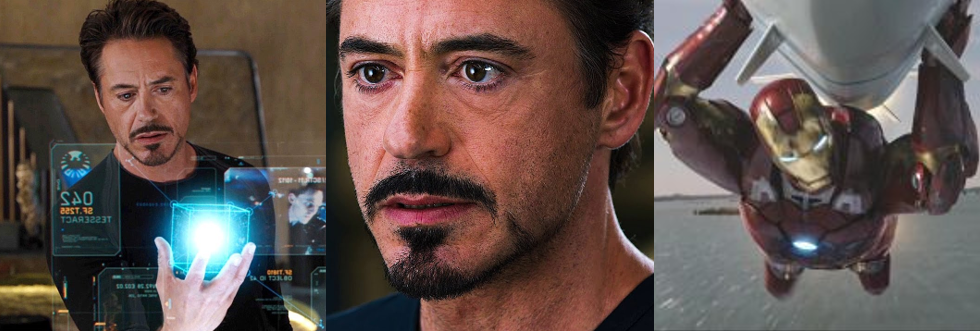
Barton, who is only referred to as Hawkeye once in the film, spends most of the movie under Loki’s command (though this does harken back to his comic book beginnings as a villain); as a result, all we know about him is the few bits and pieces Natasha reveals about their relationship and their background. However, we do get to see him in action on more than one occasion; he’s a crack shot, almost to superhuman levels, and is able to bring down an entire Helicarrier with a single, well-placed arrow. He is an essential soldier in Loki’s army, offering him insight into Fury’s operation and resources, but is also able to provide the Avengers with key information regarding Loki after Natasha literally knocks some sense into him. He proves himself capable enough in the finale by providing much needed and peerless cover from a high vantage point, from which he is able to take out multiple Chitauri with a few well-aimed shots. He’s easily the least developed of all the characters thanks to the role he plays in the film but it works for the plot and means we’re left wanting to know more about him and his backstory. Fury plays a much larger role in this film than in the previous MCU movies since he’s a pivotal supporting character rather than a mere cameo; he believes that Loki represents a very real threat to humanity but also believes wholeheartedly in the concept of heroes and the ability of the Avengers Initiative to combat Loki’s threat.
Coulson is the glue that connects Fury’s Avengers and his death galvanises the team into action.
Fury opposes the World Security Council when they dismiss the Avengers as a legitimate solution and when they order a nuclear strike on New York which, along with his own brand of snark and dry wit, makes him a rebellious and layered character in his own right. However, he’s also a secretive and manipulative individual, constantly telling everyone only as much as they need to know and a handful of half-truths (as Stark says: “Fury’s secrets have secrets!”) and believes in having contingencies against any and all possible threats, both foreign and domestic. While he doesn’t fight alongside the Avengers in the final battle, he’s crucial to their formation and is a charismatic and alluring figurehead for their group. Sadly, this was as prominent as Fury would be for some time, with him quickly going back to being either a cameo or supporting character over the years, which is a shame as it’s always great to see Samuel L. Jackson in the role and interacting with these characters. Similarly, Coulson also gets much more screen time and development this time around; still acting as Fury’s go-to and the liaison between S.H.I.E.L.D. and the Avengers, Coulson (whose first name is revealed to be “Phil” rather than just “Agent”) is the relatable man among Gods, the common thread that links all of these volatile personalities together. Initially, all they really have in common beyond their heroic tendencies is their relationship with Coulson, with Stark having the closest link to him and Coulson being especially in awe of Cap, his hero and idol, and Coulson’s death is both sudden and heartbreakingly brutal. It’s a fantastic moment that serves to galvanise and motivate the them and, as much as I’ve enjoyed some episodes and seasons of Agents of S.H.I.E.L.D. (2013 to 2020), it did annoy me that his dramatic death was undone so soon after the film’s release. Thankfully, the MCU movies don’t acknowledge Coulson’s resurrection so his tragic death remains the principal motivating factor behind the coming together of Earth’s Mightiest Heroes.

The Nitty-Gritty:
Considering the large cast of bombastic, unique characters and actors, Avengers Assemble is fantastically well paced; sure, Natasha and, especially, Barton don’t get anywhere near as much screen time or development as established guys like Cap or Stark but they get several character defining moments and character beats that help to keep them relevant and integral to the plot. The film isn’t full of non-stop action but it never feels slow or like it’s wasting time; any time there isn’t some kind of physical conflict, there’s a conflict of character, beliefs, or ideologies as each of the characters interacts with each other in different ways. The central conflict in the film is between the individual Avengers as much as it is with Loki as each one must learn how to interact and co-operate with the other, which leads to some friction between Rogers and Stark, disdain from the God-like Thor, and distrust from the understandably agitated Banner. This all comes to a head in one of the film’s most intense moments where the fledgling Avengers argue over Fury’s manipulations, the threat each of them oppose, and their conflicting egos in a scene that is easily as powerful as any of the film’s fight scenes. Here, each character talks and argues over each other; lots of fingers are pointed, egos are bruised, and accusations are made thanks to the influence of Loki’s spear, which exacerbates their most negative aspects and fuels the distrust and tension between the group. It’s an amazingly realised scene, with lots of dynamic camera work on offer and allows the characters to vent their frustrations and concerns about each other, the mission, and the inevitable escalation of conflict that threatens Earth now that it has experienced otherworldly threats and, in it, these conflicting personalities actually grow stronger as a result of their brutal honesty.

Seeing these colourful and volatile individuals interact is every fan’s dream come true!

However, amidst this, there are also numerous amusing little moments that help to add to the film’s levity and develop each character: Rogers handing Fury a $10 bill after being awe-struck by the Helicarrier, Stark pointing out that one of the S.H.I.E.L.D. agents is playing Galaga (Namco, 1981), Thor’s humiliation regarding Loki’s actions and heritage, and Banner’s flashes of anger all help to make the characters real and relatable. One of the best examples of this is Cap’s confrontation with Loki in which he, despite being “out of time”, recognises Loki’s evil and potential threat and openly opposes him just as he did a similar dictator in World War Two and engages him in combat despite Loki’s clear physical advantage over him. Cap’s whole character is that he continues to fight no matter the odds and that is continuously seen in Avengers Assemble as, even when outclassed or outnumbered, he continues to get back up and go on with the fight until it’s done, one way or another, and fails to give in to intimidation from concepts beyond his time such as Gods, aliens, and advanced technology. Their interactions with each other are equally impressive, with the heroes just as likely to come to blows as they are to work together; this means we get to see these bright, colourful costumed characters fighting with each other as much as alongside each other. Iron Man fights with Thor, Cap joins in to make it a triple threat, Black Widow fights with Hawkeye, and Thor memorably goes toe-to-toe with the Hulk to set up a friendly rivalry that would be fantastically revisited in Thor: Ragnarok (Waititi, 2017). It’s a staple of superhero team-ups that the heroes simply must fight at least once and Avengers Assemble delivers on this in spades; we’ve watched each of these characters in their own films, or be involved in other MCU films, over the years so to see them match wits, trade blows, and fight together is a true fanboy’s delight.

The Chitauri are, admittedly, underwhelming antagonists but they serve their purpose.

The finale is little more than a battle against mindless, indistinguishable alien hoards who, conveniently, operate in a hive mind and are “easily” shut down by Stark tossing a nuclear weapon at their mothership. I honestly expected a version of the Masters of Evil for the first Avengers movie, with Loki joining forces with Johann Schmidt/The Red Skull (Hugo Weaving) outside of the Realms and then teaming up with Emil Blonsky/The Abomination (Tim Roth) and/or Samuel Sterns/The Leader (Tim Blake Nelson) once they reach Earth for a smaller scale, six on six style team vs. team movie and, in some ways, it is a bit disappointing that the Avengers only went up against one villain and an army of drones but it really works in the film since the entire point of the movie is to bring these volatile characters together. The actual antagonist could have be anyone or anything and it wouldn’t really matter but it being Loki works wonders thanks to Tom Hiddleston’s iconic performance; he’s truly a snake in the grass, a wily, manipulative, vindictive villain who is intelligent and cruel enough to match wits with each of the Avengers both physically and vocally and the only previous villain I could see being able to do anywhere hear as good a job would be Hugo Weaving.

The Avengers win the day but a greater, far more powerful threat looms in the background…

One issue I have though is that, as much as I loved the “Avengers Assemble!” scene we eventually got, I still don’t get why we couldn’t have heard that iconic cry during that awesome panning shot of the team standing back-to-back. I think we definitely could have heard this cry in each of the team-up films and appearances of the group and it wouldn’t have taken away from that impactful scene; if anything, it would have added to it since it would be a rallying cry for the reunited heroes. Still, the Battle for New York is amazing in its scope; the Chitauri may be interchangeable alien drones but they are relentless. The Avengers are able to combat them and easily defeat them but their numbers are legion and, apparently, inexhaustible and it isn’t long before they are overwhelmed even with the might of Thor and the Hulk. The Chitauri’s larger reinforcements and advanced weaponry and sheer numbers mean that it is simply a matter of time before the Avengers, for all their power, are overwhelmed and Loki is successful, meaning that the Avengers’ main concern is holding the line and keeping the invasion at bay while their team mates confront Loki and cut off the source of the invasion. All throughout the film, Loki converses with “The Other” (Alexis Denisof) and is clearly being given power and resources from an unseen third party, revealed at the very end of the film to be none other than Thanos (Damion Poitier). At the time, we could never have anticipated the extent to Thanos’s threat and importance to the MCU but the bringing together of cosmic characters like Asgardians and threats like the Chitauri and Thanos only hinted at how large and varied the MCU was destined to become.

The Summary:
Avengers Assemble is still one of the biggest and most entertaining movies in the MCU and, perhaps, ever made. Of all the movies in the MCU’s first phase, it’s easily my favourite and, for me, set the standard not just for subsequent MCU team-up movies but for every film in the MCU going forward. No longer were these characters going to exist in their own isolated bubble; they would interact with their fellow characters, reference the larger world we finally saw in all its glory, and be part of something much bigger and greater than a series of self-contained films. For me, this is the greatest appeal of the MCU; before Iron Man, superhero films were always solo affairs and we never saw heroes interact with each other. Thanks to the MCU, all of that changed and, finally, the movies came to resemble the comics by having a shared universe that has a tight continuity and an actual tangible, long-term plan. The film is alive with character moments, an amusing dry wit, and action-packed sequences but, as thrilling as the bombastic fight scenes can be, it’s all the little interactions and interpersonal conflicts that really make this film so entertaining and appealing to me even to this day.

My Rating:

Rating: 5 out of 5.

Fantastic

What are your thoughts on Avengers Assemble? How do you feel it holds up now that the MCU has become this massive, multimedia juggernaut? Were you disappointed that the film focused solely on the one villain and side-lined Hawkeye with a mind control sub-plot or were you satisfied with Hiddleston’s performance and the interpersonal conflicts between the characters? Which of the Avengers is your favourite and which of the comic’s characters are you excited to learn more about or see join the team? Which of the MCU movies, shows, or characters is your favourite and why? How are you celebrating National Superhero Day today? Whatever your thoughts, leave a comment below and be sure to stick around for more superhero and comic book content throughout the year.