Movie Night: Captain America: Brave New World

Released: 14 February 2025
Director: Julius Onah
Distributor: Walt Disney Studios Motion Pictures
Budget: $180 million
Stars: Anthony Mackie, Harrison Ford, Danny Ramirez, Shira Haas, Giancarlo Esposito, and Tim Blake Nelson

The Plot:
Now shouldering the mantle of Captain America, Sam Wilson (Mackie) navigates a political minefield after an assassination attempt against President Thaddeus “Thunderbolt” Ross (Ford) threatens to spark world war!

The Background:
After some initial resistance, the United States finally joined the War against the “Axis powers” of Germany, Japan, and Italy in 1939. With patriotism running high in America, Joe Simon and the legendary Jack Kirby created Captain Steve Rogers/Captain America and his kid sidekick, James Buchanan Barnes/Bucky to encourage readers to support the war effort. Cap saw a resurgence when he joined the Avengers and has long found a home outside the comics, featuring in cartoons, serials, a botched big-screen debut, and three critically lauded entries in the Marvel Cinematic Universe (MCU). After Steve Rogers (and actor Chris Evans) retired from the role, MCU head honcho Kevin Feige sought to expand the MCU with Disney+ shows, with one pitch being a “buddy comedy” series focused on the dysfunctional friendship between Sam Wilson and James Buchanan “Bucky” Barnes/The Winter Soldier (Sebastian Stan). Echoing the comic books, where Sam took up the Cap mantle, The Falcon and the Winter Soldier (Skogland, 2021) was universally praised for its depiction of racism and the dynamic between the two leads. This success directly led to the production of a fourth Captain America movie, initially titled New World Order, that sought to be a more grounded political thriller. This was soon offset by the casting of Harrison Ford, who replaced the late William Hurt and was thrust into the spotlight when the film’s marketing heavily relied upon his transformation into the Red Hulk as much as commenting on real-world politics. Reshoots saw the plot shuffled round and some characters be excised, with Giancarlo Esposito given additional screentime as a trade off and placing more emphasis on the conspiracy sub-plot. Captain America: Brave New World grossed over $370 million worldwide, but was met with somewhat negative reviews that criticised the political narrative, especially in the face of real-world events. The narrative and characterisations were also called into question, with critics being divided over the visual effects, though Mackie remained hopeful for future solo ventures for the character.

The Review:
Captain America: Brave New World depicts the United States as a country in turmoil. Following the many strange, destructive, and harrowing events of the previous MCU films, the nation is more divided and afraid than ever. Thus, former “Hulk Hunter” and decorated military General Thaddeus Ross completes his evolution from Senator to President of the United States after running a successful campaign based on one, unlikely word: together. Though Ross captures the majority vote with his promises to unite Americans and repair the relationship between the American government and the country’s various costumed defenders, some still question Ross’s newfound appreciation for the Avengers and his push for unity considering his historically short fuse and previous aggression in upholding the Sokovia Accords. None are more aware of Ross’s shortcomings than Sam Wilson, the former Falcon who now operates independent of the government (yet still in a military capacity) as Captain America. Sam’s wariness of Ross’s promises is echoed by aged veteran Isaiah Bradley (Carl Lumbly), the prototype super soldier who spent thirty years locked away and being experimented on and who is reluctant for Sam to work with the government. However, Ross is eager to build bridges not just with Sam, but the entire world, especially as scientists from across the globe have discovered a rare and particularly versatile mineral (dubbed “Adamantium”) on “Celestial Island”, the remains of a titanic Celestial that tried to emerge from the Earth. The staggering potential of Adamantium is enough to have Ross set aside personal grudges and encourage the world’s governments to co-ordinate their mining efforts. He makes significant headway with this after Captain America and his enthusiastic, hacker partner, First Lieutenant Joaquin Torres/The Falcon (Ramirez), recover a stolen sample of Adamantium from Seth Voelker/Sidewinder (Esposito), an expert marksman and enigmatic leader of the Serpent Society, a group of mercenaries working for the mysterious “Buyer” to upset the political climate.

Amidst a political minefield, Sam discovers a plot to discredit the President and spark worldwide conflict.

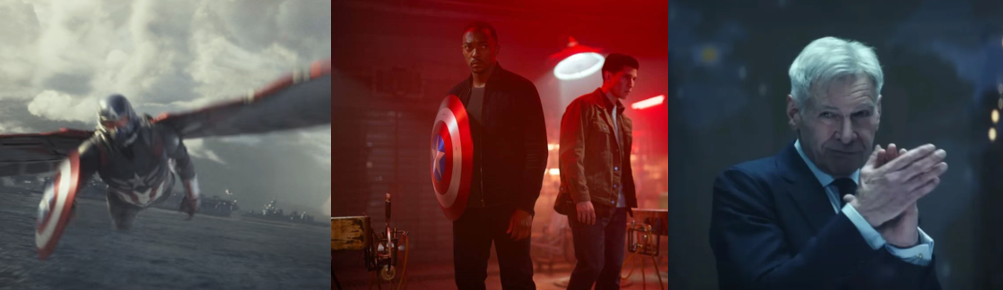
Celebrated for their heroics, Sam and Joaquin are invited to attend Ross’s special presentation on Adamantium at the White House and, eager to coax the distrustful Isaiah out of his shell, Sam invites him along. However, during Ross’s speech, Isaiah and a handful of other attendees suddenly open fire on the President, with Isaiah appearing little more than a confused old man after Sam talks him into custody. Angered by these events, Ross rescinds his offer for Sam to rebuild the Avengers and orders him not to investigate, instead handing the task to his personal security advisor, former Black Widow Ruth Bat-Seraph (Haas). Naturally, Sam disobeys this order and works with Joaquin to review security footage of the attack, learning that Isaiah and the others were compelled through a form of mind control. Sam’s investigation sees him cross paths with and apprehend Sidewinder, whose phone leads him and Joaquin to a military black site, where they find Gamma-mutated biologist Doctor Samuel Sterns (Nelson) has been held captive for over a decade. Gifted an upgraded suit by the Wakandan people, Sam is more than capable as Captain America thanks to his Vibranium wings protecting him, absorbing the impact of any attack and redirecting it as kinetic blasts. Sam has the same skills he showcased as the Falcon (skills he’s extremely protective of as he hesitates to share them with Joaquin) but has vastly improved his skill with a shield. Unlike Steve Rogers, however, Sam doesn’t have the benefit of the super soldier serum, though his suit helps dull any injuries he does receive and a pep talk from Bucky allays Sam’s doubts about his abilities after Joaquin is injured defusing a conflict between American and Japanese forces. In a nice change of pace, Sam is seemingly universally accepted in his new role; the military respect and admire him, jeopardising their careers to aid him after Ross demands he and Joaquin be apprehended. Sam’s also as charismatic and confident as Steve, easily befriending those around him and championing world peace and cooler heads over violence. Far from a naïve optimist, Sam plays his cards close to his chest and gives Ross the benefit of the doubt, but becomes determined to investigate the complex deception at work after Isaiah is imprisoned and faces the death penalty.

Sterns manipulates events to brainwash assassins and push Ross to breaking point!

Obviously, it’s a shame that William Hurt never got to complete his story as Thunderbolt Ross but, if you’re going to recast an actor, who better than Harrison Ford to pick up the slack? Shaving his trademark moustache and campaigning on a platform of unity, Ross is desperate to convince the world that he’s a changed man. However, while he’s convinced the majority of Americans, Sam and the others remain skeptical and his estranged daughter, Doctor Betty Ross (Liv Tyler) refuses to take his calls. Eager to void conflict, Ross is adamant about pushing forward a treaty to share the Adamantium, but soon finds his temper tested after he’s shot at and accused of shady dealings by the equally sceptical Japanese prime minister, Ozaki (Takehiro Hira). Although Ross genuinely wants Sam onboard and the rebuild the Avengers to atone for his previous aggressive ways, he burns bridges with Sam over Isaiah and quickly mobilises the Navy to secure Celestial Island, his stress only compounded by Sterns’ influence and his reliance on mysterious pills. It turns out the Sam’s right to be suspicious of Ross as he worsened Sterns’ condition and used his superhuman intellect to manipulate his way to the White House, then incurred the hyper-intelligent doctor’s wrath by refusing to free him. This sees Sterns concoct an elaborate plan to discredit Ross using mind control triggers, which easily turns the President’s secret service into his unwitting soldiers and sees him escape custody. Sterns’ scheme also extends to hiring Sidewinder and kick-starting the plot, which tips the world to the brink of war and sees Sam and Joaquin desperately rushing to calm tenses between the world’s superpowers once they uncover this plot. Determined to keep his dealings with Sterns from leaking, Ross surreptitiously tries to tie up loose ends, unwittingly turning the petite Ruth’s loyalties towards Sam after she discovers evidence that Isaiah and the others weren’t in control of their actions. Though Ross was saved from certain death from a heart condition thanks to Sterns’ research, he’s been unknowingly digesting Gamma-laced pills for years, which make him quick to anger and susceptible to Sterns’ mind control, resulting in Ross transforming into a crimson-hued Hulk before a terrified press conference and forcing Sam to test his mettle in the most dangerous way possible.

The Nitty-Gritty:
Captain America: Brave New World certainly gives itself a lot of balls to juggle. It finally addresses what happened to that gigantic Celestial and lays an interesting foundation for the MCU’s version of the X-Men, finally ties up the loose end of Samuel Sterns, presenting him as an embittered puppet master looking to publicly disgrace President Ross, teases Bucky’s new life as a Congressman, and continues Sam’s evolution as Captain America. Thanks to Sam having worked through many of his doubts and insecurities in The Falcon and the Winter Soldier, Sam has fully embraced his new role here, only questioning his ability after Joaquin gets hurt. Even then, Bucky offers him some advice that gets him back on track and, while I think it’d be totally believable that a man as good as Sam could handle the super soldier serum, Sam’s perfectly capable without it thanks to his skill as the Falcon. In fact, Sam may be a little too good as he shrugs off wounds and performs nigh-superhuman feats during fights, though the film makes an effort to show him visibly exhausted from the effort. His status as a “normal” man doing the right thing contributes to the respect he earns from his peers; even Ross has a begrudging respect for Sam, even if it’s strained as the film progresses. I’m glad that Brave New World didn’t waste time questioning Sam’s ability or showing undue negativity towards him. Instead, he kicks ass as Captain America and showcases his stubborn determination as he works to clear his friend’s name, even if it goes against what the President thinks or wants. It was a shame, however, that Giancarlo Esposito was essentially wasted here. He gets a couple of action scenes and steals the show with his usual silky-smooth cool, and is presumably being set up for more later down the line, but his role got a lot of hype prior to the film so I couldn’t help but be disappointed by how small his role was in the end.

Despite some predictable elements, the film was an action-packed political thriller.

Instead, most of the film’s marketing was focused on the Red Hulk and his fight against Captain America. On the one hand, I understand this as you want to capture people’s attention and get people in the cinema to see how Sam can stand against such a creature, but it was a touch misleading since the Red Hulk doesn’t appear until the finale. Instead, most of the film is an action thriller following Sam and Joaquin as they work to uncover who’s behind Isaiah’s mind control. There’s nothing wrong with this and it makes for a decent adventure, but it’s pretty obvious that Isaiah and the others were triggered by lights and music, something we’ve seen in the MCU before (and which Sam even notes), so it’s weird that Ross was so quick to condemn Isaiah. Of course, a significant sub-plot regarding the President is his trustworthiness and it’s clear he’s hiding a lot, leading to an emotional showdown between him and Sam where Ross reveals how close he came to death and how poorly he treated Sterns. Once Sam confronts Sterns and he escapes, it’s pretty clear what’s gone down, but the key parties (Sam and Ross) remain clueless. There’s even a moment where Sterns callously murders Sam’s ally, Dennis Dunphy (William Mark McCullough), to keep him from revealing the truth of Ross’s pills to Sam…only for Sterns to relate that information to Sam shortly afterwards. While some have picked about Brave New World’s CGI and reshoots, I had a great time with the action sequences. Sam looks amazing in his new suit, which is a vast improvement over his last one, and is a whirling dervish as Captain America, cutting through the air, blasting along with his jetpack, slicing up foes with his wings, and tossing his shield in ways that would make his predecessor proud. Sam’s Wakandan enhancements make up for his lack of superhuman strength, though Sam remains vulnerable, sporting wounds and exhaustion, and yet being strong enough to turn to his allies for help and to take the high road during conflicts. Joaquin made for a fun counterpart to Sam; he’s equally talented as the Falcon and a tech whiz, but overly enthusiastic and too eager to prove himself to his hero at times. They work well together on equal terms and I enjoyed their high-speed action sequences, with Sam even proving his worth without the suit and emphasising disarming and subduing his foes rather than blindly blundering in.

Cap ultimately overcomes the odds and brings a measure of peace to the misguided President.

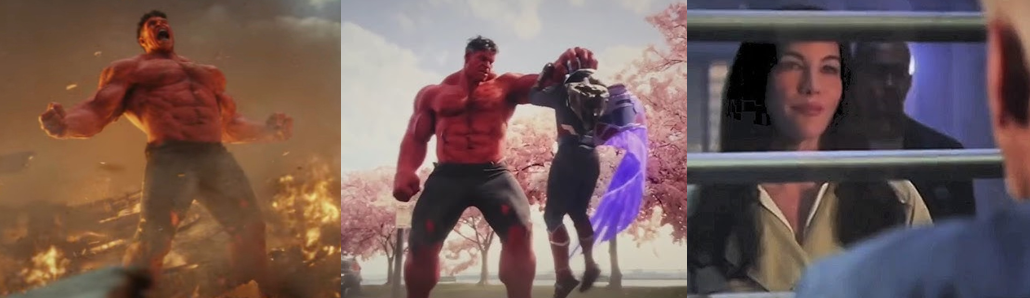
With Ruth on-side and Sam and Joaquin having discovered Sterns is mind controlling targets with light and sound triggers, Cap and Falcon barely quell a conflict between the US and Japan. Though Joaquin is severely wounded when defending Celestial Island, Sterns’ plot is ultimately scuppered and Ross’s treaty regains traction, leading Sterns with no choice but to surrender himself, arrogantly believing that Ross’s true nature cannot be suppressed. Indeed, when addressing the press outside the White House, Sterns’ pills and the stress of the whole situation (and the Sterns’ testimony to the media) see Ross lose control of his emotions. Thus, he painfully and forcibly transforms into the Red Hulk, a mindless and enraged giant who immediately goes on a rampage. Despite being hopelessly outmatched, Captain America flies into battle with the Red Hulk, barely protected by his Vibranium wings and destroying most of the White House. Remembering Ross’s wish to take his daughter to the city’s cherry blossom trees, Captain America has Ruth get the crowd to safety and leads the Red Hulk to the garden, only for the creature’s rage to boil out of control. Badly hurt and with his suit damaged, Captain America charges his remaining wing with the Red Hulk’s unbridled strength and delivers a concussive blast that momentarily puts the beast down. When the Red Hulk returns for more, Sam takes a major gamble and appeals to Ross’s humanity, finally calming the troubled President down and ending the threat. Realising the extent of his actions, Ross relinquishes his post and allows himself to be incarcerated at the Raft, where he finally reconciles with Betty. Ross and Sam part with a mutual respect and Sam’s delighted to see Joaquin on the road to recovery, especially as he’s decided to rebuild the Avengers after all, though Sam’s left rattled when the imprisoned Sterns mocks him and delivers a vague, suitably ominous warning about future threats from other worlds…

The Summary:
Captain America: Brave New World faced an uphill battle, for many reasons. Despite Sam being Captain America in the comics for years, the idea of someone else taking up the mantle is always going to irk some, especially a very vocal and toxic minority of bigots. However, Anthony Mackie takes to the role admirably, exuding a cool confidence that sees him command the screen and throw the shield with admirable gusto. I loved how Sam was presented as a friend to all, talking to people in their native language, saluting the military, and sticking to his guns, even if it means going against the President of the United States. He’s a natural leader and an efficient fighter, even without the super soldier serum, and attacks the conspiracy at work with a stubborn determinism that showcases the strength of will and loyalty that make him the right choice to be Captain America. Harrison Ford was equally captivating in the film. It’s awful that William Hurt died before he could see this arc through, but Ford really threw himself into the whole MCU circus and brought his all to this role, being gruff, commanding, and pained as the script dictated. I definitely felt like Ross was genuinely trying to make amends for his past, but he had too many skeletons in the closet, had made too many enemies, and ultimately was faced with forces beyond his control, leading to his Hulk-out. The Red Hulk looked fantastic, exuding rage and danger and delivering by far the best and most impressive CGI rendition of a Hulk yet. While it was misleading to base so much of the marketing around the character, I can see why they did it and the sequence absolutely delivered, more than making up for the wasting of Giancarlo Esposito. I was also thrilled to see Tim Blake Nelson return and deliver a suitably hammy, menacing version of the Leader, finally paying off one of the MCU’s most notorious plot threads. While the plot felt a little predictable and bare bones at times, the action and performances and nice balance of drama and comedy made up for it and resulted in a solid first solo effort for the new Captain America, who I hope to see have a prominent role as an aspirational leader in the MCU for years to come.

My Rating:

Rating: 4 out of 5.

Great Stuff

Did you enjoy Captain America: Brave New World? What did you think Anthony Mackie’s first big-screen solo outing as the character and Sam’s status as a more human version of the Avenger? Did you enjoy Harrison Ford’s performance and Ross’s attempts to turn over a new leaf? Were you satisfied with the way the film tied up loose ends regarding Sterns and the Celestial? Do you think it was misleading to put so much focus on the Red Hulk or did you enjoy his eventual appearance? Where do you want to see Captain America go next in the MCU? Whatever you think about Captain America: Brave New World, or Captain America in general, drop a comment down below, support me on Ko-Fi, and go check out my other Captain America content.

Movie Night [PokéMonth]: Pokémon: Detective Pikachu


Upon the release of Pokémon: Blue Version and Pokémon: Red Version (Game Freak, 1996), a new craze swept through playgrounds. An entire generation grew up with Pokémon, as clever marketing saw it become a massively lucrative and popular multimedia powerhouse. Accordingly, February 27th is recognised as “National Pokémon Day”, which I expanded to an entire month of Pokémon this February, which is even more fitting given that February 6th is the day that Mew gave birth to my favourite Pokémon, Mewtwo!


Released: 10 May 2019
Director: Rob Letterman
Distributor: Warner Bros. Pictures
Budget: $150 million
Stars: Justice Smith, Ryan Reynolds, Kathryn Newton, Bill Nighy, Suki Waterhouse, Ken Watanabe, and Rina Hoshino/Kotaro Watanabe

The Plot:
When his ace detective father goes missing, Tim Goodman (Smith) reluctantly teams up with his Pikachu partner (Reynolds) and aspiring report Lucy Stevens (Newton) to unravel the mystery.

The Background:
Pokémon is no stranger to the silver screen. The aptly-titled Pokémon: The First Movie: Mewtwo Strikes Back (Yuyama, 1998) was a box office success that kick-started a slew of feature films, though development of a live-action venture didn’t gain momentum until 2016. Rather than adapt the incredibly popular and long-running anime series, director Rob Letterman pitched a story inspired by the well-received Detective Pikachu spin-off (Creatures, 2016) to incorporate a talking version of the franchise’s beloved mascot. Ryan Reynolds won out over names like Danny DeVito and Dwayne Johnson to land the titular role, providing both the voice and motion-capture for Pikachu. The Pokémon were brought to life through a combined effort by multiple visual effects studios, who opted for a photo-realistic aesthetic that saw the effects team closely studying the videogames, anime, and previous 3D representations of the pocket monsters. With an impressive worldwide box office of just over $450 million, Pokémon: Detective Pikachu broke the curse often associated with videogame adaptations and was the most successful film of its kind for a time. The reviews were largely positive, praising the surprisingly emotional narrative, Reynolds’ wise-cracking performance, and fan service on offer. Though some criticised the pacing and effects work, a sequel was announced just before the film’s release; however, as of this writing, it’s still very much in the developmental phase.

The Review:
Pokémon: Detective Pikachu takes place in Ryme City, a bustling, neon-drenched metropolis billed as a utopia for humans and Pokémon alike to live and work together in harmony. The city was built by billionaire tycoon and Pokémon advocate Howard Clifford (Nighy), a disabled visionary who poured his heart and soul into protecting Pokémon and fostering positive relations between them and humans. Much of this is related to the audience during Tim’s train ride to the city and in a format not unlike the “Welcome to the World of Pokémon” introductions included in many of the animated features, and is a fun way to show how Ryme City sets itself apart from other regions and locations. There, Pokémon battling is banned and people are discouraged from having PokéBalls. The relationship between humans and Pokémon is supposed to be more symbiotic and mutually beneficial, though that doesn’t stop everyone Tim meets asking where his “partner Pokémon” is. We’ve seen similar cities to this in the videogames and anime; indeed, the idea of humans working alongside Pokémon has been present since the first games. However, it’s presentation in this decidedly Blade Runner (Scott, 1982) inspired environment is not just to stuff in a load of Pokémon cameos but also to acclimatise viewers to the idea that, in this world, Pokémon are real and integrated into society. Still, the world of Pokémon: Detective Pikachu should be instantly recognisable to series fans and the film thankfully doesn’t bog down its run time with heavy handed exposition into its mechanics. This may be somewhat alienating to newcomers but it’s pretty clear from the title and the presentation who this film is aimed at, and I appreciate that it embraces the concept and plays it straight. It also has some tenuous ties to both the anime and the videogames: Mewtwo is said to have “escaped form the Kanto region” twenty years ago and Pikachu tearfully sings the anime’s original infectious theme song at one point, meaning the film can easily be seen as an extension of one or the other (or both, if you like). Layman viewers are tossed a bone in the main character, Tim, who is noticeably distinct from every other character he meets in that he doesn’t have a Pokémon partner and seemingly has no interest in the creatures.

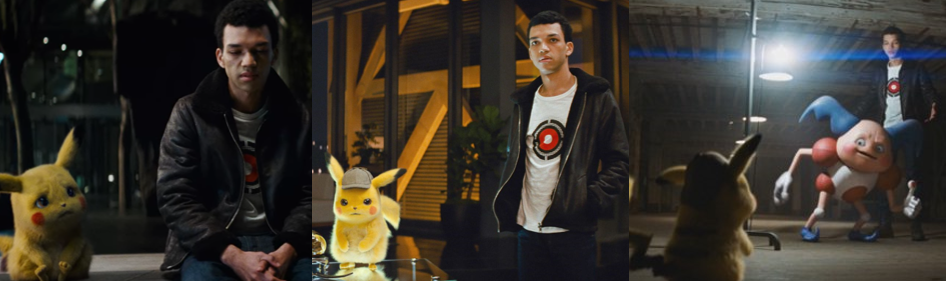
Distraught Tim reluctantly partners with Pikachu to investigate his father’s death.

Again, this isn’t something new; the animated features often include characters either wary of or disinterested in Pokémon. Tim was an avid Pokémon fan as a kid; young Tim (Max Fincham) followed and participated in battles, collected the cards, and lived the Pokémon life. However, that all changed when his mother died; this drove a wedge between him and his father, who threw himself into work with the Ryme City Police Department, leaving Tim to be raised by his grandmother (Josette Simon) and grow up resenting both his father and the Pokémon he preferred to spend time with. Rather than growing up to be a Pokémon Trainer, Tim takes up a tedious job in insurance and has no interest in partnering with a Pokémon but ends up lumbered with his father’s cheeky Pikachu partner when he travels to Ryme City following his dad’s sudden death. Tim’s clearly shaken by his father’s demise and wrestling with conflicting emotions. He struggles to express himself when meeting with Harry’s friend, Lieutenant Hideo Yoshida (Watanabe), who relates that Harry always loved his son. This is little comfort to Tim, who’s clearly rattled at being denied the chance to get some closure and just wants to get home as quickly as possible. The deerstalker-garbed Pikachu completely upends that, however, since Tim can strangely understand the pint-sized detective. Tim initially reacts to this with shock and horror, believing he’s either going mad or has been adversely affected by a mysterious purple gas he discovers in Harry’s apartment. Even when he accepts that no one can understand Pikachu but him, Tim is reluctant to assist the Pokémon in figuring out what happened to his partner. Believing he lacks the same detective skills and expertise as his father, Tim repeatedly shuns Pikachu, who latches onto him out of desperation since he’s suffering from amnesia but feels it “in his jellies” that there’s more to Harry’s death than the media and the police want to admit. Pikachu’s insistence is infectious, and Tim reluctantly agrees to help with his investigation, aiding Pikachu by talking to humans for information while Pikachu interrogations Ryme City’s Pokémon. Though he’s uncomfortable carrying Pikachu on his shoulder and indulging his hairbrained theories, Tim proves a great asset when they question Harry’s informant, a Mr. Mime, leading to a hilarious moment where Tim threatens (through pantomime) to light the Pokémon on fire!

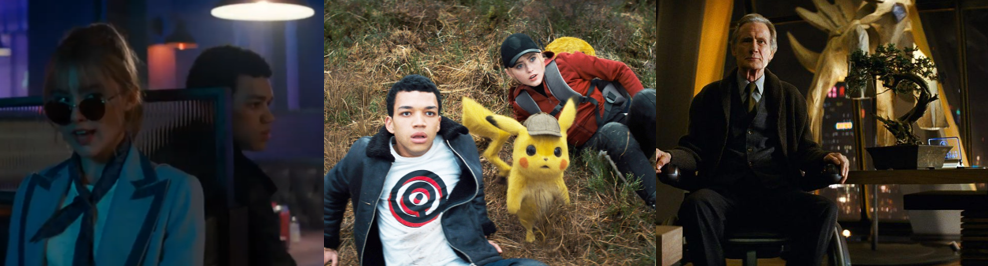
Aspiring journalist Lucy helps Tim and their investigation leads them to Clifford Howard.

Tim also provides Pikachu with the strongest lead in their muddled case when he’s accosted by aspiring reporter Lucy Stevens and her Psyduck (Michael Haigney). Struggling as an unpaid intern repeatedly ignored and chastised by her peers, Lucy is desperate to break a big story and senses that something’s amiss about Harry’s death. This is primarily because she has acquired several vials of the purple gas Harry was investigating, a strange substance known as “R” that temporarily drives any Pokémon that inhale it into a blind rage. Though he claims otherwise, Tim is clearly smitten by Lucy (and, honestly, I don’t blame him) and, while he doesn’t tell her the truth about Pikachu, he does review her notes and work with her to figure out what’s going on. Pikachu tries to help Tim flirt with and grow closer to Lucy, but despairs when Tim proves to be awkward around her and lack game. However, Lucy doesn’t seem to mind and finds the troubled young man charming, even when he’s stumbling over his words or making a fool of himself. While Yoshida believes Harry perished in a car crash, Clifford’s advanced holographic technology shows the detective survived and that both Mewtwo and Pikachu were at the scene, compounding the mystery further by naming his resentful son, Roger (Chris Geere), as the one behind the R. Thanks to Lucy’s digging, Tim learns of an abandoned research facility where Mewtwo was held against its will and harvested to synthesise R, and all signs point to the genetically engineered Pokémon turning its wrath on its captors and, by extension, Harry, who was contracted to capture it. Though this is clearly the big break Lucy has been looking for, she never abandons Tim in favour of getting her scoop like some fictional journalists. Indeed, they remain united throughout the film, working together to help each other, though Lucy continues to run into obstacles when she desperately tries to warn Ryme City’s inhabitants about the R gas in the final act.

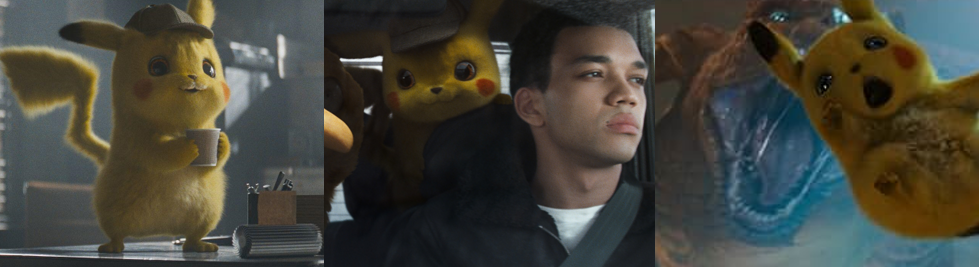
Though suffering from amnesia, Pikachu is determined to solve the mystery of Harry’s disappearance.

Since he isn’t a detective, Tim’s at a loss about how to investigate his father’s death and even more helpless at uncovering proof that Harry survived. Thankfully, Pikachu is more than capable of carrying the bulk of the detective work. Though he’s suffering from amnesia, he’s no less determined to root through newspaper clippings, articles, photographs, and unturn any stone to find some kind of connection. Fuelled by caffeine and an insatiable lust for solving a good mystery, Pikachu tackles the investigation with gusto, chattering a mile a minute and standing up to any challenge. This bites him in the ass when he and Tim infiltrate an illegal underground Pokémon battle run by Sebastian (Omar Chaparro) and Pikachu’s forced to battle a voracious Charizard to get information from Sebastian, a sequence that showcases Tim has retained knowledge of Pokémon battles, but the amnesia has caused Pikachu to forget how to fight! Pikachu’s stunned to see he was at the scene of the crash and heartbroken when the Pokémon Comprehensive Laboratory (RCL) footage suggests that he betrayed Harry and led to his death/disappearance by freeing Mewtwo. Tim, Pikachu, Lucy, and Psyduck’s desperate escape from RCL sees them eluding not just a contingent of Greninja but also nearly crushed to death by giant Torterra masquerading as a forest, further results of the RCL’s horrific Pokémon experiments. Pikachu is gravely injured during the escape, which deeply upsets Tim. Despite him shunning Pikachu, and all Pokémon, he comes to connect with the adorable pint-sized detective and is devastated at losing him, both because he considers him a friend and partner and also because he’s the last link to a father he never knew. Luckily for them, some local Bulbasaur guide them to Mewtwo, who heals Pikachu and adds a touch more exposition to what really happened before being ensnared by Roger’s drones. However, this brief glimpse leaves Pikachu despondent and he wanders off, believing he’s a danger to everyone, only to stumble upon the crash site and realise it was the Greninja who attacked Harry’s car, not Mewtwo, and rush to help Tim confront the true mastermind behind the film’s events.

The Nitty-Gritty:
Given the movie’s title, it should be no surprise that Pokémon: Detective Pikachu is primarily a mystery story. There’s the obvious mystery surrounding Harry’s unexpected death, which evolves into a mystery about whether he survived or not, what happened to him after the fact, and what role Mewtwo and the Cliffords played in it all. Pikachu, Tim, and Lucy are united in investigating this conundrum, which intersects with all their lives: Lucy’s been investigating the R gas, which was found in Harry’s apartment and produced at RCL, with each step piecing more of the puzzle together for them. Along the way, they’re hounded by numerous obstacles: first, the R gas turns some Aipom rabid, showcasing how dangerous the gas can be, then Tim and Pikachu have to survive a battle with a similarly enraged Charizard, and finally they face persecution from Roger and his minions as they seek to recover Mewtwo and cover up their tracks. All the while, they’re shadowed by Clifford’s mysterious and unnerving bodyguard Ms. Norman (Suki Waterhouse), who turns out to be a Ditto in disguise, and forced to flee from every confrontation since Pikachu cannot remember how to fight and Psyduck’s powers are too unpredictable to be reliable. This means Pokémon: Detective Pikachu doesn’t have many traditional Pokémon battles or mechanics, a fact only exacerbated by Ryme City outlawing battles. Indeed, Sebastian’s arena is the closest thing we get to seeing Pokémon battles; the rest of the time, the characters are fending off or running from Pokémon driven into a frenzy by R. It’s an unusual approach but it seems to serve the narrative well. This isn’t the traditional story of an aspiring Pokémon Trainer earning badges and overcoming a nefarious team of criminals. It’s a young man desperately trying to figure out what happened to his estranged father in a colourful and chaotic world where Pokémon of all shapes and sizes exist.

Many Pokémon are brought to life but the effects often suffer as a result.

The idea of doing a live-action Pokémon movie had been doing the rounds for some time and many aspiring digital artists had tried to show how the concept would work on the likes of Deviantart, with these efforts being pretty close to the final result. Pokémon: Detective Pikachu is stuffed with all kinds of Pokémon, from Machamp and Snubble working with the police department, to firefighting Squirtles and various Flying-Type Pokémon soaring through the skies of Ryme City. Charmanders walk the streets, Jiggypuff (Rachael Lillis) sings karaoke, Greninja hunt our protagonists, and gigantic Torterra shift the very landscape and it’s all taken entirely in stride. There’s literally nothing unusual about these creatures wandering around as they like and the integration of Pokémon into human society is fun to see, though the CGI can be questionable at times. It’s obvious that most of the work went into bringing Pikachu to life; he’s the most detailed, expressive, and nuanced of all the film’s Pokémon. Everything from his little red cheeks, his glassy and vivid eyes, and the tufts of fur on his body are beautifully brought to life, and he interacts seamlessly with Tim at all times. The same isn’t true of most other Pokémon, unfortunately. While Gengar looks great rendered as a gaseous, leering spirit, Charizard, Machamp, and even Psyduck appear a bit too cartoony. This is largely because the filmmakers stick very closely to the Pokémon’s original designs, which is commendable and definitely brings them to life, but results in them sticking out against the more realistic backgrounds. It’s a bit like Who Framed Roger Rabbit (Zemeckis, 1988) but, whereas it made sense for the Toons to appear as living cartoons, it doesn’t quite work for these supposedly real creatures to appear so fake. I definitely think it works for the most part and I’m impressed that Pokémon: Detective Pikachu includes so many Pokémon and integrates them so well, but I do wonder if the effects might’ve been better served by focusing on a handful of Pokémon. Like, maybe if Ryme City were a little different and Pokémon are largely banned and Clifford was trying to change that, so you’d only see a few different types of Pokémon, freeing the animators to make them look as good as possible. It’s a minor thing, but a noticeable one, for sure.

Tim stops Clifford’s mad plot and Mewtwo finally reunites him with his father.

Sadly for me, the Pokémon who suffers the most from this is Mewtwo. Appearing sleek and eel-like, it lacks the armoured, menacing appearance it usually exudes, though it’s no less threatening in its actions. Once again captured and experimented on, Mewtwo flies into a rage and destroys its facility, but is unable to save Harry from the Greninja attack. However, his loyal Pikachu offered to house Harry’s consciousness until Tim could be brought to Mewtwo to reunite Harry with his recuperated body. These revelations all come after it’s revealed that Clifford’s Ditto has been posing as Roger all along (or, at least, for much of the film) and that Clifford was behind everything. Interestingly, Clifford’s goal isn’t world domination or power; it’s to transfer his consciousness out of his crippled body and into the most powerful Pokémon of all. Successfully possessing Mewtwo’s body, Clifford unleashes the R gas throughout Ryme City using a balloon parade, turning all Pokémon feral and leaving them susceptible to his Psychic powers. Again, this isn’t to control them, but rather to use Mewtwo’s hitherto-unknown ability to merge a human’s consciousness with a Pokémon to literally unite the two species in a forced harmony and allow humanity to “evolve” into a better form. While the mismatched Pikachu battles Mewtwo atop the balloons, having rediscovered his Electric-based attacks, Tim fends off Ms. Susan, who assumes various forms (including an unsettling masquerade of Lucy) and removes Clifford’s control device from his prone body, breaking his connection to Mewtwo. Sadly, Lucy isn’t much help during all this as she’s infused with her Psyduck while trying to get the panicked civilians to safety, but she’s charged by the real Roger to break the story after Mewtwo restores everyone to normal. This includes Pikachu and Harry, who returns to full health as Ryan Reynolds and is delighted when Tim decides to stick around and build bridges with his estranged father.

The Summary:
Pokémon: Detective Pikachu has a lot going for it. I really liked the design of Ryme City, how it mixed old and new technologies and East and West in its makeup and echoed the tech-noir design of Blade Runner to be both sleek and futuristic but also grimy and dangerous at the same time. I quite liked Tim’s character and his arc; it’s nothing especially ground-breaking but I think Justice Smith did a great job with the character’s emotions and charming awkwardness. I loved Kathryn Newton; she’s super cute and I liked that they didn’t have her simply be obsessed with her career and screw Tim over for her big break, though she does get a bit shafted in the finale. Ryan Reynolds was also great as the wise-cracking, coffee-obsessed Pikachu. Pikachu is as adorable as ever but given a fun edge through his snarky demeanour and obsession with cracking the case and figuring out what happened to his memories and his partner. It was a bit of a shame to not follow a more traditional Pokémon story and characters, but I think it works well for Pokémon’s first live-action outing. I feel the movie appealed to both long-term fans and newcomers by choosing this format and it help make the presence of these cartoonish creatures more acceptable by focusing on them as just an everyday part of life. Sadly, the effects can be a bit hit and miss; like I said, I think the filmmakers overreached a little by featuring a few too many Pokémon and the CGI does suffer at times as a result. Pokémon: Detective Pikachu also struggles a bit with its pacing; it seems to drag a little in the middle, making exciting sequences seem lifeless in the process, and I wonder if this could’ve been prevented by having Lucy be a Pokémon Trainer and thus injecting some traditional battles to keep the pace up. Still, it’s a fun and heart-warming film that appeals to kids and has some fun content for adults (mostly in Ryan Reynolds’ depiction of Pikachu), and it’s worth it just to see Bill Nighy go on a maniacal rant while possessing Mewtwo’s body!

My Rating:

Rating: 4 out of 5.

Great Stuff

Did you enjoy Pokémon: Detective Pikachu? What did you think to the depiction of Pokémon in a live-action aesthetic? Did you like the mystery surrounding Harry and Tim’s depiction as reluctant partner to Pikachu? What did you think to Ryan Reynolds’ portrayal of Pikachu? Were you disappointed that there weren’t more traditional Pokémon battles? What did you think to the CGI and was your favourite Pokémon included here? How are you celebrating National Pokémon Day this year? Whatever your thoughts, drop them in the comments below and be sure to check out my other Pokémon content.
Movie Night [Sci-Fanuary]: The Transformers: The Movie


January sees the celebration of two notable dates in science-fiction history, with January 2 christened “National Science Fiction Day” to coincide with the birth date of the world renowned sci-fi writer Isaac Asimov, and HAL 9000, the sophisticated artificial intelligence of Arthur C. Clarke’s seminal 2001: A Space Odyssey (1968), being created on 12 January. Accordingly, I dedicated all of January to celebrating sci-fi in all its forms.


Released: 8 August 1986
Director: Nelson Shin
Distributor: De Laurentiis Entertainment Group
Budget: $5 to 6 million
Stars: Peter Cullen, Frank Welker, Orson Welles, Judd Nelson, Leonard Nimoy, Robert Stack, and Corey Burton

The Plot:
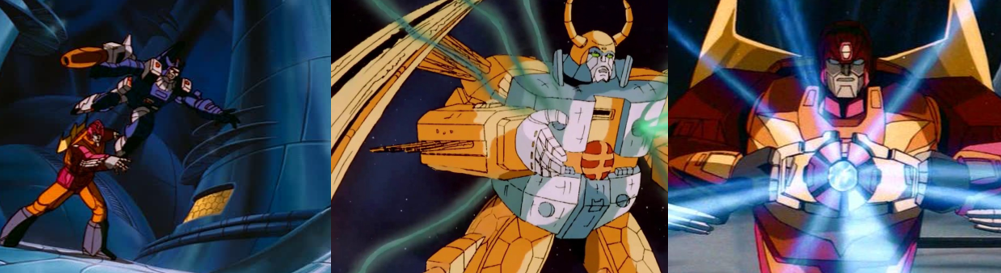
The Autobot/Decepticon war escalates when Megatron (Welker) kills the heroic Optimus Prime (Welker). When Megatron is empowered by the planet-sized Unicron (Welles), young Transformer Hot Rod (Nelson) must embrace his destiny as the Autobot’s new leader.

The Background:
In 1983, representatives from Hasbro were sent to the Tokyo Toy Show to find toys they could import to North America. While there, they spotted manufacturer Takara’s range of transforming robots and bought the rights to produce the toys under a single brand. Hasbro already had a partnership with Marvel Comics and thus turned to then-editor-in-chief Jim Shooter and Bob Budiansky to flesh out the overall story and character names for their new toy line. The premise centred on a war between the heroic Autobots and the evil Decepticons, with both factions being “More Than Meets the Eye” and capable of transforming into different forms. The toys were a big hit due in no small part to Hasbro accompanying them with an animated series that effectively doubled as a dedicated advertisement for their products. The Transformers (1984 to 1987) was a phenomenon for an entire generation and Hasbro sought to further capitalise, and advertise their new range of Transformers toys, with a feature-length animated movie. Despite the protestations of screenwriter Ron Friedman, Hasbro were determined to kill off the heroic Optimus Prime and many of the original characters to make way for a new crop of products, traumatising many impressionable youths and leading to a speedy revival. The production was supervised by Toei Animation vice president Kozo Morishita, granted a far greater budget to the television show, and was the final cinematic performance of the legendary Orson Welles, who was famously outspoken about the role. Released alongside a summer of blockbusters, The Transformers: The Movie was far from a box office hit and reviews were largely negative. Several reviews criticised the film for being a glorified, nonsensical toy commercial determined to bombard children with new products, though franchise fans loved the film and its intended audience ensured it became an endearing cult classic. While the movie’s poor box office meant a sequel never materialised, the cartoon and toys continued regardless and the franchise returned to cinemas about twenty years later for the first of many big-budget, live-action releases.

The Review:
I think it’s important to note that I don’t have much nostalgia for The Transformers. The original series ended shortly after I was born, and I don’t recall re-runs airing when I was a kid. I did have a VHS tape of a few episodes, though, and some of the toys (both official ones and knock-off ones), but I’m certainly not a die-hard fan. Yet, even I knew the awesome theme tune, the ridiculousness of the concept, and the death of Optimus Prime. Not necessarily when I was a kid, but certainly as I got older, especially as Transformers is one of those franchises that just keeps truckin’ along. Anyway, all this is to say that I’m hardly a Transformers expert; I barely know who’s who and I have only a basic grasp of the continuity and lore. Still, all I need to know heading into The Transformers: The Movie (because I guess The Transformers Movie would’ve made too much sense as a title?) is that the battle between the Autobots and the Decepticons raged for some time. Unlike in Michael Bay’s later movies, The Movie largely takes place in space and on alien worlds but the Autobots have established a city on Earth (in the far-off year of 2005, no less) and on our Moon. They’re regularly aided by human allies like Spike Witwicky (Burton) and his young son, Daniel (David Mendenhall), who repair and maintain both Autobots and their weapons while fighting alongside them in transforming mech suits. A helpful narrator (Victor Caroli) provides an overview of the plot, though you’re honestly better off listening to the lyrics of Lion’s hard rock remix of the Transformers theme song as it tells you everything you need to know. Led by the maniacal Megatron, the Decepticons have conquered the Transformer home world, Cybertron, and forced the rag-tag Autobots (led by Optimus Prime) to Earth and hidden bases on Cybertron’s moons. There, Optimus plots to pick up a shipment of Energon from Earth to power a counterattack in a desperate bid to retake their home, unaware that Megatron’s spy, Laserbeak, is reporting to its master via Soundwave (Welker).

Megatron’s attack leaves the Autobots devastated and him transformed by Unicron.

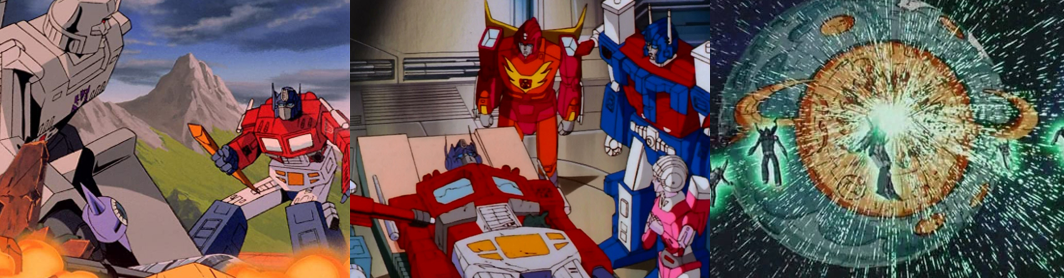
Thus, Megatron leads his long-suffering lieutenant, Starscream (Chris Latta), and his forces in intercepting the Autobot shuttle, massacring Ironhide (Cullen) and his crew and callously stepping over their smouldering remains to slip into Autobot City. Luckily, Hot Rod and Daniel spot the shuttle and notice the damage. Hot Rod lives up to his name and opens fire, confusing his war weary mentor, Kup (Lionel Stander), but scuppering the Decepticon’s…well, deception…and putting Autobot City on high alert. Despite the best efforts of Ultra Magnus (Stack) and Arcee (Susan Blu), the city takes heavy damage and many Autobots are killed before the city can be transformed into its defensive mode. Blaster (Buster Jones) sends a distress call and Optimus Prime makes haste to Earth and quickly turns the tide of the battle, engaging his hated rival in a one-on-one fight. Though evenly matched, Optimus isn’t prepared for Megatron’s aggressive and driven demeanour and suffers mortal injuries in the fight, largely thanks to Hot Rod unwittingly spoiling Optimus’s kill shot on Megatron. However, Megatron is equally injured and left to die by Starscream; though the loyal Soundwave spirits him to Astrotrain (Jack Angel). In the aftermath, with Autobot City badly damaged, Ultra Magnus, Hot Rod, Daniel, and the others watch helplessly as Optimus tragically dies. Before he passes, Optimus passes the “Matrix of Leadership” to a reluctant Ultra Magnus, who vows to lead the Autobots until a more suitable leader rises. Optimus prophesises that this will happen during the Autobots’ “darkest hour” and then dies, leaving a generation of children heartbroken. As for Megatron, he and his loyalists are unceremoniously tossed into space by Starscream and left to die, only to encounter Unicron, a planet-sized Transformer. Unicron offers to empower Megatron and his minions in exchange for their unfaltering servitude and for destroying the Matrix of Leadership, the one thing that threatens Unicron’s quest to conquer and consume worlds. Though livid at being a pawn to even a being as mighty as Unicron, Megatron quickly accepts and is reconfigured into the far more imposing Galvatron (Nimoy). No longer requiring a minion to fire him, Galvatron heads to Cybertron and executes Starscream with his new cannon form, reclaiming his position and heads back to Earth to kill Ultra Magnus.

As the Autobots scramble to counterattack, Hot Rod gets an odd side quest.

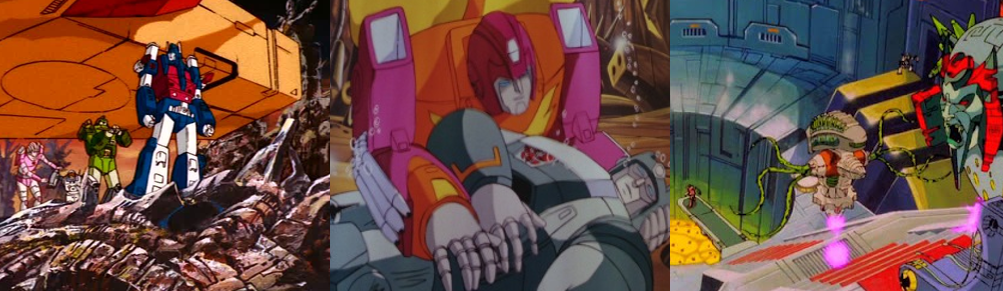
The Autobots flee in two shuttles; one leaves Hot Rod, Kup, and the Dinobots stranded on Quintessa and the other sees Ultra Magnus fake his death by separating the ship and eventually landing on Junkion. Thus, the story diverges somewhat, with Ultra Magnus, Arcee, Daniel, and the others trying to repair their ship and fending off Wreck-Gar (Eric Idle) and his oddball Junkions and Hot Rod and Kup struggling against Quintessa’s hostile natives. All too soon, the two are separated from the Dinobots, captured by Allicons, and brought before the multi-headed Quintessons (Regis Cordic and Roger C. Carmel). Tried in a kangaroo court, they are sentenced to death but, just as he defied the judge’s authority, Hot Rod valiantly fights back against the Sharkticons. Luckily, they’re saved by the Dinobots after their leader, the child-like Grimlock (Gregg Berger), is led there by their new ally, the rhyme-speaking Wheelie (Welker). Although they successfully turn the Allicons and Sharkticons against their masters and reunite with Ultra Magnus and the others, and even make peace with the Junkions by using the “universal greeting” and offering Energon, their celebration is short lived when they arrive on Junkion to find Ultra Magnus blown to pieces by Galvatron and the Matrix of Leadership stolen. Luckily, the Junkions reassemble Ultra Magnus and even provide them with a ship to pursue Galvatron back to Cybertron, a suicidal prospect against Unicron’s awesome power and yet Hot Rod remains determined to confront the planet-devoured and his bloodthirsty minions. Hot Rod is just one of many supporting characters here but it’s obvious that he’s being given the limelight. He’s characterised as a somewhat reckless and impulsive Autobot who often acts without thinking and lacks the seasoning of his mentor. In contrast, Ultra Magnus is the definitive soldier; loyal, determined, and steadfast. And yet he hesitates when Optimus passes him the Matrix of Leadership and his inability to open it almost costs him his life.

Galvatron’s bloodlust pales in comparison to Unicron’s looming threat.

Megatron is more driven than ever here. He strikes without mercy, gunning down countless Autobots and ransacking their city to kill his hated rival, even if risking his own body and life. Though victorious, Megatron sustains heavy damage and is predictably betrayed by his allies, who descend into in-fighting without his leadership. Stubborn and proud, Megatron initially refuses to kneel to Unicron but acquiesces since he fears death more. As Galvatron, his determination is only increased with his added abilities and newly christened lieutenants, but his mission to kill Ultra Magnus and destroy the Matrix is fraught with “exaggerations” as he’s quick to claim victory without confirming his kills. Galvatron is thus constantly reprimanded by Unicron whenever he gets ahead of himself or dares to think of defying the planetoid robot. Unicron makes an immediate impression since he opens the movie by devouring Lithone in a truly unsettling sequence of death and destruction. Wandering the void like a force of nature, Unicron seeks only to devour planets to sustain himself, seemingly nonplussed by the lives he snuffs out in the process. The vast, enigmatic Unicron clashes with Megatron by demanding his servitude but only angers his subordinate more by devouring two of Cybertron’s moons and constantly inflicting pain upon him when his pride gets out of control. It’s interesting that Unicron even bothers creating minions since he could conceivably devour Cybertron and Earth and snuff out any resistance. Of course, then the movie wouldn’t happen and it’s better to not leave such things to chance as the finale shows that, for all his incredible size and power, Unicron is surprisingly vulnerable. The Transformers: The Movie was also, I believe, the introduction of the Quintessons, horrific tentacled, malicious robots with three heads and a sadistic streak who delight in dropping “innocent” prisoners to the Sharkticons. They’re a minor sub-plot here, something for Hot Rod to rally against, but are visually more interesting and disturbing than the Junkions, who are as annoying as Wheelie and Blur (John Moschitta) and speak only in television soundbites, a trait I more associate with Bumblebee (Dan Gilvezan), who’s barely featured.

The Nitty-Gritty:
The first thing to note about The Transformers: The Movie is how gorgeous the animation is. The film is brought to life by a detailed and intricate anime aesthetic that really makes every scene pop since you can feel the effort that went into every little detail. Sure, it’s weird that Optimus Prime spawns a trailer truck out of nowhere when he transforms and some transformation effects defy all known physics, but you have to forget about that when watching Transformers. The titular Robots in Disguise have never looked better, and their deaths are depicted in unsettling detail. Chest plates have laser holes blown through them, body parts go flying, and your favourite characters and toys are literally blasted to smithereens in incredibly detailed battle sequences bolstered by explosions, tearing metal, and, of course, a rocking soundtrack. Almost every scene is accompanied by some kind of music, be it Vince DiCola’s suitably dramatic score (Unicron’s theme is the perfect balance of awe and dread) or a power ballads. There’s the aforementioned Transformers theme by Lion, easily the best and most infectious version of the song, and songs by Kick Axe, Stan Bush, and, most bizarrely, “Weird Al” Yankovic. “Dare to be Stupid” plays after Hot Rod makes peace with the Junkions and is as surreal as the weird and annoying Junkions. Stan Bush’s “Dare” and “The Touch” make up for this, even if these power ballads somewhat undercut the death and destruction happening onscreen. The Transformers: The Movie is a very loud and chaotic affair; characters are always yelling and moving, and the pacing is a mile a minute, which is somewhat overwhelming. It’s difficult to keep track of who’s dead and alive at times (I legitimately thought Spike was dead at one point) and the movie never really stops to take a breath (except for when Optimus dies). I do like how it focuses entirely on the robotic characters, though; Spike and Daniel are merely supporting characters, which is exactly how it should be. The Transformers: The Movie is also surprisingly dark; there’s a lot of gruesome deaths, constant peril, and much destruction. Spike even drops a “Shit” at one point, which I’m sure had a few mothers clutching their pearls as Little Jimmy was bawling over Optimus Prime.

The massacre of your favourite characters has never looked better thanks to some slick animation.

Speaking of whom, let’s discuss this tragic and life-changing moment. The battle between Optimus Prime and Megatron is a brutal, no-holds-barred affair that sees the two mortally wounded within a few blows. Surprisingly, Optimus Prime is often taking the brunt of the assault and, though he eventually turns the tide, he seems half dead when he moves to execute his rival, who predictably falls back on deception to finish his foe. Although the Junkions and Hot Rod simply piece Ultra Magnus and Kup back together, Optimus Prime is damaged beyond repair and delivers a stirring speech to his comrades before passing, his body dramatically turning grey. It’s true that the film meanders without Optimus Prime’s charisma and visual appeal to fall back on, but his death certainly raises the stakes. The Autobots are almost completely wiped out by Megatron’s attack and constantly on the run, forced to fake their deaths to catch a break and suffering many losses, with Galvatron delighting in blasting Ultra Magnus to pieces and Daniel being concerned that his father has suffered the same fate. Thanks to Unicron’s glow-up, the Decepticons easily overpower the Autobots and force them to flee into new dangers. While the Dinobots offer some much needed power, their childish demeanours hold them back just as Hot Rod’s inexperience leads him to make erratic decisions. To be fair, neither Ultra Magnus nor Kup’s years of experience really help all that much since their so incredibly outnumbered here. The Quintesson sub-plot is a bit of an odd diversion, though. I think it would’ve been better for Hot Rod and the others to somehow crash on Unicron and discover the Quintessons there, then they could regroup with the other Autobots in the finale. Still, the devastation brought to your favourite toys is almost laughable at times: characters are gunned down and tossed aside mercilessly to put the spotlight on Hot Rod and the others. It’s an interesting tactic considering Megatron and his loyalists are physically transformed without being callously killed, but it makes for a startling example of how violent this world can be when the creators take their gloves off.

Ultimately, Hot Rod claims the Matrix and ends Unicron’s threat with surprising ease.

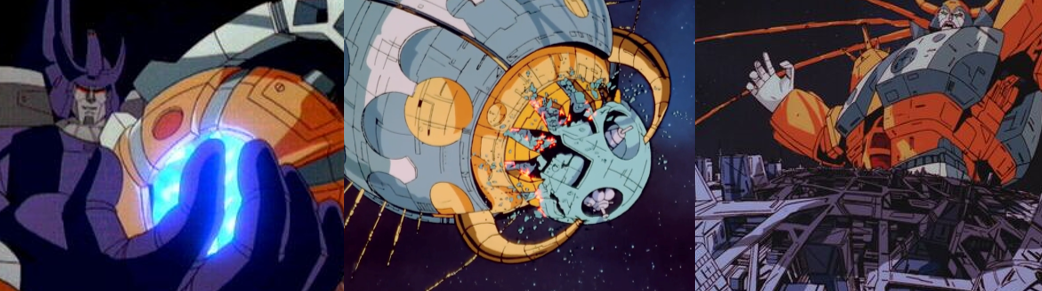
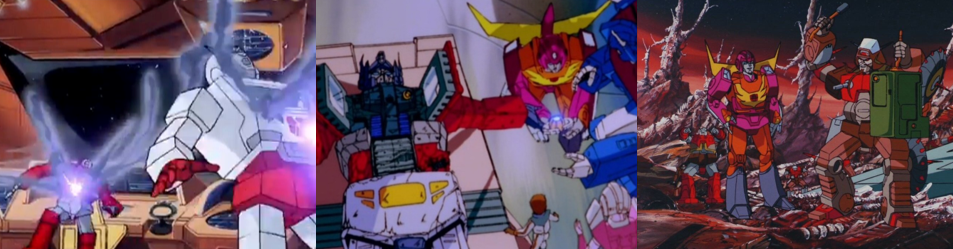
Casting an ominous shadow over everything is Unicron, a looming, unknowable figure about whom we learn nothing except he desires destruction and to continue on this path without resistance. Although he’s not seen all that much during the first two acts, Unicron remains ever present in his constant reprimanding of Galvatron and brief cutaways of him making demands or devouring worlds. Sick of being brought to heel like a dog, Galvatron captures the Matrix of Leadership and turns it against his planet-sized master. However, like Ultra Magnus, Galvatron cannot open the Matrix and is simply devoured by Unicron, who then transforms into a gigantic robot akin to a God and attacks Cybertron. Although the Decepticons are powerless against such a threat, the Autobots have better luck. The Junkions’ modifications to their craft allow them to largely survive Unicron’s plasma breath and crash through his eye to explore his insides. There, Hot Rod encounters Galvatron, who surprisingly suggests they team up against their common foe. Living up to his namesake and fuelled by the need to avenge Optimus Prime, Hot Rod naturally refuses and a fight ensues. Though outmatched, Hot Rod finds himself forever changed when he reclaims the Matrix of Leadership and hears Optimus Prime’s stirring endorsement. Empowered, adopting a sterner demeanour, the rechristened Rodimus Prime overpowers Galvatron and tosses him out into the void. Rodimus then successfully opens the Matrix (he had “the touch” after all), which destroys Unicron in an impressive, if somewhat anti-climatic, end. Unicron’s severed head is left orbiting Cybertron, which is somehow reclaimed by the Autobots (I guess Unicron’s attack killed or drove off the Decepticons?), with many of their allies revealed to have survived previous attacks. Rodimus Prime then delivers his own inspiring speech proclaiming a new era of peace and prosperity and the movie just ends, the momentum and kinetic action screeching to an abrupt end where all obstacles are overcome with ridiculous ease.

The Summary:
This was only my second, maybe third, time watching The Transformers: The Movie. As I said, I didn’t grow up as a big Transformers fan and my experiences with the live-action films have largely soured me on the franchise, but the original cartoon and this feature-length release have always appealed to me. I’ve watched from the sidelines as others have talked about the merciless offing of beloved characters and the death of Optimus Prime, an event that still hits hard even though he was later resurrected. The balls of this movie are to be commended; it’s not often you see beloved children’s characters blown to pieces by a cackling villain and, credit where it’s due, the movie excels because of this. The stakes are incredibly high here; it feels as though no one is safe, not even the newer characters, because Megatron is more crazed than ever and Unicron is always lurking in the background. Leonard Nimoy shines as the sadistic Galvatron, showing a side of himself I’ve never seen before, and the ominous, gravelly voice of Orson Welles adds a gravitas to Unicron that’s truly bone-chilling. The voice acting is top notch, to be honest; even the more annoying characters exude a lot of personality, which is only matched by the impressive and painstakingly detailed animation. Unfortunately, The Transformers: The Movie meanders in the middle; I didn’t really connect with Hot Rod or care about his Quintesson side plot, which largely felt like padding. There are a few holes here, too, like Unicron being both ridiculously powerful and surprisingly vulnerable and him relying on minions when he could just eat anything in his path. The film’s also a visual frenzy at times; I felt assaulted by colours, movement, and music and it was difficult keeping track of what was happening at times. In this regard, I think the film would’ve fared better if it had scaled down the cast but then they wouldn’t be able to sell all those toys, would they? It’s still better than any of Michael Bay’s movies but I still struggle to be that invested in the narrative, characters, and concept. It’s a bleak and stirring rollercoaster of a ride, for sure, but maybe it needed a little fine tuning and a lot less corporate greed to deliver a complete package.

My Rating:

Rating: 3 out of 5.

Pretty Good

Is The Transformers: The Movie a pivotal event from your childhood? How did you react when Megatron gunned down all those Autobots and Optimus Prime shockingly died? What did you think to Megatron’s glow-up and his new abilities as Galvatron? Do you agree that the Quintesson side plot dragged a bit? What did you think to Unicron, and do you think he should’ve been depicted as a more awesome and powerful force? Were you happy to see Hot Rod become the new Prime or do you think Ultra Magnus, or someone else, was a better fit? What are some of your favourite Transformers episodes and how are you celebrating sci-fi this month? Share your memories of The Transformers: The Movie down in the comments and go check out my other sci-fi content.
Movie Night [Sci-Fanuary]: Edge of Tomorrow


January celebrates two notable dates in science-fiction history, “National Science Fiction Day” on January 2 and Arthur C. Clarke’s HAL 9000’s birthday on January 12. Accordingly, I’m dedicating January to celebrating sci-fi with an event I call “Sci-Fanuary”.


Released: 6 June 2014
Director: Doug Liman
Distributor: Warner Bros. Pictures
Budget: $178 million
Stars: Tom Cruise, Emily Blunt, Bill Paxton, Noah Taylor, and Brendan Gleeson

The Plot:
When public affairs officer Major William Cage (Cruise) unexpectedly gains the ability to reset time after his death in battle against the aggressive alien “Mimics”, he teams up with the heroic Sergeant Rita Vrataski (Blunt) to defeat the invaders.

The Background:
In 2004, Hiroshi Sakurazaka and Yoshitoshi Abe collaborated on the spectacularly named “light novelAll You Need Is Kill, the story of soldier Keiji Kiriya, who’s caught in a time loop that allows him to improve his fighting skills against invading aliens. Nominated for the 2005 Seiun Awards, All You Need Is Kill caught the attention of producer Erwin Stoff, who optioned the rights to create a live-action adaptation. Despite being intimidated by the source material, writer Dante Harper produced a screenplay that was listed as one of the best unproduced works doing the rounds. After Brad Pitt declined the lead role, Tom Cruise joined the project, and the script underwent additional rewrites after he and Emily Blunt were cast, with writer Christopher McQuarrie and director Doug Liman struggling to produce a satisfactory ending. The cast and crew spent an unexpected three months filming the complex, action-heavy beach assault on a large soundstage surrounded by green screens. The UDF exosuits were designed by Oliver Scholl, Pierre Bohanna, and Kate Hawley and modelled after real-world exoskeletons and built as largely practical suits that bruised and battered the stars. In contrast, the Mimics were digital creatures courtesy of Sony Pictures Imageworks; the designers worked hard to make them an otherworldly mess of dangerous tentacles that had a tangible reality to their otherwise fantastical appearance. Despite a worldwide box office of just over $370 million and largely positive reviews that praised the direction and execution, and the time loop twist, Liman and Warner Bros. were left so disappointed by the film’s reception that they pushed to re-brand the film to the clever tag line, “Live. Die. Repeat”. Indeed, while some found the film tedious and strangely limited in its scope, Edge of Tomorrow is widely branded as an under-rated sci-fi romp. Though talks of a sequel have done the rounds since its release, it seems we’re more likely to get a TV spin-off than a direct follow-up any time soon.

The Review:
So, two caveats before we get into this film: one, I’ve never read All You Need Is Kill (though my fondness for this movie makes me want to sit down with it some day) and two…I absolutely cannot stand Tom Cruise. I don’t care how many of his own stunts he does or about his weird personal life; I’ve just never bought into him as an actor and find his characters very bland and unlikeable. Thankfully, Cage is written to be pretty unlikeable. A smarmy, confident, well-dressed spokesperson, he’s effectively become the face of the UDF’s counterattack against the Mimics, frequently appearing on television and in interviews to encourage viewers to join the military, hyping up the combat prowess of the armoured exosuits worn by their soldiers, and painting Vrataski (the so-called “Angel of Verdun”) as a heroic symbol. In Edge of Tomorrow, humanity was completely caught off-guard when a seemingly innocent meteor landed in Germany, only to spew out a legion of weird, tentacle-like aliens that swiftly overtook most of continental Europe. Because of their uncanny ability to seemingly anticipate their enemy’s actions, the aliens are dubbed “Mimics” (an odd name considering they don’t physically or strategically mimic anything about us) and, in the space of just five years, were seemingly set to destroy all human life. That was, until, the Battle of Verdun, where Vrataski scored a major victory, one which galvanised humanity to push towards total victory. Unfortunately for many of their troops, the UDF still employ trench warfare, literally dropping their soldiers into enemy territory and leading to mass slaughter in most cases, keeping humanity on the razor’s edge of extinction.

The time loop and brutal training transform the once-cowardly Cage into a battle-hardened soldier.

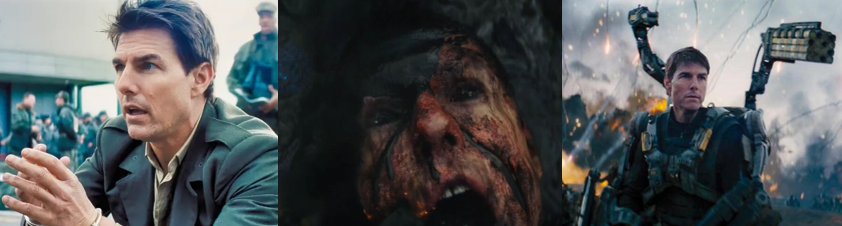
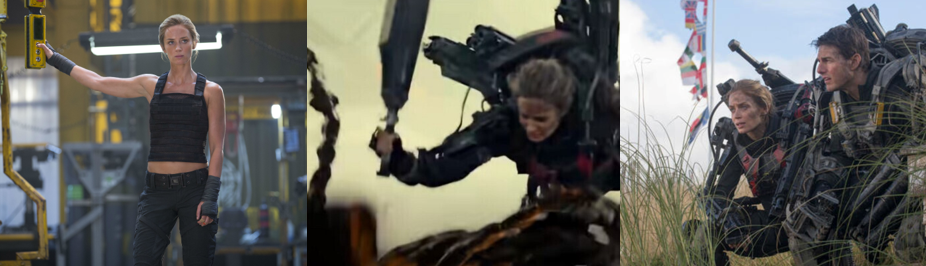
This, as much as anything else, is why Cage would rather be anywhere else but on the front line. A former advertising guru, he adapted his skills to promoting the war effort, receiving a complimentary military rank, and has successfully hidden his abject cowardice and combat inexperience behind his silver tongue. However, when he’s called to meet with grizzled veteran General Brigham (Gleeson), Cage is aghast to learn he’s been ordered to join the next push into Europe as a war correspondent. Desperate to avoid the danger, death, and bloodshed, he begs, bargains, and eventually tries to blackmail his way out of the assignment, only to be arrested, stripped of his rank, and branded a deserter (“Rail-roaded”, as he calls it) and dumped into the judgemental and unsympathetic care of Master Sergeant Farell’s (Paxton) J-Squad. Despite desperately trying to explain his situation, Cage is met by nothing but sarcasm, mockery, and aggression from his newfound peers and, before long, is strapped into an exosuit and violently dropped into battle with little to no combat training. The beachfront assault is not a battle, it’s a massacre. Cage’s entire battalion is killed and he comes face-to-face with a large, voracious Mimic, barely able to defend himself. Out of desperation, he blows the “Alpha” to pieces with a Claymore mine and is drenched in its caustic blood. He then suddenly finds himself waking up 24-hours earlier, being given the same impassioned speech by Farell, suffering the same abuse from J-Squad, and dying in battle once again, only to begin the day anew each time.

J-Squad are unimpressed by Cage’s attitude, inexperience, and increasing mania.

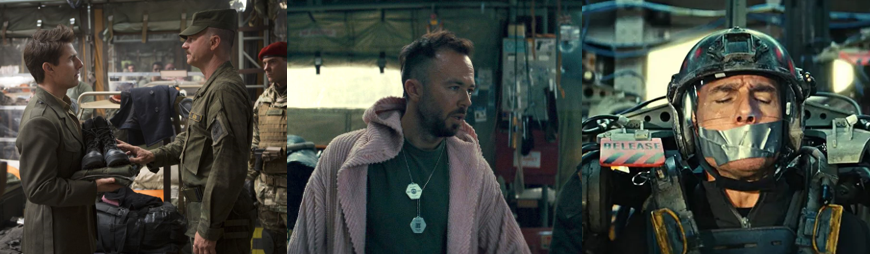
Confused and disorientated, Cage initially believes he’s suffering some kind of déjà vu or nightmare, or that he’s losing his mind. This latter explanation is what the other characters default to whenever he tries to warn them of the mission’s impending failure. No matter now many times he repeats Farell’s words or rattles off his knowledge of J-Squad – Griff (Kick Gurry), Kuntz (Dragomir Mrsic), Nance (Charlotte Riley), Skinner (Jonas Armstrong), Ford (Franz Drameh), Takeda (Masayoshi Haneda), and Kimmel (Tony Way) – they simply think he’s losing his mind. Eventually, during his many repeats of the same day, Cage’s knowledge of each increases; though this happens offscreen, we learn a bit more about each of them from his exposition as he tries to earn their trust. Ford, for example, is using his dead best friend’s name and sending his payment to his family. Mostly, Cage simply earns their ire; they’re annoyed at being saddled by him, his incompetence, and personally insulted by him being a deserter and they even attack him when his subsequent absences see them being punished by Farrel. Played by the late, great Bill Paxton with a delicious, scenery-chewing charisma, Farrel appears to be a man completely consumed by the fire and glory of war. However, unlike Brigham, Farrel isn’t all talk and bluster and eagerly joins his men in battle, relishing the taste of combat. Cage’s eventual combat prowess is more to do with memory, tough training, and a constant cycle of failure than him being mentored by J-Squad. They essentially leave him to fend for himself at the beginning, and are therefore stunned when he suddenly exhibits near-superhuman deftness and ability on the battlefield. Later, when he convinces them to heed his warnings, they’re shocked to learn how insurmountable the Mimic’s power is but readily follow him into a final assault on the Louvre Pyramid, giving their lives to his cause and even sacrificing themselves to cover his infiltration. However, as persuasive as Cage’s parlour tricks and knowledge are, they’re primarily convinced by him having the seal of approval of the near-mythical Vrataski, who backs Cage’s claims and emboldens their fighting spirit.

Constantly frustrated by Cage’s inexperience, Vrataski works hard to train him for combat.

Vrataski is a tough, no-nonsense soldier equally dubbed the “Full Metal Bitch”. Extremely adept with her exosuit, Vrataski also employs a massive, anime-styled sword (fashioned from a helicopter blade) and inspires awe in her fellow soldiers. However, Vrataski is also cold and stoic, rarely showing her emotions or letting them rule her actions, to the point where she’s largely impassive when her fellow soldiers die in battle. Behind this façade, she hides a deep pain at having watched so many of her loved ones die and failed to end the Mimic threat when she had the chance. When Cage unexpectedly saves her in battle thanks to his foresight, she orders him to find her when he wakes up and reveals that her victory at Verdun (and her entire reputation) is thanks to her also having previously acquired the Alpha’s time-manipulating blood. Working with Doctor Noah Carter (Taylor), Vrataski learned that the Alpha’s death triggers the gigantic “brain” of the Mimic hoard, the “Omega”, to reset the day, allowing the Mimics to counteract accordingly. The longer one has the power, the more the Mimics become aware of them and the closer the protagonists get to learning the Omega’s location. Vrataski therefore forces Cage to train again and again, executing him to restart the day whenever he’s incapacitated or killed, to turn him into her proxy. Vrataski is constantly exasperated by Cage’s inexperience, questions, and cowardice and delights in abusing him, barking orders and forcing him to step up and find a viable route off the beach to find the Omega. Similar to J-Squad, Cage eventually learns a bit about Vrataski and bonds with her, to the point where he becomes despondent at having watched her repeatedly die and their continued failures to make real headway.

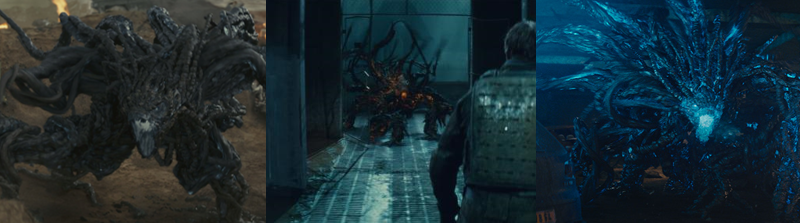
The Mimics are an ugly, aggressive alien race that can somehow create time loops.

A bunch of veterans and barflies speculate on the reason the Mimics have come to Earth, but Edge of Tomorrow largely leaves the explanation vague. They’re described as a “perfect”, planet-conquering hive mind, a near-exhaustible army even without accounting for their time-bending powers. The actual creatures are somewhat generic; they’re perfectly monstrous and disturbingly Lovecraftian, but we never really get a decent look at them and they often resemble a blurry mishmash of nanobots rather than living beings. They’re often hiding, either under the sand, ground, or elsewhere, and burst up to strike, skewering prey with their tentacles, firing energy bolts, or manhandling soldiers with their superior speed and strength. Even the regular grunts are extremely durable, often tanking multiple shots or moving too fast to be hit, and it was only through blind luck that Cage killed the Alpha in the first place. The Mimics are controlled by the Omega, with the Alpha overseeing the invasion and signalling for a reset upon its death, with all the aliens retaining the knowledge of each day, as Cage does. The longer he has the power, the more aware of his presence they become; the infected begin to see visions of the Omega, something the big brain uses to lure the soldiers into a trap. Indeed, Dr. Carter suggests that the Omega allowed the victory at Verdun as part of a grander plan to wipe out humanity, making them an almost invincible force. So powerful is the threat of extinction that the UDF’s only thought is to counterattack with everything they have. At one point, Cage and Vrataski infiltrate Brigham’s office, using Cage’s foresight to finally convince him to hand over Dr. Carter’s experimental transponder to learn the Omega’s true location, only for Bingham to immediately order even Vrataski’s arrest and forcing the two to reset to simply steal it. Cage’s power is constantly at risk since he must die to reset the day; it cannot be passed on but can be lost via a blood transfusion, which is what cost Vrataski the power. This eventually strips the ability from Cage, forcing him and Vrataski to recruit J-Squad for one last, desperate mission to destroy the Omega in Paris.

The Nitty-Gritty:
At first glance, Edge of Tomorrow is simply another generic, sci-fi war film with many of the tropes you’d expect from the genre. You’ve got the gruff, uncompromising General; the tough, but somewhat fair, Drill Sergeant; and a squad of ground-level troops simply trying to defend their world. J-Squad are sadly one-dimensional, despite Cage spitting facts and exposition about them, but are at least visually distinct. Griff is constantly walking around in a pink bath robe, for example, Kuntz “doesn’t talk much”, and Kimmel literally goes into battle balls out. Though as thirsty for combat as their Master Sergeant and far better trained than Cage, J-Squad is as doomed to failure as every UDF campaign and we witness their hubris, downfall, and deaths numerous times as Cage lives, dies, and repeats his time loop over and over. Though they give him nothing but abuse, they show respect for and surprise regarding his combat prowess in different time loops when this cowardly, pathetic deserter is suddenly blasting around at speed and picking off Mimics with uncanny precision thanks to Vrataski’s brutal training. Vrataski is a loner by nature, training by herself in a mechanical simulator and fighting solo on the battlefield regardless of how many troops follow her. She often dies alone in battle as well and constantly keeps Cage at arm’s length, hiding injuries and insisting on pushing onwards even when he begs her to stop because she won’t make it. Her stubbornness is her greatest strength and she impresses this fighting spirit upon Cage, eventually transforming him into a more hardened soldier over who-knows-how-many time loops.

Cage’s repeated experiences improve his skills but burden him with knowledge.

As someone who dislikes Tom Cruise, I get a perverse pleasure out of seeing him die over and ever. He gets skewered, eaten, shot, and blown up multiple times throughout the film, suffering broken limbs, a shattered spine, and being crushed under vehicles. With each loop, he gets a little better, pushing further along the ill-fated beach assault and committing to memory the movements of the Mimics, exactly as a videogame player gets better through trial and error. We’re never given an exactly tally of how many times Cage relives the day, but he sometimes burns through days in quick succession, such as when he’s blindsided by threats or struggles with his combat training, much to his frustration. A series of montages show him failing time and again, but also his progression; once a lumbering liability who couldn’t disengage the safety on his weapons, he graduates to sprinting with an uncanny deftness and blasting Mimics with his shoulder cannons, saving those who despise him and pushing further into France. Much of Cage’s experiences aren’t shown to us, however. Edge of Tomorrow cleverly frames some of his and Vrataski’s excursions as his first experiences, only to reveal that he’s been at that same barn before and even learned to fly a helicopter. These sequences are all very gritty and realistic, with the beach assault resembling equally doomed real-life military campaigns and the UDF’s weaponry being surprisingly low-tech, save for the exosuits. These are surprisingly practical effects, with some CGI enhancements, and effectively make even a novice like Cage a super soldier, though we don’t see their full potential until Cage masters their functions. The Mimics, by comparison, are entirely CGI but they work well as an unknowable, monstrous “Other” for humanity to rally against, even if I find their design visually confusing. Cage eventually becomes burdened by knowledge; tortured by Vrataski’s repeated deaths and the virtual hopelessness of the situation, he deserts the campaign entirely at one point, only to be branded a coward. When he learns that the Omega is setting a trap for them to regain its power, Cage goes for the transponder to try and change the future, only to end up losing his powers and being given one last try to get the job done.

Stripped of his powers, Cage heads a final assault that results in the dawn of a new day.

Having been wounded and saved by a blood transfusion, Cage escapes military custody with Vrataski and the two enlist the help of J-Squad in defying orders and flying a night-time assault on the Louvre, the true location of the Omega. Essentially a suicide mission for all involved, this murkily shot mess of a sequence sees all of J-Squad heroically perish to cover their insertion into the iconic pyramid, leaving Cage and Vrataski the last survivors (ironically, Cage survives events in this sequence that would’ve surely reset his day previously). Cornered by the Alpha and realising victory will cost their lives, Vrataski finally expresses her regret and not getting the time to know Cage better, giving him an awkward kiss before sacrificing herself in the “fiery crucible” of combat against the Alpha, unaware that she and Cage have basically lived a lifetime by this point. Left alone with only a gun and a belt full of grenades and his harsh training, Cage plunges into the water’s beneath the Louvre to blow the Omega to kingdom come, only to be mortally wounded by the Alpha. However, he manages to pull the pins with his last act, destroying the Omega and earning himself another drenching in alien blood. This time, Cage awakens a few days earlier to find a strange energy pulse from the Louvre has mortally disabled all Mimics, effectively ending the threat overnight. He’s amazed to find J-Squad all alive and well, the war finally over, and himself restored to his previous life. Naturally, his first thought is to visit Vrataski, grinning like a moron when she greets him with her usual barking wit.

The Summary:
Edge of Tomorrow is a surprisingly good time. Like I say, I’m not a fan of Tom Cruise but he’s actually pretty enjoyable here. Seeing him play a slimy, cowardly, untrained soldier who gets repeatedly killed brought a lot of joy to me as a sycophant and I enjoyed watching him improve with every failure, getting more and more combat proficient and transforming into a soldier on par with Vrataski. This is masterfully conveyed not just through the physical representation of his abilities and proficiency with the exosuit (he demands additional rounds, forgoes his helmet, and show a veteran familiarity with its functions) but also in him assuming the same “thousand-yard stare” as Vrataski, becoming numb to the bloodshed and death over time. Yet, he retains a humanity that wasn’t immediately apparent thanks to his selfish nature. He genuinely wants to find a way to save everyone in his battalion and is frustrated to lose even a single one of them. Emily Blunt was stunning as Vrataski, embodying the stern, brutal efficiency of a battle-hardened soldier. I loved that she constantly pushed Cage, forcing him to think like her, and how she cooled over time to show a vulnerability beneath her façade. The Mimics were generic, but serviceable; they’re weird, bio-mechanical octopus things who want only conquest and human blood and that’s all you really need. The twist is their weird ability to control time, which is kind of swept under the rung and has a few logistical holes in it, but it makes them a unique and insurmountable foe. Character actors like Bill Paxton and Brendan Gleeson steal every scene there in and lend Edge of Tomorrow some legitimacy, and I liked the bleak, brutal nature of the combat (even if it was largely bloodless). In the end, I think Edge of Tomorrow is an under-rated alien invasion flick; there’s a lot to like here, especially with the time loop gimmick, and I always enjoy giving it a watch, even if it can be a bit generic visually.

My Rating:

Rating: 4 out of 5.

Great Stuff

Did you enjoy Edge of Tomorrow? If you’ve read All You Need Is Kill, how do you think the film works as an adaptation? What did you think to Tom Cruise’s performance? Did you also enjoy seeing him fail and die time and again and get a little better with each reset? What did you think to Emily Blunt and the depiction of the Mimics? Do you think the film needs a sequel? Is there a day in your life you’d like to relive over and over? Whatever your thoughts, drop them in the comments and go check out my other sci-fi content.
Movie Night [Sci-Fanuary]: Starship Troopers


January celebrates two notable dates in science-fiction history, “National Science Fiction Day” on January 2 and Arthur C. Clarke’s HAL 9000’s birthday on January 12. Accordingly, I’m dedicating January to celebrating sci-fi with an event I call “Sci-Fanuary”.


Released: 7 November 1997
Director: Paul Verhoeven
Distributor: TriStar Pictures
Budget: $100 to 110 million
Stars: Casper Van Dien, Denise Richards, Neil Patrick Harris, Dina Meyer, Clancy Brown, and Michael Ironside

The Plot:
In the 23rd century, mankind wars with the “Bugs” of Klendathu. Youngsters Johnny Rico (Van Dien), Carmen Ibanez (Richards), and Carl Jenkins (Harris) enthusiastically join the fight, only to find war is not the glamourous affair portrayed by the media.

The Background:
First published as a two-part serial in The Magazine of Fantasy & Science Fiction as Starship Soldier, Robert A. Heinlein’s 1959 pro-military sci-fi tale of humanity’s war against arachnid aliens was just the inspiration writer Ed Neumeier and producer Jon Davison needed to sell their similarly-themed concept to TriStar Pictures. TriStar were far more receptive to their pitch for Bug Hunt at Outpost 7 once it was pitched as an adaptation of Starship Troopers and the Outpost 7 concept was tweaked to accommodate Heinlein’s work. Neumeier and Davison quickly recruited and reunited with Paul Verhoeven to direct based on his predication towards satirical subtext. Though production slowed in the mid-nineties, the ensuing effects tests finally convinced the studio to get the project moving in collaboration with other studios. Despite Neumeier’s attempts to remain faithful to the source material, Verhoeven introduced satirical elements regarding the media, military, and politics and removed the trooper’s power armour to put them at a greater disadvantage. While Phil Tippett and his studio created the practical and visual effects for the film and Verhoeven meticulously drafted detailed storyboards, Verhoeven purposely cast young, beautiful actors to evoke Nazi propaganda films. The cast endured combat training in harsh weather conditions to prepare for the film, which initially debuted at number one at the box office, though it barely cleared $120 million in profit. Reviews were mixed or largely negative upon release, with many missing the satirical elements and criticising its characterisations. Positive reviews praised the action and effects, and its violent content, and it has gone on to be regarded as an increasingly relevant cult classic that led to numerous divisive direct-to-DVD sequels, videogames, and a surprisingly well regarded CGI cartoon.

The Review:
Starship Troopers doesn’t pull any punches, even from the start. The movie opens with a platoon of gung-ho soldiers from the Mobile Infantry (MI) division of the United Citizen Federation (UCF) charging into battle with the Arachnids (derisively referred to as “Bugs”) on their hostile home world, Klendathu. Joined by a FedNet correspondent (Gregg Travis) who exposits the danger of both the Bugs and their world and boisterously hails the bravery and righteousness of the UCF’s troopers (before being summarily devoured by an Arachnid), the infantry immediately realise that all their training and heavy machine guns are largely superfluous against the Arachnid threat. Slaughtered and torn to pieces, the troopers are left bloodied, with Private John Rico seemingly left for dead following a brutal wound to the leg. The story then dramatically jumps to one year prior, when Rico was a fresh-faced, lovelorn senior trying to steal a kiss from (and seal the deal with) his beautiful, determined, but somewhat nauseous girlfriend, Carmen Ibanez. Alongside their friend and budding psychic, Carl Jenkins, and Rico’s jump ball teammate, Isabelle “Dizzy” Flores (Meyer), they are three young, sexy kids taught from an early age by the likes of seasoned veteran Jean Rasczak (Ironside) of the sanctity of enlisting. Those who enlist and complete their federal service are awarded “citizenship”, gaining such perks as the right to vote and have children, while ordinary “civilians” have little influence in the body politic. Though talented on the field and boasting a stronger stomach than his beau, Rico is completely naïve to the dangers of enlistment, repeatedly knocks back Dizzy’s affections, and is ruled by his heart when it comes to his decisions. Thus, he clashes with both his parents (Christopher Curry and Lenore Kasdorf) and rival player Zander Barcalow (Patrick Muldoon) when it comes to his life choices and Carmen.

Enlistment tests our three young leads in different, often painful ways.

Indeed, swayed by the perceived honour that’s associated with Citizenship and desperate to stay close to Carmen, whose top grades make her a shoe-in for the fleet academy, Rico disregards his parents’ very real concerns that he’s signing up to get himself hurt or killed for a girl and readily enlists. Since he doesn’t have the grades to be a pilot like Carmen or the psychic aptitude to be part of the overly fascist military intelligence division like Karl, Rico’s assigned to tough, no-nonsense (and scene-stealing) drill sergeant Zim (Brown) and immediately thrown in the deep end. Alongside his new best friend, wisecracking Ace Levy (Jake Busey), Rico is subjected to harsh physical tests, constant berating from Zim, and resentment towards Dizzy when she follows in his footsteps. His placement in the Mobile Infantry ironically means Rico’s further away from Carmen, who takes to flying like a duck to water and finds herself under Zander’s tutelage, quickly gaining a reputation as a fearless and unconventional pilot. Still, Rico’s physicality and natural charisma serve him well until he makes a critical error during a live-fire exercise and causes the death of fellow cadet Breckinridge (Eric Bruskotter). Although Zim vouches for Rico’s potential and he takes his ten lashes, Carmen’s ending of their relationship and Breckinridge’s death weigh heavily on Rico and cause him to quit. However, right as he’s about to make amends with his parents, his home of Buenos Aires is obliterated by a Bug Meteor, sparking all-out war and Rico’s return to combat to get a measure of revenge. This leads to the opening assault on Klendathu as a direct counterattack, a siege that leads to thousands of deaths as the Bugs blast ships from orbit and slaughter the ground troops.

Rico, Ace, and Dizzy join Rasczak’s Roughnecks on the frontline of the conflict.

Though listed among the dead, Rico survives thanks to the intervention of Rasczak, commander of “Rasczak’s Roughnecks”, an elite infantry squadron who absorb Rico, Dizzy, and Ace into their ranks. Rasczak demands only the finest work from his troopers and orders them to shoot anyone, even their own people, if it means sparing them a more gruesome fate. Impressed by Rico’s valour, Rasczak quickly promotes him to Corporal after his football skills and natural leadership take down a particularly dangerous Tanker Bug. While associating with Rasczak’s Roughnecks, Rico finally sees what’s been in front of him and gives in to Dizzy’s affections, though their tryst is short-lived as the group is ordered to investigate a distress call from Planet P. There, they discover a ravaged UCF outpost and General Owen (Marshall Bell) driven to the brink of madness after witnessing the Bugs sucking the brains out of their prey. The squad realises all-too-late that the distress call was a trap and are besieged by Bugs in a gory slaughter that leaves Rasczak mortally wounded. After Rico mercy kills him and assumes command of the survivors (now renamed “Rico’s Roughnecks”), he’s embittered when his order to carpet bomb P is countermanded and yet duty-bound to return to P when ordered by Jenkins, now a high-ranking colonel, to flesh out the rumoured “Brain Bug” residing there. While Carmen is aghast at Carl’s callous nature, especially after Dizzy’s death, he justifies his decisions as the natural fallout of war. His ultimate goal is to capture the Brain Bug and thereby learn more about the Arachnid’s nature to better fight them, though this goal requires the sacrifice of hundreds and even thousands of lives both in the Mobile Infantry and the fleet. The relationship between the three is strained as a result; fleet and infantry don’t mix as it is (since “MI does the dyin’, fleet just does the flyin’”) and the increasing incompetency of the revolving door of UCF officers doesn’t help matters. Still, the allure of combat remains; Rico readily accepts his mission, even if it’s potentially a one-way trip, and even Zim “busts [his] ass down to Private” to get back on the front line.

The Bugs represent a monstrous, alien force but is man the true enemy in this interstellar war…?

On the surface, the Arachnids are a perfectly horrific and monstrous alien threat. They’re gigantic spider- and bug-like aliens that attack in swarms, slicing limbs, gobbling up their prey, and even spitting fire and firing plasma from their rears. They’re an uncivilised and obviously non-human alien species, one apparently capable of blasting asteroids from orbit towards Earth, and they’re incredibly resilient. Not only are their larger variants armour-plated, not only can they burrow underground and fly, but even their spider-like drones continue to be a threat after their limbs are blown off. Indeed, it takes almost an entire clip just to put one down, and that’s when the troopers are aiming at centre mass, and even then there are hundreds more to take the place of their fallen. Starship Troopers does suggest, more than once, that the Bugs aren’t the aggressors in this fight, however. There’s an off-hand suggestion that they were riled by humans venturing into their airspace, and that the UCF is seeking to colonise the Bug world for their resources, and even the implication that the Buenos Aires attack was perpetrated by the UCF. Such discourse is quickly dismissed, however, especially be the impassioned troopers, who believe wholeheartedly in slaughtering every Bug they encounter. They certainly have their work cut out for them, something not helped by the UCF’s bizarre insistence on relying on ground troops rather than orbital bombardment, the Bugs’ sheer numbers, and the fact every battle takes place on alien worlds. Analogous to the futility and ill-conceived strategies used in the Vietnam War, the Bugs overwhelm the heavily armed but poorly protected troopers, making mincemeat out of them and even sucking out their brains as an act of intimidation. The UCF itself is an aggressive force that controls all the media, society, and strategy regarding the Bugs. They make enlistment to look as attractive as possible to bolster their numbers and it takes the entire movie for them to develop better weapons and defences towards their warmongering efforts. Though Rico clashes with Zim and Zander and even Carl, the various divisions are portrayed as united against the Bugs. This hatred has torn down social and gender inequalities and given humanity a common enemy to rally against, even if it means sacrificing certain freedoms (or their lives).
The Nitty-Gritty:
Starship Troopers was a pretty big deal in my social circle back in the day and a regular watch at sleepovers, mainly for the action and gore. Yet, despite my love for the film and the science-fiction genre, I’ve never gotten around to reading the original book. From what I gather, there are many differences between the two, particularly regarding gender, politics, and the portrayal of the military (who utilise mech suits in the source material). The film instead opts to focus on satire; dark, bleak, biting satire as only Paul Verhoeven can deliver. Taking his portrayal of the media in RoboCop (ibid, 1987) and cranking it up the eleven, Verhoeven presents the UCF-controlled media as a constant recruitment drive. Every bad decision from the various Sky Marshalls is twisted into a propaganda piece designed to encourage viewers to enlist to stamp out the Bug threat. Unedited footage from doomed frontline assaults is aired alongside pro-military advertising specifically targeted at children (portraying killing Bugs as fun and necessary), those who showcase psychic potential, and anyone curious to “know more” about the ongoing campaign. The hypocrisy of the broadcasts is staggering, and anyone who dares question the stratocratic regime is seen as being somehow “lesser”. Rico’s father openly criticises Rasczak’s teachings, preferring Rico apply to Harvard than go to war, and is ridiculed by his son as a result. Rasczak is seen as a heroic, aspirational figure, one responsible for saving many lives and killing many Bugs, who believes in the sanctity of aggressive force as a decisive factor in any conflict. This is again bolstered by the media, which teaches the best ways to kill a Bug, showcases the gruesome experiments performed on the Brain Bug, and highlights the gung-ho attitude of Rico’s Roughnecks as a means to coerce anyone watching into enlisting and following in their footsteps, regardless of the thousands already dead and the untold numbers sporting artificial limbs as a result of enlisting.

While the effects and gore still hold up, our three leads seem a bit miscast in their roles.

As enjoyable as Starship Troopers’ satire of the military, politics, and futility of war is, it’s equally enjoyable at a far more primal level. Just as the media glamorises war, the horrifically one-sided battles between the MI and the Arachnids is as gory and brutal as you could ask for from Verhoeven. Largely portrayed as swarming, voracious CGI bug, the Arachnids make for fearsome alien foes, sporting sharpened limbs, large mouths, and capable of slaughtering our naïve young troopers in numerous creative ways. They’ll dice you up, eat you whole, immolate you, and suck your brains from your skull, clambering over your bloodied remains to take out your friends as they go. Even the mighty fleet is of little consequence to them and the MI’s rifles are so ineffectual that it often takes some creative physical feats (or a well-aimed nuke) to thin out the Bugs’ numbers. Although there are no humanoid aliens like in the book, the Bugs have a decent amount of variety and their effects hold up pretty well thanks to the film using model shots and animatronics alongside the CGI. Unfortunately, Starship Troopers is a little let down by its young, sexy main cast. This in itself is a creative way to further emphasise that these kids have no idea what they’re signing up for, but Denise Richards is such a blank, vacant void that I’m totally on side with Rico’s mum in thinking she’s a bit of a bimbo. Dizzy, despite her clingy obsession with Rico, is a far more attractive prospect. Ballsy, fearless, and capable, she’s much more Rico’s equal and it’s a shame he’s so late coming to that realisation. I don’t mind Casper Van Dien here and he has an undeniable physical appeal and charisma, but he seems a little out of his depth as a leading man. Similarly, as much as I love Neil Patrick Harris, he seems a little miscast. Thankfully, Clancy Brown, Dean Norris, and the immortal Michael Ironside lend some much-appreciated gravitas to proceedings and command the screen every time they appear.

The MI captures a Brain Bug, seemingly turning the tide in humanity’s favour.

So, yeah, it turns out the assault on Klendathu was doomed to fail. The UCF bit off way more than it could chew and were forced to refocus on targeting the neighbouring worlds, like P. After they finally hooking up, Rico is devastated when Dizzy is mortally wounded on P. However, her death galvanises his belief in the UCF and the virtues of Citizenship and he completes his transformation into a devout, battle-hardened copy of Rasczak (even copying his idol’s mannerisms and declarations when commanding his Roughnecks). While many of Rico’s troopers were killed so Carl could get evidence of a Brain Bug, he doesn’t hesitate to return with the surviving troopers and a contingent of “kids” fresh from the academy to flush out and capture the grotesque Bug commander. During the assault, Carmen and Zander are shot down and presumably killed; though Sugar Watkins (Seth Gilliam) offers to lead a rescue party, Rico stoically orders to stay on mission. Luckily for him, Carmen and Zader are captured and brought to the slobbering, larvae-like Brain Bug, which slurps out Zander’s brains and is only stopped from doing the same to Carmen thanks to Rico’s timely intervention. Despite Carl’s earlier stoicism regarding their lives, he subtly influenced Rico, using his psychic powers to nudge him in Carmen’s direction so she could be rescued. Though Sugar heroically sacrificing himself (literally going down fighting) to cover their escape, they make it out injured but alive and are stunned to see that the Brain Bug was captured, offscreen and through means unknown, by none other than Zim, now a private under Rico’s command. Carl arrives and “mind melds” with the Brain Bug and announces that it’s afraid, to the uproarious delight of the solders, and the Bug is taken to be probed and dissected to learn how to better battle the creatures. The film ends with Carl declaring that, one day, everyone will forget that it was a lone infantryman who turned the tide of the war, delivering a soliloquy that sells the MI as the most important division of the war effort, and the three reaffirming their friendship. We also get one final propaganda piece touting humanity’s inevitable victory over their monstrous alien foe, which is presented as a stirring piece selling the military as brave, conquering heroes but is, again, a ridiculous satirical misrepresentation of the bloody truth of their lives.

The Summary:
As mentioned, Starship Troopers was a constant favourite when I was a kid. As teenagers, we loved the film for its gore, monstrous aliens, and because we got to see Dina Meyer’s boobs. I grew up on Paul Verhoeven’s movies so I was well into the splattergore on show here, the bloody action, and his ludicrous satire of the media, politics, and military. These elements are what really help Starship Troopers stand the test of time; as media and the government become more controlling, oppressive, and hypocritical, it’s hard to not see our modern times reflected in this sci-fi classic. The effects hold up really well, too, again thanks to using practical effects wherever possible and focusing on strong, bloody, uncompromising scenes of brutality even as they exist side-by-side with amusing moments, such as Zim nailing Ace’s hand to a wall with a knife just to prove a point. The only real downside for me are the three main actors: they’re all perfectly fine and portraying them as naïve, fresh-faced youngsters makes sense in the narrative, but I do think they’re a little miscast at times and not quite up to the task of carrying the film. Veteran actors and the satirical subtext counterbalance this, but all the gore and brain sucking in the world can’t get me invested in Denise Richards’ lifeless performance. Still, Starship Troopers is as appealing to me now as it was when I was a teenager. It’s crazy to me that it didn’t get stronger sequels as there was real franchise potential here. What I really like about this film is how layered the subtext and satire is, allowing for numerous critical and academic interpretations and discussions on what on the surface appears to be a mindless sci-fi action flick but is actually a compelling commentary on the glamorised portrayal of fruitless warfare.
My Rating:

Rating: 4 out of 5.

Great Stuff

Did you enjoy Starship Troopers? Have you ever read the book and, if so, how do you think the film works as an adaptation? Do you agree that the three main actors were a little out of place in the film? What did you think to the Bugs and their capabilities? Were you a fan of the satirical subtext woven throughout the movie? What did you think to the subsequent movies and spinoffs, and would you like to see another big-budget entry in the franchise? Whatever your thoughts on Starship Troopers, feel free to leave a comment below and be sure to check out my other sci-fi content across the site.

Movie Night: Sonic the Hedgehog 3

Released: 20 December 2024
Director: Jeff Fowler
Distributor: Paramount Pictures
Budget: $122 million
Stars: Ben Schwartz, Keanu Reeves, Jim Carrey, Colleen O’Shaughnessey, Idris Elba, and James Marsden

The Plot:
When a mysterious black hedgehog known as Shadow (Reeves) escapes from captivity and goes on a rampage, Sonic the Hedgehog (Schwartz) and his friends – Miles “Tails” Prower (O’Shaughnessey) and Knuckles the Echidna (Elba) – must team up with their old foe, Doctor Ivo Robotnik (Carrey), against a common enemy.

The Background:
As a key player in the aggressive Console War between Nintendo and SEGA, Sonic had quite the life outside of the videogames, starring in many comic books and cartoons. The idea of a Sonic the Hedgehog movie had been doing the rounds since 1993 but, thanks to legal and creative issues, the best we got was the gorgeous original video animation (OVA), Sonic the Hedgehog: The Movie (Ikegami, 1996). That all changed once Paramount Pictures acquired the franchise rights and produced a live-action/CGI hybrid movie that first horrified and then impressed audiences, A critical and commercial success, Sonic the Hedgehog (Fowler, 2020) repeated this feat with a hugely profitable and well-regarded sequel that, surprisingly, saw star Jim Carrey reprise his role and added more elements from the videogames to the formula. This success saw Knuckles branch out into his own solo series (to mixed reviews) alongside development of a third film. Although he teased his retirement from acting, Carrey was convinced to return by a 24-carat script and the chance to play a dual role. Taking inspiration from Sonic Adventure 2 (Sonic Team USA, 2001) and Shadow the Hedgehog (SEGA Studios USA, 2005), the filmmakers cast Keanu Reeves as the popular anti-hero, who was teased at the end of the last film, and worked hard to both capture the spirit of his videogame counterpart and deliver something new to the character. To make up for unfortunate delays, multiple special effects studios worked simultaneously on the film’s effects and Sonic the Hedgehog 3 released to widespread acclaim. Reviews praised both Reeves and Carrey as the standout stars, alongside the humour and surprising gravitas, though the supporting cast were criticised. Still, Sonic the Hedgehog 3 made more than $210 million at the box office and hopes were high for a fourth entry and additional spin-offs.

The Review:
If there are two things I’ve never been shy about, it’s my love for the Sonic the Hedgehog franchise and my dismay that his big-screen adventures haven’t been all-CGI animated affairs. Yet, despite this (and the notorious reputation movie adaptations of videogames have), the live-action/CGI hybrid Sonic adventures have actually been pretty good. Blending elements of Sonic’s long defunct, Western canon with more modern elements of his lore, the films recast Sonic as an adventurous and enthusiastic, high-speed hero from another world. After coming to Earth and living alone, desperate for friends and acceptance, Sonic has found a surrogate family alongside Tails, Knuckles (fresh off his solo series), and their human family, Tom (Marsden) and Maddie Wachowski (Tika Sumpter). On the anniversary of Sonic’s b-Earth-day, Sonic and Tom reflect on the hedgehog’s journey, how he found friends and a place in the world despite experiencing great pain as a child and being separated from his parental figure. Having formed a brotherhood during their last adventure, the trio (colloquially known as “Team Sonic”) perfectly complement each other’s abilities: Sonic’s the leader, Knuckles is the muscle, and Tails is the gadget guy. Though they banter at times and Knuckles is often the butt of many jokes due to his thick-headedness, the three vowed to never again use the Master Emerald lest its power threaten the world and are depicted as a tight-knit group of friends. Team Sonic are also closely affiliated with the Guardian Units of Nations (G.U.N.), a military division established to monitor and respond to alien threats, with the three now regarded as trusted allies of the G.U.N. overseer, Commander Walters (Butler). Unlike in Sonic Adventure 2, where Sonic was targeted by G.U.N. because they ridiculously mistook him for Shadow, G.U.N. Director Rockwell (Krysten Ritter) is dispatched to recruit Team Sonic’s aid, a task she performs reluctantly as she’s suspicious and distrustful of the “aliens”.

Overwhelmed by Shadow’s speed and power, Team Sonic are forced to join forces with Dr. Robotnik.

Though Team Sonic and the Wachowskis enjoy their peaceful downtime, they jump at the chance for some action (Team Sonic at the beginning and the Wachowskis later, when the boys ask for their help infiltrating the G.U.N. headquarters). However, while Knuckles is eager to test his mettle against the new hedgehog, Sonic calls for cooler heads, despite the chaos and destruction Shadow unleashes upon the city. Angered and suspicious of the “colourful bunch” since they arrived in a G.U.N. helicopter and Shadow’s vendetta is primarily against G.U.N., the enraged hedgehog refuses to listen to reason and easily trounces the three with his impressive physical strength and powers of teleportation. As if that wasn’t bad enough, Shadow’s rocket boots and natural Chaos Energy make him more than a match for Sonic, resulting in a resounding defeat for the trio. After learning of Shadow’s tragic origins from Commander Walters, the three are suddenly attacked by Dr. Robotnik’s egg drones, only to learn from the doctor’s long-suffering right-hand man, Agent Stone (Lee Majdoub), that the increasingly manic (and finally overweight) Dr. Robotnik is not only alive but not behind the attack. Incensed to learn that his machines have been hijacked, Dr. Robotnik begrudgingly agrees to a short-lived team up to track down their common foe. Naturally suspicious of the mad scientist, Sonic keeps a close eye on the maniacal doctor and shares his regret for Shadow’s pain. Their conversation leads Dr. Robotnik to “trauma dump” to his foe and reveal that he also had a tragic childhood filled with bad choices and a lack of parental figures, echoing the main theme of the film (essentially, don’t let your past/pain define you). Equally, discussions with Tails regarding the nature of Team Sonic’s relationship leads Agent Stone to question his devotion to Dr. Robotnik, who routinely humiliates and belittles Stone despite his clear awe and loyalty. We don’t get too much additional insight into Knuckles and he remains and arrogant and proud warrior who takes things far too literally. However, Knuckles proves to be an extremely loyal friend; even when an emotional Sonic is ready to go to blows with Knuckles, Rad Red takes the high road and falls back on the trust he placed in his family.

Desperate to connect with the family he never had, Dr. Robotnik teams up with his maniacal grandfather.

The team up between Team Sonic and Dr. Robotnik is tenuous, at best, given the doctor’s past actions and unstable disposition, but it quickly falls apart when they explore the G.U.N. facility where Shadow was once experimented on. There, the bald lunatic is surprised to meet his long-lost grandfather, Professor Gerald Robotnik (Carrey), an equally devious and intelligent scientist who once ran tests on Shadow and who has returned after fifty years in prison to enact revenge through the angst-ridden hedgehog. Playing dual roles really allows Jim Carrey’s natural, madcap comedy stylings to take centre stage here. Both Robotniks are very similar, sharing an eccentric and dark sense of humour and a desire to vent their personal frustrations upon not just their enemies, but the entire world. Elated to finally meet a member of his family, Dr. Robotnik abandons his newfound allies and devotes himself to Gerald’s cause, using the power of virtual reality and amusing montages to bond with his elder and feel a sense of belonging so strong that he angrily rebukes and dismisses Agent Stone when he raises concerns about Gerald’s intentions. While Dr. Robotnik employs a few mechanical aids throughout the film, they’re secondary to the duo’s more threatening objective: the Eclipse Cannon, a world-ending space station Gerald built for G.U.N. back in the day. Perfectly matched in their mania, genius, and physical abilities, the Robotniks are also cunning and spiteful. While infiltrating the G.U.N. headquarters, Dr. Robotnik tests his laser-reflective clothing by threatening his grandfather’s life, much to Gerald’s respect. Though distrustful of Shadow, Dr. Robotnik relishes the chance to have the power to prove his superiority over the world and his fleet-footed foe, a mad desire that sees him finally donning a game accurate outfit and standing beside his grandfather on the Eclipse Cannon. Unfortunately for the pining doctor, Gerald’s ambitions extend far beyond subjugating the world. Intent on eradicating all human life, including his own, Gerald’s mad plans clash with Dr. Robotnik’s desire to rule, turning the crazed scientist into a reluctant ally for the final act.
Consumed by anger, Shadow vents his wrath upon the world to avenge his lost friend.

Of course, the central antagonist the entire film revolves around is Shadow, a dark and brooding hedgehog from beyond the stars who’s focused only on revenge. While the trailers made it seem like Keanu was phoning in his performance, his growling delivery is pitch-perfect for the enraged anti-hero and he perfectly captures Shadow’s pain and rage. Falling to Earth over fifty years ago and subjected to years of experiments to harness his powerful (but unstable) Chaos Energy, Shadow was treated as a mere lab rat and shown none of the warmth and affection that shaped Sonic into a self-serving hero. Shadow’s only friend was Maria (Alyla Browne), Gerald’s well-meaning granddaughter who bonded with Shadow, giving him someone to care about. After realising Shadow’s powers were too dangerous to contain, G.U.N. sought to keep him in stasis and, during an escape attempt, Maria was accidentally killed, fuelling Shadow’s rage. Shadow’s so consumed by his anger and pain that he attacks G.U.N. and anyone who gets in his way on sight. Thus, when he sees Commander Walters, Shadow doesn’t hesitate to strike to retrieve one of the Eclipse Cannon’s keycards. Unfortunately, Shadow actually attacked Tom in disguise, causing him to not only question his vendetta but enrage Sonic, who abandons his family to extract a measure of revenge from his dark doppelgänger. Although you might not be surprised to learn that Tom isn’t killed, it is touch and go for a moment and the risk against him is great considering the destruction Shadow causes when unloading on G.U.N.’s soldiers. Unlike in the videogames, Shadow doesn’t need a Chaos Emerald to teleport or reach blinding speeds; equally, he’s specifically said to be from the stars, rather than a result of Gerald’s experiments. Yet, he’s just as angry and misguided as in the source material, and equally unstoppable. Even Team Sonic’s combined might cannot match with Shadow’s powers, making him an incredible formidable foe.

The Nitty-Gritty:
Sonic the Hedgehog 3 is a story about choices; specifically, the choices we make that shape us. Sonic chose not to let his pain rule his heart and to be a selfless hero, whereas Shadow is consumed by his grief and is turning his rage upon the world he believes wronged him. Similarly, years of rejection and abandonment issues shaped Dr. Robotnik into a spiteful and malicious supervillain, just as decades in prison and the loss of his granddaughter twisted Gerald into a crazed madman ready to destroy himself alongside the world. Sonic, Tails, and Knuckles are depicted as brothers as much as friends and teammates; together, they’re their greatest source of power and inspiration. While this doesn’t give them the edge against Shadow, their combined abilities and resourcefulness see them explore other options to subdue their foe. It’s therefore incredible tense and heartbreaking when Sonic, consumed by anger and a lust for revenge after Shadow hurts Tom, is ready to fight Knuckles to learn the location of the Master Emerald. Tails, in particular, is distraught by Sonic’s emotional state and his refusal to listen to reason, just as Knuckles is angered that his friend would abandon his morals and their vow. Yet, Knuckles refuses to betray their bond, even if Sonic is ready to, and Sonic’s subsequent efforts to beat Shadow into submission as Super Sonic serve as a character test for the misguided hero. Indeed, during their fight, Shadow not only riles Sonic up more and transforms into his own Super form, he also spits Sonic’s rage in his face and draws comparisons between them. Despite Sonic rejecting the notion that he’s anything like his destructive foe, he’s forced to face reality when he remembers Tom’s words and teachings and, thankfully, lets go of his rage to find common ground with Shadow. Similarly, Sonic learns there’s more to Dr. Robotnik than just a crazed supervillain during their short-lived team up. Much of Dr. Robotnik’s lust for power comes from not having strong moral influences and a resentment towards the world though, ultimately, all three learn to set aside their personal grievances to protect the world.

Shadow’s power makes him a formidable threat, even to Super Sonic!

Like its predecessors, Sonic the Hedgehog 3 is full of colourful, fast-paced action and adventure. Sonic, Tails, Knuckles, and Shadow all sport poses, lines, and abilities from the videogames, with Shadow riding through Tokyo on a motorcycle while blasting at Sonic with a laser pistol and many of his dramatic, angst-filled poses being ripped right out of Sonic Adventure 2 and Shadow the Hedgehog. It’s a joy to see and witnessing Shadow’s raw power is endlessly exciting; he zips about, blasting foes with kicks and punches, and laying waste to everyone. Equally, Team Sonic continue to impress: Sonic defies all laws of physics, Spin Dashing and blasting around at incredible speeds, Tails keeps pace with his helicopter blade tails, and Knuckles easily hefts around objects as though they were weightless. Of the three, Sonic has the best chance of fighting Shadow thanks to Knuckles’ hot-headedness and Tails’ comparative fragility. However, it takes all three (and Tom and Maddie utilising holographic disguises) to breach G.U.N.’s headquarters. After Tom is left fighting for his life, we see the triumphant and dramatic return of Super Sonic; however, Shadow’s power is so immense that he blasts the Chaos Emeralds from his foe with one blow and absorbs them in turn. The battle between Super Sonic and Super Shadow sees them literally tear up the landscape, causing volcanoes to erupt and them to battle across the globe and eventual on the surface of the Moon! Setting aside everyone’s ability to breathe in space, these are some of the film’s most exhilarating moments and seeing Super Sonic and Super Shadow team up to stop the Eclipse Cannon was an exciting finale. Although the Biolizard and Finalhazard don’t appear, there was a cute reference to it and other Easter Eggs for eagle-eyed fans. The Eclipse Cannon console is modelled after a Mega Drive, for example, Dr. Robotnik’s ring tone is Paul Shortino’s “E.G.G.M.A.N”, a hard rock cover of “Live and Learn” plays when Super Sonic and Super Shadow team up, and Team Sonic regroup in a super fun Chao Garden restaurant!

Unexpected alliances and sacrifices see Team Sonic save the world from destruction.

One of the best aspects of Sonic the Hedgehog 3 is how it focuses more on the videogame characters and yet still finds a way to keep Tom and Maddie relevant. They’re there to reinforce the familial bond that separates Sonic from Shadow and contrast the Robotniks’ volatile and twisted relationship. While Director Rockwell added little to the plot and could’ve easily been supplanted with Commander Walters and another fight against Shadow, the infiltration of G.U.N. headquarters was a fun sequence that culminated in the Eclipse Cannon dramatically launching from the River Thames! After being reminded of everything he’s lost, the enraged Shadow powers up the cannon and battles with Super Sonic before realising that he’s been walking the wrong path, one that would dishonour Maria’s memory rather than avenge her. Similarly, Dr. Robotnik is aghast to learn of his grandfather’s suicidal plot and battles him aboard the Eclipse Cannon, matching his nanotech against Gerald’s, and only coming out victorious thanks to a last-minute save from Tails and Knuckles. Thus, with the world in peril from the Eclipse Cannon’s devastating death beam, Super Sonic and Super Shadow block its path while Dr. Robotnik, Tails, and Knuckles fight to redirect the space station, saving the world but blasting half of the Moon! The effort drains the Chaos Energy from Sonic and sees him plummet through the atmosphere; bravely, Tails and Knuckles follow and succeed in saving him. Unfortunately, the Eclipse Cannon’s core overloads and the only ones capable of sparing the Earth from a cataclysmic event are Dr. Robotnik and Shadow. While Super Shadow expends the last of his energy pushing the space station as far away from the Earth as possible, Dr. Robotnik fights to stabilise the core. After delivering a heartfelt message to Agent Stone and thanking him for his loyalty and friendship, Dr. Robotnik and Shadow are seemingly vaporised when the Eclipse Cannon explodes. After making amends with his friends, Sonic returns to his family, grateful for their love and friendship, only to be attacked by a robotic doppelgänger (and a hoard – or “brotherhood” – of the machines) on the outskirts of New York City. Thankfully, he’s saved by a mysterious pink hedgehog and the post-credits reveal that Shadow survived the explosion, setting up further adventures.

The Summary:
Sonic the Hedgehog 3 is a rare gem, for sure. Not only is it an enjoyable movie adaptation of a videogame franchise, but it’s also an entertaining third entry in a film series, and the first time Jim Carrey’s ever portrayed a character three times, making it incredibly rare in the grand scheme of Hollywood. Naturally, given the source material, the film is a tad darker than its predecessors; Shadow alone is a grim, edgy figure, to say nothing of his tragic backstory. There’s far more action and peril this time around and the world is not only endangered, but humanity faces global annihilation from Gerald’s insane plot. Still, there’s a lot of fun, colourful action and humour at work here, including Jim Carrey’s physical comedy, references for the fans, and topical gags for mainstream audiences. Jim Carrey steals the show, throwing his all into both Robotniks, devouring the scenery, and commanding the screen whenever he’s present. I loved the energy and enthusiasm he brought to both roles and it was an inspired decision to expand Gerald’s character into an even darker and more insane mirror of his grandson. However, it’s Shadow that’s the star of the show here. Keanu Reeves perfectly captured Shadow’s angst and pain and flawlessly brought the misguided and outraged anti-hero to life. I enjoyed the tweaks to his backstory and the parallels between him, Sonic, and Dr. Robotnik that reinforced the film’s themes of family, choices, and overcoming grief. Add to that some enjoyable references to the videogames, particularly Shadow’s outings, and some fun gags and you have a hugely enjoyable adventure that successfully appeals to kids, adults, game fans, and mainstream audiences.

My Rating:

Rating: 4 out of 5.

Great Stuff

Did you enjoy Sonic the Hedgehog 3? How do you feel it holds up compared to the previous films? Did you enjoy the addition of Shadow and the changes made to his backstory? What did you think of Jim Carrey’s dual performance as Dr. Robotnik and Gerald? Did you enjoy the fight between Super Sonic and Super Shadow and the many references to the videogames? Where do you see the films going from here and are there any Sonic games or characters you’d like to see make an appearance in the future? To share your thoughts on Sonic the Hedgehog 3, leave a comment below and be sure to check out my other Sonic content on the site!

Movie Night [Christmas Day]: Die Hard 2

Released: 4 July 1990
Director: Renny Harlin
Distributor: 20th Century Fox
Budget: $60 to 70 million
Stars: Bruce Willis, William Sadler, Fred Thompson, John Amos, Art Evans, and Bonnie Bedelia

The Plot:
While waiting at Dulles Airport to pick up his wife, Holly Gennero-McClane (Bedelia), Lieutenant John McClane (Willis) is embroiled in a complex cat-and-mouse plot by disgraced Colonel William Stuart (Sadler) to hijack the planes and liberate a corrupt foreign military leader.

The Background
Roderick Thorp published a follow-up to his 1966 thriller, The Detective, in 1979, to decent reviews. Accordingly, an adaptation of Nothing Lasts Forever did the rounds before being retooled by struggling screenwriter Jeb Stuart. Stuart reimagined Thorp’s aging Detective Joe Leland into a flawed everyman, a role so expertly portrayed by Bruce Willis that it changed the perception of action heroes forever. Despite garnering mixed reviews, Die Hard’s (McTiernan, 1988) $140-odd million box office made it a a massive financial success that revitalised 20th Century Fox and redefined the action hero stereotype. For the sequel, the filmmakers turned not to Thorp’s writing but to Walter Wager’s 58 Minutes (1987), a thriller in which a police officer has less than an hour to stop terrorists who have hijacked an airport. Inspired by the Iran/Contra affair, Steven E. de Souza helped rework the concept into a Die Hard sequel, which saw star Bruce Willis return to the tune of $7.5 million and producer Joel Silver removed after his spending ballooned the budget. Also marketed with the subtitle Die Harder, Die Hard 2 was the first film to digitally compose live-action footage with a traditional matte painting, which was used for the final runway scene. With a box office of $240 million, Die Hard 2 exceeded expectations and held the largest pre-opening record for six years, though reviews were mixed. Even positive reviews noted issues with the plot and it was dubbed another disappointing sequel of the era that failed to capture the magic of the first film. Still, there are some who claim it to be an under-rated entry and the box office success alone was enough to justify a third entry some five years later.

The Review:
Die Hard 2 immediately expands the focus of its action by pivoting away from a claustrophobic, confined location and dropping grizzled, promoted cop John McClane into a bustling airport over the holiday season. In Die Hard, McClane was burned out, irritable, and desperately trying to win back his estranged wife. His personal issues were compounded by the terrorists who took over Nakatomi Plaza and he vented his anger and frustration on them with sharp-tongued relish. In Die Hard 2, things are going much better for McClane: he’s looking a little less haggard, he’s been promoted and has transferred to the Los Angeles Police Department, and he and Holly are back together. Unfortunately, while they might be on much better terms, they’re still apart as Holly’s flying in to spend Christmas with him, the kids, and her family. Still, they remain in contact through the miracle of airphones and McClane’s excited to meet her at Dulles Airport. Things get off to a shaky start for McClane, however; bad luck seems to follow him around, even when things are going well, as he’s unceremoniously towed by Sergeant Vito Lorenzo (Robert Costanzo) for illegally parking outside the building. McClane’s appeals fall on deaf ears as, in a taste of the disregard McClane’s later shown, Vito’s unimpressed by his rank and stature. To make matters worse, it was his mother-in-law’s car! Still, a $40 fine is the least of McClane’s worries when he wanders through the airport and not only bumps into a strangely familiar face and spots a handful of guys acting very suspiciously. Attentive and curious, McClane observes as the men covertly talk, sync their watches, and Sergeant Oswald Cochrane (John Costelloe) and Miller (Vondie Curtis-Hall) slip into a restricted baggage sorting area. Interestingly, McClane’s first thought isn’t to investigate himself but to instead alert the airport police. However, when he’s greeted by Vito’s smarmy grin, he realises they’ll never take him seriously and follows the two alone. When confronted by McClane, the two open fire and a brief fracas ensues that leaves Cochrane dead, McClane in custody, and Miller alive to tell the tale to his commander, shamed military veteran Colonel William Stuart (the man McClane had bumped into earlier).

Met with opposition at every turn, McClane faces another Christmas ruined by a new terrorist plot.

After McClane verifies his identity, he’s brought to Captain Carmine Lorenzo (Dennis Franz), who just so happens to be Vito’s brother and who’s not only dismissive of McClane’s reputation, but personally offended by his presence and his attitude. Consequently, Carmine angrily rebukes McClane’s suspicions that the two men were anything more than simple luggage thieves and has him removed from his office. Stubborn and unimpressed by Carmine’s failure to take the situation seriously, McClane takes matters into his own hands and faxes a copy of Cochrane’s fingerprints to his old friend, Sergeant Al Powell (Reginald VelJohnson), who reveals that they’re fake. Based on this, and the men’s weapons, and the impending arrival of the crooked General Ramon Esperanza (Franco Nero), McClane realises that something bad is about to go down and forces his way into the airport control tower to warn Carmine and air traffic controller Ed Trudeau (Thompson) that a group of mercenaries are obviously planning something. While Trudeau seems to take the threat seriously, especially when the tower starts losing power and access to their systems, Carmine refuses to entertain any of McClane’s warnings, believing he’s an overhyped, out of his depth cop trying to steal the spotlight. McClane is unceremoniously booted from the tower and accosted by keen reporter Samantha Coleman (Sheila McCarthy), who name-drops Colonel Stuart and puts the final pieces of the puzzle together for McClane. Unlike in the last film, McClane is surrounded by potential allies but constantly met with antagonism, resentment, and dismissal. No one takes his warnings seriously, causing not only the tower to be compromised when Colonel Stuart hijacks their systems, but also many deaths when Carmine’s crack troops are gunned down by Colonel Stuart’s men (leaving airport chief engineer Leslie Barnes (Evans) wounded) and Stuart brings down an aeroplane in retaliation. Although McClane desperately tries to provide a warning to the doomed aircraft, he ultimately fails and those deaths weigh heavily on his troubled conscience throughout the film. While Trudeau shows some compassion to McClane following this, he continues to be met with hostility from the airport staff and from no-nonsense Major Grant (Amos), who arrives with a bunch of troopers to take control of the situation and, like Carmine, immediately butts heads with McClane, who’s seen as a dangerous loose cannon despite his best efforts to help.

McClane’s reputation and aggressive demeanour mean he’s as short on allies as he is time.

Luckily, McClane does have some allies amongst all these hot-headed egos. While Powell is sadly relegated to a cameo, he does confirm McClane’s suspicions that something’s amiss at Dulles. Barnes proves extremely helpful in offering alternative ways to signal the aircraft, though Colonel Stuart angrily retaliates each time or has set up contingencies for these. Barnes is also the one who clues McClane in that Colonel Stuart’s men are using a coded frequency (though he’s unable to break it) and who re-routes the emergency beacon to covertly communicate with the pilots. While racing to find solutions and workarounds to Colonel Stuart’s plot, McClane ends up in a network of access tunnels beneath the runway and bumps into Marvin (Tom Bower), a quirky janitor with racks upon racks of blueprints who helps McClane get to different areas of the airport, try new ways of signalling the planes, and locate Colonel Stuart’s outpost at a nearby church. Marvin also retrieves the coat and pre-coded walkie-talkie of one of Stuart’s men, allowing McClane to listen in and retort to Stuart directly. This gives McClane the chance to vent his anger on the man responsible for ruining his latest Christmas, though Colonel Stuart isn’t easily baited and out-thinks McClane at every turn. While Major Grant and McClane clash, McClane earns his begrudging respect after he helps storm Colonel Stuart’s church, raiding their operation and driving off Stuart’s men. This resolution is short-lived, however, when McClane realises he and Major Grant’s men were firing blanks the entire time. While Carmine again refuses to believe McClane’s claims, he’s forced to realise they’ve all been duped when McClane dramatically opens fire on Carmine (somehow not being gunned down by the cops present) to demonstrate his point and Carmine finally comes on side, giving McClane clearance to intercept the villains. While McClane treats Coleman with about as much respect as Colonel Stuart and has no time for her sniffing around for a story, she proves somewhat useful first in identifying Stuart and then in joining him in intercepting Stuart’s Boeing 747, giving McClane the chance to dramatically tackle the bad guys and end their plot.

Holly’s safety means McClane has a personal stake in the film’s events.

While Holly returns, she’s far less of a factor and has far less agency this time around. She’s stuck in the air, as far out of McClane’s reach as before, but with even less control over her situation. While she communicates with McClane using an airphone, she has no idea why her landing has been delayed and only becomes concerned about the situation after the returning Dick Thornburg (William Atherton) points out the circling aircraft in the nearby skies. As obnoxious and grating as ever, Thornburg feels slighted and threatened by Holly since a right-hook to his jaw knocked out two of his teeth after he endangered her children in the last movie, leading him to take out a restraining order against her. While this earns Holly the admiration of Connie (Karla Tamburrell), an air hostess equally repulsed by Thornburg, Holly’s forced to endure his presence as the situation worsens. Ever the opportunist, Thornburg patches into the cockpit radio and learns of the situation, then remotely forces his way on-air to report on the situation live, selfishly thinking only of his career and not the panic it causes those waiting at Dulles Airport. As perceptive and feisty as her husband, Holly not only catches on that their situation is going to become a real problem due to lack of fuel but also retaliates against Thornburg once more by subduing him with a fellow passenger’s taser. Still, while Holly doesn’t get much else to do, it’s the drive to save her from plummeting to a fiery death that pushes McClane on downside. His personal stake in the events sees him aggressively interject himself into the situation and causes as much of the animosity he receives as his smart mouth, though McClane excels in a pressure situation and simply forces himself to fight harder or find other ways around problems, even if it means pissing off those in authority. The subtext of Die Hard 2 is lesser than the first, with more generic masculine and pseduo-sexual connotations, but the premise of this stubborn, determined “Everyman” fighting against the odds to save the woman he loves is strong, though I would’ve liked to see Holly have a more active role in the main plot.

Colonel Stuart enacts a diabolical plan to liberate his anti-communist idol.

This time, McClane is up against an opponent just as intelligent, ruthless, and heavily armed as Hans Gruber (Alan Rickman) but one with the added benefit of a lifetime of military service and equally well-trained, incredibly loyal followers. A former Special Forces officer and one time student of Major Grant, the anti-communist Colonel Stuart strongly supported General Esperanza and even funded his operation, being dishonourably discharged and disgraced as a consequence. After fleeing the United States prior to his court martial, Colonel Stuart and the imprisoned General Esperanza plotted an elaborate scheme to hijack Dulles Airport, intercept Esperanza’s plan, and abscond to safety in a Boeing 747. A stoic, calculating martial arts expert, Colonel Stuart plans everything to the smallest detail, easily infiltrating Dulles Airport and hijacking their communications and power array and duplicating much of their control room in a nearby church. From here, Colonel Stuart and his men easily dupe the aircraft into thinking ground control is experiencing nothing more than heavy weather and effectively holds all incoming aircraft hostage, crashing them without a second’s thought whenever and reprisals are attempted. Though he doesn’t hesitate to take lives, even those of his men, Colonel Stuart reprimands Trudeau and McClane for not obeying his instructions and forcing his hand, indicating that he’s trying to rescue his beloved General with as little bloodshed as possible. His patience with McClane quickly wears thin, however, especially when John intercepts Esperanza’s aircraft and nearly brings him into custody. Aggravated that one stubborn cop could cause his meticulous plan so much trouble, Colonel Stuart has his men open fire on the craft and tosses a bunch of grenades in to take out McClane but is forced to flee when McClane miraculously survives thanks to his quick thinking. Colonel Stuart’s men are fiercely loyal; while they briefly hesitate upon being ordered to trick an aircraft into crashing, they obey his every word without question out of fear of his reprisals. Colonel Stuart’s joined by Major Grant, a deceptive and equally ruthless military man who slits newcomer Telford’s (Patrick O’Neal) throat just for not being “one of them” and aids in duping McClane to cover their escape. When push comes to shove, Colonel Stuart finally gets his hands dirty in a one-on-one fight with McClane, being far more physically capable than Gruber. He’s also much more in control of his emotions and motivated not by greed, but by a warped sense of patriotism and pride.

The Nitty-Gritty:
Die Hard is a Christmas movie. I don’t care what you say or think; it just is. Die Hard 2 is also a Christmas movie, but the season is far less of a factor in the plot. Seasonal jingles aren’t as prominent in Michael Kamen’s score and Christmas trappings aren’t as easily noticeable thanks to how bustling Dulles Airport is, but the entire crux of the plot is Holly coming home for Christmas and half the reason the weather is so bad is because we’re deep into the festive season. McClane does note that his bad luck constantly ruins the season for him, but this seems more emblematic of him than of the festive period. Indeed, Major Grant notes that McClane is in the “wrong place at the wrong time” during one of the many tirades launched against him for trying to help, and the situation only escalates as things spiral out of control. McClane is in a slightly better position this time around, though; he’s wearing shoes, for starters, is fully armed, and has more resources at his disposal to try and help. Unfortunately, he’s constantly hampered by those around him. Since Carmine doesn’t take his concerns seriously, Trudeau doesn’t prepare the control tower for a possible hijacking; since doors are constantly shut in his face, McClane can’t share his insight or opinion on the situation; and since Colonel Stuart is so resourceful and intelligent, the odds are stacked against him in a far greater way than before. This time, McClane battles to save not just his and Holly’s lives, but the lives of all the people on the planes unable to land because of Colonel Stuart. McClane might be selfishly driven to intervene to ensure Holly’s safety but he doesn’t just sit back and do nothing when Stuart hijacks a British airliner. He runs out onto the landing strip and desperately tries to do something, though this is of little comfort when his efforts inevitably fail. While Die Hard 2 is therefore more of a typical action/thriller and less of a tale of reclaiming masculinity and enforcing masculine power like the first film, some aspects of this still remain. Half the reason Vito, Carmine, and Major Grant clash with McClane is because they view him as a threat to their authority and masculinity. McClane is a loose cannon who shouts his opinion and acts impulsively, with little respect for local authority and the chain of command, which especially irks Carmine and equally annoys Major Grant, who believes McClane’s interference is doing more harm than good.

Aside from some explosive moments, McClane is largely a gunfighter this time around.

Ironically, even if McClane approached these figures with a more reasonable and respectful tone, it probably wouldn’t have helped since McClane is something of a celebrity now after his actions in Die Hard. This, and departmental xenophobia, are equally strong reasons for them to dislike McClane and dismiss his concerns, only to begrudgingly realise that he’s been the only one making sense the entire time, which is frustrating but still an improvement over the bungling police presence in the last film. While thematically and narratively very similar to Die Hard, Die Hard 2 broadens its scope for action set pieces; there are more characters involved so more opportunities for big shoot outs, with McClane even engaging in a snowmobile chase near the climax. However, I’ve never thought of Die Hard 2 as being “bigger” or “better” than the first one in terms of its action. It’s often far more explosive, that’s for sure; the plane crash is a notable set piece, as is the destruction of General Esperanza’s plane. However, it’s pretty obvious both are model and composite shots, making them ironically less impressive than McClane’s leap from the exploding Nakatomi helipad. McClane doesn’t get as many opportunities to throw hands this time; he always has his pistol and ammo on him, so he’s more apt to just gun down his foes with a wry remark, meaning we see less of McClane’s physical tenacity. However, this is supplanted by his “die hard” nature; he’s a stubborn cockroach of a man who won’t quit and keeps fighting even when met with a hail of gunfire. Ironically, he’s far less banged up and bloody than in the first film despite the greater odds against him and McClane’s resourceful nature comes not from finding innovative ways to kill his enemies but from finding creative ways to save lives, galvanising McClane into a more broadly heroic character. That’s not to say Die Hard 2 is tame, by any means: plenty of guys are executed by gunshot to the head, people are strangled, have their throat cut, and are riddled with bullets or blown to pieces. But it does feel far less personal this time around; before, McClane was desperately picking Gruber’s men off one by one but Colonel Stuart has far more men with far less memorable characteristics, so it just feels more generic when they’re killed rather than a rousing victory for our lone hero like before.

Though he’s no match for Stuart, McClane gets the last laugh and rescues his wife once again.

McClane is against a ticking clock throughout Die Hard 2. He only has ninety minutes before Holly’s plane runs out of fuel so he does everything he can to restore communications with the planes and find a way to negotiate her safety. He experiences ups and downs in this endeavour as Barnes does manage to contact the pilots, but McClane is intercepted by Colonel Stuart and his men before he can barter Esperanza’s life for Holly’s. The wounded General Esperanza escapes but things start to look up with Major Grant comes along and leads an all-out assault on Colonel Stuart’s church base, only to dupe McClane and the others with blanks and betray them to aid Stuart and Esperanza’s escape. With time running out and Holly’s plane preparing for an emergency landing, McClane finally gets the assistance he’s been demanding the entire movie and has Coleman’s pilot chase after the escaping villains. With no way to block the larger aircraft, McClane is forced to make a desperate drop to the wing on their Boeing 747 to try and stop them. Unlike the first movie, which ended with a tense showdown akin to an Old West duel between the exhausted McClane and the smug Gruber, Die Hard 2’s climax centres around bare-knuckle fistfights on the wing of a speeding aircraft trying to take off. Major Grant is the first to head out to put a beating on the outmatched McClane. However, thanks to his tenacity and resourcefulness, McClane manages to trip Major Grant and send him into a jet engine, splattering him across the plane and further screwing up Esperanza’s attempts to get off the ground. Thus, Colonel Stuart takes matters into his own hands and beats the shit out of McClane in a way Gruber could only dream of, finally kicking him to the speeding runway below. Returning inside to celebrate with his men, Colonel Stuart is completely oblivious to the fact that McClane opened the plane’s fuel valve. Bloodied and beaten, McClane delivers his “Yippie-ki-yay, Mister Falcon motherfucker!” catchphrase and tosses his lighter at the fuel trial, which naturally defies all physics and logic to burn into the plane and explode it in mid-air. As an added bonus, the flame trail and burning wreckage act as a marker for the planes to use to make a safe landing, reuniting McClane and Holly once more and bringing their latest Christmas drama to a close.

The Summary:
Die Hard is a Christmas tradition for me. I watch it every year and every year I enjoy it as much as the last time I watched it. Die Hard 2 also makes the Christmas watch list, but I’d be lying if I said I looked forward to it as much as the first movie. It’s not that it’s bad, really, just not as enjoyable or memorable as the first film. The atmosphere is both familiar and yet different, which is what you want from a sequel but something just feels off. Narrative beats, returning characters, and a sense of repetition help thematically link it to the first movie while also expanding upon the characters and setting. John McClane is far less beaten down than before, but no less tenacious; however, his character is noticeably different, largely because of the supporting cast. He’s face-to-face with the same type of bureaucrats who got in his way last time and we live his frustration with their dismissive attitude and his desperate attempts to do something while they sit around, stubbornly refusing to believe him due to their slighted pride. McClane is as resourceful and enjoyable as ever, delivering some wry quips and surviving some unbelievable situations, but he’s recast as a more typical heroic figure this time. Die Hard 2 isn’t just about saving a handful of hostages; it’s about saving thousands of lives from Colonel Stuart’s reprisals. It’s not about reclaiming masculinity; it’s about reinforcing it and a clash of “Alpha Male” figures and egos. Colonel Stuart exemplifies this; unlike Gruber, he’s a physical and intellectual challenge for McClane, after all. Oddly, despite its greater scope, I find Die Hard 2’s action to be lacking compared to the first. Things don’t feel as intimate and personal and a lot of the impact is dulled, as though everyone’s just going through the motions despite some enjoyable performances. In the end, I still watch Die Hard 2 at Christmas and still enjoy it, but I would much rather watch Die Hard twice or skip to one of the other sequels as they delivered a new challenge for McClane in a far more unique way than what we see here.

My Rating:

Rating: 4 out of 5.

Great Stuff

Are you a fan of Die Hard 2? How do you think it compares to the first films? What did you think to Colonel Stuart and his cold-hearted depiction? Did you like seeing McClane face new challenges, especially following his infamy from the first movie? Were you also disappointed by the action sequences? Is Die Hard 2 on your Christmas watch list? What are your plans for Christmas Day today? Whatever your thoughts, feel free to comment down before and have a great Christmas!

Movie Night [Christmas Countdown]: Home Alone 2: Lost in New York

Released: 20 November 1992
Director: Chris Columbus
Distributor: 20th Century Fox
Budget: $28 million
Stars: Macaulay Culkin, Joe Pesci, Daniel Stern, Catherine O’Hara, Tim Curry, and Brenda Fricker

The Plot:
While jetting off to Florida for Christmas, an airport mix up separates young Kevin McCallister (Culkin) from his mother, Kate (O’Hara), and his family, leaving him to deal with vengeful burglars Harry (Pesci) and Marv (Stern) in the Big Apple.

The Background:
Widely considered one of the greatest Christmas movies, Home Alone (Columbus, 1990) was dreamed up by writer and producer John Hughes and brought to life by Chris Columbus. Macaulay Culkin beat over two hundred children for the breakout role in the critical and commercial hit, which became an instant Christmas classic. The first of its many sequels entered development just one year after the first film landed, with Culkin receiving a lucrative payday for returning, alongside a share of the film’s gross. Once again, the shoot was difficult for star Joe Pesci, who suffered serious burns during filming, and the film was a commercial success even if its final gross fell short of the first film. The third highest-grossing film of 1992, Home Alone 2 was nevertheless met by largely negative reviews. The cartoonish violencesentimental hook, and central concept were all noted to be lazy, derivative repeats of the first film, though the performances were praised and it has since been regarded more favourably, especially compared to the later, unrelated sequels.

The Review:
It’s been a year since the McAllisters and their chaotic extended family left Kevin home alone and things are very much the same as before in their opulent and inexplicably luxurious family home. That is to say that the house is full of kids and adults rushing back and forth in a mad panic trying to pack and prepare for another family vacation, this time to Florida and at the expense of the McAllister patriarch, Peter (John Heard). Everyone slips right back into their previous roles exactly as depicted in the last film, with Peter unwittingly causing the family to sleep in by unplugging the alarm clock and Kevin’s uncle, Frank (Gerry Bamman), being as aggressive and dismissive towards Kevin as ever. Some things have changed, however; Kevin isn’t as bratty as before and his relationship with his mother is much improved. Kate makes more of an effort to listen to and include him and goes out of her way to ensure that Kevin makes it to the airport this time, acutely aware of her previous mistake and desperate to keep it from happening again. Despite reaching a mutual respect at the end of the first film, Kevin is still at odds with his older brother, Buzz (Devin Ratray). Still resentful towards his little brother and happy to demean him at every turn, Buzz delights in humiliating Kevin in front of the entire school, including the parents and staff, by pulling a mean-spirited prank during his choir solo, one that’s entirely unfunny but which has everyone in the audience in stitches. Kevin naturally lashes out, causing a ruckus, and the two are taken to “family court” to discuss the issue. While, on the surface, this seems more productive and fairer than what we saw in the last film, where Kevin’s family condemned him without giving him a chance to defend himself, it’s a kangaroo court, at best, and Buzz easily sways the family into believing he regrets his prank. Naturally frustrated that his family expects him to apologise, Kevin once again bemoans his unfair treatment and chastises his family’s ignorance. Still, he successfully makes it to the airport this time, despite not wishing to spend his Christmas in Florida due to his sudden love of Christmas trees.

Lost in New York, mischievous Kevin touches hearts and raises suspicions as he indulges himself.

Unfortunately for Kevin, things go awry at the airport. Thanks to Peter, the family’s again in a mad rush to reach their flight and, thanks to messing about putting batteries in his Talkboy tape recorder and lackadaisical airport security, Kevin accidentally boards the wrong flight and ends up in New York City. After quickly overcoming his surprise and a brief flash of fear, Kevin takes in the sights of the city and heads to the luxurious Plaza Hotel. Posing as “the father” and using his dad’s credit card and cash, Kevin secures a swanky room and all the treats he could want. Kevin’s arc in this movie is, like much of Home Alone 2, copy and pasted wholesale from Home Alone except he’s now in the city. Given complete freedom to do whatever he wants, Kevin indulges in sweets, bad movies, and a trip to Duncan’s Toy Chest, where he chats with the proprietor, Mr. Duncan (Eddie Bracken), and showcases an empathy beyond his years. Kevin even repeats that same routine of fear, misunderstanding, and befriending of a misjudged local, in this case an unnamed vagrant (Fricker) with a love of pigeons. Unlike the last film, though, Kevin’s not just relishing the chance to do whatever he wants without consequence; he’s living the Christmas vacation he feels he desires, one that caters to his every whim. However, the presence of a lone child in the Plaza Hotel foyer raises the suspicions of the hotel concierge, Mr. Hector (Curry), who immediately tries to confirm that Kevin’s….well, it’s not entirely clear what Mr. Hector is trying to discover, actually. He exhibits the same strangely confused reaction at seeing a kid by himself, but it’s not entirely clear why he’s so sceptical. Thanks to Kevin’s quick thinking, the youngster throws Mr. Hector off his scent with a blow-up doll and a convenient recording of Uncle Frank yelling at him, securing Kevin the hotel’s co-operation for a short time out of fear of reprisals from his unseen father. However, thanks to Kate and Peter reporting Kevin’s absence to the police, Peter’s credit card comes up as stolen, verifying Mr. Hector’s suspicions and leading him to more aggressively confront the mischievous youth. Though Kevin again holds them at bay with a convenient ruse, he’s forced to flee the hotel, believing he faces criminal charges for credit card fraud, and wanders the dangerous streets of New York, the fun suddenly sucked out of his impromptu vacation.

Harry and Marv get distracted from their big payday with thoughts of revenge.

In a film (and franchise) full of coincidences, Kevin’s old enemies, Harry and Marv (now calling themselves the “Sticky Bandits”) also end up in New York following a jail break. Fugitives and desperate for a quick, big score to abscond to safer shores, the two rule out petty theft or any big-time jobs and instead target Duncan’s Toy Chest, believing that it’ll be an easy score since no one would be stupid enough to rob a toy store on Christmas Eve. Ever year, Mr. Duncan donates the store’s profits to a local children’s hospital, in cash and in person, meaning all the crooks have to do is hide out in the store until it closes and rob the place. Unfortunately, there’s a glaring plot hole with this plan: Mr. Duncan tells Kevin he plans to donate the money at midnight but the money’s still there when the Sticky Bandits come out of hiding. Anyway, it’s a moot point as Kevin shows up to interfere with their plot. Earlier in the film, the three just happened to cross paths despite the vastness of the city and Kevin was horrified to find his enemies out and about and hungry for revenge. Thanks to the busy city streets and some quick thinking, Kevin evaded the Sticky Bandits and got to safety, but not before learning of their appalling plan to screw over sick children. Harry and Marv are exactly the same as before: malicious and bumbling. Harry may be the smarter of the two, chastising Marv’s foolishness and loose tongue, but he’s hardly the sharpest tool in the drawer. Like Kevin, Harry and Marv have learned from their previous experiences, however. Not only do the crooks have no desire to go back to prison but they’re acutely aware of how adept Kevin is at setting up traps, meaning they’re far more likely to be cautious when chasing him rather than simply barging in head-first. This doesn’t help them in the slightest when it comes to chasing Kevin as they still fall afoul to his many traps and tricks, but there are fleeting moments when it seems like the two might pose a significant threat this time around. While they’re happy to simply steal some cash and get out of the country, they can’t pass up the chance to get a measure of revenge on the kid who sent them to jail and they become fixated on this. This leads to their inevitable torture and downfall when they could’ve simply targeted a different toy shop or schemed up a slightly different plan and potentially have avoided being scarred for life.

Kate and the family are side-lined for a greater focus on Kevin and his new friends.

Unlike Home Alone, Kate doesn’t get a big side plot this time around. She, Peter, and the kids are stuck in Florida, their vacation ruined not just by Kevin’s absence but the inclement weather. Since they have no idea of where Kevin is until Peter’s credit card gets flagged, they can’t do anything but wait at their surprisingly lowkey hotel, though they immediately get the next flight to New York once the Plaza Hotel alerts the police. We don’t get to see this flight and we also get far fewer reactions from Kate and the others at Kevin’s plight; she simply expresses concern for his safety and that it. That is, of course, until she meets Mr. Hector and finds out what a botched job he and his long-suffering bellhop, Cedric (Rob Schneider), did at keeping Kevin safe and secure at the hotel. Flustered and desperate to appease the enraged Kate, Mr. Hector’s forced to shut his yap and acquiesce to the McAllister’s every whim to avoid any reprisals more severe than a slap to the face and Kate braves the cold, dangerous streets to try and find Kevin. This is a far cry from her cross-country travels and the guilt-ridden reflections of the first film, meaning the bulk of Home Alone 2 is spent following Kevin and drinking in the awe of the hustle, bustle, and sights of New York City. At first, this is portrayed as a beautiful and awe-inspiring location and Kevin is amazed at everything he sees, but his wonder turns to fear when he’s left wandering the streets and Central Park at night, surrounded by surly vagrants and dark shadows. He reacts with fear whenever he sees the Pigeon Lady, creeped out by her grim façade, ragged clothes, and the pigeons clinging to her, but quickly comes to realise that she’s not bothering anyone and was trying to help him. He bonds with her in the same way he bonded with Old Man Marley (Roberts Blossom) in the last film, learning there’s a deeply emotional and tortured soul beneath the repulsive visage and again learning that he’s been unfair to his family and shouldn’t have taken them for granted. It is, as I said, essentially the same character arc he underwent in the first film. Even the musical cues, much of the dialogue, and a lot of the trap sequences are mirrors of Home Alone’s and I don’t think Home Alone 2 does enough with its new setting to differentiate itself from the original as a consequence.

The Nitty-Gritty:
Similarly, every theme and character arc seen in Home Alone 2 is a repeat of what we saw in Home Alone. Kevin’s siblings and family may not be as explicitly aggressive or dismissive towards him (except for Buzz), but they still all laugh at Buzz’s prank and take the older boy’s side after the fact. Kate is far more protective and aware of Kevin this time, but only when it comes to planning their trip and ensuring Kevin isn’t left behind. When she and Peter begrudgingly report Kevin’s disappearance to the cops, there’s a sense that Kate’s despondent not just because of the same emotional turmoil she faced in the last film (namely, questioning her ability as a mother) but also at the idea of her being judged for letting this happen two years in a row. Kate’s concern is definitely framed as being for Kevin’s welfare (this is clear when she desperately hits the streets trying to find him) but it also seems much more rooted in her desire to not be seen as a bad mother. As before, Peter doesn’t seem all that bothered until they reach the hotel and Mr. Hector proves to be less than useless, and even then he’s more worried about losing Kate or her getting hurt searching for Kevin. All the other McAllister’s return and have even less personality or impact than before. They’re there simply to enforce that this family is way too big and it’s easy for Kevin to be lost in the shuffle. Instead of focusing on Kate’s turmoil, Home Alone 2 follows Cedric’s struggles to find out more about Kevin for his boss and his inability to secure a decent tip from the youngster, and Mr. Hector’s problematic pursuit of investigating his young guest. Again, I’m not sure why Mr. Hector is so suspicious of Kevin; he’s right to be, but I just don’t get what raised that flag for him, especially considering how many guests (including kids) are milling about in the bustling hotel.

Kevin’s hazardous traps once again scupper the crooks and he’s rewarded with a merry Christmas.

As fun as it is living vicariously through Kevin as he explores the city, treats himself to all sorts using his dad’s mysterious wealth, and messes about with his Talkboy, the main appeal of any Home Alone film is the traps and tricks the kids use against the bumbling burglars. Although Harry and Marv are initially confident of their chances at nabbing Kevin and tossing him in the river since he doesn’t have a kitted-out funhouse to torture them in, they run right into an all-new booby-trapped domicile after Kevin photographs them robbing the toy shop and alerts the police. Desperate to retrieve the evidence and get their revenge, they follow Kevin to his uncle’s place, already a death trap thanks to hefty renovations, and endure incredible punishment that surely would’ve killed them a dozen times over. Though wise to some of Kevin’s tricks and testing doorknobs and light switches and even avoiding swinging paint cans, the Sticky Bandits are nevertheless hit in the face by bricks, dropped down several storeys, and set ablaze by Kevin’s malicious traps. Marv absorbs the brunt of the punishment, I’d say, taking a nasty tumble, being crushed by shelves, being electrocuted, and having a bag of plaster land right on his head. Not to be outdone, Harry gets set on fire and partially exploded and the two are crushed by a giant iron bar and a tool chest, their cautious nature giving way to their anger and frustration. Unfortunately, it’s all very much the same as in the last film, just dialled up to be more comical and ridiculous. Harry’s sent flying into the air and crashing onto a car and they two are forced to take what’s clearly a life-ending plummet from a rope to avoid being set on fire! Even Harry packing heat doesn’t help them since his gun gets jammed and the two are ultimately undone simply because they spend too much time growling threats at Kevin, allowing the Pigeon Lady to intervene and subdue the crooks for the cops. Kevin’s relief at seeing his foes be apprehended is doubled after his wish upon a gigantic Christmas tree at Rockefeller Center coincides with Kate remembering that Kevin loves Christmas trees (all of a sudden…) and finally tracking him down. Thanks to Kevin’s note, Mr. Duncan rewards him and his family with a bunch of presents and all seems well…until Peter is handed the bill Kevin ran up during his stay!

The Summary:
Home Alone is far from my favourite Christmas movie. It is, however, a staple of the season for me and I have a lot of nostalgia for it, despite its flaws. As a kid, I always wanted to watch Home Alone 2 but it never seemed to be on and I didn’t watch it until I was in my mid-twenties. Consequently, I have far less nostalgia for the film and find it to be much weaker than the first. This isn’t helped by the fact that Home Alone 2 is essentially exactly the same movie as the first one, just set in New York City. The core concept is the same, many of the characters are unchanged, and the lessons and pratfalls are either copied wholesale or drawing heavily from what we saw before. Just because it worked once doesn’t mean it’ll work again, and I think Home Alone 2 plays things way too safe and relies far too much on slapstick violence, diluting the charm of the original into a poor imitation. The film just doesn’t do enough with its new setting; Kevin has all of New York to play with, but the finale is once again him being chased through a boobytrapped house by the same bungling crooks. The film also suffers from an increased emphasis on Macaulay Culkin; we follow Kevin’s indulgences and exploits far more that in the last film, and it gets a bit dull after a while since he’s literally pulling the same shtick as before. Tim Curry tries to salvage these scenes with his flamboyant performance but it’s both weird and not enough to make the film as enjoyable as the first. It’s a shame as the concept had a lot of potential and seeing what Kevin could get up to in the big city with near-unlimited funds could’ve been fun, but instead it’s just a rehash of the first film with in a slightly expanded environment and far less entertainment value. Honestly, just watch the first film twice and you get the same experience.

My Rating:

Rating: 2 out of 5.

Could Be Better

What do you think to Home Alone 2: Lost in New York? How do you think it compares to the first film and is it a Christmas tradition for you to watch this movie? What did you think to the increased screen time for Macaulay Culkin? Do you agree that the film squandered the potential of its larger setting? Were you also disappointed that it copied so much from the first film? What did you think to the new traps and the punishment endured by the Sticky Bandits? What did you think to the other sequels in the franchise? Whatever your thoughts, leave a comment below and be sure to check out my other Christmas movie reviews!

Movie Night [Christmas Countdown]: Dr. Seuss’ How the Grinch Stole Christmas

Released: 17 November 2000
Director: Ron Howard
Distributor: Universal Pictures
Budget: $123 million
Stars: Jim Carrey, Taylor Momsen, Christine Baranski, Bill Irwin, and Jeffrey Tambor

The Plot:
The monstrous Grinch (Carrey) hates Christmas with a passion. When the joyful holiday cheer of Whoville becomes too much for him, the Grinch disguises himself as Santa Claus and sets out to ruin Christmas by stealing the town’s presents! 

The Background: 
In 1955, poet and children’s author Theodor Seuss Geisel (better known by his pen name, “Dr. Seuss”) wrote and illustrated “The Hoobub and the Grinch”, the precursor to a more expansive work focusing on the mean-spirited Grinch. Inspired by his personal life and the rampant commercialisation of the season, Dr. Seuss quickly completed the story, which reportedly received critical acclaim and saw the titular character become an instant and surprisingly complex Christmas icon. Following previous collaborations, Dr. Seuss teamed with legendary cartoon director Chuck Jones to adapt the story into a television special that became a universally loved Christmas classic. Although he refused to sell the film rights to his works before his death, his widow, Audrey Geisel, successfully negotiated a lucrative merchandising deal that gave her a high percentage of any profits and creative control over any projects. Many filmmakers and names vied to produce a Grinch adaptation but Geisel rejected them all until a reluctant Ron Howard impressed with a pitch to flesh out the story and add a backstory to the Grinch. Jim Carrey signed on to portray the title character and endured a torturous experience, courtesy of renowned make-up artist Rick Baker, that saw him irritable and moody due to the uncomfortable suit and make-up before eventually learning to endure the process. With a worldwide box office gross of nearly $350 million, Dr. Seuss’ How the Grinch Stole Christmas was a commercial hit, though reviews were mixed. While Carrey’s performance was universally praised, it was seen as both the sole saving grace of an otherwise uninspired film and awkwardly gratuitous at times. The film was followed by an equally successful CGI reboot in 2018, Carrey’s appearance was evoked for bizarre slasher film in 2022, and Carry later said he’d reprise the role if he could use motion capture rather than a practical suit.

The Review:
Just as in the original children’s story and the classic animated special, the film is set in Whoville, a wonderous, magical land populated by enthusiastic and joyous beings known as Whos. As related by our narrator (Anthony Hopkins), the entirety of Whoville and its surrounding lands, including the ominous Mount Crumpit, is contained within a single snowflake and, while the Whos celebrate every season and holiday with gusto, their most favourite holiday is, of course, Christmas time. The Whos really get into it, decorating the entire town and swarming the shops to buy gifts upon gifts for their nearest and dearest (and, seemingly, everyone in town). While all Whoville revels in the season and is united in jubilation, some competitiveness does exist within the town: Betty Lou Who (Molly Shannon) strips her entire house of every lightbulb she can find in a bid to outdo her neighbour, Martha May Whovier (Baranski), who always has the best lights in Whoville. The pompous mayor, Augustus May Who (Tambor), is positively giddy during the festive season, especially as he manipulates the town’s goodwill into regularly voting him as the “Holiday Cheermeister” so he can bask in their adulation and generosity. Interestingly, this is a world where everyone is eager to buy and exchange presents but also one in which Santa Claus exists, indicating that they also receive additional presents from the Big Round Guy. It’s no surprise, then, that the Grinch later lays into the Whos regarding their avarice and their hypocrisy for, while all the Whos delight in the season and pile gifts under the tree, almost all their presents get “dumped” to Mount Crumpit via a lengthy disposal tube, causing a mountain of disregarded Christmas gifts to pile up near the Grinch’s snow swept home. Indeed, Christmas is depicted as a chaotic time in Whoville, especially for postmaster Lou Lou Who (Irwin), who has the unenviable task of sorting and delivering everyone’s Christmas cards and gifts. You’d think a small town like Whoville wouldn’t need such a large and hectic mailing system but, as I said, the Whos are nothing if not enthusiastic and generous and it’s heavily implied that other, similar towns also exist on the same snowflake.

Disillusioned with Whoville’s Christmas obsession, Cindy Lou investigates the mysterious Grinch.

Yet, despite the chaos, Lou remains captivated by what all Whos see as the Christmas spirit. Whoville is a town committed to the idea of spending their cash on gifts and going all-in with the season and see all the excess and frivolity as being part and parcel of getting into the spirit of things. Even the youngsters are encouraged to make gifts for their friends (“Christmas of Love”) and it seems Whoville celebrates Christmas all year round in at least some capacity. Hell, the town clock even counts down to the minute as they approach the big day! However, there’s one Who who’s not feeling the Christmas spirit this year: little Cindy Lou Who (Momsen). This year, Cindy Lou is perplexed by the excess and greed, sad to learn from her father and all those around her that there isn’t more to Christmas than just presents (“Where Are You, Christmas?”) Disillusioned with the town’s obsession, Cindy Lou desperately searches for some deeper meaning to the holiday and, eager to please her father, Cindy Lou tries to help out in the mailing room only to come face-to-face with the Grinch, an ostracised figure known throughout the town as a miserly spoilsport who hates Christmas. Shocked by the monster’s appearance, Cindy Lou almost falls victim to the post office’s gigantic and ludicrous sorting machine but, annoyed by her screams for help, she’s saved by the Grinch. From that moment, Cindy Lou becomes fascinated by the creature and goes out of her way to find out everything she can about him. While this annoys Mayor May Who and causes some concern throughout the town, she learns that the Grinch came to Whoville many years ago on a strange wind and was conditioned to hate Christmas from an early age. Left out in the cold while the Whos celebrated the season and bombarded by obnoxious Christmas spirit, the young Grinch (Josh Ryan Evans) was the antithesis of his joyous Who peers: furry, mean spirited, and with a vile disgust towards all things Christmas. Despite everyone in town preferring to act like the Grinch doesn’t exist, Cindy Lou actively campaigns to both talk about and involve him in the festive season, believing that the true spirit of Christmas is offering holiday cheer to all, regardless of their appearance or demeanour. This sets her at odds with Mayor May Who, who harbours a deep-rooted jealousy and dislike towards the Grinch that stems back to their childhood, where they both vied for the attention of the young Martha May (Landry Allbright).

The Grinch’s spiteful mischief escalates into a full-on rampage against the Whos and Christmas.

Indeed, Martha was one of the few Whos who showed any affection for the young Grinch and, even in adulthood, is still awestruck by the monster’s rugged charisma and inexplicable superhuman strength. Described as more of a “What” than a Who, the Grinch’s animosity towards Christmas was only exacerbated when the young May Who (Ben Bookbinder) mocked and bullied him, leading to an anti-Christmas outburst and the Grinch exiling himself to the frigid wastes of Mount Crumpit. There, he lives alongside his dog, Max (Kelley/Various/Frank Welker) and amuses himself by scaring away any Whos daring enough to climb his mountain. Incensed by Whoville’s Christmas cheer, the Grinch throws on a simple disguise and heads into town to cause them mischief, sabotaging bikes, encouraging kids to run with a hacksaw, making prank phone calls, and messing up Lou’s mailing system. Satisfied with his malice, the Grinch returns home and is seen to be an extremely lonely individual, one who consoles himself with feelings of animosity and spite but who secretly yearns for affection and to be accepted. Disgusted by these feelings and caught in a perpetual cycle of self-loathing, the Grinch actively pushes away any who attempt to reach him, including both Max and Cindy Lou, and wrestles with his insecurities and anxiety when Cindy Lou invites him to accept the title of Holiday Cheermeister. After debating with himself, the Grinch finally decides to accept Cindy Lou’s offer and cautiously arrives at the ceremony. Despite his mean-spirited demeanour and disgust of the Whos, the Grinch genuinely seems to enjoy participating in the holiday games and being celebrated by the town, but his brief flash of happiness turns to rage when Mayor May Who humiliates him in front of everyone with a shaving razor. Seething, all his childhood memories of being bullied overwhelming him, the Grinch launches into another tirade, berating the Whos and going on a rampage, incinerating the town tree and reaffirming the town’s wariness of him. Retreating to Mount Crumpit, sure that his actions will have crippled the town’s Christmas spirit, the Grinch is further incensed to find the town “relentless” in their celebration and quickly returning to their holiday cheer. This causes the vile Grinch to hatch a devious plot to ruin their Christmas once and for all just as he does in the source material (“You’re a Mean One, Mr. Grinch”).

The Nitty-Gritty:
It’s actually quite amazing how Dr. Seuss’ How the Grinch Stole Christmas manages to take the story, and the original animated feature, and make it so spectacularly dull. Obviously, the source material isn’t long enough to sustain a full-length feature film and I understand wanting to expand upon the concept and the Grinch’s character, but this is honestly one of the Christmas movies I dread watching every year. The pacing is really off and the film feels way too long, spending far too much time in Whoville and needlessly complicating the Grinch with a backstory that really isn’t all that interesting. It would’ve been so much easier and saved so much time to simply say that a town of Whats lived over the mountains or beyond the sea or whatever and one of them randomly landed on Mount Crumpit one Christmas and was ostracised by the Whos because of his startling and terrifying appearance, leading to him resenting them and Christmas. That would’ve spared us the time spent exploring the Grinch’s childhood (as much as I like the “You’re eight years old and you have a beard!” line) and the strange love triangle between the Grinch, Martha May, and May Who that could easily be cut from the film. Martha May’s shown to be fascinated by and attracted to the Grinch, yet does nothing to defend him and is just as horrified by his rampage; the Grinch doesn’t even spare her when he steals the Whos’ Christmas! Additionally, I love Jim Carrey as much as the next guy and he’s the best part of this film, but so much of the runtime is spent just watching him riff and mess about in the Grinch’s lair. It’s funny seeing him eat glass, argue with his echo, and thumb through his depressing diary, but it also feels like needless padding since the film knows it doesn’t have enough steam to justify being nearly two hours long and must rely on Carrey’s comedic antics. Honestly, this would’ve been perfectly fine as a 90-minute feature, or they could’ve worked in some more musical numbers to stave off the utter boredom I always feel around the second act.

While the Whos look monstrous, Carry steals the show as the theatrical Grinch.

Dr. Seuss’ How the Grinch Stole Christmas is like a feature-length stage show, in many ways. Whoville never feels like anything other than a sound stage and the film seems to be embracing its whimsical roots in its aesthetic. Everything is bright and over the top, accentuating Whoville’s obsession with Christmas and compounding the Grinch’s sour nature since he’s literally and figuratively bombarded by this holiday cheer, which only shrinks his already small heart. The Whos honestly look horrific, even more so than the Grinch! Rick Baker’s prosthetics and make-up perfectly capture Dr. Seuss’ artwork but looks extremely uncomfortable for the actors, whose facial features are distorted to make them appear comical and exaggerated. The Grinch, meanwhile, looks superb. Garbed head to toe in yak fur, with oversized fingers and a cat-like visage, Jim Carrey disappears into the role, embodying the Grinch through and through, yet retains full body and facial movement, allowing his rubber-faced antics to shine and his over-the-top performance to steal every scene. The Grinch is another of Carrey’s famous live-action cartoons; every movement is exaggerated, even subtle ones, and he’s clearly throwing everything he has into bringing the cartoon character to life. The Grinch provides many of the film’s most amusing lines and scenes: I love his interactions with the Whos, many of which feel improvised by Carrey, and his utter revulsion towards them (and, depressingly, himself). His only companion is Max, a doggy who secretly loves Christmas but goes along with the Grinch’s plans out of sheer loyalty. The Grinch is shown to be an alluring, terrifying figure, exhibiting superhuman strength and durability as well as a mischievous nature and aptitude for invention. He has many large contraptions and machines in his lair and easily cobbles together a fully functioning, flying sleigh out of the Who’s discarded gifts and trash. The Grinch is both vain, conceited, and incredibly insecure; he just wanted to be accepted for who he was and was faced with mockery at every turn. He embodies Cindy Lou’s disillusionment, representing both the lack of Christmas spirit and the true meaning of the season since he doesn’t want presents: he just wants to be accepted without judgement. Of course, he doesn’t do himself any favours: he causes havoc in town and wrecks the Who’s decorations with his outbursts, reinforcing the belief that he’s nothing more than a mean-spirited monster, much to the delight of Mayor May Who.

A remorseful Grinch returns the stolen gifts and discovers his Christmas spirit.

Enraged at the Who’s relentless Christmas spirit, the Grinch fashions himself a Santa suit, builds a flying sleigh, and forces Max to act as his Rudolph as he sneaks into town on Christmas Eve to steal everyone’s Christmas presents (and all their Christmas paraphernalia) in scenes that directly adapt the animated feature. Swiping every gift using a giant hose and stuffing them into a magical, oversized bag, the Grinch leaves no stone unturned: he forces Mayor May Who to kiss Max’s butt and even steals from Martha May. However, while ransacking the Lou Who’s house, the Grinch is once again met by Cindy Lou. Naturally, she doesn’t recognise him due to his “convincing” disguise and is disappointed when “Santa” reinforces the belief that Christmas is all about presents. The Grinch keeps up the charade to avoid being discovered, sending Cindy Lou to bed and swiping her tree before hefting his haul back to Mount Crumpit to toss it all over the edge. While Mayor May Who is enraged to discover what’s happened and blames Cindy Lou for inviting the Grinch into town, he’s shut down by Lou, who finally finds his backbone, sticks up for his daughter, and relates the true meaning of Christmas: family. Galvanised by his words, the Whos join hands and sing (“Welcome Christmas”) and even the Grinch is touched by their spirit, finally understanding the true meaning of Christmas and finding his heart enlarged by their cheer. Immediately remorseful, he attempts to save the town’s gifts but is only able to summon the strength when Cindy Lou appears on the sleigh and is endangered. With the gifts secure and Cindy Lou safe, the Grinch speeds down the mountain to return what he stole and admits his wrongdoings, prepared to be punished for his crimes. While Mayor May Who encourages Officer Lihan Who (Jim Meskimen) to arrest the Grinch, the cop and the town are only too happy to forgive and forget since the Grinch not only apologised but returned everything he stole. To make matters worse for the greedy mayor, Martha May rejects his engagement in favour of the Grinch and the once monstrous figure enjoys his first Christmas with the Whos, hosting the season at his cave and carving the Roast Beast alongside Cindy Lou, his heart having finally grown large enough to allow love and warmth into his life.

The Summary:
There’s no doubt that Dr. Seuss’ How the Grinch Stole Christmas is a Christmas classic. It has a lot of fans and I can understand its appeal, but I just find it to be far too long. The movie loses a lot of momentum after the first hour and it becomes painfully obvious that the movie is struggling to expand the source material into a feature-length production. I’m honestly surprised it didn’t lean more into being a colourful, Christmas musical; at least some more musical numbers would’ve kept the energy up. Instead, it relies entirely on Jim Carrey’s madcap, comedic antics to sustain it and, while these are amazing and the best parts of the film, it’s not enough to keep me from descending into boredom as the film limps along to the finale, the only part that’s even remotely like the source material. Thankfully, Jim Carrey gives a magnetic and inspired performance here; despite being completely unrecognisable under the make-up, his personality and energy shine through and it’s clear he put everything he had into bringing the miserable monster to life. Everything from his theatrical delivery, his over-the-top performance, and his exaggerated motions make the Grinch an amusing and instantly memorable character and he’s responsible for the best lines and moments in the film. I loved seeing him stewing on Mount Crumpit, him arguing with his insecurities and causing mischief in town, and his fully justified rampages when he’s humiliated by May Who. Everyone seems to be channelling that stage show energy, to be fair, leaning into the ridiculousness and embracing the quirky nature of their appearances and rhyming patterns. The whole film has a colourful, unique visual appeal that make it almost dream-like and I enjoyed those aspects, even if the environment did feel a bit cheap at times. However, because of the sheer amount of needless padding, you can easily just watch a montage of Carrey’s performance and skip to the final act, where the film finally adapts the source material and the Grinch steals Christmas. Everything else feels bogs down the runtime and really makes Dr. Seuss’ How the Grinch Stole Christmas a chore to watch, at least for me, meaning it’s not one of my favourite Christmas movies.

My Rating:

Rating: 3 out of 5.

Pretty Good

Are you mad that I’m so critical of Dr. Seuss’ How the Grinch Stole Christmas? Do you regularly watch it for the Christmas season? How do you think it compares to the book and other adaptations? Did you enjoy the additional lore added to the Grinch or did you also find it unnecessary? What did you think to Jim Carrey’s performance? Are you a bit of a Grinch around this time of year? What Christmas movies and specials are you watching this year? Whatever your thoughts on Dr. Seuss’ How the Grinch Stole Christmas, leave them in the comments and go check out my other Christmas content across the site.  

Movie Night: Kraven the Hunter

Released: 13 December 2024
Director: J. C. Chandor
Distributor: Sony Pictures Releasing
Budget: $110 to 130 million
Stars: Aaron Taylor-Johnson, Ariana DeBose, Alessandro Nivola, Fred Hechinger, and Russell Crowe

The Plot:
Saved from death as a boy by a voodoo serum, Sergei Kravinoff (Taylor-Johnson) hunts wrongdoers as “Kraven the Hunter”. However, when his past comes back to haunt him, Kraven must fight to rescue his cowardly younger brother, Dmitri (Hechinger), from a maniacal, half-human, wannabe mobster.

The Background:
Following the phenomenal success of Sam Raimi’s Spider-Man trilogy (2000 to 2007) and the sadly mediocre reception of Marc Webb’s reboot films, Marvel Studios finally achieved the impossible by striking a deal to include the iconic wall-crawler in their Marvel Cinematic Universe (MCU). After seeing the incredible success of Spider-Man: Homecoming (Watts, 2017), Sony were excited enough to greenlight a bunch of spin-offs that would focus on Spidey’s villains and side characters. After Venom (Fleischer, 2018) made bank, Sony not only signed off on a very profitable (if critically maligned) sequel, but also, inexplicably, solo projects for Roy Thomas and Gil Kane’sLiving Vampire”, Doctor Michael Morbius, Denny O’Neil John Romita Jr.’s, Cassandra Webb/Madame Web, and Stan Lee and Steve Ditko’s Sergei Kravinoff/Kraven the Hunter, a character best known for his memorable (if temporary) death in the celebrated “Kraven’s Last Hunt” (DeMatteis, et al, 1987) arc. Although a prominent villain in videogames and the 1990’s Spider-Man cartoon, Kraven’s journey to the silver screen was fraught with years of stop/start efforts. After committing to the idea of their own adjacent series of interconnected Spider-Man movies, production of a solo Kraven film began in earnest in August 2018. Screenwriter Richard Wenk shared that his screenplay was heavily influenced by “Kraven’s Last Hunt” and that he was experimenting with different directions for the character depending on Peter Parker/Spider-Man’s inclusion, all while MCU creators pitched including Kraven in their films. Aaron Taylor-Johnson joined the project and underwent an intense training regime to prepare for the title role, attracted to the film for its deeply interpersonal story. After a number of delays, Kraven the Hunter finally released to universally negative reviews and, as of this writing, the film hasn’t even made $30 million at the box office. Critics tore apart the obvious dubbing of scenes, the disastrous execution, and the tiresome concept of a Spider-Man-less Spider-Man movie. Though director J. C. Chandor was hopeful of a sequel and Taylor-Johnson was contracted for additional appearances, those hopes seem dashed not only by the film’s poor reception but Sony’s announcement that they’ll be refocusing their Spider-Man efforts.

The Review:
It’s baffling to me that Sony just forgot how to make decent Spider-Man movies. Apart from their animated ventures, all their Spider-Man spin-offs have been mediocre to terrible and completely directionless. I can almost understand making standalone Venom movies and it was surprising how well they worked without Spider-Man, but was anyone asking for solo movies for Spidey’s low tier villains and supporting characters? Maybe if there had some kind of plan, like linking all these spin-offs into a coherent, adjacent universe or bringing back Andrew Garfield for a series of showdowns with these characters then maybe, maybe, things would’ve been different. Instead, we live in a world where Sony legitimately thought people would pay to see Kraven the Hunter, of all people. To be fair, Aaron Taylor-Johnson certainly looks the part. He’s ripped and exudes a rugged charisma that certainly catches the eye and his Russian accent and dialect is commendable. He’s easily the best part of this film but that’s a bittersweet compliment as he’s completely wasted here instead of being put to better use in a film that’s not completely forgettable ten minutes in, let alone by the end. Kraven the Hunter opens with Kraven a fully-fledged manhunter; he infiltrates a Russian prison to assassinate crime lord and poacher Seymon Chorney (Yuri Kolokolnikov), an act that kicks off the central conflict of the movie. The film then jumps back in time sixteen years to introduce us to a young Sergei (Levi Miller) and Dmitri (Billy Barratt) and set up their shared and individual issues with their father, kingpin and avid game hunter Nikolai Kravinoff (Crowe).

Following a vicious attack and mystical serum, Kraven becomes a renowned manhunter.

This extended flashback establishes that the Kravinoff boys fear and loathe their authoritarian father, who believes in survival of the fittest and refuses to show or tolerate any weakness in either himself, his vaguely defined criminal organisation, and his two boys. Resentful towards Nikolai for his treatment of their mother (Masha Vasyukova), who was mentally unwell and took her own life, the young Kravinoffs are nevertheless powerless to defy their father’s will and forced to accompany him to Tanzania for a hunting trip. While Nikolai favours Sergei, he’s critical and dismissive towards his bastard child, Dmitri, whom Sergei tries to defend at all costs. This drive sees Sergei leap to Dmitri’s defence when a gigantic lion approaches them in the wilds. Hesitating to shoot, Sergei is mauled and hauled away by the beast, leaving Dmitri in hysterics and Sergei close to death. Luckily for him, young Calypso Ezili (Diaana Babnicova) just happened to be vacationing in the area, coincidentally learned from her grandmother’s (Susan Aderin) tarot cards about Sergei’s fate, and carries a helpful voodoo serum which, coupled with the lion’s blood, not only saves Sergei’s life but bestows him with vaguely mystical animal powers. After fully recovering and lashing out at his father’s abhorrent ways, Sergei packs up and leaves, strangely leaving Dmitri behind, fleeing to his mother’s sanctuary (essentially a spherical greenhouse) in the far reaches of Russia. There, Sergei learns the extent of his new abilities: he’s fast like a cheetah, climbs skyscrapers and trees like an ape, is soft footed like a deer (to the extent that he apparently negates people’s peripheral vision), has eyes like a hawk, and superhuman hearing and durability. These gifts allow him to build a reputation as the world’s greatest hunter and he carves a name for himself as “Kraven”, hunting down crime lords like his father (but, oddly, not his father) and local poachers. In all that time, no one has ever pieced together that Kraven is Sergei Kravinoff and his name has become legend. He travels the world with his unseen pilot (whose scenes were clearly left on the cutting room floor) ticking names off his list. However, he riles up the criminal underworld when he kills Chorney as it leaves a power vacuum that both Nikolai and would-be kingpin Aleksei Sytsevich/The Rhino (Nivola) are eager to fill.

Kraven’s family issues see him make unlikely and underutilised allies.

As mentioned, I don’t get why Sergei left Dmitri behind. The boy lived in constant fear of his father and was desperate to earn his approval and respect, an uphill battle he was seemingly doomed to never win, even with his “chameleon” like talent to mimic voices and lovely singing voice. It seems like it would’ve made more sense for Sergei to take Dmitri and for him to be his pilot but, instead, Dmitri ends up kidnapped by the Rhino and held to ransom, forcing Sergei to reunite with Nikolai and begrudgingly work alongside his estranged father to rescue his troublesome little brother. Despite being renowned as the greatest hunter in the world, it takes Kraven sixteen years to track down the now adult Calypso (DeBose), now a lawyer living in London and jaded by the bureaucratic justice system. Though initially hesitant because of Kraven’s violent lifestyle, Calypso reluctantly agrees to help him track down the Rhino and warns him against pursuing dangerous crime lords, a caution that comes true when Dmitri is kidnapped and Calypso is also targeted by the Rhino in a bid to flush Kraven out. If there’s supposed to be a romantic subplot between Kraven and Calypso, this also seems to have been cut from the film. Calypso certainly looks the part and there are glimpses of chemistry between her and Kraven, but so much of her dialogue is clearly redubbed through ADR and it’s not only jarring but leaves much of her performance flat as a result. She just about manages to prove her worth, however, and she’s never held hostage like Dmitri. She also has contacts who provide Kraven with leads (even if they’re false ones courtesy of the Rhino’s slick henchman, “The Foreigner” (Christopher Abbott), a superhuman mercenary with unexplained hypnotic powers), and even saves Kraven’s life when he’s drugged and brought to the brink of death once more.

Aside form Nikolai, the film’s villains are bizarre and dull, poorly characterisaed antagonists.

Despite years of mistreatment, resentment, and hatred towards his father, Kraven purposely leaves Nikolai off his list because, for all his flaws, the crime lord is still the hunter’s father. Kraven reunites with his father and brother once a year for Dmitri’s birthday, growing more and more troubled by his brother’s obsession with pleasing the old man, and rebukes Nikolai when he refuses to pay Dmitri’s ransom to avoid showing weakness. Taking matters into his own hands, Kraven tracks down the Rhino and runs into the Foreigner, a mysterious assassin who, honestly, could’ve easily been cut from the film or supplanted with someone else. While we learn of his personal grudge against Kraven, we never learn the Foreigner’s real name, how he got his strange powers, or even what the extent of them are. He easily subdues and murders anyone in his path until he reaches Kraven, who he decides to drug, cripple, and beat up rather than go for a quick kill, which costs the Foreigner his life. Compounding matters is the use of the Rhino, of all people, as the film’s main antagonist. Reimagined as a neurotic, semi-maniacal would-be crime lord who craves attention and a “partner” to elevate him up the ranks, the Rhino is a strange, cartoonish villain just as apt to make bizarre noises as he is to monologue about his aspirations. After being disregarded by Nikolai for his physical weaknesses and needy demeanour, the Rhino turned to Doctor Miles Warren for both a cure for his condition and a means to become stronger. The result was some unexplained genetic tampering that turned Sytsevich’s skin into an impenetrable hide and bestowed him with incredible strength, much like his namesake, but also causes him such agony that he medically keeps the transformation at bay. Instead, he orchestrates a convoluted plot involving kidnapping and murder to try and fill the void left by Chorney and make a name for himself as the man who killed Kraven, or coerce the Kravinoffs into joining forces. This latter scheme is mirrored by Nikolai, who desires to rule the criminal underworld with his sons, leading to what’s essentially a war between rival mob gangs in a bid for greater glory. However, if you ask me, reimagining the Rhino into this role is a poor fit. I would’ve preferred to see Alonzo Lincoln/Tombstone in this role, with the Rhino replacing the Foreigner as his muscle/henchman, and possible have rewritten the script to weave Dr. Warren into the narrative more explicitly, but what do I know?

The Nitty-Gritty:
Kraven the Hunter is, fundamentally (somewhere beneath all the mess), a story about a son escaping the shadow of his abusive and totalitarian father. While part of young Sergei enjoyed his father’s approval, he was nevertheless disgusted by Nikolai’s treatment of Dmitri and his penchant for big game hunting. Having grown up emotionally and physically abused by his father, and having witnessed his brother get the same treatment or worse, Kraven is determined to not become the same kind of man as his father. To a degree, he accomplishes this (he becomes a morally grey vigilante, of sorts, rather than a ruthless crime boss) but his affinity for violence and desire to be seen as the Alpha Male among his peers echoes his father’s teachings. Naturally, Kraven rejects these comparisons and believes he’s doing good by taking out poachers and mob bosses, but his path inevitably intersects with Nikolai once more and he’s clearly disturbed by his similarities to his father. Dmitri couldn’t be more different from both men; he craves the approval Nikali shows Sergei and does everything he can to appease his father. Dmitri’s talents are in entertaining and mimicry rather than physical feats, wowing the patrons of his club with his pitch-perfect vocal talents and even earning a modicum of respect from his father, who appreciates Nikolai’s Tony Bennett impersonation. Despite a lifetime of abuse and mistreatment, and being beaten and having a finger cut off, Dmitri refuses to succumb to the Rhino’s torture or sell out his family to the irrational wannabe, though he’s stunned to learn that his brother is the fabled Hunter, which only adds to his insecurities and desire to carve his own legacy by the film’s end. Despite featuring many names associated with Spider-Man, Kraven the Hunter is very light on Spider-Man elements: the Daily Bugle appears a couple of times, Dr. Warren is name dropped, and it’s revealed that Kraven has an inexplicable and convenient and never explained fear of spiders. However, there’s no indication that a Spider-Man exists in this world or if it’s even connected to Sony’s other spin-off films.

Sadly, all the bloody violence and delicious abs in the world can’t excuse the poor CGI and editing.

While Kraven the Hunter is often a mess of clunky, clearly rerecorded dialogue and overdone clichés, the action on display is pretty good at times. The film is, sadly, populated with some of the worst CGI animals I’ve ever seen; the gigantic lion and the leopard that attack Kraven at different points are the worst offenders by far. When Kraven leaps into action, the violence is fast, bloody, and brutal, with him stabbing foes, slicing their throats open, and clamping bear traps to their heads! At one point, he sets traps for his pursuers that sees one guy get ripped in half crotch first, another take a machete to the head, and blood splattering across a bleak Russian forest. Kraven beats guys to death with his bare hands, easily breaks bones and manhandles multiple, even armed foes, and his skilled with knives, blades, and spears is readily apparent. Believing it dishonourable to use firearms and any weapons not made of the land or meticulously crafted, Kraven keeps a cache of blades and weapons at his sanctuary and on his person, subduing targets with blow darts and poisons and easily clambering up sheer surfaces with an animal grace. I’m not the biggest fan of or expert on Kraven but I do believe he’s often imbued with animal senses, spirits, and ferocity and that’s on full display here. Kraven often gallops about on all fours, tackles jeeps like a rhino, clings to purchases like a monkey, and has senses so keen that he can hear, smell, and see things no normal human could. This all adds to his abilities as a manhunter and in a fight, with him being swift enough to avoid gun fire and carpet bombs, durable enough to take a beating, and apparently strong enough to survive being buried under a bunch of stones and debris. Somehow, he’s so fleet footed that he can remain completely undetected even when standing right behind his foes and his eyes often glow an ethereal orange to show he can see in the dark or across vast distances. He’s not completely invulnerable, however. He succumbs to the Foreigner’s poison like any other man and is beaten close to death by the malicious mercenary, his life only spared by the timely intervention of Calypso. Dmitri also proves to be a vulnerability, one the Rhino doesn’t hesitate to exploit, and Kraven’s emotions often get the better of him where his brother and family are concerned.

A lacklustre showdown with a ridiculous villain leaves Kraven set for a sequel that’ll never happen.

Despite Kraven’s lauded and feared reputation, he struggles to piece together the paper-thin plot taking place around him and needs Calypso and the intel offered by his dying targets to figure out what the hell’s going on. Already angered that security footage that identifies him is doing the rounds, Kraven’s desire to shut down those actively seeking him out is exacerbated when Nikolai’s life of crime seemingly causes Dmitri’s kidnapping by would-be rival kingpin, the Rhino. When Dmitri and Kraven shoot down the Rhino’s offer to join forces, the Rhino organises a strike against Kraven on his home turf, a ridiculously poorly thought-out operation that leaves all his ill-equipped troops dead and Sytsevic forced to allow his transformation to take full effect. Transforming into a hulking man-rhino that, despite being comic accurate, looks laughably cartoonish, the Rhino fights Kraven amidst a buffalo stampede. Thanks to his impenetrable skin and augmented strength, the Rhino easily shrugs off Kraven’s blows and knives and pummels the Hunter, beating the piss out of him and looking to throttle him to death. However, Kraven spots the medicine line on the Rhino’s thick hide and rams a role into his stomach, then has the stampede trample the weak-ass villain to death. Although Kraven talks Dmitri out of executing the Rhino, Kraven has not hesitation about confronting his father, who released the video footage to coerce his estranged son into eliminating his competition, a revelation that leaves Nikolai being mauled by a wild bear courtesy of Kraven. The film then ends with Kraven being aghast to learn Dmitri has taken control of their father’s operation and undergone some “unorthodox” surgery of his own to assume the face of anyone he wishes at will. How Dr. Warren did this isn’t explained and quite how the Chameleon thinks he’ll fool anyone with his short stature is beyond me. I think a better reveal would’ve been that Dmitri was posing as Nikolai and was a bad guy all along, manipulating events to seize power and using fake masks and practical augmentations rather than what I assume is either a nanotech or some vague bioengineered tampering to steal people’s identities. Oh, and Kraven gets his signature jacket, made out of the hide of the lion he failed to kill, as a parting gift from his father.

The Summary:
I wasn’t expecting much, if anything, from Kraven the Hunter. I’m really not a fan of the character and would have little interest if he showed up in a Spider-Man movie, so giving him a solo film seems moronic and pointless to me. Luckily, I can say that I enjoyed Kraven the Hunter more than Morbius or Madame Web, but not by much and that’s hardly a high bar to clear and the film’s flaws mean it’s still not getting higher than a generous two-star rating. This rating is based purely on Aaron Taylor-Johnson’s performance, which I did enjoy, and the brutal, bloody action sequences, which give the film an edge sadly not afforded to the Venom movies as swearing and strong, bloody violence would tip them into 18-rated affairs. Aaron Taylor-Johnson does look great in the role, and I did enjoy the depiction of Kraven’s powers; it seemed a lot of his actions and stunts were practical, too, which was appreciated. However, it made the poor CGI stand out even more. I obviously don’t expect the actors to be wrestling with real lions and such but surely CGI has progressed to the point where they can be rendered more convincingly? The Rhino suffers greatly from this, too. Clearly a rushed, last-minute inclusion, the Rhino is so awful here and looks so janky that I honestly prefer the mech-suit version we got previously; at least that’s somewhat believable! Add in pointless characters like the Foreigner, a strange and ill-fitting interpretation of the Rhino, and some horrendous and distracting ADR, and you have a film that feels like it was butchered by the budget and the editing process. It feels like many scenes were left on the cutting room floor, especially those featuring Calypso and Kraven’s life between hunts, making for an awkwardly paced and disjointed affair. It’s also disappointing that it’s not made clear where Kraven the Hunter fits in Sony’s spin-off films, if anywhere. However, even if the film had been better in these regards, I would still be unimpressed and annoyed at the idea of giving Kraven a solo movie. And, if it had been a Spider-Man film featuring Kraven, I would’ve been equally disappointed as I just don’t care about the character. Thus, Kraven the Hunter was doomed to fail for me and I cannot understand, for the life of me, who this mess was made for.

My Rating:

Rating: 2 out of 5.

Could Be Better

Did you enjoy Kraven the Hunter? If so…what’s the matter with you? What did you think to Aaron Taylor-Johnson’s performance and the depiction of Kraven’s powers? Do you agree that the film felt rush, especially regarding Dmitri’s story arc? What did you think to the Rhino and his eventual full reveal? Did you also think that the film felt butchered in the editing room? Are you a fan of the character in general (and, if so, again…why?) and would you like to see Kraven return in some capacity? What Spider-Man villain would you like to see get a standalone movie? I’d love to know your opinions of Kraven the Hunter, so leave them below and be sure to check out my other Spider-Man and Marvel content.