Movie Night [RoboCop Day]: RoboCop (2014)


To celebrate the release of this very movie on home media, June 3rd was declared “RoboCop Day” in the city of Detroit, providing the perfect excuse to celebrate RoboCop each year.


Released: 5 November 2014
Director: José Padilha
Distributor: Sony Pictures Releasing
Budget: $100 to 130 million
Stars: Joel Kinnaman, Michael Keaton, Gary Oldman, Jackie Earle Haley, and Abbie Cornish

The Plot:
Wounded by a car bomb, top cop Alex Murphy (Kinnaman) is transformed into a cyborg enforcer, or “RoboCop”, by Doctor Dennett Norton (Oldman) in a bid for OmniCorp CEO Raymond Sellers (Keaton) to bypass governmental law forbidding him to sell his militarised technology on American soil.

The Background:
In 1987, director Paul Verhoeven took Edward Neumeier and Michael Miner’s satirical commentary on 1980s commercialisation and media and gave us RoboCop, a modest critical and commercial success. RoboCop 2 (Kershner, 1990) released to mixed reviews and a lower box office but the franchise was essentially killed off with RoboCop 3 (Dekker, 1993), a universally panned, kid friendly affront to the violent satire of the first film. While RoboCop limped along in cartoons, toys, and low budget, made-for-television affairs, talks of a remake began circulating back in 2005/2006. Darren Aronofsky was initially tapped to direct but financial concerns saw the project repeatedly stall, leading to José Padilha taking his place and desiring a new, contemporary direction for the concept. Although Michael Fassbender and Russell Crowe were courted, Joel Kinnaman won the lead and the project immediately came under scrutiny when numerous media outlets criticised the new design for the title character, which was more akin to the Bat-suit featured in the Dark Knight trilogy (Nolan, 2004 to 2007). Padilha was said to be frustrated by the project and studio interference and, though RoboCop performed surprisingly well at the box office, reviews were largely unimpressed. Judged as inferior to the original, RoboCop as criticised for its dumbed-down take and uninspired execution. Though some praised the cast and the ambition on offer, plans for a sequel were cancelled in favour of a legacy sequel, which also soon fizzled out in favour of a proposed streaming series.

The Review:
The world of RoboCop is strikingly similar to ours, like in the original movie, though set a little further in the “near future”. In this depiction of 2028, OmniCorp is making headlines with their robotic peacekeeping corps, led by tactician Rick Mattox (Haley), which have been successfully sold to and utilised by the United States military in numerous overseas ventures. Made up of drones, humanoid robots (EM-208s), and larger Enforcement Droid-209/ED-209 automations, these efficient and pragmatic robots are reported to have spared countless American lives and been instrumental in “pacifying” foreign markets. At least, this is what the extremely biased, right-wing, ultra patriot Pat Novak (Samuel L. Jackson) regularly touts on his Novak Element television show. Far from the breezy, light-hearted nature of Media Break, The Novak Element aggressively criticises Senator Hubert Dreyfus (Zach Grenier), whose bill forbids the use of drones and robots on American soil, and champions OmniCorp CEO Raymond Sellers as a “true patriot” who’s being held back from bringing the same peace and prosperity to the American people. Dreyfus’s objections are pretty simple: a robot cannot be held accountable and feels no emotion about life, and is therefore unqualified to take a life. While this is a commendable moral position to take, it is interesting, confusing, and hypocritical that Dreyfus is seemingly unconcerned about the lives taken by the EM-208s, however this is a recurring element in this version of RoboCop. Novak repeatedly shuts down any discussions that go against his pig-headed beliefs, Sellers is sold as a visionary who’s protecting America’s interests, but the primary concern of everyone (even if their opinions differ) is on safeguarding American lives and championing the United States as the greatest country in the world. However, the American public is split right down the middle when it comes to having robot peacekeepers walking their streets, largely because they (like Dreyfus) don’t agree that an automaton should have the power to end an American’s life.

Murphy’s distraught when he’s transformed into a cyborg cop to appease a greedy CEO.

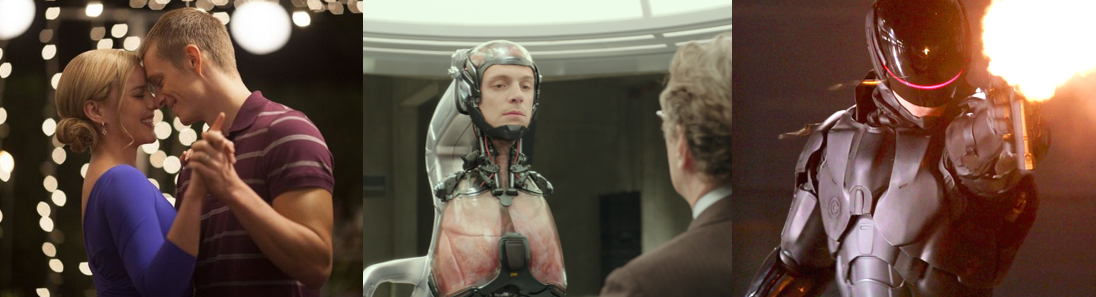
Despite OmniCorp making huge profits from their overseas ventures and the prosthetic research conducted by their chief scientist, Dr. Norton, Sellers is frustrated by Dreyfus’s bill and eager to capture a majority stakehold on domestic soil. Thus, to circumnavigate the specific wording of Dreyfus’ bill, Sellers brings in Dr. Norton and Tom Pope (Jay Baruchel) and Liz Kline (Jennifer Ehle), OmniCorp’s heads of marketing and legal affairs, respectively, to cook up a new “product” by placing a man inside a machine and therefore appease concerns. Although OmniCorp have a range of critically injured candidates and amputees to choose from, Dr. Norton rejects them on the basis that they lack the psychological strength to endure what’s essentially a horrendous full body prosthesis. Lucky for them, the perfect candidate lands in their laps when driven and determined cop Alex Murphy is horrifically injured in a car bomb courtesy of notorious drug dealer Antoine Vallon (Patrick Garrow). Like in the original film, we spend a bit of time with Murphy prior to his accident to get a sense of his character and learn that he detests crooked cops and is fixated on bringing down Vallon, even if it means going against the orders of his commanding officer, Karen Dean (Marianne Jean-Baptiste). Suspecting that Vallon has eyes and ears within the Detroit police department, Murphy limits his trust to his partner, Jack Lewis (Michael K. Williams) and is devastated when their unauthorised undercover operation ends with Lewis in hospital from a gunshot. Unlike in the original film, we see Murphy interacting with his wife and son, Clara (Cornish) and son David (John Paul Ruttan), seeing that Murphy’s a doting father and still has a close relationship with Clara, even if it seems strained by his work. Clara’s thus devastated to learn of Murphy’s critical condition, which would leave him deaf, partially blind, paralysed, and maimed, and covered in severe burns. It’s therefore out of sheer love and desperation (and a little coercion from OmniCorp) that Clara consents to have Murphy transformed into a cyborg, with Dr. Norton personally overseeing Murphy’s recovery. In easily the film’s most horrific scene, Murphy is horrified to learn what he’s become and almost demands to be put out of his misery, but Dr. Norton convinces him to keep going, if only for the sake of his family.

Murphy struggles to adjust to his newfound life, which brings him much pain and heartache.

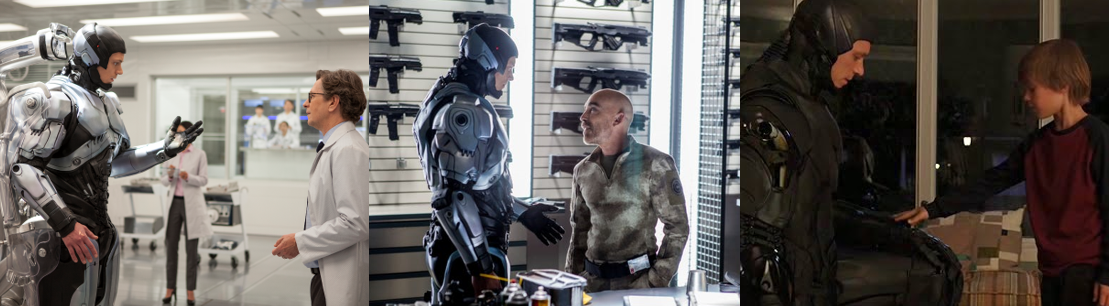
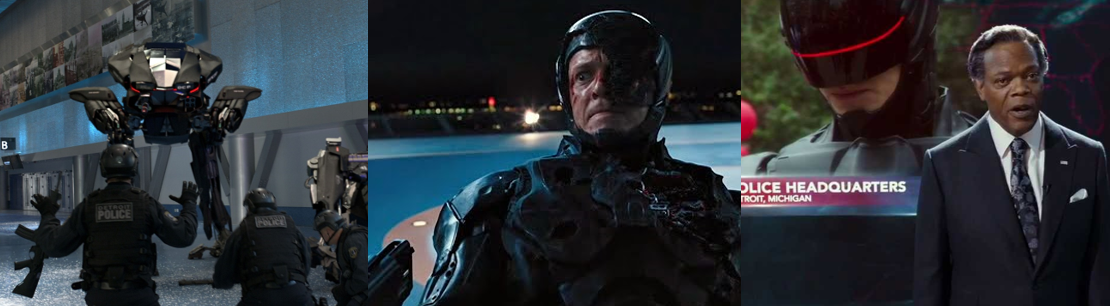
This version of RoboCop delves a lot deeper into the emotional and psychological turmoil faced by Murphy after his transformation. Stripped of 98% of his human anatomy and understandably distressed by his somewhat monstrous appearance, Murphy demands to never again be seen without his suit and battles depression, doubt, and sly persecution from Mattox, who scoffs at the idea of compromising a machine’s efficiency with organics and a conscience. Despite Dr. Norton’s pride in his work and faith in Murphy’s abilities, it turns out Mattox is right: murphy’s human instincts make him dramatically less efficient than the EM-208s. Unimpressed by what he sees as RoboCop’s “imperfections”, Sellers demands a workaround so he can sell RoboCop as a sleek, sexy, impressive product and Dr. Norton’s therefore forced to implant a new chip into Murphy’s brain. Now, when his visor goes down, RoboCop’s artificial intelligence takes over, though Murphy believes he’s in full control, thus appeasing Sellers and completely undermining the entire point of the project since it’s still a machine pulling the trigger. Then, to make matters even more laughable, Dr. Norton and his team decide the best time to upload the entire criminal database and internet access into RoboCop is right before his public unveiling, causing Murphy to have a seizure and forcing Dr. Norton to intervene again. This time, Murphy is practically lobotomized and little more than a cold, calculating machine with a human face (…and hand). Effectively reduced to the pragmatic, directive-compelled RoboCop of the first film, Murphy ignores social graces and his family in favour of hunting down Detroit’s most wanted. However, when Clara begs Murphy to come home and assuage David’s anxieties, Murphy’s human nature overrides his programming and drives him to get back on mission. Specifically, he accesses CCTV and other archives to not only uncover corruption in the police department that extends to Chief Dean, but also solve his own murder and finally bring Vallon to justice, though this defiance naturally leads him on to a collision course with OmniCorp.

While Vallon is forgettable, Sellers and Mattox are bolstered by strong performances.

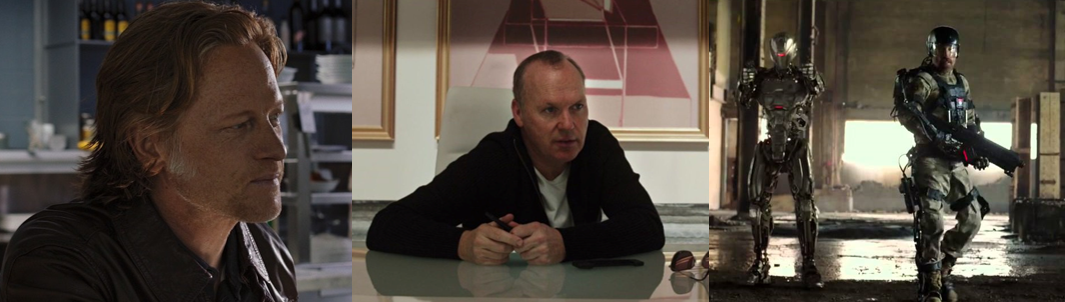
Far from a scheming conglomerate full of well-dressed executives looking to profit from Detroit’s misery, the new Omni-Consumer Products (OCP) is largely embodied by Raymond Sellers. A visionary entrepreneur, Sellers is a silver-tongued salesman who arrogantly ignores focus group feedback and pushes his own agenda for RoboCop, reasoning that people don’t know what they want until they get it and that simply placing a man in a machine and removing his humanity will silence his doubters and increase OmniCorp’s profits. Played with the perfect balance of charisma, smarm, and slimy superiority, Keaton presents Sellers as an industrious and charitable businessman who’s genuinely offering people a second chance through Dr. Norton’s robotics work and safeguarding American lives with his machines. However, behind all that is a corporate magnate who cares only about increasing his already considerable wealth. He makes promises to Clara that Murphy will be returned to them and then denies her access to him, threatening legal action if she speaks out; he disregards Dr. Norton’s frankly genius work and putting a career cop inside a machine in favour of stripping away Murphy’s instincts; and doesn’t hesitate to order RoboCop’s destruction once he’s outlived his usefulness. Indeed, when Murphy regains his humanity, Sellers simply spins a story about how Murphy’s suffered a psychotic break and his machine programming has turned him into a killer, despite such a story only working against the deployment of automations in the streets! While Sellers is eventually forced to get more hands on when he basically kidnaps Clara and David, Mattox isn’t afraid to test himself and his EM-208s against RoboCop. Derogatorily referring to Murphy as “Tin Man” and openly criticising him at every turn, Mattox relishes proving his superiority over RoboCop but is ultimately and ironically, undone by Murphy’s very human ally, Lewis. I enjoyed Mattox far more than Vallon, a crime boss who’s infiltrated the police department and whose grudge against Murphy causes RoboCop’s creation. A far cry from the wicked Clarence Boddicker (Kurtwood Smith), Vallon is basically an afterthought. There’s almost no catharsis when RoboCop catches up with him and I would’ve much preferred Mattox being given an expanded role as the one who injured Murphy to kick-start Sellers’ scheme.

The Nitty-Gritty:
Though RoboCop also has a distinctly loud and on-the-nose political agenda, it focuses all its satire into Pat Novak. RoboCop comments upon America’s perceived superiority over the rest of the world, the media’s flagrant bias towards far-right thinking, and touches upon prejudices. These are largely embodied by Mattox, who’s the only one who voices criticism of RoboCop, but also extends towards the foreign nations brought under heel by OmniCorp’s technology. RoboCop has always juggled themes of “man vs. machine” and questions regarding the human soul, and these elements return in this remake, where Murphy’s adjustment to his transformation is at the forefront. Unlike in the original films, where it’s ambiguous how much of Murphy is alive or just memories in RoboCop, this film explicitly states that Murphy is still alive and functioning, just without his biological body. His brain is now partially cybernetic, giving him unprecedented access to criminal databases, CCTV, and augmenting his strength and reflexes, but he’s not a “ghost in the machine”: he’s Alex Murphy with a full body prosthesis. Thus, Murphy reluctantly agrees to test his newfound cybernetic armour against the EM-208s and to reunite with his family, though he remains incredibly self-conscious and uncomfortable with his appearance. Although this RoboCop isn’t bound by directives, he can be remotely shut down and even have his will suppressed through procedures and programming, turning him into a stoic robot who effortlessly hunts down criminals. Yet, Murphy’s humanity and emotions are powerful enough to break this programming, reasserting his personality and compelling him to avenge his woes upon Vallon and confront the corruption in the police department. Despite him callously ignoring them, Clara and David remain devoted to Murphy and are distraught by OmniCorp’s lies. Placing additional emphasis on Murphy’s family was a nice touch, though he keeps his distance even before Dr. Norton suppresses his emotions simply because he’s uncomfortable in his new body and would much prefer to be dead. It isn’t until the finale, after reaffirming his humanity, that Murphy comes to accept his new life and be more comfortable around his loved ones.

The film relies more on slick visuals and emotional drama than over-the-top gore and action.

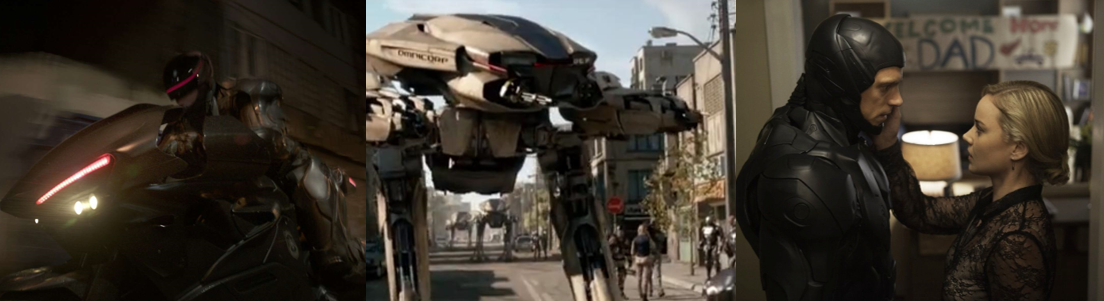
If you’re hoping for the same action-packed gore and gleeful cussing of the original, then I’m afraid you’ll be disappointed by this distinctly toothless remake. Murphy is caught in a car bomb rather than shot to pieces and RoboCop primarily fires a high-powered taser gun rather than blowing limbs off. RoboCop’s biggest action scenes also take place either in a virtual simulation or against automatons, severely reducing the film’s body count until Lewis joins him in busting up Vallon’s operation. On the plus side, RoboCop’s suit looks fantastic. While, at times, the illusion is lost, particularly when Sellers demands a black paint job, the initial suit is an impressive modern reimagining of the original. I particularly like the futuristic visor and the depiction of RoboCop’s helmet, which was the one inconsistency in the previous films, and Kinnaman’s movement in the suit. While he’s not as stiff and robotic as Peter Weller, Kinnaman still echoes some of that performance, especially when Murphy first wakes up and acclimatises to the suit. Once the AI takes over, RoboCop moves with a beautiful, fluid grace that shows the ghost of what this film wanted to be. While RoboCop rides around on an awesome motorcycle and sports an influx of visual aids, his black suit is really unfitting and makes him look ridiculously generic. He just looks like Christian Bale’s Bruce Wayne/Batman a lot of the time, which in turn makes the suit look fake and plastic-y. RoboCop does boast some impressive visual effects, however. The EM-208s look amazing, especially marching through the streets and when sparring with RoboCop, and the prosthetics seen in Dr. Norton’s lab are really well realised. The most impressive effect is saved for the unsettling scene where Murphy sees the full extent of his injuries, which have left him simply the remains of a head, a set of lungs, and a single hand. While the ED-209s lack the personality and clunky build of the original, they’re still an impressive walking tank and it was fun to see a troop of them in action overseas, and standing in RoboCop’s way in the finale. Sadly, RoboCop plays it far too safe regarding its action, sucking out all the gory fun and replacing it with a dull pace that really causes the film to drag. It doesn’t even use Basil Poledouris’ iconic score, save for the opening titles, favouring music by Pedro Bromfman that’s as generic and forgettable as the rest of the film.

Murphy ultimately overcomes not his programming and OmniCorp’s robots to assert himself.

After Murphy’s breakdown sees Dr. Norton suppress his emotions, RoboCop becomes a hit with consumers and the public, finally giving Sellers the sway to challenge the Dreyfus Act. However, when Clara gets through to Murphy and his humanity forces its way back into the spotlight, Sellers cuts his ties with the project and orders Mattox to destroy RoboCop, ready to sell the idea that Murphy suffered a psychotic break and died from a seizure. To keep Clara from publicly criticising OmniCorp, Sellers brings her and David in to the deliver the news, confident that he’s swayed Dr. Norton by promising to further fund his research, only for the remorseful doctor to betray him, remove Mattox’s ability to shut Murphy down, and reveal the truth to Clara. While Murphy is furious at Dr. Norton for having lied to him, he forces his way past ED-209s and Mattox himself, suffering tremendous damage in the process thanks to Mattox’s superior firepower. Thanks to the intervention of his fellow officers, particularly Lewis, RoboCop reaches the rooftop, where Sellers is preparing to escape (while still playing the benevolent role with Clara and David). Unfortunately, Murphy’s programming won’t allow him to arrest or harm Sellers, who openly taunts him, threatening to kill Murphy and his family and pointing out that Murphy can’t do anything to stop him since he’s “just a robot”. Despite the incredible pain and the forcefulness of his programming, Murphy asserts enough will to fatally shoot Sellers at the same time as the devious executive shoots him. It’s a very different ending to the original, where Murphy confidently confronted OCP’s executives and asserted himself. Here, Murphys “dead or alive, you’re coming with me” line barely makes any sense and, since he’s only kept from acting because of Mattox’s special wrist bands. It might’ve been better if Clara or David had rushed Sellers to rip this from him and give Murphy the chance to fire. Regardless, Murphy is repaired and placed back in a more fitting suit, now having accepted himself and ready to embrace his newfound life. Pat Novak, however, is incensed that a “Motherf*****” like Dr. Norton is walking free after he spoke out against OmniCorp to keep the Dreyfus Act alive, though he remains adamant in his belief that America is the greatest country in the world and that, one day, her citizens will see sense and allow robots to keep the peace through good, old fashioned fascist oppression.

The Summary:
I’ve been a fan of RoboCop since I was a little kid, when I first saw the movie and was wowed by its over-the-top gore and fantastical main character. As big a fan as I am of the sequel, even I have to admit that the franchise basically peaked with the first movie and it’s been downhill ever since. Thus, I was somewhat curious when the remake was announced and went to see it opening week simply because I’d never had the chance to see a RoboCop film in the cinema before. Unfortunately, RoboCop is as disappointing now as it was back then. The thing about remakes is, you kinda need to do something different with the concept to make it stand out, otherwise it just feels like a needless rehash. RoboCop tries to do something different by focusing more on Murphy, his struggle to adapt to his new life, and his family turmoil, but it’s lost beneath a middling plot, forgettable characters, and a truly uninspired design for the character. It’s such a shame as the suit does look good and Kinnaman moves really well in it, but then they paint it black and it becomes the most generic thing I’ve ever seen. As if lacking the gratuitous violence, blood, and cursing wasn’t bad enough, RoboCop is almost completely devoid of satire save for Pat Novak and the underlying hypocrisy of OmniCorp’s motivations. Admittedly, these elements have a scary relevance in modern times, where bias right-wing media spreads fear and hatred, but all the elements that made RoboCop fun have been as stripped away as Murphy’s body. I didn’t mind the deeper dive into Murphy’s acclimation to his new abilities, but the pacing flip-flopped all over the place between his emotions (or lack thereof). It’s almost criminal how unfulfilling Murphy’s vendetta against Vallon was and how wasted Mattox was by comparison. Hayley and Keaton stole the show here, playing their roles with joyful relish, but Kinnaman is no Peter Weller and this is no RoboCop. As a standalone sci-fi concept, it’s decent enough, but it’s called RoboCop and fails to be anything but a surface level rehash of the original film, with none of the fun or enjoyable elements to make it an instant classic or anything more than a footnote in the history of sub-par remakes.

My Rating:

Rating: 2 out of 5.

Could Be Better

Did you enjoy the RoboCop remake? Were you disappointed by how toothless it was? What did you think to the focus on Murphy’s emotional struggle and his family? Did you also find the film dragged or did you enjoy the slick action? What did you think to the new suit and RoboCop having a human hand? Which RoboCop movie is your favourite? How are you celebrating RoboCop Day today? Whatever you think about the RoboCop remake, feel free to drop your thoughts below, support me on Ko-Fi, and be sure to check out my other RoboCop content!

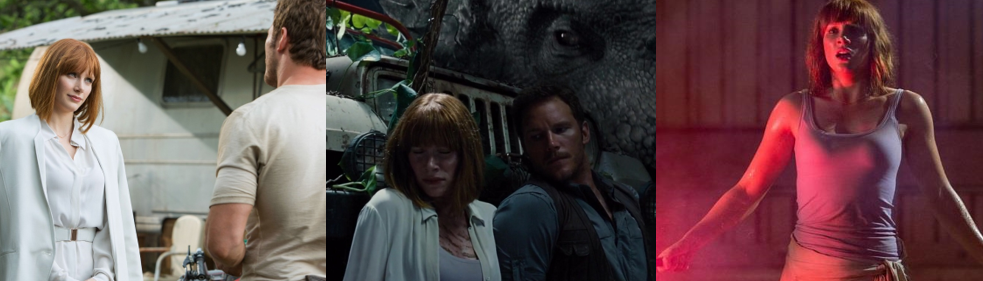
Movie Night [Dinosaur Day]: Jurassic World


Sixty-five million years ago, dinosaurs ruled the Earth. These massive beasts existed for about 180 million years before a cataclysmic event left them mere fossils. Fittingly, “Dinosaur Day” gives dino fans an ample opportunity to pay homage to these near-mythical titans.


Released: 12 June 2015
Director: Colin Trevorrow
Distributor: Universal Pictures
Budget: $150 to 215 million
Stars: Chris Pratt, Bryce Dallas Howard, Ty Simpkins, Nick Robinson, Vincent D’Onofrio, and Irrfan Khan

The Plot:
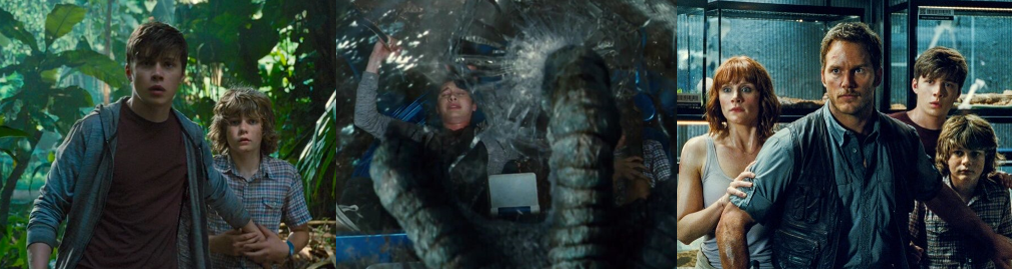
Brothers Zach and Gray Mitchell (Robinson and Simpkins) visit Jurassic World, an island theme park populated by dinosaurs. However, their workaholic aunt, Claire Dearing (Howard), is soon relying on unruly Velociraptor trainer Owen Grady (Pratt) when a genetically engineered dinosaur runs amok.

The Background:
Legendary director Steven Spielberg and special effects wizards Stan Winston, Phil Tippett, and Dennis Muren turned Michael Crichton’s bestselling Jurassic Park (ibid, 1990) into a pioneering blockbuster back in 1993. Although Jurassic Park made over $1.030 billion and received widespread positive reviews, Crichton and Spielberg were reluctant to work on a sequel. The Lost World: Jurassic Park (Spielberg, 1997) may have broken box office records but it garnered mixed reviews and, feeling he failed to match expectations, Spielberg passed on Jurassic Park III (Johnson, 2001), the lowest-grossing and least popular of the franchise. Development of a fourth movie can be traced back to 2001 and initial ideas involved dinosaurs migrating to the mainland and, bizarrely, genetically engineered human-dinosaur mercenaries. This evolved into a character who would train dinosaurs and, eventually, Owen Grady. Following numerous failed proposals, the writers turned to both Spielberg and Crichton’s The Lost World novel for further inspiration and references to the two sequels were downplayed. Colin Trevorrow was hired to direct, Stan Winston’s Legacy Effects studio was brought in to develop the animatronic dinosaurs, and Industrial Light & Magic handled the CGI. With a worldwide box office of $1.671 billionJurassic World was a major hit and successfully revitalised the franchise, leading to two more sequels over the next seven years. The mould was further broken with the film’s largely positive critical reception. Reviews praised the exciting plot, the magnetic performances, and the natural evolution of the original concept. Spielberg and Jurassic Park star Sam Neill also praised the film, though it did draw some criticism for its unnecessary violence against women and its narrative similarity to Deep Blue Sea (Harlin, 1999).

The Review:
It’s been some years since John Hammond (Richard Attenborough) first dreamed up the idea of Jurassic Park. By employing the services of arrogant geneticist Doctor Henry Wu (BD Wong), Hammond created an awe-inspiring theme park populated by rides, gift shops, and, obviously, genetically recreated dinosaurs. Of course, Jurassic Park proved to be a disaster; the Isla Nubar theme park was left to rot and the remaining dinosaurs were abandoned to die from “lysine deficiency”. Although Jurassic World plays it fast and loose with references to the previous sequels, it begins with Hammond’s dream of a dinosaur theme park finally made a reality. Having been bequeathed ownership of InGen and all its assets, including the park and Hammond’s ideals, billionaire tycoon Simon Masrani (Khan) successfully brought Jurassic Park to life with Jurassic World, an expansive and fully-functional corporate sponsored theme park literally built on the bones of the original. Children of all ages flock to Isla Nubar to see the prehistoric creatures roaming the forests and wilds of the island, petting and riding baby Triceratops and other herbivores like they were lambs, watching daily performances from the titanic Mosasaurus, and freely exploring herds of dinosaurs while learning from Jimmy Fallon (of all people) in the park’s advanced gyrospheres. An eccentric businessman who prefers flying helicopters and wowing visitors with bigger, better dinosaurs, Masrani is notably hands-off regarding the park’s day-to-day functionality. He isn’t overly concerned with the bottom line since he’d rather everyone, humans and dinosaurs alike, enjoy the spectacle, and therefore mindlessly orders bigger, “cooler” attractions from Dr. Wu. Accordingly, it’s up to workaholic Claire to oversee Jurassic World and make sure everything’s running smoothly from her control room. Aided by underappreciated Lowery Cruthers (Jake Johnson) and his unrequited crush, Vivian (Lauren Lapkus), Claire treats her job very seriously but also very callously. She isn’t concerned with the welfare of the dinosaurs or whether the guests are enjoying themselves. All she cares about is increasing profits, gaining additional sponsorship, and keeping everything running like clockwork.

Tight-ass Claire is forced to rely on others and realise what really matters when she loses control.

This means that, while she seems happy to see her nephews, Claire has no time to spare spending time with them and barely remembers their ages or what they look like when they ditch her overwhelmed assistant, Zara (Katie McGrath), in search of better, more exciting adventures. Claire’s noticeably uncomfortable in almost every social situation: she focuses on the numbers and practical matters, disregarding emotions and animal intelligence. Since Masrani ordered Dr. Wu to cook up a fantastic new attraction, Claire’s primary goal is securing sponsorship deals for the Indominus rex, a patchwork hybrid of numerous dinosaurs that Masrani hopes with “give […] parents nightmares” and reinvigorate ticket sales. Though impressed by the monster, Masrani requests that Claire ask their resident ex-Navy Velociraptor handler, Owen, to inspect the Indominus paddock and give his expert opinion. It’s through interactions with Owen that we see just how maladjusted Claire is: she brought an itinerary to their one disastrous date and is obsessed with being in control of every situation. She’s therefore as ignorant to the true threat the Indominus poses as she is to the feelings of others and the welfare of the park’s dinosaurs, which she constantly refers to as “assets” and “it” since they’re just numbers on a spreadsheet. When the Indominus escapes, Claire disregards Owen’s warnings and confidently deploys the Asset Containment Unit (ACU), only to be stunned when they’re systematically slaughtered. When Owen advises an evacuation of the park, Claire’s more concerned with their reputation than anyone’s safety and it takes a frantic call from her sister, Karen Mitchell (Judy Greer), and the suffering of the injured guests for Claire to finally realise the gravity of the situation. Her and Owen couldn’t be more different: where he’s sensitive and seasoned, she’s largely naïve and incompetent, especially regarding tracking and understanding dinosaurs. Owen frequently chastises her tight-assed demeanour and encourages her to just let loose, which eventually sees her defiantly shed her corporate outfit. She even saves Owen from a Dimorphodon attack and puts herself at risk to lure out the Tyrannosaurus rex in the finale…and all while wearing high-heels! Claire also prioritises Zach and Gray’s safety by the third act and is actively appalled by InGen’s head of security, Vic Hoskins (D’Onofrio), and his obsession with weaponizing Owens ‘raptors.

Zach and Gray must brave the park’s dinosaurs and draw strength from each other.

Much of Jurassic World focuses on Zach and Gray, two brothers with very different personalities. While Gray is younger and far more energetic, boasting an encyclopaedic knowledge of dinosaurs, Zach is sullen and moody and more concerned with staring at attractive girls. The two have been shipped to Jurassic World to see the awesome attractions and be with their aunt, only to be abandoned by Claire and left with a glorified babysitter, which only furthers their individual responses to their parents’ ongoing issues. While Gray is distraught at the idea of his parents getting a divorce, Zach hides behind an angsty bravado and is initially aggravated by his little brother’s exuberance, preferring to stare at his phone rather than dinosaurs. His mood lifts upon seeing the Mosasaurus and he encourages Gray to veer off when exploring in the gyrospheres, ignoring warnings to return to safety and stumbling upon the overgrown remains of the original park. Together, they get an old Jurassic Park jeep running and are stalked by the Indominus, eventually reuniting with Claire, who then makes them her top priority, and being immediately amazed by the charismatic Owen, who fends off the Pteranodon and Dimorphodon assault. While Zach doesn’t make a great first impression, being every moody teen you’ve ever seen, he soon shows a softer side and actively reassures and protects his little brother, recognising the danger and the trauma Gray’s feeling at both their personal and current situation. To be fair, Gray is irritating at times, constantly running around and babbling facts, but he embodies the excitement and wonder that Jurassic World elicits in its target audience. Unlike the kids from the first movie, who find a way to be useful by the film’s climax, Zach and Gray are mainly here to be put in peril and kept safe, but they go a long way to humanising Claire and showing the amusing dichotomy of Jurassic World. It’s amazing, yes, but there are some who are no longer impressed by genetically recreated dinosaurs and who demand “more teeth”.

Charismatic Owen impresses with his bad-ass attitude and ‘raptor buddies.

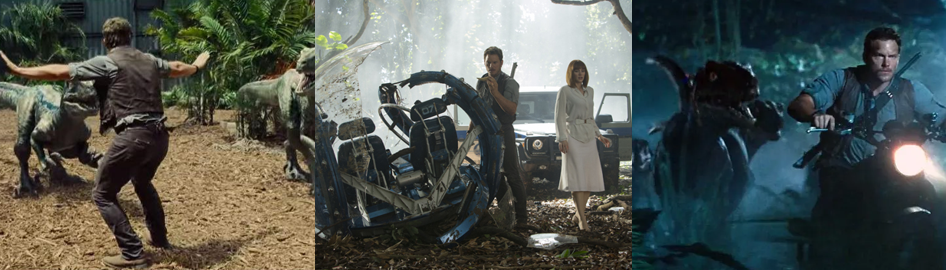
Luckily for Claire, Zach, and Gray, Owen is on hand to immediately recognise the potential and current dangers posed by the dinosaurs and to take charge of every situation. An ex-Navy veteran, Owen works with Barry Sembène (Omar Sy) to tame a pack of Velociraptors (of whom “Blue” is the favourite and most intelligent) to follow simple directions and commands. Unlike Claire, Owen fully understands and respects an animal’s intellect and needs, allowing him to subdue the ‘raptors as their “Alpha”. His skill impresses Hoskins, who believes this proves the creatures could be deployed as living weapons, despite Owen very emphatically stating that his relationship with the ‘raptors is tenuous. Though attracted to Claire and eager for her to stop being so uptight, Owen constantly clashes with her since she believes she has full control over every situation, meaning she doesn’t understand how dangerous and intelligent the Indominus is. Owen’s often at a disadvantage since Claire stubbornly refuses to divulge the exact genetic makeup of the Indominus, leading to many deaths (much to his anger) andhim temporarily losing favour with his ‘raptors since the Indominus turns out to have ‘raptor DNA. Owen also vehemently objects to Hoskins’ desire to employ the ‘rapors and a scaled down Indominus as military assets, only agreeing to his insane plan to have the ‘raptors hunt down the Indominus because they have no other choice. Hoskins sees Owen’s relationship with the ‘raptors and mistakenly, arrogantly, believes the creatures are tamed to be on “the same side” as him. Thus, he vastly underestimates the aggressive creatures and it costs him dearly, whereas Owen’s bond with Blue allows him to reaffirm his status as the ‘raptors’ Alpha by the finale. Unlike Claire, who thinks only about the park’s profits and reputation, Owen is in the business of saving lives. His demands to pull the ACU out are ignored, leading to their wholesale slaughter, and he actively braves danger to rescue Zach and Gray while also trying to keep his ‘raptors alive. The only exception to this rule is the Indominus, a creature Owen sees as an abomination that needs to be taken down as quickly as possible. He’s visibly distraught when the Indominus kills for sport and horrified by the reckless mad science used to create it, which practically guaranteed that it would endanger others.

The Nitty-Gritty:
It was amazing to see a fully functioning Jurassic Park onscreen, which added something new to the Jurassic formula. While Jurassic World touches upon many of the same themes as its predecessors (the moral debate of genetically recreating dinosaurs, discussions and depictions of nature vs. science, and dinosaurs going on a rampage), this had never been tackled in a fully populated theme park before. I loved how everyone accepted Jurassic World and flocked to see its attractions like it’s Disney World. While Owen and Masrani agree that dinosaurs are attractive enough, Claire and the Board disagree and constantly push for newer assets to draw in more visitors, even if it means building their own dinosaur. It’s an interesting position to take since Jurassic World is seen to be thriving; everyone there is having a great time and there’s no sense that they need anything more. This truly is John Hammond’s dream come to life, with dinosaurs performing shows and rides that take visitors into the dinosaur’s territory, though fully protected by seemingly impenetrable gyrospheres. Of course, just wowing the crowd isn’t enough, not for Claire and her bottom line and certainly not for Hoskins. I’ve always hated the idea of weaponizing dinosaurs; it seems like such a stupid thing to do, one guaranteed to backfire, and Owen echoes these sentiments. It’s outrageous to someone as seasoned as Hoskins would think dropping Velociraptors behind enemy lines would end well for anyone and it’s very satisfying seeing him get his comeuppance. It’s sad that so many lives are lost due to people disregarding Owen’s warnings, but it’s a harsh lesson about the reality of dealing with highly intelligent and aggressive predators. The Indominus goes on a slaughter, devouring humans and massacring an Apatosaurus herd simply to prove its dominance, and only Owen recognised its threat (sight unseen, I might add) since Masrani and Claire only cared about scaring and profiting from visitors, respectively. Jurassic World also reiterates the pseudo-science of its dinosaurs by bringing back Dr. Wu, an arrogant and selfish scientist who explicitly states that his dinosaurs have always been genetic monsters rather than 1:1 recreations. Dr. Wu also impassively reacts to the Indomonis’ rampage and various abilities since he was simply following Massani’s foolish demand for more awesome theme park attractions.

In a land where dinosaurs are theme park attractions, the Indominus rex reigns supreme.

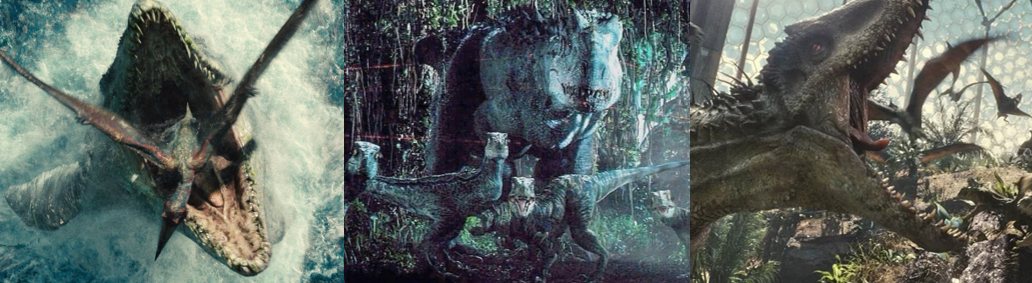
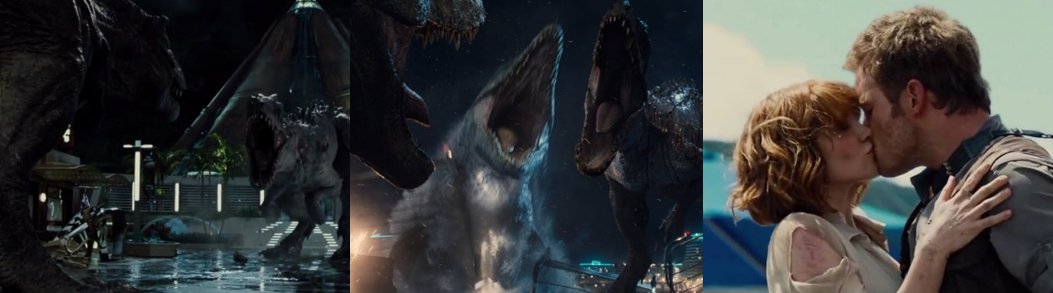
While Jurassic World stays close to the look and depiction of dinosaurs from the previous films, eschewing feathers and other scientific considerations, it does showcase a few new dinosaurs. The baby Triceratops were cute (though somewhat horrific as they’re resigned to a life of being manhandled by children) and I liked the Pteranodon and Dimorphodon attack. This is precipitated by the Indominus breaching their glass aviary and Masrani fatally crashing his helicopter into the structure, leading the flock of the ravenous, bat-like dinosaurs to cause mass panic. It was also cool to finally see an aquatic dinosaur; the Mosasaurus is initially introduced much like an orca whale, performing tricks and taking a subtle jab at Jaws (Spielberg, 1975) by devouring a Great White Shark. Naturally, the Velociraptors continue to be depicted as the most intelligent dinosaurs, though now somewhat tamed thanks to Owen. Mischievous and aggressive pack hunters, the ‘raptors obey Owen out of mutual respect but even he can’t turn his back on them and must be constantly on guard to admonish and reward them, as required. Hoskins sees unlimited potential in the creatures and relishes deploying them to hunt the Indominus, fitting them with night vision headsets and seeing them run alongside Owen’s motorcycle. Of course, the ‘raptors become a very real and horrifying threat when they’re swayed by the Indominus, leading Owen to put his knowledge to safeguarding others until he reasserts himself as the Alpha. Unsurprisingly, the Indominus rex is the star of the show here. Purposely portrayed as an exaggerated and ridiculous monster of a creature, the Indominus is like what you’d get if you asked a child to design their own dinosaur. It’s massive and aggressive like the T. rex, can camouflage and even mask its heat signature, and is as intelligent and swift as a ‘raptor, clawing out its tracking device, setting traps, and hunting for sport. It boasts massive, talon-like hands to grab and squeeze prey, easily devours humans whole, can breach the gyrosphere’s hull, and is largely immune to gunfire and even heavy explosives thanks to its super-tough hide.

After a big, brutal dino battle, the Indominus is bested and Claire learns to let loose a little.

Although Jurassic World is in complete disarray due to many of the dinosaurs being loose, the primary concern of everyone (including Hoskins) is the Indominus rex, whose rampage easily made Jurassic World the goriest of the films at the time. People are swallowed, bit in two, trampled, and crushed by its sheer, savage power, to say nothing of the dinosaurs it mauls simply for fun and Zara’s unnecessarily horrific death. After getting Zach and Gray to safety, Owen reluctantly leads the ‘raptors against the Indominus but is forced to flee when they switch their allegiance. Although Hoskins is killed by “Delta”, Dr. Wu safely escapes reprisals (and the island) with his research intact so that he can continue working on refining the Indominus rex concept. With the park’s visitors either safely evacuated or awaiting rescue, Owen and the others find their path to the docks blocked by the raging Indominus. Luckily, Owen restores his bond with Blue and the remaining ‘raptors leap to their defence; however, Gray calculates that the dinosaurs won’t stand a chance against the monstrous abomination. Thus, Claire steps up and has Lowrey release the aged T. rex (the same one from Jurassic Park, judging by its scars) and lures it to the Indominus for a quasi-Kaiju finale! Unlike the disappointing fight between the T. rex and the Spinosaurus, this is a brutal and violent clash that sees the two chomp on each other’s necks, slash great gashes in each other’s hides, and crash through the park’s buildings. It’s a fantastic visual metaphor for nature literally tearing down corporate greed and the two don’t hold back, being evenly matched at times in terms of power and ferocity. That is until Blue enters the fray and leaps to the T. rex’s aid, clambering onto the Indominus and causing it to stagger towards the edge of the Mosasaurus tank. Wounded and exhausted and with its two rivals closing in, the Indominus prepares to continue the fight (and, honestly, probably would’ve won) when it is suddenly set upon by the Mosasaurus, which drags it underwater and ends its threat. In the aftermath, the T. rex and Blue part as mutual allies and they (alongside the other dinosaurs) reclaim Isla Nubar. Though shaken by their experiences, Zach and Gray’s bond is strengthened and they’re tearfully reunited with their parents. Claire realises the error of her ways and apologises to her sister, before seemingly being ready to rekindle her relationship with Owen, who reluctantly allowed Blue to return to the wild where she belongs.

The Summary:
I was sceptical when Jurassic World was first announced. While I can understand the idea of doing at least one Jurassic Park sequel, The Lost World and Jurassic Park III failed to capture the magic of the original movie and I figured it was better to leave it lie. However, Jurassic World was just the shot in the arm the franchise needed. As a legacy sequel and part re-quel, the film does a great job of hitting upon the familiar story beats of the franchise while delivering something fresh and new: namely, a fully operational dinosaur theme park. This alone was an inspired idea and I loved the parallels to Disney World, the juxtaposition of wanting to maximise profits while also aweing visitors, and the idea that the world has accepted that dinosaurs are a thing now. Jurassic World certainly impresses with its many visual effects, which still hold up today and are largely on par with Jurassic Park’s. It’s helped that animatronics and practical effects are also employed wherever possible, but the scale of the chaos is beautifully brought to life here and more than makes up for the previous two sequels. While Claire and the kids could be annoying at times, that was the point: Claire’s character arc was learning that she can’t control nature and atoning for being such a workaholic and neglecting the things that matter, and the entire experience was designed to bring Zach and Gray closer together. Chris Pratt is such a magnetic presence here; Owen oozes cool, being both sensitive and bad-ass and stealing the limelight as the pro-active voice of reason. I really enjoyed his relationship with the Velociraptors and how they were recast as good girls (or, at least, anti-heroes), giving us familiar ‘raptor action but with a twist since they’re largely on “our side”. The Indominus rex was a ludicrous monster in all the right ways; its bevy of abilities and sheer ferocity make it the stuff of nightmares and I loved how this one abomination was enough to threaten the entire island. The last-minute return of the T. rex for an awesome dinosaur fight was spectacular as well and set a new standard for the franchise. I liked this film more than I expected when I first saw it and it’s stood the test of time since then, easily being the second-best film in the franchise after the first, the best of the sequels, and the best of the second trilogy.

My Rating:

Rating: 4 out of 5.

Great Stuff

Were you impressed with Jurassic World? Were you also sceptical of revisiting the franchise at the time? What did you think to Owen’s characterisation, his relationship with Claire, and his taming of Velociraptors? Were you glad to see a fully functioning dinosaur theme park at last? What did you think to the Indominus rex and its many abilities? Which of Jurassic Park’s sequels is your favourite and how are you celebrating Dinosaur Day this year? Whatever your thoughts on Jurassic World, and dinosaurs in general, leave them below and go check out my other dinosaur content on the site.

Movie Night: Thunderbolts* / The New Avengers

Released: 2 May 2025
Director: Jake Schreier
Distributor: Walt Disney Studios Motion Pictures
Budget: $180 million
Stars: Florence Pugh, Lewis Pullman, Sebastian Stan, David Harbour, Wyatt Russell, and Julia Louis-Dreyfus

The Plot:
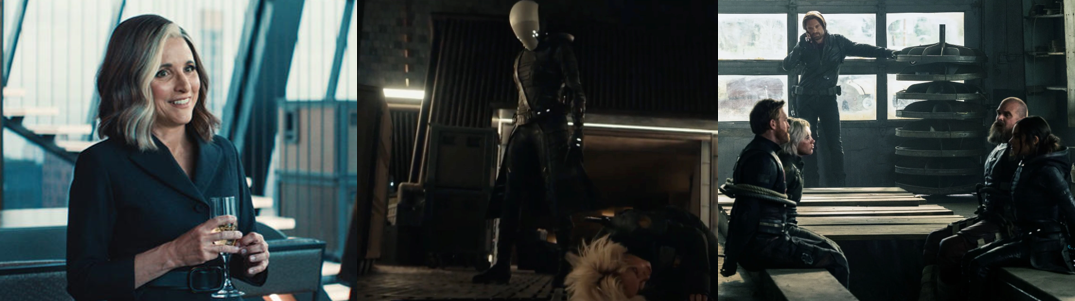
When Contessa Valentina Allegra de Fontaine (Louis-Dreyfus) seeks to erase the evidence of her malicious experiments, she unwittingly assembles a rag-tag team of losers and mercenaries, led by Yelena Belova (Push), to stand against her and her secret superpowered agent…

The Background:
Back in the nineties, Marvel Comics were not just in a financial state but the “Onslaught Saga” led to some of their most popular characters being presumed dead for a while. In their place, Peter David created an all-new superhero team, the Thunderbolts, who debuted in 1997 as typically excessive heroes who were secretly the villainous Masters of Evil in disguise. The idea of bringing this concept to the blockbuster Marvel Cinematic Universe (MCU) can be traced back to the production of Guardians of the Galaxy (Gunn, 2014) when director James Gunn expressed interest in a big-screen adaptation. Although the idea was shelved when Warner Bros. produced a similar concept, it regained steam when MCU projects teased Valentina assembling a team of anti-heroes and soon evolved into a starring vehicle for Florence Pugh. Once officially announced, a tumultuous development began as rumours and script rewrites did the rounds, drastically altering key plot points and surprisingly offing one of the main cast for shock value. Writer Eric Pearson was keen to introduce Robert “Bob” Reynolds, arguably Marvel’s most notable Clark Kent/Kal-El/Superman proxy, to tackle mental health issues like depression and addiction, with Lewis Pullman cast after scheduling conflicts forced Steven Yeun to back out. Much speculation surrounded the mysterious asterisk in the film’s title, which quickly saw Marvel re-branding the film to The New Avengers shortly after its release, as was always intended. While this bold decision divided some fans, Thunderbolts* was met with widespread critical acclaim and made over $382 million at the box office. Reviews praised the misfit action, Pugh’s elevation to a lead role, its exploration of depression, and the mixture of action and comedy, though many were dissatisfied with the unceremonious showing for Olga Kurylenko’s Antonia Dreykov/Taskmaster.

The Review:
Although the marketing for Thunderbolts* had me believe that Junior Congressman and ex-Winter Soldier James Buchanan “Bucky” Barnes (Stan) was the central character in this film, I was surprised and delighted to find that former Black Widow Yelena Belova takes the lead. In many ways, Thunderbolts* is as much a sequel to Black Widow (Shortland, 2021) as it is a continuation of The Falcon and the Winter Soldier (Skogland, 2021), reuniting Yelena with her eccentric and overbearing super soldier surrogate father, Alexei Shostakov/The Red Guardian (Harbour), delving a little more into Yelena’s backstory courtesy of some traumatic visits to a nightmare dimension known as the “void”, while also significantly building upon the character of disgraced military veteran and former Captain America turned hot-headed mercenary, John Walker/U.S. Agent (Russell). Still grieving the loss of her surrogate sister, Natasha Romanoff/Black Widow (Scarlett Johansson), Yelena begins the film in a place of apathy. Yelena now works as a black ops agent for Valentina, the director of the Central Intelligence Agency (CIA) who’s currently under heavy investigation regarding all her shady experiments and dealings. However, despite throwing herself into her work and being an accomplished assassin, Yelena is unfulfilled and bored with the day-to-day mediocrity of her assignments. Feeling directionless and empty, she attempts to find some direction by talking through her feelings with Alexei, a disgraced and overweight former Soviet hero who’s left living in squalor and running a limo driving service. Despite his significant fall from grace and his boisterous personality, Alexei emphasises that the greatest calling he ever had was being an adored hero and encourages Yelena to step out of her comfort zone and take on a more public, heroic role like her late sister. Though hesitant, Yelena decides to give it a shot, if only to change her daily routine, and Valentina agrees to reassign her if she completes one last job. Namely, the infiltration of a secret underground O.X.E. facility that’s in danger of being robbed (and thus exposing Valentina’s dirty secrets) by Ava Starr/Ghost (Hannah John-Kamen), a tortured soul who can become intangible for short bursts.

Although Taskmaster’s screen time gets cut short, Pugh steals the show with her layered performance.

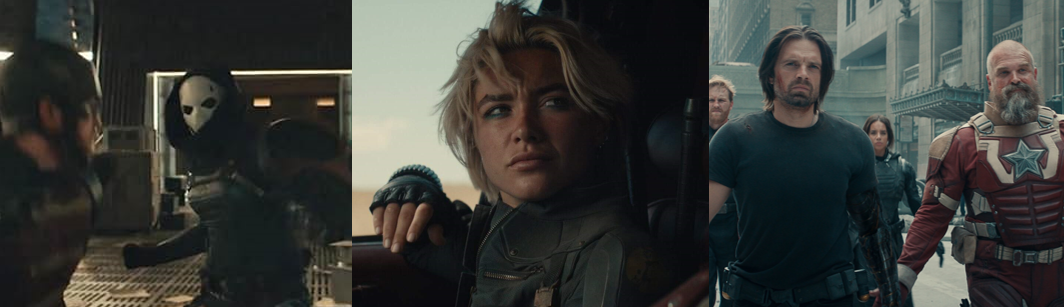
However, when Yelena accesses the facility, she’s blindsided by Walker, who’s been contracted to kill her. Walker’s then attacked by master fighter Taskmaster, who’s been hired to kill him, and a four-way melee kicks off as they try to take each other out. Though Yelena immediately sees they’ve all been double-crossed, it takes the sudden, dramatic, and down-right insulting execution of Taskmaster for the fighting to stop. Well, that and the strange appearance of the anxious, confused, and seemingly harmless Bob after he was accidentally released from stasis. Though the pig-headed Walker is reluctant to believe Valentina would turn on him, he’s forced to begrudgingly work with the others to escape the facility, which first threatens to incinerate them and then trap them forever. Despite none of them having the powers or equipment to scale the impossibly large shaft, Bob suggests they clamber up back-to-back and, despite Walker’s selfish arrogance, the group fumbles their way to the surface. Unfortunately, Valentina’s long-suffering assistant, Mel (Geraldine Viswanathan), alerts her boss to their actions – and Bob’s presence – meaning the group are met by a heavily armed response team. Thanks to masquerading as Valentina’s goon squad, the group slip past the barricade, but the grateful and kind-hearted Bob decides to risk his life by covering their escape, resulting in him being peppered by bullets. Instead of dying, he emerges unscathed, blasts into the sky, and crashes to the ground with a massive explosion, inadvertently giving his newfound acquaintances the chance to escape and placing him in Valentina’s excited hands. Thanks to having chauffeured Valentina and Mel, Alexei races to retrieve them and excitedly encourages them to stick together as a team, accidentally nicknamed “Thunderbolts” after a passing mention of Yelena’s school sports team, though the group are less than enthusiastic about working together and are visibly disgusted at having had to rely on each other for so long.

Emotionally damaged Bob turns out to be perhaps the greatest threat the world has ever known…

While all this is going on, Bucky seeks to uncover concrete evidence to expose and impeach Valentina, working his charm on Mel to get the inside track and racing to rescue the group when Alexei’s limo is attacked. Despite Alexei’s joy at meeting a Soviet hero and fellow super soldier, Bucky takes no chances and binds the group, seeking to have them testify against Valentina, but is forced to cut them loose and join forces with them when Mel corroborates their wild claims about Bob. As indicated by paperwork found in the facility, the seemingly unassuming Bob is actually a neurotic and emotionally unstable drug addict and survivor of horrific childhood abuse who, in a desperate attempt to feel powerful and significant, signed up to one of Valentina’s secret drug trials. While all the other subjects died, Bob became a full-blown indestructible superman, capable of flight and exhibiting awesome psychic powers, though his dark side also received a superhuman boost. With a touch, or at his command, Bob sends targets to the void, a dark dimension where they relive their most painful memories. However, Valentina brainwashes Bob with platitudes and strokes his fragile ego, promising to make him the world’s mightiest superhero in the absence of the Avengers and having him become the Sentry. While Bob is reluctant to turn on his newfound friends, he embraces the chance to be more than an insignificant nobody, but quickly becomes drunk on his power, rejecting Valentina’s orders and seeking to take the world for himself. While Mel puts the Sentry down with a kill switch, this merely suppresses Bob’s neurotic (but nonetheless harmless) personality and unleashes his dark side, the Void, who impassively terrorises New York City to plunge humanity into a glorious nothingness. Despite being powerless against the Sentry and going their separate ways, the chaos inspires the reluctant Thunderbolts to save civilians and rally against the Void, with Yelena desperate to appeal to Bob’s humanity by willingly returning to the void and facing his dark past.

While Valentina is a deplorable puppet master, the misfit team is their own worst enemy.

Although Valentina is gleefully presented as a despicable and thoroughly unlikeable villain, I do think she suffered from not featuring more prominently in previous Marvel movies as a dark counterpart to Nick Fury (Samuel L. Jackson). Luckily, the titular Thunderbolts are all largely dislikeable or morally dubious characters and their bickering and in-fighting means they’re their own worst enemies. Indeed, it’s only the fact that they have a common enemy that the group sets aside their egos and dislike of each other to even work together, though Bucky and Alexei go a long way to galvanising the team. Still, “dysfunctional” is putting it mildly when it comes to these guys, especially considering how abrasive and unlikeable Walker is. His temper and arrogance paint him as a typical jock, but he undergoes a surprising redemption arc throughout as he tries to atone for his past and turn his life around. Though sadly not featured as prominently as she should be, Ghost seems to carry some guilt about murdering Taskmaster and, despite frequently clashing with Walker, sticks with the group simply because she’s lived so much of her life alone. As Alexei observes, Yelena feels the same emptiness lifted thanks to the team’s presence. Despite them constantly butting heads, she takes a leadership role and is constantly the voice of reason amongst them, pushing them to focus on their true enemy and to do some good for a change. Naturally, Alexei enjoys the chance to be a hero once more and Harbour’s enthusiastic and bombastic energy really cements Thunderbolts* as one of the best MCU movies of the modern era. Finally, there’s Bucky, a guy who seems uncomfortable in his political role and who immediately reverts to type the first chance he gets. Without a doubt, though, this is Bob’s show as, through him, the MCU tackles the serious and soul-crushing weight of abuse and depression and forces it to the forefront as he discovers, masters, and then loses himself to his incredible powers.

The Nitty-Gritty:
Unfortunately, despite the film’s marketing, Taskmaster really got the shaft here, she appeared onscreen for one fight, gets one line, and then is suddenly executed with little to no fanfare. Yelena basically shrugs it off since she’s so impassive and Taskmaster is barely brought up afterwards, which is a shame as her new suit was cool and I would’ve liked to see her character get a shot at redemption. They could’ve at least had her live until the team escaped the facility, perhaps have Bob accidentally obliterate her in his first unexpected show of power. Similarly, I’m not sure what the benefit of having Bucky be a congressman was if it was going to be dropped immediately. Nothing he did tied into that role and he could’ve worked Mel and helped his fellow congressman (Wendell Pierce) without having a political role. While it was also a shame we never got to see how the others fared in the void, it did provide some additional tragedy to Yelena (who was forced to see her fellow Black Widow recruits tortured and killed during her training) and touched upon the shame that fuels Walker and explains his brash personality. The void truly shines when exploring Bob’s traumatic past, however, as Yelena witnesses Bob’s father emotionally and physically abuse him, his drug addict mother shun him, and briefly witnesses his own struggles with addiction. When in his default personality, Bob talks about how he sometimes has highs and then suffers crushing lows that drove him towards drink and meth but also, seemingly to the point where he didn’t care if he lived or died. This led him to Valentina’s “Sentry Project”, which remarkably made him everything she hoped for, but also empowered his dark thoughts and made him extremely emotionally unstable. Seeing Bob wallow in his childhood bedroom (the quietest, nicest room in the void as long as you don’t mind seeing and hearing your parents fight and belittle you) was heart wrenching and Pullman really ran the gamut of emotions in his portrayal of Bob.

Amidst the action and banter, there’s a chilling and emotional exploration of depression.

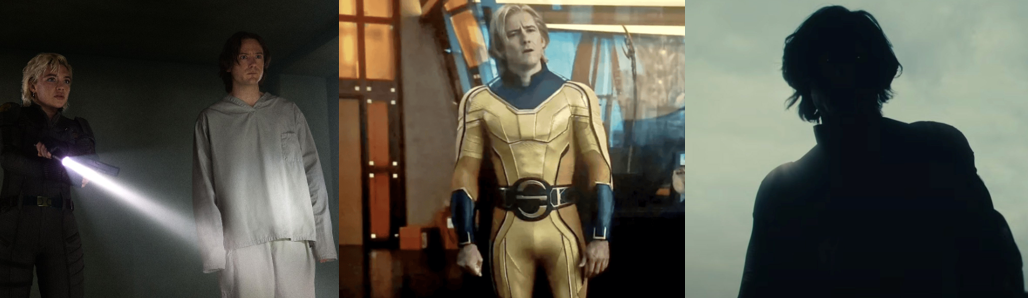
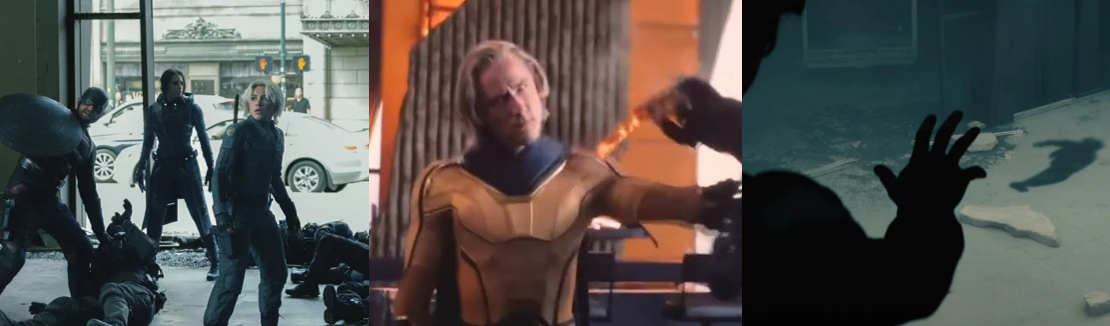
This culminates in a spectacular (if brief) display of power from the Sentry in the former Avengers Tower. Garbed in a golden outfit and showcasing superhuman speed and strength, the Sentry easily overpowers his friends, with even the super soldiers barely making Bob flinch and him overwhelming them all while appearing bored. His transformation into the Void is equally impressive, with Pullman being enveloped in darkness. He speaks in a hushed, impassive tone, with only his silvery eyes glittering from the darkness, and sends targets to the void with a wave of his hand in a chilling visual. While much of Thunderbolts* revolves around the rag-tag team trying to co-exist without killing each other, the group finds a common language in combat. Despite them all pretty much just punching and shooting, each brings something a little different, such as Walker wielding his shield, Bucky utilising his mechanical arm, and Ghost phasing in and out of reality. Although Walker scoffs at Yelena taking charge of the group and a combination of bad luck and miscommunication means their plans often fail or quickly fall apart, the group fights well together. Crucially, when the Void envelops the city, these largely selfish anti-heroes don’t hesitate to jump in and save who they can, leading the crowd to safety and earning their appreciation, much to Alexei’s delight and the others’ surprise. Action-packed moments like Bucky’s Terminator 2: Judgment Day (Cameron,1991) style motorcycle intervention, the team storming Valentia’s tower, and their ill-fated showdown with the Sentry are juxtaposed with some fun humour and banter and some poignant moments, particularly between the grieving and emotional Yelena and Alexei. Angry at her “father” for not staying in touch more and still struggling after Natasha’s death, Yelena breaks down in Alexei’s arms at how lonely she is and he does his best to comfort he, just as Yelena finds a kindred spirit in Bob, whom she senses is both lonely and damaged and in need to help and reassurance.

These unlikely heroes step up to meet the challenge when the Void engulfs the city in darkness.

This, as much as her inherent heroic nature, is what drives Yelena to stop running from the Void and willingly return to his dark dimension. There, she ignores her own traumatic past and desperately searches for Bob, eager to appeal to his reason, and discovers the sheer depth of his emotional trauma. Having resigned himself to the void and feeling as powerless to fight it as he was to stand up to his parents, Bob is reluctant to stand against his dark side and, though bolstered by Yelena’s genuine concern, is touched when the rest of the team brave their nightmares to reunite with them. At Yelena’s suggestion, Bob brings them to the worst “room” in the void, the place where he was transformed into a superhuman, and the team discovers that the effect on his psyche was near instantaneous. They also encounter the Void, a spiteful and all-powerful force that belittles Bob, tortures his friends, and maliciously mocks Bob’s insecurities. When Bob lashes out in anger, attacking the Void and mercilessly beating him, Yelena sees that this threatens to erase his compassionate side altogether and, despite the environment itself trying to stop her, she rushes not to stop or kill Bob, but to embrace him. The others do the same, embracing their damaged comrade and affirming their belief in him and their showcase of affection is enough to quiet the Void, returning everyone lost to the darkness and leaving Bob seemingly with no memory of what happened (and, sadly, no longer wearing his awesome Sentry suit). In the aftermath, the group seeks retribution upon Valentina, only to be blindsided when she leads them into a press conference and introduces them as the New Avengers. Though Valentina’s dismayed when the group begrudgingly accept the moniker (and when Yelena asserts dominance over her), she accepts the compromise as it means she can remain in a position of power. Unfortunately, the credits and post-credit scenes immediately deride the unlikely new Avengers, with headlines and news stories questioning them and even Sam Wilson/Captain America (Anthony Mackie) said to be suing them over the name! Still, the team relishes the chance to prove their credentials when they receive word of a strange, extradimensional craft entering Earth’s atmosphere…

The Summary:
I purposely avoiding using any spoiler warnings for this film, and including both titles, since Marvel Studios let the cat out of the bag just a few days after its release. While I was surprised to see the team be revealed as the New Avengers, it was a pretty fun way to end the movie, though I do wonder how prominent the team will be in the sixth phase of the MCU considering how packed the slate is. Regardless, Thunderbolts* was a surprisingly good time. I say “surprisingly” as the team has very little to do with their comic book counterparts and I wasn’t expecting all that much of it, especially after we had two similarly themed DC movies, but it turned out to be very entertaining and surprisingly touching. As a deconstruction of mental illness, Thunderbolts* (more specifically Lewis Pullman) knocks it out of the park, with Bob perfectly encapsulating the insecurities, incredible highs, and soul-destroying lows of depression. While he’s apathetic as the Sentry, Bob is chillingly impassive as the Void and so powerful that he completely neuters his more reasonable side. I also loved how Yelena came to the forefront here as a leader and her own search for meaning, and the evolution of her relationship with Alexei. While it was a damn shame Taskmaster got shafted, I would’ve liked to see Valentina used more leading up to the film, and I was hoping for more Bucky, I really enjoyed the dysfunctional team dynamic and how even an asshole like U.S. Agent could turn his life around with the right motivation. Thunderbolts* was a definitely step in the right direction for the MCU and I’m excited to see how its events will impact future MCU movies, especially regarding the Sentry, and I would absolutely say it’s a must-see for fans of this sprawling cinematic universe.

My Rating:

Rating: 4 out of 5.

Great Stuff

What did you think to Thunderbolts* and the surprise reveal of the film’s true nature? Were you disappointed that a more comic accurate team wasn’t used? What did you think of the unceremonious execution of Taskmaster? Were you impressed by the Sentry and the film’s discussion of mental health? What do you hope is next for the team in the MCU? Tell me your rating of Thunderbolts* in the comments, support me on Ko-Fi, and go check out my other Marvel content.
Movie Night [Dragon Ball Day]: Dragonball Z: Super Android 13!


DragonBallDay

When the Great Demon King Piccolo was released, he declared May 9th as “Piccolo Day”…and promptly celebrated by announcing his ownership over the planet. May 9th has seen been coined “Goku Day” but, to make things simpler, I’m using this as a good excuse to celebrate all things Dragon Ball.


Released: 11 July 1992
Director: Kazuhito Kikuchi
Distributor: Toei Company
Budget: ¥25.5 billion
Stars: Sean Schemmel, Christopher R. Sabat, Eric Vale, Chuck Huber, Chris Rager, and Josh Martin

The Plot:
Son Goku (Schemmel) and his friends are torn from a peaceful day when androids wreak havoc in the name of the Red Ribbon Army. Overwhelmed by their vast power, the Saiyans and their allies face a greater threat when Android #13 (Huber) absorbs his comrades and becomes a nigh-unstoppable superpowered being!

The Background:
Inspired by Journey to the West (Cheng’en, 1592), Akira Toriyama’s Dragon Ball first appeared in the pages of Weekly Shōnen Jump back in 1984 and centred around Goku, a boy with a monkey’s tail and exceptional martial arts skills who got into all kinds of scrapes searching for the seven magical Dragon Balls. While Dragonball Z added a more science-fiction spin to the lore, it often referenced Goku’s early days, with perhaps one of the most notably recurring elements being the Red Ribbon Army. With Goku having achieved incredible power during his outer space adventures, he returned to Earth to face an Android threat as his old enemies sought revenge, birthing one of Dragonball Z’s most celebrated story arcs. These “Sagas” heavily inspired the feature-length spin-off films, which were mostly produced without Toriyama’s direct involvement and therefore played fast and loose with established canon. For Super Android 13!, a truncated version of the “Android Saga”, Toriyama was brought onboard to design the titular Android and the film was met with mixed to positive reviews that particularly highlighted the high-octane fight sequences. Though the film isn’t canon to the mainstream Dragon Ball narrative, Super Android 13, like many of the movie characters, went on to reappear in subsequent Dragonball Z videogames.

The Review:
Taking place in a strange, impossible gap between the end of the “Android Saga” and the start of the “Cell Saga”, Super Android 13! opens with a gory retelling of the last days of Doctor Gero/Android #20 (Martin), the mad scientist behind the creation of the Androids. Slaughtered by his teenage creations, who decimated the world in a possible future timeline, Dr. Gero’s mad ambition to kill Goku lived on in his supercomputer, which continued to analyse the fighting data and capabilities of Earth’s defenders and create newer, stronger Androids. Two of these, the diminutive Android #15 (ibid) and the hulking Android #14 (Rager), are unleashed and immediately make their way to West City and cut a path through buildings, traffic, and civilians alike in their search for their primary target: Goku. In many ways, Goku welcomes this attack since he begins the film bored out of his mind and perplexed by his overbearing wife, Chi-Chi (Cynthia Cranz), and her obsession with shopping. Summer school starts tomorrow and Chi-Chi is determined for her young son, Son Gohan (Stephanie Nadolny), to look his best and force her husband out of his tired old gi. While Goku and Gohan are dragged between shops and forced to carry Chi-Chi’s many shopping bags, Oolong (Brad Jackson), Master Roshi (Mike McFarland), Krillin (Sonny Strait), and Future Trunks (Vale) patiently wait in line for a beauty pageant. Judging by Future Trunks’ appearance, he hasn’t trained in the Hyperbolic Time Chamber, yet his very presence suggests whereabouts this movie is supposed to take place within the wider canon, even if it clearly doesn’t fit due to the timeline. Regardless, poor Trunks is left embarrassed and humiliated by his companion’s perverted excitement at seeing the pretty girls and the fact that they arrived a whole day too early! The two groups reunite soon after and, while eating lunch, become aware of the city being under attack.

The three Super Saiyans are in for the fight of their lives when three new Androids attack.

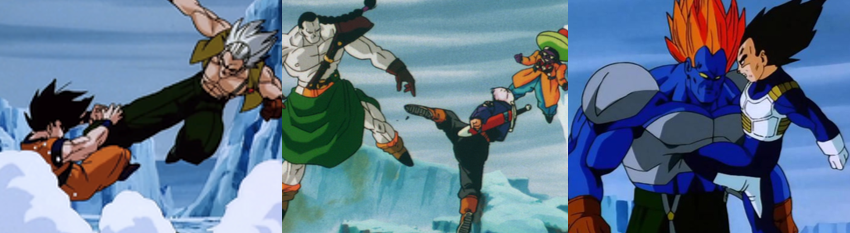
Though Gohan, Krillin, and Trunks get Chi-Chi and the other civilians to safety, Goku is stunned when Androids #14 and #15 attack, pummelling him with their augmented strength and speed and gaining the upper hand since, as artificial lifeforms, Goku cannot sense their ki. Additionally, these Androids also absorb any ki blasts sent their way, drawing power from them and answering with explosive, often homing shots of their own. Overwhelmed, Goku is only saved from an early death by Trunks’ intervention and the young time traveller wisely suggests they lure their assailants away from the city so they can fight without endangering others or causing more destruction. Goku agrees and moves the fight to a faraway ice field and, naturally, Gohan eagerly follows. Though Krillin advises against it, believing they are outclassed, and Chi-Chi forbids it, Gohan leaves anyway and Krillin’s forced to follow, though the two are primarily onlookers. However, while also serving as comic relief at times, delivering exposition, and emphasising Goku’s incredible strength of will, the two also throw themselves in harm’s way to buy their allies time to recuperate. They’re bolstered by the eventual appearance of Piccolo (Sabat), Gohan’s surly mentor and surrogate father-figure, who interjects himself in the fight. Oddly, neither Goku or Trunks think to transform into their more powerful Super Saiyan forms until they’re saved by Vegeta (ibid), the proud Saiyan prince who begrudgingly aids them so he can have the pleasure of killing Goku himself. Headstrong and arrogant, Vegeta throws himself into the fight, turning Super Saiyan to match blows with and eventually destroy Android #15. Similarly, Trunks cuts Android #14 down to size but the fight leaves all three Saiyans severely beaten and unable to sustain their Super Saiyan forms. Thus, they’re left at a severe disadvantage when Android #13 enters the fray and proves to be enough more formidable, especially after echoing his successor, Cell (Dameon Clarke), and absorbing the component parts of his “brothers” to become the titular Super Android #13.

The Nitty-Gritty:
The three Androids exhibit some interesting quirks. Android #15 is small but deceptively strong and fast, displaying a sneering arrogance, and regularly swigging from a flask. Android #15 is a hulking brute who distracts the heroes with his powerful presence so Android #15 can catch them off-guard. Android #13 has an odd Southern accent; sporting a relaxed, unimpressive attire, he transforms into a grotesque demon that’s like a bastardisation of the Super Saiyan. As Super Android #13, he’s completely immune to all physical assault and he easily pounds the Saiyans into the ice, blasts them across the snow, and holds his own against even three Super Saiyans. Unlike in the show, none of the characters carry restorative Senzu Beans so they take a hell of a beating. Just defeating Super Android #13’s counterparts takes every ounce of energy the Saiyans have, leaving them exhausted and battered. It’s thus amusing to see Piccolo fly at Super Android #13 with such gusto.I admire his passion and bravery but it’s clear he has no chance against the brute, who can take a shot from Super Saiyan Vegeta without flinching. This determination is what’s primarily on offer in Super Android 13! Goku takes shot after shot and keeps getting up, Krillin is left a broken heap but still cheers on his friends, and Vegeta stubbornly refuses to back down even when he knows he has no chance of winning. Sadly, they reach this critical point far too quickly; once the Androids attack, the heroes are almost immediately left battered and fatigued, meaning the film rushes along at a brisk pace that defies realism.

The film’s a prolonged fight scene that puts our heroes at a severe, unrealistic disadvantage.

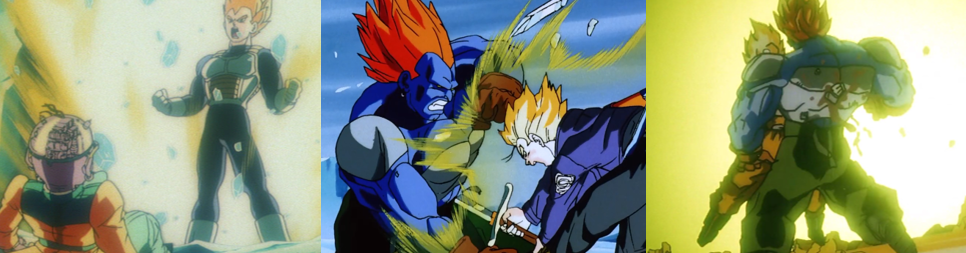
Therefore, Super Android 13! is essentially one long fight scene. Once the shopping drama is over and the punches start throwing, the exhilarating action doesn’t let up. The Androids carve a path of destruction through West City and their battle in the ice field shatters the landscape that, sadly, doesn’t make for a particularly visually interesting setting. The Androids mostly rely on punches and slams, though there’s a cool moment where Android #14 slices a cop car in two with a fingertip blast and a particularly nasty ki sphere from Android #13 that’s given a lot of hype but is easily blasted away by Vegeta. Other cool moments include Super Android #13 slamming Vegeta’s spine down on his knee, Android #14 briefly wielding Trunks’s sword, and Goku’s powerful rage causing a vortex to split the battlefield ice floats. While the sight of the three Super Saiyans is admittedly impressive, they don’t fight Super Android #13 as a powered-up unit, meaning much of the film is the titular robot beating the snot out of Goku in his base form. Realising he’s physically outclassed by this new machine, Goku desperately calls upon every living creature on the planet to lend him some of their energy and form his usual solution to the movie-based villains: the Spirit Bomb. Despite Super Android #13 having all the time in the world to intercept Goku before he can finalise the attack, the villain gets distracted with monologuing and pitiful attacks from Goku’s allies, and arrogantly believes Goku’s too weak to complete the sphere. However, Goku powers up to Super Saiyan once more and, in an unexpected twist, absorbs the Spirit Bomb into his body, essentially becoming a second Sun. He then draws Super Android #13 in and delivers a single punch that’s enough to atomise him by the sheer energy of the attack. In the aftermath, Goku jokes about how he had no idea if his body could even handle the energy, indicating that he took a calculated risk, Gohan and Krillin rest up in the hospital, and Piccolo and Vegeta are left floating on a chunk of ice, both too stubborn to even acknowledge each other’s presence.

The Summary:
Dragonball Z: Super Android #13 was the first Dragonball Z feature I ever saw. Back in the days of BitTorrent and Napster, I would download the features to watch them, burning them to VCDs to trade with friends, and this one captured my imagination as a kid who was just getting into the franchise mid-way through the “Android Saga”. Unfortunately, I have to say, it’s not that good. The Dragon Ball features are always brisk, truncated affairs that mainly focus on action but it’s especially evident here. It’s odd seeing these powerful characters so easily manhandled and left so injured so quickly. I feel like the film would’ve benefitted from Goku, Trunks, and Vegeta having competitive fights against Android #14 and #15 but coming out on top much faster thanks to their raw power and previous experience fighting Androids. Android #13 then could’ve appeared even more powerful by handling all three Super Saiyans at once before transforming and becoming invulnerable, thus driving Goku to desperately conjure a Spirit Bomb after seeing their combined might fail. I therefore wonder if Gohan, Krillin, and Piccolo were necessary to the film. They chipped away at the runtime and added little beyond some obvious commentary, dialogue that could’ve easily been given to the Saiyans or their adversaries. To make matters worse, Super Android #13 isn’t a very inspired or memorable villain. Both his looks are painfully generic, his attacks are nothing special, and he wouldn’t stand out at all if it weren’t for that weird Southern accent. As soon as the film starts to get interesting, it’s over and things come to an abrupt end, making me question the stakes, especially as the Androids are only driven to kill Goku. I give it an extra star simply for the nostalgia factor but there are far better Dragonball Z features out there. Ultimately, I can’t help but feel like Super Android 13! fails to live up to its potential, delivering a weak, unremarkable reinterpretation of the “Android” and “Cell” sagas.

My Rating:

Rating: 3 out of 5.

Pretty Good

What did you think of Dragonball Z: Super Android 13!? Where does it rank for you against the other Dragonball Z feature films? What did you think to Android #13 and where would you rate him as an antagonist? Would you have liked to see the three Super Saiyans battle Super Android #13 or did you like that they were so easily decimated? Which member of the Red Ribbon Army was your favourite? What Dragon Ball character (hero, villain, or otherwise), saga, or movie is your favourite and why? How are you celebrating Piccolo/Goku Day this year? Whatever your thoughts on Dragon Ball, please leave a comment below and go check out my other Dragon Ball reviews.

Movie Night [Alien Day]: Alien Resurrection: Special Edition


Audiences were first introduced to the horrific, biomechanical Xenomorphs in the classic science-fiction horror film Alien (Scott, 1979), in which an unsuspecting cargo crew investigates a beacon on the barren world of LV-426. Thus, the 26th of April is widely celebrated as “Alien Day”, a day to celebrate one of the greatest sci-fi/horror franchises ever created.


Special Edition

Released: 2 December 2003
Originally Released: 26 November 1997
Director: Jean-Pierre Jeunet
Distributor: 20th Century Fox
Budget: $70 million
Stars: Sigourney Weaver, Winona Ryder, Tom Woodruff Jr., Ron Perlman, J. E. Freeman, and Michael Wincott

The Plot:
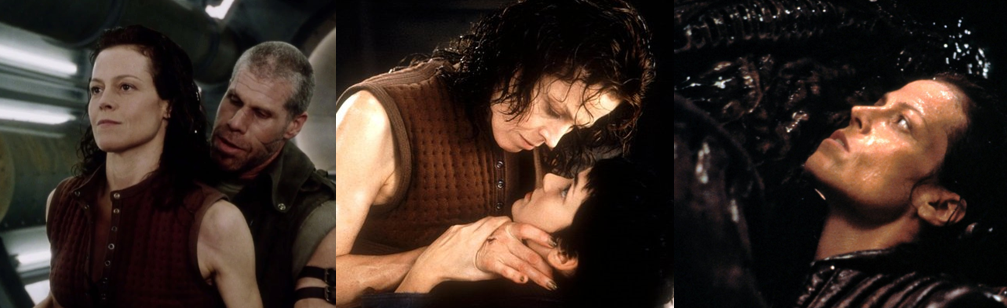
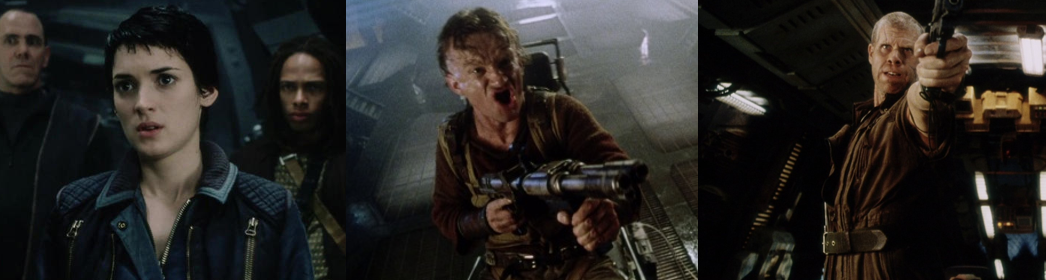
200 years after dying in battle with the Xenomorphs, Lieutenant Ellen Ripley (Weaver) is resurrected as an Alien/human hybrid, “Ripley 8”. Her memories fragmented, she teams with a rag-team crew of pirates to battle a renewed Xenomorph threat, one born of her own blood.

The Background:
In 1979, Dan O’Bannon and Ronald Shusett’s concept of “Jaws (Spielberg, 1975) in space” came to horrific life with Ridley Scott’s Alien, a surprising commercial success now regarded as one of the greatest movies ever made. Despite being a financial success, we wouldn’t see a sequel for seven years. Director James Cameron, Aliens (ibid, 1986) endured a difficult shoot to produce perhaps the most influential entry in the franchise. The studio’s desire to capitalise with a third film led to an extremely troubled production; though Alien³ (Fincher, 1992) was a modest hit, it was met with mixed reviews and even those involved disowned the film. Not long after, 20th Century Fox hired Joss Whedon to pen a script treatment for a fourth film, though many of his ideas didn’t make it to the final draft. Despite having advocated for Ripley’s death, Sigourney Weaver was impressed with Whedon’s work and signed on, eager to dissuade the studio from producing a crossover with the Predator films (Various, 1987;1990) and receiving a co-producer credit. Although names like Danny Boyle, Peter Jackson, and Bryan Singer were considered to direct, the producers were impressed with Jean-Pierre Jeunet’s visual style and offered him the film, requiring the use of an interpreter. Amalgamated Dynamics Incorporated returned to produce the film’s effects, which retained the practical animatronics and suits of the previous films, and saw the design of a horrific human/Xenomorph hybrid, the “Newborn” that was originally depicted with both male and female genitals! Of course, perhaps the most notable trivia from the film’s production was Sigourney Weaver landing an over-the-shoulder basketball shot on the first try, much to astonishment of her co-stars. With a box office of just over $161 million, Alien Resurrection wasn’t the hit 20th Century Fox were hoping for. Reviews were largely mixed, with many praising Weaver’s performance and the visual presentation while criticising the bleak aesthetic and repetitive elements. Whedon was unhappy with how much the film differed from his script but Jeunet was aggressively proud of the finished product and collaborated with the studio to produce this alternative version in 2003. Not only was Alien Resurrection accompanied by tie-in comics, novels, and a videogame, it was also far from the last entry in the celebrated sci-fi franchise, though it is often noted as one of the strangest entries.

The Review:
Every time Ripley wakes up after encountering the Xenomorphs, her situation worsens. First, she woke up to find she lost fifty-seven years and her daughter, then she wakes up to find her surrogate family dead and herself impregnated with an Alien Queen, and, here, she wakes up to find herself an Alien/human hybrid some two-hundred-years after her death! Some things have, obviously changed in that massively ludicrous amount of time: Weyland-Yutani is gone, having been bought by Walmart, and Ripley 8 is instead faced with the morally dubious scientists and soldiers of the United Systems Military (USM). Thanks to blood samples taken from “Fury 16”, scientists like Doctor Jonathan Gediman (Brad Dourif) and Doctor Mason Wren (Freeman) successfully cloned not only Ripley, but the Alien Queen gestating inside her. While General Martin Perez (Dan Hedaya), the military commander of the USM Auriga who’s supervising these clandestine experiments, is suspicious of Ripley 8, angered at her having even fragmented memories of her past encounters with the Aliens, he nevertheless allows Dr. Gediman and Dr. Wren to keep the clone alive to study her unique physiology. Having been grown to maturity in a laboratory, Ripley 8 often adopts a child-like, instinctive demeanour; she struggles to recognise eating implements, is tormented by disjointed recollections of a little girl who she lost in a previous life, and blasé regarding her handlers since she considers it inevitable that they’ll die if they try to teach the Xenomorphs “tricks”. While Ripley 8 shares many similarities with the original and has access to some of her memories, she’s often confused by her conflicting emotions, instincts, and these memories. She’s fully aware that she’s not the original and that she isn’t quite human, and yet still identifies as Ripley for convenience and is out to serve her own interests, only tagging along with Frank Elgyn’s (Wincott) band of pirates because they amuse her and serve her sense of preservation.

Ripley 8 struggles with her sense of identity thanks to her fragmented memories and human/Alien DNA.

Unlike her predecessor, Ripley 8 is a superhuman individual. While she appears as human as anyone else, save for a mysterious shine to her eyes and black fingernails, she shares much of the Alien’s DNA, giving her mildly caustic blood, heightened senses (she can sense the Auriga moving even when it’s in stealth mode), and superhuman strength. This not only makes her a formidable basketball player but also means she easily shrugs off a weight to the face, manhandles the ape-like Ron Johner (Perlman), and can hold her breath for an extended period. Described as “something of a predator”, Ripley 8 is far more animalistic than her organic counterpart; she smells, hears, and feels things that bypass even the synthetic Annalee Call (Ryder). Specifically, Ripley 8 can sense the movements of her kin, especially the Alien Queen. Ripley 8 feels when the Queen is in distress, knows when the Xenomorphs are near, and even willingly embraces them at one point. Perhaps thanks to her more animal nature, Ripley 8 takes Ripley’s disgust and disapproval of “The Company” to the next level and is largely dismissive of all humans, especially the likes of Dr. Wren, who thinks nothing of implanting unwilling humans with Alien embryos. Ripley 8 genuinely doesn’t seem to care if her handlers live or die and enjoys toying with Elgyn’s crew, joining them simply because it increases her chances of safely escaping the Auriga before it crashes into Earth and even willingly killing her Alien brethren when they get “in [her] way” if it means she can survive. We see this trait echoed in the Aliens when two of them attack and kill a third to escape from Dr. Gediman’s captivity and Ripley 8 isn’t immune to the Xenomorph’s attack, despite sharing their DNA, as they pursue her through the flooded kitchens and a Facehugger even attaches itself to her at one point. Ripley 8’s senses are so accelerated that she even senses the turmoil of her failed clones, descending into a near hysterical outburst as she mercy kills the failed experiments. Oddly, despite her justified anger, she refuses to kill Dr. Wren for his part in their suffering and also misses that Call is an android, something I feel the now-superhuman Ripley would’ve been the first to pick up on.

The Betty‘s crew is a mismatched band of pirates who must unite against a common threat.

Call is a newcomer to Elgyn’s crew, one largely treated as a child or a sex object despite her incredible mechanical skill. Her closest friend on the Betty is wheelchair-bound mechanic Dom Vriess (Dominique Pinon), who defends her when she incurs Johner’s wrath and stays by her side even after her true nature is revealed. Unbeknownst to Elgyn and the others, Call is an advanced android who escaped a mass recall and infiltrated their ranks specifically to get aboard the Auriga after learning of Dr. Wren’s experiments. Her self-appointed mission is to destroy the renewed Xenomorph threat and, as such, she’s largely distrustful of Ripley 8, and understandably so since the clone’s true allegiance is kept firmly in the grey throughout the film. Call clashes with Johner, who’s more akin to a mercenary; a surly caveman who’s quick to anger, Johner seems to respect Gary Christie (Gary Dourdan) over their shared love of firearms and booze. After being humbled by Ripley 8, Johner comes to begrudgingly respect her and even be attracted to her, appearing genuinely happy to see her alive at the end of the movie. Indeed, though he angrily lashes out about their increasingly worsening situation and initially appears to have little love for his crewmates, especially Vriess, Johner eventually lightens towards them all, even shellshocked Larry Purvis (Leland Orser), whom Johner is originally ready to mercy kill before agreeing to freeze him to save his life. Despite oozing charisma with his distinct, gravelly voice, there’s not a lot for Michael Wincott to do here. He pervs over Call, has previous history with General Perez, and enjoys a close sexual relationship with Sabra Hillard (Kim Flowers), but is mainly there to add to the body count. An unscrupulous pirate who deals only in cash, Elgyn thinks nothing of hijacking a ship of unknowing passengers to deliver to General Perez and Dr. Wren and is only interested in what can serve him the most.

The Auriga‘s amoral staff are more monstrous than the Aliens and pay for their actions.

While the Betty’s crew may have questionable morals, it’s a thin line that separates their unscrupulous actions from those of General Perez and Dr. Wren. With their entire operation apparently being unsanctioned, the two are free to use any means necessary to recreate the Xenomorphs…as long as they’re not exposed. Thus, General Perez agrees to let the Betty’s crew stay as long as they don’t cause trouble, meaning Dr. Wren immediately orders their execution when he discovers Call is a “terrorist” who knows too much about what’s happening on the Auriga. While Dr. Wren and Dr. Gediman are united in their desire to breed and weaponise the Xenomorphs, Dr. Gediman showcases an uncomfortable sexual fascination in the creatures and, even when cocooned in the Queen’s nest, fawns over the monstrous “Newborn” (Tom Woodruff Jr.) Dr. Wren’s goal is to tame the creatures and sell them as military assets, a motivation Ripley 8’s all-too-familiar with and therefore scoffs at considering how aggressive the species is. Arrogant, dismissive, and impassive, Dr. Wren doesn’t care who he has to sacrifice to achieve his goals and embodies the worst of humanity, betraying the survivors and attempting to escape the Auriga once they’ve gotten him to a safe point. Confident in his command over the station’s artificial intelligence, Father (Steven Gilborn), and his authority over the likes of Private Vincent DiStephano (Raymond Cruz), Dr. Wren begrudgingly aids the crew as long as it benefits him and doesn’t hesitate to hold Call hostage for safe passage, eventually falling afoul of poetic justice when Purvis brutally murders him with the Facehugger Dr. Wren implanted within him. General Perez isn’t exactly innocent in all this, either, since he’s in command of the Auriga and its experiments. He’s happy to put the Betty crew up as long as they behave but is clearly motivated by the same desire for power and notoriety for successfully weaponizing the Xenomorphs. When the Aliens escape captivity, however, General Perez immediately orders an evacuation to leave the Auriga to its fate, even granting his troops a merciful death when a Xenomorph slips into the escape pod. Naturally, though, he meets a fittingly awful end when a Xenomorph takes a bite out of the back of his head, ensuring that all those who dared play God are summarily punished for their transgressions.

We learn a bit more about the Aliens’ intelligence and meet a new, grotesque variant sure to terrify.

Although I never got the suggestion that Ripley’s sacrifice spelled the extinction of the Xenomorph species, the creatures are apparently so rare that the USM was forced to spend 200 years working on cloning and genetic engineering to get their hands on the creatures. And not just regular drones: they have a fully grown Alien Queen in captivity, thanks to Ripley 8. This wasn’t an easy process, resulting in seven grotesque Alien/human failures over the many decades, but finally gave birth to Ripley 8, a seemingly perfect blend of the two species. The Queen was their ultimate goal, however, and they wasted no time in forcing her to produce eggs and then sticking Purvis and the other poor saps Elgyn and his crew kidnapped before these eggs so they could be implanted with Chestbursters and birth a handful of new Xenomorphs. The Aliens are more monstrous and disgusting than ever, constantly dropping with goo, roaring, and skulking about in the darkest parts of the Auriga. Thanks to Dr. Gediman’s experiments, we get the best look at their intelligence so far, revealing they quickly learn not just to avoid danger but also to find unique solutions to captivity. While the Aliens still capture prey to be brought to their Queen, they also engage in wholesale slaughter, killing many of General Perez’s men and even Elgyn when he inexplicably wanders off. Although the Alien Queen is initially said to have pumped out eggs as before, Ripley’s DNA sees her adopt a far less efficient human reproductive system, birthing the monstrous Newborn that’s the inverse of Ripley. Grotesque, feral, and aggressive in its childlike demeanour, the Newborn is the perfect example of how Alien Resurrection takes what was once essential a sci-fi slasher film and turns it into a full-blown monster movie. The Aliens are also more unsettling than ever, often depicted in a sexual or desirable light, with Ripley 8 often feeling more kinship towards them than humans since the Aliens act only on animalistic instinct rather than being purposely immoral towards their own kind.

The Nitty-Gritty:
I feel like Alien Resurrection often gets a bad rap, potentially because it is very weird at times, and I’ve often had issues with this reputation as it’s much more in line with the action-packed nature of Aliens than the bleak, depressing tone of Alien3. Perhaps one explanation for this bad rap is that it is more akin to a monster movie and lacks the nuance seen in its predecessors, often being very explicit in its depiction of corrupt, amoral humans versus the purely instinctual Aliens and the sexualised nature of the Xenomorphs, especially in the way Dr. Gediman and Ripley 8 act when around them. One thing I will say, though, is that Alien Resurrection isn’t as clever as its predecessors. I never understood the logic behind wasting 200 years cloning Ripley just to get the Queen out of her rather than searching out other Xenomorph hives. There’s nothing to say the USM weren’t doing this as well, but they also don’t mention it and I’m baffled why they didn’t try to search the remains of LV-426 or the Sulaco. Furthermore, characters repeatedly make insanely stupid decisions, even by slasher movie standards: I don’t get why Elgyn wandered off like that or why Christie felt it necessary to cut himself free during the daring ladder climb when he had plenty of choices to save himself. It’s weird that Ripley 8 didn’t detect that Call was an android and that the Auriga’s security staff were so lax about checking the pirates for concealed weapons. All these elements have to happen, of course, for the film to take place and to give us “cool” scenes like Johner hanging upside down from a ladder and somehow missing Vriess and Christie with his painfully cartoonish bullets. This Special Edition version offers a few extended scenes, such as a bizarre opening sequence that I guess showcases man’s arrogance at the top of the food change, more emotional scenes where Ripley 8 is haunted by fragmented memories of Rebecca “Newt” Jorden (Carrie Henn), restructures and extends some scenes, and delivers a vastly different ending that implies some or all of the Earth has become an apocalyptic wasteland.

The Aliens and body horror work best when brought to life using disturbing practical effects.

Still, Alien resurrection retains the grimy, “lived-in” sci-fi aesthetic I love and most commonly associate with the franchise. Despite being a fully-funded USM facility, the Auriga seems to be on life support half the time, with the lighting system being secondary to the high-tech labs. A great gag, for me, was the malfunctioning doors that require both an access code and a breathalyser to open and General Perez’s little laser-powered whiskey machine, both examples of redundant technology given the context. The Aliens are a hybrid of the one seen in the first movie, sporting the same overly phallic domed head, and the drones of the sequel, attacking with their claws, tails, and little mouths but also being brought to life through CGI for the first time. While these effects often look cartoonish, they’re thankfully fleeting, and the film relies on Tom Woodruff Jr. in a suit for 90% of its Alien effects. We do get to see them swimming with an almost shark-like grace, spitting acid, and clambering up a ladder, though they mostly stick to the floor grates and lurking in the shadows. Elgyn and his crew sneak some fun weapons onto the Auriga, with Christie sporting two disposable wrist pistols, Johner hiding his gun in a thermos, and Vreiss cobbling together a shotgun from his wheelchair. Private DiStephano is also armed, though as you’d expect their weapons often do more harm than good, splattering them with the Alien’s acid (though, helpfully and oddly, not causing explosive decompression). Alien Resurrection is pretty horrific at times; the eggs ripple like never before, blood and viscera splatter against walls, and we get a brutal scene of Purvis shoving Dr. Wren’s head against his chest so the Chestburster can kill him! There are so many blood squibs and blood splatter that it’s like Paul Verhoeven directed the film! It’s both amazing and laughable at times, and the body horror displayed by Ripley’s failed clones and the disturbing Newborn are unsettling, to say the least. Alien Resurrection also sticks with traditional model shots, though I have to say the compositing effect isn’t as convincing as I’d expect for 1997. I don’t know if the filmmakers were consciously trying to replicate the B-movie-level sci-fi of the 1970s but it’s disappointingly at odds with the grotesque and impressive Alien suits and the grimy ship interiors.

An incredibly gory finale sees Ripley 8’s human side prevail and her finally return home.

So, after Christie and the others adamantly reject Call’s suggestion to blow up the Auriga to destroy the Xenomorph outbreak and group bring Purvis along to try and help him at a later date, the miss-matched survivors find their numbers dwindling after a disastrous swim through the flooded kitchens. With Call revealed to be an android, the group take control of Father to clear a path to the Betty, where Purvis dies, taking Dr. Wren with him. Unfortunately, Ripley 8 is abducted by a Xenomorph along the way and witnesses the birth of the Newborn, which brutally rejects the Alien Queen in favour of Ripley 8 who, though both captivated and horrified by its appearance, slips away as it’s munching on Dr. Gediman. Just as the Betty safely detaches from the Auriga and Ripley 8 makes a dramatic leap to safety, the Newborn follows, tearing Private DiStephano’s head off and toying with Call. When Ripley 8 goes to assist, she comforts the grotesque abomination rather than fighting it. Realising it just wants its mother’s affection, Ripley 8 embraces her “child” and surreptitiously uses her acidic blood to put a hole in one of the portholes in the Betty’s cargo bay. The decompression sees the squealing, disturbingly human monster sucked inside out into space and, in a moment that emphasises Ripley 8’s unsettling kinship to the creatures that have hounded her life, its “mother” can only tearfully watch on as the monster is pulverised in suitably visceral fashion. Since their pilots are dead and neither Vriess or Johner have any idea how to pilot the Betty, Ripley 8 takes the controls and guides the ship to a safe, if troubled landing while the Auriga collides with the Earth in a spectacular (and presumably devastating) explosion. In the theatrical version, Ripley 8 and the others celebrate and reflect from orbit, admiring the beauty of the world and wondering what’s next for them. In this Special Edition, they land in what appears the be the remains of Paris and again ruminate on their future, with Ripley 8 stating that she’s “a stranger” there. Both endings are surprisingly impactful in different ways; I love the idea that it took about 300 years and coming back from the dead for Ripley to finally make it back home, only for Earth to be as much of a “shithole” as Johner claims it to be. I also appreciated how quickly the Newborn established its dominance and the conflict Ripley 8 felt towards it. There’s a real sense that she’s torn between her two sides when faced with the abomination, with her humanity winning out only by the narrowest of margins.

The Summary:
My relationship with Alien Resurrection is pretty much the opposite of my opinion on Alien3. While I grew to appreciate Alien3’s bleak tone, I slowly came to see that Alien Resurrection is more of a loud monster movie than the nuance sci-fi horror I expect from this franchise. Yet, despite that, I still find a lot to enjoy from it and feel it’s unfairly judged at times. Ignoring the time, effort, and massive inconvenience of cloning Ripley rather than seeking out other Xenomorphs, bringing Ripley back as a clone was a decent way to return Sigourney Weaver to the franchise and I think the film does a good job of examining her new perspective on humanity and the Aliens. Barely aware of her former life and working on instincts inherited from both species, Ripley 8 is a thoroughly tragic and fascinating character who’s literally torn between two worlds. Humanity isn’t that different from the Xenomorphs at times and Alien Resurrection’s supporting cast goes a long way to reinforce that, surrounding Ripley 8 with disreputable, amoral characters who are technically worse than the Xenomorphs since the Aliens are basically mindless, ravenous animals. I did enjoy Alien Resurrection’s cast, though; there are some fun character actors here who do as much as they can with their limited screen time. I would’ve liked to see more from Michael Wincott and still think Christie could’ve lasted longer, and to this day keep forgetting about Private DiStephano until his head’s being torn off, but I quite liked Johner’s character arc, which parallels the distrustful Ripley 8 in a lot of ways. I’m still amazed that Winona Ryder’s even in this as it’s such an odd fit for her, but she captured the innocence, shame, and determination of her character well. I also enjoyed the deeper exploration of the Aliens and the complex depiction of the grotesque Newborn. Essentially a dark opposite of Ripley 8, the creature is even more horrifying to look at than Ripley’s failed clones and the disturbing nature of Ripley 8’s almost maternal relationship with it makes Alien Resurrection very unsettling. The franchise has always dabbled in sexual horror and gore, but Alien Resurrection takes it to the next level, throwing some fast-paced, loud action at the viewer and largely abandoning subtext, but that makes it a very enjoyable popcorn flick that I always enjoy revisiting since it’s probably my least watched of the original four movies.

My Rating:

Rating: 4 out of 5.

Great Stuff

Are you a fan of Alien Resurrection? Which version of the film do you prefer and how do you think it compares to the other entries in the franchise? Were you a fan of Ripley being resurrected as an Alien/human hybrid? What did you think to the amoral pirates and scientists? Which of her supporting cast was your favourite? Were you disgusted by the Newborn and what did you think to Ripley 8’s relationship with it? Which of the Alien movies is your favourite and why, and how are you celebrating Alien Day this year? Whatever your thoughts, feel free to leave them below, support me on Ko-Fi, and check out my other Alien reviews.

Movie Night: Final Fantasy VII: Advent Children Complete

Released: March 2009
Originally Released: 14 September 2005
Director: Tetsuya Nomura
Distributor: Square Enix Holdings
Budget: Unknown (potentially up to $100 million)
Stars: Steve Burton, Rachael Leigh Cook, Steve Staley, Fred Tatasciore, Dave Wittenberg, Wally Wingert, and George Newbern

The Plot:
Two years after Final Fantasy VII (Square, 1997), Cloud Strife (Burton) exiles himself to avoid spreading the Geostigma disease he and many children are suffering after Sephiroth (Newburn) contaminated the Planet’s core. However, when three Remnants of Sephiroth – Kadaj (Staley), Loz (Tatasciore), and Yazoo (Wittenberg) – kidnap the diseased children to resurrect Sephiroth, Cloud reunites with his friends to defend the world once more.

The Background:
After decades of being largely exclusive to Nintendo’s 8-bit and 16-bit titles, the genre-defining Final Fantasy franchise was given new life when developer square shifted focus to the PlayStation with the award winning, incredible success that was Final Fantasy VII. This success eventually led to a whole host of spin-off media that didn’t just include new games, but Square’s second crack at a feature-length CGI movie following Final Fantasy: The Spirits Within (Sakaguchi, 2001), a critical and commercial disaster that nearly bankrupted Square. Final Fantasy VII: Advent Children began as a short film by Visual Works, the company behind Square’s CGI cutscenes, designed to pitch a new game. Instead, Final Fantasy VII character designer Tetsuya Nomura joined the team and helped them develop the concept into a feature-length film, one that would focus primarily on Cloud Strife and Tifa Lockhart. While motion capture technology helped map out the character’s movements, the team struggled to bring the more complex action sequences to life and many characters were redesigned to make the animator’s lives easier. Accompanied by an anime tie-in and selling over 700,000 copies in Japan in its first three weeks, Advent Children garnered mixed reviews. While some praised the animation and action scenes, the confusing plot and reliance of audience familiarity with Final Fantasy VII turned many mainstream reviewers off. Regardless, the film was enhanced and extended for its Blu-ray release with this “Complete” edition, which was specially screened in Japan, increased the violence, and was largely received more positively upon release.

The Review:
If you’re a newcomer to Final Fantasy VII or it’s been a while since you played the game, Final Fantasy VII: Advent Children Complete has you covered in more ways than one. If you want a more comprehensive catchup on the events leading up to the film, there’s a “reminiscence” included in the special features that includes key cutscenes from the videogame. This edition also includes an expanded reminiscence for the entire Compilation of Final Fantasy VII which, while lengthy in its own right, is a fun way to relive the videogame without pouring fifty-odd hours of your life into it. Beyond that, the movie includes an opening narration from Marlene Wallace (Grace Rolek) that summarises the videogame from a child’s perspective, greatly truncating events but quickly setting the tone for what’s to come. For the better part of forty years, the Shinra Electric Power Company sucked Mako energy from the lifestream of the Planet, using it to power the vast cities and equip their lite fighting force, SOLDIER, with the best weapons and technology. SOLDIERs were genetically enhanced super soldiers infused with cells from Jenova, an alien lifeform that fell to the Planet on a meteor many years ago. When he found out about his true origin, Sephiroth (Shinra’s elite SOLDIER) went mad and tried to destroy the world, though he was ultimately thwarted by Cloud, a confused Mako-infused mercenary, and AVALANCHE, an anti-Shinra group who regularly destroyed their Mako Reactors. Many lives were lost in the battle, which reduce the Midgar slums to ruins and saw Cloud’s love, Aerith Gainsborough (Grace Rolek) murdered by Sephiroth, but the group eventually stopped him at the Northern Crater, with the very Planet itself helping to repel the massive meteor summoned by Sephiroth. Unfortunately, though his body was destroyed, remnants of Sephiroth’s consciousness and poisonous influence seemed into the lifestream, afflicting many inhabitants of Edge, a city built on the outskirts of Midgar’s ruins and which contains a gigantic monument to the lives lost during “Meteorfall”. Cloud’s ally and love interest, Tifa Lockhart (Cook), owns a bar and delivery service in the city and cares for various orphans, including young Denzel (Benjamin Bryan), as well as looking after Marlene while her father, passionate ecowarrior Barret (Beau Billingslea), travels to find alternatives to Mako energy.

Burdened by guilt, Cloud isolates himself to protect others but is soon dawn back into the fight.

The Geostigma disease afflicts many of Edge’s children, appearing as an unsightly blemish on the skin and causing nausea, vomiting, and a violent death. Since there’s no known cure, those afflicted are shunned and the citizens live in fear of contracting the disease, which has also manifested in Cloud. Accordingly, the troubled mercenary has isolated himself in the wastelands outside Edge and taken shelter in the dilapidated church where Aerith once tended to her flowers. Fearing he’s ad anger to those around him and unfit to help others, Cloud continues to be wracked with guilt for failing to save both Aerith and his best friend, Zack Fair (Rick Gomez), an elite SOLDIER who died saving Cloud and who’s memories and abilities Cloud inherited. Though conflicted and dejected, Cloud continues to carry his cell phone, listening to but ignoring the many calls he receives from the worried Tifa and his former allies, who continue to try and reach him despite his best efforts. It’s while brooding in the wastelands that Cloud is attacked by the three Remnants of Sephiroth and driven to begrudgingly take up Reno’s (Quinton Flynn) offer for work. Since Reno and his hulking partner Rude (Crispin Freeman) are Turks, Shinra’s special forces, Cloud’s naturally wary of him and, when he discovers Shina president Rufus Shinra (Wingert) inexplicably survived being caught in a massive explosion, Cloud’s ready to walk away from Shinra’s representatives. However, intrigued by Kadaj demanding to know the location of his “mother” and bothered by the notion that the Remnants are seeking to resurrect Sephiroth, Cloud reluctantly becomes embroiled in the investigation, though he strictly acts alone. Thanks to Rufus, Cloud heads to the Forgotten City to rescue the infected children, only to find the Remnants have brainwashed the kids into mindless puppets. Saved by his even dark and more stoic gothic ally, Vincent Valentine (Steve Blum), Cloud discusses and ruminates on his disposition. Constantly distracted by memories and messages from Zack and Aerith, who’s face is always hidden from his eyes, Cloud struggles to let go of his guilt and move on from his past. Seeing Vincent as a dark mirror of himself, Cloud resolves to try and atone for his sins, gaining new strength from his friends and his those he cares for. With this, Cloud’s already formidable superhuman abilities only increase, allowing him to defy physics and pull of his more powerful Limit Breaks, all with the aid of his fancy (if impractical) Fusion Sword, which separates into pieces and easily allows him to fend of multiple enemies at once.

With the exception of Tifa and Vincent, Cloud’s other allies are relegated to glorified cameos.

Stubborn, melancholy loner that he is, Cloud leaves the beautiful Tifa behind at Seventh Heaven and shuns his responsibilities as her point man and his relationship with her. Despite this, Tifa continues to care for and pine for him, keeping the businesses ticking over in his absence and promising Marlene that they’ll give him a “lecture” when he inevitably shows up. Realising that Cloud’s sick, Tifa’ hurt that he chose isolation rather than asking for help but gives him a stern talking to once they reunite, chastising him for “dilly-dallying” and outright demanding that he choose between a “memory [and] us”. While she’s no super soldier, Tifa is an incredible formidable fighter; she goes toe-to-toe with Loz, matching his brutish power and augmented speed, and instinctively leaps to Marlene’s defence whenever she’s in danger. Advent Children is largely an exploration of Cloud and Tifa’s relationship, meaning the other members of AVALANCHE are largely sidelined. Barret, Cait Sith (Greg Ellis), Cid Highwind (Chris Edgerly), Yuffie Kisaragi (Christy Carlson Romano), and Red XIII/Nanaki (Liam O’Brien) are all absent the battle with Bahamut SIN, meaning only Vincent gets significant screen time. Sporting supernatural abilities and whisking Cloud to safety with his ragged cloak, Vincent gives Cloud a lot of intel on the Remnants and their plot but initially refuses to get involved since he’s also burdened by his past sins. Unlike Cloud, Vincent doesn’t even have a phone and is a true loner, though he’s inspired by Cloud’s conviction to aid in battling Bahamut SIN. This fight sees Cloud reunite with all his allies and all of them get in on the action, giving him the physical and motivational boost to take down the rampaging Summon and allowing him to draw additional strength from their support. While they’re all ready to help Cloud in his subsequent battle with Kadaj and the reborn Sephiroth, Tifa orders them to stand down so Cloud can literally and figuratively exorcise his demons.

Enemies become allies in the face of a larger threat and help protect Edge’s infected children.

Having nearly caused worldwide destruction, the critically injured Rufus Shinra resolves to make amends for his past misdeeds and the selfish actions of his company. Thus, Rufus dispatches his Turks – Elena (Bettina Bush), Tseng (Ryun Yu), Reno, and Rude – to investigate the Northern Crater, only for them to be attacked by the remnants. Thanks to Vincent’s timely intervention, Elena and Tseng were spared death and, at Rufus’s insistence, Reno and Rude actively aid Cloud and his allies. Naturally suspicious of the three, Cloud initially gives them the brush off but Reno and Rude continue to aid him whether he likes it or not. Though largely portrayed as comic relief, Reno and Rude are determined to atone for their past and even take on the Remnants (despite being severely outmatched) and seemingly ready to sacrifice themselves to both aid Cloud and try to defeat the three Remnants. When faced with Kadaj, who demands to be handed Jenova’s remains, Rufus remains impassive and defiant, using the opportunity to learn more about the Remnants and hiding both the extent of his injuries and the fact that possesses the calamity’s head. Cloud and the others come to respect Reno and Rude and bury the hatchet with their former adversaries, especially after the two both try to help take down Bahamut SIN and actively save lives during the beast’s attack. In the two years since the end of Final Fantasy VII, Cloud has become a reluctant father figure to both Marlene and Denzel and a figure of inspiration to Edge’s orphans. While this makes him uncomfortable since he doesn’t feel he’s strong or capable enough to protect the children, they constantly pine for his return and have an unwavering belief in him. Though a new character whose background is further explored in the On the Way to a Smile – Episode: Denzel short (Ishihara, 2009), we learn that Denzel was orphaned when the Sector 7 plate crushed the Slums and stumped upon Aerith’s church in a bad way. Afflicted with Geostigma and increasing worn down by his condition, Denzel willing goes along with the other children when the Remnants promise to cure them, only to become another mindless puppet thanks to Kadaj’s corrupted water. It’s only when his maternal figure, Tifa, is injured during Bahamut SIN’s attack and Cloud arrives to save the day that Denzel snaps out of his malaise. Reinvigorated by his hero’s return, Denzel takes a page out of Cloud’s book to save others from the Remnant’s Shadow Creepers.

The unstable Remnants desperately seek to resurrect Sephiroth so he can continue his plot.

Birthed at the Northern Crater and appearing as manifestations of Sephiroth’s personality and spirit, the Remnants are like angry, defiant teenagers lashing out at a world they feel has mistreated them. Though similar and largely interchangeable, they are separated by some unique characteristics: Kadaj is the composed eloquent leader and wields a doubled-blade sword, Loz is the child-like brute whose punches and speed are augmented by a wrist gauntlet, and Yazoo…well, Yazoo largely disappears for me since he gets the least screentime and only stands out because he carries a gunblade and regularly mocks Loz for “crying”. While all three are passionate and emotionally unstable individuals, Loz is the most erratic of the three, desperate to be reunited with his mother and descending into anger or tears whenever he feels he’s let her down or been denied her. Seeing Cloud as their older “brother”, the Remnants mindlessly target him, Rufus, and anything remotely related to Shinra in a bid to retrieve Jenova’s head and complete their metamorphosis into Sephiroth. The Remnants summon Shadow Creepers to act as their minions and have no hesitation in using children as human shields to gain leverage. When they steal Cloud’s cache of Materia, Kadaj gleefully Summons Bahamut SIN to ravage the Meteorfall monument and attack the citizens to cause chaos and uncover Jenova’s remains. At times, Kadaj relates his despair at being a mere puppet, one with no true purpose other than to facilitate Sephiroth’s resurrection, yet he remains nonetheless determined to do this, mirroring Sephiroth’s anger at the world and his desire to destroy everything. Though he doesn’t fully appear until the climatic finale, Sephiroth looms over Advent Children Complete like a dark shadow. People are only sick because of him, much of Cloud’s guilt is because of Sephiroth, and the Remnants only exist to bring Sephiroth back. Once he does return, Sephiroth wastes no time in renewing his rivalry with Cloud, relishing the battle and taunting his foe, and using his vast powers to shroud the world in darkness, presumably in preparation for another meteor. Sprouting a single black wing and wielding the lengthy Masamune Blade, Sephiroth is effectively untouchable and attacks with a superhuman vigour, savouring his resurrection and the chance to torture Cloud both physically and mentally.

The Nitty-Gritty:
Guilt is a major theme in Final Fantasy VII: Advent Children Complete. Despite being powerless to help Zack, Cloud carries tremendous guilt about his death and struggles to live up to his promise of being the SOLDIER’s “living legacy”. Despite Zack spirit encouraging him and guiding him (both as a human and as a wolf), Cloud cannot let do of his insecurities, which are only exacerbated by him having indirectly caused Aerith’s death. Similarly, Aerith doesn’t blame or judge Cloud for this and only encourages him to move on and fight harder, but uncertainty weighs heavily on Cloud’s troubled mind and causes him to distance himself from his allies. This is best evidenced in Cloud abandoning Zack’s Buster Sword and leaving it to rust at the spot where his friend died, almost as if the weight of carrying Zack’s legacy was too much for him to carry, and isolating himself from his friends. Eventually, Cloud resolves to at least try and atone for his sins and returns to the fight, emboldening his allies and drawing strength from them in turn. The need to atone is another strong theme here, with Rufus trying to pay penance for Shinra’s part in ravaging the world and Vincent so troubled by his past that he’s even more isolated than Cloud. This need to atone sees Cloud and his friends set aside their differences with Shinra against a common foe and to try and rebuild their world for the better, all of them having been humbled at how close to complete annihilation they came. Unlike Final Fantasy: The Spirits Within, Advent Children is so intrinsically linked to its source material that it may alienate newcomers. Anyone who’s played the game should be delighted to see almost everyone return and many of them pulling off their signature Limit Breaks during the film’s exhilarating fight scenes. It certainly adds to the emotional weight of the film to see Midgar in utter ruins after the events of the game and to see the survivors struggling with the fallout of Sephiroth’s defeat, and I loved seeing AVALANCHE given more personality through voice acting, even if some of my favourites (Barret and Cid) were sidelined. The film’s bolstered by remixes of Nobuo Uematsu’s iconic tunes, with new versions of “Fight On!” and “Jenova” punctuating the action and easily my favourite version of “One-Wing Angel”, a hard rock remix that really adds to the emotional gravitas of the final battle.

The impressive and detailed CGI delivers some brutal and breathtaking action scenes.

As impressive as the photorealistic CGI was in Final Fantasy: The Spirits Within, it’s not only much better here but strengthened since it brings these beloved characters to life. Cloud greatly benefits from this effort, sporting a brooding, dark redesign that mirrors his conflicting demeanour. Riding a bad-ass new motorcycle and wielding an unnecessarily complex sword, Cloud’s insecurities and guilt are as perfectly portrayed as his superhuman abilities. Similarly, Tifa has never looked better than here; not only is she gorgeous, she moves with a fluid, powerful grace that recreates her martial arts skill in stunning detail. Vincent also makes a hell of an impression with his flowing cape, numerous buckles, and gothic demeanour. I loved Barret’s redesigned gun arm  and the detail in Red XII, despite him having the least screen time. The level of detail in the locations is equally stunning, with the game’s pre-rendered backgrounds being brought to life with an impressive attention to detail. We see recognisable locations, such as Aerith’s church and the plate that hung over the Slums, and the finale takes place entirely around and on the remains of a Mako Reactor and the Mako Cannon. The film goes to great lengths to recreate the more bizarre gameplay elements of the Final Fantasy VII in a way that makes some sense. Limit Breaks are largely shown to be physical attributes, though Barret does charge energy through his gun arm and Cloud gains an ethereal aura when he powers up. Everyone defies gravity and endures tremendous punishment, surviving brutal wounds and cutting through the air with ease. This results in some spectacular fights, such as Tifa and Loz beating the hell out of each other in Aerith’s church, a high-speed motorcycle chase down the ruined highways and, of course, the devastating battle against Bahamut SIN. Though more closely resembling the Final Fantasy X’s (Square Product Development Division 1, 2001) version of Bahamut, this creature is an immense, aggressive, biomechanical monstrosity that devours civilians and obliterates everything in sight with Petaflare (100055). Though the team throws everything they have at it, their attacks barely scratch Bahamut SIN’s hide and it takes Cloud’s Climhazzard attack (strengthened by his friend’s support) to finally destroy the creature. While we’re sadly denied seeing the rest of Yuffie’s armful of Materia in action, Kadaj regularly summons Shadow Creepers and the remnants exhibit magical abilities as they fight, with Loz moving at superhuman speed and the characters deflecting bullets with ease.

Cloud defeats Sephiroth, literally and figuratively exorcising his demons and curing Geostigma.

After Bahamut SIN is destroyed, Kadaj retrieves Jenova’s head from Rufus and makes a run for it. Yazoo and Loz are seemingly killed thanks to Reno and Rude and Cloud desperately battles Kadaj on the remains of the Mako Cannon, only for the Remnant to merge with Jenova’s head and Sephiroth to be reborn. Sprouting his black wing and flying through the air, Sephiroth attacks Cloud with a cold, clinical aggression, taunting him at every turn and mocking both his attachments to his friends and his fractured memories. Though he holds his own, Cloud’s noticeably overwhelmed by his rival, who slashes him to ribbons with a version of Octoslash and once again impales Cloud on his impossibly long sword to torture him. Weakened from blood loss and stunned by Sephiroth’s plot to eradicate all life on the Planet and use it as a vessel to travel to a new world, Cloud’s encouraged by Zack’s spirit and flies at his foe, determined to protect the ones he loves at any cost. In this version of the film, that translates into an all-new version of Omnislash, which sees Cloud fly at Sephiroth with each of his blades before delivering the final blow. Though defeated, Sephiroth vows to “never be a memory” and dissipates, leaving only the exhausted Kadaj, who reconciles with Cloud before rejoining the lifestream. Though victorious, Cloud is mortally wounded by the persistent Yazoo and Loz before that also disappear, though thankfully his life is saved when his friends bring him to Aerith’s church. With Sephiroth and the Remnants gone, Aerith’s spirit conjures a healing rain that cures everyone of their Geostigma and restores Cloud to full health. Surrounded by grateful children and his friends, Cloud spots Aerith and Zack’s spirits as they bid him a final farewell and he realises that he’s not alone, seemingly ready to let go of his guilt and embrace the present rather than dwelling on the past. This is further reinforce din a post-credits scene, which shows the restored Buster Sword how sitting in the flower patch in Aerith’s church.

The Summary:
I was really ass-backwards with Final Fantasy VII. I watched this movie first, a year or so before I got to play the game and have to confess that I had a lot of questions as a result. The film does a decent job of getting audiences up to date and is clearly aimed at fans of the videogame, but it can be a bit overwhelming for those who haven’t played Final Fantasy VII (either ever or for a while). Still, Final Fantasy VII: Advent Children is an exhilarating and impressive visual rollercoaster, one that holds up incredibly well today and set a new standard for Final Fantasy’s cutscenes and action-orientated battles. While it can get a bit deep with Cloud’s existential crisis and exploring his feelings of guilt and self-doubt, the film never fails to visually impress, and the battle sequences are a real highlight. I love how it translated the Limit Breaks and physical attributes of its characters to the screen, staying faithful to the source material but still keeping things largely grounded so the more elaborate and supernatural elements (such as the Shadow Creepers and Bahamut SIN) make a greater impact. While it’s disappointing that the supporting characters are relegated to glorified cameos, I liked the development of Cloud’s relationship with Rufus, Reno, and Rudo, the depiction of Cloud drawing strength from his friend’s encouragement was spot on, and the emphasis on Cloud’s relationship with Tifa explored his character in interesting ways. Cloud’s a guy whose entire life turned out to be a lie and he’s been wrestling with his identity for years, so it’s gratifying to see him realise he has so much to fight for and throw his all into opposing Sephiroth. This climactic fight, with its infection hard rock remix of “One-Wing Angel” and brutal, intense action, steals the show even from the battle with Bahamut SIN. It’s amazing seeing these two heated rivals clash with such detail, brutality, and grace and this battle alone clearly informed the more modern, action-orientate gameplay seen in the Final fantasy games (to say nothing of its all-action spin-offs). While every version of Advent Children is a blast, Advent Children Complete is the best way to watch the film with its extended scenes and improved visuals. Overall, Final Fantasy VII: Advent Children Complete is the Final Fantasy movie series fans deserved, being both a loving homage to the source material and a worthy follow-up to perhaps the greatest game in the franchise.

My Rating:

Rating: 5 out of 5.

Fantastic

Did you enjoy Final Fantasy VII: Advent Children Complete? What did you think to the additions made to this version? Were you disappointed that some of the supporting cast got less screentime? What did you think to Cloud’s character arc and the guilt that weighed so heavily on him? Were you impressed by the CGI and the high-octane battles? What did you think to the remnants and the final battle with Sephiroth? Which Final Fantasy game would you like to see get a sequel or adaptation like this? Leave your comments down below, go support me on Ko-Fi, and check out my other Final Fantasy content.

Movie Night: Final Fantasy: The Spirits Within

Released: 11 July 2001
Director: Hironobu Sakaguchi
Distributor: Sony Pictures Releasing
Budget: $137 million
Stars: Ming-Na Wen, Alec Baldwin, James Woods, Ving Rhames, Steve Buscemi, Peri Gilpin, and Donald Sutherland

The Plot:
In 2065, alien “Phantoms” have driven humanity behind barricaded cities. When Doctor Aki Ross (Wen) and her mentor, Doctor Sid (Sutherland), discover a way to defeat the Phantoms, she enlists her former flame, Captain Gray Edwards (Baldwin), and his squad to save “Gaia”, the planet’s life force.

The Background:
Back in the mid-1980s, videogame developer Square was primarily known for their simple role-playing games (RPGs), racers, and platformers. Following the success of Dragon Warrior (Chunsoft, 1986), Square allowed Hironobu Sakaguchi and his small team to develop potentially his last chance at success: a complex RPG experience. Luckily for Sakaguchi, Final Fantasy (Square, 1987) was a big hit that popularised the genre and produced loads of sequels and spin-offs in the following the years. In 1994. Square boldly expanded the franchise with Final Fantasy: Legend of the Crystals (Rintaro, Kanda, and Ohkuda), an original video animation notorious for its obscurity. For their next attempt at multimedia expansion, Square partnered with Columbia Pictures, placing series creator Sakaguchi as the director and writer, and invested four years developing the technology to bring the film to life. Powered by numerous state-of-the-art computers and software and incorporating motion capture technology, significant time and painstaking effort was taken to render the film’s character models. Aki Ross was purposely designed to be an intelligent, realistic character whose model could become a recurring “actor” in subsequent CGI films. Seen as a breakthrough in CGI design, Aki even made the front cover of Maxim. This venture didn’t come cheap, however, and the production budget soon ballooned, leave Square on the verge of bankruptcy when the film tanked at the box office. While reviews raved about the film’s technical achievements and realistic animations, the nonsensical plot, uncomfortable realism of the effects, and lack of fidelity to the source material tarnished its appeal. This, it would be some five years before Square attempted another feature-length Final Fantasy venture.

The Review:
In Final Fantasy: The Spirits Within, the Earth is a post-apocalyptic wasteland. About forty years before the start of the movie, the planet was hit by a meteor carrying a highly aggressive, largely invisible alien invasion force that swept across the world. People suddenly dropped dead for no reason and, when the reason was discovered, went to war with these invaders (dubbed “Phantoms” since they’re invisible and can pass through solid objects). Battling the Phantoms was no easy task as physical contact with the creatures sees a person’s spirit removed from their body. However, the United States Military Force (USMF) developed semi-effective means to protect from and combat the creatures thanks to the painstaking research of Dr. Sid. Dr. Sid discovered that the Phantoms were comprised of a bio-electric life force that mirrored our own, a tangible power source that the USMF used to power their barriers, weapons and other assorted, suitably sci-fi technology. Thus, the USMF can seemingly kill or dismember the creatures, though their numbers are seemingly endless so humankind has been forced to shelter in “barrier cities”. Unfortunately, the barriers (effectively a form of electrical shielding) aren’t always reliable and can fail, whether due to the technology developing a fault or the Phantoms’ attack being too relentless, resulting in many lives being lost over the many decades and the planet’s surface left a wasteland of discarded vehicles, corpses, and dilapidated cities. Although a man of science, Dr. Sid is a deeply spiritual person. While his research enabled humanity’s survival, his ideas regarding humans have souls (or “spirits”) and the very planet itself having a tangible life force (dubbed “Gaia”) are seen as unpopular, fairy tale stories that don’t aid with defeating the Phantoms. His theories certainly earn him the ire of the hostile General Douglas Hein (Woods), a military man through and through who has a personal grudge against the Phantoms for killing his family and is literally obsessed (thanks in no small part to James Woods’ suitably grandiose voice work) with obliterating the clear and present danger, rather than indulging fantasies about spirits.

Infected by the Phantoms, Aki’s determined to gather the eight spirits and save her doomed world.

Thus, Dr. Sid has been forced to work covertly to scour the planet for eight spirits; life forms with unique energy patterns that directly feed Gaia and enable her to grow. It’s Dr. Sid’s belief that gathering these eight spirits will produce an energy wave that will dissipate the Phantoms. However, since General Hein would rather fire his massive orbital Zeus Cannon and willingly risk damaging the life force of the world, Dr. Sid works in secret. His first major breakthrough in Gaia research was his protégé, Dr. Aki Ross, who was accidentally “infected” by the Phantoms, something that’s normally a death sentence. However, Dr. Sid’s Gaia research saved her, safely containing the Phantom infestation in her chest, and she’s helped him by gathering six of the spirits through unsanctioned trips to the wastelands. These experiences have taken their toll on Aki as she’s encountered animals driven to the brink of extinction, lone weeds, and even a dying child who all contained the necessary spirits. To make matters worse, the infection is slowly killing her and Aki has regular nightmares of a doomed alien civilisation, one stuck in perpetual war, which she regularly records and studies as she believes it’s the Phantom’s way of communicating with her. All this leads her to distance herself from Captain Gray Edwards, commander of USMF’s “Deep Eyes” squad, since she didn’t want to hurt him with her short lifespan. The two cross paths when Aki secures the sixth spirit and she saves him from a similar infection by utilising focused surgical lasers. Although Gray is a sceptic and a pragmatist, he’s not some deluded warmonger like General Hein and at least entertains Aki and Dr. Sid’s theories, even if he doesn’t believe them. A driven and stubborn individual, Aki’s determined to gather the eight spirits and save her world and fully believes in Dr. Sid’s research, even exposing her infection to prove to the command council that there’s an alternative to the Zeus Cannon and merit to Dr. Sid’s beliefs. Naturally, this causes General Hein to become deeply suspicious of her. Believing she poses a threat and may even be manipulated by the Phantoms, he orders Gray and Deep Eyes to watch her for any abnormal behaviour. However, Gray’s feelings for Aki lead him to save her and them all to be branded as traitors, forcing Deep Eyes to team with the doctors in securing the last spirit before it’s too late.

The loyal Deep Eyes squad give their lives to protect Aki and gather the remaining spirits.

Gray’s a very by-the-book commander. He’s strong and loyal, for sure, and acquits himself well in combat, but he’s a bit of a blank slate. It’s clear that war has taken its toll on him and that he was hurt when Aki pushed him away. When his squad drops off one by one in their mission to save Aki, Gray reacts with anger and grief each time, showing he truly cares for his team. Indeed, Deep Eyes are a very likeable bunch, often bantering and acting like seasoned allies rather than simple grunts who blindly follow orders. Sensing the lingering feelings between Aki and Gray, mechanic and comic relief Neil Fleming (Buscemi) and stoic Corporal Jane Proudfoot (Gilpin) give the two some private time to work through their feelings. It’s abundantly clear that, for all his smart mouth, Neil has a crush on Jane, one he’s too awkward to express out loud and instead resorts to grand gestures to try and win her affections. Unfortunately for him, this results in his death when a gigantic Phantom sneaks up on him during their escape from the barrier city. While she’s largely dismissive of Neil and scolds him like a child at times, Jane’s incensed by Neil’s death and flies into a rage, only to ultimately embrace the same end when it’s clear she can’t defeat the Phantom. They’re joined by surly Master Sergeant Ryan Whittaker (Rhames), a soft-hearted brute who follows his commander out of blind loyalty. After being mortally wounded during the escape from the barrier city, Whittaker demands that they leave him behind with a gun and covers their escape, ultimately dying and leaving Gray fully ready to make his own desperate last stand to cover Aki and Dr. Sid’s journey to the Northern Crater Phantom Crater. Luckily for Gray, Aki won’t let him foolishly throw his life away and Gray joins her in descending into the crater, only finally realising that Dr. Sid’s seemingly mad theories are all-too true and that he, not Aki, holds the key to stabilising the life force of their fractured and doomed world.

General Hein refuses to believe the Phantoms are alien ghosts and is undone by his delusions.

The Phantoms come in all shapes and sizes, from humanoid warriors to gigantic, Lovecraftian creatures that defy description. Largely insectile, sporting tentacles and stingers and carrying weapons they never seem to fire, the Phantoms emerge from the ground and pass through walls with ease. Though they can be cut down and seemingly killed, hundreds more rise in their place and, since they’re largely invisible, they easily get the drop on the unprepared. Even when Aki and the Deep Eyes use technology to detect the Phantoms, fighting even one of them is a lost cause as they kill with a touch and just being near them can be infectious. As if their name (“Phantoms”) wasn’t enough of a clue, the creatures turn out to not be an invasion force, but the tortured spirits of a long-dead world who were carried to Earth via a meteor. Having waged war on their world and ultimately destroyed their planet, the restless alien spirits rise again as dangerous ghosts alongside the other creatures that inhabited their world. Their motivation is revealed to not be conquest, but simply that they cannot rest, though they remain no less dangerous after this revelation. As if an endless swarm of ghostly aliens wasn’t bad enough, Aki’s efforts to recover the eight spirits are undermined by General Hein. A brash, delusional, and paranoid military man, General Hein genuinely believes that the only logical course of action is to slaughter the Phantoms at their source using the Zeus Cannon, an orbital laser powered by the same energy emitted by the creatures. Cold and callous, General Hein relishes publicly humiliating Dr. Sid and throws his authority around with reckless abandon, happily branding even his own troops traitors if they dare question his orders. General Hein is so sure that the Zeus Cannon will work and so desperate to avenge his losses that he orders the city’s barrier to be partially lowered to let in some Phantoms, believing his troops can contain them before realising that he’s doomed the entire city. While this seems to bring him to his senses for a moment, it actually tips him over the edge into full on megalomania. Believing Aki is under the influence of the Phantoms, he refuses to entertain her revelation about them or acknowledge her warnings and orders the Zeus Cannon to be fired, even personally re-routing power and ultimately undoing himself due to his obsession.

The Nitty-Gritty:
My advice to any Final Fantasy fans coming into Final Fantasy: The Spirits Within is not to expect a movie that reflects the source material. You’re much better off watching the film as a sci-fi alien invasion movie than a Final Fantasy adaptation; doing this makes it much more enjoyable, even if it does tend to drag in the middle. However, while the movie has little resemblance to the videogames, there are some loose familiar elements. Dr. Sid is the most obvious example, taking the recurring name from the games (why Biggs and Wedge weren’t also used is beyond me), a Chocobo gets a brief cameo, and you could even argue that the Zeus Cannon is a technological stand-in for the mythical “Summons” usually seen in the games (though calling it the “Odin Cannon” would’ve been a stronger link). While the film isn’t set in a medieval fantasy land, has no magical Crystals, and features no magic, there are some thematic parallels that mirror the games, specifically Final Fantasy VII (Square, 1997). The planet having a life force, for example, is very similar to the “Lifestream” from that game; the steampunk-like technology is also similar, with the barrier city resembling Midgar; Deep Eyes and their uniforms kind of resemble SOLDIER; and the finale at the Phantom Crater reminds me of the descent into the Northern Crater to confront Sephiroth. The idea of the Phantoms spewing from this singular point isn’t a million miles away from the “Lunar Cry” of Final Fantasy VIII (ibid, 1999) and the planet’s sprit is called Gaia, a recurring name for the planet in Final Fantasy games. Yet, the movie features none of the music from the games, no returning characters, and is as far removed from the source material as Final Fantasy VII was from the first Final Fantasy, so I can understand why long-time fans of the games were disappointed by the film, which changes so much of the source material that it’s almost unrecognisable.

As visually impressive as the film is, it suffers from being nothing like the source material.

However, put that aside and watch it as a sci-fi alien invasion movie, and it’s not that bad a watch. Sure, there’s a lot of existential musings on the soul, the nature of the planet, and the difference between logic and reason and abject aggression but there’s a fair amount to like here. The Phantoms are very intriguing; I loved how they all looked so different, from flying snakes to massive Eldritch abominations. I liked the sheer hopelessness that was evoked whenever even a handful of the humanoid Phantoms showed up and how desperate the situation was for all involved since humanity is on the brink of extinction. The performances were all solid throughout as well. Steve Buscemi and James Woods, especially, stole every scene they were in with their comical, over the top delivery that was perfectly mirrored in their character’s performances. And this is, naturally, where Final Fantasy: The Spirits Within shines the brightest. It’s a technical marvel, there’s no doubt about it, showcasing dramatic and cinematic camera angles never seen before in CGI animation and providing the most photorealistic CGI “actors” the world had ever seen. The detail put into Aki, especially, is staggering and you can really feel every emotion, doubt, and strength of conviction through her. Gray doesn’t get quite the same nuance, but General Hein is suitably menacing, Dr. Sid fittingly portrayed as a disheartened but no less enthusiastic grandfather, and the technical achievements of the film can’t be understated. It still holds up really well today, even if technology has advanced so far that most modern videogame cutscenes are now technically superior. Unfortunately, everything does come across as very bland and bleak. This makes sense considering the context, but it’s clear that the darkness and griminess was a conscious choice to hide imperfections in the CGI. The Phantoms are the most colourful thing in The Spirits Within, giving them an ethereal presence that’s bolstered by the fear and desperation of the characters and the creatures’ death touch to make them incredibly ominous. I do wonder what a more traditional, medieval fantasy setting would’ve looked like with this same technology and if it would’ve aged as well, but it is impressive to see CGI characters brought to life so realistically, even if they spend most of the film just standing or sitting and debating beliefs.

Gray’s sacrifice allows Aki to dispel the Phantoms and restore Gaia to full health.

As Aki’s condition worsens, her visions become more intense and detailed, finally allowing her to figure out what anyone with a brain could’ve told her: the Phantoms are alien ghosts, not an invasion force. Unfortunately for her, she and the Deep Eyes must escape the barrier city, which has been compromised thanks to General Hein’s arrogance, resulting in the loss of Gray’s entire squad. Realising the eight spirit is at the Phantom Crater, Aki, Gray, and Dr. Sid head there to retrieve it, finding the infectious spirit of the Phantom’s world threatening Gaia. Unfortunately, General Hein takes his obsession to its logical conclusion and bombards the site with the Zeus Cannon. Although Aki tries to reason with him, General Hein balks at her words and orders the assault to continue, destroying the eighth spirit and, ultimately, himself when he refuses to let go of his vendetta. To make matters worse, the Zeus Cannon also penetrates Gaia, wounding her and leaving her susceptible to the Phantom Gaia’s influence, which seeps in as a tangled mess of red roots. Left defenceless and with the Phantoms closing in on them, Aki has one last vision that makes her realise that the Phantom particles within her have been changed by her spirit and transformed into the eighth spirit. Though sceptical, Gray allows Aki to take the power node from his weapon and broadcast the energy wave, which pushes back the Phantoms. However, when this proves insufficient in restoring Gaia, Gray makes the ultimate sacrifice and acts as a medium between the planet’s corrupted life force and the spirit resting with Aki, dissipating the Phantoms and returning Gaia to normal at the cost of his life. With the Phantoms having finally been laid to rest and Dr. Sid finally seeing his lifelong beliefs with his own eyes, a despondent Aki returns to the surface cradling Gray’s lifeless body and sees a world finally free from the invading spirits.

The Summary:
I was a SEGA kid growing up, so I didn’t get to play the Final Fantasy games (legitimately, anyway) until I was in my twenties and got a PlayStation 3. I knew of the franchise thanks to gaming magazines and such, but I believe my first real experience of it was Final Fantasy: The Spirits Within. I think that ignorance, my personal lack of nostalgia for the traditional videogames, and my love of sci-fi films has always contributed to me having a soft spot for this movie. It’s nothing like any of the games; it has none of the characters you know, none of the tropes, and only surface-level similarities in its themes. As an adaptation, it’s very poor and has little fidelity to the source material. However, that doesn’t mean it’s necessarily bad; it just means you have to view it differently. As a sci-fi alien invasion film, it’s pretty decent. The Phantoms are a really interesting twist on the formula (even if the “twist” can be seen from a mile away) and I loved how they were so dangerous and unstoppable. I like the post-apocalyptic setting and the delusional General Hein, who stole the show for me, and the desperation faced by everyone to combat this threat. The existential themes at work were a bit obnoxious at times, the pacing felt very off and it does drag in the middle, and I would agree with arguments that many of the characters were wooden and underdeveloped. Aki gets the most screen time and the most development, which makes sense, but isn’t always the most interesting character, and the Deep Eyes squad quickly descend into one-dimensional (if enjoyable) characterisations. Of course, the most impressive aspect of Final Fantasy: The Spirits Within is the CGI, which still holds up today. The level of detail in the characters is extraordinary and it’s clear that a lot of time, effort, and money went into the project. Unfortunately, I think it was largely squandered. By being so removed from the source material, the filmmakers alienated their target audience, and bogging the film down with a dull pace didn’t help cover for this decision. I still like it and still defend it, but even I don’t watch it all that much and I can see why both die-hard Final Fantasy fans and even casual audiences would be disappointed as, once you get past the technical achievements of the film, there isn’t much left to sustain your engagement.

My Rating:

Rating: 3 out of 5.

Pretty Good

Did you enjoy Final Fantasy: The Spirits Within? If so, what did you like and, if not, how annoyed were you by the changes made to the source material? What did you think to the premise, Aki’s character arc, and the characterisation of the Deep Eyes squad? Were you also a fan of James Wood’s performance? What did you think to the Phantoms, and did you also guess their true nature ahead of time? Would you like to see another big screen Final Fantasy movie? Which Final Fantasy game is your favourite? I really want to know everyone’s thoughts on this one so leave a comment below, support me on Ko-Fi, and check out my other Final Fantasy content.

Movie Night [National Anime Day]: Final Fantasy: Legend of the Crystals


15 April has been designated National Anime Day to celebrate the stylistic genre, which achieved mainstream success thanks to animators like Osamu Tezuka.


Released: 21 March 1994 to 21 July 1994
Directors: Rintaro, Naoto Kanda, and Tomohiko Ohkuda
Distributor: Madhouse
Budget: Unknown
Stars: Matt K. Miller, Sherry Lynn, John DeMita, Kate T. Vogt, Michael Sorich, Julia Fletcher, and Barbara Goodson

The Plot:
200 years after Final Fantasy V (Square, 1992), the malevolent Ra Devil (Sorich) arrives from the Black Moon and seeks the four elemental Crystals and only a quartet of unlikely heroes – headstrong Prettz (Miller), timid Linaly (Lynn), bumbling Valkus (DeMita), and mischievous Rouge (Vogt) – can stop him.

The Background:
In the mid-1980s, developer Square entered the Japanese videogame industry with simple role-playing games (RPGs), racers, and platformers for the Nintendo Famicom but, fearing low sales, forbade Hironobu Sakaguchi from developing a more complex RPG. That all changed with the success of Dragon Warrior (Chunsoft, 1986), prompting Square to reconsider their stance. Thus, Sakaguchi formed a small team to develop what he saw as his last chance at success in the industry. Of course, Final Fantasy (Square, 1987) was a huge hit that not only popularised the genre, but led to a slew of sequels and spin-offs over the following years. By 1994. the series spanned five games (with a sixth, arguably one of the greatest entries, due that same year). Final Fantasy V was a big hit upon release, despite not receiving an English translation, and Square sought to capitalise (and expand beyond videogames) by partnering with NTT Publishing on an original video animation (OVA) based on the title. The first direct sequel to a Final Fantasy game, Final Fantasy: Legend of the Crystals was originally released in Japan across four episodes on VHS before being dubbed into English and released in two volumes some three years later. At the time, the OVA was warmly received and praised for its visually engaging mixture of action and adventure. While some have criticised it as a poor adaptation and for its more comedic aspects, Final Fantasy: Legend of the Crystals became notorious for its scarcity. The OVA has never been re-released on any other media and is essentially lost to time, known only to a handful of die hard Final Fantasy and anime fans.

The Review:
200 years ago, the Warriors of Light (or “Valiant Ones”, as they’re referred to here) defeated the mad ambitions of Exdeath (dubbed “Exodus” here) to use the four elemental Crystals of Planet R to plunge all life into an everlasting void of darkness. Since then, Bartz Klauser (here called “Batz”), Lenna Tycoon, Galuf and Krile Baldesion, and Faris Scherwiz have passed into legend, with only Batz leaving behind a legacy in his descendants, the elderly Hassam (John Hostetter) and his brave but timid daughter, Linaly. Hassam operates alongside an unnamed Blue Mage (Unknown) as a spiritual advisor to Queen Lenna (Goodson), monarch of Tycoon, who learn from the wind itself of an oncoming danger. Despite his age, Hassam is adamant about journeying to the Wind Temple to investigate, determined to live up to the standard set by his ancestor. When Linaly offers to go in his place, the two reach a compromise to travel together, but Hassam refuses to allow boisterous Prettz to tag along as Linaly’s “bodyguard”. Believing the hot-headed youth would desecrate the sacred Wind Temple (and suspecting that Prettz just wants to impress Linaly), Hassam refuses to divulge their destination or let him on their boat, despite Linaly having a soft spot for the boy. Undeterred, Prettz follows on his bitchin’, steampunk-esque motorcycle, ultimately saving them from a gigantic, insectile desert monster when his nodachi proves more effective than the gaunt, featherless Chocobo Linaly summons. Despite severing the creature’s head with one dramatic slash, Prettz fails to impress Hassam who, too injured and exhausted to continue, insists that Linaly continue by herself. With Hassam returning to their village to rest and offering spiritual guidance to his granddaughter through a mystical talisman, Prettz continues to follow Linaly, whom he has an obvious crush on. Though she steadfastly refuses his offer for a ride since she wants to honour her grandfather’s wishes to go alone, Linaly soon changes her mind when threatened by a massive airship. Piloted by treasure-hungry pirate Rouge and her all-female crew, the pirates accost them, looking to steal their bike and possessions. Although Prettz manages to elude the pirates using his riding skills and one of his trademark spiked bombs, he makes an enemy of Rouge, who vows to hunt him down and make him pay for the humiliation.

Prettz insists on accompanying Linaly and gets mixed up with a magical Crystal.

While taking refuge in a forest, Linaly reveals the true nature of her quest to Prettz and uses her talisman (and telepathic advice from Hassam) to guide them to the Wind Temple, leading them to a raging sandstorm which Prettz rushes head-first into while Linaly allows her faith to guide her. Upon reaching the Wind Temple, however, they find the shrine out of reach. Hitting upon an idea, Prettz doubles back and forces Rouge and her crew to pilot her airship into the temple valley, threatening to blow them all sky-high unless they agree. Begrudgingly, Rouge agrees and, despite her annoyance and doubts that her ship will even fit through the canyon, successfully brings Prettz to the temple’s entrance…where he finds Linaly waiting! While he was off being a show-off, Linaly investigated the area and solved the puzzle to open the way to the Wind Temple and she ventures inside with Prettz while Rouge is distracted by an incoming airship. Braving the temple’s interior, the duo locate the Crystal, which, upon contact, bombards Linaly with visions of the past and a malevolent figure and the spirits of the long-dead Valiant Ones crying for aid. Overwhelmed by the barrage, both Prettz and Linaly are powerless to keep the Wind Crystal from entering her body, where it glows ominously from her perky little butt (leading to much raunchy leering throughout the OVA). Desperate to help his friend, Prettz races from the Wind Temple, reasoning that the Blue Mage would be able to help her, only to be confronted by Valkus, the heavyset commander of the Iron Wings, the same airship that caught Rouge’s attention. Having learned that the other three elemental Crystals have been stolen and their nations have descended into chaos, Valkus and his crew flew to the Wind Temple to secure and protect the remaining Crystal. Naturally, Valkus believes Prettz and Linaly to be thieves and fires on the two when they not only refuse to return the Crystal but when Prettz also pushes his disrespectful attitude too far. Despite the Iron Wings’ bombardment and Valkus shooting at the two with his pistol, the duo topple Valkus and attempt to escape. After being grazed by one of Valkus’ shots, however, Prettz flies into a rage, only to have his sword blocked by the commander’s bare hands and the hostilities between the group ended when Rouge (who had been eavesdropping the entire time) knocks them all unconscious with gas and kidnaps them, lusting after the mysterious Crystal she heard them talking about.

The lovelorn Valkus is locked up with the duo and learns of the impended threat from Mid.

Elated to have captured not only the kids who humiliated her so badly but also the captain of the Iron Wings, Rouge spirits her quarry to her personal island and threatens them with torture. Defiant to the end, Prettz scoffs at her threats, maintaining his insolent attitude even when Rouge subjects him to a tickle machine. When Rouge threatens to snap Linaly’s neck with her whip, Prettz attacks in a fury, only to receive a beating that renders him unconscious. The three are thrown into a cell while Rouge ponders her next strategy. Though Prettz desperately tries to break out, he receives little help from Valkus, who finds himself confused by his attraction to Rouge. While Valkus’s crew frantically search for their lost commander, following sporadic energy spikes emitted by the Wind Crystal, the prisoners are stunned when the Crystal suddenly emerges from Linaly’s chest, and the spirit of Mid Previa (Fletcher) appears before them. The grandson of Cid, an ally of the Valiant Ones, Mid’s restless spirit ignores Prettz’s insolence and drops a bunch of exposition on the captives. Sometime after defeating Exodus, Mid was heartbroken when his beloved grandfather died, taking all his secrets of the Crystals with him since he’d come to realise it was foolish to meddle with their divine power. While mourning at Cid’s grave, Mid was suddenly attacked by the same dark figure that’s been haunting Linaly’s dreams and barking orders at his robotic subordinate throughout the OVA. This demonic being, later identified as Ra Devil, desecrated Cid’s grave, stealing his brain to absorb the old man’s knowledge, and murdered Mid simply for witnessing the act. Unable to rest, Mid pleads with Linaly to keep the Crystal safe within her and reveals that the three of them (and Rouge) have been chosen by the Wind Crystal to be the new Valiant Ones destined to save Planet R from destruction. Despite Prettz’s scepticism and continued hostility towards Mid because of their shared feelings for Linaly, the group soon set aside their differences when Rouge takes Linaly to forcibly remove the Crystal from her. Thanks to spurring Valkus on with promises that he can see Rouge again if they escape, Prettz finally breaks free from the cell and is forced to follow Mid’s lead.

The rag-tag Valiant Ones must awaken a dragon to confront Ra Devil on the Black Moon.

Although Rouge implied that she would surgically remove the Crystal, Prettz is stunned to find the pirate queen serving his friend laxatives! After fighting past Rouge’s guards, Prettz rescues Linaly and reunites with his bike, thanks to Mid, discovering a massive cavern filled with explosives. When their escape threatens to turn violent, Valkus intervenes to try and make peace, only for Ra Devil’s Deathgyunos forces to attack. Prettz lures the alien creatures away, claiming that he possesses the Wind Crystal and allowing the others to flee to the Iron Wings. Prettz leads the creatures to the cavern of explosives and sets off a massive explosion that leaves Rouge’s island in flames, distraught at the sight, Rouge is offered some comfort by the blushing Valkus and Linaly is overjoyed to see Prettz inexplicably survived the explosion despite being at the heart of it. Reunited on the Iron Wings, Rouge is initially outraged when Valkus is forced to put her in chains to appease his loyal crew. However, she’s soon freed per a decree from Queen Lenna, whom the group meets in person upon reaching Castle Tycoon. Queen Lenna echoes much of Mid’s earlier exposition, explaining that the rag-tag group are the last hope for the world, which will be torn apart if Ra Devil acquires the last Crystal and absorbs their powers. Although Mid confirms the villain’s threat, the group remains sceptical: Linaly doesn’t believe she’s special, Prettz refuses to believe he’s been chosen by an inanimate object, and Rouge scoffs at the idea of a pirate like her being crucial to saving the world. Only Valkus accepts his destiny and the challenge of confronting Ra Devil on his base, the Black Moon, though the others are soon coerced into helping when Queen Lenna promises Rouge a treasure trove of riches and Prettz volunteers to protect Linaly, who quietly accepts her calling to save the world. However, to reach the Black Moon, the group must first venture into the depths of Castle Tycoon to awaken their guardian deity, the flying dragon (or “Hyriuu”). While Valkus and Rouge fend off the attacking Deathgyunos forces, Prettz, Linaly, and Mid head into the catacombs beneath the palace, fending off Ra Devil’s soldiers and taking a plunge through the clouds to a hidden stone shrine to the dragon. Prettz is dismayed to find the creature is represented only by murals and a tiny, flightless lizard (though Linaly is instantly enamoured by the cute little dragon). However, when Ra Devil appears in the chamber and kidnaps Linaly, shrugging off Prettz’s attack and terrifying Mid, Prettz finds himself astride the legendary dragon when it undergoes a dramatic transformation into a titanic winged deity ready to spirit the group to the Black Moon.

The Nitty-Gritty:
Although I haven’t played Final Fantasy V yet, Final Fantasy: Legend of the Crystals is no less enjoyable both as an adaptation/continuation of the game and as an anime. Setting it 200 years after the videogame is a good way to tell a brand-new story with some original characters, though I do wonder if this may alienate or disappoint fans of the game, who only get to see familiar characters returning as spirits. The visual, action, and humour are all far more reminiscent of Dragon Ball (1986 to 1989), focusing more on touches of lewd humour (mainly with everyone staring at Linaly’s glowing butt) and a fantasy land that’s less medieval and more disparate. I’d wager some of the locations will be familiar to fans of the videogame, especially Castle Tycoon and the Black Moon, and the OVA does a decent job of recreating a few of Final Fantasy’s gameplay mechanics. The group engage in random battles, for example; Linaly is a summoner (albeit not a very accomplished one); Queen Lenna is advised by a Blue Mage; and elements of the iconic Final Fantasy theme are sprinkled throughout the soundtrack. Airships are also few prominent and Linaly’s shown to be able to summon Chocobos. They don’t resemble the cute, furry beasts from the games, but this is attributed to Linaly not having fully realised her power. Each of the new Valiant Ones also has a “class” just like in the classic games, with Prettz being a swordsman, Linaly a mage, Valkus a marksman, and Rogue basically being a thief. Finally, there’s the obvious plot point of them safeguarding magical Crystals (specifically the Wind Crystal), which are so powerful and integral to Planet R that their absence causes nations to fall into ruin. Indeed, Queen Leena warns that simply protecting the Wind Crystal isn’t enough and that the world will end if the other three aren’t recovered, much less if their powers and corrupted by Ra Devil.

The OVA is bolstered by some fun action and amusing moments between the heroes.

Ra Devil is an indistinct and vague threat who spends the first three parts of the OVA barking orders from his Black Moon base and resembling little more than a shadowy, vaguely cybernetic/demonic figure. When he appears before Mid and Linaly, he cuts an intimidating if generic and stoic figure, conveying his menace through desecrating Cid’s grave, murdering Mid, and kidnapping Linaly. Rather than being Exdeath Exodus reborn, Ra Devil is a seemingly alien threat who leaves the heavy lifting to his Deathgyunos soldiers, a nigh-endless swarm of demonic creatures who have the numbers advantage but are routinely cut down by Prettz and Valkus. There’s some enjoyable anime action in this OVA, especially when Prettz blasts about on his motorcycle or busts out his sword (something that, sadly, doesn’t happen all that often). The airships are suitably impressive, being immaculately detailed, and I enjoyed the mixture of action and comedy in most action scenes. Rouge’s “torture” turning out to be tickling and prune juice was amusing, as was Mid constantly winding Prettz up by comparing him to a dog and being immune to his physical reprimands. Although the attraction between Prettz and Linaly isn’t dwelled on all that much and is mainly conveyed through his willingness to endure any hardship to protect her, I enjoyed Valkus’ adoration of Rouge, which left the big man a blushing mess whenever the sultry pirate was around. The mismatched Valiant Ones make for quite the odd partnership; they’re often plagued by doubts or bickering between each other rather than battling Ra Devil’s forces. While only Valkus and Mid (and, to a degree, Linaly) understand the true scope of Ra Devil’s threat, even Rouge is convinced to help save the planet when she’s presented with riches. Prettz may be a sceptic and have an unruly demeanour, but he’s loyal to Linaly almost to a fault, volunteering for dangerous missions without truly understanding what he’s up against and taking on foes and even natural disasters with only his moxie and bombs to back him up. Though he knows when to flee a confrontation, Prettz is quick to join a fight if insulted or if Linaly is in danger and impresses with his defiant spirit. This contrasts with Linaly’s more subdued characterisation and leads to some fun interactions between him and his rag-tag cohorts.

Ultimately Linaly bests the God-like Deathgyunos, saves the world, and honours her ancestors.

Despite none of their airships being protected against the vacuum of space, the flying dragon hauls Valkus and Rouge’s crafts into the void, leaving Rouge and her crew stunned to discover Planet R is round rather than flat. Upon spotting the Black Moon, Mid is dismayed to find that Ra Devil’s plot is already underway. After wandering the universe in search of the ultimate power, the half-crippled demonic entity built an ominous base on the Black Moon and hooked the three Crystals up to an elaborate machine. With Linaly in place alongside Cid’s severed brain, Ra Devil begins siphoning the Crystals’ energy to channel the cosmic power of the universe into his very being! While his minions cry out in joy as Ra Devil slowly absorbs the power and knowledge of the universe, a lightning bolt causes our heroes to crash to the Black Moon’s surface, which is both hospitable and strewn with debris. After ordering her crew to repair the damage and nurse the dragon back to health, Rouge joins Prettz, Valkus, and Mid in tracking Linaly using her talisman (which Prettz retrieved in the dragon’s chamber) and Cid’s desperate pleas. When Ra Devil completes his transformation into Deathgyunos, the “God of Oblivion” (a titanic Eldritch abomination of organs and metal), Valkus and Rouge return to their airships to counterattack his forces, leading to Valkus flying into a rage when Rogue is wounded and his ship to be destroyed in an ultimately futile attempt to bring the behemoth down. Although Prettz rescues Linaly, he’s attacked by her thanks to Deathgyunos’ influence and it’s only through Mid’s intervention that the girl is brought to her senses. After Valkus’s men retrieve the other three Crystals and Mid reunites with his grandfather’s brain, Mid stalls Deathgyunos’ advance to allow his newfound friends to escape. Undeterred and seemingly unkillable, Deathgyunos continues, relentless in its desire for complete obliteration and torturing Prettz after the Wind Crystal joins with him. Though Valkus destroys the abomination’s hand, Linaly’s left to confront the creature alone when it subdues her friends with its energy blasts. Summoning a flock of Chocobos, Linaly rips Deathgyunos to shreds, leaving it vulnerable to Prettz’s final sword slash. Victorious, the newly formed Valiant Ones bid a fond farewell to Mid, who crosses over to be with his grandfather and friends, before returning home. Linaly relates their adventure to Hassam, who reacts with awe and pride, and the OVA ends to show Vulkus joining Rouge’s pirates to be with his sultry queen.

The Summary:
It’s a shame that Final Fantasy: Legend of the Crystals isn’t more readily available. The best you can hope for are poor transfers on video streaming sites or maybe a battered VHS copy. It really should be more widely available and I’ve never understood why it isn’t, especially as Final Fantasy and anime fans would probably lap it up. This is a really fun OVA with a lot of amusing moments and memorable characters. I really liked how hot-headed and brazen Prettz was, how he treated everyone except Linaly with such a smart-mouthed disdain and how he impressed with his defiant, never-say-die attitude. He charges into situations without thinking, full of piss and vinegar, and never betrays his friends, no matter the situation. Linaly was probably my least favourite character since she’s so sombre and laid back. Though I enjoyed the relationship between her and Prettz, I would’ve liked to see more of her struggling with her ancestry. Valkus and Rouge were also great; I loved how the big, bossy oaf was left a blushing schoolboy whenever Rouge sauntered about and how mischievous and roguish the pirate queen was. Mid also proved an enjoyable foil for Prettz, even if he’s mostly there for exposition and as a link to Final Fantasy V. Again, I suspect the large gap between the game and the OVA may be disappointing to fans of Final Fantasy V as it may as well have just been a standalone Final Fantasy story since it’s so far removed from Final Fantasy V. I suspect the biggest issue from this is with Ra Devil, a painfully generic threat compared to Exdeath, though he at least visually makes up for it by transforming into a nigh-unstoppable Lovecraftian monstrosity at the end. I would’ve liked to see more from Ra Devil, perhaps have him physically interact with the heroes a bit more, and maybe create a link between him and Exdeath based on their shared desire for destruction. Similarly, while I enjoyed that much of the conflict came from the mismatched Valiant Ones learning to co-operate, it would’ve been nice to see a few more action scenes to show off the gorgeous animation. Otherwise, Final Fantasy: Legend of the Crystals is a lot of fun and has a lot to offer. It’s definitely worth seeking out and petitioning for an official release for, if only to drag it out of obscurity so I can stop thinking of it as a “hidden gem”.

My Rating:

Rating: 4 out of 5.

Great Stuff

Have you ever seen Final Fantasy: Legend of the Crystals? Were you disappointed that it was set 200 years after Final Fantasy V or did you enjoy the new characters? Which of the new Valiant Ones was your favourite and what did you think to their interactions? Did you like Ra Devil and how do you think he compares to Exdeath? Would you like to see the OVA be more widely available or do you think it deserves to be forgotten? What was your introduction to anime and how are you celebrating National Anime Day today? Whatever your thoughts on Final Fantasy: Legend of the Crystals, or anime in general, feel free to share them in the comments, support me on Ko-Fi, and go check out my other anime and Final Fantasy content.

Movie Night: Last Order: Final Fantasy VII

Released: 14 September 2005
Director: Morio Asaka
Distributor: Sony Pictures Home Entertainment
Budget: Unknown
Stars: Christian Sekhanan, Jonathan Waters, Kennedy Spatz, and David J.G. Doyle

The Plot:
Tseng (Waters) of the Turks recaps the catastrophic events of Nibelheim, where super soldier Sephiroth (Sekhanan) learned of his origins and went mad, leading to a violent confrontation with his fellow SOLDIER 1st Class Zack Fair (Sekhanan) and rookie Cloud Strife (ibid).

The Background:
Final Fantasy VII (Square, 1997) needs no introduction. The genre-changing, award-winning game was a best seller on the PlayStation and so popular that Square Enix expanded upon the story with the Compilation of Final Fantasy VII multimedia venture. Produced alongside the computer-generated movie Final Fantasy VII: Advent Children (Nomura, 2005), Last Order: Final Fantasy VII wasn’t the first anime venture for the franchise (Final Fantasy: Unlimited (2001 to 2002) finished only two years previously) or the first to be directly tied to an existing game in the franchise, a task animation studio Madhouse didn’t take lightly. Final Fantasy VII director Tetsuya Nomura was apparently heavily involved in the original video animation (OVA), to the point where development was troubled as a result. Nevertheless, producer Akio Ofuji was allegedly determined to produce a high-quality product that expanded upon Zack’s character and legacy. Although included with some releases of Advent Children outside of Japan, the OVA never received an English dub, though this didn’t stop the anime from being widely praised. Unfortunately, Square were said to be discouraged by negative feedback and subsequently erased Last Order from continuity with Crisis Core: Final Fantasy VII (Square Enix, 2007).

The Review:
Last Order begins right after the sacking of Nibelheim and finds Zack Fair helping his wounded friend, SOLDIER grunt Cloud Strife, to safety in the nearby woods. Unfortunately, the Shinra Electric Power Company sends their troops into the woods to weed the duo out, under the direction of Tseng, leader of Shinra’s clandestine force, the Turks. As he’s essentially a super soldier, Zack easily makes short work of the grunts, though he is massively outmanned and outgunned and burdened by Cloud’s dead weight. The two are branded as “samples” that escaped from Professor Hojo’s (Sekhanan) laboratory in Nibelheim, with both infused with “Mako” energy (the veritable life force of the planet), plus cells from the malevolent alien entity known as Jenovah, and thus branded a threat, especially considering Zack’s vaulted status in SOLDIER. Though Tseng issues the order to recapture the two, he morosely reflects on the events that led to this point, thumbing through his records (and memories) of SOLDIER’s greatest warrior, the super soldier Sephiroth, who turned his wrath on Nibelheim after learning of his true origins as a genetic experiment. Seeing Jenovah as his “mother”, Sephiroth slaughtered most of Nibelheim’s inhabitants and set the town ablaze, leaving young Tifa Lockhart (Spatz) stunned by the legendary hero’s murderous actions. When she learns that her father, Brian (Justin Cabanting), went to the local Mako Reactor to confront Sephiroth, she rushes to help despite the protestations of her martial art instructor, Zangan (Doyle). When she gets there, her father dies in her arms, leaving her further distraught and even more enraged. Determined to get revenge, she enters the Mako Reactor to make Sephiroth (and everything associated with Shinra) pay. Despite her moxie, Tifa is naturally no match for Sephiroth and is left an unconscious, heartbroken heap in the Mako Reactor. Zack was equally horrified by Sephiroth’s sudden turn but was cocksure of his ability to confront the fallen hero, shocked that he could harm innocents, much less their mutual friend, Tifa, who’s left vilifying SOLDIER and all they stand for.

Sephiroth’s psychotic break enrages Zack and compels him to avenge those lost.

Regardless, Zack ploughs into the Mako Reactor to bring the fight to Sephiroth, only to be hopelessly outclassed and left gravely injured. Yet, even in his weakened state, Zack finds the strength to cheer Cloud on when the enraged foot soldier takes Sephiroth by surprise, summoning the will to send the once-lauded hero plummeting to his apparent death, though this also leaves Cloud grievously injured. In their weakened state, the two are easily apprehended by sadistic Shinra scientist Professor Hojo, the man who created Sephiroth, and imprisoned in his laboratory beneath the Shinra Mansion. Even after escaping from Professor Hojo, Zack doesn’t lose his snarky, carefree attitude, despite the odds against him. Cloud might be out cold, but that doesn’t stop Zack reassuring him and making light of the situation, regardless of how grim it appears, and promising him they’ll start a new life once they reach a safe haven. Zack is so athletic that he easily dances rings around the military, dodging their gunfire and decimating them in melee combat and with his gigantic Buster Sword. Although Zack and Cloud represent a real threat, and are valuable assets to Shinra, Tseng orders Rude (Sekhanan) to bring them in alive. As much as others revere Sephiroth, his abilities and his reputation, many also respect Zack’s skill. And with good reason: he’s a one-man army, with determination and charisma that inspires admiration, even from his enemies. This is true of all the Turks (who paradoxically sympathise with Zack and Cloud’s plight while remaining determined to bring them in) and especially their leader. Tseng was already questioning Shinra’s unethical practices; he was outspoken about Professor Hojo’s experiments and the treatment of Nibelheim. However, resentful of the Turks, the military defy their authority (and their direct orders) and use lethal force against Zack and Cloud. When they locate the two hitching a ride on a truck, they’re more than happy to take sniper shots at them and unleash their full might against them.

Tseng reflects on Sephiroth’s downfall and Zack’s persecution.

Unfortunately, we’re denied seeing this as the short cuts to the credits right as Zack’s last stand starts. While this is very dramatic, it denies us the full tragedy of Zack’s last moments; we see him fight for his friends and get a taste of his physical ability, but the feature doesn’t go into much depth with this. It’s a shame as the action sequences bring Zack, Sephiroth, and the game’s turn-based battles to life in a visually striking way thanks to the anime’s slick presentation. The battle between Zack and Sephiroth is as beautiful as it is deadly, with the two trading strikes within the hyper-industrialised Mako Reactor and the fight nicely personifies their different personas. Zack is emotional and hot-headed, full of passion and justified anger, while Sephiroth is a cold, soft-spoken, ominous individual, just as he was in the cutscenes and gameplay moments that this feature recreates. We don’t get a sense of his personality before his psychotic break, but Zack and others express shock at his sickening actions and awe at his abilities. Having learned that he was a genetic monstrosity infused with alien DNA, Sephiroth becomes obsessed with freeing his “mother”, Jenovah, and bringing ruin upon the world, starting with Nibelheim. Even with his new skewed outlook and apparent disregard for his SOLDIER honour and the lives of others, Sephiroth still sees Zack as a “traitor” for opposing him. Unmatched in combat and attacking with a blade that’s twice his size (one-handed, no less!), Sephiroth is a formidable foe; his madness has extended to a full-blown God complex and he easily bests Zack. However, Sephiroth’s obsessions also empower him with a faulty overconfidence; thus, he ignores a cardinal rule of battle and turns his back on his foe and is impaled by Cloud. Despite this fatal injury, Sephiroth’s rage and power are enough for him to return the favour, but he underestimates Cloud’s resolve and ends up careening down the reactor shaft, still clutching at his mother’s severed head!

The Summary:
I fully admit that I came into Final Fantasy VII a bit ass-backwards. Although aware of the game as a kid, I was a SEGA and Nintendo 64 gamer back in the day; I don’t recall any of my PlayStation-owning friends having the game at the time. So, it wasn’t until I was a lot older and got a PlayStation 3 that I really got into it, and the entire Final Fantasy franchise. This means that my first real exposure to the game was Final Fantasy VII: Advent Children and the handy feature-length recap included. I then played the game, then its spin-off sequel and prequel, and here we are with this anime feature, which I believe I first watched between Advent Children and completing Final Fantasy VII, or somewhere around there. However, I didn’t remember it ending so abruptly, or being so shallow. Despite incorporating musical remixes (including a new version of “One-Wing Angel” during Zack’s duel with Sephiroth) and a handful of Limit Breaks, action sequences are incredibly brief and the short focuses more on being a sombre and brief recap of the Nibelheim incident, something the game’s cutscenes convey in far more detail. Sure, Zack showcases more personality, but the feature is so short that even he is painfully one-dimensional (he’s fierce and loyal and carefree, and that’s about it). The same is true of Sephiroth, Cloud, and Tifa, with only Tifa really standing out because you see a lot of emotion in a very short time from her. If it was supposed to be more of a deep dive into Tseng, Last Order also fumbles the ball as he just seems reflective and conflicted over it all and not much else. It’s a shame as the animation is gorgeous, but Last Order is too short to live up to its potential and left me disappointed that we didn’t get to see more of the game’s moments and features recreated with the same level of detail on show here.

My Rating:

Rating: 2 out of 5.

Could Be Better

Did you enjoy Last Order: Final Fantasy VII? Do you agree that it was too short to really impress or were you satisfied with the retelling of the Nibelheim incident? Did you enjoy seeing a little more of Zack’s personality and what did you think to the abrupt ending? Would you like to see more anime adaptations of Final Fantasy? Which adaptation of the franchise is your favourite? Whatever you think about Final Fantasy, drop a comment below and be sure to check out my other Final Fantasy VII content.
Movie Night [PokéMonth]: Pokémon Heroes: Latios and Latias


Upon the release of Pokémon: Blue Version and Pokémon: Red Version (Game Freak, 1996), a new craze swept through playgrounds. An entire generation grew up with Pokémon, as clever marketing saw it become a massively lucrative and popular multimedia powerhouse. Accordingly, February 27th is recognised as “National Pokémon Day”, which I expanded to an entire month of Pokémon this February.


Released: 13 July 2002
Director: Kunihiko Yuyama
Distributor: Toho
Budget: Unknown
Stars: Veronica Taylor, Megan Hollingshead, Lisa Ortiz, Megumi Hayashibara, and Tara Sands

The Plot:
Ash Ketchum (Taylor) and his friends visit the beautiful Alto Mare and befriend its protectors, Latias and Latios (Hayashibara), just as the city is targeted by two formidable thieves, Annie (Hollingshead) and Oakley (Ortiz).

The Background:
Pokémon (Nintendo/Creatures/Game Freak, 1995 to present) became an instant phenomenon once it came over from Japan. It dominated playgrounds as kids played the videogames, collected the trading cards, and tuned in to the still-ongoing anime series (1997 to present). So successful was this multimedia marketing strategy that it led to the aptly-titled Pokémon: The First Movie: Mewtwo Strikes Back (Yuyama, 1998), a box office success that kicked off a slew of feature films. Despite earning less than the first film, Pokémon the Movie 2000: The Power of One (ibid, 1999) still made over $130 million against a $30 million budget; however, while Pokémon 3: The Movie: Spell of the Unown (ibid, 2000) had a far smaller budget, its $68.5 million box office made it the least successful Pokémon movie. When Miramax took over international distribution, the fourth movie, Pokémon 4Ever (Yuyama, 2001), went straight to video and garnered largely negative reviews. Still, its limited theatrical brought in around $40.8 million and a fifth movie followed in select theatres the following year. For Pokémon Heroes, Kunihiko Yuyama was inspired by Venice, Italy though the film was also met by negative reviews. Largely dismissed and slated for its unimaginative plot, Pokémon Heroes has surprisingly developed a small following over the years and was even referenced later in the anime’s life, and feature-length Pokémon films continued to be produced regardless.

The Review:
By the time of Pokémon Heroes, the Pokémon movies had well and truly established a formula and were sticking with it. After a brief introduction to “The World of Pokémon”, we find Ash and his friends – his trusted companion, Pikachu (Ikue Ōtani), and former Gym Leaders Misty (Rachael Lillis) and Brock (Eric Stuart) – visiting the distinctly Venice-inspired Alto Mare. Ash is primarily there to take part in the annual water race, where he’s rocketed through the narrow canals by Totodile (Kayzie Rogers) and competes against Misty (oddly wearing a lifejacket despite her status as a Water Pokémon expert) and other locals while Brock cheers on from the sidelines. It’s all fun and games and gives us a sweeping overview of the city, bolstered by some questionable CGI sequences, until Ash catches the eye of a mysterious, invisible Pokémon later revealed to by the smitten Latias. Though she tries to aid him in the race, Ash ends up being dragged away from the course and the race is ultimately won (by a gnat’s wing) by Misty. While taking a gondola tour of Alto Mare courtesy of former race winner Ross (Michael Sinterniklaas), Ash and the others learn that Latias and Latios are revered as the city’s enigmatic protectors and their image adorns statues and medals across the town, which is kept peaceful thanks to their presence. While Misty and Brock get ice cream, Pikachu is sidetracked by a nearby fountain and encounters a local girl who acts strangely around Ash. Although he shrugs off the encounter, Ash jumps to her defence when he later finds her being accosted by Annie and Oakley and their Espeon (Kayzie Rogers) and Ariados (Unknown). Ash also later races after her through the laneways and into a secluded spot hidden deep within the city. It’s here that Ash and Pikachu meet Bianca (Sands), a girl who looks exactly like the girl he’s been chasing, and her grandfather, Lorenzo (Wayne Grayson), and, crucially, the city’s legendary protectors. After being set upon by the overprotective Latias, cooler heads soon prevail and Ash is stunned to learn that the Eon duo can not only turn invisible but also assume human form. Since Latias and Bianca are best friends, the Pokémon likes to take her form and delights in playing with Ash, with the two soaring through the skies of their secret garden before long.

Ash is stunned when a strange girl turns out to be a Legendary Pokémon in disguise!

Ash learns the history of Alto Mare from Lorenzo, who relates how the city was once terrorized by an Aerodactyl (Unknown) and a Kabutops (Eric Stuart) before a Latios came to town and drowned the two beneath a torrent of water, giving his life to protect the inhabitants. Latias left behind its two babies, Latias and Latios, whom Lorenzo practically raised, and the “Soul Dew”, a glowing orb said to contain Latios’s spirit. The Soul Dew also powers an ancient machine, the Defense Mechanism of Alto Mare (DMA), a powerful amalgamation of ancient and modern technology that can both protect and destroy the city. Lorenzo and Bianca have dedicated themselves to keeping the Soul Dew, the Eon duo, and Alto Mare’s secret from falling into the wrong hands, a secret that Ash promises to guard to keep his newfound friends from harm. Ash also experiences the Eon duo’s other unique ability, “sight sharing”; using his psychic powers, Latios can share what he sees with his sister, who then projects it to those they trust, allowing for a unique and awesome view of the world. With the night drawing in, Ash leaves a sad Latias and her brother to their hidey-hole and heads back to his friends alongside Bianca, who’s stunned to learn that Latias was being pursued by Annie and Oakley. The duo, celebrated agents of the nefarious Team Rocket, are in town specifically to investigate its local legends but even they are stunned to learn of the DMA and the Soul Dew. Unlike the bungling Jessie (Rachael Lillis), James (Eric Stuart), and Meowth (Maddie Blaustein) – who pratfall their way through the feature as background players – Annie and Oakley are capable and formidable antagonists. Equipped with hi-tech gear like drones, zip wires, and even binoculars that let them see through Latias’s disguise, they run rings around the Rocket Trio and even manage to capture Latios. While the two weren’t affiliated with Team Rocket in the original version of the film, the dub positions them as two more far more competent members of the organisation. Their depiction as sisters delighting in mischief and mayhem directly parallels the Eon duo, where Latios takes a more protective and mature stance compared to his more curious and child-like sister.   

Annie and Oakley are far more capable and formidable agents of Team Rocket.

Alto Mare provides one of the more visually interesting locations for the Pokémon features thus far. Made up of stone buildings, bridges, and canals, the city certainly stands out, though it does little to make itself unique from its real-world inspiration beyond the Pokémon aesthetic. The city mixes traditional architecture with near-magical modern technology, one with a decidedly steampunk styling and represented by the DMA, a machine apparently capable of controlling water and enforcing a lockdown by sprouting impassable barriers and gates around the city. There’s a lot of history in Alto Mare, which was terrorised by prehistoric Pokémon and maintains its serenity thanks to Latias and Latios, a peace thrown into chaos when Annie and Oakley steal the Soul Dew, capture Latios, and activate the DMA. Oakley eagerly takes the controls of the ancient machine and immediately becomes obsessed by the near-limitless power it offers, believing she could conquer the entire world with its ridiculously vague abilities. The DMA allows Oakley to bring Aerodactyl and Kabutops back to life and order them to seek out Latias, cage the inhabitants behind magical barriers, and conjure tidal waves and even hurricanes. With her brother imprisoned and the city under siege, Latias races to Ash for help and he reveals his new friend to Misty and Brock, who end up trapped behind Oakley’s barriers, leaving the city’s fate in Ash’s hands. Ash is particularly aggrieved by Aerodactyl and forced to once again race through the city’s canals courtesy of Latias and a water chariot. Quite how Ash survives such an ordeal is beyond me, but Latias is a great help with her supersonic speed and psychic powers. While she’s younger and far weaker than her brother, Latias is capable of powerful feats when stressed or her friends are in danger, though using these abilities exhausts her. Her abilities are also volatile and potentially dangerous; when she shields Ash from harm, Latias accidentally deals critical damage to the DMA and causes it to go haywire. While Oakley’s brought to her senses, the entire city is threatened by the machine’s wild nature, forcing Latias and Latios to follow in their father’s footsteps and defend the town and its inhabitants.

The Nitty-Gritty:
The stakes are decidedly low in Pokémon Heroes, somewhat akin to the stakes in Pokémon 3. Annie, Oakley, and the DMA threaten Alto Mare first and foremost and, though Oakley boasts that the machine could allow her to control the entire world, there’s little evidence to suggest this is true. Like all good Team Rocket agents, Annie and Oakley’s main aim is pleasing their master, Giovanni (Ed Paul), and profiting from the city’s secrets. Unlike the bungling Rocket Trio, Annie and Oakley largely succeed in their goals; while Annie simply covets the beautiful Soul Dew, the two capture Latios and torment him with their electrified ring cage. Oakley then takes the pilot’s seat in the DMA and threatens to flood the town, even almost drowning Ash and Pikachu at one point before Latias intervenes. Pokémon Heroes is one of the few feature-length Pokémon productions to present Legendary Pokémon who cannot communicate, either verbally or through their psychic powers. Latias and Latios are powerful Psychic-Type Pokémon and Latias can assume human form, but neither communicate through words and instead use squeals, squeaks, and body language. It works really well and is a nice change of pace from the usually loquacious Legendary Pokémon and the dynamic between the two is unique, with Latios being the overprotective older brother and Latias being a shy, smitten child trying to make new friends. This does, however, lead to a strange relationship between her and Ash where she visibly blushes in his presence and seems to have a crush on him. Largely, this is presented as her need to make friends and play rather than hiding away, but it seemingly goes a step further in the finale when Latias appears to take Bianca’s form once more and gingerly peck Ash on the cheek (much to Brock’s dismay).

When the DMA goes out of control, Latios sacrifices himself to save the city and his new friends.

With Aerodactyl and Kabutops running wild and the city on lockdown, Ash desperately races to the museum alongside Latias to end the threat to the city. There, he and Latias push themselves to injury trying to free Latios, only for Latias to finally break her brother’s cage, at great strain to herself, and damage to DMA in the process. While Oakley was seemingly ready to lay waste to the entire city anyway, the DMA rages out of control without even her tentative influence, threatening to swamp the city with a destructive tidal wave after the Soul Dew is shattered. The waters recede and rear up in a massive tsunami and the Eon duo are left with no choice but to face it head-on, just as their father did years prior. As before, the threat is dispelled and the city is saved, but at great cost. Already injured from Annie and Oakley’s torture, the strain of dispersing the tsunami costs Latios his life and he bids an emotional farewell to his sister before turning into a beam of light. As the waters rush in and the city’s inhabitants are freed, Ash and the others take a gondola out to sea to look for the Eon duo and find only an exhausted and heartbroken Latias. However, they all receive one final gift as Latios’s disembodied spirit shares his sight with them one last time, allowing them to view the world from afar; his soul also crystallises into a new Soul Dew. A sombre and thankful Lorenzo and Biana place the new Soul Dew back in the secret garden and Ash and his friends say their final goodbyes as they leave to continue their journey across Johto. As they leave, they’re surprised by a strangely quiet Biana, who gifts Ash with a sketch of him and Pikachu and a kiss on the cheek, with it left ambiguous whether it was Bianca or Latias that flagged them down. The three then spot Latias proudly flying through the sky alongside the spirit of her brother and father, while the finale further reveals that Lorenzo is hard at work repairing the DMA and Annie and Oakley have been apprehended and imprisoned for their crimes.

The Summary:
Pokémon Heroes is a strange entry in the long-running franchise, one between generations and seemingly afraid to commit to focusing entirely on Hoenn as the anime wasn’t quite there yet. It’s a bit of a shame as we don’t get any new Pokémon featured here other than the titular Latias and Latios; even Annie and Oakley simply use Johto Pokémon rather than teasing use with more from the third-generation games. Latias and Latios are the highlights of the film, deviating from many of the other featured by being incapable of communicating beyond noises, but I feel their potential was squandered somewhat. I think more could’ve been made from Latias’s ability to change forms; like, why not have both assume human form and perhaps be unruly, cheeky teenagers who must learn to live up to their father’s legacy? Or perhaps more could’ve been made of Latias assuming Bianca’s visage, like her getting into trouble in town or the two being raised as sisters. Instead, it’s just an excuse for a lot of forced whimsy; Ash and friends must giggle and exclaim “Cool!” at things that really aren’t that impressive. Sure, Alto Mare is beautiful and visually unique but it’s grating seeing Ash and the others so enthusiastic about local traditions and such. I’m not saying they should disrespect them or anything; just act a bit more normal and leave the awe for things that deserve it, like the high-octane canal race. I quite liked Annie and Oakley, and their juxtaposition with Jessie and James and the Eon duo, but they weren’t really all that different from Domino/Agent 009 (Kerry Williams) and the Iron Masked Marauder (Dan Green) in that they were more capable and threatening agents of Team Rocket. In fact, one has to wonder why the film didn’t just re-use Butch (Eric Stuart) and Cassidy (Megan Hollingshead), though the answer is simply that them being associated with Team Rocket was a dub addition. Still, I liked Oakley’s descent into madness once she piloted the DMA, but it’s weird that this machine can do so much without any real explanation. It would’ve been nice to see the evil Pokémon it resurrects being something a bit more formidable, like Armaldo and Salamence, or to at least factor into the finale to up the ante a bit. The emotional gut punch of Latios’s sacrifice lands well, but it’s not enough to save the film, which meanders through a very predictable formula and offers very little not seen in the last two movies.

My Rating:

Rating: 3 out of 5.

Pretty Good

Are you a fan of Pokémon Heroes? What did you think to Alto Mare and its Venetian aesthetic? Did you like the relationship between Latias and Latios? Do you think the film squandered the potential of the form change gimmick? What did you think to Annie and Oakley? Were you disappointed by the lack of third-generation Pokémon? Which Pokémon game, generation, and creature is your favourite and why? How did you celebrate National Pokémon Day this year? Whatever your thoughts, drop them in the comments below and go check out my other Pokémon content.