Game Corner: Marvel: Ultimate Alliance 3: The Black Order (Nintendo Switch)

Released: 19 July 2019
Developer: Team Ninja

The Background:
For decades, few videogame publishers were as synonymous with Marvel Comics as Activision, who produced adaptations Marvel’s most popular properties. While some were better than others, Activision’s efforts were largely praised, especially after they partnered with Raven Software on the X-Men Legends games (2004; 2005). Activision and Raven Software expanded their scope to the rest of the Marvel universe with Marvel: Ultimate Alliance (2006), a largely successful team-based brawer praised for improving upon its predecessors. Though now delisted, it was followed by a sequel three years later, courtesy of Vicarious Visions, which tweaked the gameplay with team-based attacks to encourage experimentation. Though Marvel: Ultimate Alliance 2 (2009) was praised for its branching storyline, the stripped down roleplaying mechanics were criticised. While it was also delisted in 2020, fans were clamouring for a follow-up and, just ten years later, Team Ninja stepped in to work alongside Marvel in reviving the franchise. Seeking to place additional emphasis on combat, the developers explored the cosmic scope of the Marvel universe by including the Infinity Stones and lesser-known characters and chose to make the title a Nintendo Switch exclusive after developing a close relationship with Nintendo. Although Marvel: Ultimate Alliance 3: The Black Order was the sixth best-selling game in its first week and was later bolstered by extensive downloadable content (DLC), it was met with mixed reviews that praised the colourful action but criticised its lack of innovation.

The Plot:
While battling Nebula and Ronan the Accuser, the Guardians of the Galaxy stumble upon a plot by the mad titan, Thanos, to collect the six Infinity Stones. Although they scatter the Stones, Thanos’s acolytes, the Black Order, pursue the gems, prompting an alliance of Earth’s mightiest heroes to retrieve them first.

Gameplay and Power-Ups:
Like its predecessors, Marvel: Ultimate Alliance 3: The Black Order is a team-based action role-playing game in which players assemble a squad of four heroes from across the Marvel universe to battle various nefarious baddies, primarily the titular Black Order, who are hunting the six all-powerful Infinity Stones on behalf of their master, Thanos. The game offers five save slots, two initial difficulty levels, and a base roster of thirty-six playable characters, with many being encountered as you play through the story and joining your alliance either after fighting alongside you or being freed from some kind of mind control. Marvel: Ultimate Alliance 3 offers three controller configurations, thankfully none of which involve motion controls, and allows you to toggle overlays, notifications, tips, and other onscreen elements from the “Settings” menu. These include altering the camera placement, which enables a lock-on feature by pressing in the right stick, though the camera generally remains more focused on whichever character you’re controlling rather than offering a bird’s eye view as in the last two games. Although you can fight alongside friends either locally or online, you switch between your teammates with the directional pad (D-pad) when playing alone and your computer-controlled partners are very useful in a fight, attacking, enabling team attacks, and reviving defeated characters without any input from you. Pressing A sees you interact with the environment to activate consoles, pick up or move certain objects, and talk to other characters. You jump with B, executing a double jump, swinging from webs, or flying depending on which character you’re playing as, and throw light attacks with X and heavy attacks with Y. These can be strung together to perform basic combos and you can also perform a mid-air attack and throw objects (like bombs and missiles) by pressing Y. You block incoming attacks by holding the Z trigger and tap it to dodge, and collect glowing red orbs from defeated enemies or smashed crates to restore health, blue orbs to refill your Energy Point (EP) gauge, and credits to spend on upgrades.
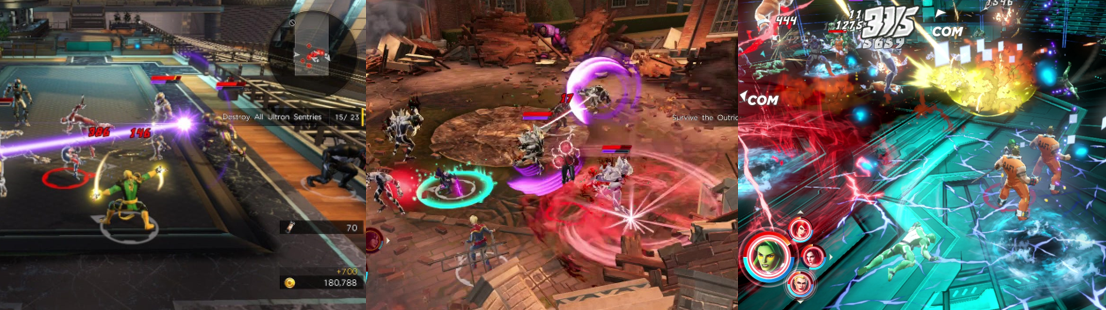
Combat is thick, fast, chaotic, and constant thanks to loads of enemies and character abilities.

As in the last two games, each character has specific abilities tied to their superpowers or superhero traits. You activate these by holding the Right trigger and selecting an icon using the D-pad; using Abilities drains your EP, however, and each Ability comes with a different cost. However, these attacks allow you to stun, stagger or deal elemental damage to enemies using Peter Parker/Spider-Man’s webs, Thor Odinson’s lightning, and Doctor Robert Bruce Banner/The Hulk’s incredible strength. Many characters have projectile attacks in their arsenal, such as Wade Wilson/Deadpool firing guns and Scott “Slim” Summers/Cyclops blasting his eye beams, while others cause splash damage or specific buffs, like Piotr Rasputin/Colossus being able to reflect projectiles and Wanda Maximoff/The Scarlet Witch healing her allies. Some, like James “Logan” Howlett/Wolverine, have passive abilities that allow them to automatically regenerate health as they walk around; others, like Johnny Blaze/Ghost Rider and Ororo Munroe/Storm, specifically deal in elemental damage. Character’s Abilities can also be mixed and matched by holding ZR and pressing one of the face buttons (or pressing A when prompted); this sees two characters attack in a combo for additional damage. As you dish out and take damage, you’ll also build the Extreme (EX) Gauge). Once full, you can press L and R up to three times to have two to four of your teammates perform a devastating combination attack that’s great against bosses. While the various cannon fodder you fight are easily dispatched, larger commanders and bosses need their “stun” meter drained before you can really put a beating on them and others (and certain treasure chests) require specific combination attacks to breach their shields. Defeating enemies sees your characters gain experience points (XP) to level-up, increasing their statistics (attack, defence, etc), though you can also use the various Orbs you find to manually level-up. Each character’s special Abilities can also be further enhanced using Ability Orbs and credits, reducing the EP cost and increasing their damage, among other benefits. You can also earn “Team Bonuses” depending on your team selection: pick a group of X-Men, for example, and your strength or resistance stat will increase, while picking characters of royalty ups your maximum energy stat.
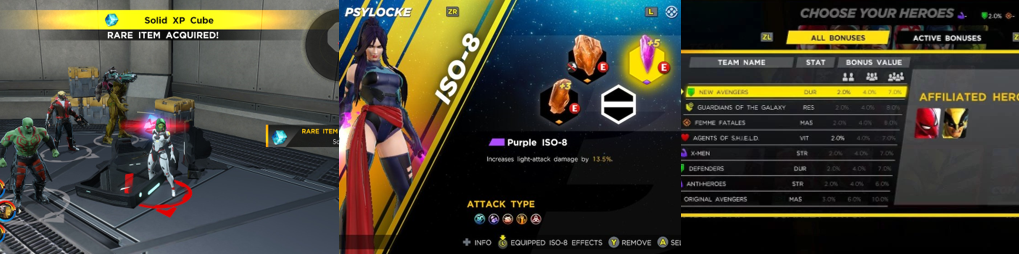
Search for chests to gain currency and other expendables to upgrade and buff your alliance.

Although you can’t equip gear to your characters, the boss battle against the Destroyer armour sees you temporarily empowered by Asgardian magic and you can eventually equip your team with “ISO-8” crystals, coloured stones that enhance their attack power, resistance to elements, or critical hit ratio, among others. You can further upgrade these with credits and ISO-8 capsules, though some of the rarer ones will also debuff you (for example, your attack my increase but your defence will decrease accordingly). You’ll also inevitably gain access to the Strategic Hazard Intervention Espionage Logistics Directorate (S.H.I.E.L.D.) Lab, which acts as the game’s skill tree. By spending credits and Enhancement Points (EP), you can further increase your team’s overall attack, defence, resistance, vitality, and such and even unlock additional ISO-8 slots (with more being earned by levelling-up). You can also enter the S.H.I.E.L.D. Depot from the main menu to purchase additional costumes and social icons by spending S.H.I.E.L.D. Tokens. Marvel: Ultimate Alliance 3 is pretty forgiving (on the “Friendly” difficulty, at least), with multiple checkpoints in each area. When you activate a S.H.I.E.L.D. checkpoint, your team is fully healed, and you can swap or enhance them if you wish. If a teammate is defeated, you can hold A to revive them, but I wouldn’t recommend it unless you absolutely have to. Not only are revives limited, but downed characters will eventually return to full health even before you reach a checkpoint so it’s not worth risking another character taking damage by healing a partner. Exploration generally leads you to treasure chests or special walls that require a special combination attack to open, or to a “Rift” challenge that takes you away from the main game to tackle a special challenge (usually a boss rematch or enemy gauntlet) for extra rewards. Your path is incredibly linear most of the time, hence why there’s no map, and the game’s primary focus is on chaotic combat and visually manic team-based attacks. Unlike in the last two games, you can no longer grapple or throw enemies (though you can still send them flying off certain platforms) and there are no character-specific team-up moves, meaning the action can quickly get quite tiresome.
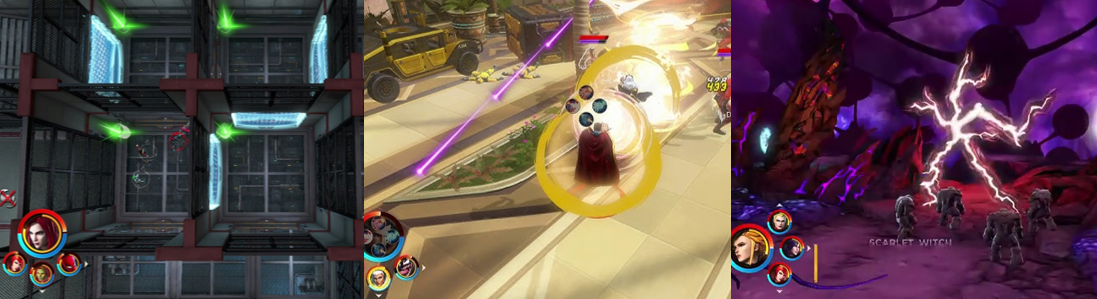
Sadly, puzzles are practically non-existent, with only Rifts offering additional challenges.

Because of its focus on hectic combat, there’s even less room for puzzles than there is for exploration in Marvel: Ultimate Alliance 3. Puzzles boil down to activating a console to open a door or making a platform move and that’s it. Sometimes, you’ll hold A to move a block and avoid lasers or cannons, but mostly you’ll be timing jumps between said lasers to progress and simply hurling missiles at those cannons. Sometimes, you’ll rotate statues or press switches to progress; others, you’ll be avoiding toxic ooze in Hel or solving door puzzles at the Raft or in Avengers Tower. After hopping across the rooftops of New York City, you’ll infiltrate the heavily fortified fortress of the Hand, dealing with ninjas that drop from the sky and hidden arrow hazards. When in Wakanda, Advanced Idea Mechanics (A.I.M.) corrupt T’Challa/The Black Panther’s defences, leading to an exasperating section where you must avoid snipers and being roasted by a giant panther statue’s energy blast. When transported to the Dark Dimension, you must use portals to reach new areas and defeat waves of demonic enemies to lower magical barriers and progress. Some attacks also screw up your controls or temporarily freeze you; some enemies are best defeated by tossing explosives at them; and many missions have an additional character fighting alongside you who’s often unlocked afterwards. However, a lot of the additional features of the previous games are missing; you can talk to other characters, but there are no dialogue options or character-specific interactions. There are no trivia quizzes, no optional side missions beyond the Rifts, and no character specific challenges to unlock extra stuff for each character. There aren’t even hub areas, in the traditional sense, with characters just appearing around S.H.I.E.L.D. checkpoints at times, though you can destroy a fair bit of the environment, and some encounters have you fleeing towards the camera as bosses chase you or present you with unwinnable battles.

Presentation:
Whereas the last two games primarily based their aesthetics on the comics books, especially the Ultimate comic line, Marvel: Ultimate Alliance 3 adheres very closely to the Marvel Cinematic Universe (MCU), especially in the visuals of its locations. I was hard pressed, for example, to tell the difference between Asgard here and the Asgard to the MCU, with both the golden city and the rainbow bridge, the Bifrost, appearing almost exactly as they’re depicted in the films. The same is true for Wakanda, the Dark Dimension, and Knowhere, all of which are virtually indistinguishable from how they appear in the MCU. There are some differences, of course: Taneleer Tivan/The Collector’s museum, for example, uses coloured cube cages and Wakanda leans much more into traditional architecture than the pseudo-futuristic science of the films (likely because Black Panther (Coogler, 2018) released a year before this game was made). Xavier’s School for the Gifted is lifted almost exactly from the 20th Century Fox X-Men movies (Various, 2000 to 2020), however, including a hedge maze, 1:1 Cerebro room, and basketball court that doubles as a landing pad for the Blackbird. While the Dark Dimension and the cosmic mind trip that is Sanctuary also heavily borrow from the bizarre cosmic imagery of the MCU, the Raft and Avengers Tower are much more akin to their comic book counterparts, though they’re comparatively bland locations, lacking fun areas like the Danger Room or Wakanda’s Necropolis (though you do pass through Anthony “Tony” Stark/Iron Man’s Hall of Armours in the tower). Although you only make a brief stop in Attilan to try and get help from the Inhumans, the architecture is far more visually interesting than that awful television show, seemingly being comprised of Celestial technology, and I enjoyed the ominous gothic presentation of Hel, with its restless Viking warriors and damaging sludge. Unfortunately, Marvel: Ultimate Alliance 3 continues the trend of having disappointingly bland and forgettable music, opting for generic themes for each location, event, and character that are lost amidst the constant fighting.
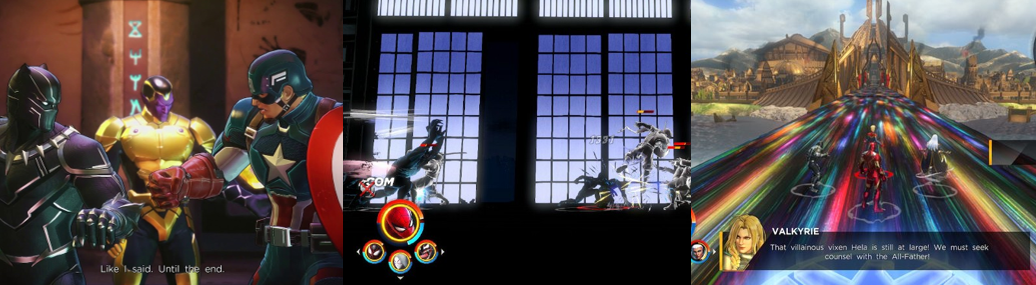
A visually impressive brawler that takes obvious inspiration from the MCU films.

The game also opts for an almost cel-shaded, action figure-like aesthetic for its colourful cast of characters. While many again both look and sound like their MCU counterparts, there are some exceptions: Peter Quill/Star-Lord, for example, looks nothing like Chris Pratt and the X-Men are far closer to the comic books than Fox’s films. Despite you assembling a custom team of heroes, cutscenes depict either everyone or characters specific to the location you’re in (the corrupted Doctor Stephen Strange in the Dark Dimension, for example) as they’re better suited to advance the plot against the local baddies. With the game shifting to a more third-person perspective, you’re closer than ever to the action and can see more of the environment than in the previous games. However, this comes with some drawbacks: mainly, there are far less opportunities or incentives to explore. Second, environments are painfully linear, with dead ends or locked doors barring your progress. Third, and most frustrating, is the camera, which easily loses track of your opponent/s and often lumbers you with wireframe representations when the foreground blocks the view. Thankfully, you won’t be falling down pits and rarely have to worry about onscreen hazards, but it can be aggravating trying to figure out which platforms and crates can be jumped on and which can’t. Marvel: Ultimate Alliance 3 offers a diverse cast of characters, each with their own idle poses and quips, though these do inevitably repeat. The game’s also surprisingly light on Easter Eggs: you’ll spot Deadpool singing away as he makes tacos in the X-Mansion, but not much else, and there are no optional missions or choices to encourage replaying missions. It’s a far cry from the first game, where there was always something to collect or an additional character to help out. Instead, it’s basically all combat, all the time in Marvel: Ultimate Alliance 3. Luckily, the game looks pretty good (everything’s very colourful and true to its inspirations) and performs really well, though there are some long load screens and it is annoying being forced to continue your game every time you challenge a Rift.

Enemies and Bosses:
All the usual suspects appear here as disposable cannon fodder for you to endlessly beat up, with many of the game’s goons sharing traits across the various locations. You’ll encounter Kree, Ultron Drones, agents of A.I.M., and Doombats who all pack various energy blasters. Ultron’s clones are the worst for this, relentlessly firing energy blasts and crashing through windows. The Raft’s unscrupulous prisoners attack in large groups, as do the restless Viking warriors who populate Hel, tossing axes from afar and luring you into toxic goop. Gargoyle-like Fire Demons also dwell here, offering a greater challenge with their swoop attack and fire breath, not unlike the monstrous Outriders and Mindless Ones who make up Thanos and the dread Dormammu’s forces, respectively. Alpha Primitives, Hydra goons, and towering Sentinels also appear, with the latter firing huge energy blasts from the palms and best attacked by throwing their explosive energy cores back at them. No matter where you are and what enemies you fight, more powerful commanders will also appear. Larger, tougher, and sporting a stun meter, these commanders should be your top priority as they’ll charge across the screen, cause shockwaves, and generally offer a far greater challenge even when you’re at a higher level. These minions often fight alongside their masters, generally so you can recover some health and EP to better damage the bosses, and will endlessly spawn in one of the additional modes unless you destroy their teleporters. Some of the game’s challenges or story-based missions charge you with defeating a certain number of enemies to progress. Other times, bosses appear in these waves, and you must occasionally flee or purposely lose some fights. This happens when Cain Marko/The Juggernaut comes tearing through the X-Mansion, for example, and in early encounters with the Black Order, who cannot be beaten or will chase you, raining lightning or other attacks from the sky and across the ground.
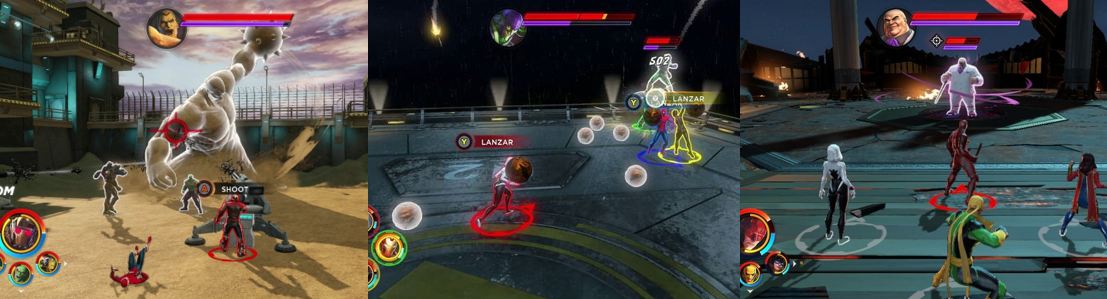
Few bosses require more than just hit-and-run tactics, even when augmented by an Infinity Stone.

There are loads of bosses to fight in Marvel: Ultimate Alliance 3, with some returning from the previous games, some teaming up, some having a couple of phases, and all boiling down to whittling down their stun bar, unleashing an EX attack and/or your most powerful Abilities, and avoiding damage until you can repeat this. The first ones you’ll face are Nebula and Ronan the Accuser, who often appear as a duo in optional challenges. Nebula is faster and more nimble, wielding blades where Ronan uses a massive warhammer. Both set a standard all bosses follow, which is that they’ll use either a jumping slam or an explosion of energy (or both) to send you flying. While quelling the riot in the Raft, you’ll encounter a version of the Sinister Six, with some unique variations to each battle. Flint Marko/The Sandman, for example, flings waves of sand and erupts his big sand fist from the ground as a large sand creature. You must use A to mount the nearby cannons and unload on him to chip away at his stun meter. Maxwell “Max” Dillon fights alongside Eddie Brock/Venom, raining lighting and electrocuting you with bursts of electricity, before he’s eaten by Venom and starts busting out electrically-enhanced symbiote powers. Venom joins the team after this fight and is tested against Quentin Beck, who first brainwashes Mile Morales/Spider-Man, Gwen Stacy/Spider-Woman, and Kamala Khan/Ms. Marvel to fight you and then unleashes a poisonous mist, teleports about, and confuses you with duplicates, Doctor Otto Octavious/Dr. Octopus is fought in a two-stage fight where you must first avoid his tentacles and scurry charge and then attack each arm to stun him. Finally, you’ll battle Norman Osborn/The Green Goblin for the Time Stone. The Green Goblin swoops overhead and lingers slightly out of reach, peppering the arena with his pumpkin bombs, charging at you, and freezing time to bombard you. He’s noticeably weak to his pumpkin bombs, however, so try and toss them at him before they explode in your face! After battling into the Hand’s fortress, you must first free Elektra Natchios from the Hand’s influence and then face Lester/Bullseye and Wilson Fisk/The Kingpin in separate fights. You must take out the ninjas feeding Elektra power, avoid Bulleye’s spread of razor sharp and explosive cards, and dodge the furniture and massive energy beam thrown by the Power Stone-enhanced Kingpin. The Kingpin also charges like a rhino, leaps at you to cause shockwaves, and even rips up stone columns to use as melee weapons!
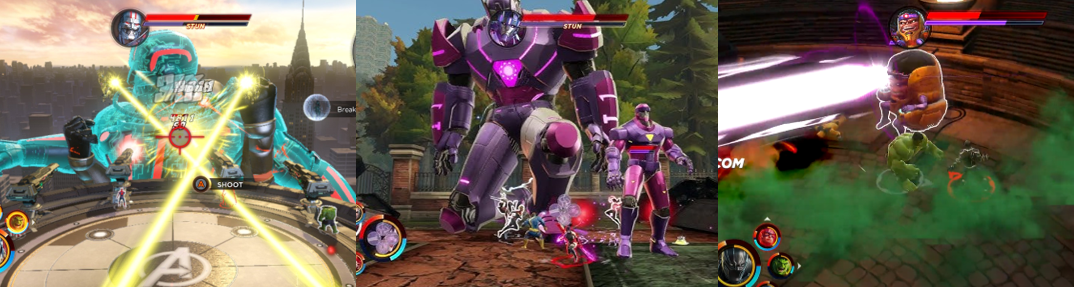
Gigantic bosses and the quirkier villains help mix-up the otherwise tedious combat.

Avengers Tower is then attacked by Ultron and his drones, who assist him in battle. Not that he needs it as the Mind Stone allows Ultron to mess up your controls, to say nothing of his signature face and palm beams. Ultron then grows to gigantic proportions, sweeping the area with his eyebeams before Clint Barton/Hawkeye intervenes and Ultron merges with Ultimo. This is the first giant boss battle in the game and sees you blasting Ultimo with cannons and avoiding his massive swipes. The Infinity Sentinel is comparatively smaller, but no less dangerous thanks to its own face beam and missiles. Though you can damage it with Sentinel cores, it’s finished in a cutscene by Erik “Magnus” Lehnsherr/Magneto, who then tosses debris and throws you off balance with magnetic pulses while Juggernaut pummels you and Raven Darkholme/Mystique tosses daggers. After surviving Mystique’s Danger Room trials, you face Magneto, now even tougher thanks to the Power Stone, before being chased away and banished to the Dark Dimension by the Black Order. There, you battle past Loki Laufeyson (who boasts elemental attacks and duplication tricks) to eventually face the dread Dormammu, who wields the Reality Stone and is the second giant boss. You must subdue his minions and avoid his flame bursts, whittling down his magical barrier either directly or be destroying three nearby orbs, all while dodging his giant fists and ground spikes. The brief fight with Maximus Boltagon is far easier, even though the mad Inhuman carries a massive energy cannon and you must take cover in Thane’s energy bubble to avoid Maximus’s barrage of lasers. Ulysses Klaue/Klaw awaits in Wakanda and his sound-based energy blasts and waves must be overcome to rescue and recruit James Buchanan “Bucky” Barnes/The Winter Soldier. You then fight past A.I.M. to confront their master, George Tarleton/Mental Organism Designed Only for Killing (MODOK), who uses the Soul Stone to turn the Dora Milaje against you and attacks with a slew of appendages, from buzzsaw arms, poison gas, failing tentacles, and his signature forehead blast.
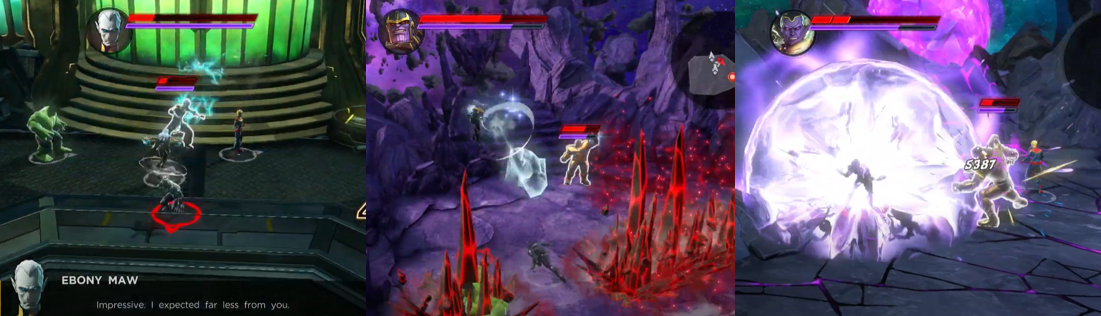
Battles with the empowered Black Order, Thanos, and Thane offer some of the most enjoyable challenges.

Though your goal in Hel is to confront Hela, you’ll actually battle the fire demon, Surtur, in another giant boss battle. This was a bit of a difficulty spike for me as Surtur’s flaming sword has a long reach and he causes the ground to erupt in flames, to say nothing of stun locking you with repeat sword strikes! Best him and Hela sets Johann Schmidt/The Red Skull on you, with the Nazi madman firing a powerful revolver and sapping your health with his “Dust of Death”. Hela gives the Red Skull a boost, protecting him with a shield and allowing him to fire a Bifrost-like laser, before placing his consciousness into the Destroyer armour. Though bolstered by Hydra forces and boasting a sweeping face beam, you can get a power-up from glowing crystals to overcome this destructive force. Finally, you venture to Knowhere and must run the Black Order gauntlet to retrieve the Infinity Stones, with checkpoints between each fight. Ebony Maw is first, firing a spread of projectiles and rocks and using the Soul Stone to create portals to trip you up. Supergiant tosses dark spheres and a golden homing shot that messes up your controls, though you can toss explosive cores from her minions to deal big damage. Cull Obsidian infuses his battleaxe with the Power Stone, sending out waves of purple energy and massive purple shockwaves, though he’s far slower and also susceptible to the nearby bombs. Corvus Glaive is much faster, landing multiple hits with his lance and using the Reality Stone to spring spikes form the ground and conjure duplicates who fill the arena with energy waves that can stun lock you. Finally, Proxima Midnight takes her fellow’s teleportation trick to the next level with the Space Stone and fills the arena with lightning bolts and strikes. All these powers are then recycled when you face Thanos, who gathers the six Infinity Stones into the Infinity Gauntlet to rain meteors, teleport, mess up your controls, freeze time, and fire his signature eyebeams. Thanos then joins you to battle Thane, who usurps him and boasts similar powers, though also upgraded by the Infinity Armour. Thane exhibits superhuman speed, traps you in a cube, fills the arena with portals and flames, and explodes in fury, though both battles were fun challenges rather than impossible tasks.

Additional Features:
Unlike in the previous two games, you won’t be finding data logs, action figures, or meeting certain requirements to unlock new attacks or costumes. You just fight over and over, earning whatever you need to unlock, buy, or upgrade whatever you wish and finding some concept art in treasure chests. A far harder (but more rewarding) “Superior” difficulty unlocks upon clearing the game alongside an additional “Nightmare” mode, accessible via the “Curse of the Vampire” campaign. You also unlock Thanos and can freely replay any mission on any difficulty (though you must start a new save to play on “Superior”) to grind and enhance your characters and ISO-8. Dimensional Rifts transport you to special challenges (not unlike the S.H.I.E.L.D. Simulator discs from the first game) that are often rematches with bosses or gauntlet challenges, though far tougher and gifting better rewards if you succeed. There are also three additional modes; however, though you can play a taster of each, you must purchase the expansion pass to fully unlock them. “Curse of the Vampire” adds vampiric enemies to the main story in “Nightmare” mode and offers a “Gauntlet” mode where you battle waves of enemies and bosses against both a time limit and a range of debuffs (including limited health restoration and draining EP). You can also tackle an “Endless” mode that’s pretty self-explanatory, and unlock additional characters like Frank Castle/The Punisher and Eric Brooks/Bladeif you buy the DLC. “Rise of the Phoenix” sees you form a four-person team and go head-to-head with a friend or the computer in three-round Danger Room scenarios. These see you tackling bosses again or wiping out hordes of enemies, awarding additional buffs and effects if you meet certain criteria (such as using any Ability or Synergy attack four times). You can only tackle the first challenge without the DLC, so I didn’t get very far, but this could be a fun distraction for those looking to test their skills against a friend. “Shadow of Doom” adds an epilogue story campaign that sees you return to Wakanda to oppose Doctor Victor Von Doom’s invasion. Dr. Doom’s Doombots endlessly spawn unless you destroy their teleporters, and you even battle the arrogant dictator in the recycled Necropolis, with him teleporting, firing lasers form his palms, and having his health restored by his Doombots. You’ll add Marvel’s First Family to your roster (alongside an alternative Thanos and other characters) by buying the expansion pass and battle Annihilus, a gigantic Celestial, and even “God Emperor” Doom!
The Summary:
I quite enjoyed the first two Ultimate Alliance games. They were mindless and largely repetitive, but I liked the large cast of characters and all the different references and locations from the comic books. Still, I put off Marvel: Ultimate Alliance 3: The Black Order for some time, mainly because I was annoyed by it being a Nintendo Switch exclusive; however it turned out to be a decent enough brawler. Despite the different development team, a few tweaks, and an apparent disconnection from the previous games, Marvel: Ultimate Alliance 3 offers a lot of the same gameplay and enjoyment as its predecessors, which is great for long-time fans of the franchise. Unfortunately, it doesn’t improve on these elements in a meaningful way and actually removes some content that I found enjoyable from the last two. There are no optional missions, for example, no alternative endings, no choices, and no character-specific challenges beyond fighting and levelling-up. I found this made the tedious combat even more aggravating after a while as I wasn’t being rewarded with gear or costumes or anything other than stat boosts. Even the skill tree was limited since you must grind to acquire enough credits and expendables to enhance your team, and I found the ISO-8 mode to be more confusing than engaging. The game also does little to improve the boss battles. Very few were very innovative or required more of you than to strike fast, avoid shockwaves and projectiles, and unleash your Extreme attack. The giant bosses were more of a challenge and I liked the final fight against Thanos and Thane, but I was hoping for a bit more complexity, especially given the possibilities offered by the Infinity Stones. There is a fun selection of characters, but they don’t offer much more than what we saw in the last two games and actually offer less as there are no character-specific team-up moves. While I enjoyed the visual influence from the MCU and the variety, I feel like Marvel: Ultimate Alliance 3 played things a little too safe by relying so heavily on combat and not mixing up the gameplay with a few other puzzles and challenges. Overall, it’s a good enough game and a worthy entry in the series, but it’s a shame that the developers didn’t try to be a bit more innovative and offer some more incentive to keep slogging away in endless fights.

My Rating:

Rating: 3 out of 5.

Pretty Good

Did you enjoy Marvel: Ultimate Alliance 3: The Black Order? How do you think it holds up against the previous two games? Which characters did you choose for your team? Were you disappointed that the combat was so similar to the last two games and the bosses so repetitive? Did you ever conquer all the Rift challenges? What did you think to the MCU influences and the final battle with Thanos and Thane? Did you ever play through the DLC? Would you like to see another Ultimate Alliance game? Whatever your thoughts, leave a comment below, support me on Ko-Fi, and go check out my other superhero content across the site.

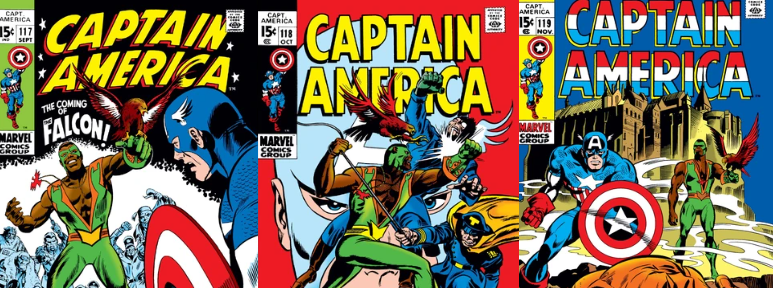
Back Issues: Captain America #117-119

Writer: Stan Lee – Artist: Gene Colon

Story Title: “The Coming of…The Falcon!”
Published: 3 June 1969 (cover-dated: September 1969)

Story Title: “The Falcon Fights On!”
Published: 1 July 1969 (cover-dated: October 1969)

Story Title: “Now Falls the Skull!”
Published: 30 July 1969 (cover-dated: November 1969)

The Background:
World War Two was in full swing by 1941. Nazi Germany had barrelled through Denmark and Norway in April 1940 and, after initially resisting joining the war, the United States entered the fray and provided much needed support against the “Axis powers” of Germany, Japan, and Italy. Patriotism and national pride was high at the time, especially in America, and it was during these dark days that Joe Simon and the legendary Jack Kirby introduced readers Captain Steve Rogers/Captain America and his kid sidekick, James Buchanan Barnes/Bucky, to encourage support of the war effort. However, after the end of the War superheroes declined in popularity and Captain America’s solo comic was cancelled in 1954. Luckily, Cap got a second chance as a “man out of time” when he joined the Avengers, reigniting his superhero career and butting heads with such iconic villains as Johann Shmidt/The Red Skull and even eventually battling his fellow superheroes. In the aftermath of this civil war, Cap was left seemingly dead and his mantle passed to his troubled sidekick, now also a superhuman figure, who operated in the role until Steve’s inevitable resurrection and, in 2014, Sam Wilson took on the mantle, to much undue controversy. Created by Stan Lee and Gene Colon, the man better known as the Falcon was the first Black American superhero in mainstream comic books. Specifically created to be a trendsetter during turbulent times, the Falcon went on to have a lengthy career in Marvel Comics, though mostly as a bit-player until his promotion into the shield-slinging role of Captain America, and has achieved mainstream recognition thanks to Anthony Mackie’s celebrated portrayal of the character in the Marvel Cinematic Universe.

The Review:
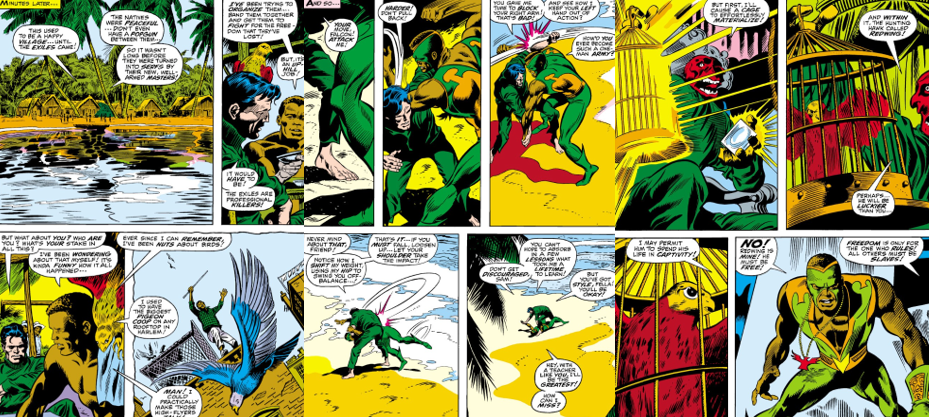
Sam Wilson’s debut in Captain America’s solo title came in the middle of a particularly trying time for the Star-Spangled Avenger. After almost having his identity made public, Cap was ambushed by his old foe, the gruesome Red Skull, who used the power of the Cosmic Cube to switch bodies with his hated enemy! As if being tapped in the body of a skull-faced Nazi wasn’t bad enough, the Cosmic Cube’s near-limitless power dumped Cap on a remote island home to the Exiles, a misfit group of would-be conquerors who hate the Red Skull with a passion. Observing through the Cosmic Cube’s omnipotent power, the Red Skull watches as the wheelchair-bound Franz Cadavus leads his venge-filled fellows in search of the one who robbed them of the Cosmic Cube’s power. When Cap crashes before them after falling from his hiding spot in a tree, he doesn’t even bother trying to explain the situation. Instead, he defends himself against Angelo Baldini and his deadly scarf, easily using his knowledge of his foe’s abilities to his advantage. Cap then uses his incredible agility to dodge Cadavus’s “murder chair” cannons, tossing sand in his eyes, and disarms Jun Ching. However, the numbers soon overwhelm the celebrated Avenger when Eric Gruning restrains him with his whip and “Iron-Hand” Jurgen Hauptmann closes in for the kill. For the observing Red Skull, the irony and glory of it all are too much to witness. Confident that his plot has succeeded, he decides not to witness his hated enemy’s final moments and turns his attention towards his greater goals.

Trapped in the Red Skull’s body, Cap nevertheless inspires young Sam to become a hero.

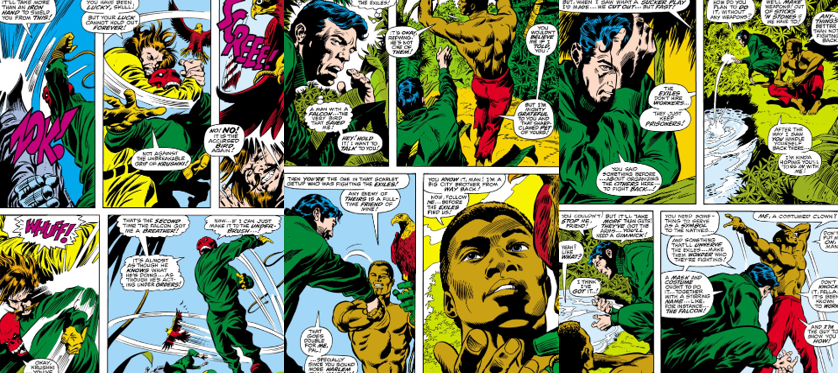
Consequently, the Red Skull doesn’t see the timely intervention of a falcon, later identified as “Redwing”, who distracts Iron-Hand long enough for Cap to fight him off with a swift uppercut. Redwing also helps Cap escape the iron grip of the brutish Ivan Krushki and, as Cap flees to the bushes, he notes that the bird seems to be trained, as if following orders. Cap surmises that the Exiles probably haven’t seen the Red Skull’s true face, so he removes the gruesome mask and manipulates his features with clay to move more freely around the island. In contrast, the Red Skull walks in the guise of Captain America, disgusted by the adulation and awe his appearance inspires and secretly conspiring to enslave everyone. The Red Skull revels in deceiving the masses, taking advantage of their goodwill, before deciding to further his victory against Captain America by destroying his enemy’s distinguished reputation. He is completely unaware that the Mental Organism Designed Only for Killing/MODOK and his beekeeper-suit flunkies at Advanced Idea Mechanics (A.I.M.) are working to render the Cosmic Cube they created powerless to avoid it being used against them. Back on the island, Redwing returns to his master, the jovial Sam Wilson, a lone vigilante against the Exiles. When Cap spots him, he thanks Sam for his assistance and learns that he’s a simple Harlem man who came to the long-peaceful island to organize a resistance against the Exiles. Sam relates that he had an affinity for birds since boyhood, communicating with them in a way beyond a simple animal trainer. When he unwittingly answered the Exiles’ call for a hunting falcon, Sam turned on them, unwilling to help them enslave others. While he initially laughs at Cap’s suggestion that he turn his love for falcons into a symbol, a costumed identity for the natives to rally behind, Cap soon organizes the creation of a garish outfit that will better suit his radical goals and dubs him “The Falcon”.

Despite this God-like power, the Red Skull doesn’t foresee Cap training a new ally.

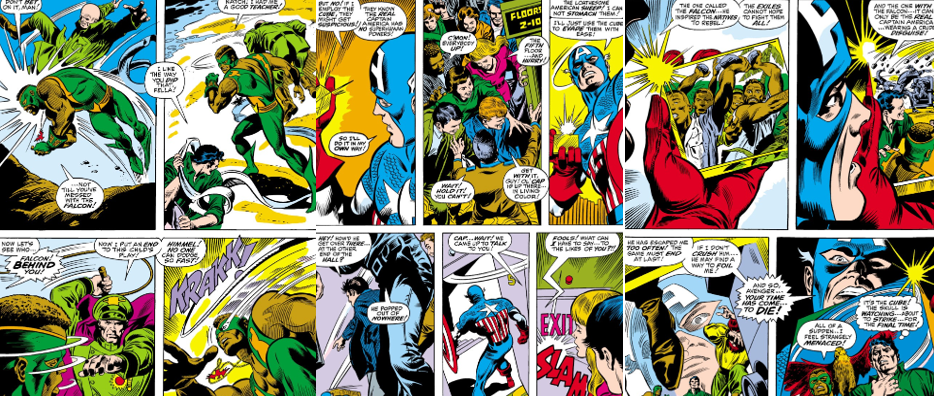
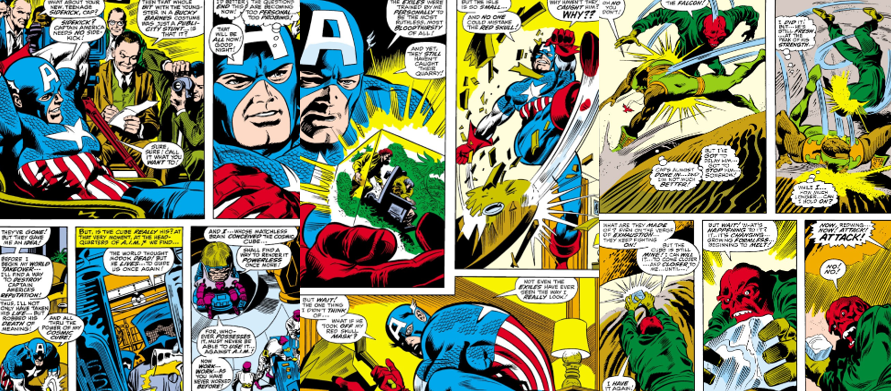
Back in New York City, the Red Skull finally realises, with anger, that his protégés have failed to find or kill their quarry. Realising that Cap must’ve taken off his skull-like visage, he resigns himself to the inevitability that his enemy can’t hide forever. Yet, the Red Skull decides he’s not willing to aid the Exiles or simply blink Cap out of existence with his God-like power and thus doesn’t bother to look in on Cap or witness him bonding with his new friend, whose connection with Redwing constantly impresses the disguised Avenger. Cap teaches the Falcon the basics of superheroing…And by that I mean they spar on the beach, Cap instructing Sam how to fight properly and use an enemy’s momentum and strength against them. Sam’s experience fighting for survival on the mean streets of Harlem see him take to the training like a natural, quickly becoming stronger and more sure of himself, and Cap impresses upon him that he must embody his new identity whenever he’s wearing his awful costume. When the Red Skull is awoken by concerns of an overexcited rabble of Cap fans in the lobby of his hotel, he sees it as the perfect opportunity to discredit Cap’s name. He shouts at the hotel manager and berates the fans, spitting spiteful insults every chance he can get, and even ostracises perennial hanger-on Rick Jones, who had aspirations of becoming Cap’s new sidekick. While A.I.M. continue their experiments, Cap and the Falcon blindside the Exiles, easily besting them even though Cap’s speed and strength are lessened in the Red Skull’s body. The Falcon proves very adept, dodging Gruning’s whip and inspiring the natives to rise up and drive the Exiles into fleeing for their lives.

Ultimately, it’s A.I.M. who quash the red Skull’s dreams of ultimate victory,

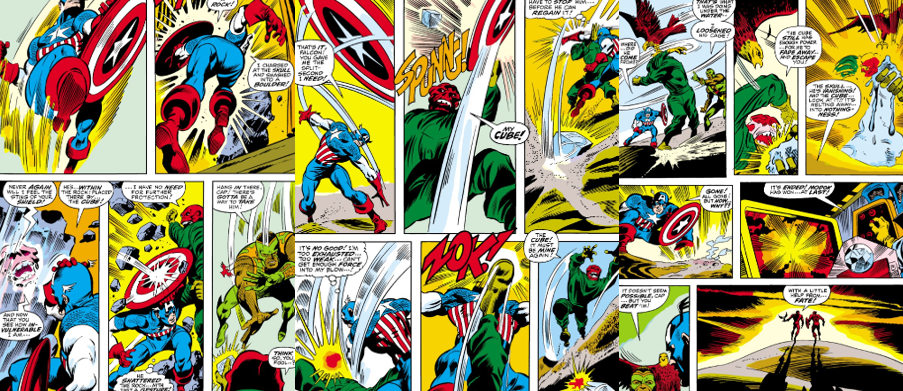
Unfortunately for them, the Red Skull happened to be looking in. Angered and determined to finish his enemy and his new ally off, the Red Skull assumes his more familiar appearance and effortlessly teleports himself to Berchtesgaden Castle, where he once conspired with Adolf Hitler to conquer the world, ravenous to stage his final victory in the castle’s opulent halls. Cap and the Falcon are then violently transported halfway across the world to Berchtesgaden Castle. Though Cap bemoans getting the Falcon caught up in his ages-old rivalry with the skull-faced dictator, Sam vows to face the threat no matter the outcome, but is enraged when the Red Skull’s first act is to cage Redwing. The Red Skull feeds the Falcon’s anger and spirit, goading him into attacking so that he can repel the fledgling hero with a forcefield. Sam is then stunned when the Red Skull uses the Cosmic Cube to undo the mind and body transfer, reverting Cap to his colourful costume and rearming him once more. Galvanised by this revelation, the Falcon willing follows Cap into battle, despite the Red Skull encasing himself in a protective rocky shell and spontaneously conjuring a tidal wave that threatens to drown the two heroes. While the Falcon’s caught off-guard by such tricks, Cap warns of the Red Skull’s power and insanity, which see the villain whisk them to an arid desert. With Sam exhausted, Cap hurls his shield and, incredibly, causes the Red Skull to drop the Cosmic Cube! The two fight valiantly over the prize but, just as the Red Skull reclaims the Cosmic Cube, he watches in horror as it melts between his fingers thanks to MODOK and A.I.M. activating their “Catholite Block” and rendering the weapon inert. Despite this, the Red Skull uses the melting cube’s fading power to teleport away, leaving MODOK victorious and Cap and the Falcon to head into the sunset as triumphant new allies.

The Summary:
I’m honestly not very familiar with the Falcon. This may very well be the first story I’ve ever read where he’s a part of the plot. I’m much more aware of his film counterpart and, honestly, never thought too much of him since his gimmick is very similar to Adrian Toomes/The Vulture, another character I traditionally find lacklustre compared to other, more colourful and appealing characters. However, his appearance here was enjoyable for what it was. There are some holes in his backstory, though, that the story didn’t satisfactorily explain for me. So, he’s a bird-lover, that’s great; he can communicate with Redwing on a near-telepathic level, sure, I’m all for that. But…why did he answer the ad for a hunting falcon? I mean, I guess he just wanted to leave Harlem and I can understand that, but it’s a bit random to jet off to a secluded island on a whim. Also, why did the Exiles need a hunting falcon anyway? Sure, they’re repeatedly shown to be useless at tracking their enemies but still…a falcon? And how did they place an ad for that when they’re exiled to the island? Still, Sam’s heart is in the right place; he won’t stand for injustice, especially slavery, and is determined to encourage the remaining natives to reclaim their land. It’s obviously a very racially and politically charged motivation and character, but I think it’s a universal truth we can all agree to: slavery and mistreatment of others is bad and should be opposed. Sam embodies this ideal before Cap shows up but lacks the proper means to enforce it. He seems to operate mainly from the shadows, but Cap encourages him to stand in the spotlight as a symbol for people to believe in, not unlike he is when in full costume.

It’s a good job Sam’s such a likeable guy because his superhero costume is unsightly!

Unfortunately for Sam, Cap and the natives whisk up one of the worst costumes I’ve ever seen. God, it’s so awful, with its lime-green and brown-gold edging, it’s weird-ass cowl and strangely angled boots. Considering Cap encourages him to take inspiration from his love and use the moniker “The Falcon”, nothing about Sam’s outfit screams “Falcon” to me. He doesn’t have a bird-like cowl like, say, Katar Hall/Hawkman, doesn’t match Redwing’s gold and red/brown feathers, and doesn’t even have his now-iconic wings. Just about the only thing this outfit has going for it is its sense of native tribalism, but otherwise it’s truly a ghastly sight. Luckily, Sam’s personality makes up for it. He’s not some jive-talking street tough or a shallow Blaxploitation cliché; he’s just a regular guy from Harlem with a friendly disposition who wants to do what’s right. His time on the mean streets toughened him, sure, but there’s no sense of malice or ego. The only time he shows any anger is when Redwing is threatened and when confronted by the embodiment of xenophobic oppression. Otherwise, he’s a level-headed, affable young man who luckily turns out to be a natural when it comes to learning how to fight. In a short time, Cap teaches Sam how to defend himself, how to fight smartly, and leads him into battle against the Exiles, a fight that puts them at a disadvantage due to the group’s numbers and weapons but which the heroes ultimately triumph thanks to putting their skills to good use. This also sees the Falcon inspire the natives to rise up, though this was very rushed for me. There was never any indication that the people even know the Falcon was heading into battle that day. All they knew was that Sam was wearing a costume now, not that he’d done anything worth riling them up. Of course, Sam’s natural abilities are only half the story; Redwing gives him a memorable gimmick that helps him stand out against his peers. The bird is exceptionally well trained and intelligent, turning the tide in every battle the Falcon is involved in and proving invaluable to their cause.

The story completely wastes the potential of the Red Skull’s unlimited power.

Beyond this, the story is a bit of a mess. I love the idea of the Red Skull attaining God-like power, and the Cosmic Cube effectively allows him to do anything. He can see anything he likes at will, switch bodies with people, teleport, conjure forcefields and the elements, and is functionally untouchable as long as the cube is in his hands. Unfortunately, the Red Skull is a cackling buffoon. Rather than simply will Captain America out of existence, he swaps bodies with him and dumps him on an island, where inept forces fail time and again to do his dirty work. Rather than reshaping reality in his image, brainwashing the masses and conquering the world a piece at a time, the Red Skull parades around in Cap’s body to take advantage of their goodwill, all while ruminating about how much he hates Americans and the many ways he’ll subjugate and destroy those around him. Rather than doing this, the Red Skull plots to destroy Cap’s reputation by…being rude to people! It’s ridiculous! He doesn’t even watch what’s happening on the island until it’s too late and gets so distracted bringing himself, Cap, and the Falcon to Berchtesgaden Castle that he doesn’t think to set aside his pride and just snuff their lives out with a thought. It’s typical, cliché supervillain behaviour to assume victory, bask in your superiority, and to toy with your enemies but I expected more from someone like the Red Skull! Despite demonstrating that he can protect himself from any attack with a thought, Shmidt is disarmed by a simple throw of Cap’s shield and then he completely fails to consider that A.I.M. might be angry at him swiping their most powerful weapon, leaving him undone not by his enemy, but by his own lack of foresight. Overall, this was a decent enough introduction for Sam Wilson; his costume was awful, but I liked his attitude and his gimmick. What lets it down, though, is the nonsensical main plot regarding Cap and the red Skull switching bodies. It’s a great concept but the story completely wastes it, having Shmidt lounge around thinking nasty thoughts but squandering his great power, leaving him undone in the lamest way possible.

My Rating:

Rating: 3 out of 5.

Pretty Good

What did you think to the Falcon’s debut story? Were you as repulsed by his costume as I was? What did you think to his moxie and his gimmick with Redwing? Were you also disappointed that the red Skull squandered his potential here? What are some of your favourite moments in the Falcon’s long history? There’s a comment section down below; use it to share your thoughts and then go check out my other Marvel content.

Screen Time [Sci-Fanuary]: M.O.D.O.K.


January sees the celebration of two notable dates in science-fiction history, with January 2 christened “National Science Fiction Day” to coincide with the birth date of the world renowned sci-fi writer Isaac Asimov, and HAL 9000, the sophisticated artificial intelligence of Arthur C. Clarke’s seminal 2001: A Space Odyssey (1968), being created on 12 January. Accordingly, I am dedicating all of January to celebrating sci-fi in all its forms.


Air Date: 21 May 2021
Directors: Eric Towner and Alex Kamer
Network: Hulu / Disney+
Stars: Patton Oswalt, Aimee Garcia, Ben Schwartz, Melissa Fumero, Wendi McLendon-Covey, Jon Daly, and Beck Bennett

The Background:
Created by Stan Lee and Jack Kirby, George Tarleton, the “Mental Organism Designed Only for Killing”/MODOK first appeared in the pages of Tales of Suspense back in 1967. The deranged, cybernetic would-be conqueror has been a thorn in the side of numerous Avengers and a mainstay of Marvel videogames, though he’s had a tumultuous life on the big and small screen. While I best know the character from his appearances in the 1990’s Iron Man cartoon, most mainstream audiences probably best know him from his infamous appearance in Ant-Man and the Wasp: Quantumania (Reed, 2023). Before that debacle, MODOK received his own adult animated series on Hulu, the first in what was planned to be a bunch of adult animated series before his fellow “Offenders” were summarily cancelled. A stop-motion production in the style of the similarly-themed Robot Chicken (2005 to present), M.O.D.O.K. was well-received upon first airing. Though some found it incomparable to its peers, most reviews praised the vulgar tragicomedy for its workplace humour and entertaining performances. Unfortunately, neither the generally positive reactions or a Golden Trailer Award nomination were enough to produce a second season and M.O.D.O.K. was cancelled after only one season.

The Plot:
After failing to conquer the world, MODOK (Oswalt) loses control of Advanced Idea Mechanics (A.I.M.) when it goes bankrupt and schemes to regain his position while dealing with a failing marriage and a mid-life crisis.

The Review:
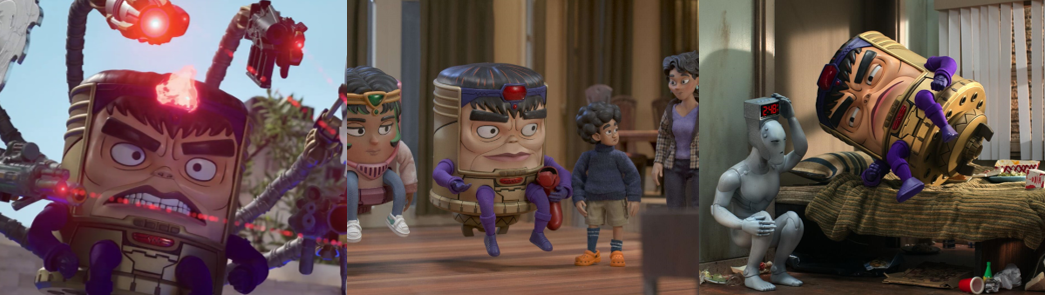
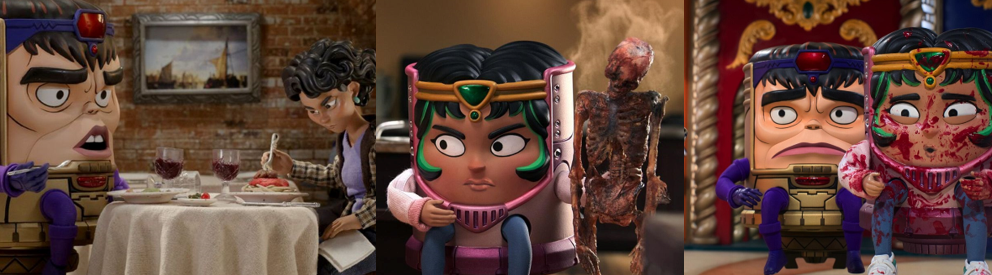
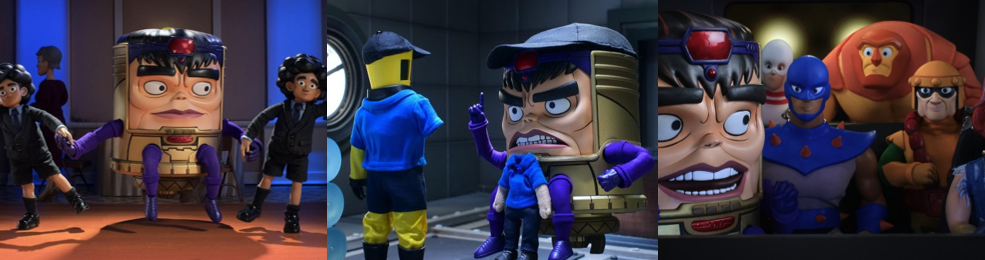
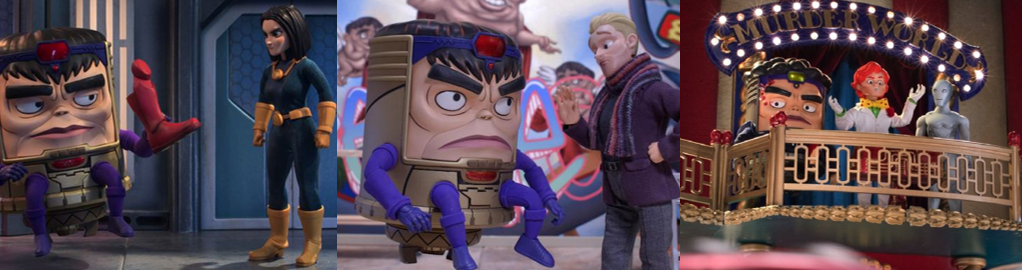
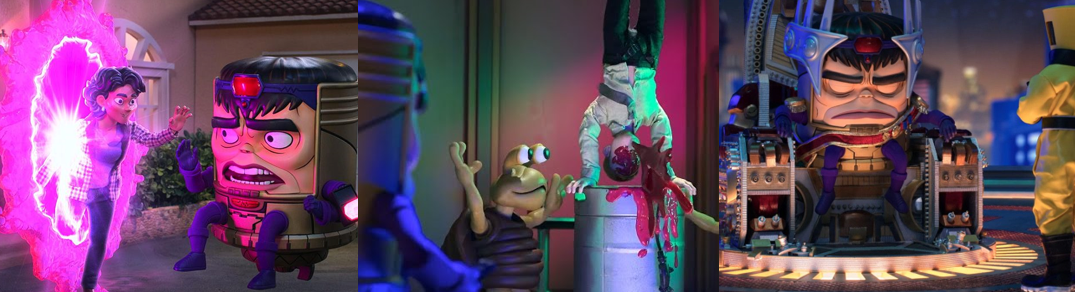
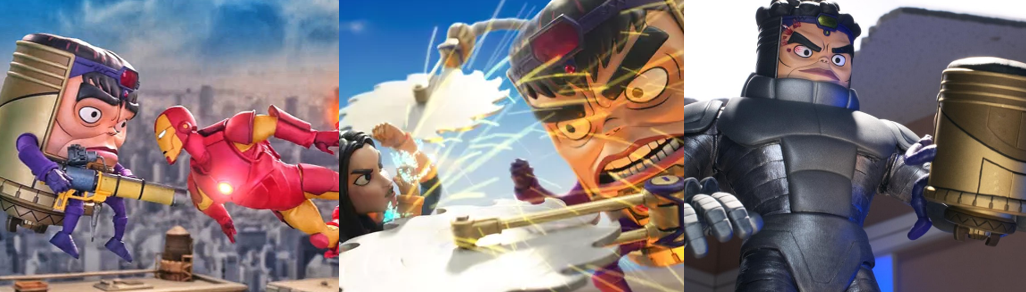
M.O.D.O.K. is an adult stop-motion animated series in the same visual style of Robot Chicken, a show I haven’t watched all that much but have enjoyed its zany take on pop culture. However, I used to watch The Adam and Joe Show (1996 to 1999) as a kid and that regularly included segments featuring stuffed toys and action figures, so it’s a style I’ve always enjoyed. M.O.D.O.K. skews more towards the action figure aesthetic; this is especially evident in scenes where MODOK and A.I.M. attack Avengers Tower and battle Anthony “Tony” Stark/Iron Man (Jon Hamm), who’s styled after the Toy Biz “Marvel Super Heroes” action figure. Considering how painstaking stop-motion animation is, I’m surprised by how long each episode is, with each clocking in at around twenty-five minutes; though it’s my understanding that the animation studio, Stoopid Buddy Stoodios, used elaborate puppets during filming. The result is a very surreal animation style that perfectly matches the bizarre nature of the show, which is much cruder and ruder than the average Marvel production. M.O.D.O.K. features blood, violence, a touch of body horror (both in MODOK’s unsightly appearance and in a Fly-like (Various, 1957; 1958 to 1989) genetic monstrosity), and some swears, thus firmly setting it as a more adult-orientated show. Additionally, and most prominently, M.O.D.O.K. tackles adult themes such as divorce, mid-life crises, and navigating an increasing unstable workplace undergoing corporate mandated overhauls to be more politically correct and accommodating. As enjoyable as it is to see characters have half their faces melted off, blood and guts burst on the screen, and MODOK’s long-suffering (but endlessly enthusiastic) henchman Garfield “Gary” Garoldson (Sam Richardson) get his arm blown off just for standing in the wrong place at the wrong time, it’s the domestic drama where M.O.D.O.K. really shines. There’s an unexpected pathos laced throughout the show as MODOK desperately attempts to win back his frustrated wife, Jodie Ramirez-Tarleton (Garcia), and the approval of his kids, aspiring supervillain Mental Entity Living to Induce Seriously Sinister Anarchy/Melissa (Fumero) and endlessly jovial Lanky Organism Undeniably Irresistible and Syphilitic/Lou (Schwartz).

The once-fearsome MODOK is reduced to squalor by his failing company and family life.

MODOK’s family is acutely aware of his evil deeds; it’s hard for them not to be since the only thing he talks about at home is himself, how superior he is, and spinning disastrous failures into overblown wins just because he stole Iron Man’s boot. MODOK’s obsession with destroying the Avengers and conquering the world stems from his childhood, where he was relentlessly bullied for his big head and supervillain-level genius. However, his loving mother (Unknown) encouraged his ambition and he continuously experimented on himself with science and cybernetics in a bid to take over he world and “improve” it with his own twisted version of a utopia. Unfortunately, MODOK’s preoccupation with this goal has caused him to neglect his family: he barely acknowledges Jodie’s success as a self-help guru or her upcoming book launch, Melissa resents him for embarrassing her and not acknowledging her opinions, and Lou, though seemingly cheerful, is hiding his own insecurities behind a happy-go-lucky façade and an amateur interest in stage magic. When MODOK’s reckless spending pushes A.I.M. to the brink of bankruptcy, MODOK’s forced to sell to young, socially aware Austin Van der Sleet (Bennett), owner of tech company GRUMBL, who, despite his assurances, makes so many changes to A.I.M.’s corporate structure that MODOK is eventually reduced to a mere mailman. His frustrations see his marriage crumble; realising they no longer have anything in common, Jodie demands a divorce and kicks MODOK out, forcing him to live in squalor with the family’s underappreciated robot slave, the Super-Adaptoid (Daly). When MODOK’s begging and pleading for a second chance fail, he and Gary break into the Strategic Homeland Intervention, Enforcement and Logistics Division’s (S.H.I.E.L.D.) headquarters and steal a time machine, desperate to undo a past mistake and take Jodie to a Third Eye Blind concert to rekindle their love. However, the attempts fails when she’s angered at him using the jaunt to also try and assassinate Austin and he inadvertently creates the show’s overarching villain when his ineptitude angers his past self and displaces him from time after he shatters the time machine’s Chrono Crystal.

MODOK’s long-suffering wife and daughter come to resent his selfish attitude.

Jodie’s frustration with MODOK is well founded; he’s an egotistical, selfish, obnoxious braggart who causes chaos wherever he goes. At work, MODOK is largely idolised by A.I.M.’s mostly nameless and faceless beekeepers; MODOK shows he cares for them when he begs Austin to keep them employed, but also treats them as disposable pawns when enacting his plans. Jodie feels a degree of the same disregard, constantly feeling second fiddle to MODOK’s greater aspirations, and forces a separation so she can get her life in order. When she starts dating Simon Williams/Wonder Man (Nathan Fillion), Jodie sees her stock and fame skyrocket due to the sordid publicity surrounding Wonder Man and she shamelessly embraces it. She manipulates both Wonder Man and MODOK to promote her book, coldly using the limelight-loving superhero for her own ends, and even injects Lou with a serum to give him a peanut allergy to give him a personality flaw, showing why she’d fall for a supervillain in the first place. It’s clear Jodie and MODOK still have feelings for each other (when trapped in the past, they grow old and rekindle their feelings, only to be erased from time) but they struggle to reconcile even for the sake of their kids. Melissa, though a female copy of MODOK, is actually very popular and has aspirations of being a supervillain but is continuously let down by him ignoring her input. She expertly teaches him how to psychologically manipulate others during a work conference, only for him to default to a grandiose plan for hero worship by opening a portal to the Broodworld. She works hard to give him a makeover, but he ruins his new look by brawling with Wonder Man. It’s doubly frustrating for Melissa considering she’s the most pragmatic of the family. Indeed, when faced with discovering which of them are murderous robot doubles created by Arcade (Alan Tudyk), Melissa doesn’t hesitate to slaughter their doppelgängers either on a whim or by closely watching their body language and behaviour.    

MODOK’s struggles to regain A.I.M and be taken seriously are compounded by his family life.

Lou is the black sheep of the family. Whereas MODOK and Melissa and even Jodie can be cruel, cold-hearted, and manipulative in their own ways, Lou is kind and jovial, without a care in the world. Not confined to a floating machine like his sister and father, Lou’s free to express his boundless energy, seemingly finding the good in every situation, no matter how dire. The only concern he seems to have is about his upcoming Bar-Mitzvah, and even then he just wants to perform magic for his audience; a desire so great that it drives him to chase after his props when MODOK callously transports them to Asgard. There, he earns the awe and loyalty of the goblin-like Kodolds, setting him against his father but ultimately aiding him in escaping death when he learns the MODOK is just trying to protect him from possible humiliation. While his family love him, Lou’s mostly perplexing to them; he finds a kindred spirit in outcast, sullen goth Carmilla Rappaccini (Zara Mizrahi) and gains a brother when he befriends his robot duplicate, but an overriding concern of MODOK and Jodie’s is that Lou is hiding his pain behind his magic. MODOK’s attempts to be a good father, win back Jodie, and regain control of A.I.M. see him turning to lower-tier supervillains for assistance when big shots like Samuel Sterns/The Leader (Bill Hader) and Doctor Nathanial Essex/Mister Sinister (Kevin Michael Richardson) turn him away. Begrudgingly relying on the Super-Adaptoid for company and transport, MODOK forms a crew consisting of David Angar/Angar the Screamer (Bill Hader), Antonio Rodriguez/Armadillo (Dustin Ybarra), Bruno Horgan/The Melter (Eddie Pepitone), Marion Pouncy/Poundcakes (Whoopi Goldberg), and Alvin Healy/Tenpin (Chris Parnell) to steal Captain Steve Rogers/Captain America’s shield and curry favour. Naturally, this goes hideously awry when the D-listers get distracted by their own personal dramas and incompetence, and when they abandon MODOK after learning he was manipulating them. However, MODOK comes to sympathise with the downtrodden villains and they agree to storm Avengers Tower, only to fall asleep on the trip and the Melter to die from excitement.

MODOK’s abrasive nature creates his own villains and even angers a past version of himself.

MODOK’s abrasive personality and disregard for his underlings means he has many enemies beyond the likes of Iron Man, even within his own company. Most notably, he’s constantly challenged at work by Monica Rappaccini (McLendon-Covey), an A.I.M. scientist whose genius matches, or many even surpasses, that of MODOK. Initially excited to be hired as another disposable beekeeper since she idolised MODOK, Monica slowly came to resent him when he not only undermined her inventions but also took credit for her killing an unnamed Avenger. Monica’s frustrations with MODOK’s leadership lead to her betraying him and siding with Austin, fooling the cybernetic villain with her jelly-like doubles and taking his place as A.I.M.’s “Scientist Supreme”. Despite her lofty position, Monica becomes paranoid when MODOK seemingly embraces his new position as a mailman, but ends up partnering with him when he sells a controlling share of A.I.M. to Iron Man and sets up A-I-M-2 with Gary once it’s revealed that Austin’s masters, a sentient, alien corporation known as the Hexus, plans to brainwash the world with their new GROME device. The exact opposite of MODOK, Austin is an overly friendly and accommodating boss who insists his employees take regular breaks, vacations, and relaxation time. Claiming to idolise MODOK, Austin repeatedly tolerates his abusive behaviour until he’s caught stealing from the company, but eventually turns on his alien masters when they order him to dispose of his beloved dog, though being on the same side doesn’t stop him from being run down by Gary. The show’s ultimate villain is MODOK himself, literally and figuratively. A younger version of him becomes displaced from time and, angered at MODOK’s failures, conspires with the likes of Arcade to kill his family and set MODOK towards world domination. Calling himself “The Anomaly”, this younger MODOK shows his older self that his plans are destined to fail unless his family dies. While MODOK cannot bring himself to sacrifice the ones he loves and is determined to have it all, the Anomaly is not so morally inclined and murders his wife and children, creating a dystopian future where MODOK rules all. However, when he exhausts the energy of the Chrono Crystal and the life of his younger counterpart, the sullen dictator vows to find a way to bring his family back and retain his supreme position, ending the show on an unresolved cliff-hanger.

The Summary:
Though not set in the Marvel Cinematic Universe (MCU), M.O.D.O.K. is clearly influenced by it in many ways. Avengers Tower, for example is basically a carbon copy of the MCU’s version and Iron Man is a snarky asshole like in the films. Other characters, like MODOK’s crew and the assorted villain cameos, are styled more after their comic book counterparts. Even S.H.I.E.L.D.’s uniform is modelled after the comics and A.I.M.’s employees are all rendered anonymous by their comic accurate beekeeper outfits. MODOK, though, is ironically more akin to his later MCU counterpart than the source material. Rather than being a frothing, maniacal supervillain, he’s an insecure, angry, petty cyborg lashing out at the world around him. MODOK is seen as a lesser-tier villain, even more so than in the 1990’s Iron Man cartoon where he was a glorified henchman; he’s not allowed in the supervillain club and ends up slumming it with D-list villains. When MODOK approaches Iron Man with an offer to buy A.I.M., the armoured Avenger initially believes he’s there for a fight and downplays MODOK’s threat, despite the rotund villain sporting various dangerous weaponry such as buzzsaws, claw arms, and his iconic brain blasts. Thus, just as his kids seek his approval and the likes of Gary and the Super-Adaptoid long to be recognised for their significance, so too does MODOK strive to be acknowledged as a (or the) superior being. His plots and ambitions are lofty and often exceed his grasp, causing him to steal technology from others or claim ownership of victories that weren’t his own. Constantly, desperately seeking approval and acceptance, he initially plans to save a party of investors from the Brood then quickly takes credit for the party-loving Ciegrimites who arrive instead. He manipulates an army of Asgardians into attacking the Kobolds since his systems have been damaged and ends up bleeding out when his younger counterpart fatally wounds him, only to be begrudgingly saved by Melissa.

Episodes are full of lewd comedy, bloody violence, and a surprising pathos.

Many episodes have great moments in them, either spontaneous scenes of violence, workplace gags where MODOK is taken to human resources, or emotionally charged explorations of MODOK’s fragmented family life. “The M.O.D.O.K. That Time Forgot!” was a pivotal episode not just for exploring MODOK and Jodie’s past but also for introducing the younger MODOK, who isn’t held back by the domestic drama that befuddles his elder’s life. The plot twist of the Ciegrimites being so party hard that they literally dance people to death was fun, but I really enjoyed watching Melissa teach her dad how to emotionally manipulate people into seeking validation from him, and Monica’s desperate attempts to get out of using her corporate-mandated vacation time in “If Bureaucracy Be… Thy Death!”, which also showed how low MODOK will stoop to be seen as a great villain. “This Man… This Makeover!” showed a darker side to Jodie, who becomes consumed by the fame being associated with Wonder Man brings her and her book, to the point where she disregards Wonder Man’s very real feelings for her and manipulates MODOK into embracing his base instincts just to make headlines. “O, Were Blood Thicker Than Robot Juice!” promises a reconciliation for the family, only to reveal that Jodie, Melissa, and Lou have been replaced by Arcade’s robots. Arcade then forces them to fight to the death against multiple robotic duplicates, a fight easily won by the real family not because they know each other so well, but because Melissa eagerly resorts to violence. I loved the satirical take on corporate greed that comes to the forefront in “What Menace Doth the Mailman Deliver!”, where the Hexus’ plot to control and conquer the world is seen as a heinous by-product of their dislike of Austin’s puppy. This episode also commentated on society’s dependence and love for smart technology like Alexa by having the GROME brutally murder people when activated. The show ends with a surprisingly emotional gut punch in the aptly named “Days of Future M.O.D.O.K.s”, where MODOK’s forced to see that the only way he’ll conquer the world is if his family dies before his eyes. He’s complicit in this and is brought no joy at being the undisputed master and ruler of the world, but is sure to torture the Anomaly to death to both see glimpses of his family and make him pay for making him endure such a loss.

A bizarre and entertaining show bolstered by its toy-like animation and characters.

Thus, MODOK’s characterisation may irk fans of the character. He’s a very co-dependent, egotistical narcissist, one who takes his family for granted and demands adulation without really earning it. The juxtaposition of this gruesome supervillain cackling away with his minions and bludgeoning his enemies retreating to suburban mundanity is amusing. MODOK’s efforts to destroy his enemies and retake his company are seen as equal to his attempts to win the favour of his kids and deal with his messy divorce, casting him as a desperate and clingy villain whose knee-jerk reaction is to blast his way out of every situation. Eventually, he embraces his wife’s teachings and tries to turn his life around, then braves Arcade’s death trap to save them when they’re replaced by robot doubles, ultimately refusing to kill them but, paradoxically, also not trying to save them when they’re targeted by the Anomaly. I loved the biting wit and satire at work in the show, and the explosive violence. Seeing the dolls get torn to shreds, guts and gore splattering everywhere, was really fun and the occasional swears really hammered home that this was a different sort of Marvel project. The animation was commendable, with the dolls and puppets showcasing a lot of personality, none more so than MODOK, expertly brought to life by Patton Oswalt as an insecure, unpredictable villain burdened by time and family life and desperate to make his mark on history. It’s a shame the show was cancelled without a proper resolution as the door was left wide open for more episodes. There were many plot threads left dangling that promised greater things in another season and plenty of places for the characters to go, especially as M.O.D.O.K. wasn’t afraid to explore surreal, colourful, and obscure aspects of the Marvel Universe. I really enjoyed the marriage of suburban drama with violent, over-the-top comic book action; seeing MODOK struggle to adapt to corporate policy and appease his children was as enjoyable as his fight for world domination. He might not be a completely faithful rendition of the character, but he’s endlessly more interesting here due to how complex and layered he is, with the show emphasising that he can be a serious threat if given sufficient motivation.

My Rating:

Rating: 4 out of 5.

Great Stuff

Did you enjoy M.O.D.O.K.? What did you think to his characterisation as a struggling family man and villain? Did you enjoy the animation style and the various cameos spliced throughout the show? What did you think to Austin, Hexus, and the satirical commentary on corporate synergy? Which of MODOK’s family was your most or least favourite, and did you enjoy the family drama? Would you have liked to see another series, or at least a resolution to the ending? What are some of your favourite MODOK stories? Share your thoughts on M.O.D.O.K. in the comments and then go check out my other sci-fi content on the site!

Back Issues [Sci-Fanuary]: Tales of Suspense #93/94


January celebrates two notable dates in science-fiction history, “National Science Fiction Day” on January 2 and Arthur C. Clarke’s HAL 9000’s birthday on January 12. Accordingly, I’m dedicating January to celebrating sci-fi in an event I call “Sci-Fanuary”.


Writer: Stan Lee – Artist: Jack Kirby 

Story Title: “Into the Jaws of… A.I.M.!”
Published: 1 June 1967 (cover-dated: September 1967) 

Story Title: “If This Be… Modok!”
Published: 29 June 1967 (cover-dated: October 1967) 

The Background:
In addition to their colourful superhero efforts, Marvel Comics was once known for publishing various anthology comics. One of these was Tales of Suspense, a science-fiction anthology series that later hosted the first appearance of Anthony “Tony” Stark/Iron Man. In time, Marvel’s peerless superheroes came to be featured in two-in-one stories and it was in Tales of Suspense that readers were first introduced to George Tarleton, a technician for noted supervillain organisation Advanced Idea Mechanics (A.I.M.) who was transformed by “mutagenics” into a grotesque, deranged cybernetic head dubbed MODOK (or, “Mental Organism Designed Only for Killing”). I’m most familiar with MODOK from the Iron Man animated series (1994 to 1996), where he was voiced by the legendary Jim Cummings and served as a secondary antagonist and lackey to the show’s big bad, the Mandarin (Ed Gilbert/Robert Ito). Though most mainstream audiences are probably more familiar with MODOK’s questionable appearance and portrayal in the Marvel Cinematic Universe, he had better luck in his Robot Chicken-esque (2005 to present) animated series. Generally popping up as a boss character in Marvel videogames, MODOK has been a pretty significant villain in the comic books, tangling with various Avengers, directing A.I.M. towards world conquest, aggressively pursuing the Cosmic Cube, and eventually upgrading himself to a far superior form.

The Review:
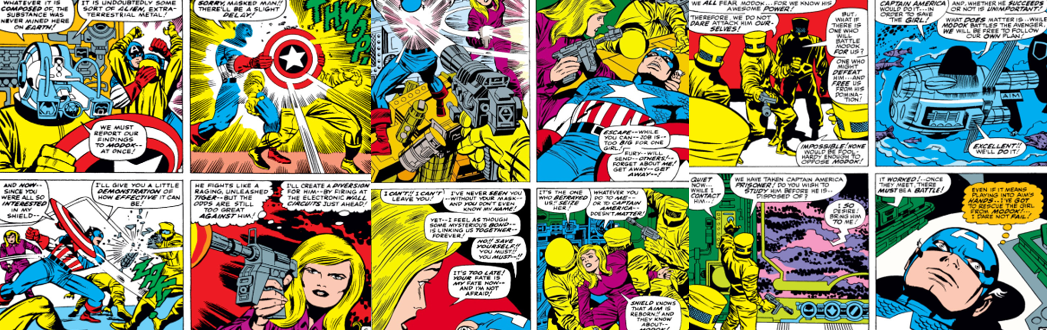
The entire crux of this two-part story centres around Captain Steve Rogers/Captain America’s efforts to rescue Nick Fury, the gruff and tumble top agent of the Supreme Headquarters, International Espionage and Law-Enforcement Division (S.H.I.E.L.D.) spy organisation. To accomplish this task, Cap was forced to place the one woman he loves, the mysterious Sharon Carter/Agent-13, in mortal peril and, as this story opens, he’s hell-bent on avenging himself against, A.I.M., the group responsible for it all. Outfitted with a suitably Kirby-esque breathing apparatus, Cap follow his radar to a set of underwater coordinates provided to him by Fury, eventually locating A.I.M.’s massive submarine base deep beneath the ocean. Unfortunately for the star-spangled hero, the “eyes of MODOK are everywhere” and A.I.M.’s bee-suit-wearing operatives easily spot him, blasting him with knockout gas and bringing him aboard, where he’s held to a table by “sheer magnetic force” and told stories of MODOK’s dreams of world conquest. Though Cap’s mind is working a mile a minute to think of some way to escape, he’s relieved when Agent-13 is revealed to be alive. Although she makes a big show of chastising him for stupidly risking his life to rescue her, Agent-13 secretly releases his magnetic trappings with her convenient “anti-polar coveralls” when she leans in for a kiss. Though A.I.M.’s soldiers try to blast Cap, he easily and effortlessly dispatches them, much to Agent-13’s amazement, and rushes to retrieve his iconic shield.

Cap and Agent-13 infiltrate A.I.M.’s submarine base to learn the truth about MODOK.

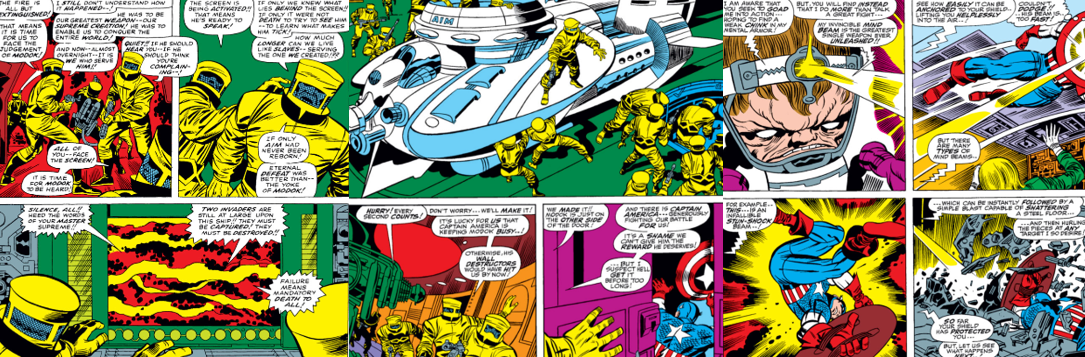
A.I.M.’s scientists are conducting a series of test on the indestructible weapon, marvelling at its unique properties and preparing to present their findings to their mysterious master, MODOK. Naturally, Cap and Agent-13 get to them first, beating up the scientists and reducing their lab to flaming wreckage. Cap then follows Agent-13’s lead in taking cover to avoid A.I.M.’s shock troopers and agrees to stick around and help her complete her mission. Namely, discovering who or what MODOK is to better determine and combat his threat. MODOK’s authority is so absolute that A.I.M.’s troopers dare not speak against him or the strange circumstances that transformed their greatest weapon into their oppressive master, especially as his disembodied voice orders their death for failing him so completely. Watching from the shadows, the two heroes eagerly await MODOK’s big reveal but are suddenly attacked by a shock trooper. Cap bravely takes the shot, ending up paralysed as a result. His sacrifice is largely in vain since Agent-13 refuses to flee and is easily captured and brought before MODOK’s large viewscreen, where she’s dropped through the floor in dramatic fashion. Although an A.I.M. soldier is prepared to finish Cap off, one of his peers stays his hand since only MODOK can issue such an order. Angered, the soldier speaks of rebelling against their master and, though his fellows are sceptical of their chances against MODOK’s supreme power, they’re convinced to go along with an elaborate scheme to have Captain America defeat their oppressor to save his ally.

MODOK’s awesome power terrifies even A.I.M. and sees him fatally betrayed.

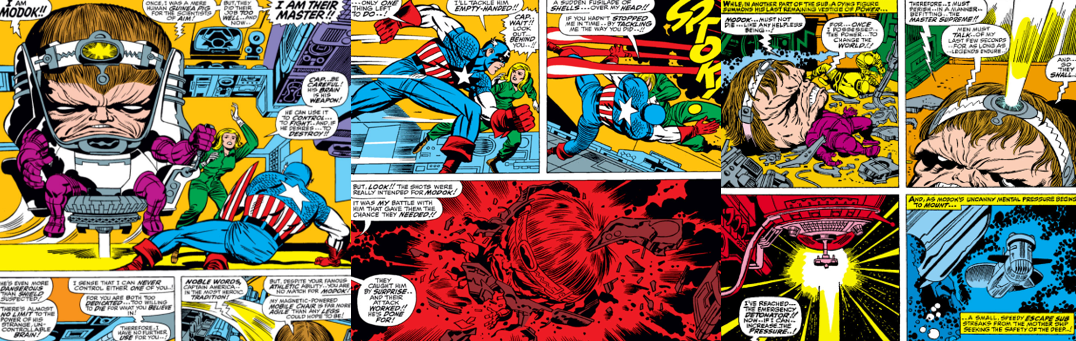
Thus, Cap is also teleported to another location to confront MODOK. Though freed from his paralysis, Cap is immediately felled by MODOK’s “brain beam” and approached by the man himself, a massive cybernetic head with tiny arms and legs that floats about! Once a “human guinea pig” for A.I.M.’s experiments, he has come to rule the organisation with his vast power thanks to his comically enlarged brain. Agent-13 is on hand to further MODOK’s narrative, urging Cap not to attack since MODOK’s “uncontrollable brain” is far too powerful. Yet, MODOK swiftly moves to strike, giving the Avenger no choice but to defend himself. Despite Cap’s superhuman deftness, MODOK easily manipulates his shield to toss him about and then sends him crashing to the floor. MODOK’s mind beams are incredibly versatile, allowing him to psychokinetically direct debris at Cap and causing the floor to erupt in flames. As the two battle, A.I.M. prepare to rally; while one squad escapes, another mobilises to attack MODOK while he’s distracted. MODOK’s power is so great he can freeze Cap’s shield as it flies through the air with “the speed of thought”, yet he fails to detect the betrayal of his own people, who open fire with a fusillade of shells that shatter MODOK’s cybernetic chair. A.I.M. then turn their weapons on Cap, who easily takes them out with an assist from Agent-13 before commandeering the escaping craft and apprehending the remaining scientists. As for MODOK, he’s left broken and dying. Refusing to go out in such a disgraceful way, MODOK uses the last of his power to overload the submarine base and cause a massive explosion, which Cap and Agent-13 assume means the end for A.I.M.’s grotesque commander.

The Summary:
This was an interesting two-part tale for me. My experience with Captain America’s adventures is quite limited and usually more focused on his team-based exploits, so it was a nice change of pace to see him in action. He’s working with S.H.I.E.L.D. here, which isn’t too uncommon these days; but back then, S.H.I.E.L.D. was more of a clandestine spy organisation than a global military power. Still, they have plenty of technology and resources on hand, enough to not only plant Agent-13 as a double agent in A.I.M. but also to get Cap to the group’s hidden submarine base. Although Cap and Agent-13 don’t know each other’s true identities at this point, it’s clear the two are smitten by each other. Cap goes solo to rescue her and constantly moves to protect her throughout these issues, and Agent-13 is in awe of his physical abilities and moral compass. Unfortunately, Cap does come off as a bit condescending here, referring to Afent-13 as “little girl” and “lady” a few too many times and Agent-13 mostly chips in here and there rather than being portrayed as Cap’s equal. Still, she’s not some blonde bimbo and she’s clearly a capable spy; her anti-polar outfit and A.I.M.’s respect for her reputation as a S.H.I.E.L.D. agent speak to that. She’s also as stubborn and dedicated to her duty as he is; she refuses to flee when they have the chance since she has a mission to accomplish, and then equally refuses to abandon Cap to die. Still, it’s Cap who gets all the big action scenes, throwing punches, his shield, and cannonballing about the place like a man possessed while Agent-13 just fires her pistol. AI.M.’s nameless, faceless soldiers and scientists were very entertaining here. Though they appear ridiculous in their haz-mat suits, they’re well organised and have the numbers advantage. It’s nothing compared to Cap, but they give it a good go, retreating when necessary and even unloading enough firepower to seemingly kill MODOK.

The feared MODOK is a force to be reckoned with despite his ridiculous appearance.

At first, they’re depicted as the typical minions of an oppressive master; terrified into servitude since failure is punishable by death, they’re subservient to MODOK’s incredible power and forced to obey his every command. However, many of them speak out against MODOK, questioning why a creation of theirs is giving them orders. Though talk of insurrection is forbidden, they’re encouraged to turn on their grotesque creation and manipulate Cap to fight on their behalf, showcasing a deceitful nature that’s unlike most common minions. As for MODOK himself, he’s a bizarre and ludicrous figure with his useless little limbs and enlarged cranium, but he showcases a wide array of powers that have Cap on the ropes before A.I.M. turns against him. We don’t learn the specifics about who he is or what A.I.M. did to him, but we learn he was their greatest experiment and built to be their deadliest weapon, but he took control of the organisation when they succeeded a little too well in their efforts. Now an all-seeing, overpowered commander who violently punishes any transgression, MODOK exhibits cybernetically endowed “brain beams” that can stun, hurl, and blast his foes with ease. Essentially immune to conventional attack, MODOK’s only weakness is underestimating his downtrodden minions, who leave him to die as little more than a useless cripple. Yet, despite his explosive end and his absurd appearance, MODOK is seen as a very real threat. A.I.M. fears him and Cap struggles to fight him, making him a strangely menacing figure with a laughable visage. These stories were a fun exploration of A.I.M.’s goals and inner workings and I enjoyed seeing MODOK as the outrageous face of their organisation. There was a lot of action, and it built upon the relationship and mutual respect between Cap and Agent-13. MODOK definitely stole the show, but I would’ve liked to see him showcased a little more. Perhaps a three-part story would’ve worked better in this regard, with the first part building up to the reveal, the second showcasing his powers and origins, and the third detailing A.I.M.’s betrayal and MODOK’s vulnerabilities. Still, it was a fun read with some striking art and MODOK remains one of Marvel’s strangest villains yet and it was fun to see his first appearance.

My Rating:

Rating: 3 out of 5.

Pretty Good

What did you think to MODOK’s dramatic first appearance? Were you put off by his bizarre appearance or did you find his powers impressive? What did you think to the relationship between Cap and Agent-13? Did you enjoy seeing A.I.M. turn against MODOK and stage a revolution? Would you like to see Marvel bring back the Tales of Suspense anthology? What are some of your favourite MODOK stories and moments? Tell me your thoughts on MODOK down below and go check out my other sci-fi content.