Mini Game Corner: Aliens: Fireteam Elite (Xbox Series X)

Released: 24 August 2021
Developer: Cold Iron Studios
Also Available For: PC, PlayStation 4, PlayStation 5, Xbox One, Xbox Series S

A Brief Background:
Over the years, the Alien franchise (Various, 1979 to present) has had a long and complex history with videogame adaptations that range from primitive pixelated messes to real-time strategies, crossover titles, survival/horror experiences, and first-person shooters. This latter genre has been one of the most revisited, especially after James Cameron was tasked with following up on Ridley Scott’s financially successful and highly influential Alien (ibid, 1976) with an incredibly profitable and well-regarded 1986 sequel that proved to be perfectly transferrable into the FPS genre. Although Alien: Isolation (Creative Assembly, 2014) proved to be a hit with gamers and critics alike, SEGA were disappointed by the sales and eventually lost the license after Disney acquired 20th Century Fox and the development of a new Alien game fell into the laps of Cold Iron Studios. Built from the ground up and specifically designed to focus on co-operative, online play, the developers drew from the vast array of Alien lore to craft the story and aesthetic of Aliens: Fireteam Elite. However, the game has been met by mixed to average reviews; while the action-heavy focus and chaotic shooting was praised, the lack of mission variety and AI was criticised. Still, Aliens: Fireteam Elite was the best-selling retail game in the UK in its week of release and it was soon followed by a bunch of downloadable content (DLC) that included new missions, weapons, and enemies from Alien: Covenant (Scott, 2017).

First Impressions:
Aliens: Fireteam Elite is a third-person, squad-based shooter in which you can customise and equip an avatar from one of seven character classes (Gunner (my choice), Demolisher, Technician, Doc, Phalanx, Lancer, and Recon) and then take on four story-based campaigns alongside two other online players or two A.I.-controlled ‘bots if you don’t feel like playing online. Sadly, and strangely, couch co-op is not an option and you cannot pause the game if you need to take a piss or stop for a second; compounding matters is the fact that, if you stand idle for too long, enemies seem to spawn in to push you onwards, all of which can make for some tense gameplay that borders on frustration. If you’ve ever played a third-person shooter before than the game’s default controls won’t be anything new to you: you fire your current weapon with the Right Trigger, aim down your sights with the Left Trigger, reload and interact with consoles and such with X, snap to cover with A, perform a dodge roll with B, press in the right stick for a melee attack, swap to you side arm or secondary weapon with Y. You can also use the directional pad to heal yourself if you have a first aid kit on hand, access your consumables menu, and communicate with or revive downed teammates. Each weapon and character class comes with a “Kit” and “Role” ability, which you can activate with the Left or Right Bumper, respectively; as you play and unlock “Perks” and other modifiers, you’ll be able to temporarily improve your damage output, accuracy, increase your rate of fire, swap weapons out for more powerful variants (like incendiary shots), drop turrets, unleash a missile barrage, and so forth.
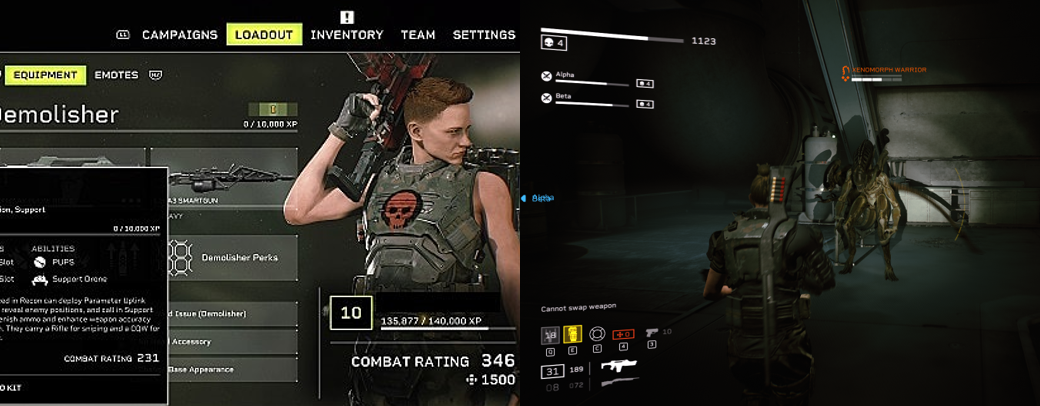
Customise and equip your avatar and then get cracking on the latest bug hunt.

At the start of the game, you’re tasked with customising your avatar; these options are initially quite limited, though you can choose our gender, and you’ll unlock additional headgear and paint and such for your avatar and their weapons. You can only carry two weapons at a time, alongside your side arm, but these are instantly recognisable from the source material; you’ve got the Smart Gun, and the Pulse Rifle, and a familiar looking shotgun, amongst other similarly styled weapons. As you play, you’ll gain access to additional weapons, each with a bevvy of different perks and abilities, and acquire or purchase decals and add-ons for each’ these will increase your ammo capacity, damage output, and so forth but are few and far between without some serious grinding. Each mission can be played on one of three difficulties (with the two hardest modes being initially locked) and you’ll earn more experience points (XP), rewards, and credits for playing on higher difficulties. The sheer number of menus and onscreen text can be extremely daunting; navigating the menus is also a chore since you must use the aiming reticule like it’s a Nintendo Wii game, which can be disorientating. You can earn, buy, and equip special “Challenge Cards” before each mission to give additional perks and buffs (such as increasing XP gain and access to special weapons or turrets) and the game will offer daily “Tactical Opportunities” to award you additional bonuses for completing certain timed criteria. Gameplay wise, your generally tasked with patching into computer consoles, cutting through doors, downloading data, acquiring cranks and intel files, and rescuing or protecting key personnel all while fending off seemingly endless waves of Xenomorphs. You have the classic Aliens motion tracker on hand to alert you to the presence of enemies, who scramble out of vents and often just blink into existence right in your path. Some will also pounce on you, forcing you to complete a quick-time event (QTE) if no one’s on hand to save your ass.
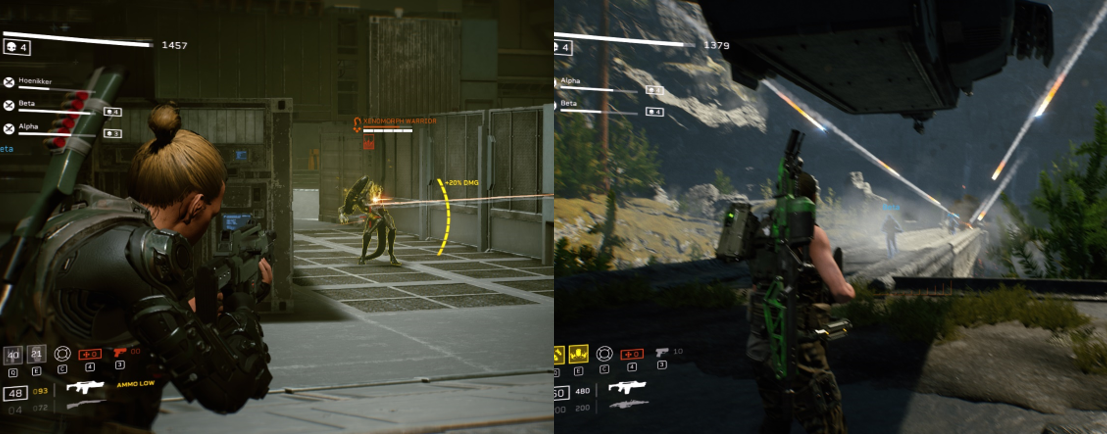
Hold off against endless Xenomorph attacks or complete simple puzzles to progress.

It’s pretty easy to burn through your ammo, and to see your health whittled down to nothing from surprise attacks; Xenomorphs come in a number of varieties, from exploding aliens to acid spitters, to the larger drones who act as bosses and mini bosses. If that wasn’t bad enough, you’ll also have to contend with synthetic enemies who use cover tactics and weaponry similar to yours, forcing you to find ways to shoot around their armoured variants and take cover from their grenades, though the androids and the aliens will attack each other, which can be useful. Graphically and aesthetically, Aliens: Fireteam Elite very much evokes the atmosphere and presentation of Aliens; everything from the Marine’s hokey dialogue, the dark and dingey interiors and corridors, and the presence of recognisable weapons and technology are all pulled straight out of James Cameron’s movie but the game doesn’t stop there. You’ll eventually take a trip down to LV-895, a barren alien world where large, stone-like spaceships and environments are being plundered by Weyland-Yutani; these sections recall the Engineer architecture of Ridley Scott’s Alien films, as is a staple for most Alien videogames, and the game generally looks and sounds pretty good. That is, of course, if you ignore the cutscenes, dialogue, and character models; these are noticeably poor quality and remind me more of an Xbox 360-era videogame, but actually worse as there’s no lip synching and the amount of pop up, A.I.. tomfoolery, and graphical glitches (even when playing offline) make gameplay an awkward and unstable experience. The game tries to offer dialogue trees at certain points as characters drone on and on in a desperate attempt to give some context, but you can skip all of this as it basically means nothing; if you have an objective beyond shooting everything in sight, the game usually tells you, but it’s not always clear where you have to actually go to activate certain consoles so you can end up stuck in a never-ending shootout if you’re not paying attention.

My Progression:
To begin with, I started on the “Standard” difficulty and played online as it seemed as though there was no other option available to me. after struggling a bit with the controls and navigating the many dark, dishevelled corridors and areas, all of which look the same so it’s easy to get turned around, I managed to limp my way through the first couple of missions and even pull my weight in fending off Xenomorph attacks thanks to clever deployment of turrets and making use to the ammo refill stations. Scattered around the environment, you’ll also find other temporary power-ups that turn your shots into incendiary or electroshock rounds, all of which is great to thinning out the alien hordes, and you’ll occasionally find special hidden crates containing new weapons and gear. Eventually, though, the difficulty really starts to ramp up; larger and far more aggressive Xenomorphs soon become the norm, with jumping red variants and massive drones charging across the environment and sporting  hefty life bar. In these situations, you’re often trapped in a room or forced to activate a take-off sequence using various consoles while swarms of aliens spew in from all over and it can be pretty difficult fending them all off, especially when the game sometimes decides not to open doors for you to progress once all enemies are clear, thus forcing you to abandon the mission.
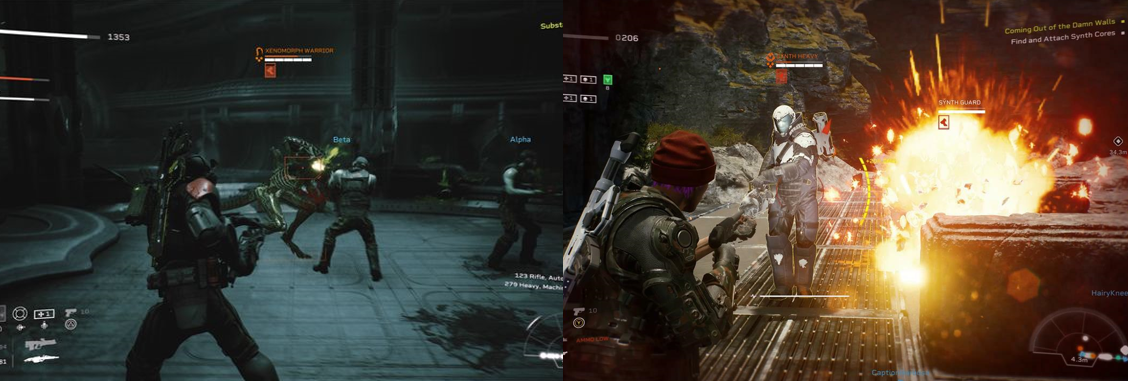
Numerous firefights, repetitive objectives, and graphical glitches make for a lacklustre experience.

After worrying about letting down my clearly superior human partners, I switched to private matchmaking and played with a couple of ‘bots. Unfortunately, you can’t seem to change their character classes; they simply mirror your current loadout, which is a bit annoying as it probably would’ve been helpful to have a Demolisher and Doc on hand). After tearing my hair out trying to overcome the endless gaggle of Aliens and drones set on keeping me from taking off, I lowered the difficulty to “Casual” and managed to clear the first campaign, ending up on LV-895 and hissing with frustration at the inclusion of more tactically capable android enemies. Thankfully, you can fight through the Engineer ruins and make it to a bridge where, after a short countdown, you’ll get some much-needed air support. This won’t help you as you press deeper into the temple, though, where the “Working Joes” come to “life” and attack en masse, flamethrower-wielding Synth Incinerators dog you at every turn, and you’re forced to not just download data from androids but also to recover a number of Synth Cores from destroyed androids. Annoyingly, you can only carry one of these at a time, forcing you to run back and forth in a near constant firefight, and this is about where my patience with the game ran out. Presumably, you stand a better chance at success if you take the time to grind up your levels, acquire/buy and equip better Perks, gear, and weapons, and play alongside human players who can offer more immediate assistance but the game seems to be tailormade for repetition. A lack of in-mission checkpoints means you only every get one shot to clear each mission, making it incredibly frustrating when you fail to crawl your way to a teammate for revival, and the sheer number of janky, overly aggressive enemies can make what is occasionally a fun-filled, if near mindless, shooter an unfair chore to sit through.

I clearly wasn’t paying attention to the marketing for Aliens: Fireteam Elite; either that or I saw that it was a team-based, online shooter and simply assumed that it would have a solo campaign as well. Thus, I was very disappointed when I loaded it up and found that it was geared towards online play only, and it took me some time to find an offline option so I wouldn’t be lumbered with strangers to look foolish alongside. Similarly, I was immediately overwhelmed by the sheer number of menus, text, options, and blinking notifications; it seems like every single little thing you can do or use has a little text box assigned to it and I found this very unintuitive and daunting. I just wanted to gear up and get into the action, but it felt as though I was forced to stop and consider every single thing, only to find I wasn’t at the right level to even use or get half the stuff on offer. Once you actually get into the game, the action is fast and frantic; you’re generally not asked to do much more than press, hold, or tap X to activate consoles and complete objectives, meaning the bulk of the game’s focus is on the firefights. Explosive barrels and the different character classes can make these fun and offer some variety, but you’re constantly forced to hold out against swarms of aliens, which gets a bit old quite fast and it seems like you’re never given a chance to catch your breath as there’s always another drone waiting to slash at you to get you moving. This frustration, alongside the sheer number of graphical glitches and janky A.I., to say nothing of the repetitive nature of the game, all add up to a budget title more akin to a pay-to-win mobile title and a Triple-A release, but maybe you had a different experience? Maybe you played online with friends using a variety of loadouts and had more fun? Maybe you didn’t and you prefer a different Alien game? Whatever the case, I’d love to hear about it so leave your thoughts below or on my social media.

Mini Game Corner [Robin Month]: Batman Forever: The Arcade Game (PlayStation)


In April of 1940, about a year after the debut of arguably their most popular character, Bruce Wayne/Batman, DC Comics debuted “the sensational find of [that year]”, Dick Grayson/Robin. Since then, Batman’s pixie-boots-wearing partner has changed outfits and a number of different characters have assumed the mantle as the Dynamic Duo of Batman and Robin have become an iconic staple of DC Comics. Considering my fondness for the character and those who assumed the mantle over the years, what better way to celebrate this dynamic debut than to dedicate every Thursday of April to celebrating the character?


Released: 1996
Developer: Probe Entertainment / Iguana Entertainment / Iguana Entertainment UK
Also Available For: Arcade, MS-DOS, and SEGA Saturn

A Brief Background:
It’s easy to forget now but Batman Forever (Schumacher, 1995) was a pretty big deal for Warner Bros. back in the day; not only had they sunk $100 million into the film but they were desperate to appease those who were outraged with the dark, macabre content of Batman Returns (Burton, 1992) and craft a film that would be more appealing for the sponsors. While it garnered a mixed critical response, Batman Forever made over $330 at the box office and was accompanied by a slew of merchandise and ancillary products. Like its predecessors, Batman Forever also received a tie-in videogame that marked Acclaim’s first foray into the arcade scene. However, the 2.5D beat-‘em-up was met with mostly mixed reviews but still fared better than Acclaim’s other home console adaptation of the movie.

First Impressions:
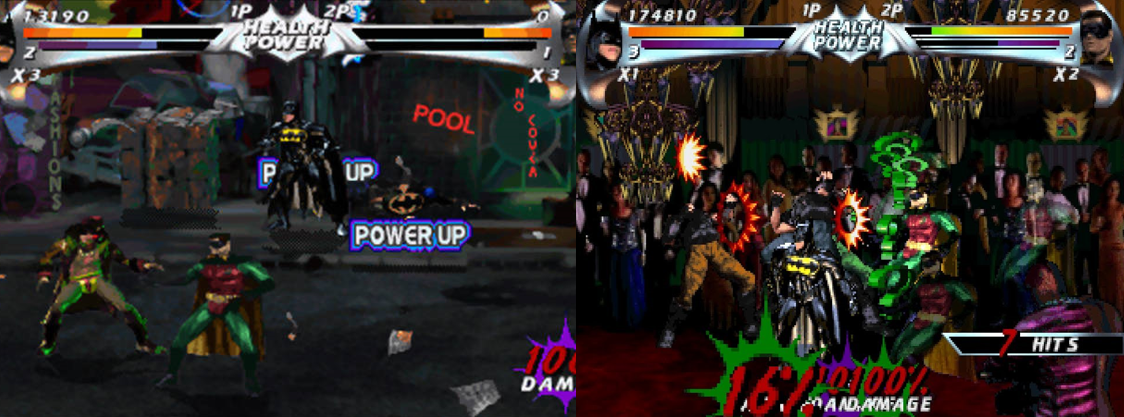
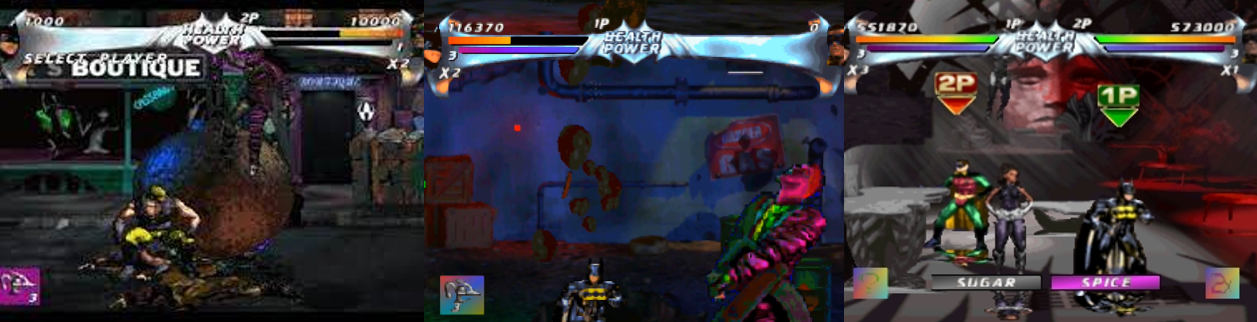
If there’s three things you can always count on with me, it’s that I’m a big fan of arcade titles, sidescrolling beat-‘em-ups, and Batman. Although I didn’t grow up with a Super Nintendo Entertainment System (SNES), emulators have allowed me to have a great deal of fun with Batman Returns (Konami, 1993), which was a cracking licensed videogame simply because it aped the formula of genre staples like Final Fight (Capcom, 1989) and X-Men (Konami, 1992). While Batman Forever had an extremely dismal and almost unplayable sidescrolling adventure game released on Mega Drive and SNES, arcades were blessed with this far more enjoyable and fitting videogame, which thankfully came to the PlayStation so I was able to snap it up (and at a pretty good price, too, all things considered). Batman Forever: The Arcade Game can be played on three different difficulty settings (Easy, Normal, or Hard), with enemies increasing in number and toughness on the harder difficulty settings, and allows you to assign yourself up to seven continues. You begin the game with three lives and, once you’ve lost all three, you can enter a high score and switch your character to return to the action once more. In terms of controls, Batman Forever is as simple as it gets: one button punches, one kicks, and one jumps and that’s it. you can customise these in the options menu and choose to play as either Batman or Robin (or both together, if you have a friend), before jumping into the game proper. There doesn’t appear to be any technical differences between the two, but they do have different animations and Robin seems to be a bit faster on his feet, but that could just my psychosomatic on my part. Right away, you’re treated to a pretty impressive in-game cutscene as Batman and/or Robin heads to the streets of Gotham City in the Batmobile, and the first thing you’ll notice is how impressive and ambitious the graphics are. The game utilises pre-rendered, 2.5D backgrounds that, while murky and a bit washed out, are immediately evocative of many of the neon-drenched, bizarre locations seen in the film, such as the graffiti-and-litter-strewn streets, Edward Nygma/The Riddler’s big gala (with partially animated guests in the background), and Harvey Dent/Two-Face’s lair among others. The playing field allows you to wander into the background, with sprites scaling accordingly, though they do lose a fair amount of graphical fidelity, becoming even more pixelated and ugly as you move about.

While the game is cluttered and chaotic, it’s full of action and fun ways to beat up thugs.

Sprites in general look decent enough; they appear to be digitised, similar to the early Mortal Kombat games (Midway/Various, 1992 to 1996), and Batman and Robin have a glistening sheen to them that makes them look like action figures. Batman looks a little goofy, with his massive chest symbol, but Robin looks pretty good; the thugs you encounter, however, are swarms of Two-Face’s goons, robots modelled after the Riddler’s fortune teller machine, and other generic beat-‘em-up mooks, none of whom have a life bar. The sheer number of enemies is pretty impressive and overwhelming, however. It doesn’t take much for you to get pummelled to death as enemies swarm around you and trap you in an unblockable beatdown, and enemies will fire guns, toss grenades, drive motorcycles and cars at you as well as spring out from the scenery. To make matters worse, Two-Face occasionally pops in, riding a wrecking ball or shooting rockets at you from the foreground, though there are times where you can swing and grapple parts of the environment to barge trough enemies. Combat is a pretty simple affair, with you mashing punch and kick to string together combos, tossing and jump-kicking enemies as you’d expect, but the game makes a big deal out swamping you with various power-ups. As you take out enemies, little Bat Symbols scatter everywhere which power-up your “Combo Meter” as well as a variety of gadgets and pick-ups: Bat-Signals, Two-Face Ying-Yangs, and Riddler Symbols appear frequently, bestowing either gadgets or temporary buffs and debuffs. When you grab a gadget, like the Batarang, grapple gun, taser, or Bat Bola, your regular attack is replaced with a projectile; the grapple gun is particularly useful for landing up to 150 hit combos on enemies and sees you swinging and flailing all over the screen, while the Batarangs can quickly rack up points and the taser and bola can stun enemies for a short time. You can also pull off a screen-clearing attack, summon bats to protect and attack enemies, and toss a stun grenade, and all of these attacks will increase in power and change their appearance as your meter builds higher. However, this can make the combat and action extremely chaotic as the screen is constantly filled with enemies, items, and your almost incomprehensible attacks, making for a very frantic and confusing experience.

My Progression:
As you fight your way through the game, you can pick up and throw objects, grab the odd bit of health to sustain yourself, and will be blessed or cursed with power-ups such as invisibility, duplication, invulnerability, and shrinking you (or your enemies), among others. After clearing a stage, your score is tallied up; the more enemies you defeat and the more gadgets and such you use, the better your score and rewards. You can then pick from these rewards to start the next stage with a gadget or power-up advantage; some are merely cosmetic, like “VR Mode”, which sees enemies burst into green computer coding upon defeat, while others increase your combo by default, allowing you to build your meter faster. There are no save points, password, or checkpoints in the game, however; once you exhaust all of your continues, the game is over and you’ll need to start from the beginning, which is always a pretty shitty thing to do in a home conversion of an arcade game since its purpose isn’t to relieve you of your pocket money. All I’m saying is at least have the option to earn more lives or continues, or limit your continues on the harder difficulties and have them disabled entirely on Easy mode.

Unfortunately, I wasn’t able to save Gotham from the villains’ mad schemes…this time…

Naturally, you’ll have to battle a few bosses over the course of your playthrough, however not as many as you might think. The game is structured more to have you battle wave upon wave of the same goons over and over until you reach the end of a stage, where a boss may be waiting for you, but it’s not always the case. I didn’t fight a boss until the second stage, for example, which pits you against three slightly tougher goons: Nick, Blade, and Flex, each of which fires at you with an Uzi, tosses grenades, or throws knives at you and can block your attacks (something you’re incapable of doing). You’ll know when you’re facing a boss as they actually have a life bar and the screen flashes dramatically after you defeat them, and these three weren’t all that difficult but, again, it’s easy to get caught in a crossfire and just whittled down to nothing in no time at all. At the end of an alleyway, you’ll fight Tassel (who seems to be the neon-painted, clown-like goon who hassled Dick in the film), who’s joined by a couple of gun-and-grenade-toting henchmen and shows off a bit of flippy, martial arts skill. After battling through goons on a rooftop, you’ll be confronted by a helicopter and a seemingly endless supply of enemies; simply fend them off, dodging the chopper’s machine gun fire, and press attack to toss projectiles when prompted. Two-Face will continually pop up to fire rockets at you in the subway and at the gala, and two of the Riddler’s robots will attack you with their extendable arms to cover their escape. These then become regular enemies in a construction site full of explosive barrels, where you’ll battle Feather and Stew, with Feather proving pretty tough thanks to being very handy with his bo staff. My run came to a disappointing end in Two-Face’s lair, however, where his beautiful bodyguards, Sugar and Spice, absolutely wrecked me with their fast attacks, which pummelled me from both sides without any chance of fighting back, treating to me to a rather bland game over screen (in the Batman: The Animated Series (1992 to 1999) font, no less) informing me of my failure to save Gotham City.

I was having a pretty good time with Batman Forever: The Arcade Game once I got past the visual and sensory overload. The game includes a renditions of Elliot Goldenthal’s score and some brief sound bites from the movie, but the sheer number of enemies and chaos happening onscreen at any one time can be a little overwhelming. The game looks fairly decent, even though things can get a bit ugly and distorted at times, but the depth of combat is a little odd compared to other beat-‘em-ups; the gadgets and various pick-ups mean there’s always something happening and you can rack up big combos, but it also feels like a lot of control is being taken away from you as Batman and Robin leap into action with these big, elaborate movements at the touch of a button. Unfortunately, neither are particularly durable; your health bar can be whittled down to nothing in the blink of an eye and you’ll burn through your lives and continues in no time, with no passwords or cheat codes to make things easier for you. It’s probably do-able, maybe in two-player mode, and I’m sure I’ll return to it again as I do enjoy a bit of sidescrolling, beat-‘em-up action, but lumbering you with limited continues for a home console release always irks me and there’s not really anything to unlock or to discover outside of the main campaign, which continues basically no story and very few cutscenes (and even these are limited to the in-game graphics, impressive as they can be). I’d like to know if you’ve ever played this one, either in the arcade or at home, and how well you fared against Gotham’s colourful swarms of criminals? Which character did you prefer, and what did you think to all the gadgets and power-ups? Which licensed Batman game is your favourite? Who is your favourite Robin and how are you celebrating the Boy Wonder’s debut this month?  Whatever your thoughts on this game, and Robin in general, sign up to leave them below or share your thoughts on my social media, and check back soon for more Robin content!

Mini Game Corner: Golden Axe (Mega Drive)

Released: 2 August 1991
Developer: SEGA
Also Available For: Arcade, GameCube, Game Gear, Master System, Mobile, Nintendo 3DS, Nintendo Wii, PC, PlayStation 2, PlayStation 3, PlayStation 4, PlayStation 5, Sega CD, Xbox 360, Xbox One, Xbox Series S/X

A Brief Background:
Back in the mid-nineties, sidescrolling beat-‘em-ups and hack-and-slash adventures could often be found in arcades since they demanded little more from players than to hold right, mash buttons, and continually pump in their hard-earned pocket money. High fantasy was also a popular genre at the time; sword and sorcery settings were a recurring theme in movies, comic books, and action figures, so it made sense for there to be an influx of similarly themed videogames. Titles like Gauntlet (Atari Games, 1985), Barbarian: The Ultimate Warrior (Palace Software, 1987), and Dungeon Master (FTL Games, 1987) may have led the way but it was the two Conan movies (Milius 1982; Fleisher 1984) that most directly influenced lead designer and producer Makoto Uchida, who sought to create a beat-‘em-up that could stand out from ultra popular genre hit Double Dragon (Technōs Japan, 1987). Golden Axe was a hit in arcades and became incredibly influential to the beat-‘em-up genre; when it released on the Mega Drive, Golden Axe was one of the system’s premier titles and, while the home version didn’t quite match up to the arcade release, it still did a commendable job of pushing SEGA’s machine as an arcade-quality product. Although Golden Axe led to a number of sequels and spin-offs, and was ported to many other consoles over the years, the series has largely laid dormant; Golden Axe: Beast Rider (Secret Level, 2008) all but killed the franchise with its poor reception, and a 2.5D reboot/remake was ultimately scrapped before it could be properly developed, meaning fans have had to make do with the hack-and-slash games being represented in SEGA’s racing games.

First Impressions:
Golden Axe is set in the fictional land of Yuria, a high fantasy medieval world where the evil Death Adder has secured the mythical and titular Golden Axe and captured the King and his daughter, and threatens to destroy them all unless the people of Yuria accept him as their ruler. Players must pick between Ax Battler, Gilius Thunderhead, and Tyris Flare to set out on a 2D, sidescrolling beat-‘em-up quest to liberate Yuria and avenge their losses at the hands of Death Adder, with each of them having an added personal grudge against Death Adder and wielding a different weapon. No matter which character you pick, the default controls remain the same: A lets you perform a screen-clearing magic attack, B sees you attack with your weapon, and C lets you jump to avoid attacks and perform a jumping attack. Thankfully, these controls can be customised (I much prefer mapping attack to A and magic to C), and you can also rush ahead and perform a running attack and even limited combos that see you kicking, throwing, and beating down opponents, or press attack and jump together to perform a special twirling strike to quickly hit enemies that are behind you (or a rolling axe attack for Gilius). At first glance, it didn’t seem like there was much difference between which character you pick: Ax Battler was my pick and he seems slow and clunky compared to Gilius and Tyris, with Gilius being shorter and potentially having a smaller hit box as a result and Tyris seeming to have a faster dash attack. During and between stages, little Elves will wander about the screen; blue ones drop Magic Pots and green ones drop a chunk of meat to restore your life bar (though these only seem to appear in the interlude sections). Each character’s magic bar is a different length, and each one performs different elemental magic (Ax Battler’s are earth-based, Gilius’s are lightning, and Tyris’s are fire), with more powerful magic attacks performed when you have more Magic Pots. Unlike many beat-‘em-ups, Golden Axe lacks a time limit, which is a relief, and it also lacks a traditional difficulty system; you can pick between “Arcade” and “Beginner” mode, with the latter cutting the game short at Stage 3 for an easier challenge. In the “Options” menu, you can also increase your life bar, but you’ll be stuck with the default three lives and four credits to last you throughout the game.

You’ll need all the animals and magic you can get to endure the enemy’s tenacious attacks.

While there aren’t any power-ups to pick up, you can knock or throw enemies off the edge of some stages (and the enemy A.I. is dumb enough to walk right off, in some cases) and ride three different beasts that can really help turn the tide: there’s a weird little bird/lizard hybrid known as a “Chicken Leg” that performs a tail swipe and two dragons, a blue one that breathes fire and a red one that spits fireballs. You can jump and perform dash attacks on these creatures, but enemies can also ride them and, if you’re knocked off or don’t get on one fast enough, the beasts will run away. Gameplay is as simple as you could want; dialogue boxes and map screens between stages give you a quick overview of the game’s story, and you’ll occasionally see screaming non-payable characters running past as enemies attack, but your goal is to go from the left side of the screen to the right, taking out enemies and liberating towns and areas from Death Adder’s lieutenants. While enemies are sometimes dumb, they’re smart enough to flank you and can charge at you, perform jump attacks, and you’re basically screwed once they land their first hit; when caught between two or more, it’s frustratingly easy to get constantly beaten and knocked down, which can feel very cheap. The game is pretty slow by default, but runs fairly consistently; there’s only ever about four enemies on screen at once, which helps, and the only time I saw any kind of slowdown was when the game loaded the day to dusk transition that indicates a boss battle or gauntlet. Golden Axe has you travelling to eight different stages, each one sporting some fun and visually interesting details, such as a village being on the back of a giant turtle or eagle, with feathers blowing in the wind, enemies emerging from the ground or behind doors. The game is bolstered by an extremely catchy soundtrack that’s fittingly reminiscent of Conan the Barbarian (Milius, 1982) and everyone gets a little death scream when they’re defeated. Unfortunately, while the sprites and environments are very big and reasonably detailed, they’re also a bit blurry and indistinct and the game can be a bit of a struggle to play; characters plod along, barely able to avoid attacks, and land their blows with a lackadaisical enthusiasm. However, I liked the variety in the stages; you need to jump over broken bridges, hop up steps, and can take the high ground at times, and there’s even some interesting screen transitions between and at the end of stages.

My Progression:
I’ve played Golden Axe before; I used to have it on the Amiga, I’ve played it on various compilations, and I believe I’ve finished it before but always with conveniences like cracked cheats or replays and save states. I was thus surprised at how well I was able to progress through the game without any of these aides (apparently, there is a code for extra lives but I couldn’t get it to work). Although you’d never guess it from playing the game, there is a scoring system in place, but you only see it and receive a letter rank upon getting a game over, meaning there’s no way to accumulate more lives to see you through to the end. At the end of each stage, you’ll either face one or more larger boss enemies accompanied by some minions, or a short wave of enemies, and the bigger villains you face will then crop up as regular enemies in subsequent stages. The first boss you face is actually two, the hulking, hammer-wielded Bad Brothers, who stomp around the place swinging their giant warhammers, kicking at you, or charging at you. While their attacks can deal massive damage, it’s not too hard to stay out of reach and spam your running charge or jump attack, though you need to be careful as your running attacks won’t connect if enemies are a little too far to the edge of the screen.

While Death Adder Jr. bested me, there’s still The Duel and the game’s true ending to experience.

After clearing Death Adder’s minions from Turtle Village and crossing the bridge, you’ll face Lieutenant Bitter, a huge knight in silver armour who makes a nasty habit of slashing you out of the air or charging with his massive sword and bashing you with his shield. Tougher enemies will soon appear to cause you troubles, as indicated by their differing colour palettes, and this includes fighting variants of the Bad Brothers and Lt. Bitter prior to facing Death Adder Jr., who also doubles as the final boss of “Beginner” mode. When I faced him in “Arcade” mode, however, he was the death of me thanks to his massive axe swings and ability to fire a magical bolt across the ground. However, this isn’t necessarily where the game ends; you can play alongside a friend, for example, if player two presses start on the title screen (not the character select screen, as you might expect) but be careful as you can inflict damage on each other in this mode. You can also take on “The Duel”, which pits you against a number of the game’s enemies in a more traditional 2D fighter. Here, you get thirty seconds to defeat your opponent/s and they actually have a health bar (which would’ve been useful against bosses in the main game). Unfortunately, you can’t use your magic here and any damage you take carries over to the next round, though you are again given a class ranking for your efforts and you can also battle a friend in a one-on-one fight using this mode.

There’s no doubt that Golden Axe is a classic arcade and SEGA Mega Drive title; it’s a very visually appealing and enjoyable experience thanks to a pretty basic premise and control scheme, and it can be fun to charge at enemies, sword swinging, and toss them to their doom while humming one of the many catchy tunes. Unfortunately, it’s a very barebones and clunky experience; Tyris and Gilius were a bit faster and more responsive to play as, but the default speed is very slow, control can feel sluggish and lagging, and enemies are far too cheap at times. While the first few stages aren’t too difficult, it’s not long before the game’s arcade roots rear their head and see your health whittled down, your lives exhausted, and face you with that dreaded “Game Over” screen. Unlike many other beat-‘em-ups, especially ones on consoles, there’s hardly any opportunities to refill your health and no way to earn more lives or continues, meaning that the default difficult level is quite high compared to others in its genre. Had it included infinite continues to help balance these issues, this would’ve helped a lot; sure, you can probably finish “Beginner” mode without too much difficulty but that’s not the same as defeating the real Death Adder and his bigger, badder mentor, Death Bringer and getting the game’s true ending. Overall, it’s a fun arcade style beat-‘em-up, one that definitely set a standard for its genre and for the Mega Drive’s promise of offering arcade-style action, but there’s definitely better games of this type out there, even in the Golden Axe series, and some players might find the steep difficulty curve difficult to manage. Still, have you ever beaten Golden Axe? Do you think it’s worth me giving it another go to try and get to the end? Which of the characters or games in the franchise is your favourite? I’d love to hear your memories of Golden Axe, so leave them down below or drop a comment on my social media to share your thoughts on Golden Axe.

Mini Game Corner: Chuck Rock (Mega Drive)

Released: 1991
Developer: Core Design
Also Available For: Amiga, Atari ST, Archimedes, Commodore 64, Game Gear, Master System, Super Nintendo Entertainment System (SNES), Game Boy, Mega-CD, CD32

A Brief Background:
Founded in 1988 by former employees of Gremlin Graphics, Core Design was a Derby-based videogame developer who produced a slew of Amiga titles back in the late-eighties and early-nineties in a variety of genres, from shooters to adventure games and, of course, platformers. Years before taking the gaming world by storm with the voluptuous Lara Croft, Core Design crafted their own slapstick platforming franchise in the form of Chuck Rock, which aimed to standout from the ever-growing number of platform titles by focusing on zany, cartoonish humour and graphics and taking place in prehistoric times. At the time, Chuck Rock was lauded for its colourful graphics, humour, and unique rock-throwing mechanics; while contemporary reviews aren’t quite as forgiving regarding the game’s pace and appeal, it did spawn a sequel and even a spin-off back in the day. For my part, I remember playing the Master System version and have always considered Chuck Rock a must-have game for my Mega Drive library so I was keen to see if it delivered under close scrutiny.

First Impressions:
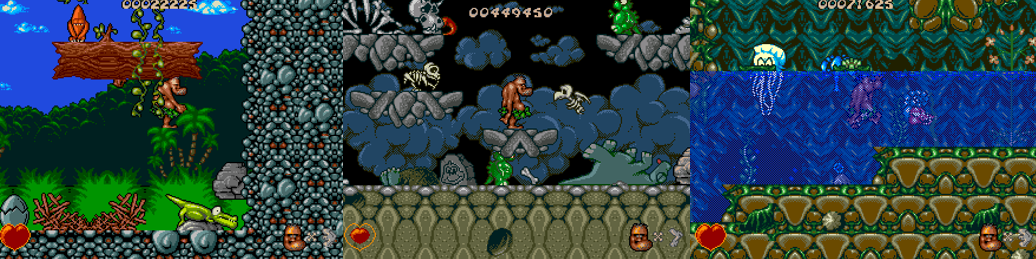
So, as I mentioned, I first played Chuck Rock on the master System; it was one of the first home console games I ever played in that regard, and I’ve longed to add the 16-bit version to my gaming library simply because it’s one of those early Mega Drive titles that I consider synonymous with the system. The game is a pretty straightforward platformer; you’re placed into the Cro-Magnon role of the titular Chuck, an ape-like prehistoric man who can send enemies flying with a thrust of his considerable belly. You perform this “belly butt” by pressing B, though its range is pretty limited and some enemies move quite quickly or erratically, meaning you often take a hit when using it. Thankfully, Chuck can also jump with C; it’s not especially high, just like Chuck isn’t especially fast or nimble, but you can perform a mid-air kick by pressing B in the air. Oddly, the A button does absolutely nothing and there are not options to switch around the controls, which means you have to press down and B to pick up rocks; these can be flung as projectiles or held overhead to protect from enemy bombardments but are primarily used to help you reach higher ledges and areas or safely cross thorny obstacles and acid/lava pits. Chuck can also swim, in the loosest sense of the word; he kind of flails about when underwater, with his offense limited to his kick and the toss of a rock.

Bash enemies with your belly or squash them witth rocks in this colourful slapstick platformer.

The game is comprised of five levels, each with three to five “Zones” in each; this is an elaborate way of saying five levels with three to five screens as, when you reach the end of a Zone, you spawn in a new area and continue on to the right as normally. There’s a strong emphasis on platforming and exploration is often awarded with a cache of goodies to increase your score and bring you closer to the 100,000 points needed for an extra life or hearts to refill your health. Chuck can take quite a bit of damage, but there’s very little invincibility frames so it’s easy to get spam-hurt to death from hazards; he’ll also drown if you stay underwater too long, as helpfully indicated by his face on the heads-up display turning blue when submerged, though thankfully there’s no arbitrary time limit to complete the stages. While a variety of dinosaurs and cavemen will dog your progress, some will actually help you; you can use bat-like Pteranodons to cross gaps and you can cross acid and lava pits on the backs of Brachiosaurus’and water on whales. Your only real in-game options are to turn the music and sound effects off, but you should leave both on as Chuck’s battle cry of “Unga-Bunga!” is quite adorable and the game is bolstered by a catchy soundtrack that works well with the cartoonish visuals. Unfortunately, the game is pretty slow going; Chuck has a weight to him that makes avoiding enemies or precision platforming difficult to nigh-on frustrating, and your progress is restricted not just by a paltry three lives but also limited continues and no password or push-button codes to help you get further into the game.

My Progression:
My memories of the Master system version of the game are limited but I know I never finished it, and I don’t recall getting much further past the first boss. When I fired up Chuck Rock, I was ready for a fun, quirky little platformer and was sure that the thirty-odd years of experience would serve me well. Unfortunately, I didn’t account for the game having limited continues; this is a trope of this era of gaming that never fails to irk me, and I don’t really understand the logic behind it, but it absolutely derailed my progress. Things started off pretty well; I made it through the jungle stage marvelling at the detailed backgrounds and the fun use of foreground elements and using rocks to protect myself from thorns, boulders, and toss at crocodiles to spring myself up to higher levels. As I progressed into the cave level, I was happy to see the pick-ups change with each stage, with meat featuring in the first stage, root vegetables in the second, and starfish and the like in the third. The cave also introduced extendable snake platforms, fireball-spitting lava pits, and invincible mud monsters; the water stage proved to be quite hectic, with the waters teeming with enemies to whittle away your health, though you can make use of frogs to ascend to the slightly safer coral platforms.

While bosses start out pretty easy, it’s not long before the hit boxes prove an issue.

As is to be expected of any platformer worth its salt, Chuck Rock includes a number of enemies to contend with; there’s mallet-swinging caveman, coconut-tossing enemies hiding in trees, and a range of dinosaur and prehistoric baddies, from little Triceratops’ who split into smaller enemies when attacked, to mud-spitting lizards, to jellyfish and swordfish. Each stage ends with a boss battle against a far bigger prehistoric enemy, though these often look more intimidating than they actually are. The first one you face is a massive Triceratops that mindlessly charges across a small, enclosed arena trying to trample you; however, you can safely stay out of range on the raised platform and it’s not especially difficult to dash into the area, grab the rock, jump to safety, and toss it at the charging dinosaur. The second stage ends with a fight against a far faster and more versatile sabretooth tiger; however, while this furry, sharp-toothed cat dashes around the arena at speed, I was easily able to accidentally trap it in a corner and beat it to death with Chuck’s belly without taking a single hit! Sadly, the same wasn’t true for the third stage boss, the Loch Ness Monster herself, Nessy (complete with diving headgear!) Nessy not only spits bubbles at you and is accompanied by some annoying little crab minions, but she’s so big that he hit box is massive, meaning it’s pretty hard to land a hit without taking one yourself and, as the bosses take quite a few hits to defeat, this was where I exhausted my lives, continues, and patience. It’s a shame, too, as there was only two more levels to go and a battle with a woolly mammoth and a Tyrannosaurus rex wearing boxing gloves to look forward to!

There’s a lot to like about Chuck Rock; the game looks really good, especially for an early Mega Drive title, has a fun, slapstick presentation, and the music and overall presentation are really great. I enjoy the gameplay mechanics or smacking enemies with your belly and tossing rocks as projectiles and boosts, but the execution is a little clunky. Chuck is so slow, his hit box so big, that he’s often at a disadvantage against his more nimble and versatile foes; he can take a few hits, but it’s far too easy to get repeatedly hit by attacks or hazards and lose a life since Chuck has little recovery time and there are no power-ups to help even the odds. The game is somewhat relenting in that it will respawn you at the start of the last stage you played, or in the boss room, when you die, but the limited continues really hurts the replay value and makes it unnecessarily more difficult than it needs to be. I do think it’s beatable, to be fair, though I get the sense that later levels would ramp up the frustration with more, far cheaper enemies and obstacles. I definitely think it’s a must-have game for your Mega Drive library, but it’s a bit disappointing that the Mega Drive version is apparently the only version of the game not to have any push-button codes to help make things easier. Regardless, I’d love to know if you’ve ever played, and beaten, Chuck Rock and your thoughts on the Neanderthal’s rock-tossing adventure so feel free to share these down in the comments or on my social media.

Mini Game Corner: Urban Strike: The Sequel to Jungle Strike (Mega Drive)

Released: 4 March 1994
Developer: Granite Bay Software
Also Available For: Game Gear, Game Boy, Super Nintendo Entertainment System (SNES)

A Brief Background:
After the conclusion of the the Gulf War, Mike Posehn took the air rescue mechanics of Choplifter (Dan Gorlin, 1982) and expanded upon them to create Desert Strike: Return to the Gulf, a nonlinear, mission-based military title that placed players in a sandbox environment and did away with typical videogame mechanics like bosses and power-ups. When Desert Strike proved successful, producer Scott Berfield, game director John Manley, and associate producer Tony Barnes created a sequel that built upon the core mechanics of the original with new locations and vehicles. Jungle Strike: The Sequel to Desert Strike (High Score Productions/Granite Bay Software, 1993) was also was well received, despite criticisms of its difficulty curve, and a third entry was produced for the following year. Moving away from real-world conflicts and taking a slightly more futuristic slant, Urban Strike continued to refine the gameplay mechanics of the series while also mixing things up with sections that took place on foot, however many reviews reportedly found that the gameplay wasn’t innovative or different enough to be as interesting or engaging as it once was. Contemporary reviews echo this sentiment, criticising the game’s difficulty though none of this kept the series from continuing on for a couple more entries.

First Impressions:
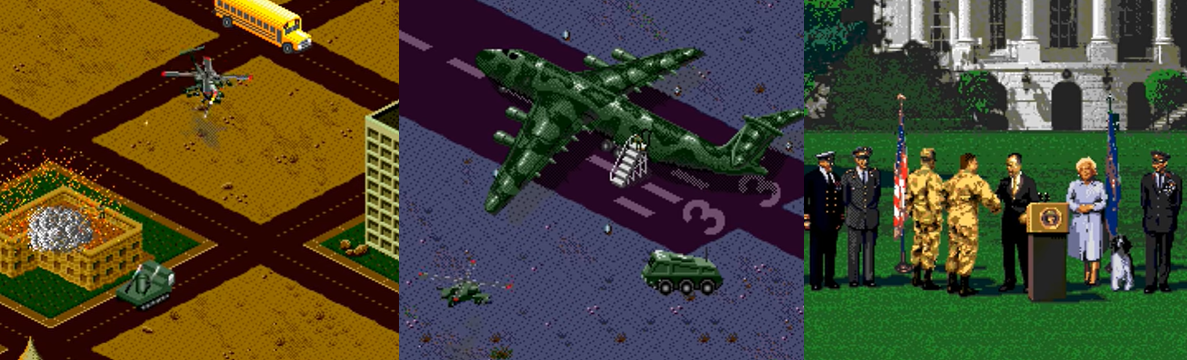
Like the first two games, Urban Strike is a top-down, isometric shooter, now set in the far-flung future of 2001 and primarily playing in control of a Mohican helicopter to undertake some familiar missions across a variety of maps now exclusively based in the United States of America. As ever, you can customise your control scheme to your liking – the default settings see A fire your Hellfire missiles, B fire your Hydra Rockets, and C fire your chain gun – but the game now supports the Mega Drive’s six-button controller, which is super useful for the new drop feature that lets you dispose of cargo or smart bombs at the touch of a button. You can again choose to control your helicopter either with or without momentum to increase or decrease the realism of the gameplay, and select from various co-pilots, with some being more accurate or trigger happy and some missing in action and in need of rescue. So far, it’s all very familiar but, like Jungle Strike, you now have the option of taking the controls of two other vehicles: the much larger Blackhawk helicopter (which lakes Hellfire missiles and seems a bit slower but can hold twenty passengers rather than the usual six, making it perfect for the game’s many rescue missions) and the Ground Assault Vehicle (GAV), a heavily armoured transport that might be slow as all Hell but it can take a beating and deliver massive damage. While the game technically only has five campaigns, this number is increased by the newest gameplay feature, which sees you abandoning your vehicle and exploring labyrinthine facilities on foot!

The developers attempted to spice things up with new vehicles and even some on-foot sections.

Unfortunately, the grid-like control pattern makes these sections rather awkward; you’re also limited to your MX9 machine gun and have far less armour since your only protection is a flack vest, and the zoomed in isometric perspective causes the game’s otherwise impressive presentation to suffer in these rare sections. Luckily, opportunities to switch to other vehicles are much more frequent than in Jungle Strike, though I can’t say I was too impressed by the new vehicles on offer here. Similarly, your missions in each campaign are painfully similar to what’s come before; you start off in Hawaii (with three lives by default and again without any in-game music accompanying the action) and are tasked with destroying radar sites and stealth ships, rescuing Green Berets, and blowing up a bridge. Objectives also include transporting telescope mirrors to a barge, which means your winch is taken up carrying the object; if you press a button to drop your cargo, it’ll be lost, so I’m not really sure why this function was included (if you could drop it, pick up an ally, and then grab the object again it would make much more sense). The first map is pretty open and linear, with an abundance of fuel, armour, and ammo crates to be found; those you rescue will also repair some of your armour when you drop them off, which is helpful, though it’s still advised that you plan on optimal route to avoid running out of ammo or blowing up from lack of fuel. If you’re down in this manner, you’ll respawn with twenty-five units of fuel and full armour but you’ll get full fuel if you’re destroyed be enemy fire (though your weapons can only be replenished by ammo crates, so be careful not to accidentally destroy them!)

Graphically, the game impresses, but it’s gameplay has become quite repetitive by now.

From the pause menu, you can again see a pretty useful map of the area and cycle between mission objectives, notable highlights, and review your mission and current status. If you destroy the wrong targets or fail to rescue or secure others in time, you’ll be forced to return to base to restart from the beginning, so there’s again a fair amount of trial and error required to properly progress. Campaigns also include some hidden side missions, such as rescuing innocents from shark attacks and such, which will net you bonus points. While the first campaign is pretty simple stuff even without the helpful ten lives cheat code, campaign two takes its queue from the final level of Desert Strike and has you securing heavily-defended oil rigs, rescuing survivors from a sinking cruise ship (you’ll definitely need the Blackhawk for that one!), and securing a friendly Russian submarine. It’s a slightly tougher mission, made all the more challenging by the fact that some of your missions won’t appear on the game map until you complete earlier ones; you can’t swing by the cruise ship or fend off the gunboats by the submarine, for example, until you’ve secured the drilling platforms. Things get a bit tougher when you head inside an aircraft hanger and must navigate the maze, taking out turret columns and destroying fighter jets before activating a beacon. You’re then given 120 seconds to escape, but there’s no onscreen countdown, which is super annoying, and additional enemies pop up to obstruct you as you race for the exit ladder.

My Progression:
I believe this is my first time playing Urban Strike, but I went into it with a pretty fair idea of what to expect based on the last two games. Sadly, while the title screen is much improved and the explosion effects look a lot better this time around, things haven’t really progressed all that much; the graphics still have a fun, pseudo-3D feel but the cutscenes contain less animations than before and it feels like a bit of a step back from Jungle Strike in terms of variety and accessibility. Once again, there are no real bosses to speak of but you’ll counter more formidable and tougher enemy ships and helicopters as you progress; later missions have you commandeering a GAV to take out the heavily-armed militia or targeting bad guy Malone’s henchman as they speed away in cars, but you’ll face a similar assortment of turrets, jeeps, soldiers, and tank-like enemies as in the previous games.

Despite what the reviews said, I found to be just as tough as the first game!

While the on-foot sections are a bit ugly, the environments continue to be a vast improvement over Desert Strike, overall; the desert still crops up, naturally, but Urban Strike boasts cities, jungles, and even a pretty fun recreation of Las Vegas. Rendered in the black of night, the city is lit up by gunfire and explosions as much as the garish neon signs and let down only by the tedious objective of flying all over, avoiding enemy fire, to destroy a whole bunch of radar sites. After that, you’ll be struggling with your ammo as you’re forced to clear the Las Vegas Strip of enemies, and this mission proved to be too much for me in the end. But, truthfully, I’d tapped out in the previous mission; after destroying a bunch of guard towers and rescuing a bunch of prisoners of war in Mexico, the game required me to hack into the Gav to take control of one but, no matter what I tried, I kept picking the wrong fuse and was forced to abandon the mission. As before, the game is password-based; you get passwords to jump ahead to later campaigns, which is how I played the Las Vegas campaign, but you can’t input the ten lives code and then jump to a later level, and in-game extra lives are pretty scarce, so the difficulty curve was noticeably more like Desert Strike than Jungle Strike for me. It’s interesting for me, then, to learn that many reviews thought Urban Strike the easiest of the series so far; the missions are a little more tedious, often requiring you to rescue multiple targets, fend off waves of soldiers, or carry multiple objects from one point of the map to the other, which can be a drain on your resources. As ever, it’s thus important to plan your route and conserve your better weapons for when needed, but the shift towards more monotonous missions and the unsightly and awkward on-foot missions seems to have made the admittedly repetitive gameplay loop less exciting rather than injecting some variety to the formula.

So, again, I wasn’t quite able to finish Urban Strike; I did a lot better than with Desert Strike but I found the game to be a bit tougher than Jungle Strike, though I was surprised that I was even able to clear the second game. Although it’s just more of the same, with little in the way of gameplay or graphical progress or innovation, Urban Strike is still a really good game; the game is probably the smoothest of the three classics and the maps are all very distinct and much more interesting than being stuck in the desert but feel less visually interesting than in Jungle Strike. The two new vehicles area bit easier to control than those in the second game, but the Blackhawk is a bit too similar to the Mohican to really stand out and I really didn’t enjoy the on-foot sections, which were clunky and relied too much on maxes. Combat and gameplay are largely as exciting as ever, with lots to blow up and discover in each campaign; enemy fire can still destroy buildings and such, which is great, and it can be fun planning an optimal route to complete missions faster but, overall, this was just more of the same with little to really make it stand out from or surpass Jungle Strike.Still, I’d love to hear your thoughts on Urban Strike down in the comments or on my social media so please feel free to share your memories and opinions and check back in next Saturday for my thoughts on the fourth game in the franchise.

Mini Game Corner: Desert Strike: Return to the Gulf (Mega Drive)

Released: March 1992
Developer: Electronic Arts
Also Available For: Amiga, MS-DOS, Mac OS, Master System, Lynx, Game Gear, Game Boy, SEGA Mega Drive Mini II, Super Nintendo Entertainment System (SNES), PlayStation Portable

A Brief Background:
By 15 March 1991, the Gulf War came to an end; after about six months of conflict and thousands left dead, the atrocities of the war would be felt for years to come and, naturally, this meant that Desert Strike caused some controversy when it was released due to the Gulf War being fresh in people’s minds. Desert Strike was spearheaded by Mike Posehn, who built off the air rescue mechanics of Choplifter (Dan Gorlin, 1982) by incorporating nonlinear, mission-based gameplay in a sandbox environment that eschewed typical videogame mechanics like bosses and power-ups. Inspired by Matchbox toys, Posehn designed the 3D models to resemble toys and programmed the game in such a way that players would be forced to restart if they went off-mission. Several months were spent perfecting the game’s physics and controls, all of which served it well upon release and Desert Strike has been highly praised as one of the Mega Drive’s top titles; reviews praised the graphics, the mission variety, and the strategy involved in tackling missions, though the difficulty curve and its more frustrating moments proved to be a cause of contention. Though many may have forgotten the series in recent years, Desert Strike kicked off a slew of similarlythemed sequels that built and improved upon the original’s formula; I used to play the Amiga version all the time back in the day and knew that the series was a must-buy once I really started collecting for the Mega Drive.

First Impressions:
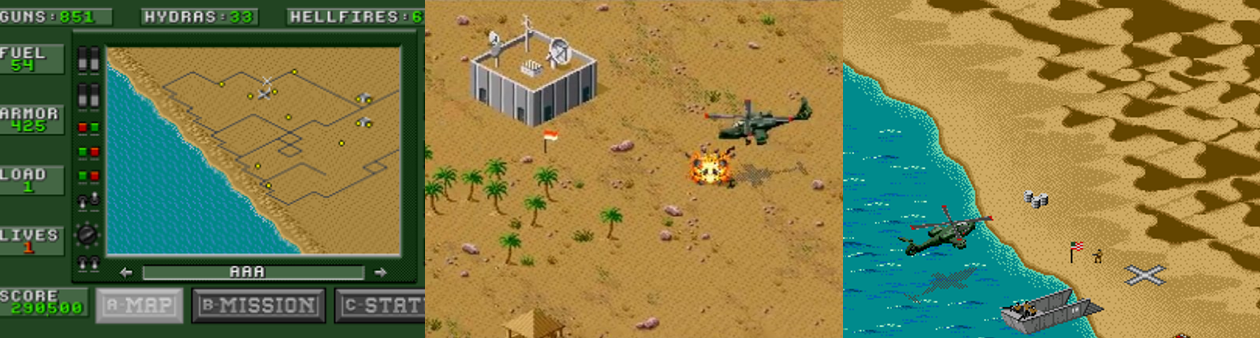
Desert Strike is a top-down, isometric shooter in which players take the controls of an Apache helicopter and undertake a number of missions in a sandbox-like map in the middle of the Gulf Desert. At the start of the game, you can pick from a variety of control and gameplay options: by default, A fires your Hellfire missiles, B fires your Hydra missiles, and C fires your chain gun, but you can customise these to your liking. You can also choose to control the helicopter either from the cockpit (which makes movement a lot easier) from above (which leaves less room for error), or “with momentum” (the default setting, which has the helicopter move more realistically). I chose “from cockpit” and never had any issues with the control scheme; the helicopter is surprisingly manoeuvrable considering you’re essentially flying over a grid, and you can easily reverse away and bank out of firing range if need be. Once you’re happy with your controls, you can pick a co-pilot; while you’ll control the helicopter’s flying and weapons, the co-pilot you choose can greatly impact your gameplay as some cause the winch to jam while others are a bit more trigger happy. From there, you can either start from the game’s first campaign or enter a password to skip ahead to a later level, and you’ll be awarded with one of these codes after successfully completing each campaign. Sadly, despite some pumping tunes blaring during the title sequence and cutscenes, Desert Strike is devoid of in-game music, leaving only the sounds of your helicopter blades and weapons to hold your attention. Each of the campaigns also takes place on the exact same map, though the sand colour changes to indicate a different time of day and you’ll find different buildings, vehicles, and enemy placements in each campaign.

Check your map to identify mission objectives and targets to destroy or POWs to rescue.

While you need to press C on the title screen to view the game’s story, mission debriefing and cutscenes will take place before each campaign (and during the mission when you rescue prisoners of war (POWs) or capture enemy commanders) using large, detailed, and partially animated sprite art and onscreen text. Once you start the campaign, you’ll need to fly from the frigate and to the desert, and right away you’ll see just how large the game map is. You can view the map from the pause menu and use the directional pad to switch between different mission objectives and points of interest on the map, which allows you to easily see where your next target is and what resources you can acquire along the way. You can also view the status of your missions, and get additional information about each one (this tells you how many POWs you need to rescue, or how many targets you need to destroy, in order to clear the mission). The instruction manual stresses that you complete each mission in order; if you don’t destroy the radar dishes first, you’ll encounter greater enemy resistance throughout the campaign, but it’s also advisable to clear out enemies or do some prep work on your way to your next objective (for example, if you’re going to fly past where an enemy spy is hiding, break them out and pick them up before destroying the power plant, then loop past the fuel on your way to taking out a SCUD Launcher). Since onscreen text is limited to warning you when you’re in a danger zone or low on fuel and armour and other situational notifications, you’ll only be able to keep track of your ammo, armour, fuel, lives, current load, and current score from the pause menu. Your helicopter’s chain gun is your weakest weapon, but also holds around a thousand rounds, meaning it’s sometimes better to hang back, angle yourself just right, and use the gun to blow open buildings rather than waste your more powerful missiles. Ammo crates are scattered all over the map, but ammunition is scarce; if you’re too trigger happy, you’ll have a hard (or almost impossible) time destroying the campaign’s bigger targets or tackling more formidable enemy units, like tanks and Rapiers.

Campaigns quickly get very challenging as you’re given a variety of missions to complete.

Your helicopter can take a decent amount of damage, but you’ll be reduced to smouldering wreckage under sustained heavy fire or if you’re not careful and bash into rocks or buildings. You start the game with three lives and, when they’re exhausted, you have to restart the entire campaign over. You can, however, earn additional lives by accumulating a high score or hop back into the later missions using the password system. If you die mid-campaign, you’ll respawn right where you failed but your weapons won’t be replenished after each death. You’ll get a bit of extra fuel, though, but it’s usually not enough to get to one of the handful of fuel drums also scattered across the map. As a result, you really have to think about the best routes and the most efficient way of tackling the missions; fuel, ammo, and armour all need to be considered so you can’t just fly in all guns blazing, and you can only carry six passengers at a time so you’ll need to be mindful of where the nearest landing zone is, too. Resources and passengers are automatically picked up by flying over them, which drops a winch for you to latch onto them. Your helicopter will also land so your co-pilot can get out and rescue targets, which leaves you flying about fending of heavily-armed enemy forces before recovering them, and you also won’t lose fuel when flying over the sea, which is useful in the game’s later campaigns. Missions are generally grouped into two categories: destroying targets and recovering targets. Radar dishes, power stations, airfields, and chemical weapons facilities all need taking out and you’ll need to recover both POWs and enemy commanders to learn the exact location of things like SCUD Launchers or bomb shelters. You’ll be orchestrating jail breaks, rescuing United Nations ambassadors, uncovering and destroying missile silos (before they launch their ordinance), airlifting soldiers from life rafts out in the ocean, and angling yourself just right to stop oil spills as you progress through the game. Practically every target is either defended by or soon reinforced by enemy forces, ranging from soldiers packing both machine guns and rocket launchers to tanks, AAA turrets, mobile Rapier launchers, and even an enemy helicopter in one of the later missions. There are no traditional bosses to speak of, but the more heavy-duty enemy vehicles can easily catch you in a crossfire, especially if you’ve wasted all your best ammo blasting buildings. Things would be a lot easier if you could restock your weapons, fuel, and armour at the frigate but this isn’t an option; rescuinf missing soldiers can restock your armour but resources are so scarce that you’re easily left with no better option than to completely start over since you won’t have the necessary weapons or fuel to continue, making for a challenging gameplay experience

My Progression:
I’ve played Desert Strike, and its sequel, before; as mentioned, I had it on the Amiga and I remember borrowing both from friends back in the day, but my memories are a little vague on the specifics. After replaying it on the Mega Drive, though, I can only conclude that my version must have been one of the many Amiga games I had that was cracked, allowing me to play with such benefits as infinite fuel, armour, and ammo as Desert Strike really is one of the most challenging Mega Drive titles I’ve played. Thankfully, it’s not unfair, exactly, just extremely frugal with its fuel, armour, and ammo and you really need to have a plan of attack in mind before taking on your objectives. If you run out of missiles destroying enemy vehicles or targets, you’ll never be able to destroy five out of the six SCUD Launchers before they fire their missiles, for example, so you shouldn’t just blast away willy-nilly or pick up ammo crates unless you need them, and while you do get extra points for destroying other targets and picking up soldiers, it’s best to stay on-task and only attack and rescue those that you need to. All of this is to say that I couldn’t get past the second campaign, and it was only through a great deal of trial and error that I was even able to beat the first campaign (!), which requires you to destroy three radar dishes, take out a power station, destroy some heavily-defended airfields, and then rescue a secret agent from a bunker while fending off enemy forces.

You’ll be hard pressed to take on the game’s later missions even with the level skip passwords.

Campaign two starts out with much of the same, asking you to destroy radar dishes, a power station, and a chemical weapons facility, but the resources are far scarcer are there are a lot more passengers that need picking up between the jail break and SCUD commanders, meaning you’ll be doing a lot of back and forth between landing zones. I was able to achieve all of these objectives except for destroying the SCUD Launchers as I was completely out of missiles by the time they appeared on my map and thus unable to destroy them before they launched their load. Even using the ten lives code didn’t really help here as I kept running out of the resources I needed to complete the campaign, so I used a password to jump ahead to the other campaigns and see how they fared. As you progress, not only do the number and aggression of the enemy forces increase, but so do your mission objectives: Campaign three has you rescuing U.N. ambassadors, destroying a chemical weapons complex, locating and destroying missile silos before they can launch, destroying a power station, blowing a hole in the Madman’s yacht and rescuing his hostages while fending off speedboats, and then protecting your co-pilot as he drives a bus to safety. I believe I died trying to locate the enemy ambassadors, so I tried the final campaign and was similarly met with failure. At first, you only get two objectives: destroy the tanks attacking an oil field and drop some commandos off to take the complex over and stop oil pumping into the sea with well-timed shots, but additional missions pop up soon after, including locating bomb shelters and destroying specific garbage trucks carrying bomb parts, but I was all out of ammo, fuel, and lives before I really got a chance to go any further than that.

Despite the fact that I couldn’t actually complete the game, and barely managed to clear even one campaign, I still really enjoy Desert Strike. While enemies and the game’s speed aren’t exactly action-packed or at a breakneck speed, combat is exhilarating as you need to try and circle around or stay out of firing range to quickly take out enemies or blow open buildings, without catching their attention and to conserve your more powerful weapons. The controls are surprisingly slick, and there’s a lot of little things to see and do in each campaign, from vehicles idling down the road, security checkpoints, POWs fighting with the enemy, enemy fire damaging buildings, and the amount of objectives crammed into each mission is staggering. In fact, there may be almost too much to do, certainly too much for the limited resources available; thus, Desert Strike is a game that involves a lot of strategy and asks that you plan out your route and how you tackle objectives and then restock your weapons, though the developers were really stingy with the fuel, ammo, and armour, which means that this isn’t really a game you can just casually playthrough. Still, it remains an under-rated Mega Drive classic and I’d love to hear your thoughts on Desert Strike down in the comments or on my social media so please feel free to share your memories and opinions and check back in next Saturday for my thoughts on the sequel.

Mini Game Corner [Asterix Anniversary]: Astérix (Arcade)


Asterix the Gaul (and his best friend Obelix) first debuted on 29 October 1959 as a serial in the French/Belgium magazine Pilote. Since then, the plucky Gauls have gone on to have many adventures in comic books, videogames, and feature-length productions and Asterix himself has become a popular and enduring character in his native France and around the world as Asterix’s stories have been translated into over a hundred languages across the world. I may be a day early in celebrating this anniversary as it coincides with the release of the SEGA Mega Drive but I’ll take any excuse to talk about Asterix’s amusing escapades.


Released: 1992
Developer: Konami

A Brief Background:
It wasn’t long before the French comic book series Asterix made the jump off the panels and into other media; the first Asterix book was adapted into a feature-length animation in 1967 and Asterix cartoons and live-action films have been pretty consistent over the years. Similarly, there have been numerous Asterix videogames; the first was released for the Atari 2600 in 1983 and I had a lot of fun growing up playing Astérix (SEGA, 1991) on the Master System. One of my absolute favourites to play whenever I spotted it in seaside arcades was this cracking, colourful arcade title from Konami, one of the most prominent developers in the industry at the time. Sadly, Astérix was never ported to home console ports, but the game is fondly regarded as one of the most fun-filled, action-packed arcade titles, and it received something of a spiritual sequel in 2021.

First Impressions:
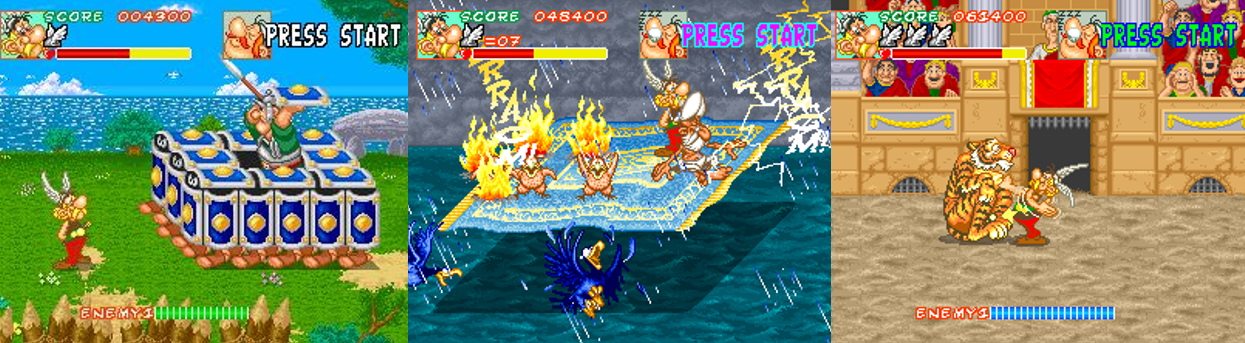
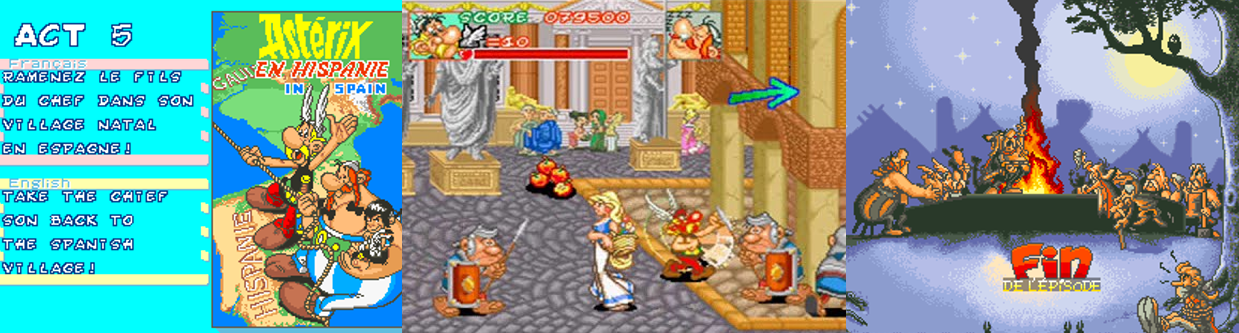
Astérix is a super colourful, super vibrant sidescrolling beat-‘em-up in which players can freely choose to play as either Asterix or Obelix (or team up as both) and journey across seven stages, each one lovingly recreated from some of the tenacious Gaul’s most memorable adventures, ploughing through Romans and collecting their helmets to score points. Controls couldn’t be simpler; you move with the joystick, attack with one button, and jump with another. Both Asterix and Obelix can dash, perform a running and jumping attack, and will slap Roman’s silly, or kick or toss them away, when they get up close and personal.

Journey through some memorable locations bashing Romans all over the ancient world.

The differences between the two characters are largely negligible; Asterix is smaller and slightly more agile, but Obelix doesn’t exactly seem slowed down by his girth. One difference between the two you’ll immediately notice is that Obelix begins with a menhir in hand, as is his trade, which appears to be the one instance in the game where you can wield a weapon (albeit temporarily). Both characters will also receive a brief power-up when loyal puppy Dogmatix wanders onto the screen with either a gourd of magic potion for Asterix or a crispy roast boar for Obelix; collecting either will send them into a brief frenzy that sees them immune to all attacks and taking out every onscreen enemy in short fashion, though this is only for a very short time. Players can restore their health by eating fruit or stealing a kiss from Panacea, who wanders to and fro in each stage, and swing from vines to take out enemies. You get two lives per credit and, while there’s no time limit, Cacophonix’s musical notes will damage you if you linger too long. Perhaps the oddest thing about Astérix, though, is that you do not have unlimited continues; even if you input ninety-nine credits, you’ll eventually run out of chances to spawn back in and be left with nothing else but your high score and beginning the game all over again.

The game is absolutely gorgeous and perfectly captures the look and humour of the comics.

As fulfilling and entertaining as the beat-‘em-up gameplay is in Astérix, however, the game excels in its visual presentation; more so than any other 2D Astérix videogame, this sadly forgotten arcade title pops with bright, cartoony graphics that are ripped straight from the original comic books. Sprites are large, fantastically detailed, and full of fun little animations; Romans can be rapidly slapped across the face, slammed by their ankles, and twirled around in the air just like in the comics, a bunch of cartoony sound effects punctuate the action, and there’s even a little bit of voice acting and onscreen text (in both English and French) to help tell the story. Stages are proceeded by both sprite-based cutscenes and comic book panels to track the pair’s journey to Rome, and you’ll be able to play a chariot race as a bonus stage for extra points. While enemy variety quickly begins to suffer (you’ll see the same Roman infantry and generals in every stage), they’re all exactly as they appear in the comics and can even be seen hiding in tree stumps and riding horses. Each stage also includes additional hazards and enemies, such as rolling rocks, mischievous Egyptians, and disreputable pirates; you’ll also battle a boss at the end of each stage, with a group of Roman’s gathered into the tortoise formation awaiting you at the end of the first stage and the mind-controlling Iris opposing you in Egypt,

My Progression:
I’ve played Astérix before, both in the wild as a child and thanks to the gift of emulation, and have always been thoroughly impressed with its graphics, gameplay, and fidelity to the quirky humour and adventures of the source material. The attention to detail here is astounding, even compared to other licensed videogames from the time, and it pleases me no end to see these fun-filled and colourful characters brought to life so well. While I’ve always enjoyed the platforming and puzzle-based mechanics of many Astérix videogames, the concept lends itself incredibly well to the simplicity of a sidescrolling beat-‘em-up and the game’s stages are packed full of gorgeous sprite work, things to see and interact with, and short enough to play through in action-packed bursts.

While there’s loads of locations, I wasn’t able to actually finish the game due to the credit system.

Having said that, though, Astérix is stunted somewhat by the fact that you cannot simply feed coins into it until you plough through to the ending. I can’t recall ever playing an arcade title that restricts you in such a way, meaning that even when you emulate the game you can’t just blindly charge ahead and just press a button to jump back into the action. Instead, your continues are strangely limited, which unfortunately limits your progress in a way that I have never encountered in an arcade title before, and that means that I rarely manage to get past (or even to) the pirate ship stage. On this particularly playthrough, I struggled to make it through Egypt before losing all my chances, which was a shame as I was hoping that the different ROM files I had available would allow me to just carry on like normal. However, if you are able to best the ever-increasing waves of cartoony and bombastic enemies thrown your way, you’ll eventually battle across the high seas in boats, zip through the air on a magic carpet, race along in a mine cart, and finally find yourself battling the game’s toughest enemies in Julius Caesar’s Colosseum.

Astérix is a quality sidescrolling beat-‘em-up that you may never have played, or even heard of. Sadly, this is one of a number of arcade-exclusive titles that never saw the jump to home consoles, and that’s a crying shame as this would’ve been a blast to play in the 16-bit era. While the game doesn’t really offer anything beyond the stand two-button combat you’d expect from an arcade title and is seemingly lacking in a few areas (a life-draining special attack and weapons amongst them), it excels in its absolutely gorgeous visual presentation to perfectly capture the look, feel, and humour of the source material. It’s just a shame that I can’t just keep pumping in credits to charge on through to the ending, but I always enjoy loading this one up when I have some time to kill. Have you ever played Astérix’s arcade adventure? If so, how do you think it compares to other Asterix videogames and beat-‘em-ups of the time? How far have you been able to make it in the game, and which of the stages was your favourite to play through? Which character, book, or movie is your favourite? How are you celebrating Asterix and Obelix’s birthday this year? Whatever your memories or opinions of Asterix, feel free to sign up and drop them below or leave a comment on my social media.

Mini Game Corner: Mystical Ninja Starring Goemon (Nintendo 3DS)

Released: 7 March 2012
Originally Released: 4 December October 1997
Developer: Konami
Original Developer: Konami Computer Entertainment
Also Available For: Game Boy

A Brief Background:
In the hierarchy of videogame characters, you would be forgiven if you’ve never heard of Goemon, the spiky-haired protagonist of Konami’s Ganbare Goemon series of adventure games. Loosely based on the legendary Robin Hood figure of Ishikawa Goemon, Goemon was first introduced to gamers back in 1986 as “Mr. Goemon” and was best known outside of Japan for his critically acclaimed Super Nintendo Entertainment System (SNES) title, The Legend of the Mystical Ninja (Konami, 1991). While the world was waiting with baited breath for the release of The Legend of Zelda: Ocarina of Time (Nintendo EAD, 1998), 3D adventure fans were treated to Goemon’s bizarre Nintendo 64 jaunt, Mystical Ninja Starring Goemon (Konami Computer Entertainment Osaka, 1997), my first exposure to the character and the franchise and still one of my favourite N64 games of all time. Mystical Ninja was accompanied by this release for the original Game Boy, a divisive adventure title that was criticised for its high difficulty and for being a poor knock-off of The Legend of Zelda (Nintendo R&D4, 1986). Regardless, Mystical Ninja made its was to the 3DS Virtual Console in 2012 and, based on my enjoyment with the N64 title and desire to play something akin to the SNES game, I snapped it up before the service was shut down.

First Impressions:
Mystical Ninja Starring Goemon is a top-down action/adventure game far more in the style of The Legend of Zelda than its sidescrolling SNES predecessor and third-person N64 jaunt. The game’s story is split into chapters, with story text, dialogue boxes, and map screens depicting the efforts of Goemon, Ebisumaru, and Sasuke to rescue their friend Yae from the malevolent Black Ship Gang. Before each chapter, you can pick from one of the three protagonists, who all essentially control the same way and have the same abilities; each character has a weapon to attack with by pressing B and can jump by pressing A, though each has slightly different attributes. Goemon is an all-rounder, for example, while Ebisumaru’s jump isn’t quite as good as Sasuke’s. Like Link, you character will fire a projectile from their weapon when at full health, though you still have access to a projectile in the form of a limited supply of shurikens, which you can switch to by pressing ‘Select’ and each character has a different range to their shot. The pause screen brings up a rudimentary grid-like map that gives you some idea of where you are, where you’ve been, and where you need to go, though the game is pretty linear and it’s not especially difficult to find your way around. Each chapter starts you out in a town of some sort, one either ruined by enemies or that’s a port for the Black Ship Gang, and you can explore, chat to non-playable characters (NPCs) for some vague hints and lore, and visit shops and inns to replenish your health and ammo. This is the only way to refill your strength gauge outside of collecting Crystal of Life items from chests, which add an extra hit point to your bar and, as you only get one life and the game’s passwords make you start from the beginning of the chapter, this can make for an incredibly difficult gameplay experience.

Limited graphics and gameplay options make this a disappointing Game Boy title.

You’ll wander through the town, taking out enemies (who don’t drop anything useful and respawn when you return, making backtracking a chore), and finding stairs down to underground passages, ant hills, castles, and through the Black Ship Gang’s ship. Exploration generally amounts to finding chests that contain a life or weapon power-up, extra shurikens, and coins to spend, but you’ll occasionally find shops and inns in here too and you’ll pretty much always be tasked with finding an NPC with a story-specific item (bamboo, a bomb, the symbol of the Black Ship Gang) that you need to progress further.  Graphically, the game really isn’t anything to shout about; considering we were seven years into the Game Boy’s life span by this point and we’d seen an incredibly detailed and layered adventure game in the form of The Legend of Zelda: Link’s Awakening (Nintendo EAD, 1993) about four years prior, it’s hard to not judge Mystical Ninja, which more resembles Super Mario Land (Nintendo R&D1, 1989) than Link’s Awakening. The sound is pretty good, but the sprites are small, lacking in detail, and the environments all become very samey very quickly. Add in the fact that some locations are veritable mazes and include hazards like pits, water, and lava that take a whole chunk off your health and send you back to the beginning and you have a game that just looks dated and lacks all of the visual charm I associate with the Mystical Ninja franchise. By taking advantage of the 3DS’s save state system, you don’t really need to explore all that much as you can just reload if you make a mistake, but that won’t help you when you come across the various mini games that accompany the game’s bosses!

My Progression:
Mystical Ninja’s enemies aren’t really all the difficult to get past; you’ve got samurais, ghosts, giant ants, bats, and pirates scattered throughout but also some trickier enemies, like teleporting ninjas, ink-spitting squids, and these weird…I dunno…golems? Walking tree-things? Most enemies can be defeated in one hit, but some take more, and it can be tricky lining up your shot or blow because of the game’s rigid grid system and the character’s weapons not having a wide arc like Link’s sword. The hardest thing about the enemies, though, is that they all respawn when you return to where they were meaning that it’s usually easier and faster to just jump around and avoid them, especially as you don’t get any health or coins or anything for beating them. Some areas include mini bosses, like a sumo, a flying queen ant, a hook-handed pirate captain, and a large octopus, but most of these are pretty easy to pummel into defeat from afar. When you explore Skeleton Island, defeating the club-wielding ogre-things opens up a new part of the area to explore and brings you one step closer to the final boss, but it’s actually highly unlikely you’ll even get past the first boss without using the password system. My playthrough was going pretty well; I was disappointed by the graphics, lack of power-ups, and the inability to switch characters on the fly, but the game wasn’t too much of a challenge to figure out. I beat the sumo, got the bamboo, and used it to cross the water to a castle, where I eventually reached this rocket boss…thing.

Sadly, while bosses are easy to beat, the mini games that accompany them are hard as balls!

It was a little sporadic but I managed to defeat it but Baron Skull, leader of the Black Ship Gang, challenges you to a 100-meter race afterwards that is, frankly, impossible. You need to tap A as fast as possible to beat him but, no matter how fast I was, I couldn’t even get close so, technically, my run ended there. I used the password to jump to the next chapter, though, to see what else was on offer; here, you battle this big stone boss in a cave that constantly throws boulders and its extending arms at you and, when you beat it, you have another impossible tapping game to complete, this time a tug of war! I couldn’t beat that either, so I jumped to chapter three; here, you need to answer five out of ten questions right in a timed quiz to board the Black Ship Gang’s ship, which isn’t too hard, and the big octopus has you quickly select which lantern doesn’t match to finish the chapter, so I was actually able to beat this one! Things properly broke down in chapter four, where you cross a bridge to another ship and are challenged to a number of mini games; the first isn’t too bad (especially with save states) and simply has you matching pairs of cards, but the second was, again, impossible as no matter how hard I tried I couldn’t get all of the images to match the main picture. I skipped ahead to the final chapter, where you easily defeat Baron Skull’s ogres and rescue Yae, then hop over some lava and battle him to the finish in a first-person mech fight. This sees you summoning the giant robot Impact (though you only see him from inside his cockpit) and punching Baron Skull when he pops up, following the helpful arrows to prepare your attack. Unfortunately, you can’t block or fire projectiles and I couldn’t even see what or when Baron Skull was firing at me, and this is a multi-stage fight, with Baron Skull getting faster and harder to hit, so this was where I officially gave up.

To say I was disappointed by Mystical Ninja Starring Goemon would be a massive understatement. Obviously, I wasn’t expecting it to be anything like the Nintendo 64 game of the same name that’d so massively captured my attention and imagination, but something more akin to the SNES game or even more in line with Link’s Awakening would’ve been fine. I was expecting the game to be hard because it was a long and involved role-playing adventure game that had you going from town to town, exploring dungeons and castles, and acquiring new weapons and items…not because of nigh-impossible button mashing mini games with absolutely no margin for error! The game is stupidly simple 99% of the time, coming across as a kiddified version of the original Legend of Zelda and barely presenting much of a challenge as long as you remember where you’ve gone in the maze-like areas. The bosses are pretty simple to beat as well, but those mini games, while quirky and in keeping with the series’ bizarre sense of humour, are such a brick wall that I honestly have no idea how you’d get past even the first one! Add to that the dated the graphics, the lack of variety between the playable characters, and the disappointingly bland locations and you are basically left with a forgettable Game Boy experience that I can’t say I’ll be motivated to try and finish any time soon. But maybe you think I’m being too harsh? Maybe you’ve beaten this game without issue? If so, I’d love to hear about it, and your thoughts on the Ganbare Goemon series, down in the comments or on my social media.

Mini Game Corner: Streets of Rage 4: Mr. X Nightmare (Xbox One)

Released: 14 July 2021
Developer: Dotemu/Lizardcube/Guard Crush Games
Also Available For: Nintendo Switch, PC, PlayStation 4

A Brief Background:
After an absence of almost twenty-five years, the Streets of Rage series (SEGA, 1991 to 1994) finally made a long-awaited comeback in 2020. As a massive fan of the series, and sidescrolling beat-‘em-ups in general, I was very surprised, and excited, to see Streets of Rage make a reappearance; Streets of Rage 4 sold extremely well and was received generally positively but even I could never had guessed that it would do well enough to gain any kind of downloadable content (DLC). Yet, surprisingly, that’s exactly what we got as some additional character, gameplay modes, and difficulty settings were made available for the game and a physical Anniversary Edition was even released (for PlayStation 4 and Nintendo Switch only but still…)

The Review
Streets of Rage 4: Mr. X Nightmare adds some additional features to the original game, which was a sidescrolling beat-‘em-up that saw you attacking enemies with X, busting out a life-draining special attack with Y, jumping with A, and clearing out large groups of enemies with a screen-clearing special move if you have enough Stars in your quest to clean up the streets of Wood Oak City. The first thing you’ll notice when playing Mr. X Nightmare is the addition of three playable boss characters: Estel Aguirre, Max Thunder, and Shiva. Two of these (Max and Shiva) were previously playable but only in their 16-bit variants and all three are ripped straight from their boss battles in the base game. When playing as each of them through the story mode, however, none of these characters have any real impact on the narrative; the cutscenes don’t change or acknowledge them and the only thing that’s different is that when you fight the character’ boss variants, the boss’s taken on a neon, shadowy colour scheme.
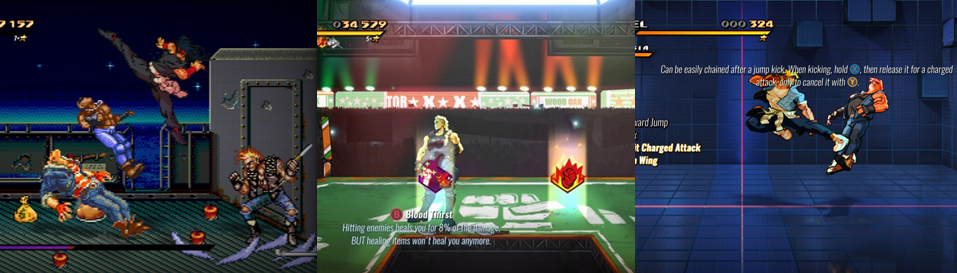

Mr. X Nightmare adds Estel, Max, and Shiva as playable characters.

Like the game’s other playable characters, each of these new characters plays slightly different. Of the three, only Shiva can dash towards enemies, for example, but unlike the other two, Shiva cannot pick up weapons (instead, he dramatically flips them up and kicks them at enemies). Estel and Shiva also attack much faster than Max, utilising kicks and fast combos where Max uses slower, more powerful wrestling moves and grapples. Each of them also has Y-based special attacks that will slightly drain their health unless they attack enemies soon after; these seen Estel toss grenades and pounce on opponents with a beatdown, Max charge or slam down on enemies, and Shiva teleport across the screen or out of the air. Each of them also has their own special moves that are executed by pressing Y and B when you have at least one Star. Estel’s is very similar to her boss’s special and sees her call in a bombardment of rockets; Max unleashes a big axe-handle smash and also sees enemies by struck by lightning, and Shiva blasts enemies away with a purple, wing-like aura. The best thing about playing as these new characters is how over-powered a lot of their attacks are; Max, for example, has a super useful Power Slide attack that is easily spammed while Shiva can perform a nifty mid-air kicking combo for decent damage.

Play as Roo and/or test your skills in the new ‘Survival’ mode!

It’s been a while since I played Streets of Rage 4 so I may be forgetting some things but Mr. X Nightmare appears to add a few new weapons into the game’s stages (such as a golf club, an umbrella, and a branch) and the ability to select different colour palettes for every character. The DLC also adds a new difficulty to the game, Mania+, if you fancy taking on an additional challenge and, best of all, the inclusion of a hidden fighter. By highlighting ‘Story on the main menu screen and  pressing up and X and then pressing Start, you’ll get to play as a 16-bit version of Roo the boxing kangaroo, which is pretty cool but it’s a bit of a shame that Roo doesn’t have an alternative skin to match his cameo from the base game. Another addition appears to be that whenever you fight on the hidden, or new, 16-bit stages, every character, even the new ones and altered ones, is rendered as a classic 16-bit sprite. While there isn’t any new story-based content to the game, Mr. X Nightmare does add a new ‘Survival’ mode. Here, you pick a character and play through a series of simulations in a variety of brand new arenas, including new 16-bit levels, and fighting increasingly-difficult waves of enemies. Enemies and destructible boxes will spawn into each area, giving you access to health-restoring good, Stars, and weapons, which you’ll need as you only get one life to play through this mode; when you clear each level, you can pick from one of two perks that stack up and carry over to each level. These can up your attack or defence, add an additional jump, add elemental effects to your strikes or weapon attacks, spawn in Stars, award you more powerful weapons, spawn in an ally, or dramatically increase your attack power and the cost of your durability, among other effects.

The addition of more 16-bit stages, random buffs, and a Training mode add replayability to the game.

The levels and enemies get tougher and tougher as you go but you can make use of environmental hazards to damage enemies; meteors will fall from the sky, lasers and flames will spew up in some levels, wind will blow you about, electrified walls and crushers can harm you and your enemies, and you’ll be able to toss them over edges and such. While you’ll earn Stars instead of lives in this mode, it also includes a whole bunch of new weapons to use and, as you clear levels, you’ll unlock enemies to battle in the new Training mode (essentially a traditional one-on-one fighter), concept art and artwork, and also additional alternative modes for each playable character to customise them to your specifications. Even better, the DLC adds not only some new music tracks but also eight new Achievements to earn that are specifically tied to you completing the story mode as the three new characters, performing Roo’s special move and spawning in clowns, and mastering the new Survival mode, all of which is a great incentive to return to the game.

The Summary:
I was super happy with how Streets of Rage 4 turned out; it was everything I could have asked for from a sidescrolling beat-‘em-up and had a decent amount of features and replayability to it. it could be a little unforgiving at times but it was a blast to play through and I was very surprised and excited to hear that the game would be expanded upon with some DLC. The addition of new characters was very welcome, though it is a little disappointing that they don’t factor into the story more; like, maybe they could have played through slightly altered versions of the stages and fought against the existing protagonists rather than shadow versions of themselves. The addition of new Achievements was very much appreciated and the ‘Survival’ mode is pretty great, though, and sees you battling against every character and boss from not only this game but also the others in the series. Again, it can be tough but playing alongside a friend should make it quite the entertaining time and, overall, I’d say it’s well worth picking this DLC up to add a few more hours onto an already enjoyable title.

My Rating:

Rating: 4 out of 5.

Great Stuff

Did you pick up the Mr. X Nightmare DLC? If so, what did you think to it? Which of the new playable characters was your favourite? Did you manage to unlock Roo? How far did you get in ‘Survival’ mode? What is your favourite piece of DLC for a videogame? Whatever you think about Streets of Rage 4 drop a comment below.

Mini Game Corner: The Terminator (Mega Drive)

Released: 1992
Developer: Probe Software
Also Available For: DOS, Game Gear, Master System, Mega-CD, Nintendo Entertainment System (NES), Super Nintendo Entertainment System (SNES)

A Brief Background:
The Terminator (Cameron, 1984) was a massive box office hit, catapulting star Arnold Schwarzenegger to superstardom, and making nearly $80 million at the box office against a paltry $6.4 million budget and quickly becoming a cult classic. Its incredible success not only led to numerous sequels and spin-offs at the cinema and in comic books but also a number of videogame adaptations, despite the film’s violence and mature content, released for virtually every home console available at the time. The Terminator was generally well-regarded at the time, with critics praising its digitised graphics and catchy music, although the game’s length and difficulty have drawn criticism.

First Impressions:
The Terminator begins hopefully enough; it features the opening text of the movie alongside a pretty decent recreation of the iconic Terminator theme and opening credits. It even includes a further piece of introductory text and dialogue between main character Kyle Reese and his commanding officer that gives the player the rundown on the game’s first mission. Once you move past these opening sections (and choose from a range of difficulty options in the game’s main menu), you’re dropping into the role of Reese in the middle of the war-ravaged Los Angeles of 2029. The controls are just about what you would expect from a run-and-gun title like this; the directional pad moves Reese around and allows him to duck to avoid incoming fire and scale ladders, the A button has you drop and detonate one of your few smart bombs to break down certain walls, B will cause you to either toss an infinite number of grenades or fire your weapon, and C performs a jump. You can alter these controls in the game’s options but, sadly, the controls aren’t the issue here; it’s the game’s literal immediate difficulty spike as, after a few steps to the right, you’ll immediately be fired upon by a Hunter Killer (HK) Tank! Touch its treadmills or get hit by its diagonal blasts and Reese will lose health; since you don’t have a gun, your only option is to lob grenades and it takes a shit load to finally put it down.

Once you enter the complex, you’re beset by an endless swarm of Terminators.

After that, a couple of steps after this, a HK Aerial will fly overhead dropping bombs on you! This one can’t be taken out so you’ll have to desperately try to avoid its bombs to make it down the ladder and into the Terminator base. Once in the underground base, you’ll be faced with an endless swarm of what appear to be T-600 model Terminators who blast at you with Plasma Rifles. Luckily, they’re quite slow and you can generally duck beneath their shots but they’ll also duck and shoot at you, which can be tricky to avoid as the ceiling’s quite low and stunts your jump. The main issue is the fact that the Terminators just. keep. coming without end; add to that the little mini tanks that are also in the area and that fact that you only get one life to complete the entire game and you’re in for a troublesome time right off the bat.

Fight through the maze to plant a bomb and get yourself off to the past.

The absolute worst thing, though, is that this opening stage is a bloody maze! It’s almost impossible to figure out where you’re supposed to go as everything looks the same. Sometimes you’ll reach a wall you can’t pass and will need to blow it up but if you waste your smart bombs, you can’t progress; other times, you’ll run around in circles being whittled down by the endless onslaught of Terminators desperately trying to find some health and ammo only to be gunned down. Eventually, you may stumble upon an orange section of the environment (the “Time Displacement Reactor” according to the manual) where you’re supposed to place a smart bomb to blow the facility but there’s no indication that you have to do this and, once you do, you’ll have to run out of the complex before it explodes! If you try to run to the right on the top level before doing this, you’ll be immediately killed by Skynet’s defence systems but you can just as easily be killed trying to escape.

My Progression:
If you’ve read some of my shorter features before, and the text above, then you know where this is going. I couldn’t even get past the first damn mission! A longplay I watched actually made this first mission seem pretty simple but, when trying to figure it out for myself on “Easy”, I kept getting turned around, running out of smart bombs, and trapped in the underground complex.

Get past the first mission (if you can…) to recreate more iconic scenes from the film.

From what I can gather, The Terminator isn’t an especially long game and can be beaten fairly quickly; sadly, I cannot comment on this as the developers sought to artificially extend the playtime of the game by making it a right ball-ache just trying to get through the first mission. Seems to me that they could have just as easily taken inspiration from the likes of Contra (Konami, 1987) and other run-and-game games available at the time. Endless swarms of enemies and a bit of a puzzle/maze layout aren’t necessarily bad gameplay mechanics in-and-of themselves but, here, they made the game needlessly frustrating and, even worse, the PAL version of the game doesn’t even include any cheat codes to help bypass these issues, meaning I’ll have to actually get good in order to progress!

BiteSizeGamesContinue

I was super excited to play The Terminator and pretty damn disappointed to find that the first mission is all-but impassable without knowing exactly what you have to do, where you need to go, and was full of endlessly spawning enemies. Add to that the fact that you only get one life for the whole game and it was a pretty dissatisfying experience. Still, have you ever played The Terminator on the Mega Drive? If so, were you able to get past the first mission and complete the game? Do you think I need to suck it up and give it another go or would you recommend playing a different version of the game, perhaps the Mega-CD version? Have you ever played a videogame where everything about it was really good and appealing but you just kept hitting a wall and couldn’t progress? What is your favourite Terminator or run-and-gun game? Are you excited for Judgment Day later this month? I have a few more Terminator articles coming to celebrate it so be sure to check back in next Sunday for more Terminator content.