Movie Night: Ghost Rider: Extended Cut

Released: 12 June 2007
Originally Released: 16 February 2007
Director: Mark Steven Johnson
Distributor: New Line Cinema
Budget: $110 million
Stars: Nicolas Cage, Eva Mendes, Wes Bentley, Donal Logue, Sam Elliott, and Peter Fonda

The Plot:
Motorcycle stunt rider Johnny Blaze (Cage) finds his past literally haunting him when the fiendish Mephistopheles (Fonda) calls upon a blood debt from Blaze’s youth. Transformed into the demonic Ghost Rider in the presence of evil, Blaze must hunt down Blackheart (Bentley), a rogue demon who seeks to acquire power to rival that of Mephistopheles!

The Background:
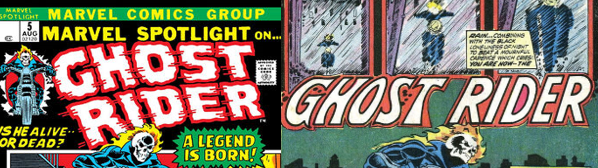
Created by Gary Friedrich, Roy Thomas, and Mike Ploog, Johnny Blaze/Ghost Rider made his Marvel Comics debut in the pages of Marvel Spotlight #5 in 1972. He graduated to his own self-titled comic about a year later and was at the forefront of many supernatural adventures in one form or another. In addition to cameo appearances in various Marvel videogames, Ghost Rider has popped up in other avenues outside of the comics; he cameod in Marvel’s nineties cartoons and an incarnation of the character later featured in a semi-prominent role in the fourth season of Marvel’s Agents of S.H.I.E.L.D. (2016 to 2017). However, development of a live-action adaptation of the Spirit of Vengeance can be traced back to 1992, when Marvel tried to shop the idea around Hollywood. In 1997, Gale Anne Hurd and Jonathan Hensleigh were attached to the project but things really took off in late-2000, when writer David S. Goyer, director Steven Norrington, and stars Jon Voigt and Johnny Depp were all associated or involved with the film in some capacity. By May 2002, Columbia Pictures had purchased the rights; all previous associates dropped out of the project and Shane Salerno was brought in to rewrite Goyer’s script, but eventual director Mark Steven Johnson did his own script soon after being hired to helm the film. Life-time superhero fan and nineties action star Nicolas Cage won the title role and chose to portray the character not as a hard-drinking bad-ass but more as someone desperately trying to come to terms with the curse hanging over his soul. The character’s visual effects were the work of Kevin Mack and Sony Pictures Imageworks, who painstakingly animated Ghost Rider’s flames on a shot-by-shot basis, with one of their most difficult and time-consuming sequences being the first horrific transformation and the digital transformation of the iconic “Hell Cycle”. With its final worldwide gross falling just shy of $230 million, Ghost Rider didn’t exactly set the world on fire (pun intended) and this was reflected in the reviews; critics were left disappointed by the film’s focus on humour rather than horror, with the dialogue and Cage’s performance drawing the most criticism, though the special effects were praised and some have since re-evaluated it as an under-rated comic book film. Despite being labelled as one of the worst films of the decade, Ghost Rider not only received this extended edition on home media but was actually followed by a sequelof sortsin 2011, that was a critical and commercial failure which, coupled with Cage’s disappointment with the role and franchise and the rights being reacquired by Marvel in 2013, dashed any plans for a third entry.

The Review:
Ghost Rider is another of those Marvel superheroes I’m not all that familiar with; unlike others like this, I can’t even say that I’ve been able to get a sense of the character and his incarnations and adventures as Marvel haven’t yet released one of their Marvel Platinum definitive collections for him and a lot of his classic collections are a bit overpriced for my tastes. I’ve always been drawn to the character, though, since he’s visually very striking and his powers and background really speak to me as a long-time fan of Al Simmons/Spawn, but the most I’ve experienced of him are his debut story and the Spirits of Vengeance: Rise of the Midnight Sons trade paperback (Cooper, et al, 2016), his appearances in Marvel cartoons and TV shows, and a few sporadic appearances in videogames. I’d love to read more of him, but I definitely wasn’t as clued up on the character as I usually am when I first went to see Ghost Rider. Hell, I wasn’t even (and still am not, really) a big fan of Nicolas Cage; I’d seen him in The Rock (Bay, 1996), Con Air (West, 1997), and Face/Off (Woo, 1997) but he never really clicked for me as an actor or personality because he always came across as being more than a little nuts. Thus, I originally went into Ghost Rider with quite low expectations; I was expecting an action-packed romp full of special effects and bonkers visuals and fights and that’s basically what the film delivers, though even I was hoping it’d lean a bit closer towards the dark connotations of the character and Ghost Rider’s more horror-themed elements.

Johnny’s deal with the Devil costs him his soul and his happiness that no amount of fame can assuage.

The film is immediately handicapped by an opening narration. I’ve talked about this a few times but this really is a cliché that’s hard to get right in cinema; it makes sense to want to clue the audience in early on to what’s going on and give some lore and context to the world being presented, but it ends up becoming redundant as Carter Slade/The Caretaker (Elliot) repeats it to Johnny later in the film so it’s just another example of narration for narration’s sake. Anyway, when we first meet Johnny Blaze, he’s just a kid (Matt Long) working as a carny stunt cyclist alongside his father, Barton (Brett Cullen). Although he enjoys the thrill of entertaining the masses with increasingly dangerous and ludicrous jumps (to the chagrin of his father, who chastises him for being a show off), Johnny is frustrated with the lifestyle and playing second fiddle to his father and is determined to leave it all behind and run away with his girlfriend, Roxanne Simpson (Raquel Alessi). When he spots a convenient letter detailing the seriousness of Barton’s cancer, however, Johnny hesitates; his concern and desperation for his father’s welfare are all the leverage Mephistopheles needs to convince Johnny into signing away his immortal soul to keep Barton from succumbing to his illness. Johnny’s elation at seeing his father rejuvenated is soon dashed when the slightest twitch from Mephistopheles causes Barton to die in a motorcycle stunt, leaving young Johnny wracked with guilt, devastated at losing the only family he has, and burdened by the debt he now owes to the conniving Devil, who promises to one day collect on his contract. Having lost everything and fearing for Roxanne’s safety, Johnny opts to abandon her and hit the road, eventually growing up into Nicolas Cage. The now-adult Johnny Blaze has become a media sensation; famous for his privacy and death-defying stunts, we catch up with him in the middle of a cross-country tour with his entourage, which includes best friend and impresario Mack (Logue). However, despite his best attempts to overcome his fear, Johnny is haunted by his past, which is annoyingly drummed home to us through constant flashbacks to events we just witnessed, as though we’d forget what happen less than a minute ago. Constantly questioning whether he’s actually as good as everyone says or whether it’s Mephistopheles’ influence keeping him successful and healthy, Johnny just about gives Mack an ulcer due to his insistence on pushing his stunts to the absolute limit to maintain his reputation as “Mister Invincible”

Johnny is cursed to transform into a flaming skeletal demon at night and in the presence of evil.

Though he forgoes alcohol and drugs, preferring to swig down cocktail glasses of jelly beans and sooth his anxiety with the Carpenters (amongst other weird traits), Johnny is a tortured soul who is forever trying to outrun the literal Devil. When he happens to cross paths with the grown-up Roxanne, he sees it as a sign that his days of living in fear are over; reinvigorated with a newfound zest for life, he regresses to a child in his attempts to impress and woo her and, despite being burned by him in the past and her better nature, the budding reporter agrees to give him a chance. However, right as he’s about to begin his new life, Johnny is approached by Mephistopheles once more; rather than claiming Johnny’s soul, Mephistopheles orders him to track down and kill his son, Blackheart, and imbues him with the power of the Ghost Rider to fulfil this mission with the promise of releasing him from his vow once the deed is done. Although Johnny has no interest in doing the Devil’s bidding, he’s horrifically transformed into a monstrous being, a leather-clad demon with a flaming skull for a head and a semi-sentient blazing motorcycle for transport. In a change of pace from most superhero movies, Johnny actually confesses to his curse and newfound duality to Roxanne but, naturally, she doesn’t believe him and he just comes across as a madman thanks to his awkward personality quirks and madcap nature. Ghost Rider is a tricky character, in many ways; a supernatural creature with near-unlimited power, it’s hard to put him in situations where he would be vulnerable, so the film lumbers him with the caveat that he can only appear at night and in “the presence of evil”. Even then, and when faced with other supernatural foes, the Ghost Rider is a formidable creature; practically impervious to pain and injury, his wounds heal abnormally fast, he exhibits superhuman strength and dexterity, and he can supernaturally ignite and extended his chain and conjure hellfire at will. His most powerful weapon is his “Penance Stare”, which forces a victim to relive all the pain and evil they’ve done and, presumably, be consumed by it. What’s not made immediately clear in the film, however, is whether or not the Ghost Rider is a separate entity from Johnny or if Johnny retains his personality when transformed. It seems like he does, and Johnny can fully recall everything he did while transformed, but other times the Ghost Rider talks and acts very differently, but there’s no mention of Zarathos in the film and the Ghost Rider doesn’t say much, so it’s a bit unclear as to what’s going on there. Even more ludicrous, however, is the part when Johnny just takes control of the “possessing spirit” after reading a single passage in one of his occult books and stating he wants control, which both skips over any kind of hardship he might have to face and undermines even the slightest but of duality between him and the Ghost Rider.

Neither Blackheart or his minions ever come across as a serious, monstrous threat.

Johnny (and the audience) are given some context through the Caretaker, a wizened and gruff old man whom Johnny stumbles upon after his first transformation. It’s the Caretaker who narrates the film and delivers the bulk of its exposition regarding Mephistopheles, Blackheart, the Ghost Rider, and the Contract of San Venganza, a binding note of a thousand damned souls which Mephistopheles covets and Blackheart seeks to acquire in order to gain the power necessary to overthrow his father. Mephistopheles is a bit of a contradiction as well; he can assume a human guise, affects the weather and environment around him simply by walking, can bargain for people’s souls, and grant unimaginable power to a human host…but is somehow rendered “powerless” to actively oppose Blackheart. Conversely, Blackheart has no such limitations; he can come and go as he pleases, lower the temperature through his sheer presence alone, drain the life and flesh from humans with a touch, and even enter hallowed ground without any consequences, to say nothing of being immune to his father’s influence while on Earth. Blackheart enlists the help of the Hidden, three Fallen Angels with elemental powers: Abigor (Mathew Wilkinson), Gressil (Laurence Breuls), and Wallow (Daniel Frederiksen), however we learn very little about them (or even Blackheart, for that matter, beyond his childish resentment towards his father and lust for power and conquest) and they mainly exist to give Ghost Rider someone to fight against. Indeed, despite Abigor being able to become practically intangible, Gressil transforming to earth and stone, and even Wallow having the advantage during an underwater skirmish with the titular Spirit of Vengeance, all three are dispatched by the Ghost Rider with relative ease (Johnny even offs Gressil mere moments after his first transformation, showing no hesitation or trouble with his newfound powers). Despite being fully aware of his father’s favouritism to the Ghost Rider, and showing a flicker of fear at the demon’s power, Blackheart is so arrogant that he expresses suprise when the Ghost Rider survives his futile attempts to kill him and bests his minions…even though he knows what the Ghost Rider is capable of so he should’ve known better. Blackheart puts up a bit more of a fight, but this is mainly because their final showdown happens at the onset of sunrise, thus dispelling the Ghost Rider curse, and because Blackheart “[has] no soul to burn”. Those who are familiar with the comic book versions of Blackheart and Mephistopheles will be left disappointed by their decidedly undemonic appearances; though both show signs of their true, monstrous nature and Blackheart eventually transforms into a dark-skinned demon referring to itself as “Legion”, neither appear as demonic forces, which is great for maintaining the actors’ likenesses and performances but not so good for matching the visually impressive Ghost Rider against similarly interesting enemies and leaves Blackheart resembling more of a try-hard emo than a menacing threat.

The Nitty-Gritty:
This extended version of the film adds a paltry nine minutes to the runtime, which mostly translates into further fleshing out Johnny’s youth and his relationship with his father but is most notable in an altered meeting between Mephistopheles and Blackheart, which changes the location and placement of the scene but basically serves the same purpose as in the theatrical cut. Even with these extra scenes, Ghost Rider doesn’t really seem to know what it wants to be; in its drive to avoid being too dark and scary, it veers way too much towards awkward comedy and bizarre inclusions. While many of these are exemplified by Cage’s weird take on the character, they’re not exclusive to him: Roxanne bizarrely takes a Magic 8 Ball to her date, but Eve Mendes fails to really impress as an interesting or forthright character and is mainly here to look hot, chew Johnny out, and be a hostage for him to rescue. To make things worse, the always-aggravating Rebel Wilson hams up her cameo like she’s the film’s comic relief (a role Mack fills wonderfully), and Blackheart’s minions are robbed of any sense of menace by their over the top performances and line delivery. Wes Bentley is equally guilty of this, with every line being delivered with a spitting, deliberate campness that completely destroys any allure and threat his character might (and should) have. However, it’s Nicolas Cage who absolutely tips Ghost Rider over the edge with his truly bonkers ideas and performance: I’ll admit, it’s refreshing to not see another alcohol-dependent, tortured character but Johnny’s reliance on sweets, pop music, and daft clips just make him seem like an absolute goofball…and he doesn’t need any help in that department! From his drawly Southern twang, his childish antics with Roxanne and the way he greets the paparazzi, to his over the top screams of anguish and joy when first transforming into the Ghost Ruder, it’s hard to really get a sense of who Johnny is since he just seems like a cartoon character on acid or hyped up on sugar, bouncing from mood to mood, dramatically pointing at people and growling “You!”, and chastising Mack for “steppin’ on Karen” or trying to talk him out of jumping over a field of helicopters. All I can say is thank God for Peter Fonda, Sam Elliot, and the underutilised David Roberts (whose Captain Jack Dolan is more of a nuisance than anything and the film arguably would’ve benefitted from replacing the police pursuit of the Ghost Rider with more development of Blackheart and his cronies); these three carry the film, playing the straight men in a glorified comedy and adding a gravitas to even the most ridiculous lines and concepts.
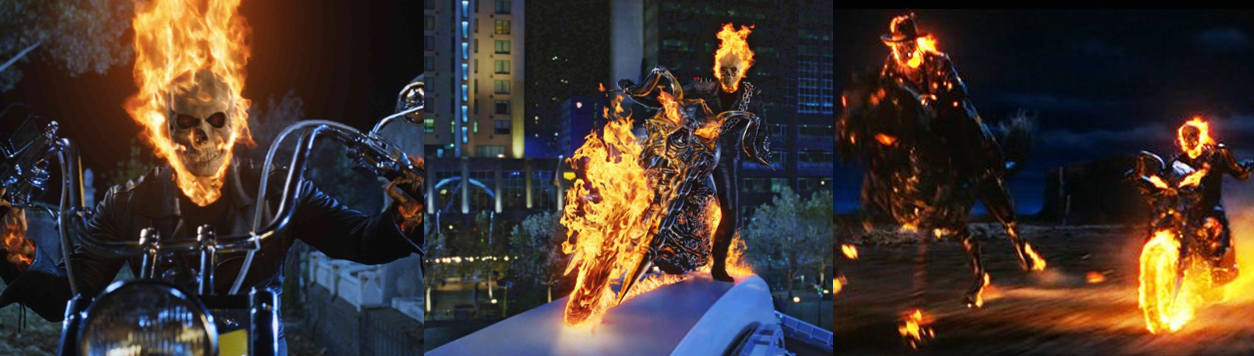
While the film struggles with its identity, at least the Ghost Rider’s special effects look great.

Thankfully, the film is also bolstered by its impressive special effects; although many of these suffer from a lack of polish (Blackheart’s arrival, for example, where he appears out of flaming rain and randomly screams at the camera for no reason, his minions, and the finale haven’t benefitted from age), it’s clear that all of the time, money, and energy was spent on making the Ghost Rider himself look absolutely top notch and bad-ass. Although there’s been some debate over whether Cage’s abs were real or not, Ghost Rider is easily one of the most visually impressive comic book characters on the page and on the screen; garbed in a spiked leather jacket, wielding a flaming chain, and having a flaming skull for a head, seeing him rocket down roads, leaving a trail of fire and devastation in his wake, is quite the spectacle and the flame effects still hold up pretty well. Probably as a consequence of how difficult the character was to conceive and animate, the Ghost Rider doesn’t talk much, and his action sequences tend to be very blunt; it’s all about ending things quickly, with as much visual and dramatic impact as possible, rather than having overly choreographed fight scenes or dragging things out. This works in context as the Ghost Rider certainly has the power to shrug off knives, blows, and even a truck to the face, to say nothing of leaving Gressil a charred mess of stones with a single lash of his whip. Easily one of the best parts of the film comes when Johnny is locked in a cell full of criminals, where he manhandles the lowlifes and reclaims his bike to race through the city streets in a blazing inferno while Dolan frantically tries to chase him down. This results in cool shots like Ghost Rider idling on top of the Southbank Pedestrian Footbridge, emerging from water completely ablaze, and racing up the side of a building to reel in a police chopper using his chain. This is also where he fights with Abigor; despite the fact that the Wind Elemental can become nigh-on intangible, even this creature is no match for the Ghost Rider, who easily immolates the Fallen Angel by whipping up a flaming tornado. The movie then makes a big show of revealing that the Caretaker was Carter Slade, the Ghost Rider who kept the Contract of San Venganza, and then completely squanders it by simply having him wander off to his death after accompanying Johnny to the ghost town rather than heroically die in battle with Blackheart, which kind of makes the entire reveal pointless beyond a cool shot of the two riding through the desert to a cover of “(Ghost) Riders in the Sky: A Cowboy Legend”.

Johnny bests Blackheart and then keeps the Ghost Rider power since that’s something he can do, apparently…

For all his immense power and his lofty dreams of domination, Blackheart ends up being little more than a petulant child; he’s dangerous, for sure, and even Mephistopheles fears his ambition, but he’s really only seen as a threat to humans. Although he increases Johnny’s personal stake in the plot (as if saving the world from untold eons of darkness wasn’t motivation enough) by killing Mack, Blackheart loses a lot of credibility by taking Roxanne hostage to bargain for the contract. This is especially egregious considering Carter hid the contract in the handle of his spade, so Blackheart had the means to acquire it all along and just…didn’t…because he wanted to toy with his prey rather than be a little more thorough. The movie tries to escalate things in the finale by forcing Johnny to retreat to the shadows to summon his powers, but it just ends up seeming like the filmmakers ran out of money and couldn’t render Ghost Rider in his full glory for the final showdown. Blackheart doesn’t fare much better, either; after absorbing San Venganza’s damned souls, he gains a moderately more monstrous appearance but is actually less of a threat as he’s now filled up with a thousand souls for the Penance Stare to run through, leaving him a useless, catatonic lump of wasted potential for Mephistopheles to take back to Hell and punish for being a naughty boy. Despite the fact that all Mephistopheles has done is lie, it’s surprising when the Devil actually makes good on his promise of releasing Johnny from his curse but, rather than finally be free and live the life he’s always wanted with Roxanne, Johnny inexplicably vows to wield the Devil’s power as the Spirit of Vengeance. While this is treated like some big dramatic character moment and Johnny finally embracing his destiny, it’s another of the film’s many head-scratching moments: Mephistopheles can bestow the Ghost Rider power against a person’s will but can’t remove it against their will? It’s almost as if the film’s implying that the Ghost Rider is more powerful than the Devil himself (and, in actual fact, he is since Mephistopheles couldn’t touch Blackheart on Earth!) Of course, the real reason for this nonsensical ending is to set-up a sequel, but I’d argue we could’ve still gotten that while also offering something a little bleaker. Like, have Mephistopheles betray Johnny and say he’s still bound by his contract, but Johnny could still vow to put his powers to good use and to oppose Mephistopheles wherever possible. Instead, it just seems like Mephistopheles is all bark and no bite as he just throws a temper tantrum (clearly where Blackheart gets it from…) and promptly disappears to allow his greatest and most powerful creation to wander the Earth outside of his control.

The Summary:
I think the biggest issue with Ghost Rider, even for someone like me who barely knows anything about the character, is that it’s just a bit of a disappointment from start to finish. It seems like the filmmakers thought the concept alone and Nicolas Cage’s star appeal would be enough for the film to compete against other blockbuster superhero franchises and didn’t really believe in the source material or the essence of the character’s horror roots. While I’m an advocate that 12/15-rated movies are more than suitable for most superhero properties, Ghost Rider definitely feels like it would’ve benefitted from being a smaller, more gritty horror vehicle rather than this bog-standard, over the top production. Considering the film is clearly pulling from classic horror movies like American Werewolf in London (Landis, 1981) and the Universal Horror movies, it’s a shame that it veers so far into the comedic and the absurd; everything from the acting, the soundtrack, and the overall corny nature of much of the movie constantly holds Ghost Rider back from being a more memorable picture, regardless of how good the titular character looks in the film. And he does look good, but the issue is the confusion regarding whether there’s any duality between him and Johnny, how ridiculously overpowered he is, and the vaguely defined powers of Mephistopheles and Blackheart. I can’t help but feel a smaller production, one more focused on Johnny Blaze struggling to cope with his monstrous curse, demonic alter ego, and his past mistakes while the Devil pulls his strings would’ve made for a darker, more unique horror piece but, instead, the film doubles down on its star power and visual effects rather than trying to give the Ghost Rider a tangible threat or tighten up the script. It’s definitely not the worst film I’ve ever seen, and has some fun and amusing and cool moments, but it’s far more akin to the disaster that was Spawn (Dippé, 1997) rather than a cross between The Crow (Proyas, 1994) and Constantine (Lawrence, 2005) or even something along the lines of Hellboy (del Toro, 2004), all far better movies that came out prior to this and which I feel are far more suitable to the tone of the Ghost Rider comics.

My Rating:

Rating: 2 out of 5.

Could Be Better

Did you enjoy Ghost Rider? If you’re a fan of the comics, how do you think it worked as an adaptation and what would you have changed? What did you think to Nicolas Cage’s performance in the film and the changes made to Johnny Blaze’s character? Were you a fan of the special effects, and what did you think to the villains and their minions? Can you explain why Mephistopheles has such inconsistent powers when on Earth? What are some of your favourite Ghost Rider stories and moments? Whatever your thoughts on Ghost Rider, share them below and be sure to check out my other horror-themed Marvel content!

Back Issues: Marvel Spotlight #5

Story Title: “Ghost Rider”
Published: 30 May 1972 (cover date: August 1972)
Writer: Gary Friedrich
Artist: Mark Ploog

The Background:
In 1967, Marvel Comics’ Dick Ayers, Gary Friedrich, and Roy Thomas introduced readers to Carter Slade/Ghost Rider, a Western gunslinger heavily based on Ray Krank and Dick Ayers’ horror-themed character of the same name. The character later took the moniker of the Phantom Rider and was surpassed by his successor, the entirely different but similarly named Spirit of Vengeance. A few years later in 1972, Thomas (then editor-in-chief of Marvel Comics) wished to introduce a villainous Ghost Rider as a foil for Matt Murdock/Daredevil. It was Friedrich who convinced Thomas to expand on the character, artist Mike Ploog asserts that he gave the character his trademark flaming skull, and the legendary Stan Lee dreamed up the name Johnny Blaze for the character’s alter ego. By 1973, this strange supernatural anti-hero had been upgraded to his own self-titled comic and, over the years, the mantle has passed to many others. Ghost Rider has been involved in many high-octane, demonic adventures: he’s battled the hordes of Hell, been split in two, aligned with other supernatural characters as the Spirits of Vengeance, and even flirted with mainstream success thanks to cameo appearances in Marvel’s nineties cartoons, poMovie Night: Ghost Rider: Spirit of Vengeanceorly-received live-action adaptations, and even featuring in a semi-prominent role in the fourth season of Marvel’s Agents of S.H.I.E.L.D. (2016 to 2017).

The Review:
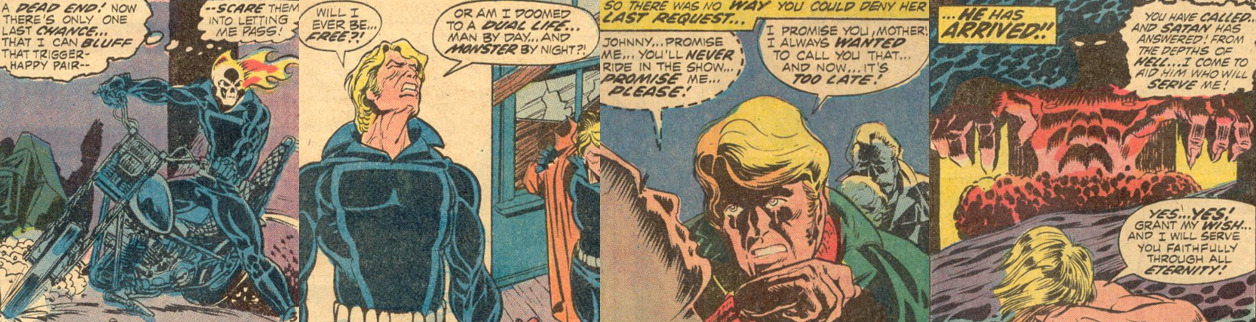
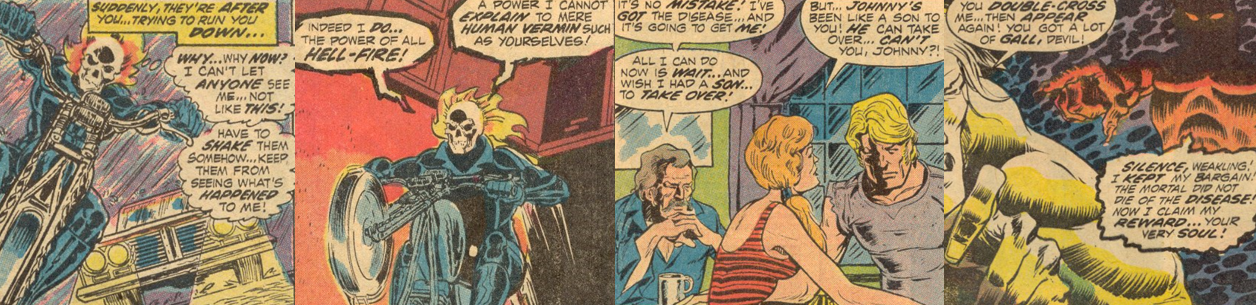
I should note first and foremost that I’ve had very little experience with Ghost Rider’s comics; hell, my experience with the character in general is pretty much exclusively from what I’ve seen in movies, cartoons, videogames, and the odd Marvel crossover here and there. Yet, I find the character visually and thematically appealing thanks to my love of the gothic and the macabre and I’d love to read more stories of the character if Marvel ever get their fingers out their asses and make his classic tales more readily available in print. His debut story opens on the rainswept streets and finds the titular flame-headed demon riding through the night; the first thing you might notice here is that the Ghost Rider is riding a fairly standard chopper rather than his iconic Hellcycle, but his visual appeal is hardly diminished because of this thanks to his tight leather outfit and his flaming skull for a head! Another thing that sticks out is that the Ghost Rider happens to pass by as a couple of thugs are gunning a man down in the streets but he chooses not to intervene or punish the gunmen, instead preferring to stay on the move to keep anyone from seeing his gruesome visage. However, fate has other plans for the demonic rider and the thugs give chase, determined to ensure that there are no witnesses to their crime. Interestingly for me, someone with little knowledge of how the Ghost Rider’s transformation and symbiosis works, the Ghost Rider’s internal monologue is that of a desperate man looking for solitude and privacy rather than conflict, and he only stops to confront the gunman when he’s left with no other option. Startled by the rider’s appearance (yet convinced that he’s simply wearing a flashy helmet or pulling some kind of trick), the thugs load up to face off with their ghastly witness, only to find the Ghost Rider is capable of spawning flames from the ground to cut them off and summoning Hell-fire to boost over their heads and escape to safety. Finally free from persecution, the Ghost Rider finds further relief in the rising of the sun, which dispels his demonic appearance and returns him to the agonised human form of Johnny Blaze.

Tormented stunt rider Johnny Blaze sold his soul to save his adopted father.

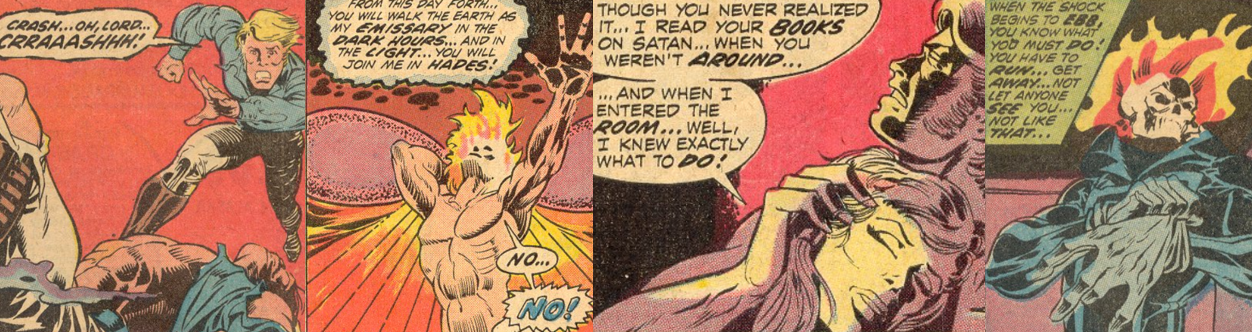
Desperate to take his mind of his nightly curse, Johnny tries to focus work; as one of the world’s most celebrate stunt cyclists, he is due to attempt the “world jump record” at Madison Square Garden that afternoon, but his thoughts continuously drift back to the past and how he was struck by his demonic dual life. His father, Barton Blaze, was also a daredevil motorcyclist and, after he died in an explosive accident, Johnny was adopted by fellow stunt cyclist Craig “Crash” Simpson and his beautiful daughter, Roxanne (or “Rocky”, as she’s affectionately known). Over the years, young Johnny overcame his fear of motorcycles and ended up taking to the sport like a fish to water; unfortunately, when he was fifteen, he watched his adopted mother die in a freak accident involving an exploding motorcycle. Heartbroken, he vowed to follow her last request and never ride again, though apparently never told this to Crash and Rocky as both of them believe he’s simply afraid to ride and shun him for it into his adulthood. Although he’d promised not to ride before an audience, Johnny secretly keeps up the hobby in his spare time, and he and Roxanne have an emotional reconciliation when she discovers how good he is and the promise her made to her mother. Taking solace in the life of a grease monkey now that he has the beautiful Roxanne by his side, Johnny and Rocky are overjoyed to learn that their show’s been booked for Madison Square Garden; unfortunately, this elation is short-lived as the cantankerous Crash drops the bombshell that he’s only got a month to live, at best, thanks to “the disease”. When Johnny refuses to go back on his vow and take Crash’s place, both his adopted father and Rocky brand him a coward and disown him; desperate for a solution to this problem, Johnny does the only logical thing possible and turns to occult tomes to call upon the dark powers of Satan!

Johnny’s bargain backfires when he’s forced to become a demonic figure at night.

Performing a macabre ritual and speaking ancient incantations, Johnny successfully summons the crimson devil and willingly agrees to serve Satan for all eternity if Crash is cured from his disease. Ol’ Scratch agrees to the deal and, the next day, Crash insists on performing the death-defying stunt, despite Johnny and Rocky’s desperate pleas. Sadly, Barton’s killed in his courageous and pig-headed attempt to ride his bike over twenty-two cars, and so outraged, so brief-stricken by the sudden and explosive death of another father, Johnny randomly decides to make the jump after all. However, Rocky is infuriated that he would steal her dad’s thunder like that mere moments after his death and spitefully walks away, leaving Johnny with only his regrets…and the Devil, arriving to claim that which was promised to Him and cursing Johnny to transform into his flame-headed alter ego as Satan’s emissary whenever night falls. Rocky happens to walk in on him during this ghoulish spell and, conveniently, is also well versed in the occult and is able to ward Satan off. Although Rocky’s presence is enough to quell Johnny’s woes during the day, his dark transformation is unstoppable at night and, agonised by his fiery transformation and monstrous visage, the Ghost Rider flees, bringing us full circle. Tormented by his nightly curse, Johnny struggles with his newfound duality, which sees him rearranging his work and social schedules to explain his nightly disappearances and exhausting himself through fear and worry. When he reads a newspaper headline stating that the gunmen he captured fingered a “Ghost Rider” for their plight, Johnny prepares to leave New York City to avoid being hunted by the police but is compelled to transform into his demonic other half when he loses track of time and distraught by the Faustian bargain that has doomed him to forever carry the burden of being the Ghost Rider.

The Summary:
It’s interesting finally reading the Ghost Rider’s debut appearance and origin story after primarily being familiar with the character from the Nicolas Cage movies. I can see why the films simplified Johnny’s origin to have him sell his soul in exchange for Barton’s life as it was a little convoluted to have young Johnny witness his dad die, only to grow up wary of motorcycles and then swear off them after his adopted mother’s death, and then have to watch another father perish in a blaze of tragedy. The flashbacks to Johnny’s past are quite weak in a lot of ways; it’s weird that we don’t find out what disease Crash is suffering from, and that he’s not really said to have actually been cured before he dies in a motorcycle accident, and it’s even weirder that Johnny was compelled to complete the jump before Crash’s body was even cold. Strangest of all, though, is that Johnny (and Rocky) have a keen interest in the occult; the story very much hand waves this as though it was some passing fancy of his, but he has books and scripture that detail the exact rituals and incantations to summon Satan. Not Mephisto, but Satan Himself! So, in his original depiction, Johnny makes a conscious decision to seek out dark forces and willingly offered his soul to cure his adopted father; there was no deception, no underhanded deal, no manipulation or anything like that. Hell, Johnny’s assumption that Crash’s accident was a result of Satan’s influence, however right he may be (and it’s not explicitly said that he is), is quite the leap here so his shock at Satan going back on His word doesn’t have the same impact as it does in other depictions of the story where Mephisto preyed on Johnny’s desperation and played him for a fool.

Sadly, there’s very little Ghost Rider action here as the focus is on Johnny’s plight.

Ironically, if you’re looking for some classic, bad-ass Ghost Rider action, you won’t find it in “Ghost Rider”. I’ve often wondered how the character works when he’s transformed; like, is Johnny merely a puppet for a demon to use? Is he conscious or in control of his actions as the Ghost Rider or is he merely a passenger from the demon that dwells within him? Here, it very much seems as though Johnny is fully aware of himself when transformed; when he scares the gunmen with his flames and theatricality, it’s said to be him putting on a show to terrify them (though I guess you could infer that the demon is influencing his speech and actions here), but we don’t really get a sense of what the Ghost Rider can actually do. In the context presented here, the Ghost Rider is more of a nightly affliction; Johnny is forced to become a gruesome flaming skeleton at night, transformed into a monster for Satan’s amusement, rather than being the Devil’s bounty hunter or seeking out evil do-ers or whatever. He exhibits some control of Hell-fire to conjure flames and give his bike a boost, but he doesn’t oppose criminals or seek vengeance or retribution against the wicked; instead, he simply tries to avoid being seen when transformed, something he would achieve much easier if he simply stayed inside rather than riding off every time he transforms. Ultimately, then, “Ghost Rider” is presented more as a fantastical twist on the classic Faustian tale of a desperate man bargaining his soul to the Devil and coming to regret it; a macabre, dark tale of a flawed man trying to save the only family he has and ultimately driving away the few loved ones he has left and being cursed to become a monster every night. It’s an intriguing tale, but one sadly lacking in action, visual spectacle (a huge appeal of the Ghost Rider is his unique appearance and he’s barely in this story), and littered with a number of oddities that keep it from being as appealing as it could be.

My Rating:

Rating: 2 out of 5.

Could Be Better

What are your thoughts on Ghost Rider’s debut story? Did the character impress you with his appearance or were you put off by how convoluted his backstory was? What did you think to Johnny’s summoning of Satan? Were you disappointed that we didn’t get to see more of what the Ghost Rider is capable of? Which incarnation of the Ghost Rider is your favourite? What are some of your favourite Ghost Rider stories or moments? Whatever your thoughts on Ghost Rider, share them below and be sure to check out my other Ghost Rider content.

Movie Night: Blade (1998)

Released: 21 August 1998
Director: Stephen Norrington
Distributor: New Line Cinema
Budget: $45 million
Stars: Wesley Snipes, Stephen Dorff, N‘Bushe Wright, Donal Logue, Kris Kristofferson, and Udo Kier

The Plot:
Blade (Snipes), a half-human, half-vampire dhampir born with all of the strengths of a vampire but none of their weaknesses (save the thirst for human blood), hunts vampires alongside his grouchy mentor and father-figure, Abraham Whistler (Kristofferson). Their mission is upended when Blade helps haematologist Doctor Karen Jenson (Wright) after she is bitten, and when sadistic upstart vampire Deacon Frost (Dorff) sets in motion a plot to usurp his elders and evoke the mythical “Blood God”.

The Background:
Eric Brooks/Blade began life as an extremely obscure, culturally problematic vampire hunter in the pages of The Tomb of Dracula, courtesy of Marv Wolfman and Gene Colan, after Marvel Comics were were finally allowed to publish stories involving vampires and other supernatural creatures. Development of a Blade movie can be traced back to 1992, when New World Pictures bought the rights to the character and rapper LL Cool J was initially attached to the role. Obviously, this never came to fruition and the rights eventually ended up with New Line Cinema, where the property caught the attention of writer David S. Goyer. After battling against the studio’s wishes to make a spoof film, and change Blade’s race, Goyer won out with his gritter, bloody, realistic reimagining of the character. Goyer’s revised ideas for Blade were reflected in his guest appearances on the nineties Spider-Man animated series where he was also a dhampir and accompanied by Whistler (Malcolm McDowell/Oliver Muirhead). Although actors Denzel Washington and Laurence Fishburne were considered for the role, Goyer pushed for Snipes, who had previously been attached to star in an unproduced Black Panther movie. Norrington’s first 140-minute cut was heavily trashed by test audiences, necessitating not just heavy reshoots but also an entirely new ending, but the final movie went on to be a huge success; it grossed over $131 million at the box office and was highly praised for its slick visual style, seedy depiction of vampire society, and unapologetic violence and gore. Though there were some reservations with the disparate genres at work in the film, the results spoke for themselves; not only was the comic book Blade altered to match his live-action counterpart, but Blade spawned two sequels of varying quality and an unfortunately short-lived TV show. Blade was also one of the first movies to really kick-start the surge in popularity for superhero properties in cinema, so it was only fitting when Marvel Studios reacquired the rights to bring the character back to the big screen with a reboot.

The Review:
Before Blade, I (like many) had never heard of Marvel’s most famous vampire hunter. Hell, I wasn’t even that familiar with Wesley Snipes, having seen him in Demolition Man (Brambilla, 1993) and very little else since my action movie dance card was firmly filled up with Arnold Schwarzenegger’s body of work. Still, like The Matrix (The Wachowski Brothers, 1999) and Armageddon (Bay, 1998), Blade was a  constant presence at sleepovers and birthdays, and probably the last good vampire film I watched until 30 Days of Night (Slade, 2007)). It didn’t help that the genre became oversaturated with lame-ass, love drunk teenage vampires and Blade and Matrix rip-offs like the God-awful Underworld franchise (Various, 2003 to 2017). Don’t get me wrong, I’m a huge fan of the dark, gory, gritty, leather-and-guns aesthetic that these films popularised at the time, but crafting a good vampire film in this day and age seems like a lost art as filmmakers lean a little too heavily towards the camp and an excess of CGI. But still, Blade was (largely) immune to all of that, and barely even had the stigma of being a comic book movie (the film doesn’t even have the classic Marvel logo in the opening) since no-one really knew who he was; I’d seen him in Spider-Man and even I hardly remembered him, so in many ways this was the perfect “back door pilot” for the superhero movies we were about to see explode onto cinema screens. Unfortunately, we wouldn’t see R-rated superhero films take centre stage during this movement, but I still maintain that not every superhero property even needs to be full of gore and cuss words; but those who do deserve it, like Blade, should definitely veer more towards that and would do well to take a few notes from this classic horror/action film.

With all a vampire’s strengths but none of their weaknesses, Blade wages a relentless crusade.

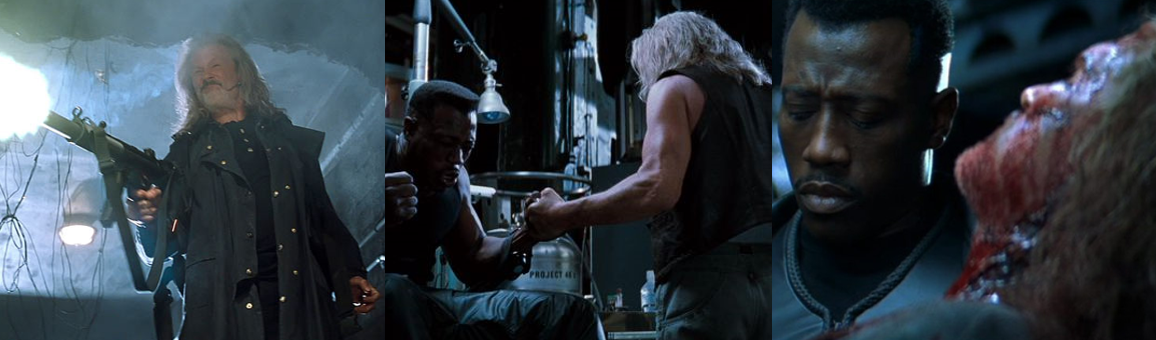
Blade is the story of…well…Blade…a stoic and highly skilled vampire hunter who was born Eric Brooks. When his mother, Vanessa (Sanaa Lathan), was bitten by a vampire (later revealed to have been the big bad, Deacon Frost) while pregnant, Eric was born a “dhampir” (though the film prefers the term “Daywalker”), a human being with all the strengths of a vampire (heightened senses, superhuman strength, agility, and durability, and skin-piercing fangs) but with none of their weaknesses to sunlight or ultraviolet radiation (which burns and eventually explodes on contact), garlic, or silver. For all his fantastic abilities, though, Blade still ages like a normal human and is still hampered by perhaps the vampire’s most crippling affliction: “The Thirst” for human blood. While other vampires freely indulge their bloodlust, luring in unsuspecting prey and literally raving at underground bloodbaths, Blade relies upon a special serum, derived by his half-crippled mentor, Whistler, to keep the Thirst at bay. Blade takes this serum at least once a day and this is the first time (and one of the rare times) that we see him in an kind of vulnerable state; strapped to a chair, grasping Whistler’s hand for support, his body is wracked by seizures as the serum courses through his veins, leaving his hunger satiated and his body trembling. Aside from this, Blade is an absolute machine when out in the field; stone-faced and exuding menace and confidence, he thinks nothing of walking into a club filled to the brim with horny, blood-hungry vampires and even little of storming a hospital or Frost’s penthouse in the pursuit of his targets. Harbouring a deep-rooted hatred towards vampires since they killed his mother and cursed him with a life of violence and pain, Blade is relentless in his quest to kill every vampire that crosses his path, disrupt and destroy their entrenched hierarchy, and track down and kill Frost, which has earned him a reputation amongst the vampire community as a feared and formidable figure, the aforementioned Daywalker, who is effectively their bogeyman. However, Blade is deeply ashamed by himself; disgusted at his inhuman thirst for blood and sickened at what Frost did to his mother, he seeks solace in the only thing he knows: killing the monsters responsible for his existence to gain just a small sliver of his humanity back with each victory.

Grouchy hard-ass Whistler has devoted his life to training Blade and killing vampires.

Although Blade is somewhat cold and dismissive towards Whistler, who is a crotchety and jaded old man with a prominent limp and a tendency to smoke around flammable liquids, there’s a mutual respect and admiration between the two. When Blade was a boy, Whistler stumbled upon him on the streets and nearly killed him before realising what he was and has been teaching him everything he knows ever since. Whistler has even less love for vampires than the titular hunter; years ago, his wife and children were killed after taking in a drifter, who turned out to be a vampire, and he was forced to watch as they were tortured before his eyes. Quite how he survived this encounter isn’t elaborated, but he’s made it his mission to take them out one by one. Despite their contentious relationship, where Whistler is often admonishing Blade for his actions, there’s a father/son bond between the two; it’s obvious that they care about each other, and Whistler is clearly disturbed at the serum’s increasing ineffectiveness and concerned for Blade’s welfare out in the field. Unfortunately, age, injuries, and cancer have taken their toll on Whistler and he’s no longer able to be an active combatant, something you can tell is a source of great frustration for him. Despite this, he’s still a valuable ally and resource for Blade; his vast knowledge of vampire society and their inner workings allows Blade to pursue Deacon Frost, and Whistler furnishes Blade with all his weapons and his supped-up muscle car, and even makes a dramatic and amusing last-minute save later in the film (his “Catch you fucker’s at a bad time?!” and “Somebody get me a Goddamn wheelchair!” lines are some of the best in the film). For all his piss and vinegar, Whistler has a large heart; he truly cares for Blade and sympathises with Karen’s plight, and his whole mission is motivated by a desire to protect others from the vampire’s bloodlusts. However, while he has an indomitable fighting spirit, his best efforts to protect Karen and fend off Frost are for naught, leaving him beaten, bloodied, and bitten. Blade is left shell-shocked and refuses to finish off his father figure; it’s all he can do to clean Whistler’s wounds and, seeing his protégé’s struggle, Whistler demands that he walk away so he can finish the job himself, and Blade begrudgingly obeys, resuming his grim façade and fuelled by an even greater need to extract revenge on Frost.

Violently thrust into Blade’s world, haematologist Karen works to find a cure for vampirism.

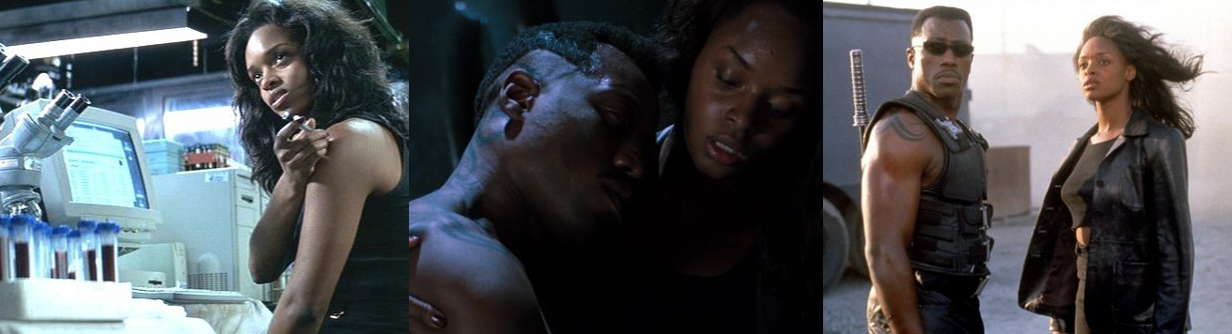
When we first meet her, Karen is just an average overworked and underpaid haematologist trying to get through a nightshift while dismissing the advances of her colleague and former flame, Doctor Curtis Webb (Tim Guinee). She’s violently introduced to Blade’s gruesome world, however, when the charred corpse of Frost’s underling, Quinn (Logue), springs to life and violently attacks both her and Curtis. Although it’s admittedly a bit weird that Blade went to all the trouble of setting Quinn alight to send a message to Frost and then immediately came back to “finish [him] off”, thereby endangering innocents by letting Quinn live, it does mean that he crosses paths with the injured and infected Karen. In a rare moment of emotion, Blade sees a resemblance between Karen and his mother and chooses to take her to his lair rather than finish her off or leave her to turn. Karen thus becomes the audience surrogate; it’s through her interactions with Whistler and Blade that we learn about Blade’s origin, the rules of these vampires, and the lore behind the movie. At first, she’s naturally terrified; not only has she just been attacked by a ravenous, burned up corpse but this hulking motherfucker just threw her out a window and effectively kidnapped her, and her fear only worsens when she’s told that she has a high chance of becoming a vampire even after the treatment they give her. Determined to avoid this fate, and fascinated by their operation, Karen experiments with ethylenediaminetetraacetic acid (EDTA), discovering that it not only has explosive results when mixed with vampire blood but could also hold the key to curing vampirism. Though this wouldn’t have any affect on Blade since he was born with his abilities, she’s confident that she can cure him with enough time but, ultimately, he requests that she synthesise a more effective serum for him. Since she was attacked, Karen becomes “marked” and thus remains at risk of vampire attacks; this comes to a head when she’s taken hostage by Frost, meaning she willingly allows Blade to drink her blood in order to restore his strength for the finale, but any romantic subplot between them is continually (and refreshingly) downplayed due to Blade’s intense focus on his never-ending mission (although the scene where he drinks her blood seems purposefully shot to evoke an intense love scene).

Upstart sadistic Frost wants nothing more than to rule over the humans and usurp his antiquated elders.

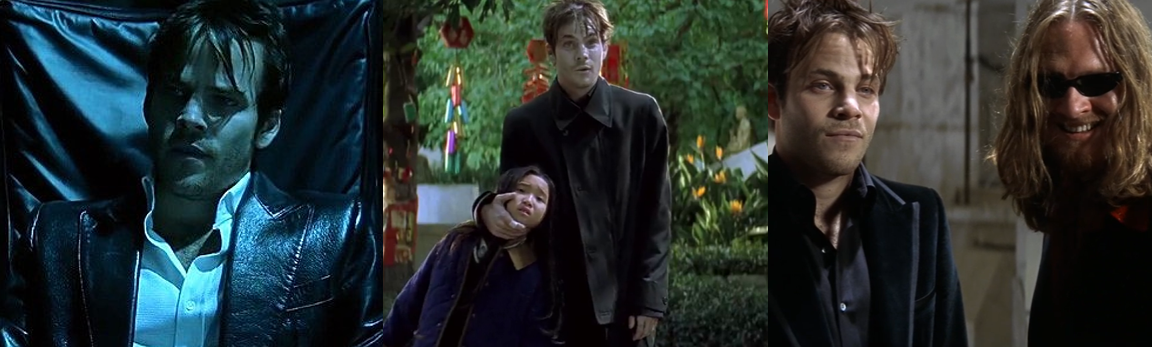
As different as Blade is from his comic book counterpart, Frost is equally a departure from the silver-haired, middle-aged man seen in the comics. Indeed, the movie version of Frost has more in common with David Powers (Kiefer Sutherland) from The Lost Boys (Schumacher, 1987), both aesthetically and in terms of his motivation. Frost is seen by his more composed elders as a disruptive and chaotic individual, one who regards vampires as the dominant species and humans as mere food and whosr antics draw unnecessary attention to their kind not just from Blade, the scourge of vampire society, but also from the humans they so tentatively live alongside. Frost’s mindset is an intriguing one; since he was “merely turned” into a vampire, and was thus once human, his hatred and resentment towards humanity seems to stem from an untampered, sadistic lust for power, bloodshed, and a superiority complex afforded by his superhuman abilities. Seeing the vampire high council as relics of a bygone era, Frost wants nothing more than to run free and rampant, unrestricted by antiquated rules and treaties, and has even found a way to operate in the sunlight using sun block (a ludicrous solution, but it makes for an intimidating confrontation between him and Blade and one of the first popular instances of “bullet time” in cinema). Frost is a twisted, arrogant punk who surrounds himself with a gaggle of likeminded cronies, all of whom revel in indulging their thirst for blood and anarchy, and this extends even as far as to threaten a young girl just to hold Blade at bay and to take the head of the vampire council, Gitano Dragonetti (Kier), rip his fangs out with pliers, and leave him to be annihilated by the rising sun. Despite his disrespect and frustration with the old ways, Frost devotes a great deal of his time, energy, and resources to translating the secret of the “Blood God”, La Magra, from the Book of Erebus (the “Vampire Bible”), discovering that sacrificing twelve “Pure Bloods” will summon the eldritch force and infuse him with its power. A cruel-hearted and vicious individual, Frost takes great pleasure in beating Whistler half to death and delights in torturing Blade not just with the knowledge that his mother is still alive (and a vampire now entirely loyal to Frost) but also by draining his blood to fuel his transformation into the Blood God. Imbued with a virtual immortality, Frost’s ambition more than exceeds his grasp, allowing him to effectively usurp his elders and ascend to a level of existence that threatens to spell the end of days for both humans and any vampires that don’t pledge undying fealty to him.

The Nitty-Gritty:
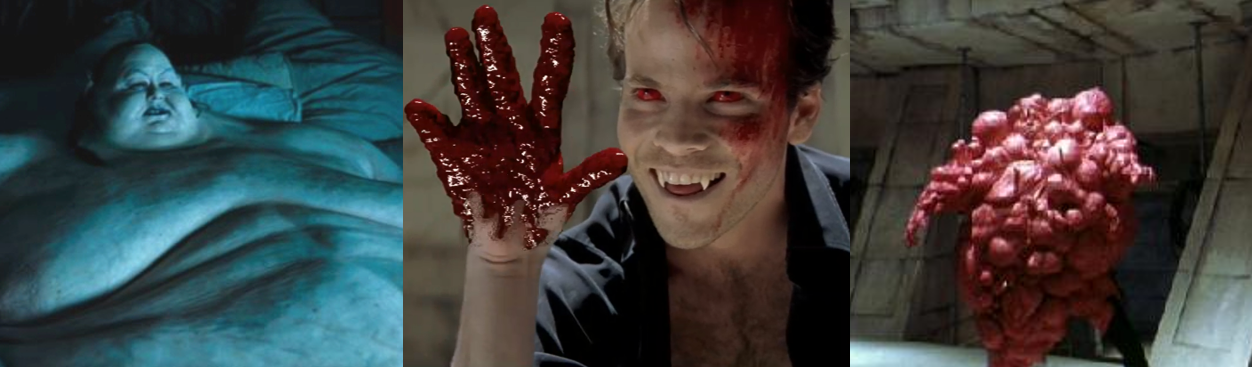
If there’s a downside to Blade, it’s that it suffers from the annoying trend of having its antagonists sit around in suits and in elaborate boardrooms and office buildings, lording their power and control over the city. However, this actually plays into Frost’s character; unlike the vampire high council and the likes of Gitano Dragonetti, Frost shuns the corporate ways of their society and prefers to indulge his whims, and this dispute leads to a great deal of antagonism between his upstart group and their elders. Indeed, vampire society in Blade is depicted as being firmly entrenched within what we recognise as the real world; they’ve infiltrated every level of society, from politics to law enforcement and real estate, and enjoy the wealth and privileges such influence brings, allowing them to carefully select their victims and modulate their base desires so as not to draw attention to themselves. In contrast to these Pure Bloods, Frost and his cronies are seen as petulant children; admonished for encouraging gatherings of similarly turned vampires and threatening the “treaty” they have with the human politicians (indicating an awareness of vampire society at a higher governmental level, but it’s ignored and/or tolerated to keep from sparking an all-out war that would cost humans their lives and vampires their lofty position). If you’ve ever watched Buffy the Vampire Slayer (1997 to 2003), you’ll be immediately familiar with vampire society in Blade: there’s the older Pure Bloods at the top of the food chain, those they’ve turned and inducted into their cabal (like Frost), but there are also more monstrous variants in their ranks. The morbidly obese Pearl (Eric Edwards), who’s been feeding on children while helping translate the Vampire Bible, is just one such example, but Curtis later pops up as a horrific zombie-like creature as a common by-product of being bitten. On the other side of the coin, the vampires frequently employ “Familiars”, regular humans like Krieger (Kevin Patrick Walls), a police officer who carries Frost’s tattoo and hopes to one day be turned for assisting his master.

Blade excels in its action-packed fight scenes, gritty presentation, and unapologetic gore.

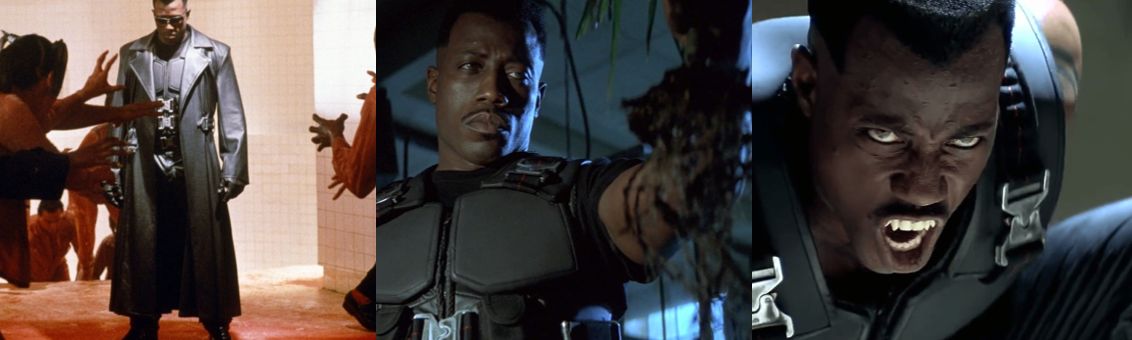
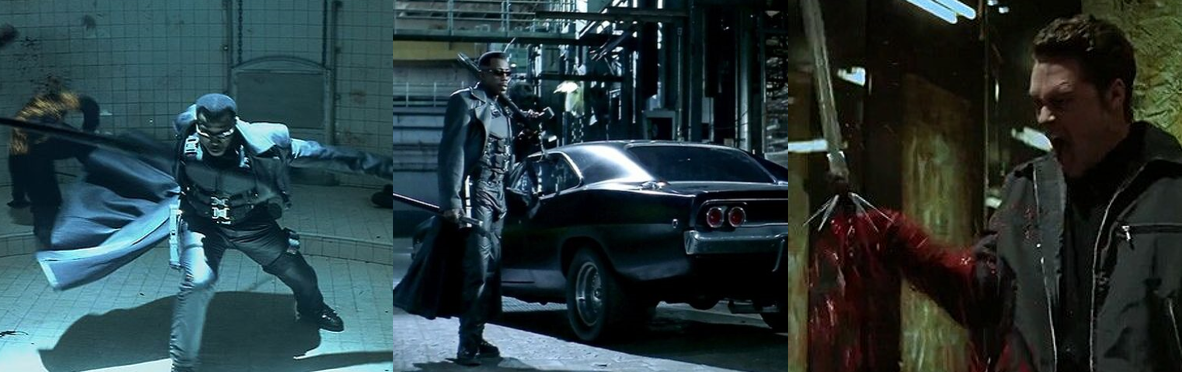
One of the things I absolutely love about Blade is, like The Crow (Proyas, 1994) and The Matrix before it, the film has a heavy reliance upon bad-ass leather trench coats and kung-fu. Garbed head to toe in black and sporting a nifty armour vest, Blade cuts quite the intimidating figure; our introduction to him, standing bone dry amidst a literal bloodbath, couldn’t be more striking and watching him dismantle vampires left and right with ease and skill is always a joy thanks to Snipes’ slick movements and some incredibly well-shot and well-choreographed fight scenes. The action is easy to follow, even when in low or strobe lighting, and Blade oozes confidence and charisma every time he’s on screen even though the character is largely stoic and no-nonsense. Having said that, though, Blade’s grim demeanour does crack on more than one occasion; he gives himself a little fist pump after nailing Quinn to a wall, shares some banter with Whistler, expresses concern over Karen and appreciation towards his allies, but perhaps his most amusing attribute is that he often delivers cool, snappy one-liners (his outburst of “Motherfuckah, are you outta your damn mind?” when the cops shoot at him never fails to amuse and his “Some motherfuckahs are always tryin’ t’ice skate uphill” is exactly the right level of awesome and ridiculous). Blade is so proficient at killing vampires because his superhuman abilities are bolstered by some awesome weapons, courtesy of Whistler; he carries a variety of silver stakes to instantly turn vampires to charred ash, wields a modified MAC-11 for rapid fire like he’s fuckin’ Alex Murphy/RoboCop, blows vampire heads clean off with his shotgun and, of course, carries a titanium, silver-tinted sword that easily allows him to not only sever limbs and reduce even roomfuls of armed vampires to dust but also contains a security feature that means no one but him can hold it without losing a hand! Whistler even furnishes Karen with a compound of “vampire mace” to fend off any unwanted attention, and has put together quite the sexy muscle car for Blade to bomb around the city streets in.

Unfortunately, the film’s effects and finale are bogged down by some ugly CGI blood.

I mentioned Buffy the Vampire Slayer earlier and the comparison is more fitting that you might think; while the vampires don’t sport monstrous make-up like in the show and appear much sexier with their glistening fangs and gothic attire, they die in very much the same way. After being stabbed or sliced with silver, or exposed to sunlight, vampires quickly and violently burn to ash and cinders, an effect that is visually interesting if a little dated. For the most part, Blade does a great job of keeping everything nice and practical; Snipes excels in his fight scenes and shoot-outs, which are all nice and varied and have a great balance of fast-paced, hard-hitting action, explosions, and blood, and the sets are equally diverse, ranging from high-tech archives, the juxtaposition between Frost’s elaborate penthouse and Blade’s rundown lair in the industrial district, and the ancient stone of the Temple of Eternal Night. On the other hand, Pearl is little more than a disgusting mass of rubbery flesh, Frost’s Mac is strangely able to render a complete 3D recreation of the temple simply from translating the Vampire Bible, and, of course, there’s the final confrontation between Blade and Frost himself. After being restored by Karen’s blood (and receiving a power boost as a result) and cutting through Frost’s underlings, and even killing his mother (ultimately an underutilised plot point, I feel, that could’ve easily been dropped), Blade battles the empowered Frost one last time. This one is actually a challenge for Blade; not only is Frost able to match him blow for blow and sword swing for sword swing, but he’s functionally immortal thanks to the Blood God. Despite Frost’s henchwoman, Mercury (Arly Jover), killing one of the twelve Pure Bloods, the ceremony goes off without a hitch, imbuing Frost with the powers of the God (although it’s possible that Mercury’s actions caused him to be more of a demigod than a literal whirlwind of blood). When Blade does cut through Frost’s abdomen for a killing blow, the upstart vampire easily reconnects himself using probably the worst CGI blood effect you’ll ever see. Luckily, these poor blood effects are fleeting and don’t overpower the finale like in the first disastrous test footage, but they do rear their ugly head when Blade bests Frost by injecting him with his entire supply of EDTA, causing him to violently explode in an ugly, bloated mess. Although Frost is dead, this was merely a battle in an ongoing and never-ending war and the film ends with Blade more willing than ever to see his cause through to the conclusion (even ending up hunting vampires in Russia) rather than accept the vague promise of a cure.

The Summary:
It’s actually a little surprising to me how well Blade holds up today; the film has a slick, science-fiction edge to it that permeated subsequent comic book movies like the X-Men films (Various, 2000 to 2020) but it had something to it, a dark, gritty edge, that even now films in the same genre tend to either downplay or ignore. Although it’s undeniably comic book-y in its premise and execution, Blade eschews many of the clichés we’ve come to see from the genre; rather than being a by-the-numbers origin story or feature form-fitting costumes, Blade is primarily a horror/action film and, in this regard, it exceeds tremendously. Full of fast, exciting fight scenes, frenetic chase sequences, and action-packed shoot-outs, Blade is even a cut above other films in the action genre and may very well be the perfect marriage of all these disparate elements. Edgy, gory, and unapologetically aimed at a more mature audience, the film takes everything that worked in The Crow and expands upon it with its gothic, gruesome premise and proceeds the “wire-fu” craze popularised by The Matrix. I’ve never been a massive fan of Wesley Snipes; he’s undeniably cool and certainly has some skills, but it’s a little difficult for me to reconcile his personal life with his movies, which haven’t always been able to compete with his peers, but Blade was a great showcase of his physical abilities and easily his most iconic character for me since it allows him to be stoic, deeply emotional, and snarky in addition to tossing fools around like they were nothing. The depiction of vampire society as being a conflict of interests between the antiquated old guard and Frost’s arrogant upstarts echoed The Lost Boys and nicely challenged the cliché of all-powerful, corporate antagonists, and was a significant influence on the genre going forward. While some of the effects haven’t aged too well and the plot point of Blade’s mother still being alive didn’t really land for me, neither of these things really detract from how enjoyable Blade is. Although I actually prefer the more violent and action-packed sequel, there’s a definite appeal to how raw and uncompromising the original is, especially in its depiction of more horrific and gory moments, and it’s a great piece of dark, gritty vampire fiction for fans of the genre.

My Rating:

Rating: 4 out of 5.

Great Stuff

Are you fan of Blade? What did you think to it when it first came out and how do you think it holds up today? Were you a fan of the comic book character prior to this film and, if so, what did you think to the changes made to his powers and origin? What did you think to the performances, specifically Wesley Snipes and Stephen Dorff, and were you moved by Whistler’s death? Did you enjoy the film’s gore and action sequences, and what are your thoughts on the CGI used in the finale? Which vampire movie or story is your favourite, and which of the Blade films or comics do you enjoy? Whatever your thoughts on Blade, feel free to share them below.

Back Issues: The Tomb of Dracula #10

Story Title: “His Name Is… Blade!”
Published:
17 April 1973 (cover date: July 1973)
Writer:
Marv Wolfman
Artist:
Gene Colan

The Background:
Eric Brooks/Blade was the creation of Marv Wolfman and Gene Colan; inspired by numerous black actors and sporting a 1970s “Blaxploitation” appearance, Blade was only able to come about after comic creators were finally allowed to publish stories involving vampires and other supernatural creatures. One of the first ways Marvel took advantage of this was with the Tomb of Dracula series, in which vampire hunters like Blade would battle against the titular Count and other supernatural creatures. Although heavily inspired by classic Hammer Horror films, The Tomb of Dracula initially struggled with its creative direction as different writers and artists came and went from the book, until Wolfman and Colan joined the publication and turned things around with their close collaboration. Initially a jive talking, very human vampire hunter, Blade was little more than a bit-player in the grand Marvel tapestry, although he did have associations with groups like the Nightstalkers and the Midnight Sons. Despite this, the rights to the character were bought by New World Pictures in 1992, and the later success and popularity of Blade (Norrington, 1998) saw the character transformed into a stoic, bad-ass dhampir to match his live-action counterpart, and the character has gone on to be an integral part of many supernatural and horror stories within Marvel Comics due to this surge of interest.

The Review:
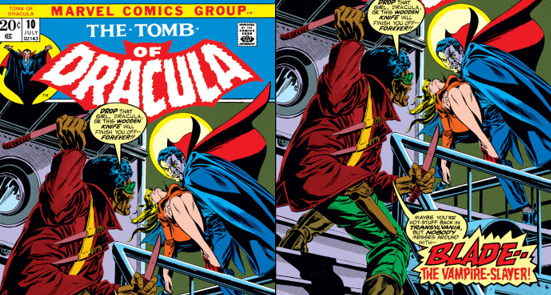
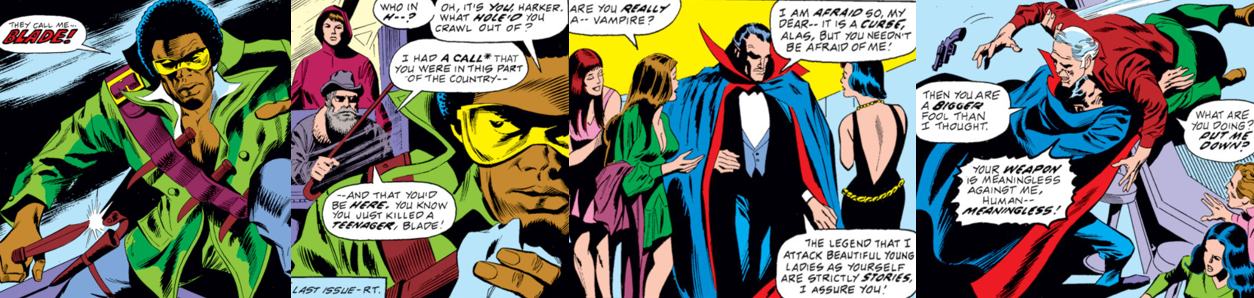
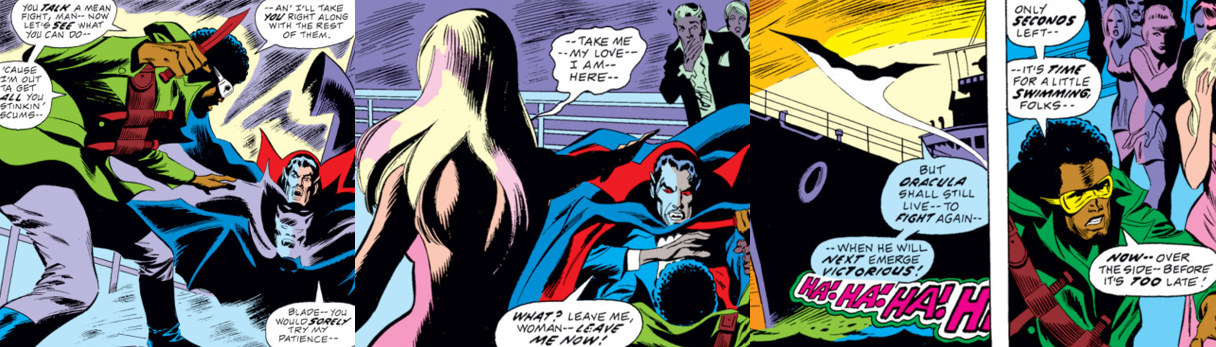
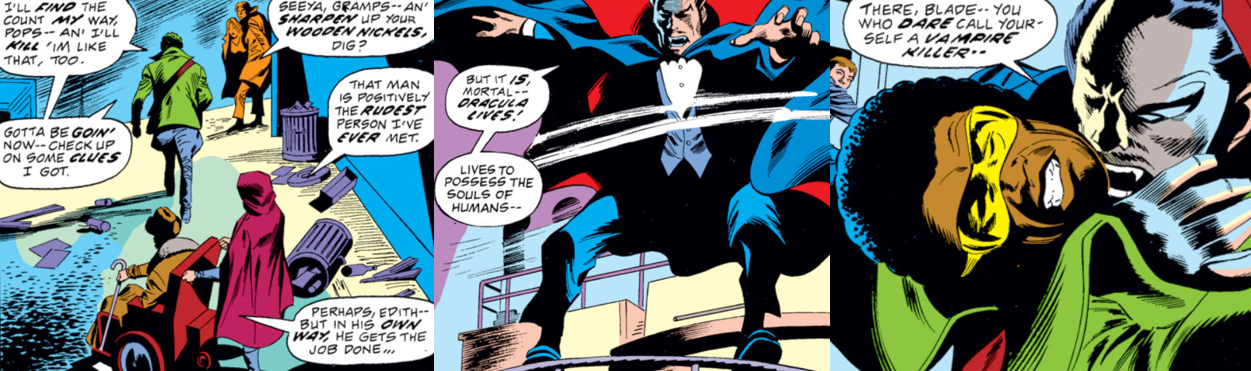
“His Name Is…Blade!” opens on the dark, quiet docks in what I assume is London (or, at least, somewhere in England judging by the dialogue of the characters) where two youths are planning to stow away aboard a ship and elope to the United States when they’re suddenly attacked by three bloodthirsty vampires! These fanged, bat-like creatures exhibit many of the common tropes we associated with nosferatu: they can freely shift between a bat and a humanoid appearance, have monstrous faces, and are driven to suck the blood from their prey. In this case, however, the three aren’t there to feed; instead, they seek to turn the terrified youths into two more of Dracula’s cursed minions, implying a level of mysticism and possession from the process of being bitten. Although their victims haven’t the strength or hope of fighting off their attacks, these dark intentions are interrupted by the arrival of Blade – the Vampire Killer! Now, this isn’t the trenchcoat-clad, armour-wearing, sword-wielding half-human bad-ass you may be familiar with from the movie. Instead, Blade is garbed in a garish green coat similar to an Army jacket, an outrageous yellow visor, sports a maroon bandolier filled with stakes, and is rocking a suitably stereotypical afro hairdo. To say he cuts an intimidating figure would be a lie, frankly; instead, he just looks like a hobo with a vision problem, and yet his reputation as a vampire slayer proceeds him and the vampires state that Dracula has given them orders to kill him. Blade strikes with a speed, precision, and brutal efficiency that comes not from sporting the physical strength of his hated foe but from years of hunting and killing vampires, easily staking two of his foes with a specially carved teak-bladed knife with minimal effort. The third vampire, startled by the vampire killer’s proficiency, tries to flee in his man-bat form, only for Blade to leap onto him and end his vile undead life.

While Blade mercilessly hunts vampires, Dracula attacks a luxury cruise ship.

Upon death, the vampires slowly return to their human form, betraying this particular victim as a youth unwittingly transformed against his will; Blade cares little for this, however, and simply coldly remarks that the only good vampire is a dead vampire. His callous attitude earns him the ire of Quincy Harker, a wheelchair-bound old man and one of the world’s foremost experts on vampires. Harker admonishes Blade’s lack of vision; his crusade to simply slaughter every vampire he comes across is interfering with the bigger picture of tracking down and executing Dracula, thus making his undead minions “easy prey”. Blade, however, is unimpressed; he gives Harker the brush off and vows to continue hunting vampires without the old man’s aid, throwing some jive his way for good measure because…you know, the seventies! The story then jumps over to the ocean liner Michele where wealthy socialite Gabriel Trulaine is throwing a lavish party for his similarly decadent friends and absolutely wows his guests by having the Count Dracula himself unveiled as a special attraction for the soiree. Although Dracula (or “Vlad” as he insists Gabriel’s beautiful companion calls him) downplays the stories and rumours of his gruesome ways, assuring the awestruck guests that vampirism is a “disease” like “blood poisoning” and not the affliction popularised in the media, it’s all merely a ruse to gain power over, and favour with, the wealthy and influential and thus extend his reach into industrial, politics, and society. He’s easily able to charm Gabriel’s bimbo with a few choice words and feed upon her blood, before swatting the Michele’s captain and seizing control of the vessel. Dracula then reveals the true extent of his awesome power, which allows him to turn to smoke and control the wills of others; when one of the guests tries to fight back, Dracula simply laughs in the face of his pistol and tosses him overboard before turning on the others and preparing to work his evil magic.

Despite his superior strength, Dracula simply abandons the fight at the first inconvenience.

Fortunately, Blade intercepts the vessel; considering Harker made such a song and dance about Blade’s actions costing them another lead on Dracula, it’s a bit odd and completely unexplained how he was able to track the Michele, but he easily boards the craft and prepares to battle with Dracula. Amusingly, Gabriel’s guests do a lot of the work for him; Dracula demands that they submit to his requests willingly lest he turn them into the living dead and one devote Christian amongst them leads the charge against the Lord of Vampires, stunning him with a Holy Cross and allowing the others to pin him down. Of course, Dracula’s not so easily bested, evaporating into mist and easily escaping harm, but he flies into a rage when Blade arrives as the Count wishes to avenge the vampires lost at the slayer’s hands. Naturally, Dracula is the physically superior of the two, but Blade is tenacious and full of spunk and only enrages the Vampire King with his mocking quips. Still, as wily and nimble as Blade is, Dracula’s shape-shifting abilities and superhuman strength soon see him gain the upper hand; however, right as he’s about to bite into Blade’s neck, Gabriel’s woman, entranced by Dracula’s bite, interrupts him. This is apparently enough to wreck Dracula’s entire plan and he decides to just fly away in his bat form and leave them all to die from the explosives he had the captain place on the ship, despite the fact he could easily massacre them all with his superior strength. With only seconds left, Blade forces everyone off the Michele and into the cold waters below and is left drifting in the sea with Dracula’s mocking laughter in his ears and the promise of a further confrontation later down the line.

The Summary:
Well, this was…certainly something. I’ve never read The Tomb of Dracula or anything with either him or Blade in it before (not even Stoker’s original novel), so I went into this without any real expectations and still came out of it quite disappointed. The art work is pretty good, at times; Blade and Dracula fare the best out of anyone, with the Lord of Vampires appearing just like he does in all the classic Dracula films and popular depictions, though I can’t say I care for Blade’s appearance here one bit. I don’t really get it; like, what’s with the weird goggles? Why’s his jacket so plain and dull? Later, he dons a wetsuit of sorts to board the Michele, which is a far better look, but he quickly changes into his shitty jacket and glasses and I just don’t really get how he was supposed to look cool or interesting in the slightest in this getup. The other vampires we see come off pretty well; I liked how they shifted from bats to man-bats to monstrous humans and to mist and such, though there’s an understandable lack of blood and the vampires are disappointingly easy to kill, dying from a simply stab from Blade’s special knife that isn’t even in their hearts half the time.

It’s hard to believe Blade became such a sensation after this awfully weak debut story.

The dialogue leaves a lot to be desired, too. This is yet another instance where the story is dated by the misconceptions and stereotypes of the time, with Blade talking in hip jive slang and acting like he just walked off the set of Shaft (Parks, 1971) and Dracula endlessly monologuing and referring to himself in the third person, as was the style of many Marvel villains. This is an odd choice considering he has an underling present, Clifford Graves, to converse with, but Graves is merely a pawn of the Lord of Vampires, one for Dracula to chastise at every opportunity and leave for dead at the story’s end. I’m not sure I really get the premise of The Tomb of Dracula; were readers really just following a sadistic and bloodthirsty vampire on a serious of adventures as he preyed on the innocent and lusted for power? Seems an odd concept to me, one without much legs, and I can’t say that I’m interested in reading other stories from the comic after this one. Hell, I’m not even interested in Blade all that much after this; there’s some intrigue introduced here, with Harker despairing of Blade’s methods (despite how effective he is at killing vampires) and the suggestion that he’s this rogue element in the vampire slaying community, but he just looks and sounds and acts so corny and ridiculous that it’s hard to take him seriously. He’s tenacious, I’ll give him that, and dedicated to killing all vampires without hesitation or remorse, and exhibits some physical prowess, but it’s a pretty weak debut story, if you ask me. Dracula’s plot to manipulate the wealthy and the powerful was completely nonsensical (why didn’t he just turn them with his powers? Why go through all that charade? Why’d he fuckin’ leave when he could’ve killed them all?!) and hardly inspires me to see what else he got up to, and overall I have to say that I’m glad that the movies changed Blade’s character so much if this is what we had to deal with.

My Rating:

Rating: 1 out of 5.

Terrible

What did you think to Blade’s debut story? Did the character interest you at the time or, like me, were you introduced to him through the movies? Did you ever read The Tomb of Dracula books and, if so, what did you think to them? What are some of your favourite Blade moments from the comics? Have you ever read Stoker’s novel, and what are some of your favourite vampire stories? No matter what you think, good or bad, feel free to share your thoughts below and be sure to check out my review of Blade’s game-changing movie!

Game Corner [Spidey Month]: Spider-Man 2 (PlayStation 2)


Easily Marvel Comics’ most recognisable and popular superhero, unsuspecting teenage nerd Peter Parker was first bitten by a radioactive spider and learned the true meaning of power and responsibility in Amazing Fantasy #15, which was first published in August 1962. Since then, the Amazing Spider-Man has featured in numerous cartoons, live-action movies, videogames, action figures, and countless comic book titles and, in celebration of his debut and his very own day of celebration, I’ve been dedicating every Saturday of August to talk about everyone’s favourite web-head!


Released: 28 June 2004
Developer: Treyarch
Also Available For: Game Boy Advance, GameCube, Mac-OS X, N-Gage, Nintendo DS, PC, PlayStation Portable, and Xbox

The Background:
Back in the day, it seemed like every single cinema release was accompanied by a videogame adaptation, whether they warranted it or not. Naturally, considering his popularity, Spider-Man has a long and varied history with videogame adaptations across numerous platforms, and developers Treyarch began development of a tie-in to Spider-Man 2 (Raimi, 2004) soon after the success of the first movie. No strangers to the wall-crawler, Treyarch sought to dramatically improve upon their previous efforts by incorporating a large populated recreation of New York City, expanding on the film’s story, and placing a heavy emphasis on Spider-Man’s web-slinging. The new system, which utilised ray casting to automatically map infinite points where players could attach webs to swing from, was developed by designer Jamie Fristrom and has long been the subject of praise amongst fans of the videogame, and the character. Indeed, Spider-Man 2 has been met with a surprising amount of positivity for a videogame tie-in; while some of the more repetitive aspects were criticised, reviews praised the combat and controls, seamless open world and mission variety, presentation, and even the minigames. Even in the face of its bigger, more graphically impressive successors, Spider-Man 2 is often lauded as one of the character’s greatest videogame outings; the praise for this game is so great that I was actually a little intimidated to try it out for this review, which is my first time actually playing it.

The Plot:
Two years after the events of the first game, Peter Parker is struggling with his personal life and his responsibilities as the superhero Spider-Man. Unable to ignore the threat posed by criminals and supervillains alike, Peter’s social life begins to suffer, but his powers are put to the ultimate test when renowned scientist Doctor Otto Octavius becomes a four-limbed madman and threatens the entire city!

Gameplay:
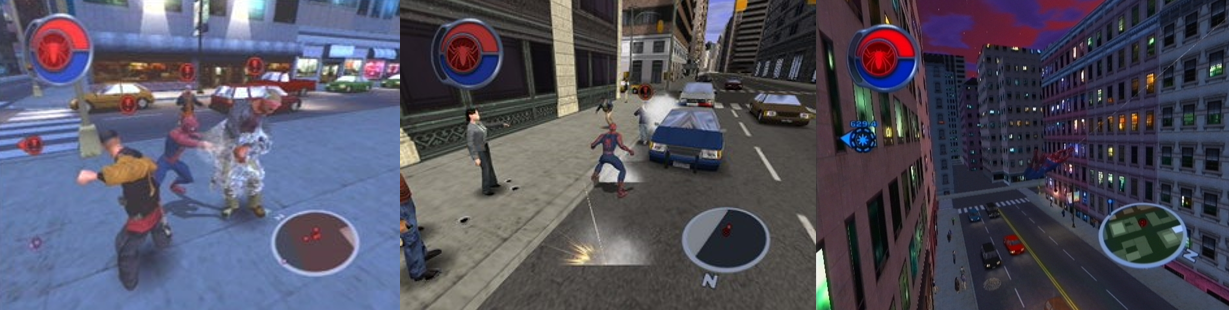
In a change of pace from its predecessor, and basically every Spider-Man title released up until that point, Spider-Man 2 is an open-world adventure in which you’re given free reign to use all of Spider-Man’s amazing abilities throughout one of the largest and most faithful digital recreations of New York City ever seen at that time. Unlike the previous game, which was basically a reskinned version of Neversoft’s fun but limited 2000 adaptation of the web-slinger, Spider-Man is hardly ever trapped in an enclosed environment and thus a primary focus of Spider-Man 2 is on swinging around the city, stopping random crimes and helping non-playable characters (NPCs) with various issues. Thankfully, Spider-Man is more than equipped to handle everything the game has to throw at him, and the controls and combat options have been revised to accommodate this new focus. Spider-Man can attack enemies or interact with objects and NPCs with the Square button; successive presses in conjunction with directional inputs and the Triangle and Circle button will see him pull off combos, often involving webbing and tossing his enemies, and you’ll awkwardly home in on the nearest enemy when in air combat as well. You can stick to walls by pressing Circle, which is also used to evade incoming attacks and bullets whenever Spider-Man’s spider sense goes off (as indicated by his glowing head); this also fills up your “Spider Reflexes” meter and allows you to execute a counter attack but I found evading (and the combat in general) to be a little clunky and haphazard at times, especially as even New York’s most common thugs can take quite a beating and even block against your attacks. Triangle shoots a web; holding the button will temporarily tie enemies up, pressing up and Triangle fires a ball of impact webbing, and you can even use your webs to disarm foes, though it’s next to useless against most bosses and mechanical enemies. Spider-Man jumps with X; pressing it twice performs a double jump and you can hold the button to charge a big jump and executing a jump at the apex of a web sling is crucial to covering vast distances when swinging about. Holding down L2 sees Spidey spring or get a boost to his swing, Triangle (and in conjunction with Circle) will allow you to pick up injured NPCs or grapple thugs, and you can press down to lock-on to nearby targets.

Combat is much improved but the highlight of the game was the ground-breaking web-slinging.

Once the aforementioned meter has a bit of blue in it, you can press L1 to activate your Spider Reflexes, which effectively functions as a form of bullet time, slowing down the action until the meter depletes or you press L1 again and allowing you to better dodge and attack enemies. The meat and potatoes of the game, though, is in the web-slinging; the game offers two options for this, “Easy Swinging” and “Normal Swinging”, with the latter requiring more input from the player to direct Spider-Man’s swings. Either way, R2 sees you throwing a web and swinging through the city but, unlike in every other Spider-Man game before this, you can only web-sling when there are buildings or suitable purchase holds nearby. This means you’ll see Spider-Man veer to the left or right as he shoots webs at the nearest building and allows for the most realistic and innovative web-slinging ever seen. Spider-Man can also eventually web-zip by pressing L2 and R2 together to quickly cover flat distances and you can easily speed through the skyscrapers by attaching to buildings and gaining extra height with your jumps, though you can’t clamber up your web as you swing as in other games, which can make chasing through the city a bit frustrating at times. Equally annoying are the number of dead ends and the various heights of the city’s buildings, which can interrupt your flow; thankfully, the onscreen mini map is a great help for getting around and spotting crimes in progress, side missions, and directing you towards your next story-based objective. You can review these at any time from the pause menu and expand the map out by pressing ‘Select’; this displays the current time and all landmarks and places of note, but sadly doesn’t include the option to place waypoints so you still have to manually read the map and follow the onscreen indicators to get to objectives. Spider-Man 2 is split into chapters, beginning with a simple and in-depth tutorial where Bruce Campbell’s disembodied and snarky voice teaches you the fundamentals of gameplay. To progress through the story, you need to complete story-based objectives; generally, this amounts to following the compass to a certain place in the city to advance the story or confront a boss, but you’ll also need to earn “Hero Points” and acquire new abilities from the various shops dotted across the city.

There’s always someone in peril, or a crime to stop, or a race to be had.

Hero Points are earned from stopping crimes, rescuing civilians, completing time trial races, and other similar distractions; it’s a bit annoying that the game effectively grinds to a halt while you work to obtain the required Hero Points, but you get a fair amount for each side quest you complete and it’s not as if you’re short on things to do. It seems someone’s being mugged or needs help every thirty seconds, and you’ll often stop a burglary only for a child to lose their balloon across the street or an armoured car be attacked a block over. Sometimes, you’ll help an NPC only to be jumped by a gang of thugs in a sneak attack; other times, criminals will hijack vehicles to make a quick getaway and you’ll need to chase them down and land on top of the car, which can be tricky unless you lock-on to it. Once on the roof, you need to pound away with Square and dodge their bullets with Circle until they’re forced out for a fistfight and, as the story progresses, you’ll find burglars and shoot outs often culminating in one of these chase sequences. You’ll also run into Felicia Hardy/Black Cat numerous times throughout the story; each time you do you need to chase after her as she leaps and grapnels around the city, which can be aggravating as she makes erratic turns and it’s difficult to stay on the rooftops. Similarly, you’ll need to chase after Dr. Octopus when he makes an escape in a helicopter and can take on timed challenges where you must race through rings, and the game’s pretty unforgiving, slapping you with failure if you even remotely fall behind or stay too far. More often than not, you’ll face a timer as you race to story-based locations, with the final race to Dr. Ock’s lair being the tightest of them all, or be asked to deliver pizzas and swing over to specific points on the map or skyscrapers to automatically take pictures, or will have to quickly crawl up buildings to rescue civilians in danger or falling, or quickly take injured civilians to the hospital. There’s quite a lot to do in this regard, and it’s fun to pop over to the Daily Bugle and change to Peter Parker in the men’s toilets, but the variety of these side missions soon wears thin as you repeat the same cycle of requests over and over but with more enemies or a tighter time limit.

Graphics and Sound:  
It’s obvious that a lot more time and effort went into Spider-Man 2 compared to its predecessor; most videogame tie-ins suffer from a rushed development schedule, and this is often reflected in their length, variety, and presentation but Spider-Man 2 does pretty well in all three regards. Spider-Man’s character model is much improved compared to the last game, with far more animations when he’s web-slinging and battering crooks on the streets; Spidey even runs along buildings when he swings close, can perform a variety of mid-air tricks with well-timed jumps, and NPCs will even automatically dodge out his way and throw insults at him when he runs or swings through the streets. Sadly, the enemy models and NPCs don’t fare nearly as well; you’ll see the same polygonal faces and voices repeated over and over, but it’s hard to begrudge this as this was symptomatic of the games of this era. What I can’t defend, however, is the soundtrack and voice acting; once again, the game opts for a soundalike to Danny Elfman’s iconic Spider-Man score that just doesn’t work as well and suffers from awkward looping or disappears entirely for no reason. Only a handful of the movie’s actors returned to voice their polygonal counterparts as well; while Alfred Molina continues to shine as Dr. Octopus, both Tobey Maguire and Kirsten Dunst sound bored to death recording their lines, though I did enjoy that Spider-Man throws quips and monologues to himself as you play. When the character models are used for in-game cutscenes, the game also falls apart under close scrutiny, though the higher quality cinematics fare much better, despite the rubbery appearance of the models, and I liked how the film’s events were recreated but also altered and expanded upon here, even if sub-plots like Peter losing his powers were dropped.

It’s lucky for the ropey cutscenes and voices that the digital recreation of New York is so good.

Naturally, the game’s biggest selling point is the sprawling and bustling recreation of New York; all the landmarks you associate with the city are present and accounted for, alongside recreations of locations from the films such as Peter’s apartment, the Daily Bugle building, Dr. Octopus’s pier lair, and the pizza parlour (though relocated and redesigned here). Not only can you web-sling across the city without any noticeable slowdown or load times, the game also includes a day and night cycle and the story is geared towards pushing you to visiting new areas, such as Roosevelt Island, the Statue of Liberty (accessible only by hitching a ride on a helicopter or using Mysterio’s UFO-like drones), Central Park, and Oscorp. 90% of the game takes place outside amidst the city skyscrapers; traffic and pedestrians mingle around down below, crime is rampant, and the enemies you encounter even change as the story progresses. While you can only enter a handful of buildings, those that you can offer some rewards, such as interacting with the Daily Bugle staff for tasks or purchasing upgrades. The handful of other times you’re forced into a warehouse or an open-air stadium, it’s for a close-quarters boss battle or to take on one of Mysterio’s challenges, meaning the only interior of any real note is Mysterio’s madcap “funhouse” that sees you venturing into a hall of mirrors and through upside-down environments. The thrill of swinging through New York is definitely palpable but I’d be lying if it doesn’t lose its appeal pretty soon; with no options for fast travel and only one real collectible on offer, there’s not really much to see beyond the digital recreation of the city or to do beyond stopping the same crimes over and over.

Enemies and Bosses:
As you swing about the city in your colourful underoos, a gaggle of the dregs of society will inevitably crawl out of the woodwork to cause trouble in the streets. New York is rife with purse snatchers, bank robbers, and armed gangs who love to rob armoured cars and get into shoot-outs with the cops or hijack passing cars and you’ll get to beat the ever-loving piss out of them all multiple times. Most enemies you encounter will simply try to bash your head in, but others have crowbars and bats or can guard against your attacks, requiring you to execute a counter after dodging their attacks. The worst are those armed with guns as Spider-Man doesn’t do too well when riddled with bullets, so it’s best to either disarm them, web them up, or try to take them out early, which can be easier said than done when you’re literally surrounded by enemies on all sides. Eventually, New York will also be attacked by Mysterio’s robotic drones, which fly about the place and blast at you with lasers; these can be tricky to hit as mid-air combat is actually less refined than in the previous game in many ways, though that weird homing function comes in handy here. Herman Schutlz/The Shocker’s goons also end up terrorising the citizens as well, firing high velocity blasts to send you flying, and all of the game’s enemies except the robots can take quite a beating before they go down. You’ll also have to contend with three mech-wearing goons in one particular mission that sees Spidey and Black Cat gate-crash an auction. This mission is one of the game’s toughest, on paper, due to the sheer number of bullets, enemies, and explosions happening all around you but an easy way to get past it is to simply swing about back and forth overhead; eventually, the mechs will take each other and most of the other enemies out, leaving you to pick up the scraps.

After tangling with the Rhino, Black Cat lends a hand in two annoying battles with the Shocker.

Disappointingly, though, Spider-Man 2 only contains four actual bosses, but you’ll face some of them more than once, at least. The first one you battle is Aleksei Sytsevich/The Rhino as he’s in the middle of a bit of thievery; the Rhino is too powerful to take on head-first so you need to rapidly tap Circle to avoid his swings or dodge his charge, both of which will leave him dizzy and vulnerable to a good pummelling. Instead of fighting Black Cat, you’ll chase her across the city (so many times that it got legitimately annoying for me) to encounters with the Shocker, who you’ll battle twice alongside Black Cat. The first fight takes place inside a warehouse and sees the Shocker blasting himself about the place, constantly staying on the move and making himself a difficult and annoying target. When you do get close to him, you only have time to rattle off a quick combo before you need to get the hell away from him to avoid his huge concussive blast, which sends you flying. The Shocker’s blasts are also used to keep you at bay, he shrugs off your webbing, and is joined by some goons in this fight, which quickly becomes laborious because of the hit and run tactics. Sadly, you’re forced to repeat these in the second encounter, which takes place in an even smaller, enclosed arena where the Shocker is protected by a shield. You need to head up top, dodging his blasts when your spider sense goes off, and activate whatever console is opposite from the one Black Cat is at to lower his shield. These weird blasts of water (or energy, I couldn’t tell) form platforms in the middle of the arena, giving the Shocker the high ground, but the same strategy as before is needed to whittle his health down. Eventually, Black Cat will shut his shield down for good, meaning you’re on the home stretch, but she doesn’t really seem to actively do damage to him when she’s attacking him.

Mysterio’s “tests” prove to be frustrating test of your patience.

Easily the game’s more persistent enemy is Mysterio; when you first face him as plain old Quentin Beck, he challenges you to a series of “games” in an effort to prove Spidey’s a fraud, which involves you grabbing and tossing goons into green highlighted pits faster than him in a game of human basketball and then clambering about on elevated, moving, and twisting platforms trying not to get hit by his laser cannon. The second time, he swarms New York with his UFO-like drones and takes hostages at a theatre; this was an annoying section as you have to fend off his drones, watch out for a flaming floor, and battle a brief time limit to rescue everyone there but it’s nothing compared to when he encases the Statue of Liberty in an elaborate mechanical construction to resemble an alien attack. I was tearing my hair out at the finnicky controls as I webbed my way over the Lady Liberty and fell countless times into the water to be washed ashore and have to start all over, and near enough lost my rag when tasked with destroying the eight orbs surrounding Mysterio’s machine to expose the “brain”. Eventually, I was somehow able to gain enough height to get up there and take them all out and then get up to where the brain is before the orbs could respawn and dispel the illusion, but it was a pain in my ass, for sure. Afterwards, you track Mysterio to his apartment and hidden funhouse lair, where you have to fend off a swarm of twisted Spider-Man clones to find a hidden exit in his hall of mirrors and shut down his hologram. Finally, Mysterio shows up in the flesh later in the game to rob a deli; this was actually really amusing as the game loads in this ridiculously long and layered health bar and makes it seem like it’s going to be this long and epic showdown but all you have to do is punch him once and Mysterio folds like a paper plane.

Thanks to his thrashing limbs and raging machine, Doc Ock proves an aggravating and formidable foe.

Finally, there’s the main man himself, Dr. Octopus, who you encounter four times throughout the game. The first encounter is during the mishap with his fusion experiment and is one of the most frustrating parts of this or any other game; the reactor is going crazy, sending out intermittent energy bolts that you must dodge the second your spider sense goes off as these pulsating waves of energy that not only do massive damage (three hits is usually enough to kill you) but send you flying across the screen! Through a combination of luck, timing, and the patience of a saint, you need to dodge past all this shit and hit four consoles to power the machine down, but this almost had me rage-quitting right then and there. Next, you’ll fight Dr. Octopus and his grenade launching goons at the bank, which establishes the strategy you’ll need to best him in all encounters; you need to dodge his tentacles and then quickly fire a web to pin each one down and leave him vulnerable to attack, but this is very hard to do and he’s easily able to grab you, slam you about, toss you around, and beat you to death in just a few hits. After chasing his helicopter and rescuing Aunt May from the train tracks, you’ll battle Doc Ock on the roof of a train just like in the film…eventually, because first you need to battle the game’s controls and camera to actually get on the damn train! Here, it’s more of the same and actually a little easier than the last encounter except for the fact that Doc Ock can toss you off the train if he grabs you. Finally, it’s the worst of both worlds at his pier lair as Doc Ock relentlessly chases you, protected by a shield generated from his rampaging machine and able to spam-beat you to death in the blink of an eye if you don’t constantly keep moving, dodging, and webbing him up. You need to deactivate nine consoles scattered about the lair, with one high above and one down below near the instant-death water, all while avoiding the electrical bolts, the thankfully less damaging but no less annoying energy waves, and Doc Ock himself. Once you finally take care of that, you’ll go one-on-one with him again where you’ll need to be super fast on the dodge and webs to stop his relentless thrashing tentacles and avoid being tossed into the aforementioned water, but once you land a good few combos he finally goes down for good.

Power-Ups and Bonuses:
In the spirit of the movie upon which it is based, Spider-Man has an infinite supply of webbing in Spider-Man 2 so you never need to worry about collecting extra web cartridges, though the game does lack some of the fancier web-based moves potentially as a result of this. Every time you defeat a wave of enemies in side missions, they’ll drop some health to fully restore your health bar, but these won’t be present in boss encounters, which can make them all the more frustrating. Additionally, while there are “secrets” to be found around the city, they simply grant a few more Hero Points so there’s no pick-ups to boost Spidey’s abilities. Instead, you’ll gain new buffs, tricks, combos, and such by spending Hero Points in the many shops scattered around the city; these increase the speed of your swing, add fancy moves to your jumps, and add a little more flourish to your combos but I found little use for most of them and got along pretty well just mashing Square and peppering in the odd Circle and Triangle here and there.

Additional Features:
As mentioned, there are many secrets dotted around the city; these are pretty hard to find, and I only stumbled upon three or four by chance but they do allow access to a couple of new moves. There are also some races and timed challenges you can take on for more points, and which probably count towards you achieving the list of “Awards” offered by the game (though most of these are story-based). Although there are some options available to you to change the game’s display, sound, and control scheme, there are no difficulty settings here, no costumes to unlock (though you do get to play as Peter and unmasked Spidey in the story), and no additional characters or modes to unlock or play as even using cheats. The best on offer here is a code to award you a bunch of Hero Points and upgrades, making this a significant step down not just from the last game but Neversoft’s previous efforts with their many additional costumes and modes. However, after you clear the game, you’re dropped back into a free roaming mode and are free to stop crimes until the end of time across the city; you can also purchase access to the Battle Arena where you can not only battle the game’s bosses in endurance fights but also face off with a secret additional boss, Calypso Ezili/Calypso, though I’ll leave it up to you to decide if this is actually worth your time.

The Summary:
All I’ve heard since 2004 is how great Spider-Man 2 is; it either tops or is included in so many “best of” lists for videogame tie-ins and superhero videogames that I knew I had to get it once I started building my PlayStation 2 library, even though I am primarily against videogame tie-ins unless I’m trying to increase my Gamer Score. The difference between this and the last game, and other Spider-Man games before it, is immediate and reinforced throughout; the sheer size of New York City and the number of crimes to stop is very impressive for the time and never before has a videogame so perfectly captured the rush of being Marvel’s famous web-slinger. The drama and crime even interrupts the story on numerous occasions, really throwing you into Spidey’s troubled shoes, and the web-swinging mechanics definitely live up to all the hype. The versatility and accessibility of swinging through the city was unparalleled at the time and perfectly recreates the speed and exhilaration of the web-slinging seen in Sam Raimi’s films. Sadly, the combat doesn’t really live up to this, being clunky and oddly unbalanced at times even when you manage to land a dodge and a counter. Naturally, character models and cutscenes haven’t aged too well, but I can forgive that; what I can’t forgive is how empty, repetitive, and frustrating parts of the game can feel. It’s great having all of New York to explore, but there’s not a lot to see and you’ll be stopping the same crimes over and over, which can get very old very quickly. I would’ve liked to see comic book covers and other collectibles scattered about to unlock costumes and concept art, but there’s none of that here, meaning there’s little incentive to explore. The few bosses there are can also be annoying; I got so sick of chasing after Black Cat, being tossed about like a ragdoll by the Shocker and Dr. Octopus’s bloody machine, and being mullered by bullets, to say nothing of that God-awful encounter with Mysterio at the Statue of Liberty. The game was also a lot shorter than I was expecting, with the gameplay padded out by the story forcing you to acquire Hero Points to load in the next chase, battle, or cutscene, and I found myself just feeling relieved when the game was over. Overall, I can certainly see why the game was so beloved at the time and is so highly regarded; it still holds up pretty well, despite some obvious flaws, and was the most immersive Spider-Man game at the time, but it’s obviously been overshadowed by better, more polished Spidey title sin the years since.

My Rating:

Rating: 3 out of 5.

Pretty Good

Have you ever played this beloved tie-in game? What did you think to the open-world gameplay and web-slinging mechanics back in the day? Do you think Spider-Man 2 still holds up today or were you also frustrated by some of its more tedious features? What did you think to the battles against Mysterio, the chases against Black Cat, and the encounters with the Shocker? Were you disappointed by the lack of unlockables and additional gameplay options? Which Spider-Man videogame or movie adaptation is your favourite? Head down below to share your thoughts and memories of Spider-Man 2.

Movie Night [Spidey Month]: Spider-Man 2.1


Easily Marvel Comics’ most recognisable and popular superhero, unsuspecting teenage nerd Peter Parker was first bitten by a radioactive spider and learned the true meaning of power and responsibility in Amazing Fantasy #15, August 1962. Since then, the Amazing Spider-Man has featured in numerous cartoons, live-action movies, videogames, action figures, and countless comic book titles and, in celebration of his debut and his very own day of celebration, I’ve been dedicating every Saturday of August to talk about everyone’s favourite web-head!


Released: 17 April 2007
Originally Released: 30 June 2004
Director: Sam Raimi
Distributor: Sony Pictures Releasing
Budget: $200 million
Stars: Tobey Maguire, Alfred Molina, Kirsten Dunst, James Franco, J. K. Simmons, and Rosemary Harris

The Plot:
Although he has saved countless lives as Spider-Man, Peter Parker’s (Maguire) personal life is falling apart due to his double life. Lovesick for Mary Jane Watson (Dunst) and tormented with guilt, Peter’s powers begin to fail him just as he faces his greatest challenge yet when renowned scientist Doctor Otto Octavius (Molina) becomes a four-limbed madman following a freak accident. When “Doctor Octopus” endangers lives, Peter is forced to reconcile his two lives in order to save the city, and the woman he loves, once again.

The Background:
Fittingly, given that his debut issue became one of Marvel’s best selling titles at the time, Spider-Man became so popular that he was ideally placed as Marvel Comics’ flagship character; the wall-crawler starred in numerous team-up titles, videogames, cartoons, and even a live-action series in the seventies, but his cinematic debut was constantly delayed by script and legal issues. Thankfully, director Sam Raimi and Sony Pictures Entertainment finally brought the character to life in Spider-Man (Raimi, 2002), which was an incredible critical and commercial success, but, while a big-budget sequel was almost immediately greenlit by the studio, Spider-Man 2 nearly underwent a major recast after star Tobey Maguire suffered a back injury. Although Jake Gyllenhaal was pegged to replace Maguire in the title role, Tobey recovered and returned to the franchise, which saw him go up against Alfred Molina as Doc Ock. A big fan of the comic books, Molina was excited to win the role and threw himself into it, relishing the chance to play a sympathetic villain with a sardonic sense of humour and even naming and playing pranks with his four prosthetic limbs on set.

After decades of legal issues, Spider-Man’s big-screen debut was a massive success.

Doc Ock’s arms were created by Edge FX and were a mixture of practical puppetry and visual effects. To improve upon the first film’s web-slinging antics, a specially-constructed “Spydercam” was employed to zip through the city and more accurately create the illusion of speed and excitement throughout the entire film, rather than just the final swing sequence. Following a number of script ideas, Raimi worked closely with the screenwriters to alter Doc Ock into a more sympathetic figure and to incorporate elements from the classic “Spider-Man No More!” (Lee, et al, 1967) story. Considering that Spider-Man 2 is often regarded as one of the greatest superhero movies ever made, and far exceeded its predecessor in terms of storytelling and visual effects, the film actually made less than the first at the box office (though a $789 million worldwide gross is anything but a failure!) Critics heaped praise upon the film; Molina, especially, was highlighted for his magnetic performance and the engaging plot regarding Peter’s personal drama was praised as much as the visual effects. Still consistently cited as one of the best sequels and superhero films ever, Spider-Man 2 was followed not just by a videogame adaptation and a third instalment, but was also re-released on home media (with twenty minutes of additional footage and some alternate cuts incorporated into the film) close to the Spider-Man 3’s (Raimi, 2007) release and Molina would later reprise his iconic role in the Marvel Cinematic Universe.

The Review:
While I remember there being a great deal of hype surrounding Spider-Man, I actually don’t remember the same being true for the sequel; this isn’t to say that it wasn’t massively anticipated by many, myself included, I just can’t really remember it as much as I was a little older and distracted by other concerns at the time. I know the initial trailer hit pretty hard, and it was exciting to see Doc Ock being brought to life, especially as he’s always been my favourite classic Spider-Man foe. Growing up reading the limited comics I had access to and watching the Spider-Man cartoon (1994 to 1998), I’d actually had little exposure to Norman Osborn/The Green Goblin, and it wasn’t until Raimi’s first movie that I fully understood how big an impact Osborn had had on Spidey’s life. Consequently, though, I had always seen the calculating, ruthless Doc Ock as Spidey’s greatest villain; he handed the wall-crawler his first defeat, brought together the Sinister Six, and always seemed to crop up in the comics and videogames I was exposed to (potentially because Osborn was dead at that point). Still, back then, superhero movies were really starting to break through to the mainstream, and Spider-Man 2 was an exciting prospect given how well the first one had gone down, and the film immediately recaptures the feel and atmosphere of the last movie by once again utilising the great Danny Elfman for the opening title sequence (and even catching viewers up to speed using paintings by the amazing Alex Ross to recap key moments of the last movie).

Burdened by the weight of his responsibilities and the stress of his life, Peter’s powers begin to fail him.

As in the first movie, Spider-Man 2 opens with a bit of narration from Peter Parker, who’s in a pretty bad place here; having chosen to walk away from M. J. and live a life of responsibility, forsaking his own selfish needs in order to honour the memory of his beloved Uncle Ben (Cliff Robertson), Peter is tormented by M. J.’s vacant, staring visage from atop a giant billboard and pines for her every day, martyring himself for the choice he was forced to make. No longer living in his childhood home in Queens with his doting Aunt May (Harris), Peter lives in a crummy little apartment in the middle of the city that is cramped, dirty, falling apart, and right next to the train line. The door sticks, there’s a communal bathroom, and he’s constantly hounded by his landlord, Mr. Ditkovitch (Elya Baskin) for rent, which he can barely afford to pay as he has recently lost his job as a pizza delivery boy and is constantly being shafted on payment for his photos of Spider-Man (and other notable events in the city) by Daily Bugle editor-in-chief J. Jonah Jameson (Simmons). While Peter was often angst-ridden and burdened by bad luck (“Parker Luck”, as he called it) in the comics, the whole world is out to get him here; he can’t keep up with his college assignments, people are constantly barging into him, he’s cockblocked by an obnoxious usher (Bruce Campbell), and he can’t even walk out of a supply cupboard without stuff falling on him. The amount of hardship he faces in this one movie is almost absurd, and is equalled only by his desperate pining for M. J.; he desperately wants to tell her the truth but can’t risk endangering her life, and is equally unable to quell Harry Osborn’s (Franco) hatred of Spider-Man to preserve Norman’s memory. Peter’s also still carrying the guilt of having indirectly caused Uncle Ben’s death, and it’s only after sharing this with Aunt May that his outlook begins to change. And just in time, too, as all this stress is not only causing a rift between him and the few friends he has but also cancelling out his spider-powers. Since Tobey has organic webbing, this is an interesting way to do the old “run out of web fluid in mid-air/mid-fight” trope, but the depiction is quite inconsistent; potentially an allegory for sexual inadequacy and clearly a manifestation of his troubles, Peter’s powers only short out when the script says so, meaning he’s denied even the freedom offered from retreating to web-slinging.

Though she has a hunky astronaut, M. J. can’t deny her feelings and chooses Peter after learning the truth.

Just as Peter pines after M. J. on a daily basis, almost to an uncomfortable degree, so too is M. J. constantly distracted by him; Harry claims that she is “waiting for [him]”, but, regardless of his love for her, Peter continues to keep her at arm’s length and to avoid discussing his feelings for her. Although she’s clearly still in love with him, M. J. is doing a far better job of moving on (or, at least, hiding) from those feelings; she not only has a billboard but has landed her dream job with a part in The Importance of Being Earnest, A Trivial Comedy for Serious People (Wilde, 1895) and even gotten herself a ruggedly handsome astronaut (of all things), Colonel John Jameson (Daniel Gillies). John is barely a character at all and simply there to deliver another gut punch to Peter; M. J. clearly isn’t that into him, despite accepting his proposal, as she’s constantly yearning for Peter and waiting for him to admit his feelings for her. However, she’s also increasingly frustrated by Peter; despite him claiming to be her greatest friend and confidante, he’s been absent and unreliable, and she’s driven to the edge when he breaks his promise to see her play. Otto offers Peter some advice in trying to explain things to M. J., which leads to him awkwardly blurting out random poetry excerpts to her, and he inadvertently ends up alienating her so much that she’s fully prepared to settle for John, even briefly entertaining the idea that she was wrong about Peter and that John is Spider-Man. All of M. J.’s frustrations and concerns are completely swept away once she sees the truth she’s known all along and Peter clearly explains that he can’t risk being with her because of his responsibilities, but she ultimately chooses to face those dangers with him so that they don’t have to deny themselves. M. J. is a bit underwhelming here, to be honest; I’ve never really been a big fan of Dunst in the role and, while she has a feisty side, the script doesn’t really do her character any favours. It gets a bit worse in hindsight as she blows up at Peter in the next film for kissing a girl but she’s here making out with (and presumably having sex with) her hunky boyfriend, while trying to coax the truth out of Peter instead of just demanding that he be honest with her. She also ends up as a screaming hostage once more, and it’s telling that even Aunt May has more fight in her when captured by Doc Ock than the object of Peter’s affections.

Harry, consumed with vengeance, is stunned to discover Peter and Spider-Man are one and the same!

Peter’s life is further complicated by his strained relationship with Harry; despite struggling through school in the first film, Harry has done pretty well for himself in the intervening time, becoming head of special projects as OsCorp and funding Otto’s fusion research in a bid to live up to (and surpass) his father’s lofty ambitions. However, having seen Spider-Man with his father’s body at the conclusion of the first film, Harry assumes that Spidey killed his dad and has been harbouring a deep-seated vendetta against the wall-crawler ever since. Even when Spider-Man saves his life, Harry isn’t swayed in his opinion, and his lust for revenge even drives him to turn against Peter in a bitter, drunken rage in one of the film’s most dramatic and upsetting moments. An extended scene included in this version sheds a little more light on Harry’s mindset, as he believes that Peter either knows who Spider-Man is or is protecting him from reprisals since he earns money from the masked vigilante, and he compares his desire to see Spider-Man dead to the bloodlust Peter must feel towards the man who killed Uncle Ben, thus painting Harry as a dark mirror of the titular hero. Frustration and grief get the better of Harry after Otto’s experiment is a disaster, and he unleashes a vicious, heart-breaking tirade against his best friend for choosing his livelihood over his best friend. Harry’s obsession only grows when Spider-Man is believed to have quit after his discarded costume is discovered, and he’s so consumed by vengeance that he partners with Doc Ock to draw Spider-Man out by having him target Peter in exchange for supplying the mad scientist with the Tridium he needs to complete his fusion experiment. With Spider-Man helpless before him, Harry prepares to deliver the killing blow and is stunned into a near maddening disbelief to find his best friend behind the mask, shattering his perception of reality and the people around him and leaving him susceptible to the manipulative influence of his father’s vengeful spirit.

A science experiment gone awry transforms kindly Dr. Octavius into the twisted, sardonic Doc Ock.

Of course, Spidey’s most tangible threat in the film is Doc Ock himself; beginning as a kindly mentor and hero of Peter’s, Otto is a far cry from the malicious, power-hungry mad scientist from the comic books. Although initially reluctant to interrupt his work by entertaining Peter’s questions, especially given he’s aware of Peter’s assumed laziness, Otto quickly finds a kinship with Peter based on their mutual appreciation for science. A likable, fatherly figure, Otto is absolutely besotted with his beloved wife, Rosie (Donna Murphy), and emphasises to Peter the importance of using his great potential and intelligence for the good of mankind. Despite his unparalleled scientific mind, Otto is also a romantic at heart and encourages Peter not to bottle up his love and emotions lest they make him sick, though both he and Rosie stress that love requires a lot of hard work from both parties. Otto’s life work is to provide the world with clean, renewable energy using a Tridium-based fusion reaction; Otto is so convinced of the safety and importance of his experiment that he generates an artificial sun in the middle of New York City, confidant that his four mechanical limbs will allow him to stabilise the resultant reaction and give him his moment of glory. Of course, everything goes hideously wrong when his machinery malfunctions, which not only results in Rosie being killed but Otto’s mechanical appendages being fused to his spinal column. Awakening in a confused state, Otto finds himself susceptible to the arms’ artificial intelligence after his inhibitor chip is destroyed; as they’re programmed to create and stabilise the experiment, the arms influence him towards robbing banks and committing crimes to rebuild the reactor at an abandoned pier rather than drown himself in the river in his grief. Christened Doctor Octopus (“Doc Ock”) by Jameson, Otto becomes a twisted, power-hungry maniac who completely abandons all of his former principals and puts innocent lives in danger thanks to the influence of his arms. He not only tries to kill a train-load of New Yorkers but even takes Aunt May and M. J. as hostages and battles Spider-Man with a devious glee, constantly frustrated by the web-slinger’s interference and determined to kill him so he can be left in peace. Doc Ock’s story is functionally similar to that of Norman’s in the first film (both were mentor and father figures turned to evil by science), but the execution is unique enough to stand out from his predecessor; he stomps around in broad daylight, his identity is never in question, and his ultimate goal isn’t to prove his physical superiority, but to prove his intellectual superiority and complete his life’s work by any means necessary.

While Jonah delights in Spidey’s misfortune, Aunt May and Ursula offer Peter some much-needed support.

As haunted by M. J. and his many doubts and problems Peter is, his guilt over indirectly causing Uncle Ben’s death basically dictates his entire life. The only reason he’s denying his true feelings is because his interpretation of Ben’s final teaching was that he had an obligation to put his powers to good use, a life lesson that is reinforced by Otto and his position of scientific acumen. However, all of the stress caused by his conflicting duality sends Peter’s power son the fritz; his webs stop firing, he can’t always stay stuck to walls, and he begins wearing his glasses again as his eyesight fails. Concerned for his physical welfare, he consults a doctor, who offers the prognosis that the issue is psychological rather than physical, and, with the weight of the world pressing down upon him thanks to Jameson’s smear campaign, Peter rejects his responsibilities in a dream-like conversation with his uncle’s spirit. Upon being brought Spider-Man’s discarded suit, Jameson is overjoyed that his efforts to besmirch and belittle the wall-crawler have met with success, but he’s forced to admit that Spider-Man was a hero when Doc Ock kidnaps M. J., thus leaving John distraught, though Peter delights in upstaging the cantankerous editor once he gets his shit together. He’s helped in this regard by an honest exchange with Aunt May; given that the film takes place on the two year anniversary of Ben’s death, May is in a fragile place, which is only exacerbated by her inability to keep up the payments on their family home. Burdened by his guilt, Peter shares a version of the truth of that fateful day to her; though initially horrified, she forgives him and stresses the importance of doing the right thing. It’s heavily implied in this exchange that May is aware of Peter’s dual nature and, though neither explicitly admit it, he’s relieved that her encounter with Doc Ock and subsequent rescue from Spider-Man has turned her opinions on the web-spinner around. After giving up his suit, Peter applies himself fully to his social life and academic work, finally earning him the praise of his teacher, Doctor Curt Connors (Dylan Baker), and he later finds some support in Ursula (Mageina Tovah), the daughter of his landlord, who clearly has a crush on him and brings him a moment of quiet reprieve in a moment of absolute despair. This extended cut adds a few additional scenes, most of which are alternate takes and longer sequences that don’t really add too much to the existing story, though one of the most notable additions is a hilarious scene where Jameson hops around his office garbed in Spider-Man’s discarded suit and a discussion between M. J. and her friend where it’s revealed she accepts John’s proposal primarily because of her father’s abusive nature.

The Nitty-Gritty:
Given that it’s a Spider-Man movie, Spider-Man 2 is primarily focused on exploring themes of guilt and the weight of responsibility; Peter drives himself into the ground trying to save everyone he can and live up to his uncle’s expectations, to the point where he neglects his life outside of the costume. Not only is he failing at school and to make money, he’s letting everyone around him down, which only adds to his feelings of despair; his friends are starting to resent and distrust him because of his absent nature and, while he’s desperate to do more and to apply himself better, he can’t shake the call to action. Even something as simple as delivering pizzas or getting to the play is interrupted by a disturbance of some kind, whether it’s kids playing in the street or a high-speed car chase, and Peter doesn’t even let himself relax when he’s in his crummy apartment as he sits there tuning into the police radio band to find ways for him to help. This ever-mounting struggle to find the right balance between his wants and his responsibilities is the primary cause for his failing powers; losing his webs, wall-crawling, spider-sense, and strength only adds to Peter’s confusion and frustration as the freedom afforded to him by being Spider-Man also becomes a closed door. Once he decides to quit, that weight is immediately lifted but his brief moment of happiness is shattered when he’s unable to save a life from a house fire, thus hammering home that he is capable of great things and thus must exercise great responsibility.

Both Spider-Man and Doc Ock look fantastic, and Ock’s arms make for exciting fight sequences.

Surprisingly, Tobey’s spider-suit is basically the same design as before; normally, superhero sequels go out of their way to change the character’s costume to make more toys but, aside from popping a little more and a few tweaks to the mask, muscle suit, and other minor details, it remains consistent with the first film. Thanks to the movie not having to spend an hour or so setting up Peter’s origin, we get much more Spider-Man action here and the aforementioned Spydercam really delivers some dynamic web-slinging shots. As ever, Peter has an annoying tendency to lose or remove his mask so that we don’t miss out on the emotional impact scenes and events have on him; this is, as always, hit or miss as Tobey favours a vacant, doe-eyed stare throughout most of the film and the regularity that he is unmasked gets ridiculous at times, regardless of how dramatic or thematically relevant these scenes are. While audiences will forever decry the Green Goblin’s outfit in the last film, I don’t think I’ve ever seen anyone complain about Doc Ock’s depiction here; garbed in a trench coat, hat, and glasses, Doc Ock cuts a simple but intimidating figure and it really is impressive how Molina projects the weight and movement of his mechanical limbs. The arms are extremely versatile, able to stretch out and grab things in their claws, light Ock’s cigar, and even sporting a nasty looking spear-like appendage. While Otto can control and influence the arms, the destruction of the inhibitor chip allows them to act independently of him, but their goal is not only to create and sustain a fusion reaction but also to protect Ock at all costs. Swinging and whipping everywhere, the tentacles cause Spider-Man a great deal of difficulty in getting to Doc Ock and make him a constant threat as they can perform multiple tasks and endanger many lives all at once. One of their most memorable sequences is when they lash out while Otto is unconscious, slaughtering the doctors that try to remove them in scenes that harken back to Raimi’s time as a horror filmmaker as we see fingernails being ripped off and screaming bodies being tossed all over the place. Indeed, Rosie’s horrific death (though not seen onscreen it’s pretty clear she was practically decapitated) and many shots of the arms are created using practical effects, puppetry, and first-person perspectives just like those seen in his Evil Dead films (Raimi, 1981 to 1992) and their threat is matched by Otto’s obsession with holding “the power of the sun in the palm of [his] hand”.

Spider-Man and Doc Ock’s battles are a spectacle, and Spidey performs incredible feats to save lives.

The versatility of Doc Ock’s arms really do make for some of the best fight sequences in any Spider-Man film; despite the armaments and manoeuvrability of the Green Goblin’s glider, Spider-Man’s fights never really kicked into that higher gear as the filmmakers were still working out how to create the special effects necessary to shoot these sequences (something that the third film greatly improved upon), but Spider-Man 2 more than makes up for this with scenes depicting Spider-Man and Doc Ock battling up the sides of buildings and on top of a speeding train. While it’s true that any one of Spidey’s repeated blows to the non-superpowered Doc Ock should have immediately ended the multi-limbed menace, I can forgive this as it’s really exciting to see Spidey have to dodge and flip around the tentacles and fight through them while on the side of a building or whipping around a bank. I can also forgive the convenience of Doc Ock robbing the same bank that Peter and May happen to be at because it leads to him clambering up the sides of buildings with May and his bags of loot, tossing better (and more sadistic) quips than Spider-Man himself, and showing just how dangerous and adaptable his mechanical limbs are as they can hoist him up, absorb impact damage, and deflect Spidey’s blows at every turn. Obviously, the most thrilling action scene is the train sequence, which sees Spider-Man first using his webs to save the civilians Doc Ock causally tosses away, battling him on the exterior of the speeding train carriages, and then using all of his fantastic strength to literally force the out of control train to a stop. Full disclosure, though…I’ve always found this sequence to be a little over the top; the physics and logistics of it seem a little outside of Spider-Man’s range and more like something Clark Kent/Superman would do, but it undeniably makes for a brilliantly dramatic sequence as it shows that Peter will literally push himself to exhaustion and beyond his limits to save lives. The passengers are so grateful to him that they promise not to share that they’ve seen his face, moved by how young and brave he is, and Spidey only adds to his heroic card by basically trading his life for theirs when Doc Ock returns for him.

Thanks to Ock’s sacrifice, the city is saved, but Harry poses a looming threat…

After having a taste of happiness, Peter begins to believe that he can finally offer M. J. his true feelings but, after realising that he can’t deny the great responsibility bestowed upon him, he’s forced to walk this suggestion back and once again pretend that he’s not in love with her. However, his spider powers truly return in full force after Doc Ock inexplicably kidnaps M. J. to force Peter to lure Spider-Man out for a final confrontation. As many have mentioned, it’s damn lucky that Peter is Spider-Man and that his spider-sense kicked in at that exact moment or else Doc Ock’s errant taxicab would have squashed them both and Harry would’ve indirectly killed his two best friends. When he discovers that Peter and Spider-Man are one and the same, Harry is stunned, to say the least, and heartbroken by the belief that his best friend apparently killed his father. However, Peter manages to convince Harry to reveal Doc Ock’s location in order to rescue M. J. by stressing that there’s more at stake than their personal problems (though a quick “No, he was a madman who tried to kill me” might’ve gone a long way…) Thus, once again, Spider-Man has to save M. J. from a supervillain, though she’s much sassier here than last time, where she was little more than a screaming wreck. Enraged at Doc Ock’s actions, which not only threaten the entire city but have put first Aunt May and then M. J. in the line of fire, Spidey delivers a massive beatdown, once again taxing himself to the limits to shield M. J. from a falling girder and finally revealed the truth to her after removing his mask again. To be fair, this time Peter voluntarily unmasks in a desperate attempt to appeal to Otto’s humanity; thoroughly beaten, Otto snaps out of his insanity upon seeing the face of his protégé and surrogate son and realises that his arms have perverted everything he once stood for. With the fusion reaction threatening to suck the city into it like an artificial black hole, Otto exerts all of his willpower and humanity in a tragic sacrificial effort to drown the artificial sun and redeem himself, once again delivering a startling message of the dangers of scientific exploration and arrogance to Peter. Despite coming to terms with the fact that he can never be with M. J. as he’ll always be Spider-Man, Peter is delighted when she ditches John at the altar to be with him and triumphantly swings off to attend to an emergency with M. J.’s blessing. However, unbeknownst to either of them, Harry is tormented by a vision of his dead father and stunned to stumble upon a hidden laboratory containing a cache of Norman’s Green Goblin apparel, and potentially the means to exact his revenge against his former friend…

The Summary:
Even today, after all the Spider-Man films we’ve had over the years, Spider-Man 2 remains a highly praised entry in the franchise and has long been the gold standard that all other Spider-Man films are measured by. It’s really not too hard to see why; like all great sequels, Spider-Man 2 takes everything that worked in the first film and provides not only more of the best aspects but improves upon them at every turn. The interpersonal drama is heightened, the action and fight sequences are much more exciting and visually impressive, and Spider-Man’s web-slinging is a sight to behold thanks to the innovative camera techniques pioneered in this film. While some of the performances still leave a lot to be desired, the visual spectacle more than makes up for it and Alfred Molina’s brilliantly nuanced portrayal of Doctor Octopus carries the acting quality to a new level, allowing Tobey Maguire to focus on embodying Peter’s utter despair and anguish. Most importantly, Spider-Man 2 does a wonderful job of balancing all of its narrative elements; Peter’s struggles with his dual life and his failing powers are perfectly juxtaposed with Doc Ock’s menace, and it never feels like there’s too much going on. I’d argue that the only main character to suffer is Mary Jane, simply because I would prefer to see more agency from her, but I loved seeing Harry’s obsession send him into a downward spiral of revenge that parallels Otto’s degradation from kindly father figure to sadistic, megalomaniacal villain. If you’re going to watch Spider-Man 2, be sure to pop in this extended version as the few extra minutes add a little more spice to the sauce, so to speak, and the film remains as entertaining as ever, even in the face of the more visually impressive and narratively faithful Marvel Studios movies. My only regret is that some of the lingering plot points were poorly addressed in the third film, but that definitely doesn’t diminish Spider-Man 2’s appeal and it remains in the top tier of the web-slinger’s live-action films to this day.  

My Rating:

Rating: 5 out of 5.

Fantastic

Are you a fan of Spider-Man 2? Where does it rank for you against the many other Spider-Man movies? Did you enjoy the extended sequences offered in this version of the movie? What did you think to Peter’s many struggles in the film and which of the fight sequences was your favourite? Were you a fan of Alfred Molina’s portrayal of Doc Ock and were you excited to see him return to the role? What did you think to Harry’s character development and were you excited at the prospect of him taking up his father’s legacy in the third film? Do you think the film still holds up or do you prefer other filmic interpretations of the character? Whatever your opinion on Spider-Man 2, leave a comment and thanks for joining me for Spider-Man Month!

Back Issues [Spidey Month]: The Amazing Spider-Man #50


Easily Marvel Comic’s most recognisable and popular superhero, unsuspecting teenage nerd Peter Parker was first bitten by a radioactive spider and learned the true meaning of power and responsibility in Amazing Fantasy #15, which was published in August 1962. Since then, the Amazing Spider-Man has featured in numerous cartoons, live-action movies, videogames, action figures, and countless comic book titles and, in celebration of his debut and his very own day of celebration, I’m dedicating every Saturday of August to talk about everyone’s favourite web-head!


Story Title: “Spider-Man No More!”
Published: 11 April 1967 (cover-dated July 1967)
Writer: Stan Lee
Artist: John Romita Sr.

The Background:
Considering Spider-Man’s debut almost didn’t happen, it’s pretty ironic that Stan Lee and Steve Ditko‘s angst-ridden teenage superhero would go on to become the flagship character of Marvel Comics. Over the years, Spider-Man has been involved in some of Marvel’s most celebrated, and notorious, story arcs, and the troubled wall-crawler is often depicted battling his own personal woes as often as one (or more) of his colourful rogues. In 1967, he faced one of his most trying challenges when, burdened by J. Jonah Jameson’s hate campaign, Peter walked away from his responsibilities as a superhero in one of the character’s most influential stories, which also introduced readers to one of the most notorious Marvel villains, Wilson Fisk/The Kingpin.

The Review:
“Spider-Man No More!” kicks off with a bang courtesy of a visually stunning full-page splash from one of comic’s greatest artistic talents, John Romita, who practically wrote the book on how dramatic and spectacular Spider-Man’s depiction should be. With absolutely no context at all, we’re thrown right into the action as Spider-Man tackles a group of armed thugs who are in the process of pulling off some kind of heist. As is commonplace in sequences like this, the crooks are stunned at Spidey’s superhuman agility, which allows him to easily dodge bullets, and completely powerless against his superhuman spider strength, which easily allows him to shrug off even their combined assault and render them all unconscious with a few hard-hitting blows. However, despite saving the day in magnificent fashion, Spider-Man is met with fear and suspicion by one of the employees he saved, and he swings away cursing the efforts of grouchy Daily Bugle editor J. Jonah Jameson at painting him as a crazed masked maniac. Thanks to Jameson’s editorials, half of New York City is either terrified of him and thinks he’s just as bad as the many colourful supervillains in town and the other half thinks he’s mental, which he can’t help but be bothered by considering the populace celebrates other costumed superheroes like the Fantastic Four and the Avengers. Peter’s woes that, no matter what he does or how hard he tries, the public hates him more and more are only added to when he returns to his apartment and learns from his friend and roommate, Harry Osborn, that his beloved Aunt May has fallen ill. We’re not told what, exactly, May has been stricken by, however; she’s simply had “another attack” and been left bedbound. Naturally, Peter blames himself for his aunt’s condition; after all, if he’d been at home rather than putting his life on the line for his own sense of self-gratification, he would’ve been able to get there faster and he’s burdened by his unreliable nature due to his superheroics.

Burdened by his woes and Jameson’s smear campaign, Peter gives up his costumed identity.

Beating himself up and already blaming himself for not being there for the only family he’s ever known and has left, Peter’s unable to concentrate on his studies, which directly translates into him struggling through a test the next day and receiving a kindly warning from his Physics teacher, Professor Miles Warren, about his steadily declining grades and that his once-impressive science record won’t allow him to coast along unless he puts in the work. To make matters worse, Peter’s so troubled by his aunt’s health and his failing grades that he’s forced to turn down a genuine offer from beautiful socialite Gwen Stacy, which only further adds to his woes as he kicks himself for not having the time or enthusiasm to find out if the likes of Gwen or seemingly scatter-brained Mary Jane Watson are really interested in him or have more depth to their personalities. Peter’s even had to turn down a fantastic job working for Harry’s dad, Norman Osborn, because he has to keep his evenings free in case Spider-Man is needed, and his troubles reach boiling point when he turns on the television and is faced with a malicious rant from Jameson painting Spider-Man as a neurotic trouble-maker who provokes villains for his own ego. Jameson’s so sure that Spider-Man is a menace to society that he offers a whopping $1000 reward for the capture and conviction of the web-slinger and Peter reaches his breaking point. Realising that his colourful alter ego has brought him and those around him nothing but pain, Peter begins to think that Jameson is right, that he’s been swinging all over town out of some childish, selfish desire for attention, and dramatically dumps his costume, and the identity of Spider-Man, in the trash once and for all.

As the Kingpin seizes power, Peter is reminded of his responsibilities and returns to action once more.

Of course, Jameson is overjoyed when a small boy delivers him Spider-Man’s costume and that his smear campaign has worked, publishing his victory on the front page to a largely incredulous New York City (it’s actually endearing how his readers see it as nothing more than a publicity stunt and actually show support for Spider-Man). Peter follows up his decision by quitting as Jameson’s lackey, much to his comical outrage, though the publisher delights in bragging about his triumph and proudly displays Spider-Man’s costume in a trophy cabinet in his office. Meanwhile, the city falls into anarchy as the Kingpin takes the opportunity to consolidate the city’s various mobsters and gangsters under his direct supervision, organising them in a way they’ve never been before and leading to a flurry of crimes, all of them in broad daylight, that threaten to tax the city’s police department to their limit. Peter, however, is having a whale of a time; no longer having to devote his time and energy to crimefighting, he’s finally able to socialise with Gwen, dote on his recovering aunt, and catch up on his studies. He’s even giving serious thought to taking up Norman’s job offer once Aunt May is fully recovered but, while he catches himself in the act of responding to the news of a robbery at the welfare office, he instinctively acts without hesitation when he sees a watchman being set upon by armed thugs. Chastising himself for going back on his promise so quickly, Peter is devastated when he realises that the kindly old watchman has the likeness of his beloved Uncle Ben. All at once, the pain and guilt of his irresponsibility catch up to the troubled teenager as he relives his childhood and his failure to us his great powers responsibly, which directly caused his uncle’s death, and he realises that it’s his burden, his duty, to set aside his personal woes and use his superpowers for the benefit of others to atone for that loss. Thus, he breaks into Jameson’s office, recovers his costume, and pranks the editor with the promise of flooding the city with more Spider-Men before swinging off into the city rejuvenated once more.

The Summary:
If you came into “Spider-Man No More!” expecting fast-paced, hard-hitting action and to see Spider-Man pummelling goons and supervillains galore, then you’re probably going to be disappointed. Instead, in keeping with the story being published in The Amazing Spider-Man’s fiftieth issue, what we have here is a deep dive into Peter’s troubles and a new spin on detailing exactly why he’s cursed to set aside friends and even family to save lives as Spider-Man. It’s not uncommon for comics, especially Spider-Man stories and tales from this era, to constantly rehash a character’s origin but I think it’s used to good effect here and almost makes The Amazing Spider-Man #50 a kind of starting off point for new readers. Thanks to being overwhelmed by his aunt’s failing health, his non-existent social life, his declining grades, and Jameson’s smear campaign, Peter has lost sight of his mission and fallen into a depression so deep and so dark that the only solution he can think of is to literally and figuratively ditch his costumed identity in one of comic’s most iconic panels. We see the effect this has on Peter right away; no longer does he have to shun Gwen or Mary Jane or his studies since he has the time and focus to think about things other than crimefighting or swinging off to help with the next emergency. He can be there for May, relax with his science books, and apply himself in far more productive ways, literally turning his frown into a smile as he happily goes about his daily business without the burden of Spider-Man weighing him down. Peter even takes a great deal of pleasure in quitting from the Daily Bugle, a job that has always underpaid and underappreciated him, and is perfectly happy to let the city police handle  the escalating crime way sweeping across the town.

Peter’s joy at rediscovering his life is short-lived since Spider-Man’s powers will always be needed.

While New Yorkers are troubled by Spider-Man’s absence, the Kingpin sees it as a fantastic opportunity and makes an impact with his plan to consolidate the disparate gangs and criminals into something more akin to a business, with him as the chairman of the board. Though he doesn’t physically get involved in the action, he showcases his threat when Farley Stillwell tries to get in on the action and quickly makes a name for himself in the criminal underworld through his organisational skills and lofty goals. Although Peter is quick to chastise himself for reverting to type so quickly, he reasons that he had no choice but to act when he saw the watchman’s life in danger, and this brings back a flood of memories that we’re all keenly aware of but which serve as a stark reminder to the troubled youth that he has an obligation to use his gifts responsibly, regardless of the cost to his social life or his own desires. Having been reminded of his life’s mission, and perhaps feeling a sense of closure at having saved his uncle’s doppelgänger, Peter immediately returns to action as Spider-Man; though the story doesn’t resolve how he’s going to juggle his friends, family, and studies, it can be assumed that he’s at least more at peace with his duel identity for the time being and more than ready to make up for lost time. Overall, there’s a reason “Spider-Man No More!” is one of Spider-Man’s most celebrated adventures; what it lacks in action, it makes up for in interpersonal drama and a character study of everyone’s favourite web-head and the story is perhaps the quintessential reminder of the heavy burden Peter must carry lest he fail to use his gifts responsibly and indirectly cause more death or heartache. It’s a tragic tale, to be sure, but also one that encapsulates everything Spider-Man is; he sets aside his personal desires for the greater good and, even when he does take the time to be selfish for a change, his inherent need to help others will always win out, which is a message we could all stand to learn from.

My Rating:

Rating: 4 out of 5.

Great Stuff

Are you a fan of “Spider-Man No More!”? Where would you rank it amongst Spider-Man’s many other stories and moments? What did you think to Peter’s troubles and his decision to quit being Spider-Man? Do you think Peter was maybe a little too angst-ridden and could’ve found a better way to balance his duel identities? What did you think to the Kingpin’s plot to unite the city’s criminals? Do you think the resolution to Peter’s anguish was a bit rushed or did you enjoy that he got to save his uncle’s proxy? Would you say that Spider-Man is an egomaniac and a menace or do you think he’s a benefit to the city? How are you celebrating Spider-Man this month? Whatever your thoughts on Spider-Man, and “Spider-Man No More!”, share them below or drop a comment on my social media and be sure to check out my other Spider-Man content!

Movie Night [Thor’s Day]: The Incredible Hulk Returns


In August 1962, Stan Lee, Larry Lieber, and Jack Kirby introduced readers of Marvel Comics (specifically Journey into Mystery) to Thor Odinson, God of Thunder and mightiest of the Asgardian deities. Through associations with Marvel’s premier super team, the Avengers, and a number of cosmic, mythological adventures, Thor has become another of Marvel’s most successful and versatile. Being as it’s the first Thursday (or “Thor’s Day”) of the month, what better way to celebrate the God of Thunder than to take a look back at his live-action debut!


Released: 22 May 1988
Director: Nicholas Corea
Distributor:
New World International
Budget:
Unknown
Stars:
Bill Bixby, Lou Ferrigno, Steve Levitt, Eric Kramer, Lee Purcell, Tim Thomerson, and Jack Colvin

The Plot:
For two years, Doctor David Banner (Bixby) has been able to keep his monstrous alter ego, the Hulk (Ferrigno) at bay. Banner’s hopes to rid himself of the Hulk once and for all with his Gamma Transponder are interrupted by a former student of his, Donald Blake (Levitt), and Thor (Kramer), the brutish Norse God of Thunder under Blake’s control. When mob boss Jack LeBeau (Thomerson) threatens to pervert Banner’s research, he reluctantly teams up with Blake and Thor to ensure that his machine doesn’t fall into the wrong hands.

The Background:
Long before the creation of the Marvel Cinematic Universe (MCU), Marvel Comics had a decent amount of success with live-action adaptations thanks to the iconic Incredible Hulk television series (1977 to 1982). The show, which coined the memorable “Don’t make me angry. You wouldn’t like me when I’m angry” line, aired eighty episodes before finally concluding on 12 May 1982 and forever entrenched the Green Goliath in the cultural consciousness thanks to standout performances by star Bill Bixby and Lou Ferrigno, who would go on to voice the character for years to come. About six years after the end of the series, the first of three made-for-television movies was produced, intended as a backdoor pilot for a Thor spin-off. The Incredible Hulk Returns was, apparently, a ratings success, which justified the production of the next two television features.

The Review:
So, if you’ve been following my website for a while and reading my previous reviews of the Incredible Hulk’s made-for-TV movies, you might’ve noticed that they’re a bit out of order. This actually reflects how I watched them as a kid, since I actually saw The Trial of the Incredible Hulk (Bixby, 1989) first, though it’s pretty clear right from the beginning that this film is meant to be take place two years after the end of the show. This is most obvious not just from the film’s title, but the inclusion of the classic opening sequence, narrated by Ted Cassidy, which gives a (very) brief rundown on the premise of the show. After experimenting on himself with Gamma radiation in an effort to unlock the hidden superhuman strength within all of us, Doctor David Banner finds himself transforming into a green-skinned beast whenever angered or panicked. Banner is believed to be dead, and this “Hulk” is pegged as the culprit, and the doctor has been forced to go on the run in a desperate attempt to find a cure for his condition, all while reporter Jack McGee (Colvin) relentlessly hounds him at every turn to try and get the scoop on the Hulk.

Banner’s chance for a cure is ruined by the surprise interruption of Blame and his magic hammer.

The Incredible Hulk Returns glosses over basically everything that happened in the show and picks up some two years later; Banner, using the fake name of “David Bannion”, lives a relatively stable and happy life with his long-term girlfriend, biogeneticist Doctor Margaret “Maggie” Shaw (Purcell). Though plagued by nightmares of his monstrous condition, Banner has finally found a happiness that had long eluded him; although he’s told a version of the truth to Maggie (he summed the whole situation up as a long period of “self-destructive behaviour”), he’s managed to hide the true extent of his secret from her and politely refuses to move in with her permanently to protect her lest his other half emerge. Maggie’s influence on Banner is immediate; not only is he content with her, but the Hulk has laid dormant for two years because of her positive influence on him, and it’s out of love for her that he works on his latest cure so he can fully commit to this new life. Banner has found a modicum of success as a scientist for the Joshua Lambert Research Institute, where he’s the brains behind the “Gamma Transponder”, a machine that promises to deliver unlimited, clean, renewable energy while also ridding Banner of his monstrous affliction. Much to chagrin of his employers, Joshua and Zachary Lambert (John Gabriel and Jay Baker), Banner refuses to take the spotlight or be publicly acknowledged for his work, not just because he insists that it was a team effort but also to avoid being recognised by the likes of McGee when he’s so close to a cure. Following a public unveiling of the institute’s most promising technological marvel, Banner wastes no time in activating the Gamma Transponder to rid himself of the Hulk. As is his nature, he is meticulous about this, recording what essentially amounts to a farewell message to Maggie and his colleagues in case the worst should happen, and emphasising that the machine can do everything he promised and so much more. Unfortunately, his experiment ends before it can even begin when a shady character grapples up into the lab and interrupts the procedure. This turns out to be a former acquaintance of his, Donald Blake, who sought to confirm that his old mentor was still alive and ask for his help in solving a very unique problem he has.

Blake can summon and command Thor, who must perform heroic deeds to ascend to Valhalla.

A far cry from the crippled doctor of the comics, Blake is a young and irresponsible figure, who often got into trouble as a student and acts without thinking of the consequences, Blake has been fixated on Norse mythology and culture his whole life but has never been able to explain why, so he signed on as the team doctor for a hazardous excursion into the frigid Norse mountains as a way to scratch that itch. Drawn towards a cave by pure instinct, Blake stumbled upon the tomb of a Viking warrior king known as Thor, who was denied entrance into Valhalla until he had paid a penance for a lifetime of arrogance. Blake discovered a Viking warhammer laying next to the skeletal remains of the warrior and, upon seizing it, was stunned by the arrival of Thor, reborn into the living world, following a flash of lightning and the rumble of thunder. Interestingly, Banner completely forgets about his experiment to indulge Blake in his story, but is sceptical that his old student truly brought a long-dead Viking warrior back to life. and rightfully so; The Incredible Hulk was always a very grounded show, with the only fantastical element being the titular green-hued beast, so the introduction of actual, real magical elements is as jarring to Banner as it is to the audience. Unfortunately for him, his scepticism leads to disaster as Blake calls forth Thor and Banner is stunned to find the brutish Norse warrior king is not only real, but dangerous in his arrogance and brash nature. Rather than Blake and Thor being one and the same, as in the comics, they are two completely separate individuals here; just as Blake is bound to the hammer, Thor is tied to him, duty-bound to follow Blake’s directions in a bid to fulfil his heroic quota and appease Odin so he can finally rest. Although he’s not as fantastical as his comic book counterpart, Thor possesses incredible superhuman strength but, despite wishing to perform heroic deeds, he’s impulsive and a stranger to the ways of the modern world.

Thor proves a valuable, if hot-headed, ally to the Hulk in battling their gangster foes.

Thor sees Banner as a “warlock”, the Hulk as a “troll”, and cars as “metal chariots” and is used to his demands for food, drink, and revels being met without question; frustrated at being little more than Blake’s slave, Thor wishes to live, to indulge himself, and craves the rush of battle. While this means his impetuous nature triggers Banner’s first transformation into the Hulk in two years, he delights in clashing with the Hulk, but is stunned when the Green Goliath shrugs off his attacks, and even electrified blows from his hammer. In a moment of hubris, a combination of shock, respect, and fear, Thor changes tries to befriend the beast after seeing the extent of his rage and fighting prowess, and humbly affords the proper respect and consideration towards Banner in subsequent scenes. Irritated by Blake’s interference and influence, to say the least, Banner guilt-trips him into sticking around rather than just running away after all the trouble he’s caused. In this way, Banner forces Blake to stop avoiding responsibility, or constantly shifting the blame to Thor, which ties into Thor’s earthly mission to encourage Blake to step up and be more heroic. While Blake is something of a burden to Banner, and Thor’s lumbering oafishness causes more than its fair share of trouble, Banner’s life is only compounded when McGee sees the newspaper report on the lab incident and immediately sets out to sniff out any news of the Hulk. McGee is small fry compared to Zach Lambert, however, who hires Cajun mobster Jack LeBeau (Thomerson) to steal the Gamma Transponder in a bid to screw over his domineering older brother and profit from the machine. Unfortunately, LeBeau’s men are thwarted in their attempt by the Hulk, and he thus decides to target Maggie instead; despite the best efforts of the Hulk and Thor, Maggie, already reeling from discovering Banner’s secret, is kidnapped from her beachfront home after a surprisingly engaging helicopter attack. LeBeau and his goons aren’t really much more than the stereotypical gangsters, but they’re given a bit of an edge with their Cajun accents and willingness not only to take Maggie as a hostage but also to kill Zach when he starts to get cold feet. Zach’s motivations are a bit weak (he wanted to have something for himself after being handed everything by Josh) but things quickly spiral out of his control when LeBeau goes into business for himself. LeBeau’s actions are enough to properly get the Hulk and Thor on the same page, and for Blake to see the potential for good Thor has, so as a plot device it ticks enough boxes for some last-act action and to crush Banner’s dreams of finally curing himself but none of the antagonists ever really pose a physical threat to either superhumans despite their greater numbers and being reasonably well armed.

The Nitty-Gritty:
Like I said, The Incredible Hulk has always been very grounded and focused more on science than mystical elements, so the introduction of Thor really does change the perception of the show in interesting ways. Obviously, the team up between Thor and the Hulk is nowhere near the grand spectacle of the MCU, but his presence definitely pushes the show more towards its comic book roots than ever before. It ties perfectly into Banner’s ongoing, desperate search for a cure; just as his efforts were thwarted time and time again in the show, his best effort to date is not only accidentally sabotaged by Thor but forever denied him due to the events of the film, and Banner is forced to return to his old, wandering life by the end. Along the way, though, he’s at least able to help impart some wisdom to Blake, who begins the film directionless and desperate in his own right but destined for greatness since he literally commands the power of a God, he just lacks the confidence and compunction to truly accept that destiny. Sadly, this comes at the expense of Banner’s cure, and his newfound life; this remains the closest Banner would ever get to a sense of normalcy, and in many ways he might have been better off using Maggie as his calming influence rather than constructing an elaborate machine that could be used for nefarious purposes, but it’s the tragedy of the character to be doomed to a life of hardship and to put his intelligence, and unique condition, to work aiding others rather than himself.

Alongside a fair amount of action and Hulk-outs, Thor’s boorish nature provides some humour.

As in every instance when I return to The Incredible Hulk, it’s the Green Goliath himself who provides the bulk of the action and spectacle. Lou Ferrigno excels in the role, which actually requires a little more nuance than just growling and looking hench as fuck! since the Hulk is now joined by a fellow boisterous muscleman. The initial fight between the Hulk and Thor might boil down to a lot of posturing and posing, but there’s some decent stuff there considering the limitations of the time and budget; the lightning effects when Thor arrives and leaves and tosses his hammer are crude but they get the point across, and the Hulk is even show lifting the Viking warrior up and tossing him aside, humbling the would-be Thunder God. Thor himself steals the show for me; sure, Kramer is garbed in a pretty cheap looking outfit and spouts some cheesy dialogue, but it works for the character’s raucous nature. Thor is a born and bred, battle-tested warrior from a very different time, when men fought and revelled and threw themselves in the glory of battle, and he’s frustrated that all Blake wants to do is discuss the nature of their relationship and destiny. Blake is moved by a poignant soliloquy from Thor in which the Viking expresses the pain and despair of having lost everything he knows and cursed to lay dead, and yet fully conscious, between worlds, and the two bond during one of the film’s most entertaining moments when Blake takes Thor to a biker bar to indulge his vices. Thor adds a much appreciated comedic element to the narrative, downing pitchers of beer, being a carefree and impulsive character, and even posing as David Bannion when McGee comes calling in a hilarious moment. Again, this does detract from the Hulk somewhat, who is noticeably absent in the middle part of the film, but Banner more than carries his own weight as he’s forced to neutralise the Gamma Transponder to keep it from being perverted into a weapon, thus destroying his best chance at a cure.

Banner loses his best hope of a cure and walks away from his idyllic new life in search of a new hope.

After Maggie is kidnapped and held to ransom, Banner has no choice but the dismantle the Gamma Transponder, erase all of the computer records, and destroy the machine’s most vital component to keep it from being weaponised. He and Blake then head to the agreed meeting place with the intention of rescuing Maggie, but things quickly become complicated when Josh shows up, grief stricken by Zach’s death, and triggers another transformation into the Hulk. This means that The Incredible Hulk Returns has a fair few Hulk-outs packed into it, which is actually quite surprising given how often the show (and these feature-length adventures) liked to focus on Banner’s personal dramas. It also means that the film concludes with the Hulk and Thor storming through LeBeau’s men, easily shielding themselves from their gunfire and overpowering them with their superior physical strength; even Blake gets in on the action, completely disregarding whatever hypocritic oath he may or may not have taken to gun down one of the mobster’s goons. Despite LeBeau taking Maggie at gunpoint, the Hulk cuts quite the intimidating figure, meaning he’s easily able to snatch the gun from his hand and subdue LeBeau by wrapping him up in a metal pipe. Although they’re victorious, Banner’s life has been irrevocably changed by the events; while McGee faces ridicule for his obsession chasing monsters, his presence and the publicity surrounding it all scares Banner off. While Blake and Thor make peace with each other and head out to do some good in the world, Banner is forced to leave Maggie and his idyllic life behind and hit the road once more, once again cursed to endure his hardship alone.

The Summary:
The Incredible Hulk Returns is easily my favourite of the Incredible Hulk’s three feature-length adventures; although my experience with the television show is still very limited, I feel this one is a bit more legitimate in  a lot of ways since it retains the opening sequence, Jack McGee features in it, and it has the same kind of atmosphere as the show. However, it also introduces fantastical elements to the otherwise grounded narrative, elements that don’t crop up again and make this a really unique entry in the show. I can see why some would find the Hulk sharing the screen with Thor, of all people, a little jarring but I find it incredibly enjoyable; Thor is a boorish, loud-mouthed, arrogant warrior who is massively out of place in every scene he’s in and it’s endlessly entertaining as he’s central to many of the film’s comedic and action-orientated moments. The Hulk is massive and eye-catching as always, performing a number of impressive physical feats and more than meeting his match with Thor who, despite being a little underpowered compared to the source material (much like the Hulk), still makes a visual impact. It’s cool seeing them onscreen together, fighting, roaring, and revelling in their battles, and this is nicely juxtaposed with the disappointing shattering of Banner’s new life. Clearly, the focus is on establishing the relationship dynamic between Blake and Thor, but Banner’s decision to destroy his only hope of a cure for a greater good and heading back on the road is very familiar to anyone who’s watched the show before. I think there’s a fair amount to like here, and Bixby holds his own against his less subtle screen partners to deliver a poignant reintroduction to the character, who’s doomed to forever be burdened with his monstrous alter ego.

My Rating:

Rating: 3 out of 5.

Pretty Good

Have you ever seen The Incredible Hulk Returns? What did you think to the introduction of Thor into the show’s continuity and did you enjoy Kramer’s performance? Were you sad to see that Banner had to walk away from his new life? What did you think to the relationship between Thor and Blake and would you have liked to see a spin-off show focusing on them? How are you celebrating Thor’s debut this month, if at all? I’d love to hear your thoughts on Thor in the comments or on my social media so feel free to drop me a line.

Back Issues [Spider-Man Day]: The Amazing Spider-Man #3


Easily Marvel Comics’ most recognisable and popular superhero, unsuspecting teenage nerd Peter Parker was first bitten by a radioactive spider and learned the true meaning of power and responsibility in Amazing Fantasy #15, published in August 1962. Since then, the Amazing Spider-Man has featured in numerous cartoons, live-action movies, videogames, action figures, and countless comic book titles and, following this celebration of his debut, I’ll be dedicating every Saturday of August to talk about everyone’s favourite web-head!


Story Title: “Spider-Man Versus Doctor Octopus”
Published: 9 April 1963 (cover-dated July 1963)
Writers: Stan Lee and Steve Ditko
Artist: Steve Ditko

The Background:
After achieving incredible success with the Fantastic Four, Marvel Comics editor and head writer Stan Lee sought to capitalise on this with a teenaged superhero for younger readers to identify with. Inspired by a fly climbing up his office wall, Lee created Spider-Man (emphasis on the hyphen) and turned to artist Steve Ditko to settle on the character’s final design. Although Marvel publisher Martin Goodman disliked the concept and relegated the story to the final issue of Amazing Fantasy #15, the comic was one of Marvel’s best selling titles at the time and Spider-Man’s popularity led to him getting his own solo title barely a year later. Undeniably, Spider-Man has since fought some of the greatest and most memorable villains in comicdom, with many of Spidey’s most famous being co-created by Stan Lee. Three issues into The Amazing Spider-Man, Lee dreamed up a new supervillain for the webslinger, a crazed scientist with four mechanical arms grafted to his body simply out of a desire to offer something new and randomly settling on an octopus for inspiration. Since his debut in this issue, Doctor Otto Octavius has become one of Spidey’s most notorious and formidable villains; he not only handed Spider-Man his first defeat, but formed a cabal of villains to hound the web-slinger, almost married his beloved Aunt May, and even once switched bodies with Peter to become the “Superior Spider-Man”. Doc Ock has also been a recurring villain outside of the comics, often acting as a final boss or prominent antagonist in numerous Spider-Man videogames, and being a central villain in Spider-Man cartoons, to say nothing of Alfred Molina’s much-praised turn as the character in live-action.

The Review:
“Spider-Man Versus Doctor Octopus” begins with a pretty typical night in New York City; three mooks are wheeling a giant, cast-iron safe through a warehouse and in the process of stealing the vault when they’re startled by the appearance of everyone’s friendly, neighbourhood Spider-Man! As he was prone to doing from time to time, Spider-Man startles the crooks by projecting his spider-symbol onto the wall to put the wind up them and then makes short work of the three with his incredible spider strength. As Spidey waits for New York’s finest to show up and deal with the thieves, Spidey muses about how he’s run out of real competition and longs for an opponent who can actually put up a fight against his superhuman strength, a wish that he’s soon going to regret as, at that moment on the outskirts of the city, one of his greatest foes is about to be created! The scene shifts to an atomic research centre where genius nuclear physicist Doctor Otto Octavius has made a name for himself not just through his ground-breaking research but also in the development and utilisation of a unique mechanical harness which effectively grants him four additional, robotic arms that allow him to perform experiments no other scientist could dream of from a position of complete safety. While his peers have given him the nickname “Doctor Octopus” and regard him with a mixture of awe and ridicule, Otto is concerned only with his work and, early on, already shows signs of mania as he relishes in the benefits of his arms, which have made him the master of radiation.

Doc Ock’s mechanical arms allow him to manhandle Spider-Man and seize a nuclear facility.

However, tragedy strikes the workaholic scientist when the facility randomly explodes, leaving him not only permanently brain damaged (though we have no basis for comparison between this pre-accident personality and his post-accident one as they both seem very similar) but also fuses his mechanical arms to his body from the “radiation”. When Otto awakens, he’s eager to return to his work and, when the doctors insist that he lay down and rest, assumes that they’re jealous of him and actively keeping him from his research. His desire to escape is realised by his arms, which now obey his mental commands rather than being manually operated, and he basks in his newfound physical abilities. Naturally, cantankerous Daily Bugle editor, J. Jonah Jameson, wants pictures of the injured scientist yesterday so budding freelance photographer Peter Parker heads off to get the photos no-one can as Spider-Man. However, when he crawls his way up to Otto’s room, he’s stunned to see that the scientist, now embracing his nickname of Dr. Octopus, has gone mad with power and taken a few hostages so he can whip up some experiments. Spider-Man swings in to save the day, but Doc Ock is unimpressed by his quips and spider strength and even gives the web-head the shock of his life when he snaps his webbing, overwhelms him with his many arms (bitch slapping him in the process) and tosses him from the room like he was nothing. The shock of suffering his first real, unequivocal defeat runs deep for Peter, who suffers a crisis of confidence that leaves him powerless to stop Doc Ock from returning to the atomic research centre and easily taking command of the “brain centre”, granting him untold (if vague) power.

Peter bounces back from his defeat to out-think and defeat his multi-armed new foe.

To demonstrate his superiority, Doctor Octopus destroys part of the facility and rebuilds it to his specifications, setting up electronic barriers and barricades to create an impenetrable fortress; though it’s unclear what his ultimate goal is, it’s enough to put the wind up “the foremost brains of the nation’s armed forces”. Stuck in a deep depression, Peter feels lost and helpless, sleepwalking his way through school and envious of Johnny Storm/The Human Torch’s powers and confidence. However, Johnny’s address to the school makes Peter realise that defeat is inevitable and that the key is to never give up, which Peter takes to heart and finds his passion once more. Ready and raring for round two, Spidey easily infiltrates Doc Ock’s fortress, dodging his many traps and hazards thanks to his superhuman reflexes and spider sense, and dodging the mad scientist’s electronic eyes long enough to use his brains not brawn to whip his own scientific solution to his multi-armed foe. Confident of his unmatched power, Doc Ock opts to attack Spider-Man directly and is impressed when the web-slinger disables two of his arms with a chemical concoction that fuses them together. However, Doc Ock remains a deadly threat thanks to his flailing arms and surprising speed so, rather than trying to fight them off or fight through them, Spidey allows himself to be lured closer to his foe and relies on his superhuman strength and durability to withstand Doc Ock’s assault and lay him out with a single, well-timed knockout punch. Relieved to have ended the threat, Spidey takes no chances and thoroughly webs the dangerous madman up for the military police to find, then drops by Johnny Storm’s hotel room to thank him for his help, leaving the flaming teenager baffled since he has no idea what Spidey’s talking about.

The Summary:
Interestingly enough, “Spider-Man Versus Doctor Octopus” was actually the first Spider-Man story I ever read as a kid (or, at least, it’s the one I have any memory of reading first) and, as a result I grew up perceiving Doctor Octopus, rather than the likes of Norman Osborn/The Green Goblin, as Spider-Man’s greatest nemesis. Revisiting the story now, I’m actually surprised at how enjoyable it is; Marvel Comics from the sixties can be a bit hit and miss, bogged down by dated dialogue and traditions or full of bizarre and off-putting artwork, but “Spider-Man Versus Doctor Octopus” is actually a pretty simple and effective story that shows Spidey dealing with the shock of being so handily defeated. Though often a conflicted and heavily burdened character beneath the mask, one of Spider-Man’s greatest assets has always been his unmatched physical confidence and love of aggravating his opponents with quips and jokes so to see him overpowered, smacked about like he was nothing, and cast aside like a mere annoyance was pretty startling at the time. It’s no surprise that Peter takes the defeat to heart, and he even contemplates ending his superhero career since his confidence has been shaken so badly, and it’s only through a conveniently relatable speech from fellow superhero the Human Torch that he’s able to find the motivation to suit back up for the rematch. I also enjoyed that his solution was to use his own scientific acumen as much as his incredible spider strength to best his new foe as it’s always cathartic when the very thing his peers mock him for contributes to him defeating a supervillain.

Doc Ock’s goals may be vague, but his intelligence is more than a match for Spider-Man!

Of course, the standout of the story is Doc Ock himself and much of the story revolves around him and his mad ambitions for power. We don’t really learn anything about Doc Ock except that he’s a genius scientific mind and the accident has driven him to the point of obsessive madness; we never get a sense of who he is before the accident to compare with how it affects his mind and it’s not made clear what his endgame is in taking over the atomic research centre beyond the ambiguous threat of him having access to the strange and dangerous power of nuclear energy and radiation which was rampant in comics at the time. Radiation is such a mysterious and powerful element that it not only granted Spider-Man his powers, but also fused the mechanical arms to Otto’s body and drove him mad with the physical abilities they afford him; responding to his mental commands, the arms can extend, allow him to clamber up walls, easily manhandle his foes, and allow him to perform multiple tasks at once through sheer force of will. The arms are so versatile, dexterous, and powerful that they can even hold back Spider-Man’s superhuman strength, strike fast enough to test even his vaulted spider sense, and can break his webbing with ease. However, behind the arms, Doc Ock is simply a man; one filled with a burning desire for power and determined to prove his superiority by any means, but a man nonetheless, and nowhere is this more evident than in the ease at which Spidey punches him out once he gets close enough. Consequently, Doc Ock is a supervillain who relies on his genius, fractured intellect and his formidable arms rather than having an inherent superhuman durability, which contrasts his daunting threat with an emotional and physical vulnerability to create a villain who is visually interesting and fully capable of out-thinking and out-fighting Spider-Man.

My Rating:

Rating: 4 out of 5.

Great Stuff

What are your thoughts on Doctor Octopus’s first appearance? Were you a fan of the villain and his unique powers or did you find him to be a bit shallow and ridiculous? What did you think to Spidey’s defeat and crisis of confidence and his solution to besting Doc Ock? Were you a fan of the Human Torch’s cameo or did you think it was a bit forced? What are some of your favourite Doc Ock stories and moments? How are you celebrating Spider-Man Day today? Whatever your thoughts on Spider-Man and Doctor Octopus, leave them below and be sure to stick around for more Spider-Man content!

Back Issues: Secret Invasion

Published: June 2008 to January 2009
Writer: Brian Michael Bendis
Artists: Leinil Francis Yu

The Background:
In January 1962, legendary duo Stan Lee and Jack Kirby introduced Marvel Comics readers to the Skrulls, a race of warmongering shape-shifters who have long hounded Marvel’s heroes, particularly the Fantastic Four, by assuming their identities and powers. Experimented on by the all-mighty Celestials and launching aggressive campaigns against both the Earth and their hated enemies, the Kree, the Skrulls have been at the forefront of numerous Marvel stories over the years in addition to featuring as villains in various videogames and animated ventures before making their live-action debut, in a decidedly different manner, in Captain Marvel (Boden, 2019). Perhaps one of their most prominent storylines was the Secret Invasion arc that ran through these eight issues and multiple tie-ins and spin-offs; the brainchild of writer Brian Michael Bendis, Secret Invasion had not only been hinted at for some time and was heavily advertised as a means of changed up the perception of legacy Marvel characters and even return some to mainstream publication. Reviews of the storyline were mixed, with some noting that it was an anti-climatic Marvel event and others praising the marketing and artwork while criticising the religious undertones and spotty dialogue. Still, an adaptation of the story made its way into the Avengers: Earth’s Mightiest Heroes cartoon (2010 to 2012) and it also formed the basis of a six-episode, live-action series of the same name on Disney+.

The Review:
This eight-issue event series begins “years ago” after the destruction of the Skrull throneworld, a cataclysmic, prophesied event that leads the few survivors back to their queen, Veranke, who kicks the story’s narrative in motion by seeding Skrull agents throughout our world. It took years for this to be uncovered, and it was revealed in dramatic fashion when it turned out that the resurrected assassin Elektra Natchios was a Skrull in disguise, a revelation that alerted Tony Stark/Iron Man (then the conceited and self-righteous director of the Strategic Hazard Intervention Espionage Logistics Directorate (S.H.I.E.L.D.) following the game-changing events of Civil War (Millar, et al, 2006 to 2007)) to the depths of the Skrull’s infiltration. Recognising that even his armour’s sensors can’t be trusted to identity friend from foe, Stark drafts in his allies – Doctor Reed Richards/Mister Fantastic and Doctor Henry “Hank” Pym/Yellowjacket – to perform an autopsy in an attempt to figure out how the Skrull was able to remain completely undetected to technology, magic, and Mutant probing. Conveniently enough, a Skrull ship chooses this exact moment to come crashing into Earth’s atmosphere and make landfall in the Savage Land, taking Iron Man away from the operating room so he can investigate. Concerned that this could be the full-scale invasion they fear, Jessica Drew/Spider-Woman calls in the renegade “New” Avengers (those who refused to sign up to the ludicrous Superhero Registration Act in Civil War), which leads to Luke Cage/Power Man, Peter Parker/Spider-Man, James “Logan” Howlett/Wolverine, Danny Rand/Iron Fist, Clint Barton/Ronin, and Maya Lopez/Echo subduing Black Widow/Natasha Romanova and stealing her Quinjet to beat Iron Man and his government-sanction Mighty Avengers – Iron Man, Spider-Woman, Black Widow, Carol Danvers/Ms. Marvel, Janet van Dyne/The Wasp, Ares, Simon Williams/Wonder Man, and Robert “Bob” Reynolds/The Sentry – to the crash site. Both sets of Avengers are aware of the potential Skrull threat, which drives an even greater wedge between them as not only are the Secret Avengers being actively hunted by their former comrades, but they can’t even trust each other to be who they say they are.

While the Skrulls cripple Earth’s defenses, the fractured Avengers battle their classic counterparts.

After being brought down by one of the Savage Land’s rampaging dinosaurs, the New Avengers prepare to open up the crashed ship, but they’re intercepted by the Mighty Avengers, with Iron Man immediately trying to arrest them and Luke Cage obviously telling him and his jumped-up thugs to go kick rocks. Iron Man’s attempt to keep the rogue superheroes from overstepping the mark are scuppered when Timothy “Dum Dum” Dugan and his trusted butler, Edwin Jarvis, unexpectedly sabotage not only the orbiting the Sentient World Observation and Response Department’s (S.W.O.R.D.) satellite base but also Stark’s armour and S.H.I.E.L.D.’s Helicarriers and bases, effectively disabling the armoured Avenger and crippling the superhero community’s resources and communications. Additionally, maximum security prisons the Raft and the Cube are suddenly hit by mass breakouts and Mar-Vell/Captain Marvel and Susan Storm/Invisible Woman disable the villainous Thunderbolts and the rest of the Fantastic Four, with each of these supposed heroes flashing ominous eyes and assuring their victims that “He loves [them]”. Meanwhile, a Skrull armada bares down on Earth and Mr. Fantastic finds himself reduced to an elasticated mess right as he figures out the key behind the Skrull’s newfound undetectability, the victim of a shot from Pym, who’s revealed to also be the Skrull Citri Noll! Momentarily setting aside their differences to get Tony Stark to aid, the two Avengers groups are startled when a slew of classic-styled, currently deceased or long-changed superheroes emerge from the Skrull ship; Captain Steve Rogers/Captain America, the Vision, Thor Odinson, Doctor Jean Grey/Phoenix, Doctor Henry “Hank” McCoy/The Beast, Wanda Maximoff/Scarlet Witch, Jessica Jones/Jewel, Emma Frost/The White Queen, and Barbara “Bobbi” Morse/Mockingbird appear alongside classic versions of Spider-Man, Power Man, Wonder Man, Iron Man, Hawkeye, Ms. Marvel, Wolverine, and the Invisible Woman. Naturally, a tense showdown ensues in which both groups assume the other are Skrulls in disguise; guys like Wolverine, Spider-Man, Emma Frost, and the Vision struggle to get any kind of reading on their counterparts beyond sensing their distrust while Ronin is stunned to see his former flame, Mockingbird, alive and well but, despite Ares trying to convince his allies that it’s a trap, tensions boil over and an all-out brawl kicks off!

As more characters enter the fray, internal distrust is as rife as the escalating war with the Skrulls.

With Stark in agony from the alien virus that’s crippled his armour, Ms. Marvel flies him to safety as the others duke it out; the two Spider-Men trade quips and punches, the Vision uses the Sentry’s fear of his destructive and malevolent alter ego, the Void, to disable his God-like power, and Ronin steals his counterpart’s weapons to subdue their attackers but the arrival of a raging Tyrannosaurus rex disrupts the fracas. Trampled to death by the dinosaur, the classic Spider-Man and Hawkeye are revealed to be Skrulls, and Wolverine intuits that the Skrulls are setting them against each other to wipe out any resistance to their invasion plan. However, when he tries to eviscerate Mockingbird, Ronin intervenes and questions her; she’s adamant that she’s not a Skrull and even reveals personal information that only she and Clint would know, which is enough to convince him to trust her. This offers Luke Cage the hope that the Cap and Iron Man aboard the ship are the real deal, which would certainly explain Stark’s recent manic behaviour and allow the recently deceased Cap to still be alive, but Wolverine’s far from convinced. Meanwhile, back in New York City, a portal opens up and a whole slew of Avengers-inspired Super-Skrulls attack; there’s Skrulls combining the powers of various X-Men, a Fantastic Four Super-Skrull, one that’s a mixture of Spider-Man villains, and even an Illuminati hybrid, meaning the Young Avengers – Eli Bradley/Patriot, Dorrek VIII/Hulkling, Billy Kaplan/Wiccan, Tommy Shepherd/Speed, Kate Bishop/Hawkeye, and their mentor, the Vision – are completely overwhelmed despite Hulkling’s efforts to talk down their attackers with his royal status. Thankfully, they receive some back-up in the timely arrival of fledgling superheroes, the Initiative – Joseph Green/Gauntlet, Rachel Leighton/Diamondback, Cassandra “Cassie” Lang/Stature, David Alleyne/Prodigy, Anthony Masters/Taskmaster, Geldoff/Proton, Z’Reg/Crusader, Jimmy Santini/Batwing, Fahnbullah Eddy/Gorilla Girl, Wallace Jackson/Red 9, Delilah Dearborn/Geiger, Melee, Andrea Roarke/Sunstreak, and Alexander Ellis/Annex. Though the Skrull forces prove ruthlessly formidable, and the Vision is lost in the battle, even more help arrives when the Secret Warriors – Colonel Nick Fury, Yo-Yo Rodriguez/Slingshot, Daisy Johnson/Quake, Alexander Aaron/Phobos, J.T. Slade/Hellfire, Jerry Sledge/Stonewall, and Sebastian Druid/Druid – add yet more names and the bodies to the chaotic artwork and conflict.

Heroes and villains set aside their differences to take the fight to the invading Skrull army.

The Skrull threat is doubled thanks to the distrust between the world’s heroes, with even Nick Fury abandoning Ms. Marvel because of her alien DNA. Meanwhile, as a weakened Stark desperately attempts to repair his armour, Spider-Woman reveals herself to be the Skrull Queen, Veranke, and tries to convince him that he’s a Skrull agent so deep undercover that he’s forgotten his true nature. Before her poison (both literal and figurative) can take hold, Black Widow causes her to flee and Stark reveals that the key to victory lies with Mr. Fantastic, who’s currently being tortured aboard a Skull ship. Thankfully, S.W.O.R.D. director Abigail Brand bluffs her way onto the ship and flushes the Skrull into space to rescue him; Reed then fashions a device that exposes the Skrulls’ real forms, arriving just in time to stop another conflict in the Savage Land and revealing not only that the classic Emma Frost, Invisible Woman, Thor, Ms. Marvel, and Jessica Jones are Skrulls but that Mockingbird is as well, enraging Clint. The real Thor transports everyone to New York for a final confrontation, which even the Watcher, Uatu, shows up to observe and also sees Parker Robbins/The Hood’s criminal syndicate and Doctor Norman Osborn’s Thunderbolts pitch in with the nearly-incomprehensible brawl. While Mr. Fantastic and Iron Man try to take out Veranke (still disguised as Spider-Woman) to demoralise the Skrulls, the Wasp targets Citri Noll, who apes Pym’s Giant-Man form, though it’s Stature and the assassin Bullseye who end up taking him out. Iron Man is forced to withdraw so he can sort out his messed-up armour, Fury’s forces save Mr. Fantastic from being torn apart by multiple Skrulls posing as the Invisible Woman, the real Jessica Jones joins the fray, and Kate Bishop ends up gravely injured amidst the chaos. Although Wolverine tries to take out Veranke, the bio-electrical powers she stole from Spider-Woman keep him at bay, meaning it’s an arrow through the face courtesy of the vengeful Ronin that ultimately subdues her.

Although the Skrulls are defeated, the general distrust in Stark allows Osborn to seize power!

With Veranke compromised, Citri Noll activates a device that causes Janet to enlarge uncontrollably and unleash a chemical agent designed to kill humanity and Skrulls alike. With no other choice available, Thor whips up a hurricane with his magical hammer, one so powerful that is destroys the enlarged Janet and dissipates the weird black spots that threaten everyone’s lives. Although Wolverine seeks to make Veranke pay for Janet’s death, it’s Norman Osborn who gets the kill shot, then Iron Man finally gets his shit together and leads an all-out assault on the remaining Skrull ships, with the now disillusioned and leaderless armada being easy pickings. Iron Man also frees everyone the Skrulls impersonated since the shape-shifters conveniently needed the original versions alive in order to make the deception more convincing, meaning Elektra and Mockingbird return to “life”, Reed is finally reunited with his family, and the true versions of the likes of Spider-Woman re-join society. Unfortunately, this also means that Jessica Jones left her and Luke’s baby, Danielle Cage, in the care of the Skrull-Jarvis, a plot thread left unresolved in this story. Although recent tensions are eased in the aftermath and ensuing celebration, there’s an unshakable sense of hesitation given how long the Skrulls had been a part of Earth’s society and superhero community; Thor also condemns Stark’s recent actions and refuses to associate with him. Thanks to having publicly executed Veranke, Osborn is able to manipulate the President of the United States into equally losing faith in Stark, his methods, and his technology; the President thus ousts Stark as director of S.H.I.E.L.D. and names Osborn as the new overseer of any and all superhuman and defensive measures under a new organisation, H.A.M.M.E.R., unaware that this is exactly the opportunity the scheming madman and his Cabal of allies (Emma Frost, Doctor Victor Von Doom/Dr. Doom, The Hood, Prince Namor McKenzie/The Sub-Mariner, and Lady Loki) were waiting for.

The Summary:
Now, I am by no means an expert on the Skrulls; I know of them, primarily as an antagonistic, shape-shifting race of aliens who are almost constantly at war with the Kree and getting into scuffles with the Fantastic Four, but they’re generally on the periphery of most Marvel stories I’ve read. Secret Invasion is probably, to date, their most prominent story, at least in my experience, and it definitely adds some nuance to them that I didn’t expect. Normally, I see them as a warmongering race who live to conquer through both subterfuge and force but, here, they’re motivated by a fanatical devotion to their God (the “He” they keep referring to) and their invasion is seen almost as divine intervention. The Skrulls swamp television screens with their pseudo-religious propaganda, hijacking every telecommunications device across the globe and assuming the guise of various political figures, celebrities, and superpowered monarchs like Erik Lehnsherr/Magneto and Dr. Doom, and insist that they’re there to bring glory to our world and that their might cannot be opposed. Given the strength of their invasion and that their Super-Skrulls have mimicked the combined powers of many of Marvel’s heroes, it’s perhaps not surprising that Marvel’s ridiculously fickle citizens embrace their alien overlords, though this scene showcases that the Skrulls aren’t simply defending themselves or there to usher in a new age for mankind as they claim and are hell-bent on conquering the planet.

Having lost everything, the Skrulls throw themselves at Earth with fanatical desperation.

This campaign is spearheaded by their queen, Veranke, a figure of worship for the Skrulls and who has placed herself on the frontline, earning the trust of Tony Stark by posing as Spider-Woman and becoming privy to many of Earth’s defences. Stark even reflects on his role in the invasion and the shame he feels about not recognising the threat sooner in a show of guilt that was somewhat uncharacteristic of him at this time; this is a man who was so blinded by his belief that superhumans needed to register with the government that he actively fought and imprisoned his fellow heroes and abandoned many of them, and his morals, in favour of an uncompromising, borderline fascist mentality that only led to further conflict and resentment Indeed, Veranke revels in the irony of having twisted Earth’s technology and heroes towards her agenda, something she was easily able to do thanks to Stark being so dead-set about forcing or punishing his peers to register their true identities and powers. However, as much as Veranke likes to preach that hers is a Holy mission, she’s actually equally motivated out of revenge, specifically against Mr. Fantastic and the Fantastic Four after they tricked a contingent of Skrulls into believing they were cows decades prior. Since the Skrull home world has been lost and their once-prosperous empire lies in ruins, the Skrulls follow her without question and throw everything they have at Earth; they’re even willing to give their lives in the process, and in a last-ditch effort of mutually assured destruction, only to be defeated and left dejected. Veranke’s death leaves the Skrulls directionless and all their once-formidable might is as nothing; those that survive are left demoralised as they saw this as their last chance at survival and glory. Thus, Veranke’s quest for vengeance and conquest leaves her people devastated and more worse off than ever as a sizable portion of their armada is destroyed and the last thing they had in all the universe, their faith, is also shattered by their defeat.

The Skrulls are so deeply entrenched that the already frayed heroes are strained to breaking point.

I’m generally not a fan of imposter storylines; it’s a tired cliché and one that quickly outstays its welcome, but it actually works quite well in Secret Invasion. Many of the Skrulls seem to be completely unaware of their true nature; the Mockingbird-Skrull believes that she’s the real deal right up until the end and is begging Clint to listen to her even as he attacks her in a rage. This is also true of Captain Marvel, who believed so strongly that he was the deceased former hero that he couldn’t bring himself to kill and was convinced by Norman Osborn, of all people, to turn on his race; he even died begging the Kree warrior Noh-Varr/Marvel Boy to carry on the fight in his stead, so complete was his conditioning. It’s not revealed exactly how the Skrulls have the memories they do but it’s one of the big reasons why so many of them went undetected; however, many of the Skrulls posing as classic Avengers continued to believe they were the real deal after their true nature was revealed rather than immediately attacking the heroes in service of their God, which definitely paints much of this conflict in a morally grey area. The Skrulls pick the perfect time to strike the Earth; its heroes are divided and at war with each other and easy to manipulate, and seeing the return of dead heroes like Captain America, Mockingbird, and Captain Marvel, as well as the original version of Iron Man, only fuelled the flames of conflict between them thanks to Stark’s actions during Civil War leading to many deaths, including Captain America’s. It would’ve been so easy to explain away Stark’s recent actions as being the work of the Skrulls but, interestingly, that doesn’t turn out to be the case and, similarly, Cap’s death isn’t immediately undone with the presence of his classic counterpart. Instead, we’re left with a world where Stark is still shouldering the burden of his actions and where Cap’s mantle has been taken up by his friend, James Buchanan “Bucky” Barnes; there are no quick-fixes in this story to explain away the events of Civil War and there isn’t really a sense that bridges have been mended by the end of it as distrust is still rife and the status quo remains unchanged.

A decent story with some interesting wrinkles but a bit overstuffed and manic at times.

Ultimately, I quite enjoyed this story; it’s hard to read as an eight-issue standalone as you need some knowledge of prior Marvel events, especially Civil War, and it’s clear that there’s a lot of additional story and conflict in supplementary collections and books, but the narrative works just as well if you only read these eight issues. I enjoyed seeing the Mighty and New Avengers be forced to set aside their differences when faced with their classic counterparts and the reveals of which characters were Skrulls, even if none of the major players were aliens in disguise. The quasi-religious bent to the Skrull invasion was an interesting twist, as was them siphoning and combining the powers of Marvel heroes into an army of Super-Skrulls, and the art was pretty consistent and easy to follow throughout. Unfortunately, the biggest issue I had with Secret Invasion was the sheer number of characters jammed into it; it was hard to keep track of it all at times and it’s obvious that teams like the Young Avengers, Thunderbolts, and Secret Warriors all had bigger parts to play in spin-off stories, but I think they could’ve been downplayed a little here. There’s a Skrull-Galactus with absolutely no context or consequence to the story and even Uatu shows up, which is generally a short-hand to indicate that the events are of cosmic importance but, again, it doesn’t actually factor into the story in a meaningful way. Stark spends most of the arc out of action thanks to the Skrull virus messing up his armour, which is great for leaving him vulnerable and in pain and unable to participate in the wider conflict but then he just shows up in an older armour with a throwaway line for the finale. Similarly, Thor just pops in out of nowhere, formally prominent characters like Wolverine and Spider-Man get lost in the shuffle, and late appearances from Jessica Jones and Norman Osborn are simply there to set up the next big Marvel events and stories. Overall, it was pretty enjoyable and not as much of a mess as some Marvel events, but the action got a little too chaotic at times and there were too many characters wedged into these issues, which I think would’ve been far stronger if they’d focused on, say, eight or ten main characters and then just showcased the others in supplementary materials.

My Rating:

Rating: 3 out of 5.

Pretty Good

Did you enjoy Secret Invasion? Were you shocked to find out which characters were Skrulls in disguise? Were you hoping that some of the classic Avengers would turn out to be the real heroes? Which of the teams featured was your favourite? Did you think there were too many teams and characters in the story and which of the spin-off books did you enjoy? What did you think to Veranke, the pseudo-religious slant to the Skrulls, and the Skrull invasion? Were you also frustrated by Tony Stark’s characterisation during this time, or did you enjoy seeing Marvel’s heroes in dispute? What are some of your favourite Skrull-centric stories? Whatever your thoughts on Secret Invasion, feel free to share them below or leave your thoughts on my social media.