Movie Night [Spidey Month]: Spider-Man 2.1


Easily Marvel Comics’ most recognisable and popular superhero, unsuspecting teenage nerd Peter Parker was first bitten by a radioactive spider and learned the true meaning of power and responsibility in Amazing Fantasy #15, August 1962. Since then, the Amazing Spider-Man has featured in numerous cartoons, live-action movies, videogames, action figures, and countless comic book titles and, in celebration of his debut and his very own day of celebration, I’ve been dedicating every Saturday of August to talk about everyone’s favourite web-head!


Released: 17 April 2007
Originally Released: 30 June 2004
Director: Sam Raimi
Distributor: Sony Pictures Releasing
Budget: $200 million
Stars: Tobey Maguire, Alfred Molina, Kirsten Dunst, James Franco, J. K. Simmons, and Rosemary Harris

The Plot:
Although he has saved countless lives as Spider-Man, Peter Parker’s (Maguire) personal life is falling apart due to his double life. Lovesick for Mary Jane Watson (Dunst) and tormented with guilt, Peter’s powers begin to fail him just as he faces his greatest challenge yet when renowned scientist Doctor Otto Octavius (Molina) becomes a four-limbed madman following a freak accident. When “Doctor Octopus” endangers lives, Peter is forced to reconcile his two lives in order to save the city, and the woman he loves, once again.

The Background:
Fittingly, given that his debut issue became one of Marvel’s best selling titles at the time, Spider-Man became so popular that he was ideally placed as Marvel Comics’ flagship character; the wall-crawler starred in numerous team-up titles, videogames, cartoons, and even a live-action series in the seventies, but his cinematic debut was constantly delayed by script and legal issues. Thankfully, director Sam Raimi and Sony Pictures Entertainment finally brought the character to life in Spider-Man (Raimi, 2002), which was an incredible critical and commercial success, but, while a big-budget sequel was almost immediately greenlit by the studio, Spider-Man 2 nearly underwent a major recast after star Tobey Maguire suffered a back injury. Although Jake Gyllenhaal was pegged to replace Maguire in the title role, Tobey recovered and returned to the franchise, which saw him go up against Alfred Molina as Doc Ock. A big fan of the comic books, Molina was excited to win the role and threw himself into it, relishing the chance to play a sympathetic villain with a sardonic sense of humour and even naming and playing pranks with his four prosthetic limbs on set.

After decades of legal issues, Spider-Man’s big-screen debut was a massive success.

Doc Ock’s arms were created by Edge FX and were a mixture of practical puppetry and visual effects. To improve upon the first film’s web-slinging antics, a specially-constructed “Spydercam” was employed to zip through the city and more accurately create the illusion of speed and excitement throughout the entire film, rather than just the final swing sequence. Following a number of script ideas, Raimi worked closely with the screenwriters to alter Doc Ock into a more sympathetic figure and to incorporate elements from the classic “Spider-Man No More!” (Lee, et al, 1967) story. Considering that Spider-Man 2 is often regarded as one of the greatest superhero movies ever made, and far exceeded its predecessor in terms of storytelling and visual effects, the film actually made less than the first at the box office (though a $789 million worldwide gross is anything but a failure!) Critics heaped praise upon the film; Molina, especially, was highlighted for his magnetic performance and the engaging plot regarding Peter’s personal drama was praised as much as the visual effects. Still consistently cited as one of the best sequels and superhero films ever, Spider-Man 2 was followed not just by a videogame adaptation and a third instalment, but was also re-released on home media (with twenty minutes of additional footage and some alternate cuts incorporated into the film) close to the Spider-Man 3’s (Raimi, 2007) release and Molina would later reprise his iconic role in the Marvel Cinematic Universe.

The Review:
While I remember there being a great deal of hype surrounding Spider-Man, I actually don’t remember the same being true for the sequel; this isn’t to say that it wasn’t massively anticipated by many, myself included, I just can’t really remember it as much as I was a little older and distracted by other concerns at the time. I know the initial trailer hit pretty hard, and it was exciting to see Doc Ock being brought to life, especially as he’s always been my favourite classic Spider-Man foe. Growing up reading the limited comics I had access to and watching the Spider-Man cartoon (1994 to 1998), I’d actually had little exposure to Norman Osborn/The Green Goblin, and it wasn’t until Raimi’s first movie that I fully understood how big an impact Osborn had had on Spidey’s life. Consequently, though, I had always seen the calculating, ruthless Doc Ock as Spidey’s greatest villain; he handed the wall-crawler his first defeat, brought together the Sinister Six, and always seemed to crop up in the comics and videogames I was exposed to (potentially because Osborn was dead at that point). Still, back then, superhero movies were really starting to break through to the mainstream, and Spider-Man 2 was an exciting prospect given how well the first one had gone down, and the film immediately recaptures the feel and atmosphere of the last movie by once again utilising the great Danny Elfman for the opening title sequence (and even catching viewers up to speed using paintings by the amazing Alex Ross to recap key moments of the last movie).

Burdened by the weight of his responsibilities and the stress of his life, Peter’s powers begin to fail him.

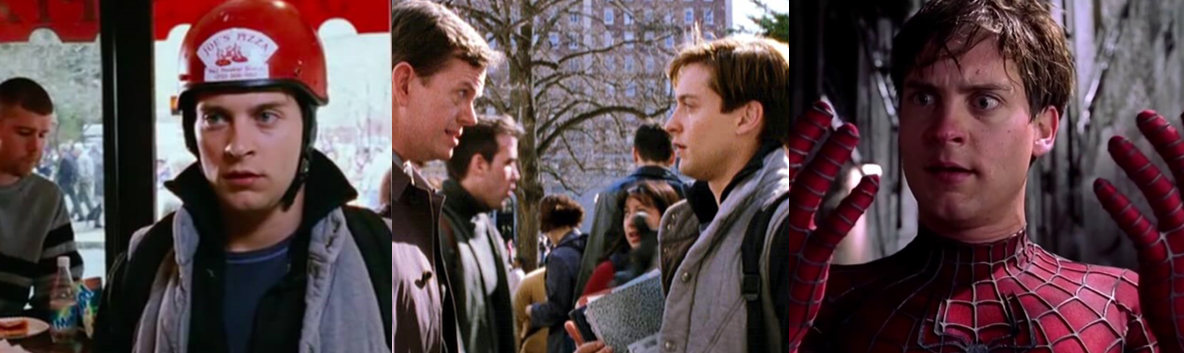
As in the first movie, Spider-Man 2 opens with a bit of narration from Peter Parker, who’s in a pretty bad place here; having chosen to walk away from M. J. and live a life of responsibility, forsaking his own selfish needs in order to honour the memory of his beloved Uncle Ben (Cliff Robertson), Peter is tormented by M. J.’s vacant, staring visage from atop a giant billboard and pines for her every day, martyring himself for the choice he was forced to make. No longer living in his childhood home in Queens with his doting Aunt May (Harris), Peter lives in a crummy little apartment in the middle of the city that is cramped, dirty, falling apart, and right next to the train line. The door sticks, there’s a communal bathroom, and he’s constantly hounded by his landlord, Mr. Ditkovitch (Elya Baskin) for rent, which he can barely afford to pay as he has recently lost his job as a pizza delivery boy and is constantly being shafted on payment for his photos of Spider-Man (and other notable events in the city) by Daily Bugle editor-in-chief J. Jonah Jameson (Simmons). While Peter was often angst-ridden and burdened by bad luck (“Parker Luck”, as he called it) in the comics, the whole world is out to get him here; he can’t keep up with his college assignments, people are constantly barging into him, he’s cockblocked by an obnoxious usher (Bruce Campbell), and he can’t even walk out of a supply cupboard without stuff falling on him. The amount of hardship he faces in this one movie is almost absurd, and is equalled only by his desperate pining for M. J.; he desperately wants to tell her the truth but can’t risk endangering her life, and is equally unable to quell Harry Osborn’s (Franco) hatred of Spider-Man to preserve Norman’s memory. Peter’s also still carrying the guilt of having indirectly caused Uncle Ben’s death, and it’s only after sharing this with Aunt May that his outlook begins to change. And just in time, too, as all this stress is not only causing a rift between him and the few friends he has but also cancelling out his spider-powers. Since Tobey has organic webbing, this is an interesting way to do the old “run out of web fluid in mid-air/mid-fight” trope, but the depiction is quite inconsistent; potentially an allegory for sexual inadequacy and clearly a manifestation of his troubles, Peter’s powers only short out when the script says so, meaning he’s denied even the freedom offered from retreating to web-slinging.

Though she has a hunky astronaut, M. J. can’t deny her feelings and chooses Peter after learning the truth.

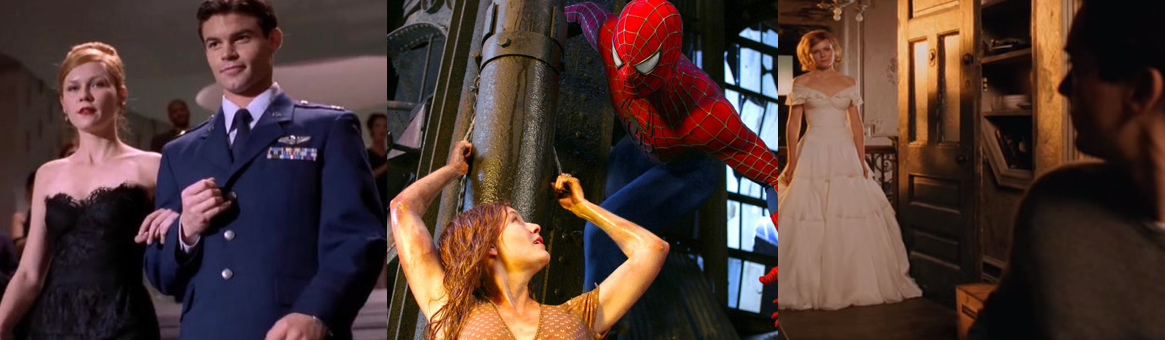
Just as Peter pines after M. J. on a daily basis, almost to an uncomfortable degree, so too is M. J. constantly distracted by him; Harry claims that she is “waiting for [him]”, but, regardless of his love for her, Peter continues to keep her at arm’s length and to avoid discussing his feelings for her. Although she’s clearly still in love with him, M. J. is doing a far better job of moving on (or, at least, hiding) from those feelings; she not only has a billboard but has landed her dream job with a part in The Importance of Being Earnest, A Trivial Comedy for Serious People (Wilde, 1895) and even gotten herself a ruggedly handsome astronaut (of all things), Colonel John Jameson (Daniel Gillies). John is barely a character at all and simply there to deliver another gut punch to Peter; M. J. clearly isn’t that into him, despite accepting his proposal, as she’s constantly yearning for Peter and waiting for him to admit his feelings for her. However, she’s also increasingly frustrated by Peter; despite him claiming to be her greatest friend and confidante, he’s been absent and unreliable, and she’s driven to the edge when he breaks his promise to see her play. Otto offers Peter some advice in trying to explain things to M. J., which leads to him awkwardly blurting out random poetry excerpts to her, and he inadvertently ends up alienating her so much that she’s fully prepared to settle for John, even briefly entertaining the idea that she was wrong about Peter and that John is Spider-Man. All of M. J.’s frustrations and concerns are completely swept away once she sees the truth she’s known all along and Peter clearly explains that he can’t risk being with her because of his responsibilities, but she ultimately chooses to face those dangers with him so that they don’t have to deny themselves. M. J. is a bit underwhelming here, to be honest; I’ve never really been a big fan of Dunst in the role and, while she has a feisty side, the script doesn’t really do her character any favours. It gets a bit worse in hindsight as she blows up at Peter in the next film for kissing a girl but she’s here making out with (and presumably having sex with) her hunky boyfriend, while trying to coax the truth out of Peter instead of just demanding that he be honest with her. She also ends up as a screaming hostage once more, and it’s telling that even Aunt May has more fight in her when captured by Doc Ock than the object of Peter’s affections.

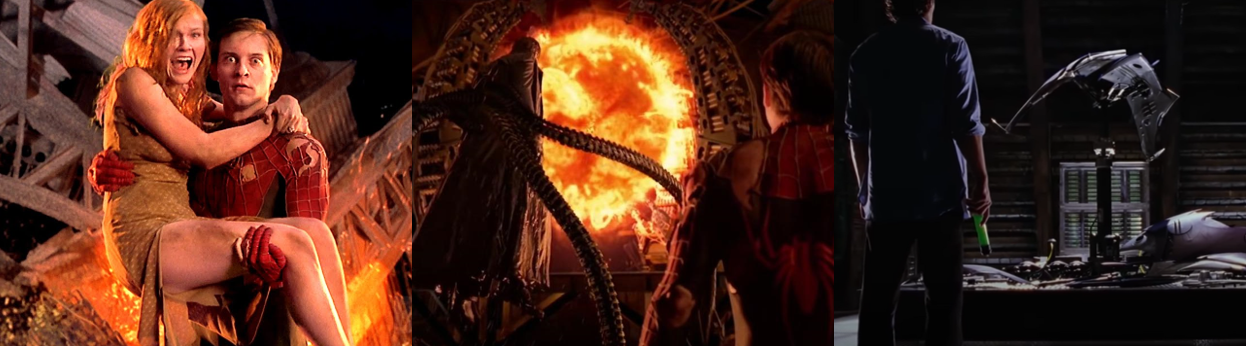
Harry, consumed with vengeance, is stunned to discover Peter and Spider-Man are one and the same!

Peter’s life is further complicated by his strained relationship with Harry; despite struggling through school in the first film, Harry has done pretty well for himself in the intervening time, becoming head of special projects as OsCorp and funding Otto’s fusion research in a bid to live up to (and surpass) his father’s lofty ambitions. However, having seen Spider-Man with his father’s body at the conclusion of the first film, Harry assumes that Spidey killed his dad and has been harbouring a deep-seated vendetta against the wall-crawler ever since. Even when Spider-Man saves his life, Harry isn’t swayed in his opinion, and his lust for revenge even drives him to turn against Peter in a bitter, drunken rage in one of the film’s most dramatic and upsetting moments. An extended scene included in this version sheds a little more light on Harry’s mindset, as he believes that Peter either knows who Spider-Man is or is protecting him from reprisals since he earns money from the masked vigilante, and he compares his desire to see Spider-Man dead to the bloodlust Peter must feel towards the man who killed Uncle Ben, thus painting Harry as a dark mirror of the titular hero. Frustration and grief get the better of Harry after Otto’s experiment is a disaster, and he unleashes a vicious, heart-breaking tirade against his best friend for choosing his livelihood over his best friend. Harry’s obsession only grows when Spider-Man is believed to have quit after his discarded costume is discovered, and he’s so consumed by vengeance that he partners with Doc Ock to draw Spider-Man out by having him target Peter in exchange for supplying the mad scientist with the Tridium he needs to complete his fusion experiment. With Spider-Man helpless before him, Harry prepares to deliver the killing blow and is stunned into a near maddening disbelief to find his best friend behind the mask, shattering his perception of reality and the people around him and leaving him susceptible to the manipulative influence of his father’s vengeful spirit.

A science experiment gone awry transforms kindly Dr. Octavius into the twisted, sardonic Doc Ock.

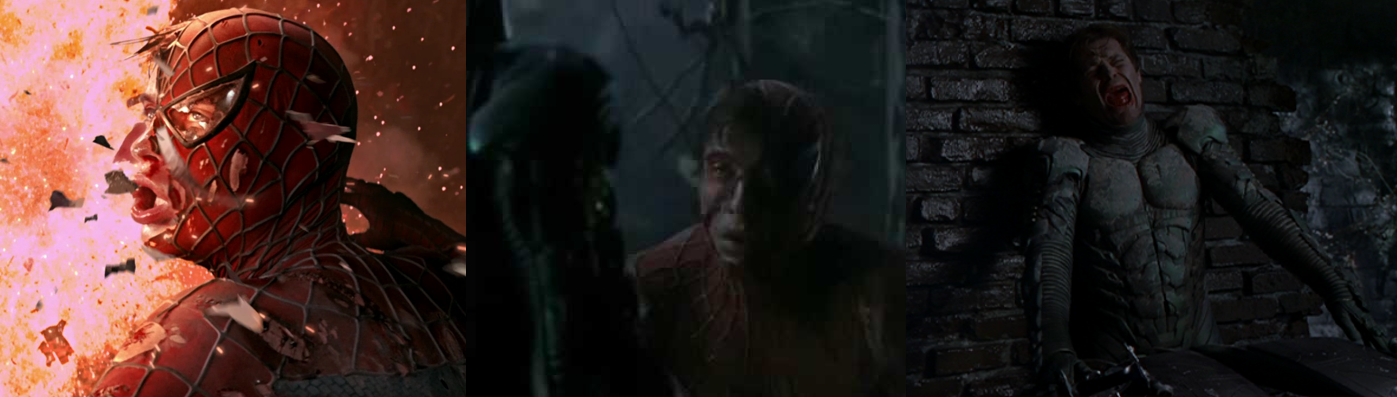
Of course, Spidey’s most tangible threat in the film is Doc Ock himself; beginning as a kindly mentor and hero of Peter’s, Otto is a far cry from the malicious, power-hungry mad scientist from the comic books. Although initially reluctant to interrupt his work by entertaining Peter’s questions, especially given he’s aware of Peter’s assumed laziness, Otto quickly finds a kinship with Peter based on their mutual appreciation for science. A likable, fatherly figure, Otto is absolutely besotted with his beloved wife, Rosie (Donna Murphy), and emphasises to Peter the importance of using his great potential and intelligence for the good of mankind. Despite his unparalleled scientific mind, Otto is also a romantic at heart and encourages Peter not to bottle up his love and emotions lest they make him sick, though both he and Rosie stress that love requires a lot of hard work from both parties. Otto’s life work is to provide the world with clean, renewable energy using a Tridium-based fusion reaction; Otto is so convinced of the safety and importance of his experiment that he generates an artificial sun in the middle of New York City, confidant that his four mechanical limbs will allow him to stabilise the resultant reaction and give him his moment of glory. Of course, everything goes hideously wrong when his machinery malfunctions, which not only results in Rosie being killed but Otto’s mechanical appendages being fused to his spinal column. Awakening in a confused state, Otto finds himself susceptible to the arms’ artificial intelligence after his inhibitor chip is destroyed; as they’re programmed to create and stabilise the experiment, the arms influence him towards robbing banks and committing crimes to rebuild the reactor at an abandoned pier rather than drown himself in the river in his grief. Christened Doctor Octopus (“Doc Ock”) by Jameson, Otto becomes a twisted, power-hungry maniac who completely abandons all of his former principals and puts innocent lives in danger thanks to the influence of his arms. He not only tries to kill a train-load of New Yorkers but even takes Aunt May and M. J. as hostages and battles Spider-Man with a devious glee, constantly frustrated by the web-slinger’s interference and determined to kill him so he can be left in peace. Doc Ock’s story is functionally similar to that of Norman’s in the first film (both were mentor and father figures turned to evil by science), but the execution is unique enough to stand out from his predecessor; he stomps around in broad daylight, his identity is never in question, and his ultimate goal isn’t to prove his physical superiority, but to prove his intellectual superiority and complete his life’s work by any means necessary.

While Jonah delights in Spidey’s misfortune, Aunt May and Ursula offer Peter some much-needed support.

As haunted by M. J. and his many doubts and problems Peter is, his guilt over indirectly causing Uncle Ben’s death basically dictates his entire life. The only reason he’s denying his true feelings is because his interpretation of Ben’s final teaching was that he had an obligation to put his powers to good use, a life lesson that is reinforced by Otto and his position of scientific acumen. However, all of the stress caused by his conflicting duality sends Peter’s power son the fritz; his webs stop firing, he can’t always stay stuck to walls, and he begins wearing his glasses again as his eyesight fails. Concerned for his physical welfare, he consults a doctor, who offers the prognosis that the issue is psychological rather than physical, and, with the weight of the world pressing down upon him thanks to Jameson’s smear campaign, Peter rejects his responsibilities in a dream-like conversation with his uncle’s spirit. Upon being brought Spider-Man’s discarded suit, Jameson is overjoyed that his efforts to besmirch and belittle the wall-crawler have met with success, but he’s forced to admit that Spider-Man was a hero when Doc Ock kidnaps M. J., thus leaving John distraught, though Peter delights in upstaging the cantankerous editor once he gets his shit together. He’s helped in this regard by an honest exchange with Aunt May; given that the film takes place on the two year anniversary of Ben’s death, May is in a fragile place, which is only exacerbated by her inability to keep up the payments on their family home. Burdened by his guilt, Peter shares a version of the truth of that fateful day to her; though initially horrified, she forgives him and stresses the importance of doing the right thing. It’s heavily implied in this exchange that May is aware of Peter’s dual nature and, though neither explicitly admit it, he’s relieved that her encounter with Doc Ock and subsequent rescue from Spider-Man has turned her opinions on the web-spinner around. After giving up his suit, Peter applies himself fully to his social life and academic work, finally earning him the praise of his teacher, Doctor Curt Connors (Dylan Baker), and he later finds some support in Ursula (Mageina Tovah), the daughter of his landlord, who clearly has a crush on him and brings him a moment of quiet reprieve in a moment of absolute despair. This extended cut adds a few additional scenes, most of which are alternate takes and longer sequences that don’t really add too much to the existing story, though one of the most notable additions is a hilarious scene where Jameson hops around his office garbed in Spider-Man’s discarded suit and a discussion between M. J. and her friend where it’s revealed she accepts John’s proposal primarily because of her father’s abusive nature.

The Nitty-Gritty:
Given that it’s a Spider-Man movie, Spider-Man 2 is primarily focused on exploring themes of guilt and the weight of responsibility; Peter drives himself into the ground trying to save everyone he can and live up to his uncle’s expectations, to the point where he neglects his life outside of the costume. Not only is he failing at school and to make money, he’s letting everyone around him down, which only adds to his feelings of despair; his friends are starting to resent and distrust him because of his absent nature and, while he’s desperate to do more and to apply himself better, he can’t shake the call to action. Even something as simple as delivering pizzas or getting to the play is interrupted by a disturbance of some kind, whether it’s kids playing in the street or a high-speed car chase, and Peter doesn’t even let himself relax when he’s in his crummy apartment as he sits there tuning into the police radio band to find ways for him to help. This ever-mounting struggle to find the right balance between his wants and his responsibilities is the primary cause for his failing powers; losing his webs, wall-crawling, spider-sense, and strength only adds to Peter’s confusion and frustration as the freedom afforded to him by being Spider-Man also becomes a closed door. Once he decides to quit, that weight is immediately lifted but his brief moment of happiness is shattered when he’s unable to save a life from a house fire, thus hammering home that he is capable of great things and thus must exercise great responsibility.

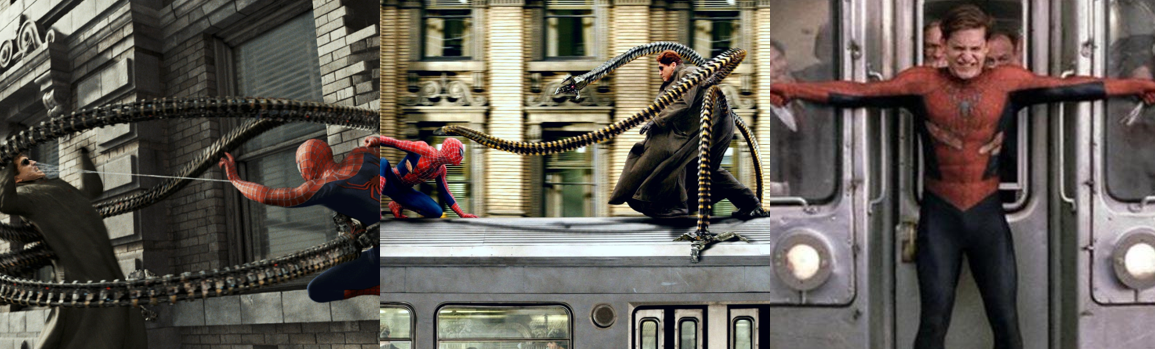
Both Spider-Man and Doc Ock look fantastic, and Ock’s arms make for exciting fight sequences.

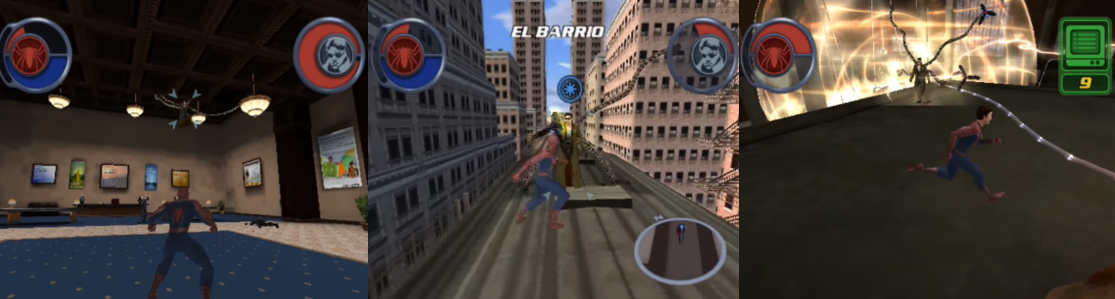
Surprisingly, Tobey’s spider-suit is basically the same design as before; normally, superhero sequels go out of their way to change the character’s costume to make more toys but, aside from popping a little more and a few tweaks to the mask, muscle suit, and other minor details, it remains consistent with the first film. Thanks to the movie not having to spend an hour or so setting up Peter’s origin, we get much more Spider-Man action here and the aforementioned Spydercam really delivers some dynamic web-slinging shots. As ever, Peter has an annoying tendency to lose or remove his mask so that we don’t miss out on the emotional impact scenes and events have on him; this is, as always, hit or miss as Tobey favours a vacant, doe-eyed stare throughout most of the film and the regularity that he is unmasked gets ridiculous at times, regardless of how dramatic or thematically relevant these scenes are. While audiences will forever decry the Green Goblin’s outfit in the last film, I don’t think I’ve ever seen anyone complain about Doc Ock’s depiction here; garbed in a trench coat, hat, and glasses, Doc Ock cuts a simple but intimidating figure and it really is impressive how Molina projects the weight and movement of his mechanical limbs. The arms are extremely versatile, able to stretch out and grab things in their claws, light Ock’s cigar, and even sporting a nasty looking spear-like appendage. While Otto can control and influence the arms, the destruction of the inhibitor chip allows them to act independently of him, but their goal is not only to create and sustain a fusion reaction but also to protect Ock at all costs. Swinging and whipping everywhere, the tentacles cause Spider-Man a great deal of difficulty in getting to Doc Ock and make him a constant threat as they can perform multiple tasks and endanger many lives all at once. One of their most memorable sequences is when they lash out while Otto is unconscious, slaughtering the doctors that try to remove them in scenes that harken back to Raimi’s time as a horror filmmaker as we see fingernails being ripped off and screaming bodies being tossed all over the place. Indeed, Rosie’s horrific death (though not seen onscreen it’s pretty clear she was practically decapitated) and many shots of the arms are created using practical effects, puppetry, and first-person perspectives just like those seen in his Evil Dead films (Raimi, 1981 to 1992) and their threat is matched by Otto’s obsession with holding “the power of the sun in the palm of [his] hand”.

Spider-Man and Doc Ock’s battles are a spectacle, and Spidey performs incredible feats to save lives.

The versatility of Doc Ock’s arms really do make for some of the best fight sequences in any Spider-Man film; despite the armaments and manoeuvrability of the Green Goblin’s glider, Spider-Man’s fights never really kicked into that higher gear as the filmmakers were still working out how to create the special effects necessary to shoot these sequences (something that the third film greatly improved upon), but Spider-Man 2 more than makes up for this with scenes depicting Spider-Man and Doc Ock battling up the sides of buildings and on top of a speeding train. While it’s true that any one of Spidey’s repeated blows to the non-superpowered Doc Ock should have immediately ended the multi-limbed menace, I can forgive this as it’s really exciting to see Spidey have to dodge and flip around the tentacles and fight through them while on the side of a building or whipping around a bank. I can also forgive the convenience of Doc Ock robbing the same bank that Peter and May happen to be at because it leads to him clambering up the sides of buildings with May and his bags of loot, tossing better (and more sadistic) quips than Spider-Man himself, and showing just how dangerous and adaptable his mechanical limbs are as they can hoist him up, absorb impact damage, and deflect Spidey’s blows at every turn. Obviously, the most thrilling action scene is the train sequence, which sees Spider-Man first using his webs to save the civilians Doc Ock causally tosses away, battling him on the exterior of the speeding train carriages, and then using all of his fantastic strength to literally force the out of control train to a stop. Full disclosure, though…I’ve always found this sequence to be a little over the top; the physics and logistics of it seem a little outside of Spider-Man’s range and more like something Clark Kent/Superman would do, but it undeniably makes for a brilliantly dramatic sequence as it shows that Peter will literally push himself to exhaustion and beyond his limits to save lives. The passengers are so grateful to him that they promise not to share that they’ve seen his face, moved by how young and brave he is, and Spidey only adds to his heroic card by basically trading his life for theirs when Doc Ock returns for him.

Thanks to Ock’s sacrifice, the city is saved, but Harry poses a looming threat…

After having a taste of happiness, Peter begins to believe that he can finally offer M. J. his true feelings but, after realising that he can’t deny the great responsibility bestowed upon him, he’s forced to walk this suggestion back and once again pretend that he’s not in love with her. However, his spider powers truly return in full force after Doc Ock inexplicably kidnaps M. J. to force Peter to lure Spider-Man out for a final confrontation. As many have mentioned, it’s damn lucky that Peter is Spider-Man and that his spider-sense kicked in at that exact moment or else Doc Ock’s errant taxicab would have squashed them both and Harry would’ve indirectly killed his two best friends. When he discovers that Peter and Spider-Man are one and the same, Harry is stunned, to say the least, and heartbroken by the belief that his best friend apparently killed his father. However, Peter manages to convince Harry to reveal Doc Ock’s location in order to rescue M. J. by stressing that there’s more at stake than their personal problems (though a quick “No, he was a madman who tried to kill me” might’ve gone a long way…) Thus, once again, Spider-Man has to save M. J. from a supervillain, though she’s much sassier here than last time, where she was little more than a screaming wreck. Enraged at Doc Ock’s actions, which not only threaten the entire city but have put first Aunt May and then M. J. in the line of fire, Spidey delivers a massive beatdown, once again taxing himself to the limits to shield M. J. from a falling girder and finally revealed the truth to her after removing his mask again. To be fair, this time Peter voluntarily unmasks in a desperate attempt to appeal to Otto’s humanity; thoroughly beaten, Otto snaps out of his insanity upon seeing the face of his protégé and surrogate son and realises that his arms have perverted everything he once stood for. With the fusion reaction threatening to suck the city into it like an artificial black hole, Otto exerts all of his willpower and humanity in a tragic sacrificial effort to drown the artificial sun and redeem himself, once again delivering a startling message of the dangers of scientific exploration and arrogance to Peter. Despite coming to terms with the fact that he can never be with M. J. as he’ll always be Spider-Man, Peter is delighted when she ditches John at the altar to be with him and triumphantly swings off to attend to an emergency with M. J.’s blessing. However, unbeknownst to either of them, Harry is tormented by a vision of his dead father and stunned to stumble upon a hidden laboratory containing a cache of Norman’s Green Goblin apparel, and potentially the means to exact his revenge against his former friend…

The Summary:
Even today, after all the Spider-Man films we’ve had over the years, Spider-Man 2 remains a highly praised entry in the franchise and has long been the gold standard that all other Spider-Man films are measured by. It’s really not too hard to see why; like all great sequels, Spider-Man 2 takes everything that worked in the first film and provides not only more of the best aspects but improves upon them at every turn. The interpersonal drama is heightened, the action and fight sequences are much more exciting and visually impressive, and Spider-Man’s web-slinging is a sight to behold thanks to the innovative camera techniques pioneered in this film. While some of the performances still leave a lot to be desired, the visual spectacle more than makes up for it and Alfred Molina’s brilliantly nuanced portrayal of Doctor Octopus carries the acting quality to a new level, allowing Tobey Maguire to focus on embodying Peter’s utter despair and anguish. Most importantly, Spider-Man 2 does a wonderful job of balancing all of its narrative elements; Peter’s struggles with his dual life and his failing powers are perfectly juxtaposed with Doc Ock’s menace, and it never feels like there’s too much going on. I’d argue that the only main character to suffer is Mary Jane, simply because I would prefer to see more agency from her, but I loved seeing Harry’s obsession send him into a downward spiral of revenge that parallels Otto’s degradation from kindly father figure to sadistic, megalomaniacal villain. If you’re going to watch Spider-Man 2, be sure to pop in this extended version as the few extra minutes add a little more spice to the sauce, so to speak, and the film remains as entertaining as ever, even in the face of the more visually impressive and narratively faithful Marvel Studios movies. My only regret is that some of the lingering plot points were poorly addressed in the third film, but that definitely doesn’t diminish Spider-Man 2’s appeal and it remains in the top tier of the web-slinger’s live-action films to this day.  

My Rating:

Rating: 5 out of 5.

Fantastic

Are you a fan of Spider-Man 2? Where does it rank for you against the many other Spider-Man movies? Did you enjoy the extended sequences offered in this version of the movie? What did you think to Peter’s many struggles in the film and which of the fight sequences was your favourite? Were you a fan of Alfred Molina’s portrayal of Doc Ock and were you excited to see him return to the role? What did you think to Harry’s character development and were you excited at the prospect of him taking up his father’s legacy in the third film? Do you think the film still holds up or do you prefer other filmic interpretations of the character? Whatever your opinion on Spider-Man 2, leave a comment and thanks for joining me for Spider-Man Month!

Back Issues [Spidey Month]: The Amazing Spider-Man #50


Easily Marvel Comic’s most recognisable and popular superhero, unsuspecting teenage nerd Peter Parker was first bitten by a radioactive spider and learned the true meaning of power and responsibility in Amazing Fantasy #15, which was published in August 1962. Since then, the Amazing Spider-Man has featured in numerous cartoons, live-action movies, videogames, action figures, and countless comic book titles and, in celebration of his debut and his very own day of celebration, I’m dedicating every Saturday of August to talk about everyone’s favourite web-head!


Story Title: “Spider-Man No More!”
Published: 11 April 1967 (cover-dated July 1967)
Writer: Stan Lee
Artist: John Romita Sr.

The Background:
Considering Spider-Man’s debut almost didn’t happen, it’s pretty ironic that Stan Lee and Steve Ditko‘s angst-ridden teenage superhero would go on to become the flagship character of Marvel Comics. Over the years, Spider-Man has been involved in some of Marvel’s most celebrated, and notorious, story arcs, and the troubled wall-crawler is often depicted battling his own personal woes as often as one (or more) of his colourful rogues. In 1967, he faced one of his most trying challenges when, burdened by J. Jonah Jameson’s hate campaign, Peter walked away from his responsibilities as a superhero in one of the character’s most influential stories, which also introduced readers to one of the most notorious Marvel villains, Wilson Fisk/The Kingpin.

The Review:
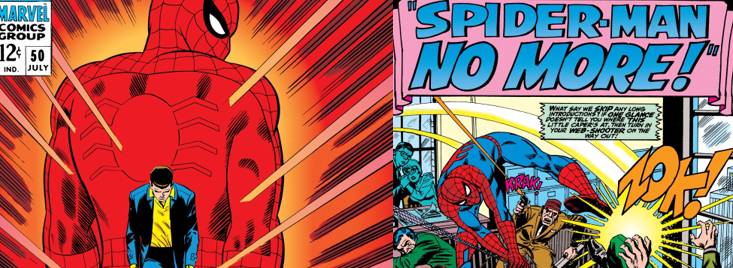
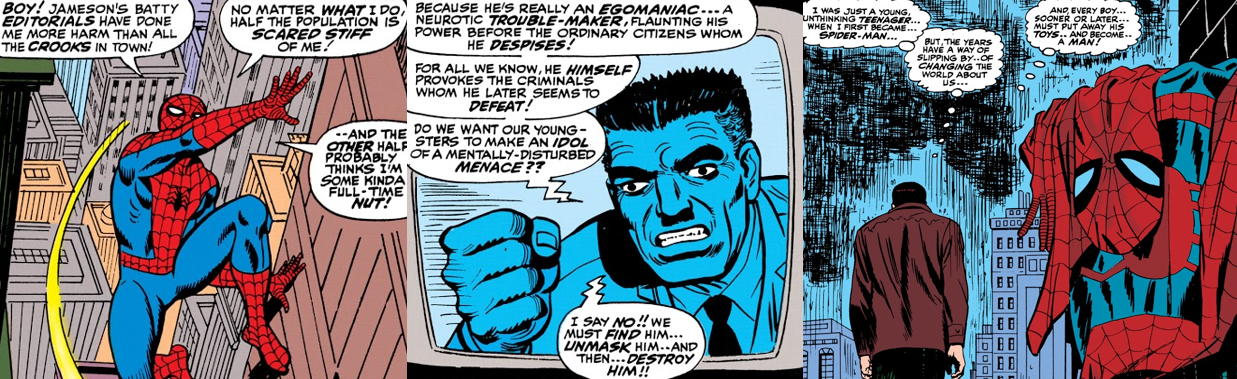
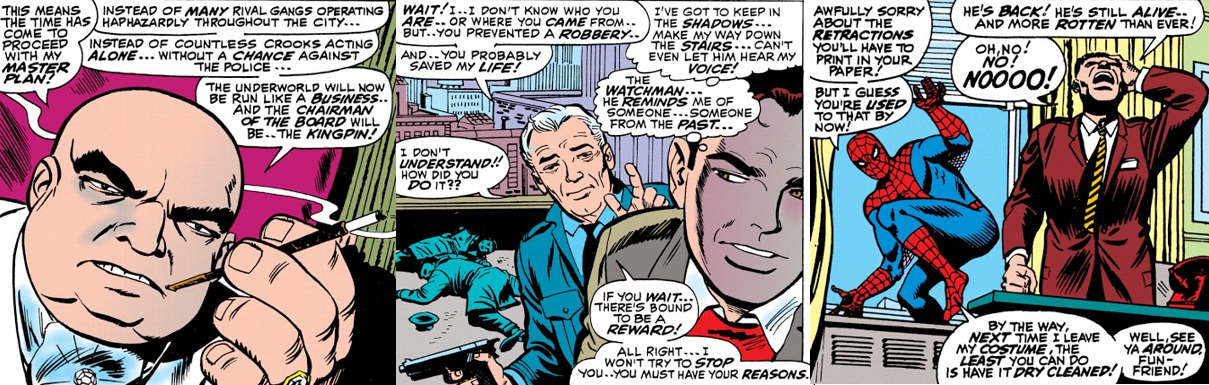
“Spider-Man No More!” kicks off with a bang courtesy of a visually stunning full-page splash from one of comic’s greatest artistic talents, John Romita, who practically wrote the book on how dramatic and spectacular Spider-Man’s depiction should be. With absolutely no context at all, we’re thrown right into the action as Spider-Man tackles a group of armed thugs who are in the process of pulling off some kind of heist. As is commonplace in sequences like this, the crooks are stunned at Spidey’s superhuman agility, which allows him to easily dodge bullets, and completely powerless against his superhuman spider strength, which easily allows him to shrug off even their combined assault and render them all unconscious with a few hard-hitting blows. However, despite saving the day in magnificent fashion, Spider-Man is met with fear and suspicion by one of the employees he saved, and he swings away cursing the efforts of grouchy Daily Bugle editor J. Jonah Jameson at painting him as a crazed masked maniac. Thanks to Jameson’s editorials, half of New York City is either terrified of him and thinks he’s just as bad as the many colourful supervillains in town and the other half thinks he’s mental, which he can’t help but be bothered by considering the populace celebrates other costumed superheroes like the Fantastic Four and the Avengers. Peter’s woes that, no matter what he does or how hard he tries, the public hates him more and more are only added to when he returns to his apartment and learns from his friend and roommate, Harry Osborn, that his beloved Aunt May has fallen ill. We’re not told what, exactly, May has been stricken by, however; she’s simply had “another attack” and been left bedbound. Naturally, Peter blames himself for his aunt’s condition; after all, if he’d been at home rather than putting his life on the line for his own sense of self-gratification, he would’ve been able to get there faster and he’s burdened by his unreliable nature due to his superheroics.

Burdened by his woes and Jameson’s smear campaign, Peter gives up his costumed identity.

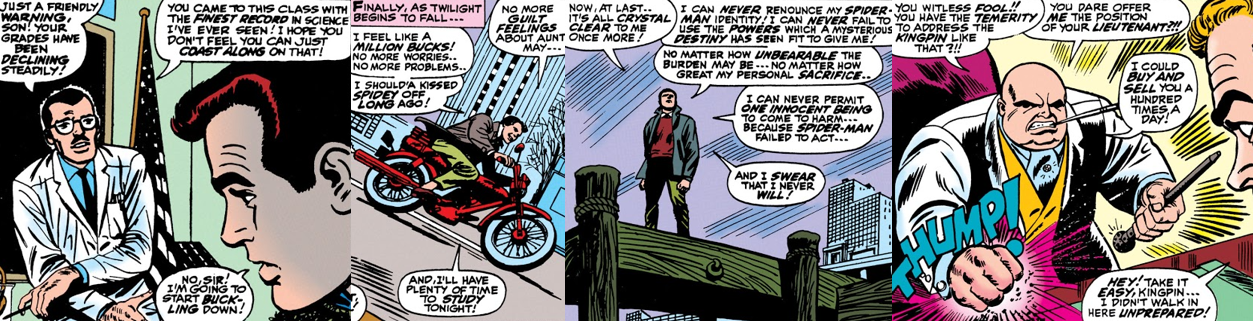
Beating himself up and already blaming himself for not being there for the only family he’s ever known and has left, Peter’s unable to concentrate on his studies, which directly translates into him struggling through a test the next day and receiving a kindly warning from his Physics teacher, Professor Miles Warren, about his steadily declining grades and that his once-impressive science record won’t allow him to coast along unless he puts in the work. To make matters worse, Peter’s so troubled by his aunt’s health and his failing grades that he’s forced to turn down a genuine offer from beautiful socialite Gwen Stacy, which only further adds to his woes as he kicks himself for not having the time or enthusiasm to find out if the likes of Gwen or seemingly scatter-brained Mary Jane Watson are really interested in him or have more depth to their personalities. Peter’s even had to turn down a fantastic job working for Harry’s dad, Norman Osborn, because he has to keep his evenings free in case Spider-Man is needed, and his troubles reach boiling point when he turns on the television and is faced with a malicious rant from Jameson painting Spider-Man as a neurotic trouble-maker who provokes villains for his own ego. Jameson’s so sure that Spider-Man is a menace to society that he offers a whopping $1000 reward for the capture and conviction of the web-slinger and Peter reaches his breaking point. Realising that his colourful alter ego has brought him and those around him nothing but pain, Peter begins to think that Jameson is right, that he’s been swinging all over town out of some childish, selfish desire for attention, and dramatically dumps his costume, and the identity of Spider-Man, in the trash once and for all.

As the Kingpin seizes power, Peter is reminded of his responsibilities and returns to action once more.

Of course, Jameson is overjoyed when a small boy delivers him Spider-Man’s costume and that his smear campaign has worked, publishing his victory on the front page to a largely incredulous New York City (it’s actually endearing how his readers see it as nothing more than a publicity stunt and actually show support for Spider-Man). Peter follows up his decision by quitting as Jameson’s lackey, much to his comical outrage, though the publisher delights in bragging about his triumph and proudly displays Spider-Man’s costume in a trophy cabinet in his office. Meanwhile, the city falls into anarchy as the Kingpin takes the opportunity to consolidate the city’s various mobsters and gangsters under his direct supervision, organising them in a way they’ve never been before and leading to a flurry of crimes, all of them in broad daylight, that threaten to tax the city’s police department to their limit. Peter, however, is having a whale of a time; no longer having to devote his time and energy to crimefighting, he’s finally able to socialise with Gwen, dote on his recovering aunt, and catch up on his studies. He’s even giving serious thought to taking up Norman’s job offer once Aunt May is fully recovered but, while he catches himself in the act of responding to the news of a robbery at the welfare office, he instinctively acts without hesitation when he sees a watchman being set upon by armed thugs. Chastising himself for going back on his promise so quickly, Peter is devastated when he realises that the kindly old watchman has the likeness of his beloved Uncle Ben. All at once, the pain and guilt of his irresponsibility catch up to the troubled teenager as he relives his childhood and his failure to us his great powers responsibly, which directly caused his uncle’s death, and he realises that it’s his burden, his duty, to set aside his personal woes and use his superpowers for the benefit of others to atone for that loss. Thus, he breaks into Jameson’s office, recovers his costume, and pranks the editor with the promise of flooding the city with more Spider-Men before swinging off into the city rejuvenated once more.

The Summary:
If you came into “Spider-Man No More!” expecting fast-paced, hard-hitting action and to see Spider-Man pummelling goons and supervillains galore, then you’re probably going to be disappointed. Instead, in keeping with the story being published in The Amazing Spider-Man’s fiftieth issue, what we have here is a deep dive into Peter’s troubles and a new spin on detailing exactly why he’s cursed to set aside friends and even family to save lives as Spider-Man. It’s not uncommon for comics, especially Spider-Man stories and tales from this era, to constantly rehash a character’s origin but I think it’s used to good effect here and almost makes The Amazing Spider-Man #50 a kind of starting off point for new readers. Thanks to being overwhelmed by his aunt’s failing health, his non-existent social life, his declining grades, and Jameson’s smear campaign, Peter has lost sight of his mission and fallen into a depression so deep and so dark that the only solution he can think of is to literally and figuratively ditch his costumed identity in one of comic’s most iconic panels. We see the effect this has on Peter right away; no longer does he have to shun Gwen or Mary Jane or his studies since he has the time and focus to think about things other than crimefighting or swinging off to help with the next emergency. He can be there for May, relax with his science books, and apply himself in far more productive ways, literally turning his frown into a smile as he happily goes about his daily business without the burden of Spider-Man weighing him down. Peter even takes a great deal of pleasure in quitting from the Daily Bugle, a job that has always underpaid and underappreciated him, and is perfectly happy to let the city police handle  the escalating crime way sweeping across the town.

Peter’s joy at rediscovering his life is short-lived since Spider-Man’s powers will always be needed.

While New Yorkers are troubled by Spider-Man’s absence, the Kingpin sees it as a fantastic opportunity and makes an impact with his plan to consolidate the disparate gangs and criminals into something more akin to a business, with him as the chairman of the board. Though he doesn’t physically get involved in the action, he showcases his threat when Farley Stillwell tries to get in on the action and quickly makes a name for himself in the criminal underworld through his organisational skills and lofty goals. Although Peter is quick to chastise himself for reverting to type so quickly, he reasons that he had no choice but to act when he saw the watchman’s life in danger, and this brings back a flood of memories that we’re all keenly aware of but which serve as a stark reminder to the troubled youth that he has an obligation to use his gifts responsibly, regardless of the cost to his social life or his own desires. Having been reminded of his life’s mission, and perhaps feeling a sense of closure at having saved his uncle’s doppelgänger, Peter immediately returns to action as Spider-Man; though the story doesn’t resolve how he’s going to juggle his friends, family, and studies, it can be assumed that he’s at least more at peace with his duel identity for the time being and more than ready to make up for lost time. Overall, there’s a reason “Spider-Man No More!” is one of Spider-Man’s most celebrated adventures; what it lacks in action, it makes up for in interpersonal drama and a character study of everyone’s favourite web-head and the story is perhaps the quintessential reminder of the heavy burden Peter must carry lest he fail to use his gifts responsibly and indirectly cause more death or heartache. It’s a tragic tale, to be sure, but also one that encapsulates everything Spider-Man is; he sets aside his personal desires for the greater good and, even when he does take the time to be selfish for a change, his inherent need to help others will always win out, which is a message we could all stand to learn from.

My Rating:

Rating: 4 out of 5.

Great Stuff

Are you a fan of “Spider-Man No More!”? Where would you rank it amongst Spider-Man’s many other stories and moments? What did you think to Peter’s troubles and his decision to quit being Spider-Man? Do you think Peter was maybe a little too angst-ridden and could’ve found a better way to balance his duel identities? What did you think to the Kingpin’s plot to unite the city’s criminals? Do you think the resolution to Peter’s anguish was a bit rushed or did you enjoy that he got to save his uncle’s proxy? Would you say that Spider-Man is an egomaniac and a menace or do you think he’s a benefit to the city? How are you celebrating Spider-Man this month? Whatever your thoughts on Spider-Man, and “Spider-Man No More!”, share them below or drop a comment on my social media and be sure to check out my other Spider-Man content!

Movie Night [Thor’s Day]: The Incredible Hulk Returns


In August 1962, Stan Lee, Larry Lieber, and Jack Kirby introduced readers of Marvel Comics (specifically Journey into Mystery) to Thor Odinson, God of Thunder and mightiest of the Asgardian deities. Through associations with Marvel’s premier super team, the Avengers, and a number of cosmic, mythological adventures, Thor has become another of Marvel’s most successful and versatile. Being as it’s the first Thursday (or “Thor’s Day”) of the month, what better way to celebrate the God of Thunder than to take a look back at his live-action debut!


Released: 22 May 1988
Director: Nicholas Corea
Distributor:
New World International
Budget:
Unknown
Stars:
Bill Bixby, Lou Ferrigno, Steve Levitt, Eric Kramer, Lee Purcell, Tim Thomerson, and Jack Colvin

The Plot:
For two years, Doctor David Banner (Bixby) has been able to keep his monstrous alter ego, the Hulk (Ferrigno) at bay. Banner’s hopes to rid himself of the Hulk once and for all with his Gamma Transponder are interrupted by a former student of his, Donald Blake (Levitt), and Thor (Kramer), the brutish Norse God of Thunder under Blake’s control. When mob boss Jack LeBeau (Thomerson) threatens to pervert Banner’s research, he reluctantly teams up with Blake and Thor to ensure that his machine doesn’t fall into the wrong hands.

The Background:
Long before the creation of the Marvel Cinematic Universe (MCU), Marvel Comics had a decent amount of success with live-action adaptations thanks to the iconic Incredible Hulk television series (1977 to 1982). The show, which coined the memorable “Don’t make me angry. You wouldn’t like me when I’m angry” line, aired eighty episodes before finally concluding on 12 May 1982 and forever entrenched the Green Goliath in the cultural consciousness thanks to standout performances by star Bill Bixby and Lou Ferrigno, who would go on to voice the character for years to come. About six years after the end of the series, the first of three made-for-television movies was produced, intended as a backdoor pilot for a Thor spin-off. The Incredible Hulk Returns was, apparently, a ratings success, which justified the production of the next two television features.

The Review:
So, if you’ve been following my website for a while and reading my previous reviews of the Incredible Hulk’s made-for-TV movies, you might’ve noticed that they’re a bit out of order. This actually reflects how I watched them as a kid, since I actually saw The Trial of the Incredible Hulk (Bixby, 1989) first, though it’s pretty clear right from the beginning that this film is meant to be take place two years after the end of the show. This is most obvious not just from the film’s title, but the inclusion of the classic opening sequence, narrated by Ted Cassidy, which gives a (very) brief rundown on the premise of the show. After experimenting on himself with Gamma radiation in an effort to unlock the hidden superhuman strength within all of us, Doctor David Banner finds himself transforming into a green-skinned beast whenever angered or panicked. Banner is believed to be dead, and this “Hulk” is pegged as the culprit, and the doctor has been forced to go on the run in a desperate attempt to find a cure for his condition, all while reporter Jack McGee (Colvin) relentlessly hounds him at every turn to try and get the scoop on the Hulk.

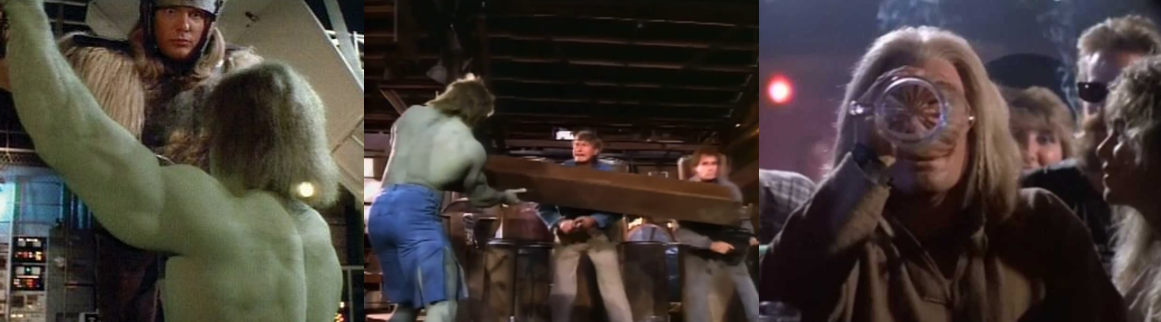
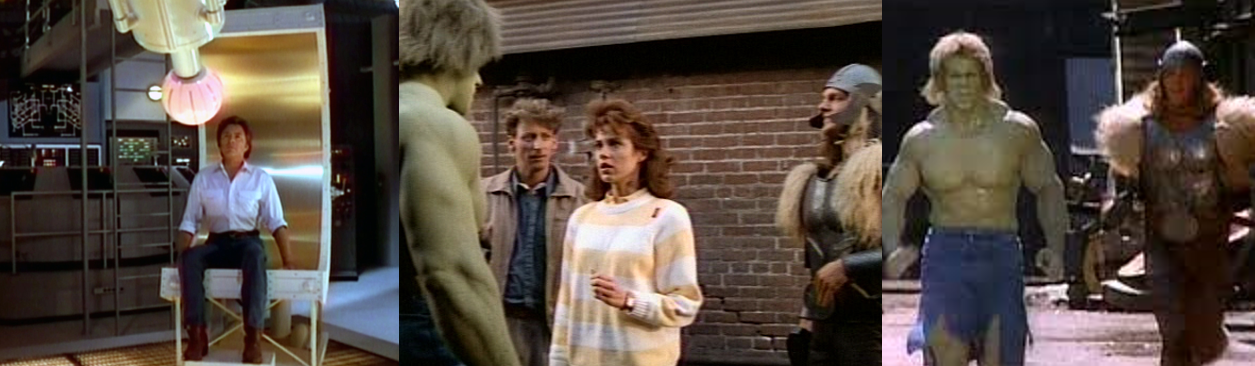
Banner’s chance for a cure is ruined by the surprise interruption of Blame and his magic hammer.

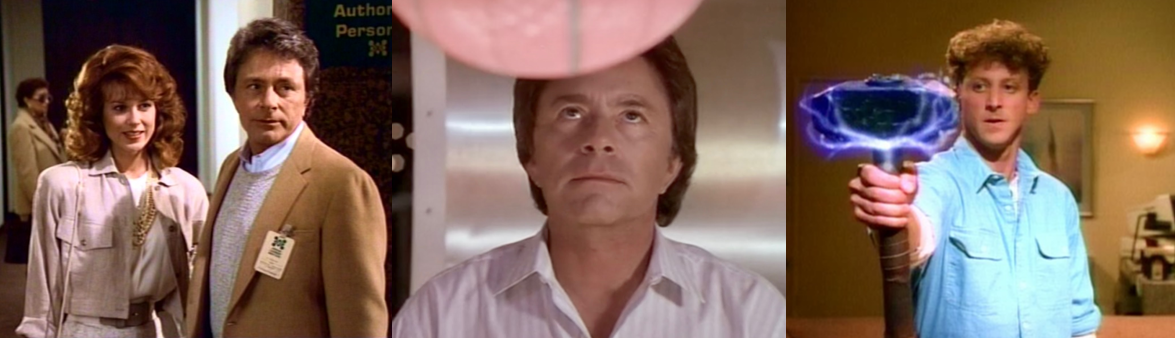
The Incredible Hulk Returns glosses over basically everything that happened in the show and picks up some two years later; Banner, using the fake name of “David Bannion”, lives a relatively stable and happy life with his long-term girlfriend, biogeneticist Doctor Margaret “Maggie” Shaw (Purcell). Though plagued by nightmares of his monstrous condition, Banner has finally found a happiness that had long eluded him; although he’s told a version of the truth to Maggie (he summed the whole situation up as a long period of “self-destructive behaviour”), he’s managed to hide the true extent of his secret from her and politely refuses to move in with her permanently to protect her lest his other half emerge. Maggie’s influence on Banner is immediate; not only is he content with her, but the Hulk has laid dormant for two years because of her positive influence on him, and it’s out of love for her that he works on his latest cure so he can fully commit to this new life. Banner has found a modicum of success as a scientist for the Joshua Lambert Research Institute, where he’s the brains behind the “Gamma Transponder”, a machine that promises to deliver unlimited, clean, renewable energy while also ridding Banner of his monstrous affliction. Much to chagrin of his employers, Joshua and Zachary Lambert (John Gabriel and Jay Baker), Banner refuses to take the spotlight or be publicly acknowledged for his work, not just because he insists that it was a team effort but also to avoid being recognised by the likes of McGee when he’s so close to a cure. Following a public unveiling of the institute’s most promising technological marvel, Banner wastes no time in activating the Gamma Transponder to rid himself of the Hulk. As is his nature, he is meticulous about this, recording what essentially amounts to a farewell message to Maggie and his colleagues in case the worst should happen, and emphasising that the machine can do everything he promised and so much more. Unfortunately, his experiment ends before it can even begin when a shady character grapples up into the lab and interrupts the procedure. This turns out to be a former acquaintance of his, Donald Blake, who sought to confirm that his old mentor was still alive and ask for his help in solving a very unique problem he has.

Blake can summon and command Thor, who must perform heroic deeds to ascend to Valhalla.

A far cry from the crippled doctor of the comics, Blake is a young and irresponsible figure, who often got into trouble as a student and acts without thinking of the consequences, Blake has been fixated on Norse mythology and culture his whole life but has never been able to explain why, so he signed on as the team doctor for a hazardous excursion into the frigid Norse mountains as a way to scratch that itch. Drawn towards a cave by pure instinct, Blake stumbled upon the tomb of a Viking warrior king known as Thor, who was denied entrance into Valhalla until he had paid a penance for a lifetime of arrogance. Blake discovered a Viking warhammer laying next to the skeletal remains of the warrior and, upon seizing it, was stunned by the arrival of Thor, reborn into the living world, following a flash of lightning and the rumble of thunder. Interestingly, Banner completely forgets about his experiment to indulge Blake in his story, but is sceptical that his old student truly brought a long-dead Viking warrior back to life. and rightfully so; The Incredible Hulk was always a very grounded show, with the only fantastical element being the titular green-hued beast, so the introduction of actual, real magical elements is as jarring to Banner as it is to the audience. Unfortunately for him, his scepticism leads to disaster as Blake calls forth Thor and Banner is stunned to find the brutish Norse warrior king is not only real, but dangerous in his arrogance and brash nature. Rather than Blake and Thor being one and the same, as in the comics, they are two completely separate individuals here; just as Blake is bound to the hammer, Thor is tied to him, duty-bound to follow Blake’s directions in a bid to fulfil his heroic quota and appease Odin so he can finally rest. Although he’s not as fantastical as his comic book counterpart, Thor possesses incredible superhuman strength but, despite wishing to perform heroic deeds, he’s impulsive and a stranger to the ways of the modern world.

Thor proves a valuable, if hot-headed, ally to the Hulk in battling their gangster foes.

Thor sees Banner as a “warlock”, the Hulk as a “troll”, and cars as “metal chariots” and is used to his demands for food, drink, and revels being met without question; frustrated at being little more than Blake’s slave, Thor wishes to live, to indulge himself, and craves the rush of battle. While this means his impetuous nature triggers Banner’s first transformation into the Hulk in two years, he delights in clashing with the Hulk, but is stunned when the Green Goliath shrugs off his attacks, and even electrified blows from his hammer. In a moment of hubris, a combination of shock, respect, and fear, Thor changes tries to befriend the beast after seeing the extent of his rage and fighting prowess, and humbly affords the proper respect and consideration towards Banner in subsequent scenes. Irritated by Blake’s interference and influence, to say the least, Banner guilt-trips him into sticking around rather than just running away after all the trouble he’s caused. In this way, Banner forces Blake to stop avoiding responsibility, or constantly shifting the blame to Thor, which ties into Thor’s earthly mission to encourage Blake to step up and be more heroic. While Blake is something of a burden to Banner, and Thor’s lumbering oafishness causes more than its fair share of trouble, Banner’s life is only compounded when McGee sees the newspaper report on the lab incident and immediately sets out to sniff out any news of the Hulk. McGee is small fry compared to Zach Lambert, however, who hires Cajun mobster Jack LeBeau (Thomerson) to steal the Gamma Transponder in a bid to screw over his domineering older brother and profit from the machine. Unfortunately, LeBeau’s men are thwarted in their attempt by the Hulk, and he thus decides to target Maggie instead; despite the best efforts of the Hulk and Thor, Maggie, already reeling from discovering Banner’s secret, is kidnapped from her beachfront home after a surprisingly engaging helicopter attack. LeBeau and his goons aren’t really much more than the stereotypical gangsters, but they’re given a bit of an edge with their Cajun accents and willingness not only to take Maggie as a hostage but also to kill Zach when he starts to get cold feet. Zach’s motivations are a bit weak (he wanted to have something for himself after being handed everything by Josh) but things quickly spiral out of his control when LeBeau goes into business for himself. LeBeau’s actions are enough to properly get the Hulk and Thor on the same page, and for Blake to see the potential for good Thor has, so as a plot device it ticks enough boxes for some last-act action and to crush Banner’s dreams of finally curing himself but none of the antagonists ever really pose a physical threat to either superhumans despite their greater numbers and being reasonably well armed.

The Nitty-Gritty:
Like I said, The Incredible Hulk has always been very grounded and focused more on science than mystical elements, so the introduction of Thor really does change the perception of the show in interesting ways. Obviously, the team up between Thor and the Hulk is nowhere near the grand spectacle of the MCU, but his presence definitely pushes the show more towards its comic book roots than ever before. It ties perfectly into Banner’s ongoing, desperate search for a cure; just as his efforts were thwarted time and time again in the show, his best effort to date is not only accidentally sabotaged by Thor but forever denied him due to the events of the film, and Banner is forced to return to his old, wandering life by the end. Along the way, though, he’s at least able to help impart some wisdom to Blake, who begins the film directionless and desperate in his own right but destined for greatness since he literally commands the power of a God, he just lacks the confidence and compunction to truly accept that destiny. Sadly, this comes at the expense of Banner’s cure, and his newfound life; this remains the closest Banner would ever get to a sense of normalcy, and in many ways he might have been better off using Maggie as his calming influence rather than constructing an elaborate machine that could be used for nefarious purposes, but it’s the tragedy of the character to be doomed to a life of hardship and to put his intelligence, and unique condition, to work aiding others rather than himself.

Alongside a fair amount of action and Hulk-outs, Thor’s boorish nature provides some humour.

As in every instance when I return to The Incredible Hulk, it’s the Green Goliath himself who provides the bulk of the action and spectacle. Lou Ferrigno excels in the role, which actually requires a little more nuance than just growling and looking hench as fuck! since the Hulk is now joined by a fellow boisterous muscleman. The initial fight between the Hulk and Thor might boil down to a lot of posturing and posing, but there’s some decent stuff there considering the limitations of the time and budget; the lightning effects when Thor arrives and leaves and tosses his hammer are crude but they get the point across, and the Hulk is even show lifting the Viking warrior up and tossing him aside, humbling the would-be Thunder God. Thor himself steals the show for me; sure, Kramer is garbed in a pretty cheap looking outfit and spouts some cheesy dialogue, but it works for the character’s raucous nature. Thor is a born and bred, battle-tested warrior from a very different time, when men fought and revelled and threw themselves in the glory of battle, and he’s frustrated that all Blake wants to do is discuss the nature of their relationship and destiny. Blake is moved by a poignant soliloquy from Thor in which the Viking expresses the pain and despair of having lost everything he knows and cursed to lay dead, and yet fully conscious, between worlds, and the two bond during one of the film’s most entertaining moments when Blake takes Thor to a biker bar to indulge his vices. Thor adds a much appreciated comedic element to the narrative, downing pitchers of beer, being a carefree and impulsive character, and even posing as David Bannion when McGee comes calling in a hilarious moment. Again, this does detract from the Hulk somewhat, who is noticeably absent in the middle part of the film, but Banner more than carries his own weight as he’s forced to neutralise the Gamma Transponder to keep it from being perverted into a weapon, thus destroying his best chance at a cure.

Banner loses his best hope of a cure and walks away from his idyllic new life in search of a new hope.

After Maggie is kidnapped and held to ransom, Banner has no choice but the dismantle the Gamma Transponder, erase all of the computer records, and destroy the machine’s most vital component to keep it from being weaponised. He and Blake then head to the agreed meeting place with the intention of rescuing Maggie, but things quickly become complicated when Josh shows up, grief stricken by Zach’s death, and triggers another transformation into the Hulk. This means that The Incredible Hulk Returns has a fair few Hulk-outs packed into it, which is actually quite surprising given how often the show (and these feature-length adventures) liked to focus on Banner’s personal dramas. It also means that the film concludes with the Hulk and Thor storming through LeBeau’s men, easily shielding themselves from their gunfire and overpowering them with their superior physical strength; even Blake gets in on the action, completely disregarding whatever hypocritic oath he may or may not have taken to gun down one of the mobster’s goons. Despite LeBeau taking Maggie at gunpoint, the Hulk cuts quite the intimidating figure, meaning he’s easily able to snatch the gun from his hand and subdue LeBeau by wrapping him up in a metal pipe. Although they’re victorious, Banner’s life has been irrevocably changed by the events; while McGee faces ridicule for his obsession chasing monsters, his presence and the publicity surrounding it all scares Banner off. While Blake and Thor make peace with each other and head out to do some good in the world, Banner is forced to leave Maggie and his idyllic life behind and hit the road once more, once again cursed to endure his hardship alone.

The Summary:
The Incredible Hulk Returns is easily my favourite of the Incredible Hulk’s three feature-length adventures; although my experience with the television show is still very limited, I feel this one is a bit more legitimate in  a lot of ways since it retains the opening sequence, Jack McGee features in it, and it has the same kind of atmosphere as the show. However, it also introduces fantastical elements to the otherwise grounded narrative, elements that don’t crop up again and make this a really unique entry in the show. I can see why some would find the Hulk sharing the screen with Thor, of all people, a little jarring but I find it incredibly enjoyable; Thor is a boorish, loud-mouthed, arrogant warrior who is massively out of place in every scene he’s in and it’s endlessly entertaining as he’s central to many of the film’s comedic and action-orientated moments. The Hulk is massive and eye-catching as always, performing a number of impressive physical feats and more than meeting his match with Thor who, despite being a little underpowered compared to the source material (much like the Hulk), still makes a visual impact. It’s cool seeing them onscreen together, fighting, roaring, and revelling in their battles, and this is nicely juxtaposed with the disappointing shattering of Banner’s new life. Clearly, the focus is on establishing the relationship dynamic between Blake and Thor, but Banner’s decision to destroy his only hope of a cure for a greater good and heading back on the road is very familiar to anyone who’s watched the show before. I think there’s a fair amount to like here, and Bixby holds his own against his less subtle screen partners to deliver a poignant reintroduction to the character, who’s doomed to forever be burdened with his monstrous alter ego.

My Rating:

Rating: 3 out of 5.

Pretty Good

Have you ever seen The Incredible Hulk Returns? What did you think to the introduction of Thor into the show’s continuity and did you enjoy Kramer’s performance? Were you sad to see that Banner had to walk away from his new life? What did you think to the relationship between Thor and Blake and would you have liked to see a spin-off show focusing on them? How are you celebrating Thor’s debut this month, if at all? I’d love to hear your thoughts on Thor in the comments or on my social media so feel free to drop me a line.

Back Issues [Spider-Man Day]: The Amazing Spider-Man #3


Easily Marvel Comics’ most recognisable and popular superhero, unsuspecting teenage nerd Peter Parker was first bitten by a radioactive spider and learned the true meaning of power and responsibility in Amazing Fantasy #15, published in August 1962. Since then, the Amazing Spider-Man has featured in numerous cartoons, live-action movies, videogames, action figures, and countless comic book titles and, following this celebration of his debut, I’ll be dedicating every Saturday of August to talk about everyone’s favourite web-head!


Story Title: “Spider-Man Versus Doctor Octopus”
Published: 9 April 1963 (cover-dated July 1963)
Writers: Stan Lee and Steve Ditko
Artist: Steve Ditko

The Background:
After achieving incredible success with the Fantastic Four, Marvel Comics editor and head writer Stan Lee sought to capitalise on this with a teenaged superhero for younger readers to identify with. Inspired by a fly climbing up his office wall, Lee created Spider-Man (emphasis on the hyphen) and turned to artist Steve Ditko to settle on the character’s final design. Although Marvel publisher Martin Goodman disliked the concept and relegated the story to the final issue of Amazing Fantasy #15, the comic was one of Marvel’s best selling titles at the time and Spider-Man’s popularity led to him getting his own solo title barely a year later. Undeniably, Spider-Man has since fought some of the greatest and most memorable villains in comicdom, with many of Spidey’s most famous being co-created by Stan Lee. Three issues into The Amazing Spider-Man, Lee dreamed up a new supervillain for the webslinger, a crazed scientist with four mechanical arms grafted to his body simply out of a desire to offer something new and randomly settling on an octopus for inspiration. Since his debut in this issue, Doctor Otto Octavius has become one of Spidey’s most notorious and formidable villains; he not only handed Spider-Man his first defeat, but formed a cabal of villains to hound the web-slinger, almost married his beloved Aunt May, and even once switched bodies with Peter to become the “Superior Spider-Man”. Doc Ock has also been a recurring villain outside of the comics, often acting as a final boss or prominent antagonist in numerous Spider-Man videogames, and being a central villain in Spider-Man cartoons, to say nothing of Alfred Molina’s much-praised turn as the character in live-action.

The Review:
“Spider-Man Versus Doctor Octopus” begins with a pretty typical night in New York City; three mooks are wheeling a giant, cast-iron safe through a warehouse and in the process of stealing the vault when they’re startled by the appearance of everyone’s friendly, neighbourhood Spider-Man! As he was prone to doing from time to time, Spider-Man startles the crooks by projecting his spider-symbol onto the wall to put the wind up them and then makes short work of the three with his incredible spider strength. As Spidey waits for New York’s finest to show up and deal with the thieves, Spidey muses about how he’s run out of real competition and longs for an opponent who can actually put up a fight against his superhuman strength, a wish that he’s soon going to regret as, at that moment on the outskirts of the city, one of his greatest foes is about to be created! The scene shifts to an atomic research centre where genius nuclear physicist Doctor Otto Octavius has made a name for himself not just through his ground-breaking research but also in the development and utilisation of a unique mechanical harness which effectively grants him four additional, robotic arms that allow him to perform experiments no other scientist could dream of from a position of complete safety. While his peers have given him the nickname “Doctor Octopus” and regard him with a mixture of awe and ridicule, Otto is concerned only with his work and, early on, already shows signs of mania as he relishes in the benefits of his arms, which have made him the master of radiation.

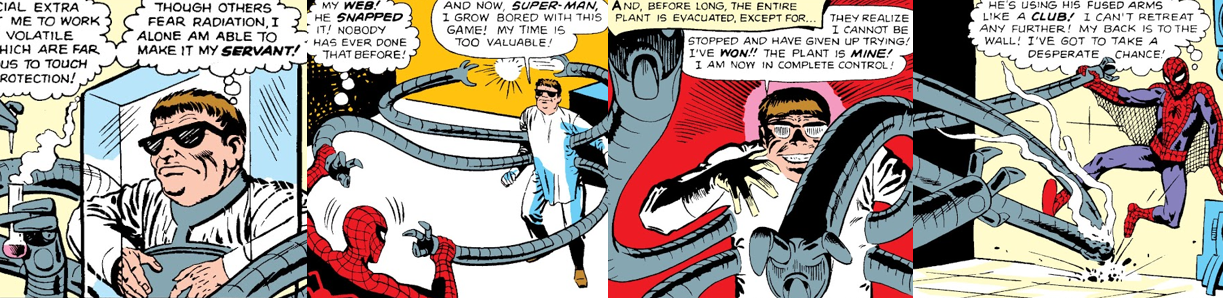
Doc Ock’s mechanical arms allow him to manhandle Spider-Man and seize a nuclear facility.

However, tragedy strikes the workaholic scientist when the facility randomly explodes, leaving him not only permanently brain damaged (though we have no basis for comparison between this pre-accident personality and his post-accident one as they both seem very similar) but also fuses his mechanical arms to his body from the “radiation”. When Otto awakens, he’s eager to return to his work and, when the doctors insist that he lay down and rest, assumes that they’re jealous of him and actively keeping him from his research. His desire to escape is realised by his arms, which now obey his mental commands rather than being manually operated, and he basks in his newfound physical abilities. Naturally, cantankerous Daily Bugle editor, J. Jonah Jameson, wants pictures of the injured scientist yesterday so budding freelance photographer Peter Parker heads off to get the photos no-one can as Spider-Man. However, when he crawls his way up to Otto’s room, he’s stunned to see that the scientist, now embracing his nickname of Dr. Octopus, has gone mad with power and taken a few hostages so he can whip up some experiments. Spider-Man swings in to save the day, but Doc Ock is unimpressed by his quips and spider strength and even gives the web-head the shock of his life when he snaps his webbing, overwhelms him with his many arms (bitch slapping him in the process) and tosses him from the room like he was nothing. The shock of suffering his first real, unequivocal defeat runs deep for Peter, who suffers a crisis of confidence that leaves him powerless to stop Doc Ock from returning to the atomic research centre and easily taking command of the “brain centre”, granting him untold (if vague) power.

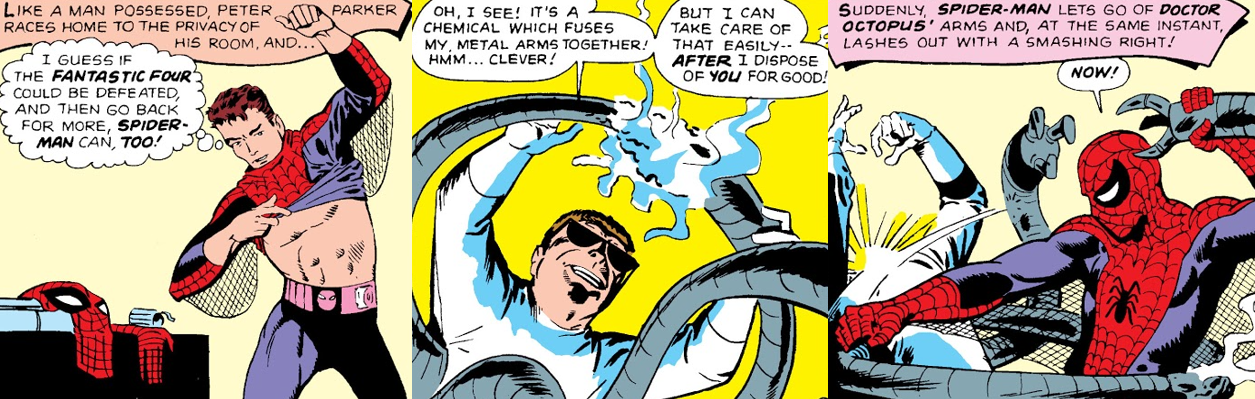
Peter bounces back from his defeat to out-think and defeat his multi-armed new foe.

To demonstrate his superiority, Doctor Octopus destroys part of the facility and rebuilds it to his specifications, setting up electronic barriers and barricades to create an impenetrable fortress; though it’s unclear what his ultimate goal is, it’s enough to put the wind up “the foremost brains of the nation’s armed forces”. Stuck in a deep depression, Peter feels lost and helpless, sleepwalking his way through school and envious of Johnny Storm/The Human Torch’s powers and confidence. However, Johnny’s address to the school makes Peter realise that defeat is inevitable and that the key is to never give up, which Peter takes to heart and finds his passion once more. Ready and raring for round two, Spidey easily infiltrates Doc Ock’s fortress, dodging his many traps and hazards thanks to his superhuman reflexes and spider sense, and dodging the mad scientist’s electronic eyes long enough to use his brains not brawn to whip his own scientific solution to his multi-armed foe. Confident of his unmatched power, Doc Ock opts to attack Spider-Man directly and is impressed when the web-slinger disables two of his arms with a chemical concoction that fuses them together. However, Doc Ock remains a deadly threat thanks to his flailing arms and surprising speed so, rather than trying to fight them off or fight through them, Spidey allows himself to be lured closer to his foe and relies on his superhuman strength and durability to withstand Doc Ock’s assault and lay him out with a single, well-timed knockout punch. Relieved to have ended the threat, Spidey takes no chances and thoroughly webs the dangerous madman up for the military police to find, then drops by Johnny Storm’s hotel room to thank him for his help, leaving the flaming teenager baffled since he has no idea what Spidey’s talking about.

The Summary:
Interestingly enough, “Spider-Man Versus Doctor Octopus” was actually the first Spider-Man story I ever read as a kid (or, at least, it’s the one I have any memory of reading first) and, as a result I grew up perceiving Doctor Octopus, rather than the likes of Norman Osborn/The Green Goblin, as Spider-Man’s greatest nemesis. Revisiting the story now, I’m actually surprised at how enjoyable it is; Marvel Comics from the sixties can be a bit hit and miss, bogged down by dated dialogue and traditions or full of bizarre and off-putting artwork, but “Spider-Man Versus Doctor Octopus” is actually a pretty simple and effective story that shows Spidey dealing with the shock of being so handily defeated. Though often a conflicted and heavily burdened character beneath the mask, one of Spider-Man’s greatest assets has always been his unmatched physical confidence and love of aggravating his opponents with quips and jokes so to see him overpowered, smacked about like he was nothing, and cast aside like a mere annoyance was pretty startling at the time. It’s no surprise that Peter takes the defeat to heart, and he even contemplates ending his superhero career since his confidence has been shaken so badly, and it’s only through a conveniently relatable speech from fellow superhero the Human Torch that he’s able to find the motivation to suit back up for the rematch. I also enjoyed that his solution was to use his own scientific acumen as much as his incredible spider strength to best his new foe as it’s always cathartic when the very thing his peers mock him for contributes to him defeating a supervillain.

Doc Ock’s goals may be vague, but his intelligence is more than a match for Spider-Man!

Of course, the standout of the story is Doc Ock himself and much of the story revolves around him and his mad ambitions for power. We don’t really learn anything about Doc Ock except that he’s a genius scientific mind and the accident has driven him to the point of obsessive madness; we never get a sense of who he is before the accident to compare with how it affects his mind and it’s not made clear what his endgame is in taking over the atomic research centre beyond the ambiguous threat of him having access to the strange and dangerous power of nuclear energy and radiation which was rampant in comics at the time. Radiation is such a mysterious and powerful element that it not only granted Spider-Man his powers, but also fused the mechanical arms to Otto’s body and drove him mad with the physical abilities they afford him; responding to his mental commands, the arms can extend, allow him to clamber up walls, easily manhandle his foes, and allow him to perform multiple tasks at once through sheer force of will. The arms are so versatile, dexterous, and powerful that they can even hold back Spider-Man’s superhuman strength, strike fast enough to test even his vaulted spider sense, and can break his webbing with ease. However, behind the arms, Doc Ock is simply a man; one filled with a burning desire for power and determined to prove his superiority by any means, but a man nonetheless, and nowhere is this more evident than in the ease at which Spidey punches him out once he gets close enough. Consequently, Doc Ock is a supervillain who relies on his genius, fractured intellect and his formidable arms rather than having an inherent superhuman durability, which contrasts his daunting threat with an emotional and physical vulnerability to create a villain who is visually interesting and fully capable of out-thinking and out-fighting Spider-Man.

My Rating:

Rating: 4 out of 5.

Great Stuff

What are your thoughts on Doctor Octopus’s first appearance? Were you a fan of the villain and his unique powers or did you find him to be a bit shallow and ridiculous? What did you think to Spidey’s defeat and crisis of confidence and his solution to besting Doc Ock? Were you a fan of the Human Torch’s cameo or did you think it was a bit forced? What are some of your favourite Doc Ock stories and moments? How are you celebrating Spider-Man Day today? Whatever your thoughts on Spider-Man and Doctor Octopus, leave them below and be sure to stick around for more Spider-Man content!

Back Issues: Secret Invasion

Published: June 2008 to January 2009
Writer: Brian Michael Bendis
Artists: Leinil Francis Yu

The Background:
In January 1962, legendary duo Stan Lee and Jack Kirby introduced Marvel Comics readers to the Skrulls, a race of warmongering shape-shifters who have long hounded Marvel’s heroes, particularly the Fantastic Four, by assuming their identities and powers. Experimented on by the all-mighty Celestials and launching aggressive campaigns against both the Earth and their hated enemies, the Kree, the Skrulls have been at the forefront of numerous Marvel stories over the years in addition to featuring as villains in various videogames and animated ventures before making their live-action debut, in a decidedly different manner, in Captain Marvel (Boden, 2019). Perhaps one of their most prominent storylines was the Secret Invasion arc that ran through these eight issues and multiple tie-ins and spin-offs; the brainchild of writer Brian Michael Bendis, Secret Invasion had not only been hinted at for some time and was heavily advertised as a means of changed up the perception of legacy Marvel characters and even return some to mainstream publication. Reviews of the storyline were mixed, with some noting that it was an anti-climatic Marvel event and others praising the marketing and artwork while criticising the religious undertones and spotty dialogue. Still, an adaptation of the story made its way into the Avengers: Earth’s Mightiest Heroes cartoon (2010 to 2012) and it also formed the basis of a six-episode, live-action series of the same name on Disney+.

The Review:
This eight-issue event series begins “years ago” after the destruction of the Skrull throneworld, a cataclysmic, prophesied event that leads the few survivors back to their queen, Veranke, who kicks the story’s narrative in motion by seeding Skrull agents throughout our world. It took years for this to be uncovered, and it was revealed in dramatic fashion when it turned out that the resurrected assassin Elektra Natchios was a Skrull in disguise, a revelation that alerted Tony Stark/Iron Man (then the conceited and self-righteous director of the Strategic Hazard Intervention Espionage Logistics Directorate (S.H.I.E.L.D.) following the game-changing events of Civil War (Millar, et al, 2006 to 2007)) to the depths of the Skrull’s infiltration. Recognising that even his armour’s sensors can’t be trusted to identity friend from foe, Stark drafts in his allies – Doctor Reed Richards/Mister Fantastic and Doctor Henry “Hank” Pym/Yellowjacket – to perform an autopsy in an attempt to figure out how the Skrull was able to remain completely undetected to technology, magic, and Mutant probing. Conveniently enough, a Skrull ship chooses this exact moment to come crashing into Earth’s atmosphere and make landfall in the Savage Land, taking Iron Man away from the operating room so he can investigate. Concerned that this could be the full-scale invasion they fear, Jessica Drew/Spider-Woman calls in the renegade “New” Avengers (those who refused to sign up to the ludicrous Superhero Registration Act in Civil War), which leads to Luke Cage/Power Man, Peter Parker/Spider-Man, James “Logan” Howlett/Wolverine, Danny Rand/Iron Fist, Clint Barton/Ronin, and Maya Lopez/Echo subduing Black Widow/Natasha Romanova and stealing her Quinjet to beat Iron Man and his government-sanction Mighty Avengers – Iron Man, Spider-Woman, Black Widow, Carol Danvers/Ms. Marvel, Janet van Dyne/The Wasp, Ares, Simon Williams/Wonder Man, and Robert “Bob” Reynolds/The Sentry – to the crash site. Both sets of Avengers are aware of the potential Skrull threat, which drives an even greater wedge between them as not only are the Secret Avengers being actively hunted by their former comrades, but they can’t even trust each other to be who they say they are.

While the Skrulls cripple Earth’s defenses, the fractured Avengers battle their classic counterparts.

After being brought down by one of the Savage Land’s rampaging dinosaurs, the New Avengers prepare to open up the crashed ship, but they’re intercepted by the Mighty Avengers, with Iron Man immediately trying to arrest them and Luke Cage obviously telling him and his jumped-up thugs to go kick rocks. Iron Man’s attempt to keep the rogue superheroes from overstepping the mark are scuppered when Timothy “Dum Dum” Dugan and his trusted butler, Edwin Jarvis, unexpectedly sabotage not only the orbiting the Sentient World Observation and Response Department’s (S.W.O.R.D.) satellite base but also Stark’s armour and S.H.I.E.L.D.’s Helicarriers and bases, effectively disabling the armoured Avenger and crippling the superhero community’s resources and communications. Additionally, maximum security prisons the Raft and the Cube are suddenly hit by mass breakouts and Mar-Vell/Captain Marvel and Susan Storm/Invisible Woman disable the villainous Thunderbolts and the rest of the Fantastic Four, with each of these supposed heroes flashing ominous eyes and assuring their victims that “He loves [them]”. Meanwhile, a Skrull armada bares down on Earth and Mr. Fantastic finds himself reduced to an elasticated mess right as he figures out the key behind the Skrull’s newfound undetectability, the victim of a shot from Pym, who’s revealed to also be the Skrull Citri Noll! Momentarily setting aside their differences to get Tony Stark to aid, the two Avengers groups are startled when a slew of classic-styled, currently deceased or long-changed superheroes emerge from the Skrull ship; Captain Steve Rogers/Captain America, the Vision, Thor Odinson, Doctor Jean Grey/Phoenix, Doctor Henry “Hank” McCoy/The Beast, Wanda Maximoff/Scarlet Witch, Jessica Jones/Jewel, Emma Frost/The White Queen, and Barbara “Bobbi” Morse/Mockingbird appear alongside classic versions of Spider-Man, Power Man, Wonder Man, Iron Man, Hawkeye, Ms. Marvel, Wolverine, and the Invisible Woman. Naturally, a tense showdown ensues in which both groups assume the other are Skrulls in disguise; guys like Wolverine, Spider-Man, Emma Frost, and the Vision struggle to get any kind of reading on their counterparts beyond sensing their distrust while Ronin is stunned to see his former flame, Mockingbird, alive and well but, despite Ares trying to convince his allies that it’s a trap, tensions boil over and an all-out brawl kicks off!

As more characters enter the fray, internal distrust is as rife as the escalating war with the Skrulls.

With Stark in agony from the alien virus that’s crippled his armour, Ms. Marvel flies him to safety as the others duke it out; the two Spider-Men trade quips and punches, the Vision uses the Sentry’s fear of his destructive and malevolent alter ego, the Void, to disable his God-like power, and Ronin steals his counterpart’s weapons to subdue their attackers but the arrival of a raging Tyrannosaurus rex disrupts the fracas. Trampled to death by the dinosaur, the classic Spider-Man and Hawkeye are revealed to be Skrulls, and Wolverine intuits that the Skrulls are setting them against each other to wipe out any resistance to their invasion plan. However, when he tries to eviscerate Mockingbird, Ronin intervenes and questions her; she’s adamant that she’s not a Skrull and even reveals personal information that only she and Clint would know, which is enough to convince him to trust her. This offers Luke Cage the hope that the Cap and Iron Man aboard the ship are the real deal, which would certainly explain Stark’s recent manic behaviour and allow the recently deceased Cap to still be alive, but Wolverine’s far from convinced. Meanwhile, back in New York City, a portal opens up and a whole slew of Avengers-inspired Super-Skrulls attack; there’s Skrulls combining the powers of various X-Men, a Fantastic Four Super-Skrull, one that’s a mixture of Spider-Man villains, and even an Illuminati hybrid, meaning the Young Avengers – Eli Bradley/Patriot, Dorrek VIII/Hulkling, Billy Kaplan/Wiccan, Tommy Shepherd/Speed, Kate Bishop/Hawkeye, and their mentor, the Vision – are completely overwhelmed despite Hulkling’s efforts to talk down their attackers with his royal status. Thankfully, they receive some back-up in the timely arrival of fledgling superheroes, the Initiative – Joseph Green/Gauntlet, Rachel Leighton/Diamondback, Cassandra “Cassie” Lang/Stature, David Alleyne/Prodigy, Anthony Masters/Taskmaster, Geldoff/Proton, Z’Reg/Crusader, Jimmy Santini/Batwing, Fahnbullah Eddy/Gorilla Girl, Wallace Jackson/Red 9, Delilah Dearborn/Geiger, Melee, Andrea Roarke/Sunstreak, and Alexander Ellis/Annex. Though the Skrull forces prove ruthlessly formidable, and the Vision is lost in the battle, even more help arrives when the Secret Warriors – Colonel Nick Fury, Yo-Yo Rodriguez/Slingshot, Daisy Johnson/Quake, Alexander Aaron/Phobos, J.T. Slade/Hellfire, Jerry Sledge/Stonewall, and Sebastian Druid/Druid – add yet more names and the bodies to the chaotic artwork and conflict.

Heroes and villains set aside their differences to take the fight to the invading Skrull army.

The Skrull threat is doubled thanks to the distrust between the world’s heroes, with even Nick Fury abandoning Ms. Marvel because of her alien DNA. Meanwhile, as a weakened Stark desperately attempts to repair his armour, Spider-Woman reveals herself to be the Skrull Queen, Veranke, and tries to convince him that he’s a Skrull agent so deep undercover that he’s forgotten his true nature. Before her poison (both literal and figurative) can take hold, Black Widow causes her to flee and Stark reveals that the key to victory lies with Mr. Fantastic, who’s currently being tortured aboard a Skull ship. Thankfully, S.W.O.R.D. director Abigail Brand bluffs her way onto the ship and flushes the Skrull into space to rescue him; Reed then fashions a device that exposes the Skrulls’ real forms, arriving just in time to stop another conflict in the Savage Land and revealing not only that the classic Emma Frost, Invisible Woman, Thor, Ms. Marvel, and Jessica Jones are Skrulls but that Mockingbird is as well, enraging Clint. The real Thor transports everyone to New York for a final confrontation, which even the Watcher, Uatu, shows up to observe and also sees Parker Robbins/The Hood’s criminal syndicate and Doctor Norman Osborn’s Thunderbolts pitch in with the nearly-incomprehensible brawl. While Mr. Fantastic and Iron Man try to take out Veranke (still disguised as Spider-Woman) to demoralise the Skrulls, the Wasp targets Citri Noll, who apes Pym’s Giant-Man form, though it’s Stature and the assassin Bullseye who end up taking him out. Iron Man is forced to withdraw so he can sort out his messed-up armour, Fury’s forces save Mr. Fantastic from being torn apart by multiple Skrulls posing as the Invisible Woman, the real Jessica Jones joins the fray, and Kate Bishop ends up gravely injured amidst the chaos. Although Wolverine tries to take out Veranke, the bio-electrical powers she stole from Spider-Woman keep him at bay, meaning it’s an arrow through the face courtesy of the vengeful Ronin that ultimately subdues her.

Although the Skrulls are defeated, the general distrust in Stark allows Osborn to seize power!

With Veranke compromised, Citri Noll activates a device that causes Janet to enlarge uncontrollably and unleash a chemical agent designed to kill humanity and Skrulls alike. With no other choice available, Thor whips up a hurricane with his magical hammer, one so powerful that is destroys the enlarged Janet and dissipates the weird black spots that threaten everyone’s lives. Although Wolverine seeks to make Veranke pay for Janet’s death, it’s Norman Osborn who gets the kill shot, then Iron Man finally gets his shit together and leads an all-out assault on the remaining Skrull ships, with the now disillusioned and leaderless armada being easy pickings. Iron Man also frees everyone the Skrulls impersonated since the shape-shifters conveniently needed the original versions alive in order to make the deception more convincing, meaning Elektra and Mockingbird return to “life”, Reed is finally reunited with his family, and the true versions of the likes of Spider-Woman re-join society. Unfortunately, this also means that Jessica Jones left her and Luke’s baby, Danielle Cage, in the care of the Skrull-Jarvis, a plot thread left unresolved in this story. Although recent tensions are eased in the aftermath and ensuing celebration, there’s an unshakable sense of hesitation given how long the Skrulls had been a part of Earth’s society and superhero community; Thor also condemns Stark’s recent actions and refuses to associate with him. Thanks to having publicly executed Veranke, Osborn is able to manipulate the President of the United States into equally losing faith in Stark, his methods, and his technology; the President thus ousts Stark as director of S.H.I.E.L.D. and names Osborn as the new overseer of any and all superhuman and defensive measures under a new organisation, H.A.M.M.E.R., unaware that this is exactly the opportunity the scheming madman and his Cabal of allies (Emma Frost, Doctor Victor Von Doom/Dr. Doom, The Hood, Prince Namor McKenzie/The Sub-Mariner, and Lady Loki) were waiting for.

The Summary:
Now, I am by no means an expert on the Skrulls; I know of them, primarily as an antagonistic, shape-shifting race of aliens who are almost constantly at war with the Kree and getting into scuffles with the Fantastic Four, but they’re generally on the periphery of most Marvel stories I’ve read. Secret Invasion is probably, to date, their most prominent story, at least in my experience, and it definitely adds some nuance to them that I didn’t expect. Normally, I see them as a warmongering race who live to conquer through both subterfuge and force but, here, they’re motivated by a fanatical devotion to their God (the “He” they keep referring to) and their invasion is seen almost as divine intervention. The Skrulls swamp television screens with their pseudo-religious propaganda, hijacking every telecommunications device across the globe and assuming the guise of various political figures, celebrities, and superpowered monarchs like Erik Lehnsherr/Magneto and Dr. Doom, and insist that they’re there to bring glory to our world and that their might cannot be opposed. Given the strength of their invasion and that their Super-Skrulls have mimicked the combined powers of many of Marvel’s heroes, it’s perhaps not surprising that Marvel’s ridiculously fickle citizens embrace their alien overlords, though this scene showcases that the Skrulls aren’t simply defending themselves or there to usher in a new age for mankind as they claim and are hell-bent on conquering the planet.

Having lost everything, the Skrulls throw themselves at Earth with fanatical desperation.

This campaign is spearheaded by their queen, Veranke, a figure of worship for the Skrulls and who has placed herself on the frontline, earning the trust of Tony Stark by posing as Spider-Woman and becoming privy to many of Earth’s defences. Stark even reflects on his role in the invasion and the shame he feels about not recognising the threat sooner in a show of guilt that was somewhat uncharacteristic of him at this time; this is a man who was so blinded by his belief that superhumans needed to register with the government that he actively fought and imprisoned his fellow heroes and abandoned many of them, and his morals, in favour of an uncompromising, borderline fascist mentality that only led to further conflict and resentment Indeed, Veranke revels in the irony of having twisted Earth’s technology and heroes towards her agenda, something she was easily able to do thanks to Stark being so dead-set about forcing or punishing his peers to register their true identities and powers. However, as much as Veranke likes to preach that hers is a Holy mission, she’s actually equally motivated out of revenge, specifically against Mr. Fantastic and the Fantastic Four after they tricked a contingent of Skrulls into believing they were cows decades prior. Since the Skrull home world has been lost and their once-prosperous empire lies in ruins, the Skrulls follow her without question and throw everything they have at Earth; they’re even willing to give their lives in the process, and in a last-ditch effort of mutually assured destruction, only to be defeated and left dejected. Veranke’s death leaves the Skrulls directionless and all their once-formidable might is as nothing; those that survive are left demoralised as they saw this as their last chance at survival and glory. Thus, Veranke’s quest for vengeance and conquest leaves her people devastated and more worse off than ever as a sizable portion of their armada is destroyed and the last thing they had in all the universe, their faith, is also shattered by their defeat.

The Skrulls are so deeply entrenched that the already frayed heroes are strained to breaking point.

I’m generally not a fan of imposter storylines; it’s a tired cliché and one that quickly outstays its welcome, but it actually works quite well in Secret Invasion. Many of the Skrulls seem to be completely unaware of their true nature; the Mockingbird-Skrull believes that she’s the real deal right up until the end and is begging Clint to listen to her even as he attacks her in a rage. This is also true of Captain Marvel, who believed so strongly that he was the deceased former hero that he couldn’t bring himself to kill and was convinced by Norman Osborn, of all people, to turn on his race; he even died begging the Kree warrior Noh-Varr/Marvel Boy to carry on the fight in his stead, so complete was his conditioning. It’s not revealed exactly how the Skrulls have the memories they do but it’s one of the big reasons why so many of them went undetected; however, many of the Skrulls posing as classic Avengers continued to believe they were the real deal after their true nature was revealed rather than immediately attacking the heroes in service of their God, which definitely paints much of this conflict in a morally grey area. The Skrulls pick the perfect time to strike the Earth; its heroes are divided and at war with each other and easy to manipulate, and seeing the return of dead heroes like Captain America, Mockingbird, and Captain Marvel, as well as the original version of Iron Man, only fuelled the flames of conflict between them thanks to Stark’s actions during Civil War leading to many deaths, including Captain America’s. It would’ve been so easy to explain away Stark’s recent actions as being the work of the Skrulls but, interestingly, that doesn’t turn out to be the case and, similarly, Cap’s death isn’t immediately undone with the presence of his classic counterpart. Instead, we’re left with a world where Stark is still shouldering the burden of his actions and where Cap’s mantle has been taken up by his friend, James Buchanan “Bucky” Barnes; there are no quick-fixes in this story to explain away the events of Civil War and there isn’t really a sense that bridges have been mended by the end of it as distrust is still rife and the status quo remains unchanged.

A decent story with some interesting wrinkles but a bit overstuffed and manic at times.

Ultimately, I quite enjoyed this story; it’s hard to read as an eight-issue standalone as you need some knowledge of prior Marvel events, especially Civil War, and it’s clear that there’s a lot of additional story and conflict in supplementary collections and books, but the narrative works just as well if you only read these eight issues. I enjoyed seeing the Mighty and New Avengers be forced to set aside their differences when faced with their classic counterparts and the reveals of which characters were Skrulls, even if none of the major players were aliens in disguise. The quasi-religious bent to the Skrull invasion was an interesting twist, as was them siphoning and combining the powers of Marvel heroes into an army of Super-Skrulls, and the art was pretty consistent and easy to follow throughout. Unfortunately, the biggest issue I had with Secret Invasion was the sheer number of characters jammed into it; it was hard to keep track of it all at times and it’s obvious that teams like the Young Avengers, Thunderbolts, and Secret Warriors all had bigger parts to play in spin-off stories, but I think they could’ve been downplayed a little here. There’s a Skrull-Galactus with absolutely no context or consequence to the story and even Uatu shows up, which is generally a short-hand to indicate that the events are of cosmic importance but, again, it doesn’t actually factor into the story in a meaningful way. Stark spends most of the arc out of action thanks to the Skrull virus messing up his armour, which is great for leaving him vulnerable and in pain and unable to participate in the wider conflict but then he just shows up in an older armour with a throwaway line for the finale. Similarly, Thor just pops in out of nowhere, formally prominent characters like Wolverine and Spider-Man get lost in the shuffle, and late appearances from Jessica Jones and Norman Osborn are simply there to set up the next big Marvel events and stories. Overall, it was pretty enjoyable and not as much of a mess as some Marvel events, but the action got a little too chaotic at times and there were too many characters wedged into these issues, which I think would’ve been far stronger if they’d focused on, say, eight or ten main characters and then just showcased the others in supplementary materials.

My Rating:

Rating: 3 out of 5.

Pretty Good

Did you enjoy Secret Invasion? Were you shocked to find out which characters were Skrulls in disguise? Were you hoping that some of the classic Avengers would turn out to be the real heroes? Which of the teams featured was your favourite? Did you think there were too many teams and characters in the story and which of the spin-off books did you enjoy? What did you think to Veranke, the pseudo-religious slant to the Skrulls, and the Skrull invasion? Were you also frustrated by Tony Stark’s characterisation during this time, or did you enjoy seeing Marvel’s heroes in dispute? What are some of your favourite Skrull-centric stories? Whatever your thoughts on Secret Invasion, feel free to share them below or leave your thoughts on my social media.

Back Issues: Fantastic Four #45-47

Writer: Stan Lee – Artist: Jack Kirby

Story Title: “Among Us Hide… The Inhumans”
Published:
9 September 1965 (cover-dated December 1965)

Story Title: “Those Who Would Destroy Us”
Published:
12 October 1965 (cover-dated January 1966)

Story Title: “Beware the Hidden Land!”
Published:
11 November 1965 (cover dated February 1966)

The Background:
In 1961, Stan Lee and Jack Kirby came together to introduce comics readers to the Fantastic Four, a dysfunctional family of superheroes created as a direct response to DC Comics’ Justice League of America. While the exact circumstances behind the team’s creation has been contest by both creators, Lee and Kirby’s partnership not only popularised the “Marvel Method” of writer/artist collaboration but also impressed readers with their characters’ real and relatable humanity, essentially birthing Marvel Comics as we know it today. Over the years, numerous characters and concepts that would be pivotal to Marvel Comics would debut in the pages of Fantastic Four, and one of the most contentious of these were the Inhumans. Debuting a couple of years after Lee and Kirby’s similar concept, the X-Men, the Inhumans were first introduced as antagonists to Marvel’s First Family before being expanded to include an entire race of superpowered beings under the lordship of the Inhuman Royal Family. The result of Kree experimentation, the Inhumans were granted their incredible powers and often monstrous appearances by a substance dubbed “Terrigan Mist” and took the dysfunctional family dynamic and unsettlingly aesthetic of both the X-Men and Benjamin Grimm/The Thing and dialled it up to eleven for their colourful and wacky cast of characters. Following their three-issue debut story, the Inhumans graduated to a short-lived solo title and have gone on to be prominent fixtures in Marvel Comics. Their leader, Blackagar Boltagon/Black Bolt, has served on the omniscient supergroup the Illuminati, an Inhuman girl was involved in an ongoing romance with Johnny Storm/The Human Torch, and the species has been at the core of numerous domestic and cosmic wars against both humans, fellow superheroes, and themselves. Perhaps their most infamous legacy, however, comes from that time when Marvel actively tried to downplay the X-Men in favour of the Inhumans, a plan that ultimately backfired when their foray into live-action proved to be a rare misfire for Marvel Studios.

The Review:
Our three-issue saga begins with Marvel’s First Family in a spot of bother; a gigantic android gargoyle known as Dragon Man has kidnapped Susan Storm/The Invisible Girl and allowed the mysterious Tomi Shishido/Gorgon to take off with Medusalith Amaquelin/Medusa, a founding member of the Fantastic Four’s evil counterparts, the Frightful Four. In the fracas, Gorgon caused Doctor Reed Richards/Mister Fantastic and the Thing to be buried beneath the stone rubble of an entire building; however, thanks to Mr. Fantastic’s incredible (and unnerving) elasticity and the presence of the Human Torch, all three are carried to safety and given the precious moments needed to gather their wits and catch their breath after the devastating attack. Reed doesn’t waste any time and sends Johnny ahead to search for Sue and he quickly locates her being carried away by the gruesome gargoyle. Although his flaming projectiles have no effect on the beast, a burst of white-hot nova light temporarily blinds Dragon Man but, before the Human Torch can go to town on the creature, Sue talks him down and demonstrates her ability to tame Dragon Man by talking to him as she would a child, and thus the team are reunited without issue.

After taming Dragon Man, Johnny is besotted by the mysterious Crystal and led to a hidden sanctuary.

Well, not entirely. While Medusa’s Frightful Four cohorts wallow in prison, a restless Johnny hits the streets after his current flame, Dorrie Evans, turns him down. There, he just happens upon a gorgeous redhead and is instantly smitten; however, when he attempts to approach her, a gale-force wind knocks him flying, which only further arouses his…well, let’s just go with “curiosity”. The next day, as the team begin shuffling around their gigantic (and nonsensical) Kirby-machines and equipment to make room for Dragon Man, Johnny is too distracted by thoughts of the redhead to offer any assistance, which earns him an ear-bashing from Sue and Ben that riles the lovelorn youth so much that he heads out to the streets once more. Hanging around near where he saw the girl like an absolute creep, he pursues her relentlessly, even as piles of wood explode into flames to stop him and despite her begging to be left alone lest “they” learn she was seen. However, when she sees his ability to control and burst into flames, she assumes that he’s “of us” and immediately stops running to chat, share her name (Crystal), and strike up a friendship. Naturally, Johnny plays along just to get close to her, but even he’s astounded when she introduces him to her friend, a gigantic slobbering dog called Lockjaw who not only loyally follows her everywhere but opens a set of massive hidden doors using a “force ray” from his antennae. Eager to introduce Johnny to her “family”, Crystal leads him into an elaborate sanctuary built for her and her race by the mysterious Black Bolt. Along the way, Johnny is introduced to the deftly powerful Karnak Mander-Azur, who’s strong enough to shatter a block of marble with one karate chop and swift enough to toss any assailant before they can move.

The team race to Johnny’s aid and are tossed about by the powerful Black Bolt!
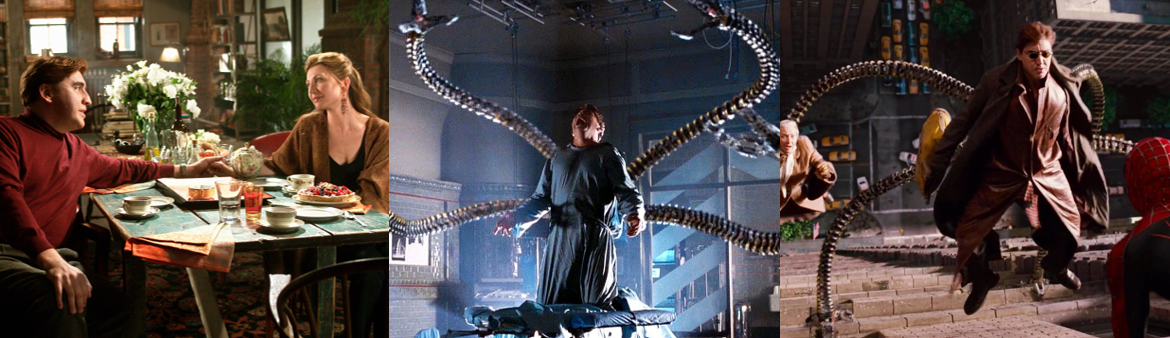
Although Johnny’s impressed, his awe and confusion soon turn to horror when he spots Gorgon and Medusa amongst the other strangers, whom he correctly assumes are a race of super-powered beings. Despite Medusa (revealed in the chaos to be Crystal’s sister) pleading with her peers to spare Johnny from harm, Gorgon knocks him from his feet with one stomp of his foot and the lizard-like Triton conjures a glass wall to trap him and then attempts to douse his body with water. Acting swiftly, Johnny bursts into flame and manages to escape through the unprotected ceiling, signalling his teammates with a flaming 4 in the sky and interrupting their efforts to calm down the raging Dragon Man with a tranquiliser gun. Spotting the alert, Reed, Sue, and Ben leap into action using a bizarre flying motorcycle seemingly cobbled together from pipes! This “Airjet-Cycle” may not be much compared to the Fantasti-Car but it’s fast enough to carry them to Johnny’s location, where he warns them of the strange “Inhumans” protecting Medusa. The four venture ahead, unaware of their foes watching them from above; thankfully, the Thing’s strength is enough to repel Karnak’s projectile but the four are stunned when the Inhumans’ enigmatic and much-revered leader, Black Bolt, bursts onto the scene. Black Bolt immediately asserts himself by staggering the hardy Thing with one blow and proving fast enough to sidestep Johnny’s attack thanks to the wing-like appendages under his arms. Though he braces for Black Bolt’s next blow, the Thing learns that their foe is as skilled as he is powerful as he’s able to throw even his rock-hard weight without issue.

The threat of the Seeker drives the Inhumans to fight with all their might.

Reed, Sue, and Ben regroup, and two things come to light: one is that Black Bolt hasn’t uttered a single word since he arrived and the other is Reed’s suggestion that he’s drawing power from the strange tuning fork-like antenna on his forehead. Whilst searching for Johnny, Reed is pounced upon by Triton; the scaly-man-monster’s attempts to keep the Inhumans hidden are foiled, however, when Reed discovers that Triton’s suit is actually a special moisture bag that allows him to survive outside of water. With his water supply ruptured, Triton panics, lashes out, and desperately stumbles into the nearby water to keep himself from suffocating. Karnak launches a counterattack but, when his well-trained blows are repelled by Sue’s invisible force field, Gordon sends the two flying into the air with a ground-shaking stomp. While fighting with Reed, Triton lets slip about an enemy of theirs known as “The Seeker”; while Reed and Sue ponder the threat of the Inhumans and the mystery of the Seeker, the story shows that this individual captured Triton from the water and then led an assault on the Baxter Building to get his hands on the unconscious Dragon Man. Armed with his “Universal Control Rod” and commanding a legion of followers, and with a mighty airship at his command, the Seeker is determined to round up any and all Inhumans and orders his men to search the city for more while he heads back to base with his newest prisoners. Meanwhile, back in the city, the Thing presses his attack against Black Bolt, taking his shots and throwing all of his weight behind his blows, but Black Bolt is able to subdue the hot-headed rockman with his “master blow”, a shot that would have spelt death for the Thing were it not for his super tough exterior and Black Bolt running out of energy at the precise moment he was about to land the finishing strike. The sudden reappearance of the teleporting Lockjaw keeps Ben and Johnny from pursuing Black Bolt and Gorgon continues to keep Reed and Sue off balance with his hefty stomps, but the Inhumans abruptly retreat when Crystal brings word that Triton has been captured by the Seeker. Despite Crystal’s desperate attempts to say goodbye to Johnny before they flee, the strange group make a run for it, for without Black Bolt’s might they would be helpless against the Seeker.

The Seeker reveals his motivations and a brief origin for the mysterious Inhumans.

Medusa’s pleas to leave Crystal behind so that she can live a normal life amongst the humans are unheeded and Johnny arrives just in time to see the Inhumans teleported away by Lockjaw’s power; while Johnny’s strong affection for Crystal is weird and has little merit considering he knows basically nothing about her, Reed is determined to uncover the Inhuman riddle and takes the team back to the Baxter Building, where he reviews security footage of the Seeker’s attack and whips up a probe to take after the villain. Speaking of whom, the Seeker is seen gloating before Triton and expositing his desire to imprison his entire race within the “Great Refuge”; he also orders Dragon Man disposed of or released since he’s not an Inhuman and proves more than prepared for the Fantastic Four’s attack, easily trapping them within a bonkers circular device and keeping them under the watchful eye of his guards. The Seeker then regales the Fantastic Four with the origins the Inhuman race; they enjoyed the benefits of a highly advanced technological society while humans still hid in caves and, through the use of impossible advanced genetics, birthed an entire Inhuman species, each with superhuman abilities. However, the Inhumans fled to the Great Refuge when humans evolved the means to persecute them, and the Seeker has been rounding up his fellow Inhumans ever since to keep them from being attacked by humanity. It’s at that moment that Dragon Man comes to and goes on a rampage, swatting aside the Seeker’s guards and rampaging through the city, leaving Triton suffocating outside of his water bubble. Sue’s compassion for the Inhuman wins over Reed, who orders Johnny and Ben to find and subdue Dragon Man while he and Sue tend to Triton; the pressure of worrying about the destruction Dragon Man could cause sees Reed bark orders at his wife, but they’re able to encase him in a forcefield filled with water. The Seeker is impressed, but no less determined to continue his mission as per the orders of “Maximus the Magnificent”. As Ben and Johnny tangle with Dragon Man, they just so happen to crash through the wall of Alicia Masters’ apartment; Ben endures incredible punishment in a bid to keep his blind love from being hurt and begs her to flee, but also finds the strength needed to finally stagger Dragon Man and leave him wide open for a barrage of the Human Torch’s ultra-violet rays, which finally subdues the beast.

Though quickly deposed, Maximus remains determined to wipe out the human race.

The Seeker arranges for Triton to be transferred to a new water tank moments before the strain of maintaining her forcefield becomes too much for Sue; however, the Seeker demands the two leave since Inhuman affairs don’t concern them. This is the second time Reed admonishes Sue for “sounding like a wife” and yet the Seeker’s logic is infallible: his orders come from the Inhuman ruler and the Fantastic Four have no legal right to interfere, so Reed reluctantly leaves but not before planting a homing device on the Seeker’s ship and remaining so determined to track the Seeker to the Great Refuge that he coldly ignores Sue’s pleas. Black Bolt and the others materialise in the Great Refuge; it seems Johnny’s not the only one who’s ridiculously in love as Crystal cannot stop banging on about the Human Torch despite the fact that they’re all facing the wrath of their ruler, Maximus. Speaking of whom, the garishly attired Maximus offers nothing but anger and reprisals for the group and orders his “Alpha Primitives” to be set upon them while he prepares to use his “Alpha Weapon” to conquer the human race, even though this will surely mean the death of Black Bolt, his own brother! The savage, ape-like Alpha Primitives attack and, in an effort to protect his people and his beloved (if clueless) Medusa, Black Bolt doesn’t hesitate to tackle them head-on. However, even his mighty power cannot hope to fend all off all of Maximus’s greatest assassins but, luckily, the other Inhumans realise that they also have superpowers and can help out as well; although Gorgon cannot use his mighty stomp without fear of hurting his friends, Medusa’s flailing locks and Karnak’s uncanny ability to hit the weak spot of any target are enough to push back the swarming enemies. Maximus then enters the fray, commanding a stop to the violence and feigning friendliness and claiming to have ruled with honour since assuming the crown in Black Bolt’s place. While there’s some question about whether the incident which cost Black Bolt his voice (and the crown) was accidental or not, Medusa is duty-bound to marry her king but the sight of seeing her in his brother’s arms proves too much for Black Bolt to bare and he suddenly yanks the ornate crown from Maximus’s head and claims it as his own. In Inhuman society, this is apparently enough to officially be declared the ruler; even if it wasn’t, Maximus is wily enough to realise that his cunning is little compared to his brother’s power and the support of his allies. Thus, Maximus silently chooses to hang onto his “Atmo-Gun” and bide his time, faking loyalty and admiration for Black Bolt until the time is right for him to strike.

Incensed that Black Bolt may be swayed by the four’s pleas, Maximums activates his machine…

Meanwhile, tensions are high between the Fantastic Four; Sue tries to be the voice of reason and calm everyone down with some hot chocolate but Ben is too worked up over Alicia and Johnny can’t get Crystal out of his head. Feeling spurned by the group, Sue does the only logical thing she can think of; she fusses with her hairdo in a bid to make Reed realise that she’s not “one of the boys” (because marrying her wasn’t enough to prove that…) Their drama is thankfully interrupted when Johnny spots a man flying around outside and Ben is easily able to follow the strange Inhuman and land their aeroplane right on top of the Great Refuge. In the midst of this dangerous and unknown situation, Sue decides to turn herself invisible and damn near cause the three to go into full-blown panic stations just to show off her new hairdo, proving herself to be the same scatter-brained bimbo she always was at this time! While the group struggle with their issues and the dangerous terrain, Maximus continues to play coy with his fellow Inhumans over his intentions and yet he cannot deny his desire to rule over the inferior humans. Spotting the four’s troubles outside, Crystal rushes into the arms of her beloved, but the two groups soon threaten to come to blows when Black Bolt intercepts them. Reed demands a parlay and, through Medusa, Black Bolt decrees that the Fantastic Four may leave without quarrel providing they never reveal the location of the Great Refuge, while Reed counters with the belief that the Inhumans have hidden away for no reason for far too long and could make a home for themselves amongst humankind. While the tensions and the debate rages, Maximus storms into the city, enraged at the very idea of Black Bolt being swayed into thinking the humans aren’t a threat, and casually activates his Atmo-Gun against even the Seeker’s advice! Although the Atmo-Gun sends out vibrations across the Earths atmosphere that will spell the destruction of humanity, the exact nature and extent of its threat is left ambiguous for now as the Fantastic Four face an even greater and more present threat to the world starting from the next issue

The Summary:
I haven’t really had much experience of the Inhumans, if at all; I would even go as far as to say that this is the first story I’ve read where they’re a major part of the plot, so I wasn’t really sure what to expect from the Inhumans saga. The story goes to great lengths to explain how the race are different from Mutants; they were explicitly created through science and genetic-engineering for one thing, and their powers are even more wild, for the most part, but principally the difference is that fact that they’re so isolated and mysterious. Mutants like the X-Men are all over the place, prancing around in colourful costumes and showcasing their powers for the world to see and fear, but the Inhumans have been in hiding for centuries and are only now being identified as this new superpowered race (hough in reality they’re about as complex as Mutants, the Kree, and Asgardians thanks to Marvel having a very predictable storytelling methodology during this time). We don’t get to learn too much about the Inhumans, their society, or their way of life but that would all be fleshed out later; we known they live in a monarchy, one based presumably on birthright and where the right to rule can be challenged at any time, and that they have elaborate and advanced weaponry and technology at their disposal, though we don’t really see too much of that here as the story is more focused on their powers.

Each of the Fantastic Four are insufferable and pompous in their own way.

I’m having a hard time working out which of the Fantastic Four I was most annoyed with throughout this story. Reed is a sexist, dismissive, pompous jerk half the time, constantly belittling his wife and enforcing a patriarchal rule in the guise of competent and rational decision-making. He’s all business when they’re out in the field and expects his orders to be obeyed without question; upon encountering the Inhumans, his first thought is to assess and contain any possible threat but, by the end, he’s advocating for them to come out of the shadows and re-join the world despite knowing full well how despicable humanity has treated Mutants (and each other) in the past. The Thing was his same hot-headed, antagonistic self for the most part; he traded barbs with Johnny and delighted in testing his mettle against Karnak and Black Bolt but was thrown off his game the minute that Alicia was put in danger, revealing a vulnerable side to be sure but also just adding to the relationship angst so prevalent throughout this story. Sue was a royal pain in the butt as ever; she’s such a paradox at this time as she constantly fusses and admonishes the others (especially Johnny) and yet yearns to be accepted, trusted, and seen as a valuable member of the team. Indeed, she plays a pivotal role throughout; she’s able to subdue Dragon Man, fends off Gorgon and Karnak’s attacks while Reed is powerless to oppose them, and even saves Triton’s life despite Reed’s constant reprimands. And yet, she craves attention; even amidst a life-or-death situation, she wants Reed to stop and admire or compliment her and she seems just as incapable of setting aside her vanity as he is his scientific curiosity, making for some irritating moments. But the worst of the bunch is easily Johnny; instantly falling in love with Crystal upon first sight, despite him having a girl on the go, he pouts and mopes about and constantly whines about her safety or never being able to see her despite having known her for a day, at most. Even when he learns that she’s an Inhuman, he refuses to acknowledge that she’s anything other than human, showing he really doesn’t get her in the slightest, and yet she’s equally smitten by him simply because…I dunno, he’s cute? Persistent? Can burst into flames? Their romance is one of the most contrived in all of Marvel and really could’ve benefitted from more time, like if Crystal had been a side character for a few issues before this.

It’s fitting that the Inhumans are the most intriguing aspect of this story arc.

Still, the whole point of this story is to introduce Marvel readers to the Inhumans, and, in that regard, it does pretty well. What better way to prove the strength and capability of your new race of superbeings than by having them go toe-to-toe with Marvel’s First Family, and come out on top quite often? Long-time Marvel readers will already be aware of Medusa and Gorgon, whose tendril-like hair and superhuman strength had already been a headache for the Fantastic Four, but they’re joined by some formidable allies in this story. Although Crystal doesn’t demonstrate any superhuman capabilities, meaning she’s always in need of protection, her faithful friend Lockjaw proves to be a key component in teleporting the Inhumans from place to place and entering their hidden sanctuary. The sanctimonious Karnak boasts of being able to pinpoint the weakness of anything, living or otherwise, to strike with precision blows; although he’s not able to pierce Sue’s forcefield, he proves a more challenging adversary than the blunt and inefficient Gorgon. Triton seems like he might be quite powerful, but we never really get to see what he’s capable of since he’s constantly on the verge of suffocating to death, and the same goes for Maximus and the Seeker, who favour subterfuge and technology, respectively (though also in near equal measure). Even in his first appearance, Maximus has much in common with Loki Laufeyson; both covet the throne, seek to rule, have a silver tongue, and rely on minions to do their dirty work, though Maximus is portrayed as being more explicitly unstable since he dares to activate the dreaded Atmo-Gun and is fully willing to wipe out all of humanity. Thankfully, the Inhumans’ greatest asset is their rightful ruler and leader, the stoic Black Bolt; depicted as being fast as lighting and just as powerful, Black Bolt makes an immediate impression with his iconic costume and his ability to battle the ever-lovin’ Thing to a standstill. Although we learn little about him, we see that he is besotted with Medusa, as brave as he powerful, and a noble Inhuman deep down since he’s willing to let the Fantastic Four go at the end. As a showcase for the Inhumans, this arc works quite well; it suffers from a lot of the same handicaps as other Marvel stories, to be sure, but there’s a lot of mystery and unanswered questions raised by the Inhumans and a fair amount of appeal behind the likes of Black Bolt even though the relationship drama really bogs the narrative down.

My Rating:

Rating: 3 out of 5.

Pretty Good

What did you think to the debut of the Inhumans? Were you put off by the relationship drama or is that something you find appealing in the Fantastic Four’s stories? Which of the four team members is your favourite and why? What did you think to the Inhumans, the depiction of their powers and society, and which of the group was your favourite? Can you name some of your favourite Inhumans stories and moments? Whatever you think about the Inhumans or the Fantastic Four, go ahead and let me know by leaving a comment down below or on my social media.

Back Issues: Sgt. Fury and his Howling Commandos #1

Story Title: “Seven Against the Nazis!”
Published: 5 March 1963 (cover-dated May 1963)
Writer: Stan Lee
Artists: Jack Kirby

The Background:
Over its many decades of existence, Marvel Comics has produced some of the most colourful and memorable characters in the entire industry. There was a time, generations ago, when comic books hadn’t quite found the niche they have today, leading to pulp tales, surreal horror-themed publications, and war comics. War tales were bolstered by spandex-clad heroes like Captain Steve Rogers/Captain America, who encouraged readers to buy war bonds and support their fighting troops overseas, leading to quite the booming period in Post-War America. For Marvel Comics, it was the legendary duo of Stan Lee and Jack Kirby who were responsible for creating some of their most popular characters through their unique “Marvel Method” of writer/artist collaboration, but it might surprise you to know that Nicholas “Nick” Joseph Fury, the eyepatch-wearing, cigar-chomping agent of super-spy agency Supreme Headquarters, International Espionage and Law-Enforcement Division (S.H.I.E.L.D.), actually came about as the result of a bet between h and his publisher, Martin Goodman, that Lee and Kirby could sell a comic with a ridiculous title like Sgt. Fury and his Howling Commandos. The racially and ethnically diverse titular squad would be led by a tough, no-nonsense sergeant as a more adult counterpart to DC Comics’ Boy Commandos, though Fury would be rebranded as more of a James Bond-type figure just two years after this debut appearance and is perhaps more famous for his association with S.H.I.E.L.D. and his duplicitous (and often contentious) dealings with Marvel’s superhero community. Although Nick Fury has featured in cartoons, videogames, and even got his own much-maligned live-action feature, he has been largely supplanted by his more recognisable African-American variant; General Nick Fury featured in Marvel’s comparatively short-lived Ultimate line of comics, where his design was based on Samuel L. Jackson, who would go on to portray a version of the character in the Marvel Cinematic Universe.

The Review:
The first couple of pages of Sgt. Fury and his Howling Commandos #1 are spent introducing us to the titular team of battle-tempered soldiers: we have “six foot two […] steel-muscled, iron-nerved” Sgt. Nick Fury who’s built a reputation for being one of the most feared men in the Army; Jonathan Juniper/Junior, the “cheerful eager-beaver” who’s “fast as a panther and just as dangerous”; Robert Ralston/Rebel, an ex-jockey who’s “tougher than his small size makes him appear”; Corporal “Dum-Dum” Dugan (whose real name isn’t revealed here), a former circus strongman garbed in a bowler hat; Gabriel Jones/Gabe, a proficient trumpet player; actor Dino Manelli; and scrappy, moustachioed mechanic Izzy Cohen. Rather than then jump into showing us these seven colourful characters interacting or showcasing their personalities and skills, the story switches to a French underground communications centre where two members of the French resistance, Pierre and Henri, scramble to warn the Howling Commandos of the Nazi’s latest plans. Although Henri is wounded and the two are captured, Henri successfully sends the message via Morse code, and it reaches the attention of executive officer “Happy Sam” Sawyer. Sawyer isn’t optimistic about the message, which requests that his Howling Commando division be sent in to rescue the leader of the French resistance, but the fate of Operation Neptune (or “D-Day”, as it’s most commonly known) is at hand so, while it might be a suicide mission, he orders Sgt. Fury to get his team ready. An abrasive, aggressive, stone-faced commander, Sgt. Fury goes to round up his troops, who are practising their manoeuvres in a most extreme way: Dum Dum is firing live ammo over their heads from a mounted machine gun as they crawl across a mine field! Sgt. Fury puts a stop to their “fun”, but his commandos relish the opportunity to get out into the field and go up against the Nazis, even if the odds are stacked against them; they’re so gung-ho that they even believe that they outnumber the Nazis!

The grizzled Howling Commandos embark on a suicide mission to rescue an important ally.

However, for all their macho bravado, the Howling Commandos’ plane is set upon by a squadron of Luftwaffe, forcing the troop to parachute to the ground (though Dum Dum is inexplicably able to take out one of the German planes with a well-aimed grenade toss). The soldiers reach a French town occupied by Nazis and, true to their name, the group fire upon the enemy, with Sgt. Fury taking out a tank-full of Nazis single-handily with his own grenade, all while howling with glee! The blast injures Sgt. Fury; though he’s too stubborn to rest, he, Dum Dum, and Junior are forced to take cover from the Nazi retaliation. Luckily, Dino, Rebel, and Izzy rig up a “king-sized Molotov cocktail”, which they hurl at the advancing troops and set their other tank ablaze. The Nazis quickly shower the Howling Commandos with bullets, pinning them down but not injuring or killing a single one of them; still, they’re helpless to fight back, so it’s up to the French resistance to bail them out by killing their attackers off-panel. Rebel and Izzy then steal the Nazi uniforms and Dino dresses up in the coat and cap of a Nazi officer, which is a disguise and performance good enough to convince the other Nazis to withdraw, thus saving Sgt. Fury and the others. Though wounded, Sgt. Fury is as pig-headed and determined as ever to complete his mission, but their saviours rightly point out that they haven’t a hope in hell without the underground’s help, and they’ll only assist them if they save the rest of the townsfolk from being executed by the Nazis. Still in disguise as “an imperious Nazi Ubergruppen-Feuhrer” Dino easily fools the firing squad, and the Commandos and the underground’s superior numbers, and firepower, quickly see the Nazis surrendering; Izzy then steals their truck and the allies climb aboard towards Louivers, where the ludicrously-named underground leader Monsieur LaBrave is being held captive in a Nazi-controlled fortress.

Sgt. Fury shrugs off death to turn the tide and give the Allied Forces the edge on D-Day.

Though beaten and weary, LaBrave refuses to give in to his torture and reveal the plans for the D-Day assault; pressured by Adolf Hitler himself to get the information by any means necessary under pain of death, the Nazi General Von Ritzik hands over the interrogation to the feared Gestapo, who immediately kidnap LaBrave’s daughter and threaten to harm her if he doesn’t co-operate. Luckily, the Howling Commandos and their French ally (later named Marie) are closing in on the heavily-fortified Louivers; despite his injuries and the insanity of launching a daylight campaign, Sgt. Fury refuses to wait until dark or let himself or any of his soldiers rest for the coming battle and his stubborn, bull-headedness briefly raises the ire of Dum Dum. Posing as an old farmer pulling a cart of produce, the soldiers easily slip past the enemy guards and destroy their arsenal with a “holocaust” of an explosion! This diversion is enough to allow them to storm the fortress, where Gabe and Junior bravely hold back the advancing troops so the others can continue on the mission. When Junior is jumped by Nazis in his attempt to take out the machine gun placement laying down supressing fire in the courtyard, Sgt. Fury simply crawls along the cobblestone ground on his belly and chucks a bundle of dynamite at the Nazis, seemingly perishing in the blast as he’s buried under a pile of rocks. Although Marie turns her tears into an angry wrath and Dum Dun pushes on with the same dogged determination as his fallen commander, the two of them are soon captured and lined up alongside their comrades, and LaBrave, before another firing squad. It turns out that Marie is actually LaBrave’s daughter and that he was almost tricked into giving up their cause for her safety; however, now that she is actually there, the Gestapo threatens to shoot her before his eyes if he doesn’t spill the beans. Fortunately, Sgt. Fury is alive and well and comes bursting out from his tomb guns blazing! Galvanised by seeing their grim commander alive, the Howling Commandos easily fend off the Nazis and capture General Von Ritzik, who secures them save passage down to the coast so he can be shipped back to the Allies, and the story ends with the teaser that this victory gave the Howling Commandos and their allies the edge they needed in the subsequent D-Day assault.

The Summary:
So, here’s a fun fact: this is both the first issue of Sgt. Fury and his Howling Commandos and the first solo Nick Fury story I’ve ever read! I don’t think that’s much of a stretch of the imagination to believe, though, as Nick Fury is generally more of a background player or a supporting character in other Marvel stories and, quite frankly, that’s how I prefer him. This is a Nick Fury at the peak of his curmudgeonly ways; war has made him little more than a gruff bull who charges head-first into battle with no time for sentiment, rest, or even to tend to his own injuries. He’s hard on his soldiers, who are equally hungry to mix it up with the Nazis, and even harder on his enemies, who he attacks with little to no quarter. He expects nothing but total commitment from his men because that’s what he’s willing to give; he doesn’t care how stacked the odds are or how suicidal his missions are, he just wants to go in (and out) in a blaze of glory, chomping his cigar, firing off bullets, and ranting at his Nazi enemies as he goes down. He’s every bit the opposite of Captain America’s more righteous attitudes, but that makes sense as Sgt. Fury represents the hardened soldier on the front lines, one constantly forced to endure the dirt worst of conflict for the greater good, and thus Sgt. Fury embodies the indomitable American fighting spirit, one that will spit in your face and walk through Hell just to put down one more no-good Nazi.

The gruff Sgt. Fury stands out from his mostly bland and underutilised fellow soldiers.

While I see a lot of parallels between Sgt. Fury and Ben Grimm/The Thing (both in their demeanour and their stony appearance), it’s a good thing that he stands out so much as his other Howling Commandos aren’t afforded such a luxury. It’s interesting that so much time is spent introducing each soldier and their basic characteristics as there aren’t many opportunities for them to shine in this story; Dum Dum is said to be a former circus strongman but exhibits no feats of strength and instead is portrayed as being a slightly less harsh version of Sgt. Fury, which leads them to butt heads a couple of times despite their deep respect for each other. Gabe is said to be quite the musician but never gets the chance to showcase this, the closest Izzy gets to using his mechanical skills is in commandeering a Nazi vehicle, and Junior is all excited about getting to blow shit up at the start of the story but ends up never getting the chance to actually use any explosives. Of them all, it’s Dino and Dum Dum who get the most chances to shine; Dum Dum makes an immediate impression with his stocky stature, thick moustache, and trademark hat but also appears to be half-crazed since his training methods are literally life or death for the Howling Commandos! Yet, when in the field, it’s Dum Dum who suggests they wait for the cover of darkness and tend to their wounds, only to be chewed out by his aggressive superior! Dino’s acting background comes into play when he disguises himself as a Nazi commander, but the story presents this in such a way that I would argue anyone could’ve done just as good a job as all he does is prance around in the uniform and bark orders in German; it’s not like he infiltrated the enemy and led them astray, or anything. Still, as disappointing as it is that most of the Howling Commandos don’t get the chance to do more than show off their fighting spirt and tenacity, it’s not entirely unexpected (there are seven main characters, after all) and they come off a lot better than Marie, who isn’t even named until right at the end of the comic and, for all her gumption, is still depicted as being more emotional compared to her war-hungry male counterparts.

All of the Nazi’s forces and power are little consequence to the fighting American spirit.

Surprisingly, Sgt. Fury and his Howling Commandos makes an effort to portray the Nazis as a genuine threat; their sheer numbers and evil intentions loom over the story like an oppressive cloud, driving Sgt. Fury and his allies on since they know how important this mission is to the larger war effort. While Adolf Hitler is portrayed as a braying, childish brat, he’s only included as a cameo and his soldiers are more than capable of dominating entire towns, threatening woman and children alike, and delight in lining up innocents and enemies before a firing squad. However, while they are a clearly superior force, their numbers and weapons are nothing compared to the Howling Commandos; the troop’s reputation as crazed maniacs proceed them and still the Nazis are easily foiled by the crowing soldiers, who blow up their planes, tanks, and munitions stores with barely a sweat. Even when the Nazis have them pinned down, the Howling Commandos take no damage; at one point, it seems like Gabe and Junior are being left for dead (Sgt. Fury even acknowledges that they have no chance against the Nazis) but no, they’re fine. The worst offender of this, however, is the titular, grouchy Sgt. Fury himself; not only does he shrug off the injuries he suffers from a grenade blast, but he’s also eventually revealed to be little more than dishevelled after being caught in another blast and buried under a pile of rocks! Again, this speaks to his tenacity, but I do wonder if killing off one of the Howling Commandos or at least treating their wounds more seriously would have helped reinforce the team as tough, but human and relatable, soldiers on the front lines. While I’m generally not a big fan of Jack Kirby’s more outlandish artwork, it actually worked really well in this war-time setting; everything has a gritty realism to it, though there are still some fun comic book moments peppered throughout, and the comic does a decent job of representing the violence and bloodshed of war even though a lot of the killing is either implied or takes place off-panel. In the end, this was a decent enough story, full of bravado and patriotic vigour, but I think it’ll strike more of a chord with fans of war comics than casual readers.

My Rating:

Rating: 3 out of 5.

Pretty Good

Have you ever read Sgt. Fury and his Howling Commandos #1 or any of its subsequent issues? Are you a fan of Nick Fury and, if so, what are some of your favourite stories of his? Which of the Howling Commandos is your favourite and would you have liked to see their individual talents showcased more here? Are you a fan of war comics? Which version of Nick Fury do you prefer and why? Whatever your thoughts on Nick Fury, leave them down below or comment on my social media, and go check out my other Marvel content across the site.

Back Issues: Fantastic Four #2

Story Title: “The Fantastic Four Meet the Skrulls from Outer Space!” (includes “Part 2: Prisoner of the Skrulls”, “The Fantastic Four Fight Back!”, and “The Fantastic Four…Captured!”)
Published:
28 September 1961 (cover-dated January 1962)
Writer: Stan Lee
Artists: Jack Kirby

The Background:
In 1961, Marvel Comics readers were introduced to the Fantastic Four (Doctor Reed Richards/Mister Fantastic, Susan Storm/The Invisible Girl, Ben Grimm/The Thing, and a new version of the Human Torch, Johnny Storm), a dysfunctional family of superhumans just as likely to trade blows with each other as they were with their enemies! While the story of their creation has been disputed, the collaboration between writer Stan Lee and artist Jack Kirby popularised the “Marvel Method” of comic creation and this all-too-human “First Family” of superheroes went on to introduce characters and concepts that would forever influence Marvel Comics in the decades that followed. The first of these premiered in the team’s second issue and took the form of shape-shifting aliens known as Skrulls; also created by Lee and Kirby, these malicious, reptilian war-mongers have been a prominent antagonistic force in Marvel Comics ever since. Not only have they menaced the Fantastic Four and other superheroes through their sheer numbers, devastating technology, and copied their powers with their various “Super-Skrull” variants, they also engaged in a horrific war against the Kree, tried to surreptitiously invade Earth, and have popped up in cartoons and videogames as enemies of the Foursome and other Marvel heroes over the years.

The Review:
Our story begins with the Thing swimming far out to sea towards a “lonely Texas Tower”, which I’m just going to call an oil rig going forward. The Thing dives under the waves and shreds one of the oil rig’s support legs, causing the entire structure to topple into the water and forcing the workers to race to safety in lifeboats, where they spot the Thing swimming away and rightly assume that he caused the wreckage. The story then cuts to a jewellery store, where Sue has gone all dressed up to have a look at a particularly large and ridiculously expensive gemstone; plucking the sparkling jewel up, she promptly turns invisible and makes off with the gem, leaving the store owner and the inept guards baffled. Next, the unveiling of a priceless statue of solid marble is reduced to molten slag by the Human Torch and Mr. Fantastic uses his disturbingly stretchy arms to shut off all the power n New York City. The gleeful Foursome meet up to congratulate each other on their evil deeds but, as if something wasn’t already a miss, their overly expository dialogue reveals that they committed these acts not using their superpowers, but by means of technology: the Thing had a concealed detonator in his wrist (why it needed to be concealed beyond fooling the reader is beyond me as no one saw him beneath the sea), the Invisible Girl actually reduced her size rather than turn invisible, the Human Torch made use of anti-gravity gear and a low velocity thermal bomb, and Mr. Fantastic simply used his inherent physical abilities since he, like the other three, is actually a form-changing Skrull! The four imposters shift to their natural forms as goblin-like, reptilian aliens and revel in their actions, which have caused the media and public to turn against the Fantastic Four and therefore allowed the impending Skrull invasion to take place unopposed!

When the Fantastic Four are framed by the Skrulls, they take drastic measures to lure out their foes.

The actual Fantastic Four are off in a secluded lodge having a bit of vacation time hunting in the woods when they learn of what’s happened; while Johnny is confident that Reed will figure out who’s been impersonating them, the news report triggers the Thing, who briefly blows his lid and is ready to fight the entire human race in his mindless rage. When Reed tries to calm him down, the Thing just launches into a tirade lamenting his existence and becomes so consumed by the need to lash out that he starts to sound like Doctor Bruce Banner/The Hulk, it’s very uncharacteristic and odd to see but presumably the Thing’s personality hadn’t quite been worked out at this point. Reed assumes full responsibility for the Thing’s aggressive demeanour; after all, as his obligatory recap of their origin reminds us, he is responsible for Ben being reduced to a rock-covered monster, though none of this brings them any closer to figuring out a plan of action, meaning they’re easily surrounded and captured by the United States military. The Fantastic Four surrender peacefully and are locked up in special cells said to be capable of containing their awesome powers, though this is, of course, just an excuse to pad the story out with visual reminders of what they’re capable of: Sue easily slips out of her cell when the guards foolishly open the door to provide her with food (!), Johnny rips up the flooring to find an air vent, Reed disturbingly squeezes himself out through a single loose rivet, and Ben simply smashes his way out with brute strength in no time at all. They flee in a stolen helicopter and reconvene at one of their “many secret apartment hideouts”, where Johnny and Ben almost come to blows over which one of them will willingly sabotage a space shuttle launch to draw out their doppelgängers. Ultimately, the Thing’s rage is quelled, and the Human Torch attacks the launch site and finds himself picked up by the Skrull impersonators; Johnny learns of their alien nature and plans for world conquest and signals for his teammates, who arrive just as Johnny is facing certain destruction at the Skrulls’ hands.

The Skrulls are easily warded off, the Four are cleared, and their impersonators duly punished.

Thanks to Sue tripping one of them, Reed disarming another, and Ben’s brute strength, the Skrull are subdued and willingly spill the beans when they see the extent of the Thing’s rage towards them; the Skrulls explain that there’s a Skrull invasion fleet waiting to attack and Reed decides that their only course of action is to turn the tables on their doppelgängers by commandeering their shuttle (which is disguised as a water tower) and heading up to the city-sized mothership to try and destroy the fleet. There, they masquerade as their impersonators and tell tales to the Skrull Commander about the might of not just the Fantastic Four, but Earth’s monstrous forces, giant ants, and weaponry hidden in the atmosphere. Incredibly, not only does this dupe work, convincing the Skrull Commander to pull back the entire fleet, but the Fantastic Four are also able to avoid having to shift back to their Skrull forms with a flimsy excuse and are even awarded for their bravery when they volunteer to stay behind and remove all traces of the race from the planet. However, as the Fantastic Four are left to drift back to Earth, the shuttle happens to pass through the same radiation belt that gifted them their powers, which inexplicably returns the Thing to his normal, human form! Upon exiting the shuttle, though, they are immediately placed under arrest and Ben’s joy at finding himself human once more is immediately undone when he just turns back into the Thing within a space of a few panels. Although the police chief refuses to listen to Reed’s explanations, he and the other cops are suitably convinced when they’re attack by a giant snake, a bulbous, spiky-rock-monster-thing, and a large vulture. The Fantastic Four easily subdue these three Skrulls and are exonerated by the flustered police chief; as for the Skrulls, Reed opts not to kill them or take the chance of locking them up or to trust that they can exist amongst humans peacefully as they claim and instead decides to hypnotise them into spending the rest of their lives believing that they’re cows!

The Summary:
Generally speaking, I really don’t enjoy stories where characters or heroes are framed for crimes by an impersonator; I find they can be very repetitive and frustrating, but I actually think “The Fantastic Four Meet the Skrulls from Outer Space!” was quite a fun twist on the concept. It’s interesting that the Skrulls regard the Fantastic Four as the sole threat to their invasion plan; everything they do is geared towards removing the Fantastic Four from the battlefield by ruining their reputation, something that’s ridiculously easy to do in Marvel Comics thanks to their fickle civilians. I actually quite enjoyed that Johnny and the others barely even bat an eyelid when they find out that they were being impersonated by goblin-like aliens; they just took it in stride and it’s only their second issue and Marvel hasn’t even had a chance to think up some of the bizarre cosmic shit that they’re known for! Another positive was that Sue didn’t get written like a complete airhead in this issue; sure, she barely did anything except trip a few people, but at least she wasn’t being shallow or idiotic or getting yelled at by Reed. This issue also spent a good deal of time showing how combustible the relationship between the Fantastic Four can be, particularly Johnny and Ben, who argue and almost come to blows a few times throughout the story. It also placed a great emphasis on the agony and despair Ben feels about being trapped in a grotesque, rocky hide. While his characterisation is a bit suspect at times and he’s written to almost evoke the Hulk on more than one occasion with his mindless rage, this aspect of the character, that he feels ostracised and tormented by his appearance, has become a defining trait of the Thing’s personality over the years so it was interesting to see it being spotlighted here, even if it’s set off with little provocation.

While the Skrull’s aren’t much of a threat, the story does a good job of fleshing out the title characters.

This led directly into him clashing with the more laidback Johnny, which in turn allowed Reed and Sue to be further fleshed out as the cooler heads and parental figures of the group while also exploring the guilt Reed feels for causing Ben’s condition. While I was okay with the recap of their origin as it tied into this and didn’t take up much space, the brief detour where they’re captured by the military was a bit of a waste, especially as we could’ve seen them battling the shape-shifting Skrulls instead. The Skrulls are depicted as patient and methodical; their plan isn’t to directly engage the Fantastic Four, but see to it that the world turns against them and does the work for them, though this plan is riddled with holes if you actually stop and think about it. If the Fantastic Four are their only threat, why don’t the Skrulls just use their massive fleet to attack New York City, obliterating their enemies in the process? Also, we don’t really get to see much of the Skrulls abilities or threat here; sure, they can mimic the Fantastic Four’s appearances and abilities and turn into monstrous creatures, but they’re easily defeated and their commander is duped with just a few photos and wild stories, severely diminishing whatever threat they might pose. It’s a bit of a shame, as they have a fun design and it would’ve been cool to see them showcase their power and technology in a proper fight, but it does sell the Fantastic Four as being both intelligent and physically capable. Overall, this was a pretty fun and surreal tale; it helped to flesh out the characterisation of the Fantastic Four both individually and as a group, gave them a chance to showcase a bit more of their powers and personalities, and introduced an intriguing alien race that would eventually be depicted as a far more capable menace than what is seen here. The art was colourful and popped nicely, even if the Thing and the Human Torch still look a bit basic here, and the writing was actually pretty good for a change so I’d definitely say that I enjoyed “The Fantastic Four Meet the Skrulls from Outer Space!” more than I expected.

My Rating:

Rating: 3 out of 5.

Pretty Good

Have you ever read “The Fantastic Four Meet the Skrulls from Outer Space!”? What did you think to it? Were you impressed by the first appearance of the Skrulls or do you agree that they weren’t presented as much of a threat? What did you think to the characterisation of the Fantastic Four here? Which of the four team members is your favourite and why? Are you a fan of imposter stories? What are some of your favourite stories that include the Skrulls? Whatever you think about the Fantastic Four and the Skrulls, go ahead and leave a comment down below or on my social media, and be sure to check out my other Fantastic Four reviews on the site.

Movie Night [Independence Day]: Captain America


First appearing in 1941, Marvel Comics’ star-spangled super soldier, Steve Rogers/Captain America, has become one of Marvel’s most recognisable and celebrated characters not just for his super patriotism but also for being a prominent member and leader of Marvel’s premier super team, the Avengers. Having successfully made the jump to live-action, Cap is now a widely celebrated, mainstream superhero and, given that today is Independence Day, this seems like the perfect excuse to pay tribute to the star-spangled man with a plan himself!


Released: 14 December 1990
Director: Albert Pyun
Distributor: 20/20 Vision / Columbia TriStar Home Video
Budget: $3 million
Stars: Matt Salinger, Scott Paulin, Kim Gillingham, Francesca Neri, and Ronny Cox

The Plot:
As the United States and Nazi Germany go to war in 1943, polio-stricken Steve Rogers (Salinger) is transformed into a superhuman solider, codenamed “Captain America”, and frozen in ice for fifty years after saving the U.S. from a ballistic missile launched by his Italian counterpart, Tadzio de Santis/The Red Skull (Paulin). When he awakens in the modern world, Steve finds the Red Skull alive and well and planning to brainwash President Thomas Kimball (Cox) in order to usurp his pro-environmentalist legislation.

The Background:
Since his debut in Marvel Comics, Captain America has had a bit of a tumultuous history; for a time, the Star-Spangled Avenger was the most popular patriotic superhero in all of comic books but, after the War, the popularity of superheroes began to falter and the character was literally put on ice for about ten years. Upon being revived and joining the Avengers, Cap once again returned to prominence in Marvel Comics. Along the way, Cap featured not only in a crude animated series in the 1960s and guest starred in some of Peter Parker/Spider-Man’s 1980s cartoons, but also a couple of live-action television films in the 1970s before Cannon Group founders Menahem Golan and Yoram Globus acquired the rights to the character in 1984. Six years of development hell caused the script to go through numerous rewrites and director changes before Albert Pyun came onboard and targeted a theatrical release date to coincide with the character’s fiftieth anniversary; eventually, however, the film was released straight to video and is regarded extremely unfavourably and has also gained some merit as a cult curiosity if nothing else.

The Review:
The first thing to note about Captain America is that the DVD transfer quality is absolutely dreadful; it genuinely looks like a VHS copy of the film was simply spliced onto the disc and left at that. It’s by no means an amazing film anyway but actually going to the effort of properly converting the film to DVD would have gone a long way to make the viewing experience a little less unsightly. The second thing to note is how drastically the film changes the Red Skull’s origin story; usually, he is Johann Shmidt, a crazed Nazi super soldier hellbent on obtaining power and spreading fear across the entire world but, here, he’s a much more tragic figure. Child prodigy Tadzio de Santis (Massimilio Massimi) is abducted from his family, who are killed right before his eyes, and forced to endure Doctor Maria Vaselli’s (Carla Cassola) experimental super soldier process by the Fascist Italian military. While the Italians are pleased by the procedure’s results, which transform its subjects into beings of incredible strength and intelligence but render them a bloodied, skeletal beast, Dr. Vaselli draws the line at subjecting the boy to the procedure and flees to America, leaving Tadzio to be transformed into a maniacal super soldier.

Although Vaselli is killed, Steve is transformed into a super soldier.

Vaselli flees and defects to America and, over the next seven years, perfects her procedure; “Project: Rebirth” is now capable of transforming even the weakest, frailest man into one as “fast and as strong as an athlete”. Wishing to create an entire regiment of super soldiers, the military are only too pleased when Steve Rogers, a young man crippled by polio, volunteers for the process; Steve, who is the epitome of the All-American boy, with a loving family, is determined to live up to the example set by his father, who died in service for his country. His girlfriend, Bernice “Bernie” Stewart (Gillingham), is distraught at Steve’s decision to leave, but promises to wait for him for as long as it takes for him to come back. Steve is taken to a rather unimpressive, dungeon-like laboratory hidden beneath a traditional American diner and, under the supervision of Dr. Vaselli and Lieutenant Colonel Louis (Michael Nouri), is subjected to a painful procedure involving lots of flashing lights and sparks. The result is the sudden increase of his muscle mass and his transformation into “Captain America”, a name specifically chosen to evoke the spirit of the good ol’ U. S. of A. Unfortunately, while the procedure is a success, a Nazi agent infiltrates the bunker. Although Steve uses his newfound strength to dispose of the Kraut, Dr. Vaselli and a number of other bystanders are killed in the fray. Dr. Vaselli takes the secret of Project: Rebirth to her grave and Louis is left with a single superhuman soldier rather than an army.

For all the film’s flaws, the Red Skull looks pretty bad-ass.

Bypassing such formalities as training, Steve recuperates from his injuries and is immediately dropped into the deep end. Garbed in a garish red, white, and blue fireproof uniform and carrying a circular, frisbee-like shield, Cap easily infiltrates a Nazi base, where the Axis forces are planning to launch a ballistic rocket at the White House. The rocket is guarded by Tadzio, now transformed into the hideous Red Skull. Say what you will about the film but the make-up effects on the Red Skull are actually pretty good; it’s a shame, then, that he only appears in this guise for a brief scene in the film. Anyway, the two have a bit of a punch up but, finding himself evenly matched in strength and outmatched in ferocity and strategy, Steve ends up strapped to the rocket after being pricked by the Red Skull’s little hand-needle-thing.

Steve is dethawed to find the world has moved on in his absence.

When Cap tries to take the Red Skull with him, his Nazi counterpart severs his own hand to escape; despite his desperate situation, Cap is able to deflect the rocket from its course, much to the awe of one young Thomas “Tom” Kimball (Garrette Ratliffe), and ends up buried in ice in Alaska. We are then treated to a montage as the next fifty-odd years pass; in that time, Tom grows up to become not only Ronny Cox but the President of the United States! Additionally, the Red Skull undergoes extensive plastic surgery (making him more like the Reg(ular) Skull!), raises a daughter, Valentina (Neri) to be his best hitwoman, and becomes the head of a shadowy crime family behind the assassination of many celebrities and political figures. Rather than kill Kimball, whose pro-environmentalist legislation angers the military-industrial complex, the Red Skull instead intends to kidnap the President and brainwash him to avoid turning him into a martyr (which, apparently, is much less trouble than paying for and organising an assassination; who knew?) Steve’s frozen body is finally discovered by a team of researchers and he breaks free, disorientated and initially believing himself to still be in the 1940s. Even when Kimball’s friend, reporter and conspiracy theorist Sam Kolawetz (Ned Beatty), tracks him down and explains what’s happened, Steve refuses to believe that it is anything other than a Nazi trap. Not even an attack by the Red Skull’s forces convinces him and it is only after feigning car sickness, stealing Sam’s car, and meeting Bernie’s daughter, Sharon (Gillingham), that the weight of his predicament finally hits him. After Bernie (and, it seems, Sam) are killed by Valentina and Kimball is successfully kidnapped, Steve resolves to head to Rome (begrudgingly taking Sharon along with him) to confront his nemesis once more.

The Nitty-Gritty:
In many ways, I have to admire Captain America; it’s not a million miles away from the source material, especially as established in Marvel Comics at the time, and is clearly limping along on fumes rather than benefiting from a big budget. Surprisingly, the film even goes to the effort of name-dropping Namor the Sub-Mariner and Jim Hammond/The Human Torch, hinting that this is a world where costumed heroes are actually present (although conspicuous by their absence).

He might look 100% comic accurate but man, does Cap look like an absolute goon.

I mentioned the make-up effects on the Red Skull before and they really are impressive. Sadly, though, it seems the bulk to the special effects budget was spent achieving this effect as Cap’s infiltration of the Nazi base is woefully pitiful thanks to some obvious miniatures and, while I appreciate how faithfully the filmmakers recreated the Captain America costume, Cap really does look like an absolute clown running around in what looks like a really hot and uncomfortable latex suit with floppy rubber wing-ears and chucking a shiny oval shield that often looks far too much like plastic. Cap’s action scenes aren’t really up to much, either; the film’s chase and vehicle sequences are far better than the fight scenes, which are shot very frantically, feature an abundance of loud, exaggerated sound effects, and don’t really showcase Cap’s amazing strength or agility in any significant way.

There’s not much for the women to do in this film but support, or fawn after, the goofy Steve.

Of course, any Captain America story has to deal with Steve being a man out of time and Captain America is no different; similar to the Marvel Cinematic Universe incarnation, though, this is largely glossed over. In the space of a few scenes, we see Steve confused and gawking at the then-modern world but, while he’s heartbroken to find that Bernie has aged into an old woman, married, and had a daughter, he quickly acclimatises to his new situation. After catching up on the last fifty years using VHS tapes, Steve immediately focuses on the bigger picture: tracking down the Red Skull using Dr. Vaselli’s diary. Sharon helps bring Steve up to speed and actually proves very helpful in Rome as, unlike Steve she can actually speak and read Italian; unfortunately, despite initially appearing quite a ballsy and independent young woman, Sharon quickly becomes little more than a babbling, screaming hindrance who is constantly overwhelmed by the events happening around her and who even ends up being taken as a hostage when they reach Rome.

Cap wins the day but…after watching this film, is anyone truly a winner?

Having learned of de Santis’ tragic childhood, and donning his God-awful suit once more, Cap infiltrates the Red Skull’s castle. It turns out, though, that Kimball doesn’t even need his help as he escapes his cell out of his own initiative (which perfectly fits with Kimball’s forthright and practical nature); he even teams up with Captain America for the finale (leading to one of the cheesiest thumbs-up ever), which sees Cap overpower all of the Red Skull’s goons. Although the Red Skull activates a bomb, Cap distracts him with a recording of his abduction as a child and finishes his Nazi counterpart off by knocking him to an explosive death with his shield. With the Red Skull dead and his daughter down for the count, Steve saves the President, ushering a new environmental age, and once again disappears into legend.

The Summary:
Man, that was a tough watch. Even the power of nostalgia can’t really save Captain America, which was another of the few live-action comic book adaptations I grew up with as a kid. It tries, desperately, to be this fun, action-packed little adventure but it just can’t seem to kick into the higher gear necessary to hit whatever tone it’s going for. Matt Salinger does a decent enough job as Captain America but, while he looks the part with his square jaw and All-American physique, the costume does him very little favours and he’s one of the oddest, most wooden actors I’ve ever seen. He constantly looks baffled and out of his depth, which you could argue is fitting considering Cap is massively out of his element in the modern day, but it seems more like he was told to act like a complete goof rather than as a cheesy but forthright icon. The Red Skull and Ronny Cox and some of the special effects make it worth a watch for those curious to delve into this dreg of a film but even the most die-hard Captain America fans will have difficulty defending this one.

My Rating:

Rating: 1 out of 5.

Terrible

Have you ever seen Captain America? If so, what did you think of it? Do you agree that it is a pretty dreadful film overall or do you, perhaps, have a soft spot for it? What did you think to the Red Skull’s make-up and Captain America’s suit and portrayal? What was your first exposure to Captain America and where do you rank him against other superheroes, where Marvel or otherwise? What story or character of his is your favourite and why? How are you celebrating Captain America’s star-spangled debut this month? Whatever your thoughts, drop a comment below.

Movie Night: Spider-Man: Across the Spider-Verse

This review has been supported by Chiara Cooper.
If you’d like to support the site, you can do so at my Ko-Fi page.

Released: 2 June 2023
Director:
Joaquim Dos Santos, Kemp Powers, and Justin K. Thompson
Distributor:
Sony Pictures Releasing
Budget:
$100 million
Stars:
Shameik Moore, Hailee Steinfeld, Oscar Isaac, Jason Schwartzman, Jake Johnson, Daniel Kaluuya, and Brian Tyree Henry

The Plot:
Miles Morales/Spider-Man (Moore) is at a crossroads in life when his multi-dimensional friend and crush Gwen Stacy/Spider-Woman (Steinfeld) re-appears, now part of a sprawling society of Spider-People led by Miguel O’Hara/Spider-Man 2099 (Isaac). However, Miles is forced to pick between his world and his family when Doctor Jonathan Ohnn/The Spot (Schwartzman) threatens both, bringing him into conflict with the Spider-Society.

The Background:
Back in 2011, writer Brian Michael Bendis made the bold decision to kill off Peter Parker/Spider-Man in the pages of Ultimate Spider-Man (2000 to 2011) and replace him with a younger character, Miles Morales, an African American youth of Puerto Rican descent. Though this caused much controversy at the time. Miles quickly became a popular character and branched out into cartoons, videogames, and even the mainstream Marvel continuity (“Earth-616”). After the poor reception of The Amazing Spider-Man 2 (Webb, 2014) saw Spider-Man incorporated into the Marvel Cinematic Universe (MCU), Sony pushed forward with Spider-Man-adacent films separate from the MCU, including the visually spectacular Spider-Man: Into the Spider-Verse (Persichetti, Ramsey, and Rothman, 2018), a Miles-centric story that became a critical and commercial success. Production of a sequel began immedately after the release of the first film and the plan was always to expand upon the multiverse concept in the sequel, which would necessitate splitting the sequel into two parts. The film greatly built upon the concept of multiple Spider-People, writers Phil Lord and Christopher Miller were encouraged by infamous Spider-Man producer Avi Arad to include the Spot as an antagonist, and different art and animation styles were painstakingly incorporated to make each character unique. After being delayed due to the COVID-19 pandemic, Spider-Man: Across the Spider-Verse opened to a massive $563.1 million worldwide gross and universal praise; critics loved the visuals and action-packed adventure and the road seems clear for subsequent sequels and spin-offs.

The Review:
It’s probably not too surprising to say that I really enjoyed Spider-Man: Into the Spider-Verse. While I don’t always agree or like that a street level superhero like Spider-Man is so often at the epicentre of massive multiversal stories, it was a breath of fresh air as both a superhero and animated film. The visual storytelling on offer was nothing short of spectacular and I think it went a long way to cementing in the minds of the mainstream audience that there is more than one Spider-Man out there. That groundwork is taken to the nth dimension in the highly anticipated sequel, which picks up with Miles just over a year after the last movie and finds him a little older, a lot more confident with his spider powers and unique abilities (such as his electrical “venom sting” and camouflage ability), and generally pretty beloved by the citizens of New York City. He has a working relationship with his father, soon-to-be Captain Jefferson Morales (Henry), who remains ignorant of his son’s dual identity, and has made a name for himself as the heroic friendly neighbourhood Spider-Man. Unfortunately, as is often the case for Spider-Man, this success doesn’t translate to every aspect of his life; despite his high grades, his absence from school has been noted and he’s under pressure to take his first tentative steps into adulthood, something made all the more difficult for him not just because of his responsibilities as Spider-Man but his guilt about lying to his parents about his extracurricular activities and the smothering he receives from his doting mother, Rio Morales (Luna Lauren Vélez), who struggles as much as Jefferson with how quickly Miles is growing and the fear of losing him to the wider world.

Miles and Gwen reconnect, only for him to realise the multiverse harbours great hardship.

Because of this, Miles feels very alone; while his roommate (and only friend), Ganke Lee (Peter Sohn) knows his secret identity, he’s mainly just a cameo and refuses to be Miles’ “guy in the chair” and, since Miles doesn’t dare reveal himself to his parents, he’s left pining for Gwen and internalising a lot of his issues, particularly his grief for his beloved uncle, Aaron Davis/The Prowler (Mahershala Ali),. His only true freedoms come from his artwork and his web-slinging; Spider-Man offers Miles a freedom unlike anything else and allows his confident, snarky attitude to rise to the forefront, but this ends up biting him the ass when he treats newly turned supervillain the Spot like an afterthought, causing the former physicist to exponentially increase his power to avenge himself on Spider-Man. Miles initially thinks very little to the Spot, especially when Gwen suddenly reappears in his life; the film’s opening delves much deeper into Gwen’s own tragic backstory, which saw her isolate herself from others after the death of her best friend, Peter Parker (Jack Quaid), after he’d transformed himself into a lizard-man. Since her father, Captain George Stacy (Shea Whigham) blames Spider-Woman for Peter’s death, Gwen is similarly unable to properly open up to her dad and, when he first meets Spider-Man 2099 and the enigmatic Jessica Drew/Spider-Woman (Issa Rae), she’s granted an opportunity to leave her world behind rather than face her pain. Although it’s fairly clear that Gwen has missed Miles as much as he has her, she remains guarded; her duties to the Spider-Society dictate that she has to keep her distance from Miles, but she can’t help reconnecting with him since he’s the only friend she has in the entire multiverse, despite all the new allies she’s made. Her affection for him drives her to hide the Spider-Society’s true purpose from him since he’s destined to rise through horrible tragedy, yet she can’t help but admire his enthusiasm and desire to do the right thing, saving everyone whenever possible, even in the face of overwhelming odds.

Miles’s disregard of the Spot is nothing compared to the wrath of the ruthless Spider-Man 2099.

This is just one of many reasons why Miles follows Gwen through an interdimensional portal to Earth-50101, where they encounter the free-spirited and confident Pavitr Prabhakar/Spider-Man India (Karan Soni). Joined by Gwen’s fellow Spider-Society member, the anarchist and anti-authoritarian Hobart “Hobie” Brown/Spider-Punk (Kaluuya), the four team up to tackle the Spot once more after he escapes, realises the vast potential of his organic dimensional portals, and seeks to add to his power by absorbing energy from particle accelerators across the multiverse. While the Spot might be a deranged, deluded villain who struggles with his often-unpredictable powers, his confidence and mania grow alongside his powers, transforming him into a nightmarish creature capable of ripping entire timelines to shreds. A strange bond links him to Miles, allowing the young Spider-Man to see glimpses of the future and act accordingly; however, this is the catalyst that brings him under the scrutiny of Spider-Man 2099 since Miles interfered with a “canon event”, a life-altering moment in Pavitr’s destiny that was fated to make him a greater hero. The consequence of altering this sees Pavitr’s world threatened by a raging black hole, something Spider-Man 2099 has witnessed happen first-hand after he innocently replaced a version of himself and was forced to watch his surrogate family and timelines vaporise before his eyes as a result. Thanks to his connection to the Spot, Miles realises that his father’s death is set to be his canon event and his natural instinct is to save him, only to be imprisoned and threatened by Spider-Man 2099 and the majority of the Spider-Society since they cannot allow one life to threaten the delicate tapestry of the titular Spider-Verse. A stoic, aggressive, and driven individual, Spider-Man 2099 is absolutely relentless in his pursuit of Miles; he has no compunction about ordering the entire Spider-Society to pursue him when he escapes and tries to break him, mentally and physically, rather than allow him to risk his entire world. His ruthless pursuit casts Spider-Man 2099 as much of a villain as the Spot; though he maintains that he’s doing what’s necessary to keep the multiverse stable, his actions have caused great personal tragedy for countless Spider-People, though many of his followers (including Miles’ mentor, Peter B. Parker (Johnson), and Gwen) are strangely onboard with Miguel’s methods since it’s deemed necessary to birth greater heroes.

The Nitty-Gritty:
This questionable morality is as much at the heart of Spider-Man: Across the Spider-Verse as its ruminations of life, responsibility, and adulthood. The film is surprisingly complex in its portrayal of Miles’ relationship to his parents; both feel they’re losing him since he’s becoming a young adult and are frustrated by his obvious lies, and Miles equally is torn between wanting to share himself with them and the fear that they won’t understand. Gwen witnessed this rejection first-hand when her father initially reacted in horror at finding out Spider-Woman was his daughter and was inspired by Miles to return to her father and reconcile with him since she’s tired of running from her path and feeling alone and is struggling with her actions since joining the Spider-Society. Both Miles and Gwen feel alone and like they have no one to confide in, but only Miles feels ostracised from everyone; his friends, family, and even the wider Spider-Verse since Gwen is cagey about their recruitment specifics, and he seems to be the only Spider-Man not part of the team. This is because he hasn’t had his canon event yet, but the film’s a little iffy on that: here, it seems to be the death of a police captain that spurs the Spider-People on, yet Miles lashes out at the various Spider-People for letting down the teachings of their uncles and both Miles and Gwen already suffered tragic losses that you’d think would be catalyst enough for their growth as heroes. I do think that the reveal of the Spider-Society’s true purpose should’ve been handled differently as it’s weird to me that so many Peter Parkers were willing to let even one person die, no matter the stakes, and I wonder if it would’ve been better to reveal that Spider-Man 2099 had been deceiving all of them.

The film’s stunning visuals allow each Spdier-Person to stand out amidst various bizarre universes.

As intense and thought-provoking as the character interactions and themes of the movie are, Spider-Man: Across the Spider-Verse excels in its visuals. The film takes the unique frame rate and cartoonish, comic book-stylings of the first movie and ups the ante to make every Spider-Person feel unique. Gwen’s world is rendered very differently from Miles’s, being mostly pastels and having an almost brushstroke effect; Spider-Punk animates jerkily, like a living piece of Sex Pistols artwork, and the attention to detail in the animation, background details, and little things like thought boxes and sound effects popping up onscreen really add to the exhilarating, pop art appeal of the film. There are some gorgeous shots here, too, such as when Miles and Gwen sit upside down and gaze upon the inverted city, rain and night effects are used for fantastic dramatic detail, and I especially enjoyed how 2099 was brought to life as a sprawling, high-tech utopia above ground and a dark, depressing, neon-spawned underbelly below. This translates into the web-slinging, which is easily the best we’ve ever seen from a Spider-Man movie since the action is only limited to the animator’s imagination. All the Spider-People web-sling and fight differently, with the pregnant Jessica Drew doing her best Akira (Otomo, 1988) on her motorcycle and spewing webs from her fingertips, Spider-Punk leaping into battle with a guitar, and Pavitr incorporating a little wooden accessory into his webbing. For me, the standout in this regard was Spider-Man 2099; as morally reprehensible and ruthless as he appears, his fighting style and web-slinging are a force to be reckoned with. Utilising energy webs and sporting both talons, fangs, and bladed appendages alongside his bad-ass suit, Spider-Man 2099 is more feral than the other Spider-People and carves a swath of destruction in his pursuit of and attack upon Miles. Although clearly outmatched, Miles manages to elude and survive even Spider-Man 2099 thanks to being an “anomaly”; the spider that bit him wasn’t even from his Earth, making him unpredictable (and, for Miguel, potentially dangerous) and accounting for his ability to fend off multiple, more experienced Spider-People and exercise a moral integrity that’s sadly abandoned many of his counterparts.

An exhilarating cliff-hanger sees Miles’ attempts to save his dad, and his world, in jeopardy.

This all comes to a head when Miles frantically uses Spider-Man 2099’s elaborate, spider-based machine to return home, desperate to save his father’s life and keep his world from being consumed by the Spot’s wrath, only to find that he’s been deposited on the wrong Earth. This is quite the twist for both Miles and Gwen, who followed him to try and help, and doubly so since Miles actually found the courage to reveal his dual identity to his mother, only to be stunned to find that his uncle is alive and well in this world, which lacks a Spider-Man since its spider bit him instead. Here, Miles finds himself strung up and held at the mercy of his uncle and his Earth-42 counterpart (Jharrel Jerome), a bad kid who has taken up the mantle of the Prowler. With Spider-Man 2099 and his lieutenants scouring the multiverse to find Miles and keep him from saving his father’s life, Gwen reconciles with her father and recruits her own band of Spider-People to help Miles and end the film on a massive and exhilarating cliff-hanger. I can’t say that I saw this twist ending coming at all; the film is so enjoyable to watch that I would’ve happily sat through another hour of it, and things were really ramping up at the end so it’s exciting to imagine where the next part will go and seeing Miles reunite with his friends from the first movie. The entire film is stuffed with cameos from Spider-People from all across the multiverse, including live-action cameos from the likes of Andrew Garfield and Donald Glover (as an alternative version of the Prowler), persistent voice cameos from J.K. Simmons as J. Jonah Jameson (proving beyond a shadow of a doubt that J.K. just is Jonah in every dimension), and references to both past and current versions of Spider-Man (the recent multiverse shenanigans of the Marvel Cinematic Universe are mentioned at one point). It never feels glorified or out of place, to be fair, and it’s fun spotting and following some of these background Spider-People, though again I do find it odd that so many subscribe to Spider-Man 2099’s logic. There was a point where Miguel is seen injecting himself with something, and Miles points out how he’s more like a vampire than a spider, so I wonder if this’ll factor into the next film, perhaps revealing that Miguel is actually his brother, Gabriel, or someone like Morlun. There’s also the threat of the Spot to wrap up, too; I liked how he was driven to prove himself, just like Mils, but went to destructive extremes and I’m sure that’ll result in a spectacular final showdown involving more than a few Spider-People!

The Summary:
I was blown away by Spider-Man: Across the Spider-Verse. I expected it to be a visual treat but it overdelivered in this regard; I loved how all the Spider-People looked and felt very different, even if just in small ways, to really emphasise that all these different versions are just as valid and “real” as the other. You could spend hours going through every frame looking for cameos and little details, like frames of animation and visual quirks, and still not catalogue everything on offer here; at times it’s almost underwhelming, but it results in easily the best visually impressive Spider-Man action we’ve ever seen in cinema. At then, alongside all that, there’s a really heartfelt and relatable story of a kid trying to find his place in the world, somewhere to belong, and mature into adulthood. I really felt for both Miles and Gwen here and enjoyed how they had such a strong connection together, and it was harrowing seeing him being excluded from even her world because of things he wasn’t yet experienced enough to understand. I loved how Spider-Man 2099 was so tortured by his mistakes that he’s hell-bent on ensuring that no other worlds die because of a Spider-Person’s selfishness; it made his motivations very understandable and contributed to his manic aggression, but also made for a compelling antagonistic character. The Spot may be a joke, but he becomes a force to be reckoned with throughout the movie and I’m excited to see how he’ll be brought down and the further clash of webs and ideals between the various Spider-People. While I took issue with so many Peters and Peter proxies signing up to Miguel’s harsh philosophy, it doesn’t take away from how stunning this movie is as a piece of art. Spider-Man: Across the Spider-Verse has raised the bar not just for Spider-Man movies, but for the animation genre itself and, while I would still like to step away from multiverse shenanigans in Spider-Man movies, it’s hard to deny how incredible impressive and well-executed this film is.

My Rating:

Rating: 5 out of 5.

Fantastic

Did you enjoy Spider-Man: Across the Spider-Verse? What did you think of the different animation styles of the various Spider-People? Which of the alternative Spider-Man was your favourite? What did you think to Miles’ struggles? Do you agree with Spider-Man 2099 or do you think that the other Spider-People are betraying the core concepts of their characters? What other Spider-People would you like to see in the next film? Whatever your opinions on Across the Spider-Verse, go ahead and drop them in the comments and be sure to check out my other Spider-Man content across the site!